آثار الذكاء الاصطناعي التوليدي على حل المشكلات التعاوني وأداء إبداع الفريق في إنشاء القصص الرقمية: دراسة تجريبية The effects of generative AI on collaborative problem-solving and team creativity performance in digital story creation: an experimental study

المجلة: International Journal of Educational Technology in Higher Education، المجلد: 22، العدد: 1
DOI: https://doi.org/10.1186/s41239-025-00526-0
تاريخ النشر: 2025-04-24

آثار الذكاء الاصطناعي التوليدي على حل المشكلات التعاوني وأداء إبداع الفريق في إنشاء القصص الرقمية: دراسة تجريبية

شياودونغ وي (), لي وانغ (د)، لاب-كي لي (د) و رويشوي ليو (د)

*المراسلة:
رويشوي ليو
isnow0211@163.com
كلية تكنولوجيا التعليم، جامعة نورث ويست نورمال، لانزهو، الصين
قسم المناهج، التعليم، والتكنولوجيا، جامعة أوبورن في مونتغومري، مونتغومري، الولايات المتحدة الأمريكية
كلية العلوم والتكنولوجيا، جامعة هونغ كونغ الحضرية، هونغ كونغ، الصين

الملخص

مع استمرار الطلب على مهارات التفكير العليا في القرن الحادي والعشرين، برز دمج الذكاء الاصطناعي التوليدي (GAI) في الممارسات التعليمية كأداة واعدة. ومع ذلك، لا يزال إمكاناته الكاملة في تعزيز حل المشكلات التعاوني وإبداع الفريق ضمن السياقات التعليمية، وخاصة في سرد القصص الرقمية (DST)، غير مستكشفة بشكل كافٍ. درست هذه الدراسة آثار أدوات GAI، بما في ذلك ChatGPT وMidjourney وRunway، على مهارات حل المشكلات التعاوني (CPS) لطلاب الجامعات، وأداء إبداع الفريق (TCP)، وإدراكهم لدور GAI في إنشاء DST. باستخدام نهج مختلط، استخدمت الدراسة استبيانات قبل وبعد بالإضافة إلى مقابلات شبه منظمة لتقييم هذه النتائج. على مدار برنامج تدريب DST لمدة 20 أسبوعًا، تم تعيين ستين طالبًا جامعيًا عشوائيًا إما إلى مجموعة تجريبية تقوم بإنشاء DST الخاص بها بمساعدة أدوات GAI أو مجموعة تقليدية تصمم DST عبر طرق تقليدية. أظهرت النتائج أن دمج أدوات GAI في إنشاء DST عزز بشكل كبير مهارات CPS لدى الطلاب. علاوة على ذلك، أظهرت المجموعة التجريبية أداءً أفضل في إبداع الفريق، خاصة في أبعاد تجربة المستخدم والجدة. كما كشفت أن الطلاب عمومًا كانوا يحملون موقفًا إيجابيًا تجاه استخدام GAI في إنشاء DST، لكنهم أعربوا أيضًا عن مخاوف بشأن التحميل المعرفي المحتمل، والاعتماد المفرط على تكنولوجيا GAI، ونقص الدعم العاطفي. تقدم هذه الدراسة رؤى قيمة للمعلمين والباحثين الذين يسعون لدمج تقنيات GAI في إنشاء DST كوسيلة لتعزيز التعلم التعاوني والإبداع في البيئات التعليمية.

الكلمات الرئيسية: سرد القصص الرقمية، الذكاء الاصطناعي التوليدي، حل المشكلات التعاوني، إبداع الفريق، التعليم العالي

المقدمة

مع تطور التعليم العالي وسط التقدم التكنولوجي السريع في القرن الحادي والعشرين، برز الذكاء الاصطناعي التوليدي (GAI) كابتكار تحويلي له القدرة على إعادة تشكيل الممارسات التعليمية ونتائج التعلم (بارت
& باك، 2023). لقد تطلب هذا الدمج المتزايد لتقنيات GAI المدفوعة تغييرات في النماذج التربوية، مما دفع أنظمة التعليم إلى إعادة النظر في كيفية تجهيز المتعلمين بالمهارات الأساسية للنجاح في عالم متزايد التعقيد والديناميكية. في هذا السياق، يُطلب من الأفراد التكيف باستمرار، وتقييم المعلومات بشكل نقدي، واستغلال التقنيات الناشئة بشكل فعال. تؤكد هذه المطالب على الحاجة إلى تنمية مهارات القرن الحادي والعشرين مثل حل المشكلات، والإبداع، والتفكير النقدي، والتعاون، والتواصل (كينيدي وسوندبرغ، 2020). من بين هذه المهارات، يبرز حل المشكلات التعاوني والإبداع كمهارات حاسمة لتعزيز الابتكار والقدرة على التكيف في المجتمع الحديث. ومع ذلك، غالبًا ما تكافح الأساليب التعليمية التقليدية لتطوير هذه المهارات بشكل كافٍ (كيم وآخرون، 2019؛ ثورن هيل-ميلر وآخرون، 2023). لمعالجة هذا التحدي، دعا العلماء إلى دمج التقنيات المبتكرة في التربية، حيث برز سرد القصص الرقمية (DST) كنهج واعد بشكل خاص. من خلال دمج تقنيات السرد مع عناصر متعددة الوسائط (مثل النصوص، والصور، والصوت، والفيديو)، يقدم DST تجربة تعلم جذابة وديناميكية تعزز التنمية المعرفية، والإبداع، والممارسة التأملية (تشن، 2024؛ خو وآخرون، 2023؛ لين وآخرون، 2024). تتطلب عملية تصميم DST من المتعلمين الانخراط في صنع المعنى التعاوني، والتواصل، والتعبير الإبداعي، مما يزودهم بالمهارات اللازمة للتنقل في التحديات الجديدة والمعقدة. تدعم الأبحاث باستمرار أن DST لا يعزز فقط الانخراط والتحفيز، بل ينمي أيضًا مهارات أساسية مثل التفكير النقدي (هونغ وآخرون، 2012). بالإضافة إلى ذلك، يسهل DST تطوير المهارات اللغوية عبر مجالات متعددة من خلال تعزيز التفاعلات مع أشكال محتوى متنوعة (تشان، 2019؛ يانغ وآخرون، 2020).
على الرغم من الفوائد التربوية لـ DST، تواجه الممارسات التقليدية تحديات في البيئات التعليمية، خاصة في مجالات دمج التكنولوجيا وإدارة الحمل المعرفي (جينتينغ وآخرون، 2024). غالبًا ما تتطلب عملية إنشاء DST من المتعلمين استخدام برامج وسائط متعددة معقدة، ودمج عناصر رقمية متنوعة، والتوازن بين مهام معرفية متعددة، مما قد يعيق النتائج المعرفية والإبداعية المقصودة. على الرغم من أن الأدوات الرقمية أصبحت أكثر سهولة، إلا أن المطالب التكنولوجية والزمنية المرتبطة بإنتاج DST لا تزال تشكل عوائق أمام قابليتها للتوسع في البيئات التعليمية (برابوو وآخرون، 2025). بالإضافة إلى ذلك، تعيق القيود مثل محدودية مدة الدورات وصعوبات الحصول على المواد المناسبة اعتماد نهج قائم على DST يهدف إلى تطوير مهارات القرن الحادي والعشرين مثل التعاون والإبداع. للتغلب على هذه التحديات المتأصلة في إنتاج DST التقليدي وتعزيز تطوير المهارات الأساسية للقرن الحادي والعشرين، يقدم GAI، الذي يتمثل في أدوات مثل ChatGPT وMidjourney وRunway، حلاً واعدًا. إن قدرة GAI على توليد نصوص وصور ومقاطع فيديو بشكل مستقل تقلل من الأعباء المعرفية والتقنية التي تعيق الطلاب غالبًا خلال عملية إنشاء DST. من خلال أتمتة المهام (مثل إنشاء محتوى سردي، وتصور العناصر)، يمكّن GAI الطلاب من التركيز على الجوانب الأكثر إبداعًا وتحليلًا في DST، مثل تحسين الهياكل السردية، وتطوير الشخصيات، ودمج العناصر متعددة الوسائط بطرق ذات مغزى (كاو وآخرون، 2023؛ زولزي وآخرون، 2024). يسمح هذا التحول للطلاب بتخصيص المزيد من الموارد المعرفية لحل المشكلات، والتفكير النقدي، والانخراط التعاوني، مما قد يعزز تجربتهم التعليمية من خلال أدوات GAI (غونزاليس وآخرون، 2023). على سبيل المثال، يمكن أن يدعم ChatGPT إنشاء محتوى نصي، بينما يمكّن Midjourney الطلاب من تصور أفكار معقدة دون الحاجة إلى خبرة تصميم متقدمة. يسهل Runway إنشاء
رسوم متحركة ورسوم متحركة ديناميكية. بشكل جماعي، تقدم هذه الأدوات المتقدمة من GAI إمكانية تبسيط عملية إنتاج DST، مما يسمح للطلاب بالتعاون بفعالية عبر مواقع مختلفة. من خلال تمكين المتعلمين من العمل بشكل متزامن، يعزز GAI تبادل المعرفة الديناميكي ويعزز التفاعلات الجماعية المبتكرة (آن وآخرون، 2025).
بينما أظهرت الأبحاث الناشئة فوائد الذكاء الاصطناعي التوليدي في التعليم، ركزت معظم الأدبيات الحالية بشكل أساسي على تطبيقاته في تعلم اللغات، وتعليم الهندسة، وتحليلات التعلم (شانتشان وسن، 2024؛ تاي وتشين، 2024). بالمقابل، لا يزال إمكان الذكاء الاصطناعي التوليدي لتعزيز أداء إنشاء القصص الرقمية غير مستكشف بشكل كافٍ. أظهرت الدراسات السابقة أن إنشاء القصص الرقمية يمكن أن يحسن من التحصيل الأكاديمي، والتفكير النقدي، ومهارات السرد (يانغ وو، 2012). ومع ذلك، لم يتم فحص إمكانات أدوات الذكاء الاصطناعي التوليدي لتعزيز المهارات الأساسية في القرن الحادي والعشرين من خلال إنشاء القصص الرقمية – وخاصة مهارات حل المشكلات التعاونية وأداء الإبداع الجماعي – بشكل كامل. تشير الأدلة الناشئة إلى أن الدور المحتمل للذكاء الاصطناعي التوليدي في مجالات إنشاء القصص الرقمية لتعزيز الذكاء السردي وكفاءة الكتابة لدى الطلاب الجامعيين (بيلاس، 2023). ومع ذلك، لا تزال الأطر المنهجية لتحليل تأثير الذكاء الاصطناعي التوليدي على التعلم التعاوني والإبداع في مجالات إنشاء القصص الرقمية في مراحلها الأولى. مع استمرار تطور هذا المجال، من الضروري تطوير منهجيات قوية تضمن دمج الذكاء الاصطناعي التوليدي بشكل موثوق وقابل للتوسع وأخلاقي في البيئات التعليمية. وبالتالي، تتناول هذه الدراسة هذه الفجوات من خلال التحقيق في كيفية استخدام أدوات الذكاء الاصطناعي التوليدي، وبشكل خاص ChatGPT وMidjourney وRunway، لدعم إنشاء القصص الرقمية وتعزيز الكفاءات الأساسية في القرن الحادي والعشرين. لتحقيق ذلك، اقترحت الدراسة نهجًا مبتكرًا مدعومًا بالذكاء الاصطناعي التوليدي لإنشاء القصص الرقمية يدمج التعلم القائم على المشكلات كمنهج توجيهي. بشكل محدد، تهدف هذه الدراسة إلى الإجابة على أسئلة البحث التالية:
RQ1 هل يظهر الطلاب الذين يستخدمون أشكالًا مختلفة من دمج الذكاء الاصطناعي التوليدي في إنشاء القصص الرقمية مهارات أفضل في حل المشكلات التعاونية مقارنةً بأولئك الذين يستخدمون الطرق التقليدية؟
RQ2 هل يظهر الطلاب الذين يستخدمون أشكالًا مختلفة من دمج الذكاء الاصطناعي التوليدي في إنشاء القصص الرقمية أداءً أفضل في الإبداع الجماعي مقارنةً بأولئك الذين يستخدمون الطرق التقليدية؟
RQ3 ما هي تصورات الطلاب حول استخدام تقنيات الذكاء الاصطناعي التوليدي في عملية إنشاء القصص الرقمية الخاصة بهم؟
من خلال معالجة هذه الأسئلة البحثية، تسهم هذه الدراسة في الجهود المستمرة لتأسيس منهجية منظمة لدمج الذكاء الاصطناعي التوليدي في مجال إنشاء القصص الرقمية. في النهاية، توفر رؤى عملية ونظرية حول دور الذكاء الاصطناعي التوليدي في تعزيز الإبداع والتعاون في البيئات التعليمية. الإطار المنهجي الذي تم تطويره من خلال هذه الدراسة يضع الأساس للدراسات المستقبلية حول تطبيقات الذكاء الاصطناعي التوليدي في التعليم، مما يعزز النقاش حول ممارسات الذكاء الاصطناعي التوليدي في التعليم العالي.

مراجعة الأدبيات

إنشاء القصص الرقمية (DST)

إنشاء القصص الرقمية هو أداة تربوية متطورة تدمج تقنيات السرد التقليدية مع عناصر رقمية متعددة الوسائط مثل النصوص والصور والموسيقى والفيديو لإنشاء سرد جذاب
السرد. حدد لامبرت (2006) سبعة عناصر تساهم في إنشاء قصص رقمية ذات معنى: المنظور الشخصي، السؤال الدرامي، المحتوى العاطفي، الصوت، الموسيقى، الاقتصاد، والإيقاع. قام روبن (2006) بتصنيف إنشاء القصص الرقمية إلى ثلاثة أنواع من المحتوى: القصص الشخصية، التاريخية، والتعليمية. تتيح هذه الجوانب لإنشاء القصص الرقمية أن تعمل كمنصة تعليمية غنية وتفاعلية. مستندة إلى بيداغوجيا البناء، تشجع إنشاء القصص الرقمية المتعلمين على المشاركة بنشاط في تعلمهم من خلال اختيار المواضيع، وكتابة النصوص، ودمج العناصر متعددة الوسائط في سردهم. تعزز هذه العملية إبداع المتعلمين وتعزز أيضًا الانخراط الأعمق والتفكير النقدي (تشين وييه، 2025؛ إيزاكس وآخرون، 2024).
يتم التعرف على تطبيق إنشاء القصص الرقمية في سياقات تعليمية متنوعة على نطاق واسع، مع العديد من الدراسات التي تسلط الضوء على فعاليتها في تعزيز التفكير النقدي ومهارات حل المشكلات والإبداع لدى المتعلمين (تشو وآخرون، 2025؛ هوانغ وآخرون، 2023). على سبيل المثال، تشجع إنشاء القصص الرقمية المعلمين في الخدمة على الانخراط في التفكير النقدي من خلال إشراكهم في مهام مثل التخطيط، والتصميم، وحل المشكلات أثناء إنشاء القصص الرقمية (إيزاكس وآخرون، 2024). بالإضافة إلى ذلك، أظهرت إنشاء القصص الرقمية أنها تحفز الإبداع ومهارات التفكير العليا، كما يتضح من كابتان وتشاكير (2024)، الذين استخدموا جلسات مشاركة إنشاء القصص الرقمية لتعزيز التفكير والتوليد الفكري بين الطلاب. في تعليم البيولوجيا، كشفت دراسة حديثة أجراها بيليجي ويلماز (2024) أن الطلاب الذين شاركوا في أنشطة إنشاء القصص الرقمية التعاونية شهدوا تحسينات في التحصيل الأكاديمي، والتفكير النقدي، والتنظيم المشترك، ومهارات السرد. في تعليم اللغات، أثبتت إنشاء القصص الرقمية أيضًا فعاليتها في تحسين مهارات القراءة والكتابة والاستماع والتحدث لدى الطلاب (ليم وآخرون، 2022). علاوة على ذلك، تساهم إنشاء القصص الرقمية في زيادة الكفاءة الذاتية، والمواقف الإيجابية تجاه التعلم، وتعزيز مهارات التواصل، وكلها ضرورية لمتعلمي اللغات (يان وآخرون، 2024؛ سيمسيك وآخرون، 2024). تلعب إنشاء القصص الرقمية أيضًا دورًا حيويًا في تعليم المعلمين، حيث تساعد المعلمين على تقديم محتوى معقد بطريقة جذابة بينما تسهل تفكيرهم الحسابي ومهاراتهم الرقمية (تشيتين، 2021؛ هاسلامان وآخرون، 2024؛ ساريكا وأوسلوييل، 2016). بشكل عام، تسلط النتائج الضوء على قيمة إنشاء القصص الرقمية كنهج تعليمي مبتكر في تعزيز المعرفة بالمحتوى والمهارات الأساسية، مما يعزز في النهاية نتائج التعلم الشاملة. كما يمكّن المعلمين من دمج التقدم التكنولوجي بشكل فعال في ممارساتهم التربوية، مما يثري تجربة التعلم للطلاب.

الذكاء الاصطناعي التوليدي (GAI)

الذكاء الاصطناعي التوليدي هو فرع متخصص من تقنيات الذكاء الاصطناعي (AI) مصمم لإنشاء محتوى جديد باستخدام نماذج متقدمة مثل الشبكات التنافسية التوليدية (GANs) والمشفرات التلقائية المتغيرة (VAEs) (بالاسوبارامانيام وآخرون، 2024). تستخدم هذه النماذج خوارزميات متقدمة لتعلم الأنماط وإنشاء أشكال متنوعة من الوسائط، بما في ذلك النصوص والصور والصوت والفيديو والرمز. تشمل بعض أمثلة أدوات الذكاء الاصطناعي التوليدي ChatGPT وMidjourney وRunway. لقد أدت قدرة هذه الأدوات على التعامل مع مطالبات معقدة وإنتاج مخرجات عالية الجودة إلى اعتمادها على نطاق واسع عبر مجالات متنوعة مثل التعليم والطب والإعلام. في السياق التعليمي، ظهرت أدوات مثل ChatGPT كأدوات مؤثرة بشكل خاص منذ إصدارها في نوفمبر 2022. لقد أظهر ChatGPT، الذي يحاكي قدرات المحادثة الشبيهة بالبشر، أنه يعزز النتائج المعرفية والتعلم، بما في ذلك الأداء الأكاديمي ومهارات القرن الحادي والعشرين مثل حل المشكلات والمهارات الرقمية (إيسيل وآخرون، 2024؛ شاهزاد وآخرون، 2024). بالإضافة إلى ذلك، أظهرت الدراسات أن ChatGPT دعم
الكفاءة الكتابية في سياقات تعلم اللغات وأثر بشكل إيجابي على المجالات غير المعرفية مثل الموقف والرغبة في الانخراط في مهام التعلم (تشان وهو، 2023؛ إسكالانتي وآخرون، 2023؛ يان، 2023). بالإضافة إلى فوائده التي تركز على الطلاب، يعد ChatGPT أيضًا أداة قيمة لتطوير المعلمين المهني من خلال توفير محتوى تعليمي مخصص، وأفكار مبتكرة، ومنهجيات استراتيجية (تشانغ وهوانغ، 2024؛ يي، 2024). على الرغم من هذه المزايا، تقدم أدوات الذكاء الاصطناعي التوليدي مثل ChatGPT أيضًا بعض القيود. إحدى القضايا الرئيسية هي ميلها إلى إنتاج معلومات غير صحيحة أو مضللة، مما يثير تساؤلات حول الموثوقية ودقة المحتوى (نجو، 2023). أكد سامالا وآخرون (2024) على الطبيعة المزدوجة للذكاء الاصطناعي التوليدي في التعليم، داعين إلى دمجه بعناية وبمسؤولية لتخفيف المخاطر مع تعظيم الفوائد التربوية. علاوة على ذلك، أثارت الأدبيات الناشئة مخاوف بشأن التحميل المعرفي، حيث يصبح الطلاب معتمدين بشكل مفرط على المحتوى الذي تم إنشاؤه بواسطة الذكاء الاصطناعي، مما قد يؤثر سلبًا على التفكير النقدي والاستقلالية. وجدت جيرليش (2025) أن الاستخدام المتكرر لأدوات الذكاء الاصطناعي يرتبط سلبًا بمهارات التفكير النقدي، مما يشير إلى أن الاعتماد المفرط على الذكاء الاصطناعي يمكن أن يقلل من الحاجة إلى الانخراط المعرفي العميق وحل المشكلات المستقل. تسلط هذه النتائج الضوء على أهمية المناهج التربوية التي تستخدم الذكاء الاصطناعي كأداة تعزيز بدلاً من استبدال الإدراك الطلابي.
بعيدًا عن التعليم التقليدي، قدمت الذكاء الاصطناعي العام مساهمات في توليد المحتوى الإبداعي، لا سيما في مجالات مثل تصميم المنتجات، حيث يحسن من الإبداع وجودة المنتجات (بارتليت وكامبا، 2024). في مجال تكنولوجيا التعليم الرقمية، أثبت الذكاء الاصطناعي العام فعاليته بشكل خاص، حيث أظهرت الدراسات كيف أثرت أدوات الذكاء الاصطناعي العام بشكل إيجابي على مهارات السرد لدى الطلاب وثقتهم في الكتابة (بيلاس، 2023). كما تم استكشاف تطبيقه في مقاطع الفيديو التعليمية. وجد نتلاند وآخرون (2025) أنه بينما فضل المتعلمون قليلاً مقاطع الفيديو التعليمية التي أنشأها البشر من حيث التفاعل، فإن مقاطع الفيديو التي تم إنشاؤها بواسطة الذكاء الاصطناعي العام سهلت اكتساب المعرفة بشكل مماثل. وهذا يبرز قدرة الذكاء الاصطناعي العام على إنتاج مقاطع الفيديو التعليمية مع الحفاظ على جودة تجربة التعلم. بالإضافة إلى ذلك، أشار وين ولابورت (2024) إلى كيف يمكن أن تعزز السرد الصوتي والموسيقى الخلفية التي تم إنشاؤها بواسطة الذكاء الاصطناعي العام العمق العاطفي والتفاعل في القصص. مؤخرًا، وجدت دراسة أجراها تشين ويانغ وآخرون (2024) أن معلمي الجامعات يرون أن اعتماد الذكاء الاصطناعي العام يعد طريقًا واعدًا لتعزيز الإبداع وإنتاج وسائط متعددة عالية الجودة.
على الرغم من التقدم في أدوات الذكاء الاصطناعي العام، إلا أن البحث في تطوير المهارات الأساسية لطلاب الجامعات في القرن الحادي والعشرين مثل مهارات حل المشكلات التعاونية وأداء الإبداع الجماعي في سياق التعلم القائم على المشاريع، لم يتم استكشافه بالكامل. وهذا يبرز فجوة في البحث التجريبي، مما يسلط الضوء على الحاجة إلى مزيد من الدراسات التي تفحص كيف يمكن أن يدعم الذكاء الاصطناعي العام إنشاء التعلم القائم على المشاريع وتأثيره على هذه المهارات، وبالتالي تقديم رؤى حول كيفية الاستفادة من هذه التقنيات لتحسين ممارسات التدريس.

حل المشكلات التعاوني (CPS)

حل المشكلات التعاوني (CPS) يُعترف به على نطاق واسع كعنصر أساسي في مهارات القرن الحادي والعشرين وقد تم النظر فيه بشكل موسع عبر العديد من ممارسات التعليم والتعلم (Luengo-Aravena et al., 2024). يشير CPS إلى عملية يشارك فيها الأفراد أو المجموعات في جهود جماعية لتحقيق أهداف مشتركة (Chen & She et al., 2024). عندما يواجه المتعلمون مهامًا معقدة، فإنهم عادةً ما يعتمدون على القدرات الجماعية للمجموعة لتنسيق الإجراءات، وتوليد أفكار إبداعية، والوصول إلى توافق، مما يؤدي في النهاية إلى إكمال المهام بنجاح. وقد أفادت العديد من الدراسات بـ
التأثيرات الإيجابية للمهارات التعاونية الإبداعية على الأداء الأكاديمي للطلاب، والمهارات الاجتماعية، وقدرات العمل الجماعي (تشوبادي وآخرون، 2018؛ لو وشيا، 2023؛ نوتاري وآخرون، 2014). كما أظهرت الأبحاث السابقة أن مهارات التعاون الإبداعي لأعضاء الفريق تؤثر على فعالية التعاون (أندروز وراب، 2015)، حيث تحقق المجموعات المكونة من أفراد ذوي مهارات تعاون إبداعي قوية نتائج تعلم أفضل (ماو وآخرون، 2024).
عادةً ما تتضمن عملية إنشاء DST سلسلة من المهام المعقدة التي تتطلب من المتعلمين تنسيق أنشطة التصميم المختلفة، مثل الإنتاج والتنظيم والعرض وحل المشكلات المتنوعة (يو ووانغ، 2025). تعتبر CPS فعالة بشكل خاص في هذا السياق، حيث تعزز التفاعل بين الأقران، وتسهّل تبادل الأفكار، وتمكّن المشاركين من معالجة تحديات التصميم الحقيقية بشكل تعاوني. أظهرت الدراسات أن أنشطة CPS ضمن إنشاء DST قد حسّنت بشكل كبير نتائج تعلم الطلاب (أوسلو وأوسلو، 2021). على سبيل المثال، وجد هانغ وآخرون (2012) أن أنشطة إنشاء DST القائمة على المجموعة كانت فعالة في تحسين الدافع والموقف وميول حل المشكلات بين الطلاب. وقد ركزت الأبحاث الحديثة بشكل متزايد على توفير الفرص للطلاب لممارسة CPS من خلال إنشاء DST. على سبيل المثال، وجد بيليجي ويلماز (2024) أن أنشطة DST التعاونية كان لها تأثير إيجابي على التحصيل الأكاديمي ومهارات التفكير النقدي لدى طلاب المدارس الثانوية مقارنة بالطرق التقليدية. نظرًا للطبيعة التعاونية لإنشاء DST، أصبح تعزيز CPS من خلال طرق مدعومة بـ GAI في مجال DST اتجاهًا ناشئًا. يحمل هذا النهج وعدًا لتعزيز الأبعاد الإبداعية والمعرفية لتعلم الطلاب، مما يضع أدوات GAI كموارد قيمة لدعم CPS في السياقات التعليمية.

أداء الفريق الإبداعي (TCP)

تشير “أداء الفريق الإبداعي” (TCP) إلى قدرة الفريق على توليد حلول مبتكرة وأصلية وعملية بشكل تعاوني لمشكلات معقدة (باولوس ونيجستاد، 2003). على عكس الإبداع الفردي، يركز TCP على التعاون، حيث يجمع أعضاء الفريق معارفهم ومهاراتهم المتنوعة لتحقيق نتائج متفوقة وجهود تآزرية (ساوير، 2017). في سياق التعلم القائم على المشاريع (DST)، يعد TCP أمرًا حيويًا لأنه يسمح للفرق بالاستفادة من الخبرات الفردية في جهد موحد لمواجهة التحديات الإبداعية وتوليد منتجات DST مبتكرة وجذابة. كشفت الأبحاث الحالية حول العمل الجماعي كحل إبداعي في DST عن التأثير الإيجابي لـ DST التعاوني في تعزيز الإبداع بين الطلاب (تيشوجلو وآخرون، 2022). على سبيل المثال، وجدت دراسة أجراها تشين وآخرون (2023) أن الطلاب الذين شاركوا في ورش عمل DST لم يحسنوا فقط في الإبداع العلمي، بل أبلغوا أيضًا عن رضا عالٍ بشأن تطوير مهارات العمل الجماعي والمهارات الاجتماعية.
لمواءمة تقييم TCP مع الاتجاهات الحالية في إنشاء DST، اعتمدت هذه الدراسة إطار تقييم شامل لـ TCP اقترحه ليو وآخرون (2023). يتضمن هذا الإطار أربعة أبعاد: الجدة، الصلة، تجربة المستخدم، والاستدامة، والتي توفر معًا تقييمًا شاملاً لـ TCP في سياقات معقدة وتعاونية. تقيم الجدة أصالة وابتكار العملية الإبداعية، وهو أمر أساسي لمشاريع DST التي تهدف إلى تقديم تقنيات سرد فريدة أو دمج وسائط متعددة مبتكرة. تركز الصلة على القابلية العملية للحلول الإبداعية، مما يضمن توافق DST مع المعلومات والسياق المقصود. تقيم تجربة المستخدم مدى فعالية DST في جذب مستخدميه، مع الأخذ في الاعتبار عوامل مثل الأصالة، الانغماس الثقافي، والاتصال بالجمهور. أخيرًا، تأخذ الاستدامة في الاعتبار الجدوى على المدى الطويل للإنتاج الإبداعي، مع مراعاة العوامل البيئية والثقافية.
وعوامل اقتصادية تضمن استمرار أهمية ونزاهة نظام الضرائب الرقمي. في الملخص، يقدم هذا الإطار نهجًا شاملاً لتقييم TCP في سياق نظام الضرائب الرقمي، مما يتيح تحليلًا متعمقًا لكل من عملية الإبداع في نظام الضرائب الرقمي والمنتجات النهائية. يعكس الطبيعة التكرارية والتعاونية لنظام الضرائب الرقمي، مما يضمن أن الحلول الإبداعية مبتكرة وذات صلة بالسياق ومستدامة، مما يدعم في النهاية الأهداف العامة لنظام الضرائب الرقمي في البيئات التعليمية.

المنهجية

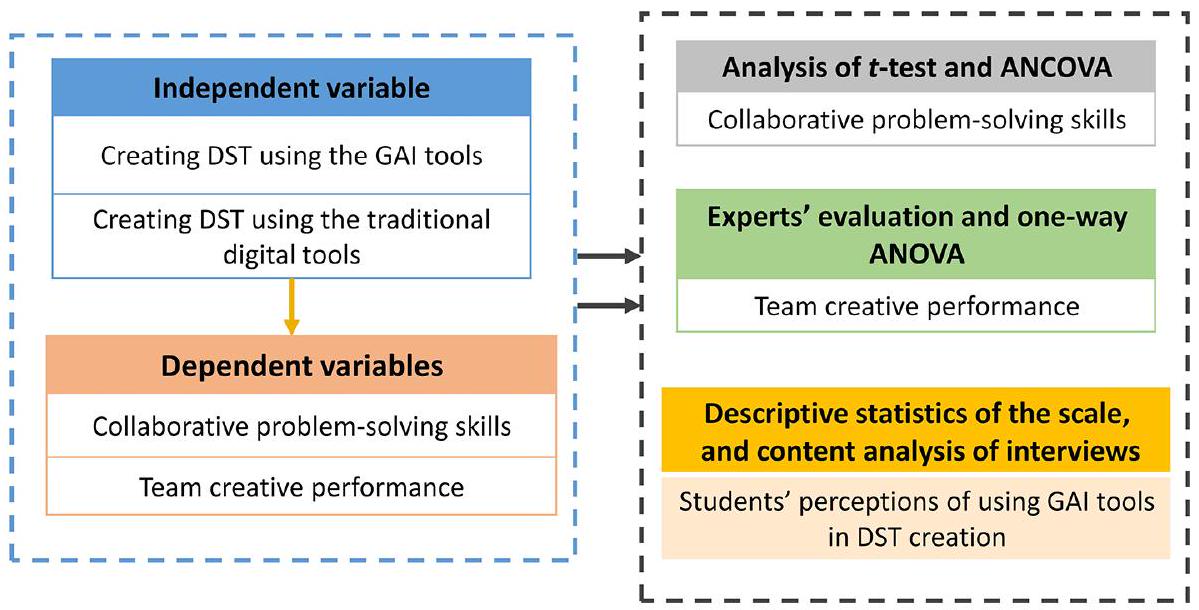
لاستكشاف تأثير النهج المقترح على أداء طلاب الجامعات في إنشاء DST، تم إجراء تصميم مختلط الطرق، يتضمن كل من الطرق الكمية والنوعية طوال العملية التجريبية. كما هو موضح في الشكل 1، تم تعريف المتغير المستقل على أنه الطريقة المستخدمة لإنشاء DST، مع مقارنة أشكال مختلفة من دمج GAI مع الأدوات الرقمية التقليدية. كانت المتغيرات التابعة هي CPS و TCP. في هذه الدراسة، تم استخدام CPS و TCP كمتغيرات رئيسية للتحليل الكمي، بينما تم فحص وجهات نظر الطلاب حول استخدام أدوات GAI في إنشاء DST باستخدام كل من الأساليب الكمية والنوعية. تم تعيين جميع المشاركين عشوائيًا إما إلى المجموعة التجريبية أو المجموعة الضابطة. استخدمت المجموعة التجريبية أدوات GAI المختلفة لإنشاء DST بشكل تعاوني، بينما عملت المجموعة الضابطة مع الأدوات الرقمية التقليدية، مثل Photoshop (PS) و After Effects (AE) و Premiere Pro (PR)، لإنتاج منتجات DST الخاصة بهم بشكل تعاوني.

المشاركون

مجموع 60 طالبًا جامعيًا، تتراوح أعمارهم بين 20 و , من فصلين في جامعة عادية في الصين شاركوا في هذه الدراسة. من بين المشاركين، كان 21 طالبًا ذكورًا و39 إناثًا، يتخصصون في تكنولوجيا التعليم. تم تعيين الفصلين عشوائيًا إما إلى المجموعة التجريبية (10 ذكور و20 إناث) أو المجموعة الضابطة (11 ذكور و19 إناث)، مع 30 طالبًا في كل مجموعة. لتسهيل عملية إنشاء القصص الرقمية، تم تقسيم الطلاب في كل مجموعة إلى ست مجموعات صغيرة، مع خمسة أعضاء في كل مجموعة. كان جميع الطلاب قد تعرضوا سابقًا لأدوات الذكاء الاصطناعي، حيث سمع كل طالب عن ChatGPT، وجربه معظمهم في كتابة النصوص. ومع ذلك، كان عدد قليل فقط على دراية بأدوات الذكاء الاصطناعي الأخرى (مثل Midjourney،
الشكل 1 هيكل البحث للدراسة
وRunway) المستخدمة عادة في إنشاء القصص الرقمية. تم الحصول على موافقة مستنيرة من جميع المشاركين قبل المشاركة.

تصميم القصص الرقمية

تم تطوير منهج بعنوان “تصميم وتطوير القصص الرقمية” خصيصًا لتزويد طلاب الجامعات بالمعرفة والمهارات الأساسية اللازمة لدمج التقنيات الرقمية بشكل فعال في ممارساتهم في إنشاء القصص الرقمية. تم هيكلة المنهج حول أربع مراحل لروبن وبييرسون (2005) لإنشاء القصص الرقمية: وهي (1) تحديد، جمع، واتخاذ القرار؛ (2) اختيار، استيراد، وإنشاء؛ (3) اتخاذ القرار، كتابة، تسجيل، وإنهاء؛ و(4) عرض، تقييم، وتكرار. قدمت هذه المراحل إطارًا شاملاً لإرشاد الطلاب خلال عملية تحسين وتعزيز منتجاتهم من القصص الرقمية. في هذه الدراسة، شمل هيكل المنهج ستة مشاريع رئيسية: (أ) إنشاء سيناريو القصة، (ب) تصميم وإنشاء القصة المصورة، (ج) إنتاج الصور الثابتة، (د) تصميم وتطوير الرسوم المتحركة، (هـ) التحرير، التسجيل، والانتهاء، و(و) مشاركة ونشر القصص. تم تصميم كل مشروع لمعالجة كل من المشكلات النظرية والعملية، وكان على الطلاب إكمال قصصهم الرقمية من خلال مهام حل المشكلات التعاونية أثناء استخدام أدوات رقمية متنوعة.
تم هيكلة ممارسة مشاريع القصص الرقمية لمهام حل المشكلات التعاونية للطلاب حول إجراء التعلم القائم على المشكلة (PBL): تحديد الهدف؛ جمع المعلومات؛ تحديد المشكلة؛ توليد الحلول؛ تقييم الحلول؛ واتخاذ القرار، والذي تم تكييفه من مراحل تصميم هونغ وتشوي (2015) لحل المشكلات التصميمية. تم دمج هذه المراحل بسلاسة في عملية تطوير القصص الرقمية، مما يبرز الطبيعة المترابطة لمهارات حل المشكلات التعاونية ونهج القصص الرقمية. تم تضمين طريقة PBL في كل مشروع من مشاريع المنهج لتشجيع الطلاب على التفاعل النشط مع المحتوى، وتعزيز التعاون بين الأقران، وحل المشكلات الإبداعية والتقنية المرتبطة بإنشاء القصص الرقمية في بيئات تعاونية. يوضح الجدول 1 خطة المنهج لمشاريع القصص الرقمية ومهام حل المشكلات التعاونية.
تم تنظيم المنهج بواسطة ثلاثة أساتذة ذوي خلفيات مهنية متنوعة: واحد لديه خبرة في تصميم القصص الرقمية، وآخر متخصص في تطبيق أدوات الذكاء الاصطناعي، وأستاذ ثالث لديه خلفية في تكنولوجيا التعليم. ضمنت هذه المقاربة متعددة التخصصات إطارًا متوازنًا لكل من التعلم النظري والتطبيق العملي في تطوير مشاريع القصص الرقمية.
خلال أنشطة التعلم، استخدمت المجموعة التجريبية أدوات ذكاء اصطناعي متعددة لدعم مراحل مختلفة من مشاريع القصص الرقمية. يتم تقديم ملخص لأدوات الذكاء الاصطناعي الرئيسية المستخدمة في عملية إنشاء القصص الرقمية في الجدول 2.
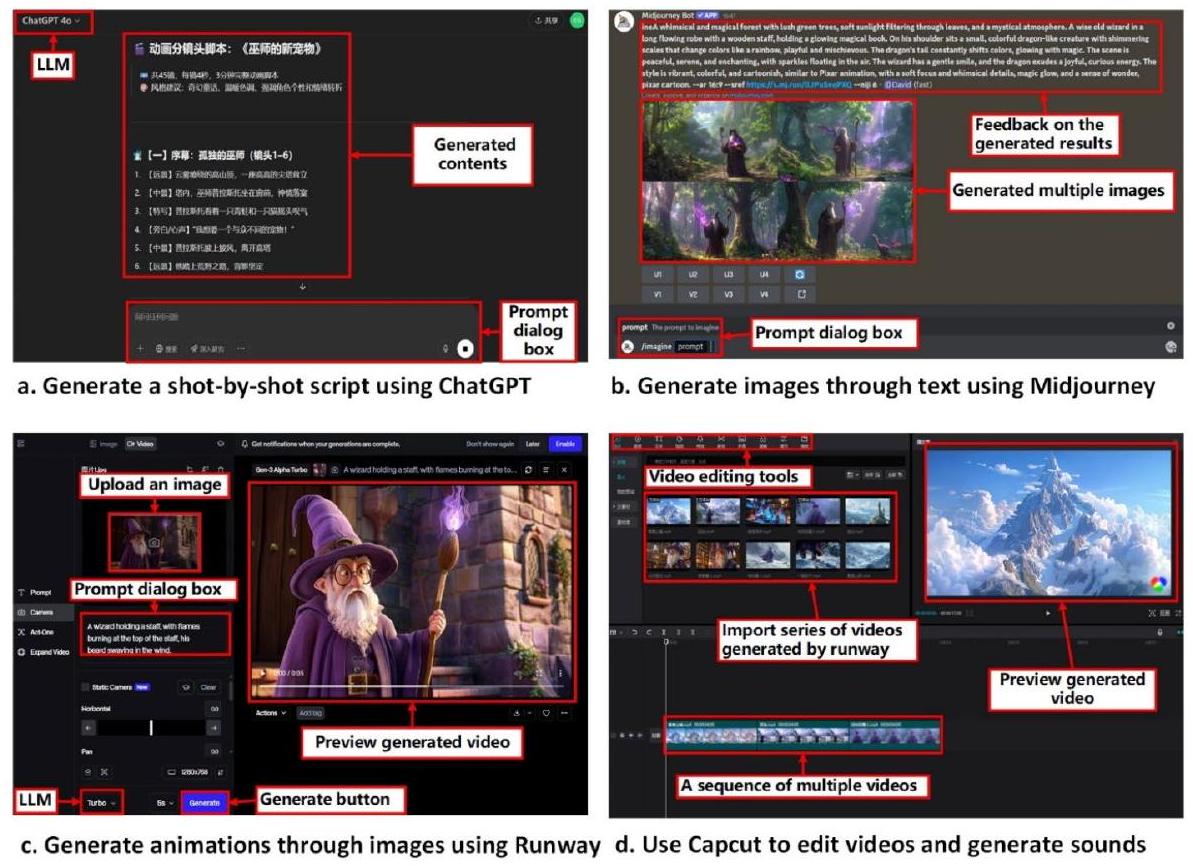
خدمت أدوات الذكاء الاصطناعي المستخدمة في المنهج، بما في ذلك ChatGPT وMidjourney وRunway، كمنصات مدفوعة بالذكاء الاصطناعي التعاوني التي سهلت كل من إنشاء وتحسين مشاريع القصص الرقمية بينما عززت مهارات التفكير العليا لدى الطلاب. سهل ChatGPT تطوير القصة التعاونية من خلال تمكين الطلاب من توليد، تحسين، وتعزيز مسودات السرد من خلال العصف الذهني في الوقت الحقيقي والتغذية الراجعة التكرارية، مما يضمن مساهمات نشطة من جميع أعضاء الفريق في هيكلة سرد متماسك (انظر الشكل 2أ). دعم Midjourney توليد صور ثابتة عالية الجودة بشكل تعاوني بناءً على مطالب نصية، مما سمح للطلاب بتحسين العناصر المرئية من خلال تعديلات المطالب والتلاعب بالصور (انظر الشكل 2ب). شجع هذه العملية التكرارية الطلاب على تقييم المخرجات المرئية للقصص الرقمية بشكل تعاوني وتحقيق توافق في الآراء حول التصميم النهائي لقصصهم الرقمية. تم استخدام Runway لإنشاء و
الجدول 1 خطة الدورة التجريبية
نهج روبن اسم المشروع المحتوى مهام حل المشكلات التعاونية
المرحلة 1 المشروع أ: كتابة سيناريو القصة
1. تعريف، هيكل القصص الرقمية
2. سيناريوهات التطبيق والمهارات في كتابة النصوص
الأهداف: إنشاء نص قصة رقمية منظم جيدًا.
– تفكر الفرق في موضوع القصة.
– تطور الفرق سردًا منظمًا جيدًا للقصص الرقمية.
– تحسين نص القصة الرقمية ليتماشى مع الأهداف من خلال استخدام أدوات رقمية.
المرحلة 2 المشروع ب: تصميم وإنشاء القصة المصورة
1. تعريف، وظائف الدور، وسيناريوهات تطبيق القصة المصورة
2. تصميم الشخصيات
3. المبادئ الأساسية للسرد المرئي
الأهداف: توليد قصة مصورة تمثل
القصص الرقمية.
– تصمم الفرق قصصًا مصورة لكل مشهد وتقسم الأدوار لتصميم الشخصيات وتركيب المشهد.
– تحسينات تكرارية للقصص الرقمية باستخدام أدوات رقمية.
المشروع ج:
إنتاج الصور الثابتة
المبادئ الأساسية والتقنيات لتصميم الشخصيات، تصميم البيئة، تصميم الألوان، وتصميم الرسوم التوضيحية.
الأهداف: تقديم مجموعة متماسكة من الصور الثابتة تتماشى مع السرد.
– تصمم الفرق تصميمات الشخصيات والعناصر ذات الصلة.
– تكرار صور القصص الرقمية باستخدام أدوات رقمية.
المرحلة 3
المشروع د:
تصميم وتطوير الرسوم المتحركة
1. تعريف، تصنيف، وسيناريوهات تطبيق الرسوم المتحركة في مختلف القصص الرقمية
2. الأسلوب المرئي وإيقاع السرد للقصص الرقمية
الأهداف: إنتاج رسوم متحركة سلسة ومتناسقة تعزز القصص الرقمية.
– تقوم الفرق بتحريك الصور الثابتة، مع التركيز على إيقاع السرد والأسلوب المرئي.
– تكرار عملية الرسوم المتحركة للقصص الرقمية باستخدام أدوات رقمية.
المشروع هـ: التحرير، التسجيل، والانتهاء تعريف، تقنيات، وسيناريوهات تطبيق التعليق الصوتي والتحرير
الأهداف: تقديم منتج نهائي من القصص الرقمية مصقول ومحرر بشكل جيد.
– تقوم الفرق بتحرير القصص الرقمية وتسجيل التعليقات الصوتية، مع ضمان التزامن مع المرئيات.
– تكرار المنتجات النهائية للقصص الرقمية باستخدام أدوات رقمية.
المرحلة 4 المشروع و: مشاركة ونشر القصص
1. تقديم ونشر المنتجات النهائية للقصص الرقمية
2. جمع تعليقات الأقران والتفكير في التحسينات المحتملة
الأهداف: تقديم وتقييم المنتج النهائي للقصص الرقمية للحصول على تعليقات الأقران والنشر.
– تقدم الفرق المنتجات النهائية للقصص الرقمية، تجمع تعليقات من الأقران، وتقييم التعليقات.
– تقرر الفرق أي تحسينات ضرورية للقصص الرقمية.
– بمجرد إجراء التعديلات، تنشر الفرق قصصها الرقمية على منصة مختارة.
الجدول 2 أدوات الذكاء الاصطناعي الرئيسية المستخدمة لتطوير منتجات القصص الرقمية
الاسم الوظائف النموذج المستخدم الرابط
ChatGPT نص إلى نص GPT-4o https://openai.com/chatgpt/
Midjourney نص إلى صورة نموذج Midjourney الإصدار 6 https://www.midjourney.com/home
Runway صورة إلى فيديو Gen-2 https://runwayml.com/
تلاعب الرسوم المتحركة، مما يعزز التأثير البصري للصور الثابتة (انظر الشكل 2ج). من خلال ضبط معلمات الرسوم المتحركة مثل حركة الكائنات وانتقالات المشهد في الوقت الحقيقي، تمكن الطلاب من تحقيق رسوم متحركة سلسة وديناميكية. علاوة على ذلك، تم تقديم CapCut لدعم مراحل التحرير النهائية وتزامن الصوت والصورة في عملية إنشاء القصص الرقمية. مكن CapCut الطلاب من توليد التعليقات الصوتية باستخدام ميزات تحويل النص إلى كلام، والتي تم تزامنها بعد ذلك مع العناصر المرئية لقصصهم الرقمية، مما سمح بتكامل سلس للمكونات متعددة الوسائط (انظر الشكل 2د). لم تسهل هذه الأدوات فقط إنشاء مواد القصص الرقمية باستخدام التكنولوجيا، بل لعبت أيضًا دورًا حاسمًا في تطوير مهارات حل المشكلات التعاونية والتفكير الإبداعي الجماعي لدى الطلاب. يوفر الشكل 2 نظرة عامة مفصلة على عملية خطوة بخطوة لإنشاء
الشكل 2 المجموعة التجريبية تستخدم أدوات الذكاء الاصطناعي لإنشاء القصص الرقمية
الشكل 3 مثال على منتج المجموعة التجريبية بعنوان “حيوان أليف جديد للساحر”
قصص رقمية مدعومة بالذكاء الاصطناعي، توضح كيف تطور كل منتج قصصي رقمي من المفهوم الأولي إلى منتجه النهائي.
من مجموعتنا من منتجات DST المدعومة بالذكاء الاصطناعي، أنتجت المجموعة التجريبية ستة مقاطع فيديو DST، كل منها يركز على موضوع سردي مختلف: “لماذا تمتلك الدببة ذيولًا قصيرة؟”، “وقت الغداء”، “منزل دافئ”، “حيوان الساحر الأليف الجديد”، و”ذيل القندس”. تراوحت مدة هذه الفيديوهات بين 2 دقيقة و52 ثانية إلى 5 دقائق و6 ثوانٍ، مما يمثل التنوع في الأساليب الموضوعية، والهياكل السردية، والعمليات الإبداعية التي استخدمها الطلاب. تم تطوير كل منتج DST بشكل تعاوني، مع دمج استخدام أدوات الذكاء الاصطناعي مثل ChatGPT وMidjourney وRunway. سهلت هذه الأدوات تجربة الطلاب وتنقيح سردهم، والمرئيات، والرسوم المتحركة. الشكل 3 يقدم
مثال محدد من أحد مشاريع DST التي أنتجتها المجموعة التجريبية. لمشاريع DST الأخرى التي أنشأتها المجموعة التجريبية، يرجى الرجوع إلى الملحق I.
على النقيض من ذلك، تم توجيه الطلاب في مجموعة التحكم لاستخدام أدوات رقمية تقليدية مثل PS و AE ومحركات البحث عبر الإنترنت وبرامج تقليدية أخرى لإكمال مشاريعهم في إنشاء القصص الرقمية. تم تزويد هؤلاء الطلاب بالمواد اللازمة وتلقوا تدريبًا حول كيفية استخدام هذه الأدوات بفعالية لمختلف جوانب إنشاء القصص الرقمية، بما في ذلك تحرير الصور، والرسوم المتحركة، وتزامن الصوت. قامت مجموعة التحكم بتطوير كل عنصر من عناصر قصصهم يدويًا، بدءًا من نصوص القصص، والمرئيات، والرسوم المتحركة، والتعليقات الصوتية دون مساعدة من أدوات الذكاء الاصطناعي. تطلبت هذه العملية من الطلاب الاعتماد على مهاراتهم التقنية في التعامل مع البرمجيات، والتصميم الإبداعي، والتحرير اليدوي لبناء منتجاتهم من القصص الرقمية. غطت مشاريع القصص الرقمية المكتملة من مجموعة التحكم نفس المواضيع التي تناولتها مجموعة التجربة، وتلقى كلا المجموعتين التعليم من نفس المعلم، مما يضمن اتساق المحتوى والدعم التعليمي. على الرغم من استخدام أدوات رقمية مختلفة، اتبعت المجموعتان مواضيع مشابهة، مما جعل التحليل المقارن بين النتائج من المنتجات المدعومة بالذكاء الاصطناعي وتلك التي تم إنشاؤها تقليديًا ذا معنى وصالح. تتماشى أنشطة إنشاء القصص الرقمية التفصيلية من كلا المجموعتين مع المراحل المختلفة لعملية إنشاء القصص الرقمية، كما هو موضح في الملحق الثاني.

أدوات القياس

مهارات حل المشكلات التعاونية

تم تطوير استبيان CPS استنادًا إلى مقاييس تشين وآخرون (2020). يتكون من 17 عنصرًا في خمسة مقاييس فرعية، وهي: المشاركة (3 عناصر) (مثال على عنصر: طلبت المساعدة من الآخرين عندما واجهت صعوبة)، أخذ وجهة النظر (3 عناصر) (مثال على عنصر: التعاون مع الآخرين أكثر فعالية في إيجاد الحلول من الاعتماد على النفس)، التنظيم الاجتماعي (3 عناصر) (مثال على عنصر: إذا كان لدى زملائي في الصف أي مشاكل، فإن من واجبي مساعدتهم)، تنظيم المهام (4 عناصر) (مثال على عنصر: كنت أعرف بوضوح أهداف الدرس)، وبناء التعلم والمعرفة (4 عناصر) (مثال على عنصر: عندما لا أستطيع حل المشكلات، سأفكر في التعلم)، مع مقياس ليكرت من 5 نقاط. كانت قيم ألفا كرونباخ للمقاييس الفرعية وCPS الكلي هي 0.87 و 0.87 على التوالي.

أداء الفريق الإبداعي

تم تطوير مقياس تقييم TCP المستخدم في هذه الدراسة استنادًا إلى Liu et al. (2023)، ويشمل أربعة أبعاد: الاستدامة، تجربة المستخدم، الجدة، والأهمية. تم تقييم كل بعد باستخدام من معيارين إلى ثلاثة معايير تم تقييمها على مقياس من عشرة نقاط (” 1 ” لضعيف جدًا و” 10 ” لجيّد جدًا). تم حساب الدرجة الإجمالية من خلال متوسط درجات المعايير لكل بعد، حيث كانت الاستدامة وتجربة المستخدم كل منهما يمثل ، وتعتبر الجدة والأهمية كل منهما حسابًا لـ تمت تقييم TCP من قبل ثلاثة خبراء: اثنان متخصصان في تكنولوجيا التعليم والآخر في أبحاث DST. تم تحليل معامل الارتباط داخل الفئة (ICC) (ICC ) من نتائج تقييمهم أظهرت اتساقًا عاليًا في تصنيف DST بين الخبراء.

تصورات الطلاب حول استخدام أدوات الذكاء الاصطناعي
لتقييم تصورات الطلاب حول استخدام أدوات الذكاء الاصطناعي في إنشاء أنظمة دعم القرار، تم استخدام مقياس معدل استنادًا إلى تشان وهو (2023). كان المقياس يتكون من 18 عنصرًا، منظمة في ثلاثة
الأبعاد: المعرفة بأدوات الذكاء الاصطناعي العام (6 عناصر)، الرغبة في استخدام أدوات الذكاء الاصطناعي العام (8 عناصر)، والمخاوف بشأن استخدام الذكاء الاصطناعي العام (4 عناصر). تم تقييم كل عنصر على مقياس ليكرت من خمس نقاط (“1″ للرفض الشديد و”5” للموافقة الشديدة). كانت قيم ألفا كرونباخ للفرعيات 0.83 للمعرفة، 0.84 للرغبة، و0.83 للمخاوف، بينما كانت قيمة ألفا المقياس الكلي 0.86، مما يدل على اتساق داخلي قوي.

المقابلات شبه المنظمة

لتكملة النتائج الكمية، تم إجراء مقابلات شبه منظمة مع الطلاب بعد التجربة. كانت المقابلات تهدف إلى استكشاف تصورات الطلاب حول استخدام أدوات الذكاء الاصطناعي التوليدي لإنشاء أدوات التصميم. قدمت نتائج المقابلات معلومات إضافية لشرح النتائج ويمكن أن تكون مرجعًا لتحسين أساليب أدوات التصميم المدعومة بالذكاء الاصطناعي في المستقبل. تتضمن المقابلة سؤالين مفتوحين: “كيف يختلف نهج إنشاء أدوات التصميم المدعوم بالذكاء الاصطناعي عن النهج التقليدي؟ هل هو مفيد لتصميمك؟” “ما هي مزايا وعيوب استخدام أدوات الذكاء الاصطناعي التوليدي لإنشاء أدوات التصميم؟ يرجى التحديد”.

الإجراء

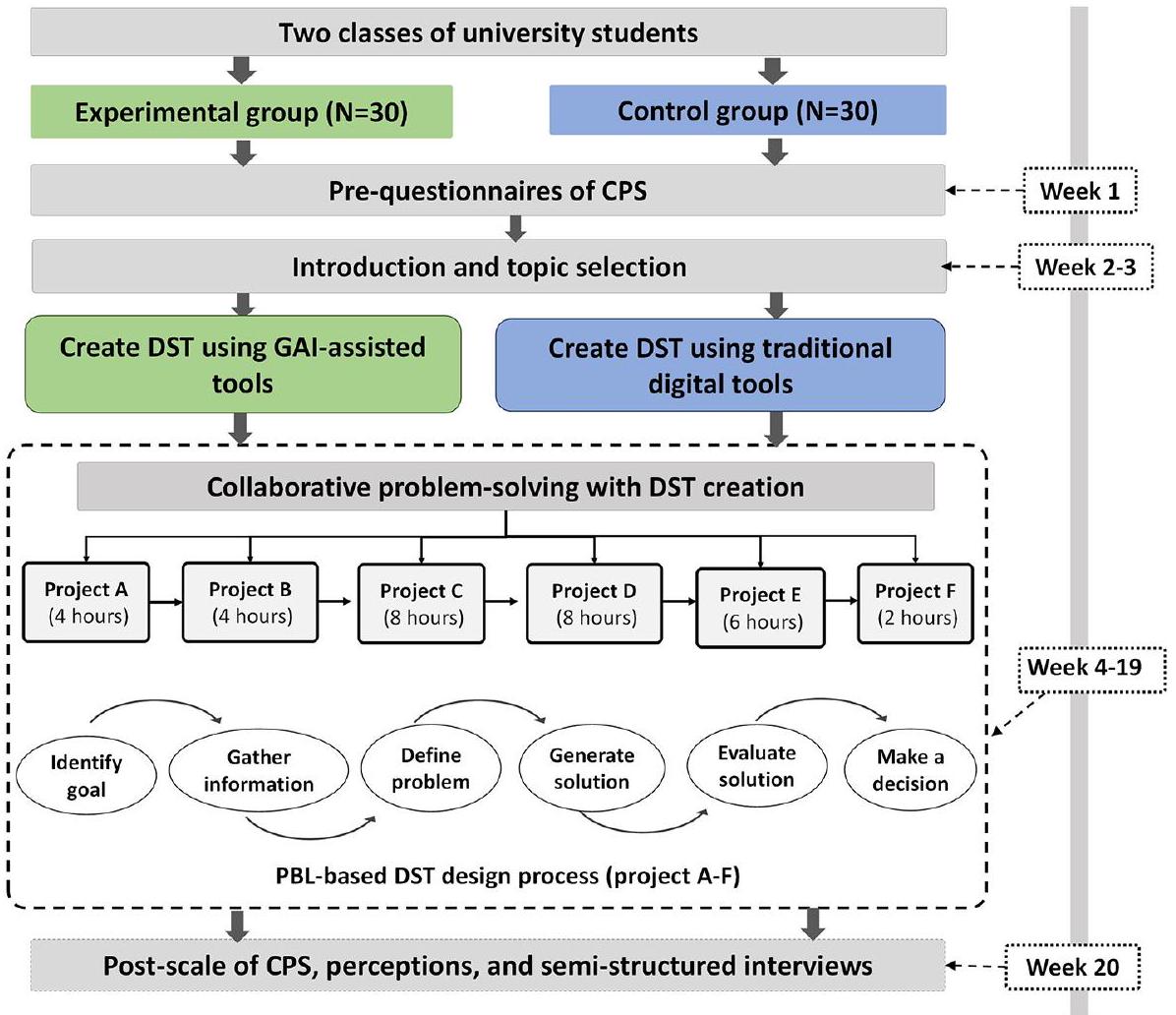
كما هو موضح في الشكل 4، استمرت الإجراءات لمدة 20 أسبوعًا مع جلسات مدتها 120 دقيقة في الأسبوع. في الأسبوع الأول، وقع الطلاب من كلا المجموعتين على استمارات الموافقة وأكملوا استبيانًا مسبقًا يقيس مهاراتهم في حل المشكلات الإبداعية. خلال الأسبوعين التاليين، تم تقديم جميع المشاركين لمشاريع DST، حيث اختاروا مواضيعهم وتلقوا لمحة عامة عن المهام المقبلة. بعد ذلك، دخلت المجموعتان في مرحلة إنتاج DST، حيث كان لديهم 15 أسبوعًا لإنهاء مشاريع DST المخصصة لهم.
الشكل 4 الإجراء
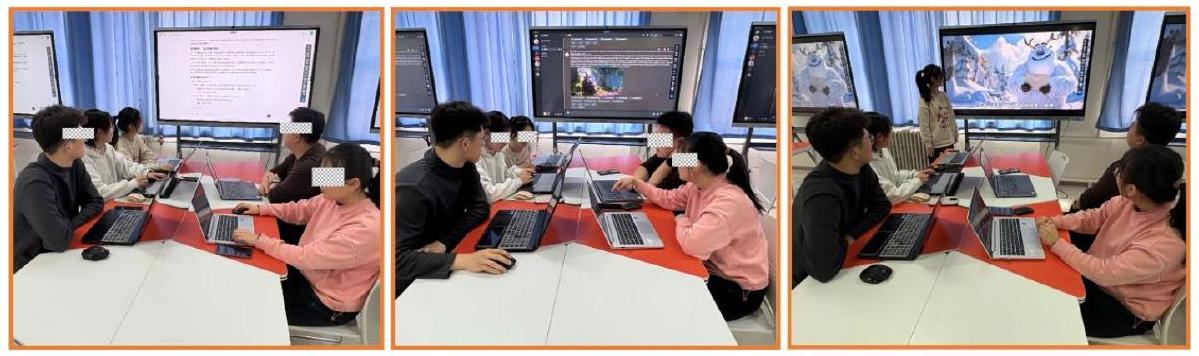
من الأسبوع الرابع إلى الأسبوع التاسع عشر، عمل المشاركون على مختلف جوانب عملية إنشاء DST، بما في ذلك كتابة النصوص، ورسم القصة، وتوليد الصور الثابتة، وتطوير الرسوم المتحركة، والتحرير النهائي. اعتمدت المجموعة التجريبية نهجًا مدعومًا بالذكاء الاصطناعي لإنشاء DST (انظر الشكل 5)، بينما استخدمت المجموعة الضابطة أدوات رقمية تقليدية لنفس مهام DST. اتبعت المجموعتان نفس مهام CPS وأكملتا نفس المشاريع المتعلقة بـ DST من خلال طريقة قائمة على التعلم القائم على المشاريع ولكن بدعم تكنولوجي مختلف. في الأسبوع العشرين، أكمل المشاركون من كلا المجموعتين الاستبيانات بعدية عن CPS والانطباعات. بالإضافة إلى ذلك، تم اختيار 10 طلاب من المجموعة التجريبية عشوائيًا لإجراء مقابلات شبه منظمة لالتقاط انطباعاتهم وتجاربهم حول استخدام الذكاء الاصطناعي في عملية إنشاء DST.

النتائج

مهارات حل المشكلات التعاونية

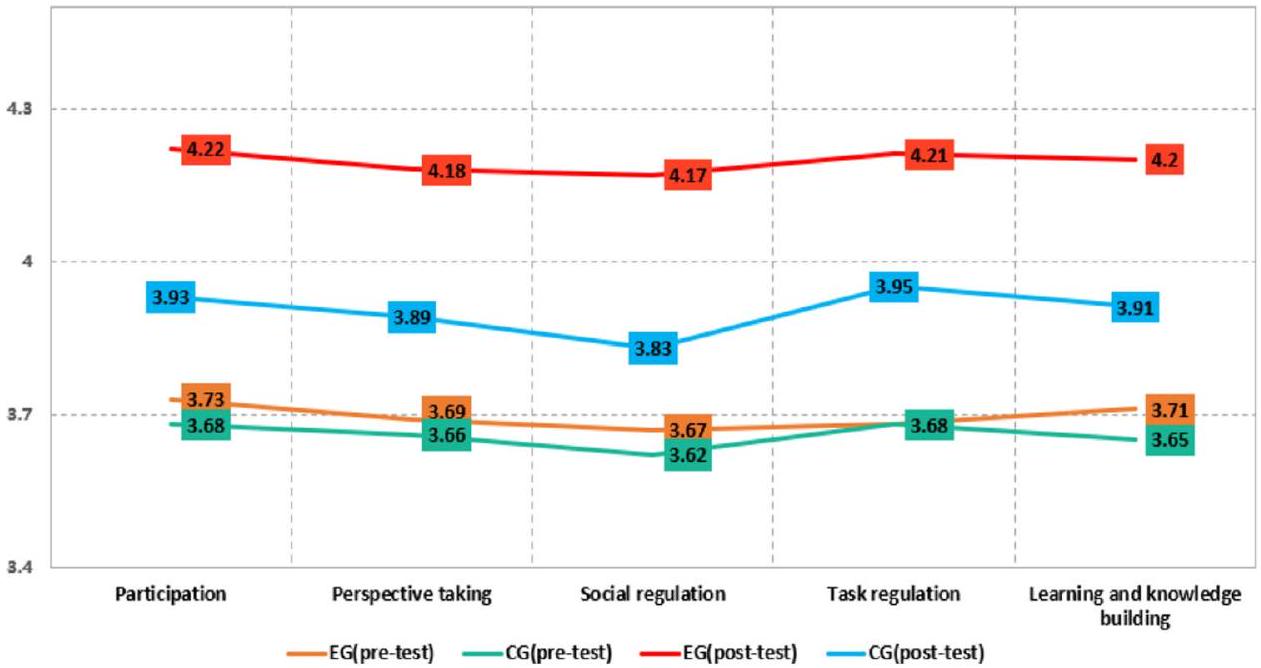
لتحديد الفروق في CPS بين طلاب مجموعتين، عينة مرتبطة تم إجراء اختبار -test. تم إجراء اختبارات التوزيع الطبيعي لتقييم طبيعة توزيع درجات CPS في كلا المجموعتين. أظهرت اختبارات الطبيعة لدرجات الاختبار القبلي والبعدي في كلا المجموعتين عدم وجود انحرافات كبيرة عن التوزيع الطبيعي. ، مما يشير إلى أن البيانات كانت موزعة بشكل طبيعي، و كانت الاختبارات مناسبة لمزيد من التحليل. كما هو موضح في الجدول 3، عينة الزوجية أظهرت نتائج الاختبار تحسنًا كبيرًا في مهارات CPS لكل من المجموعة الضابطة ) ومجموعات تجريبية . كانت أحجام التأثير 0.64 لمجموعة التحكم و1.18 للمجموعة التجريبية، مما يشير إلى تأثيرات متوسطة وقوية على التوالي. أظهرت النتائج أن الطلاب الذين استخدموا أدوات الذكاء الاصطناعي لإنشاء DST حققوا تحسينات أفضل بشكل ملحوظ في جميع الأبعاد الفرعية للإبداع في حل المشكلات بالإضافة إلى درجات الإبداع العامة في حل المشكلات (انظر الشكل 6).
لتحليل درجات CPS بين المجموعتين بشكل أعمق، تم إجراء تحليل التباين باستخدام درجات CPS في الاختبار القبلي كمتغير تابع. كما تم إجراء اختبار تجانس ليفين بين المجموعتين وأظهرت النتائج أن التجانس قد تحقق. كما هو موضح في الجدول 4، كان هناك فرق كبير بين المجموعتين في درجات CPS الإجمالية للطلاب. ) مع حجم تأثير كبير ( ) ، وأبعادها الفرعية بما في ذلك المشاركة ( ) ، أخذ وجهة النظر ( ، “ )، التنظيم الاجتماعي ( تنظيم المهام ) ، وبناء التعلم والمعرفة ( أظهرت النتائج أن الطلاب الذين استخدموا أدوات الذكاء الاصطناعي التوليدي لإنشاء أنظمة دعم القرار حققوا مهارات أعلى في حل المشكلات التعاونية مقارنةً بأولئك الذين استخدموا الطرق التقليدية.
الشكل 5 أنشطة التعاون داخل الفصل للمجموعة التجريبية
الجدول 3 عينة مزدوجة -نتائج تحليل الاختبار لـ CPS في مجموعتين
متغير مجموعة التحكم المجموعة التجريبية
اختبار مسبق بعد الاختبار مُزَوَّج -اختبار حجم التأثير اختبار مسبق بعد الاختبار مزدوج -اختبار حجم التأثير
M SD M SD د كوهين M SD M SD د كوهين
مشاركة 3.68 0.35 3.93 0.53 2.10* 0.38 3.73 0.50 ٤.٢٢ 0.40 4.25*** 0.78
تقمص وجهة النظر 3.66 0.44 3.89 0.45 2.17* 0.40 3.69 0.50 ٤.١٨ 0.52 3.99*** 0.73
التنظيم الاجتماعي 3.62 0.44 3.83 0.44 2.04* 0.37 3.67 0.50 ٤.١٧ 0.52 3.57** 0.65
تنظيم المهام 3.68 0.38 3.95 0.43 2.29* 0.42 3.68 0.39 ٤.٢١ 0.51 4.19*** 0.77
التعلم وبناء المعرفة 3.65 0.31 3.91 0.55 2.10* 0.38 3.71 0.35 ٤.٢٠ 0.51 3.99*** 0.74
الشرطة العامة 3.66 0.22 3.90 0.34 3.53** 0.64 ٣.٧٠ 0.22 ٤.٢٠ 0.34 6.44*** 1.18
; كوهين حجم تأثير صغير كوهين حجم تأثير معتدل، كوهين حجم تأثير كبير

أداء الفريق الإبداعي

لفحص الفروق في TCP بين الطلاب في المجموعتين، تم إجراء تحليل التباين الأحادي (One-way ANOVA). قبل هذا التحليل، تم استيفاء فرضية التجانس لاختبار ليفين، وتم استيفاء فرضيات تحليل التباين. كما هو موضح في الجدول 5، كانت المجموعة التجريبية لديها متوسط درجة قدره 7.20 ( )، أعلى بكثير من مجموعة التحكم، التي كان لديها متوسط درجة 5.80 ( ). بالنسبة للأهمية، حصلت المجموعة التجريبية على بينما حصلت مجموعة التحكم على . من حيث تجربة المستخدم، حصلت المجموعة التجريبية على 7.27 ( )، مقارنةً بمجموعة التحكم . من أجل الاستدامة، كان لدى المجموعة التجريبية متوسط درجة 7.70 (الانحراف المعياري = 0.27)، بينما سجلت المجموعة الضابطة 6.97 ( ). بالنسبة لـ TCP العام، سجلت المجموعة التجريبية 29.57 ( ) بينما سجلت مجموعة التحكم 25.78 ( وفقًا لنتائج تحليل التباين (ANOVA)، كان هناك فرق كبير بين متوسط TCP العام للطلاب في المجموعتين. )، بما في ذلك الجدة ( )، الصلة ( ، تجربة المستخدم ) ، والاستدامة ( تشير هذه النتائج إلى أن الطلاب الذين استخدموا أدوات الذكاء الاصطناعي لإنشاء تصميمات التعلم العميق أظهروا أداءً أفضل في TCP مقارنةً بأولئك الذين استخدموا الطرق التقليدية.

تصورات الطلاب حول استخدام أدوات الذكاء الاصطناعي

تقدم الجدول 6 نتائج الإحصائيات الوصفية حول تصورات الطلاب لفوائد والتحديات المحتملة المرتبطة بأدوات الذكاء الاصطناعي التوليدي في إنشاء أنظمة دعم القرار. فيما يتعلق بمعرفة أدوات الذكاء الاصطناعي التوليدي، أظهر الطلاب وعيًا قويًا بحدود هذه الأدوات، لا سيما اعتمادها على الأنماط الإحصائية. ) وإمكانية وجود أخطاء واقعية ( ). علاوة على ذلك، فقد أدركوا أيضًا الفهم الحاسم للتحيزات الناتجة عن الذكاء الاصطناعي ( ، ) وافتقار مخرجات الذكاء الاصطناعي العام إلى الذكاء العاطفي ( )، مما يشير إلى أن الطلاب يدركون كل من الفرص والقيود المتعلقة بدمج الذكاء الاصطناعي التوليدي في مجالات تكنولوجيا المعلومات الرقمية. من حيث الاستعداد لاستخدام أدوات الذكاء الاصطناعي التوليدي، أعرب الطلاب عن حماسهم الشديد لدمج أدوات الذكاء الاصطناعي التوليدي في عملية إنشاء تكنولوجيا المعلومات الرقمية، معترفين بقدرة الذكاء الاصطناعي التوليدي على توليد رؤى فريدة. وتعزيز الكفاءة الرقمية ( ). بالإضافة إلى ذلك، تم اعتبار أدوات الذكاء الاصطناعي مفيدة للغاية في تحسين الكفاءة ( , ) وتقديم ملاحظات شخصية ( )، مما يعزز الفكرة بأن الذكاء الاصطناعي يمكن أن يعمل كعامل تمكين معرفي وإبداعي في إنشاء تقنيات اتخاذ القرار. ومع ذلك، أعرب الطلاب عن ثقة أقل قليلاً في فعالية الذكاء الاصطناعي العام في خدمات دعم الطلاب المجهولة الهوية ( )، مما يشير إلى أنه بينما يُقدَّر الذكاء الاصطناعي العام لتعزيز التعليم (مثل تحسين الكفاءة)، فإن تطبيقه في الأدوار الداعمة غير الأكاديمية (مثل الدعم العاطفي) لا يزال غير مؤكد، ربما بسبب المخاوف المتعلقة بالذكاء العاطفي، والتخصيص، والاعتبارات الأخلاقية.
فيما يتعلق بالقلق بشأن اعتماد الذكاء الاصطناعي العام، هناك قلق معتدل بشأن الاعتماد المفرط ) لوحظ، حيث اعترف الطلاب بخطر تقليل استقلالية حل المشكلات عندما يتم دمج أدوات الذكاء الاصطناعي بشكل كبير في عملية اتخاذ القرار. ومع ذلك، كانت هناك مخاوف بشأن تقليل الذكاء الاصطناعي للتفاعل الاجتماعي ( ) ويعيق تطوير المهارات القابلة للنقل مثل العمل الجماعي والقيادة ( كانت ( ) منخفضة نسبيًا، مما يشير إلى أن الطلاب لا يعتبرون أدوات الذكاء الاصطناعي العام عائقًا كبيرًا أمام تطوير المهارات الشخصية.
الشكل 6 متوسط درجات CPS عبر الاختبار القبلي والاختبار البعدي للمجموعتين
الجدول 4 نتائج تحليل التباين لـ CPS في مجموعتين
متغير مجموعة التحكم المجموعة التجريبية التحليل التبايني المصحح
م.م م.م ف جزئي
مشاركة 3.93 ٤.٢٢ 5.41* 0.09
تقمص وجهة النظر 3.89 ٤.١٨ 5.20* 0.08
التنظيم الاجتماعي 3.83 ٤.١٧ 7.05** 0.11
تنظيم المهام 3.95 ٤.٢٠ 4.67* 0.08
التعلم وبناء المعرفة 3.90 ٤.٢١ 5.18* 0.08
الشرطة العامة 3.90 ٤.٢٠ 10.69** 0.16
، ** I’m sorry, but there is no text provided for translation. Please provide the text you would like to have translated. ; حجم تأثير صغير حجم تأثير معتدل حجم تأثير كبير
الجدول 5 نتائج تحليل ANOVA أحادي الاتجاه لأداء الفريق الإبداعي
متغير مجموعة التحكم المجموعة التجريبية تحليل التباين
M SD SD جزئي
جدة ٥.٨٠ 0.62 7.20 0.45 16.68** 0.68
الملاءمة 6.55 0.60 ٧.٤٠ 0.29 8.26* 0.51
تجربة المستخدم 6.47 0.28 ٧.٢٧ 0.19 28.58*** 0.78
الاستدامة 6.97 0.57 ٧.٧٠ 0.27 6.65* 0.45
بروتوكول التحكم في الإرسال العام ٢٥.٧٨ 0.52 ٢٩.٥٧ 0.95 64.51*** 0.86
، ** ، *** حجم تأثير صغير حجم تأثير معتدل حجم تأثير كبير

نتائج المقابلة

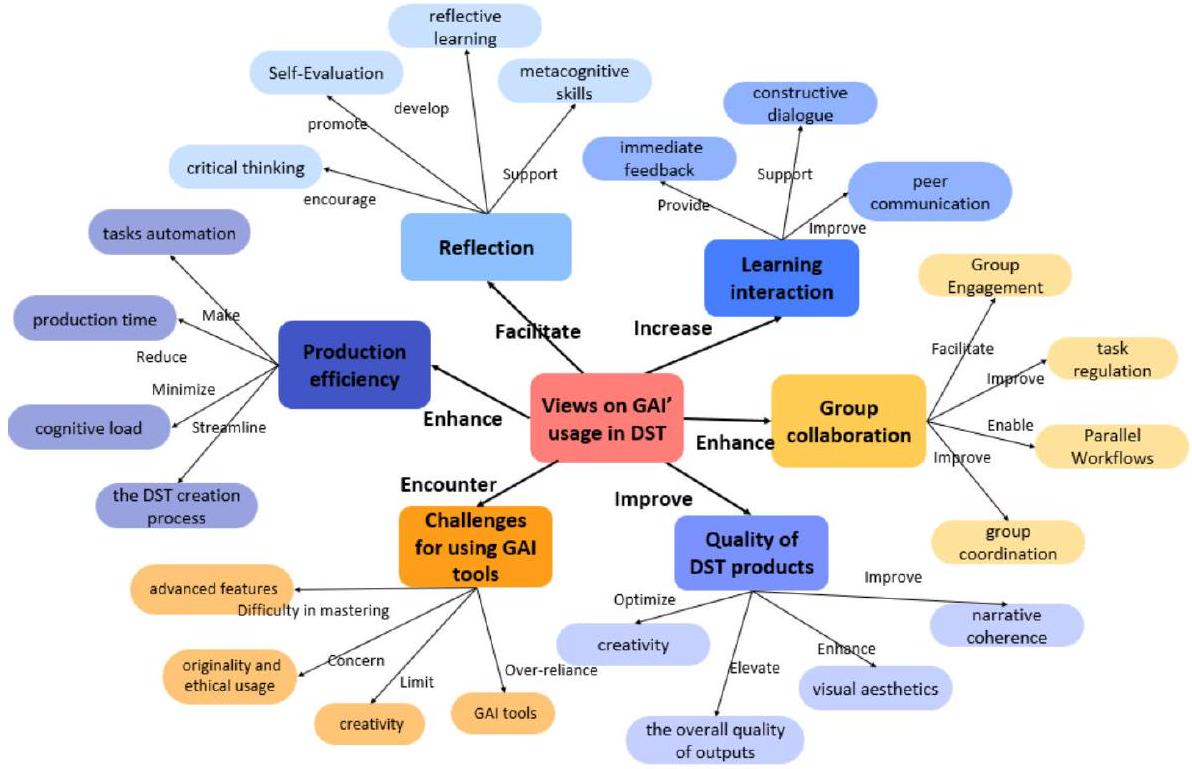
بعد مشاريع DST، تم اختيار 10 طلاب من المجموعة التجريبية عشوائيًا لإجراء مقابلة نوعية مدتها 30 دقيقة لاستكشاف تجاربهم مع أدوات GAI. تقدم الشكل 7 خريطة موضوعية تصف الموضوعات الرئيسية والرؤى الأساسية المستخلصة من هذه المقابلات. بشكل عام، اعترف الطلاب بمزايا أدوات GAI وأبرزوا دورها في تعزيز كفاءة مشاريع DST، وتعزيز التفكير الأعمق والتفاعل، وتحسين جودة مشاريع DST. ومع ذلك، ظهرت مخاوف بشأن الاعتماد المفرط على GAI والاعتبارات الأخلاقية أيضًا.
ظهرت عدة مواضيع متكررة من المقابلات، مما يوفر رؤى حول كل من المزايا والتحديات لاستخدام أدوات الذكاء الاصطناعي التوليدي في مشاريع نظم دعم القرار:
الجدول 6 المعرفة، والاستعداد للاستخدام، والقلق بشأن استخدام أدوات الذكاء الاصطناعي التوليدي لإنشاء أنظمة دعم القرار
الأبعاد بيانات M SD
معرفة أفهم أن أدوات الذكاء الاصطناعي لديها قيود في قدرتها على التعامل مع المهام المعقدة. ٤.٣٣ 0.76
أفهم أن أدوات الذكاء الاصطناعي يمكن أن تنتج مخرجات غير دقيقة من الناحية الواقعية. ٤.٢٥ 0.74
أفهم أن أدوات الذكاء الاصطناعي يمكن أن تنتج مخرجات خارج السياق أو غير مناسبة. ٤.١٠ 0.87
أفهم أن أدوات الذكاء الاصطناعي يمكن أن تظهر تحيزات وعدم عدالة في مخرجاتها. ٤.١٣ 0.56
أفهم أن أدوات الذكاء الاصطناعي قد تعتمد بشكل مفرط على الإحصائيات، مما قد يحد من فائدتها في سياقات معينة. ٤.٣٨ 0.67
أفهم أن أدوات الذكاء الاصطناعي لديها ذكاء عاطفي وتعاطف محدود، مما قد يؤدي إلى مخرجات غير حساسة أو غير مناسبة. ٤.١٨ 0.64
استعداد أتصور دمج أدوات الذكاء الاصطناعي في ممارساتي التعليمية والتعلمية في المستقبل ٤.٤٥ 0.64
يجب على الطلاب أن يتعلموا كيفية استخدام أدوات الذكاء الاصطناعي بشكل جيد من أجل مسيرتهم المهنية ٤.٣٠ 0.56
أعتقد أن أدوات الذكاء الاصطناعي يمكن أن تحسن كفاءتي الرقمية ٤.٤٠ 0.59
أعتقد أن أدوات الذكاء الاصطناعي يمكن أن تساعدني في توفير الوقت ٤.٤٥ 0.71
أعتقد أن أدوات الذكاء الاصطناعي يمكن أن توفر لي رؤى ووجهات نظر فريدة قد لا أكون قد فكرت فيها بنفسي. ٤.٤٨ 0.60
أعتقد أن أدوات الذكاء الاصطناعي يمكن أن توفر لي تعليقات واقتراحات مخصصة وفورية لمهامي. ٤.٣٨ 0.59
أعتقد أن أدوات الذكاء الاصطناعي هي أداة رائعة لأنها متاحة على مدار الساعة طوال أيام الأسبوع. ٤.٣٣ 0.66
أعتقد أن أدوات الذكاء الاصطناعي هي أداة رائعة لخدمات دعم الطلاب بسبب السرية. 3.88 0.69
المخاوف استخدام أدوات الذكاء الاصطناعي لإكمال الواجبات يقلل من قيمة التعليم الجامعي ٢.٩٥ 1.06
ستحد أدوات الذكاء الاصطناعي من فرصي للتفاعل مع الآخرين والتواصل الاجتماعي أثناء إكمال الدورات الدراسية. 2.68 1.00
ستعيق أدوات الذكاء الاصطناعي تطوير مهاراتي العامة أو القابلة للنقل مثل العمل الجماعي، وحل المشكلات، ومهارات القيادة. 2.65 1.08
يمكن أن أصبح معتمدًا بشكل مفرط على أدوات الذكاء الاصطناعي العامة 3.38 0.98
الشكل 7 الخريطة الموضوعية للمقابلات شبه المنظمة
(1) زيادة كفاءة إنتاج DST. قدّر الطلاب أن أدوات GAI سهلت عملية DST من خلال تقليل عبء العمل وتسريع إنشاء المحتوى. على سبيل المثال، قال أحد الطلاب: ساعدني ChatGPT في تقليل الكثير من الكتابة اليدوية وزاد من كفاءتي. ” وعلق آخر: “استخدام Midjourney وفّر الكثير من الوقت، خاصة عند إنشاء الصور.”
(2) تحسين جودة منتجات DST. أشار الطلاب إلى مساهمة أدوات GAI في تحسين الجودة العامة لمنتجاتهم من DST. هذه الأدوات عززت تدفق السرد والتناسق البصري، مما أدى إلى مخرجات أكثر احترافية. أوضح أحد الطلاب، “الصور التي تم إنشاؤها بواسطة Midjourney حسنت الجودة البصرية لعملنا، مما جعله يبدو أكثر احترافية.” علق طالب آخر، “ساعدنا ChatGPT في تحسين DST لدينا، مما أدى إلى تحسين ملحوظ في محتوى القصة النهائية.”
(3) تعزيز التفكير التأملي. أفاد الطلاب أن أدوات الذكاء الاصطناعي ساعدت في تشجيع التفكير التأملي من خلال دفعهم لتقييم عملهم في تصميم الأنظمة الديناميكية بشكل نقدي. على سبيل المثال، شارك أحد المشاركين قائلاً: “جعلتني ملاحظات ChatGPT أفكر أكثر في إبداعي بدلاً من إنهائه دون تفكير.” وأضاف آخر: “استخدام أدوات الذكاء الاصطناعي جعلني أفكر أكثر في المنطق والتفاصيل المتعلقة بتصميم الأنظمة الديناميكية.”
(4) زيادة التفاعل في التعلم. ذكر الطلاب أن أدوات الذكاء الاصطناعي ساعدت في تعزيز سلوكيات المجموعة من خلال توفير تغذية راجعة فورية وتوليد المحتوى. كما أوضح أحد الطلاب: “منحنا ميدجورني المزيد من الفرص للنقاش في المجموعات.” “مع أدوات الذكاء الاصطناعي، أصبحت مناقشات مجموعتنا أكثر بناءً، وكان الجميع أكثر انخراطًا.”
(5) تحسين التعاون الجماعي. أعرب العديد من الطلاب عن أن أدوات الذكاء الاصطناعي ساعدت في تسهيل التعاون الجماعي من خلال تبسيط إدارة المهام وتمكين العمل المتزامن على جوانب مختلفة من مشاريع DST. علق أحد الطلاب قائلاً: “سمح لنا ChatGPT بالتعامل مع مهام مختلفة في وقت واحد، مما جعل التعاون الجماعي أكثر كفاءة.”
(6) المخاوف بشأن الاعتماد المفرط على أدوات الذكاء الاصطناعي. بعض الطلاب كانوا قلقين بشأن الاعتماد المفرط على الذكاء الاصطناعي، مما قد يحد من إبداعهم ويؤدي إلى معضلات أخلاقية تتعلق بأصالة المحتوى الذي يتم إنشاؤه بواسطة الذكاء الاصطناعي. كما أوضح أحد الطلاب: “أحيانًا أشعر أنني معتمد بشكل مفرط على أدوات الذكاء الاصطناعي، مما قد يحد من إبداعي.” وعلق طالب آخر: “تعلم كيفية استخدام Midjourney بفعالية أمر صعب، خاصة مع وظائفه المتقدمة.”

نقاش

أثر على مهارات حل المشكلات التعاونية

أظهرت هذه الدراسة أن دمج أشكال مختلفة من أدوات الذكاء الاصطناعي التوليدي في إنشاء أدوات التعلم التفاعلي عزز بشكل كبير مهارات حل المشكلات التعاونية لدى طلاب الجامعات، مما يعالج السؤال البحثي الأول. يمكن أن يُعزى ذلك إلى جهود الطلاب التعاونية في حل المهام المعقدة مثل كتابة النصوص، وتصميم القصص المصورة، وتصميم الصور، بالإضافة إلى التفاعل مع زملائهم وأدوات الذكاء الاصطناعي التوليدي (مثل ChatGPT وMidjourney وRunway). سهل استخدام أدوات الذكاء الاصطناعي التوليدي المتعددة مجموعة واسعة من التفاعلات، وعزز التواصل الديناميكي والمتعدد الاتجاهات خلال عملية التعاون في إنشاء أدوات التعلم التفاعلي، مما يعزز العمل الجماعي الفعال وحل المشكلات. لعب التفاعل مع ChatGPT دورًا حاسمًا في تعزيز السرد الإبداعي من خلال مساعدة الطلاب على توليد حلول متنوعة ومبتكرة، والتي لم تكن قابلة للتحقيق بسهولة في الإعدادات الجماعية التقليدية. استنادًا إلى المقابلات، أوضح أحد المشاركين، “ساعدني ChatGPT”.
“لقد أخرجتنا أفكارًا إبداعية لم نفكر فيها بمفردنا، مما ساعد على دفع التعاون إلى الأمام.” بالإضافة إلى ذلك، ساهمت Runway في إنشاء الرسوم المتحركة، مما ساعد في تنقيح الأفكار وتعزيز التعاون. قدمت التعليقات الفورية من هذه الأدوات الذكية فرصًا مستمرة للتعاون، مما سمح لأعضاء الفريق بتنقيح أفكارهم على الفور. كما أشار أحد الطلاب، “عندما اقترح شخص ما فكرة، كان ChatGPT يقدم على الفور اقتراحًا ذا صلة، ويمكننا مناقشته وتعديله معًا على الفور.” ضمنت هذه التفاعلات المستمرة بين أعضاء المجموعة وأدوات الذكاء الاصطناعي أن يساهم جميع أعضاء الفريق بشكل هادف في عملية حل المشكلات. بالإضافة إلى ذلك، فإن قدرة أدوات الذكاء الاصطناعي على تقديم تعليقات فورية عززت عملية تفكير مستمرة، مما مكن الطلاب من تقييم وتعديل قراراتهم بانتظام. كما قال أحد الطلاب، “جعلتنا التعليقات الفورية من ChatGPT نعيد التفكير في خياراتنا. لم يكن الأمر مجرد قبول اقتراح ChatGPT، بل مناقشته واتخاذ قرار بشأن ما إذا كان منطقيًا لمشروعنا.” عززت هذه العملية التأملية المتكررة التفكير النقدي، مما يتماشى مع الأبحاث الحالية حول أهمية حلقات التغذية الراجعة في التعلم التعاوني لتعزيز مهارات حل المشكلات (العزمي، 2023). علاوة على ذلك، حسنت قدرات توزيع المهام لأدوات الذكاء الاصطناعي، جنبًا إلى جنب مع التعليقات الفورية، التنسيق داخل المجموعة. على سبيل المثال، سمحت الاقتراحات والأفكار التي تم إنشاؤها بواسطة الذكاء الاصطناعي للمجموعة بتفكيك المهام المعقدة، وتفويض المسؤوليات بشكل أكثر كفاءة، وتزامن جهودهم طوال عملية إنشاء DST، مما عزز في النهاية حل المشكلات الجماعي.
وجدت دراستنا أيضًا أن نهج DST المدعوم بالذكاء الاصطناعي عزز الأبعاد الفرعية للقدرة التعاونية بين الطلاب، بما في ذلك المشاركة، وتبادل وجهات النظر، والتنظيم الاجتماعي، وتنظيم المهام، وبناء المعرفة والتعلم. قدمت أدوات الذكاء الاصطناعي تفاعلات سياقية أكثر وتعليقات فورية، مما مكن أعضاء المجموعة من الانخراط في حوارات تعاونية متكررة وذات مغزى. سمحت هذه التبادلات الديناميكية للطلاب بممارسة مهارات أساسية مثل التعبير عن الأفكار، وتقييم الحلول، والوصول إلى توافق في الآراء بكفاءة. علاوة على ذلك، ساهمت أدوات الذكاء الاصطناعي مثل Midjourney في العملية البصرية الفورية من خلال توليد صور يمكن للمجموعة العمل عليها، مما ساعد في تبسيط التواصل وتعزيز الفهم المشترك بين أعضاء الفريق. عززت هذه القدرة المشاركة وتنظيم المهام، حيث تمكن أعضاء الفريق من المساهمة بنشاط وتنسيق جهودهم بشكل أكثر فعالية طوال عملية إنشاء DST. كان التحسن في تبادل وجهات النظر واضحًا بشكل خاص خلال عملية تأليف DST. يسمح DST، بهيكله المرن، باستكشاف أفكار القصص والخيال الإبداعي من وجهات نظر متعددة. مكن التواصل مع ChatGPT المشاركين من التفاعل مع القصة من زوايا مختلفة، مثل وجهة نظر البطل، مما عزز قدرتهم على النظر في وجهات نظر مختلفة وتوسيع نهجهم السردي. كان هذا التحول في تبادل وجهات النظر ضروريًا لصياغة قصص أكثر تعقيدًا وتعدد الأبعاد. بالإضافة إلى ذلك، دعمت أدوات الذكاء الاصطناعي التنظيم الاجتماعي من خلال مساعدة أعضاء المجموعة على تنسيق جهودهم وضبط تفاعلاتهم. دعمت نتائج المقابلات هذه النتائج. ذكر أحد الطلاب: “ساعدنا ChatGPT في تنظيم مجموعتنا. كلما واجهنا خلافات، اقترح حلولًا محايدة وساعدنا على المضي قدمًا دون صراعات غير ضرورية.” تتماشى هذه النتيجة مع الأبحاث الحالية التي تشير إلى أن أدوات الذكاء الاصطناعي يمكن أن تعزز التعلم المنظم اجتماعيًا (هوانغ ولين، 2024).
بالإضافة إلى ذلك، أظهرت مجموعة التحكم تحسنًا ملحوظًا في مهارات CPS من خلال الطرق التقليدية، لا سيما في السياقات التي تتطلب التقييم اليدوي و
يمكن أن يُعزى ذلك إلى حقيقة أنه على الرغم من أن أدوات الذكاء الاصطناعي يمكن أن تُبسط عملية حل المشكلات، إلا أن الأدوات التقليدية يمكن أن تعزز التفكير النقدي الأعمق واتخاذ القرارات المستقلة من خلال مطالبة الطلاب بالتفاعل يدويًا مع كل مرحلة من مراحل عملية حل المشكلات (Zhai et al.، 2024). بعبارة أخرى، عندما يصل الطلاب إلى مرحلة التقييم، يحتاجون إلى التعاون لاتخاذ قرار دون الدعم الفوري من ردود الفعل التكنولوجية. وهذا يكشف أن النهج الهجين، الذي يجمع بين أدوات الذكاء الاصطناعي والأساليب التقليدية، قد يقدم أفضل توازن بين التعاون الفعال والتقييم النقدي.

أثر على أداء الفريق الإبداعي

ردًا على سؤال البحث الثاني، أظهرت هذه الدراسة أن دمج أدوات الذكاء الاصطناعي في إنشاء المحتوى الرقمي التفاعلي عزز بشكل كبير أداء إبداع الفرق الطلابية في الجامعات، خاصة في الأبعاد الفرعية للجدّة وتجربة المستخدم. كان التحسن في الجدّة ملحوظًا بشكل خاص خلال مراحل التباين في إنشاء المحتوى الرقمي التفاعلي. على سبيل المثال، خلال كتابة النصوص، لعب ChatGPT دورًا حاسمًا من خلال تسهيل الدمج السلس لمختلف الأفكار في المناقشات الجماعية. لقد أنشأ محفزات مبتكرة ألهمت الفرق لإنتاج نصوص محتوى رقمي تفاعلي أكثر تنوعًا وإبداعًا. استنادًا إلى نتائج المقابلات، قال أحد الطلاب: “ساعدنا ChatGPT في التوصل إلى أفكار أكثر إبداعًا مما كنا لنفكر فيه بمفردنا. إنه يقدم لنا محفزات لم نفكر فيها من قبل، مما ساعدنا على دفع حدود قصتنا.” بالإضافة إلى ذلك، عززت Midjourney وRunway التعاون من خلال تمكين جميع أعضاء المجموعة من الوصول إلى المواد مثل النصوص والصور ومقاطع الفيديو والتفاعل معها في الوقت الفعلي، مما يعزز بيئة أكثر تعاونًا وتفاعلية. لقد ساعد هذا الوصول المتزامن إلى الموارد في تعزيز نهج مشترك وشامل، مما سمح لأعضاء الفريق بالمساهمة بالأفكار، والحصول على تعليقات، واستكشاف وجهات نظر متعددة معًا. زاد التعاون المحسن وتنوع الأفكار من الإبداع العام للمجموعة، مما يتماشى مع الأبحاث السابقة التي تشير إلى أن أدوات الذكاء الاصطناعي تعزز الإبداع من خلال تعزيز التفكير التبايني والواسع (Tala et al. 2024).
كان الأثر الإيجابي لأدوات الذكاء الاصطناعي العام واضحًا أيضًا في تجربة المستخدم خلال أنشطة تصميم القصص الرقمية. على سبيل المثال، خلال مرحلة إنشاء الصور الثابتة، قدمت Midjourney واجهة مستخدم بديهية سمحت للطلاب بالتنقل بسهولة بين عناصر مشاريعهم. لاحظ أحد الطلاب: “جعلتنا Midjourney نجرب بصريًا مختلفًا بسهولة، كنا نستطيع رؤية تغييرات الصور والحصول على تعليقات على الفور.” ساهمت ميزات سهولة الاستخدام هذه في تعزيز المشاركة النشطة من جميع أعضاء المجموعة، مما أدى إلى عملية إبداعية أكثر تعاونًا وتكاملًا. علاوة على ذلك، حسنت التعليقات المقدمة من ChatGPT تجربة المستخدم من خلال تمكين التكرار الفوري وتعديل الأفكار. كما لاحظ أحد المشاركين: “يقدم لنا ChatGPT اقتراحات على الفور ويمكننا إجراء تغييرات، مما يسرع من عملية إنشاء تصميم القصص الرقمية لدينا.” جعلت قدرات Midjourney في التصور، وChatGPT في توليد المحتوى السردي، وRunway في المساعدة مع الرسوم المتحركة، عملية تصميم القصص الرقمية أكثر تفاعلًا وجاذبية في الوقت نفسه. عزز هذا التكامل بين أدوات الذكاء الاصطناعي العام تدفق الإبداع، مما سمح بإجراء تعديلات سلسة عبر تنسيقات وسائط مختلفة، مما ساهم في تحقيق مستويات أعلى من رضا المستخدم. كما أظهرت الأبحاث، فإن حلقات التغذية الراجعة المستمرة تعزز كل من جودة وملاءمة المخرجات الإبداعية (كير وكيللي، 2024). من حيث الاستدامة، دعمت أدوات الذكاء الاصطناعي العام العمليات الإبداعية على المدى الطويل من خلال السماح للطلاب بالبناء المستمر على أفكارهم وتحسينها. مكنت أدوات الذكاء الاصطناعي العام الفريق من التفكير في
التقدم وإجراء التعديلات التكرارية، مع التأكد من أن مخرجاتهم من DST كانت ذات صلة وقابلة للاستدامة على مر الزمن. استنادًا إلى المقابلات، ذكر أحد الطلاب: “ساعدتنا أدوات GAI على إعادة زيارة وتحسين عملنا عدة مرات، مما يضمن أنه ظل ذا صلة وتطور أثناء عملنا عليه.”
بينما تظهر فوائد أدوات الذكاء الاصطناعي العام في تحسين الأداء الإبداعي للفريق، من المهم الاعتراف بالمخاطر المحتملة المرتبطة بالاعتماد المفرط على المحتوى الذي يتم إنشاؤه بواسطة الذكاء الاصطناعي. أظهرت نتائج المقابلات أن بعض الطلاب شعروا بأن منتجات أدوات الذكاء الاصطناعي المولدة لم تكن تملك العمق العاطفي والأصالة التي توجد عادة في الأفكار التي ينتجها البشر. أعرب أحد الطلاب عن رأيه قائلاً: “كان ChatGPT رائعًا في توليد الأفكار، لكن في بعض الأحيان كانت النتائج تبدو آلية قليلاً أو تفتقر إلى العاطفة.” وأبرزت هذه النتيجة الحاجة إلى نهج متوازن، حيث تُستخدم أدوات الذكاء الاصطناعي لتعزيز الإبداع الفني والكفاءة، لكن تظل الإبداع البشري والعمق العاطفي مركزية في المنتجات النهائية. لذلك، من الضروري التأكد من أن المخرجات التي يتم إنشاؤها بواسطة الذكاء الاصطناعي لا تطغى على اللمسة البشرية، التي تعتبر حيوية للحفاظ على النزاهة الفنية والعمق العاطفي للمنتجات.

أثر استخدام أدوات الذكاء الاصطناعي على مواقف الطلاب

أما بالنسبة للسؤال الثالث، فقد أشارت نتائج هذه الدراسة إلى أن الطلاب يمتلكون مستوى عالٍ من الوعي بشأن قيود الذكاء الاصطناعي العام، ورغبة قوية في التكامل، واهتمامات معتدلة بشأن الاعتماد وتطوير المهارات في سياق إنشاء أدوات دعم القرار. أظهر الطلاب فهمًا أفضل لقيود الذكاء الاصطناعي العام، لا سيما اعتماده على الأنماط الإحصائية، وقابليته للأخطاء الواقعية، والانحيازات المحتملة. وهذا يشير إلى أن الطلاب يتعاملون بشكل نقدي مع المحتوى الذي يتم إنشاؤه بواسطة الذكاء الاصطناعي العام بدلاً من قبول النتائج بشكل سلبي، مما يعزز أهمية معرفة الذكاء الاصطناعي في التعليم. تتماشى هذه النتائج مع الأبحاث السابقة التي تؤكد على ضرورة تطوير الطلاب لمهارات التقييم النقدي عند التفاعل مع أدوات الذكاء الاصطناعي (Li et al., 2025). كما كشفت الدراسة أن الطلاب لديهم رغبة عالية في اعتماد أدوات الذكاء الاصطناعي العام، لا سيما من أجل تعزيز الكفاءة، والقدرة الرقمية، وتجارب التعلم الشخصية. اعترف الطلاب بفوائد قدرة الذكاء الاصطناعي العام على تبسيط إنشاء محتوى أدوات دعم القرار، وتوليد رؤى فريدة، وتقديم ملاحظات فورية. وقد دعمت هذه النتيجة دراسات سابقة حول دور الذكاء الاصطناعي في تسهيل المشاركة والتطور المعرفي في البيئات الرقمية (Li et al., 2024). تشير الاتفاقية القوية على أن أدوات الذكاء الاصطناعي العام تحسن من مهارات الإبداع وحل المشكلات إلى أن الطلاب يرون هذه الأدوات كمعززات معرفية بدلاً من بدائل للتفكير المستقل. ومع ذلك، قد تعكس النظرة الأقل نسبيًا لدور الذكاء الاصطناعي العام في خدمات دعم الطلاب المجهولة المخاوف الأخلاقية والخصوصية، مما يستدعي مزيدًا من الاستكشاف في تفاعلات ودعم الطلاب التي تتم عبر الذكاء الاصطناعي العام. بالإضافة إلى ذلك، بينما يتضح الحماس لتكامل الذكاء الاصطناعي العام، أعرب الطلاب عن مخاوف بشأن الاعتماد المفرط والتأثير المحتمل على المهارات القابلة للنقل. أعرب الطلاب عن مخاوف من أن أدوات الذكاء الاصطناعي العام قد تقلل من مهارات العمل الجماعي، وحل المشكلات، والقيادة. تتماشى هذه النتيجة مع الدراسات الحديثة حول تفريغ المعرفة والاعتماد على الذكاء الاصطناعي (Wang et al., 2025). تشير هذه المخاوف إلى الحاجة إلى نهج تعلم مدعوم بالذكاء الاصطناعي العام منظم بعناية يوازن بين الدعم التكنولوجي والمشاركة النشطة للطلاب والتفكير من المستوى الأعلى.

الخاتمة

اقترحت هذه الدراسة ونفذت إنشاء أدوات دعم القرار بمساعدة الذكاء الاصطناعي ضمن طريقة التعلم القائم على المشاريع، مع التركيز على مهارات التفكير الإبداعي والتفكير النقدي لدى طلاب الجامعات. كشفت نتائج الدراسة أن طلاب الجامعات الذين استخدموا أدوات الذكاء الاصطناعي لإنشاء أدوات دعم القرار تفوقوا بشكل ملحوظ في كل من مهارات التفكير الإبداعي والتفكير النقدي مقارنةً بأولئك الذين استخدموا الطرق التقليدية. علاوة على ذلك، أعرب الطلاب عن موقف إيجابي تجاه استخدام أدوات الذكاء الاصطناعي في إنشاء أدوات دعم القرار، مع تقديرهم لدورها في تعزيز الكفاءة والإبداع، كما أبدوا مخاوف بشأن تحميل المعرفة، والاعتماد المفرط على تكنولوجيا الذكاء الاصطناعي، ونقص الدعم العاطفي المقدم من أدوات الذكاء الاصطناعي. تقدم هذه النتائج استراتيجيات ورؤى قابلة للتنفيذ للمعلمين والمربين والباحثين لتعزيز اعتماد إنشاء أدوات دعم القرار بمساعدة الذكاء الاصطناعي. من خلال الاستفادة من ميزات أدوات الذكاء الاصطناعي، يمكن للطلاب التعاون بفعالية، والوصول إلى، وتوليد مواد رقمية متنوعة، والتعبير عن أفكارهم بحرية أكبر، مما يؤدي إلى تجربة تصميم أدوات دعم قرار أكثر ثراءً وإنتاجية.

الآثار النظرية والمساهمات العملية

تقدم الدراسة عدة مساهمات نظرية لفهم اعتماد الذكاء الاصطناعي التوليدي في إنشاء المواد الرقمية بين طلاب الجامعات. تكمن حداثة هذه الدراسة في نهجها الرائد لدمج أدوات الذكاء الاصطناعي التوليدي المتعددة، وتحديداً ChatGPT وMidjourney وRunway، في عملية إنشاء المواد الرقمية. بينما استكشفت الدراسات الحالية دور الذكاء الاصطناعي التوليدي في إنتاج مقاطع فيديو تعليمية قصيرة (Netland et al.، 2025)، فإن هذه الدراسة توسع النطاق من خلال دمج مجموعة من أدوات الذكاء الاصطناعي التوليدي في بيئات تعاونية وإبداعية لإنتاج المواد الرقمية. تسلط الدراسة الضوء على إمكانيات هذه الأدوات لتسهيل التعاون المتزامن، حيث يمكن لأعضاء الفريق العمل معًا لإنتاج مواد رقمية والتفاعل مع العناصر متعددة الوسائط في الوقت الحقيقي، مما يعزز الإبداع ومهارات حل المشكلات وتنسيق المجموعة. علاوة على ذلك، يساهم دمج أدوات الذكاء الاصطناعي التوليدي في إنشاء المواد الرقمية في التعلم التعاوني المدعوم بالحاسوب (CSCL) من خلال إظهار كيف يمكن أن تعزز الأدوات المدعومة بالذكاء الاصطناعي التواصل في الوقت الحقيقي، وتنظيم المهام، والتماسك الاجتماعي داخل مجموعات التعلم. كما تعزز هذه الدراسة وجهات نظر نظرية حول بيئات التعلم المدعومة بالذكاء الاصطناعي، موضحة كيف يمكن أن يعمل الذكاء الاصطناعي كدعامة معرفية وممكن إبداعي. من خلال الاستفادة من المحتوى الذي تم إنشاؤه بواسطة الذكاء الاصطناعي، يشارك الطلاب في تعلم ديناميكي ومتعدد الوسائط، حيث يعزز التعاون بين الإنسان والذكاء الاصطناعي توليد الأفكار، وتنقيح المفاهيم، وصنع المعاني الجماعية. وبالتالي، تساهم هذه الدراسة في الفهم المتزايد لكيفية تعزيز أدوات الذكاء الاصطناعي التوليدي لحل المشكلات التعاونية والإبداع، مقدمة رؤى قيمة حول العلاقة التآزرية بين الذكاء الاصطناعي والإبداع والتعلم التعاوني في السياقات التعليمية المدعومة رقمياً.
من منظور عملي، يوفر هذا البحث منهجية منظمة لدمج أدوات الذكاء الاصطناعي التوليدي في تصميم التعلم، مما يساهم في النقاش الأوسع حول الممارسات التعليمية المعززة بالذكاء الاصطناعي التوليدي. من خلال إظهار كيف تعزز إنشاءات تصميم التعلم المدعومة بالذكاء الاصطناعي التفكير النقدي والتعاون، يقدم هذا البحث تداعيات ملموسة للمعلمين ومصممي المناهج وصانعي السياسات الذين يسعون للتنقل في الدور المتطور للذكاء الاصطناعي في التعليم. بالنسبة للمعلمين، أبرزت هذه الدراسة إمكانيات الذكاء الاصطناعي في خلق بيئات تعلم تركز على الطالب، مما يسهل توليد المحتوى في الوقت الحقيقي، والتغذية الراجعة التكرارية، والانخراط المتعدد الوسائط في المهام التعاونية. ومع ذلك، يتطلب التنفيذ الناجح استراتيجيات تعليمية توازن بين مساعدة الذكاء الاصطناعي وضرورة استقلالية الطلاب، مما يضمن أن يتفاعل المتعلمون بشكل نقدي مع المحتوى الذي تم إنشاؤه بواسطة الذكاء الاصطناعي بدلاً من ذلك.
بدلاً من الاعتماد عليها بشكل سلبي. بالنسبة لمصممي المناهج، تؤكد هذه الأبحاث على أهمية تطوير بيئات تعليمية مدعومة تدمج أدوات الذكاء الاصطناعي التوليدي مع الحفاظ على توافقها مع مبادئ التعلم البنائية والتعلم القائم على الاستفسار. يجب على المصممين التركيز على إنشاء تجارب تعليمية مرنة تتيح للطلاب الاستفادة من قدرات الذكاء الاصطناعي التوليدي مع الحفاظ على فرص للتفكير النقدي والتفكير المستقل. أما بالنسبة لصانعي السياسات، فإن النتائج تبرز الحاجة إلى أطر أخلاقية وعادلة لدمج الذكاء الاصطناعي التوليدي في التعليم، مع معالجة المخاوف المتعلقة بتفريغ الإدراك والاعتماد المفرط على تكنولوجيا الذكاء الاصطناعي. من الضروري معالجة هذه القضايا من خلال ضمان أن يعزز اعتماد الذكاء الاصطناعي التوليدي الاستخدام المسؤول ويوازن بين المساعدة التكنولوجية وفرص تطوير التفكير النقدي والتفاعل البشري في السياقات التعليمية.

القيود والاتجاهات المستقبلية

تحتوي هذه الدراسة على بعض القيود وتقدم توصيات للباحثين في المستقبل. أولاً، كانت الدراسة محدودة ببيئة واحدة في جامعات الصين. استخدمت عينة صغيرة نسبياً، مما قد يقيّد إمكانية تعميم النتائج على بيئات تعليمية أو مجموعات ديموغرافية مختلفة. يمكن أن تستكشف الأبحاث المستقبلية تأثير أدوات الذكاء الاصطناعي التوليدي في بيئات تعليمية مختلفة، مع تضمين أحجام عينات أكبر وأكثر تنوعاً. يجب أن تركز الأبحاث أيضاً على تطبيق أدوات الذكاء الاصطناعي التوليدي عبر تخصصات متنوعة، مثل العلوم والتكنولوجيا والهندسة والرياضيات أو العلوم الاجتماعية، لفهم تطبيقاتها المحتملة بشكل أفضل. ثانياً، استخدمت الدراسة بشكل أساسي ثلاثة أنواع من أدوات الذكاء الاصطناعي التوليدي: ChatGPT وMidjourney وRunway لإنشاء DST، وهو ما يمثل جانباً واحداً فقط من إمكانيات الذكاء الاصطناعي التوليدي. يجب أن تستكشف الدراسات المستقبلية كيفية تطبيق هذه الأدوات في مجالات تعليمية أخرى، والتحقيق في أدوارها في تعزيز التعلم التعاوني وحل المشكلات في مواد تتجاوز DST. سيساعد تطوير مجموعات أدوات الذكاء الاصطناعي التوليدي الأكثر شمولاً والمخصصة لمختلف التخصصات الأكاديمية والمتوافقة مع أساليب تدريس مختلفة في استكشاف تنوعها الوظيفي وقيودها الكامنة بشكل أعمق.
علاوة على ذلك، كانت هذه الدراسة استكشافًا محدودًا للمخاطر المرتبطة بالاعتماد المفرط على أدوات الذكاء الاصطناعي التوليدي، والتي قد تؤثر على استقلالية الطلاب ومهارات التفكير النقدي. بينما توفر أدوات الذكاء الاصطناعي التوليدي فوائد في كفاءة الإبداع والتفكير، من الضروري أن تطور الدراسات المستقبلية استراتيجيات تربوية توازن بين استخدام الذكاء الاصطناعي التوليدي والحفاظ على وكالة الطلاب. يجب أن تبحث الأبحاث أيضًا في كيفية هيكلة دمج الذكاء الاصطناعي التوليدي بطريقة معقولة تشجع على الانخراط المعرفي وتجنب تقليل قدرة الطلاب على التفكير النقدي والاستقلالي. كما أن وجود إرشادات واضحة حول الاستخدام الأخلاقي لأدوات الذكاء الاصطناعي التوليدي في البيئات التعليمية ضروري لضمان التبني المسؤول. بالإضافة إلى ذلك، قد تكون تصورات الطلاب ونواياهم في اعتماد الذكاء الاصطناعي التوليدي قد تأثرت بمستوياتهم المتفاوتة من الألفة مع هذه الأدوات. قد يكون الطلاب الذين لديهم خبرة محدودة مع أدوات الذكاء الاصطناعي التوليدي قد اعتمدوا على انطباعاتهم الأولية أو معتقداتهم القائمة، مما شكل المواقف والنوايا (شازاد وآخرون، 2024). وبالتالي، يجب أن تبحث الأبحاث المستقبلية في كيفية تأثير التعرض المستمر لأدوات الذكاء الاصطناعي التوليدي على انخراط الطلاب ومواقفهم وأنماط استخدامهم بمرور الوقت.
أخيرًا، يمكن أن تؤثر الخصائص الفردية (مثل الجنس) والأخلاقيات والجوانب الاجتماعية والثقافية (مثل تجارب الحياة) على معتقدات الطلاب وسلوكياتهم تجاه أدوات الذكاء الاصطناعي التوليدي. يمكن أن تستكشف الدراسات المستقبلية كيف تؤثر هذه العوامل على قدرة الطلاب على استخدام أدوات الذكاء الاصطناعي التوليدي بفعالية في سياقات التعلم التعاوني. على وجه الخصوص، قد تشكل الديناميات الجندرية
نهج الطلاب تجاه الإبداع والتفكير النقدي واتخاذ القرار، مما يؤثر على قدرتهم على الاستفادة من أدوات الذكاء الاصطناعي بشكل فعال في مهام حل المشكلات القائمة على العمل الجماعي. يمكن أن تتضمن الدراسات المستقبلية الجنس كمتغير لاستكشاف تأثيره على التعلم التعاوني ولتوفير فهم أكثر دقة لدور الذكاء الاصطناعي في السياقات التعليمية المتنوعة. يجب أن تركز الأبحاث المستقبلية أيضًا على تطوير أطر شاملة لتقييم آثار دمج الذكاء الاصطناعي في التعليم وقياس تأثيرها على نتائج التعلم. ستوجه هذه الأعمال المعلمين لتصميم بيئات تعليمية معززة بالذكاء الاصطناعي تعزز التعلم المعنوي مع ضمان الاستخدام المسؤول لأدوات الذكاء الاصطناعي في العصر الرقمي.

معلومات إضافية

تحتوي النسخة الإلكترونية على مواد إضافية متاحة علىhttps://doi.org/10.1186/s41239-025-00526-0.
المادة التكميلية 1

مساهمات المؤلفين

ساهم شياودونغ وي في تصور وتصميم الدراسة، وجمع البيانات، وتحليلها، وتفسير النتائج، وصياغة المخطوطة. ساعد لي وانغ في المنهجية، وتحليل البيانات، وصياغة وتنقيح المخطوطة. ساهم لاب-كي لي في مراجعة الأدبيات وقدم ملاحظات نقدية خلال عملية الصياغة. رويشوي ليو، المؤلف المراسل، أشرف على الدراسة، وساهم في الإطار المفاهيمي للدراسة، وقدم التوجيه طوال عملية البحث. قرأ جميع المؤلفين ووافقوا على المخطوطة النهائية.

تمويل

تم منح البحث من قبل صندوق العلوم الاجتماعية الوطني في الصين (رقم 24FJKB016).

توفر البيانات

تتوفر مجموعات البيانات المستخدمة و/أو التي تم تحليلها خلال الدراسة الحالية من المؤلف المراسل عند الطلب المعقول.

الإعلانات

المصالح المتنافسة

يعلن المؤلفون أنهم ليس لديهم مصالح متنافسة.
تاريخ الاستلام: 16 يناير 2025 / تاريخ القبول: 31 مارس 2025
تم النشر على الإنترنت: 25 أبريل 2025

References

Alazmi, H. S. (2023). The value of systematic, iterative, video-based reflection analysis on preservice teacher actions in Kuwait: A preservice social studies teacher example. Teaching and Teacher Education, 121, 103910. https://doi.org/10.1016/j.tate. 202 2.103910
An, S., Zhang, S., Guo, T., Lu, S., Zhang, W., & Cai, Z. (2025). Impacts of generative AI on student teachers’ task performance and collaborative knowledge construction process in Mind mapping-based collaborative environment. Computers & Education, 227, 105227. https://doi.org/10.1016/j.compedu.2024.105227
Andrews, J. J., & Rapp, D. N. (2015). Benefits, costs, and challenges of collaboration for learning and memory. Translational Issues in Psychological Science, 1(2), 182-191. https://doi.org/10.1037/tps0000025
Balasubramaniam, S., Chirchi, V., Kadry, S., Agoramoorthy, M., Gururama, S. P., Satheesh, K. K., & Sivakumar, T. A. (2024). The road ahead: Emerging trends, unresolved issues, and concluding remarks in generative Al -a comprehensive review. International Journal of Intelligent Systems, 2024, 4013195. https://doi.org/10.1155/2024/4013195
Barrett, A., & Pack, A. (2023). Not quite eye to AI: Student and teacher perspectives on the use of generative artificial intelligence in the writing process. International Journal of Educational Technology in Higher Education, 20(1), 59. https://doi.org/10.118 6/s41239-023-00427-0
Bartlett, K. A., & Camba, J. D. (2024). Generative artificial intelligence in product design education: Navigating concerns of originality and ethics. International Journal of Interactive Multimedia and Artificial Intelligence, 8(5), 55-64. https://doi.org/10 .9781/ijimai.2024.02.006
Bilici, S., & Yilmaz, R. M. (2024). The effects of using collaborative digital storytelling on academic achievement and skill development in biology education. Education and Information Technologies, 29(15), 20243-20266. https://doi.org/10.1007/s1063 9-024-12638-7
Cao, Y., Li, S., Liu, Y., Yan, Z., Dai, Y., Yu, P., & Sun, L. (2023). A comprehensive survey of Al-generated content (AIGC): A history of generative AI from GAN to ChatGPT. ArXiv, 230304226. https://doi.org/10.48550/ArXiv.2303.04226
Cetin, E. (2021). Digital storytelling in teacher education and its effect on the digital literacy of pre-service teachers. Thinking Skills and Creativity, 39, 100760. https://doi.org/10.1016/j.tsc.2020.100760
Chan, C. (2019). Using digital storytelling to facilitate critical thinking disposition in youth civic engagement: A randomized control trial. Children and Youth Services Review, 107, 104522. https://doi.org/10.1016/j.childyouth.2019.104522
Chan, C. K. Y., & Hu, W. (2023). Students’ voices on generative AI: Perceptions, benefits, and challenges in higher education. International Journal of Educational Technology in Higher Education, 20(1), 43. https://doi.org/10.1186/s41239-023-00411-8
Chang, C. C., & Hwang, G. J. (2024). ChatGPT-facilitated professional development: Evidence from professional trainers’ learning achievements, self-worth, and self-confidence. Interactive Learning Environments, 1-18. https://doi.org/10.1080/10494820 .2024.2362798
Chen, H. J. (2024). Multimodal digital storytelling presentations in EFL contexts: Learning outcomes, positive/negative affects, and perception between high-/low-achieving learners. Innovation in Language Learning and Teaching, 18(2), 181-196. http s://doi.org/10.1080/17501229.2023.2255977
Chen, C. H., & Yeh, H. C. (2025). Scripted synergy: Elevating EFL writing and creativity through collaborative digital storytelling. Technology Pedagogy and Education, 34(1), 91-104. https://doi.org/10.1080/1475939X.2024.2382970
Chen, L., Inoue, K., Goda, Y., Okubo, F., Taniguchi, Y., Oi, M., & Yamada, M. (2020). Exploring factors that influence collaborative problem-solving awareness in science education. Technology Knowledge and Learning, 25, 337-366. https://doi.org/10.100 7/s10758-020-09436-8
Chen, Y. T., Liu, M. J., & Cheng, Y. Y. (2023). Discovering scientific creativity with digital storytelling. Journal of Creativity, 33(1), 100041. https://doi.org/10.1016/j.yjoc.2022. 100041
Chen, M. J., She, H. C., & Tsai, P. Y. (2024a). The effects of online simulation-based collaborative problem-solving on students’ problem-solving, communication and collaboration attitudes. Education and Information Technologies, 29(14), 1914119162. https://doi.org/10.1007/s10639-024-12609-y
Chen, X., Yang, F., & Yu, W. (2024b). The willingness of college educators in animation and digital media to embrace generative Al. In 2024 13th International Conference on Educational and Information Technology, 18-23. https://doi.org/10.1109/ICEIT6 1397.2024.10540881
Chopade, P., Khan, S. M., Stoeffler, K., Edwards, D., Rosen, Y., & von Davier, A. (2018, July). Framework for effective teamwork assessment in collaborative learning and problem solving. In: TTW@ AIED, pp. 48-59. London, United Kingdom.
Chu, H. C., Lu, Y. C., & Tu, Y. F. (2025). How GenAl-supported multi-modal presentations benefit students with different motivation levels. Educational Technology & Society, 28(1), 250-269. https://doi.org/10.30191/ETS.202501_28(1).TP02
Escalante, J., Pack, A., & Barrett, A. (2023). AI-generated feedback on writing: Insights into efficacy and ENL student preference. International Journal of Educational Technology in Higher Education, 20(1), 57. https://doi.org/10.1186/s41239-023-00425-2
Essel, H. B., Vlachopoulos, D., Essuman, A. B., & Amankwa, J. O. (2024). ChatGPT effects on cognitive skills of undergraduate students: Receiving instant responses from AI-based conversational large Language models (LLMs). Computers and Education: Artificial Intelligence, 6, 100198. https://doi.org/10.1016/j.caeai.2023.100198
Gerlich, M. (2025). Al tools in society: Impacts on cognitive offloading and the future of critical thinking. Societies, 15(1), 6. https://doi.org/10.3390/soc15010006
Ginting, D., Woods, R. M., Barella, Y., Limanta, L. S., Madkur, A., & How, H. E. (2024). The effects of digital storytelling on the retention and transferability of student knowledge. SAGE Open, 14(3), 21582440241271267. https://doi.org/10.1177/215824402 41271267
Gonzalez, C., Admoni, H., Brown, S., & Woolley, A. (2023). COHUMAIN: Building the socio-cognitive architecture of collective human-machine intelligence. Topics in Cognitive Science, 1-9. https://doi.org/10.1111/tops. 12673
Haslaman, T., Mumcu, F. K., & Uslu, N. A. (2024). Fostering computational thinking through digital storytelling: A distinctive approach to promoting computational thinking skills of pre-service teachers. Education and Information Technologies, 29(14), 18121-18147. https://doi.org/10.1007/s10639-024-12583-5
Hong, Y. C., & Choi, I. (2015). Assessing reflective thinking in solving design problems: The development of a questionnaire. British Journal of Educational Technology, 46(4), 848-863. https://doi.org/10.1111/bjet. 12181
Huang, H., & Lin, H. C. (2024). ChatGPT as a life coach for professional identity formation in medical education. Educational Technology & Society, 27(3), 374-389. https://doi.org/10.30191/ETS.202407_27(3).TP03.
Hung, C. M., Hwang, G. J., & Huang, I. (2012). A project-based digital storytelling approach for improving students’ learning motivation, problem-solving competence and learning achievement. Journal of Educational Technology & Society, 15(4), 368-379.
Hwang, G. J., Zou, D., & Wu, Y. X. (2023). Learning by storytelling and critiquing: A peer assessment-enhanced digital storytelling approach to promoting young students’ information literacy, self-efficacy, and critical thinking awareness. Educational Technology Research and Development, 71(3), 1079-1103. https://doi.org/10.1007/s11423-022-10184-y
Isaacs, M. A., Tondeur, J., & Vaesen, J. (2024). Digital storytelling in teacher education: Developing pre-service teachers’ critical thinking. Australasian Journal of Educational Technology, 40(3), 92-109. https://doi.org/10.14742/ajet. 9258
Kaptan, E., & Cakir, R. (2024). The effect of digital storytelling on digital literacy, 21st century skills and achievement. Education and Information Technologies, 1-25. https://doi.org/10.1007/s10639-024-13287-6
Kennedy, T. J., & Sundberg, C. W. (2020). 21st century skills. Science education in theory and practice: An introductory guide to learning theory, 479-496. https://doi.org/10.1007/978-3-030-43620-9_32
Kerr, J., & Kelly, N. (2024). Use of personas in co-designing learning experiences with teachers: An exploratory case study. International Journal of Technology and Design Education, 1-19. https://doi.org/10.1007/s10798-024-09900-x
Khoo, E., Mitchell, L., & Sammons, M. (2023). Teacher use of digital stories to promote reflective practice supportive of migrant and refugee children’s sense of belonging. Early Childhood Education Journal, 1-15. https://doi.org/10.1007/s10643-023-0 1538-z
Kim, S., Raza, M., & Seidman, E. (2019). Improving 21st-century teaching skills: The key to effective 21st-century learners. Research in Comparative and International Education, 14(1), 99-117. https://doi.org/10.1177/1745499919829214
Lambert, J. (2006). Digital storytelling: Capturing lives, creating community. Digital Diner.
Li, H., Xing, W., Li, C., Zhu, W., & Oh, H. (2024). Are simpler math stories better? Automatic readability assessment of GAI-generated multimodal mathematical stories validated by engagement. British Journal of Educational Technology. https://doi.org /10.1111/bjet. 13554
Li, X., Li, T., Wang, M., Tao, S., Zhou, X., Wei, X., & Guan, N. (2025). Navigating the textual maze: Enhancing textual analytical skills through an innovative GAI prompt framework. IEEE Transactions on Learning Technologies, 18, 206-215. https://doi.org/10. 1109/TLT.2025.3539104
Lim, N. Z. L., Zakaria, A., & Aryadoust, V. (2022). A systematic review of digital storytelling in Language learning in adolescents and adults. Education and Information Technologies, 27(5), 6125-6155. https://doi.org/10.1007/s10639-021-10861-0
Lin, X. F., Zhou, W., Huang, S., Huang, H., Huang, X., Wang, Z., Zhou, Y., Wang, J., Xian, X., & Liang, Z. M. (2024). A concept mappingbased mobile storytelling approach for promoting students’ creative agency. Educational Technology & Society, 27(2), 43-59. https://doi.org/10.30191/ETS.202404_27(2).SP04
Liu, Y. L. E., Lee, T. P., & Huang, Y. M. (2023). Enhancing university students’ creative confidence, learning motivation, and team creative performance in design thinking using a digital visual collaborative environment. Thinking Skills and Creativity, 50, 101388. https://doi.org/10.1016/j.tsc.2023.101388
Lu, D., & Xie, Y. N. (2023). The application of educational technology to develop problem-solving skills: A systematic review. Thinking Skills and Creativity, 51, 101454. https://doi.org/10.1016/j.tsc.2023.101454
Luengo-Aravena, D., Cabello, P., & Bachino, B. R. M. (2024). Online collaborative problem-solving as a tangible outcome of digital skills in technical and vocational higher education. Computers & Education, 218, 105079. https://doi.org/10.1016/j.comped u.2024.105079
Mao, Z., Li, X., & Li, Y. (2024). Identifying emergent roles and their relationship with learning outcomes and collaborative problem-solving skills. Thinking Skills and Creativity, 54, 101642. https://doi.org/10.1016/j.tsc.2024.101642
Netland, T., von Dzengelevski, O., Tesch, K., & Kwasnitschka, D. (2025). Comparing human-made and Al-generated teaching videos: An experimental study on learning effects. Computers & Education, 224, 105164. https://doi.org/10.1016/j.comped u.2024.105164
Ngo, T. T. A. (2023). The perception by university students of the use of ChatGPT in education. International Journal of Emerging Technologies in Learning (Online), 18(17), 4-19. https://doi.org/10.3991/ijet.v18i17.39019
Notari, M., Baumgartner, A., & Herzog, W. (2014). Social skills as predictors of communication, performance and quality of collaboration in project-based learning. Journal of Computer Assisted Learning, 30(2), 132-147. https://doi.org/10.1111/jcal. 12026
Paulus, P. B., & Nijstad, B. A. (2003). Group creativity: Innovation through collaboration. Oxford University Press.
Pellas, N. (2023). The effects of generative AI platforms on undergraduates’ narrative intelligence and writing self-efficacy. Education Sciences, 13(11), 1155. https://doi.org/10.3390/educsci13111155
Prabowo, T. T., Sitthiworachart, J., & Sriwisathiyakun, K. (2025). Fostering student digital wellbeing through digital storytelling integrated with peer assessment. Education and Information Technologies, 30(3), 3411-3442. https://doi.org/10.1007/s106 39-024-12950-2
Robin, B. (2006). The educational uses of digital storytelling. In Society for information technology & teacher education international conference, pp. 709-716. AACE, Orlando, Florida, USA. https://www.learntechlib.org/primary/p/22129/
Robin, B., & Pierson, M. (2005). A multilevel approach to using digital storytelling in the classroom. In Society for information technology & teacher education international conference (pp. 708-716). AACE, Phoenix, AZ, USA. https://www.learntechlib.o rg/primary/p/19091/
Samala, A. D., Rawas, S., Wang, T., Reed, J. M., Kim, J., Howard, N. J., & Ertz, M. (2024). Unveiling the landscape of generative artificial intelligence in education: A comprehensive taxonomy of applications, challenges, and future prospects. Education and Information Technologies, 1-40. https://doi.org/10.1007/s10639-024-12936-0
Sarica, H. C., & Usluel, Y. K. (2016). The effect of digital storytelling on visual memory and writing skills. Computers & Education, 94, 298-309. https://doi.org/10.1016/j.compedu.2015.11.016
Sawyer, K. (2017). Group genius: The creative power of collaboration. Basic Books.
Shahzad, M. F., Xu, S., & Zahid, H. (2024). Exploring the impact of generative AI-based technologies on learning performance through self-efficacy, fairness & ethics, creativity, and trust in higher education. Education and Information Technologies, 1-26. https://doi.org/10.1007/s10639-024-12949-9
Shanshan, S., & Sen, G. (2024). Empowering learners with AI-generated content for programming learning and computational thinking: The lens of extended effective use theory. Journal of Computer Assisted Learning, 40(4), 1941-1958. https://doi.or g/10.1111/jcal. 12996
Simsek, B., Karabag, Ç., Ince, S., Sertalp, E., & Tozum, T. F. (2024). The reception of digital stories in dental education: Triggering thinking skills for empathy in undergraduate dentistry students. Thinking Skills and Creativity, 51, 101475. https://doi.org/1 0.1016/j.tsc.2024.101475
Tai, T. Y., & Chen, H. H. J. (2024). Navigating improving elementary EFL speaking skills with generative AI chatbots: Exploring individual and paired interactions. Computers & Education, 220, 105112. https://doi.org/10.1016/j.compedu.2024.105112
Tala, M. L., Muller, C. N., Nastase, I. A., & Gheorghe, G. (2024). Exploring university students’ perceptions of generative artificial intelligence in education. Amfiteatru Economic Journal, 26(65), 71-88. https://doi.org/10.24818/EA/2024/65/71
Thornhill-Miller, B., Camarda, A., Mercier, M., Burkhardt, J. M., Morisseau, T., Bourgeois-Bougrine, S., Vinchon, F., Hayek, E., Augereau-Landais, S., Mourey, M., Feybesse, F., Sundquist, C., D., & Lubart, T. (2023). Creativity, critical thinking, communication, and collaboration: Assessment, certification, and promotion of 21st century skills for the future of work and education. Journal of Intelligence, 11(3), 54. https://doi.org/10.3390/jintelligence11030054
Tisoglu, S., Piri, Z., Mericelli, M., & Catan Inan, F. (2022). Targeting creativity through a learner-generated digital storytelling project. International Journal of Technology in Teaching and Learning, 18(1), 1-23. https://doi.org/10.37120/ijttl.2022.18.1.01
Uslu, A., & Uslu, N. A. (2021). Improving primary school students’ creative writing and social-emotional learning skills through collaborative digital storytelling. Acta Educationis Generalis, 11(2), 1-18. https://doi.org/10.2478/atd-2021-0009
Wang, P., Jing, Y., & Shen, S. (2025). A systematic literature review on the application of generative artificial intelligence (GAI) in teaching within higher education: Instructional contexts, process, and strategies. The Internet and Higher Education. https:/ /doi.org/10.1016/j.iheduc.2025.100996
Wen, Y., & Laporte, S. (2024). Experiential narratives in marketing: A comparison of generative AI and human content. Journal of Public Policy and Marketing, 1-61. https://doi.org/10.1177/07439156241297973
Yan, D. (2023). Impact of ChatGPT on learners in a L2 writing practicum: An exploratory investigation. Education and Information Technologies, 28(11), 13943-13967. https://doi.org/10.1007/s10639-023-11742-4
Yan, Y., Zheng, Y., & Ye, X. (2024). The impact of IVR-ADDIE-based digital storytelling teaching mode on students’ self-regulation ability and self-efficacy. Education and Information Technologies, 1-22. https://doi.org/10.1007/s10639-024-13070-7
Yang, Y. T. C., & Wu, W. C. I. (2012). Digital storytelling for enhancing student academic achievement, critical thinking, and learning motivation: A year-long experimental study. Computers & Education, 59(2), 339-352. https://doi.org/10.1016/j.comped u.2011.12.012
Yang, Y., Chen, Y., & Hung, H. (2020). Digital storytelling as an interdisciplinary project to improve students’ english speaking and creative thinking. Computer Assisted Language Learning, 35(4), 840-862. https://doi.org/10.1080/09588221.2020.1750431
Yeh, H. C. (2024). The synergy of generative AI and inquiry-based learning: Transforming the landscape of english teaching and learning. Interactive Learning Environments, 1-15. https://doi.org/10.1080/10494820.2024.2335491
Yu, B., & Wang, W. (2025). Using digital storytelling to promote Language learning, digital skills and digital collaboration among english pre-service teachers. System, 129, 103577. https://doi.org/10.1016/j.system.2024.103577
Zhai, X., Nyaaba, M., & Ma, W. (2024). Can generative AI and ChatGPT outperform humans on cognitive-demanding problemsolving tasks in science? Science & Education, 1-22. https://doi.org/10.1007/s11191-024-00496-1
Zolezzi, D., Iacono, S., & Vercelli, G. (2024). Star words re-generated: Gamification and GenAI for effective training. International Journal of Emerging Technologies in Learning, 19(4), 97. https://doi.org/10.3991/ijet.v19i04.47977

ملاحظة الناشر

تظل Springer Nature محايدة فيما يتعلق بالمطالبات القضائية في الخرائط المنشورة والانتماءات المؤسسية.

  1. © المؤلف(ون) 2025. الوصول المفتوح. هذه المقالة مرخصة بموجب رخصة المشاع الإبداعي للاستخدام والمشاركة والتكيف والتوزيع وإعادة الإنتاج في أي وسيلة أو صيغة، طالما أنك تعطي الائتمان المناسب للمؤلف(ين) الأصليين والمصدر، وتوفر رابطًا لرخصة المشاع الإبداعي، وتوضح إذا تم إجراء تغييرات. الصور أو المواد الأخرى من طرف ثالث في هذه المقالة مشمولة في رخصة المشاع الإبداعي للمقالة، ما لم يُشار إلى خلاف ذلك في سطر الائتمان للمادة. إذا لم تكن المادة مشمولة في رخصة المشاع الإبداعي للمقالة وكان استخدامك المقصود غير مسموح به بموجب اللوائح القانونية أو يتجاوز الاستخدام المسموح به، ستحتاج إلى الحصول على إذن مباشرة من صاحب حقوق الطبع والنشر. لعرض نسخة من هذه الرخصة، قم بزيارة http://creativecommons.org/licenses/by/4.0/.

Journal: International Journal of Educational Technology in Higher Education, Volume: 22, Issue: 1
DOI: https://doi.org/10.1186/s41239-025-00526-0
Publication Date: 2025-04-24

The effects of generative AI on collaborative problem-solving and team creativity performance in digital story creation: an experimental study

Xiaodong Wei (), Lei Wang (D), Lap-Kei Lee (D) and Ruixue Liu (D)

*Correspondence:
Ruixue Liu
isnow0211@163.com
School of Educational Technology, Northwest Normal University, Lanzhou, China
Department of Curriculum, Instruction, and Technology, Auburn University at Montgomery, Montgomery, USA
School of Science and Technology, Hong Kong Metropolitan University, Hong Kong, China

Abstract

As the demand for higher-order thinking skills continues to rise in the 21st century, the integration of Generative Artificial Intelligence (GAI) into educational practices has emerged as a promising tool. However, its full potential in enhancing collaborative problem-solving and team creativity within educational contexts, particularly in Digital Storytelling (DST), remains insufficiently explored. This study investigated the effects of GAI tools, including ChatGPT, Midjourney, and Runway, on university students’ Collaborative Problem-Solving (CPS) skills, Team Creativity Performance (TCP), and their perceptions of GAI’s role in DST creation. Employing a mixed-methods approach, the study utilized pre- and post-surveys along with semi-structured interviews to assess these outcomes. Over a 20-week DST training program, sixty university students were randomly assigned to either an experimental group creating their DST with the aid of GAI tools or a conventional group designed DST via traditional methods. Results indicated that the integration of GAI tools in DST creation significantly enhanced students’ CPS skills. Furthermore, the experimental group demonstrated better performance in team creativity, particularly in the user experience and novelty dimensions. It also revealed that while students generally held a positive attitude toward the use of GAI in DST creation, they also expressed concerns about potential cognitive offloading, over-reliance on GAI technology, and the lack of emotional support. This study offers valuable insights for educators and researchers seeking to incorporate GAI technologies into DST creation as a way to foster collaborative learning and creativity in educational settings.

Keywords Digital storytelling, Generative artificial intelligence, Collaborative problemsolving, Team creativity, Higher education

Introduction

As higher education evolves amidst the rapid technological advancements in the 21st century, generative artificial intelligence (GAI) has emerged as a transformative innovation with the potential to reshape educational practices and learning outcomes (Barrett
& Pack, 2023). This increasing integration of GAI-driven technologies has necessitated shifts in pedagogical paradigms, urging education systems to reconsider how to equip learners with the essential competencies for success in an increasingly complex and dynamic world. In this context, individuals are required to adapt continuously, critically evaluate information, and effectively leverage emerging technologies. Such demands underscore the need to cultivate 21st-century skills such as problem-solving, creativity, critical thinking, collaboration, and communication (Kennedy & Sundberg, 2020). Among these, collaborative problem-solving and creativity stand out as crucial for fostering innovation and adaptability in modern society. However, traditional educational approaches have often struggled to adequately develop these skills (Kim et al., 2019; Thornhill-Miller et al., 2023). To address this challenge, scholars have advocated for the integration of innovative technologies into pedagogy, with digital storytelling (DST) emerging as a particularly promising approach. By combining narrative techniques with multimodal elements (e.g., text, images, audio, and video), DST offers an engaging and dynamic learning experience that promotes cognitive development, creativity, and reflective practice (Chen, 2024; Khoo et al., 2023; Lin et al., 2024). The DST design process requires learners to engage in collaborative meaning-making, communication, and creative expression, thereby equipping them with the skills necessary to navigate novel and complex challenges. Research consistently supports that DST not only enhances engagement and motivation but also cultivates essential skills like critical thinking (Hung et al., 2012). Additionally, DST facilitates literacy development across multiple domains by promoting interactions with diverse content forms (Chan, 2019; Yang et al., 2020).
Despite the pedagogical benefits of DST, conventional practices face challenges in educational settings, particularly in the areas of technological integration and cognitive load management (Ginting et al., 2024). The DST creation process often requires learners to use complex multimedia software, integrate various digital elements, and balance multiple cognitive tasks, which can detract from the intended cognitive and creative outcomes. Although digital tools have become increasingly accessible, the technological and temporal demands associated with DST production continue to pose barriers to its scalability in educational settings (Prabowo et al., 2025). Additionally, constraints such as limited course durations and difficulties in sourcing appropriate materials further hinder the widespread adoption of DST-based approaches aimed at developing 21st-century skills such as collaboration and creativity. To overcome these challenges inherent in traditional DST production and foster the development of essential 21st-century skills, GAI, exemplified by tools like ChatGPT, Midjourney, and Runway, offers a promising solution. GAI’s ability to autonomously generate texts, images, and videos potentially reduces the cognitive and technical burdens that often impede students throughout the DST creation process. By automating tasks (e.g., create narrative content, visualize elements), GAI enables students to concentrate on more creative and analytical aspects of DST, such as refining narrative structures, developing characters, and integrating multimedia elements in meaningful ways (Cao et al., 2023; Zolezzi et al., 2024). This shift allows students to allocate more cognitive resources to problem-solving, critical reflection, and collaborative engagement, potentially enhancing their learning experience through GAI tools (Gonzalez et al., 2023). For instance, ChatGPT can support text-based content creation, while Midjourney enables students to visualize complex ideas without requiring advanced design expertise. Runway facilitates the creation of
dynamic motion graphics and animations. Collectively, these advanced GAI tools offer the potential to streamline the DST production process, allowing students to collaborate effectively across various locations. By enabling learners to work synchronously, GAI enhances dynamic knowledge exchange and promotes innovative group interactions (An et al., 2025).
While emerging research has highlighted the benefits of GAI in education, much of the existing literature has primarily focused on its applications in language learning, engineering education, and learning analytics (Shanshan & Sen, 2024; Tai & Chen, 2024). In contrast, the potential of GAI to enhance DST creation performance remains underexplored. Previous studies have demonstrated that DST can improve academic achievement, critical thinking, and narrative skills (Yang & Wu, 2012). However, the potential of GAI tools to enhance key 21st-century skills through DST creation-particularly collaborative problem-solving and team creativity performance-has not been fully examined. Emerging evidence suggests that GAI’s potential role in DST fields to enhance narrative intelligence and writing self-efficacy among undergraduate students (Pellas, 2023). Nevertheless, the methodological frameworks for analyzing the GAI’s impact on collaborative learning and creativity in DST fields remain in their early stages. As this field continues to evolve, it is crucial to develop robust methodologies that ensure reliable, scalable, and ethical integration of GAI into educational environments. Thus, this study addresses these gaps by investigating how GAI tools, specifically ChatGPT, Midjourney, and Runway, can be leveraged to support DST creation and enhance key 21st-century competencies. To achieve this, the study proposed an innovative GAI-assisted DST approach that integrates problem-based learning as a guiding methodology. Specifically, this study aims to answer the following research questions:
RQ1 Do students who use different forms of GAI integration for DST creation demonstrate better collaborative problem-solving skills compared to those using traditional methods?
RQ2 Do students who use different forms of GAI integration for DST creation exhibit better team creativity performance compared to those using traditional methods?
RQ3 What are students’ perceptions of using GAI technologies in their DST creation process?
By addressing these research questions, this study contributes to the ongoing efforts to establish a structured methodology for the integration of GAI into the DST field. Ultimately, it provides both practical and theoretical insights into GAI’s role in fostering creativity and collaboration in educational settings. The methodological framework developed through this study lays the groundwork for future studies on GAI’s applications in education, thereby advancing the discourse on GAI’s practices in higher education.

Literature review

Digital storytelling (DST)

DST is an evolving pedagogical tool that integrates traditional storytelling technologies with multimodal digital elements like text, images, music, and video to create engaging
narratives. Lambert (2006) identified seven elements that contribute to meaningful DST: personal perspective, dramatic question, emotional content, audio, music, economy, and rhythm. Robin (2006) further categorized DST into three types of content: personal, historical, and didactic stories. These aspects allow DST to function as a rich, interactive learning platform. Grounded in constructivist pedagogy, DST encourages learners to actively participate in their learning by selecting topics, writing scripts, and integrating multimedia elements into their narratives. This process not only enhances learners’ creativity but also promotes deeper engagement and critical reflection (Chen & Yeh, 2025; Isaacs et al., 2024).
The application of DST in various educational contexts is widely recognized, with numerous studies highlighting its effectiveness in enhancing learners’ critical thinking, problem-solving skills and creativity (Chu et al., 2025; Hwang et al., 2023). For example, DST encourages pre-service teachers to engage in critical thinking by involving them in tasks such as planning, designing, and problem-solving while creating digital stories (Isaacs et al., 2024). Additionally, DST has been shown to stimulate creativity and higher-order thinking skills, as evidenced by Kaptan and Cakir (2024), who used DST sharing sessions to foster reflection and idea generation among students. In biology education, a recent study by Bilici and Yilmaz (2024) revealed that students engaged in collaborative DST activities experienced improvements in academic achievement, critical thinking, co-regulation, and narrative skills. In language education, DST has also proven to be effective in improving students’ reading, writing, listening, and speaking skills (Lim et al., 2022). Furthermore, DST contributes to increased self-efficacy, positive attitudes toward learning, and enhanced communication skills, all of which are crucial for language learners (Yan et al., 2024; Simsek et al., 2024). DST also plays a crucial role in teacher education, helping educators present complex content engagingly while facilitating their computational thinking and digital literacy (Cetin, 2021; Haslaman et al., 2024; Sarica & Usluel, 2016). Overall, the findings highlighted the value of DST as an innovative educational approach in enhancing content knowledge and essential competencies, ultimately promoting holistic learning outcomes. It also enables educators to effectively incorporate technological advancements into their pedagogical practices, thereby enriching the learning experience for students.

Generative artificial intelligence(GAI)

GAI is a specialized branch of Artificial Intelligence (AI) technologies designed to generate new content using advanced models such as Generative Adversarial Networks (GANs) and Variational Autoencoders (VAEs) (Balasubramaniam et al., 2024). These models use advanced algorithms to learn patterns and generate diverse forms of media, including text, images, audio, videos, and code. Some examples of GAI tools include ChatGPT, Midjourney, and Runway. The capability of these GAI tools to handle complex prompts and generate high-quality outputs has led to their widespread adoption across diverse fields such as education, medicine, and media. In the educational context, tools like ChatGPT have emerged as particularly influential since its release in November 2022. ChatGPT, which simulates human-like conversational abilities, has been shown to enhance cognitive and learning outcomes, including academic performance and 21st-century skills such as problem-solving and digital literacy (Essel et al., 2024; Shahzad et al., 2024). Additionally, studies have demonstrated that ChatGPT supported
writing proficiency in language learning contexts and positively impacted non-cognitive domains such as attitude and willingness to engage in learning tasks (Chan & Hu, 2023; Escalante et al., 2023; Yan, 2023). Beyond its student-centric benefits, ChatGPT is also a valuable tool for teacher professional development by providing personalized instructional content, innovative ideas, and strategic methodologies (Chang & Hwang, 2024; Yeh, 2024). Despite these advantages, GAI tools like ChatGPT also present some limitations. One primary concern is its tendency to generate incorrect or misleading information, raising questions about reliability and content accuracy (Ngo, 2023). Samala et al. (2024) emphasized the dual nature of GAI in education, advocating for its careful and responsible integration to mitigate risks while maximizing pedagogical benefits. Moreover, emerging literature raised concerns regarding cognitive offloading, where students become overly reliant on AI-generated content, potentially impairing critical thinking and autonomy. Gerlich (2025) found that frequent use of AI tools negatively correlated with critical thinking skills, suggesting that excessive reliance on AI can reduce the necessity for deep cognitive engagement and independent problem-solving. These findings underscore the importance of pedagogical approaches that use AI as an augmentation tool rather than a replacement for student cognition.
Beyond traditional education, GAI has made contributions to creative content generation, particularly in fields such as product design, where it improves creativity and products quality (Bartlett & Camba, 2024). In the realm of DST, GAI has proven to be particularly effective, as studies have highlighted how GAI tools have positively influenced students’ narrative skills and writing self-efficacy (Pellas, 2023). Its application in instructional videos has also been explored. Netland et al. (2025) found that while learners slightly favored human-created teaching videos for engagement, GAI-generated videos facilitated comparable knowledge acquisition. This underscores GAI’s ability to generate instructional videos while preserving the quality of the learning experience. Additionally, Wen and Laporte (2024) highlighted how GAI-generated voice narration and background music can enhance the emotional depth and engagement of stories. Recently, a study by Chen and Yang et al. (2024) found that university educators perceive the adoption of GAI as a promising avenue for fostering creativity and high-quality multimedia production.
Despite the advancements in GAI tools, the research on developing university students’ essential 21st-century skills like collaborative problem-solving skills and team creativity performance in the context of DST, has not been fully explored. This highlights a gap in empirical research, underscoring the need for further studies examining how GAI can support DST creation and its impact on these skills, thereby offering insights into how these technologies can be leveraged to improve teaching practices.

Collaborative problem-solving (CPS)

Collaborative problem-solving (CPS) is widely recognized as an essential component in 21st-century skills and has been extensively considered across many teaching and learning practices (Luengo-Aravena et al., 2024). CPS refers to a process in which individuals or groups engage in collective efforts to achieve shared objectives (Chen & She et al., 2024). When learners encounter complex tasks, they usually rely on the group’s collective capabilities to coordinate actions, generate creative ideas, and reach consensus, ultimately completing the tasks successfully. Numerous studies have reported the
positive impacts of CPS on students’ academic performance, social skills, and teamwork abilities (Chopade et al. 2018; Lu & Xie, 2023; Notari et al., 2014). Previous research has also demonstrated that CPS skills of team members affect collaboration effectiveness (Andrews & Rapp, 2015), with groups composed of individuals with strong CPS skills achieving better learning outcomes (Mao et al., 2024).
The process of DST creation normally involves a series of complex tasks that require learners to coordinate various design activities, such as producing, organizing, presenting, and solving diverse problems (Yu & Wang, 2025). CPS is particularly effective in this context, as it fosters peer interaction, facilitates idea exchange, and enables participants to collaboratively address authentic design challenges. Studies have demonstrated that CPS activities within the DST creation significantly enhanced students’ learning outcomes (Uslu & Uslu, 2021). For example, Hung et al. (2012) found that group-based DST creation activities were effective in improving motivation, attitude and problemsolving tendencies among students. Recent research has increasingly focused on providing students with opportunities to practice CPS through DST creation. For instance, Bilici and Yilmaz (2024) found that collaborative DST activities had a positive impact on high school students’ academic achievement and critical thinking skills compared to traditional methods. Given the collaborative nature of the DST creation, fostering CPS through GAI-assisted methods in the DST field has become an emerging trend. This approach holds promise for enhancing both creative and cognitive dimensions of student learning, thereby positioning GAI tools as a valuable resource for supporting CPS in educational contexts.

Team creative performance (TCP)

Team creative performance (TCP) refers to the team’s ability to collaboratively generate innovative, original, and practical solutions to complex problems (Paulus & Nijstad, 2003). Unlike individual creativity, TCP emphasizes collaboration, where team members combine their diverse knowledge and skills to achieve superior outcomes and synergistic efforts (Sawyer, 2017). In the context of DST, TCP is critical as it allows teams to leverage individual expertise in a unified effort to tackle creative challenges and generate innovative and engaging DST products. Existing research on teamwork as a creative solution in DST has revealed the positive impact of collaborative DST on fostering creativity among students (Tisoglu et al., 2022). For example, a study by Chen et al. (2023) found that students who participated in DST workshops not only improved in scientific creativity but also reported high satisfaction with the development of teamwork and social skills.
To align the evaluation of TCP with current trends in DST creation, this study adopted a comprehensive TCP assessment framework proposed by Liu et al. (2023). This framework includes four dimensions: novelty, relevance, user experience, and sustainability, which together provide a holistic evaluation of TCP in complex, collaborative contexts. Novelty assesses the originality and innovation of the creative process, which is essential for DST projects aiming to introduce unique narrative techniques or innovative multimedia integration. Relevance focuses on the practical applicability of the creative solutions, ensuring that DST aligns with the intended information and context. User experience evaluates how effectively the DST engages its users, considering factors such as authenticity, cultural immersion, and audience connection. Finally, sustainability considers the long-term viability of the creative output, considering environmental, cultural,
and economic factors that ensure the DST’s continued relevance and integrity. In summary, this framework offers a comprehensive approach for evaluating TCP in a DST context, enabling an in-depth analysis of both the DST’s creative process and the final products. It reflects the iterative and collaborative nature of DST, ensuring that creative solutions are innovative, contextually relevant, and sustainable, which ultimately supports the overarching goals of DST in educational settings.

Methodology

To explore the impact of the proposed approach on university students’ DST creation performance, a mixed-methods design was conducted, incorporating both quantitative and qualitative methods throughout the experimental process. As depicted in Fig. 1, the independent variable was defined as the method used to create DST, specifically comparing different forms of GAI integration with traditional digital tools. The dependent variables were CPS and TCP. In this study, CPS and TCP were used as the primary variables for quantitative analysis, while students’ perspectives of using GAI tools in DST creation were examined using both quantitative and qualitative approaches. All participants were randomly assigned to either the experimental group or the control group. The experimental group used various GAI tools for collaborative DST creation, whereas the control group worked with traditional digital tools, such as Photoshop (PS), After Effects (AE), and Premiere Pro (PR), to produce their DST products collaboratively.

Participants

A total of 60 university students, aged 20 to , from two classes at a normal university in China participated in this study. Among the participants, 21 students were male and 39 were female, majoring in Educational Technology. The two classes were randomly assigned to either the experimental group ( 10 males and 20 females) or the control group ( 11 males and 19 females), with 30 students in each group. To facilitate the DST creation process, students in each group were further divided into six small groups, with five members per group. All students had prior exposure to GAI tools, with everyone student having heard of ChatGPT, and most having tried it for scriptwriting. However, only a few were familiar with other GAI tools (e.g., Midjourney,
Fig. 1 The research structure of the study
and Runway) commonly used in DST creation. Informed consent was obtained from all participants prior to participation.

Design of the digital stories

A curriculum entitled “Digital story design and development” was specifically developed to equip university students with the essential knowledge and skills needed to effectively integrate digital technologies into their DST practices. The curriculum was structured around Robin and Pierson’s (2005) four stages for creating DST: namely, (1) define, collect, and decide; (2) select, import, and create; (3) decide, write, record and finalize; and (4) demonstrate, evaluate, and replicate. These phases provided a comprehensive framework for guiding students through the process of refining and enhancing their DST products. In this study, the structure of the curriculum included six key projects: (A) Story scenario creation, (B) Storyboard design and creation, (C) Static image production, (D) Animation design and development, (E) Editing, recording and finalization, and (F) Sharing and publishing stories. Each project was designed to address both theoretical and practical problems, and the students need to complete their DSTs through CPS tasks while utilizing various digital tools.
The practice of DST projects for students’ CPS tasks was structured around the prob-lem-based learning (PBL) procedure: Identify the goal; Gather information; Define the problem; Generate solutions; Evaluate solutions; and Make a decision, which was adapted from Hong & Choi’s (2015) design stages for solving design problems. These stages were seamlessly integrated into the DST development process, highlighting the interconnected nature of CPS skills and the DST approach. The PBL method was embedded into each project of the curriculum to actively students engage with the content, foster collaboration among peers, and solve the creative and technical problems associated with DST creation in collaborative settings. Table 1 shows the curriculum plan for the DST projects and CPS tasks.
The curriculum was organized by three professors with diverse professional backgrounds: one with expertise in DST design, another specializing in the application of GAI tools, and a third professor with a background in educational technology. This multidisciplinary approach ensured a well-rounded framework for both theoretical learning and practical application in the development of DST projects.
During the learning activities, the experimental group employed multiple GAI tools to support various stages of the DST projects. A summary of the key GAI tools utilized in the DST creation process is presented in Table 2.
The GAI tools used in the curriculum, including ChatGPT, Midjourney, and Runway, served as collaborative GAI-driven platforms that facilitated both the creation and refinement of DST projects while enhancing students’ higher-order thinking skills. ChatGPT facilitated collaborative story development by enabling students to generate, refine, and enhance narrative drafts through real-time brainstorming and iterative feedback, ensuring active contributions from all team members in structuring a cohesive narrative (see Fig. 2a). Midjourney supported the collaborative generation of high-quality static images based on text-based prompts, allowing students to refine visual elements through prompt adjustments and image manipulations (see Fig. 2b). This iterative process encouraged students to collaboratively evaluate the visual outputs of DST and achieve consensus on the final design for their DST. Runway was employed to create and
Table 1 Course plan of the experiment
Robin’s approach Project name Content CPS tasks
Stage 1 Project A: Story scenario writing
1. The definition, structure of the DST
2. The application scenarios and skills in writing script
Goals: Create a well-structured DST script.
– Teams consider a story topic.
– Teams develop a well-structured DST narrative.
– Refine the DST script to align the objectives through using digital tools.
Stage 2 Project B: Storyboard design and creation
1. The definition, role functions, and application scenarios of storyboards
2. The design of characters
3. The basic principles of visual narrative
Goals: Generate a storyboard that represents
DST.
– Teams design storyboards for each scene and divide roles for character design and scene composition.
– Iterative DST’s improvements using digital tools.
Project C:
Static image production
The basic principles and techniques of character design, environment design, color design, and illustration design.
Goals: Deliver a cohesive set of static images aligned with narrative.
– Teams create character and related elements designs.
– Iterate DST’s images using digital tools.
Stage 3
Project D:
Animation design and development
1. The definition, classification, and application scenarios of animation in various DST
2.The visual style and narrative rhythm of DST
Goals: Produce a fluid, cohesive animation that enhances the DST.
– Teams animate static images, focusing on narrative rhythm and visual style.
– Iterate the DST’s animation process using digital tools.
Project E: Editing, recording and finalization The definition, techniques, and application scenarios of voice-over and editing
Goals: Deliver a polished, well-edited final DST product.
– Teams edit the DST and record voice-overs, ensuring synchronization with visuals.
– Iterate the final DST products using digital tools.
Stage 4 Project F: Sharing and publishing stories
1. Presentation and publication of the final DST products
2. Gather peer feedback and reflect on the potential improvements
Goals: Present and evaluate the final DST product for peer feedback and publication.
– Teams present final DST products, gather feedback from peers, and evaluate the feedback.
– Teams decide on any necessary refinements to the DST.
– Once adjustments are made, teams publish their DST on a selected platform.
Table 2 Key GAI tools used to develop DST products
Name Functionality Used Model URL
ChatGPT Text-to-text GPT-4o https://openai.com/chatgpt/
Midjourney Text-to-image Midjourney model Version 6 https://www.midjourney.com/home
Runway Image-to-video Gen-2 https://runwayml.com/
manipulate animations, enhancing the visual impact of the static images (see Fig. 2c). By adjusting animation parameters such as object motion and scene transitions in real time, students were able to achieve smooth and dynamic animations. Furthermore, CapCut was introduced to support the final editing and audio-visual synchronization stages of the DST creation process. CapCut enabled students to generate voice-overs using text-to-speech features, which were then synchronized with the visual elements of their DST, allowing for a seamless integration of multimedia components (see Fig. 2d). These tools not only facilitated the technology creation of DST materials but also played a critical role in developing students’ collaborative problem-solving and group creative thinking skills. Figure 2 provides a detailed overview of a step-by-step process of creating a
Fig. 2 The experimental group using GAI tools for DST creation
Fig. 3 An example of the experimental group’s DST product entitled “Wizard’s new pet”
GAI-assisted DST, demonstrating how each DST product evolved from the initial concept to its final product.
From our collection of GAI-assisted DST products, the experimental group produced six DST videos, each centered on a different narrative theme: “Why do bears have short tails?”, “Lunch time”, “Warm home”, “The wizard’s new pet”, and “Beaver tail”. These videos ranged in length from 2 min 52 s to 5 min 6 s , representing the diverse thematic approaches, narrative structures, and creative processes employed by the students. Each DST product was developed collaboratively, incorporating the use of GAI tools like ChatGPT, Midjourney, and Runway. These tools facilitated the students’ experimentation and refinement of their storytelling, visuals, and animations. Figure 3 presents a
specific example from one of the DST projects produced by the experimental group. For other DST projects created by the experimental group, refer to Appendix I.
In contrast, students in the control group were instructed to use traditional digital tools such as PS, AE, web-based search engines, and other conventional software to complete their DST projects. These students were provided with the necessary materials and received training on how to effectively use these tools for various aspects of DST creation, including image editing, animation, and sound synchronization. The control group manually developed each element of their stories, from story texts, visuals, animations, and voice-overs without the assistance of GAI tools. This process required students to rely on their technical skills in software manipulation, creative design, and manual editing to construct their DST products. Their completed DST projects from the control group covered the same topics as those in the experimental group, and both groups received instruction from the same teacher, ensuring consistency in content and instructional support. Despite using different digital tools, both groups followed similar themes, making the comparative analysis between the outcomes from GAI-assisted and conventionally created DST products both meaningful and valid. The detailed DST creation activities from both groups align with the various phases of the DST creation process, as outlined in Appendix II.

Measuring tools

Collaborative problem-solving skills

The CPS questionnaire was developed based on the measures of Chen et al. (2020). It consisted of 17 items in five subscales, namely, participation (3 items) (Example item: I asked others for help when I met difficulty), perspective taking (3 items) (Example item: Collaborating with others is more effective in finding solutions than by oneself), social regulation (3 items) (Example item: If classmates have any problems, I have the duty to help them), task regulation ( 4 items) (Example item: I knew clearly about the objectives of the lesson), and learning and knowledge building ( 4 items) (Example item: When I cannot solve the problems, I will reflect on the learning), with a 5-point Likert scale. The Cronbach’s alpha values of the subscales and overall CPS are , and 0.87 , respectively.

Team creative performance

The TCP evaluation scale employed in this study was developed based on Liu et al. (2023), including four dimensions: sustainability, user experience, novelty, and relevance. Each dimension was evaluated using two to three criteria rated on a ten-point scale (” 1 ” for very poor and ” 10 ” for very good). The total score was calculated by averaging the criteria scores for each dimension, with sustainability and user experience each accounting for , and novelty and relevance each accounting for . The evaluation of TCP was conducted by three experts: two specialists in educational technology and the other in DST research. The analysis of the intra-class correlation (ICC) (ICC ) of their grading results indicated high consistency in the DST rating among the experts.

Student perceptions of the use of GAI tools

To assess students’ perceptions of using GAI tools in DST creation, a modified scale was used based on Chan and Hu (2023). The scale consisted of 18 items, organized into three
dimensions: knowledge of GAI tools ( 6 items), willingness to use GAI tools ( 8 items), and concerns about GAI use ( 4 items). Each item was rated on a five-point Likert scale (” 1 ” for strongly disagree and ” 5 ” for strongly agree). The Cronbach’s alpha values for the subscales were 0.83 for knowledge, 0.84 for willingness, and 0.83 for concerns, while an overall scale alpha of 0.86 , demonstrating strong internal consistency.

Semi-structured interviews

To complement the quantitative findings, semi-structured interviews were conducted with students after the experiment. The interviews aimed to explore students’ perceptions of using GAI tools for DST creation. The interview results provided additional information to explain the findings and can serve as a reference for future improvement of GAI-assisted DST approaches. The interview includes two open-ended questions: “How is the GAI-assisted DST creation approach different from the traditional approach? Is it helpful for your design?” “What are the advantages and disadvantages of using GAI tools for DST creation? Please specify”.

Procedure

As depicted in Fig. 4, the procedure spanned 20 weeks with 120 -minute sessions per week. In the first week, students from both groups signed the consent forms and completed a pre-questionnaire measuring their CPS skills. During the following two weeks, all participants were introduced to the DST projects, during which they selected their topics and received an overview of the tasks ahead. After this, both groups entered the DST production phase, where they had 15 weeks to finish their assigned DST projects.
Fig. 4 The procedure
From the fourth week to the nineteenth week, participants worked through various aspects of DST creation process, including scripting, storyboarding, static image generation, animation development, and final editing. The experimental group adopted a GAI-assisted approach for DST creation (see Fig. 5), while the control group utilized traditional digital tools for the same DST tasks. Both groups followed the same CPS tasks and completed the same DST-related projects via a PBL-based method but with different technological support. In the twentieth week, participants from both groups completed the post-questionnaires of CPS and perceptions. Additionally, 10 students from the experimental group were randomly selected to complete the semi-structured interviews to capture their perceptions and experiences of GAI’s use in the DST creation process.

Results

Collaborative problem-solving skills

To determine the differences in CPS within students of two groups, a paired sample -test was conducted. The normal distribution tests were conducted to assess the normality of the CPS scores in both groups. The normality tests for the pretest and posttest scores of both groups showed no significant deviations from a normal distribution , indicating that the data was normally distributed, and -tests were appropriate for further analysis. As shown in Table 3, the paired sample -test results showed significant improvements in CPS skills for both the control ( ) and experimental groups . The effect sizes were 0.64 for the control group and 1.18 for the experimental group, indicating moderate and strong effects, respectively. The results indicated that the students who utilized GAI tools for DST creation showed significantly better improvements in all sub-dimensions of CPS as well as the general CPS scores (see Fig. 6).
To further analyze the CPS scores between the two groups, Covariance analysis was conducted using the pretest CPS scores as the covariate. The homogeneity of the Levene between the two groups was also conducted and findings showed homogeneity was met. As shown in Table 4, there was a significant difference between the two groups in students’ overall CPS scores ( ) with a large effect size ( ), and its sub-dimensions including participation ( ), perspective taking ( , ), social regulation ( ), task regulation ( ), and learning and knowledge building ( ). The results indicated that students who employed GAI tools for DST creation achieved higher collaborative problem-solving skills than those using traditional methods.
Fig. 5 The experimental group’s in-class collaboration activities
Table 3 Paired sample -test analysis results of CPS in two groups
Variable Control group Experimental group
Pretest Post-test Paired -test Effect size Pretest Post-test Paired -test Effect size
M SD M SD Cohen’s d M SD M SD Cohen’s d
Participation 3.68 0.35 3.93 0.53 2.10* 0.38 3.73 0.50 4.22 0.40 4.25*** 0.78
Perspective taking 3.66 0.44 3.89 0.45 2.17* 0.40 3.69 0.50 4.18 0.52 3.99*** 0.73
Social regulation 3.62 0.44 3.83 0.44 2.04* 0.37 3.67 0.50 4.17 0.52 3.57** 0.65
Task regulation 3.68 0.38 3.95 0.43 2.29* 0.42 3.68 0.39 4.21 0.51 4.19*** 0.77
Learning and knowledge building 3.65 0.31 3.91 0.55 2.10* 0.38 3.71 0.35 4.20 0.51 3.99*** 0.74
General CPS 3.66 0.22 3.90 0.34 3.53** 0.64 3.70 0.22 4.20 0.34 6.44*** 1.18
; Cohen’s small effect size, Cohen’s moderate effect size, Cohen’s large effect size

Team creative performance

To examine the differences in TCP between students in the two groups, a One-way ANOVA was conducted. Prior to this analysis, the homogeneity assumption for Levene’s test was met, and the assumptions for ANOVA were satisfied. As shown in Table 5, for the novelty, the experimental group had a mean score of 7.20 ( ), significantly higher than the control group, which had a mean score of 5.80 ( ). For relevance, the experimental group scored , while the control group scored . In terms of user experience, the experimental group scored 7.27 ( ), compared to the control group’s . For sustainability, the experimental group had a mean score of 7.70 (SD = 0.27), while the control group scored 6.97 ( ). For the general TCP, the experimental group scored 29.57 ( ), whereas the control group scored 25.78 ( ). According to the ANOVA results, there was a significant difference between the general TCP of the students in the two groups ( ), including the novelty ( ), relevance ( , ), user experience ( ), and sustainability ( ). These results indicated that students who employed GAI tools for DST creation exhibited better TCP than those with traditional methods.

Student perceptions of the use of GAI tools

Table 6 presents the descriptive statistics results on students’ perceptions of the benefits and potential challenges associated with GAI tools in DST creation. Regarding the knowledge of GAI tools, students exhibited a strong awareness of GAI’s limitations, particularly its reliance on statistical patterns ( ) and its potential for factual inaccuracies ( ). Moreover, they also recognized a critical understanding of GAI-generated biases ( , ) and the lack of emotional intelligence in GAI outputs ( ), suggesting that students recognize both the affordances and constraints of GAI integration in DST fields. In terms of willingness to use GAI tools, students expressed strong enthusiasm for integrating GAI tools into their DST creation process, acknowledging GAI’s ability to generate unique insights and enhance digital competence ( ). Additionally, GAI tools were perceived as highly beneficial for improving efficiency ( , ) and providing personalized feedback ( ), reinforcing the notion that AI can serve as a cognitive and creative enabler in DST creation. However, students expressed slightly less confidence in GAI’s effectiveness in anonymous student support services ( ), suggesting that while GAI is valued for academic enhancement (e.g., improving efficiency), its application in non-academic support roles (e.g., emotional support) remains uncertain, possibly due to concerns about emotional intelligence, personalization, and ethical considerations.
Regarding concerns about GAI’s adoption, moderate worry about over-reliance ( ) was observed, with students acknowledging the risk of diminished problem-solving autonomy when GAI tools are heavily integrated into the DST process. However, concerns regarding GAI limiting social interaction ( ) and hindering the development of transferable skills such as teamwork and leadership ( ) were relatively low, suggesting that students do not perceive GAI tools as a major barrier to interpersonal skill development.
Fig. 6 Mean CPS scores across pretest and post-test for the two groups
Table 4 Covariance analysis results of CPS in two groups
Variable Control group Experimental group ANCOVA
Adj. M Adj. M F Partial
Participation 3.93 4.22 5.41* 0.09
Perspective taking 3.89 4.18 5.20* 0.08
Social regulation 3.83 4.17 7.05** 0.11
Task regulation 3.95 4.20 4.67* 0.08
Learning and knowledge building 3.90 4.21 5.18* 0.08
General CPS 3.90 4.20 10.69** 0.16
, ** , *** ; small effect size, moderate effect size, large effect size
Table 5 One-way ANOVA analysis results of team creative performance
Variable Control group Experimental group ANOVA
M SD SD Partial
Novelty 5.80 0.62 7.20 0.45 16.68** 0.68
Relevance 6.55 0.60 7.40 0.29 8.26* 0.51
User experience 6.47 0.28 7.27 0.19 28.58*** 0.78
Sustainability 6.97 0.57 7.70 0.27 6.65* 0.45
General TCP 25.78 0.52 29.57 0.95 64.51*** 0.86
, ** , *** small effect size, moderate effect size, large effect size

Interview results

After the DST projects, 10 students from the experimental group were randomly selected for a 30 -minute qualitative interview to explore their experiences with GAI tools. Figure 7 presents a thematic map describing the identified themes and key insights from these interviews. Overall, students recognized the advantages of GAI tools and highlighted their role in enhancing DST projects’ efficiency, fostering deeper reflection and interaction, and improving DST projects’ quality. However, concerns regarding over-reliance on GAI and ethical considerations also emerged.
Several recurring themes emerged from the interviews, providing insights into both the advantages and challenges of using GAI tools in the DST projects:
Table 6 Knowledge, willingness to use, and concerns about using GAI tools for DST creation
Dimensions Statements M SD
Knowledge I understand GAI tools have limitations in their ability to handle complex tasks 4.33 0.76
I understand GAI tools can generate output that is factually inaccurate 4.25 0.74
I understand GAI tools can generate output that is out of context or inappropriate 4.10 0.87
I understand GAI tools can exhibit biases and unfairness in their output 4.13 0.56
I understand GAI tools may rely too heavily on statistics, which can limit their usefulness in certain contexts 4.38 0.67
I understand GAI tools have limited emotional intelligence and empathy, which can lead to output that is insensitive or inappropriate 4.18 0.64
Willingness I envision integrating GAI tools into my teaching and learning practices in the future 4.45 0.64
Students must learn how to use GAI tools well for their careers 4.30 0.56
I believe GAI tools can improve my digital competence 4.40 0.59
I believe GAI tools can help me save time 4.45 0.71
I believe GAI tools can provide me with unique insights and perspectives that I may not have thought of myself 4.48 0.60
I think GAI tools can provide me with personalized and immediate feedback and suggestions for my assignments 4.38 0.59
I think GAI tools is a great tool as it is available 24/7 4.33 0.66
I think GAI tools is a great tool for student support services due to anonymity 3.88 0.69
Concerns Using GAI tools to complete assignments undermines the value of university education 2.95 1.06
GAI tools will limit my opportunities to interact with others and socialize while completing coursework 2.68 1.00
GAI tools will hinder my development of generic or transferable skills such as teamwork, problem-solving, and leadership skills 2.65 1.08
I can become over-reliant on GAI tools 3.38 0.98
Fig. 7 The thematic map of the semi-structured interviews
(1)Enhanced DST production efficiency. Students appreciated GAI tools streamlined the DST process by reducing workload and accelerating content creation. For example, one student said: ChatGPT helped me reduce a lot of manual writing and improved my efficiency.” Another remarked: “Using Midjourney saved a lot of time, especially when generating the images.”
(2)Improved quality of DST products. Students highlighted the contribution of GAI tools to the overall quality of their DST products. These tools enhanced narrative flow and visual coherence, resulting in more professional outputs. One student explained, “The images generated by Midjourney improved the visual quality of our work, making it looks more professional.” Another student commented, “ChatGPT helped smooth out our DST, noticeably improving the final story content.”
(3)Facilitated reflection. Students reported that GAI tools encouraged reflective thinking by prompting them to evaluate their DST work critically. For example, one participant shared, “ChatGPT’s feedback made me reflect more on my creation instead of completing it without thinking.” Another added, “Using GAI tools made me think more regarding the logic and details of DST.”
(4) Increased learning interaction. Students stated that GAI tools facilitated more group behaviors by providing immediate feedback and content generation. As one student explained, “Midjourney gave us more opportunities to discuss in groups.” “With GAI tools, our group discussions became more constructive, and everyone was more engaged.”
(5)Improved group collaboration. Many students expressed that GAI tools facilitated group collaboration by streamlining task management and enabling simultaneous work on different aspects of the DST projects. One student remarked, “ChatGPT allowed us to handle different tasks simultaneously, making group collaboration more efficient.”
(6)Concerns about over-reliance on GAI tools. Some students worried about overreliance on GAI, which might limited their creativity and lead to ethical dilemmas related to the originality of GAI-generated content. As one student explained, “Sometimes I feel too reliant on GAI tools, which may limit my creativity.” Another student remarked, “Learning how to use Midjourney effectively is difficult, especially with its advanced functions.”

Discussion

Impact on collaborative problem-solving skills

This study demonstrated that the integration of different forms of GAI tools into DST creation significantly enhanced university students’ collaborative problem-solving skills, addressing the first research question. This could be attributed to the students’ collaborative efforts in solving complex tasks such as scriptwriting, storyboard, and image design, as well as interacting with both peers and GAI tools (e.g., ChatGPT, Midjourney, and Runway). The use of multiple GAI tools facilitated a wide range of interactions, fostered dynamic and multi-way communication during the co-creation of the DST process, thereby promoting effective teamwork and problem-solving. The interaction with ChatGPT played a crucial role in fostering creative storytelling by helping students generate diverse and innovative solutions, which were not as readily achievable in the traditional group setting. Based on the interviews, one participant explained, “The ChatGPT helped
us bring out creative ideas that we hadn’t thought of on our own, which kept the collaboration moving forward.” Additionally, Runway contributed to creating motion graphics, which helped refine ideas and foster collaboration. Real-time feedback from these GAI tools provided constant opportunities for collaboration, allowing team members to refine their ideas immediately. As one student noted, “When someone suggested an idea, ChatGPT would instantly provide a related suggestion, and we could immediately discuss and revise it together.” This continuous interaction between group members and GAI tools ensured that all team members contributed meaningfully to the problem-solving process. Additionally, the ability of GAI tools to provide instant feedback fostered an ongoing reflective process, enabling students to evaluate and adjust their decisions regularly. As one student said, “The instant feedback from ChatGPT made us rethink our choices. It wasn’t just about accepting the ChatGPT’s suggestion but discussing it and deciding whether it made sense for our project.” This iterative reflection fostered critical thinking, aligning with existing research on the importance of feedback loops in collaborative learning for enhancing problem-solving skills (Alazmi, 2023). Moreover, the task distribution capabilities of GAI tools, coupled with real-time feedback, improved the coordination within the group. For example, GAI-generated prompts and ideas allowed the group to break down complex tasks, delegate responsibilities more efficiently, and synchronize their efforts throughout the DST creation process, ultimately enhancing collective problem-solving.
Our findings also found that GAI-assisted DST approach enhanced sub-dimensions of CPS among students, including participation, perspective-taking, social regulation, task regulation, and learning and knowledge building. GAI tools provided more context interaction and real-time feedback, enabling group members to engage in frequent and meaningful collaborative dialogues. These dynamic exchanges allowed students to better rehearse essential skills such as articulating thoughts, evaluating solutions, and reaching consensus efficiently. Moreover, GAI tools like Midjourney contributed to the instant visual process by generating images that the group could iterate on, which helped streamline communication and foster shared understanding among team members. This capability enhanced participation and task regulation, as team members were able to contribute actively and coordinate their efforts more effectively throughout the DST creation process. The improvement in perspective-taking was particularly evident during the DST composition process. DST, with its flexible structure, allows for the exploration of story ideas and creative imagination from multiple viewpoints. Communication with ChatGPT enabled participants to engage with the story from various perspectives, such as the protagonist’s point of view, which enhanced their ability to consider different perspectives and broaden their narrative approach. This shift in perspective-taking was essential for crafting more nuanced and multifaceted stories. Additionally, GAI tools supported social regulation by helping group members coordinate their efforts and adjust their interactions. Interview results further supported these findings. One student mentioned, “ChatGPT helped our group stay organized. Whenever we faced disagreements, it suggested neutral solutions and helped us move forward without unnecessary conflicts.” This finding aligns with existing research indicated that GAI tools can promote social-regulated learning (Huang & Lin, 2024).
In addition, the control group still showed significant improvement in CPS skills via traditional methods, particularly in contexts requiring manual evaluation and
deliberation. This can be attributed the fact that although GAI tools could streamline the problem-solving process, traditional tools could foster deeper critical thinking and more independent decision-making by requiring students to manually engage with each stage of problem-solving process (Zhai et al., 2024). In other words, when students have reached the evaluation stage, they need to collaboration to make a decision without the immediate support of technological feedback. This reveals that a hybrid approach, combining both GAI tools and traditional methods, may offer the best balance between efficient collaboration and critical evaluation.

Impact on team creative performance

In response to the second research question, this study demonstrated that the integration of GAI tools in DST creation significantly enhanced university students’ team creativity performance, particular in the sub-dimensions of novelty and user experience. The improvement in novelty was particularly pronounced during the divergent stages of DST co-creation. For instance, during scriptwriting, ChatGPT played a critical role by facilitating the seamless integration of various ideas into group discussions. It generated innovative prompts that inspired teams to produce more diverse and creative DST scripts. Based on the interview results, one student said, “ChatGPT helped us come up with more creative ideas than we could have thought of on our own. It gives us prompts that we never considered, which helped us push the boundaries of our story.” In addition, Midjourney and Runway further enhanced collaboration by enabling all group members to access and interact with materials such as texts, images, and videos in real-time, thus promoting a more collaborative and interactive environment. This simultaneous access to resources fostered a shared and comprehensive approach, allowing team members to contribute ideas, get feedback, and explore multiple perspectives together. The enhanced collaboration and diversity of ideas boosted the overall creativity of the group, aligning with prior research suggesting that AI tools enhance creativity by promoting divergent and expansive thinking (Tala et al. 2024).
The positive impact of GAI tools was also evident in user experience during DST activities. For instance, during the stage of static image creation, Midjourney provided an intuitive interface that allowed students to easily navigate various elements of their DST projects. One student noted, “Midjourney made us so easy to experiment with different visuals, we could see the changes of images and get feedback right away.” This ease-of-use features fostered active participation from all group members, which led to a more collaborative and integrated creative process. Moreover, the feedback provided by ChatGPT improved the user experience by enabling immediate iteration and adjustment of ideas. As one participant observed, “ChatGPT give us suggestions instantly and we could make changes, which speed up our DST creation process.” The abilities of Midjourney to visualize, ChatGPT to generate narrative contents, and Runway to assist with motion graphics simultaneously made the DST design process more engaging and interactive. This integration of multiple GAI tools enhanced the creative flow, allowing for seamless adjustments across different media formats, ultimately contributing to higher levels of user satisfaction. As research has shown, continuous feedback loops enhance both the quality and relevance of creative outputs (Kerr & Kelly, 2024). In terms of sustainability, GAI tools supported long-term creative processes by allowing students to continuously build upon and improve their ideas. GAI tools enabled the team to reflect on their
progress and make iterative adjustments, ensuring that their DST outputs were relevant and sustainable over time. Based on interviews, one student mentioned, “The GAI tools helped us revisit and improve our work multiple times, making sure that it stayed relevant and evolved as we worked on it.”
While the benefits of GAI tools in improving team creative performance are evident, it is important to recognize the potential risks associated with over-reliance on GAIgenerated content. Interview results revealed that some students felt that GAI-generated DST products lacked emotional depth and authenticity typically found in human-generated ideas. One student expressed, “The ChatGPT was great for generating ideas, but sometimes the outputs felt a bit robotic or lacked emotion.” This finding highlighted the need for a balanced approach, where GAI tools are used to enhance technical creativity and efficiency, but human creativity and emotional resonance remain central to the final DST products. Therefore, it is crucial to ensure that GAI-generated outputs do not overshadow the human touch, which is vital for preserving the artistic integrity and emotional depth of DST.

Impact on students’ attitudes towards using GAI tools

As for the third question, the findings of this study indicated that students hold a high level of awareness regarding the GAI’s limitations, a strong willingness for integration, and moderate concerns about dependency and skill development in the context of DST creation. Students demonstrated better understanding of GAI’s constraints, particularly its reliance on statistical patterns, susceptibility to factual inaccuracies, and potential biases. This suggests that students engage critically with GAI-generated content rather than passively accepting outputs, reinforcing the importance of AI literacy in education. These results align with prior research emphasizing the need students to develop critical evaluation skills when interacting with AI tools (Li et al., 2025). The study also revealed that students had a high willingness to adopt GAI tools, particularly for enhancing efficiency, digital competence, and personalized learning experiences. Students acknowledged the benefits of GAI’s ability to streamline DST content creation, generate unique insights, and provide immediate feedback. This result was supported by prior studies on AI’s role in facilitating engagement and cognitive development in digital environments (Li et al., 2024). The strong agreement of GAI tools for improving creativity and problem-solving skills suggests that students perceive these tools as cognitive enhancers rather than substitutes for independent thinking. However, the relatively lower perception of GAI’s role in anonymous student support services may reflect ethical and privacy concerns, warranting further exploration into GAI-mediated student interactions and support mechanisms. Additionally, while enthusiasm for GAI integration is evident, students expressed concerns regarding over-reliance and the potential impact on transferable skills must be addressed. Students expressed concerns that GAI tools may diminish teamwork, problem-solving, and leadership skills. This result aligns with recent studies on cognitive offloading and AI dependency (Wang et al., 2025). These concerns suggest the need for carefully structured GAI-assisted learning approaches that balance technological support with active student engagement and higher-order thinking.

Conclusion

This study proposed and implemented a GAI-assisted DST creation within a PBL method, focusing on university students’ CPS and TCP. The study findings revealed that the university students who utilized GAI tools for DST creation significantly outperformed in both CPS and TCP when compared to those using traditional methods. Moreover, students expressed a positive attitude toward the use of GAI tools in DST creation, particularly valuing its role in enhancing efficiency and creativity, they also raised concerns about cognitive offloading, over-reliance on GAI technology, and the lack of emotional support provided by GAI tools. These findings offer actionable strategies and insights for teachers, educators, and researchers to enhance the adoption of GAIassisted DST creation. By leveraging the features of GAI tools, students can effectively collaborate, access, and generate diverse digital materials, and express their ideas more freely, resulting in a richer and more productive DST design experience.

Theoretical implications and practical contributions

The study provides several theoretical contributions to the understanding of GAI’s adoption in DST creation among university students. The novelty of this study lies in its pioneering approach to integrate multiple GAI tools, specifically ChatGPT, Midjourney, and Runway, into the DST creation process. While existing studies have explored GAI’s role in generating short teaching videos (Netland et al., 2025), this study extends the scope by incorporating a combination of GAI tools in a collaborative and creative environments for DST production. The study highlights the potential of these tools to facilitate synchronous collaboration, where team members can work together to generate digital materials and interact with multimedia elements in real-time, thereby enhancing creativity, problem-solving skills, and group coordination. Moreover, the integration of GAI tools in DST contributes to computer-supported collaborative learning (CSCL) by demonstrating how GAI-powered tools can enhance real-time communication, task regulation, and social cohesion within learning groups. It further advances theoretical perspectives on GAI-supported learning environments, demonstrating how GAI can serve as both a cognitive scaffold and a creative enabler. By leveraging GAI-generated content, students engage in dynamic and multimodal learning, where human-GAI collaboration fosters idea generation, conceptual refinement, and collective meaning-making. This study thus contributes to the growing understanding of how GAI tools can enhance collaborative problem-solving and creativity, offering valuable insights into the synergistic relationship between GAI, creativity, and collaborative learning in digitally mediated educational contexts.
From a practical perspective, this research provides a structured methodology for integrating GAI tools into DST, thus contributing to the broader discourse on GAIenhanced pedagogical practice. By demonstrating how GAI-assisted DST creation enhance CPS and TCP, this research offers concrete implications for educators, instructional designers, and policymakers seeking to navigate the evolving role of GAI in education. For educators, this study highlighted the potential of GAI to create student-centred learning environments that facilitate real-time content generation, iterative feedback, and multimodal engagement in collaborative tasks. However, successful implementation requires pedagogical strategies that balance GAI assistance with the need for student autonomy, ensuring that learners critically engage with GAI-generated content rather
than relying on it passively. For instructional designers, this research emphasizes the importance of developing scaffolded learning environments that integrate GAI tools while remaining aligned with constructivist and inquiry-based learning principles. Designers should focus on creating flexible learning experiences that allow students to benefit from GAI’s capabilities while preserving opportunities for critical reflection and independent thought. As for policymakers, the findings underscore the need for ethical and equitable frameworks for GAI’s integration in education, addressing concerns about cognitive offloading and over-reliance on GAI technology. It is crucial to address these issues by ensuring that GAI’s adoption promotes responsible usage and balances technological assistance with opportunities for the development of critical thinking and human interaction in educational contexts.

Limitations and future directions

This study has certain limitations and offers recommendations for future researchers. First, the study was limited to a single environment in China’s universities. It used a relatively small sample, which may restrict the generalizability of the results to different educational settings or demographic groups. Future research could explore the impact of GAI tools in different educational settings, involving larger and more varied sample sizes. Research should also focus on the application of GAI tools across diverse disciplines, such as STEM or social sciences, to better understand their broader applicability and potential. Second, the study primarily utilized three kinds of GAI tools: ChatGPT, Midjourney, and Runway for DST creation, which represents only one facet of GAI’s potential. Future studies should explore how these GAI tools can be applied in other educational domains, investigating their roles in enhancing collaborative learning and problem-solving in subjects beyond DST. Developing more comprehensive GAI toolsets tailored to various academic disciplines and aligned with different pedagogical approaches would facilitate a deeper exploration of their functional versatility and inherent limitations.
Furthermore, this study had a limited exploration of the risks associated with overreliance on GAI tools, which could affect students’ autonomy and critical thinking skills. While GAI tools provide benefits in DST’s efficiency and creativity, it is crucial for future studies to develop pedagogical strategies that balance the use of GAI with the preservation of student agency. Research should also examine how to structure GAI integration in a reasonable way that encourages cognitive engagement and avoids diminishing students’ ability to think critically and independently. Clear guidelines on the ethical use of GAI tools in educational settings are also necessary to ensure responsible adoption. Additionally, students’ perceptions and adoption intentions regarding GAI may have been influenced by their varying levels of familiarity with these tools. Students with limited experience with GAI tools might have relied on their initial impressions or existing beliefs, thereby shaping attitudes and intentions (Shahzad et al., 2024). Thus, future research should examine how ongoing exposure to GAI tools influence students’ engagement, attitudes, and usage patterns over time.
Lastly, individual characteristics (e.g., gender), ethics, and socio-cultural (e.g., life experiences) aspects can affect students’ beliefs and behaviors regarding GAI tools. Future studies could explore how these factors impact students’ ability to effectively use GAI tools in collaborative learning contexts. Specifically, gender dynamics may shape
students’ approaches to creativity, critical thinking, and decision-making, thereby affecting their ability to leverage GAI tools effectively in team-based problem-solving tasks. Future studies could incorporate gender as a variable to explore its impact on collaborative learning and to provide a more nuanced understanding of GAI’s role in diverse educational contexts. Future research should also focus on developing comprehensive frameworks to assess the effects of GAI’s integration in education and measure their impact on learning outcomes. Such work would guide educators to design GAIenhanced learning environments that promote meaningful learning while ensuring responsible use of GAI tools in the digital age.

Supplementary Information

The online version contains supplementary material available at https://doi.org/10.1186/s41239-025-00526-0.
Supplementary Material 1

Author contributions

Xiaodong Wei contributed to the conceptualization and design of the study, data collection, analysis, interpretation of results, and manuscript drafting. Lei Wang assisted with the methodology, data analysis, and drafting and revising of the manuscript. Lap-Kei Lee contributed to the literature review and provided critical feedback during the drafting process. Ruixue Liu, the corresponding author, supervised the study, contributed to the study’s conceptual framework, and provided guidance throughout the research process. All authors read and approved of the final manuscript.

Funding

The research is granted by the National Social Science Fund of China (No. 24FJKB016).

Data availability

The datasets used and/or analysed during the current study are available from the corresponding author on reasonable request.

Declarations

Competing interests

The authors declare that they have no competing interests.
Received: 16 January 2025 / Accepted: 31 March 2025
Published online: 25 April 2025

References

Alazmi, H. S. (2023). The value of systematic, iterative, video-based reflection analysis on preservice teacher actions in Kuwait: A preservice social studies teacher example. Teaching and Teacher Education, 121, 103910. https://doi.org/10.1016/j.tate. 202 2.103910
An, S., Zhang, S., Guo, T., Lu, S., Zhang, W., & Cai, Z. (2025). Impacts of generative AI on student teachers’ task performance and collaborative knowledge construction process in Mind mapping-based collaborative environment. Computers & Education, 227, 105227. https://doi.org/10.1016/j.compedu.2024.105227
Andrews, J. J., & Rapp, D. N. (2015). Benefits, costs, and challenges of collaboration for learning and memory. Translational Issues in Psychological Science, 1(2), 182-191. https://doi.org/10.1037/tps0000025
Balasubramaniam, S., Chirchi, V., Kadry, S., Agoramoorthy, M., Gururama, S. P., Satheesh, K. K., & Sivakumar, T. A. (2024). The road ahead: Emerging trends, unresolved issues, and concluding remarks in generative Al -a comprehensive review. International Journal of Intelligent Systems, 2024, 4013195. https://doi.org/10.1155/2024/4013195
Barrett, A., & Pack, A. (2023). Not quite eye to AI: Student and teacher perspectives on the use of generative artificial intelligence in the writing process. International Journal of Educational Technology in Higher Education, 20(1), 59. https://doi.org/10.118 6/s41239-023-00427-0
Bartlett, K. A., & Camba, J. D. (2024). Generative artificial intelligence in product design education: Navigating concerns of originality and ethics. International Journal of Interactive Multimedia and Artificial Intelligence, 8(5), 55-64. https://doi.org/10 .9781/ijimai.2024.02.006
Bilici, S., & Yilmaz, R. M. (2024). The effects of using collaborative digital storytelling on academic achievement and skill development in biology education. Education and Information Technologies, 29(15), 20243-20266. https://doi.org/10.1007/s1063 9-024-12638-7
Cao, Y., Li, S., Liu, Y., Yan, Z., Dai, Y., Yu, P., & Sun, L. (2023). A comprehensive survey of Al-generated content (AIGC): A history of generative AI from GAN to ChatGPT. ArXiv, 230304226. https://doi.org/10.48550/ArXiv.2303.04226
Cetin, E. (2021). Digital storytelling in teacher education and its effect on the digital literacy of pre-service teachers. Thinking Skills and Creativity, 39, 100760. https://doi.org/10.1016/j.tsc.2020.100760
Chan, C. (2019). Using digital storytelling to facilitate critical thinking disposition in youth civic engagement: A randomized control trial. Children and Youth Services Review, 107, 104522. https://doi.org/10.1016/j.childyouth.2019.104522
Chan, C. K. Y., & Hu, W. (2023). Students’ voices on generative AI: Perceptions, benefits, and challenges in higher education. International Journal of Educational Technology in Higher Education, 20(1), 43. https://doi.org/10.1186/s41239-023-00411-8
Chang, C. C., & Hwang, G. J. (2024). ChatGPT-facilitated professional development: Evidence from professional trainers’ learning achievements, self-worth, and self-confidence. Interactive Learning Environments, 1-18. https://doi.org/10.1080/10494820 .2024.2362798
Chen, H. J. (2024). Multimodal digital storytelling presentations in EFL contexts: Learning outcomes, positive/negative affects, and perception between high-/low-achieving learners. Innovation in Language Learning and Teaching, 18(2), 181-196. http s://doi.org/10.1080/17501229.2023.2255977
Chen, C. H., & Yeh, H. C. (2025). Scripted synergy: Elevating EFL writing and creativity through collaborative digital storytelling. Technology Pedagogy and Education, 34(1), 91-104. https://doi.org/10.1080/1475939X.2024.2382970
Chen, L., Inoue, K., Goda, Y., Okubo, F., Taniguchi, Y., Oi, M., & Yamada, M. (2020). Exploring factors that influence collaborative problem-solving awareness in science education. Technology Knowledge and Learning, 25, 337-366. https://doi.org/10.100 7/s10758-020-09436-8
Chen, Y. T., Liu, M. J., & Cheng, Y. Y. (2023). Discovering scientific creativity with digital storytelling. Journal of Creativity, 33(1), 100041. https://doi.org/10.1016/j.yjoc.2022. 100041
Chen, M. J., She, H. C., & Tsai, P. Y. (2024a). The effects of online simulation-based collaborative problem-solving on students’ problem-solving, communication and collaboration attitudes. Education and Information Technologies, 29(14), 1914119162. https://doi.org/10.1007/s10639-024-12609-y
Chen, X., Yang, F., & Yu, W. (2024b). The willingness of college educators in animation and digital media to embrace generative Al. In 2024 13th International Conference on Educational and Information Technology, 18-23. https://doi.org/10.1109/ICEIT6 1397.2024.10540881
Chopade, P., Khan, S. M., Stoeffler, K., Edwards, D., Rosen, Y., & von Davier, A. (2018, July). Framework for effective teamwork assessment in collaborative learning and problem solving. In: TTW@ AIED, pp. 48-59. London, United Kingdom.
Chu, H. C., Lu, Y. C., & Tu, Y. F. (2025). How GenAl-supported multi-modal presentations benefit students with different motivation levels. Educational Technology & Society, 28(1), 250-269. https://doi.org/10.30191/ETS.202501_28(1).TP02
Escalante, J., Pack, A., & Barrett, A. (2023). AI-generated feedback on writing: Insights into efficacy and ENL student preference. International Journal of Educational Technology in Higher Education, 20(1), 57. https://doi.org/10.1186/s41239-023-00425-2
Essel, H. B., Vlachopoulos, D., Essuman, A. B., & Amankwa, J. O. (2024). ChatGPT effects on cognitive skills of undergraduate students: Receiving instant responses from AI-based conversational large Language models (LLMs). Computers and Education: Artificial Intelligence, 6, 100198. https://doi.org/10.1016/j.caeai.2023.100198
Gerlich, M. (2025). Al tools in society: Impacts on cognitive offloading and the future of critical thinking. Societies, 15(1), 6. https://doi.org/10.3390/soc15010006
Ginting, D., Woods, R. M., Barella, Y., Limanta, L. S., Madkur, A., & How, H. E. (2024). The effects of digital storytelling on the retention and transferability of student knowledge. SAGE Open, 14(3), 21582440241271267. https://doi.org/10.1177/215824402 41271267
Gonzalez, C., Admoni, H., Brown, S., & Woolley, A. (2023). COHUMAIN: Building the socio-cognitive architecture of collective human-machine intelligence. Topics in Cognitive Science, 1-9. https://doi.org/10.1111/tops. 12673
Haslaman, T., Mumcu, F. K., & Uslu, N. A. (2024). Fostering computational thinking through digital storytelling: A distinctive approach to promoting computational thinking skills of pre-service teachers. Education and Information Technologies, 29(14), 18121-18147. https://doi.org/10.1007/s10639-024-12583-5
Hong, Y. C., & Choi, I. (2015). Assessing reflective thinking in solving design problems: The development of a questionnaire. British Journal of Educational Technology, 46(4), 848-863. https://doi.org/10.1111/bjet. 12181
Huang, H., & Lin, H. C. (2024). ChatGPT as a life coach for professional identity formation in medical education. Educational Technology & Society, 27(3), 374-389. https://doi.org/10.30191/ETS.202407_27(3).TP03.
Hung, C. M., Hwang, G. J., & Huang, I. (2012). A project-based digital storytelling approach for improving students’ learning motivation, problem-solving competence and learning achievement. Journal of Educational Technology & Society, 15(4), 368-379.
Hwang, G. J., Zou, D., & Wu, Y. X. (2023). Learning by storytelling and critiquing: A peer assessment-enhanced digital storytelling approach to promoting young students’ information literacy, self-efficacy, and critical thinking awareness. Educational Technology Research and Development, 71(3), 1079-1103. https://doi.org/10.1007/s11423-022-10184-y
Isaacs, M. A., Tondeur, J., & Vaesen, J. (2024). Digital storytelling in teacher education: Developing pre-service teachers’ critical thinking. Australasian Journal of Educational Technology, 40(3), 92-109. https://doi.org/10.14742/ajet. 9258
Kaptan, E., & Cakir, R. (2024). The effect of digital storytelling on digital literacy, 21st century skills and achievement. Education and Information Technologies, 1-25. https://doi.org/10.1007/s10639-024-13287-6
Kennedy, T. J., & Sundberg, C. W. (2020). 21st century skills. Science education in theory and practice: An introductory guide to learning theory, 479-496. https://doi.org/10.1007/978-3-030-43620-9_32
Kerr, J., & Kelly, N. (2024). Use of personas in co-designing learning experiences with teachers: An exploratory case study. International Journal of Technology and Design Education, 1-19. https://doi.org/10.1007/s10798-024-09900-x
Khoo, E., Mitchell, L., & Sammons, M. (2023). Teacher use of digital stories to promote reflective practice supportive of migrant and refugee children’s sense of belonging. Early Childhood Education Journal, 1-15. https://doi.org/10.1007/s10643-023-0 1538-z
Kim, S., Raza, M., & Seidman, E. (2019). Improving 21st-century teaching skills: The key to effective 21st-century learners. Research in Comparative and International Education, 14(1), 99-117. https://doi.org/10.1177/1745499919829214
Lambert, J. (2006). Digital storytelling: Capturing lives, creating community. Digital Diner.
Li, H., Xing, W., Li, C., Zhu, W., & Oh, H. (2024). Are simpler math stories better? Automatic readability assessment of GAI-generated multimodal mathematical stories validated by engagement. British Journal of Educational Technology. https://doi.org /10.1111/bjet. 13554
Li, X., Li, T., Wang, M., Tao, S., Zhou, X., Wei, X., & Guan, N. (2025). Navigating the textual maze: Enhancing textual analytical skills through an innovative GAI prompt framework. IEEE Transactions on Learning Technologies, 18, 206-215. https://doi.org/10. 1109/TLT.2025.3539104
Lim, N. Z. L., Zakaria, A., & Aryadoust, V. (2022). A systematic review of digital storytelling in Language learning in adolescents and adults. Education and Information Technologies, 27(5), 6125-6155. https://doi.org/10.1007/s10639-021-10861-0
Lin, X. F., Zhou, W., Huang, S., Huang, H., Huang, X., Wang, Z., Zhou, Y., Wang, J., Xian, X., & Liang, Z. M. (2024). A concept mappingbased mobile storytelling approach for promoting students’ creative agency. Educational Technology & Society, 27(2), 43-59. https://doi.org/10.30191/ETS.202404_27(2).SP04
Liu, Y. L. E., Lee, T. P., & Huang, Y. M. (2023). Enhancing university students’ creative confidence, learning motivation, and team creative performance in design thinking using a digital visual collaborative environment. Thinking Skills and Creativity, 50, 101388. https://doi.org/10.1016/j.tsc.2023.101388
Lu, D., & Xie, Y. N. (2023). The application of educational technology to develop problem-solving skills: A systematic review. Thinking Skills and Creativity, 51, 101454. https://doi.org/10.1016/j.tsc.2023.101454
Luengo-Aravena, D., Cabello, P., & Bachino, B. R. M. (2024). Online collaborative problem-solving as a tangible outcome of digital skills in technical and vocational higher education. Computers & Education, 218, 105079. https://doi.org/10.1016/j.comped u.2024.105079
Mao, Z., Li, X., & Li, Y. (2024). Identifying emergent roles and their relationship with learning outcomes and collaborative problem-solving skills. Thinking Skills and Creativity, 54, 101642. https://doi.org/10.1016/j.tsc.2024.101642
Netland, T., von Dzengelevski, O., Tesch, K., & Kwasnitschka, D. (2025). Comparing human-made and Al-generated teaching videos: An experimental study on learning effects. Computers & Education, 224, 105164. https://doi.org/10.1016/j.comped u.2024.105164
Ngo, T. T. A. (2023). The perception by university students of the use of ChatGPT in education. International Journal of Emerging Technologies in Learning (Online), 18(17), 4-19. https://doi.org/10.3991/ijet.v18i17.39019
Notari, M., Baumgartner, A., & Herzog, W. (2014). Social skills as predictors of communication, performance and quality of collaboration in project-based learning. Journal of Computer Assisted Learning, 30(2), 132-147. https://doi.org/10.1111/jcal. 12026
Paulus, P. B., & Nijstad, B. A. (2003). Group creativity: Innovation through collaboration. Oxford University Press.
Pellas, N. (2023). The effects of generative AI platforms on undergraduates’ narrative intelligence and writing self-efficacy. Education Sciences, 13(11), 1155. https://doi.org/10.3390/educsci13111155
Prabowo, T. T., Sitthiworachart, J., & Sriwisathiyakun, K. (2025). Fostering student digital wellbeing through digital storytelling integrated with peer assessment. Education and Information Technologies, 30(3), 3411-3442. https://doi.org/10.1007/s106 39-024-12950-2
Robin, B. (2006). The educational uses of digital storytelling. In Society for information technology & teacher education international conference, pp. 709-716. AACE, Orlando, Florida, USA. https://www.learntechlib.org/primary/p/22129/
Robin, B., & Pierson, M. (2005). A multilevel approach to using digital storytelling in the classroom. In Society for information technology & teacher education international conference (pp. 708-716). AACE, Phoenix, AZ, USA. https://www.learntechlib.o rg/primary/p/19091/
Samala, A. D., Rawas, S., Wang, T., Reed, J. M., Kim, J., Howard, N. J., & Ertz, M. (2024). Unveiling the landscape of generative artificial intelligence in education: A comprehensive taxonomy of applications, challenges, and future prospects. Education and Information Technologies, 1-40. https://doi.org/10.1007/s10639-024-12936-0
Sarica, H. C., & Usluel, Y. K. (2016). The effect of digital storytelling on visual memory and writing skills. Computers & Education, 94, 298-309. https://doi.org/10.1016/j.compedu.2015.11.016
Sawyer, K. (2017). Group genius: The creative power of collaboration. Basic Books.
Shahzad, M. F., Xu, S., & Zahid, H. (2024). Exploring the impact of generative AI-based technologies on learning performance through self-efficacy, fairness & ethics, creativity, and trust in higher education. Education and Information Technologies, 1-26. https://doi.org/10.1007/s10639-024-12949-9
Shanshan, S., & Sen, G. (2024). Empowering learners with AI-generated content for programming learning and computational thinking: The lens of extended effective use theory. Journal of Computer Assisted Learning, 40(4), 1941-1958. https://doi.or g/10.1111/jcal. 12996
Simsek, B., Karabag, Ç., Ince, S., Sertalp, E., & Tozum, T. F. (2024). The reception of digital stories in dental education: Triggering thinking skills for empathy in undergraduate dentistry students. Thinking Skills and Creativity, 51, 101475. https://doi.org/1 0.1016/j.tsc.2024.101475
Tai, T. Y., & Chen, H. H. J. (2024). Navigating improving elementary EFL speaking skills with generative AI chatbots: Exploring individual and paired interactions. Computers & Education, 220, 105112. https://doi.org/10.1016/j.compedu.2024.105112
Tala, M. L., Muller, C. N., Nastase, I. A., & Gheorghe, G. (2024). Exploring university students’ perceptions of generative artificial intelligence in education. Amfiteatru Economic Journal, 26(65), 71-88. https://doi.org/10.24818/EA/2024/65/71
Thornhill-Miller, B., Camarda, A., Mercier, M., Burkhardt, J. M., Morisseau, T., Bourgeois-Bougrine, S., Vinchon, F., Hayek, E., Augereau-Landais, S., Mourey, M., Feybesse, F., Sundquist, C., D., & Lubart, T. (2023). Creativity, critical thinking, communication, and collaboration: Assessment, certification, and promotion of 21st century skills for the future of work and education. Journal of Intelligence, 11(3), 54. https://doi.org/10.3390/jintelligence11030054
Tisoglu, S., Piri, Z., Mericelli, M., & Catan Inan, F. (2022). Targeting creativity through a learner-generated digital storytelling project. International Journal of Technology in Teaching and Learning, 18(1), 1-23. https://doi.org/10.37120/ijttl.2022.18.1.01
Uslu, A., & Uslu, N. A. (2021). Improving primary school students’ creative writing and social-emotional learning skills through collaborative digital storytelling. Acta Educationis Generalis, 11(2), 1-18. https://doi.org/10.2478/atd-2021-0009
Wang, P., Jing, Y., & Shen, S. (2025). A systematic literature review on the application of generative artificial intelligence (GAI) in teaching within higher education: Instructional contexts, process, and strategies. The Internet and Higher Education. https:/ /doi.org/10.1016/j.iheduc.2025.100996
Wen, Y., & Laporte, S. (2024). Experiential narratives in marketing: A comparison of generative AI and human content. Journal of Public Policy and Marketing, 1-61. https://doi.org/10.1177/07439156241297973
Yan, D. (2023). Impact of ChatGPT on learners in a L2 writing practicum: An exploratory investigation. Education and Information Technologies, 28(11), 13943-13967. https://doi.org/10.1007/s10639-023-11742-4
Yan, Y., Zheng, Y., & Ye, X. (2024). The impact of IVR-ADDIE-based digital storytelling teaching mode on students’ self-regulation ability and self-efficacy. Education and Information Technologies, 1-22. https://doi.org/10.1007/s10639-024-13070-7
Yang, Y. T. C., & Wu, W. C. I. (2012). Digital storytelling for enhancing student academic achievement, critical thinking, and learning motivation: A year-long experimental study. Computers & Education, 59(2), 339-352. https://doi.org/10.1016/j.comped u.2011.12.012
Yang, Y., Chen, Y., & Hung, H. (2020). Digital storytelling as an interdisciplinary project to improve students’ english speaking and creative thinking. Computer Assisted Language Learning, 35(4), 840-862. https://doi.org/10.1080/09588221.2020.1750431
Yeh, H. C. (2024). The synergy of generative AI and inquiry-based learning: Transforming the landscape of english teaching and learning. Interactive Learning Environments, 1-15. https://doi.org/10.1080/10494820.2024.2335491
Yu, B., & Wang, W. (2025). Using digital storytelling to promote Language learning, digital skills and digital collaboration among english pre-service teachers. System, 129, 103577. https://doi.org/10.1016/j.system.2024.103577
Zhai, X., Nyaaba, M., & Ma, W. (2024). Can generative AI and ChatGPT outperform humans on cognitive-demanding problemsolving tasks in science? Science & Education, 1-22. https://doi.org/10.1007/s11191-024-00496-1
Zolezzi, D., Iacono, S., & Vercelli, G. (2024). Star words re-generated: Gamification and GenAI for effective training. International Journal of Emerging Technologies in Learning, 19(4), 97. https://doi.org/10.3991/ijet.v19i04.47977

Publisher’s note

Springer Nature remains neutral with regard to jurisdictional claims in published maps and institutional affiliations.

  1. © The Author(s) 2025. Open Access This article is licensed under a Creative Commons Attribution 4.0 International License, which permits use, sharing, adaptation, distribution and reproduction in any medium or format, as long as you give appropriate credit to the original author(s) and the source, provide a link to the Creative Commons licence, and indicate if changes were made. The images or other third party material in this article are included in the article’s Creative Commons licence, unless indicated otherwise in a credit line to the material. If material is not included in the article’s Creative Commons licence and your intended use is not permitted by statutory regulation or exceeds the permitted use, you will need to obtain permission directly from the copyright holder. To view a copy of this licence, visit http://creativecommons.org/licenses/by/4.0/.