آثار تدخلات التصميم البيوفيلي على الأداء المعرفي لطلاب الجامعات: دراسة تجريبية سمعية بصرية في بيئة مكتب افتراضية غامرة Effects of Biophilic Design interventions on university students’ cognitive performance: An audio-visual experimental study in an Immersive Virtual office Environment

المجلة: Building and Environment، المجلد: 250
DOI: https://doi.org/10.1016/j.buildenv.2024.111196
تاريخ النشر: 2024-01-11

آثار تدخلات التصميم البيوفيلي على الأداء المعرفي لطلاب الجامعات: دراسة تجريبية سمعية بصرية في بيئة مكتب افتراضية غامرة

أريانا لاتيني , سيمون توريسين , تين أوبرمان , إليسا دي جوزيبي , فرانشيسكو أليتا , جيان كانغ , ماركو دورازيو قسم البناء والهندسة المدنية والعمارة (DICEA)، جامعة بوليتكنيك ماركي، أنكونا، إيطاليا قسم الهندسة المدنية والبيئية والميكانيكية، جامعة ترينتو، فيا ميسانو 77، 38123، ترينتو، إيطاليا معهد الطاقة المتجددة، أبحاث يوراك، فيا أ. فولتا 13/A، 39100، بولزانو، إيطاليا معهد UCL للتصميم والهندسة البيئية، بارلت، كلية لندن الجامعية (UCL)، المنزل المركزي، 14 مكان ووبورن العلوي، لندن، WC1H 0NN، المملكة المتحدة

معلومات المقال

الكلمات المفتاحية:

الواقع الافتراضي
البيئة الداخلية
كفاءة العمل
التصميم البيوفيلي
المشهد الصوتي الداخلي
متعدد المجالات

الملخص

يجب أن تكون العلاقة بين الإنسان والطبيعة عنصرًا رئيسيًا في تصميم البيئات الداخلية الداعمة والمريحة. وقد ظهر اهتمام مؤخرًا بإدخال حلول قائمة على الطبيعة داخل البيئات عبر تدخلات التصميم البيوفيلي (BD). وقد تم تحديد الفوائد المتعلقة بكفاءة العمل في الدراسات المخبرية دون إمكانية إجراء تقييمات تصميم أولية. مؤخرًا، تم اعتماد الواقع الافتراضي بفضل مزاياه في جمع البيانات في بيئات واقعية للغاية. حتى الآن، كان معظم البحث حول BD يركز على الاتصال البصري مع الطبيعة على الرغم من أن الناس يختبرون حواسًا متعددة في وقت واحد. في هذه الورقة، يتم تقديم نهج تصميم جديد لتقييم أولي لتدخل BD في الواقع الافتراضي. يتم تقديم دراسة تصميم بين الموضوعات، تقارن بين ثلاثة تخطيطات مكتبية (الأخضر الداخلي، الأخضر الخارجي وغير البيوفيلي) وثلاثة سيناريوهات صوتية (مكتب، مكتب + حركة مرور ومكتب + طبيعة). قام 198 مشاركًا بأداء جلسة اختبار واحدة تكمل ثلاث مهام معرفية لكل حالة صوتية، واستطلاع. أظهرت نتائج الإحساس بالوجود والانغماس (البصري)، والتوافق الحسي (الصوتي) واضطرابات دوار الحركة الإلكترونية أن الواقع الافتراضي هو أداة فعالة لتقييم أولي لإمكانات تدخلات BD (الصلاحية البيئية). كشفت نتائج الاختبارات المعرفية أن الاتصال السمعي البصري مع الطبيعة يمكن أن يؤثر بشكل إيجابي على الذاكرة العاملة، والقدرة على التثبيط وأداء تبديل المهام. أظهر العامل الصوتي تأثير تحسين أعلى مقارنة بالعامل البصري، بين 23% و71% مقابل . علاوة على ذلك، كان الصوت الطبيعي في حالة الأخضر الداخلي هو الحالة البصرية*الصوتية الأكثر دعمًا بينما كانت حركة المرور في البيئة غير البيوفيلي هي الأكثر إزعاجًا.

1. المقدمة

تؤثر العلاقة بين الأفراد وبيئتهم المبنية بشكل كبير على جودة حياة الإنسان [1]. ومن ثم، فإن نهج التصميم المتمحور حول المستخدم لتشكيل المساحات التي تلهم وت energize وتدعم الأشخاص الذين يستخدمونها هو ضرورة عالمية لمجتمع قطاعات الهندسة المعمارية والهندسة والبناء. كانت معايير تصنيف المباني والشهادات (مثل LEED، WorldGBC) تركز في الأصل على الجوانب المتعلقة بالطاقة وجودة البيئة الداخلية (جودة الهواء، الراحة الحرارية، الإضاءة، الصوتيات)، والتخطيط الداخلي و
الهندسة البشرية. مؤخرًا، تحولت بشكل متزايد إلى قضايا الصحة والرفاهية (مثل WELL)، مما أدى إلى تحفيز اهتمام عالمي واهتمام علمي بقطاع البناء المستدام والصحي. على وجه الخصوص، كان تعزيز كفاءة العمل في مكان العمل دافعًا رئيسيًا حيث اعترفت القطاعات الخاصة والعامة بأهمية بيئة داخلية تركز على شاغليها. بالإضافة إلى ذلك، زادت جائحة COVID-19 من قلق الموظفين بشأن فعالية مساحات عملهم، متسائلين عما إذا كانت تلبي احتياجاتهم وتعزز الرفاهية بالإضافة إلى أماكن عملهم المنزلية خلال فترات العمل الذكي.
تركز هذه الدراسة على إمكانيات التدخلات البيوفيليّة لتعزيز بيئة المكتب من خلال المحفزات السمعية والبصرية في دراسة واقع افتراضي. تقع هذه الدراسة ضمن أدبيات واسعة حول الموضوع، حيث تتناول فجوات بحثية مختلفة كما هو موضح في ما يلي.

1.1. التصميم البيوفيلي لبيئات المكاتب

بجانب جودة البيئة الداخلية، أحد العوامل التي ركزت عليها هذه الدراسة هو إمكانية دمج الحلول القائمة على الطبيعة (NBS) في المباني [2]. في هذا السياق، تعتبر NBS أساليب قوية مركزية لتحقيق تحدي استراتيجيات الاتحاد الأوروبي لعام 2030 التي تهدف إلى الاستدامة، والقدرة على التكيف مع المناخ، وزيادة النظم البيئية الغنية بالتنوع البيولوجي [3]. [4]. تعتبر NBS أساسية لتحسين صحة الأفراد ورفاهيتهم وتلبية المطالب المتعلقة بالتعايش بين الطبيعة والبشر ضمن نفس الفضاء. إن إدخال المساحات الخضراء في المباني يعالج مشكلة نقص الأراضي المتاحة لبناء مبادرات البنية التحتية الخضراء الحضرية [5]. بالإضافة إلى ذلك، يمكن اعتبار تنفيذ NBS في البيئات البشرية الداخلية أداة قادرة على دعم الحياة والأنشطة البشرية على مر الزمن من خلال نهج التصميم البيوفيلي (BD). ك paradigme تصميم جديد، يطمح BD إلى التقدم في تطوير المباني من خلال الاتصال المفيد بين الإنسان والطبيعة لتصميم مساحات أكثر قابلية للعيش وراحة [6-8].
[9-11] أكدت مجموعة من النظريات النفسية على فوائد التعرض لـ NBS، والتي يمكن أن تعزز تأثيرًا إيجابيًا على راحة الإنسان (الظروف الهيدروحرارية) [12]، والصحة والرفاهية (مثل تقليل القلق والتوتر) [13،14] والعواطف (مثل السعادة، والرضا، والتفضيل البصري) [13،15].
تضمنت الآثار الإيجابية التي أثارتها الطبيعة تطوير نظرية استعادة الانتباه (ART) من قبل كابلان [14،16] ونظرية تقليل التوتر (SRT) من قبل أولريش [13]. تنص ART على أنه يمكن تحقيق تأثير استعادة على انتباه الإنسان من خلال التعرض للعناصر الطبيعية. وفقًا لـ SRT، يمكن أن يقلل التعرض للقيمة الجمالية والعاطفية للطبيعة من مستويات التوتر، مما يمكن أن يحسن الأداء المعرفي. تعترف كلتا النظريتين بفوائد مرتبطة بالطبيعة على الوظائف المعرفية.

1.2. الفوائد التي توفرها العلاقة البصرية والصوتية مع الطبيعة على الأداء المعرفي

وفقًا لـ “14 نمطًا من التصميم البيوفيلي” [17]، يمكن دمج BD في البيئات المبنية الداخلية بعدة طرق: الطبيعة في الفضاء (مثل، رؤية عناصر الطبيعة، المحفزات السمعية، الشمية، أو الذوقية)، النظائر الطبيعية (مثل، الأشكال والنماذج البيومورفية، الاتصال المادي مع الطبيعة)، وطبيعة الفضاء (مثل، المنظر). وبالتالي، يمكن الاستفادة من إمكانيات الطبيعة من خلال عدة محفزات حسية مما أدى إلى الحاجة لتطبيق نهج متعدد الحواس لدراسة العلاقة بين الإنسان والطبيعة. في الواقع، يمكن أن يؤدي تجاهل الروابط المحتملة بين الحواس البشرية إلى تصميم غير فعال مما يؤدي إلى مشاكل في أداء المباني، وعدم راحة الشاغلين أو انخفاض الأداء [18].
على الرغم من ذلك، تقليديًا، تم توجيه الانتباه الرئيسي نحو الاتصال البصري مع الطبيعة (مثل، عناصر الطبيعة في الفضاء، المنظر الطبيعي من النوافذ) حيث أن الرؤية هي الحاسة الأساسية التي يستخدمها شاغلو المباني للتعرف على البيئات ومعالجتها ولها تأثير كبير على إدراك الحواس الأخرى [18].
تم إجراء العديد من الدراسات لفحص الآثار الاستعادة لتدخلات BD (مثل، المراجع [19-24])، بينما ركزت تجارب أقل على تأثير الاتصال البصري مع الطبيعة على أداء الشاغلين في وضع المكتب العامل [25]. من أجل معالجة هذه الفجوة، تهدف هذه الدراسة إلى البحث عن علاقات بين الأنماط الطبيعية والتحسينات في أداء مكان العمل، حيث يقضي الناس حوالي من وقتهم في بيئات المكتب كل أسبوع [26].
فيما يتعلق بإدخال المساحات الخضراء البصرية، أظهرت عدة تجارب أن إدخال النباتات الداخلية في أماكن العمل يمكن أن يحسن
الإنتاجية المبلغ عنها ذاتيًا. وفقًا لـ Lohr [27] و Khan [28]، أفاد المشاركون في الغرفة التي تحتوي على نباتات بأنهم يشعرون بمزيد من الانتباه مقارنةً بالأشخاص في الغرفة التي لا تحتوي على نباتات.
أظهر Nieuwenhuis وآخرون [29] تحسينات في التركيز المدرك، وسرعة الإنجاز، والدقة في تنفيذ المهام بعد إدخال النباتات في المكتب. وهذا يتماشى مع Shibata و Suzuki [30،31]، و Raanaas [25] و Hähn [32] الذين أفادوا بتسجيلات أداء مهام أعلى في المكاتب التي تحتوي على نباتات.
على العكس، وجد Larsen [33] أن الأداء انخفض مع زيادة عدد النباتات في المكتب حتى لو تم اكتشاف جاذبية أعلى للبيئة. مؤخرًا، قام Ayuso [34] بتقييم مجموعة من أحجام النباتات المختلفة (أي، صغيرة، متوسطة، كبيرة) وضوء النهار (أي، بدون ضوء نهار، أنبوب ضوء نهار) مما أظهر تحسينات في عبء العمل الذاتي ولكن ليس في المهام العملية المحاكية.
قد يفسر استخدام تصاميم دراسية مختلفة (مثل، نوع المهمة المنفذة، وقت التعرض، عدد المشاركين) جزئيًا التباين الطفيف بين النتائج المتعلقة بالنطاق البصري حتى لو تم تسليط الضوء على التأثيرات الواعدة للطبيعة على الأداء المعرفي.
بعيدًا عن الرؤية، كشفت الأدبيات أنه عبر أنماط حسية أخرى، كانت المحفزات الصوتية للطبيعة تعتبر بشكل كبير كاستراتيجية لتغطية الضوضاء لدعم بيئات المكتب الصوتية. وفقًا لمعرفتنا، هناك عدد قليل من الأدبيات التي تركزت على تأثير سيناريوهات الصوت الطبيعي على الأداء المعرفي، بينما كانت إدراك الأفراد، واستعادة الإجهاد، والاستجابات العاطفية هي المجالات البحثية الرئيسية (مثل، المراجع [21-24]).
أفاد Jahncke بأن انتباه المشاركين واستعادتهم المعرفية كانا أعلى خلال التعرض لأصوات الأنهار والطيور [35] وأظهر لاحقًا أن تغطية الضوضاء الخلفية بالصوت الطبيعي يمكن أن تقلل من المشتتات وتحسن الدقة في تنفيذ المهام [36]. مؤخرًا، أجرى Van Hedger [37] تجربتين معرفيتين للمشاركين تحت ثلاثة سيناريوهات صوتية (أي، بدون مشهد صوتي، حضري، طبيعي). تم الكشف عن تحسينات كبيرة وإيجابية في الأداء المعرفي للأفراد المعرضين للطبيعة. بنفس السياق، قام Stobbe [38] بتكرار التجربة. على العكس، أبرزت النتائج أداءً معرفيًا أفضل ولكن ليس بشكل كبير في الحالة الطبيعية.
اختبر Aristizabal [39] أربعة شروط تجريبية: خط الأساس، البيوفيلي البصري، الأصوات الطبيعية، والتدخلات السمعية البصرية البيوفيلية المدمجة. أبرزت النتائج أن أداء المشاركين المعرفي تحسن في جميع الظروف البيوفيلية مع إدراك أقل للإجهاد في الحالة متعددة الحواس.
عند تقييم تأثير المحفزات السمعية على السكان في بيئات المكتب، من المهم تقييم تأثيرها على الجوانب العاطفية والمعرفية. بينما كان التركيز التقليدي على إزعاج الضوضاء أو عدم الرضا الصوتي، من الضروري فحص التأثيرات التي تحدثها الأصوات والضوضاء على الأبعاد الأساسية التي تكمن وراء إدراك البيئة الصوتية ضمن السياق (أي، المشهد الصوتي [40]). يكشف هذا النهج الشامل عن العواقب العاطفية المحتملة، سواء كانت إيجابية أو سلبية، مما يسمح بتقييم التأثيرات الوسيطة للبعد العاطفي على المهام المعرفية بناءً على نوع المحفز السمعي [41-47].

1.3. استخدام الواقع الافتراضي لتقييم فوائد تدخلات التصميم البيوفيلي

تم تنفيذ الدراسات حول NBS في الداخل في سياقات فعلية، مثل غرف الاختبار أو إعدادات المختبر المدمجة مع عناصر خضراء حقيقية (مثل، المراجع [39،48])، مما أدى إلى أنشطة بحثية تستغرق وقتًا وتكلفة، اعتمادًا على تعقيد ونطاق التجارب. وقد سلطت الدراسات الحديثة الضوء على الفرص المتاحة لتنفيذ التكنولوجيا الرقمية في تصميم البيئات الداخلية، لتسهيل الدراسات حول تأثيرات العناصر الخضراء على السكان، مع تقليل استهلاك الموارد [49]. واحدة من أكثر التقنيات استغلالًا ضمن إنترنت الأشياء هي الواقع الافتراضي (VR).
مؤخراً، اعتمد الباحثون على الواقع الافتراضي لدراسة NBS بفضل مزاياه العديدة كحل منخفض التكلفة ومرن يسهل
جمع البيانات المعقدة في بيئات واقعية للغاية [50]. يعد الواقع الافتراضي والبيئات الافتراضية الغامرة (IVE) وسائل صالحة لمحاكاة تكوينات تصميم بديلة، دون قيود الدراسات المعملية [51]. يتم دعم الباحثين والمهنيين لتحسين دمج «البعد البشري» من مراحل التصميم المبكرة، على سبيل المثال، لقياس سلوك المستخدم النهائي، وجمع التعليقات في الوقت الحقيقي، وتحسين التواصل لفهم أفضل للمشروع عبر بيئات ثلاثية الأبعاد متعددة الحواس [52]. ميزة أخرى حاسمة هي إمكانية التلاعب بشكل صحيح بالمتغيرات المرغوبة (مثل، الأبعاد البصرية والصوتية). وهذا يؤدي إلى تقصير كبير في إجراءات التصميم [53].
على الرغم من ذلك، لا تزال الدراسات المعتمدة على التصميم البيئي في بيئات الواقع الافتراضي محدودة، تركز بشكل أساسي على تقليل مستويات الإجهاد والقلق [54-57]، وتقييم الذات للعواطف [58-60]، والاستجابات الفسيولوجية [54،56، 60-63]، والحالة الحرارية [56]، واختبارات معرفية فردية [58] أو متعددة [62، 64]، وبالتالي، نادرًا ما تشمل تقييمًا شاملاً لإمكانات كفاءة العمل. بالإضافة إلى ذلك، خطوة حاسمة في الواقع الافتراضي هي الحاجة إلى تقييم الصلاحية البيئية للنتائج، والتي تشير إلى قدرة البيئات الافتراضية على تمثيل الإعدادات الحقيقية بشكل كافٍ. في الواقع، قد يتم تقليل تعميم استنتاجات الدراسة في حالة عدم كفاية الإحساس بالوجود والانغماس ومستويات الاضطراب العالية المتعلقة بمرض الفضاء الإلكتروني [50]. ومع ذلك، أكدت الدراسات السابقة على موثوقية وفعالية الواقع الافتراضي كأداة بحث في هذا المجال (مثل، المراجع [51،52،65،66]).
أظهرت مجموعة كبيرة من الدراسات التي أجريت في الواقع الافتراضي الفوائد التي تنبع بشكل رئيسي من «الاتصال البصري بالطبيعة» الذي يحدث في الداخل (مثل، عناصر الطبيعة في الفضاء) [54-58،60-64]، و«المنظر» (مثل، المنظر الطبيعي من النوافذ) [55،57،59،61] و«الاتصال المادي بالطبيعة . أجرت دراسات قليلة مزيجًا من الأنماط المذكورة أعلاه [55،57،61].
بشكل عام، كان التعرض للبيئة الافتراضية غالبًا ما يعتمد على ثنائية بصرية بسيطة (مثل، الطبيعة مقابل السيناريوهات غير الطبيعية) مع قلة من الدراسات التي تدمج عناصر حسية أخرى في الإعدادات الداخلية (أي «الاتصال غير البصري بالطبيعة»). نظرًا لأن الناس يختبرون عوامل بيئية مختلفة في وقت واحد، فقد حققت هذه الدراسات إدراكًا حسيًا من خلال نهج متعدد المجالات كوسيلة رئيسية لتحديد التأثيرات المجمعة والمتقاطعة [67،68]، والتي لا يمكن تقييمها في الدراسات ذات المجال الواحد.
محا Lyu [66،69] بيئة شبه خارجية تجمع بين حالتين حراريتين متميزتين مع سيناريوهين بصريين مع وبدون تظليل. أكدت النتائج الفوائد الاستعادة للمتعة الحرارية المرتبطة بالتعرض للبيئة شبه الخارجية، بما في ذلك تحسين الأداء المعرفي. صمم Shin [70] مساحة جامعة مزدحمة عبر بيئة افتراضية تلقائية لفهم التأثيرات الاستعادة للنوافذ المغلقة والمفتوحة مع مناظر للطبيعة على نتائج الاستعادة بعد ضغوط المهام المعرفية. تم دمج السيناريو مع نافذة مفتوحة مع رائحة وأصوات الطبيعة القادمة من الخارج الافتراضي (حالة متعددة الحواس). ومع ذلك، لم يتم الكشف عن اختلافات ذات صلة في إمكانيات الاستعادة النفسية بين الحالتين ولم يتم إجراء تقييم لنتائج الاختبارات المعرفية.
كشفت تحليل الأدبيات أن تطبيق الواقع الافتراضي لدراسة التأثيرات المحتملة للاتصال البصري وغير البصري بالطبيعة على كفاءة العمل وراحة الإنسان من خلال نهج متعدد المجالات لا يزال غير متطور.

1.4. أسئلة البحث

استنادًا إلى الأدبيات الموجودة والفجوات البحثية المحددة، كان هدف الدراسة هو فحص تجربة المشاركين في بيئة افتراضية غامرة تجمع بين الصوت والصورة، وفهم إمكانيات تدخلات التصميم البيوفيلي في تشكيل بيئات مكتبية أكثر دعمًا وراحة. لتحقيق هذه الأهداف، صمم المؤلفون إجراءً تجريبيًا لتقييم إحساس المشاركين بالوجود والانغماس، والمرض السيبراني، أثناء أداء اختبارات معرفية، وتقييمات إدراكية وفسيولوجية.
تحت سيناريوهات سمعية بصرية مشتركة تتضمن NBS.
على وجه الخصوص، كان المؤلفون مهتمين بالأسئلة البحثية التالية:
  • RQ1. هل الواقع الافتراضي فعال في دراسة تدخلات تصميم البيوفيلية من حيث الشعور العالي بالوجود والانغماس وانخفاض مرض الفضاء الإلكتروني؟
  • RQ2. هل توفر العلاقة البصرية والصوتية مع الطبيعة فوائد من حيث ذاكرة العمل لدى الشاغلين، وكبح النفس، وأداء التبديل بين المهام؟

2. المواد والطرق

في هذه الدراسة، تم استخدام تصميم العامل مع ثلاثة مستويات بين المشاركين لعامل العرض المرئي (العامل V: الأخضر الداخلي، الأخضر الخارجي وغير البيوفيلي) وثلاثة مستويات داخل المشاركين لعامل الصوت (العامل A: المكتب، المكتب + حركة المرور والمكتب + أصوات الطبيعة). تم تصميم الجلسات التجريبية لموازنة ترتيب تقديم المحفز الصوتي، وتم تعيين المشاركين عشوائيًا إلى سيناريو بصري (66 مشاركًا لكل مستوى من مستويات العامل V) لتجنب إدخال متغيرات مشوشة. في هذا القسم، يتم تقديم معدات البحث، وتطوير النموذج الافتراضي والمقاطع الصوتية، واختبارات الإنتاجية والاستبيانات، تليها الجدول الزمني التجريبي.
تمت الموافقة على التجربة من قبل لجنة أخلاقيات البحث في جامعة بوليتكنيك ماركي (رقم 0216363، 01/12/2022)، وتم جمع البيانات بشكل مجهول طوال العملية.

2.1. معدات غرفة الاختبار

غرفة الاختبار هي مساحة مكتبية تم تجديدها داخل قسم الهندسة المدنية والمعمارية (جامعة بوليتكنيك ماركي، أنكونا، إيطاليا). الحجم حوالي 5.93 (طول) (H) م. تم تزويده بأجهزة استشعار لدرجة الحرارة والضغط الجوي والرطوبة وسرعة الهواء من محطة المناخ الحراري HD32.1 من DeltaOHM [71] لمراقبة الظروف البيئية.
تم تثبيت المجسات على ارتفاع 1.1 متر، لضمان أن يكون ارتفاع المستشعرات مشابهًا لارتفاع المشاركين عندما كانوا في وضع الجلوس أثناء التجارب. تم نقل البيانات في فترات زمنية مدتها دقيقة واحدة. يوفر برنامج DeltaLog10 [72] نظام مراقبة البيانات في الوقت الحقيقي، واكتسابها وتحليلها على ظروف غرفة الاختبار. تعتمد حالة المناخ الداخلي على نظام التدفئة والتهوية وتكييف الهواء في مساحة المكتب. تم الحفاظ على حالة درجة الحرارة الداخلية ثابتة في هذه الدراسة. خلال جلسة التجربة، كان متوسط درجة حرارة المنطقة والانحراف المعياري ، و 23.38 لظروف المساحات الداخلية الخضراء (IG) والخارجية الخضراء (OG) وغير البيوفيلية (NB) على التوالي. كانت درجة الحرارة الإشعاعية المتوسطة 23.14 ، و على التوالي، وكانت سرعة الهواء دائمًا أقل من .
لتوفير إشارات فسيولوجية إضافية، تم استخدام سوار Empatica EmbracePlus [73]، الذي تم ارتداؤه على اليد اليسرى للمشارك، لمراقبة مستمرة لنشاط الجلد الكهربائي (EDA، مستويات توصيل الجلد)، معدل ضربات القلب (HR) واستجابات درجة حرارة الجلد (ST).
تظهر مواصفات معدات المستشعرات في الجدول 1.

2.2. المواد الصوتية

خلال الاختبارات، تعرض المشاركون لثلاثة سيناريوهات صوتية (مكتب، مكتب + حركة مرور، ومكتب + أصوات الطبيعة) عبر سماعات الرأس (المتكاملة في جهاز العرض). تم تسجيل المادة الصوتية في بيئة مكتبية حقيقية ذات مخطط أرضي مشابه، وأحجام أبواب ونوافذ مماثلة لتلك الموجودة في المحاكاة، الواقعة في الطابق الثالث من مبنى مكتبي، باستخدام ميكروفون رباعي الأبعاد من الدرجة الأولى (FOA) (ميكروفون Sennheiser AMBEO VR) مع مسجل صوت محمول متعدد القنوات (Sound Devices MixPre-10T)، مع وضع كبسولات الميكروفون على بعد 1.2 متر.
الجدول 1
مواصفات المستشعرات.
حساس نموذج نطاق القياس دقة
درجة حرارة الهواء دلتا أوه إم – -40 إلى من الـ
HP3217R قياس
متألق دلتا أوه إم – -10 إلى فئة 1/3 DIN (
درجة الحرارة TP3275 من 15 إلى )
سرعة الهواء دلتا أوه إم –
AP3203
مستشعر SCL إمبريس بلس – 0.01 إلى 100
إمباتيكا
حساس HR إمبريس بلس – 24 إلى 240 3 نبضة في الدقيقة (بدون حركة)/5 نبضات في الدقيقة
حساس ST إمبريس بلس – 0 إلى (من إلى
إمباتيكا
فوق الأرض وتوجيه الميكروفون متطابق مع توجيه العامل، مع وجود النافذة على الجانب. بهذه الطريقة، تم اعتبار خصائص الصوتيات في الغرفة، مثل زمن الصدى، التي ستكون نموذجية لغرفة مقدمة للمشاركين، تم التقاطها بشكل واقعي. تم تسجيل حالة المكتب في وجود أربعة أشخاص يقومون بأنشطة مكتبية (أي، التحدث بهدوء على الهاتف، النقر على لوحة المفاتيح، التحرك في المكتب). تم تسجيل المادة الصوتية لحالة المرور في نفس البيئة، غير مشغولة، ومع النوافذ مفتوحة على حركة المرور الخارجية. تم إجراء تسجيلات المكتب والمرور معًا باستخدام مقياس مستوى الصوت (NTi Audio XL2) موضوعة بأقرب ما يمكن من كبسولات الميكروفون. تم تسجيل الأصوات الطبيعية عبر مجموعة ميكروفون رأسية ثنائية الأذن (Head Acoustics BHSII متصلة بـ Squadriga III) داخل غرفة، بالقرب من النوافذ المفتوحة، لذا لم يكن هناك حاجة لمقياس مستوى صوت إضافي. كانت تلك التسجيلات تتكون بشكل رئيسي من تغريد الطيور. تم تحرير جميع التسجيلات للحصول على مقتطفات تمثيلية من السيناريو المستهدف (أنشطة مكتبية، حركة مرور خارجية، زقزوق الطيور). تم تحويل تسجيلات FOA إلى تنسيق AmbiX B باستخدام المكون الإضافي المناسب (محول تنسيق Sennheiser AMBEO A-B). ثم تم فك تشفير ملفات الصوت بتنسيق B إلى زوج من سماعات الرأس باستخدام حزمة Oculus Spatializer في Unity. تم ضبط مستوى التشغيل من خلال قياسات رأس ثنائية الأبعاد (HMS II. 3 LN من Head Acoustics) باستخدام نفس سماعات الرأس وعرض الرأس الافتراضي (VR HMD) المستخدم في التجربة، مع تشغيل المحاكاة من Unity وفي مركز مجال الصوت المحاكى، بحيث يتطابق أعلى مستوى تشغيل مع مستويات الصوت المشابهة لتلك التي تم تجربتها في البيئة الحقيقية. ، حركة المرور الطبيعة ، قيمة أعلى للأذن اليسرى واليمنى). السيناريوهان ( و تُعرض ( ) بمستويات ضغط صوتي متساوية ومعقولة، مما يتيح مقارنة تأثير إدخال ضوضاء المرور الخارجية (مثل، من خلال النوافذ المفتوحة) أو الأصوات الطبيعية (مثل، من أنظمة إخفاء الضوضاء أو من خلال فتح النوافذ في البيئات الطبيعية) مقارنةً بأساس مع ضوضاء المكتب.

2.3. البيئة الافتراضية

في هذه الدراسة، تم تناول عدة عوامل رئيسية نظرًا لمساهمتها في اختبار الإحساس بالواقع خلال تطوير البيئة الافتراضية الغامرة. في البداية، يتطلب تحقيق الواقعية البصرية في الواقع الافتراضي اعتماد رسومات عالية الجودة، وملمس دقيق، وتمثيل مكاني دقيق، مما يضمن التوافق مع أبعاد العالم الحقيقي. في الواقع، شمل إنشاء البيئة الافتراضية الغامرة تعديل نموذج مكتب تم التحقق منه مسبقًا [52]. تم تعديل تصميم المكتب قليلاً ليصبح غرفة مكتب ثلاثية الأبعاد تتسع لأربعة أشخاص مع نافذتين تمثل السيناريو الأساسي (غير بيولوجي، NB) للدراسة المقدمة. استنادًا إلى أنماط الطبيعة في الفضاء للتصميم البيولوجي المقترحة من قبل Terrapin Bright Green LLC [17]، تم إنشاء سيناريوهين بصريين إضافيين مع الأخذ في الاعتبار «الاتصال البصري مع الطبيعة» الذي يحدث في الداخل (مثل، عناصر الطبيعة في الفضاء) و«المنظر» (مثل، المنظر الطبيعي من
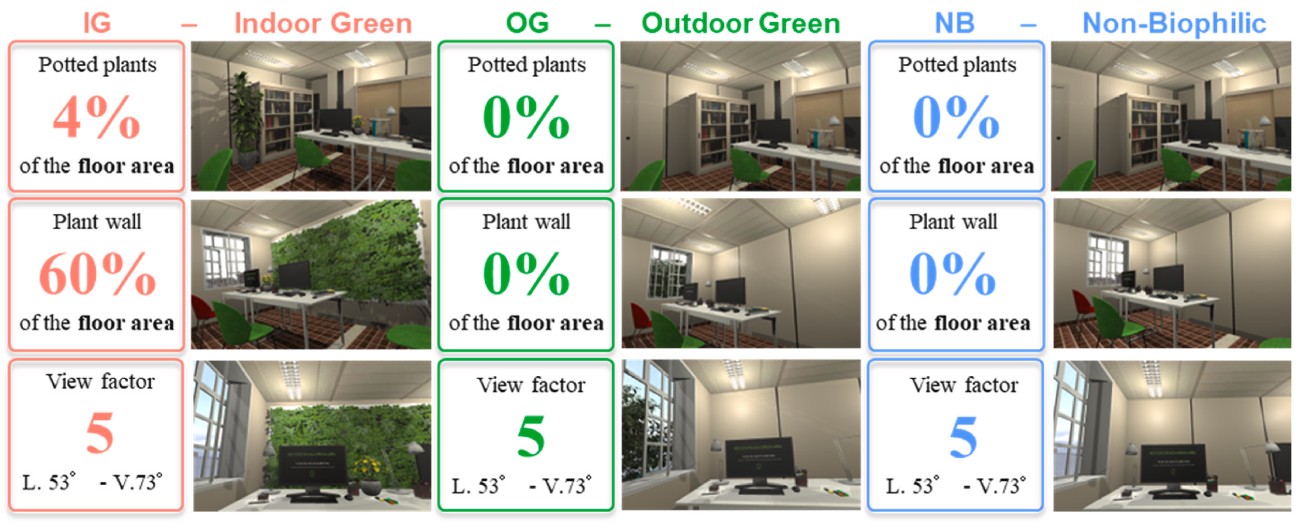
النوافذ). بشكل محدد، في حالة الأخضر الداخلي (IG) تم إضافة جدار نباتي ونباتات في أصص داخل غرفة المكتب، والتي تُستخدم بشكل متكرر في ممارسات التصميم البيوفيلي الداخلي؛ تمثل حالة الأخضر الخارجي (OG) المنظر الطبيعي للأشجار من النوافذ. من وجهة نظر كمية، تم إضافة المساحات الخضراء بما يتجاوز الحد الأدنى المطلوب من معيار WELL [74] لدعم رفاهية الشاغلين والمساحات الاستعادة من خلال توفير اتصال بالطبيعة. وبالتالي، غطى جدار النباتات مساحة جدار تعادل من مساحة الأرضية (أكبر من بينما تغطي النباتات المزروعة في الأص pots من مساحة الأرضية (حد أدنى 1 من مساحة الأرضية). لضمان حصول المشاركين على أفضل المناظر للخضرة الخارجية، تم اختيار وضعية الجلوس داخل النموذج الافتراضي بطريقة تضمن أن يكون عامل الرؤية (التقييم الكلي للرؤية من المكتب) مساوياً لـ 5، مما يتوافق مع زاوية رؤية جانبية من وزاوية الرؤية العمودية لـ (عتبة 50-90 باستثناء دمج نمط البيوفيلية، كانت جميع سيناريوهات المكاتب الثلاثة متطابقة (انظر الشكل 1 والفيديو 1).
يمكن العثور على الفيديو التكميلية المتعلق بهذه المقالة على https:// doi.org/10.1016/j.buildenv.2024.111196
تم اعتماد محرك ألعاب Unity [76] (الإصدار 2018.4.14f1) لتجسيد النموذج ثلاثي الأبعاد. بالإضافة إلى ذلك، لقياس انتباه المشاركين البصري، تم دمجه مع iMotion [77] (الإصدار 9.3) لتسجيل تتبع عيون المشاركين. أخيرًا، تم تصور نموذج IVE من خلال نظارات HTC Corporation VIVE PRO Eye. دقة الصورة لكل عين، وكثافة بكسل تبلغ 615 بكسل في البوصة، وزاوية رؤية لكل عين، مسافة بين الحدقتين قابلة للتعديل من 60.7 إلى 73.5 مم) باستخدام مكون SteamVR [78].
ثانيًا، الصوت المكاني الدقيق يعزز الإحساس بالوجود في البيئات الافتراضية من خلال تقديم إشارات واقعية حول اتجاه وأبعاد الأصوات، مما يعزز المصداقية العامة للتجربة.
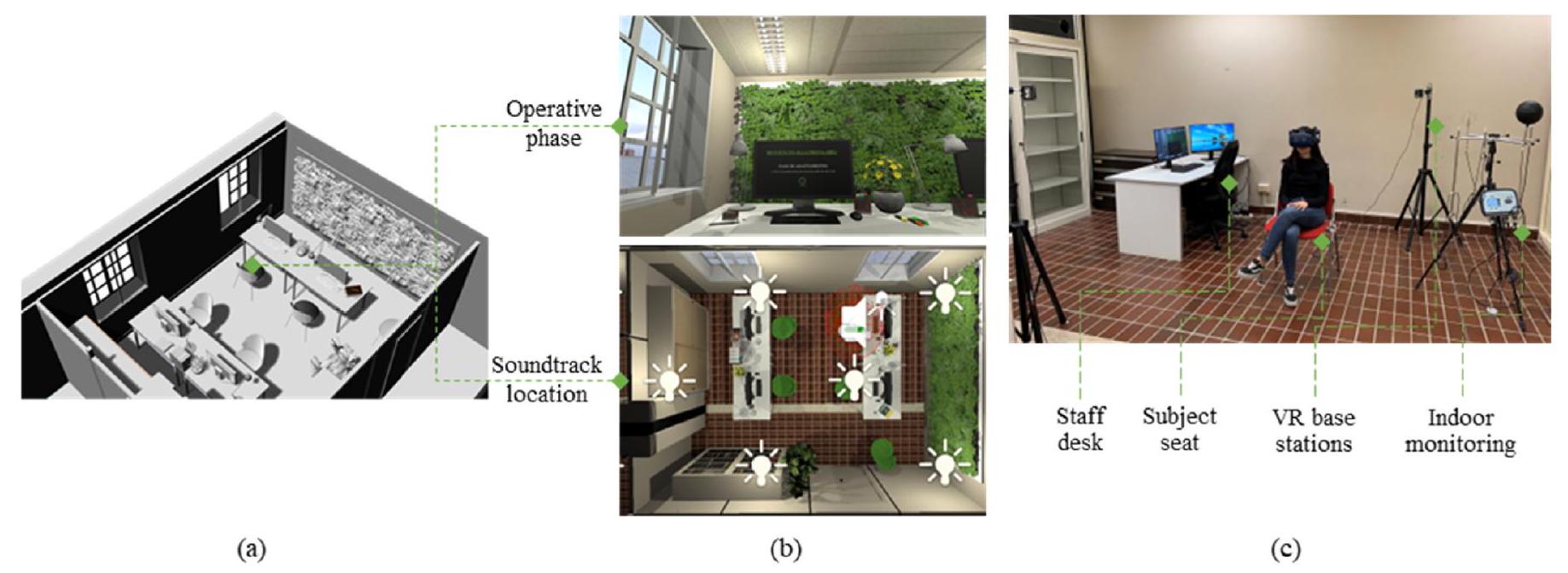
وبالتالي، تم توفير تجربة الصوت المحيطي الغامرة للمشاركين من خلال نظام الصوت في Unity الذي يسمح بتقديم صوت ثنائي الأبعاد مع تتبع حركة الرأس للبيئة الصوتية عبر حزمة Oculus Spatializer (التوافق الزمني المكاني بين مقطع الصوت وحركة المشارك). تم تنفيذ المقاطع الصوتية داخل البيئة الافتراضية في موقع التحكم الأول للاعب (الشكل 2)، بما يتماشى مع الموقع الذي تم منه القياس والتسجيل في غرفة المكتب الحقيقية حيث تمت التسجيلات (انظر القسم 2.2)، بحيث بدت أصوات المرور والأصوات الطبيعية وكأنها تأتي فعليًا من النافذة المفتوحة (كما أكد المشاركون فعليًا، انظر القسم 3.1).
أخيرًا، تم تمييز النموذج بنظام تتبع حركة مناسب لمزامنة منظور المشاركين الافتراضي مع الأفعال الفيزيائية (مثل حركة تتبع الرأس في التحكم باللاعب الأول)، مما يزيد من شعور الواقعية البصرية والصوتية مع تقليل فرصة الإصابة بدوار الحركة.

2.4. تصميم الاستطلاع

تكون الاستطلاع من قسمين. القسم الأول جمع معلومات عن الخصائص الديموغرافية للمشاركين (الجنس، العمر، مشاكل الرؤية والسمع، مستوى التعليم) والعادات اليومية المتعلقة بالتجربة السابقة مع الواقع الافتراضي واستخدام ألعاب الفيديو. بالإضافة إلى ذلك، طُلب من المشاركين تحديد خصائص بيئة عملهم والعناصر الأكثر رغبة في المكتب، من حيث الوصول إلى الضوء الطبيعي والتهوية، ووجود نباتات داخلية خضراء، وإطلالات على المناظر الطبيعية أو الحضرية. كما تم التحقيق في مستوى الرضا عن التصميم البصري والخصائص الصوتية لأماكن العمل/الدراسة الخاصة بهم.
تضمنت القسم الثاني أربعة جوانب: الإحساس بالوجود والانغماس، اضطرابات مرض السيبرسickness وتقييم المشهد الصوتي.
للحصول على فهم شامل لمستوى الواقعية والانغماس الذي تم تحقيقه في تجارب الواقع الافتراضي الحالية، تم التحقيق في تجارب المستخدمين الذاتية. فيما يتعلق بالأول، تم النظر في طرق تقييم موثوقة ومثبتة وفقًا لأحدث الأدبيات حول تطبيقات الواقع الافتراضي في أبحاث الأبعاد البشرية في المباني. من الاستبيانات المعروفة في هذا المجال هي استبيانات سلاتر-أوسوه-ستيد (المستخدمة في المراجع).

الشكل 1. مستويات العوامل البصرية: السيناريوهات الداخلية الخضراء، الخارجية الخضراء وغير البيوفيلية مع النسب الخضراء المتعلقة بمساحة أرضية الغرفة الافتراضية وعامل الرؤية من موقع المشاركين خلال الاختبار. (للتفسير حول الإشارات إلى اللون في أسطورة هذا الشكل، يُحيل القارئ إلى النسخة الإلكترونية من هذه المقالة.)
الشكل 2. (أ) نموذج ثلاثي الأبعاد، (ب) الوضع التشغيلي (تحكم اللاعب الأول في النموذج المعروض افتراضيًا) وموقع الصوت داخل بيئة Unity، (ج) إعداد غرفة الاختبار.
[3-7])، استبيانات وجود المجموعة (IPQ) (المستخدمة في المراجع [6،8-11]) واستبيان مرض الواقع الافتراضي، VRSQ (المستخدم في المراجع [5،10، 15-17]) [2]. تم تقييم الإحساس البصري للوجود والانغماس لدى المشاركين داخل البيئة الافتراضية بواسطة أربعة مؤشرات [50]: الرضا الرسومي (GS)، الوجود المكاني (SP)، الانخراط (INV)، والواقعية المتجربة (REAL)، على مقياس ليكرت من سبع نقاط يتراوح من «موافق بشدة» إلى «غير موافق بشدة». أخيرًا، تم قياس اضطرابات مرض السيبرانية باستخدام استبيان مرض الواقع الافتراضي (VRSQ) [16] فيما يتعلق بستة اضطرابات: عدم الراحة العامة، التعب، إجهاد العين، صعوبة التركيز، الصداع، والدوار، التي تم تقييمها على مقياس من خمس نقاط يتراوح من «ليس على الإطلاق» إلى «كثيرًا».
تم الإبلاغ عن الأسئلة التسعة ومقاييس التقييم المتعلقة بتقييم ما بعد التجربة للبيئة الافتراضية في الجدول 2.
بالإضافة إلى ذلك، طُلب من المشاركين وصف بيئة المكتب الداخلية التي كانوا يختبرونها شفهياً مع الأخذ في الاعتبار المجال البصري والمجال الصوتي من خلال السؤال المفتوح “أنت حر في تجربة النموذج الافتراضي، يرجى وصف البيئة بصرياً وصوتياً”.
في غياب نموذج تقييم المشهد الصوتي الداخلي للمكتب
تم قياس الجودة العاطفية المدركة للصوتيات من قبل المشاركين من خلال ثمانية سمات إدراكية تم تقييمها على مقياس ليكرت من خمسة مستويات (من «موافق بشدة» إلى «غير موافق بشدة»)، وفقًا للنموذج الذي قدمه أكسلسون وآخرون [42] والمواصفة الفنية ISO/TS 12913-2 [80] للبيئات الحضرية (الخارجية): ممتعة، مثيرة، مليئة بالأحداث، فوضوية، غير ممتعة، رتيبة، خالية من الأحداث، وهادئة.

2.5. مقياس كفاءة العمل

كما اقترح المؤلفون سابقًا [50]، تم تقييم كفاءة العمل في هذه الدراسة من خلال ثلاث وظائف معرفية: «المنع» من خلال اختبار ستروب [81]، و«الذاكرة العاملة» من خلال اختبار OSPAN [82]، و«تبديل المهام» من خلال اختبار Magnitude-parity [83].
تم تطوير اختبار ستروب بواسطة ج. ر. ستروب لقياس القدرة على التحكم في الانتباه وتجاوز العادات والدوافع. طُلب من المشاركين تسمية لون 32 كلمة ملونة مكتوبة بحبر أحمر وأخضر وأزرق ووردي وبرتقالي على خلفية سوداء بأسرع ما يمكن، مع تجاهل نص الكلمة بينما كان المؤلفون يجمعون الـ
الجدول 2
سؤال ومقياس تقييم حول الإحساس بالوجود والانغماس واستبيان مرض السيبرانية.
عامل سؤال مقياس التقييم
الرضا الرسومي (GP) أقدر الرسوم البيانية والصور للنموذج الافتراضي أختلف تمامًا / أوافق تمامًا
الوجود المكاني (SP) أختلف تمامًا / أوافق تمامًا
كنت أرى مساحة المكتب كمكان أزوره بدلاً من صورة رأيتها.
خلال التجربة، شعرت بأنني موجود في مساحة المكتب
المشاركة (INV) خلال التجربة، لم أكن مدركًا للعالم الحقيقي من حولي أختلف تمامًا / أوافق تمامًا
الواقعية المتمرسة (REAL) لقد أدركت الأشياء داخل المكتب الافتراضي على أنها صحيحة من حيث النسب (أي، كانت بحجم ومسافة تقريبية صحيحة بالنسبة لي وبالنسبة للأشياء الأخرى). أختلف تمامًا / أوافق تمامًا
كان لدي شعور بالقدرة على التفاعل مع مساحة المكتب (مثل التقاط الأشياء)
دوار الفضاء الإلكتروني
هل عانيت؟
انزعاج عام – تعب – عين
إجهاد – صعوبة في التركيز – صداع – دوار
ليس على الإطلاق/الكثير
سرعة المعالجة (على سبيل المثال، “أحمر” في حالة كلمة “أخضر” المطبوعة بحبر أحمر). تم تقديم الاختبار كصورة على شاشة الكمبيوتر الافتراضية.
اعتمد المؤلفون اختبار OSPAN لتقييم قدرة الذاكرة العاملة. يتكون من سلسلة من الشرائح: في الأولى، تم عرض عملية رياضية بسيطة (3 ثوانٍ) وكان على المشاركين حلها في ذهنهم؛ في الثانية (3 ثوانٍ) تم عرض حل محتمل للمعادلة ودُعي المشاركون لإخبار الباحثين ما إذا كان صحيحًا أم خاطئًا؛ في الأخيرة، تم عرض حرف يجب حفظه لمدة 800 مللي ثانية. تم عرض خمس سلاسل تتكون من معادلة رياضية – حل صحيح/خاطئ – حرف يجب حفظه، وفي النهاية، تم توجيه المشاركين لاسترجاع ترتيب جميع الحروف الخمسة المعروضة بشكل صحيح.
أخيرًا، يهدف اختبار الحجم-الزوجية إلى تقييم القدرة على التبديل بمرونة من نشاط إلى آخر والحفاظ على الانتباه. يتكون من سلسلة من الشرائح ذات الخلفية البيضاء (200 مللي ثانية لكل منها) حيث تم عرض أرقام مكتوبة بالحبر الأسود من “1” إلى “9” باستثناء “5”، مسبوقة بنقاط حمراء أو زرقاء. بعد النقطة الحمراء (محفز الزوجية)، أعرب المشاركون عما إذا كان الرقم المعروض فرديًا أو زوجيًا وما إذا كان أصغر أو أكبر من “5” بعد النقطة الزرقاء (محفز الحجم). كان هناك إجمالي ثمانية محفزات للزوجية والحجم، وبالتالي طُلب من المشاركين ترتيب 16 رقمًا.
تم عرض كل من اختبار OSPAN واختبار Magnitude-Parity كفيديوهات مؤقتة على الشاشة الافتراضية.
تم الإبلاغ عن المقاييس العامة لتقييم كفاءة العمل في الجدول 3.
الجدول 3
وصف مقاييس اختبارات الوظائف المعرفية.
اختبار الوظائف المعرفية مقاييس الأداء مدة الاختبار
مقدار التماثل عدد الأخطاء في تصنيف الأرقام إلى زوجية/ فردية وأكبر/ أقل من “5” 63 ثانية
أوسبان
عدد الأخطاء في سلسلة صحيح/خطأ
عدد الأخطاء في الحروف المحفوظة
69 ثانية
درجة OSPAN (مجموع عدد الإجابات الصحيحة/الخاطئة وعدد الحروف المبلغ عنها بشكل صحيح) عدد الأخطاء في اللون المسترجع وسرعة المعالجة
ستروب تعتمد على سرعة معالجة الموضوعات

2.6. الإجراء التجريبي

تم تجنيد كل مشارك لاختبار لمدة يوم واحد وتم تعيينه عشوائيًا لتجربة مستويات العوامل الخضراء الداخلية، أو الخضراء الخارجية، أو العوامل غير البيوفيلية V (متغيرات مستقلة بين المشاركين).
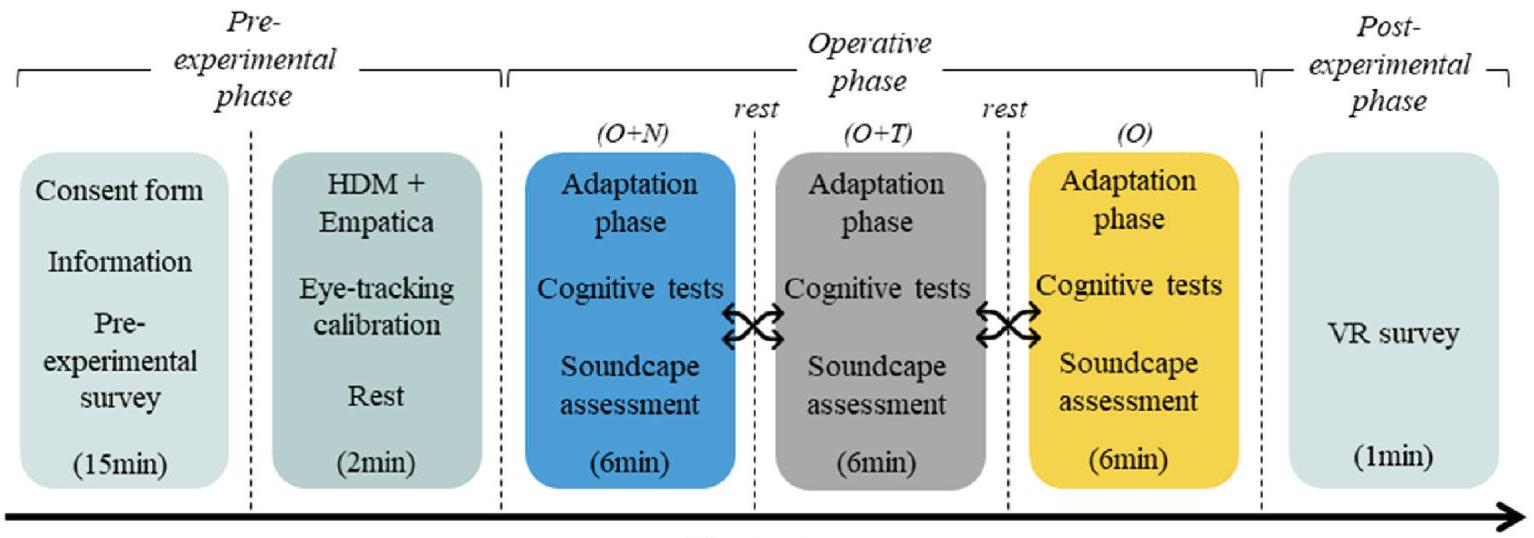
بعد وصولهم، شهد المشاركون مرحلة ما قبل التجربة (15 دقيقة) للسماح بالتكيف مع الظروف المناخية البيئية (حوالي بعد تعديل مستويات ملابسهم ليشعروا بالراحة، قرأوا ووقعوا على نموذج الموافقة، وتلقوا معلومات حول إجراء الاختبار، وأكملوا الاستبيان قبل التجربة. تعتبر هذه الفترة كافية للسماح للمشاركين بالتكيف مع الظروف البيئية وتقليل أي تقلبات مرتبطة بالنشاط البدني قبل الاختبار الذي استمر 30 دقيقة والذي قد يؤثر على معدل الأيض لديهم.
ثم، تم دعوتهم لارتداء سوار إمباتيكا وعرض الرأس، وضبط تتبع العين بشكل صحيح، واستراحوا مع إغلاق أعينهم لمدة 30 ثانية. طلب الباحثون من المتطوعين التكيف مع المشهد الافتراضي لمدة 3 دقائق لتقليل التقلبات الجسدية والنفسية المرتبطة بالتعرض للبيئة الافتراضية، ولتحسين الانغماس داخل السيناريو من وجهة نظر بصرية وصوتية. خلال مرحلة التكيف، طُلب من المشاركين وصف بيئة المكتب الداخلية التي كانوا يختبرونها شفهياً، مع الأخذ في الاعتبار كلا من المجالات البصرية والصوتية.
خلال المرحلة التشغيلية، قام المشاركون بأداء اختبارات معرفية وتقييم المشهد الصوتي. تم تكرار هذه الإجراءات ثلاث مرات، واحدة لكل مستوى من مستويات العامل A. لتقليل خطر إجراء دراسات طويلة الأمد قد تؤدي إلى مستويات اضطراب أعلى، تم تقسيم هذه التجربة إلى جلسات اختبار أقصر (واحدة لكل مستوى من مستويات العامل A) مع توفير استراحة بينها. في الواقع، شمل الجدول الزمني التجريبي 30 ثانية من الراحة مع إغلاق العينين بين كل حالة صوتية، مما سمح للباحث بعدم إزالة شاشة العرض المثبتة على الرأس حتى لا يؤثر ذلك على انغماس المشاركين.
تم عشوائية ترتيب عرض السيناريوهات الصوتية والاختبارات المعرفية لكل مشارك لتقليل تأثير التعلم والعوامل الزمنية. أخيرًا، أجاب المشاركون على أسئلة حول إحساس الحضور والانغماس واضطرابات مرض السيبرس. تم تقديم الإجابات على الاختبارات المعرفية والاستبيانات شفهياً وتسجيلها من قبل الباحثين.
تم تقديم الإجراء التجريبي العام في الشكل 3. كانت مدة الاختبار الإجمالية حوالي 35 دقيقة، كما أوصت الأدبيات لتجنب حدوث أي اضطرابات قد تؤدي إلى إبطال الاختبار بسبب عدم راحة المشاركين [85-87].

2.7. المشاركون

تم استخدام الكلام الشفهي والنشرات لجذب المشاركين. شارك 198 بالغًا صحيًا في الدراسة من يناير إلى مارس 2023، وتم تقسيمهم عشوائيًا إلى ثلاث مجموعات تتكون كل منها من ستة وستين مشاركًا. تم تحديد حجم العينة من خلال تحليل قوة ANOVA المسبق باستخدام برنامج G*Power [88] مع الأخذ في الاعتبار ليس فقط التأثيرات الرئيسية ولكن أيضًا التفاعلات، مع حجم تأثير . كان حجم العينة كافيًا لاكتشاف تأثيرات كبيرة بقوة إحصائية تساوي لتأثير التفاعل (العامل A * العامل V) و للتأثير الرئيسي للعامل A والعامل V.
نظرة عامة على خصائص المشاركين الـ 198 والميزات ضمن الشروط الثلاثة (IG، OG، NB) مقدمة في الجدول 4. بشكل عام، كان لدى المشاركين متوسط عمر سنوات، موزعة على النحو التالي: بين 20 و 25 عامًا ) ، بين 26 و بين 31 و . كان يتكون أساسًا من طلاب الجامعات ( ) ، تخرجت، وفقط كان لديه مستوى تعليمي أعلى (دكتوراه، دراسات عُليا).
لم يعاني أي من المشاركين من مشاكل في السمع أو عمى الألوان أو الحَوَل. من العينة كانت تعاني من مشاكل بصرية شائعة، مثل الاستجماتيزم، وقصر النظر، وطول النظر، لكن جميعهم كانوا يرتدون
حوالي 35 دقيقة
الشكل 3. الإجراء التجريبي.
الجدول 4
خصائص المشاركين في الدراسة ( بشكل عام وعبر السيناريوهات البصرية الثلاثة التجريبية.
بشكل عام إنستغرام أو جي ملاحظة
جنس
أنثى ٣٦ ٪ ٤٤ ٪ ٣٥ ٪ ٢٩ ٪
ذكر 64 % 57 % 65 % 71 %
عمر
٢٠-٢٥ 79 % 68 % 79 % 92 %
٢٦-٣٠ 17 % 25 % 17 % ٨ ٪
31-39 ٤ % ٨ ٪ 3 %
٤٠-٤٥ ٢ ٪
50-60
المستوى التعليمي
غير متخرج ٣٤ ٪ ٤٣ ٪ ٣٥ ٪ ٢٦ ٪
تخرج 60 % ٤٩ ٪ ٥٩ ٪ 74 %
دكتوراه، مدرسة دراسات عليا ٥ ٪ ٨ ٪ 6 %
مشاكل الرؤية
لا شيء ٤٤ ٪ ٤٤ ٪ 52 % ٣٨ ٪
قصر النظر ٣٣ ٪ ٢٩ ٪ ٢٦ ٪ ٤٤ ٪
قصر النظر + الاستجماتيزم 15 % 17 % ١٨ ٪ 9 %
استجماتيزم ٧ ٪ 9 % ٥ ٪ ٨ ٪
مد البصر 1 % ٢ ٪
خبرة سابقة مع الواقع الافتراضي
أبداً 54 % 53 % ٥٥ ٪ 53 %
مرة واحدة ٢٦ ٪ 25 % 27 % 27 %
أكثر من مرة 20 % 22 % ١٨ ٪ 20 %
استخدام ألعاب الفيديو
أبداً ٣٢ ٪ 42 % ٣٣ ٪ 20 %
نادراً 42 % ٤٩ % ٣٩ ٪ ٣٦ ٪
بشكل متكرر 19 % ٨ ٪ 20 % 30 %
كل يوم ٧ ٪ 1 % ٨ ٪ 14 %
عدسات تصحيحية خلال الاختبارات، وذلك لعدم إبطال تنفيذ الاختبار ورؤية النموذج. بالإضافة إلى ذلك، من المشاركين لم يكن لديهم أي تجربة سابقة مع تقنية الواقع الافتراضي و يلعبون ألعاب الفيديو بشكل متكرر.
وفقًا للجزء الثاني من الاستطلاع ما قبل التجريبي، فقط 26 كان المشاركون راضين عن التصميم البصري والخصائص الصوتية لأماكن عملهم/دراستهم. بشكل عام، أفادوا بأن لديهم وصولاً إلى الضوء الطبيعي والتهوية الطبيعية. كانت النباتات الخضراء الداخلية وإطلالات المناظر الطبيعية الخارجية من أكثر عناصر مكان العمل المرغوبة (53%). أكثر من نصف أماكن عملهم ودراستهم لم تحتوي على أي نباتات على الإطلاق. ) و أفادوا بأنهم يستمتعون بشكل رئيسي بالمناظر الحضرية، مما يؤدي إلى أصوات بشرية ذات صلة (40 ، مثل حركة المرور) وأقل الطبيعية ( ، على سبيل المثال، الأوراق، الطيور). بالإضافة إلى ذلك، بيئات العمل المشتركة التي يتمتع بها الموضوع. كانت بيئة العمل الأكثر هدوءًا من الضوضاء الداخلية والخارجية هي العنصرين الثاني والثالث الأكثر رغبة (50٪، ).
في الشكل 4، تم الإبلاغ عن الميزات المرغوبة، مرتبة حسب الأهمية، التي
الشكل 4. خصائص بيئات عمل المشاركين والعناصر الأكثر طلبًا.
المواضيع التي يرغب الأفراد في إدخالها إلى بيئة عملهم أو دراستهم لتحسينها.

2.8. التحليل الإحصائي

استخدمت النشاط التجريبي عاملين مستقلين مع ثلاثة مستويات لكل منهما: العامل المستويات) كعامل ضمن الموضوع، مع قياس متكرر لكل موضوع، وعامل V (مستويات NB، IG، OG) كعامل بين الموضوعات. على وجه التحديد، بحث المؤلفون في تأثير السيناريوهات البصرية والصوتية على استجابات المشاركين. علاوة على ذلك، تم فحص التفاعل المحتمل بين العوامل البصرية والصوتية.
تم تحليل البيانات من خلال نماذج التأثيرات المختلطة الخطية المعممة (GLMM) باستخدام البرنامج الإحصائي R [89] وحزم R glme4، مع اعتبار GLMM منفصل لكل متغير تابع.
على وجه الخصوص، تم استخدام التخطيط البصري والسيناريوهات الصوتية كآثار ثابتة. تم اعتبار المشاركين كعامل عشوائي، حيث لم يتم التحكم فيهم ولكن تم اختيارهم عشوائيًا من مجموعة أكبر. كلما لم يحقق مصطلح الترتيب الذي تم تعيين المشاركين فيه عشوائيًا إلى حالة صوتية وجنس تأثيرات ذات دلالة، تم استبعاده من النموذج النهائي.
تم حساب الدلالة الإحصائية لتأثير كل مصطلح باستخدام تحليل التباين (ANOVA، النوع الثاني، وولد الاختبارات) باستخدام دالة Anova في حزمة R car مع اعتبار مستوى من الدلالة.
في حالة وجود تأثير دال للعوامل الرئيسية أو التفاعلات، تم إجراء مقارنات زوجية بعدية للمتوسطات الهامشية المقدرة
للبحث في الفرق بين المجموعات باستخدام حزمة R emmeans وتطبيق تصحيح بونفيروني لأخذ المقارنات المتعددة المخطط لها في الاعتبار. كما تم طباعة مخططات التفاعل لتفسير أي تأثيرات تفاعلية محتملة بين العامل V والعامل A.
تم استخدام معيار أكايكي للمعلومات (AIC) لمقارنة جودة النماذج المفترضة. بالإضافة إلى ذلك، لمقارنة دقة النماذج المختبرة وتمثيل نسبة التباين الكلي المفسر بواسطة الآثار الثابتة ومن قبل كل من الآثار الثابتة والعشوائية، تم توليد معاملات التحديد الهامشية ( ) والمعاملات الشرطية ( ) لكل نموذج.
تم تضمين مواصفات النموذج النهائي والتفاصيل الإضافية (أي، AIC، ) في الملحق.

3. النتائج

تقدم القسم 3.1 نتائج الصلاحية البيئية لـ IVE بينما يوفر القسم 3.2 تحليلًا مقارنًا للفوائد بين الروابط البصرية وغير البصرية مع الطبيعة استجابةً للسؤال البحثي 2. سمح الأخير بمعالجة صلاحية المعيار للبيئة الافتراضية التي تحدد ما إذا كانت الاستجابات السلوكية (مثل الأداء، والراحة) تعكس بشكل واقعي تأثير المحفزات المقدمة في البيئة الافتراضية.
لم يتم تقديم نتائج المعلمات الفسيولوجية وتقييم المشهد الصوتي في هذه الورقة.

3.1. RQ1. هل VR أداة واعدة للتحقيق في تدخلات بحث التصميم البيوفيلي من حيث إحساس عالٍ بالوجود والانغماس وانخفاض مرض الفضاء الإلكتروني؟

قبل التحليل التجريبي للبيانات المجمعة، يحتاج الباحثون إلى تحديد الصلاحية البيئية للنموذج الافتراضي الذي يشير إلى قدرة IVE على تمثيل الإعدادات الحقيقية بشكل كافٍ [50]. هناك خطوتان أساسيتان: توفير مستوى عالٍ من الانغماس خلال الاختبار من خلال الإجراء التجريبي وتطوير النموذج الافتراضي (انظر الأقسام 2.3 و2.6)، وبعد ذلك، تحليل التقارير الذاتية، كما يلي.
تم تحليل البيانات حول إحساس الوجود والانغماس، وتقييمات مرض الفضاء الإلكتروني، والتوافق الحسي لتقييم الصلاحية البيئية للنموذج. كما فعل المؤلفون سابقًا [50] في دراسات أخرى، تم مقارنة القيم المتوسطة لكل مؤشر من مؤشرات الإحساس البصري بالوجود والانغماس مع دراسات أدبية أخرى اعتمدت نفس الاستبيان، مع ضمان أن هذه القيم أعلى من القيمة المعادلة للمستوى المعتدل-العالي (أي، 4) على مقياس ليكرت من خمسة نقاط يتراوح من 1 إلى 5. الدراسات الأدبية المرجعية للمقارنة هي لاتيني وآخرون [52،90]، طاويل وآخرون [91]، يوم وآخرون [92]، هونغ وآخرون [93]، تشاميلاتوري وآخرون [94]، عبد الحميد وآخرون [95]، الذين أجروا دراسات قائمة على VR في الإعدادات الداخلية معتمدين نفس طرق التقييم. كما هو موضح في الجدول 5، تتجاوز الدرجات المتوسطة مستوى معتدل (أي 4) لجميع المؤشرات الأربعة (REAL 4.45؛ ). بالإضافة إلى ذلك، جميع القيم المتوسطة أعلى من المراجع ومتقاربة تقريبًا مع المراجع [52،90]، فيما يتعلق بـ GS وINV وREAL و[92] فيما يتعلق بـ INV. ومع ذلك، فإن الفروق بين المؤشرات المذكورة والدراسة المرجعية ليست ذات دلالة (بين 0.02 و0.18).
وفقًا لنتائج VRSQ، لم يبلغ أي موضوع خلال الدراسة التجريبية عن «دوار» (100 % من الدرجات المعطاة لـ «ليس على الإطلاق»). كانت الأعراض الأخرى، مثل «الصداع»، و«التعب»، و«الانزعاج العام»
غير ملحوظة حيث أن بين و من المشاركين أعطوا درجة «ليس على الإطلاق» و«قليلاً». ومع ذلك، تم الإبلاغ عن «إجهاد العين» الطفيف و«صعوبة في التركيز»، بنسبة 77 % و63 % على التوالي. وفقًا للمرجع [52]، تتماشى هذه النتائج مع تحليل أعراض المرض من الدراسات السابقة.
أخيرًا، قام المؤلفون بتقييم نوعيًا التوافق الحسي للبيئة الصوتية مع الوصف اللفظي المقدم من المشاركين خلال مرحلة التكيف. على وجه الخصوص، تم تحليل الإجابات المفتوحة مع مراعاة بعض الكلمات الرئيسية لكل سيناريو صوتي، كما يلي:
  • المكتب: من المشاركين أفادوا بأنهم سمعوا بعض الضوضاء النموذجية في مكان العمل مثل، «لوحة المفاتيح»، و«الكمبيوتر المحمول»، و«الفأرة»، و«نشاط الكتابة» (69 %)، و«تنبيه الهاتف» (13 %)، بينما وصفوا البيئة الداخلية بأنها تتميز بضوضاء «مكتب» عامة. بالإضافة إلى ذلك، تم تحديد الأصوات الناتجة عن «الأشخاص» مثل «الكلام» غير المفهوم ( ) و«الخطوات» ( ). بشكل عام، 82 من المشاركين وصفوا الأصوات بأنها تأتي من الجانب الداخلي للغرفة الافتراضية.
  • المكتب + الطبيعة: حددت العينة الكاملة (100 %) أصوات «الطبيعة» من «الطيور» القادمة من «النافذة» المفتوحة على الجانب الأيسر من المكتب. بالإضافة إلى ذلك، من المشاركين أفادوا بأنهم سمعوا أيضًا أصوات المكتب الداخلية.
  • المكتب + المرور: من المشاركين وصفوا البيئة الصوتية بأنها تشمل أصوات «المرور»، و«الطريق»، و«السيارات»، و«الحافلات»، وأصوات «الزمام» القادمة من «النافذة» المفتوحة على الجانب الأيسر من المكتب. في هذا السيناريو الصوتي، فقط من العينة وصفوا بوضوح وجود أصوات المكتب الداخلية، حيث بدت أصوات المرور أكثر هيمنة.
    3.2. RQ2. هل توفر الروابط البصرية والصوتية مع الطبيعة فوائد من حيث ذاكرة العمل للمقيمين، والقدرة على التثبيط، وأداء التبديل المعرفي في المهام؟

3.2.1. اختبار الحجم-التساوي

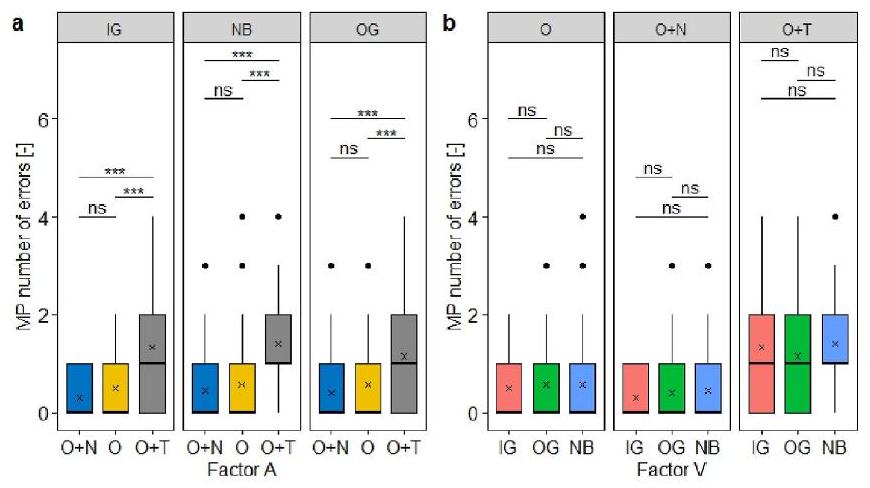
بالنظر إلى الأخطاء في تصنيف الأرقام زوجية/فردية وأكبر/أقل من “5” في اختبار الحجم – التساوي، كشفت النتائج (انظر الجدول 6) عن تأثير رئيسي دال للعامل الصوتي ( ). على وجه الخصوص، حدث عدد أكبر من الأخطاء في حالة صوت المرور ( ) مقارنةً بالطبيعة ( ) والمكتب ( ). أظهرت المقارنة الزوجية (الشكل 5ب) في جميع المستويات البصرية الثلاثة (IG، OG، NB) أن عدد الأخطاء كان أعلى بشكل دال تحت أصوات المرور مقارنةً بالطبيعة والمرور. من الجدير بالذكر أن أصوات المرور كان لها نفس التأثير الضار على عدد الأخطاء أثناء أداء نشاط التبديل في جميع السيناريوهات البصرية، (انظر المتوسطات والانحراف المعياري في الجدول 7).
تشير النتيجة إلى عدم وجود تأثير دال للعامل البصري، ولا تأثيرات تفاعلية مع العامل A.

3.2.2. اختبار ستروب

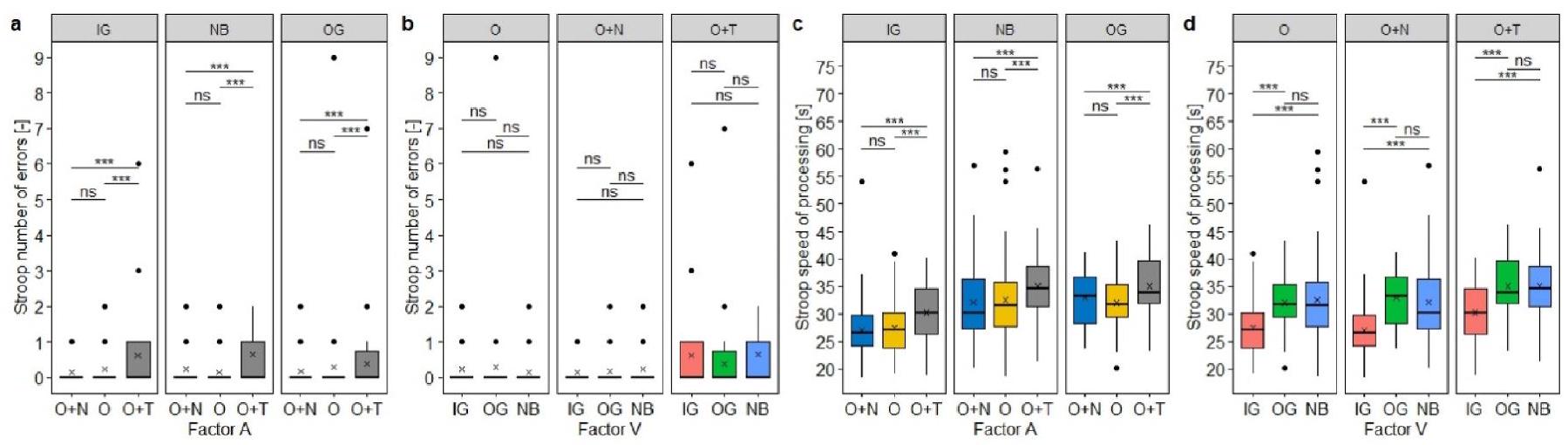
بالنظر إلى الدقة في تنفيذ اختبار ستروب، تم الكشف عن تأثير رئيسي دال للعامل الصوتي، ( ). أشارت النتائج إلى عدد أقل من الأخطاء في حالة الصوت الطبيعي وفي المكتب مقارنةً بحالة المرور ( ). يظهر الاختبار بعد المقارنة (الشكل 6أ) زيادة دالة في عدد الأخطاء مع أصوات المرور في كلا
الجدول 5
مقارنة الدرجات على مقياس من خمسة نقاط لأربعة مؤشرات (* تبرز المؤشرات الأعلى من الدراسة الحالية).
المؤشر هذه الدراسة [52] [90] [91] [92] [93] [94] [95]
GS 4.40 4.58* 4.64* 3.93 3.65
SP 4.29 4.21 4.18 3.44 4.24 3.39 3.68 3.74
INV 4.05 4.15* 4.29* 3.27 4.11* 3.23
REAL 4.45 4.47* 4.51* 2.68 ٣.٥٤ 2.73 3.75 3.21
الجدول 6
ملخص للتأثيرات الرئيسية والتفاعلية لنوع السيناريو البصري (المتغير المستقل 1) ونوع السيناريو الصوتي (المتغير المستقل 2) على معلمة الاختبارات المعرفية الثلاثة من اختبار GLMM Anova. تقدم الجدول إحصائية كاي المربعة، وقيم p، وقيم إيتا المربعة العامة. ) ونتائج المقارنة بعد الحدث. سيناريو بصري؛ سيناريو صوتي؛ تفاعل.
معامل الوظيفة الإدراكية عامل مستوى المتوسط (الانحراف المعياري) أنوفا، النوع “III” (GLMM) المقارنة الزوجية نتيجة المقارنة الثنائية
أخطاء أرقام النواب ف ملاحظة 0.81(0.97)
إنستغرام 0.71(0.79)
أو جي 0.70(0.87)
أ أو 0.55(0.85) 0.96
0.38(0.59)
1.30(1.19)
VxA
أخطاء رقم ستروب ف ملاحظة 0.34(0.60)
إنستغرام 0.33(0.61)
أو جي 0.28(0.87)
أ أو 0.22(0.69) 0.77
0.18(0.45)
0.55(0.94)
سرعة تنفيذ ستروب VxA
V ملاحظة ٣٣٫٢٤(٦٫٦٧) 0.81 ملاحظة – إنستغرام
إنستغرام ٢٨.٤٧(٦.١٩) إنستغرام – أوريجينال غانغستر
أو جي ٣٤.٢١(٦.٨٩) أو جي – إن بي ص
أ أو ٣١.٧١(٥.٩٣) 0.17 ص
31.02(6.39)
٣٣٫٩٩(٦٫٥٠)
VxA
أخطاء OSPAN صحيح/خطأ ف ملاحظة 0.41(0.61) 0.10 ملاحظة – إنستغرام
إنستغرام 0.28(0.52) إنستغرام – أوريجينال غانغستر
أو جي 0.33(0.52) أو جي – إن بي
أ أو 0.25(0.49) 0.90 ص
0.21(0.43)
0.56(0.72)
VxA
أخطاء OSPAN في الرسائل ف ملاحظة ٢.٦٢(١.٣٤) 0.36 ملاحظة – إنستغرام
إنستغرام 1.59(1.36) إنستغرام – أو جي
أو جي 2.22(1.57) أو جي – إن بي
أ أو 1.94(1.48) 0.54
1.62(1.50)
2.87(1.29)
VxA
درجة OSPAN ف ملاحظة 7.00(1.35) 0.25 ملاحظة – إنستغرام
إنستغرام 8.11(1.57) إنستغرام – أصلي بادج
أو جي 7.51(1.60) أو جي – إن بي
أ أو ٧.٧٩(١.٥٩) 0.57
8.19(1.57)
6.64(1.37) بادج
VxA
الشكل 5. مخطط الصندوق لعدد الأخطاء ضمن اختبار MP. البيانات مصنفة حسب العامل V والمقارنات الزوجية موضحة. داخل مخططات الصندوق، يمثل الصليب القيمة المتوسطة، والخط هو القيمة الوسيطة. ns.: غير دالة، *p .
شروط IG و OG مقارنة بشروط الطبيعة والمكتب ).
لم تكن هناك تأثيرات رئيسية لعامل الرؤية مع ميل للمشاركين الذين سجلوا أخطاء أقل مع الطريقة الطبيعية
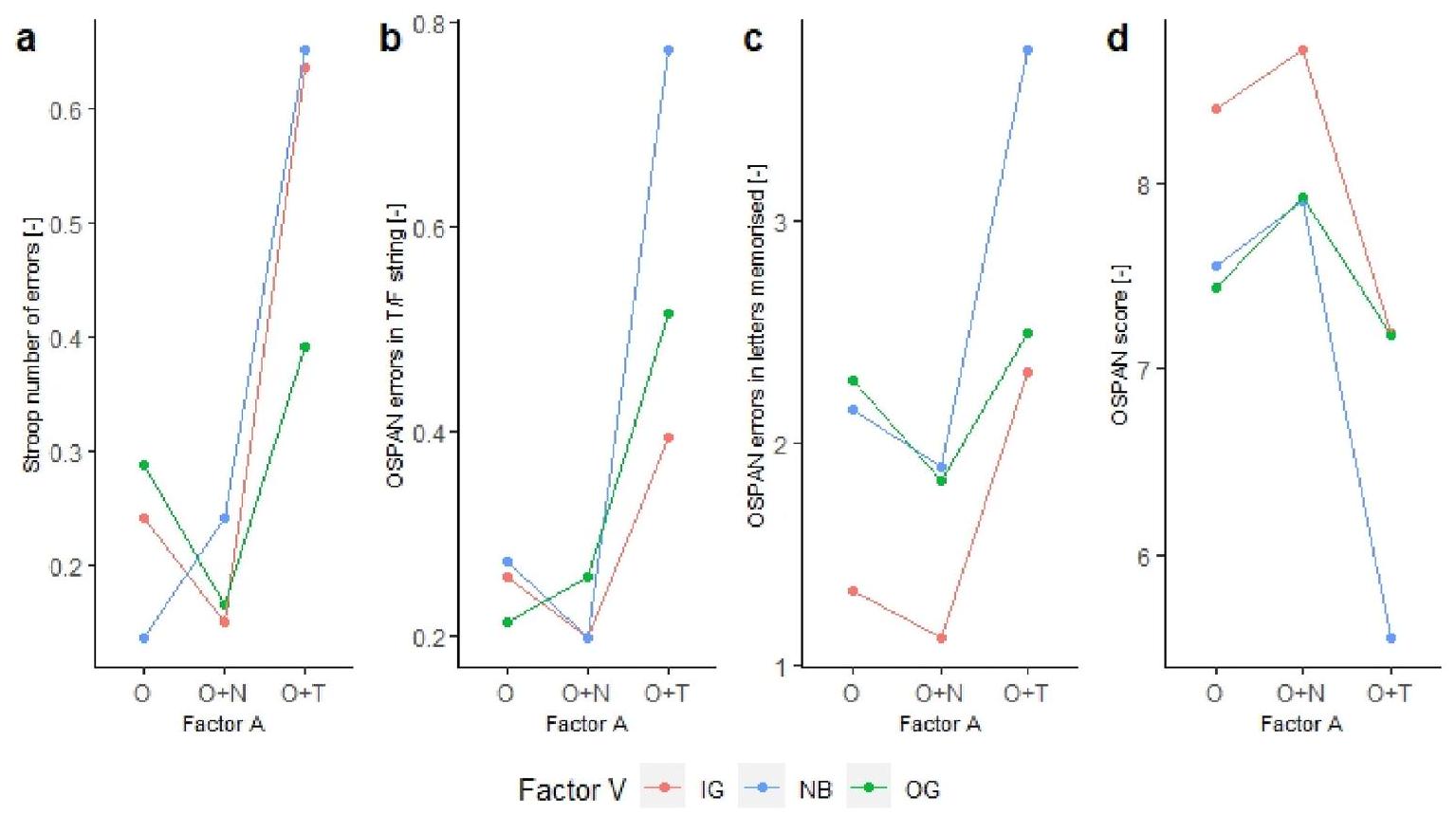
الأصوات في حالة IG ( ) بالمقارنة مع OG ( 0.17 و ملاحظة ( ) (انظر الجدول 7). ومع ذلك، كان تأثير التفاعل ذا دلالة إحصائية ( تشير المخطط في الشكل 8a إلى أن البيئة الداخلية الخضراء أدت إلى دقة جيدة في اختبار ستروب عندما تعرض المشاركون لأصوات الطبيعة، ولكن دقة أقل بكثير عند التعرض لأصوات المرور.
فيما يتعلق بسرعة المعالجة، كشفت التحليلات عن تأثير رئيسي كبير لعامل الصوت. ).
بالفعل، كانت سرعة المعالجة أقل بكثير مع الأصوات الطبيعية. ) من حركة المرور ( ) وليس مختلفًا بشكل كبير عن أصوات المكتب ( ) في جميع ظروف IG و OG و NB (انظر الشكل 6 ج و د والجدول 6).
كما هو موضح في الشكل 6d، كان هناك أيضًا تأثير كبير لعامل الرؤية تم الكشف عن سرعة معالجة أقل في Indoor Green أكثر من في المساحات الخضراء الخارجية ) وغير بيولوجي ( ) شروط لكل سيناريوهات الصوت.
عند مقارنة القيم المتوسطة (انظر الجدول 7)، أكمل المشاركون الاختبار بشكل أسرع عند تعرضهم للأصوات الطبيعية في حالة IG (26.98 ثانية) ).

3.2.3. اختبار OSPAN

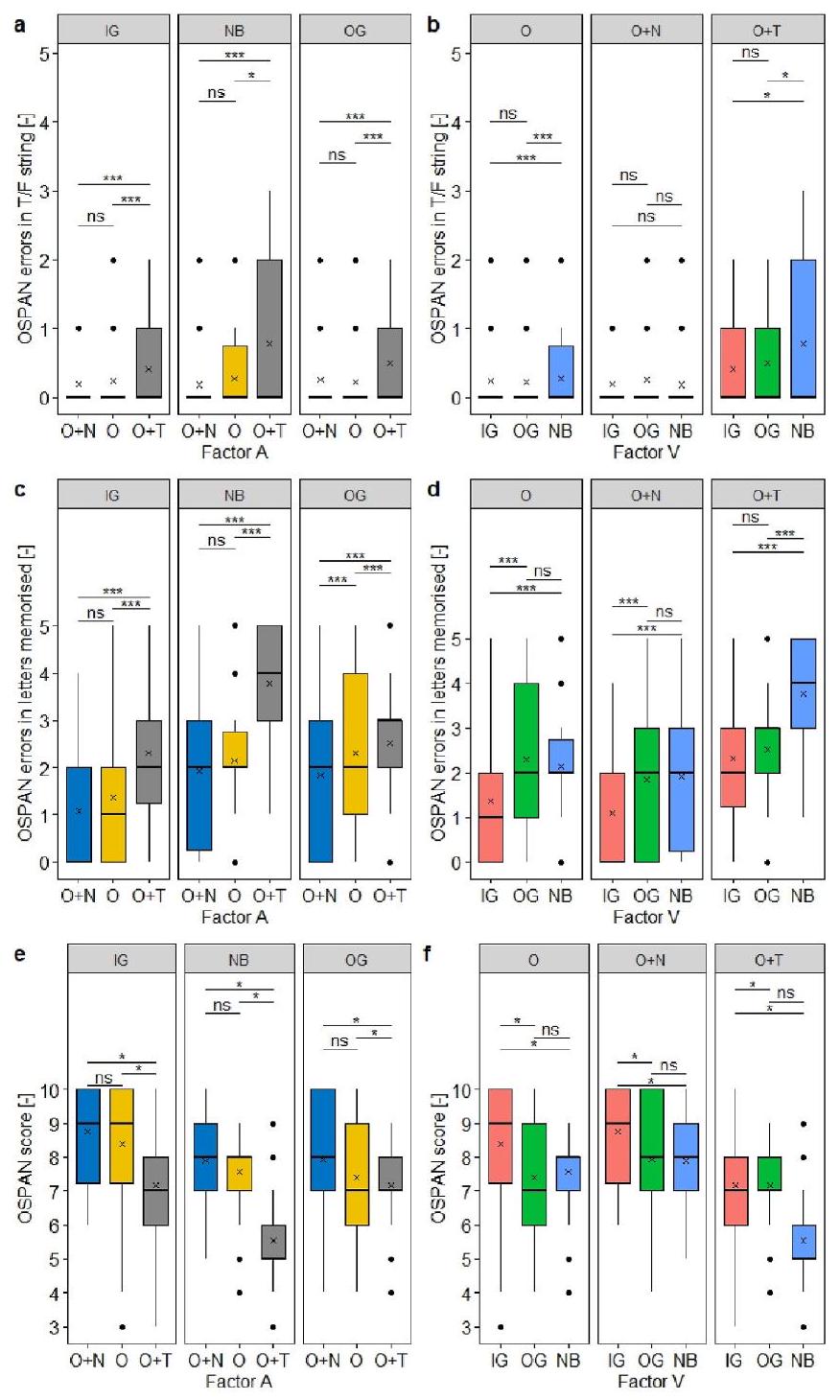
فيما يتعلق باختبار OSPAN، كان هناك تأثير كبير لعامل البصر ( تم العثور على الأخطاء في الأسئلة الصحيحة والخاطئة
الجدول 7
متوسط البيانات والانحراف المعياري للمهام المعرفية عبر سيناريوهات العامل V والعامل A.
العامل الخامس العامل أ اختبار MP اختبار ستروب اختبار OSPAN
عدد الأخطاء عدد الأخطاء في استرجاع الألوان سرعة التنفيذ عدد الأخطاء في T/F عدد الأخطاء في الرسائل المسترجعة درجة OSPAN
[-] [-] [s] [-] [-] [-]
إنستغرام
إنستغرام أو
إنستغرام
أو جي
أو جي أو
أو جي
ملاحظة
ملاحظة أو
ملاحظة
الشكل 6. مخطط الصندوق لعدد الأخطاء (أ، ب) وسرعة المعالجة (ج، د) ضمن اختبار ستروب. البيانات مجمعة حسب العامل V (أ، ج) والعامل A (ب، د)، والمقارنات الزوجية موضحة. داخل مخططات الصندوق، يمثل الصليب القيمة المتوسطة، والخط يمثل القيمة الوسيطة. غير دال.: غير معنوي، * .
سلسلة. كان المشاركون أكثر دقة في Indoor Green ( ) والأخضر الخارجي من غير البيوفيلي الشروط.
تم الكشف أيضًا عن تأثير رئيسي لعامل الصوت ٢٣.٥١، ) مع درجات دقة أعلى في Nature ( 0.21 والمكتب ( ) من في حركة المرور ( ، الشروط في جميع تخطيطات IG و OG و NB.
أظهر حجم التأثير المبرز (انظر الجدول 6) أن العوامل الصوتية كان لها تأثير أكبر مقارنة بالعوامل البصرية.
أعلى دقة (انظر الجدول 7) حدثت مع Indoor Green في شرط ( ).
علاوة على ذلك، كان تأثير التفاعل ذا دلالة إحصائية تظهر الرسم البياني في الشكل 8ب أن سيناريوهات عدم التعلق البيولوجي والبيئة الخضراء الداخلية تؤدي إلى أعلى دقة عندما تعرض المشاركون لأصوات طبيعية. في وجود ضوضاء المرور، فإن حالة عدم التعلق البيولوجي هي الأكثر ضررًا بالمقارنة مع الحالات التي تحتوي على نباتات داخلية أو خارجية.
أظهر عدد الأخطاء في الرسائل المحفوظة تأثيرًا رئيسيًا كبيرًا لعامل الرؤية ) بدقة أعلى في Indoor Green (1.59 ) من في الهواء الطلق الأخضر ( ) وغير بيولوجي ( ) الشروط.
أيضًا، التأثير الرئيسي للسيناريوهات الصوتية ( كان له دلالة مع أخطاء أقل في الأصوات الطبيعية ) وفي المكتب ( ) أكثر من في حركة المرور ( ) الظروف في جميع ظروف IG و OG و NB. بالإضافة إلى ذلك، تم الكشف عن دقة أعلى في حالة الأصوات الطبيعية مقارنةً بمكتب في وجود المساحات الخضراء الخارجية.
حجم (انظر الجدول 6) تأثير العوامل الصوتية كان أكبر مقارنة بتصميمات الأماكن المغلقة ).
مقارنة القيم المتوسطة (انظر الجدول 7)، الدقة الأعلى
حدث مع Indoor Green في حالة N ( ).
الشكل 8 ج يظهر تأثير التفاعل، الذي تم تأكيده من خلال نتائج GLMM (قيمة p مما أدى إلى دقة أقل لـ OG مقارنة بسيناريو NB ضمن سيناريو المكتب ودقة أفضل قليلاً ضمن حالة الصوت الطبيعي.
تم تسليط الضوء على نفس النتيجة من درجة OSPAN، المحسوبة كمجموع عدد الإجابات الصحيحة/الخاطئة وعدد الحروف التي تم تذكرها بشكل صحيح، مع درجة OSPAN القصوى الممكنة تساوي 10.
أثر رئيسي كبير لعامل البصر ، ) تم الكشف عنه بنتائج أعلى في المساحات الخضراء الداخلية ( 1.57) من غير البيوفيلي (7.16 ) والأخضر الخارجي ( ) الشروط (انظر المقارنة الثنائية الشكل 7d).
كان هناك أيضًا تأثير رئيسي لعامل الصوت مع درجات OSPAN أعلى في الطبيعية ) وأصوات المكتب ( ) مقارنة بحركة المرور ( ) الشرط في جميع ظروف IG و OG و NB (انظر المقارنة الثنائية الشكل 7e). أظهرت شدة التأثير (راجع الجدول 6) أن العوامل الصوتية كان لها تأثير أكبر على درجة OSPAN مقارنة بتلك الخاصة بالعوامل البصرية.
أدنى متوسط ​​الدرجات (انظر الجدول 7) حدث مع Indoor Green في شرط ( ) بنفس التأثير المزعج لحركة المرور على جميع المستويات البصرية الثلاثة.
كان تأثير التفاعل أيضًا ذا دلالة ، تظهر الشكل 8d درجات مشابهة بين السيناريوهات غير البيوفيلية والسيناريوهات الخارجية الخضراء إذا كان المشاركون قد تعرضوا لأصوات طبيعية أو مكتبية، بينما تم الحصول على درجات OSPAN أقل في NB ضمن حالة صوت المرور.
الشكل 7. مخطط الصندوق للأخطاء في سلسلة T-F (أ، ب)، الأخطاء في الحروف المُتَذَكَّرة (ج، د) ودرجة OSPAN (هـ، و) ضمن اختبار OSPAN. البيانات مُجمَّعة حسب العامل , وعامل أ ( )، وتظهر المقارنات الزوجية. داخل مخططات الصندوق، يمثل الصليب القيمة المتوسطة، والخط هو القيمة الوسيطة. ns.: غير دالة، * .

4. المناقشة

قدمت هذه الدراسة نتائج تجربة بيئة مكتب افتراضية غامرة تجمع بين الصوت والصورة، بهدف استكشاف إمكانيات الحلول المستندة إلى الطبيعة وتدخلات التصميم البيوفيلي لجلب المحفزات البصرية والصوتية التي تؤدي إلى نتائج إيجابية على استجابات المشاركين المعرفية. في الفقرات التالية، يتم مناقشة سؤالين البحث اللذين يدعمان الدراسة وفقًا للنتائج النوعية والإحصائية للنشاط التجريبي.
4.1. RQ1. هل تعتبر الواقع الافتراضي أداة واعدة للتحقيق في تدخلات تصميم البيوفيلية من حيث الشعور العالي بالوجود والانغماس وانخفاض مرض الفضاء الإلكتروني؟
يمكن رؤية جدّة المنهجية المقترحة والنشاط البحثي في العديد من الجوانب المتعلقة بتطوير تطبيقات الواقع الافتراضي والبيئات الافتراضية وفقًا لنهج التصميم المتمركز حول المستخدم في أسئلة البيئة المبنية.
أولاً، تم تسليط الضوء على القدرة على تحقيق إحساس كبير بالوجود والانغماس من خلال تمثيل واقعي للبيئة الافتراضية من وجهة نظر بصرية وصوتية. تم اعتماد نموذج تم التحقق منه مسبقًا في هذه النشاط التجريبي وتم تعديله بشكل مناسب لأغراض البحث مع دمج الإشارات البصرية والصوتية.
في الواقع، أشارت النتائج في المتوسط إلى أن النموذج الافتراضي قدم للمشاركين تجربة واقعية جيدة جداً (REAL ) ، الحضور ( ) والمشاركة ( ) ضمن البيئة الافتراضية ورضا الرسوميات ( ) من النموذج. بشكل أكثر دقة، عند النظر إلى نسبة المشاركين الذين منحوا درجة “موافق” و”موافق تمامًا” في ما يتعلق بمؤشرات الإحساس بالوجود والانغماس (انظر الأسئلة في الجدول 2)، فإن الغالبية العظمى من المشاركين قدّروا الرسوميات ( )، اعتبر مساحة المكتب مكانًا يُزار بدلاً من أن تكون صورة ( )، شعرت بوجودها في مساحة المكتب ( )، اعتبر النموذج غامراً ( )، ولم يكونوا على دراية بالعالم الحقيقي أثناء الاختبار ( ) ،. تم تقييم الأشياء على أنها صحيحة بشكل نسبي ( وكان لدى المشاركين شعور بالقدرة على التفاعل معهم ) وأبلغ عن واقعية ممتازة جدًا مرتبطة بالنموذج ( هذه النتائج أكدت تمثيلاً مكانياً دقيقاً ومتسقاً ومنطقياً لغرفة المكتب، بالإضافة إلى المعايرة الصحيحة وعرض نظام الواقع الافتراضي، مما سمح بالحصول على إدراك دقيق للعمق ومقياس البيئة.
بالإضافة إلى ذلك، فإن طرق توليد ودمج السيناريوهات الصوتية في الواقع الافتراضي سمحت بتوفير تمثيل صوتي واقعي ودقيق مكانيًا لتقديم إشارات حول اتجاه المسافات والأصوات، مما جعل المشاركين ينخرطون في تجربة أكثر أصالة. في الواقع، وفقًا للوصف الذي قدمه المشاركون خلال مرحلة التكيف، تم تسليط الضوء على توافق حسي ممتاز بين عناصر كل مقطع صوتي والإدراك داخل النموذج الافتراضي من حيث موقع الصوت واتجاهه.
تعتبر تغذية الراجعة المتعلقة بالتوافق الحسي نقطة حاسمة للباحثين لفهم تجربة المستخدم داخل بيئة افتراضية غامرة، مما يضمن أعلى درجة من الصلاحية البيئية ومن ثم موثوقية استجابات المشاركين.
ميزة أخرى هي المنهجية المطبقة المستندة إلى بروتوكول تجريبي تم تطويره مسبقًا [50]، والذي يأخذ في الاعتبار الحاجة إلى تقليل وقت التعرض لـ VE إلى أقل من . هذه الاستراتيجية التجريبية سمحت للمشاركين بعدم المعاناة من اضطرابات دوار البحر ذات الصلة حتى مع التعرض القصير الأمد للسيناريوهات الصوتية.
وبذلك، أكد المؤلفون صحة النموذج البيئية التي سمحت بالاعتبار أن البيئة الافتراضية التي تم إنشاؤها تقدم أداة قيمة للتحقيق في إمكانيات الحلول المستندة إلى الطبيعة وتدخلات التصميم البيوفيلي.

4.2. RQ2. هل توفر العلاقة البصرية والصوتية مع الطبيعة فوائد من حيث ذاكرة العمل لدى الشاغلين، والقدرة على التثبيط، وأداء التبديل بين المهام؟
بشكل عام، أظهرت نتائج الدراسة أن المشاركين أدوا بشكل أسوأ في الاختبارات المعرفية الثلاثة عندما تعرضوا لضوضاء المرور، بينما حدثت دقة أكبر عند التعرض للأصوات الطبيعية في كل حالة تخطيط بصري. حتى وإن كان متوقعًا، لم يتم الكشف عن دقة أفضل في وجود الأصوات الطبيعية مقارنةً بحالة المكتب الأساسية.
بالنظر إلى كل مهمة معرفية، في اختبار الحجم والزوجية حيث يعني عدد أكبر من الأخطاء في تصنيف الأرقام كزوجية/ فردية وأكبر/ أقل من “5” وظيفة تنفيذية أسوأ في تبديل المهام، سجل المشاركون في المتوسط أقل في بيئة صوت المرور مقارنةً بالبيئة الطبيعية، وأقل بنسبة 58% مقارنةً ببيئة الصوت المكتبي، كما في المرجع [90]. بالإضافة إلى ذلك، تم الكشف عن دقة أكبر بين سيناريوهات المكتب والصوت الطبيعي. هذه النتائج متسقة في جميع السيناريوهات البصرية الثلاثة. على الرغم من أن المشاركين حصلوا على درجات أعلى في البيئات الخضراء الداخلية (12٪) والخارجية (13٪) مقارنةً بالإعدادات غير البيوفيلية، إلا أن تلك التحسينات لم تكن ذات دلالة إحصائية. حتى لو زادت
الشكل 8. رسم تفاعلي لاختبار ستروب (أ) واختبار OSPAN مع الأخطاء في سلسلة T/F (ب)، الأخطاء في الحروف الم memorized (ج) ودرجة OSPAN (د).
بدت الدقة ذات صلة في وجود اتصال بصري مع الطبيعة، وهذه النتيجة تتماشى مع الاتجاه الذي تم تسليط الضوء عليه في أدبيات التقييمات المعرفية المستندة إلى الواقع الافتراضي (الداخلي) [62،64].
في اختبار ستروب (وظيفة الإدراك المثبطة)، كان المشاركون أكثر دقة في بيئة الصوت الطبيعي مقارنة ببيئة صوت المرور. ) وأداء أسرع (سرعة المعالجة أقل). بالإضافة إلى ذلك، تم الكشف عن تحسين ذو دلالة إحصائية فيما يتعلق بالتعرض البصري للبيئة الطبيعية الداخلية لسرعة المعالجة: حيث أدّى المشاركون أداءً أسرع مقارنةً بالبيئات غير البيوفيلية والبيئات الطبيعية الخارجية (15% و هذا الاكتشاف يتماشى مع الأدبيات الموجودة التي أفادت بوجود علاقة إيجابية بين المساحات الخضراء والوظائف الإدراكية (مثل المراجع [62،64]). كانت أفضل حالة بصرية*سمعية من حيث زيادة الدقة وسرعة المعالجة لمهمة التثبيط تحدث مع الأصوات الطبيعية في الحالة الداخلية الخضراء، بينما تم الكشف عن أسوأ أداء ضمن صوت المرور في الحالة غير البيوفيلية (انظر الجدول 7 والشكل 8أ).
بالنظر إلى اختبار OSPAN (وظيفة الذاكرة العاملة)، قام المؤلف بتحليل النتائج من حيث الأخطاء في سلسلة الصواب والخطأ، والأخطاء في ترتيب الحروف التي تم حفظها، ودرجة OSPAN. وأبرزت النتائج أن مستويات العوامل البصرية والصوتية وتفاعلها أثرت على المعايير الثلاثة. على وجه الخصوص، كان المشاركون أكثر دقة في مهام سلسلة الصواب والخطأ في البيئة الداخلية الخضراء مقارنةً بالبيئة غير البيوفيلية وإطلالة الهواء الطلق (31 % و على التوالي). علاوة على ذلك، تم الكشف عن تأثير ذو دلالة إحصائية فيما يتعلق بالسيناريوهات الصوتية: حيث أدى التعرض لبيئة حركة المرور الداخلية إلى تقليل الدقة بـ و بالمقارنة مع صوت المكتب وظروف الطبيعة، على التوالي. بالإضافة إلى ذلك، حفظ المشاركون عددًا أكبر من الحروف ( ) عند التواجد في البيئة الخضراء الداخلية مقارنة بالبيئات غير البيوفيلية والبيئات الخضراء الخارجية. علاوة على ذلك، حصلوا على أعلى في OG مقارنة بـ NB. تم اكتشاف نفس الاتجاه عند النظر في العامل الصوتي. كما هو متوقع، كان سيناريو صوت المرور هو البيئة الأكثر إزعاجًا مع انخفاض في الدقة مقارنةً ببيئة المكتب التقليدية، مما يدعم النتائج السابقة في الدراسات المعتمدة على الواقع الافتراضي (على سبيل المثال، المرجع [90]) و مقارنةً بالبيئة الصوتية الطبيعية. تم الكشف أيضًا عن أخطاء أعلى بنسبة 17% في الحروف المسترجعة في بيئة المكتب مقارنةً بالبيئة الطبيعية. تم تسليط الضوء على نفس الاتجاه الضار لضوضاء المرور فيما يتعلق بنتيجة OSPAN. في الواقع، 23
سجلت درجات OSPAN انخفاضًا بنسبة % مقارنة بحالة الصوت الطبيعي. فيما يتعلق بالعامل البصري، تم تسليط الضوء على التأثير الإيجابي لوجود العناصر الطبيعية. حصل المشاركون على درجات أعلى في سيناريو الأخضر الداخلي مقارنة بالبيئات غير البيوفيلية والأخضر الخارجي. و ، على التوالي)، و أعلى في OG مقارنة بـ NB. كانت نسب التحسن المرتبطة بالعوامل البصرية والصوتية الطبيعية لدرجة OSPAN أقل قليلاً مقارنة بعدد الحروف التي تم تذكرها. وكان ذلك بسبب أن درجة OSPAN تم حسابها كمجموع عدد الإجابات الصحيحة/الخاطئة وعدد الحروف التي تم تذكرها بشكل صحيح. على وجه الخصوص، كان للعوامل الصوتية تأثير أكبر على عدد الحروف الصحيحة التي تم تذكرها مقارنة بتخطيطات الأماكن الداخلية (انظر الجدول 6). ومع ذلك، فإن التحسن في الذاكرة العاملة بسبب العناصر البصرية البيوفيلية يتماشى مع الدراسات السابقة [58،62]. بالنظر إلى تأثير التفاعل الكبير، كانت أفضل حالة بصرية*صوتية من حيث الحروف المذكرة ودرجة OSPAN لمهمة الذاكرة العاملة تحدث مع الأصوات الطبيعية في الحالة الداخلية الخضراء، بينما تم الكشف عن الدرجة الأقل ضمن صوت المرور في الحالة غير البيوفيلية (انظر الجدول 7 والشكل 8d).
لتلخيص ذلك، أشارت النتائج إلى أن التحسن في تبديل المهام، والقدرة على الكبح، وأداء الذاكرة العاملة يبدو أنه يعتمد على الحضور الصوتي والمرئي للطبيعة داخل بيئة العمل. وهذا يتوافق مع الأدبيات الموجودة حتى لو كانت الدراسات السابقة المعتمدة على الواقع الافتراضي قد قيمت تأثير التعرض للحلول المستندة إلى الطبيعة فقط من حيث البعد البصري وتقييم محدود للاستجابات المعرفية (المرجع: القسم 1).
لقد تم دراسة فوائد الحلول المعتمدة على الطبيعة (NBSs) على رفاهية الإنسان حتى الآن بشكل رئيسي من منظور حضري (خارجي)، ونادراً ما تم النظر في الفوائد البصرية والصوتية المجمعة في الأماكن الداخلية. إذا تم تضمين هذه المعرفة ضمن مجموعة الفوائد الكاملة للحلول المعتمدة على الطبيعة، فقد يؤدي ذلك إلى تعزيز أكبر في اعتماد هذه الحلول من قبل صانعي السياسات ومخططي المدن ومصممي المباني. يمكن تحقيق الوصول البصري إلى العناصر الطبيعية من خلال الميزات الداخلية الطبيعية، وإنشاء ممرات خضراء حضرية، وجدران حية، وواجهات خضراء، مما يمكن أن يؤدي أيضاً إلى تحسين التنوع البيولوجي على المستوى الحضري. يمكن أن تجلب هذه الخيارات أيضاً مشاهد صوتية طبيعية في المناطق الحضرية يمكننا الوصول إليها من خلال فتح النوافذ (لإجراء التهوية الطبيعية). كبديل، يمكن استخدام أنظمة إخفاء الصوت التي تعيد إنتاج الأصوات الطبيعية، على الرغم من بعض التردد من جانب المجتمع العلمي و
مع الحاجة إلى التفاوض مع الشاغلين. تُظهر الدراسة تأثيرًا إيجابيًا محتملاً مثيرًا للاهتمام يمكن أن تجلبه المحفزات الصوتية من حيث الأداء المعرفي، فيما يتعلق ليس بمستوى الصوت ولكن بنوع الصوت نفسه والمعنى الدلالي الذي يحمله. يجب ملاحظة، على سبيل المثال، أنه عند نفس مستوى الصوت، فإن تأثيرات السيناريوهين الصوتيين (حركة المرور والطبيعة) مختلفة تمامًا ومع ظواهر تفاعلية مثيرة للاهتمام مع البيئة البصرية. يتماشى هذا مع الأدبيات الحديثة حول تصميم الصوت الداخلي، التي تهدف إلى توصيف إدراكي للمحفزات الصوتية من أجل استخدام الصوت كموارد لتصميم مساحات معيشة وعمل داعمة وصحية. علاوة على ذلك، يؤكد هذا على أهمية دراسة العلاقة بين الشاغل والمبنى من خلال نهج متعدد المجالات، والذي يأخذ في الاعتبار تعقيد الإدراك الحسي المتعدد للمستخدم في البيئة المبنية.

5. الاستنتاجات

تناول المؤلفون الحاجة إلى نهج تصميم سمعي بصري جديد لدعم الباحثين في فهم التأثيرات المحتملة للاتصال البصري وغير البصري بالطبيعة على كفاءة العمل وراحة الأفراد، مع الحد من الأنشطة البحثية التي تستهلك الوقت والتكلفة من خلال تقنية الواقع الافتراضي. ولهذا الغرض، درست الدراسة الحالية التجربة الافتراضية والاستجابة المعرفية للمشاركين في بيئة افتراضية غامرة (IVE) لاستكشاف الإمكانيات الإيجابية لتدخلات تصميم بيولوجي سمعي بصري. تم استخدام نشاط تجريبي بتصميم عاملي مع ثلاثة مستويات بين المشاركين لعامل التصميم البصري (الأخضر الداخلي، الأخضر الخارجي، وغير البيوفيلي) وثلاثة مستويات داخل المشاركين لعامل الصوت (المكتب، المكتب + حركة المرور، والمكتب + أصوات الطبيعة). تم تجنيد ما مجموعه 198 مشاركًا، مقسمين إلى ثلاث مجموعات، لأداء جلسة اختبار واحدة (IG، NB، OG) عند درجة حرارة هواء داخلية ثابتة. ) أثناء إكمال ثلاث مهام معرفية قصيرة الأجل، واستطلاعات لكل حالة صوتية ( ).
فيما يتعلق بأسئلة البحث، أبرزت نتائج التجربة النتائج الرئيسية التالية:
  1. تم تحديد الواقع الافتراضي كوسيلة واعدة لإجراء تقييمات قبل الإشغال لإمكانات الحلول المستندة إلى الطبيعة وتدخلات تصميم البيوفيلية خلال المرحلة المبكرة من تصميم الأماكن الداخلية (الصلاحية البيئية). في الواقع، تم توفير مستوى ممتاز من الإحساس بالوجود والانغماس للمشاركين مع الأخذ في الاعتبار الأبعاد البصرية والصوتية، ولم يتم تجربة مستويات مرض السيبرانية ذات الصلة.
  2. يمكن أن تساهم الروابط البصرية وغير البصرية مع الطبيعة بشكل إيجابي في تشكيل بيئة مكتبية أكثر دعمًا من خلال الواقع الافتراضي. كان هناك تغيير إيجابي في تبديل المهام، وكبح الوظائف، وذاكرة العمل لدى المستخدمين في سيناريوهات الأخضر الداخلي والأخضر الخارجي مقارنةً بالسيناريو غير البيوفيلي. تم الكشف عن دقة أعلى في سيناريو الصوت الطبيعي بينما كان سيناريو صوت المرور هو البيئة الصوتية الأكثر إزعاجًا. وفقًا للنتائج، كانت أفضل حالة بصرية*صوتية لتحسين كفاءة عمل المشاركين تحدث مع الأصوات الطبيعية في حالة الأخضر الداخلي.
لا مفر من أن هناك بعض القيود على هذه الدراسة. أولاً، كان المشاركون من البالغين الشباب، مما قد يؤدي إلى انحياز في الاختيار. في هذه الحالة، فإن قابلية تعميم النتائج محدودة على طلاب الجامعات. علاوة على ذلك، كانت العينة محدودة بسبب توفر المشاركين بشكل طوعي. لذلك، هناك حاجة إلى عينة أكثر عمومية وواسعة.
تم تجنيدهم للتحقيق في التأثير المفيد المحتمل للطبيعة وفقًا للجنس والعمر والتعليم. ثانيًا، حتى إذا تم الكشف عن اختلافات ذات صلة بين مستويات العامل الخامس، يجب إجراء اختبار تمهيدي لـ “القدرات المعرفية الأساسية” للمشاركين كخط أساس لتقليل أي تحيز متعلق بتصميم بين الموضوعات. ثالثًا، نظرًا للقيود الزمنية على التعرض للواقع الافتراضي وتصميم الأساليب التجريبية كتصميم مختلط بين/داخل الموضوعات، تم اختبار كل سيناريو صوتي لمدة حوالي 7 دقائق. حتى إذا تم تسليط الضوء على نتائج واعدة بشأن الوظائف المعرفية، يُوصى بمزيد من الفحص للفوائد الإيجابية للتعرض المطول للاتصال البصري وغير البصري بالطبيعة، على سبيل المثال من خلال تقييد الإجراء التجريبي إلى سيناريو واحد في كل مرة (لتقليل التعرض العام للواقع الافتراضي). بالإضافة إلى ذلك، يمكن أن تمتد الأنشطة البحثية المستقبلية إلى توسيع الاستبيان المطبق للتحقيق في مزاج المشاركين وتفضيلاتهم ورضاهم المتعلق بالمحفزات السمعية البصرية المجمعة.
تشير النتائج إلى أن استخدام النهج السمعي البصري المقترح عبر الواقع الافتراضي يمكن أن يوفر بديلاً أكثر تكلفة لدراسة “البعد البشري” مقارنة بالدراسات المعملية والإعدادات الفيزيائية، مما يمكّن العديد من التطبيقات البحثية التي قد لا تكون ممكنة دون استخدام الواقع الافتراضي. بالإضافة إلى ذلك، فإن القدرة على دمج الحلول المستندة إلى الطبيعة وتصميم البيوفيلية في بيئة افتراضية غامرة، كما تم توضيحه في هذه الورقة، يمكن أن تسهل على المحترفين تصميم بيئات مكتبية أكثر دعمًا من خلال دمج التدخلات التصميمية في مساحة افتراضية غامرة للغاية يمكن مراجعتها بشكل جماعي من قبل فريق التصميم وأصحاب المصلحة.

بيان مساهمة مؤلفي CRediT

أريانا لاتيني: الكتابة – مراجعة وتحرير، الكتابة – المسودة الأصلية، التصور، التحقق، البرمجيات، المنهجية، التحقيق، التحليل الرسمي، تنظيم البيانات، التصور. سيمون توريسين: مراجعة وتحرير الكتابة، الكتابة – المسودة الأصلية، البرمجيات، المنهجية، التصور. تين أوبيرمان: الكتابة – مراجعة وتحرير، الكتابة – المسودة الأصلية، البرمجيات، المنهجية. إليسا دي جوزيبي: مراجعة وتحرير الكتابة، الكتابة – المسودة الأصلية، الإشراف، المنهجية، التصور. فرانشيسكو أليتا: الإشراف. جيان كانغ: الإشراف. ماركو دورازيو: الإشراف، الحصول على التمويل.

إعلان عن تضارب المصالح

يعلن المؤلفون أنهم ليس لديهم أي مصالح مالية متنافسة معروفة أو علاقات شخصية قد تبدو أنها تؤثر على العمل المبلغ عنه في هذه الورقة.

توفر البيانات

ستكون البيانات متاحة عند الطلب.

شكر وتقدير

تم تمويل البحث جزئيًا من قبل الاتحاد الأوروبي NextGenerationEU تحت منحة النظام الوطني للابتكار من وزارة التعليم والبحث الإيطالية (MUR) ECS00000041 – VITALITY CUP I33C22001330007. يود المؤلفون أن يشكروا الدكتور ماتيو بيليغاتي (جامعة فيرارا) لمشاركته الكريمة جزءًا من المواد الصوتية المتعلقة بالأصوات الطبيعية والدكتورة لودوفيكا مارسيلي والدكتور لويجي باجنيني (جامعة بوليتكنيك ماركي) على الدعم للحملة التجريبية.

الملحق

بالنظر إلى هذا التصميم التجريبي المختلط، اعتمد المؤلفون نماذج التأثيرات المختلطة الخطية المعممة (GLMM) التي تجمع بين خصائص نماذج التأثيرات المختلطة الخطية التي تتضمن تأثيرات عشوائية ونماذج خطية معممة تتعامل مع عدم الطبيعية وعدم التجانس في
توزيعات بيانات البقايا [100-102]. النظرية الأساسية لـ GLMM هي أن استجابات الموضوعات هي مجموع العوامل الثابتة، وهي المتغيرات ذات الاهتمام التي تم التحكم فيها خلال الدراسة، والعوامل العشوائية التي يمكن أن تؤثر على التغاير في البيانات.
تم استخدام توزيع بواسون لتحليل درجات الوظيفة الإدراكية (دقة الأداء)، بينما تم تحليل سرعة المعالجة بواسطة توزيع غاوسي وتوزيع غاما (دالة لوغاريتمية)، على التوالي.
فيما يتعلق بتوليد النموذج، تم استخدام التخطيط البصري والسيناريوهات الصوتية كعوامل ثابتة. تم اعتبار المشاركين كعامل عشوائي. بالإضافة إلى ذلك، تم تضمين تقاطع عشوائي لكل موضوع وانحدار عشوائي لكل موضوع لتأثير الصوتيات [103] في كل نموذج لتقدير التباين في النتائج المتعلقة بالأفراد المختلفين ولأخذ في الاعتبار الارتباط المحتمل بين استجابات نفس الموضوع فيما يتعلق بالقياسات المتكررة.
تم حساب الدلالة الإحصائية لتأثير كل مصطلح باستخدام تحليل التباين (ANOVA، النوع الثاني، والد) الاختبارات) باستخدام دالة Anova في حزمة R car مع الأخذ في الاعتبار مستوى الدلالة.
لتقييم الفرضية الصفرية، اعتبر المؤلفون القيم الحرجة لـ التوزيع تساوي ، و 11.07 لـ و 5 درجات من الحرية، على التوالي. في حالة وجود تأثير كبير للعوامل الرئيسية أو التفاعلات، تم إجراء مقارنات زوجية بعد الاختبار لوسائل هامشية مقدرة للتحقيق في الفرق بين المجموعات باستخدام حزمة R emmeans وتطبيق تصحيح بونفيروني لأخذ في الاعتبار المقارنات المتعددة المخطط لها. كما تم طباعة مخططات التفاعل لتفسير أي تأثيرات تفاعل محتملة بين العامل V والعامل A.
اعتبر المؤلفون كل من مصطلح الترتيب الذي تم تعيين المشاركين عشوائيًا فيه إلى حالة صوتية وجنسهم. ومع ذلك، كشفت تحليل أولي (انظر الجدول 8) أن هذه المصطلحات لم تحقق تأثيرات كبيرة. وبالتالي، تم استبعاد تأثيرات الجنس والترتيب الثابتة من النموذج النهائي.
الجدول 8
ملخص التأثيرات الرئيسية لاختلافات الجنس وأنواع الترتيب على معلمات الاختبارات الإدراكية الثلاثة من اختبار GLMM Anova. يقدم الجدول إحصائية كاي المربعة والقيم p.
معلمة الوظيفة الإدراكية Anova، النوع “III” (GLMM) – الجنس Anova، النوع “III” (GLMM) – الترتيب
أخطاء عدد MP
أخطاء عدد ستروب
سرعة تنفيذ ستروب
أخطاء OSPAN T/F
أخطاء OSPAN في الحروف
درجة OSPAN
كانت مواصفات النموذج النهائي مع التفاعل كما يلي:
DependentVariable AcousticFactor VisualFactor VisualFactor AcousticFactor IParticipantID

تم إنشاء معيار أكايكي للمعلومات (AIC)، والمعاملات الهامشية ( ) والمعاملات الشرطية ( ) لكل نموذج وتم الإبلاغ عنها في الجدول 9. تم تقدير المؤشرات باستخدام دالة r.squaredGLMM من حزمة MuMIn لتفسيرها باستخدام العتبات الموصى بها لحجم تأثير الحد الأدنى (0.20)، المعتدل (0.50)، والقوي (0.80) [104].
الجدول 9
AIC، الهامشية والشرطية لـ LMM لكل متغير تابع
متغير المجموعة المتغير التابع AIC
اختبار إدراكي أخطاء عدد MP 1322.3 0.19 0.29
أخطاء عدد ستروب 845.8 0.09 0.19
سرعة معالجة ستروب 3684.7 0.19 0.33
أخطاء OSPAN T/F 869.6 0.07 0.11
أخطاء OSPAN في الحروف 2100.9 0.21 0.29
درجة OSPAN 2507.9 0.10 0.10

References

[1] WorldGBC, Health & Wellbeing Framework, Six Principles for a Healthy, Sustainable Built Environment. Executive Report, 2020, p. 18. https://worldgbc. org/sites/default/files/WorldGBCHealth%26.Wellbeing.Framework_Exec.Repor t_FINAL.pdf.
[2] B. Sowińska-Swierkosz, J. García, What are Nature-based solutions (NBS)? Setting core ideas for concept clarification, Nature-Based Solut. 2 (2022) 100009, https://doi.org/10.1016/j.nbsj.2022.100009.
[3] IUCN, Global Standard for Nature-Based Solutions, First Edit, Gland, Switzerland, 2020, https://doi.org/10.2305/IUCN•CH.2020.08.en.
[4] B.A. Johnson, P. Kumar, N. Okano, R. Dasgupta, B.R. Shivakoti, Nature-based solutions for climate change adaptation: a systematic review of systematic reviews, Nature-Based Solut. 2 (2022) 100042, https://doi.org/10.1016/j. nbsj.2022.100042.
[5] Y. Xing, P. Jones, I. Donnison, Characterisation of nature-based solutions for the built environment, Sustain. Times 9 (2017) 1-20, https://doi.org/10.3390/ su9010149.
[6] S.R. Kellert, J. Heerwagen, M. Mador, Biophilic Design : the Theory, Science, and Practiceof Bringing Buildings to Life, 2008.
[7] R. Stephen, Kellert, Nature by Design: the Practice of Biophilic Design, Yale University Press, 2018.
[8] N. Wijesooriya, A. Brambilla, Bridging biophilic design and environmentally sustainable design: a critical review, J. Clean. Prod. 283 (2021) 124591, https:// doi.org/10.1016/j.jclepro.2020.124591.
[9] European Ventilation Industry Association, Evia’s Eu Manifesto: Good Indoor Air Quality Is a Basic Human Right, 2019.
[10] Y. Al Horr, M. Arif, A. Kaushik, A. Mazroei, M. Katafygiotou, E. Elsarrag, Occupant productivity and office indoor environment quality: a review of the literature, Build. Environ. 105 (2016) 369-389, https://doi.org/10.1016/j. buildenv.2016.06.001.
[11] ASHRAE standard, Journal – June 2019 (2019), Vol. 61, No. 6, pp. 1-85.
[12] Y. Jiang, N. Li, A. Yongga, W. Yan, Short-term effects of natural view and daylight from windows on thermal perception, health, and energy-saving potential, Build. Environ. 208 (2022) 108575, https://doi.org/10.1016/j.buildenv.2021.108575.
[13] R.S. Ulrich, R.F. Simonst, B.D. Lositot, E. Fioritot, M.A. Milest, M. Zelsont, Stress Recovery during Exposure to Natural and Urban Environments, 1991.
[14] S. Kaplan, The restorative environment: nature and human experience, in: D. Relf (Ed.), Role Hortic. Hum. Well Being Soc. Dev., Timber Press, 1992, pp. 134-142.
[15] B. Browning, C. Cooper, The Global Impact of Biophilic Design in the Workplace, 2015. http://humanspaces.com/resources/reports/.
[16] S. Kaplan, The restorative benefits of nature: toward an integrative framework, J. Environ. Psychol. 15 (1995) 169-182, https://doi.org/10.1016/0272-4944 (95)90001-2.
[17] W.D. Browning, C.O. Ryan, J.O. Clancy, 14 Patterns ofBiophilic Design: improving health & wellbeing in the built environment, Terrapin Bright Green 1 (2014) 1-64.
[18] W.H. Ko, S. Schiavon, H. Zhang, L.T. Graham, G. Brager, I. Mauss, Y.W. Lin, The impact of a view from a window on thermal comfort, emotion, and cognitive performance, Build. Environ. 175 (2020) 106779, https://doi.org/10.1016/j. buildenv.2020.106779.
[19] C.Y. Chang, P.K. Chen, Human response to window views and indoor plants in the workplace, Hortscience 40 (2005) 1354-1359, https://doi.org/10.21273/ hortsci.40.5.1354.
[20] E. Largo-Wight, W. William Chen, V. Dodd, R. Weiler, Healthy workplaces: the effects of nature contact at work on employee stress and health, Publ. Health Rep. 126 (2011) 124-126, https://doi.org/10.1177/00333549111260s116.
[21] J.J. Alvarsson, S. Wiens, M.E. Nilsson, Stress recovery during exposure to nature sound and environmental noise, Int. J. Environ. Res. Publ. Health 7 (2010) 1036-1046, https://doi.org/10.3390/ijerph7031036.
[22] E. Ratcliffe, B. Gatersleben, P.T. Sowden, Bird sounds and their contributions to perceived attention restoration and stress recovery, J. Environ. Psychol. 36 (2013) 221-228, https://doi.org/10.1016/j.jenvp.2013.08.004.
[23] E. Ratcliffe, B. Gatersleben, P.T. Sowden, Associations with bird sounds: how do they relate to perceived restorative potential? J. Environ. Psychol. 47 (2016) 136-144, https://doi.org/10.1016/j.jenvp.2016.05.009.
[24] M.R. Marselle, K.N. Irvine, A. Lorenzo-Arribas, S.L. Warber, Does perceived restorativeness mediate the effects of perceived biodiversity and perceived naturalness on emotional well-being following group walks in nature? J. Environ Psychol. 46 (2016) 217-232, https://doi.org/10.1016/j.jenvp.2016.04.008.
[25] R.K. Raanaas, K.H. Evensen, D. Rich, G. Sjøstrøm, G. Patil, Benefits of indoor plants on attention capacity in an office setting, J. Environ. Psychol. 31 (2011) 99-105, https://doi.org/10.1016/j.jenvp.2010.11.005.
[26] L. Gao, S. Wang, J. Li, H. Li, Application of the extended theory of planned behavior to understand individual’s energy saving behavior in workplaces, Resour. Conserv. Recycl. 127 (2017) 107-113, https://doi.org/10.1016/j. resconrec.2017.08.030.
[27] V.I. Lohr, C.H. Pearson-Mims, G.K. Goodwin, Interior plants may improve worker productivity and reduce stress in a windowless environment, J. Environ. Hortic. 14 (1996) 97-100, https://doi.org/10.24266/0738-2898-14.2.97.
[28] A.R. Khan, A. Younis, A. Riaz, M.M. Abbas, Effect of interior plantscaping on indoor academic environment, J. Agric. Res. 43 (2005) 235-242.
[29] M. Nieuwenhuis, C. Knight, T. Postmes, S.A. Haslam, The relative benefits of green versus lean office space: three field experiments, J. Exp. Psychol. Appl. 20 (2014) 199-214, https://doi.org/10.1037/xap0000024.
[30] S. Shibata, N. Suzuki, Effects of an indoor plant on creative task performance and mood, Scand. J. Psychol. 45 (2004) 373-381, https://doi.org/10.1111/j.14679450.2004.00419.x.
[31] S. Shibata, N. Suzuki, Effects of the foliage plant on creative task performance and mood, J. Environ. Psychol. 22 (2002) 265-272, https://doi.org/10.1006/ jevp. 232.
[32] N. Hähn, E. Essah, T. Blanusa, Biophilic design and office planting: a case study of effects on perceived health, well-being and performance metrics in the workplace, Intell. Build. Int. 13 (2021) 241-260, https://doi.org/10.1080/ 17508975.2020.1732859.
[33] L. E.Larsen, J. Adams, B. Deal, B.S. Kweon, Tyler, Plants in the workplace the effects of plant density on productivity, attitudes, and perceptions, Environ. Behav. 30 (1999) 261-281, papers2://publication/uuid/BD10AA79-D958-43EF-A03B-013230F826C7.
[34] J. Ayuso Sanchez, T. Ikaga, S. Vega Sanchez, Quantitative improvement in workplace performance through biophilic design: a pilot experiment case study, Energy Build. 177 (2018) 316-328, https://doi.org/10.1016/j. enbuild.2018.07.065.
[35] H. Jahncke, S. Hygge, N. Halin, A.M. Green, K. Dimberg, Open-plan office noise: cognitive performance and restoration, J. Environ. Psychol. 31 (2011) 373-382, https://doi.org/10.1016/j.jenvp.2011.07.002.
[36] H. Jahncke, P. Björkeholm, J.E. Marsh, J. Odelius, P. Sörqvist, Office noise: can headphones and masking sound attenuate distraction by background speech? Work 55 (2016) 505-513, https://doi.org/10.3233/WOR-162421.
[37] S.C. Van Hedger, H.C. Nusbaum, L. Clohisy, S.M. Jaeggi, M. Buschkuehl, M. G. Berman, Of cricket chirps and car horns: the effect of nature sounds on cognitive performance, Psychon. Bull. Rev. 26 (2019) 522-530, https://doi.org/ 10.3758/s13423-018-1539-1.
[38] E. Stobbe, R. Lorenz, S. Kühn, On how natural and urban soundscapes alter brain activity during cognitive performance, J. Environ. Psychol. 91 (2023) 102141, https://doi.org/10.1016/j.jenvp.2023.102141.
[39] S. Aristizabal, K. Byun, P. Porter, N. Clements, C. Campanella, L. Li, A. Mullan, S. Ly, A. Senerat, I.Z. Nenadic, W.D. Browning, V. Loftness, B. Bauer, Biophilic
office design: exploring the impact of a multisensory approach on human wellbeing, J. Environ. Psychol. 77 (2021) 101682, https://doi.org/10.1016/j. jenvp.2021.101682.
[40] ISO – International Organization for Standardization, ISO/TS 12913: 2014 Acoustics – Soundscape Part 1: Definition and Conceptual Framework, 2014.
[41] S. Torresin, E. Ratcliffe, F. Aletta, R. Albatici, F. Babich, T. Oberman, J. Kang, The actual and ideal indoor soundscape for work, relaxation, physical and sexual activity at home: a case study during the COVID-19 lockdown in London, Front. Psychol. 13 (2022) 1-24, https://doi.org/10.3389/fpsyg.2022.1038303.
[42] O. Axelsson, M.E. Nilsson, B. Berglund, A principal components model of soundscape perception, J. Acoust. Soc. Am. 128 (2010) 2836-2846, https://doi. org/10.1121/1.3493436.
[43] E. Ratcliffe, Sound and soundscape in restorative natural environments: a narrative literature review, Front. Psychol. 12 (2021), https://doi.org/10.3389/ fpsyg.2021.570563.
[44] K. Hume, M. Ahtamad, Physiological responses to and subjective estimates of soundscape elements, Appl. Acoust. 74 (2013) 275-281, https://doi.org/ 10.1016/j.apacoust.2011.10.009.
[45] K. Uebel, M. Marselle, A.J. Dean, J.R. Rhodes, A. Bonn, Urban green space soundscapes and their perceived restorativeness, People Nat 3 (2021) 756-769, https://doi.org/10.1002/pan3.10215.
[46] D. Francomano, M.I. Rodríguez González, A.E.J. Valenzuela, Z. Ma, A.N. Raya Rey, C.B. Anderson, B.C. Pijanowski, Human-nature connection and soundscape perception: insights from Tierra del Fuego, Argentina, J. Nat. Conserv. 65 (2022), https://doi.org/10.1016/j.jnc.2021.126110.
[47] Y. Suko, K. Saito, N. Takayama, S. Warisawa, Effect of Faint Road Traffic Noise Mixed in Birdsong on the Perceived Restorativeness and Listeners ‘ Physiological Response: an Exploratory Study, (n.d.).
[48] J.Y. Choi, S.A. Park, S.J. Jung, J.Y. Lee, K.C. Son, Y.J. An, S.W. Lee, Physiological and psychological responses of humans to the index of greenness of an interior space, Complement, Ther. Med. 28 (2016) 37-43, https://doi.org/10.1016/j. ctim.2016.08.002.
[49] E. Tsekeri, A. Lilli, M. Katsiokalis, K. Gobakis, A. Mania, D. Kolokotsa, On the integration of nature-based solutions with digital innovation for health and wellbeing in cities, in: 2022 7th Int. Conf. Smart Sustain. Technol. Split. 2022, 2022, pp. 1-6, https://doi.org/10.23919/SpliTech55088.2022.9854269.
[50] A. Latini, E. Di Giuseppe, M.D. Orazio, Development and application of an experimental framework for the use of virtual reality to assess building users productivity, J. Build. Eng. 70 (2023) 106280, https://doi.org/10.1016/j. jobe.2023.106280.
[51] A. Latini, E. Di Giuseppe, M. D’Orazio, C. Di Perna, Exploring the use of immersive virtual reality to assess occupants’ productivity and comfort in workplaces: an experimental study on the role of walls colour, Energy Build. 253 (2021) 111508, https://doi.org/10.1016/j.enbuild.2021.111508.
[52] A. Latini, E. Di Giuseppe, M. D’Orazio, Immersive virtual vs real office environments: a validation study for productivity, comfort and behavioural research, Build. Environ. (2023) 109996, https://doi.org/10.1016/J. BUILDENV.2023.109996.
[53] Y. Zhang, H. Liu, S.C. Kang, M. Al-Hussein, Virtual reality applications for the built environment: research trends and opportunities, Autom. ConStruct. 118 (2020) 103311, https://doi.org/10.1016/j.autcon.2020.103311.
[54] S. Yeom, H. Kim, T. Hong, Psychological and physiological effects of a green wall on occupants: a cross-over study in virtual reality, Build. Environ. 204 (2021) 108134, https://doi.org/10.1016/j.buildenv.2021.108134.
[55] J. Yin, N. Arfaei, P. MacNaughton, P.J. Catalano, J.G. Allen, J.D. Spengler, Effects of biophilic interventions in office on stress reaction and cognitive function: a randomized crossover study in virtual reality, Indoor Air 29 (2019) 1028-1039, https://doi.org/10.1111/ina.12593.
[56] A. Sedghikhanshir, Y. Zhu, Y. Chen, B. Harmon, Exploring the impact of green walls on occupant thermal state in immersive virtual environment, Sustain. Times 14 (2022), https://doi.org/10.3390/su14031840.
[57] J. Yin, J. Yuan, N. Arfaei, P.J. Catalano, J.G. Allen, J.D. Spengler, Effects of biophilic indoor environment on stress and anxiety recovery: a between-subjects experiment in virtual reality, Environ. Int. 136 (2020) 105427, https://doi.org/ 10.1016/j.envint.2019.105427.
[58] A. Emamjomeh, Y. Zhu, M. Beck, The potential of applying immersive virtual environment to biophilic building design: a pilot study, J. Build. Eng. 32 (2020) 101481, https://doi.org/10.1016/j.jobe.2020.101481.
[59] S. Yeom, H. Kim, T. Hong, H.S. Park, D.E. Lee, An integrated psychological score for occupants based on their perception and emotional response according to the windows’ outdoor view size, Build. Environ. 180 (2020), https://doi.org/ 10.1016/j.buildenv.2020.107019.
[60] D. Haryndia, T. Ayu, Effects of Biophilic Virtual Reality Interior Design on Positive Emotion of University Students Responses, 2020.
[61] N. Kim, J. Gero, Neurophysiological responses to biophilic design: a pilot experiment using VR and eeg biomimetic inspired architectural design view project design neurocognition view project, Des. Comput. Cogn. (2022) 1-21. https://www.researchgate.net/publication/359892380.
[62] J. Yin, S. Zhu, P. MacNaughton, J.G. Allen, J.D. Spengler, Physiological and cognitive performance of exposure to biophilic indoor environment, Build. Environ. 132 (2018) 255-262, https://doi.org/10.1016/j.buildenv.2018.01.006.
[63] Z. Li, Y. Wang, H. Liu, H. Liu, Physiological and psychological effects of exposure to different types and numbers of biophilic vegetable walls in small spaces, Build. Environ. 225 (2022) 109645, https://doi.org/10.1016/j.buildenv.2022.109645.
[64] Q. Lei, C. Yuan, S.S.Y. Lau, A quantitative study for indoor workplace biophilic design to improve health and productivity performance, J. Clean. Prod. 324 (2021) 129168, https://doi.org/10.1016/j.jclepro.2021.129168.
[65] G. Ozcelik, B. Becerik-Gerber, Benchmarking thermoception in virtual environments to physical environments for understanding human-building interactions, Adv. Eng. Inf. 36 (2018) 254-263, https://doi.org/10.1016/j. aei.2018.04.008.
[66] K. Lyu, A. Brambilla, A. Globa, R. De Dear, An immersive multisensory virtual reality approach to the study of human-built environment interactions, Autom. ConStruct. 150 (2023) 104836, https://doi.org/10.1016/j.autcon.2023.104836.
[67] S. Torresin, G. Pernigotto, F. Cappelletti, A. Gasparella, Combined effects of environmental factors on human perception and objective performance: a review of experimental laboratory works, Indoor Air 28 (2018) 525-538, https://doi. org/10.1111/ina.12457.
[68] M. Schweiker, E. Ampatzi, M.S. Andargie, R.K. Andersen, E. Azar, V. M. Barthelmes, C. Berger, L. Bourikas, S. Carlucci, G. Chinazzo, L.P. Edappilly, M. Favero, S. Gauthier, A. Jamrozik, M. Kane, A. Mahdavi, C. Piselli, A.L. Pisello, A. Roetzel, A. Rysanek, K. Sharma, S. Zhang, Review of multi-domain approaches to indoor environmental perception and behaviour, Build. Environ. 176 (2020) 106804, https://doi.org/10.1016/j.buildenv.2020.106804.
[69] K. Lyu, R. de Dear, A. Brambilla, A. Globa, Restorative benefits of semi-outdoor environments at the workplace: does the thermal realm matter? Build. Environ. 222 (2022) 109355 https://doi.org/10.1016/j.buildenv.2022.109355.
[70] S. Shin, M.H.E.M. Browning, A.M. Dzhambov, Window access to nature restores: a virtual reality experiment with greenspace views, sounds, and smells, Ecopsychology 14 (2022) 253-265, https://doi.org/10.1089/eco.2021.0032.
[71] DeltaOHM, HD32.1 thermal microclimate. https://www.deltaohm.com/it/prod otto/hd32-1-datalogger-per-la-misura-del-microclima/, 2022. (Accessed 1 November 2022).
[72] DeltaOHM, DeltaLog10. https://www.deltaohm.com/it/support/software/del talog-10/, 2022. (Accessed 1 February 2022).
[73] Empatica, EmbracePlus. https://www.empatica.com/en-eu/embraceplus/, 2022. (Accessed 1 November 2022).
[74] International WELL Building Instituite, WELL v2, 2020. https://v2.wellcertified. com/en/wellv2/overview.
[75] C.E. Commission, Windows and Offices: a Study of Office Worker Performance and the Indoor Environment, 2003.
[76] Unity. https://unity.com, 2021. (Accessed 7 May 2021).
[77] IMotions A/S, iMotions (9.3), Copenhagen, Denmark. https://imotions.com/, 2022.
[78] SteamVR plugin. https://assetstore.unity.com/packages/tools/integration/st eamvr-plugin-32647, 2021.
[79] S. Torresin, R. Albatici, F. Aletta, F. Babich, T. Oberman, S. Siboni, J. Kang, Indoor soundscape assessment: a principal components model of acoustic perception in residential buildings, Build. Environ. 182 (2020) 107152, https:// doi.org/10.1016/j.buildenv.2020.107152.
[80] ISO – International Organization for Standardization, ISO/TS 12913-3:2019 Acoustics – Soundscape – Part 3: Data Analysis, 2019, p. 22.
[81] J.R. Stroop, Studies of interference in serial verbal reactions, J. Exp. Psychol. 18 (1935) 643-662, https://doi.org/10.1037/h0054651.
[82] N. Unsworth, R.P. Heitz, J.C. Schrock, R.W. Engle, An automated version of the operation span task, Behav. Res. Methods 37 (2005) 498-505, https://doi.org/ 10.3758/BF03192720.
[83] M. Wendt, S. Klein, T. Strobach, More than attentional tuning – investigating the mechanisms underlying practice gains and preparation in task switching, Front. Psychol. 8 (2017) 1-9, https://doi.org/10.3389/fpsyg.2017.00682.
[84] ASHRAE standard, ANSI/ASHRAE standard 55-2004: thermal environmental conditions for human occupancy, in: Am. Soc. Heating, Refrig. Air-Conditioning Eng. Inc. 2004, 2004, pp. 1-34.
[85] J. Munafo, M. Diedrick, T.A. Stoffregen, The virtual reality head-mounted display Oculus Rift induces motion sickness and is sexist in its effects, Exp. Brain Res. 235 (2017) 889-901, https://doi.org/10.1007/s00221-016-4846-7.
[86] Y. Zhu, S. Saeidi, T. Rizzuto, A. Roetzel, R. Kooima, Potential and challenges of immersive virtual environments for occupant energy behavior modeling and validation: a literature review, J. Build. Eng. 19 (2018) 302-319, https://doi.org/ 10.1016/j.jobe.2018.05.017.
[87] A. Heydarian, B. Becerik-Gerber, Use of immersive virtual environments for occupant behaviour monitoring and data collection, J. Build. Perform. Simul. 10 (2017) 484-498, https://doi.org/10.1080/19401493.2016.1267801.
[88] F. A.Faul, E. Erdfelder, A.-G. Lang, Buchner, G*Power 3: a flexible statistical power analysis program for the social, behavioral, and biomedical sciences, Behav. Res. Methods 35 (2007) 175-191. https://www.psychologie.hhu. de/arbeitsgruppen/allgemeine-psychologie-und-arbeitspsychologie/gpower.
[89] R. Studio. https://www.rstudio.com, 2021. (Accessed 31 May 2021).
[90] A. Latini, S. Di Loreto, E. Di Giuseppe, M. D’Orazio, C. Di Perna, Crossed effect of acoustics on thermal comfort and productivity in workplaces: a case study in virtual reality, J. Architect. Eng. 29 (2023), https://doi.org/10.1061/JAEIED. AEENG-1533, 04023009-1/10.
[91] N. Tawil, I.M. Sztuka, K. Pohlmann, S. Sudimac, S. Kühn, The living space: psychological well-being and mental health in response to interiors presented in virtual reality, Int. J. Environ. Res. Publ. Health 18 (2021), https://doi.org/ 10.3390/ijerph182312510.
[92] S. Yeom, H. Kim, T. Hong, M. Lee, Determining the optimal window size of office buildings considering the workers’ task performance and the building’s energy consumption, Build. Environ. 177 (2020) 106872, https://doi.org/10.1016/j. buildenv.2020.106872.
[93] T. Hong, M. Lee, S. Yeom, K. Jeong, Occupant responses on satisfaction with window size in physical and virtual built environments, Build. Environ. 166 (2019), https://doi.org/10.1016/j.buildenv.2019.106409.
[94] K. Chamilothori, J. Wienold, M. Andersen, Adequacy of immersive virtual reality for the perception of daylit spaces: comparison of real and virtual environments, LEUKOS – J. Illum. Eng. Soc. North Am. 15 (2019) 203-226, https://doi.org/ 10.1080/15502724.2017.1404918.
[95] F. Abd-Alhamid, M. Kent, C. Bennett, J. Calautit, Y. Wu, Developing an innovative method for visual perception evaluation in a physical-based virtual environment, Build. Environ. 162 (2019) 106278, https://doi.org/10.1016/j. buildenv.2019.106278.
[96] M. Pellegatti, S. Torresin, C. Visentin, F. Babich, N. Prodi, Indoor soundscape, speech perception, and cognition in classrooms: a systematic review on the effects of ventilation-related sounds on students, Build. Environ. 236 (2023) 110194, https://doi.org/10.1016/j.buildenv.2023.110194.
[97] S. Torresin, R. Albatici, F. Aletta, F. Babich, T. Oberman, J. Kang, Acoustic design criteria in naturally ventilated residential buildings: new research perspectives by applying the indoor soundscape approach, Appl. Sci. 9 (2019), https://doi.org/ 10.3390/app9245401.
[98] S. Torresin, F. Aletta, F. Babich, E. Bourdeau, J. Harvie-Clark, J. Kang, L. Lavia, A. Radicchi, R. Albatici, Acoustics for supportive and healthy buildings: emerging themes on indoor soundscape research, Sustain. Times 12 (2020) 1-27, https:// doi.org/10.3390/su12156054.
[99] U.B. Erçakmak, P.N. Dökmeci Yörükoğlu, Comparing Turkish and European noise management and soundscape policies: a proposal of indoor soundscape integration to architectural design and application, Acoustics 1 (2019) 847-865, https://doi.org/10.3390/acoustics1040051.
[100] B.M. Bolker, M.E. Brooks, C.J. Clark, S.W. Geange, J.R. Poulsen, M.H.H. Stevens, J.S. White, Generalized Linear Mixed Models : a Practical Guide for Ecology and Evolution, 2008, pp. 127-135, https://doi.org/10.1016/j.tree.2008.10.008.
[101] B. Winter, Statistics for Linguists: an Introduction Using R, 2019, https://doi.org/ 10.4324/9781315165547.
[102] A. West, Brady, Kathleen Welch, Galecki, Linear Mixed Models: A Practical Guide Using Statistical Software, 2007, https://doi.org/10.1198/jasa.2008.s216.
[103] D. Barr, R. Levy, C. Scheepers, H.J. Tily, Random effects structure for confirmatory hypothesis testing: keep it maximal, J. Mem. Lang. 68 (2014) 1-43, https://doi.org/10.1016/j.jml.2012.11.001. Random.
[104] C.J. Ferguson, An Effect Size Primer : A Guide for Clinicians and Researchers 40 (2009) 532-538, https://doi.org/10.1037/a0015808.

    • Corresponding author. Department of Construction, Civil Engineering and Architecture, Università Politecnica delle Marche, Via Brecce Bianche, Ancona, 60131, Italy.
    E-mail address: e.digiuseppe@staff.univpm.it (E. Di Giuseppe).

Journal: Building and Environment, Volume: 250
DOI: https://doi.org/10.1016/j.buildenv.2024.111196
Publication Date: 2024-01-11

Effects of Biophilic Design interventions on university students’ cognitive performance: An audio-visual experimental study in an Immersive Virtual office Environment

Arianna Latini , Simone Torresin , Tin Oberman , Elisa Di Giuseppe , Francesco Aletta , Jian Kang , Marco D’Orazio Department of Construction, Civil Engineering and Architecture (DICEA), Università Politecnica delle Marche, Ancona, Italy Department of Civil Environmental and Mechanical Engineering, University of Trento, Via Mesiano 77, 38123, Trento, Italy Institute for Renewable Energy, Eurac Research, Via A. Volta 13/A, 39100, Bolzano, Italy UCL Institute for Environmental Design and Engineering, The Bartlett, University College London (UCL), Central House, 14 Upper Woburn Place, London, WC1H 0NN, UK

A R T I C L E I N F O

Keywords:

Virtual reality
Indoor environment
Work efficiency
Biophilic design
Indoor soundscape
Multi-domain

Abstract

The human-nature connection should be a key component in the design of supportive and comfortable indoor environments. An interest in introducing Nature Based Solutions indoor via Biophilic Design (BD) intervention recently emerged. Related benefits for work efficiency have been identified in lab-studies without the possibility to perform preliminary design assessments. Recently, VR has been adopted thanks to its advantages for data collection in highly realistic environments. To date, most of the research on BD has been focused on the visual connection with nature even if people experience multiple senses simultaneously. In this paper, a new design approach for preliminary assessment of BD intervention in VR is presented. A between-subjects design study is presented, comparing three office layouts (Indoor Green, Outdoor Green and Non-Biophilic) and three acoustic scenarios (Office, Office + Traffic and Office + Nature). 198 participants performed one test session completing three cognitive tasks for each acoustic condition, and survey. The results of the sense of presence and immersivity (visual), the sensory congruency (acoustic) and cybersickness disorders suggested that VR is an effective tool to preliminary evaluate the potential of BD interventions (ecological validity). The findings of the cognitive tests revealed that audio-visual connection with nature can positively influence working memory, inhibition and taskswitching performance. The acoustic factor exhibited a higher improvement effect compared to the visual factor, between 23 % and 71 % against . Moreover, the Natural sound in the Indoor Green condition was the most supportive visual*acoustic condition while Traffic in the Non-Biophilic environment was the most disruptive one.

1. Introduction

The relationship between individuals and their built environment has a relevant influence on human quality of life [1]. Hence, a user-centric design approach to shape spaces that inspire, energize and support the people who use them is a global imperative for the Architectural, Engineering and Construction sectors community. Building rating standards and certifications (e.g., LEED, WorldGBC) originally focused on energy-related aspects and Indoor Environmental Quality (air quality, thermal comfort, lighting, acoustics), interior layout and
ergonomics. More recently, they have increasingly shifted to health and wellbeing issues (e.g., WELL), thus catalysing a global concern and scientific attention to a sustainable and healthy building sector. In particular, enhancing work efficiency in the workplace has been a primary driver with private and public sectors recognising the importance of an occupant-focused indoor environment. In addition, the COVID-19 pandemic heightened employee concern about the effectiveness of their working spaces, wondering if they correctly answer their needs and foster well-being as well as their home workplaces during smart-working periods.
The present research focuses on the potential of biophilic interventions to enhance the office environment through auditory and visual stimuli in a virtual reality study. The research is situated within an extensive literature on the subject, addressing various research gaps as described in the following.

1.1. Biophilic design for office environments

Beyond Indoor Environmental Quality, one factor upon which this research focused, is the potential of incorporating Nature-Based Solutions (NBS) in buildings [2]. In this context, NBS are powerful approaches central to achieving the challenge of the EU strategies for 2030 aiming for sustainability, climate resilience, and increased biodiversity-rich ecosystems [3]. [4]. NBSs are key to improving individual health and well-being and address the demands for the co-existence between nature and humans within the same space. Introducing greeneries in buildings addresses the issue of less land available to build urban green infrastructure initiatives [5]. In addition, the implementation of NBSs in indoor human environments could be considered a tool capable of sustaining human life and activities over time through a Biophilic Design (BD) approach. As a new design paradigm, BD aspires to progress in building development in the beneficial human contact with nature to design more liveable and comfortable spaces [6-8].
[9-11]A multitude of psychological-oriented theories emphasized the benefits of NBS exposure, which can promote a positive impact on human comfort (hygrothermal conditions) [12], health and well-being (e.g., anxiety and stress reduction) [13,14] and emotions (e.g., happiness, satisfaction, visual preference) [13,15].
The positive effects elicited by nature involved the development of the Attention Restoration Theory (ART) by Kaplan [14,16] and Stress Reduction Theory (SRT) by Ulrich [13]. ART states that a restorative effect on human attention can be achieved through exposure to natural elements. According to SRT, experiencing nature aesthetic and emotional value can reduce stress levels, which in turn can improve cognitive performance. Both theories acknowledge nature-related benefits for cognitive functioning.

1.2. Benefits provided by visual and acoustical connection to nature on cognitive performance

According to the “14 Patterns of Biophilic Design” [17], BD can be integrated into indoor built environments in several manners: Nature in the Space (e.g., a view to elements of nature, auditory, olfactory, or gustatory stimuli), Natural Analogues (e.g., biomorphic forms and patterns, material connection with nature), and Nature of the Space (e.g., prospect). Thus, nature’s potential can be leveraged by several sensory stimuli which led to the need of applying a holistic multisensory approach to study the human-nature connection. Indeed, ignoring the possible connections between human senses could lead to ineffective design resulting in building performance issues, occupant discomfort or decreased performance [18].
Despite that, traditionally, the main attention has been directed towards the visual connection with nature (e.g., nature elements in space, natural view from windows) since vision is the primary sense that building occupants use to recognize and process environments and has a relevant influence on the perception of other senses [18].
Several studies were carried out to examine the restorative effects of BD interventions (e.g., Refs. [19-24]), while fewer experiments focused on the effect of visual connection with nature on occupants’ performance in a working office situation [25]. In order to address this gap, the present ams to look for correlations between natural patterns and improvements in workplace performance, as people spend about of their time in office environments every week [26].
Concerning the introduction of visual greenery, several experiments have shown that introducing indoor plants into workplaces can improve
self-reported productivity. According to Lohr [27] and Khan [28] participants in the room with plants reported feeling more attentive than people in the room with no greenery.
Nieuwenhuis et al. [29] showed improvements in perceived concentration, speed of completion and accuracy in task execution after introducing plants in the office. This is consistent with Shibata and Suzuki [30,31], Raanaas [25] and Hähn [32] who reported higher task performance scores in plant-based offices.
Contrarily, Larsen [33] found that performance decreased as the number of plants increased in the office even if higher attractiveness of the environment was detected. More recently, Ayuso [34] evaluated the combination of different greenery sizes (i.e., small, medium, big) and daylight (i.e., no daylight, daylight tube) demonstrating improvements in subjective workload but not in simulated work tasks.
The use of different study designs (e.g., type of performed task, exposition time, number of participants) may partially explain the slight inconsistency between results concerning the visual domain even if promising effects of nature on cognitive performance were highlighted.
Beyond vision, literature revealed that across other sensory modalities, acoustic stimuli of nature were highly considered as a noise masking strategy for supportive office soundscapes. To the authors’ knowledge, a small body of literature focused on the effect of natural sound scenarios on cognitive performance, while individuals’ perception, stress recovery and emotional responses have been the principal research domains (e.g., Refs. [21-24]).
Jahncke reported higher participants’ attention restoration and cognitive performance during exposure to river and bird sounds [35] and later demonstrated that masking background noises with natural sound can attenuate distractions and improve accuracy in task execution [36]. More recently, Van Hedger [37] administered participants two cognitive tasks under three acoustic scenarios (i.e., no soundscape, urban, natural). Significant and positive improvements in cognitive performance for individuals exposed to nature were detected. In the same vein, Stobbe [38] replicated the experiment. Conversely, outcomes highlighted a better but not significant cognitive performance in the natural condition.
Aristizabal [39] tested four experimental conditions: baseline, visual biophilic, natural sounds, and combined audio-visual biophilic interventions. Results highlighted that participants’ cognitive performance improved in all biophilic conditions with less stress perceived in the multisensory condition.
When evaluating the influence of auditory stimuli on occupants in office environments, it’s important to assess their impact on both the emotional and cognitive aspects. While traditional focus has been on noise annoyance or acoustic (dis)satisfaction, it’s crucial to examine the effects that sounds and noises have on the dimensions underlying the perception of the acoustic environment within the context (i.e., the soundscape [40]). This comprehensive approach reveals potential emotional consequences, whether positive or negative, allowing for the evaluation of the mediating effects of the emotional sphere on cognitive tasks based on the type of auditory stimulus [41-47]).

1.3. Using virtual reality to assess the benefits of biophilic design interventions

The studies on NBS implemented indoors were carried out in real physical contexts, such as test rooms or lab settings integrated with real green elements (e.g., Refs. [39,48]), resulting in time and cost-consuming research activities, depending on the complexity and scale of experiments. Recent studies have highlighted the opportunities of implementing digital technology in the BD of indoor environments, to facilitate studies on the effects of green elements on occupants, with less expenditure of resources [49]. One of the most widely exploited technologies within the Internet of Things is Virtual Reality (VR).
Recently, researchers adopted VR to study NBS thanks to its many advantages as a low-cost and flexible solution that facilitates the
collection of complex data in highly realistic one-to-one environments [50]. VR and Immersive Virtual Environments (IVE) are valid means to simulate alternative design configurations, without the limitation of laboratory-based studies [51]. Researchers and professionals are then supported to improve the integration of the «human dimension» from the early design stages, for example, to measure end-user behaviour, collect feedback in real-time, and improve communication for a better understanding of the project via multisensory 3D environments [52]. Another crucial advantage is the possibility to properly manipulate the desired variables (e.g., visual and acoustic dimensions). This results in a greatly shortened design procedure [53].
Despite that, BD-based studies in indoor VR environments are still limited, mainly focused on stress and anxiety levels reduction [54-57], self-emotion assessment [58-60], physiological responses [54,56, 60-63], thermal state [56], single [58] or multiple cognitive tests [62, 64], thus, rarely including a comprehensive evaluation of work efficiency potentials. In addition, a crucial step of VR is the need to assess the ecological validity of results which refers to the ability of virtual environments to adequately represent real settings. Indeed, the generalization of the study conclusions could be reduced in case of inadequate sense of presence and immersivity and high disorder levels related to cybersickness [50]. However previous validation studies confirmed the reliability and effectiveness of VR as a research tool in this domain (e.g., Refs. [51,52,65,66]).
A significant body of studies carried out in VR has shown the benefits mainly deriving from «Visual Connection with Nature » occurring indoors (e.g., nature elements in space) [54-58,60-64], «Prospect» (e.g., natural view from windows) [55,57,59,61] and «Material Connection with Nature . Few studies carried out a combination of the above-mentioned patterns [55,57,61].
In general, VR-environmental exposure had often been based on a simplistic visual dichotomy (e.g., nature vs non-natural scenarios) with few studies incorporating other sensory elements in indoor settings (i.e. «Non-Visual Connection with Nature»). Since people experience different environmental factors simultaneously, these studies investigated sensory perception through a multi-domain approach as a key to identifying combined and cross-modal effects [67,68], which are not assessable in single-domain studies.
Lyu [66,69] simulated a semi-outdoor environment combining two distinct thermal conditions with two visual scenarios with and without shading. Results confirmed the restorative benefits of thermal pleasure associated with semi-outdoor environmental exposure, including improved cognitive performance. Shin [70] designed a busy university space via a Computer Automatic Virtual Environment to understand the restorative effects of closed and open windows with views of nature on restoration outcomes after cognitive task stressors. The scenario with an open window was integrated with the smell and sounds of nature coming from the virtual outdoors (multi-sensory condition). However, no relevant differences in psychological restoration potentials were detected between the two conditions and no assessment of cognitive test results was carried out.
The literature analysis revealed that underdeveloped is the application of VR to study the potential effects of visual and non-visual connection with nature on human work efficiency and comfort through a multi-domain approach.

1.4. Research questions

Building upon the existing literature and the identified research gaps, the goal of the study was to examine the experience of participants in a combined audio-visual Immersive Virtual Environment (IVE) and to understand the potential of Biophilic Design interventions in shaping more supportive and comfortable office environments. To achieve these goals, the authors designed an experimental procedure evaluating participants’ sense of presence and immersivity, cybersickness, while performing cognitive tests, and perceptual and physiological assessments
under combined audio-visual scenarios involving NBS.
In particular, the authors were interested in the following research questions:
  • RQ1. Is VR effective in investigating Biophilic Design research interventions in terms of a high sense of presence and immersivity and low cybersickness?
  • RQ2. Does visual and acoustic connection with nature confer benefits in terms of occupants’ working memory, inhibition, and taskswitching cognitive performance?

2. Material and methods

In this study, a factorial design was employed with three between-participants levels of Visual Factor office layout (Factor V: Indoor Green, Outdoor Green and Non-Biophilic) and three withinparticipants levels of Acoustic Factor (Factor A: Office, Office + Traffic and Office + Nature sounds). The experimental sessions were designed to counterbalance the presentation order of acoustic stimulus, and subjects were randomly assigned to a visual scenario ( 66 participants per Factor V level) to avoid the introduction of confounding variables. In this section, the research equipment, the development of the virtual model and soundtracks, productivity tests and surveys are presented, followed by the experimental schedule.
The experiment was approved by the Research Ethics Committee of the Università Politecnica delle Marche (No. 0216363, 01/12/2022), and data was gathered anonymously throughout the process.

2.1. Test room equipment

The testing room is a renovated office space inside the Department of Building and Civil Engineering and Architecture (Università Politecnica delle Marche, Ancona, Italy). The size is about 5.93 (L) (H) m. It was equipped with air and operative temperature, humidity and air velocity sensors of HD32.1 Thermal Microclimate Station by DeltaOHM [71] to monitor the environmental conditions.
The probes were installed at the height of 1.1 m , to ensure that the height of the sensors was similar to the participants’ height when they were in the sitting position during experiments. Data were transmitted in 1 -min intervals. DeltaLog10 software [72] provides a real-time data monitoring, acquisition and analysis system over the testing room conditions. The indoor climate condition depends on the HVAC system of the office space. Indoor temperature condition was kept constant in this study. During the experimental session, the mean of the zone temperature and standard deviation were , and 23.38 for the Indoor Green (IG), Outdoor Green (OG) and Non-Biophilic (NB) conditions, respectively. The mean radiant temperature was 23.14 , and , respectively, and air velocity was always below .
To provide additional physiological signals, an Empatica EmbracePlus wristband [73], worn on the left hand of the participant, was used for continuous monitoring of Electro-Dermal Activity (EDA, Skin Conductance Levels), Heart Rate (HR) and Skin Temperature (ST) responses.
The specifications of the sensors equipment are shown in Table 1.

2.2. Sound material

During the tests, participants were exposed to three sound scenarios (Office, Office + Traffic and Office + Nature sounds) via headphones (integrated in the HMD). The sound material was recorded in a real office environment of similar floor plan, door and window sizes to the simulated one, located at the 3rd floor of an office building, using a First Order Ambisonics (FOA) tetrahedral microphone (Sennheiser AMBEO VR Mic) with accompanying portable multi-channel audio recorder (Sound Devices MixPre-10T), with microphone capsules placed 1.2 m
Table 1
Sensors specifications.
Sensor Model Measure Range Accuracy
Air Temperature DeltaOHM – -40 to of the
HP3217R measurement
Radiant DeltaOHM – -10 to Class 1/3 DIN (
Temperature TP3275 from 15 to )
Air velocity DeltaOHM –
AP3203
SCL sensor Embrace Plus – 0.01 to 100
Empatica
HR sensor Embrace Plus – 24 to 240 3 bpm (no motion)/5 bpm
ST sensor Embrace Plus – 0 to (from to
Empatica
above the floor and microphone’s orientation matching the orientation of the worker, with the window on the side. In this way, the room acoustics properties, such as reverberation time, that would be characteristic of a room presented to the participants, were considered to be realistically captured. The office condition was recorded in in the presence of four people performing office-type activities (i.e., quietly talking on the phone, tapping on the keyboard, moving around the office). The sound material for the Traffic condition was recorded in the same environment, unoccupied, and with windows open to outside traffic. The Office and Traffic recordings were made together with a sound level meter (NTi Audio XL2) placed as closely as possible to the microphone capsules. Natural sounds were recorded via binaural headmounted microphone kit (Head Acoustics BHSII connected to Squadriga III) inside a room, close to the open windows, so the additional sound level meter was not needed. Those recordings consisted mainly of birdsong. All the recordings were edited to obtain min excerpts representative of the targeted scenario (office-type activities, outside traffic, birdsong). The FOA recordings were transformed to an AmbiX Bformat using the appropriate plugin (Sennheiser AMBEO A-B format converter). The B-format audio files were then decoded to a pair of headphones using the Oculus Spatializer package in Unity. The playback level was set through binaural head measurements (HMS II. 3 LN by Head Acoustics) with the exact headphones and the virtual reality head mounted display (VR HMD) used in the experiment, with the simulation running from Unity and at the listener in the centre of the simulated sound field, so the loudest playback level would match sound levels similar to those experienced in the real environment ( , traffic Nature , higher value of left and right ear). The two scenarios ( and ) are presented at equal and plausible sound pressure levels, enabling a comparison of the impact of introducing external traffic noise (e.g., through open windows) or natural sounds (e.g., from noise masking systems or by opening windows in natural environments) in contrast to a baseline with office noise.

2.3. Virtual environment

In this study, several key factors were addressed due to their contribution to the sense of reality testing during the development of the Immersive Virtual Environment. At first, achieving visual realism in virtual reality involves the adoption of high-quality graphics, textures, and accurate spatial representation, ensuring alignment with real-world dimensions. Indeed, the generation of the immersive virtual environment involved the modification of a previously validated office model [52]. The design of the office was slightly modified into a 3D four-occupancy office room with two windows represented the basic scenario (Non-Biophilic, NB) of the presented study. Based on the Nature in the Space patterns of biophilic design proposed by Terrapin Bright Green LLC [17] two additional visual scenarios were generated considering the «Visual Connection with Nature» occurring indoors (e. g., nature elements in space) and «Prospect» (e.g., natural view from
windows). Specifically, in the Indoor Green condition (IG) a living wall and potted plants were added within the office room, which is frequently used in indoor biophilic design practices; the Outdoor Green (OG) condition represents the natural view of trees to the windows. From a quantitative point of view, the greenery was added exceeding the minimum requirement of the WELL Standard [74] to support occupant well-being and restorative spaces by providing a connection to nature. Thus, the plant wall covered a wall area equal to of the floor area (greater than ) while potted plants cover of the floor area (min 1 of the floor area). To ensure the participants the greatest views of outdoor greenery, the sitting position within the virtual model was chosen in such a way as to have a View Factor (total view rating from the desk) equal to 5, corresponding to a lateral view angle of and vertical view angle of (threshold 50-90 ) [75]. Except for the integration of biophilic pattern, all three offices scenarios were identical (see Fig. 1 and Video 1).
Supplementary video related to this article can be found at https:// doi.org/10.1016/j.buildenv.2024.111196
Unity game engine [76] (Version 2018.4.14f1) was adopted to virtualise the 3D model. In addition, to gauge participants’ visual attention, it was integrated with iMotion [77] (Version 9.3) to record participants’ eye tracking. Finally, the IVE model was visualized through the HTC Corporation VIVE PRO Eye head-mounted display ( resolution image per eye, a pixel density of 615 PPI, a field of view of per eye, an adjustable interpupillary distance from 60.7 to 73.5 mm ) using the SteamVR plugin [78].
Secondly, spatially accurate audio heightens the sense of presence in virtual environments by offering realistic cues about the direction and distance of sounds, thereby enhancing the overall authenticity of the experience.
Thus, the immersive soundscape experience was provided to participants through the Unity audio system which allows for a headtracking binaural rendering of the acoustic environment via the Oculus Spatializer package (tempo-spatial congruency between the audio clip and participant’s movement). The soundtracks were implemented within the virtual environment in the position of the first player control (Fig. 2), in agreement with the position from which measurement and recording were carried out in the real office room where the recordings took place (see section 2.2), so that the traffic and natural sounds actually seemed to come from the open window (as actually confirmed by the participants, see section 3.1).
Lastly, the model was characterized by an adequate motion tracking system to align the participants’ virtual perspective with physical actions (e.g., head-tacking movement in the first player control), thus increasing the feeling of visual and acoustical realism while decreasing the chance of motion sickness.

2.4. Survey design

The survey comprised two sections. The first section detected information about participants’ demographics (gender, age, eyesight and hearing problems, education level) and daily habits related to previous experience with VR, and videogames usage. In addition, participants were asked to tick the characteristic of their working environment and the most wanted elements in the office, in terms of access to natural light and ventilation, presence of indoor green plants and natural or urban landscape views. The level of satisfaction with the visual design and acoustic characteristics of their work/study places was also investigated.
The second section included four aspects: the sense of presence and immersivity, cybersickness disorders and soundscape assessment.
To gain a holistic understanding of the level of realism and immersion achieved in the present VR experiments, subjective user experiences was investigated. Concerning the former, validated and reliable assessment methods were considered according to the most recent literature on VR applications for human-dimension research in buildings. Wellestablished surveys in this field are the Slater-Usoh-Steed (used in Refs.

Fig. 1. The Visual Factor Levels: Indoor Green, Outdoor Green and Non-Biophilic scenarios with greenery percentages related to the virtual room floor area and the View Factor from the participants position during the test. (For interpretation of the references to colour in this figure legend, the reader is referred to the Web version of this article.)
Fig. 2. (a) 3D model, (b) Operative position (first player control in virtual rendered model) and soundtrack location inside the Unity Environment, (c) the test room setup.
[3-7]), the Igroup Presence Questionnaires (IPQ) (used in Refs. [6,8-11]) and the Virtual Reality Sickness Questionnaire, VRSQ (used in Refs. [5,10, 15-17]) [2]. The subjects’ visual sense of presence and immersivity within the VE was evaluated by four indicators [50]: Graphical Satisfaction (GS), Spatial Presence (SP), Involvement (INV), and Experienced Realism (REAL), on a seven-point Likert scale ranging from «strongly agree » to «strongly disagree». Finally, the cybersickness disorders were measured using the Virtual Reality Sickness Questionnaire (VRSQ) [16] concerning six disorders: general discomfort, fatigue, eye strain, difficulty in focusing, headache, and vertigo, that were assessed on a five-point scale ranging from «not at all» to «a lot».
The nine questions and rating scales related to the post-experimental assessment of the virtual environment are reported in Table 2.
In addition, participants were asked to verbally describe the indoor office environment they were experiencing considering the visual and the acoustic domain through the open-ended question “You are free to experience the virtual model, please describe the environment visually and acoustically”.
In the absence of an indoor soundscape assessment model for office
buildings (such as present for residential buildings [79]), participants’ perceived affective quality of soundscapes was measured through eight perceptual attributes rated on a five-level Likert scales (from «strongly agree » to «strongly disagree»), following the model by Axelsson et al. [42] and ISO/TS 12913-2 technical specification [80] for (outdoor) urban environments: pleasant, exciting, eventful, chaotic, unpleasant, monotonous, uneventful, and calm.

2.5. Work efficiency measure

As previously suggested by the authors [50], in this study work efficiency was assessed through three cognitive functions: «inhibition» by the Stroop test [81], «working memory » by the OSPAN test [82], and «task switching» by the Magnitude-parity test [83].
The Stroop test was developed by J.R. Stroop to measure the ability to control attention and override habits and impulses. The participants were asked to name the colour of 32 coloured words written in red, green, blue, pink and orange ink on a black background as fast as possible, ignoring the text of the word while the authors collected the
Table 2
Question and rating scale about sense of presence and immersivity and cybersickness questionnaire.
Factor Question Rating scale
Graphical satisfaction (GP) I appreciate the graphics and images of the virtual model totally disagree/ totally agree
Spatial presence (SP) totally disagree/ totally agree
I perceived the office space as a place I visited rather than a photo I saw
During the experience, I felt present in the office space
Involvement (INV) During the experience, I was not aware of the real world around me totally disagree/ totally agree
Experienced realism (REAL) I perceived the objects inside the virtual office as proportionally correct (i.e., they had about the right size and distance from me and other objects) totally disagree/ totally agree
I had the feeling of being able to interact with the office space (e.g. grab objects)
Cybersickness
Did you experience.?
GENERAL DISCOMFORT – FATIGUE – EYE
STRAIN – DIFFICULTY IN FOCUSING HEADACHE – VERTIGO
not at all/a lot
speed of processing (e.g., “red” in case of word “green” printed in red ink). The test was presented as an image on the virtual computer monitor.
The authors adopted the OSPAN test to evaluate the working-memory ability. It consists of a sequence of slides: in the first one a simple math operation was displayed ( 3 s ) and participants had to solve it in mind; in the second one ( 3 s ) a possible solution to the equation was displayed and participants were invited to tell the researchers whether it was true or false; in the last one, a letter to be memorised was displayed for 800 ms . A total of five sequences composed of a math equation – a true/false solution – a letter to be memorised were displayed, and in the end, the participants were instructed to correctly recall the order of all the five letters presented.
Finally, the Magnitude-Parity test aims to assess the ability to flexibly switch from one activity to another and keep attention. It consists of a sequence of white background slides ( 200 ms each) where black-inked digits from ” 1 ” to ” 9 ” except ” 5 ” were displayed preceded by red or blue dots. After the red dot (parity stimulus), participants expressed whether the displayed number was odd or even and whether was smaller or larger than ” 5 ” after the blue one (magnitude stimulus). There was a total of eight parity-magnitude stimuli, thus participants were asked to rank 16 digits.
Both the OSPAN test and Magnitude-Parity test were displayed as timed videos on the virtual monitor.
The overall metrics to assess work efficiency are reported in Table 3.
Table 3
The description of the cognitive functions tests metrics.
Cognitive function test Performance metrics Test duration
MagnitudeParity number of errors in the classification of the digits even/odd and greater/lower than ” 5 “ 63 s
OSPAN
the number of errors in the true/false string
the number of errors in the letters memorised
69 s
OSPAN score (the sum of the number of the right true/false and the letters correctly reported) number of errors in the colour recalled speed of processing
Stroop dependent on subjects’ speed of processing

2.6. Experimental procedure

Each participant was recruited for a one-day test and was randomly assigned to experience the Indoor Green, the Outdoor Green or the NonBiophilic Factor V levels (between-subjects independent variables).
After their arrival, participants experienced a pre-experimental phase ( 15 min ) to allow the adaptation to the environmental climatic conditions (about ) after adjusting their clothing levels to feel comfortable, read and signed a consent form, received information about the test procedure, and completed the pre-experimental questionnaire. This period is considered adequate to allow participants to get used to the environmental conditions and to reduce any fluctuation related to the 30 min-prior-test physical activity that might have influenced their metabolic rate [84].
Then, they were invited to wear the Empatica wristband and the head-mounted display, properly calibrate the eye-tracking and rested with their eyes closed for 30s. The researchers asked the volunteers to adapt to the virtual scene for 3 min to reduce the physical and psychological fluctuation related to exposure to the virtual environment, and to improve the immersivity within the scenario from a visual and an acoustic point of view [50]. During the adaptation phase, participants were asked to verbally describe the indoor office environment they were experiencing, considering both the visual and the acoustic domains.
During the operative phase, participants performed cognitive tests and the soundscape assessment. This procedure was repeated three times, one for each Factor A level ( , within-subjects independent variables). To reduce the risk of carrying out long-term studies that might generate higher disorder levels, this experiment was divided into shorter test sessions (one for each Factor A level) providing a break between them. Indeed, the experimental schedule included 30 s of rest with eyes closed between each acoustical condition which allowed the researcher not to remove the head-mounted display so as not to affect participants’ immersivity.
The presentation order of the acoustic scenarios and cognitive tests was randomized across each participant to reduce the learning effect and time-related factors. Finally, subjects answered questions about the sense of presence and immersivity and the cybersickness disorders . Answers to cognitive tests and surveys were given verbally and recorded by the researchers.
The overall experimental procedure is presented in Fig. 3. The test had an overall duration of about 35 min , as recommended by the literature to avoid the occurrence of any disturbances that could invalidate the test due to discomforting participants [85-87].

2.7. Participants

Word of mouth and flyers were adopted to recruit participants. 198 healthy adults participated in the study from January to March 2023 randomly divided into three groups composed of sixty-six participants each. The sample size was determined via a-priori ANOVA power analysis through the G*Power software [88] considering not only main effects but also interactions ones, with an effect size . The sample size was adequate to detect significant effects with a statistical Power equal to for interaction effect (Factor A * Factor V) and for the main effect of Factor A and Factor V.
An overview of the characteristics of the 198 participants and features within the three conditions (IG, OG, NB) are presented in Table 4. In general, participants had an average age of years, distributed as follows: between 20 and 25 years old ( ), between 26 and between 31 and . It was mainly composed of university students ( ), graduated, and only had a higher educational level (PhD, post-graduate school).
None of the subjects suffered from hearing problems, colour blindness and strabismus. of the sample had common eyesight problems, such as astigmatism, myopia, and hyperopia, but all of them wore
~35 minutes
Fig. 3. Experimental procedure.
Table 4
Characteristics of study participants ( ) in general and across the three experimental visual scenarios.
Overall IG OG NB
Gender
Female 36 % 44 % 35 % 29 %
Male 64 % 57 % 65 % 71 %
Age
20-25 79 % 68 % 79 % 92 %
26-30 17 % 25 % 17 % 8 %
31-39 4 % 8 % 3 %
40-45 2 %
50-60
Educational level
Non-graduated 34 % 43 % 35 % 26 %
Graduated 60 % 49 % 59 % 74 %
PhD, post-graduate school 5 % 8 % 6 %
Eyesight problems
None 44 % 44 % 52 % 38 %
Myopia 33 % 29 % 26 % 44 %
Myopia + Astigmatism 15 % 17 % 18 % 9 %
Astigmatism 7 % 9 % 5 % 8 %
Hyperopia 1 % 2 %
Previous experience with VR
Never 54 % 53 % 55 % 53 %
Once 26 % 25 % 27 % 27 %
More than once 20 % 22 % 18 % 20 %
Videogames usage
Never 32 % 42 % 33 % 20 %
Rarely 42 % 49 % 39 % 36 %
Frequently 19 % 8 % 20 % 30 %
Everyday 7 % 1 % 8 % 14 %
corrective lenses during the tests, not to invalidate the test execution and the visualisation of the model. In addition, of participants had never had previous experience with VR technology and frequently play video games.
According to the second part of the pre-experimental survey, only 26 of participants were satisfied with the visual design and acoustic characteristics of their work/study places. In general, reported having access to natural light and natural ventilation. Indoor green plants and natural landscape outdoor views were equally the most desired workplace elements (53%). More than half of their work and study places had no plants at all ( ) and reported mainly enjoying urban landscapes, resulting in relevant anthropic sounds (40 , e.g. traffic) and lower natural ones ( , e.g., leaves, birds). In addition, of subject experienced co-working environments. A quieter workplace from indoor and outdoor noises were the second and third most desired elements (50 %, ).
In Fig. 4 are reported, in order of relevance, desirable features that
Fig. 4. Characteristics of participants’ work environments and most wanted elements.
subjects would like to introduce into their work or study environment to improve it.

2.8. Statistical analysis

The experimental activity employed two independent factors with three levels each: Factor levels) as a within-subject factor, with repeated-measure for each subject, and Factor V (NB, IG, OG levels) as a between-subject factor. Specifically, the authors investigated the effect of visual and acoustic scenarios on the participants’ responses. Moreover, the possible interaction between visual and acoustic factors was inspected.
Data were insight through Generalized Linear Mixed-Effects Models (GLMM) using the statistical software R [89] and the R packages glme4, considering a separate GLMM for each dependent variable.
In particular, the visual layout and acoustic scenarios were used as fixed effects. Participants were treated as a random factor, as they were not controlled but randomly chosen from a larger population. Whenever the order term in which the participants were randomly assigned to an acoustic condition and gender did not meet significance effects, it was excluded from the final model.
The statistical significance of the effect of each term was calculated using Analysis of Variance (ANOVA, Type II, Wald tests) using the Anova function in the R package car by considering a level of significance.
In the case of a significant effect of the main factors or the interactions, post-hoc pairwise comparisons of estimated marginal means
were undertaken to investigate the difference between groups using the R package emmeans and applying the Bonferroni correction to account for planned multiple comparisons. Interaction plots were also printed to interpret any possible interaction effects between Factor V and Factor A .
The Akaike Information Criterion (AIC) was used to compare the quality of the hypothesised models. In addition, to compare the accuracy of the tested models and represent the proportion of the total variance explained by the fixed effects and by both fixed and random effects, the marginal ( ) and conditional ( ) coefficients of determination were generated for each model.
The specification of the final model and additional details (i.e., AIC, ) are included in Appendix.

3. Results

Section 3.1 presents the results of the ecological validity of the IVE while section 3.2 provides a comparative analysis of benefits between visual and non-visual connections with nature responding to research question 2. The latter allowed to address the criterion validity of the virtual environment which establishes if behavioural (e.g., performance, comfort) responses realistically reflect the effect of stimuli presented in the virtual environment.
The results of the physiological parameters and soundscape assessment are not presented in this paper.

3.1. RQ1. Is VR a promising tool to investigate Biophilic Design research interventions in terms of a high sense of presence and immersivity and low cybersickness?

Before the empirical analysis of the collected data, researchers need to establish the ecological validity of the virtual model which refers to the ability of IVE to adequately represent real settings [50]. There are two fundamental steps: to provide a high level of immersion during the test through the experimental procedure and virtual model development (see sections 2.3 and 2.6), and, afterwards, the analysis of the self-reports, as follows.
Data about the sense of presence and immersivity, the cybersickness ratings and the sensory congruency were analysed to evaluate the ecological validity of the model. As previously done by the authors [50] on other studies, the average values of each indicator of the visual sense of presence and immersivity were compared to other literature studies that adopted the same questionnaire, while ensuring that these values are higher than the value equivalent to the moderate-high level (i.e., 4) on a five-point Likert scale ranging from 1 to 5 . The reference literature studies for the comparison are Latini et al. [52,90], Tawil et al. [91], Yeom et al. [92], Hong et al. [93], Chamilatori et al. [94], Abd-Alhamid et al. [95], which carried out VR-based studies in indoor settings adopting the same assessment methods. As reported in Table 5 the mean scores exceed a moderate level (i.e. 4) for all four indicators (REAL 4.45; ). In addition, all mean values are higher than the references and almost similar to Refs. [52,90], concerning GS, INV and REAL and [92] concerning INV. However, the differences between the mentioned indicators and the reference study are not relevant (between 0.02 and 0.18 ).
According to the results of the VRSQ, no subject during the pilot study reported «vertigo» (100 % scores assigned to «not at all»). Other symptoms, such as «headaches», «fatigue», and «general discomfort»
were negligible since between and of the subjects gave a score of «not at all» and «slightly». However, slight «eyestrain», and «difficulty in focusing» were reported, 77 % and 63 % respectively. According to Ref. [52], these results are consistent with the sickness symptoms analysis from previous studies.
Finally, the authors qualitatively evaluated the sensory congruency of the acoustic environment with the verbal description supplied by participants during the adaptation phase. In particular, the open-ended answers were analysed considering some keywords for each acoustic scenario, as follows:
  • Office: of participants reported having heard some typical workplace noises such as, «keyboard», «laptop», «mouse», «typing activity» (69 %), and «telephone alert» (13 %), while described the indoor environment as characterized by general «office» noise. In addition, sounds generated by «people» like unintelligible « speech» ( ) and «steps» ( ) were also identified. In general, 82 of participants describe the sounds as coming from the inner side of the virtual room.
  • Office + Nature: the whole sample (100 %) identified the «natural sounds» of «birds » coming from the open «window » on the lefthand side of the office. In addition, of participants reported having heard also indoor office sounds.
  • Office + Traffic: of participants described the acoustic environment as including «traffic», «road», «cars», «buses», and «horn » noises coming from the open «window» on the left-hand side of the office. In this acoustic scenario, only of the sample clearly described the presence of indoor office sounds, as traffic sounds seemed more predominant.
    3.2. RQ2. Does visual and acoustic connection with nature confer benefits in terms of occupants’ working memory, inhibition, and task-switching cognitive performance?

3.2.1. The Magnitude-Parity test

Considering the errors in the classification of the digits even/odd and greater/lower than ” 5 ” in the Magnitude – Parity test, the results (cf. Table 6) revealed a significant main effect of the acoustic factor ( ). In particular, a higher number of errors occurred in the Traffic sound condition ( ) than in Natural ( ) and Office ( ) ones. The paired comparison (Fig. 5b) showed in all three visual levels (IG, OG, NB), that the number of errors was significantly higher under the Traffic sounds than with Nature and Traffic. Notably, Traffic sounds had the same detrimental effect on the number of errors while performing the task-switching activity in all the visual scenarios, (see means and standard deviation in Table 7).
The result indicated no significant effect of the Visual Factor, nor interaction effects with Factor A.

3.2.2. The Stroop test

Considering the accuracy in Stroop test execution, a significant main effect of the Acoustic Factor, ( ), was detected. Results indicated a lower number of errors in the Natural sound condition and in the Office than in the Traffic condition ( ). The Post-hoc test (Fig. 6a) shows a significant increase in the number of errors with Traffic sounds in both
Table 5
Comparison of scores on a five-point scale of the four indicators (* highlight the indicators higher than the present study).
Indicator This study [52] [90] [91] [92] [93] [94] [95]
GS 4.40 4.58* 4.64* 3.93 3.65
SP 4.29 4.21 4.18 3.44 4.24 3.39 3.68 3.74
INV 4.05 4.15* 4.29* 3.27 4.11* 3.23
REAL 4.45 4.47* 4.51* 2.68 3.54 2.73 3.75 3.21
Table 6
Summary of the main and interaction effects of the type of visual scenario (independent variable 1) and the type of acoustic scenario (independent variable 2) on the parameter of the three cognitive tests from the GLMM Anova test. The table presents the Chi-squared statistic, the p-values, the generalized eta squared values ( ) and the post-hoc comparison results. Visual scenario; Acoustic scenario; Interaction.
Cognitive function parameter Factor Level Mean(sd) Anova, type “III” (GLMM) Pairwise comparison Pairwise comparison result
MP number errors V NB 0.81(0.97)
IG 0.71(0.79)
OG 0.70(0.87)
A O 0.55(0.85) 0.96
0.38(0.59)
1.30(1.19)
VxA
Stroop number errors V NB 0.34(0.60)
IG 0.33(0.61)
OG 0.28(0.87)
A O 0.22(0.69) 0.77
0.18(0.45)
0.55(0.94)
Stroop speed of execution VxA
V NB 33.24(6.67) 0.81 NB – IG
IG 28.47(6.19) IG – OG
OG 34.21(6.89) OG – NB p
A O 31.71(5.93) 0.17 p
31.02(6.39)
33.99(6.50)
VxA
OSPAN errors T/F V NB 0.41(0.61) 0.10 NB – IG
IG 0.28(0.52) IG – OG
OG 0.33(0.52) OG – NB
A O 0.25(0.49) 0.90 p
0.21(0.43)
0.56(0.72)
VxA
OSPAN errors in letters V NB 2.62(1.34) 0.36 NB – IG
IG 1.59(1.36) IG – OG
OG 2.22(1.57) OG – NB
A O 1.94(1.48) 0.54
1.62(1.50)
2.87(1.29)
VxA
OSPAN score V NB 7.00(1.35) 0.25 NB – IG
IG 8.11(1.57) IG – OG padj
OG 7.51(1.60) OG – NB
A O 7.79(1.59) 0.57
8.19(1.57)
6.64(1.37) padj
VxA
Fig. 5. Boxplot of the number of errors within the MP test. Data are grouped by Factor V and pairwise comparisons are shown. Inside the boxplots, the cross is the mean value, and the line is the median value. ns.: non significative, *p .
the IG and OG conditions compared with Nature and Office conditions ( ).
There were no main effects of Visual Factor ( ). with a tendency for participants scoring fewer errors with Natural
sounds in the IG condition ( ) in comparison with OG ( 0.17 and NB ( ) (see Table 7). However, the interaction effect was significant ( ). The plot in Fig. 8a indicates that Indoor Green resulted in a good accuracy in the Stroop test when participants experienced Nature Sounds but quite lower accuracy when exposed to Traffic sound.
As regards the speed of processing, the analysis revealed a significant main effect of the Acoustic Factor ( ).
Indeed, the speed of processing was significantly lower with Natural sounds ( ) than Traffic ( ) and not significantly different from the Office sounds ( ) in all IG, OG and NB conditions (see Fig. 6 c and d and Table 6).
As presented in Fig. 6d, there was also a significant effect of Visual factor . A lower speed of processing was detected in Indoor Green ( s) than in Outdoor Greenery ( ) and Non-Biophilic ( ) conditions for each acoustical scenarios.
Comparing the mean values (cf. Table 7), participants more rapidly completed the test when exposed to Natural sounds in the IG condition (26.98s ).

3.2.3. The OSPAN test

Regarding the OSPAN test, a significant effect of the Visual Factor ( was found for the errors in the true-false
Table 7
Data mean and standard deviation of the cognitive tasks across Factor V and Factor A scenarios.
Factor V Factor A MP test Stroop test OSPAN test
number of errors number of errors in the colour recall speed of execution number of errors in the T/F number of errors in letters recalled OSPAN score
[-] [-] [s] [-] [-] [-]
IG
IG O
IG
OG
OG O
OG
NB
NB O
NB
Fig. 6. Boxplot of the number of errors (a,b) and speed of processing (c,d) within the Stroop test. Data are grouped by Factor V (a,c) and Factor A (b,d), and pairwise comparisons are shown. Inside the boxplots, the cross is the mean value, and the line is the median value. ns.: non significative, * .
string. Participants were more accurate in Indoor Green ( ) and Outdoor Green than in Non-Biophilic conditions.
A main effect was also detected for the Acoustic Factor ( 23.51, ) with higher accuracy scores in Nature ( 0.21 and Office ( ) than in Traffic ( , conditions in all IG, OG and NB layouts.
The magnitude of the effect highlighted (cf. Table 6) that acoustic factors had a higher effect compared to that of visual factors.
The highest accuracy (cf. Table 7) occurred with Indoor Green in the condition ( ).
Moreover, the interaction effect was significant ( ). The plot in Fig. 8b shows that the Non-Biophilic and Indoor Green scenarios results in highest accuracy when participants experienced Natural sounds. In the presence of traffic noise, the NB condition is by far the most detrimental when compared to conditions with indoor or outdoor greenery.
The number of errors in the letters memorised revealed a significant main effect of Visual Factor ( ) with higher accuracy in Indoor Green (1.59 ) than in Outdoor Green ( ) and Non-Biophilic ( ) conditions.
Also, the main effect of acoustic scenarios ( ) was significant with fewer errors in Natural sounds ( ) and in Office ( ) than in Traffic ( ) conditions in all IG, OG and NB conditions. In addition, higher accuracy was detected in Natural sounds condition than in Office in the presence of Outdoor Green.
The magnitude (cf. Table 6) of the impact acoustic factors was larger compared to that of indoor layouts ( ).
Comparing the mean values (cf. Table 7), the higher accuracy
occurred with Indoor Green in the N condition ( ).
Fig. 8 c shows an interaction effect, confirmed by GLMM results ( p value ) resulting in lower accuracy for OG compared to NB scenario within Office scenario and slightly better accuracy within Natural sound condition.
The same result was highlighted from the OSPAN score, computed as the sum of the number of the right true/false and the letters correctly memorised, with a maximum obtainable OSPAN score equal to 10 .
A significant main effect of Visual Factor , ) was detected with higher scores in Indoor Green ( 1.57) than in Non-Biophilic (7.16 ) and Outdoor Green ( ) conditions (see the pairwise comparison Fig. 7d).
There was also a main effect of Acoustic Factor ( with higher OSPAN scores in Natural ( ) and Office sounds ( ) compared to Traffic ( ) condition in all IG, OG and NB conditions (see the pairwise comparison Fig. 7e). The magnitude of the effect highlighted (cf. Table 6) that acoustic factors had a higher effect on OSPAN score compared to that of visual factors.
The lowest mean scores (cf. Table 7), occurred with Indoor Green in the condition ( ) with the same disrupting effect of Traffic for all three visual levels.
The interaction effect was also significant , ). Fig. 8d shows similar scores between Non-Biophilic and Outdoor Green scenarios if participants experienced Natural of Office sounds, while lower OSPAN scores were obtained in NB within the Traffic sound condition.
Fig. 7. Boxplot of the errors in T-F string (a,b), errors in letters memorised (c,d) and OSPAN score (e,f) within the OSPAN test. Data are grouped by Factor , and Factor A ( ), and pairwise comparisons are shown. Inside the boxplots, the cross is the mean value, and the line is the median value. ns.: non significative, * .

4. Discussion

This study presented the results of a combined audio-visual Immersive Virtual office Environment (IVE) experience with the purpose of exploring the potential of Nature-Based Solutions and Biophilic Design interventions to bring visual and sound stimuli resulting in positive outcomes on participants’ cognitive responses. In the following paragraphs, the two research questions underpinning the study are discussed according to the qualitative and statistical results of the experimental activity.
4.1. RQ1. Is VR a promising tool to investigate Biophilic Design research interventions in terms of a high sense of presence and immersivity and low cybersickness?
The novelty of the proposed methodology and research activity can be seen in many aspects concerning the existing development of VR and IVE applications to a user-centred design approach in the built environment questions.
Firstly, the capacity to achieve a great sense of presence and immersivity through a realistic representation of the IVE from a visual and an acoustic point of view was highlighted. A previously validated model was adopted in this experimental activity properly modified for the research purposes with the integration of visual and acoustical cues.
Indeed, results suggested on average that the virtual model offered the participants a very good experienced realism (REAL ), presence ( ) and involvement ( ) within the virtual environment and graphics satisfaction ( ) of the model. More precisely, looking at the percentage of participants that assigned a score to the grade “agree” and “totally agree” in the sense of presence and immersivity indicators (see questions in Table 2), the majority of participants appreciated the graphics ( ), perceived the office space as a place visited rather than an image ( ), felt present in the office space ( ), perceived the model as immersive ( ), and were not aware of the real world during the test ( ),. The objects were rated as proportionally correct ( ) and participants had the feeling of being able to interact with them ( ) and reported a very excellent realism associated with the model ( ). These results confirmed an accurate, consistent and logical spatial representation of the office room and the proper calibration and render of VR system which allowed to get an accurate depth perception and scale of the environment.
In addition, the methods of generating and integrating acoustic scenarios into VR allowed a realistic and spatially accurate audio representation to provide cues about the direction and distance of sounds, involving participants in a more authentic experience. Indeed, according to the description provided by participants during the adaptation phase, an excellent sensory congruency was highlighted between the elements of each soundtrack and the perception within the virtual model in terms of the location and direction of the noise.
The sensory congruency feedback is a crucial point for the researchers to understand the user experience within an IVE that will ensure the highest degree of ecological validity and then the reliability of participants’ responses.
Another feature is the applied methodology based on a previously developed experimental protocol [50], which considers the need of limiting the VE exposure time below . This experimental strategy allowed participants not to suffer from relevant cybersickness disorders even if determined a short-term exposure to the acoustic scenarios.
Thus, the authors confirmed the ecological validity of the model which allowed to consider that the created IVE offers a valuable tool to investigate the potential of Nature-Based Solutions and Biophilic Design interventions.

4.2. RQ2. Does visual and acoustic connection with nature confer benefits in terms of occupants’ working memory, inhibition, and task-switching cognitive performance?

In general, the results from the study showed that participants performed worse on the three cognitive tests when they were exposed to Traffic noise, while a greater accuracy occurred when exposed to Natural sounds in each visual layout condition. Even if expected, no better accuracy was detected in the presence of Natural sounds in comparison with the baseline Office condition.
Considering each cognitive task, in the Magnitude & Parity test where a higher number of errors in the classification of the digits even/ odd and greater/lower than “5” means worse task-switching executive function, participants scored on average lower in the Traffic sound environment compared to Natural one, and 58 % lower compared to Office sound environment, as in Ref. [90]. In addition, a of greater accuracy was detected between the Office and Natural sound scenarios. These results are coherent in all three visual scenarios. Although participants scored higher when in indoor green (12 %) and outdoor green environments (13 %) in comparison with non-biophilic settings, those improvements were not statistically significant. Even if the increased
Fig. 8. Interaction plot for the Stroop test (a) and OSPAN test considering the errors in T/F string (b), errors in letters memorised (c) and OSPAN score (d).
accuracy seemed relevant in the presence of a visual connection with nature, this result is in line with the trend highlighted in the (indoor) VR-based BD literature on cognitive assessments [62,64].
In the Stroop test (inhibition cognitive function), participants were more accurate in the Natural sound environment than Traffic sound environment ( ) and performed faster (speed of processing lower). In addition, a statistically significant improvement was detected regarding visual exposure to the indoor natural environment for the speed of processing: participants performed faster in comparison with non-biophilic and outdoor natural environments (15 % and , respectively). This finding is consistent with existing literature which reported a positive correlation between greenery and cognitive function (e.g. Refs. [62,64]). The best visual*acoustic condition in terms of increased accuracy and speed of processing for the inhibition task occurred with Natural sounds in the Indoor Green condition, while the worst performance was detected within the Traffic sound in the Non-Biophilic condition (cf. Table 7 and Fig. 8a).
Considering the OSPAN test (working memory cognitive function), the author analysed the results in terms of errors in the true-false string, errors in the order of the letters memorised, and the OSPAN score. The results highlighted that the visual and acoustic factor levels and their interaction influenced all three parameters. In particular, participants were more accurate in the true-false string tasks in Indoor Green than in Non-Biophilic and Outdoor View (31 % and respectively). Moreover, a statistically significant effect was detected regarding the acoustic scenarios: the exposure to the indoor Traffic environment reduced the accuracy by and in comparison with the Office sound and the Nature condition, respectively. In addition, participants memorised a higher number of letters ( ) when in the Indoor Green environment than in the Non-Biophilic and Outdoor Green environments. Moreover, they scored higher in the OG in comparison with NB. The same trend was detected considering the acoustic factor. As expected, the Traffic sound scenario was the most disruptive environment with a decrease in accuracy in comparison with a traditional Office sound environment, thus supporting previous findings in VR-based studies (e. g. Ref. [90]) and compared to the Natural sound environment. 17 % higher errors in letters recalled were also detected in the Office environment compared to the Natural one. The same detrimental trend of Traffic noise was highlighted regarding the OSPAN score. Indeed, 23
% lower OSPAN scores occurred compared to Natural sound condition. Regarding the visual factor, a positive influence of the presence of natural elements was highlighted. Participants scored higher when in the Indoor Green scenario than in the Non-Biophilic and Outdoor Green environments ( and , respectively), and higher in the OG in comparison with NB. The percentages of improvement linked to natural visual and acoustic factors for the OSPAN score were a little lower in comparison with the number of letters memorised. This was caused by the fact that the OSPAN score was computed as the sum of the number of the right true/false and the letters correctly memorised. In particular, the acoustic factors had a higher impact on the number of correct letters memorised in comparison with that of indoor layouts (cf. Table 6). However, the improvement in working memory due to visual biophilic elements is in line with previous studies [58,62]. Considering the significant interaction effect, the best visual*acoustic condition in terms of letters memorised and OSPAN score for the working-memory task occurred with Natural sounds in the Indoor Green condition, while the lower score was detected within the Traffic sound in the Non-Biophilic condition (cf. Table 7 and Fig. 8d).
To sum up, the results indicated that the improvement in taskswitching, inhibition and working memory performance seemed to be dependent upon the acoustic and visual presence of nature within the working environment. This is in agreement with existing literature even if previous VR-based studies evaluated the impact of nature-based solutions exposure only concerning the visual dimension and a limited assessment of cognitive responses (Ref. Section 1).
The benefits of NBSs on human well-being have so far been studied mainly from an urban (outdoor) perspective, and rarely considering the combined visual and acoustic benefits of indoors. If included amongst the full suite of advantages of NBSs, this knowledge could lead to greater strength in the adoption of nature-based solutions by policy makers, urban planners and building designers. Visual access to natural elements can be made through natural interior features, and the creation of urban green corridors, living walls and green facades, which can also lead to improved biodiversity at an urban level. These choices can also bring natural soundscapes in urban areas that we can access through opening windows (to carry out natural ventilation) [96,97]. As an alternative, sound masking systems reproducing Natural sounds can be employed, albeit with some hesitation on the part of the scientific community and
with the need for negotiation with the occupants [98]. The study shows a potentially interesting positive impact that sound stimuli can bring in terms of cognitive performance, in relation not to the sound level but to the type of sound per se and the semantic meaning it carries. It should be noted, for example, that at the same sound level, the impacts of the two acoustic scenarios (Traffic and Natural) are completely different and with interesting phenomena of interaction with the visual environment. This is in line with the recent literature on indoor soundscaping [79,99], which aims at a perceptive characterisation of sound stimuli in order to use sound as a resource for the design of supportive and healthy living and working spaces. Furthermore, this stresses the importance of investigating the relationship between the occupant and the building with a multi-domain approach, which considers the complexity of the user’s multi-sensory perception in the built environment.

5. Conclusions

The authors addressed the need for a new audio-visual design approach to support researchers in understanding the potential effects of visual and non-visual connection with nature on individuals’ work efficiency and comfort while limiting time and cost-consuming research activities through VR technology. Toward this end, the present study investigated the virtual experience and cognitive response of participants in an Immersive Virtual Environment (IVE) to explore the positive potential of audio-visual Biophilic Design interventions. A factorial design experimental activity was employed with three betweenparticipants levels of Visual Factor office layout (Indoor Green, Outdoor Green and Non-Biophilic) and three within-participants levels of Acoustic Factor (Office, Office + Traffic and Office + Nature sounds). A total of 198 participants, divided into three groups, were recruited to perform one test session (IG, NB, OG) at a constant indoor air temperature ( ) while completing three short-term cognitive tasks, and surveys for each acoustic condition ( ).
Regarding the research questions, the experiment results highlighted the main following findings:
  1. Virtual Reality has been identified as an promising way to conduct pre-occupancy evaluations of the potential of Nature-Based Solutions and Biophilic Design research interventions during the early indoor design stage (ecological validity). Indeed, an excellent level of sense of presence and immersivity was provided to participants considering the visual and acoustical dimension and no relevant cybersickness disorder levels were experienced.
  2. Visual and non-visual connections with nature can positively contribute to shaping a more supportive office environment through VR. There was a positive change in the users’ task switching, inhibition and working memory functions in the Indoor Green and Outdoor Green scenarios in comparison with the non-biophilic scenario. Higher accuracy was detected in the Natural sound scenario while the Traffic sound scenario was the most disruptive acoustic environment. According to the results, the best visual*acoustic condition for improving participants’ work efficiency occurred with Natural sounds in the Indoor Green condition.
Inevitably, there are some limitations to this study. Firstly, participants were young adults, which could lead to selection bias. In that case, the generalizability of the results is limited to university students. Moreover, the sample was limited due to voluntary participant availability. Hence, a more generalized and broader sample needs to be
recruited to investigate the potential beneficial effect of nature according to gender, age, and education. Secondly, even if relevant differences were detected between Factor V levels, an introductory test of “basic cognitive abilities” should be administered to participants as a baseline to reduce any bias related to the between-subject design. Thirdly, due to time limitations to VR exposure and the design of the experimental methods as a mixed-between/within-subject design, each acoustic scenario was tested for about 7 min . Even if promising results on cognitive functions were highlighted, it is recommended to further examine the positive benefits of prologued exposure to visual and non-visual connection with nature, for instance by limiting the experimental procedure to a single scenario at a time (in order to limit the general exposure to the IVE). In addition, future research activity could extend the administered survey to investigate participants’ mood, preferences and satisfaction related to the combined audio-visual stimuli.
The results suggest that using the proposed audio-visual approach via VR can provide a relatively more affordable alternative approach to the study of the «human dimension » than laboratory-based studies and physical settings, which enables many research applications that may not be feasible without using VR. Additionally, the potential to integrate the Nature-Based Solution and Biophilic Design in an Immersive Virtual Environment, as demonstrated in this paper, can facilitate professionals in the design of more supportive office environments by integrating the design interventions into a highly immersive virtual space that can be collectively reviewed by the design team and stakeholders.

CRediT authorship contribution statement

Arianna Latini: Writing – review & editing, Writing – original draft, Visualization, Validation, Software, Methodology, Investigation, Formal analysis, Data curation, Conceptualization. Simone Torresin: Writing review & editing, Writing – original draft, Software, Methodology, Conceptualization. Tin Oberman: Writing – review & editing, Writing original draft, Software, Methodology. Elisa Di Giuseppe: Writing review & editing, Writing – original draft, Supervision, Methodology, Conceptualization. Francesco Aletta: Supervision. Jian Kang: Supervision. Marco D’Orazio: Supervision, Funding acquisition.

Declaration of competing interest

The authors declare that they have no known competing financial interests or personal relationships that could have appeared to influence the work reported in this paper.

Data availability

Data will be made available on request.

Acknowledgements

The research has been partly founded by the European Union NextGenerationEU under the Italian Ministry of University and Research (MUR) National Innovation Ecosystem grant ECS00000041 – VITALITY CUP I33C22001330007. The authors want to thank Dr. Matteo Pellegatti (University of Ferrara) for kindly sharing part of the sound material related to natural sounds and Dr. Ludovica Marcelli and Dr. Luigi Pagnini (Università Politecnica delle Marche) for the support for the experimental campaign.

Appendix

Considering this mixed experimental design, the Authors adopted Generalized Linear Mixed-Effects Models (GLMM) which combine the properties of linear mixed models incorporating random effects and generalized linear models which handle the non-normality and the non-homogeneity of
residual data distributions [100-102]. The basic theory of the GLMM is that subjects’ responses are the sum of fixed factors, which are the variables of interest controlled during the study, and random factors that can influence the covariance of the data.
A Poisson distribution was used to analyse cognitive function scores (performance accuracy), whereas the speed of processing was analysed by a Gaussian and a Gamma (log-ink function) distribution, respectively.
Concerning the generation of the model, the visual layout and acoustic scenarios were used as fixed effects. Participants were treated as a random factor. In addition, by-subject random intercept and by-subjects random slope for the effect of acoustics [103] were included in each model to estimate the variance in the outcomes related to the different individuals and to account for the possible correlation between responses of the same subject concerning the repeated measures.
The statistical significance of the effect of each term was calculated using Analysis of Variance (ANOVA, Type II, Wald tests) using the Anova function in the R package car by considering a level of significance.
For the null hypothesis evaluation, the authors considered the critical values of distribution equal to , and 11.07 for and 5 degrees of freedom, respectively. In the case of a significant effect of the main factors or the interactions, post-hoc pairwise comparisons of estimated marginal means were undertaken to investigate the difference between groups using the R package emmeans and applying the Bonferroni correction to account for planned multiple comparisons. Interaction plots were also printed to interpret any possible interaction effects between Factor V and Factor A.
The authors considered both the order term in which the participants were randomly assigned to an acoustic condition and their gender. However, a preliminary analysis (see Table 8) revealed that these terms did not meet significant effects. Thus, the gender and order-fixed effects were excluded from the final model.
Table 8
Summary of the main effects of gender differences and order types on the parameters of the three cognitive tests from the GLMM Anova test. The table presents the Chi-squared statistic and the p-values.
Cognitive function parameter Anova, type “III” (GLMM) – gender Anova, type “III” (GLMM) – order
MP number errors
Stroop number errors
Stroop speed of execution
OSPAN errors T/F
OSPAN errors in letters
OSPAN score
The specification of the final model with interaction was as follows:
DependentVariable AcousticFactor VisualFactor VisualFactor AcousticFactor IParticipantID

The Akaike Information Criterion (AIC), the marginal ( ) and conditional ( ) coefficients of determination were generated for each model and are reported in Table 9. Indexes were estimated using the function r.squaredGLMM from the MuMIn package to be interpreted using the recommended thresholds for a minimum (0.20), moderate (0.50), and strong (0.80) effect size [104].
Table 9
AIC, marginal and conditional of the LMM for each dependent variable
Group variable Dependent variable AIC
Cognitive test MP number errors 1322.3 0.19 0.29
Stroop number errors 845.8 0.09 0.19
Stroop speed of processing 3684.7 0.19 0.33
OSPAN errors T/F 869.6 0.07 0.11
OSPAN errors in letters 2100.9 0.21 0.29
OSPAN score 2507.9 0.10 0.10

References

[1] WorldGBC, Health & Wellbeing Framework, Six Principles for a Healthy, Sustainable Built Environment. Executive Report, 2020, p. 18. https://worldgbc. org/sites/default/files/WorldGBCHealth%26.Wellbeing.Framework_Exec.Repor t_FINAL.pdf.
[2] B. Sowińska-Swierkosz, J. García, What are Nature-based solutions (NBS)? Setting core ideas for concept clarification, Nature-Based Solut. 2 (2022) 100009, https://doi.org/10.1016/j.nbsj.2022.100009.
[3] IUCN, Global Standard for Nature-Based Solutions, First Edit, Gland, Switzerland, 2020, https://doi.org/10.2305/IUCN•CH.2020.08.en.
[4] B.A. Johnson, P. Kumar, N. Okano, R. Dasgupta, B.R. Shivakoti, Nature-based solutions for climate change adaptation: a systematic review of systematic reviews, Nature-Based Solut. 2 (2022) 100042, https://doi.org/10.1016/j. nbsj.2022.100042.
[5] Y. Xing, P. Jones, I. Donnison, Characterisation of nature-based solutions for the built environment, Sustain. Times 9 (2017) 1-20, https://doi.org/10.3390/ su9010149.
[6] S.R. Kellert, J. Heerwagen, M. Mador, Biophilic Design : the Theory, Science, and Practiceof Bringing Buildings to Life, 2008.
[7] R. Stephen, Kellert, Nature by Design: the Practice of Biophilic Design, Yale University Press, 2018.
[8] N. Wijesooriya, A. Brambilla, Bridging biophilic design and environmentally sustainable design: a critical review, J. Clean. Prod. 283 (2021) 124591, https:// doi.org/10.1016/j.jclepro.2020.124591.
[9] European Ventilation Industry Association, Evia’s Eu Manifesto: Good Indoor Air Quality Is a Basic Human Right, 2019.
[10] Y. Al Horr, M. Arif, A. Kaushik, A. Mazroei, M. Katafygiotou, E. Elsarrag, Occupant productivity and office indoor environment quality: a review of the literature, Build. Environ. 105 (2016) 369-389, https://doi.org/10.1016/j. buildenv.2016.06.001.
[11] ASHRAE standard, Journal – June 2019 (2019), Vol. 61, No. 6, pp. 1-85.
[12] Y. Jiang, N. Li, A. Yongga, W. Yan, Short-term effects of natural view and daylight from windows on thermal perception, health, and energy-saving potential, Build. Environ. 208 (2022) 108575, https://doi.org/10.1016/j.buildenv.2021.108575.
[13] R.S. Ulrich, R.F. Simonst, B.D. Lositot, E. Fioritot, M.A. Milest, M. Zelsont, Stress Recovery during Exposure to Natural and Urban Environments, 1991.
[14] S. Kaplan, The restorative environment: nature and human experience, in: D. Relf (Ed.), Role Hortic. Hum. Well Being Soc. Dev., Timber Press, 1992, pp. 134-142.
[15] B. Browning, C. Cooper, The Global Impact of Biophilic Design in the Workplace, 2015. http://humanspaces.com/resources/reports/.
[16] S. Kaplan, The restorative benefits of nature: toward an integrative framework, J. Environ. Psychol. 15 (1995) 169-182, https://doi.org/10.1016/0272-4944 (95)90001-2.
[17] W.D. Browning, C.O. Ryan, J.O. Clancy, 14 Patterns ofBiophilic Design: improving health & wellbeing in the built environment, Terrapin Bright Green 1 (2014) 1-64.
[18] W.H. Ko, S. Schiavon, H. Zhang, L.T. Graham, G. Brager, I. Mauss, Y.W. Lin, The impact of a view from a window on thermal comfort, emotion, and cognitive performance, Build. Environ. 175 (2020) 106779, https://doi.org/10.1016/j. buildenv.2020.106779.
[19] C.Y. Chang, P.K. Chen, Human response to window views and indoor plants in the workplace, Hortscience 40 (2005) 1354-1359, https://doi.org/10.21273/ hortsci.40.5.1354.
[20] E. Largo-Wight, W. William Chen, V. Dodd, R. Weiler, Healthy workplaces: the effects of nature contact at work on employee stress and health, Publ. Health Rep. 126 (2011) 124-126, https://doi.org/10.1177/00333549111260s116.
[21] J.J. Alvarsson, S. Wiens, M.E. Nilsson, Stress recovery during exposure to nature sound and environmental noise, Int. J. Environ. Res. Publ. Health 7 (2010) 1036-1046, https://doi.org/10.3390/ijerph7031036.
[22] E. Ratcliffe, B. Gatersleben, P.T. Sowden, Bird sounds and their contributions to perceived attention restoration and stress recovery, J. Environ. Psychol. 36 (2013) 221-228, https://doi.org/10.1016/j.jenvp.2013.08.004.
[23] E. Ratcliffe, B. Gatersleben, P.T. Sowden, Associations with bird sounds: how do they relate to perceived restorative potential? J. Environ. Psychol. 47 (2016) 136-144, https://doi.org/10.1016/j.jenvp.2016.05.009.
[24] M.R. Marselle, K.N. Irvine, A. Lorenzo-Arribas, S.L. Warber, Does perceived restorativeness mediate the effects of perceived biodiversity and perceived naturalness on emotional well-being following group walks in nature? J. Environ Psychol. 46 (2016) 217-232, https://doi.org/10.1016/j.jenvp.2016.04.008.
[25] R.K. Raanaas, K.H. Evensen, D. Rich, G. Sjøstrøm, G. Patil, Benefits of indoor plants on attention capacity in an office setting, J. Environ. Psychol. 31 (2011) 99-105, https://doi.org/10.1016/j.jenvp.2010.11.005.
[26] L. Gao, S. Wang, J. Li, H. Li, Application of the extended theory of planned behavior to understand individual’s energy saving behavior in workplaces, Resour. Conserv. Recycl. 127 (2017) 107-113, https://doi.org/10.1016/j. resconrec.2017.08.030.
[27] V.I. Lohr, C.H. Pearson-Mims, G.K. Goodwin, Interior plants may improve worker productivity and reduce stress in a windowless environment, J. Environ. Hortic. 14 (1996) 97-100, https://doi.org/10.24266/0738-2898-14.2.97.
[28] A.R. Khan, A. Younis, A. Riaz, M.M. Abbas, Effect of interior plantscaping on indoor academic environment, J. Agric. Res. 43 (2005) 235-242.
[29] M. Nieuwenhuis, C. Knight, T. Postmes, S.A. Haslam, The relative benefits of green versus lean office space: three field experiments, J. Exp. Psychol. Appl. 20 (2014) 199-214, https://doi.org/10.1037/xap0000024.
[30] S. Shibata, N. Suzuki, Effects of an indoor plant on creative task performance and mood, Scand. J. Psychol. 45 (2004) 373-381, https://doi.org/10.1111/j.14679450.2004.00419.x.
[31] S. Shibata, N. Suzuki, Effects of the foliage plant on creative task performance and mood, J. Environ. Psychol. 22 (2002) 265-272, https://doi.org/10.1006/ jevp. 232.
[32] N. Hähn, E. Essah, T. Blanusa, Biophilic design and office planting: a case study of effects on perceived health, well-being and performance metrics in the workplace, Intell. Build. Int. 13 (2021) 241-260, https://doi.org/10.1080/ 17508975.2020.1732859.
[33] L. E.Larsen, J. Adams, B. Deal, B.S. Kweon, Tyler, Plants in the workplace the effects of plant density on productivity, attitudes, and perceptions, Environ. Behav. 30 (1999) 261-281, papers2://publication/uuid/BD10AA79-D958-43EF-A03B-013230F826C7.
[34] J. Ayuso Sanchez, T. Ikaga, S. Vega Sanchez, Quantitative improvement in workplace performance through biophilic design: a pilot experiment case study, Energy Build. 177 (2018) 316-328, https://doi.org/10.1016/j. enbuild.2018.07.065.
[35] H. Jahncke, S. Hygge, N. Halin, A.M. Green, K. Dimberg, Open-plan office noise: cognitive performance and restoration, J. Environ. Psychol. 31 (2011) 373-382, https://doi.org/10.1016/j.jenvp.2011.07.002.
[36] H. Jahncke, P. Björkeholm, J.E. Marsh, J. Odelius, P. Sörqvist, Office noise: can headphones and masking sound attenuate distraction by background speech? Work 55 (2016) 505-513, https://doi.org/10.3233/WOR-162421.
[37] S.C. Van Hedger, H.C. Nusbaum, L. Clohisy, S.M. Jaeggi, M. Buschkuehl, M. G. Berman, Of cricket chirps and car horns: the effect of nature sounds on cognitive performance, Psychon. Bull. Rev. 26 (2019) 522-530, https://doi.org/ 10.3758/s13423-018-1539-1.
[38] E. Stobbe, R. Lorenz, S. Kühn, On how natural and urban soundscapes alter brain activity during cognitive performance, J. Environ. Psychol. 91 (2023) 102141, https://doi.org/10.1016/j.jenvp.2023.102141.
[39] S. Aristizabal, K. Byun, P. Porter, N. Clements, C. Campanella, L. Li, A. Mullan, S. Ly, A. Senerat, I.Z. Nenadic, W.D. Browning, V. Loftness, B. Bauer, Biophilic
office design: exploring the impact of a multisensory approach on human wellbeing, J. Environ. Psychol. 77 (2021) 101682, https://doi.org/10.1016/j. jenvp.2021.101682.
[40] ISO – International Organization for Standardization, ISO/TS 12913: 2014 Acoustics – Soundscape Part 1: Definition and Conceptual Framework, 2014.
[41] S. Torresin, E. Ratcliffe, F. Aletta, R. Albatici, F. Babich, T. Oberman, J. Kang, The actual and ideal indoor soundscape for work, relaxation, physical and sexual activity at home: a case study during the COVID-19 lockdown in London, Front. Psychol. 13 (2022) 1-24, https://doi.org/10.3389/fpsyg.2022.1038303.
[42] O. Axelsson, M.E. Nilsson, B. Berglund, A principal components model of soundscape perception, J. Acoust. Soc. Am. 128 (2010) 2836-2846, https://doi. org/10.1121/1.3493436.
[43] E. Ratcliffe, Sound and soundscape in restorative natural environments: a narrative literature review, Front. Psychol. 12 (2021), https://doi.org/10.3389/ fpsyg.2021.570563.
[44] K. Hume, M. Ahtamad, Physiological responses to and subjective estimates of soundscape elements, Appl. Acoust. 74 (2013) 275-281, https://doi.org/ 10.1016/j.apacoust.2011.10.009.
[45] K. Uebel, M. Marselle, A.J. Dean, J.R. Rhodes, A. Bonn, Urban green space soundscapes and their perceived restorativeness, People Nat 3 (2021) 756-769, https://doi.org/10.1002/pan3.10215.
[46] D. Francomano, M.I. Rodríguez González, A.E.J. Valenzuela, Z. Ma, A.N. Raya Rey, C.B. Anderson, B.C. Pijanowski, Human-nature connection and soundscape perception: insights from Tierra del Fuego, Argentina, J. Nat. Conserv. 65 (2022), https://doi.org/10.1016/j.jnc.2021.126110.
[47] Y. Suko, K. Saito, N. Takayama, S. Warisawa, Effect of Faint Road Traffic Noise Mixed in Birdsong on the Perceived Restorativeness and Listeners ‘ Physiological Response: an Exploratory Study, (n.d.).
[48] J.Y. Choi, S.A. Park, S.J. Jung, J.Y. Lee, K.C. Son, Y.J. An, S.W. Lee, Physiological and psychological responses of humans to the index of greenness of an interior space, Complement, Ther. Med. 28 (2016) 37-43, https://doi.org/10.1016/j. ctim.2016.08.002.
[49] E. Tsekeri, A. Lilli, M. Katsiokalis, K. Gobakis, A. Mania, D. Kolokotsa, On the integration of nature-based solutions with digital innovation for health and wellbeing in cities, in: 2022 7th Int. Conf. Smart Sustain. Technol. Split. 2022, 2022, pp. 1-6, https://doi.org/10.23919/SpliTech55088.2022.9854269.
[50] A. Latini, E. Di Giuseppe, M.D. Orazio, Development and application of an experimental framework for the use of virtual reality to assess building users productivity, J. Build. Eng. 70 (2023) 106280, https://doi.org/10.1016/j. jobe.2023.106280.
[51] A. Latini, E. Di Giuseppe, M. D’Orazio, C. Di Perna, Exploring the use of immersive virtual reality to assess occupants’ productivity and comfort in workplaces: an experimental study on the role of walls colour, Energy Build. 253 (2021) 111508, https://doi.org/10.1016/j.enbuild.2021.111508.
[52] A. Latini, E. Di Giuseppe, M. D’Orazio, Immersive virtual vs real office environments: a validation study for productivity, comfort and behavioural research, Build. Environ. (2023) 109996, https://doi.org/10.1016/J. BUILDENV.2023.109996.
[53] Y. Zhang, H. Liu, S.C. Kang, M. Al-Hussein, Virtual reality applications for the built environment: research trends and opportunities, Autom. ConStruct. 118 (2020) 103311, https://doi.org/10.1016/j.autcon.2020.103311.
[54] S. Yeom, H. Kim, T. Hong, Psychological and physiological effects of a green wall on occupants: a cross-over study in virtual reality, Build. Environ. 204 (2021) 108134, https://doi.org/10.1016/j.buildenv.2021.108134.
[55] J. Yin, N. Arfaei, P. MacNaughton, P.J. Catalano, J.G. Allen, J.D. Spengler, Effects of biophilic interventions in office on stress reaction and cognitive function: a randomized crossover study in virtual reality, Indoor Air 29 (2019) 1028-1039, https://doi.org/10.1111/ina.12593.
[56] A. Sedghikhanshir, Y. Zhu, Y. Chen, B. Harmon, Exploring the impact of green walls on occupant thermal state in immersive virtual environment, Sustain. Times 14 (2022), https://doi.org/10.3390/su14031840.
[57] J. Yin, J. Yuan, N. Arfaei, P.J. Catalano, J.G. Allen, J.D. Spengler, Effects of biophilic indoor environment on stress and anxiety recovery: a between-subjects experiment in virtual reality, Environ. Int. 136 (2020) 105427, https://doi.org/ 10.1016/j.envint.2019.105427.
[58] A. Emamjomeh, Y. Zhu, M. Beck, The potential of applying immersive virtual environment to biophilic building design: a pilot study, J. Build. Eng. 32 (2020) 101481, https://doi.org/10.1016/j.jobe.2020.101481.
[59] S. Yeom, H. Kim, T. Hong, H.S. Park, D.E. Lee, An integrated psychological score for occupants based on their perception and emotional response according to the windows’ outdoor view size, Build. Environ. 180 (2020), https://doi.org/ 10.1016/j.buildenv.2020.107019.
[60] D. Haryndia, T. Ayu, Effects of Biophilic Virtual Reality Interior Design on Positive Emotion of University Students Responses, 2020.
[61] N. Kim, J. Gero, Neurophysiological responses to biophilic design: a pilot experiment using VR and eeg biomimetic inspired architectural design view project design neurocognition view project, Des. Comput. Cogn. (2022) 1-21. https://www.researchgate.net/publication/359892380.
[62] J. Yin, S. Zhu, P. MacNaughton, J.G. Allen, J.D. Spengler, Physiological and cognitive performance of exposure to biophilic indoor environment, Build. Environ. 132 (2018) 255-262, https://doi.org/10.1016/j.buildenv.2018.01.006.
[63] Z. Li, Y. Wang, H. Liu, H. Liu, Physiological and psychological effects of exposure to different types and numbers of biophilic vegetable walls in small spaces, Build. Environ. 225 (2022) 109645, https://doi.org/10.1016/j.buildenv.2022.109645.
[64] Q. Lei, C. Yuan, S.S.Y. Lau, A quantitative study for indoor workplace biophilic design to improve health and productivity performance, J. Clean. Prod. 324 (2021) 129168, https://doi.org/10.1016/j.jclepro.2021.129168.
[65] G. Ozcelik, B. Becerik-Gerber, Benchmarking thermoception in virtual environments to physical environments for understanding human-building interactions, Adv. Eng. Inf. 36 (2018) 254-263, https://doi.org/10.1016/j. aei.2018.04.008.
[66] K. Lyu, A. Brambilla, A. Globa, R. De Dear, An immersive multisensory virtual reality approach to the study of human-built environment interactions, Autom. ConStruct. 150 (2023) 104836, https://doi.org/10.1016/j.autcon.2023.104836.
[67] S. Torresin, G. Pernigotto, F. Cappelletti, A. Gasparella, Combined effects of environmental factors on human perception and objective performance: a review of experimental laboratory works, Indoor Air 28 (2018) 525-538, https://doi. org/10.1111/ina.12457.
[68] M. Schweiker, E. Ampatzi, M.S. Andargie, R.K. Andersen, E. Azar, V. M. Barthelmes, C. Berger, L. Bourikas, S. Carlucci, G. Chinazzo, L.P. Edappilly, M. Favero, S. Gauthier, A. Jamrozik, M. Kane, A. Mahdavi, C. Piselli, A.L. Pisello, A. Roetzel, A. Rysanek, K. Sharma, S. Zhang, Review of multi-domain approaches to indoor environmental perception and behaviour, Build. Environ. 176 (2020) 106804, https://doi.org/10.1016/j.buildenv.2020.106804.
[69] K. Lyu, R. de Dear, A. Brambilla, A. Globa, Restorative benefits of semi-outdoor environments at the workplace: does the thermal realm matter? Build. Environ. 222 (2022) 109355 https://doi.org/10.1016/j.buildenv.2022.109355.
[70] S. Shin, M.H.E.M. Browning, A.M. Dzhambov, Window access to nature restores: a virtual reality experiment with greenspace views, sounds, and smells, Ecopsychology 14 (2022) 253-265, https://doi.org/10.1089/eco.2021.0032.
[71] DeltaOHM, HD32.1 thermal microclimate. https://www.deltaohm.com/it/prod otto/hd32-1-datalogger-per-la-misura-del-microclima/, 2022. (Accessed 1 November 2022).
[72] DeltaOHM, DeltaLog10. https://www.deltaohm.com/it/support/software/del talog-10/, 2022. (Accessed 1 February 2022).
[73] Empatica, EmbracePlus. https://www.empatica.com/en-eu/embraceplus/, 2022. (Accessed 1 November 2022).
[74] International WELL Building Instituite, WELL v2, 2020. https://v2.wellcertified. com/en/wellv2/overview.
[75] C.E. Commission, Windows and Offices: a Study of Office Worker Performance and the Indoor Environment, 2003.
[76] Unity. https://unity.com, 2021. (Accessed 7 May 2021).
[77] IMotions A/S, iMotions (9.3), Copenhagen, Denmark. https://imotions.com/, 2022.
[78] SteamVR plugin. https://assetstore.unity.com/packages/tools/integration/st eamvr-plugin-32647, 2021.
[79] S. Torresin, R. Albatici, F. Aletta, F. Babich, T. Oberman, S. Siboni, J. Kang, Indoor soundscape assessment: a principal components model of acoustic perception in residential buildings, Build. Environ. 182 (2020) 107152, https:// doi.org/10.1016/j.buildenv.2020.107152.
[80] ISO – International Organization for Standardization, ISO/TS 12913-3:2019 Acoustics – Soundscape – Part 3: Data Analysis, 2019, p. 22.
[81] J.R. Stroop, Studies of interference in serial verbal reactions, J. Exp. Psychol. 18 (1935) 643-662, https://doi.org/10.1037/h0054651.
[82] N. Unsworth, R.P. Heitz, J.C. Schrock, R.W. Engle, An automated version of the operation span task, Behav. Res. Methods 37 (2005) 498-505, https://doi.org/ 10.3758/BF03192720.
[83] M. Wendt, S. Klein, T. Strobach, More than attentional tuning – investigating the mechanisms underlying practice gains and preparation in task switching, Front. Psychol. 8 (2017) 1-9, https://doi.org/10.3389/fpsyg.2017.00682.
[84] ASHRAE standard, ANSI/ASHRAE standard 55-2004: thermal environmental conditions for human occupancy, in: Am. Soc. Heating, Refrig. Air-Conditioning Eng. Inc. 2004, 2004, pp. 1-34.
[85] J. Munafo, M. Diedrick, T.A. Stoffregen, The virtual reality head-mounted display Oculus Rift induces motion sickness and is sexist in its effects, Exp. Brain Res. 235 (2017) 889-901, https://doi.org/10.1007/s00221-016-4846-7.
[86] Y. Zhu, S. Saeidi, T. Rizzuto, A. Roetzel, R. Kooima, Potential and challenges of immersive virtual environments for occupant energy behavior modeling and validation: a literature review, J. Build. Eng. 19 (2018) 302-319, https://doi.org/ 10.1016/j.jobe.2018.05.017.
[87] A. Heydarian, B. Becerik-Gerber, Use of immersive virtual environments for occupant behaviour monitoring and data collection, J. Build. Perform. Simul. 10 (2017) 484-498, https://doi.org/10.1080/19401493.2016.1267801.
[88] F. A.Faul, E. Erdfelder, A.-G. Lang, Buchner, G*Power 3: a flexible statistical power analysis program for the social, behavioral, and biomedical sciences, Behav. Res. Methods 35 (2007) 175-191. https://www.psychologie.hhu. de/arbeitsgruppen/allgemeine-psychologie-und-arbeitspsychologie/gpower.
[89] R. Studio. https://www.rstudio.com, 2021. (Accessed 31 May 2021).
[90] A. Latini, S. Di Loreto, E. Di Giuseppe, M. D’Orazio, C. Di Perna, Crossed effect of acoustics on thermal comfort and productivity in workplaces: a case study in virtual reality, J. Architect. Eng. 29 (2023), https://doi.org/10.1061/JAEIED. AEENG-1533, 04023009-1/10.
[91] N. Tawil, I.M. Sztuka, K. Pohlmann, S. Sudimac, S. Kühn, The living space: psychological well-being and mental health in response to interiors presented in virtual reality, Int. J. Environ. Res. Publ. Health 18 (2021), https://doi.org/ 10.3390/ijerph182312510.
[92] S. Yeom, H. Kim, T. Hong, M. Lee, Determining the optimal window size of office buildings considering the workers’ task performance and the building’s energy consumption, Build. Environ. 177 (2020) 106872, https://doi.org/10.1016/j. buildenv.2020.106872.
[93] T. Hong, M. Lee, S. Yeom, K. Jeong, Occupant responses on satisfaction with window size in physical and virtual built environments, Build. Environ. 166 (2019), https://doi.org/10.1016/j.buildenv.2019.106409.
[94] K. Chamilothori, J. Wienold, M. Andersen, Adequacy of immersive virtual reality for the perception of daylit spaces: comparison of real and virtual environments, LEUKOS – J. Illum. Eng. Soc. North Am. 15 (2019) 203-226, https://doi.org/ 10.1080/15502724.2017.1404918.
[95] F. Abd-Alhamid, M. Kent, C. Bennett, J. Calautit, Y. Wu, Developing an innovative method for visual perception evaluation in a physical-based virtual environment, Build. Environ. 162 (2019) 106278, https://doi.org/10.1016/j. buildenv.2019.106278.
[96] M. Pellegatti, S. Torresin, C. Visentin, F. Babich, N. Prodi, Indoor soundscape, speech perception, and cognition in classrooms: a systematic review on the effects of ventilation-related sounds on students, Build. Environ. 236 (2023) 110194, https://doi.org/10.1016/j.buildenv.2023.110194.
[97] S. Torresin, R. Albatici, F. Aletta, F. Babich, T. Oberman, J. Kang, Acoustic design criteria in naturally ventilated residential buildings: new research perspectives by applying the indoor soundscape approach, Appl. Sci. 9 (2019), https://doi.org/ 10.3390/app9245401.
[98] S. Torresin, F. Aletta, F. Babich, E. Bourdeau, J. Harvie-Clark, J. Kang, L. Lavia, A. Radicchi, R. Albatici, Acoustics for supportive and healthy buildings: emerging themes on indoor soundscape research, Sustain. Times 12 (2020) 1-27, https:// doi.org/10.3390/su12156054.
[99] U.B. Erçakmak, P.N. Dökmeci Yörükoğlu, Comparing Turkish and European noise management and soundscape policies: a proposal of indoor soundscape integration to architectural design and application, Acoustics 1 (2019) 847-865, https://doi.org/10.3390/acoustics1040051.
[100] B.M. Bolker, M.E. Brooks, C.J. Clark, S.W. Geange, J.R. Poulsen, M.H.H. Stevens, J.S. White, Generalized Linear Mixed Models : a Practical Guide for Ecology and Evolution, 2008, pp. 127-135, https://doi.org/10.1016/j.tree.2008.10.008.
[101] B. Winter, Statistics for Linguists: an Introduction Using R, 2019, https://doi.org/ 10.4324/9781315165547.
[102] A. West, Brady, Kathleen Welch, Galecki, Linear Mixed Models: A Practical Guide Using Statistical Software, 2007, https://doi.org/10.1198/jasa.2008.s216.
[103] D. Barr, R. Levy, C. Scheepers, H.J. Tily, Random effects structure for confirmatory hypothesis testing: keep it maximal, J. Mem. Lang. 68 (2014) 1-43, https://doi.org/10.1016/j.jml.2012.11.001. Random.
[104] C.J. Ferguson, An Effect Size Primer : A Guide for Clinicians and Researchers 40 (2009) 532-538, https://doi.org/10.1037/a0015808.

    • Corresponding author. Department of Construction, Civil Engineering and Architecture, Università Politecnica delle Marche, Via Brecce Bianche, Ancona, 60131, Italy.
    E-mail address: e.digiuseppe@staff.univpm.it (E. Di Giuseppe).