أغشية نانوية من السيليكا اللاصقة MXene@c-MWCNT تعزز من أداء درع التداخل الكهرومغناطيسي والعزل الحراري في البيئات القاسية MXene@c-MWCNT Adhesive Silica Nanofiber Membranes Enhancing Electromagnetic Interference Shielding and Thermal Insulation Performance in Extreme Environments

المجلة: Nano-Micro Letters، المجلد: 16، العدد: 1
DOI: https://doi.org/10.1007/s40820-024-01398-1
PMID: https://pubmed.ncbi.nlm.nih.gov/38743205
تاريخ النشر: 2024-05-14

استشهد بـ

نانوميكرو ليت. (2024) 16:195
تاريخ الاستلام: 17 يناير 2024
تم القبول: 15 مارس 2024
نُشر على الإنترنت: 14 مايو 2024
© المؤلف(ون) 2024

أغشية نانوية من السيليكا اللاصقة MXene@c-MWCNT تعزز من أداء درع التداخل الكهرومغناطيسي والعزل الحراري في البيئات القاسية

زييوان هان يوتاو نيو شيوتاو شي دوا بان هو ليو هوا تشيو ويهو تشين بن بن شو زينهم م. البحى هوا هو إيمان رمضان الشرقاوي محمد أ. أمين تشونتاي ليو زهانهو قوه

النقاط البارزة

  • ال أغشية الألياف النانوية و MXene@c-MWCNT كطبقة واحدة تم ربطهم معًا بـ محلول PVA.
  • عندما يتم زيادة الوحدة الهيكلية إلى ثلاث طبقات، فإن الناتج لديه تداخل كهرومغناطيسي متوسط بمعدل 55.4 ديسيبل وموصلية حرارية منخفضة .
  • تظهر درعًا مستقرًا ضد التداخل الكهرومغناطيسي وعزلًا حراريًا ممتازًا حتى في بيئات الحرارة والبرودة الشديدة.

الملخص

تم تصنيع مركب خفيف الوزن ومرن ومستقر حرارياً من خلال دمج أغشية الألياف النانوية السيليكا (SNM) مع فيلم هجين MXene@c-MWCNT. تم تحضير SNM المرنة ذات العزل الحراري الممتاز من خلال التحلل المائي والتكثيف للتترايثيل أورثوسيليكات بواسطة تقنية النانو الكهربائية والتكلس عند درجات حرارة عالية؛ الـ MXene@c-MWCNT تُحضّر الأفلام بتقنية الترشيح تحت الفراغ. على وجه الخصوص، SNM و MXene@c-MWCNT كطبقة وحدة واحدة (SMC ) مرتبطة مع محلول بولي فينيل الكحول (PVA) الذي يظهر موصلية حرارية منخفضة (0.066 ) وأداء جيد في درع التداخل الكهرومغناطيسي (EMI) (متوسط مع زيادة طبقة الوحدة الوظيفية، فإن الحرارة العامةأداء العزل للفيلم المركب بالكامل (SMC) ) يبقى مستقرًا، وأداء درع EMI يتحسن بشكل كبير، خاصة بالنسبة لـ مع ثلاث طبقات وحدات، المتوسط يصل إلى 55.4 ديسيبل. بالإضافة إلى ذلك، فإن التركيبة العضوية بين SNM الصلب و MXene@c-MWCNT القوي يجعل SMC تظهر قوة شد ميكانيكية جيدة. من المهم، SMC تظهر درعًا مستقرًا ضد EMI وعزلًا حراريًا ممتازًا حتى في بيئات الحرارة والبرودة الشديدة. لذلك، يوفر هذا العمل فكرة تصميم جديدة وقيمة مرجعية مهمة لمكونات درع EMI والعزل الحراري المستخدمة في معدات حماية البيئة القاسية في المستقبل.
الكلمات الرئيسية أغشية الألياف النانوية؛ MXene@c-MWCNT؛ فيلم مركب؛ عزل حراري؛ درع ضد التداخل الكهرومغناطيسي

1 المقدمة

في السنوات الأخيرة، أصبحت الرحلات الفضائية المأهولة رمزًا مهمًا لقياس القوة العلمية والتكنولوجية لدولة ما. في مواجهة البيئة القاسية للفضاء مع اختلاف كبير في درجات الحرارة، وإشعاع قوي، وفراغ عالي، أصبحت بدلة الفضاء الخارجية المعدات الواقية الضرورية لرواد الفضاء للخروج من محطة الفضاء وأداء أنواع مختلفة من الأعمال. بالنسبة لبدلة الفضاء الكاملة، فإن نظام التحكم الحراري السابق ونظام الحماية من الإشعاع مستقلان نسبيًا، ومواد التصميم معقدة وثقيلة، مما يعيق بشكل خطير الحركة البدنية لرواد الفضاء. لذلك، فإن تطوير مواد خفيفة الوزن ومرنة ومنخفضة التكلفة تتمتع بخصائص درع التداخل الكهرومغناطيسي (EMI) والعزل الحراري هو المفتاح لضمان الحياة والعمل الطبيعي لرواد الفضاء في الفضاء.
تنقسم مواد العزل الحراري التقليدية بشكل رئيسي إلى مواد قائمة على الرغوة [5]، ومواد تغيير الطور [6] ومواد الهلام السيراميكي [7]. من بينها، تحتوي مواد العزل الحراري القائمة على الرغوة على عيوب مثل انخفاض نقطة الاشتعال وإطلاق مواد سامة أثناء الاحتراق. بالنسبة لمعظم مواد العزل الحراري ذات تغيير الطور، يتطلب الحفاظ على أداء عزل طويل الأمد حجم مساحة كبير بسبب قيم الإنثالبي الثابتة. تتمتع مواد الهلام السيراميكي بموصلية حرارية منخفضة ومعدل نقل فونون بطيء؛ خاصة بالنسبة لثاني أكسيد السيليكون ( ) الهلام الهوائي، لديه حجم مسام صغير، وارتفاع المسامية، واستقرار حراري، لذا فهو مادة عزل حراري خفيفة الوزن وفعالة [8، 9]. ومع ذلك، في التطبيقات العملية، وجد الباحثون أن الهلام الهوائي شفاف للغاية للأشعة تحت الحمراء ويتميز بصلابته الكبيرة [10]. مع تطور تكنولوجيا النانو في السنوات الأخيرة، تم إحراز تقدم فعال في تحويل حل إلى مرن أغشية الألياف النانوية (SNM)، وتظهر SNM الناتجة عزلًا حراريًا ممتازًا وثباتًا حراريًا جيدًا بناءً على هيكلها المسامي الخاص [11، 12]. نجح Si وآخرون [13] في تخليق SNM فائقة النعومة، التي لا تتمتع فقط بقوة شد ممتازة تبلغ 5.5 ميجا باسكال، ولكنها أيضًا تظهر موصلية حرارية فائقة الانخفاض من حالياً، تشمل طرق الحصول على SNM الإزالة بالليزر [14]، الجل الهلامي [15]، ترسيب البخار [16]، والنسج الكهربائي [17]. مقارنةً بالطرق الأخرى، تتمتع النسج الكهربائي بمزايا التشغيل البسيط، وانخفاض التكلفة، والتحكم الجيد [18-20].
من حيث درع EMI، فإن MXene، وهو مادة هيكلية ثنائية الأبعاد ذات موصلية كهربائية عالية، لديه
لقد تم دراستها على نطاق واسع [21-23]. ومع ذلك، فإن الاستقرار الميكانيكي والكيميائي والحراري الضعيف يحد بشكل كبير من نطاق تطبيقها [24]. تحتوي أنابيب الكربون النانوية (CNT) على نسبة أبعاد عالية، وكثافة منخفضة، وخصائص ميكانيكية بارزة، وموصلية كهربائية عالية، واستقرار كيميائي جيد [25-27]؛ لذلك، فهي مادة حشو موصلة مثالية أخرى للحماية من EMI؛ وللأسف، كانت مشكلة التشتت الضعيف دائمًا قائمة [28]. وقد وُجد أن الجمع بين MXene وCNT بوسائل خاصة يمكن أن يتغلب ليس فقط على عيوب كل منهما، ولكن أيضًا يجعل الحشوات الهجينة تتمتع بخصائص شاملة جيدة [29]. على سبيل المثال، قام Zhou وزملاؤه [30] بدمج MXene وCNT بشكل موحد من خلال الترشيح المعزز بالفراغ وأظهروا أداءً جيدًا في الحماية من EMI وقوة شد عالية ومرونة في الأفلام الناتجة من MXene/CNT. في الواقع، تحتوي الحشوات الموصلة مثل MXene وCNT على موصلية حرارية كبيرة [31-33]، لذا فإن كيفية دمجها مع مواد العزل الحراري وتنسيق أداء الحماية من EMI والعزل الحراري تظل دائمًا تحديًا في تصميم بدلات الحماية الفضائية.
في هذا العمل، تم تحضير أغشية الألياف النانوية (SNM)، التي تلعب بشكل رئيسي وظيفة درع الحقول الكهرومغناطيسية (EMI)، بنجاح عن طريق تقنية النسيج الكهربائي لمادة سابقة من رباعي إيثيل أورثوسيليكات المهدرجة، تلاها عملية تكثيف حرارية عالية. كعنصر من وظيفة درع الحقول الكهرومغناطيسية، MXene@c-MWCNT. يتم الحصول عليه من خلال الترشيح تحت الفراغ باستخدام MXene/c-MWCNT بنسب هجينة مختلفة، وقد وُجد أنه عندما تكون نسبة الكتلة بين MXene وc-MWCNT هي 6:4، فإن MXene@c-MWCNT يمتلك الخصائص الميكانيكية والوظيفية المثلى. ثم، SNM و MXene@c-MWCNT تشكل بشكل فعال ككل عضوي من خلال استخدام بذكاء الكحول البولي فينيل (PVA) كربط، وهذه الوحدة الهيكلية (SNM/MXene@c ) يظهر خصائص ممتازة في درع EMI وعزل الحرارة. عندما يتم زيادة الوحدة الهيكلية إلى ثلاث طبقات، فإن الناتج لديه متوسط بمعدل 55.4 ديسيبل وموصلية حرارية منخفضة تبلغ 0.062 . والأهم من ذلك، الفيلم المركب الوظيفي الناتج ( لديه خصائص مستقرة في درع EMI والعزل الحراري في بيئات محاكاة ذات درجات حرارة عالية وباردة متطرفة. في الختام، فإن تصميم هذه الدراسة لا يتجنب فقط تأثير MXene@c-MWCNT على الأداء العام للعزل الحراري للفيلم المركب من خلال تعديل عدد طبقات الوحدات الوظيفية، بل يحسن أيضًا بشكل كبير الأداء الميكانيكي العام وأداء درع EMI؛ لذلك،
الفيلم الوظيفي المركب الذي تم الحصول عليه في هذا العمل له آفاق تطبيق واسعة في مجالات متطرفة مثل الفضاء.

2 المواد والأساليب

2.1 المواد

بوليمر الكحول البولي (PVA 1788)، فلوريد الليثيوم ( حمض الهيدروكلوريك ) و كبريتات الصوديوم دوديسيل (SDS، AR) تم الحصول عليها من شركة شانغهاي ماكلين للكيماويات الحيوية المحدودة. تم شراء رباعي إيثيل أورثوسيليكات (TEOS، 98%) من شركة تيانجين كيميو للمواد الكيميائية. حمض الأكساليك تم توفيره من قبل مصنع تيانجين داماو للمواد الكيميائية. مسحوق (ماكس) ، 98%) تم تزويدها بواسطة شركة 11 للتكنولوجيا المحدودة. أنابيب الكربون النانوية متعددة الجدران المكسوة بالكاربوكسيلي (c-MWCNT، تم توفيرها من قبل شركة شنتشن سويهنغ للتكنولوجيا المحدودة. تم تزويد الماء المقطر بكميات غير محدودة من قبل المختبر.

2.2 إعداد المواد النووية الخاصة

شكل يظهر عملية التحضير لـ أغشية الألياف النانوية (SNM). أولاً، TEOS، و تم خلطها وتحريكها في درجة حرارة الغرفة بنسبة مولية 1:8.063:0.0186 لمدة 10 ساعات للتحضير محلول السلف. ثانياً، سول تم خلط محلول PVA بنسبة كتلة قدرها وتم التحريك لمدة 10 ساعات للحصول على محلول السلف الم قابل للغزل [34]. ثم، الـ تم تصنيع أغشية نانو ألياف PVA (SPNM) بواسطة جهاز النانو سحب الكهربائي وكانت المعلمات المحددة كما يلي: جهد مطبق قدره 14 كيلو فولت، وسرعة ضخ المحقنة سرعة دوران الأسطوانة 140 دورة في الدقيقة، مسافة الاستقبال 20 سم، وكانت الرطوبة النسبية ودرجة الحرارة و ، على التوالي [35]. أخيرًا، تم معالجة SPNM مسبقًا في فرن مفرغ من الهواء عند ثم وضعت في فرن أنبوبي (BTF-1700C-CVD من شركة أنهوي BEQ لتكنولوجيا المعدات المحدودة) مع معدل تسخين ثابت من حتى لمدة ساعتين لتشكيل SNM.

2.3 تحضير MXene@c-MWCNT

تم الحصول على رقائق MXene عن طريق النقش مسحوق MAX مع HF. باختصار، تم إذابة 2 جرام من LiF في 100 مل من HCl
محلول (12 م) يتم تحريكه في لمدة 10 دقائق. ثم، تم إضافة المساحيق تدريجياً إلى الخليط أعلاه، وتم الاحتفاظ بالتفاعل عند لمدة 24 ساعة. بعد التفاعل، تم فصل المادة الصلبة عن السائل العلوي بواسطة الطرد المركزي لمدة 10 دقائق عند 3500 دورة في الدقيقة. بعد ذلك، تم غسلها بالماء المنزوع الأيونات وطردها مركزيًا حتى . الناتج ثم تم توزيع MXene في الماء المقطر للحصول على تشتت MXene.
من أجل تحسين قابلية تشتت c-MWCNT، تم إضافة c-MWCNT وقليل من SDS إلى الماء المقطر وتمت الموجات فوق الصوتية لمدة 30 دقيقة للتحضير. تشتت c-MWCNT [36]. كما هو موضح في الشكل S1(II)، تم خلط التشتتين أعلاه بنسب كتلية من ، و على التوالي، تلتها الموجات فوق الصوتية لمدة 30 دقيقة لتحضير التشتت المختلط. في النهاية، تم تصفية 50 مل من التشتت المختلط لتحضير MXene@c-MWCNT. بقطر 4 سم وكتلة 50 ملغ بطريقة الترشيح بالفراغ.

2.4 إعداد

الشكل S1(III) يعرض عملية التحضير لـ بشكل حكيم تم توزيع محلول PVA بالتساوي على MXene@c-MWCNT ، تلا ذلك وضع SNM بشكل مسطح عليه وربط الطبقتين بإحكام تحت ضغط معين. بعد ذلك، تم وضع الفيلم المركب الناتج في الفرن عند لمدة ساعتين للحصول على . أخيرًا، أخذ كهيكل وحدة، و مع اثنين وثلاثة تم الحصول عليها بنفس طريقة الربط.

2.5 توصيف

تمت ملاحظة الشكل والميكروهيكل بواسطة المجهر الإلكتروني الماسح (FESEM Thermo Scientific Apreo C، أمريكا). تم الحصول على طيف الانعكاس الكلي المخفف لتحويل فورييه بالأشعة تحت الحمراء (ATR-FTIR) في نطاق التردد في تم تسجيل الطيف باستخدام مطياف FTIR (Nicolet 6700، أمريكا) مع 32 مسحًا. تم إجراء التحليل الحراري الوزني (TGA) لغشاء الألياف النانوية السابق باستخدام محلل الوزن الحراري (TG209F3، ألمانيا) في جو هوائي، وكانت سرعة التسخين هي تم قياس خصائص الشد باستخدام آلة اختبار عالمية (AG-X plus، أدوات شيمادزو) بمعدل تحميل قدره . مقاومة الورقة ( تم فحصه باستخدام مسبار رباعي النقاط RTS-8، والتوصيلية الكهربائية المقابلة
( تم حسابه باستخدام المعادلة: ( هو سمك الفيلم) [37]. تم قياس الموصلية الحرارية بواسطة محلل الثوابت الحرارية (TPS2500S، هوت ديسك AB، السويد). أداء درع EMI لـ MXene@c و تم قياسها باستخدام محلل الشبكة المتجهة Agilent PNAN5244A في درجة حرارة الغرفة في نطاقات تردد (نطاق X)، وكانت عينات الاختبار أفلامًا دائرية بقطر 4 سم.

2.6 اختبار درع EMI

في هذا الاختبار، يكون مركز الجوانب الداخلية لجهاز الاختبار تجويفًا مستطيلًا بطول 2 سم وعرض 1 سم. تم تشكيل العينات على شكل دائرة بقطر 4 سم لضمان أن العينة يمكن أن تغطي التجويف بالكامل وتنجح في إتمام التجربة. عند إجراء التجربة، تم تثبيت الجهاز بقوة لتجنب التعرض الشديد لموجات الكهرومغناطيسية، وذلك للحصول على بيانات تجريبية موثوقة. معاملات القدرة للانعكاس امتصاص ونقل ، بالإضافة إلى إجمالي EMI SE (SET)، وامتصاص SE ( )، وتأمل تم حسابها على النحو التالي [38]:


أين يمثل معامل الانعكاس الأمامي، يمثل معامل النقل العكسي، و يمثل الانعكاس المتعدد SE بين السطحين للفيلم [39]. عندما ، الـ يمكن تجاهله [40].

2.7 اختبار العزل الحراري

بالإضافة إلى عكس الموصلية الحرارية للعينة مباشرةً باستخدام محلل الثوابت الحرارية، تم اختبار أداء العزل الحراري للعينة بصريًا باستخدام كاميرا التصوير الحراري بالأشعة تحت الحمراء (E60، FLIR، أمريكا) تحت ظروف محاكاة لدرجات حرارة عالية وباردة. هنا، يتم استخدام كاميرا التصوير الحراري بالأشعة تحت الحمراء لتسجيل البيانات في الوقت الحقيقي.
تغيرات درجة حرارة السطح لعينات مختلفة على مر الزمن. لضمان موثوقية البيانات، يجب أن تكون درجة الحرارة الأولية للعينات تحت تجارب مشابهة (بيئة عالية الحرارة أو باردة) متسقة.
لاختبار بيئة درجات الحرارة العالية، يمكن لأجهزة مصابيح الزينون (CEL-PE300L-3A، شركة التعليم الصينية Au-light المحدودة، الصين) التي تطلق ضوء الشمس المحاكي أن توفر بيئة عالية الحرارة بشكل مستمر. خلال التجربة، تم وضع العينة الدائرية بقطر 4 سم على بعد 15 سم عموديًا عن مصدر مصباح الزينون بقوة 300 واط (الشكل S2a).
لإجراء اختبار في بيئة منخفضة الحرارة، يتم إزالة حاوية زجاجية أسطوانية (بقطر داخلي 15 سم وعمق 9 سم) مليئة بقطع الثلج حديثًا من الثلاجة وتغطيتها بطبقة من غلاف بلاستيكي للحفاظ على العينة من أن تصبح رطبة (الشكل S2b).

3 النتائج والمناقشة

3.1 توصيف

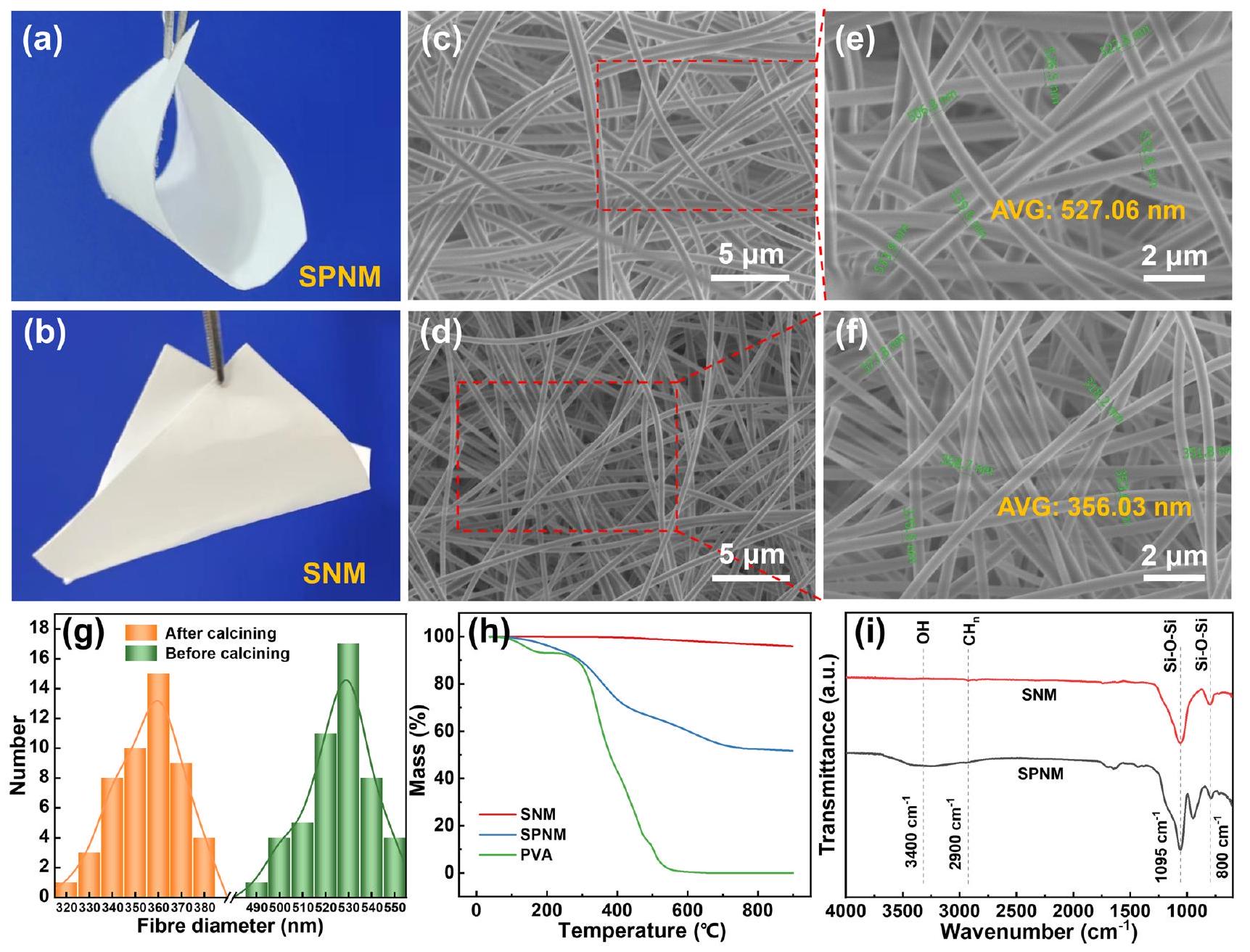
كما هو موضح في الشكل 1a و b، مقارنةً بالصور الرقمية لـ SPNM، لا يزال SNM الناتج بعد التكلس يحتفظ بمرونة كبيرة وتصبح سطحه ناعماً وكثيفاً. الشكل 1c و d يظهر نتائج اختبار SEM لـ SPNM و SNM بنفس التكبير، على التوالي. يمكن ملاحظة أن توزيع الألياف في كلاهما متجانس نسبياً وقطر الألياف في SNM قد انخفض بشكل ملحوظ. من خلال تكبير التكبير بشكل أكبر، من الشكل 1e و f، يمكن رؤية أن قطر الألياف كان أيضاً متجانساً. تم اختيار خمسين ليفاً من SPNM و SNM على التوالي لإجراء تحليل إحصائي للقطر، ووجد أن توزيع القطر لكل من الألياف يتبع توزيعاً طبيعياً (الشكل 1g). بشكل محدد، يتوزع قطر الألياف في SPNM بشكل عام في نطاق 490-550 نانومتر، ويتوزع قطر الألياف في SNM بشكل عام في نطاق بعد الحسابات الإحصائية (الجدول S1)، انخفض متوسط قطر الألياف لـ SNM من 527.06 نانومتر في SPNM إلى 356.03 نانومتر.
تظهر الشكل 1 h أن منحنيات TGA لـ PVA و SPNM و SNM من 30 إلى في الغلاف الجوي. تظهر منحنى TGA لـ PVA أنه يمكن تحلله بالكامل قبل ، وهو ما يتماشى مع استنتاج دراسات أخرى [41، 42]. يمكن ملاحظة من منحنى TGA لـ SPNM أن فقدان الوزن لـ SPNM يتركز بشكل رئيسي
في مرحلتين: نطاق مع فقدان الكتلة من ومدى مع فقدان كتلة . يُعزى الأول بشكل رئيسي إلى إزالة جزيئات الماء وجزء من PVA، بينما يُعزى الثاني بشكل رئيسي إلى إزالة المواد العضوية المتبقية. بالإضافة إلى ذلك، أظهرت منحنى TGA لـ SNM أن كتلته لم تتغير تقريبًا طوال نطاق درجات الحرارة الاختبارية بالكامل. بالاقتران مع TGA لـ PVA و SPNM، يمكن أن يُستنتج أوليًا أن SNM الذي تم الحصول عليه بعد المعالجة الحرارية عند تتمتع بمقاومة عالية للحرارة ولا تحتوي على مكونات عضوية.
لتحليل مكونات SNM و SPNM بشكل أعمق، تم توصيفها بواسطة ATR-FTIR (الشكل 1i). في طيف FTIR لـ SPNM، كانت هناك قمم عريضة عند حوالي 3400
و تم تخصيصها لروابط -OH و المجموعات، على التوالي [43-45]. ومع ذلك، فإن طيف FTIR لـ SNM لا يحتوي على القمتين المميزتين المذكورتين أعلاه، مما يشير إلى أن المادة العضوية (مثل PVA، وTEOS المتبقي و ) في SPNM يتم إزالته تمامًا بعد أن يتم تحميصه عند . علاوة على ذلك، تظهر الأطياف فقط قمم واضحة بالقرب من 1095 و التي تتوافق مع اهتزاز الشد لـ الروابط [46]. تشير النتائج أعلاه بشكل شامل إلى أن SNM تتكون أساسًا من السيراميك المرحلة. بالاقتران مع نتائج TGA، تم إثبات أنه بعد المعالجة الحرارية في تمت إزالة المكونات العضوية في SPNM تمامًا، والمادة الناتجة SNM تتكون فقط من مكونات غير عضوية. . هذه النتيجة أيضًا
الشكل 1 أ، ب صور رقمية، ج-و صور مجهر إلكتروني مسح توزيع حجم قطر الألياف لـ SPNM و SNM. منحنيات TG لـ SPNM و SNM و PVA. i طيف ATR-FTIR لـ SPNM و SNM
يشرح بفعالية الانخفاض الواضح في قطر الألياف من SPNM إلى SNM.
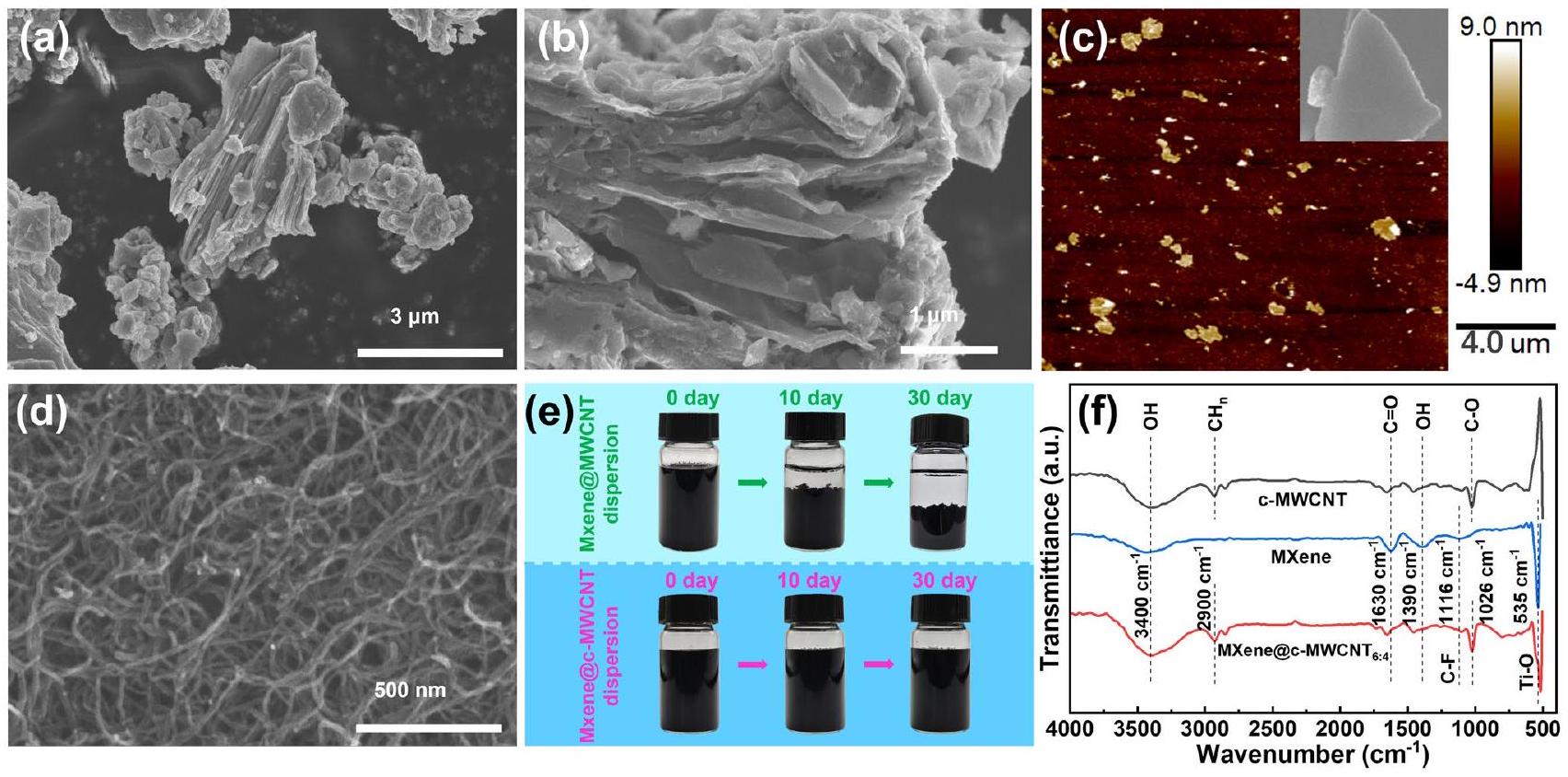
عادةً ما يتم تحضير رقائق MXene النانوية ذات المساحة السطحية المحددة العالية عن طريق النقش الحمضي والتفكيك بالموجات فوق الصوتية [47-49]. في هذه التجربة، بعد أن تم نقش طبقة الألمنيوم الوسطى بواسطة HF، تم الحصول على كربون-ألمنيوم-تيتانيوم الكثيف. جزيئات (ماكس) (الشكل 2أ) تطورت إلى متعددة الطبقات MXene بهيكل أكورديون (الشكل 2ب). أدت عملية التقشير بالموجات فوق الصوتية إلى الحصول على طبقة أحادية فائقة الرقة. MXene (الشكل 2c) [50]. يظهر الشكل 2d الشكل المجهري SEM لـ c-MWCNT، والتي تتوزع بشكل موحد وتتناسب مع وصف المنتج بقطر داخلي من قطر خارجي قدره ، وطول تقدم الشكل 2e تجارب الثبات لـ MXene@MWCNT و MXene@c-MWCNT التشتتات، على التوالي. يمكن رؤية بوضوح أنه بعد وضعها لمدة 10 أيام، يظهر الأول ظاهرة فصل ترسيب مميزة، بينما لا يزال الثاني يحتفظ بتشتت متجانس. بعد 30 يومًا من التواجد، ظهرت أكثر من نصف الرواسب الصلبة في الأول، بينما ظل الثاني تقريبًا دون تغيير. بالمقارنة، يمكن أن نستنتج بشكل أولي أن المجموعات الوظيفية النشطة (- ، إلخ.) من MXene و مُدمجة بشكل جيد، مما يُحسن من قابلية التشتت العامة وخصائصها المضادة للأكسدة.
الرابطة الرئيسية للفلزات في MXene و c-MWCNT و MXene@c-MWCNT تمت دراسة المزيد من التحليل بواسطة ATRFTIR. كما هو موضح في الشكل 2f، يظهر طيف FTIR لـ MXene قمم اهتزازية تمثيلية نموذجية، والتي تُنسب، على التوالي، إلى رابطة -OH بالقرب من 3400 و التواصل القريب التواصل القريب ، و مجموعة طرفية قريبة [30، 51]. بالإضافة إلى ما ذُكر آنفًا – OH و قمم مميزة، يحتوي طيف FTIR لـ c-MWCNT أيضًا على التواصل بالقرب و مجموعات قريبة [52]. طيف FTIR لـ MXene@c يحتوي على جميع القمم المميزة لـ MXene و c-MWCNT، مما يشير إلى وجود رابطة فالس فعالة بينهما. ومن الجدير بالذكر أن طيف FTIR لـ MXene@c-MWCNT يشبه ذلك الخاص بـ c-MWCNT (باستثناء ذروة مميزة). وذلك لأن عندما يتم خلط MXene و c-MWCNT معًا، يقوم الأخير بلف الأول (الشكل 3j)، مما يؤدي إلى أن معظم الأشعة تحت الحمراء تتلامس وتعكس بشكل تفضيلي مع c-MWCNT أثناء الاختبار.
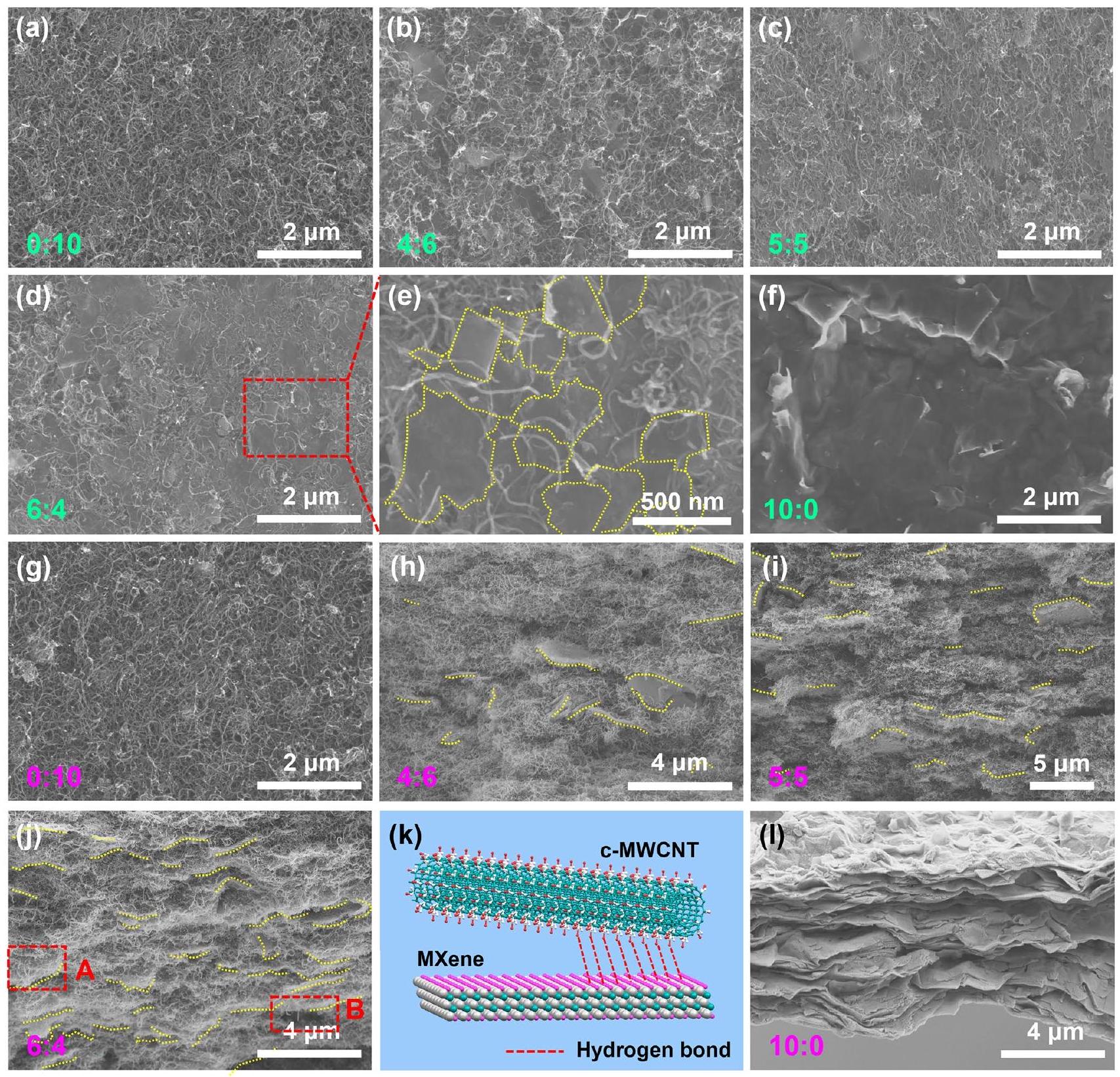
من أجل تحليل البنى الدقيقة لـ MXene@c تم إجراء تحليلات SEM بشكل أكثر شمولاً من كل من السطح والمقطع العرضي. كما يتضح من صور SEM السطحية (الشكل 3 أ، ب، ج، د)، مع زيادة المحتوى النسبي لـ MXene، يزداد عدد أوراق MXene الشفافة الموزعة على سطح MXene@c-MWCNT. يزداد تدريجياً. خاصة عندما تصل نسبة الكتلة من MXene:c-MWCNT إلى 6:4، تكون أوراق MXene على اتصال ببعضها البعض (الشكل 3e)، مما يساعد على تحسين الموصلية الكهربائية العامة لـ MXene@c-MWCNT. .
بالنسبة لصور SEM للقطع العرضية، يزيد عدد صفائح MXene المدمجة في c-MWCNT تدريجياً مع زيادة محتواها (الشكل 3g، h، j). من الشكل 3j، يمكن ملاحظة أن صفائح MXene موزعة في MXene@c-MWCNT. كثيفة وموحدة. بالإضافة إلى ذلك، تشير المنطقة A إلى أن صفائح MXene محاطة بكمية كبيرة من c-MWCNT، وتكشف المنطقة B أن c-MWCNT المرتبطة المحيطة ستُزال عندما يتم سحب MXene. الظاهرتان السابقتان توحيان بوجود قوة ربط قوية بين MXene وc-MWCNT، والتي توفرها الروابط الهيدروجينية التي تتشكل بين مجموعاتها الوظيفية النشطة (الشكل 3k) [53]. استنادًا إلى التحليل أعلاه، تشكل c-MWCNT أحادية البعد وMXene ثنائية الأبعاد المدمجة بشكل موحد هيكل تقاطع سلك ثلاثي الأبعاد “يدًا بيد”، مما يوفر أساسًا نظريًا لـ MXene@c-MWCNT. مع موصلية كهربائية جيدة وخصائص ميكانيكية. من الشكل 3f، 1، يمكن رؤية أن فيلم MXene نقي يتكون من تكديس صفائح MXene صلبة ورقيقة.

3.2 الأداء الميكانيكي للشد

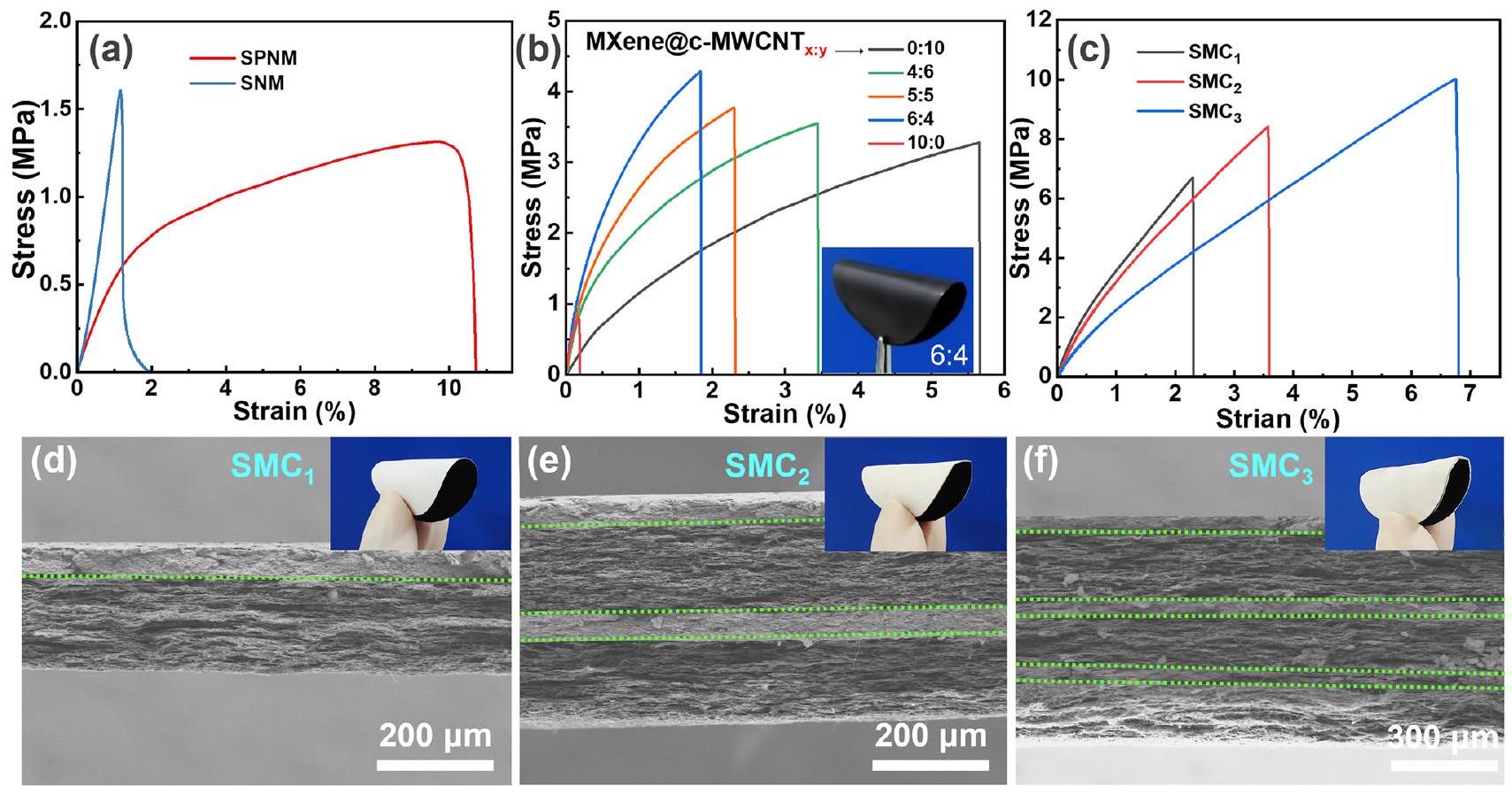
كلا من القوة الشد الميكانيكية الجيدة والمرونة هما مؤشرين مهمين للتطبيق العملي للمواد المركبة القائمة على الألياف [54-56]. كما هو موضح في الشكل 4a، فإن قوة الشد ومعامل SNM الناتج عن التحميص أكبر من تلك الخاصة بـ SPNM. الشكل 4b يكشف أن قوة الشد لـ MXene@c أعلى بكثير من أفلام MXene النقية وأفلام c-MWCNT، وتزداد قوة الشد للأفلام الهجينة مع زيادة محتوى MXene. عندما تكون نسبة الوزن بين MXene و c-MWCNT 6:4، فإن MXene@c-MWCNT يصل إلى أقصى إجهاد شد
الشكل 2 صورة SEM لـ . صورة SEM لـ MXene متعدد الطبقات بدون استخدام الموجات فوق الصوتية. ج صورة AFM وصورة SEM (في الزاوية) لطبقة MXene أحادية. د صورة SEM لـ c-MWCNT. هـ صورة رقمية لـ MXene@MWCNT و MXene@c-MWCNT تشتتات لأوقات ثابتة مختلفة. طيف ATR-FTIR لـ MXene و c-MWCNT و MXene@c-MWCNT
قوة تبلغ 4.28 ميغاباسكال، والتي تُعزى بشكل رئيسي إلى الالتصاق القوي بين رقائق MXene و c-MWCNT من خلال الروابط الهيدروجينية و التفاعل [57]. ومع ذلك، فإن الحد الأقصى للإجهاد في الفيلم الهجين ينخفض مع زيادة محتوى MXene، وهو ما يرجع أساسًا إلى ضعف قوى فان der Waals بين صفائح MXene الصلبة. من خلال التأثير التكميلي لـ c-MWCNT، يمكن ملاحظة من الشكل 4b (الإطار) أن MXene@c-MWCNT لا يزال لديه مرونة جيدة.
من الشكل 4c، يمكن رؤية بوضوح أن قوة الشد لـ فيلم مركب يتكون من SNM/ MXene@c-MWCNT (طبقة الوحدة) قد تم تحسينها بشكل كبير، خاصة لـ تم إعدادها عن طريق ربط ثلاث طبقات وحدة مع PVA، الذي لديه قوة شد ميكانيكية تبلغ 10.01 ميغاباسكال. الشكل يظهر مقاطع الشد لـ ، و يمكن رؤية أن SNM و MXene@c-MWCNT مرتبطان ارتباطًا وثيقًا، وكذلك بين طبقات الوحدات المختلفة. كما هو موضح في الإدراج، التي تحتوي على ثلاثة هياكل وحدات لا تزال تحتفظ بمرونة جيدة. ومن الجدير بالذكر أن الذي تم الحصول عليه في هذا العمل يحقق مستوى الميكرومتر في اتجاه السماكة (الجدول S2)، مما يمكن أن يوفر المساحة بشكل كبير ويعزز قيمة التطبيق العملي.

3.3 أداء درع التداخل الكهرومغناطيسي

التوصيلية الكهربائية هي واحدة من العوامل الرئيسية التي تؤثر على أداء درع الحماية من التداخل الكهرومغناطيسي [58، 59]. MXene@c تعمل كمساهم رئيسي في درع EMI في هذا العمل، كما هو موضح في الشكل 5a، مع زيادة محتوى MXene، تزداد موصلية MXene@c-MWCNT تم تعزيزها بشكل كبير (MXene@c-MWCNT يصل إلى 7378 )، بينما يتم تقليل مقاومة الورقة وسمك الفيلم الهجين بشكل واضح (الشكل S3 والجدول S3). هنا، على الرغم من أن فيلم MXene النقي لديه أعلى موصلية كهربائية تحد من تطبيقاته المستقبلية ضعف مرونته الميكانيكية.
في الشكل 5ب، انعكاس SE ( ) منحنى فيلم c-MWCNT النقي في نطاق X مستقر نسبيًا، بينما تظهر منحنيات فيلم MXene النقي والأفلام الهجينة شكلًا متموجًا، وEMI تتركز قيم الفواصل لجميع الأفلام تقريبًا بين دمج الصيغة ، حيث و هي مقاومة الفضاء الحر ومواد الحماية، على التوالي [60]، يمكن الاستنتاج أنه في ظل فرضية ثبات المقاومة المكانية، فإن النوعين المختلفين منحنى
الشكل 3 صور SEM لـ السطح و المقطع العرضي لـ MXene@c-MWCNT مع نسب وزن مختلفة من MXene و c-MWCNT. رسم بياني لروابط الهيدروجين بين MXene و c-MWCNT
تُنسب الاتجاهات إلى توزيع القطر الموحد لأسطوانة الكربون متعددة الجوانب ذات البعد الواحد (c-MWCNT) وعدم انتظام القطر في ثنائي الأبعاد (MXene)، على التوالي.
كما هو موضح في الشكل 5c، امتصاص SE ( تزداد قيمة الفيلم الهجين في نطاق X مع زيادة محتوى MXene وتصل إلى القيمة القصوى عندما تكون نسبة MXene إلى c-MWCNT 6:4. EMI هو بشكل رئيسي
محدد بسماكة الدرع ( ) وعمق الجلد ( ) [61]، وعلاقتهم العامة هي ، حيث هو عمق الجلد ويعرف بأنه عندما تنخفض الطاقة الكهرومغناطيسية إلى الموجة الحادثة، يتم وصفها بأنها إذا ، حيث هي الموصلية الكهربائية، هو السماحية الفراغية، والنفاذية ، لذا فإن سمك الدرع ( ) وموصلية الكهرباء
الشكل 4 منحنيات الإجهاد والانفعال النموذجية لـ SPNM و SNM MXene@c-MWCNT ، و إس إم سي . صور مقاطع عرضية SEM من SMC وصور رقمية متCorresponding
الشكل 5 أ: الموصلية، مقاومة الورقة وسمك الفيلم، ب-د: EMI الأداء في نطاق X، المتوسط القيم و معاملات القدرة لـ MXene@c-MWCNT
( ) هي العوامل الحاسمة لـ [62]. وفقًا للتحليل أعلاه، يمكن الاستنتاج أنه في عملية التغيير التدريجي لنسبة كتلة MXene/c-MWCNT من 0:10 إلى 6:4، تقدم يستفيد بشكل رئيسي من زيادة الموصلية الكهربائية ) (الشكل 5أ)، ولكن عندما ينتقل النسبة من 6:4 إلى 10:0، فإن الانخفاض في يرجع بشكل رئيسي إلى انخفاض حاد في السماكة لفيلم الحماية (الجدول S3). بالإضافة إلى ذلك، كما هو موضح في الشكل 5d، فإن اتجاه تغيير فعالية الحماية من EMI الكلية ( يتماشى مع ذلك من .
القيم المتوسطة لـ ، و في نطاق X من العينة يمكن أن يكشف بفعالية عن آلية الحماية الكهرومغناطيسية لها. يمكن رؤية ذلك بوضوح من الشكل 5e أن قيم MXene@c-MWCNT أكبر من 30 ديسيبل، مما يشير إلى أنها يمكن أن تلبي المتطلبات الفعلية في مجالات مختلفة [63]. بالاقتران مع المزايا المزدوجة من الموصلية الكهربائية والسماكة، فإن القيمة المتوسطة لـ MXene@c-MWCNT يصل إلى 38.66 ديسيبل. وفقًا لصيغة كفاءة الت shielding [62]، MXene@c-MWCNT يمكن أن يحمي الموجة الكهرومغناطيسية الحادثة. بالإضافة إلى، قيم جميع الأفلام مستقرة في نطاق 15 ديسيبل، مما يشير إلى أن أكثر من تم حماية الموجة الكهرومغناطيسية للحدث عن طريق الانعكاس [64].
على الرغم من أن قيم الأفلام الواقية في الشكل 5e أعلى من القيم، يتم عكس معظم الموجات الكهرومغناطيسية قبل دخولها طبقة الحماية، لذا يحتاج معامل القدرة لحماية EMI إلى مزيد من التحليل [65]. يشمل معامل القدرة معامل الامتصاص ( معامل الانعكاس ومعامل النقل ( )، والتي تُستخدم لتقييم قدرة مواد درع EMI على امتصاص، عكس ونقل الموجات الكهرومغناطيسية، على التوالي [66]. تُظهر الشكل 5f أن قيم T للأفلام الواقية قريبة من 0، مما يشير إلى أن MXene@c يمكن أن يحمي من جميع الموجات الكهرومغناطيسية الساقطة تقريبًا. في نفس الوقت، فإن المستوى الأعلى بكثير قيم من القيم تشير إلى أن MXene@c-MWCNT تتبع بشكل أساسي آلية درع كهرومغناطيسي تعتمد على الانعكاس.
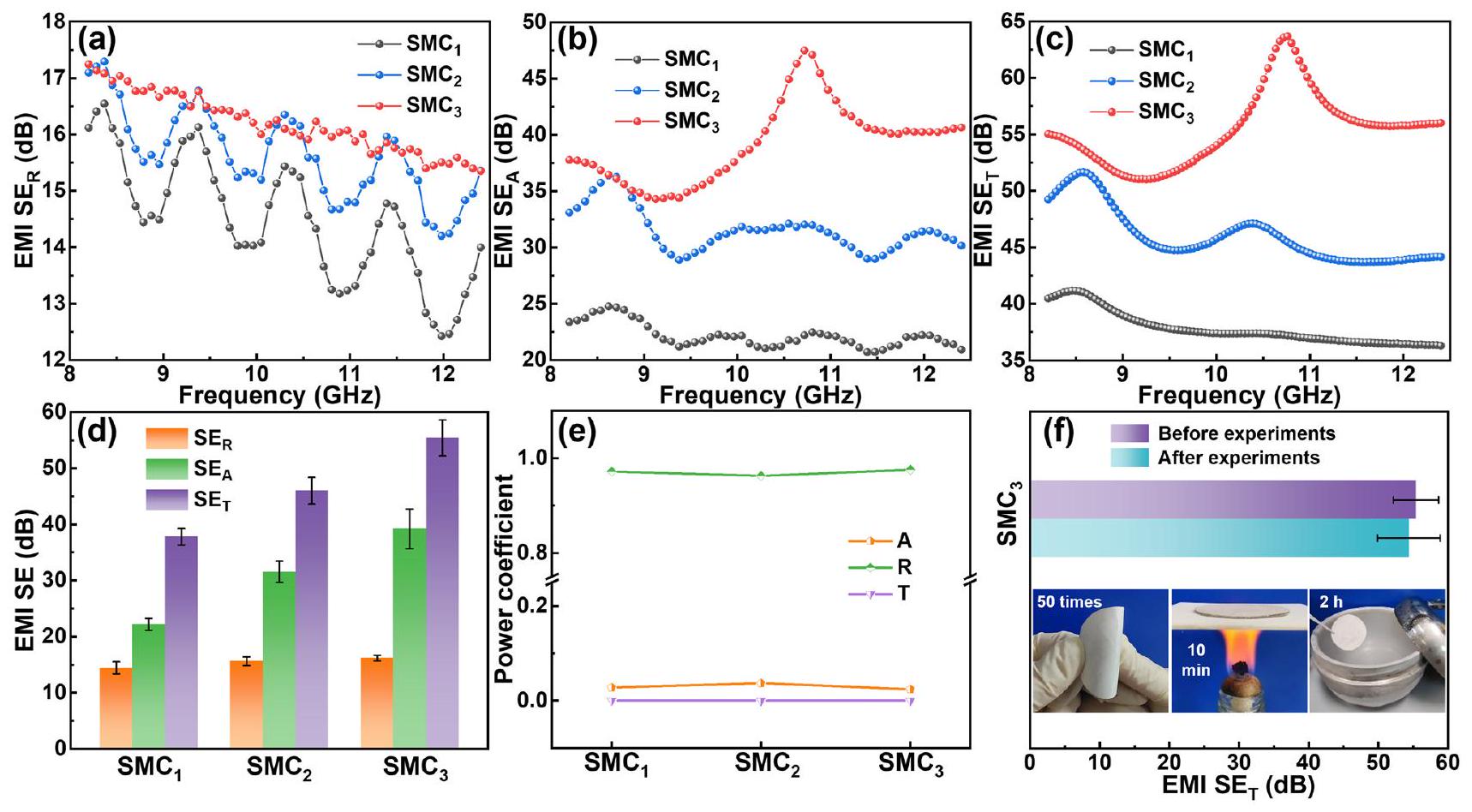
عدد طبقات الوحدات الهيكلية الموجودة في هو عامل مهم يؤثر على أداء درع الكهرومغناطيسية. كما هو موضح في الشكل 6 أ، ب، ج، و من الفيلم المركب في نطاق X، يرتفع كلاهما مع زيادة عدد طبقات الوحدات الهيكلية، و من تحسن بشكل كبير مقارنة بـ و . يمكن أن تعكس وتمتص الموجات الكهرومغناطيسية من جانب واحد فقط، بينما آلية درع EMI لـ SMC
و يتضمن أيضًا انعكاسات متعددة وامتصاصات متعددة، لذا فإن يزداد مع زيادة عدد طبقات الوحدات الهيكلية. لذلك، فإن المتوسط من ، و في الشكل 6d هو 37.80 و 46.00 و 55.40 ديسيبل، على التوالي. بعد الحساب، يمكن أن يحمي موجة كهرومغناطيسية حادثة. مشابهة لـ MXene@c-MWCNT يمكن رؤية ذلك من الشكل 6e أن الآلية الرئيسية للحماية هي هو أيضًا انعكاس. من أجل استكشاف متانة خصائص درع التداخل الكهرومغناطيسي ، تم إجراء سلسلة من اختبارات البيئات القاسية. كما هو موضح في الشكل 6f، بعد أن تم ثنيه 50 مرة، تم خبزه في درجة حرارة عالية (حوالي ) لمدة 10 دقائق، ثم تم تجميده في النيتروجين السائل لمدة ساعتين، المتوسط قيمة لـ لا يزال مرتفعًا كما هو 54.37 ديسيبل، مما يشير إلى أن يمتاز بمتانة ممتازة في درع الحقول الكهرومغناطيسية.

3.4 أداء العزل الحراري

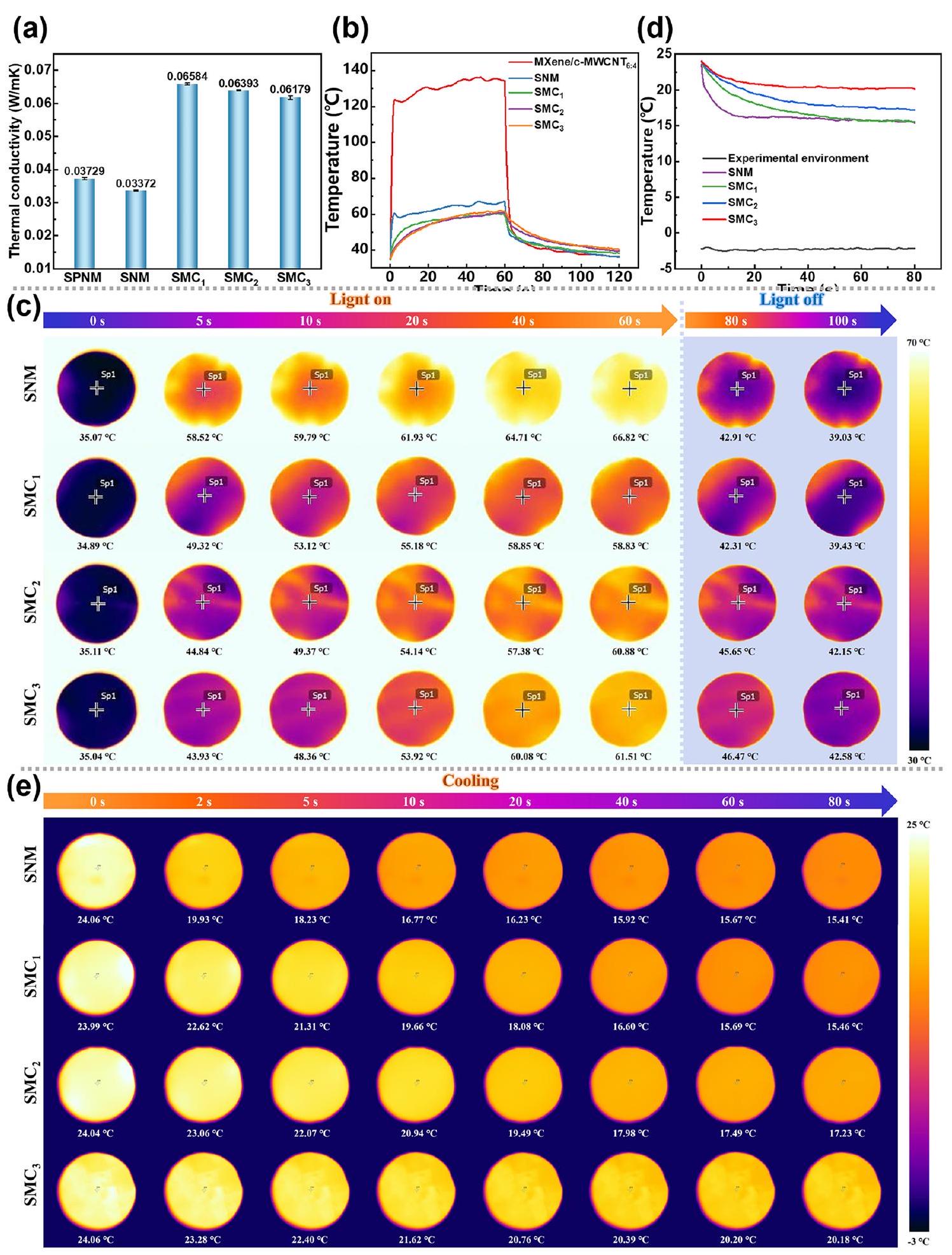
للفيلم المركب ( ), MXene@c-MWCNT يعمل كطبقة وظيفية لحماية EMI (الشكل 5)، بينما توفر طبقة SNM أداءً ممتازًا في العزل الحراري. في الشكل 7a، الموصلية الحرارية لـ SNM ( أقل من ذلك في SPNM )، والذي يرجع أساسًا إلى القضاء على PVA وغيرها من المواد العضوية في SPNM بعد الكلسنة عند درجات حرارة عالية، مما يحقق SNM المكون من النقاء. ألياف السيراميك. على الرغم من أن MXene (472 ) و CNT ( لديها موصلية حرارية نظرية كبيرة [32، 67]، تم الحصول عليها من خلال دمج طبقة SNM لا تزال تحافظ على تأثير العزل الحراري المثالي، وموصلية الحرارة لـ , و هم ، و ، على التوالي. هذا لا يظهر فقط أن يمكن أن يتغلب بفعالية على تأثير الموصلية الحرارية العالية لفيلم الحماية (MXene@c-MWCNT) ) وتحافظ على خاصية العزل الحراري الممتازة لـ SNM، ولكنها تكشف أيضًا أن الموصلية الحرارية لـ SMC تنخفض تدريجياً مع زيادة عدد طبقات الوحدات الهيكلية.
من أجل عكس أداء العزل الحراري بشكل أكثر بديهية يتم إجراء مراقبة في الوقت الفعلي لأداء إدارة الحرارة في بيئات درجات الحرارة العالية والمنخفضة المحاكاة باستخدام كاميرا حرارية بالأشعة تحت الحمراء [68]. بالنسبة لبيئة درجة الحرارة العالية التي تم إنشاؤها بواسطة مصباح زينون، كما هو موضح في الشكل 7b، فإن درجة حرارة السطح
الشكل 6 أ-ج EMI ، و أداء متوسط القسط الشهري القيم و معاملات القدرة لـ SMC . أداء درع EMI بعد سلسلة من اختبارات البيئات القاسية
من MXene@c-MWCNT يصل إلى الأعلى على الفور ويتم تثبيته عند حوالي بعد 40 ثانية. بالمقابل، أظهر SNM أداءً ممتازًا في العزل الحراري، حيث تم الحفاظ على درجة حرارة السطح عند حوالي بعد 60 ثانية. بالإضافة إلى ذلك، تأثير العزل الحراري لـ تم الحصول عليه عن طريق ربط طبقة الحماية MXene@c-MWCNT وتم تحسين SNM مع PVA بشكل أكبر. من التصوير الحراري بالأشعة تحت الحمراء في الشكل 7c، يمكن رؤية بوضوح أن درجات الحرارة النهائية لـ في كل مكان من الجدير بالذكر أن أداء العزل الحراري لـ لم يزداد تدريجياً مع زيادة الوحدات الهيكلية، ويرجع ذلك أساساً إلى القدرة المحددة على التحويل الضوئي الحراري لـ MXene و CNT [69]. وقد أكد تجربة التبريد الطبيعي بعد 60 ثانية على انخفاض معامل انتشار الحرارة لـ SMC. .
لبيئة درجة الحرارة المنخفضة التي تخلقها الثلوج، يتم الحفاظ على درجة الحرارة عند حوالي كما هو موضح في الشكل 7d، فإن معدلات التبريد لـ SNM و SMC ، و انخفضت بشكل متتابع لأفلام الألياف المختلفة الموضوعة في البيئة الباردة في نفس الوقت. من المهم أن قدرة حماية الحرارة لـ عند درجات الحرارة المنخفضة زادت مع زيادة عدد طبقات الوحدة،
يتوافق مع و على التوالي (الشكل 7e). من المثير للاهتمام أن الحد الأدنى لدرجة الحرارة يشبه ذلك من SNM، والذي يجب أن يكون لأن يحتوي فقط على طبقة واحدة من SNM، مما يجعل أدائه في العزل الحراري قريبًا جدًا من أداء SNM. باختصار، يوفر عزلًا حراريًا ممتازًا وحفظًا للحرارة في البيئات الحرارية والباردة الشديدة، على التوالي.

3.5 آلية التأثير المزدوج لحماية EMI وعزل الحرارة
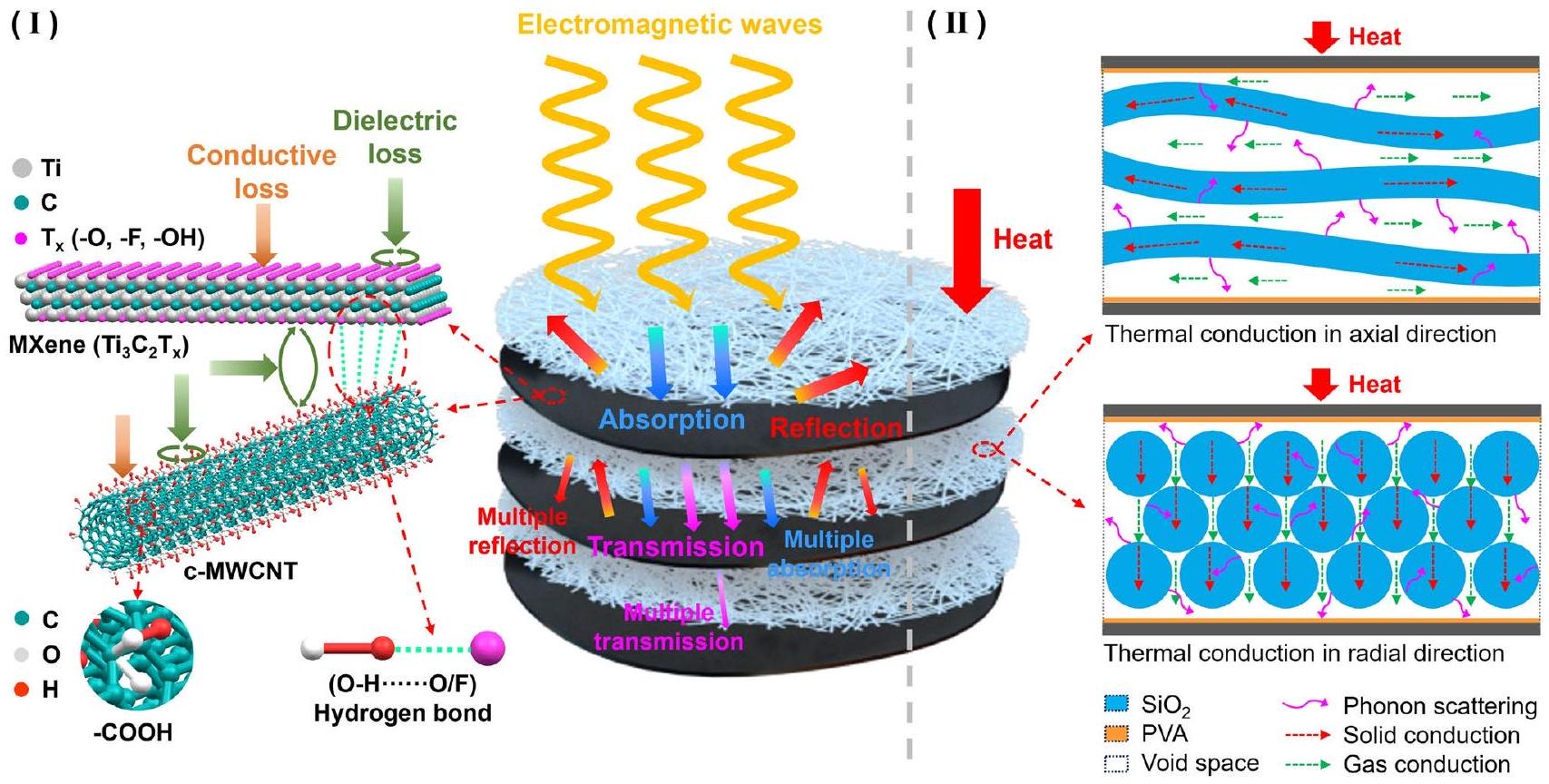
بالإضافة إلى نتائج التحليل أعلاه، يظهر تأثيرات مزدوجة من درع EMI والعزل الحراري. بالنسبة لدرع EMI، MXene@c-MWCNT تلعب الطبقة دورًا رئيسيًا، كما هو موضح في الشكل 8I، عندما تصل الموجات الكهرومغناطيسية إلى سطح فيلم الحماية، أكثر من تنعكس الموجات الكهرومغناطيسية على الفور بسبب عدم تطابق المعاوقة لسطح الإلكترونات الحرة [70]. بعد ذلك، يتسبب التفاعل بين الموجات الكهرومغناطيسية الساقطة والكثافة العالية من الإلكترونات والفجوات في الطبقة الموصلة في فقدان موصلي، مما يضعف قوة
الشكل 7: الموصلية الحرارية لـ SPNM و SNM و SMC . منحنيات درجة الحرارة والزمن و صور الأشعة تحت الحمراء المقابلة لـ و SMC في بيئة ذات درجات حرارة مرتفعة. منحنيات درجة الحرارة والزمن و الصور الحرارية المقابلة لـ SNM و في بيئة شديدة البرودة
الشكل 8 I مخطط درع EMI و II آلية العزل الحراري لـ
الموجات الكهرومغناطيسية الساقطة. بالإضافة إلى ذلك، فإن المجموعات النشطة الوفيرة والواجهات غير المتجانسة التي توفرها MXene و c-MWCNT تحفز كل من الاستقطاب الثنائي والسطحي، مما يمتص المزيد من طاقة الموجات الكهرومغناطيسية الساقطة [71]. لذلك، بعد سلسلة من الانعكاسات والامتصاص، يدخل فقط كمية صغيرة جدًا من الموجات الكهرومغناطيسية المنقولة إلى طبقة الحماية التالية. نتيجة لذلك، بعد عدة انعكاسات وامتصاصات، لا يمكن تقريبًا لأي موجات كهرومغناطيسية أن تخترق الـ .
بالنسبة للعزل الحراري، تلعب طبقة SNM دورًا رئيسيًا، كما هو موضح في الشكل 8II، بسبب الفتحة الصغيرة بين الألياف، يمكن أن يكون انتقال الحرارة بالحمل تقريبًا غير ملحوظ، لذا يمكن تمثيل الموصلية الحرارية الكلية ( ) لـ كمجموع لمساهمات من ثلاثة أجزاء [72]، أي الموصلية الحرارية الصلبة ، الموصلية الحرارية الغازية والموصلية الحرارية الإشعاعية ( ). يمكن تفسير آليات العزل الحراري من الجوانب الأربعة التالية: أولاً، نسبة الطول إلى القطر العالية جدًا والتفاف الألياف غير المنتظم لـ يطيلان مسار توصيل الحرارة في المواد الصلبة؛ علاوة على ذلك، فإن الموصلية الحرارية الجوهرية لـ منخفضة، مما يؤدي إلى انخفاض . ثانيًا، تجعل المسامية العالية لـ SNM انتقال حرارة الهواء غير متواصل في الفضاء الكامل لـ ، مما يساهم في انخفاض ; ثالثًا، الهيكل المسامي
يجعل الإشعاع تحت الأحمر ينعكس ويمتص عدة مرات، مما يؤدي إلى انخفاض ; أخيرًا، والأهم من ذلك، فإن واجهة الطور بين المواد الصلبة المختلفة وكذلك بين المواد الصلبة والفراغات تعزز تشتت الفونونات [73].

4 الاستنتاج

في هذا العمل، تم تحضير SNM بمعدل موصلية حرارية منخفضة (0.034 واط ) عن طريق النسيج الكهربائي متبوعًا بالتكلس ولعب دورًا حاسمًا في أداء العزل الحراري لـ . تم تحضير الفيلم الهجين المكون من MXene و c-MWCNT بنجاح من خلال الترشيح المعزز بالفراغ، وأظهر MXene@c-MWCNT أداءً جيدًا في درع EMI. عندما كانت نسبة وزن MXene إلى c-MWCNT 6:4، أظهر MXene@c أداءً شاملًا ممتازًا من حيث قوة الشد (4.28 ميجا باسكال) ودرع EMI . أخيرًا، تم تحضير بأداء جيد في درع EMI والعزل الحراري بنجاح باستخدام PVA كلاصق. على وجه التحديد، فإن الموصلات الحرارية لـ و هي 0.066، 0.064، و ، و هي 37.80، 46.00، و 55.40 ديسيبل على التوالي. بالإضافة إلى ذلك، تم تحسين الأداء العام لـ مع زيادة في
عدد طبقات الوحدات الهيكلية. من المهم أن يقدم متانة جيدة في بيئات شديدة الحرارة والبرودة. أفكار التصميم في هذا العمل لها قيمة مرجعية مهمة لتطوير معدات خاصة مثل بدلات الفضاء المأهولة.
الشكر والتقدير نشكر مجلس المنح الدراسية الصيني (2021). يمد المؤلفون تقديرهم لعمادة البحث العلمي في جامعة الحدود الشمالية، عرعر، المملكة العربية السعودية لتمويل هذا البحث من خلال رقم المشروع “NBU-FPEJ-2024-249-03”.

الإعلانات

تعارض المصالح يعلن المؤلفون عدم وجود تعارض في المصالح. ليس لديهم أي مصالح مالية متنافسة معروفة أو علاقات شخصية قد تؤثر على العمل المبلغ عنه في هذه الورقة. زانهو قوه هو عضو في هيئة التحرير لمجلة Nano-Micro Letters ولم يكن مشاركًا في المراجعة التحريرية أو القرار بنشر هذه المقالة. يعلن جميع المؤلفين أنه لا توجد مصالح متنافسة.
الوصول المفتوح هذه المقالة مرخصة بموجب رخصة المشاع الإبداعي 4.0 الدولية، التي تسمح بالاستخدام والمشاركة والتكيف والتوزيع وإعادة الإنتاج في أي وسيلة أو صيغة، طالما أنك تعطي الائتمان المناسب للمؤلفين الأصليين والمصدر، وتوفر رابطًا لرخصة المشاع الإبداعي، وتوضح ما إذا كانت هناك تغييرات قد تم إجراؤها. الصور أو المواد الأخرى من طرف ثالث في هذه المقالة مشمولة في رخصة المشاع الإبداعي للمقالة، ما لم يُشار إلى خلاف ذلك في سطر ائتمان للمادة. إذا لم تكن المادة مشمولة في رخصة المشاع الإبداعي للمقالة واستخدامك المقصود غير مسموح به بموجب اللوائح القانونية أو يتجاوز الاستخدام المسموح به، ستحتاج إلى الحصول على إذن مباشرة من صاحب حقوق الطبع والنشر. لعرض نسخة من هذه الرخصة، قم بزيارةhttp://creativecommons.org/licenses/by/4.0/.
المعلومات التكميلية تحتوي النسخة الإلكترونية على مواد تكميلية متاحة علىhttps://doi.org/10.1007/s40820-024-01398-1.

References

  1. P. Weiss, M.P. Mohamed, T. Gobert, Y. Chouard, N. Singh et al., Advanced materials for future lunar extravehicular activity space suit. Adv. Mater. Technol. 5, 2000028 (2020). https:// doi.org/10.1002/admt. 202000028
  2. Z. Han, Y. Song, J. Wang, S. Li, D. Pan et al., Research progress of thermal insulation materials used in spacesuits. ES Energy Environ. 21, 947 (2023). https://doi.org/10.30919/ esee947
  3. J. Yang, H. Wang, Y. Zhang, H. Zhang, J. Gu, Layered structural PBAT composite foams for efficient electromagnetic interference shielding. Nano-Micro Lett. 16, 31 (2023). https:// doi.org/10.1007/s40820-023-01246-8
  4. D. An, Y. Chen, R. He, H. Yu, Z. Sun et al., The polymerbased thermal interface materials with improved thermal conductivity, compression resilience, and electromagnetic interference shielding performance by introducing uniformly melamine foam. Adv. Compos. Hybrid Mater. 6, 136 (2023). https://doi.org/10.1007/s42114-023-00709-1
  5. M. Clausi, M. Zahid, A. Shayganpour, I.S. Bayer, Polyimide foam composites with nano-boron nitride (BN) and silicon carbide ( SiC ) for latent heat storage. Adv. Compos. Hybrid Mater. 5, 798-812 (2022). https://doi.org/10.1007/ s42114-022-00426-1
  6. A. Riahi, M.B. Shafii, Experimental evaluation of a vapor compression cycle integrated with a phase change material storage tank for peak load shaving. Eng. Sci. 23, 870 (2023). https://doi.org/10.30919/es8d870
  7. X. Zhao, K. Ruan, H. Qiu, X. Zhong, J. Gu, Fatigue-resistant polyimide aerogels with hierarchical cellular structure for broadband frequency sound absorption and thermal insulation. Adv. Compos. Hybrid Mater. 6, 171 (2023). https://doi. org/10.1007/s42114-023-00747-9
  8. Z. Li, D. Pan, Z. Han, D.J.P. Kumar, J. Ren et al., Boron nitride whiskers and nano alumina synergistically enhancing the vertical thermal conductivity of epoxy-cellulose aerogel nanocomposites. Adv. Compos. Hybrid Mater. 6, 224 (2023). https://doi.org/10.1007/s42114-023-00804-3
  9. L. Yin, J. Xu, B. Zhang, L. Wang, W. Tao et al., A facile fabrication of highly dispersed aerogel composites with high adsorption desulfurization performance. Chem. Eng. J. 428, 132581 (2022). https://doi.org/10.1016/j.cej.2021.132581
  10. S. Karamikamkar, H.E. Naguib, C.B. Park, Advances in precursor system for silica-based aerogel production toward improved mechanical properties, customized morphology, and multifunctionality: a review. Adv. Colloid Interface Sci. 276, 102101 (2020). https://doi.org/10.1016/j.cis.2020.102101
  11. M. Liu, H. Wu, Y. Wang, J. Ren, D.A. Alshammari et al., Flexible cementite/ferroferric oxide/silicon dioxide/carbon nanofibers composite membrane with low-frequency dispersion weakly negative permittivity. Adv. Compos. Hybrid Mater. 6, 217 (2023). https://doi.org/10.1007/ s42114-023-00799-x
  12. C. Liu, S. Wang, N. Wang, J. Yu, Y.-T. Liu et al., From 1D nanofibers to 3D nanofibrous aerogels: a marvellous evolution of electrospun nanofibers for emerging applications. Nano-Micro Lett. 14, 194 (2022). https://doi.org/10.1007/ s40820-022-00937-y
  13. Y. Si, X. Mao, H. Zheng, J. Yu, B. Ding, Silica nanofibrous membranes with ultra-softness and enhanced tensile strength for thermal insulation. RSC Adv. 5, 6027-6032 (2015). https:// doi.org/10.1039/C4RA12271B
  14. D.P. Yu, Q.L. Hang, Y. Ding, H.Z. Zhang, Z.G. Bai et al., Amorphous silica nanowires: intensive blue light emitters. Appl. Phys. Lett. 73, 3076-3078 (1998). https://doi.org/10. 1063/1.122677
  15. L. Wang, S. Tomura, F. Ohashi, M. Maeda, M. Suzuki et al., Synthesis of single silica nanotubes in the presence of citric
    acid. J. Mater. Chem. 11, 1465-1468 (2001). https://doi.org/
  16. J. Niu, J. Sha, Z. Liu, Z. Su, J. Yu et al., Silicon nano-wires fabricated by thermal evaporation of silicon wafer. Phys. E Low Dimension. Syst. Nanostruct. 24, 268-271 (2004). https://doi.org/10.1016/j.physe.2004.04.040
  17. Z. Zhang, Y. Zhao, Z. Li, L. Zhang, Z. Liu et al., Synthesis of carbon core-sheath nanofibers with nanoparticles embedded in via electrospinning for high-performance microwave absorption. Adv. Compos. Hybrid Mater. 5, 513-524 (2022). https://doi.org/10.1007/s42114-021-00350-w
  18. S. Chanthee, C. Asavatesanupap, D. Sertphon, T. Nakkhong, N. Subjalearndee et al., Electrospinning with natural rubber and Ni doping for carbon dioxide adsorption and supercapacitor applications. Eng. Sci. 27, 975 (2024). https://doi.org/10. 30919/es975
  19. H. Mhetre, Y. Kanse, Y. Chendake, Influence of Electrospinning voltage on the diameter and properties of 1-dimensional zinc oxide nanofiber. ES Mater. Manuf. 20, 838 (2023). https://doi.org/10.30919/esmm5f838
  20. T. Sirimekanont, P. Supaphol, K. Sombatmankhong, Titanium (IV) oxide composite hollow nanofibres with silver oxide outgrowth by combined sol-gel and electrospinning techniques and their potential applications in energy and environment. Adv. Compos. Hybrid Mater. 6, 115 (2023). https://doi.org/10.1007/s42114-023-00690-9
  21. J. Cheng, C. Li, Y. Xiong, H. Zhang, H. Raza et al., Recent advances in design strategies and multifunctionality of flexible electromagnetic interference shielding materials. Nano-Micro Lett. 14, 80 (2022). https://doi.org/10.1007/ s40820-022-00823-7
  22. A. Udayakumar, P. Dhandapani, S. Ramasamy, S. Angaiah, Layered double hydroxide (LDH)-MXene nanocomposite for electrocatalytic water splitting: current status and perspective. ES Energy Environ. 24, 901 (2023). https://doi.org/ 10.30919/esee901
  23. S. Zheng, N. Wu, Y. Liu, Q. Wu, Y. Yang et al., Multifunctional flexible, crosslinked composites composed of trashed MXene sediment with high electromagnetic interference shielding performance. Adv. Compos. Hybrid Mater. 6, 161 (2023). https://doi.org/10.1007/s42114-023-00741-1
  24. B. Li, N. Wu, Q. Wu, Y. Yang, F. Pan et al., From “100%” utilization of MAX/MXene to direct engineering of wearable, multifunctional E-textiles in extreme environments. Adv. Funct. Mater. 33, 2307301 (2023). https://doi.org/10. 1002/adfm. 202307301
  25. N.M. Soudagar, V.K. Pandit, V.M. Nikale, S.G. Thube, S.S. Joshi et al., Influence of surfactant on the supercapacitive behavior of polyaniline-carbon nanotube composite thin films. ES Gen. 2, 1018 (2023). https://doi.org/10.30919/ esg1018
  26. S.S. Wagh, D.B. Salunkhe, S.P. Patole, S. Jadkar, R.S. Patil et al., Zinc oxide decorated carbon nanotubes composites for photocatalysis and antifungal application. ES Energy Environ. 21, 945 (2023). https://doi.org/10.30919/esee945
  27. A. Huang, Y. Guo, Y. Zhu, T. Chen, Z. Yang et al., Durable washable wearable antibacterial thermoplastic polyurethane/ carbon nanotube@silver nanoparticles electrospun membrane strain sensors by multi-conductive network. Adv. Compos. Hybrid Mater. 6, 101 (2023). https://doi.org/10.1007/ s42114-023-00684-7
  28. C. Pramanik, J.R. Gissinger, S. Kumar, H. Heinz, Carbon nanotube dispersion in solvents and polymer solutions: mechanisms, assembly, and preferences. ACS Nano 11, 1280512816 (2017). https://doi.org/10.1021/acsnano.7b07684
  29. T. Xu, Y. Wang, K. Liu, Q. Zhao, Q. Liang et al., Ultralight MXene/carbon nanotube composite aerogel for high-performance flexible supercapacitor. Adv. Compos. Hybrid Mater. 6, 108 (2023). https://doi.org/10.1007/s42114-023-00675-8
  30. B. Zhou, Y. Li, Z. Li, J. Ma, K. Zhou et al., Fire/heat-resistant, anti-corrosion and folding MXene/single-walled carbon nanotube films for extreme-environmental EMI shielding and solar-thermal conversion applications. J. Mater. Chem. C 9, 10425-10434 (2021). https://doi.org/10.1039/d1tc00289a
  31. Q. Gao, Y. Pan, G. Zheng, C. Liu, C. Shen et al., Flexible multilayered MXene/thermoplastic polyurethane films with excellent electromagnetic interference shielding, thermal conductivity, and management performances. Adv. Compos. Hybrid Mater. 4, 274-285 (2021). https://doi.org/10.1007/ s42114-021-00221-4
  32. H. Zhan, Y.W. Chen, Q.Q. Shi, Y. Zhang, R.W. Mo et al., Highly aligned and densified carbon nanotube films with superior thermal conductivity and mechanical strength. Carbon 186, 205-214 (2022). https://doi.org/10.1016/j.carbon.2021. 09.069
  33. D. Kong, Z.M. El-Bahy, H. Algadi, T. Li, S.M. El-Bahy et al., Highly sensitive strain sensors with wide operation range from strong MXene-composited polyvinyl alcohol/sodium carboxymethylcellulose double network hydrogel. Adv. Compos. Hybrid Mater. 5, 1976-1987 (2022). https://doi.org/10.1007/ s42114-022-00531-1
  34. X. Guan, Q. Zhang, C. Dong, R. Zhang, M. Peng et al., A firstprinciples study of Janus monolayer MXY ( , W; X, Y van der Waals heterojunctions for integrated optical fibers. Adv. Compos. Hybrid Mater. 5, 3232-3244 (2022). https://doi.org/10.1007/s42114-022-00557-5
  35. Y. Yu, Y. Huang, L. Li, L. Huang, S. Zhang, Silica ceramic nanofiber membrane with ultra-softness and high temperature insulation. J. Mater. Sci. 57, 4080-4091 (2022). https://doi. org/10.1007/s10853-022-06913-6
  36. S. Zhang, B. Cheng, Z. Jia, Z. Zhao, X. Jin et al., The art of framework construction: hollow-structured materials toward high-efficiency electromagnetic wave absorption. Adv. Compos. Hybrid Mater. 5, 1658-1698 (2022). https://doi.org/10. 1007/s42114-022-00514-2
  37. D.-Q. Zhang, T.-T. Liu, J.-C. Shu, S. Liang, X.-X. Wang et al., Self-assembly construction of architecture with green EMI shielding. ACS Appl. Mater. Interfaces 11, 26807-26816 (2019). https://doi.org/10.1021/acsami.9b06509
  38. R.B.J. Chandra, B. Shivamurthy, S.B.B. Gowda, M.S. Kumar, Flexible linear low-density polyethylene laminated aluminum
    and nickel foil composite tapes for electromagnetic interference shielding. Eng. Sci. 21, 777 (2023). https://doi.org/10. 30919/es8d777
  39. Z. Zeng, F. Jiang, Y. Yue, D. Han, L. Lin et al., Flexible and ultrathin waterproof cellular membranes based on high-conjunction metal-wrapped polymer nanofibers for electromagnetic interference shielding. Adv. Mater. 32, e1908496 (2020). https://doi.org/10.1002/adma. 201908496
  40. T. Gao, Y. Ma, L. Ji, Y. Zheng, S. Yan et al., Nickel-coated wood-derived porous carbon (Ni/WPC) for efficient electromagnetic interference shielding. Adv. Compos. Hybrid Mater. 5, 2328-2338 (2022). https://doi.org/10.1007/ s42114-022-00420-7
  41. J.-L. Shie, Y.-H. Chen, C.-Y. Chang, J.-P. Lin, D.-J. Lee et al., Thermal pyrolysis of poly(vinyl alcohol) and its major products. Energy Fuels 16, 109-118 (2002). https://doi.org/10. 1021/ef010082s
  42. Z. Zhang, J. Liu, F. Wang, J. Kong, X. Wang, Fabrication of bulk macroporous zirconia by combining sol-gel with calcination processes. Ceram. Int. 37(7), 2549-2553 (2011). https:// doi.org/10.1016/j.ceramint.2011.03.054
  43. Z. Wu, X. Wang, S.H.K. Annamareddy, S. Gao, Q. Xu et al., Dielectric properties and thermal conductivity of polyvinylidene fluoride synergistically enhanced with silica@multiwalled carbon nanotubes and boron nitride. ES Mater. Manuf. 22, 847 (2023). https://doi.org/10.30919/esmm5f847
  44. C. Lin, Y. Zhang, S. Zhang, X.X. Wang, J. Yang et al., Facile fabrication of a novel composites catalysts with enhanced photocatalytic performances. ES Energy Environ. 20, 860 (2023). https://doi.org/10.30919/esee8c860
  45. H. Algadi, T. Das, J. Ren, H. Li, High-performance and stable hybrid photodetector based on a monolayer molybdenum disulfide nitrogen doped graphene quantum dots GQDs)/all-inorganic perovskite nanocrystals triple junction. Adv. Compos. Hybrid Mater. 6, 56 (2023). https:// doi.org/10.1007/s42114-023-00634-3
  46. Q. Hu, H. Suzuki, H. Gao, H. Araki, W. Yang et al., Highfrequency FTIR absorption of nanowires. Chem. Phys. Lett. 378, 299-304 (2003). https://doi.org/10.1016/j.cplett. 2003.07.015
  47. V.S. Sivasankarapillai, T.S.K. Sharma, K.-Y. Hwa, S.M. Wabaidur, S. Angaiah et al., MXene based sensing materials: current status and future perspectives. ES Energy Environ. 15, 4-14 (2022). https://doi.org/10.30919/esee8c618
  48. N. Wu, Y. Yang, C. Wang, Q. Wu, F. Pan et al., Ultrathin cellulose nanofiber assisted ambient-pressure-dried, ultralight, mechanically robust, multifunctional MXene aerogels. Adv. Mater. 35, e2207969 (2023). https://doi.org/10.1002/adma. 202207969
  49. J. Wang, H. Kang, H. Ma, Y. Liu, Z. Xie et al., Super-fast fabrication of MXene film through a combination of ion induced gelation and vacuum-assisted filtration. Eng. Sci. 15, 57-66 (2021). https://doi.org/10.30919/es8d446
  50. Y. Cao, M. Weng, M.H.H. Mahmoud, A.Y. Elnaggar, L. Zhang et al., Flame-retardant and leakage-proof phase change composites based on MXene/polyimide aerogels toward
    solar thermal energy harvesting. Adv. Compos. Hybrid Mater. 5, 1253-1267 (2022). https://doi.org/10.1007/ s42114-022-00504-4
  51. Y. Wei, W. Luo, Z. Zhuang, B. Dai, J. Ding et al., Fabrication of ternary MXene/ polyaniline nanostructure with good electrochemical performances. Adv. Compos. Hybrid Mater. 4, 1082-1091 (2021). https://doi.org/10.1007/ s42114-021-00323-z
  52. F. Jia, Z. Lu, S. Li, J. Zhang, Y. Liu et al., Asymmetric c-MWCNT/AgNWs/PANFs hybrid film constructed by tailoring conductive-blocks strategy for efficient EMI shielding. Carbon 217, 118600 (2024). https://doi.org/10.1016/j.carbon. 2023.118600
  53. B. Dai, Y. Ma, F. Dong, J. Yu, M. Ma et al., Overview of MXene and conducting polymer matrix composites for electromagnetic wave absorption. Adv. Compos. Hybrid Mater. 5, 704-754 (2022). https://doi.org/10.1007/s42114-022-00510-6
  54. S. Kowshik, U.S. Rao, S. Sharma, P. Hiremath, R. Prasad K.S., et al., Mechanical properties of eggshell filled non-post-cured and post-cured GFRP composites: a comparative study. ES Mater. Manuf. 22, 1043 (2023). https://doi.org/10. 30919/esmm1043
  55. W. Zou, X. Zheng, X. Hu, J. Huang, G. Wang et al., Recent Advances in Injection Molding of Carbon Fiber Reinforced Thermoplastic Polymer Composites: A Review. ES. Gen. 1, 938 (2023). https://doi.org/10.30919/esg938
  56. V. Managuli, Y.S. Bothra, S. Sujith Kumar, P. Gaur, P.L. Chandracharya et al., Overview of mechanical characterization of bone using nanoindentation technique and its applications. Eng. Sci. 22, 820 (2023). https://doi.org/10.30919/ es8d820
  57. B. Li, N. Wu, Y. Yang, F. Pan, C. Wang et al., Graphene oxideassisted multiple cross-linking of MXene for large-area, highstrength, oxidation-resistant, and multifunctional films. Adv. Funct. Mater. 33, 2213357 (2023). https://doi.org/10.1002/ adfm. 202213357
  58. H. Cheng, Z. Lu, Q. Gao, Y. Zuo, X. Liu et al., PVDF-Ni/PECNTs composite foams with co-continuous structure for electromagnetic interference shielding and photo-electro-thermal properties. Eng. Sci. 16, 331-340 (2021). https://doi.org/10. 30919/es8d518
  59. D. Zhang, S. Liang, J. Chai, T. Liu, X. Yang et al., Highly effective shielding of electromagnetic waves in nanosheets synthesized by a hydrothermal method. J. Phys. Chem. Solids 134, 77-82 (2019). https://doi.org/10.1016/j. jpcs.2019.05.041
  60. P. Wang, L. Yang, J. Ling, J. Song, T. Song et al., Frontal ring-opening metathesis polymerized polydicyclopentadiene carbon nanotube/graphene aerogel composites with enhanced electromagnetic interference shielding. Adv. Compos. Hybrid Mater. 5, 2066-2077 (2022). https://doi.org/10. 1007/s42114-022-00543-x
  61. J. Cheng, H. Zhang, M. Ning, H. Raza, D. Zhang et al., Emerging materials and designs for low- and multi-band electromagnetic wave absorbers: the search for dielectric and magnetic
    synergy? Adv. Funct. Mater. 32, 2200123 (2022). https://doi. org/10.1002/adfm. 202200123
  62. D. Zhang, H. Wang, J. Cheng, C. Han, X. Yang et al., Conductive -NS/CNTs hybrids based 3D ultra-thin mesh electromagnetic wave absorbers with excellent absorption performance. Appl. Surf. Sci. 528, 147052 (2020). https://doi.org/ 10.1016/j.apsusc.2020.147052
  63. C. Xiong, Q. Xiong, M. Zhao, B. Wang, L. Dai et al., Recent advances in non-biomass and biomass-based electromagnetic shielding materials. Adv. Compos. Hybrid Mater. 6, 205 (2023). https://doi.org/10.1007/s42114-023-00774-6
  64. H. Lee, S.H. Ryu, S.J. Kwon, J.R. Choi, S.B. Lee et al., Absorption-Dominant mmWave EMI shielding films with ultralow reflection using ferromagnetic resonance frequency tunable M-type ferrites. Nano-Micro Lett. 15, 76 (2023). https://doi.org/10.1007/s40820-023-01058-w
  65. H. Zhang, T. Liu, Z. Huang, J. Cheng, H. Wang et al., Engineering flexible and green electromagnetic interference shielding materials with high performance through modulating nanosheets on carbon fibers. J. Materiomics 8, 327-334 (2022). https://doi.org/10.1016/j.jmat.2021.09.003
  66. M. Seol, U. Hwang, J. Kim, D. Eom, I.-K. Park et al., Solution printable multifunctional polymer-based composites for smart electromagnetic interference shielding with tunable frequency and on-off selectivities. Adv. Compos. Hybrid Mater. 6, 46 (2023). https://doi.org/10.1007/s42114-022-00609-w
  67. K. Ruan, X. Shi, Y. Zhang, Y. Guo, X. Zhong et al., Electric-field-induced alignment of functionalized carbon nanotubes inside thermally conductive liquid crystalline polyimide composite films. Angew. Chem. Int. Ed. 62, e202309010 (2023). https://doi.org/10.1002/anie. 202309010
  68. T. Zhang, J. Xu, T. Luo, Extremely high thermal conductivity of aligned polyacetylene predicted using
    first-principles-informed united-atom force field. ES Energy Environ. 16, 67-73 (2022). https://doi.org/10.30919/esee8 c719
  69. Q. Xu, Z. Wu, W. Zhao, M. He, N. Guo et al., Strategies in the preparation of conductive polyvinyl alcohol hydrogels for applications in flexible strain sensors, flexible supercapacitors, and triboelectric nanogenerator sensors: an overview. Adv. Compos. Hybrid Mater. 6, 203 (2023). https://doi.org/ 10.1007/s42114-023-00783-5
  70. J. Cheng, H. Zhang, H. Wang, Z. Huang, H. Raza et al., Tailoring self-polarization of bimetallic organic frameworks with multiple polar units toward high-performance consecutive multi-band electromagnetic wave absorption at gigahertz. Adv. Funct. Mater. 32, 2201129 (2022). https://doi.org/10. 1002/adfm. 202201129
  71. D. Skoda, J. Vilcakova, R.S. Yadav, B. Hanulikova, T. Capkova et al., Nickel nanoparticle-decorated reduced graphene oxide via one-step microwave-assisted synthesis and its lightweight and flexible composite with Polystyrene-block-poly(ethylene-ran-butylene)-block-polystyrene polymer for electromagnetic wave shielding application. Adv. Compos. Hybrid Mater. 6, 113 (2023). https://doi.org/10.1007/s42114-023-00692-7
  72. X. Zhang, Q. Tian, B. Wang, N. Wu, C. Han et al., Flexible porous SiZrOC ultrafine fibers for high-temperature thermal insulation. Mater. Lett. 299, 130131 (2021). https://doi.org/10. 1016/j.matlet.2021.130131
  73. X. Zhong, M. He, C. Zhang, Y. Guo, J. Hu et al., Heterostructured BN@Co-C@C endowing polyester composites excellent thermal conductivity and microwave absorption at C band. Adv. Funct. Mater. (2024). https://doi.org/10.1002/ adfm. 202313544

  1. Duo Pan, panduonerc@zzu.edu.cn; Hu Liu, liuhu@zzu.edu.cn
    Key Laboratory of Materials Processing and Mold (Zhengzhou University), Ministry of Education, National Engineering Research Center for Advanced Polymer Processing Technology, Zhengzhou University, Zhengzhou 450002, People’s Republic of China
    School of Nano-Tech and Nano-Bionics, University of Science and Technology of China, Hefei 230026, People’s Republic of China
    Key Laboratory of Multifunctional Nanomaterials and Smart Systems, Advanced Materials Division, Suzhou Institute of Nano-Tech and Nano-Bionics, Chinese Academy of Sciences, Suzhou 215123, People’s Republic of China
    Shaanxi Key Laboratory of Macromolecular Science and Technology, School of Chemistry and Chemical Engineering, Northwestern Polytechnical University, Xi’an 710072, People’s Republic of China
    College of Chemistry & Green Catalysis Center, Zhengzhou University, Zhengzhou 450001, People’s Republic of China
    Mechanical and Construction Engineering, Faculty of Engineering and Environment, Northumbria University, Newcastle Upon Tyne NE1 8, UK
    Department of Chemistry, Faculty of Science, Al-Azhar University, Nasr City 11884, Cairo, Egypt
    Department of Chemistry, Faculty of Science, Northern Border University, Arar, Saudi Arabia
    Department of Chemistry, College of Science, Taif University, P.O. Box 11099, 21944 Taif, Saudi Arabia

Journal: Nano-Micro Letters, Volume: 16, Issue: 1
DOI: https://doi.org/10.1007/s40820-024-01398-1
PMID: https://pubmed.ncbi.nlm.nih.gov/38743205
Publication Date: 2024-05-14

Cite as

Nano-Micro Lett. (2024) 16:195
Received: 17 January 2024
Accepted: 15 March 2024
Published online: 14 May 2024
© The Author(s) 2024

MXene@c-MWCNT Adhesive Silica Nanofiber Membranes Enhancing Electromagnetic Interference Shielding and Thermal Insulation Performance in Extreme Environments

Ziyuan Han , Yutao Niu , Xuetao Shi , Duo Pan , Hu Liu , Hua Qiu , Weihua Chen , Ben Bin Xu , Zeinhom M. El-Bahy , Hua Hou , Eman Ramadan Elsharkawy , Mohammed A. Amin , Chuntai Liu , Zhanhu Guo

HIGHLIGHTS

  • The nanofiber membranes and MXene@c-MWCNT as one unit layer were bonded together with PVA solution.
  • When the structural unit is increased to three layers, the resulting has an average electromagnetic interference of 55.4 dB and a low thermal conductivity of .
  • exhibit stable electromagnetic interference shielding and excellent thermal insulation even in extreme heat and cold environment.

Abstract

A lightweight flexible thermally stable composite is fabricated by combining silica nanofiber membranes (SNM) with MXene@c-MWCNT hybrid film. The flexible SNM with outstanding thermal insulation are prepared from tetraethyl orthosilicate hydrolysis and condensation by electrospinning and high-temperature calcination; the MXene@c-MWCNT films are prepared by vacuum filtration technology. In particular, the SNM and MXene@c-MWCNT as one unit layer (SMC ) are bonded together with polyvinyl alcohol (PVA) solution, which exhibits low thermal conductivity ( 0.066 ) and good electromagnetic interference (EMI) shielding performance (average ). With the increase in functional unit layer, the overall thermal insulation performance of the whole composite film (SMC ) remains stable, and EMI shielding performance is greatly improved, especially for with three unit layers, the average is as high as 55.4 dB . In addition, the organic combination of rigid SNM and tough MXene@c-MWCNT makes SMC exhibit good mechanical tensile strength. Importantly, SMC exhibit stable EMI shielding and excellent thermal insulation even in extreme heat and cold environment. Therefore, this work provides a novel design idea and important reference value for EMI shielding and thermal insulation components used in extreme environmental protection equipment in the future.

KEYWORDS nanofiber membranes; MXene@c-MWCNT; Composite film; Thermal insulation; Electromagnetic interference shielding

1 Introduction

In recent years, manned spaceflight has become an important symbol to measure a country’s scientific and technological strength. In the face of the extreme environment of space with large temperature difference, strong radiation and high vacuum, the extra-vehicular space suit has become the necessary protective equipment for astronauts to go outside the space station and carry out various kinds of work [1, 2]. For a complete space suit, the previous thermal control system and radiation protection system are relatively independent, and the design materials are complex and heavy, which seriously restrict the physical mobility of astronauts. Therefore, the development of lightweight, flexible, low-cost materials with both electromagnetic interference (EMI) shielding and thermal insulation is the key to ensure the normal life and work of astronauts in space [3,4].
Conventional thermal insulation materials are mainly divided into foam-based materials [5], phase change materials [6] and ceramic aerogel materials [7]. Among them, foam-based thermal insulation materials have defects such as low ignition point and release of toxic substances during combustion. For most phase change insulation materials, maintaining long-lasting insulation performance requires a large space volume due to fixed enthalpy values. Ceramic aerogel materials have low thermal conductivity and slow phonon transfer rate; especially for silica ( ) aerogel, it has small pore size, high porosity and thermal stability, so it is a lightweight and efficient thermal insulation material [8, 9]. However, in practical applications, researchers found that aerogel is highly transparent to infrared radiation and has great brittleness [10]. With the development of nanotechnology in recent years, effective progress has been made in converting sol into flexible nanofiber membranes (SNM), and the obtained SNM shows excellent heat insulation and good thermal stability based on its special pore structure [11, 12]. Si et al. [13] successfully synthesized ultra-softness SNM, which not only have excellent tensile strength of 5.5 MPa , but also exhibit ultra-low thermal conductivity of . Currently, the ways to obtain SNM include laser ablation [14], sol-gel [15], vapor deposition [16] and electrospinning [17]. Compared with other methods, electrospinning has the advantages of simple operation, low cost and good controllability [18-20].
In terms of EMI shielding, MXene, a two-dimensional structural material with high electrical conductivity, has
been widely studied [21-23]. However, poor mechanical, chemical and thermal stability greatly limits its application range [24]. Carbon nanotube (CNT) has high aspect ratio, low density, outstanding mechanical properties, high electrical conductivity, and good chemical stability [25-27]; therefore, it is another ideal EMI shielding conductive filler; unfortunately, weak dispersion has always been a problem [28]. It has been found that the combination of MXene and CNT by special means can not only overcome the defects of each other, but also make the hybrid fillers have good comprehensive properties [29]. For example, Zhou et al. [30] combined MXene and CNT uniformly through vacuumassisted filtration and demonstrated good EMI shielding performance and high tensile strength and toughness in the obtained MXene/CNT films. In fact, conductive fillers such as MXene and CNT have considerable thermal conductivity [31-33], so how to combine them with thermal insulation materials and coordinate EMI shielding and thermal insulation performance is always a challenge in the design of aerospace protective suits.
In this work, nanofiber membranes (SNM), which mainly play an EMI shielding function, were successfully prepared by electrospinning of tetraethyl orthosilicate hydrolyzed precursor followed with a high-temperature calcination condensation process. As a component of EMI shielding function, MXene@c-MWCNT is obtained through vacuum filtration with MXene/c-MWCNT of different hybrid ratios, and it is found that when the mass ratio of MXene to c-MWCNT is 6:4, MXene@c-MWCNT has the optimal mechanical and functional properties. Then, SNM and MXene@c-MWCNT are effectively formed into an organic whole by cleverly using polyvinyl alcohol (PVA) as a binder, and this structural unit (SNM/MXene@c ) exhibits excellent EMI shielding and heat insulation properties. When the structural unit is increased to three layers, the resulting has an average of 55.4 dB and a low thermal conductivity of 0.062 . More importantly, the resulting functional composite film ( ) resolutely has a stable EMI shielding and thermal insulation properties in simulated high-temperature and cold extreme environments. In conclusion, the design of this study not only effectively avoids the influence of MXene@c-MWCNT on the overall thermal insulation performance of the composite film by adjusting the number of functional unit layers, but also greatly improves the overall mechanical and EMI shielding performance; therefore, the
composite functional film obtained in this work has broad application prospects in extreme fields like aerospace.

2 Materials and Methods

2.1 Materials

Poly(vinyl alcohol) (PVA 1788), lithium fluoride ( ), hydrochloric acid ( ) and sodium dodecyl sulfate (SDS, AR) were obtained from Shanghai Macklin Biochemical Co., Ltd. Tetraethyl orthosilicate (TEOS, 98%) was purchased from Tianjin Kemiou Chemical Reagent Co., Ltd. Oxalic acid was provided by Tianjin Damao Chemical Reagent Factory. (MAX) powder ( , 98%) was supplied by 11 Technology Co., Ltd. Carboxylated multi-wall carbon nanotubes (c-MWCNT, ) were provided by Shenzhen Suiheng Technology Co., Ltd. Deionized water was supplied in unlimited quantities by the laboratory.

2.2 Preparation of SNM

Figure shows the preparation process of nanofiber membranes (SNM). First, TEOS, and were mixed and stirred at room temperature at a molar ratio of 1:8.063:0.0186 for 10 h to prepare precursor sol. Second, sol and PVA solution were mixed at a mass ratio of and stirred for 10 h to obtain the spinnable precursor solution [34]. Then, the PVA nanofiber membranes (SPNM) were fabricated by an electrospinning device and the corresponding setting parameters were as follows: applied voltage of 14 kV , syringe boost speed of , drum rotation speed of 140 rpm , receiving distance of 20 cm , and the relative humidity and temperature were and , respectively [35]. Finally, SPNM were pretreated in a vacuum oven at and then placed in a tube furnace (BTF-1700C-CVD from Anhui BEQ Equipment Technology Co., Ltd.) with a constant heating rate of up to for 2 h to form SNM.

2.3 Preparation of MXene@c-MWCNT

MXene flakes were obtained by etching MAX powder with HF. Briefly, 2 g LiF was dissolved in 100 mL HCl
solution ( 12 M ) being stirred at for 10 min . Then, powders were gradually added to the above mixture, and the reaction was held at for 24 h . After reaction, the solid was separated with supernatant via centrifugation for 10 min at 3500 rpm . Subsequently, it was washed by deionized water and centrifuged until the . The resulting MXene was then dispersed in deionized water to obtain MXene dispersion.
In order to improve the solution dispersibility of c-MWCNT, c-MWCNT and a little SDS were added to deionized water and sonicated for 30 min to prepare c-MWCNT dispersion [36]. As shown in Fig. S1(II), the above two dispersions were mixed in mass ratios of , and , respectively, followed by ultrasound for 30 min to prepare mixed dispersion. In the end, 50 mL mixed dispersion was filtered to prepare MXene@c-MWCNT with a diameter of 4 cm and a mass of 50 mg by vacuum filtration method.

2.4 Preparation of

Figure S1(III) presents the preparation process of . Wisely, PVA solution was evenly spread on the MXene@c-MWCNT , followed by that SNM was laid flat on it and tightly bonded the two layers under a certain pressure. After that, the obtained composite film was placed in the oven at for 2 h to obtain . Finally, taking as a unit structure, and with two and three were obtained by the same bonding method.

2.5 Characterization

The morphology and microstructure were observed by SEM (FESEM thermoscientific Apreo C, America). Attenuated total reflection Fourier transform infrared (ATR-FTIR) spectra in the frequency region of at a resolution were recorded using an FTIR spectrometer (Nicolet 6700, America) with 32 scans. The thermogravimetric analysis (TGA) of the precursor nanofiber membrane was conducted by using a thermal gravimetric analyzer (TG209F3, Germany) in an air atmosphere, and the heating rate was . Tensile properties were measured using a universal testing machine (AG-X plus, Shimadzu Instruments) at a loading rate of . The sheet resistance ( ) was examined using an RTS-8 fourpoint probe, and the corresponding electrical conductivity
( ) was calculated using the equation: ( is the film thickness) [37]. The thermal conductivity was measured by a thermal constant analyzer (TPS2500S, Hot Disk AB, Sweden). The EMI shielding performance of the MXene@c and were measured using an Agilent PNAN5244A vector network analyzer at room temperature in frequency ranges of (X-band), and the test samples were circular films with a diameter of 4 cm .

2.6 EMI Shielding Testing

In this test, the center of the inside sides of the test fixture is a rectangular cavity with a length of 2 cm and a width of 1 cm . The samples were made into a circle with a diameter of 4 cm to ensure that the sample can completely cover the cavity and successfully complete the experiment. When the experiment was carried out, the fixture was forcefully clamped to avoid serious EM wave exposure, so as to obtain reliable experimental data. The power coefficients of reflection , absorption and transmission , as well as the total EMI SE (SET), absorption SE ( ), and reflection were calculated as follows [38]:


where represents forward reflection coefficient, represents reverse transmission coefficient, and represents the multiple reflection SE between the two surfaces of the film [39]. When , the can be ignored [40].

2.7 Thermal Insulation Testing

In addition to directly reflecting the thermal conductivity of the sample with the thermal constant analyzer, the thermal insulation performance of the sample was visually tested with the infrared thermal imager (E60, FLIR, America) under simulated high-temperature and cold environments. Here, infrared thermal imager is used to record real-time
surface temperature changes of different samples over time. In order to ensure the reliability of the data, the initial temperature of the samples under similar experiment (hightemperature or cold environment) needs to be consistent.
For high-temperature environment testing, Xenon lamp devices (CEL-PE300L-3A, China Education Au-light Co., Ltd, China) that release simulated sunlight can provide continuous high-temperature environment. During the experiment, the circular sample with a diameter of 4 cm was placed 15 cm perpendicular to the 300 W Xenon lamp source (Fig. S2a).
For low-temperature environment testing, a cylindrical glass container (with an inner diameter of 15 cm and a depth of 9 cm ) filled with ice cubes is freshly removed from the refrigerator and covered with a layer of plastic wrap to keep the sample from getting soggy (Fig. S2b).

3 Results and Discussion

3.1 Characterization

As shown in Fig. 1a, b, compared to the digital photographs of SPNM, the SNM obtained after calcination still maintain great flexibility and its surface becomes smooth and dense. Figure 1c, d shows the SEM test results of SPNM and SNM at the same magnification, respectively. It can be seen that the fiber distribution of both is relatively uniform and the fiber diameter of SNM has been significantly decreased. By further magnifying the scanning magnification, from Fig. 1e and f, it can be clearly seen that the fiber diameter was also uniform. Fifty fibers were selected from SPNM and SNM respectively for diameter statistical analysis, and it was found that the diameter distribution of both fibers followed a normal distribution (Fig. 1g). Specifically, the fiber diameter of SPNM is generally distributed in the range of 490-550 nm, and the fiber diameter of SNM is generally distributed in the range of . After statistical calculation (Table S1), the average fiber diameter of SNM decreased from 527.06 nm in SPNM to 356.03 nm .
Figure 1 h presents that the TGA curves of PVA, SPNM and SNM from 30 to in the air atmosphere. The TGA curve of PVA shows that it can be completely decomposed before , which is consistent with the conclusion of other studies [41, 42]. It can be seen from the TGA curve of SPNM that the weight loss of SPNM is mainly concentrated
in two stages: the range of with a mass loss of and the range of with a mass loss of . The former is mainly attributed to the removal of water molecules and part of PVA, while the latter is mainly due to the removal of residual organic matter. In addition, the TGA curve of the SNM showed that its mass has hardly changed throughout the entire testing temperature range. Combined with the TGA of PVA and SPNM, it can be preliminarily concluded that the SNM obtained after heat treatment at have a high-temperature resistance and no organic components.
So as to further analyze the components of SNM and SPNM, they were characterized by ATR-FTIR (Fig. 1i). In FTIR spectra of SPNM, the broad peaks at around 3400
and were assigned to the -OH bonds and the groups, respectively [43-45]. However, the FTIR spectra of SNM do not have the above two characteristic peaks, indicating that organic matter (such as PVA, residual TEOS and ) in SPNM is completely removed after being calcined at . Moreover, the spectra only show obvious peaks near 1095 and , which correspond to the tensile vibration of bonds [46]. The above results comprehensively indicate that SNM are mainly composed of ceramic phase. Combined with TGA results, it has been proven that after heat treatment at , organic components in SPNM are completely removed, and the resulting SNM are only composed of inorganic components of . This conclusion also
Fig. 1 a, b Digital photographs, c-f SEM images and fiber diameter size distribution of SPNM and SNM. TG curves of SPNM, SNM and PVA. i ATR-FTIR spectra of SPNM and SNM
effectively explains the obvious decrease in fiber diameter from SPNM to SNM.
MXene nanosheets with a high specific surface area are usually prepared by acid etching and ultrasonic exfoliation [47-49]. In this experiment, after the middle aluminum layer was etched off by HF , the compact massive carbon-aluminum-titanium ( MAX) particles (Fig. 2a) evolved into multilayered MXene with an accordion structure (Fig. 2b). Further ultrasonic stripping resulted in ultra-thin monolayer MXene (Fig. 2c) [50]. Figure 2d shows the SEM microscopic morphology of c-MWCNT, which are uniformly distributed and correspond to a product description with an inner diameter of , an outer diameter of , and a length of . Figure 2e presents the standing experiments of MXene@MWCNT and MXene@c-MWCNT dispersions, respectively. It can be clearly seen that after being placed for 10 days, the former shows a distinct deposition separation phenomenon, while the latter still remains a uniform dispersion. After 30-day placement, more than half of the solid deposits appeared in the former, while the latter remained almost unchanged. In comparison, it can be preliminarily concluded that the active functional groups (- , etc.) of MXene and are well combined, thereby improving the overall dispersibility and antioxidant properties.
The major valence bonds of MXene, c-MWCNT and MXene@c-MWCNT were further analyzed by ATRFTIR. As shown in Fig. 2f, the FTIR spectrum of MXene shows typical representative vibrational peaks, which are, respectively, attributed to the -OH bonding near 3400 and bonding near bonding near , and terminal group near [30, 51]. In addition to the aforementioned- OH and characteristic peaks, the FTIR spectrum of c-MWCNT also contains bonding near and groups near [52]. The FTIR spectrum of MXene@c contains all the characteristic peaks of MXene and c-MWCNT, indicating the formed effective valence bond binding between them. It is worth noting that the FTIR spectrum of MXene@c-MWCNT is similar to that of c-MWCNT (except for the characteristic peak). This is because when MXene and c-MWCNT are mixed together, the latter wraps the former (Fig. 3j), resulting in most of the infrared beams to preferentially contact and reflect with c-MWCNT during testing.
In order to analyze the microstructures of MXene@c more thoroughly, SEM characterizations were carried out from both the surface and the cross section. As can be seen from the surface SEM images (Fig. 3a, b, c, d), with the increase in the relative content of MXene, the number of transparent MXene sheets distributed on the surface of MXene@c-MWCNT is gradually increased. Especially when the mass ratio of MXene:c-MWCNT reaches 6:4, the MXene sheets are in contact with each other (Fig. 3e), which helps to improve the overall electrical conductivity of MXene@c-MWCNT .
For the SEM images of the cross sections, similarly, the number of MXene sheets embedded in c-MWCNT gradually increases with the increase in their content (Fig. 3g, h, j). From Fig. 3j, it can be seen that MXene sheets distributed at MXene@c-MWCNT are dense and uniform. In addition, region A indicates that MXene sheets are enveloped by a large amount of c-MWCNT, and region B reveals that the surrounding linked c-MWCNT will be taken away when MXene is pulled out. The above two phenomena imply a strong binding force between MXene and c-MWCNT, which is provided by the hydrogen bond formed between their active functional groups (Fig. 3k) [53]. Based on the above analysis, one-dimensional c-MWCNT and uniformly embedded two-dimensional MXene form a “hand in hand” three-dimensional wire junction structure, which provides a theoretical basis for MXene@c-MWCNT with good electrical conductivity and mechanical properties. From Fig. 3f, 1, it can be seen that a pure MXene film is formed by stacking rigid and fluffy MXene sheets.

3.2 Mechanical Tensile Performance

Both good mechanical tensile strength and flexibility are important indicators for the practical application of fiber-based composites [54-56]. As demonstrated in Fig. 4a, the tensile strength and modulus of SNM obtained by calcination are greater than that of SPNM. Figure 4 b reveals that the tensile strength of MXene@c is significantly higher than that of pure MXene and c-MWCNT films, and the tensile strength of hybrid films increases with the increase in MXene content. When the weight ratio of MXene to c-MWCNT is 6:4, MXene@c-MWCNT reaches the maximum tensile
Fig. 2 a SEM image of . b SEM image of multi-layer MXene without ultrasonication. c AFM image and SEM image (inset) of MXene monolayer. d SEM image of c-MWCNT. e Digital photograph of MXene@MWCNT and MXene@c-MWCNT dispersions for different static times. f ATR-FTIR spectra of MXene, c-MWCNT and MXene@c-MWCNT
strength of 4.28 MPa , which is mainly attributed to the strong interfacial adhesion between MXene nanosheets and c-MWCNT through hydrogen bonding and interaction [57]. However, the maximum strain of the hybrid film decreases with the increase in MXene content, which is mainly due to the weak van der Waals forces between the rigid MXene nanosheets. Through the complementary effect of c-MWCNT, it can be seen from Fig. 4b (inset) that MXene@c-MWCNT still has a good flexibility.
From Fig. 4c, it can be clearly seen that the tensile strength of composite film composed of SNM/ MXene@c-MWCNT (unit layer) has been greatly improved, especially for prepared by bonding three unit layers with PVA, which has a mechanical tensile strength of 10.01 MPa . Figure shows the tensile cross sections of , and , it can be seen that SNM and MXene@c-MWCNT are tightly coupled, as well as between different unit layers. As shown in the insertion, the containing three unit structures still maintains good bendability. It is worth mentioning that the obtained in this work realizes the micrometer level in the thickness direction (Table S2), which can greatly save space and enhance the value of practical application.

3.3 Electromagnetic Interference Shielding Performance

Electrical conductivity is one of the main factors affecting the performance of EMI shielding [58, 59]. MXene@c serve as the main contributor of EMI shielding in this work, as shown in Fig. 5a, with the increase in MXene content, the conductivity of MXene@c-MWCNT is significantly enhanced (MXene@c-MWCNT reaches 7378 ), while the sheet resistance and thickness of hybrid film are obviously reduced (Fig. S3 and Table S3). Here, although the pure MXene film has the highest electrical conductivity , its poor mechanical stretchability limits its further application.
In Fig. 5b, the SE reflection ( ) curve of pure c-MWCNT film in the X-band is relatively stable, while the curves of the pure MXene film and hybrid films present wavy shape, and the EMI interval values of all films are approximately concentrated between . Combining the formula , where and are the impedance of free space and shielding material, respectively [60], it can be concluded that under the premise of constant spatial impedance, the two different curve
Fig. 3 SEM images of the surface and the cross section of MXene@c-MWCNT with different weight ratio of MXene and c-MWCNT. k Diagram of hydrogen bond between MXene and c-MWCNT
trends are attributed to the uniform diameter distribution of one-dimensional c-MWCNT and the non-uniform diameter of two-dimensional MXene, respectively.
As shown in Fig. 5c, the SE absorption ( ) value of the hybrid film in the X-band is enhanced with the increase in MXene content and reaches the maximum value when the ratio of MXene to c-MWCNT is 6:4. The EMI is mainly
determined by the shielding thickness ( ) and skin depth ( ) [61], and their general relationship is , where is skin depth and defined as the electromagnetic energy decreases to of the incident wave, it is described as if , in which is the electrical conductivity, is the vacuum permittivity, and permeability , so shielding thickness ( ) and the electrical conductivity
Fig. 4 Typical stress-strain curves of SPNM and SNM, MXene@c-MWCNT , and SMC . d-f SEM cross-sectional images of SMC and corresponding digital photographs
Fig. 5 a Conductivity, sheet resistance and film thickness, b-d EMI performance in the X-band, e average values and power coefficients of MXene@c-MWCNT
( ) are the critical factors for [62]. According to the above analysis, it can be concluded that in the process of gradual change of MXene/c-MWCNT mass ratio from 0:10 to 6:4, the progress of mainly benefits from the increase in electrical conductivity ( ) (Fig. 5a), but when the ratio transitions from 6:4 to 10:0, the decrease in is mainly attributable to a sharp reduction in the thickness of the shielding film (Table S3). In addition, as shown in Fig. 5d, the change trend of EMI shielding effectiveness total ( ) is consistent with that of .
The average values of , and in the X-band of the sample can effectively disclose its electromagnetic shielding mechanism. It can be clearly seen from Fig. 5e that the values of MXene@c-MWCNT are all greater than 30 dB , which indicates that they can meet the actual requirements in various fields [63]. Combined with the double advantages of electrical conductivity and thickness, the average value of MXene@c-MWCNT is as high as 38.66 dB . According to the shielding efficiency formula [62], MXene@c-MWCNT can shield of incident electromagnetic wave. In addition, the values of all films are stable in the range of 15 dB , indicating that more than of the incident electromagnetic wave is shielded by reflection [64].
Although the values of the shielding films in Fig. 5e are higher than the values, most electromagnetic waves are reflected before entering the shielding layer, so the power coefficient of EMI shielding needs be further analyzed [65]. The power coefficient includes absorption coefficient ( ), reflection coefficient ( ) and transmission coefficient ( ), which are used to evaluate the ability of EMI shielding materials to absorb, reflect and transmit electromagnetic waves, respectively [66]. Figure 5f shows that the T values of the shielding films are close to 0 , indicating that MXene@c can shield almost all incident electromagnetic waves. At the same time, the much higher values than values indicate that MXene@c-MWCNT mainly follow a reflectance-based electromagnetic shielding mechanism.
The number of structural unit layers contained in is an important factor affecting the electromagnetic shielding performance. As shown in Fig. 6a, b, c, the and of composite film in X -band both rise with the increase in the number of structural unit layers, and of is greatly improved compared with and . can only reflect and absorb electromagnetic waves on one side, while the EMI shielding mechanism of SMC
and also includes multiple reflections and multiple absorption, so the increases with the increase in the number of layers of structural units. Therefore, the average of , and in Fig. 6d is 37.80, 46.00 , and 55.40 dB , respectively. After calculation, can shield of incident electromagnetic wave. Similar to MXene@c-MWCNT , it can be seen from Fig. 6e that the main shielding mechanism of is also reflection. In order to explore the durability of the electromagnetic interference shielding characteristics of , a series of extreme environment tests have been carried out. As shown in Fig. 6f, after being bent 50 times, baked at high-temperature (about ) for 10 min , and frozen in liquid nitrogen for 2 h , the average value of is still as high as 54.37 dB , indicating that the has excellent EMI shielding durability.

3.4 Thermal Insulation Performance

For composite films ( ), MXene@c-MWCNT serves as a functional layer for EMI shielding (Fig. 5), while SNM layer gives an excellent thermal insulation performance. In Fig. 7a, the thermal conductivity of SNM ( ) is lower than that of SPNM ( ), which is mainly due to the elimination of PVA and other organics in SPNM after high-temperature calcination, realizing SNM composed of pure ceramic fiber. Although MXene ( 472 ) and CNT ( ) have considerable theoretical thermal conductivity [32, 67], the obtained by combining the SNM layer still maintain the ideal thermal insulation effect, and the thermal conductivities of , and are , and , respectively. This not only shows that can effectively overcome the influence of the high thermal conductivity of the shielding film (MXene@c-MWCNT ) and maintain the excellent thermal insulation property of SNM, but also reveals that the thermal conductivity of SMC decreases gradually with the increase in the number of structural unit layers.
In order to more intuitively reflect the thermal insulation performance of , real-time monitoring of their thermal management performance in simulated high and low temperature environments is carried out using an infrared thermal camera [68]. For the high-temperature environment created by Xenon lamp, as shown in Fig. 7b, the surface temperature
Fig. 6 a-c EMI , and performance, average EMI values and power coefficients of SMC . EMI shielding performance of after a series of extreme environment tests
of MXene@c-MWCNT reaches above instantaneously and is stabilized at about after 40 s . In contrast, SNM showed excellent thermal insulation performance, with a surface temperature maintained at around after 60 s . In addition, the thermal insulation effect of obtained by bonding the shielding layer MXene@c-MWCNT and SNM with PVA has been further improved. From the infrared thermal imaging in Fig. 7c, it can be clearly seen that the final temperatures of are all around . It is worth mentioning that the thermal insulation performance of did not gradually increase with the increase in structural units, mainly due to the certain photothermal conversion ability of MXene and CNT [69]. The natural cooling experiment after 60 s further verified the low thermal diffusion coefficient of SMC .
For the low temperature environment created by ice, the temperature is maintained at about . As shown in Fig. 7d, the cooling rates of SNM, SMC , and decreased successively for different fiber films placed in the cold environment at the same time. Importantly, the temperature protection capacity of at low temperature increased with the increase in the number of unit layers,
corresponding to and , respectively (Fig. 7e). Interestingly, the minimum temperature of is similar to that of SNM, which should be because only contains one layer of SNM, making its thermal insulation performance very close to that of SNM. In summary, shows excellent thermal insulation and heat preservation for extreme thermal and cold environments, respectively.

3.5 Dual-Effect Mechanism of EMI Shielding and Heat Insulation

Combined with the above analysis results, shows dual effects of EMI shielding and thermal insulation. For EMI shielding, MXene@c-MWCNT layer play a major role, as shown in Fig. 8I, when electromagnetic waves reach the surface of the shielding film, more than of the electromagnetic waves are immediately reflected due to the impedance mismatching of the surface free electrons [70]. Next, the interaction between the incident electromagnetic waves and the high density of electrons and holes in the conductive layer causes conductive loss, weakening the power of
Fig. 7 a Thermal conductivity of SPNM, SNM and SMC . b Temperature-time curves and corresponding infrared images of and SMC in high-temperature environment. Temperature-time curves and corresponding infrared images of SNM and in extreme cold environment
Fig. 8 I EMI shielding and II thermal insulation mechanism diagram of
the incident electromagnetic waves. In addition, the abundant active groups and heterogeneous interfaces provided by MXene and c-MWCNT induce both dipole and interfacial polarizations, further absorbing the energy of incident electromagnetic waves [71]. Therefore, after a series of reflections and absorption, only a very small amount of transmitted electromagnetic waves enter the next shielding layer. As a result, after multiple reflections and absorptions, almost no electromagnetic waves can penetrate the .
For thermal insulation, SNM layer play a major role, as shown in Fig. 8II, due to the small aperture between fibers, the convective heat transfer can be almost negligible, so the total thermal conductivity ( ) for can be represented as the sum of contributions from three parts [72], i.e., the solid thermal conductivity , the gas thermal conductivity and the radiation thermal conductivity ( ). The thermal insulation mechanisms could be explained from the following four aspects: First, the extremely high length-to-diameter ratio and irregular winding of fibers prolong the path of heat conduction in solids; moreover, the intrinsic thermal conductivity of is low, leading a small . Second, the high porosity of SNM makes the air heat transfer discontinuous in the whole space of , contributing a low ; third, the porous structure
makes the infrared radiation multiple reflect and absorb, resulting in lowering of ; finally and most importantly, the phase interface between different solids as well as between solids and voids enhances phonon scattering [73].

4 Conclusion

In this work, SNM with low thermal conductivity ( 0.034 W ) was prepared by electrospinning followed with calcination and played a decisive role in the thermal insulation performance of . The hybrid film composed of MXene and c-MWCNT was successfully prepared through vacuum assisted filtration, and the obtained MXene@c-MWCNT showed good EMI shielding performance. When the weight ratio of MXene to c-MWCNT was 6:4, MXene@c exhibited excellent comprehensive performance in terms of tensile strength ( 4.28 MPa ) and EMI shielding . Finally, with good EMI shielding and thermal insulation performance was successfully prepared by using PVA as an adhesive. Specifically, the thermal conductivities of and are 0.066, 0.064 , and , and their are 37.80 , 46.00 , and 55.40 dB respectively. In addition, the overall performance of was improved with the increase in the
number of structural unit layers. Importantly, presents good durability in extreme hot and cold environments. The design ideas of this work have an important reference value for the development of special equipment such as manned space suits.
Acknowledgements We acknowledge for the China Scholarship Council (2021). The authors extend their appreciation to the Deanship of Scientific Research at Northern Border University, Arar, KSA for funding this research work through the project number “NBU-FPEJ-2024-249-03”.

Declarations

Conflict of interests The authors declare no interest conflict. They have no known competing financial interests or personal relationships that could have appeared to influence the work reported in this paper.Zhanhu Guo is an editorial board member for Nano-Micro Letters and was not involved in the editorial review or the decision to publish this article. All authors declare that there are no competing interests.
Open Access This article is licensed under a Creative Commons Attribution 4.0 International License, which permits use, sharing, adaptation, distribution and reproduction in any medium or format, as long as you give appropriate credit to the original author(s) and the source, provide a link to the Creative Commons licence, and indicate if changes were made. The images or other third party material in this article are included in the article’s Creative Commons licence, unless indicated otherwise in a credit line to the material. If material is not included in the article’s Creative Commons licence and your intended use is not permitted by statutory regulation or exceeds the permitted use, you will need to obtain permission directly from the copyright holder. To view a copy of this licence, visit http://creativecommons.org/licenses/by/4.0/.
Supplementary Information The online version contains supplementary material available at https://doi.org/10.1007/ s40820-024-01398-1.

References

  1. P. Weiss, M.P. Mohamed, T. Gobert, Y. Chouard, N. Singh et al., Advanced materials for future lunar extravehicular activity space suit. Adv. Mater. Technol. 5, 2000028 (2020). https:// doi.org/10.1002/admt. 202000028
  2. Z. Han, Y. Song, J. Wang, S. Li, D. Pan et al., Research progress of thermal insulation materials used in spacesuits. ES Energy Environ. 21, 947 (2023). https://doi.org/10.30919/ esee947
  3. J. Yang, H. Wang, Y. Zhang, H. Zhang, J. Gu, Layered structural PBAT composite foams for efficient electromagnetic interference shielding. Nano-Micro Lett. 16, 31 (2023). https:// doi.org/10.1007/s40820-023-01246-8
  4. D. An, Y. Chen, R. He, H. Yu, Z. Sun et al., The polymerbased thermal interface materials with improved thermal conductivity, compression resilience, and electromagnetic interference shielding performance by introducing uniformly melamine foam. Adv. Compos. Hybrid Mater. 6, 136 (2023). https://doi.org/10.1007/s42114-023-00709-1
  5. M. Clausi, M. Zahid, A. Shayganpour, I.S. Bayer, Polyimide foam composites with nano-boron nitride (BN) and silicon carbide ( SiC ) for latent heat storage. Adv. Compos. Hybrid Mater. 5, 798-812 (2022). https://doi.org/10.1007/ s42114-022-00426-1
  6. A. Riahi, M.B. Shafii, Experimental evaluation of a vapor compression cycle integrated with a phase change material storage tank for peak load shaving. Eng. Sci. 23, 870 (2023). https://doi.org/10.30919/es8d870
  7. X. Zhao, K. Ruan, H. Qiu, X. Zhong, J. Gu, Fatigue-resistant polyimide aerogels with hierarchical cellular structure for broadband frequency sound absorption and thermal insulation. Adv. Compos. Hybrid Mater. 6, 171 (2023). https://doi. org/10.1007/s42114-023-00747-9
  8. Z. Li, D. Pan, Z. Han, D.J.P. Kumar, J. Ren et al., Boron nitride whiskers and nano alumina synergistically enhancing the vertical thermal conductivity of epoxy-cellulose aerogel nanocomposites. Adv. Compos. Hybrid Mater. 6, 224 (2023). https://doi.org/10.1007/s42114-023-00804-3
  9. L. Yin, J. Xu, B. Zhang, L. Wang, W. Tao et al., A facile fabrication of highly dispersed aerogel composites with high adsorption desulfurization performance. Chem. Eng. J. 428, 132581 (2022). https://doi.org/10.1016/j.cej.2021.132581
  10. S. Karamikamkar, H.E. Naguib, C.B. Park, Advances in precursor system for silica-based aerogel production toward improved mechanical properties, customized morphology, and multifunctionality: a review. Adv. Colloid Interface Sci. 276, 102101 (2020). https://doi.org/10.1016/j.cis.2020.102101
  11. M. Liu, H. Wu, Y. Wang, J. Ren, D.A. Alshammari et al., Flexible cementite/ferroferric oxide/silicon dioxide/carbon nanofibers composite membrane with low-frequency dispersion weakly negative permittivity. Adv. Compos. Hybrid Mater. 6, 217 (2023). https://doi.org/10.1007/ s42114-023-00799-x
  12. C. Liu, S. Wang, N. Wang, J. Yu, Y.-T. Liu et al., From 1D nanofibers to 3D nanofibrous aerogels: a marvellous evolution of electrospun nanofibers for emerging applications. Nano-Micro Lett. 14, 194 (2022). https://doi.org/10.1007/ s40820-022-00937-y
  13. Y. Si, X. Mao, H. Zheng, J. Yu, B. Ding, Silica nanofibrous membranes with ultra-softness and enhanced tensile strength for thermal insulation. RSC Adv. 5, 6027-6032 (2015). https:// doi.org/10.1039/C4RA12271B
  14. D.P. Yu, Q.L. Hang, Y. Ding, H.Z. Zhang, Z.G. Bai et al., Amorphous silica nanowires: intensive blue light emitters. Appl. Phys. Lett. 73, 3076-3078 (1998). https://doi.org/10. 1063/1.122677
  15. L. Wang, S. Tomura, F. Ohashi, M. Maeda, M. Suzuki et al., Synthesis of single silica nanotubes in the presence of citric
    acid. J. Mater. Chem. 11, 1465-1468 (2001). https://doi.org/
  16. J. Niu, J. Sha, Z. Liu, Z. Su, J. Yu et al., Silicon nano-wires fabricated by thermal evaporation of silicon wafer. Phys. E Low Dimension. Syst. Nanostruct. 24, 268-271 (2004). https://doi.org/10.1016/j.physe.2004.04.040
  17. Z. Zhang, Y. Zhao, Z. Li, L. Zhang, Z. Liu et al., Synthesis of carbon core-sheath nanofibers with nanoparticles embedded in via electrospinning for high-performance microwave absorption. Adv. Compos. Hybrid Mater. 5, 513-524 (2022). https://doi.org/10.1007/s42114-021-00350-w
  18. S. Chanthee, C. Asavatesanupap, D. Sertphon, T. Nakkhong, N. Subjalearndee et al., Electrospinning with natural rubber and Ni doping for carbon dioxide adsorption and supercapacitor applications. Eng. Sci. 27, 975 (2024). https://doi.org/10. 30919/es975
  19. H. Mhetre, Y. Kanse, Y. Chendake, Influence of Electrospinning voltage on the diameter and properties of 1-dimensional zinc oxide nanofiber. ES Mater. Manuf. 20, 838 (2023). https://doi.org/10.30919/esmm5f838
  20. T. Sirimekanont, P. Supaphol, K. Sombatmankhong, Titanium (IV) oxide composite hollow nanofibres with silver oxide outgrowth by combined sol-gel and electrospinning techniques and their potential applications in energy and environment. Adv. Compos. Hybrid Mater. 6, 115 (2023). https://doi.org/10.1007/s42114-023-00690-9
  21. J. Cheng, C. Li, Y. Xiong, H. Zhang, H. Raza et al., Recent advances in design strategies and multifunctionality of flexible electromagnetic interference shielding materials. Nano-Micro Lett. 14, 80 (2022). https://doi.org/10.1007/ s40820-022-00823-7
  22. A. Udayakumar, P. Dhandapani, S. Ramasamy, S. Angaiah, Layered double hydroxide (LDH)-MXene nanocomposite for electrocatalytic water splitting: current status and perspective. ES Energy Environ. 24, 901 (2023). https://doi.org/ 10.30919/esee901
  23. S. Zheng, N. Wu, Y. Liu, Q. Wu, Y. Yang et al., Multifunctional flexible, crosslinked composites composed of trashed MXene sediment with high electromagnetic interference shielding performance. Adv. Compos. Hybrid Mater. 6, 161 (2023). https://doi.org/10.1007/s42114-023-00741-1
  24. B. Li, N. Wu, Q. Wu, Y. Yang, F. Pan et al., From “100%” utilization of MAX/MXene to direct engineering of wearable, multifunctional E-textiles in extreme environments. Adv. Funct. Mater. 33, 2307301 (2023). https://doi.org/10. 1002/adfm. 202307301
  25. N.M. Soudagar, V.K. Pandit, V.M. Nikale, S.G. Thube, S.S. Joshi et al., Influence of surfactant on the supercapacitive behavior of polyaniline-carbon nanotube composite thin films. ES Gen. 2, 1018 (2023). https://doi.org/10.30919/ esg1018
  26. S.S. Wagh, D.B. Salunkhe, S.P. Patole, S. Jadkar, R.S. Patil et al., Zinc oxide decorated carbon nanotubes composites for photocatalysis and antifungal application. ES Energy Environ. 21, 945 (2023). https://doi.org/10.30919/esee945
  27. A. Huang, Y. Guo, Y. Zhu, T. Chen, Z. Yang et al., Durable washable wearable antibacterial thermoplastic polyurethane/ carbon nanotube@silver nanoparticles electrospun membrane strain sensors by multi-conductive network. Adv. Compos. Hybrid Mater. 6, 101 (2023). https://doi.org/10.1007/ s42114-023-00684-7
  28. C. Pramanik, J.R. Gissinger, S. Kumar, H. Heinz, Carbon nanotube dispersion in solvents and polymer solutions: mechanisms, assembly, and preferences. ACS Nano 11, 1280512816 (2017). https://doi.org/10.1021/acsnano.7b07684
  29. T. Xu, Y. Wang, K. Liu, Q. Zhao, Q. Liang et al., Ultralight MXene/carbon nanotube composite aerogel for high-performance flexible supercapacitor. Adv. Compos. Hybrid Mater. 6, 108 (2023). https://doi.org/10.1007/s42114-023-00675-8
  30. B. Zhou, Y. Li, Z. Li, J. Ma, K. Zhou et al., Fire/heat-resistant, anti-corrosion and folding MXene/single-walled carbon nanotube films for extreme-environmental EMI shielding and solar-thermal conversion applications. J. Mater. Chem. C 9, 10425-10434 (2021). https://doi.org/10.1039/d1tc00289a
  31. Q. Gao, Y. Pan, G. Zheng, C. Liu, C. Shen et al., Flexible multilayered MXene/thermoplastic polyurethane films with excellent electromagnetic interference shielding, thermal conductivity, and management performances. Adv. Compos. Hybrid Mater. 4, 274-285 (2021). https://doi.org/10.1007/ s42114-021-00221-4
  32. H. Zhan, Y.W. Chen, Q.Q. Shi, Y. Zhang, R.W. Mo et al., Highly aligned and densified carbon nanotube films with superior thermal conductivity and mechanical strength. Carbon 186, 205-214 (2022). https://doi.org/10.1016/j.carbon.2021. 09.069
  33. D. Kong, Z.M. El-Bahy, H. Algadi, T. Li, S.M. El-Bahy et al., Highly sensitive strain sensors with wide operation range from strong MXene-composited polyvinyl alcohol/sodium carboxymethylcellulose double network hydrogel. Adv. Compos. Hybrid Mater. 5, 1976-1987 (2022). https://doi.org/10.1007/ s42114-022-00531-1
  34. X. Guan, Q. Zhang, C. Dong, R. Zhang, M. Peng et al., A firstprinciples study of Janus monolayer MXY ( , W; X, Y van der Waals heterojunctions for integrated optical fibers. Adv. Compos. Hybrid Mater. 5, 3232-3244 (2022). https://doi.org/10.1007/s42114-022-00557-5
  35. Y. Yu, Y. Huang, L. Li, L. Huang, S. Zhang, Silica ceramic nanofiber membrane with ultra-softness and high temperature insulation. J. Mater. Sci. 57, 4080-4091 (2022). https://doi. org/10.1007/s10853-022-06913-6
  36. S. Zhang, B. Cheng, Z. Jia, Z. Zhao, X. Jin et al., The art of framework construction: hollow-structured materials toward high-efficiency electromagnetic wave absorption. Adv. Compos. Hybrid Mater. 5, 1658-1698 (2022). https://doi.org/10. 1007/s42114-022-00514-2
  37. D.-Q. Zhang, T.-T. Liu, J.-C. Shu, S. Liang, X.-X. Wang et al., Self-assembly construction of architecture with green EMI shielding. ACS Appl. Mater. Interfaces 11, 26807-26816 (2019). https://doi.org/10.1021/acsami.9b06509
  38. R.B.J. Chandra, B. Shivamurthy, S.B.B. Gowda, M.S. Kumar, Flexible linear low-density polyethylene laminated aluminum
    and nickel foil composite tapes for electromagnetic interference shielding. Eng. Sci. 21, 777 (2023). https://doi.org/10. 30919/es8d777
  39. Z. Zeng, F. Jiang, Y. Yue, D. Han, L. Lin et al., Flexible and ultrathin waterproof cellular membranes based on high-conjunction metal-wrapped polymer nanofibers for electromagnetic interference shielding. Adv. Mater. 32, e1908496 (2020). https://doi.org/10.1002/adma. 201908496
  40. T. Gao, Y. Ma, L. Ji, Y. Zheng, S. Yan et al., Nickel-coated wood-derived porous carbon (Ni/WPC) for efficient electromagnetic interference shielding. Adv. Compos. Hybrid Mater. 5, 2328-2338 (2022). https://doi.org/10.1007/ s42114-022-00420-7
  41. J.-L. Shie, Y.-H. Chen, C.-Y. Chang, J.-P. Lin, D.-J. Lee et al., Thermal pyrolysis of poly(vinyl alcohol) and its major products. Energy Fuels 16, 109-118 (2002). https://doi.org/10. 1021/ef010082s
  42. Z. Zhang, J. Liu, F. Wang, J. Kong, X. Wang, Fabrication of bulk macroporous zirconia by combining sol-gel with calcination processes. Ceram. Int. 37(7), 2549-2553 (2011). https:// doi.org/10.1016/j.ceramint.2011.03.054
  43. Z. Wu, X. Wang, S.H.K. Annamareddy, S. Gao, Q. Xu et al., Dielectric properties and thermal conductivity of polyvinylidene fluoride synergistically enhanced with silica@multiwalled carbon nanotubes and boron nitride. ES Mater. Manuf. 22, 847 (2023). https://doi.org/10.30919/esmm5f847
  44. C. Lin, Y. Zhang, S. Zhang, X.X. Wang, J. Yang et al., Facile fabrication of a novel composites catalysts with enhanced photocatalytic performances. ES Energy Environ. 20, 860 (2023). https://doi.org/10.30919/esee8c860
  45. H. Algadi, T. Das, J. Ren, H. Li, High-performance and stable hybrid photodetector based on a monolayer molybdenum disulfide nitrogen doped graphene quantum dots GQDs)/all-inorganic perovskite nanocrystals triple junction. Adv. Compos. Hybrid Mater. 6, 56 (2023). https:// doi.org/10.1007/s42114-023-00634-3
  46. Q. Hu, H. Suzuki, H. Gao, H. Araki, W. Yang et al., Highfrequency FTIR absorption of nanowires. Chem. Phys. Lett. 378, 299-304 (2003). https://doi.org/10.1016/j.cplett. 2003.07.015
  47. V.S. Sivasankarapillai, T.S.K. Sharma, K.-Y. Hwa, S.M. Wabaidur, S. Angaiah et al., MXene based sensing materials: current status and future perspectives. ES Energy Environ. 15, 4-14 (2022). https://doi.org/10.30919/esee8c618
  48. N. Wu, Y. Yang, C. Wang, Q. Wu, F. Pan et al., Ultrathin cellulose nanofiber assisted ambient-pressure-dried, ultralight, mechanically robust, multifunctional MXene aerogels. Adv. Mater. 35, e2207969 (2023). https://doi.org/10.1002/adma. 202207969
  49. J. Wang, H. Kang, H. Ma, Y. Liu, Z. Xie et al., Super-fast fabrication of MXene film through a combination of ion induced gelation and vacuum-assisted filtration. Eng. Sci. 15, 57-66 (2021). https://doi.org/10.30919/es8d446
  50. Y. Cao, M. Weng, M.H.H. Mahmoud, A.Y. Elnaggar, L. Zhang et al., Flame-retardant and leakage-proof phase change composites based on MXene/polyimide aerogels toward
    solar thermal energy harvesting. Adv. Compos. Hybrid Mater. 5, 1253-1267 (2022). https://doi.org/10.1007/ s42114-022-00504-4
  51. Y. Wei, W. Luo, Z. Zhuang, B. Dai, J. Ding et al., Fabrication of ternary MXene/ polyaniline nanostructure with good electrochemical performances. Adv. Compos. Hybrid Mater. 4, 1082-1091 (2021). https://doi.org/10.1007/ s42114-021-00323-z
  52. F. Jia, Z. Lu, S. Li, J. Zhang, Y. Liu et al., Asymmetric c-MWCNT/AgNWs/PANFs hybrid film constructed by tailoring conductive-blocks strategy for efficient EMI shielding. Carbon 217, 118600 (2024). https://doi.org/10.1016/j.carbon. 2023.118600
  53. B. Dai, Y. Ma, F. Dong, J. Yu, M. Ma et al., Overview of MXene and conducting polymer matrix composites for electromagnetic wave absorption. Adv. Compos. Hybrid Mater. 5, 704-754 (2022). https://doi.org/10.1007/s42114-022-00510-6
  54. S. Kowshik, U.S. Rao, S. Sharma, P. Hiremath, R. Prasad K.S., et al., Mechanical properties of eggshell filled non-post-cured and post-cured GFRP composites: a comparative study. ES Mater. Manuf. 22, 1043 (2023). https://doi.org/10. 30919/esmm1043
  55. W. Zou, X. Zheng, X. Hu, J. Huang, G. Wang et al., Recent Advances in Injection Molding of Carbon Fiber Reinforced Thermoplastic Polymer Composites: A Review. ES. Gen. 1, 938 (2023). https://doi.org/10.30919/esg938
  56. V. Managuli, Y.S. Bothra, S. Sujith Kumar, P. Gaur, P.L. Chandracharya et al., Overview of mechanical characterization of bone using nanoindentation technique and its applications. Eng. Sci. 22, 820 (2023). https://doi.org/10.30919/ es8d820
  57. B. Li, N. Wu, Y. Yang, F. Pan, C. Wang et al., Graphene oxideassisted multiple cross-linking of MXene for large-area, highstrength, oxidation-resistant, and multifunctional films. Adv. Funct. Mater. 33, 2213357 (2023). https://doi.org/10.1002/ adfm. 202213357
  58. H. Cheng, Z. Lu, Q. Gao, Y. Zuo, X. Liu et al., PVDF-Ni/PECNTs composite foams with co-continuous structure for electromagnetic interference shielding and photo-electro-thermal properties. Eng. Sci. 16, 331-340 (2021). https://doi.org/10. 30919/es8d518
  59. D. Zhang, S. Liang, J. Chai, T. Liu, X. Yang et al., Highly effective shielding of electromagnetic waves in nanosheets synthesized by a hydrothermal method. J. Phys. Chem. Solids 134, 77-82 (2019). https://doi.org/10.1016/j. jpcs.2019.05.041
  60. P. Wang, L. Yang, J. Ling, J. Song, T. Song et al., Frontal ring-opening metathesis polymerized polydicyclopentadiene carbon nanotube/graphene aerogel composites with enhanced electromagnetic interference shielding. Adv. Compos. Hybrid Mater. 5, 2066-2077 (2022). https://doi.org/10. 1007/s42114-022-00543-x
  61. J. Cheng, H. Zhang, M. Ning, H. Raza, D. Zhang et al., Emerging materials and designs for low- and multi-band electromagnetic wave absorbers: the search for dielectric and magnetic
    synergy? Adv. Funct. Mater. 32, 2200123 (2022). https://doi. org/10.1002/adfm. 202200123
  62. D. Zhang, H. Wang, J. Cheng, C. Han, X. Yang et al., Conductive -NS/CNTs hybrids based 3D ultra-thin mesh electromagnetic wave absorbers with excellent absorption performance. Appl. Surf. Sci. 528, 147052 (2020). https://doi.org/ 10.1016/j.apsusc.2020.147052
  63. C. Xiong, Q. Xiong, M. Zhao, B. Wang, L. Dai et al., Recent advances in non-biomass and biomass-based electromagnetic shielding materials. Adv. Compos. Hybrid Mater. 6, 205 (2023). https://doi.org/10.1007/s42114-023-00774-6
  64. H. Lee, S.H. Ryu, S.J. Kwon, J.R. Choi, S.B. Lee et al., Absorption-Dominant mmWave EMI shielding films with ultralow reflection using ferromagnetic resonance frequency tunable M-type ferrites. Nano-Micro Lett. 15, 76 (2023). https://doi.org/10.1007/s40820-023-01058-w
  65. H. Zhang, T. Liu, Z. Huang, J. Cheng, H. Wang et al., Engineering flexible and green electromagnetic interference shielding materials with high performance through modulating nanosheets on carbon fibers. J. Materiomics 8, 327-334 (2022). https://doi.org/10.1016/j.jmat.2021.09.003
  66. M. Seol, U. Hwang, J. Kim, D. Eom, I.-K. Park et al., Solution printable multifunctional polymer-based composites for smart electromagnetic interference shielding with tunable frequency and on-off selectivities. Adv. Compos. Hybrid Mater. 6, 46 (2023). https://doi.org/10.1007/s42114-022-00609-w
  67. K. Ruan, X. Shi, Y. Zhang, Y. Guo, X. Zhong et al., Electric-field-induced alignment of functionalized carbon nanotubes inside thermally conductive liquid crystalline polyimide composite films. Angew. Chem. Int. Ed. 62, e202309010 (2023). https://doi.org/10.1002/anie. 202309010
  68. T. Zhang, J. Xu, T. Luo, Extremely high thermal conductivity of aligned polyacetylene predicted using
    first-principles-informed united-atom force field. ES Energy Environ. 16, 67-73 (2022). https://doi.org/10.30919/esee8 c719
  69. Q. Xu, Z. Wu, W. Zhao, M. He, N. Guo et al., Strategies in the preparation of conductive polyvinyl alcohol hydrogels for applications in flexible strain sensors, flexible supercapacitors, and triboelectric nanogenerator sensors: an overview. Adv. Compos. Hybrid Mater. 6, 203 (2023). https://doi.org/ 10.1007/s42114-023-00783-5
  70. J. Cheng, H. Zhang, H. Wang, Z. Huang, H. Raza et al., Tailoring self-polarization of bimetallic organic frameworks with multiple polar units toward high-performance consecutive multi-band electromagnetic wave absorption at gigahertz. Adv. Funct. Mater. 32, 2201129 (2022). https://doi.org/10. 1002/adfm. 202201129
  71. D. Skoda, J. Vilcakova, R.S. Yadav, B. Hanulikova, T. Capkova et al., Nickel nanoparticle-decorated reduced graphene oxide via one-step microwave-assisted synthesis and its lightweight and flexible composite with Polystyrene-block-poly(ethylene-ran-butylene)-block-polystyrene polymer for electromagnetic wave shielding application. Adv. Compos. Hybrid Mater. 6, 113 (2023). https://doi.org/10.1007/s42114-023-00692-7
  72. X. Zhang, Q. Tian, B. Wang, N. Wu, C. Han et al., Flexible porous SiZrOC ultrafine fibers for high-temperature thermal insulation. Mater. Lett. 299, 130131 (2021). https://doi.org/10. 1016/j.matlet.2021.130131
  73. X. Zhong, M. He, C. Zhang, Y. Guo, J. Hu et al., Heterostructured BN@Co-C@C endowing polyester composites excellent thermal conductivity and microwave absorption at C band. Adv. Funct. Mater. (2024). https://doi.org/10.1002/ adfm. 202313544

  1. Duo Pan, panduonerc@zzu.edu.cn; Hu Liu, liuhu@zzu.edu.cn
    Key Laboratory of Materials Processing and Mold (Zhengzhou University), Ministry of Education, National Engineering Research Center for Advanced Polymer Processing Technology, Zhengzhou University, Zhengzhou 450002, People’s Republic of China
    School of Nano-Tech and Nano-Bionics, University of Science and Technology of China, Hefei 230026, People’s Republic of China
    Key Laboratory of Multifunctional Nanomaterials and Smart Systems, Advanced Materials Division, Suzhou Institute of Nano-Tech and Nano-Bionics, Chinese Academy of Sciences, Suzhou 215123, People’s Republic of China
    Shaanxi Key Laboratory of Macromolecular Science and Technology, School of Chemistry and Chemical Engineering, Northwestern Polytechnical University, Xi’an 710072, People’s Republic of China
    College of Chemistry & Green Catalysis Center, Zhengzhou University, Zhengzhou 450001, People’s Republic of China
    Mechanical and Construction Engineering, Faculty of Engineering and Environment, Northumbria University, Newcastle Upon Tyne NE1 8, UK
    Department of Chemistry, Faculty of Science, Al-Azhar University, Nasr City 11884, Cairo, Egypt
    Department of Chemistry, Faculty of Science, Northern Border University, Arar, Saudi Arabia
    Department of Chemistry, College of Science, Taif University, P.O. Box 11099, 21944 Taif, Saudi Arabia