
DOI: https://doi.org/10.1038/s41467-025-57889-1
PMID: https://pubmed.ncbi.nlm.nih.gov/40082483
تاريخ النشر: 2025-03-14
أقمشة حرارية كهربائية مرنة ثلاثية الأبعاد للأجهزة القابلة للارتداء الذكية
تاريخ الاستلام: 2 أكتوبر 2024
تم القبول: 4 مارس 2025
تحقق من التحديثات
الملخص
توفر الأجهزة الحرارية القابلة للارتداء، القادرة على تحويل حرارة الجسم إلى طاقة كهربائية، القدرة المحتملة لتوليد الطاقة لإنترنت الأشياء، والذكاء الاصطناعي، والروبوتات اللينة. ومع ذلك، تم تجاهل المعلمات الحرجة لفترة طويلة لهذه التطبيقات العملية. هنا، نبلغ عن جهاز حراري ثلاثي الأبعاد مرن يتميز بهيكل يتضمن تصميمًا داخليًا صلبًا وخارجيًا مرنًا منسوجًا. يتضمن هذا الهيكل العديد من جيوب الهواء الثابتة الصغيرة التي تخلق فرقًا مستقرًا في درجة الحرارة خارج المستوى، مما يمكّن من الكشف الدقيق عن إشارات درجة الحرارة (بدقة تصل إلى 0.02 كلفن). بشكل خاص، يظهر هذا الهيكل قدرة ممتازة على فصل الإشارات المتعددة، ومرونة ممتازة.
(F-TEDs) تبرز كمرشحين ممتازين لأنظمة جمع الطاقة القابلة للارتداء وتحويلها
جهد الخرج حتى تحت تشوهات كبيرة تصل إلى
النتائج
تصنيع الأجهزة
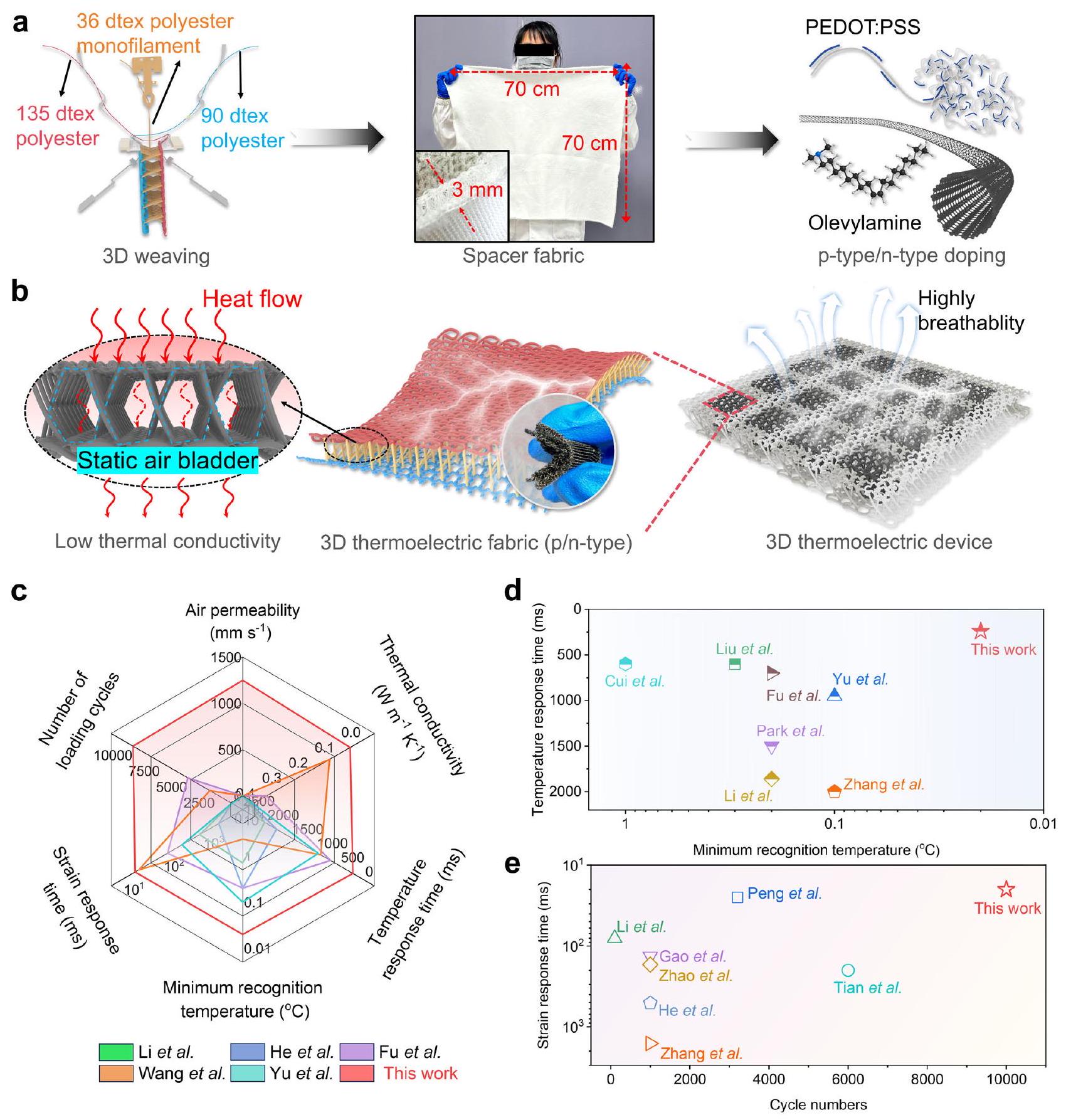
تظهر أجهزة الاستشعار المعتمدة على الحرارة الكهروحرارية، مثل أجهزة استشعار TESF، استجابة سريعة لدرجة الحرارة تصل إلى 240 مللي ثانية واعتراف دقيق بفروق درجة الحرارة يصل إلى 0.02 كلفن، وكلاهما يمثل مستويات أداء عالية في الأجهزة الكهروحرارية المتاحة (الشكل 1d، انظر الجدول التكميلي 1 للمقارنات التفصيلية).
أداء الاستشعار
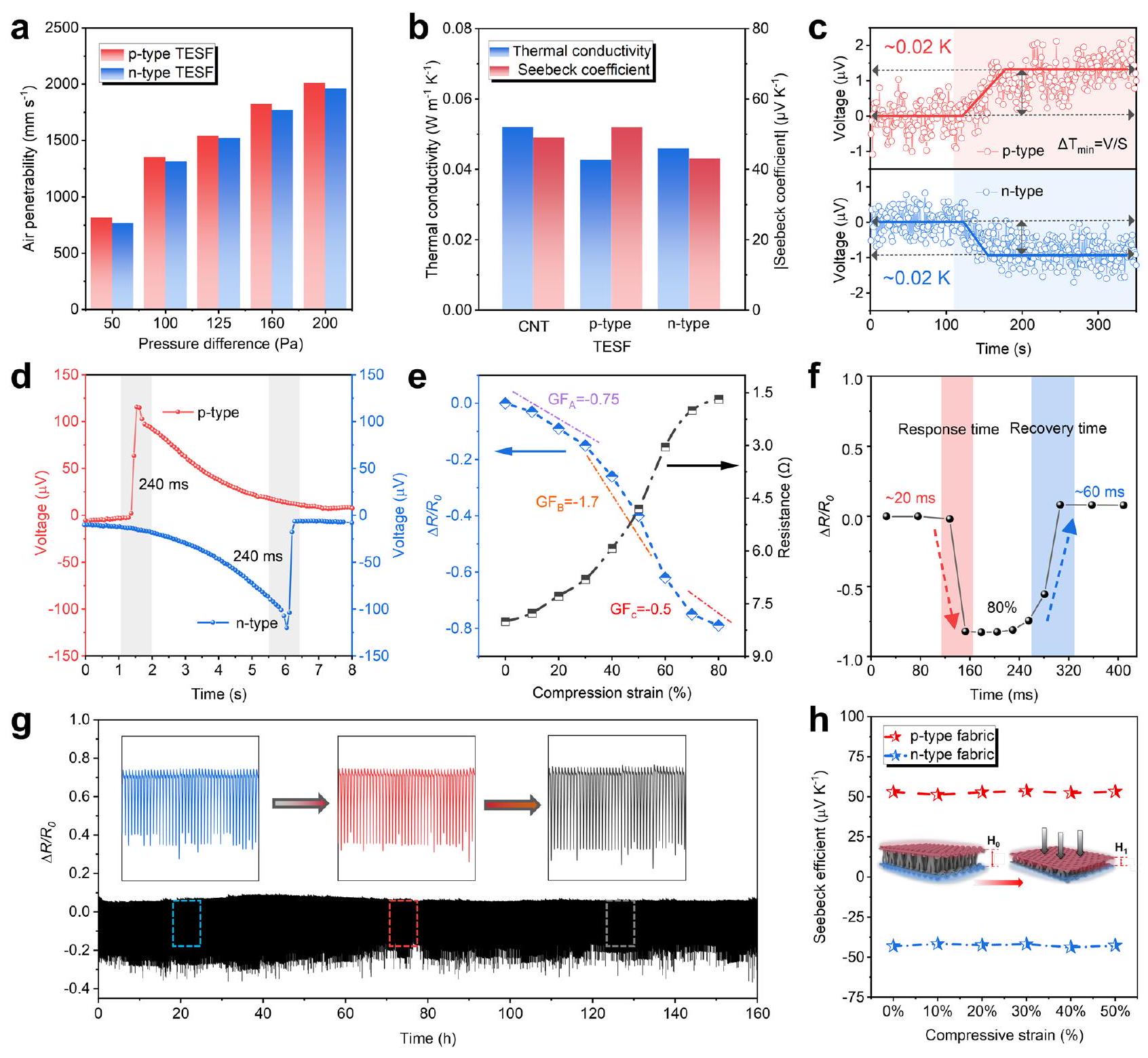
وقت الاستجابة لنوع p ونوع n من TESF. استجابة المقاومة لـ TESF تحت ضغوط انضغاطية مختلفة، حيث
تم تقديمه كمواد مضافة من النوع n إلى الأنابيب النانوية الكربونية،
هيكل الدعم من قماش الفاصل يوفر أيضًا إمكانية استخدامه كحساس بيزوريستيف. الألياف الأحادية القوية من البوليستر في القماش تنحني تحت الضغط الخارجي وتعود إلى حالتها الأصلية بمجرد إزالة القوة (الشكل التكميلي 11a). الشكل التكميلي 11b يظهر منحنيات إجهاد الانضغاط لعينة مختلفة. مقارنةً بقماش الفاصل الأولي، زاد الإجهاد في كل من TESF من النوع p و TESF من النوع n بشكل كبير، بسبب التأثيرات الصلبة لجزيئات الكربون النانوية في المواد المضافة. اخترنا TESF من النوع p كمرجع لفحص التغيرات الميكانيكية والكهربائية له عن كثب أثناء الانضغاط. كما هو موضح في الشكل التكميلي 11c، لا يظهر القماش أي تاريح أو تعب ملحوظ تحت
تحت ضغوط مختلفة
زاوية الاتصال بين خيوط الفاصل والسطحين تقل، مما يزيد من مساحة الاتصال ويخلق المزيد من المسارات الموصلية. استنادًا إلى هذا المفهوم، قمنا بتقييم مقاومة الأقمشة تحت تشوهات ضغط مختلفة لإظهار إمكاناتها في الاستشعار بالضغط (الشكل 2e). يمكن تصنيف عامل القياس (GF) أثناء الضغط إلى ثلاثة أنظمة:
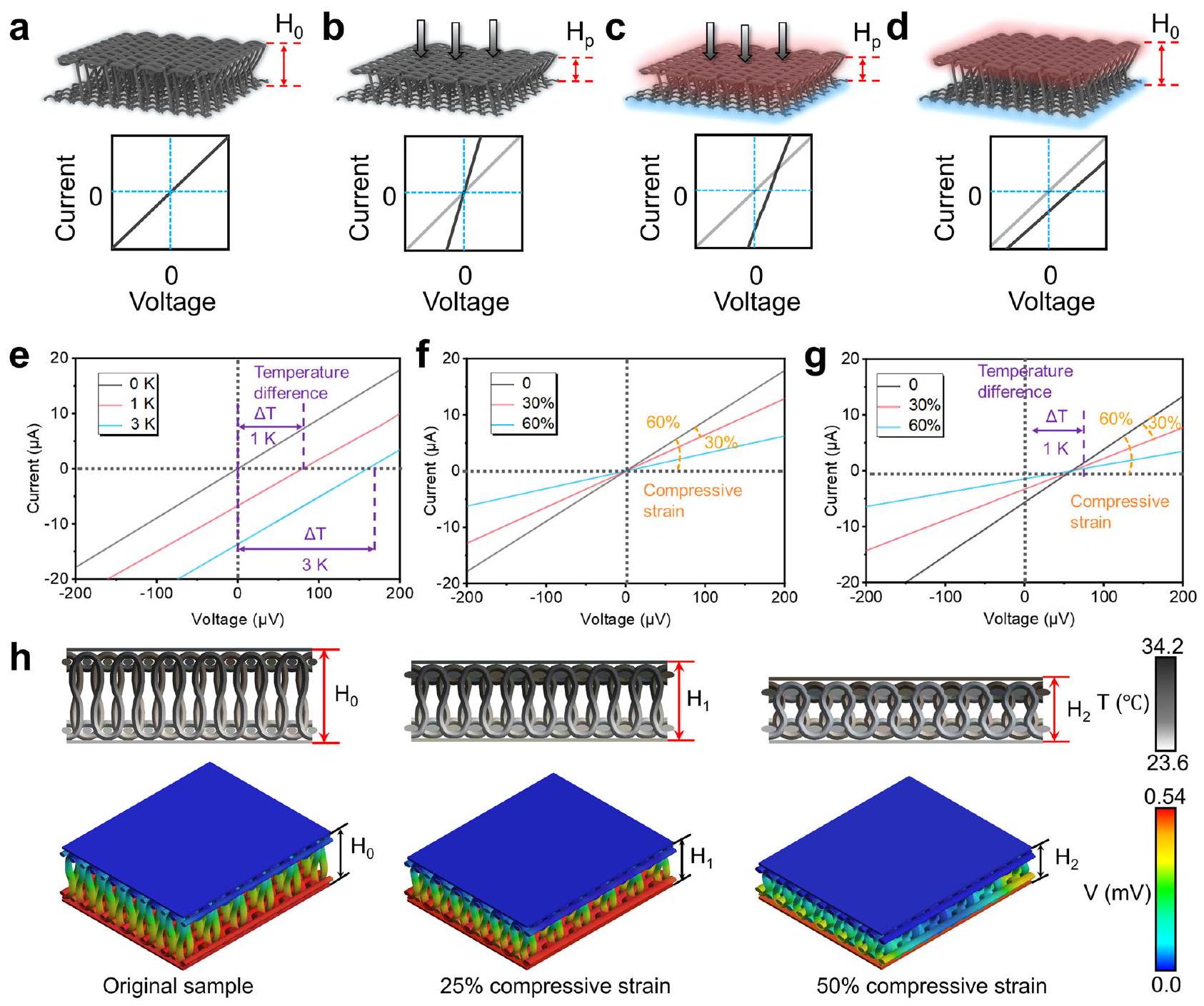
بين المقاومة الداخلية وجهد الخرج خلال العمليات الديناميكية، قمنا بتقييم
آلية فك الارتباط
عندما تم إزالة الإجهاد الانضغاطي،
بطريقة مفصولة بسبب تأثيرات المقاومة الضاغطة وتأثير سيبك (فيلم إضافي 3). وهذا يشير إلى أن TESF ليس فقط، ولكن أيضًا الأجهزة المرنة المصنوعة مع TESF المدمج، تظهر فصل إشارات المقاومة الناتجة عن الإجهاد وإشارات الجهد الحراري الناتجة عن
تطبيقات الاستشعار
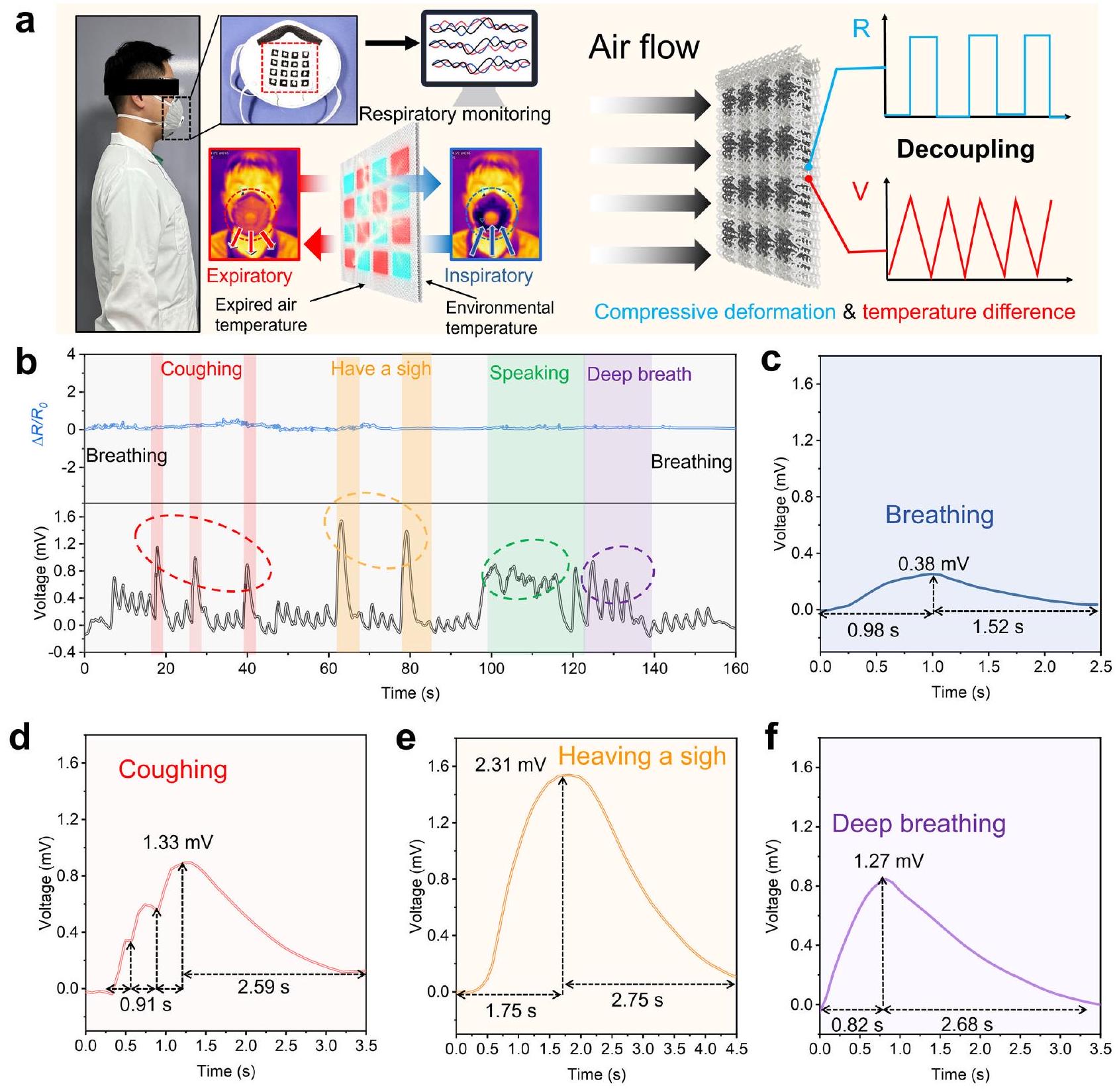
أ. مخطط تخطيطي للكمامة الذكية المدمجة في كمامة N95 لمراقبة حالة التنفس، بما في ذلك صور بالأشعة تحت الحمراء تظهر تغييرات في درجة الحرارة أثناء الزفير والشهيق. ب. خرج الجهد الحراري في الوقت الحقيقي للكمامة الذكية.
خلال مختلف إجراءات التنفس، بما في ذلك الزفير والشهيق، ووجهات نظر مكبرة لـ (ج) إشارات الجهد الحراري أثناء التنفس، (د) إشارات الجهد الحراري أثناء السعال، (هـ) إشارات الجهد الحراري أثناء التنهيد، و (و) إشارات الجهد الحراري أثناء التنفس العميق.
يمكن أن توفر بيانات الوقت الملاحظة على الهاتف تحذيرًا مسبقًا لتجنب الحروق.
تتطلب الإعاقات تنسيق حركات الأصابع وتفاعلاً عالياً لتعلم لغة الإشارة. قمنا بتصميم قفاز ذكي قادر على تحويل حركات الأصابع إلى إشارات كهربائية، بهدف تعزيز تعلم لغة الإشارة للأفراد ذوي الإعاقات الكلامية (الشكل 5د). قمنا بتثبيت مستشعر ضغط انضغاطي على مفاصل القفاز لالتقاط الضغط الناتج أثناء حركات الأصابع ونقل الإشارات الملتقطة إلى جهاز كمبيوتر شخصي لتحليل الأداء. لا يعالج هذا القفاز الذكي التحديات الأولية لتعلم لغة الإشارة للأفراد ذوي الإعاقات الكلامية فحسب، بل يوفر أيضًا وسيلة للتواصل عن بُعد للأشخاص ذوي الإعاقات. تظهر إشارات الخرج للقفاز عند أداء أرقام لغة الإشارة من 1 إلى 5 في الشكل التكميلي 32.
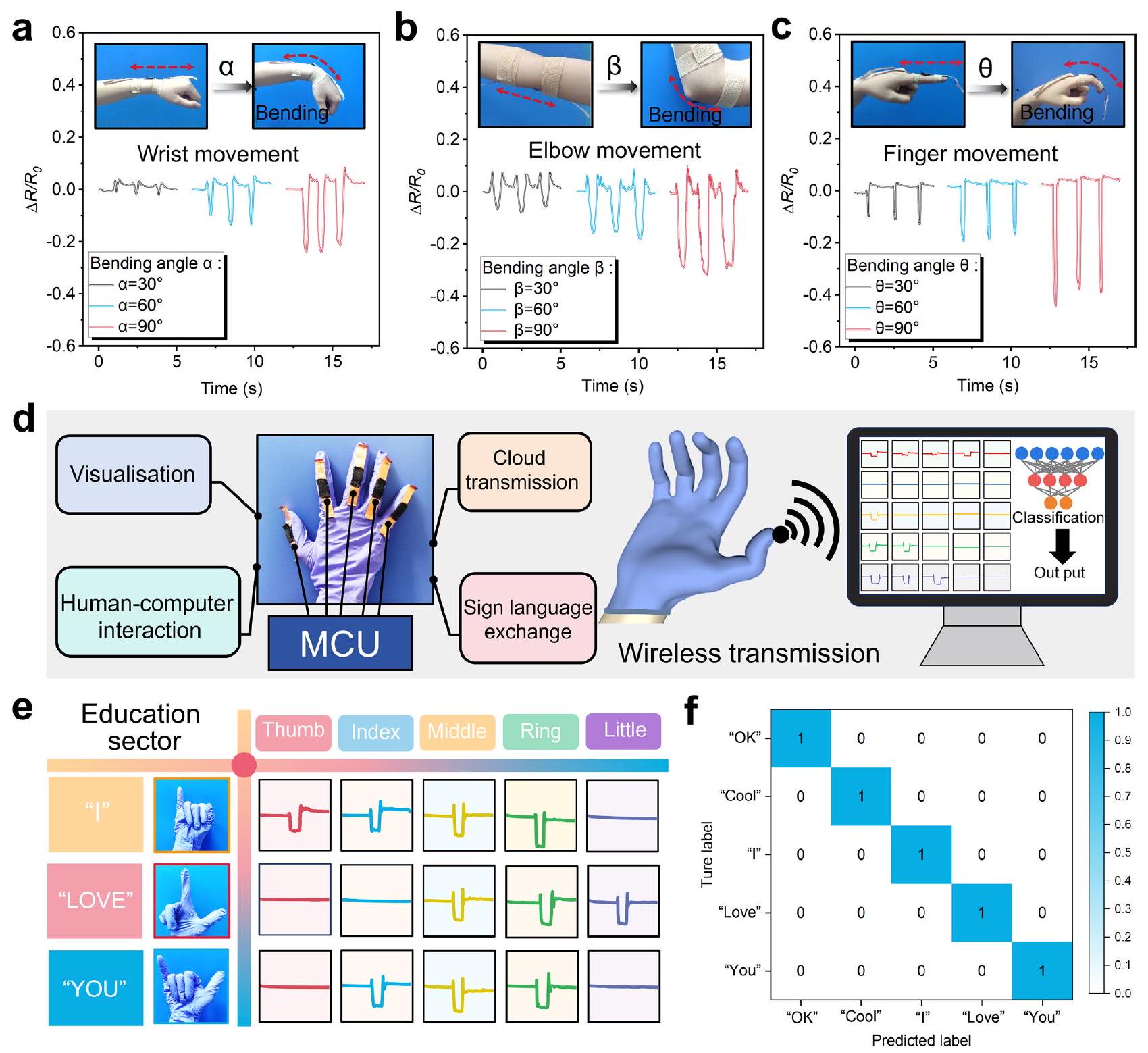
مخطط تخطيطي للتحويل المقابل للغة الإشارة وإشارات الاستشعار، حيث تكون إشارات الاختبار جميعها
الإشارات. من خلال تمييز ترتيب وتركيب حركات الأصابع، يمكن تعيين معاني محددة. يمكن تفسير الإشارات المجمعة من القفاز الذكي لفهم لغة الإشارة من خلال تحليل أنماط حركات الأصابع هذه. لتحقيق التعرف الذكي على إيماءات لغة الإشارة، قمنا بتصميم وتنفيذ نموذج تعلم آلي يعتمد على SVM من أجل تصنيف دقيق والتعرف على إشارات الأجهزة المعقدة، وطورنا استراتيجية تدريب على لغة الإشارة مدعومة بالتعلم الآلي (الشكل التكميلي 34). في عملية التنفيذ، قمنا أولاً باستخراج السمات الرئيسية للإشارات من خلال هندسة الميزات، ثم استخدمنا دالة الأساس الشعاعي (RBF) لتعزيز قدرات التصنيف غير الخطية لـ SVM. بالإضافة إلى ذلك، قمنا بتحسين المعلمات الفائقة للنموذج باستخدام استراتيجيات البحث الشبكي والتحقق المتقاطع، مما أدى إلى تحسين دقة التصنيف بشكل كبير. يمكن للنموذج تحقيق
نقاش
نموذج تعلم آلي قائم على البيانات، قمنا بتطوير قفازات ذكية تساعد الأفراد ذوي الإعاقة في تعلم لغة الإشارة، محققين دقة في التعرف على لغة الإشارة تبلغ
طرق
المواد
تحضير قماش الفضاء المحبوك بالنسج المتداخل
تحضير نسيج الفضاء الحراري الكهربي من أنابيب الكربون النانوية (TESF) ونسيج TESF من النوعين الموجب والسالب
توصيف
تم التحكم في درجة الحرارة من خلال عناصر بيلتييه المتاحة تجارياً والمتصلة بمصدر طاقة تيار مستمر (KEYSIGHT، E3634A). تم تسجيل جهد الخرج وتصديره عبر مقياس متعدد (Keithley 2450).
توفر البيانات
References
- Yang, Q. et al. Flexible thermoelectrics based on ductile semiconductors. Science 377, 854-858 (2022).
- Zhao, P. et al. Plasticity in single-crystalline
thermoelectric material. Nature 631, 777-782 (2024). - Wang, D. et al. Multi-heterojunctioned plastics with high thermoelectric figure of merit. Nature 632, 528-535 (2024).
- Shi, X.-L. et al. Advancing flexible thermoelectrics for integrated electronics. Chem. Soc. Rev. 53, 9254-9305 (2024).
- Chen, W. et al. Nanobinders Advance Screen-Printed Flexible Thermoelectrics. Science 386, 1265-1271 (2024).
- Zhao, L.-D. et al. Ultrahigh power factor and thermoelectric performance in hole-doped single-crystal SnSe. Science 351, 141-144 (2016).
- Ibáñez, M. et al. High-performance thermoelectric nanocomposites from nanocrystal building blocks. Nat. Commun. 7, 10766 (2016).
- Ortega, S. et al. Bottom-up engineering of thermoelectric nanomaterials and devices from solution-processed nanoparticle building blocks. Chem. Soc. Rev. 46, 3510-3528 (2017).
- Hou, C. & Zhu, M. Semiconductors flex thermoelectric power. Science 377, 815-816 (2022).
- Lu, Y. et al. Staggered-layer-boosted flexible
films with high thermoelectric performance. Nat. Nanotechnol. 18, 1281-1288 (2023). - Jin, Q. et al. Flexible layer-structured
thermoelectric on a carbon nanotube scaffold. Nat. Mater. 18, 62-68 (2019). - Ding, Y. et al. High Performance n-Type
Film on Nylon Membrane for Flexible Thermoelectric Power Generator. Nat. Commun. 10, 841 (2019). - Wang, L. et al. Exceptional thermoelectric properties of flexible organic-inorganic hybrids with monodispersed and periodic nanophase. Nat. Commun. 9, 3817 (2018).
- Yang, G. et al. The role of spin in thermoelectricity. Nat. Rev. Phys. 5, 466-482 (2023).
- Wang, X., Du, Y., Dou, S. & Zhang, C. Room Temperature Giant and Linear Magnetoresistance in Topological Insulator
Nanosheets. Phys. Rev. Lett. 108, 266806 (2012). - Yang, G. et al. Ultra-High Thermoelectric Performance in Bulk BiSbTe/Amorphous Boron Composites with Nano-Defect Architectures. Adv. Energy Mater. 10, 2000757 (2020).
- Zhao, L. et al. Significant enhancement of figure-of-merit in carbonreinforced
nanocrystalline solids. Nano Energy 41, 164-171 (2017). - Wang, Y. et al. Advancements in Nanotechnology-Based PEDOT and Its Composites for Wearable Thermoelectric Applications. Small Sci. 4, 2400149 (2024).
- Mao, J. et al. High thermoelectric cooling performance of n-type
-based materials. Science 365, 495-498 (2019). - Liu, Y. et al. Scalable-produced 3D elastic thermoelectric network for body heat harvesting. Nat. Commun. 14, 3058 (2023).
- Zhang, F., Zang, Y., Huang, D., Di, C.-A. & Zhu, D. Flexible and selfpowered temperature-pressure dual-parameter sensors using microstructure-frame-supported organic thermoelectric materials. Nat. Commun. 6, 8356 (2015).
- Mao, J., Chen, G. & Ren, Z. Thermoelectric cooling materials. Nat. Mater. 20, 454-461 (2021).
- Fiedler, C., Calcabrini, M., Liu, Y. & Ibáñez, M. Unveiling Crucial Chemical Processing Parameters Influencing the Performance of Solution-Processed Inorganic Thermoelectric Materials. Angew. Chem. Int Ed. 63, e202402628 (2024).
- Yang, D. et al. Flexible power generators by
thin films with record-high thermoelectric performance. Nat. Commun. 15, 923 (2024). - Kang, M. et al. Self-Powered Temperature Electronic Skin Based on Island-Bridge Structure and Bi-Te Micro-Thermoelectric Generator for Distributed Mini-Region Sensing. Adv. Mater. 35, 2309629 (2023).
- He, W. et al. High thermoelectric performance in low-cost
crystals. Science 365, 1418-1424 (2019). - Chang, C. et al. 3D charge and 2D phonon transports leading to high out-of-plane ZT in n-type SnSe crystals. Science 360, 778-783 (2018).
- Zheng, Z.-H. et al. Harvesting waste heat with flexible
thermoelectric thin film. Nat. Sustain 6, 180-191 (2023). - Wang, L. et al. Solution-Printable Fullerene/
Organic/Inorganic Hybrids for High-Performance Flexible -Type Thermoelectrics. Energy Environ. Sci. 11, 1307-1317 (2018). - Nan, K. et al. Compliant and stretchable thermoelectric coils for energy harvesting in miniature flexible devices. Sci. Adv. 4, eaau5849 (2018).
- Hao, Y. et al. Stretchable Thermoelectrics: Strategies, Performances, and Applications. Adv. Funct. Mater. 32, 2109790 (2022).
- Sun, T. et al. Stretchable Fabric Generates Electric Power from Woven Thermoelectric Fibers. Nat. Commun. 11, 572 (2020).
- Shi, X.-L. et al. Advances in flexible inorganic thermoelectrics. EcoEnergy 1, 296-343 (2023).
- Xia, B. et al. Vertically designed high-performance and flexible thermoelectric generator based on optimized PEDOT:PSS/SWCNTs composite films. Chem. Eng. J. 486, 150305 (2024).
- Bao, X. et al. Mechanical properties of thermoelectric generators. J. Mater. Sci. Technol. 148, 64-74 (2023).
- Balazs, D. M. & Ibáñez, M. Widening the use of 3D printing. Science 381, 1413-1414 (2023).
- Deng, Y.-Y. et al. High-performance thermoelectric PEDOT:PSS fiber bundles via rational ionic liquid treatment. Chem. Eng. J. 502, 158104 (2024).
- Mano, G. et al. Fabrication, characterization, and thermoelectric properties of soft polyurethane foam loaded with semiconducting poly(3-hexylthiophene) nanofibers. J. Appl Polym. Sci. 139, 52354 (2022).
- Zhang, L. et al. Fiber-Based Thermoelectric Generators: Materials, Device Structures, Fabrication, Characterization, and Applications. Adv. Energy Mater. 8, 1700524 (2018).
- Sun, T. et al. Wavy-structured thermoelectric device integrated with high-performance n-type carbon nanotube fiber prepared by multistep treatment for energy harvesting. Compos Commun. 27, 100871 (2021).
- Jabri, M., Masoumi, S., Kandukuri, T. R. & Occhipinti, L. G. Flexible thin-film thermoelectric generators for human skin-heat harvesting: A numerical study. Nano Energy 129, 110001 (2024).
- Kim, D., Kim, Y., Choi, K., Grunlan, J. C. & Yu, C. Improved Thermoelectric Behavior of Nanotube-Filled Polymer Composites with Poly(3,4-ethylenedioxythiophene) Poly(styrenesulfonate). ACS Nano 4, 513-523 (2010).
- Fu, Y. et al. Ultraflexible Temperature-Strain Dual-Sensor Based on Chalcogenide Glass-Polymer Film for Human-Machine Interaction. Adv. Mater. 36, 2313101 (2024).
- He, Y., Lin, X., Feng, Y., Luo, B. & Liu, M. Carbon Nanotube Ink Dispersed by Chitin Nanocrystals for Thermoelectric Converter for Self-Powering Multifunctional Wearable Electronics. Adv. Sci. 9, 2204675 (2022).
- Li, F. et al. Printable and Stretchable Temperature-Strain DualSensing Nanocomposite with High Sensitivity and Perfect Stimulus Discriminability. Nano Lett. 20, 6176-6184 (2020).
- Wang, Y. et al. Self-powered wearable pressure sensing system for continuous healthcare monitoring enabled by flexible thin-film thermoelectric generator. Nano Energy 73, 104773 (2020).
- Yu, H. et al. Flexible temperature-pressure dual sensor based on 3D spiral thermoelectric
films. Nat. Commun. 15, 2521 (2024). - Cui, Y. et al. Highly Stretchable, Sensitive, and Multifunctional Thermoelectric Fabric for Synergistic-Sensing Systems of Human Signal Monitoring. Adv. Fiber Mater. 6, 170-180 (2024).
- Liu, S., Zhang, M., Kong, J., Li, H. & He, C. Flexible, durable, green thermoelectric composite fabrics for textile-based wearable energy harvesting and self-powered sensing. Compos Sci. Technol. 243, 110245 (2023).
- Park, H. et al. Microporous Polypyrrole-Coated Graphene Foam for High-Performance Multifunctional Sensors and Flexible Supercapacitors. Adv. Funct. Mater. 28, 1707013 (2018).
- Zhang, D., Zhang, K., Wang, Y., Wang, Y. & Yang, Y. Thermoelectric effect induced electricity in stretchable graphene-polymer nanocomposites for ultrasensitive self-powered strain sensor system. Nano Energy 56, 25-32 (2019).
- Tian, Y. et al. Ultra-stretchable, sensitive and breathable electronic skin based on TPU electrospinning fibrous membrane with microcrack structure for human motion monitoring and self-powered application. Chem. Eng. J. 480, 147899 (2024).
- Zhao, X. et al. Thermoelectric generator based on anisotropic wood aerogel for low-grade heat energy harvesting. J. Mater. Sci. Technol. 120, 150-158 (2022).
- Gao, X.-Z. et al. Self-Powered Resilient Porous Sensors with Thermoelectric Poly(3,4-ethylenedioxythiophene):Poly(styrenesulfonate) and Carbon Nanotubes for Sensitive Temperature and Pressure Dual-Mode Sensing. ACS Appl Mater. Interfaces 14, 43783-43791 (2022).
- Li, M. et al. Large-Area, Wearable, Self-Powered Pressure-Temperature Sensor Based on 3D Thermoelectric Spacer Fabric. ACS Sens 5, 2545-2554 (2020).
- Peng, J. et al. MXene-based thermoelectric fabric integrated with temperature and strain sensing for health monitoring. J. Mater. Sci. Technol. 212, 272-280 (2025).
- He, X. et al. Continuous manufacture of stretchable and integratable thermoelectric nanofiber yarn for human body energy harvesting and self-powered motion detection. Chem. Eng. J. 450, 137937 (2022).
- Kim, J.-Y., Lee, W., Kang, Y. H., Cho, S. Y. & Jang, K.-S. Wet-Spinning and Post-Treatment of CNT/PEDOT:PSS Composites for Use in
59. Hsu, J.-H. & Yu, C. Sorting-free utilization of semiconducting carbon nanotubes for large thermoelectric responses. Nano Energy 67, 104282 (2020).
شكر وتقدير
مساهمات المؤلفين
المصالح المتنافسة
معلومات إضافية
معلومات إعادة الطبع والتصاريح متاحة على
(ج) المؤلف(ون) 2025
مركز شنغهاي للعلوم الأمامية للأقمشة المتقدمة، كلية الأقمشة، جامعة دونغوا، شنغهاي، الصين. كلية الكيمياء والفيزياء، مركز أبحاث ARC في توليد الطاقة بدون انبعاثات من أجل الحياد الكربوني ومركز علوم المواد، جامعة كوينزلاند للتكنولوجيا، بريسبان، كوينزلاند، أستراليا. مركز المواد المركبة للطيران المدني، كلية الأقمشة، جامعة دونغوا، شنغهاي، الصين. مركز أبحاث تكنولوجيا الحياكة، وزارة التعليم، جامعة جيانغنان، ووشي، جيانغسو، الصين. ساهم هؤلاء المؤلفون بالتساوي: شين يانغ هي، شياو-لي شي.
البريد الإلكتروني: wangliming@dhu.edu.cn; xhqin@dhu.edu.cn; zhigang.chen@qut.edu.au
DOI: https://doi.org/10.1038/s41467-025-57889-1
PMID: https://pubmed.ncbi.nlm.nih.gov/40082483
Publication Date: 2025-03-14
Three-dimensional flexible thermoelectric fabrics for smart wearables
Received: 2 October 2024
Accepted: 4 March 2025
Check for updates
Abstract
Wearable thermoelectric devices, capable of converting body heat into electrical energy, provide the potential driving power for the Internet of Things, artificial intelligence, and soft robotics. However, critical parameters have long been overlooked for these practical applications. Here, we report a threedimensional flexible thermoelectric device with a structure featuring an inner rigid and outer flexible woven design. Such a structure includes numerous small static air pockets that create a stable out-of-plane temperature difference, enabling precise temperature signal detection (accuracy up to 0.02 K ). Particularly, this structure exhibits excellent multi-signal decoupling capability, excellent elasticity (
(F-TEDs) stand out as excellent candidates for wearable energy harvesting and conversion systems
output voltage even under large deformations of up to
Results
Device fabrication
the latest thermoelectric-based temperature sensors, TESF-based sensors exhibit a rapid temperature response of up to 240 ms and precise temperature difference recognition of 0.02 K , both of which represent the high performance levels in available thermoelectric devices (Fig. 1d, see Supplementary Table 1 for detailed comparisons)
Sensing performance
response time for p-type and n-type TESF. e Resistance response of TESF under different compressive strains, where
introduced as an n-type dopant to the CNTs, the
supporting structure of the spacer fabric also lends potential for its use as a piezoresistive sensor. The strong polyester monofilaments in the fabric bend under external pressure and return to their original state once the force is removed (Supplementary Fig. 11a). Supplementary Fig. 11b shows the compression strain-stress curves for different samples. Compared to the initial spacer fabric, the stress in both p-type and n-type TESF significantly increased, due to the rigid effects of the CNTs in the dopants. We selected p-type TESF as a reference to closely examine its mechanical and electrical changes during compression. As shown in Supplementary Fig. 11c, the fabric exhibits no significant hysteresis or fatigue under
under different strains
the contact angle between the spacer yarns and the two planes decreases, increasing the contact area and creating more conductive pathways. Based on this concept, we evaluated the resistance of the fabrics under different compression deformations to demonstrate their piezoresistive sensing potential (Fig. 2e). The gauge factor (GF) during compression can be categorized into three regimes:
between internal resistance and output voltage during dynamic processes, we evaluated the
Decoupling mechanism
when the compressive stress was removed, the
decoupled manner due to the piezoresistive and Seebeck effects (Supplementary Movie 3). This indicates that not only TESF, but also the flexible devices fabricated with integrated TESF, exhibit decoupling of resistance signals caused by strain and thermoelectric voltage signals induced by
Sensing applications
a Schematic diagram of the smart mask integrated into an N95 mask for monitoring respiratory status, including infrared images showing temperature changes during expiration and inhalation. b Real-time thermal voltage output of the smart mask
during various respiratory actions, including expiration and inhalation, and magnified views of (c) thermal voltage signals during breathing, (d) thermal voltage signals during coughing, (e) thermal voltage signals during sighing, and (f) thermal voltage signals during deep breathing.
time data observed on the phone can provide pre-warning to avoid burns and scalds.
impairments require coordinated finger gestures and high interaction for learning sign language. We designed a smart glove capable of converting finger movements into electrical signals, aimed at enhancing sign language learning for individuals with speech impairments (Fig. 5d). We attached a compressive strain sensor to the joints of the glove to capture the pressure generated during finger movements and transmitted the captured signals to a personal computer for performance analysis. Such a smart glove not only addresses the initial challenges of sign language learning for individuals with speech impairments but also provides a method for remote communication for people with disabilities. The output signals of the glove when performing sign language numbers 1-5 are shown in Supplementary Fig. 32.
e Schematic diagram of the corresponding transformation of sign language and sensing signals, where the test signals are all
signals. By distinguishing the arrangement and combination of finger movements, specific meanings can be assigned. The collected signals of the smart glove can be interpreted to understand sign language by analyzing these finger movement patterns. To achieve intelligent recognition of sign language gestures, we designed and implemented a machine learning model based on SVM for precise classification and recognition of complex device signals and developed a machine learning-assisted sign language training strategy (Supplementary Fig. 34). In the implementation process, we first extracted key attributes of the signals through feature engineering and then used a radial basis function (RBF) kernel to enhance the non-linear classification capabilities of SVM. Additionally, we optimized the hyperparameters of the model using grid search and cross-validation strategies, which significantly improved the classification accuracy. The model can achieve a
Discussion
based machine learning model, we developed smart gloves that assist individuals with disabilities in learning sign language, achieving a sign language recognition accuracy of
Methods
Materials
Preparation of warp-knitted spacer fabric
Preparation of CNT thermoelectric spacer fabric (TESF) and p/ntype TESF
Characterization
measurement. Temperature control was managed via commercially available Peltier elements connected to a DC power supply (KEYSIGHT, E3634A). The output voltage was recorded and exported via a multimeter (Keithley 2450).
Data availability
References
- Yang, Q. et al. Flexible thermoelectrics based on ductile semiconductors. Science 377, 854-858 (2022).
- Zhao, P. et al. Plasticity in single-crystalline
thermoelectric material. Nature 631, 777-782 (2024). - Wang, D. et al. Multi-heterojunctioned plastics with high thermoelectric figure of merit. Nature 632, 528-535 (2024).
- Shi, X.-L. et al. Advancing flexible thermoelectrics for integrated electronics. Chem. Soc. Rev. 53, 9254-9305 (2024).
- Chen, W. et al. Nanobinders Advance Screen-Printed Flexible Thermoelectrics. Science 386, 1265-1271 (2024).
- Zhao, L.-D. et al. Ultrahigh power factor and thermoelectric performance in hole-doped single-crystal SnSe. Science 351, 141-144 (2016).
- Ibáñez, M. et al. High-performance thermoelectric nanocomposites from nanocrystal building blocks. Nat. Commun. 7, 10766 (2016).
- Ortega, S. et al. Bottom-up engineering of thermoelectric nanomaterials and devices from solution-processed nanoparticle building blocks. Chem. Soc. Rev. 46, 3510-3528 (2017).
- Hou, C. & Zhu, M. Semiconductors flex thermoelectric power. Science 377, 815-816 (2022).
- Lu, Y. et al. Staggered-layer-boosted flexible
films with high thermoelectric performance. Nat. Nanotechnol. 18, 1281-1288 (2023). - Jin, Q. et al. Flexible layer-structured
thermoelectric on a carbon nanotube scaffold. Nat. Mater. 18, 62-68 (2019). - Ding, Y. et al. High Performance n-Type
Film on Nylon Membrane for Flexible Thermoelectric Power Generator. Nat. Commun. 10, 841 (2019). - Wang, L. et al. Exceptional thermoelectric properties of flexible organic-inorganic hybrids with monodispersed and periodic nanophase. Nat. Commun. 9, 3817 (2018).
- Yang, G. et al. The role of spin in thermoelectricity. Nat. Rev. Phys. 5, 466-482 (2023).
- Wang, X., Du, Y., Dou, S. & Zhang, C. Room Temperature Giant and Linear Magnetoresistance in Topological Insulator
Nanosheets. Phys. Rev. Lett. 108, 266806 (2012). - Yang, G. et al. Ultra-High Thermoelectric Performance in Bulk BiSbTe/Amorphous Boron Composites with Nano-Defect Architectures. Adv. Energy Mater. 10, 2000757 (2020).
- Zhao, L. et al. Significant enhancement of figure-of-merit in carbonreinforced
nanocrystalline solids. Nano Energy 41, 164-171 (2017). - Wang, Y. et al. Advancements in Nanotechnology-Based PEDOT and Its Composites for Wearable Thermoelectric Applications. Small Sci. 4, 2400149 (2024).
- Mao, J. et al. High thermoelectric cooling performance of n-type
-based materials. Science 365, 495-498 (2019). - Liu, Y. et al. Scalable-produced 3D elastic thermoelectric network for body heat harvesting. Nat. Commun. 14, 3058 (2023).
- Zhang, F., Zang, Y., Huang, D., Di, C.-A. & Zhu, D. Flexible and selfpowered temperature-pressure dual-parameter sensors using microstructure-frame-supported organic thermoelectric materials. Nat. Commun. 6, 8356 (2015).
- Mao, J., Chen, G. & Ren, Z. Thermoelectric cooling materials. Nat. Mater. 20, 454-461 (2021).
- Fiedler, C., Calcabrini, M., Liu, Y. & Ibáñez, M. Unveiling Crucial Chemical Processing Parameters Influencing the Performance of Solution-Processed Inorganic Thermoelectric Materials. Angew. Chem. Int Ed. 63, e202402628 (2024).
- Yang, D. et al. Flexible power generators by
thin films with record-high thermoelectric performance. Nat. Commun. 15, 923 (2024). - Kang, M. et al. Self-Powered Temperature Electronic Skin Based on Island-Bridge Structure and Bi-Te Micro-Thermoelectric Generator for Distributed Mini-Region Sensing. Adv. Mater. 35, 2309629 (2023).
- He, W. et al. High thermoelectric performance in low-cost
crystals. Science 365, 1418-1424 (2019). - Chang, C. et al. 3D charge and 2D phonon transports leading to high out-of-plane ZT in n-type SnSe crystals. Science 360, 778-783 (2018).
- Zheng, Z.-H. et al. Harvesting waste heat with flexible
thermoelectric thin film. Nat. Sustain 6, 180-191 (2023). - Wang, L. et al. Solution-Printable Fullerene/
Organic/Inorganic Hybrids for High-Performance Flexible -Type Thermoelectrics. Energy Environ. Sci. 11, 1307-1317 (2018). - Nan, K. et al. Compliant and stretchable thermoelectric coils for energy harvesting in miniature flexible devices. Sci. Adv. 4, eaau5849 (2018).
- Hao, Y. et al. Stretchable Thermoelectrics: Strategies, Performances, and Applications. Adv. Funct. Mater. 32, 2109790 (2022).
- Sun, T. et al. Stretchable Fabric Generates Electric Power from Woven Thermoelectric Fibers. Nat. Commun. 11, 572 (2020).
- Shi, X.-L. et al. Advances in flexible inorganic thermoelectrics. EcoEnergy 1, 296-343 (2023).
- Xia, B. et al. Vertically designed high-performance and flexible thermoelectric generator based on optimized PEDOT:PSS/SWCNTs composite films. Chem. Eng. J. 486, 150305 (2024).
- Bao, X. et al. Mechanical properties of thermoelectric generators. J. Mater. Sci. Technol. 148, 64-74 (2023).
- Balazs, D. M. & Ibáñez, M. Widening the use of 3D printing. Science 381, 1413-1414 (2023).
- Deng, Y.-Y. et al. High-performance thermoelectric PEDOT:PSS fiber bundles via rational ionic liquid treatment. Chem. Eng. J. 502, 158104 (2024).
- Mano, G. et al. Fabrication, characterization, and thermoelectric properties of soft polyurethane foam loaded with semiconducting poly(3-hexylthiophene) nanofibers. J. Appl Polym. Sci. 139, 52354 (2022).
- Zhang, L. et al. Fiber-Based Thermoelectric Generators: Materials, Device Structures, Fabrication, Characterization, and Applications. Adv. Energy Mater. 8, 1700524 (2018).
- Sun, T. et al. Wavy-structured thermoelectric device integrated with high-performance n-type carbon nanotube fiber prepared by multistep treatment for energy harvesting. Compos Commun. 27, 100871 (2021).
- Jabri, M., Masoumi, S., Kandukuri, T. R. & Occhipinti, L. G. Flexible thin-film thermoelectric generators for human skin-heat harvesting: A numerical study. Nano Energy 129, 110001 (2024).
- Kim, D., Kim, Y., Choi, K., Grunlan, J. C. & Yu, C. Improved Thermoelectric Behavior of Nanotube-Filled Polymer Composites with Poly(3,4-ethylenedioxythiophene) Poly(styrenesulfonate). ACS Nano 4, 513-523 (2010).
- Fu, Y. et al. Ultraflexible Temperature-Strain Dual-Sensor Based on Chalcogenide Glass-Polymer Film for Human-Machine Interaction. Adv. Mater. 36, 2313101 (2024).
- He, Y., Lin, X., Feng, Y., Luo, B. & Liu, M. Carbon Nanotube Ink Dispersed by Chitin Nanocrystals for Thermoelectric Converter for Self-Powering Multifunctional Wearable Electronics. Adv. Sci. 9, 2204675 (2022).
- Li, F. et al. Printable and Stretchable Temperature-Strain DualSensing Nanocomposite with High Sensitivity and Perfect Stimulus Discriminability. Nano Lett. 20, 6176-6184 (2020).
- Wang, Y. et al. Self-powered wearable pressure sensing system for continuous healthcare monitoring enabled by flexible thin-film thermoelectric generator. Nano Energy 73, 104773 (2020).
- Yu, H. et al. Flexible temperature-pressure dual sensor based on 3D spiral thermoelectric
films. Nat. Commun. 15, 2521 (2024). - Cui, Y. et al. Highly Stretchable, Sensitive, and Multifunctional Thermoelectric Fabric for Synergistic-Sensing Systems of Human Signal Monitoring. Adv. Fiber Mater. 6, 170-180 (2024).
- Liu, S., Zhang, M., Kong, J., Li, H. & He, C. Flexible, durable, green thermoelectric composite fabrics for textile-based wearable energy harvesting and self-powered sensing. Compos Sci. Technol. 243, 110245 (2023).
- Park, H. et al. Microporous Polypyrrole-Coated Graphene Foam for High-Performance Multifunctional Sensors and Flexible Supercapacitors. Adv. Funct. Mater. 28, 1707013 (2018).
- Zhang, D., Zhang, K., Wang, Y., Wang, Y. & Yang, Y. Thermoelectric effect induced electricity in stretchable graphene-polymer nanocomposites for ultrasensitive self-powered strain sensor system. Nano Energy 56, 25-32 (2019).
- Tian, Y. et al. Ultra-stretchable, sensitive and breathable electronic skin based on TPU electrospinning fibrous membrane with microcrack structure for human motion monitoring and self-powered application. Chem. Eng. J. 480, 147899 (2024).
- Zhao, X. et al. Thermoelectric generator based on anisotropic wood aerogel for low-grade heat energy harvesting. J. Mater. Sci. Technol. 120, 150-158 (2022).
- Gao, X.-Z. et al. Self-Powered Resilient Porous Sensors with Thermoelectric Poly(3,4-ethylenedioxythiophene):Poly(styrenesulfonate) and Carbon Nanotubes for Sensitive Temperature and Pressure Dual-Mode Sensing. ACS Appl Mater. Interfaces 14, 43783-43791 (2022).
- Li, M. et al. Large-Area, Wearable, Self-Powered Pressure-Temperature Sensor Based on 3D Thermoelectric Spacer Fabric. ACS Sens 5, 2545-2554 (2020).
- Peng, J. et al. MXene-based thermoelectric fabric integrated with temperature and strain sensing for health monitoring. J. Mater. Sci. Technol. 212, 272-280 (2025).
- He, X. et al. Continuous manufacture of stretchable and integratable thermoelectric nanofiber yarn for human body energy harvesting and self-powered motion detection. Chem. Eng. J. 450, 137937 (2022).
- Kim, J.-Y., Lee, W., Kang, Y. H., Cho, S. Y. & Jang, K.-S. Wet-Spinning and Post-Treatment of CNT/PEDOT:PSS Composites for Use in
59. Hsu, J.-H. & Yu, C. Sorting-free utilization of semiconducting carbon nanotubes for large thermoelectric responses. Nano Energy 67, 104282 (2020).
Acknowledgements
Author contributions
Competing interests
Additional information
Reprints and permissions information is available at
(c) The Author(s) 2025
Shanghai Frontiers Science Center of Advanced Textiles, College of Textiles, Donghua University, Shanghai, China. School of Chemistry and Physics, ARC Research Hub in Zero-emission Power Generation for Carbon Neutrality and Centre for Materials Science, Queensland University of Technology, Brisbane, QLD, Australia. Center for Civil Aviation Composites, College of Textiles, Donghua University, Shanghai, China. Engineering Research Center of Knitting Technology, Ministry of Education, Jiangnan University, Wuxi, Jiangsu, China. These authors contributed equally: Xinyang He, Xiao-Lei Shi.
-e-mail: wangliming@dhu.edu.cn; xhqin@dhu.edu.cn; zhigang.chen@qut.edu.au