
المجلة: Scientific Reports، المجلد: 15، العدد: 1
DOI: https://doi.org/10.1038/s41598-025-86032-9
PMID: https://pubmed.ncbi.nlm.nih.gov/39805985
تاريخ النشر: 2025-01-13
DOI: https://doi.org/10.1038/s41598-025-86032-9
PMID: https://pubmed.ncbi.nlm.nih.gov/39805985
تاريخ النشر: 2025-01-13
تقارير علمية
مفتوح
إزالة فعالة لصبغة الكونغو الأحمر باستخدام الفحم النشط المستخرج من أزهار سباثوديا كامبانولاتا
تستكشف هذه التقرير إعداد وتوصيف وتطبيق الفحم النشط المستخرج من أزهار شجرة سباثوديا كامبانولاتا (SCAC) لإزالة صبغة الكونغو الأحمر (CR) من المجاري المائية. تم تصنيع SCAC باستخدام تنشيط حمض الفوسفوريك، مما أسفر عن مادة مسامية بسطح محدد (
الكلمات الرئيسية: الامتصاص، الفحم النشط، سباثوديا كامبانولاتا، صبغة الكونغو الأحمر، التجديد، دراسات التطفل
يمثل التلوث البيئي، الذي يشمل الهواء والتربة والمياه، تحديًا كبيرًا في العصر الحديث
للتخفيف من الآثار الضارة لهذه الملوثات، تم استكشاف طرق معالجة مختلفة، تشمل الأساليب الفيزيائية والكيميائية والبيولوجية. بينما تقدم العلاجات الفيزيائية مثل الترسيب والترشيح إزالة فعالة من حيث التكلفة للملوثات الجسيمية، فإن فعاليتها للملوثات المذابة محدودة، وغالبًا ما تتطلب خطوات معالجة إضافية
وجود الأصباغ الاصطناعية، التي تستخدم على نطاق واسع في صناعة النسيج بسبب ألوانها الزاهية وثباتها الكيميائي.
تعتبر صناعة النسيج، وهي مستهلك رئيسي للمياه على مستوى العالم، تعتمد على أنواع مختلفة من الأصباغ، بما في ذلك الأصباغ التفاعلية، والمباشرة، والحامضية، والمشتتة
مؤخراً، حظيت ظاهرة الامتصاص، وهي ظاهرة سطحية، باهتمام كبير لفعاليتها في إزالة مجموعة واسعة من الملوثات، بما في ذلك CR من مياه الصرف الصحي. تعتبر هذه الطريقة خيارًا مفضلًا بسبب بساطتها، وطبيعتها غير المكلفة، وإنتاج الحد الأدنى من الحمأة، وقدرات الإزالة الانتقائية، وكفاءتها العالية
حظي الفحم النشط (AC) باهتمام كبير في عملية الامتصاص بسبب مزاياه العديدة. توفر مساحته السطحية العالية، الناتجة عن هيكله المسامي، مواقع ربط وفيرة لجزيئات الامتصاص مثل CR، مما يجعله فعالًا للغاية لمجموعة واسعة من التطبيقات البيئية والصناعية. علاوة على ذلك، تعزز القدرة التجديدية الفطرية لـ AC، التي يمكن تحقيقها من خلال طرق معالجة مختلفة، استدامته الاقتصادية والبيئية بشكل كبير. بالإضافة إلى ذلك، تعتبر هذه المواد صديقة للبيئة، مع تأثير بيئي ضئيل وإمكانية الإنتاج المستدام من مصادر كربونية متنوعة، بما في ذلك قشور جوز الهند
على الرغم من مزاياها، فإن AC المستخرج من هذه المواد الأولية يقدم قيودًا كبيرة. على وجه الخصوص، حقق AC المصنوع من قشور جوز الهند مساحة سطح عالية قدرها
نظرًا لهذه القيود، فإن استكشاف مصادر الكتلة الحيوية البديلة ذات الخصائص الفريدة، مثل أزهار سباثوديا كامبانولاتا، قد يوفر طريقًا واعدًا لإعداد AC مع قدرات محسنة لامتصاص CR. تُعرف S. campanulata، المعروفة أيضًا بشجرة التوليب الأفريقية، بأنها شجرة زينة وتزرع على نطاق واسع في المناطق شبه الاستوائية، بما في ذلك الهند. استكشفت الدراسات الحديثة استخدام الكتلة الحيوية لـ S. campanulata لإعداد AC لإزالة مختلف الأصباغ من المحاليل المائية. على سبيل المثال، أظهر AC المعد باستخدام أوراق S. campanulata إمكانات امتصاص منخفضة قدرها
تتناول الدراسة أيضًا قيود المواد الكربونية النشطة الحالية المستمدة من مصادر الكتلة الحيوية المختلفة، والتي غالبًا ما تواجه تحديات مثل ارتفاع تكاليف الإنتاج، وإجراءات التركيب المعقدة، وانخفاض المساحة السطحية، وسعة الامتصاص غير الكافية. من خلال استخدام أزهار S. campanulata كمواد سابقة وحمض الفوسفوريك.
لذا، تركز هذه الدراسة الحالية على إعداد وتطبيق الفحم النشط المستمد من مصدر الكتلة الحيوية المستدام والمتاح بسهولة، زهور S. campanulata، لإزالة صبغة CR. تم استخدام دراسات الحركية والمعادلات لتوفير رؤى آلية حول عملية الامتزاز، موضحة التفاعلات بين جزيئات صبغة CR وسطح الفحم النشط. بالإضافة إلى ذلك، تفحص الدراسة بدقة إمكانيات الإزالة والتجديد للفحم النشط المستخرج من SCAC، موضحة قدرته على الحفاظ على الكفاءة على مدى عدة دورات إعادة استخدام، مما يبرز جدواه الاقتصادية والبيئية. لتقييم قابليته العملية، تم اختبار SCAC أيضًا في مصفوفات المياه الواقعية، مؤكدًا فعاليته في معالجة المياه الملوثة تحت ظروف واقعية.
تثبت هذه النتائج أن أزهار S. campanulata تعتبر مقدمة قيمة لتخليق الكربون النشط، مما يوفر حلولاً فعالة ومستدامة لتحديات معالجة مياه الصرف.
تثبت هذه النتائج أن أزهار S. campanulata تعتبر مقدمة قيمة لتخليق الكربون النشط، مما يوفر حلولاً فعالة ومستدامة لتحديات معالجة مياه الصرف.
المواد والمنهجية المواد
تم جمع أزهار سباثوديا كامبانولاتا داخل حرم الجامعة في مانيبال، الهند. صبغة CR
تحضير الممتزات
تم تخليق AC من أزهار S. campanulata، وفقًا لطريقة معدلة تم وصفها سابقًا بواسطة باترا وآخرون.
التحليل الهيكلي والوظيفي لـ SCAC
تم استخدام عدة تقنيات لتوصيف SCAC المُركب. تم تحليل الميزات الشكلية السطحية والتركيبات العنصرية بواسطة المجهر الإلكتروني الماسح ذو الانبعاث الميداني (FESEM، Zeiss Sigma 300، كارل زيس، ألمانيا) المدمج مع مطياف الأشعة السينية المشتتة للطاقة (EDS، أكسفورد إنسترومنتس، المملكة المتحدة). تم قياس المساحة السطحية المحددة (SSA) وحجم المسام باستخدام تحليل بروناوير-إيميت-تيلر (BET، سمارت إنسترومنت، الهند). بالإضافة إلى ذلك، تم التحقيق في الطبيعة البلورية باستخدام حيود الأشعة السينية (XRD، D8 Advance، بروكير، ألمانيا). تم فحص الطبيعة السطحية وأنواع الروابط باستخدام مطياف الأشعة السينية للألكترونات (XPS، ثيرمو فيشر، المملكة المتحدة). أخيرًا، تم التحقيق في المجموعات الوظيفية بواسطة مطياف الأشعة تحت الحمراء بتحويل فورييه (FTIR، شيمادزو 8400 S، اليابان). نقطة الشحن الصفري (
تجارب الامتزاز
تم إجراء تجارب الامتزاز لتقييم فعالية SCAC في إزالة CR. للبدء، تم التحقيق في تأثير الرقم الهيدروجيني من خلال إدخال
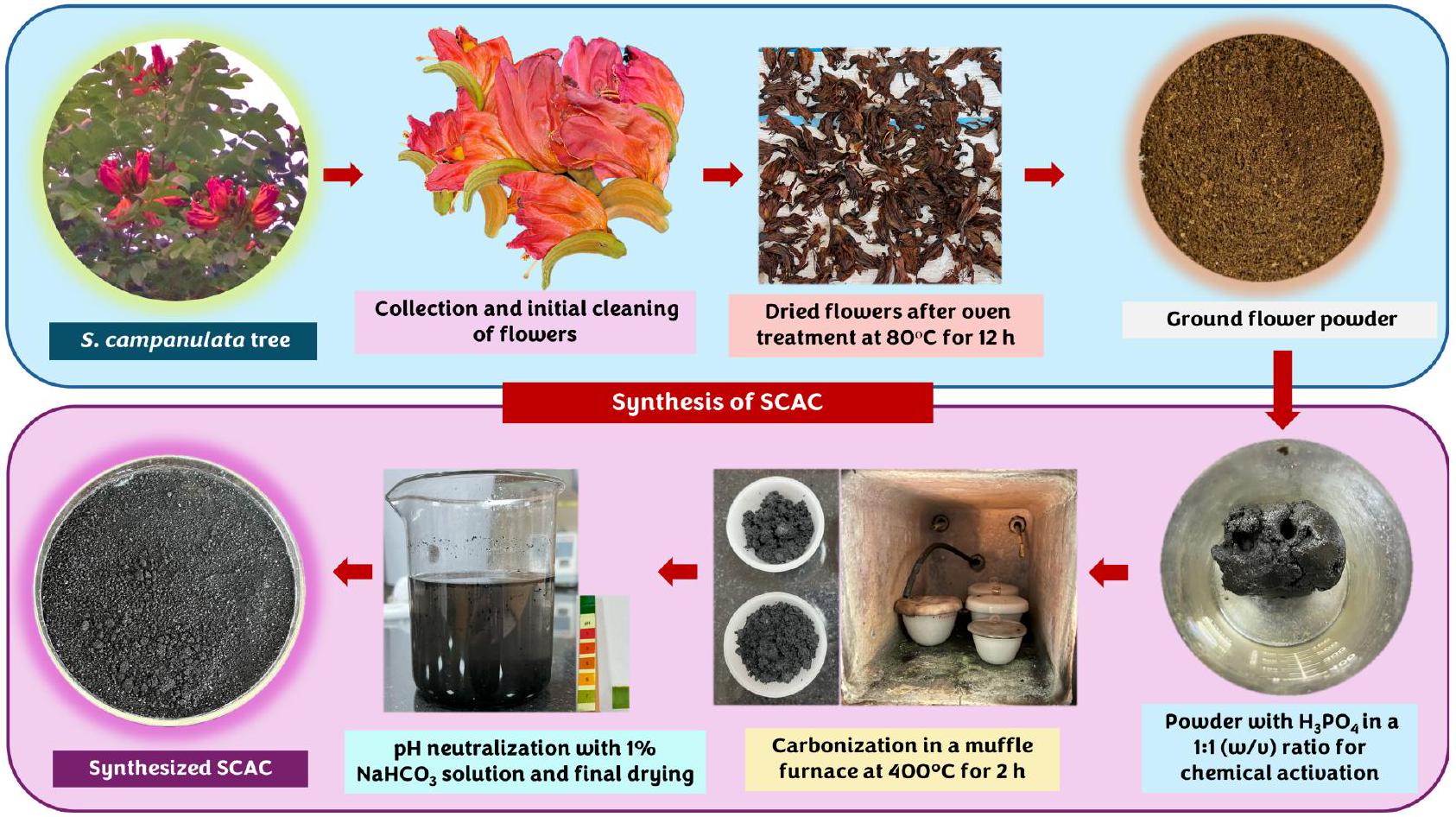
الشكل 1. تمثيل تخطيطي لعملية التخليق لـ SCAC المشتق من أزهار S. campanulata.
تم خلطها مع
حيث
نمذجة الامتزاز
ديناميكا الامتزاز
تم إجراء ديناميات الامتزاز لفحص خطوة التحكم في المعدل. تم تحليل مجموعة البيانات الحركية باستخدام نماذج معروفة: النموذج الزائف من الدرجة الأولى (PFO)، النموذج الزائف من الدرجة الثانية (PSO)، ونموذج الانتشار داخل الجسيمات (IPD).
حيث
إيزوثيرم الامتزاز
لتحليل آلية الامتزاز وتقييم كفاءة الامتزاز لـ SCAC، تم ملاءمة مجموعة البيانات التجريبية لنماذج الإيزوثرم: لانغموير، فريدنليخ، وتمكين.
أين،
ديناميكا حرارية الامتزاز
لفحص الجدوى، والعفوية، وطبيعة الامتزاز، العوامل الديناميكية الحرارية مثل التغير في الإنثالبي القياسي (
أين،
إمكانات إزالة الامتصاص والتجديد لـ SCAC
تم إجراء تجارب إزالة الامتصاص لفحص إمكانيات تجديد SCAC المستهلك، بهدف تعزيز الجدوى الاقتصادية. تم استخدام أربعة عوامل إزالة مثل الميثانول، الإيثانول،
تقييم فعالية SCAC في إزالة CR من مصفوفات المياه
تم جمع عينات المياه من خمسة مصفوفات متميزة وهي، شلالات عربي، مياه الصنبور، بحيرة مانيبال، ونهر سوارنا، من خلال أخذ عينات عشوائية، ثم تم إضافة صبغة CR لتقييم كفاءة الممتزات تحت ظروف العالم الحقيقي.
النتائج والمناقشات
دراسات توصيف SCAC
الخصائص الشكلية والعنصرية لـ SCAC
قدمت صور FESEM تحليلًا بصريًا مفصلًا للتغيرات الشكلية في SCAC قبل وبعد الامتزاز. كشفت الصورة قبل الامتزاز (الشكل 2a) عن شكل سطحي غير منتظم وخشن للغاية، يتميز بهيكل مسامي وقشري نموذجي للمواد اللجنوسليلوزية. كانت الشقوق الكبيرة وغير المتساوية، والفراغات، والحطام الحبيبي شائعة، مما ساهم جميعه في ارتفاع خشونة السطح وزيادة المساحة السطحية المتاحة للامتزاز كما هو موثق في الأدبيات.
تم إجراء تحليل الطاقة المشتتة (EDS) لتحليل الطبيعة العنصرية لـ SCAC (الشكل 2c). قبل الامتصاص، أظهر SCAC قممًا بارزة للكربون والأكسجين، مما أكد على تكوين الكربون المنشط. بالإضافة إلى ذلك، كان الفوسفور الذي تم إدخاله أثناء تنشيط حمض الفوسفوريك موجودًا في البداية بكميات ضئيلة. وظهور الكبريت عند
تحليل بروناور-إيميت-تيلر
تم قياس مساحة السطح و حجم المسام لـ SCAC في هذه الدراسة كـ
تحليل حيود الأشعة السينية
ذروة XRD العريضة (الشكل 3أ) التي لوحظت بين
من المثير للاهتمام أن مخططات الانكسار للطائرة (002) لم تظهر تغييرات ملحوظة في موضع القمة قبل وبعد الامتزاز، مما يشير إلى أن البلورية العامة لهيكل SCAC ظلت غير متأثرة طوال عملية الامتزاز. ومع ذلك، لوحظ زيادة طفيفة في حدة وشدة القمم بعد الامتزاز، مما يشير إلى أن امتزاز CR قد يؤدي إلى إعادة ترتيب أو تعديلات دقيقة على SCAC، مما يؤدي إلى هيكل أكثر ترتيبًا وبالتالي قمم أكثر حدة. سبب آخر محتمل لزيادة الحدة والشدة هو إدخال جزيئات CR بين الطبقات الجرافيتية لـ SCAC.
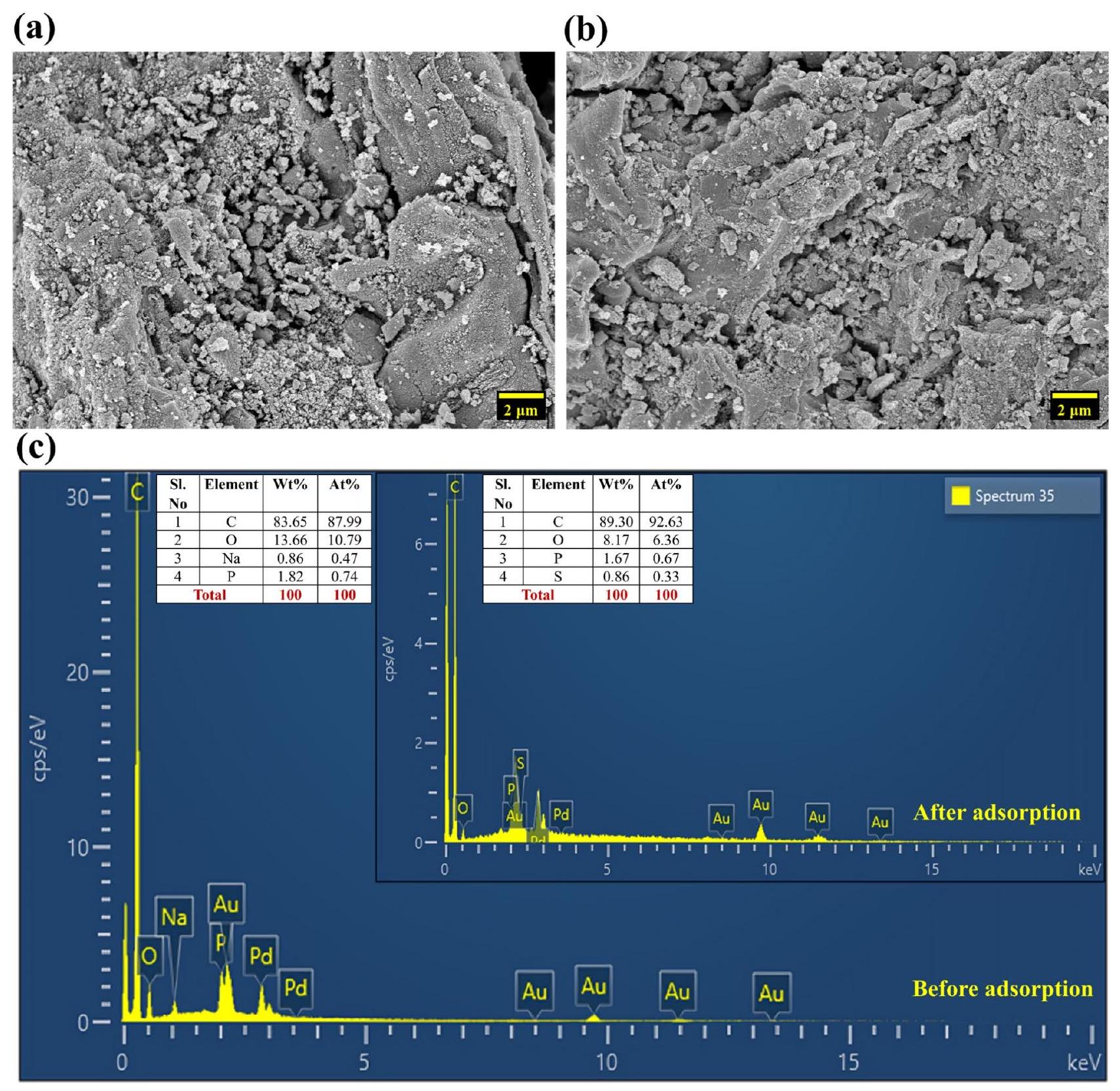
الشكل 2. صورة FESEM لـ SCAC (أ) قبل و (ب) بعد الامتصاص؛ (ج) طيف EDS لـ SCAC قبل وبعد الامتصاص.
تحليل FTIR
كشفت طيفيات FTIR عن تغييرات رئيسية قبل وبعد الامتزاز، مما يوفر رؤى حول آلية الامتزاز (الشكل 3ب). قبل الامتزاز، أظهر طيف FTIR قمة عند
بعد امتصاص الكروم، حدثت عدة تغييرات رئيسية في طيف FTIR (الشكل 3ب). على سبيل المثال، كانت هناك تحولات طفيفة في الـ
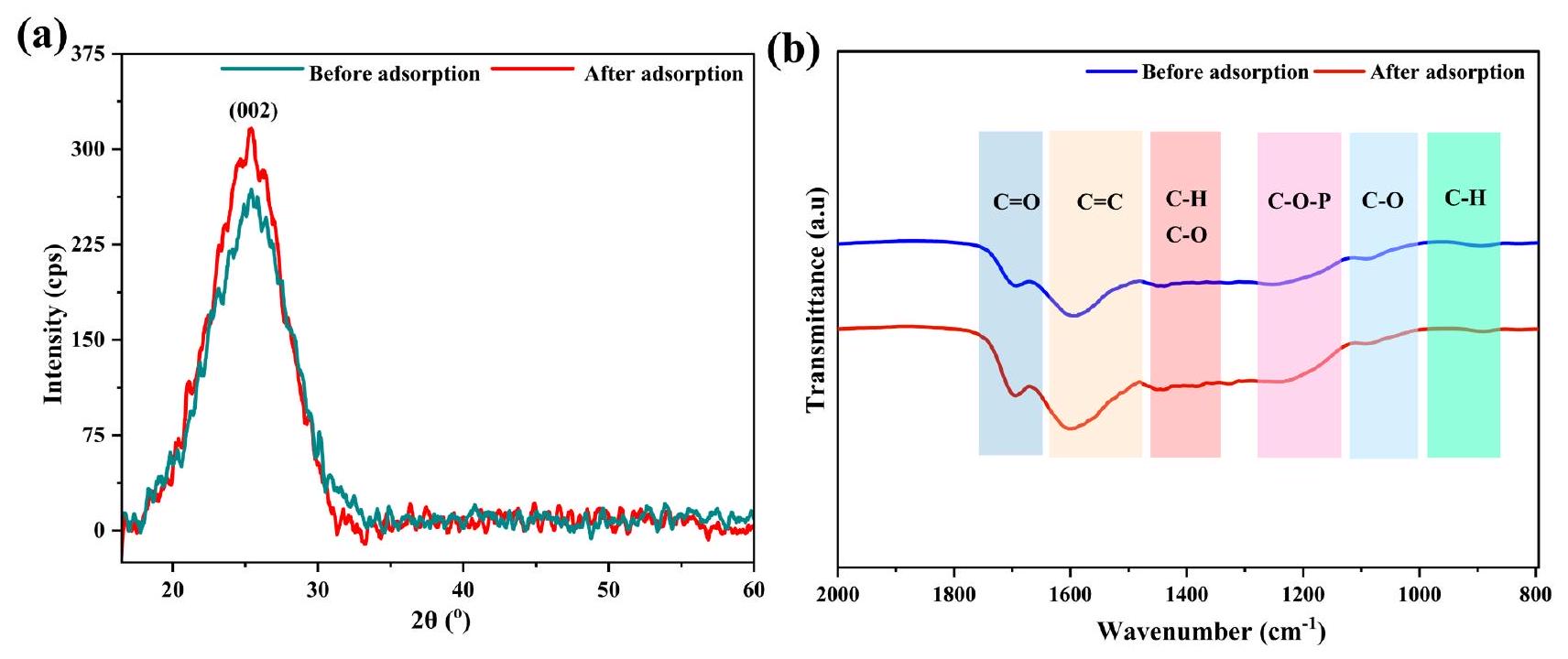
الشكل 3. (أ) أنماط حيود الأشعة السينية لـ SCAC قبل وبعد الامتصاص؛ (ب) طيف FTIR لـ SCAC قبل وبعد الامتصاص.
أيضًا، التحول في الذروة عند
دراسات XPS
أظهر مسح XPS لـ SCAC كما هو موضح في الشكل 4a قمم بارزة للكربون (C1s) والأكسجين (O1s) والنيتروجين (N1s) والفوسفور (P2p) (الشكل 4a في الإطار)، مما يؤكد وجودها على سطح SCAC. بعد الامتزاز، ظهرت القمة المقابلة للكبريت (S2p) (الشكل 4a في الإطار)، مما يعني الربط الناجح لـ CR على SCAC. تشير القمة الحادة عالية الكثافة C1s إلى محتوى الكربون العالي في SCAC، بينما تمثل قمة O1s وجود مجموعات وظيفية تحتوي على الأكسجين تم تشكيلها أو تعديلها خلال التنشيط الحراري. تشير قمة P2p (الشكل 4d) إلى الفوسفور الفوسفاتي، الذي من المحتمل أن يكون مدمجًا من حمض الفوسفوريك المستخدم في عملية التخليق
على وجه التحديد، يتميز طيف XPS عالي الدقة لـ C1s قبل الامتزاز بقمة عريضة تم تفكيكها إلى ثلاثة مكونات متميزة (الشكل 4b). تشير الإشارة عند 284.68 eV إلى
في طيف O1s قبل امتصاص CR (الشكل 4c)، لوحظت قمتان مفككتان: واحدة عند 532.87 eV، تمثل
كشف التركيب العنصري لـ SCAC قبل الامتزاز عن
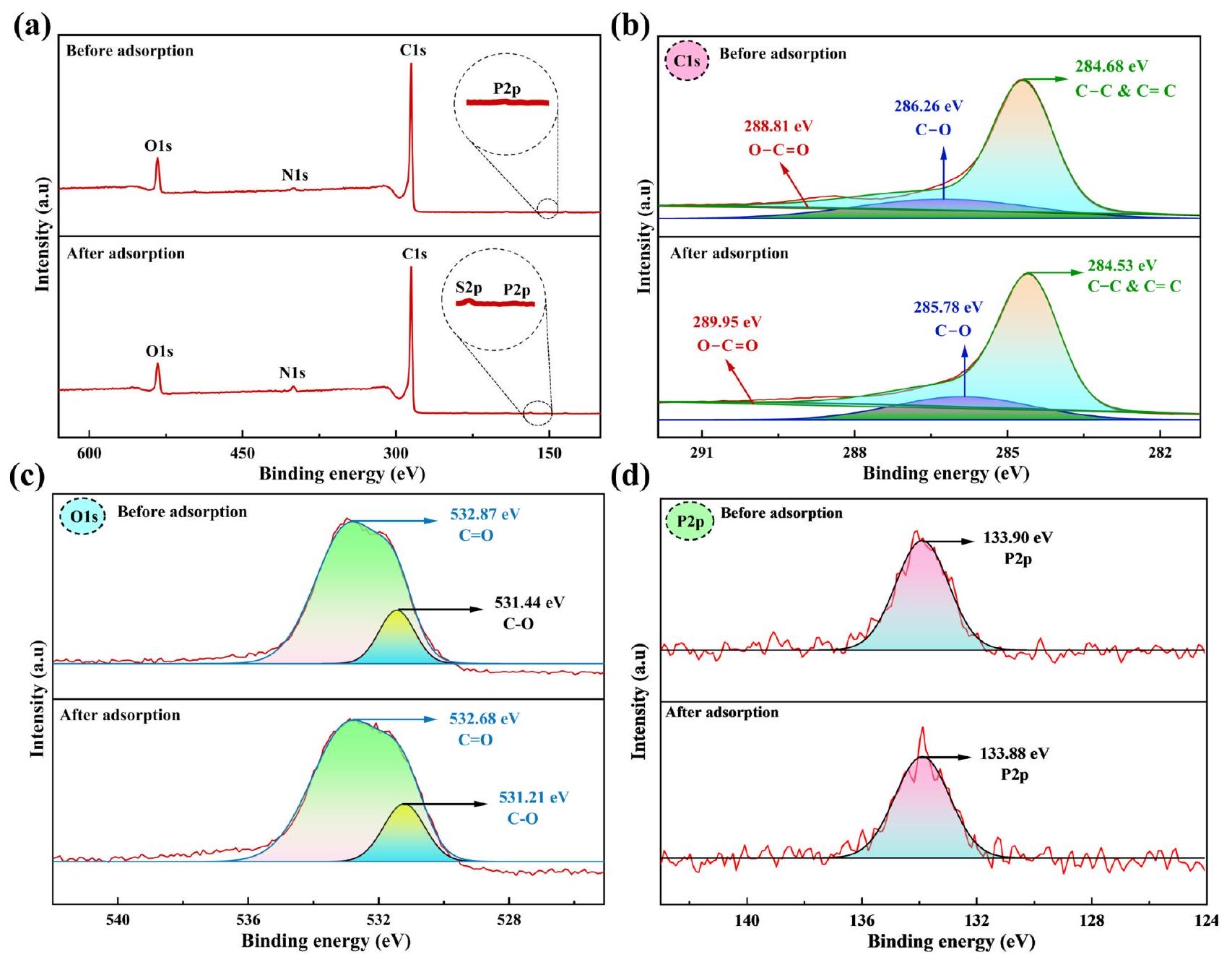
الشكل 4. أطياف XPS لـ SCAC قبل وبعد الامتزاز، تظهر تحليلًا تفصيليًا لـ (أ) طيف المسح الكامل (ب) C1s، (ج) O1s و(د) P2p.
و
دراسات تجريبية للامتزاز
تأثير pH
كما هو موضح في الشكل 5a، لوحظ زيادة هامشية في كفاءة إزالة CR بين pH 5 و6، تليها انخفاض طفيف حول pH 7. من المثير للاهتمام، لوحظ ارتفاع طفيف في كفاءة الإزالة مع استمرار زيادة pH من 7 إلى 10. يُعزى الارتفاع الطفيف في كفاءة الإزالة الملحوظة بين pH 5 و6 إلى العلاقة بين
كما هو موضح في الشكل 5a، لوحظ زيادة هامشية في كفاءة إزالة CR بين pH 5 و6، تليها انخفاض طفيف حول pH 7. من المثير للاهتمام، لوحظ ارتفاع طفيف في كفاءة الإزالة مع استمرار زيادة pH من 7 إلى 10. يُعزى الارتفاع الطفيف في كفاءة الإزالة الملحوظة بين pH 5 و6 إلى العلاقة بين
على الرغم من الشحنة السلبية المتزايدة على كل من سطح SCAC (
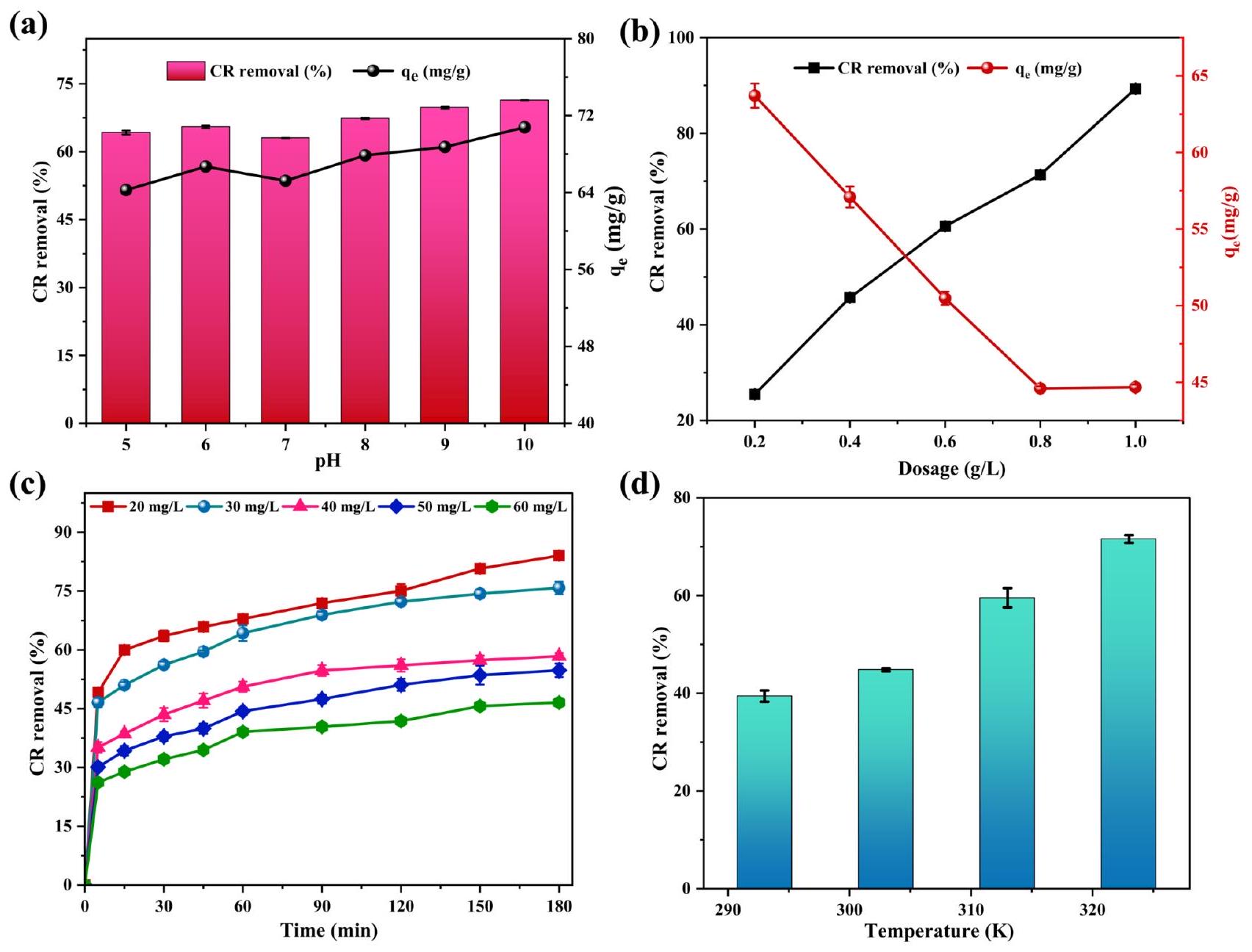
الشكل 5. (أ) معلمات الامتزاز بما في ذلك (أ) تأثير pH، (ب) تأثير الجرعة، (ج) تأثير تركيز CR الابتدائي و(د) تأثير درجة الحرارة لامتزاز CR على SCAC.
يقلل هذا القرار من الحاجة إلى تعديلات pH واسعة، مما يعزز كل من العملية العملية وقابلية التوسع للتطبيقات في العالم الحقيقي. يشبه اختيار pH الأمثل النتائج من الأدبيات السابقة التي استخدمت AC من أكواز الذرة
تأثير جرعة SCAC
يوضح الشكل 5b العلاقة بين جرعة SCAC وكفاءة إزالة CR وسعة الامتزاز. على وجه التحديد، أدى ارتفاع الجرعة من 0.2 إلى
تأثير تركيز الصبغة الابتدائي والوقت
تم إجراء تأثير تركيز الصبغة الابتدائي على أداء الامتزاز لـ SCAC من خلال تغيير تركيز CR بين 20 و
كانت نسبة الإزالة أعلى بسبب سهولة وصول جزيئات CR واحتلالها للمواقع النشطة الوفيرة.
كانت نسبة الإزالة أعلى بسبب سهولة وصول جزيئات CR واحتلالها للمواقع النشطة الوفيرة.
تأثير درجة الحرارة
تم تقييم تأثير درجة الحرارة على كفاءة إزالة الكروم (CR) على الفحم النشط المكلس (SCAC) بين 293 و 323 كلفن. كما هو موضح في الشكل 5d، تظهر أداء الإزالة اتجاهًا تصاعديًا واضحًا مع زيادة درجة الحرارة، حيث يرتفع من
تزيد درجات الحرارة المرتفعة من الامتزاز من خلال زيادة الطاقة الحركية لجزيئات CR، مما يؤدي إلى حدوث تصادمات أكثر تكرارًا مع SCAC وتوفير الطاقة الحرارية اللازمة لتجاوز حاجز طاقة التنشيط للامتزاز.
بينما يُعتبر الامتزاز عمومًا عملية أقل استهلاكًا للطاقة مقارنة بتقنيات الفصل الأخرى، فإن إجراءه عند درجة حرارة مرتفعة تبلغ 323 كلفن يزيد من الطلب على الطاقة، مما يجعله أقل كفاءة في استهلاك الطاقة. علاوة على ذلك، فإن تنفيذ الامتزاز عند درجات حرارة مرتفعة كهذه لمعالجة مياه الصرف الناتجة عن صباغة الأنسجة الصناعية، والتي تتضمن أحجامًا أكبر بكثير، يصبح غير عملي وقد يكون مكلفًا. بالإضافة إلى ذلك، هناك خطر من التبخر الحراري لمحلول CR عند درجات الحرارة العالية، مما يؤدي إلى تقدير غير دقيق لكمية CR الممتزة بواسطة الممتز. لذلك، تم اختيار درجة حرارة مثلى تبلغ 303 كلفن للتجارب اللاحقة على الامتزاز للحفاظ على التوافق بين الجدوى العملية، والفعالية من حيث التكلفة، والاستدامة البيئية.
ديناميكا الامتزاز
يوضح مخطط سعة الامتزاز مقابل الزمن امتصاصًا سريعًا أوليًا للكروم (CR) خلال الدقائق الثلاثين الأولى، ويعزى ذلك إلى التدرج العالي في التركيز بين محلول الكروم والمواقع النشطة الوفيرة على SCAC (الشكل 6a). من المحتمل أن يكون هذا الامتصاص السريع الأولي مدفوعًا بالامتزاز الفيزيائي، حيث ترتبط جزيئات الكروم بشكل ضعيف بسطح SCAC من خلال قوى فان der Waals. مع تقدم عملية الامتزاز، يتناقص المعدل، ليصل في النهاية إلى حالة التوازن عند 180 دقيقة. تشير هذه الهضبة إلى أن مواقع الربط على SCAC قد أصبحت مشبعة.
لفهم آلية الامتزاز بشكل أعمق، تم ملاءمة مجموعة البيانات لثلاثة نماذج حركية معروفة: PFO و PSO و IPD كما تم مناقشته في الأقسام السابقة. نموذج PFO (الشكل 6a)، الذي يفترض أن معدل الامتزاز يتغير مع إمكانية الوصول إلى المواقع غير المشغولة، أظهر ملاءمة ضعيفة.
على النقيض من ذلك، قدم نموذج PSO، القائم على الامتصاص الكيميائي، ملاءمة أفضل بكثير.
تم تطبيق نموذج IPD لتقييم الانتشار داخل مسام SCAC التي تساهم في عملية الامتزاز. ومع ذلك، فإن انخفاضه
نماذج إيزوثرم الامتزاز
كما هو موضح في الشكل 6ب، هناك ارتفاع حاد في
أظهر نموذج لانغموير توافقًا ممتازًا مع مجموعة البيانات التجريبية، كما يتضح من الارتفاع
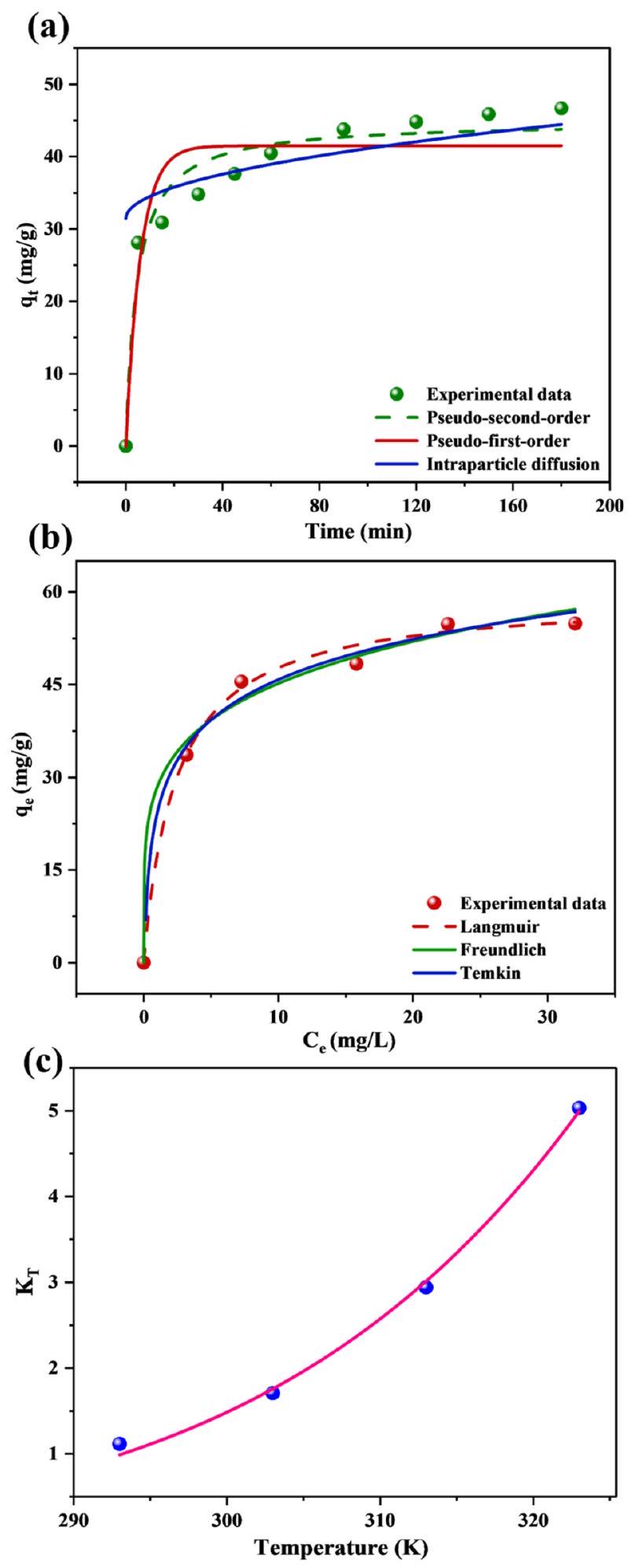
الشكل 6. (أ) حركيات الامتزاز، (ب) إيزوثيرم الامتزاز و (ج) مخطط فانت هوف لامتزاز CR على SCAC.
الإزالة. على سبيل المثال، وثق لايتفتي وآخرون أن سعة الامتزاز للكروم على الفحم النشط المستخرج من صنوبر بيناستر كانت
| ديناميكا الامتزاز | ||
| نماذج | المعلمات | القيم |
| ترتيب زائف من الدرجة الأولى |
|
0.164 |
|
|
٤١.٥٠ | |
|
|
0.8900 | |
|
|
٢٤.٠٩ | |
| ترتيب زائف من الدرجة الثانية |
|
0.0048 |
|
|
44.99 | |
|
|
0.9544 | |
|
|
9.99 | |
| انتشار داخل الجسيمات |
|
2.78 |
|
|
0.7731 | |
|
|
٤٩.٧٣ | |
| ج (
|
15.19 | |
| إيزوثيرم الامتزاز | ||
| لانغموير |
|
٥٩.٢٧ |
|
|
0.411 | |
|
|
0.9944 | |
|
|
3.07 | |
| ودود |
|
٢٨.٣٤ |
| 1/ن | 0.202 | |
|
|
0.9908 | |
|
|
٥.٠٣ | |
| تمكين |
|
8.855 |
|
|
١٦.٩٥ | |
|
|
0.9413 | |
|
|
5.61 |
الجدول 1. حركيات الامتزاز ومعلمات الإيزوثرم لامتزاز CR على SCAC.
| رقم التسلسل | ماص | ظروف إعداد التيار المتردد | مساحة سطح BET (
|
حجم المسام (سم³/غ) |
|
مرجع |
| 1. | سيمبوبوجون وينتيريانوس AC |
|
– | – | 6.25 | ٥٦ |
| 2. | أوراق وسيقان زهرة اللوتس المائية |
|
3.78 | – | 13.908 | 62 |
| ٣. | بذور فاكهة التين الشوكي AC |
|
42.79 | ٢.٣٤ | 21.83 | 73 |
| ٤ | حجر المشمش AC |
|
٨٨.٠٥ | 0.264 | ٣٢.٨٥ | 64 |
| 6. | قشور بذور الهيفيا البرازيلية AC |
|
735 | – | 50.51 | 74 |
| ٧ | سباثوديا كامبانولاتا AC |
|
986.41 | 0.8797 | ٥٩.٢٧ | هذه الدراسة |
الجدول 2. تحليل مختلف المواد الكربونية النشطة لإزالة صبغة CR.
وسعة الامتزاز القصوى، مما يدل على فعاليتها المتفوقة في امتصاص CR مقارنةً بعدة مواد كربونية نشطة تم الإبلاغ عنها مؤخرًا.
يرتبط نموذج فروندليش عادةً بامتصاص متعدد الطبقات على الأسطح غير المتجانسة.
نموذج تيمكين، الذي يستنتج تقليلاً خطياً في حرارة الامتزاز مع زيادة تغطية السطح الناتجة عن تفاعلات الممتز والممتز عليه، يقدم منظوراً إضافياً حول عملية الامتزاز. على الرغم من أن
يتضمن كل من التغطية أحادية الطبقة ومتعددة الطبقات. تسلط هذه التعقيد الضوء على الطبيعة المتعددة الأوجه لعملية الامتزاز، التي غالبًا ما تشمل مجموعة من الآليات وخصائص سطح SCAC المتنوعة.
يتضمن كل من التغطية أحادية الطبقة ومتعددة الطبقات. تسلط هذه التعقيد الضوء على الطبيعة المتعددة الأوجه لعملية الامتزاز، التي غالبًا ما تشمل مجموعة من الآليات وخصائص سطح SCAC المتنوعة.
دراسات الديناميكا الحرارية
مخطط فان’t هوف (الشكل 6c) يظهر تطابقًا دقيقًا بين
إزالة الامتصاص وتجديد الممتز
تظهر تجارب الإزالة، الموضحة في الشكل 7a، التأثير الكبير لنوع المذيب على إزالة CR من SCAC المستهلك. كانت المذيبات، بترتيب كفاءة الإزالة المتناقصة، الميثانول
أظهرت دراسات التجديد باستخدام الميثانول، المعروضة في الشكل 7ب، انخفاضًا طفيفًا في كفاءة إزالة CR وسعة الامتصاص مع كل دورة، ومع ذلك احتفظ SCAC بجزء كبير من فعاليته الأولية. من الدورة الأولى إلى الدورة الثانية، أظهرت أداء الامتصاص انخفاضًا طفيفًا من
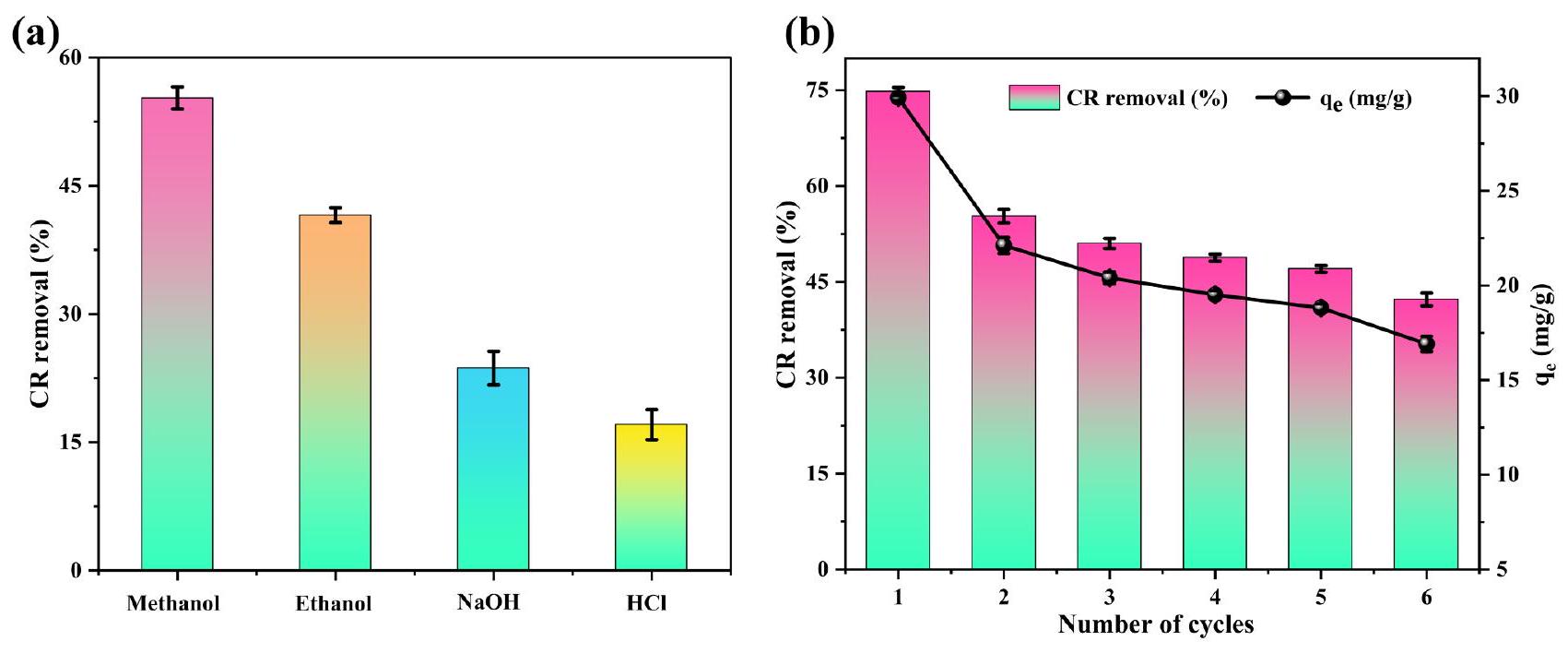
الشكل 7. (أ) كفاءة الامتزاز لـ SCAC لـ CR بعد استخدام عوامل إزالة مختلفة؛ (ب) كفاءة الامتزاز لـ SCAC بواسطة الميثانول على مدى ست دورات متتالية من الامتزاز والإزالة.
تقييم فعالية SCAC في إزالة CR من مصفوفات المياه المختلفة
توضح الشكل 8a كفاءات إزالة CR والسعات القصوى للاحتجاز عبر مصفوفات المياه المختلفة، مما يبرز الأداء المحسن لـ SCAC في البيئات الطبيعية مقارنةً بالتحكم في الماء المقطر (C). ومن الجدير بالذكر أن مصفوفات المياه الطبيعية أظهرت أداءً أعلى بكثير في الامتصاص بالترتيب التالي: شلالات عربية < مياه الصنبور < المياه الجوفية الصناعية < بحيرة مانيبال < نهر سوفرنا. وبالمثل، توضح الشكل 8b طيف الأشعة فوق البنفسجية المرئية الذي يظهر أداء SCAC في المياه الجوفية الصناعية، محققًا كفاءة إزالة قدرها
الكفاءة العالية بشكل ملحوظ في إزالة CR التي لوحظت في مجاري المياه الطبيعية المختلفة تعود إلى خصائصها الكيميائية المميزة. تحتوي المياه الطبيعية عادةً على مواد عضوية مذابة، مثل المواد الهيومية.
رؤى آلية الامتزاز
تم توضيح التمثيل التخطيطي الذي يظهر آليات التفاعل بين SCAC و CR في الشكل 9. تشير نتائج هذه الدراسة إلى أن امتصاص CR على SCAC يتم التحكم فيه بواسطة آلية متعددة الأوجه، حيث تلعب الكيميائيات دورًا رئيسيًا بينما تساهم الفيزيائيات أيضًا بشكل كبير في العملية العامة. في البداية، يوفر SSA والبنية المسامية وصولًا سهلاً لجزيئات CR، مما يعزز كفاءة الامتصاص العامة من خلال القوى الفيزيائية.
بالإضافة إلى ذلك، فإن التوافق الفائق لنموذج لانغموير يؤكد أن الامتصاص أحادي الطبقة يهيمن عليه الامتصاص الكيميائي، بينما يشير التوافق المعقول لنموذج فروندليش إلى تباين السطح وإمكانية الامتصاص متعدد الطبقات، وهو ما يميز الامتصاص الفيزيائي
عند درجة حموضة منخفضة، تعزز السطح المشحون إيجابياً لـ SCAC الجذب الكهربائي القوي مع مجموعات السلفونات المشحونة سلبياً من CR، مما يعزز كفاءة الامتصاص. عند درجات أعلى من
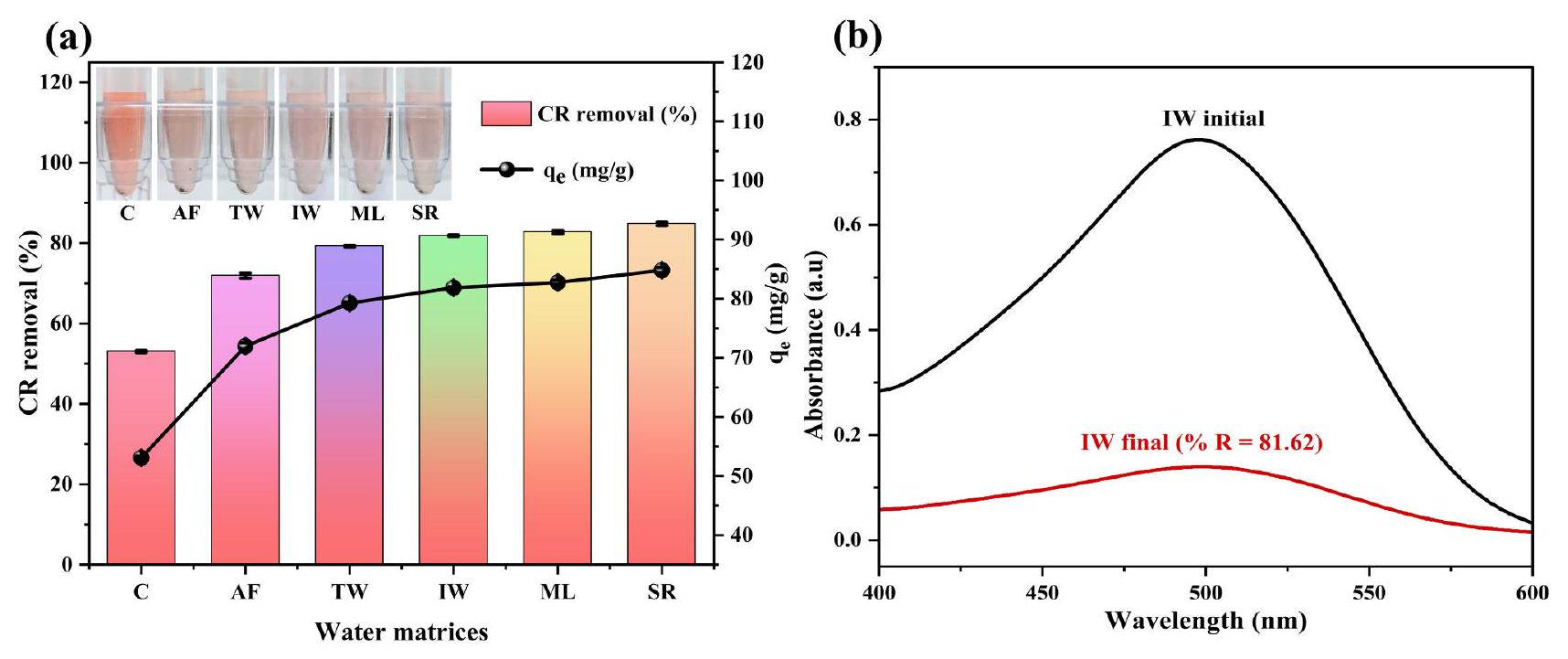
الشكل 8. (أ) أداء امتصاص CR باستخدام SCAC عبر مصفوفات مائية مختلفة بما في ذلك، التحكم (C)، شلالات عربية (AF)، مياه الصنبور (TW)، المياه الجوفية الصناعية (IW) بحيرة مانيبال (ML) ونهر سوفرنا (SR)؛ (ب) طيف UV-visible لأداء إزالة CR باستخدام SCAC في المياه الجوفية الصناعية (IW).
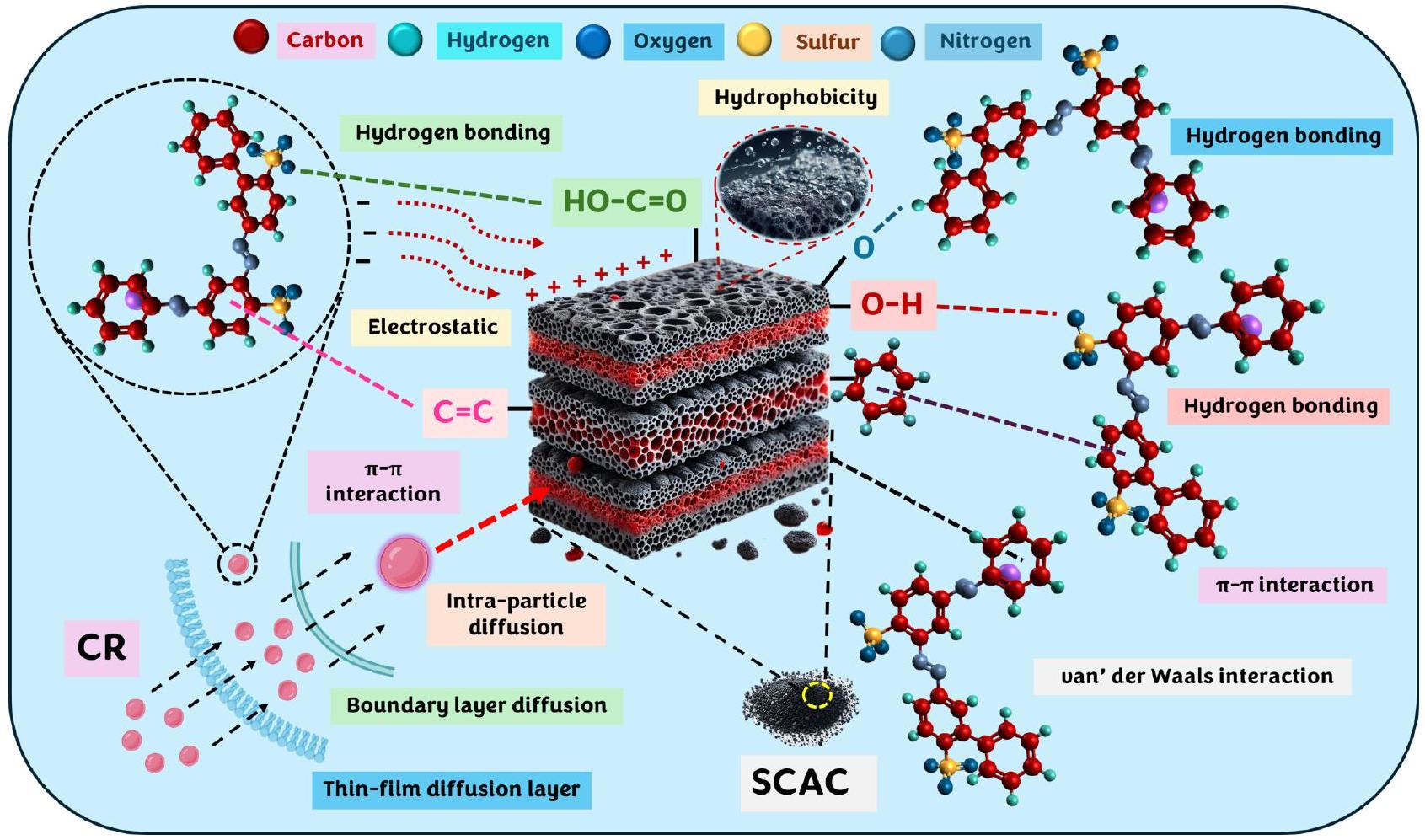
الشكل 9. تمثيل تخطيطي يوضح التفاعلات الرئيسية بين SCAC و CR خلال عملية الامتصاص.
الخاتمة
نجحت هذه الدراسة في تخليق الكربون المنشط من أزهار Spathodea campanulata وتقييم فعاليته في إزالة اللون الأحمر الكونغولي (CR). أظهرت صورة FESEM أن سطح SCAC الخشن وغير المنتظم في البداية تحول إلى نسيج أكثر نعومة بعد الامتصاص، مما يؤكد الارتباط الفعال لجزيئات CR. تم تحديد مجموعات وظيفية سطحية من خلال التحليل باستخدام XPS و FTIR التي سهلت الامتصاص عبر التفاعل الكهربائي، الروابط الهيدروجينية، و
توفر البيانات
يعلن المؤلفون أن البيانات التي تدعم نتائج هذه الدراسة متاحة ضمن المقال.
تم الاستلام: 7 نوفمبر 2024؛ تم القبول: 7 يناير 2025
تم النشر عبر الإنترنت: 13 يناير 2025
تم الاستلام: 7 نوفمبر 2024؛ تم القبول: 7 يناير 2025
تم النشر عبر الإنترنت: 13 يناير 2025
References
- Moradi, O., Hosseinian Naeini, A., Kalaee, M. R. & Mirkhan, S. M. R. The effect of sustainable applications of chitin and Chitosan to remove Dyed pollutants using adsorption: A review. Nano 18 https://doi.org/10.1142/S1793292023300062 (2023).
- Kolawole, A. S. & Iyiola, A. O. Environmental pollution: threats, impact on biodiversity, and protection strategies, in: Sustain. Util. Conserv. Africa’s Biol. Resour. Environ., Springer, 377-409. (2023).
- Aluigi, A. et al. Eco-friendly electrospun membranes made of biodegradable polymers for wastewater treatment. Electrospinning Adv. Energy Environ. Appl. 219-241. https://doi.org/10.1201/b18838 (2015).
- Kishor, R. et al. Ecotoxicological and health concerns of persistent coloring pollutants of textile industry wastewater and treatment approaches for environmental safety. J. Environ. Chem. Eng. 9, 105012 (2021).
- Saravanan, A. et al. Effective water/wastewater treatment methodologies for toxic pollutants removal: Pprocesses and applications towards sustainable development. Chemosphere 280, 130595. https://doi.org/10.1016/j.chemosphere.2021.130595 (2021).
- Zaki, N. et al. Advancements in the chemical treatment of potable water and industrial wastewater using the coagulationflocculation process. Sep. Sci. Technol. 58, 2619-2630. https://doi.org/10.1080/01496395.2023.2219381 (2023).
- Dutta, S. & Bhattacharjee, J. A comparative study between physicochemical and biological methods for effective removal of textile dye from wastewater, in: Dev. Wastewater Treat. Res. Process., Elsevier, 1-21. (2022).
- Konwar, M., Textile Industry and Its Environmental Impacts & Review, A. Indian J. Pure Appl. Biosci. 8 134-139. https://doi.org/1 0.18782/2582-2845.7848. (2020).
- Sharma, J., Sharma, S. & Soni, V. Classification and impact of synthetic textile dyes on aquatic Flora: A review, Reg. Stud. Mar. Sci. 45, 101802 (2021).
- Al-Tohamy, R. et al. A critical review on the treatment of dye-containing wastewater: Ecotoxicological and health concerns of textile dyes and possible remediation approaches for environmental safety. Ecotoxicol. Environ. Saf. 231, 113160. https://doi.org/1 0.1016/j.ecoenv.2021.113160 (2022).
- Aounallah, F. et al. Biodegradation pathway of congo red azo dye by geotrichum candidum and toxicity assessment of metabolites. Catal. Lett. 1-16. (2024).
- Chai, W. S. et al. A review on conventional and novel materials towards heavy metal adsorption in wastewater treatment application. J. Clean. Prod. 296, 126589 (2021).
- Sağlam, S., Türk, F. N. & Arslanoğlu, H. Use and applications of metal-organic frameworks (MOF) in dye adsorption. J. Environ. Chem. Eng. 110568. (2023).
- Zhang, L. et al. Coconut-based activated carbon fibers for efficient adsorption of various organic dyes. RSC Adv. 8, 42280-42291. https://doi.org/10.1039/C8RA08990F (2018).
- Khan, M. I. et al. Application of NaOH modified rice husk as a potential sorbent for removal of Congo red from an aqueous solution, Desalin. Water Treat. 273, 221-235. https://doi.org/10.5004/dwt.2022.28864 (2022).
- Sime, T., Fito, J., Nkambule, T. T. I., Temesgen, Y. & Sergawie, A. Adsorption of Congo Red from Textile Wastewater using activated Carbon developed from Corn Cobs: The studies of isotherms and kinetics. Chem. Afr. 6, 667-682. https://doi.org/10.1007/s4225 0-022-00583-2 (2023).
- Ravikumara, M. & Kingb, P. Application of response surface optimization on biosorption of Congo red dye onto Spathodea campanulata leaves, Desal. Water Treat. 182, 342-350 (2020).
- Dimbo, D. et al. Methylene blue adsorption from aqueous solution using activated carbon of spathodea campanulata. Results Eng. 21, 101910 (2024).
- Padhy, G. K. Spathodea campanulata P. Beauv.-A review of its ethnomedicinal, phytochemical, and pharmacological profile. J. Appl. Pharm. Sci. 11, 17-44 (2021).
- E.P. On A. and P. or S. used in A.F. (FEEDAP), scientific opinion on the safety and efficacy of orthophosphoric acid for all animal species. EFSA J. 11 3043. (2013).
- Pimentel, C. H., Castro-Agra, R., Freire, M. S., Gómez-Díaz, D. & González-Álvarez, J. Adsorption of anionic wood dyes on KOHactivated carbons from Pinus radiata sawdust. Biomass Convers. Biorefinery. https://doi.org/10.1007/s13399-024-05587-1 (2024).
- Saleem, J., Moghal, Z. K. B., Pradhan, S. & McKay, G. High-performance activated carbon from coconut shells for dye removal: Study of isotherm and thermodynamics. RSC Adv. 14, 33797-33808. https://doi.org/10.1039/D4RA06287F (2024).
- Gad, S. C. Phosphoric acid 4th edn (Elsevier Inc., 2023). https://doi.org/10.1016/B978-0-12-824315-2.00813-7
- Patra, C., Shahnaz, T., Subbiah, S. & Narayanasamy, S. Comparative assessment of raw and acid-activated preparations of novel Pongamia pinnata shells for adsorption of hexavalent chromium from simulated wastewater. Environ. Sci. Pollut Res. 27, 1483614851. https://doi.org/10.1007/s11356-020-07979-y (2020).
- Ojedokun, A. T. & Bello, O. S. Kinetic modeling of liquid-phase adsorption of Congo red dye using guava leaf-based activated carbon. Appl. Water Sci. 7, 1965-1977 (2017).
- Wang, J. & Guo, X. Adsorption isotherm models: Classification, physical meaning, application and solving method. Chemosphere 258, 127279. https://doi.org/10.1016/j.chemosphere.2020.127279 (2020).
- Lima, E. C., Gomes, A. A. & Tran, H. N. Comparison of the nonlinear and linear forms of the van’t Hoff equation for calculation of adsorption thermodynamic parameters (
and ). J. Mol. Liq. 311, 113315. https://doi.org/10.1016/j.molliq.2020.113315 (2020). - Patil, P., Jeppu, G., Vallabha, M. S. & Girish, C. R. Enhanced adsorption of phenolic compounds using biomass-derived high surface area activated carbon: Isotherms, kinetics and thermodynamics. Environ. Sci. Pollut Res. https://doi.org/10.1007/s11356-0 24-32971-1 (2024).
- Omorogie, M. O. et al. Microwave-synthesized and Fenton-functionalized Pinus sylvestris bark activated carbon/metal oxides for the effective uptake of tetracycline and Congo red dye. Biomass Convers. Biorefinery. 10, 959-975 (2020).
- Wei, H. et al. Advanced porous hierarchical activated carbon derived from agricultural wastes toward high performance supercapacitors. J. Alloys Compd. 820, 153111 (2020).
- Patra, C., Gupta, R., Bedadeep, D. & Narayanasamy, S. Surface treated acid-activated carbon for adsorption of anionic azo dyes from single and binary adsorptive systems: A detail insight. Environ. Pollut 266, 115102. https://doi.org/10.1016/j.envpol.2020.115102 (2020).
- Nethaji, S., Sivasamy, A., Thennarasu, G. & Saravanan, S. Adsorption of Malachite Green dye onto activated carbon derived from Borassus aethiopum flower biomass. J. Hazard. Mater. 181, 271-280. https://doi.org/10.1016/j.jhazmat.2010.05.008 (2010).
- Zahed, M., Jafari, D. & Esfandyari, M. Adsorption of formaldehyde from aqueous solution using activated carbon prepared from Hibiscus rosa-sinensis. Int. J. Environ. Anal. Chem. 102, 2979-3001. https://doi.org/10.1080/03067319.2020.1762872 (2022).
- Bazan-Wozniak, A., Nowicki, P., Wolski, R. & Pietrzak, R. Activated bio-carbons prepared from the Residue of Supercritical Extraction of Raw Plants and their application for removal of Nitrogen Dioxide and Hydrogen Sulfide from the gas phase, materials (Basel). 14 (2021). https://doi.org/10.3390/ma14123192
- Senthilkumaar, S., Kalaamani, P. & Subburaam, C. V. Liquid phase adsorption of Crystal violet onto activated carbons derived from male flowers of coconut tree. J. Hazard. Mater. 136, 800-808. https://doi.org/10.1016/j.jhazmat.2006.01.045 (2006).
- Zięzio, M., Charmas, B., Jedynak, K., Hawryluk, M. & Kucio, K. Preparation and characterization of activated carbons obtained from the waste materials impregnated with phosphoric acid(V). Appl. Nanosci. 10, 4703-4716. https://doi.org/10.1007/s13204-02 0-01419-6 (2020).
- Xue, H. et al. Adsorption of methylene blue from aqueous solution on activated carbons and composite prepared from an agricultural waste biomass: A comparative study by experimental and advanced modeling analysis. Chem. Eng. J. 430, 132801. https://doi.org/10.1016/j.cej.2021.132801 (2022).
- Jawad, A. H. et al. High surface area and mesoporous activated carbon from KOH -activated dragon fruit peels for methylene blue dye adsorption: Optimization and mechanism study. Chin. J. Chem. Eng. 32, 281-290. https://doi.org/10.1016/j.cjche.2020.09.070 (2021).
- Om Prakash, M., Raghavendra, G., Ojha, S. & Panchal, M. Characterization of porous activated carbon prepared from arhar stalks by single step chemical activation method, Mater. Today Proc. 39, 1476-1481. (2021). https://doi.org/10.1016/j.matpr.2020.05.370
- Somsesta, N., Sricharoenchaikul, V. & Aht-Ong, D. Adsorption removal of methylene blue onto activated carbon/cellulose biocomposite films: Equilibrium and kinetic studies. Mater. Chem. Phys. 240, 122221.https://doi.org/10.1016/j.matchemphys. 201 9.122221 (2020).
Scientific Reports |
(2025) 15:1831
41. Ouachtak, H. et al. Combined molecular dynamics simulations and experimental studies of the removal of cationic dyes on the eco-friendly adsorbent of activated carbon decorated montmorillonite Mt@ AC. RSC Adv. 13, 5027-5044 (2023).
42. Yadav, M. S., Singh, N. & Bobade, S. M. V x O y nanoparticles and activated charcoal based nanocomposite for supercapacitor electrode application. Ionics (Kiel). 26, 2581-2598 (2020).
43. Obayomi, K. S. et al. Adsorption of endocrine disruptive Congo red onto biosynthesized silver nanoparticles loaded on Hildegardia barteri activated carbon. J. Mol. Liq. 352, 118735 (2022).
44. Ghosh, N., Rhithuparna, D., Khatoon, R., Rokhum, S. L. & Halder, G. Sulphonic-acid functionalized novel Limonia acidissima carbonaceous catalyst for biodiesel synthesis from Millettia pinnata oil: Optimization, kinetics, thermodynamics and cost analysis. J. Clean. Prod. 394, 136362. https://doi.org/10.1016/j.jclepro.2023.136362 (2023).
45. Ma, M., Ying, H., Cao, F., Wang, Q. & Ai, N. Adsorption of Congo red on mesoporous activated carbon prepared by CO2 physical activation. Chin. J. Chem. Eng. 28, 1069-1076. https://doi.org/10.1016/j.cjche.2020.01.016 (2020).
46. Subba Reddy, Y. et al. Biomass-derived sustainable mesoporous activated carbon as an efficient and recyclable adsorbent for the adsorption of hazardous dyes. Hybrid. Adv. 6, 100218. https://doi.org/10.1016/j.hybadv.2024.100218 (2024).
47. He, S. et al. Adsorption enhancement of Congo red dye from wastewater based on edamame shell originated activated carbon by the cations: Experimental and theoretical studies. Diam. Relat. Mater. 136, 109930. https://doi.org/10.1016/j.diamond.2023.109930 (2023).
48. Djaber, S., Reffas, A. & El-Shafey, E. S. I. Activated carbons produced by thermochemical means from date palm spathes impregnated with H3PO4 for Congo red removal. Biomass Convers. Biorefinery. https://doi.org/10.1007/s13399-024-06135-7 (2024).
49. Wang, X., Fan, X., Xie, H., Li, X. & Hao, C. Polyacrylic acid/carboxymethyl cellulose/activated carbon composite hydrogel for removal of heavy metal ion and cationic dye. Cellulose 29, 483-501. https://doi.org/10.1007/s10570-021-04286-8 (2022).
50. Samanth, A., Selvaraj, R., Murugesan, G., Varadavenkatesan, T. & Vinayagam, R. Efficient adsorptive removal of 2,4-dichlorophenoxyacetic acid (2,4-D) using biomass derived magnetic activated carbon nanocomposite in synthetic and simulated agricultural runoff water. Chemosphere 361, 142513. https://doi.org/10.1016/j.chemosphere.2024.142513 (2024).
51. Lafi, R., Montasser, I. & Hafiane, A. Adsorption of Congo red dye from aqueous solutions by prepared activated carbon with oxygen-containing functional groups and its regeneration. Adsorpt. Sci. Technol. 37, 160-181 (2019).
52. Ahmad Aftab, R. et al. Removal of Congo red from water by adsorption onto activated carbon derived from waste black cardamom peels and machine learning modeling. Alexandria Eng. J. 71, 355-369. https://doi.org/10.1016/j.aej.2023.03.055 (2023).
53. Laureano-Anzaldo, C. M., Haro-Mares, N. B., Meza-Contreras, J. C., Robledo-Ortíz, J. R. & Manríquez-González, R. Chemical modification of cellulose with zwitterion moieties used in the uptake of red Congo dye from aqueous media. Cellulose 26, 92079227. https://doi.org/10.1007/s10570-019-02717-1 (2019).
54. Ali, Y. A. E. H., N’diaye, A. D., Fahmi, D., Kankou, M. S. & Stitou, M. Adsorption of Congo red from aqueous solution using Typha Australis leaves as a low cost adsorbent. J. Environ. Treat. Tech. 9, 534-539 (2021).
55. Mandal, S., Calderon, J., Marpu, S. B., Omary, M. A. & Shi, S. Q. Mesoporous activated carbon as a green adsorbent for the removal of heavy metals and Congo Red: Characterization, adsorption kinetics, and isotherm studies. J. Contam. Hydrol. 243, 103869. https://doi.org/10.1016/j.jconhyd.2021.103869 (2021).
56. Saha, A., Basak, B. B. & Ponnuchamy, M. Performance of activated carbon derived from Cymbopogon winterianus distillation waste for scavenging of aqueous toxic anionic dye Congo Red: Comparison with commercial activated carbon. Sep. Sci. Technol. 55, 1970-1983 (2020).
57. Wekoye, J. N., Wanyonyi, W. C., Wangila, P. T. & Tonui, M. K. Kinetic and equilibrium studies of Congo red dye adsorption on cabbage waste powder. Environ. Chem. Ecotoxicol. 2, 24-31(2020).
58. Zubir, M. H. M. & Zaini, M. A. A. Twigs-derived activated carbons via
59. Hao, Y. S., Othman, N. & Zaini, M. A. A. Waste newspaper as cellulose resource of activated carbon by sodium salts for methylene blue and Congo red removal. Int. J. Biol. Macromol. 277, 134353 (2024).
60. Litefti, K., Freire, M. S., Stitou, M. & González-Álvarez, J. Adsorption of an anionic dye (Congo Red) from aqueous solutions by pine bark. Sci. Rep. 9, 16530. https://doi.org/10.1038/s41598-019-53046-z (2019).
61. Ghaedi, M., Tavallali, H., Sharifi, M., Kokhdan, S. N. & Asghari, A. Preparation of low cost activated carbon from Myrtus communis and pomegranate and their efficient application for removal of Congo red from aqueous solution. Spectrochim Acta Part. Mol. Biomol. Spectrosc. 86, 107-114. https://doi.org/10.1016/j.saa.2011.10.012 (2012).
62. Extross, A., Waknis, A., Tagad, C., Gedam, V. V. & Pathak, P. D. Adsorption of Congo red using carbon from leaves and stem of water hyacinth: Equilibrium, kinetics, thermodynamic studies. Int. J. Environ. Sci. Technol. 20, 1607-1644. https://doi.org/10.1007 /s13762-022-03938-x (2023).
63. Harja, M., Buema, G. & Bucur, D. Recent advances in removal of Congo Red dye by adsorption using an industrial waste. Sci. Rep. 12, 6087. https://doi.org/10.1038/s41598-022-10093-3 (2022).
64. Abbas, M. & Trari, M. Kinetic, equilibrium and thermodynamic study on the removal of Congo Red from aqueous solutions by adsorption onto apricot stone. Process. Saf. Environ. Prot. 98, 424-436. https://doi.org/10.1016/j.psep.2015.09.015 (2015).
65. Gupta, V. K., Agarwal, S., Ahmad, R., Mirza, A. & Mittal, J. Sequestration of toxic Congo red dye from aqueous solution using ecofriendly guar gum/ activated carbon nanocomposite. Int. J. Biol. Macromol. 158, 1310-1318. https://doi.org/10.1016/j.ijbiomac .2020.05.025 (2020).
66. Ferreira, G. M. D. et al. L.H.M. Da Silva, Adsorption of red azo dyes on multi-walled carbon nanotubes and activated carbon: A thermodynamic study, colloids surfaces a physicochem. Eng. Asp 529, 531-540 (2017).
67. Ziane, S., Bessaha, F., Marouf-Khelifa, K. & Khelifa, A. Single and binary adsorption of reactive black 5 and Congo Red on modified dolomite: Performance and mechanism. J. Mol. Liq. 249, 1245-1253. https://doi.org/10.1016/j.molliq.2017.11.130 (2018).
68. Amran, F. & Zaini, M. A. A. Sodium hydroxide-activated Casuarina empty fruit: Isotherm, kinetics and thermodynamics of methylene blue and Congo red adsorption. Environ. Technol. Innov. 23, 101727 (2021).
69. Gohoho, H. D., Noby, H., Hayashi, J. & El-Shazly, A. H. Various acids functionalized polyaniline-peanut shell activated carbon composites for dye removal. J. Mater. Cycles Waste Manag. 24, 1508-1523 (2022).
70. Mahler, C. F., Svierzoski, N. D. S. & Bernardino, C. A. R. Chemical Characteristics of Humic Substances in Nature, in: A. Makan (Ed.), IntechOpen, Rijeka, 2021: p. Ch. 8. https://doi.org/10.5772/intechopen. 97414
71. Haroon, H. et al. Activated carbon from a specific plant precursor biomass for hazardous cr (VI) adsorption and recovery studies in batch and column reactors: Isotherm and kinetic modeling. J. Water Process. Eng. 38, 101577 (2020).
72. Louis, M. R., Sorokhaibam, L. G., Bhandari, V. M. & Bundale, S. Multifunctional activated carbon with antimicrobial property derived from Delonix regia Biomaterial for treatment of wastewater. J. Environ. Chem. Eng. 6, 169-181. https://doi.org/10.1016/j.j ece.2017.11.056 (2018).
73. Lahreche, S. et al. Application of activated carbon adsorbents prepared from prickly pear fruit seeds and a conductive polymer matrix to remove Congo red from aqueous solutions. Fibers 10, 7 (2022).
74. Igwegbe, C. A., Ighalo, J. O., Onyechi, K. K. & Onukwuli, O. D. Adsorption of Congo Red and malachite green using H3PO4 and NaCl-modified activated carbon from rubber (Hevea brasiliensis) seed shells, sustain. Water Resour. Manag. 7, 63. https://doi.org/ 10.1007/s40899-021-00544-6 (2021).
(2025) 15:1831
41. Ouachtak, H. et al. Combined molecular dynamics simulations and experimental studies of the removal of cationic dyes on the eco-friendly adsorbent of activated carbon decorated montmorillonite Mt@ AC. RSC Adv. 13, 5027-5044 (2023).
42. Yadav, M. S., Singh, N. & Bobade, S. M. V x O y nanoparticles and activated charcoal based nanocomposite for supercapacitor electrode application. Ionics (Kiel). 26, 2581-2598 (2020).
43. Obayomi, K. S. et al. Adsorption of endocrine disruptive Congo red onto biosynthesized silver nanoparticles loaded on Hildegardia barteri activated carbon. J. Mol. Liq. 352, 118735 (2022).
44. Ghosh, N., Rhithuparna, D., Khatoon, R., Rokhum, S. L. & Halder, G. Sulphonic-acid functionalized novel Limonia acidissima carbonaceous catalyst for biodiesel synthesis from Millettia pinnata oil: Optimization, kinetics, thermodynamics and cost analysis. J. Clean. Prod. 394, 136362. https://doi.org/10.1016/j.jclepro.2023.136362 (2023).
45. Ma, M., Ying, H., Cao, F., Wang, Q. & Ai, N. Adsorption of Congo red on mesoporous activated carbon prepared by CO2 physical activation. Chin. J. Chem. Eng. 28, 1069-1076. https://doi.org/10.1016/j.cjche.2020.01.016 (2020).
46. Subba Reddy, Y. et al. Biomass-derived sustainable mesoporous activated carbon as an efficient and recyclable adsorbent for the adsorption of hazardous dyes. Hybrid. Adv. 6, 100218. https://doi.org/10.1016/j.hybadv.2024.100218 (2024).
47. He, S. et al. Adsorption enhancement of Congo red dye from wastewater based on edamame shell originated activated carbon by the cations: Experimental and theoretical studies. Diam. Relat. Mater. 136, 109930. https://doi.org/10.1016/j.diamond.2023.109930 (2023).
48. Djaber, S., Reffas, A. & El-Shafey, E. S. I. Activated carbons produced by thermochemical means from date palm spathes impregnated with H3PO4 for Congo red removal. Biomass Convers. Biorefinery. https://doi.org/10.1007/s13399-024-06135-7 (2024).
49. Wang, X., Fan, X., Xie, H., Li, X. & Hao, C. Polyacrylic acid/carboxymethyl cellulose/activated carbon composite hydrogel for removal of heavy metal ion and cationic dye. Cellulose 29, 483-501. https://doi.org/10.1007/s10570-021-04286-8 (2022).
50. Samanth, A., Selvaraj, R., Murugesan, G., Varadavenkatesan, T. & Vinayagam, R. Efficient adsorptive removal of 2,4-dichlorophenoxyacetic acid (2,4-D) using biomass derived magnetic activated carbon nanocomposite in synthetic and simulated agricultural runoff water. Chemosphere 361, 142513. https://doi.org/10.1016/j.chemosphere.2024.142513 (2024).
51. Lafi, R., Montasser, I. & Hafiane, A. Adsorption of Congo red dye from aqueous solutions by prepared activated carbon with oxygen-containing functional groups and its regeneration. Adsorpt. Sci. Technol. 37, 160-181 (2019).
52. Ahmad Aftab, R. et al. Removal of Congo red from water by adsorption onto activated carbon derived from waste black cardamom peels and machine learning modeling. Alexandria Eng. J. 71, 355-369. https://doi.org/10.1016/j.aej.2023.03.055 (2023).
53. Laureano-Anzaldo, C. M., Haro-Mares, N. B., Meza-Contreras, J. C., Robledo-Ortíz, J. R. & Manríquez-González, R. Chemical modification of cellulose with zwitterion moieties used in the uptake of red Congo dye from aqueous media. Cellulose 26, 92079227. https://doi.org/10.1007/s10570-019-02717-1 (2019).
54. Ali, Y. A. E. H., N’diaye, A. D., Fahmi, D., Kankou, M. S. & Stitou, M. Adsorption of Congo red from aqueous solution using Typha Australis leaves as a low cost adsorbent. J. Environ. Treat. Tech. 9, 534-539 (2021).
55. Mandal, S., Calderon, J., Marpu, S. B., Omary, M. A. & Shi, S. Q. Mesoporous activated carbon as a green adsorbent for the removal of heavy metals and Congo Red: Characterization, adsorption kinetics, and isotherm studies. J. Contam. Hydrol. 243, 103869. https://doi.org/10.1016/j.jconhyd.2021.103869 (2021).
56. Saha, A., Basak, B. B. & Ponnuchamy, M. Performance of activated carbon derived from Cymbopogon winterianus distillation waste for scavenging of aqueous toxic anionic dye Congo Red: Comparison with commercial activated carbon. Sep. Sci. Technol. 55, 1970-1983 (2020).
57. Wekoye, J. N., Wanyonyi, W. C., Wangila, P. T. & Tonui, M. K. Kinetic and equilibrium studies of Congo red dye adsorption on cabbage waste powder. Environ. Chem. Ecotoxicol. 2, 24-31(2020).
58. Zubir, M. H. M. & Zaini, M. A. A. Twigs-derived activated carbons via
59. Hao, Y. S., Othman, N. & Zaini, M. A. A. Waste newspaper as cellulose resource of activated carbon by sodium salts for methylene blue and Congo red removal. Int. J. Biol. Macromol. 277, 134353 (2024).
60. Litefti, K., Freire, M. S., Stitou, M. & González-Álvarez, J. Adsorption of an anionic dye (Congo Red) from aqueous solutions by pine bark. Sci. Rep. 9, 16530. https://doi.org/10.1038/s41598-019-53046-z (2019).
61. Ghaedi, M., Tavallali, H., Sharifi, M., Kokhdan, S. N. & Asghari, A. Preparation of low cost activated carbon from Myrtus communis and pomegranate and their efficient application for removal of Congo red from aqueous solution. Spectrochim Acta Part. Mol. Biomol. Spectrosc. 86, 107-114. https://doi.org/10.1016/j.saa.2011.10.012 (2012).
62. Extross, A., Waknis, A., Tagad, C., Gedam, V. V. & Pathak, P. D. Adsorption of Congo red using carbon from leaves and stem of water hyacinth: Equilibrium, kinetics, thermodynamic studies. Int. J. Environ. Sci. Technol. 20, 1607-1644. https://doi.org/10.1007 /s13762-022-03938-x (2023).
63. Harja, M., Buema, G. & Bucur, D. Recent advances in removal of Congo Red dye by adsorption using an industrial waste. Sci. Rep. 12, 6087. https://doi.org/10.1038/s41598-022-10093-3 (2022).
64. Abbas, M. & Trari, M. Kinetic, equilibrium and thermodynamic study on the removal of Congo Red from aqueous solutions by adsorption onto apricot stone. Process. Saf. Environ. Prot. 98, 424-436. https://doi.org/10.1016/j.psep.2015.09.015 (2015).
65. Gupta, V. K., Agarwal, S., Ahmad, R., Mirza, A. & Mittal, J. Sequestration of toxic Congo red dye from aqueous solution using ecofriendly guar gum/ activated carbon nanocomposite. Int. J. Biol. Macromol. 158, 1310-1318. https://doi.org/10.1016/j.ijbiomac .2020.05.025 (2020).
66. Ferreira, G. M. D. et al. L.H.M. Da Silva, Adsorption of red azo dyes on multi-walled carbon nanotubes and activated carbon: A thermodynamic study, colloids surfaces a physicochem. Eng. Asp 529, 531-540 (2017).
67. Ziane, S., Bessaha, F., Marouf-Khelifa, K. & Khelifa, A. Single and binary adsorption of reactive black 5 and Congo Red on modified dolomite: Performance and mechanism. J. Mol. Liq. 249, 1245-1253. https://doi.org/10.1016/j.molliq.2017.11.130 (2018).
68. Amran, F. & Zaini, M. A. A. Sodium hydroxide-activated Casuarina empty fruit: Isotherm, kinetics and thermodynamics of methylene blue and Congo red adsorption. Environ. Technol. Innov. 23, 101727 (2021).
69. Gohoho, H. D., Noby, H., Hayashi, J. & El-Shazly, A. H. Various acids functionalized polyaniline-peanut shell activated carbon composites for dye removal. J. Mater. Cycles Waste Manag. 24, 1508-1523 (2022).
70. Mahler, C. F., Svierzoski, N. D. S. & Bernardino, C. A. R. Chemical Characteristics of Humic Substances in Nature, in: A. Makan (Ed.), IntechOpen, Rijeka, 2021: p. Ch. 8. https://doi.org/10.5772/intechopen. 97414
71. Haroon, H. et al. Activated carbon from a specific plant precursor biomass for hazardous cr (VI) adsorption and recovery studies in batch and column reactors: Isotherm and kinetic modeling. J. Water Process. Eng. 38, 101577 (2020).
72. Louis, M. R., Sorokhaibam, L. G., Bhandari, V. M. & Bundale, S. Multifunctional activated carbon with antimicrobial property derived from Delonix regia Biomaterial for treatment of wastewater. J. Environ. Chem. Eng. 6, 169-181. https://doi.org/10.1016/j.j ece.2017.11.056 (2018).
73. Lahreche, S. et al. Application of activated carbon adsorbents prepared from prickly pear fruit seeds and a conductive polymer matrix to remove Congo red from aqueous solutions. Fibers 10, 7 (2022).
74. Igwegbe, C. A., Ighalo, J. O., Onyechi, K. K. & Onukwuli, O. D. Adsorption of Congo Red and malachite green using H3PO4 and NaCl-modified activated carbon from rubber (Hevea brasiliensis) seed shells, sustain. Water Resour. Manag. 7, 63. https://doi.org/ 10.1007/s40899-021-00544-6 (2021).
الشكر والتقدير
يشكر المؤلفون الدعم المالي الذي حصلوا عليه من برنامج منحة الدكتوراه T.M.A. Pai المقدم من أكاديمية مانيبال للتعليم العالي، مانيبال. كما يشكر المؤلفون قسم الهندسة الكيميائية، معهد مانيبال للتكنولوجيا على توفير مرافق البحث لإجراء التجارب.
مساهمات المؤلفين
أجرى S.S التجارب وكتب المخطوطة الرئيسية. قام G.M بتحليل البيانات وكتب النسخة المنقحة من المخطوطة. قام T.V. بتحليل البيانات وكتب النسخة المنقحة من المخطوطة. أشرف R.V. على المشروع وكتب النسخة المنقحة من المخطوطة. أشرف R.S. على المشروع وكتب النسخة المنقحة من المخطوطة.
التمويل
تم توفير تمويل الوصول المفتوح من قبل أكاديمية مانيبال للتعليم العالي، مانيبال
الإعلانات
المصالح المتنافسة
يعلن المؤلفون عدم وجود مصالح متنافسة.
إرشادات النباتات
يؤكد المؤلفون أن استخدام النباتات/أجزاء النباتات في الدراسة الحالية يتوافق مع الإرشادات الدولية والوطنية و/أو المؤسسية.
أذونات جمع النباتات/أجزاء النباتات
تم التعرف على أزهار الشجرة وتصنيفها من قبل الآنسة غاياتري باي، قسم علم النبات، كلية MGM، أودوبي، الهند. الشجرة متاحة بشكل شائع وليست محمية، لذا لم تكن هناك حاجة للحصول على أذونات أو تراخيص لجمعها. بالإضافة إلى ذلك، لم يتم إيداع عينة مرجعية في المتحف النباتي، نظرًا للاعتراف بها على نطاق واسع.
مصدر النبات المستخدم في دراستك
جميع أسماء النباتات ومصدرها موجودة في قسم الطرق.
معلومات إضافية
يجب توجيه المراسلات والطلبات للحصول على المواد إلى R.V. أو R.S.
معلومات إعادة الطبع والأذونات متاحة علىwww.nature.com/reprints.
ملاحظة الناشر تظل Springer Nature محايدة فيما يتعلق بالمطالبات القضائية في الخرائط المنشورة والانتماءات المؤسسية.
معلومات إعادة الطبع والأذونات متاحة علىwww.nature.com/reprints.
ملاحظة الناشر تظل Springer Nature محايدة فيما يتعلق بالمطالبات القضائية في الخرائط المنشورة والانتماءات المؤسسية.
الوصول المفتوح هذه المقالة مرخصة بموجب رخصة المشاع الإبداعي 4.0 الدولية، التي تسمح بالاستخدام والمشاركة والتكيف والتوزيع وإعادة الإنتاج في أي وسيلة أو تنسيق، طالما أنك تعطي الائتمان المناسب للمؤلفين الأصليين والمصدر، وتوفر رابطًا لرخصة المشاع الإبداعي، وتوضح ما إذا كانت هناك تغييرات قد تم إجراؤها. الصور أو المواد الأخرى من طرف ثالث في هذه المقالة مشمولة في رخصة المشاع الإبداعي للمقال، ما لم يُذكر خلاف ذلك في سطر ائتمان للمادة. إذا لم تكن المادة مشمولة في رخصة المشاع الإبداعي للمقال واستخدامك المقصود غير مسموح به بموجب اللوائح القانونية أو يتجاوز الاستخدام المسموح به، ستحتاج إلى الحصول على إذن مباشرة من صاحب حقوق الطبع والنشر. لعرض نسخة من هذه الرخصة، قم بزيارةhttp://creativecommons.org/licenses/by/4.0/.
© المؤلفون 2025
© المؤلفون 2025
قسم الهندسة الكيميائية، معهد مانيبال للتكنولوجيا، أكاديمية مانيبال للتعليم العالي، مانيبال، كارناتاكا 576104، الهند. قسم التكنولوجيا الحيوية، معهد M.S.Ramaiah للتكنولوجيا، بنغالور، كارناتاكا 560054، الهند. قسم التكنولوجيا الحيوية، معهد مانيبال للتكنولوجيا، أكاديمية مانيبال للتعليم العالي، مانيبال، كارناتاكا 576104، الهند. البريد الإلكتروني:ramesh.v@manipal.edu;raja.s@manipal.edu
Journal: Scientific Reports, Volume: 15, Issue: 1
DOI: https://doi.org/10.1038/s41598-025-86032-9
PMID: https://pubmed.ncbi.nlm.nih.gov/39805985
Publication Date: 2025-01-13
DOI: https://doi.org/10.1038/s41598-025-86032-9
PMID: https://pubmed.ncbi.nlm.nih.gov/39805985
Publication Date: 2025-01-13
scientific reports
OPEN
Efficient adsorptive removal of Congo Red dye using activated carbon derived from Spathodea campanulata flowers
This report investigates the preparation, characterization, and application of activated carbon derived from Spathodea campanulata flowers (SCAC) to remove Congo Red (CR) dye from aqueous streams. SCAC was synthesized using orthophosphoric acid activation which yielded a mesoporous material with a specific surface area of (
Keywords Adsorption, Activated carbon, Spathodea campanulata, Congo red dye, Regeneration, Spiking studies
Environmental pollution, encompassing air, soil, and water, represents a significant challenge in the modern era
To mitigate the detrimental impacts of these contaminants, different treatment methods have been explored, encompassing physical, chemical, and biological approaches. While physical treatments like sedimentation and filtration offer cost-effective removal of particulate pollutants, their efficacy for dissolved contaminants is limited, often necessitating further treatment steps
is exacerbated by the presence of synthetic dyes, which are extensively used in the textile industry due to their vibrant colors and chemical stability.
The textile industry, a major global water consumer, relies on various dye types, including reactive, direct, acid, and dispersed dyes
Recently, adsorption, a surface phenomenon, has garnered significant attention for its effectiveness in removing a wide range of pollutants, including CR from wastewater. This method is a preferred choice due to its simple process, inexpensive nature, minimum sludge production, selective removal capabilities, and high efficiency
Activated carbon (AC) has garnered substantial attention in the adsorption process due to its numerous distinct advantages. Its high surface area, resulting from its porous structure, provides abundant binding sites for adsorbate molecules such as CR, making it highly efficient for a wide range of environmental and industrial applications. Furthermore, the inherent regenerative capacity of AC, achievable through various treatment methods, significantly enhances its economic and environmental sustainability. Additionally, these materials are considered environmentally benign, with minimal ecological impact and potential for sustainable production from various carbonaceous sources, including coconut shells
Despite its advantages, AC derived from these precursors presents significant limitations. In particular, AC synthesized from coconut shells achieved a high surface area of
Given these limitations, exploring alternative biomass sources with unique properties, such as Spathodea campanulata flowers, could offer a promising avenue for preparing AC with improved CR adsorption capabilities. S. campanulata, well-known as the African tulip tree, is an ornamental tree and widely cultivated in subtropical regions, including India. Recent studies have explored the use of S. campanulata biomass for AC preparation to remove various dyes from aqueous solutions. For instance, AC prepared using the S. campanulata leaves exhibited a low adsorption potential of
The study also addresses the limitations of existing ACs derived from various biomass sources, which often face challenges such as high production costs, complex synthesis procedures, low surface area and inadequate adsorption capacity. By utilizing S. campanulata flowers as a precursor and orthophosphoric acid
Hence, the present investigation focuses on the preparation and application of AC derived from the sustainable and readily available biomass source, S. campanulata flowers, for the removal of CR dye. Kinetics and isotherm studies were employed to gain mechanistic insights into the adsorption process, elucidating the interactions between CR dye molecules and the AC surface. In addition, the study thoroughly examines the desorption and regeneration potential of SCAC, demonstrating its ability to maintain efficiency over multiple reuse cycles and highlighting its economic and environmental viability. To evaluate its practical applicability, SCAC was also tested in real-world water matrices, confirming its effectiveness in treating contaminated water under realistic
conditions. These findings establish S. campanulata flowers as a valuable precursor for AC synthesis, offering efficient and sustainable solutions for wastewater treatment challenges.
conditions. These findings establish S. campanulata flowers as a valuable precursor for AC synthesis, offering efficient and sustainable solutions for wastewater treatment challenges.
Materials and methodology Materials
Spathodea campanulata flowers were gathered within the university campus in Manipal, India. CR dye
Adsorbent preparation
AC was synthesized from S. campanulata flowers, following a modified method previously described by Patra et al.
Structural and functional analysis of SCAC
Several techniques were employed to characterize the synthesized SCAC. The surface morphological features and elemental compositions were analyzed by Field Emission Scanning Electron Microscopy (FESEM, Zeiss Sigma 300, Carl Zeiss, Germany) integrated with Energy-Dispersive X-ray Spectroscopy (EDS, Oxford Instruments, UK). The specific surface area (SSA) and pore volume were measured using Brunauer-Emmett-Teller (BET, Smart instrument, India) analysis. Additionally, the crystalline nature was investigated using X-ray Diffraction (XRD, D8 Advance, Bruker, Germany). The surface nature and bonding types were examined using X-ray Photoelectron Spectroscopy (XPS, ThermoFisher, UK). Finally, the functional moieties were investigated by Fourier Transform Infrared Spectroscopy (FTIR, Shimadzu 8400 S, Japan). The point-of-zero charge (
Adsorption experiments
Adsorption experimentations were performed to assess the efficacy of SCAC to remove CR. To begin, the pH influence was investigated by introducing
Fig. 1. Schematic representation of the synthesis process for SCAC derived from S. campanulata flowers.
were mixed with
wherein
Adsorption modeling
Adsorption kinetics
The adsorption kinetics were performed to examine the rate-controlling step. The kinetic dataset was analyzed using well-known models: pseudo-first-order (PFO), pseudo-second-order (PSO), and intraparticle diffusion (IPD) model
wherein,
Adsorption Isotherm
To analyze the adsorption mechanism and evaluate the adsorption efficacy of SCAC, the experimental dataset was fitted to isotherm models: Langmuir, Freundlich, and Temkin
where,
Adsorption thermodynamics
To examine the feasibility, spontaneity, and adsorption nature, the thermodynamic factors like change in standard enthalpy (
Where,
Desorption and regeneration potential of SCAC
Desorption experimentations were done to examine the regeneration potential of spent SCAC, aiming to enhance the economic feasibility. Four desorbing agents such as methanol, ethanol,
Evaluating the efficacy of SCAC for removing CR from water matrices
Water samples from five distinct matrices namely, Arabi Falls, Tap water, Manipal Lake, and Suvarna River were collected via grab sampling and subsequently spiked with CR dye to assess the adsorbent’s efficiency under real-world conditions
Results and discussions
Characterization studies of SCAC
Morphology and elemental features of SCAC
FESEM images provided a detailed visual analysis of the morphological changes in SCAC before and after adsorption. The pre-adsorption image (Fig. 2a) revealed a highly irregular and rough surface morphology, characterized by a porous and flaky structure typical of lignocellulosic materials. Large, uneven cracks, voids, and granular debris were prevalent, all contributing to the high surface roughness and enhancing the available surface area for adsorption as documented in the literature
EDS was performed to analyze the elemental nature of SCAC (Fig. 2c). Before adsorption, the SCAC exhibited predominant peaks for C and O, which ascertained the formation of AC. Additionally, phosphorus introduced during orthophosphoric acid activation, was initially present in trace amounts. The emergence of sulfur at
Brunauer-Emmett-Teller analysis
The SSA and pore volume of SCAC in this study were measured as
XRD analysis
The broad XRD peak (Fig. 3a) observed between
Interestingly, the diffractograms for the (002) plane showed no significant changes in peak position before and after adsorption, suggesting that the overall crystallinity of the SCAC structure remained unaffected throughout the adsorption process. However, a slight increase in the sharpness and intensity of the peaks was observed after adsorption, suggesting that the adsorption of CR may induce subtle rearrangement or modifications on the SCAC, leading to a more ordered structure and consequently sharper peaks. Another possible reason for the increase in sharpness and intensity is the intercalation of CR molecules between the graphitic layers of SCAC
Fig. 2. FESEM image of SCAC (a) before and (b) after adsorption; (c) EDS spectra of SCAC before and after adsorption.
FTIR analysis
FTIR spectra revealed key changes before and after adsorption, providing insights into the adsorption mechanism (Fig. 3b). Before adsorption, the FTIR spectrum exhibited a peak at
After CR adsorption, several key changes occurred in the FTIR spectrum (Fig. 3b). For instance, the slight shifts in the
Fig. 3. (a) XRD patterns of SCAC before and after adsorption; (b) FTIR spectra of SCAC before and after adsorption.
Also, the shift in the peak at
XPS studies
XPS survey of SCAC shown in Fig. 4a revealed prominent peaks for carbon (C1s), oxygen (O1s), nitrogen (N1s), and phosphorus (P2p) (Fig. 4a inset), confirming their presence on the surface of SCAC. After adsorption, the peak corresponding to sulfur (S2p) (Fig. 4a inset), appeared, implying the successful binding of CR onto SCAC. The high intense sharp C1s peak indicates the high carbon content of SCAC, while the O1s peak represents the presence of oxygen-containing functional groups formed or modified during thermal activation. The P2p peak (Fig. 4d) signifies phosphatic phosphorus, likely incorporated from the orthophosphoric acid used in the synthesis process
Specifically, the high-resolution XPS spectrum of C1s before adsorption features a broad peak that has been deconvoluted into three distinct components (Fig. 4b). The signal at 284.68 eV relates to
In the O1s spectrum before CR adsorption (Fig. 4c), two deconvoluted peaks were observed: one at 532.87 eV , representing
The elemental composition of SCAC before adsorption revealed
Fig. 4. XPS spectra of SCAC before and after adsorption, showing detailed analysis of (a) full survey spectrum (b) C1s, (c) O1s and (d) P2p spectra.
and
Adsorption experimentation studies
pH effect
As shown in Fig. 5a, a marginal increase in CR removal efficiency was noted between pH 5 and 6, followed by a minor reduction around pH 7 . Interestingly, a marginal rise in removal efficiency was observed as the pH continued to increase from 7 to 10 . The slight increase in removal efficiency observed between pH 5 and 6 is attributed to the relationship between the
As shown in Fig. 5a, a marginal increase in CR removal efficiency was noted between pH 5 and 6, followed by a minor reduction around pH 7 . Interestingly, a marginal rise in removal efficiency was observed as the pH continued to increase from 7 to 10 . The slight increase in removal efficiency observed between pH 5 and 6 is attributed to the relationship between the
Despite the growing negative charge on both the SCAC surface (
Fig. 5. (a) Adsorption parameters including (a) influence of pH , (b) effect of dosage, (c) influence of initial CR concentration and (d) effect of temperature for the adsorption of CR onto SCAC.
This decision minimizes the need for extensive pH adjustments, enhancing both the practicality and scalability of the process for real-world applications. The selection of optimum pH resembles findings from previous literature using AC from corn cobs
Influence of SCAC dose
Figure 5b illustrates the correlation between SCAC dose, CR removal efficiency, and adsorption capacity. Specifically, the rise in the dosage from 0.2 to
Effects of initial dye concentration and time
The impact of initial dye concentration on the adsorption performance of SCAC was performed by changing the CR concentration between 20 and
percentage removal was higher due to the ease with which the CR molecules could access and occupy the abundant active sites
percentage removal was higher due to the ease with which the CR molecules could access and occupy the abundant active sites
Influence of temperature
The effect of temperature on the removal efficiency of CR onto SCAC was assessed between 293 and 323 K. As illustrated in Fig. 5d, the removal performance exhibits a clear upward trend with increasing temperature, rising from
Elevated temperatures enhance adsorption by increasing the kinetic energy of CR molecules, leading to more frequent collisions with the SCAC and providing the thermal energy needed to surpass the activation energy barrier for adsorption
While adsorption is generally considered a less energy-intensive process compared to other separation techniques, conducting it at an elevated temperature of 323 K increases the energy demand, making it less energy-efficient. Furthermore, implementing adsorption at such high temperatures for industrial textile dye wastewater treatment, which involves significantly larger volumes, becomes impractical and potentially costprohibitive. Besides, there’s a risk of thermal evaporation of CR solution at high temperatures, leading to an inaccurate estimation of the amount of CR adsorbed by the adsorbent. Therefore, an optimum temperature of 303 K was selected for subsequent adsorption experiments to maintain a synergy between practical feasibility, cost-effectiveness, and environmental sustainability.
Adsorption kinetics
The adsorption capacity versus time plot reveals a rapid initial uptake of CR within the first 30 min , attributed to the high concentration gradient among the CR solution and the abundant active sites on SCAC (Fig. 6a). This initial rapid uptake is likely driven by physisorption, where CR molecules weakly bind to the SCAC surface through van der Waals forces. As adsorption progresses, the rate decreases, ultimately reaching equilibrium at 180 min . This plateau indicates that the binding sites on SCAC have become saturated
To gain a deeper understanding of the adsorption mechanism, the dataset was fitted to three well-established kinetic models: PFO, PSO, and IPD as discussed in the earlier sections. The PFO model (Fig. 6a), which assumes that the adsorption rate varies with the accessibility of unoccupied sites, showed a poor fit
In contrast, the PSO model, based on chemisorption, offered a much better fit (
The IPD model was applied to evaluate the diffusion within SCAC pores that contribute to the adsorption process. However, its lower
Adsorption isotherm models
As shown in Fig. 6b, a steep rise in
Langmuir model demonstrated excellent fit to the experimental dataset, evidenced by the high
Fig. 6. (a) Adsorption kinetics, (b) adsorption isotherm and (c) Van’t Hoff plot for the adsorption of CR onto SCAC.
removal. For instance, Litefti et al. documented that the adsorption capacity of CR on AC derived from Pinus pinaster was
| Adsorption kinetics | ||
| Models | Parameters | Values |
| Pseudo First order Order |
|
0.164 |
|
|
41.50 | |
|
|
0.8900 | |
|
|
24.09 | |
| Pseudo Second order Order |
|
0.0048 |
|
|
44.99 | |
|
|
0.9544 | |
|
|
9.99 | |
| Intraparticle diffusion |
|
2.78 |
|
|
0.7731 | |
|
|
49.73 | |
| C (
|
15.19 | |
| Adsorption isotherm | ||
| Langmuir |
|
59.27 |
|
|
0.411 | |
|
|
0.9944 | |
|
|
3.07 | |
| Freundlich |
|
28.34 |
| 1/n | 0.202 | |
|
|
0.9908 | |
|
|
5.03 | |
| Temkin |
|
8.855 |
|
|
16.95 | |
|
|
0.9413 | |
|
|
5.61 |
Table 1. Adsorption kinetics and isotherm parameters for CR adsorption onto SCAC.
| S. No | Adsorbent | AC preparation conditions | BET surface Area (
|
Pore volume (cc/g) |
|
Ref. |
| 1. | Cymbopogon winterianus AC |
|
– | – | 6.25 | 56 |
| 2. | Water hyacinth leaf and stem AC’s |
|
3.78 | – | 13.908 | 62 |
| 3. | Prickly Pear Fruit Seeds AC |
|
42.79 | 2.34 | 21.83 | 73 |
| 4. | Apricot stone AC |
|
88.05 | 0.264 | 32.85 | 64 |
| 6. | Hevea brasiliensis seed shells AC |
|
735 | – | 50.51 | 74 |
| 7. | Spathodea campanulata AC |
|
986.41 | 0.8797 | 59.27 | This study |
Table 2. Analysis of various ACs for CR dye removal.
and maximum adsorption capacity, demonstrating its superior efficacy for CR adsorption compared to several recently reported ACs.
Freundlich model is commonly linked with multilayer adsorption on heterogeneous surfaces
The Temkin model, which infers a linear reduction in the heat of adsorption with increasing surface coverage caused by adsorbent-adsorbate interactions, offers an additional perspective on the adsorption process. Although its
involving both monolayer and multilayer coverage. This complexity highlights the multifaceted nature of adsorption, often involving a combination of mechanisms and diverse SCAC surface characteristics.
involving both monolayer and multilayer coverage. This complexity highlights the multifaceted nature of adsorption, often involving a combination of mechanisms and diverse SCAC surface characteristics.
Thermodynamics studies
The Van’t Hoff plot (Fig. 6c) shows an accurate fit between
Desorption and adsorbent regeneration
The desorption experiments, depicted in Fig. 7a, demonstrate the significant impact of solvent type on CR removal from the spent SCAC. The solvents, in order of decreasing desorption efficiency, were methanol
The regeneration studies with methanol, presented in Fig. 7b revealed a slight decrease in both CR removal efficiency and adsorption capacity with each cycle, yet the SCAC retained a substantial portion of its initial effectiveness. From the first to the second cycle, adsorption performance showed a slight decrease from
Fig. 7. (a) Adsorption efficiency of SCAC for CR after using different desorbing agents; (b) Adsorption efficiency of SCAC by methanol over six consecutive adsorption-desorption cycles.
Evaluating the efficacy of SCAC for removing CR from various water matrices
Figure 8a depicts the CR removal efficiencies and maximum adsorption capacities across different water matrices, highlighting the enhanced performance of SCAC in natural environments compared to the distilled water control (C). Notably, the natural water matrices demonstrated significantly higher adsorption performance in the following order: Arabi falls < Tap water < Industrial ground water < Manipal lake < Suvarna river. Similarly, Fig. 8b illustrates the UV-visible spectra showing the performance of SCAC in industrial groundwater, achieving a removal efficiency of
The significantly higher CR removal efficiency observed in various natural water streams is owing to their distinct chemical characteristics. Natural waters typically contain dissolved organic matter, such as humic substances
Insights of adsorption mechanism
The schematic representation showing the interaction mechanisms between SCAC and CR, is depicted in Fig. 9. The findings of this study suggest that CR adsorption onto SCAC is governed by a multifaceted mechanism, with chemisorption playing a dominant role while physisorption also contributes significantly to the overall process. Initially, the SSA and mesoporous structure provide easy access for CR molecules, enhancing overall adsorption efficiency through physical forces
In addition, the superior fit of the Langmuir isotherm confirms monolayer adsorption dominated by chemisorption, while the reasonable fit of the Freundlich isotherm suggests surface heterogeneity and the potential for multilayer adsorption, which is characteristic of physisorption
At low pH, the positively charged SCAC surface enhances strong electrostatic attraction with the negatively charged sulfonate groups of CR, enhancing adsorption efficiency. At higher
Fig. 8. (a) CR adsorption performance using SCAC across different water matrices including, Control (C), Arabi falls (AF), Tap water (TW), Industrial groundwater (IW) Manipal lake (ML) and Suvarna river (SR); (b) UV-visible spectra of CR removal performance using SCAC in Industrial groundwater (IW).
Fig. 9. Schematic representation showing the key interactions between SCAC and CR during the adsorption process.
Conclusion
This study successfully synthesized activated carbon from Spathodea campanulata flowers and evaluated its effectiveness for Congo red (CR) removal. FESEM image showed that the initially rough and irregular surface morphology of SCAC transformed to a smoother texture after adsorption, confirming the effective attachment of CR molecules. Further characterization through XPS and FTIR analyses identified surface functional moieties that facilitated adsorption via electrostatic interaction, hydrogen bonding, and
Data availability
The authors declare that the data supporting the findings of this study are available within the article.
Received: 7 November 2024; Accepted: 7 January 2025
Published online: 13 January 2025
Received: 7 November 2024; Accepted: 7 January 2025
Published online: 13 January 2025
References
- Moradi, O., Hosseinian Naeini, A., Kalaee, M. R. & Mirkhan, S. M. R. The effect of sustainable applications of chitin and Chitosan to remove Dyed pollutants using adsorption: A review. Nano 18 https://doi.org/10.1142/S1793292023300062 (2023).
- Kolawole, A. S. & Iyiola, A. O. Environmental pollution: threats, impact on biodiversity, and protection strategies, in: Sustain. Util. Conserv. Africa’s Biol. Resour. Environ., Springer, 377-409. (2023).
- Aluigi, A. et al. Eco-friendly electrospun membranes made of biodegradable polymers for wastewater treatment. Electrospinning Adv. Energy Environ. Appl. 219-241. https://doi.org/10.1201/b18838 (2015).
- Kishor, R. et al. Ecotoxicological and health concerns of persistent coloring pollutants of textile industry wastewater and treatment approaches for environmental safety. J. Environ. Chem. Eng. 9, 105012 (2021).
- Saravanan, A. et al. Effective water/wastewater treatment methodologies for toxic pollutants removal: Pprocesses and applications towards sustainable development. Chemosphere 280, 130595. https://doi.org/10.1016/j.chemosphere.2021.130595 (2021).
- Zaki, N. et al. Advancements in the chemical treatment of potable water and industrial wastewater using the coagulationflocculation process. Sep. Sci. Technol. 58, 2619-2630. https://doi.org/10.1080/01496395.2023.2219381 (2023).
- Dutta, S. & Bhattacharjee, J. A comparative study between physicochemical and biological methods for effective removal of textile dye from wastewater, in: Dev. Wastewater Treat. Res. Process., Elsevier, 1-21. (2022).
- Konwar, M., Textile Industry and Its Environmental Impacts & Review, A. Indian J. Pure Appl. Biosci. 8 134-139. https://doi.org/1 0.18782/2582-2845.7848. (2020).
- Sharma, J., Sharma, S. & Soni, V. Classification and impact of synthetic textile dyes on aquatic Flora: A review, Reg. Stud. Mar. Sci. 45, 101802 (2021).
- Al-Tohamy, R. et al. A critical review on the treatment of dye-containing wastewater: Ecotoxicological and health concerns of textile dyes and possible remediation approaches for environmental safety. Ecotoxicol. Environ. Saf. 231, 113160. https://doi.org/1 0.1016/j.ecoenv.2021.113160 (2022).
- Aounallah, F. et al. Biodegradation pathway of congo red azo dye by geotrichum candidum and toxicity assessment of metabolites. Catal. Lett. 1-16. (2024).
- Chai, W. S. et al. A review on conventional and novel materials towards heavy metal adsorption in wastewater treatment application. J. Clean. Prod. 296, 126589 (2021).
- Sağlam, S., Türk, F. N. & Arslanoğlu, H. Use and applications of metal-organic frameworks (MOF) in dye adsorption. J. Environ. Chem. Eng. 110568. (2023).
- Zhang, L. et al. Coconut-based activated carbon fibers for efficient adsorption of various organic dyes. RSC Adv. 8, 42280-42291. https://doi.org/10.1039/C8RA08990F (2018).
- Khan, M. I. et al. Application of NaOH modified rice husk as a potential sorbent for removal of Congo red from an aqueous solution, Desalin. Water Treat. 273, 221-235. https://doi.org/10.5004/dwt.2022.28864 (2022).
- Sime, T., Fito, J., Nkambule, T. T. I., Temesgen, Y. & Sergawie, A. Adsorption of Congo Red from Textile Wastewater using activated Carbon developed from Corn Cobs: The studies of isotherms and kinetics. Chem. Afr. 6, 667-682. https://doi.org/10.1007/s4225 0-022-00583-2 (2023).
- Ravikumara, M. & Kingb, P. Application of response surface optimization on biosorption of Congo red dye onto Spathodea campanulata leaves, Desal. Water Treat. 182, 342-350 (2020).
- Dimbo, D. et al. Methylene blue adsorption from aqueous solution using activated carbon of spathodea campanulata. Results Eng. 21, 101910 (2024).
- Padhy, G. K. Spathodea campanulata P. Beauv.-A review of its ethnomedicinal, phytochemical, and pharmacological profile. J. Appl. Pharm. Sci. 11, 17-44 (2021).
- E.P. On A. and P. or S. used in A.F. (FEEDAP), scientific opinion on the safety and efficacy of orthophosphoric acid for all animal species. EFSA J. 11 3043. (2013).
- Pimentel, C. H., Castro-Agra, R., Freire, M. S., Gómez-Díaz, D. & González-Álvarez, J. Adsorption of anionic wood dyes on KOHactivated carbons from Pinus radiata sawdust. Biomass Convers. Biorefinery. https://doi.org/10.1007/s13399-024-05587-1 (2024).
- Saleem, J., Moghal, Z. K. B., Pradhan, S. & McKay, G. High-performance activated carbon from coconut shells for dye removal: Study of isotherm and thermodynamics. RSC Adv. 14, 33797-33808. https://doi.org/10.1039/D4RA06287F (2024).
- Gad, S. C. Phosphoric acid 4th edn (Elsevier Inc., 2023). https://doi.org/10.1016/B978-0-12-824315-2.00813-7
- Patra, C., Shahnaz, T., Subbiah, S. & Narayanasamy, S. Comparative assessment of raw and acid-activated preparations of novel Pongamia pinnata shells for adsorption of hexavalent chromium from simulated wastewater. Environ. Sci. Pollut Res. 27, 1483614851. https://doi.org/10.1007/s11356-020-07979-y (2020).
- Ojedokun, A. T. & Bello, O. S. Kinetic modeling of liquid-phase adsorption of Congo red dye using guava leaf-based activated carbon. Appl. Water Sci. 7, 1965-1977 (2017).
- Wang, J. & Guo, X. Adsorption isotherm models: Classification, physical meaning, application and solving method. Chemosphere 258, 127279. https://doi.org/10.1016/j.chemosphere.2020.127279 (2020).
- Lima, E. C., Gomes, A. A. & Tran, H. N. Comparison of the nonlinear and linear forms of the van’t Hoff equation for calculation of adsorption thermodynamic parameters (
and ). J. Mol. Liq. 311, 113315. https://doi.org/10.1016/j.molliq.2020.113315 (2020). - Patil, P., Jeppu, G., Vallabha, M. S. & Girish, C. R. Enhanced adsorption of phenolic compounds using biomass-derived high surface area activated carbon: Isotherms, kinetics and thermodynamics. Environ. Sci. Pollut Res. https://doi.org/10.1007/s11356-0 24-32971-1 (2024).
- Omorogie, M. O. et al. Microwave-synthesized and Fenton-functionalized Pinus sylvestris bark activated carbon/metal oxides for the effective uptake of tetracycline and Congo red dye. Biomass Convers. Biorefinery. 10, 959-975 (2020).
- Wei, H. et al. Advanced porous hierarchical activated carbon derived from agricultural wastes toward high performance supercapacitors. J. Alloys Compd. 820, 153111 (2020).
- Patra, C., Gupta, R., Bedadeep, D. & Narayanasamy, S. Surface treated acid-activated carbon for adsorption of anionic azo dyes from single and binary adsorptive systems: A detail insight. Environ. Pollut 266, 115102. https://doi.org/10.1016/j.envpol.2020.115102 (2020).
- Nethaji, S., Sivasamy, A., Thennarasu, G. & Saravanan, S. Adsorption of Malachite Green dye onto activated carbon derived from Borassus aethiopum flower biomass. J. Hazard. Mater. 181, 271-280. https://doi.org/10.1016/j.jhazmat.2010.05.008 (2010).
- Zahed, M., Jafari, D. & Esfandyari, M. Adsorption of formaldehyde from aqueous solution using activated carbon prepared from Hibiscus rosa-sinensis. Int. J. Environ. Anal. Chem. 102, 2979-3001. https://doi.org/10.1080/03067319.2020.1762872 (2022).
- Bazan-Wozniak, A., Nowicki, P., Wolski, R. & Pietrzak, R. Activated bio-carbons prepared from the Residue of Supercritical Extraction of Raw Plants and their application for removal of Nitrogen Dioxide and Hydrogen Sulfide from the gas phase, materials (Basel). 14 (2021). https://doi.org/10.3390/ma14123192
- Senthilkumaar, S., Kalaamani, P. & Subburaam, C. V. Liquid phase adsorption of Crystal violet onto activated carbons derived from male flowers of coconut tree. J. Hazard. Mater. 136, 800-808. https://doi.org/10.1016/j.jhazmat.2006.01.045 (2006).
- Zięzio, M., Charmas, B., Jedynak, K., Hawryluk, M. & Kucio, K. Preparation and characterization of activated carbons obtained from the waste materials impregnated with phosphoric acid(V). Appl. Nanosci. 10, 4703-4716. https://doi.org/10.1007/s13204-02 0-01419-6 (2020).
- Xue, H. et al. Adsorption of methylene blue from aqueous solution on activated carbons and composite prepared from an agricultural waste biomass: A comparative study by experimental and advanced modeling analysis. Chem. Eng. J. 430, 132801. https://doi.org/10.1016/j.cej.2021.132801 (2022).
- Jawad, A. H. et al. High surface area and mesoporous activated carbon from KOH -activated dragon fruit peels for methylene blue dye adsorption: Optimization and mechanism study. Chin. J. Chem. Eng. 32, 281-290. https://doi.org/10.1016/j.cjche.2020.09.070 (2021).
- Om Prakash, M., Raghavendra, G., Ojha, S. & Panchal, M. Characterization of porous activated carbon prepared from arhar stalks by single step chemical activation method, Mater. Today Proc. 39, 1476-1481. (2021). https://doi.org/10.1016/j.matpr.2020.05.370
- Somsesta, N., Sricharoenchaikul, V. & Aht-Ong, D. Adsorption removal of methylene blue onto activated carbon/cellulose biocomposite films: Equilibrium and kinetic studies. Mater. Chem. Phys. 240, 122221.https://doi.org/10.1016/j.matchemphys. 201 9.122221 (2020).
Scientific Reports |
(2025) 15:1831
41. Ouachtak, H. et al. Combined molecular dynamics simulations and experimental studies of the removal of cationic dyes on the eco-friendly adsorbent of activated carbon decorated montmorillonite Mt@ AC. RSC Adv. 13, 5027-5044 (2023).
42. Yadav, M. S., Singh, N. & Bobade, S. M. V x O y nanoparticles and activated charcoal based nanocomposite for supercapacitor electrode application. Ionics (Kiel). 26, 2581-2598 (2020).
43. Obayomi, K. S. et al. Adsorption of endocrine disruptive Congo red onto biosynthesized silver nanoparticles loaded on Hildegardia barteri activated carbon. J. Mol. Liq. 352, 118735 (2022).
44. Ghosh, N., Rhithuparna, D., Khatoon, R., Rokhum, S. L. & Halder, G. Sulphonic-acid functionalized novel Limonia acidissima carbonaceous catalyst for biodiesel synthesis from Millettia pinnata oil: Optimization, kinetics, thermodynamics and cost analysis. J. Clean. Prod. 394, 136362. https://doi.org/10.1016/j.jclepro.2023.136362 (2023).
45. Ma, M., Ying, H., Cao, F., Wang, Q. & Ai, N. Adsorption of Congo red on mesoporous activated carbon prepared by CO2 physical activation. Chin. J. Chem. Eng. 28, 1069-1076. https://doi.org/10.1016/j.cjche.2020.01.016 (2020).
46. Subba Reddy, Y. et al. Biomass-derived sustainable mesoporous activated carbon as an efficient and recyclable adsorbent for the adsorption of hazardous dyes. Hybrid. Adv. 6, 100218. https://doi.org/10.1016/j.hybadv.2024.100218 (2024).
47. He, S. et al. Adsorption enhancement of Congo red dye from wastewater based on edamame shell originated activated carbon by the cations: Experimental and theoretical studies. Diam. Relat. Mater. 136, 109930. https://doi.org/10.1016/j.diamond.2023.109930 (2023).
48. Djaber, S., Reffas, A. & El-Shafey, E. S. I. Activated carbons produced by thermochemical means from date palm spathes impregnated with H3PO4 for Congo red removal. Biomass Convers. Biorefinery. https://doi.org/10.1007/s13399-024-06135-7 (2024).
49. Wang, X., Fan, X., Xie, H., Li, X. & Hao, C. Polyacrylic acid/carboxymethyl cellulose/activated carbon composite hydrogel for removal of heavy metal ion and cationic dye. Cellulose 29, 483-501. https://doi.org/10.1007/s10570-021-04286-8 (2022).
50. Samanth, A., Selvaraj, R., Murugesan, G., Varadavenkatesan, T. & Vinayagam, R. Efficient adsorptive removal of 2,4-dichlorophenoxyacetic acid (2,4-D) using biomass derived magnetic activated carbon nanocomposite in synthetic and simulated agricultural runoff water. Chemosphere 361, 142513. https://doi.org/10.1016/j.chemosphere.2024.142513 (2024).
51. Lafi, R., Montasser, I. & Hafiane, A. Adsorption of Congo red dye from aqueous solutions by prepared activated carbon with oxygen-containing functional groups and its regeneration. Adsorpt. Sci. Technol. 37, 160-181 (2019).
52. Ahmad Aftab, R. et al. Removal of Congo red from water by adsorption onto activated carbon derived from waste black cardamom peels and machine learning modeling. Alexandria Eng. J. 71, 355-369. https://doi.org/10.1016/j.aej.2023.03.055 (2023).
53. Laureano-Anzaldo, C. M., Haro-Mares, N. B., Meza-Contreras, J. C., Robledo-Ortíz, J. R. & Manríquez-González, R. Chemical modification of cellulose with zwitterion moieties used in the uptake of red Congo dye from aqueous media. Cellulose 26, 92079227. https://doi.org/10.1007/s10570-019-02717-1 (2019).
54. Ali, Y. A. E. H., N’diaye, A. D., Fahmi, D., Kankou, M. S. & Stitou, M. Adsorption of Congo red from aqueous solution using Typha Australis leaves as a low cost adsorbent. J. Environ. Treat. Tech. 9, 534-539 (2021).
55. Mandal, S., Calderon, J., Marpu, S. B., Omary, M. A. & Shi, S. Q. Mesoporous activated carbon as a green adsorbent for the removal of heavy metals and Congo Red: Characterization, adsorption kinetics, and isotherm studies. J. Contam. Hydrol. 243, 103869. https://doi.org/10.1016/j.jconhyd.2021.103869 (2021).
56. Saha, A., Basak, B. B. & Ponnuchamy, M. Performance of activated carbon derived from Cymbopogon winterianus distillation waste for scavenging of aqueous toxic anionic dye Congo Red: Comparison with commercial activated carbon. Sep. Sci. Technol. 55, 1970-1983 (2020).
57. Wekoye, J. N., Wanyonyi, W. C., Wangila, P. T. & Tonui, M. K. Kinetic and equilibrium studies of Congo red dye adsorption on cabbage waste powder. Environ. Chem. Ecotoxicol. 2, 24-31(2020).
58. Zubir, M. H. M. & Zaini, M. A. A. Twigs-derived activated carbons via
59. Hao, Y. S., Othman, N. & Zaini, M. A. A. Waste newspaper as cellulose resource of activated carbon by sodium salts for methylene blue and Congo red removal. Int. J. Biol. Macromol. 277, 134353 (2024).
60. Litefti, K., Freire, M. S., Stitou, M. & González-Álvarez, J. Adsorption of an anionic dye (Congo Red) from aqueous solutions by pine bark. Sci. Rep. 9, 16530. https://doi.org/10.1038/s41598-019-53046-z (2019).
61. Ghaedi, M., Tavallali, H., Sharifi, M., Kokhdan, S. N. & Asghari, A. Preparation of low cost activated carbon from Myrtus communis and pomegranate and their efficient application for removal of Congo red from aqueous solution. Spectrochim Acta Part. Mol. Biomol. Spectrosc. 86, 107-114. https://doi.org/10.1016/j.saa.2011.10.012 (2012).
62. Extross, A., Waknis, A., Tagad, C., Gedam, V. V. & Pathak, P. D. Adsorption of Congo red using carbon from leaves and stem of water hyacinth: Equilibrium, kinetics, thermodynamic studies. Int. J. Environ. Sci. Technol. 20, 1607-1644. https://doi.org/10.1007 /s13762-022-03938-x (2023).
63. Harja, M., Buema, G. & Bucur, D. Recent advances in removal of Congo Red dye by adsorption using an industrial waste. Sci. Rep. 12, 6087. https://doi.org/10.1038/s41598-022-10093-3 (2022).
64. Abbas, M. & Trari, M. Kinetic, equilibrium and thermodynamic study on the removal of Congo Red from aqueous solutions by adsorption onto apricot stone. Process. Saf. Environ. Prot. 98, 424-436. https://doi.org/10.1016/j.psep.2015.09.015 (2015).
65. Gupta, V. K., Agarwal, S., Ahmad, R., Mirza, A. & Mittal, J. Sequestration of toxic Congo red dye from aqueous solution using ecofriendly guar gum/ activated carbon nanocomposite. Int. J. Biol. Macromol. 158, 1310-1318. https://doi.org/10.1016/j.ijbiomac .2020.05.025 (2020).
66. Ferreira, G. M. D. et al. L.H.M. Da Silva, Adsorption of red azo dyes on multi-walled carbon nanotubes and activated carbon: A thermodynamic study, colloids surfaces a physicochem. Eng. Asp 529, 531-540 (2017).
67. Ziane, S., Bessaha, F., Marouf-Khelifa, K. & Khelifa, A. Single and binary adsorption of reactive black 5 and Congo Red on modified dolomite: Performance and mechanism. J. Mol. Liq. 249, 1245-1253. https://doi.org/10.1016/j.molliq.2017.11.130 (2018).
68. Amran, F. & Zaini, M. A. A. Sodium hydroxide-activated Casuarina empty fruit: Isotherm, kinetics and thermodynamics of methylene blue and Congo red adsorption. Environ. Technol. Innov. 23, 101727 (2021).
69. Gohoho, H. D., Noby, H., Hayashi, J. & El-Shazly, A. H. Various acids functionalized polyaniline-peanut shell activated carbon composites for dye removal. J. Mater. Cycles Waste Manag. 24, 1508-1523 (2022).
70. Mahler, C. F., Svierzoski, N. D. S. & Bernardino, C. A. R. Chemical Characteristics of Humic Substances in Nature, in: A. Makan (Ed.), IntechOpen, Rijeka, 2021: p. Ch. 8. https://doi.org/10.5772/intechopen. 97414
71. Haroon, H. et al. Activated carbon from a specific plant precursor biomass for hazardous cr (VI) adsorption and recovery studies in batch and column reactors: Isotherm and kinetic modeling. J. Water Process. Eng. 38, 101577 (2020).
72. Louis, M. R., Sorokhaibam, L. G., Bhandari, V. M. & Bundale, S. Multifunctional activated carbon with antimicrobial property derived from Delonix regia Biomaterial for treatment of wastewater. J. Environ. Chem. Eng. 6, 169-181. https://doi.org/10.1016/j.j ece.2017.11.056 (2018).
73. Lahreche, S. et al. Application of activated carbon adsorbents prepared from prickly pear fruit seeds and a conductive polymer matrix to remove Congo red from aqueous solutions. Fibers 10, 7 (2022).
74. Igwegbe, C. A., Ighalo, J. O., Onyechi, K. K. & Onukwuli, O. D. Adsorption of Congo Red and malachite green using H3PO4 and NaCl-modified activated carbon from rubber (Hevea brasiliensis) seed shells, sustain. Water Resour. Manag. 7, 63. https://doi.org/ 10.1007/s40899-021-00544-6 (2021).
(2025) 15:1831
41. Ouachtak, H. et al. Combined molecular dynamics simulations and experimental studies of the removal of cationic dyes on the eco-friendly adsorbent of activated carbon decorated montmorillonite Mt@ AC. RSC Adv. 13, 5027-5044 (2023).
42. Yadav, M. S., Singh, N. & Bobade, S. M. V x O y nanoparticles and activated charcoal based nanocomposite for supercapacitor electrode application. Ionics (Kiel). 26, 2581-2598 (2020).
43. Obayomi, K. S. et al. Adsorption of endocrine disruptive Congo red onto biosynthesized silver nanoparticles loaded on Hildegardia barteri activated carbon. J. Mol. Liq. 352, 118735 (2022).
44. Ghosh, N., Rhithuparna, D., Khatoon, R., Rokhum, S. L. & Halder, G. Sulphonic-acid functionalized novel Limonia acidissima carbonaceous catalyst for biodiesel synthesis from Millettia pinnata oil: Optimization, kinetics, thermodynamics and cost analysis. J. Clean. Prod. 394, 136362. https://doi.org/10.1016/j.jclepro.2023.136362 (2023).
45. Ma, M., Ying, H., Cao, F., Wang, Q. & Ai, N. Adsorption of Congo red on mesoporous activated carbon prepared by CO2 physical activation. Chin. J. Chem. Eng. 28, 1069-1076. https://doi.org/10.1016/j.cjche.2020.01.016 (2020).
46. Subba Reddy, Y. et al. Biomass-derived sustainable mesoporous activated carbon as an efficient and recyclable adsorbent for the adsorption of hazardous dyes. Hybrid. Adv. 6, 100218. https://doi.org/10.1016/j.hybadv.2024.100218 (2024).
47. He, S. et al. Adsorption enhancement of Congo red dye from wastewater based on edamame shell originated activated carbon by the cations: Experimental and theoretical studies. Diam. Relat. Mater. 136, 109930. https://doi.org/10.1016/j.diamond.2023.109930 (2023).
48. Djaber, S., Reffas, A. & El-Shafey, E. S. I. Activated carbons produced by thermochemical means from date palm spathes impregnated with H3PO4 for Congo red removal. Biomass Convers. Biorefinery. https://doi.org/10.1007/s13399-024-06135-7 (2024).
49. Wang, X., Fan, X., Xie, H., Li, X. & Hao, C. Polyacrylic acid/carboxymethyl cellulose/activated carbon composite hydrogel for removal of heavy metal ion and cationic dye. Cellulose 29, 483-501. https://doi.org/10.1007/s10570-021-04286-8 (2022).
50. Samanth, A., Selvaraj, R., Murugesan, G., Varadavenkatesan, T. & Vinayagam, R. Efficient adsorptive removal of 2,4-dichlorophenoxyacetic acid (2,4-D) using biomass derived magnetic activated carbon nanocomposite in synthetic and simulated agricultural runoff water. Chemosphere 361, 142513. https://doi.org/10.1016/j.chemosphere.2024.142513 (2024).
51. Lafi, R., Montasser, I. & Hafiane, A. Adsorption of Congo red dye from aqueous solutions by prepared activated carbon with oxygen-containing functional groups and its regeneration. Adsorpt. Sci. Technol. 37, 160-181 (2019).
52. Ahmad Aftab, R. et al. Removal of Congo red from water by adsorption onto activated carbon derived from waste black cardamom peels and machine learning modeling. Alexandria Eng. J. 71, 355-369. https://doi.org/10.1016/j.aej.2023.03.055 (2023).
53. Laureano-Anzaldo, C. M., Haro-Mares, N. B., Meza-Contreras, J. C., Robledo-Ortíz, J. R. & Manríquez-González, R. Chemical modification of cellulose with zwitterion moieties used in the uptake of red Congo dye from aqueous media. Cellulose 26, 92079227. https://doi.org/10.1007/s10570-019-02717-1 (2019).
54. Ali, Y. A. E. H., N’diaye, A. D., Fahmi, D., Kankou, M. S. & Stitou, M. Adsorption of Congo red from aqueous solution using Typha Australis leaves as a low cost adsorbent. J. Environ. Treat. Tech. 9, 534-539 (2021).
55. Mandal, S., Calderon, J., Marpu, S. B., Omary, M. A. & Shi, S. Q. Mesoporous activated carbon as a green adsorbent for the removal of heavy metals and Congo Red: Characterization, adsorption kinetics, and isotherm studies. J. Contam. Hydrol. 243, 103869. https://doi.org/10.1016/j.jconhyd.2021.103869 (2021).
56. Saha, A., Basak, B. B. & Ponnuchamy, M. Performance of activated carbon derived from Cymbopogon winterianus distillation waste for scavenging of aqueous toxic anionic dye Congo Red: Comparison with commercial activated carbon. Sep. Sci. Technol. 55, 1970-1983 (2020).
57. Wekoye, J. N., Wanyonyi, W. C., Wangila, P. T. & Tonui, M. K. Kinetic and equilibrium studies of Congo red dye adsorption on cabbage waste powder. Environ. Chem. Ecotoxicol. 2, 24-31(2020).
58. Zubir, M. H. M. & Zaini, M. A. A. Twigs-derived activated carbons via
59. Hao, Y. S., Othman, N. & Zaini, M. A. A. Waste newspaper as cellulose resource of activated carbon by sodium salts for methylene blue and Congo red removal. Int. J. Biol. Macromol. 277, 134353 (2024).
60. Litefti, K., Freire, M. S., Stitou, M. & González-Álvarez, J. Adsorption of an anionic dye (Congo Red) from aqueous solutions by pine bark. Sci. Rep. 9, 16530. https://doi.org/10.1038/s41598-019-53046-z (2019).
61. Ghaedi, M., Tavallali, H., Sharifi, M., Kokhdan, S. N. & Asghari, A. Preparation of low cost activated carbon from Myrtus communis and pomegranate and their efficient application for removal of Congo red from aqueous solution. Spectrochim Acta Part. Mol. Biomol. Spectrosc. 86, 107-114. https://doi.org/10.1016/j.saa.2011.10.012 (2012).
62. Extross, A., Waknis, A., Tagad, C., Gedam, V. V. & Pathak, P. D. Adsorption of Congo red using carbon from leaves and stem of water hyacinth: Equilibrium, kinetics, thermodynamic studies. Int. J. Environ. Sci. Technol. 20, 1607-1644. https://doi.org/10.1007 /s13762-022-03938-x (2023).
63. Harja, M., Buema, G. & Bucur, D. Recent advances in removal of Congo Red dye by adsorption using an industrial waste. Sci. Rep. 12, 6087. https://doi.org/10.1038/s41598-022-10093-3 (2022).
64. Abbas, M. & Trari, M. Kinetic, equilibrium and thermodynamic study on the removal of Congo Red from aqueous solutions by adsorption onto apricot stone. Process. Saf. Environ. Prot. 98, 424-436. https://doi.org/10.1016/j.psep.2015.09.015 (2015).
65. Gupta, V. K., Agarwal, S., Ahmad, R., Mirza, A. & Mittal, J. Sequestration of toxic Congo red dye from aqueous solution using ecofriendly guar gum/ activated carbon nanocomposite. Int. J. Biol. Macromol. 158, 1310-1318. https://doi.org/10.1016/j.ijbiomac .2020.05.025 (2020).
66. Ferreira, G. M. D. et al. L.H.M. Da Silva, Adsorption of red azo dyes on multi-walled carbon nanotubes and activated carbon: A thermodynamic study, colloids surfaces a physicochem. Eng. Asp 529, 531-540 (2017).
67. Ziane, S., Bessaha, F., Marouf-Khelifa, K. & Khelifa, A. Single and binary adsorption of reactive black 5 and Congo Red on modified dolomite: Performance and mechanism. J. Mol. Liq. 249, 1245-1253. https://doi.org/10.1016/j.molliq.2017.11.130 (2018).
68. Amran, F. & Zaini, M. A. A. Sodium hydroxide-activated Casuarina empty fruit: Isotherm, kinetics and thermodynamics of methylene blue and Congo red adsorption. Environ. Technol. Innov. 23, 101727 (2021).
69. Gohoho, H. D., Noby, H., Hayashi, J. & El-Shazly, A. H. Various acids functionalized polyaniline-peanut shell activated carbon composites for dye removal. J. Mater. Cycles Waste Manag. 24, 1508-1523 (2022).
70. Mahler, C. F., Svierzoski, N. D. S. & Bernardino, C. A. R. Chemical Characteristics of Humic Substances in Nature, in: A. Makan (Ed.), IntechOpen, Rijeka, 2021: p. Ch. 8. https://doi.org/10.5772/intechopen. 97414
71. Haroon, H. et al. Activated carbon from a specific plant precursor biomass for hazardous cr (VI) adsorption and recovery studies in batch and column reactors: Isotherm and kinetic modeling. J. Water Process. Eng. 38, 101577 (2020).
72. Louis, M. R., Sorokhaibam, L. G., Bhandari, V. M. & Bundale, S. Multifunctional activated carbon with antimicrobial property derived from Delonix regia Biomaterial for treatment of wastewater. J. Environ. Chem. Eng. 6, 169-181. https://doi.org/10.1016/j.j ece.2017.11.056 (2018).
73. Lahreche, S. et al. Application of activated carbon adsorbents prepared from prickly pear fruit seeds and a conductive polymer matrix to remove Congo red from aqueous solutions. Fibers 10, 7 (2022).
74. Igwegbe, C. A., Ighalo, J. O., Onyechi, K. K. & Onukwuli, O. D. Adsorption of Congo Red and malachite green using H3PO4 and NaCl-modified activated carbon from rubber (Hevea brasiliensis) seed shells, sustain. Water Resour. Manag. 7, 63. https://doi.org/ 10.1007/s40899-021-00544-6 (2021).
Acknowledgements
The authors are thankful for the financial support obtained from Dr. T.M.A. Pai Ph.D. scholarship programme provided by Manipal Academy of Higher Education, Manipal. Also, the authors thank the Department of Chemical Engineering, Manipal Institute of Technology for providing research facilities to carry out experiments.
Author contributions
S.S performed the experiments and wrote the main manuscript. G.M analyzed the data and wrote the revised version of the manuscript. T.V. analyzed the data and wrote the revised version of the manuscript. R.V. supervised the project and wrote the revised version of the manuscript. R.S. supervised the project and wrote the revised version of the manuscript.
Funding
Open access funding provided by Manipal Academy of Higher Education, Manipal
Declarations
Competing interests
The authors declare no competing interests.
Plant guidelines
The authors confirm that the use of plant/plant parts in the present study complies with international, national and/or institutional guidelines.
Permissions to collect the plants/plant parts
The flowers of the tree were taxonomically identified and authenticated by Ms. Gayathri Pai, Department of Botany, MGM College, Udupi, India. The tree is commonly available and not protected, so no permissions or licenses were required for its collection. Additionally, a voucher specimen has not been deposited in herbarium, considering its established and widespread recognition.
Source of the plant used in your study
All plant names and the source of them are in the Methods section.
Additional information
Correspondence and requests for materials should be addressed to R.V. or R.S.
Reprints and permissions information is available at www.nature.com/reprints.
Publisher’s note Springer Nature remains neutral with regard to jurisdictional claims in published maps and institutional affiliations.
Reprints and permissions information is available at www.nature.com/reprints.
Publisher’s note Springer Nature remains neutral with regard to jurisdictional claims in published maps and institutional affiliations.
Open Access This article is licensed under a Creative Commons Attribution 4.0 International License, which permits use, sharing, adaptation, distribution and reproduction in any medium or format, as long as you give appropriate credit to the original author(s) and the source, provide a link to the Creative Commons licence, and indicate if changes were made. The images or other third party material in this article are included in the article’s Creative Commons licence, unless indicated otherwise in a credit line to the material. If material is not included in the article’s Creative Commons licence and your intended use is not permitted by statutory regulation or exceeds the permitted use, you will need to obtain permission directly from the copyright holder. To view a copy of this licence, visit http://creativecommons.org/licenses/by/4.0/.
© The Author(s) 2025
© The Author(s) 2025
Department of Chemical Engineering, Manipal Institute of Technology, Manipal Academy of Higher Education, Manipal, Karnataka 576104, India. Department of Biotechnology, M.S.Ramaiah Institute ofTechnology, Bengaluru, Karnataka 560054, India. Department of Biotechnology, Manipal Institute of Technology, Manipal Academy of Higher Education, Manipal, Karnataka 576104, India. email: ramesh.v@manipal.edu; raja.s@manipal.edu