إنتاج الأمونيا الخضراء باستخدام تقنيات التحليل الكهربائي الحالية والناشئة Green ammonia production using current and emerging electrolysis technologies

المجلة: Renewable and Sustainable Energy Reviews، المجلد: 199
DOI: https://doi.org/10.1016/j.rser.2024.114517
تاريخ النشر: 2024-05-10

إنتاج الأمونيا الخضراء باستخدام تقنيات التحليل الكهربائي الحالية والناشئة

نامي، حسين؛ هندريكسن، بيتر فنج؛ فراندسن، هنريك لوند

نُشر في:
مراجعات الطاقة المتجددة والمستدامة
رابط المقال، DOI:
10.1016/j.rser.2024.114517
تاريخ النشر:
2024
إصدار الوثيقة
نسخة الناشر بصيغة PDF، والمعروفة أيضًا باسم النسخة المسجلة
رابط العودة إلى DTU Orbit

اقتباس (APA):

نامي، هـ.، هندريكسن، ب. ف.، وفراندسن، هـ. ل. (2024). إنتاج الأمونيا الخضراء باستخدام تقنيات التحليل الكهربائي الحالية والناشئة. مراجعات الطاقة المتجددة والمستدامة، 199، المقالة 114517.https://doi.org/10.1016/j.rser.2024.114517

إنتاج الأمونيا الخضراء باستخدام تقنيات التحليل الكهربائي الحالية والناشئة

حسين نامي بيتر فانغ هندريكسن هنريك لوند فراندسن قسم تحويل وتخزين الطاقة، الجامعة التقنية في الدنمارك (DTU)، المبنى 310، شارع فيزيك، DK-2800، لينغبي، الدنمارك هندسة دورة حياة SDU، قسم التكنولوجيا الخضراء، جامعة جنوب الدنمارك، كامبوسفاي 55، 5230، أودنسه م، الدنمارك

معلومات المقال

الكلمات المفتاحية:

الأمونيا الخضراء
الأمونيا الزرقاء
الهيدروجين الأخضر
الطاقة إلى الأمونيا
SOEC مضغوط
الالكتروليزر القلوي عالي الحرارة

الملخص

تدرس هذه الدراسة استخدام الهيدروجين المنتج من خلال التحليل الكهربائي للماء لإنتاج الأمونيا الخضراء. يتم تقييم الطرق بناءً على استخدام إما التحليل الكهربائي القلوي (AEC) أو التحليل الكهربائي للأكسيد الصلب (SOEC). يتم نمذجة كل من التقنيات الحالية والتحسينات المحتملة لتقنيات AEC وSOEC المرتبطة بعملية هابر-بوش لتخليق الأمونيا. يتم تقدير تكلفة الأمونيا الخضراء مع الأخذ في الاعتبار تكلفة المحللات الكهربائية لكل من التقديرات الحالية والمستقبلية، ويتم مقارنتها بتكلفة الأمونيا “التي تعتمد على الوقود الأحفوري” التي يتم تخليقها من الغاز الطبيعي. العتبة الضرائب المطلوبة لتحقيق التكافؤ في التكلفة بين الأمونيا الخضراء و”الأمونيا الأحفورية” تحدد بناءً على سعر الغاز الطبيعي وتكلفة الكهرباء المستوية. وقد وُجد أنه بينما الأمونيا الخضراء المنتجة من نظام يعتمد على AEC أرخص اليوم، فإن SOEC يظهر أنه أكثر فعالية من حيث التكلفة، عند الاعتماد على التكلفة المستقبلية المتوقعة للكهارل. يُقدّر أن تكلفة الأمونيا الخضراء من مصنع يعتمد على SOEC هي بحلول عام 2050 مع افتراض سعر الكهرباء . في مصانع الأمونيا المعتمدة على SOEC، حوالي و يمكن توليد جزء من البخار المطلوب للخلّاطات الكهربائية من خلال تكامل الحرارة بين الخلّاط الكهربائي وعملية هابر-بوش، للخلّاطات الكهربائية ذات الضغط المنخفض والعالي على التوالي. يمكن أيضًا تغطية جزء جيد من الحرارة بواسطة المبردات الخاصة بالضواغط. مع التكلفة المتوقعة للخلّاط الكهربائي عالي الحرارة (SOEC)، فإن تقليل تكلفة الكهرباء الموزونة من 60 إلى 10 يورو/ميغاوات ساعة سيقلل من تكلفة الأمونيا الخضراء من 690 إلى بحلول عام 2050.

1. المقدمة

ستحتاج صناعة الكيميائيات وقطاع النقل إلى الانتقال إلى طرق خضراء لإنتاج كيميائيات ذات طلب عالٍ مثل الأمونيا لتتوافق مع أهداف سياسة المناخ. الأمونيا هي مادة كيميائية مهمة للغاية تُستخدم في صناعة الأسمدة. كما أنها جذبت اهتمامًا كوقود أخضر للشحن، بالإضافة إلى كونها وسيلة لتخزين الطاقة قادرة على التغلب على تحديات تخزين الهيدروجين. إنتاج الأمونيا الخضراء ليس مفهومًا جديدًا، حيث تم تطبيقه منذ أواخر العشرينيات حتى التسعينيات في النرويج، باستخدام AEC كمسار هيدروجين أخضر مدعوم بالطاقة الكهرومائية. ومع ذلك، فإن الجاذبية الاقتصادية للهيدروجين الأحفوري المنتج من الغاز الطبيعي من خلال إعادة تشكيل الميثان بالبخار (SMR) جعلته الخيار المفضل لإنتاج الأمونيا في معظم المواقع ولإنتاج كميات كبيرة. ومع ذلك، فإن المخاوف البيئية المتزايدة، والتقدم في تقنيات التحليل الكهربائي للمياه، والانخفاض الكبير في تكلفة الكهرباء المتجددة على مدى العقد الماضي قد أعادت إشعال الاهتمام الكبير.
الاهتمام بإنتاج الأمونيا الخضراء. مقارنة بالهيدروجين، تمتلك الأمونيا بعض المزايا. من الأسهل بكثير تسييلها وتخزينها عند درجات حرارة أعلى (-33 مقابل. عند الضغط الجوي) ونقله أرخص بثلاث مرات على الأقل من الهيدروجين [4]. بالإضافة إلى ذلك، يمكن استخدام الأمونيا في محركات الاحتراق الداخلي [5] والتوربينات الغازية [6] مع تعديلات متواضعة على التكنولوجيا الأساسية. التكلفة المستوية للكهرباء (LCOE) من الأمونيا الخضراء في محطات الطاقة الكبيرة (الاحتراق في توربينات الغاز ذات الدورة المركبة) تم التنبؤ بها من قبل سزارو وآخرون [7]. وقد وجدوا أنه عند عوامل سعة محطات الطاقة أقل من (أصبح شائعًا بشكل متزايد في قطاعات الكهرباء التي تعتمد على الكهرباء المتجددة المتغيرة بشكل كبير)، يجب أن تكون تكلفة الأمونيا أقل من 400 للتنافس بفعالية مع تقنيات أخرى قابلة للتوزيع، ذات انبعاثات كربونية منخفضة أو صفرية، بما في ذلك الغاز، والطاقة الحيوية، أو محطات الطاقة التي تعمل بالفحم والمزودة بتقنية احتجاز الكربون وتخزينه. بالإضافة إلى ذلك، تشير الأبحاث المنشورة في السنوات الأخيرة إلى الأمونيا كوقود بحري مستقبلي. توجد العديد من الدراسات في الأدبيات التي تتناول اقتصاد الأمونيا الخضراء وجاهزية التكنولوجيا. يتم مراجعة بعض الأعمال المنشورة ذات الصلة أدناه.
تسمية M الكتلة المولية (كغ/كمول)
معدل تدفق الكتلة (كغ/ث)
اختصارات ن عدد الإلكترونات
مجموعة دول الآسيان التحليل الكهربائي القلوي معدل تدفق المولات (كمول/ثانية)
جامعة ولاية أريزونا وحدة فصل الهواء ن رقم
تعويض ضاغط P الضغط (بار)
كوند مكثف نسبة ضغط الضاغط
مسافة عمود التقطير معدل نقل الحرارة (كيلووات)
ELH سخان كهربائي ثابت الغاز ( )
HBL حلقة هابر-بوش س الإنتروبيا (كجول/كمول ك)
HEX مبادل حراري سوف عامل استخدام البخار
HT-SOEC SOEC عالي الحرارة في الغلاف الجوي ت درجة الحرارة (ك)
HTP-AEC ضغط AEC عالي الحرارة الطاقة (كيلووات)
SOEC منخفض الحرارة في الأجواء LT
ضغط AEC منخفض الحرارة LTP-AEC الحروف اليونانية
مزيج خلاط فائض الجهد (فولت)
SOEC التحليل الكهربائي للأكسيد الصلب السماكة (م)
SPL مقسم عامل ما قبل الأسية (1/ثانية)
المقاومية )
الحروف اللاتينية
أ مساحة نقل الحرارة الأسفل
إل الحياة الاقتصادية أ أنود
النفقات الرأسمالية تكلفة الاستثمار الرأسمالي ($) فعل تفعيل
CF عامل السعة ج الكاثود
CRF عامل استرداد رأس المال مؤتمر تركيز
معامل الانتشار الفعال ( ) السيرة الذاتية حجم التحكم
e الإكسيجي الفيزيائي المحدد (كج/كمول) D تدمير
E الجهد (فولت) e إلكتروليت
معدل الإكسيرجي (كيلووات) تدفق ساخن
ف ثابت فاراداي ) أنا مدخل
ج طاقة غيبس الحرة ( ) 0 مخرج
ح enthalpy النوعية (كجم/كمول) أوم أوميك
H enthalpy (kJ)” – “enthalpy (كيلوجول) ف جسدي
أنا معدل الفائدة (%) ر قابل للعكس
ج كثافة التيار ( ) مرجع مرجع
كثافة التيار المتبادل ( ) tn محايد حرارياً
تكلفة الطاقة المتكاملة تكلفة الكهرباء الموحدة 0 الظروف المحيطة
قام كامبيون وآخرون [10] بإجراء تقييم تقني اقتصادي لإنتاج الأمونيا الخضراء، مع الأخذ في الاعتبار إمكانيات الرياح والطاقة الشمسية المتنوعة، وملفات الطقس، وتقنيات التحليل الكهربائي. أظهرت نتائج التحسين أن استخدام تكوين شبه معزول يعتبر الخيار الأكثر فعالية من حيث التكلفة، مما قد يؤدي إلى تخفيضات في التكاليف تصل إلى عند مقارنتها بأنظمة الطاقة المستقلة. ومع ذلك، وُجد أن هذه الطريقة تؤدي إلى انبعاثات غازات الدفيئة التي تعادل تلك الناتجة عن استخدام الوقود الأحفوري في إنتاج الأمونيا عند النظر في مزيج الكهرباء الحالي. عند تقييم أنظمة الطاقة المستقلة، أدت ممارسة تقدير التكاليف بناءً على تكلفة الكهرباء المستوية وعوامل السعة لمصادر الطاقة الشمسية أو الرياح (التي تحدد بدورها ساعات التشغيل) إلى مبالغة في تقدير التكاليف تصل إلى 30% لقد حقق أكثر إعداد اقتصادي خارج الشبكة تكلفة إنتاج قدرها 842 يورو/طن من الأمونيا. تم تحسين إنتاج وتصدير الأمونيا الخضراء والهيدروجين المعزول من المملكة العربية السعودية بواسطة فلوريس وآخرون. أظهرت نتائجهم أن تحسين المصنع يمكن أن يؤدي إلى تكاليف إنتاج الأمونيا من بينما يعتبر تكلفة الكهرباء هي المحرك الأكبر للتكاليف، حيث تمثل 60-70% من إجمالي تكلفة المشروع.
قيم فراتيني وآخرون [12] ثلاثة مسارات متميزة لإنتاج الأمونيا الخضراء. تم تقييم هذه المسارات مقارنة بإنتاج الأمونيا من الوقود الأحفوري من خلال إعادة تشكيل الميثان بالبخار، وشملت استخدام الهيدروجين المتجدد المستخرج من SOEC، وتحويل الكتلة الحيوية، وإعادة تشكيل الغاز الحيوي. وجدوا أن جميع الأنظمة لها نفس استهلاك الطاقة من . الـ تُقدَّر الانبعاثات المعادلة بـ و 3.59
عندما يتم استخدام الغاز الطبيعي والغاز الاصطناعي والغاز الحيوي كمواد خام، على التوالي. يمكن اعتبار الأمونيا المستندة إلى الكتلة الحيوية محايدة كربونيًا بسبب الطابع المتجدد للمواد الخام. ومع ذلك، من المهم أن نكون على دراية بأن توفر الكتلة الحيوية قد يصبح محدودًا في أنظمة الطاقة المستقبلية.
حقق زانغ وآخرون [14] في مقارنة مسارات إنتاج الأمونيا المختلفة، بما في ذلك الطاقة إلى الأمونيا، والكتلة الحيوية إلى الأمونيا، والميثان إلى الأمونيا. وتوصلت الدراسة إلى أن الطاقة إلى الأمونيا تمثل المسار الأكثر كفاءة، مما يعزز الكفاءة المعتمدة على القيمة الحرارية المنخفضة إلى لكنها حاليًا ليست جذابة اقتصاديًا بسبب التكلفة العالية لوحدات التحليل الكهربائي وارتفاع أسعار الكهرباء. ومع ذلك، لديها القدرة على أن تصبح تنافسية من حيث التكلفة إذا يمكن تقليل تكلفة الوحدات إلى قام بيشر ودينجر [15] بمقارنة جدوى استخدام خلايا التحليل الكهربائي المدفوعة بالطاقة النووية ودورة النحاس-الكلور كطرق لإنتاج الهيدروجين الأخضر لإنتاج الأمونيا. وُجد أن استخدام خلايا التحليل الكهربائي له تأثير بيئي أقل من دورة النحاس-الكلور (460 مقابل. معدل المعادلة ).
تمت دراسة الأمونيا كحامل لتخزين الهيدروجين بواسطة الزرير وآخرون [16]. تم اقتراح نظام تخزين الهيدروجين لتخزين الهيدروجين كيميائيًا على شكل أمونيا، والتي تم ضغطها في نظام إنتاج الأمونيا متعدد المراحل. تم تخزين الأمونيا المنتجة في تصميم مفهومي جديد لشاحنة ناقلة للأمونيا مزودة بمحلل كهربائي للأمونيا لنقل وتوصيل الهيدروجين المخزن. وقد تم الافتراض أن الشاحنة الناقلة يمكن أن توفر الأمونيا للمستخدمين النهائيين الذين يقومون بتفكيك الأمونيا لاحقًا عندما
تحتاج إلى الهيدروجين أو توصيل الهيدروجين المنتج مباشرة من تحلل الأمونيا. أظهر النظام المقترح كفاءات طاقة وكفاءة إكسرجي تبلغ و ، على التوالي.
تمت دراسة إنتاج الأمونيا الخضراء القائم على SOEC باستخدام النيتروجين الناتج عن سلسلة من مضخات الأكسجين ذات الإلكتروليت الصلب بواسطة نوويكي وآخرون [17]. مضخات الأكسجين ذات الإلكتروليت الصلب هي أجهزة تستفيد من حركة أيونات الأكسيد داخل مواد الإلكتروليت الكثيفة لتحقيق فصل الأكسجين عن خليط الغازات (هنا الهواء). وُجد أن استهلاك الطاقة المحدد كان (كفاءة 52.1 تمت دراسة خيارات التوسع لتجارة الأمونيا الخضراء من قبل إغيرر وآخرين [18] مع افتراض استيراد الأمونيا من أستراليا إلى ألمانيا في عام 2030 كحالة دراسية. مع تكاليف الإنتاج لـ تم حساب تكلفة الكهرباء المستوية للأمونيا الخضراء في الميناء الألماني لتكون 109.39 يورو/ميغاوات ساعة ). وقد استنتجوا أن الأمونيا الخضراء يمكن أن تحقق التكافؤ في التكلفة مع الأمونيا المستندة إلى الغاز الطبيعي، حتى عند أسعار الغاز المعتدلة (حوالي )، إذا تم إعطاؤه مستوى عالٍ بما فيه الكفاية ضريبة (تقريباً ). كما أشاروا إلى أن تكسير الأمونيا لإنتاج الهيدروجين النقي يقدم زيادة التكلفة لكل ميغاوات ساعة في الوجهة. تم دراسة تأثير تغير المناخ على تكلفة إنتاج الأمونيا الخضراء من الرياح البحرية في أربعة مواقع في المملكة المتحدة بواسطة هاتون وآخرون. باستخدام نموذج إنتاج الأمونيا الخضراء المعزولة، تم تقييم التكلفة القابلة للتحقيق للأمونيا لتتراوح بين 935 و 1696 دولار أمريكي/طن NH3. قام دريسكول وآخرون بتقييم إنتاج الأمونيا الخضراء البحرية باستخدام الطاقة المدية وطاقة الرياح من منظور اقتصادي تقني. وجدوا
أن إضافة سعة تيارات المد والجزر إلى سعة الرياح تقلل من متطلبات تخزين الهيدروجين بـ ويقلل من تكلفة الأمونيا بـ .
الجدول 1 يلخص بقية الأعمال التي تم مراجعتها، والتي تتعامل جميعها مع خيارات التحليل الكهربائي المختلفة ومصادر الكهرباء المتجددة المختلفة.
تسلط مراجعة الأدبيات الضوء على الأبحاث الواسعة حول التقييم التكنولوجي الاقتصادي الذي تم إجراؤه على جوانب مختلفة من إنتاج الأمونيا الخضراء، لا سيما فيما يتعلق بالتقنيات الحالية. ومع ذلك، من الضروري الاعتراف بالتقدم السريع في التحليل الكهربائي والتحقيقات الجارية لتعديل التقنيات الحالية. وبالتالي، فإن النظر في التطورات المستقبلية المتوقعة في التكاليف يعد أمرًا بالغ الأهمية للتخطيط الفعال للطاقة وصنع السياسات.
في هذا العمل، يتم مقارنة تقنيات AEC و SOEC الحالية عند مستوى نضوجها الحالي، مع تناول التوقعات للتطورات المستقبلية من خلال تحليل شامل للديناميكا الحرارية والاقتصاد التكنولوجي لمصانع الأمونيا الخضراء المصممة بناءً على هاتين التقنيتين. للتحقيق في تأثير مختلف التقدمات التكنولوجية المحتملة لكل من AEC و SOEC، يتم نمذجة AEC عالية الضغط في كل من النسخ ذات درجة الحرارة المنخفضة (LTP-AEC) ودرجة الحرارة العالية (HTP-AEC)، ويتم نمذجة SOEC مع الأخذ في الاعتبار كل من تقنيات الضغط المنخفض (LP-SOEC) والضغط العالي (HP-SOEC). علاوة على ذلك، يتم تضمين تقدير لتكلفة الأمونيا الخضراء المستقبلية، مع الأخذ في الاعتبار القيم الحالية والمتوقعة للنفقات الرأسمالية (CAPEX) لتقنيات التحليل الكهربائي مع مراعاة اختلافات.
الجدول 1
مراجعة الأدبيات حول إنتاج الأمونيا الخضراء.
مرجع مصدر الطاقة مسار تكلفة الطاقة المتكاملة تكلفة الأمونيا (الحد الأدنى) كفاءة النظام (%) ملاحظات حول النتائج الرئيسية والافتراضات الأساسية
[22] الطاقة الشمسية + الرياح مجموعة دول الآسيان
الطاقة الشمسية: 26.7 دولار/ميغاوات ساعة
الرياح: 35.8 دولار/ميغاوات ساعة
500 دولار/طن لا تغير الطاقة الخضراء هو المحرك الرئيسي للتكاليف للطاقة الخضراء الإنتاج.
شمسي PEMEC لا لا
[23] الطاقة الشمسية + الرياح + السدود الهيدروليكية PEMEC 18 يورو/ميغاوات ساعة لا
تم إجراء تحليل حساسية يتعلق بسعر الكهرباء، وساعات تشغيل المحطة، وحجم النظام، وتقدير النفقات الرأسمالية، وسعر سوق الأمونيا.
تم تقدير فترة الاسترداد بـ 7.6 سنوات.
الإنتاج في تشيلي ونقله إلى اليابان كـ ستكون حل الناقل مربحًا وقابلًا للتنفيذ من الناحية الفنية.
[24] شمسي مجلس التعاون الاقتصادي وPEMEC لا 718 دولار/طن ٣٧.٤
استهلاك الطاقة يتم الإبلاغ.
يتم افتراض مزيد من التخفيضات في تكلفة الأمونيا تحت التقدمات التقنية المتوقعة التي تصل إلى 450 دولارًا للطن.
[25] شمسي PEMEC لا لا خلال فترة الطلب المنخفض، يتم استخدام الطاقة الزائدة التي تنتجها الألواح الكهروضوئية لتخليق الأمونيا، وخلال فترة الذروة في الطلب، يتم تغذية الأمونيا إلى خلية الوقود لتوليد الطاقة.
[14] لا SOEC 73 دولار/ميغاوات ساعة >550 دولار/طن 74 % يستنتج أن تحويل الطاقة إلى الأمونيا ليس تنافسيًا حاليًا مع طرق تحويل الكتلة الحيوية إلى الأمونيا.
[26] الطاقة الشمسية + الرياح + الطاقة المائية PEMEC لا 431-528 يورو/طن لا يمكن أن تكون تقنية تحويل الطاقة إلى الأمونيا تنافسية من حيث التكلفة إذا كان سعر الغاز الطبيعي أو زيادة الضرائب إلى أو ، على التوالي.
[27] شمسي PEC لا 840 دولار/طن 5-9.6 كفاءة الإكسرجي
تكلفة الكهرباء تقدر بـ 60 دولارًا لكل ميغاوات ساعة.
أ زيادة في عامل سعة التشغيل و انخفاض إجمالي النفقات الرأسمالية يقلل من تكلفة الأمونيا بمقدار 80 و ، على التوالي.
[28] لا
مجموعة التعاون الاقتصادي
PEMEC/
SOEC
0-60
دولار/ميغاوات ساعة
$/طن لا قيم ثابتة من ، و يُفترض لـ AEC و PEMEC و SOEC، على التوالي.
[29] الطاقة الشمسية + الرياح البرية PEMEC
PV: 31-46
يورو/ميغاوات ساعة
ريح:
66-233
يورو/ميغاوات ساعة
723 يورو/طن للاستخدام المحلي في
الهند
765 يورو/طن للتصدير
لا يمكن أن يوفر إمكانات الأمونيا الخضراء في الهند الطلب العالمي على الأمونيا حاليًا، ضريبة مطلوب للتنافس مع الأمونيا التقليدية المستخرجة من الوقود الأحفوري
قيم OPEX بناءً على تقديرات LCOE لتقنيات الطاقة. لا تقدم هذه التحليل رؤى حول التكاليف المتوقعة فحسب، بل توفر أيضًا أداة قيمة لمقارنة مزايا تحسينات التكنولوجيا المختلفة. تتعلق النتائج الرئيسية لهذه الدراسة بالخصائص الفنية للكهارل، والتي تنعكس آثارها في التحليل الاقتصادي لإنتاج الأمونيا الخضراء. من المهم ملاحظة أنه بينما تقدم هذه الدراسة رؤى عامة، فإن تحليلًا اقتصاديًا أكثر تفصيلًا مصممًا لمواقع محددة وظروفها المحلية المعنية (مثل LCOE وعوامل السعة) ضروري لتحقيق نتائج موثوقة حول تكلفة الأمونيا الخضراء والظروف التي يمكن أن تصبح فيها تنافسية من حيث التكلفة. قد تؤدي هذه الاعتبارات المحددة للموقع إلى تغيير بعض الاستنتاجات الاقتصادية المقدمة هنا، ويجب اعتبار التقييمات الاقتصادية المقدمة هنا كإرشادات بدلاً من استنتاجات نهائية. يمكن بالطبع نقل النتائج الفنية المقدمة هنا إلى تحليل اقتصادي لموقع محدد.

2. التحليل النظري ووصف النموذج

2.1. تطوير النظام والنمذجة الرياضية

الوحدات الرئيسية لأنظمة إنتاج الأمونيا الخضراء المقترحة هي المحلل الكهربائي (SOEC أو AEC) ، حلقة هابر-بوش (HBL) ، ووحدة فصل الهواء (ASU). يتم وصف كل وحدة ونمذجتها بشكل فردي على مستوى المكونات ، باستثناء ASU التي تم استخدام البيانات المبلغ عنها في الأدبيات لها [26]. بناءً على مورغان [30] ، يتم افتراض استهلاك طاقة قدره يتم افتراضه لوحدة ASU ، مما يوفر نقية عند ضغط 8 بار.

2.1.1. تقنيات التحليل الكهربائي

تُفصَّل أنظمة التحليل الكهربائي التي تم فحصها في هذه الدراسة ، والتي تعتمد جميعها على تقنيات AEC و SOEC ، في الجدول 2 من حيث ظروف التشغيل. بينما تُعرف هذه التقنيات ، فإن بعض التوسعات المقترحة في هذه الدراسة تتجاوز الحالة الحالية للتقنيات المتطورة للأنظمة القابلة للتوسع. ومن الجدير بالذكر أن HTP-AEC ، التي تم التحقق منها عند مستوى جاهزية التكنولوجيا 3 ، و HP-SOEC ، التي تم إثباتها عند مستوى جاهزية التكنولوجيا 4-5 ، تمثل تقدمًا يتجاوز التطبيقات التقليدية [31].
2.1.1.1. التحليل الكهربائي للأكسيد الصلب (SOEC). يعمل SOEC بكفاءة مقارنةً بالمحللات الكهربائية الأخرى المتاحة ، خاصةً عندما يكون هناك تكامل حراري بين المحلل الكهربائي و HBL. يمكن توفير جزء من الحرارة الخارجية المطلوبة لتفكيك الماء من مصادر الحرارة المهدرة المتاحة في HBL لزيادة كفاءة النظام الكلية.
يوضح الشكل التخطيطي لمحلل SOEC المستقل في الشكل 1. يستخدم النظام اثنين من مبادلات الحرارة ، HEX1 و HEX2 ، لاستعادة الحرارة المهدرة من غاز العادم بشكل فعال. ومع ذلك ، لتحقيق درجة حرارة مدخل الكومة المطلوبة وتوفير الحرارة الخارجية اللازمة أثناء بدء التشغيل ، يتم استخدام سخانات كهربائية مساعدة ، ELH1 و ELH2. للحفاظ على نسبة مول الهيدروجين قدرها في تدفق المدخل ، يتم إعادة تدوير جزء من غاز العادم الكاثودي ، بينما يمر التدفق المتبقي عبر HEX1 ويدخل المكثف ، COND ، حيث يخضع للتبريد وفصل الماء. يمكن بعد ذلك دمج الهيدروجين النقي الناتج مع النيتروجين وتزويده إلى HBL.
يُفترض أن الكومة تعمل عند النقطة الحرارية المحايدة. النقطة الحرارية المحايدة هي حيث يتم رفع كثافة التيار إلى الحد الذي يوازن فيه التسخين المقاوم الداخلي من مختلف المقاومات الداخلية
الجدول 2
أنظمة التحليل الكهربائي المختلفة التي تم نمذجتها في هذه الدراسة.
التكنولوجيا الاسم ظروف التشغيل
AEC LTP-AEC تعمل الكومة عند
يتم إنتاج الهيدروجين عند ضغط 30 بار
HTP-AEC تعمل الكومة عند
يتم إنتاج الهيدروجين عند ضغط 30 بار
SOEC LP-SOEC يتم إنتاج الهيدروجين عند ضغط 1 بار
HP-SOEC يتم إنتاج الهيدروجين عند ضغط 30 بار
تعمل الكومة عند
(المقاوم ، التنشيط والتركيز) يوازن الحرارة اللازمة لتفاعل تفكيك الماء. يمكن توفير جزء من الطاقة الحرارية المطلوبة لإنتاج البخار (عند درجة حرارة تشغيل الكومة) من HBL. إن تعظيم التكامل الحراري بين SOEC و HBL يقلل من استهلاك الكهرباء بواسطة السخانات الكهربائية ويزيد من كفاءة الطاقة إلى الأمونيا الكلية.
للنظر في إمكانية بيع الأكسجين كمنتج ثانوي ولحماية القطب من خلال بدء التشغيل وإدارة الحرارة للكومة ، يتم إعادة تدوير جزء من الأكسجين الناتج مع تدفق خارجي بدلاً من تهوية الهواء [32]. ومع ذلك ، فإن إعادة تدوير الأكسجين النقي الساخن تمثل تحديًا أمنيًا يجب معالجته (يتطلب تطوير بروتوكولات صناعية). يفرض ذلك متطلبات صارمة على المواد المستخدمة في مواد البناء في حلقة الأكسجين. يجب ملاحظة أن هذا الافتراض له تأثير ضئيل على الكفاءات والتكاليف المقدرة ، حيث سيكون استهلاك الطاقة لمروحة هواء بديلة منخفضًا للغاية مقارنةً بالمكونات الأخرى.
التفاعلات الكيميائية عند القطب (الكاثود) ، عند الأقطاب (الأنود) للخلية ، والتفاعل الكلي هي كما يلي:
الكاثود:
الأنود:
الإجمالي:
يمكن حساب جهد الخلية ، ، كما يلي [33]:
حيث ، الجهد القابل للعكس ، يمكن الحصول عليه من معادلة نيرنست [34]. و هي الفائض المقاوم ، فائض التركيز ، وفائض التنشيط ، على التوالي. يدرج الجدول 3 المعادلات المستخدمة لحساب هذه الكميات. يمكن العثور على مزيد من التفاصيل حول نمذجة SOEC والتحقق من أداء الخلية في الملحق.
أخيرًا ، يمكن كتابة الهيدروجين الناتج ، ، واستهلاك الطاقة لـ SOEC ، كالتالي:
هي كثافة التيار و معدل إنتاج الهيدروجين لكل مساحة مقطع عرضي للخلية.
حيث ، و هي مساحة الخلية النشطة وعدد الخلايا في الكومة ، على التوالي.
2.1.1.2. التحليل الكهربائي القلوي (AEC). حاليًا ، AEC هي التكنولوجيا المستخدمة بشكل أساسي لإنتاج الهيدروجين الأخضر على نطاق واسع ، حيث إنها أكثر تقنيات التحليل الكهربائي تطورًا ونضجًا [41]. ومع ذلك ، فإن المقاومة الداخلية العالية نسبيًا للخلية تقلل من الكفاءة العامة للنظام. بالنسبة لـ AEC ، يمكن تحديد نقطة التشغيل المثلى من خلال توازن بين CAPEX و OPEX ، كما هو موضح في المرجع [31].
تستكشف هذه الدراسة تقنيتين من AEC. حاليًا ، يتم تسويق AEC ذات الضغط العالي ودرجة الحرارة المنخفضة ( ) وتوسيعها. يحسن التشغيل عند ضغط عالٍ الكفاءة ، حيث يتم تأخير تشكيل الفقاعات ويمكن الحفاظ على المقاومة الداخلية بهذه الطريقة [42،43]. يؤدي تشكيل الفقاعات والنقل إلى خسائر إضافية [42]. لا يؤدي فقط ذوبان الغاز ولكن أيضًا انسداد موقع التفاعل مع الطور الغازي بين الإلكتروليت والأقطاب إلى زيادة المقاومة. ومع ذلك ، لا يزال يؤدي عملية تطور الأكسجين إلى مقاومة داخلية عالية. زيادة درجة الحرارة إلى
الشكل 1. الشكل التخطيطي لنظام SOEC.
الجدول 3
معادلات نمذجة SOEC.
الوصف المعادلة الحاكمة
جهد الدائرة المفتوحة (OCV) [35]
طاقة غيبس الحرة [36]
معادلة باتلر-فولمر (BV) [37]
كثافة تيار تبادل الأنود [37]
كثافة تيار تبادل الكاثود [37]
فائض تركيز الأنود [38]
فائض تركيز الكاثود [38]
فائض مقاوم [37]
نموذج الغاز الغباري (DGM) التدفقات [39]
معامل الانتشار الثنائي [40]
معامل انتشار كوندن [36]
معامل الانتشار الفعال
يمكن أن يقلل بشكل كبير من الفائض المطلوب لذلك. يتم ذلك في تقنية القلوي عالية الحرارة والضغط العالي (HTP-AEC).
يُفترض أن كثافة تيار الحمل التشغيلي لكل من تقنيتي AEC حوالي ، وهو أعلى من النقطة الحرارية المحايدة للتقنيات الحالية. لذلك ، تعمل كل من LTP-AEC و HTP-AEC تحت ظروف طاردة للحرارة.
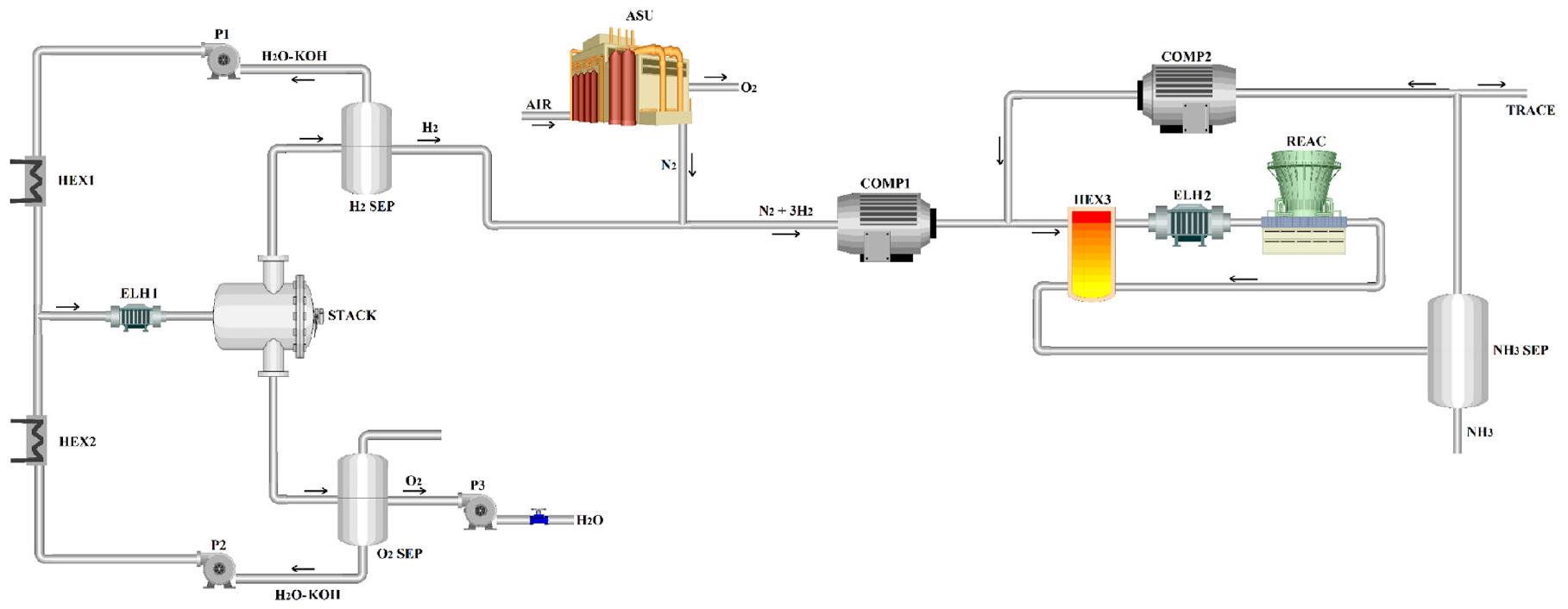
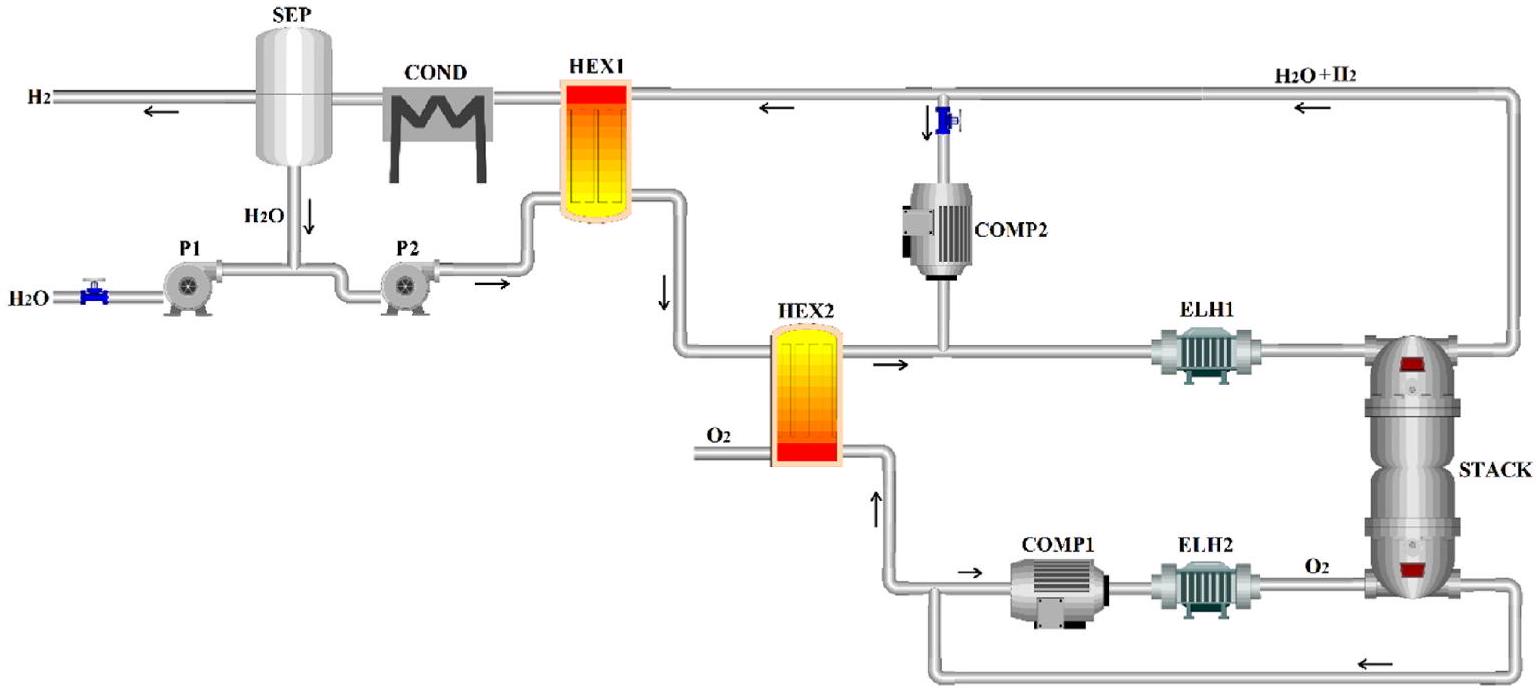
يوضح الشكل 2 مخطط تدفق AEC. يتم استخدام HEX1 و HEX2 للتبريد للحفاظ على درجة حرارة مدخل الكومة ثابتة عند درجة حرارة التشغيل.
الشكل 2. الشكل التخطيطي لنظام AEC المبسط.
التفاعلات الكيميائية في جانبي الكاثود والأنود للخلية والتفاعل الكلي هي كما يلي:
الكاثود:
الأنود:
الإجمالي:
يمكن تحديد جهد الخلية المطلوب لهذا التفاعل الكهروكيميائي من خلال الديناميكا الحرارية للخلية كما يلي:
هنا ، هو التغير في طاقة غيبس الحرة للتفاعل ، إنثالبي التفاعل و إنتروبيا التفاعل.
في هذا البحث ، يتم استخدام منحنى الاستقطاب المبلغ عنه من قبل أنظمة الهيدروجين الأخضر [44] لتمثيل أداء LTP-AEC المتطور. بالنسبة لـ HTP-AEC ، تم استخدام بيانات داخلية من مشروع EEEHy [45]. يمكن العثور على مزيد من التفاصيل حول البيانات المستخدمة لنمذجة كل من LTP و HTP-AEC في المرجع [31].
معدل إنتاج الهيدروجين واستهلاك الطاقة بواسطة AEC هي كما يلي:
حيث هي كثافة التيار التي تمر عبر المحلل الكهربائي ، جهد الخلية ، مساحة الخلية و عدد الخلايا.

2.1.2. حلقة هابر-بوش (HBL)

حلقة هابر-بوش هي العملية الصناعية المستخدمة بشكل أساسي لإنتاج الأمونيا ، والتي تستخدم مزيجًا من الهيدروجين والنيتروجين كمواد خام لتخليق الأمونيا عند درجات حرارة حوالي وضغوط أعلى من 100 بار [46].
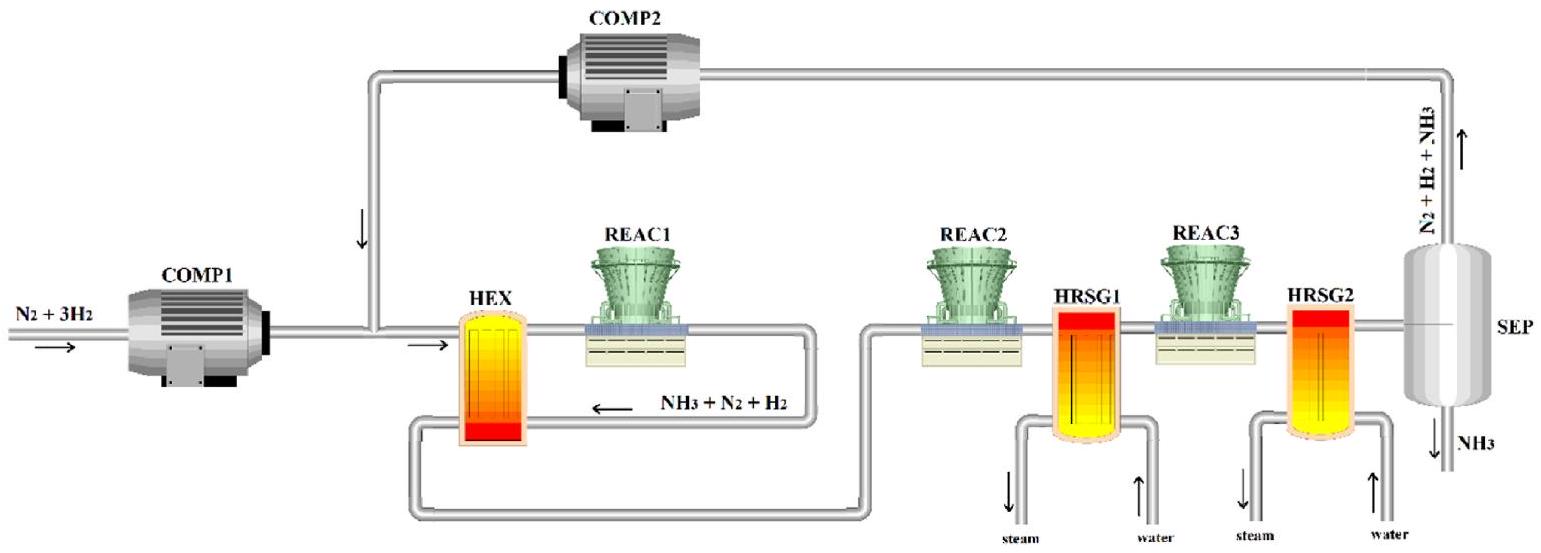
الشكل 3 يوضح مخطط تدفق HBL على مستوى النظام. في هذا البحث، تم نمذجة HBL استنادًا إلى الدراسة التي أجراها فلوريس أوريغو وآخرون [47] لإنتاج الأمونيا على نطاق واسع. كما يظهر الشكل، يتكون مصنع تخليق الأمونيا من مفاعل ثلاثي الأسرة مزود بمبادل حراري لنقل الحرارة بين تدفقات مدخل ومخرج الأسرة الأولى واثنين من مولدات بخار استرداد الحرارة (HRSG) بعد الأسرة الثانية والثالثة لإنتاج البخار. بالإضافة إلى ذلك، يتم استخدام الحرارة المهدرة من مبردات الضواغط لإنتاج البخار أو تسخين مياه التغذية لعملية التحليل الكهربائي. يجب أن تكون درجة حرارة المدخل لكل سرير مرتفعة بما يكفي لتسريع التفاعل ولكن ليس إلى الحد الذي يحد فيه التحويل عن التوازن. لقد قام فلوريس أوريغو وآخرون [47] بتحسين أداء HBL من خلال ضبط درجة حرارة مدخل الأسرة لكل سرير لتناسب تركيبات الغاز الاصطناعي المحددة. لتحقيق تحويل أعلى للأمونيا في كل تمريرة، قاموا بتقسيم المفاعل إلى ثلاث أسرّة محفزة متسلسلة مع مبرد. يوضح الجدول 4 الافتراضات وبيانات الإدخال التي تم أخذها في الاعتبار في نمذجة HBL.
التفاعل التالي، الذي يحدث عند درجات حرارة أعلى ( ) في وجود المحفزات المناسبة، يصف تخليق الأمونيا:
يمكن التعبير عن معدل تفاعل تخليق الأمونيا فوق محفز كما يلي [14]:
الجدول 4
البيانات المدخلة والافتراضات التي تم أخذها بعين الاعتبار لنمذجة HBL [47].
معامل قيمة معامل قيمة
درجة حرارة مدخل السرير الأول ( ) ٣١٠ درجة حرارة مدخل السرير الأول ( ) ٣٨٠
ضغط تشغيل المفاعل (بار) ٢٠٠ كفاءة الضاغط الإيزنتروبيكية (%) ٨٠
نسبة تحويل السرير الأول (%) ٢٠.٧ انخفاض ضغط المفاعل (بار) 1.5
نسبة تحويل السرير الثاني (%) 6.5 نهج الحد الأدنى من درجات الحرارة ) 10
نسبة تحويل السرير الثالث (%) 7.2 درجة حرارة تشغيل الفاصل ( ) 40
تيار التغذية نسبة المولات 3:1 فعالية مبادل الحرارة (%)
أين هو الضغط الجزئي للمركب (بار)، ثابت الغاز العالمي كثافة المحفز عامل تصحيح (4.75)، و عوامل ما قبل الأسية لمسارات التفاعل الأمامي والعكسي، على التوالي. يُفترض أن KMR 111 هو محفز لتخليق الأمونيا قائم على الحديد تم تقليله مسبقًا بكثافة [48].

2.2. كفاءة النظام

يمكن كتابة كفاءة النظام بالكامل المعتمدة على القيمة الحرارية المنخفضة (LHV) كالتالي:
أين هو معدل تدفق الكتلة للأمونيا الخضراء المنتجة ( ) ، هو القيمة الحرارية المنخفضة للأمونيا ) و هو إجمالي الطاقة المستهلكة بواسطة النظام (كيلووات)، بما في ذلك المحلل الكهربائي، وحدة فصل الهواء، السخانات الكهربائية، الضواغط والمضخات.

3. التحليل التكنولوجي الاقتصادي

لإجراء التحليل الاقتصادي، يتم تقدير تكلفة الاستثمار الأولية المطلوبة؛ حيث يتم تقدير نفقات رأس المال (CAPEX) لكل مكون فردي مع تكاليف الصيانة والتصنيع. تكاليف التصنيع هي التكاليف التي يتم تكبدها أثناء إنتاج منتج. تشمل هذه التكاليف التكاليف المباشرة (تكاليف العمالة، والعمالة الإشرافية والكتابية المباشرة، ورسوم المختبر) والتكاليف الثابتة (الضرائب المحلية ونفقات المصنع) والتكاليف العامة (التوزيع، والبحث والتطوير، والإدارة). تعتبر أكثر دوال التكلفة استخدامًا في الأدبيات هي التي يتم اعتبارها للمكونات المستخدمة لتقدير
الشكل 3. مخطط تدفق HBL.
إجمالي نفقات رأس المال للنظام، كما هو موضح أدناه.
يمكن العثور على نفقات مختلفة في الأدبيات المتعلقة بالمحللات الكهربائية. ومع ذلك، من الشائع أن تكلفة مجموعة التحليل الكهربائي من المتوقع أن تنخفض بشكل كبير على مر السنين. ويرجع ذلك إلى التطور المتوقع لتقنيات التحليل الكهربائي، وبشكل خاص، الانخفاضات المتوقعة في التكاليف نتيجة التصنيع الضخم. من المتوقع أن تشهد تقنية SOEC الأقل نضجًا أكبر انخفاض نسبي في التكاليف. يُفترض عمومًا أن مصنع HBL ووحدة فصل الهواء (ASU) هما تقنيتان ناضجتان ولا يُتوقع أن تخضعا لتغييرات كبيرة من حيث النفقات الرأسمالية (CAPEX) في المستقبل القريب.
هنا، تُستخدم قيم الأدبيات لتقدير تكلفة AEC و SOEC في عام 2020 و 2030 و 2050. القيم الأساسية المختارة مدرجة في الجدول 5. يمكن العثور على مزيد من التفاصيل حول تقدير CAPEX لـ AEC و SOEC وتكلفة استبدال وحداتهم في المرجع [31].
أيضًا، يُفترض أن إجمالي النفقات الرأسمالية لنظام HP-SOEC هو أعلى من LP-SOEC [31]. السبب هو أنه سيتم استخدام أنابيب وأوعية أكثر متانة لتحمل الضغوط الأعلى.
لا توجد توقعات تكلفة متاحة لتقنية HTP-AEC بحلول عام 2020، حيث إن هذه التقنية لم تُؤسس بعد. ومع ذلك، يُفترض أن يتم تطوير هذه التقنية بحلول عام 2030 وأن تتبع نفس اتجاه تكاليف الاستثمار الرأسمالي مثل تقنية SOEC. تعتمد كلتا التقنيتين على خلايا سيراميكية، وتحتاج إلى طلاءات وفولاذ خاص لتحمل البيئات التآكلية.
بعد تقدير النفقات الرأسمالية (CAPEX) للنظام بالكامل، يتم حساب القيمة الحالية (PV) للمعاملات المالية المستقبلية، وتحديداً تكلفة استبدال الوحدة، على النحو التالي [52]:

أين هو تكلفة استبدال الكومة في نهاية السنة و هو معدل الفائدة السنوي. بهذه الطريقة، يمكن حساب القيمة الحالية لتكلفة استبدال المكدس واعتبارها جزءًا من النفقات الرأسمالية الأولية للكهروكيميائي.
بعد تقدير النفقات الرأسمالية المطلوبة للنظام بالكامل والقيمة الحالية لتكلفة استبدال الوحدة، يمكن التعبير عن النفقات الرأسمالية الموزعة باليورو/سنة كما يلي:
الجدول 5
وظائف التكلفة للمكونات الرئيسية. تكاليف وحدات التحليل الكهربائي هي تقديرات “جاهزة” على مستوى المصنع وتشمل بذلك مكونات توازن المصنع والتكاليف الإضافية كما هو موضح في المرجع [31].
مكون النفقات الرأسمالية [وحدة] شرط مرجع
LP-SOEC 2020: النفقات الرأسمالية [م€/ميغاوات] لتيار الحمل المرجعي [31]
٢٠٣٠ [م€/ميغاوات] كثافة (حوالي لـ
2050: النفقات الرأسمالية LP-SOEC و 1.25 A/ لـ HPSOEC)
إل تي بي – إيه إي سي 2020: [م€/ميغاوات] للكثافة الحالية المرجعية [31]
٢٠٣٠
[م€/ميغاوات]
2050: النفقات الرأسمالية
HEX [50]
HBL النفقات الرأسمالية [26]
جامعة ولاية أريزونا النفقات الرأسمالية [26]
كوند النفقات الرأسمالية [51]
تعويض [52]
نفقات رأس المال الموزعة
CRF هو عامل استرداد رأس المال ويعرف على أنه:

حيث، هو العمر الاقتصادي للنظام.
بالإضافة إلى تقدير النفقات الرأسمالية الموزعة، من الضروري تقدير النفقات التشغيلية للنظام من حيث €/سنة. يجب أن تشمل هذه التكاليف المتعلقة باستهلاك الكهرباء، وصيانة النظام بالكامل، وتكاليف التصنيع. يُفترض أن تكون تكلفة الصيانة السنوية هي من إجمالي نظام CAPEX [21]. تم اعتماد تكاليف التصنيع من المرجع [53]، والتي تتكون من تكاليف التصنيع المباشرة والثابتة والعامة. تعتمد تكلفة التصنيع المباشرة بشكل رئيسي على عدد المشغلين لكل وردية (NOL) وهو دالة لعدد خطوات المعالجة التي تتضمن التعامل مع المواد الصلبة الجزيئية وعدد خطوات المعالجة غير الجزيئية. يمكن العثور على مزيد من التفاصيل في المرجع [53]. تفاصيل تكاليف التصنيع وبقية المدخلات المستخدمة في التقييم التكنولوجي والاقتصادي مدرجة في الجدول 6. تشمل CAPEX التي تم تقييمها للكهارل أسعار تسليم مفتاح شاملة، بما في ذلك التصنيع والهندسة والأنابيب والمشتريات والبناء والاحتياطات والتمويل وعوامل أخرى ذات صلة. وبالتالي، يتم خصم CAPEX للكهارل من إجمالي التكلفة الأولية الإجمالية (CAPEX في الجدول 6) لتقدير نفقات التصنيع.
بمجرد تقدير النفقات الرأسمالية الموزعة والنفقات التشغيلية السنوية للنظام، يمكن تحديد تكلفة الأمونيا الخضراء باستخدام المعادلة التالية:
نفقات رأس المال المستهلكة + نفقات التشغيل المُنتَج سنويًا تكلفة
الجدول 6
بيانات الإدخال للتحليل الاقتصادي.
معامل قيمة
تكلفة استبدال مجموعة SOEC (% من النفقات الرأسمالية) [31] 2020: 23.5
٢٠٣٠: ١٣.٥
2050: 9.5
تكلفة استبدال مجموعة AEC (% من النفقات الرأسمالية) [31] 2020: 50
٢٠٣٠: ٤٨
2050: 44
عمر مجموعة SOEC (سنة) [31] ٥
عمر مجموعة AEC (سنة) [31] 10
تكلفة الطاقة المستوى (€/MWh) 10-60
إل (سنة) ٢٥
عامل سعة المحطة (ساعات تشغيل المحطة في 8760 ساعة) (%) 50
متوسط سعر صرف اليورو مقابل الدولار 1.12
(%) ٨
تكلفة التصنيع [53]:
تكلفة التصنيع المباشرة سنة ):
– تكلفة العمالة ( ) ( هو عدد المشغلين لكل وردية)
– العمل الإشرافي المباشر والعملي الكتابي
– رسوم المختبر
تكلفة التصنيع الثابتة سنة ):
– الضرائب المحلية النفقات الرأسمالية
– تكاليف المصنع
النفقات الرأسمالية
تكلفة التصنيع العامة (€/سنة):
– التوزيع
– البحث والتطوير
– الإدارة
النفقات الرأسمالية

4. النتائج والمناقشة

4.1. تخطيطات النظام

تظهر الأشكال 4 و 5 أنظمة إنتاج الأمونيا الخضراء المصممة بناءً على AEC و SOEC، على التوالي. كثافات التيار من ويُفترض أن النقطة المقابلة لنقطة الحرارة المحايدة هي AEC و SOEC، على التوالي. ظروف التشغيل والمعلمات الفنية لـ HBL و ASU هي نفسها لجميع الأنظمة. هذه القاعدة تمكّن من مقارنة متسقة بين الطرق المختلفة لتوليد الهيدروجين لكل مفهوم عملية.
في الشكل 4، يتم توصيل AEC و HBL بحيث يتم دمج الهيدروجين المنتج مع النيتروجين وإرساله إلى HBL. تم نمذجة ضاغط متعدد المراحل (COMP1) مزود بمبردات لضغط المواد الخام لـ HBL. خلال التشغيل الثابت، يعمل HTP-AEC تحت ظروف طاردة للحرارة ولا حاجة لدمج الحرارة (بل هناك حاجة للتبريد أو استخراج الحرارة المهدرة ليتم بيعها إذا أمكن).
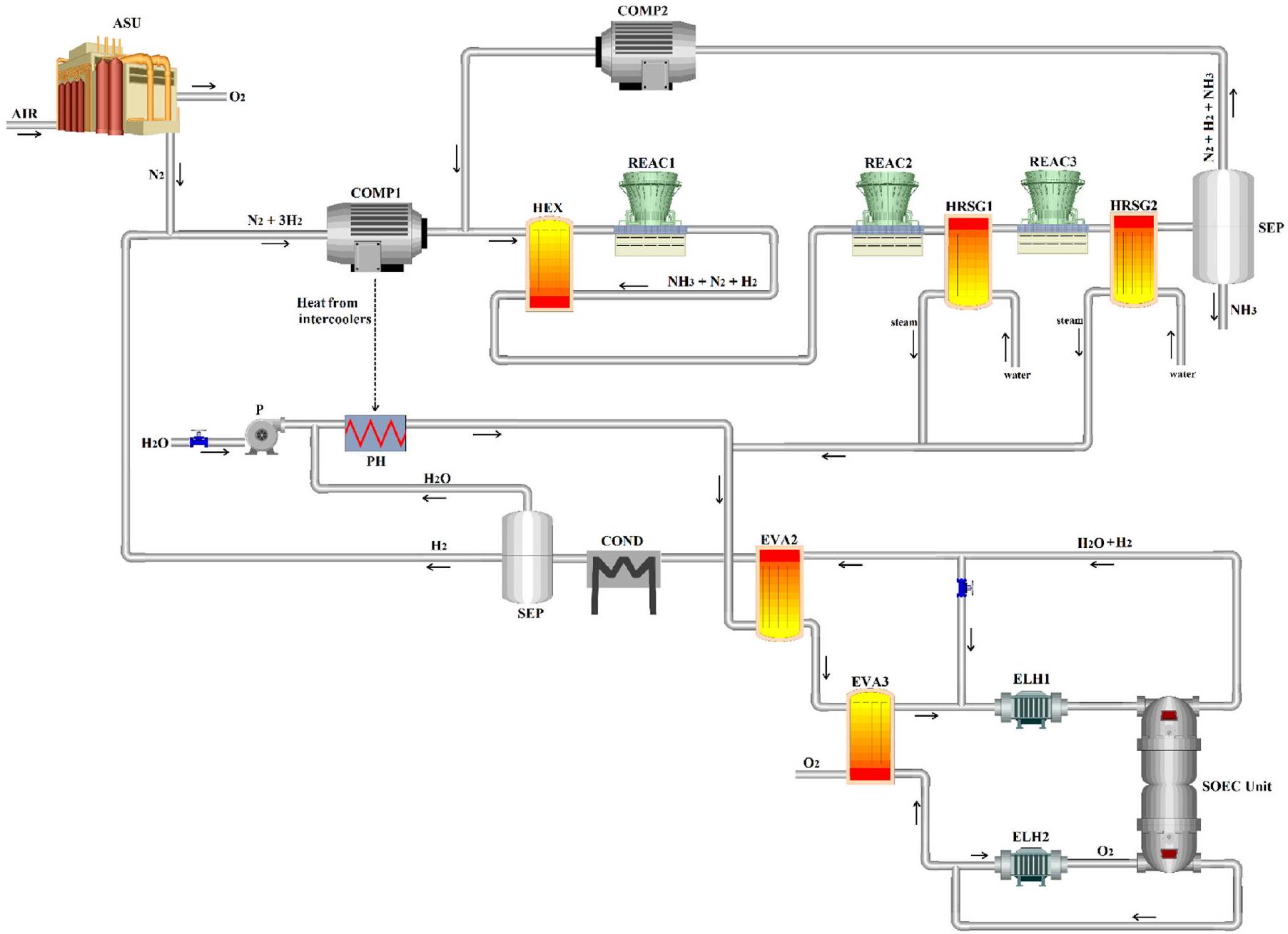
يوضح الشكل 5 تخطيط مصنع الأمونيا الخضراء القائم على SOEC. الاختلاف الرئيسي مع المصنع القائم على AEC هو أنه هنا يوجد دمج للحرارة بين SOEC و HBL. تم إجراء التوصيلات التالية.
  • يتم استخدام الحرارة المهدرة من مبردات الضاغط متعدد المراحل (COMP1) لتوليد البخار لنظام LP-SOEC في المسخن (PH). ومع ذلك، فإن الحرارة من المبردات ستكون قادرة فقط على تسخين مياه التغذية (دون تبخيرها) لنظام HP-SOEC، حيث يحدث التبخر عند (بخار مشبع عند 30 بار).
  • يتم أيضًا استخدام محتوى الحرارة في غاز المفاعل (REAC2 و REAC3) لتبخير جزء من مياه التغذية باستخدام مولد بخار استرداد الحرارة 1 و 2 (HRSG1 و HRSG2).
  • علاوة على ذلك، يتم استخدام محتوى الحرارة في غاز المصنع SOEC لتبخير أي مياه متبقية في التغذية ولتسخين البخار الناتج إذا أمكن.
بالنسبة للضغط، يجب ملاحظة أن الجانب الكاثودي (أو الوقود) من SOEC في هذه الدراسة مضغوط للحصول على جهد دائرة مفتوحة أقل مقارنةً بضغط كلا الجانبين الأكسجين والوقود. كما ورد في المرجع [54]، هناك فرق ضئيل بين الضغط من جانب واحد والضغط من جانبين حيث أن وضع الضغط من جانب واحد يعيق زيادة OCV ويقلل من ASR. وهذا سيؤدي في النهاية إلى نظام أكثر كفاءة، حيث أن الأكسجين الناتج غير مضغوط وبالتالي لا يوجد عقوبة كفاءة عبر زيادة القوة الدافعة الكهربائية (EMF) للخلايا. يُفترض أن الكتل يمكن أن تتحمل الضغط المفروض
الفرق. يمكن للمرء أيضًا أن يعمل مع الأكسجين عند نفس الضغط مثل ، لكن هذه الحالة لم تُعالج هنا.
المسخن الكهربائي 1 (ELH1) يبخر مياه التغذية المتبقية و/أو يسخن البخار الناتج حتى درجة حرارة تشغيل الإلكتروليزر. على الرغم من أن مصنع SOEC يعمل عند النقطة الحرارية المحايدة، إلا أن ELH1 و ELH2 مطلوبان لتعويض الكمية القليلة من الحرارة التي تضيع في استرداد الحرارة المهدرة من غاز SOEC. في ظروف بدء التشغيل، يوفر ELH1 كل الطاقة المطلوبة لإنتاج البخار وتسخين النظام.

4.2. النتائج الديناميكية الحرارية

نظرة عامة على النتائج الفنية التي تم الحصول عليها من التحليل الديناميكي الحراري المفصل لكل نظام موضحة في الجدول 7. تم تصميم الأنظمة لإنتاج 430 كطن من الأمونيا الخضراء سنويًا تحت ظروف ثابتة. في الجدول 7، يتم تطبيع النتائج لتكون لكل طن منتج من الأمونيا، حيث لا تدخل تأثيرات التحجيم غير الخطية في النماذج.
بالإشارة إلى هذا الجدول، فإن النظام المزود بـ HTP-AEC يعمل بكفاءة أكبر من النظام المصمم بناءً على LTP-AEC. تشمل فوائد HTP-AEC مقارنةً بـ LTP-AEC تعزيز معدلات التفاعلات الكهروكيميائية على أسطح الأقطاب وزيادة الموصلية الأيونية للإلكتروليت، مما يؤدي إلى انخفاض استهلاك الطاقة بواسطة الإلكتروليزر وزيادة كفاءة النظام.
SOEC أكثر كفاءة من AEC، ولكن بشكل خاص يؤدي دمج الحرارة بين SOEC و HBL إلى تحسين الكفاءة.
زيادة ضغط SOEC تقلل من الحرارة الناتجة عن الضواغط، ونتيجة لذلك، الحرارة من المبردات. وبالتالي، يتطلب ELH1 طاقة أكبر ( طاقة أكبر من النظام المصمم بناءً على LP-SOEC)، والتي تُحتسب في تشغيل وحدة الإلكتروليزر. وبالتالي، يبدو أن الإلكتروليزر أقل كفاءة في الجدول 7. ومع ذلك، فإن الطاقة المطلوبة لضغط المواد الخام لـ HBL تقل بنسبة مقارنةً بنظام LP-SOEC. وبالتالي، فإن هذين لهما تأثيرات “معاكسة” على كفاءة النظام بالكامل. في النهاية، فإن النظام المصمم بناءً على HP-SOEC لديه كفاءة أعلى قليلاً من ذلك المصمم بناءً على LP-SOEC.
تكشف النتائج من النمذجة أنه في الأنظمة المصممة بناءً على LP-SOEC و HP-SOEC، يمكن إنتاج حوالي و من البخار المطلوب من خلال دمج الحرارة مع HBL؛ 1.43 و 0.77 طن من البخار عند ضغط تشغيل SOEC لكل طن من الأمونيا المنتجة، على التوالي.

4.3. نتائج تحليل التكلفة

من الجدير بالذكر أن النتائج المرتبطة بالتحليل الاقتصادي الفني
الشكل 4. مصنع الأمونيا الخضراء القائم على AEC.
الشكل 5. مصنع الأمونيا الخضراء القائم على SOEC.
تقدر فقط تكلفة الأمونيا الخضراء الآن وفي المستقبل تحت افتراضات محددة ولا يمكن تعميمها بسهولة على مواقع مختلفة في العالم مع LCOE وعوامل سعة مختلفة. يجب تقييم الأنظمة لمواقع محددة باستخدام بيانات حقيقية عن ملفات الرياح والطاقة الشمسية لحساب تكلفة الأمونيا الخضراء القريبة من الواقع، انظر على سبيل المثال المرجع [10]. ومع ذلك، يتم تقديم تحليل حساسية لاحق يوضح تأثيرات LCOEs وعوامل السعة المختلفة في ما يلي.
بالإضافة إلى ذلك، الهدف الرئيسي من هذا العمل هو تقييم الأثر الاقتصادي للتطورات التقنية المحتملة تحت ظروف متطابقة وقابلة للتصور. نظرًا لأن تخزين الهيدروجين مكلف على نطاق صغير، يُفترض في هذا التحليل أن الهيدروجين الأخضر المنتج سيتم تحويله مباشرة إلى أمونيا؛ لا تُعتبر مرافق التخزين.
يُفترض أن الأنظمة تعمل من السنة ( 4380 ساعة) عندما تكون الكهرباء الخضراء من الرياح والشمس متاحة. لذلك، تم تصميم الأنظمة بشكل متعمد بحجم مضاعف 2 لتلبية الإنتاج السنوي المطلوب من الأمونيا الخضراء.
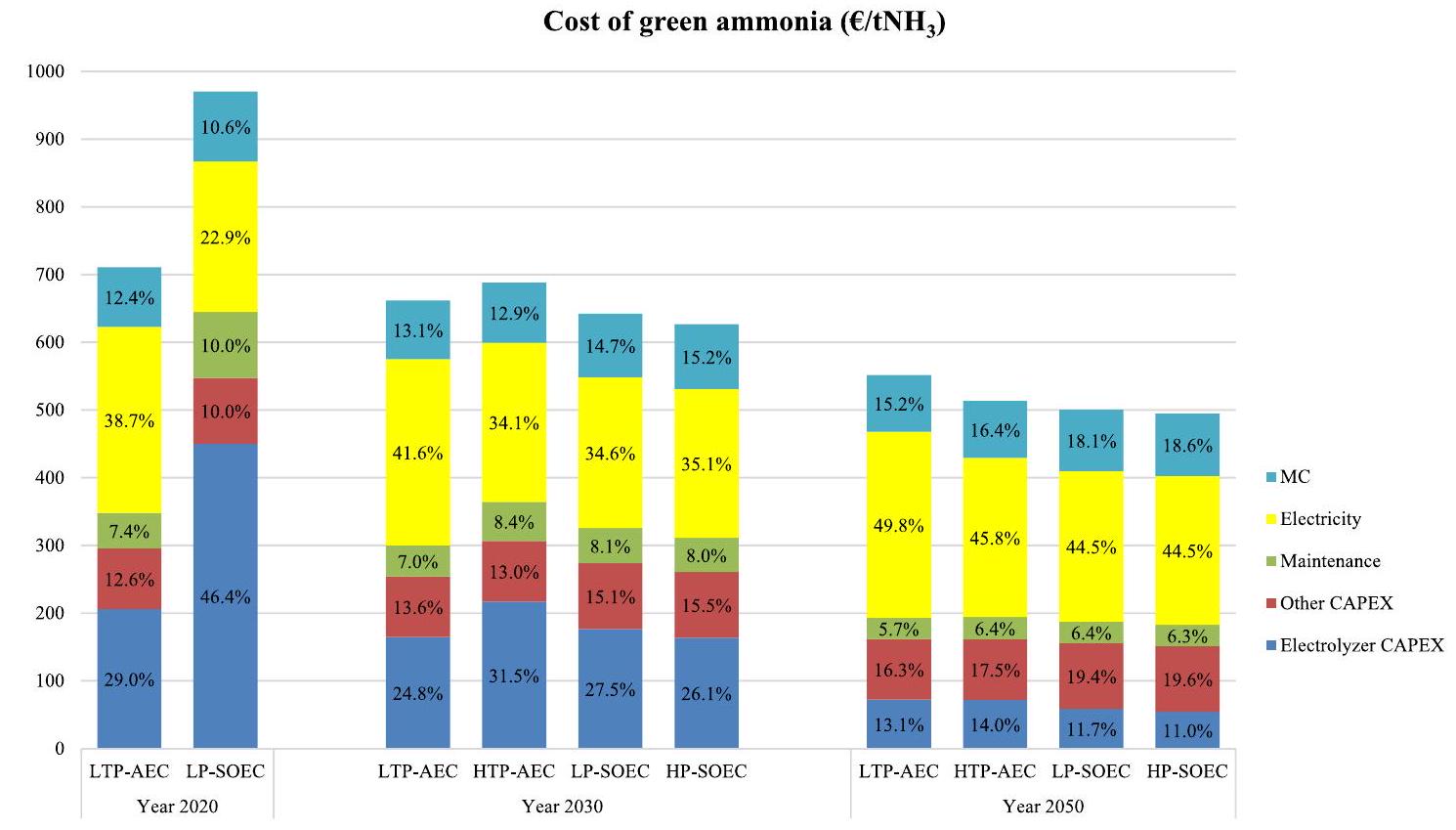
يتم توضيح تحليل تكلفة إنتاج الأمونيا الخضراء بناءً على تقنيات AEC و SOEC في الشكل 6، مع الأخذ في الاعتبار السنوات 2020 و 2030 و 2050، مع عامل سعة قدره و LCOE قدره 30 يورو/ميغاوات ساعة. في هذا الشكل، تشير “نفقات رأس المال الأخرى” إلى النفقات الرأسمالية للنظام بالكامل باستثناء الإلكتروليزر. نظرًا لأن HTP-AEC و HP-SOEC غير متاحة تجاريًا، فإن تكلفة الأمونيا المنتجة بناءً على هذه التقنيات غير مدرجة في عام 2020.
كما يتضح، بحلول عام 2020، يؤدي النظام القائم على AEC إلى أكثر إنتاج أمونيا فعال من حيث التكلفة. ومع ذلك، بحلول عام 2030 و 2050، من المتوقع أن تشهد تكلفة الأمونيا المنتجة باستخدام SOEC انخفاضًا كبيرًا
بسبب التشغيل بكفاءة وتقليل CAPEX المتوقع لـ SOEC، ويرجع ذلك أساسًا إلى تطوير التكنولوجيا وزيادة حجم الإنتاج. يتم مناقشة فوائد التكلفة لدمج SOEC في أنظمة الأمونيا الخضراء لاحقًا من خلال حساب LCOEs وعوامل السعة المطلوبة لضمان التنافسية الاقتصادية.
عند مقارنة تكلفة الأمونيا المنتجة باستخدام تقنيات SOEC ذات الضغط المنخفض والعالي، فإن الأخيرة هي الأكثر كفاءة من حيث التكلفة. إن المقاومة الداخلية الأقل عند الضغط العالي تزيد من كثافة التيار عند التشغيل الحراري المحايد، مما يؤدي إلى الحاجة إلى خلايا أقل وبالتالي انخفاض CAPEX. بالإضافة إلى ذلك، يقلل استخدام HP-SOEC من نفقات الكهرباء لضغط المواد الخام لـ HBL. هذه المزايا لاستخدام HP-SOEC تتجاوز تقريبًا تأثير CAPEX المفترض الأعلى لنظام مضغوط وتقليل دمج الحرارة بين الإلكتروليزر و HBL. بحلول عام 2050، ستشكل النفقات المتعلقة برأس المال للمصنع حصة أقل من OPEX في تحليل التكلفة. لذلك، فإن الميزة الكبيرة الوحيدة لاستخدام HP-SOEC هنا هي تقليل الطاقة المطلوبة لضغط المواد الخام.
في عام 2030، يصبح استخدام التحليل الكهربائي القلوي عالي الحرارة أقل جاذبية بسبب التقديرات التي تشير إلى ارتفاع تكاليف رأس المال (CAPEX) مقارنةً بالتحليل الكهربائي القلوي منخفض الحرارة. ومع ذلك، بحلول عام 2050، قد يصبح استخدام HTP-AEC مجديًا من الناحية الاقتصادية تحت التطورات المتوقعة في التكاليف مقارنةً بـ LTP-AEC. تعتمد هذه التقديرات على افتراض معدل التوسع للإنتاج الضخم، والذي يعتمد على الرغبة في الاستثمار. من الأكثر دقة أن نقول إنه، حتى مع ارتفاع تكاليف رأس المال، من المتوقع أن يتفوق HTP-AEC الموسع في النهاية على تقنية LTP-AEC.
في عام 2050، فإن أقل تكلفة متوقعة للأمونيا هي طن، الذي
الجدول 7
النتائج الفنية لنمذجة الديناميكا الحرارية للأنظمة (تم اعتبار القيمة الحرارية المنخفضة 120 و 18.6 ميغا جول/كغم للهيدروجين والأمونيا، على التوالي).
نظام التحليل الكهربائي مجموعة دول الآسيان SOEC
LTPAEC HTPAEC LP-SOEC HPSOEC
سعة النظام ( سنة) ٤٣٠ ٤٣٠ ٤٣٠ ٤٣٠
الطاقة المستهلكة بواسطة وحدة التحليل الكهربائي ( ) 8.81 ٧.٤٧ 6.07 + 0.91*
الطاقة المستهلكة بواسطة وحدة فصل الهواء (MWh/tNH3) 0.13 0.13 0.13 0.13
الطاقة المستهلكة بواسطة HBL ( ) 0.23 0.23 0.23 0.23
إجمالي الطاقة المستهلكة (ميغاوات ساعة/ ) 9.17 7.83 7.4 7.3
البخار الناتج من حرارة النفايات لمبردات الهواء و 1.43 0.77
تكامل الحرارة الحرارية بين المحلل الكهربائي و HBL (ميغاوات ساعة/طن NH3) 1.08 0.86
كفاءة المحلل الكهربائي المعتمد على LHV (%) ٦٦.٧ 78.6 ٨٣.١ 84.1
الكفاءة العامة المعتمدة على LHV (%) ٥٦.٤ 66.0 69.7 70.4
  • 0.70 و هي الكهرباء المستهلكة بواسطة ELH1 في الأنظمة المصممة بناءً على LP-SOEC و HP-SOEC، على التوالي. 6.07 ميغاوات ساعة/طن NH3 هي الكهرباء المستهلكة بواسطة الوحدات وهي نفسها في كلا الحالتين.
    ** هو الطاقة الإضافية المستهلكة لزيادة ضغط الهيدروجين بعد الـ LP-SOEC. الطاقة المستهلكة لزيادة ضغط المواد الخام لنظام HBL هي أعلى بالنسبة للنظام المصمم بناءً على LPSOEC.
    يمكن تحقيقه باستخدام النظام الذي يستفيد من HP-SOEC كمصدر للهيدروجين الأخضر.

4.4. الأمونيا المستندة إلى الوقود الأحفوري

4.4.1. الانبعاثات

الأمونيا، ثاني أكثر المواد الكيميائية إنتاجًا، مسؤولة عن
تقريبًا من استهلاك الوقود الأحفوري على مستوى العالم وحوالي عالمي الانبعاثات [55]. ومع ذلك، من الصعب تحديد المنبعثة من مصانع الأمونيا القائمة على الوقود الأحفوري، حيث تعتمد بشكل كبير على نوع الوقود المستخدم في المصنع (الغاز الطبيعي، الفحم، النفط أو النافثا). بالإضافة إلى ذلك، تعمل بعض مصانع الأمونيا بكفاءة أكبر و/أو بتلوث أقل من غيرها. القيمة المتوسطة لـ تُقدَّر انبعاثات إنتاج الأمونيا بـ [1]، بينما تتراوح بين 1.6 و 2.7 للمناطق الرئيسية [56]. تعتبر المواقع الحديثة المعتمدة على الغاز الطبيعي في منطقة آسيا والمحيط الهادئ مسؤولة عن القيمة المنخفضة في هذا النطاق؛ يمكن اعتبار محطات الفحم المنتشرة في الصين الأكثر -مسار إنتاج كثيف مع انبعاثات تقارب ثلاثة أضعاف، أي، يجب أن يُبرز أن تأثيرات أي تسريبات محتملة للميثان المرتبطة بالعملية لم تُؤخذ في الاعتبار في هذه التقييمات.

4.4.2. تكلفة الأمونيا الرمادية والحد الأدنى الضرائب
الأمونيا الناتجة من الغاز الطبيعي تُعرف هنا بالأمونيا الرمادية. وهي مسؤولة عن قدر كبير من الانبعاثات على مستوى العالم اليوم. تكلفة الأمونيا الرمادية تعتمد بشكل رئيسي على سعر المواد الأولية الأحفورية. عملية إصلاح الميثان بالبخار (SMR) هي التقنية الأكثر نضجًا لإنتاج الهيدروجين من المصادر الأحفورية. استنادًا إلى يadav وآخرون [58]، فإن عملية SMR الصناعية تطلق لكل كيلوغرام من الهيدروجين. أيضًا، فإن إنتاج الطاقة من موارد الغاز الطبيعي يطلق الانبعاثات [59].
لتقدير تكلفة الأمونيا الرمادية في هذه الدراسة، يتم أولاً الحصول على تكلفة الهيدروجين الرمادي من خلال العلاقة التالية [58]:
أين SMR و تكلفة الهيدروجين الأحفوري والغاز الطبيعي (NG) من حيث و على التوالي. بعد حساب تكلفة الهيدروجين الرمادي، يتم تقدير تكلفة الأمونيا الرمادية بنفس الطريقة المستخدمة للأمونيا الخضراء.
خلال السنوات العشر الأخيرة قبل COVID 19، كان سعر الغاز الطبيعي مستقراً نسبياً في أوروبا، يتراوح بين 10 إلى [60]. ومع ذلك، عند إعداد هذه التحقيق، شهد سعر الغاز الطبيعي في أوروبا تقلبات واسعة. في عام 2020، انخفض إلى ما دون . ثم، زاد بمقدار يقارب مقارنةً بـ
الشكل 6. تحليل تكلفة إنتاج الأمونيا الخضراء عبر تقنيات التحليل الكهربائي المختلفة (LCOE عامل السعة لـ وكثافة تيار تبلغ 0.5 لـ AEC والقيمة الحرارية المحايدة لـ SOEC (حوالي لـ LP-SOEC و لـ HP-SOEC)).
أقصى سعر قبل COVID بسبب الصراع الروسي الأوكراني في عام 2022. على الرغم من أنه من الصعب تقدير سعر الغاز الطبيعي في المستقبل، فإن هذا التحليل يفترض أنه سيبقى ضمن نطاق الوضع قبل COVID بحلول عام 2030 و2050.
الجدول 8 يمثل التكلفة المقدرة للهيدروجين والأمونيا من مصادر أحفورية بدون الضريبة، بينما يُفترض أن يكون LCOE يُقدَّر تكلفة الأمونيا الرمادية بـ تغيير سعر الغاز الطبيعي من 10 إلى تنفيذ سيرتفع الضريبة تكلفة الأمونيا الأحفورية. ويُذكر أن تكلفة الأمونيا الرمادية هي من قبل بوزو وكلويت [61] لمحطات الطاقة التقليدية بأسعار الطاقة الأوروبية (60 يورو/ميغاوات ساعة للكهرباء و6.5 يورو/جيجا جول ~ 23.4 يورو/ميغاوات ساعة للغاز الطبيعي).
لكي تصل الأمونيا الخضراء إلى التكافؤ في التكلفة مع الأمونيا الرمادية، يجب أن يجب فرض ضريبة. لتقدير العتبة الضريبة، يُفترض أن انبعاثات غازات الدفيئة خلال دورة حياة الأمونيا الإلكترونية هي إم جي ( ). هذه الفرضية تستند إلى الأرقام المبلغ عنها التي تبلغ حوالي 5 و (انبعاثات قائمة فقط على الكهرباء) لمصانع الأمونيا الإلكترونية المدفوعة بالرياح والطاقة الشمسية، على التوالي، في تقرير الوكالة الدولية للطاقة [62].
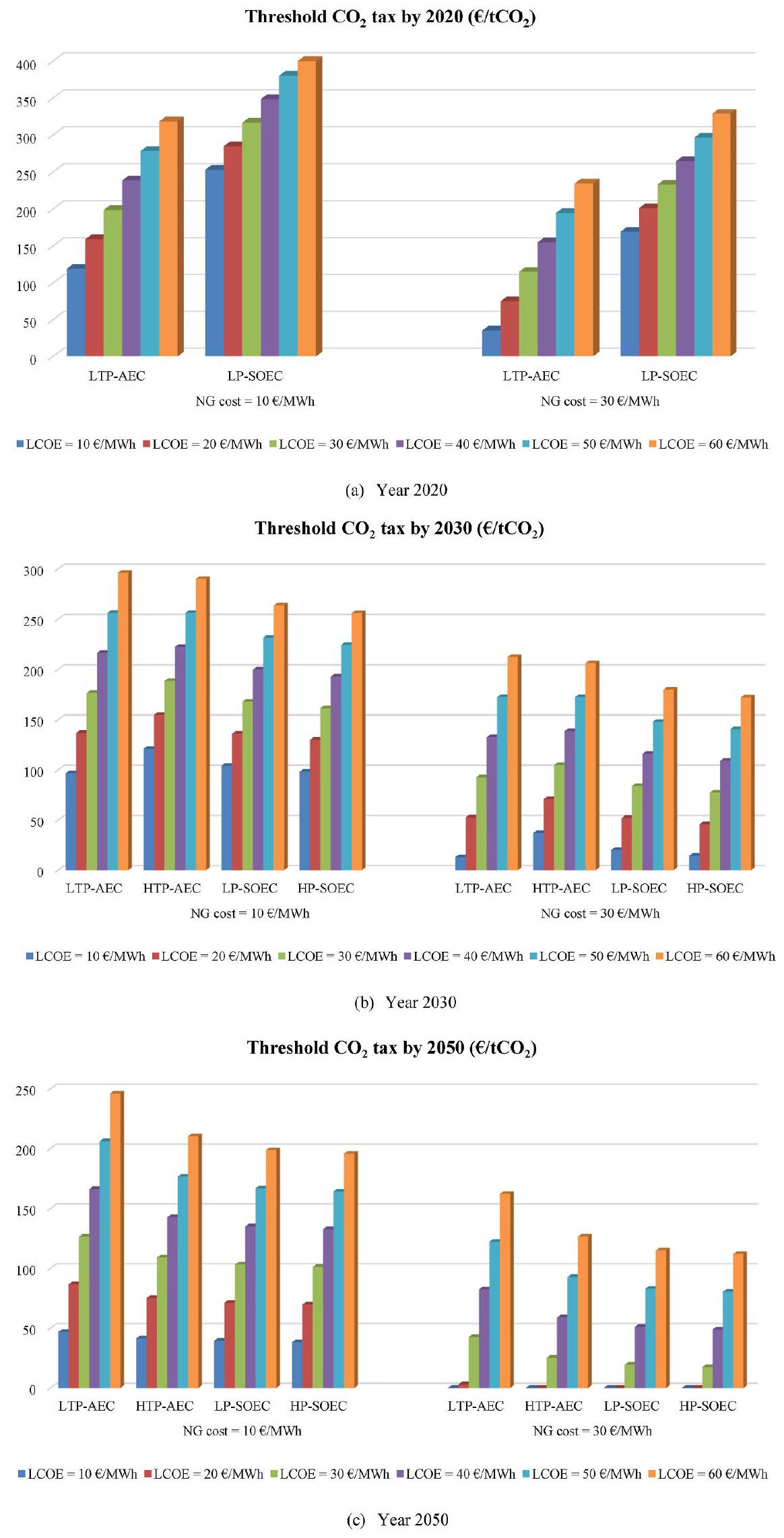
الشكل 7 يوضح العتبة المقدرة الضرائب لمستويات تكلفة الطاقة الكهربائية المختلفة وأسعار الغاز الطبيعي لليوم وتكاليف الأمونيا الخضراء المقدرة للمستقبل، مع افتراض عامل سعة للمصنع الأمونيا الأخضر. وبالتالي، فإن العتبات التي تم الحصول عليها هي الفرق بين تكاليف الأمونيا الرمادية والأمونيا الخضراء التي يجب موازنتها بواسطة ضريبة لتحفيز الانتقال.
الشكل 7 يوضح أنه منذ أن تكلفة الأمونيا الخضراء هي أعلى بمقدار مرات من الأمونيا الرمادية لعام 2020، مرتفعة نسبيًا الضرائب مطلوبة لتحقيق التكافؤ. أدنى الضرائب تتعلق بحالة LTP-AEC. بافتراض تكلفة الطاقة المتكاملة (LCOE) من وسعر NG لـ ، ضريبة 115 مطلوب لتحقيق توازن التكلفة.
بحلول عام 2030 و2050، خفض ستؤدي الضرائب إلى تحقيق توازن في التكاليف بسبب انخفاض تكلفة الأمونيا الخضراء، ويرجع ذلك أساسًا إلى انخفاض النفقات الرأسمالية المفترضة للمحللات وتحسين التكنولوجيا (درجات الحرارة العالية لتكنولوجيا AEC والضغط العالي لتكنولوجيا SOEC).
بحلول عام 2030 وقيم LCOE أعلى من يصل سعر الأمونيا الخضراء المنتجة عبر نظام يعتمد على خلايا الأكسيد الصلبة إلى التكافؤ مع الأمونيا الرمادية عند مستويات أدنى الضرائب مقارنة بنظام AEC. وذلك لأن تكلفة الأمونيا الخضراء من أنظمة SOEC ستكون أقل من تلك الخاصة بأنظمة AEC عند تكاليف الطاقة الكهربائية (LCOEs) التي تزيد عن 20 يورو/ميغاوات ساعة بحلول عام 2030.
بحلول عام 2050، مع كما هو متوقع لسعر الغاز الطبيعي، تنفيذ ضريبة على سوف تجعل الأمونيا الخضراء المعتمدة على SOEC تنافسية من حيث التكلفة حتى عند تكلفة مستوى الطاقة (LCOE) تصل إلى 60 يورو/ميغاوات ساعة.

4.4.3. تكلفة الأمونيا الزرقاء

يتم إنتاج الأمونيا الزرقاء بنفس طريقة إنتاج الأمونيا الرمادية، بينما من المنتج يفترض أن يتم التقاطه وتخزينه في مجرى المياه السفلي. غالبًا ما يتم الترويج للأمونيا الزرقاء كبديل للأمونيا الخضراء، حيث أن الكثير من الـ يمكن التقاطه من استخدام الوقود الأحفوري. معظم الـ تم التقاطه بالفعل بعد SMR لفصله عن الهيدروجين في مصانع الأمونيا الحالية، ومع ذلك يتم تصريفه في الغلاف الجوي. فقط الجزء من الغاز الطبيعي المستخدم لتسخين SMR هو
الجدول 8
تكلفة الهيدروجين الرمادي والأمونيا المنتجة من الغاز الطبيعي كدالة لسعر الغاز الطبيعي (LCOE ).
سعر الغاز الطبيعي (€/MWh) 10 (~0.115 30 (~0.345
) )
التكلفة المتعلقة بالرمادي 155 ٣٣٠
نفقات رأس المال الأخرى ( ) 50
الصيانة ( ) 10
الكهرباء ) 10
تكلفة التصنيع ( ) 50
تكلفة (بدون عقوبة) ( ) ٢٧٥ ٤٥٠
حالياً غير موثقة. يعتمد الاهتمام الكبير بالأمونيا الزرقاء على عاملين: القدرة على التوسع السريع وسرعة خفض التكاليف في مصادر الكهرباء المتجددة. على الرغم من أنها ليست مستدامة، يمكن اعتبار هذه الطريقة بديلاً صديقاً للبيئة نسبياً للأمونيا الرمادية. إن عدم وجود معايير صناعية لإثبات ديمومة احتجاز الكربون وتخزينه (CCS) والتخفيف من انبعاثات الميثان في المنبع هي تحديات خطيرة تعيق الأمونيا الزرقاء.
تعتمد تكلفة الأمونيا الزرقاء بشكل رئيسي على سعر الغاز الطبيعي وتكلفة احتجاز الكربون. تم التقاطه بالفعل أكثر من من من مصنع الأمونيا القائم على الغاز الطبيعي، لكن المناولة والتخزين سيضيفان تكاليف. ومع ذلك، فإن المحولات تعمل أيضًا بالوقود الأحفوري (عادةً الغاز الطبيعي أيضًا)، مما يؤدي إلى الانبعاثات [63]. الـ القادمة من مصلحي مصنع الأمونيا في يارا في بورتسغرون، النرويج، حوالي 415 من الإجمالي انبعاث 1 مليون طن سنويًا عند القدرة الكاملة [64]. في هذا العمل، يُفترض أن من المنتج ينبع من غاز العادم المخفف، مما يتطلب إضافة وحدة CCS للاحتجاز. من الممكن توفير الحرارة لعملية إصلاح الميثان بالبخار عن طريق الكهرباء بدلاً من حرق الغاز الطبيعي (المشار إليه بـ “e-SMR”)، حيث يتعين احتجاز نصف كمية CO2 فقط. سيؤدي ذلك إلى تقليل التكلفة الإجمالية لمحطة CCS ولكنه سيضيف تكلفة مقارنة بإصلاح الغاز الطبيعي. هذه الطريقة، على الرغم من كونها واعدة، لم يتم تحليلها بشكل أعمق هنا، حيث لا تتوفر تكاليف العملية التفصيلية في الأدبيات.
الجدول 9 يوضح التكلفة المقدرة للأمونيا الزرقاء لعام 2020 و2030 و2050 دون فرض الضريبة. يُفترض أن سعر الغاز الطبيعي سيبقى بين 10-30 يورو/ميغاوات ساعة حتى عام 2050. تكلفة الأمونيا الزرقاء هي تكلفة الأمونيا الرمادية، الموضحة في الجدول 8، بالإضافة إلى التكاليف المتعلقة بتقنية احتجاز الكربون. كما يُفترض أنه من عام 2020 إلى عام 2050، ستنخفض تكلفة احتجاز الكربون من 133 إلى [65]. كما يتضح، فإن تكلفة CCS الحالية تشكل تكلفة الأمونيا الزرقاء تعتمد على سعر الغاز الطبيعي.
افتراض سعر الغاز الطبيعي يمكن رؤية النقاط التالية من النتائج التي تم الحصول عليها.
  • بحلول عام 2020، يمكن أن تنافس الأمونيا الخضراء المعتمدة على الطاقة المتجددة الأمونيا الزرقاء فقط عند اعتبار قيمة “منخفضة” من كنسبة تكلفة الطاقة المتكاملة.
  • بحلول عام 2030، سيكون تكلفة الأمونيا الخضراء (استنادًا إلى تقنيتي AEC و SOEC) أقل من تكلفة الأمونيا الزرقاء عند اعتبار تكاليف الطاقة المستوية أقل من 15 يورو/ميغاوات ساعة.
  • بحلول عام 2050، سيكون الأمونيا الأخضر القائم على SOEC اقتصاديًا مفضلًا مقارنة بالأمونيا الزرقاء لأسعار تكلفة الطاقة أقل من 35 يورو/ميغاوات ساعة.

4.5. تحليل الحساسية

4.5.1. آثار تكلفة الكهرباء الموحدة (LCOE)
في عام 2020، على الرغم من الاضطرابات التي فرضها فيروس كورونا، استمر الاتجاه في انخفاض التكاليف لطاقة الرياح والطاقة الشمسية. مقارنةً بعام 2019، انخفض متوسط تكلفة الطاقة الموزونة عالميًا من الإضافات الجديدة لقدرات الطاقة الشمسية المركزة، وطاقة الرياح البحرية، وطاقة الرياح البرية، والطاقة الشمسية على نطاق المرافق بنسبة 16 و9 و13 و ، على التوالي [66].
في وقت كتابة هذا العمل، يتراوح LCOE لمزارع الرياح في جميع أنحاء العالم من 29 (الدنمارك) إلى (إيطاليا)، بينما تتراوح تكلفة الطاقة المتجددة من الطاقة الشمسية من 34 (فرنسا) إلى 275 يورو/ميغاوات ساعة (إيطاليا) [67]. ومع ذلك، بالنسبة للمحطات التي تتجاوز قدرتها 100 ميغاوات، تتراوح تكلفة الطاقة من طاقة الرياح من 31 (النرويج) إلى 200 يورو/ميغاوات ساعة (اليابان) وللمحطات الشمسية تتراوح بين 35 و142 يورو/ميغاوات ساعة في الولايات المتحدة الأمريكية [67]. تشير الاتجاهات إلى أنه من المتوقع أن تستمر هذه التكاليف في الانخفاض. النرويج والجزائر من بين الدول التي لديها أقل تكلفة للطاقة المتجددة للصناعات؛ و ، على التوالي [68،69].
ومع ذلك، فإن تقدير مستويات تكلفة الكهرباء المستقبلية ليس بالأمر السهل، حيث يعتمد ذلك بشكل كبير على التطورات التكنولوجية والاجتماعية والسياسات المعتمدة. يمكن أن يكون هذا العامل هو المصدر الرئيسي لعدم اليقين في توقع أسعار الأمونيا المستقبلية. يمكن العثور على بعض المحاولات لتوقع تكاليف الكهرباء المتوقعة في الأدبيات [70،71]. من التحليلات التي قدمها كامبيون وآخرون [70]، يبدو أن مستويات تكلفة الطاقة المتكاملة (LCOE) التي تتراوح حول 20-30 يورو/ميغاوات ساعة يمكن تحقيقها على الأرجح في عدة أماكن في العالم ذات إمكانيات جيدة للرياح والشمس، حتى عند احتساب بعض المشتريات من الشبكة لتمكين حوالي 7000 ساعة من التشغيل سنويًا [70].
الشكل 7. العتبة الضريبة التي تؤدي إلى تساوي تكلفة الأمونيا الرمادية والأمونيا الخضراء (عامل السعة لـ للمصنع الأمونيا الخضراء وكثافة التيار لـ AEC والقيمة الحرارية المحايدة لـ SOEC (حوالي لـ LP-SOEC و لـ HP-SOEC)).
الجدول 9
تكلفة الأمونيا الزرقاء (LCOE ).
سعر الغاز الطبيعي (يورو/ميغاوات ساعة) 10 ( ) 30 ( )
سنة ٢٠٢٠ ٢٠٣٠ ٢٠٥٠ ٢٠٢٠ ٢٠٣٠ ٢٠٥٠
تكلفة CCS ( ) [65] ١٣٣ ١٠٧ 87 ١٣٣ ١٠٧ 87
تكلفة CCS (€ ) 128 ١٠٣ 84 128 ١٠٣ 84
نسبة تكلفة CCS في تكلفة الأمونيا الزرقاء (%) 32 27 23 ٢٢ 19 16
تكلفة الأمونيا الرمادية بدون ضريبة ) (انظر الجدول 8) ٢٧٥ ٢٧٥ ٢٧٥ ٤٥٠ ٤٥٠ ٤٥٠
تكلفة الأمونيا الزرقاء بدون ضريبة ٤٠٣ 378 359 578 553 534
لتعميم النتائج التي تم الحصول عليها، يتم إجراء تحليل حساسية لرؤية تأثيرات تغيير تكلفة الطاقة الكهربائية (LCOE) على التكلفة المقدرة للأمونيا الخضراء. سيؤدي تغيير LCOE إلى تغيير حصة تكلفة الكهرباء في التكلفة الإجمالية للأمونيا الخضراء، بينما تظل التكاليف الأخرى ثابتة.
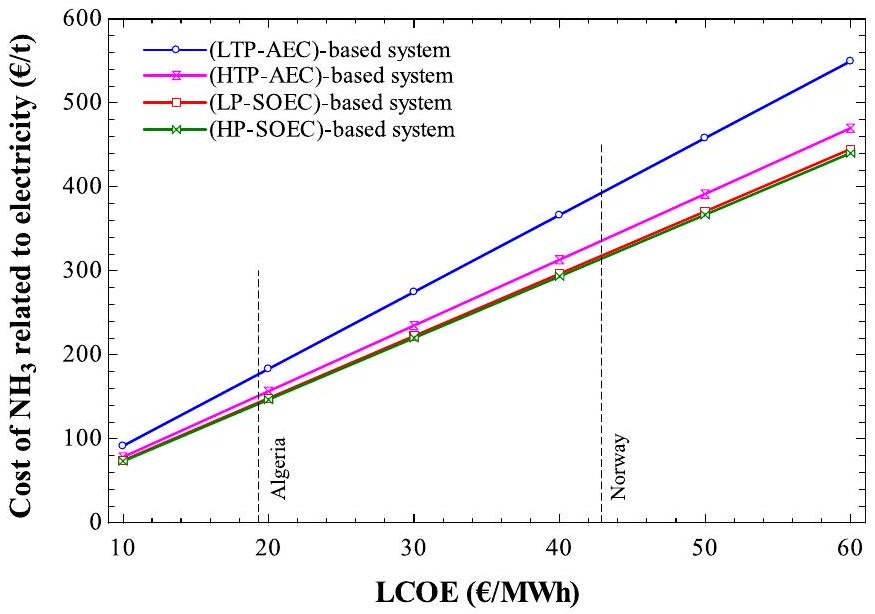
الشكل 8 يوضح التكاليف المتعلقة بالطاقة المستهلكة من قبل النظام بالكامل بناءً على تقنيات التحليل الكهربائي المختلفة لقيم LCOE تتراوح بين 10-60 يورو/ميغاوات ساعة. الخطان العموديان يوضحان LCOE الحالي للصناعات في الجزائر والنرويج – مما يمثل المواقع ذات أقل LCOE للصناعة في العالم وأوروبا، على التوالي. بالإشارة إلى هذا الشكل، فإن التكلفة المرتبطة بالكهرباء المستهلكة هي تقريبًا نفسها للأنظمة التي تستخدم LP-SOEC و HP-SOEC. كلا من SOECs ذات الضغط العالي والمنخفض تعمل تحت ظروف تشغيل حرارية محايدة. لذا، على الرغم من أن HP-SOEC تستخدم طاقة أقل لضغط الغاز المدخل، يجب إضافة حرارة إضافية إلى نظام HP-SOEC في مكان آخر لجعل وحدة SOEC تعمل بشكل حراري محايد. ستوفر السخانات الكهربائية هذه الحرارة الإضافية.
كما هو موضح في الشكل 9(أ)، فإن النظام المصمم بناءً على AEC سينتج أمونيا أرخص من النظام القائم على SOEC، بحلول عام 2020، بسبب انخفاض تكاليف رأس المال. كما يجب ملاحظة أن تكاليف الصيانة في هذه التقديرات تعتمد بشكل كبير على تقدير تكاليف رأس المال للنظام بالكامل.
بحلول عام 2030، من المتوقع أن تكون تكاليف رأس المال لنظام SOEC أقل بكثير، مما يؤدي هنا إلى أرخص مسار للهيدروجين الأخضر لتخليق الأمونيا. على الرغم من افتراض تكلفة مماثلة لنظام HTP-AEC وLP-SOEC، إلا أن هذا لا يزال غير تنافسي من الناحية الاقتصادية مقارنةً بنظام LTP-AEC لتكلفة الطاقة المستوية أقل من ، حيث إن الكفاءة لا تزال أقل من SOEC. لذا، على الرغم من أن HTP-AEC لديه كفاءة أفضل من LTP-AEC، إلا أن تكاليف رأس المال لا تزال مرتفعة جداً.
بحلول عام 2050، من المتوقع أن تنخفض تكاليف رأس المال لجميع تقنيات التحليل الكهربائي بشكل كبير، لذا سيكون لتكاليف التشغيل تأثير أكبر على تكلفة الأمونيا المنتجة. لذلك، ستكون تقنية HTP-AEC أكثر تنافسية من تقنية LTP-AEC، في حين أن المصانع المعتمدة على SOEC تتفوق على كلاهما.
الشكل 8. التكاليف المرتبطة باستهلاك الكهرباء من خلال التحليل الكهربائي المختلف مقابل تكلفة الطاقة الكهربائية المستوية (LCOE).
الشكل 9. تكلفة الأمونيا الخضراء المنتجة بتقنيات التحليل الكهربائي المختلفة مقابل تكلفة الطاقة Levelized (عامل السعة لـ للمصنع الأمونيا الخضراء وكثافة التيار لـ AEC والقيمة الحرارية المحايدة لـ SOEC (حوالي لـ LP-SOEC و لـ HP-SOEC)).
من المثير للاهتمام أن نظام HP-SOEC ينتج أمونيا أرخص قليلاً فقط من نظام LP-SOEC مع افتراض زيادة بنسبة 20% في تكاليف رأس المال. بالإشارة إلى الشكل 8، فإن التكلفة المتعلقة بالطاقة المستهلكة من قبل النظام بأكمله تقريباً هي نفسها لكلا النظامين العاملين بنظام LP-SOEC وHP-SOEC. ومع ذلك، فإن تكاليف رأس المال للكهروكيميائي أقل لنظام HP-SOEC.
الكمية المنتجة من الهيدروجين). وبالتالي، فإن النظام المزود بـ HP-SOEC لديه أداء اقتصادي أفضل قليلاً.
الشكل 9(c) يقارن أيضًا التكلفة المقدرة للأمونيا الرمادية والزرقاء، مع افتراض تطور معتدل في أسعار هذه الوقود. بحلول عام 2050، مع افتراض سعر الغاز الطبيعي ستكون تكلفة الأمونيا الخضراء أقل من تكلفة الأمونيا الزرقاء إذا كان LCOE لـ يمكن تحقيقه. أيضًا، بافتراض سعر الغاز الطبيعي ، سيكون الأمونيا الأخضر تنافسياً من حيث التكلفة مع الأمونيا الرمادية لتكلفة مستوى الطاقة أقل من .

4.5.2. آثار عامل السعة

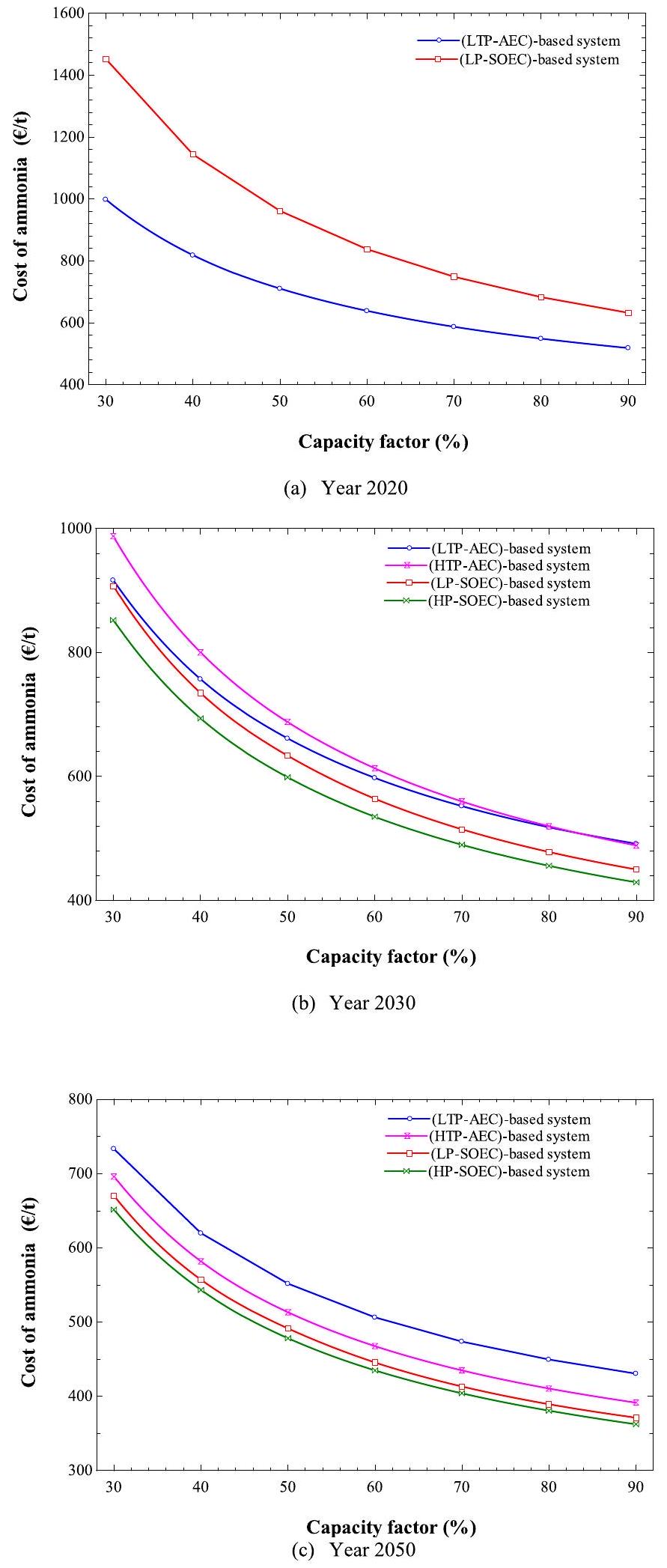
جميع النتائج المقدمة والمناقشة حتى هذه النقطة تفترض عامل سعة قدره ؛ وبالتالي، فإن الكهرباء الخضراء متاحة بتكلفة الطاقة المتكاملة (LCOE) تبلغ 50 من السنة. تحت ظروف الحالة الأساسية، تم تعديل جميع الأنظمة للإنتاج سنويًا مع عامل سعة يفترض أن التشغيل مع عوامل سعة مختلفة لا يؤثر على وقت استبدال المكدس وعمر النظام الاقتصادي.
الشكل 10 يعرض تأثيرات توفر الكهرباء المتجددة منخفضة السعر على تكلفة الأمونيا الخضراء. هنا، عامل السعة هو نسبة ساعات التشغيل الكاملة المعادلة للنظام إلى أقصى عدد ممكن من ساعات التشغيل في السنة (8760). على سبيل المثال، عامل سعة قدره يعني أن النظام يجب أن يتم توسيعه بمقدار 2 لإنتاج في السنة.
التشغيل بعوامل سعة أقل نتيجة لوجود كمية أقل من الكهرباء المتجددة المتاحة سيجعل الأمونيا الخضراء أكثر تكلفة بسبب استهلاك الاستثمار الرأسمالي – يجب الآن أن يكون المصنع أكبر من اللازم للوصول إلى نفس كمية المنتج سنويًا. تشير تكاليف الاستثمار الرأسمالي إلى حصة كبيرة من تكلفة الأمونيا الخضراء. وبالتالي، كما هو موضح في الشكل 10(أ)، فإن تكلفة الأمونيا الخضراء مرتفعة للغاية لعوامل السعة المنخفضة، خاصة بالنسبة لنظام SOEC. تظل تكاليف التشغيل لكل كمية منتجة من الأمونيا ثابتة، بينما تزداد تكاليف الاستثمار الرأسمالي لكل كمية منتجة من الأمونيا.
بالإشارة إلى الشكل 10 (ب)، بحلول عام 2030، ستكون تكلفة الأمونيا الخضراء المنتجة من النظام القائم على HTP-AEC هي نفسها تلك المنتجة من النظام القائم على LTP-AEC. على الرغم من أن HTP-AEC يعمل بكفاءة مقارنةً بـ LTP-AEC، إلا أن استهلاك رأس المال يؤثر بشكل كبير على تكلفة الأمونيا الخضراء. بالنسبة للأنظمة القائمة على SOEC، فإن تحسين الكفاءة الناتج عن تكامل الحرارة بين المحلل الكهربائي وHBL يعوض عن استهلاك رأس المال.
بحلول عام 2050، ستكون حصة نفقات رأس المال لمولدات الكهرباء منخفضة، وستكون كفاءة النظام (نفقات التشغيل) لها تأثير أكبر على تكلفة الأمونيا الخضراء. لذلك، فإن استخدام خلايا الأكسيد الصلبة (SOEC) لإنتاج الأمونيا الخضراء هو الخيار الأفضل، يليه خلايا التحليل الكهربائي عالية الحرارة (HTP-AEC).
الطريقة المطبقة هنا تفترض تكلفة الطاقة المتكاملة (LCOE) وعوامل سعة أعلى من سوف يقلل من تقدير تكاليف الأمونيا، حيث أن الكهرباء الخضراء متاحة فقط في هذه العوامل السعوية في عدد قليل ولكنها أماكن ذات صلة عالية في العالم. إذا كانت مستندة إلى مصادر الطاقة الشمسية أو الرياح، فإن العوامل السعوية ستتراوح من 25 إلى وبالتالي تشغيل المصنع أكثر من في بعض الأوقات، سيتطلب الأمر شراء الكهرباء من الشبكة في أوقات عدم وجود رياح أو شمس. هذه الكهرباء عادةً لن تكون خضراء.
يؤدي احتساب عوامل السعة المختلفة إلى النتائج في الرسوم البيانية في الشكل 10. ومع ذلك، فإن هذا يبالغ في تقدير العقوبة الاقتصادية الناتجة عن تقليل عدد ساعات التشغيل السنوية، حيث توجد إمكانيات للتخزين أو الكهرباء من أوقات انخفاض تكاليف الكهرباء إلى فترات ذات إنتاج قليل يتم تجاهلها.

4.5.3. آثار النفقات الرأسمالية المقدرة
نظرًا لأن تقنية SOEC حاليًا في مرحلة الترويج الأولية، فإن أدائها المستقبلي وقابليتها للتوسع والتقييم الاقتصادي الناتج عنها غير مؤكد. بالإضافة إلى ذلك، يُقدّر أن تكلفة رأس المال للكهروكيميائي ستنخفض بشكل كبير على المدى الطويل. وبالتالي، يتم اعتبار عدم اليقين في تقدير النفقات الرأسمالية لمعدات التحليل الكهربائي على المدى الطويل، كما هو موضح في الشكل 11.
بالإشارة إلى هذه الصورة، بحلول عام 2050، لعنصر سعة ، ستكون التكاليف المرتبطة بالكهرباء المستهلكة مرتفعة للغاية لدرجة أن نسبة التغيير في تكلفة رأس المال للكهروlysis لا تؤثر بشكل كبير على
الشكل 10. تكلفة الأمونيا الخضراء المنتجة بتقنيات التحليل الكهربائي المختلفة مقابل عامل السعة (LCOE) وكثافة التيار لـ AEC والقيمة الحرارية المحايدة لـ SOEC (حوالي لـ LP-SOEC و لـ HP-SOEC)).
تكلفة الأمونيا وهذا يكون أكثر وضوحًا عند عوامل السعة الأعلى. هذا مثير للاهتمام، حيث يبرز أن النفقات الرأسمالية ستكون معلمة للمنافسة، ولكن القدرة على دمج التسخين (لتقليل النفقات التشغيلية).
حتى أكثر من ذلك.
كما هو موضح في الشكل 11(أ)، في عام 2050، بافتراض عامل سعة وقيم LCOE التي تزيد عن ، النظام المصمم بناءً على LP-SOEC ينتج الأمونيا بتكلفة أقل، حتى مع افتراض المزيد من النفقات الرأسمالية (600 يورو/كيلووات) لـ LP-SOEC و أقل نفقات رأس المال لـ LTP-AEC (150 يورو/كيلووات).
الشكل 11 (ب) يقارن تكلفة الأمونيا الخضراء المنتجة بناءً على HP-SOEC و HTP-AEC كتقنيات ناشئة للهيدروجين الأخضر. كما يظهر الشكل، بالنسبة لتكاليف الطاقة المستوية الأعلى مثل ، النظام المصمم بناءً على HP-SOEC ينتج الأمونيا بتكلفة أقل، حتى مع افتراض المزيد من النفقات الرأسمالية ( ) لـ HP-SOEC و أقل نفقات رأس المال لـ HTP-AEC ).

5. الخاتمة

في هذا العمل، تم نمذجة أنظمة إنتاج الأمونيا الخضراء المختلفة المعتمدة على الهيدروجين الكهربائي من AEC أو SOEC تحت ظروف تشغيل مستقرة. للتحقيق في تأثير التحسينات التكنولوجية المحتملة المختلفة لكل من AEC و SOEC، تم نمذجة AEC المضغوط في كل من درجات الحرارة المنخفضة ( ) ودرجة الحرارة العالية ( وتم نمذجة أوضاع التشغيل لـ SOEC مع الأخذ في الاعتبار كل من أوضاع الضغط المنخفض (الجو) والضغط العالي (30 بار).
تم نمذجة كلا النظامين على مستوى المكونات، وقد وُجد أن.
  • الكفاءة العامة لـ و يتم الحصول على ذلك للنظام المصمم بناءً على LTP-AEC و HTP-AEC و LP-SOEC و HPSOEC، على التوالي.
تمت دراسة إمكانية توفير كهرباء متجددة أرخص، وتم تقدير تكلفة الأمونيا الخضراء مع الأخذ في الاعتبار تكاليف رأس المال المتوقعة لمعدات التحليل الكهربائي الحالية والمستقبلية. وقد وُجد أن.
  • على الرغم من أن SOEC يعمل بكفاءة مقارنةً بـ AEC، فإن استخدام هذه التكنولوجيا لإنتاج الأمونيا الخضراء ليس مجديًا اقتصاديًا قبل أن يتم خفض تكلفة SOEC إلى (بافتراض عامل سعة تكلفة الطاقة المتكاملة ورأس المال الاستثماري لـ AEC ) من خلال، على سبيل المثال، تصنيع متقدم.
  • بحلول عام 2030 و2050، من المتوقع أن تؤدي تحسينات التصنيع والتكنولوجيا إلى خفض تكلفة SOEC. لذلك، يبدو أن استخدام SOEC في نظام إنتاج الأمونيا الخضراء هو أمر اقتصادي ملائم لـ AEC في هذا التحليل.
  • بحلول عام 2050، بافتراض تكلفة الطاقة المتكاملة ومعدل قدرة يبلغ 50%، من المتوقع أن تكون تكلفة الأمونيا الخضراء 495 يورو/طن، المنتجة بنظام قائم على خلايا كهربائية تعمل بالتحليل الكهربائي تحت الضغط.
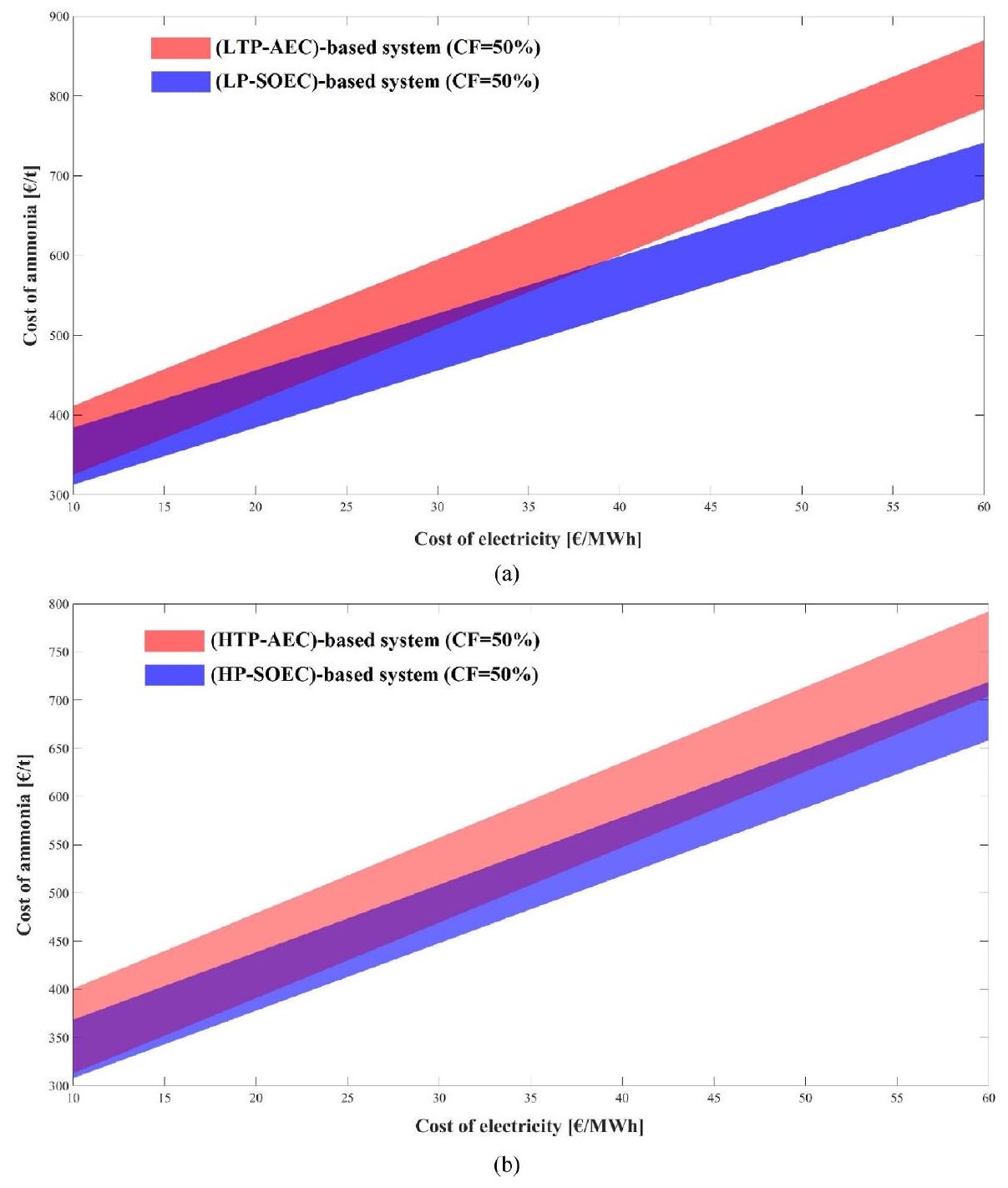
الشكل 11. تأثير تغيير تكلفة الطاقة المتكاملة (LCOE) وتقدير تكاليف رأس المال للكهارل (CAPEX) على تكلفة الأمونيا الخضراء بحلول عام 2050 (عامل السعة لـ للمصنع الأمونيا الخضراء وكثافة التيار لـ AEC والقيمة الحرارية المحايدة لـ SOEC (حوالي لـ LP-SOEC و لـ HP-SOEC)).
تمت مقارنة تكلفة الأمونيا الخضراء مع الأمونيا الرمادية والزرقاء. العتبة الضريبة التي ستجعل الأمونيا الخضراء تعادل الأمونيا الرمادية تُقدّر لسنوات مختلفة، مع افتراض أسعار الغاز الطبيعي تتراوح بين 10-30 يورو/ميغاوات ساعة ونطاق واسع من قيم تكلفة الطاقة المت Levelized. النتائج الرئيسية لهذا هي.
  • مع تكلفة مستوى الطاقة المولدة (LCOE) قدرها عامل السعة من وسعر NG من ، ضريبة مطلوب لجعل الأمونيا الخضراء قابلة للمقارنة من حيث التكلفة مع الأمونيا الرمادية.
  • بحلول عام 2050، مع كما هو متوقع لسعر الغاز الطبيعي، تنفيذ ضريبة سوف تجعل الأمونيا الخضراء المعتمدة على SOEC تنافسية من حيث التكلفة حتى لقيمة LCOE تصل إلى 60 يورو/ميغاوات ساعة.
  • بحلول عام 2050، مع افتراض سعر الغاز الطبيعي المتوقع وعامل سعة بالنسبة لمصنع الأمونيا الخضراء، ستكون تكلفة الأمونيا الخضراء المنتجة باستخدام نظام SOEC تنافسية مع الأمونيا الرمادية والزرقاء لقيم LCOE أقل من 25 و ، على التوالي.
تم إجراء تحليل حساسية لتقييم تأثيرات تكلفة الطاقة المتكاملة (LCOE) وعامل السعة والتكاليف الرأسمالية المقدرة (CAPEX) على تكلفة الأمونيا. وقد وُجد أن.
  • بحلول عام 2050، لقيم LCOE التي تزيد عن ، ينتج النظام القائم على (LP-SOEC) الأمونيا بتكلفة أقل، حتى مع افتراض نفقات رأس المال الأعلى (600 يورو/كيلووات) لـ LP-SOEC و خفض النفقات الرأسمالية لـ LTP-AEC ) مقارنة بقيم الحالة الأساسية.
  • بحلول عام 2050، زيادة عامل السعة من 30 إلى يقلل من تكلفة الأمونيا الخضراء بنسبة تقارب .
يعمل الأمونيا كحامل للهيدروجين ومن المحتمل أن يتم تداوله دوليًا لتعزيز التعاون العالمي من أجل تقليل التكاليف. تشمل الآثار العملية لهذه الدراسة على الصناعة وصانعي السياسات استخدام تقنيات التحليل الكهربائي الناشئة لإنتاج الأمونيا الخضراء، وتوقع أسعار الأمونيا المستقبلية، وتحديد الضريبة اللازمة على ثاني أكسيد الكربون للأمونيا الأحفورية لتحقيق التكافؤ في التكاليف بين الأمونيا الخضراء والأمونيا الأحفورية. تعالج هذه الآثار تحسين الكفاءة، واعتبارات التكلفة، وتأثير المناخ، على التوالي.
تم إجراء هذا البحث مع الفهم أن المزيد من
يجب إجراء تحليل اقتصادي مفصل في مواقع محددة ذات ملفات مناخية مميزة، حيث قد تؤثر هذه العوامل على الاستنتاجات الاقتصادية المقدمة هنا. لذلك، يجب اعتبار هذه التقييمات الاقتصادية كإرشادات فقط. قد تنشأ الخطأ المحتمل في هذه الدراسة من القيم المتوقعة لرأس المال الاستثماري لعامي 2030 و2050 لتقنيات التحليل الكهربائي الناشئة. ومع ذلك، من الجدير بالذكر أنه نظرًا لأن تكلفة الكهرباء المستهلكة تحدد إلى حد كبير سعر الأمونيا الخضراء، فقد لا يؤثر هذا العامل بشكل كبير على الاستنتاجات الاقتصادية المقدمة في هذا البحث.

بيان مساهمة مؤلفي CRediT

حسين نامي: التصور، المنهجية، تصميم الدراسة، البرمجيات، التحقق، التحليل الرسمي، التحقيق، تنظيم البيانات، الكتابة – المسودة الأصلية، الكتابة – المراجعة والتحرير. بيتر فنج هيندريكسن: التصور، المنهجية، تصميم الدراسة، التحقيق، الموارد، الكتابة – المسودة الأصلية، الكتابة – المراجعة والتحرير، التصور، الإشراف، إدارة المشروع، الحصول على التمويل. هينريك لوند فراندسن: التصور، المنهجية، تصميم الدراسة، التحقيق، الموارد، الكتابة – المسودة الأصلية، الكتابة – المراجعة والتحرير، التصور، الإشراف، إدارة المشروع، الحصول على التمويل.

إعلان عن تضارب المصالح

يعلن المؤلفون أنهم ليس لديهم مصالح مالية متنافسة معروفة أو علاقات شخصية قد تؤثر على العمل المبلغ عنه في هذه الورقة.

توفر البيانات

ستكون البيانات متاحة عند الطلب.

الشكر والتقدير

يُعرب عن الشكر للدعم من صندوق البحرية الدنماركي ضمن مشروع MarEfuel؛ الوقود البحري المستدام. يود المؤلفون أن يعبروا عن امتنانهم الصادق لنicolas Campion وMarie Münster وGiacomo Butera لدعمهم القيم.

الملحق. نموذج الخلية لـ SOEC

تُعطى ظروف التشغيل والمعلمات الهندسية والنمذجة المستخدمة لنموذج SOEC في الجدول A1.
الجدول A. 1
المعلمات المستخدمة في نمذجة SOEC
المعلمة القيمة
درجة حرارة التشغيل [72] ( ) 750
ضغط التشغيل [72] (بار)
، و10 للتحقق
1 و30 (زيادة الضغط مفترضة فقط لجهة الكاثود) في هذا البحث
كسر المول من الهيدروجين عند مدخل الكاثود [72] 0.5
كسر المول من الأكسجين عند مدخل الأنود [72] 1
ارتفاع قطب الأنود (م)
ارتفاع قطب الكاثود (م)
متوسط قطر المسام لقطب الأنود [36] (م)
متوسط قطر المسام لقطب الكاثود [36] (م)
عدد الإلكترونات المتبادلة في التفاعلات [37] 2
نفاذية الأقطاب [36] (م2) 10-13
تعتبر كثافات التيار الحملي معروفة/مدخلات لحل جهد الخلية المقابل. حساب الجهد الكهربائي والجهد الزائد التركيز هو أمر مباشر لأنه دوال صريحة لكثافة التيار. نظرًا لأن الجهود الزائدة للتفعيل هي دوال ضمنية لكثافة التيار، يتم استخدام دالة “fsolve” لحلها من خلال حل نظام من المعادلات غير الخطية مع معادلتين واثنين من المجهولات.
المعادلات الحاكمة المقدمة لنمذجة SOEC المدرجة في الجدول 3 تحتوي على 13 معلمة حرة، والتي تُعطى في الجدول A. 2، والتي يمكن تعديلها من خلال ملاءمة منحنيات استقطاب النموذج مع المنحنيات التجريبية. يتم استخدام الخوارزمية الجينية بحجم سكاني قدره 104 للعثور على القيم المثلى للمعلمات التي تقلل الأخطاء بين جهد الخلية من النموذج والبيانات التجريبية:

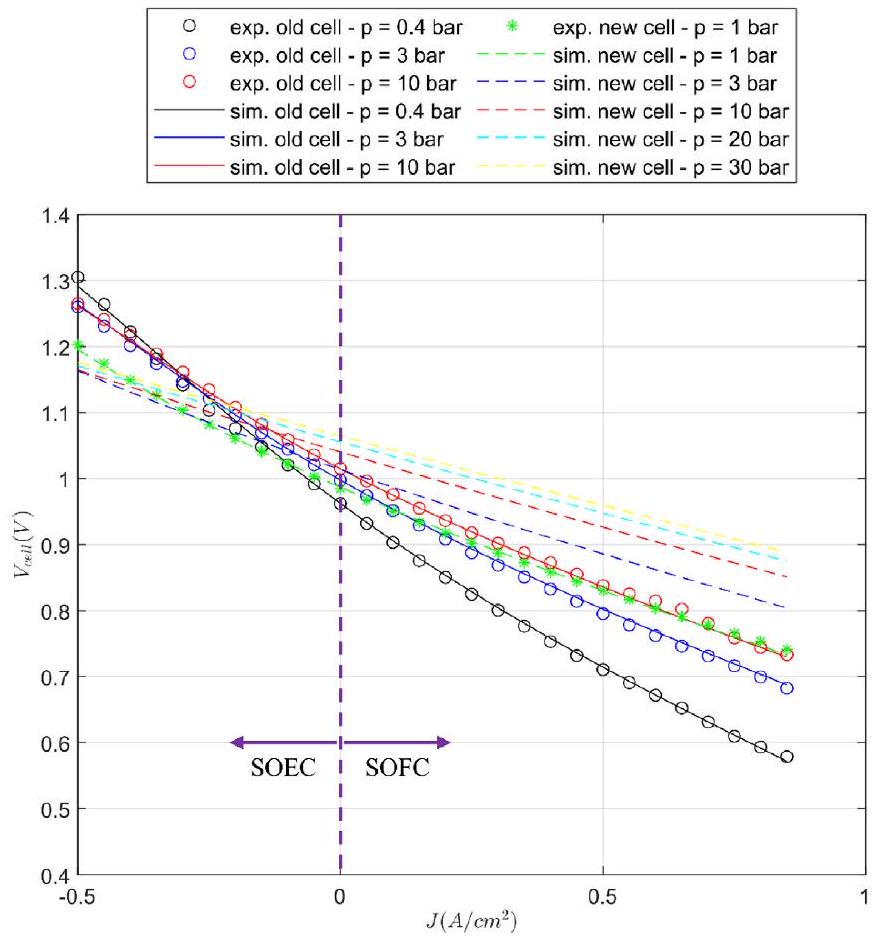
here, هي دالة الهدف، و هي أعداد ضغوط التشغيل وكثافات التيار الحملي، على التوالي، والاختصارات exp وsim تشير إلى البيانات التجريبية وبيانات المحاكاة، على التوالي. تعتبر ضغوط التشغيل ، و10 بار [72]، و28 كثافة تيار حملي بين -0.5 و مع حجم خطوة ثابت قدره تُستخدم. يجب ملاحظة أن البيانات التجريبية يتم استيفاؤها على هذه الكثافات بحيث تكون نقاط التشغيل هي نفسها المستخدمة في المحاكاة لحساب الخطأ بين البيانات التجريبية وبيانات المحاكاة، المعادلة (A.1).
الجدول A. 2 يسرد القيم المثلى للمعلمات الملائمة التي تم تقييمها بواسطة الخوارزمية الجينية للخلايا القديمة والجديدة المنتجة والمستخدمة في التجارب في DTU-Energy. يتم استخدام تسمية “الخلية القديمة” للخلايا المستخدمة قبل عقد من الزمن، وتستخدم بياناتها التجريبية بسبب توفر بيانات تشغيل الضغط العالي [72]. ومع ذلك، يتم تعديل المعلمات الملائمة للخلايا المحدثة ذات الأداء المحسن، خاصة لأقطاب الهواء، التي تم استخدامها من قبل Sun et al. [73]. للأسف، لم يتم إجراء تجارب تشغيل الضغط العالي على الخلايا الجديدة؛ وبالتالي، يتم إجراء الملاءمة فقط لعملياتها الجوية. جميع ظروف التشغيل، باستثناء ضغوط التشغيل، هي نفسها للبيانات التجريبية من كل من الخلايا القديمة والجديدة المستخدمة في الملاءمة هنا.
الجدول A. 2
القيم المثلى للمعلمات الملائمة
المعلمة القيمة – الخلية القديمة القيمة – الخلية الجديدة
ثابت العامل المسبق المستخدم لكثافة التيار المتبادل للأنود ( )
ثابت العامل المسبق المستخدم لكثافة التيار المتبادل للكاثود ( )
طاقة التفعيل المستخدمة لكثافة التيار المتبادل للأنود ( )
طاقة التفعيل المستخدمة لكثافة التيار المتبادل للكاثود ( )
معامل نقل الشحنة لتفاعل الأنود ( ) 0.6573 0.8303
معامل نقل الشحنة لتفاعل الكاثود ( ) 0.5000 0.7725
قوة الضغط الجزئي للأكسجين المستخدمة لكثافة التيار المتبادل للأنود (م) 0.1853 0.1825
قوة الضغط الجزئي للهيدروجين المستخدمة لكثافة التيار المتبادل للكاثود (أ) -0.2154 -0.0583
قوة الضغط الجزئي للبخار المستخدمة لكثافة التيار المتبادل للكاثود (ب) 0.3143 0.4881
عامل التصحيح لمعاملات الانتشار للأنواع في وسائط الأنود المسامية ( ) 0.0995 0.1996
عامل التصحيح لمعاملات الانتشار للأنواع في وسائط الكاثود المسامية ( ) 0.0201 0.1695
ثابت محدد المادة المستخدم للجهد الزائد الأوم ( )
طاقة التفعيل المستخدمة للجهد الزائد الأوم ( )
الشكل A. 1 يقارن منحنيات الاستقطاب من البيانات التجريبية والنموذج المطور للقيم المثلى للمعلمات الملائمة المعطاة في الجدول A.2. يُلاحظ تطابق جيد بين منحنيات الاستقطاب لجميع ضغوط التشغيل. يمكن رؤية أداء أفضل إذا تم استخدام المعلمة المادية المحددة للخلايا الأحدث لمحاكاة تشغيل الضغط العالي. يتم استخدام الأخير في المحاكاة اللاحقة. الجهد الكهربائي المفتوح الأعلى (OCV) والجهد الزائد الأقل لضغوط التشغيل الأعلى وتأثيرات الضغط الأعلى لضغوط التشغيل الأقل تتماشى مع الاتجاهات المبلغ عنها في الأدبيات، على سبيل المثال، المراجع [74،75].
الشكل A.1. مقارنات منحنيات الاستقطاب من البيانات التجريبية والنموذج لضغوط التشغيل المختلفة. تشير الاختصارات exp وsim إلى البيانات التجريبية وبيانات المحاكاة، على التوالي.

References

[1] Nami H, Butera G, Campion N, Frandsen HL, Hendriksen PV. MarE-fuel: energy efficiencies in synthesising green fuels and their expected cost, MarE-fuel project report 9/9-2021, DTU Energy. Technical University of Denmark; 2021.
[2] Li G, et al. Research progress in green synthesis of ammonia as hydrogen-storage carrier under ‘hydrogen 2.0 economy. Clean Energy 2023;7(1):116-31. https:// doi.org/10.1093/ce/zkac095.
[3] Laval Alfa, Hafnia Haldor, Topsoe Vestas, Gamesa Siemens. Ammonfuel-an industrial view of ammonia as a marine fuel. Hafnia 2020;(August):1-59.
[4] Bartels JR. A feasibility study of implementing an Ammonia Economy. Ames: Digital Repository @ Iowa State University; 2008. https://doi.org/10.31274/etd-180810-1374.
[5] Kurien C, Mittal M. Review on the production and utilization of green ammonia as an alternate fuel in dual-fuel compression ignition engines. Energy Convers Manag 2022;251(August 2021):114990. https://doi.org/10.1016/j. enconman.2021.114990.
[6] Aziz M, Wijayanta AT, Nandiyanto ABD. Ammonia as effective hydrogen storage: a review on production, storage and utilization. Energies Jun. 2020;13(12):3062. https://doi.org/10.3390/en13123062.
[7] Cesaro Z, Ives M, Nayak-Luke R, Mason M, Bañares-Alcántara R. Ammonia to power: Forecasting the levelized cost of electricity from green ammonia in largescale power plants. Appl Energy Jan. 2021;282:116009. https://doi.org/10.1016/ J.APENERGY.2020.116009.
[8] Wang Y, Zhou X, Liu L. Theoretical investigation of the combustion performance of ammonia/hydrogen mixtures on a marine diesel engine. Int J Hydrogen Energy Apr. 2021;46(27):14805-12. https://doi.org/10.1016/j.ijhydene.2021.01.233.
[9] Mallouppas G, Ioannou C, Yfantis EA. A review of the latest trends in the Use of green ammonia as an energy carrier in maritime industry. Energies 2022;15(4). https://doi.org/10.3390/en15041453.
[10] Campion N, Nami H, Swisher P, Vang Hendriksen P, Münster M. Techno-economic assessment of green ammonia production with different wind and solar potentials. SSRN Electron J 2022. https://doi.org/10.2139/SSRN. 4154006.
[11] Florez J, AlAbbad M, Vazquez-Sanchez H, Morales MG, Sarathy SM. Optimizing islanded green ammonia and hydrogen production and export from Saudi Arabia. Int J Hydrogen Energy Feb. 2024;56:959-72. https://doi.org/10.1016/J. IJHYDENE. 2023.12.075.
[12] Frattini D, Cinti G, Bidini G, Desideri U, Cioffi R, Jannelli E. A system approach in energy evaluation of different renewable energies sources integration in ammonia production plants. Renew Energy Dec. 2016;99:472-82. https://doi.org/10.1016/ j.renene.2016.07.040.
[13] Mortensen AW, Mathiesen BV, Hansen AB, Pedersen SL, Grandal RD, Wenzel H. The role of electrification and hydrogen in breaking the biomass bottleneck of the renewable energy system – a study on the Danish energy system. Appl Energy Oct. 2020;275:115331. https://doi.org/10.1016/j.apenergy.2020.115331.
[14] Zhang H, Wang L, Van herle J, Maréchal F, Desideri U. Techno-economic comparison of green ammonia production processes. Appl Energy Feb. 2020;259: 114135. https://doi.org/10.1016/j.apenergy.2019.114135.
[15] Bicer Y, Dincer I. Life cycle assessment of nuclear-based hydrogen and ammonia production options: a comparative evaluation. Int J Hydrogen Energy Aug. 2017; 42(33):21559-70. https://doi.org/10.1016/j.ijhydene.2017.02.002.
[16] Al-Zareer M, Dincer I, Rosen MA. Transient analysis and evaluation of a novel pressurized multistage ammonia production system for hydrogen storage purposes. J Clean Prod Sep. 2018;196:390-9. https://doi.org/10.1016/j. jclepro.2018.06.022.
[17] Nowicki DA, Agnew GD, Irvine JTS. Green ammonia production via the integration of a solid oxide electrolyser and a Haber-Bosch loop with a series of solid electrolyte oxygen pumps. Energy Convers Manag Mar. 2023;280:116816. https:// doi.org/10.1016/j.enconman.2023.116816.
[18] Egerer J, Grimm V, Niazmand K, Runge P. The economics of global green ammonia trade – ‘Shipping Australian wind and sunshine to Germany. Appl Energy Mar. 2023;334:120662. https://doi.org/10.1016/j.apenergy.2023.120662.
[19] Hatton L, Bañares-Alcántara R, Sparrow S, Lott F, Salmon N. Assessing the impact of climate change on the cost of production of green ammonia from offshore wind. Int J Hydrogen Energy Jan. 2024;49:635-43. https://doi.org/10.1016/J. IJHYDENE. 2023.10.117.
[20] Driscoll H, Salmon N, Bañares-Alcántara R. Technoeconomic evaluation of offshore green ammonia production using tidal and wind energy: a case study. Energy Sources, Part A Recovery, Util Environ Eff Aug. 2023;45(3):7222-44. https://doi. org/10.1080/15567036.2023.2220670.
[21] Armijo J, Philibert C. Flexible production of green hydrogen and ammonia from variable solar and wind energy: case study of Chile and Argentina. Int J Hydrogen Energy Jan. 2020;45(3):1541-58. https://doi.org/10.1016/j. ijhydene.2019.11.028.
[22] Ozturk M, Dincer I. An integrated system for ammonia production from renewable hydrogen: a case study. Int J Hydrogen Energy Jan. 2020. https://doi.org/ 10.1016/j.ijhydene.2019.12.127.
[23] Fúnez Guerra C, Reyes-Bozo L, Vyhmeister E, Jaén Caparrós M, Salazar JL, Clemente-Jul C. Technical-economic analysis for a green ammonia production plant in Chile and its subsequent transport to Japan. Renew Energy Sep. 2020;157: 404-14. https://doi.org/10.1016/j.renene.2020.05.041.
[24] Osman O, Sgouridis S, Sleptchenko A. Scaling the production of renewable ammonia: a techno-economic optimization applied in regions with high insolation. J Clean Prod Oct. 2020;271:121627. https://doi.org/10.1016/j. jclepro.2020.121627.
[25] Siddiqui O, Dincer I. A new solar energy system for ammonia production and utilization in fuel cells. Energy Convers Manag Mar. 2020;208:112590. https://doi. org/10.1016/j.enconman.2020.112590.
[26] Ikäheimo J, Kiviluoma J, Weiss R, Holttinen H. Power-to-ammonia in future North European 100 % renewable power and heat system. Int J Hydrogen Energy Sep. 2018;43(36):17295-308. https://doi.org/10.1016/j.ijhydene.2018.06.121.
[27] Bicer Y, Dincer I. Exergoeconomic analysis and optimization of a concentrated sunlight-driven integrated photoelectrochemical hydrogen and ammonia production system. Int J Hydrogen Energy Jul. 2019;44(34):18875-90. https:// doi.org/10.1016/j.ijhydene.2018.10.074.
[28] Lee B, Lim D, Lee H, Lim H. Which water electrolysis technology is appropriate?: Critical insights of potential water electrolysis for green ammonia production. Renew Sustain Energy Rev Jun. 2021;143:110963. https://doi.org/10.1016/J. RSER.2021.110963.
[29] Pawar ND, et al. Potential of green ammonia production in India. Int J Hydrogen Energy Aug. 2021;46(54):27247-67. https://doi.org/10.1016/J. IJHYDENE. 2021.05.203.
[30] Morgan ER. Techno-economic feasibility study of ammonia plants powered by offshore wind. Amherst: University of Massachusetts; 2013. https://doi.org/ 10.7275/11KT-3F59.
[31] Nami H, Rizvandi OB, Chatzichristodoulou C, Hendriksen PV, Frandsen HL. Techno-economic analysis of current and emerging electrolysis technologies for green hydrogen production. Energy Convers. Manag. Oct. 2022;269:116162. https://doi.org/10.1016/J.ENCONMAN.2022.116162.
[32] AlZahrani AA, Dincer I. Thermodynamic and electrochemical analyses of a solid oxide electrolyzer for hydrogen production. Int J Hydrogen Energy Aug. 2017;42 (33):21404-13. https://doi.org/10.1016/j.ijhydene.2017.03.186.
[33] Ni M, Leung MKH, Leung DYC. Energy and exergy analysis of hydrogen production by solid oxide steam electrolyzer plant. Int J Hydrogen Energy Dec. 2007;32(18): 4648-60. https://doi.org/10.1016/j.ijhydene.2007.08.005.
[34] Mohammadi A, Mehrpooya M. Thermodynamic and economic analyses of hydrogen production system using high temperature solid oxide electrolyzer integrated with parabolic trough collector. J Clean Prod Mar. 2019;212:713-26. https://doi.org/10.1016/j.jclepro.2018.11.261.
[35] Navasa M, Miao XY, Frandsen HL. A fully-homogenized multiphysics model for a reversible solid oxide cell stack. Int J Hydrogen Energy 2019;44(41):23330-47. https://doi.org/10.1016/j.ijhydene.2019.06.077.
[36] Navasa M, Graves C, Chatzichristodoulou C, Løye Skafte T, Sundén B, Lund Frandsen H. A three dimensional multiphysics model of a solid oxide electrochemical cell: a tool for understanding degradation. Int J Hydrogen Energy 2018;43(27):11913-31. https://doi.org/10.1016/j.ijhydene.2018.04.164.
[37] Leonide A, Apel Y, Ivers-Tiffee E. SOFC modeling and parameter Identification by means of impedance Spectroscopy. ECS Trans 2019;19(20):81-109. https://doi. org/10.1149/1.3247567.
[38] Ni M, Leung MKH, Leung DYC. Parametric study of solid oxide steam electrolyzer for hydrogen production. Int J Hydrogen Energy Sep. 2007;32(13):2305-13. https://doi.org/10.1016/j.ijhydene.2007.03.001.
[39] Liu S, Kong W, Lin Z. Three-dimensional modeling of planar solid oxide fuel cells and the rib design optimization. J Power Sources 2009;194(2):854-63. https://doi. org/10.1016/j.jpowsour.2009.06.056.
[40] Bernadet L, Gousseau G, Chatroux A, Laurencin J, Mauvy F, Reytier M. Influence of pressure on solid oxide electrolysis cells investigated by experimental and modeling approach. Int J Hydrogen Energy 2015;40(38):12918-28. https://doi. org/10.1016/j.ijhydene.2015.07.099.
[41] Tremel A. Electricity-based fuels. In: SpringerBriefs in applied Sciences and technology. Cham: Springer International Publishing; 2018. https://doi.org/ 10.1007/978-3-319-72459-1.
[42] Zeng K, Zhang D. Recent progress in alkaline water electrolysis for hydrogen production and applications. Prog Energy Combust Sci Jun. 2010;36(3):307-26. https://doi.org/10.1016/J.PECS.2009.11.002.
[43] Marini S, et al. Advanced alkaline water electrolysis. Electrochim Acta Nov. 2012; 82:384-91. https://doi.org/10.1016/J.ELECTACTA.2012.05.011.
[44] HyProvide large-scale Al-kaline electrolyser (MW), EUDP 11-II, 64011-0105. 2016.
[45] Economic and Efficient Electrolytic Hydrogen production (2017-2021) – DTU Energy – ELE.” Accessed: Jul. 08, 2021. [Online]. Available: https://www.ele.ene rgy.dtu.dk/Projects/EEEHy.
[46] Frattini D, Cinti G, Bidini G, Desideri U, Cioffi R, Jannelli E. A system approach in energy evaluation of different renewable energies sources integration in ammonia production plants. Renew Energy Dec. 2016;99:472-82. https://doi.org/10.1016/ J.RENENE.2016.07.040.
[47] Flórez-Orrego D, de Oliveira Junior S. Modeling and optimization of an industrial ammonia synthesis unit: an exergy approach. Energy Oct. 2017;137:234-50. https://doi.org/10.1016/J.ENERGY.2017.06.157.
[48] Rao KP, Ramesh Bhat N, Jönsson J. First industrial experience – Safe start-up of KM 111 at Mangalore chemicals and fertilizers limited. Ammonia Plant Safety and Related Facilities 2017;2017:247-56.
[49] Schmidt O, Gambhir A, Staffell I, Hawkes A, Nelson J, Few S. Future cost and performance of water electrolysis: an expert elicitation study. Int J Hydrogen Energy Dec. 2017;42(52):30470-92. https://doi.org/10.1016/j. ijhydene.2017.10.045.
[50] Akrami E, Ameri M, Rocco MV, Sanvito FD, Colombo E. Thermodynamic and exergo-economic analyses of an innovative semi self-feeding energy system synchronized with waste-to-energy technology. Sustain Energy Technol Assessments Aug. 2020;40:100759. https://doi.org/10.1016/j.seta.2020.100759.
[51] Nami H, Mahmoudi SMS, Nemati A. Exergy, economic and environmental impact assessment and optimization of a novel cogeneration system including a gas
turbine, a supercritical CO2 and an organic Rankine cycle (GT-HRSG/SCO2). Appl Therm Eng Jan. 2017;110:1315-30. https://doi.org/10.1016/j. applthermaleng.2016.08.197.
[52] Bejan A, Tsatsaronis G. Thermal design and optimization. John Wiley & Sons; 1996.
[53] Turton R, Bailie RC, Whiting WB, Shaeiwitz JA. Analysis, synthesis and design of chemical processes. fourth ed. Prentice Hall: Prentice Hall international series in the physical and chemical engineering sciences; 2012.
[54] Rizvandi OB, Frandsen HL. Modeling of single- and double-sided high-pressure operation of solid oxide electrolysis stacks. Int J Hydrogen Energy Sep. 2023;48 (77):30102-19. https://doi.org/10.1016/J.IJHYDENE.2023.04.169.
[55] Nayak-Luke RM, Bañares-Alcántara R. Techno-economic viability of islanded green ammonia as a carbon-free energy vector and as a substitute for conventional production. Energy Environ Sci 2020;13(9):2957-66. https://doi.org/10.1039/ d0ee01707h.
[56] International Energy Agency (IEA). The future of hydrogen. Paris: IEA; 2019. https://doi.org/10.1787/1e0514c4-en. https://www.iea.org/reports/the-future-of -hydrogen.
[57] Ammonia production causes of total global GHG emissions – Ammonia Industry.” Accessed: Jun. 25, 2021. [Online]. Available: https://ammoniaindustry. com/ammonia-production-causes-1-percent-of-total-global-ghg-emissions/.
[58] Yadav D, Banerjee R. Economic assessment of hydrogen production from solar driven high-temperature steam electrolysis process. J Clean Prod May 2018;183: 1131-55. https://doi.org/10.1016/j.jclepro.2018.01.074.
[59] Dotzauer E. Greenhouse gas emissions from power generation and consumption in a nordic perspective. Energy Pol Feb. 2010;38(2):701-4. https://doi.org/10.1016/ j.enpol.2009.10.066.
[60] EU Natural Gas | 2022 Data | 2023 Forecast | 2010-2021 Historical | Price | Quote.” Accessed: Jan. 26, 2022. [Online]. Available: https://tradingeconomics.co m/commodity/eu-natural-gas.
[61] Arnaiz del Pozo C, Cloete S. Techno-economic assessment of blue and green ammonia as energy carriers in a low-carbon future. Energy Convers Manag 2022; 255(January):115312. https://doi.org/10.1016/j.enconman.2022.115312.
[62] International Energy Agency (IEA), “The Role of E-fuels in Decarbonising Transport.” Accessed: Feb. 01, 2024. [Online]. Available: https://iea.blob.core. windows.net/assets/9e0c82d4-06d2-496b-9542-f184ba803645/TheRoleofE-fuel sinDecarbonisingTransport.pdf.
[63] T. Brown, “Carbon intensity of fossil ammonia in a net-zero world.” Accessed: May 30, 2022. [Online]. Available: https://www.ammoniaenergy.org/articles/carbon -intensity-of-fossil-ammonia-in-a-net-zero-world/.
[64] Haugen HA, Eldrup NH, Fatnes AM, Leren E. Commercial capture and transport of CO2 from production of ammonia. In: Energy Procedia. Elsevier; Jul. 2017. p. 6133-40. https://doi.org/10.1016/j.egypro.2017.03.1750.
[65] Næss-Schmidt S, Jensen HN, Münier LL, Lutz J. CO2-TAXES, FUEL PRICES AND LEARNING RATES Contribution from Copenhagen economics to the MarE-fuel project. 2021.
[66] International Renewable Energy Agency. Renewable power generation costs in 2020. ISBN 978-92-9260-348-9. Abu Dhabi: International Renewable Energy Agency; 2021.
[67] International Energy Agency (IEA). Levelised cost of electricity calculator. Paris: IEA and NEA; 2020. https://www.iea.org/articles/levelised-cost-of-electricity-calc ulator.
[68] International energy Agency (IEA), sectoral electricity price distributions. Paris: IEA; 2019. https://www.iea.org/data-and-statistics/charts/sectoral-electricity-pri ce-distributions-2019.
[69] International Energy Agency (IEA), Industry end-user electricity prices in selected OECD countries. Paris: IEA; 2019. https://www.iea.org/data-and-statistics/charts /industry-end-user-electricity-prices-in-selected-oecd-countries-2019.
[70] Campion NJB, Backer M, Swisher PR, Münster M. MarE-fuel: LCOE and optimal electricity supply strategies for P2X plants. 2021.
[71] International Energy Agency (IEA). Projected costs of generating electricity 2020 edition. 2020. https://doi.org/10.1787/9789264008274-en.
[72] Jensen SH, Sun X, Ebbesen SD, Knibbe R, Mogensen M. Hydrogen and synthetic fuel production using pressurized solid oxide electrolysis cells. Int J Hydrogen Energy 2010;35(18):9544-9. https://doi.org/10.1016/j.ijhydene.2010.06.065.
[73] Sun X, Hendriksen PV, Mogensen MB, Chen M. Degradation in solid oxide electrolysis cells during long term Testing. Fuel Cell Dec. 2019;19(6):740-7. https://doi.org/10.1002/fuce. 201900081.
[74] Jensen SH, Sun X, Ebbesen SD, Chen M. Pressurized operation of a planar solid oxide cell stack. Fuel Cell Apr. 2016;16(2):205-18. https://doi.org/10.1002/ fuce. 201500180.
[75] Henke M, Willich C, Kallo J, Friedrich KA. Theoretical study on pressurized operation of solid oxide electrolysis cells. Int J Hydrogen Energy Aug. 2014;39(24): 12434-9. https://doi.org/10.1016/j.ijhydene.2014.05.185.

  1. General rights
    Copyright and moral rights for the publications made accessible in the public portal are retained by the authors and/or other copyright owners and it is a condition of accessing publications that users recognise and abide by the legal requirements associated with these rights.
    • Users may download and print one copy of any publication from the public portal for the purpose of private study or research.
    • You may not further distribute the material or use it for any profit-making activity or commercial gain
    • You may freely distribute the URL identifying the publication in the public portal
    If you believe that this document breaches copyright please contact us providing details, and we will remove access to the work immediately and investigate your claim.
    • Corresponding author. Department of Energy Conversion and Storage, Technical University of Denmark (DTU), Building 310, Fysikvej, DK-2800, Lyngby, Denmark.
    E-mail address: hon@igt.sdu.dk (H. Nami).
  2. Proton Exchange Membrane Electrolyzer.
    with solar radiation of .
    photoelectrochemical water splitting.
    This is solar energy to ammonia efficiency.

Journal: Renewable and Sustainable Energy Reviews, Volume: 199
DOI: https://doi.org/10.1016/j.rser.2024.114517
Publication Date: 2024-05-10

Green ammonia production using current and emerging electrolysis technologies

Nami, Hossein; Hendriksen, Peter Vang; Frandsen, Henrik Lund

Published in:
Renewable and Sustainable Energy Reviews
Link to article, DOI:
10.1016/j.rser.2024.114517
Publication date:
2024
Document Version
Publisher’s PDF, also known as Version of record
Link back to DTU Orbit

Citation (APA):

Nami, H., Hendriksen, P. V., & Frandsen, H. L. (2024). Green ammonia production using current and emerging electrolysis technologies. Renewable and Sustainable Energy Reviews, 199, Article 114517. https://doi.org/10.1016/j.rser.2024.114517

Green ammonia production using current and emerging electrolysis technologies

Hossein Nami , Peter Vang Hendriksen , Henrik Lund Frandsen Department of Energy Conversion and Storage, Technical University of Denmark (DTU), Building 310, Fysikvej, DK-2800, Lyngby, Denmark SDU Life Cycle Engineering, Department of Green Technology, University of Southern Denmark, Campusvej 55, 5230, Odense M, Denmark

ARTICLE INFO

Keywords:

Green ammonia
Blue ammonia
Green hydrogen
Power-to-ammonia
Pressurized SOEC
High-temperature alkaline electrolyzer

Abstract

This study investigates utilizing hydrogen produced via water electrolysis to produce green ammonia. Routes are benchmarked based on employing either alkaline electrolysis (AEC) or solid oxide electrolysis (SOEC). Both existing and possible improvements are modeled for the AEC and SOEC technologies coupled with the HaberBosch process to synthesize ammonia. The cost of green ammonia is estimated considering the cost of electrolyzers for both today and future projections and are compared with that of “fossil” ammonia synthesized from natural gas. Threshold taxes required to achieve cost parity between green and “fossil” ammonia are determined based on the price of natural gas and the levelized cost of electricity. It is found that whereas the green ammonia produced from a system based on AEC is cheaper today, SOEC shows to be more cost-effective, when basing the comparison on the projected future cost of the electrolyzers. Green ammonia from an SOECbased plant is estimated to have accost of by 2050 with an assumed electricity price of . In the SOEC-based ammonia plants, approximately and of the steam needed for the electrolyzers can be generated through heat integration between the electrolyzer and Haber-Bosch process, for low-pressure and high-pressure electrolyzers, respectively. A good fraction of the heat can also be covered by the intercoolers of the compressors. With the projected cost for SOEC, reducing the levelized cost of electricity from 60 to 10 €/MWh would decrease the cost of green ammonia from 690 to by 2050.

1. Introduction

The chemical industry and the transportation sector will have to transition to green routes to produce high-demand chemicals like ammonia to align with climate policy targets. Ammonia is an extremely important chemical used in the fertilizer industry. It has also garnered interest as a green fuel for shipping [1], as well as an energy storage medium capable of overcoming hydrogen storage challenges [2]. Green ammonia production is not a new concept, as it has been implemented since the late 1920s until the 1990s in Norway, utilizing AEC as a green hydrogen pathway powered by hydropower [3]. However, the economic attractiveness of fossil hydrogen produced from natural gas through steam methane reforming (SMR) has made it a preferred choice for ammonia production in most locations and for volume production. Nonetheless, the mounting environmental concerns, advancements in water electrolysis technologies, and the significant cost reduction in renewable electricity over the past decade have reignited substantial
interest in green ammonia production. Compared with hydrogen, ammonia has some advantages. It is much easier to liquefy and store at higher temperatures ( -33 vs. at ambient pressure) and its transport is at least three times cheaper than hydrogen [4]. Besides, ammonia can be used in internal combustion engines [5] and gas turbines [6] with modest modifications of the core technology. The levelized cost of electricity (LCOE) from green ammonia in large-scale power plants (combustion in combined cycle gas turbines) is forecasted by Cesaro et al. [7]. They found that at power plant capacity factors below (increasingly common in electricity sectors with high variable renewable electricity), the cost of ammonia should be below 400 to effectively compete with other dispatchable, low or zero-carbon technologies, including gas, bioenergy, or coal-fired power plants equipped with CCS. In addition, published research works in the last years suggest ammonia as the future marine fuel [8,9]. Many investigations exist in the literature addressing the green ammonia economy and technology readiness. Some of the relevant published works are reviewed hereunder.
Nomenclature M molar mass (kg/kmol)
mass flow rate (kg/s)
Abbreviationss n number of electrons
AEC alkaline electrolysis mol flow rate (kmol/s)
ASU air separation unit N number
Comp compressor P pressure (bar)
Cond condenser compressor pressure ratio
Dist distillation column heat transfer rate (kW)
ELH electrical heater gas constant ( )
HBL Haber-bosch loop s entropy (kJ/kmol K)
HEX heat exchanger SUF steam utilization factor
HT-SOEC high-temperature atmospheric SOEC T temperature (K)
HTP-AEC high-temperature pressurized AEC power (kW)
LT-SOEC low-temperature atmospheric SOEC
LTP-AEC low-temperature pressurized AEC Greek letters
MIX mixer overpotential (V)
SOEC solid oxide electrolysis thickness (m)
SPL splitter pre-exponential factor (1/s)
resistivity ( )
Latin letters
A heat transfer area Subscripts
EL economic life a anode
CAPEX capital investment cost ($) act activation
CF capacity factor c cathode
CRF capital recovery factor conc concentration
effective diffusion coefficient ( ) cv control volume
e specific physical exergy (kJ/kmol) D destruction
E potential (V) e electrolyte
exergy rate (kW) hot flow
F Faraday constant ( ) i inlet
G Gibbs free energy ( ) 0 outlet
h specific enthalpy (kJ/kmol) ohm ohmic
H enthalpy (kJ) ph physical
i interest rate (%) r reversible
J current density ( ) ref reference
exchange current density ( ) tn thermo-neutral
LCOE levelized cost of electricity 0 ambient conditions
Campion et al. [10] conducted a techno-economic assessment of green ammonia production, considering diverse wind and solar potentials, weather profiles, and electrolyzer technologies. Optimization findings indicated that employing a semi-islanded configuration stands out as the most cost-effective choice, potentially resulting in cost reductions of up to when compared to off-grid systems. However, it is found that this approach leads to greenhouse gas emissions comparable to those of using fossil fuels for ammonia production when considering the current electricity mix. When evaluating off-grid systems, the practice of estimating costs based on the levelized cost of electricity and capacity factors for solar or wind sources (which in turn determines operating hours) resulted in an overestimation of costs by as much as 30 . The most economical off-grid setup has attained a production cost of 842. €/tNH3. Islanded green ammonia and hydrogen production and export from Saudi Arabia is optimized by Florez et al. [11]. Their results showed that plant optimization can lead to production costs of ammonia of , while the single largest cost driver is the electricity cost, representing 60-70 % of the total project cost.
Frattini et al. [12] evaluated three distinct pathways for green ammonia production. These routes were benchmarked against the production of fossil ammonia through steam methane reforming and involved the utilization of renewable hydrogen obtained through SOEC, biomass gasification, and biogas reforming. They found that all the systems have the same energy consumption of . The equivalent emissions are estimated to be and 3.59
when natural gas, syngas and biogas are used as feedstock, respectively. Biomass-based ammonia can be considered carbon neutral due to the renewable character of the feedstock. However, it is important to be aware that biomass availability may become limited in future energy systems [13].
Zhang et al. [14] investigated and compared various ammonia production routes, including power-to-ammonia, biomass-to-ammonia, and methane-to-ammonia. The study concludes that power-to-ammonia represents the most efficient route, boosting LHV-based efficiency to but it is currently not economically attractive due to the high cost of electrolyzer stacks and high electricity prices. Nevertheless, it has the potential to become cost-competitive if the stack cost can be reduced to . Bicer and Dincer [15] compared the feasibility of nuclear-driven SOEC and copper-chlorine cycle as green hydrogen routes to produce ammonia. It was found that employing electrolyzers has a lower environmental impact than the copper-chlorine cycle ( 460 vs. eq per ).
Ammonia as a hydrogen storage carrier was studied by Al-Zareer et al. [16]. The hydrogen storage system was proposed to chemically store hydrogen as ammonia, which was pressurized in a multistage ammonia production system. The produced ammonia was stored in a novel conceptual design of an ammonia tanker truck equipped with an ammonia electrolyzer for the transportation and delivery of the stored hydrogen. It has been assumed that the tanker truck can either provide the ammonia to end-users who decompose the ammonia later when they
need the hydrogen or deliver hydrogen directly produced from ammonia decomposition. The proposed system demonstrated energy and exergy efficiencies of and , respectively.
SOEC-based green ammonia production using nitrogen generated via a series of solid electrolyte oxygen pumps was studied by Nowicki et al. [17]. Solid electrolyte oxygen pumps are devices that leverage the movement of oxide ions within dense electrolyte materials to achieve the separation of oxygen from gas mixtures (here air). The specific energy consumption was found to be (efficiency of 52.1 . Scaling options for the trade of green ammonia are studied by Egerer et al. [18] assuming the import of ammonia from Australia to Germany in 2030 as the case study. With the production costs of electricity supply in Australia, the levelized cost for green ammonia at the German harbor is calculated to be 109.39 €/MWh ( ). They concluded that green ammonia could achieve cost parity with natural gas-based ammonia, even at moderate gas prices (around ), given a sufficiently high tax (approximately ). They also indicated that cracking ammonia to generate pure hydrogen introduces a cost increase per MWh at the destination. The impact of climate change on the cost of production of green ammonia from offshore wind at four locations in the UK was studied by Hattonet al. [19]. Using an islanded green ammonia production model, the achievable cost of ammonia was evaluated to range between 935 and 1696 USD/tNH3. Driscoll et al. [20] evaluated offshore green ammonia production using tidal and wind energy from techno-economic perspective. They found
that the addition of tidal stream capacity to wind capacity decreases the hydrogen storage requirement by and reduces the cost of ammonia by .
Table 1 summarizes the rest of the reviewed works, all dealing with different electrolysis options and different sources of renewable electricity.
The literature review highlights the extensive research on technoeconomic assessment conducted on various aspects of green ammonia production, particularly concerning existing technologies. However, it is crucial to acknowledge the rapid advancements in electrolysis and ongoing investigations into modifying existing technologies. Consequently, considering the projected future cost developments is of paramount importance for effective energy planning and policy-making.
In this work, the existing AEC and SOEC technologies are compared at their current maturity level, addressing projections for future developments through a comprehensive thermodynamic and technoeconomic analysis of green ammonia plants designed based on these two technologies. To investigate the effect of various potential technological advancements for both AEC and SOEC, high-pressure AEC is modeled in both low-temperature (LTP-AEC) and high-temperature (HTP-AEC) versions, and SOEC is modeled considering both lowpressure (LP-SOEC) and high-pressure (HP-SOEC) technologies. Furthermore, an estimation of the future cost of green ammonia, incorporating the current and projected capital expenditure (CAPEX) values of electrolysis technologies is included considering different
Table 1
Literature review of green ammonia production.
Reference Energy source route LCOE (Min) ammonia cost (Max) System efficiency (%) Remarks on main findings and key assumptions
[22] Solar + Wind AEC
Solar: 26.7 $/MWh
Wind: 35.8 $/MWh
500 $/t na Green power variability is the major cost driver for green production.
Solar PEMEC na na
[23] Solar + Wind + hydraulic dams PEMEC 18 €/MWh na
A sensitivity analysis is carried out concerning electricity price, plant operating hours, size of the system, estimated CAPEX, and ammonia market price.
A payback period of 7.6 years is estimated.
production in Chile and transferring to Japan as an carrier solution would be profitable and technically viable.
[24] Solar AEC & PEMEC na 718 $/t 37.4
Energy consumption of is reported.
Further reductions in the cost of ammonia are postulated under the expected technical advancements reaching 450 $/ton
[25] Solar PEMEC na na During the low demand period, extra power produced by the photovoltaic is utilized to synthesize ammonia and during the peak demand period, the ammonia is fed to the fuel cell to generate power
[14] na SOEC 73 $/MWh >550 $/t 74 % It is concluded that power-to-ammonia is currently not competitive with biomass-to-ammonia routes.
[26] Solar + Wind + hydropower PEMEC na 431-528 €/t na Power-to-ammonia technology can be cost-competitive if the natural gas price or tax increases to or , respectively.
[27] Solar PEC na 840 $/t 5-9.6 (exergy efficiency)
The cost of electricity is estimated to be 60 $/MWh.
A increase in operating capacity factor and a decrease in total CAPEX decreases the ammonia cost by 80 and , respectively.
[28] na
AEC/
PEMEC/
SOEC
0-60
$/MWh
$/t na Fixed values of , and are assumed for AEC , PEMEC, and SOEC, respectively.
[29] PV + Onshore wind PEMEC
PV: 31-46
€/MWh
Wind:
66-233
€/MWh
723 €/t for domestic usage in
India
765 €/t for export
na India’s green ammonia potential can supply global ammonia demand Currently, a tax of is required to compete with conventional fossil ammonia
OPEX values based on LCOE-estimates for the powering technologies. This analysis not only offers insights into anticipated costs but also provides a valuable tool for comparing the advantages of different technology improvements. The main findings of this study are related to the electrolyzers’ technical characteristics, the implications of which are reflected in the economic analysis of green ammonia production. It is important to note that while this study provides general insights, a more detailed economic analysis tailored to specific locations and their respective local conditions (such as LCOE and capacity factors) is necessary to achieve solid results on green ammonia cost and conditions where it can become cost-competitive. These site-specific considerations may alter some of the economic conclusions presented here, and the economic assessments presented here should be considered as guidance rather than definitive conclusions. The technical results presented here can of course be transferred to an economic analysis for a specific site.

2. Theoretical analysis and model description

2.1. System development and mathematic modeling

The main units of the proposed green ammonia production systems are the electrolyzer (SOEC or AEC), the Haber-Bosch loop (HBL), and the air separation unit (ASU). Each unit is described and modeled individually at the component level, except the ASU for which data reported in the literature is used [26]. Based on Morgan [30], an energy consumption of is assumed for the ASU, delivering pure at 8 bar.

2.1.1. Electrolysis technologies

The electrolysis systems examined in this study, all based on AEC and SOEC technologies, are detailed in Table 2 in terms of operating conditions. While these technologies are known, certain extensions proposed in this study surpass the current state-of-the-art for scalable systems. Notably, HTP-AEC, validated at technology readiness level 3, and HP-SOEC, demonstrated at technology readiness level 4-5, exemplify advancements beyond conventional applications [31].
2.1.1.1. Solid oxide electrolysis (SOEC). SOEC performs efficiently compared with other available electrolyzers, especially when there is a heat integration between the electrolyzer and HBL. Part of the required external heat for water splitting can be supplied from waste heat sources available in the HBL to increase the overall system efficiency.
A schematic diagram of a stand-alone SOEC is shown in Fig. 1. The system utilizes two heat exchangers, HEX1 and HEX2, to effectively recover the waste heat from the stack off-gas. However, to achieve the desired stack inlet temperature and provide the necessary external heat during startup, auxiliary electrical heaters, ELH1 and ELH2, are employed. To maintain a hydrogen mole fraction of in the inlet flow, a portion of the cathode off-gas is recirculated, while the remaining flow passes through HEX1 and enters the condenser, COND, where it undergoes cooling and water separation. The resulting pure hydrogen can then be combined with nitrogen and supplied to the HBL.
The stack is assumed to be operating at the thermoneutral point. The thermo-neutral point is where the current density is raised to the extent that the internal resistive heating from various internal resistances
Table 2
Different electrolysis systems modeled in this study.
Technology Naming Operating conditions
AEC LTP-AEC Stack is operating at
Hydrogen is produced at 30 bar
HTP-AEC Stack is operating at
Hydrogen is produced at 30 bar
SOEC LP-SOEC Hydrogen is produced at 1 bar
HP-SOEC Hydrogen is produced at 30 bar
Stack is operating at
(ohmic, activation and concentration) balances the heat needed for the water splitting reaction. Part of the thermal energy required to produce steam (at the stack operating temperature) can be supplied from the HBL. Maximizing the heat integration between SOEC and HBL minimizes electricity consumption by the electrical heaters and increases the overall power-to-ammonia efficiency.
To consider the possibility of selling the oxygen as a by-product and to protect the electrode through start-up and thermally managing the stack, part of the generated oxygen is recirculated with an outgoing bleed instead of sweeping air [32]. However, the recirculation of hot pure oxygen is a safety challenge that has to be addressed (requiring industrial protocols to be developed). It imposes stringent material requirements on the construction materials used in the oxygen loop. It should be noted that this assumption has a minimal impact on the assessed efficiencies and costs, as the power consumption of an alternative air blower would be extremely low compared with other components.
The chemical reactions at the fuel (cathode), at the oxygen (anode) electrodes of the cell, and the overall reaction are as follows:
Cathode:
Anode:
Overall:
The cell voltage, , can be calculated as follows [33]:
where, the reversible potential, , can be obtained by the Nernst equation [34]. , and are the ohmic overpotential, concentration overpotential, and activation overpotential, respectively. Table 3 lists the equations utilized to calculate these quantities. More details about SOEC modeling and cell performance validation can be found in the Appendix.
Finally, the generated hydrogen, , and SOEC power consumption, , can be written as:
is the current density and the hydrogen production rate per cell cross-sectional area.
where, and are the active cell area and number of the cells in a stack, respectively.
2.1.1.2. Alkaline electrolysis (AEC). Currently, AEC is the primarily employed technology for large-scale green hydrogen production, as it is the most developed and mature electrolysis technology [41]. However, relatively high internal cell resistance decreases the overall efficiency of the system. For AEC, the optimum operating point can be determined through a balance between CAPEX and OPEX, as shown in Ref. [31].
This study investigates two AEC technologies. Currently, highpressure low temperature ( ) AEC is being commercialized and scaled up. Operation at high pressure improves the efficiency, as bubble formation is retarded and the internal resistance in this way can be kept down [42,43]. Bubble formation and transportation results in extra losses [42]. Not only the gas dissolution but also the blocking of the reaction site with the gas phase between the electrolyte and electrodes leads to increased resistance. The oxygen evolution process, however, still causes high internal resistance. Increasing the temperature to
Fig. 1. Schematic diagram of SOEC system.
Table 3
SOEC modeling equations.
Description Governing equation
Open-circuit voltage (OCV) [35]
Gibbs free energy [36]
Butler-Volmer (BV) [37]
Anode exchange current density [37]
Cathode exchange current density [37]
Anode concentration overpotential [38]
Cathode concentration overpotential [38]
Ohmic overpotential [37]
Dusty-gas model (DGM) fluxes [39]
Binary diffusion coefficient [40]
Knudsen diffusion coefficient [36]
Effective diffusion coefficient
can significantly lower the overpotential needed for this. This is done in the high temperature, high-pressure alkaline technology (HTP-AEC).
The operating load current density for both AEC technologies is assumed to be around , which is higher than the thermoneutral point for the current technologies. Therefore, both LTP-AEC and HTP-AEC operate under exothermic conditions.
Fig. 2 illustrates the flow diagram of AEC. HEX1 and HEX2 are used for cooling to keep the stack inlet temperature fixed at the operating temperature.
Fig. 2. Schematic diagram of a simplified AEC system.
Chemical reactions in the cathode and anode sides of the cell and the overall reaction are as follows:
Cathode:
Anode:
Overall:
The required cell voltage for this electrochemical reaction can be determined by the cell thermodynamics as follows:
here, is the change in Gibs free energy of the reaction, the reaction enthalpy and the reaction entropy.
In this research, the polarization curve reported by Green Hydrogen Systems [44] is used to represent the state-of-the-art performance of a LTP-AEC system. For HTP-AEC, in-house data from the EEEHy project [45] have been used. More details about the data utilized for both LTPand HTP-AEC modeling can be found in Ref. [31].
The rate of produced hydrogen and power consumption by the AEC are as follows:
Where is the current density running through the electrolyzer, the cell potential, the cell area and the number of cells.

2.1.2. Haber-Bosch loop (HBL)

Haber-Bosch loop is the primarily used industrial process of ammonia production, which utilizes a mixture of hydrogen and nitrogen as feedstock to synthesize ammonia at temperatures around and pressures higher than 100 bar [46].
Fig. 3 shows the flow diagram of the HBL at the system level. In this research, the HBL was modeled based on the study performed by FlórezOrrego et al. [47] for large-scale ammonia production. As the figure shows, the ammonia synthesis plant consists of a three-bed reactor equipped with a heat exchanger to transfer heat between the first bed inlet and outlet flows and two heat recovery steam generators (HRSG) after the second and third beds to produce steam. In addition, the waste heat of the compressor intercoolers is utilized to produce steam or preheat the feed water for electrolysis. The inlet temperature of each bed should be high enough for the reaction to proceed fast but not to the point where the conversion is limited by equilibrium. Flórez-Orrego et al. [47] have optimized the performance of the HBL by tuning the inlet bed temperature of each bed for the specific syngas compositions. To achieve a higher ammonia conversion per pass, they divided the reactor into three sequential catalyst beds with intercooler. Table 4 outlines the assumptions and input data considered in the HBL modeling.
The following reaction, which occurs at higher temperatures ( ) in the presence of appropriate catalysts, describes the ammonia synthesis:
The reaction rate of ammonia synthesis over a catalyst can be expressed as follows [14]:
Table 4
Input data and assumptions considered to model the HBL [47].
Parameter Value Parameter Value
First bed inlet temperature ( ) 310 First bed inlet temperature ( ) 380
Reactor operating pressure (bar) 200 Compressor isentropic efficiency (%) 80
First bed conversion (%) 20.7 Reactor pressure drop (bar) 1.5
Second bed conversion (%) 6.5 Minimum temperature approach ( ) 10
Third bed conversion (%) 7.2 Separator operating temperature ( ) 40
Feed stream molar ratio 3:1 Heat exchanger effectiveness (%)
where is the partial pressure of the compound (bar), the universal gas constant the catalyst density a correction factor (4.75), and the pre-exponential factors for the forward and reverse reaction paths, respectively. KMR 111 is assumed as a prereduced iron-based ammonia synthesis catalyst with a density of [48].

2.2. System efficiency

The LHV-based efficiency of the entire system can be written as:
where is the produced green ammonia mass flow rate ( ), is the lower heating value of ammonia ( ) and is the total consumed power by the system (kW), including electrolyzer, air separation unit, electrical heaters, compressors and pumps.

3. Techno-economic analysis

To conduct the economic analysis, the required initial investment cost; as the capital expenditure (CAPEX) of each individual component is estimated together with maintenance and manufacturing costs. Manufacturing costs are the costs incurred during the production of a product. These costs include direct (labor costs, direct supervisory and clerical labor and laboratory charges) fixed (local taxes and plant overhead) and general (distribution, R&D and administration) manufacturing costs. The most frequently utilized cost functions in the literature are considered for the employed components to estimate the
Fig. 3. Flow diagram of the HBL.
overall system CAPEX, as detailed below.
Different expenses can be found in the literature for electrolyzers. Common is, however, that the electrolysis stack cost is expected to drop significantly over the years. This is due to the expected development of electrolysis technologies and, in particular, the expected cost reductions from mass manufacturing. SOEC with the lowest maturity is expected to experience the highest relative cost reduction [49]. It is generally assumed that the HBL plant and ASU are mature technologies and are not expected to undergo significant changes in terms of CAPEX in the foreseeable future.
Here, literature values are used to estimate the cost of AEC and SOEC in 2020, 2030, and 2050. The chosen base case values are listed in Table 5. More details about the CAPEX estimation for AEC and SOEC and their stack replacement cost can be found in Ref. [31].
Also, it is assumed that the entire CAPEX of a HP-SOEC is higher than a LP-SOEC [31]. The reason is that more robust pipes and vessels will be used to withstand the higher pressures.
No cost prediction is available for HTP-AEC by 2020, as this technology is not yet established. However, it is assumed that this technology will be developed by 2030 and follow the same CAPEX trend as the SOEC technology. Both technologies rely on ceramic cells, and coatings and special steels are needed to withstand the corrosive environments.
After estimating the CAPEX of the entire system, the present value (PV) of future monetary transactions, specifically the cost of stack replacement, is calculated as follows [52]:

where is the stack replacement cost at the end of the th year and is the annual interest rate. In this way, the present value of stack replacement cost can be calculated and considered as part of the initial CAPEX for the electrolyzer.
After estimating the required CAPEX for the entire system and the present value of the stack replacement cost, the amortized CAPEX can be expressed in terms of €/year as follows:
Table 5
Cost functions of the main components. The costs of the electrolysis units are “tun key” estimates at plant level and includes thus balance of plant components and additional costs as outlined in Ref. [31].
Component CAPEX [unit] Condition Reference
LP-SOEC 2020: CAPEX [M€/MW] For a reference load current [31]
2030: [M€/MW] density of (ca. for
2050: CAPEX LP-SOEC and 1.25 A/ for HPSOEC)
LTP-AEC 2020: [M€/MW] For a reference load current density of [31]
2030:
[M€/MW]
2050: CAPEX
HEX [50]
HBL CAPEX [26]
ASU CAPEX [26]
Cond CAPEX [51]
Comp [52]
amortized CAPEX
CRF is the capital recovery factor and is defined as:

where, is the system economic lifetime.
In addition to estimating the amortized CAPEX, it is necessary to estimate the OPEX of the system in terms of €/year. This should include costs related to electricity consumption, maintenance of the entire system, and manufacturing costs. The annual maintenance cost is assumed to be of the whole system CAPEX [21]. Manufacturing costs are adopted from Reference [53], consisting of direct, fixed and general manufacturing costs. Direct manufacturing cost mainly depends on the number of operators per shift (NOL) which is a function of the number of processing steps involving the handling of particulate solids and the number of nonparticulate processing steps. More details can be found in Reference [53]. Details of manufacturing costs and the rest of the inputs utilized in the techno-economic assessment are listed in Table 6. The evaluated CAPEX for electrolyzers encompasses comprehensive turn-key prices, including manufacturing, engineering, piping, procurement, construction, contingencies, financing, and other relevant factors. Consequently, the electrolyzer CAPEX is subtracted from the overall gross initial cost (CAPEX in Table 6) to estimate the manufacturing expenses.
Once the amortized CAPEX and annual OPEX of the system have been estimated, the cost of green ammonia can be determined using the following equation:
amortized CAPEX + OPEX annually produced cost of
Table 6
Input data for the economic analysis.
Parameter Value
SOEC stack replacement cost (% CAPEX) [31] 2020: 23.5
2030: 13.5
2050: 9.5
AEC stack replacement cost (% CAPEX) [31] 2020: 50
2030: 48
2050: 44
SOEC Stack lifetime (year) [31] 5
AEC Stack lifetime (year) [31] 10
LCOE (€/MWh) 10-60
EL (year) 25
Plant capacity factor (plant operation hours in 8760 h ) (%) 50
Average € to $ exchange rate 1.12
(%) 8
Manufacturing cost [53]:
Direct manufacturing cost ( year ):
– Labor cost ( ) ( is the number of operators per shift)
– Direct supervisory and clerical labor
– Laboratory charges
Fixed manufacturing cost ( year ):
– Local taxes CAPEX
– Plant overhead
CAPEX
General manufacturing cost (€/year):
– Distribution
– R&D
– Administration
CAPEX

4. Results and discussion

4.1. System layouts

Figs. 4 and 5 show the green ammonia producing systems designed based on AEC and SOEC, respectively. Current densities of and the one corresponding to the thermoneutral point are assumed for AEC and SOEC, respectively. The operating conditions and the technical parameters of the HBL and ASU are the same for all systems. This baseline enables a consistent comparison between the different routes for hydrogen generation of each process concept.
In Fig. 4, the AEC and HBL are connected such that the produced hydrogen is combined with nitrogen and sent to the HBL. A multi-stage compressor (COMP1) equipped with intercoolers is modeled to pressurize the HBL feedstock. During steady-state operation, the HTP-AEC operates under exothermic conditions and there is no need for heat integration (rather, there is a need for cooling or extracting waste heat to be sold if possible).
Fig. 5 shows the layout of the SOEC-based green ammonia plant. The main difference with the AEC-based plant is that here there is a heat integration between SOEC and the HBL. The following couplings have been made.
  • Waste heat from the multi-stage compressor (COMP1) intercoolers is utilized to generate steam for the LP-SOEC system in the preheater (PH). However, the heat from the intercoolers will only be able to preheat the feed water (without vaporizing it) for the HP-SOEC system, as evaporation occurs at (saturated steam at 30 bar).
  • The heat content in the reactor off-gas (REAC2 and REAC3) is also used to evaporate part of the feed water using the heat recovery steam generator 1 and 2 (HRSG1 and HRSG2).
  • Furthermore, the heat content in the SOEC plant off-gas is utilized to vaporize any remaining water in the feed and to superheat the generated steam if possible.
For the pressurization, it should be noticed that the cathode (or fuel) side of the SOEC in this study is pressurized to obtain a lower open circuit voltage as compared to pressurizing both oxygen and fuel sides. As reported in Ref. [54], there is little difference between single-sided and double-sided pressurization as the single-sided mode hinders the OCV increase and reduces the ASR. This would eventually lead to a more efficient system, as the generated oxygen is not pressurized and hence there is no efficiency penalty via an increased electromotive force (EMF) of the cell. It is assumed that the stacks can tolerate the imposed pressure
difference. One could also operate with the oxygen at the same pressure as the , but this case was not treated here.
The electrical heater 1 (ELH1) vaporizes the remaining feed water and/or superheats the generated steam up to electrolyzer operating temperature. Although the SOEC plant operates at the thermoneutral point, ELH1 and ELH2 are needed to compensate for the slight amount of heat that is lost in waste heat recovery from SOEC off-gas. For start-up conditions, ELH1 supplies all the required energy to produce steam and heat up the system.

4.2. Thermodynamic results

An overview of the technical results obtained from the detailed thermodynamic analysis of each system is shown in Table 7. The systems are designed to produce 430 kton green ammonia per year under steadystate conditions. In Table 7, the results are normalized to be per produced ton of ammonia, as no non-linear scaling effects enter the models.
Referring to this table, the system equipped with HTP-AEC performs more efficiently than the system designed based on LTP-AEC. The benefits of HTP-AEC compared with LTP-AEC include enhancing the rates of electrochemical reactions at the electrode surfaces and increasing the ionic conductivity of the electrolyte, which results in low power consumption by the electrolyzer and higher system efficiency.
SOEC is more efficient than AEC, but especially the heat integration between SOEC and HBL leads to efficiency improvement.
Increasing SOEC pressure decreases the heat generated by the compressors and, as a result, the heat from the intercoolers. Thus, ELH1 requires more power ( more power than the system designed based on LP-SOEC), which is counted in the operation of the electrolyzer unit. Thus, the electrolyzer appears less efficient in Table 7. However, the needed power for the HBL feedstock pressurization is reduced by compared to the LP-SOEC system. Thus, these two have “opposing” effects on the entire system’s efficiency. Eventually, the system designed based on HP-SOEC has slightly higher efficiency than that designed based on LP-SOEC.
Results from the modeling reveal that in the systems designed based on LP-SOEC and HP-SOEC, around and of the required steam could be produced by heat integration with the HBL; 1.43 and 0.77 ton of steam at SOEC operating pressure per ton of produced ammonia, respectively.

4.3. Cost breakdown results

It is worth noting that the results associated with techno-economic
Fig. 4. AEC-based green ammonia plant.
Fig. 5. SOEC-based green ammonia plant.
analysis only estimate green ammonia cost now and in the future under specific assumptions and cannot be easily generalized to different locations in the world with different LCOE and capacity factors. The systems should be assessed for specific sites using real wind and solar profile data to calculate a close-to-real green ammonia cost see e.g. Ref. [10]. However, a sensitivity analysis is presented next which elucidates the effects of different LCOEs and capacity factors in the following.
In addition, the main aim of this work is to assess the economic impact of the possible technical developments under identical and conceivable conditions. As hydrogen storage is expensive at small scale, it is assumed in this analysis, that the produced green hydrogen will be directly converted to ammonia; no storage facilities are considered.
It is assumed that the systems operate of the year ( 4380 h ) when green electricity from wind and sun is available. Therefore, the systems are intentionally oversized by a factor of 2 to meet the desired annual production of green ammonia.
The cost breakdown of green ammonia production based on AEC and SOEC technologies is illustrated in Fig. 6, considering the years 2020, 2030 and 2050, with a capacity factor of and a LCOE of 30 €/MWh. In this figure, “other CAPEX” refers to the capital expenditures of the entire system except for the electrolyzer. Since HTP-AEC and HP-SOEC are not commercially available, the cost of ammonia produced based on these technologies is not included in the year 2020.
As can be seen, by 2020, the AEC-based system leads to the most costeffective ammonia production. However, by 2030 and 2050, the cost of ammonia produced using SOEC is expected to experience a considerable
decrease due to operating efficiently and the anticipated CAPEX reduction for SOEC, mainly due to technology development and scaling up of production volumes. The cost benefits of incorporating SOEC in green ammonia systems are further discussed later by calculating the LCOEs and needed capacity factors to ensure economic competitiveness.
Comparing the cost of ammonia produced using low- and highpressure SOEC technologies, the latter is the more cost-efficient. The lower internal resistance at high pressure increases the current density at the thermo-neutral operation, resulting in the need for fewer cells and thus lower CAPEX. Besides, employing HP-SOEC reduces electricity expenses for the HBL feedstock compression. These advantages of using HP-SOEC almost overcome the effect of the assumed higher CAPEX for a pressurized system and reduced heat integration between the electrolyzer and the HBL. By 2050, the expenditures related to plant CAPEX will have a lower share than the OPEX in the cost breakdown. Therefore, the only significant advantage of utilizing HP-SOEC here is the reduced power required for feedstock compression.
In 2030, employing high-temperature alkaline electrolysis becomes less attractive because of the estimated higher CAPEX than lowtemperature alkaline. However, by 2050, employing HTP-AEC could become cost-effective under the projected cost developments compared to LTP-AEC. These estimates rely on the assumption of the rate of upscaling to mass manufacture, which depends on the willingness for investment. It is more accurate to state that, even with a higher CAPEX, the up-scaled HTP-AEC is expected to eventually outperform the LTPAEC technology.
In 2050, the cheapest projected ammonia cost is ton, which
Table 7
Technical results of the systems thermodynamic modeling (LHV of 120 and 18.6 MJ/kg are considered for hydrogen and ammonia, respectively).
Electrolysis system AEC SOEC
LTPAEC HTPAEC LP-SOEC HPSOEC
System capacity ( year) 430 430 430 430
Power consumed by the electrolysis unit ( ) 8.81 7.47 6.07 + 0.91*
Power consumed by the ASU (MWh//tNH3) 0.13 0.13 0.13 0.13
Power consumed by the HBL ( ) 0.23 0.23 0.23 0.23
Total consumed power (MWh/ ) 9.17 7.83 7.4 7.3
Generated steam from intercoolers waste heat and 1.43 0.77
Thermal heat integration between electrolyzer and HBL (MWh/tNH3) 1.08 0.86
LHV-based electrolyzer efficiency (%) 66.7 78.6 83.1 84.1
LHV-based overall efficiency (%) 56.4 66.0 69.7 70.4
  • 0.70 and are the consumed electricity by ELH1 in the systems designed based on LP-SOEC and HP-SOEC, respectively. 6.07 MWh/tNH3 is the consumed electricity by the stacks and is the same for both cases.
    ** is the extra consumed power for the extra pressurization of the hydrogen after the LP-SOEC. Consumed power for feedstock pressurization for the HBL is higher for the system designed based on LPSOEC.
    could be achieved with the system that utilizes HP-SOEC as the source of the green hydrogen.

4.4. Fossil-based ammonia

4.4.1. Emissions

Ammonia, the second most produced chemical, is responsible for
approximately of worldwide fossil fuel consumption and approximately of global emissions [55]. However, it is hard to determine the specific emitted from fossil ammonia plants, since it highly depends on the utilized fuel in the plant (natural gas, coal, oil or naphtha). Besides, some ammonia plants operate more efficiently and/or less polluting than others. The average value of emissions of ammonia production is estimated to be [1], while ranging between 1.6 and 2.7 for major regions [56]. The modern NG-based sites in the Asia Pacific region are responsible for the lower value of this range; coal-based plants widespread in China can be considered the most -intensive production route with almost triple emissions, i.e., [57]. It should be highlighted that the impacts of any possible methane leaks associated with the process are not considered in these assessments.

4.4.2. Cost of grey ammonia and threshold taxes

Ammonia produced from NG is here referred to as grey ammonia. It is responsible for considerable emissions worldwide today. The cost of grey ammonia is mainly a function of fossil feedstock price. The steam methane reforming (SMR) process is the most mature conventional fossil hydrogen production technology. Based on Yadav et al. [58], the industrial SMR process emits per kg of hydrogen. Also, the power production from natural gas resources releases emissions [59].
To estimate the cost of grey ammonia in this study, the cost of grey hydrogen is first obtained via the following correlation [58]:
where , SMR and are the cost of fossil hydrogen and natural gas (NG) in terms of and , respectively. After calculating the cost of grey hydrogen, the cost of grey ammonia is estimated in the same way as for green ammonia.
During the last ten years before COVID 19, the NG price has been relatively stable in Europe, ranging from 10 to [60]. However, when drafting this investigation, the NG price in Europe has experienced a wide fluctuation. In 2020, it dropped below . Then, it increased by a factor of almost compared with the
Fig. 6. Cost breakdown of green ammonia production via different electrolysis technology (LCOE , capacity factor of and a current density of 0.5 for AEC and thermo-neutral value for the SOEC (ca. for LP-SOEC and for HP-SOEC)).
maximum price before COVID due to Russian-Ukraine conflict in 2022. Although it is difficult to estimate the NG price for the future, this analysis assumes that it will remain in the pre-COVID situation range by 2030 and 2050.
Table 8 represents the estimated cost of fossil hydrogen and ammonia without tax, while LCOE is assumed to be . The cost of grey ammonia is estimated to be , changing the natural gas price from 10 to . Implementing a tax will increase the cost of fossil ammonia. The cost of grey ammonia is reported to be by Pozo and Cloete [61] for the conventional plants at European energy prices ( 60 €/MWh electricity and 6.5 €/GJ ~ 23.4 €/MWh natural gas).
For green ammonia to reach cost parity with grey ammonia, a tax would need to be imposed. To estimate the threshold tax, the life cycle greenhouse gas emission of e-ammonia is assumed to be MJ ( ). This assumption is based on reported figures of approximately 5 and (only electricity-based emissions) for wind- and solar-driven e-ammonia plants, respectively, in the IEA report [62].
Fig. 7 depicts the estimated threshold taxes for different LCOE and natural gas prices for today and estimated green ammonia costs for the future, assuming a capacity factor of for the green ammonia plant. The obtained thresholds are thus the difference between the grey and green ammonia costs that need to be balanced by a tax to incentivize the transition.
Fig. 7 shows that since the cost of green ammonia is times higher than grey ammonia for 2020, relatively high taxes are required to reach parity. The lowest taxes relate to the LTP-AEC case. Assuming a LCOE of and a NG price of , a tax of 115 is required for cost parity.
By 2030 and 2050, lower taxes will lead to cost parity due to a reduction in the cost of green ammonia, mainly because of the lower CAPEX assumed for electrolyzers and technology improvement (hightemperature for AEC technology and high-pressure for SOEC technology).
By 2030 and LCOE values of higher than , green ammonia produced via SOEC-based system reaches cost parity with grey ammonia at lower taxes compared with the AEC-based system. This is because the cost of green ammonia from SOEC-based systems will be lower than that of AEC-based systems for LCOEs higher than 20 €/MWh by 2030.
By 2050, with as the projected natural gas price, implementing a tax of would make SOECbased green ammonia cost-competitive even at a LCOE as high as 60 €/MWh.

4.4.3. Cost of blue ammonia

Blue ammonia is produced the same way as grey ammonia, while of the produced is assumed to be captured and stored downstream. Blue ammonia is often promoted as an alternative to green ammonia, as much of the from fossil fuel utilization can be captured. Most of the is already captured after the SMR to separate it from the hydrogen in the current ammonia plants, it is however vented into the atmosphere. Only the part from the NG used for heating the SMR is
Table 8
Cost of grey hydrogen and ammonia produced from natural gas as a function of natural gas price (LCOE ).
NG price (€/MWh) 10 (~0.115 30 (~0.345
) )
Cost related to grey 155 330
Other CAPEX ( ) 50
Maintenance ( ) 10
Electricity ( ) 10
Manufacturing cost ( ) 50
Cost of (without penalty) ( ) 275 450
currently not captured. The potential for significant attention towards blue ammonia hinges on two factors: rapid scalability and the pace of cost reduction in renewable electricity sources. Although not sustainable, this route can be considered a relatively environmentally friendly alternative to grey ammonia. The lack of industry standards for proven permanence of carbon capture and storage (CCS) and mitigation of upstream methane emissions are serious challenges impeding blue ammonia.
The cost of blue ammonia mainly depends on NG price and the cost of CCS. The already captured is more than of the from a NG-based ammonia plant, but handling and storage will still add costs. However, the reformers are also powered by fossils (typically NG as well), resulting in emissions [63]. The coming from the reformers of Yara’s ammonia plant in Porsgrunn, Norway, is around 415 out of the overall emission of 1 Mt per year at full capacity [64]. In this work, it is assumed that of produced stems from the dilute flue gas, which requires adding a CCS unit for capturing. It is possible to supply the heat for the steam methane reforming by electricity rather than by burning natural gas (referred to as “e-SMR”), whereby only half the amount of CO 2 needs to be captured. This will reduce the overall cost of the CCS plant but add cost compared to NG-fired reforming. This approach, albeit promising, is not analysed further here, since detailed process costs are not available in literature.
Table 9 outlines the estimated cost of blue ammonia for 2020, 2030 and 2050 without imposing a tax. It is assumed that the NG price will remain 10-30 €/MWh until 2050. The cost of blue ammonia is the cost of grey ammonia, outlined in Table 8, plus costs related to CCS. Also, it is supposed that from 2020 to 2050 , CCS cost will reduce from 133 to [65]. As can be seen, currently, CCS cost constitutes of blue ammonia cost depending on NG price.
Assuming a NG price of , the following points can be seen from the obtained results.
  • By 2020, only AEC-based green ammonia can compete with blue ammonia when considering a “low” value of as LCOE.
  • By 2030, the cost of green ammonia (based on both AEC and SOEC technologies) will be lower than that of blue ammonia when considering LCOEs below 15 €/MWh.
  • By 2050, SOEC-based green ammonia is economically favorable compared with blue ammonia for LCOEs below 35 €/MWh.

4.5. Sensitivity analysis

4.5.1. Effects of levelized cost of electricity (LCOE)

In 2020, despite the disruptions imposed by COVID, the trend in cost decrease continued for wind and solar power. Compared to 2019, the global weighted-average LCOE from new capacity additions of concentrating solar power, offshore wind, onshore wind and utility-scale PVs declined by 16, 9, 13 and , respectively [66].
At the time of writing this work, the LCOE for wind farms across the world ranges from 29 (Denmark) to (Italy), while for solar plants varies from 34 (France) to 275 €/MWh (Italy) [67]. However, for the plants with a capacity of higher than 100 MW , LCOE from wind energy span from 31 (Norway) to 200 €/MWh (Japan) and for solar plants ranges between 35 and 142 €/MWh in the United States of America [67]. The trend shows that these costs must be expected to keep decreasing onwards. Norway and Algeria are among the countries with the lowest LCOE for industries; and , respectively [68,69].
However, estimating future cost levels of electricity is not trivial as this highly depends on technological and societal developments and adopted policies. This factor could be the primary source of uncertainty in projecting future ammonia prices. Some attempts to predict the expected electricity costs can be found in the literature [70,71]. From the analyses presented by Campion et al. [70], it seems that LCOE levels around 20-30 €/MWh could likely be achieved in several places in the world with good wind and sun potential, even when counting in some purchases from the grid to enable around 7000 h of operation per year [70].
Fig. 7. The threshold tax that leads to the cost parity of grey and green ammonia (capacity factor of for green ammonia plant and current density of for AEC and thermo-neutral value for the SOEC (ca. for LP-SOEC and for HP-SOEC)).
Table 9
Cost of blue ammonia (LCOE ).
NG price (€/MWh) 10 ( ) 30 ( )
Year 2020 2030 2050 2020 2030 2050
CCS cost ( ) [65] 133 107 87 133 107 87
CCS cost ( € ) 128 103 84 128 103 84
Share of CCS cost in the cost of blue ammonia (%) 32 27 23 22 19 16
Cost of grey ammonia without tax ( ) (see Table 8) 275 275 275 450 450 450
Cost of blue ammonia without tax 403 378 359 578 553 534
To generalize the obtained results, a sensitivity analysis is conducted to see the effects of changing LCOE on the estimated cost of green ammonia. Changing LCOE will change the share of electricity cost in the total cost of green ammonia, while the other costs remain constant.
Fig. 8 shows the costs related to the consumed power by the entire system based on different electrolysis technologies for LCOE values of 10-60 €/MWh. The two vertical lines show the current LCOE for industries in Algeria and Norway – representing locations with the lowest LCOE for the industry in the world and Europe, respectively. Referring to this figure, the cost associated with the consumed electricity is almost the same for the systems that employ LP-SOEC and HP-SOEC. Both highand low-pressure SOECs operate under thermo-neutral operating conditions. So, although the HP-SOEC uses less power for feed gas compression, additional heat must be added to the HP-SOEC system elsewhere to make the SOEC unit run thermo-neutral. Electric heaters will supply this additional heat.
As seen in Fig. 9(a), the system designed based on AEC will produce cheaper ammonia than the SOEC-based system, by 2020, due to its lower CAPEX. Also, it should be noted that maintenance costs in these estimates highly depend on the estimated CAPEX for the entire system.
By 2030, the CAPEX of the SOEC-based system is expected to be considerably lower, which here results in the cheapest green hydrogen route for ammonia synthesis. Although similar cost is assumed for the HTP-AEC and the LP-SOEC, this is still not economically competitive compared with LTP-AEC for LCOE below , as the efficiency is still lower than the SOEC. So, although HTP-AEC has better efficiency than LTP-AEC, the CAPEX is still too high.
By 2050, the CAPEX of all the electrolysis technologies is estimated to have dropped significantly, so OPEX will have a higher impact on the cost of the produced ammonia. Therefore, the HTP-AEC will be more competitive than the LTP-AEC, while the SOEC-based plants are superior to both.
Fig. 8. Costs associated with electricity consumption via different electrolysis vs. LCOE.
Fig. 9. Cost of green ammonia produced with different electrolysis technology vs. LCOE (capacity factor of for green ammonia plant and current density of for AEC and thermo-neutral value for the SOEC (ca. for LP-SOEC and for HP-SOEC)).
Interestingly, the HP-SOEC only yields slightly cheaper ammonia than the LP-SOEC with the assumed 20 % higher CAPEX. Referring to Fig. 8, the cost related to the consumed power by the entire system is approximately the same for both systems operating with LP- and HPSOEC. However, the electrolyzer CAPEX is lower for HP-SOEC (per
produced amount of hydrogen). Consequently, the system equipped with HP-SOEC has slightly better economic performance.
Fig. 9(c) also compares the estimated cost of grey and blue ammonia, assuming modest price development of these fuels. By 2050, assuming a NG price of , the cost of green ammonia will be lower than that of blue ammonia if a LCOE of can be achieved. Also, assuming a NG price of , green ammonia will be costcompetitive to grey ammonia for LCOE lower than .

4.5.2. Effects of capacity factor

All results presented and discussed up to this point assume a capacity factor of ; thus, the green electricity is available at the LCOE for 50 of the year. Under the base case conditions, all the systems were scaled to produce per year with a capacity factor of . It is assumed that operating with different capacity factors does not affect the stack replacement time and system economic life.
Fig. 10 presents the effects of the availability of low-price renewable electricity on the cost of green ammonia. Here, the capacity factor is the ratio of system equivalent full-load operating hours to the maximum possible operating hours in a year (8760). For instance, a capacity factor of means that the system should be scaled up by a factor of 2 to produce per year.
Operating with lower capacity factors resulting from a lower amount of available renewable electricity will make the green ammonia more costly due to the depreciation of the capital investment – the plant has now to be oversized to reach the same amount of product annually. The CAPEX refers to a significant share of the green ammonia cost. Thus, as can be seen in Fig. 10(a), the cost of green ammonia is extremely high for lower capacity factors, especially for SOEC-based system. The system OPEX per produced amount of ammonia remains constant, and the CAPEX per produced amount of ammonia increases.
Referring to Fig. 10 (b), by 2030, cost of green ammonia produced from the system based on HTP-AEC is the same as that produced from the system based on LTP-AEC. Although HTP-AEC performs efficiently compared with LTP-AEC, CAPEX depreciation significantly affects the cost of green ammonia. For SOEC-based systems, efficiency improvement due to heat integration between electrolyzer and HBL compensates for CAPEX depreciation.
By 2050, the share of electrolyzer CAPEX will be low and system efficiency (OPEX) has a higher impact on the cost of green ammonia. Therefore, employing SOEC to produce green ammonia is the best choice, followed by HTP-AEC.
The method here applied assuming a certain LCOE and capacity factors of higher than will underestimate the ammonia costs, as green electricity is only available at these capacity factors in few but highly relevant places in the world. If based on solar or wind sources, the capacity factors would range from 25 to and hence running the plant more than of the time would require that the electricity from the grid is also purchased at times of no wind and sun. This electricity would generally not be green.
Accounting for different capacity factors provides the results in the plots in Fig. 10. However, this overestimates the economical penalty of reducing the annual number of operation hours, as possibilities of storing or electricity from times of low electricity costs to periods with little production are neglected.

4.5.3. Effects of the estimated CAPEX

Since SOEC technology is currently in the initial commercialization phase, its future performance, scalability and consequent economic assessment are uncertain. Besides, the electrolyzer CAPEX is estimated to be decreased significantly in the long term. Consequently, a uncertainty is considered for the estimated CAPEX of the electrolyzers in the long term, as shown in Fig. 11.
Referring to this figure, by 2050 , for a capacity factor of , the costs associated with the consumed electricity will be so high that a % change in the electrolyzer CAPEX does not considerably affect the
Fig. 10. Cost of green ammonia produced with different electrolysis technology vs. capacity factor (LCOE and current density of for AEC and thermo-neutral value for the SOEC (ca. for LP-SOEC and for HP-SOEC)).
ammonia cost and this is even more so at higher capacity factors. This is rather interesting, as it highlights that CAPEX will be a parameter for competition, but the ability to heat integration (to reduce the OPEX)
even more so.
As shown in Fig. 11(a), in 2050, assuming a capacity factor of and for LCOE values of higher than , the system designed based on LP-SOEC produces cheaper ammonia, even assuming more CAPEX (600 €/kW) for LP-SOEC and less CAPEX for LTP-AEC (150 €/kW).
Fig. 11(b) compares the cost of green ammonia produced based on HP-SOEC and HTP-AEC as emerging technologies for green hydrogen. As the figure shows, for higher LCOEs like , the system designed based on HP-SOEC produces cheaper ammonia, even assuming more CAPEX ( ) for HP-SOEC and less CAPEX for HTP-AEC ( ).

5. Conclusion

In this work, various green ammonia producing systems based on electrolytic hydrogen from AEC or SOEC have been modeled under steady-state operating conditions. To investigate the effect of different potential technological improvements for both AEC and SOEC, pressurized AEC is modeled in both low-temperature ( ) and hightemperature ( ) operating modes and SOEC is also modeled considering both low-pressure (atmospheric) and high-pressure (30 bar) modes.
Both the systems are modeled at the components level, and it was found that.
  • The overall efficiency of and is obtained for the system designed based on LTP-AEC, HTP-AEC, LP-SOEC and HPSOEC, respectively.
The possibility of supplying cheaper renewable electricity is studied, and the cost of green ammonia is estimated considering the current and currently projected electrolyzer CAPEX. It was found that.
  • Although SOEC performs efficiently compared with AEC, employing this technology to produce green ammonia is not economically favorable before the cost of SOEC is decreased to (assuming a capacity factor of , LCOE of and AEC CAPEX of ) through, e.g., upscaled manufacturing.
  • By 2030 and 2050, upscaled manufacturing and technology improvements are expected to decrease the cost of the SOEC. Therefore, employing SOEC in a green ammonia producing system appears to be economically favorable to the AEC in this analysis.
  • By 2050, assuming a LCOE of and a capacity factor of 50 %, a green ammonia cost of 495 €/ton is projected, produced with a pressurized SOEC-based system.
Fig. 11. Effect of a change in LCOE and estimated electrolyzers CAPEX on the cost of green ammonia by 2050 (capacity factor of for green ammonia plant and current density of for AEC and thermo-neutral value for the SOEC (ca. for LP-SOEC and for HP-SOEC)).
The cost of green ammonia is compared with grey and blue ammonia. The threshold tax that would bring green ammonia on par with grey ammonia is estimated for different years, assuming NG prices of 10-30 €/MWh and a wide range of LCOE values. The main findings of this are.
  • With a LCOE of , a capacity factor of and a NG price of , a tax of is required for green ammonia to be cost comparable with grey ammonia.
  • By 2050, with as the projected NG price, implementing a tax of would make SOEC-based green ammonia cost-competitive even for a LCOE value as high as 60 €/MWh.
  • By 2050, assuming a projected NG price of and a capacity factor of for green ammonia plant, the cost of green ammonia produced with the SOEC-based system will be competitive with grey and blue ammonia for LCOE values lower than 25 and , respectively.
A sensitivity analysis is carried out to assess the effects of LCOE, capacity factor and estimated CAPEX on the cost of ammonia. It was found that.
  • By 2050, for LCOE values of higher than , the (LP-SOEC)based system produces cheaper ammonia, even assuming higher CAPEX (600 €/kW) for LP-SOEC and lower CAPEX for LTP-AEC ( ) compared to the base case values.
  • By 2050 , increasing the capacity factor from 30 to decreases the cost of green ammonia by almost .
Ammonia serves as a hydrogen carrier and is likely to be traded internationally to leverage global collaboration for cost minimization. The practical implications of this study for industry and policymakers involve utilizing emerging electrolysis technologies for green ammonia production, projecting future ammonia prices, and determining the necessary CO2 tax for fossil ammonia to achieve cost parity between green and fossil ammonia. These implications address efficiency improvement, cost considerations, and climate impact, respectively.
This research is conducted with the understanding that a more
detailed economic analysis should be undertaken at specific sites with distinct weather profiles, as these factors may influence the economic conclusions presented herein. Therefore, these economic assessments should be regarded only as guidelines. The potential error in this investigation might arise from the projected 2030 and 2050 CAPEX values for emerging electrolysis technologies. However, it is noteworthy that since the cost of consumed electricity largely determines the green ammonia price, this factor may not significantly alter the economic conclusions presented in this research.

CRediT authorship contribution statement

Hossein Nami: Conceptualization, Methodology, Study design, Software, Validation, Formal analysis, Investigation, Data curation, Writing – original draft, Writing – review & editing. Peter Vang Hendriksen: Conceptualization, Methodology, Study design, Investigation, Resources, Writing – original draft, Writing – review & editing, Visualization, Supervision, Project administration, Funding acquisition. Henrik Lund Frandsen: Conceptualization, Methodology, Study design, Investigation, Resources, Writing – original draft, Writing – review & editing, Visualization, Supervision, Project administration, Funding acquisition.

Declaration of competing interest

The authors declare that they have no known competing financial interests or personal relationships that could have appeared to influence the work reported in this paper.

Data availability

Data will be made available on request.

Acknowledgments

Support from the Danish Maritime fund within the project, MarEfuel; sustainable maritime fuels is thankfully acknowledged. The authors would like to express their sincere gratitude to Nicolas Campion, Marie Münster, and Giacomo Butera for their valuable support.

Appendix. Cell model for the SOEC

The operating conditions and geometric and modeling parameters used for the SOEC model are given in Table A1.
Table A. 1
Parameters utilized in SOEC modeling
Parameter Value
Operating temperature [72] ( ) 750
Operating pressure [72] (bar)
, and 10 for validation
1 and 30 (pressure increase is just assumed for the cathode side) in the this research
Hydrogen mole fraction at the cathode inlet [72] 0.5
Oxygen mole fraction at the anode inlet [72] 1
Height of the anode electrode (m)
Height of the cathode electrode (m)
Mean pore diameter of the anode electrode [36] (m)
Mean pore diameter of the cathode electrode [36] (m)
Number of exchanged electrons in the reactions [37] 2
Permeability of the electrodes [36] (m2) 10-13
Load current densities are considered as knowns/inputs to solve for their corresponding cell voltages. Calculating the ohmic and concentration overpotentials is straightforward as they are explicit functions of the current density. Since the activation overpotentials are implicit functions of the current density, the “fsolve” function is used to solve for them through solving a system of nonlinear equations with two equations and two unknowns.
The governing equations presented for SOEC modeling listed in Table 3 have 13 free parameters, which are given in Table A. 2, which can be adjusted by fitting the model polarization curves to the experimental ones. The genetic algorithm with a population size of 104 is used to find the optimum values of the parameters that minimize the errors between the cell voltages from the model and the experimental data:

here, is the objective function, and are numbers of the operating pressures and load current densities, respectively, and abbreviations exp and sim denote the experimental and simulation data, respectively. Operating pressures of , and 10 bar are considered [72], and 28 load current densities between -0.5 and with a fixed step size of are used. It should be noted that the experimental data are interpolated over these current densities so that the operating points are the same as those used in the simulation for calculating the error between the experimental and simulation data, Eq. (A.1).
Table A. 2 lists the optimum values of the fitting parameters evaluated by the genetic algorithm for the old and new cells produced and used for the experiments in DTU-Energy. The label “old cell” is used for the cells used over a decade ago, and their experimental data are used due to their available high-pressure operation data [72]. Nonetheless, the fitting parameters are adjusted for updated cells with improved performance, especially of the air electrodes, which have been used by Sun et al. [73]. Unfortunately, the high-pressure operation experiments have not been performed on the new cells; thus, the fitting is done just for their atmospheric operations. All the operating conditions, except the operating pressures, are the same for the experimental data from both old and new cells used for the fitting here.
Table A. 2
Optimum values of the fitting parameters
Parameter Value – old cell Value – new cell
Constant of the prefactor used for the anode exchange current density ( )
Constant of the prefactor used for the cathode exchange current density ( )
Activation energy used for the anode exchange current density ( )
Activation energy used for the cathode exchange current density ( )
Charge transfer coefficient of the anode reaction ( ) 0.6573 0.8303
Charge transfer coefficient of the cathode reaction ( ) 0.5000 0.7725
Power of the oxygen partial pressure used for the anode exchange current density (m) 0.1853 0.1825
Power of the hydrogen partial pressure used for the cathode exchange current density (a) -0.2154 -0.0583
Power of the steam partial pressure used for the cathode exchange current density (b) 0.3143 0.4881
Correction factor for the diffusion coefficients of the species in the anode porous media ( ) 0.0995 0.1996
Correction factor for the diffusion coefficients of the species in the cathode porous media ( ) 0.0201 0.1695
Material-specific constant used for the ohmic overpotential ( )
Activation energy used for the ohmic overpotential ( )
Fig. A. 1 compares the polarization curves from the experimental data and the developed model for the optimum values of the fitting parameters given in Table A.2. A good match is seen between the polarization curves for all operating pressures. One can see better performance if the material parameter identified for the newer cells are used to simulate the high-pressure operation. The latter is used in the onwards simulations. The higher open circuit voltage (OCV) and lower ASR for higher operating pressures and higher pressure effects for lower operating pressures are consistent with the trends reported in the literature, e.g. Refs. [74,75].
Fig. A.1. Comparisons of the polarization curves from the experimental data and the model for different operating pressures. The abbreviations exp and sim denote the experimental and simulation data, respectively.

References

[1] Nami H, Butera G, Campion N, Frandsen HL, Hendriksen PV. MarE-fuel: energy efficiencies in synthesising green fuels and their expected cost, MarE-fuel project report 9/9-2021, DTU Energy. Technical University of Denmark; 2021.
[2] Li G, et al. Research progress in green synthesis of ammonia as hydrogen-storage carrier under ‘hydrogen 2.0 economy. Clean Energy 2023;7(1):116-31. https:// doi.org/10.1093/ce/zkac095.
[3] Laval Alfa, Hafnia Haldor, Topsoe Vestas, Gamesa Siemens. Ammonfuel-an industrial view of ammonia as a marine fuel. Hafnia 2020;(August):1-59.
[4] Bartels JR. A feasibility study of implementing an Ammonia Economy. Ames: Digital Repository @ Iowa State University; 2008. https://doi.org/10.31274/etd-180810-1374.
[5] Kurien C, Mittal M. Review on the production and utilization of green ammonia as an alternate fuel in dual-fuel compression ignition engines. Energy Convers Manag 2022;251(August 2021):114990. https://doi.org/10.1016/j. enconman.2021.114990.
[6] Aziz M, Wijayanta AT, Nandiyanto ABD. Ammonia as effective hydrogen storage: a review on production, storage and utilization. Energies Jun. 2020;13(12):3062. https://doi.org/10.3390/en13123062.
[7] Cesaro Z, Ives M, Nayak-Luke R, Mason M, Bañares-Alcántara R. Ammonia to power: Forecasting the levelized cost of electricity from green ammonia in largescale power plants. Appl Energy Jan. 2021;282:116009. https://doi.org/10.1016/ J.APENERGY.2020.116009.
[8] Wang Y, Zhou X, Liu L. Theoretical investigation of the combustion performance of ammonia/hydrogen mixtures on a marine diesel engine. Int J Hydrogen Energy Apr. 2021;46(27):14805-12. https://doi.org/10.1016/j.ijhydene.2021.01.233.
[9] Mallouppas G, Ioannou C, Yfantis EA. A review of the latest trends in the Use of green ammonia as an energy carrier in maritime industry. Energies 2022;15(4). https://doi.org/10.3390/en15041453.
[10] Campion N, Nami H, Swisher P, Vang Hendriksen P, Münster M. Techno-economic assessment of green ammonia production with different wind and solar potentials. SSRN Electron J 2022. https://doi.org/10.2139/SSRN. 4154006.
[11] Florez J, AlAbbad M, Vazquez-Sanchez H, Morales MG, Sarathy SM. Optimizing islanded green ammonia and hydrogen production and export from Saudi Arabia. Int J Hydrogen Energy Feb. 2024;56:959-72. https://doi.org/10.1016/J. IJHYDENE. 2023.12.075.
[12] Frattini D, Cinti G, Bidini G, Desideri U, Cioffi R, Jannelli E. A system approach in energy evaluation of different renewable energies sources integration in ammonia production plants. Renew Energy Dec. 2016;99:472-82. https://doi.org/10.1016/ j.renene.2016.07.040.
[13] Mortensen AW, Mathiesen BV, Hansen AB, Pedersen SL, Grandal RD, Wenzel H. The role of electrification and hydrogen in breaking the biomass bottleneck of the renewable energy system – a study on the Danish energy system. Appl Energy Oct. 2020;275:115331. https://doi.org/10.1016/j.apenergy.2020.115331.
[14] Zhang H, Wang L, Van herle J, Maréchal F, Desideri U. Techno-economic comparison of green ammonia production processes. Appl Energy Feb. 2020;259: 114135. https://doi.org/10.1016/j.apenergy.2019.114135.
[15] Bicer Y, Dincer I. Life cycle assessment of nuclear-based hydrogen and ammonia production options: a comparative evaluation. Int J Hydrogen Energy Aug. 2017; 42(33):21559-70. https://doi.org/10.1016/j.ijhydene.2017.02.002.
[16] Al-Zareer M, Dincer I, Rosen MA. Transient analysis and evaluation of a novel pressurized multistage ammonia production system for hydrogen storage purposes. J Clean Prod Sep. 2018;196:390-9. https://doi.org/10.1016/j. jclepro.2018.06.022.
[17] Nowicki DA, Agnew GD, Irvine JTS. Green ammonia production via the integration of a solid oxide electrolyser and a Haber-Bosch loop with a series of solid electrolyte oxygen pumps. Energy Convers Manag Mar. 2023;280:116816. https:// doi.org/10.1016/j.enconman.2023.116816.
[18] Egerer J, Grimm V, Niazmand K, Runge P. The economics of global green ammonia trade – ‘Shipping Australian wind and sunshine to Germany. Appl Energy Mar. 2023;334:120662. https://doi.org/10.1016/j.apenergy.2023.120662.
[19] Hatton L, Bañares-Alcántara R, Sparrow S, Lott F, Salmon N. Assessing the impact of climate change on the cost of production of green ammonia from offshore wind. Int J Hydrogen Energy Jan. 2024;49:635-43. https://doi.org/10.1016/J. IJHYDENE. 2023.10.117.
[20] Driscoll H, Salmon N, Bañares-Alcántara R. Technoeconomic evaluation of offshore green ammonia production using tidal and wind energy: a case study. Energy Sources, Part A Recovery, Util Environ Eff Aug. 2023;45(3):7222-44. https://doi. org/10.1080/15567036.2023.2220670.
[21] Armijo J, Philibert C. Flexible production of green hydrogen and ammonia from variable solar and wind energy: case study of Chile and Argentina. Int J Hydrogen Energy Jan. 2020;45(3):1541-58. https://doi.org/10.1016/j. ijhydene.2019.11.028.
[22] Ozturk M, Dincer I. An integrated system for ammonia production from renewable hydrogen: a case study. Int J Hydrogen Energy Jan. 2020. https://doi.org/ 10.1016/j.ijhydene.2019.12.127.
[23] Fúnez Guerra C, Reyes-Bozo L, Vyhmeister E, Jaén Caparrós M, Salazar JL, Clemente-Jul C. Technical-economic analysis for a green ammonia production plant in Chile and its subsequent transport to Japan. Renew Energy Sep. 2020;157: 404-14. https://doi.org/10.1016/j.renene.2020.05.041.
[24] Osman O, Sgouridis S, Sleptchenko A. Scaling the production of renewable ammonia: a techno-economic optimization applied in regions with high insolation. J Clean Prod Oct. 2020;271:121627. https://doi.org/10.1016/j. jclepro.2020.121627.
[25] Siddiqui O, Dincer I. A new solar energy system for ammonia production and utilization in fuel cells. Energy Convers Manag Mar. 2020;208:112590. https://doi. org/10.1016/j.enconman.2020.112590.
[26] Ikäheimo J, Kiviluoma J, Weiss R, Holttinen H. Power-to-ammonia in future North European 100 % renewable power and heat system. Int J Hydrogen Energy Sep. 2018;43(36):17295-308. https://doi.org/10.1016/j.ijhydene.2018.06.121.
[27] Bicer Y, Dincer I. Exergoeconomic analysis and optimization of a concentrated sunlight-driven integrated photoelectrochemical hydrogen and ammonia production system. Int J Hydrogen Energy Jul. 2019;44(34):18875-90. https:// doi.org/10.1016/j.ijhydene.2018.10.074.
[28] Lee B, Lim D, Lee H, Lim H. Which water electrolysis technology is appropriate?: Critical insights of potential water electrolysis for green ammonia production. Renew Sustain Energy Rev Jun. 2021;143:110963. https://doi.org/10.1016/J. RSER.2021.110963.
[29] Pawar ND, et al. Potential of green ammonia production in India. Int J Hydrogen Energy Aug. 2021;46(54):27247-67. https://doi.org/10.1016/J. IJHYDENE. 2021.05.203.
[30] Morgan ER. Techno-economic feasibility study of ammonia plants powered by offshore wind. Amherst: University of Massachusetts; 2013. https://doi.org/ 10.7275/11KT-3F59.
[31] Nami H, Rizvandi OB, Chatzichristodoulou C, Hendriksen PV, Frandsen HL. Techno-economic analysis of current and emerging electrolysis technologies for green hydrogen production. Energy Convers. Manag. Oct. 2022;269:116162. https://doi.org/10.1016/J.ENCONMAN.2022.116162.
[32] AlZahrani AA, Dincer I. Thermodynamic and electrochemical analyses of a solid oxide electrolyzer for hydrogen production. Int J Hydrogen Energy Aug. 2017;42 (33):21404-13. https://doi.org/10.1016/j.ijhydene.2017.03.186.
[33] Ni M, Leung MKH, Leung DYC. Energy and exergy analysis of hydrogen production by solid oxide steam electrolyzer plant. Int J Hydrogen Energy Dec. 2007;32(18): 4648-60. https://doi.org/10.1016/j.ijhydene.2007.08.005.
[34] Mohammadi A, Mehrpooya M. Thermodynamic and economic analyses of hydrogen production system using high temperature solid oxide electrolyzer integrated with parabolic trough collector. J Clean Prod Mar. 2019;212:713-26. https://doi.org/10.1016/j.jclepro.2018.11.261.
[35] Navasa M, Miao XY, Frandsen HL. A fully-homogenized multiphysics model for a reversible solid oxide cell stack. Int J Hydrogen Energy 2019;44(41):23330-47. https://doi.org/10.1016/j.ijhydene.2019.06.077.
[36] Navasa M, Graves C, Chatzichristodoulou C, Løye Skafte T, Sundén B, Lund Frandsen H. A three dimensional multiphysics model of a solid oxide electrochemical cell: a tool for understanding degradation. Int J Hydrogen Energy 2018;43(27):11913-31. https://doi.org/10.1016/j.ijhydene.2018.04.164.
[37] Leonide A, Apel Y, Ivers-Tiffee E. SOFC modeling and parameter Identification by means of impedance Spectroscopy. ECS Trans 2019;19(20):81-109. https://doi. org/10.1149/1.3247567.
[38] Ni M, Leung MKH, Leung DYC. Parametric study of solid oxide steam electrolyzer for hydrogen production. Int J Hydrogen Energy Sep. 2007;32(13):2305-13. https://doi.org/10.1016/j.ijhydene.2007.03.001.
[39] Liu S, Kong W, Lin Z. Three-dimensional modeling of planar solid oxide fuel cells and the rib design optimization. J Power Sources 2009;194(2):854-63. https://doi. org/10.1016/j.jpowsour.2009.06.056.
[40] Bernadet L, Gousseau G, Chatroux A, Laurencin J, Mauvy F, Reytier M. Influence of pressure on solid oxide electrolysis cells investigated by experimental and modeling approach. Int J Hydrogen Energy 2015;40(38):12918-28. https://doi. org/10.1016/j.ijhydene.2015.07.099.
[41] Tremel A. Electricity-based fuels. In: SpringerBriefs in applied Sciences and technology. Cham: Springer International Publishing; 2018. https://doi.org/ 10.1007/978-3-319-72459-1.
[42] Zeng K, Zhang D. Recent progress in alkaline water electrolysis for hydrogen production and applications. Prog Energy Combust Sci Jun. 2010;36(3):307-26. https://doi.org/10.1016/J.PECS.2009.11.002.
[43] Marini S, et al. Advanced alkaline water electrolysis. Electrochim Acta Nov. 2012; 82:384-91. https://doi.org/10.1016/J.ELECTACTA.2012.05.011.
[44] HyProvide large-scale Al-kaline electrolyser (MW), EUDP 11-II, 64011-0105. 2016.
[45] Economic and Efficient Electrolytic Hydrogen production (2017-2021) – DTU Energy – ELE.” Accessed: Jul. 08, 2021. [Online]. Available: https://www.ele.ene rgy.dtu.dk/Projects/EEEHy.
[46] Frattini D, Cinti G, Bidini G, Desideri U, Cioffi R, Jannelli E. A system approach in energy evaluation of different renewable energies sources integration in ammonia production plants. Renew Energy Dec. 2016;99:472-82. https://doi.org/10.1016/ J.RENENE.2016.07.040.
[47] Flórez-Orrego D, de Oliveira Junior S. Modeling and optimization of an industrial ammonia synthesis unit: an exergy approach. Energy Oct. 2017;137:234-50. https://doi.org/10.1016/J.ENERGY.2017.06.157.
[48] Rao KP, Ramesh Bhat N, Jönsson J. First industrial experience – Safe start-up of KM 111 at Mangalore chemicals and fertilizers limited. Ammonia Plant Safety and Related Facilities 2017;2017:247-56.
[49] Schmidt O, Gambhir A, Staffell I, Hawkes A, Nelson J, Few S. Future cost and performance of water electrolysis: an expert elicitation study. Int J Hydrogen Energy Dec. 2017;42(52):30470-92. https://doi.org/10.1016/j. ijhydene.2017.10.045.
[50] Akrami E, Ameri M, Rocco MV, Sanvito FD, Colombo E. Thermodynamic and exergo-economic analyses of an innovative semi self-feeding energy system synchronized with waste-to-energy technology. Sustain Energy Technol Assessments Aug. 2020;40:100759. https://doi.org/10.1016/j.seta.2020.100759.
[51] Nami H, Mahmoudi SMS, Nemati A. Exergy, economic and environmental impact assessment and optimization of a novel cogeneration system including a gas
turbine, a supercritical CO2 and an organic Rankine cycle (GT-HRSG/SCO2). Appl Therm Eng Jan. 2017;110:1315-30. https://doi.org/10.1016/j. applthermaleng.2016.08.197.
[52] Bejan A, Tsatsaronis G. Thermal design and optimization. John Wiley & Sons; 1996.
[53] Turton R, Bailie RC, Whiting WB, Shaeiwitz JA. Analysis, synthesis and design of chemical processes. fourth ed. Prentice Hall: Prentice Hall international series in the physical and chemical engineering sciences; 2012.
[54] Rizvandi OB, Frandsen HL. Modeling of single- and double-sided high-pressure operation of solid oxide electrolysis stacks. Int J Hydrogen Energy Sep. 2023;48 (77):30102-19. https://doi.org/10.1016/J.IJHYDENE.2023.04.169.
[55] Nayak-Luke RM, Bañares-Alcántara R. Techno-economic viability of islanded green ammonia as a carbon-free energy vector and as a substitute for conventional production. Energy Environ Sci 2020;13(9):2957-66. https://doi.org/10.1039/ d0ee01707h.
[56] International Energy Agency (IEA). The future of hydrogen. Paris: IEA; 2019. https://doi.org/10.1787/1e0514c4-en. https://www.iea.org/reports/the-future-of -hydrogen.
[57] Ammonia production causes of total global GHG emissions – Ammonia Industry.” Accessed: Jun. 25, 2021. [Online]. Available: https://ammoniaindustry. com/ammonia-production-causes-1-percent-of-total-global-ghg-emissions/.
[58] Yadav D, Banerjee R. Economic assessment of hydrogen production from solar driven high-temperature steam electrolysis process. J Clean Prod May 2018;183: 1131-55. https://doi.org/10.1016/j.jclepro.2018.01.074.
[59] Dotzauer E. Greenhouse gas emissions from power generation and consumption in a nordic perspective. Energy Pol Feb. 2010;38(2):701-4. https://doi.org/10.1016/ j.enpol.2009.10.066.
[60] EU Natural Gas | 2022 Data | 2023 Forecast | 2010-2021 Historical | Price | Quote.” Accessed: Jan. 26, 2022. [Online]. Available: https://tradingeconomics.co m/commodity/eu-natural-gas.
[61] Arnaiz del Pozo C, Cloete S. Techno-economic assessment of blue and green ammonia as energy carriers in a low-carbon future. Energy Convers Manag 2022; 255(January):115312. https://doi.org/10.1016/j.enconman.2022.115312.
[62] International Energy Agency (IEA), “The Role of E-fuels in Decarbonising Transport.” Accessed: Feb. 01, 2024. [Online]. Available: https://iea.blob.core. windows.net/assets/9e0c82d4-06d2-496b-9542-f184ba803645/TheRoleofE-fuel sinDecarbonisingTransport.pdf.
[63] T. Brown, “Carbon intensity of fossil ammonia in a net-zero world.” Accessed: May 30, 2022. [Online]. Available: https://www.ammoniaenergy.org/articles/carbon -intensity-of-fossil-ammonia-in-a-net-zero-world/.
[64] Haugen HA, Eldrup NH, Fatnes AM, Leren E. Commercial capture and transport of CO2 from production of ammonia. In: Energy Procedia. Elsevier; Jul. 2017. p. 6133-40. https://doi.org/10.1016/j.egypro.2017.03.1750.
[65] Næss-Schmidt S, Jensen HN, Münier LL, Lutz J. CO2-TAXES, FUEL PRICES AND LEARNING RATES Contribution from Copenhagen economics to the MarE-fuel project. 2021.
[66] International Renewable Energy Agency. Renewable power generation costs in 2020. ISBN 978-92-9260-348-9. Abu Dhabi: International Renewable Energy Agency; 2021.
[67] International Energy Agency (IEA). Levelised cost of electricity calculator. Paris: IEA and NEA; 2020. https://www.iea.org/articles/levelised-cost-of-electricity-calc ulator.
[68] International energy Agency (IEA), sectoral electricity price distributions. Paris: IEA; 2019. https://www.iea.org/data-and-statistics/charts/sectoral-electricity-pri ce-distributions-2019.
[69] International Energy Agency (IEA), Industry end-user electricity prices in selected OECD countries. Paris: IEA; 2019. https://www.iea.org/data-and-statistics/charts /industry-end-user-electricity-prices-in-selected-oecd-countries-2019.
[70] Campion NJB, Backer M, Swisher PR, Münster M. MarE-fuel: LCOE and optimal electricity supply strategies for P2X plants. 2021.
[71] International Energy Agency (IEA). Projected costs of generating electricity 2020 edition. 2020. https://doi.org/10.1787/9789264008274-en.
[72] Jensen SH, Sun X, Ebbesen SD, Knibbe R, Mogensen M. Hydrogen and synthetic fuel production using pressurized solid oxide electrolysis cells. Int J Hydrogen Energy 2010;35(18):9544-9. https://doi.org/10.1016/j.ijhydene.2010.06.065.
[73] Sun X, Hendriksen PV, Mogensen MB, Chen M. Degradation in solid oxide electrolysis cells during long term Testing. Fuel Cell Dec. 2019;19(6):740-7. https://doi.org/10.1002/fuce. 201900081.
[74] Jensen SH, Sun X, Ebbesen SD, Chen M. Pressurized operation of a planar solid oxide cell stack. Fuel Cell Apr. 2016;16(2):205-18. https://doi.org/10.1002/ fuce. 201500180.
[75] Henke M, Willich C, Kallo J, Friedrich KA. Theoretical study on pressurized operation of solid oxide electrolysis cells. Int J Hydrogen Energy Aug. 2014;39(24): 12434-9. https://doi.org/10.1016/j.ijhydene.2014.05.185.

  1. General rights
    Copyright and moral rights for the publications made accessible in the public portal are retained by the authors and/or other copyright owners and it is a condition of accessing publications that users recognise and abide by the legal requirements associated with these rights.
    • Users may download and print one copy of any publication from the public portal for the purpose of private study or research.
    • You may not further distribute the material or use it for any profit-making activity or commercial gain
    • You may freely distribute the URL identifying the publication in the public portal
    If you believe that this document breaches copyright please contact us providing details, and we will remove access to the work immediately and investigate your claim.
    • Corresponding author. Department of Energy Conversion and Storage, Technical University of Denmark (DTU), Building 310, Fysikvej, DK-2800, Lyngby, Denmark.
    E-mail address: hon@igt.sdu.dk (H. Nami).
  2. Proton Exchange Membrane Electrolyzer.
    with solar radiation of .
    photoelectrochemical water splitting.
    This is solar energy to ammonia efficiency.