استراتيجية توجيه فعالة من حيث الطاقة مدفوعة بالخوارزمية الجينية لتحسين الأداء في شبكات السيارات المتنقلة A Genetic Algorithm-Driven Energy-Efficient Routing Strategy for Optimizing Performance in VANETs

المجلة: Engineering Technology & Applied Science Research، المجلد: 15، العدد: 5
DOI: https://doi.org/10.48084/etasr.12744
تاريخ النشر: 2025-10-06

استراتيجية توجيه فعالة من حيث الطاقة مدفوعة بالخوارزمية الجينية لتحسين الأداء في شبكات السيارات المتنقلة

أنجالي بيسكلية SKN سينهغاد للهندسة، كورت، بانداربر، الهند anjali.pise@sknscoe.ac.in (المؤلف المراسل)كايلش كاراندكلية SKN سينهغاد للهندسة، كورت، بانداربر، الهندkailashkarande@yahoo.co.in

تاريخ الاستلام: 14 يونيو 2025 | تاريخ المراجعة: 21 يوليو 2025 | تاريخ القبول: 2 أغسطس 2025
مرخص بموجب ترخيص CC-BY 4.0 | حقوق الطبع والنشر (c) من قبل المؤلفين | DOI: https://doi.org/10.48084/etasr. 12744

الملخص

تعتبر شبكات VANETs الآن ضرورية للنقل الذكي لأنها تتيح للمركبات والبنية التحتية للطرق إرسال واستقبال الرسائل على الفور. ومع ذلك، تواجه طرق WSN تحديات بسبب حركة المركبات والطاقة المحدودة للعقد، بالإضافة إلى عدد المركبات. تقدم هذه الدراسة تقنية توجيه جديدة تعتمد على الخوارزمية الجينية للتحكم في تسليم الحزم وتقليل استهلاك الطاقة الكلي في شبكات VANETs. تم نمذجة شبكة VANET تحتوي على 500 مركبة في منطقة باستخدام 1 جول من الطاقة لكل مركبة وتقييد الاتصال ضمن 150 مترًا من كل مركبة. يتم فحص كل مسار مرشح باستخدام دالة لياقة تكون أقل عندما تكون تكلفة الطاقة أعلى. باستخدام اختيار البطولة، والتزاوج الطبيعي، والطفرات المدركة للطاقة، تدعم الخوارزمية الجينية تكيف المسارات الفعالة الخالية من الحلقات التي تربط المصدر والمستقبل في الشبكات متعددة القفزات. تؤكد نتائج المحاكاة أن النظام المقترح أفضل من AODV و DSR، حيث يقدم من الحزم ويحقق تأخيرًا مخفضًا قدره 45.2 مللي ثانية. تقلل هذه الاستراتيجية من استهلاك الطاقة، مما يسمح للشبكة بالعمل لفترة أطول، مما يوضح كيف يتناسب الأسلوب المقترح مع الظروف المتغيرة في شبكات VANET. يمكن تعديل الإطار ليكون مناسبًا لأنظمة النقل الذكية ويمكن دمجه مع التنبؤات المعتمدة على التعلم للحركة والتوجيه الفيدرالي.

الكلمات الرئيسية – VANETs؛ الخوارزمية الجينية؛ توجيه فعال من حيث الطاقة؛ نسبة تسليم الحزم؛ عمر الشبكة؛ الاتصال متعدد القفزات؛ تأخير من النهاية إلى النهاية؛ الشبكات المركبات؛ تحسين التوجيه؛ أنظمة النقل الذكية

المقدمة

تعتبر شبكات VANETs مهمة لأنظمة النقل الذكية (ITS)، حيث تتيح للمركبات والمرافق على جانب الطريق تبادل البيانات دون تأخير من خلال الروابط اللاسلكية. من خلال تمكين نقل البيانات الفوري، تعمل شبكات VANET على تحسين سلامة الطرق، وزيادة كفاءة تدفق حركة المرور، وتقديم خيارات ترفيهية أفضل [1،2]. تختلف شبكات VANET عن شبكات MANET التقليدية لأنها تحتوي على المزيد من الأجهزة المتنقلة [3]، وترتيبات الشبكة المتغيرة بشكل متكرر، واتصالات أقل موثوقية، ومتطلبات أعلى من حيث الأداء [4]. لمعالجة هذه التحديات، يجب أن تكون بروتوكولات التوجيه فعالة وذكية وموفرة للطاقة [5]. تجعل الطبيعة اللامركزية والمتغيرة بسرعة لحركة المركبات من عملية التوجيه في شبكات VANETs عملية صعبة. تم تصميم بروتوكولات Ad-hoc On-Demand Distance Vector (AODV) [6] وDynamic Source Routing (DSR) [7] في الأصل لشبكات ad-hoc بشكل عام، وتستخدم في شبكات VANETs. تم تصميم معظم البروتوكولات للعثور على أفضل المسارات وإدارتها بكفاءة، ولكنها لا تأخذ في الاعتبار استهلاك الطاقة أو عمر العقد. يؤدي الاستخدام المفرط للطاقة في شبكات VANETs ذات الحركة العالية إلى تقليل عمر الشبكة،
وانخفاض الموثوقية، وزيادة فقدان الحزم [8]. بسبب هذه القيود، أصبحت التقنيات المستوحاة من الطبيعة والتقنيات البيولوجية أكثر شعبية مؤخرًا. تظهر الخوارزميات الجينية (GAs) إمكانيات، حيث إنها مرنة، وفعالة في البحث، ويمكنها حل مشاكل التحسين العالمية في الظروف المتغيرة [9]. تستخدم الخوارزميات الجينية مجموعة من المسارات، وتقوم بتحسينها باستمرار باستخدام الاختيار، والتزاوج، والطفرات بناءً على دالة لياقة محددة. يمكن إعداد الخوارزميات الجينية في توجيه شبكات VANET لتحسين المسارات، والتحكم في استهلاك الطاقة للأجهزة، والحفاظ على تحميل الشبكة متوازنًا، ومنع أي عقدة واحدة من نفاد الطاقة بسرعة كبيرة.
تقدم الدراسة استراتيجية توجيه باستخدام خوارزمية جينية لتحسين كفاءة الطاقة في شبكات VANETs [10]. الهدف هو العثور على أفضل مسار يجمع بين عدد قليل من القفزات لاستهلاك طاقة أقل مع تسليم الحزم بشكل موثوق. يختلف البروتوكول عن البروتوكولات التقليدية لأنه يتضمن دالة لياقة خاصة مدركة للطاقة تعاقب المسارات عالية الطاقة وتكافئ تلك التي تضمن توزيعًا متساويًا لاستخدام الطاقة [11]. لاختبار النظام في وضع حقيقي، تم إجراء محاكاة باستخدام 500 عقدة عبر منطقة كل عقدة
لديها فقط 1 جول من الطاقة للاستخدام، ولا يمكن مشاركة البيانات إلا ضمن نطاق 150 مترًا، كما هو موجود في الشبكات المركبات الحقيقية. المساهمات الرئيسية لهذا البحث هي كما يلي:
  • بروتوكول توجيه جديد يعتمد على الخوارزمية الجينية يختار ديناميكيًا المسارات الفعالة من حيث الطاقة من خلال تقييم تكلفة النقل، والطاقة المتبقية، وقيود الاتصال.
  • إطار محاكاة قابل للتوسع نمذجة ظروف VANET الحقيقية مع تتبع تفصيلي للطاقة وديناميات العقد.
  • تحليل أداء مقارن مع البروتوكولات التقليدية (AODV وDSR) في المقاييس الأساسية: نسبة تسليم الحزم (PDR)، وتأخير من النهاية إلى النهاية، وإجمالي الطاقة المستهلكة.
  • تصور شامل لتبدد طاقة العقد ومسارات التوجيه لتسليط الضوء على فعالية الخوارزمية الجينية في تحقيق توازن تحميل الشبكة.
في شبكات VANETs، ركزت الجهود الأخيرة على بروتوكولات التوجيه التي لا تستخدم الكثير من الطاقة، ويمكنها تحمل التغييرات المستمرة في التوجيه، ويمكنها التغلب على الحركة العالية [12]. ساهمت العديد من الدراسات بعد عام 2020 في هذا المجال، بشكل رئيسي من خلال دمج القوى مع خوارزميات التحسين وطرق التوجيه الجديدة [13]. في [1]، تم تسليط الضوء على ملخص شامل للعمل الأخير في شبكات VANETs ومساهمتها في حركة المرور، والسلامة، والمراقبة عن بُعد. قامت هذه الدراسة بتصنيف هياكل VANET إلى مركزية، موزعة، وهجينة، وتقييم استجابتها في حالات الطوارئ والحساسة للوقت. درست هذه الدراسة التجميع، ووعي توجيه المركبات، وطرق مشاركة البيانات لأنظمة V2X. أظهرت العديد من البروتوكولات الحالية أنها تفشل في المناطق التي تتغير فيها الأمور بسرعة أو حيث يوجد الكثير من حركة المرور، ولاحظ أنه يوجد فجوة كبيرة في التخطيط لاستخدام الطاقة. أخيرًا، أكدت هذه الدراسة على الحاجة إلى أنظمة VANET المستقبلية لاستخدام الاتصالات عبر الطبقات، والذكاء الاصطناعي، واستخدام الطاقة الذكية لمواكبة تطبيقات ITS المستقبلية.
في [2]، تم اقتراح نظام نشر بيانات لشبكات VANETs، باستخدام تحسين سرب الجسيمات (PSO) ومصمم لسيناريوهات الطوارئ. تم تمثيل توجيه VANET كمشكلة يكون الهدف الرئيسي منها هو ضمان الحد الأدنى من التأخير، والحد الأدنى من فقدان الحزم، والموثوقية القصوى، حتى مع تغير عدد المركبات. من خلال دمج PSO مع بروتوكول توجيه، قامت هذه الدراسة بتحليل كيفية تأثير التغييرات مثل حركة العقد، وحجم المخزن المؤقت، واستقرار الرابط على قرارات التوجيه. أظهرت نتائج المحاكاة أن بروتوكولًا يعتمد على PSO يمكن أن يحقق تسليم حزم أفضل بكثير واستقرار المسار مقارنةً بـ AODV وGPSR في المناطق الحضرية ذات الحركة العالية والتغير السريع. وجدت هذه الدراسة أن الذكاء الجماعي يمكن أن يساعد شبكات VANET الكثيفة في العثور على طريقة فعالة وقابلة للتوسع لإدارة التوجيه. في الوقت نفسه، تم تسليط الضوء على قضايا التنفيذ مثل الوقت الذي يستغرقه مزامنة الأنظمة والمتطلبات الحسابية، والتي يجب حلها قبل استخدام مثل هذه الأنظمة في تطبيقات ITS تحت قيود زمنية صارمة.
في [5]، تم اقتراح MJTAR كتحسين لـ GyTAR، باستخدام خوارزمية تحسين مستعمرة النمل (ACO) لاتخاذ قرارات ذكية بشأن التقاطعات وفقًا لكثافة المركبات وتوافر الروابط.
تسمح المعلومات من تقاطعين قريبين لـ MJTAR باختيار مسارات تتجاوز الطرق المزدحمة وتقديم مسارات أكثر أمانًا في المدن. باستخدام عملية وعي مروري موزعة، يسمح البروتوكول للمرسلين بتقدير ملاءمتهم دون الحاجة إلى استخدام البنية التحتية [14]. أظهرت نتائج المحاكاة أن MJTAR حسنت تسليم الحزم بأكثر من مقارنة بالبروتوكولات القياسية وقللت التأخير من النهاية إلى النهاية إلى أقل من 1.3 ثانية. يسمح التوجيه المستوحى من الطبيعة لشبكات المركبات الحضرية بمشاركة البيانات بشكل أكثر موثوقية والاستجابة بشكل جيد لظروف حركة المرور المتغيرة.
ELAACR [6] هو طريقة توجيه لتحسين الأمان والفعالية في شبكات السيارات المتصلة (VANETs). لضمان أمان بيانات التوجيه الموثوق، يستخدم ELAACR خوارزمية النمل (ACO) جنبًا إلى جنب مع إدارة المفاتيح المعتمدة على الموقع. استنادًا إلى تغييرات حركة المرور وإعداد الشبكة، يعيد البروتوكول تعيين الأولويات للروبوتات باستخدام معلومات حول تأثيرها على النظام وموقعها. في اختبارات كبيرة، وصل ELAACR إلى سرعة 640 كيلوبت في الثانية وتمكن من نقل 98.5% من الرسائل، متفوقًا على EHACORP وFANT من حيث التأخير، والحزم الإضافية، والكميات المرسلة. وقد أظهر ذلك أن ELAACR قدم توجيهًا موثوقًا وفعالًا في شبكات VANETs المعتمدة على المدن.
الدراسة في [7] بحثت في شبكات السيارات المتنقلة (VANETs) لمعالجة نقاط الضعف في بروتوكولات التوجيه العادية فيما يتعلق بتكلفة التحكم، وموثوقية البيانات، وزمن تأخير البيانات. استخدم نموذج IDRL التواصل في الوقت الحقيقي بين المركبات والبنية التحتية، بالإضافة إلى الملاحظات البيئية، لتحديث التوجيه وتحسين تسليم البيانات. باستخدام التعلم العميق Q، يمكن للبروتوكول تعديل استراتيجيته في التوجيه بانتظام باستخدام المعلومات من الشبكة، مع استخدام عدد أقل من رسائل التحكم، واكتشاف الطرق بشكل أسرع. وفقًا للمحاكاة، يسمح IDRL للبيانات بالسفر بسرعة كبيرة على الشبكة، مما يضمن تسليم المزيد من الحزم بنجاح ويضمن أن نقل البيانات أكثر موثوقية من طرق التوجيه الأخرى. وفقًا لهذه الدراسة، أصبح دمج تحسين التوجيه مع إدارة عبء التحكم فجوة بحثية خاصة، حيث لم تعالج النماذج الأخرى هذه القضية. باستخدام كلا الحلين، يعالج إطار عمل IDRL بنجاح التوجيه الذكي في المدن ذات الحركة المرورية العالية.
في [8]، تم اقتراح بروتوكول توجيه آمن قائم على التعلم العميق (DLSR) لحماية شبكات السيارات المتصلة (VANETs) من هجمات الثقب الأسود، باستخدام التعلم العميق لتحديد العقد الخبيثة واتخاذ قرارات بشأن الطرق الآمنة. يقوم البروتوكول باختيار الخطوات التالية بناءً على الطاقة والمسافة وعدد القفزات، وتمت دراسة أدائه بالتزامن مع آلية التجميع القائمة على التعلم العميق (DLC). تم محاكاة ذلك باستخدام نماذج RPGM وRWP، ووجد أن DLSR وDLC قدما فوائد مثل زيادة نجاح تسليم البيانات، وتقليل التأخير، وتقليل استخدام رسائل التحكم. ومع ذلك، لم تقدم هذه الدراسة كيفية استخدام الحلول المقترحة فعليًا وأي المجالات تحتاج إلى مزيد من البحث في المستقبل.
التطورات الأخيرة في توجيه الشبكات اللاسلكية للسيارات (VANET) المعتمدة على الطاقة والذكاء، المدعومة بالخوارزميات الجينية (GA)، وتحسين سرب الجسيمات (PSO)، وخوارزمية النمل (ACO) [15]، والتعلم العميق، لا تزال تفتقر إلى الهدف المتمثل في دمج كفاءة الطاقة، والاتصال الآمن، والمرونة للحركة العالية، والتحكم في حركة المرور في الشبكة. ركزت معظم الدراسات فقط على تغييرات طفيفة ولم تقدم حلولاً يمكنها التعامل مع قضايا الأداء والأمان وكفاءة الموارد أثناء تحول الشبكة [16].

II. الخوارزمية المقترحة

تشمل التقنية المقترحة إطارًا ديناميكيًا لتحسين المسار، ونموذجًا واقعيًا لاستخدام الطاقة وتوجيه البيانات يأخذ في الاعتبار التنقل، كل ذلك لزيادة أداء الشبكة مع تقليل استهلاك الطاقة وكمية المعلومات التحكمية المتبادلة.

أ. نظرة عامة على النظام

الغرض من الإطار المقترح للتوجيه هو معالجة المشكلات الرئيسية الموجودة في بروتوكولات VANET الحالية من خلال التركيز على كفاءة الطاقة، وقابلية التوسع، والتعامل مع الحركة العالية للعقد. يتم استخدام خوارزمية جينية لإنشاء مسارات متعددة القفزات تقلل من استهلاك الطاقة، وتتجاوز العقد الضعيفة، وتحافظ على الاتصال الموثوق في المناطق المزدحمة حيث تتواجد العديد من المركبات. تعمل الخوارزمية الجينية على تحسين المسارات الممكنة من خلال استخدام عوامل من الحوسبة التطورية والتحقق من كفاءتها في استخدام الطاقة، وتوزيع الطاقة المتبقية، والبنية العامة.

ب. نموذج الشبكة والافتراضات

في المحاكاة، تم توزيع 500 عقدة متنقلة عشوائيًا عبر منطقة VANET. ضمن 150 مترًا حول كل عقدة، يتم تمكين الاتصال المباشر بعد بدء العقدة بطاقة 1.0 جول. يختار النظام عقدة خاصة، تُسمى عقدة المصب (العقدة 0)، لاستقبال الإرسال من عقدة مصدر عشوائية في أي وقت. يتم الحفاظ على حجم حزمة البيانات عند 10 كيلوبايت، وتقوم الشبكة بمحاكاة حركة واقعية، لكن التنفيذ الأول يفحص فقط التوزيعات الثابتة للتركيز على استهلاك الطاقة.

ج. نموذج استهلاك الطاقة

نموذج الطاقة يتبع نموذج الراديو من الدرجة الأولى المعتمد على نطاق واسع، حيث الطاقة المطلوبة لنقل بتات عبر مسافة يتم حسابه على النحو التالي:
الطاقة لاستقبال بتات هي:
أين ، و 81920 بت (10 كيلوبايت).
تسمح هذه المعادلات للنموذج بأخذ كل من طاقة الإرسال والاستقبال في كل قفزة بعين الاعتبار، مما يمكّن من محاكاة دقيقة لاستنزاف الطاقة عبر المسار.

د. تصميم الخوارزمية الجينية

تم صياغة مشكلة التوجيه كمسألة تحسين توافقي، حيث الهدف هو اكتشاف المسار من المصدر إلى المصب الذي يقلل من إجمالي استهلاك الطاقة. تم تعريف مكونات الخوارزمية الجينية على النحو التالي.

1) تمثيل الكروموسوم

يمثل كل كروموسوم مسارًا مرشحًا كسلسلة من معرفات العقد، بدءًا من المصدر وانتهاءً بالمصب. يتم اختيار العقد الوسيطة من مجموعة العقد ضمن نطاق الاتصال، مما يضمن مسارات خالية من الحلقات وصالحة.
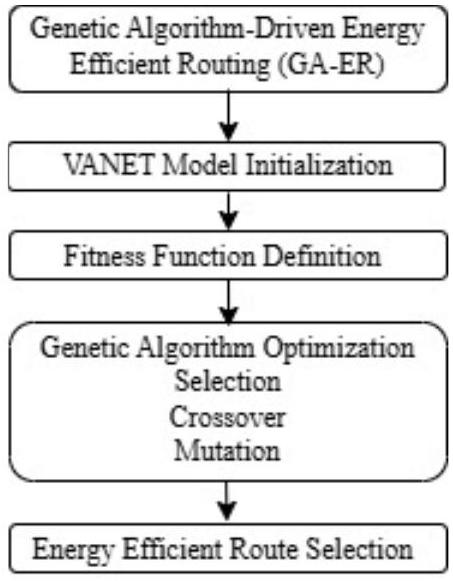
الشكل 1. سير عمل النظام.

2) دالة اللياقة

ملاءمة كل كروموسوم تتناسب عكسيًا مع إجمالي الطاقة المستهلكة على طول المسار:
أين هو مجموع طاقات الإرسال عبر جميع القفزات، و هو ثابت صغير لتجنب القسمة على الصفر. يتم معاقبة المسارات التي تحتوي على روابط غير صالحة أو عقد تفتقر إلى الطاقة الكافية بصفر لياقة.

3) الاختيار

يتم استخدام اختيار البطولة لاختيار الآباء للتكاثر. يتم مقارنة مجموعة من الأفراد المختارين عشوائيًا، ويتم اختيار الفرد الذي يتمتع بأعلى لياقة للتزاوج. في هذه المرحلة، يجب العثور على أفضل مسار توجيه من المصدر إلى الوجهة؛ وبالتالي، يتم اعتبار كل مسار توجيه كفرد أو كروموسوم. ثم تختار دالة اللياقة أفضل مسار من خلال مراعاة معايير مثل التأخير، ومعدل تسليم الحزم، واستهلاك الطاقة. يتم تقديم المسارات الأفضل لهذه المعايير إلى مرحلة التزاوج.

4) تقاطع

يحدث التداخل عند عقدة وسيطة مشتركة (إن وجدت) بين مسارين أبويين. يتم تشكيل طفل جديد من خلال دمج رأس أحد الأبوين مع ذيل الآخر. هذا يحافظ على صلاحية المسار ويقدم تنوعًا. في هذه المرحلة، يتم توليد مسارات جديدة من أفضل المسارات التي تم الحصول عليها في مرحلة الاختيار من خلال التداخل، والتي يتم التحقق من صلاحيتها، لتحديد ما إذا كان المسار الجديد لديه مقاييس أداء أفضل من المسار القديم.

5) طفرة

تستبدل الطفرة جزءًا من الشيفرة الوراثية بقطاع آخر صالح. ونتيجة لذلك، يمكن للخوارزمية الخروج من حل محدود والنظر في مجالات جديدة. وبالتالي، بعد عملية التزاوج، في هذه المرحلة، لتجنب الحلول المحلية والحفاظ على التنوع، يتم إجراء تغيير صغير على المسار. يساعد ذلك في استكشاف طرق بديلة إذا انقطع أي رابط، أو تحركت مركبة خارج النطاق، وما إلى ذلك.

III. إعداد المحاكاة والتقييم

يتناول القسم إعداد المحاكاة، والمعايير المختارة، والطريقة التي تم بها تقييم الطرق المتنافسة، والدعم الناتج عن فعالية استخدام الخوارزمية الجينية في التوجيه. تحاول المحاكاة تقليد الحالات الفعلية لشبكات المركبات المتنقلة لاختبار كيفية استخدام البروتوكول للطاقة، بالإضافة إلى موثوقيته ووظائفه في أنظمة المركبات الواسعة.

أ. بيئة المحاكاة

قدمت بايثون 3.10 وGoogle Colab الإطار اللازم لتشغيل المحاكاة، مع استخدام NumPy وNetworkX وMatplotlib لوظائف مختلفة. توضح الجدول I محاكاة تظهر حالة VANET على نطاق واسع مع التكوينات المحددة. تم إجراء المحاكاة في محاكي الشبكة 2 (NS2). استخدم نموذج التنقل الحضري 500 عقدة، مع وجود طاقة أولية لكل عقدة تبلغ 1 جول، وتم تعيين نطاق الاتصال عند 150 متر. تم توحيد حجم حزمة البيانات إلى 10 كيلوبايت (81920 بت) للحفاظ على الاتساق. تم الحفاظ على عدد السكان في الخوارزمية الجينية بسبب تباين التنقل.
الجدول I. معلمات نموذج الشبكة المحاكاة
المعلمات قيمة
1 عدد العقد ٥٠٠
٢ منطقة الشبكة
٣ الطاقة الأولية للعقد 1 ج
٤ نطاق الاتصال 150 م
٥ حجم حزمة البيانات 10 كيلوبايت (81920 بت)
٦ عقدة الغمر العقدة 0
٧ نموذج التنقل ثابت (أساسي)، ديناميكي في العمل المستقبلي
٨ عدد أجيال الخوارزمية الجينية 50
9 حجم السكان 30
10 احتمالية التداخل 0.7
11 احتمالية الطفرة 0.3
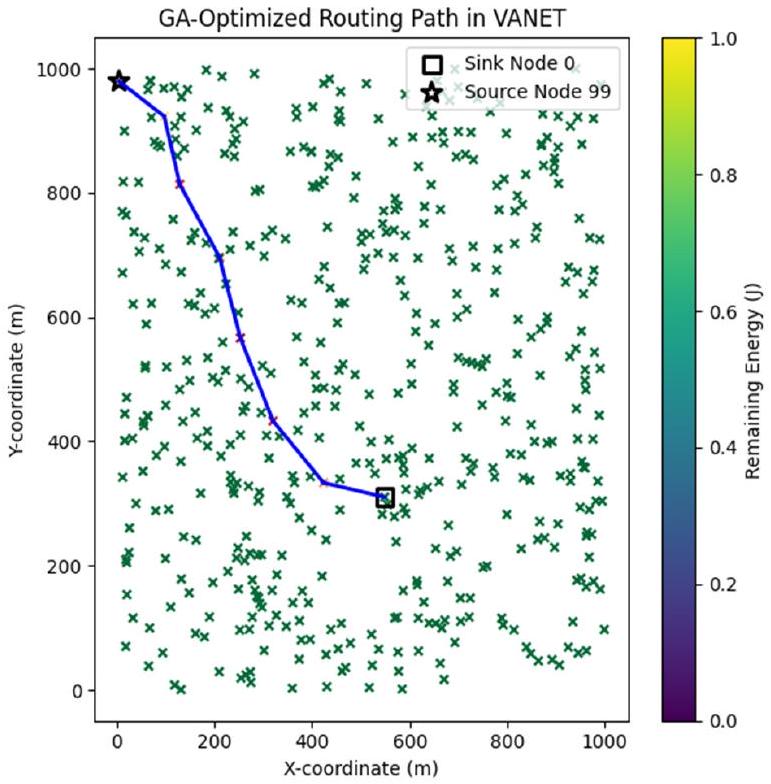
الشكل 2. مسار التوجيه المحسن بواسطة GA في VANET.

ب. مقاييس التقييم

لضمان تقييم شامل للخوارزمية المقترحة، تم استخدام مقاييس الأداء التالية:
  • نسبة تسليم الحزم (PDR): نسبة الحزم التي تم تسليمها بنجاح إلى إجمالي الحزم المرسلة.
  • تأخير من طرف إلى طرف: متوسط الوقت المستغرق لانتقال حزمة بيانات من المصدر إلى المصب.
  • إجمالي استهلاك الطاقة: الطاقة التراكمية المستهلكة من قبل جميع العقد أثناء نقل البيانات.
  • عمر الشبكة (الملاحظ): عدد الإرساليات الناجحة قبل أن تستنفد أول عقدة الطاقة.
  • عدد القفزات في المسار: عدد القفزات في مسار التوجيه من المصدر إلى المصب.

ج. مقارنة الأداء

تمت مقارنة استراتيجية GA المقترحة مع بروتوكولين أساسيين مستخدمين على نطاق واسع، AODV و DSR، تحت ظروف شبكة متطابقة. تم محاكاة توجيه أقصر مسار بناءً على خوارزمية ديكسترا لـ AODV و DSR. الجدول II يقارن نتائج هذه الطرق.
الجدول II. تحليل الأداء
بروتوكول التوجيه PDR (%) التأخير (مللي ثانية) الطاقة (جول)
الخوارزمية الجينية 92.5 45.2 0.66
AODV 86.7 60.5 1.20
DSR 89.2 57.3 1.10
يظهر تحليل أداء بروتوكولات GA و AODV و DSR أن GA يتفوق على البروتوكولين الآخرين في كل فئة مقاسة. كما هو موضح في الشكل 3، حقق GA أفضل أداء في PDR بتسجيل ، بينما حقق DSR و AODV و ، على التوالي. بناءً على هذه النتائج، يظهر أن GA أفضل في إرسال الحزم، حيث يعتمد على توجيه مدرك للطاقة وقابل للتعديل.
الشكل 3. تحليل مقارن لـ PDR.
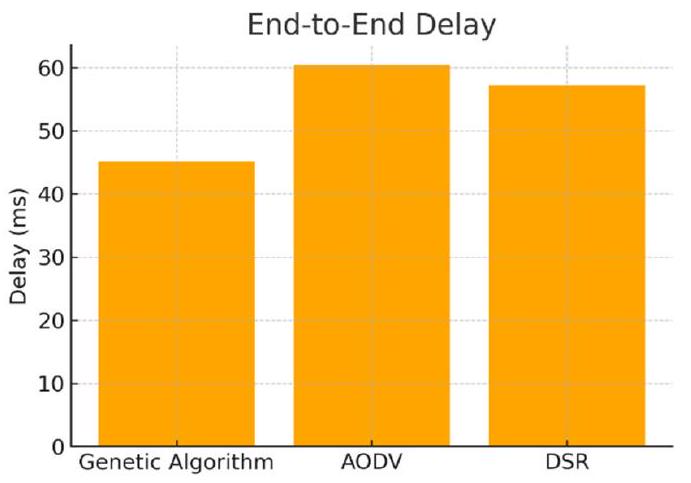
يوضح الشكل 4 النتائج بالنسبة للتأخير الكلي، حيث تمكن GA من العثور على مسارات قصيرة، مع زمن استجابة قدره 45.2 مللي ثانية، أقل من 57.3 مللي ثانية لـ DSR و 60.5 مللي ثانية لـ AODV.
الشكل 4. تحليل مقارن للتأخير من طرف إلى طرف.
كما هو موضح في الشكل 5، تبين أن النهج القائم على GA المقترح هو الأكثر كفاءة في استهلاك الطاقة، حيث استخدم فقط 0.66 جول لكل عملية نقل بيانات مقارنة بـ 1.20 جول المطلوبة من AODV و 1.10 جول المطلوبة من DSR.
الشكل 5. تحليل مقارن لاستهلاك الطاقة.
من خلال تحليل هذه النتائج، تم التأكيد على أن عملية GA المقترحة تحسن من موثوقية الشبكة، وتقلل من زمن الاستجابة، وتخفض من استهلاك الطاقة، وهي جميعها صفات جيدة لـ VANETs ذات الموارد المحدودة.

رابعاً. الاستنتاج

تقدم هذه الدراسة نهج توجيه يستخدم GA لتقليل استهلاك الطاقة وتعزيز الكفاءة في VANETs. يعتمد النهج المقترح، القائم على الحوسبة التطورية، على اكتشاف أفضل المسارات التي تستهلك طاقة أقل وتضمن تسليم الحزم بشكل موثوق بسرعة. يتم تطبيق نموذج إدارة الطاقة، ويتم العثور على أقصر وأسرع المسارات وتحديثها مع حدوث الحركة، وكل ذلك يتم اختباره في محاكاة كبيرة مع 500 عقدة وطاقات محدودة. تفوقت التوجيهات القائمة على GA على الأساليب التقليدية في الجوانب الرئيسية، كما يتضح من PDR قدره ، وزمن سفر يصل إلى 45.2 مللي ثانية، وقطع تقريباً في استهلاك الطاقة. تجعل المرونة، والقدرة على دعم العديد من العقد، واستخدام الطاقة المتوازن البروتوكول مثالياً لشبكات VANET الحضرية المعقدة والنشطة حيث تكون الاتصالات والطاقة مهمة جداً. بالإضافة إلى ذلك، فإن عرض الطاقة المتبقية ومسارات حركة البيانات يثبت أن GA يشارك الحمل بنجاح، مما يمنع بعض العقد من الفشل بسرعة كبيرة، مما يمنح الشبكة مزيداً من الوقت للعمل.
تشمل الإضافات المستقبلية لخوارزمية توجيه VANET القائمة على GA ربط الحركة في الوقت الحقيقي مع SUMO لأغراض تحسين حركة المرور، ودمج تدابير لمراقبة هجمات الثقب الأسود وSybil باستخدام مقاييس الثقة واكتشاف الشذوذ. يمكن أن يسمح التحسين متعدد الأغراض لدالة الملاءمة بأخذ عرض النطاق الترددي وجودة الخدمة واستقرار الرابط في الاعتبار. يمكن أن يعزز استخدام GA على منصات الحوسبة الحافة أو الضبابية الاستجابات في الوقت الحقيقي، ودمجه مع التعلم المعزز أو التعلم الفيدرالي يمكن أن يجعل النظام أكثر مرونة في إعدادات VANET الديناميكية [17]. الغرض من هذه الاتجاهات هو جعل نظام التوجيه أكثر ذكاءً وأمانًا وقادرًا على تلبية الاحتياجات المستقبلية في قطاع نظم النقل الذكية.

REFERENCES

[1] A. Dutta, L. M. Samaniego Campoverde, M. Tropea, and F. De Rango, “A Comprehensive Review of Recent Developments in VANET for Traffic, Safety & Remote Monitoring Applications,” Journal of Network and Systems Management, vol. 32, no. 4, Oct. 2024, Art. no. 73, https://doi.org/10.1007/s10922-024-09853-5.
[2] D. Desai, H. El-Ocla, and S. Purohit, “Data Dissemination in VANETs Using Particle Swarm Optimization,” Sensors, vol. 23, no. 4, Feb. 2023, Art. no. 2124, https://doi.org/10.3390/s23042124.
[3] P. Sra and S. Chand, “QoS in Mobile Ad-Hoc Networks,” Wireless Personal Communications, vol. 105, no. 4, pp. 1599-1616, Apr. 2019, https://doi.org/10.1007/s11277-019-06162-y.
[4] S. Hao, H. Zhang, and M. Song, “A Stable and Energy-Efficient Routing Algorithm Based on Learning Automata Theory for MANET,” Journal of Communications and Information Networks, vol. 3, no. 2, pp. 43-57, Jun. 2018, https://doi.org/10.1007/s41650-018-0012-7.
[5] S. W. Lee, K. S. Heo, M. A. Kim, D. K. Kim, and H. Choi, “Multiple-Junction-Based Traffic-Aware Routing Protocol Using ACO Algorithm in Urban Vehicular Networks,” Sensors, vol. 24, no. 9, May 2024, Art. no. 2913, https://doi.org/10.3390/s24092913.
[6] R. Ramamoorthy, “An Enhanced Location-Aided Ant Colony Routing for Secure Communication in Vehicular Ad Hoc Networks,” HumanCentric Intelligent Systems, vol. 4, no. 1, pp. 25-52, Jan. 2024, https://doi.org/10.1007/s44230-023-00059-7.
[7] P. Upadhyay et al., “An improved deep reinforcement learning routing technique for collision-free VANET,” Scientific Reports, vol. 13, no. 1, Dec. 2023, Art. no. 21796, https://doi.org/10.1038/s41598-023-48956-y.
[8] A. Amalia, Y. Pramitarini, R. H. Y. Perdana, K. Shim, and B. An, “A Deep-Learning-Based Secure Routing Protocol to Avoid Blackhole Attacks in VANETs,” Sensors, vol. 23, no. 19, Oct. 2023, Art. no. 8224, https://doi.org/10.3390/s23198224.
[9] W. Luo, “A quantum genetic algorithm based QoS routing protocol for wireless sensor networks,” in 2010 IEEE International Conference on Software Engineering and Service Sciences, Beijing, China, Jul. 2010, pp. 37-40, https://doi.org/10.1109/ICSESS.2010.5552333.
[10] S. Girijalakshmi, K. Sivakumar, and C. Chandrasekar, “DSDV addendum through genetic algorithm in VANET,” in Proceedings of the National Conference on Innovation in Computing and Communication Technology, 2016, pp. 19-23.
[11] T. Sanislav, S. Zeadally, G. D. Mois, and S. C. Folea, “Wireless energy harvesting: Empirical results and practical considerations for Internet of Things,” Journal of Network and Computer Applications, vol. 121, pp. 149-158, Nov. 2018, https://doi.org/10.1016/j.jnca.2018.08.002.
[12] A. C. Pise and D. K. J. Karande, “An Exploratory Study of ClusterBased Routing Protocol in VANET: A Review,” International Journal of Advanced Research in Engineering and Technology, vol. 12, no. 10, pp. 17-30.
[13] A. C. Pise and K. J. Karande, “K-Mean Energy Efficient Optimal Cluster Based Routing Protocol in Vehicular Ad-Hoc Networks,” in Modern Approaches in Machine Learning and Cognitive Science: A Walkthrough, vol. 1117, V. K. Gunjan, J. M. Zurada, and N. Singh, Eds. Springer International Publishing, 2024, pp. 305-313.
[14] P. Pal, S. Tripathi, and C. Kumar, “Bandwidth estimation in high mobility scenarios of IEEE 802.11 infrastructure-less mobile ad hoc networks,” International Journal of Communication Systems, vol. 32, no. 15, 2019, Art. no. e4080, https://doi.org/10.1002/dac. 4080.
[15] A. C. Pise and K. J. Karande, “Cluster Head Selection Based on ACO in Vehicular Ad-Hoc Networks:,” in Advances in Computer and Electrical Engineering, P. N. Mahalle, D. G. Takale, S. Sakhare, and G. B. Regulwar, Eds. IGI Global, 2024, pp. 269-290.
[16] Z. Sh. Alzaidi, A. A. Yassin, Z. A. Abduljabbar, and V. O. Nyangaresi, “A Fog Computing and Blockchain-based Anonymous Authentication Scheme to Enhance Security in VANET Environments,” Engineering, Technology & Applied Science Research, vol. 15, no. 1, pp. 1914319153, Feb. 2025, https://doi.org/10.48084/etasr. 8663.
[17] D. G. Takale, S. D. Gunjal, V. N. Khan, A. Raj, and S. N. Gujar, “Road Accident Prediction Model Using Data Mining Techniques,” NeuroQuantology, vol. 20, no. 16, pp. 2904-2101, 2022.

Journal: Engineering Technology & Applied Science Research, Volume: 15, Issue: 5
DOI: https://doi.org/10.48084/etasr.12744
Publication Date: 2025-10-06

A Genetic Algorithm-Driven Energy-Efficient Routing Strategy for Optimizing Performance in VANETs

Anjali PiseSKN Sinhgad College of Engineering, Korti, Pandharpur, India anjali.pise@sknscoe.ac.in (corresponding author)Kailash KarandeSKN Sinhgad College of Engineering, Korti, Pandharpur, Indiakailashkarande@yahoo.co.in

Received: 14 June 2025 | Revised: 21 July 2025 | Accepted: 2 August 2025
Licensed under a CC-BY 4.0 license | Copyright (c) by the authors | DOI: https://doi.org/10.48084/etasr. 12744

Abstract

VANETs are now essential for smart transportation because they make it possible for vehicles and road infrastructure to send and receive messages instantly. However, WSN routes are challenged by the movement and the limited energy of the nodes, along with the number of vehicles. This study presents a new GA-based routing technique to control packet delivery and reduce total energy consumption in VANETs. A VANET with 500 vehicles was modeled in a area, using 1 J of energy per vehicle and limiting communication to within 150 m of each vehicle. Each candidate route is examined using a fitness function that is lower when the energy cost is higher. Using tournament selection, natural crossover, and energy-aware mutation, the GA supports the adaptation of efficient, loop-free paths linking the source and the sink in multi-hop networks. The simulation results confirm that the proposed scheme is better than AODV and DSR, delivering of packets and achieving a reduced delay of 45.2 ms . This strategy reduces energy consumption, so the network can function longer, demonstrating how the proposed method fits changing conditions in VANET networks. The framework can be adapted for ITS and can be integrated with learning-based predictions for mobility and federated routing.

Keywords-VANETs; genetic algorithm; energy-efficient routing; packet delivery ratio; network lifetime; multihop communication; end-to-end delay; vehicular networks; routing optimization; intelligent transportation systems

I. INTRODUCTION

VANETs are important for Intelligent Transport Systems (ITS), allowing vehicles and roadside facilities to exchange data without delay through wireless links. By enabling instant data transfer, VANETs improve road safety, increase traffic flow efficiency, and offer better infotainment options [1,2]. VANETs differ from standard MANETs because they have more mobile devices [3], frequently-changing network arrangements, less reliable connections, and higher demands in terms of performance [4]. To address these challenges, routing protocols must be effective, smart, and energy efficient [5]. The decentralized and rapidly changing nature of vehicle movement makes routing in VANETs a difficult process. Originally made for ad-hoc networks in general, Ad-hoc On-Demand Distance Vector (AODV) [6] and Dynamic Source Routing (DSR) [7] are used in VANETs. Most protocols are designed to find the best routes and manage them efficiently, but do not consider energy use or the lifespan of the nodes. Excessive energy usage in high-mobility VANETs results in reduced network life,
lower reliability, and higher packet losses [8]. Due to these limitations, heuristic and bio-inspired techniques have become more popular lately. Genetic Algorithms (GAs) demonstrate potential, as they are flexible, efficient in searching, and can solve global optimization problems in changing conditions [9]. GAs use a population of routes, continuously refining them using selection, crossover, and mutation based on a set fitness function. GAs can be set up in VANET routing to improve routes, control the energy usage of devices, maintain a balanced network load, and prevent any single node from running out of energy too fast.
The study presents a routing strategy using a GA to improve energy efficiency in VANETs [10]. The objective is to find the best route that combines a few hops to consume less energy while reliably delivering packets. The protocol differs from traditional ones because it includes a special energyaware fitness function that punishes high-energy routes and rewards that ensure an even distribution of energy usage [11]. To test the system in a real situation, a simulation was performed using 500 nodes across a area. Every
node has only 1 J of energy to use, and the data can only be shared within a 150 m span, as found in real-life vehicular networks. The key contributions of this research are as follows:
  • A novel GA-based routing protocol that dynamically selects energy-efficient paths by evaluating transmission cost, residual energy, and connectivity constraints.
  • A scalable simulation framework modeling real-world VANET conditions with detailed energy tracking and node dynamics.
  • Comparative performance analysis with traditional protocols (AODV and DSR) in core metrics: Packet Delivery Ratio (PDR), end-to-end delay, and total energy consumed.
  • A comprehensive visualization of node energy dissipation and routing paths to highlight the GA’s effectiveness in balancing network load.
In VANETs, recent efforts have focused on routing protocols that do not use too much energy, can withstand constant changes in routing, and can overcome high mobility [12]. Several studies after 2020 have contributed to this domain, mainly by joining forces with optimization algorithms and new routing approaches [13]. In [1], a comprehensive summary of recent work in VANETs highlighted their contribution to traffic, safety, and remote monitoring. This study categorized VANET architectures into centralized, distributed, and hybrid, assessing their responses in urgencybased and time-sensitive cases. This study examined grouping, vehicle routing awareness, and ways to share data for V2X systems. Many current protocols have been shown to fail in areas where things change rapidly or there is a lot of traffic, and it was noticed that planning for energy use is a large gap. Finally, this study emphasized the need for future VANET systems to use cross-layer connections, artificial intelligence, and smart energy use to keep up with future ITS applications.
In [2], a data dissemination system for VANETs was proposed, using Particle Swarm Optimization (PSO) and designed for emergency scenarios. VANET routing was represented as a problem in which the main objective is to ensure minimum delay, minimum packet loss, and maximum reliability, even as the number of vehicles changes. Combining PSO with a routing protocol, this study analyzed how changes such as node mobility, buffer size, and link stability affect routing decisions. The simulation findings showed that a PSObased protocol can achieve much better packet delivery and route stability than AODV and GPSR in high-traffic and fastchanging urban regions. This study found that swarm intelligence can help dense VANETs find an efficient and scalable way to manage routing. At the same time, implementation issues such as the time it takes to synchronize systems and computational requirements were highlighted, which must be resolved before using such systems in ITS applications under strict time constraints.
In [5], MJTAR was proposed as an improvement to GyTAR, utilizing the Ant Colony Optimization (ACO) algorithm to make smart decisions about intersections according to the vehicle density and link availability.
Information from two nearby intersections allows MJTAR to pick routes that bypass crowded roads and deliver more secure routes in cities. Using a distributed traffic awareness process, the protocol allows forwarders to estimate their own suitability without the need to use infrastructure [14]. The simulation results showed that MJTAR improved packet delivery by more than compared to standard protocols and reduced end-toend delay to less than 1.3 s . Using guidance inspired by nature allows urban vehicular networks to share data more reliably and respond well to changing traffic conditions.
ELAACR [6] is a routing method to improve security and effectiveness in VANETs. To ensure its reliable routing data security, ELAACR uses ACO along with location-based key management. Based on traffic and network setup changes, the protocol reassigns priorities to robots using information about their impact on the system and their location. In large tests, ELAACR reached a speed of 640 Kbps and managed to transmit 98.5% of messages, outperforming EHACORP and FANT in delay, extra packets, and amounts sent. This demonstrated that ELAACR provided dependable and efficient routing in city-based VANETs.
The study in [7] investigated VANETs to address the weaknesses of regular routing protocols with respect to control cost, data reliability, and data latency. The IDRL model used real-time communication between vehicles and infrastructure, along with environmental observations, to update routing and improve data delivery. Using deep Q-learning, the protocol can regularly adjust its routing strategy using information from the network, using fewer control messages, and discovering routes faster. According to the simulation, IDRL lets data travel very quickly on the network, successfully delivering more packets and ensuring that data transfer is more reliable than other routing methods. According to this study, integrating routing optimization with managing control overhead has become a particular research gap, as other models did not address this issue. Using both solutions, the IDRL framework successfully addresses intelligent routing in cities with high vehicle movement.
In [8], a Deep-Learning-Based Secure Routing (DLSR) protocol was proposed to protect VANETs from blackhole attacks, using deep learning to identify malicious nodes and decide on safe routes. The protocol makes next-hop choices based on energy, distance, and hop counts, and its performance was studied in conjunction with that of a Deep-Learning-based Clustering (DLC) mechanism. Simulated with the RPGM and RWP models, it was found that DLSR and DLC offered benefits such as more successful data delivery, lower delay, and lower use of control messages. However, this study did not present how the proposed solutions might actually be used and which areas need more research in the future.
Recent advances in energy- and intelligence-based VANET routing, supported by GA, PSO, ACO [15], and deep learning, still miss the target of combining energy efficiency, secure communication, flexibility for high mobility, and controlling traffic in the network. Most studies focused only on minor changes and did not offer solutions that can handle performance, security, and resource-efficiency issues while the network is shifting [16].

II. PROPOSED ALGORITHM

The proposed technique includes a dynamic framework for path optimization, a realistic energy usage and routing model that considers mobility, all to increase network performance while reducing energy use and the amount of control information shared.

A. System Overview

The purpose of the proposed routing framework is to address the major problems present in existing VANET protocols by focusing on energy efficiency, scalability, and handling the high mobility of the nodes. A GA is utilized to create multi-hop paths that minimize power usage, skip weak nodes, and uphold reliable communication in crowded areas where many vehicles are present. The GA improves possible paths by using operators from evolutionary computing and checking their energy efficiency, the distribution of energy left, and overall structure.

B. Network Model and Assumptions

In the simulation, 500 mobile nodes were spread randomly across a VANET area. Within 150 m surrounding each node, direct communication is enabled after the node is started with 1.0 J of energy. The system chooses a special node, called the sink node (node 0 ), to receive the transmission from a random source node at any time. The data packet size is kept at 10 KB , and the network simulates realistic mobility, but the first implementation only examines static placements to focus on power usage.

C. Energy Consumption Model

The energy model follows the widely adopted first-order radio model, where the energy required to transmit bits over a distance is calculated as:
The energy to receive bits is:
where , and 81920 bits ( 10 KB ).
These equations allow the model to account for both transmission and reception energy at each hop, enabling accurate simulation of energy drain across the route.

D. Genetic Algorithm Design

The routing problem is formulated as a combinatorial optimization task, where the objective is to discover the path from the source to the sink that minimizes total energy consumption. The GA components are defined as follows.

1) Chromosome Representation

Each chromosome represents a candidate path as a sequence of node IDs, starting from the source and ending at the sink. Intermediate nodes are selected from the set of nodes within communication range, ensuring loop-free and valid paths.
Fig. 1. System workflow.

2) Fitness Function

The fitness of each chromosome is inversely proportional to the total energy consumed along the path:
where is the sum of transmission energies across all hops, and is a small constant to avoid division by zero. Routes with invalid links or nodes lacking sufficient energy are penalized with zero fitness.

3) Selection

Tournament selection is used to choose parents for reproduction. A group of randomly selected individuals is compared, and the one with the highest fitness is selected to breed. In this stage, the best routing path from source to destination should be found; hence, each routing path is considered as an individual or chromosome. Then the fitness function chooses the best path by considering parameters such as delay, PDR, and energy consumption. The paths that are best for these parameters are given to the crossover stage.

4) Crossover

Crossover occurs at a common intermediate node (if any) shared between two parent routes. A new child is formed by combining the head of one parent with the tail of the other. This maintains path validity and introduces diversity. In this stage, new paths are generated from the best paths obtained in the selection stage by crossover, which are verified for validity, determining whether a new path has better performance metrics than the older one.

5) Mutation

Mutation replaces a subsection of the genetic code with another valid segment. As a result, the algorithm can step out of a limited solution and look into new areas. Hence, after crossover, in this stage, to avoid local optima and maintain diversity, a small change is made to the path. This helps explore alternative routes if any link breaks, a vehicle moves out of range, etc.

III. SIMULATION SETUP AND EVALUATION

The section reports on the setup of the simulation, the chosen metrics, the way competing methods were evaluated, and the resulting support for the effectiveness of using GA for routing. The simulation tries to mimic actual VANET situations to test how the protocol uses energy, along with its reliability and functions in vast vehicular systems.

A. Simulation Environment

Python 3.10 and Google Colab provided the framework for running the simulation, with NumPy, NetworkX, and Matplotlib used for different functions. Table I demonstrates a simulation that shows a large-scale VANET case with the set configurations. Simulation was performed in Network Simulator 2 (NS2). The urban mobility model used 500 nodes, with each node having an initial energy of 1 J , and the communication range was set at 150 m . Data packet size was standardized to 10 KB ( 81920 bits) to maintain consistency. The GA population was maintained due to mobility variance.
TABLE I. SIMULATION NETWORK MODEL PARAMETERS
Parameters Value
1 Number of nodes 500
2 Network area
3 Initial energy of nodes 1 J
4 Communication range 150 m
5 Data packet size 10 KB (81920 bits)
6 Sink node Node 0
7 Mobility model Static (baseline), dynamic in future work
8 Number of GA generations 50
9 Population size 30
10 Crossover probability 0.7
11 Mutation probability 0.3
Fig. 2. GA-optimized routing path in VANET.

B. Evaluation Metrics

To ensure a comprehensive assessment of the proposed algorithm, the following performance metrics were used:
  • Packet Delivery Ratio (PDR): Ratio of successfully delivered packets to the total packets sent.
  • End-to-End Delay: Average time taken for a data packet to traverse from source to sink.
  • Total Energy Consumption: Cumulative energy expended by all nodes during data transmission.
  • Network Lifetime (observed): Number of successful transmissions before the first node depletes energy.
  • Path Hop Count: Number of hops in the routing path from the source to the sink.

C. Performance Comparison

The proposed GA strategy was compared with two widely used baseline protocols, AODV and DSR, under identical network conditions. For AODV and DSR, the shortest-path routing based on Dijkstra’s algorithm was simulated. Table II compares the results of these methods.
TABLE II. PERFORMANCE ANALYSIS
Routing Protocol PDR (%) Delay (ms) Energy (J)
Genetic Algorithm 92.5 45.2 0.66
AODV 86.7 60.5 1.20
DSR 89.2 57.3 1.10
The performance analysis of the GA, AODV, and DSR protocols shows that GA outperforms the other two in every measured category. As shown in Figure 3, GA performed the best in PDR by recording , while DSR and AODV achieved and , respectively. Based on these results, GA is shown to be better at sending packets, since it relies on energy-aware and adjustable routing.
Fig. 3. Comparative analysis of PDR.
Figure 4 shows the results for the overall delay, where GA was able to find short routes, with a latency of 45.2 ms , less than DSR’s 57.3 ms and AODV’s 60.5 ms .
Fig. 4. Comparative analysis of end-to-end delay.
As shown in Figure 5, the proposed GA-based approach turned out to be the most energy efficient, using just 0.66 J for each data transfer compared to the 1.20 J needed by AODV and the 1.10 J needed by DSR.
Fig. 5. Comparative analysis of energy consumption.
By analyzing these outcomes, it is confirmed that the suggested GA process improves network reliability, shortens latency, and reduces energy usage, all of which are good qualities for VANETs with limited resources.

IV. CONCLUSION

This research presents a routing approach that uses a GA to minimize energy use and enhance efficiency in VANETs. The proposed approach, based on evolutionary computation, discovers the best routes that consume less energy and ensure reliable packet delivery in a fast manner. An energy management model is applied, the shortest and fastest paths are found and updated as movement occurs, all of which are tested in large simulations with 500 nodes and restricted energy. The proposed GA-based routing outperformed traditional approaches in key aspects, as seen from a PDR of , travel time down to 45.2 ms , and an almost cut in power use. The flexibility, ability to support many nodes, and balanced power use make the protocol ideal for complex and active urban VANETs where contact and power matter a lot. In addition, displaying the leftover energy and data movement paths proves that the GA successfully shares the load, preventing some nodes from failing too quickly, which gives the network more time to function.
Future additions to the proposed GA-based VANET routing algorithm involve connecting real-time mobility with SUMO for better traffic movement purposes and integrating measures to watch for blackhole and Sybil attacks with trust metrics and anomaly detection. Multipurpose optimization can allow the fitness function to take bandwidth, QoS, and link stability into account. Using GA on edge or fog computing platforms can boost real-time responses, and combining it with reinforcement or federated learning can make the system more flexible in dynamic VANET settings [17]. The purpose of these directions is to make the routing system smarter, more secure, and able to handle future needs in the ITS sector.

REFERENCES

[1] A. Dutta, L. M. Samaniego Campoverde, M. Tropea, and F. De Rango, “A Comprehensive Review of Recent Developments in VANET for Traffic, Safety & Remote Monitoring Applications,” Journal of Network and Systems Management, vol. 32, no. 4, Oct. 2024, Art. no. 73, https://doi.org/10.1007/s10922-024-09853-5.
[2] D. Desai, H. El-Ocla, and S. Purohit, “Data Dissemination in VANETs Using Particle Swarm Optimization,” Sensors, vol. 23, no. 4, Feb. 2023, Art. no. 2124, https://doi.org/10.3390/s23042124.
[3] P. Sra and S. Chand, “QoS in Mobile Ad-Hoc Networks,” Wireless Personal Communications, vol. 105, no. 4, pp. 1599-1616, Apr. 2019, https://doi.org/10.1007/s11277-019-06162-y.
[4] S. Hao, H. Zhang, and M. Song, “A Stable and Energy-Efficient Routing Algorithm Based on Learning Automata Theory for MANET,” Journal of Communications and Information Networks, vol. 3, no. 2, pp. 43-57, Jun. 2018, https://doi.org/10.1007/s41650-018-0012-7.
[5] S. W. Lee, K. S. Heo, M. A. Kim, D. K. Kim, and H. Choi, “Multiple-Junction-Based Traffic-Aware Routing Protocol Using ACO Algorithm in Urban Vehicular Networks,” Sensors, vol. 24, no. 9, May 2024, Art. no. 2913, https://doi.org/10.3390/s24092913.
[6] R. Ramamoorthy, “An Enhanced Location-Aided Ant Colony Routing for Secure Communication in Vehicular Ad Hoc Networks,” HumanCentric Intelligent Systems, vol. 4, no. 1, pp. 25-52, Jan. 2024, https://doi.org/10.1007/s44230-023-00059-7.
[7] P. Upadhyay et al., “An improved deep reinforcement learning routing technique for collision-free VANET,” Scientific Reports, vol. 13, no. 1, Dec. 2023, Art. no. 21796, https://doi.org/10.1038/s41598-023-48956-y.
[8] A. Amalia, Y. Pramitarini, R. H. Y. Perdana, K. Shim, and B. An, “A Deep-Learning-Based Secure Routing Protocol to Avoid Blackhole Attacks in VANETs,” Sensors, vol. 23, no. 19, Oct. 2023, Art. no. 8224, https://doi.org/10.3390/s23198224.
[9] W. Luo, “A quantum genetic algorithm based QoS routing protocol for wireless sensor networks,” in 2010 IEEE International Conference on Software Engineering and Service Sciences, Beijing, China, Jul. 2010, pp. 37-40, https://doi.org/10.1109/ICSESS.2010.5552333.
[10] S. Girijalakshmi, K. Sivakumar, and C. Chandrasekar, “DSDV addendum through genetic algorithm in VANET,” in Proceedings of the National Conference on Innovation in Computing and Communication Technology, 2016, pp. 19-23.
[11] T. Sanislav, S. Zeadally, G. D. Mois, and S. C. Folea, “Wireless energy harvesting: Empirical results and practical considerations for Internet of Things,” Journal of Network and Computer Applications, vol. 121, pp. 149-158, Nov. 2018, https://doi.org/10.1016/j.jnca.2018.08.002.
[12] A. C. Pise and D. K. J. Karande, “An Exploratory Study of ClusterBased Routing Protocol in VANET: A Review,” International Journal of Advanced Research in Engineering and Technology, vol. 12, no. 10, pp. 17-30.
[13] A. C. Pise and K. J. Karande, “K-Mean Energy Efficient Optimal Cluster Based Routing Protocol in Vehicular Ad-Hoc Networks,” in Modern Approaches in Machine Learning and Cognitive Science: A Walkthrough, vol. 1117, V. K. Gunjan, J. M. Zurada, and N. Singh, Eds. Springer International Publishing, 2024, pp. 305-313.
[14] P. Pal, S. Tripathi, and C. Kumar, “Bandwidth estimation in high mobility scenarios of IEEE 802.11 infrastructure-less mobile ad hoc networks,” International Journal of Communication Systems, vol. 32, no. 15, 2019, Art. no. e4080, https://doi.org/10.1002/dac. 4080.
[15] A. C. Pise and K. J. Karande, “Cluster Head Selection Based on ACO in Vehicular Ad-Hoc Networks:,” in Advances in Computer and Electrical Engineering, P. N. Mahalle, D. G. Takale, S. Sakhare, and G. B. Regulwar, Eds. IGI Global, 2024, pp. 269-290.
[16] Z. Sh. Alzaidi, A. A. Yassin, Z. A. Abduljabbar, and V. O. Nyangaresi, “A Fog Computing and Blockchain-based Anonymous Authentication Scheme to Enhance Security in VANET Environments,” Engineering, Technology & Applied Science Research, vol. 15, no. 1, pp. 1914319153, Feb. 2025, https://doi.org/10.48084/etasr. 8663.
[17] D. G. Takale, S. D. Gunjal, V. N. Khan, A. Raj, and S. N. Gujar, “Road Accident Prediction Model Using Data Mining Techniques,” NeuroQuantology, vol. 20, no. 16, pp. 2904-2101, 2022.