استغلال الابتكار التكنولوجي والطاقة المتجددة وتأثيرهما على التلوث البيئي في دول مجموعة العشرين Harnessing technological innovation and renewable energy and their impact on environmental pollution in G-20 countries

المجلة: Scientific Reports، المجلد: 15، العدد: 1
DOI: https://doi.org/10.1038/s41598-025-85182-0
PMID: https://pubmed.ncbi.nlm.nih.gov/39824979
تاريخ النشر: 2025-01-17

تقارير علمية

افتح

استغلال الابتكار التكنولوجي والطاقة المتجددة وتأثيرهما على التلوث البيئي في دول مجموعة العشرين

الملخص

سيوي هان دونغ بينغ يوانيوان قوه محمد عمر أسلم ورنغو شيو تغير المناخ وتدهور البيئة هما تحديان عالميان حاسمان، وتلعب دول مجموعة العشرين دورًا محوريًا في معالجة هذه القضايا نظرًا لمساهماتها الكبيرة في الناتج المحلي الإجمالي العالمي وانبعاثات الكربون. إن الانتقال نحو مصادر الطاقة المتجددة أمر ضروري للتخفيف من انبعاثات ثاني أكسيد الكربون وتحقيق التنمية المستدامة. تبحث هذه الدراسة في تأثير الابتكار التكنولوجي، والناتج المحلي الإجمالي، واستهلاك الطاقة المتجددة، والحرية الاقتصادية، والتقدم المالي على استخدام الطاقة المتجددة ومستويات تلوث البيئة في دول مجموعة العشرين من 1995 إلى 2022. باستخدام طريقة اللوحة الديناميكية PMG-ARDL، تحلل الدراسة العلاقات على المدى الطويل والقصير بين المتغيرات. تكشف النتائج أن الابتكار التكنولوجي يعزز بشكل كبير من اعتماد الطاقة المتجددة، مع زيادة في الابتكار التكنولوجي مما يؤدي إلى زيادة استخدام الطاقة المتجددة على المدى الطويل و زيادة في الأجل القصير. بالإضافة إلى ذلك، يرتبط زيادة استهلاك الطاقة المتجددة ارتباطًا وثيقًا بتقليل انبعاثات ثاني أكسيد الكربون، مما يبرز دورها الحاسم في تعزيز الاستدامة البيئية. تؤكد الدراسة على أهمية السياسات المصممة لتعزيز الابتكار التكنولوجي لتعزيز استخدام الطاقة المتجددة وتقليل التلوث البيئي. توصي بتوسيع وإصلاح القطاع التكنولوجي ليتماشى مع الموارد الدولية والمحلية مع مبادرات الطاقة المتجددة، مما يوفر إطار عمل قابل للتطبيق لدعم النمو الأخضر للمؤسسات وتحقيق مستقبل أكثر استدامة لدول مجموعة العشرين. تسهم هذه الأبحاث في فهم الديناميات المعقدة لانتقالات الطاقة المتجددة، مقدمة رؤى قابلة للتنفيذ لصانعي السياسات وأصحاب المصلحة في مواجهة التحديات البيئية العالمية.

الكلمات الرئيسية: الطاقة المتجددة، الابتكار التكنولوجي، الحرية الاقتصادية، الناتج المحلي الإجمالي، التلوث البيئي، مجموعة العشرين
الاختصارات
إعادة متوسط المجموعة المجمعة – التأخير الذاتي الموزع للطاقة المتجددة
ثاني أكسيد الكربون ثاني أكسيد الكربون
الناتج المحلي الإجمالي الناتج المحلي الإجمالي
إي بول تلوث البيئة
تي آي الابتكار التكنولوجي
EF الحرية الاقتصادية
مجموعة العشرين مجموعة العشرين
EKC منحنى كوزنيتس البيئي
الاستثمار الأجنبي المباشر الاستثمار الأجنبي المباشر
بي بي البترول البريطاني
الوكالة الدولية للطاقة الوكالة الدولية للطاقة
فا التقدم المالي
لقد برز تغير المناخ كأحد التحديات العالمية الأكثر أهمية في العصر الحديث، مدفوعًا بشكل أساسي بانبعاثات الغازات الدفيئة. . وفقًا لـ ارتفعت انبعاثات ثاني أكسيد الكربون (CO2) العالمية من الوقود الأحفوري إلى مليون طن في عام 2018، وهو زيادة كبيرة عن 11,190 مليون طن المسجلة في عام 1965. وصل معدل النمو السنوي لانبعاثات ثاني أكسيد الكربون إلى في عام 2018، مسجلاً أعلى معدل تم ملاحظته في السنوات السبع السابقة. هذه الظاهرة المقلقة تبرز ضرورة معالجة تغير المناخ، الذي يشكل تهديدات كبيرة لصحة الإنسان والأنظمة البيئية والأمن العالمي. تشمل عواقب عدم التحرك تصاعد تلوث الهواء، والأحداث المناخية المتطرفة، والمخاطر طويلة الأمد على رفاهية الإنسان وبقائه. .
لقد تم الاعتراف بالطاقة المتجددة (RE) على نطاق واسع كركيزة في مكافحة تغير المناخ، حيث تقدم بديلاً مستدامًا للوقود الأحفوري. والمساهمة في تقليل انبعاثات ثاني أكسيد الكربون لقد أظهرت مصادر مثل الطاقة الشمسية، وطاقة الرياح، والكتلة الحيوية، والطاقة الحرارية الجوفية قدرتها على التخفيف من انبعاثات غازات الدفيئة، حيث حددت العديد من الدراسات الطاقة المتجددة كعامل حاسم في تحسين جودة البيئة. . ومع ذلك، تظل الفوائد البيئية للطاقة المتجددة موضوع نقاش، حيث تشير بعض الدراسات إلى أن اعتمادها لا يؤدي باستمرار إلى تخفيضات كبيرة في انبعاثات لذلك، فإن العلاقة بين استخدام الطاقة المتجددة وتحسين البيئة تتطلب استكشافًا أعمق. .
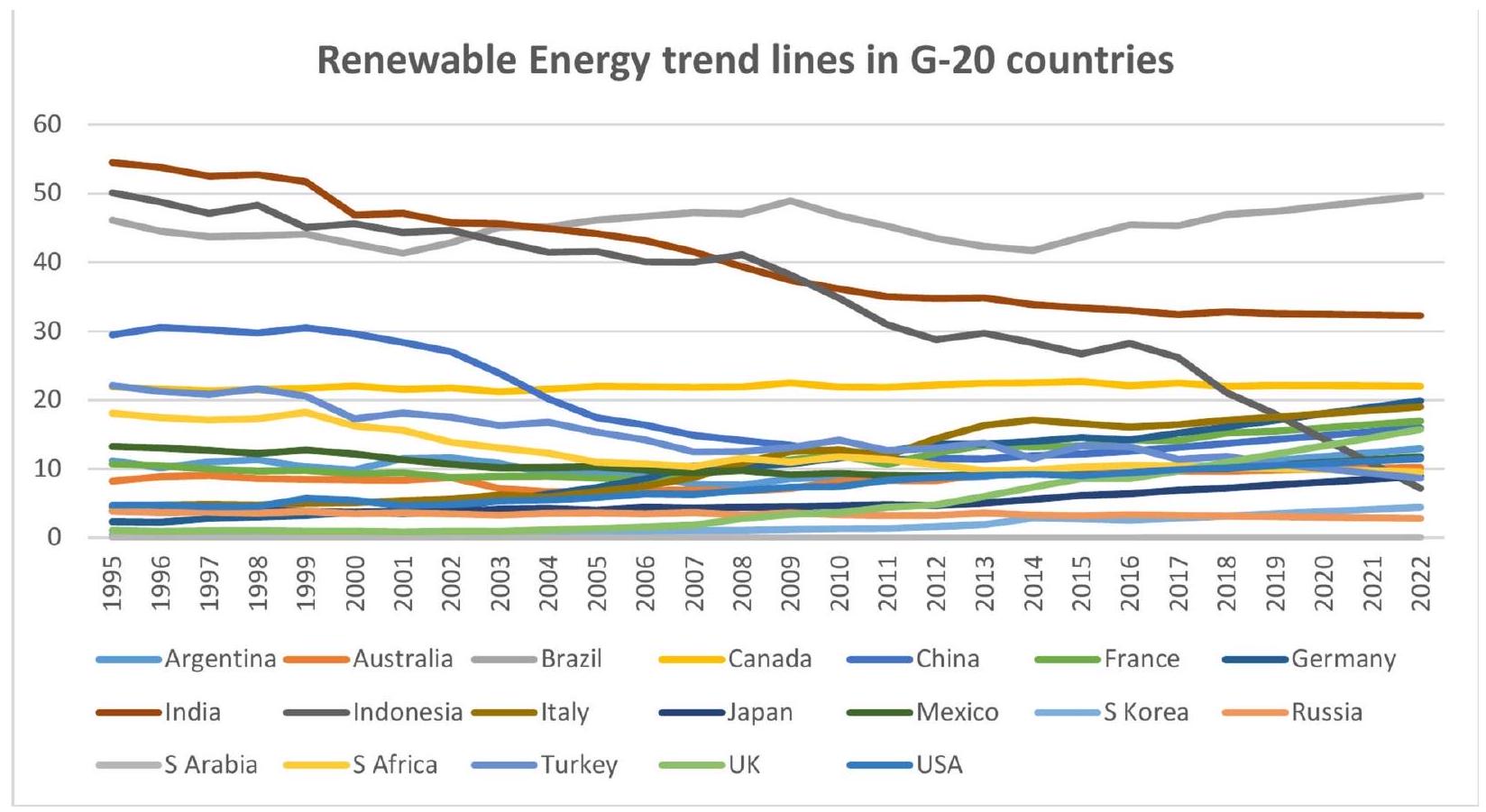
تعتبر الابتكارات التكنولوجية محورية في تعزيز قدرة الطاقة المتجددة من خلال تمكين الاستخدام الفعال للموارد وتسريع الانتقال نحو أنظمة الطاقة النظيفة. ومع ذلك، توجد تفاوتات بين الدول في اتجاهات اعتماد الطاقة المتجددة. بينما تقوم معظم دول مجموعة العشرين بزيادة استهلاكها من الطاقة المتجددة بشكل مستمر، تظهر دول مثل إندونيسيا اتجاهات تنازلية. (انظر الشكل 1)، مما يشير إلى الحاجة إلى تدخلات مستهدفة وتعزيزات سياسية تثير هذه الديناميات أسئلة حاسمة حول التفاعل بين الابتكار التكنولوجي، والنمو الاقتصادي (المقاس بالناتج المحلي الإجمالي)، والتقدم المالي، والحرية الاقتصادية، والتلوث البيئي في تشكيل اعتماد الطاقة المتجددة. .
تتناول هذه الدراسة هذه القضايا من خلال فحص دور الابتكار التكنولوجي في استخدام الطاقة المتجددة داخل دول مجموعة العشرين. على وجه التحديد، تحقق في العلاقة بين استهلاك الطاقة المتجددة، وانبعاثات ثاني أكسيد الكربون، ومؤشرات اقتصادية رئيسية مثل الناتج المحلي الإجمالي والتقدم المالي. من خلال استخدام منهجيات اقتصادية قوية، بما في ذلك نماذج PMG-ARDL وFMOLS وDOLS، تضمن الدراسة رؤى شاملة وموثوقة حول هذه التفاعلات. .
تسعى هذه الدراسة إلى معالجة عدة أسئلة بحثية مبتكرة تستكشف العلاقات الديناميكية بين الابتكار التكنولوجي، واعتماد الطاقة المتجددة، والعوامل الاقتصادية والبيئية المرتبطة في دول مجموعة العشرين. أولاً، تبحث في كيفية تأثير الابتكار التكنولوجي على اعتماد وكفاءة استخدام الطاقة المتجددة وتفحص دور التقدم التكنولوجي في التخفيف من الانبعاثات من خلال تعزيز نشر الطاقة المتجددة. ثانياً، تستكشف الدراسة العلاقة بين النمو الاقتصادي، المقاس من خلال الناتج المحلي الإجمالي، واعتماد الطاقة المتجددة في دول مجموعة العشرين، إلى جانب تأثير التقدم المالي، بما في ذلك الاستثمارات في التقنيات الخضراء، على دمج مصادر الطاقة المتجددة. ثالثاً، تفحص كيف يؤثر الحرية الاقتصادية على اعتماد وتوسع الطاقة المتجددة في هذه الدول وتحدد التدخلات السياسية التي يمكن أن تعزز العلاقة بين استهلاك الطاقة المتجددة والاستدامة البيئية. علاوة على ذلك، تقيم الدراسة مدى مساهمة استخدام الطاقة المتجددة في تقليل انبعاثات ثاني أكسيد الكربون وتحلل كيف تؤثر التغيرات في
الشكل 1. تجميع المؤلف الخاص من بيانات مصادر WDI و HFI اتجاه الطاقة المتجددة في دول مجموعة العشرين.
تؤثر اعتماد الطاقة المتجددة بين دول مجموعة العشرين على مستويات تلوث البيئة لديها. بالإضافة إلى ذلك، تبحث في سبب ظهور بعض دول مجموعة العشرين، مثل إندونيسيا، اتجاهات متناقصة في اعتماد الطاقة المتجددة على الرغم من الجهود العالمية نحو الاستدامة، وتعتبر الدروس المستفادة من الدول ذات معدلات اعتماد عالية للطاقة المتجددة لتعزيز أداء الدول المتأخرة. أخيرًا، تقيم الدراسة كيف تساهم النماذج الاقتصادية المتقدمة، مثل PMG-ARDL وFMOLS وDOLS، في فهم العلاقة بين الابتكار التكنولوجي واعتماد الطاقة المتجددة. تهدف هذه الأسئلة إلى معالجة الفجوات الحرجة في الأدبيات، وتوفير رؤى قابلة للتنفيذ لصانعي السياسات والباحثين، بينما تعزز النقاش العالمي حول انتقالات الطاقة المستدامة.

هدف الدراسة

تهدف الدراسة إلى تقييم كيفية تأثير الابتكار التكنولوجي على اعتماد الطاقة المتجددة والمساهمة في تقليل انبعاثات ثاني أكسيد الكربون. كما تستكشف العلاقات المتبادلة بين الطاقة المتجددة والنمو الاقتصادي والتقدم المالي والحرية الاقتصادية والتلوث البيئي في سياق دول مجموعة العشرين. من خلال معالجة هذه العلاقات، تقدم الأبحاث رؤى قابلة للتنفيذ لصانعي السياسات وأصحاب المصلحة لتسريع الانتقال العالمي نحو أنظمة الطاقة المستدامة.
تم تقسيم هذه المقالة إلى عدة أقسام. في البداية، نقوم بمراجعة نقدية لما تم نشره سابقًا لتوليد بعض فرضيات البحث. يتم مناقشة الأساليب في القسم التالي، تليها مناقشة مفصلة للنتائج والاكتشافات التجريبية. في القسم الأخير، نستنتج من الورقة ونقدم توصيات سياسية، ونقترح اتجاهات مستقبلية.

مراجعة الأدبيات

تجري هذه الدراسة مراجعة شاملة للأدبيات حول مواضيع الابتكار التكنولوجي (TI) والطاقة المتجددة (RE) والناتج المحلي الإجمالي (GDP) والتقدم المالي (FA) والحرية الاقتصادية (EF)، مع التركيز على قدرتها على التخفيف من تدهور البيئة، لا سيما في تقليل انبعاثات ثاني أكسيد الكربون. تم اكتشاف أدلة تجريبية في مناطق مختلفة حول العالم، وتم تحديد الأدبيات ذات الصلة.
تمت دراسة الأدبيات الموجودة حول علاقة الشفافية والمساءلة عبر دول مختلفة في عدة دراسات، بما في ذلك توفر هذه الدراسات مجتمعة أدلة تدعم الأثر الإيجابي للابتكار التكنولوجي (TI) على جودة البيئة. تقدم النتائج من نهج ARDL أدلة تجريبية على وجود علاقة طويلة الأمد بين الطاقة غير المتجددة، والطاقة المتجددة (RE)، والابتكار التكنولوجي (TI)، والنمو الاقتصادي، وبشكل خاص فيما يتعلق بانبعاثات ثاني أكسيد الكربون. تشير الأدلة التجريبية إلى وجود علاقة عكسية بين مؤشر التكنولوجيا النظيفة (TI) والعائدات الاقتصادية (RE) مع انبعاثات ثاني أكسيد الكربون (CO2) في الاقتصاد. وعلى العكس من ذلك، فإن الطاقة غير المتجددة ونمو الناتج المحلي الإجمالي (GDP) تظهر ارتباطًا إيجابيًا مع زيادة انبعاثات ثاني أكسيد الكربون على المدى الطويل. من الضروري إعادة تقييم الأدبيات الحالية حول العلاقة بين الطاقة المتجددة (RE) والتكنولوجيا المعلوماتية (TI) من خلال تطبيق تقنية الانحدار الذاتي الموزع (ARDL).
تساهم دراستنا في نتائج كاشفًا عن علاقة واضحة بين TI وتحقيق RE. منشور أكاديمي بواسطة استخدمت منهجية PMG-ARDL للتحقيق في تصور التقدم التكنولوجي في معالجة التلوث في 26 دولة من دول منظمة التعاون والتنمية الاقتصادية بين عامي 1995 و2011. يُوصى بأن تقوم الحكومات بتنفيذ آليات مصممة لتعزيز الابتكار البيئي، بدلاً من أنواع الابتكار الأخرى، لتسهيل ظهور التكنولوجيا الخضراء ونتائج المعرفة المرتبطة بها. الغرض من هذه المبادرة هو تعزيز الاستدامة باستخدام أساليب تكنولوجية مبتكرة.
لقد استكشفت الأدبيات المتعلقة باقتصاديات الطاقة بشكل عميق العلاقة بين استخدام الطاقة منخفضة الكربون والازدهار. ومع ذلك، فإن الدراسة غير الكافية لمجموعة العشرين أدت إلى فهم غير متوازن للطاقة المتجددة بين أعضائها. تتناول هذه الدراسة هذه الفجوة من خلال التركيز على الأعمال التي تمت في السنوات الخمس الماضية والتي استخدمت تقنية التحليل ARDL. نتائج جديدة بواسطة افحص كيف يمكن للصين تحسين نظامها المصرفي، وتنمية اقتصادها، واستخدام الطاقة المتجددة. من المرجح أن يتم اعتماد ممارسات الطاقة المتجددة خلال فترات الازدهار الاقتصادي، وتبرز العلاقات طويلة الأجل المدروسة التفاعل المعقد بين العوامل الاقتصادية والبيئية في الصين.
وفقًا للبيانات المجمعة، فإن قيمة سوق الأسهم لها تأثير إيجابي ودائم على تطوير الطاقة المتجددة. الشمس يقترح أن تفضيل سوق الأسهم المتزايد يزيد من استخدام الطاقة المتجددة. علاوة على ذلك، يشير إلى أن سياسات الاستدامة البيئية في الصين تحفز الاستثمارات في المبادرات الصديقة للبيئة لتعزيز سوق الطاقة المتجددة. لقد استخدموا نهج ARDL لتحليل البيانات من 1980 إلى 2018. أخيرًا، قيمت الأثر المستدام للنمو الاقتصادي على استخدام الطاقة المتجددة في البلدان ذات الدخل المنخفض والمتوسط والعالي.
مدى استخدام الطاقة هو عامل حاسم في جودة النظام البيئي المحيط. وقد أظهرت مجموعة كبيرة من الأبحاث الأكاديمية هذه العلاقة. الدراسة التي استخدمت بيانات من 1980 إلى 2014 لدراسة العلاقة بين المتغيرات في تحليل مقارن، مما يشير إلى وجود ارتباط قوي بين المتغيرات. تشير النتائج إلى وجود علاقة سببية أحادية الاتجاه بين هذه المتغيرات، كما تم إثباته بواسطة الذي أشار إلى أن استخدام مصادر الطاقة المتجددة يقلل الانبعاثات استنادًا إلى تحليلهم لبيانات السلاسل الزمنية للوحة.
تم دعم فرضية منحنى كوزنتس البيئي (EKC) في حالة الدول الأفريقية. تم استخدام منهجية PMG-ARDL بواسطة للتحقيق في صحة فرضية منحنى كيرشنر المعكوس على شكل حرف U في سياق 20 دولة من دول أفريقيا جنوب الصحراء الكبرى. علاوة على ذلك، فإن استخدام مصادر الطاقة المتجددة يعزز البيئة في الدول الأعضاء في مجموعة العشرين. .
تتناول هذه الدراسة تأثير الابتكار التكنولوجي (TI) والناتج المحلي الإجمالي (GDP) والحرية الاقتصادية (EF) على استخدام الطاقة المتجددة (RE). . وجدت الدراسة نقصًا في الأدلة المقنعة التي تشير إلى أن تدفقات الاستثمار الأجنبي المباشر (FDI) تؤثر بشكل كبير على اعتماد واستخدام مصادر الطاقة المتجددة عبر مستويات الدخل المختلفة. وتم الإبلاغ عن نتائج مماثلة فيما يتعلق بأربع اقتصادات في جنوب شرق آسيا. بشكل عام، يمكن أن يساعد السعي لجذب الاستثمار الأجنبي المباشر الدول النامية التي تمتلك حصصًا محدودة من توليد الطاقة المتجددة. يرتبط توسيع السوق ارتباطًا وثيقًا بالحرية الاقتصادية، وهو أمر حاسم لتحقيق النجاح الاقتصادي.
من خلال التصنيع الموجه نحو التصدير، واعتماد تكنولوجيا كفاءة الطاقة، وتعزيز العلاقات التجارية الثنائية. يتضمن التوسع الاقتصادي تحسين إمكانيات الإنتاج وإعادة تخصيص الموارد، وتعزيز الأنشطة الريادية داخل الاقتصاد. .
استخدمت عدة دراسات تقنية ARDL للتحقيق في العلاقة بين الاستثمار الأجنبي المباشر واستخدام الطاقة المتجددة، مشيرة إلى أن الاستثمار في مصادر الطاقة المتجددة يجذب الاستثمار الأجنبي المباشر من دول أخرى. دراسة درس كيف أثرت مصادر الطاقة المتجددة على التجارة الخارجية لتونس. بالإضافة إلى ذلك، بين عامي 1972 و2015، ساهمت الاستثمارات الأجنبية المباشرة في تقدم إنتاج الطاقة المتجددة في بنغلاديش. كشفت تحليل بيانات السلاسل الزمنية اللوحية عن الروابط بين الطاقة المتجددة واتجاهات الاستثمار الأجنبي المباشر على شكل حرف U على مدى فترات طويلة باستخدام نهج الانحدار الذاتي الموزع مع كسر هيكلي.
تبحث الدراسة في تأثير مصادر الطاقة المتجددة المفككة على استبدال الوقود الأحفوري في 36 دولة من دول منظمة التعاون والتنمية الاقتصادية (OECD) من عام 2000 إلى 2020. تشير النتائج إلى وجود اتجاه واضح في استبدال الوقود الأحفوري بمصادر الطاقة المتجددة المتنوعة. لاستبدال ناجح الوقود الأحفوري، نمو متوسط قدره مطلوب في قدرة الطاقة المتجددة علاوة على ذلك، تُظهر دراسة أن الدول النامية قد حسّنت من اعتمادها لممارسات الطاقة المستدامة، مما زاد من نسبة إنتاج الطاقة المتجددة. مع انخفاض أسعار المستهلكين وتحسن الابتكار التكنولوجي، هناك فهم متزايد لأهمية انتقال الطاقة. التحول نحو مصادر الطاقة المتجددة أمر حاسم لتقليل الاعتماد العالمي على الكربون، والتخفيف من تغير المناخ، وتقليل انبعاثات ثاني أكسيد الكربون. ) وانبعاثات أكسيد النيتروجين ( NO )، مما يقلل من آثارها السلبية على الاحتباس الحراري .
يهتم الباحثون في العالم الأكاديمي بشكل متزايد بفهم كيفية تأثير استخدام الطاقة على نمو الناتج المحلي الإجمالي. دراسة طولية في 38 دولة من دول منظمة الطاقة الدولية بواسطة درس الروابط بين انتقال الطاقة، والطاقة المتجددة (RE)، والناتج المحلي الإجمالي. تشير النتائج التجريبية إلى أنه بينما يمكن أن يعيق انتقال الطاقة التنمية الاقتصادية (زيادة الناتج المحلي الإجمالي)، فإن استخدام الطاقة يميل إلى تعزيزها. دراسة أخرى بواسطة تم تحليلها، ولم يتم العثور على أي ارتباط بين استهلاك الطاقة المتجددة ونمو الناتج المحلي الإجمالي للدول الأفريقية، مما يشير إلى أن ممارسات الطاقة المتجددة قد لا تعزز بالضرورة التنمية الاقتصادية على المدى الطويل. ومع ذلك، أظهرت دراسات أخرى أن مصادر الطاقة المتجددة تساهم بشكل كبير في توسيع الناتج المحلي الإجمالي على المدى الطويل، باستخدام تقنيات البحث التجريبي مثل نمذجة المعادلات الهيكلية. .
ركزت بعض الدراسات على تحديد العوامل التي تؤثر على انبعاثات ثاني أكسيد الكربون وكيف ترتبط بالناتج المحلي الإجمالي. على سبيل المثال، يحقق في العلاقة السلبية بين النمو الاقتصادي وجودة البيئة، مشيرًا إلى أن المراحل الأولية من نمو الناتج المحلي الإجمالي قد لا تؤدي إلى زيادة الانبعاثات. بالمثل، استخدمت منهجية ARDL لفحص العلاقات القصيرة والطويلة الأجل بين الانبعاثات، واستهلاك الطاقة المتجددة، ونمو الناتج المحلي الإجمالي، والصادرات في باكستان، باستخدام بيانات من 1991 إلى 2022. تكشف النتائج أنه بينما يرتبط نمو الناتج المحلي الإجمالي بزيادة انبعاثات ثاني أكسيد الكربون، فإن التأثير يضعف مع نضوج النمو الاقتصادي في البلاد. بالإضافة إلى ذلك، استخدمت نهج ARDL الديناميكي (DYNARDL) للتحقيق في معدل نمو الناتج المحلي الإجمالي في الصين وتأثيره السلبي على انبعاثات ثاني أكسيد الكربون، مع تسليط الضوء على التأثيرات الدقيقة لنمو الناتج المحلي الإجمالي ونمو الناتج المحلي الإجمالي للفرد على الانبعاثات عبر دراسات مختلفة. تدرس دراسة تأثير عدم اليقين في السياسات المناخية وأسعار النفط على مصادر الطاقة المتجددة المعاصرة، بما في ذلك الطاقة الشمسية، وطاقة الرياح، والطاقة الحرارية الأرضية، والوقود الحيوي. يتم تحليل أحدث البيانات الشهرية من 1989 إلى 2023 باستخدام نهج المربعات الصغرى المعززة المتبقية (RALS). تشير الأدلة التجريبية إلى أن عدم اليقين بشأن السياسات المناخية يدفع إلى انتقال في مزيج الطاقة في الولايات المتحدة، مع التركيز على الطاقة الشمسية، وطاقة الرياح، والوقود الحيوي .
تأثير مزيج الطاقة على البصمة البيئية باستخدام نماذج Fourier ADL و ARDL لكاميرون من 1980 إلى 2018. تقيم الأبحاث آثار مزيج الطاقة من خلال تضمين الطاقة غير المتجددة، والطاقة المتجددة الحالية، والطاقة المتجددة القابلة للاحتراق، والنفايات. تشير النتائج التجريبية إلى أن الناتج المحلي الإجمالي وإنتاج الطاقة من مصادر الطاقة غير المتجددة هما المساهمان الرئيسيان في تدهور البيئة في الكاميرون . تأثير الاستثمارات الكبيرة للهند في مرافق الطاقة الشمسية وطاقة الرياح على تخفيف تدهور البيئة من خلال تقليل الاعتماد على الكهرباء المولدة من الفحم. تظهر النتائج التجريبية أن الطاقة الشمسية وطاقة الرياح مرتبطة بشكل كبير وعكسي بالبصمة البيئية، مما يشير إلى أنها تخفف من تدهور البيئة .
آثار الابتكار الأخضر، واستراتيجيات السياسات البيئية، والضرائب البيئية على البصمة المادية لـ 30 دولة من دول منظمة التعاون والتنمية الاقتصادية (OECD) من 2000 إلى 2019، باستخدام منهجية ARDL المقطعية (CS-ARDL) في سياق منحنى كوزنتس البيئي (EKC). تظهر النتائج أن نظرية منحنى كوزنتس البيئي تنطبق على البصمة المادية. علاوة على ذلك، تظهر النتائج طويلة الأجل أن الابتكار الأخضر، والسياسات البيئية الصارمة، والضرائب البيئية هي أدوات سياسية حاسمة لتخفيف البصمة المادية . بنفس الطريقة، تهدف الأبحاث إلى التحقيق في التأثير الخارجي للرقمنة على الابتكار الأخضر، والطاقة المتجددة، والتنمية المالية فيما يتعلق بالاستدامة البيئية. تستخدم الأبحاث طريقة النظام العام لللحظات (SYS-GMM) لـ 36 دولة من دول منظمة التعاون والتنمية الاقتصادية (OECD) من 2000 إلى 2018. تظهر الأدلة التجريبية أن الرقمنة، والابتكار الأخضر، والطاقة المتجددة، والتنمية المالية تعزز بشكل كبير الاستدامة البيئية .
تهدف الأبحاث إلى تحليل تأثير أمن الطاقة، والابتكار الأخضر، وشدة السياسات الاقتصادية، والثروة على البصمة المادية للوقود الأحفوري عبر 24 دولة من دول منظمة التعاون والتنمية الاقتصادية (OECD) من 1995 إلى 2018. تستخدم هذه الأبحاث تقنية مجموعة المتوسط المعززة (AMG) ومنهجية مبتكرة لنموذج نصف بانل جاكنايف (HPJ) للسببية والتقدير. تشير نتائج AMG إلى أن زيادة في مؤشر مخاطر أمن الطاقة تقلل من البصمة المادية، لكن الابتكار الأخضر والسياسات الاقتصادية الصارمة لها تأثير ضئيل على تدهور البيئة .

فجوة البحث

تستعرض الأدبيات الحالية بشكل موسع العوامل التي تؤثر بشكل كبير على انبعاثات ثاني أكسيد الكربون، بما في ذلك الطاقة المتجددة (RE)، والتنمية المالية (FA)، والتلوث البيئي (EPOL)، والابتكار التكنولوجي (TI)، والحرية الاقتصادية (EF)، والناتج المحلي الإجمالي (GDP). ركزت الدراسات على دول مختلفة مثل
مثل الصين، وماليزيا، وبنغلاديش، وباكستان، والولايات المتحدة، واليابان، حيث كانت الصين بارزة بشكل خاص في الأبحاث. بالإضافة إلى ذلك، استكشفت بعض الدراسات مجموعات من الدول مثل BRI، وBRICS، وEU-5، وOECD.
ومع ذلك، عند مراجعة الأدبيات الحالية، يتضح أن هناك القليل من الدراسات التي تفحص تأثيرات التفاعل بين أنواع الابتكار التكنولوجي والطاقة المتجددة أو بين تقنيات معينة وموارد الطاقة. تم الإشارة إلى هذه الفجوة في دراسات مما يبرز الحاجة إلى استكشاف أعمق. لذلك، تهدف دراستنا إلى معالجة هذه الفجوة من خلال التحقيق في التأثيرات المتداخلة بين TI ومصادر RE على EPOL ضمن مجموعة G-20. نستخدم مسارات منهجية بانل مثل PMG-ARDL للمساهمة بشكل كبير في سد هذه الفجوة المعرفية.
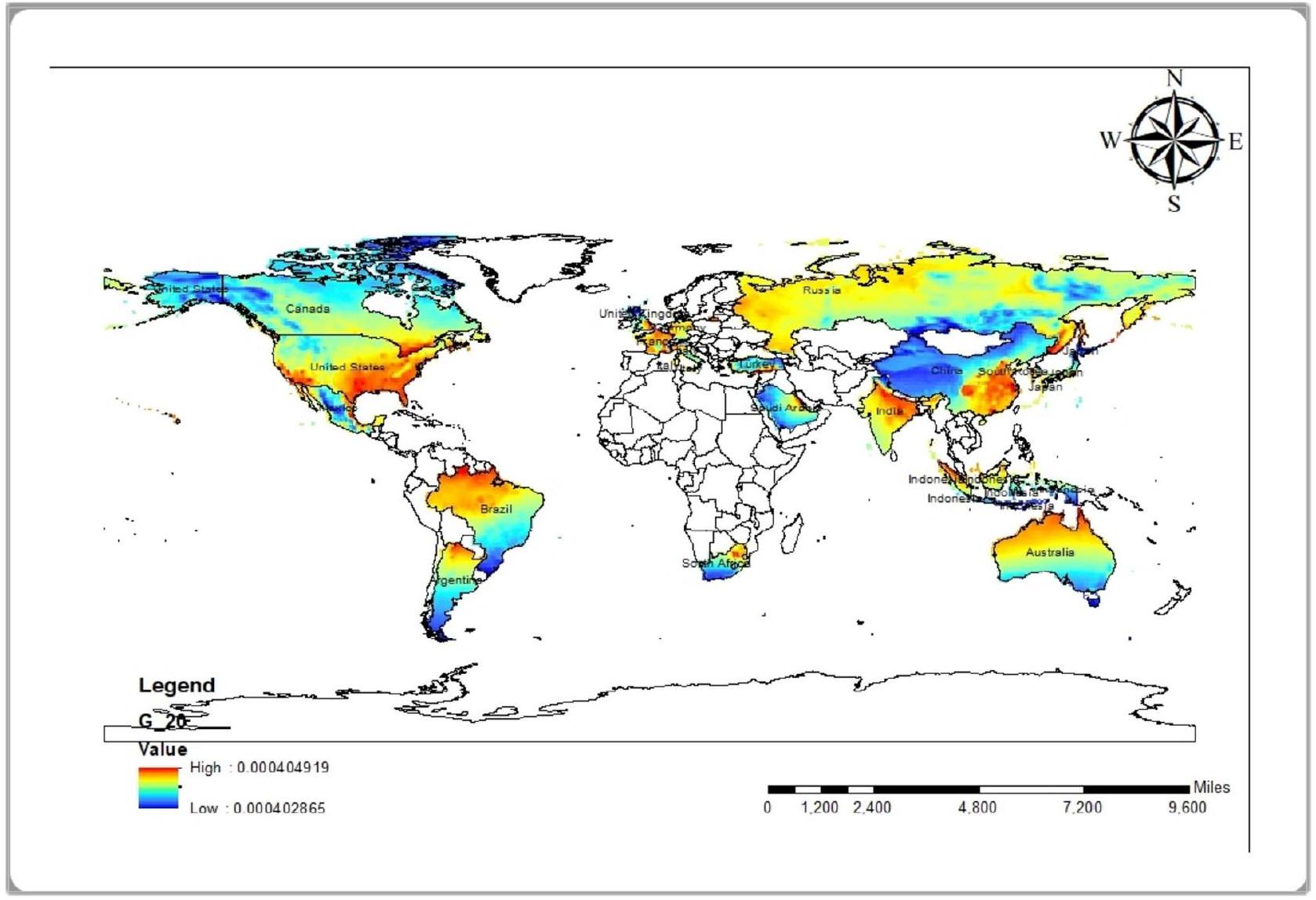
تركز هذه الدراسة على دور الطاقة المتجددة في دول مجموعة العشرين، مناقشة كيف يتم تقليل انبعاثات ثاني أكسيد الكربون من خلال الابتكار التكنولوجي، والحرية الاقتصادية، والتقدم المالي، والاستثمار الأجنبي المباشر (FDI)، والناتج المحلي الإجمالي. توضح الشكل 2 أدناه خريطة دول مجموعة العشرين. تدعم الأدبيات الحديثة الدور الحاسم للابتكار التكنولوجي في تعزيز الطاقة المتجددة وتقليل انبعاثات الكربون. على سبيل المثال، وجدت دراسة من أن التقدم في تقنيات الطاقة المتجددة يعزز بشكل كبير كفاءة الطاقة ويقلل من انبعاثات غازات الدفيئة في الاقتصادات الكبرى. بالمثل، تسلط الضوء على أن الحرية الاقتصادية والتقدم المالي هما عاملان حاسمان في تسهيل الاستثمارات في مشاريع الطاقة المتجددة، مما يساهم في التنمية المستدامة. علاوة على ذلك، تشير الأبحاث من إلى أن الاستثمار الأجنبي المباشر في قطاعات الطاقة المتجددة يسرع من نقل التكنولوجيا والابتكار، مما يؤدي إلى فوائد بيئية كبيرة.
بالإضافة إلى ذلك، تؤكد أن السياسات الحكومية التي تعزز الحرية الاقتصادية يمكن أن تخلق ظروفًا مواتية للاستثمارات في الطاقة المتجددة، مما يقلل بدوره من انبعاثات ثاني أكسيد الكربون. تلعب التنمية المالية دورًا محوريًا في دعم مشاريع الطاقة المتجددة من خلال توفير التمويل اللازم وتقليل المخاطر المالية . تؤكد دراسة من أيضًا أن الاستثمار الأجنبي المباشر في الطاقة المتجددة لا يعزز فقط التقدم التكنولوجي ولكن يؤدي أيضًا إلى تقليل كبير في انبعاثات الكربون. تبني هذه الدراسة على الأدبيات الحالية من خلال فحص التفاعل بين هذه المتغيرات المختارة في دول مجموعة العشرين، مما يوفر تحليلًا شاملاً لكيفية تأثير السياسات والديناميات الاقتصادية على اعتماد الطاقة المتجددة و تقليل الانبعاثات.

المنهجية

تقدم المصادر و معلومات عن الابتكار التكنولوجي (TI)، والتقدم المالي (FA)، والناتج المحلي الإجمالي (GDP)، و الانبعاثات (كمقياس للتلوث البيئي)، بالإضافة إلى مؤشرات الحرية الاقتصادية (EF). هذه المصادر ضرورية لفهم كيفية تفاعل هذه العوامل، خصوصًا
الشكل 2. خريطة دول G-20، ومتغير EPOL باللون الأحمر يظهر التلوث البيئي من مصادر الوقود الأحفوري. هناك حاجة إلى الطاقة المتجددة بمستويات استخدام أعلى في المناطق الملونة باللون الأحمر .
في سياق تعزيز النمو الاقتصادي المستدام من خلال اعتماد الطاقة المتجددة. تم اختيار فترة الدراسة من 1995 إلى 2022 لالتقاط التطورات الحاسمة في اعتماد الطاقة المتجددة، والابتكار التكنولوجي، والسياسات البيئية ضمن دول مجموعة العشرين. تشمل هذه الفترة معالم مهمة مثل و ، إلى جانب التقدم في تقنيات الطاقة المتجددة والتحولات العالمية في أنماط استهلاك الطاقة. بدءًا من عام 1995، يسمح بتحليل الاتجاهات بعد العولمة، بينما يمتد حتى عام 2022 لضمان تضمين أحدث البيانات، مما يعكس التحولات السياسية الأخيرة والتقدم التكنولوجي. توفر هذه الفترة رؤية شاملة للديناميات طويلة الأجل وقصيرة الأجل، مما يقدم رؤى قيمة للسياسات الطاقية المستدامة. تعتبر الأبحاث والتطوير في الطاقة المتجددة ضرورية لتحقيق التقدم التكنولوجي وتقليل الاعتماد على الوقود الأحفوري، مما يساعد بدوره في التخفيف من التلوث البيئي . الوصول المتزايد إلى رأس المال هو أيضًا محور أساسي في تقدم سوق الطاقة المتجددة .
منهجياً، تستخدم دراستنا نهجًا منظمًا للتحقيق في هذه الروابط. نحن نستخدم طرقًا مثل تحليل بيانات اللوحة، والتي من المحتمل أن تشمل تقنيات اقتصادية مثل PMG-ARDL أو تقنيات اقتصادية مشابهة، لتحليل البيانات الطولية عبر دول مجموعة العشرين أو مجموعات ذات صلة أخرى. يتيح لنا هذا النهج استكشاف العلاقات المعقدة بين الابتكار التكنولوجي، والتقدم المالي، والناتج المحلي الإجمالي، وانبعاثات ثاني أكسيد الكربون، وحرية الاقتصاد بشكل شامل.
تحدد المعادلة أعلاه الطاقة المتجددة كمتغير تابع، يمثل الاستخدام المركب للطاقة المتجددة. هنا، يشير الابتكار التكنولوجي إلى الابتكار التكنولوجي، ويدل التقدم المالي على التقدم المالي، وتمثل السياسة البيئية تلوث البيئة، وتدل حرية الاقتصاد على حرية الاقتصاد.
لمعالجة القضايا المحتملة المتعلقة بتباين التباين، تم تحويل البيانات المتعلقة بهذه المتغيرات إلى شكل لوغاريتمي طبيعي. يمكن التعبير عن المعادلة التجريبية كما يلي:
تمثل LRE وLFA وLGDP وLEPOL وLEF اللوغاريتمات الطبيعية لمؤشرات الطاقة المتجددة (RE) والابتكار التكنولوجي (TI) والتقدم المالي (FA) والناتج المحلي الإجمالي (GDP) وتلوث البيئة (EPOL) وحرية الاقتصاد (EF) على التوالي. يتم استخدام هذه التحويلات اللوغاريتمية للتخفيف من القضايا المحتملة مثل تباين التباين في التحليل التجريبي. يتم تقديم التحليل الوصفي للدراسة هنا في الجدول 1. يوفر الجدول إحصائيات وصفية لستة متغيرات: حرية الاقتصاد (EF) والسياسة البيئية (EP) والتقدم المالي (FA) والناتج المحلي الإجمالي (GDP) والطاقة المتجددة (RE) والابتكار التكنولوجي (TI) عبر دول مجموعة العشرين.
تشير القيم المتوسطة إلى أن متوسط درجة حرية الاقتصاد هو 64.44، بينما متوسط درجة السياسة البيئية هو 8.11. يبلغ متوسط التقدم المالي حوالي مليار، ويبلغ الناتج المحلي الإجمالي حوالي مليار، على الرغم من أن القيم الوسيطة (أقل بكثير بالنسبة للتقدم المالي والناتج المحلي الإجمالي) تشير إلى انحراف، مع وجود بعض الدول التي لديها قيم أعلى بكثير. يبلغ متوسط استخدام الطاقة المتجددة 14.36 وحدة، ولدى الابتكار التكنولوجي قيمة متوسطة عالية ولكن قيمة قصوى أعلى، مما يظهر تباينًا كبيرًا.
يكشف النطاق بين القيم الدنيا والقصوى عن التنوع بين دول مجموعة العشرين في هذه المجالات؛ تشير قيم الانحراف والتفرطح إلى أن التقدم المالي والناتج المحلي الإجمالي والابتكار التكنولوجي منحرفة بشكل إيجابي للغاية مع ذيول طويلة إلى اليمين ولديها تفرطح عالي، مما يشير إلى وجود قيم شاذة. يسلط هذا الملخص الإحصائي الضوء على الفجوات في المقاييس الاقتصادية والمالية والبيئية والتكنولوجية بين دول مجموعة العشرين، مع تأثير قيم شاذة كبيرة على توزيعات البيانات.
في هذه الدراسة، يتم استخدام عدة متغيرات، حيث يتم قياس استهلاك الطاقة المتجددة (LRE) كنسبة مئوية من إجمالي استهلاك الطاقة النهائية، مما يشير إلى مدى استخدام دولة ما لمصادر الطاقة المتجددة مثل الطاقة الشمسية وطاقة الرياح والطاقة المائية. يشمل التقدم المالي (LFA) مؤشرات مثل معدلات نمو القروض، ورأس مال سوق الأسهم، والمدخرات، مما يعكس نضج وتوسع الأسواق المالية، والتي يمكن أن تؤثر على النمو الاقتصادي وتخصيص الموارد. يتم التقاط تلوث البيئة (LEPOL) من خلال انبعاثات ثاني أكسيد الكربون، والتي تمثل إجمالي التلوث البيئي الناتج سنويًا. إنه مؤشر حاسم على البصمة البيئية للأمة والتقدم نحو أهداف الاستدامة. يبرز الابتكار التكنولوجي (LTI)، غالبًا
EF EP FA GDP RE TI
المتوسط 64.44459 8.109373 14.35613 60,662.30
الوسيط 63.50000 7.575040 35,129.36 9.920000 6462.000
الحد الأقصى 83.10000 20.46981 54.48412 1,393,815
الحد الأدنى 43.80000 0.765193 9.454257 1784.334 0.009032 27.00000
الانحراف المعياري 9.452494 5.222124 13.63423 150,328.7
الانحراف 0.074942 0.560652 2.819728 4.034369 1.328989 4.999672
التفرطح 2.008820 2.337282 11.06588 23.10820 3.732936 35.72487
جارك-بيرا 18.96753 32.02181 1828.268 8860.759 143.4885 22,100.82
الاحتمالية 0.000076 0.000000 0.000000 0.000000 0.000000 0.000000
المجموع 29,193.40 3673.546 6503.325 27,480,022
مجموع الانحراف المربّع 40,386.04 12,326.30 84,023.23
الملاحظات 453 453 453 453 453 453
الجدول 1. الإحصائيات الوصفية.
يتم قياسها من خلال عدد طلبات براءات الاختراع من قبل المقيمين، مما يبرز قدرة الدولة على الابتكار، والتي تدفع النمو الاقتصادي، والتنافسية، وتطوير تقنيات أنظف وأكثر كفاءة. جميع بيانات هذه المتغيرات مستمدة من مؤشرات البيانات العالمية (WDI) للبنك الدولي.
ترتبط حرية الاقتصاد (LEF) والناتج المحلي الإجمالي (LGDP)، حيث تشمل حرية الاقتصاد، المقاسة من خلال مؤشرات مثل مؤشر مؤسسة التراث، جوانب مثل حرية الأعمال والمعاملات العقارية. في الوقت نفسه، يوفر الناتج المحلي الإجمالي، المبلغ عنه بالدولار الأمريكي الثابت لعام 2015، مقياسًا واسعًا لأداء الاقتصاد الوطني ومستويات المعيشة. معًا، تقدم هذه المتغيرات رؤية شاملة للعوامل التي تشكل النتائج الاقتصادية والبيئية في دولة ما.
تدرس هذه الدراسة كيف تؤثر عوامل مختلفة، بما في ذلك تلوث البيئة ( الانبعاثات)، ونمو الناتج المحلي الإجمالي، والابتكار التكنولوجي، وتكاليف المعيشة، على معدل اعتماد مصادر الطاقة المتجددة. تم استخدام مقدر مجموعة المتوسط المجمعة (PMG) لتحليل التأثيرات القصيرة والطويلة الأجل. يُفضل نموذج PMG لأنه يتيح استجابات مرنة وغير مقيدة عبر مجموعات مختلفة على المدى القصير بينما يفرض قيودًا من خلال دمج المجموعات على المدى الطويل.
تعبير “ يدل على عدد اللوحات التي تم اختيارها للتحليل. يشير إلى الفترة السنوية، بينما يمثل z أرقام تأخير الوقت. يتم الإشارة إلى تأخيرات المتغيرات المستقلة بواسطة q، ويتم الإشارة إلى تأخيرات المتغير التابع بواسطة k. مؤشرات EF والتقدم المالي هي LEF وLFA، على التوالي. يتم تمثيل المتغير الضابط، LGDP، بواسطة المتجه “ . يتم الإشارة إلى مصطلح الخطأ مع التأثيرات الثابتة كـ “ ، كما ذكر بيساران وشين وسميث في عملهم “. يتم إعادة صياغة المعادلة (3) كما يلي،
حيث
من خلال تصنيف المتغيرات في المعادلة (4)، يمكن استخدام خوارزمية تصحيح الخطأ.
لذا، يتم حساب التقديرات كما هو موضح هنا:
و نموذج مستند إلى المعادلة (5)
تعرف المعادلة (7) المتغير التابع على أنه اللوغاريتم الطبيعي لمؤشر الطلب على الطاقة المتجددة (LRE). يتم تعديل هذا المتغير بعامل فريد ( ) للتخفيف من أي تداخل تسلسلي محتمل. يتم الإشارة إلى المتغيرات المستقلة المتأخرة بواسطة و . توفر منهجية الانحدار الذاتي الموزع (ARDL) ميزة كبيرة في معالجة القضايا التي قد تنشأ من الاعتماد المتبادل بين القيم المتأخرة للمتغيرات.
مقدر مجموعة المتوسط المجمعة (PMG) يعتمد على فرضية الاتساق على المدى الطويل مع استيعاب التقلبات على المدى القصير. يسمح باستجابات مرنة عبر مجموعات مختلفة على المدى القصير، مما يجعله مناسبًا لتحليل بيانات اللوحة ذات الخصائص المتغيرة بمرور الوقت.

نموذج PMG-ARDL

تستخدم هذه الدراسة نماذج PMG لتقييم حجم واستمرارية العلاقات بين الابتكار التكنولوجي، واستخدام الطاقة المتجددة، والنمو الاقتصادي، والناتج المحلي الإجمالي الفعلي للفرد، والتقدم المالي، وتلوث البيئة. تحقق من وجود قيود تجانس دائمة عبر دول مجموعة العشرين وتقارن أداء مقدرات PMG-ARDL. تؤكد نتائج الاختبار أن فرضية عدم خضوع المتنبئين على المدى الطويل لقيود التجانس صحيحة. بناءً على هذه النتائج، تظهر منهجية PMG مرونة أكبر مقارنة بأساليب MG (مجموعة المتوسط) وDFE (التأثيرات الثابتة الديناميكية).
مقدر مجموعة المتوسط المجمعة (PMG) هو تقنية اقتصادية متقدمة تستخدم في تحليل بيانات اللوحة الديناميكية، خاصة ضمن إطار نموذج الانحدار الذاتي الموزع (ARDL). هذه الطريقة، التي اقترحها تجمع بين ميزات كل من مقدرات مجموعة المتوسط (MG) ومقدرات التأثيرات الثابتة الديناميكية (DFE)، مما يوفر المرونة والصلابة في تقدير العلاقات القصيرة والطويلة الأجل في بيانات اللوحة.
تتميز طريقة PMG-ARDL بطبيعتها الديناميكية، حيث تستوعب تضمين المتغيرات التابعة والمستقلة المتأخرة لالتقاط العلاقات القصيرة والطويلة الأجل بشكل فعال. واحدة من ميزاتها الرئيسية هي السماح بوجود معاملات قصيرة الأجل غير متجانسة عبر وحدات مقطعية مختلفة، مثل الدول أو الشركات في اللوحة، مما يعني أن الديناميات القصيرة الأجل يمكن أن تختلف من وحدة إلى أخرى. في الوقت نفسه، تفرض تجانسًا على معاملات الطويلة الأجل، بافتراض أن العلاقات طويلة الأجل بين المتغيرات متسقة عبر جميع الوحدات في اللوحة. تساعد هذه الفرضية في تجميع البيانات للحصول على تقديرات طويلة الأجل أكثر موثوقية، باستخدام كل من الأبعاد المقطعية والسلاسل الزمنية لتعزيز موثوقية وكفاءة التقديرات. علاوة على ذلك، يجب أن تكون المتغيرات إما مستقرة عند المستوى. أو الفرق الأول ، حيث يمكن لطريقة PMG-ARDL التعامل مع مزيج من و المتغيرات ولكن ليس المتغيرات. تفترض الطريقة أن بيانات اللوحة تحتوي على بعد زمني كبير بما فيه الكفاية لضمان تقديرات طويلة الأجل موثوقة، حيث يمكن أن تؤدي الأبعاد الزمنية الصغيرة إلى تقويض قوة معاملات المدى الطويل.
لتنفيذ طريقة PMG-ARDL، يجب علينا عادةً اتباع سلسلة من الخطوات، بدءًا من تحديد النموذج، وتعريف هيكل نموذج ARDL بما في ذلك أطوال التأخير للمتغيرات التابعة والمستقلة، ثم إجراء اختبارات تشخيصية للتحقق من صحة الافتراضات، مثل اختبارات الجذر الأحادي، واختبارات التكامل المشترك، واختبارات الاعتماد العرضي. أخيرًا، يتم تفسير المعاملات القصيرة والطويلة الأجل، جنبًا إلى جنب مع معامل سرعة التكيف، لفهم ديناميات العلاقة بين المتغيرات.
باختصار، تعتبر طريقة PMG-ARDL الديناميكية للبانل أداة قوية لتحليل العلاقات القصيرة والطويلة الأجل في بيانات البانل. إن قدرتها على التعامل مع التباين في الديناميات القصيرة الأجل مع فرض التجانس على المعاملات طويلة الأجل تجعلها مناسبة لمجموعة واسعة من التطبيقات التجريبية.

النتائج والمناقشة

في الجدول 2، نقدم قائمة مفصلة بالمتغيرات مع أوصافها ومصادر البيانات. على وجه التحديد، تستخدم المتغيرات LRE و LFA و LEPOL و LTI و LGDP بيانات مستمدة من مؤشرات البيانات العالمية (WDI). بينما يحصل المتغير LEF على بياناته من مؤشر مؤسسة التراث العالمي (HFI). يقدم الجدول 3 نتائج تقديرات اختبار الاعتماد العرضي. كاشفًا عن علاقة إيجابية بين متغيرين تم ملاحظتهما على مدى فترة طويلة.
أهمية النتائج على المدى الطويل هي الأهم. العلاقة بين الطاقة المتجددة والابتكار التكنولوجي تبرز ضرورة التكنولوجيا المتطورة لاستكشاف مصادر الطاقة البديلة، لا سيما داخل اقتصادات مجموعة العشرين. لقد شهدت هذه الاقتصادات استثمارات أجنبية كبيرة في الطاقة المتجددة على مدى العقدين الماضيين. وبالتالي، فإن توسيع إنتاج الطاقة يساهم في التقدم الاقتصادي بينما يعزز الاستدامة البيئية، مما يبرز الدور الحاسم للابتكار التكنولوجي في تشكيل اتجاهات استهلاك الطاقة. .
توضح الجدول 4 أن اختبارات جذر الوحدة CIPS و CADF أثبتت الترتيب المطلوب للتباينات. لفحص حالة الاستقرار للبيانات، تستخدم تحليل جذر الوحدة في هذه الورقة اختبار CADF (اختبار ديكي-فولر المعزز عبر الأقسام) واختبار CIPS (اختبار IPS المعزز عبر الأقسام). توفر هذه الطرق نتائج دقيقة حول الاعتماد العرضي (CSD) وعلى عكس الطرق الأخرى، تأخذ في الاعتبار تباين معاملات الانحدار الذاتي لوحدات اللوحة. يُشار إلى اختبار CADF باسم CADF. تعتبر البيانات مستقرة إذا لم يكن هناك جذر وحدة، وهو الفرضية البديلة للفرضية الصفرية التي تفيد بوجود جذر وحدة. ثانيًا، قبل تحليل العلاقة طويلة الأجل بين المؤشرات، من الضروري فحص ما إذا كانت البيانات مستقرة. يشير الجدول 5 إلى أن جميع المتغيرات متكاملة في المدى الطويل. . وهذا يشير إلى وجود علاقة مستقرة وطويلة الأمد بين المتغيرات قيد الدراسة، كما تؤكده اختبارات التكامل المشترك التي تم إجراؤها.
لذلك، يمكننا المضي قدمًا في اختبار PMG. الإحصائيات الخاصة باللوحة والمجموعة ذات دلالة، مما يسمح لنا باستخدام اختبار PMG-ARDL لتقدير قيم المعاملات. ستساعدنا هذه الطريقة في تحليل العلاقات.
متغير تعريف المصادر
الطاقة المتجددة (LRE) استهلاك الطاقة المتجددة (% من إجمالي استهلاك الطاقة النهائي) مؤشرات البيانات العالمية (WDI)
التقدم المالي (LFA) معدل نمو القروض، رأس مال سوق الأسهم، المدخرات، إلخ مؤشرات البيانات العالمية (WDI)
تلوث البيئة (LEPOL) انبعاثات ثاني أكسيد الكربون، كإجمالي التلوث البيئي في سنة مؤشرات البيانات العالمية (WDI)
الابتكار التكنولوجي (LTI) طلبات براءات الاختراع، المقيمون مؤشرات البيانات العالمية (WDI)
الحرية الاقتصادية (LEF) حرية التجارة وبيع وشراء الممتلكات مؤشر مؤسسة التراث (HFI)
الناتج المحلي الإجمالي (LGDP) الناتج المحلي الإجمالي (بالدولار الأمريكي الثابت لعام 2015) مؤشرات البيانات العالمية (WDI)
الجدول 2. وصف المتغيرات ومصدر البيانات.
المتغيرات قرص مضغوط
LRE
الـ LTI
إل إف إيه
إل جي دي بي
ليبول
ليف
الجدول 3. اختبار الاعتماد العرضي لـ CD. القيمة داخل الأقواس. الحكام كدلالة إحصائية.
المتغيرات CIPS كادف
-1.327 -1.828
-1.183 -3.217
1.214 -1.818
-1.287 -3.422
الجدول 4. اختبار الجذر الأحادي (CIPS و CADF).
إحصائية احتمال الإحصائيات الموزونة احتمال
إحصائية اللوحة v 0.817518 0.2071 0.123212 0.4511
إحصائية بانل رهو 0.184499 0.5822 1.194519 0.8235
لوحة PP-الإحصائيات -5.481299*** 0.0000 -3.741412*** 0.0001
إحصائية ADF للوحة -0.533466 0.3148 -1.294611* 0.0928
مجموعة رهو-ستات ٢.٤٦٦٥٢٩ 0.9921
مجموعة PP-Stat -4.349112*** 0.0000
مجموعة ADF-Stat -0.038556 0.4212
الجدول 5. مخرجات التكامل المشترك. و تشير إلى الأهمية في و المستويات، على التوالي.
بين المتغيرات بشكل أكثر شمولاً، مع الأخذ في الاعتبار كل من الديناميات قصيرة الأجل والاتجاهات طويلة الأجل ضمن إطار بيانات اللوحة.
وفقًا للجدول 6، يظهر النمو الاقتصادي ارتباطًا سلبيًا مع الطاقة المتجددة في كل من الأجلين الطويل والقصير. زيادة الناتج المحلي الإجمالي تؤدي إلى انخفاض في الطاقة المتجددة بـ على المدى الطويل و على المدى القصير. قد تنبع هذه العلاقة السلبية من تحقيق هذه الدول للنمو الاقتصادي بشكل أساسي من خلال زيادة استهلاك الوقود الأحفوري، الذي يتوافق بشكل أقل مع مصادر الطاقة المتجددة. على النقيض، زيادة التلوث البيئي (EPOL) تقلل من الطاقة المتجددة بـ على المدى الطويل و على المدى القصير، مما يشير إلى أن زيادة انبعاثات ثاني أكسيد الكربون من الوقود الأحفوري تعيق اعتماد الطاقة المتجددة في دول مجموعة العشرين.
من ناحية أخرى، تؤثر الابتكارات التكنولوجية (TI) بشكل إيجابي على الطاقة المتجددة على المدى الطويل والقصير. زيادة في TI تزيد من الطاقة المتجددة بـ على المدى الطويل و على المدى القصير، مع تسليط الضوء على دور الابتكار في تقدم تقنيات الطاقة المتجددة. التقدم المالي (FA)
يظهر تأثيرًا إيجابيًا على الطاقة المتجددة، لكن أهميته غير حاسمة في كل من الأجلين القصير والطويل. وبالمثل، تؤثر الحرية الاقتصادية (EF) أيضًا بشكل إيجابي على الطاقة المتجددة، لكن تأثيرها غير ذي دلالة إحصائية في كلا الأفقين الزمنيَّين المدروسين.
يظهر استخدام الطاقة المتجددة علاقة عكسية مع تلوث البيئة، كما تم التنبؤ به. عندما يرتفع أو ينخفض مؤشر تلوث البيئة، يحدث زيادة أو نقصان متناسب في الطلب على الطاقة المتجددة. . تدعم هذه النتيجة يؤكد أن زيادة اعتماد الطاقة المتجددة أمر حاسم للحفاظ على جودة حياة عالية مع التخفيف من التلوث البيئي. تلعب الابتكارات التكنولوجية دورًا محوريًا في دفع الأنشطة الاقتصادية نحو الاعتماد على الطاقة المتجددة في دول مجموعة العشرين، مما يعزز آفاق استخدام الطاقة المتجددة ويقلل من معدلات التلوث.
تُحث الحكومات على تنفيذ برامج حماية البيئة واستراتيجيات التخفيف من آثار تغير المناخ استجابةً لهذه الاتجاهات. لقد عزز تطوير تقنيات الطاقة الجديدة بشكل كبير من استخدام مصادر الطاقة المتجددة. يُظهر مؤشر الابتكار الذي طوره مجموعة من المقيمين فوائد فورية وطويلة الأجل، كما تم التحقق منه بواسطة تظهر التحليلات باستمرار وجود ارتباط إيجابي بين الابتكار التكنولوجي والتبني الأوسع لمصادر الطاقة المتجددة، مما يبرز كيف تسهل التقدمات التكنولوجية الانتقال نحو حلول الطاقة المستدامة. يمكن أن يؤدي هذا الانتقال إلى تقليل التكاليف، وزيادة الاستثمار الأجنبي المباشر (FDI) في التقنيات المتقدمة، وزيادة الدعم للمبادرات البيئية الصديقة للطبيعة، مما يعزز الطلب على مصادر الطاقة المتجددة.
تؤدي التقدمات في تقنيات الطاقة دورًا حاسمًا في تعزيز اعتماد حلول الطاقة المستدامة. الدراسات التي أجريت بواسطة لقد أظهرت الدراسات أن زيادة الابتكار ترتبط بشكل إيجابي بزيادة استخدام مصادر الطاقة المستدامة. تؤكد هذه الاتجاهات على أهمية سياسات التمويل المستدام، ووجهات النظر حول الطاقة المتجددة، والمبادرات في تكنولوجيا المالية عبر الاقتصادات النامية. لا تعزز هذه الجهود الكفاءات البيئية فحسب، بل تقدم أيضًا مزايا مالية مع تقليل انبعاثات ثاني أكسيد الكربون، مما يتماشى مع النتائج من الأبحاث التجريبية السابقة. .
على العكس من ذلك، فإن مصادر الطاقة غير المتجددة، المعروفة بكثافتها العالية وانبعاثات الكربون، تشكل مخاطر بيئية عند دمجها في عمليات التوسع الاقتصادي، كما تشير نتائج الصدمات الإيجابية لدينا. هذه النتائج تتماشى مع الدراسات السابقة لـ الدول التي تتبنى التقدم التكنولوجي، ونقل التكنولوجيا، وتشارك في مبادرات الطاقة الخضراء ومشاريع التنمية المالية تلعب دورًا حيويًا في تحقيق الكفاءة البيئية. من خلال الاستفادة من التقنيات المتطورة وتقليل الاعتماد على المعدات التي تستهلك الطاقة بشكل كبير، تساهم هذه الدول في الاستدامة البيئية. كما أن نقل التقدم التكنولوجي المفيد والمعرفة يدعم هذه الأهداف البيئية. ، مما يعكس نتائج دراستنا.
تُبرز النتائج من هذه الدراسة علاقات ذات دلالة إحصائية، لا سيما العلاقة الإيجابية بين الابتكار التكنولوجي واستخدام الطاقة المتجددة. كما تم مناقشته سابقًا، يُظهر الناتج المحلي الإجمالي أيضًا علاقة قوية وإيجابية مع استخدام الطاقة المتجددة عبر المجموعة المدروسة. تؤكد هذه العلاقة كيف يؤثر النمو الاقتصادي على اعتماد الطاقة المتجددة، حيث تؤثر التغيرات في الظروف الاقتصادية على حجم مشاريع ومبادرات الطاقة المتجددة. .
لقد كانت التنمية المالية والابتكار التكنولوجي في هذه الدول حاسمة في تعزيز الاستثمارات في القطاعات الصديقة للبيئة، بما في ذلك الطاقة المتجددة. . وقد أدى ذلك إلى تقدم كبير في مشاريع ومنتجات الطاقة المتجددة، مما ساهم في التوسع الاقتصادي مع إعطاء الأولوية للممارسات الصديقة للبيئة. يتطلب التحول نحو مصادر الطاقة المتجددة الابتكار التكنولوجي المستمر وزيادة الاستثمارات في حلول الطاقة المستدامة، مما يعزز بالتالي حلقة التغذية الراجعة الإيجابية لتعزيز الاستثمارات في الطاقة المتجددة. .
متغير معامل خطأ معياري إحصائية t احتمالية
المدى الطويل
إل جي دي بي -0.228514** 0.108821 -2.216851 0.0261
ليبول 0.094591 -19.54411 0.0000
إل إف إيه 0.048112* 0.055732 0.853512 0.0841
ليف 0.393314 1.379288 0.0589
التي 0.045544 7.218221 0.0000
المدى القصير
إدارة محتوى المؤسسات -0.154282*** 0.053272 -2.903912 0.0028
-0.038666 0.273549 -0.141522 0.8758
-0.647141*** 0.140311 -4.683533 0.0000
0.202028* 0.114799 1.759911 0.0781
0.102663 0.199741 0.513842 0.6054
0.087245 2.013911 0.0491
ج 0.103941 0.065122 1.619912 0.1072
الجدول 6. نتائج نموذج PMG-ARDL. ، و تشير إلى الأهمية في و المستويات، على التوالي.
متغير معامل خطأ معياري إحصائية t احتمال
الـ LTI 0.088702 ٣.٢٦٤٥٢٨ 0.0011
إل إف إيه 0.138248* 0.085491 1.617411 0.0065
إل جي دي بي -0.226147* 0.133151 -1.698856 0.0911
ليبول -1.320711*** 0.116998 -11.28974 0.0000
ليف 0.232216 ٤.١٣٣١٩٩ 0.0000
الجدول 7. طريقة المربعات الصغرى المعدلة بالكامل (FMOLS). و تشير إلى الأهمية في و المستويات، على التوالي.
متغير معامل خطأ معياري إحصائية t احتمال
التي 0.071612 5.164417 0.0021
إل إف إيه 0.257136** 0.094382 ٢.٥٢٨٥٢٢ 0.0071
إل جي دي بي -0.315239** 0.254342 -1.767745 0.0012
ليبول -2.411832*** 0.215876 -9.178633 0.0002
ليف 0.147852 ٣.٢٤٤٢٤٥ 0.0022
الجدول 8. DOLS. و تشير إلى الأهمية في و المستويات، على التوالي.

تحقق من FMOLS (أقل المربعات المعدلة بالكامل) و DOLS

تقدم الجدول 7 نتائج اختبار التحقق من FMOLS (الحد الأدنى المعدل بالكامل)، كاشفًا عن نتائج هامة تتعلق بالمعاملات وأهميتها الإحصائية للمتغيرات التي تم تحليلها. يرتبط خطأ قياسي قدره 0.088702 بمعامل “LTI”، وقيمة المعامل هي 0.289611. علاوة على ذلك، في الجدول 8، قمنا أيضًا بتطبيق DOLS (OLS الديناميكي)، والنتائج مع خطأ قياسي قدره 0.071612 مرتبطة بمعامل “LTI” وقيمة المعامل هي 0.178852. هذه النتائج تؤكد نتائج نموذج PMG-ARDL.
تظهر الابتكار التكنولوجي (LTI) معاملًا قدره 0.289611 مع خطأ معياري قدره 0.088702، مما ينتج عنه إحصائية t قدرها 3.264528 و قيمة 0.0011، مما يدل على دلالتها الإحصائية عند المستوى. وهذا يشير إلى أن الابتكار التكنولوجي يؤثر بشكل كبير وإيجابي على استخدام الطاقة المتجددة. يظهر التقدم المالي (LFA) معاملًا قدره 0.138248 وخطأً معياريًا قدره 0.085491، مما يؤدي إلى إحصائية t قدرها 1.617411 و قيمة 0.0065، مما يدل على أهميتها في مستوى.
هذا يعني أن التقدم المالي يساهم أيضًا بشكل إيجابي في اعتماد الطاقة المتجددة. الناتج المحلي الإجمالي (LGDP)، مع معامل قدره -0.226147 وخطأ معياري قدره 0.133151، يعطي إحصائية t قدرها -1.698856 و قيمة 0.0911، مما يشير إلى أهمية محتملة عند هذا المعامل السلبي يشير إلى علاقة عكسية محتملة مع استخدام الطاقة المتجددة، على الرغم من أنه ليس ذا دلالة إحصائية عند المستويات التقليدية.
تظهر تلوث البيئة (LEPOL) معاملًا ذا دلالة عالية قدره -1.320711 مع خطأ معياري قدره 0.116998 وإحصائية t قدرها -11.28974، مما يشير إلى تأثير سلبي قوي على استخدام الطاقة المتجددة. القيمة <0.001). مع زيادة تلوث البيئة، هناك انخفاض كبير في اعتماد الطاقة المتجددة. تظهر حرية الاقتصاد (LEF) معاملًا قدره 0.959501 مع خطأ معياري قدره 0.232216، مما يشير إلى تأثير إحصائي قوي. وهذا يدل على أن حرية الاقتصاد من المحتمل أن يكون لها تأثير إيجابي على استخدام الطاقة المتجددة. تؤكد هذه النتائج الأدوار الحاسمة للابتكار التكنولوجي، والتقدم المالي، وتلوث البيئة، وحرية الاقتصاد في تشكيل اعتماد الطاقة المتجددة عبر دول مجموعة العشرين.

الخاتمة وتوصيات السياسة

تأثير عدة عوامل مثل الابتكار التكنولوجي (TI)، التقدم المالي (FA)، تلوث البيئة (CO2)، الناتج المحلي الإجمالي الحقيقي، والحرية الاقتصادية (EF) على الطلب على الطاقة المتجددة في منطقة مجموعة العشرين، المعروفة بابتكارها التكنولوجي العالي. تطرح الدراسة عدة افتراضات وتقدم نتائج قوية. أولاً، تؤكد أن تعزيز الابتكار التكنولوجي يسهل اعتماد تدابير الطاقة المتجددة على المدى القصير والطويل. تُظهر الأبحاث أن التقدم في التكنولوجيا يخصص الموارد لاستكشاف وابتكار حلول الطاقة المتجددة، مما يزيد من الطلب في السوق على هذه المنتجات.
علاوة على ذلك، تحدد الدراسة علاقة عكسية بين تلوث البيئة (انبعاثات ثاني أكسيد الكربون) واعتماد الطاقة المتجددة. الدول التي تركز على الابتكار التكنولوجي تشهد انخفاضًا في انبعاثات غازات الدفيئة (GHGs) والإنتاج الصناعي، مما يساهم في نمو الناتج المحلي الإجمالي من خلال التقدم الصناعي. على العكس من ذلك، يرتبط نمو الناتج المحلي الإجمالي سلبًا مع أنظمة الطاقة المتجددة على المدى القصير والطويل. زيادة في الناتج المحلي الإجمالي تؤدي إلى انخفاض في استخدام الطاقة المتجددة على المدى الطويل و انخفاض على المدى القصير، من المحتمل أن يكون بسبب النمو الاقتصادي المدعوم بالوقود الأحفوري، الذي يساهم في انبعاثات الكربون.
بالإضافة إلى ذلك، زيادة في تدهور البيئة تؤدي إلى تراجع في نمو الطاقة المتجددة على المدى الطويل و تخفيض على المدى القصير. ومع ذلك، فإن التقدم التكنولوجي يعزز تطوير الطاقة المتجددة، مع زيادة في TI تتوافق مع زيادة في الطاقة المتجددة على المدى الطويل
استخدام و زيادة في المدى القصير. يعزز التطور المالي في البداية اعتماد الطاقة المتجددة ولكنه يتناقص مع تزايد إمكانية الوصول إلى الطاقة المتجددة. يظهر الحرية الاقتصادية تأثيرًا إيجابيًا ولكنه نسبيًا أصغر على الأداء الاقتصادي في كل من المدى الطويل والقصير.
بشكل عام، فإن استخدام مصادر الطاقة المتجددة أمر حاسم للحفاظ على الظروف البيئية. من المتوقع أن تعزز الابتكارات التكنولوجية من استخدام الطاقة المتجددة والحصول على براءات الاختراع في قطاع الطاقة. كما تحدد الدراسة وجود علاقة إيجابية كبيرة بين الناتج المحلي الإجمالي والتقدم المالي واعتماد الطاقة المتجددة، مدعومة بنهج السوق المفتوحة الذي يشجع على الاستثمار الأجنبي المباشر عبر جميع دول مجموعة العشرين في مبادرات الطاقة المتجددة.
تقدم نتائج دراستنا توصيات سياسية هامة. أولاً، السياسات التي تركز على الابتكار التكنولوجي لديها القدرة على تعزيز استخدام الطاقة المتجددة بشكل كبير. من خلال تنفيذ نماذج تمويل فعالة من حيث التكلفة وجذابة لموارد متنوعة للبحث والتطوير في تقنيات الطاقة المتجددة، يمكننا توقع تقليل التلوث البيئي.
من الضروري تنفيذ تدابير سياسية قوية، خاصة في قطاع التكنولوجيا، لدعم التنمية البيئية المستدامة. يجب أن تكون هذه السياسات منظمة ضمن إطار عملي يمكّن المؤسسات من تعزيز الاستدامة البيئية من خلال الابتكار التكنولوجي. يجب أن تهدف هذه السياسات إلى توسيع وتحديث قطاع الابتكار التكنولوجي مع تقديم دعم مباشر وغير مباشر لتعزيز مشاريع الطاقة المتجددة. سيكون هذا النهج حاسمًا في جذب الاستثمارات الأجنبية والمحلية في مبادرات الطاقة المتجددة.
لضمان نمو مستدام في الابتكار التكنولوجي داخل دول مجموعة العشرين، التي تتميز بأثر بيئي كبير، يجب تنفيذ استراتيجيات تعاونية لتعزيز اعتماد الطاقة المتجددة جنبًا إلى جنب مع التنمية الاقتصادية. يجب وضع مبادرات استراتيجية خصيصًا لتعزيز أهداف الطاقة المتجددة. بينما قد تكون لهذه الدول سياسات مماثلة بشأن إصلاحات قطاع التكنولوجيا، فإن استراتيجيات تنفيذها تختلف على نطاق واسع. لذلك، من الضروري إعادة تقييم هذه الإصلاحات والاستفادة من التجارب المشتركة لتعزيز اعتماد ممارسات الطاقة المتجددة التي تتماشى مع أهداف الحفاظ على البيئة والاستدامة الاقتصادية. ستكون هذه الجهود التعاونية حاسمة في دفع التقدم على المدى الطويل نحو مشهد طاقة عالمي أكثر استدامة.
تستخدم هذه الدراسة متغيرات بيئية مختلفة ومحددات حاسمة على مدى زمني واسع لقياس جودة البيئة في مجموعة العشرين. بينما تهدف إلى أن تكون شاملة، إلا أنها ليست خالية من العيوب. يمكن أن توسع الأبحاث المستقبلية نطاقها لتشمل دولًا أخرى، حيث تركز هذه الدراسة فقط على مجموعة العشرين. واحدة من القيود هي عدد المتغيرات المدروسة. يجب أن تشمل الأبحاث المستقبلية متغيرات إضافية وتستخدم طرق اقتصادية متقدمة وبيانات على المستوى الجزئي مفصلة على المستويات الوطنية والإقليمية والبلدية. يمكن أن يوفر هذا النهج رؤى لا تقدر بثمن ويعزز المعرفة الحالية في هذا المجال. تتطلب منطقة مجموعة العشرين توصيات سياسية قابلة للتطبيق لتشجيع تقدم الطاقة المتجددة، وقد يكون من المفيد إنشاء منصة مركزية لنشر المعلومات حول فعالية مشاريع الطاقة بناءً على إدارة التكنولوجيا المتقدمة. بالإضافة إلى ذلك، فإن تنظيم أصحاب المصلحة لتعزيز والتأثير على التوصيات السياسية بشأن تمويل الطاقة المتجددة، وتكييف المؤسسات المتقدمة تكنولوجيًا لمعالجة مبادرات الطاقة المتجددة بشكل فعال، وتعزيز نمو السوق، وتقديم حوافز للصناعة أمر ضروري. للحفاظ على الميزة التنافسية للطاقة المتجددة على الوقود الأحفوري، فإن الابتكارات التكنولوجية ضرورية للحفاظ على التكاليف المنخفضة. يجب أن تأخذ الأبحاث المستقبلية حول التلوث البيئي أيضًا في الاعتبار تأثير الاتفاقيات الدولية مثل بروتوكول كيوتو واتفاق باريس. علاوة على ذلك، فإن تأثير السندات الخضراء والأسهم والابتكار التكنولوجي على اعتماد مجموعة العشرين لمصادر الطاقة المتجددة يستحق مزيدًا من الدراسة.

توفر البيانات

تتوفر مجموعات البيانات التي تم إنشاؤها خلال و/أو تحليلها خلال الدراسة الحالية من المؤلف المقابل عند الطلب المعقول.
تاريخ الاستلام: 2 أبريل 2024؛ تاريخ القبول: 1 يناير 2025
تم النشر عبر الإنترنت: 17 يناير 2025

References

  1. Li, S., Samour, A., Irfan, M. & Ali, M. Role of renewable energy and fiscal policy on trade adjusted carbon emissions: Evaluating the role of environmental policy stringency. Renew. Energy 205, 156-165. https://doi.org/10.1016/J.RENENE.2023.01.047 (2023).
  2. IEA CO2 Emissions in 2023-Analysis-IEA Available online: https://www.iea.org/reports/co2-emissions-in-2023 (accessed on 3 December 2024).
  3. IPCC Climate Change: A Threat to Human Wellbeing and Health of the Planet. Taking Action Now Can Secure Our FutureIPCC Available online: https://www.ipcc.ch/2022/02/28/pr-wgii-ar6/ (accessed on 3 December 2024).
  4. Khalid, W., Seraj, M., Khalid, K. & Özdeşer, H. The impact of renewable and non-renewable energy consumption on aggregate output in Pakistan: Robust evidence from the RALS cointegration test. Environ. Sci. Pollut. Res. https://doi.org/10.1007/S11356-0 24-34804-7 (2024).
  5. Hsieh, Y. L. & Yeh, S. C. The trends of major issues connecting climate change and the sustainable development goals. Discov. Sustain. 5, 1-20. https://doi.org/10.1007/S43621-024-00183-9 (2024).
  6. Abbass, K. et al. A review of the global climate change impacts, adaptation, and sustainable mitigation measures. Environ. Sci. Pollut. Res. 29, 42539-42559. https://doi.org/10.1007/S11356-022-19718-6 (2022).
  7. Rocque, R. J. et al. Health effects of climate change: An overview of systematic reviews. BMJ Open 11, e046333. https://doi.org/1 0.1136/BMJOPEN-2020-046333 (2021).
  8. Hanif, I., Faraz Raza, S. M., Gago-de-Santos, P. & Abbas, Q. Fossil fuels, foreign direct investment, and economic growth have triggered CO2 emissions in emerging asian economies: Some empirical evidence. Energy 171, 493-501. https://doi.org/10.1016/ J.ENERGY.2019.01.011 (2019).
  9. Appiah, M., Li, M., Naeem, M. A. & Karim, S. Greening the globe: Uncovering the impact of environmental policy, renewable energy, and innovation on ecological footprint. Technol. Forecast. Soc. Change 192, 122561. https://doi.org/10.1016/J.TECHFOR E.2023.122561 (2023).
  10. Balsalobre-Lorente, D. & Parente, C. S. The influence of economic complexity processes and renewable energy on CO2 emissions of BRICS. What about industry 4.0?. Resour. Policy 82, 103547 (2023).
  11. Khalid, W., Seraj, M., Khalid, K. & Özdeşer, H. The impact of renewable and non-renewable energy consumption on aggregate output in Pakistan: Robust evidence from the RALS cointegration test. Environ. Sci. Pollut. Res. 31, 56621-56644. https://doi.org /10.1007/S11356-024-34804-7 (2024).
  12. Osman, A. I. et al. Cost, environmental impact, and resilience of renewable energy under a changing climate: A review. Environ. Chem. Lett. 21, 741-764. https://doi.org/10.1007/S10311-022-01532-8/METRICS (2023).
  13. Li, K., Bian, H., Liu, C., Zhang, D. & Yang, Y. Comparison of geothermal with solar and wind power generation systems. Renew. Sustain. Energy Rev. 42, 1464-1474 (2015).
  14. Ali, F. et al. Fueling the future: Biomass applications for green and sustainable energy. Discov. Sustain. 5, 1-18. https://doi.org/10 .1007/S43621-024-00309-Z (2024).
  15. Zhang, B., Wang, B. & Wang, Z. Role of renewable energy and non-renewable energy consumption on EKC: Evidence from Pakistan. J. Clean. Prod. 156, 855-864 (2017).
  16. Ferhi, A. & Helali, K. The impact of renewable energy on the environment and socio-economic welfare: Empirical evidence from OECD countries. J. Knowl. Econ. 15, 4776-4799. https://doi.org/10.1007/S13132-023-01320-X (2024).
  17. Maka, A. & Alabid, J. Solar energy technology and its roles in sustainable development. Clean Energy 6, 476-483 (2022).
  18. Baffour Gyau, E., Adu, D., Darko, R. O. & Adomako, M. O. Green energy dynamics: exploring the nexus between renewable energy utilization and environmental quality in the middle east and North Africa. Int. J. Environ. Res. https://doi.org/10.1007/S4 1742-024-00634-1 (2024).
  19. Adebayo, T. S., Ghosh, S., Nathaniel, S. & Wada, I. Technological innovations, renewable energy, globalization, financial development, and carbon emissions: Role of inward remittances for top ten remittances receiving countries. Environ. Sci. Pollut. Res. 30, 69330-69348. https://doi.org/10.1007/S11356-023-27184-X (2023).
  20. Hall, J., Matos, S. & Bachor, V. From green technology development to green innovation: Inducing regulatory adoption of pathogen detection technology for sustainable forestry. Small Bus. Econ. 52, 877-889. https://doi.org/10.1007/S11187-017-994 0-0/FIGURES/1 (2019).
  21. Li, S., Miao, X., Feng, E., Liu, Y. & Tang, Y. Technology import modes, environmental regulation types and total factor energy efficiency. Energy Sources Part B Econ. Plan. Policy https://doi.org/10.1080/15567249.2022.2141374 (2022).
  22. Patel, G., Pal, S. & Sahu, A. K. Does energy transition reduce carbon inequality? A global analysis. Environ. Sci. Pollut. Res. 31, 34689-34708. https://doi.org/10.1007/S11356-024-33542-0/METRICS (2024).
  23. Yan, J., Li, J., Li, X. & Liu, Y. Digital transition and the clean renewable energy adoption in rural family: Evidence from broadband China. Front. Ecol. Evol. https://doi.org/10.3389/FEVO.2023.1241410/FULL (2023).
  24. Abdul, D. & Wenqi, J. Identifying and prioritization barriers to renewable energy diffusion in developing countries: A novel spherical fuzzy AHP approach and application. Energy Effic. https://doi.org/10.1007/S12053-024-10213-0 (2024).
  25. IEA Energy Transitions in G20 Countries-Energy Data Transparency and Market Digitalization-Analysis – IEA Available online: https://www.iea.org/reports/energy-transitions-in-g20-countries (accessed on 3 December 2024).
  26. . World Bank Indonesia Overview: Development News, Research, Data | World Bank Available online: https://www.worldbank.o rg/en/country/indonesia/overview (accessed on 3 December 2024).
  27. Karlilar Pata, S. & Balcilar, M. Identifying the influence of climate policy uncertainty and oil prices on modern renewable energies: Novel evidence from the United States. Clean Technol. Environ. Policy https://doi.org/10.1007/S10098-024-02969-X (2024).
  28. Usman, M. & Hammar, N. Dynamic relationship between technological innovations, financial development, renewable energy, and ecological footprint: Fresh insights based on the STIRPAT model for Asia Pacific economic cooperation countries. Environ. Sci. Pollut. Res. 28, 15519-15536. https://doi.org/10.1007/S11356-020-11640-Z (2021).
  29. Kihombo, S., Ahmed, Z., Chen, S., Adebayo, T. S. & Kirikkaleli, D. Linking financial development, economic growth, and ecological footprint: What is the role of technological innovation?. Environ. Sci. Pollut. Res. 28, 61235-61245. https://doi.org/10. 1007/S11356-021-14993-1 (2021).
  30. Fakher, H. A. & Ahmed, Z. Does financial development moderate the link between technological innovation and environmental indicators? An advanced panel analysis. Financ. Innov. https://doi.org/10.1186/S40854-023-00513-2 (2023).
  31. Zaheer, M. & Siddique, M. The impact of inventory management on financial performance in the Pakistani pharmaceutical sector: A multivariate analysis. Asian Finance Res. J. (2023).
  32. Dilshad, W., Ali, M. & Javed, I. Do financial literacy and financial information influence financial decision? Mediated by financial behavior. J. Excell. Manag. Sci. 3, 101-114 (2024).
  33. World Bank Group DataBank | The World Bank Available online: https://databank.worldbank.org/ (accessed on 3 December 2024).
  34. Månsson, K., Kibria, B., Shukur, G. & Sustainability, P. S. On the ESTIMATION of the CO2 emission, economic growth and energy consumption nexus using dynamic OLS in the presence of multicollinearity. Sustainability 10, 1315 (2018).
  35. Adebayo, T. S., Akadiri, S. S., Adedapo, A. T. & Usman, N. Does interaction between technological innovation and natural resource rent impact environmental degradation in newly industrialized countries? New evidence from method of moments quantile regression. Environ. Sci. Pollut. Res. 29, 3162-3169. https://doi.org/10.1007/s11356-021-17631-y (2022).
  36. Ali, S., Alharthi, M., Hussain, H., Rasul, F. & Hanif, I. A clean technological innovation and eco-efficiency enhancement: A multiindex assessment of sustainable economic and environmental management. Technol. Forecast. Soc. Change 166, 120573 (2021).
  37. Ahmad, M., Khan, Z., Rahman, Z. U., Khattak, S. I. & Khan, Z. U. Can innovation shocks determine CO2 emissions (CO2e) in the OECD economies? A new perspective. Econ. Innov. New Technol. 30, 89-109. https://doi.org/10.1080/10438599.2019.168464 3 (2021).
  38. Gnangoin, T. Y., Kassi, D. F., Edjoukou, A. J. R., Kongrong, O. Y. & Yuqing, D. Renewable energy, non-renewable energy, economic growth and CO2 emissions in the newly emerging market economies: The moderating role of human capital. Front. Environ. Sci. https://doi.org/10.3389/FENVS.2022.1017721/FULL (2022).
  39. Cheng, Y. & Yao, X. Carbon intensity reduction assessment of renewable energy technology innovation in China: A panel data model with cross-section dependence and slope. Renew. Sustain. Energy Rev. 135, 110157 (2021).
  40. Sun, J. How does digital finance encourage the use of renewable energy in China? Inverse relationships from green finance. Environ. Sci. Pollut. Res. Int. 30, 120576-120589. https://doi.org/10.1007/S11356-023-30371-5/METRICS (2023).
  41. Abbasi, K. R., Shahbaz, M., Zhang, J., Irfan, M. & Alvarado, R. Analyze the environmental sustainability factors of China: The role of fossil fuel energy and renewable energy. Renew. Energy 187, 390-402. https://doi.org/10.1016/J.RENENE.2022.01.066 (2022).
  42. Jia, H., Fan, S. & Xia, M. The impact of renewable energy consumption on economic growth: Evidence from countries along the belt and road. Sustainability 15(11), 8644 (2023).
  43. Chen, Y., Wang, Z. & Zhong, Z. CO2 emissions, economic growth, renewable and non-renewable energy production and foreign trade in China. Renew. Energy 131, 208-216. https://doi.org/10.1016/J.RENENE.2018.07.047 (2019).
  44. Adebayo, T. S., Awosusi, A. A., Kirikkaleli, D., Akinsola, G. D. & Mwamba, M. N. Can CO2 emissions and energy consumption determine the economic performance of South Korea? A time series analysis. Environ. Sci. Pollut. Res. 28, 38969-38984. https:// doi.org/10.1007/S11356-021-13498-1 (2021).
  45. Tenaw, D. & Beyene, A. D. Environmental sustainability and economic development in Sub-Saharan Africa: A modified EKC hypothesis. Renew. Sustain. Energy Rev. https://doi.org/10.1016/J.RSER.2021.110897 (2021).
  46. Habiba, U., Xinbang, C. & Ahmad, R. I. The influence of stock market and financial institution development on carbon emissions with the importance of renewable energy consumption and foreign direct investment in G20 countries. Environ. Sci. Pollut. Res. 28, 67677-67688. https://doi.org/10.1007/S11356-021-15321-3 (2021).
  47. Phung, T. Q., Rasoulinezhad, E. & Luong Thi Thu, H. How are FDI and green recovery related in Southeast Asian Economies?. Econ. Change Restruct. 56, 3735-3755. https://doi.org/10.1007/S10644-022-09398-0 (2023).
  48. Khoshnevis Yazdi, S. & Dariani, A. G. CO2 emissions, urbanisation and economic growth: Evidence from Asian countries. Econ. Res. Istraz. 32, 510-530. https://doi.org/10.1080/1331677X.2018.1556107 (2019).
  49. Amri, F., Zaied, Y. B. & Lahouel, B. Ben ICT, total factor productivity, and carbon dioxide emissions in Tunisia. Technol. Forecast. Soc. Change 146, 212-217. https://doi.org/10.1016/J.TECHFORE.2019.05.028 (2019).
  50. Murshed, M., Elheddad, M., Ahmed, R., Bassim, M. & Than, E. T. Foreign direct investments, renewable electricity output, and ecological footprints: Do financial globalization facilitate renewable energy transition and environmental welfare in Bangladesh?. Asia-Pac. Financ. Mark. 29, 33-78. https://doi.org/10.1007/S10690-021-09335-7 (2022).
  51. Karlilar Pata, S. & Balcilar, M. Decarbonizing energy: Evaluating fossil fuel displacement by renewables in OECD countries. Environ. Sci. Pollut. Res. 31, 31304-31313. https://doi.org/10.1007/S11356-024-33324-8 (2024).
  52. Batool, Z., Raza, S. M. F., Ali, S. & Abidin, S. Z. U. ICT, renewable energy, financial development, and CO2 emissions in developing countries of East and South Asia. Environ. Sci. Pollut. Res. 29, 35025-35035. https://doi.org/10.1007/S11356-022-18664-7 (2022).
  53. Dehghan Shabani, Z. & Shahnazi, R. Energy consumption, carbon dioxide emissions, information and communications technology, and gross domestic product in Iranian economic sectors: A panel causality analysis. Energy 169, 1064-1078. https:// doi.org/10.1016/J.ENERGY.2018.11.062 (2019).
  54. Attanayake, K. et al. Renewable energy as a solution to climate change: Insights from a comprehensive study across nations. PLoS ONE https://doi.org/10.1371/JOURNAL.PONE. 0299807 (2024).
  55. Khan, I., Hou, F., Zakari, A. & Tawiah, V. K. The Dynamic links among energy transitions, energy consumption, and sustainable economic growth: A novel framework for IEA countries. Energy https://doi.org/10.1016/J.ENERGY.2021.119935 (2021).
  56. Acheampong, A. O., Dzator, J. & Savage, D. A. Renewable energy, CO2 emissions and economic growth in Sub-Saharan Africa: Does institutional quality matter?. J. Policy Model. 43, 1070-1093. https://doi.org/10.1016/J.JPOLMOD.2021.03.011 (2021).
  57. Deka, A., Ozdeser, H., Seraj, M. & Kadir, M. O. Does energy efficiency, renewable energy and effective capital promote economic growth in the emerging 7 economies? New evidence from CS-ARDL model. Future Bus. J. https://doi.org/10.1186/S43093-023-0 0235-Y (2023).
  58. Kadir, M. O., Deka, A., Ozdeser, H., Seraj, M. & Turuc, F. The impact of energy efficiency and renewable energy on GDP growth: New evidence from RALS-EG cointegration test and QARDL technique. Energy Effic. https://doi.org/10.1007/S12053-023-1013 0-8 (2023).
  59. Wani, M. J. G., Loganathan, N. & Esmail, H. A. H. Impact of green technology and energy on green economic growth: Role of FDI and globalization in G7 economies. Future Bus. J. https://doi.org/10.1186/S43093-024-00329-1 (2024).
  60. Jain, M., Jain, T. & Jain, P. Revisiting the nexus between economic growth and environment health: An empirical study on 180 nations. Environ. Sci. Pollut. Res. Int. 30, 122550-122579. https://doi.org/10.1007/S11356-023-30585-7 (2023).
  61. Ali, I. The impact of renewable energy consumption, economic growth and exports on emissions in Pakistan: An ARDL approach. Can. Soc. Sci. 20(5), 30-42 (2024).
  62. Ali, R., Rehman, M. A., Rehman, R. U. & Ntim, C. G. Sustainable environment, energy and finance in China: Evidence from dynamic modelling using carbon emissions and ecological footprints. Environ. Sci. Pollut. Res. 29, 79095-79110. https://doi.org/ 10.1007/S11356-022-21337-0 (2022).
  63. Pata, U. K., Karlilar, S. & Eweade, B. S. An environmental assessment of non-renewable, modern renewable, and combustible renewable energy in Cameroon. Environ. Dev. Sustain. https://doi.org/10.1007/S10668-023-04192-Y (2023).
  64. Karlilar, S. & Emir, F. Exploring the role of coal consumption, solar, and wind power generation on ecological footprint: Evidence from India using Fourier ADL cointegration test. Environ. Sci. Pollut. Res. 30, 24077-24087. https://doi.org/10.1007/S11356-02 2-23910-Z (2023).
  65. Karlilar, S. & Pata, U. K. Determinants of material footprint in OECD countries: The role of green innovation and environmental taxes. Nat. Resour. Forum https://doi.org/10.1111/1477-8947.12379 (2023).
  66. Karlilar, S., Balcilar, M. & Emir, F. Environmental sustainability in the OECD: The power of digitalization, green innovation, renewable energy and financial development. Telecomm. Policy 47, 102568. https://doi.org/10.1016/J.TELPOL.2023.102568 (2023).
  67. Pata, U. K. & Karlilar, S. The integrated influence of energy security risk and green innovation on the material footprint: An EKC analysis based on fossil material flows. J. Clean. Prod. https://doi.org/10.1016/J.JCLEPRO.2023.140469 (2024).
  68. Chien, F., Ajaz, T., Andlib, Z., Chau, K. & Ahmad, P. The role of technology innovation, renewable energy and globalization in reducing environmental degradation in Pakistan: A step towards sustainable environment. Renew. Energy. 177, 308-317 (2021).
  69. Danish, & Ulucak, R. Renewable energy, technological innovation and the environment: A novel dynamic auto-regressive distributive lag simulation. Renew. Sustain. Energy Rev. https://doi.org/10.1016/J.RSER.2021.111433 (2021).
  70. Hou, H., Wang, Y. & Zhang, M. Green finance drives renewable energy development: Empirical evidence from 53 countries worldwide. Environ. Sci. Pollut. Res. 30, 80573-80590. https://doi.org/10.1007/S11356-023-28111-W (2023).
  71. Agbana, J., Abubakar, A. & Abdullahi, M. Economic growth in emerging markets: The influence of foreign direct investment on renewable energy. Open J. Bus. Manag. 12(4), 2683-2708 (2024).
  72. Sun, X., Xiao, S., Ren, X. & Xu, B. Time-varying impact of information and communication technology on carbon emissions. Energy Econ. https://doi.org/10.1016/J.ENECO.2022.106492 (2023).
  73. Chen, J., Li, L., Yang, D. & Wang, Z. The dynamic impact of green finance and renewable energy on sustainable development in China. Front. Environ. Sci. https://doi.org/10.3389/FENVS.2022.1097181/PDF (2023).
  74. Shair, W., Tayyab, M., Ul Hassan, R. & Iftikhar, R. Effect of institutional and financial development on poverty and income inequality in Pakistan. J. Excell. Manag. Sci. 3, 130-148. https://doi.org/10.69565/JEMS.V3I2.258 (2024).
  75. Salman, M., Rauf, N. & Murtaza, Z. Unlocking financial inclusion and economic empowerment in Rural Pakistan: The interplay of financial literacy and infrastructure development in the impact of digital wallets. J. Excell. Manag. Sci. 3, 141-160. https://doi. org/10.69565/JEMS.V3I3.308 (2024).
  76. Ping, S. & Shah, S. A. A. Green finance, renewable energy, financial development, FDI, and CO2 nexus under the impact of higher education. Environ. Sci. Pollut. Res. 30, 33524-33541. https://doi.org/10.1007/S11356-022-24582-5 (2023).
  77. Giovanni Giovanni | NASA Earthdata Available online: https://www.earthdata.nasa.gov/technology/giovanni (accessed on 4 December 2024).
  78. The Heritage Foundation The Heritage Foundation Available online: https://www.heritage.org/ (accessed on 4 December 2024).
  79. UNFCCC What Is the Kyoto Protocol? | UNFCCC Available online: https://unfccc.int/kyoto_protocol (accessed on 4 December 2024).
  80. Ding, Q., Khattak, S. I. & Ahmad, M. Towards sustainable production and consumption: Assessing the impact of energy productivity and eco-innovation on consumption-based carbon dioxide emissions (CCO2) in G-7 nations. Sustain. Prod. Consum. 27, 254-268. https://doi.org/10.1016/J.SPC.2020.11.004 (2021).
  81. Sofia, D., Gioiella, F., Lotrecchiano, N. & Giuliano, A. Mitigation strategies for reducing air pollution. Environ. Sci. Pollut. Res. 27, 19226-19235. https://doi.org/10.1007/S11356-020-08647-X/FIGURES/2 (2020).
Scientific Reports |
(2025) 15:2236
82. Sayigh, A. Sustainable Energy Development and Innovation: Selected Papers from the World Renewable Energy Congress (WREC) 2020 (2022).
83. Ahmad, H., Sadeeque, J., Farooq, U., Hayat, U. & Haroon, U. Fiscal policy determinants impact on the economic growth with the moderating role of the exchange rate and inflation rate: Evidence from an emerging economy. J. Excell. Manag. Sci. 3, 68-81. https://doi.org/10.69565/JEMS.V3I3.317 (2024).
84. Pesaran, M. H., Shin, Y. & Smith, R. P. Pooled mean group estimation of dynamic heterogeneous panels. J. Am. Stat. Assoc. 94, 621-634. https://doi.org/10.1080/01621459.1999.10474156 (1999).
85. Pesaran, M. H. General diagnostic tests for cross-sectional dependence in panels. Empir. Econ. 60, 13-50. https://doi.org/10.100 7/S00181-020-01875-7 (2021).
86. Suhrab, M., Ullah, A., Pinglu, C. & Radulescu, M. Boosting green energy: Impact of financial development, foreign direct investment, and inflation on sustainable energy productivity in China-Pakistan economic corridor (CPEC) countries. Environ. Dev. Sustain. https://doi.org/10.1007/S10668-023-04093-0 (2023).
87. Pedroni, P. Critical values for cointegration tests in heterogeneous panels with multiple regressors. Oxf. Bull. Econ. Stat. 61, 653-670. https://doi.org/10.1111/1468-0084.0610S1653 (1999).
88. Ahmad, M., Khan, Z., Rahman, Z. U., Khattak, S. I. & Khan, Z. U. Can innovation shocks determine CO2 emissions (CO2e) in the OECD economies? A new perspective. Econ. Innov. New Technol. 30, 89-109. https://doi.org/10.1080/10438599.2019.168464 3 (2019).
89. Lee, C., Yuan, Z., Lee, C. & Chang, Y. The impact of renewable energy technology innovation on energy poverty: Does climate risk matter?. Energy Econ. 116, 106427 (2022).
90. Bekun, F., Alola, A. & Sarkodie, S. Toward a sustainable environment: Nexus between CO2 emissions, resource rent, renewable and nonrenewable energy in 16-EU countries. Sci. Total Environ. 657, 1023-1029 (2019).
91. Mudalige, H. M. N. K. Emerging new themes in green finance: A systematic literature review. Future. Bus. J. https://doi.org/10.1 186/S43093-023-00287-0 (2023).
92. IEA Financing Clean Energy Transitions in Emerging and Developing Economies-Analysis-IEA Available online: https://ww w.iea.org/reports/financing-clean-energy-transitions-in-emerging-and-developing-economies (accessed on 4 December 2024).
93. Gokmenoglu, K. K. & Sadeghieh, M. Financial development, CO2 emissions, fossil fuel consumption and economic growth: The case of Turkey. Strateg. Plan. Energy Environ. 38, 7-28. https://doi.org/10.1080/10485236.2019.12054409 (2019).
94. Idroes, G. M. et al. The dynamic impact of non-renewable and renewable energy on carbon dioxide emissions and ecological footprint in Indonesia. Carbon Res. https://doi.org/10.1007/S44246-024-00117-0 (2024).
95. Ahakwa, I., Xu, Y., Tackie, E., Odai, L. & Sarpong, F. Do natural resources and green technological innovation matter in addressing environmental degradation? Evidence from panel models robust to cross-sectional. Resour. Policy 85, 103943 (2023).
96. Abbas, J., Balsalobre-Lorente, D. & Amjid, M. Financial Innovation and Digitalization Promote Business Growth: The Interplay of Green Technology Innovation (Elsevier, 2024).
97. Mirziyoyeva, Z. & Salahodjaev, R. Renewable energy, GDP and CO2 emissions in high-globalized countries. Front. Energy Res. https://doi.org/10.3389/FENRG.2023.1123269/FULL (2023).
98. Karimi, M. S. et al. Dynamic linkages between renewable energy, carbon emissions and economic growth through nonlinear ARDL APPROACH: Evidence from Iran. PLoS ONE https://doi.org/10.1371/journal.pone. 0253464 (2021).
99. Wahab, S., Imran, M., Safi, A., Wahab, Z. & Kirikkaleli, D. Role of financial stability, technological innovation, and renewable energy in achieving sustainable development goals in BRICS countries. Environ. Sci. Pollut. Res. 29, 48827-48838. https://doi.org /10.1007/S11356-022-18810-1 (2022).
100. Nauman, M., Naheed, R. & Khan, J. Navigating sustainable horizons: Exploring the dynamics of financial stability, green growth, renewable energy, technological innovation, financial inclusion, and soft infrastructure in shaping sustainable development. Environ. Sci. Pollut. Res. 31, 29939-29956. https://doi.org/10.1007/S11356-024-33202-3 (2024).

الشكر والتقدير

نحن مسؤولون عن استخدام الذكاء الاصطناعي خلال هذه النسخة المعدلة لتحسين القواعد اللغوية وإزالة الأخطاء النحوية في المخطوطة. كما أشار كلا المراجعين إلى هذه المشكلة، كمتحدث غير أصلي للغة الإنجليزية، قمنا بتحسين اللغة والقواعد بمساعدة الذكاء الاصطناعي. والأهم من ذلك، المحرر المحترم، لقد تناولنا كل مؤلف الآن في جميع جلسات المراجعة هذه.

مساهمات المؤلفين

سي وي هان، قام بالتحليل وكتب الورقة، وراجع المخطوطة وقام بالتدقيق. دونغ بينغ، جمع البيانات وقام بالتدقيق. يوانيوان قوه، تحليل السياسات والاستنتاج. محمد عمر أسلم، كتب الورقة وراجع المخطوطة. رونغو شيو، كتب الورقة وراجع المخطوطة وقام بالتدقيق.

الإعلانات

المصالح المتنافسة

يعلن المؤلفون عدم وجود مصالح متنافسة.

معلومات إضافية

يجب توجيه المراسلات والطلبات للحصول على المواد إلى س.ه.، د.ب. أو ر.ش.
معلومات إعادة الطبع والتصاريح متاحة على www.nature.com/reprints.
ملاحظة الناشر تظل Springer Nature محايدة فيما يتعلق بالمطالبات القضائية في الخرائط المنشورة والانتماءات المؤسسية.
الوصول المفتوح هذه المقالة مرخصة بموجب رخصة المشاع الإبداعي للاستخدام غير التجاري، والتي تسمح بأي استخدام غير تجاري، ومشاركة، وتوزيع وإعادة إنتاج في أي وسيلة أو صيغة، طالما أنك تعطي الائتمان المناسب للمؤلفين الأصليين والمصدر، وتوفر رابطًا لرخصة المشاع الإبداعي، وتوضح إذا قمت بتعديل المادة المرخصة. ليس لديك إذن بموجب هذه الرخصة لمشاركة المواد المعدلة المشتقة من هذه المقالة أو أجزاء منها. الصور أو المواد الأخرى من طرف ثالث في هذه المقالة مشمولة في رخصة المشاع الإبداعي للمقالة، ما لم يُشار إلى خلاف ذلك في سطر ائتمان للمادة. إذا لم تكن المادة مشمولة في رخصة المشاع الإبداعي للمقالة واستخدامك المقصود غير مسموح به بموجب اللوائح القانونية أو يتجاوز الاستخدام المسموح به، ستحتاج إلى الحصول على إذن مباشرة من صاحب حقوق الطبع والنشر. لعرض نسخة من هذه الرخصة، قم بزيارة http://creativecommo ns.org/licenses/by-nc-nd/4.0/.
© المؤلفون 2025

  1. مدرسة السياسة العامة والإدارة، أكاديمية الصين للعلوم، بكين 100049، الصين. مدرسة الإدارة العامة، جامعة تسينغhua، بكين 100084، الصين. مدرسة السياسة العامة والإدارة، جامعة تسينغhua، بكين 100084، الصين. مركز أبحاث التنمية الاجتماعية والاقتصادية، لاهور، باكستان. مدرسة العلاقات الدولية، جامعة يونسي، سيول 03722، جمهورية كوريا. البريد الإلكتروني: hsw3008@163.com; dongpeng@mail.tsinghua.edu.cn; xrg96@yonsei.ac.kr

Journal: Scientific Reports, Volume: 15, Issue: 1
DOI: https://doi.org/10.1038/s41598-025-85182-0
PMID: https://pubmed.ncbi.nlm.nih.gov/39824979
Publication Date: 2025-01-17

scientific reports

OPEN

Harnessing technological innovation and renewable energy and their impact on environmental pollution in G-20 countries

Abstract

Siwei Han , Dong Peng , Yuanyuan Guo , Muhammad Umar Aslam & Runguo Xu Climate change and environmental degradation are critical global challenges, and the G-20 nations play a pivotal role in addressing these issues due to their substantial contributions to global GDP and carbon emissions. Transitioning toward renewable energy sources is imperative for mitigating CO2 emissions and achieving sustainable development. This study investigates the impact of technological innovation, gross domestic product (GDP), renewable energy consumption, economic freedom, and financial advancement on renewable energy use and environmental pollution levels in G-20 countries from 1995 to 2022. Utilizing the PMG-ARDL dynamic panel method, the research analyzes both long-term and short-term relationships among the variables. The findings reveal that technological innovation significantly boosts renewable energy adoption, with a increase in technological innovation leading to a rise in renewable energy use in the long run and a increase in the short run. Additionally, increased renewable energy consumption is strongly associated with reductions in CO2 emissions, highlighting its critical role in promoting environmental sustainability. The study emphasizes the importance of policies designed to enhance technological innovation to foster renewable energy usage and reduce environmental pollution. It recommends expanding and reforming the technological sector to align international and local resources with renewable energy initiatives, providing a workable framework for supporting the green growth of institutions and achieving a more sustainable future for G-20 nations. This research contributes to understanding the intricate dynamics of renewable energy transitions, offering actionable insights for policymakers and stakeholders in addressing global environmental challenges.

Keywords Renewable energy, Technological innovation, Economic freedom, GDP, Environmental pollution, G-20
Abbreviations
RE Pooled mean group-Auto-regressive distributed lag Renewable energy
CO2 Carbon dioxide
GDP Gross domestic product
EPOL Environmental pollution
TI Technological Innovation
EF Economic Freedom
G-20 Group of 20 countries
EKC Environmental Kuznets Curve
FDI Foreign direct investment
BP British Petroleum
IEA International Energy Agency
FA Financial advancement
Climate change has emerged as one of the most critical global challenges of the contemporary era, primarily driven by the emission of greenhouse gases . According to , global carbon dioxide (CO2) emissions from fossil fuels surged to million tons in 2018, a dramatic increase from 11,190 million tons recorded in 1965. The annual growth rate of CO 2 emissions reached in 2018, marking the highest rate observed in the preceding seven years. This alarming trend underscores the urgency of addressing climate change, which poses significant threats to human health, ecosystems, and global security . The consequences of inaction include escalating air pollution, extreme weather events, and long-term risks to human well-being and survival .
Renewable energy (RE) has been widely recognized as a cornerstone in the fight against climate change, offering a sustainable alternative to fossil fuels and contributing to reducing CO2 emissions . Sources such as solar, wind, biomass, and geothermal energy have demonstrated their potential to mitigate greenhouse gas emissions, with many studies identifying renewable energy as a critical enabler of environmental quality . However, the environmental benefits of renewable energy remain a topic of debate, as some studies indicate that its adoption does not consistently yield significant reductions in emissions . Therefore, the relationship between renewable energy utilization and environmental improvement requires deeper exploration .
Technological innovation is pivotal in enhancing renewable energy capacity by enabling efficient resource utilization and accelerating the transition toward clean energy systems . However, disparities exist among countries in their renewable energy adoption trends . While most G-20 nations are steadily increasing their renewable energy consumption, countries like Indonesia exhibit declining trends (see Fig. 1), signaling a need for targeted interventions and policy enhancements . These dynamics raise critical questions about the interplay between technological innovation, economic growth (measured by GDP), financial advancement, economic freedom, and environmental pollution in shaping renewable energy adoption .
This study addresses these issues by examining the role of technological innovation in renewable energy utilization within G-20 countries. Specifically, it investigates the relationship between renewable energy consumption, CO2 emissions, and key economic indicators such as GDP and financial advancement. By employing robust econometric methodologies, including the PMG-ARDL, FMOLS, and DOLS models, the research ensures comprehensive and reliable insights into these interactions .
This study seeks to address several innovative research questions that explore the dynamic relationships between technological innovation, renewable energy adoption, and associated economic and environmental factors in G-20 countries. First, it investigates how technological innovation influences the adoption and efficiency of renewable energy utilization and examines the role of technological advancements in mitigating emissions through enhanced renewable energy deployment. Second, the study explores the relationship between economic growth, measured by GDP, and renewable energy adoption in G-20 nations, alongside the impact of financial advancements, including investments in green technologies, on the integration of renewable energy sources. Third, it examines how economic freedom affects the adoption and expansion of renewable energy in these countries and identifies policy interventions that can strengthen the relationship between renewable energy consumption and environmental sustainability. Furthermore, the study assesses the extent to which renewable energy utilization contributes to reducing CO2 emissions and analyzes how variations in
Fig. 1. Authors own compilation of data from WDI and HFI sources . The trend of renewable energy in G20 nations.
renewable energy adoption among G-20 nations influence their environmental pollution levels. Additionally, it investigates why some G-20 nations, such as Indonesia, exhibit declining trends in renewable energy adoption despite global sustainability efforts, and considers lessons from countries with high renewable energy adoption rates to enhance the performance of lagging nations. Finally, the study evaluates how advanced econometric models, such as PMG-ARDL, FMOLS, and DOLS, contribute to understanding the relationship between technological innovation and renewable energy adoption. These questions aim to address critical gaps in the literature, providing actionable insights for policymakers and researchers while advancing the global discourse on sustainable energy transitions.

Objective of the study

The study aims to evaluate how technological innovation influences renewable energy adoption and contributes to reducing CO2 emissions. It further explores the interconnections between renewable energy, economic growth, financial advancement, economic freedom, and environmental pollution in the context of G-20 nations. By addressing these relationships, the research provides actionable insights for policymakers and stakeholders to accelerate the global transition toward sustainable energy systems.
This article is broken down into several sections. Initially, we critically review what has previously been published to generate some research hypotheses. The methods are discussed in the next section, followed by a detailed discussion of the empirical findings and results. In the final section, we conclude the paper make policy recommendations, and suggest future directions.

Literature review

This study conducts a comprehensive literature review on the topics of technological innovation (TI), renewable energy (RE), gross domestic product (GDP), financial advancement (FA), and economic freedom (EF), focusing on their potential to mitigate environmental degradation, particularly in reducing carbon dioxide ( ) emissions. Empirical evidence has been discovered in various regions worldwide, and relevant literature has been identified.
The existing literature on the TI nexus across different countries has been examined in several studies, including . These studies collectively provide evidence supporting the beneficial impact of TI on environmental quality. Findings from the ARDL approach provide empirical evidence of a long-term association between non-renewable energy, renewable energy (RE), technological innovation (TI), and economic growth, specifically concerning CO2 emissions . Empirical evidence suggests an inverse relationship between TI and RE with CO2 emissions in the economy. Conversely, non-renewable energy and GDP growth show a positive association with an increase in CO2 emissions in the long run . Re-evaluating the existing literature on the correlation between RE and TI is necessary by implementing the autoregressive distributed lag (ARDL) technique.
Our study contributes to the findings of revealing a clear correlation between TI and the attainment of RE. A scholarly publication by employed the PMG-ARDL approach to investigate the perception of technological progress in addressing pollution in 26 OECD countries between 1995 and 2011. It is recommended that governments implement mechanisms tailored towards fostering environmental innovation, as opposed to other types of innovation, to facilitate the emergence of green technology and its associated knowledge outcomes. The purpose of this initiative is to promote sustainability using innovative technological approaches.
The literature on energy economics has deeply explored the link between low-carbon energy use and prosperity. However, the inadequate study of the G-20 has led to an unbalanced understanding of renewable energy among its members. This research addresses this gap by focusing on work from the past five years that employed the ARDL analytic technique. New findings by examine how China may improve its banking system, grow its economy, and use renewable energy. Renewable energy practices are more likely to be adopted during economic booms, and the studied long-term relationships highlight China’s complex interplay of economic and environmental factors.
According to the data gathered, stock market value has a positive and lasting impact on renewable energy development. Sun proposes that a rising stock market preference increases renewable energy use. Furthermore, suggests that China’s environmental sustainability policies incentivize investments in eco-friendly initiatives to strengthen the renewable energy market. They employed the ARDL approach to analyze data from 1980 to 2018. Finally, assessed the lasting impact of economic growth on RE use in low, middle, and high-income countries.
The extent to which energy is utilized is a crucial determinant of the quality of the surrounding ecological system. A significant body of academic research has demonstrated this correlation. The study by utilized data from 1980 to 2014 to examine the relationship between variables in a comparative analysis, indicating a robust correlation between the variables. The outcomes suggest a unidirectional causal relationship between these variables, as established by who highlighted that using renewable energy sources reduces emissions based on their analysis of panel time-series data.
The Environmental Kuznets Curve (EKC) hypothesis was found to be supported in the case of African nations. The PMG-ARDL methodology was employed by to investigate the validity of the inverted U-shaped EKC hypothesis in the context of 20 sub-Saharan African (SSA) states. Furthermore, employing renewable energy sources enhances the environment in member states of the G-20 .
This research focuses on the impact of technological innovation (TI), gross domestic product (GDP), and economic freedom (EF) on the utilization of renewable energy (RE) . The study found a lack of compelling evidence indicating that foreign direct investment (FDI) inflows significantly impact the adoption and utilization of RE sources across varying income levels. Similar results were reported concerning four economies in Southeast Asia . Overall, seeking FDI has the potential to aid developing nations with limited shares of renewable power generation. Market expansion is closely linked to economic freedom, crucial for achieving economic success
through export-oriented manufacturing, energy-efficient technology adoption, and strengthening bilateral trade relationships. Economic expansion involves improving production possibilities and reallocating resources, promoting entrepreneurial activities within the economy .
Several studies employed the ARDL technique to investigate the relationship between FDI and renewable energy usage, noting that investment in renewable energy sources attracts FDI from other countries. A study examined how using renewable energy sources affected Tunisia’s foreign trade. Additionally, between 1972 and 2015, FDI facilitated progress in renewable energy production in Bangladesh . Panel time-series data analysis revealed the connections between renewable energy and U-shaped FDI trends over long periods using the autoregressive distributed lags with a structural break approach.
The research examines the impact of disaggregated renewable energy sources on the displacement of fossil fuels in 36 Organization for Economic Cooperation and Development (OECD) nations from 2000 to 2020. The results indicate a clear trend in the replacement of fossil fuels by diverse renewable energy sources. To successfully replace of fossil fuels, an average growth of in renewable power capacity is required . Moreover, a study demonstrates that developing nations have improved their adoption of sustainable energy practices, increasing the proportion of renewable power production . As consumer prices decrease and technological innovation improves, there is a growing understanding of the importance of energy transition . Shifting towards renewable energy sources is crucial for reducing global dependence on carbon, mitigating climate change, and minimizing carbon dioxide ( ) and nitrogen oxide ( NO ) emissions, thus lessening their adverse effects on global warming .
Researchers in the academic world are increasingly interested in understanding how energy use affects GDP growth. A longitudinal study in 38 IEA member nations by examined the connections between energy transition, renewable energy (RE), and GDP. The empirical findings suggest that while energy transition can hinder economic development (GDP increase), energy utilization tends to promote it. Another study by analyzed, and found no correlation between renewable energy consumption and African countries’ GDP growth, indicating that renewable energy practices may not necessarily foster long-term economic development. However, other studies have shown that renewable energy sources significantly contribute to GDP expansion over the long run, employing empirical research techniques such as structural equation modeling .
Some studies have focused on determining the factors influencing CO2 emissions and how they relate to GDP. For example, investigates the negative correlation between economic growth and environmental quality, suggesting that the initial stages of GDP growth may not lead to increased emissions. Similarly, used the ARDL methodology to examine the short-term and long-term relationships between emissions, renewable energy consumption, GDP growth, and exports in Pakistan, using data from 1991 to 2022. The findings reveal that while GDP growth is associated with increased CO2 emissions, the impact weakens as the country’s economic growth matures. Additionally, used a dynamic ARDL (DYNARDL) approach to investigate China’s GDP growth rate and its negative influence on CO2 emissions, highlighting the nuanced effects of GDP and per capita GDP growth on emissions across different studies. A study examines the influence of climate policy uncertainties and oil prices on contemporary renewable energy sources, including solar, wind, geothermal, and biofuels. The latest monthly data from 1989 to 2023 are analyzed using the Residual Augmented Least Squares (RALS) approach. The empirical evidence indicates that uncertainty over climate policy is prompting a transition in the US energy mix, emphasizing solar energy, wind energy, and biofuels .
The influence of the energy mix on the ecological footprint using the Fourier ADL and ARDL models for Cameroon from 1980 to 2018. The research evaluates the effects of the energy mix by including non-renewable energy, current renewable energy, combustible renewables, and waste. The empirical results indicate that GDP and power production from non-renewable energy sources are the primary contributors to environmental degradation in Cameroon . The effect of India’s substantial investments in solar and wind power facilities on alleviating environmental deterioration by decreasing dependence on coal-fired electricity. The empirical findings demonstrate that solar and wind energy are significantly and inversely correlated with ecological footprint, suggesting that they mitigate environmental deterioration .
The effects of green innovation, environmental policy strategies, and environmental taxation on the material footprint of 30 OECD nations from 2000 to 2019, using the cross-sectional ARDL (CS-ARDL) methodology within the context of the environmental Kuznets Curve (EKC). The results demonstrate that the Environmental Kuznets Curve theory applies to the material footprint. Furthermore, the long-term findings demonstrate that green innovation, stringent environmental policies, and environmental levies are crucial policy instruments for mitigating material footprint . In the same way, research aims to investigate the external impact of digitalization on green innovation, renewable energy, and financial development concerning environmental sustainability. The research utilizes the System Generalized Method of Moments (SYS-GMM) for 36 OECD nations from 2000 to 2018. The empirical evidence demonstrates that digitization, green innovation, renewable energy, and financial development significantly enhance environmental sustainability .
The research aims to analyze the influence of energy security, green innovation, economic policy stringency, and wealth on the fossil fuel material footprint across 24 OECD nations from 1995 to 2018. This research employs the Augmented Mean Group (AMG) technique and an innovative Half Panel Jackknife (HPJ) methodology for causation and estimate. The AMG findings indicate that an increase in the energy security risk index lowers the material footprint, but green innovation and stringent economic policies have little influence on environmental deterioration .

Research gap

The current literature extensively examines factors significantly influencing CO2 emissions, including renewable energy (RE), financial development (FA), environmental pollution (EPOL), technological innovation (TI), economic freedom (EF), and gross domestic product (GDP). Studies have focused on various countries such
as China, Malaysia, Bangladesh, Pakistan, the USA, and Japan, with China being particularly prominent in research. Additionally, some studies have explored groups of countries like BRI, BRICS, EU-5, and OECD.
However, upon reviewing the existing literature, it becomes evident that there are few studies examining the interaction effects between types of technological innovation and renewable energy or between specific technologies and energy resources. This gap is noted in studies by highlighting a need for deeper exploration. Therefore, our study aims to address this gap by investigating the overlapping effects of TI and RE sources on EPOL within the G-20 group. We employ panel methodological paths such as PMG-ARDL to contribute significantly to filling this knowledge gap.
This study focuses on the role of renewable energy in G20 countries, discussing how CO2 emissions are reduced through technological innovation, economic freedom, financial advancement, foreign direct investment (FDI), and GDP. Figure 2 below illustrates the map of G20 countries. Recent literature supports the crucial role of technological innovation in promoting renewable energy and reducing carbon emissions. For instance, a study by found that advancements in renewable energy technologies significantly enhance energy efficiency and reduce greenhouse gas emissions in major economies. Similarly, highlights that economic freedom and financial advancement are critical in facilitating investments in renewable energy projects, thus contributing to sustainable development. Furthermore, research by indicates that foreign direct investment in renewable energy sectors accelerates technological transfer and innovation, leading to substantial environmental benefits.
Additionally, emphasizes that government policies promoting economic freedom can create favorable conditions for renewable energy investments, which in turn reduce CO2 emissions. Financial development plays a pivotal role in supporting renewable energy projects by providing necessary funding and reducing financial risks . A study by also confirms that foreign direct investment in renewable energy not only boosts technological advancements but also leads to significant reductions in carbon emissions. This study builds on the existing literature by examining the interplay of these selected variables in G20 nations, providing a comprehensive analysis of how policy and economic dynamics influence renewable energy adoption and emission reduction.

Methodology

The sources and provide information on technological innovation (TI), financial advancement (FA), gross domestic product (GDP), and emissions (as a measure of environmental pollution), as well as economic freedom (EF) indices. These sources are instrumental in understanding how these factors interrelate, particularly
Fig. 2. G-20 countries map, and EPOL variable in Red color shows the environmental pollution from fossil fuel sources. Renewable energy is needed at higher usage levels in red color areas .
in the context of promoting sustainable economic growth through renewable energy adoption. The study period from 1995 to 2022 is selected to capture critical developments in renewable energy adoption, technological innovation, and environmental policies within G-20 countries. This timeframe includes significant milestones such as the and , alongside advancements in renewable technologies and global shifts in energy consumption patterns. Starting in 1995 allows for analysis of post-globalization trends, while extending to 2022 ensures inclusion of the latest data, reflecting recent policy shifts and technological progress. This period provides a comprehensive view of long-term and short-term dynamics, offering valuable insights for sustainable energy policies. Research and development in renewable energy are crucial for achieving technological advancements and reducing reliance on fossil fuels, which in turn helps mitigate environmental pollution . Increased access to capital is also pivotal in advancing the renewable energy market .
Methodologically, our study employs a structured approach to investigate these connections. We utilize methods such as panel data analysis, likely including PMG-ARDL or similar econometric techniques, to analyze longitudinal data across the G-20 countries or other relevant groups. This approach allows us to explore the complex relationships between TI, FA, GDP, CO2 emissions, and EF comprehensively.
The equation above defines RE as the dependent variable, representing the composite utilization of renewable energy. Here, TI stands for technological innovation, FA denotes financial advancement, EPOL represents environmental pollution, and EF signifies economic freedom.
To address potential issues with heteroscedasticity, the data concerning these variables have been transformed into natural logarithmic form. The empirical equation can be expressed as follows:
LRE, LFA, LGDP, LEPOL, and LEF represent the natural logarithms of renewable energy (RE), technological innovation (TI), financial advancement (FA), gross domestic product (GDP), environmental pollution (EPOL), and economic freedom (EF) indexes, respectively. These logarithmic transformations are employed to mitigate potential issues such as heteroscedasticity in the empirical analysis. The descriptive analysis of the study is presented here in Table 1. The table provides descriptive statistics for six variables Economic Freedom (EF), Environmental Policy (EP), Financial Advancement (FA), Gross Domestic Product (GDP), Renewable Energy (RE), and Technological Innovation (TI) across G-20 countries.
The mean values indicate that the average economic freedom score is 64.44 , while the average score for environmental policy is 8.11 . Financial advancement averages around billion, and GDP is approximately billion, though the median values (significantly lower for FA and GDP) suggest skewness, with a few countries having much higher values. Renewable energy usage averages 14.36 units, and technological innovation has a high mean value but an even higher maximum, showing substantial variation.
The range between minimum and maximum values reveals the diversity among G-20 countries in these areas; Skewness and kurtosis values indicate that FA, GDP, and TI are highly positively skewed with long right tails and have high kurtosis, suggesting outliers. This statistical summary highlights the disparities in economic, financial, environmental, and technological metrics among the G-20 countries, with significant outliers affecting the data distributions.
In this study several variables are used, the Renewable Energy Consumption (LRE), measured as a percentage of total final energy consumption, indicates how much a country utilizes renewable sources like wind, solar, and hydro energy. Financial Advancement (LFA) encompasses indicators such as loan growth rates, stock market capitalization, and savings, reflecting the maturity and expansion of financial markets, which can influence economic growth and resource allocation. Environmental Pollution (LEPOL) is captured by CO2 emissions, representing the total environmental pollution generated annually. It is a critical indicator of a nation’s environmental footprint and progress toward sustainability goals. Technological Innovation (LTI), often
EF EP FA GDP RE TI
Mean 64.44459 8.109373 14.35613 60,662.30
Median 63.50000 7.575040 35,129.36 9.920000 6462.000
Maximum 83.10000 20.46981 54.48412 1,393,815
Minimum 43.80000 0.765193 9.454257 1784.334 0.009032 27.00000
Std. Dev 9.452494 5.222124 13.63423 150,328.7
Skewness 0.074942 0.560652 2.819728 4.034369 1.328989 4.999672
Kurtosis 2.008820 2.337282 11.06588 23.10820 3.732936 35.72487
Jarque-Bera 18.96753 32.02181 1828.268 8860.759 143.4885 22,100.82
Probability 0.000076 0.000000 0.000000 0.000000 0.000000 0.000000
Sum 29,193.40 3673.546 6503.325 27,480,022
Sum Sq. Dev 40,386.04 12,326.30 84,023.23
Observations 453 453 453 453 453 453
Table 1. Descriptive statistics.
gauged by the number of patent applications by residents, highlights a country’s capacity for innovation, which drives economic growth, competitiveness, and the development of cleaner, more efficient technologies. All these variables data are derived from WDI, World Data Indicators of the World Bank.
Economic Freedom (LEF) and Gross Domestic Product (LGDP) are linked, where economic freedom, measured by indices like the Heritage Foundation Index, includes aspects like freedom of business and property transactions. At the same time, GDP, reported in constant 2015 US dollars, provides a broad measure of a nation’s economic performance and living standards. Together, these variables offer a comprehensive view of the factors shaping economic and environmental outcomes in a country.
This study examines how various factors, including environmental pollution ( emissions), GDP growth, technological innovation, and the cost of living, influence the adoption rate of renewable power sources. The Pooled Mean Group (PMG) estimator, was utilized to analyze both short- and long-term effects. The PMG model is preferred because it enables flexible and unrestricted responses across different groups in the short term while imposing constraints through group consolidation in the long term.
The expression ” ” denotes the number of panels that have been chosen for the analysis. The denotes the annual period, while z represents time lag numbers. The lags of the independent variables are denoted by q , and the dependent variable’s lags are denoted by k . The EF and financial advancement indexes are LEF and LFA, respectively. The control variable, LGDP, is represented by the vector . The error term with fixed effects is denoted as , as Pesaran, Shin, and Smith stated in their work . Equation (3) is rephrased as follows,
where
By classifying the variables in Eq. (4), the error correction algorithm may be used.
So consequence, estimates are calculated as shown here:
And model is grounded on Eq. (5)
Equation (7) defines the dependent variable as the natural logarithm of the renewable energy demand index (LRE). This variable is adjusted with a unique factor ( ) to mitigate any potential serial correlation. Lagged independent variables are denoted by and . The panel autoregressive distributed lag (ARDL) methodology offers a significant advantage in addressing issues that may arise from the interdependence among lagged values of the variables.
The Pooled Mean Group (PMG) estimator is based on the assumption of long-term consistency while also accommodating short-term fluctuations. It allows for flexible responses across different groups in the short term, making it suitable for analyzing panel data with varying characteristics over time.

Panel PMG-ARDL model

This study employs PMG models to evaluate the magnitude and persistence of relationships between technological innovation, renewable energy utilization, economic growth, actual GDP per capita, financial advancement, and environmental pollution. It investigates the presence of enduring homogeneity constraints across the G-20 nations and compares the performance of PMG-ARDL estimators. The test results confirm that the assumption of long-term predictors not being subject to homogeneity restrictions holds. Based on these findings, the PMG methodology demonstrates greater resilience compared to the MG (Mean Group) and DFE (Dynamic Fixed Effects) approaches.
The Pooled Mean Group (PMG) estimator is an advanced econometric technique used in dynamic panel data analysis, particularly within the framework of the Autoregressive Distributed Lag (ARDL) model. This method, proposed by combines the features of both the Mean Group (MG) and the Dynamic Fixed Effects (DFE) estimators, offering flexibility and robustness in estimating both short-term and long-term relationships in panel data.
The PMG-ARDL method is characterized by its dynamic nature, accommodating the inclusion of lagged dependent and independent variables to effectively capture short-term and long-term relationships. One of its key features is the allowance for heterogeneous short-term coefficients across different cross-sectional units, such as countries or firms in the panel, meaning that short-term dynamics can vary from one unit to another. Simultaneously, it imposes homogeneity on the long-term coefficients, assuming that the long-run relationships among the variables are consistent across all units in the panel. This assumption helps pool the data to obtain more reliable long-term estimates, utilizing both cross-sectional and time series dimensions to enhance the reliability and efficiency of the estimates. Furthermore, the variables should be either stationary at level or first difference , as the PMG-ARDL method can handle a mix of and variables but not variables. The method assumes that the panel data has a sufficiently large time dimension to ensure reliable long-term estimates, as a small time dimension can undermine the robustness of the long-term coefficients.
To implement the PMG-ARDL method, we have to typically follow a series of steps, starting with the model specification, defining the ARDL model structure including the lag lengths for dependent and independent variables, and then performing diagnostic tests to checking for the validity of the assumptions, such as unit root tests, cointegration tests, and tests for cross-sectional dependence. Finally, the short-term and long-term coefficients, along with the speed of adjustment parameter, are interpreted to understand the dynamics of the relationship among the variables.
In summary, the PMG-ARDL dynamic panel method is a powerful tool for analyzing both short-term and long-term relationships in panel data. Its ability to handle heterogeneity in short-term dynamics while imposing homogeneity on long-term coefficients makes it suitable for a wide range of empirical applications.

Results and discussion

In Table 2, we provide a detailed list of variables along with their descriptions and data sources. Specifically, variables LRE, LFA, LEPOL, LTI, and LGDP utilize data sourced from the World Data Indicators (WDI). The variable LEF obtains its data from the World Heritage Foundation Index (HFI). Table 3 presents the results of cross-sectional dependence test estimators revealing a positive correlation between two variables observed over an extended period.
The significance of long-term outcomes is paramount. The correlation between renewable energy and technological innovation underscores the necessity of cutting-edge technology for exploring alternative energy sources, particularly within the G-20 economies. These economies have seen substantial foreign investments in renewable energy over the past two decades. Consequently, the expansion of energy production contributes to economic advancement while promoting environmental sustainability, highlighting the crucial role of technological innovation in shaping energy consumption trends .
Table 4 demonstrates that the CIPS and CADF unit root tests established the desired order of variances. To examine the data’s stationary state, this paper’s panel unit root analysis utilizes the cross-sectional augmented Dickey-fuller (CADF) test and the cross-sectional augmented IPS (CIPS) test. The methods provide precise results on cross-sectional dependence (CSD) and, unlike other approaches, they account for the heterogeneity autoregressive coefficients of panel units. The CADF test is denoted as CADF. The data is considered steady if there is no unit root, which is the alternative hypothesis to the null hypothesis that the unit root does exist. Second, before analyzing the long-run connection among indicators, it is essential to examine whether the data is stable. Table 5 indicates that all variables are co-integrated in the long run . This suggests that there exists a stable, long-term relationship among the variables under investigation, as confirmed by the co-integration tests conducted.
Therefore, we can proceed with the PMG test. The panel and group statistics are significant, allowing us to utilize the PMG-ARDL test to estimate coefficient values. This approach will help us analyze the relationships
Variable Definition Sources
Renewable Energy (LRE) Renewable Energy Consumption (% of total final energy consumption World Data Indicators (WDI)
Financial Advancement (LFA) Loan growth rate, stock market capitalization, savings, etc World Data Indicators (WDI)
Environmental Pollution (LEPOL) CO2 emissions, as the total environmental pollution in a year World Data Indicators (WDI)
Technological Innovation (LTI) Patent applications, residents World Data Indicators (WDI)
Economic Freedom (LEF) Freedom of business and property sale purchase Heritage Foundation Index (HFI)
Gross Domestic Product (LGDP) GDP (constant 2015 US$) World Data Indicators (WDI)
Table 2. Variables description and data source.
Variables CD
LRE
LTI
LFA
LGDP
LEPOL
LEF
Table 3. CD cross-sectional dependence test. The value is inside the brackets. Referees as statistical significance.
Variables CIPS CADF
-1.327 -1.828
-1.183 -3.217
1.214 -1.818
-1.287 -3.422
Table 4. Unit root test (CIPS and CADF).
Statistic Prob. Weighted Stat. Prob.
Panel v-Statistic 0.817518 0.2071 0.123212 0.4511
Panel rho-Statistic 0.184499 0.5822 1.194519 0.8235
Panel PP-Statistic -5.481299*** 0.0000 -3.741412*** 0.0001
Panel ADF-Statistic -0.533466 0.3148 -1.294611* 0.0928
Group rho-Stat 2.466529 0.9921
Group PP-Stat -4.349112*** 0.0000
Group ADF-Stat -0.038556 0.4212
Table 5. Cointegration output. and indicate significance at the and levels, respectively.
among the variables more comprehensively, taking into account both short-term dynamics and long-term trends within the panel data framework.
According to Table 6, economic growth shows a negative association with renewable energy in both the long and short run. A increase in GDP leads to a decrease in renewable energy by in the long run and in the short run. This negative relationship may stem from these countries achieving economic growth primarily through increased consumption of fossil fuels, which are less compatible with renewable energy sources. In contrast, a increase in environmental pollution (EPOL) decreases renewable energy by in the long run and in the short run, indicating that higher CO2 emissions from fossil fuels hinder renewable energy adoption in G-20 countries.
On the other hand, technological innovation (TI) positively impacts renewable energy in both the long and short run. A increase in TI increases renewable energy by in the long run and in the short run, highlighting the role of innovation in advancing renewable energy technologies. Financial advancement (FA)
shows a positive impact on renewable energy, but its significance is inconclusive in both the long and short run. Similarly, economic freedom (EF) also positively affects renewable energy, but its impact is statistically insignificant in both time horizons examined.
Renewable energy use shows an inverse relationship with environmental pollution, as predicted. When the environmental pollution index increases or decreases, there is a corresponding increase or decrease in the demand for renewable energy . This finding is supported by affirming that increasing the adoption of renewable energy is crucial for maintaining a high quality of life while mitigating environmental pollution. Technological innovation plays a pivotal role in driving economic activities towards renewable energy dependence in the G-20 countries, thereby enhancing the prospects of using renewable energy and reducing pollution rates.
Governments are urged to implement environmental protection programs and climate change mitigation strategies in response to these trends. The development of new energy technologies has significantly boosted the utilization of renewable energy sources. The innovation index developed by various evaluators demonstrates both immediate and long-term benefits, as validated by . The analysis consistently shows a positive association between technological innovation and the broader adoption of renewable energy sources, underscoring how advancements in technology facilitate the shift toward sustainable energy solutions. This shift can lead to reduced costs, increased foreign direct investment (FDI) in advanced technologies, and greater support for environmentally friendly energy initiatives, thereby driving demand for renewable energy sources.
Advancements in energy technologies play a crucial role in promoting the adoption of sustainable energy solutions. Studies conducted by have demonstrated that increased innovation correlates positively with higher usage of sustainable energy sources. This trend underscores the importance of sustainable finance policies, perspectives on renewable energy, and initiatives in financial technology across growing economies. These efforts not only enhance environmental efficiencies but also offer financial advantages while reducing CO2 emissions, aligning with findings from previous empirical research .
Conversely, nonrenewable energy sources, known for their high intensity and carbon emissions, pose environmental risks when integrated into economic expansion processes, as indicated by our positive shock findings. These results are consistent with earlier studies by . The countries embracing technological advancements, technology transfer, and engaging in green energy initiatives and financial development projects are pivotal in achieving environmental efficiency . By leveraging cutting-edge technologies and minimizing reliance on energy-intensive equipment, these nations contribute to environmental sustainability. The transfer of beneficial technological advances and knowledge further supports these environmental goals , echoing the outcomes of our study.
The findings from this study highlight statistically significant relationships, particularly the positive correlation between technological innovation and the utilization of renewable energy. As discussed earlier, GDP also shows a robust and positive correlation with renewable energy utilization across the studied group . This correlation underscores how economic growth influences the adoption of renewable energy, with changes in economic conditions impacting the scale of renewable energy projects and initiatives .
The financial development and technological innovation within these countries have been pivotal in promoting investments in eco-friendly sectors, including renewable energy . This has led to substantial advancements in renewable energy projects and products, contributing to economic expansion while prioritizing environmentally friendly practices. The shift towards renewable energy sources necessitates continuous technological innovation and increased investments in sustainable energy solutions, thereby reinforcing the positive feedback loop of enhancing investments in renewable energy .
Variable Coefficient Std Error t-Statistic Probability
Long run
LGDP -0.228514** 0.108821 -2.216851 0.0261
LEPOL 0.094591 -19.54411 0.0000
LFA 0.048112* 0.055732 0.853512 0.0841
LEF 0.393314 1.379288 0.0589
LTI 0.045544 7.218221 0.0000
Short run
ECM -0.154282*** 0.053272 -2.903912 0.0028
-0.038666 0.273549 -0.141522 0.8758
-0.647141*** 0.140311 -4.683533 0.0000
0.202028* 0.114799 1.759911 0.0781
0.102663 0.199741 0.513842 0.6054
0.087245 2.013911 0.0491
C 0.103941 0.065122 1.619912 0.1072
Table 6. Panel PMG-ARDL outcomes. , and indicate significance at the and levels, respectively.
Variable Coefficient Std. Error t-Statistic Prob.
LTI 0.088702 3.264528 0.0011
LFA 0.138248* 0.085491 1.617411 0.0065
LGDP -0.226147* 0.133151 -1.698856 0.0911
LEPOL -1.320711*** 0.116998 -11.28974 0.0000
LEF 0.232216 4.133199 0.0000
Table 7. Fully modified OLS (FMOLS). and indicate significance at the and levels, respectively.
Variable Coefficient Std. Error t-Statistic Prob.
LTI 0.071612 5.164417 0.0021
LFA 0.257136** 0.094382 2.528522 0.0071
LGDP -0.315239** 0.254342 -1.767745 0.0012
LEPOL -2.411832*** 0.215876 -9.178633 0.0002
LEF 0.147852 3.244245 0.0022
Table 8. DOLS. and indicate significance at the and levels, respectively.

Validation of FMOLS (fully modified OLS) and DOLS

Table 7 presents the results of the FMOLS (Fully modified OLS) validation test, revealing significant findings regarding the coefficients and their statistical relevance for the analyzed variables. A standard error of 0.088702 is connected with the coefficient of the “LTI”, and the value of the coefficient is 0.289611 . Moreover, in Table 8, we also applied DOLS (Dynamic OLS), and the results with a standard error of 0.071612 are connected with the coefficient of the “LTI” and the value of the coefficient is 0.178852 . These results validate the PMG-ARDL model results.
Technological Innovation (LTI) exhibits a coefficient of 0.289611 with a standard error of 0.088702 , yielding a t-statistic of 3.264528 and a value of 0.0011 , indicating its statistical significance at the level. This suggests that technological innovation significantly and positively influences the utilization of renewable energy. Financial Advancement (LFA) shows a coefficient of 0.138248 and a standard error of 0.085491 , resulting in a t -statistic of 1.617411 and a value of 0.0065 , signifying its significance at the level.
This implies that financial advancement also contributes positively to the adoption of renewable energy. Gross Domestic Product (LGDP), with a coefficient of -0.226147 and a standard error of 0.133151 , yields a t -statistic of -1.698856 and a value of 0.0911 , suggesting potential significance at the level. This negative coefficient indicates a possible inverse relationship with renewable energy utilization, albeit not statistically significant at the conventional levels.
Environmental Pollution (LEPOL) exhibits a highly significant coefficient of -1.320711 with a standard error of 0.116998 and a t-statistic of -11.28974 , indicating a robust negative impact on renewable energy utilization ( value<0.001). As environmental pollution increases, there is a substantial decrease in the adoption of renewable energy. Economic Freedom (LEF) shows a coefficient of 0.959501 with a standard error of 0.232216 , suggesting a strong statistical influence. This indicates that economic freedom likely has a positive impact on renewable energy utilization. These results underscore the critical roles of technological innovation, financial advancement, environmental pollution, and economic freedom in shaping the adoption of renewable energy across the G-20 countries.

Conclusion and policy recommendation

The influence of several factors technological innovation (TI), financial advancements (FA), environmental pollution (CO2), real GDP, and economic freedom (EF) on the demand for renewable energy within the G-20 region, is known for its high technological innovation. The study posits several assumptions and delivers robust findings. Firstly, it underscores that promoting technological innovation facilitates the adoption of renewable energy measures in both the short and long terms. The research demonstrates that advancements in technology allocate resources toward exploring and innovating renewable energy solutions, thereby increasing market demand for these products.
Moreover, the study identifies an inverse relationship between environmental pollution (CO2 emissions) and the adoption of renewable energy. Countries that emphasize technological innovation see reductions in greenhouse gas emissions (GHGs) and industrial output, contributing to GDP growth through industrial advancements. Conversely, economic GDP growth negatively correlates with both short-term and long-term renewable energy systems. A increase in GDP leads to a decline in long-term renewable energy use and a decline in the short term, likely due to economic growth fueled by fossil fuels, which contribute to carbon emissions.
Additionally, a increase in environmental degradation results in a reduction in long-term renewable energy growth and a reduction in the short term. However, technological progress enhances renewable energy development, with a increase in TI correlating with a increase in long-term renewable energy
use and a increase in the short term. Financial development initially boosts renewable energy adoption but diminishes as renewable energy becomes more accessible. Economic freedom shows a positive but relatively smaller impact on economic performance in both the long and short terms.
Overall, employing renewable energy sources is crucial for preserving environmental conditions. Technological innovation is expected to further augment renewable energy utilization and patent acquisition in the energy sector. The study also identifies a significant positive correlation between GDP, financial advancement, and the adoption of renewable energy, underpinned by an open market approach that encourages foreign direct investment (FDI) across all G-20 nations in renewable energy initiatives.
The outcomes of our study yield significant policy recommendations. Firstly, policies centered on technological innovation have the potential to significantly enhance the utilization of renewable energy. By implementing costeffective and efficient financing models that attract diverse resources for research and development in renewable energy technologies, we can expect a reduction in environmental pollution.
It is crucial to implement robust policy measures, particularly within the technology sector, to support sustainable environmental development. These policies should be structured within a practical framework that empowers institutions to advance environmental sustainability through technological innovation. Such policies should aim to broaden and modernize the technological innovation sector while providing direct and indirect support for advancing renewable energy projects. This approach will be pivotal in attracting both foreign and domestic investment in renewable energy initiatives.
To ensure sustained growth in technological innovation within the G-20 nations, which are characterized by significant environmental footprints, cooperative strategies must be implemented for promoting renewable energy adoption alongside economic development. Strategic initiatives should be devised specifically to advance renewable energy goals. While these nations may have similar policies regarding technology sector reforms, their implementation strategies vary widely. Therefore, it is essential to reassess these reforms and leverage shared experiences to foster the adoption of renewable energy practices that align with both environmental conservation and economic sustainability objectives. This collaborative effort will be crucial in driving longterm progress toward a more sustainable global energy landscape.
This study employs various environmental variables and critical regressors over an extensive time range to gauge the environmental quality of the G20. While it aims to be comprehensive, it is not without flaws. Future research could broaden the scope to include other countries, as this study only focuses on the G20. One limitation is the number of variables considered. Future research should include additional variables and use advanced econometric methods and micro-level data disaggregated to national, provincial, and municipal levels. This approach can provide invaluable insights and advance current knowledge in the field. The G20 area requires feasible policy recommendations to encourage the advancement of renewable energy, and establishing a centralized platform to disseminate information about the efficacy of energy projects based on advanced technology management could be beneficial. Additionally, organizing stakeholders to promote and influence policy recommendations regarding renewable energy financing, and adapting technologically advanced institutions to address renewable energy initiatives effectively, promote market growth, and provide industry incentives are essential. To sustain the competitive edge of renewables over fossil fuels, technological innovations are crucial to maintaining lower costs. Future research on environmental pollution should also consider the impact of international agreements like the Kyoto and Paris Accords. Moreover, the impact of green bonds, shares, and technological innovation on the G20’s adoption of renewable energy sources warrants further study.

Data availability

The datasets generated during and/or analysed during the current study are available from the corresponding author on reasonable request.
Received: 2 April 2024; Accepted: 1 January 2025
Published online: 17 January 2025

References

  1. Li, S., Samour, A., Irfan, M. & Ali, M. Role of renewable energy and fiscal policy on trade adjusted carbon emissions: Evaluating the role of environmental policy stringency. Renew. Energy 205, 156-165. https://doi.org/10.1016/J.RENENE.2023.01.047 (2023).
  2. IEA CO2 Emissions in 2023-Analysis-IEA Available online: https://www.iea.org/reports/co2-emissions-in-2023 (accessed on 3 December 2024).
  3. IPCC Climate Change: A Threat to Human Wellbeing and Health of the Planet. Taking Action Now Can Secure Our FutureIPCC Available online: https://www.ipcc.ch/2022/02/28/pr-wgii-ar6/ (accessed on 3 December 2024).
  4. Khalid, W., Seraj, M., Khalid, K. & Özdeşer, H. The impact of renewable and non-renewable energy consumption on aggregate output in Pakistan: Robust evidence from the RALS cointegration test. Environ. Sci. Pollut. Res. https://doi.org/10.1007/S11356-0 24-34804-7 (2024).
  5. Hsieh, Y. L. & Yeh, S. C. The trends of major issues connecting climate change and the sustainable development goals. Discov. Sustain. 5, 1-20. https://doi.org/10.1007/S43621-024-00183-9 (2024).
  6. Abbass, K. et al. A review of the global climate change impacts, adaptation, and sustainable mitigation measures. Environ. Sci. Pollut. Res. 29, 42539-42559. https://doi.org/10.1007/S11356-022-19718-6 (2022).
  7. Rocque, R. J. et al. Health effects of climate change: An overview of systematic reviews. BMJ Open 11, e046333. https://doi.org/1 0.1136/BMJOPEN-2020-046333 (2021).
  8. Hanif, I., Faraz Raza, S. M., Gago-de-Santos, P. & Abbas, Q. Fossil fuels, foreign direct investment, and economic growth have triggered CO2 emissions in emerging asian economies: Some empirical evidence. Energy 171, 493-501. https://doi.org/10.1016/ J.ENERGY.2019.01.011 (2019).
  9. Appiah, M., Li, M., Naeem, M. A. & Karim, S. Greening the globe: Uncovering the impact of environmental policy, renewable energy, and innovation on ecological footprint. Technol. Forecast. Soc. Change 192, 122561. https://doi.org/10.1016/J.TECHFOR E.2023.122561 (2023).
  10. Balsalobre-Lorente, D. & Parente, C. S. The influence of economic complexity processes and renewable energy on CO2 emissions of BRICS. What about industry 4.0?. Resour. Policy 82, 103547 (2023).
  11. Khalid, W., Seraj, M., Khalid, K. & Özdeşer, H. The impact of renewable and non-renewable energy consumption on aggregate output in Pakistan: Robust evidence from the RALS cointegration test. Environ. Sci. Pollut. Res. 31, 56621-56644. https://doi.org /10.1007/S11356-024-34804-7 (2024).
  12. Osman, A. I. et al. Cost, environmental impact, and resilience of renewable energy under a changing climate: A review. Environ. Chem. Lett. 21, 741-764. https://doi.org/10.1007/S10311-022-01532-8/METRICS (2023).
  13. Li, K., Bian, H., Liu, C., Zhang, D. & Yang, Y. Comparison of geothermal with solar and wind power generation systems. Renew. Sustain. Energy Rev. 42, 1464-1474 (2015).
  14. Ali, F. et al. Fueling the future: Biomass applications for green and sustainable energy. Discov. Sustain. 5, 1-18. https://doi.org/10 .1007/S43621-024-00309-Z (2024).
  15. Zhang, B., Wang, B. & Wang, Z. Role of renewable energy and non-renewable energy consumption on EKC: Evidence from Pakistan. J. Clean. Prod. 156, 855-864 (2017).
  16. Ferhi, A. & Helali, K. The impact of renewable energy on the environment and socio-economic welfare: Empirical evidence from OECD countries. J. Knowl. Econ. 15, 4776-4799. https://doi.org/10.1007/S13132-023-01320-X (2024).
  17. Maka, A. & Alabid, J. Solar energy technology and its roles in sustainable development. Clean Energy 6, 476-483 (2022).
  18. Baffour Gyau, E., Adu, D., Darko, R. O. & Adomako, M. O. Green energy dynamics: exploring the nexus between renewable energy utilization and environmental quality in the middle east and North Africa. Int. J. Environ. Res. https://doi.org/10.1007/S4 1742-024-00634-1 (2024).
  19. Adebayo, T. S., Ghosh, S., Nathaniel, S. & Wada, I. Technological innovations, renewable energy, globalization, financial development, and carbon emissions: Role of inward remittances for top ten remittances receiving countries. Environ. Sci. Pollut. Res. 30, 69330-69348. https://doi.org/10.1007/S11356-023-27184-X (2023).
  20. Hall, J., Matos, S. & Bachor, V. From green technology development to green innovation: Inducing regulatory adoption of pathogen detection technology for sustainable forestry. Small Bus. Econ. 52, 877-889. https://doi.org/10.1007/S11187-017-994 0-0/FIGURES/1 (2019).
  21. Li, S., Miao, X., Feng, E., Liu, Y. & Tang, Y. Technology import modes, environmental regulation types and total factor energy efficiency. Energy Sources Part B Econ. Plan. Policy https://doi.org/10.1080/15567249.2022.2141374 (2022).
  22. Patel, G., Pal, S. & Sahu, A. K. Does energy transition reduce carbon inequality? A global analysis. Environ. Sci. Pollut. Res. 31, 34689-34708. https://doi.org/10.1007/S11356-024-33542-0/METRICS (2024).
  23. Yan, J., Li, J., Li, X. & Liu, Y. Digital transition and the clean renewable energy adoption in rural family: Evidence from broadband China. Front. Ecol. Evol. https://doi.org/10.3389/FEVO.2023.1241410/FULL (2023).
  24. Abdul, D. & Wenqi, J. Identifying and prioritization barriers to renewable energy diffusion in developing countries: A novel spherical fuzzy AHP approach and application. Energy Effic. https://doi.org/10.1007/S12053-024-10213-0 (2024).
  25. IEA Energy Transitions in G20 Countries-Energy Data Transparency and Market Digitalization-Analysis – IEA Available online: https://www.iea.org/reports/energy-transitions-in-g20-countries (accessed on 3 December 2024).
  26. . World Bank Indonesia Overview: Development News, Research, Data | World Bank Available online: https://www.worldbank.o rg/en/country/indonesia/overview (accessed on 3 December 2024).
  27. Karlilar Pata, S. & Balcilar, M. Identifying the influence of climate policy uncertainty and oil prices on modern renewable energies: Novel evidence from the United States. Clean Technol. Environ. Policy https://doi.org/10.1007/S10098-024-02969-X (2024).
  28. Usman, M. & Hammar, N. Dynamic relationship between technological innovations, financial development, renewable energy, and ecological footprint: Fresh insights based on the STIRPAT model for Asia Pacific economic cooperation countries. Environ. Sci. Pollut. Res. 28, 15519-15536. https://doi.org/10.1007/S11356-020-11640-Z (2021).
  29. Kihombo, S., Ahmed, Z., Chen, S., Adebayo, T. S. & Kirikkaleli, D. Linking financial development, economic growth, and ecological footprint: What is the role of technological innovation?. Environ. Sci. Pollut. Res. 28, 61235-61245. https://doi.org/10. 1007/S11356-021-14993-1 (2021).
  30. Fakher, H. A. & Ahmed, Z. Does financial development moderate the link between technological innovation and environmental indicators? An advanced panel analysis. Financ. Innov. https://doi.org/10.1186/S40854-023-00513-2 (2023).
  31. Zaheer, M. & Siddique, M. The impact of inventory management on financial performance in the Pakistani pharmaceutical sector: A multivariate analysis. Asian Finance Res. J. (2023).
  32. Dilshad, W., Ali, M. & Javed, I. Do financial literacy and financial information influence financial decision? Mediated by financial behavior. J. Excell. Manag. Sci. 3, 101-114 (2024).
  33. World Bank Group DataBank | The World Bank Available online: https://databank.worldbank.org/ (accessed on 3 December 2024).
  34. Månsson, K., Kibria, B., Shukur, G. & Sustainability, P. S. On the ESTIMATION of the CO2 emission, economic growth and energy consumption nexus using dynamic OLS in the presence of multicollinearity. Sustainability 10, 1315 (2018).
  35. Adebayo, T. S., Akadiri, S. S., Adedapo, A. T. & Usman, N. Does interaction between technological innovation and natural resource rent impact environmental degradation in newly industrialized countries? New evidence from method of moments quantile regression. Environ. Sci. Pollut. Res. 29, 3162-3169. https://doi.org/10.1007/s11356-021-17631-y (2022).
  36. Ali, S., Alharthi, M., Hussain, H., Rasul, F. & Hanif, I. A clean technological innovation and eco-efficiency enhancement: A multiindex assessment of sustainable economic and environmental management. Technol. Forecast. Soc. Change 166, 120573 (2021).
  37. Ahmad, M., Khan, Z., Rahman, Z. U., Khattak, S. I. & Khan, Z. U. Can innovation shocks determine CO2 emissions (CO2e) in the OECD economies? A new perspective. Econ. Innov. New Technol. 30, 89-109. https://doi.org/10.1080/10438599.2019.168464 3 (2021).
  38. Gnangoin, T. Y., Kassi, D. F., Edjoukou, A. J. R., Kongrong, O. Y. & Yuqing, D. Renewable energy, non-renewable energy, economic growth and CO2 emissions in the newly emerging market economies: The moderating role of human capital. Front. Environ. Sci. https://doi.org/10.3389/FENVS.2022.1017721/FULL (2022).
  39. Cheng, Y. & Yao, X. Carbon intensity reduction assessment of renewable energy technology innovation in China: A panel data model with cross-section dependence and slope. Renew. Sustain. Energy Rev. 135, 110157 (2021).
  40. Sun, J. How does digital finance encourage the use of renewable energy in China? Inverse relationships from green finance. Environ. Sci. Pollut. Res. Int. 30, 120576-120589. https://doi.org/10.1007/S11356-023-30371-5/METRICS (2023).
  41. Abbasi, K. R., Shahbaz, M., Zhang, J., Irfan, M. & Alvarado, R. Analyze the environmental sustainability factors of China: The role of fossil fuel energy and renewable energy. Renew. Energy 187, 390-402. https://doi.org/10.1016/J.RENENE.2022.01.066 (2022).
  42. Jia, H., Fan, S. & Xia, M. The impact of renewable energy consumption on economic growth: Evidence from countries along the belt and road. Sustainability 15(11), 8644 (2023).
  43. Chen, Y., Wang, Z. & Zhong, Z. CO2 emissions, economic growth, renewable and non-renewable energy production and foreign trade in China. Renew. Energy 131, 208-216. https://doi.org/10.1016/J.RENENE.2018.07.047 (2019).
  44. Adebayo, T. S., Awosusi, A. A., Kirikkaleli, D., Akinsola, G. D. & Mwamba, M. N. Can CO2 emissions and energy consumption determine the economic performance of South Korea? A time series analysis. Environ. Sci. Pollut. Res. 28, 38969-38984. https:// doi.org/10.1007/S11356-021-13498-1 (2021).
  45. Tenaw, D. & Beyene, A. D. Environmental sustainability and economic development in Sub-Saharan Africa: A modified EKC hypothesis. Renew. Sustain. Energy Rev. https://doi.org/10.1016/J.RSER.2021.110897 (2021).
  46. Habiba, U., Xinbang, C. & Ahmad, R. I. The influence of stock market and financial institution development on carbon emissions with the importance of renewable energy consumption and foreign direct investment in G20 countries. Environ. Sci. Pollut. Res. 28, 67677-67688. https://doi.org/10.1007/S11356-021-15321-3 (2021).
  47. Phung, T. Q., Rasoulinezhad, E. & Luong Thi Thu, H. How are FDI and green recovery related in Southeast Asian Economies?. Econ. Change Restruct. 56, 3735-3755. https://doi.org/10.1007/S10644-022-09398-0 (2023).
  48. Khoshnevis Yazdi, S. & Dariani, A. G. CO2 emissions, urbanisation and economic growth: Evidence from Asian countries. Econ. Res. Istraz. 32, 510-530. https://doi.org/10.1080/1331677X.2018.1556107 (2019).
  49. Amri, F., Zaied, Y. B. & Lahouel, B. Ben ICT, total factor productivity, and carbon dioxide emissions in Tunisia. Technol. Forecast. Soc. Change 146, 212-217. https://doi.org/10.1016/J.TECHFORE.2019.05.028 (2019).
  50. Murshed, M., Elheddad, M., Ahmed, R., Bassim, M. & Than, E. T. Foreign direct investments, renewable electricity output, and ecological footprints: Do financial globalization facilitate renewable energy transition and environmental welfare in Bangladesh?. Asia-Pac. Financ. Mark. 29, 33-78. https://doi.org/10.1007/S10690-021-09335-7 (2022).
  51. Karlilar Pata, S. & Balcilar, M. Decarbonizing energy: Evaluating fossil fuel displacement by renewables in OECD countries. Environ. Sci. Pollut. Res. 31, 31304-31313. https://doi.org/10.1007/S11356-024-33324-8 (2024).
  52. Batool, Z., Raza, S. M. F., Ali, S. & Abidin, S. Z. U. ICT, renewable energy, financial development, and CO2 emissions in developing countries of East and South Asia. Environ. Sci. Pollut. Res. 29, 35025-35035. https://doi.org/10.1007/S11356-022-18664-7 (2022).
  53. Dehghan Shabani, Z. & Shahnazi, R. Energy consumption, carbon dioxide emissions, information and communications technology, and gross domestic product in Iranian economic sectors: A panel causality analysis. Energy 169, 1064-1078. https:// doi.org/10.1016/J.ENERGY.2018.11.062 (2019).
  54. Attanayake, K. et al. Renewable energy as a solution to climate change: Insights from a comprehensive study across nations. PLoS ONE https://doi.org/10.1371/JOURNAL.PONE. 0299807 (2024).
  55. Khan, I., Hou, F., Zakari, A. & Tawiah, V. K. The Dynamic links among energy transitions, energy consumption, and sustainable economic growth: A novel framework for IEA countries. Energy https://doi.org/10.1016/J.ENERGY.2021.119935 (2021).
  56. Acheampong, A. O., Dzator, J. & Savage, D. A. Renewable energy, CO2 emissions and economic growth in Sub-Saharan Africa: Does institutional quality matter?. J. Policy Model. 43, 1070-1093. https://doi.org/10.1016/J.JPOLMOD.2021.03.011 (2021).
  57. Deka, A., Ozdeser, H., Seraj, M. & Kadir, M. O. Does energy efficiency, renewable energy and effective capital promote economic growth in the emerging 7 economies? New evidence from CS-ARDL model. Future Bus. J. https://doi.org/10.1186/S43093-023-0 0235-Y (2023).
  58. Kadir, M. O., Deka, A., Ozdeser, H., Seraj, M. & Turuc, F. The impact of energy efficiency and renewable energy on GDP growth: New evidence from RALS-EG cointegration test and QARDL technique. Energy Effic. https://doi.org/10.1007/S12053-023-1013 0-8 (2023).
  59. Wani, M. J. G., Loganathan, N. & Esmail, H. A. H. Impact of green technology and energy on green economic growth: Role of FDI and globalization in G7 economies. Future Bus. J. https://doi.org/10.1186/S43093-024-00329-1 (2024).
  60. Jain, M., Jain, T. & Jain, P. Revisiting the nexus between economic growth and environment health: An empirical study on 180 nations. Environ. Sci. Pollut. Res. Int. 30, 122550-122579. https://doi.org/10.1007/S11356-023-30585-7 (2023).
  61. Ali, I. The impact of renewable energy consumption, economic growth and exports on emissions in Pakistan: An ARDL approach. Can. Soc. Sci. 20(5), 30-42 (2024).
  62. Ali, R., Rehman, M. A., Rehman, R. U. & Ntim, C. G. Sustainable environment, energy and finance in China: Evidence from dynamic modelling using carbon emissions and ecological footprints. Environ. Sci. Pollut. Res. 29, 79095-79110. https://doi.org/ 10.1007/S11356-022-21337-0 (2022).
  63. Pata, U. K., Karlilar, S. & Eweade, B. S. An environmental assessment of non-renewable, modern renewable, and combustible renewable energy in Cameroon. Environ. Dev. Sustain. https://doi.org/10.1007/S10668-023-04192-Y (2023).
  64. Karlilar, S. & Emir, F. Exploring the role of coal consumption, solar, and wind power generation on ecological footprint: Evidence from India using Fourier ADL cointegration test. Environ. Sci. Pollut. Res. 30, 24077-24087. https://doi.org/10.1007/S11356-02 2-23910-Z (2023).
  65. Karlilar, S. & Pata, U. K. Determinants of material footprint in OECD countries: The role of green innovation and environmental taxes. Nat. Resour. Forum https://doi.org/10.1111/1477-8947.12379 (2023).
  66. Karlilar, S., Balcilar, M. & Emir, F. Environmental sustainability in the OECD: The power of digitalization, green innovation, renewable energy and financial development. Telecomm. Policy 47, 102568. https://doi.org/10.1016/J.TELPOL.2023.102568 (2023).
  67. Pata, U. K. & Karlilar, S. The integrated influence of energy security risk and green innovation on the material footprint: An EKC analysis based on fossil material flows. J. Clean. Prod. https://doi.org/10.1016/J.JCLEPRO.2023.140469 (2024).
  68. Chien, F., Ajaz, T., Andlib, Z., Chau, K. & Ahmad, P. The role of technology innovation, renewable energy and globalization in reducing environmental degradation in Pakistan: A step towards sustainable environment. Renew. Energy. 177, 308-317 (2021).
  69. Danish, & Ulucak, R. Renewable energy, technological innovation and the environment: A novel dynamic auto-regressive distributive lag simulation. Renew. Sustain. Energy Rev. https://doi.org/10.1016/J.RSER.2021.111433 (2021).
  70. Hou, H., Wang, Y. & Zhang, M. Green finance drives renewable energy development: Empirical evidence from 53 countries worldwide. Environ. Sci. Pollut. Res. 30, 80573-80590. https://doi.org/10.1007/S11356-023-28111-W (2023).
  71. Agbana, J., Abubakar, A. & Abdullahi, M. Economic growth in emerging markets: The influence of foreign direct investment on renewable energy. Open J. Bus. Manag. 12(4), 2683-2708 (2024).
  72. Sun, X., Xiao, S., Ren, X. & Xu, B. Time-varying impact of information and communication technology on carbon emissions. Energy Econ. https://doi.org/10.1016/J.ENECO.2022.106492 (2023).
  73. Chen, J., Li, L., Yang, D. & Wang, Z. The dynamic impact of green finance and renewable energy on sustainable development in China. Front. Environ. Sci. https://doi.org/10.3389/FENVS.2022.1097181/PDF (2023).
  74. Shair, W., Tayyab, M., Ul Hassan, R. & Iftikhar, R. Effect of institutional and financial development on poverty and income inequality in Pakistan. J. Excell. Manag. Sci. 3, 130-148. https://doi.org/10.69565/JEMS.V3I2.258 (2024).
  75. Salman, M., Rauf, N. & Murtaza, Z. Unlocking financial inclusion and economic empowerment in Rural Pakistan: The interplay of financial literacy and infrastructure development in the impact of digital wallets. J. Excell. Manag. Sci. 3, 141-160. https://doi. org/10.69565/JEMS.V3I3.308 (2024).
  76. Ping, S. & Shah, S. A. A. Green finance, renewable energy, financial development, FDI, and CO2 nexus under the impact of higher education. Environ. Sci. Pollut. Res. 30, 33524-33541. https://doi.org/10.1007/S11356-022-24582-5 (2023).
  77. Giovanni Giovanni | NASA Earthdata Available online: https://www.earthdata.nasa.gov/technology/giovanni (accessed on 4 December 2024).
  78. The Heritage Foundation The Heritage Foundation Available online: https://www.heritage.org/ (accessed on 4 December 2024).
  79. UNFCCC What Is the Kyoto Protocol? | UNFCCC Available online: https://unfccc.int/kyoto_protocol (accessed on 4 December 2024).
  80. Ding, Q., Khattak, S. I. & Ahmad, M. Towards sustainable production and consumption: Assessing the impact of energy productivity and eco-innovation on consumption-based carbon dioxide emissions (CCO2) in G-7 nations. Sustain. Prod. Consum. 27, 254-268. https://doi.org/10.1016/J.SPC.2020.11.004 (2021).
  81. Sofia, D., Gioiella, F., Lotrecchiano, N. & Giuliano, A. Mitigation strategies for reducing air pollution. Environ. Sci. Pollut. Res. 27, 19226-19235. https://doi.org/10.1007/S11356-020-08647-X/FIGURES/2 (2020).
Scientific Reports |
(2025) 15:2236
82. Sayigh, A. Sustainable Energy Development and Innovation: Selected Papers from the World Renewable Energy Congress (WREC) 2020 (2022).
83. Ahmad, H., Sadeeque, J., Farooq, U., Hayat, U. & Haroon, U. Fiscal policy determinants impact on the economic growth with the moderating role of the exchange rate and inflation rate: Evidence from an emerging economy. J. Excell. Manag. Sci. 3, 68-81. https://doi.org/10.69565/JEMS.V3I3.317 (2024).
84. Pesaran, M. H., Shin, Y. & Smith, R. P. Pooled mean group estimation of dynamic heterogeneous panels. J. Am. Stat. Assoc. 94, 621-634. https://doi.org/10.1080/01621459.1999.10474156 (1999).
85. Pesaran, M. H. General diagnostic tests for cross-sectional dependence in panels. Empir. Econ. 60, 13-50. https://doi.org/10.100 7/S00181-020-01875-7 (2021).
86. Suhrab, M., Ullah, A., Pinglu, C. & Radulescu, M. Boosting green energy: Impact of financial development, foreign direct investment, and inflation on sustainable energy productivity in China-Pakistan economic corridor (CPEC) countries. Environ. Dev. Sustain. https://doi.org/10.1007/S10668-023-04093-0 (2023).
87. Pedroni, P. Critical values for cointegration tests in heterogeneous panels with multiple regressors. Oxf. Bull. Econ. Stat. 61, 653-670. https://doi.org/10.1111/1468-0084.0610S1653 (1999).
88. Ahmad, M., Khan, Z., Rahman, Z. U., Khattak, S. I. & Khan, Z. U. Can innovation shocks determine CO2 emissions (CO2e) in the OECD economies? A new perspective. Econ. Innov. New Technol. 30, 89-109. https://doi.org/10.1080/10438599.2019.168464 3 (2019).
89. Lee, C., Yuan, Z., Lee, C. & Chang, Y. The impact of renewable energy technology innovation on energy poverty: Does climate risk matter?. Energy Econ. 116, 106427 (2022).
90. Bekun, F., Alola, A. & Sarkodie, S. Toward a sustainable environment: Nexus between CO2 emissions, resource rent, renewable and nonrenewable energy in 16-EU countries. Sci. Total Environ. 657, 1023-1029 (2019).
91. Mudalige, H. M. N. K. Emerging new themes in green finance: A systematic literature review. Future. Bus. J. https://doi.org/10.1 186/S43093-023-00287-0 (2023).
92. IEA Financing Clean Energy Transitions in Emerging and Developing Economies-Analysis-IEA Available online: https://ww w.iea.org/reports/financing-clean-energy-transitions-in-emerging-and-developing-economies (accessed on 4 December 2024).
93. Gokmenoglu, K. K. & Sadeghieh, M. Financial development, CO2 emissions, fossil fuel consumption and economic growth: The case of Turkey. Strateg. Plan. Energy Environ. 38, 7-28. https://doi.org/10.1080/10485236.2019.12054409 (2019).
94. Idroes, G. M. et al. The dynamic impact of non-renewable and renewable energy on carbon dioxide emissions and ecological footprint in Indonesia. Carbon Res. https://doi.org/10.1007/S44246-024-00117-0 (2024).
95. Ahakwa, I., Xu, Y., Tackie, E., Odai, L. & Sarpong, F. Do natural resources and green technological innovation matter in addressing environmental degradation? Evidence from panel models robust to cross-sectional. Resour. Policy 85, 103943 (2023).
96. Abbas, J., Balsalobre-Lorente, D. & Amjid, M. Financial Innovation and Digitalization Promote Business Growth: The Interplay of Green Technology Innovation (Elsevier, 2024).
97. Mirziyoyeva, Z. & Salahodjaev, R. Renewable energy, GDP and CO2 emissions in high-globalized countries. Front. Energy Res. https://doi.org/10.3389/FENRG.2023.1123269/FULL (2023).
98. Karimi, M. S. et al. Dynamic linkages between renewable energy, carbon emissions and economic growth through nonlinear ARDL APPROACH: Evidence from Iran. PLoS ONE https://doi.org/10.1371/journal.pone. 0253464 (2021).
99. Wahab, S., Imran, M., Safi, A., Wahab, Z. & Kirikkaleli, D. Role of financial stability, technological innovation, and renewable energy in achieving sustainable development goals in BRICS countries. Environ. Sci. Pollut. Res. 29, 48827-48838. https://doi.org /10.1007/S11356-022-18810-1 (2022).
100. Nauman, M., Naheed, R. & Khan, J. Navigating sustainable horizons: Exploring the dynamics of financial stability, green growth, renewable energy, technological innovation, financial inclusion, and soft infrastructure in shaping sustainable development. Environ. Sci. Pollut. Res. 31, 29939-29956. https://doi.org/10.1007/S11356-024-33202-3 (2024).

Acknowledgements

We are responsible for using AI during this revised version to improve the grammar and remove syntax errors in the manuscript. As both reviewers highlighted this issue, as a non-native English speaker, we improved the language and grammar with the help of AI. More importantly Respected Editor, We have addressed every single author now in all these revision sessions.

Author contributions

Siwei Han, did the analysis wrote the paper, revised the manuscript and proofread. DONG Peng, collected the data and proofread. Yuanyuan Guo, Policy analysis and Conclusion. Muhammad Umar Aslam, wrote the paper and revised the manuscript. Runguo Xu, wrote the paper, revised the manuscript and proofread.

Declarations

Competing interests

The authors declare no competing interests.

Additional information

Correspondence and requests for materials should be addressed to S.H., D.P. or R.X.
Reprints and permissions information is available at www.nature.com/reprints.
Publisher’s note Springer Nature remains neutral with regard to jurisdictional claims in published maps and institutional affiliations.
Open Access This article is licensed under a Creative Commons Attribution-NonCommercial-NoDerivatives 4.0 International License, which permits any non-commercial use, sharing, distribution and reproduction in any medium or format, as long as you give appropriate credit to the original author(s) and the source, provide a link to the Creative Commons licence, and indicate if you modified the licensed material. You do not have permission under this licence to share adapted material derived from this article or parts of it. The images or other third party material in this article are included in the article’s Creative Commons licence, unless indicated otherwise in a credit line to the material. If material is not included in the article’s Creative Commons licence and your intended use is not permitted by statutory regulation or exceeds the permitted use, you will need to obtain permission directly from the copyright holder. To view a copy of this licence, visit http://creativecommo ns.org/licenses/by-nc-nd/4.0/.
© The Author(s) 2025

  1. School of Public Policy and Management, University of Chinese Academy of Sciences, Beijing 100049, China. School of Public Administration, Tsinghua University, Beijing 100084, China. School of Public Policy & Management, Tsinghua University, Beijing 100084, China. Center for Socio-Economic Development Research, Lahore, Pakistan. School of International Relations, Yonsei University, Seoul 03722, Republic of Korea. email: hsw3008@163.com; dongpeng@mail.tsinghua.edu.cn; xrg96@yonsei.ac.kr