
المجلة: Humanities and Social Sciences Communications، المجلد: 12، العدد: 1
DOI: https://doi.org/10.1057/s41599-024-04222-8
تاريخ النشر: 2025-01-06
DOI: https://doi.org/10.1057/s41599-024-04222-8
تاريخ النشر: 2025-01-06
اعتماد التراث الثقافي غير المادي الرقمي: دراسة تكوينية تدمج نموذج UTAUT2 ونظرية الانغماس
التراث الثقافي غير المادي (ICH) ضروري لتعزيز التنمية المستدامة للاقتصاد والمجتمع العالمي. إن التقدم السريع في تكنولوجيا التراث الثقافي غير المادي الرقمي وتردد المستهلكين يبرز ضرورة دراسة استعداد العملاء لتبنيه. هناك أبحاث كبيرة حول قبول التراث الثقافي غير المادي الرقمي. ومع ذلك، أسفرت دراسات مختلفة عن نتائج متضاربة بشأن تأثير تكنولوجيا الانغماس على الاستعداد لتبنيها. زعمت بعض الدراسات أن تكنولوجيا الانغماس توفر للمستخدمين تجربة إيجابية، بينما جادلت أخرى بأنها قد تؤدي إلى مرض المحاكاة والتشتت. استخدمت هذه الدراسة النظرية الموحدة لقبول واستخدام التكنولوجيا (UTAUT2) ونظرية الانغماس لتطوير إطار تحليلي من ثلاث طبقات. قام هذا الإطار بفحص مواقف المستهلكين تجاه التراث الثقافي غير المادي الرقمي من منظور الهدف والسياق والعملية. قامت هذه الدراسة بتقييم الترابطات والتأثيرات الجماعية للعوامل لتحديد استعداد العملاء لتبني التراث الثقافي غير المادي الرقمي. تم تصميم استبيان، وتم استلام 311 استجابة صالحة من أفراد لديهم تعرض سابق للتراث الثقافي غير المادي الرقمي. تم تحليل البيانات المجمعة باستخدام تحليل المقارنة النوعية باستخدام مجموعة ضبابية (fsQCA) وتحليل الشرط الضروري (NCA). كشفت الدراسة عن عوامل مهمة حفزت العملاء بقوة لتبني التراث الثقافي غير المادي الرقمي والتفاعل بين هذه العوامل. ميزت الأبحاث خصائص أربع مجموعات عملاء متميزة أكثر استعدادًا لتبني التراث الثقافي غير المادي الرقمي. تقدم هذه الدراسة رؤى نظرية ومساعدة عملية لحماية وتقدم التراث الثقافي غير المادي في عصر التكنولوجيا الرقمية.
مقدمة
إن تقدم التراث الثقافي غير المادي (ICH) أمر حيوي لاستدامة الاقتصاد والمجتمع والثقافة على مستوى العالم (اليونسكو، 2003). من أجل تعزيز حماية ونشر التراث الثقافي غير المادي التقليدي، تسعى مختلف المؤسسات والشركات إلى التغلب على قيود الجمهور المحدود في وسائل النقل العامة الموجهة للرفاهية. يتضمن ذلك التحول نحو التCommercialization، بهدف الوصول إلى قاعدة مستهلكين أوسع. لقد سرعت جائحة COVID-19 من دمج التراث الثقافي غير المادي التقليدي مع التقنيات الرقمية الافتراضية (كيم وكانغ، 2023)، مثل التصوير ثلاثي الأبعاد (3D) والواقع الافتراضي (VR) والذكاء الاصطناعي (AI). وقد أدى ذلك إلى إنشاء وتطوير التراث الثقافي غير المادي الرقمي، مما ساهم في تقدم الحياة الوطنية وتطوير التنمية الاقتصادية المجتمعية (زهيليف وآخرون، 2021). يتيح استخدام التقنيات الرقمية للتراث الثقافي غير المادي التقليدي التغلب على القيود المتعلقة بالزمان والمكان (داي وزانغ، 2016). يسمح هذا التوسع بإدماج التراث الثقافي غير المادي في العديد من مجالات الأعمال، مثل الترفيه واستهلاك السياحة الثقافية (مدينة الانغماس، 2024؛ وزارة الثقافة والسياحة، 2017). على سبيل المثال، تدمج ألعاب نيت إيز Eggy Party التراث الثقافي غير المادي لهونغ في الألعاب الرقمية لتحفيز اهتمام الجمهور بالتراث الثقافي غير المادي (مدينة الانغماس، 2024). كما تم استخدام التراث الثقافي غير المادي في أحداث مهمة مثل عرض الأزياء الصينية المطرزة للتراث الثقافي غير المادي الصيني الذي أقيم في متحف قونغوانغفو (وزارة الثقافة والسياحة، 2017). بالإضافة إلى ذلك، تم تطبيقه في تطوير المجموعات الرقمية (صحيفة هانغتشو اليومية، 2022). على الرغم من التطبيق الواسع للتراث الثقافي غير المادي الرقمي في مجالات مختلفة، لا تزال هناك بعض العقبات من وجهة نظر المستهلكين، بما في ذلك الدعم العام غير الكافي (لين ولي، 2023)، وجودة الاتصال الرقمي المتغيرة (ما، 2022) وسوء تمثيل دلالات التراث الثقافي غير المادي (وانغ وآخرون، 2024). وقد أدى ذلك إلى “معضلة تكنولوجية” للتراث الثقافي غير المادي الرقمي (هو وآخرون، 2022)، والتي تتعلق عادةً بتشويه الصورة الناتج عن التكنولوجيا الرقمية (يي، 2022)، وعدم الراحة الجسدية (خلافي وآخرون، 2024) والتحديات التقنية في إدارة التراث الثقافي غير المادي الرقمي (هو وآخرون، 2022). أدت هذه المشكلات إلى نقص في اعتماد المستهلكين على التراث الثقافي غير المادي الرقمي. وبالتالي، فإن القلق الرئيسي في تقدم التراث الثقافي غير المادي الرقمي هو زيادة استعداد العملاء لتبنيه (وو وآخرون، 2022).
مفهوم الاستعداد للتبني له تعريفات مختلفة في وجهات نظر البحث المختلفة. نشأ من مصطلح ‘النية السلوكية’ في علم النفس، الذي اقترحه في البداية فيشباين وأجين (1977)، والذي يشير إلى الميل الذاتي للفرد نحو شيء معين أو سلوك معين. مع التطور المستمر للتكنولوجيا الرقمية، أصبح الاستعداد للتبني متغيرًا رئيسيًا في أبحاث قبول التكنولوجيا واستخدامها، حيث يمثل درجة استعداد المستخدمين ونواياهم تجاه التكنولوجيا الجديدة. لقد تم مناقشته على نطاق واسع في مجالات مختلفة من تطوير التكنولوجيا الرقمية لفهم كيف ولماذا يقرر المستخدمون استخدام أدوات جديدة أو أنظمة جديدة أو ممارسات جديدة، خاصة في مجالات التراث الثقافي غير المادي والرعاية الصحية والتعليم واستهلاك التكنولوجيا (كافارو وآخرون، 2020؛ تشوبدار، 2022). يمكن تلخيص دراسة الاستعداد لتبني التكنولوجيا هيكليًا في ثلاثة مستويات: مستوى وجهة النظر المستهدفة، مستوى وجهة النظر السياقية ومستوى وجهة النظر العملية (يانغ وآخرون، 2021). في سياق التراث الثقافي غير المادي الرقمي، تم مناقشة العوامل المؤثرة في الاستعداد للتبني، مع دراسات مختلفة تشمل متغيرات مختلفة. على سبيل المثال، من وجهة النظر المستهدفة، ذكر الباحثون المعلوماتية والفائدة والاهتمام كمتغيرات مؤثرة في التراث الثقافي غير المادي الرقمي (مارتو وآخرون، 2019؛ ك. شيو وآخرون، 2019). من وجهة النظر السياقية، تعتبر العادة متغيرًا رئيسيًا في استخدام الواقع المعزز أو الواقع الافتراضي لرؤية المعالم الثقافية (وين وآخرون، 2023). من وجهة النظر العملية، تعتبر الانغماس متغيرًا يثير القلق في تجارب التراث الثقافي غير المادي الرقمي. ومع ذلك، فإن تأثير الانغماس على الاستعداد للتبني قد
أسفرت عن استنتاجات غير متسقة في دراسات مختلفة (خلوفي وآخرون، 2024؛ ي. ليو، 2020).
أسفرت عن استنتاجات غير متسقة في دراسات مختلفة (خلوفي وآخرون، 2024؛ ي. ليو، 2020).
الدراسات المذكورة سابقًا قد أثرت في الأبحاث الحالية حول الميل لتبني التراث الثقافي غير المادي الرقمي. ومع ذلك، فإن الأبحاث حول العوامل المؤثرة في اعتماد التراث الثقافي غير المادي الرقمي تعاني من قصور في الأبعاد النظرية والمنهجية. (1) غالبًا ما تقسم الأبحاث حول الاستعداد للاعتماد الفوائد التكنولوجية والظروف والتجارب إلى وجهات نظر مستهدفة وسياقية وعملية (يانغ وآخرون، 2021). ومع ذلك، تفتقر الدراسات الحالية إلى إطار نظري شامل بسبب اختلاف وجهات نظر الباحثين المهنية. تستخدم معظم الدراسات السابقة إطارًا نظريًا أحادي البعد (تشيو وآخرون، 2019؛ ك. شيو وآخرون، 2019). وهذا يحد من الفهم الشامل للاستعداد من زوايا متعددة، مما يقيد رؤى الممارسين حول التفاعلات بين العوامل المؤثرة في اعتماد المستهلك. بسبب هذا الافتقار إلى التماسك، هناك مشكلتان رئيسيتان مع المتغيرات السابقة التي تؤثر على الاستعداد لاعتماد التراث الثقافي غير المادي الرقمي: أولاً، العوامل ذات الصلة عديدة ومتناثرة (خلوفي وآخرون، 2024؛ مارتو وآخرون، 2019؛ ك. شيو وآخرون، 2019)؛ وثانيًا، النتائج غير متسقة (خلوفي وآخرون، 2024؛ ي. ليو، 2020). لذلك، من الضروري تحديد المتغيرات الرئيسية التي تؤثر على استعداد المستهلك لاعتماد التراث الثقافي غير المادي الرقمي. (2) فيما يتعلق بمنهجية البحث، تفحص معظم الدراسات تأثيرات المتغيرات الفردية مع تجاهل العديد من التأثيرات المركبة (ك. شيو وآخرون، 2019). نفترض أن تشكيل استعداد قوي للاعتماد لا يمكن أن يُعزى إلى عامل واحد، بل إلى التأثير المشترك لمجموعة متنوعة من العوامل. التحليل الانحداري التقليدي لا يعالج مشكلة التعقيد السببي بشكل فعال (فيس، 2011). بالإضافة إلى ذلك، فإن معظم الدراسات ذات الصلة تستند إلى أدلة ضمن مجال الاتصال (لي، 2022؛ حمّو وآخرون، 2020) وهناك نقص في الأبحاث المتعلقة بالاستعداد لاعتماد التكنولوجيا الرقمية للتراث الثقافي غير المادي اليدوي (م. لي وآخرون، 2024)، وهو أحد العناصر الأساسية للتراث الثقافي غير المادي (ج. لي، 2022).
نظرًا لقيود الأبحاث الحالية، يتم وضع هذا البحث لاستكشاف العوامل الدافعة لاستعداد المستهلكين لاعتماد التراث الثقافي غير المادي الرقمي من خلال منصة تفاعلية رقمية ثلاثية الأبعاد. تم اختيار تطريز GU، وهو شكل فني تقليدي صيني، كتراث ثقافي غير مادي لهذه الدراسة. لقد أنتجت التاريخ الثقافي الغني للصين العديد من كنوز التراث الثقافي غير المادي، ولكن العديد منها في خطر الحماية (دو وآخرون، 2018). تم تنفيذ احتياطات لحماية هذه الثقافات القيمة (تشانغ وآخرون، 2023؛ سكوبليفسكا-باسزكوفسكا وآخرون، 2022)، مع كون تطريز GU أحد التوضيحات البارزة. ومع ذلك، فإن تقنيات الحفظ التقليدية غير كافية لزيادة حصة السوق لتطريز GU. تستخدم هذه الدراسة تحليل المقارنة النوعية باستخدام مجموعة ضبابية (fsQCA) كنهج منهجي. نحن ندمج نظرية القبول واستخدام التكنولوجيا الموحدة (UTAUT2) ونظرية الانغماس في الإطار النظري. على وجه التحديد، الأهداف التقنية هي توقع الأداء، توقع الجهد والدافع الهيدوني. يشمل السياق التقني التأثير الاجتماعي، وظروف التيسير والعادة، وتشتمل العملية التقنية على الانغماس المدرك. تم تطوير سؤالين بحثيين (RQ) وأسئلة فرعية:
RQ1: ما المتغيرات، من خلال وسائل مختلفة، يمكن أن تؤثر على استعداد المستهلكين لاعتماد التراث الثقافي غير المادي الرقمي؟
RQ2: ما الظروف والأنماط التي تؤثر على استعداد المستهلكين لاعتماد التراث الثقافي غير المادي الرقمي؟
RQ2.1: ما أنماط مطابقة المتغيرات التي تجعل المستهلكين أكثر احتمالًا لاعتماد التراث الثقافي غير المادي الرقمي؟
RQ2.2: ما أنماط مطابقة المتغيرات التي تتوافق مع انخفاض استعداد المستهلكين لاعتماد التراث الثقافي غير المادي الرقمي؟
RQ2.3: كيف يمكن أن تستفيد الصناعة من النتائج؟
تم إجراء هذه الدراسة على ثلاث خطوات. أولاً، تم بناء إطار نظري متكامل لاستعداد استخدام التراث الثقافي غير المادي الرقمي من خلال دمج UTAUT2 ونظرية الانغماس. ثانيًا، تم استخدام fsQCA وتحليل الشرط الضروري (NCA) لاستكشاف الأسباب المعقدة لاستعداد المستهلكين لاعتماد التراث الثقافي غير المادي الرقمي. أخيرًا، قمنا بتلخيص شروط التجميع التي حفزت استعداد المستهلكين العالي والمنخفض لاعتماد التراث الثقافي غير المادي الرقمي واقترحنا استراتيجيات وممارسات إدارية يمكن أن تعزز استعداد المستهلكين لاعتماد التراث الثقافي غير المادي الرقمي.
يمكن أن تسهم هذه الدراسة في تطوير التراث الثقافي غير المادي الرقمي بعدة طرق. أولاً، من خلال دمج نظرية UTAUT2 ونظرية الانغماس في إطار بحث ثلاثي الطبقات لاستعداد الاعتماد، توسع هذه الدراسة النظريات الفردية الحالية حول استعداد المستهلكين لاعتماد التراث الثقافي غير المادي الرقمي من منظور أكثر شمولية، مما يوفر مراجع نظرية جديدة لتطوير التراث الثقافي غير المادي الرقمي. ثانيًا، يتطلب الانتقال من التراث الثقافي غير المادي الرقمي كأداة للحفظ إلى تجارته قبولًا من المستهلكين. على الرغم من تعدد العوامل المؤثرة في استعداد الناس لاعتماد التراث الثقافي غير المادي الرقمي، فإن معظم الأبحاث السابقة اعتمدت على التحليل الانحداري التقليدي لفحص تأثير العوامل الفردية على نوايا قبول الناس، متجاهلة فحص الروابط المعقدة بين هذه العوامل. يمكن أن تعالج طريقة fsQCA المعتمدة على نطاق واسع في العلوم الاجتماعية أوجه القصور في الدراسات السابقة من خلال تمكين الباحثين من استكشاف العلاقة السببية المعقدة التي تؤثر على اعتماد المستهلك في سياق التراث الثقافي غير المادي الرقمي.
مراجعة الأدبيات
قسم مراجعة الأدبيات بنى أساسًا نظريًا لهذه الدراسة من خلال عمليتين متميزتين. في الخطوة الأولى، قمنا بفحص التقدم الحالي للتراث الثقافي غير المادي الرقمي والنظريات المرتبطة في هذا المجال، بما في ذلك النظريات حول الاستعداد للاعتماد، UTAUT2، نظرية الانغماس وتحليل المقارنة النوعية باستخدام مجموعة ضبابية. من خلال تحليل النظريات الحالية، جادلنا بأهمية وقيمة تطوير إطار نظري شامل في هذا المجال البحثي. في الخطوة الثانية، أنشأنا الإطار النظري لإظهار الإجراء وأهمية التكامل النظري. تم فحص المتغيرات التي تم تضمينها في الإطار النظري واستكشافها واعتبرنا أيضًا المستويات الثلاثة للاستعداد للاعتماد.
التراث الثقافي غير المادي الرقمي. يدمج التراث الثقافي غير المادي الرقمي التراث الثقافي غير المادي مع التكنولوجيا الرقمية، بما في ذلك جمع وتخزين وحفظ وتكرار وعرض ونشر التراث الثقافي غير المادي باستخدام التكنولوجيا الرقمية، والتكنولوجيا الشبكية، وتكنولوجيا الكمبيوتر ووسائل أخرى ذات صلة (زيكو، 2020). يلعب التراث الثقافي غير المادي الرقمي دورًا حاسمًا في الحفاظ على التقاليد الثقافية وحمايتها. يساعد في إنشاء قاعدة بيانات شاملة لحفظ موارد التراث الثقافي غير المادي ويسهل دمج الابتكار والثقافة، مما يعزز الأنشطة الاقتصادية في صناعة السياحة الثقافية (لي، 2022). يمكن تصنيف معظم الدراسات حول التراث الثقافي غير المادي الرقمي إلى ثلاثة أهداف رئيسية: حفظ القطع الأثرية، التواصل الثقافي وتحديد القضايا. فيما يتعلق بتقنيات الحفظ الرقمي للتراث الثقافي غير المادي، يركز الباحثون في الغالب على تطوير تقنيات التصوير ثلاثي الأبعاد، والانغماس الافتراضي وتقنيات الواقع المعزز لإحياء وحفظ الخصائص والقطع الأثرية للتراث الثقافي غير المادي (ي. ليو، 2022؛ ل. دوآن وزهاو، 2017). استخدم لي (2022) تقنية الواقع المعزز لإنقاذ معارض مهرجان الفوانيس وإلهام الأفراد للتعرف على التراث الثقافي غير المادي. بالنسبة لدراسات التواصل، تم اعتبار التراث الثقافي غير المادي الرقمي كوسيلة لتعزيز نقل المحتوى التعليمي وتشجيع مشاركة الجمهور بشكل أكبر (نيو وليانغ، 2020؛ إكس. دوآن وآخرون، 2017). وفقًا لتشيو وآخرون (2019)، فإن التراث الثقافي غير المادي الرقمي
يمكن أن تساعد طرق الاتصال في تقليل الفجوة في التواصل عندما يقوم الجمهور بتحليل ودراسة الأصول الثقافية غير الملموسة. أخيرًا، تركز الأبحاث حول الإرث الرقمي للتراث الثقافي غير الملموس بشكل أساسي على الصعوبات والحلول المحتملة التي تطرحها التكنولوجيا الرقمية (فانزهو وآخرون، 2021؛ كوان وزينغ، 2012). وفقًا لفانزهو وآخرون (2021)، من الضروري استخدام التكنولوجيا الرقمية للحفاظ على العناصر التي يصعب الحفاظ عليها في التراث الثقافي غير الملموس وتقديم المعاني العاطفية الضمنية في نقل التراث الثقافي غير الملموس قدر الإمكان. ساهمت الأبحاث الحالية حول دمج التراث الثقافي غير الملموس الرقمي في تحليل التطور التكنولوجي، وابتكار النشر، والابتكار النظري في تفسير المعضلات وطرق المواجهة. ومع ذلك، فإن الدراسات التي تحلل الرغبة في اعتماد التراث الثقافي غير الملموس الرقمي من منظور المستهلكين من خلال طرق تجريبية أقل عددًا.
يمكن أن تساعد طرق الاتصال في تقليل الفجوة في التواصل عندما يقوم الجمهور بتحليل ودراسة الأصول الثقافية غير الملموسة. أخيرًا، تركز الأبحاث حول الإرث الرقمي للتراث الثقافي غير الملموس بشكل أساسي على الصعوبات والحلول المحتملة التي تطرحها التكنولوجيا الرقمية (فانزهو وآخرون، 2021؛ كوان وزينغ، 2012). وفقًا لفانزهو وآخرون (2021)، من الضروري استخدام التكنولوجيا الرقمية للحفاظ على العناصر التي يصعب الحفاظ عليها في التراث الثقافي غير الملموس وتقديم المعاني العاطفية الضمنية في نقل التراث الثقافي غير الملموس قدر الإمكان. ساهمت الأبحاث الحالية حول دمج التراث الثقافي غير الملموس الرقمي في تحليل التطور التكنولوجي، وابتكار النشر، والابتكار النظري في تفسير المعضلات وطرق المواجهة. ومع ذلك، فإن الدراسات التي تحلل الرغبة في اعتماد التراث الثقافي غير الملموس الرقمي من منظور المستهلكين من خلال طرق تجريبية أقل عددًا.
نظريات الرغبة في اعتماد التكنولوجيا. تشير الرغبة في الاعتماد، التي تدل على استعداد ونية المستهلكين لتبني أشياء جديدة، إلى عامل حاسم في دراسة اعتماد التكنولوجيا واستخدامها. لقد تم فحص هذا المفهوم بشكل موسع في جوانب مختلفة من تقدم التكنولوجيا الرقمية ويمكن تصنيفه إلى ثلاثة مستويات: مستوى منظور الهدف، مستوى منظور السياق، ومستوى منظور العملية. تتميز الأبحاث الحالية حول العناصر التي تؤثر على الرغبة في اعتماد التراث الثقافي غير الملموس الرقمي بالعديد من النتائج المجزأة وغير المتسقة، والتي يمكن أن تُعزى إلى وجهات النظر المهنية المتنوعة وطرق البحث. وقد حدد الباحثون العشرات من العوامل التي تؤثر على اعتماد التراث الثقافي غير الملموس الرقمي من مستويات منظور مختلفة، بما في ذلك، على سبيل المثال لا الحصر، المعلوماتية (مارتو وآخرون، 2019) وسهولة الاستخدام (شانغ وآخرون، 2017). ومع ذلك، كانت نتائج نفس المتغيرات غير متسقة. على سبيل المثال، درس ليو (2020) استخدام تكنولوجيا العرض الرقمي لرؤية موقع تراث ثقافي ووجد أن الانغماس كان عاملًا مهمًا في تعزيز تجربة السياحة. ومع ذلك، عارض خلوفي وآخرون (2024) هذا الاكتشاف حيث اكتشفوا أن الانغماس التكنولوجي يمكن أن يثير الدوار. بدلاً من ذلك، تم استخدام نموذج UTAUT2 ونظرية الانغماس في دراسة قبول التكنولوجيا.
نظرية UTAUT2. UTAUT2 هي نظرية قبول واستخدام التكنولوجيا اقترحها (فينكاتيش وآخرون، 2012) من منظور العوامل المعرفية للمستخدمين، بناءً على تلخيص ثمانية نماذج رئيسية، مثل نظرية السلوك العقلاني ونموذج قبول التكنولوجيا. لقد تم استخدام هذه النظرية على نطاق واسع لاستكشاف مجالات مختلفة من الرغبة في قبول التكنولوجيا الرقمية بسبب شموليتها وطبيعتها النظامية، بما في ذلك الرعاية الصحية الرقمية (باوم وآخرون، 2022؛ سيثامراجو وآخرون، 2018)، التعليم الرقمي (الرحمي وآخرون، 2022؛ رافاغيلي وآخرون، 2022) والأعمال الرقمية (سابارودين وآخرون، 2020). إنها نظرية شائعة الاستخدام في العالم الأكاديمي لدراسة الرغبة في اعتماد التكنولوجيا الرقمية. تستكشف الرغبة في اعتماد التراث الثقافي غير الملموس الرقمي بشكل أساسي العوامل التي تؤثر على رغبة مجموعات المستهلكين في اعتماد تقنيات الوسائط الرقمية للوصول إلى التراث الثقافي غير الملموس وتجربته ومنتجاته. الأسباب المذكورة في الدراسات الحالية (وين وآخرون، 2023؛ سيلمانوفيتش وآخرون، 2020) تتشابك في الغالب مع نظرية UTAUT2، مما يوفر إطارًا منهجيًا يمكن الاستناد إليه في هذه الدراسة.
نظرية الانغماس. تم تقديم نظرية الانغماس في البداية من قبل تشيكسينت ميهالي (2014)، وقد اكتسبت هذه النظرية زخمًا كبيرًا في أبحاث التفاعل بين الإنسان والكمبيوتر (غاو، 2022). مع مرور الوقت، قام الباحثون بتطوير هذه النظرية لتشمل مفاهيم إضافية مثل الانغماس المدرك. يشير الانغماس المدرك إلى الانغماس النفسي الذاتي
تجربة في سياق معين، بما في ذلك العالم الحقيقي والبيئة الرقمية (شي وآخرون، 2022؛ هان وآخرون، 2023). يمكن تصنيفه إلى ثلاثة مستويات: الانخراط، والامتصاص، والانغماس الكامل (لوفو وكاموس، 2023). يدعو التراث الثقافي غير الملموس التقليدي المشاركين للانخراط في بيئات التراث الأصيلة، مما يوفر تجارب انغماس أقوى وأكثر أصالة من خلال تنشيط الحواس (دورانتي وآخرون، 2016). ومع ذلك، غالبًا ما تمنع المسافات الجغرافية والزمنية المستهلكين من الاتصال بممارسات التراث الثقافي غير الملموس المتنوعة في جميع أنحاء العالم. يتناول التراث الثقافي غير الملموس الرقمي هذه الحواجز من خلال تقنيات الانغماس مثل 3D وAR وVR، مما يمكّن المستهلكين من تجربة درجات متفاوتة من الانغماس ويعزز فرصهم في الانخراط مع التراث الثقافي غير الملموس (قدري وآخرون، 2020). علاوة على ذلك، يختلف الانغماس المدرك في البيئات الرقمية بشكل كبير عن السياقات الواقعية، لا سيما فيما يتعلق بالتكنولوجيا والمنهجية والنهج. رقميًا، يستخدم الانغماس أدوات متقدمة، مما يخلق تجارب تفاعلية تغير الإدراكات بطرق لا يمكن أن تفعلها الإعدادات المادية (مايكل تامونو إيبومي وبريسيبي، 2021؛ ريزفيتش وآخرون، 2021). منهجيًا، تستخدم المنصات الرقمية غالبًا التصميم التفاعلي لتعزيز انخراط المستخدم وتعزيز شعور بالوكالة، وهو ما قد يكون أقل وضوحًا في التفاعلات وجهًا لوجه (توم وآخرون، 2023؛ وانغ وآخرون، 2024). علاوة على ذلك، يسهل الانغماس الرقمي تجارب مخصصة، تتكيف مع تفضيلات معينة وتعزز الاستكشاف (دويفيدي وآخرون، 2022؛ زانغ وآخرون، 2024). تعزز هذه القابلية للتكيف المشاركة في التراث الثقافي غير الملموس. ومع ذلك، لا يزال النقاش حول ما إذا كانت التكنولوجيا الانغماسية يمكن أن تخلق حقًا شعورًا بانغماس المستهلك مستمرًا. يؤكد العديد من العلماء أن هذه التقنيات يمكن أن تحفز شعور التدفق، مما يؤدي إلى انغماس كامل (توم وآخرون، 2023). يبرز ليو وآخرون (2023) أن تجربة المستخدم حاسمة في وراثة الحرف اليدوية للقرود الصوفية ويشيرون إلى أن التكنولوجيا الرقمية تعزز مستوى الاستثمار الذي يضعه المستخدم في عملية التجربة وقد جعلت التراث الثقافي غير الملموس أكثر وصولًا للجمهور. ومع ذلك، يلاحظ العديد من الخبراء أن المستخدمين غالبًا ما يعانون من مرض المحاكاة، الذي يظهر كصداع وغثيان، خلال اللقاءات الانغماسية، مما قد يزيد من المشاعر غير السارة (وانغ وآخرون، 2024). بالإضافة إلى ذلك، قد تؤدي التعقيدات التكنولوجية إلى تشتيت انتباه المستخدمين، مما يقلل من الشعور العام بالانغماس (زانغ وآخرون، 2024). ومع ذلك، فإن مدى قدرة التقنيات الرقمية على تعزيز الانغماس سيكون له دور حاسم في عملية اتخاذ القرار لدى المستهلكين عند اعتماد واستخدام الوسائط الرقمية للتفاعل مع التراث الثقافي غير الملموس. يمكن أن يؤدي دمج نظرية الانغماس ونظرية UTAUT2 إلى إنشاء إطار أكثر تنظيمًا واكتمالًا لدراسة ما يجعل الناس يرغبون في استخدام التراث الثقافي غير الملموس الرقمي.
تجربة في سياق معين، بما في ذلك العالم الحقيقي والبيئة الرقمية (شي وآخرون، 2022؛ هان وآخرون، 2023). يمكن تصنيفه إلى ثلاثة مستويات: الانخراط، والامتصاص، والانغماس الكامل (لوفو وكاموس، 2023). يدعو التراث الثقافي غير الملموس التقليدي المشاركين للانخراط في بيئات التراث الأصيلة، مما يوفر تجارب انغماس أقوى وأكثر أصالة من خلال تنشيط الحواس (دورانتي وآخرون، 2016). ومع ذلك، غالبًا ما تمنع المسافات الجغرافية والزمنية المستهلكين من الاتصال بممارسات التراث الثقافي غير الملموس المتنوعة في جميع أنحاء العالم. يتناول التراث الثقافي غير الملموس الرقمي هذه الحواجز من خلال تقنيات الانغماس مثل 3D وAR وVR، مما يمكّن المستهلكين من تجربة درجات متفاوتة من الانغماس ويعزز فرصهم في الانخراط مع التراث الثقافي غير الملموس (قدري وآخرون، 2020). علاوة على ذلك، يختلف الانغماس المدرك في البيئات الرقمية بشكل كبير عن السياقات الواقعية، لا سيما فيما يتعلق بالتكنولوجيا والمنهجية والنهج. رقميًا، يستخدم الانغماس أدوات متقدمة، مما يخلق تجارب تفاعلية تغير الإدراكات بطرق لا يمكن أن تفعلها الإعدادات المادية (مايكل تامونو إيبومي وبريسيبي، 2021؛ ريزفيتش وآخرون، 2021). منهجيًا، تستخدم المنصات الرقمية غالبًا التصميم التفاعلي لتعزيز انخراط المستخدم وتعزيز شعور بالوكالة، وهو ما قد يكون أقل وضوحًا في التفاعلات وجهًا لوجه (توم وآخرون، 2023؛ وانغ وآخرون، 2024). علاوة على ذلك، يسهل الانغماس الرقمي تجارب مخصصة، تتكيف مع تفضيلات معينة وتعزز الاستكشاف (دويفيدي وآخرون، 2022؛ زانغ وآخرون، 2024). تعزز هذه القابلية للتكيف المشاركة في التراث الثقافي غير الملموس. ومع ذلك، لا يزال النقاش حول ما إذا كانت التكنولوجيا الانغماسية يمكن أن تخلق حقًا شعورًا بانغماس المستهلك مستمرًا. يؤكد العديد من العلماء أن هذه التقنيات يمكن أن تحفز شعور التدفق، مما يؤدي إلى انغماس كامل (توم وآخرون، 2023). يبرز ليو وآخرون (2023) أن تجربة المستخدم حاسمة في وراثة الحرف اليدوية للقرود الصوفية ويشيرون إلى أن التكنولوجيا الرقمية تعزز مستوى الاستثمار الذي يضعه المستخدم في عملية التجربة وقد جعلت التراث الثقافي غير الملموس أكثر وصولًا للجمهور. ومع ذلك، يلاحظ العديد من الخبراء أن المستخدمين غالبًا ما يعانون من مرض المحاكاة، الذي يظهر كصداع وغثيان، خلال اللقاءات الانغماسية، مما قد يزيد من المشاعر غير السارة (وانغ وآخرون، 2024). بالإضافة إلى ذلك، قد تؤدي التعقيدات التكنولوجية إلى تشتيت انتباه المستخدمين، مما يقلل من الشعور العام بالانغماس (زانغ وآخرون، 2024). ومع ذلك، فإن مدى قدرة التقنيات الرقمية على تعزيز الانغماس سيكون له دور حاسم في عملية اتخاذ القرار لدى المستهلكين عند اعتماد واستخدام الوسائط الرقمية للتفاعل مع التراث الثقافي غير الملموس. يمكن أن يؤدي دمج نظرية الانغماس ونظرية UTAUT2 إلى إنشاء إطار أكثر تنظيمًا واكتمالًا لدراسة ما يجعل الناس يرغبون في استخدام التراث الثقافي غير الملموس الرقمي.
اختيار المتغيرات وبناء النموذج
استنادًا إلى مراجعة الأدبيات، قمنا بدمج نظريتي الانغماس وUTAUT2 لاقتراح المتغيرات الرئيسية التي تؤثر على رغبة المستهلكين في اعتماد التراث الثقافي غير الملموس الرقمي. تشمل المتغيرات السبعة في نظرية UTAUT2 التي تؤثر مباشرة على الرغبة في اعتماد التكنولوجيا توقع الأداء، وتوقع الجهد، والتأثير الاجتماعي، وظروف التيسير، والعادة، والدافع الهيدوني، وقيمة السعر (فينكاتيش وآخرون، 2012). ومع ذلك، تعرف نظرية UTAUT2 قيمة السعر على أنها المقايضة التي يقوم بها الفرد بين فوائد التكنولوجيا الجديدة وتكاليفها (فينكاتيش وآخرون، 2012)، لا سيما في سيناريوهات تفاعل التكنولوجيا الرقمية. لا يزال تطوير التراث الثقافي غير الملموس الرقمي في مراحله الأولى. تشمل السيناريوهات التطبيقية الرئيسية المتاحة لمجموعات المستهلكين العادية فقط أنشطة تجريبية غير متصلة بالإنترنت مثل المتاحف (شي وآخرون، 2023)، وقاعات التجربة (جي. ليو وآخرون، 2023) أو منصات التواصل الرقمي (لي، 2022)، مع القليل من السلوكيات التجارية الفعلية المعنية. لا تتناسب قيمة السعر مع الحالة الحالية لتطوير التراث الثقافي غير الملموس الرقمي. لذلك، تم استبعادها من النموذج المقترح.
ثم قمنا بتعيين المتغيرات الستة المتبقية من نظرية UTAUT2 إلى أحد المستويات الثلاثة للاستعداد للتبني (انظر الشكل 1). تم تجميع توقع الأداء، وتوقع الجهد، والدافع الهيدوني في المستوى المستهدف لاستعداد المستهلك لتبني التراث الثقافي الرقمي لأنهم جميعًا يمثلون الفائدة العاطفية والفائدة التي يدركها المستهلكون من التكنولوجيا. تم اعتبار التأثير الاجتماعي، وظروف التيسير، والعادة كأسباب على مستوى السياق لأنها تتعلق بالإعدادات الفنية والمواقف التي تعزز بشكل سلبي رغبة المستهلكين في احتضان التراث الثقافي الرقمي. ومع ذلك، فإن الاعتماد فقط على نظرية UTAUT2 لا يمكن أن يصور بالكامل النظام الشامل المكون من ثلاث طبقات. علاوة على ذلك، فإن خيارات تبني المستهلكين لا تتأثر فقط بالفوائد المتوقعة والظروف السياقية ولكن أيضًا بالتأثير الكبير لتجربة العملية، والتي لا يمكن تجاهلها. تلعب الانغماس المدرك، المستمد من نظرية الانغماس، دورًا حاسمًا في التفاعل الغامر للتراث الثقافي الرقمي وتم تضمينه في الإطار كمتغير لمستوى العملية. يتم تقديم تعريف مفصل لكل متغير أدناه.
مستوى المنظور المستهدف
توقع الأداء (PE). يُعرف PE بأنه مدى اعتقاد الفرد بأن التكنولوجيا أو النظام سيحسن كفاءته (مثل الوصول إلى المعلومات) (فينكاتيش وآخرون، 2012). PE هو توقع المستهلك للكفاءة في مشاهدة، تجربة، وتفسير التراث الثقافي أو المحتوى الثقافي باستخدام التكنولوجيا الرقمية.
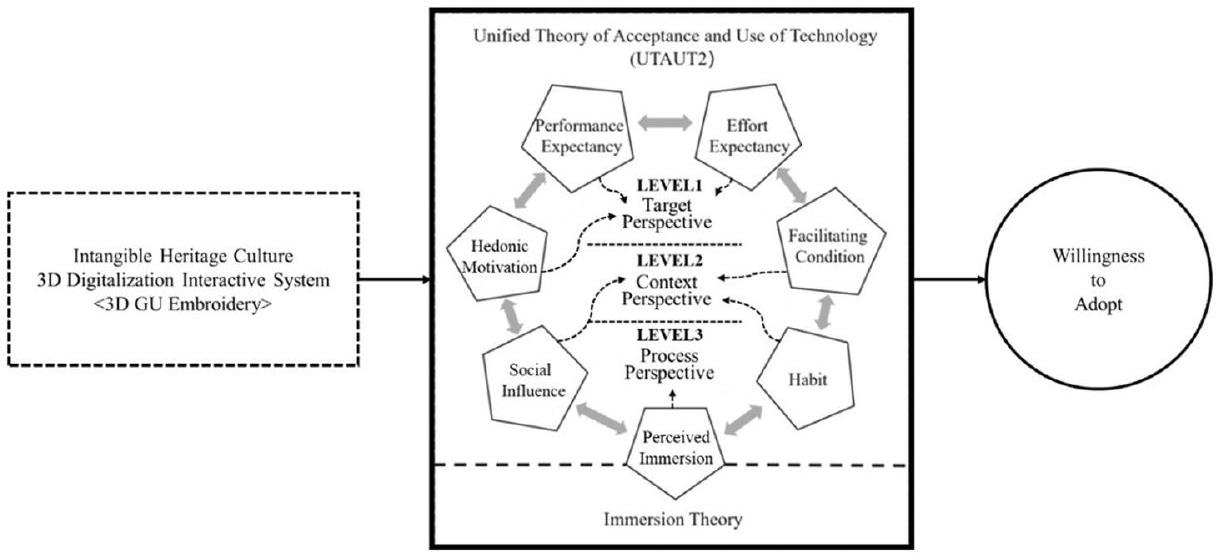
الشكل 1 الإطار النظري. يجمع الإطار النظري بين UTAUT2 ونظرية الانغماس لشرح استعداد المستهلكين لتبني التراث الثقافي الرقمي. يعمل التراث الثقافي الرقمي كمنبه خارجي، مع ثلاثة مستويات من استعداد المستهلك للتبني: (1) عوامل المستوى المستهدف (توقع الأداء، توقع الجهد، الدافع الهيدوني من UTAUT2)، (2) عوامل مستوى السياق (التأثير الاجتماعي، ظروف التيسير، العادة من UTAUT2)، (3) عوامل مستوى العملية (الانغماس المدرك من نظرية الانغماس)، وجميع العوامل تتفاعل في تكوينات للتأثير على سلوك التبني.
تظهر الأبحاث التجريبية أن PE يشجع الناس على استخدام التكنولوجيا الحديثة للتعرف على الثقافة التقليدية (وين وآخرون، 2023؛ ك. شيو وآخرون، 2019). على سبيل المثال، ادعى وين وآخرون (2023) أن PE يعزز استعداد السياح لاستخدام تكنولوجيا AR/VR لزيارة المواقع الثقافية. ومع ذلك، فإن PE العالي لا يؤدي دائمًا إلى تجارب إيجابية. وجد خلوفي وآخرون (2024) أن التكنولوجيا الرقمية الغامرة تسبب عدم الراحة الفسيولوجية، مما يظهر حالة عندما يؤدي PE العالي قبل التجربة بشكل عكسي إلى تقليل عدد المستخدمين الذين يتبنون التكنولوجيا.
توقع الجهد (EE). يشير EE إلى تعقيد الفرد المدرك وسهولة استخدام التكنولوجيا الجديدة (فينكاتيش وآخرون، 2012). تُعرف سهولة الاستخدام، المستمدة من نظرية انتشار الابتكار، بأنها مستوى الصعوبة المدرك في استخدام ابتكار ما (مور وبن باسات، 1991). نعرف EE في التراث الثقافي الرقمي على أنه توقعات المستهلكين في إتقان التقنيات الرقمية لإكمال تجربة التراث الثقافي بعد استثمار الجهد. تختلف آثار EE من حيث جذب المستهلكين حسب البحث والسياق. درس شانغ وآخرون (2017) استعداد الناس لتبني تطبيق هاتف ذكي قائم على AR لرؤية ثقافتهم التقليدية المحلية وأكدوا التأثير الإيجابي لـ EE. ومع ذلك، لا تستفيد جميع التراث الثقافي الرقمي من EE. أشارت دراسة (تزيما وآخرون، 2020) إلى أن تكنولوجيا VR تحسن إمكانية الوصول إلى الحفاظ على التراث الثقافي، لكن استخدام التكنولوجيا لا يؤثر على توقعات جهد المستهلكين، لذا فإن توقع الجهد لا يؤثر مباشرة على استعداد المستهلكين لرؤية التراث الثقافي باستخدام تكنولوجيا VR.
الدافع الهيدوني (HM). يشير HM إلى المتعة التي يتوقعها المستهلكون من استخدام التكنولوجيا (فينكاتيش وآخرون، 2012). أكدت دراسات تفاعل الإنسان مع الكمبيوتر بشكل متزايد على تحقيق الفائدة العاطفية للمستهلك المستوحاة من التكنولوجيا (تو وجيا، 2024؛ هو وآخرون، 2023). لقد تم إثبات دور الدافع الهيدوني في التأثير على استعداد المستهلكين لتبني التقنيات الرقمية لرؤية المحتوى المتعلق بالتراث الثقافي في الدراسات الحالية (سيل وباتابيال، 2023؛ وين وآخرون، 2023). على سبيل المثال، أظهرت دراسة (وين وآخرون، 2023) أن الدافع الهيدوني كان له تأثير إيجابي كبير على استعداد السياح لتبني AR/VR لرؤية المعالم التراثية.
مستوى المنظور السياقي
التأثير الاجتماعي (SI). يشير SI إلى مدى اعتقاد الناس أن المنظمات أو الإعدادات الرئيسية تؤثر على تبنيهم لتكنولوجيا أو نظام جديد (فينكاتيش وآخرون، 2012). يشير SI في التراث الثقافي الرقمي إلى مدى اعتقاد المستهلكين أن عائلتهم، أصدقائهم، زملائهم وشبكاتهم تؤثر على تبنيهم لتقنيات التراث الثقافي. لقد أظهر SI أنه يسهل تبني التقنيات الرقمية في الثقافة التقليدية (مارتو وآخرون، 2019). لقد مكنت قدرة التكنولوجيا الرقمية على كسر القيود الزمنية والمكانية التراث الثقافي من توسيع تأثيره الاجتماعي من خلال تلك التقنيات. في الأبحاث الحالية، أشار بعض العلماء إلى أن التأثير الاجتماعي يؤثر على استعداد المستهلكين لتبني الثقافة التقليدية الرقمية (ك. شيو وآخرون، 2019). وجد ك. شيو وآخرون (2019) أن استخدام تقنيات الاتصال الرقمية لنشر التراث الثقافي للجمهور يمكن أن يوسع تأثير التراث الثقافي على المجتمع.
ظروف التيسير (FC). تشرح FC كيف ينظر الشخص إلى تكنولوجيا أو نظام في بيئته (فينكاتيش وآخرون، 2012). لقد ساعدت التكنولوجيا الرقمية في رقمنة الثقافة، ويستخدم المزيد من الناس ذلك للوصول إلى التعددية الثقافية على منصات الوسائط الرقمية (مارتو وآخرون، 2019). وجد شيو وآخرون (2021) أن تعزيز راحة التقنيات الرقمية المتعلقة بالتراث الثقافي، مثل التصوير ثلاثي الأبعاد وVR، لعب دورًا كبيرًا في تسهيل فهم المستهلكين وتقديرهم وتجربتهم للتراث الثقافي.
تشير الراحة بشكل خاص إلى مستوى السهولة والراحة التي يشعر بها المستهلكون عند استخدام المرافق الفنية، والمعدات، والخدمات الداعمة للوصول إلى التراث الثقافي من خلال التكنولوجيا الرقمية. إن زيادة إمكانية الوصول من خلال الظروف الرقمية هي عامل سياقي حاسم في دراسة استعداد المستهلكين لتبني التراث الثقافي الرقمي.
العادة (HT). HT هي الاستمرار التلقائي للسلوك المتعلم، وتؤثر بشكل كبير على الأهداف السلوكية وتفسر تبني التكنولوجيا (فينكاتيش وآخرون، 2012). نعرف العادة في التراث الثقافي الرقمي على أنها ميل المستهلكين لاختيار التكنولوجيا الرقمية لتجربتهم في التراث الثقافي. أكدت العديد من الدراسات (نيكولوبولو وآخرون، 2021؛ زو وآخرون، 2021) تأثير عادات المستهلكين في جعل المستخدمين أكثر استعدادًا لتبني التكنولوجيا الرقمية في مجالات الوسائط الذكية، مثل تصفح المحتوى عبر الهاتف المحمول. ومع ذلك، لم يحلل القليل تأثير عادات المستهلكين على تبني التراث الثقافي الرقمي. يساعد دمج متغير العادة في الإطار النظري على توسيع البحث وتعزيز فهم أسباب التبني.
مستوى المنظور العملي
الانغماس المدرك (PI). PI هو مفهوم يعتمد على نظرية الانغماس يقيس مدى اعتقاد العملاء أنهم يمكنهم الانخراط بالكامل مع المحتوى عند تعرضهم لظروف تقنية محددة (ماكلين وويلسون، 2019). إنه متغير يتعلق بمنظور عملية التجربة في تفاعل الإنسان مع الكمبيوتر. لقد حظيت المناقشة حول التجارب الغامرة في مجالات التراث الثقافي الرقمي باهتمام كبير مؤخرًا (خلوفي وآخرون، 2024؛ ي. ليو، 2020). ومع ذلك، لدى العلماء آراء مختلفة بشأن تأثيره. يعتقد البعض أن التأثير البصري الغامر يعزز التجربة العامة ويزيد من قبول التكنولوجيا (قو وآخرون، 2022؛ ي. زانغ وآخرون، 2024). على سبيل المثال، في دراسة ليو (2020) حول استخدام تقنية العرض الرقمي لتجربة موقع تراث ثقافي، مدينة زويينغ القديمة (OZC)، كان الانغماس المدرك عاملاً مؤثرًا مهمًا. ومع ذلك، اكتشف خلوفي وآخرون (2024) أن المشاركين أظهروا ميلاً أقل لاستخدام الواقع الافتراضي للمرة الثانية بعد أن شعروا بزيادة في الإحساس بالانغماس، وهو ما يمكن أن يُعزى إلى الدوار. تم تضمين PI في الإطار النظري المقترح لتعزيز الجانب التكنولوجي لنظرية UTAUT2.
بالنظر إلى مشكلة الأسباب المتعددة والمتناثرة والنتائج غير المتسقة للاستعداد لتبني التراث الثقافي الرقمي في الأبحاث الحالية، قامت هذه الدراسة ببناء إطار نظري شامل (كما هو موضح في الشكل 1) يجمع بين نظرية UTAUT2 ونظرية الانغماس. شمل الإطار توقع الأداء، وتوقع الجهد، والدافع الهيدوني كفوائد تقنية من منظور الهدف. كما أضاف التأثير الاجتماعي، وظروف التيسير، والعادة كظروف تقنية من منظور السياق. من الضروري الاعتراف بأن السياق التكنولوجي يشمل تجارب المستهلكين مع التراث الثقافي الرقمي، والتي يمكن أن تؤثر بشكل كبير على استعدادهم للتبني. على عكس الأعمال التقليدية للتراث الثقافي في البيئات الواقعية، تستفيد تجارب التراث الثقافي الرقمي من التقنيات الرقمية لإنشاء بيئات غامرة، والتي تتطلب عرض الأعمال الثقافية الرقمية ودمج العناصر السياقية، مثل الإضاءة والترتيبات المكانية، مع تسهيل تفاعل المستخدمين من خلال هذه التقنيات (نيكولاكوبولوس وآخرون، 2021؛ تشاو وكيم، 2024). تلعب الجوانب التكنولوجية للتراث الثقافي الرقمي دورًا حاسمًا في تشكيل هذه التجارب، مما يؤدي إلى تباينات في التجارب السياقية التي تؤثر بعد ذلك على استعداد المستهلكين للتبني. ومن الجدير بالذكر أن سياق تجارب التراث الثقافي الرقمي يؤثر عادةً على إدراك المستهلكين للانغماس التكنولوجي أولاً، مما يؤثر على استعدادهم للتبني (باسبويس وإيزيبي، 2021). لذلك، تدمج دراستنا البيئة
تأثير على الاستعداد للتبني ضمن نظرية الانغماس. من خلال التأكيد على الانغماس المدرك كمتغير رئيسي في عملية التجربة التكنولوجية، نهدف إلى تعزيز وضوح وتماسك الإطار النظري للبحث. وبالتالي، يُعتبر الانغماس المدرك تجربة تقنية من منظور العملية. باستخدام هذا الإطار المقترح، استكشفنا الأسباب المعقدة لاستخدام المستهلكين للتراث الثقافي الرقمي وتأثيرات التجميع لعلاقاتهم السببية المعقدة.
تأثير على الاستعداد للتبني ضمن نظرية الانغماس. من خلال التأكيد على الانغماس المدرك كمتغير رئيسي في عملية التجربة التكنولوجية، نهدف إلى تعزيز وضوح وتماسك الإطار النظري للبحث. وبالتالي، يُعتبر الانغماس المدرك تجربة تقنية من منظور العملية. باستخدام هذا الإطار المقترح، استكشفنا الأسباب المعقدة لاستخدام المستهلكين للتراث الثقافي الرقمي وتأثيرات التجميع لعلاقاتهم السببية المعقدة.
تشير المتغيرات المؤثرة المجزأة في الرغبة في التبني إلى تداخلات مفاهيمية أو تناقضات معرفية بين العوامل الحالية المساهمة ونقص في إطار نظري متماسك (خلوفي وآخرون، 2024؛ ي. ليو، 2020؛ مارتو وآخرون، 2019). تشير الأدلة المتناقضة إلى أن أساليب البحث الكمي السابقة، التي حققت في العلاقة المباشرة بين المتغيرات المستقلة والتابعة، قد تكون متحيزة. للعوامل العديدة التي تؤثر على تبني التراث الثقافي الرقمي تأثير مشترك. عندما تقترن بعوامل أخرى، قد يكون لتلك التي ليست ذات دلالة أو لديها نتائج متناقضة في مسار واحد يعزز تبني التراث الثقافي الرقمي تأثير تآزري. تدمج هذه الدراسة بين نموذج UTAUT2 ونظرية الانغماس. اتخذنا منظورًا منهجيًا وشاملاً لتحليل الأسباب المختلفة ومسارات التدابير المضادة التي يمكن أن تعزز رغبة المستهلكين في تبني التراث الثقافي الرقمي من خلال استخدام طريقة تحليل المقارنة النوعية لمجموعات الضبابية (fsQCA) وتحليل الشروط الضرورية (NCA).
جمع البيانات وتحليلها
يوضح الشكل 2 سير العمل في هذه الدراسة، والذي يبين عمليات جمع البيانات وإعدادها وتحليلها. يتم شرح تفاصيل كل عملية في الفقرات الفرعية التالية.
تصميم الاستبيان وتوزيعه. مع الإطار النظري المقترح، درسنا استعداد المستهلكين لتبني قطع فن التطريز الرقمي GU. يعتبر تطريز GU أحد الحرف التقليدية الصينية لعرق الهان، ويعد تمثيلاً جيداً للتراث الثقافي غير المادي. تتكون عملية جمع البيانات من ثلاث خطوات رئيسية، تحتوي كل منها على عدة مراحل.
الخطوة الأولى تضمنت تصميم بيئة تجربة التراث الثقافي غير المادي الرقمية ثلاثية الأبعاد. تحتوي على أربع خطوات فرعية: اختيار موضوع التجربة الغامرة الرقمية، إنشاء سياق تجربة ثلاثية الأبعاد محلي، إعداد فيديو المحفزات لسياق التجربة ثلاثية الأبعاد واختبار فعالية المحفزات في إثارة الشعور بالانغماس. كانت التنفيذ الرقمي المختار لهذه الدراسة هو قطع من تطريز الجي، التي تم محاكاتها بشكل حي في صيغة ثلاثية الأبعاد، مما يسمح للمستخدمين بالتكبير والدوران لرؤية التفاصيل، مما يوفر تجربة غامرة. ومن الجدير بالذكر أن البيئة التفاعلية المحلية التي تم تنفيذها في هذه الدراسة تسمح فقط بتجارب التراث الثقافي غير المادي الرقمية غير المتصلة بالإنترنت. أظهرت الدراسات التي أجراها باسانين وآخرون (2019)، فلافين وآخرون (2019) وتوم وآخرون (2023) أن مقاطع الفيديو ثنائية الأبعاد، بما في ذلك التأثيرات ثلاثية الأبعاد، يمكن أن تثير تجارب غامرة مقارنة بتلك التي تولدها أنظمة الواقع الافتراضي المثبتة على الرأس. لتمكين دراسة تجريبية شاملة، قمنا بتوثيق عملية التفاعل ثلاثي الأبعاد كمحفزات فيديو للاستطلاع لقياس تجربة المشاركين. اختبر اختبار مسبق شمل 100 مشارك مستوى انغماسهم في ثلاثة أشكال من أعمال التراث الثقافي غير المادي المطرزة بالجي المعدلة رقمياً: صور للقطع الأصلية، أفلام للقطع الأصلية وأفلام تفاعلية افتراضية (محفز الدراسة). أظهرت النتائج أن
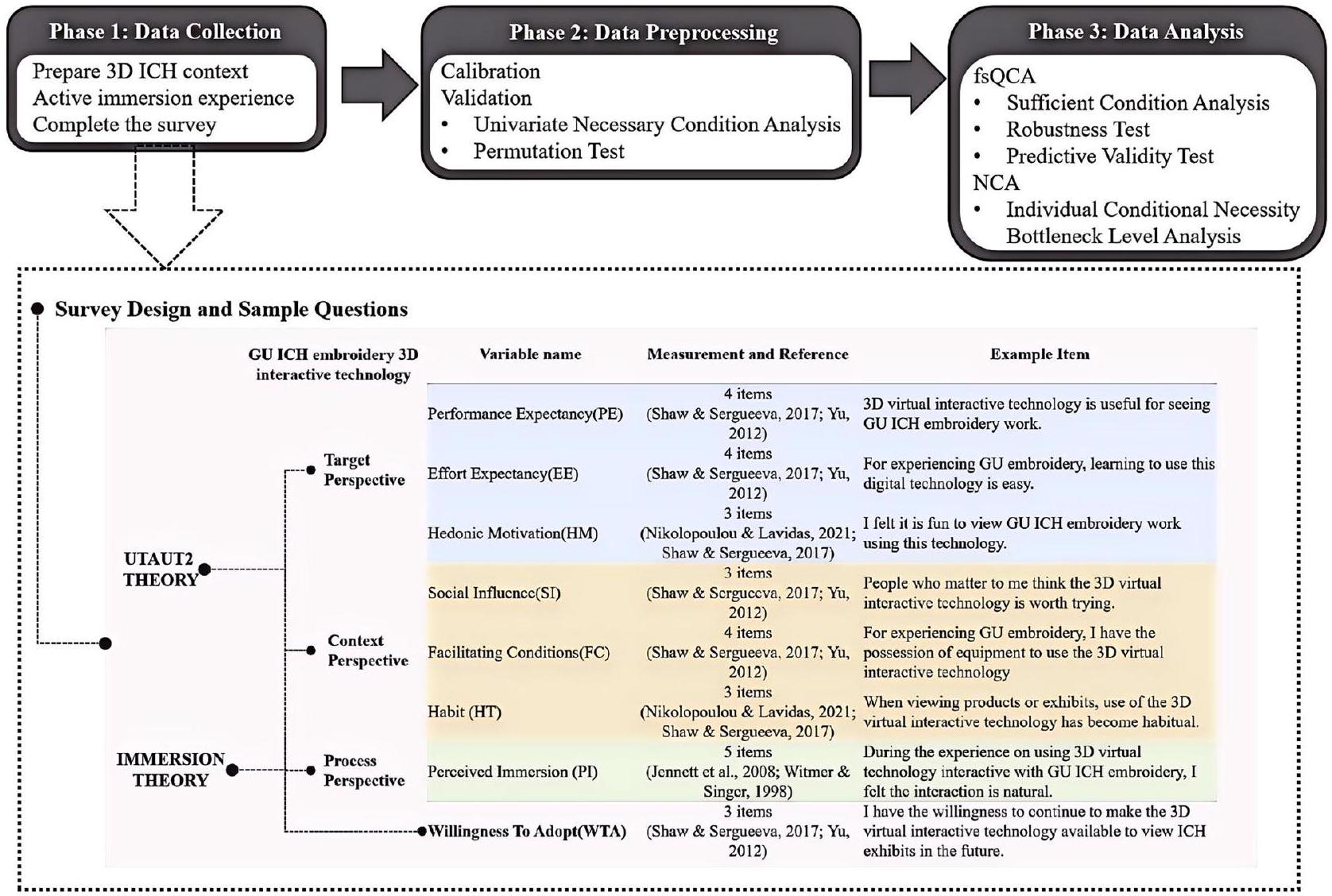
الشكل 2 جمع البيانات وتحليلها. يوضح سير العمل ثلاث خطوات رئيسية: جمع البيانات، المعالجة المسبقة، والتحليل. تبرز خطوة جمع البيانات تصميم الاستبيان والأسئلة النموذجية.
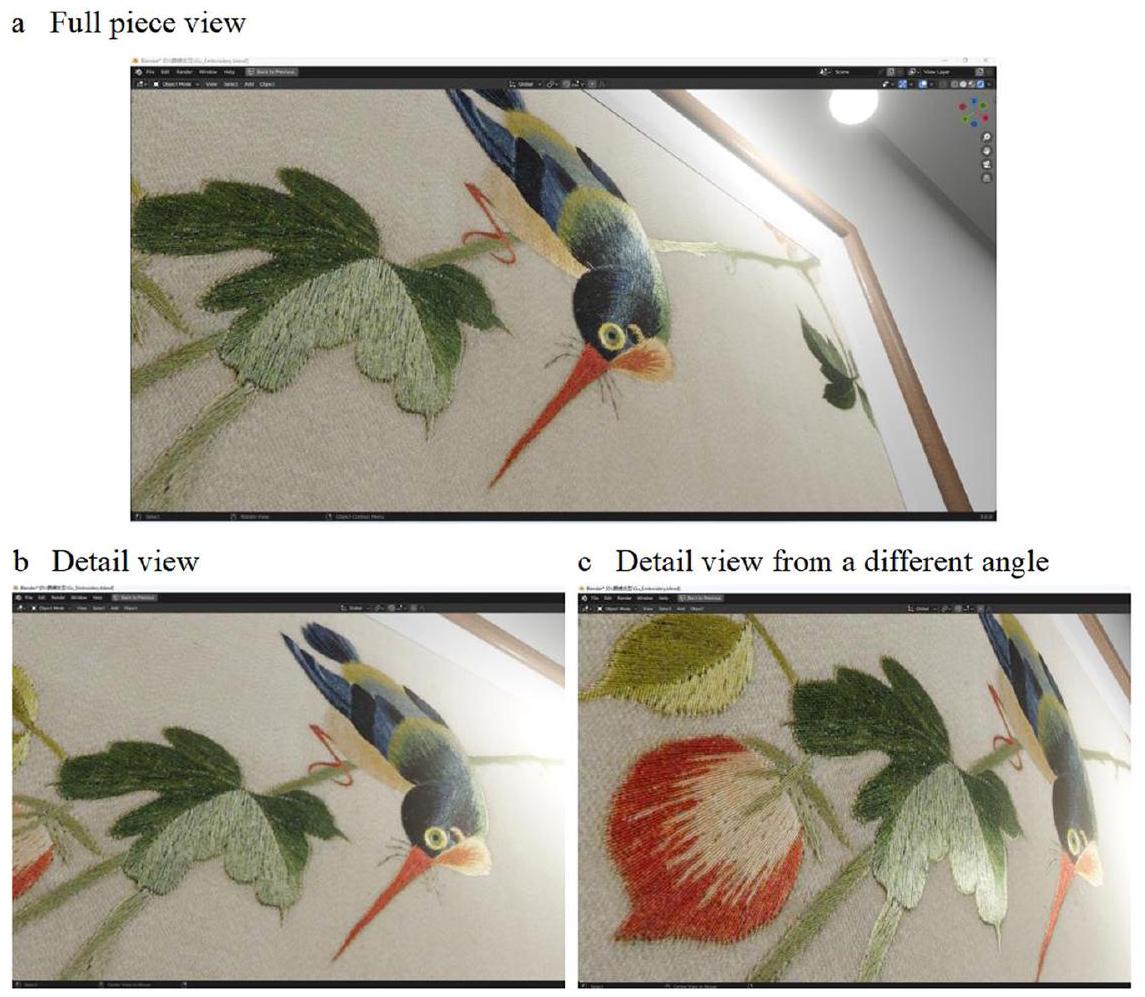
الشكل 3 لقطات شاشة لواجهة عرض تطريز GU ثلاثي الأبعاد. يقدم الشكل لقطات شاشة للواجهة التفاعلية لعرض تصميم تطريز GU ثلاثي الأبعاد من زوايا مختلفة. تعرض (أ) عرضًا كاملاً لقطعة التطريز،
كانت الخطوة التالية هي تفعيل تجربة الغمر الرقمي ثلاثي الأبعاد للتراث الثقافي غير المادي. أولاً، حصلنا على موافقة مستنيرة من المشاركين الذين شاركوا طوعًا في الدراسة. ثم تم تقديم المشاركين الذين وافقوا على المشاركة إلى تطريز GU التقليدي من خلال عرض فيديو يعرض عينات مادية ويقدم معلومات خلفية، تغطي أصوله وخصائصه المميزة. بعد ذلك، وبعد تقديم المواد الأساسية، بدأ المشاركون في التفاعل مع العرض ثلاثي الأبعاد لقطع الأثر المطرز بتقنية GU. تم توجيه المشاركين لتخيل أنفسهم يتفاعلون شخصيًا مع الأعمال الفنية الافتراضية للتطريز من خلال مشاهدة فيلم يعرض تطبيقًا لفحص قطع التطريز ثلاثية الأبعاد لمحاكاة GU بعمق. تلتقط الصورة 3 لقطات شاشة لواجهة التطبيق التي نظرت إلى تصميم تطريز GU ثلاثي الأبعاد من زوايا مختلفة. تم إضافة سؤال تحقق يسأل عن عدد القطع المعروضة في الفيديو للتحقق مما إذا كان المشاركون قد انتبهوا أم لا أثناء مشاهدة الفيديو.
أخيرًا، بعد تجربة ICH الرقمية، طُلب من المشاركين ملء استبيان يحتوي على مقاييس تقييم لكل من متغيرات الحالة ومتغير النتيجة، كما هو موضح في الإطار النظري (انظر الجدول 1) لهذه الدراسة. تم استخدام أسئلة الاستبيان (انظر الجدول 1 والشكل 2) لقياس توقعات الأداء، وتوقعات الجهد، والتأثير الاجتماعي، وظروف التيسير، وتم الإشارة إليها وتكييفها من شاو وآخرون (2017) ويو (2012). تم الإشارة إلى متغيرات الدافع الهيدوني والعادة وتكييفها من نيكولوبولو وآخرون (2021) وشاو وآخرون (2017). تم اقتباس وتكييف الأسئلة (انظر الجدول 1 والشكل 2) التي تقيس الانغماس المدرك من ويتمر وسينجر (1998). تم اقتباس وتعديل العناصر التي تقيس الاستعداد للتبني من شاو وآخرون (2017) ويو (2012). تم تقييم جميع العناصر باستخدام مقياس ليكرت المكون من سبع نقاط. قام باحث واحد في البداية بترجمة العناصر إلى الصينية لضمان دقة ووضوح عناصر الاستبيان. بعد ذلك، قام باحث آخر بترجمة هذه العناصر الصينية.
ثم عدنا إلى الإنجليزية للتحقق من اتساقها. بعد صياغة الاستبيان، استشرنا خبيرين ذوي خبرة في ICH لتقييم قابلية قراءة العناصر. استجابةً لتعليقاتهم، أجرينا تعديلات على عدة عناصر لتعزيز وضوحها. الجزء النهائي تطلب من المشاركين تقديم معلومات ديموغرافية أساسية مثل الجنس، العمر، المهنة والخلفية التعليمية.
ثم عدنا إلى الإنجليزية للتحقق من اتساقها. بعد صياغة الاستبيان، استشرنا خبيرين ذوي خبرة في ICH لتقييم قابلية قراءة العناصر. استجابةً لتعليقاتهم، أجرينا تعديلات على عدة عناصر لتعزيز وضوحها. الجزء النهائي تطلب من المشاركين تقديم معلومات ديموغرافية أساسية مثل الجنس، العمر، المهنة والخلفية التعليمية.
تم جمع ما مجموعه 311 استجابة صالحة من أصل 350 استجابة متوقعة. كانت العينات النهائية تتكون من
تحليل البيانات والنتائج الأولية
تحليل المقارنة النوعية لمجموعات الضبابية وتحليل الشروط الضرورية. تم اقتراح نهج تحليل المقارنة النوعية لمجموعات الضبابية (fsQCA) في عام 1987 من قبل ريجين (2009) لدراسة الروابط السببية المعقدة والتأثيرات التآزرية لحلها. لقد تم تطبيقه على نطاق واسع في مجال العلوم الاجتماعية. تساهم هذه الطريقة بشكل رئيسي في إظهار أن تأثيرات الظروف السابقة على متغير النتيجة مترابطة وأن النهج يمكن أن يفحص نوعياً علاقتهم السببية المعقدة. يستند التفكير الجوهري للنظام على نظرية المجموعات والحساب البولي. تستخدم هذه الدراسة نهجاً مقارناً.
الجدول 1 أسئلة الاستطلاع لقياس متغيرات النموذج.
| اسم المتغير | عنصر | كرون
|
KMO | |||||
| توقع الأداء (PE) |
|
0.712 | 0.751 | |||||
| توقع الجهد (EE) |
|
0.822 | 0.796 | |||||
| الدافع الهيدوني (HM) |
|
0.764 | 0.646 | |||||
| التأثير الاجتماعي (SI) |
|
0.757 | 0.663 | |||||
| ظروف التيسير (FC) |
|
0.743 | 0.724 | |||||
| عادة (HT) |
|
0.844 | 0.724 | |||||
| الإحساس بالانغماس (PI) |
|
0.707 | 0.833 | |||||
| الاستعداد للتبني |
|
0.743 | 0.687 |
الجدول 2: نقاط معايرة البيانات والتحليل الإحصائي الوصفي.
| اسم المتغير | معايرة المجموعة الضبابية | الإحصاءات الوصفية | ||||
| نقطة الانتماء الكاملة | نقطة التقاطع | نقطة غير مرتبطة تمامًا | القيمة المتوسطة | القيم القصوى | القيمة الدنيا | |
| التربية البدنية | 6.5 | ٦ | ٥.٥ | ٥.٩٨ | ٧ | 1 |
| EE | ٦ | 5.25 | ٤.٢٥ | ٤.٩٨ | ٧ | 1.5 |
| نعم | 6.33 | 5.67 | ٥ | ٥.٦ | ٧ | 1.33 |
| نادي كرة القدم | ٦ | ٥.٥ | ٤.٥ | 5.11 | ٧ | 1 |
| إتش إم | 6.33 | ٦ | 5.33 | ٥.٩ | ٧ | 1 |
| HT | 5.67 | ٤.٦٧ | 3.33 | ٤.٥٢ | ٧ | 1 |
| باي | ٥.٥ | ٥ | ٤.٣٣ | ٤.٩١ | ٧ | 1.5 |
| WTA | 6.33 | ٦ | 5.33 | ٥.٧٥ | ٧ | 1.67 |
لفحص التأثيرات المترابطة لعدة عناصر معقدة (Kumar et al., 2022; Pappas and Woodside, 2021). وجدت الأبحاث السابقة أن استعداد المستهلكين لتبني التراث الثقافي الرقمي ناتج عن العديد من العوامل، بعضها يعطي نتائج غير متسقة. لذلك، من الضروري استخدام الفوائد المنهجية لـ fsQCA لاستكشاف تأثيرات الأنماط بين العوامل بشكل كامل وتحديد الأسباب المعقدة لاستعداد المستهلكين لتبني التراث الثقافي الرقمي. علاوة على ذلك، استخدمت الدراسات السابقة تحليل الانحدار التقليدي للتحقيق في تأثير المكونات الفردية على نوايا القبول، متجاهلة العلاقات المعقدة بين هذه العناصر. كتكملة لـ fsQCA، تحليل الشرط الضروري (NCA) هو طريقة بحث قدمها دول (2016a) تحدد ما إذا كان الشرط ضرورياً ولكنه غير كافٍ لتحقيق نتيجة. ستؤكد هذه الطريقة أيضاً أن شرطاً واحداً فقط لا يمكن أن يمكّن من استعداد عالٍ لدى المستهلكين لتبني التراث الثقافي الرقمي، حيث تحلل أحجام التأثير ومستويات الاختناق لتحديد المستوى المطلوب من الشروط السابقة لتحقيق هدف معين.
النتيجة (فيس ودول، 2018). كما أنها تؤكد على ضرورة استخدام fsQCA للتحليل التكويني في هذه الدراسة.
النتيجة (فيس ودول، 2018). كما أنها تؤكد على ضرورة استخدام fsQCA للتحليل التكويني في هذه الدراسة.
قسمت الدراسة استراتيجية التحليل إلى ثلاث خطوات رئيسية. في البداية، تم استخدام نهج fsQCA لإجراء تحليل الحاجة. ثم تم استخدام نهج NCA لتقييم كيفية تأثير الظروف السابقة على متغيرات النتائج. تم استخدام نتائج fsQCA وNCA للإجابة على RQ1. أخيرًا، تم استخدام fsQCA في هذه الدراسة لفحص نموذج مطابقة الظروف الذي يحفز المستهلكين على تطوير رغبة قوية في اعتماد التراث الثقافي الرقمي. تم استخدام النتائج للإجابة على RQ2. كما تم توضيحه أدناه، تم إجراء تحليلات متعددة لتقييم الصلاحية التنبؤية والصلابة. لقد أهملت الأبحاث السابقة حول التراث الثقافي الرقمي التأثير التكويني بين الظروف السابقة لرغبة المستهلكين في الاعتماد. استخدمت هذه الدراسة مزيجًا من fsQCA وNCA للاستفادة من نقاط القوة التكميلية لأساليب البحث. لدى هذا النهج القدرة على معالجة الفجوات الموجودة جزئيًا في مجال أبحاث التراث الثقافي الرقمي.
| الجدول 3 تحليل ضرورة الحالة الفردية لـ fsQCA. | ||||
| اسم المتغير | استعداد عالٍ لتبني التراث الثقافي غير المادي الرقمي | انخفاض الرغبة في اعتماد التراث الثقافي غير المادي الرقمي | ||
| الاتساق | تغطية | الاتساق | تغطية | |
| التربية البدنية | 0.73 | 0.66 | 0.49 | 0.45 |
| ~PE | 0.39 | 0.43 | 0.64 | 0.71 |
| EE | 0.65 | 0.65 | 0.43 | 0.44 |
| ~EE | 0.44 | 0.43 | 0.66 | 0.65 |
| نعم | 0.78 | 0.72 | 0.4 | 0.37 |
|
|
0.31 | 0.34 | 0.7 | 0.77 |
| نادي كرة القدم | 0.66 | 0.68 | 0.41 | 0.43 |
|
|
0.44 | 0.42 | 0.69 | 0.68 |
| إتش إم | 0.78 | 0.7 | 0.44 | 0.4 |
|
|
0.33 | 0.36 | 0.67 | 0.75 |
| HT | 0.71 | 0.67 | 0.45 | 0.42 |
| ~HT | 0.38 | 0.41 | 0.65 | 0.7 |
| باي | 0.71 | 0.68 | 0.42 | 0.41 |
|
|
0.38 | 0.39 | 0.67 | 0.7 |
| الجدول 4 تحليل ضرورة NCA للظروف الفردية. | ||||||
| اسم المتغير | طريقة | دقة | المنطقة العليا | نطاق | حجم التأثير d |
|
| التربية البدنية | سي آر | 99.40% | 0.136 | ٣١.٩٨ | 0.004 | 0.082 |
| CE | 100% | 0.203 | ٣١.٩٨ | 0.006 | 0.062 | |
| EE | سي آر | 100% | 0.013 | ٢٩.٣٢ | 0 | 0.494 |
| CE | 100% | 0.026 | ٢٩.٣٢ | 0.001 | 0.379 | |
| نعم | سي آر | 99.40% | 0.104 | 30.22 | 0.003 | 0 |
| CE | 100% | 0.118 | 30.22 | 0.004 | 0 | |
| نادي كرة القدم | سي آر | 100% | 0 | ٣١.٩٨ | 0 | 0 |
| CE | 100% | 0 | 31.28 | 0 | 1 | |
| إتش إم | سي آر | 99.00% | 0.14 | 31.98 | 0.004 | 0.022 |
| CE | 100% | 0.205 | ٣١.٩٨ | 0.006 | 0.013 | |
| HT | سي آر | 99.70% | 0.022 | ٣١.٩٨ | 0.001 | 0 |
| CE | 100% | 0.028 | 31.98 | 0.001 | 0.002 | |
| باي | سي آر | 100% | 0.026 | ٢٩.٣٢ | 0.001 | 0.308 |
| CE | 100% | 0.051 | ٢٩.٣٢ | 0.002 | 0.119 | |
معايرة البيانات: اختيار نقاط معايرة البيانات يعتمد على الدراسة ويختلف عبر الأبحاث المختلفة. يشير ريجين (2009) إلى أن الأفراد في
تحليل شرط الضرورة الأحادي المتغير: من أجل تحديد ما إذا كانت الظروف السابقة المحددة ضرورية لكل من مستويات الرغبة العالية والمنخفضة في اعتماد التراث الثقافي الرقمي، يجب فحص كل شرط بشكل فردي قبل إجراء تحليل جماعي (راجن، 2009). أظهرت الدراسات السابقة أنه عندما تتجاوز الاتساق 0.9، فإن الشرط السابق من المحتمل أن يكون ضروريًا للمتغير الناتج (باباس وودسايد، 2021). أظهر دراسة الظروف السابقة باستخدام fsQCA 3.0 أن جميع الشروط كانت باستمرار أقل من 0.9. أشارت النتائج إلى أنه لم يكن هناك عامل واحد تسبب في ميل مرتفع أو منخفض لاعتماد التراث الثقافي الرقمي، مما يستدعي استخدام التحليل التكويني. تعرض الجدول 3 تحليل ضرورة الشرط الأحادي لـ fsQCA.
تقوم NCA بتقدير المتغيرات المستمرة والمتقطعة باستخدام الانحدار القائم على السقف (CR) وغلاف السقف (CE). يوضح الجدول 4 دقة مؤشرات الضرورة، المنطقة العليا، النطاق، وحجم التأثير.
تظهر NCA بشكل كمي الشروط السابقة اللازمة للوصول إلى مستوى معين من الخصوبة من خلال تقييم أحجام التأثير ومستويات الاختناق (Dul، 2016a، 2016b). يتم عرض تحليل مستويات اختناق الضرورة الشرطية الفردية (%) في هذه الدراسة باستخدام منهجية بحث NCA في الجدول 5 أدناه. كما هو موضح في الجدول 5، لتحقيق
تحليل الشرط الكافي: استخدمت هذه الدراسة طريقة fsQCA لفحص المسارات التي تؤدي إلى ارتفاع وانخفاض الرغبة في التبني في استهلاك التراث الثقافي الرقمي. استنادًا إلى الأبحاث السابقة، تم إجراء تحليل التكوين بحد أدنى من التوافق قدره 0.7 (Fiss، 2011)، وتم تحديد معيار توافق PRI عند 0.7 (Pappas وWoodside، 2021) وتم تحديد حد التكرار عند 1. درست هذه الدراسة بشكل صريح الحل الوسيط (Fiss، 2011) بين الأنماط الثلاثة للحلول (المعقدة، المختصرة والوسيطة) التي تم إنشاؤها بواسطة برنامج fsQCA. كما شمل التحليل الحلول المعقدة والمختصرة، كما تدعمه الدراسات السابقة.
تم عرض فحص العوامل التي تؤثر على اعتماد ICH الرقمي العالي في الجدول 6. وجدت التحليلات تسع طرق لاعتماد ICH الرقمي العالي، وكانت أنماط التجميع تجمع بين تكوينات سابقة مشابهة مع نفس المتطلبات الأساسية. أدت هذه الأنماط الدافعة (H1، H2، H3 و H4) إلى رغبة قوية في اعتماد ICH الرقمي. يظهر الجدول 6 أربعة أنواع دافعة تؤدي إلى تفضيل قوي لـ ICH الرقمي. كانت درجة اتساق الحل العام 0.79، مما يشير إلى أن الأنماط الأربعة كانت مجموعات شرطية مناسبة للتعبير عن رغبة عالية في اعتماد ICH الرقمي. كانت تغطية الحل العام 0.68، مما يشير إلى أن الأنماط الأربعة شملت مجموعة محددة من السيناريوهات. تم استخدام الاقتراحات المقدمة من فيرناي وآخرين (2021)، بالإضافة إلى ميزات الشروط المهمة لهذه الدراسة، لتسمية الأنماط.
- نوع التكنولوجيا المدفوعة بشكل مشترك يستهدف ويعالج في سياق منخفض التكنولوجيا
تؤدي ثلاثة مسارات (H1a و H1b و H1c) إلى اعتماد مرتفع للتكنولوجيا الرقمية في مجال الرعاية الصحية. أظهر العادة كشرط هامشي لحالة الحضور في المسار H1b أنها ساعدت العملاء على تأسيس رغبة عالية في اعتماد التكنولوجيا الرقمية في الرعاية الصحية. ومع ذلك، لم يؤثر توقع الجهد والتأثير الاجتماعي على هذا المسار. في المسار H1c، كان توقع الجهد شرطًا هامشيًا لـ
| الجدول 5 تحليل NCA لمستويات عنق الزجاجة الضرورية المشروطة الفردية. | |||||||
| الاستعداد لتبني ICH الرقمية | التربية البدنية | EE | نعم | نادي كرة القدم | إتش إم | HT | باي |
| 0 | NN | NN | NN | NN | NN | NN | NN |
| 10 | NN | NN | NN | NN | NN | NN | NN |
| 20 | NN | NN | NN | NN | NN | NN | NN |
| 30 | NN | NN | NN | NN | NN | NN | NN |
| 40 | NN | NN | NN | NN | NN | NN | NN |
| 50 | NN | 0.5 | NN | NN | NN | NN | 1 |
| 60 | NN | 1.3 | 3.4 | NN | NN | NN | 2.6 |
| 70 | 15.7 | 2.1 | 14.7 | NN | 16.3 | NN | ٤.٢ |
| ٨٠ | ٣٣.٩ | 2.9 | 26 | NN | ٣٤.٩ | ٤.٧ | ٥.٩ |
| 90 | 52 | 3.7 | 37.3 | NN | 53.5 | 9.7 | ٧.٥ |
| 100 | 70.2 | ٤.٥ | ٤٨.٦ | NN | 72.1 | 14.7 | 9.1 |
| NCA تستخدم نهج CR لمستويات عنق الزجاجة للضرورة الشرطية الفردية، وNN تعني غير ضروري. | |||||||
حالة الوجود، مما يشير إلى أنها زادت من ميل المستهلكين لتبني الثقافة الرقمية. في هذا السيناريو، لم يؤثر التأثير الاجتماعي على رغبة العملاء في تبني الثقافة الرقمية. كانت المتطلبات الأساسية للوجود هي توقع أداء قوي ودافع هيدوني قوي، والتي تنتمي إلى ظروف الأهداف التقنية المحتملة. بالإضافة إلى ذلك، كانت هناك حاجة إلى انغماس ملحوظ لتجربة العملية. كانت المتطلبات غير الأساسية الوحيدة هي شرط السياق التقني. عوضت متغيرات توقع الأداء العالي والدافع الهيدوني وإحساس الانغماس عن غياب شرط السياق، مما حفز المستهلكين على تبني الثقافة الرقمية. أظهرت المسارات الثلاثة للنموذج أن هذا النوع أنتج استعدادًا عاليًا لتبني الثقافة الرقمية بغض النظر عما إذا كان المستهلكون يتوقعون بذل جهد (H1a، H1c) أو كانوا قد استخدموا التكنولوجيا بالفعل (H1b، H1c).
2. نوع التكنولوجيا المدفوعة المشتركة الهدف والسياق في عملية التكنولوجيا المنخفضة
تضمن هذا النوع مسارين (H2a، H2b)، كلاهما يشمل ثلاثة عوامل أساسية شائعة: توقع الأداء والدافع الهيدوني من منظور الهدف، والتأثير الاجتماعي من وجهة نظر السياق. يبدو أن توقع الجهد والظروف الميسرة كانا شرطين هامشيين للحالات في المسار H2a، وكلاهما زاد من اعتماد ICH الرقمي. كانت العادة والإحساس بالتعمق غير فعالتين. قد تزيد العادة كشرط هامشي لحالة الحضور في المسار H2b من اعتماد ICH الرقمي، في حين لم يكن للإحساس بالتعمق أي تأثير. اكتشفت هذه الدراسة أن توقع الأداء العالي، والدافع الهيدوني العالي، والتأثير الاجتماعي القوي يمكن أن تؤدي إلى رغبة قوية في اعتماد ICH الرقمي، حتى لو افترض المستهلكون أنهم غير قادرين على تجربة التعمق في ICH الرقمي.
3. التكامل التعاوني للوجهات الثلاث
2. نوع التكنولوجيا المدفوعة المشتركة الهدف والسياق في عملية التكنولوجيا المنخفضة
تضمن هذا النوع مسارين (H2a، H2b)، كلاهما يشمل ثلاثة عوامل أساسية شائعة: توقع الأداء والدافع الهيدوني من منظور الهدف، والتأثير الاجتماعي من وجهة نظر السياق. يبدو أن توقع الجهد والظروف الميسرة كانا شرطين هامشيين للحالات في المسار H2a، وكلاهما زاد من اعتماد ICH الرقمي. كانت العادة والإحساس بالتعمق غير فعالتين. قد تزيد العادة كشرط هامشي لحالة الحضور في المسار H2b من اعتماد ICH الرقمي، في حين لم يكن للإحساس بالتعمق أي تأثير. اكتشفت هذه الدراسة أن توقع الأداء العالي، والدافع الهيدوني العالي، والتأثير الاجتماعي القوي يمكن أن تؤدي إلى رغبة قوية في اعتماد ICH الرقمي، حتى لو افترض المستهلكون أنهم غير قادرين على تجربة التعمق في ICH الرقمي.
3. التكامل التعاوني للوجهات الثلاث
يتكون هذا النوع من مسارين (H 3 a و H 3 b)، مما يوضح أن الجمع بين التأثير الاجتماعي العالي (من منظور السياق)، والدافع الهيدوني العالي (من منظور الهدف)، والإحساس العالي بالانغماس (من منظور العملية) كشرط أساسي يؤدي إلى ارتفاع استعداد المستهلكين لتبني التراث الثقافي الرقمي. تعمل المتغيرات في المنظورات الثلاثة معًا للتأثير على استعداد المستهلكين لتبني التراث الثقافي الرقمي. تشير وجود توقع الجهد كشرط هامشي في المسارات H 3 a و H 3 b إلى أن توقع الجهد يؤثر على ميل العملاء لتبني التراث الثقافي الرقمي في هذه المسارات. من الواضح أن نوايا المستهلكين العالية لتبني التراث الثقافي الرقمي مدفوعة بدافع هيدوني عالي، وتأثير اجتماعي قوي، وإحساس عالٍ بالانغماس، حتى عندما لا يفعل المستهلكون ذلك.
لا يتوقعون أداءً عاليًا من تجاربهم الرقمية في ICH.
4. نوع العملية التكنولوجية المدفوعة بالتعاون والسياق في الهدف منخفض التكنولوجيا
لا يتوقعون أداءً عاليًا من تجاربهم الرقمية في ICH.
4. نوع العملية التكنولوجية المدفوعة بالتعاون والسياق في الهدف منخفض التكنولوجيا
يتضمن هذا النوع مسارين (H4a و H4b) يوضحان كيف أن الجمع بين التأثير الاجتماعي القوي من منظور السياق وارتفاع الإحساس بالانغماس من منظور العملية، مع وجود دافع هيدوني منخفض، وتوقع أداء منخفض من منظور الهدف كظروف أساسية يمكن أن يؤدي إلى رغبة قوية لدى المستهلكين في اعتماد الثقافة الرقمية غير الملموسة. بالإضافة إلى ذلك، فإن وجود العادة كحالة متزامنة في المسارين H4a و H4b يشير إلى أن العادة تساهم في زيادة طفيفة في رغبة المستهلكين في اعتماد غير الخيالي الرقمي ضمن هذا الإطار. على الرغم من عدم حماس المستهلكين لاستخدام الثقافة الرقمية غير الملموسة، إلا أن العادة يمكن أن تؤدي إلى ميل قوي لاستخدامها.
تُعرض نتائج التحليل التكويني لرغبة اعتماد التراث الثقافي الرقمي المنخفض، التي أنشأتها المتغيرات السبعة، في الجدول 6 أعلاه. أشارت النتائج إلى وجود ثلاث ميول دافعة متميزة (LH1 و LH2 و LH3)، مما يؤدي إلى انخفاض الاستعداد لاعتماد التراث الثقافي الرقمي. كانت الحلول العامة لأنماط القيادة الثلاثة تتمتع بتناسق قدره 0.84، مما يشير إلى أن الأنماط الثلاثة يمكن اعتبارها أنماط شرطية مناسبة. بالإضافة إلى ذلك، كانت نسبة التغطية لحلهم العام 0.59، مما يشير إلى أن الأنماط الثلاثة تغطي عددًا معينًا من الحالات.
اختبار القوة والتحقق الإضافي من نموذج التأثيرات الثابتة: وفقًا لـ (كومار وآخرون، 2022؛ باباس وودسايد، 2021)، تكون النتائج قوية إذا كانت الرسوم البيانية الجديدة التي تم إنشاؤها باستخدام اختبارات القوة المختلفة لها علاقة فرعية واضحة مع الرسوم البيانية الأصلية ولا تعدل تفسيرها الجوهري. يختبر اختبار الصلاحية التنبؤية التشابه وصلاحية حلول تجميع fsQCA في عينات متنوعة لتقييم مرونة التجميع وصلاحية التنبؤ. في هذه الدراسة، كانت نقطة الارتكاز أقل بنسبة 15% في قوة الأداء، لكن معالجة البيانات كانت هي نفسها. يوضح الجدول 7 أنه لم تتغير أي من نتائج اختباراتهم في تفسير التجميع الذي أنتج استعدادًا عاليًا ومنخفضًا لتبني التراث الثقافي الرقمي، مما يشير إلى أن التجميع كان قويًا. تقيم الصلاحية التنبؤية تشابه حلول تجميع fsQCA في العينة. تم تقسيم العينة الأصلية عشوائيًا إلى عينتين فرعيتين بأرقام عينات 155 و156 باستخدام Excel. أنتج تحليل fsQCA للعينة الفرعية 1 أنماط استعداد عالي ومنخفض لاستخدام التراث الثقافي الرقمي كما هو موضح في الجدول 8. تتطابق الرسوم البيانية الناتجة عن ذلك بشكل وثيق مع تلك الخاصة بالعينة الكاملة. بعد ذلك، تم رصد حل المجموعة P4، الذي أنشأ استعدادًا عاليًا لاستهلاك التراث الثقافي الرقمي في العينة 1، وحل المجموعة Q4، الذي لم يفعل ذلك. يقدم الشكل 4 اختبار الصلاحية.
الجدول 8 نتائج الصلاحية التنبؤية للرغبة العالية والمنخفضة في اعتماد الثقافة الرقمية.
| نتائج الصلاحية التنبؤية للاستعداد العالي أو المنخفض لتبني الثقافة الرقمية | نمط | اتساق وتغطية حل تكوين العينة 1 | حل تكوين العينة 1 تم اختباره على العينة 2 | ||||
| الاتساق | تغطية | التناسق العام | التغطية الشاملة | الاتساق | تغطية | ||
| نتائج الصلاحية التنبؤية | P1: بي إي•EE•FC•HM•PI | 0.84 | 0.16 | 0.85 | 0.61 | 0.86 | 0.14 |
| استعداد عالي للتبني | P2: PE
|
0.84 | 0.19 | 0.88 | 0.16 | ||
| ICH الرقمي | P3: PE•EE•FC•HMcHT•PI | 0.85 | 0.13 | 0.85 | 0.15 | ||
| P4: بي•إي•إي•إس•آي•إف•سي•إتش•إم | 0.9 | 0.36 | 0.93 | 0.36 | |||
| P5: PE
|
0.91 | 0.06 | 0.88 | 0.08 | |||
| P6: EE•SI•HMc~HT•PI | 0.88 | 0.17 | 0.88 | 0.18 | |||
| P7: ~PE• EE•SI ⋅ FC ⋅ HM ⋅ PI | 0.79 | 0.08 | 0.8 | 0.06 | |||
| P8:
|
0.9 | 0.06 | 0.94 | 0.05 | |||
| P9: ~فا•سي•فك•هم
|
0.82 | 0.07 | 0.89 | 0.06 | |||
| نتائج الصلاحية التنبؤية | السؤال 1:
|
0.89 | 0.29 | 0.88 | 0.51 | 0.9 | 0.21 |
| من انخفاض الرغبة في التبني | السؤال الثاني:
|
0.85 | 0.07 | 0.86 | 0.09 | ||
| ICH الرقمي | السؤال 3:
|
0.89 | 0.32 | 0.9 | 0.32 | ||
| الربع الرابع:
|
0.91 | 0.1 | 0.91 | 0.12 | |||
| س5:
|
0.81 | 0.01 | 0.86 | 0.04 | |||
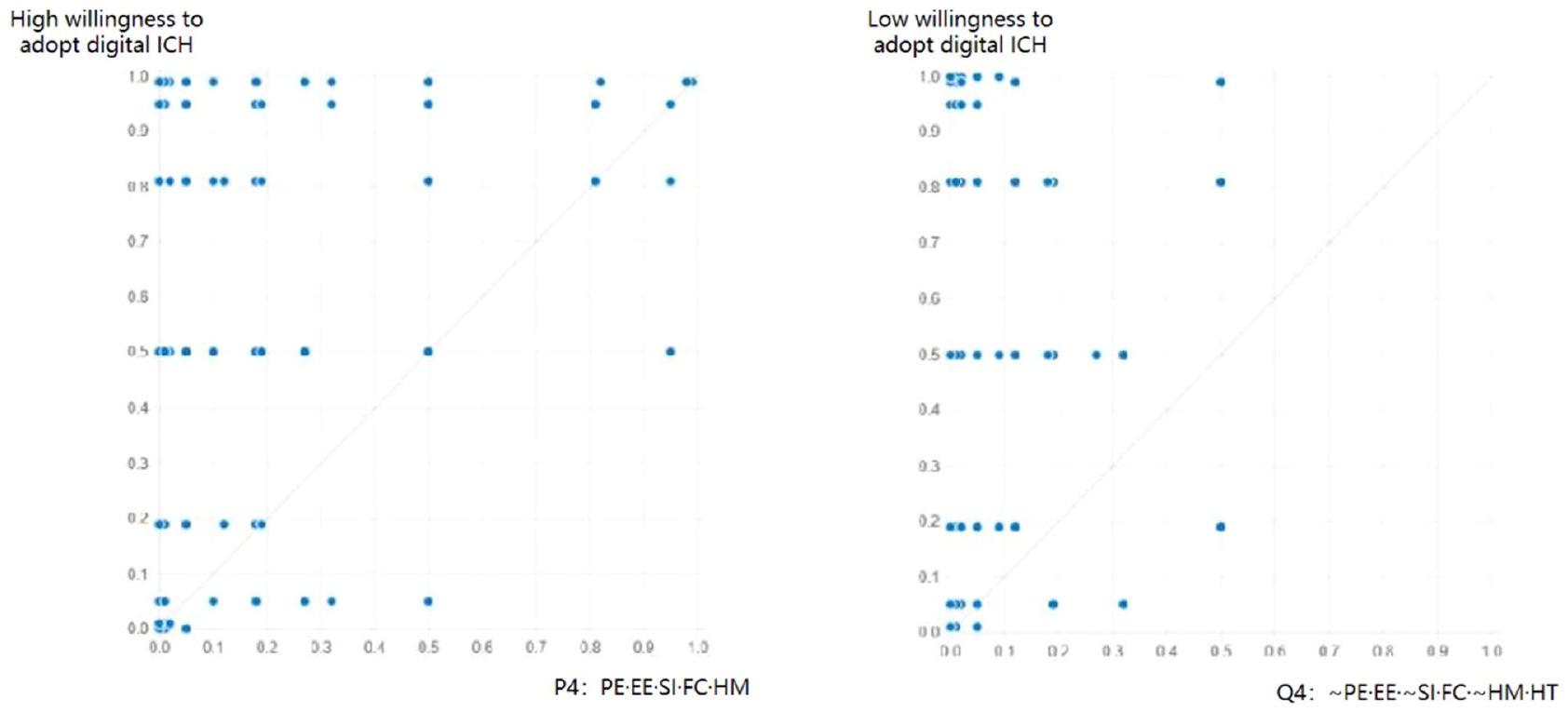
الشكل 4 نتائج اختبار العينة الفرعية 2 للنمط P4 و Q4. يقدم هذا الشكل نتائج اختبار الصلاحية باستخدام مجموعة البيانات من العينة الفرعية 2 للتحقق من التكوينات P4 و Q4 المستمدة من العينة الفرعية 1.
النتائج من خلال تطبيق fsQCA على بيانات العينة 2. تُظهر الرسوم البيانية أن النموذج أدّى بشكل جيد وعمل مع مجموعات بيانات متنوعة.
نقاش
استخدمت هذه الدراسة نموذج UTAUT2 ونظرية الانغماس لإنشاء إطار عمل لتحديد مواقف المستهلكين تجاه التراث الثقافي الرقمي بناءً على منظور تحليلي ثلاثي الطبقات. من خلال استخدام منهجيات fsQCA وNCA، تم تقييم التفاعلات والتأثيرات المشتركة للهدف والسياق والعملية لتحديد استعداد المستهلكين لتبني التراث الثقافي الرقمي. وكشفت الدراسة عن أربعة أنواع تكوينية تتمتع باستعداد عالٍ لتبني التراث الثقافي الرقمي. من بين المتغيرات السبعة التي تم النظر فيها، كان الانغماس المدرك والتأثير الاجتماعي هما المتغيران الرئيسيان اللذان شجعا العملاء على أن يكونوا مستعدين بشدة لتبني التراث الثقافي الرقمي. وهذا يجيب على السؤال البحثي الأول.
تقدم الأجزاء التالية تحليلًا أكثر تفصيلًا للنتائج، مع معالجة السؤال البحثي الثاني. تم تنظيم الأقسام في أربعة
الأجزاء، التي تجيب على الأسئلة الفرعية لـ RQ2: تكوينات عالية لتبني التراث الثقافي الرقمي، تكوينات منخفضة لتبني التراث الثقافي الرقمي، العلاقات المحتملة للتعويض بين الظروف وتوصيات الإدارة.
الأجزاء، التي تجيب على الأسئلة الفرعية لـ RQ2: تكوينات عالية لتبني التراث الثقافي الرقمي، تكوينات منخفضة لتبني التراث الثقافي الرقمي، العلاقات المحتملة للتعويض بين الظروف وتوصيات الإدارة.
تكوينات عالية من اعتماد التراث الثقافي الرقمي (RQ2.1). كشفت هذه الدراسة عن أربعة أنماط من الظروف المتغيرة التي من شأنها أن تؤدي إلى رغبة عالية في اعتماد التراث الثقافي الرقمي، كما هو موضح في الأقسام السابقة، والتي تتناول RQ2.1. افترض الإطار النظري أن ثلاثة أبعاد مترابطة، وهي الهدف والسياق والعملية، تؤثر على رغبة العملاء في اعتماد التراث الثقافي الرقمي. بشكل جماعي، زادت هذه المتغيرات من احتمال اعتماد التراث الثقافي الرقمي. في جانب العملية، استنادًا إلى نظرية الانغماس، برز الانغماس المدرك كأهم متغير يؤثر على ميل المستهلكين لاعتماد التراث الثقافي الرقمي من منظور موجه نحو العملية، حيث يعد شرطًا ضروريًا في ثلاثة من الأنماط الأربعة المعترف بها (انظر النمط 1، 3، 4).
النمط 1 شمل ثلاثة مسارات (H1a و H1b و H1c)، والتي أشارت إلى أن الجمع بين توقع الأداء العالي، والدافع الهيدوني العالي، والإحساس العالي بالانغماس كشرط أساسي يمكن أن يؤدي إلى زيادة استعداد المستهلكين لتبني التراث الثقافي الرقمي. يساعد هذا في التوازن جزئيًا مع النتائج المتناقضة الموجودة في دراسات التراث الثقافي الرقمي للمستهلكين فيما يتعلق بالإحساس بالانغماس. أظهرت الأبحاث الحالية أن الإحساس بالانغماس يمكن أن يزيد أو يقلل من استعداد العملاء لتبني التراث الثقافي الرقمي، اعتمادًا على الانزعاج الفسيولوجي (خلوفي وآخرون، 2024). استخدمت هذه الدراسة fsQCA و NCA لإظهار أن تحليل الإحساس بالانغماس يجب أن يتم من خلال النظر في المسار الكامل بدلاً من التركيز على الجوانب الفردية. عندما شعر المستهلكون بمزيد من الفوائد التكنولوجية من التراث الثقافي الرقمي، زادت وجهة نظر عملية الإحساس بالانغماس والمتغيرات من وجهة نظر الهدف من استعدادهم لتبنيه. يتماشى هذا مع الأبحاث السابقة حول توقع الأداء العالي والدافع الهيدوني الذي يساهم في زيادة تبني التراث الثقافي الرقمي (وين وآخرون، 2023؛ ك. شيو وآخرون، 2019).
مختلف عن النمط 1، أكد النمط 2 (H2a و H2b) على تقارب شروط وجهة نظر الهدف (توقع الأداء العالي والدافع الهيدوني العالي) وتأثير السياق الاجتماعي. عندما كان لدى العملاء توقع أداء عالي، ودافع هيدوني عالي، وتأثير اجتماعي كبير، عوض ذلك عن نقص الإحساس بالانغماس في العملية. حفزهم ذلك على تبني التراث الثقافي الرقمي بقوة. يتماشى هذا الاكتشاف مع أهمية العوامل الاجتماعية التي تم التأكيد عليها في الأبحاث السابقة حول تعزيز ميل العملاء لاستخدام التراث الثقافي الرقمي (مارتو وآخرون، 2019؛ ك. شيو وآخرون، 2019).
أظهر النمط 3 (H3a و H3b) أن الدافع الهيدوني العالي، والتأثير الاجتماعي، والإحساس بالانغماس كانت ضرورية لزيادة الاستعداد لتبني التراث الثقافي الرقمي. وأكدت الحاجة الحيوية لدمج المتغيرات الثلاثة من وجهات النظر لتعزيز استعداد المستهلكين لتبني التراث الثقافي الرقمي، مما يعوض عن غياب بعض المتغيرات (مثل توقعات الأداء) التي أثرت على استعداد المستهلكين لتبني التراث الثقافي الرقمي.
في الوقت نفسه، باستثناء التأثير الاجتماعي العالي والإحساس العالي بالانغماس، أظهر النمط 4 (H4a و H4b) أيضًا الشرط الأساسي الغائب للدافع الهيدوني وتوقع الأداء، وكلاهما ينتمي إلى وجهة نظر الهدف. وكشف أن شروط الحضور الأساسية من كل من وجهات النظر العملية والسياقية وشروط الغياب الأساسية من وجهة نظر الهدف ساهمت معًا في الاستعداد للتبني. بالإضافة إلى ذلك، لعب استعداد المستهلكين لتبني التراث الثقافي الرقمي دورًا حاسمًا في موازنة تأثير انخفاض توقع الجهد. دعمت التحليل المشترك لـ H3 و H4 إلى حد ما نتائج الانحدار الأحادي حول استعداد العملاء لتبني التراث الثقافي الرقمي في الدراسات السابقة، مما يظهر ظاهرة ‘طرق متباينة تؤدي إلى نفس النتيجة’. على سبيل المثال، اعترف العديد من العلماء بالتأثير الإيجابي للدافع الهيدوني على استعداد المستهلكين لتبني تقنيات التراث الثقافي الرقمي (سيل وباتابيال، 2023؛ وين وآخرون، 2023). ومع ذلك، كشفت التحليل التجريبي لهذه الدراسة أنه بينما أدت كل من أنماط H3 و H4 في النهاية إلى زيادة استعداد المستهلكين للتبني، لم يكن من الضروري أن يكون الدافع الهيدوني شرطًا أساسيًا. بعبارة أخرى، حتى بدون الدافع الهيدوني، قد لا يزال لدى المستهلكين ميل أكبر لتبني منصات التراث الثقافي الرقمي بسبب التأثير المشترك لمتغيرات أخرى ضمن أنماط تكوينية متنوعة.
بشكل عام، أشارت الأنماط الأربعة لشروط المتغيرات المذكورة أعلاه إلى أن الإحساس بالانغماس من وجهة نظر عملية والتأثير الاجتماعي من وجهة نظر سياقية كانا عوامل أساسية ساهمت بشكل كبير في الميل القوي للمستهلكين لتبني التراث الثقافي الرقمي. هذا الاكتشاف
أكد استنتاجات الدراسات السابقة وقدم مساهمته الفريدة. استكشفت الدراسات الحالية بشكل موسع الإحساس بالانغماس في مجالات التراث الثقافي الرقمي، على الرغم من أن فعالية تأثيره لا تزال موضوع جدل.
أكد استنتاجات الدراسات السابقة وقدم مساهمته الفريدة. استكشفت الدراسات الحالية بشكل موسع الإحساس بالانغماس في مجالات التراث الثقافي الرقمي، على الرغم من أن فعالية تأثيره لا تزال موضوع جدل.
كما تم مناقشته سابقًا، يتناقض الإحساس بالانغماس في العالم الرقمي مع ذلك في العالم الحقيقي عبر ثلاثة أبعاد رئيسية: التكنولوجيا، والمنهجية، والنهج. وبالمثل، يحتاج الاقتراب من خلق انغماس المستهلك في البيئة الرقمية أيضًا إلى أن يأتي من هذه الثلاث وجهات نظر المتميزة. بالنسبة للتكنولوجيا، يمكن أن يؤدي دمج نظارات الواقع الافتراضي وتطبيقات الواقع المعزز مع تطبيق تخطيط التطريز التفاعلي ثلاثي الأبعاد المحلي إلى جعل التجربة أكثر انغماسًا بكثير (زيدياناكيس وآخرون، 2021) مع تقليل المشتتات مثل دوار الحركة والحاجة إلى تعلم كيفية استخدامها. منهجيًا، تستخدم هذه الدراسة تطريز GU كالنقطة المحورية للتفاعل التفاعلي وقد طورت تأثيرات إضاءة لتعزيز هذه التجربة. يمكن أن يعمق الانغماس التفاعلي الناتج عن دمج المحتوى الفني والمنهجيات السردية بشكل كبير من تفاعل المستهلك ويؤسس شعورًا أعمق بالانغماس في العالم الرقمي (كاوان وآخرون، 2019). فيما يتعلق بالنهج، يمكّن تخطيط التراث الثقافي الرقمي المحلي المستخدمين من استكشاف التفاصيل المعقدة لتطريز GU من زوايا مختلفة بشكل مستقل. هذه الفرصة غالبًا ما تكون صعبة المنال في التجربة الواقعية. تعزز هذه التجربة المخصصة داخل البيئة الرقمية من إدراك المستهلك للانغماس (تارنج وآخرون، 2018). من ناحية أخرى، عندما يتعلق الأمر بتأثير التأثير الاجتماعي، اعتمدت معظم الأبحاث السابقة حول الاستعداد لتبني التراث الثقافي الرقمي بشكل أساسي على الأدلة من مجال الاتصال. أكدت هذه الدراسات على دور المجتمع في نشر وتعزيز التراث الثقافي الرقمي. أكدت نتائج هذه الدراسة التأثير المهم للإحساس بالانغماس والتأثير الاجتماعي على الاستعداد لتبني التراث الثقافي الرقمي. علاوة على ذلك، شرحت الدراسة النتائج المتضاربة من منظور نمط تكويني.
عند تحليل أنواع التكوين H1 و H2، وُجد أنه إذا كان توقع الأداء من وجهة نظر الهدف هو شرط الحضور الأساسي، فإن التأثير الاجتماعي من وجهة نظر السياق والإحساس بالانغماس من وجهة نظر العملية لم يكن ضروريًا. ومع ذلك، أشار نوع التكوين H4 إلى أنه عندما يغيب النموذج عن توقع الأداء كشرط مركزي، يجب أن تكون متطلبات الحضور الأساسية هي التأثير الاجتماعي والإحساس بالانغماس. بشكل عام، كان هناك ارتباط بديل بين توقع الأداء والتأثير الاجتماعي أو الإحساس بالانغماس. عزز هذا أهمية توقع الأداء من وجهة نظر الهدف، وهو متغير يظهر فوائد التكنولوجيا. يتماشى هذا أيضًا مع تأكيد الأبحاث السابقة (شيو وآخرون، 2019) على التأثير الكبير للمتغيرات المرتبطة بفوائد الأهداف التقنية، مثل توقع الأداء، في تحفيز المستهلكين على تبني التراث الثقافي الرقمي.
أنماط تبني التراث الثقافي الرقمي المنخفضة (RQ2.2). كما قامت هذه الدراسة بتحليل أنماط تكوين تبني التراث الثقافي الرقمي المنخفضة لمعالجة RQ2.2. جادل نمط نقص التكنولوجيا (LH1) بأن المستهلكين يفتقرون إلى تجربة انغماس ودافع هيدوني عند تبني تكنولوجيا التراث الثقافي الرقمي. كان أقران المستهلكين أيضًا أقل احتمالًا لاستخدام التكنولوجيا لاستكشاف التراث الثقافي الرقمي. سواء اعتمد المستخدم التكنولوجيا الرقمية يوميًا أم لا، كان من الصعب زيادة استعدادهم لتبني التراث الثقافي الرقمي. أظهر نمط غياب المتغيرات الخارجية (LH2) أن المستهلكين كانوا أقل احتمالًا لتبني أجهزة التراث الثقافي الرقمي المتأثرة بالتأثير الاجتماعي. في الوقت نفسه، لم يتوقع المستهلكون استخدام هذه التكنولوجيا لتحسين كفاءة استكشاف التراث الثقافي الرقمي والاستمتاع أثناء تجربته، لذا كان من الصعب إلهامهم.
يجب على المستهلكين اعتماد التراث الثقافي غير المادي الرقمي، بغض النظر عما إذا كان من السهل الحصول عليه أو استخدامه في أيام الأسبوع. اقترح المسار (LH3) أن نقص الدافع الهيدوني عندما لا ينوي العملاء استخدام التكنولوجيا لتحسين كفاءة تجربة التراث الثقافي غير المادي والتمتع بها، وعندما لا يستخدمون التكنولوجيا الرقمية بشكل متسق. أظهرت تحليل التكوين فيما يتعلق برغبة المستهلكين المنخفضة في اعتماد التراث الثقافي غير المادي الرقمي أن التأثير الاجتماعي والدافع الهيدوني لعبا دورًا حاسمًا في تطوير الرغبة، وهو ما يتماشى مع نتائج الدراسات السابقة (Seal و Batabyal، 2023؛ Wen وآخرون، 2023). على وجه الخصوص، كان تضمين التأثير الاجتماعي عاملاً حاسمًا في تعزيز الرغبة القوية في اعتماد التراث الثقافي غير المادي الرقمي. وقد تم إثبات هذه الظاهرة تجريبيًا في المسار LH2، حيث منع غياب التأثير الاجتماعي وتوقع الأداء والدافع الهيدوني المستهلكين من تعلم استخدام التراث الثقافي غير المادي الرقمي على الرغم من وجود العادة، وظروف التسهيل، والرغبة في بذل الجهود للتعلم.
يجب على المستهلكين اعتماد التراث الثقافي غير المادي الرقمي، بغض النظر عما إذا كان من السهل الحصول عليه أو استخدامه في أيام الأسبوع. اقترح المسار (LH3) أن نقص الدافع الهيدوني عندما لا ينوي العملاء استخدام التكنولوجيا لتحسين كفاءة تجربة التراث الثقافي غير المادي والتمتع بها، وعندما لا يستخدمون التكنولوجيا الرقمية بشكل متسق. أظهرت تحليل التكوين فيما يتعلق برغبة المستهلكين المنخفضة في اعتماد التراث الثقافي غير المادي الرقمي أن التأثير الاجتماعي والدافع الهيدوني لعبا دورًا حاسمًا في تطوير الرغبة، وهو ما يتماشى مع نتائج الدراسات السابقة (Seal و Batabyal، 2023؛ Wen وآخرون، 2023). على وجه الخصوص، كان تضمين التأثير الاجتماعي عاملاً حاسمًا في تعزيز الرغبة القوية في اعتماد التراث الثقافي غير المادي الرقمي. وقد تم إثبات هذه الظاهرة تجريبيًا في المسار LH2، حيث منع غياب التأثير الاجتماعي وتوقع الأداء والدافع الهيدوني المستهلكين من تعلم استخدام التراث الثقافي غير المادي الرقمي على الرغم من وجود العادة، وظروف التسهيل، والرغبة في بذل الجهود للتعلم.
توصيات الإدارة (RQ2.3). تقدم هذه الدراسة توصيات إدارية من خلال تحليل أربع مجموعات تكوينية ومستويات منظور التكنولوجيا: الهدف والسياق والعملية، مجيبة على RQ2.3.
- تحسين مزايا وتجربة المستخدم للتكنولوجيا الرقمية للعملاء.
يجب أن تكون الأهداف المستقبلية لشركات ومؤسسات التراث الثقافي غير المادي الرقمي هي تعزيز كفاءة العملاء في الوصول إلى المعلومات والتفاعل معها. من الضروري مراعاة التجربة التكنولوجية الكاملة التي قد يمر بها المستهلكون، بما في ذلك شعورهم بالانخراط الكامل، بالإضافة إلى الكفاءة. تم إصدار المجموعات الرقمية ثلاثية الأبعاد للتطريز السوجو بعنوان ‘قطة الزهور تلعب بالفراشة’ و’سمكة ذهبية زهور حمراء وبيضاء’ لأول مرة على موقع جمع حقوق الطبع والنشر الرقمي ‘مجموعة الوقت’ في مايو 2022 (China Daily، 2022). يقدم تطبيق الهاتف المحمول ‘مجموعة الوقت’ بيع كلا المجموعتين فور نشرهما. هذه مثال على كيفية كسر التراث الثقافي غير المادي الرقمي قيود الوقت والمكان التقليدية. وقد أظهر كيف يمكن أن توفر منصة التراث الثقافي غير المادي الرقمي تجربة مشاهدة شاملة لتطريز السوجو. أعرب المستهلكون عن تقديرهم لسهولة استخدام المنصة والتجربة الغنية. - تحسين متعة التراث الثقافي غير المادي الرقمي للعملاء مع توسيع تأثير التراث الثقافي غير المادي الرقمي بشكل مستمر.
عند النظر إلى المستقبل، يجب على مطوري تقنيات التراث الثقافي غير المادي الرقمي العمل على جعل المستخدمين أكثر سعادة. يمكن أن يكون دمج الألعاب الشعبية في التكنولوجيا وسيلة لتوفير الترفيه للأفراد. يمكن أن يعزز وضع الإعلانات بشكل استراتيجي واستخدام قنوات الإعلام الرقمي فعالية التراث الثقافي غير المادي الرقمي. سيعزز ذلك وعي المستهلكين بشأن التراث الثقافي غير المادي الرقمي. تشو لانيان، المعروفة بلقب ‘ملكة إيقاع وأغاني بكين’، تقدم أحدث إبداعاتها في كتاب رسم الوجه بتقنية الواقع المعزز الذي يجمع بين تقنية الواقع المعزز وأوبرا بكين (Netease News، 2022). يتكون كتاب رسم الوجه بتقنية الواقع المعزز من مجموعة من 16 شخصية من أوبرا بكين. يزيد تخصيص ملامح الوجه للشخصيات الافتراضية من مستوى المتعة ويقدم تجربة تعليمية وتفاعلية. - الهدف هو تحسين الجوانب التقنية للتراث الثقافي غير المادي الرقمي للمستهلكين وزيادة تأثيره العام، حتى في الحالات التي لا يكون فيها تقديم فوائد تقنية كبيرة للعملاء ممكنًا.
على الرغم من تنفيذ سياسات متعددة لتعزيز توسيع التراث الثقافي غير المادي الرقمي، إلا أن الموارد نادرة. هناك العديد من العقبات التي تعيق توسيع التراث الثقافي غير المادي الرقمي. يتم استخدام العديد من الأدوات الرقمية
لحماية التراث الثقافي غير المادي من خلال الحفاظ على تقاليده ومهاراته. ومع ذلك، قد يحد هذا التركيز على الحفظ من متعة تقنية التراث الثقافي غير المادي الرقمي. قد يؤدي ذلك إلى تقليل جاذبية تقنية التراث الثقافي غير المادي الرقمي. لذلك، يجب على الشركات والمنظمات التي تطور تقنية التراث الثقافي غير المادي الرقمي إعطاء الأولوية لتعزيز انغماسها وتأثيرها المدرك من خلال الاستفادة من تقنية الإعلام الرقمي. مثل ‘كهف النصوص الرقمية’ من Finto Digital، تشرك هذه المنصة المستخدمين بالكامل من خلال تطوير قائم على السيناريو (معهد أبحاث دونغوانغ، 2023). بالإضافة إلى ذلك، تستخدم المتحدثين الرقميين المخصصين لتعزيز تأثيرها الاجتماعي. تعمل ‘كهف النصوص الرقمية’ بشكل أساسي كتراث ثقافي غير مادي رقمي ولكنها تخدم أيضًا أغراضًا أخرى. تُعتبر ‘كهف النصوص’ مشهورة للغاية على الرغم من كونها متحفًا رقميًا يحافظ على التراث الثقافي غير المادي دون إرث مادي.
لحماية التراث الثقافي غير المادي من خلال الحفاظ على تقاليده ومهاراته. ومع ذلك، قد يحد هذا التركيز على الحفظ من متعة تقنية التراث الثقافي غير المادي الرقمي. قد يؤدي ذلك إلى تقليل جاذبية تقنية التراث الثقافي غير المادي الرقمي. لذلك، يجب على الشركات والمنظمات التي تطور تقنية التراث الثقافي غير المادي الرقمي إعطاء الأولوية لتعزيز انغماسها وتأثيرها المدرك من خلال الاستفادة من تقنية الإعلام الرقمي. مثل ‘كهف النصوص الرقمية’ من Finto Digital، تشرك هذه المنصة المستخدمين بالكامل من خلال تطوير قائم على السيناريو (معهد أبحاث دونغوانغ، 2023). بالإضافة إلى ذلك، تستخدم المتحدثين الرقميين المخصصين لتعزيز تأثيرها الاجتماعي. تعمل ‘كهف النصوص الرقمية’ بشكل أساسي كتراث ثقافي غير مادي رقمي ولكنها تخدم أيضًا أغراضًا أخرى. تُعتبر ‘كهف النصوص’ مشهورة للغاية على الرغم من كونها متحفًا رقميًا يحافظ على التراث الثقافي غير المادي دون إرث مادي.
الخاتمة والمساهمات
دمجت هذه الدراسة نظرية UTAUT2 ونظرية الانغماس لتطوير إطار نظري يفحص المتغيرات التي تؤثر على رغبة الفرد في اعتماد التراث الثقافي غير المادي الرقمي من منظور منهجي وكامل. جمعت طريقة البحث بين fsQCA وNCA للتحقيق في تأثير المجموعة بين المتغيرات. وُجد أنه لا يمكن لأي من العوامل السببية السبعة التي تم فحصها في هذه الدراسة أن تعمل بشكل مستقل كشرط ضروري لرغبة عالية في اعتماد التراث الثقافي غير المادي الرقمي. بدلاً من ذلك، كشفت هذه الدراسة عن أربعة أنماط تكوينية متميزة تحفز رغبة عالية في اعتماد التراث الثقافي غير المادي الرقمي وتكوين مرتبط برغبة منخفضة. قدمت هذه الدراسة توصيات إدارية للمساعدة في تعزيز صناعة التراث الثقافي غير المادي الرقمي.
يتوسع مجال التكنولوجيا الرقمية بسرعة، مما يؤدي إلى ظهور التراث الثقافي غير المادي الرقمي في العديد من الأعمال. نظرًا للاستخدام الواسع للتراث الثقافي غير المادي الرقمي وقبول العملاء المحدود، من الضروري تقييم رغبة المستهلكين في اعتماد التراث الثقافي غير المادي الرقمي. هناك مساهمتان في هذه الدراسة. أولاً، عززت هذه الدراسة الفهم الحالي لرغبة المستهلكين في اعتماد التراث الثقافي غير المادي الرقمي من خلال دمج نظرية UTAUT2 ونظرية الانغماس في إطار بحث ثلاثي الطبقات. قدمت منظورًا أكثر شمولاً ووفرت مراجع نظرية جديدة لتطوير التراث الثقافي غير المادي الرقمي. وقد ملأت جزئيًا الفجوات التي كانت موجودة في الأبحاث السابقة. ثانيًا، على عكس الدراسات السابقة التي ركزت على تحليل تأثيرات المكونات الفردية، استخدمت هذه الدراسة منهجية بحثية تجمع بين fsQCA وNCA لاستكشاف الرغبة في اعتماد التراث الثقافي غير المادي الرقمي. حسنت هذه الطريقة الدراسة السابقة من خلال دمج الخصائص ‘الشائعة’ و’الفريدة’، مما وسع نطاق المتغيرات التي تؤثر على الرغبة في اعتماد التراث الثقافي غير المادي الرقمي. بالإضافة إلى ذلك، عززت مصداقية نهج fsQCA من خلال تقديم تحقق إضافي. درست هذه الدراسة التأثير التكويني لعدة متغيرات على الرغبة في اعتماد التراث الثقافي غير المادي الرقمي والمسارات المحددة التي أدت إلى مستويات عالية أو منخفضة من الرغبة.
القيود والبحوث المستقبلية
تحتوي الدراسة على قيود متعددة. أولاً، تم اختيار سبعة متغيرات فقط، مما قد يقيد بعض الشيء القدرة التفسيرية للدراسة. يجب على الأبحاث المستقبلية استكشاف متغيرات إضافية لتعزيز القوة التفسيرية للدراسة بشكل أكبر. في التحقيقات اللاحقة، قد يكون من الممكن التركيز على مستوى معين، مثل مستوى السمات الفردية، من أجل فحص التأثير الجماعي للظروف السابقة بدقة أكبر. ثالثًا، اعتمدت هذه الدراسة على مجموعة بيانات واحدة، مما يحد من قابليتها للتعميم. أخيرًا، لم تأخذ الدراسة في الاعتبار التأثيرات المتفاوتة للتغيرات في الظروف الأولية على المتغيرات النهائية بمرور الوقت. في الأبحاث المستقبلية، من الممكن تطوير أنواع إضافية من تقنيات التراث الثقافي غير المادي الرقمي ثلاثي الأبعاد وتحليل التأثيرات المتفاوتة التي قدمتها بيئات الانغماس الرقمية المختلفة.
يمكن أيضًا استخدام طريقة QCA الديناميكية للتحقيق في العلاقة السببية المعقدة بين الظروف السابقة وتركيباتها بمرور الوقت ورغبة اعتماد التراث الثقافي غير المادي الرقمي. ستسمح هذه الطريقة بإجراء فحص أكثر شمولاً للتطور الزمني للنتائج المجمعة، مما يوفر توصيات عملية للمستخدمين لتعزيز اعتماد التراث الثقافي غير المادي الرقمي وتسهيل تقدمه.
يمكن أيضًا استخدام طريقة QCA الديناميكية للتحقيق في العلاقة السببية المعقدة بين الظروف السابقة وتركيباتها بمرور الوقت ورغبة اعتماد التراث الثقافي غير المادي الرقمي. ستسمح هذه الطريقة بإجراء فحص أكثر شمولاً للتطور الزمني للنتائج المجمعة، مما يوفر توصيات عملية للمستخدمين لتعزيز اعتماد التراث الثقافي غير المادي الرقمي وتسهيل تقدمه.
توفر البيانات
تتوفر مجموعات البيانات التي تم إنشاؤها وتحليلها خلال الدراسة الحالية من المؤلف المراسل عند الطلب المعقول.
تاريخ الاستلام: 26 يوليو 2024؛ تاريخ القبول: 6 ديسمبر 2024؛
تم النشر على الإنترنت: 06 يناير 2025
تم النشر على الإنترنت: 06 يناير 2025
References
Al-Rahmi AM, Shamsuddin A, Wahab E, Al-Rahmi WM, Alturki U, Aldraiweesh A, Almutairy S (2022) Integrating the role of UTAUT and TTF model to evaluate social media use for teaching and learning in higher education. Front Public Health 10:905968. https://doi.org/10.3389/fpubh.2022.905968
Baum U, Kühn F, Lichters M, Baum A-K, Deike R, Hinrichs H, Neumann T (2022) Neurological outpatients prefer EEG home-monitoring over inpatient mon-itoring-an analysis based on the UTAUT model. Int J Environ Res Public Health 19(20):13202. https://doi.org/10.3390/ijerph192013202
Caffaro F, Micheletti Cremasco M, Roccato M, Cavallo E (2020) Drivers of farmers’ intention to adopt technological innovations in Italy: the role of information sources, perceived usefulness, and perceived ease of use. J Rural Stud 76:264-271. https://doi.org/10.1016/j.jrurstud.2020.04.028
Csíkszentmihályi M (2014) Flow and the Foundations of Positive Psychology, Vol. 10. Springer, Dordrecht, pp 135-137. https://doi.org/10.1007/978-94-017-9088-8
Chopdar PK (2022) Adoption of covid-19 contact tracing app by extending UTAUT theory: perceived disease threat as moderator. Health Policy Technol 11(3):100651. https://doi.org/10.1016/j.hlpt.2022.100651
Cowan K, Ketron S (2019) Prioritizing marketing research in virtual reality: Development of an immersion/fantasy typology. Eur J Mark 53(8):1585-1611. https://doi.org/10.1108/EJM-10-2017-0733
Dai J, Zhang, L (2016). Design and realisation of Manchu intangible cultural heritage digital exhibition center based on VR technology. Proceedings of the 2016 international conference on contemporary education, social sciences and humanities. In: 2016 international conference on contemporary education, social sciences and humanities, St. Petersburg, Russia. https://doi.org/10. 2991/iccessh-16.2016.71
Digital sharing to activate the inheritance of intangible cultural heritage “new living style”. Reported by Hangzhou Daily News. https://www.hangzhou.gov.cn/art/ 2022/7/12/art_812270_59061219.html
Digital divide of intangible cultural heritage and innovative inheritance countermeasures. (2023). J Sociol Ethnol 5(11). https://doi.org/10.23977/jsoce.2023.051115
Baum U, Kühn F, Lichters M, Baum A-K, Deike R, Hinrichs H, Neumann T (2022) Neurological outpatients prefer EEG home-monitoring over inpatient mon-itoring-an analysis based on the UTAUT model. Int J Environ Res Public Health 19(20):13202. https://doi.org/10.3390/ijerph192013202
Caffaro F, Micheletti Cremasco M, Roccato M, Cavallo E (2020) Drivers of farmers’ intention to adopt technological innovations in Italy: the role of information sources, perceived usefulness, and perceived ease of use. J Rural Stud 76:264-271. https://doi.org/10.1016/j.jrurstud.2020.04.028
Csíkszentmihályi M (2014) Flow and the Foundations of Positive Psychology, Vol. 10. Springer, Dordrecht, pp 135-137. https://doi.org/10.1007/978-94-017-9088-8
Chopdar PK (2022) Adoption of covid-19 contact tracing app by extending UTAUT theory: perceived disease threat as moderator. Health Policy Technol 11(3):100651. https://doi.org/10.1016/j.hlpt.2022.100651
Cowan K, Ketron S (2019) Prioritizing marketing research in virtual reality: Development of an immersion/fantasy typology. Eur J Mark 53(8):1585-1611. https://doi.org/10.1108/EJM-10-2017-0733
Dai J, Zhang, L (2016). Design and realisation of Manchu intangible cultural heritage digital exhibition center based on VR technology. Proceedings of the 2016 international conference on contemporary education, social sciences and humanities. In: 2016 international conference on contemporary education, social sciences and humanities, St. Petersburg, Russia. https://doi.org/10. 2991/iccessh-16.2016.71
Digital sharing to activate the inheritance of intangible cultural heritage “new living style”. Reported by Hangzhou Daily News. https://www.hangzhou.gov.cn/art/ 2022/7/12/art_812270_59061219.html
Digital divide of intangible cultural heritage and innovative inheritance countermeasures. (2023). J Sociol Ethnol 5(11). https://doi.org/10.23977/jsoce.2023.051115
Dou J, Qin J, Jin Z, Li Z (2018) Knowledge graph based on domain ontology and natural language processing technology for Chinese intangible cultural heritage. J Vis Lang Comput 48:19-28. https://doi.org/10.1016/j.jvlc.2018.06.005
Duan L, Zhao H (2017) Study on the digital design and practical application of intangible cultural heritage in Anhui province-the case study of Wuhu iron picture. Proceedings of the 2017 4th international conference on education, management and computing technology (ICEMCT 2017). 2017 4th international conference on education, management and computing technology (ICEMCT 2017), Hangzhou, China. https://doi.org/10.2991/icemct-17.2017.225
Duan X, Xu W, Ren Y, Wu L, He J, Wu, P (2017) The research of Yunnan naxi national dongba traditional papermaking’s virtual digital protection. DEStech Transactions on Computer Science and Engineering, Cece. https://doi.org/10. 12783/dtcse/cece2017/14483
Dul J (2016a) Identifying single necessary conditions with NCA and fsQCA. J Bus Res 69(4):1516-1523. https://doi.org/10.1016/j.jbusres.2015.10.134
Dul J (2016b) Necessary condition analysis (NCA): logic and methodology of “necessary but not sufficient” causality. Organ Res Methods 19(1):10-52. https://doi.org/10.1177/1094428115584005
Duranti D, Spallazzo D, Trocchianesi R (2016) Tangible interaction in museums and temporary exhibitions: embedding and embodying the intangible values of cultural heritage. In 6th International Forum of Design as a ProcessSystems & Design: Beyond Processes and Thinking Proceedings, pp 160-171. https://doi.org/10.4995/IFDP.2016.3322
Duan L, Zhao H (2017) Study on the digital design and practical application of intangible cultural heritage in Anhui province-the case study of Wuhu iron picture. Proceedings of the 2017 4th international conference on education, management and computing technology (ICEMCT 2017). 2017 4th international conference on education, management and computing technology (ICEMCT 2017), Hangzhou, China. https://doi.org/10.2991/icemct-17.2017.225
Duan X, Xu W, Ren Y, Wu L, He J, Wu, P (2017) The research of Yunnan naxi national dongba traditional papermaking’s virtual digital protection. DEStech Transactions on Computer Science and Engineering, Cece. https://doi.org/10. 12783/dtcse/cece2017/14483
Dul J (2016a) Identifying single necessary conditions with NCA and fsQCA. J Bus Res 69(4):1516-1523. https://doi.org/10.1016/j.jbusres.2015.10.134
Dul J (2016b) Necessary condition analysis (NCA): logic and methodology of “necessary but not sufficient” causality. Organ Res Methods 19(1):10-52. https://doi.org/10.1177/1094428115584005
Duranti D, Spallazzo D, Trocchianesi R (2016) Tangible interaction in museums and temporary exhibitions: embedding and embodying the intangible values of cultural heritage. In 6th International Forum of Design as a ProcessSystems & Design: Beyond Processes and Thinking Proceedings, pp 160-171. https://doi.org/10.4995/IFDP.2016.3322
Dwivedi YK, Hughes L, Baabdullah AM, Ribeiro-Navarrete S, Giannakis M, Al-Debei MM, Dennehy D, Metri B, Buhalis D, Cheung CMK, Conboy K, Doyle R, Dubey R, Dutot V, Felix R, Goyal DP, Gustafsson A, Hinsch C, Jebabli I, Wamba SF (2022) Metaverse beyond the hype: multidisciplinary perspectives on emerging challenges, opportunities, and agenda for research, practice and policy. Int J Inf Manag 66:102542. https://doi.org/10.1016/j.ijinfomgt.2022.102542
Fanzhuo D, Baihao D, Yang B, Jixiao Z (2021) Emotional drain in digital design for inheritance of intangible cultural heritage. E3S Web Conf 236:05029. https:// doi.org/10.1051/e3sconf/202123605029
Fiss PC (2011) Building better causal theories: a fuzzy set approach to typologies in organisation research. Acad Manag J 54(2):393-420. https://doi.org/10.5465/ amj.2011.60263120
Flavián C, Ibáñez-Sánchez S, Orús C (2019) Integrating virtual reality devices into the body: effects of technological embodiment on customer engagement and behavioral intentions toward the destination. J Travel Tourism Mark 36(7):847-863. https://doi.org/10.1080/10548408.2019.1618781
Fishbein M, Ajzen I (1977) Belief, attitude, intention, and behavior: An introduction to theory and research. Contemp Sociol 6, 244. https://doi.org/10. 2307/2065853
Furnari S, Crilly D, Misangyi VF, Greckhamer T, Fiss PC, Aguilera RV (2021) Capturing causal complexity: heuristics for configurational theorising. Acad Manag Rev 46(4):778-799. https://doi.org/10.5465/amr.2019.0298
“Game + ICH”, intangible cultural heritage narrative gamification strategy empowers traditional cultural heritage mode innovation. Reported by immersion city. https://m.urbanlight.cn/newsdetail/d5b71539-86a3-81e9-e9ad-0b7b6cb882af
Gao P (2022) Key technologies of human-computer interaction for immersive somatosensory interactive games using VR technology. Soft Comput 26(20):10947-10956. https://doi.org/10.1007/s00500-022-07240-3
Guo Y, Cao Z, Zhu Z (2022) The influence of ICH-narrator/self-congruity on tourist’s purchase intention of intangible cultural heritage products in a narrative context. J Hosp Tour Manag 52:151-160. https://doi.org/10.1016/j. jhtm.2022.06.011
Han D-ID, Melissen F, Haggis-Burridge M (2023) Immersive experience framework: a Delphi approach. Behav Inf Technol 1-17. https://doi.org/10.1080/ 0144929X.2023.2183054
Hammou I, Aboudou S, Makloul Y (2020) Social media and intangible cultural heritage for digital marketing communication: Case of Marrakech crafts. Mol Microbiol, pp 121-127. https://doi.org/10.21272/mmi.2020.1-09
Hou Y, Kenderdine S, Picca D, Egloff M, Adamou A (2022) Digitising intangible cultural heritage embodied: state of the art. J Comput Cult Herit 15(3):1-20. https://doi.org/10.1145/3494837
Hu L, Filieri R, Acikgoz F, Zollo L, Rialti R (2023) The effect of utilitarian and hedonic motivations on mobile shopping outcomes. A cross-cultural analysis. Int J Consum Stud 47(2):751-766. https://doi.org/10.1111/ijcs. 12868
Intangible cultural heritage digitisation case study: opportunity points and problems of combining intangible cultural heritage with VR/AR. Reported by Netease News. https://www.163.com/dy/article/H41M1UVP05533IW3.html
Kadri M, Khalloufi H, Azough A (2020) V-Museum: a virtual museum based on augmented and virtual realities for cultural heritage mediation. In: 2020 international conference on intelligent systems and computer vision (ISCV), 1-5. https://doi.org/10.1109/ISCV49265.2020.9204253
Khalloufi H, Zaifri M, Kadri M, Benlahbib A, Kaghat FZ, Azough A (2024) ElFnaVR: an immersive virtual reality representation of Jemaa El-Fna in Marrakech for intangible cultural heritage experiences. IEEE Access 12:9331-9349. https://doi.org/10.1109/ACCESS.2023.3347195
Kim J-S, Kang H-S (2023) The metaverse towards the post covid-19 era: cases analysis. J Digit Contents Soc 24(1):121-127. https://doi.org/10.9728/dcs. 2023.24.1.121
Fanzhuo D, Baihao D, Yang B, Jixiao Z (2021) Emotional drain in digital design for inheritance of intangible cultural heritage. E3S Web Conf 236:05029. https:// doi.org/10.1051/e3sconf/202123605029
Fiss PC (2011) Building better causal theories: a fuzzy set approach to typologies in organisation research. Acad Manag J 54(2):393-420. https://doi.org/10.5465/ amj.2011.60263120
Flavián C, Ibáñez-Sánchez S, Orús C (2019) Integrating virtual reality devices into the body: effects of technological embodiment on customer engagement and behavioral intentions toward the destination. J Travel Tourism Mark 36(7):847-863. https://doi.org/10.1080/10548408.2019.1618781
Fishbein M, Ajzen I (1977) Belief, attitude, intention, and behavior: An introduction to theory and research. Contemp Sociol 6, 244. https://doi.org/10. 2307/2065853
Furnari S, Crilly D, Misangyi VF, Greckhamer T, Fiss PC, Aguilera RV (2021) Capturing causal complexity: heuristics for configurational theorising. Acad Manag Rev 46(4):778-799. https://doi.org/10.5465/amr.2019.0298
“Game + ICH”, intangible cultural heritage narrative gamification strategy empowers traditional cultural heritage mode innovation. Reported by immersion city. https://m.urbanlight.cn/newsdetail/d5b71539-86a3-81e9-e9ad-0b7b6cb882af
Gao P (2022) Key technologies of human-computer interaction for immersive somatosensory interactive games using VR technology. Soft Comput 26(20):10947-10956. https://doi.org/10.1007/s00500-022-07240-3
Guo Y, Cao Z, Zhu Z (2022) The influence of ICH-narrator/self-congruity on tourist’s purchase intention of intangible cultural heritage products in a narrative context. J Hosp Tour Manag 52:151-160. https://doi.org/10.1016/j. jhtm.2022.06.011
Han D-ID, Melissen F, Haggis-Burridge M (2023) Immersive experience framework: a Delphi approach. Behav Inf Technol 1-17. https://doi.org/10.1080/ 0144929X.2023.2183054
Hammou I, Aboudou S, Makloul Y (2020) Social media and intangible cultural heritage for digital marketing communication: Case of Marrakech crafts. Mol Microbiol, pp 121-127. https://doi.org/10.21272/mmi.2020.1-09
Hou Y, Kenderdine S, Picca D, Egloff M, Adamou A (2022) Digitising intangible cultural heritage embodied: state of the art. J Comput Cult Herit 15(3):1-20. https://doi.org/10.1145/3494837
Hu L, Filieri R, Acikgoz F, Zollo L, Rialti R (2023) The effect of utilitarian and hedonic motivations on mobile shopping outcomes. A cross-cultural analysis. Int J Consum Stud 47(2):751-766. https://doi.org/10.1111/ijcs. 12868
Intangible cultural heritage digitisation case study: opportunity points and problems of combining intangible cultural heritage with VR/AR. Reported by Netease News. https://www.163.com/dy/article/H41M1UVP05533IW3.html
Kadri M, Khalloufi H, Azough A (2020) V-Museum: a virtual museum based on augmented and virtual realities for cultural heritage mediation. In: 2020 international conference on intelligent systems and computer vision (ISCV), 1-5. https://doi.org/10.1109/ISCV49265.2020.9204253
Khalloufi H, Zaifri M, Kadri M, Benlahbib A, Kaghat FZ, Azough A (2024) ElFnaVR: an immersive virtual reality representation of Jemaa El-Fna in Marrakech for intangible cultural heritage experiences. IEEE Access 12:9331-9349. https://doi.org/10.1109/ACCESS.2023.3347195
Kim J-S, Kang H-S (2023) The metaverse towards the post covid-19 era: cases analysis. J Digit Contents Soc 24(1):121-127. https://doi.org/10.9728/dcs. 2023.24.1.121
Kumar S, Sahoo S, Lim WM, Kraus S, Bamel U (2022) Fuzzy-set qualitative comparative analysis (fsQCA) in business and management research: a contemporary overview. Technol Forecast Soc Chang 178:121599. https://doi. org/10.1016/j.techfore.2022.121599
Leveau P, Camus ES (2023) Embodiment, immersion, and enjoyment in virtual reality marketing experiences. Psychol Mark 40(7):1329-1343. https://doi. org/10.1002/mar. 21822
Li J (2022) Grounded theory-based model of the influence of digital communication on handicraft intangible cultural heritage. Herit Sci 10(1):126. https://doi.org/10.1186/s40494-022-00760-z
Li M, Xu S, Tang J, Chen W (2024) Design and research of digital twin platform for handicraft intangible cultural heritage-Yangxin Cloth Paste. Heritage Science 12(1):43. https://doi.org/10.1186/s40494-024-01161-0
Lin C, Li C (2023) Digital divide of intangible cultural heritage and innovative inheritance countermeasures. J Sociol Ethnology 5:110-122
Liu G, Ding X, Cai J, Wang W, Wang X, Diao Y, Chen J, Yu T, Xu H, Mi H (2023) Digital making for inheritance and enlivening intangible cultural heritage: a case of hairy monkey handicrafts. Proceedings of the 2023 CHI conference on human factors in computing systems, 1-17. https://doi.org/10.1145/3544548. 3581539
Leveau P, Camus ES (2023) Embodiment, immersion, and enjoyment in virtual reality marketing experiences. Psychol Mark 40(7):1329-1343. https://doi. org/10.1002/mar. 21822
Li J (2022) Grounded theory-based model of the influence of digital communication on handicraft intangible cultural heritage. Herit Sci 10(1):126. https://doi.org/10.1186/s40494-022-00760-z
Li M, Xu S, Tang J, Chen W (2024) Design and research of digital twin platform for handicraft intangible cultural heritage-Yangxin Cloth Paste. Heritage Science 12(1):43. https://doi.org/10.1186/s40494-024-01161-0
Lin C, Li C (2023) Digital divide of intangible cultural heritage and innovative inheritance countermeasures. J Sociol Ethnology 5:110-122
Liu G, Ding X, Cai J, Wang W, Wang X, Diao Y, Chen J, Yu T, Xu H, Mi H (2023) Digital making for inheritance and enlivening intangible cultural heritage: a case of hairy monkey handicrafts. Proceedings of the 2023 CHI conference on human factors in computing systems, 1-17. https://doi.org/10.1145/3544548. 3581539
Liu Y (2020) Evaluating visitor experience of digital interpretation and presentation technologies at cultural heritage sites: a case study of the old town, Zuoying. Built Herit 4(1):14. https://doi.org/10.1186/s43238-020-00016-4
Liu Y (2022) Application of digital technology in intangible cultural heritage protection. Mob Inf Syst 2022:1-8. https://doi.org/10.1155/2022/7471121
Ma C (2022) Communication and inheritance of intangible cultural heritage: puzzlesolving games help spread dunhuang intangible cultural heritage. J Humanit Soc Sci Stud 4(4):126-131. https://doi.org/10.32996/jhsss.2022.4.4.16
Marto A, Gonçalves A, Martins J, Bessa M (2019) Applying UTAUT model for an acceptance study alluding the use of augmented reality in archaeological sites: Proceedings of the 14th international joint conference on computer vision, imaging and computer graphics theory and applications, 111-120. https:// doi.org/10.5220/0007364101110120
McLean G, Wilson A (2019) Shopping in the digital world: examining customer engagement through augmented reality mobile applications. Comput Hum Behav 101:210-224. https://doi.org/10.1016/j.chb.2019.07.002
Michael Tamunoibuomi A, Brisibe W (2021) Fusing interactive learning and display spaces in a heritage museum: the role of architecture. Int J Res Publ 76(1). https://doi.org/10.47119/IJRP100761520211926
Moore GC, Benbasat I (1991) Development of an instrument to measure the perceptions of adopting an information technology innovation. Inf Syst Res 2(3):192-222. https://doi.org/10.1287/isre.2.3.192
Nikolopoulou K, Gialamas V, Lavidas K (2021) Habit, hedonic motivation, performance expectancy and technological pedagogical knowledge affect teachers’ intention to use mobile internet. Comput Educ Open 2:100041. https:// doi.org/10.1016/j.caeo.2021.100041
Niu X, Liang Y (2020) Interactive experience art in exhibition. In: Marcus A, Rosenzweig E (eds) Design, user experience, and usability. case studies in public and personal interactive systems, vol 12202. Springer International Publishing, pp 647-658. https://doi.org/10.1007/978-3-030-49757-6_47
Nunnally, JC (1978). An overview of psychological measurement. In: Wolman BB (ed) Clinical diagnosis of mental disorders. Springer US, pp 97-146. https:// doi.org/10.1007/978-1-4684-2490-4_4
Pappas IO, Woodside AG (2021) Fuzzy-set qualitative comparative analysis (fsQCA): guidelines for research practice in information systems and marketing. Int J Inf Manag 58:102310. https://doi.org/10.1016/j.ijinfomgt.2021. 102310
Passebois Ducros J, Euzéby F (2021) Investigating consumer experience in hybrid museums: a netnographic study. Qual Mark Res: Int J 24(2):180-199. https:// doi.org/10.1108/QMR-07-2018-0077
Pasanen, K., Pesonen, J., Murphy, J., Heinonen, J., & Mikkonen, J. (2019). Comparing tablet and virtual reality glasses for watching nature tourism videos. In Information and Communication Technologies in Tourism 2019: Proceedings of the International Conference in Nicosia, Cyprus. Springer International Publishing, pp 120-131. https://doi.org/10.1007/978-3-030-05940-8_10
Quan Q, Zeng Y (2012) Research on digital protection of the intangible cultural heritage in three gorges area. In: 2012 fifth international symposium on computational intelligence and design, p 515-518. https://doi.org/10.1109/ ISCID.2012.134
Qiu Q, Zheng T, Xiang Z, Zhang M (2019) Visiting intangible cultural heritage tourism sites: From value cognition to attitude and intention. Sustainability 12(1):132. https://doi.org/10.3390/su12010132
Raffaghelli JE, Rodríguez ME, Guerrero-Roldán A-E, Bañeres D (2022) Applying the UTAUT model to explain the students’ acceptance of an early warning system in higher education. Comput Educ 182:104468. https://doi.org/10. 1016/j.compedu.2022.104468
Ragin C (2009) Configurational comparative methods: qualitative comparative analysis (QCA) and related techniques. SAGE Publications, Inc. https://doi. org/10.4135/9781452226569
Rizvić S, Bošković D, Okanović V, Kihić II, Prazina I, Mijatović B (2021) Time travel to the past of Bosnia and Herzegovina through virtual and augmented reality. Appl Sci 11(8):3711. https://doi.org/10.3390/app11083711
Saparudin M, Rahayu A, Hurriyati R, Sultan Mokh. A, Ramdan AM (2020) Consumers’ continuance intention use of mobile banking in Jakarta: extending UTAUT models with trust. In: 2020 international conference on information management and technology (ICIMTech), p 50-54. https://doi. org/10.1109/ICIMTech50083.2020.9211188
Seal PP, Batabyal D (2023) Hedonic experience of visitors at a heritage site: a netnographic study. In: Rawal YS, Sinha R, Mukherjee SK, Batabyal D (eds) Advances in hospitality, tourism, and the services industry. IGI Global, pp 156-168. https://doi.org/10.4018/978-1-6684-9957-3.ch012
Seethamraju R, Diatha KS, Garg S (2018) Intention to use a mobile-based information technology solution for tuberculosis treatment monitoring – applying a UTAUT model. Inf Syst Front 20(1):163-181. https://doi.org/10.1007/ s10796-017-9801-z
Selmanović E, Rizvic S, Harvey C, Boskovic D, Hulusic V, Chahin M, Sljivo S (2020) Improving accessibility to intangible cultural heritage preservation
using vrtual reality. J Comput Cult Herit 13(2):1-19. https://doi.org/10.1145/ 3377143
Shang LW, Siang TG, Zakaria MHB, Emran MH (2017) Mobile augmented reality applications for heritage preservation in UNESCO world heritage sites through adopting the UTAUT model. In: AIP conference proceedings, vol. 1830, No. 1. AIP Publishing
Shaw N, Sergueeva K (2017) Mobile shopping should be useful, convenient and fun! In: Nah FFH, Tan CH (eds) HCI in business, government and organizations. supporting business, vol. 10294. Springer International Publishing, pp. 81-94. https://doi.org/10.1007/978-3-319-58484-3_7
Shi M, Wang Q, Long Y (2023) Exploring the key drivers of user continuance intention to use digital museums: evidence from China’s sanxingdui museum. IEEE Access 11:81511-81526. https://doi.org/10.1109/ACCESS.2023.3297501
“Shizou” platform debuts 3D collections, Su embroidery national intangible cultural heritage unit releases digital artwork. Reported by China Daily. https:// tech.chinadaily.com.cn/a/202205/11/WS627b7deda3101c3ee7ad4d62.html
Skublewska-Paszkowska M, Milosz M, Powroznik P, Lukasik E (2022) 3D technologies for intangible cultural heritage preservation-literature review for selected databases. Herit Sci 10(1):3. https://doi.org/10.1186/s40494-021-00633-x
Tarng W, Lee C, Lin C, Chen W (2018) Applications of virtual reality in learning the photoelectric effect of liquid crystal display. Comput Appl Eng Educ 26(6):1956-1967. https://doi.org/10.1002/cae. 21957
The King Gong’s Palace hosted the “embroidered China-China’s intangible cultural heritage costume show” series of events. Reported by the Ministry of Culture and Tourism. https://www.mct.gov.cn/whzx/zsdw/whbgwfglzx/ 201706/t20170615_826932.htm
The world’s first overtime participatory museum “digital cave of sutras” is officially launched today. Reported by Dunhuang Research Institute. https://www.dha. ac.cn/info/1019/4721.htm
Tom Dieck MC, Cranmer E, Prim AL, Bamford D (2023) The effects of augmented reality shopping experiences: immersion, presence and satisfaction. J Res Interactive Mark 17(6):940-958. https://doi.org/10.1108/jrim-09-2022-0268
Tu J-C, Jia X-H (2024) A study on immersion and intention to pay in AR broadcasting: validating and expanding the hedonic motivation system adoption mode. Sustainability 16(5):2040. https://doi.org/10.3390/su16052040
Tzima S, Styliaras G, Bassounas A, Tzima M (2020) Harnessing the potential of storytelling and mobile technology in intangible cultural heritage: a case study in early childhood education in sustainability. Sustainability 12(22):9416. https://doi.org/10.3390/su12229416
UNESCO (2003) Convention for the Safeguarding of the Intangible Cultural Heritage. https://unesdoc.unesco.org/ark:/48223/pf0000186627
Venkatesh, Thong, Xu (2012) Consumer acceptance and use of information technology: extending the unified theory of acceptance and use of technology. MIS Q 36(1):157. https://doi.org/10.2307/41410412
Vis B, Dul J (2018) Analyzing relationships of necessity not just in kind but also in degree: Complementing fsQCA with NCA. Sociol Methods Res, 47(4), 872-899. https://doi.org/10.1177/0049124115626179
Wang H, Zhao M, Hu W, Ma Y, Lu Z (2024) Critical heritage studies as a lens to understand short video sharing of intangible cultural heritage on douyin. Proceedings of the CHI conference on human factors in computing systems, 1-21. https://doi.org/10.1145/3613904.3642138
Wen X, Sotiriadis M, Shen S (2023) Determining the key drivers for the acceptance and usage of AR and VR in cultural heritage monuments. Sustainability 15(5):4146. https://doi.org/10.3390/su15054146
Witmer BG, Singer MJ (1998) Measuring presence in virtual environments: a presence questionnaire. Presence Teleoperators Virtual Environ 7(3):225-240. https://doi.org/10.1162/105474698565686
Wu Y, Jiang Q, Liang H, Ni S (2022) What drives users to adopt a digital museum? a case of virtual exhibition hall of National Costume Museum. SAGE Open 12(1):215824402210821. https://doi.org/10.1177/21582440221082105
Xie T, Zheng L, Liu G, Liu L (2022) Exploring structural relations among computer self-efficacy, perceived immersion, and intention to use virtual reality training systems. Virtual Real 26(4):1725-1744. https://doi.org/10.1007/s10055-022-00656-0
Xue FX, Gill SS, Rosnon MR, Talib AT (2021) Factors of ICT adoption and cultural preservation among the Kadazandusun community in Sabah. Int J Acad Res Bus Soc Sci 11(11):1836-1847. https://doi.org/10.6007/IJARBSS/v11-i11/11664
Xue K, Li Y, Meng X (2019) An evaluation model to assess the communication effects of intangible cultural heritage. J Cult Herit 40:124-132. https://doi.org/ 10.1016/j.culher.2019.05.021
Liu Y (2022) Application of digital technology in intangible cultural heritage protection. Mob Inf Syst 2022:1-8. https://doi.org/10.1155/2022/7471121
Ma C (2022) Communication and inheritance of intangible cultural heritage: puzzlesolving games help spread dunhuang intangible cultural heritage. J Humanit Soc Sci Stud 4(4):126-131. https://doi.org/10.32996/jhsss.2022.4.4.16
Marto A, Gonçalves A, Martins J, Bessa M (2019) Applying UTAUT model for an acceptance study alluding the use of augmented reality in archaeological sites: Proceedings of the 14th international joint conference on computer vision, imaging and computer graphics theory and applications, 111-120. https:// doi.org/10.5220/0007364101110120
McLean G, Wilson A (2019) Shopping in the digital world: examining customer engagement through augmented reality mobile applications. Comput Hum Behav 101:210-224. https://doi.org/10.1016/j.chb.2019.07.002
Michael Tamunoibuomi A, Brisibe W (2021) Fusing interactive learning and display spaces in a heritage museum: the role of architecture. Int J Res Publ 76(1). https://doi.org/10.47119/IJRP100761520211926
Moore GC, Benbasat I (1991) Development of an instrument to measure the perceptions of adopting an information technology innovation. Inf Syst Res 2(3):192-222. https://doi.org/10.1287/isre.2.3.192
Nikolopoulou K, Gialamas V, Lavidas K (2021) Habit, hedonic motivation, performance expectancy and technological pedagogical knowledge affect teachers’ intention to use mobile internet. Comput Educ Open 2:100041. https:// doi.org/10.1016/j.caeo.2021.100041
Niu X, Liang Y (2020) Interactive experience art in exhibition. In: Marcus A, Rosenzweig E (eds) Design, user experience, and usability. case studies in public and personal interactive systems, vol 12202. Springer International Publishing, pp 647-658. https://doi.org/10.1007/978-3-030-49757-6_47
Nunnally, JC (1978). An overview of psychological measurement. In: Wolman BB (ed) Clinical diagnosis of mental disorders. Springer US, pp 97-146. https:// doi.org/10.1007/978-1-4684-2490-4_4
Pappas IO, Woodside AG (2021) Fuzzy-set qualitative comparative analysis (fsQCA): guidelines for research practice in information systems and marketing. Int J Inf Manag 58:102310. https://doi.org/10.1016/j.ijinfomgt.2021. 102310
Passebois Ducros J, Euzéby F (2021) Investigating consumer experience in hybrid museums: a netnographic study. Qual Mark Res: Int J 24(2):180-199. https:// doi.org/10.1108/QMR-07-2018-0077
Pasanen, K., Pesonen, J., Murphy, J., Heinonen, J., & Mikkonen, J. (2019). Comparing tablet and virtual reality glasses for watching nature tourism videos. In Information and Communication Technologies in Tourism 2019: Proceedings of the International Conference in Nicosia, Cyprus. Springer International Publishing, pp 120-131. https://doi.org/10.1007/978-3-030-05940-8_10
Quan Q, Zeng Y (2012) Research on digital protection of the intangible cultural heritage in three gorges area. In: 2012 fifth international symposium on computational intelligence and design, p 515-518. https://doi.org/10.1109/ ISCID.2012.134
Qiu Q, Zheng T, Xiang Z, Zhang M (2019) Visiting intangible cultural heritage tourism sites: From value cognition to attitude and intention. Sustainability 12(1):132. https://doi.org/10.3390/su12010132
Raffaghelli JE, Rodríguez ME, Guerrero-Roldán A-E, Bañeres D (2022) Applying the UTAUT model to explain the students’ acceptance of an early warning system in higher education. Comput Educ 182:104468. https://doi.org/10. 1016/j.compedu.2022.104468
Ragin C (2009) Configurational comparative methods: qualitative comparative analysis (QCA) and related techniques. SAGE Publications, Inc. https://doi. org/10.4135/9781452226569
Rizvić S, Bošković D, Okanović V, Kihić II, Prazina I, Mijatović B (2021) Time travel to the past of Bosnia and Herzegovina through virtual and augmented reality. Appl Sci 11(8):3711. https://doi.org/10.3390/app11083711
Saparudin M, Rahayu A, Hurriyati R, Sultan Mokh. A, Ramdan AM (2020) Consumers’ continuance intention use of mobile banking in Jakarta: extending UTAUT models with trust. In: 2020 international conference on information management and technology (ICIMTech), p 50-54. https://doi. org/10.1109/ICIMTech50083.2020.9211188
Seal PP, Batabyal D (2023) Hedonic experience of visitors at a heritage site: a netnographic study. In: Rawal YS, Sinha R, Mukherjee SK, Batabyal D (eds) Advances in hospitality, tourism, and the services industry. IGI Global, pp 156-168. https://doi.org/10.4018/978-1-6684-9957-3.ch012
Seethamraju R, Diatha KS, Garg S (2018) Intention to use a mobile-based information technology solution for tuberculosis treatment monitoring – applying a UTAUT model. Inf Syst Front 20(1):163-181. https://doi.org/10.1007/ s10796-017-9801-z
Selmanović E, Rizvic S, Harvey C, Boskovic D, Hulusic V, Chahin M, Sljivo S (2020) Improving accessibility to intangible cultural heritage preservation
using vrtual reality. J Comput Cult Herit 13(2):1-19. https://doi.org/10.1145/ 3377143
Shang LW, Siang TG, Zakaria MHB, Emran MH (2017) Mobile augmented reality applications for heritage preservation in UNESCO world heritage sites through adopting the UTAUT model. In: AIP conference proceedings, vol. 1830, No. 1. AIP Publishing
Shaw N, Sergueeva K (2017) Mobile shopping should be useful, convenient and fun! In: Nah FFH, Tan CH (eds) HCI in business, government and organizations. supporting business, vol. 10294. Springer International Publishing, pp. 81-94. https://doi.org/10.1007/978-3-319-58484-3_7
Shi M, Wang Q, Long Y (2023) Exploring the key drivers of user continuance intention to use digital museums: evidence from China’s sanxingdui museum. IEEE Access 11:81511-81526. https://doi.org/10.1109/ACCESS.2023.3297501
“Shizou” platform debuts 3D collections, Su embroidery national intangible cultural heritage unit releases digital artwork. Reported by China Daily. https:// tech.chinadaily.com.cn/a/202205/11/WS627b7deda3101c3ee7ad4d62.html
Skublewska-Paszkowska M, Milosz M, Powroznik P, Lukasik E (2022) 3D technologies for intangible cultural heritage preservation-literature review for selected databases. Herit Sci 10(1):3. https://doi.org/10.1186/s40494-021-00633-x
Tarng W, Lee C, Lin C, Chen W (2018) Applications of virtual reality in learning the photoelectric effect of liquid crystal display. Comput Appl Eng Educ 26(6):1956-1967. https://doi.org/10.1002/cae. 21957
The King Gong’s Palace hosted the “embroidered China-China’s intangible cultural heritage costume show” series of events. Reported by the Ministry of Culture and Tourism. https://www.mct.gov.cn/whzx/zsdw/whbgwfglzx/ 201706/t20170615_826932.htm
The world’s first overtime participatory museum “digital cave of sutras” is officially launched today. Reported by Dunhuang Research Institute. https://www.dha. ac.cn/info/1019/4721.htm
Tom Dieck MC, Cranmer E, Prim AL, Bamford D (2023) The effects of augmented reality shopping experiences: immersion, presence and satisfaction. J Res Interactive Mark 17(6):940-958. https://doi.org/10.1108/jrim-09-2022-0268
Tu J-C, Jia X-H (2024) A study on immersion and intention to pay in AR broadcasting: validating and expanding the hedonic motivation system adoption mode. Sustainability 16(5):2040. https://doi.org/10.3390/su16052040
Tzima S, Styliaras G, Bassounas A, Tzima M (2020) Harnessing the potential of storytelling and mobile technology in intangible cultural heritage: a case study in early childhood education in sustainability. Sustainability 12(22):9416. https://doi.org/10.3390/su12229416
UNESCO (2003) Convention for the Safeguarding of the Intangible Cultural Heritage. https://unesdoc.unesco.org/ark:/48223/pf0000186627
Venkatesh, Thong, Xu (2012) Consumer acceptance and use of information technology: extending the unified theory of acceptance and use of technology. MIS Q 36(1):157. https://doi.org/10.2307/41410412
Vis B, Dul J (2018) Analyzing relationships of necessity not just in kind but also in degree: Complementing fsQCA with NCA. Sociol Methods Res, 47(4), 872-899. https://doi.org/10.1177/0049124115626179
Wang H, Zhao M, Hu W, Ma Y, Lu Z (2024) Critical heritage studies as a lens to understand short video sharing of intangible cultural heritage on douyin. Proceedings of the CHI conference on human factors in computing systems, 1-21. https://doi.org/10.1145/3613904.3642138
Wen X, Sotiriadis M, Shen S (2023) Determining the key drivers for the acceptance and usage of AR and VR in cultural heritage monuments. Sustainability 15(5):4146. https://doi.org/10.3390/su15054146
Witmer BG, Singer MJ (1998) Measuring presence in virtual environments: a presence questionnaire. Presence Teleoperators Virtual Environ 7(3):225-240. https://doi.org/10.1162/105474698565686
Wu Y, Jiang Q, Liang H, Ni S (2022) What drives users to adopt a digital museum? a case of virtual exhibition hall of National Costume Museum. SAGE Open 12(1):215824402210821. https://doi.org/10.1177/21582440221082105
Xie T, Zheng L, Liu G, Liu L (2022) Exploring structural relations among computer self-efficacy, perceived immersion, and intention to use virtual reality training systems. Virtual Real 26(4):1725-1744. https://doi.org/10.1007/s10055-022-00656-0
Xue FX, Gill SS, Rosnon MR, Talib AT (2021) Factors of ICT adoption and cultural preservation among the Kadazandusun community in Sabah. Int J Acad Res Bus Soc Sci 11(11):1836-1847. https://doi.org/10.6007/IJARBSS/v11-i11/11664
Xue K, Li Y, Meng X (2019) An evaluation model to assess the communication effects of intangible cultural heritage. J Cult Herit 40:124-132. https://doi.org/ 10.1016/j.culher.2019.05.021
Yang M, Fu M, Zhang Z (2021) The adoption of digital technologies in supply chains: drivers, process and impact. Technol Forecast Soc Chang 169:120795. https://doi.org/10.1016/j.techfore.2021.120795
Ye J (2022) The application of artificial intelligence technologies in digital humanities: applying to Dunhuang culture inheritance, development, and innovation. J Comput Sci Technol Stud 4(2):31-38. https://doi.org/10.32996/jcsts. 2022.4.2.5
Ye J (2022) The application of artificial intelligence technologies in digital humanities: applying to Dunhuang culture inheritance, development, and innovation. J Comput Sci Technol Stud 4(2):31-38. https://doi.org/10.32996/jcsts. 2022.4.2.5
Yu CS (2012) Factors affecting individuals to adopt mobile banking: empirical evidence from the UTAUT model. J Electron Commer Res 13(2):104
Zhang L, Wang Y, Tang Z, Liu X, Zhang M (2023) A virtual experience system of bamboo weaving for sustainable research on intangible cultural heritage based on VR technology. Sustainability 15(4):3134. https://doi.org/10.3390/ su15043134
Zhang R, Peng F, Gwilt I (2024) Exploring the role of immersive technology in digitally representing contemporary crafts within hybrid museum exhibitions: a scoping review. Digit Creat 1-23. https://doi.org/10.1080/14626268.2024. 2398457
Zhang Y, Sun Z, Guo S (2024) Exploration of “ICH + digital game” mode under the threshold of culture and tourism integration. In: Streitz NA, Konomi S (eds) Distributed, ambient and pervasive interactions, vol 14719. Springer Nature Switzerland, pp 153-171. https://doi.org/10.1007/978-3-031-60012-8_ 10
Zhao L, Kim J (2024) The impact of traditional Chinese paper-cutting in digital protection for intangible cultural heritage under virtual reality technology. Heliyon, 10(18). https://doi.org/10.1016/j.heliyon.2024.e38073
Zhelev Y, Monova-Zheleva M, Stewart R (2021) The digital future of intangible cultural heritage-challenges and initiatives. Digit Present Preserv Cult Sci Herit 11:41-50. https://doi.org/10.55630/dipp.2021.11.3
Zhou M, Huang J, Wu K, Huang X, Kong N, Campy KS (2021) Characterising Chinese consumers’ intention to use live e-commerce shopping. Technol Soc 67:101767. https://doi.org/10.1016/j.techsoc.2021.101767
Ziku M (2020) Digital cultural heritage and linked data: semantically-informed conceptualisations and practices with a focus on intangible cultural heritage. LIBER Q 30(1):1. https://doi.org/10.18352/lq. 10315
Zidianakis E, Partarakis N, Ntoa S, Dimopoulos A, Kopidaki S, Ntagianta A, Ntafotis E, Xhako A, Pervolarakis Z, Kontaki E, Zidianaki I, Michelakis A, Foukarakis M, Stephanidis C (2021) The invisible museum: A user-centric platform for creating virtual 3D exhibitions with VR support. Electronics, 10(3), 363. https://doi.org/10.3390/electronics10030363
Zhang L, Wang Y, Tang Z, Liu X, Zhang M (2023) A virtual experience system of bamboo weaving for sustainable research on intangible cultural heritage based on VR technology. Sustainability 15(4):3134. https://doi.org/10.3390/ su15043134
Zhang R, Peng F, Gwilt I (2024) Exploring the role of immersive technology in digitally representing contemporary crafts within hybrid museum exhibitions: a scoping review. Digit Creat 1-23. https://doi.org/10.1080/14626268.2024. 2398457
Zhang Y, Sun Z, Guo S (2024) Exploration of “ICH + digital game” mode under the threshold of culture and tourism integration. In: Streitz NA, Konomi S (eds) Distributed, ambient and pervasive interactions, vol 14719. Springer Nature Switzerland, pp 153-171. https://doi.org/10.1007/978-3-031-60012-8_ 10
Zhao L, Kim J (2024) The impact of traditional Chinese paper-cutting in digital protection for intangible cultural heritage under virtual reality technology. Heliyon, 10(18). https://doi.org/10.1016/j.heliyon.2024.e38073
Zhelev Y, Monova-Zheleva M, Stewart R (2021) The digital future of intangible cultural heritage-challenges and initiatives. Digit Present Preserv Cult Sci Herit 11:41-50. https://doi.org/10.55630/dipp.2021.11.3
Zhou M, Huang J, Wu K, Huang X, Kong N, Campy KS (2021) Characterising Chinese consumers’ intention to use live e-commerce shopping. Technol Soc 67:101767. https://doi.org/10.1016/j.techsoc.2021.101767
Ziku M (2020) Digital cultural heritage and linked data: semantically-informed conceptualisations and practices with a focus on intangible cultural heritage. LIBER Q 30(1):1. https://doi.org/10.18352/lq. 10315
Zidianakis E, Partarakis N, Ntoa S, Dimopoulos A, Kopidaki S, Ntagianta A, Ntafotis E, Xhako A, Pervolarakis Z, Kontaki E, Zidianaki I, Michelakis A, Foukarakis M, Stephanidis C (2021) The invisible museum: A user-centric platform for creating virtual 3D exhibitions with VR support. Electronics, 10(3), 363. https://doi.org/10.3390/electronics10030363
الشكر والتقدير
تم تمويل هذا العمل جزئيًا من قبل مؤسسة العلوم ما بعد الدكتوراه في الصين، رقم المنحة 2021M700794؛ مشروع تخطيط الفنون والعلوم في شنغهاي، ‘إعادة بناء افتراضية وابتكار تطريز Gu استنادًا إلى تقنية 3D الرقمية’، YB2020F06؛ مشروع التدريب الوطني للابتكار للطلاب الجامعيين، 202410856029؛ مشروع التدريب البلدي للابتكار للطلاب الجامعيين، CS2309006، CS2509010.
مساهمات المؤلفين
قام XY و YR بتصور البحث وتقديمه. صمم XY و YR و LG وحللوا وفسروا بيانات الاستطلاع. كتب XY و YR المسودة، وساهم YR و SX و LG في مراجعة المسودة. قرأ جميع المؤلفين ووافقوا على المسودة النهائية.
المصالح المتنافسة
يعلن المؤلفون عدم وجود مصالح متنافسة.
الموافقة الأخلاقية
تم الحصول على الموافقة من لجنة الأخلاقيات في جامعة دونغوا، الصين (بعنوان البحث في التجربة التفاعلية والعوامل تجاه تقنية تطريز Gu ثلاثية الأبعاد، برقم الموافقة RLSSZYJ202412030045 لتغطية فترة البحث من 30/01/2021 إلى 31/12/2026). الإجراءات المستخدمة في هذه الدراسة تتماشى مع مبادئ إعلان هلسنكي.
الموافقة المستنيرة
حصلت هذه الدراسة على موافقة خطية مستنيرة من جميع المشاركين. تم إبلاغ جميع المشاركين بالكامل بأن هويتهم ستظل سرية، ولماذا يتم إجراء البحث، وكيف سيتم استخدام بياناتهم وما إذا كانت هناك أي مخاطر لمشاركتهم. تم ضمان المشاركة الطوعية. تم الحفاظ على خصوصية البيانات وسرية المعلومات خلال كل خطوة من خطوات جمع البيانات، مع الالتزام بالممارسات والبروتوكولات القياسية.
معلومات إضافية
يجب توجيه المراسلات وطلبات المواد إلى يان وين روان.
معلومات إعادة الطباعة والإذن متاحة على http://www.nature.com/reprints
ملاحظة الناشر: تظل Springer Nature محايدة فيما يتعلق بالمطالبات القضائية في الخرائط المنشورة والانتماءات المؤسسية.
معلومات إعادة الطباعة والإذن متاحة على http://www.nature.com/reprints
ملاحظة الناشر: تظل Springer Nature محايدة فيما يتعلق بالمطالبات القضائية في الخرائط المنشورة والانتماءات المؤسسية.
الوصول: هذه المقالة مرخصة بموجب رخصة المشاع الإبداعي للاستخدام غير التجاري، والتي تسمح بأي استخدام غير تجاري، ومشاركة، وتوزيع، وإعادة إنتاج في أي وسيلة أو صيغة، طالما أنك تعطي الائتمان المناسب للمؤلفين الأصليين والمصدر، وتوفر رابطًا لرخصة المشاع الإبداعي، وتوضح ما إذا كنت قد قمت بتعديل المادة المرخصة. ليس لديك إذن بموجب هذه الرخصة لمشاركة المواد المعدلة المشتقة من هذه المقالة أو أجزاء منها. الصور أو المواد الأخرى من طرف ثالث في هذه المقالة مشمولة في رخصة المشاع الإبداعي للمقالة، ما لم يُشار إلى خلاف ذلك في سطر الائتمان للمادة. إذا لم تكن المادة مشمولة في رخصة المشاع الإبداعي للمقالة واستخدامك المقصود غير مسموح به بموجب اللوائح القانونية أو يتجاوز الاستخدام المسموح به، ستحتاج إلى الحصول على إذن مباشرة من صاحب حقوق الطبع والنشر. لعرض نسخة من هذه الرخصة، قم بزيارة http://creativecommons.org/licenses/by-nc-nd/4.0/.
© المؤلفون 2024
© المؤلفون 2024
كلية النسيج والأزياء، جامعة شنغهاي للهندسة، شنغهاي، الصين. كلية الإدارة، جامعة فودان، شنغهاي، الصين.
قسم النسيج وتصميم الملابس والتجارة، جامعة ولاية لويزيانا، باتون روج، لويزيانا، الولايات المتحدة الأمريكية. كلية الموضة والابتكار الدولية في شنغهاي، جامعة دونغوا، شنغهاي، الصين. البريد الإلكتروني: ruanyanwen@fudan.edu.cn
Journal: Humanities and Social Sciences Communications, Volume: 12, Issue: 1
DOI: https://doi.org/10.1057/s41599-024-04222-8
Publication Date: 2025-01-06
DOI: https://doi.org/10.1057/s41599-024-04222-8
Publication Date: 2025-01-06
Adoption of digital intangible cultural heritage: a configurational study integrating UTAUT2 and immersion theory
Intangible cultural heritage (ICH) is essential for promoting the sustainable development of the global economy and society. The rapid advancement of digital ICH technology and consumer hesitance underscore the necessity to examine customers’ willingness to adopt it. There is substantial research on the acceptability of digital ICH. However, various studies have yielded conflicting results regarding the impact of immersion technology on willingness to adopt it. Some studies claimed immersion technology provided users with a positive experience, while others argued it could lead to simulator sickness and distraction. This study utilised the unified theory of acceptance and use of technology (UTAUT2) and the immersion theory to develop a three-layer analytical framework. This framework examined consumer attitudes towards digital ICH from the perspectives of the target, context and process. This study evaluated the interconnections and collective impacts of factors to determine the willingness of customers to adopt digital ICH. A survey was designed, and 311 valid responses were received from individuals with prior exposure to digital ICH. The collected data was analysed using fuzzy-set qualitative comparative analysis (fsQCA) and necessary condition analysis (NCA). The study revealed important factors that strongly motivated customers to adopt digital ICH and the interaction between these factors. The research distinguished the characteristics of four distinct customer groups that are more willing to adopt digital ICH. This study provides theoretical insights and practical assistance for the safeguarding and advancement of ICH in the era of digital technology.
Introduction
The advancement of intangible cultural heritage (ICH) is vital to worldwide economic, social and cultural sustainability (UNESCO, 2003). In order to enhance the safeguarding and dissemination of traditional ICH, various enterprises and institutions are striving to overcome the constraints of limited audiences in the existing public welfareoriented transmission. This involves a shift towards commercialisation, aiming to reach a wider consumer base. COVID-19 sped up the merging of traditional ICH with virtual digital technologies (Kim and Kang, 2023), such as three-dimensional (3D) imaging, virtual reality (VR) and artificial intelligence (AI). This has resulted in the creation and advancement of digital ICH, contributing to the progress of national life and the development of societal economic development (Zhelev et al., 2021). Utilising digital technologies enables traditional ICH to overcome limitations related to time and space (Dai and Zhang, 2016). This expansion allows ICH to be incorporated into many business fields, such as entertainment and cultural tourism consumption (Immersion City, 2024; Ministry of Culture and Tourism, 2017). For instance, Netease Games Eggy Party integrates HMONG ICH into digital games to stimulate the public’s interest in ICH (Immersion City, 2024). ICH has also been employed in significant events such as the Embroidered China-Chinese Intangible Cultural Heritage Costume Show held at the Gongwangfu Museum (Ministry of Culture and Tourism, 2017). In addition, it has been implemented in developing digital collections (Hangzhou Daily News, 2022). Despite the widespread application of digital ICH in various fields, there are still some obstacles from the consumers’ standpoint, including inadequate public support (Lin and Li, 2023), variable quality of digital communication (Ma, 2022) and misrepresentation of ICH connotations (Wang et al., 2024). This has resulted in a ‘technological dilemma’ for digital ICH (Hou et al., 2022), which commonly pertains to image distortion produced by digital technology (Ye, 2022), physical discomfort (Khalloufi et al., 2024) and technical challenges in managing digital ICH (Hou et al., 2022). These problems have led to a deficiency in consumer adoption of digital ICH. Thus, the main concern in advancing digital ICH is increasing customers’ willingness to adopt it (Wu et al., 2022).
The concept of willingness to adopt has different definitions in various research perspectives. It originated from the term ‘behavioural intention’ in psychology, first proposed by Fishbein and Ajzen (1977), which referred to an individual’s subjective tendency towards a particular thing or behaviour. With the continuous development of digital technology, willingness to adopt has become a key variable in research on technology acceptance and use, representing users’ degree of readiness and intention toward new technology. It has been widely discussed in various fields of digital technology development to understand how and why users decide to use new tools, new systems, or new practices, especially in the fields of ICH, healthcare, education and technology consumption (Caffaro et al., 2020; Chopdar, 2022). The study of willingness to adopt technology can be structurally summarised into three levels: target perspective level, context perspective level and process perspective level (Yang et al., 2021). In the context of digital ICH, factors influencing willingness to adopt have been discussed, with different studies involving different variables. For example, from the target perspective, researchers have mentioned informativeness, usefulness and interest as influential variables for digital ICH (Marto et al., 2019; K. Xue et al., 2019). From the context perspective, habit is a key variable in using AR or VR to view cultural heritage monuments (Wen et al., 2023). From the process perspective, immersion is a variable that is of concern in the experiences of digital ICH. However, the effect of immersion on willingness to adopt has
yielded inconsistent conclusions in different studies (Khalloufi et al., 2024; Y. Liu, 2020).
yielded inconsistent conclusions in different studies (Khalloufi et al., 2024; Y. Liu, 2020).
The previously mentioned studies have enriched the existing research on the propensity to embrace digital ICH. However, the research on the factors influencing digital ICH adoption suffers two shortcomings in both theoretical and methodological dimensions. (1) Research on willingness to adopt often compartmentalises technological benefits, conditions and experiences into target, context and process perspectives (Yang et al., 2021). However, the existing studies lack a comprehensive theoretical framework due to scholars’ varying professional perspectives. Most previous studies utilise a single-dimensional theoretical framework (Qiu et al., 2019; K. Xue et al., 2019). This limits a comprehensive understanding of willingness from multiple angles, thereby constraining practitioners’ insights into the interactions among factors influencing consumer adoption. Because of this lack of cohesion, there are two main problems with the antecedent variables that affect willingness to adopt digital ICH: first, the relevant factors are numerous and scattered (Khalloufi et al., 2024; Marto et al., 2019; K. Xue et al., 2019); and second, the results are inconsistent (Khalloufi et al., 2024; Y. Liu, 2020). Therefore, it is essential to identify key variables affecting consumer willingness to adopt digital ICH. (2) Regarding research methodology, most studies examine individual variables’ impacts while disregarding numerous combined effects (K. Xue et al., 2019). We posit that the formation of a strong willingness to adopt is not attributable to a singular factor but rather to the combined impact of various factors. Conventional regression analysis fails to address the issue of causal complexity effectively (Fiss, 2011). In addition, the majority of relevant studies are grounded in evidence within the field of communication (Li, 2022; Hammou et al., 2020) and there is a lack of research regarding the willingness to adopt digital technology for handmade ICH (M. Li et al., 2024), which is one of the core elements of ICH (J. Li, 2022).
Given the limitations of existing research, this research is positioned to explore the driving factors of consumers’ willingness to adopt digital ICH through a 3D digital interactive platform. GU embroidery, a traditional Chinese art form, was selected as the ICH for this study. China’s rich cultural history has produced numerous ICH treasures, but many are in danger of safeguarding (Dou et al., 2018). Precautions have been implemented to safeguard these valuable cultures (Zhang et al., 2023; Skublewska-Paszkowska et al., 2022), with GU embroidery serving as one of the prominent illustrations. However, conventional preservation techniques are inadequate for increasing the market share of GU embroidery. This research employs fuzzy-set qualitative comparative analysis (fsQCA) as its methodological approach. We integrate the Unified Theory of Acceptance and Use of Technology (UTAUT2) and immersion theory into the theoretical framework. Specifically, the technical targets are performance expectancy, effort expectancy and hedonic motivation. The technical context encompasses social influence, facilitating conditions and habit, and the technical process involves perceived immersion. Two research questions (RQ) and sub-questions were developed:
RQ1: What variables, through different means, could influence consumers’ willingness to adopt digital ICH?
RQ2: What conditions and patterns influence consumers’ willingness to adopt digital ICH?
RQ2.1: What variable matching patterns make consumers likely to adopt digital ICH?
RQ2.2: What variable matching patterns correspond to consumers’ low willingness to adopt digital ICH?
RQ2.3: How can the industry benefit from the findings?
This study was carried out in three steps. Firstly, an integrated theoretical framework of digital ICH usage willingness was constructed by combining the UTAUT2 and immersion theory. Secondly, fsQCA and necessary condition analysis (NCA) were used to explore the complex causes of consumers’ willingness to adopt digital ICH. Lastly, we summarised grouping conditions that stimulated consumers’ high and low willingness to adopt digital ICH and proposed management strategies and practices that could enhance consumers’ willingness to adopt digital ICH.
This study can contribute to developing digital ICH in several ways. Firstly, by integrating UTAUT2 theory and immersion theory into a three-layer research framework for willingness to adopt, this study expands existing individual theories on consumers’ willingness to adopt digital ICH from a more comprehensive perspective, providing new theoretical references for developing digital ICH. Secondly, the shift from digital ICH as a conservation instrument to its commercialisation requires acceptability from consumers. Despite the multitude of factors influencing people’s willingness to adopt digital ICH, most previous research has relied on conventional regression analysis to examine the impact of individual factors on people’s acceptance intentions, neglecting to examine the intricate connections between these factors. The widely adopted fsQCA method in social science can address the shortcomings of previous studies by enabling researchers to explore the intricate causal relationship influencing consumer adoption within the context of digital ICH.
Literature review
The literature review section primarily constructed the theoretical foundation of this study through two distinct processes. In the first step, we examined the present progress of Digital ICH and the associated theories in this field, including theories on the willingness to adopt, UTAUT2, immersion theory and fuzzy-set qualitative-comparative analysis. By analysing the current theories, we argued for the importance and value of developing a comprehensive theoretical framework in this research field. In the second step, we established the theoretical framework to demonstrate the procedure and importance of theoretical integration. The variables encompassed in the theoretical framework were examined and explored and we also considered the three levels of willingness to adopt.
Digital intangible cultural heritage (ICH). Digital ICH integrates ICH with digital technology, including collecting, storing, preserving, replicating, exhibiting and disseminating ICH using digital technology, network technology, computer technology and other related means (Ziku, 2020). Digital ICH plays a crucial role in preserving and safeguarding cultural traditions. It helps create a comprehensive database for the conservation of ICH resources and facilitates the fusion of innovation and culture, hence boosting economic activities in the cultural tourist industry ( Li , 2022). Most of the studies on digital ICH can be classified into three primary goals: artefact preservation, cultural communication and issue identification. Regarding digital preservation technologies for ICH, scholars mostly concentrate on advancing 3D imaging, virtual immersion and AR technologies to revive and preserve the characteristics and artefacts of ICH (Y. Liu, 2022; L. Duan and Zhao, 2017). Li (2022) utilised AR technology to save the Lantern Festival exhibitions and inspire individuals to learn about ICH. For communication studies, digital ICH has been seen as a way to enhance the transmission of educational content and encourage greater public engagement (Niu and Liang, 2020; X. Duan et al., 2017). According to Xue et al. (2019), digital
communication methods can help reduce the communication gap when the public analyses and studies intangible cultural assets. Finally, research on the digital inheritance of ICH primarily examines the difficulties and potential solutions posed by digital technology (Fanzhuo et al., 2021; Quan and Zeng, 2012). According to Fanzhuo et al. (2021), it is necessary to utilise digital technology to preserve and present ICH’s difficult-to-preserve elements and preserve the emotional connotations implicit in the transmission of ICH as far as possible. The existing research on integrating digital ICH contributed to the analysis of technological development, dissemination innovation and theoretical innovation of interpreting dilemmas and countermeasure paths. However, fewer studies analyse the willingness to adopt digital ICH from the consumers’ perspective through empirical methods.
communication methods can help reduce the communication gap when the public analyses and studies intangible cultural assets. Finally, research on the digital inheritance of ICH primarily examines the difficulties and potential solutions posed by digital technology (Fanzhuo et al., 2021; Quan and Zeng, 2012). According to Fanzhuo et al. (2021), it is necessary to utilise digital technology to preserve and present ICH’s difficult-to-preserve elements and preserve the emotional connotations implicit in the transmission of ICH as far as possible. The existing research on integrating digital ICH contributed to the analysis of technological development, dissemination innovation and theoretical innovation of interpreting dilemmas and countermeasure paths. However, fewer studies analyse the willingness to adopt digital ICH from the consumers’ perspective through empirical methods.
Theories of willingness to adopt technologies. Willingness to adopt, indicating the preparedness and intention of consumers to embrace new things, is a crucial factor in the study of technology adoption and usage. This concept has been extensively examined in various aspects of digital technology advancement and can be categorised into three levels: target perspective level, context perspective level and process perspective level. The current research on the elements that influence the willingness to adopt digital ICH is marked by numerous fragmented and incongruous findings, which can be attributed to the diverse professional viewpoints and research methods. Researchers have identified dozens of factors that influence the adoption of digital ICH from different perspective levels, including but not limited to informativeness (Marto et al., 2019) and ease of use (Shang et al., 2017). Nevertheless, the outcomes of the same variables were inconsistent. For example, Liu (2020) studied the use of digital display technology to view a cultural heritage site and immersion was found to be a significant factor in enhancing the tourism experience. However, Khalloufi et al. (2024) contradicted this finding as they discovered that technological immersion could trigger vertigo. Alternatively, the UTAUT2 and the theory of immersion have been used in studying technology acceptance.
Theory of UTAUT2. UTAUT2 is a theory of technology acceptance and use proposed by (Venkatesh et al., 2012) from the perspective of users’ cognitive factors, based on summarising eight major models, such as the theory of rational behaviour and the technology acceptance model. This theory has been widely used to explore various fields of digital technology acceptance willingness due to its comprehensiveness and systematic nature, including digital healthcare (Baum et al., 2022; Seethamraju et al., 2018), digital education (Al-Rahmi et al., 2022; Raffaghelli et al., 2022) and digital business (Saparudin et al., 2020). It is a commonly used theory in the academic world to study the willingness to adopt digital technology. The willingness to adopt digital ICH mainly explores the factors influencing consumer groups’ willingness to adopt digital media technologies to access and experience ICH and its products. The causes mentioned in existing studies (Wen et al., 2023; Selmanović et al., 2020) are mostly intertwined with the theory of UTAUT2, which therefore provides a systematic framework that can be drawn upon for this study.
Theory of immersion. Initially introduced by Csíkszentmihályi (2014), the theory of immersion has gained significant traction in human-computer interaction research (Gao, 2022). Over time, researchers have further developed this theory to incorporate additional concepts such as perceived immersion. Perceived immersion refers to the subjective psychological immersion
experience in a specific context, including the real-world and digital environment (Xie et al., 2022; Han et al., 2023). It can be categorised into three levels: engagement, absorption and total immersion (Leveau and Camus, 2023). Traditional ICH invites participants to engage in authentic heritage environments, providing stronger and more genuine immersive experiences through sensory activation (Duranti et al., 2016). However, geographical and temporal distances often prevent consumers from connecting with diverse ICH practices worldwide. Digital ICH addresses these barriers through immersive technologies like 3D, AR and VR, enabling consumers to experience varying degrees of immersion and enhancing their opportunities to engage with ICH (Kadri et al., 2020). Moreover, perceived immersion in digital environments differs significantly from real-world contexts, particularly regarding technology, methodology and approach. Digitally, immersion utilises advanced tools, creating interactive experiences that alter perceptions in ways physical settings cannot (Michael Tamunoibuomi and Brisibe, 2021; Rizvić et al., 2021). Methodologically, digital platforms frequently utilise interactive design to enhance user engagement and promote a sense of agency, which may be less apparent in face-to-face interactions (Tom et al., 2023; Wang et al., 2024). Furthermore, digital immersion facilitates tailored experiences, accommodating specific preferences and augmenting exploration (Dwivedi et al., 2022; Zhang et al., 2024). This adaptability enhances participation in ICH. However, the debate over whether immersive technology can truly create a sense of consumer immersion is still ongoing. Numerous scholars assert that these technologies can induce a sense of flow, leading to complete immersion (Tom et al., 2023). Liu et al. (2023) highlight that user experience is crucial in inheriting wool monkey ICH handicrafts and indicate that digital technology enhances the level of investment a user puts into the experience process and has made ICH more accessible to the public. Nevertheless, several experts observe that users frequently have simulator sickness, manifesting as headache and nausea, during immersive encounters, which might exacerbate unpleasant feelings (Wang et al., 2024). Additionally, technological complexity may distract users, reducing the overall sense of immersion (Zhang et al., 2024). However, the extent to which digital technologies can enhance immersive involvement will play a crucial role in consumers’ decision-making process when adopting and continuing to use digital media for engaging with ICH. Combining immersion theory and UTAUT2 theory can create a more organised and complete framework for studying what makes people want to use digital ICH.
experience in a specific context, including the real-world and digital environment (Xie et al., 2022; Han et al., 2023). It can be categorised into three levels: engagement, absorption and total immersion (Leveau and Camus, 2023). Traditional ICH invites participants to engage in authentic heritage environments, providing stronger and more genuine immersive experiences through sensory activation (Duranti et al., 2016). However, geographical and temporal distances often prevent consumers from connecting with diverse ICH practices worldwide. Digital ICH addresses these barriers through immersive technologies like 3D, AR and VR, enabling consumers to experience varying degrees of immersion and enhancing their opportunities to engage with ICH (Kadri et al., 2020). Moreover, perceived immersion in digital environments differs significantly from real-world contexts, particularly regarding technology, methodology and approach. Digitally, immersion utilises advanced tools, creating interactive experiences that alter perceptions in ways physical settings cannot (Michael Tamunoibuomi and Brisibe, 2021; Rizvić et al., 2021). Methodologically, digital platforms frequently utilise interactive design to enhance user engagement and promote a sense of agency, which may be less apparent in face-to-face interactions (Tom et al., 2023; Wang et al., 2024). Furthermore, digital immersion facilitates tailored experiences, accommodating specific preferences and augmenting exploration (Dwivedi et al., 2022; Zhang et al., 2024). This adaptability enhances participation in ICH. However, the debate over whether immersive technology can truly create a sense of consumer immersion is still ongoing. Numerous scholars assert that these technologies can induce a sense of flow, leading to complete immersion (Tom et al., 2023). Liu et al. (2023) highlight that user experience is crucial in inheriting wool monkey ICH handicrafts and indicate that digital technology enhances the level of investment a user puts into the experience process and has made ICH more accessible to the public. Nevertheless, several experts observe that users frequently have simulator sickness, manifesting as headache and nausea, during immersive encounters, which might exacerbate unpleasant feelings (Wang et al., 2024). Additionally, technological complexity may distract users, reducing the overall sense of immersion (Zhang et al., 2024). However, the extent to which digital technologies can enhance immersive involvement will play a crucial role in consumers’ decision-making process when adopting and continuing to use digital media for engaging with ICH. Combining immersion theory and UTAUT2 theory can create a more organised and complete framework for studying what makes people want to use digital ICH.
Variable selection and model construction
Based on the literature review, we combined the immersion and UTAUT2 theories to propose the main variables influencing consumers’ willingness to adopt digital ICH. The seven variables in the UTAUT2 theory that directly influence the willingness to adopt technologies include performance expectancy, effort expectancy, social influence, facilitating conditions, habit, hedonic motivation and price value (Venkatesh et al., 2012). However, UTAUT2 theory defines pricing value as the individual’s trade-off between the benefits of new technology and its costs (Venkatesh et al., 2012), particularly in digital technology interaction scenarios. Current digital ICH development is still in its infancy. The main application scenarios accessible to ordinary consumer groups only include offline experiential activities like museums (Shi et al., 2023), experience halls (G. Liu et al., 2023) or digital communication platforms (Li, 2022), with few actual trading behaviours involved. The price value does not fit the current state of digital ICH development. Therefore, it was excluded from the proposed model.
We then assigned the remaining six variables from the UTAUT2 theory to one of the three levels of willingness to adopt (refer to Fig. 1). Performance expectancy, effort expectancy and hedonic motivation were grouped into the target level of consumer willingness to adopt digital ICH because they all represented the utility and emotional benefits that consumers perceived from the technology. Social influence, facilitating conditions and habit were considered context-level causes because they pertain to the technical settings and situations that passively promote consumers’ desire to embrace digital ICH. However, relying only on the UTAUT2 theory cannot fully depict the comprehensive three-layer framework system. Furthermore, consumers’ adoption choices are not just affected by expected benefits and contextual circumstances but also by the significant impact of the process experience, which cannot be disregarded. Perceived immersion, derived from immersion theory, plays a crucial role in the immersive interaction of digital ICH and was included in the framework as a variable for the process level. A detailed definition of each variable is given below.
Target perspective level
Performance expectancy (PE). PE is defined as the extent to which an individual believes a technology or system will improve their efficiency (e.g. information access) (Venkatesh et al., 2012). PE is consumer expectation for efficiency in watching, experiencing and interpreting ICH or cultural content using digital technology.
Fig. 1 Theoretical framework. The theoretical framework combines UTAUT2 and Immersion Theory to explain consumers’ willingness to adopt digital ICH. Digital ICH serves as an external stimulus, with three levels of consumer willingness to adopt: (1) target-level factors (performance expectancy, effort expectancy, hedonic motivation from UTAUT2), (2) context-level factors (social influence, facilitating conditions, habit from UTAUT2), (3) process-level factors (perceived immersion from Immersion Theory), and all the factors interacting in configurations to influence adoption behaviour.
Empirical research shows PE encourages people to use modern technology to learn about traditional culture (Wen et al., 2023; K. Xue et al., 2019). For example, Wen et al. (2023) claimed PE boosts tourists’ willingness to employ AR/VR technology to visit cultural heritage sites. However, high PE does not always lead to positive experiences. Khalloufi et al. (2024) found that immersive digital technology causes physiological discomfort, demonstrating a situation when high PE before experience conversely leads to fewer users adopting the technology.
Effort expectancy (EE). EE refers to an individual’s perceived complexity and ease of use of new technology (Venkatesh et al., 2012). Ease of use, derived from innovation diffusion theory, is defined as the perceived level of difficulty in utilising an innovation (Moore and Benbasat, 1991). We define EE in digital ICH as consumers’ expectations of mastering digital technologies to complete the ICH experience after investing effort. The effects of EE in terms of engaging consumers vary by research and context. Shang et al. (2017) examined people’s willingness to adopt an ARbased smartphone app to view their local traditional culture and confirmed the positive effect of EE. However, not all digital ICHs benefit from EE. (Tzima et al., 2020) study pointed out that VR technology improves the accessibility of ICH preservation, but the use of the technology does not affect the consumers’ effort expectancy, so effort expectancy does not directly affect the consumers’ willingness to view ICH by using VR technology.
Hedonic motivation (HM). HM refers to the pleasure consumers expect from using technology (Venkatesh et al., 2012). Humancomputer interaction studies have increasingly emphasised the consumer’s emotional benefit target fulfilment inspired by technology (Tu and Jia, 2024; Hu et al., 2023). The role of hedonic motivation in influencing consumers’ willingness to adopt digital technologies to view content related to cultural heritage has been demonstrated in existing studies (Seal and Batabyal, 2023; Wen et al., 2023). For example, the study of (Wen et al., 2023) showed that hedonic motivation had a significant positive effect on tourists’ willingness to adopt AR/VR to view heritage monuments.
Context perspective level
Social influence (SI). SI refers to how much people think key organisations or settings influence their adoption of a new technology or system (Venkatesh et al., 2012). SI in digital ICH refers to how much consumers think their family, friends, coworkers and networks affect their adoption of ICH technologies. SI has been shown to facilitate the adoption of digital technologies in traditional culture (Marto et al., 2019). Digital technology’s ability to break through temporal and spatial constraints has enabled ICH to expand its social influence through those technologies. In the existing research, some scholars have indicated that social influence impacts consumers’ willingness to adopt digital traditional culture (K. Xue et al., 2019). K. Xue et al. (2019) found that using digital communication technologies to disseminate ICH to the general public can expand the impact of ICH on the community.
Facilitating condition (FC). FC explains how a person views a technology or system in his/her surroundings (Venkatesh et al., 2012). Digital technology has helped digitise culture, and more people use it to access multiculturalism on digital media platforms (Marto et al., 2019). Xue et al. (2021) found that enhancing the convenience of digital technologies related to ICH, such as 3D imaging and VR, played a significant role in facilitating consumers’ understanding, appreciation and experience of ICH.
Convenience specifically refers to the level of ease and comfort experienced by consumers when using technical facilities, equipment, and supporting services to access ICH through digital technology. The increased accessibility through digital conditions is a crucial context factor in studying consumer willingness to adopt digital ICH.
Habit (HT). HT is the automatic continuation of learned behaviour, and it greatly influences behavioural goals and explains technology adoption (Venkatesh et al., 2012). We define habit in digital ICH as the tendency of consumers to choose digital technology for their ICH experience. Many studies (Nikolopoulou et al., 2021; Zhou et al., 2021) have confirmed the effect of consumer habits in making users more ready to adopt digital technology in smart media fields, such as mobile content browsing. However, few have analysed consumer habits’ influence on digital ICH adoption. Incorporating the habit variable into the theoretical framework helps expand research and enhance understanding of the reasons for adoption.
Process perspective level
Perceived immersion (PI). PI is a concept based on immersion theory that measures the extent to which customers believe they can fully engage with the content when exposed to specific technical conditions (McLean and Wilson, 2019). It is a variable that pertains to the perspective of the experience process in human-computer interaction. The discussion on immersive experiences in digital ICH domains has recently garnered significant attention (Khalloufi et al., 2024; Y. Liu, 2020). However, scholars have differing opinions regarding its impact. Some believe that the immersive visual effect enhances the overall experience and raises the acceptability of the technology(Guo et al., 2022; Y. Zhang et al., 2024). For example, in Liu’s (2020) study of using digital display technology to experience a cultural heritage site, Old Zuoying City (OZC), perceived immersion was an important influencing factor. However, Khalloufi et al. (2024) discovered that participants exhibited a decreased inclination to utilise VR for a second time after they experienced a heightened sense of immersion, potentially attributable to vertigo. PI was included in the proposed theoretical framework to enhance the technological aspect of the UTAUT2 theory.
Considering the problem of multiple and scattered causes and inconsistent results of the willingness to adopt digital ICH in the existing research, this study constructed a comprehensive theoretical framework (as shown in Fig. 1) that combined the UTAUT2 theory and the immersion theory. The framework included performance expectancy, effort expectancy and hedonic motivation as technical benefits from a target perspective. It also added social influence, facilitating conditions and habit as technical conditions from a context perspective. It is crucial to recognise that the technological context encompasses consumers’ experiences with digital ICH, which can significantly influence their willingness to adopt. Unlike traditional ICH works in realworld settings, digital ICH experiences leverage digital technologies to create immersive environments, which require displaying ICH works and integrating contextual elements, such as lighting and spatial arrangements, while facilitating user engagement through these technologies (Nikolakopoulou et al., 2021; Zhao and Kim, 2024). The technological aspects of digital ICH play a critical role in shaping these experiences, leading to variations in contextual experiences that subsequently affect consumers’ willingness to adopt. Notably, the context of digital ICH experiences typically influences consumers’ perceived technological immersion first, impacting their willingness to adopt (Passebois & Euzéby, 2021). Therefore, our study integrates the environmental
influence on willingness to adopt within immersion theory. By emphasising perceived immersion as a key variable in the technological experience process, we aim to enhance the clarity and coherence of the research’s theoretical framework. Consequently, perceived immersion is considered a technical experience from a process perspective. Using this proposed framework, we explored the complex causes of consumers’ digital ICH usage and the grouping effects of their complex causal relationships.
influence on willingness to adopt within immersion theory. By emphasising perceived immersion as a key variable in the technological experience process, we aim to enhance the clarity and coherence of the research’s theoretical framework. Consequently, perceived immersion is considered a technical experience from a process perspective. Using this proposed framework, we explored the complex causes of consumers’ digital ICH usage and the grouping effects of their complex causal relationships.
The fragmented influencing variables of willingness to adopt suggest conceptual overlaps or cognitive inconsistencies among the current contributing factors and a lack of a coherent theoretical framework (Khalloufi et al., 2024; Y. Liu, 2020; Marto et al., 2019). The contradictory evidence implies that previous quantitative research methods, which investigated the direct correlation between the independent and dependent variables, might have been biased. The numerous factors that influence digital ICH adoption have a combined effect. When paired with other factors, those that are not significant or have contradicting findings in a single pathway that promotes digital ICH adoption may have a synergistic effect. This study integrates the UTAUT2 and immersion theory. We took a systematic and comprehensive perspective to analyse the various causes and countermeasure paths that can enhance consumers’ willingness to adopt digital ICH by using the method of fuzzy-set Qualitative Comparative Analysis (fsQCA) and Necessary Condition Analysis (NCA).
Data collection and analysis
A workflow of this study is given in Fig. 2, which illustrates the data collection, preparation and analysis processes. Details of each process are explained in the following subsections.
Survey design and distribution. With the proposed theoretical framework, we studied consumers’ willingness to adopt digital GU embroidery art pieces. GU embroidery is one of the Chinese traditional embroidery crafts of the Han ethnic group, serving as a good representation of ICH. The data collection process comprises three main steps, each containing several stages.
The first step entailed the design of the digital 3D ICH experience setting. It has four sub-steps: selecting the digital immersive experience object, establishing the locally implemented 3D experience context, preparing the stimuli video for the 3D experience context and pre-testing the efficacy of the stimuli in eliciting immersion. The digital implementation chosen for this study was pieces of GU embroidery that were simulated vividly in 3D format, allowing users to zoom and rotate to view details, providing an immersive experience. Notably, this study’s locally implemented interactive environment permits solely offline digital ICH experiences. Studies conducted by Pasanen et al. (2019), Flavián et al. (2019) and Tom et al. (2023) indicated that 2D videos, including 3D effects, can elicit immersive experiences comparable to those generated by head-mounted VR systems. To enable a comprehensive empirical study, we documented the 3D interactive process as video stimuli for the survey to gauge participants’ experience. A pre-test involving 100 participants examined their level of immersion in three forms of digitally modified GU embroidered ICH works: photographs of the original pieces, films of the original pieces and virtual interactive movies (the stimulus of the study). Results indicated that
Fig. 2 Data collection and analysis. The workflow illustrates three key steps: data collection, preprocessing, and analysis. The data collection step highlights the survey design and sample questions.
Fig. 3 Screenshots of 3D GU embroidery viewing interface. The figure presents screenshots of the interactive interface for viewing a 3D simulated GU embroidery design from different angles. a displays a full view of the embroidery piece,
The next step was to activate the digital ICH 3D immersion experience. First, we obtained informed consent from participants who voluntarily participated in the study. Then, consented participants were introduced to traditional GU embroidery through a video presentation that displayed physical samples and provided background information, covering its origins and distinctive characteristics. Next, following the foundational background material, participants began interacting with the 3D rendering of GU embroidered artefacts. Participants were directed to picture themselves personally engaging with the virtual embroidery artworks by viewing a film showcasing an app to examine the 3D simulated GU embroidery pieces in depth. Figure 3 captures screenshots of the app interface that looked at a 3D simulated GU embroidery design from different angles. A validation question asking how many pieces were presented in the video was added to validate if a participant paid attention or not when watching the video.
Lastly, after the digital ICH experience, participants were asked to fill out a survey that contained measures of assessment for both the condition variables and the outcome variable, as outlined in the theoretical framework (refer to Table 1) of this study. Survey questions (refer to Table 1 and Fig. 2) used to gauge performance expectancy, effort expectancy, social influence and facilitating conditions variables were referred to and adapted from Shaw et al. (2017) and Yu (2012). Hedonic motivation and habit variables were referred to and adapted from Nikolopoulou et al. (2021) and Shaw et al. (2017). Questions (refer to Table 1 and Fig. 2) measuring perceived immersion were quoted and adapted from Witmer and Singer (1998). The items measuring the willingness to adopt are cited and adjusted from Shaw et al. (2017) and Yu (2012). All items were assessed using a seven-point Likert scale. One researcher initially translated items into Chinese to ensure the precision and readability of the questionnaire items. Subsequently, another researcher translated these Chinese items
back into English to verify their consistency. After formulating the questionnaire, we consulted two experts with experience in ICH to evaluate the readability of the items. In response to their feedback, we made modifications to several items to enhance their clarity. The final portion required participants to provide essential demographic information such as gender, age, occupation and educational background.
back into English to verify their consistency. After formulating the questionnaire, we consulted two experts with experience in ICH to evaluate the readability of the items. In response to their feedback, we made modifications to several items to enhance their clarity. The final portion required participants to provide essential demographic information such as gender, age, occupation and educational background.
A total of 311 valid out of 350 anticipated responses were collected. The final samples comprised
Data analysis and primary results
Fuzzy-set qualitative comparative analysis and necessary condition analysis. The fuzzy set qualitative comparative analysis approach (fsQCA) was proposed in 1987 by Ragin (2009) to study complex causal links and synergistic effects to solve them. It has been applied extensively in the field of social science. Its main contribution is to show that antecedent circumstances’ effects on the outcome variable are interdependent and that the approach may qualitatively examine their complicated causal relationship. The inherent reasoning of the system is founded on set theory and Boolean arithmetic. This study employs a comparative approach
Table 1 Survey questions to measure the model variables.
| Variable name | Item | Cron’s
|
KMO | |||||
| Performance Expectancy (PE) |
|
0.712 | 0.751 | |||||
| Effort Expectancy (EE) |
|
0.822 | 0.796 | |||||
| Hedonic Motivation (HM) |
|
0.764 | 0.646 | |||||
| Social Influence (SI) |
|
0.757 | 0.663 | |||||
| Facilitating Conditions (FC) |
|
0.743 | 0.724 | |||||
| Habit (HT) |
|
0.844 | 0.724 | |||||
| Perceived Immersion (PI) |
|
0.707 | 0.833 | |||||
| Willingness To Adopt(WTA) |
|
0.743 | 0.687 |
Table 2 Data calibration anchors and descriptive statistical analysis.
| Variable name | Fuzzy-set calibration | Descriptive statistics | ||||
| Fully affiliation point | Crossover point | Fully unaffiliated point | Average value | Maximum values | Minimum value | |
| PE | 6.5 | 6 | 5.5 | 5.98 | 7 | 1 |
| EE | 6 | 5.25 | 4.25 | 4.98 | 7 | 1.5 |
| SI | 6.33 | 5.67 | 5 | 5.6 | 7 | 1.33 |
| FC | 6 | 5.5 | 4.5 | 5.11 | 7 | 1 |
| HM | 6.33 | 6 | 5.33 | 5.9 | 7 | 1 |
| HT | 5.67 | 4.67 | 3.33 | 4.52 | 7 | 1 |
| PI | 5.5 | 5 | 4.33 | 4.91 | 7 | 1.5 |
| WTA | 6.33 | 6 | 5.33 | 5.75 | 7 | 1.67 |
to examine the interconnected effects of several complex elements (Kumar et al., 2022; Pappas and Woodside, 2021). Previous research has found that consumers’ willingness to adopt digital ICH is caused by many factors, some of which give inconsistent results. Because of this, it is essential to use the methodological benefits of fsQCA to explore the pattern effects between factors fully and figure out the complex causes of the willingness to adopt digital ICH. Moreover, prior studies have utilised traditional regression analysis to investigate the influence of individual components on acceptance intentions, overlooking the complex interrelationships among these elements. As a complement to fsQCA, necessary condition analysis (NCA) is a research method introduced by Dul (2016a) that identifies whether a condition is necessary but insufficient for an outcome. This method will further validate that a single antecedent condition alone cannot enable high consumer willingness to adopt digital ICH, as it analyses effect sizes and bottleneck levels to determine the requisite level of antecedent conditions for achieving a specific
outcome (Vis and Dul, 2018). It also reaffirms the necessity of fsQCA for configurational analysis in this study.
outcome (Vis and Dul, 2018). It also reaffirms the necessity of fsQCA for configurational analysis in this study.
The study divided the analysis strategy into three main steps. At first, the fsQCA research approach was employed to conduct a need analysis. Then, the NCA approach was used to assess how antecedent conditions influenced the outcome variables. The results of the fsQCA and the NCA were used to answer RQ1. At last, fsQCA was employed in this study to examine the conditionmatching model that stimulates consumers to develop a strong willingness to adopt digital ICH. The results were used to answer RQ2. Further explained below, multiple analyses were conducted to assess the predictive validity and robustness. Previous digital ICH research has neglected the configurational effect between antecedent conditions of consumers’ willingness to adopt. This study used a mixture of fsQCA and NCA to take advantage of the complementary strengths of the research methodologies. The approach has the potential to partially address the existing gaps in the field of digital ICH research.
| Table 3 Single condition necessity analysis for fsQCA. | ||||
| Variable name | High willingness to adopt digital ICH | Low willingness to adopt digital ICH | ||
| Consistency | Coverage | Consistency | Coverage | |
| PE | 0.73 | 0.66 | 0.49 | 0.45 |
| ~PE | 0.39 | 0.43 | 0.64 | 0.71 |
| EE | 0.65 | 0.65 | 0.43 | 0.44 |
| ~EE | 0.44 | 0.43 | 0.66 | 0.65 |
| SI | 0.78 | 0.72 | 0.4 | 0.37 |
|
|
0.31 | 0.34 | 0.7 | 0.77 |
| FC | 0.66 | 0.68 | 0.41 | 0.43 |
|
|
0.44 | 0.42 | 0.69 | 0.68 |
| HM | 0.78 | 0.7 | 0.44 | 0.4 |
|
|
0.33 | 0.36 | 0.67 | 0.75 |
| HT | 0.71 | 0.67 | 0.45 | 0.42 |
| ~HT | 0.38 | 0.41 | 0.65 | 0.7 |
| PI | 0.71 | 0.68 | 0.42 | 0.41 |
|
|
0.38 | 0.39 | 0.67 | 0.7 |
| Table 4 NCA’s necessity analysis of individual conditions. | ||||||
| Variable name | Method | Precision | Upper region | Range | Effect size d |
|
| PE | CR | 99.40% | 0.136 | 31.98 | 0.004 | 0.082 |
| CE | 100% | 0.203 | 31.98 | 0.006 | 0.062 | |
| EE | CR | 100% | 0.013 | 29.32 | 0 | 0.494 |
| CE | 100% | 0.026 | 29.32 | 0.001 | 0.379 | |
| SI | CR | 99.40% | 0.104 | 30.22 | 0.003 | 0 |
| CE | 100% | 0.118 | 30.22 | 0.004 | 0 | |
| FC | CR | 100% | 0 | 31.98 | 0 | 0 |
| CE | 100% | 0 | 31.28 | 0 | 1 | |
| HM | CR | 99.00% | 0.14 | 31.98 | 0.004 | 0.022 |
| CE | 100% | 0.205 | 31.98 | 0.006 | 0.013 | |
| HT | CR | 99.70% | 0.022 | 31.98 | 0.001 | 0 |
| CE | 100% | 0.028 | 31.98 | 0.001 | 0.002 | |
| PI | CR | 100% | 0.026 | 29.32 | 0.001 | 0.308 |
| CE | 100% | 0.051 | 29.32 | 0.002 | 0.119 | |
Data calibration: The selection of data calibration anchors is study-specific and varies across different research. Ragin (2009) states that individuals in the
Univariate necessary condition analysis: In order to determine if specific antecedent conditions are essential for both high and low levels of willingness to adopt digital ICH, each condition must be individually examined prior to conducting a group analysis (Ragin, 2009). Prior studies have demonstrated that when the consistency exceeds 0.9 , the antecedent condition is likely essential for the result variable (Pappas and Woodside, 2021). The study of the antecedent circumstances using fsQCA 3.0 revealed that all conditions were consistently below 0.9 . The findings indicated that there was no singular factor that caused a high or low inclination to adopt digital ICH, thus necessitating the use of configurational analysis. Table 3 displays the fsQCA singlecondition necessity analysis.
NCA estimates continuous and discrete variables using cap regression (CR) and cap envelope (CE). Table 4 shows the necessity indicators’ precision, upper region, range, effect size
NCA quantitatively shows the antecedent conditions needed to reach a specific fruitfulness level by assessing effect sizes and bottleneck levels (Dul, 2016a, 2016b). The analysis of individual conditional necessity bottleneck levels (%) in this study using the NCA research methodology is shown in Table 5 below. As shown in Table 5, to achieve a
Sufficient condition analysis: This study employed the fsQCA method to examine the pathways that lead to high and low adoption willingness in digital ICH consumption. Based on prior research, the configuration analysis was conducted with a consistency threshold of 0.7 (Fiss, 2011), the PRI consistency criterion was set at 0.7 (Pappas and Woodside, 2021) and the frequency threshold was set to 1 . This study explicitly examined the intermediate solution (Fiss, 2011) among the three patterns of solutions (complex, parsimonious and intermediate) generated by the fsQCA programme. The analysis also incorporated complex and parsimonious solutions, as supported by prior studies.
The examination of factors impacting high digital ICH adoption is shown in Table 6. The analysis found nine approaches to high digital ICH adoption and grouping patterns clustered similar antecedent configurations with the same core requirements. These driving patterns (H1, H2, H3 and H4) created a high desire to adopt digital ICH. Table 6 shows four driving types that lead to a strong preference for digital ICH. The overall solution had a consistency of 0.79 , indicating that all four patterns were appropriate conditional groups for expressing a high willingness to adopt digital ICH. The overall solution coverage was 0.68 , indicating that the four patterns encompassed a specific range of scenarios. The proposals made by Furnari et al. (2021), as well as this study’s important condition features, were used to name the patterns.
- Co-driven type of technology targets and processes in a low-technology context
Three paths (H1a, H1b and H1c) lead to high digital ICH adoption. Habit as a marginal requirement for the presence state in path H1b showed that it helped customers establish a high willingness to adopt digital ICH. However, effort expectancy and social influence did not affect this course. In path H1c, effort expectancy was a marginal condition of the
| Table 5 NCA analysis of individual conditional necessity bottleneck levels. | |||||||
| Willingness to adopt digital ICH | PE | EE | SI | FC | HM | HT | PI |
| 0 | NN | NN | NN | NN | NN | NN | NN |
| 10 | NN | NN | NN | NN | NN | NN | NN |
| 20 | NN | NN | NN | NN | NN | NN | NN |
| 30 | NN | NN | NN | NN | NN | NN | NN |
| 40 | NN | NN | NN | NN | NN | NN | NN |
| 50 | NN | 0.5 | NN | NN | NN | NN | 1 |
| 60 | NN | 1.3 | 3.4 | NN | NN | NN | 2.6 |
| 70 | 15.7 | 2.1 | 14.7 | NN | 16.3 | NN | 4.2 |
| 80 | 33.9 | 2.9 | 26 | NN | 34.9 | 4.7 | 5.9 |
| 90 | 52 | 3.7 | 37.3 | NN | 53.5 | 9.7 | 7.5 |
| 100 | 70.2 | 4.5 | 48.6 | NN | 72.1 | 14.7 | 9.1 |
| NCA uses a CR approach for individual conditional necessity bottleneck levels, and NN stands for not necessary. | |||||||
existence state, suggesting that it increased consumers’ propensity to adopt digital ICH. Under this scenario, social influence did not affect customers’ desire to adopt digital ICH. The essential requirements for existence were a strong performance expectancy and a strong hedonic motivation, which belonged to the technical target prospective conditions. In addition, significant perceived immersion was required for the experience process. The sole non-essential requirement was the technical context condition. High performance expectancy, hedonic motivation, and a sense of immersion variables compensated for the absence of context conditioning, which motivated consumers to adopt digital ICH. The model’s three paths showed that this type generated high digital ICH adoption willingness regardless of whether consumers expect to exert effort (H1a, H1c) or have already used the technology (H1b, H1c).
2. Co-driven type of technology target and context in low technology process
This type comprised two pathways (H2a, H2b), both of which include three common fundamental factors: performance expectancy and hedonic motivation from the target’s perspective, and social influence from the standpoint of the context. It appeared that effort expectancy and facilitating conditions were marginal conditions for states in path H2a, both of which increased digital ICH adoption. Habit and perceived immersion were ineffective. Habit as a marginal requirement for the presence state in path H 2 b might increase digital ICH adoption, whereas perceived immersion had no effect. This study discovered that high performance expectancy, high hedonic motivation and strong social influence could lead to a strong willingness to adopt digital ICH, even if consumers assume that they are unable to experience immersion in digital ICH.
3. Collaborative integration of the three perspectives
2. Co-driven type of technology target and context in low technology process
This type comprised two pathways (H2a, H2b), both of which include three common fundamental factors: performance expectancy and hedonic motivation from the target’s perspective, and social influence from the standpoint of the context. It appeared that effort expectancy and facilitating conditions were marginal conditions for states in path H2a, both of which increased digital ICH adoption. Habit and perceived immersion were ineffective. Habit as a marginal requirement for the presence state in path H 2 b might increase digital ICH adoption, whereas perceived immersion had no effect. This study discovered that high performance expectancy, high hedonic motivation and strong social influence could lead to a strong willingness to adopt digital ICH, even if consumers assume that they are unable to experience immersion in digital ICH.
3. Collaborative integration of the three perspectives
This type consists of two routes ( H 3 a and H 3 b ), demonstrating that a combination of high social influence (context perspective), high hedonic motivation (target perspective), and high perceived immersion (process perspective) as the core conditions result in high consumer willingness to adopt digital ICH. The variables in the three perspectives work together to influence consumers’ willingness to adopt digital ICH. The presence of effort expectancy as a marginal condition in pathways H 3 a and H3b indicates that effort expectancy influences customers’ propensity to adopt digital ICH in these paths. It is evident that consumers’ high adoption intentions of digital ICH are driven by high hedonic motivation, strong social influence and high perceived immersion, even when consumers do
not have a high-performance expectancy from their digital ICH experiences.
4. Co-driven type of technology process and context in low technology target
not have a high-performance expectancy from their digital ICH experiences.
4. Co-driven type of technology process and context in low technology target
This type comprises two pathways (H4a and H4b) that illustrate how a combination of strong social influence from the context perspective and high perceived immersion from the process perspective, a company with low hedonic motivation, low-performance expectancy from the target perspective as core conditions can result in a strong consumer willingness to adopt digital ICH. Additionally, the presence of habit as a concurrent state in pathways H4a and H4b implies that habit contributes to the minor increased consumer willingness to adopt digital nonfiction within this framework. Despite consumers’ lack of enthusiasm for utilising digital ICH, Habit can still result in a strong inclination to use them.
The results of the configurational analysis of low digital ICH desire to adopt, created by the 7 variables, are presented in Table 6 above. The results indicated the presence of three distinct driving tendencies (LH1, LH2 and LH3), leading to a low willingness to adopt digital ICH. The overall solution for the 3 types of driving patterns had a consistency of 0.84 , indicating that all three types can be considered suitable conditional patterns. Additionally, the coverage rate of their overall solution was 0.59 , indicating that the three types of patterns cover a certain number of cases.
Robustness test and supplementary validation of the fixed effects model: According to (Kumar et al., 2022; Pappas and Woodside, 2021), results are robust if new histograms generated using different robustness tests have a clear subset relationship with the original histograms and do not modify their substantive interpretation. The predictive validity test tests the similarity and validity of fsQCA grouping solutions in diverse samples to assess grouping resilience and predictive validity. In this study, the anchor point was 15% lower in performance robustness, but the data processing was the same. Table 7 shows that none of its test results changed the interpretation of the grouping that produced high and low digital ICH adoption willingness, indicating that the grouping was robust. Predictive validity evaluates sample fsQCA grouping solution similarity. The original sample was randomly divided into two subsamples with sample numbers 155 and 156 using Excel. The fsQCA analysis of subsample 1 generated the high and low digital ICH utilisation willingness patterns in Table 8. Its resulting histograms closely match those of the total sample. Subsequently, group solution P4, which created high digital ICH consumption willingness in Sample 1, and group solution Q4, which did not, were spotted. Figure 4 presents the validity test
Table 8 Results of the predictive validity of high and low willingness to adopt digital ICH.
| Results of the predictive validity of High or Low willingness to adopt digital ICH | Pattern | Consistency and Coverage of Sample 1 Configuration Solution | Sample 1 Configuration Solution Tested on Sample 2 | ||||
| Consistency | Coverage | Overall Consistency | Overall Coverage | Consistency | Coverage | ||
| Results of the predictive validity | P1: PE•EE•FC•HM•PI | 0.84 | 0.16 | 0.85 | 0.61 | 0.86 | 0.14 |
| of high willingness to adopt | P2: PE
|
0.84 | 0.19 | 0.88 | 0.16 | ||
| digital ICH | P3: PE•EE•FC•HMcHT•PI | 0.85 | 0.13 | 0.85 | 0.15 | ||
| P4: PE•EE•SI•FC•HM | 0.9 | 0.36 | 0.93 | 0.36 | |||
| P5: PE
|
0.91 | 0.06 | 0.88 | 0.08 | |||
| P6: EE•SI•HMc~HT•PI | 0.88 | 0.17 | 0.88 | 0.18 | |||
| P7: ~PE• EE•SI ⋅ FC ⋅ HM ⋅ PI | 0.79 | 0.08 | 0.8 | 0.06 | |||
| P8:
|
0.9 | 0.06 | 0.94 | 0.05 | |||
| P9: ~FA•SI•FC•HM
|
0.82 | 0.07 | 0.89 | 0.06 | |||
| Results of the predictive validity | Q1:
|
0.89 | 0.29 | 0.88 | 0.51 | 0.9 | 0.21 |
| of low willingness to adopt | Q2:
|
0.85 | 0.07 | 0.86 | 0.09 | ||
| digital ICH | Q3:
|
0.89 | 0.32 | 0.9 | 0.32 | ||
| Q4:
|
0.91 | 0.1 | 0.91 | 0.12 | |||
| Q5:
|
0.81 | 0.01 | 0.86 | 0.04 | |||
Fig. 4 Sub-sample 2 test results for pattern P4 and Q4. This figure presents the validity test results using the dataset from sub-sample 2 to verify the configurations P4 and Q4 derived from sub-sample 1.
results by applying fsQCA to Sample 2’s data. The graphic shows the model performed well and worked with varied data sets.
Discussion
This study used UTAUT2 and immersion theory to create a framework to identify consumer attitudes toward digital ICH based on a three-layer analytical perspective. By using fsQCA and NCA methodologies, the result evaluated the interactions and joint impacts of target, context and process to determine consumers’ willingness to adopt digital ICH. It revealed four configurational types with high digital ICH adoption willingness. Among the seven variables under consideration, perceived immersion and social influence were the main variables that encouraged customers to be strongly willing to adopt digital ICH. This answers RQ1.
The subsequent parts provide a more detailed analysis of the findings, addressing RQ2. The sections were organised into four
parts, answering the sub-questions of RQ2: high digital ICH adoption configurations, low digital ICH adoption configurations, potential substitution relationships between conditions and management recommendations.
parts, answering the sub-questions of RQ2: high digital ICH adoption configurations, low digital ICH adoption configurations, potential substitution relationships between conditions and management recommendations.
High digital ICH adoption configurations (RQ2.1). This study revealed four patterns of variable conditions that would lead to high digital ICH adoption willingness, as listed in the previous sections, addressing RQ2.1. The theoretical framework posited that three interrelated dimensions, target, context and process, affected the willingness of customers to adopt digital ICH. Collectively, these variables increased the probability of digital ICH adoption. In the process aspect, based on the theory of immersion, perceived immersion emerged as the most pivotal variable affecting consumers’ propensity to adopt digital ICH from a process-oriented perspective, serving as a necessary condition in three of the four recognised patterns (see pattern1,3,4).
Pattern 1 included three pathways(H1a, H1b and H1c), which indicated that a combination of high performance expectancy, high hedonic motivation and high perceived immersion as the core conditions could lead to higher consumer willingness to adopt digital ICH. This helps to partially counterbalance the contradictory results found in consumer digital ICH studies regarding felt immersion. Existing research has shown that perceived immersion can both increase and decrease customers’ willingness to adopt digital ICH, depending on physiological discomfort (Khalloufi et al., 2024). This study utilised fsQCA and NCA to demonstrate that the analysis of perceived immersion should be conducted by considering the whole path rather than focusing on individual aspects. When consumers perceived more technological benefits from digital ICH, the process perspective of perceived immersion and the target perspective variables increased their willingness to adopt it. This aligns with previous research on high performance expectancy and hedonic motivation contributing to increased adoption of digital ICH (Wen et al., 2023; K. Xue et al., 2019).
Different from Pattern 1, Pattern 2 (H2a and H2b) emphasised the convergence of target perspective conditions (high-performance expectancy and high hedonic motivation) and context perspective social influence. When customers had highperformance expectancy, high hedonic motivation and great social influence, it compensated for the perceived lack of immersion in the process. It motivated them to adopt digital ICH strongly. This finding aligns with the importance of social factors emphasised in prior research on enhancing customers’ propensity to employ digital ICH (Marto et al., 2019; K. Xue et al., 2019).
Pattern 3 (H3a and H3b) showed that high hedonic motivation, social influence and perceived immersion were essential for a higher willingness to adopt digital ICH. It underlined the vital need to combine the three perspective variables to boost consumers’ willingness to adopt digital ICH, thereby compensating for the absence of certain variables (such as performance expectations) that influenced consumers’ willingness to adopt digital ICH.
Meanwhile, except for high social influence and high perceived immersion, pattern 4 (H4a and H4b) also demonstrated the core absent condition of hedonic motivation and performance expectancy, both belonging to the target perspective. It revealed that core presence conditions from both process and context perspectives and core absence conditions from the target perspective jointly contributed to the willingness to adopt. Besides, consumers’ willingness to adopt digital ICH played a crucial role in balancing the impact of low effort expectancy. The combined analysis of H3 and H4 somewhat supported the univariate regression results on customers’ digital ICH adoption willingness in previous studies, demonstrating the phenomenon of ‘divergent routes leading to the same outcome’. For instance, many scholars acknowledged the favourable impact of hedonic motivation on consumers’ willingness to adopt digital ICH technologies (Seal and Batabyal, 2023; Wen et al., 2023). However, this study’s empirical analysis revealed that while both H 3 and H 4 modes ultimately resulted in greater consumer willingness to adopt, hedonic motivation did not need to be a fundamental requirement. In other words, even without hedonic motivation, consumers might still have a greater inclination to adopt digital ICH platforms because of the combined impact of other variables within various configurational patterns.
Overall, the four patterns of variable conditions mentioned above indicated that the perceived immersion from a process perspective and social influence from a context perspective were fundamental factors that significantly contributed to the strong inclination of consumers to embrace digital ICH. This finding
verified the conclusions of previous studies and made its unique contribution. Current studies have extensively explored perceived immersion in digital ICH fields, even though the effectiveness of its impact is still a subject of controversy.
verified the conclusions of previous studies and made its unique contribution. Current studies have extensively explored perceived immersion in digital ICH fields, even though the effectiveness of its impact is still a subject of controversy.
As previously discussed, the perception of immersion in the digital world contrasts with that of the real world across three main dimensions: technology, methodology and approach. Similarly, approaching the creation of consumer immersion in the digital environment also needs to come from these three distinct perspectives. As for technology, combining VR headsets and AR apps with the locally developed 3D interactive GU embroidery ICH layout app can make the experience much more immersive (Zidianakis et al., 2021) while reducing distractions like motion sickness and the need to learn how to use them. Methodologically, this study utilises GU embroidery ICH as the focal point for interactive engagement and has developed lighting effects to augment this experience. The interaction immersion resulting from integrating technical content and narrative methodologies can significantly deepen consumer engagement and establish a more profound sense of immersion in the digital world (Cowan et al., 2019). Regarding the approach, the locally developed digital ICH layout enables users to independently explore the intricate details of GU embroidery from various angles. This opportunity is often hardly attainable in real-world experience. This customisation experience within the digital environment further enriches the consumer’s perception of immersion (Tarng et al., 2018). On the other hand, when it comes to the impact on social influence, most previous research on the willingness to adopt ICH has primarily relied on evidence from the field of communication. These studies have emphasised the community’s role in spreading and promoting ICH. The results of this study confirmed the important influence of perceived immersion and social influence on the willingness to adopt digital ICH. Furthermore, the study explained the conflicting findings from a configurational pattern perspective.
When analysing the configuration types H 1 and H 2 , it was found that if performance expectancy from the target perspective was the core presence condition, social influence from the context perspective and perceived immersion from the process perspective were unnecessary. However, configuration type H4 indicated that when the model absences performance expectancy as a central condition, the core presence requirements should be social influence and perceived immersion. Generally speaking, there was an alternative connection between performance expectancy and social influence or perceived immersion. This reinforced the significance of performance expectancy from the target’s perspective, a variable showing technology’s benefits. This further aligns with the emphasis of previous research (Xue et al., 2019) on the significant influence of variables associated with the benefits of technical targets, such as performance expectancy, in motivating consumers to adopt digital ICH.
Low digital ICH adoption configurations (RQ2.2). This study also analysed low digital ICH adoption configuration patterns to address RQ2.2. The technology deficiency mode (LH1) argued that consumers lacked immersive experience and hedonic motivation when adopting digital ICH technology. The consumer’s peers were likewise less likely to use technology to explore ICH. Whether the user adopts digital technology daily or not, increasing their willingness to adopt the digital ICH was tough. The absence of external variables (LH2) mode showed that consumers were less likely to adopt digital ICH devices impacted by social influence. At the same time, consumers did not expect to use this technology to improve the efficiency of exploring ICH and having fun while experiencing it, so it was difficult to inspire
consumers to adopt digital ICH, regardless of whether it was easy to obtain or use on weekdays. Pathway (LH3) suggested the lack of hedonic motivation when customers did not intend to use the technology to improve ICH experiencing efficiency and enjoyment and when they did not use digital technology consistently. The configuration analysis regarding low consumer digital ICH adoption willingness indicated that social influence and hedonic motivation played a crucial role in developing the willingness, which aligned with previous studies’ results (Seal and Batabyal, 2023; Wen et al., 2023). In particular, including social influence was a crucial factor in fostering a strong willingness to adopt digital ICH. This phenomenon was empirically proven in path LH2, where the absence of social influence, performance expectancy and hedonic motivation prevented consumers from learning to use digital ICH despite having the habit, facilitating conditions and willingness to make efforts to learn.
consumers to adopt digital ICH, regardless of whether it was easy to obtain or use on weekdays. Pathway (LH3) suggested the lack of hedonic motivation when customers did not intend to use the technology to improve ICH experiencing efficiency and enjoyment and when they did not use digital technology consistently. The configuration analysis regarding low consumer digital ICH adoption willingness indicated that social influence and hedonic motivation played a crucial role in developing the willingness, which aligned with previous studies’ results (Seal and Batabyal, 2023; Wen et al., 2023). In particular, including social influence was a crucial factor in fostering a strong willingness to adopt digital ICH. This phenomenon was empirically proven in path LH2, where the absence of social influence, performance expectancy and hedonic motivation prevented consumers from learning to use digital ICH despite having the habit, facilitating conditions and willingness to make efforts to learn.
Management recommendations (RQ2.3). This study presents management recommendations by analysing four configurational groups and technology perspective levels: target, context and process, answering RQ2.3.
- Improving the advantages and user experience of digital technology for customers.
Future objectives for digital ICH companies and institutions should be to enhance customers’ efficiency in accessing and engaging with digital ICH information. It is essential to consider the entire technological experience that consumers may have, including their feeling of being fully engaged, in addition to efficiency. The 3D digital collections for Su embroidery titled ‘Flower Cat Playing Butterfly’ and ‘Red and White Flower Goldfish’ were first released on the ‘Time Collection’ digital copyright collecting site in May 2022 (China Daily, 2022). The ‘Time Collection’ mobile application offers the sale of both sets immediately after publication. This is an example of how digital ICH breaks traditional ICH’s time and location constraints. It demonstrated how the digital ICH platform could offer a comprehensive viewing experience of Su embroidery. Consumers expressed their appreciation of the simplicity of the platform and the enriched experience. - Improving the pleasure of digital ICH for customers while consistently broadening the influence of digital ICH.
Looking into the future, developers of digital ICH technologies should work to make users even more delighted. Incorporating popular games into technology can serve as a means of providing entertainment to individuals. Strategically placing advertisements and utilising digital media channels can enhance the effectiveness of digital ICH. This will enhance consumer consciousness regarding digital ICH. Chu Lanlan, known as the ‘Queen of Peking Rhythm and Song,’ introduces her latest AR face painting book creation that combines AR technology with Peking Opera (Netease News, 2022). The AR face painting book comprises a collection of 16 Peking Opera characters. Customising the facial features of the avatars heightens the level of fun and offers an engaging and educational experience. - The objective is to improve the technical aspects of digital ICH for consumers and increase its overall influence, even in cases where providing significant technical benefits to customers is not feasible.
Although multiple policies have been implemented to foster the expansion of digital ICH, resources are scarce. Many obstacles hinder the expansion of digital ICH. Several digital tools are
utilised to safeguard ICH by preserving its tradition and skills. Nevertheless, this emphasis on preservation may limit the pleasure of digital ICH technology. This could potentially diminish the attractiveness of digital ICH technology. Therefore, companies and organisations developing digital ICH technology should prioritise enhancing its perceived immersion and impact by leveraging digital media technology. Like Finto Digital’s ‘Digital Cave of Scriptures’, this platform fully engages users with scenario-based development (Dunhuang Research Institute, 2023). Additionally, it utilises customised digital spokespersons to enhance its social influence. The ‘Digital Cave of Scriptures’ primarily functions as a digital ICH but also serves other purposes. The ‘Digital Cave’ is highly acclaimed despite being a digital museum that maintains ICH without a physical legacy.
utilised to safeguard ICH by preserving its tradition and skills. Nevertheless, this emphasis on preservation may limit the pleasure of digital ICH technology. This could potentially diminish the attractiveness of digital ICH technology. Therefore, companies and organisations developing digital ICH technology should prioritise enhancing its perceived immersion and impact by leveraging digital media technology. Like Finto Digital’s ‘Digital Cave of Scriptures’, this platform fully engages users with scenario-based development (Dunhuang Research Institute, 2023). Additionally, it utilises customised digital spokespersons to enhance its social influence. The ‘Digital Cave of Scriptures’ primarily functions as a digital ICH but also serves other purposes. The ‘Digital Cave’ is highly acclaimed despite being a digital museum that maintains ICH without a physical legacy.
Conclusion and contributions
This study integrated the UTAUT2 theory and immersion theory to develop a theoretical framework that examined the variables influencing one’s willingness to adopt digital ICH from a systematic and complete viewpoint. The research method combined fsQCA and NCA to investigate the group effect among the variables. It was found that none of the seven antecedent factors examined in this study may independently serve as a necessary condition for a high willingness to adopt digital ICH. Instead, this research revealed four distinct configurational patterns stimulating a high willingness to adopt digital ICH and configuration linked to low willingness. This study presented management recommendations to help boost the digital ICH industry.
The field of digital technology is expanding rapidly, leading to the emergence of digital ICH in several businesses. Given the extensive utilisation of digital ICH and the limited customer acceptance, it is imperative to assess consumer willingness to adopt digital ICH. There are two contributions to this study. Firstly, this study enhanced the current understanding of consumers’ willingness to adopt digital ICH by incorporating UTAUT2 theory and immersion theory into a three-layer research framework. It offered a more comprehensive perspective and provided new theoretical references for developing digital ICH. It partially filled in the gaps that existed in previous research. Secondly, unlike previous studies that focused on analysing the effects of individual components, this study employed a research methodology that combined fsQCA and NCA to explore the willingness to adopt digital ICH. This method improved the previous study by incorporating ‘common’ and ‘unique’ characteristics, broadening the scope of variables influencing the willingness to adopt digital ICH. Besides, it enhanced the credibility of the fsQCA approach by offering additional validation. This study examined the configurational impact of several variables on the willingness to adopt digital ICH and the specific pathways that resulted in high or low levels of willingness.
Limitations and future research
The study has various limitations. First, only seven variables were chosen, which may somewhat restrict the explanatory capacity of the study. Future research should explore additional variables to strengthen the explanatory power of the study further. In subsequent investigations, it may be feasible to concentrate on a particular level, such as the individual trait level, in order to examine the collective impact of antecedent conditions with greater precision. Third, this study relied on a single data set, limiting its generalisability. Last, the study did not consider the varying impacts of changes in initial conditions on the end variables over time. In future research, developing additional types of digital 3D ICH technology and further analysing the varying impacts introduced by different digital immersion
environments is possible. Furthermore, the dynamic QCA method can be used to investigate the intricate causal relationship between antecedent conditions and their combinations over time and the willingness to adopt digital ICH. This approach will allow for a more thorough examination of the temporal evolution of the grouped results, providing practical recommendations for users to further enhance the adoption of digital ICH and facilitate its advancement.
environments is possible. Furthermore, the dynamic QCA method can be used to investigate the intricate causal relationship between antecedent conditions and their combinations over time and the willingness to adopt digital ICH. This approach will allow for a more thorough examination of the temporal evolution of the grouped results, providing practical recommendations for users to further enhance the adoption of digital ICH and facilitate its advancement.
Data availability
The datasets generated and analysed during the current study are available from the corresponding author upon reasonable request.
Received: 26 July 2024; Accepted: 6 December 2024;
Published online: 06 January 2025
Published online: 06 January 2025
References
Al-Rahmi AM, Shamsuddin A, Wahab E, Al-Rahmi WM, Alturki U, Aldraiweesh A, Almutairy S (2022) Integrating the role of UTAUT and TTF model to evaluate social media use for teaching and learning in higher education. Front Public Health 10:905968. https://doi.org/10.3389/fpubh.2022.905968
Baum U, Kühn F, Lichters M, Baum A-K, Deike R, Hinrichs H, Neumann T (2022) Neurological outpatients prefer EEG home-monitoring over inpatient mon-itoring-an analysis based on the UTAUT model. Int J Environ Res Public Health 19(20):13202. https://doi.org/10.3390/ijerph192013202
Caffaro F, Micheletti Cremasco M, Roccato M, Cavallo E (2020) Drivers of farmers’ intention to adopt technological innovations in Italy: the role of information sources, perceived usefulness, and perceived ease of use. J Rural Stud 76:264-271. https://doi.org/10.1016/j.jrurstud.2020.04.028
Csíkszentmihályi M (2014) Flow and the Foundations of Positive Psychology, Vol. 10. Springer, Dordrecht, pp 135-137. https://doi.org/10.1007/978-94-017-9088-8
Chopdar PK (2022) Adoption of covid-19 contact tracing app by extending UTAUT theory: perceived disease threat as moderator. Health Policy Technol 11(3):100651. https://doi.org/10.1016/j.hlpt.2022.100651
Cowan K, Ketron S (2019) Prioritizing marketing research in virtual reality: Development of an immersion/fantasy typology. Eur J Mark 53(8):1585-1611. https://doi.org/10.1108/EJM-10-2017-0733
Dai J, Zhang, L (2016). Design and realisation of Manchu intangible cultural heritage digital exhibition center based on VR technology. Proceedings of the 2016 international conference on contemporary education, social sciences and humanities. In: 2016 international conference on contemporary education, social sciences and humanities, St. Petersburg, Russia. https://doi.org/10. 2991/iccessh-16.2016.71
Digital sharing to activate the inheritance of intangible cultural heritage “new living style”. Reported by Hangzhou Daily News. https://www.hangzhou.gov.cn/art/ 2022/7/12/art_812270_59061219.html
Digital divide of intangible cultural heritage and innovative inheritance countermeasures. (2023). J Sociol Ethnol 5(11). https://doi.org/10.23977/jsoce.2023.051115
Baum U, Kühn F, Lichters M, Baum A-K, Deike R, Hinrichs H, Neumann T (2022) Neurological outpatients prefer EEG home-monitoring over inpatient mon-itoring-an analysis based on the UTAUT model. Int J Environ Res Public Health 19(20):13202. https://doi.org/10.3390/ijerph192013202
Caffaro F, Micheletti Cremasco M, Roccato M, Cavallo E (2020) Drivers of farmers’ intention to adopt technological innovations in Italy: the role of information sources, perceived usefulness, and perceived ease of use. J Rural Stud 76:264-271. https://doi.org/10.1016/j.jrurstud.2020.04.028
Csíkszentmihályi M (2014) Flow and the Foundations of Positive Psychology, Vol. 10. Springer, Dordrecht, pp 135-137. https://doi.org/10.1007/978-94-017-9088-8
Chopdar PK (2022) Adoption of covid-19 contact tracing app by extending UTAUT theory: perceived disease threat as moderator. Health Policy Technol 11(3):100651. https://doi.org/10.1016/j.hlpt.2022.100651
Cowan K, Ketron S (2019) Prioritizing marketing research in virtual reality: Development of an immersion/fantasy typology. Eur J Mark 53(8):1585-1611. https://doi.org/10.1108/EJM-10-2017-0733
Dai J, Zhang, L (2016). Design and realisation of Manchu intangible cultural heritage digital exhibition center based on VR technology. Proceedings of the 2016 international conference on contemporary education, social sciences and humanities. In: 2016 international conference on contemporary education, social sciences and humanities, St. Petersburg, Russia. https://doi.org/10. 2991/iccessh-16.2016.71
Digital sharing to activate the inheritance of intangible cultural heritage “new living style”. Reported by Hangzhou Daily News. https://www.hangzhou.gov.cn/art/ 2022/7/12/art_812270_59061219.html
Digital divide of intangible cultural heritage and innovative inheritance countermeasures. (2023). J Sociol Ethnol 5(11). https://doi.org/10.23977/jsoce.2023.051115
Dou J, Qin J, Jin Z, Li Z (2018) Knowledge graph based on domain ontology and natural language processing technology for Chinese intangible cultural heritage. J Vis Lang Comput 48:19-28. https://doi.org/10.1016/j.jvlc.2018.06.005
Duan L, Zhao H (2017) Study on the digital design and practical application of intangible cultural heritage in Anhui province-the case study of Wuhu iron picture. Proceedings of the 2017 4th international conference on education, management and computing technology (ICEMCT 2017). 2017 4th international conference on education, management and computing technology (ICEMCT 2017), Hangzhou, China. https://doi.org/10.2991/icemct-17.2017.225
Duan X, Xu W, Ren Y, Wu L, He J, Wu, P (2017) The research of Yunnan naxi national dongba traditional papermaking’s virtual digital protection. DEStech Transactions on Computer Science and Engineering, Cece. https://doi.org/10. 12783/dtcse/cece2017/14483
Dul J (2016a) Identifying single necessary conditions with NCA and fsQCA. J Bus Res 69(4):1516-1523. https://doi.org/10.1016/j.jbusres.2015.10.134
Dul J (2016b) Necessary condition analysis (NCA): logic and methodology of “necessary but not sufficient” causality. Organ Res Methods 19(1):10-52. https://doi.org/10.1177/1094428115584005
Duranti D, Spallazzo D, Trocchianesi R (2016) Tangible interaction in museums and temporary exhibitions: embedding and embodying the intangible values of cultural heritage. In 6th International Forum of Design as a ProcessSystems & Design: Beyond Processes and Thinking Proceedings, pp 160-171. https://doi.org/10.4995/IFDP.2016.3322
Duan L, Zhao H (2017) Study on the digital design and practical application of intangible cultural heritage in Anhui province-the case study of Wuhu iron picture. Proceedings of the 2017 4th international conference on education, management and computing technology (ICEMCT 2017). 2017 4th international conference on education, management and computing technology (ICEMCT 2017), Hangzhou, China. https://doi.org/10.2991/icemct-17.2017.225
Duan X, Xu W, Ren Y, Wu L, He J, Wu, P (2017) The research of Yunnan naxi national dongba traditional papermaking’s virtual digital protection. DEStech Transactions on Computer Science and Engineering, Cece. https://doi.org/10. 12783/dtcse/cece2017/14483
Dul J (2016a) Identifying single necessary conditions with NCA and fsQCA. J Bus Res 69(4):1516-1523. https://doi.org/10.1016/j.jbusres.2015.10.134
Dul J (2016b) Necessary condition analysis (NCA): logic and methodology of “necessary but not sufficient” causality. Organ Res Methods 19(1):10-52. https://doi.org/10.1177/1094428115584005
Duranti D, Spallazzo D, Trocchianesi R (2016) Tangible interaction in museums and temporary exhibitions: embedding and embodying the intangible values of cultural heritage. In 6th International Forum of Design as a ProcessSystems & Design: Beyond Processes and Thinking Proceedings, pp 160-171. https://doi.org/10.4995/IFDP.2016.3322
Dwivedi YK, Hughes L, Baabdullah AM, Ribeiro-Navarrete S, Giannakis M, Al-Debei MM, Dennehy D, Metri B, Buhalis D, Cheung CMK, Conboy K, Doyle R, Dubey R, Dutot V, Felix R, Goyal DP, Gustafsson A, Hinsch C, Jebabli I, Wamba SF (2022) Metaverse beyond the hype: multidisciplinary perspectives on emerging challenges, opportunities, and agenda for research, practice and policy. Int J Inf Manag 66:102542. https://doi.org/10.1016/j.ijinfomgt.2022.102542
Fanzhuo D, Baihao D, Yang B, Jixiao Z (2021) Emotional drain in digital design for inheritance of intangible cultural heritage. E3S Web Conf 236:05029. https:// doi.org/10.1051/e3sconf/202123605029
Fiss PC (2011) Building better causal theories: a fuzzy set approach to typologies in organisation research. Acad Manag J 54(2):393-420. https://doi.org/10.5465/ amj.2011.60263120
Flavián C, Ibáñez-Sánchez S, Orús C (2019) Integrating virtual reality devices into the body: effects of technological embodiment on customer engagement and behavioral intentions toward the destination. J Travel Tourism Mark 36(7):847-863. https://doi.org/10.1080/10548408.2019.1618781
Fishbein M, Ajzen I (1977) Belief, attitude, intention, and behavior: An introduction to theory and research. Contemp Sociol 6, 244. https://doi.org/10. 2307/2065853
Furnari S, Crilly D, Misangyi VF, Greckhamer T, Fiss PC, Aguilera RV (2021) Capturing causal complexity: heuristics for configurational theorising. Acad Manag Rev 46(4):778-799. https://doi.org/10.5465/amr.2019.0298
“Game + ICH”, intangible cultural heritage narrative gamification strategy empowers traditional cultural heritage mode innovation. Reported by immersion city. https://m.urbanlight.cn/newsdetail/d5b71539-86a3-81e9-e9ad-0b7b6cb882af
Gao P (2022) Key technologies of human-computer interaction for immersive somatosensory interactive games using VR technology. Soft Comput 26(20):10947-10956. https://doi.org/10.1007/s00500-022-07240-3
Guo Y, Cao Z, Zhu Z (2022) The influence of ICH-narrator/self-congruity on tourist’s purchase intention of intangible cultural heritage products in a narrative context. J Hosp Tour Manag 52:151-160. https://doi.org/10.1016/j. jhtm.2022.06.011
Han D-ID, Melissen F, Haggis-Burridge M (2023) Immersive experience framework: a Delphi approach. Behav Inf Technol 1-17. https://doi.org/10.1080/ 0144929X.2023.2183054
Hammou I, Aboudou S, Makloul Y (2020) Social media and intangible cultural heritage for digital marketing communication: Case of Marrakech crafts. Mol Microbiol, pp 121-127. https://doi.org/10.21272/mmi.2020.1-09
Hou Y, Kenderdine S, Picca D, Egloff M, Adamou A (2022) Digitising intangible cultural heritage embodied: state of the art. J Comput Cult Herit 15(3):1-20. https://doi.org/10.1145/3494837
Hu L, Filieri R, Acikgoz F, Zollo L, Rialti R (2023) The effect of utilitarian and hedonic motivations on mobile shopping outcomes. A cross-cultural analysis. Int J Consum Stud 47(2):751-766. https://doi.org/10.1111/ijcs. 12868
Intangible cultural heritage digitisation case study: opportunity points and problems of combining intangible cultural heritage with VR/AR. Reported by Netease News. https://www.163.com/dy/article/H41M1UVP05533IW3.html
Kadri M, Khalloufi H, Azough A (2020) V-Museum: a virtual museum based on augmented and virtual realities for cultural heritage mediation. In: 2020 international conference on intelligent systems and computer vision (ISCV), 1-5. https://doi.org/10.1109/ISCV49265.2020.9204253
Khalloufi H, Zaifri M, Kadri M, Benlahbib A, Kaghat FZ, Azough A (2024) ElFnaVR: an immersive virtual reality representation of Jemaa El-Fna in Marrakech for intangible cultural heritage experiences. IEEE Access 12:9331-9349. https://doi.org/10.1109/ACCESS.2023.3347195
Kim J-S, Kang H-S (2023) The metaverse towards the post covid-19 era: cases analysis. J Digit Contents Soc 24(1):121-127. https://doi.org/10.9728/dcs. 2023.24.1.121
Fanzhuo D, Baihao D, Yang B, Jixiao Z (2021) Emotional drain in digital design for inheritance of intangible cultural heritage. E3S Web Conf 236:05029. https:// doi.org/10.1051/e3sconf/202123605029
Fiss PC (2011) Building better causal theories: a fuzzy set approach to typologies in organisation research. Acad Manag J 54(2):393-420. https://doi.org/10.5465/ amj.2011.60263120
Flavián C, Ibáñez-Sánchez S, Orús C (2019) Integrating virtual reality devices into the body: effects of technological embodiment on customer engagement and behavioral intentions toward the destination. J Travel Tourism Mark 36(7):847-863. https://doi.org/10.1080/10548408.2019.1618781
Fishbein M, Ajzen I (1977) Belief, attitude, intention, and behavior: An introduction to theory and research. Contemp Sociol 6, 244. https://doi.org/10. 2307/2065853
Furnari S, Crilly D, Misangyi VF, Greckhamer T, Fiss PC, Aguilera RV (2021) Capturing causal complexity: heuristics for configurational theorising. Acad Manag Rev 46(4):778-799. https://doi.org/10.5465/amr.2019.0298
“Game + ICH”, intangible cultural heritage narrative gamification strategy empowers traditional cultural heritage mode innovation. Reported by immersion city. https://m.urbanlight.cn/newsdetail/d5b71539-86a3-81e9-e9ad-0b7b6cb882af
Gao P (2022) Key technologies of human-computer interaction for immersive somatosensory interactive games using VR technology. Soft Comput 26(20):10947-10956. https://doi.org/10.1007/s00500-022-07240-3
Guo Y, Cao Z, Zhu Z (2022) The influence of ICH-narrator/self-congruity on tourist’s purchase intention of intangible cultural heritage products in a narrative context. J Hosp Tour Manag 52:151-160. https://doi.org/10.1016/j. jhtm.2022.06.011
Han D-ID, Melissen F, Haggis-Burridge M (2023) Immersive experience framework: a Delphi approach. Behav Inf Technol 1-17. https://doi.org/10.1080/ 0144929X.2023.2183054
Hammou I, Aboudou S, Makloul Y (2020) Social media and intangible cultural heritage for digital marketing communication: Case of Marrakech crafts. Mol Microbiol, pp 121-127. https://doi.org/10.21272/mmi.2020.1-09
Hou Y, Kenderdine S, Picca D, Egloff M, Adamou A (2022) Digitising intangible cultural heritage embodied: state of the art. J Comput Cult Herit 15(3):1-20. https://doi.org/10.1145/3494837
Hu L, Filieri R, Acikgoz F, Zollo L, Rialti R (2023) The effect of utilitarian and hedonic motivations on mobile shopping outcomes. A cross-cultural analysis. Int J Consum Stud 47(2):751-766. https://doi.org/10.1111/ijcs. 12868
Intangible cultural heritage digitisation case study: opportunity points and problems of combining intangible cultural heritage with VR/AR. Reported by Netease News. https://www.163.com/dy/article/H41M1UVP05533IW3.html
Kadri M, Khalloufi H, Azough A (2020) V-Museum: a virtual museum based on augmented and virtual realities for cultural heritage mediation. In: 2020 international conference on intelligent systems and computer vision (ISCV), 1-5. https://doi.org/10.1109/ISCV49265.2020.9204253
Khalloufi H, Zaifri M, Kadri M, Benlahbib A, Kaghat FZ, Azough A (2024) ElFnaVR: an immersive virtual reality representation of Jemaa El-Fna in Marrakech for intangible cultural heritage experiences. IEEE Access 12:9331-9349. https://doi.org/10.1109/ACCESS.2023.3347195
Kim J-S, Kang H-S (2023) The metaverse towards the post covid-19 era: cases analysis. J Digit Contents Soc 24(1):121-127. https://doi.org/10.9728/dcs. 2023.24.1.121
Kumar S, Sahoo S, Lim WM, Kraus S, Bamel U (2022) Fuzzy-set qualitative comparative analysis (fsQCA) in business and management research: a contemporary overview. Technol Forecast Soc Chang 178:121599. https://doi. org/10.1016/j.techfore.2022.121599
Leveau P, Camus ES (2023) Embodiment, immersion, and enjoyment in virtual reality marketing experiences. Psychol Mark 40(7):1329-1343. https://doi. org/10.1002/mar. 21822
Li J (2022) Grounded theory-based model of the influence of digital communication on handicraft intangible cultural heritage. Herit Sci 10(1):126. https://doi.org/10.1186/s40494-022-00760-z
Li M, Xu S, Tang J, Chen W (2024) Design and research of digital twin platform for handicraft intangible cultural heritage-Yangxin Cloth Paste. Heritage Science 12(1):43. https://doi.org/10.1186/s40494-024-01161-0
Lin C, Li C (2023) Digital divide of intangible cultural heritage and innovative inheritance countermeasures. J Sociol Ethnology 5:110-122
Liu G, Ding X, Cai J, Wang W, Wang X, Diao Y, Chen J, Yu T, Xu H, Mi H (2023) Digital making for inheritance and enlivening intangible cultural heritage: a case of hairy monkey handicrafts. Proceedings of the 2023 CHI conference on human factors in computing systems, 1-17. https://doi.org/10.1145/3544548. 3581539
Leveau P, Camus ES (2023) Embodiment, immersion, and enjoyment in virtual reality marketing experiences. Psychol Mark 40(7):1329-1343. https://doi. org/10.1002/mar. 21822
Li J (2022) Grounded theory-based model of the influence of digital communication on handicraft intangible cultural heritage. Herit Sci 10(1):126. https://doi.org/10.1186/s40494-022-00760-z
Li M, Xu S, Tang J, Chen W (2024) Design and research of digital twin platform for handicraft intangible cultural heritage-Yangxin Cloth Paste. Heritage Science 12(1):43. https://doi.org/10.1186/s40494-024-01161-0
Lin C, Li C (2023) Digital divide of intangible cultural heritage and innovative inheritance countermeasures. J Sociol Ethnology 5:110-122
Liu G, Ding X, Cai J, Wang W, Wang X, Diao Y, Chen J, Yu T, Xu H, Mi H (2023) Digital making for inheritance and enlivening intangible cultural heritage: a case of hairy monkey handicrafts. Proceedings of the 2023 CHI conference on human factors in computing systems, 1-17. https://doi.org/10.1145/3544548. 3581539
Liu Y (2020) Evaluating visitor experience of digital interpretation and presentation technologies at cultural heritage sites: a case study of the old town, Zuoying. Built Herit 4(1):14. https://doi.org/10.1186/s43238-020-00016-4
Liu Y (2022) Application of digital technology in intangible cultural heritage protection. Mob Inf Syst 2022:1-8. https://doi.org/10.1155/2022/7471121
Ma C (2022) Communication and inheritance of intangible cultural heritage: puzzlesolving games help spread dunhuang intangible cultural heritage. J Humanit Soc Sci Stud 4(4):126-131. https://doi.org/10.32996/jhsss.2022.4.4.16
Marto A, Gonçalves A, Martins J, Bessa M (2019) Applying UTAUT model for an acceptance study alluding the use of augmented reality in archaeological sites: Proceedings of the 14th international joint conference on computer vision, imaging and computer graphics theory and applications, 111-120. https:// doi.org/10.5220/0007364101110120
McLean G, Wilson A (2019) Shopping in the digital world: examining customer engagement through augmented reality mobile applications. Comput Hum Behav 101:210-224. https://doi.org/10.1016/j.chb.2019.07.002
Michael Tamunoibuomi A, Brisibe W (2021) Fusing interactive learning and display spaces in a heritage museum: the role of architecture. Int J Res Publ 76(1). https://doi.org/10.47119/IJRP100761520211926
Moore GC, Benbasat I (1991) Development of an instrument to measure the perceptions of adopting an information technology innovation. Inf Syst Res 2(3):192-222. https://doi.org/10.1287/isre.2.3.192
Nikolopoulou K, Gialamas V, Lavidas K (2021) Habit, hedonic motivation, performance expectancy and technological pedagogical knowledge affect teachers’ intention to use mobile internet. Comput Educ Open 2:100041. https:// doi.org/10.1016/j.caeo.2021.100041
Niu X, Liang Y (2020) Interactive experience art in exhibition. In: Marcus A, Rosenzweig E (eds) Design, user experience, and usability. case studies in public and personal interactive systems, vol 12202. Springer International Publishing, pp 647-658. https://doi.org/10.1007/978-3-030-49757-6_47
Nunnally, JC (1978). An overview of psychological measurement. In: Wolman BB (ed) Clinical diagnosis of mental disorders. Springer US, pp 97-146. https:// doi.org/10.1007/978-1-4684-2490-4_4
Pappas IO, Woodside AG (2021) Fuzzy-set qualitative comparative analysis (fsQCA): guidelines for research practice in information systems and marketing. Int J Inf Manag 58:102310. https://doi.org/10.1016/j.ijinfomgt.2021. 102310
Passebois Ducros J, Euzéby F (2021) Investigating consumer experience in hybrid museums: a netnographic study. Qual Mark Res: Int J 24(2):180-199. https:// doi.org/10.1108/QMR-07-2018-0077
Pasanen, K., Pesonen, J., Murphy, J., Heinonen, J., & Mikkonen, J. (2019). Comparing tablet and virtual reality glasses for watching nature tourism videos. In Information and Communication Technologies in Tourism 2019: Proceedings of the International Conference in Nicosia, Cyprus. Springer International Publishing, pp 120-131. https://doi.org/10.1007/978-3-030-05940-8_10
Quan Q, Zeng Y (2012) Research on digital protection of the intangible cultural heritage in three gorges area. In: 2012 fifth international symposium on computational intelligence and design, p 515-518. https://doi.org/10.1109/ ISCID.2012.134
Qiu Q, Zheng T, Xiang Z, Zhang M (2019) Visiting intangible cultural heritage tourism sites: From value cognition to attitude and intention. Sustainability 12(1):132. https://doi.org/10.3390/su12010132
Raffaghelli JE, Rodríguez ME, Guerrero-Roldán A-E, Bañeres D (2022) Applying the UTAUT model to explain the students’ acceptance of an early warning system in higher education. Comput Educ 182:104468. https://doi.org/10. 1016/j.compedu.2022.104468
Ragin C (2009) Configurational comparative methods: qualitative comparative analysis (QCA) and related techniques. SAGE Publications, Inc. https://doi. org/10.4135/9781452226569
Rizvić S, Bošković D, Okanović V, Kihić II, Prazina I, Mijatović B (2021) Time travel to the past of Bosnia and Herzegovina through virtual and augmented reality. Appl Sci 11(8):3711. https://doi.org/10.3390/app11083711
Saparudin M, Rahayu A, Hurriyati R, Sultan Mokh. A, Ramdan AM (2020) Consumers’ continuance intention use of mobile banking in Jakarta: extending UTAUT models with trust. In: 2020 international conference on information management and technology (ICIMTech), p 50-54. https://doi. org/10.1109/ICIMTech50083.2020.9211188
Seal PP, Batabyal D (2023) Hedonic experience of visitors at a heritage site: a netnographic study. In: Rawal YS, Sinha R, Mukherjee SK, Batabyal D (eds) Advances in hospitality, tourism, and the services industry. IGI Global, pp 156-168. https://doi.org/10.4018/978-1-6684-9957-3.ch012
Seethamraju R, Diatha KS, Garg S (2018) Intention to use a mobile-based information technology solution for tuberculosis treatment monitoring – applying a UTAUT model. Inf Syst Front 20(1):163-181. https://doi.org/10.1007/ s10796-017-9801-z
Selmanović E, Rizvic S, Harvey C, Boskovic D, Hulusic V, Chahin M, Sljivo S (2020) Improving accessibility to intangible cultural heritage preservation
using vrtual reality. J Comput Cult Herit 13(2):1-19. https://doi.org/10.1145/ 3377143
Shang LW, Siang TG, Zakaria MHB, Emran MH (2017) Mobile augmented reality applications for heritage preservation in UNESCO world heritage sites through adopting the UTAUT model. In: AIP conference proceedings, vol. 1830, No. 1. AIP Publishing
Shaw N, Sergueeva K (2017) Mobile shopping should be useful, convenient and fun! In: Nah FFH, Tan CH (eds) HCI in business, government and organizations. supporting business, vol. 10294. Springer International Publishing, pp. 81-94. https://doi.org/10.1007/978-3-319-58484-3_7
Shi M, Wang Q, Long Y (2023) Exploring the key drivers of user continuance intention to use digital museums: evidence from China’s sanxingdui museum. IEEE Access 11:81511-81526. https://doi.org/10.1109/ACCESS.2023.3297501
“Shizou” platform debuts 3D collections, Su embroidery national intangible cultural heritage unit releases digital artwork. Reported by China Daily. https:// tech.chinadaily.com.cn/a/202205/11/WS627b7deda3101c3ee7ad4d62.html
Skublewska-Paszkowska M, Milosz M, Powroznik P, Lukasik E (2022) 3D technologies for intangible cultural heritage preservation-literature review for selected databases. Herit Sci 10(1):3. https://doi.org/10.1186/s40494-021-00633-x
Tarng W, Lee C, Lin C, Chen W (2018) Applications of virtual reality in learning the photoelectric effect of liquid crystal display. Comput Appl Eng Educ 26(6):1956-1967. https://doi.org/10.1002/cae. 21957
The King Gong’s Palace hosted the “embroidered China-China’s intangible cultural heritage costume show” series of events. Reported by the Ministry of Culture and Tourism. https://www.mct.gov.cn/whzx/zsdw/whbgwfglzx/ 201706/t20170615_826932.htm
The world’s first overtime participatory museum “digital cave of sutras” is officially launched today. Reported by Dunhuang Research Institute. https://www.dha. ac.cn/info/1019/4721.htm
Tom Dieck MC, Cranmer E, Prim AL, Bamford D (2023) The effects of augmented reality shopping experiences: immersion, presence and satisfaction. J Res Interactive Mark 17(6):940-958. https://doi.org/10.1108/jrim-09-2022-0268
Tu J-C, Jia X-H (2024) A study on immersion and intention to pay in AR broadcasting: validating and expanding the hedonic motivation system adoption mode. Sustainability 16(5):2040. https://doi.org/10.3390/su16052040
Tzima S, Styliaras G, Bassounas A, Tzima M (2020) Harnessing the potential of storytelling and mobile technology in intangible cultural heritage: a case study in early childhood education in sustainability. Sustainability 12(22):9416. https://doi.org/10.3390/su12229416
UNESCO (2003) Convention for the Safeguarding of the Intangible Cultural Heritage. https://unesdoc.unesco.org/ark:/48223/pf0000186627
Venkatesh, Thong, Xu (2012) Consumer acceptance and use of information technology: extending the unified theory of acceptance and use of technology. MIS Q 36(1):157. https://doi.org/10.2307/41410412
Vis B, Dul J (2018) Analyzing relationships of necessity not just in kind but also in degree: Complementing fsQCA with NCA. Sociol Methods Res, 47(4), 872-899. https://doi.org/10.1177/0049124115626179
Wang H, Zhao M, Hu W, Ma Y, Lu Z (2024) Critical heritage studies as a lens to understand short video sharing of intangible cultural heritage on douyin. Proceedings of the CHI conference on human factors in computing systems, 1-21. https://doi.org/10.1145/3613904.3642138
Wen X, Sotiriadis M, Shen S (2023) Determining the key drivers for the acceptance and usage of AR and VR in cultural heritage monuments. Sustainability 15(5):4146. https://doi.org/10.3390/su15054146
Witmer BG, Singer MJ (1998) Measuring presence in virtual environments: a presence questionnaire. Presence Teleoperators Virtual Environ 7(3):225-240. https://doi.org/10.1162/105474698565686
Wu Y, Jiang Q, Liang H, Ni S (2022) What drives users to adopt a digital museum? a case of virtual exhibition hall of National Costume Museum. SAGE Open 12(1):215824402210821. https://doi.org/10.1177/21582440221082105
Xie T, Zheng L, Liu G, Liu L (2022) Exploring structural relations among computer self-efficacy, perceived immersion, and intention to use virtual reality training systems. Virtual Real 26(4):1725-1744. https://doi.org/10.1007/s10055-022-00656-0
Xue FX, Gill SS, Rosnon MR, Talib AT (2021) Factors of ICT adoption and cultural preservation among the Kadazandusun community in Sabah. Int J Acad Res Bus Soc Sci 11(11):1836-1847. https://doi.org/10.6007/IJARBSS/v11-i11/11664
Xue K, Li Y, Meng X (2019) An evaluation model to assess the communication effects of intangible cultural heritage. J Cult Herit 40:124-132. https://doi.org/ 10.1016/j.culher.2019.05.021
Liu Y (2022) Application of digital technology in intangible cultural heritage protection. Mob Inf Syst 2022:1-8. https://doi.org/10.1155/2022/7471121
Ma C (2022) Communication and inheritance of intangible cultural heritage: puzzlesolving games help spread dunhuang intangible cultural heritage. J Humanit Soc Sci Stud 4(4):126-131. https://doi.org/10.32996/jhsss.2022.4.4.16
Marto A, Gonçalves A, Martins J, Bessa M (2019) Applying UTAUT model for an acceptance study alluding the use of augmented reality in archaeological sites: Proceedings of the 14th international joint conference on computer vision, imaging and computer graphics theory and applications, 111-120. https:// doi.org/10.5220/0007364101110120
McLean G, Wilson A (2019) Shopping in the digital world: examining customer engagement through augmented reality mobile applications. Comput Hum Behav 101:210-224. https://doi.org/10.1016/j.chb.2019.07.002
Michael Tamunoibuomi A, Brisibe W (2021) Fusing interactive learning and display spaces in a heritage museum: the role of architecture. Int J Res Publ 76(1). https://doi.org/10.47119/IJRP100761520211926
Moore GC, Benbasat I (1991) Development of an instrument to measure the perceptions of adopting an information technology innovation. Inf Syst Res 2(3):192-222. https://doi.org/10.1287/isre.2.3.192
Nikolopoulou K, Gialamas V, Lavidas K (2021) Habit, hedonic motivation, performance expectancy and technological pedagogical knowledge affect teachers’ intention to use mobile internet. Comput Educ Open 2:100041. https:// doi.org/10.1016/j.caeo.2021.100041
Niu X, Liang Y (2020) Interactive experience art in exhibition. In: Marcus A, Rosenzweig E (eds) Design, user experience, and usability. case studies in public and personal interactive systems, vol 12202. Springer International Publishing, pp 647-658. https://doi.org/10.1007/978-3-030-49757-6_47
Nunnally, JC (1978). An overview of psychological measurement. In: Wolman BB (ed) Clinical diagnosis of mental disorders. Springer US, pp 97-146. https:// doi.org/10.1007/978-1-4684-2490-4_4
Pappas IO, Woodside AG (2021) Fuzzy-set qualitative comparative analysis (fsQCA): guidelines for research practice in information systems and marketing. Int J Inf Manag 58:102310. https://doi.org/10.1016/j.ijinfomgt.2021. 102310
Passebois Ducros J, Euzéby F (2021) Investigating consumer experience in hybrid museums: a netnographic study. Qual Mark Res: Int J 24(2):180-199. https:// doi.org/10.1108/QMR-07-2018-0077
Pasanen, K., Pesonen, J., Murphy, J., Heinonen, J., & Mikkonen, J. (2019). Comparing tablet and virtual reality glasses for watching nature tourism videos. In Information and Communication Technologies in Tourism 2019: Proceedings of the International Conference in Nicosia, Cyprus. Springer International Publishing, pp 120-131. https://doi.org/10.1007/978-3-030-05940-8_10
Quan Q, Zeng Y (2012) Research on digital protection of the intangible cultural heritage in three gorges area. In: 2012 fifth international symposium on computational intelligence and design, p 515-518. https://doi.org/10.1109/ ISCID.2012.134
Qiu Q, Zheng T, Xiang Z, Zhang M (2019) Visiting intangible cultural heritage tourism sites: From value cognition to attitude and intention. Sustainability 12(1):132. https://doi.org/10.3390/su12010132
Raffaghelli JE, Rodríguez ME, Guerrero-Roldán A-E, Bañeres D (2022) Applying the UTAUT model to explain the students’ acceptance of an early warning system in higher education. Comput Educ 182:104468. https://doi.org/10. 1016/j.compedu.2022.104468
Ragin C (2009) Configurational comparative methods: qualitative comparative analysis (QCA) and related techniques. SAGE Publications, Inc. https://doi. org/10.4135/9781452226569
Rizvić S, Bošković D, Okanović V, Kihić II, Prazina I, Mijatović B (2021) Time travel to the past of Bosnia and Herzegovina through virtual and augmented reality. Appl Sci 11(8):3711. https://doi.org/10.3390/app11083711
Saparudin M, Rahayu A, Hurriyati R, Sultan Mokh. A, Ramdan AM (2020) Consumers’ continuance intention use of mobile banking in Jakarta: extending UTAUT models with trust. In: 2020 international conference on information management and technology (ICIMTech), p 50-54. https://doi. org/10.1109/ICIMTech50083.2020.9211188
Seal PP, Batabyal D (2023) Hedonic experience of visitors at a heritage site: a netnographic study. In: Rawal YS, Sinha R, Mukherjee SK, Batabyal D (eds) Advances in hospitality, tourism, and the services industry. IGI Global, pp 156-168. https://doi.org/10.4018/978-1-6684-9957-3.ch012
Seethamraju R, Diatha KS, Garg S (2018) Intention to use a mobile-based information technology solution for tuberculosis treatment monitoring – applying a UTAUT model. Inf Syst Front 20(1):163-181. https://doi.org/10.1007/ s10796-017-9801-z
Selmanović E, Rizvic S, Harvey C, Boskovic D, Hulusic V, Chahin M, Sljivo S (2020) Improving accessibility to intangible cultural heritage preservation
using vrtual reality. J Comput Cult Herit 13(2):1-19. https://doi.org/10.1145/ 3377143
Shang LW, Siang TG, Zakaria MHB, Emran MH (2017) Mobile augmented reality applications for heritage preservation in UNESCO world heritage sites through adopting the UTAUT model. In: AIP conference proceedings, vol. 1830, No. 1. AIP Publishing
Shaw N, Sergueeva K (2017) Mobile shopping should be useful, convenient and fun! In: Nah FFH, Tan CH (eds) HCI in business, government and organizations. supporting business, vol. 10294. Springer International Publishing, pp. 81-94. https://doi.org/10.1007/978-3-319-58484-3_7
Shi M, Wang Q, Long Y (2023) Exploring the key drivers of user continuance intention to use digital museums: evidence from China’s sanxingdui museum. IEEE Access 11:81511-81526. https://doi.org/10.1109/ACCESS.2023.3297501
“Shizou” platform debuts 3D collections, Su embroidery national intangible cultural heritage unit releases digital artwork. Reported by China Daily. https:// tech.chinadaily.com.cn/a/202205/11/WS627b7deda3101c3ee7ad4d62.html
Skublewska-Paszkowska M, Milosz M, Powroznik P, Lukasik E (2022) 3D technologies for intangible cultural heritage preservation-literature review for selected databases. Herit Sci 10(1):3. https://doi.org/10.1186/s40494-021-00633-x
Tarng W, Lee C, Lin C, Chen W (2018) Applications of virtual reality in learning the photoelectric effect of liquid crystal display. Comput Appl Eng Educ 26(6):1956-1967. https://doi.org/10.1002/cae. 21957
The King Gong’s Palace hosted the “embroidered China-China’s intangible cultural heritage costume show” series of events. Reported by the Ministry of Culture and Tourism. https://www.mct.gov.cn/whzx/zsdw/whbgwfglzx/ 201706/t20170615_826932.htm
The world’s first overtime participatory museum “digital cave of sutras” is officially launched today. Reported by Dunhuang Research Institute. https://www.dha. ac.cn/info/1019/4721.htm
Tom Dieck MC, Cranmer E, Prim AL, Bamford D (2023) The effects of augmented reality shopping experiences: immersion, presence and satisfaction. J Res Interactive Mark 17(6):940-958. https://doi.org/10.1108/jrim-09-2022-0268
Tu J-C, Jia X-H (2024) A study on immersion and intention to pay in AR broadcasting: validating and expanding the hedonic motivation system adoption mode. Sustainability 16(5):2040. https://doi.org/10.3390/su16052040
Tzima S, Styliaras G, Bassounas A, Tzima M (2020) Harnessing the potential of storytelling and mobile technology in intangible cultural heritage: a case study in early childhood education in sustainability. Sustainability 12(22):9416. https://doi.org/10.3390/su12229416
UNESCO (2003) Convention for the Safeguarding of the Intangible Cultural Heritage. https://unesdoc.unesco.org/ark:/48223/pf0000186627
Venkatesh, Thong, Xu (2012) Consumer acceptance and use of information technology: extending the unified theory of acceptance and use of technology. MIS Q 36(1):157. https://doi.org/10.2307/41410412
Vis B, Dul J (2018) Analyzing relationships of necessity not just in kind but also in degree: Complementing fsQCA with NCA. Sociol Methods Res, 47(4), 872-899. https://doi.org/10.1177/0049124115626179
Wang H, Zhao M, Hu W, Ma Y, Lu Z (2024) Critical heritage studies as a lens to understand short video sharing of intangible cultural heritage on douyin. Proceedings of the CHI conference on human factors in computing systems, 1-21. https://doi.org/10.1145/3613904.3642138
Wen X, Sotiriadis M, Shen S (2023) Determining the key drivers for the acceptance and usage of AR and VR in cultural heritage monuments. Sustainability 15(5):4146. https://doi.org/10.3390/su15054146
Witmer BG, Singer MJ (1998) Measuring presence in virtual environments: a presence questionnaire. Presence Teleoperators Virtual Environ 7(3):225-240. https://doi.org/10.1162/105474698565686
Wu Y, Jiang Q, Liang H, Ni S (2022) What drives users to adopt a digital museum? a case of virtual exhibition hall of National Costume Museum. SAGE Open 12(1):215824402210821. https://doi.org/10.1177/21582440221082105
Xie T, Zheng L, Liu G, Liu L (2022) Exploring structural relations among computer self-efficacy, perceived immersion, and intention to use virtual reality training systems. Virtual Real 26(4):1725-1744. https://doi.org/10.1007/s10055-022-00656-0
Xue FX, Gill SS, Rosnon MR, Talib AT (2021) Factors of ICT adoption and cultural preservation among the Kadazandusun community in Sabah. Int J Acad Res Bus Soc Sci 11(11):1836-1847. https://doi.org/10.6007/IJARBSS/v11-i11/11664
Xue K, Li Y, Meng X (2019) An evaluation model to assess the communication effects of intangible cultural heritage. J Cult Herit 40:124-132. https://doi.org/ 10.1016/j.culher.2019.05.021
Yang M, Fu M, Zhang Z (2021) The adoption of digital technologies in supply chains: drivers, process and impact. Technol Forecast Soc Chang 169:120795. https://doi.org/10.1016/j.techfore.2021.120795
Ye J (2022) The application of artificial intelligence technologies in digital humanities: applying to Dunhuang culture inheritance, development, and innovation. J Comput Sci Technol Stud 4(2):31-38. https://doi.org/10.32996/jcsts. 2022.4.2.5
Ye J (2022) The application of artificial intelligence technologies in digital humanities: applying to Dunhuang culture inheritance, development, and innovation. J Comput Sci Technol Stud 4(2):31-38. https://doi.org/10.32996/jcsts. 2022.4.2.5
Yu CS (2012) Factors affecting individuals to adopt mobile banking: empirical evidence from the UTAUT model. J Electron Commer Res 13(2):104
Zhang L, Wang Y, Tang Z, Liu X, Zhang M (2023) A virtual experience system of bamboo weaving for sustainable research on intangible cultural heritage based on VR technology. Sustainability 15(4):3134. https://doi.org/10.3390/ su15043134
Zhang R, Peng F, Gwilt I (2024) Exploring the role of immersive technology in digitally representing contemporary crafts within hybrid museum exhibitions: a scoping review. Digit Creat 1-23. https://doi.org/10.1080/14626268.2024. 2398457
Zhang Y, Sun Z, Guo S (2024) Exploration of “ICH + digital game” mode under the threshold of culture and tourism integration. In: Streitz NA, Konomi S (eds) Distributed, ambient and pervasive interactions, vol 14719. Springer Nature Switzerland, pp 153-171. https://doi.org/10.1007/978-3-031-60012-8_ 10
Zhao L, Kim J (2024) The impact of traditional Chinese paper-cutting in digital protection for intangible cultural heritage under virtual reality technology. Heliyon, 10(18). https://doi.org/10.1016/j.heliyon.2024.e38073
Zhelev Y, Monova-Zheleva M, Stewart R (2021) The digital future of intangible cultural heritage-challenges and initiatives. Digit Present Preserv Cult Sci Herit 11:41-50. https://doi.org/10.55630/dipp.2021.11.3
Zhou M, Huang J, Wu K, Huang X, Kong N, Campy KS (2021) Characterising Chinese consumers’ intention to use live e-commerce shopping. Technol Soc 67:101767. https://doi.org/10.1016/j.techsoc.2021.101767
Ziku M (2020) Digital cultural heritage and linked data: semantically-informed conceptualisations and practices with a focus on intangible cultural heritage. LIBER Q 30(1):1. https://doi.org/10.18352/lq. 10315
Zidianakis E, Partarakis N, Ntoa S, Dimopoulos A, Kopidaki S, Ntagianta A, Ntafotis E, Xhako A, Pervolarakis Z, Kontaki E, Zidianaki I, Michelakis A, Foukarakis M, Stephanidis C (2021) The invisible museum: A user-centric platform for creating virtual 3D exhibitions with VR support. Electronics, 10(3), 363. https://doi.org/10.3390/electronics10030363
Zhang L, Wang Y, Tang Z, Liu X, Zhang M (2023) A virtual experience system of bamboo weaving for sustainable research on intangible cultural heritage based on VR technology. Sustainability 15(4):3134. https://doi.org/10.3390/ su15043134
Zhang R, Peng F, Gwilt I (2024) Exploring the role of immersive technology in digitally representing contemporary crafts within hybrid museum exhibitions: a scoping review. Digit Creat 1-23. https://doi.org/10.1080/14626268.2024. 2398457
Zhang Y, Sun Z, Guo S (2024) Exploration of “ICH + digital game” mode under the threshold of culture and tourism integration. In: Streitz NA, Konomi S (eds) Distributed, ambient and pervasive interactions, vol 14719. Springer Nature Switzerland, pp 153-171. https://doi.org/10.1007/978-3-031-60012-8_ 10
Zhao L, Kim J (2024) The impact of traditional Chinese paper-cutting in digital protection for intangible cultural heritage under virtual reality technology. Heliyon, 10(18). https://doi.org/10.1016/j.heliyon.2024.e38073
Zhelev Y, Monova-Zheleva M, Stewart R (2021) The digital future of intangible cultural heritage-challenges and initiatives. Digit Present Preserv Cult Sci Herit 11:41-50. https://doi.org/10.55630/dipp.2021.11.3
Zhou M, Huang J, Wu K, Huang X, Kong N, Campy KS (2021) Characterising Chinese consumers’ intention to use live e-commerce shopping. Technol Soc 67:101767. https://doi.org/10.1016/j.techsoc.2021.101767
Ziku M (2020) Digital cultural heritage and linked data: semantically-informed conceptualisations and practices with a focus on intangible cultural heritage. LIBER Q 30(1):1. https://doi.org/10.18352/lq. 10315
Zidianakis E, Partarakis N, Ntoa S, Dimopoulos A, Kopidaki S, Ntagianta A, Ntafotis E, Xhako A, Pervolarakis Z, Kontaki E, Zidianaki I, Michelakis A, Foukarakis M, Stephanidis C (2021) The invisible museum: A user-centric platform for creating virtual 3D exhibitions with VR support. Electronics, 10(3), 363. https://doi.org/10.3390/electronics10030363
Acknowledgements
This work was partly funded by the China Postdoctoral Science Foundation, grant number 2021M700794; Shanghai Arts and Science Planning Project, ‘Virtual Reconstruction and Innovation of Gu Embroidery Based on 3D Digital Technology’, YB2020F06; National Innovation Training Project for Undergraduates, 202410856029; Municipal Innovation Training Project for Undergraduates, CS2309006, CS2509010.
Author contributions
XY and YR conceptualised and posited the research. XY, YR and LG designed, analysed and interpreted the survey data. XY and YR drafted the manuscript, and YR, SX and LG contributed to revising the manuscript. All authors read and approved the final manuscript.
Competing interests
The authors declare no competing interests.
Ethical approval
Approval was obtained from the ethics committee of Donghua University, China (titled Research on the Interactive Experience and Factors toward the 3D GU Embroidery Technology, with approval number RLSSZYJ202412030045 to cover the research period from 01/30/2021 to 12/31/2026). The procedures used in this study adhere to the tenets of the Declaration of Helsinki.
Informed consent
This research obtained written informed consent from all the participants. All participants were fully informed that their anonymity was assured, why the research was being conducted, how their data would be utilised and if there were any risks to their participation. Voluntary participation was ensured. Data privacy and confidentiality were maintained during each step of data collection, adhering to standard practices and protocols.
Additional information
Correspondence and requests for materials should be addressed to Yanwen Ruan.
Reprints and permission information is available at http://www.nature.com/reprints
Publisher’s note Springer Nature remains neutral with regard to jurisdictional claims in published maps and institutional affiliations.
Reprints and permission information is available at http://www.nature.com/reprints
Publisher’s note Springer Nature remains neutral with regard to jurisdictional claims in published maps and institutional affiliations.
Access This article is licensed under a Creative Commons Attribution-NonCommercial-NoDerivatives 4.0 International License, which permits any non-commercial use, sharing, distribution and reproduction in any medium or format, as long as you give appropriate credit to the original author(s) and the source, provide a link to the Creative Commons licence, and indicate if you modified the licensed material. You do not have permission under this licence to share adapted material derived from this article or parts of it. The images or other third party material in this article are included in the article’s Creative Commons licence, unless indicated otherwise in a credit line to the material. If material is not included in the article’s Creative Commons licence and your intended use is not permitted by statutory regulation or exceeds the permitted use, you will need to obtain permission directly from the copyright holder. To view a copy of this licence, visit http://creativecommons.org/ licenses/by-nc-nd/4.0/.
© The Author(s) 2024
© The Author(s) 2024
School of Textiles and Fashion, Shanghai University of Engineering Science, Shanghai, China. School of Management, Fudan University, Shanghai, China.
Department of Textiles, Apparel Design, and Merchandising, Louisiana State University, Baton Rouge, LA, USA. Shanghai International College of Fashion and Innovation, Donghua University, Shanghai, China. email: ruanyanwen@fudan.edu.cn