جي-هونغ تشانغتشاو-مينغخوان وانغدي-تشانغ تشونغ⊗ و تونغ-بو لو
التحفيز الضوئي يوفر استراتيجية مستدامة وصديقة للبيئة لإنتاجومع ذلك، فإن الكفاءة التحفيزية لـالتمثيل الضوئي الكلييحتاج إلى مزيد من التحسين، خاصة في غياب المحفزات المساعدة الإضافية، والمحفزات الضوئية، والعوامل التضحية. هنا نجد أن الأطر العضوية المرتبطة بالهيدروجين يمكن أن تعمل كمحفزات ضوئية لـالتمثيل الضوئي الكلي تحت الظروف المذكورة أعلاه. على وجه التحديد، قمنا بإنشاء إطار عضوي مرتبط بروابط هيدروجينية بين مانح وقابل للقبول يظهر نشاطًا فوتوكاتاليتيكيًا عاليًا لـالتمثيل الضوئي الكلي، بمعدل إنتاجأظهرت التجارب الضابطة والحسابات النظرية أن الأطر العضوية المرتبطة بالهيدروجين ذات الهياكل المانحة-القبولية لا يمكنها فقط تسريع فصل الشحنة ونقلها، بل أيضًا تحسين مسارات التفاعل، مما يعزز بشكل كبير الكفاءة الضوئية.التمثيل الضوئي الشامل. يوفر هذا العمل رؤى حول تصميم وتطوير محفزات ضوئية فعالة للتمثيل الضوئي الشامل.التمثيل الضوئي.
بيروكسيد الهيدروجين ) هو مادة كيميائية حيوية ذات تطبيقات واسعة تشمل عمليات صناعية متنوعة، بما في ذلك التبييض، والتمزيق، والتعقيم، وإصلاح البيئة.. حتى الآن، التكنولوجيا النموذجية للصناعةالإنتاج هو طريقة الأنثراكوينون، التي تستخدم الهدرجة والتأكسد الدائري المحفز بواسطة البالاديوم للأنثراكوينونات الألكيلية في المذيبات العضوية.. تأتي هذه الطريقة مع قضايا تتعلق بالطاقة والبيئة بسبب الاستهلاك الكبير للطاقة وتكوين نفايات عضوية خطرة. لذلك، من الضروري تطوير أساليب بديلة واقتصادية ومستدامة بيئيًا لـتركيب.
تحفيز الضوء، الذي يستخدم الضوء المرئي كمصدر للطاقة، يُعتبر استراتيجية مستدامة وصديقة للبيئة لاستبدال الطريق التقليدي لـإنتاجالعديد من المحفزات الضوئية، مثل نيتريد الكربون الجرافيتي ( )، الأطر المعدنية العضوية (MOFs)، الأطر العضوية التساهمية (COFs)، والبوليمرات العضوية، قد تم استخدامها في التمثيل الضوئي. ومع ذلك، فإن الكفاءة الضوئية التحفيزية لـيجب تحسين الإنتاج بشكل أكبر. على الرغم من استخدام يمكن أن تعمل العوامل التضحية بشكل فعال على تحسين كفاءة التحفيز الضوئي، لكنها ستجعل الأنظمة التحفيزية أقل اقتصادية. إن تطوير أنظمة تحفيز ضوئي متقدمة دون الحاجة إلى عوامل تضحية إضافية، أي، التركيب الضوئي الكلي لـمن كلاتقليل والأكسدة، مطلوبة بشكل عاجل. نظريًا، نصف التفاعل لـيمكن تحقيق التخفيض بسهولة، حيث إن مواقع LUMO لمعظم المحفزات الضوئية أكثر سلبية من الجهد النظري لتقليل الأكسجين.. بالمقابل، من الأكثر تحديًا تحقيق نصف التفاعل لـالأكسدة، كـيمكن أن تخضع الأكسدة إما لعملية نقل إلكترونين لإنتاج ضد ) أو عملية نقل أربعة إلكترونات لإنتاج ضد )، والأخيرة مفضلة حرارياً على الرغم من وجود حاجز طاقة حركية أعلى بسبب زيادة عدد الإلكترونات والبروتونات المنقولة. لذلك، ليس من المستغرب أن عددًا قليلاً فقط من المحفزات الضوئية قد حققت عملية التركيب الضوئي الكلية لـ عبرتقليل وعمليات الأكسدة في الوقت نفسه.
الإطارات العضوية المرتبطة بالهيدروجين (HOFs) هي نوع من المواد البلورية المسامية الناشئة التي تتكون من جزيئات عضوية مرتبطة من خلال روابط هيدروجينية وتفاعلات بين الجزيئات الأخرى.تتجمع معظم HOFs من خلال تفاعلات بين جزيئية ضعيفة، مما يجعلها تظهر استقرارًا أقل من MOFs وCOFs، حيث يتم ربط الوحدات الهيكلية بواسطة روابط تنسيق/تساهمية. ومع ذلك، بالإضافة إلى الروابط الهيدروجينية، فإنت stacking التفاعلات، والتفاعلات الكهروستاتيكية، واختراق الإطار يمكن أن تعزز بشكل متزامن استقرارعلاوة على ذلك، تقدم HOFs مزايا ملحوظة، بما في ذلك انخفاض السمية، وتوليف معتدل، وقابلية المعالجة في المحلول، وتجديد أو شفاء سهل من خلال إعادة التبلور البسيطة. تمكّن هذه الميزات HOFs من إظهار تطبيقات واسعة في تخزين الغاز وفصله، وتوصيل البروتون، والحفز غير المتجانس، والتكنولوجيا الحيوية، والطب، وما إلى ذلك.. على وجه الخصوص، كشفت الدراسات الأخيرة أن يمكن أن تعمل التفاعلات المتراكمة كقنوات لتسريع نقل الإلكترون، مما يوسع المزيد من التطبيقات المحتملة لـ HOFs في التحفيز الضوئي، بما في ذلك تطور الهيدروجين،الخفض، وتحلل الملوثات العضوية. ومع ذلك، فإن HOFs كعوامل تحفيز ضوئي لـلم يتم الإبلاغ عن التخليق حتى الآن.
تم الإبلاغ عن أن الهياكل المانحة-القبول، التي تتكون من وحدات مانحة غنية بالإلكترونات ووحدات قبول ناقصة الإلكترونات، تسهل نقل الشحنة من المانح إلى القابل. يمكن أن يعزز تأثير السحب والدفع الإلكتروني بين وحدات المانح والقابل بشكل كبير فصل ونقل الإلكترونات والثقوب الناتجة عن الضوء.مع وضع الاعتبار أعلاه في الاعتبار، كرسنا جهودنا لتطوير هياكل هيدروجينية متبادلة المانح-المستقبل لتعزيز عملية التمثيل الضوئي بشكل عام.في هذا السياق، نبلغ أن بناء HOF المانح-المستقبل يمكن أن يزيد بشكل كبير من الكفاءة التحفيزية لـالتمثيل الضوئي الكلي من و (الشكل 1أ). على وجه التحديد، اخترنا حمض التترايثيولفولفين التتراكاربوكسيلي (TTF) كوحدة مانحة للإلكترونات و4،4′-بيبيريدين (Bpy) كوحدة مستقبلة للإلكترونات. باستخدام الروابط الهيدروجينية بينهما، تم بناء HOF مانح-مستقبل (المشار إليه بـ TTF-Bpy-HOF). للمقارنة، تم أيضًا بناء HOF (TTF-HOF) يعتمد على الروابط الهيدروجينية بين جزيئات TTF. وجدنا أن TTF-HOF يمكن أن يحفز في الوقت نفسهالتخليق عبرتقليل والأكسدة، بمعدلفي غياب أي محفزات إضافية، أو مواد حساسة للضوء، أو عوامل تضحوية. والأكثر إثارة للإعجاب، بعد إدخال الجزء المتقبل Bpy، يظهر TTF-Bpy-HOF محسن بشكل ملحوظمعدل الجيل من، أكثر من 9 مرات أعلى من TTF-HOF. كشفت تجارب التحفيز الضوئي وتجارب رنين الإلكترون البارامغناطيسي (EPR) أن وحدات Bpy حسنت مسارات التفاعل لـالخفض. علاوة على ذلك، يمكن أن يعزز هيكل المانح-المستقبل فصل الشحنة ونقلها، مما يزيد بشكل كبير من النشاط التحفيزي لـالتمثيل الضوئي الشامل. يوفر هذا العمل رؤى لتصميم وتطوير محفزات ضوئية فعالة للتمثيل الضوئي الشامل لـمن و .
النتائج
تحضير وتحديد التركيب
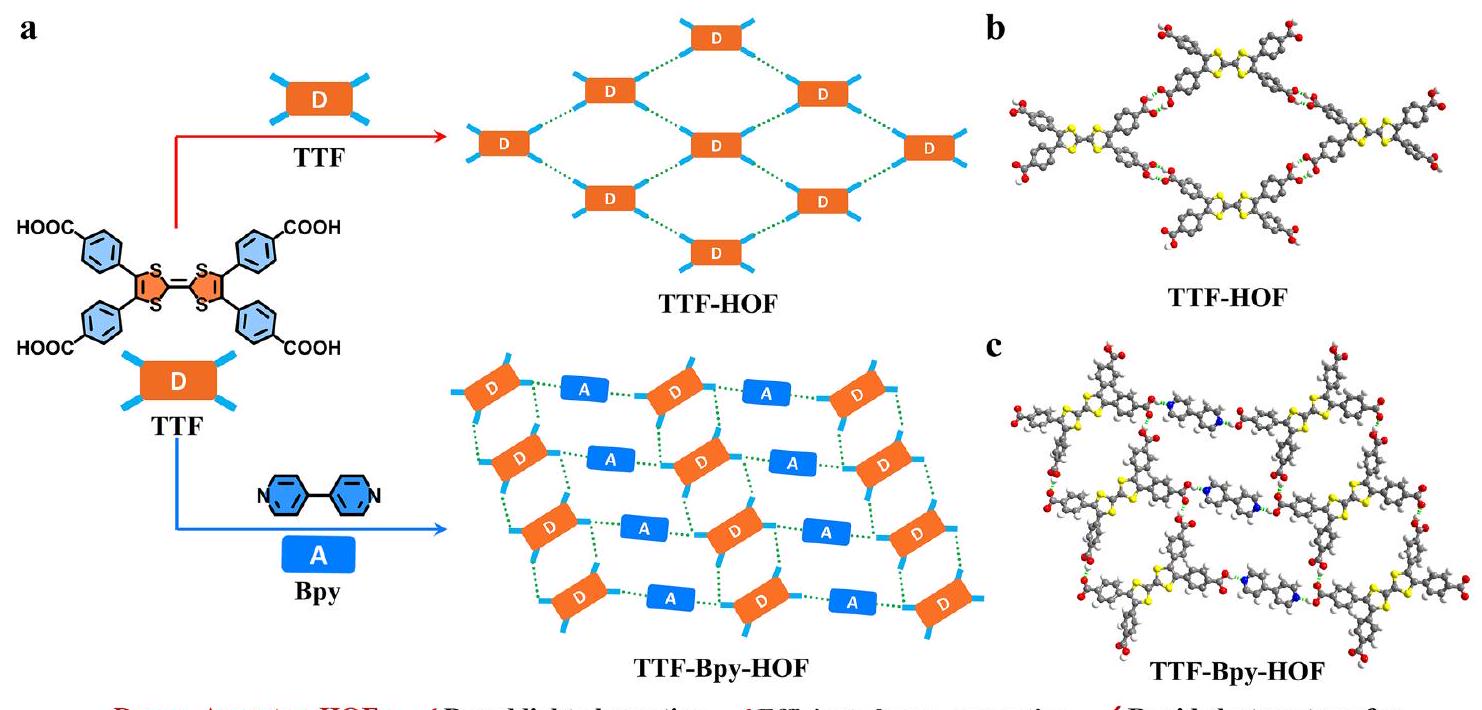
تم تحضير المحفزات TTF-HOF و TTF-Bpy-HOF وفقًا للطرق التي تم الإبلاغ عنها سابقًا (الشكل 1a والجدول التكميلي 1)يظهر الهيكل البلوري لـ TTF-HOF أن كل جزيء TTF متصل بأربعة جزيئات مكافئة من خلال ثنائي.روابط الهيدروجين ) بين المجموعات الكربوكسيلية لجزيئات TTF المجاورة، مما يؤدي إلى طبقة ثنائية الأبعاد (2D) مع مسام على شكل معين. تتراص الطبقات الثنائية الأبعاد المجاورة معًا من خلال وضع AA، مما يشكل هيكلًا فوق جزيئي ثلاثي الأبعاد مسامي بقنوات على شكل معين. تم قياس حجم القناة ليكون (الشكل التوضيحي التكميلي 1). عند إدخال Bpy، فإن الثنائي تتعطل الروابط الهيدروجينية. بدلاً من ذلك، هناك نوعان من الروابط الهيدروجينية التي تساهم في تشكيل TTF-Bpy-HOF (الشكل 1c). أحدهما هو رابطة هيدروجينية بين المجموعة الكربوكسيلية والجزء البيريديني )، والآخر هو رابطة هيدروجينية ) بين المجموعات الكربوكسيلية. من خلال هذه التفاعلات الروابط الهيدروجينية، يتم ربط TTF و Bpy، مما يشكل طبقة فوق جزيئية ثنائية الأبعاد مع نوعين من المسام (الشكل 1c). كل طبقة فوق جزيئية ثنائية الأبعاد تتراص بشكل إضافي مع الطبقات المجاورة من خلال تكديس التفاعلات، وتوليد إطار فوق جزيئي مسامي ثلاثي الأبعاد مع قنوات أحادية البعد (الشكل التوضيحي 2). تم توصيف الشكل والمكونات لـ TTF-HOF و TTF-Bpy-HOF بواسطة المجهر الإلكتروني الماسح (SEM) وطيف تحويل فورييه للأشعة تحت الحمراء (FTIR) وطيف الإلكترون الضوئي بالأشعة السينية (XPS) (الأشكال التوضيحية 3-12). تظهر صور SEM أن TTF-HOF و TTF-Bpy-HOF لهما شكل مكعب مشابه (الشكل التوضيحي 4). تتوافق أنماط حيود الأشعة السينية للمواد المسحوقة لـ TTF-HOF و TTF-Bpy-HOF بشكل جيد مع الأنماط المحاكاة المستمدة من بيانات بلوراتها المفردة (الأشكال التوضيحية 5 و 6)..
هياكل هاف دونور-أكسبتور: ✓ امتصاص ضوء واسع ✓ فصل شحنات فعال ✓ نقل إلكترونات سريع
الشكل 1 | توضيح تخطيطي. أ يوضح بشكل تخطيطي هياكل HOF العامة (TTF-HOF) وHOF المانح-المستقبل (TTF-Bpy-HOF)؛ الهياكل البلورية لـ ب TTF-HOF المدعومة بروابط هيدروجينية ثنائية O-H…O مع مسافة O…O ( ) من ، و TTF-Bpy-HOF مستقر بواسطة روابط هيدروجينية O-H…O و O-H…N [C (رمادي)، H (أبيض)، O (أحمر)، N (أزرق) و S (أصفر)].
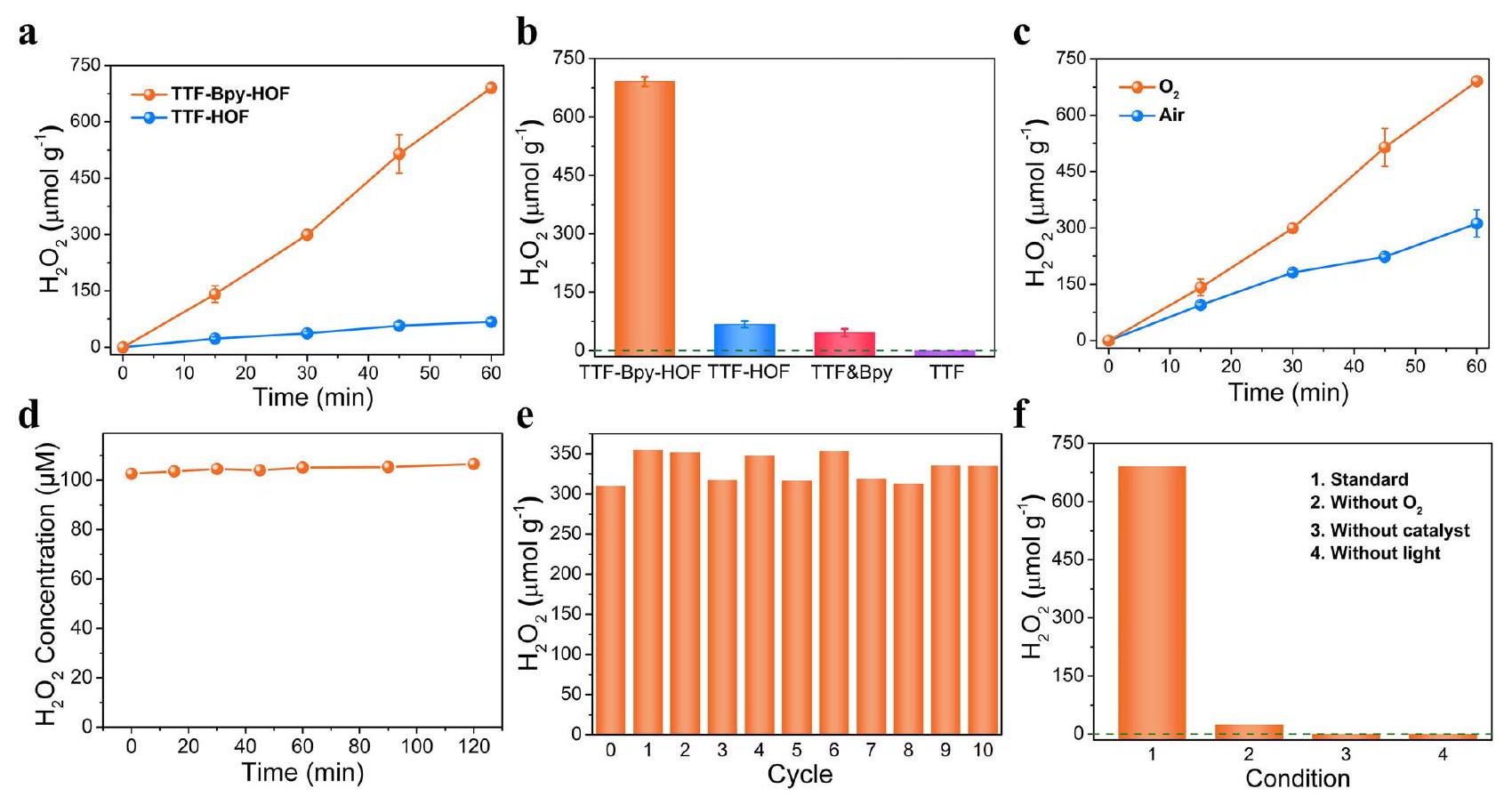
الشكل 2 | التحفيز الضوئينشاط الإنتاج. يعتمد على الوقتالتوليد الضوئي بواسطة TTF-HOF و TTF-Bpy-HOF، على التوالي، فيمحلول مائي مشبع؛النشاط الضوئي المحفز لـ TTF-Bpy-HOF و TTF-HOF و TTF&Bpy و TTF لـالتمثيل الضوئيمعتمد على الزمنالتوليد الضوئي بواسطة TTF-Bpy-HOF فيومحلول مائي مشبع بالهواء، على التوالي (أشرطة الخطأ في-كنا محسوب من نتائج ثلاثة تجارب متوازية؛دراسة التحلل بواسطة TTF-Bpy-HOF عند الإضاءة؛ تجارب الدورة لـ TTF-Bpy-HOF من أجلالتمثيل الضوئي (زمن التفاعل 30 دقيقة لكل دورة);تجارب التحكم لـ TTF-Bpy-HOF من أجلالتمثيل الضوئي.
تم تحديد المساحات السطحية لطريقة بروناور-إيميت-تيلر (BET) لـ TTF-HOF و TTF-Bpy-HOF على أنها و بواسطةتجربة الامتصاص عند 196 كلفن (الشكل التوضيحي 7). علاوة على ذلك، مقارنةً بطيف FTIR لـ TTF-HOF، تظهر قمم امتصاص جديدة عندتم العثور عليها لـ TTF-Bpy-HOF، والتي تت correspond إلى اهتزاز الشد/الانحناء لروابط C-N-C لـ Bpy (الشكل التوضيحي 8)بالإضافة إلى ذلك، تُظهر تحليلات XPS ورسم الخرائط باستخدام مطياف الأشعة السينية المشتتة للطاقة (EDS) التشتت البارز لعنصر النيتروجين في TTF-Bpy-HOF، بينما هو غائب في TTF-HOF (الأشكال التكميلية 9-12). تُظهر هذه النتائج الاختلافات في تركيبات TTF-HOF وTTF-Bpy-HOF، وهو ما يتماشى مع الهياكل البلورية.
طيف الانعكاس المنتشر للأشعة فوق البنفسجية والمرئية (UV-vis DRS) لـ TTF-Bpy-HOF يظهر امتصاصًا قويًا في النطاق المرئي (الشكل التكميلي 13). بالمقارنة مع TTF-HOF، لوحظ امتصاص ضوء موسع في TTF-Bpy-HOF، مما يفيد في تعزيز كفاءة تحويل الطاقة الشمسية إلى طاقة كيميائية. الفجوات الطاقية المستمدة من مخططات تاوك من UV-vis DRS هي 1.75 و 1.67 فولت لـ TTF-HOF و TTF-Bpy-HOF، على التوالي (الأشكال التكملية 14 و 15). لتحديد مستويات الطاقة، تم إجراء قياسات ميت-شوتكي الكهروكيميائية (الأشكال التكملية 16 و 17). استنادًا إلى هذه النتائج، تم حساب مواضع LUMO لـ TTF-HOF و TTF-Bpy-HOF لتكون 0.06 و 0.13 فولت (مقابل NHE، )، على التوالي، وتم حساب مواقع HOMO لـ TTF-HOF و TTF-Bpy-HOF لتكون 1.81 و 1.80 فولت (مقابل )، على التوالي. استنادًا إلى هذه النتائج، يمكن استنتاج مستويات الطاقة لـ TTFHOF و TTF-Bpy-HOF (الشكل التكميلي 18)، مما يشير إلى أنه من الممكن من الناحية الديناميكية الحرارية أن ينتج كلا HOFs عبرتقليل مقابل NHE، ) و أكسدة مقابل في الوقت نفسهلتلخيص، يمكن أن تعمل TTF-HOF وTTF-Bpy-HOF نظريًا كعوامل تحفيز ضوئي لعملية التمثيل الضوئي الشاملة.بفضل هياكل مستويات الطاقة المناسبة لها.
تحفيز ضوئيإنتاج
تجارب التخليق المدفوع بالضوء المرئيتمت في الماء النقي وجو دون أي محفزات إضافية، أو مواد حساسة للضوء، أو مواد تضحوية.تم تحديد الكمية الناتجة بواسطة الأيودومترية الملونة (الشكل التكميلي 19). كما هو موضح في الشكل 2أ، تظهر الملفات الحركية أن كميةيزداد تدريجياً مع زيادة وقت الإضاءة. يظهر TTFHOF مستوى معتدلمعدل الإنتاج لـ. مع وحدات Bpy المقدمة، التحفيز الضوئيتم تحسين معدل إنتاج TTF-Bpy-HOF بشكل ملحوظ إلى، أعلى بأكثر من 9 مرات من TTF-HOF (الشكل 2ب). وبالتالي، تلعب وحدات Bpy دورًا مهمًا في تعزيز النشاط لـالتمثيل الضوئي. حتى في ظل ظروف الماء النقي وجو الهواء، يظهر TTF-Bpy-HOF أيضًا أداءً تحفيزيًا ممتازًا لـالتمثيل الضوئي، بمعدل إنتاج (الشكل 2c والشكل التكميلي 20). أداء التحفيز لـ TTF-Bpy-HOF أعلى من معظم المحفزات الضوئية المبلغ عنها المستندة إلى MOFs وCOFs ونيتريد الكربون الجرافيتي والبوليمرات العضوية تحت ظروف مماثلة (الجدول التكميلي 2).
العوائد الكمية الظاهرة (AQYs) لـ TTF-Bpy-HOF للتفاعل الضوئي التحفيزيتمت دراسة الإنتاج بشكل أعمق عند 450 و470 و530 نانومتر (الشكل التوضيحي 21). وُجد أن قيم كفاءة إنتاج الكمية الكمية (AQYs) لـ TTF-Bpy-HOF تصل إلى أعلى مستوى، و ، على التوالي. تم استخدام جرعات مختلفة من TTF-Bpy-HOF لعملية التمثيل الضوئي لـتم العثور على أن إنتاجزاد ذلك مع زيادة جرعة TTF-Bpy-HOF (الشكل التوضيحي 22a)، وانخفض معدل الإنتاج قليلاً (الشكل التوضيحي 22b)، ربما لأن تركيز المحفز الأعلى يعيق امتصاص الضوء واستخدامه.. بالإضافة إلى ذلك، تم دراسة النشاط الضوئي التحفيزي لـ TTF-Bpy-HOF في أنظمة تحفيزية ذات قيم pH مختلفة. تظهر النتائج أن النشاط الضوئي التحفيزي لـ TTF-Bpy-HOF في المحاليل الحمضية أفضل من في الوسائط القلوية (الشكل التكميلي 23)، والذي يمكن أن يُعزى إلى الأنواع التي يتم استقرارها تحت مستوى منخفض
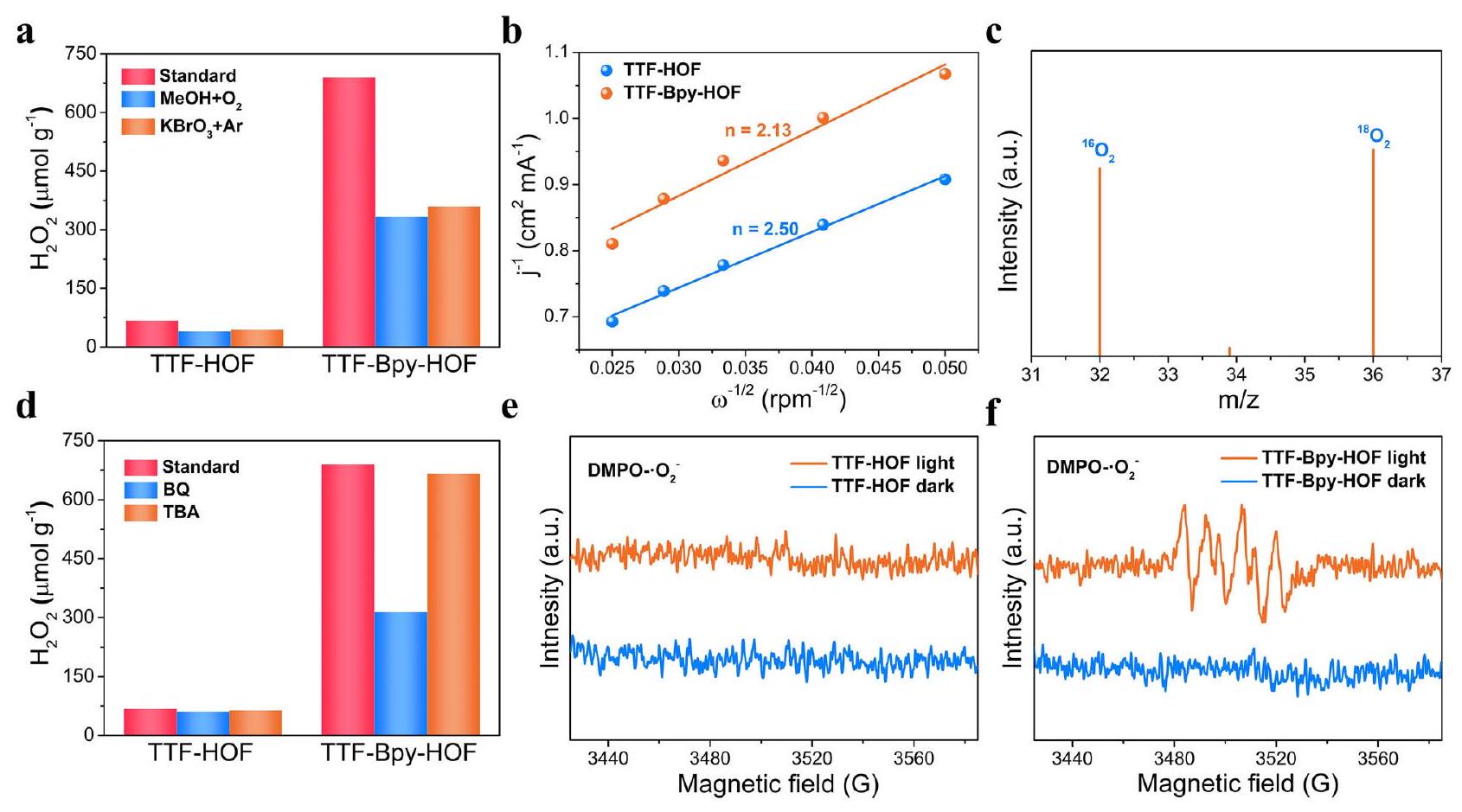
الشكل 3 | التحفيز الضوئينشاط الإنتاج. محفز ضوئيتوليد بواسطة TTF-HOF و TTF-Bpy-HOF فيكمستقبل للإلكترون) محلول وفي، كحل لقبول الفجوات؛مخططات كوتيكي ليفيتش التي تم الحصول عليها من قياسات RDE في محلول عازل الفوسفات ) مع استمرار التطهير؛ تحليل الكتلة الغازية – الطيف الكتلي للمنتجات المتحللة لـ تم إنتاجه من عملية التمثيل الضوئي بواسطة TTF-Bpy-HOF في-مشبعالحل؛ د مساهمة الأنواع النشطة المختلفة فيالتمثيل الضوئي بواسطة TTF-HOF وTTF-Bpy-HOF (BQ: بنزوquinone، TBA: تيرت-بيوتانول)؛ طيف EPR لـ DMPOمنTTF-HOF وتي تي إف-بي واي-إتش أو إف. ظروف الرقم الهيدروجيني لتسريع تكوينتم العثور على أنه كلما انخفضت قيمة الرقم الهيدروجيني، زادت النشاط الضوئي التحفيزي لـ TTF-Bpy-HOF لـبدأ الإنتاج في الزيادة أولاً (الشكل التوضيحي 24)، ليصل إلى أقصى حد منفيومع ذلك، عندما انخفضت قيمة الرقم الهيدروجيني أكثر إلى 3، انخفضت النشاط الضوئي التحفيزي لـ TTF-Bpy-HOF بشكل حاد، وهو ما يمكن أن يُعزى إلى عدم استقرار TTF-Bpy-HOF تحت الظروف الحمضية القوية، كما تأكدت نتائج حيود الأشعة السينية بالمسحوق (الشكل التوضيحي 25).
لإثبات مساهمة الروابط الهيدروجينية في TTF-HOF و TTF-Bpy-HOF لعملية التمثيل الضوئي لـ، قمنا أيضًا بتقييم أداء TTF والمزيج الفيزيائي من TTF و Bpy (TTF&Bpy) (الشكل 2b). تظهر النتائج أنه تحت نفس الظروف، تقريبًا لا يوجدتم إنشاؤه عبر TTF، وكمية محدودة فقط منتم الكشف عن ذلك عندما تم استخدام TTF&Bpy كعامل حفاز ضوئي (الشكل 2b والشكل التكميلي 26). تؤكد هذه النتائج أن الهياكل المرتبة المدعومة بروابط الهيدروجين لـ TTF-HOF و TTF-Bpy-HOF مهمة لنشاطها التحفيزي فيالتمثيل الضوئي. قد توفر هياكلها المرتبة على المدى الطويل قنوات نقل إلكترون خاصة، مما يمكن أن يسرع من معدل نقل الإلكترونات ويعزز التحفيز الضوئي.الإنتاج. التحلل المحتمل لـتمت دراسة TTF-HOF وTTF-Bpy-HOF تحت إشعاع الضوء. كما هو موضح في الشكل 2d والشكل التكميلية 27، كانت تركيزاتتغيرت بالكاد تحت الإشعاع المستمر لمدة ساعتين، مما يوحي بأنمستقر في وجود TTF-HOF/ TTF-Bpy-HOF وإشعاع الضوء. بالإضافة إلى ذلك، يظهر TTF-Bpy-HOF استقرارًا جيدًا خلال عمليةالتمثيل الضوئي. لمدة 10 دورات تحفيزية، كميات الناتجكانت شبه متطابقة تقريبًا (الشكل 2e)، مما يشير إلى أن TTF-Bpy-HOF يمكن أن يعمل كعامل تحفيز ضوئي مستقر لـالتمثيل الضوئي. بالإضافة إلى ذلك، تم تأكيد السلامة الهيكلية لـ TTF-Bpy-HOF أيضًا من خلال قياسات XRD وFTIR وSEM (الأشكال التكميلية 28-30). أظهرت بيانات XRD المسحوق أن TTF-HOF يمكن أن يحتفظ أيضًا بالاستقرار بعد التفاعل الضوئي التحفيزي (الشكل التكميلية 31).
لتحقيق عملية التفاعلتوليد بمزيد من العمق، سلسلة من التجارب الضابطة لـتم إجراء عملية التمثيل الضوئي على TTF-Bpy-HOF. كما هو موضح في الشكل 2f، لا يوجدتم توليده في غياب TTF-Bpy-HOF أو الإضاءة، مما يشير إلى أن كل من المحفز الضوئي والضوء لا غنى عنهما. عندماتم استبداله بـكان من الصعب اكتشافه، مما يشير إلى أنكانت تفاعل الاختزال متضمنة بالفعل فيالتمثيل الضوئيلتأكيد أصلالتحفيز الضوئيتمت عملية الاختزال على TTF-HOF وTTF-Bpy-HOF في وجود الميثانول (كعامل تضحية لاستبدالكما هو موضح في الشكل 3أ، كمية ملحوظة منيمكن ملاحظته، والذي يُنسب إلىالاختزال بواسطة الإلكترونات الناتجة عن الضوء. من ناحية أخرى، التحفيز الضوئيتمت أيضًا عملية الأكسدة على TTF-HOF و TTF-Bpy-HOF باستخدامككاشف للإلكترونات في محلول مائي مشبع بالآرغون. كمية كبيرة منتم الكشف عنه، مما يشير إلى أنتم أكسدته ضوئيًا.
قمنا بمزيد من الفحص لعمليةالتمثيل الضوئي بواسطة قياسات القطب الدوار (RDE) وقطب الحلقة الدوارة-القرص (RRDE). كما هو موضح في الشكل 3ب، استنادًا إلى منحنيات الفولتامترية ذات المسح الخطي (LSV) التي تم الحصول عليها من RDE، فإن متوسط أعداد نقل الإلكتروناتمنالتقليل، المستخرج من مخططات كوتيكي-ليفش (K-L)، كان 2.5 و2.13 على TTF-HOF وTTF-Bpy-HOF، على التوالي (الشكل 3b والشكل التوضيحي 32)، مما يؤكد أنعملية التخفيض قد حدثت. الـ القيمة لـ TTF-Bpy-HOF أقرب إلى 2 من تلك الخاصة بـ TTF-HOF، مما يدل على أن الانتقائية لـ تحسن التخفيض بعد إدخال وحدات Bpy. من الجانب الآخر، لتوضيح الـتم إجراء اختبارات RRDE تحت ظروف الأرجون لعملية الأكسدة. تم مسح جهد القطب الدوار من 0.2 إلى 2.5 فولت (مقابل Ag/AgCl) بمعدل مسحبينما تم الحفاظ على جهد ثابت قدره -0.23 فولت على قطب حلقة البلاتين. هنا، إذا كان تم إنتاجه فيالأكسدة عن طريق تدوير إلكترود القرص، ستحدث بسرعة
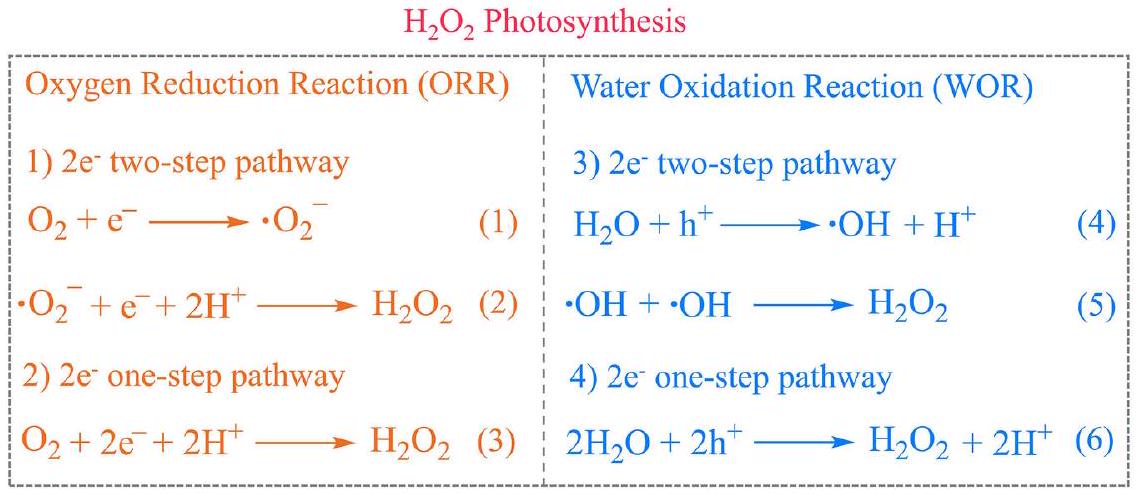
الشكل 4 | مساراتالتمثيل الضوئي. مساراتالتمثيل الضوئي من خلال تفاعل اختزال الأكسجين وتفاعل أكسدة الماء.
تنتشر إلى القطب الحلقي وتُختزل، مما ينتج عنه إشارة كشف واضحةكما هو موضح في الشكل التكميلي 33، زادت تيارات القرص مع الجهود الأعلى من، مما يشير إلى أن حدث الأكسدة عند قطب القرص الدوار لـ TTF-BpyHOF. لم تُلاحظ تيارات اختزال عند قطب الحلقة البلاتينية لـ TTF-Bpy-HOF، مما يعني عدم القدرة على التوليد.عبرالأكسدة. ومع ذلك، عندما تم تغيير الجهد المطبق على قطب الحلقة إلى +0.6 فولت (مقابل Ag/AgCl)، حدثت تغييرات في تيار الأكسدة، والتي يمكن أن تُعزى إلى أكسدةعلى قطب حلقة البلاتين. كشفت هذه النتيجة أنمسار الأكسدة يحدث على TTF-BpyHOF لـإنتاجيمكن ملاحظة نتائج مماثلة على TTFHOF أيضًا (الشكل التوضيحي التكميلي 34).
التم إجراء تجارب وسم النظائر بشكل إضافي لتأكيد مصدر الناتج.المنتجتم اكتشافه بواسطة الكروماتوغرافيا الغازية-مطياف الكتلة عن طريق تحويله إلىبمساعدةتجربةتمت دراسة عملية التمثيل الضوئي على TTF-Bpy-HOF في-مشبع الحل. نسبة و مشتق من تحلل الضوء الناتجقريب من (الشكل 3ج)، وهو ما يتماشى مع القيمة النظرية. النتائج المذكورة أعلاه تثبت بشكل قاطع أن تخليق الكلوروفيل فوق TTF-HOF و TTF-Bpy-HOF يمر عبر قناتين مزدوجتين منتقليل والأكسدة.
آلية التحفيز
من المعروف جيدًا أن طرقالتمثيل الضوئي عبرتخفيض يشملعملية من خطوتين معكأنواع وسيطة [الشكل 4، المعادلات (1)-(2)]، وعملية خطوة واحدة [الشكل 4، المعادلة (3)]طرقالتمثيل الضوئي عبرتشمل الأكسدةعملية من خطوتين معكنوع وسيط [الشكل 4، المعادلات (4)-(5)]، وعملية خطوة واحدة [الشكل 4، المعادلة (6)]لتوضيح مسارات التفاعلتقليل والأكسدة لـتم إجراء اختبارات إخماد الأنواع النشطة، حيث تم استخدام البنزوكينون (BQ) والتيرتبيوتانول (TBA) كمواد مساعدة.والجذور، على التواليكما هو موضح في الشكل 3d، التحفيز الضوئيلم ينخفض الإنتاج على TTF-HOF وTTF-Bpy-HOF عند إضافة TBA إلى نظام التفاعل، مما يشير إلى أنه بالنسبة لكل من TTF-HOF وTTF-Bpy-HOF، فإنالأكسدة تمر عبرعملية خطوة واحدة للتخليق. من ناحية أخرى، التحفيز الضوئيكان الإنتاج فوق TTF-HOF تقريبًا غير متأثر عند إضافة BQ، في حين تم تثبيط TTF-Bpy-HOF بشكل كبير بعد إضافة BQ. تشير هذه الملاحظات إلى أنه بالنسبة لـ TTF-HOF، فإنتحفيز ضوئي عبرتخفيض يخضع لـعملية من خطوة واحدة، في حين أن TTF-Bpy-HOF يخضع لـعملية من خطوتين، حيث – هو الوسيط المهم المكتشف.
تم إجراء قياسات الرنين المغناطيسي الإلكتروني (EPR) للكشف عن الأنواع النشطة من الأكسجين التي قد تتولد أثناءالتمثيل الضوئي؛ 5,5-دايمثيل-1-بيرولين – تم استخدام أكسيد (DMPO) كعامل لاصطياد الدوران. تظهر طيفيات EPR لـ TTF-HOF وTTF-Bpy-HOF أنه لم يتم الكشف عن أي إشارة لـ DMPO-•OH خلال العمليات الضوئية التحفيزية (الشكل التكميلي 35). من الجدير بالذكر أنه لم يتم الكشف عن أي إشارة لـ DMPO-تم الكشف عن TTF-HOF، في حين أن هناك ست إشارات نموذجية ل DMPO-تم ملاحظته بوضوح لـ TTF-Bpy-HOF (الشكل 3e، f)، مما يشير إلى تكوينالوسطاء. تؤكد هذه الملاحظات بشكل أكبر أنالأكسدة على كل من TTF-HOF و TTF-Bpy-HOF تحدثعمليات خطوة واحدة، بينماالاختزال على TTF-HOF وTTF-Bpy-HOF يمر عبر مسارات تفاعل مختلفة. الأول هوعملية من خطوة واحدة، في حين أن الأخيرة هيعملية من خطوتين. هذه النتيجة تتماشى مع نتائج اختبارات التبريد المذكورة أعلاه.. علاوة على ذلك، تم تسجيل طيف FTIR في الموقع لـ TTF-HOF و TTF-Bpy-HOF خلال عمليات التمثيل الضوئي. كما هو موضح في الشكل التوضيحي 36، بالنسبة لـ TTF-HOF، فإن شدة الذروة عندزاد تدريجياً مع تقدم التفاعل الضوئي الحفاز، والذي يمكن أن يُعزى إلى الهيدروبيروكسيد الم adsorb على السطح.من الجدير بالذكر أنه بالمقارنة مع TTF-HOF، توجد قمتان اهتزازيتان جديدتان تقعان عند 1200 وتمت ملاحظتها لـ TTF-Bpy-HOF، والتي يمكن أن تُنسب إلى و على التواليهو ناتج الاختزال الإلكتروني الفردي لـ، مما يشير إلى أن الاختزال الضوئي على TTF-Bpy-HOF يخضع لـعملية من خطوتين للإنتاج.
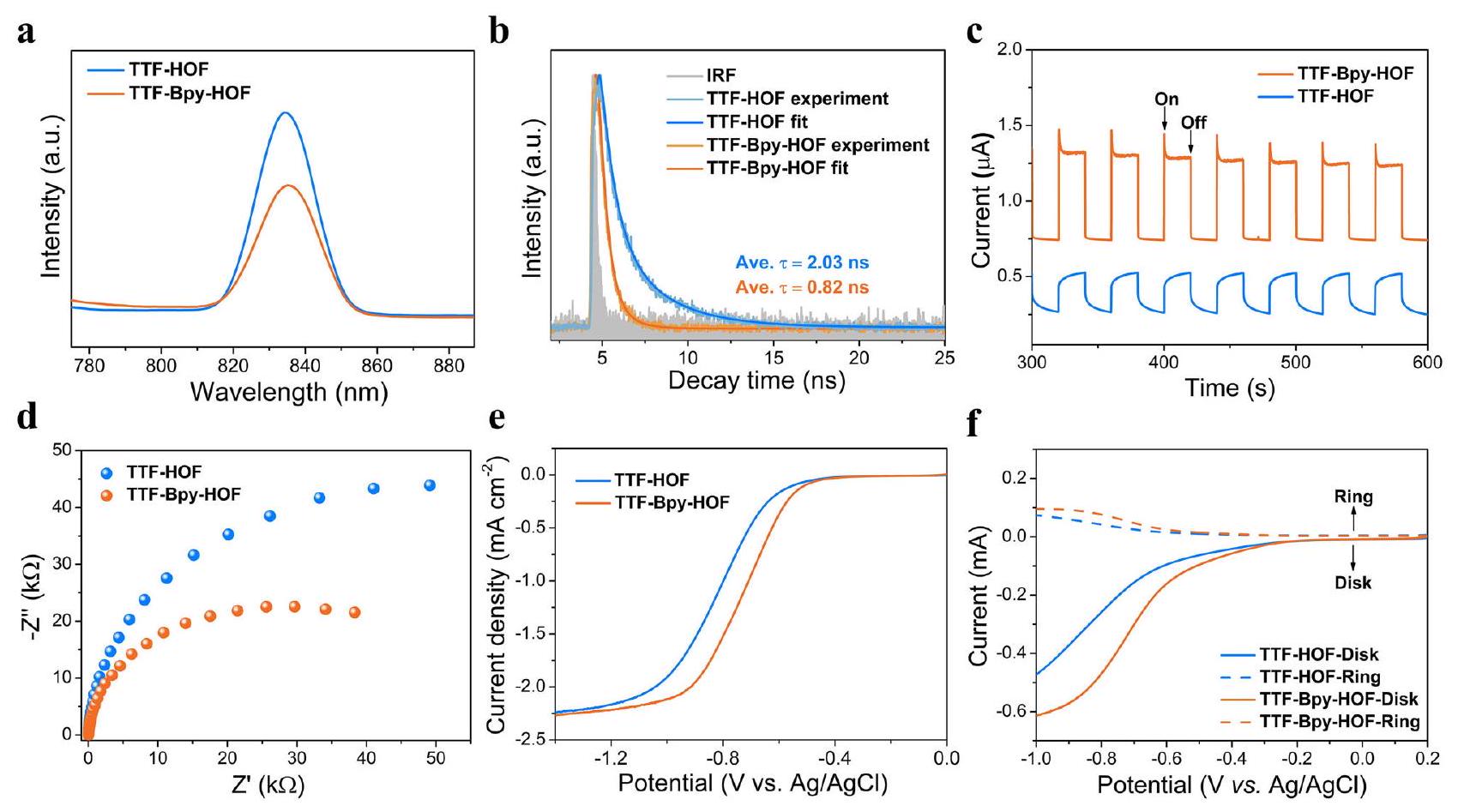
لفهم النشاط الضوئي المحفز المعزز بشكل كبير لـ TTF-Bpy-HOF فيتم إجراء قياس الطيف الضوئي للضوء المنبعث (PL) لعملية التمثيل الضوئي. من الواضح أن طيف PL لـ TTF-Bpy-HOF يظهر انبعاثًا مخففًا بشكل ملحوظ مقارنةً بـ TTF-HOF، مما يشير إلى أن إعادة التركيب للالكترونات والثقوب الناتجة عن الضوء قد تم تقليلها بشكل كبير (الشكل 5a). علاوة على ذلك، كشفت طيف الفوتولومينسنس الزمنية (TRPL) عن عمر متوسط مختصر للإكسيتون يبلغ 2.03 نانوثانية لـ TTF-HOF مقارنةً بـ 0.82 نانوثانية لـ TTF-Bpy-HOF، مما يوضح أن إدخال وحدات Bpy يسرع بشكل كبير من نقل الشحنة (الشكل 5b). أظهر اختبار استجابة التيار الضوئي أن TTF-Bpy-HOF لديه كثافة تيار ضوئي أعلى من TTF-HOF، مما يشير إلى كفاءة فصل أفضل للإلكترونات الناتجة عن الضوء في TTF-Bpy-HOF مقارنةً بـ TTF-HOF (الشكل 5c). للحصول على مزيد من الرؤى حول حركية نقل الشحنة، تم إجراء قياس الطيف الكهربائي للمعاوقة (EIS) على TTF-HOF وTTF-Bpy-HOF. كما هو موضح في الشكل 5d، فإن نصف قطر قوس الدائرة في مخطط نايكويست لـ TTF-Bpy-HOF أصغر بكثير من ذلك لـ TTF-HOF، مما يشير أيضًا إلى سرعة نقل الشحنة في TTF-Bpy-HOF، مما يسهل كفاءة فصل الإلكترونات والثقوب الناتجة عن الضوء. بالإضافة إلى ذلك، تم توضيح الأداء المتفوق لـ TTF-Bpy-HOF باستخدام قياسات RDE وRRDE في محلول عازل فوسفات 0.1 م (PBS). تظهر منحنيات LSV المستمدة من RDE أن الجهد الابتدائي وجهد نصف الموجة لـ TTF-Bpy-HOF أكثر إيجابية من TTF-HOF، مما يشير إلى التفوق.انخفاض النشاط التحفيزي للتقليل لـ TTF-Bpy-HOF مقارنةً بـ TTF-HOF (الشكل 5e). التيار الحلقي لـ TTF-Bpy-HOF أعلى بكثير من TTF-HOF.
الشكل 5 | التوصيف الطيفي والكهربائي الكيميائي. أ) طيف الفوتولومينسنس، ب) مطيافية الفوتولومينسنس الزمنية، ج) استجابة التيار الضوئي العابر، د) مطيافية impedancia الكهروكيميائية من TTF-HOF و TTF-Bpy-HOF (وظيفة استجابة أداة IRF)؛ الفولتموجرامات ذات المسح الخطي RDE ومنحنى استقطاب RRDE لـ TTF-HOF و TTF-Bpy-HOF تم قياسه عند 1600 دورة في الدقيقة في محلول مخزن فوسفات 0.1 م تحتالغلاف الجوي. يثبت أن المزيد منتم إنتاجه على TTF-Bpy-HOF (الشكل 5f). بالإضافة إلى ذلك، تم ملاحظة تيار أكسدة أعلى لـ TTF-Bpy-HOF تحت جو الأرجون من قياس RRDE، مما يشير إلى التحسينأداء الأكسدة لـ TTF-Bpy-HOF مقارنة بـ TTFHOF (الشكل التوضيحي 37). علاوة على ذلك، تم دراسة المحبة للماء لـ TTFHOF وTTF-Bpy-HOF من خلال قياسات زاوية تماس الماء. وُجد أن TTF-Bpy-HOF أكثر كرهًا للماء (مع زاوية تماس قدرها ) من TTF-HOF ( )، الذي كان ميسراً لـ إزالة الامتصاص، وبالتالي تعزيزتفاعل الاختزال (ORR) وتفاعل أكسدة الماء 2e (WOR) (الشكل التوضيحي التكميلي 38).
لتلخيص ما سبق، تدعم النتائج التجريبية المذكورة أعلاه بقوة النشاط التحفيزي الأفضل لـ TTF-Bpy-HOF مقارنةً بـ TTF-HOF في عملية التمثيل الضوئي الكلية.إن إدخال Bpy، من خلال بناء وحدات هيكلية مانحة-مستقبلة TTFBpy في TTF-Bpy-HOF، يعزز بشكل جيد نقل الإلكترونات ويثبط بشكل فعال إعادة اتحاد الإلكترونات والثقوب الناتجة عن الضوء، مما يعزز بشكل كبير النشاط التحفيزي لـالتمثيل الضوئي بشكل عام. يجب ملاحظة أن الأنشطة التحفيزية لـ TTF-Bpy-HOF وTTF-HOF تتحدد بواسطة عوامل متعددة. على الرغم من أن مساحة السطح BET لـ TTF-Bpy-HOF أقل قليلاً من تلك الخاصة بـ TTF-HOF (الشكل التوضيحي 7)، فإن إدخال Bpy يوفر المزيد من المواقع النشطة وقنوات نقل الإلكترون، مما يمنح TTF-Bpy-HOF نشاطًا تحفيزيًا أعلى.
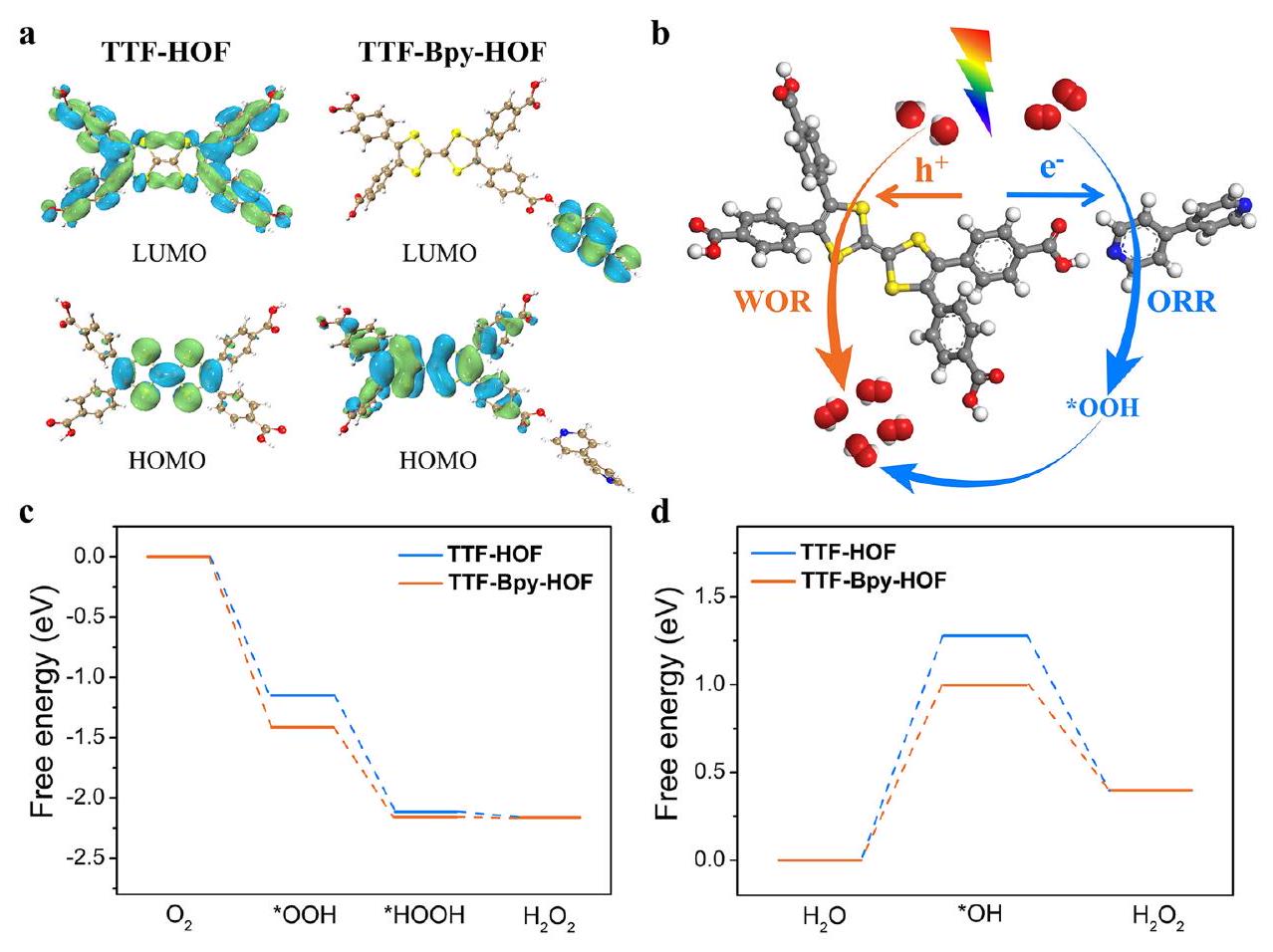
النشاط التحفيزي المعزز لـ TTF-Bpy-HOF فيتم توضيح عملية التمثيل الضوئي بشكل نظري. كما هو موضح في الشكل 6a، فإن المساهمة الرئيسية في HOMO و LUMO في TTF-HOF تنبع بشكل أساسي من جزء TTF. بالمقابل، في TTF-Bpy-HOF، يتمركز HOMO و LUMO بشكل أساسي على جزئي TTF و Bpy، على التوالي، مما يشير إلى فصل مكاني بارز بين هذه المدارات. يساعد هذا الفصل المكاني البارز، المشابه لمفهوم “مراكز الأكسدة والاختزال المفصولة مكانيًا”، في تقليل إعادة اتحاد الإلكترونات والثقوب وزيادة كفاءة التحفيز الضوئي لـإنتاج. علاوة على ذلك، تم حساب الهياكل الإلكترونية في الحالة المثارة لـ TTF-HOF و TTF-Bpy-HOF باستخدام طريقة نظرية الكثافة الوظيفية المعتمدة على الزمن (TDDFT). تظهر النتائج أن TTF-Bpy-HOF، التي تتميز بـ هيكل المانح-المستقبل، لديه كفاءة أفضل في فصل الشحنات (الشكل التكميلي 39)“، الذي يتوافق جيدًا مع نتائج التجربة. بالإضافة إلى ذلك، فإن نقل الشحنة (لروابط الهيدروجين لـ و تم حسابه. كما هو موضح في الجدول التكميلي 3،رابطة الهيدروجين أظهرت نقل شحنة أكثر من، مما يدل على نقل إلكترون أكثر كفاءةمنالذي يمكن أن يساهم أيضًا في تعزيز النشاط الضوئي التحفيزي لـ TTF-Bpy-HOFاستنادًا إلى التوصيفات المذكورة أعلاه ونتائج الحسابات النظرية، فإن هناك آلية محتملة لـ TTF-Bpy-HOF لـيمكن اقتراح عملية التمثيل الضوئي بشكل عام. كما هو موضح في الشكل 6b، تحت إضاءة الضوء المرئي، تمتص وحدات TTF في TTF-Bpy-HOF الفوتونات ويفصل زوج الإلكترون والثقب. ينتقل الإلكترون الناتج عن الضوء إلى جزء Bpy ويبقى الثقب الناتج عن الضوء في جزء TTF. بعد ذلك، تحدث تفاعلات اختزال الأكسجين (ORR) وأكسدة الماء (WOR) في نفس الوقت على هذين الجزئين. يخضع تفاعل أكسدة الماء لعملية مباشرةعملية خطوة واحدة لعملية التمثيل الضوئيعلى وحدة TTF من TTF-Bpy-HOF، بينماتفاعل الاختزال يمر عبرعملية من خطوتين [الشكل 4، المعادلة (6)]، أي أن ذرة النيتروجين في Bpy تقبل إلكترونًا من TTF عند الإضاءة، ثم ينتقل الإلكترون إلىالممتص على ذرة النيتروجين لتكوينمتوسط [الشكل 4، المعادلة (1)]، ثم الـالوسيط يقبل إلكترونًا واحدًا واثنين من البروتونات لتوليد [الشكل 4، المعادلة (2)].
تم إجراء حسابات نظرية الكثافة الوظيفية (DFT) لاستكشاف الآلية التحفيزية لـ TTF-Bpy-HOF لـالتمثيل الضوئي بمزيد من العمق (الجدول التكميلي 4 والأشكال التكملية 40-45). أولاً، الـتمت دراسة مواقع الامتزاز في TTF-HOF وTTF-BpyHOF. تظهر النتائج أن مجموعات الفينيل في TTF-HOF لديها طاقة امتزاز أعلى (الشكل التكميلي 41)، مما يشير إلى أنالجزيء يُمتص بسهولة أكبر على الحلقات الفينيلية في TTF-HOF. ومع ذلك، بعد إدخال وحدات Bpy، فإنمن المرجح أن تمتص الجزيئات على حلقات البيريديل في TTF-BpyHOF ثمتحدث تفاعل الاختزال (الشكل التوضيحي 42). مسار التفاعل والفروق في الطاقة الحرة غيبس المقابلةمنتقليل والأكسدة فوق TTF-HOF و TTF-
الشكل 6 | حساب DFT. أ) HOMO و LUMO لـ TTF-HOF و TTF-Bpy-HOF؛ ب) مخطط تخطيطي للتركيب الضوئيمن خلالتقليل مخططات الطاقة لـتقليل ومسارات أكسدة الماء نحوإنتاج على TTF-HOF و TTF-Bpy-HOF. تفاعل (ORR) ومسارات تفاعل أكسدة الماء (WOR)؛ تم حساب الطاقة الحرة-
تمت دراسة Bpy-HOF بشكل إضافي من خلال حسابات DFT (الأشكال التكميلية 43-45). كما هو موضح في الشكل 6c، فإن العمليات الكاملة لـتقليل إلىتكون تلقائية مع مخطط الطاقة الذي ينحدر لكلا من TTF-HOF وTTF-Bpy-HOF. ومن الجدير بالذكر أن كانت قيمة تكوين *OOH تساوي -1.415 إلكترون فولت لـ TTF-Bpy-HOF، وهي أقل من تلك الخاصة بـ TTF-HOF (-1.149 إلكترون فولت)، مما يشير إلى أن الامتصاصيمكن تنشيط TTF-Bpy-HOF بسهولة أكبر إلى *OOH، الذي يخضع بعد ذلك لمزيد من البروتنة لتكوين *HOOH. بالإضافة إلى ذلك،يتم امتصاصه بسهولة من TTF-Bpy-HOF بسبب المنظر الطاقي المنحدر، مما يؤدي إلى كفاءة أكبرالجيل. من أجلالأكسدة لتوليدعمليات تشكيل وسائط *OH غير تلقائية، وخطوة دمج وسائط *OH اثنتين لتشكيل هو عفوي (الشكل 6d). وبالتالي، فإن تكوين * OH هو الخطوة المحددة لمعدل التفاعل (RDS) هنا. ومن الجدير بالذكر أن لـ RDS لـ TTF-Bpy-HOF (0.997 eV) أقل بكثير من TTF-HOF، مما يشير إلى أن نشاط TTF-Bpy-HOF لـالإنتاج أفضل بكثير من إنتاج TTF-HOF، وهو ما يتماشى مع الملاحظات التجريبية.
نقاش
باختصار، وجدنا أن بناء HOFs مانحة-مستقبلة يمكن أن يعزز بشكل كبير النشاط الضوئي الشامل لعملية التمثيل الضوئي.من و في غياب أي محفزات إضافية، أو مواد حساسة للضوء، أو عوامل تضحوية، يمكن لمتبرع-مستقبل TTF-Bpy-HOF أن يتزاوجتفاعل اختزال مع تفاعل أكسدة الماء، ينتج في الوقت نفسه تحت إضاءة الضوء المرئي. تصل معدل الإنتاج إلى أعلى مستوى من ، أعلى بأكثر من 9 مرات من TTF-HOF. تكشف نتائج التجارب وحسابات DFT أن وحدات Bpy المدخلة في TTF-Bpy-HOF لا تعمل فقط على تحسين مسارات التفاعل ولكن أيضًا تعزز فصل الشحنات وتحسن نقل الإلكترونات، مما يعزز بشكل كبير الأداء التحفيزي بشكل عام.التمثيل الضوئي. يمهد هذا العمل الطريق للتصميم العقلاني لمحفزات قائمة على HOFs فعالة للتمثيل الضوئي الاصطناعي.
طرق
المواد والتوصيف
تيتراهيدروفوران (AR، مواد الطاقة الكيميائية)، 4,4′-بيبيريدين (98%، مواد الطاقة الكيميائية)، تيترا ثيا فلفالين-3,4,5,6-تيتراكس(حمض البنزويك-4) (98%، أداماس-بيتا)، هيدروجين فثاليت البوتاسيوم (الـيوديد البوتاسيوم (KI، 99%، العلّاء). تم الحصول على جميع المواد الكيميائية والمواد تجارياً واستخدامها دون مزيد من التنقية. تم تجفيف المذيبات وتقطيرها قبل استخدامها في تخليق المحفز. نقاء و همتم جمع أنماط حيود الأشعة السينية البودرة على جهاز حيود الأشعة السينية الذكي (SmartLab 9 kW، ريجاكو، اليابان) المزود بكوبالت K.إشعاع. تم تسجيل أطياف FT-IR و FT-IR في الموقع على أجهزة طيف الأشعة تحت الحمراء Nicolet iS50، وتم تحضير العينات على شكل أقراص باستخدام KBr كداعم. تم الحصول على صور SEM باستخدام جهاز التحليل المجهري الإلكتروني الماسح Zeiss Supra 40. تم تسجيل أطياف امتصاص UV-Vis على جهاز الطيف الضوئي UV/VIS U-3900 (Hitachi). تم قياس أطياف الفلورية في الحالة الثابتة (PL) باستخدام جهاز الطيف الضوئي للفلورية F-4600 (Hitachi). تم الكشف عن زوال الفلورية في الزمن باستخدام جهاز الطيف الضوئي للفلورية FLS-1000 في الحالة الثابتة والحالة العابرة (Edinburgh Instruments Ltd.). تم إجراء قياسات طيف الإلكترون الضوئي (XPS) على جهاز طيف الإلكترون الضوئي ESCALAB250Xi باستخدام Al Kα كمصدر للإثارة (Thermo Scientific). تم قياس أطياف الرنين المغناطيسي الإلكتروني (EPR) على جهاز EMXplus-6/1 (Bruker، ألمانيا). نظير لـتم تحليلها باستخدام مطياف الكتلة (HPR-20 QIC).
تركيب TTF-HOF
تم تخليق TTF-HOF وفقًا للطريقة المذكورة في الأدبيات.حمض التترايثيافولفالين التتراكاربوكسيلي (TTF؛تم إذابته في 10 مل من الماء وTHFحل، وتم تحويل المحلول المختلط إلى قنينة سعة 20 مل. ثم تم وضع القنينة في فرن عند لمدة 72 ساعة دون إغلاق الغطاء للسماح لـ THF بالتبخر تدريجياً. بعد التبريد إلى درجة حرارة الغرفة، تم الحصول على بلورات بنية حمراء داكنة (العائد).
تركيب TTF-Bpy-HOF
تم تخليق TTF-Bpy-HOF وفقًا للطريقة المذكورة في الأدبيات.. تي تي إف و تم إذابة -بيبيريدين (Bpy؛ 4.7 ملغ، 0.03 مليمول) في THF (10 مل)، وتم تحريك المزيج عندلمدة ساعتين، تم تصفية المحلول وتبخيره ببطء، فتشكلت بلورات سوداء من المحلول.العائد بناءً على TTF).
تحفيز ضوئيإنتاج
في تجربة نموذجية، عملية التمثيل الضوئي لـتم تنفيذ ذلك في أنبوب زجاجي سعة 18 مل يحتوي على 1 ملغ من المحفز الضوئي و 5 مل من الماء المقطر عندتحتالغلاف الجوي. ثم، تم تعريض النظام لمصباح زينون بقوة 300 واط (Microsolar300، بكين بيرفكتلايت) مع فلتر قطع بطول موجي 420 نانومتر.
القياسات الكهروضوئية الكيميائية
تمت دراسة الخصائص الضوئية الكهروكيميائية لـ TTF-HOF و TTF-Bpy-HOF على جهاز عمل كهربائي (CHI760E) باستخدام خلية كيميائية ضوئية قياسية ذات ثلاثة أقطاب وفقًا لطريقة معدلة من الأدبيات. تم تحضير أكسيد القصدير الفلوري (FTO) المغطى بالعينة، وسلك البلاتين، وتعمل كالأقطاب العاملة والمساعدة والمرجعية، على التوالي. تم تحضير القطب العامل FTO المغلف بمواد HOF على النحو التالي. أولاً، تم تنظيف القطب FTO النقي بواسطة الموجات فوق الصوتية في الماء المقطر، والإيثانول المطلق، والأسيتون، والإيثانول المطلق لمدة 20 دقيقة بشكل متسلسل، ثم تم تجفيفه في الفراغ. بعد ذلك، تم توزيع مواد HOF (2 ملغ) في محلول مختلط من الماء المنزوع الأيونات.ونافيونتمت المعالجة بالموجات فوق الصوتية لمدة ساعتين، وطُحنت للحصول على معلق، الذي تم تغطيته بشكل موحد علىتم معالجة قطب FTO. تم تجفيف قطب FTO المغلف في درجة حرارة الغرفة طوال الليل للحصول على القطب العامل. تم قياس التيار الضوئي عند 0.2 فولت (مقابل. ) مع مصباح زينون بقوة 300 واط من خلال الإشعاع المتقطع. تم الحصول على مخططات موت-شوتكي تحت استقطاب جهد التيار المباشر عند ترددات مختلفة تبلغ 800 و 1000 و 1200 هرتز، على التوالي. تم تسجيل طيف impedancia الكهروكيميائية (EIS) عند جهد مطبق قدره -0.4 فولت مقابل على نطاق التردد من 1 ميغاهرتز إلى 0.1 هرتز. تم إجراء جميع القياسات الضوئية الكهروكيميائية فيالكهارل المتلألئة معلمدة 30 دقيقة قبل الاختبار.
التفاصيل الحاسوبية
تم إجراء دراسات كيميائية كمية باستخدام نظرية الوظائف الكثافة (DFT) المطبقة في حزمة GAUSSIAN 16. تم حساب تحسين الهندسة وتحليل الترددات باستخدام الوظيفة الهجينة B3LYP مع تصحيح GD3BJ تحت مستوىمجموعات الأساس. يتم حساب طاقة الامتزاز للقطع الجزيئية المختلفة التي تمثل HOFs على النحو التالي:طاقات غيبس الحرةتمت أيضًا دراسة الجزيئات على مستوى B3LYP-D3BJ/6-311 G(D).
الإحصائيات وإمكانية التكرار
لم تكن التجارب عشوائية.
توفر البيانات
البيانات التي تدعم نتائج هذه الدراسة متاحة ضمن الورقة وملفات المعلومات التكميلية. يتم توفير بيانات المصدر مع هذه الورقة.
References
Perry, S. C. et al. Electrochemical synthesis of hydrogen peroxide from water and oxygen. Nat. Rev. Chem. 3, 442-458 (2019).
Xia, C., Kim, J. Y. & Wang, H. T. Recommended practice to report selectivity in electrochemical synthesis of . Nat. Catal. 3, 605-607 (2020).
Sun, Y. Y., Han, L. & Strasser, P. A comparative perspective of electrochemical and photochemical approaches for catalytic production. Chem. Soc. Rev. 49, 6605-6631(2020).
Chen, L. et al. Acetylene and diacetylene functionalized covalent triazine frameworks as metal-free photocatalysts for hydrogen peroxide production: a new two-electron water oxidation pathway. Adv. Mater. 32, 1904433 (2020).
Tan, D. et al. Covalent organic frameworks enable sustainable solar to hydrogen peroxide. Adv. Funct. Mater. 34, 2311655 (2024).
He, T. & Zhao, Y. L. Covalent organic frameworks for efficient hydrogen peroxide production. EnergyChem 6, 100121 (2024).
Shiraishi, Y. et al. Resorcinol-formaldehyde resins as metal-free semiconductor photocatalysts for solar-to-hydrogen peroxide energy conversion. Nat. Mater. 18, 985-993 (2019).
Zhang, Y., Pan, C., Li, J. & Zhu, Y. Recent progress in nonsacrificial generation using organic photocatalysts and in situ applications for environmental remediation. Acc. Mater. Res. 5, 76-88 (2024).
Hou, H. L., Zeng, X. K. & Zhang, X. W. Production of hydrogen peroxide by photocatalytic processes. Angew. Chem. Int. Ed. 59, 17356-17376 (2020).
Wu, S., Yu, H. T., Chen, S. & Quan, X. Enhanced photocatalytic production over carbon nitride by doping and defect engineering. ACS Catal. 10, 14380-14389 (2020).
Sun, P. Z., Tyree, C. & Huang, C.-H. Inactivation of escherichia coli, bacteriophage MS2, and bacillus spores under UV/ and UV/ peroxydisulfate advanced disinfection conditions. Environ. Sci. Technol. 50, 4448-4458 (2016).
Zeng, X. K., Liu, Y., Hu, X. Y. & Zhang, X. W. Photoredox catalysis over semiconductors for light-driven hydrogen peroxide production. Green Chem. 23, 1466-1494 (2021).
Feng, S. F. et al. Rational design of covalent organic frameworks with redox-active catechol moieties for high-performance overall photosynthesis of hydrogen peroxide. ACS Catal. 14, 7736-7745 (2024).
Yu, W. Y. et al. Photocatalytic hydrogen peroxide evolution: what is the most effective strategy? Nano Energy 104, 107906 (2022).
Li, K. J. et al. Highly efficient photocatalytic production in microdroplets: accelerated charge separation and transfer at interfaces. Energy Environ. Sci. 16, 1135-1145 (2023).
Teng, Z. Y. et al. Atomically dispersed antimony on carbon nitride for the artificial photosynthesis of hydrogen peroxide. Nat. Catal. 4, 374-384 (2021).
Wei, Z. et al. Efficient visible-light-driven selective oxygen reduction to hydrogen peroxide by oxygen-enriched graphitic carbon nitride polymers. Energy Environ. Sci. 11, 2581-2589 (2018).
Zhang, J.-H. et al. Metal-organic layers as a platform for developing single-atom catalysts for photochemical CO2 reduction. Nano Energy 80, 105542 (2021).
Qiu, J. H., Dai, D. L. & Yao, J. F. Tailoring metal-organic frameworks for photocatalytic production. Coord. Chem. Rev. 501, 215597 (2024).
Isaka, Y., Kawase, Y. D., Kuwahara, Y. & Mori, K. Two-phase system utilizing hydrophobic metal-organic frameworks (MOFs) for photocatalytic synthesis of hydrogen peroxide. Angew. Chem. Int. Ed. 58, 5402-5406 (2019).
Yong, Z. J. & Ma, T. Y. Solar-to- catalyzed by covalent organic frameworks. Angew. Chem. Int. Ed. 62, e202308980 (2023).
Zhi, Q. J. et al. Piperazine-linked metal phthalocyanine frameworks for highly efficient visible-light-driven photosynthesis. J. Am. Chem. Soc. 144, 21328-21336 (2022).
Li, L. Y. et al. Custom-design of strong electron/proton extractor on COFs for efficient photocatalytic production. Angew. Chem. Int. Ed. 63, e202320218 (2024).
Zhao, W. et al. Accelerated synthesis and discovery of covalent organic framework photocatalysts for hydrogen peroxide production. J. Am. Chem. Soc. 144, 9902-9909 (2022).
Chang, J.-N. et al. Oxidation-reduction molecular junction covalent organic frameworks for full reaction photosynthesis of . Angew. Chem. Int. Ed. 62, e202218868 (2024).
Kim, H., Shim, K., Lee, K. E., Han, J. W. & Zhu, Y. F. Photocatalytic production of from water and dioxygen only under visible light using organic polymers: systematic study of the effects of heteroatoms. Appl. Catal. B Environ. Energy 299, 120666 (2021).
Xie, Z. et al. Variation of chemical microenvironment of pores in hydrazone-linked covalent organic frameworks for photosynthesis of . Angew. Chem. Int. Ed. 63, e202410179 (2024).
Liu, L. et al. Linear conjugated polymers for solar-driven hydrogen peroxide production: the importance of catalyst stability. J. Am. Chem. Soc. 143, 19287-19293 (2021).
Baek, J. H. et al. Selective and efficient Gd-Doped BiVO photoanode for two-electron water oxidation to . ACS Energy Lett. 4, 720-728 (2019).
Wang, B., Lin, R.-B., Zhang, Z., Xiang, S. C. & Chen, B. L. Hydrogenbonded organic frameworks as a tunable platform for functional materials. J. Am. Chem. Soc. 142, 14399-14416 (2020).
Zhang, Z., Ye, Y., Xiang, S. C. & Chen, B. L. Exploring multifunctional hydrogen-bonded organic framework materials. Acc. Chem. Res. 55, 3752-3766 (2022).
Hu, F. et al. An ultrastable and easily regenerated hydrogen-bonded organic molecular framework with permanent porosity. Angew. Chem. Int. Ed. 56, 2101-2104 (2017).
Hisaki, I. et al. Acid responsive hydrogen-bonded organic frameworks. J. Am. Chem. Soc. 141, 2111-2121 (2019).
Ma, K. K. et al. Ultrastable mesoporous hydrogen-bonded organic framework-based fiber composites toward mustard gas detoxification. Cell Rep. Phys. Sci. 1, 100024 (2020).
Hisaki, I. et al. Hexaazatriphenylene-based hydrogen-bonded organic framework with permanent porosity and singlecrystallinity. Chem. Eur. J. 23, 11611-11619 (2017).
Li, Y. T. et al. Hydrogen-bonded frameworks for molecular structure determination. Nat. Commun. 10, 4477 (2019).
Liang, W. B. et al. Enzyme encapsulation in a porous hydrogen-bonded organic framework. J. Am. Chem. Soc. 141, 14298-14305 (2019).
Luo, X.-Z. et al. A microporous hydrogen-bonded organic framework: exceptional stability and highly selective adsorption of gas and liquid. J. Am. Chem. Soc. 135, 11684-11687 (2013).
Zhang, J.-H. et al. Ordered heterogeneity of molecular photosensitizer toward enhanced photocatalysis. Proc. Natl Acad. Sci. USA 119, e2118278119 (2022).
Yin, Q. et al. An ultra-robust and crystalline redeemable hydrogenbonded organic framework for synergistic chemo-photodynamic therapy. Angew. Chem. Int. Ed. 57, 7691-7696 (2018).
Chen, G., Huang, S., Ma, X., He, R. & Ouyang, G. F. Encapsulating and stabilizing enzymes using hydrogen-bonded organic frameworks. Nat. Protoc. 18, 2032-2050 (2023).
Chen, S. M. et al. Photo responsive electron and proton conductivity within a hydrogen-bonded organic framework. Angew. Chem. Int. Ed. 62, e202308418 (2023).
Zhang, A.-A., Wang, Z.-X., Fang, Z.-B., Li, J.-L. & Liu, T.-F. Long-range stacking brings high electron delocalization for enhanced photocatalytic activity in hydrogen-bonded organic framework. Angew. Chem. Int. Ed. 63, e202412777 (2024).
Yin, Q. et al. Metallization-prompted robust porphyrin-based hydrogen-bonded organic frameworks for photocatalytic CO2 reduction. Angew. Chem. Int. Ed. 61, e202115854 (2022).
Yu, B. et al. Robust biological hydrogen-bonded organic framework with post-functionalized rhenium(I) sites for efficient heterogeneous visible-light-driven reduction. Angew. Chem. Int. Ed. 60, 8983-8989 (2021).
Gao, X. Y. et al. Recent advancements of photo- and electro-active hydrogen-bonded organic frameworks. Sci. China Chem. 65, 2077-2095 (2022).
Lu, C. J. et al. Modulating the microenvironments of robust metal hydrogen-bonded organic frameworks for boosting photocatalytic hydrogen evolution. Angew. Chem. Int. Ed. 63, e202405451 (2024).
Zhang, Y. et al. generation from and on a near-infrared absorbing porphyrin supramolecular photocatalyst. Nat. Energy 8, 361-371 (2023).
Wan, X.-J., Li, C. X., Zhang, M. T. & Chen, Y. S. Acceptor-donoracceptor type molecules for high performance organic photovoltaics-chemistry and mechanism. Chem. Soc. Rev. 49, 2828-2842 (2020).
Chen, X., Zhang, X., Xiao, X., Wang, X. & Zhao, J. Z. Recent developments on understanding charge transfer in molecular electron donor-acceptor systems. Angew. Chem. Int. Ed. 62, e202216010 (2023).
Yang, C., Cheng, B., Xu, J. S., Yu, J. G. & Cao, S. W Donor-acceptorbased conjugated polymers for photocatalytic energy conversion. EnergyChem 6, 100116 (2024).
Xu, H. et al. Programming tetrathiafulvalene-based covalent organic frameworks for promoted photoinduced molecular oxygen activation. Angew. Chem. Int. Ed. 63, e202405476 (2024).
Zheng, X. M. et al. Hydrogen bonded-directed pure organic frameworks based on TTF-tetrabenzoic acid and bipyridine base. Synth. Met. 263, 116365 (2020).
Luo, Y.-H. et al. A dynamic 3D hydrogen-bonded organic frameworks with highly water affinity. Adv. Funct. Mater. 28, 1804822 (2018).
Zhang, X. et al. Developing Ni single-atom sites in carbon nitride for efficient photocatalytic production. Nat. Commun. 14, 7115 (2023).
Kofuji, Y. et al. Carbon nitride-aromatic diimide-graphene nanohybrids: metal-free photocatalysts for solar-to-hydrogen peroxide energy conversion with efficiency. J. Am. Chem. Soc. 138, 10019-10025 (2016).
García-Serna, J. et al. Engineering in direct synthesis of hydrogen peroxide: targets, reactors and guidelines for operational conditions. Green Chem. 16, 2320 (2014).
Mase, K., Yoneda, M., Yamada, Y. & Fukuzumi, S. Seawater usable for production and consumption of hydrogen peroxide as a solar fuel. Nat. Commun. 7, 11470 (2016).
Lu, J. N. et al. Synergistic metal-nonmetal active sites in a metalorganic cage for efficient photocatalytic synthesis of hydrogen peroxide in pure water. Angew. Chem. Int. Ed. 62, e202308505 (2023).
Chen, S. Y. et al. Identification of the highly active coordination motif for selective oxygen reduction to hydrogen peroxide. J. Am. Chem. Soc. 144, 14505-14516 (2022).
Kou, M. P. et al. Molecularly engineered covalent organic frameworks for hydrogen peroxide photosynthesis. Angew. Chem. Int. Ed. 61, e202200413 (2022).
Shi, X. J. et al. Understanding activity trends in electrochemical water oxidation to form hydrogen peroxide. Nat. Commun. 8, 701 (2017).
Zhou, Z. M. et al. A thioether-decorated triazine-based covalent organic framework towards overall photosynthesis without sacrificial agents. Appl. Catal. B Environ. Energy 334, 122862 (2023).
Luo, Y. et al. Sulfone-modified covalent organic frameworks enabling efficient photocatalytic hydrogen peroxide generation via
one-step two-electron reduction. Angew. Chem. Int. Ed. 62, e202305355 (2023).
Wang, H. Z., Yang, C., Chen, F. S., Zheng, G. F. & Han, Q. A crystalline partially fluorinated triazine covalent organic framework for efficient photosynthesis of hydrogen peroxide. Angew. Chem. Int. Ed. 61, e202202328 (2022).
Zhao, C. et al. Molecular level modulation of anthraquinonecontaining resorcinol-formaldehyde resin photocatalysts for production with exceeding efficiency. Angew. Chem. Int. Ed. 62, e202218318 (2023).
Cheng, H. et al. Rational design of covalent heptazine frameworks with spatially separated redox centers for high-efficiency photocatalytic hydrogen peroxide production. Adv. Mater. 34, 2107480 (2022).
Chen, Z. et al. Tuning excited state electronic structure and charge transport in covalent organic frameworks for enhanced photocatalytic performance. Nat. Commun. 14, 1106 (2023).
Cheng, J. et al. Fully conjugated 2D carbon-linked covalent organic frameworks for photocatalytic overall water splitting. Adv. Mater. 36, 2305313 (2024).
Cheng, M. et al. Nitrogen-doped carbonized polyaniline (N-CPANI) for peroxydisulfate (PDS) activation towards efficient degradation of doxycycline (DOX) via the non-radical pathway dominated by electron transfer. Chem. Eng. J. 453, 139810 (2023).
Tang, S., Yin, X., Wang, G., Lu, X. & Lu, T. Single titanium-oxide species implanted in 2D g- matrix as a highly efficient visiblelight reduction photocatalyst. Nano Res. 12, 457-462 (2019).
شكر وتقدير
D.-C.Z. يشكر المؤسسة الوطنية للعلوم الطبيعية في الصين (22271218) ومشروع المفتاح لمؤسسة تيانجين للعلوم الطبيعية (24JCZDJCOO22O). T.-B.L. يشكر البرنامج الوطني الرئيسي للبحث والتطوير في الصين (2022YFA1502902). Z.-M.G. يشكر مشروع الابتكار لطلاب الدراسات العليا في جامعة تيانجين للتكنولوجيا (YJ2396).
مساهمات المؤلفين
قام د.-س.ز. بتصميم الدراسة. قام ج.-هـ.ز. و ز.-م.ج. بإجراء التجارب. قام ج.و. بتشغيل حسابات DFT. قام ج.-هـ.ز. و ز.-م.ج. و ج.و. و د.-س.ز. و ت.-ب.ل. بتحليل البيانات. أشرف د.-س.ز. على التجارب. قام ج.-هـ.ز. و د.-س.ز. بكتابة الورقة معًا.
يجب توجيه المراسلات والطلبات للحصول على المواد إلى دي-تشانغ تشونغ.
معلومات مراجعة الأقران تشكر مجلة Nature Communications هانغشون شيو والآخرين من المراجعين المجهولين على مساهمتهم في مراجعة هذا العمل. يتوفر ملف مراجعة الأقران.
ملاحظة الناشر: تظل شركة سبرينجر ناتشر محايدة فيما يتعلق بالمطالبات القضائية في الخرائط المنشورة والانتماءات المؤسسية.
الوصول المفتوح هذه المقالة مرخصة بموجب رخصة المشاع الإبداعي النسب-غير التجارية-عدم الاشتقاق 4.0 الدولية، التي تسمح بأي استخدام غير تجاري، ومشاركة، وتوزيع، واستنساخ في أي وسيلة أو صيغة، طالما أنك تعطي الائتمان المناسب للمؤلفين الأصليين والمصدر، وتوفر رابطًا لرخصة المشاع الإبداعي، وتوضح إذا قمت بتعديل المادة المرخصة. ليس لديك إذن بموجب هذه الرخصة لمشاركة المواد المعدلة المشتقة من هذه المقالة أو أجزاء منها. الصور أو المواد الأخرى من طرف ثالث في هذه المقالة مشمولة في رخصة المشاع الإبداعي الخاصة بالمقالة، ما لم يُشار إلى خلاف ذلك في سطر الائتمان للمادة. إذا لم تكن المادة مشمولة في رخصة المشاع الإبداعي الخاصة بالمقالة واستخدامك المقصود غير مسموح به بموجب اللوائح القانونية أو يتجاوز الاستخدام المسموح به، ستحتاج إلى الحصول على إذن مباشرة من صاحب حقوق الطبع والنشر. لعرض نسخة من هذه الرخصة، قم بزيارة http:// creativecommons.org/licenses/by-nc-nd/4.0/. (ج) المؤلف(ون) 2025
معهد المواد الجديدة للطاقة والتقنيات منخفضة الكربون، كلية علوم المواد والهندسة، جامعة تيانجين للتكنولوجيا، تيانجين 300384، الصين.ساهم هؤلاء المؤلفون بالتساوي: جي-هونغ تشانغ، زهاو-مينغ جي. البريد الإلكتروني:dczhong@email.tjut.edu.cn
Hydrogen-bonded organic frameworks for photocatalytic synthesis of hydrogen peroxide
Received: 7 September 2024
Accepted: 7 March 2025
Published online: 12 March 2025
Check for updates
Ji-Hong Zhang , Zhao-Ming , Juan Wang , Di-Chang Zhong ⊗ & Tong-Bu Lu
Photocatalysis provides a sustainable and environment-friendly strategy to produce , yet the catalytic efficiency of overall photosynthesis needs to be further improved, especially in the absence of additional cocatalysts, photosensitizers and sacrificial agents. Here we find that hydrogen-bonded organic frameworks can serve as photocatalysts for overall photosynthesis under the above-mentioned conditions. Specifically, we constructed a donor-acceptor hydrogen-bonded organic framework that exhibits a high photocatalytic activity for overall photosynthesis, with a production rate of . The control experiments and theoretical calculation revealed that the hydrogen-bonded organic frameworks with donor-acceptor structures can not only accelerate the charge separation and transfer but also optimize the reaction pathways, which significantly boosts the photocatalytic efficiency in overall photosynthesis. This work provides insights into the design and development of efficient photocatalysts for overall photosynthesis.
Hydrogen peroxide ( ) is a crucial chemical with broad applications spanning various industrial processes, including bleaching, pulping, disinfection, environmental remediation . To date, the typical technology for industrial production is the anthraquinone method, which utilizes Pd-catalyzed cyclic hydrogenation and oxidation of alkyl-anthraquinones in organic solvents . This method comes with energy and environmental issues owing to substantial energy consumption and the formation of hazardous organic wastes . Therefore, it is essential to develop alternative, economical and environmentally sustainable approaches to synthesis.
Photocatalysis, utilizing visible light as an energy source, is regarded as a sustainable and environment-friendly strategy to replace the conventional route for production . Many photocatalysts, such as graphitic carbon nitride ( ), metal-organic frameworks (MOFs), covalent-organic frameworks (COFs), and organic polymers, have been used in photosynthesis . However, the photocatalytic efficiency for production needs to be further improved. Although using
sacrificial agents could effectively improve the photocatalytic efficiency, it would render the catalytic systems less economical. The development of advanced photocatalytic systems without additional sacrificial agents, that is, overall photosynthesis of from both reduction and oxidation, is urgently needed. Theoretically, the half-reaction of reduction could be readily achieved, as the LUMO positions of most photocatalysts are more negative than the theoretical oxygen reduction potential . In contrast, it is more challenging to achieve the half-reaction of oxidation, as the oxidation could undergo either a two-electron transfer process to produce versus ) or a fourelectron transfer process to produce versus ), and the latter is thermodynamically favorable in spite of a higher kinetic energy barrier because of more electrons and protons transfer involved. It is therefore unsurprising that only a few photocatalysts have achieved the overall photosynthesis of via reduction and oxidation processes simultaneously .
Hydrogen-bonded organic frameworks (HOFs) are a type of emerging porous crystalline materials assembled by organic molecules linked through hydrogen bonds and other intermolecular interactions . Assembled by weak intermolecular interactions, most HOFs show lower stabilities than MOFs and COFs, in which the structural units are connected by coordination/covalent bonds. However, besides hydrogen bonds, the stacking interactions, electrostatic interactions, and framework interpenetration can synergistically strengthen the stability of . Moreover, HOFs offer notable advantages, including low toxicity, mild synthesis, solution processability, and facile regeneration or healing by simple recrystallization. These features enable HOFs to show extensive applications in gas storage and separation, proton conduction, heterogeneous catalysis, biotechnology, medicine, and so on . In particular, recent studies have revealed that the stacking interactions can serve as channels to accelerate the electron transfer , which further extends the potential applications of HOFs in photocatalysis, encompassing hydrogen evolution, reduction, and organic pollutant degradation . However, HOFs as photocatalysts for synthesis have not been reported thus far.
Donor-acceptor structures, comprising electron-rich donor units and electron-deficient acceptor units, have been reported to facilitate the charge transfer from the donor to the acceptor. The electronic pull-push effect between the donor and acceptor units can greatly promote the separation and transfer of photogenerated electrons and holes . With the above consideration in mind, we have been devoted to developing donor-acceptor HOFs to boost the overall photosynthesis of . Herein, we report that the construction of donor-acceptor HOF could greatly increase the catalytic efficiency of overall photosynthesis from and (Fig. 1a). Specifically, we selected tetrathiafulvalene tetracarboxylic acid (TTF) as the electrondonating unit and 4,4′-bipydine (Bpy) as the electron-accepting unit. Using the hydrogen bonds between them, a donor-acceptor HOF (denoted as TTF-Bpy-HOF) was constructed. For comparison, a HOF (TTF-HOF) based on the hydrogen bonds between TTF molecules was also constructed. We found that the TTF-HOF can simultaneously catalyze synthesis via reduction and oxidation, with a rate of in the absence of any additional cocatalysts, photosensitizers, and sacrificial agents. More impressively, after the introduction of the acceptor moiety Bpy, the TTF-Bpy-HOF exhibits a
remarkably enhanced generation rate of , over 9 times higher than that of TTF-HOF. The photocatalytic and electron paramagnetic resonance (EPR) trapping experiments revealed that the Bpy units optimized the reaction paths for reduction. Moreover, the donor-acceptor structure can promote charge separation and transfer, thus greatly boosting the catalytic activity of overall photosynthesis. This work provides insights for the design and development of efficient photocatalysts for overall photosynthesis of from and .
Results
Preparation and structure determination
The TTF-HOF and TTF-Bpy-HOF catalysts were synthesized according to the methods previously reported (Fig. 1a and Supplementary Table 1) . The crystal structure of TTF-HOF shows that each TTF molecule is connected to four equivalent molecules through dimeric hydrogen bonds ( ) between the carboxylic groups of adjacent TTF molecules, resulting in a two-dimensional (2D) layer with rhombus pores (Fig. 1b). The adjacent 2D layers further stack together through AA mode, forming a 3D porous supramolecular structure with rhombus channels. The channel size is measured to be (Supplementary Fig. 1). Upon the introduction of Bpy, the dimeric hydrogen bonds are disrupted . Instead, two types of hydrogen bonds contributing to the formation of TTF-Bpy-HOF are present (Fig. 1c). One is the hydrogen bond between the carboxylic group and pyridyl moiety ( ), and the other is the hydrogen bond ( ) between the carboxylic groups. Through these hydrogen bond interactions, TTF and Bpy are linked, forming a 2D supramolecular layer with two types of pores (Fig. 1c). Each 2D supramolecular layer further stacks with adjacent layers through stacking interactions, generating a 3D porous supramolecular framework with 1D channels of (Supplementary Fig. 2). The morphology and compositions of TTF-HOF and TTF-Bpy-HOF were characterized by scanning electron microscopy (SEM), Fourier transform infrared (FTIR) spectroscopy and X-ray photoelectron spectroscopy (XPS) (Supplementary Figs. 3-12). SEM images show that TTF-HOF and TTF-Bpy-HOF have a similar cuboid morphology (Supplementary Fig. 4). The powder X-ray diffraction patterns for TTF-HOF and TTF-Bpy-HOF agree well with the simulated ones from their single crystal data (Supplementary Figs. 5 and 6) .
Donor-Acceptor HOFs: ✓ Broad light absorption ✓ Efficient charge separation ✓ Rapid electron transfer
Fig. 1 | Schematic illustration. a Schematically showing the structures of general HOF (TTF-HOF) and donor-acceptor HOF (TTF-Bpy-HOF); crystal structures of b TTF-HOF stabilized by dimeric O-H…O hydrogen bonds with the O…O distance
( ) of , and TTF-Bpy-HOF stabilized by O-H…O and O-H…N hydrogen bonds [C (grey), H (white), O (red), N (blue) and S (yellow)].
Fig. 2 | Photocatalytic production activity. a Time-dependent photogeneration by TTF-HOF and TTF-Bpy-HOF, respectively, in -saturated aqueous solution; photocatalytic activity of TTF-Bpy-HOF, TTF-HOF, TTF&Bpy and TTF for photosynthesis; time-dependent photogeneration by TTF-Bpy-HOF in and air-saturated aqueous solution, respectively (The error bars in -c were
calculated from the results of three parallel experiments); degradation study by TTF-Bpy-HOF upon illumination; e cycle experiments of TTF-Bpy-HOF for photosynthesis (reaction time of 30 min for each cycle); control experiments of TTF-Bpy-HOF for photosynthesis.
The Brunauer-Emmett-Teller (BET) surface areas for TTF-HOF and TTF-Bpy-HOF were determined to be and by the sorption experiment at 196 K (Supplementary Fig. 7). Moreover, compared with the FTIR spectrum of TTF-HOF, new absorption peaks at were found for TTF-Bpy-HOF, corresponding to the stretch/bending vibration of C-N-C bonds of Bpy (Supplementary Fig. 8) . In addition, XPS analysis and energy-dispersive X-ray spectroscopy (EDS) mappings show the prominent dispersion of N element in TTF-Bpy-HOF, whereas it is absent in TTF-HOF (Supplementary Figs. 9-12). These results show the differences in the compositions of TTF-HOF and TTF-Bpy-HOF, which is consistent with the crystal structures.
The UV-visible diffuse reflection spectrum (UV-vis DRS) for TTF-Bpy-HOF exhibits a strong absorption in the visible range (Supplementary Fig. 13). Compared with TTF-HOF, a broadened light absorption is observed in TTF-Bpy-HOF, which is beneficial for enhancing the solar-to-chemical energy conversion efficiency. The energy gaps derived from the Tauc plots from UV-vis DRS are 1.75 and 1.67 V for TTF-HOF and TTF-Bpy-HOF, respectively (Supplementary Figs. 14 and 15). To determine the energy levels, electrochemical Mott-Schottky (M-S) measurements were carried out (Supplementary Figs. 16 and 17). On the basis of these results, the LUMO positions of TTF-HOF and TTF-Bpy-HOF were calculated to be 0.06 and 0.13 V (vs. NHE, ), respectively, and the HOMO positions of TTF-HOF and TTF-Bpy-HOF were calculated to be 1.81 and 1.80 V (vs. ), respectively. On the basis of these results, the energy levels of TTFHOF and TTF-Bpy-HOF can be deduced (Supplementary Fig. 18), which indicates that it is thermodynamically feasible for both HOFs to produce via reduction vs. NHE, ) and oxidation vs. simultaneously . To sum up, TTF-HOF and TTF-Bpy-HOF can theoretically serve as photocatalysts for overall photosynthesis of by virtue of their suitable energy level structures.
Photocatalytic production
The experiments of visible-light-driven synthesis of were conducted in pure water and atmosphere without any additional cocatalysts, photosensitizers, and sacrificial agents. The generated was determined by iodometry colorimetry (Supplementary Fig. 19). As shown in Fig. 2a, the kinetic profiles show that the amount of increases gradually with the illumination time prolonging. The TTFHOF exhibits a moderate production rate of . With the Bpy units introduced, the photocatalytic production rate of TTF-Bpy-HOF was significantly improved to , over 9 times higher than that of TTF-HOF (Fig. 2b). Hence, the Bpy units play a significant role in boosting the activity for photosynthesis. Even under the conditions of pure water and air atmosphere, TTF-Bpy-HOF also shows excellent catalytic performance for photosynthesis, with a production rate of (Fig. 2c and Supplementary Fig. 20). The catalytic performance of TTF-Bpy-HOF is higher than most reported photocatalysts based on MOFs, COFs, graphitic carbon nitride and organic polymers under similar conditions (Supplementary Table 2).
The apparent quantum yields (AQYs) of TTF-Bpy-HOF for photocatalytic production were further investigated at 450,470 , and 530 nm (Supplementary Fig. 21). It was found that the AQYs of TTF-Bpy-HOF reach as high as , and , respectively. The different doses of TTF-Bpy-HOF were used for the photosynthesis of . It was found that the production of increased as the dose of TTF-Bpy-HOF increased (Supplementary Fig. 22a), and the production rate slightly decreased (Supplementary Fig. 22b), probably because the higher catalyst concentration hinders the light absorption and utilization . In addition, the photocatalytic activity of TTF-Bpy-HOF in catalytic systems with different pH values were investigated. The results show that the photocatalytic activity of TTF-Bpy-HOF in acidic solutions is better than in alkaline media (Supplementary Fig. 23), which can be contributed to the species being stabilized under low
Fig. 3 | Photocatalytic production activity. a Photocatalytic generation by TTF-HOF and TTF-Bpy-HOF in , as the electron acceptor) solution and in , as the hole acceptor) solution; the KouteckyLevich plots obtained via RDE measurements in phosphate buffer solution ( ) with continuous purging; c GC-MS of the decomposed products of
generated from photosynthesis by TTF-Bpy-HOF in -saturated solution; d the contribution of different active species in photosynthesis by TTF-HOF and TTF-Bpy-HOF (BQ: p-benzoquinone, TBA: tert-butanol); EPR spectra of DMPOof TTF-HOF and TTF-Bpy-HOF.
pH conditions to accelerate the formation of . It was found that as the pH value decreased, the photocatalytic activity of TTF-Bpy-HOF for production first increased (Supplementary Fig. 24), reaching a maximum of at ; however, when the pH value further decreased to 3, the photocatalytic activity of TTF-Bpy-HOF dropped sharply, which can be attributed to the instability of TTF-BpyHOF under strong acidic conditions, as confirmed by the powder XRD results (Supplementary Fig. 25).
To prove the contribution of hydrogen bonds in TTF-HOF and TTF-Bpy- HOF for the photosynthesis of , we further evaluated the performances of TTF and the physical mixture of TTF and Bpy (TTF&Bpy) (Fig. 2b). The results show that under the same condition, almost no was generated over TTF, and only a limited amount of was detected when TTF&Bpy was used as the photocatalyst (Fig. 2b and Supplementary Fig. 26). These results verify that the hydrogen-bond-mediated ordered structures of TTF-HOF and TTF-Bpy-HOF are important to their catalytic activity in photosynthesis. Their long-range ordered structures may provide special electron transfer channels, which can accelerate the electron transfer rate and boost the photocatalytic production. The possible decomposition of over TTF-HOF and TTF-Bpy-HOF under light irradiation was investigated. As depicted in Fig. 2d and Supplementary Fig. 27, the concentrations of barely changed under continuous irradiation for 2 h , implying that the is stable in the presence of TTF-HOF/ TTF-Bpy-HOF and light irradiation. Besides, TTF-Bpy-HOF exhibits a good stability during the process of photosynthesis. For 10 catalytic cycles, the amounts of generated were almost identical (Fig. 2e), indicating that TTF-Bpy-HOF can serve as a stable photocatalyst for photosynthesis. Besides, the structural integrity of TTF-Bpy-HOF was also confirmed via XRD, FTIR, and SEM measurements (Supplementary Figs. 28-30). The powder XRD data showed that TTF-HOF can also keep stable after the photocatalytic reaction (Supplementary Fig. 31).
To investigate the reaction process of generation in further depth, a series of control experiments of photosynthesis over TTF-Bpy-HOF were carried out. As illustrated in Fig. 2f, no was generated in the absence of TTF-Bpy-HOF or illumination, suggesting that both photocatalyst and light are indispensable. When was replaced by could barely be detected, suggesting that the reduction reaction was indeed involved in photosynthesis . To further confirm the origin of , the photocatalytic reduction over TTF-HOF and TTF-Bpy-HOF were performed in the presence of methanol (as the sacrificial agent to replace . As shown in Fig. 3a, an appreciable amount of can be observed, which is attributed to the reduction by photogenerated electrons. On the other hand, the photocatalytic oxidation over TTF-HOF and TTF-Bpy-HOF were also carried out using as an electron scavenger in an Ar saturated aqueous solution. A considerable amount of was detected, indicating that the was photocatalytically oxidized to .
We further examined the process of photosynthesis by rotating disk electrode (RDE) and rotating ring-disk electrode (RRDE) measurements. As shown in Fig. 3b, on the basis of linear sweep voltammetry (LSV) curves obtained from RDE, the average electron transfer numbers of reduction, excavated from Koutecky-Levich (K-L) plots, were 2.5 and 2.13 on TTF-HOF and TTF-Bpy-HOF, respectively (Fig. 3b and Supplementary Fig. 32), which confirms that reduction process has occurred. The value for TTF-Bpy-HOF is closer to 2 than that of TTF-HOF, demonstrating that the selectivity for reduction is improved after the introduction of Bpy units . On the other side, to elucidate the oxidation process, RRDE tests were conducted under Ar conditions. The potential of the rotating disk electrode was scanned from 0.2 to 2.5 V (vs Ag/ AgCl ) with a scan rate of , while a constant potential of -0.23 V was maintained on the Pt ring electrode . Herein, if was produced in the oxidation by rotating the disc electrode, it would quickly
Fig. 4 | The pathways of photosynthesis. The pathways of photosynthesis via oxygen reduction reaction and water oxidation reaction.
diffuse to the ring electrode and be reduced, yielding a discernible detection signal . As shown in Supplementary Fig. 33, the disk currents escalated with potentials higher than , indicating that oxidation occurred at the rotating disk electrode for TTF-BpyHOF. No reduction currents were observed at the Pt ring electrode for TTF-Bpy-HOF, implying the inability to generate via oxidation. However, when the potential applied to the ring electrode was changed to +0.6 V (vs Ag/AgCl), oxidation current changes existed, which can be attributed to the oxidation of on the Pt ring electrode. This result revealed that the oxidation route occurs over TTF-BpyHOF for production . Similar results can be observed on TTFHOF as well (Supplementary Fig. 34).
The isotopic labeling experiments were further conducted to confirm the origin of the generated . The produced was detected by gas chromatography-mass spectrometry via converting it to with the assistance of . The experiment of photosynthesis over TTF-Bpy-HOF was investigated in -saturated solution. The ratio of and derived from the decomposition of photogenerated is close to (Fig. 3c), which is consistent with the theoretical value. The above results solidly evidence that the photosynthesis over TTF-HOF and TTF-Bpy-HOF undergoes the dual channels of reduction and oxidation.
Catalytic mechanism
It is well known that the routes of photosynthesis via reduction include a two-step process with as the intermediate species [Fig. 4, Eqs. (1)-(2)], and a one-step process [Fig. 4, Eq. (3)] . The routes of photosynthesis via oxidation include a twostep process with as the intermediate species [Fig. 4, Eqs. (4)-(5)], and a one-step process [Fig. 4, Eq. (6)] . To clarify the reaction pathways of reduction and oxidation for photosynthesis over TTF-HOF and TTF-Bpy-HOF, the quenching tests of the active species were performed, in which p-benzoquinone (BQ) and tertbutanol (TBA) were employed as the scavengers for and radicals, respectively . As shown in Fig. 3d, the photocatalytic production over TTF-HOF and TTF-Bpy-HOF did not decline when TBA was added to the reaction system, which indicates that for both TTFHOF and TTF-Bpy-HOF, the oxidation goes through a one-step process to synthesize . On the other hand, the photocatalytic production over TTF-HOF was almost unaffected when BQ was added, whereas TTF-Bpy-HOF was significantly inhibited after BQ addition. These observations indicate that for TTF-HOF, the photocatalysis via reduction undergoes a one-step process, whereas for TTF-Bpy-HOF, it undergoes a two-step process, where – is the detected important intermediate.
The electron paramagnetic resonance (EPR) measurements were further performed to detect the active oxygen species possibly generated during the photosynthesis; 5,5-diemthyl-1-pyrroline –
oxide (DMPO) was used as the spin-trap agent. The EPR spectra for TTF-HOF and TTF-Bpy-HOF show that no signal of DMPO-•OH was detected during the photocatalytic processes (Supplementary Fig. 35). Of note, no signal of DMPO- was detected for TTF-HOF, whereas a typical six characteristic signals of DMPO- was clearly observed for TTF-Bpy-HOF (Fig. 3e, f), which indicates the formation of intermediates. These observations further confirm that the oxidation over both TTF-HOF and TTF-Bpy-HOF undergoes one-step processes, while the reduction over TTF-HOF and TTF-Bpy-HOF goes through different reaction routes. The former is a one-step process, whereas the latter is a two-step process. This result is consistent with the results of the above quenching tests . Furthermore, the in situ FTIR spectra for TTF-HOF and TTF-Bpy-HOF were recorded during the processes of photosynthesis. As shown in Supplementary Fig. 36, for TTF-HOF, the peak intensity at gradually increased with the proceeding of the photocatalytic reaction, which can be assigned to the surface-adsorbed hydroperoxide . Notably, compared with TTF-HOF, two new vibration peaks located at 1200 and were observed for TTF-Bpy-HOF, which can be assigned to and , respectively is the single-electron reduction product of , which indicates that the photoreduction over TTF-Bpy-HOF undergoes the two-steps process to produce .
To understand the greatly enhanced photocatalytic activity of TTF-Bpy-HOF in photosynthesis, photoluminescence (PL) spectroscopy was performed. Clearly, the PL spectra for TTF-Bpy-HOF show significantly damped emission compared with that for TTF-HOF, suggesting the greatly suppressed recombination of the photogenerated electrons and holes (Fig. 5a). Moreover, the time-resolved photoluminescence (TRPL) spectra revealed a shortened average exciton lifetime of 2.03 ns for TTF-HOF with respect to 0.82 ns for TTF-Bpy-HOF, illustrating that the introduction of Bpy units significantly accelerates the charge transfer (Fig. 5b). The photocurrent response test showed that the TTF-Bpy-HOF has a higher photocurrent density than TTF-HOF, indicating the better separation efficiency of photoinduced electrons in TTF-Bpy-HOF than in TTF-HOF (Fig. 5c). To gain more insights into the charge transfer kinetics, the electrochemical impedance spectroscopy (EIS) was further carried out on TTF-HOF and TTF-Bpy-HOF. As shown in Fig. 5d, the semicircle arc radius of the Nyquist plot for TTF-Bpy-HOF is significantly smaller than that of TTFHOF, which also indicates the faster charge transfer in TTF-Bpy-HOF, facilitating the separation efficiency of photogenerated electrons and holes. In addition, the superior performance of TTF-Bpy-HOF was clarified using RDE and RRDE measurements in a 0.1 M phosphate buffer solution (PBS). The LSV curves obtained from RDE show that the initial potential and half-wave potential for TTF-Bpy-HOF is more positive than for TTF-HOF, which indicates the superior reduction catalytic activity for TTF-Bpy-HOF over TTF-HOF (Fig. 5e). The ring current for TTF-Bpy-HOF is much higher than for TTF-HOF,
Fig. 5 | Spectroscopic and electrochemical characterization.
a Photoluminescent spectra, b time-resolved photoluminescence spectroscopy, c transient photocurrent response and d electrochemical impedance spectroscopy
of TTF-HOF and TTF-Bpy-HOF (IRF instrument response function); e linear-sweep RDE voltammograms and RRDE polarization curve of TTF-HOF and TTF-Bpy-HOF measured at 1600 rpm in 0.1 M phosphate buffer solution under atmosphere.
demonstrating that more was produced over TTF-Bpy-HOF (Fig. 5f). Besides, a higher oxidation current for TTF-Bpy-HOF was observed under Ar atmosphere from RRDE measurement, suggesting the enhanced oxidation performance of TTF-Bpy-HOF over TTFHOF (Supplementary Fig. 37). Moreover, the hydrophilicity of TTFHOF and TTF-Bpy-HOF were studied by the water contact angle measurements. TTF-Bpy-HOF was found to be more hydrophobic (with a contact angle of ) than TTF-HOF ( ), which was conducive to desorption, thus promoting the reduction reaction (ORR) and 2e water oxidation reaction (WOR) (Supplementary Fig. 38) .
To sum up, the above experimental results solidly support the better catalytic activity of TTF-Bpy-HOF than TTF-HOF in the overall photosynthesis of . The introduction of Bpy, by constructing TTFBpy donor-acceptor structural units in TTF-Bpy-HOF, well accelerates the electron transfer and effectively inhibits the recombination of the photogenerated electrons and holes, thus greatly boosting the catalytic activity of overall photosynthesis. It should be noted that the catalytic activities of TTF-Bpy-HOF and TTF-HOF are determined by multiple factors. Despite the fact that the BET surface area of TTF-BpyHOF is slightly lower than that of TTF-HOF (Supplementary Fig. 7), the introduction of Bpy provides more active sites and electron transfer channels, which endows TTF-Bpy-HOF with a higher catalytic activity.
The enhanced catalytic activity of TTF-Bpy-HOF in overall photosynthesis was further elucidated theoretically. As shown in Fig. 6a, the primary contribution to the HOMO and LUMO in TTF-HOF predominantly arises from the TTF part. In contrast, in TTF-Bpy-HOF, the HOMO and LUMO are primarily localized on the TTF and Bpy parts, respectively, which indicates a pronounced spatial separation between these orbitals. This pronounced spatial separation, similar to the concept of reported “spatially separated redox centers”, helps to suppress electron-hole recombination and enhance the photocatalytic efficiency for production . Furthermore, the excitedstate electronic structures of TTF-HOF and TTF-Bpy-HOF were further calculated using the time-dependent density functional theory (TDDFT) method. The results show that TTF-Bpy-HOF, featuring the
donor-acceptor structure, has a better charge separation efficiency (Supplementary Fig. 39) , which agrees well with the experiment results. In addition, the charge transfer ( ) for the hydrogen bonds of and was calculated. As shown in Supplementary Table 3, the hydrogen bond exhibited more charge transfer than , indicative of more efficient electron transfer of than , which could also contribute to the enhanced photocatalytic activity of TTF-Bpy-HOF . On the basis of the above characterizations and theoretical calculation results, a plausible mechanism of TTF-Bpy-HOF for overall photosynthesis could be proposed. As shown in Fig. 6b, under visible light illumination, the TTF units in TTF-Bpy-HOF absorb photons and the electron-hole pair separates. The photogenerated electron transfers to the Bpy moiety and the photogenerated hole stays in the TTF moiety. Thereafter, the ORR and WOR occur simultaneously on these two moieties. The water oxidation reaction undergoes a direct one-step process to photosynthesize on the TTF unit of TTF-Bpy-HOF, while the reduction reaction goes through a two-step process [Fig. 4, Eq. (6)], that is, the N atom of Bpy accepts an electron from TTF upon illumination, and then the electron transfers to the adsorbed on the N atom to form intermediate [Fig. 4, Eq. (1)], then the intermediate further accepts one electron and two protons to generate [Fig. 4, Eq. (2)].
Density functional theory (DFT) calculations were performed to probe the catalytic mechanism of TTF-Bpy-HOF for photosynthesis in further depth (Supplementary Table 4 and Supplementary Figs. 40-45). First, the adsorption sites in TTF-HOF and TTF-BpyHOF were investigated. The results show that the phenyl groups of TTF-HOF have higher adsorption energy (Supplementary Fig. 41), which indicates that molecule is more easily adsorbed on the phenyl rings in TTF-HOF. After the introduction of Bpy units, however, the molecule is more likely to adsorb onto the pyridyl rings in the TTF-BpyHOF and then reduction reaction ensues (Supplementary Fig. 42). The reaction pathway and corresponding Gibbs free energy differences of reduction and oxidation over TTF-HOF and TTF-
Fig. 6 | DFT calculation. a HOMO and LUMO of TTF-HOF and TTF-Bpy-HOF; b schematic diagram of the photosynthesized through the reduction
energy diagrams of reduction and water oxidation pathways toward production on the TTF-HOF and TTF-Bpy-HOF. reaction (ORR) and water oxidation reaction (WOR) pathways; calculated free-
Bpy-HOF were further studied by DFT calculations (Supplementary Figs. 43-45). As shown in Fig. 6c, the entire processes of reduction to are spontaneous with the energy diagram going downhill for both TTF-HOF and TTF-Bpy-HOF. Notably, the value for the formation of *OOH was -1.415 eV for TTF-Bpy-HOF, which is lower than that for TTF-HOF ( -1.149 eV ), suggesting that the adsorbed on the TTF-Bpy-HOF could be more easily activated into *OOH, which then undergoes further protonation to form *HOOH. Additionally, easily desorbs from TTF-Bpy-HOF on account of its downhill energy landscape, thereby leading to more efficient generation. For oxidation to generate , the formation processes of * OH intermediates are non-spontaneous, and the step of two *OH intermediates further combining to form is spontaneous (Fig. 6d). Thus, * OH formation is the rate-determining step (RDS) here. Notably, the of RDS for TTF-Bpy-HOF ( 0.997 eV ) is much lower than for TTF-HOF , indicating that the activity of TTF-Bpy-HOF for production is much better than that of TTF-HOF, which is in consistency with the experimental observations.
Discussion
In summary, we have found that constructing donor-acceptor HOFs can greatly enhance the photocatalytic activity for overall photosynthesis of from and . In the absence of any additional cocatalysts, photosensitizers, and sacrificial agents, the donor-acceptor TTF-Bpy-HOF can couple the reduction reaction with water oxidation reaction, simultaneously producing under visible light illumination. The production rate reaches as high as , over 9 times higher than for TTF-HOF. The results of experiments and DFT calculation reveal that the introduced Bpy units in TTF-Bpy-HOF not only optimize the reaction paths but also promote the charge separation and optimize electron transfer, thus greatly boosting the catalytic performance for overall photosynthesis. This work paves the way for the rational design of efficient HOFs-based catalysts for artificial photosynthesis.
Methods
Materials and characterization
Tetrahydrofuran (AR, Energy Chemicals), 4,4′-Bipyridine (98%, Energy Chemicals), Tetrathiafulvalene-3,4,5,6-tetrakis(4-benzoicacid) (98%, Adamas-beta), Potassium hydrogen phthalate ( , Aladdin), potassium iodide (KI, 99%, Aladdin). All chemicals and materials were commercially obtained and used without further purification. Solvents were dried and distilled before being used for catalyst synthesis. The purity of and are . Powder XRD patterns were collected on a smart X-ray diffractometer (SmartLab 9 kW, Rigaku, Japan) equipped with Cu K radiation . FT-IR and in situ FT-IR spectra were recorded on Nicolet iS50 IR spectrometers, and samples were tableted with KBr as support. SEM images were acquired on a Zeiss Supra 40 field emission scanning electron microanalyzer. UV-Vis absorption spectra were recorded on a U-3900 UV/VIS spectrophotometer (Hitachi). Steady-state photoluminescence (PL) spectra were measured using a F-4600 Fluorescence spectrophotometer (Hitachi). Time-resolved photoluminescence decays were detected with a FLS-1000 steady state and transient state fluorescence spectrometer (Edinburgh Instruments Ltd.). X-ray photoelectron spectroscopy (XPS) measurements were carried out on an ESCALAB250Xi X-ray photoelectron spectrometer with Al Kα as the excitation source (Thermo Scientific). Electron paramagnetic resonance (EPR) spectra were measured on EMXplus-6/1 (Bruker, Germany). The isotope of for was analyzed using mass spectrometry (HPR-20 QIC).
Synthesis of TTF-HOF
TTF-HOF was synthesized according to the literature method . Tetrathiafulvalene tetracarboxylic acid (TTF; ) was dissolved in 10 mL water and THF solution, and the mixed solution was transformed into a 20 mL vial. Then the vial was placed in an oven at for 72 h without screwing on the cap to allow the THF to evaporate gradually. After cooling to room temperature, dark brownish-red crystals were obtained ( yield).
Synthesis of TTF-Bpy-HOF
TTF-Bpy-HOF was synthesized according to the literature method . TTF and -bipyridine (Bpy; 4.7 mg , 0.03 mmol ) were dissolved in THF ( 10 ml ), the mixture was stirred at for 2 h , filtered and slowly evaporated, black crystals formed from the solution ( yield based on TTF).
Photocatalytic production
In a typical experiment, the photosynthesis of was carried out in a 18 mL glass tube containing 1 mg photocatalyst and 5 mL deionized water at under atmosphere. Then, the system was irradiated by a 300 W Xe lamp (Microsolar300, Beijing Perfectlight) with a 420 nm cutoff filter.
Photoelectrochemical measurements
The photoelectrochemical properties of TTF-HOF and TTF-Bpy-HOF were carried out on an electrochemical workstation (CHI760E) with a standard three-electrode photoelectron chemical cell by a modified literature method. The prepared fluoride tin oxide (FTO) coated with samples, platinum wire, and act as the working, auxiliary and reference electrode, respectively . The working electrode FTO coated with HOF materials was prepared as follows. Firstly, the pristine FTO electrode was cleaned by ultrasonication in distilled water, absolute ethanol, acetone and absolute ethanol for 20 min sequentially, and dried in vacuum. Then HOF materials ( 2 mg ) dispersed in a mixed solution of deionized water and Nafion was ultrasonicated for 2 h , and ground to obtain slurry, which was uniformly coated onto the treated FTO electrode. The coated FTO electrode was dried at room temperature over night to obtain the working electrode. The photocurrent was measured at 0.2 V (vs. ) with a 300 W Xe lamp by intermittent irradiation. Mott-Schottky plots were obtained under direct current potential polarization at different frequencies of 800 , 1000 , and 1200 Hz , respectively. The electrochemical impedance spectra (EIS) were recorded at an applied potential of -0.4 V versus over the frequency range of 1 MHz to 0.1 Hz . All the photoelectrochemical measurements were performed in electrolytes bubbled with for 30 min before test.
Computational details
Quantum chemical studies were performed using density functional theory (DFT) implemented in the GAUSSIAN 16 package. Geometry optimization and frequency analysis were calculated at B3LYP hybrid functional with GD3BJ correction under the level of basis sets. The adsorption energy of the different molecular fragments representing the HOFs is calculated as follows: . Gibbs free energies of the molecules are also performed at the level of B3LYP-D3BJ/6-311 G(D).
Statistics and reproducibility
The experiments were not randomized.
Data availability
The data that support the findings of this study are available within the paper and Supplementary Information files. Source data are provided with this paper.
References
Perry, S. C. et al. Electrochemical synthesis of hydrogen peroxide from water and oxygen. Nat. Rev. Chem. 3, 442-458 (2019).
Xia, C., Kim, J. Y. & Wang, H. T. Recommended practice to report selectivity in electrochemical synthesis of . Nat. Catal. 3, 605-607 (2020).
Sun, Y. Y., Han, L. & Strasser, P. A comparative perspective of electrochemical and photochemical approaches for catalytic production. Chem. Soc. Rev. 49, 6605-6631(2020).
Chen, L. et al. Acetylene and diacetylene functionalized covalent triazine frameworks as metal-free photocatalysts for hydrogen peroxide production: a new two-electron water oxidation pathway. Adv. Mater. 32, 1904433 (2020).
Tan, D. et al. Covalent organic frameworks enable sustainable solar to hydrogen peroxide. Adv. Funct. Mater. 34, 2311655 (2024).
He, T. & Zhao, Y. L. Covalent organic frameworks for efficient hydrogen peroxide production. EnergyChem 6, 100121 (2024).
Shiraishi, Y. et al. Resorcinol-formaldehyde resins as metal-free semiconductor photocatalysts for solar-to-hydrogen peroxide energy conversion. Nat. Mater. 18, 985-993 (2019).
Zhang, Y., Pan, C., Li, J. & Zhu, Y. Recent progress in nonsacrificial generation using organic photocatalysts and in situ applications for environmental remediation. Acc. Mater. Res. 5, 76-88 (2024).
Hou, H. L., Zeng, X. K. & Zhang, X. W. Production of hydrogen peroxide by photocatalytic processes. Angew. Chem. Int. Ed. 59, 17356-17376 (2020).
Wu, S., Yu, H. T., Chen, S. & Quan, X. Enhanced photocatalytic production over carbon nitride by doping and defect engineering. ACS Catal. 10, 14380-14389 (2020).
Sun, P. Z., Tyree, C. & Huang, C.-H. Inactivation of escherichia coli, bacteriophage MS2, and bacillus spores under UV/ and UV/ peroxydisulfate advanced disinfection conditions. Environ. Sci. Technol. 50, 4448-4458 (2016).
Zeng, X. K., Liu, Y., Hu, X. Y. & Zhang, X. W. Photoredox catalysis over semiconductors for light-driven hydrogen peroxide production. Green Chem. 23, 1466-1494 (2021).
Feng, S. F. et al. Rational design of covalent organic frameworks with redox-active catechol moieties for high-performance overall photosynthesis of hydrogen peroxide. ACS Catal. 14, 7736-7745 (2024).
Yu, W. Y. et al. Photocatalytic hydrogen peroxide evolution: what is the most effective strategy? Nano Energy 104, 107906 (2022).
Li, K. J. et al. Highly efficient photocatalytic production in microdroplets: accelerated charge separation and transfer at interfaces. Energy Environ. Sci. 16, 1135-1145 (2023).
Teng, Z. Y. et al. Atomically dispersed antimony on carbon nitride for the artificial photosynthesis of hydrogen peroxide. Nat. Catal. 4, 374-384 (2021).
Wei, Z. et al. Efficient visible-light-driven selective oxygen reduction to hydrogen peroxide by oxygen-enriched graphitic carbon nitride polymers. Energy Environ. Sci. 11, 2581-2589 (2018).
Zhang, J.-H. et al. Metal-organic layers as a platform for developing single-atom catalysts for photochemical CO2 reduction. Nano Energy 80, 105542 (2021).
Qiu, J. H., Dai, D. L. & Yao, J. F. Tailoring metal-organic frameworks for photocatalytic production. Coord. Chem. Rev. 501, 215597 (2024).
Isaka, Y., Kawase, Y. D., Kuwahara, Y. & Mori, K. Two-phase system utilizing hydrophobic metal-organic frameworks (MOFs) for photocatalytic synthesis of hydrogen peroxide. Angew. Chem. Int. Ed. 58, 5402-5406 (2019).
Yong, Z. J. & Ma, T. Y. Solar-to- catalyzed by covalent organic frameworks. Angew. Chem. Int. Ed. 62, e202308980 (2023).
Zhi, Q. J. et al. Piperazine-linked metal phthalocyanine frameworks for highly efficient visible-light-driven photosynthesis. J. Am. Chem. Soc. 144, 21328-21336 (2022).
Li, L. Y. et al. Custom-design of strong electron/proton extractor on COFs for efficient photocatalytic production. Angew. Chem. Int. Ed. 63, e202320218 (2024).
Zhao, W. et al. Accelerated synthesis and discovery of covalent organic framework photocatalysts for hydrogen peroxide production. J. Am. Chem. Soc. 144, 9902-9909 (2022).
Chang, J.-N. et al. Oxidation-reduction molecular junction covalent organic frameworks for full reaction photosynthesis of . Angew. Chem. Int. Ed. 62, e202218868 (2024).
Kim, H., Shim, K., Lee, K. E., Han, J. W. & Zhu, Y. F. Photocatalytic production of from water and dioxygen only under visible light using organic polymers: systematic study of the effects of heteroatoms. Appl. Catal. B Environ. Energy 299, 120666 (2021).
Xie, Z. et al. Variation of chemical microenvironment of pores in hydrazone-linked covalent organic frameworks for photosynthesis of . Angew. Chem. Int. Ed. 63, e202410179 (2024).
Liu, L. et al. Linear conjugated polymers for solar-driven hydrogen peroxide production: the importance of catalyst stability. J. Am. Chem. Soc. 143, 19287-19293 (2021).
Baek, J. H. et al. Selective and efficient Gd-Doped BiVO photoanode for two-electron water oxidation to . ACS Energy Lett. 4, 720-728 (2019).
Wang, B., Lin, R.-B., Zhang, Z., Xiang, S. C. & Chen, B. L. Hydrogenbonded organic frameworks as a tunable platform for functional materials. J. Am. Chem. Soc. 142, 14399-14416 (2020).
Zhang, Z., Ye, Y., Xiang, S. C. & Chen, B. L. Exploring multifunctional hydrogen-bonded organic framework materials. Acc. Chem. Res. 55, 3752-3766 (2022).
Hu, F. et al. An ultrastable and easily regenerated hydrogen-bonded organic molecular framework with permanent porosity. Angew. Chem. Int. Ed. 56, 2101-2104 (2017).
Hisaki, I. et al. Acid responsive hydrogen-bonded organic frameworks. J. Am. Chem. Soc. 141, 2111-2121 (2019).
Ma, K. K. et al. Ultrastable mesoporous hydrogen-bonded organic framework-based fiber composites toward mustard gas detoxification. Cell Rep. Phys. Sci. 1, 100024 (2020).
Hisaki, I. et al. Hexaazatriphenylene-based hydrogen-bonded organic framework with permanent porosity and singlecrystallinity. Chem. Eur. J. 23, 11611-11619 (2017).
Li, Y. T. et al. Hydrogen-bonded frameworks for molecular structure determination. Nat. Commun. 10, 4477 (2019).
Liang, W. B. et al. Enzyme encapsulation in a porous hydrogen-bonded organic framework. J. Am. Chem. Soc. 141, 14298-14305 (2019).
Luo, X.-Z. et al. A microporous hydrogen-bonded organic framework: exceptional stability and highly selective adsorption of gas and liquid. J. Am. Chem. Soc. 135, 11684-11687 (2013).
Zhang, J.-H. et al. Ordered heterogeneity of molecular photosensitizer toward enhanced photocatalysis. Proc. Natl Acad. Sci. USA 119, e2118278119 (2022).
Yin, Q. et al. An ultra-robust and crystalline redeemable hydrogenbonded organic framework for synergistic chemo-photodynamic therapy. Angew. Chem. Int. Ed. 57, 7691-7696 (2018).
Chen, G., Huang, S., Ma, X., He, R. & Ouyang, G. F. Encapsulating and stabilizing enzymes using hydrogen-bonded organic frameworks. Nat. Protoc. 18, 2032-2050 (2023).
Chen, S. M. et al. Photo responsive electron and proton conductivity within a hydrogen-bonded organic framework. Angew. Chem. Int. Ed. 62, e202308418 (2023).
Zhang, A.-A., Wang, Z.-X., Fang, Z.-B., Li, J.-L. & Liu, T.-F. Long-range stacking brings high electron delocalization for enhanced photocatalytic activity in hydrogen-bonded organic framework. Angew. Chem. Int. Ed. 63, e202412777 (2024).
Yin, Q. et al. Metallization-prompted robust porphyrin-based hydrogen-bonded organic frameworks for photocatalytic CO2 reduction. Angew. Chem. Int. Ed. 61, e202115854 (2022).
Yu, B. et al. Robust biological hydrogen-bonded organic framework with post-functionalized rhenium(I) sites for efficient heterogeneous visible-light-driven reduction. Angew. Chem. Int. Ed. 60, 8983-8989 (2021).
Gao, X. Y. et al. Recent advancements of photo- and electro-active hydrogen-bonded organic frameworks. Sci. China Chem. 65, 2077-2095 (2022).
Lu, C. J. et al. Modulating the microenvironments of robust metal hydrogen-bonded organic frameworks for boosting photocatalytic hydrogen evolution. Angew. Chem. Int. Ed. 63, e202405451 (2024).
Zhang, Y. et al. generation from and on a near-infrared absorbing porphyrin supramolecular photocatalyst. Nat. Energy 8, 361-371 (2023).
Wan, X.-J., Li, C. X., Zhang, M. T. & Chen, Y. S. Acceptor-donoracceptor type molecules for high performance organic photovoltaics-chemistry and mechanism. Chem. Soc. Rev. 49, 2828-2842 (2020).
Chen, X., Zhang, X., Xiao, X., Wang, X. & Zhao, J. Z. Recent developments on understanding charge transfer in molecular electron donor-acceptor systems. Angew. Chem. Int. Ed. 62, e202216010 (2023).
Yang, C., Cheng, B., Xu, J. S., Yu, J. G. & Cao, S. W Donor-acceptorbased conjugated polymers for photocatalytic energy conversion. EnergyChem 6, 100116 (2024).
Xu, H. et al. Programming tetrathiafulvalene-based covalent organic frameworks for promoted photoinduced molecular oxygen activation. Angew. Chem. Int. Ed. 63, e202405476 (2024).
Zheng, X. M. et al. Hydrogen bonded-directed pure organic frameworks based on TTF-tetrabenzoic acid and bipyridine base. Synth. Met. 263, 116365 (2020).
Luo, Y.-H. et al. A dynamic 3D hydrogen-bonded organic frameworks with highly water affinity. Adv. Funct. Mater. 28, 1804822 (2018).
Zhang, X. et al. Developing Ni single-atom sites in carbon nitride for efficient photocatalytic production. Nat. Commun. 14, 7115 (2023).
Kofuji, Y. et al. Carbon nitride-aromatic diimide-graphene nanohybrids: metal-free photocatalysts for solar-to-hydrogen peroxide energy conversion with efficiency. J. Am. Chem. Soc. 138, 10019-10025 (2016).
García-Serna, J. et al. Engineering in direct synthesis of hydrogen peroxide: targets, reactors and guidelines for operational conditions. Green Chem. 16, 2320 (2014).
Mase, K., Yoneda, M., Yamada, Y. & Fukuzumi, S. Seawater usable for production and consumption of hydrogen peroxide as a solar fuel. Nat. Commun. 7, 11470 (2016).
Lu, J. N. et al. Synergistic metal-nonmetal active sites in a metalorganic cage for efficient photocatalytic synthesis of hydrogen peroxide in pure water. Angew. Chem. Int. Ed. 62, e202308505 (2023).
Chen, S. Y. et al. Identification of the highly active coordination motif for selective oxygen reduction to hydrogen peroxide. J. Am. Chem. Soc. 144, 14505-14516 (2022).
Kou, M. P. et al. Molecularly engineered covalent organic frameworks for hydrogen peroxide photosynthesis. Angew. Chem. Int. Ed. 61, e202200413 (2022).
Shi, X. J. et al. Understanding activity trends in electrochemical water oxidation to form hydrogen peroxide. Nat. Commun. 8, 701 (2017).
Zhou, Z. M. et al. A thioether-decorated triazine-based covalent organic framework towards overall photosynthesis without sacrificial agents. Appl. Catal. B Environ. Energy 334, 122862 (2023).
Luo, Y. et al. Sulfone-modified covalent organic frameworks enabling efficient photocatalytic hydrogen peroxide generation via
one-step two-electron reduction. Angew. Chem. Int. Ed. 62, e202305355 (2023).
Wang, H. Z., Yang, C., Chen, F. S., Zheng, G. F. & Han, Q. A crystalline partially fluorinated triazine covalent organic framework for efficient photosynthesis of hydrogen peroxide. Angew. Chem. Int. Ed. 61, e202202328 (2022).
Zhao, C. et al. Molecular level modulation of anthraquinonecontaining resorcinol-formaldehyde resin photocatalysts for production with exceeding efficiency. Angew. Chem. Int. Ed. 62, e202218318 (2023).
Cheng, H. et al. Rational design of covalent heptazine frameworks with spatially separated redox centers for high-efficiency photocatalytic hydrogen peroxide production. Adv. Mater. 34, 2107480 (2022).
Chen, Z. et al. Tuning excited state electronic structure and charge transport in covalent organic frameworks for enhanced photocatalytic performance. Nat. Commun. 14, 1106 (2023).
Cheng, J. et al. Fully conjugated 2D carbon-linked covalent organic frameworks for photocatalytic overall water splitting. Adv. Mater. 36, 2305313 (2024).
Cheng, M. et al. Nitrogen-doped carbonized polyaniline (N-CPANI) for peroxydisulfate (PDS) activation towards efficient degradation of doxycycline (DOX) via the non-radical pathway dominated by electron transfer. Chem. Eng. J. 453, 139810 (2023).
Tang, S., Yin, X., Wang, G., Lu, X. & Lu, T. Single titanium-oxide species implanted in 2D g- matrix as a highly efficient visiblelight reduction photocatalyst. Nano Res. 12, 457-462 (2019).
Acknowledgements
D.-C.Z. is thankful for the National Natural Science Foundation of China (22271218), and the Key Project of Tianjin Natural Science Foundation (24JCZDJCOO22O). T.-B.L. is thankful for the National Key R&D Program of China (2022YFA1502902). Z.-M.G. thanks the Tianjin University of Technology Innovation Project for Postgraduate Students (YJ2396).
Author contributions
D.-C.Z. conceived and designed the study. J.-H.Z. and Z.-M.G. performed the experiments. J.W. operated the DFT calculation. J.-H.Z., Z.-M.G., J.W., D.-C.Z. and T.-B.L. analyzed the data. D.-C.Z. supervised the experiments. J.-H.Z. and D.-C.Z. co-wrote the paper.
Correspondence and requests for materials should be addressed to Di-Chang Zhong.
Peer review information Nature Communications thanks Hangxun Xu and the other, anonymous, reviewers for their contribution to the peer review of this work. A peer review file is available.
Publisher’s note Springer Nature remains neutral with regard to jurisdictional claims in published maps and institutional affiliations.
Open Access This article is licensed under a Creative Commons Attribution-NonCommercial-NoDerivatives 4.0 International License, which permits any non-commercial use, sharing, distribution and reproduction in any medium or format, as long as you give appropriate credit to the original author(s) and the source, provide a link to the Creative Commons licence, and indicate if you modified the licensed material. You do not have permission under this licence to share adapted material derived from this article or parts of it. The images or other third party material in this article are included in the article’s Creative Commons licence, unless indicated otherwise in a credit line to the material. If material is not included in the article’s Creative Commons licence and your intended use is not permitted by statutory regulation or exceeds the permitted use, you will need to obtain permission directly from the copyright holder. To view a copy of this licence, visit http:// creativecommons.org/licenses/by-nc-nd/4.0/.
(c) The Author(s) 2025
Institute for New Energy Materials and Low Carbon Technologies, School of Materials Science and Engineering, Tianjin University of Technology, Tianjin 300384, China. These authors contributed equally: Ji-Hong Zhang, Zhao-Ming Ge. e-mail: dczhong@email.tjut.edu.cn