تاريخ الاستلام: 8 أغسطس 2023 تم القبول: 5 يناير 2024 نُشر على الإنترنت: 15 يناير 2024 (د) التحقق من التحديثات
لي زانغران-هانشياو-شينشينغياو وانغجيانغ ليو (1)شياو شوان هونغلونغ-تشانغ دونغشون-لي ليو يا تشيان لان
في الصناعات الحديثة، الأكسدة الهوائية لـتتطلب الروابط لتحقيق تحويل الهيدروكربونات ذات القيمة المضافة درجات حرارة وضغوط عالية، مما يزيد بشكل كبير من استهلاك الطاقة والاستثمار الرأسمالي. لذلك، فإن تطوير استراتيجية مدفوعة بالضوء، حتى تحت ضوء الشمس الطبيعي والهواء المحيط، له أهمية كبيرة. هنا نقوم بتطوير سلسلة من المحفزات الضوئية لجسور جزيئية ذات أنماط غير متجانسة تحتوي على نمطين ثنائيي الوظيفة. باستخدام هذه المواد، يتم تقليلوأكسدةيمكن تحقيق الروابط -H بشكل فعال، مما يحقق الأكسدة الهوائية الفعالة لـ-H روابط في، على سبيل المثال، التولوين والإيثيل بنزين. خاصة لتفاعلات أكسدة الإيثيل بنزين، قدرة تحفيزية ممتازة (861 مليمول/غ) ) يتم ملاحظته. بالإضافة إلى الأكسدة المباشرة لـ يمكن أيضًا تطبيق CeBTTD-A على أنواع أخرى من تفاعلات الأكسدة الهوائية، مما يبرز إمكانياتها للتطبيقات الصناعية.
في عمليات الأكسدة الصناعية التي تتطلبأطنان/سنة المذكورة في موسوعة أولمان للكيمياء الصناعية، الأكسدة المباشرة لـالسندات باستخدامكعامل مؤكسد يمثل نسبة كبيرة (49 مثالًا من 109 أمثلة إجمالية)تتمتع المنتجات الناتجة بمجموعة واسعة من التطبيقات في الصناعات الدوائية والكيميائية الدقيقة.. ومع ذلك، يتم تنفيذ مثل هذه عمليات الأكسدة حاليًا تحت درجات حرارة وضغوط عالية في الصناعة (عادةً ما تكون مثل هذه الظروف القاسية تسبب ليس فقط متطلبات عالية على المعدات وفقدان كبير للطاقة، ولكن أيضًا العديد من قضايا السلامة (مثل التفاعلات الطاردة للحرارة، ونقاط الوميض، والاحتراق الذاتي). سيكون من المهم جدًا تطوير أنظمة تحفيزية مدفوعة بالضوء عند درجة حرارة وضغط محيطين لتحقيق هذه العملية بكفاءة.تتمتع أنظمة التحفيز الضوئي تحت ضوء الشمس والهواء المحيط بمزايا توفير الطاقة، وظروف تفاعل بسيطة، والسلامة، وسهولة الإدارة، مما يتماشى أكثر مع متطلبات الكيمياء الخضراء والمستدامة.. في نظام التحفيز الضوئي المثالي، يتم الأكسدة الهوائية لـتتطلب روابط -H إلكترونات وثقوب مولدة بالضوء من المحفز لإكمال تفعيل و الروابط، على التوالي، وإكمال تفاعل الأكسدة بالكامل (الشكل 1ب) . يتطلب أن يكون للمحفز الضوئي مراكز نشطة لكل من و تنشيط الرابطة. علاوة على ذلك، يجب أن تسبق موقعين نشطين مسافة قريبة تسهل فصل الشحنات الناتجة عن الضوء والنقل السريع للكتلة للوسطاء التفاعليين.استنادًا إلى مثل هذه الاعتبارات، تم بناء الوصلات غير المتجانسة في السنوات الأخيرة للمساعدة في فصل الإلكترونات والثقوب الناتجة عن الضوء.. ومع ذلك، فإن المساحة المحدودة للتلامس بين مكوناتها الهيكلية والتوزيع غير المتجانس لمواقع النشاط لا يقتصر فقط على تقييد التحسين الإضافي لأداء المحفز الضوئي، بل يجعل من الصعب أيضًا دراسة العلاقات الواضحة بين الهيكل والنشاط على المستوى الجزيئي. لذلك، من المهم والضروري تصميم وتطوير محفزات ضوئية فعالة ذات هياكل محددة جيدًا لتحقيق الأكسدة الهوائية لـروابط تحت ظروف معتدلة.
يجمع دمج فكرة تصميم الوصلات غير المتجانسة مع البوليمرات التناسقية البلورية لتخليق وصلات جزيئية ذات أنماط غير متجانسة بين البناء الخاص بالمحفزات الضوئية ثنائية الوظيفة، كما يوفر معلومات هيكلية واضحة لدراسة آلية التفاعل.. في هذا الصدد، تجميع الوحدات الهيكلية مع قدرات مدفوعة بالضوء و تفعيل الروابط لبناء موصلات جزيئية ذات هياكل غير متجانسة سيكون استراتيجية قابلة للتطبيق لتحقيق التحفيز الضوئيتفاعلات أكسدة الروابط. في المحفزات الضوئية لجسور الجزيئات ذات النمط غير المتجانس المتوقع، يتم تثبيت النمطين النشطين في الهيكل البلوري بواسطة روابط قوية.
الأكسدة الهوائية لـ-H روابط
أ. طريقة التخليق الصناعي التقليدية ب. طريقة التخليق الضوئي المرغوبة ج. أفكار تصميم المحفز الضوئي (هذا العمل)
الشكل 1 | المحفزات للأكسدة المباشرة لـ الروابط. عملية الأكسدة الهوائية الصناعية باستخدام محفزات المعادن الانتقالية.عمليات الأكسدة الهوائية في طريقة تخليق ضوئي مرغوبة. ج أفكار تصميم نمط غير متجانس محفز تقاطع جزيئي للأكسدة الهوائية الضوئيةسندات. التفاعل (الرابطة المنسقة، الرابطة التساهمية، قوى فان دير فالز، إلخ). يمكن تحفيز الأنماط بالضوء في نفس الوقت عند تسليط الضوء. التفاعل القوي يسهل الهجرة السريعة للشحنات الناتجة عن الضوء بين المكونات المختلفة لتشكيل أزواج من الإلكترونات والفجوات المنفصلة، مما يحقق الفصل الفعال للشحنات ويكمل تفعيل و الروابط. في الوقت نفسه، فإن المسافة المكانية القصيرة نسبيًا بين الأنماط النشطة مفيدة لنقل الكتلة للوسطاء التفاعليين، مما يتجنب بشكل فعال إخماد الوسطاء النشطين ويكمل في النهاية عملية الأكسدة الروابط بسرعة (الشكل 1c). يمكن أن تساهم قابلية تعديل المواد البلورية في ضبط أنواع المحفزات النشطة، ونطاق امتصاص الضوء، وقوة القوة بين الجزيئات، والمسافة المكانية. تجعل الهياكل الدورية المواقع النشطة موزعة بشكل متساوٍ في الفضاء، مما يسهم في تحسين الأداء التحفيزي بشكل أكبر.لذلك، فإن اختيار المكونات المناسبة وترتيبها لتجميع المحفزات الضوئية لجسر الجزيئات غير المتجانسة هو المفتاح لإكمال الأكسدة الهوائية لـتفاعلات الروابط.
استنادًا إلى الاعتبارات المذكورة أعلاه، تم تجميع سلسلة من المحفزات الضوئية لجسور الجزيئات ذات الأنماط المتغايرة (CeBTTD-B وCeBTTD-N وCeBTTD-A) مع ربيطة ديميد البيريلين ( BTTD) (الشكل التوضيحي التكميلي 1) وثلاثة روابط مترافقة (حمض البنزويك (BA) وحمض 1-نافثاليك (NA) وحمض 9-أنثراويك (9-AC)). بسبب قيود اتجاه التنسيق لـوحدة البناء الثانوية (SBU)، BTTDوتظهر الروابط الثانوية مسافات مكانية قصيرة ( ) وقوي التفاعل في هيكل محفزات CeBTTD الضوئية. عندما تم استخدام المحفزات الضوئية الثلاثة للأكسدة الهوائية لـأظهرت تفاعلات الرابطة، CeBTTD-A كفاءة عالية في أكسدة التولوين إلى حمض البنزويك والإيثيل بنزين إلى الأسيتوفينون مع عوائد تتجاوزتظهر نتائج التحليل الهيكلي، والتوصيف التجريبي، والحسابات النظرية أن الاستفادة من امتصاص الضوء الجيد والتفاعل القوي بين و 9-AC، تكشف النمطين عن تحفيز ثنائي المكونات وتعزز النقل السريع للشحنات والفصل لتكوين أزواج الإلكترون والثقب من BTTD وتحت إضاءة خفيفة. يمكن للنقوش في الحالة المثارة أن تكمل بسرعة اختزال الأكسجين إلى الجذير الفائق الأكسيد () و تنشيط الروابط. بالإضافة إلى الأكسدة الهوائية لـتفاعلات الروابط، يمكن أيضًا تطبيق CeBTTD-A على تفاعلات الأكسدة الأخرى (أكسدة الكحول البنزيلي، أكسدة الأنيسول، وتفاعل اقتران أكسدة البنزيلامين). العوائد لأكثر من 20 منتجًا تم الحصول عليها تتجاوزمن الجدير بالذكر أن CeBTTD-A يمكنه إتمام أكسدة الإيثيل بنزين على نطاق واسع بدون مذيبات (10 جرام)، وأن النشاط التحفيزي (معالعائد)، والذي هو
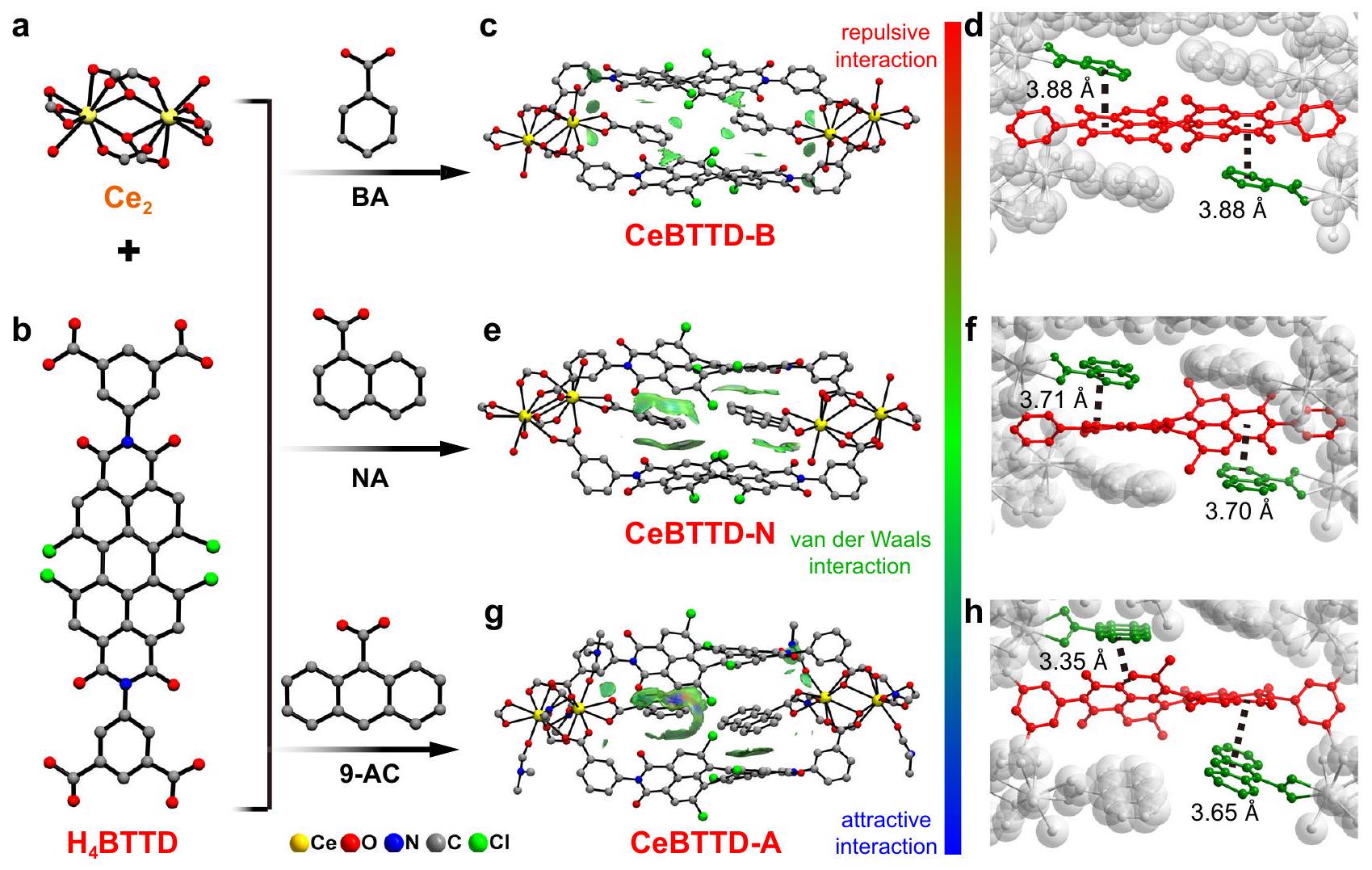
الشكل 2 | ملخص هيكل مركبات CeBTTD. أ البيئات التنسيقية لـعقدة. هيكل BTTD. الترتيب المكاني ونموذج التدرج المستقل القائم على تقسيم هيرشفيلد (IGMH) لـ CeBTTD-B، e CeBTTD-N، g CeBTTD-A، على التوالي. علامة ( ) IGMH الملون ( ) = 0.004 وحدة ذرية. طريقة التلوين هي كما يلي: المنطقة الخضراء تتوافق مع تفاعل فان دير والس ); المنطقة الزرقاء تتوافق مع ، وتأثير الجذب أقوى؛ المنطقة الحمراء تتوافق مع النفور الأقوىمسافةالتفاعل فيCeBTTD-B،CeBTTD-N،CeBTTD-A، على التوالي. تم حذف جميع ذرات الهيدروجين من أجل الوضوح. Ce، أصفر؛ O، أحمر؛ N، أزرق؛ C، رمادي؛ Cl، أخضر. أعلى من تلك التي تم الإبلاغ عنها حتى الآن. والأهم من ذلك، يمكن تحقيق جميع تفاعلات الأكسدة الضوئية بشكل فعال بواسطة CeBTTD-A تحت ضوء الشمس والهواء المحيط، مما يظهر آفاق التطبيق الواسعة لـ CeBTTD-A.
النتائج
تحضير محفزات ضوئية لجسر جزيئي CeBTTD-B/N/A
الليغاند التتراكربوكسي دي إيميد (تم تخليق ( ) بواسطة تفاعل الأسيلاشن (انظر الطرق). ثم تم تخليق وصلات جزيئية CeBTTD-B/N/A باستخدام طريقة الحل الحراري مععنقودسابِقيظهر تحليل حيود الأشعة السينية للأحجار المفردة أن CeBTTD-B يتبلور في المجموعة الفراغية أحادية الميل.، وتحتوي الوحدة غير المتماثلة على واحدة أيونبي تي تي ديالليغاند، واحد معقد مرتبط بـ BA، جزيئان من الماء المنسقين (الشكل التكميلي 3).تم تحليل سلف الكتلة وإعادة تركيبه إلىعنقود (الشكل 2أ). تم تحليل الهيكل الطوبولوجي لـ CeBTTD-B بواسطة برنامج TOPOS. عنقود و BTTD (الشكل 2ب) اعتُبرت رموزًا متصلة بـ 4، مما يكشف عن طوبولوجيا CeBTTD-B المبسطة إلى طوبولوجيا pts، ورمز شلايفلي هو تحليل إضافي من خلال الهيكل الثلاثي الأبعاد (الشكل التكميلي 4) يوضح أن هناك ضعفاًالتفاعل بينوفي CeBTTD-B بمسافة 3.88 Å (الشكل 2c، d). CeBTTD-N له هيكل مشابه لـ CeBTTD-B، باستثناء أن NA تحل محل BA (الشكل 2e، الأشكال التكميلية 5 و 6). بشكل مشابه، أقوىالتفاعل مقارنةً بـ CeBTTD-B بينو BTTDفييوجد (الشكل 2f).
حلقتان بنزين من BTTDالليغاند في CeBTTD-N متساوي المستوى، بينما تلك في CeBTTD-B تقريبًا عمودية (الشكل التوضيحي 7 أ، ب). زاوية الميل المختلفة لـ BTTDتُخصص النتائج في إطار CeBTTD-N إلى الطوبولوجيا الافتراضية LUT برمز شلايفلي. CeBTTD-A يتبلور في مجموعة الفضاء الرباعية Pnma ويظهر تكوين تنسيق مشابه (الأشكال التكميلية 8 و 9). بسبب الزاوية الثنائية المماثلة (الشكل التكميلية 7c) لحلقتي البنزين في BTTDتكشف CeBTTD-A نفس طوبولوجيا اللوت كما في CeBTTD-N. أقوى توافق لـيؤدي إلى المسافة بين 9-AC و BTTDقصير مثل (الشكل 2g، h)، والذي يمكن أن يكون مفيدًا لنقل الشحنات الناتجة عن الضوء بين الجزيئات المجاورة.
أنماط حيود الأشعة السينية بالمسحوق (PXRD) للعينات التي تم تحضيرها حديثًا CeBTTD-B وCeBTTD-N وCeBTTD-A تتوافق مع منحنيات المحاكاة (الأشكال التكميلية 10-12)، مما يؤكد النقاء العالي للعينات التي تم الحصول عليها. تظهر طيفية تحويل فورييه للأشعة تحت الحمراء (FTIR) أن المركبات الثلاثة تحتوي على مكونات ومجموعات وظيفية مشابهة (الأشكال التكميلية 13). تكشف التحليل الحراري الوزني (TGA) أن CeBTTD-B وCeBTTD-A وCeBTTD-N لديها فقدان وزني مشابه قبل، والذي يمكن أن يُعزى إلى مغادرة جزيئات الماء ومذيب DMF. يمكن تثبيت الهياكل حتى، مما يثبت أن هذه المواد تتمتع باستقرار حراري جيد (الشكل التكميلي 14). تظهر بيانات مطيافية الأشعة السينية للألكترونات (XPS) وجود عناصر (، و Cl ) في CeBTTD-B و CeBTTD-N و CeBTTD-A (الشكل التكميلي 15a). Ce بدقة عالية تظهر الأطياف ذروتين رئيسيتين عند 885.4 و 903.8 إلكترون فولت تت correspond إلىإن نفس موضع قمم Ce 3d في CeBTTD-B وCeBTTD-N وCeBTTD-A يشير إلى أن أيونات Ce لها نفس حالة التكافؤ (الشكل التكميلي 15b-d).
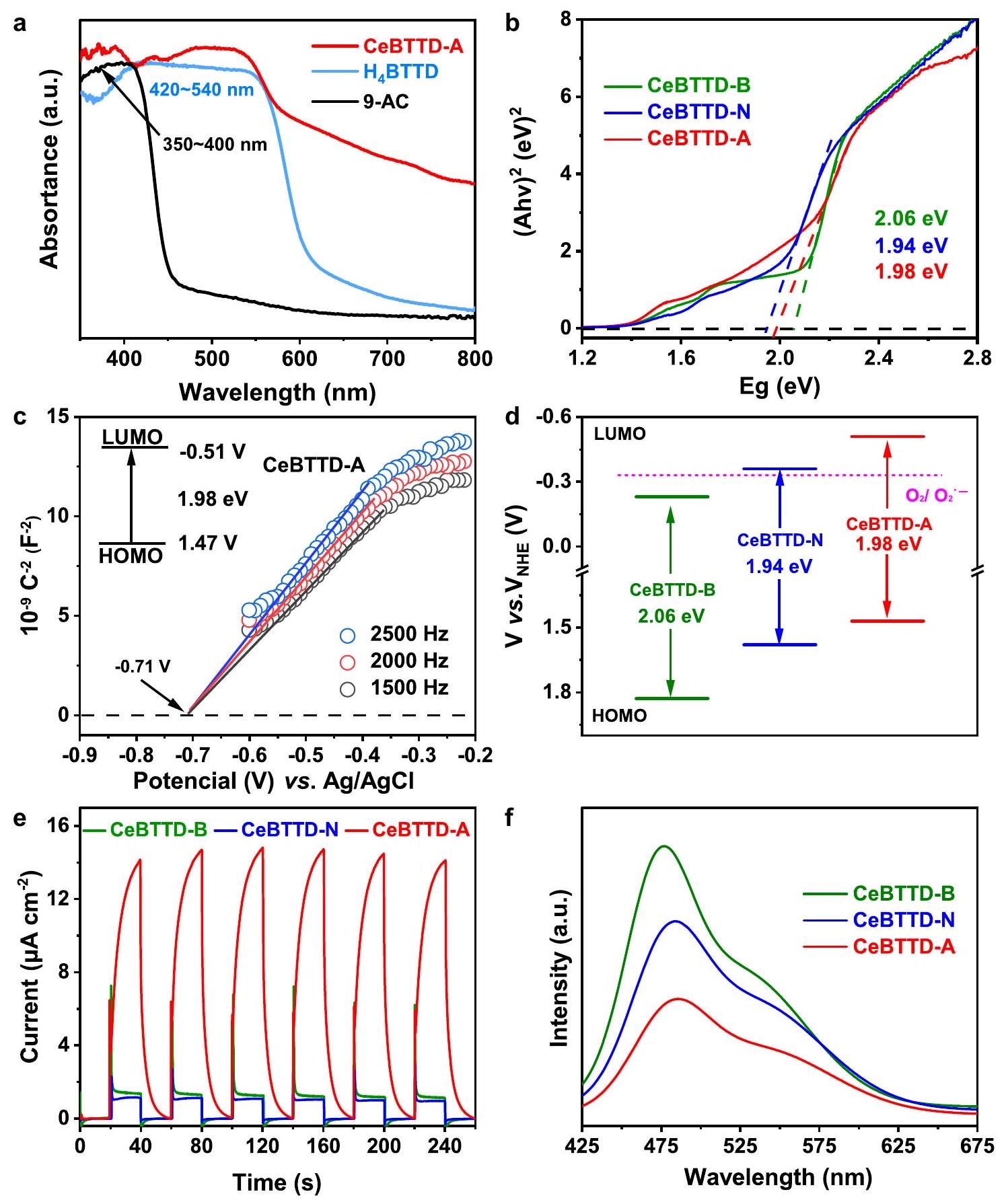
الشكل 3 | التوصيف الفوتوفيزيائي لمحفزات CeBTTD. أ طيف الانعكاس المنتشر للأشعة فوق البنفسجية والمرئية لـ CeBTTD-A ومواده (9-AC و ). مخطط تاوك ل CeBTTD-(B/N/A) تم تحديده بواسطة معادلة كوبيلكا-مونك من طيف الانعكاس المنتشر UV-visible الأصلي. ج مخططات موت-شوتكي ل CeBTTD-A. د الـ
مخطط هياكل نطاق الطاقة لـ CeBTTD-(B/N/A). e منحنيات التيار الضوئي العابر لـ CeBTTD-(B/N/A) التي تم قياسها فيمحلول مائي. طيف انبعاث الفوتولومينسنس (PL) لـ CeBTTD-(B/N/A) تحت تحفيز عند 400 نانومتر.
تم دراسة امتصاص الضوء لثلاثة مركبات والروابط المقابلة باستخدام طيف الامتصاص المنتشر للأشعة فوق البنفسجية والمرئية (الشكل 3أ). يمكن ملاحظة أن امتصاص الضوء لـ BTTD هو بشكل رئيسي في نطاق وذلك منيكون بشكل رئيسي في نطاقتسمح نطاقات امتصاص الضوء المتداخلة بشكل مناسب للموصلين الاثنين بامتصاص أطوال موجية مختلفة من الضوء وبالتالي يتم تحفيزهم دون التداخل والتنافس مع بعضهم البعض. ومع ذلك، بسبب القدرة الضعيفة على امتصاص الضوء لـ BA و NA، فإن امتصاص الضوء لـ CeBTTD-B و CeBTTD-N (الأشكال التكميلية 16 و 17) في المنطقة فوق البنفسجية أضعف من CeBTTD-A. تم حساب فجوات الطاقة لـ CeBTTD-A و CeBTTD-N و CeBTTD-B بشكل إضافي لتكون “، و 2.06 إلكترون فولت، على التوالي، مما يشير إلى خصائصها الشبيهة بالموصلات شبه. لتحديد مواقع مستويات الطاقة لأدنى مدار جزيئي غير مشغول (LUMO)، تم إجراء اختبار مخططات موت-شوتكي عند ترددات 1500 و2000 و2500 هرتز. أظهرت النتائج أن مواقع LUMO تم تحديدها لتكون -0.51 فولت (CeBTTD-A)، -0.36 فولت (CeBTTD-N)، و -0.23 فولت (CeBTTD-B) (مقارنة بـ NHE، )، مما يظهر أن CeBTTD-A و CeBTTD-N يمكن أن يكملوا ديناميكيًا عملية التفعيل، مقابل NHE). بعد ذلك، استنادًا إلى قيم LUMO وفجوات الطاقة، كانت أعلى موضع مداري (HOMO) لهذه المركبات الثلاثة هو تم حسابها لتكون 1.47 فولت (CeBTTD-A)، 1.58 فولت (CeBTTD-N)، و 1.83 فولت (CeBTTD-B) (مقابل NHE، )، على التوالي. تشير الإمكانية الإيجابية إلى أن الثقوب الناتجة عن الضوء في المركبات الثلاثة لديها قدرة أكسدة قوية (الشكل 3d). تم تقييم كفاءة فصل الشحنة للمواد المحفزة الضوئية الثلاثة من خلال استجابة التيار الضوئي العابر تحت إضاءة ضوئية دورية (الشكل 3e). تُظهر استجابة التيار الضوئي العابر أن CeBTTD-A يظهر تقريبًا سبع مرات أعلى من CeBTTD-N أو CeBTTD-B دون تراجع، مما يعكس أن CeBTTD-A لديه أقوى كفاءة في فصل ونقل الشحنات الناتجة عن الضوء. علاوة على ذلك، تم اختبار طيف تدهور الفلورسنت الزمني لتقييم ديناميات حاملات الشحنة. كما هو موضح في الشكل 3f والشكل التكميلي 20، فإن CeBTTD-A لديه أقل كثافة فلورية، مما يكشف عن أفضل كفاءة لفصل الإلكترونات والثقوب الناتجة عن الضوء بين هذه المركبات..
الأكسدة الهوائية الضوئية المحفزةسندات
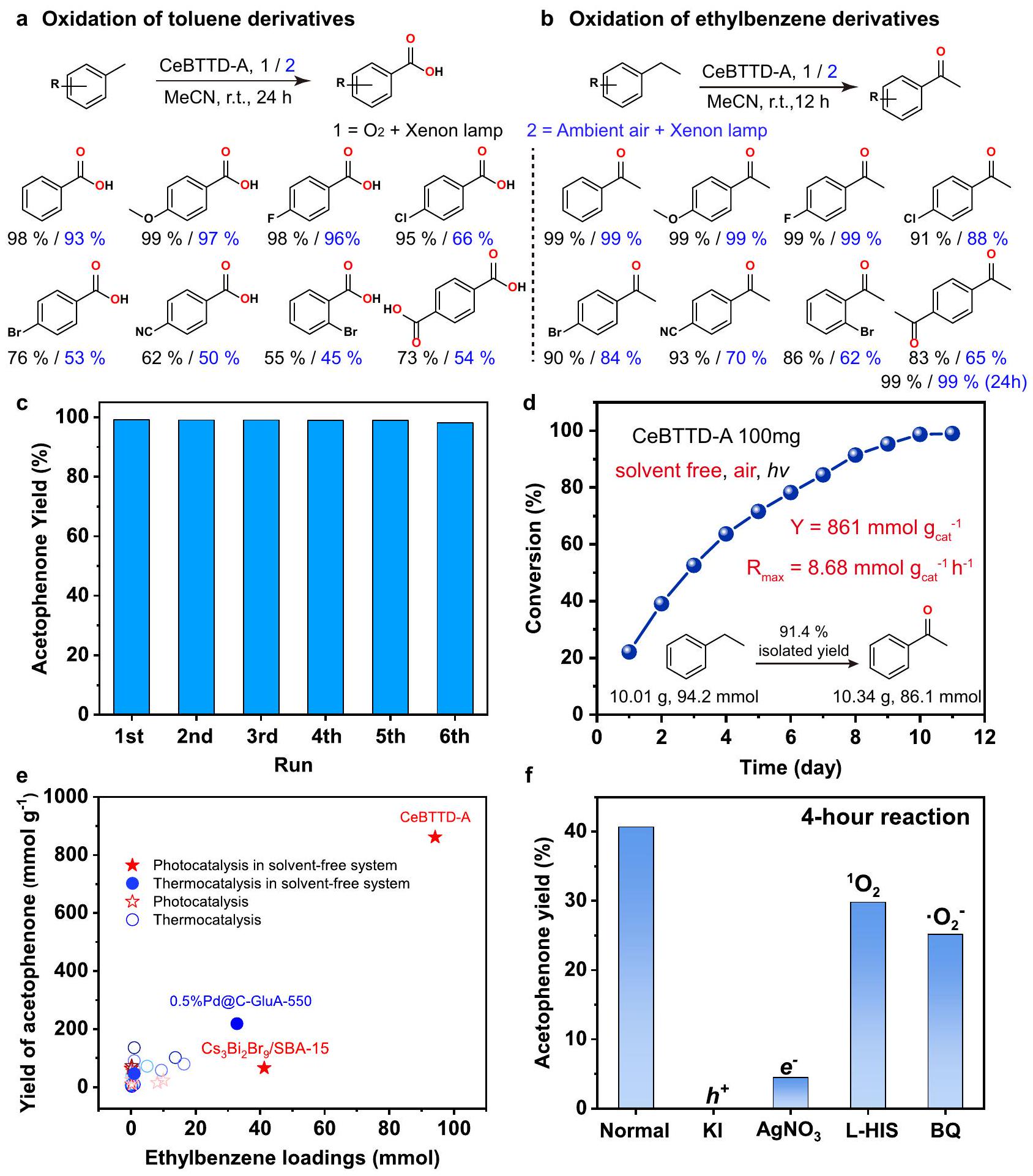
بالاستفادة من هيكل الوصلة الجزيئية، وامتصاص الضوء الجيد، وهيكل النطاق المناسب، من المتوقع أن تُستخدم مركبات CeBTTD كعوامل تحفيز ضوئي لتفاعلات الأكسدة الهوائية الضوئية. أولاً، ركزنا على أكسدة التولوين لتقييم أداء التحفيز الضوئي لعوامل CeBTTD. كمحاولات أولية، 5 ملغ من CeBTTD (تم استخدام البلورات كعوامل تحفيز ضوئي غير متجانسة في نظام تشغيل بسيط يحتوي على 3 مل من الأسيتونيتريلو 0.1 مليمول من التولوين. تم إجراء التفاعل تحتالجو، درجة حرارة الغرفة، والإشعاع بمصباح زينون كمصدر للضوءتم تحديد الأنواع والانتقائية للمنتجات بواسطة مطيافية الكروماتوغرافيا الغازية-الطيف الكتلي (GC-MS) ومطيافية الكروماتوغرافيا الغازية (GC) (الشكل التوضيحي التكميلي 21). بعد تفاعل استمر 24 ساعة، تم الكشف عن حمض البنزويك كمنتج رئيسي. حقق CeBTTD-A عائدًا ممتازًا من حمض البنزويك بنسبة 98%، بينما لم يتمكن CeBTTD-B وCeBTTD-N من تحفيز التولوين تحت نفس ظروف التفاعل. يكشف هذا التباين الواضح أن 9-AC يلعب دورًا حاسمًا خلال عملية التحفيز الضوئي. للتحقق من هذه الفكرة، تم إجراء سلسلة من التجارب المقارنة (الجدول التكميلي 8). عندما كان النظام في الظلام أو يفتقر إلى CeBTTD-A، لم يكن بالإمكان تحويل التولوين، مما يشير إلى أن التفاعل هو عملية تحفيز مدفوعة بالضوء. لم يكن بالإمكان الكشف عن أي منتج عندمايستبدلفي النظام، مما يدعم فكرة أن الأكسجين هو عامل الأكسدة. ومن المثير للاهتمام أن المزيج الفيزيائي منحقق BTTD و 9-AC أيضًا تأكسد ضوئي للتولوين بعائد قدره، الذي كان متناسبًا مع العائد الذي حفزته الخلطة الفيزيائية لـ و 9-AC. تشير هذه النتائج إلى أن أيونات Ce ليست متورطة في العملية الضوئية التحفيزية. نظرًا لأن 9-AC متجانس في نظام التفاعل، يمكنه تشكيل هياكل تقاطعية جزيئية مشابهة لتلك الموجودة في CeBTTD-A من خلال التفاعل مع BTTD، وبالتالي تحقيق هجرة الشحنات الضوئية وإظهار النشاط الضوئي التحفيزي. الأداء الأعلى الذي تم الحصول عليه من CeBTTD-A غير المتجانس يوضح أكثر أن الوصلات الجزيئية الموزعة بشكل دوري في CeBTTD-A هي العامل الرئيسي في تعزيز الأكسدة الهوائية الضوئية لـ الروابط. تم التحقيق في نطاق الركيزة للتولوين لإظهار قابليته العامة (الجدول التكميلي 9). تم اختبار مشتقات مختلفة من التولوين كركائز تحت نفس الظروف (الشكل 4أ). عندما احتوت الركيزة على مجموعات سحب الإلكترون – يمكن أن يصل عائد الحمض إلى. عندما كانت الركائز تحتوي على مواد مانحة للإلكترونات، ، و تم تحديد عوائد الحمض على أنها، و على التوالي. الركائز المزودة بمجموعات تعيق الاستيريو، مثلتم اختبار -بروموتولوين أيضًا؛ كانت نسبة الحصول على الحمض المقابل. بالإضافة إلى ذلك، عندما يكون الركيزة يمكن لمركب CeBTTD-A الحصول على عائد بنسبة 73% من حمض التيرفثاليك، وهو مادة خام كيميائية مهمة وذات طلب عالٍ. ومن الجدير بالذكر أنه عندما تم إجراء التفاعل في الهواء المحيط، لم يتراجع الأداء بشكل ملحوظ، مما يدل على أن CeBTTD-A يمتلك القدرة على تنشيط الأكسجين بسرعة. علاوة على ذلك، فإن PXRD و FTIR تم تأكيد خصائص CeBTTD-A وسلامته الهيكلية قبل وبعد اختبارات التحفيز الضوئي (الأشكال التكميلية 22 و23).
من أجل التحقق من تعددية CeBTTD-A، تم إجراء أكسدة هوائية أخرى لـتم اختبار تفاعل الرابطة، أكسدة الإيثيل بنزين، بشكل إضافي. ومن المدهش أن CeBTTD-A أظهر كفاءة ممتازة (>85%) وانتقائية (>99%) في تحويل مشتقات الإيثيل بنزين إلى الكيتونات العطرية المقابلة تحت أي منأو أجواء الهواء المحيط (الشكل 4ب، الشكل التوضيحي 24 والجدول التوضيحي 10). بالإضافة إلى البنزيل الروابط، قمنا بمزيد من اختبار الأليلية تفاعل أكسدة الرابطة باستخدام السيكلوهكسين كركيزة. أظهرت النتائج أن السيكلوهكسين يمكن تحويله بكفاءة إلى 2-سيكلوهكسين-1-ون بمعدل تحويل مرتفع (>74%) وانتقائية (>97%) تحت كلا منوأجواء الهواء المحيط، مما يوضح العالمية الجيدة لمحفز CeBTTD-A (الشكل التكميلي 25). يمكن إعادة تدوير CeBTTD-A المتين وغير المتجانس على الأقل ست مرات دون فقدان واضح للنشاط (الشكل 4c). نظرًا للاختيار العالي والإنتاج الفعال للأسيتوفينون، تم تقييم متانة التحفيز لـ CeBTTD-A أيضًا من خلال تفاعل على نطاق جرام. تم إجراء تفاعل أكسدة الإيثيل بنزين بوزن 10 جرام بدون مذيبات تحت الهواء المحيط (الشكل التكميلي 26). بعد 10 أيام من الإشعاع الضوئي، تم تحويل 10.01 جرام من الإيثيل بنزين بالكامل. تم عزل 10.34 جرام من الأسيتوفينون معتم الحصول على العائد بعد تصفية المحفز الضوئي (الشكل 4d). مثل هذا الأداء الممتاز يتجاوز جميع المحفزات المبلغ عنها حتى الآن (الشكل 4e والجدول التكميلي 11). النتائج المرضية المذكورة أعلاه تثبت أن CeBTTD-A لديه آفاق واعدة في التطبيقات الصناعية العملية.
نقاش
من أجل استكشاف الآلية التحفيزية، قمنا أولاً بتحديد الأنواع النشطة في عملية التفاعل. تم إجراء سلسلة من تجارب التبريد عن طريق إضافة 0.3 ملليمول من عامل التبريد إلى محلول الاختبار الأصلي لأكسدة التولوين/الإيثيل بنزين (الشكل 4f والشكل التكميلي 27). النتائج متشابهة كما يلي. عندما تم استخدام مثبط الثقوبأو مثبط الإلكترونتمت الإضافة، ولم يكن بالإمكان الكشف عن سوى أثر من المنتجات بعد 4 ساعات من الإشعاع الضوئي، مما يشير إلى أن الإلكترونات المتولدة ضوئيًا وجذور الثقوب تشارك في التفاعل. عندما يتم تم تقديم مثبط الجذور الراديكالية (L-Histidine، LHIS)، لم يكن هناك تغيير ملحوظ في أداء التفاعل. بينماعامل تبريد جذريعند إضافة -بنزوكوينون، تم وضعف الكفاءة التحفيزية بشكل ملحوظ، مشيرًا إلىيتم تقليصه إلىوشارك في تفاعل الأكسدة. للتحقق من توليد أنواع الأكسجين التفاعلية المذكورة أعلاه، تم إجراء مطيافية الرنين المغناطيسي الإلكتروني (EPR) في الموقع لـ CeBTTD-A. كما هو موضح في الشكل 5a، تحت جو الأكسجين، لا يوجد إشارة واضحة في ظروف الظلام. بعد 30 دقيقة من الإضاءة، يظهر الجذر الفائق الأكسيد (ظهرت إشارات ) في النظام مع وجود DMPO (5,5-دايميثيل-1-بيرولين N-أكسيد)، مما يشير إلى أن CeBTTD-A يمكن أن ينشط جزيئات الأكسجين بسرعة إلى جذور الأكسجين الفائقة تحت إشعاع الضوء.تم الكشف عنه أيضًا في وجود TEMP (2،2،6،6-تترا ميثيل-4-بيبيريدون هيدروكلوريد).
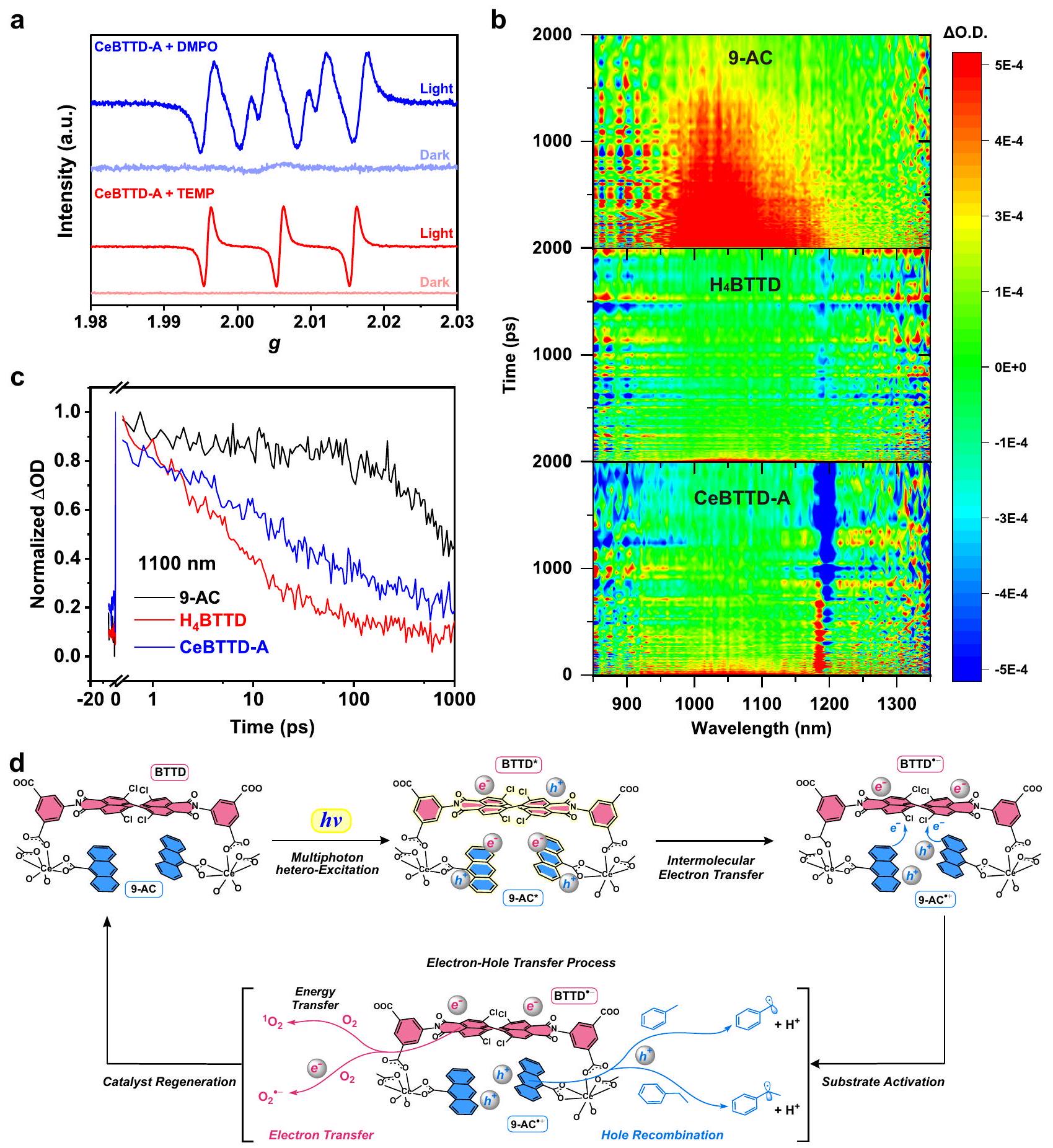
تم إجراء اختبارات طيف الامتصاص العابر (TAS) لتحديد عملية التحفيز الضوئي وتوليد الأنواع المثارة لكل مكون في CeBTTD-A (الشكل 5ب، ج)، مما يمكن أن يساعد في تحليل وضع الانتقال للشحنات الناتجة عن الضوء. يمكن أن تفسر نطاقات الامتصاص المثارة الإيجابية (ESA) لـ 9-AC وقمة التبييض في الحالة الأرضية السلبية (GSB) لـ CeBTTD-A عند 550 نانومتر أن الإلكترونات الناتجة عن الضوء لـ 9-AC يمكن أن تهاجر بسرعة إلى أنماط أخرى في CeBTTD-A (الشكل التكميلي 28). الانبعاث المحفز السلبي فيتم إضعاف BTTD عند 650 نانومتر في CeBTTD-A، مما يشير إلى أن الفوتوإلكترونات من 9-AC تُنقل إلى BTTD.الكثافة الإلكترونية غير المتغيرة لأيونات Ce التي تم تحديدها بواسطة XPS في الموقع تحت إشعاع الضوء أظهرت أن أيونات Ce لا تتلقى الإلكترونات الضوئية (الشكل التكميلي 29). تظهر نطاقات ESA الإيجابية عند 1100 نانومتر أن عمر الحالة المثارة 9-AC أطول بكثير من BTTD.و CeBTTD-A، الذي يتماشى مع تحليل العمليات الحركية تم التحقيق في. كما أنه يثبت أن اتجاه هجرة الفوتوالكترون هو من 9-AC إلى BTTDتم إجراء حسابات نظرية باستخدام نظرية الكثافة الوظيفية (DFT) لفهم أفضل لعملية فصل الشحنة المولدة ضوئيًا وهجرتها في CeBTTD-A تحت الإضاءة. كما هو موضح في الشكل التكميلية 30، تحدث الإثارات الرأسية الرئيسية لـ CeBTTD-A تحت الإضاءة عند 397.
الشكل 5 | دراسة على عملية التحفيز الضوئي وآلية التحفيز الضوئي. أ إشارات EPR لمحلول التفاعل تحت الظلام وإشعاع الضوء في وجود DMPO وTEMP كمواد لاحتجاز الدوران.طيف TA لـ 9-AC،، وتم استكشاف CeBTTD-A ضمن نطاق 850-1350 نانومتر. التحفيز
طول الموجة: 9-AC (340 نانومتر) BTTD ( 400 نانومتر )، و CeBTTD-A ( 400 نانومتر ). ج تتبع الحركية لـ 9-AC، ، وتم فحص CeBTTD -A عند 1100 نانومتر. د الآلية المقترحة للأكسدة الهوائية لـالسندات بواسطة CeBTTD-A. على التوالي، الشكل التوضيحي 31). وهذا يعني أن الفجوة الموجودة في HOMO-1 ذات الطاقة الأعلى من HOMO يمكن أن تكون الجزء الرئيسي المتعلق بالتولوينأكسدة الرابطة. بالاقتران مع نتائج توصيف XAS، تم اقتراح عملية فصل الشحنة الناتجة عن الضوء والانتقال بشكل معقول (الشكل 5d). أولاً، يتم إثارة بعض الإلكترونات الموجودة في مدارات مختلفة من أنماط 9-AC وBTTD وتوليد الأنواع المثارة المقابلة BTTD* و9-AC* تحت الإضاءة. بعد ذلك، يتم نقل الإلكترونات المثارة من 9-AC* إلى BTTD*، مما يشكل 9-AC.و BTTDالضوء الناتج توجد الثقوب في المدارات الداخلية لـ 9-AC تكمل أكسدة الـ الروابط، والإلكترونات على BTTD تكمل الاختزال وأخيرًا تحقيق الأكسدة لـسندات.
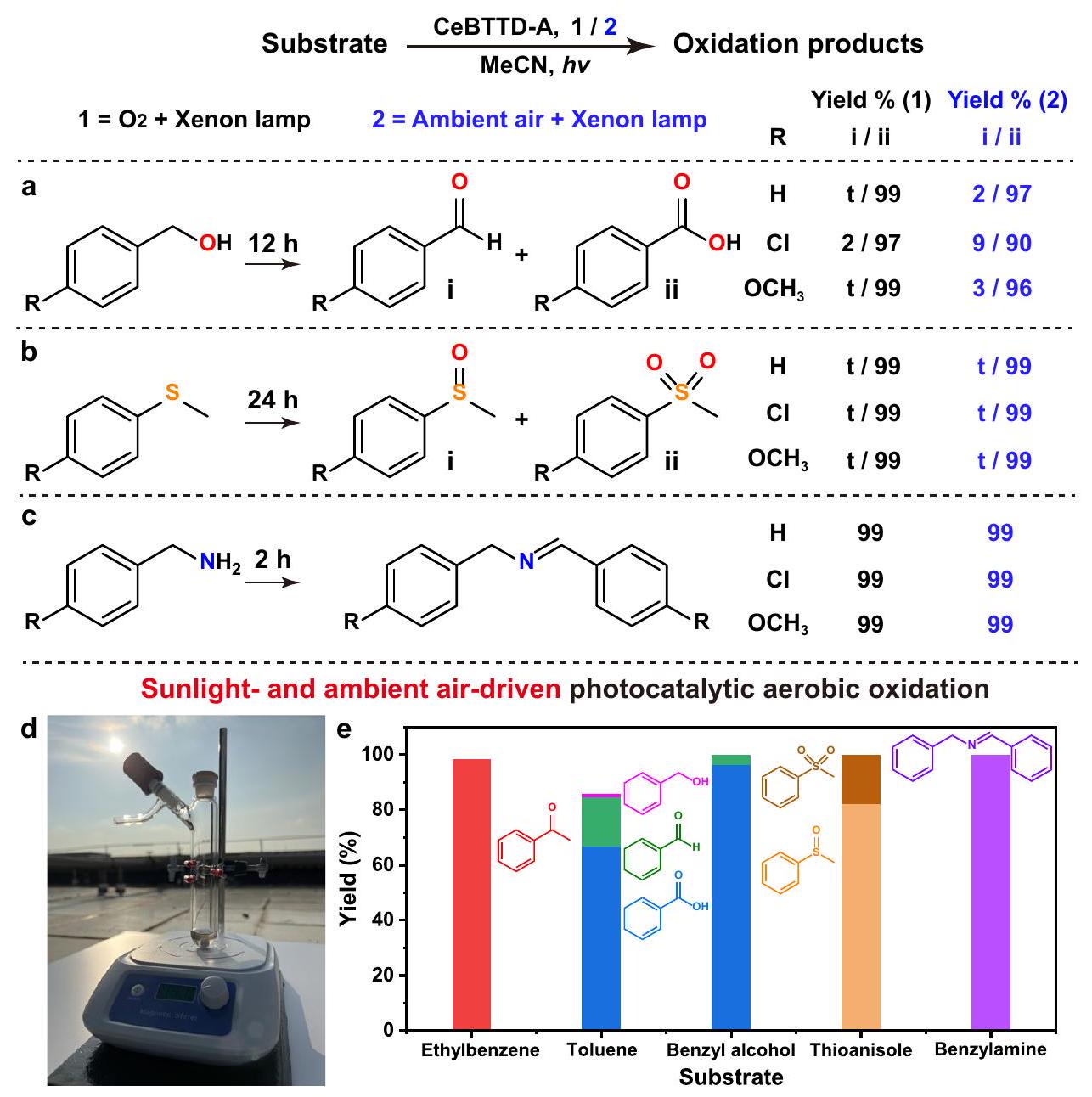
بالإضافة إلى الأكسدة الهوائية لـنقوم بتوسيع اختباراتنا لتشمل تفاعلات ضوئية هوائية أخرى، مثل أكسدة الكحول البنزيلي، وأكسدة الأنيسول، وتفاعلات الاقتران الأكسيدي للبنزيلامين لتقييم القابلية العالمية لـ CeBTTDA. كما هو موضح في الشكل 6a-c، أظهرت جميع هذه التفاعلات الهوائية أداءً ضوئيًا ممتازًا وتحملًا جيدًا للركائز.
الشكل 6 | الأداء الضوئي التحفيزي في تفاعلات الأكسدة الهوائية الضوئية الأخرى وتفاعلات الأكسدة الهوائية المدفوعة بأشعة الشمس والهواء المحيط. قام CEBTTD-A بتحفيز أكسدة مشتقات الكحول البنزيلي،أكسدة مشتقات الثيوأنيسول،تفاعل اقتران مشتقات بنزيل أمين، على التوالي. شروط التفاعل: 0.1 مللي مول من الركائز، 5 ملغ من CeBTTD-A،كما كاشفمصدر ضوء زينونأثر.تسهيل التجارب الضوئية في البيئة الخارجية وعائدات المنتجات لتفاعلات الأكسدة الهوائية المدفوعة بأشعة الشمس والهواء المحيط. شروط التفاعل: 0.1 مللي مول من الركائز، 5 ملغ من CeBTTD-A، 3 مل من CH3CN كعامل تفاعل، ضوء الشمس، هواء محيط، من 8:00 إلى 16:00، غوانغتشو.
تشجعنا هذه النتائج الواعدة على إجراء التفاعلات الخمس للأكسدة الضوئية المذكورة في هذه الورقة تحت ضوء الشمس الخارجي والهواء المحيط. عندما تم تنفيذ التفاعلات تحت ضوء الشمس الحقيقي في الفترة من 10 إلى 12 أكتوبر 2022 (غوانغتشو، الصين)، يمكن إكمال تفاعلات الأكسدة بعد 8 ساعات من الإضاءة (الشكل 6د). على عكس نتائج التفاعلات في المختبر الداخلي، كان ناتج أكسدة الثيوأنيسول هو بشكل رئيسي ميثيل فينيل سلفوكسيد، وهو ما يرجع على الأرجح إلى قصر مدة الإضاءة (الشكل 6هـ) مقارنةً بظروف المختبر الداخلي. هذا النظام الضوئي الفعال للغاية المدفوع بالكامل بواسطة ضوء الشمس والهواء دون أي تكلفة إضافية أظهر مرة أخرى المزايا والإمكانات التجارية لـ CeBTTD-A.
باختصار، قمنا بتصميم وتطوير وصلة جزيئية ذات نمط غير متجانس كنموذج محفز ضوئي تم تطبيقه على الأكسدة الهوائية الضوئية لـالسندات. استفاد من القوةالتفاعل بين الأنماط في هيكل الوصلة الجزيئية، يمكن أن يخضع المحفز الضوئي المُنشأ CeBTTD-A لهجرة سريعة بين الجزيئات للشحنات الناتجة عن الضوء والركيزة. و -H الروابط) تنشيط تحت إشعاع الضوء، من أجل تحقيق تفاعل عالي للأكسدة لمشتقات التولوين والإيثيل بنزين. يمكن إتمام تفاعل أكسدة الإيثيل بنزين بدون مذيبات على نطاق عشرة جرامات تحت الهواء المحيط بشكل كامل، مما يكشف عن أداء أفضل من أنظمة التحفيز المدفوعة بالضوء أو الحرارة المبلغ عنها حتى الآن. بخلاف-تفاعلات أكسدة روابط الهيدروجين، CeBTTD-A يمكن أيضًا تطبيقها على ثلاثة أنواع أخرى من التفاعلات الهوائية العامة وتظهر أيضًا نشاطات تفاعلية ممتازة. والأهم من ذلك، أن جميع هذه التفاعلات الهوائية يمكن أن تُدار بالكامل بواسطة ضوء الشمس والهواء دون الحاجة إلى طاقة إضافية أو تكاليف، مما يكشف عن آفاق التطبيق التجاري. نتوقع أن توفر مبادئ تشغيل موصل الجزيئات ذو التحفيز الضوئي من نوع الهترو-موتيف إلهامًا لتطوير محفزات ضوئية من الجيل التالي لتطبيقات واسعة النطاق في بناء كتل جزيئية معقدة وكسر عنق الزجاجة في التحفيز الضوئي المدفوع بضوء الشمس والهواء المحيط لتفاعلات أكثر تحديًا بطريقة اقتصادية من حيث الذرات وصديقة للبيئة ومستدامة.
طرق
تركيب
جميع المواد الأولية، والمركبات الكيميائية، والمذيبات المستخدمة في التجارب كانت مواد متاحة تجارياً، ذات نقاء عالي، وتم استخدامها دون مزيد من التنقية.
تحضيربي تي تي دي
ديكربوكسيلي)-1,6,7,12-تتراكلوروبيريلين-3,4,9,10-تتراكربوكسيليك دايميد BTTD، BTTD في المخطوطة تمثل الليغاند المنزوع البروتون): في دورق بسعة 50 مل ذو عنق واحد، مزيج من 3،5 ثنائي بروموانيلين ( ) ، حمض التتراكلوروبيريلين رباعي الكربوكسيل ثنائي اللامائية ) وحمض البروبيونيك تم تسخين (25.0 مل)مع مكثف ارتجاعي وقضيب تحريك مغناطيسي لمدة 48 ساعة. بعد التفاعل، تمت إزالة المذيب العضوي، وتم جمع الراسب تحت ضغط منخفض في درجة حرارة الغرفة. اغسل الراسب بكمية كبيرة من الماء وكمية صغيرة من الإيثانول لإزالة حمض البروبيونيك المتبقي. تم تجفيف المنتج الخام في فرن مفرغ عندلمدة 9 ساعات، ومسحوق أحمرتم الحصول على BTTD كمنتج نقي (العائداستنادًا إلى الديانهايدريد). ( -دي ميثيل سلفوكسيد):، .
تحضير
تم إعداده استنادًا إلى التقارير السابقة مع بعض التعديلات الطفيفةنترات الأمونيوم السيريوم ) والجليسين ( تم إذابتها في 30.0 مل من الماء النقي للحصول على محلول برتقالي. ثم أضيف المحلول إلى 270.0 مل من محلول مشبع من كلوريد الصوديوم. بعد ذلك، تم وضع المحلول الأصفر الناتج فيلمدة أسبوع، وتم تصفية المواد الصلبة وجمعها. تم غسل المادة الصلبة بكمية صغيرة من محلول الماء المثلج عدة مرات لإزالة الجلايسين وملح الصوديوم الزائد. تم تجفيف المنتج الخام في فرن مفرغ من الهواء فيلمدة 5 ساعات، والصلب الأصفر الفاتحتم الحصول على (استنادًا إلى نترات الأمونيوم السيريوم.
تحضير CeBTTD-B
تم تحميل 20 ملغ من حمض البنزويك (BA اختصارًا) و3 مل من DMF في أنبوب زجاجي مقاوم للضغط سعة 10 مل وتسخينه عند لمدة 72 ساعة. بعد التبريد إلى درجة حرارة الغرفة، تم جمع بلورات فردية برتقالية من CeBTTD-B (استنادًا إلى ).
تحضير CeBTTD-N
تم تحميل 1-حمض النفثالين (NA للاختصار) و 3 مل من DMF في أنبوب زجاجي مقاوم للضغط سعة 10 مل وتسخينه عند لمدة 72 ساعة. بعد التبريد إلى درجة حرارة الغرفة، تم جمع بلورات فردية بنية من CeBTTD-N (استنادًا إلىبي تي تي دي).
تحضير CeBTTD-A
تم تحميل 9-حمض الأنثرويك (9-AC للاختصار) و 3 مل من DMF في أنبوب زجاجي مقاوم للضغط سعة 10 مل وتسخينه عند لمدة 72 ساعة. بعد التبريد إلى درجة حرارة الغرفة، تم جمع بلورات مفردة داكنة بنية من CeBTTD-A (استنادًا إلىبي تي تي دي).
حيود الأشعة السينية أحادية البلورة
تم جمع بيانات شدة الأشعة السينية للبلورات أحادية البلورة CeBTTD عند 150 كلفن باستخدام جهاز حيود Bruker D8 Venture المزود بكاشف PHOTON III باستخدام الطول الموجي المونوكروماتي.تم حل الهياكل البلورية وتنقيحها بواسطة طرق المربعات الصغرى الكاملة ضدباستخدام حزمة برامج SHELXL-2014وبرنامج Olex-2تم تحسين جميع الذرات غير الهيدروجينية باستخدام معلمات إزاحة غير متجانسة، وتم تثبيت مواقع الهيدروجين عند المواقع المحسوبة وتحسينها بشكل متجانس. تم إجراء التحليل الطوبولوجي باستخدام برنامج TOPOS.تم تلخيص بيانات البلورات والتكرير الهيكلي لبلورات CeBTTD في الجدول التكميلي 1. تم إدراج أطوال الروابط وزوايا الروابط المختارة لـ CeBTTD-B وCeBTTD-N وCeBTTD-A في الجداول التكملية 2-7، على التوالي.
نظرًا لصغر حجم بلورات CeBTTD-B وCeBTTD-N، كانت شدة الحيود ضعيفة، مما أدى إلى انخفاض الدقة وانخفاض دقة الروابط.السندات. تنبيهات المستوى B من يمكن تفسير “الرابطة بدون مستقبل” بأن المستقبل قد يكون جزيئات المذيب الحرة المضغوطة. على الرغم من وجود بعض المشكلات في هذه التحليلات بالأشعة السينية، نعتقد أن هذه النتائج يمكن أن تدعم بقوة تحديد بنية بوليمرات التنسيق CeBTTD ومناقشة أطوال الزوايا والروابط.
تقنيات تحليلية
تم إجراء التحليل الحراري الوزني (TGA) للعينة على جهاز تحليل TG-7 من بيركن إلمر، حيث تم تسخينه من درجة حرارة الغرفة إلىفي تدفقمعدل تسخين قدرهتم تسجيل طيف الأشعة تحت الحمراء باستخدام تحويل فورييه (FTIR) في النطاق منعلى مطياف ماتفون ألفا-قنطور باستخدام تقنية كريات KBr المضغوطة. تم تسجيل قياسات حيود الأشعة السينية بالمسحوق (PXRD) تتراوح من 5 إلىعند درجة حرارة الغرفة على جهاز حيود D/max 2500 VL/PC (اليابان) المزود بمونوكروماتور جرافيتي.إشعاعتم الحصول على طيف الانعكاس المنتشر للأشعة فوق البنفسجية والمرئية باستخدام جهاز قياس الطيف الضوئي شيمادزو UV2550 في نطاق الطول الموجي منتم قياس طيف الإلكترون الضوئي بالأشعة السينية (XPS) على جهاز Escalab 250 Xi. تم تسجيل طيف الرنين المغناطيسي الإلكتروني (EPR) في الموقع على جهاز Bruker A300. تم إجراء القياسات الكهروكيميائية (التيار الضوئي ونقاط موت-شوتكي) باستخدام محطة عمل كهروكيميائية CHI 660 E. تم الكشف عن منتجات تفاعل الأكسدة الهوائية وتحليلها بواسطة كروماتوغرافيا الغاز-مطياف الكتلة (GC-MS، 8890-5977B، Agilent)، وكروماتوغرافيا الغاز (GC، 8890، Agilent)، والرنين المغناطيسي النووي.نظام الرنين المغناطيسي النووي، فاريان VNMRS.
نظام الامتصاص العابر للفيمتوثانية المستخدم في هذه الدراسة يعتمد على نظام ليزر تيتانيوم: ياقوت معزز متجدد من شركة كوهيرنت.نبضة-1، ومعدل تكرار 1 كيلو هرتز)، تقنيات خلط التردد غير الخطية ومطياف Femto-TA100 (Time-Tech Spectra). باختصار، تم تقسيم نبضة الخرج 800 نانومتر من المضخم المتجدد إلى جزئين مع قسيم الشعاع. تم استخدام جزء المرسل لضخ مضخم المعلمات البصرية TOPAS (OPA)، الذي يولد نبضة ليزر قابلة للتعديل في الطول الموجي من 250 نانومتر إلىكشعاع مضخة. تم تقسيم الشعاع المنعكس بزاوية 800 نانومتر مرة أخرى إلى جزئين. جزء واحد بأقل منتم تخفيفه باستخدام فلتر كثافة محايدة وتم تركيزه في نافذة ياقوتية بسماكة 2 مم لتوليد استمرارية ضوء أبيض (WLC) من 420 نانومتر إلى 800 نانومتر المستخدمة لليزر الاستكشافي. تم تركيز شعاع الاستكشاف باستخدام عاكس بارابوليكي من الألمنيوم على العينة. بعد العينة، تم توجيه شعاع الاستكشاف ثم تركيزه في مطياف متصل بالألياف مع حساسات CMOS وتم الكشف عنه بتردد. تم التحكم في التأخير بين نبضات المضخة ونبضات الاستكشاف بواسطة مرحلة تأخير آلية. تم تقطيع نبضات المضخة بواسطة قاطع متزامن عند 500 هرتز، وتم حساب تغيير الامتصاص باستخدام نبضتي استكشاف متجاورتين (محجوبة المضخة وغير محجوبة المضخة). تم إجراء قياس TA النانوي باستخدام مقياس الطيف EOS (Ultrafast Systems LLC). يتم توليد شعاع المضخة بنفس الطريقة المستخدمة في تجربة TA الفيمتوثانية الموضحة أعلاه. تم استخدام استمرارية ضوء أبيض مختلفة (تم استخدام نبضة عرض، بتردد تكرار 20 كيلوهرتز، والتي تم توليدها عن طريق تركيز ليزر Nd:YAG في ألياف بلورية ضوئية. تم التحكم في زمن التأخير بين شعاع الضخ وشعاع الاستكشاف بواسطة مولد تأخير رقمي (CNT-90، Pendulum Instruments)..
قياس نشاط التحفيز الضوئي
قبل الاختبارات التحفيزية، تم غسل البلورة المفردة من CeBTTD-(B/N/A) مع DMF والإيثانول بالتناوب ثم تم تسخينها عندلمدة 4 ساعات في فرن مفرغ من الهواء.
ثلاثة ملليلتراتوتم وضع 5 ملغ من المحفزات في أنبوب كوارتز سعة 50 مل. معدل التدفق هو لمدة 5 دقائق تحت الغاز (نقي عالي ) ) لضمان أن الهواء في نظام التفاعل تم استبداله بالكامل (عندما تكون الأجواء هواءً محيطياً، يتم حذف هذه الخطوة). ثم، تم إضافة 0.1 مللي مول من الركيزة بسرعة إلى الأنبوب تحت تدفق الغاز. مصباح زينون بقوة 300 واط (شدة الضوء: ) تم استخدامه كمصدر للضوء. الـ تم التحكم في درجة حرارة التفاعل عند 298 كلفن باستخدام دوران مياه التبريد. بعد التفاعل، تم جمع المحلول، وطرده مركزيًا، وتصفيةه من خلالفلتر حقنة لإزالة جزيئات المحفز. في اختبارات دورة التحفيز الضوئي، تم طرد المحفزات مركزياً وغسلها بـللاختبارات القادمة.
القياس الكهروكيميائي
تم إجراء اختبارات كيميائية كهربائية فيمحلول كإلكتروليت من خلال نظام الثلاثة أقطاب القياسي: زجاج أكسيد الإنديوم والقصدير (ITO) المعدل بعينات المحفز، قضيب الكربون، والمشبعتم استخدامه كقطب عمل وقطب مضاد وقطب مرجعي، على التوالي. تم تحضير أقطاب العمل لتيار الفوتو وكشف موت-شوتكي كما يلي: تم تفريق 2 ملغ من المحفز الضوئي في محلول مختلط منالإيثانول ومحاليل تشتت نافييون D-520 لتوليد معلق متجانس. ثم،تم نقل المعلق وتغطيته على ألواح زجاجية من ITO ) وجفف في درجة حرارة الغرفة.
قياس طيف الامتصاص العابر في الفيمتوثانية (TAS)
تم إجراء قياسات fs-TAS على نظام مضخة-استقصاء (هيليوس، أنظمة فائق السرعة ذ.م.م) مع أقصى تأخير زمني قدرهتتحكم به خط تأخير بصري محرك.تم توليد نبضة ليزر فوق قصيرة بواسطة نظام ليزر Ti:sapphire المعزز (Coherent Legend، نبضة، ومعدل تكرار 1 كيلو هرتز) وتم تقسيمها إلى شعاعين. تم مضاعفة تردد الشعاع الرئيسي من خلال بلورة البورات الباريوم بيتا (BBO) إلى 400 نانومتر وعمل كنبضة مضخة، وتم استخدام فلاتر الكثافة المحايدة للتحكم في القدرة عند . تم تحويل الشعاع الآخر إلى استمرارية ضوء أبيض ( عبر الياقوت ليصبح نبضة الاستكشاف، التي استكشفت حالات العينة بعد التحفيز الضوئي بواسطة نبضة المضخة .
طرق الحساب
تمت جميع تحسينات الهندسة على مستوى نظرية الكثافة الوظيفية (DFT) باستخدام برنامج Gaussian 09. عند (U) B3LYP المستوى. تم الحصول على طيف الامتصاص والأنواع المثارة باستخدام نظرية الكثافة الزمنية المعتمدة على الزمن (TDDFT) ونظرية الكثافة غير المقيدة ذات القشرة المفتوحة (unrestricted open-shell DFT) على نفس المستوى. تم حساب تكامل تداخل المدارات باستخدام برنامج دالة الكثافة في أمستردام (ADF 2023.101) حزمة البرنامج. تم اعتماد التقريب المنتظم من الدرجة صفر (ZORA) لأخذ تأثيرات النسبية القياسية في الاعتبار.تُستخدم مجموعات الأساس لوصف جميع الإلكترونات لكل ذرة بشكل ثلاثي-مدارات سلايتر من نوع زائد الاستقطاب.
توفر البيانات
البيانات البلورية المبلغ عنها في هذه الورقة متاحة في المعلومات التكميلية ومؤرشفة في مركز بيانات الكريستالوجرافيا في كامبريدج تحت رقم المرجع CCDC 2267826-2267828 (CeBTTD-B، CeBTTD-N، وCeBTTD-A). يمكن الحصول على هذه البيانات مجانًا من مركز بيانات الكريستالوجرافيا في كامبريدج عبر “www.ccdc.cam.ac.uk/data_request/cifجميع البيانات التي تدعم نتائج هذه الدراسة متاحة ضمن المقال والمعلومات التكميلية الخاصة به. تم توفير بيانات المصدر في هذه الورقة.
References
Teles, J. H., Hermans, I., Franz, G. & Sheldon, R. A. Ullmann’s Encyclopedia of Industrial Chemistry. (Wiley & Sons, 2011).
Gavriilidis, A. et al. Aerobic oxidations in flow: opportunities for the fine chemicals and pharmaceuticals industries. React. Chem. Eng. 1, 595-612 (2016).
Xia, T. et al. Sunlight-driven highly selective catalytic oxidation of 5-hydroxymethylfurfural towards tunable products. Angew. Chem. Int. Ed. 61, e202204225 (2022).
Zhang, W. et al. Selective aerobic oxidation reactions using a combination of photocatalytic water oxidation and enzymatic oxyfunctionalizations. Nat. Catal. 1, 55-62 (2018).
Feng, N. et al. Efficient and selective photocatalytic conversion to with by controlling overoxidation on . Nat. Commun. 12, 4652 (2021).
Kesavan, L. et al. Solvent-free oxidation of primary carbonhydrogen bonds in toluene using Au-Pd alloy nanoparticles. Science 331, 195-199 (2011).
Sterckx, H., Morel, B. & Maes, B. U. W. Catalytic aerobic oxidation of C(sp3)-H bonds. Angew. Chem. Int. Ed. 58, 7946-7970 (2019).
Laudadio, G. et al. Selective -H aerobic oxidation enabled by decatungstate photocatalysis in flow. Angew. Chem. Int. Ed. 57, 4078-4082 (2018).
Chen, M. S. & White, M. C. A predictably selective aliphatic C-H oxidation reaction for complex molecule synthesis. Science 318, 783-787 (2007).
Chen, M. S. & White, M. C. Combined effects on selectivity in Fecatalyzed methylene oxidation. Science 327, 566-571 (2010).
Gao, M.-Y. et al. Precisely tailoring heterometallic polyoxotitanium clusters for the efficient and selective photocatalytic oxidation of hydrocarbons. Angew. Chem. Int. Ed. 61, e202215540 (2022).
Fan, Y. et al. Selective photocatalytic oxidation of methane by quantum-sized bismuth vanadate. Nat. Sustain. 4, 509-515 (2021).
Xiao, X. et al. A unique Fe- coordination system enabling transformation of oxygen into superoxide for photocatalytic activation with high efficiency and selectivity. Adv. Mater. 34, 2200612 (2022).
Yu, B., Zhang, S. & Wang, X. Helical microporous nanorods assembled by polyoxometalate clusters for the photocatalytic oxidation of toluene. Angew. Chem. Int. Ed. 60, 17404-17409 (2021).
Wu, W. et al. A cross-linked conjugated polymer photosensitizer enables efficient sunlight-induced photooxidation. Angew. Chem. Int. Ed. 58, 3062-3066 (2019).
Feng, X. et al. Integration of earth-abundant photosensitizers and catalysts in metal-organic frameworks enhances photocatalytic aerobic oxidation. ACS Catal. 11, 1024-1032 (2021).
Cao, X. et al. A photochromic composite with enhanced carrier separation for the photocatalytic activation of benzylic C-H bonds in toluene. Nat. Catal. 1, 704-710 (2018).
Zhang, J.-H. et al. Ordered heterogeneity of molecular photosensitizer toward enhanced photocatalysis. Proc. Natl Acad. Sci. USA 119, e2118278119 (2022).
Zhang, Z. et al. A highly crystalline perylene imide polymer with the robust built-in electric field for efficient photocatalytic water oxidation. Adv. Mater. 32, 1907746 (2020).
Song, S. et al. A selective hybrid photocatalyst for oxidative coupling of methane to ethane with dioxygen. Nat. Catal. 4, 1032-1042 (2021).
Jin, J.-K. et al. Building a pyrazole-benzothiadiazole-pyrazole photosensitizer into metal-organic frameworks for photocatalytic aerobic oxidation. J. Am. Chem. Soc. 143, 21340-21349 (2021).
Xu, C. et al. Turning on visible-light photocatalytic C-H oxidation over metal-organic frameworks by introducing metal-to-cluster charge transfer. J. Am. Chem. Soc. 141, 19110-19117 (2019).
Zhang, L. et al. Molecular oxidation-reduction junctions for artificial photosynthetic overall reaction. Proc. Natl Acad. Sci. USA 119, e2210550119 (2022).
An, B. et al. Direct photo-oxidation of methane to methanol over a mono-iron hydroxyl site. Nat. Mater. 21, 932-938 (2022).
Ou, R. et al. A sunlight-responsive metal-organic framework system for sustainable water desalination. Nat. Sustain. 3, 1052-1058 (2020).
Zhang, S. et al. Understanding aerobic nitrogen photooxidation on titania through in situ time-resolved spectroscopy. Angew. Chem. Int. Ed. 61, e202211469 (2022).
Zheng, K. et al. Room-temperature photooxidation of to with nearly selectivity over hetero- porous nanosheets. J. Am. Chem. Soc. 144, 12357-12366 (2022).
Jiang, Z. et al. Homogeneous-heterogeneous hybrid artificial photosynthesis induced by organic semiconductors with controlled surface architectures. Adv. Funct. Mater. 33, 2303335 (2023).
Yang, H. et al. Packing-induced selectivity switching in molecular nanoparticle photocatalysts for hydrogen and hydrogen peroxide production. Nat. Nanotechnol. 18, 307-315 (2023).
Smolders, S. et al. A precursor method for the synthesis of new Ce(iv) MOFs with reactive tetracarboxylate linkers. Chem. Commun. 54, 876-879 (2018).
Sheldrick, G. Crystal structure refinement with SHELXL. Acta Crystallogr. C 71, 3-8 (2015).
Sheldrick, G. SHELXT-integrated space-group and crystal-structure determination. Acta Crystallogr. A 71, 3-8 (2015).
Dolomanov, O. V., Bourhis, L. J., Gildea, R. J., Howard, J. A. K. & Puschmann, H. OLEX2: a complete structure solution, refinement and analysis program. J. Appl. Crystallogr. 42, 339-341 (2009).
Alexandrov, E. V., Blatov, V. A., Kochetkov, A. V. & Proserpio, D. M. Underlying nets in three-periodic coordination polymers: topology, taxonomy and prediction from a computer-aided analysis of the Cambridge Structural Database. CrystEngComm 13, 3947-3958 (2011).
Wu, Y. et al. Enhancing the photocatalytic hydrogen evolution activity of mixed-halide perovskite achieved by bandgap funneling of charge carriers. ACS Catal. 8, 10349-10357 (2018).
Luo, X. et al. Picosecond multi-hole transfer and microsecond charge-separated states at the perovskite nanocrystal/tetracene interface. Chem. Sci. 10, 2459-2464 (2019).
Zhang, J. et al. Electron transfer kinetics in CdS/Pt heterojunction photocatalyst during water splitting. Chin. J. Catal. 43, 2530-2538 (2022).
Frisch, M. J. et al. Gaussian 09 Revision D.01, (Gaussian, Inc., 2013).
Stephens, P. J., Devlin, F. J., Chabalowski, C. F. & Frisch, M. J. Ab initio calculation of vibrational absorption and circular dichroism spectra using density functional force fields. J. Phys. Chem. 98, 11623-11627 (1994).
Krishnan, R., Binkley, J. S., Seeger, R. & Pople, J. A. Self-consistent molecular orbital methods. XX. A basis set for correlated wave functions. J. Chem. Phys. 72, 650-654 (1980).
Dolg, M., Wedig, U., Stoll, H. & Preuss, H. Energy-adjusted abinitio pseudopotentials for the first row transition elements. J. Chem. Phys. 86, 866-872 (1987).
Velde, G. et al. Chemistry with ADF. J. Comput. Chem. 22, 931-967 (2001).
Van Lenthe, E., Snijders, J. G. & Baerends, E. J. The zero-order regular approximation for relativistic effects: the effect of spin-orbit coupling in closed shell molecules. J. Chem. Phys. 105, 6505-6516 (1996).
Lenthe, E. & Baerends, E. J. Optimized Slater-type basis sets for the elements 1-118. J. Comput. Chem. 24, 1142-1156 (2003).
شكر وتقدير
تم دعم هذا العمل ماليًا من قبل البرنامج الوطني الرئيسي للبحث والتطوير في الصين (2023YFA1507204 إلى Y.-Q.L.)، ومؤسسة العلوم الطبيعية الوطنية في الصين (22225109 إلى Y.-Q.L.، رقم 22201082 إلى L.Z.، 22301086 إلى X.-X.L.، 22301084 إلى R.-H.L.)، ومؤسسة غوانغدونغ للبحث الأساسي والبحث التطبيقي (رقم 2021A1515110429 إلى L.Z.)، ومشروع ممول من قبل مؤسسة العلوم ما بعد الدكتوراه في الصين (رقم 2022M721216 إلى L.Z.، 2023 T160235 إلى L.Z.).
مساهمات المؤلفين
قام ي.-ك.ل. بتصور الفكرة وتصميم التجارب. قام إكس.-إكس.ل. و ل.ز. بتخليق المواد وإجراء التجارب الضوئية. قام ر.-هـ.ل. بإجراء محاكاة DFT لآلية التفاعل الضوئي. قام ل.ز.، إكس.-إكس.ل.، س.و.، ج.ل.، إكس.-إكس.هـ.، ل.-ز.د. و س.-ل.ل. بتحليل البيانات. قام ل.ز.، إكس.-إكس.ل.، ر.-هـ.ل. و ي.-ك.ل. بتفسير النتائج وكتابة الورقة.
يجب توجيه المراسلات والطلبات للحصول على المواد إلى شياو-شين لي أو يا-كيان لان.
معلومات مراجعة الأقران تشكر مجلة Nature Communications هونغ-غوانغ جين والمراجعين المجهولين الآخرين على مساهمتهم في مراجعة هذا العمل. يتوفر ملف مراجعة الأقران.
مدرسة الكيمياء، جامعة جنوب الصين العادية، قوانغتشو 510006، جمهورية الصين الشعبية.كلية العلوم، جامعة هواتشونغ الزراعية، ووهان 430070، جمهورية الصين الشعبية.ساهم هؤلاء المؤلفون بالتساوي: لي زانغ، رن-هان لي.البريد الإلكتروني: xxli@m.scnu.edu.cn; yqlan@m.scnu.edu.cn
Received: 8 August 2023
Accepted: 5 January 2024
Published online: 15 January 2024
(D) Check for updates
Lei Zhang , Run-Han , Xiao-Xin , Shengyao Wang , Jiang Liu (1) , Xiao-Xuan Hong , Long-Zhang Dong , Shun-Li Li & Ya-Qian Lan
In modern industries, the aerobic oxidation of bonds to achieve the value-added conversion of hydrocarbons requires high temperatures and pressures, which significantly increases energy consumption and capital investment. The development of a light-driven strategy, even under natural sunlight and ambient air, is therefore of great significance. Here we develop a series of hetero-motif molecular junction photocatalysts containing two bifunctional motifs. With these materials, the reduction of and oxidation of -H bonds can be effectively accomplished, thus realizing efficient aerobic oxidation of -H bonds in e.g., toluene and ethylbenzene. Especially for ethylbenzene oxidation reactions, excellent catalytic capacity ( 861 mmol g ) is observed. In addition to the direct oxidation of bonds, CeBTTD-A can also be applied to other types of aerobic oxidation reactions highlighting their potential for industrial applications.
In industrial oxidation processes with a demand of tons/annum listed in Ullmann’s Encyclopedia of Industrial Chemistry, the direct oxidation of bonds using as an oxidant agent accounts for a significant proportion (49 examples of 109 total examples) . The obtained products have a wide range of applications in the pharmaceutical and fine chemical industries . However, such oxidation processes are currently performed under high temperatures and pressures in the industry (commonly bar) (Fig. 1a). Such harsh conditions cause not only high demands on the equipment and significant energy losses but also many safety issues (e.g., exothermic reactions, flash points, spontaneous combustion). The development of light-driven catalytic systems at ambient temperature and pressure to realize this process efficiently would be of great importance . In particular, the photocatalytic systems under sunlight and ambient air possess the advantages of energy saving, simple reaction conditions, safety, and manageability, which is more in line with the requirements of green and sustainable chemistry . In an ideal photocatalytic system, the aerobic oxidation of -H bonds requires photogenerated electrons and holes from the catalyst to complete the activation of and bonds, respectively, and further complete the whole oxidation reaction (Fig. 1b) . It requires that the photocatalyst has active centers for both and bond activation. Moreover, the
two active sites need to be preceded by a close distance that facilitates the separation of the photogenerated charges and the rapid mass transfer of the reaction intermediates . Based on such considerations, heterojunctions have been constructed in recent years to help separate photogenerated electrons and holes . However, the limited contact area of their structural components and the inhomogeneous distribution of active sites not only limit the further improvement of photocatalyst performance but also make it difficult to investigate clear structure-activity relationships at the molecular level. Therefore, it is important and necessary to design and develop efficient photocatalysts with well-defined structures to realize aerobic oxidation of bonds under mild conditions .
Combining the design idea of heterojunctions with crystalline coordination polymers to synthesize hetero-motif molecular junctions allows for both the construction of bifunctional photocatalysts and also has clear structural information to study the reaction mechanism . In this regard, co-assembling structural units with the abilities of light-driven and bond activation to construct hetero-motif molecular junction photocatalysts would be a viable strategy for realizing photocatalytic bond oxidation reactions. In the expected hetero-motif molecular junction photocatalysts, the two active motifs are fixed in the crystalline structure by strong
Aerobic Oxidation of -H Bonds
a. Traditional industrial synthesis method
b. Desired photocatalytic synthesis method
c. Design ideas of photocatalyst (this work)
Fig. 1 | Catalysts for direct oxidation of bonds. a Industrial aerobic oxidation process using transition-metal-catalysts. Aerobic oxidation processes in a desired photocatalytic synthesis method. c Design ideas of hetero-motif
molecular junction photocatalyst for photocatalytic aerobic oxidation of bonds.
interaction (coordinate bond, covalent bond van der Waals forces, etc.). The motifs can be photoexcited simultaneously when light is illuminated. The strong interaction is conducive to the rapid photogenerated charge migration between different components to form separated electron-hole pairs, realizing the efficient charge separation and further completing the activation of and bonds. Meanwhile, the relatively short spatial distance between active motifs is beneficial to the mass transfer of reactive intermediates, effectively avoiding the active intermediates quenching and finally completing the oxidation of bonds rapidly (Fig. 1c). The modifiability of crystalline materials can contribute to adjusting the types of active motifs, light absorption range, strength of the intermolecular force and spatial distance. The periodic structures make the active sites evenly dispersed in space, which is conducive to further improving the catalytic performance . Therefore, selecting suitable components and arranging them to assemble the hetero-motif molecular junction photocatalysts are the keys to completing the aerobic oxidation of bond reactions.
Based on the above consideration, a series of hetero-motif molecular junction photocatalysts (CeBTTD-B CeBTTD-N and CeBTTD-A) were assembled with a perylene diimide ligand ( BTTD) (Supplementary Fig. 1) and three conjugated ligands (benzoic acid
(BA), 1-naphthalene acid (NA) and 9-anthroic acid (9-AC)). Due to the restriction of the coordination orientation of the secondary building unit (SBU), the BTTD and the secondary ligands exhibit short spatial distances ( ) and strong interaction in the structure of CeBTTD photocatalysts. When the three photocatalysts were used for the aerobic oxidation of bond reactions, CeBTTD-A showed high efficiency in the oxidation of toluene to benzoic acid and ethylbenzene to acetophenone with yields in excess of . Structural analysis, experimental characterization, and theoretical calculation results demonstrate that benefiting from the good light absorption and the strong interaction between and 9-AC, the two motifs reveal bicomponent excitation and promote the rapid charge transfer and separation to form the electron-hole pairs of BTTD and under light illumination. The motifs in the excited state can quickly complete oxygen reduction to superoxide radical ( ) and bond activation. In addition to the aerobic oxidation of bond reactions, CeBTTD-A can also be applied to other oxidation reactions (benzyl alcohol oxidation, anisole oxidation, and benzylamine oxidation coupling reaction). The yields of over 20 obtained products are above . It is worth noting that CeBTTD-A can complete a solvent-free large-scale ( 10 g ) ethylbenzene oxidation, and the catalytic activity ( with yield), which is
Fig. 2 | Summary of the structure of CeBTTD compounds. a The coordination environments of node. The structure of BTTD. Spatial arrangement and the independent gradient model based on Hirshfeld partition (IGMH) of CeBTTD-B, e CeBTTD-N, g CeBTTD-A, respectively. Sign ( ) colored IGMH ( ) = 0.004 a.u. isosurfaces. The coloring method is as follows: the green area corresponds to the
van der Waals interaction ( ); the blue area corresponds to , and the attraction effect is stronger; the red area corresponds to the stronger repulsion . The distance of interaction in CeBTTD-B, CeBTTD-N, CeBTTD-A, respectively. All hydrogen atoms are omitted for clarity. Ce, yellow; O, red; N, blue; C , gray; Cl , green.
higher than that of photocatalysts reported so far. More importantly, all the photocatalytic oxidation reactions can be effectively realized by CeBTTD-A under sunlight and ambient air, which shows the wide application prospect of CeBTTD-A.
Results
Preparation of CeBTTD-B/N/A molecular junction photocatalysts
The tetracarboxydiimide ligand ( ) was synthesized by acylation reaction (see Methods). Then CeBTTD-B/N/A molecular junctions were further synthesized using a solvothermal method with cluster precursor, BTTD and three secondary ligands (BA, NA, and 9-AC) (Supplementary Fig. 2). Single-crystal X-ray diffraction analysis reveals that CeBTTD-B crystallizes in the monoclinic space group of , and the asymmetric unit contains one ion, BTTD ligand, one chelate coordinated BA, two coordinated water molecules (Supplementary Fig. 3). The cluster precursor was decomposed and recombined into a cluster (Fig. 2a). The topological structure of CeBTTD-B was analyzed by TOPOS software. The cluster and BTTD (Fig. 2b) were regarded as 4 -connected codes, respectively, which reveals the topology of CeBTTD-B simplified to pts topology, and the Schläfli symbol is . Further analysis through three-dimensional structural (Supplementary Fig. 4) demonstrates that there is a weak interaction between and in CeBTTD-B with a 3.88 Å distance (Fig. 2c, d). CeBTTD-N has a similar structure to CeBTTD-B, except that NA replaces BA (Fig. 2e, Supplementary Figs. 5 and 6). Analogously, a stronger interaction compared to CeBTTD-B between and BTTD in exists (Fig. 2f).
Two benzene rings of BTTD ligand in CeBTTD-N are coplanar, while those in CeBTTD-B are almost perpendicular (Supplementary Fig. 7a, b). The different skew angle of BTTD results in the CeBTTD-N framework is assigned into the default lut topology with the symbol of Schläfli . CeBTTD-A crystallizes in the tetragonal Pnma space group and shows an analogous coordination configuration (Supplementary Figs. 8 and 9). Due to the similar dihedral angle (Supplementary Fig. 7c) of the two benzene rings of BTTD , CeBTTD-A reveals the same lut topology as CeBTTD-N. The strongest conjugacy of results in the distance between 9-AC and BTTD as short as (Fig. 2g, h), which can be favorable for the transfer of photogenerated charges between adjacent ligands.
The powder X-ray diffraction (PXRD) patterns of as-synthesized CeBTTD-B, CeBTTD-N, and CeBTTD-A are in accordance with the simulation curves (Supplementary Figs. 10-12), which confirmed the high purity of the obtained samples. The Fourier transform infrared spectroscopy (FTIR) spectra show that the three compounds contain similar components and functional groups (Supplementary Figs. 13). Thermogravimetric analysis (TGA) reveals that CeBTTD-B, CeBTTD-A, and CeBTTD-N have similar weight loss before , which can be attributed to the departure of water and DMF solvent molecules. The skeletons can be stabilized up to , which proves that these materials have good thermal stability (Supplementary Fig. 14). X-ray photoelectron spectroscopy (XPS) data shows the existence of elements ( , and Cl ) in CeBTTD-B, CeBTTD-N, and CeBTTD-A (Supplementary Fig. 15a). High-resolution Ce spectra show two main peaks at 885.4 and 903.8 eV corresponding to . The same position of Ce 3d peaks in CeBTTD-B, CeBTTD-N, and CeBTTD-A indicates that Ce ions have the same valence state (Supplementary Fig. 15b-d).
Fig. 3 | Photophysical characterization of CeBTTD catalysts. a UV-visible diffuse reflection spectra for CeBTTD-A and its motifs (9-AC and ). Tauc plot of CeBTTD-(B/N/A) determined by the Kubelka-Munk formula from the original UV-visible diffuse reflection spectra. c Mott-Schottky plots of CeBTTD-A. d The
energy band structures diagram for CeBTTD-(B/N/A). e Transient photocurrent curves of CeBTTD -(B/N/A) that were measured in aqueous solution. f Photoluminescence (PL) emission spectra of CeBTTD-(B/N/A) under excitation at 400 nm .
The light absorption of three compounds and corresponding ligands was studied using UV-visible diffuse reflectance spectroscopy (Fig. 3a). It can be found that the light absorption of BTTD is mainly in the range of , and that of is mainly in the range of . Opportunely staggered light absorption ranges allow the two ligands to absorb different wavelengths of light and thus be excited without interfering and competing with each other. However, due to the weak light absorption capacity of BA and NA , the light absorption of CeBTTD-B and CeBTTD-N (Supplementary Figs. 16 and 17) in the ultraviolet region is weaker than CeBTTD-A. The band gaps of CeBTTD-A, CeBTTD-N, and CeBTTD-B were further calculated to be , and 2.06 eV , respectively, which indicates their semiconductor-like characteristics (Fig. 3b). To determine the lowest unoccupied molecular orbital (LUMO) energy level positions, the Mott-Schottky plots test was performed at frequencies of 1500, 2000, and 2500 Hz (Fig. 3c, Supplementary Figs. 18 and 19). The results showed that the LUMO positions were determined to be -0.51 V (CeBTTD-A), -0.36 V (CeBTTD-N), and -0.23 V (CeBTTD-B) (vs. NHE, ), which shows that CeBTTD-A and CeBTTD-N can thermodynamically complete the activation process ( , vs. NHE). Subsequently, based on the values of LUMO and band gaps, the highest orbital position (HOMO) of these three compounds was
calculated to be 1.47 V (CeBTTD-A), 1.58 V (CeBTTD-N), and 1.83 V (CeBTTD-B) (vs. NHE, ), respectively. The positive potential indicates that the photogenerated holes of the three compounds have strong oxidation capacity (Fig. 3d). The charge separation efficiency of the three photocatalysts was evaluated by the transient photocurrent response under periodic light illumination (Fig. 3e). The transient photocurrent response demonstrates that CeBTTD-A shows nearly seven times higher than CeBTTD-N or CeBTTD-B without attenuation, reflecting CeBTTD-A has the strongest separation and transfer efficiency of photogenerated charges. Furthermore, time-resolved fluorescence decay spectra were tested to evaluate the charge carrier dynamics. As depicted in Fig. 3f and Supplementary Fig. 20, CeBTTD-A has the lowest fluorescence intensity, revealing the best efficiency of photogenerated electron-hole separation among these compounds .
Photocatalytic aerobic oxidation of bonds
Benefiting from the molecular junction structure, good light absorption, and suitable band structure, CeBTTD compounds are expected to be used as photocatalysts for photocatalytic aerobic oxidation reactions. Firstly, we focused on the oxidation of toluene to judge the photocatalytic performance of the CeBTTD catalysts. As preliminary attempts, 5 mg CeBTTD ( ) crystals were used as heterogeneous photocatalysts in a simple operating system containing 3 mL acetonitrile and 0.1 mmol toluene. The reaction was performed under an atmosphere, room temperature, and irradiation with a xenon lamp as the light source . The species and selectivity of the products were determined by gas chromatography-mass (GC-MS) and gas chromatography (GC) spectrometry (Supplementary Fig. 21). After a 24 -h reaction, benzoic acid was detected as the main product. CeBTTD-A achieved an excellent benzoic acid yield of 98%, while CeBTTD-B and CeBTTD-N could not catalyze toluene under the same reaction conditions. Such a stark contrast reveals that 9-AC plays a crucial role during the photocatalytic process. To verify this idea, a series of contrast experiments were carried out (Supplementary Table 8). When the system was in the dark or lacked CeBTTD-A, toluene could not be converted, indicating that the reaction is a light-driven catalytic process. No product could be detected when replaces in the system, supporting the idea that oxygen is the oxidation agent. Interestingly, the physical mixture of BTTD and 9-AC also realized photooxidation of toluene with a yield of , which was commensurate with the yield catalyzed by the physical mixture of and 9-AC. These results indicate that Ce ions are not involved in the photocatalytic process. Since 9-AC is homogeneous in the reaction system, it can form molecular junction structures similar to that in CeBTTD-A through interaction with BTTD, thus achieving the migration of photogenic charges and showing photocatalytic activity. The higher performance obtained by heterogeneous CeBTTD-A further illustrates that the periodic distributed molecular junctions in CeBTTD-A are the key factor in promoting the photocatalytic aerobic oxidation of bonds. The substrate scope of toluene was investigated to demonstrate its general applicability (Supplementary Table 9). Various derivatives of toluene as substrates were tested under the same condition (Fig. 4a). When the substrate contained electron-withdrawing – , the acid yield could reach . When the substrates contained electron-donating , , and , the acid yields were determined to be , and , respectively. The substrates equipped with steric hindrance groups, such as -bromotoluene were also tested; the yield of the corresponding acid was . In addition, when the substrate is xylene, CeBTTD-A can obtain a 73% yield of terephthalic acid, which is an important and demanding chemical raw material. Notably, when the reaction was performed in ambient air, the performance did not decline significantly, demonstrating that CeBTTD-A possesses the ability to rapidly activate oxygen. Furthermore, the PXRD and FTIR
characterizations confirmed CeBTTD-A structural integrity before and after photocatalytic tests (Supplementary Figs. 22 and 23).
In order to verify the versatility of CeBTTD-A, another aerobic oxidation of the bond reaction, ethylbenzene oxidation, was further tested. Surprisingly, CeBTTD-A demonstrated excellent efficiency (>85%) and selectivity (>99%) in converting ethylbenzene derivatives into corresponding aryl ketones under either or ambient air atmospheres (Fig. 4b, Supplementary Fig. 24 and Supplementary Table 10). Besides the benzylic bonds, we further tested the allylic bond oxidation reaction using cyclohexene as the substrate. The result revealed that cyclohexene could be efficiently converted into 2-cyclohexen-1-one with a high conversion rate (>74%) and selectivity (>97%) under both and ambient air atmospheres, demonstrating the good universality of the CeBTTD-A photocatalyst (Supplementary Fig. 25). The durable, heterogeneous CeBTTD-A can be recycled at least six times without apparent loss of activity (Fig. 4c). Because of the high selectivity and efficient production of acetophenone, the catalytic durability of CeBTTD-A was also evaluated by the gram-scale reaction. A solvent-free 10 -g-scale reaction of ethylbenzene oxidation under ambient air was carried out (Supplementary Fig. 26). After 10 days of light irradiation, 10.01 g ethylbenzene was completely transformed. 10.34 g isolated acetophenone with yield was obtained after filtering the photocatalyst (Fig. 4d). Such excellent performance surpasses all catalysts reported up to now (Fig. 4e and Supplementary Table 11). The above satisfactory results prove that CeBTTD-A has a bright prospect in practical industrial applications.
Discussion
In order to explore the catalytic mechanism, we first identified the active species in the reaction process. A series of quenching experiments were performed by adding 0.3 mmol quenching agent to the original test solution of toluene/ethylbenzene oxidation (Fig. 4f and Supplementary Fig. 27). The results are similar and as follows. When a hole quencher or electron quencher was added, only a trace of the products could be detected after 4-h light irradiation, suggesting that photogenerated electrons and hole radicals are engaged in the reaction. When a radical quencher (L-Histidine, LHIS) was introduced, there was no significant change in reaction performance. While the radical quenching agent ( -benzoquinone, BQ ) is added, the catalytic efficiency was significantly weakened, stating is reduced to and involved in the oxidation reaction. To verify the generation of the above-mentioned ROS, in-situ electron paramagnetic resonance (EPR) spectroscopy of CeBTTD-A was performed. As shown in Fig. 5a, under the oxygen atmosphere, there is no apparent signal under dark conditions. After 30 min of illumination, the superoxide radical ( ) signals appeared in the system with the presence of DMPO (5,5- Dimethyl-1-pyrroline N-oxide), indicating that CeBTTD-A could rapidly activate oxygen molecules to superoxide radicals under light irradiation. was also detected in the presence of TEMP (2,2,6,6-Tetramethyl-4-piperidone hydrochloride).
Transient absorption spectra (TAS) tests were performed to determine the process of photoexcitation and excited state species generation of each component in CeBTTD-A (Fig. 5b, c), which can help to analyze the transition mode of photogenerated charges. The positive excited state absorption (ESA) bands of 9-AC and negative groundstate bleaching (GSB) peak of CeBTTD-A at 550 nm can explain that the photogenerated electrons of 9-AC can quickly migrate to other motifs in CeBTTD-A (Supplementary Fig. 28). The negative stimulated emission in BTTD at 650 nm is weakened in CeBTTD-A, indicating that the photoelectrons from 9-AC are transferred to BTTD . The unchanged electron density of Ce ions determined by in situ XPS under light irradiation showed that Ce ions do not receive photoelectrons (Supplementary Fig. 29). The positive ESA bands at 1100 nm show that the lifetime of excited state 9-AC is much longer than BTTD and CeBTTD-A, which is in line with the analysis of kinetic processes
probed at . It also proves that the migration direction of the photoelectron is from 9-AC to BTTD . Density functional theory (DFT) theoretical calculations were performed to better understand the photogenerated charge separation and migration process of CeBTTD-A under illumination. As shown in Supplementary Fig. 30, the main vertical excitations of CeBTTD-A under illumination occur at 397,
Fig. 5 | Study on photoexcitation process and photocatalysis mechanism. a EPR signals of the reaction solution under the dark and light irradiation in the presence of DMPO and TEMP as the spin-trapping reagents. TA spectra of 9-AC, , and CeBTTD-A were probed within the region of 850-1350 nm. Excitation
wavelength: 9-AC ( 340 nm ), BTTD ( 400 nm ), and CeBTTD-A ( 400 nm ). c The kinetic traces of 9-AC, , and CeBTTD -A were probed at 1100 nm . d Proposed mechanism for aerobic oxidation of bonds by CeBTTD-A.
respectively, Supplementary Fig. 31). It means that the hole located in HOMO-1 with higher energy than HOMO can be the major part involving the toluene bond oxidation. Combined with the XAS characterization results, a reasonable photogenerated charge separation and transition process was proposed (Fig. 5d). Firstly, some electrons located in different orbits of 9-AC and BTTD motifs are excited and generate corresponding BTTD* and 9-AC* excited species under illumination. Subsequently, the excited photoelectrons of 9-AC* are transferred to BTTD*, forming 9-AC and BTTD . The photogenerated
holes located in the inner orbits of 9-AC complete the oxidation of the bonds, and the electrons on BTTD complete the reduction and finally achieve the oxidation of bonds.
In addition to the aerobic oxidation of bonds, we broaden our testing to other photocatalytic aerobic reactions, such as benzyl alcohol oxidation, anisole oxidation, and benzylamine oxidative coupling reactions to assess the universal applicability of CeBTTDA. As shown in Fig. 6a-c, all these aerobic reactions demonstrated excellent photocatalytic performance and good substrate tolerance.
Fig. 6 | Photocatalytic performance in other photocatalytic aerobic reactions and sunlight- and ambient air-driven aerobic oxidation reactions. CEBTTD-A catalyzed a the oxidation of benzyl alcohol derivatives, the oxidation of thioanisole derivatives, benzylamine derivatives coupling reaction, respectively. Reaction condition: 0.1 mmol substrates, 5 mg CeBTTD-A, as the
reagent, xenon light source, trace. The facility of photocatalytic experiments in the outdoor environment and e products yields for sunlight- and ambient air-driven aerobic oxidation reactions. Reaction condition: 0.1 mmol substrates, 5 mg CeBTTD-A, 3 mL CH 3 CN as the reagent, sunlight, ambient air, 8:00-16:00, Guangzhou.
These promising results encourage us to perform the five photocatalytic oxidation reactions mentioned in this paper in outdoor sunlight and ambient air. When the reactions were executed under real sunlight on October 10-12, 2022 (Guangzhou, China), the oxidation reactions could still be completed after 8-h illumination (Fig. 6d). Different from the results of indoor laboratory reactions, the product of the oxidation of thioanisole was mainly methyl phenyl sulfoxide, which is probably caused by the shorter duration of illumination (Fig. 6e) than indoor laboratory condition. This highly efficient photocatalytic system driven entirely by sunlight and air without any additional cost further demonstrated the advantages and commercial potential of CeBTTD-A.
In summary, we designed and developed a hetero-motif molecular junction as a model photocatalyst applied to photocatalytic aerobic oxidation of bonds. Benefited from the strong interaction between the motifs in the molecular junction structure, the constructed photocatalyst CeBTTD-A can undergo rapid intermolecular migration of photogenerated charges and substrate ( and -H bonds) activation under light irradiation, so as to achieve high reactivity for oxidation of toluene and ethylbenzene derivatives. A solvent-free ten-gram-scale reaction of ethylbenzene oxidation under ambient air could be fully accomplished, which reveals better performance than other photo- or thermal-driven catalytic systems reported up to now. Apart from -H bond oxidation reactions, CeBTTD-A
can also be applied to three other kinds of general aerobic reactions and also exhibit excellent reaction activities. More importantly, all these aerobic reactions can be driven entirely by sunlight and air without additional energy or cost input, which reveals the commercialized application prospect. We anticipate that our operating principles of hetero-motif molecular junction photocatalyst will provide inspiration to develop next-generation photocatalysts for widespread applications in constructing complex molecular blocks and break the bottleneck of sunlight- and ambient air-driven photocatalysis of more challenging reactions in an atom-economic and environment-friendly and sustainable way.
Methods
Synthesis
All starting materials, reagents, and solvents used in experiments were commercially available, high-grade purity materials and used without further purification.
Preparation of BTTD
Dicarboxyl)-1,6,7,12-Tetrachloroperylene-3,4,9,10-Tetracarboxylic Diimide ( BTTD, BTTD in the manuscript represents the deprotonated ligand): In a 50 mL single necked flask, a mixture of 3,5 dibromoaniline ( ), -Tetrachloroperylene Tetracarboxylic Acid Dianhydride ( ) and propanoic acid
( 25.0 mL ) was heated in with a reflux condenser and a magnetic stirring bar for 48 h . After the reaction, the organic solvent was removed, and the precipitate was collected under reduced pressure at room temperature. Wash the precipitate with plenty of water and a small amount of ethanol to remove residual propionic acid. The crude product was dried in a vacuum oven at for 9 h , and red powder BTTD was obtained as pure product (yield based on dianhydride). ( -DMSO): , .
Preparation of
is prepared based on previous reports with slight modifications . Ammonium cerium nitrate ( ) and glycine ( ) were dissolved in 30.0 mL ultrapure water to obtain an orange solution. Then, the solution was added to 270.0 mL of a saturated sodium chloride solution. Then, the obtained yellow solution was placed at for a week, and the solids were filtered and collected. The solid was washed with a small amount of ice water solution several times to remove the excessive glycine and sodium chloride. The crude product was dried in a vacuum oven in for 5 h , and the light-yellow solid was obtained ( based on ammonium cerium nitrate).
Preparation of CeBTTD-B
BTTD, 20 mg Benzoic acid (BA for short), and 3 mL DMF were charged in a 10 mL pressureresistant glass tube and heat at for 72 h . After cooling down to room temperature, orange single crystals of CeBTTD-B were collected ( based on ).
Preparation of CeBTTD-N
1 -naphthoic acid (NA for short) and 3 mL DMF were charged in a 10 mL pressure-resistant glass tube and heat at for 72 h . After cooling down to room temperature, brown single crystals of CeBTTD-N were collected ( based on BTTD).
Preparation of CeBTTD-A
9 -anthroic acid (9-AC for short), and 3 mL DMF were charged in a 10 mL pressure-resistant glass tube and heat at for 72 h . After cooling down to room temperature, dark brown single crystals of CeBTTD-A were collected ( based on BTTD).
Single-crystal X-ray diffraction
Single-crystal X-ray intensity data collection for CeBTTD crystals was carried out at 150 K with a Bruker D8 Venture diffractometer equipped with a PHOTON III detector using the monochromatized wavelength . The crystal structures were solved and refined by full-matrix least-squares methods against using the SHELXL-2014 program package and Olex-2 software . All non-hydrogen atoms were refined with anisotropic displacement parameters, and hydrogen positions were fixed at calculated positions and refined isotropically. The topological analysis was performed with the TOPOS program . The crystallographic data and structure refinement for CeBTTD crystals are summarized in Supplementary Table 1. The selected bond lengths and bond angles of CeBTTD-B, CeBTTD-N, and CeBTTD-A are listed in Supplementary Tables 2-7, respectively.
Due to the small size of CeBTTD-B and CeBTTD-N crystals, the diffraction intensity was weak, resulting in low resolution and low bond precision on bonds. The B -level alerts of ” bond without acceptor” can be explained that the acceptor might be the free solvent molecules squeezed. Although there are some problems in these X-ray analyses, we think that these results can strongly support the
determination of the structure of CeBTTD coordination polymers and the discussion about the bond lengths and angles.
Analytical techniques
Thermogravimetric analysis (TGA) of the sample was performed on a Perkin-Elmer TG-7 analyzer heated from room temperature to in flowing with a heating rate of . Fourier transform infrared spectroscopy (FTIR) was recorded in the range of on a Mattson Alpha-Centauri spectrometer using the technique of pressed KBr pellets. Powder X-ray diffraction (PXRD) measurements were recorded ranging from 5 to at room temperature on a D/max 2500 VL/PC diffractometer (Japan) equipped with graphite mono-chromatized radiation . The UV-visible diffuse reflection spectra were acquired on a Shimadzu UV2550 spectrophotometer in the wavelength range of . X-ray photoelectron spectroscopy (XPS) was measured on an Escalab 250 Xi . In situ electron paramagnetic resonance (EPR) spectra were recorded on a Bruker A300 spectrometer. Electrochemical measurements (photocurrent and the Mott-Schottky spots) were carried out using an electrochemical workstation CHI 660 E . The products of the aerobic oxidation reaction were detected and analyzed by gas chromatography-mass spectrometer (GC-MS, 8890-5977B, Agilent), gas chromatography (GC, 8890, Agilent), and nuclear magnetic resonance ( NMR, Varian VNMRS).
The femtosecond transient absorption setup used for this study is based on a regenerative amplified Ti:sapphire laser system from Coherent ( pulse-1, and 1 kHz repetition rate), nonlinear frequency mixing techniques and the Femto-TA100 spectrometer (Time-Tech Spectra). Briefly, the 800 nm output pulse from the regenerative amplifier was split into two parts with a beam splitter. The transmitter part was used to pump a TOPAS Optical Parametric Amplifier (OPA), which generates a wavelengthtunable laser pulse from 250 nm to as a pump beam. The reflected 800 nm beam was split again into two parts. One part with less than was attenuated with a neutral density filter and focused into a 2 mm thick sapphire window to generate a white light continuum (WLC) from 420 nm to 800 nm used for the probe beam. The probe beam was focused with an Al parabolic reflector onto the sample. After the sample, the probe beam was collimated and then focused into a fiber-coupled spectrometer with CMOS sensors and detected at a frequency of . The delay between the pump and probe pulses was controlled by a motorized delay stage. The pump pulses were chopped by a synchronized chopper at 500 Hz , and the absorbance change was calculated with two adjacent probe pulses (pump-blocked and pump-unblocked). Nanosecond TA measurement was performed with the EOS spectrometer (Ultrafast Systems LLC). The pump beam is generated in the same way as the femtosecond TA experiment described above. A different white light continuum ( pulse width, 20 kHz repetition rate) was used, which was generated by focusing a Nd:YAG laser into a photonic crystal fiber. The delay time between the pump and probe beam was controlled by a digital delay generator (CNT-90, Pendulum Instruments) .
Photocatalysis activity measurement
Before the catalytic tests, the single crystal of CeBTTD-(B/N/A) was washed with DMF and ethanol in turn and then heated at for 4 h in a vacuum oven.
Three milliliter and 5 mg catalysts are placed in a 50 mL quartz tube. A flow rate of for 5 min under the gas (high pure ) to ensure that the air in the reaction system was completely exchanged (when the atmosphere is ambient air, this step is omitted). Then, 0.1 mmol substrate was quickly added to the tube under the gas flow. A 300 W Xenon lamp (light intensity: ) was used as the light source. The
reaction temperature was controlled at 298 K by using the cooling water circulation. After the reaction, the solution was collected, centrifuged, and filtered through a syringe filter to remove catalyst particles. In the photocatalytic cycle tests, the photocatalysts were centrifuged and washed with for the next tests.
Electrochemical measurement
Electrochemical tests were made in solution as the electrolyte through the standard three-electrode system: indium-tin oxide (ITO) glass modified with catalyst samples, carbon rod, and saturated used as the working electrode, counter electrode, and the reference electrode, respectively. The working electrodes for photocurrent and Mott-Schottky spots were prepared as follows: 2 mg photocatalyst were dispersed in a mixed solution of ethanol and Nafion D-520 dispersion solutions to generate a homogeneous slurry. Then, the slurry was transferred and coated on ITO glass plates ( ) and dried at room temperature.
The fs-TAS measurements were conducted on a pump-probe system (Helios, Ultrafast Systems LLC) with a maximum time delay of controlled by a motorized optical delay line. An ultrashort laser pulse was generated by an amplified Ti:sapphire laser system (Coherent Legend, pulse, and 1 kHz repetition rate) and was split into two beams. The main beam was frequency-doubled through a beta-barium borate (BBO) crystal to 400 nm and acted as the pump pulse, and neutral-density filters were utilized to control the power at . The other beam was transformed into a white-light continuum ( ) via a sapphire to become the probe pulse, which probed the states of the specimen after photoexcitation by the pump pulse .
Calculation methods
All of the geometry optimizations were performed at the level of density functional theory (DFT) using Gaussian 09 program at the (U) B3LYP level. The absorption spectra and excited state species were obtained by using time-dependent DFT (TDDFT) and unrestricted open-shell DFT at the same level. The orbital overlap integral was calculated by the Amsterdam Density Functional (ADF 2023.101) program package. The zero-order regular approximation (ZORA) was adopted to account for the scalar relativistic effects . The basis sets for describing all electrons of each atom are triple- plus polarization Slater-type orbitals .
Data availability
Crystallographic data reported in this paper is provided in the Supplementary Information and archived at the Cambridge Crystallographic Data Center under reference number CCDC 2267826-2267828 (CeBTTD-B, CeBTTD-N, and CeBTTD-A). These data can be obtained free of charge from The Cambridge Crystallographic Data Center via “www.ccdc.cam.ac.uk/data_request/cif“. All the data supporting the findings of this study are available within the article and its Supplementary Information. Source data are provided in this paper.
References
Teles, J. H., Hermans, I., Franz, G. & Sheldon, R. A. Ullmann’s Encyclopedia of Industrial Chemistry. (Wiley & Sons, 2011).
Gavriilidis, A. et al. Aerobic oxidations in flow: opportunities for the fine chemicals and pharmaceuticals industries. React. Chem. Eng. 1, 595-612 (2016).
Xia, T. et al. Sunlight-driven highly selective catalytic oxidation of 5-hydroxymethylfurfural towards tunable products. Angew. Chem. Int. Ed. 61, e202204225 (2022).
Zhang, W. et al. Selective aerobic oxidation reactions using a combination of photocatalytic water oxidation and enzymatic oxyfunctionalizations. Nat. Catal. 1, 55-62 (2018).
Feng, N. et al. Efficient and selective photocatalytic conversion to with by controlling overoxidation on . Nat. Commun. 12, 4652 (2021).
Kesavan, L. et al. Solvent-free oxidation of primary carbonhydrogen bonds in toluene using Au-Pd alloy nanoparticles. Science 331, 195-199 (2011).
Sterckx, H., Morel, B. & Maes, B. U. W. Catalytic aerobic oxidation of C(sp3)-H bonds. Angew. Chem. Int. Ed. 58, 7946-7970 (2019).
Laudadio, G. et al. Selective -H aerobic oxidation enabled by decatungstate photocatalysis in flow. Angew. Chem. Int. Ed. 57, 4078-4082 (2018).
Chen, M. S. & White, M. C. A predictably selective aliphatic C-H oxidation reaction for complex molecule synthesis. Science 318, 783-787 (2007).
Chen, M. S. & White, M. C. Combined effects on selectivity in Fecatalyzed methylene oxidation. Science 327, 566-571 (2010).
Gao, M.-Y. et al. Precisely tailoring heterometallic polyoxotitanium clusters for the efficient and selective photocatalytic oxidation of hydrocarbons. Angew. Chem. Int. Ed. 61, e202215540 (2022).
Fan, Y. et al. Selective photocatalytic oxidation of methane by quantum-sized bismuth vanadate. Nat. Sustain. 4, 509-515 (2021).
Xiao, X. et al. A unique Fe- coordination system enabling transformation of oxygen into superoxide for photocatalytic activation with high efficiency and selectivity. Adv. Mater. 34, 2200612 (2022).
Yu, B., Zhang, S. & Wang, X. Helical microporous nanorods assembled by polyoxometalate clusters for the photocatalytic oxidation of toluene. Angew. Chem. Int. Ed. 60, 17404-17409 (2021).
Wu, W. et al. A cross-linked conjugated polymer photosensitizer enables efficient sunlight-induced photooxidation. Angew. Chem. Int. Ed. 58, 3062-3066 (2019).
Feng, X. et al. Integration of earth-abundant photosensitizers and catalysts in metal-organic frameworks enhances photocatalytic aerobic oxidation. ACS Catal. 11, 1024-1032 (2021).
Cao, X. et al. A photochromic composite with enhanced carrier separation for the photocatalytic activation of benzylic C-H bonds in toluene. Nat. Catal. 1, 704-710 (2018).
Zhang, J.-H. et al. Ordered heterogeneity of molecular photosensitizer toward enhanced photocatalysis. Proc. Natl Acad. Sci. USA 119, e2118278119 (2022).
Zhang, Z. et al. A highly crystalline perylene imide polymer with the robust built-in electric field for efficient photocatalytic water oxidation. Adv. Mater. 32, 1907746 (2020).
Song, S. et al. A selective hybrid photocatalyst for oxidative coupling of methane to ethane with dioxygen. Nat. Catal. 4, 1032-1042 (2021).
Jin, J.-K. et al. Building a pyrazole-benzothiadiazole-pyrazole photosensitizer into metal-organic frameworks for photocatalytic aerobic oxidation. J. Am. Chem. Soc. 143, 21340-21349 (2021).
Xu, C. et al. Turning on visible-light photocatalytic C-H oxidation over metal-organic frameworks by introducing metal-to-cluster charge transfer. J. Am. Chem. Soc. 141, 19110-19117 (2019).
Zhang, L. et al. Molecular oxidation-reduction junctions for artificial photosynthetic overall reaction. Proc. Natl Acad. Sci. USA 119, e2210550119 (2022).
An, B. et al. Direct photo-oxidation of methane to methanol over a mono-iron hydroxyl site. Nat. Mater. 21, 932-938 (2022).
Ou, R. et al. A sunlight-responsive metal-organic framework system for sustainable water desalination. Nat. Sustain. 3, 1052-1058 (2020).
Zhang, S. et al. Understanding aerobic nitrogen photooxidation on titania through in situ time-resolved spectroscopy. Angew. Chem. Int. Ed. 61, e202211469 (2022).
Zheng, K. et al. Room-temperature photooxidation of to with nearly selectivity over hetero- porous nanosheets. J. Am. Chem. Soc. 144, 12357-12366 (2022).
Jiang, Z. et al. Homogeneous-heterogeneous hybrid artificial photosynthesis induced by organic semiconductors with controlled surface architectures. Adv. Funct. Mater. 33, 2303335 (2023).
Yang, H. et al. Packing-induced selectivity switching in molecular nanoparticle photocatalysts for hydrogen and hydrogen peroxide production. Nat. Nanotechnol. 18, 307-315 (2023).
Smolders, S. et al. A precursor method for the synthesis of new Ce(iv) MOFs with reactive tetracarboxylate linkers. Chem. Commun. 54, 876-879 (2018).
Sheldrick, G. Crystal structure refinement with SHELXL. Acta Crystallogr. C 71, 3-8 (2015).
Sheldrick, G. SHELXT-integrated space-group and crystal-structure determination. Acta Crystallogr. A 71, 3-8 (2015).
Dolomanov, O. V., Bourhis, L. J., Gildea, R. J., Howard, J. A. K. & Puschmann, H. OLEX2: a complete structure solution, refinement and analysis program. J. Appl. Crystallogr. 42, 339-341 (2009).
Alexandrov, E. V., Blatov, V. A., Kochetkov, A. V. & Proserpio, D. M. Underlying nets in three-periodic coordination polymers: topology, taxonomy and prediction from a computer-aided analysis of the Cambridge Structural Database. CrystEngComm 13, 3947-3958 (2011).
Wu, Y. et al. Enhancing the photocatalytic hydrogen evolution activity of mixed-halide perovskite achieved by bandgap funneling of charge carriers. ACS Catal. 8, 10349-10357 (2018).
Luo, X. et al. Picosecond multi-hole transfer and microsecond charge-separated states at the perovskite nanocrystal/tetracene interface. Chem. Sci. 10, 2459-2464 (2019).
Zhang, J. et al. Electron transfer kinetics in CdS/Pt heterojunction photocatalyst during water splitting. Chin. J. Catal. 43, 2530-2538 (2022).
Frisch, M. J. et al. Gaussian 09 Revision D.01, (Gaussian, Inc., 2013).
Stephens, P. J., Devlin, F. J., Chabalowski, C. F. & Frisch, M. J. Ab initio calculation of vibrational absorption and circular dichroism spectra using density functional force fields. J. Phys. Chem. 98, 11623-11627 (1994).
Krishnan, R., Binkley, J. S., Seeger, R. & Pople, J. A. Self-consistent molecular orbital methods. XX. A basis set for correlated wave functions. J. Chem. Phys. 72, 650-654 (1980).
Dolg, M., Wedig, U., Stoll, H. & Preuss, H. Energy-adjusted abinitio pseudopotentials for the first row transition elements. J. Chem. Phys. 86, 866-872 (1987).
Velde, G. et al. Chemistry with ADF. J. Comput. Chem. 22, 931-967 (2001).
Van Lenthe, E., Snijders, J. G. & Baerends, E. J. The zero-order regular approximation for relativistic effects: the effect of spin-orbit coupling in closed shell molecules. J. Chem. Phys. 105, 6505-6516 (1996).
Lenthe, E. & Baerends, E. J. Optimized Slater-type basis sets for the elements 1-118. J. Comput. Chem. 24, 1142-1156 (2003).
Acknowledgements
This work was financially supported by the National Key R&D Program of China (2023YFA1507204 to Y.-Q.L.), the National Natural Science Foundation of China (22225109 to Y.-Q.L., No. 22201082 to L.Z., 22301086 to X.-X.L., 22301084 to R.-H.L.), the GuangDong Basic and Applied Basic Research Foundation (No. 2021A1515110429 to L.Z.), and project funded by China Postdoctoral Science Foundation (No. 2022M721216 to L.Z., 2023 T160235 to L.Z.).
Author contributions
Y.-Q.L. conceived the idea and designed the experiments. X.-X.L. and L.Z. synthesized the materials and carried out the photocatalytic experiments. R.-H.L. carried out the DFT simulation for the photocatalytic reaction mechanism. L.Z., X.-X.L., S.W., J.L., X.-X.H., L.-Z.D. and S.-L.L. analyzed the data. L.Z., X.-X.L., R.-H.L. and Y.-Q.L. interpreted the results and wrote the paper.
Correspondence and requests for materials should be addressed to Xiao-Xin Li or Ya-Qian Lan.
Peer review information Nature Communications thanks Hong-Guang Jin and the other anonymous reviewers for their contribution to the peer review of this work. A peer review file is available.
School of Chemistry, South China Normal University, Guangzhou 510006, P. R. China. College of Science, Huazhong Agricultural University, Wuhan 430070, P. R. China. These authors contributed equally: Lei Zhang, Run-Han Li. e-mail: xxli@m.scnu.edu.cn; yqlan@m.scnu.edu.cn