
إطار عضوي تساهمي ذو قنوات ثلاثية الأبعاد مرتبة ومجموعات متعددة الوظائف يمنح الأنود الزنك استقرارًا فائقًا Covalent Organic Framework with 3D Ordered Channel and Multi-Functional Groups Endows Zn Anode with Superior Stability

المجلة: Nano-Micro Letters، المجلد: 16، العدد: 1
DOI: https://doi.org/10.1007/s40820-023-01278-0
PMID: https://pubmed.ncbi.nlm.nih.gov/38175455
تاريخ النشر: 2024-01-04

استشهد بـ
نانومتر-ميكرو ليت. (2024) 16:76
تم الاستلام: 24 سبتمبر 2023
تم القبول: 8 نوفمبر 2023 نُشر على الإنترنت: 4 يناير 2024 © المؤلف(ون) 2024

إطار عضوي تساهمي ذو قنوات ثلاثية الأبعاد مرتبة ومجموعات متعددة الوظائف يمنح الأنود الزنك استقرارًا فائقًا

أبرز النقاط

بن ، بنغتشاو روان ، شييو شو ، تشانغشينغ ، شينيان زو ، ليانغ بان ، زييو بنغ ، يانغيانغ ليو ، بنغ تشو ، بينغان لو ، لي داي ، جيانغ تشو

  • إطار عضوي تساهمي محب للزنك مفلور (COF-S-F) يحتوي على مجموعة حمض السلفونيك (- ) يتم تحضيره على سطح أنود الزنك، مما يعزز إزالة ذوبان أيونات الزنك المائية ويمنع التفاعلات الجانبية.
  • تعمل مجموعة -F ذات الكهروسالبية العالية في COF-S-F على تعزيز النقل السريع والمتجانس لأيونات الزنك عبر القنوات المترابطة، مما يساهم في عملية الترسيب الكهربائي المتجانسة لمعدن الزنك.
  • خلية Zn@COF-S المتماثلة تحقق استقرارًا فائقًا من و تقدم الخلية سعة نوعية عالية تبلغ عند كثافة التيار الحالية .

الملخص

تحقيق أنود معدني من الزنك (Zn) عالي المتانة أمر بالغ الأهمية لتحسين أداء بطاريات أيونات الزنك المائية (AZIBs) من أجل تعزيز مجتمع “الحياد الكربوني”، والذي يعوقه النمو غير القابل للتحكم في أشواك الزنك والتفاعلات الجانبية الشديدة بما في ذلك تفاعل تطور الهيدروجين، والتآكل، والتخميل، وغيرها. هنا، طبقة وسطية تحتوي على مادة محبة للزنك مفلورة… تم تطوير إطار عضوي تساهمي يحتوي على مجموعات حمض السلفونيك (COF-S-F) على معدن الزنك (Zn@COF-S-F) كواجهة إلكتروليت صلبة صناعية (SEI). مجموعة حمض السلفونيك ( ) في COF-S-F يمكن أن يحسن بشكل فعال عملية إزالة التذويب لأيونات الزنك المائية، والقناة ثلاثية الأبعاد مع مجموعة الفلوريد (-F) يمكن أن توفر قنوات مترابطة لنقل أيونات الزنك بشكل ملائم مع تأثيرات حصر الأيونات، مما يمنح
الملخص

Zn@COF-S-F ذو مورفولوجيا خالية من التشعبات وتفاعلات جانبية مكبوتة. وبناءً عليه، يمكن لخلية Zn@COF-S-F المتماثلة أن تعمل بشكل مستقر لفترة طويلة. بجهد هستيري منخفض متوسط (50.5 مللي فولت) عند كثافة التيار تقدم الخلية سعة التفريغ النوعية لـ عند كثافة التيار الحالية بعد 800 دورة مع احتفاظ عالي السعة ( ). إن بناء طبقة SEI صناعية على سطح الزنك المعدني بتصميم مستهدف ثبت أنه استراتيجية فعالة لتعزيز التطبيق العملي لبطاريات AZIBs عالية الأداء.

الكلمات المفتاحية: بطاريات أيون الزنك المائية؛ الإطار العضوي التساهمي؛ تعديل الواجهة؛ تنظيم تدفق أيون الزنك؛ تأثير إزالة الذوبان

1 المقدمة

مع تقدم مجتمع «الحياد الكربوني»، تُعتبر الطاقة المتجددة الممثلة في طاقة الرياح والطاقة الشمسية وطاقة المد والجزر كمصدر بديل للطاقة لتلبية الطلب المتزايد على الطاقة والتدهور البيئي. ومع ذلك، لا يزال تطبيقها الواسع يواجه تحديات قاتلة بسبب الخصائص المتقطعة وغير المستقرة مكانياً وزمنياً، مما يستدعي بشكل عاجل تطوير نظام تخزين طاقة عالي الموثوقية [1-3]. تُستخدم بطاريات الليثيوم أيون القابلة لإعادة الشحن على نطاق واسع في المنتجات الإلكترونية وتحتل السوق الرئيسية للطاقة بسبب كثافة طاقتها العالية [4]، لكن محدودية وفرة موارد الليثيوم والإلكتروليتات السامة تقيد تطورها المستقبلي [5]. ظهرت بطاريات أيون الزنك المائية (AZIBs) التي تتميز بتكلفة منخفضة وجهد أكسدة منخفض وسعة نظرية عالية للأنود [6-9]، والتي تُعتبر مناسبة لتطبيقات تخزين الطاقة على نطاق واسع لاستغلال الطاقة المتجددة بشكل كامل [10-13]. ومع ذلك، فإن الأداء الكهروكيميائي لبطاريات AZIBs ليس كما هو متوقع، ويُعزى ذلك إلى نمو أشواك الزنك بسبب التوزيع غير المتساوي للمجال الكهربائي وتأثير «الطرف» السيء السمعة، بالإضافة إلى تآكل وتمرير أنود الزنك نتيجة تفاعل تطور الهيدروجين (HER) [14-17].
مؤخرًا جدًا، تجري أبحاث ضخمة للتغلب على هذه التحديات وتحسين التطبيق العملي لبطاريات الزنك أيون (AZIBs)، والتي يمكن تصنيفها إلى بناء طبقة إلكتروليت صلبة صناعية (SEI)، وتصميم هيكل الأنود الزنك، وسبائك الزنك، وتحسين الإلكتروليت، وغيرها [18-26]. من بينها، يُعتبر بناء طبقة SEI صناعية على سطح معدن الزنك الاستراتيجية الأكثر فعالية لتوحيد ترسيب الزنك الكهربائي من خلال تنظيم المجال الكهربائي بين السطحي وكذلك تثبيط التفاعلات الجانبية. على سبيل المثال، يمكن لطبقة SEI من التيتانات الباريوم ذات الهيكل المسامي تنظيم انتشار أيونات الزنك وبالتالي توحيد الترسيب الكهربائي، في حين أن المزيد من
يُعاق التطور بسبب انخفاض قوته وهشاشته [27]. لذلك، هناك حاجة إلى مرونة مع قوة أعلى للطبقة الاصطناعية SEI لتتكيف مع تطور الشكل السطحي خلال عملية الترسيب الكهربائي لأنود الزنك. في الوقت نفسه، فإن الروابط القطبية الوفيرة (-CN، وغيرها) في طبقة SEI الخالية من المذيبات التجارية من السيانوأكريلات تمنع بشكل كبير حدوث التفاعلات الجانبية [28]. بالإضافة إلى ذلك، تم الترويج للأطر العضوية التساهمية (COFs) التي تتميز بالمسامية، ونصف التوصيلية، والخصائص الكيميائية القابلة للتعديل، كمواد واعدة لبناء طبقة SEI اصطناعية على معدن الزنك لمواجهة القضايا المعقدة على السطح بشكل مشترك [29، 30]. ومن الجدير بالذكر أن الأطر العضوية التساهمية ثلاثية الأبعاد (3D COFs) يمكن أن توفر قنوات مترابطة لنقل أيونات الزنك بشكل ملائم عبر الطبقة الاصطناعية SEI. لذلك، فإن تطوير أطر عضوية تساهمية متعددة الوظائف كطبقة تغطية باستخدام الهندسة الجزيئية يحمل إمكانات كبيرة في بناء أنود الزنك لبطاريات أيونات الزنك المائية عالية الأداء.
في هذا السياق، نقترح إطارًا عضويًا معدنيًا فلورينيًا محبًا للزنك يحتوي على مجموعات حمض السلفونيك (- ) ومجموعة -F كطبقة SEI لأنود الزنك (Zn@COF-S-F)، والتي يمكنها تعديل سلوك إزالة الذوبان لأيونات الزنك وكذلك ترسيب معدن الزنك على القطب. بالتفصيل، فإن المجموعة القطبية المشحونة سلبًا بكثرة – يمكن لمجموعات في طبقة COF تسهيل عملية إزالة الذوبان لأيونات الزنك التي ترتبط بجزيئات الماء ( ). علاوة على ذلك، يمكن لـ COF ذات الهيكل المسامي ثلاثي الأبعاد تعديل تدفق أيونات الزنك من خلال تأثير حصر الأيونات لتحقيق ترسيب كهربائي موحد ومستقر للزنك. التفاعل القوي بين مجموعة -F و يمكن أن يمنع بشكل فعال تسرب الإلكتروليتات وبالتالي يحسن مقاومة التآكل لأنود الزنك. وبناءً عليه، تُظهر الخلية المتماثلة COF-S-F عمر دورة يبلغ عند كثافة التيار الحالية بجهد هستيري متوسط قدره يمكن للخلية أن توفر سعة نوعية عالية من عند كثافة التيار الحالية ، التي يمكن أن تحافظ على من السعة بعد 800 دورة.

2 تجريبي

2.1 المواد

تم شراء 1,3,5-تريس(3-فلورو-4-فورميلفينيل) البنزين من شركة تشنغتشو ألفا للكيماويات المحدودة. تم شراء حمض 2,5-ديامينوبنزين سلفونيك و o-ديكلوروبنزين من شركة شنغهاي علاء الدين للتكنولوجيا الكيميائية الحيوية المحدودة. كانت المواد الكيميائية الأخرى من الدرجة التحليلية ولم تخضع لأي معالجات أخرى.

2.2 تحضير المواد

2.2.1 المعالجة المسبقة لـ COF-S-F

تم إذابة 26.67 ملغ من 1,3,5-تريس(3-فلورو-4-فورميلفينيل) بنزين مع 16.94 ملغ من حمض 2,5-ديامينوبنزنسلفونيك في خليط من 15 مل من أورثو-ديكلوروبنزين و15 مل من ن-بيوتانول، تلا ذلك التموج بالموجات فوق الصوتية لمدة 30 دقيقة لتفريق الخليط. بعد التموج، تم تكرار التموج بالموجات فوق الصوتية لمدة 10 دقائق مع 0.3 مل من حمض الخليك 6 م، ثم نُقل إلى أوتوكلاف وسُخن عند لمدة 72 ساعة. تم تبريد العينة الناتجة بشكل طبيعي، ونقعها في رباعي هيدروفوران لمدة 12 ساعة، ثم تم طردها مركزياً في الإيثانول وشطفها عدة مرات بالماء منزوع الأيونات. وأخيرًا، تم تجفيف الراسب في فرن عند للحصول على F- مسحوق، يُرمز له بـ COF-S-F.

2.2.2 تحضير رقائق الزنك المطلية بـ COF-S-F (Zn@ COF-S-F)

تم مسح رقائق الزنك التجارية باستخدام الكحول، وتجفيفها وتحضيرها للاستخدام. تم خلط COF-S-F و PVDF المحصل عليهما وفقًا لنسبة كتلية مقدارها ، محتوى PVDF منخفض للغاية، فقط من إجمالي الكتلة، كوسيلة لتقليل تأثير عنصر F في PVDF على الخلايا. ثم تم إسقاط كمية مناسبة من N-ميثيلبيروليدون في الخليط أعلاه لتشكيل معجون، والذي تم تطبيقه على سطح رقائق الزنك الأصلية باستخدام جهاز تحضير رباعي الجوانب وتجفيفه طبيعيًا لمدة 12 ساعة للحصول على رقائق زنك مغطاة بـ COF-S-F، والتي تم قطعها إلى أقراص بقطر ” لتعمل كأنود زنك، المشار إليها بـ S-F. هنا، كانت كتلة تحميل طلاء COF-S-F .

2.2.3 التخليق مادة الكاثود

0.768 جرام من و 0.476 جرام من تم إذابتها في 15 مل من الماء المقطر وتم تحريك كل منها عند درجة حرارة الغرفة لمدة 15 دقيقة. الناتج تمت إضافة المحلول بعد ذلك قطرة قطرة إلى ما سبق المحلول وحُرك مرة أخرى لمدة 30 دقيقة. نُقل الخليط إلى أوتوكلاف مزود ببطانة من التفلون وسُخن عند لمدة 12 ساعة. بعد التبريد الطبيعي، تم طرد الرواسب الناتجة وغسلها مرارًا بالماء منزوع الأيونات. وأخيرًا، تم تجفيف الرواسب في فرن عند للحصول على . تم الحصول عليه ، تم خلط Super P و PVDF في نسبة الكتلة. تم إسقاط كمية مناسبة من NMP في الخليط أعلاه لتشكيل معجون، ثم تم تطبيقه على شبكة من الفولاذ المقاوم للصدأ على شكل قرص وتجفيفه في فرن عند . بعد الوزن على ميزان إلكتروني، a كتلة التحميل حوالي تم الحصول عليه.

2.3 التوصيفات

تم استخدام حيود الأشعة السينية (XRD) للتحقيق في الطور البلوري للعينات بواسطة جهاز D8 Advance A25 (بروكر، ألمانيا). تم إجراء تحليل طيف فوتوالكترون الأشعة السينية (XPS) للعينات باستخدام جهاز k-Alpha Plus (ثيرمو فيشر، الولايات المتحدة الأمريكية). تم استخدام مطياف الأشعة تحت الحمراء بتحويل فورييه (FTIR) (TENSOR II، بروكر، ألمانيا) لتوصيف البنية الكيميائية لطبقة البوليمر المدخلة. تم استخدام المجهر الإلكتروني الماسح (SEM، JSMIT100، جيول، اليابان) لفحص مورفولوجيا العينات. تم جمع منحنيات الامتزاز والامتزاز العكسي ومساحات السطح باستخدام محلل مساحة سطح محددة (3H-2000PM1، بكين، الصين). تم إجراء قياس زاوية التماس باستخدام جهاز قياس زاوية التماس (JC2001، شنغهاي) على لوحة جرافيت تغطي العينات لدراسة المحبة للماء.

2.4 القياسات الكهروكيميائية

الأداءات الكهروكيميائية لـ خلية كاملة، خلية غير متماثلة، و تم تقييم الخلية المتماثلة باستخدام خلية على شكل عملة معدنية CR2016. تم تجميع جميع الخلايا في الهواء عند درجة حرارة الغرفة. تم تجميع الخلية الكاملة باستخدام زنك عاري أو COF-SF كأنود، القطب ككاثود، 2 م محلول كالإلكتروليت، و
ألياف زجاجية ( ) كفاصل. تم تجميع الخلية المتماثلة باستخدام رقائق الزنك (زنك عاري أو Zn@COF- و الإلكتروليت. تم تجميع خلية ZnlCu غير المتماثلة باستخدام رقائق الزنك (زنك عاري أو Zn@COF-SF) كأنود، ورقائق النحاس ككاثود و محلول كإلكتروليت. تم إجراء اختبارات دورة الشحن والتفريغ ذات التيار الثابت على نظام اختبار الخلايا متعددة القنوات (CT2001A، ووهان لاند). بدأ اختبار الجلفانواستاتيكي للخلايا المتماثلة القائمة على الزنك العاري أو Zn@COF-S-F بعد 4 ساعات من التجميع. استقبل جهاز العمل الكهروكيميائي (Shanghai Chi 660E Chenhua) منحنيات الاستقطاب الخطي، كرونوأمبيروجرام (CA)، الفولتميتر الدوري (CV)، وطيف المقاومة الكهروكيميائية (EIS). في تم إجراء منحنى التآكل بمعدل مسح قدره تم إجراء اختبارات EIS في نطاق التردد من إلى .

2.5 حسابات نظرية الدوال الكثافة

تم حساب طاقة الامتزاز/إزالة الذوبان باستخدام حزم Gaussian 16. تم تحسين نماذج جميع الجزيئات الحاسوبية بواسطة الدالة PBEPBE مع “ مجموعة الأساس. بالإضافة إلى ذلك، تم تنفيذ مسار انتشار الزنك عبر طلاء COF-S-F باستخدام حزمة CP2K. تم اعتماد نهج البنية الإلكترونية في إطار طرق Gaussian المختلطة وموجات الطائرة (GPW وGAPW). تم اختيار دالة PBE كدالة تبادل-ترابط. بالإضافة إلى ذلك، تم استخدام الكاذبات Goedecker-Teter-Hutter (GTH) ومجموعات الأساس DZVP-MOLOPT-SR-GTH لوصف النظام. تم اعتماد حد طاقة لموجة الطائرة بقيمة 500 راي وحد نسبي بقيمة 45 راي. تم ضبط طاقة SCF على .

2.6 المحاكاة متعددة الفيزياء

تم بناء ومحاكاة المجال متعدد الفيزياء باستخدام برنامج COMSOL Multiphysics 6.0. استنادًا إلى دوال التوزيع العشوائي الغاوسي والعشوائي المنتظم في COMSOL، قمنا بإنشاء سطح أنود من معدن الزنك بملمس سطحي معين وتم التوصل إلى الحلول اللاحقة. متوسط خشونة سطح أنود معدن الزنك هو والحجم هو سمك طبقة COF هو . تم بناء النموذج باستخدام تقسيم شبكة فائقة الدقة، وأقصى حجم للشبكة هو . استنادًا إلى معادلة باتلر-فولمر الكلاسيكية، وقوانين فاراداي للتحليل الكهربائي، و
علاقة نرنست-آينشتاين التي تأخذ في الاعتبار تأثير المجال الكهربائي، وبمساعدة دالة الشبكة المشوهة في COMSOL، قمنا بتحقيق حل ثلاثي الأبعاد وديناميكي لعملية ترسيب أيونات الزنك. تعتمد عملية الحل على محلل MUMPS ولا تأخذ في الاعتبار حدوث أي تفاعلات جانبية، أي أن كفاءة الترسيب الكهربائي هي .

3 النتائج والمناقشة

3.1 عملية التحضير وآلية العمل لـ COF-S-F

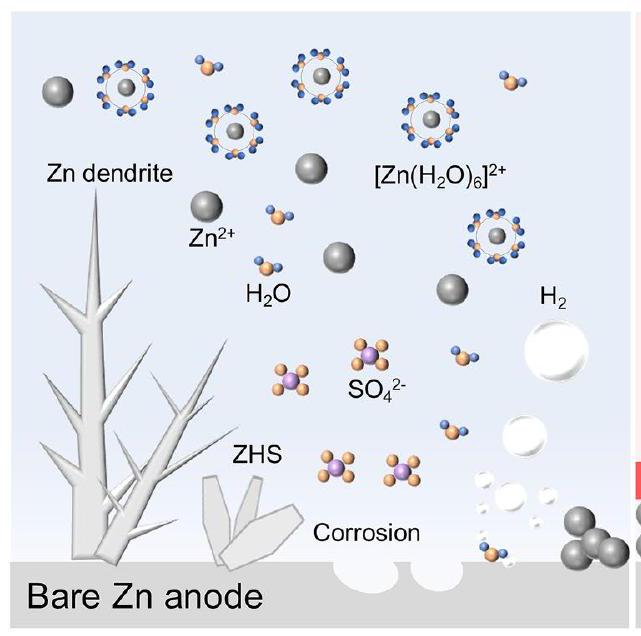
كما هو موضح في الشكل 1أ، يحدث تفاعل إنتاج الهيدروجين تلقائيًا عند التنشيط تصل الجزيئات إلى سطح الزنك، مما يؤدي إلى تراكم نواتج ثانوية من هكسا هيدرات الزنك مع الكبريتات. في هذه الأثناء، يظهر شكل غير منتظم للواجهة بسبب ترسيب الزنك المعدني بطريقة شجرية. ومن ثم، فإن الزنك غير المعالج مسبقًا يكون عرضة جدًا للتآكل، وتفاعل تطهير الهيدروجين (HER)، وواجهة غير مستقرة شكليًا لنمو التفرعات، وغيرها من المشكلات [31، 32]. من خلال التأثيرات التآزرية للهيكل والمكون الكيميائي لـ COF-S-F، يمكنه تغيير هيكل الطبقة الكهربائية المزدوجة على سطح أنود الزنك، مما يمنح أنود الزنك المعدني استقرارًا هيكليًا ممتازًا أثناء عملية الشحن/التفريغ (الشكل 1ب، ج). على وجه التحديد، الخاصية المحبة للماء “ المجموعة داخل COF-S-F يمكنها تثبيت المادة الفعالة الجزيئات وتسهيل عملية إزالة التذويب لأيونات الزنك المائية. في الوقت نفسه، فإن العنصر عالي السالبية والمأين يمكن للمجموعة أن تلتقط لمنع المزيد من تلامسه مع الزنك. مجموعة -F الكارهة للماء تولد تنافرًا قويًا مع الجزيئات، التي تحسن مقاومة تآكل الأنود الزنك. من الناحية الهيكلية، الهيكل المسامي ثلاثي الأبعاد لـ COF-S-F يوجه أيضًا النقل الموحد لأيونات الزنك وبالتالي يضمن شكل ترسيب كهربائي موحد. في النهاية، يتم تحقيق أنود زنك عالي الأداء خالٍ من التفرعات والتآكل من خلال بناء طبقة SEI صناعية على معدن الزنك باستخدام COF-S-F.

3.2 توصيفات Zn@COF-S-F

كما هو موضح في الشكل 2أ، يظهر مسحوق COF-S-F متجانسًا وفضفاضًا، مما يُتوقع أن يسهل بناء أنود الزنك المطلي بشكل مسطح. في الوقت نفسه، تُظهر خرائط العناصر أن COF-S-F يحتوي على كميات وافرة من عناصر الفلور والكبريت (الشكل S1). نتائج المجهر الإلكتروني النافذ
الشكل 1 عملية التحضير وآلية عمل COF-S-F. مقارنة تخطيطية لعملية ترسيب الزنك على الزنك العاري رسم تخطيطي تخطيطي لتخليق COF-S-F
(TEM) تُظهر أن مسحوق COF-S-F يتميز ببنية مسامية موحدة (الشكل S2). يشير الذروة المميزة للطائرة (110) في نمط حيود الأشعة السينية (XRD) إلى البنية البلورية لمسحوق COF-S-F (الشكل S3) [33]. كما هو موضح في الأشكال 2b، c و S4a، ظهور الذروات الموجودة عند 685.5، 532، و168 إلكترون فولت في أطياف XPS عالية الدقة لـ يثبت وجود ومجموعات -F في مسحوق COF-S-F المحضر حديثًا [34، 35]. علاوة على ذلك، تظهر قمم واضحة في أطياف XPS لـ و تأكيد بنية حلقة البنزين وروابط الإيمين، على التوالي (الشكل S4b، c) [36، 37]. هناك ذروة واضحة عند في مطيافية الأشعة تحت الحمراء بتحويل فورييه (FT-IR) لمسحوق COF-S-F المحضر يمكن تحديدها على أنها اهتزازات استطالة لـ رابطة، مما يبرهن على وجود مجموعة في COF-S-F (الشكل 2د) [38]. ومن الجدير بالذكر أن ذروة الامتصاص عند هو ذروة اهتزاز استطالة الإيميد تشكلت بعد التفاعل [39]، مما يشير إلى أن مجموعة الفورميل في 1، 3، 5-تريس(3-فلورو-4-فورميلفينيل) بنزين (TF) تخضع لتفاعل تكثيف مع المجموعة الأمينية في TpPa- . كما هو موضح في الشكل 2هـ، الخالي من التباطؤ
المنحنى الإيزوثيرمي من النوع الرابع القابل للعكس يظهر بنية المسام المميزة ومساحة سطح نوعية كبيرة ( ) من مسحوق COF-S-F، مما يوفر المزيد من قنوات النقل لتسهيل النقل المتجانس والاتجاهي لأيونات الزنك.
بعد ذلك، يتم إسقاط معلق COF-S-F على سطح معدن الزنك العاري لتحضير Zn@COF-S-F، حيث يتم توزيع COF-S-F بشكل موحد في شكل كروي (الشكل 2f). كما هو موضح في الشكل 2g، زوايا التماس لـ ضد Zn @ COF-S-F هو عند 0 ثانية وينخفض بشكل حاد إلى عند 15 ثانية مع الاختراق المستمر لـ ، والذي يمكن تفسيره كنتيجة لتأثير المحب للماء تتجاوز المجموعة تدريجياً التأثير الكاره للماء لمجموعة -F داخل COF-S-F [40]. يحسن طلاء COF-S-F قابلية البلل لأنود معدن الزنك، ويؤدي زيادة المحبة للماء إلى تقليل طاقة السطح الحرة بين معدن الزنك والإلكتروليت، مما ينتج عنه مقاومة أقل لنقل الشحنة أثناء ترسيب/ذوبان الزنك، وهذا بدوره يحسن أداء الخلايا على المدى الطويل. ومع ذلك، تكون زوايا التماس مقابل الزنك العاري أعلى حيث و عند 0 و15 ثانية [31]. وبناءً عليه، بسبب
الشكل 2 توصيفات لـ COF-S-F. صورة SEM لمسحوق COF-S-F المحضر حديثًا. XPS عالي الدقة b F و أطياف Zn@COF-S-F. د طيف FT-IR لـ COF-S-F. هـ منحنى الامتزاز/التحرر وتوزيع حجم المسام لـ COF-S-F. صورة SEM وصورة رقمية لـ Zn@COF-S-F. زاوية التماس لـ مقابل الزنك العاري و COF-S-F بعد منحنيات الاستقطاب الخطي للزنك العاري و خلايا COF-S-F المتماثلة. i أنماط XRD للزنك العاري و COF-S-F منقوع في إلكتروليت لمدة ثلاثة أيام. مخطط تخطيطي لتفاعلات السطح البيني عند الأنود الزنك العاري. آلية تعديل الواجهة لـ الأنود
وجود أيون مؤين عالي الكهروسالبية مجموعة و مجموعة -F الكارهة للماء، كثافة تيار التآكل في خلية Zn@ COF-S-F المتماثلة انخفضت من خلية متماثلة من الزنك العارية إلى (الشكل 2ه) [41]. على الرغم من أن PVDF يحتوي أيضًا على عنصر الفلور، فإن كثافة تيار التآكل في خلية Zn@PVDF المتماثلة هي (الشكل S5)، مما يشير إلى أن العنصر F في COF هو الذي يلعب الدور بشكل رئيسي. علاوة على ذلك، الزنك العاري و تم غمر COF-S-F في الإلكتروليت لمدة ثلاثة أيام للتحقيق في التفاعل الجانبي مع الإلكتروليت المائي. بالمقارنة مع وجود قمم شديدة تنتمي إلى في أنماط حيود الأشعة السينية (XRD) للزنك العاري الذي تم نقعه في الإلكتروليت، تؤكد شدة الذروة الضعيفة للمنتجات الثانوية في Zn@COF-S-F أن التآكل الشديد ضد الإلكتروليت المائي يمكن منعه بشكل كبير باستخدام طلاء COF-S-F (الشكل 2i). وجود أقل للمنتجات الثانوية على سطح تم تأكيد COF-S-F بعد الغمر أيضًا بواسطة المجهر الإلكتروني الماسح (الشكل S6). لذلك، ال والمجموعات -F في COF-S-F يمكنها بشكل فعال تثبيط التفاعل الجانبي السيء السمعة ضد الإلكتروليت المائي، والذي يُعتبر ضمانًا لبناء أنود زنك عالي الأداء مع استقرار بيني فائق [42]. كما هو موضح في الشكل 2j، عند التنشيط عندما تصل الجزيئات إلى سطح الزنك، فإنها تحفز تفاعل إنتاج الهيدروجين (HER) وتتحد مع الكبريتات لإنتاج منتجات ثانوية [43]. وعلى العكس من ذلك، يقوم طلاء COF-S-F بتغيير بنية الطبقة الكهربائية المزدوجة على سطح أنود الزنك، مما يسمح لأنود الزنك بالبقاء أكثر استقرارًا أثناء الشحن والتفريغ (الشكل 2ك). يمكن للمجموعات الحمضية السلفونية ذات الكهربية السالبة العالية وذرات الفلور تثبيت جزيئات الماء النشطة في الإلكتروليت وتسهيل عملية إزالة التذويب لأيونات الزنك المائية. من ناحية أخرى، يتم صد هجرة الكبريتات من الإلكتروليت إلى أنود الزنك بسبب التنافر الكهروستاتيكي، وكمية كبيرة من… المؤين بواسطة مجموعة الحمض السلفوني يعادل المستخلصة من الماء المؤين، وبالتالي تثبيط تكوين المنتجات الثانوية.

3.3 الحسابات النظرية والمحاكاة لـ Zn @ COF-S-F

تم إجراء نظرية الدالة الكثافية (DFT) للكشف عن تأثير COF-S-F على عملية إزالة الذوبان لأيونات الزنك المائية ( ) وانتشار أيونات الزنك عبر COF-S-F. كما هو موضح في الشكل 3أ،
طاقة التفكك لـ أن تخسر واحدًا طاقة الجزيء هي 0.38 إلكترون فولت، في حين أن طاقة الامتزاز لـ جزيء إلى مجموعات وظيفية مختلفة، في COF-S-F إلى الماء هو – و -0.344 إلكترون فولت، على التوالي، مما يشير إلى أن جزيئات الماء المذابة حول سيتم جذبهم بواسطة المجموعات. علاوة على ذلك، تم دراسة سلوك هجرة أيون الزنك في COF-S-F بشكل أعمق. يوضح الشكل 3ب مسار انتشار أيونات الزنك عند ثلاث مجموعات وظيفية مختلفة في COF-S-F. حاجز الطاقة لأيون الزنك عبر مجموعة -F في COF-S-F هو الأدنى (0.386 إلكترون فولت) مقارنةً بحواجز الطاقة عبر المجموعات الأخرى (0.827 إلكترون فولت لـ -C و0.655 إلكترون فولت لـ) )، بسبب الإمكانات الكهروستاتيكية السالبة (المنطقة الزرقاء) لـ -F و بتفاعل كهرستاتيكي قوي مع أيونات الزنك (الشكل 3ب، ج). لذلك، فإن عملية إزالة الذوبان لـ يتم تعزيز ذلك ويتسارع هجرة أيونات الزنك عبر طبقة COF-S-F [44].
بالإضافة إلى ذلك، يتم إجراء محاكاة المجال متعدد الفيزياء، وهي أداة قوية لكشف تطور مجال التركيز على طول العملية الكهروكيميائية، استنادًا إلى معادلة باتلر-فولمر [45]:

مع كثافة التيار ( )، كثافة التيار التبادلي ( )، ثابت التفاعل الأنودي ( )، ثابت فارادي ( )، ثابت الغاز المثالي ، درجة حرارة كلفن الجهد الزائد ، تركيز أيون الزنك ( ) لوصف عملية الترسيب الكهربائي لمعدن الزنك تحت تأثير طبقة SEI الصناعية COF-S-F (انظر التفاصيل في المحاكاة متعددة الفيزياء) [46، 47]. أولاً، السطح الأولي بخشونة مقدارها يتم توليده بواسطة الدالة العشوائية وحجم السطح المولد هو . ويُظهر النموذج الهندسي المحاكى في الشكل S7. كما هو موضح في الشكل 3د، هـ، يتم توزيع تركيز أيونات الزنك بشكل موحد تحت غطاء SEI الاصطناعي COF-S-F، مقارنة بوجود واضح لـ “نقاط ساخنة” في التركيز على البروزات. من الجدير بالذكر أن SEI الاصطناعي COF-S-F مع مجموعة -F على القنوات المحصورة يمكنه توحيد تدفق أيونات الزنك على السطح وتحقيق مجال تركيز موحد. علاوة على ذلك، مع ترسيب الزنك الكهربائي، يظل تركيز أيونات الزنك على Zn@COF-S-F مستمراً ومتساوياً بينما يكون على معدن الزنك العاري غير متساوٍ دائماً. بالإضافة إلى ذلك، فإن سطح Zn@COF-S-F المترسب كهربائياً أكثر تسطحاً ونعومة من سطح الزنك العاري (الشكل 3و، ز والفيديوهات S1، S2). لتكون أكثر تحديداً، يتم تقطيع تغير تركيز أيونات الزنك على سطح معدن الزنك عند في الشكل 3f، g. كما
الشكل 3 إزالة المذيب وحصر COF-S-F. أ مقارنة طاقة التفكك لـ مع طاقة الامتزاز بين ومجموعات مختلفة من COF-S-F. مسارات هجرة أيون الزنك وحاجز طاقة الانتشار لأيون الزنك في COF-S-F. ج الجهد الكهروستاتيكي لجزيئات COF-S-F. توزيع تركيز أيون الزنك على سطح Zn@COF-S-F معدن الزنك العاري في المرحلة الأولية مع بنية سطحية مولدة عشوائيًا. الشكل النهائي مع توزيع مجال التركيز لـ Zn@COF-S-F و تغير تركيز Zn العاري على طول المحور X عند Y=50 في الشكل 3د-ز. تغير خشونة السطح البيني مع الترسيب الكهربائي، حيث أن الخشونة الأولية هي
موضح في الشكل 3ه، كل من تركيز أيونات الزنك والتجانس المقابل على تم تعزيز COF-S-F، في حين يشهد معدن الزنك العاري تركيزًا غير متساوٍ باستمرار لأيون الزنك من المرحلة الأولية إلى المرحلة النهائية. علاوة على ذلك، يُعرف تغير خشونة السطح البيني كنسبة بين خشونة السطح المتطور إلى الخشونة الأولية لـ ، والتي يمكن إجراؤها لتقييم تجانس الترسيب الكهربائي لمعدن الزنك حتى مع وجود سطح أولي خشن. يمكن ملاحظة أن الخشونة النهائية لـ Zn@COF-S-F هي بينما تلك الخاصة بالزنك العاري هي ، ومعدل التنعيم لـ يتم تسريع COF-S-F مقارنةً بمعدن الزنك العاري (الشكل 3i).
وبالتالي، أخذ التأثير التآزري للميزة في الاعتبار المجموعات في عملية إزالة الذوبان لـ وقناة محصورة مع مجموعة -F على توحيد تدفق أيونات الزنك، يمكن التنبؤ بحصول معدن الزنك الخالي من التآكل والخالي من التشعبات مع أداء كيميائي كهربائي مرضٍ [48].

3.4 الأداء الكهروكيميائي لخلايا Zn@COF-S-F المتماثلة

كما هو موضح في الشكل S8، تظهر منحنيات الفولتامترية الدورانية (CV) للخلية غير المتماثلة Zn@COF-S-FITi قممًا أعلى
كثافات التيار الحالية أعلى من تلك الخاصة بخلية ZnITi غير المغطاة، مما يوضح أن الحركية الكهروكيميائية لترسيب/إزالة الزنك تتحسن مع طلاء COF-S-F. بعد ذلك، يتم تنفيذ أداء الترسيب/الإزالة طويل الأمد لخلية Zn غير المغطاة وخلية Zn@COF-S-F المتماثلة للتحقق من فعالية طبقة SEI الاصطناعية COF-S-F. عند كثافة التيار المنخفضة ، تعاني خلية الزنك المتماثلة العارية من استقطاب شديد في البداية، وتختصر في أقل من 200 ساعة في النهاية. وتُظهر خلية الزنك@COF-S-F المتماثلة استقرارًا دوريًا مطولًا يصل إلى 500 ساعة مع تذبذب جهد أقل مقارنة بخلية الزنك المتماثلة العارية (62.1 مقابل 78.6 مللي فولت) (الشكل S9). عند كثافة تيار أعلى من يُطبّق، ال تحافظ الخلية المتماثلة على استقرار التدوير لـ مع التحيز الجهدي المنخفض البالغ 50.5 مللي فولت، في حين أن خلية الزنك المتماثلة العارية تتعرض لقصر الدائرة بعد 123 ساعة (الأشكال 4أ وS10). علاوة على ذلك، يتم مقارنة أداء الخلايا المتماثلة عند كثافات تيار متدرجة لتقييم تأثير COF-S-F على الحركية الكهروكيميائية لترسيب/إزالة ترسيب الزنك [49]. مع زيادة كثافة التيار من 0.25 إلى ، تعرض جهود الاستقطاب المقابلة زيادة طفيفة من 41 إلى 57 مللي فولت لخلايا Zn @ COF-S-F المتماثلة، والتي هي أقل من تلك الخاصة بـ Zn العاري و خلايا PVDF المتماثلة (الشكل S11). ثم يتم إجراء كرونوأمبيروجرام (CA) للتحقيق في تغييرات تكوين الزنك أثناء الترسيب الكهربائي. كما هو موضح في الأشكال 4b و S12، عند تطبيق جهد زائد ثابت مقداره -200 مللي فولت، يتغير التيار في خلايا الزنك العارية وخلايا Zn@PVDF المتماثلة بشكل كبير وينخفض باستمرار لمدة 200 ثانية، بينما التيار في خلايا Zn@COF-S-F المتماثلة يظل ثابتًا بعد 5 ثوانٍ فقط، مما يشير إلى أن عملية الانتشار ثنائية الأبعاد الطويلة لأيونات الزنك على سطح الزنك العاري مع تكوين غير منتظم قد تم تنظيمها كعملية انتشار ثلاثية الأبعاد قصيرة مع تكوين منتظم [50]. علاوة على ذلك، فإن الجهد الزائد لتكوين… الخلية غير المتماثلة (59.1 مللي فولت) أصغر من خلية Zn@PVDFICu غير المتماثلة (87.6 مللي فولت) وخلية ZnICu العارية (96.2 مللي فولت) (الأشكال 4ج وS13)، مما يوضح تسهيل عملية التبلور أثناء التبلور الكهربائي لمعدن الزنك. وبالتالي، فإن الترسيب الكهربائي الموحد والمستوي يمكن توقعه بشكل معقول من نظرية التبلور الكلاسيكية [45]. من ناحية أخرى، استقطاب الخلية غير المتماثلة (75.2 مللي فولت) أصغر من الخلية العارية الخلايا غير المتماثلة (الشكل 4د). كما هو متوقع، تظهر الخلية غير المتماثلة Zn@COF-S-FlCu كفاءة كولومبية متوسطة أعلى (CE) لـ
عند كثافة تيار ويحافظ على استقراره لأكثر من 350 دورة، وهو أكثر تميزًا من الخلية غير المتماثلة ZnICu ذات عمر 50 دورة (الشكل 4e). ومن ثم، فإن استمرارية وقابلية عكس عملية ترسيب/إزالة الزنك تعززت بشكل كبير بسبب تصميم فيلم COF-S-F [51، 52]. وللبحث بشكل أعمق في تأثير COF-S-F على تثبيط نمو الأشواك وتكوين المنتجات الثانوية، تم إجراء اختبارات SEM وXRD على أنودات الزنك المختلفة بعد 500 ساعة من التدوير. بالمقارنة مع سطح الزنك العاري غير المستوي والمليء بالمنتجات الثانوية، يظهر Zn@COF-S-F سطحًا أكثر استواءً وكثافة، وهو ما تؤكده أنماط XRD (الأشكال S14 وS15). ومن المشجع أنه على الرغم من أن دراسات أخرى في هذا المجال تظهر أداءً جيدًا، فإن تصاميم وأداء هذا العمل أكثر عمقًا وفعالية وتميزًا (الشكل 4f والجدول S1) [16، 20، 21، 32، 33، 53].

3.5 الأداء الكهروكيميائي لخلايا Zn@ COF-S-FIMnO2 الكاملة

في النهاية، الخلايا الكاملة مع تم تجميع الكاثود لتقييم الدور العملي لأنود Zn@COF-S-F (الشكل S16). كما هو موضح في الشكل 5a، تظهر منحنيات CV شكل القمة المتسق مع نفس المواقع، مما يشير إلى أن إدخال طبقة SEI الاصطناعية COF-S-F لا يغير العملية الكهروكيميائية ذات الصلة [53، 54]. بالإضافة إلى ذلك، كثافات تيار ذروة الأكسدة والاختزال لـ الخلايا الكاملة و ، على التوالي، وهما أعلى من تلك الخاصة بـ “الهيكل العاري خلية ( و ). ومن ثم، الـ COF-S-FI الخلايا الكاملة توفر نشاطًا كيميائيًا كهربائيًا عاليًا واستقطابًا أقل. خلية كاملة بكثافات تيار متدرجة تتراوح من 0.1 إلى يمكن أن توفر قدرات أعلى، وهي أعلى من تلك الخاصة بالأسطح العارية خلية كاملة. ثم سعة يمكن استعادة الخلية الممتلئة إلى عندما تعود كثافة التيار إلى (الشكلان 5ب وS17). بالمقارنة مع التلاشي المستمر للسعة في الحالة العارية خلية كاملة عند كثافة التيار الحالية الخلية الممتلئة لا تزال تقدم السعة النوعية العالية حتى بعد 200 دورة مع كفاءة كولوم مستقرة ومنصة جهد شحن/تفريغ مستقرة (الأشكال 5ج وS18). علاوة على ذلك، عندما تزداد كثافة التيار إلى ، السعة النوعية الأولية للتفريغ لـ خلية كاملة COF-S-FIMnO 2 ) أعلى من تلك الخاصة بالهيكل العاري خلية كاملة
الشكل 4 تحسينات في الاستقرار والقابلية للعكس بواسطة Zn@COF-S-F. أ. ملفات الجهد لدورات الشحن/التفريغ الجلفانواستاتيكية لخلايا متماثلة من الزنك العاري وZn@COF-S-F. ب. ملفات الكرونوأمبيرومترية لخلايا متماثلة من الزنك العاري وZn@COF-S-F عند جهد زائد قدره -200 مللي فولت. ج. جهود التولد الزائد للزنك العاري و الخلايا غير المتماثلة. د ملفات الترسيب/الإزالة للخلايا العارية و خلايا FICu غير المتماثلة عند كثافة تيار مقدارها بسعة . الكفاءة الكهروستاتيكية لـ و خلايا FICu غير المتماثلة. مقارنة القابلية للعكس الدوري مع تقارير سابقة أخرى
). بعد 800 دورة، تحتوي الخلية على معدل احتفاظ بالقدرة متميز يبلغ مع CE أكثر استقرارًا ومنحنى شحن وتفريغ، في حين أن ذلك الخاص بـ الخلية فقط (الشكل 5د، هـ). علاوة على ذلك، تم دراسة تأثير طبقة COF-S-F في الحماية من خلال اختبار التفريغ الذاتي. كما هو موضح في الشكل 5و، تحافظ الخلية على سعة تفريغ أعلى بعد التخزين لمدة 24 ساعة عند الدورة المائة، ولا تزال قادرة على توفير سعة تفريغ نوعية تبلغ بعد 400 دورة، وهو تحسن كبير مقارنةً بالسطح العاري خلية ( ). علاوة على ذلك، ال الخلية أكثر استقرارًا وأقل استقطابًا عند منصة الشحن/التفريغ المائة (الشكل.
S19). لذلك، تم تحسين الأداء الدوري للخلية الكاملة بشكل كبير مع مقاومة ممتازة للتفريغ الذاتي، ويُعزى ذلك إلى إدخال فيلم COF-S-F مع عملية إزالة التذويب المنظمة لأيونات الزنك المائية ومعدل انتشار أسرع لأيونات الزنك لتوحيد ترسيب الزنك المعدني على القطب.
بعد ذلك، يتم تفكيك الأنودات من الخلايا الكاملة بعد 800 دورة لتأكيد حماية طبقة COF-S-F على أنود معدن الزنك بشكل أكبر. كما هو موضح في الشكل 5g، يظهر ظهور قمم مميزة قوية تم تحديدها على أنها في نمط حيود الأشعة السينية لأنود الزنك العاري يظهر حدوث تفاعلات جانبية شديدة.
الشكل 5 الخلايا الكاملة تعزز الأداء الكهروكيميائي مع COF-S-F. أ منحنيات CV للخلية العارية و خلايا كاملة. تقييم أداءات العارية و COF-S-FlMnO الخلايا الكاملة. أداءات الدوران للخلايا العارية و خلايا كاملة عند كثافة تيار و . منحنيات الشحن/التفريغ الجلفانواستاتيكية للسطح العاري و الخلايا الكاملة عند الدورة المئتين. أداء ركوب الدراجات بعد الراحة لمدة 24 ساعة بدون و خلايا كاملة عند كثافة تيار . صور المجهر الإلكتروني الماسح لـ الزنك العاري الأنود COF-S-F بعد 800 دورة. أنماط حيود الأشعة السينية لـ Zn العاري و الأنود COF-S-F بعد 800 دورة. صور LCSM ثلاثية الأبعاد لـ الزنك العاري و الأنود Zn@COF-S-F بعد 800 دورة
بينما يكون الذروة المميزة للمنتجات الجانبية في نمط حيود الأشعة السينية لـ Zn@COF-S-F أقل وضوحًا بشكل ملحوظ، مما يثبت أن إدخال طبقة COF-S-F يمكن أن يضعف التفاعل الجانبي بشكل فعال وبالتالي يقلل من التراكم.
من المنتجات الثانوية. بسبب تأثير إزالة المذيب المحدد لـ COF-S-F، يحدث تلامس بين المادة الفعالة الجزيئات والزنك المعدني محجوبان، مما يعيق إنتاج ، والانكسار المقابل
القمة ليست واضحة. علاوة على ذلك، يتم إجراء المجهر الإلكتروني الماسح (SEM) والمجهر الماسح بالليزر المرافق (LSCM) للتحقيق في شكل معدن الزنك المحمي بواسطة فيلم COF-S-F. من صور SEM في الأشكال 5h، i وS20، يظهر عدد كبير من التفرعات الزنك على الأنود الزنك العاري، بينما سطح أنود Zn@COF-S-F يكون مستويًا نسبيًا مع شوائب ضئيلة. علاوة على ذلك، بالمقارنة مع الفرق الكبير في الارتفاع لأنود الزنك العاري ، سطح الـ الأنود COF-S-F يتميز بتجانس نسبي مع خشونة منخفضة (الشكل 5j، k). ومن ثم، يمكن لفيلم COF-S-F أن يوزع ترسيب الزنك المعدني بشكل موحد وخالي من التشعبات. مع الأخذ في الاعتبار هذه التأثيرات التآزرية لفيلم COF-S-F في إضعاف التفاعلات الجانبية وقمع نمو التشعبات الأنود يحتضن التفوق لتمديد عمر خلية كاملة.

4 الخاتمة

في هذا العمل، تم تطوير إطار عضوي تساهمي فلوريني (COF-S-F) يحتوي على مجموعة حمض السلفونيك (- ) يتكون على سطح أنود الزنك. المادة المحبة للماء يمكن لمجموعة -F الكارهة للماء أن تسهل إزالة ذوبان أيونات الزنك المائية، مما يعيق التفاعلات الجانبية مع التمرير السطحي. في الوقت نفسه، تعزز مجموعة -F ذات الكهروسالبية العالية في COF-S-F النقل السريع والمتجانس لأيونات الزنك على طول الترتيب من خلال التفاعلات الكهروستاتيكية، مما يساهم في عملية الترسيب الكهربائي المتجانس لمعدن الزنك. لذلك، تُظهر الخلية المتماثلة COF-S-F استقرارًا ممتازًا في التدوير ضد الإلكتروليت المائي، حيث يمكنها التدوير بثبات لمدة 1000 دورة عند كثافة التيار الخاصة بـ مع هستيريسيس جهد منخفض يبلغ 50.5 مللي فولت. بالإضافة إلى ذلك، COF-S-FI الخلية الممتلئة لا تزال تقدم سعة تفريغ نوعية عالية عند كثافة التيار الحالية بعد 800 دورة، مع احتفاظ أعلى بالسعة باختصار، يؤدّي التأثير التآزري للجفاف السريع وحصر الأيونات من COF-S-F إلى تحقيق أنود معدني من الزنك خالٍ من التشعبات وعالي الاستقرار، مما يحسّن بشكل فعّال الأداء الكهروكيميائي لبطاريات AZIBs وبالتالي يسرّع من تطبيقها العملي.
الشكر والتقدير تم دعم هذا العمل ماليًا من قبل المؤسسة الوطنية للعلوم الطبيعية في الصين (الأرقام 51872090، 51772097، 52372252)، وصندوق العلوم الطبيعية لمقاطعة خبي للعلماء الشباب المتميزين (الرقم E2019209433)، وبرنامج المواهب الشبابية التابع لإدارة التعليم في مقاطعة خبي (الرقم BJ2018020)، وصندوق العلوم الطبيعية لمقاطعة خبي (الرقم E2020209151).

الإعلانات

تضارب المصالح يعلن المؤلفون عدم وجود تضارب في المصالح. ليس لديهم أي مصالح مالية متنافسة معروفة أو علاقات شخصية قد يكون لها تأثير على العمل المبلغ عنه في هذه الورقة. الأستاذ جيانغ تشو هو عضو في هيئة التحرير/رئيس تحرير مجلة نانو-ميكرو ليترز ولم يشارك في مراجعة التحرير أو قرار نشر هذه المقالة. يعلن جميع المؤلفين عدم وجود مصالح متنافسة.
الوصول المفتوح هذه المقالة مرخصة بموجب رخصة المشاع الإبداعي النسبة 4.0 الدولية، التي تسمح بالاستخدام والمشاركة والتكييف والتوزيع وإعادة الإنتاج بأي وسيط أو صيغة، طالما أنك تعطي الائتمان المناسب للمؤلف(ين) الأصلي(ين) والمصدر، وتوفر رابطًا إلى رخصة المشاع الإبداعي، وتشير إلى ما إذا تم إجراء تغييرات. الصور أو المواد الأخرى التابعة لأطراف ثالثة في هذه المقالة مشمولة في رخصة المشاع الإبداعي للمقالة، ما لم يُذكر خلاف ذلك في سطر الائتمان الخاص بالمادة. إذا لم تكن المادة مشمولة في رخصة المشاع الإبداعي للمقالة وكان استخدامك المقصود غير مسموح به بموجب اللوائح القانونية أو يتجاوز الاستخدام المسموح به، فستحتاج إلى الحصول على إذن مباشرة من صاحب حقوق النشر. لعرض نسخة من هذه الرخصة، قم بزيارةhttp://creativecommons.org/licenses/by/4.0/.
معلومات تكميلية النسخة الإلكترونية تحتوي على مواد تكميلية متاحة علىhttps://doi.org/10.1007/ s40820-023-01278-0.

References

  1. X. Song, L. Bai, C. Wang, D. Wang, K. Xu et al., Synergistic cooperation of texture and amorphous zinc phosphate for dendrite-free Zn anodes. ACS Nano 17, 15113 (2023). https://doi.org/10.1021/acsnano.3c04343
  2. Y. Shang, D. Kundu, A path forward for the translational development of aqueous zinc-ion batteries. Joule 7, 244 (2023). https://doi.org/10.1016/j.joule.2023.01.011
  3. B. Qiu, K. Liang, W. Huang, G. Zhang, C. He et al., Crystalfacet manipulation and interface regulation via tmp-modulated solid polymer electrolytes toward high-performance Zn metal batteries. Adv. Energy Mater. 13, 2301193 (2023). https://doi. org/10.1002/aenm. 202301193
  4. J. Liu, M. Yue, S. Wang, Y. Zhao, J. Zhang, A review of performance attenuation and mitigation strategies of lithium-ion batteries. Adv. Funct. Mater. 32, 2107769 (2021). https://doi. org/10.1002/adfm. 202107769
  5. M. Ameziane, R. Mansell, V. Havu, P. Rinke, S. van Dijken, Lithium-ion battery technology for voltage control of perpendicular magnetization. Adv. Funct. Mater. 32, 2113118 (2022). https://doi.org/10.1002/adfm. 202113118
  6. Z. Peng, Y. Li, P. Ruan, Z. He, L. Dai et al., Metal-organic frameworks and beyond: The road toward zinc-based batteries. Coord. Chem. Rev. 488, 215190 (2023). https://doi.org/ 10.1016/j.ccr.2023.215190
  7. J. Ruan, D. Ma, K. Ouyang, S. Shen, M. Yang et al., 3D artificial array interface engineering enabling dendrite-free stable Zn metal anode. Nano-Micro Lett. 15, 37 (2023). https://doi. org/10.1007/s40820-022-01007-z
  8. H. Ying, P. Huang, Z. Zhang, S. Zhang, Q. Han et al., Freestanding and flexible interfacial layer enables bottom-up Zn deposition toward dendrite-free aqueous Zn -ion batteries. Nano-Micro Lett. 14, 180 (2022). https://doi.org/10.1007/ s40820-022-00921-6
  9. H. Meng, Q. Ran, T.-Y. Dai, H. Shi, S.-P. Zeng et al., Surfacealloyed nanoporous zinc as reversible and stable anodes for high-performance aqueous zinc-ion battery. Nano-Micro Lett. 14, 128 (2022). https://doi.org/10.1007/s40820-022-00867-9
  10. S. Zhao, Y. Zhang, J. Li, L. Qi, Y. Tang et al., A heteroanionic zinc ion conductor for dendrite-free Zn metal anodes. Adv. Mater. 35, 2300195 (2023). https://doi.org/10.1002/adma. 202300195
  11. Z. Bie, Q. Yang, X. Cai, Z. Chen, Z. Jiao et al., One-step construction of a polyporous and zincophilic interface for stable zinc metal anodes. Adv. Energy Mater. 12, 2202683 (2022). https://doi.org/10.1002/aenm. 202202683
  12. G. Chen, Y. Kang, H. Yang, M. Zhang, J. Yang et al., Toward forty thousand-cycle aqueous zinc-iodine battery: Simultaneously inhibiting polyiodides shuttle and stabilizing zinc anode through a suspension electrolyte. Adv. Funct. Mater. 33, 2300656 (2023). https://doi.org/10.1002/adfm. 202300656
  13. Z. Yi, J. Liu, S. Tan, Z. Sang, J. Mao et al., An ultrahigh rate and stable zinc anode by facet-matching-induced dendrite regulation. Adv. Mater. 34, 2203835 (2022). https://doi.org/ 10.1002/adma. 202203835
  14. Y. Zhao, Y. Huang, F. Wu, R. Chen, L. Li, High-performance aqueous zinc batteries based on organic/organic cathodes integrating multiredox centers. Adv. Mater. 33, 2106469 (2021). https://doi.org/10.1002/adma. 202106469
  15. H. He, H. Qin, J. Wu, X. Chen, R. Huang et al., Engineering interfacial layers to enable Zn metal anodes for aqueous zincion batteries. Energy Storage Mater. 43, 317 (2021). https:// doi.org/10.1016/j.ensm.2021.09.012
  16. F. Wu, Y. Chen, Y. Chen, R. Yin, Y. Feng et al., Achieving highly reversible zinc anodes via N, N-dimethylacetamide enabled Zn-ion solvation regulation. Small 18, 2202363 (2022). https://doi.org/10.1002/smll. 202202363
  17. Y. Wu, T. Zhang, L. Chen, Z. Zhu, L. Cheng et al., Polymer chain-guided ion transport in aqueous electrolytes of Zn -ion batteries. Adv. Energy Mater. 13, 2300791 (2023). https://doi. org/10.1002/aenm. 202300719
  18. J. Shin, J. Lee, Y. Kim, Y. Park, M. Kim et al., Highly reversible, grain-directed zinc deposition in aqueous zinc ion batteries. Adv. Energy Mater. 11, 2100676 (2021). https://doi.org/ 10.1002/aenm. 202100676
  19. N. Maeboonruan, J. Lohitkarn, C. Poochai, T. Lomas, A. Wisitsoraat et al., Dendrite suppression with zirconium (IV) based metal-organic frameworks modified glass microfiber separator for ultralong-life rechargeable zinc-ion batteries. J. Sci.: Adv. Mater. Devices 7, 100467 (2022). https://doi.org/10.1016/j. jsamd.2022.100467
  20. T. Liu, J. Hong, J. Wang, Y. Xu, Y. Wang, Uniform distribution of zinc ions achieved by functional supramolecules for stable zinc metal anode with long cycling lifespan. Energy Storage Mater. 45, 1074 (2022). https://doi.org/10.1016/j.ensm.2021. 11.002
  21. X. Zhao, N. Dong, M. Yan, H. Pan, Unraveling the interphasial chemistry for highly reversible aqueous Zn ion batteries. ACS Appl. Mater. Interfaces 15, 4053 (2023). https://doi.org/10. 1021/acsami.2c19022
  22. D. Yuan, X. Li, H. Yao, Y. Li, X. Zhu et al., A liquid crystal ionomer-type electrolyte toward ordering-induced regulation for highly reversible zinc ion battery. Adv. Sci. 10, 2206469 (2023). https://doi.org/10.1002/advs. 202206469
  23. J. Ji, Z. Zhu, H. Du, X. Qi, J. Yao et al., Zinc-contained alloy as a robustly adhered interfacial lattice locking layer for planar and stable zinc electrodeposition. Adv. Mater. 35, 2211961 (2023). https://doi.org/10.1002/adma. 202211961
  24. Y. Yang, H. Yang, R. Zhu, H. Zhou, High reversibility at high current density: The zinc electrodeposition principle behind the “trick.” Energy Environ. Sci. 16, 2723 (2023). https://doi. org/10.1039/d3ee00925d
  25. Y. Lin, Z. Mai, H. Liang, Y. Li, G. Yang et al., Dendrite-free Zn anode enabled by anionic surfactant-induced horizontal growth for highly-stable aqueous Zn -ion pouch cells. Energy Environ. Sci. 16, 687-697 (2023). https://doi.org/10.1039/ d2ee03528f
  26. Y. Lin, Y. Li, Z. Mai, G. Yang, C. Wang, Interfacial regulation via anionic surfactant electrolyte additive promotes stable (002)-textured zinc anodes at high depth of discharge. Adv. Energy Mater. 13, 2301999 (2023). https://doi.org/10.1002/ aenm. 202301999
  27. Q. Zong, B. Lv, C.F. Liu, Y.F. Yu, Q.L. Kang et al., Dendrite-free and highly stable Zn metal anode with coating. ACS Energy Lett. 8, 2886 (2023). https://doi.org/10.1021/acsenergylett.3c01017
  28. Z. Cao, X. Zhu, D. Xu, P. Dong, M.O.L. Chee et al., Eliminating Zn dendrites by commercial cyanoacrylate adhesive for zinc ion battery. Energy Storage Mater. 36, 132 (2021). https:// doi.org/10.1016/j.ensm.2020.12.022
  29. C. Guo, J. Zhou, Y. Chen, H. Zhuang, Q. Li et al., Synergistic manipulation of hydrogen evolution and zinc ion flux in metalcovalent organic frameworks for dendrite-free Zn -based aqueous batteries. Angew. Chem. Int. Ed. 61, e202210871 (2022). https://doi.org/10.1002/anie. 202210871
  30. X. Liu, Y. Jin, H. Wang, X. Yang, P. Zhang et al., In situ growth of covalent organic framework nanosheets on graphene as the cathode for long-life high-capacity lithium-ion batteries. Adv. Mater. 34, 2203605 (2022). https://doi.org/10.1002/ adma. 202203605
  31. T. Huang, K. Xu, N. Jia, L. Yang, H. Liu et al., Intrinsic interfacial dynamic engineering of zincophilic microbrushes via regulating Zn deposition for highly reversible aqueous zinc ion battery. Adv. Mater. 35, 2205206 (2023). https://doi.org/ 10.1002/adma. 202205206
  32. L. Hong, X. Wu, C. Ma, W. Huang, Y. Zhou et al., Boosting the zn-ion transfer kinetics to stabilize the zn metal interface
    for high-performance rechargeable zn-ion batteries. J. Mater. Chem. A 9, 16814 (2021). https://doi.org/10.1039/d1ta03967a
  33. N. Guo, Z. Peng, W. Huo, Y. Li, S. Liu et al., Stabilizing Zn metal anode through regulation of Zn ion transfer and interfacial behavior with a fast ion conductor protective layer. Small (2023). https://doi.org/10.1002/smll. 202303963
  34. J. Zhao, Y. Ying, G. Wang, K. Hu, Y.D. Yuan et al., Covalent organic framework film protected zinc anode for highly stable rechargeable aqueous zinc-ion batteries. Energy Storage Mater. 48, 82 (2022). https://doi.org/10.1016/j.ensm.2022.02.054
  35. C. Hu, Z. Wei, L. Li, G. Shen, Strategy toward semiconducting -MXene: Phenylsulfonic acid groups modified as photosensitive material for flexible visual sensoryneuromorphic system. Adv. Funct. Mater. 33, 2302188 (2023). https://doi.org/10.1002/adfm. 202302188
  36. R. Kushwaha, C. Jain, P. Shekhar, D. Rase, R. Illathvalappil et al., Made to measure squaramide cof cathode for zinc dualion battery with enriched storage via redox electrolyte. Adv. Energy Mater. 13, 2301049 (2023). https://doi.org/10.1002/ aenm. 202301049
  37. Z. Zhao, R. Wang, C. Peng, W. Chen, T. Wu et al., Horizontally arranged zinc platelet electrodeposits modulated by fluorinated covalent organic framework film for high-rate and durable aqueous zinc ion batteries. Nat. Commun. 12, 6606 (2021). https://doi.org/10.1038/s41467-021-26947-9
  38. J. Xu, S. An, X. Song, Y. Cao, N. Wang et al., Towards high performance Li-S batteries via sulfonate-rich cof-modified separator. Adv. Mater. 33, 2105178 (2021). https://doi.org/ 10.1002/adma. 202105178
  39. L. Wang, Z. Zhao, Y. Yao, Y. Zhang, Y. Meng et al., Highly fluorinated non-aqueous solid-liquid hybrid interface realizes water impermeability for anti-calendar aging zinc metal batteries. Energy Storage Mater. 62, 102920 (2023). https://doi. org/10.1016/j.ensm.2023.102920
  40. I. Yoshimitsu, C. Shuo, H. Ryota, K. Takeshi, A. Tsubasa et al., Ultrafast water permeation through nanochannels with a densely fluorous interior surface. Science 376, 738 (2022). https://doi.org/10.1126/science.abd0966
  41. Y. Song, P. Ruan, C. Mao, Y. Chang, L. Wang et al., Metalorganic frameworks functionalized separators for robust aqueous zinc-ion batteries. Nano-Micro Lett. 14, 218 (2022). https://doi.org/10.1007/s40820-022-00960-z
  42. C. Deng, X. Xie, J. Han, Y. Tang, J. Gao et al., A sieve-functional and uniform-porous kaolin layer toward stable zinc metal anode. Adv. Funct. Mater. 30, 2000599 (2020). https:// doi.org/10.1002/adfm. 202000599
  43. H. Dong, X. Hu, R. Liu, M. Ouyang, H. He et al., Bio-inspired polyanionic electrolytes for highly stable zinc-ion batteries. Angew. Chem. Int. Ed. 62, e202311268 (2023). https://doi. org/10.1002/anie. 202311268
  44. K. Wu, X. Shi, F. Yu, H. Liu, Y. Zhang et al., Molecularly engineered three-dimensional covalent organic framework protection films for highly stable zinc anodes in aqueous electrolyte. Energy Storage Mater. 51, 391 (2022). https://doi.org/ 10.1016/j.ensm.2022.06.032
  45. X. Jiao, X. Wang, X. Xu, Y. Wang, H.H. Ryu et al., Multiphysical field simulation: A powerful tool for accelerating exploration of high-energy-density rechargeable lithium batteries. Adv. Energy Mater. 13, 2301708 (2023). https://doi.org/ 10.1002/aenm. 202301708
  46. X. Xu, X. Jiao, O.O. Kapitanova, J. Wang, V.S. Volkov et al., Diffusion limited current density: A watershed in electrodeposition of lithium metal anode. Adv. Energy Mater. 12, 2200244 (2022). https://doi.org/10.1002/aenm. 202200244
  47. X. Jiao, Y. Wang, O.O. Kapitanova, X. Xu, V.S. Volkov et al., Morphology evolution of electrodeposited lithium on metal substrates. Energy Storage Mater. 61, 102916 (2023). https:// doi.org/10.1016/j.ensm.2023.102916
  48. B. Li, S. Liu, Y. Geng, C. Mao, L. Dai et al., Achieving stable zinc metal anode via polyaniline interface regulation of Zn ion flux and desolvation. Adv. Funct. Mater. (2023). https://doi. org/10.1002/adfm. 202214033
  49. A.S. Chen, C.Y. Zhao, J.Z. Gao, Z.K. Guo, X.Y. Lu et al., Multifunctional sei-like structure coating stabilizing Zn anodes at a large current and capacity. Energy Environ. Sci. 16, 275 (2023). https://doi.org/10.1039/d2ee02931f
  50. T. Wang, P. Wang, L. Pan, Z. He, L. Dai et al., Stabling zinc metal anode with polydopamine regulation through dual effects of fast desolvation and ion confinement. Adv. Energy Mater. 13, 2203523 (2023). https://doi.org/10.1002/aenm. 202203523
  51. Y. Zeng, P.X. Sun, Z. Pei, Q. Jin, X. Zhang et al., Nitrogendoped carbon fibers embedded with zincophilic cu nanoboxes for stable Zn-metal anodes. Adv. Mater. 34, 2200342 (2022). https://doi.org/10.1002/adma. 202200342
  52. W. Zhou, M. Chen, Q. Tian, J. Chen, X. Xu et al., Cottonderived cellulose film as a dendrite-inhibiting separator to stabilize the zinc metal anode of aqueous zinc ion batteries. Energy Storage Mater. 44, 57 (2022). https://doi.org/10.1016/j. ensm.2021.10.002
  53. Q. Dong, H. Ao, Z. Qin, Z. Xu, J. Ye et al., Synergistic chaotropic effect and cathode interface thermal release effect enabling ultralow temperature aqueous zinc battery. Small 18, 2203347 (2022). https://doi.org/10.1002/smll. 202203347
  54. M. Sun, G. Ji, J. Zheng, A hydrogel electrolyte with ultrahigh ionic conductivity and transference number benefit from “highways” for dendrite-free battery. Chem. Eng. J. 463, 142535 (2023). https://doi.org/10.1016/j.cej.2023. 142535

  1. Bin Li and Pengchao Ruan have contributed equally to this work.
    Zhangxing He, zxhe@ncst.edu.cn; Yangyang Liu, liuyy0510@hotmail.com; Jiang Zhou, zhou_jiang@csu.edu.cn
    School of Chemical Engineering, North China University of Science and Technology, Tangshan 063009, People’s Republic of China
    School of Materials Science and Engineering, Central South University, Changsha 410083, People’s Republic of China
    State Key Laboratory for Mechanical Behavior of Materials, Xi’an Jiaotong University, Xi’an 710049, People’s Republic of China
    Hunan Provincial Key Defense Laboratory of High Temperature Wear-Resisting Materials and Preparation Technology, Hunan University of Science and Technology, Xiangtan 411201, People’s Republic of China
    School of Physics and Electronics, Hunan University, Changsha 410082, People’s Republic of China

Journal: Nano-Micro Letters, Volume: 16, Issue: 1
DOI: https://doi.org/10.1007/s40820-023-01278-0
PMID: https://pubmed.ncbi.nlm.nih.gov/38175455
Publication Date: 2024-01-04

Cite as
Nano-Micro Lett. (2024) 16:76
Received: 24 September 2023
Accepted: 8 November 2023 Published online: 4 January 2024 © The Author(s) 2024

Covalent Organic Framework with 3D Ordered Channel and Multi-Functional Groups Endows Zn Anode with Superior Stability

HIGHLIGHTS

Bin , Pengchao Ruan , Xieyu Xu , Zhangxing , Xinyan Zhu , Liang Pan , Ziyu Peng , Yangyang Liu , Peng Zhou , Bingan Lu , Lei Dai , Jiang Zhou

  • A fluorinated zincophilic covalent organic framework (COF-S-F) with sulfonic acid group (- ) is prepared on the surface of Zn anode, which promotes the desolvation of hydrated Zn ions and inhibits the side reactions.
  • The highly electronegative -F group in COF-S-F promotes fast and uniform transport of Zn ions along the interconnected channels, which contributes to the uniform electrodeposition process of Zn metal.
  • Zn@COF-S-F symmetric cell achieves a superior stability of and cell delivers high specific capacity of at current density of .

Abstract

Achieving a highly robust zinc ( Zn ) metal anode is extremely important for improving the performance of aqueous Zn-ion batteries (AZIBs) for advancing “carbon neutrality” society, which is hampered by the uncontrollable growth of Zn dendrite and severe side reactions including hydrogen evolution reaction, corrosion, and passivation, etc. Herein, an interlayer containing fluorinated zincophilic covalent organic framework with sulfonic acid groups (COF-S-F) is developed on Zn metal (Zn@COF-S-F) as the artificial solid electrolyte interface (SEI). Sulfonic acid group ( ) in COF-S-F can effectively ameliorate the desolvation process of hydrated Zn ions, and the three-dimensional channel with fluoride group (-F) can provide interconnected channels for the favorable transport of Zn ions with ion-confinement effects, endowing

Abstract

Zn@COF-S-F with dendrite-free morphology and suppressed side reactions. Consequently, Zn@COF-S-F symmetric cell can stably cycle for with low average hysteresis voltage ( 50.5 mV ) at the current density of cell delivers the discharge specific capacity of at the current density of after 800 cycles with high-capacity retention ( ). Enlightening, building artificial SEI on metallic Zn surface with targeted design has been proved as the effective strategy to foster the practical application of high-performance AZIBs.

KEYWORDS Aqueous Zn ion batteries; Covalent organic framework; Interfacial modification; Zn ion flux regulation; Desolvation effect

1 Introduction

Along with the advancement of a “carbon neutrality” society, renewable energy represented by wind energy, solar energy, and tidal energy has been regarded as the alternative energy source for the growing energy demand and environmental degradation. However, its extensive application is still fatally challenged by the intermittent and spatiotemporally unstable characteristics, which is urgently needed to develop a highly reliable energy storage system [1-3]. Rechargeable lithium-ion batteries are widely used in electronic products and take in the major energy market due to their high energy density [4], but the limited abundance of Li resources and toxic electrolytes restrict their further development [5]. Aqueous Zn -ion batteries (AZIBs) featuring lowcost, low anodic redox potential, and high anodic theoretical capacity come into being [6-9], which are considered suitable large-scale energy storage applications to make full use of renewable energy [10-13]. However, the electrochemical performance of AZIBs is not as expected, which is attributed to the growth of Zn dendrites due to uneven distribution of the electric field and the notorious “tip effect,” as well as the corrosion and passivation of Zn anode from the hydrogen evolution reaction (HER) [14-17].
Very recently, massive researches have been ongoing to overcome these challenges and optimize the practical application of AZIBs, which can be sorted into constructing artificial solid electrolyte interface (SEI), Zn anode structural design, Zn alloy, and electrolyte optimization, etc. [18-26]. Among them, building artificial SEI on Zn metal surface has been considered as the most effective strategy to uniform the electrodeposition of Zn metal through the regulation of interfacial electric field as well as the inhibition of the side reactions. For instance, the barium titanate SEI with porous structure can regulate the diffusion of Zn ions and thus uniform the electrodeposition, while the further
development is hampered by its low strength and brittleness [27]. Hence, flexibility with higher strength is needed for the artificial SEI to adapt the interface-morphological evolution during the electrodeposition process of Zn anode. Meanwhile, the abundant polar bonds (-CN, etc.) in commercial solvent-free cyanoacrylate SEI greatly inhibit the occurrence of side reactions [28]. Apart from these, covalent organic frameworks (COFs) with the advantages of porosity, semi-conductivity, and adjustable chemical properties, have been promoted as promising materials for building artificial SEI on Zn metal to jointly tackle the complicated interfacial issues [29, 30]. Notably, three-dimensional (3D) COFs can provide interconnected channels for the favorable transport of Zn ions across the artificial SEI. Therefore, the development of multi-functional COFs as coating using molecular engineering has great potential in the construction of Zn anode for high-performance AZIBs.
Herein, we propose a fluorinated zincophilic COF with sulfonic acid groups (- ) and -F group as SEI for Zn anode (Zn@COF-S-F), which can modulate the desolvation behavior of Zn ions as well as the electrodeposition of Zn metal. In detail, the abundant negative-charged polar – groups in COF layer can facilitate the desolvation process of Zn ions that coordinate with water molecules ( ). Moreover, COF with 3D porous structure can modulate the flux of Zn ions through the ion-confinement effect to achieve a uniform and stable electrodeposition of Zn . The strong interaction between – F group and can effectively prevent the permeation of electrolytes and thus improve the corrosion resistance of Zn anode. Consequently, COF-S-F symmetric cell exhibits a cycle life of at the current density of with an average hysteresis voltage of cell can deliver a high specific capacity of at the current density of , which can maintain of capacity after 800 cycles.

2 Experimental

2.1 Materials

1,3,5-Tris(3-fluoro-4-formylphenyl) benzene was purchased from Zhengzhou Alpha Chemical Co., Ltd. 2,5-Diaminobenzenesulfonic acid and o-dichlorobenzen were purchased from Shanghai Aladdin Biochemical Technology Co., Ltd. Other chemical substances were of analytical grade and had not undergone other treatments.

2.2 Preparation of Materials

2.2.1 Pretreatment of COF-S-F

26.67 mg of 1,3,5-tris(3-fluoro-4-formylphenyl) benzene was dissolved with 16.94 mg of 2,5-diaminobenzenesulfonic acid in a mixture of 15 mL of o-dichlorobenzene and 15 mL of n -butanol, followed by sonication for 30 min to disperse the mixture. After sonication, the sonication was repeated for 10 min with 0.3 mL of 6 M acetic acid and then transferred to an autoclave and heated at for 72 h . The resulting sample was cooled naturally, soaked in tetrahydrofuran for 12 h and subsequently centrifuged in ethanol and rinsed several times with deionized water. Finally, the precipitate was dried in an oven at to obtain F- powder, denoted as COF-S-F.

2.2.2 Preparation of COF-S-F-Coated Zn Foil (Zn@ COF-S-F

The commercial Zn foil was wiped using alcohol, dried and prepared for use. The obtained COF-S-F and PVDF were mixed according to a mass ratio of , the content of PVDF is extremely low, only of the total mass, as a way to reduce the impact of the F element in PVDF on the cells. Then an appropriate amount of N -methylpyrrolidone was dropped into the above mixture to form a slurry, which was applied to the surface of the pristine Zn foil using a four-sided preparator and dried naturally for 12 h to obtain a Zn foil coated by COF-S-F, which was cut into diameter disks to serve as Zn anode, noted as S-F. Herein, the mass loading of COF-S-F coating was .

2.2.3 Synthesis of Cathode Material

0.768 g of and 0.476 g of were dissolved in 15 mL of distilled water and each stirred at room temperature for 15 min . The resulting solution was then added dropwise to the above solution and stirred again for 30 min . The mixture was transferred to an autoclave with a Teflon liner and heated at for 12 h . After natural cooling, the resulting precipitate was centrifuged and washed repeatedly with deionized water. Finally, the precipitate was dried in an oven at to obtain . The obtained , Super P, and PVDF were mixed in a mass ratio. An appropriate amount of NMP was dropped into the above mixture to form a slurry, which was then applied to a disk-shaped stainless-steel mesh and dried in an oven at . After weighing on an electronic balance, a loading mass of about was obtained.

2.3 Characterizations

X-ray diffraction (XRD) was used to investigate the crystalline phase of samples by a D8 Advance A25 Instrument (Bruker, Germany). X-ray photoelectron spectroscopy (XPS) analysis of samples was conducted using k-Alpha Plus (Thermo Fisher, USA). Fourier transform infrared spectrometer (FTIR) (TENSOR II, Bruker, Germany) was used to characterize the chemical structure of the introduced polymer layer. Scanning electron microscopy (SEM, JSMIT100, JEOL, Japan) was used to examine the morphology of samples. adsorption and desorption isotherms and Brurauer-Emmerr-Teller (BET) surface areas were collected by a specific surface area analyzer (3H-2000PM1, Beijing, China). A contact angle goniometer (JC2001, Shanghai) was carried out on a graphite plate covering the samples to study the hydrophilicity.

2.4 Electrochemical Measurements

The electrochemical performances of full cell, asymmetric cell, and symmetric cell were evaluated by using a CR2016 coin-shaped cell. All cells were assembled in the air at room temperature. full cell was assembled with bare Zn or COF-SF as the anode, electrode as the cathode, 2 M solution as the electrolyte, and the
glass fiber ( ) as the separator. The symmetric cell was assembled with Zn foil (bare Zn or Zn@COF- and electrolyte. The ZnlCu asymmetric cell was assembled with Zn foil (bare Zn or Zn@COF-SF) as the anode, Cu foil as the cathode and solution as electrolyte. Constant current charge-discharge cycle tests were carried out on the multi-channel cell test system (CT2001A, Wuhan Land). Galvanostatic testing of symmetric cells based on bare Zn or Zn@COF-S-F started after 4 h of assembly. The electrochemical workstation (Shanghai Chi 660E Chenhua) received the linear polarization curves, chronoamperogram (CA), cyclic voltammetry (CV), and electrochemical impedance spectroscopy (EIS). In solution, the corrosion curve was carried out at a scanning rate of . EIS tests were performed in the frequency range of to .

2.5 DFT Computations

The adsorption/desolvation energy was calculated using Gaussian 16 packages. Models for all computational molecules were optimized by PBEPBE functional with a basis set. Besides, the Zn diffusion path through the COF-S-F coating was performed using the CP2K package. The electronic structure approach was adopted under the framework of mixed Gaussian and plane wave methods (GPW and GAPW). PBE functional was selected as exchange-correlation functional. In addition, Goedecker-Teter-Hutter (GTH) pseudopotentials and DZVP-MOLOPT-SR-GTH basis sets were used to describe the system. A plane-wave energy cutoff of 500 Ry and a relative cutoff of 45 Ry were adopted. The energy of SCF was set to .

2.6 Multi-physical Simulation

The multi-physical field simulation is built and solved on COMSOL Multiphysics 6.0 software. Based on Gaussian random and uniform random distribution functions in COMSOL, we constructed a Zn metal anode surface with certain surface roughness and achieved subsequent solutions. The average roughness of the Zn metal anode surface is and the size is . The thickness of the COF layer is . The model is built by using ultrafine grid division, and the maximum grid size is . Based on the classic Butler-Volmer equation, Faraday’s laws of electrolysis, and the
Nernst-Einstein relationship that takes into account the effect of the electric field, with the help of deformed mesh function in COMSOL, we realized a three-dimensional, dynamic solution to the Zn ion deposition process. The solution process is based on the MUMPS solver and does not consider the occurrence of any side reactions, that is, the electrodeposition efficiency is .

3 Results and Discussion

3.1 Preparation Process and Action Mechanism of COF-S-F

As shown in Fig. 1a, HER happens spontaneously when activated molecules reach the surface of Zn , leading to the accumulation of by-products of Zn hexahydrate with sulfate. Meanwhile, uneven interface morphology appears due to the electrodeposition of Zn metal in dendritic type. Hence, unpretreated Zn is very susceptible to corrosion, HER, morphologically unstable interface for the growth of dendrites, and the like issues [31, 32]. Taking the synergetic impacts of the structure and chemical component of COF-S-F, it can alter the structure of the double electric layer on the Zn anode surface, endowing Zn metal anode with outstanding structural stability during charging/discharging process (Fig. 1b, c). Specifically, the hydrophilic group inside COF-S-F can immobilize the active molecules and facilitate the desolvation process of hydrated Zn ions. Meanwhile, the highly electronegative and ionized group can capture to further prevent its contact with Zn . The hydrophobic -F group yields a strong repulsion to molecules, which improves Zn anode corrosion resistance. Structurally, the 3D porous structure of COF-S-F also guides the uniform transport of Zn ions and thus guarantees uniform electrodeposition morphology. Ultimately, outstanding-performance Zn anode with dendrite-free, corrosion-free is achieved by building artificial SEI on Zn metal with COF-S-F.

3.2 Characterizations of Zn@COF-S-F

As shown in Fig. 2a, the COF-S-F powder presents uniform and loose, which is expected to facilitate the construction of flat coated Zn anode. Meanwhile, the elemental mapping shows that the COF-S-F possesses ample F and S elements (Fig. S1). The results of transmission electron microscopy
Fig. 1 Preparation process and action mechanism of COF-S-F. Schematic comparison of Zn deposition process on bare Zn and F. c Schematic diagram of the synthesis of COF-S-F
(TEM) demonstrate that the COF-S-F powder exhibits a uniform pore structure (Fig. S2). The distinct (110) plane peak in the XRD pattern implies the crystalline structure of COF-S-F powder (Fig. S3) [33]. As shown in Figs. 2b, c and S4a, the appearance of the peaks located at 685.5, 532, and 168 eV in the high-resolution XPS spectra of proves the present of and -F groups in as-prepared COF-S-F powder [34, 35]. Furthermore, the obvious peaks in XPS spectra of and confirm the benzene ring structure and imine bonds, respectively (Fig. S4b, c) [36, 37]. An obvious peak at in Fourier transform infrared spectroscopy (FT-IR) of as-prepared COF-S-F powder can be identified as the stretching vibration of the bond, demonstrating the existence of group in COF-S-F (Fig. 2d) [38]. Notably, the absorption peak at is the imide stretching vibration peak formed after the reaction [39], indicating that the formyl group in 1, 3, 5-tris(3-fluoro-4-formylphenyl) benzene (TF) undergoes a condensation reaction with the amino group in TpPa- . As shown in Fig. 2e, the hysteresis-free
reversible type IV isotherm shows the distinct pore structure and large specific surface area ( ) of COF-S-F powder, providing more transport channels to facilitate the homogeneous and directional transport of Zn ions.
Following, the COF-S-F slurry is dropped on bare Zn metal surface to prepare Zn@COF-S-F, where COF-S-F is uniformly distributed in the spherical shape (Fig. 2f). As shown in Fig. 2g, contact angles of against Zn @ COF-S-F is at 0 s and is sharply declined to at 15 s with the continuous penetration of , which can be explained as the result that impact of hydrophilic group gradually excesses the hydrophobic effect of the -F group inside COF-S-F [40]. The COF-S-F coating improves the wettability of the Zn metal anode, and the increase in hydrophilicity reduces the interfacial free energy between the Zn metal and the electrolyte, resulting in a lower charge transfer resistance during Zn deposition/dissolution, which in turn improves the long-cycle performance of the cells. However, contact angles against bare Zn are higher as and at 0 and 15 s [31]. Consequently, owing to the
Fig. 2 Characterizations of COF-S-F. a SEM image of as-prepared COF-S-F powder. High-resolution XPS b F and spectra of Zn@COF-S-F. d FT-IR spectrum of COF-S-F. e adsorption/desorption isotherm and pore size distribution of COF-S-F. SEM image and digital photo of Zn@COF-S-F. g Contact angle of against bare Zn and COF-S-F after linear polarization curves of bare Zn and COF-S-F symmetric cells. i XRD patterns of bare Zn and COF-S-F soaked in electrolyte for three days. Schematic diagram of the interfacial side reactions at bare Zn anode. Mechanism of interfacial modification of anode
existence of high-electronegative ionized group and hydrophobic -F group, the corrosion current density of Zn@ COF-S-F symmetric cell is decreased from of bare Zn symmetric cell to (Fig. 2h) [41]. Although PVDF also contains F element, the corrosion current density of Zn@PVDF symmetric cell is (Fig. S5), indicating that it is mainly F element in COF that plays the role. Furthermore, the bare Zn and COF-S-F are immersed in the electrolyte for three days to investigate side reaction with aqueous electrolyte. Compared with the existence of intense peaks belonging to in XRD pattens of bare Zn that soaked in electrolyte, weak peak intensity of by-products in that of Zn@COF-S-F confirms that severe corrosion against aqueous electrolyte can be prevented significantly with COF-S-F coating (Fig. 2i). Less existence of by-products on the surface of COF-S-F after immersion is also confirmed by SEM (Fig. S6). Therefore, the and -F groups in COF-S-F can effectively inhibit the notorious side reaction against aqueous electrolyte, which is regarded as the guarantee for building high-performance Zn anode with superior interfacial stability [42]. As shown in Fig. 2j, when activated molecules reach the surface of Zn , they trigger the HER and combine with sulfate to produce by-products [43]. Conversely, the COF-S-F coating alters the structure of the double electric layer on the Zn anode surface, allowing the Zn anode to remain more stable during charging and discharging (Fig. 2k). The highly electronegative sulfonic acid groups and fluorine atoms can immobilize the active water molecules in the electrolyte and facilitate the desolvation process of hydrated Zn ions. On the other hand, the migration of sulfate from the electrolyte to the Zn anode is repelled due to electrostatic repulsion, and the large amount of ionized by the sulfonic acid group neutralizes the obtained from the ionized water, thus inhibiting the formation of by-products.

3.3 Theoretical Calculations and Simulations of Zn @ COF-S-F

The density functional theory (DFT) is conducted to reveal the impact of COF-S-F on the desolvation process of hydrated Zn ions ( ) and the diffusion of Zn ions through COF-S-F. As shown in Fig. 3a,
the dissociation energy for to lose one molecule is 0.38 eV , while the adsorption energy of molecule to different functional groups, in COF-S-F to water is and -0.344 eV , respectively, indicating that the solvated water molecules around the will be attracted by the groups. Furthermore, the migration behavior of Zn ion in COF-S-F is further studied. Figure 3b shows the diffusion path of Zn ions at three different functional groups in COF-S-F. The energy barriers of Zn ion across -F group in COF-S-F is the lowest ( 0.386 eV ) among that across other groups ( 0.827 eV for -C and 0.655 eV for ), due to the negative electrostatic potentials (blue region) of -F and with strong electrostatic interaction with Zn ions (Fig. 3b, c). Therefore, the desolvation process of is promoted and the migration of Zn ions across the COF-S-F layer is accelerated [44].
In addition, the multi-physical field simulation, a powerful tool to reveal concentration field evolution along the electrochemical process, is conducted based on the Butler-Volmer equation [45]:

with current density ( ), exchange current density ( ), anodic reaction constant ( ), Faradic constant ( ), ideal gas constant , Kelvin temperature , overpotential , the concentration of Zn ion ( ) to describe the electrodeposition process of Zn metal under the impact of COF-S-F artificial SEI (see details in Multi-physical simulation) [46, 47]. First, the initial surface with a roughness of is generated by the random function and the size of the asgenerated surface is . And the simulated geometric model is shown in Fig. S7. As shown in Fig. 3d, e, the concentration of Zn ions is distributed uniformly under the cover of COF-S-F artificial SEI, compared with the obvious existence of concentration “hot spots” on the protrusion. It is notable that COF-S-F artificial SEI with -F group on confined channels can uniform the flux of Zn ions onto the surface and realize the uniform concentration field. Furthermore, along with the electrodeposition of Zn , the concentration of Zn ions on Zn @ COF-S-F is continually even while that on bare Zn metal is always uneven. Moreover, the electrodeposited surface Zn@COF-S-F is flatter and smoother than that of bare Zn (Fig. 3f, g and Videos S1, S2). To be more specific, the variation of concentration of Zn ion on the Zn metal surface is sliced at in Fig. 3f, g. As
Fig. 3 Desolvation and confinement of COF-S-F. a Comparison of the dissociation energy of with the adsorption energy between and different groups of COF-S-F. Migration pathways of Zn ion and the diffusion energy barrier of Zn ion in COF-S-F. c Electrostatic potential of COF-S-F molecules. Distribution of Zn-ion concentration on Zn@COF-S-F surface and bare Zn metal at initial stage with random-generated surface structure. Final morphology with distribution of concentration field of Zn@COF-S-F and bare Zn. h Variation of concentration along X-axis at Y=50 in Fig. 3d-g. i Change of interfacial roughness along with the electrodeposition, of which initial roughness is
shown in Fig. 3h, both of concentration of Zn ions and the corresponding uniformity on COF-S-F is reinforced, while bare Zn metal witnesses continuously uneven concentration of Zn ion from the initial to the final stage. Moreover, the change of interfacial roughness is defined as the ratio between the roughness of the evolving surface to the initial roughness of , which can be conducted to evaluate the electrodeposition uniformity of Zn metal even with a rough initial surface. It can be found that the final roughness of Zn@COF-S-F is while that of bare Zn is , and the smoothing rate of COF-S-F is accelerated compared to that of bare Zn metal (Fig. 3i).
Thus, taking the synergetic impact of advantage of groups on the desolvation process of and confined channel with -F group on uniformization of flux of Zn ions, the corrosion-free and dendrite-free Zn metal with satisfactory electrochemical performance can be predicted [48].

3.4 Electrochemical Performance of Zn@COF-S-F Symmetric Cells

As shown in Fig. S8, cyclic voltammetry (CV) curves of Zn@COF-S-FITi asymmetric cell exhibit higher peak
current densities than that of bare ZnITi asymmetric cell, demonstrating that the electrochemical kinetics of Zn plating/stripping is fostered with COF-S-F coating. Following, the long-term plating/stripping performances of bare Zn and Zn@COF-S-F symmetric cells are implemented to verify the effectiveness of COF-S-F artificial SEI film. At the gentle current density of , the bare Zn symmetric cell suffers from serious polarization at the beginning, and it shorts less than 200 h eventually. And Zn@COF-S-F symmetric cell shows prolongated cycling stability up to 500 h with smaller voltage hysteresis compared with bare Zn symmetric cell ( 62.1 vs. 78.6 mV ) (Fig. S9). When higher current density of is applied, the symmetric cell maintains the cycling stability for with the lower voltage hysteresis of 50.5 mV , while the bare Zn symmetric cell is short-circuited after 123 h (Figs. 4a and S10). Moreover, the rate performances of symmetric cells at stepped current densities are compared to evaluate the effect of COF-S-F on the electrochemical kinetics of Zn plating/stripping [49]. As the current density increases from 0.25 to , the corresponding polarization voltages display a minor increase from 41 to 57 mV for Zn @ COF-S-F symmetric cells, which are lower than those of bare Zn and PVDF symmetric cells (Fig. S11). Then, chronoamperogram (CA) is conducted to investigate the changes of Zn nucleation and during electrodeposition. As shown in Figs. 4b and S12, when the constant overpotential is applied as – 200 mV , the current of bare Zn and Zn @ PVDF symmetric cells changes significantly and declines continuously for 200 s , while that of Zn@COF-S-F symmetric cells holds steady after only 5 s , indicating that long two-dimensional diffusion process of Zn ions on bare Zn surface with disordered nucleation has been regulated as short three-dimensional diffusion process with uniform nucleation [50]. Moreover, the overpotential for nucleation of asymmetric cell ( 59.1 mV ) is smaller than Zn@PVDFICu ( 87.6 mV ) and bare ZnICu ( 96.2 mV ) asymmetric cell (Figs. 4c and S13), illustrating the facilitated nucleation process during the electro-crystallization of Zn metal. Thus, the uniform and flat electrodeposited can be expected reasonably from the classical nucleation theory [45]. On the other hand, the polarization of asymmetric cell ( 75.2 mV ) is smaller than that of bare asymmetric cells (Fig. 4d). As expected, Zn@COF-S-FlCu asymmetric cell shows higher average Coulombic efficiency (CE) of
at current density of and maintains steady for more than 350 cycles, which is more outstanding than the 50 -cycle-life bare ZnICu asymmetric cell (Fig. 4e). Hence, the persistence and reversibility of Zn plating/stripping process is significantly reinforced due to the design of COF-S-F film [51, 52]. To further investigate the impact of COF-S-F on the inhibition of dendrite growth and generation of byproducts, SEM and XRD tests are carried out on different Zn anodes after 500 h of cycling. Compared with uneven bare Zn surface with massive by-products, Zn@COF-S-F exhibits a flatter and denser surface, which are further confirmed by XRD patterns (Figs. S14 and S15). Promisingly, although other studies in this area demonstrate good performances, the designs and performances of this work are more profound, effective and outstanding (Fig. 4f and Table S1) [16, 20, 21, 32, 33, 53].

3.5 Electrochemical Performance of Zn@ COF-S-FIMnO2 Full Cells

Eventually, the full cells with cathode are assembled to assess the practical role of Zn@COF-S-F anode (Fig. S16). As shown in Fig. 5a, the CV curves have the consistent peak shape with same positions, indicating that the introduction of COF-S-F artificial SEI does not alter the related electrochemical process [53, 54]. Besides, the redox peak current densities of the full cell are and , respectively, which are both higher than those of the bare cell ( and ). Hence, the COF-S-FI full cell delivers high electrochemical activity and lower polarization. full cell at stepped current densities ranging from 0.1 to can deliver higher capacities, which are higher than those of bare full cell. Then the capacity of full cell can be restored back to when the current density is back to (Figs. 5b and S17). Compared with the continuous capacity fading of bare full cell at the current density of full cell still delivers the high specific capacity up to after 200 cycles with stable CE and charge/discharge voltage platform (Figs. 5c and S18). Moreover, when the current density increases to , the initial discharge specific capacity of COF-S-FIMnO 2 full cell ( ) is higher than that of the bare full cell
Fig. 4 Enhancements in stability and reversibility by Zn@COF-S-F. a Galvanostatic charge/discharge cycling voltage profiles of bare Zn and Zn@COF-S-F symmetric cells. b Chronoamperometry profiles of bare Zn and Zn@COF-S-F symmetric cells at the overpotential of – 200 mV . c Nucleation overpotentials of bare and asymmetric cells. d Plating/stripping profiles of bare and FICu asymmetric cells at a current density of with a capacity of . e Coulombic efficiency of and FICu asymmetric cells. Comparison of cyclic reversibility with other previous reports
). After 800 cycles, cell embraces an outstanding capacity retention rate of with a more stable CE and charge-discharge curve, while that of bare cell is only (Fig. 5d, e). Furthermore, the protection impact of COF-S-F layer is investigated by the self-discharge test. As shown in Fig. 5f, cell maintains a higher discharge capacity after shelving for 24 h at 100 th cycle, and it still can deliver discharge specific capacity of after 400 cycles, which is much improved compared with bare cell ( ). Moreover, the cell is more stable and less polarized at the 100th charge/discharge platform (Fig.
S19). Therefore, the cyclic performance of the full cell is significantly improved with excellent self-discharge resistance, which is attributed to the introduction of COF-S-F film with regulated desolvation process of hydrated Zn ions and faster diffusion rate for Zn ions to uniform the electrodeposition of Zn metal.
Following, the anodes are disassembled from the full cells after 800 cycles to further confirm the protection of COF-S-F film on the Zn metal anode. As shown in Fig. 5g, the appearance of intense characteristic peaks that are identified as in the XRD pattern of bare Zn anode demonstrates the occurrence of severe side reactions.
Fig. 5 Full cells enhanced electrochemical performance with COF-S-F. a CV curves of bare and full cells. Rate performances of bare and COF-S-FlMnO full cells. Cycling performances of bare and full cells at current density of and . e Galvanostatic charge/discharge curves of bare and full cells at 200th cycle. Cycling performances after resting for 24 h of bare and full cells at current density of . SEM images of bare Zn and COF-S-F anode after 800 cycles. XRD patterns of bare Zn and COF-S-F anode after 800 cycles. 3D LCSM images of bare Zn and Zn@COF-S-F anode after 800 cycles
Whereas, the related characteristic peak of by-products in the XRD pattern of Zn@COF-S-F is obviously inferior, proving that the introduction of COF-S-F film can effectively weaken the side reaction and thus lessen the accumulation
of by-products. Because of the certain desolvation effect of COF-S-F, the contact between active molecules and metallic Zn is blocked, thus inhibiting the production of , and the corresponding diffraction
peak is not obvious. Furthermore, SEM and laser scanning confocal microscopy (LSCM) are conducted to investigate the morphology of Zn metal that protected by COF-S-F film. From the SEM images in Figs. 5h, i and S20, a large number of Zn dendrites appear on the bare Zn anode, while the surface of Zn@COF-S-F anode is relatively flat with negligible impurities. Furthermore, compared with the giant height difference of bare Zn anode of , the surface of the COF-S-F anode is relatively uniform with low roughness of (Fig. 5j, k). Hence, the introduction of COF-S-F film can validly uniform the electrodeposition of Zn metal with dendrite-free. Taking these synergistic impacts of COF-S-F on weakening the side reaction and suppressing the growth of dendritic anode embraces superiority to extend the lifespan of full cell.

4 Conclusion

In this work, a fluorinated covalent organic framework (COF-S-F) with sulfonic acid group (- ) is developed on the surface of Zn anode. The hydrophilic group and the hydrophobic -F groups can facilitate the desolvation of the hydrated Zn ions, thereby inhibiting the side reactions with interfacial passivation. Meanwhile, the highly electronegative -F group in COF-S-F promotes the fast and uniform transport of Zn ions along the arrangement by electrostatic interactions, which contribute to the uniform electrodeposition process of Zn metal. Therefore, COF-S-F symmetric cell exhibits outstanding cycling stability against aqueous electrolyte, which can stably cycle for 1,000 cycles at the current density of with lower voltage hysteresis of 50.5 mV . In addition, COF-S-FI full cell still delivers a high discharge specific capacity at the current density of after 800 cycles, embracing higher capacity retention of . In summary, the synergetic effect of rapid desolvation and ion-confinement from COF-S-F realizes the dendrite-free and high-stable Zn metal anode, which effectively improves the electrochemical performance of AZIBs and thus faster practicalization.
Acknowledgements This work was financially supported by National Natural Science Foundation of China (Nos. 51872090, 51772097, 52372252), Hebei Natural Science Fund for Distinguished Young Scholar (No. E2019209433), Youth Talent Program of Hebei Provincial Education Department (No. BJ2018020), Natural Science Foundation of Hebei Province (No. E2020209151).

Declarations

Conflict of interest The authors declare no conflict of interest. They have no known competing financial interests or personal relationships that could have appeared to influence the work reported in this paper. Prof. Jiang Zhou is an editorial board member/editor-in-chief for Nano-Micro Letters and was not involved in the editorial review or the decision to publish this article. All authors declare that there are no competing interests.
Open Access This article is licensed under a Creative Commons Attribution 4.0 International License, which permits use, sharing, adaptation, distribution and reproduction in any medium or format, as long as you give appropriate credit to the original author(s) and the source, provide a link to the Creative Commons licence, and indicate if changes were made. The images or other third party material in this article are included in the article’s Creative Commons licence, unless indicated otherwise in a credit line to the material. If material is not included in the article’s Creative Commons licence and your intended use is not permitted by statutory regulation or exceeds the permitted use, you will need to obtain permission directly from the copyright holder. To view a copy of this licence, visit http://creativecommons.org/licenses/by/4.0/.
Supplementary Information The online version contains supplementary material available at https://doi.org/10.1007/ s40820-023-01278-0.

References

  1. X. Song, L. Bai, C. Wang, D. Wang, K. Xu et al., Synergistic cooperation of texture and amorphous zinc phosphate for dendrite-free Zn anodes. ACS Nano 17, 15113 (2023). https://doi.org/10.1021/acsnano.3c04343
  2. Y. Shang, D. Kundu, A path forward for the translational development of aqueous zinc-ion batteries. Joule 7, 244 (2023). https://doi.org/10.1016/j.joule.2023.01.011
  3. B. Qiu, K. Liang, W. Huang, G. Zhang, C. He et al., Crystalfacet manipulation and interface regulation via tmp-modulated solid polymer electrolytes toward high-performance Zn metal batteries. Adv. Energy Mater. 13, 2301193 (2023). https://doi. org/10.1002/aenm. 202301193
  4. J. Liu, M. Yue, S. Wang, Y. Zhao, J. Zhang, A review of performance attenuation and mitigation strategies of lithium-ion batteries. Adv. Funct. Mater. 32, 2107769 (2021). https://doi. org/10.1002/adfm. 202107769
  5. M. Ameziane, R. Mansell, V. Havu, P. Rinke, S. van Dijken, Lithium-ion battery technology for voltage control of perpendicular magnetization. Adv. Funct. Mater. 32, 2113118 (2022). https://doi.org/10.1002/adfm. 202113118
  6. Z. Peng, Y. Li, P. Ruan, Z. He, L. Dai et al., Metal-organic frameworks and beyond: The road toward zinc-based batteries. Coord. Chem. Rev. 488, 215190 (2023). https://doi.org/ 10.1016/j.ccr.2023.215190
  7. J. Ruan, D. Ma, K. Ouyang, S. Shen, M. Yang et al., 3D artificial array interface engineering enabling dendrite-free stable Zn metal anode. Nano-Micro Lett. 15, 37 (2023). https://doi. org/10.1007/s40820-022-01007-z
  8. H. Ying, P. Huang, Z. Zhang, S. Zhang, Q. Han et al., Freestanding and flexible interfacial layer enables bottom-up Zn deposition toward dendrite-free aqueous Zn -ion batteries. Nano-Micro Lett. 14, 180 (2022). https://doi.org/10.1007/ s40820-022-00921-6
  9. H. Meng, Q. Ran, T.-Y. Dai, H. Shi, S.-P. Zeng et al., Surfacealloyed nanoporous zinc as reversible and stable anodes for high-performance aqueous zinc-ion battery. Nano-Micro Lett. 14, 128 (2022). https://doi.org/10.1007/s40820-022-00867-9
  10. S. Zhao, Y. Zhang, J. Li, L. Qi, Y. Tang et al., A heteroanionic zinc ion conductor for dendrite-free Zn metal anodes. Adv. Mater. 35, 2300195 (2023). https://doi.org/10.1002/adma. 202300195
  11. Z. Bie, Q. Yang, X. Cai, Z. Chen, Z. Jiao et al., One-step construction of a polyporous and zincophilic interface for stable zinc metal anodes. Adv. Energy Mater. 12, 2202683 (2022). https://doi.org/10.1002/aenm. 202202683
  12. G. Chen, Y. Kang, H. Yang, M. Zhang, J. Yang et al., Toward forty thousand-cycle aqueous zinc-iodine battery: Simultaneously inhibiting polyiodides shuttle and stabilizing zinc anode through a suspension electrolyte. Adv. Funct. Mater. 33, 2300656 (2023). https://doi.org/10.1002/adfm. 202300656
  13. Z. Yi, J. Liu, S. Tan, Z. Sang, J. Mao et al., An ultrahigh rate and stable zinc anode by facet-matching-induced dendrite regulation. Adv. Mater. 34, 2203835 (2022). https://doi.org/ 10.1002/adma. 202203835
  14. Y. Zhao, Y. Huang, F. Wu, R. Chen, L. Li, High-performance aqueous zinc batteries based on organic/organic cathodes integrating multiredox centers. Adv. Mater. 33, 2106469 (2021). https://doi.org/10.1002/adma. 202106469
  15. H. He, H. Qin, J. Wu, X. Chen, R. Huang et al., Engineering interfacial layers to enable Zn metal anodes for aqueous zincion batteries. Energy Storage Mater. 43, 317 (2021). https:// doi.org/10.1016/j.ensm.2021.09.012
  16. F. Wu, Y. Chen, Y. Chen, R. Yin, Y. Feng et al., Achieving highly reversible zinc anodes via N, N-dimethylacetamide enabled Zn-ion solvation regulation. Small 18, 2202363 (2022). https://doi.org/10.1002/smll. 202202363
  17. Y. Wu, T. Zhang, L. Chen, Z. Zhu, L. Cheng et al., Polymer chain-guided ion transport in aqueous electrolytes of Zn -ion batteries. Adv. Energy Mater. 13, 2300791 (2023). https://doi. org/10.1002/aenm. 202300719
  18. J. Shin, J. Lee, Y. Kim, Y. Park, M. Kim et al., Highly reversible, grain-directed zinc deposition in aqueous zinc ion batteries. Adv. Energy Mater. 11, 2100676 (2021). https://doi.org/ 10.1002/aenm. 202100676
  19. N. Maeboonruan, J. Lohitkarn, C. Poochai, T. Lomas, A. Wisitsoraat et al., Dendrite suppression with zirconium (IV) based metal-organic frameworks modified glass microfiber separator for ultralong-life rechargeable zinc-ion batteries. J. Sci.: Adv. Mater. Devices 7, 100467 (2022). https://doi.org/10.1016/j. jsamd.2022.100467
  20. T. Liu, J. Hong, J. Wang, Y. Xu, Y. Wang, Uniform distribution of zinc ions achieved by functional supramolecules for stable zinc metal anode with long cycling lifespan. Energy Storage Mater. 45, 1074 (2022). https://doi.org/10.1016/j.ensm.2021. 11.002
  21. X. Zhao, N. Dong, M. Yan, H. Pan, Unraveling the interphasial chemistry for highly reversible aqueous Zn ion batteries. ACS Appl. Mater. Interfaces 15, 4053 (2023). https://doi.org/10. 1021/acsami.2c19022
  22. D. Yuan, X. Li, H. Yao, Y. Li, X. Zhu et al., A liquid crystal ionomer-type electrolyte toward ordering-induced regulation for highly reversible zinc ion battery. Adv. Sci. 10, 2206469 (2023). https://doi.org/10.1002/advs. 202206469
  23. J. Ji, Z. Zhu, H. Du, X. Qi, J. Yao et al., Zinc-contained alloy as a robustly adhered interfacial lattice locking layer for planar and stable zinc electrodeposition. Adv. Mater. 35, 2211961 (2023). https://doi.org/10.1002/adma. 202211961
  24. Y. Yang, H. Yang, R. Zhu, H. Zhou, High reversibility at high current density: The zinc electrodeposition principle behind the “trick.” Energy Environ. Sci. 16, 2723 (2023). https://doi. org/10.1039/d3ee00925d
  25. Y. Lin, Z. Mai, H. Liang, Y. Li, G. Yang et al., Dendrite-free Zn anode enabled by anionic surfactant-induced horizontal growth for highly-stable aqueous Zn -ion pouch cells. Energy Environ. Sci. 16, 687-697 (2023). https://doi.org/10.1039/ d2ee03528f
  26. Y. Lin, Y. Li, Z. Mai, G. Yang, C. Wang, Interfacial regulation via anionic surfactant electrolyte additive promotes stable (002)-textured zinc anodes at high depth of discharge. Adv. Energy Mater. 13, 2301999 (2023). https://doi.org/10.1002/ aenm. 202301999
  27. Q. Zong, B. Lv, C.F. Liu, Y.F. Yu, Q.L. Kang et al., Dendrite-free and highly stable Zn metal anode with coating. ACS Energy Lett. 8, 2886 (2023). https://doi.org/10.1021/acsenergylett.3c01017
  28. Z. Cao, X. Zhu, D. Xu, P. Dong, M.O.L. Chee et al., Eliminating Zn dendrites by commercial cyanoacrylate adhesive for zinc ion battery. Energy Storage Mater. 36, 132 (2021). https:// doi.org/10.1016/j.ensm.2020.12.022
  29. C. Guo, J. Zhou, Y. Chen, H. Zhuang, Q. Li et al., Synergistic manipulation of hydrogen evolution and zinc ion flux in metalcovalent organic frameworks for dendrite-free Zn -based aqueous batteries. Angew. Chem. Int. Ed. 61, e202210871 (2022). https://doi.org/10.1002/anie. 202210871
  30. X. Liu, Y. Jin, H. Wang, X. Yang, P. Zhang et al., In situ growth of covalent organic framework nanosheets on graphene as the cathode for long-life high-capacity lithium-ion batteries. Adv. Mater. 34, 2203605 (2022). https://doi.org/10.1002/ adma. 202203605
  31. T. Huang, K. Xu, N. Jia, L. Yang, H. Liu et al., Intrinsic interfacial dynamic engineering of zincophilic microbrushes via regulating Zn deposition for highly reversible aqueous zinc ion battery. Adv. Mater. 35, 2205206 (2023). https://doi.org/ 10.1002/adma. 202205206
  32. L. Hong, X. Wu, C. Ma, W. Huang, Y. Zhou et al., Boosting the zn-ion transfer kinetics to stabilize the zn metal interface
    for high-performance rechargeable zn-ion batteries. J. Mater. Chem. A 9, 16814 (2021). https://doi.org/10.1039/d1ta03967a
  33. N. Guo, Z. Peng, W. Huo, Y. Li, S. Liu et al., Stabilizing Zn metal anode through regulation of Zn ion transfer and interfacial behavior with a fast ion conductor protective layer. Small (2023). https://doi.org/10.1002/smll. 202303963
  34. J. Zhao, Y. Ying, G. Wang, K. Hu, Y.D. Yuan et al., Covalent organic framework film protected zinc anode for highly stable rechargeable aqueous zinc-ion batteries. Energy Storage Mater. 48, 82 (2022). https://doi.org/10.1016/j.ensm.2022.02.054
  35. C. Hu, Z. Wei, L. Li, G. Shen, Strategy toward semiconducting -MXene: Phenylsulfonic acid groups modified as photosensitive material for flexible visual sensoryneuromorphic system. Adv. Funct. Mater. 33, 2302188 (2023). https://doi.org/10.1002/adfm. 202302188
  36. R. Kushwaha, C. Jain, P. Shekhar, D. Rase, R. Illathvalappil et al., Made to measure squaramide cof cathode for zinc dualion battery with enriched storage via redox electrolyte. Adv. Energy Mater. 13, 2301049 (2023). https://doi.org/10.1002/ aenm. 202301049
  37. Z. Zhao, R. Wang, C. Peng, W. Chen, T. Wu et al., Horizontally arranged zinc platelet electrodeposits modulated by fluorinated covalent organic framework film for high-rate and durable aqueous zinc ion batteries. Nat. Commun. 12, 6606 (2021). https://doi.org/10.1038/s41467-021-26947-9
  38. J. Xu, S. An, X. Song, Y. Cao, N. Wang et al., Towards high performance Li-S batteries via sulfonate-rich cof-modified separator. Adv. Mater. 33, 2105178 (2021). https://doi.org/ 10.1002/adma. 202105178
  39. L. Wang, Z. Zhao, Y. Yao, Y. Zhang, Y. Meng et al., Highly fluorinated non-aqueous solid-liquid hybrid interface realizes water impermeability for anti-calendar aging zinc metal batteries. Energy Storage Mater. 62, 102920 (2023). https://doi. org/10.1016/j.ensm.2023.102920
  40. I. Yoshimitsu, C. Shuo, H. Ryota, K. Takeshi, A. Tsubasa et al., Ultrafast water permeation through nanochannels with a densely fluorous interior surface. Science 376, 738 (2022). https://doi.org/10.1126/science.abd0966
  41. Y. Song, P. Ruan, C. Mao, Y. Chang, L. Wang et al., Metalorganic frameworks functionalized separators for robust aqueous zinc-ion batteries. Nano-Micro Lett. 14, 218 (2022). https://doi.org/10.1007/s40820-022-00960-z
  42. C. Deng, X. Xie, J. Han, Y. Tang, J. Gao et al., A sieve-functional and uniform-porous kaolin layer toward stable zinc metal anode. Adv. Funct. Mater. 30, 2000599 (2020). https:// doi.org/10.1002/adfm. 202000599
  43. H. Dong, X. Hu, R. Liu, M. Ouyang, H. He et al., Bio-inspired polyanionic electrolytes for highly stable zinc-ion batteries. Angew. Chem. Int. Ed. 62, e202311268 (2023). https://doi. org/10.1002/anie. 202311268
  44. K. Wu, X. Shi, F. Yu, H. Liu, Y. Zhang et al., Molecularly engineered three-dimensional covalent organic framework protection films for highly stable zinc anodes in aqueous electrolyte. Energy Storage Mater. 51, 391 (2022). https://doi.org/ 10.1016/j.ensm.2022.06.032
  45. X. Jiao, X. Wang, X. Xu, Y. Wang, H.H. Ryu et al., Multiphysical field simulation: A powerful tool for accelerating exploration of high-energy-density rechargeable lithium batteries. Adv. Energy Mater. 13, 2301708 (2023). https://doi.org/ 10.1002/aenm. 202301708
  46. X. Xu, X. Jiao, O.O. Kapitanova, J. Wang, V.S. Volkov et al., Diffusion limited current density: A watershed in electrodeposition of lithium metal anode. Adv. Energy Mater. 12, 2200244 (2022). https://doi.org/10.1002/aenm. 202200244
  47. X. Jiao, Y. Wang, O.O. Kapitanova, X. Xu, V.S. Volkov et al., Morphology evolution of electrodeposited lithium on metal substrates. Energy Storage Mater. 61, 102916 (2023). https:// doi.org/10.1016/j.ensm.2023.102916
  48. B. Li, S. Liu, Y. Geng, C. Mao, L. Dai et al., Achieving stable zinc metal anode via polyaniline interface regulation of Zn ion flux and desolvation. Adv. Funct. Mater. (2023). https://doi. org/10.1002/adfm. 202214033
  49. A.S. Chen, C.Y. Zhao, J.Z. Gao, Z.K. Guo, X.Y. Lu et al., Multifunctional sei-like structure coating stabilizing Zn anodes at a large current and capacity. Energy Environ. Sci. 16, 275 (2023). https://doi.org/10.1039/d2ee02931f
  50. T. Wang, P. Wang, L. Pan, Z. He, L. Dai et al., Stabling zinc metal anode with polydopamine regulation through dual effects of fast desolvation and ion confinement. Adv. Energy Mater. 13, 2203523 (2023). https://doi.org/10.1002/aenm. 202203523
  51. Y. Zeng, P.X. Sun, Z. Pei, Q. Jin, X. Zhang et al., Nitrogendoped carbon fibers embedded with zincophilic cu nanoboxes for stable Zn-metal anodes. Adv. Mater. 34, 2200342 (2022). https://doi.org/10.1002/adma. 202200342
  52. W. Zhou, M. Chen, Q. Tian, J. Chen, X. Xu et al., Cottonderived cellulose film as a dendrite-inhibiting separator to stabilize the zinc metal anode of aqueous zinc ion batteries. Energy Storage Mater. 44, 57 (2022). https://doi.org/10.1016/j. ensm.2021.10.002
  53. Q. Dong, H. Ao, Z. Qin, Z. Xu, J. Ye et al., Synergistic chaotropic effect and cathode interface thermal release effect enabling ultralow temperature aqueous zinc battery. Small 18, 2203347 (2022). https://doi.org/10.1002/smll. 202203347
  54. M. Sun, G. Ji, J. Zheng, A hydrogel electrolyte with ultrahigh ionic conductivity and transference number benefit from “highways” for dendrite-free battery. Chem. Eng. J. 463, 142535 (2023). https://doi.org/10.1016/j.cej.2023. 142535

  1. Bin Li and Pengchao Ruan have contributed equally to this work.
    Zhangxing He, zxhe@ncst.edu.cn; Yangyang Liu, liuyy0510@hotmail.com; Jiang Zhou, zhou_jiang@csu.edu.cn
    School of Chemical Engineering, North China University of Science and Technology, Tangshan 063009, People’s Republic of China
    School of Materials Science and Engineering, Central South University, Changsha 410083, People’s Republic of China
    State Key Laboratory for Mechanical Behavior of Materials, Xi’an Jiaotong University, Xi’an 710049, People’s Republic of China
    Hunan Provincial Key Defense Laboratory of High Temperature Wear-Resisting Materials and Preparation Technology, Hunan University of Science and Technology, Xiangtan 411201, People’s Republic of China
    School of Physics and Electronics, Hunan University, Changsha 410082, People’s Republic of China