الإيذاء الجسدي والعاطفي مع إدمان الإنترنت والقلق كوسيط والنشاط البدني كمعتدل Physical and emotional abuse with internet addiction and anxiety as a mediator and physical activity as a moderator

المجلة: Scientific Reports، المجلد: 15، العدد: 1
DOI: https://doi.org/10.1038/s41598-025-85943-x
PMID: https://pubmed.ncbi.nlm.nih.gov/39824886
تاريخ النشر: 2025-01-17

تقارير علمية

افتح

الإيذاء الجسدي والعاطفي مع إدمان الإنترنت والقلق كوسيط والنشاط البدني كمعتدل

جينينغ بينغ يانغ ليو شوبو وانغ زهنشيو يي لي شيو وفلان زانغ

الملخص

هدفت هذه الدراسة إلى استكشاف العلاقة بين الإساءة الجسدية والعاطفية (الإساءة الجسدية العاطفية) وإدمان الإنترنت لدى طلاب الجامعات، بالإضافة إلى الدور الوسيط للقلق والدور المعدل للنشاط البدني. تم قياس بيانات الإساءة الجسدية العاطفية والقلق وإدمان الإنترنت والنشاط البدني من خلال استبيان ذاتي باستخدام عينة ملائمة في مارس 2024. تم التحقيق مع 1591 مشاركًا (806 ذكور و692 إناث) من مقاطعات شانشي، وهينان، وهونان، وهوبى في الصين. بعد ذلك، تم استكشاف العلاقات بين المتغيرات باستخدام تحليل الارتباط لبيرسون. أخيرًا، تم تقييم نماذج الوساطة والتعديل باستخدام ملحق SPSS PROCESS. بعد التحكم في جنس المشاركين، ومستوى الصف، ومكان الإقامة، وحالة الطفل الوحيد، كشفت نتائج الدراسة أن الإساءة الجسدية العاطفية تنبأت بشكل كبير وإيجابي بإدمان الإنترنت والقلق بين طلاب الجامعات. ). ومع ذلك، عند تضمين القلق كمتغير، أصبح التأثير التنبؤي للإساءة الجسدية والعاطفية على إدمان الإنترنت بين طلاب الجامعات غير ذي دلالة إحصائية ( وُجد أن القلق له تأثير وساطة كامل كبير بين الإساءة الجسدية-العاطفية وإدمان الإنترنت بين طلاب الجامعات. بالإضافة إلى ذلك، تنبأ النشاط البدني بشكل كبير وسلبي بالقلق )، وكان لمصطلح التفاعل بين الإساءة الجسدية-العاطفية والنشاط البدني أيضًا تأثير سلبي كبير على التنبؤ بالقلق ( ). كانت النشاط البدني معتدلاً في النصف الأول من مسار الوساطة من “الإساءة الجسدية والعاطفية إلى القلق إلى إدمان الإنترنت.” قد يكون القلق هو الآلية الداخلية للإساءة الجسدية والعاطفية التي تؤثر على إدمان الإنترنت لدى طلاب الجامعات، ويلعب النشاط البدني دورًا معتدلاً في العلاقة بين الإساءة الجسدية والعاطفية وإدمان الإنترنت لدى طلاب الجامعات. ستوفر الدراسة وجهات نظر واستراتيجيات جديدة في مجال الصحة العامة لمعالجة الإساءة الجسدية والعاطفية وإدمان الإنترنت بين طلاب الجامعات. من الضروري أيضًا أن تتحقق الدراسات المستقبلية من هذه النتائج على نطاق واسع وعبر دول متعددة.

الكلمات الرئيسية: الإساءة الجسدية والعاطفية، إدمان الإنترنت، القلق، النشاط البدني، طالب الجامعة

خلفية

تشير الإساءة الجسدية إلى الاستخدام المتعمد للقوة الذي يؤدي إلى ضرر لصحة الطفل أو بقائه أو تطوره أو كرامته. بينما ينطوي الإساءة العاطفية على أفعال تضر بقيمة الطفل الذاتية أو رفاهيته العاطفية، وتتميز بالعدائية اللفظية، والسخرية، والتقليل من الشأن، والرفض. في البداية، تشير بيانات مسح منظمة الصحة العالمية إلى أن ثلاثة أرباع المراهقين قد تعرضوا للإيذاء خلال الطفولة. . بعد ذلك، يكشف تقرير مسح صيني أن معدل حدوث الإساءة الجسدية والعاطفية (الإساءة الجسدية-العاطفية) بين طلاب الجامعات الصينية خلال الطفولة مرتفع جداً يصل إلى . أخيرًا، يكشف تقييم عالمي لتعرض الأطفال للسلوكيات العنيفة، بما في ذلك الإساءة الجسدية المتوسطة إلى الشديدة، أن على الأقل من الأطفال الذين تتراوح أعمارهم بين 2 إلى 17 عامًا في آسيا تعرضوا لإصابات عنيفة، مقارنةً بـ في أمريكا الشمالية، في أفريقيا، و في أمريكا اللاتينية . علاوة على ذلك، تشير نظريات الضغط والتكيف إلى أن الإساءة الجسدية والعاطفية قد تؤدي إلى استجابات ضغط مزمنة، مما يدفع الأفراد إلى الإفراط في استخدام الإنترنت كوسيلة
من الإجهاد المزمن والإثارة، مما يؤدي إلى تحفيز سلسلة من نتائج تنظيم العواطف السلبية تجد دراسة أخرى أن الأفراد الذين تعرضوا للإساءة الجسدية والعاطفية في الطفولة قد يظهرون مستويات أعلى من العدوان وسلوك إيذاء النفس خلال فترة الجامعة. . بالإضافة إلى ذلك، يمكن أن يكون للإساءة النفسية آثار ضارة على تطوير المراهقين المعرفي وقدرات تنظيم العواطف ومهارات التكيف الاجتماعي تكشف الأبحاث الإضافية عن انتقال الإساءة النفسية عبر الأجيال: المراهقون الذين عانوا من الإساءة النفسية في الطفولة هم أكثر عرضة لإساءة معاملة أطفالهم نفسيًا في مرحلة البلوغ مقارنةً بأولئك الذين نشأوا في بيئات صحية. علاوة على ذلك، يمكن أن يمتد تأثير تجربة الإساءة الجسدية والعاطفية خلال الطفولة إلى مرحلة المراهقة، مما يؤدي إلى انخفاض تقدير الذات والكفاءة الذاتية، وزيادة الشعور بالعار، وزيادة الحساسية تجاه الرفض بين الأقران. مع زيادة أنواع الإساءة والإهمال، تزداد أيضًا السلوكيات السلبية للصحة النفسية لدى المراهقين. لذلك، تجري هذه الدراسة مسحًا وبائيًا لفهم شامل للتأثيرات الداخلية وآليات التنظيم للإساءة الجسدية والعاطفية بين طلاب الجامعات الصينية، مما يوفر بيانات أساسية للوقاية من مشكلات الصحة العقلية والجسدية لدى المراهقين.
إدمان الإنترنت، المعروف أيضًا بالاستخدام المرضي للإنترنت، يتميز بسلوكيات أو حالات نفسية متهورة وغير مسيطر عليها مرتبطة بالاستخدام المفرط للإنترنت في غياب المواد المسببة للإدمان. مع تقدم تكنولوجيا المعلومات، يستمر عدد مستخدمي الإنترنت في النمو. وفقًا لاستطلاع عام 2021 حول استخدام الإنترنت بين القُصّر في الصين، شكل الأفراد الذين تتراوح أعمارهم بين 20 و29 عامًا من إجمالي عدد مستخدمي الإنترنت، بينما شكل طلاب الجامعات نسبة كبيرة لقد حددت الأبحاث تاريخًا من الإساءة الجسدية والعاطفية كعامل سلبي كبير يساهم في إدمان الإنترنت بين طلاب الجامعات. يمكن أن تؤثر تجارب مثل هذا الإساءة سلبًا على الرفاهية العاطفية للمراهقين، وقد أظهرت الدراسات وجود علاقة إيجابية كبيرة بين الإساءة النفسية في الطفولة وإدمان الإنترنت لدى طلاب الجامعات. نموذج استخدام الإنترنت التعويضي يفترض أن الأفراد قد يسعون لتلبية الاحتياجات غير الملباة في العالم الرقمي التي لا تُشبع في حياتهم الحقيقية. علاوة على ذلك، يمكن أن يؤثر الص trauma في الطفولة على تطوير مهارات تنظيم العواطف. عندما يكون الأفراد غير قادرين على التعبير عن مشاعرهم السلبية بشكل فعال في الحياة الواقعية، قد يلجأون إلى استخدام الإنترنت كوسيلة للهروب أو كاستراتيجية للتكيف لتخفيف تأثير هذه المشاعر، مما قد يؤدي إلى إدمان الإنترنت مع مرور الوقت. .
نظرًا للأدلة القوية التي تربط بين الإساءة الجسدية والعاطفية وإدمان الإنترنت، فضلاً عن الآثار الضارة لإدمان الإنترنت على الصحة العقلية والبدنية للأفراد، من الضروري استكشاف الآليات النفسية والسلوكية التي تكمن وراء العلاقة بين الإساءة وإدمان الإنترنت بين طلاب الجامعات. بناءً على هذا السياق، تفترض هذه الدراسة الفرضية التالية: هناك علاقة إيجابية كبيرة بين الإساءة الجسدية والعاطفية وإدمان الإنترنت بين طلاب الجامعات (H 1).
تشير القلق إلى طيف من المشاعر الذاتية غير السارة التي يشعر بها الأفراد عند مواجهة أحداث مرهقة أو محفزات مستمرة. أظهر مسح وبائي أُجري في عام 2023 أن انتشار القلق بين الطلاب الصينيين هو وفقًا لنظرية الافتراضات المحطمة التي اقترحتها عالمة النفس روني جانوف-بولمان، يخضع الأفراد لتغيرات نفسية بعد الأحداث الصادمة. قبل حدوث هذه الأحداث، يحمل الأفراد عمومًا مجموعة من الافتراضات الإيجابية الأساسية حول العالم وقيمتهم الذاتية؛ ومع ذلك، عندما تحدث هذه الأحداث الصادمة، تتعرض هذه الافتراضات الأساسية للتحطيم، مما يؤدي إلى تغييرات في نظرة الفرد للعالم والقيم وإدراك الذات، مما يثير بدوره استجابات عاطفية وسلوكية سلبية. تشير الأبحاث إلى أن المراهقين الذين يعانون من الإساءة والإهمال في الطفولة هم أكثر عرضة لتطوير مشاكل الصحة النفسية مثل القلق في مرحلة البلوغ والشيخوخة. . أظهرت الدراسات التي تفحص متغيرات متعددة أن إساءة الطفولة يمكن أن تتنبأ بالقلق، حيث تؤثر الإساءة والإهمال خلال الطفولة على الصحة النفسية للمراهقين، ويكون الأفراد الذين لديهم تاريخ من الإساءة أكثر عرضة لأعراض القلق. . ربطت الأبحاث الطولية بشكل وثيق إساءة الطفولة (الإهمال العاطفي، الجنسي، والبدني) بأعراض القلق. , حيث تعتبر العوامل الثلاثة عوامل خطر مستقلة لأعراض القلق لدى المراهقين. بالإضافة إلى ذلك، تدعم دراسة في جمهورية التشيك فكرة أن التجارب السلبية في الطفولة هي عوامل خطر للقلق. . وجدت دراسة تحليلية شاملة لإساءة الطفولة في الصين أن الإساءة البدنية والعاطفية هما أكثر أشكال الإساءة شيوعًا التي يتعرض لها الأطفال. , والمراهقون الذين يتعرضون للإساءة البدنية والعاطفية هم في خطر أكبر بكثير من القلق مقارنةً بأولئك الذين يتعرضون لأشكال أخرى من الإساءة. علاوة على ذلك، يمكن أن تتنبأ إساءة الطفولة بأعراض القلق في متابعة لمدة عام. , وتشير النتائج إلى أن القلق ليس فقط مرتبطًا بالتجارب السلبية المبكرة، ولكن أيضًا بالإساءة البدنية والعاطفية. علاوة على ذلك، يرتبط القلق بإدمان الإنترنت لدى المراهقين، حيث تزداد مستويات القلق مع زيادة شدة إدمان الإنترنت. , وهناك اختلافات بين الجنسين، حيث تكون مستويات القلق لدى الإناث عمومًا أعلى من الذكور. . تشير نتائج دراسة طولية إلى أن القلق هو مؤشر مهم لإدمان الإنترنت لدى المراهقين. . بناءً على هذه النتائج، يتم اقتراح فرضية البحث التالية: القلق يتوسط العلاقة بين الإساءة البدنية والعاطفية وإدمان الإنترنت بين طلاب الجامعات (H 2).
. النشاط البدني، الذي يُعرف بأنه الانخراط في حركة جسدية بتردد معين، وشدة، ومدة، قد أظهر باستمرار في الأدبيات والدراسات التجريبية أنه يلعب دورًا إيجابيًا في تعزيز كل من الصحة البدنية والنفسية. . وفقًا لنظرية التنظيم الذاتي، , يمكن أن يعزز النشاط البدني قدرات الفرد التنظيمية الذاتية، بما في ذلك التنظيم العاطفي والسيطرة السلوكية، مما يقلل من احتمال إدمان الإنترنت. أظهرت الدراسات أن طلاب الجامعات الذين تعرضوا لتجارب سلبية، مثل الإساءة البدنية والعاطفية، هم أكثر عرضة للمشاعر السلبية. . أولاً، ثبت أن النشاط البدني يخفف بشكل فعال من المشاعر السلبية ويعزز الرفاه النفسي. . ثانيًا، يساعد الانخراط المنتظم في النشاط البدني على تحسين قدرة الفرد على تجربة المشاعر الإيجابية. . فوائد النشاط البدني في الوقاية أو علاج اضطرابات القلق موثقة جيدًا، ويظهر النشاط كمسار علاجي جديد فعال من حيث التكلفة لمختلف اضطرابات القلق. . علاوة على ذلك، يمكن أن يخفف النشاط البدني من أعراض القلق لدى المراهقين. . وجدت دراسة مقطعية علاقة سلبية بين تكرار النشاط والقلق، ويمكن أن تساعد المشاركة في الرياضة والتدخلات التي تعزز النظام الذاتي في تقليل القلق بين طلاب الجامعات. . بالإضافة إلى ذلك، وجدت الأبحاث أنه كلما كانت الإساءة التي تعرض لها المراهقون أكثر شدة، كانت مدة التزامهم بالنشاط البدني أقصر، والإساءة العاطفية
هي عامل مهم يؤثر على النشاط البدني للمراهقين. . وبالمثل، يمكن أن يحسن النشاط البدني القدرات العاطفية وهو مرتبط بشكل إيجابي كبير بقدرات المراهقين العاطفية، مما يخفف العلاقة بين الإساءة البدنية والعاطفية والقلق. . في ضوء زيادة شدة الإساءة البدنية والعاطفية وإدمان الإنترنت بين المراهقين، تستكشف هذه الدراسة العوامل الداخلية التي تؤثر على تجارب طلاب الجامعات من الإساءة البدنية والعاطفية وإدمان الإنترنت. بناءً على ما سبق، يتم اقتراح فرضية 3: يمارس النشاط البدني تأثيرًا معتدلًا في العلاقة بين الإساءة البدنية والعاطفية والقلق بين طلاب الجامعات (H 3).
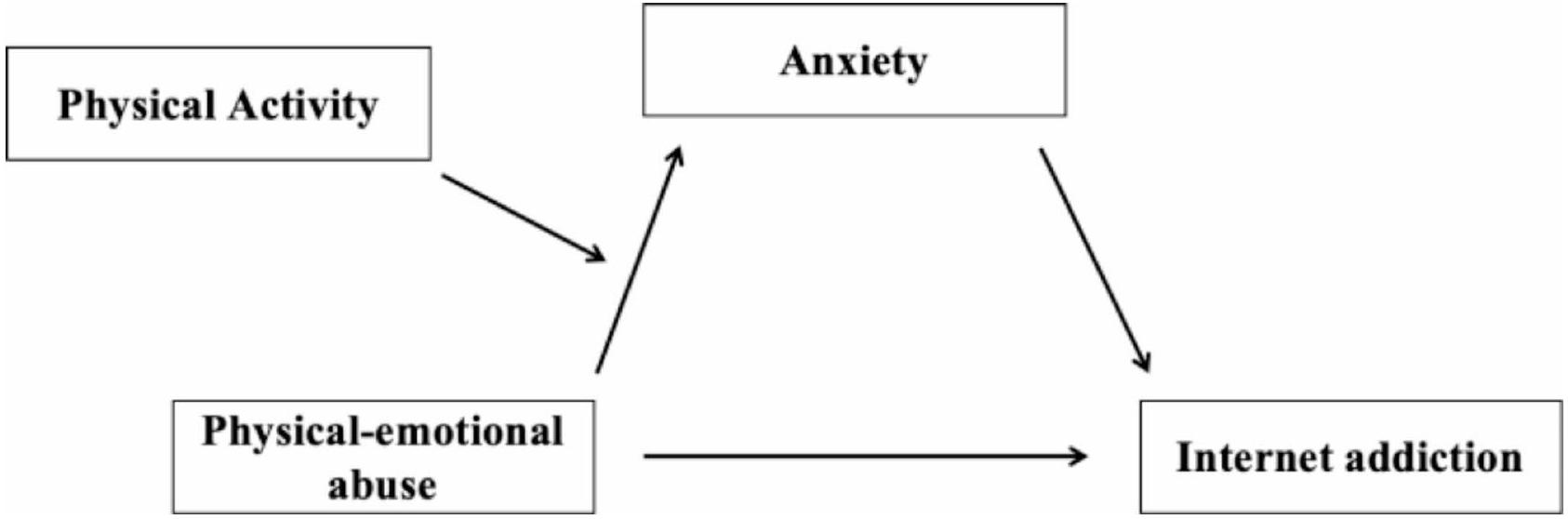
. باختصار، تبني هذه الدراسة نموذج وساطة معتدل لاستكشاف مسار التأثير وآلية القلق والنشاط البدني على العلاقة بين الإساءة البدنية والعاطفية وإدمان الإنترنت، وذلك لتوفير المزيد من الدعم والرعاية لطلاب الجامعات الذين عانوا من الإساءة البدنية والنفسية، وتقليل أعراض القلق لديهم وزيادة عدد الأنشطة البدنية، وتخفيف أو تقليل مشاكل الصحة النفسية لطلاب الجامعات، وتوفير مرجع لتنفيذ تدخلات الصحة النفسية وتحسين البناء النفسي الاجتماعي لطلاب الجامعات. انظر الشكل 1.

طرق البحث

المشاركون

استخدمت هذه الدراسة طريقة أخذ العينات المريحة نظرًا لسهولة تنفيذها، وفعاليتها من حيث التكلفة، وكفاءتها الزمنية، فضلاً عن جدواها لإجراء البحث داخل المؤسسات التعليمية. في مارس 2024، تم اختيار 1,591 طالبًا جامعيًا من أربع مقاطعات في الصين – شانشي، هنان، هونان، وهوبى – للمشاركة في الدراسة، مما أسفر عن 1,498 استبيانًا صالحًا، مع 806 ذكور و692 إناث. قبل بدء الاستطلاع، تم تحديد المقاطعات المستهدفة للدراسة. بعد ذلك، تم إنشاء تعاون مع المؤسسات التعليمية المحلية لاختيار أنواع مختلفة من الجامعات بشكل عشوائي (مثل الجامعات الشاملة، والعلوم والهندسة، والجامعات الأدبية). داخل كل جامعة، تم اختيار طلاب من درجات وتخصصات مختلفة بشكل عشوائي كالمشاركين في البحث. قبل بدء الاستطلاع، تم إبلاغ المشاركين بمحتوى الاستطلاع وهدفه، وتم إبلاغ جميع الموضوعات التجريبية وتوقيعها على أساس طوعي. تم إجراء الدراسة وفقًا لإعلان هلسنكي. خلال التحقيق، قام الباحثون بإحاطة المشاركين، بما في ذلك الهدف الرئيسي للدراسة، وسرية البيانات، والوجهة النهائية. كما أبلغنا المشاركين بالطبيعة الطوعية للاستطلاع وأنه لا يوجد خطر على المشاركين. تلا ذلك استبيان إلكتروني لكل فصل. تمت الموافقة على هذه الدراسة من قبل لجنة الأخلاقيات الطبية لمؤسسة المؤلف قبل البدء (JSDX-2024-0086).

أدوات القياس

الإساءة البدنية والعاطفية

تم استخدام نموذج تجارب الطفولة السلبية الدولي القصير (ACE-ASF) لقياس تجارب المشاركين من الإساءة البدنية والنفسية. . يحتوي المقياس على 8 عناصر ذات تقارير ذاتية استعادية تقيم الإساءة البدنية والعاطفية ويتم تسجيلها باستخدام نهج ثنائي. . يتم تسجيل المقياس على مقياس من 0 (لا) – 1 (نعم) مع درجة إجمالية من . العنصر المحدد داخل المقياس يقرأ: “هل قام والداك، أو الأوصياء، أو أفراد الأسرة الآخرين يومًا ما بصفعك، أو ركلتك، أو لكمتك، أو ضربك؟” تشير الدرجات الأعلى على هذا المقياس إلى درجة أكثر شدة من الإساءة البدنية والعاطفية. قيمة كايزر-ماير-أولكين (KMO) لهذا المقياس في عينة دراستنا هي 0.781، مع , مما يشير إلى صلاحية جيدة للمقياس. علاوة على ذلك، فإن معامل ألفا كرونباخ لهذه الأداة في عينة دراستنا هو 0.817، مما يدل على مستوى عالٍ من الاتساق الداخلي والموثوقية.

القلق

تم استخدام مقياس الاكتئاب والقلق والإجهاد (DASS-21) الصيني الذي طوره لوفيبوند وآخرون، وتم تعديله بواسطة غونغ وآخرون، لقياس الحالة العاطفية للموضوعات في الأسبوع الماضي. يحتوي المقياس الكامل على 21 عنصرًا، وتحتوي ثلاثة مقاييس فرعية للاكتئاب والقلق والإجهاد على 7 عناصر لكل منها، ويتم استخدام مقياس القلق الفرعي
الشكل 1. نموذج الوساطة المعتدلة.
في هذه الدراسة. استخدم المقياس نظام تسجيل من نوع ليكرت من 4 نقاط، مع ردود تتراوح من 1 (موافق بشدة) إلى 4 (موافق بشدة). عنصر توضيحي من المقياس هو: “الشعور بصعوبة في تهدئة النفس.” تشير الدرجات الإجمالية الأعلى على هذا المقياس إلى زيادة مستويات القلق، مع نطاق محتمل من 7 إلى 28 نقطة. قبل تقييم الموثوقية، أجرينا تحليلًا لصلاحية البناء. كانت قيمة KMO لهذا المقياس في عينة دراستنا 0.884، مع ، مما يشير إلى أن المقياس يمتلك صلاحية بنائية جيدة. علاوة على ذلك، كانت قيمة معامل ألفا كرونباخ لهذه الأداة في عينة دراستنا 0.862، مما يدل على مستوى عالٍ من الاتساق الداخلي.

إدمان الإنترنت

مقياس قياس البيانات المستخدم في هذه الدراسة هو “مقياس إدمان الإنترنت” الذي طوره وي وآخرون. . تتكون هذه المقياس من 8 عناصر، حيث يتم تقييم الردود على مقياس ليكرت المكون من 5 نقاط يتراوح من 1 (أعارض تمامًا) إلى 5 (أوافق تمامًا). إحدى العناصر المحددة في المقياس هي: “استخدام مواقع التواصل الاجتماعي يشتت انتباهي عن التركيز في دراستي.” تشير الدرجات الأعلى في هذا المقياس إلى شدة أكبر من إدمان الإنترنت، مع درجة إجمالية تتراوح من 8 إلى 40 نقطة. معامل ألفا كرونباخ لهذا المقياس في الدراسة الحالية هو 0.902، مما يدل على مستوى عالٍ من الاتساق الداخلي. قبل تقييم الموثوقية، تم إجراء تحليل لصلاحية البناء، مما أسفر عن قيمة KMO تبلغ 0.914 مع مما يشير إلى أن المقياس لديه صلاحية بناء جيدة. علاوة على ذلك، فإن معامل ألفا كرونباخ لهذه الأداة في عينة دراستنا هو 0.862، مما يعزز موثوقية المقياس.

النشاط البدني

تم تقييم النشاط البدني من خلال عنصر واحد: “كم مرة مارست الرياضة أو قمت على الأقل بـ 20 دقيقة من النشاط البدني في الأيام السبعة الماضية الذي جعلك تتعرق أو تواجه صعوبة في التنفس؟” تتراوح الخيارات من 0 إلى 7 أيام. لقد تم استخدام هذه الأداة في دراسات سابقة .

المتغيرات المشتركة

لأخذ التأثير المحتمل للمتغيرات الديموغرافية على تحليل النتائج في الاعتبار، مثل الجنس، مستوى الصف، حالة الطفل الوحيد ومكان الإقامة، تم التحكم في هذه المتغيرات خلال عملية التحليل.

معالجة البيانات

تم إجراء إدخال البيانات باستخدام Excel 2021، تلاه فحص التحيزات المنهجية داخل الاستبيانات الذاتية الإدارة لتحديد مصادر التحيز المحتملة. تم استخدام اختبار شابيرو-ويلك لتقييم طبيعة البيانات. وفقًا لمعايير كيم تم اعتبار البيانات التي تحتوي على قيم انحراف مطلق أقل من 2 وقيم كورتوز أقل من 7 بأنها موزعة تقريبًا بشكل طبيعي. في هذه الدراسة، وُجد أن متغيرات الإساءة الجسدية والعاطفية، وإدمان الإنترنت، والقلق، والنشاط البدني كانت موزعة بشكل طبيعي. بالنسبة للمتغيرات التي تتوافق مع التوزيع الطبيعي، تم إجراء تحليل وصفي باستخدام المتوسط ( ) والانحراف المعياري ( ). بعد ذلك، تم إجراء تحليل الارتباط لبيرسون باستخدام SPSS 26.0، وتم اختبار نماذج الوساطة والتعديل باستخدام ماكرو PROCESS. تم تطوير برنامج ماكرو PROCESS بواسطة هايز تم استخدامه لفحص تأثير القلق كوسيط بين الإساءة الجسدية والعاطفية وإدمان الإنترنت لدى طلاب الجامعات (النموذج 4)، ولتجربة الدور المعدل للنشاط البدني في نموذج الوساطة بين الإساءة الجسدية والعاطفية وقلق طلاب الجامعات (النموذج 7). استخدمت هذه الدراسة 5000 تكرار لإعادة أخذ العينات باستخدام طريقة البوتستراب لتقييم ملاءمة النموذج وتقدير الـ فترة الثقة CI)، مع عدم تضمين الصفر في الفترة مما يدل على الأهمية. تم التحكم في الجنس ومكان الإقامة ومستوى الصف كمتغيرات مصاحبة في التحليل. تم تحديد مستوى الأهمية عند .

النتيجة

اختبار انحراف الطريقة الشائعة

استخدمت الدراسة اختبار العامل الواحد لهارمان لتقييم انحياز الطريقة الشائعة. أظهرت النتائج أن الجذور المميزة للعوامل الستة كانت جميعها أكبر من 1، حيث كان العامل الأول يمثل من إجمالي التباين، والذي هو دون العتبة الحرجة لـ . وهذا يشير إلى أنه لا يوجد انحياز مشترك كبير في بيانات هذه الدراسة.

تحليل الارتباط

أظهرت نتائج تحليل ارتباط بيرسون أن الإساءة الجسدية والعاطفية كانت مرتبطة إيجابيًا بالقلق وإدمان الإنترنت. )، الذي تحقق من الفرضية 1. كان هناك ارتباط إيجابي بين القلق وإدمان الإنترنت ( )، وكانت النشاط البدني مرتبطًا سلبًا بالقلق ( ). انظر الجدول 1 للحصول على التفاصيل.

اختبار نموذج الوساطة للقلق

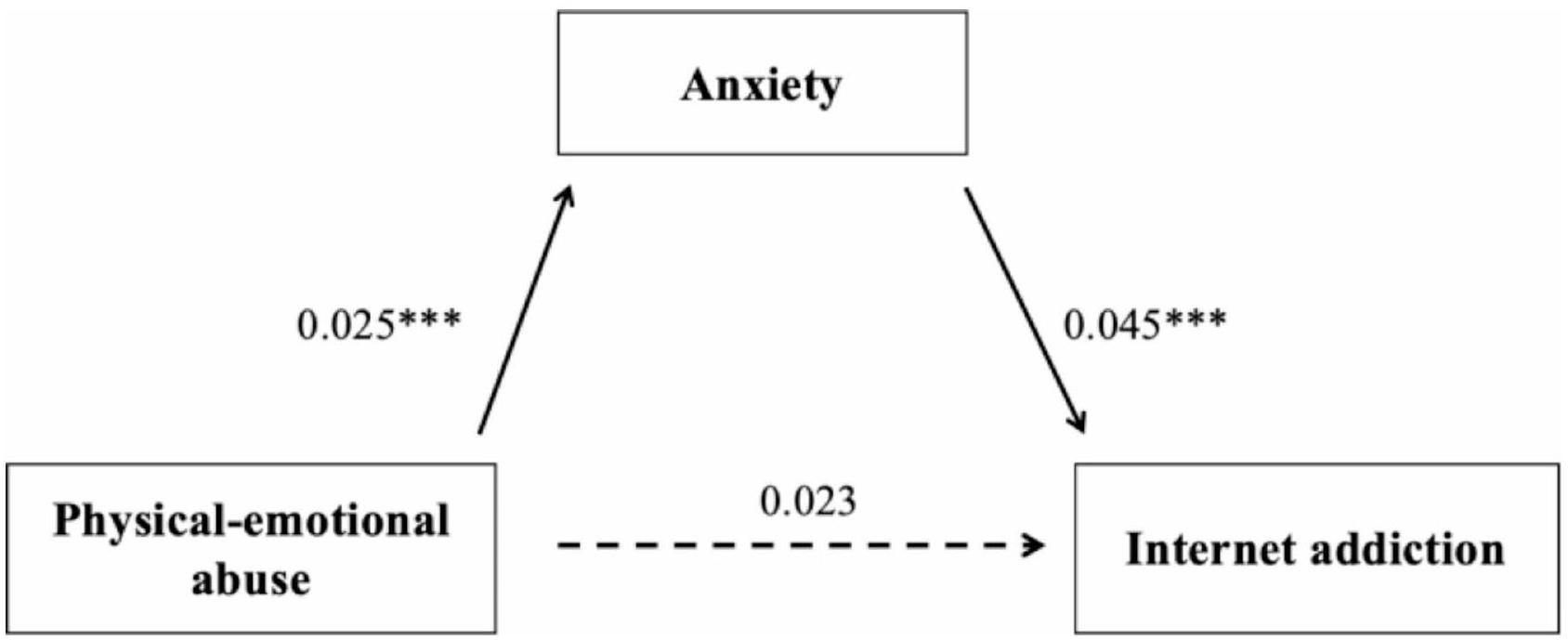
تدرس هذه الدراسة الدور الوسيط للنشاط البدني في العلاقة بين الإساءة الجسدية والعاطفية والقلق، مع التحكم في الجنس، والصف، ومكان الإقامة، وحالة الطفل الوحيد. يتم مناقشة النتائج، كما هو موضح في الشكل 3، أدناه. تظهر النتائج في الجدول 2: كان للإساءة الجسدية والعاطفية تأثير تنبؤي مباشر كبير على إدمان الإنترنت. )، لكن تأثيره التنبؤي لم يعد ذا دلالة عندما تم تضمين المتغير الوسيط القلق ( كان للإساءة الجسدية والعاطفية تأثير تنبؤي كبير على القلق )، وكانت القلق مؤشراً إيجابياً لإدمان الإنترنت ( ).
كان حجم التأثير المباشر للإساءة الجسدية والعاطفية على إدمان الإنترنت 0.035 وكان حجم التأثير غير المباشر 0.122، و لم تتضمن فترة الثقة 0، مما يشير إلى أن التأثير غير المباشر للقلق على العلاقة بين الإساءة الجسدية والعاطفية وإدمان الإنترنت كان ذا دلالة، ولعب القلق دورًا وسيطًا كاملاً.
المتغيرات 1 2 ٣ ٤
1. الإساءة الجسدية والعاطفية 1
2. القلق 0.253** 1
3. إدمان الإنترنت 0.136** 0.472** 1
4. النشاط البدني -0.030 -0.094** -0.064* 1
M 1.080 ١٢٫٠٩٠ 19.660 ٢.٥٩٠
SD 1.395 ٤.٣١٤ 6.674 1.980
الجدول 1. نتائج تحليل الارتباط بين المتغيرات. ، .
متغيرات النتائج المتغيرات التنبؤية ر ف SE ت فترة الثقة 95% باستخدام طريقة البوتستراب
الحد الأدنى الحد الأقصى
قلق الإساءة الجسدية والعاطفية 0.275 0.075 ٢٤.٤٦٥ 0.271 0.025 10.822*** 0.222 0.320
جنس 0.125 0.051 2.483* 0.026 0.225
درجة 0.046 0.041 1.107 -0.035 0.128
مكان الإقامة 0.041 0.051 0.807 -0.059 0.141
حالة الطفل الوحيد 0.062 0.061 1.021 -0.057 0.181
إدمان الإنترنت الإساءة الجسدية والعاطفية 0.247 0.061 19.408 0.157 0.025 6.235*** 0.107 0.207
جنس 0.٤٠٩ 0.051 8.005*** 0.308 0.509
درجة 0.020 0.042 0.473 -0.062 0.102
مكان الإقامة 0.018 0.051 0.362 -0.082 0.120
وضع الطفل الوحيد 0.049 0.061 0.801 -0.071 0.169
إدمان الإنترنت الإساءة الجسدية والعاطفية 0.498 0.248 82.282 0.035 0.023 1.503 -0.01 0.081
قلق 0.450 19.3 7.803*** 0.404 0.496
جنس 0.352 0.045 7.690*** 0.262 0.442
درجة -0.001 0.037 -0.023 -0.074 0.073
مكان الإقامة 0.003 0.046 0.002 -0.091 0.091
وضع الطفل الوحيد 0.021 0.054 0.384 -0.086 0.128
الجدول 2. تحليل الانحدار لدور الوساطة للقلق. .
بين الإساءة الجسدية والعاطفية وإدمان الإنترنت، تم إنشاء نموذج الوساطة للقلق (انظر الشكل 2)، وتم التحقق من H 2، كما هو موضح في الجدول 3.

أثر الوساطة المعتدلة

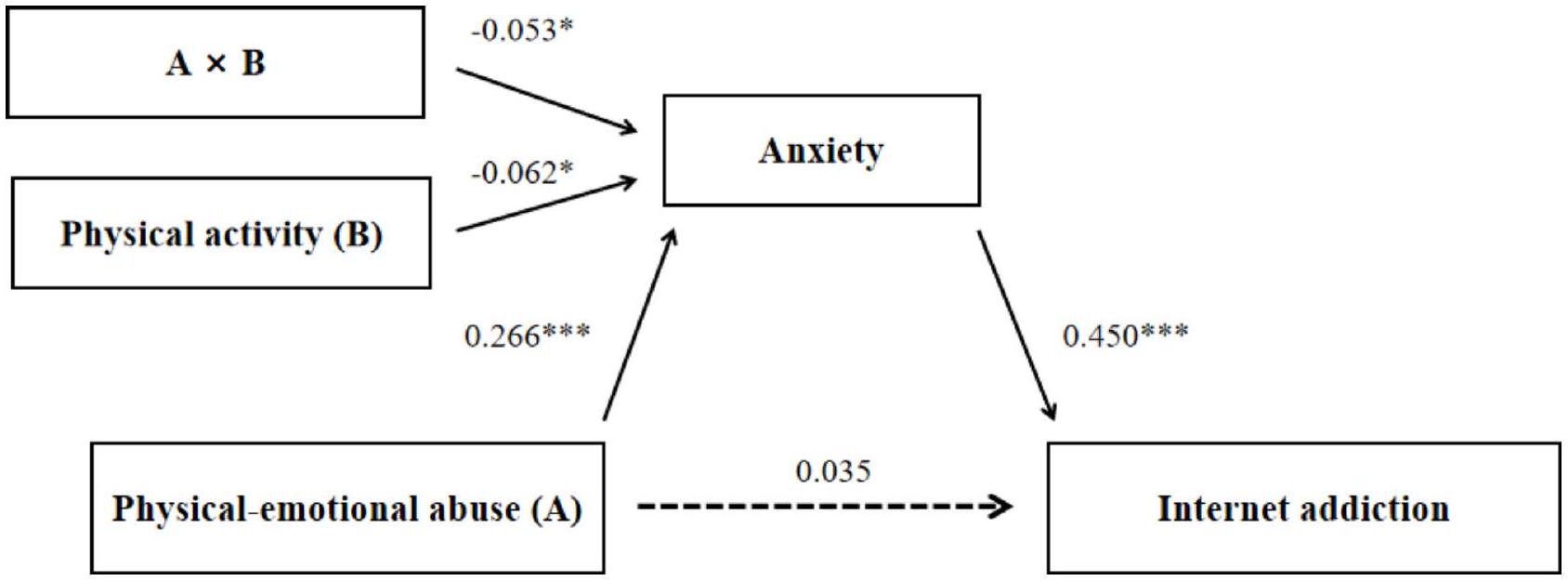
تحليل الدور الوسيط للنشاط البدني في العلاقة بين الإساءة الجسدية والعاطفية والقلق، مع التحكم في الجنس، والصف الدراسي، ومكان الإقامة، وحالة الطفل الوحيد. تشير النتائج، كما هو موضح في الجدول 4، إلى أن النشاط البدني يتنبأ بشكل كبير وسلبي بالقلق. ). بالإضافة إلى ذلك، فإن مصطلح التفاعل بين الإساءة الجسدية-العاطفية والنشاط البدني يتنبأ سلبًا بالقلق ( هذا يشير إلى أن النشاط البدني يعدل بشكل كبير النصف الأول من مسار الوساطة من “الإساءة الجسدية والعاطفية إلى القلق إلى إدمان الإنترنت”، مما يثبت H3.
من أجل استكشاف تأثير النشاط البدني بشكل أكبر، استخدمت هذه الدراسة تحليل مخطط الميل البسيط لحساب العلاقة بين الإساءة الجسدية والعاطفية وإدمان الإنترنت لدى طلاب الجامعات عندما كان النشاط البدني أقل من انحراف معياري واحد عن المتوسط وأعلى من انحراف معياري واحد عن المتوسط. أظهرت النتائج وجود علاقة إيجابية كبيرة بين الإساءة الجسدية والعاطفية وإدمان الإنترنت لدى طلاب الجامعات الذين لديهم نشاط بدني منخفض، وعلاقة إيجابية كبيرة بين الإساءة الجسدية والعاطفية وإدمان الإنترنت لدى طلاب الجامعات الذين لديهم نشاط بدني مرتفع. انظر الأشكال 3 و 4 لمزيد من التفاصيل.

نقاش

تناولت هذه الدراسة العلاقة بين الإساءة الجسدية والعاطفية وإدمان الإنترنت بين طلاب الجامعات، بالإضافة إلى الدور الوسيط للقلق والدور المعدل للنشاط البدني. تكشف نتائجنا عن وجود ارتباط إيجابي كبير بين الإساءة الجسدية والعاطفية وإدمان الإنترنت بين طلاب الجامعات. من خلال تحليل الوساطة، وُجد أن الإساءة الجسدية والعاطفية يمكن أن تؤثر ليس فقط بشكل مباشر على إدمان الإنترنت لدى طلاب الجامعات، ولكن أيضًا تؤثر على إدمان الإنترنت من خلال التأثير على القلق، حيث يلعب القلق دور الوساطة الكامل بين الإساءة الجسدية والعاطفية وإدمان الإنترنت لدى طلاب الجامعات. من خلال تحليل التعديل، وُجد أن النشاط البدني يمكن أن يخفف من العلاقة بين الإساءة الجسدية والعاطفية والقلق، وبالتالي قد يخفف من إدمان الإنترنت لدى طلاب الجامعات. وجدت هذه الدراسة أن هناك ارتباطًا إيجابيًا كبيرًا بين الإساءة الجسدية والعاطفية وإدمان الإنترنت لدى طلاب الجامعات عندما لم تُضاف أي متغيرات، والإساءة الجسدية والعاطفية.
الشكل 2. اختبار نموذج الوساطة ).
أثر حجم التأثير فترة الثقة 95% باستخدام طريقة البوتستراب SE نسبة التأثيرات الوسيطة (%)
التأثير الكلي 0.157 0.025
الأثر المباشر 0.035 0.024 22.29
أثر غير مباشر 0.122 0.014 ٧٧.٧١
الجدول 3. تحليل تأثير الوساطة للقلق.
متغيرات النتائج المتغيرات التنبؤية ر ف SE ت فترة الثقة 95% باستخدام طريقة بوتستراب
الحد الأدنى الحد الأعلى
قلق الإساءة الجسدية والعاطفية 0.288 0.082 19.249 0.266*** 0.025 10.652 0.217 0.315
النشاط البدني -0.062* 0.025 -2.459 -0.111 -0.013
جنس 0.119* 0.05 ٢.٢٤٦ 0.02 0.218
درجة 0.035 0.041 0.827 -0.047 0.116
مكان الإقامة 0.054 0.05 0.92 -0.043 0.153
وضع الطفل الوحيد 0.050 0.061 0.826 -0.068 0.169
الإساءة الجسدية-العاطفية × النشاط البدني -0.053* 0.023 -2.200 -0.098 -0.006
إدمان الإنترنت الإساءة الجسدية والعاطفية 0.498 0.248 82.282 0.035 0.023 1.503 -0.011 0.081
قلق 0.450*** 0.023 19.300 0.404 0.496
جنس 0.352*** 0.045 7.690 0.262 0.442
درجة -0.001 0.038 -0.023 -0.075 0.073
مكان الإقامة 0.001 0.046 0.002 -0.09 0.09
حالة الطفل الوحيد 0.021 0.054 0.384 -0.086 0.128
الجدول 4. العلاقة بين الإساءة الجسدية-العاطفية وإدمان الإنترنت لها تأثير وساطة معتدل. .
يمكن أن يتنبأ بشكل كبير بإدمان طلاب الجامعات على الإنترنت. استنادًا إلى النتائج المذكورة أعلاه، تشرح هذه الدراسة أيضًا آلية التأثير النفسي الداخلي للإساءة الجسدية والعاطفية وإدمان طلاب الجامعات على الإنترنت.
في هذه الدراسة، وجدنا أن الإساءة الجسدية والعاطفية لها تأثير تنبؤي مباشر كبير على إدمان الإنترنت بين طلاب الجامعات، وهو ما يتماشى مع نتائج الأبحاث السابقة. وفقًا لنموذج تفاعل الشخص-التأثير-الإدراك-التنفيذ، تلعب عوامل مختلفة مثل الخصائص الشخصية، والعواطف الفردية والإدراك، والوظائف التنفيذية دورًا حاسمًا في تشكيل إدمان الإنترنت. قد تؤدي صدمات الطفولة إلى تطوير أنماط معرفية غير تكيفية (مثل التفاؤل المفرط تجاه العالم الرقمي والتوقعات غير المناسبة) وتؤدي إلى زيادة انتشار المشاعر السلبية في الحياة الواقعية. . نتيجة لذلك، فإن الأفراد الذين عانوا من صدمات الطفولة هم أكثر عرضة للبحث عن
الشكل 3. اختبار نموذج الوساطة المعتدلة ).
الشكل 4. رسم المنحدر البسيط.
الإشباع الفوري من خلال الإنترنت للتخفيف من تأثير المشاعر السلبية. وقد حددت الدراسات السابقة الإساءة العاطفية والإهمال الجسدي كعوامل خطر مستقلة للإدمان على الإنترنت. والطلاب الذين يعانون من صدمات الطفولة معرضون بشكل أكبر لخطر إدمان الإنترنت الطلاب الجامعيون الذين يعانون من انتشار أعلى لإدمان الإنترنت هم أكثر عرضة لتجربة الإساءة الجسدية/الإهمال، والإساءة العاطفية، والإساءة الجنسية. .
في هذه الدراسة، لاحظنا أن العلاقة بين الإساءة الجسدية والعاطفية وإدمان الإنترنت بين طلاب الجامعات لم تعد ذات دلالة إحصائية بعد إدخال القلق كمتغير وسيط. تشير هذه النتيجة إلى أن الرابط بين الإساءة الجسدية والعاطفية وإدمان الإنترنت لدى طلاب الجامعات قد يتأثر بمتغيرات أخرى. من ناحية، فإن جودة البيئة المعيشية التي يوفرها الآباء خلال الطفولة لها تأثير كبير على الصحة البدنية والعقلية للمراهقين، والذين عانوا من الإساءة الجسدية والعاطفية يميلون إلى قضاء فترات نوم أقصر، مما قد يسهم بشكل أكبر في إدمان الإنترنت. من ناحية أخرى، قد تؤثر العوامل النفسية مثل الحسد الخبيث أيضًا على تجربة الإساءة الجسدية والعاطفية لدى المراهقين بدرجات متفاوتة. علاوة على ذلك، يظهر المراهقون الذين يتمتعون بسمات شخصية مختلفة مستويات متفاوتة من القلق بعد التعرض للإساءة في الطفولة. تشير الأبحاث إلى أن الأفراد الذين يتمتعون بمستويات أعلى من الانفتاح، والانبساط، والود، والضمير tend tend to have relatively lower levels of anxiety. تؤكد هذه النتائج على أهمية مراعاة الفروق الفردية والعوامل البيئية عند دراسة العلاقة بين الإساءة الجسدية والعاطفية وإدمان الإنترنت.
نظرية الافتراضات المحطمة تفترض أن الأفراد يختبرون مشاعر سلبية بعد الصدمة. الذي يدعم نتائج هذه الدراسة التي تشير إلى أن الإساءة الجسدية والعاطفية هي مؤشر مهم للقلق بين طلاب الجامعات، وأن هذا القلق له ارتباط مباشر بسلوك إدمان الإنترنت. وبالتالي، يُعتبر القلق عاملاً رئيسياً يتنبأ بربط الإساءة الجسدية والعاطفية بالميل نحو إدمان الإنترنت بين طلاب الجامعات. وقد تم تحديد الإساءة الجسدية والعاطفية كمؤشر مهم للقلق لدى طلاب الجامعات. ، وزيادة مستويات القلق الناتجة عن تجارب الإساءة يمكن أن تؤدي إلى مجموعة من القضايا النفسية المصاحبة. سوء المعاملة يتنبأ بشكل كبير بالقلق باختصار، تُظهر نتائج هذه الدراسة أن القلق يتوسط العلاقة بين الإساءة الجسدية والعاطفية وإدمان الإنترنت بين طلاب الجامعات.
لقد أظهرت الأنشطة البدنية، المعروفة بتأثيراتها الصحية المفيدة على الصحة البدنية والعاطفية، أنها تعزز المشاعر الإيجابية وتقلل من المشاعر السلبية بين الأفراد. وفقًا للمبادئ الأساسية لنموذج دمج الأداء في التمارين النشاط البدني هو مؤشر مهم لمستويات القلق وقد تم إثبات أنه يقلل من القلق الاكتئاب ، ولتعزيز الرفاهية بين طلاب الجامعات علاوة على ذلك، فإن النشاط البدني يخفف من العلاقة بين الإساءة العاطفية والقلق. مع intensities تمارين معتدلة إلى قوية تظهر تأثيرات ملحوظة في تخفيف أعراض القلق هناك علاقة سلبية كبيرة بين مستويات النشاط البدني والقلق. ويمكن أن تساعد النشاطات البدنية أيضًا في تحسين المشاعر السلبية المرتبطة بالتجارب السلبية في الطفولة. ، مما يدعم نتائج هذه الدراسة. علاوة على ذلك، وُجد أن النشاط البدني يخفف من إدمان الإنترنت؛ على وجه الخصوص، نادراً ما يشارك طلاب الجامعات الذين يعانون من إدمان الإنترنت في النشاط البدني ويميلون إلى أن تكون قدراتهم الرياضية أضعف، وغالباً ما يشاركون في الأنشطة البدنية بطريقة سلبية وسلبية. يمكن أن تقلل النشاط البدني من إدمان الإنترنت من خلال تنظيم كل من الجهاز العصبي الذاتي والجهاز العصبي المركزي. لقد استهدفت العديد من التجارب العشوائية المحكمة إدمان الإنترنت من خلال تدخلات النشاط البدني، وتظهر النتائج باستمرار أن هذه التدخلات تقلل بشكل كبير من مستوى الاعتماد على الإنترنت بين المراهقين. لا تعزز هذه التدخلات الصحة البدنية فحسب، بل لها أيضًا آثار إيجابية على تقدير الذات لدى المشاركين، وإرادتهم، ومقاومتهم لإغراءات الإنترنت. . بينما يمكن أن يوفر كل من الإنترنت والأنشطة البدنية التفاعل الاجتماعي والترفيه، إلا أنهما مختلفان جوهريًا: يميل استخدام الإنترنت إلى غمر المستخدمين في بيئة افتراضية، بينما تتيح الأنشطة البدنية للمشاركين تجربة العالم الحقيقي بشكل أعمق من خلال تعزيز الصحة العقلية والبدنية. الأساس النظري لتدخلات الأنشطة البدنية يكمن في دورها المزدوج في تقليل وقت استخدام الإنترنت وإحداث آثار إيجابية غير واعية على المستوى الفسيولوجي والنفسي للمشاركين. وبالتالي، فإن المراهقين الذين يمارسون الأنشطة البدنية بانتظام يظهرون غالبًا صحة عقلية وبدنية أفضل وعادات استخدام إنترنت أكثر عقلانية. . من ناحية أخرى، يمكن أن يؤدي إدمان الإنترنت إلى زيادة المشاعر السلبية مثل القلق لدى المراهقين. , لكن الأنشطة البدنية يمكن أن تعدل هذه العلاقة وتقلل من حدوث مشاكل الصحة العقلية لدى المراهقين. . من الواضح أن تنظيم الصحة العقلية من خلال الأنشطة البدنية هو متعدد الأبعاد. في الختام، تعد الأنشطة البدنية بشكل كبير معدلة للعلاقة التنبؤية بين الإساءة البدنية-العاطفية والقلق لدى طلاب الجامعات.

القيود

تستكشف هذه الدراسة العلاقات بين سلوكيات مختلفة وعوامل نفسية، مثل القلق، وتوضح الروابط الجوهرية بين الإساءة البدنية-العاطفية وإدمان الإنترنت بين طلاب الجامعات. بالإضافة إلى ذلك، تفحص الدراسة آثار العوامل الخارجية. علاوة على ذلك، تستخدم البحث تحليل المسار، وهو طريقة جديدة لتقييم الدور المحتمل للقلق في العلاقة بين الإساءة البدنية-العاطفية وإدمان الإنترنت بين طلاب الجامعات. ومع ذلك، تحتوي الدراسة على عدة قيود تستدعي الاعتراف. أولاً، تستند الدراسة إلى بيانات مقطعية، مما قد يحد من القدرة على استنتاج العلاقات السببية بين الإساءة البدنية-العاطفية وإدمان الإنترنت بين طلاب الجامعات. هناك حاجة إلى دراسات طولية مستقبلية لتدعيم هذه العلاقات بشكل أكبر. العوامل المؤثرة المحتملة لمتغيرات مختلفة عديدة، بما في ذلك علاقات الوالدين والأطفال والبيئات المدرسية. تتأثر الإساءة البدنية-العاطفية، وإدمان الإنترنت، والقلق بشكل كبير بالاضطرابات الشخصية، والجنس، والنوم، وسلوكيات النظام الغذائي، فضلاً عن الظروف الاقتصادية الإقليمية والعائلية، والجنس، والاختلافات الثقافية. تستكشف هذه الدراسة فقط مجموعة فرعية من هذه العوامل، متجاهلة بشكل خاص دور الظروف الاقتصادية، التي قد تؤثر على العلاقة بين الإساءة البدنية-العاطفية وإدمان الإنترنت. إن غياب هذه السمة الديموغرافية في دراستنا يحد من شمولية وعمق
متغيراتنا الضابطة. ستتعمق الأبحاث المستقبلية في هذه العوامل من زوايا متعددة. ثانيًا، بسبب قيود طريقة أخذ العينات لدينا، قد تكون قابلية تعميم نتائجنا على جميع طلاب الجامعات الصينية محدودة. عيّنتنا محصورة في طلاب الجامعات من أربع مقاطعات في الصين. يجب أن تهدف الدراسات المستقبلية إلى تضمين مجموعة أكثر تنوعًا من الطلاب الدوليين. ثالثًا، قد يؤدي الاعتماد على طرق جمع البيانات المبلغ عنها ذاتيًا إلى إدخال تحيز في الذاكرة، مما يفرض قيودًا معينة على موضوعية بياناتنا. ستتبنى الدراسات المستقبلية طرقًا أكثر فعالية، مثل المقابلات، أو التقييمات من طرف ثالث، أو بيانات استخدام الإنترنت. أخيرًا، قد يؤثر تصنيف شدة وتكرار الإساءة البدنية-العاطفية إلى فئات ثنائية (“نعم” أو “لا”) على دراستنا. يجب أن تستخدم الأبحاث المستقبلية معايير قياس أكثر دقة، مثل مقاييس ليكرت. بسبب تصميم الاستطلاع الأصلي، سيطرت دراستنا فقط على درجة المستجيبين، والجنس، ومكان الإقامة، وحالة الطفل الوحيد، مما قد يحد من شمولية نتائجنا. ستسعى الدراسات المستقبلية إلى إجراء مناقشة أكثر شمولية للبحث. في الختام، بينما تقدم هذه الدراسة رؤى قيمة حول العلاقة بين الإساءة البدنية-العاطفية وإدمان الإنترنت بين طلاب الجامعات، من الضروري معالجة هذه القيود في الأبحاث المستقبلية لتعزيز فهم هذه الديناميات المعقدة.

الخاتمة

كشفت هذه الدراسة أيضًا عن العلاقة بين الإساءة البدنية-العاطفية وإدمان الإنترنت لدى طلاب الجامعات، واعتبرت الدور الوسيط للقلق بين الاثنين، بالإضافة إلى الدور المعدل للأنشطة البدنية في العلاقة بين الإساءة البدنية-العاطفية وإدمان الإنترنت لدى طلاب الجامعات. وجدت الدراسة أن القلق لعب دورًا وسطيًا كاملاً بين الإساءة البدنية-العاطفية وإدمان الإنترنت لدى طلاب الجامعات، وأن الأنشطة البدنية خففت العلاقة بين الإساءة البدنية-العاطفية وقلق طلاب الجامعات. ستوفر هذه الأبحاث وجهات نظر واستراتيجيات جديدة لمجال الصحة العامة لمعالجة الإساءة البدنية-العاطفية وإدمان الإنترنت بين طلاب الجامعات. من الضروري أيضًا أن تتحقق الدراسات المستقبلية من هذه النتائج على أساس متعدد المجالات وعينة كبيرة.

توفر البيانات

البيانات التي تم إنشاؤها و/أو تحليلها خلال الدراسة الحالية غير متاحة للجمهور بسبب [سياسة فريقنا التجريبي] ولكنها متاحة من المؤلف المراسل عند الطلب المعقول.
تاريخ الاستلام: 24 يوليو 2024؛ تاريخ القبول: 7 يناير 2025
تم النشر عبر الإنترنت: 17 يناير 2025

References

  1. Ferrara, P. et al. Physical, psychological and social impact of school violence on children. Ital. J. Pediatr. 45 (1), 76 (2019).
  2. Liu, J. et al. The relationship between child maltreatment and social anxiety: a meta-analysis. J. Affect. Disord. 329, 157-167 (2023).
  3. World Health Organization. Child maltreatment [EB/OL]. (2022-09-19) [2024-09-09].
  4. Chen, L. et al. Gender measurement equivalence of the child abuse questionnaire among Chinese college students. J. Jining Med. Coll. 46 (3), 168-173 (2023).
  5. Hillis, S. et al. Global Prevalence of Past-year Violence Against Children: A Systematic Review and Minimum Estimates. Pediatrics, 137(3): p. e20154079. [6]. Chi, X., Internet Addiction and Depression in Chinese Adolescents: A Moderated Mediation Model. Front Psychiatry, 2019. 10: p. 816. (2016).
  6. Cruz, D. et al. Developmental trauma: conceptual framework, associated risks and comorbidities, and evaluation and treatment. Front. Psychiatry. 13, 800687 (2022).
  7. Wang, Y. et al. Effects of school connectedness on the relationship between child maltreatment and child aggressive behavior: a mediation analysis. Child. Abuse Negl. 136, 106021 (2023).
  8. Hughes, K. et al. The effect of multiple adverse childhood experiences on health: a systematic review and meta-analysis. Lancet Public. Health. 2 (8), e356-e366 (2017).
  9. Serafini, G. et al. The relationship between Childhood Maltreatment and Non-suicidal Self-Injury: a systematic review. Front. Psychiatry. 8, 149 (2017).
  10. Young, J. C. & Widom, C. S. Long-term effects of child abuse and neglect on emotion processing in adulthood. Child. Abuse Negl. 38 (8), 1369-1381 (2014).
  11. McCrory, E. et al. Neurocognitive adaptation and Mental Health Vulnerability following maltreatment: the role of Social Functioning. Child. Maltreat. 24 (4), 435-451 (2019).
  12. Moog, N. K. et al. Intergenerational transmission of the effects of maternal exposure to childhood maltreatment in the USA: a retrospective cohort study. Lancet Public. Health. 8 (3), e226-e237 (2023).
  13. Dvir, Y. et al. Childhood maltreatment, emotional dysregulation, and psychiatric comorbidities. Harv. Rev. Psychiatry. 22 (3), 149-161 (2014).
  14. Wang, H. et al. How sleep duration mediated childhood trauma and internet addiction of the vocational college population in urban areas of south China. Front. Psychiatry. 13, 1088172 (2022).
  15. Xiao, Y. et al. The impact of childhood maltreatment and neglect on adverse psychological and behavioral outcomes in adolescents. Chin. J. Sch. Health. 37 (1), 46-49 (2016).
  16. Yu, G. & Li, S. Crisis and turning point: the Impact of Childhood Abuse on Adolescent Mental Health and coping strategies. J. Beijing Normal Univ. (Soc Sci) ;(01):5-15. (2021).
  17. Li, W. et al. Diagnostic criteria for problematic internet use among U.S. University students: a mixed-methods evaluation. PLoS One. 11 (1), e0145981 (2016).
  18. Goslar, M. et al. Treatments for internet addiction, sex addiction and compulsive buying: a meta-analysis. J. Behav. Addict. 9 (1), 14-43 (2020).
  19. Zhang, Z. H. et al. [The relationship between emotional, physical abuse and internet addiction disorder among middle school students]. Zhonghua Liu Xing Bing Xue Za Zhi. 30 (2), 115-118 (2009).
  20. Janoffbulman, R. Shattered Assumptions: Towards a new Psychology of Trauma (Living with Terror, 1992).
  21. Javakhishvili, M. & Spatz, W. C. Childhood maltreatment, sleep disturbances, and anxiety and depression: a prospective Longitudinal Investigation. J. Appl. Dev. Psychol., 77. (2021).
  22. Springer, K. W. et al. Long-term physical and mental health consequences of childhood physical abuse: results from a large population-based sample of men and women. Child. Abuse Negl. 31 (5), 517-530 (2007).
  23. Negriff, S. ACEs are not equal: examining the relative impact of household dysfunction versus childhood maltreatment on mental health in adolescence. Soc. Sci. Med. 245, 112696 (2020).
  24. Kascakova, N. et al. The Unholy Trinity: Childhood Trauma, Adulthood anxiety, and Long-Term Pain. Int. J. Environ. Res. Public. Health, 17(2). (2020).
  25. Fu, H. et al. Reported prevalence of childhood maltreatment among Chinese college students: a systematic review and metaanalysis. PLoS One. 13 (10), e0205808 (2018).
  26. Guo, L. et al. Childhood maltreatment predicts subsequent anxiety symptoms among Chinese adolescents: the role of the tendency of coping styles. Transl Psychiatry. 11 (1), 340 (2021).
  27. Liu, Y. et al. Anxiety, inhibitory control, physical activity, and internet addiction in Chinese adolescents: a moderated mediation model. BMC Pediatr. 24 (1), 663 (2024).
  28. Xue, Y. et al. Associations between internet addiction and psychological problems among adolescents: description and possible explanations. Front. Psychol. 14, 1097331 (2023).
  29. Li, G. et al. Relationship between anxiety, depression, sex, obesity, and internet addiction in Chinese adolescents: a short-term longitudinal study. Addict. Behav. 90, 421-427 (2019).
  30. Kandola, A. & Stubbs, B. Exercise and anxiety. Adv. Exp. Med. Biol. 1228, 345-352 (2020).
  31. Zhang, G., Feng, W., Zhao, L., Zhao, X., & Li, T. The association between physical activity, self-efficacy, stress self-management and mental health among adolescents. Sci. Rep. 14, 5488 (2024).
  32. Artandi, M. K. & Stewart, R. W. The Outpatient Physical Examination. Med. Clin. North. Am. 102 (3), 465-473 (2018).
  33. Kandola, A. et al. Moving to beat anxiety: epidemiology and therapeutic issues with physical activity for anxiety. Curr. Psychiatry Rep. 20 (8), 63 (2018).
  34. Carek, P. J., Laibstain, S. E. & Carek, S. M. Exercise for the treatment of depression and anxiety. Int. J. Psychiatry Med. 41 (1), 15-28 (2011).
  35. Liu, Y. et al. The relationship between physical activity and internet addiction among adolescents in western China: a chain mediating model of anxiety and inhibitory control. Psychol. Health Med. 29 (9), 1602-1618 (2024).
  36. Gyasi, R. M. et al. Emotional and physical-related experiences as potential mechanisms linking physical activity and happiness: evidence from the Ghana Aging, Health, Psychological Well-being, and Health-seeking Behavior Study. Arch. Psychiatr Nurs. 42, 113-121 (2023).
  37. Zhang, J. & Dong, B. L. Emotional abuse and adolescent Exercise persistence: the multiple mediation of emotional self-control and perceived satisfaction of Exercise Psychological needs. J. Tianjin Univ. Sport. 32 (03), 269-276 (2017).
  38. Meinck, F. et al. Psychometric properties of the adverse childhood experiences abuse short form (ACE-ASF) among Romanian high school students. Child. Abuse Negl. 72, 326-337 (2017).
  39. Chegeni, M. et al. Validity and reliability of the Persian version of the adverse childhood experiences abuse short form. J. Educ. Health Promot. 9, 140 (2020).
  40. Lovibond, P. F. & Lovibond, S. H. The structure of negative emotional states: comparison of the Depression anxiety stress scales (DASS) with the Beck Depression and anxiety inventories. Behav. Res. Ther. 33, 335-343 (1995).
  41. Gong, X. et al. Validation report of the depression-anxiety-stress scales (DASS-21) simplified Chinese version in Chinese college students. Chin. J. Clin. Psychol. 18 (04), 443-446 (2010).
  42. Wei, Q. The Relationship between Negative Emotions and Problematic Social Networking site use among College Students: A Moderated Mediation Model [D] (Central China Normal University, 2018).
  43. Add Health. California Healthy Kids Survey (Physical Health & Nutirtion Module, 2016).
  44. Waasdorp, T. E. et al. Health-related risks for involvement in bullying among Middle and High School Youth. J. Child Fam. stud. 28 (9), 2606-2617 (2019).
  45. Kim, H. Y. Statistical notes for clinical researchers: assessing normal distribution (2) using skewness and kurtosis. Restor. Dent. Endod. 38 (1), 52-54 (2013).
  46. Podsakoff, P. M. et al. Common method biases in behavioral research: a critical review of the literature and recommended remedies. J. Appl. Psychol. 88 (5), 879-903 (2003).
  47. Brand, M. et al. The Interaction of person-affect-cognition-execution (I-PACE) model for addictive behaviors: Update, generalization to addictive behaviors beyond internet-use disorders, and specification of the process character of addictive behaviors. Neurosci. Biobehav Rev. 104, 1-10 (2019).
  48. Brand, M. et al. Integrating psychological and neurobiological considerations regarding the development and maintenance of specific internet-use disorders: an Interaction of person-affect-cognition-execution (I-PACE) model. Neurosci. Biobehav Rev. 71, 252-266 (2016).
  49. Bérubé, A. et al. Emotion recognition in adults with a history of Childhood Maltreatment: a systematic review. Trauma. Violence Abuse. 24 (1), 278-294 (2023).
  50. Dannlowski, U. et al. Childhood maltreatment is associated with an automatic negative emotion processing bias in the amygdala. Hum. Brain Mapp. 34 (11), 2899-2909 (2013).
  51. Fan, T. et al. Prevalence and associated factors of internet addiction among Chinese adolescents: association with childhood trauma. Front. Public. Health. 11, 1172109 (2023).
  52. Ying, W. et al. Identifying clinical risk factors correlated with addictive features of non-suicidal self-injury among a consecutive psychiatric outpatient sample of adolescents and young adults. Eur. Arch. Psychiatry Clin. Neurosci. 274 (2), 291-300 (2024).
  53. Wang, D. et al. The mediating effect of family health on the relationship between health literacy and mental health: a national crosssectional survey in China. Int. J. Soc. Psychiatry. 69 (6), 1490-1500 (2023).
  54. Li, X., Tu, L. & Jiang, X. Childhood maltreatment affects depression and anxiety: the mediating role of benign envy and malicious envy. Front. Psychiatry. 13, 924795 (2022).
  55. Zhang, M. et al. Personality traits as possible mediators in the relationship between childhood trauma and depressive symptoms in Chinese adolescents. J. Psychiatr Res. 103, 150-155 (2018).
  56. Choi, K. W. & Sikkema, K. J. Childhood maltreatment and Perinatal Mood and anxiety disorders: a systematic review. Trauma. Violence Abuse. 17 (5), 427-453 (2016).
  57. Wiss, D. A. et al. Association between Childhood Maltreatment and depressive and anxiety symptoms among men who have sex with men in Los Angeles. J. Urban Health. 100 (2), 327-340 (2023).
  58. Hammad, M. A., Al-Otaibi, M. N. & Awed, H. S. Child maltreatment among deaf and hard-of-hearing adolescent students: associations with depression and anxiety. Front. Psychol. 15, 1287741 (2024).
  59. Lee, H., Kim, Y. & Terry, J. Adverse childhood experiences (ACEs) on mental disorders in young adulthood: latent classes and community violence exposure. Prev. Med. 134, 106039 (2020).
  60. Leisman, G., Moustafa, A. A. & Shafir, T. Thinking, walking, talking: Integratory Motor and cognitive brain function. Front. Public. Health. 4, 94 (2016).
  61. Xu, H. et al. Emotional abuse and depressive symptoms among the adolescents: the mediation effect of social anxiety and the moderation effect of physical activity. Front. Public. Health. 11, 1138813 (2023).
  62. Tang, Y. C. Exercise as an effective treatment for anxiety. China Sci. Dly. : 002. (2021).
  63. Wang, S. M. & Bu, H. B. The impact of Physical Exercise on adolescents’ Social-Emotional competence: the serial mediation of Social Support and Psychological Resilience. Res. Sport Sci. 37 (06), 24-33 (2023).
  64. Ma, M. K. & Cheng, F. The relationship between Internet Addiction and Physical Exercise in Post-90s College students [J]. Educ. Vocat., (02): 188-189. (2015).
  65. Li, S. et al. Exercise-based interventions for internet addiction: neurobiological and neuropsychological evidence. Front. Psychol. 11, 1296 (2020).
  66. Deng Wencai. A comparison of internet addictive and sports addictive behaviors of college students, (2003).
  67. Zhihao, D. et al. The influence of physical activity on internet addiction among Chinese college students: the mediating role of self-esteem and the moderating role of gender. BMC Public. Health. 24 (1), 935 (2024).
  68. Pascoe, M. et al. Physical Activity and Exercise in Youth Mental Health Promotion: A Scoping Review. Bmj Open Sport Exerc. Med. 6, e677 (2020).
  69. Demenech, L. M. et al. Internet addiction and depressive symptoms: a dose-response effect mediated by levels of physical activity. Trends Psychiatry Psychother. 45, e20210279 (2023).

الشكر والتقدير

شكرًا لجينينغ بينغ، التي تتمتع حقًا بجمال جسدي وعقلي. إنها طالبة لطيفة وذات قلب دافئ. أعتقد أن الضوء الذي تشعله على الآخرين يمكن أن يضيء أيضًا على نفسك.

مساهمات المؤلفين

جينينغ بينغ12345، يانغ ليو12356، شيو بو وانغ356، زين شيو يي356، لي شيو356، فولا زانغ3561 التصور؛ 2 المنهجية؛ 3 تنسيق البيانات؛ 4 الكتابة – المسودة الأصلية؛ 5 الكتابة – المراجعة والتحرير؛ 6 الحصول على التمويل.

الإعلانات

تمت الموافقة على الدراسة من قبل لجنة الأخلاقيات الطبية في جامعة جيشوا قبل بدء المشروع (رقم المنحة: JSDX-2024-0086). قبل بدء التحقيق، شارك جميع الموضوعات طواعية بموافقة مستنيرة ووقعوا على نموذج موافقة مكتوب.

المصالح المتنافسة

يعلن المؤلفون عدم وجود مصالح متنافسة.

معلومات إضافية

يجب توجيه المراسلات والطلبات للحصول على المواد إلى Y.L. أو F.Z.
معلومات إعادة الطبع والتصاريح متاحة على www.nature.com/reprints.
ملاحظة الناشر تظل Springer Nature محايدة فيما يتعلق بالمطالبات القضائية في الخرائط المنشورة والانتماءات المؤسسية.
الوصول المفتوح هذه المقالة مرخصة بموجب ترخيص المشاع الإبداعي للاستخدام غير التجاري، والذي يسمح بأي استخدام غير تجاري، ومشاركة، وتوزيع، وإعادة إنتاج في أي وسيلة أو شكل، طالما أنك تعطي الائتمان المناسب للمؤلفين الأصليين والمصدر، وتوفر رابطًا لترخيص المشاع الإبداعي، وتوضح إذا قمت بتعديل المادة المرخصة. ليس لديك إذن بموجب هذا الترخيص لمشاركة المواد المعدلة المشتقة من هذه المقالة أو أجزاء منها. الصور أو المواد الأخرى من طرف ثالث في هذه المقالة مشمولة في ترخيص المشاع الإبداعي للمقالة، ما لم يُشار إلى خلاف ذلك في سطر ائتمان للمادة. إذا لم تكن المادة مشمولة في ترخيص المشاع الإبداعي للمقالة واستخدامك المقصود غير مسموح به بموجب اللوائح القانونية أو يتجاوز الاستخدام المسموح به، ستحتاج إلى الحصول على إذن مباشرة من صاحب حقوق الطبع والنشر. لعرض نسخة من هذا الترخيص، قم بزيارة http://creativecommo ns.org/licenses/by-nc-nd/4.0/.
© المؤلفون 2025

  1. كلية علوم الرياضة، جامعة جيشوا، جيشوا، الصين. جامعة تشنغدو الرياضية، تشنغدو، الصين. معهد التربية البدنية، جامعة شانشي للمالية والاقتصاد، تايوان، الصين. البريد الإلكتروني: Idyedu@foxmail.com; jdzhangtiancheng@163.com

Journal: Scientific Reports, Volume: 15, Issue: 1
DOI: https://doi.org/10.1038/s41598-025-85943-x
PMID: https://pubmed.ncbi.nlm.nih.gov/39824886
Publication Date: 2025-01-17

scientific reports

OPEN

Physical and emotional abuse with internet addiction and anxiety as a mediator and physical activity as a moderator

Jinyin Peng , Yang Liu , Xubo Wang , Zhenxiu Yi , Lei Xu & Fulan Zhang

Abstract

This study aimed to explore the relationship between physical and emotional abuse (physicalemotional abuse) and Internet addiction in university students, as well as the mediating role of anxiety and the moderating role of physical activity. The data of physical-emotional abuse, anxiety and Internet addiction, and physical activity were measured by subjective questionnaire with convenience sampling in March 2024. A total of 1591 participants ( 806 males and 692 females) from Shanxi, Henan, Hunan and Hubei provinces in China were investigated. Subsequently, the relationships among the variables were explored using pearson correlation analysis. Finally, mediation and moderation models were assessed using the SPSS PROCESS macro plugin. After controlling for participants’ gender, grade level, and place of residence, only-child status, the study findings revealed that physical-emotional abuse significantly and positively predicted internet addiction and anxiety among university students ( ). However, upon the inclusion of anxiety as a variable, the predictive effect of physical-emotional abuse on internet addiction among university students became non-significant ( ). Anxiety was found to have a significant complete mediating effect between physical-emotional abuse and internet addiction among university students. Additionally, physical activity significantly and negatively predicted anxiety ( ), and the interaction term between physical-emotional abuse and physical activity also significantly and negatively predicted anxiety ( ). Physical activity moderated the first half of the mediation pathway from “physical-emotional abuse to anxiety to internet addiction.” Anxiety may be the internal mechanism of physical-emotional abuse affecting university students’ Internet addiction, and physical activity plays a moderator role in the relationship between physical-emotional abuse and university students’ Internet addiction. The study will provide new perspectives and strategies for the public health field to address physical-emotional abuse and Internet addiction among university students. It is also critical that future studies validate these findings on a large, multi-country basis.

Keywords Physical-emotional abuse, Internet addiction, Anxiety, Physical activity, University student

Background

Physical abuse refers to the intentional use of force that results in harm to a child’s health, survival, development, or dignity , while emotional abuse entails actions that damage a child’s self-worth or emotional well-being, characterized by verbal hostility, ridicule, belittlement, and rejection . Initially, World Health Organization survey data indicate that three-quarters of adolescents have experienced abuse during childhood . Subsequently, a Chinese survey report reveals that the incidence of physical and emotional abuse (physical-emotional abuse) among Chinese university students during childhood is as high as . Lastly, a global assessment of children’s exposure to violent behaviors, encompassing moderate to severe physical abuse, reveals that at least of children aged 2 to 17 in Asia have suffered violent injuries, compared to in North America, in Africa, and in Latin America . Furthermore, stress and coping theories suggest that physicalemotional abuse may lead to chronic stress responses, prompting individuals to overuse the internet as a means
of chronic stress and arousal, thereby triggering a series of negative emotional regulation outcomes . Another study finds that individuals who experienced physical-emotional abuse in childhood may exhibit higher levels of aggression and self-harm behavior during college . Additionally, psychological abuse can have detrimental effects on adolescents’ cognitive development, emotional regulation capabilities , and social adaptation skills . Further research reveals the intergenerational transmission of psychological abuse: adolescents who suffered psychological abuse in childhood are more likely to psychologically abuse their own children in adulthood compared to those who grew up in healthy environments . Beyond this, the impact of experiencing physicalemotional abuse during childhood can extend into adolescence, leading to reduced self-esteem and self-efficacy, increased shame, and heightened sensitivity to interpersonal rejection . As the types of abuse and neglect increase, so too do the negative mental health behaviors in adolescents . Therefore, this study conducts an epidemiological survey to comprehensively understand the internal impacts and regulatory mechanisms of physical-emotional abuse among Chinese university students, providing foundational data for the prevention of adolescent mental and physical health issues.
Internet addiction, also referred to as pathological internet use, is characterized by impulsive and uncontrolled behaviors or psychological states associated with excessive internet use in the absence of addictive substances . With the advancement of information technology, the number of internet users continues to grow. According to a 2021 survey on internet usage among minors in China, individuals aged 20 to 29 accounted for of the total internet user population, while college students constituted a significant . Research has identified a history of physical-emotional abuse as a significant negative factor contributing to internet addiction among university students . Experiences of such abuse can adversely affect adolescents’ emotional well-being, and studies have shown a significant positive correlation between childhood psychological abuse and internet addiction in university students . The compensatory internet use model posits that individuals may seek to fulfill unmet needs in the online world that are not satisfied in their real lives . Furthermore, childhood trauma can impair the development of emotional regulation skills . When individuals are unable to effectively express their negative emotions in real life, they may resort to internet use as an escape or coping strategy to alleviate the impact of these emotions, potentially leading to internet addiction over time .
Given the strong evidence linking physical-emotional abuse to internet addiction, as well as the detrimental effects of internet addiction on individuals’ mental and physical health, it is crucial to explore the psychological and behavioral mechanisms underlying the relationship between abuse and internet addiction among university students. Based on this context, this study posits the following hypothesis: There is a significant positive correlation between physical-emotional abuse and internet addiction among university students (H 1).
Anxiety refers to a spectrum of subjective, unpleasant feelings that individuals experience when confronted with stressful events or continuous stimuli . An epidemiological survey conducted in 2023 revealed that the prevalence of anxiety among Chinese students is . According to the Shattered Assumptions Theory proposed by psychologist Ronnie Janoff-Bulman, individuals undergo psychological changes following traumatic events. Prior to such events, individuals generally hold a set of fundamental positive assumptions about the world and their self-worth; however, when these traumatic events occur, these basic assumptions are shattered, leading to alterations in worldview, values, and self-perception, which in turn trigger negative emotional and behavioral responses . Research indicates that adolescents who suffer abuse and neglect in childhood are more likely to develop mental health issues such as anxiety in adulthood and middle age . Studies examining multiple variables have found that childhood abuse can predict anxiety, with abuse and neglect during childhood affecting adolescent mental health, and individuals with a history of abuse being more prone to anxiety symptoms . Longitudinal research has closely linked childhood abuse (emotional, sexual, and physical neglect) to anxiety symptoms , with all three factors being independent risk factors for anxiety symptoms in adolescents. Additionally, a survey in the Czech Republic supports the notion that adverse childhood experiences are risk factors for anxiety . A meta-analysis of childhood abuse in China found that physical and emotional abuse are the most common forms of abuse experienced during childhood , and adolescents who experience physical and emotional abuse are at a significantly higher risk of anxiety than those who experience other forms of abuse. Furthermore, childhood abuse can predict anxiety symptoms at a one-year follow-up , and results suggest that anxiety is not only related to adverse early experiences but also to physical-emotional abuse Moreover, anxiety is associated with adolescent internet addiction, with levels of anxiety increasing as internet addiction severity rises , and there are gender differences, with females generally having higher levels than males . The results of a longitudinal study indicate that anxiety is a significant predictor of adolescent internet addiction . Based on these findings, the following research hypothesis is proposed: Anxiety mediates the relationship between physical-emotional abuse and internet addiction among university students (H 2).
Physical activity, defined as engagement in bodily movement of a certain frequency, intensity, and duration, has been consistently shown in literature and empirical studies to play a positive role in promoting both physical and mental health . According to self-regulation theory , physical activity can enhance an individual’s selfregulatory capabilities, including emotional regulation and behavioral control, thereby reducing the likelihood of internet addiction. Studies have indicated that university students who have experienced adverse experiences, such as physical-emotional abuse, are more prone to negative emotions . Firstly, physical activity has been proven to effectively alleviate negative emotions and enhance psychological well-being . Secondly, regular engagement in physical activity helps to improve an individual’s capacity to experience positive emotions . The benefits of physical activity in preventing or treating anxiety disorders are well-documented, and activity is emerging as a cost-effective new therapeutic pathway for various anxiety disorders . Furthermore, physical activity can alleviate anxiety symptoms in adolescents . A cross-sectional study found a negative correlation between activity frequency and anxiety, and participation in sports and interventions that strengthen the selfsystem can help reduce anxiety among university students . Additionally, research has found that the more severe the abuse experienced by adolescents, the shorter their adherence to physical activity, and emotional
abuse is a significant factor affecting adolescents’ physical activity . Similarly, physical activity can improve emotional abilities and is significantly positively correlated with adolescents’ emotional capabilities, alleviating the relationship between physical-emotional abuse and anxiety . In light of the increasing severity of physicalemotional abuse and internet addiction among adolescents, this study explores the intrinsic factors affecting university students’ experiences of physical-emotional abuse and internet addiction. Based on the above, Hypothesis 3 is proposed: Physical activity exerts a moderating effect in the relationship between physicalemotional abuse and anxiety among university students (H 3).
In summary, this study constructs a moderated mediation model to explore the influence path and mechanism of anxiety and physical activity on the relationship between physical-emotional abuse and Internet addiction, so as to provide more support and care for university studentwho have suffered physical and mental abuse, reduce their anxiety symptoms and increase the number of physical activity, alleviate or reduce the mental health problems of university students, and provide a reference for carrying out mental health intervention and improving the social psychological construction of university students. See Fig. 1.

Methods

Participants

This study employed a convenience sampling method due to its ease of implementation, cost-effectiveness, and time efficiency, as well as its feasibility for conducting research within educational institutions. In March 2024, a total of 1,591 university students from four provinces in China-Shanxi, Henan, Hunan, and Hubei-were selected to participate in the study, yielding 1,498 valid questionnaires, with 806 males and 692 females. Prior to the commencement of the survey, the target provinces for the study were identified. Subsequently, collaborations with local educational institutions were established to randomly select various types of universities (such as comprehensive, science and engineering, and liberal arts universities). Within each university, students from different grades and majors were randomly selected as research participants. Prior to the start of the survey, participants were informed of the content and purpose of the survey, and all test subjects were informed and signed on a voluntary basis. The study was conducted in accordance with the Declaration of Helsinki. During the investigation, the researchers briefed the participants, including the main purpose of the study, the confidentiality of the data, and the eventual destination. We also informed participants of the voluntary nature of the survey and that there was no risk to the participants. This was followed by an electronic questionnaire for each class. This study was approved by the Medical Ethics Committee of the author’s institution prior to initiation (JSDX-2024-0086).

Measuring tools

Physical-emotional abuse

The International Adverse Experiences of Childhood Abuse Short Form (ACE-ASF) was used to measure participants’ experiences of physical and psychological abuse . The scale contains 8-item retrospective selfreports that assess physical-emotional abuse and are scored using a binary approach . The scale is scored on a scale of 0 (no) -1 (yes) with a total score of . The specific item within the scale reads: “Have your parents, guardians, or other family members ever slapped, kicked, punched, or beaten you?” Higher scores on this scale indicate a more severe degree of physical-emotional abuse The Kaiser-Meyer-Olkin (KMO) measure for this scale in our study sample is 0.781 , with a , suggesting good validity of the scale. Furthermore, the Cronbach’s alpha coefficient for this tool in our study sample is 0.817 , indicating a high level of internal consistency and reliability.

Anxiety

The Depression Anxiety Stress Scale (DASS-21) Chinese developed by Lovibond et al. and revised by Gong et al. was used to measure the emotional state of the subjects in the past 1 week. The full scale contains 21 items, and the three sub scales of depression, anxiety and stress contain 7 items each, and the anxiety sub scale is used
Fig. 1. Moderated mediation model.
in this study. The scale employed a 4 -point Likert-type scoring system, with responses ranging from 1 (strongly disagree) to 4 (strongly agree). An illustrative item from the scale is: “Feeling difficulty in calming oneself down.” Higher total scores on this scale correspond to increased levels of anxiety, with a possible range from 7 to 28 points. Prior to the assessment of reliability, we conducted an analysis of construct validity. The KMO value for this scale in our study sample was 0.884 , with a , indicating that the scale possesses good construct validity. Furthermore, the Cronbach’s alpha coefficient for this instrument in our study sample was 0.862 , which demonstrates a high level of internal consistency.

Internet addiction

The data measurement scale utilized in this study is the “Internet Addiction Scale” developed by Wei et al. . This scale comprises 8 items, with responses rated on a 5 -point Likert scale ranging from 1 (completely disagree) to 5 (completely agree). A specific item on the scale is: “Use of social networking sites distracts me from focusing on my studies.” Higher scores on this scale indicate a greater severity of internet addiction, with a total score ranging from 8 to 40 points. The Cronbach’s alpha coefficient for this scale in the current study is 0.902 , indicating a high level of internal consistency. Prior to the reliability assessment, an analysis of construct validity was conducted, yielding a KMO value of 0.914 with a , which suggests that the scale has good construct validity. Furthermore, the Cronbach’s alpha coefficient for this instrument in our study sample is 0.862 , reinforcing the scale’s reliability.

Physical activity

Physical activity was assessed by a single item: “How many times have you exercised or done at least 20 minutes of physical activity in the past 7 days that made you sweat or have trouble breathing?” Options range from 0 to 7 days . This tool has been used in previous studies .

Covariates

To account for the potential influence of demographic variables on the outcome analysis, such as gender, grade level, only-child status and place of residence, these variables were controlled for during the analysis process.

Data processing

Data entry was conducted using Excel 2021, followed by an examination of methodological biases within the self-administered questionnaires to identify potential sources of bias. The Shapiro-Wilk test was employed to assess the normality of the data. In accordance with Kim’s criteria , data with absolute skewness values below 2 and absolute kurtosis values below 7 were considered to be approximately normally distributed. In this study, the variables of physical-emotional abuse, internet addiction, anxiety, and physical Activity were found to be normally distributed. For variables conforming to a normal distribution, descriptive analysis was performed using mean ( ) and standard deviation ( ). Subsequently, pearson’s correlation analysis was conducted using SPSS 26.0, and mediation and moderation models were tested with the PROCESS macro. The PROCESS macro program developed by Hayes was utilized to examine the mediating effect of anxiety between physicalemotional abuse and university students’ internet addiction (Model 4), and to test the moderating role of physical activity in the mediation model between physical-emotional abuse and university students’ anxiety (Model 7). This study employed 5,000 bootstrap resampling iterations to assess model fit and estimate the confidence interval ( CI), with non-inclusion of zero in the interval indicating significance. Gender, place of residence, and grade level were controlled as covariates in the analysis. The significance level was set at .

Result

Common method deviation test

The study employed Harman’s single-factor test to assess common method bias. The results indicated that the characteristic roots of the six factors were all greater than 1 , with the first factor accounting for of the total variance, which is below the critical threshold of . This suggests that there is no significant common method bias present in the data of this study.

Correlation analysis

The results of Pearson correlation analysis showed that physical-emotional abuse was positively correlated with anxiety and Internet addiction ( ), which verified hypothesis 1 . There was a positive correlation between anxiety and Internet addiction ( ), and physical activity was negatively correlated with anxiety ( ). See Table 1 for details.

A mediating model test for anxiety

This study examines the moderating role of physical activity in the relationship between physical-emotional abuse abuse and anxiety, while controlling for gender, grade, and place of residence, Only-child status. The results, as depicted in Fig. 3, are discussed below. The results are shown in Table 2: Physical-emotional abuse had a significant direct predictive effect on Internet addiction ( ), but its predictive effect was no longer significant when the mediating variable anxiety was included ( ), physical-emotional abuse had a significant predictive effect on anxiety ( ), and anxiety was a positive predictor of Internet addiction ( ).
The direct effect size of physical-emotional abuse on Internet addiction was 0.035 and the indirect effect size was 0.122 , and CI did not include 0 , indicating that the indirect effect of anxiety on the relationship between physical-emotional abuse and Internet addiction was significant, and anxiety played a complete mediating role
Variables 1 2 3 4
1. Physical-emotional abuse 1
2. Anxiety 0.253** 1
3. Internet addiction 0.136** 0.472** 1
4. Physical activity -0.030 -0.094** -0.064* 1
M 1.080 12.090 19.660 2.590
SD 1.395 4.314 6.674 1.980
Table 1. Results of correlation analysis among variables. , .
Outcome variables Predictive variables R F SE t Bootstrap 95%CI
Lower limit Upper limit
Anxiety Physical-emotional abuse 0.275 0.075 24.465 0.271 0.025 10.822*** 0.222 0.320
Gender 0.125 0.051 2.483* 0.026 0.225
Grade 0.046 0.041 1.107 -0.035 0.128
Place of residence 0.041 0.051 0.807 -0.059 0.141
Only-child status 0.062 0.061 1.021 -0.057 0.181
Internet addiction Physical-emotional abuse 0.247 0.061 19.408 0.157 0.025 6.235*** 0.107 0.207
Gender 0.409 0.051 8.005*** 0.308 0.509
Grade 0.020 0.042 0.473 -0.062 0.102
Place of residence 0.018 0.051 0.362 -0.082 0.120
Only-child status 0.049 0.061 0.801 -0.071 0.169
Internet addiction Physical-emotional abuse 0.498 0.248 82.282 0.035 0.023 1.503 -0.01 0.081
Anxiety 0.450 19.3 7.803*** 0.404 0.496
Gender 0.352 0.045 7.690*** 0.262 0.442
Grade -0.001 0.037 -0.023 -0.074 0.073
Place of residence 0.003 0.046 0.002 -0.091 0.091
Only-child status 0.021 0.054 0.384 -0.086 0.128
Table 2. Regression analysis of the mediating role of anxiety. .
between physical-emotional abuse and Internet addiction, and the mediating model of anxiety was established (See Fig. 2), and H 2 was verified, as shown in Table 3.

Moderated mediating effect

Analyzing the mediating role of physical activity in the relationship between physical-emotional abuse and anxiety, controlling for gender, grade, and place of residence, only-child status. the results, as presented in Table 4, indicate that physical activity significantly and negatively predicts anxiety ( ). Additionally, the interaction term between physical-emotional abuse and physical activity also negatively predicts anxiety ( ). This suggests that physical activity significantly moderates the first half of the mediation pathway from “physical-emotional abuse to anxiety to internet addiction,” thereby validating H3.
In order to further explore the moderating effect of physical activity, this study used simple slope plot analysis to calculate the relationship between physical-emotional abuse and university students’ Internet addiction when physical activity was one standard deviation below the mean and 1 standard deviation above the mean. The results showed that there was a significant positive correlation between physical-emotional abuse and Internet addiction in university studentwith low physical activity, and a significant positive relationship between physicalemotional abuse and Internet addiction in university studentwith high physical activity. See Figs. 3 and 4 for details.

Discussion

This study discussed the relationship between physical-emotional abuse and Internet addiction among university students, as well as the mediating role of anxiety and the moderating role of physical activity. Our findings reveal a significant positive association between physical-emotional abuse and internet addiction among university students. Through mediation analysis, it is found that physical-emotional abuse can not only directly affect university students’ Internet addiction, but also affect university students’ Internet addiction by influencing anxiety, and anxiety plays a complete mediating role between physical-emotional abuse and university students’ internet addiction. Through moderation analysis, it was found that physical activity could alleviate the relationship between physical-emotional abuse and anxiety, and then may alleviate the Internet addiction of university students. This study found that there was a significant positive correlation between physical-emotional abuse and university students’ internet addiction when no variables were added, and physical-emotional abuse
Fig. 2. Mediation model test ( ).
Effect Effect size Bootstrap 95%CI SE Proportion of mediating effects (%)
Total effect 0.157 0.025
Direct effect 0.035 0.024 22.29
Indirect effect 0.122 0.014 77.71
Table 3. Analysis of the mediating effect of anxiety.
Outcome variables Predictive variables R F SE t Butstrap 95%CI
Lower limit Upper limit
Anxiety Physical-emotional abuse 0.288 0.082 19.249 0.266*** 0.025 10.652 0.217 0.315
Physical activity -0.062* 0.025 -2.459 -0.111 -0.013
Gender 0.119* 0.05 2.246 0.02 0.218
Grade 0.035 0.041 0.827 -0.047 0.116
Place of residence 0.054 0.05 0.92 -0.043 0.153
Only-child status 0.050 0.061 0.826 -0.068 0.169
Physical-emotional abuse × Physical activity -0.053* 0.023 -2.200 -0.098 -0.006
Internet addiction Physical-emotional abuse 0.498 0.248 82.282 0.035 0.023 1.503 -0.011 0.081
Anxiety 0.450*** 0.023 19.300 0.404 0.496
Gender 0.352*** 0.045 7.690 0.262 0.442
Grade -0.001 0.038 -0.023 -0.075 0.073
Place of residence 0.001 0.046 0.002 -0.09 0.09
Only-child status 0.021 0.054 0.384 -0.086 0.128
Table 4. The relationship between physical-emotional abuse and internet addiction has a moderated mediating effect test. .
could significantly predict university students’ internet addiction. Based on the above findings, this study further explains the mechanism of the internal psychological impact of physical-emotional abuse and university students’ Internet addiction.
In this study, we found that physical-emotional abuse has a significant direct predictive effect on internet addiction among university students, which is consistent with previous research findings . According to the person-affect-cognition-execution interaction model, various factors such as personal characteristics, individual emotions and cognition, and executive functions play a crucial role in the formation of internet addiction . Childhood trauma may lead to the development of maladaptive cognitive patterns (e.g., excessive positivity towards the online world and inappropriate expectations) and result in a higher prevalence of negative emotions in real life . Consequently, individuals who have suffered from childhood trauma are more likely to seek
Fig. 3. Moderated mediation model test ( ).
Fig. 4. Simple slope plot.
instant gratification through the internet to mitigate the impact of negative emotions. Previous studies have identified emotional abuse and physical neglect as independent risk factors for internet addiction , and students with childhood trauma are at a higher risk of internet addiction . University students with a higher prevalence of internet addiction are more likely to have experienced physical abuse/neglect, emotional abuse, and sexual abuse .
In this study, we observed that the relationship between physical-emotional abuse and internet addiction among university students was no longer significant after introducing anxiety as a mediating variable. This finding suggests that the link between physical-emotional abuse and internet addiction in university students may be influenced by other variables. On one hand, the quality of the living environment provided by parents during childhood has a significant impact on the physical and mental health of adolescents, and those who have suffered physical-emotional abuse tend to have shorter sleep durations, which may further contribute to internet addiction . On the other hand, psychological factors such as malicious envy may also affect the experience of physical-emotional abuse in adolescents to varying degrees . Furthermore, adolescents with different personality traits exhibit varying levels of anxiety following abuse in childhood. Research indicates that individuals with higher levels of extraversion, openness, agreeableness, and conscientiousness tend to have relatively lower levels of anxiety . These findings underscore the importance of considering individual differences and environmental factors when examining the relationship between physical-emotional abuse and internet addiction.
The Shattered Assumptions Theory posits that individuals experience negative emotions following trauma , which supports the findings of this study that physical-emotional abuse is a significant predictor of anxiety among university students, and this anxiety has a direct link to internet addiction behavior. Consequently, anxiety is considered a key predictive factor bridging physical-emotional abuse with the propensity for internet addiction among university students. Physical-emotional abuse has been identified as a significant predictor of anxiety in university students , and increased levels of anxiety resulting from abuse experiences can lead to a range of comorbid mental health issues . Abuse significantly predicts anxiety . In summary, the results of this study establish that anxiety mediates the relationship between physical-emotional abuse and internet addiction among university students.
Physical activity, renowned for its salutary effects on both physical-emotional abuse health, has been shown to augment positive emotions and diminish negative ones among individuals . In accordance with the core principles of the exercise-performance integration model , physical activity is a significant predictor of anxiety levels and has been demonstrated to reduce anxiety , depression , and to enhance well-being among university students . Moreover, physical activity moderates the relationship between emotional abuse and anxiety , with moderate to vigorous exercise intensities exhibiting pronounced effects in mitigating anxiety symptoms . There is a substantial negative correlation between levels of physical activity and anxiety , and physical activity can also ameliorate the negative emotions associated with adverse childhood experiences , thereby supporting the findings of this study. Furthermore, physical activity has been found to alleviate internet addiction; specifically, university students with internet addiction seldom engage in physical activity and tend to have weaker athletic abilities, often participating in physical activities in a passive and negative manner . Physical activity can reduce internet addiction by regulating both the autonomic and central nervous systems . Numerous randomized controlled trials have targeted internet addiction with physical activity interventions, and the results consistently indicate that such interventions significantly decrease the level of internet dependence among adolescents. These interventions not only promote physical health but also have positive effects on participants’ self-esteem, willpower, and resistance to internet temptations . While both the internet and physical activities can provide social interaction and entertainment, they are fundamentally different: internet use tends to immerse users in a virtual environment, whereas physical activity allows participants to experience the real world more deeply through the promotion of mental and physical health. The theoretical basis for physical activity interventions lies in their dual role of reducing internet usage time and unconsciously bringing about positive physiological and psychological effects for participants. Consequently, adolescents who regularly engage in physical activities often exhibit superior mental and physical health and more rational internet usage habits . On the other hand, internet addiction can lead to an increase in negative emotions such as anxiety in adolescents , but physical activity can moderate this relationship and reduce the incidence of mental health problems in adolescents . It is evident that the regulation of mental health by physical activity is multifaceted. In conclusion, physical activity significantly moderates the predictive relationship between physical-emotional abuse and anxiety in university students.

Limitations

This study investigates the relationships between various behaviors and psychological factors, such as anxiety, and elucidates the intrinsic links between physical-emotional abuse and internet addiction among university students. Additionally, the study examines the moderating effects of external factors. Furthermore, the research employs path analysis, a novel method for assessing the potential role of anxiety in the relationship between physical-emotional abuse and internet addiction among university students. However, the study has several limitations that warrant acknowledgment. Firstly, the study is based on cross-sectional data, which may limit the ability to infer causal relationships between physical-emotional abuse and Internet addiction among university students. Future longitudinal cohort studies are needed to further substantiate these relationships. The potential influencing factors of various variables are numerous, including parent-child relationships and school environments. Physical-emotional abuse, internet addiction, and anxiety are significantly influenced by personality disorders, gender, sleep, and dietary behaviors, as well as regional, familial economic conditions, gender, and cultural differences. This study only explores a subset of these factors, particularly neglecting the role of economic conditions, which may impact the relationship between physical-emotional abuse and internet addiction. The absence of this demographic characteristic in our study limits the comprehensiveness and depth
of our control variables. Future research will delve into these factors from multiple perspectives. Secondly, due to the limitations of our sampling method, the generalizability of our findings to the entire population of Chinese university students may be limited. Our sample is confined to university students from four provinces in China. Future studies should aim to include a more diverse international student population. Thirdly, the reliance on self-reported data collection methods may introduce recall bias, posing certain limitations to the objectivity of our data. Future studies will adopt more effective methods, such as interviews, third-party assessments, or internet usage data. Lastly, the categorization of the severity and frequency of physical-emotional abuse into binary categories (“yes” or “no”) may have an impact on our study. Future research should employ more nuanced measurement standards, such as Likert scales. Due to the original survey design, our study only controlled for the respondents’ grade, gender, place of residence, and only-child status, which may limit the comprehensiveness of our findings. Future studies will aim to conduct a more holistic discussion of the research. In conclusion, while this study provides valuable insights into the relationship between physical-emotional abuse and internet addiction among university students, it is imperative to address these limitations in future research to enhance the understanding of these complex dynamics.

Conclusion

This study further revealed the relationship between physical-emotional abuse and university students’ Internet addiction, and considered the mediating role of anxiety between the two, as well as the moderating role of physical activity in the relationship between physical-emotional abuse and university students’ Internet addiction. The study found that anxiety played a complete mediating role between physical-emotional abuse and university students’ Internet addiction, and physical activity alleviated the relationship between physical-emotional abuse and university students’ anxiety. This research will provide new perspectives and strategies for the public health field to address physical-emotional abuse and internet addiction among university students. It is also critical that future studies validate these findings on a multi-domain, large-sample basis.

Data availability

The datasets generated and/or analysed during the current study are not publicly available due [our experimental team’s policy] but are available from the corresponding author on reasonable request.
Received: 24 July 2024; Accepted: 7 January 2025
Published online: 17 January 2025

References

  1. Ferrara, P. et al. Physical, psychological and social impact of school violence on children. Ital. J. Pediatr. 45 (1), 76 (2019).
  2. Liu, J. et al. The relationship between child maltreatment and social anxiety: a meta-analysis. J. Affect. Disord. 329, 157-167 (2023).
  3. World Health Organization. Child maltreatment [EB/OL]. (2022-09-19) [2024-09-09].
  4. Chen, L. et al. Gender measurement equivalence of the child abuse questionnaire among Chinese college students. J. Jining Med. Coll. 46 (3), 168-173 (2023).
  5. Hillis, S. et al. Global Prevalence of Past-year Violence Against Children: A Systematic Review and Minimum Estimates. Pediatrics, 137(3): p. e20154079. [6]. Chi, X., Internet Addiction and Depression in Chinese Adolescents: A Moderated Mediation Model. Front Psychiatry, 2019. 10: p. 816. (2016).
  6. Cruz, D. et al. Developmental trauma: conceptual framework, associated risks and comorbidities, and evaluation and treatment. Front. Psychiatry. 13, 800687 (2022).
  7. Wang, Y. et al. Effects of school connectedness on the relationship between child maltreatment and child aggressive behavior: a mediation analysis. Child. Abuse Negl. 136, 106021 (2023).
  8. Hughes, K. et al. The effect of multiple adverse childhood experiences on health: a systematic review and meta-analysis. Lancet Public. Health. 2 (8), e356-e366 (2017).
  9. Serafini, G. et al. The relationship between Childhood Maltreatment and Non-suicidal Self-Injury: a systematic review. Front. Psychiatry. 8, 149 (2017).
  10. Young, J. C. & Widom, C. S. Long-term effects of child abuse and neglect on emotion processing in adulthood. Child. Abuse Negl. 38 (8), 1369-1381 (2014).
  11. McCrory, E. et al. Neurocognitive adaptation and Mental Health Vulnerability following maltreatment: the role of Social Functioning. Child. Maltreat. 24 (4), 435-451 (2019).
  12. Moog, N. K. et al. Intergenerational transmission of the effects of maternal exposure to childhood maltreatment in the USA: a retrospective cohort study. Lancet Public. Health. 8 (3), e226-e237 (2023).
  13. Dvir, Y. et al. Childhood maltreatment, emotional dysregulation, and psychiatric comorbidities. Harv. Rev. Psychiatry. 22 (3), 149-161 (2014).
  14. Wang, H. et al. How sleep duration mediated childhood trauma and internet addiction of the vocational college population in urban areas of south China. Front. Psychiatry. 13, 1088172 (2022).
  15. Xiao, Y. et al. The impact of childhood maltreatment and neglect on adverse psychological and behavioral outcomes in adolescents. Chin. J. Sch. Health. 37 (1), 46-49 (2016).
  16. Yu, G. & Li, S. Crisis and turning point: the Impact of Childhood Abuse on Adolescent Mental Health and coping strategies. J. Beijing Normal Univ. (Soc Sci) ;(01):5-15. (2021).
  17. Li, W. et al. Diagnostic criteria for problematic internet use among U.S. University students: a mixed-methods evaluation. PLoS One. 11 (1), e0145981 (2016).
  18. Goslar, M. et al. Treatments for internet addiction, sex addiction and compulsive buying: a meta-analysis. J. Behav. Addict. 9 (1), 14-43 (2020).
  19. Zhang, Z. H. et al. [The relationship between emotional, physical abuse and internet addiction disorder among middle school students]. Zhonghua Liu Xing Bing Xue Za Zhi. 30 (2), 115-118 (2009).
  20. Janoffbulman, R. Shattered Assumptions: Towards a new Psychology of Trauma (Living with Terror, 1992).
  21. Javakhishvili, M. & Spatz, W. C. Childhood maltreatment, sleep disturbances, and anxiety and depression: a prospective Longitudinal Investigation. J. Appl. Dev. Psychol., 77. (2021).
  22. Springer, K. W. et al. Long-term physical and mental health consequences of childhood physical abuse: results from a large population-based sample of men and women. Child. Abuse Negl. 31 (5), 517-530 (2007).
  23. Negriff, S. ACEs are not equal: examining the relative impact of household dysfunction versus childhood maltreatment on mental health in adolescence. Soc. Sci. Med. 245, 112696 (2020).
  24. Kascakova, N. et al. The Unholy Trinity: Childhood Trauma, Adulthood anxiety, and Long-Term Pain. Int. J. Environ. Res. Public. Health, 17(2). (2020).
  25. Fu, H. et al. Reported prevalence of childhood maltreatment among Chinese college students: a systematic review and metaanalysis. PLoS One. 13 (10), e0205808 (2018).
  26. Guo, L. et al. Childhood maltreatment predicts subsequent anxiety symptoms among Chinese adolescents: the role of the tendency of coping styles. Transl Psychiatry. 11 (1), 340 (2021).
  27. Liu, Y. et al. Anxiety, inhibitory control, physical activity, and internet addiction in Chinese adolescents: a moderated mediation model. BMC Pediatr. 24 (1), 663 (2024).
  28. Xue, Y. et al. Associations between internet addiction and psychological problems among adolescents: description and possible explanations. Front. Psychol. 14, 1097331 (2023).
  29. Li, G. et al. Relationship between anxiety, depression, sex, obesity, and internet addiction in Chinese adolescents: a short-term longitudinal study. Addict. Behav. 90, 421-427 (2019).
  30. Kandola, A. & Stubbs, B. Exercise and anxiety. Adv. Exp. Med. Biol. 1228, 345-352 (2020).
  31. Zhang, G., Feng, W., Zhao, L., Zhao, X., & Li, T. The association between physical activity, self-efficacy, stress self-management and mental health among adolescents. Sci. Rep. 14, 5488 (2024).
  32. Artandi, M. K. & Stewart, R. W. The Outpatient Physical Examination. Med. Clin. North. Am. 102 (3), 465-473 (2018).
  33. Kandola, A. et al. Moving to beat anxiety: epidemiology and therapeutic issues with physical activity for anxiety. Curr. Psychiatry Rep. 20 (8), 63 (2018).
  34. Carek, P. J., Laibstain, S. E. & Carek, S. M. Exercise for the treatment of depression and anxiety. Int. J. Psychiatry Med. 41 (1), 15-28 (2011).
  35. Liu, Y. et al. The relationship between physical activity and internet addiction among adolescents in western China: a chain mediating model of anxiety and inhibitory control. Psychol. Health Med. 29 (9), 1602-1618 (2024).
  36. Gyasi, R. M. et al. Emotional and physical-related experiences as potential mechanisms linking physical activity and happiness: evidence from the Ghana Aging, Health, Psychological Well-being, and Health-seeking Behavior Study. Arch. Psychiatr Nurs. 42, 113-121 (2023).
  37. Zhang, J. & Dong, B. L. Emotional abuse and adolescent Exercise persistence: the multiple mediation of emotional self-control and perceived satisfaction of Exercise Psychological needs. J. Tianjin Univ. Sport. 32 (03), 269-276 (2017).
  38. Meinck, F. et al. Psychometric properties of the adverse childhood experiences abuse short form (ACE-ASF) among Romanian high school students. Child. Abuse Negl. 72, 326-337 (2017).
  39. Chegeni, M. et al. Validity and reliability of the Persian version of the adverse childhood experiences abuse short form. J. Educ. Health Promot. 9, 140 (2020).
  40. Lovibond, P. F. & Lovibond, S. H. The structure of negative emotional states: comparison of the Depression anxiety stress scales (DASS) with the Beck Depression and anxiety inventories. Behav. Res. Ther. 33, 335-343 (1995).
  41. Gong, X. et al. Validation report of the depression-anxiety-stress scales (DASS-21) simplified Chinese version in Chinese college students. Chin. J. Clin. Psychol. 18 (04), 443-446 (2010).
  42. Wei, Q. The Relationship between Negative Emotions and Problematic Social Networking site use among College Students: A Moderated Mediation Model [D] (Central China Normal University, 2018).
  43. Add Health. California Healthy Kids Survey (Physical Health & Nutirtion Module, 2016).
  44. Waasdorp, T. E. et al. Health-related risks for involvement in bullying among Middle and High School Youth. J. Child Fam. stud. 28 (9), 2606-2617 (2019).
  45. Kim, H. Y. Statistical notes for clinical researchers: assessing normal distribution (2) using skewness and kurtosis. Restor. Dent. Endod. 38 (1), 52-54 (2013).
  46. Podsakoff, P. M. et al. Common method biases in behavioral research: a critical review of the literature and recommended remedies. J. Appl. Psychol. 88 (5), 879-903 (2003).
  47. Brand, M. et al. The Interaction of person-affect-cognition-execution (I-PACE) model for addictive behaviors: Update, generalization to addictive behaviors beyond internet-use disorders, and specification of the process character of addictive behaviors. Neurosci. Biobehav Rev. 104, 1-10 (2019).
  48. Brand, M. et al. Integrating psychological and neurobiological considerations regarding the development and maintenance of specific internet-use disorders: an Interaction of person-affect-cognition-execution (I-PACE) model. Neurosci. Biobehav Rev. 71, 252-266 (2016).
  49. Bérubé, A. et al. Emotion recognition in adults with a history of Childhood Maltreatment: a systematic review. Trauma. Violence Abuse. 24 (1), 278-294 (2023).
  50. Dannlowski, U. et al. Childhood maltreatment is associated with an automatic negative emotion processing bias in the amygdala. Hum. Brain Mapp. 34 (11), 2899-2909 (2013).
  51. Fan, T. et al. Prevalence and associated factors of internet addiction among Chinese adolescents: association with childhood trauma. Front. Public. Health. 11, 1172109 (2023).
  52. Ying, W. et al. Identifying clinical risk factors correlated with addictive features of non-suicidal self-injury among a consecutive psychiatric outpatient sample of adolescents and young adults. Eur. Arch. Psychiatry Clin. Neurosci. 274 (2), 291-300 (2024).
  53. Wang, D. et al. The mediating effect of family health on the relationship between health literacy and mental health: a national crosssectional survey in China. Int. J. Soc. Psychiatry. 69 (6), 1490-1500 (2023).
  54. Li, X., Tu, L. & Jiang, X. Childhood maltreatment affects depression and anxiety: the mediating role of benign envy and malicious envy. Front. Psychiatry. 13, 924795 (2022).
  55. Zhang, M. et al. Personality traits as possible mediators in the relationship between childhood trauma and depressive symptoms in Chinese adolescents. J. Psychiatr Res. 103, 150-155 (2018).
  56. Choi, K. W. & Sikkema, K. J. Childhood maltreatment and Perinatal Mood and anxiety disorders: a systematic review. Trauma. Violence Abuse. 17 (5), 427-453 (2016).
  57. Wiss, D. A. et al. Association between Childhood Maltreatment and depressive and anxiety symptoms among men who have sex with men in Los Angeles. J. Urban Health. 100 (2), 327-340 (2023).
  58. Hammad, M. A., Al-Otaibi, M. N. & Awed, H. S. Child maltreatment among deaf and hard-of-hearing adolescent students: associations with depression and anxiety. Front. Psychol. 15, 1287741 (2024).
  59. Lee, H., Kim, Y. & Terry, J. Adverse childhood experiences (ACEs) on mental disorders in young adulthood: latent classes and community violence exposure. Prev. Med. 134, 106039 (2020).
  60. Leisman, G., Moustafa, A. A. & Shafir, T. Thinking, walking, talking: Integratory Motor and cognitive brain function. Front. Public. Health. 4, 94 (2016).
  61. Xu, H. et al. Emotional abuse and depressive symptoms among the adolescents: the mediation effect of social anxiety and the moderation effect of physical activity. Front. Public. Health. 11, 1138813 (2023).
  62. Tang, Y. C. Exercise as an effective treatment for anxiety. China Sci. Dly. : 002. (2021).
  63. Wang, S. M. & Bu, H. B. The impact of Physical Exercise on adolescents’ Social-Emotional competence: the serial mediation of Social Support and Psychological Resilience. Res. Sport Sci. 37 (06), 24-33 (2023).
  64. Ma, M. K. & Cheng, F. The relationship between Internet Addiction and Physical Exercise in Post-90s College students [J]. Educ. Vocat., (02): 188-189. (2015).
  65. Li, S. et al. Exercise-based interventions for internet addiction: neurobiological and neuropsychological evidence. Front. Psychol. 11, 1296 (2020).
  66. Deng Wencai. A comparison of internet addictive and sports addictive behaviors of college students, (2003).
  67. Zhihao, D. et al. The influence of physical activity on internet addiction among Chinese college students: the mediating role of self-esteem and the moderating role of gender. BMC Public. Health. 24 (1), 935 (2024).
  68. Pascoe, M. et al. Physical Activity and Exercise in Youth Mental Health Promotion: A Scoping Review. Bmj Open Sport Exerc. Med. 6, e677 (2020).
  69. Demenech, L. M. et al. Internet addiction and depressive symptoms: a dose-response effect mediated by levels of physical activity. Trends Psychiatry Psychother. 45, e20210279 (2023).

Acknowledgements

Thanks to Jinyin Peng, who is really physically and mentally beauty. She is a kind and warm-hearted student. I believe that the light you shine on others can also shine on yourself.

Author contributions

Jinyin Peng12345, Yang Liu12356, Xubo Wang356, Zhenxiu Yi356, Lei Xu356, Fulan Zhang3561 Conceptualization; 2 Methodology; 3 Data curation; 4 Writing – Original Draft; 5 Writing – Review & Editing; 6 Funding acquisition.

Declarations

The study was approved by the Biomedicine Ethics Committee of Jishou University before the initiation of the project (Grant number: JSDX-2024-0086). Prior to the commencement of the investigation, all subjects voluntarily participated with informed consent and signed a written informed consent form.

Competing interests

The authors declare no competing interests.

Additional information

Correspondence and requests for materials should be addressed to Y.L. or F.Z.
Reprints and permissions information is available at www.nature.com/reprints.
Publisher’s note Springer Nature remains neutral with regard to jurisdictional claims in published maps and institutional affiliations.
Open Access This article is licensed under a Creative Commons Attribution-NonCommercial-NoDerivatives 4.0 International License, which permits any non-commercial use, sharing, distribution and reproduction in any medium or format, as long as you give appropriate credit to the original author(s) and the source, provide a link to the Creative Commons licence, and indicate if you modified the licensed material. You do not have permission under this licence to share adapted material derived from this article or parts of it. The images or other third party material in this article are included in the article’s Creative Commons licence, unless indicated otherwise in a credit line to the material. If material is not included in the article’s Creative Commons licence and your intended use is not permitted by statutory regulation or exceeds the permitted use, you will need to obtain permission directly from the copyright holder. To view a copy of this licence, visit http://creativecommo ns.org/licenses/by-nc-nd/4.0/.
© The Author(s) 2025

  1. School of Sports Science, Jishou University, Jishou, China. Chengdu Sport University, Chengdu, China. Institute of Physical Education, Shanxi University of Finance and Economics, Taiyvan, China. email: Idyedu@foxmail.com; jdzhangtiancheng@163.com