البحث عن أهم المعايير في تمكين المرأة في قطاع الرياضة باستخدام منهجية ديماتيل الضبابية الخماسية Finding Most Important Criteria in Women’s Empowerment for Sports Sector by Pentagonal Fuzzy DEMATEL Methodology

المجلة: Spectrum of Decision Making and Applications.، المجلد: 2، العدد: 1
DOI: https://doi.org/10.31181/sdmap21202510
تاريخ النشر: 2024-08-29

البحث عن أهم المعايير في تمكين المرأة في قطاع الرياضة باستخدام منهجية ديماتيل الضبابية الخماسية

كمال حسين غازي نيشات رايسة أديتي بيسواس فريبا عزيز زاده سانكار براساد موندال

قسم الرياضيات التطبيقية، جامعة مولانا أبو الكلام آزاد للتكنولوجيا، غرب البنغال، 741249، الهند
مدرسة سولت ليك، كاليفورنيا بلوك، بيدهاننغار، كولكاتا – 700064، غرب البنغال، الهند
قسم العلوم الأساسية والإنسانية، كلية كولكاتا الكبرى للهندسة والإدارة، ولاية البنغال الغربية، الهند
4 قسم الإدارة، جامعة آزاد الإسلامية، بيرانشهر (أورميا)، إيران

معلومات المقال

تاريخ المقال:

تم الاستلام في 13 أبريل 2024
استلمت في شكل منقح 2 أغسطس 2024
تم القبول في 25 أغسطس 2024
متاح على الإنترنت 29 أغسطس 2024

الكلمات المفتاحية:

تمكين المرأة؛ الرياضة؛ الرقم الضبابي الخماسي (PFN)؛ ديماتيل

الملخص

تعتبر الأبحاث حول تمكين المرأة في قطاع الرياضة عاملاً رئيسياً للنظر في القضايا المهمة التي تؤثر على قيادة المرأة ومشاركتها وإنجازاتها في الرياضة. إن التعرف على التحديات الرئيسية المختلفة من حيث البحث يساعد في تطوير استراتيجيات مناسبة مستهدفة وسياسات ملائمة تعزز المساواة والشمولية. في هذه المقالة البحثية، يتم توضيح الأساليب للعثور على المعيار الأكثر أهمية في تمكين المرأة في الرياضة. يتم تحديد المعايير ذات الصلة من خلال إجراء مراجعة أدبية، وآراء الخبراء، والتفاعل المباشر مع الأشخاص المعنيين في قطاع الرياضة. تم اعتماد منهجية الحل للعثور على تفضيلات المعايير كطريقة معروفة لاتخاذ القرارات متعددة المعايير، وهي طريقة مختبر تقييم وتجربة اتخاذ القرار (DEMATEL). نظراً لوجود عدم اليقين في مجموعات البيانات، يتم اعتبار بيانات المجموعات الضبابية الخماسية. يتبع النهج المقترح بالكامل توضيحات عددية ورسومية.

1. المقدمة

لإنشاء مجتمع عادل ومتساوٍ، يجب تمكين النساء من خلال تزويدهن بمزيد من الأدوات والفرص والدعم لتحقيق إمكاناتهن ومواهبهن الكاملة. يعزز ذلك الاستقلالية والمساواة والقدرة على اتخاذ خياراتهن وقراراتهن المستنيرة. الرياضة هي أحد المجالات التي تساعد في تمكين النساء بشكل أكبر. لذا، فإن العثور على معايير مهمة يمكن أن يلعب الدور الرئيسي في
تمكين المرأة في الرياضة. هذا العمل مُنظم فعليًا بناءً على هذه الدوافع. في هذه الورقة، تُعتبر المجموعات الضبابية والأرقام أداة رياضية. على وجه الخصوص، تُستخدم الأرقام الضبابية الخماسية (PFN) لحل هذه المشكلة. يمكن اختيار اتخاذ القرار متعدد المعايير (MCDM) كتطبيق للبحث عن أهم المعايير لتمكين المرأة في قطاع الرياضة. هنا، نختار منهجية مختبر تقييم وتجربة اتخاذ القرار (DEMATEL) في MCDM لمعالجة هذا البحث.

1.1 تمكين المرأة من خلال الرياضة

تلهم الرياضة النساء بطرق تتجاوز مجرد ممارسة التمارين البدنية؛ فهي تشجعهن على تطوير المرونة والقيادة والثقة بالنفس وتجعل منهن خبراء في كل مجال. النساء المرتبطات بالرياضة يمكنهن قبول التحديات المختلفة للمعايير الاجتماعية والأدوار التقليدية للجنسين التي تُعرف بالمساواة بين الجنسين، بينما يطورن مهارات الحياة الخاصة بهن التي تفيدهن في جوانب مختلفة، بما في ذلك العلاقات الشخصية وتطوير الحياة المهنية. يمكن لكل امرأة أن تُحدث تغييرًا اجتماعيًا؛ حيث يمكنهن التعبير عن قدراتهن، وإنشاء شبكات نسائية، والنضال من أجل المساواة، وتشجيع الأجيال القادمة. بالإضافة إلى تشجيع النساء على تولي أدوار قيادية في الرياضة، يساعدهن ذلك على تحقيق المجد والمشاركة بشكل أكثر فعالية في مجتمعاتهن وفي المجتمع الأوسع. إن تمكين النساء يتجاوز فعليًا ملعب اللعب ويمتد إلى مجالات أكبر.

1.2 مجموعة ضبابية لنمذجة المشكلات الواقعية

تقدم المجموعات الضبابية مزيدًا من المرونة في تحديد الكميات والوصول إلى حل دقيق من خلال تقييم المفاهيم غير المؤكدة. تم اقتراح ذلك من قبل لطفي أ. زاده في عام 1965 [1]. تعتبر المجموعات الضبابية مفيدة جدًا في مجالات مثل اتخاذ القرار وتعلم الآلة بسبب مرونتها. علاوة على ذلك، حققت صناعات مختلفة مثل الروبوتات، والإلكترونيات الاستهلاكية، والأتمتة الصناعية، وهندسة الطاقة، ومعالجة الصور، وهندسة أنظمة التحكم، والتحسين نجاحًا مع المنطق الضبابي في البيئات الغامضة. فيما يلي بعض الأعمال الأساسية حول المجموعات والأرقام غير المؤكدة التي يمكن أن توفر أفكارًا ونظريات وإطارات أولية، أي [2-5]. إليك بعض التطبيقات الواقعية للمجموعات الضبابية، وهي [6-9].
في هذه الورقة، نطبق مجموعة البانتيغون الضبابية (PFS) لحل هذا البحث للعثور على أهم المعايير في تمكين المرأة في قطاع الرياضة. نشير هنا إلى بعض الأوراق المتعلقة بمشاكل العالم الحقيقي التي تحتوي على عدد ضبابي بانتيغوني (PFN)، مثل تحويل ميلين الضبابي [10]، اختيار مقدمي خدمات السحابة [11]، تطبيق مشكلة الألعاب [12]، الخصائص الأولية لـ PFN وتطبيقها في المعادلات الضبابية [13]، إلخ.

1.3 طرق MCDM لاتخاذ القرار

منهجية اتخاذ القرار متعددة المعايير (MCDM) [6] هي عملية تحسين أو عملية اتخاذ قرار لتقييم وترتيب البدائل مع مراعاة معايير متضاربة مختلفة ومعايير فرعية. هذه الطريقة مفيدة للتعامل مع الحالات المعقدة حيث تشمل الحلول عدة متغيرات قد تكون كمية أو نوعية أو أحيانًا كلاهما. يتم استخدام عدة طرق من MCDM في عملية اتخاذ القرار، بعضها هو عملية التحليل الهرمي (AHP) [7]، عملية الشبكة التحليلية (ANP) [14]، الإنتروبيا [6]، أهمية المعايير من خلال الترابط بين المعايير (CRITIC) [15]، تقنية تفضيل الطلب من خلال التشابه مع الحل المثالي (TOPSIS) [16]، التقييم النسبي المعقد (COPRAS) [9]، تقييم مجموع المنتجات الموزونة (WASPAS) [8]، الحل التوافقي المشترك (CoCoSo) [8]، تحليل نسبة تحسين الأهداف المتعددة (MOORA) [15]، الترتيب التوافقي متعدد المعايير (VIKOR) [6]، مختبر تجارب اتخاذ القرار والتقييم-
الخطابة (DEMATEL) [17]، وهكذا.
تعتبر طريقة DEMATEL المعتمدة على MCDM [17] واحدة من تقنيات التحسين الشائعة المستخدمة لتحليل وعرض الروابط والتأثيرات بين مجموعة من المعايير والمعايير الفرعية. وهي فعالة بشكل خاص عند التعامل مع أنظمة معقدة تحتوي على معايير مترابطة. تم تطبيق طريقة DEMATEL في العديد من المجالات، بما في ذلك مجالات التعليم من قبل Tzeng، G. وآخرون [18]، إدارة مخاطر سلسلة التوريد من قبل Samvedi، A. وآخرون [19]، أنظمة مراقبة حركة الطيران من قبل Bongo، M. F. وآخرون [20]، إدارة التدقيق ومخاطر التحكم من قبل Tsai، W. وآخرون [21]. علاوة على ذلك، تم تطبيق منهجية DEMATEL أيضًا في إدارة خدمات المستشفيات من قبل Shieh، J. وآخرون [22]، نموذج جودة تكلفة الجودة من قبل Tsai، W. وآخرون [14]، تحليل معاملات النصف المقسوم من قبل Shieh، J. وآخرون [23]، المجالات الصناعية من قبل Lin، Y. وآخرون [24]. بالإضافة إلى ذلك، في مواقع البناء [25]، مجالات تطبيق إدارة المعرفة [26]، برنامج توعية لخدمات التوظيف [27]، إدارة الطوارئ [28] والعديد من المجالات الأخرى، قامت تقنيات DEMATEL بتقييم النتائج.

1.4 هيكل الورقة

يتناول هذا القسم هيكل البحث. يتم وصف مقدمة هذه الدراسة في القسم 1. ثم يتم تناول معايير تمكين المرأة في قطاع الرياضة في القسم 2. بالإضافة إلى ذلك، يتم مناقشة مجموعة الضبابية وامتداداتها الخماسية في القسم 3، ويتم وصف طريقة DEMATEL الضبابية في القسم 4، على التوالي. يتم إجراء صياغة النموذج وجمع البيانات في القسم 5. علاوة على ذلك، يتم إجراء توضيح عددي ومناقشة في القسم 6. في الختام، يتم وصف الاستنتاج ونطاق البحث المستقبلي في القسم 7.

2. معايير تمكين المرأة في قطاع الرياضة

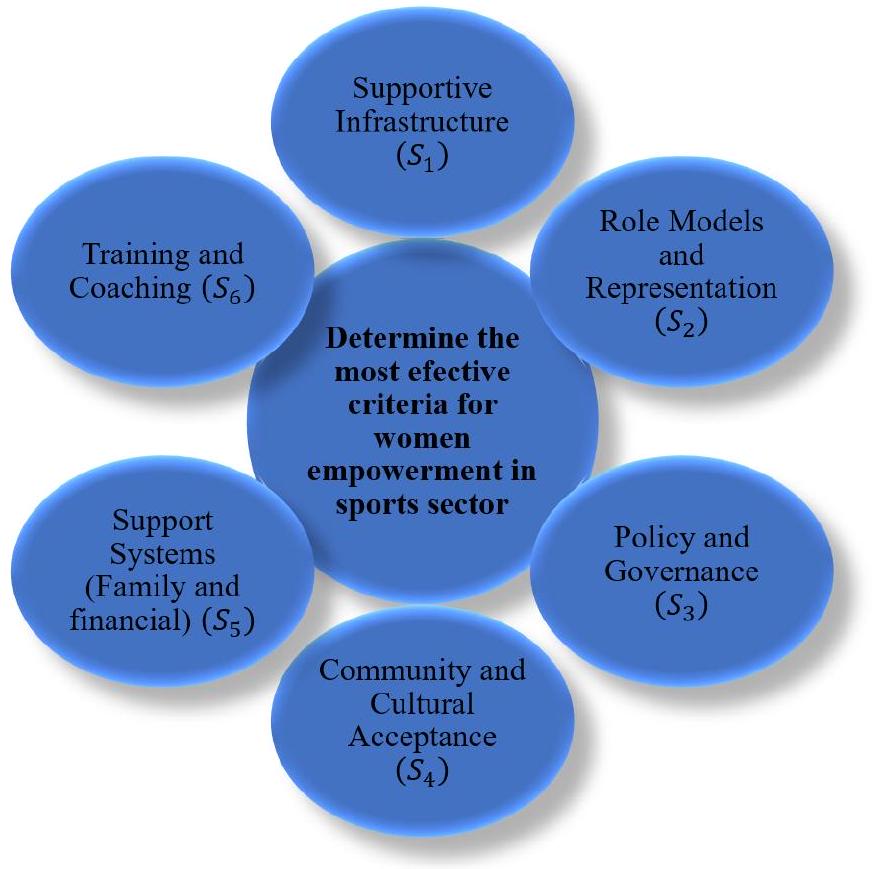
لم يكن حتى أوائل القرن العشرين أن ظهرت النساء والرياضة في نفس الجملة. حتى ذلك الحين، كانت فكرة تنافس النساء في الرياضة والحصول على أجر غير مقبولة في المجتمع الأبوي آنذاك. تمكين النساء من خلال الرياضة [29-31] مطلوب بشدة لتعزيز و/أو معالجة عوامل اجتماعية واقتصادية متنوعة مثل إنشاء شبكة مهنية، وتطوير إحساس بالهوية، وتعزيز المساواة بين الجنسين، وأدوار القيادة النسائية في المجتمع، والمشاركة في اتخاذ القرارات الاجتماعية والثقافية، إلخ. بالمقارنة مع المجموعات الأخرى، تميل النساء أكثر إلى قيادة حياة غير نشطة ولديهن معدلات أعلى من الأمراض ذات الصلة [32]. يُلاحظ أن الأنشطة الرياضية للنساء تساعدهن على تعزيز ثقتهن، وإصرارهن، وتحديدهن الذاتي، ومهارات العمل الجماعي، مما يساعد النساء في حياتهن اليومية ويمكّنهن بطرق عديدة. هناك معايير متنوعة متعلقة بقطاع الرياضة يمكن أن تسعى لإنتاج بيئة أكثر عدلاً وتمكيناً للنساء، مما يسمح لهن بالازدهار والتفوق داخل الملعب وخارجه. تم تقديم المعايير المهمة لتمكين النساء في قطاع الرياضة بشكل تصويري في الشكل 1 ووصفها كما يلي:

2.1 البنية التحتية الداعمة :

تعتبر البنية التحتية الداعمة للرياضة النسائية قضية حاسمة للغاية. تم التأكيد على أهمية البنية التحتية الرياضية للمشاركة في الرياضات العامة من قبل العديد من الباحثين [33]. كونك خاضعًا في مكان عمل يهيمن عليه الذكور، والعنصرية المؤسسية، والتمييز على أساس الجنس، والتهميش بناءً على العرق والثقافة، ونقص الموارد المناسبة هي بعض من الحواجز التي تعيق استكشاف الرياضة بين النساء [34]. تشمل البنية التحتية الداعمة للرياضة النسائية العديد من الأشياء مثل:
(أ) مرافق رياضية آمنة ومصانة جيدًا ومخصصة للجنس.
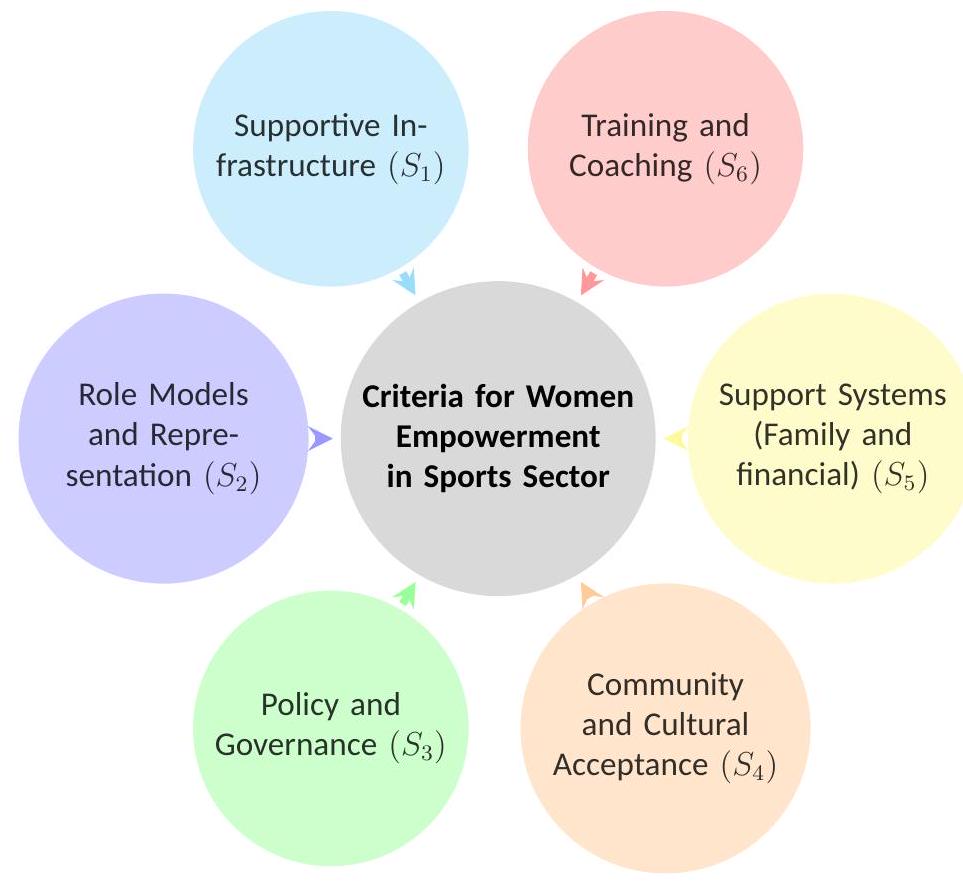
الشكل 1. معايير مختلفة لتمكين النساء من خلال الرياضة
(ب) معدات وأدوات كافية: تحتاج الرياضة النسائية إلى الوصول إلى معدات وأدوات عالية الجودة ومناسبة.
(ج) المنح الدراسية والتمويل: الدعم المالي للتعليم والتدريب والمنافسة.
(د) الدعم الطبي: من الضروري جدًا وجود محترفين طبيين مدربين والوصول إلى خدمات طبية متخصصة للرياضيات.
(هـ) برامج الإرشاد وفرص الشبكات: ستساعد برامج الإرشاد المختلفة للرياضيات على تطوير شبكة جيدة مع رياضيين ذوي خبرة ومدربين ومرشدين ومحترفين في الصناعة.
(و) التغطية الإعلامية والترويج: هناك حاجة إلى تغطية إعلامية متساوية وترويج للرياضة النسائية كما هو الحال في الرياضة الرجالية.
(ز) إمكانية الوصول للنساء ذوات التحديات الخاصة: هناك حاجة أيضًا إلى مرافق ومعدات مخصصة للنساء ذوات الإعاقة.
(ح) دعم النقل واللوجستيات: من أجل قضايا السلامة والمشاكل الشائعة الأخرى التي تواجهها النساء، هناك حاجة إلى مرافق نقل جيدة ودعم لوجستي آخر للرياضيات.
(ط) دعم الصحة والعافية النفسية: الوصول إلى أخصائيي التغذية الرياضية وبرامج العافية أمر حاسم لتعزيز الرياضة النسائية. كما أن هناك حاجة إلى محترفين مدربين للصحة النفسية ورفاهية الرياضيات.
يساعد الوصول إلى المرافق المناسبة، والتدريب المناسب، وغيرها من التدابير الداعمة على تشجيع النساء على المشاركة في الرياضة وتعزيز تطوير مواهبهن. تشير بيانات البحث إلى أن زيادة مستوى النشاط البدني مرتبط بقرب وكثافة المرافق الرياضية [35، 36].

2.2 نماذج يحتذى بها وتمثيل ( ):

تُلهم نماذج النساء البارزات في الرياضة وتُحفز النساء والفتيات الأخريات على المشاركة والتفوق في هذا المجال. يلعب التمثيل في وسائل الإعلام والمناصب القيادية أيضًا دورًا مهمًا في تمكين النساء في الرياضة. تُظهر النساء اللواتي شاركن في الألعاب الرياضية حبًا كبيرًا للعبة ورغبة في تولي المناصب القيادية. لتسليط الضوء على المشاكل الاجتماعية والثقافية والهيكلية الناتجة عن تقاطع الجنس والأصالة، هناك حاجة إلى مزيد من البحث حول النساء الأصليات في القيادة الرياضية [34]. حتى الآن، يهيمن الرجال على مهنة التدريب بسبب نقص النساء في أدوار التدريب [37]. وفقًا لـ [38]، كانت الرياضيات اللواتي تلقين تدريبًا من مدربات رئيسيات أكثر عرضة بأربع مرات لأن يصبحن مدربات بأنفسهن مقارنةً بتلك اللواتي لم يتلقين مثل هذا التعرض. تم التأكيد على أهمية أن تكون الرياضيات الإناث قادرات على الوصول إلى نماذج يحتذى بها لا تشارك فقط جنسهن ولكن أيضًا تشارك في الرياضة من قبل [39]. أظهرت الدراسات أن التواجد حول الرياضيات الإناث يمكن أن يقلل من التمييز ضدهن ويعزز شعورًا أكبر بالألفة والاهتمام بهن [40]. وبالتالي، قد يساعد تشجيع الرياضيين الشباب على التفاعل مع النساء في المناصب التدريبية في تغيير المواقف تدريجيًا وتفكيك الأسطورة القائلة بأن القدرة على التدريب مرتبطة بالجنس. وبالتالي، يساعد ذلك في القضاء على التحيزات المتأصلة والروابط غير المقصودة [41]. تلعب نماذج يحتذى بها وتمثيل دورًا حاسمًا في الرياضة النسائية، حيث تعالج بشكل قاطع وتحسن القضايا التالية:
(أ) إلهام وتأثير وتحفيز الفتيات والنساء الشابات على المشاركة في الرياضة.
(ب) كسر الصور النمطية الجنسانية وتغيير الأعراف الاجتماعية.
(ج) عرض وإظهار قدرات وإنجازات النساء الرياضيات.
(د) إظهار جودة القيادة وتعزيز شعور المجتمع والدعم.
(هـ) تشجيع التنوع والشمول.
(و) توفير فرص للإرشاد والتوجيه.
(ز) الاحتفال بنجاحات وإنجازات النساء.

2.3 السياسة والحكم ( ):

إن تنفيذ السياسات التي تعزز المساواة بين الجنسين في إدارة الرياضة، مثل الأجر المتساوي، وتدابير مكافحة التمييز، والقيادة الشاملة، يخلق بيئة يمكن أن تزدهر فيها النساء وتشعر بالتقدير. هناك حاجة إلى سياسات حكومية شاملة لمنع التحرش والتمييز ضد النساء وكذلك الوصول إلى ورش العمل والعيادات والمواد التعليمية ولوجستيات المنافسة. كما أن هناك حاجة إلى سياسات خاصة للصحة النفسية ورفاهية الرياضيات. علاوة على ذلك، فإن مفهوم “إدارة التنوع” في الرياضة ضروري لفحص التأثيرات المشتركة لسياسات المساواة بين الجنسين وإدارة التنوع على النساء الأصليات [34]. مقارنةً بالرياضيين الذكور والرياضات الذكورية، لا تزال الرياضيون الإناث والرياضات النسائية تتلقى معاملة مختلفة تمامًا من مجمع الإعلام الرياضي التجاري [42]. تشير نتائج البحث إلى أن المشاركة في الرياضة تزداد مع الوضع الاجتماعي والاقتصادي. بالإضافة إلى ذلك، هناك علاقة بين زيادة النشاط الرياضي والمستوى الأكاديمي. الرياضة أكثر تكلفة نسبيًا، وبالتالي، تعتبر الفقر أحد الحواجز في الرياضة النسائية. تشير نتائج البحث إلى أنه بين عامي 2005 و2019، كان هناك ارتفاع في عدم المساواة في الدخل في المشاركة الرياضية، خاصة بين النساء وكبار السن [43].

2.4 المجتمع والقبول الثقافي ( ):

يمكن أن تؤدي تغيير المواقف الاجتماعية تجاه النساء في الرياضة إلى كسر الحواجز والصور النمطية، مما يشجع المزيد من النساء على المشاركة دون خوف من الحكم أو التمييز. كان الباحثون وصانعو السياسات مهتمين بشكل خاص بالاختلافات في أنماط التنقل اليومية بين الرجال والنساء [44]. تعتبر الأعراف الاجتماعية قواعد تحدد السلوك المتوقع لأعضاء مجموعة أو مجتمع معين. يمكن تصنيف الأعراف الاجتماعية التي تتعلق فقط بالأدوار التي يلعبها الرجال والنساء كفئة فرعية من الأعراف الجنسانية. يمكن أن تتشكل إمكانية الوصول (غالبًا غير المتساوي) للموارد والحرية للرجال والنساء من خلال الأعراف الجنسانية، والتي “موجودة في المؤسسات الرسمية وغير الرسمية، وتنتج وتُعاد إنتاجها من خلال التفاعل الاجتماعي” [45]. تؤثر الثقافة في بيئة الرياضة على استمرار أو توقف الرياضة النسائية. لتشجيع النساء على المشاركة في الرياضة، يجب أن تعزز المرافق الرياضية ثقافة شاملة وداعمة [46].

2.5 أنظمة الدعم (العائلة والمالية) ( ):

إن إنشاء أنظمة دعم تشمل برامج الإرشاد، والشبكات الزميلة، والمساعدة المالية يساعد النساء على تجاوز التحديات والحفاظ على مشاركتهن في الرياضة. إن تحقيق توازن صحي بين العمل والحياة هو شيء تعاني منه العديد من المنظمات الرياضية، مما يجعل الأمور أكثر صعوبة بالنسبة للمدربات. الطبيعة المت demanding للتدريب، إلى جانب جدولها الزمني غير المتوقع والسفر المتكرر، قد تكون تحديًا للنساء اللواتي يسعين إلى التوفيق بين التزاماتهن الشخصية والعائلية. علاوة على ذلك، تواجه النساء غالبًا تعليقات تمييزية أو مهينة من الزملاء، والرياضيين، وحتى الآباء. هذا يضر بسمعتهن المهنية ويعزز جو عمل صعب وغير مريح. تشير نتائج الدراسة إلى أن الأفراد الذين قاموا بتدريب النساء كانوا أكثر سعادة مع المدربات، واعتقدوا بشكل أعلى عنهن كمدربات محتملات، وكان لديهم ارتباط أقل بين الرجال والرياضة. إحدى الطرق لمكافحة التحيز والتمييز الواسع النطاق في تدريب الرياضة هي توفير المزيد من الفرص للرياضيين للتفاعل بشكل هادف مع النساء في وظائف التدريب. نظرًا لأن رعاية الأطفال هي مسؤولية أساسية لجميع النساء في مجتمعنا، فإن الوصول الجيد إلى خدمات رعاية الأطفال والمرافق الصديقة للعائلة ضروري لتعزيز رياضة النساء.

2.6 التدريب والتوجيه ( ):

توفير فرص تدريب وتوجيه عالية الجودة مصممة خصيصًا لتلبية احتياجات النساء يمكن أن يعزز مهاراتهن وثقتهن، مما يؤدي إلى زيادة المشاركة والنجاح في الرياضة. وجود مدربين مناسبين، واستخدام شبكاتهم الرياضية والاجتماعية، وتسهيل العلاقات مع أعضاء الهيئة الحاكمة، واعتماد نهج تعاوني، وتحدي التوقعات العرقية والثقافية والجندرية يمكن أن يساعد في التغلب على العقبات مثل البيئة التنافسية التي يهيمن عليها الذكور، والعنصرية، والتمييز الحكومي والجندري، والهويات الثقافية، ونقص الدعم. وفقًا للأبحاث، غالبًا ما يتم شغل أدوار التوجيه من خلال قنوات توظيف غير رسمية وتعتمد في الغالب على الاتصالات والشبكات الشخصية ورأس المال الاجتماعي. هذه السياسة التوظيفية تعمق الفجوة الجندرية من خلال تفضيل الرجال، الذين يُنظر إليهم عادةً على أنهم مدربون قادرون. تم تناول إنشاء أنظمة دعم في المنظمات الرياضية التي دفعت النساء بنشاط للسعي إلى أدوار قيادية. علاوة على ذلك، يؤكدون على أهمية مبادرات تطوير القيادة المصممة خصيصًا للنساء، والتي تعزز رؤية النساء وثقتهن في هذه الأدوار بالإضافة إلى imparting المعرفة والمهارات. من بين هذه الاستراتيجيات، فإن وضع المزيد من النساء في مناصب التدريب هو وسيلة فعالة بشكل خاص للتأثير على الرياضيين الشباب. زيادة تعرض الشباب للمدربات الإناث هي خطوة أولى حاسمة في تعزيز المساواة بين الجنسين في الرياضة.
يجب تنفيذ المبادرات لمواجهة وتغيير المفاهيم المسبقة المستمرة بالإضافة إلى ذلك. هناك حاجة ماسة إلى مدربين ومؤهلين ذوي خبرة في رياضة النساء.

3. مجموعة ضبابية ورقم ضبابي

يتناول هذا القسم طريقة مختبر التجارب والتقييم لاتخاذ القرار الضبابي (FDEMATEL). تلتقط المجموعات الضبابية عدم اليقين في النظام، وطريقة DEMATEL هي طريقة متعددة المعايير لاتخاذ القرار للتعرف على الاعتماد المتبادل بين العوامل. أولاً، يتم تقديم المجموعة الضبابية، وخاصة الأنواع الخاصة من المجموعات الضبابية، وهي مجموعة الضبابية الخماسية (PFS)، تليها طريقة DEMATEL في بيئة ضبابية.

3.1 مجموعة ضبابية

تم تقديم مفهوم المجموعة الضبابية لأول مرة بواسطة لطفي أ. زاده [1] في عام 1965. على عكس المجموعة الدقيقة أو المجموعات الثنائية في نظرية المجموعات الكلاسيكية، حيث يتم تضمين عنصر عشوائي أو استبعاده من المجموعة، فإن نظرية المجموعات الضبابية تسمح لكل عنصر بدرجة من العضوية. قيمة العضوية لعنصر ما تقع بين و0 يدل على أن العنصر لا ينتمي إلى المجموعة، و1 يدل على أن العنصر ينتمي إلى المجموعة، وجميع القيم المتوسطة تمثل العناصر التي تنتمي جزئيًا وبنسب معينة مع قيم العضوية.

التعريف 1. مجموعة ضبابية: [4]

اعتبر كن مجموعة شاملة من الخطاب. مجموعة ضبابية على تعريف كـ
أين كن دالة العضوية للمجموعة تعريف على إلى .
مثال 1. لنفترض مجموعة ضبابية تعريف على المجموعة الشاملة وحدد كـ
ثم قيمة العضوية ( ) من العنصر 1 هو هو هو 0.8 وهكذا. قيمة العضوية للعنصر 6 هي 0، أي أن العنصر 6 غير موجود بالكامل في المجموعة. في الوقت نفسه، قيمة العضوية للعنصر 8 هي 1، أي أن العنصر 8 ينتمي بالكامل إلى المجموعة. . علاوة على ذلك، أي عناصر أخرى في المجموعة تنتمي جزئيًا إلى المجموعة الضبابية استنادًا إلى درجة قيم العضوية لديهم.
الأعداد الضبابية هي أنواع محددة من المجموعات الضبابية التي تفرض شرطًا معينًا على دالة الانتماء لمجموعة ضبابية على نطاق خط الأعداد الحقيقية. يمكن تعريف العدد الضبابي على أنه

التعريف 2. العدد الضبابي: [3]

افترض كن مجموعة غامضة محددة في المجموعة الشاملة . ثم المجموعة الضبابية يسمى عددًا ضبابيًا إذا كانت المجموعة الشاملة ودالة العضوية ( ) تلبي ما يلي:
  1. كن مجموعة ضبابية عادية؛ أي، بحيث .
  2. دعم لـ محدود؛ أي، .
  3. دالة العضوية ( ) من مجموعة الضبابية ( ) مستمرة جزئيًا على .
  4. هي مجموعة ضبابية محدبة؛ أي، يُرضي
أين .
مثال 2. اعتبر المجموعة الشاملة ورقم ضبابي تعريف كـ
في الرقم الضبابي للعناصر قيمة العضوية هي للعناصر قيمة العضوية هي وأي عناصر أخرى قيمة العضوية تكمن بين (0,1). ثم الرقم الضبابي تفي بجميع الخصائص الموصوفة في التعريف 2.
الشكل 2. الهيكل الرسومي لمجموعة الضبابية
ملاحظة 1. يمكن للأعداد الضبابية [3] التعامل مع عدم اليقين وعدم الدقة في النظام. في العصر الحالي، يتم تطبيقها في العديد من المجالات في الرياضيات وعلوم الكمبيوتر حيث لا تكون القياسات الدقيقة ممكنة أو ضرورية دائمًا. يتم تمثيل الرسم البياني للعدد الضبابي الموصوف في المثال 2 في الشكل 2.

3.2 مجموعة فuzzy خماسية (PFS)

تمثل مجموعة ضبابية خماسية [11] المتغيرات الضبابية بطريقة تلتقط درجة الانتماء للعناصر في مجموعة ذات شكل يشبه شبه المنحرف. توجد عدة امتدادات للمجموعات الضبابية، بعضها مجموعة ضبابية مثلثية (TFS) [51]، مجموعة ضبابية شبه منحرفية (TrFS) [52]، مجموعة ضبابية خماسية (PFS) [11]، مجموعة ضبابية سداسية (HFS) [53]، مجموعة ضبابية حدسية (IFS) [54]، مجموعة ضبابية نيوترية (NFS) [9] وهكذا. تُعرف المجموعة الضبابية الخماسية (PFS) كما يلي:
التعريف 3. مجموعة فuzzy خماسية: [11]
اعتبر كن مجموعة شاملة. مجموعة ضبابية خماسية تعريف على وحدد كـ
حيث دالة العضوية مقدم كـ
و هما نقطتان متطرفتان من الخماسي مع .
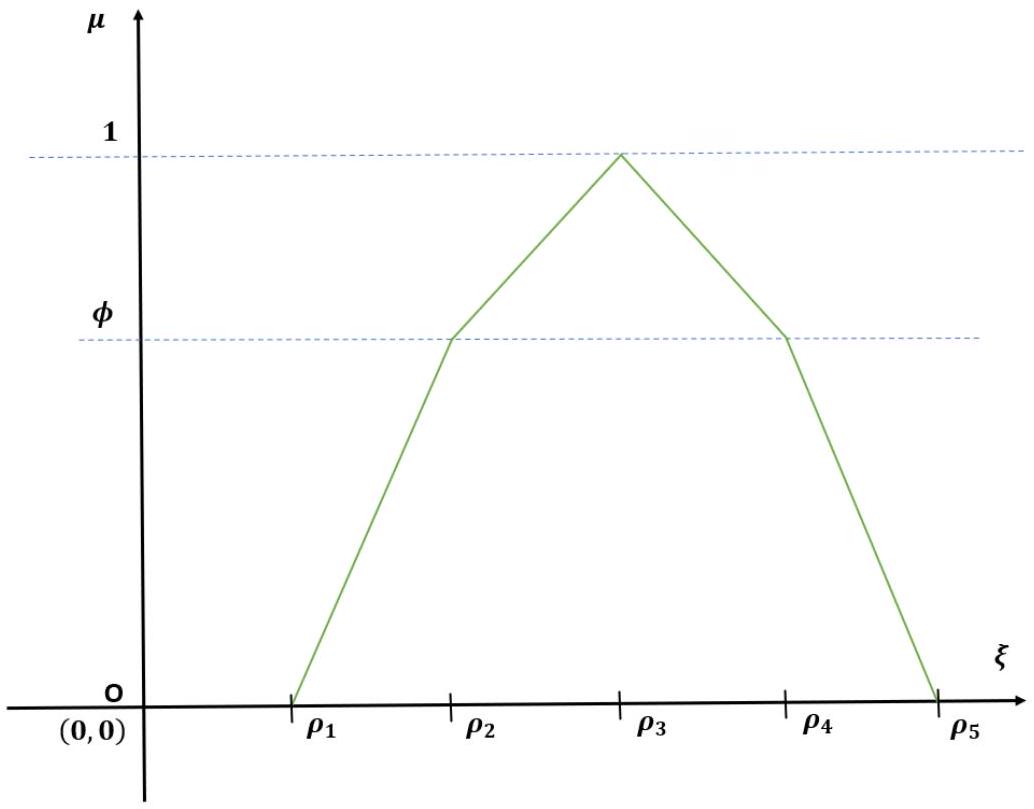
هنا، في PFS القيم و عناصر عشوائية في بترتيب تصاعدي ( ). في دالة العضوية ( ) من مجموعة فuzzy الخماسية ( ) هو شكل خماسي معرف في المعادلة (4) وممثل رسوميًا في الشكل 3، على التوالي.
الشكل 3. المخطط الهيكلي لمجموعة الضبابية الخماسية (PFS) )

3.2.1 عملية المجموعة على PFS

افترض، و هناك نظامان PFS محددان على . ثم يتم تعريف العمليات المختلفة على مجموعات PFS كما يلي
أ). مكمل PFS :
ب). اتحاد اثنين من PFSs و :
ج). تقاطع مجموعتين من PFS و :
مثال 3. اعتبر نظامين PFS و تعريف في المجموعة الشاملة ثم العمليات الأساسية على المجموعات الضبابية هي
  1. مكمل PFS :
  1. اتحاد اثنين من أنظمة الدفع الإلكتروني و :
  1. تقاطع اثنين من أنظمة الملفات الشخصية و :

3.3 الرقم الضبابي الخماسي (PFN)

عدد ضبابي خماسي (PFN) هو مجموعة ضبابية خماسية (PFS) محددة في التعريف 3 والتي تلبي خصائص الأعداد الضبابية المحددة في التعريف 2. ثم يتم تعريف PFN على أنه

التعريف 4. العدد الضبابي الخماسي: [11]

اعتبر مجموعة الأعداد الحقيقية كن مجموعة شاملة من الخطاب. عدد غامض خماسي الأضلاع هو تعريف PFS كـ
أين كن وظيفة العضوية تعرف على أنها
و هما نقطتان متطرفتان من الخماسي مع .
استنادًا إلى الشروط على العدد الضبابي الخماسي تحويل إلى أنواع مختلفة من الأعداد الضبابية، كما
  1. إذا أو ثم الـ PFN يصبح عددًا ضبابيًا شبه منحرف (TrFN).
  2. إذا أو ثم الـ PFN يصبح عددًا ضبابيًا مثلثيًا (TFN).
علاوة على ذلك، النقطة القصوى عدد غامض خماسي الأبعاد ( يكمن بين استنادًا إلى الشروط على يمكن إعادة هيكلة PFN على النحو التالي
  1. إذا ثم PFN يصبح TFN.
  2. إذا ، ثم أصبح TrFN.
مثال 4. دعنا، كن PFN معرفًا على مجموعة شاملة من النقاش . ثم PFN يمثل كـ
حيث دالة العضوية ( ) هو شكل خماسي محدد بخمسة حدود كما هو موضح أعلاه وبواسطة الخط الحقيقي. تم رصد أقصى قيمة انتماء عند النقطة 7 والنقطتان الزاويتان الأخريان هما 5 و 9.

3.3.1 العمليات الحسابية على PFN

افترض، و هناك اثنان من PFNs محددان على . ثم يتم تعريف العمليات الحسابية المختلفة على PFNs [10] كما يلي
أ). جمع اثنين من PFNs:
ب). الطرح من رقم الصفحة الفيزيائية إلى رقم الصفحة الفيزيائية:
ج). الضرب القياسي لـ PFN:
أين هو عدد عددي موجب.
د). ضرب اثنين من PFNs:
هـ). القدرة القياسية لـ PFN:
أين هو عدد عددي موجب.
تمت مناقشة مزيد من التفاصيل حول العمليات الحسابية على الأعداد الضبابية بواسطة موكيرجي، أ. ك. وآخرون [2]. تشرح هذه الدراسة القيود والشروط المتعلقة بالعمليات الحسابية على المجموعات الضبابية والأعداد الضبابية، مع تمثيل بياني.
مثال 5. لنفترض وجود اثنين من PFNs و تعريف في المجموعة الشاملة ثم العمليات الحسابية على الأعداد الضبابية هي
  1. جمع اثنين من PFNs و :
  1. الطرح من إلى :
  1. الضرب العددي لـ PFN بـ 0.5 :
هنا هو عدد عددي موجب.
4. ضرب اثنين من PFNs و :
  1. قوة السكالار لـ PFN:
هنا هو عدد عددي موجب.

3.4 إزالة الغموض من الشبكة الضبابية

إزالة الضبابية [54] هي إجراء حسابي لتحديد رقم دقيق مكافئ لكل رقم ضبابي. تعتبر عملية الضبابية وإزالة الضبابية عمليتين متناقضتين لتحويل الأرقام الدقيقة إلى أرقام ضبابية والعكس بالعكس. في نظام الأرقام الضبابية، لا توجد علاقة ترتيب، ولكن في نظام الأرقام الدقيقة توجد، مما يتطلب تحويل الرقم الضبابي للحصول على علاقة ترتيب. تم اختراع عدة منهجيات لإزالة الضبابية من الأرقام الضبابية، مثل طريقة مركز المساحة (COA)، وطريقة قاطع المساحة (BOA)، وطريقة أكبر القيم العظمى (LOM)، وطريقة أصغر القيم العظمى (SOM)، وطريقة متوسط القيم العظمى (MOM)، وطريقة النقطة الموزونة العادية (RWP)، وطريقة قيمة التكامل المتدرجة (GMIV)، وطريقة مركز الفترة التقريبية (COAI)، وطريقة قائمة على المركز الثقل (CBM) وغيرها. هنا، نقترح طريقة جديدة على الأرقام الضبابية المعممة (PFN) لإزالة الضبابية منها.
افترض، كن دالة PFN معرفة على الخط الحقيقي . ثم تم اقتراح طريقة إزالة الضبابية [11] على الشبكة العصبية الضبابية (PFN) ) تم تقييمه على النحو التالي:
مثال 6. اعتبر اثنين من PFNs و ثم القيم التي تم إزالة الضبابية منها و يُشار إليه بـ و على التوالي وتحديد كـ

4. طريقة مختبر التجارب والتقييم لاتخاذ القرارات الضبابية (FDEMATEL)

تشرح هذه الفقرة باختصار طريقة مختبر تقييم واتخاذ القرار (DEMATEL) في بيئة الأعداد الضبابية الخماسية (PFN). تم اختراع هذه الطريقة لأول مرة في عام 2007 بواسطة Tzeng، G. وآخرون. لقد تم استخدام طريقة DEMATEL على نطاق واسع في العديد من المجالات، مثل إدارة المخاطر، ومراقبة سلامة الطيران، وتأثير الإعلانات على الويب، والتدقيق في بيئة تخطيط موارد المؤسسات، وتأثير برامج التعلم الإلكتروني، والتحقيق في جودة خدمات المستشفيات، واتخاذ قرار بشأن تكلفة نموذج الجودة، واختيار المزود لخدمة المصرفية عبر الهاتف المحمول، وتقييم عوامل المخاطر في صناعة السيارات، وما إلى ذلك. هنا، يتم تطبيق طريقة DEMATEL في بيئة غير مؤكدة من الأعداد الضبابية الخماسية (PFN) وتسمى طريقة FDEMATEL. يتم تقديم مخطط التدفق الهيكلي لطرق FDEMATEL بشكل رسومي في الشكل 4. تتم معالجة طريقة DEMATEL الضبابية (FDEMATEL) على النحو التالي:

تجميع مصفوفات العلاقة المباشرة ( ) من بين المعايير


تقييم مصفوفة العلاقة المباشرة المجمعة ( )

احسب مصفوفة العلاقة المباشرة المجمعّة غير الضبابية مصفوفة العلاقة المباشرة المعدلة

اكتشف مصفوفة العلاقة الكلية

احسب التأثير المباشر ( ) وتأثير غير مباشر ( )
الشكل 4. الهيكل الهرمي لطريقة DEMATEL
أ. بناء مصفوفة العلاقة المباشرة :
تقدير العلاقة المتبادلة بين المعايير مع المعايير التي تم قياسها بواسطة مقياس المقارنة في الجدول 1 حيث . هناك عدد صانعي القرار (DMs) الذين يقدمون آراءً بناءً على خبرتهم ومعرفتهم. هناك مصفوفات العلاقة المباشرة مُركب بـ طلب حيث . الـ مصفوفة العلاقة المباشرة
( مُهيكلة كـ
أين يمثل الإدخال التقييمات لـ معايير الاحترام لـ المعايير المقدمة من DM. بالإضافة إلى ذلك، هو عدد ضبابي خماسي الشكل يُمثل كـ
II. تجميع مصفوفات العلاقة المباشرة ( ):
كل عدد المصفوفات المباشرة أين دمج في مصفوفة علاقة مباشرة واحدة للمزيد من التقييم. دمج كل الإدخال بواسطة المعادلة (18) وإنشاء مصفوفة علاقة مباشرة واحدة ( ) كما يلي:
ومصفوفة العلاقة المباشرة ( يبدو أن
III. تم إزالة الغموض من مصفوفة العلاقة المباشرة المجمعة ):
حدد مصفوفة العلاقة المباشرة المجمعّة غير الضبابية ) من خلال إزالة الضبابية من كل إدخال في مصفوفة العلاقة المباشرة المجمعة ( ) باستخدام الصيغة المُفككة في المعادلة (15). مصفوفة العلاقة المباشرة المجمعة المُفككة صياغة كـ
أين هو القيمة المزالة الضبابية لـ PFN .

IV. تطبيع مصفوفة العلاقة المباشرة المعدلة :

علاوة على ذلك، تم تطبيع مصفوفة العلاقة المباشرة المعدلة باستخدام المعادلة (21) وتأسيس مصفوفة العلاقة المباشرة المعيارية ( ) كما يلي:
أين هو القيمة المعيارية لـ و .
V. تقييم مصفوفة العلاقة الكلية :
احسب مصفوفة العلاقة الكلية من مصفوفة العلاقة المباشرة المعيارية كما يلي:
أين كن مصفوفة الهوية لـ الطلب و هو مدخل مصفوفة العلاقة الكلية .
VI. تحديد التأثير المباشر ) وتأثير غير مباشر ( ) للمعايير:
مجموع مدخلات الصف في مصفوفة العلاقة الكلية ( ) يُشار إليه بقيمة التأثير المباشر وصف كـ
أين ومجموع مدخلات العمود لمصفوفة العلاقة الكلية ( يُشار إليه بقيمة التأثير غير المباشر ( ) ووصفها كـ
أين .

VII. تقييم قيم المجموع:

يتم تقييم المخططات السببية لكل معيار من مجموعة البيانات. قيمة البروز كل معايير الأكاذيب تقع على المحور الأفقي وتحدد على النحو التالي:
وقيمة العلاقة من كل معيار يكمن في المحور العمودي ويتم تحديده على النحو التالي:
أين و تم تقييمها في الخطوات السابقة حيث .

ثامناً. احسب قيمة العتبة:

أخيرًا، القيم كشفت عن مدى أهمية المعايير، حيث أنها تظهر درجة العلاقة بين كل معيار والمعايير الأخرى. لذلك، فإن المعايير لها قيمة أعلى من يشير إلى أن المعايير لها علاقة أكبر مع معايير أخرى وفي الوقت نفسه، فإن تلك المعايير لها قيمة أقل من أظهرت أن المعايير لها علاقة أقل مع معايير أخرى.
على الجانب الآخر، تتضح القيمة من نوع العلاقة بين المعايير. عندما القيمة إيجابية ( ) ثم المعايير تنتمي إلى مجموعة السبب أو الموزع، أي تؤثر المعايير على معايير أخرى. بدلاً من ذلك، عندما القيمة سالبة ثم المعايير تنتمي إلى مجموعة التأثير أو المتلقي، أي المعايير المتأثرة بمعايير أخرى.
أخيرًا، استنادًا إلى و قيم المعايير، رسم المخطط السببي في طائرة، حيث يوضح الرسم البياني السببي التأثير المباشر وغير المباشر لكل معيار على المعايير الأخرى. علاوة على ذلك، يمكن لصانعي القرار تحديد قيمة العتبة لتحديد التأثير الضئيل للمعايير على جميع المعايير الأخرى.

5. صياغة النموذج وجمع البيانات

تصف هذه القسم صياغة نموذج هذه الدراسة وعملية جمع البيانات بالتفصيل. أولاً، سيتم صياغة نموذج البحث المقترح، تليها إجراءات تجميع البيانات من ثلاثة خبراء في اتخاذ القرار.

5.1 صياغة النموذج

هناك ستة معايير الأكثر أهمية للعثور على معايير قيمة في قسم الرياضة بناءً على تمكين المرأة، والتي تعتبر وفقًا لآراء صانعي القرار. يتم ذكر المناقشة التفصيلية حول المعايير في القسم 2. يتم مناقشة أداة الرياضيات لالتقاط عدم اليقين في القسم 3، وطريقة MCDM المعتمدة على DEMATEL الضبابي مذكورة في القسم 4، على التوالي. مصفوفات العلاقة المباشرة ( ) مع ترتيب من حيث المصطلحات اللغوية المقدمة من قبل ثلاثة مدراء. يتم تصوير المخطط الهيكلي للنموذج المقترح في الشكل 5. جميع هؤلاء المدراء لديهم خبرة، وغير متحيزين ومحترفين في مجالهم وهم:
DM1: بطلة رياضية دولية للنساء.
DM2: ضابط في مجلس هيئة الرياضة.
DM3: يعمل أخصائي اجتماعي على تمكين المرأة.
الشكل 5. الهيكل الهرمي للنموذج المقترح

5.2 جمع البيانات

يصف هذا القسم جمع البيانات في هذه الدراسة. أولاً، يتم جمع البيانات بواسطة مديري البيانات من حيث المصطلحات اللغوية في مصفوفات العلاقة المباشرة. ) باستخدام الجدول 1 والمحتوى في الجدول 2. علاوة على ذلك، مصفوفات العلاقة المباشرة ( تم فك تشفيرها إلى PFNs باستخدام الجدول 1 وبدء استخدامها لطريقة DEMATEL الضبابية باستخدام القسم 4.
الجدول 1
مصطلح لغوي مع GIPFN وقيمة مُفككة للقرار
المصطلحات اللغوية عدد ضبابي خماسي (PFN) القيمة المزالة منها الضبابية
ذو صلة شديدة (ER) ١٣
مرتفع الأهمية (HR) 11
ذو صلة كبيرة (VR) ٩
المعتدل ذو الصلة (MR) ٧
أقل أهمية (LR) ٥
أدناه ذو صلة (BR) ٣
الأسبوعي ذو الصلة (WR) 1
لا يوجد ما هو ذي صلة (NR) 0
الجدول 2
مصفوفة العلاقة المباشرة ( ) من حيث اللغة المقدمة من قبل ثلاثة DMs
معايير المعايير
البنية التحتية ( )
داعم
نماذج يحتذى بها وتمثيل السياسة والحكم ) قبول المجتمع والثقافة ) أنظمة الدعم (الدعم المالي العائلي) ) أنظمة الدعم المالية العائلة
البنية التحتية الداعمة ) NR LR الموارد البشرية الواقع الافتراضي الموارد البشرية غرفة الطوارئ
نماذج يحتذى بها وتمثيل ) BR NR WR السيد الواقع الافتراضي LR
السياسة والحكم ) WR الموارد البشرية NR الموارد البشرية السيد BR
قبول المجتمع والثقافة ) الواقع الافتراضي LR الموارد البشرية NR غرفة الطوارئ الواقع الافتراضي
أنظمة الدعم (العائلة والمالية) ) السيد الموارد البشرية الواقع الافتراضي WR NR LR
قبول المجتمع والثقافة ) الواقع الافتراضي السيد الموارد البشرية BR الواقع الافتراضي NR
معايير المعايير
البنية التحتية ( )
داعم
نماذج يحتذى بها والتمثيل السياسة والحكم ) المجتمع والثقافة أنظمة الدعم (الدعم المالي العائلي) ) أنظمة الدعم (الدعم المالي العائلي) )
البنية التحتية الداعمة ) NR السيد غرفة الطوارئ الموارد البشرية غرفة الطوارئ الموارد البشرية
نماذج يحتذى بها وتمثيل ) LR NR BR الواقع الافتراضي الموارد البشرية السيد
السياسة والحكم ) BR غرفة الطوارئ NR غرفة الطوارئ الواقع الافتراضي LR
قبول المجتمع والثقافة ) الموارد البشرية السيد غرفة الطوارئ NR الموارد البشرية الموارد البشرية
أنظمة الدعم (العائلة والمالية) ) الواقع الافتراضي غرفة الطوارئ الموارد البشرية BR NR السيد
قبول المجتمع والثقافة ) الموارد البشرية الواقع الافتراضي غرفة الطوارئ LR الموارد البشرية NR
معايير المعايير
البنية التحتية
داعم
نماذج يحتذى بها وتمثيل السياسة والحكم ) المجتمع والثقافة أنظمة الدعم (الدعم المالي العائلي) ) أنظمة الدعم (الدعم المالي العائلي)
البنية التحتية الداعمة ) NR BR الواقع الافتراضي السيد الواقع الافتراضي الموارد البشرية
نماذج يحتذى بها وتمثيل ) WR NR BR LR السيد BR
السياسة والحكم ) BR الواقع الافتراضي NR الواقع الافتراضي LR WR
قبول المجتمع والثقافة ) السيد BR الواقع الافتراضي NR الموارد البشرية السيد
أنظمة الدعم (العائلة والمالية) ) LR الواقع الافتراضي السيد BR NR BR
قبول المجتمع والثقافة ) السيد LR الواقع الافتراضي WR السيد NR
ملاحظة 2. تمثل الجدول 2 مصفوفة العلاقة المباشرة ( ) من الناحية اللغوية بواسطة ثلاثة مدراء باستخدام الجدول 1. تم أخذ جميع التقييمات بطريقة غير متحيزة وتم إحالتها للتقييم العددي.

6. توضيح رقمي ومناقشة

يتم تحديد التقييم العددي لأكثر المعايير فعالية لتمكين المرأة من خلال الرياضة وتحليل النتائج هنا بالتفصيل. نحن نعتبر منهجية DEMATEL الضبابية (انظر القسم 4) ك técnica تحسين في عدد ضبابي خماسي (PFN) (انظر القسم 3) كبيئة غير مؤكدة. علاوة على ذلك، نعتبر مصفوفة العلاقة المباشرة ( ) (في الجدول 2) كمصدر بيانات للتقييم العددي.
تم تقييم النتائج المطلوبة باستخدام طريقة DEMATEL الضبابية على النحو التالي: أولاً، بناء مصفوفة العلاقة المباشرة ( ) بواسطة ثلاثة مديري بيانات باستخدام المعادلة (16)، الموضحة في الجدول 2. ثم تم تجميع مصفوفات العلاقات المباشرة ( ) تم تقييمه بواسطة المعادلة (19). علاوة على ذلك، فإن مصفوفة العلاقة المباشرة المجمعّة غير الضبابية ( ) المحدد بواسطة المعادلة (20) والمبين في الجدول 3. بعد ذلك، قامت المعادلة (21) بحساب مصفوفة العلاقة المباشرة المعدلة المعيارية ( ) في الجدول 4. ثم قم بتقييم مصفوفة العلاقة الكلية في الجدول 5 باستخدام المعادلة (22). أخيرًا، التأثير المباشر تأثير غير مباشر ،
قيمة البروز وقيمة العلاقة قيم لكل معيار تم حسابها بواسطة المعادلات (23) و(24) و(25) و(26) على التوالي، كما هو موضح في الجدول 6.
الجدول 3
تم إزالة الضبابية من مصفوفة العلاقة المباشرة المجمعة ( )
معايير مقابل معايير
البنية التحتية الداعمة ) 0.0000 8.1765 18.2652 14.9163 18.2652 19.7944
نماذج يحتذى بها وتمثيل ) ٤.٧٠٣٥ 0.0000 3.3778 ١١.٥٥٧٨ 14.9163 8.1765
السياسة والحكم ) 3.3778 18.2652 0.0000 18.2652 ١١.٥٥٧٨ ٤.٧٠٣٥
قبول المجتمع والثقافة ) 14.9163 8.1765 18.2652 0.0000 19.7944 14.9163
أنظمة الدعم (العائلة والمالية) ) ١١.٥٥٧٨ 18.2652 14.9163 3.3778 0.0000 8.1765
قبول المجتمع والثقافة ) 14.9163 ١١.٥٥٧٨ 18.2652 ٤.٧٠٣٥ 14.9163 0.0000
الجدول 4
تطبيع مصفوفة العلاقة المباشرة المعدلة ( )
معايير مقابل معايير
البنية التحتية الداعمة ) 0.0000 0.1030 0.2300 0.1878 0.2300 0.2492
نماذج يحتذى بها وتمثيل ) 0.0592 0.0000 0.0425 0.1455 0.1878 0.١٠٣٠
السياسة والحكم ) 0.0425 0.2300 0.0000 0.2300 0.1455 0.0592
قبول المجتمع والثقافة ) 0.1878 0.1030 0.2300 0.0000 0.2492 0.1878
أنظمة الدعم (العائلة والمالية) ) 0.1455 0.2300 0.1878 0.0425 0.0000 0.١٠٣٠
قبول المجتمع والثقافة ) 0.1878 0.1455 0.2300 0.0592 0.1878 0.0000
الجدول 5
مصفوفة العلاقة الكلية ( )
معايير مقابل معايير
البنية التحتية الداعمة ) 0.4752 0.7262 0.8569 0.6652 0.9070 0.7099
نماذج يحتذى بها وتمثيل ) 0.3350 0.3609 0.4226 0.4108 0.5740 0.3807
السياسة والحكم ) 0.3772 0.6386 0.4574 0.5533 0.6439 0.4151
قبول المجتمع والثقافة ) 0.6152 0.7040 0.8305 0.4881 0.8946 0.6462
أنظمة الدعم (العائلة والمالية) ) 0.4486 0.6367 0.6086 0.4071 0.5007 0.4397
قبول المجتمع والثقافة ) 0.5394 0.6522 0.7269 0.4819 0.7454 0.4098
الجدول 6
قيم العتبة للمعايير المختلفة
معايير
البنية التحتية الداعمة ) ٤.٣٤٠٤ ٢.٧٩٠٦ 7.1310 1.5498
نماذج يحتذى بها وتمثيل ) ٢.٤٨٤٠ 3.7186 6.2026 -1.2346
السياسة والحكم ) 3.0855 3.9029 6.9884 -0.8174
قبول المجتمع والثقافة ) ٤.١٧٨٦ ٣.٠٠٦٤ ٧.١٨٥٠ 1.1722
أنظمة الدعم (العائلة والمالية) ) 3.0414 ٤.٢٦٥٦ 7.3070 -1.2242
قبول المجتمع والثقافة ) ٣.٥٥٥٦ ٣.٠٠١٤ ٦.٥٥٧٠ 0.5542
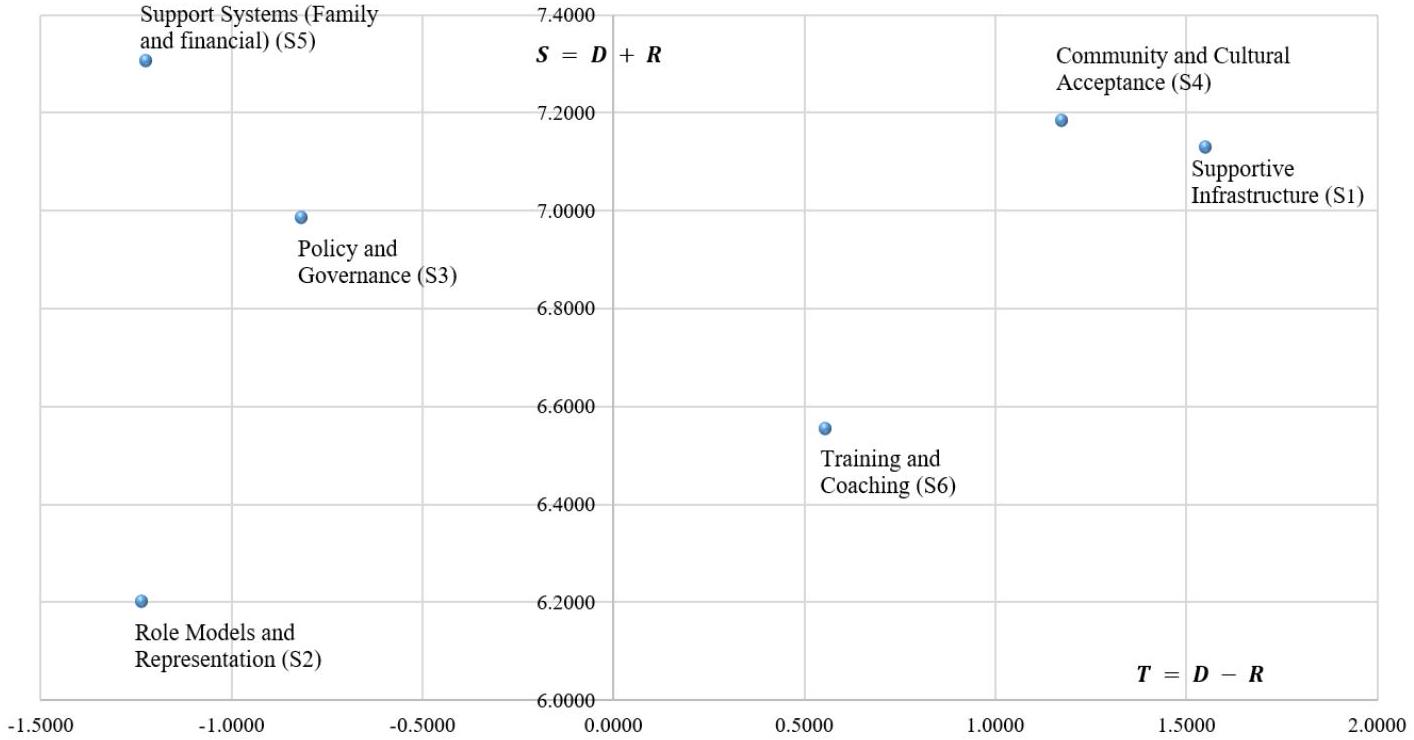
تمثل الجدول 6 النتائج العددية لطريقة ديماتيل الضبابية بين معايير تمكين المرأة من خلال الرياضة. من قيمة البروز ( ) القيم، نستنتج أن درجة العلاقة بين معيار معين والمعايير الأخرى. على سبيل المثال، معايير أنظمة الدعم (العائلة والمالية) ( ) هو الحد الأقصى للعلاقة مع معايير أخرى. علاوة على ذلك، قبول المجتمع والثقافة ( ) والبنية التحتية الداعمة ( ) المعايير هي العلاقة بين الارتفاع الثاني والثالث مع المعايير المتبقية، على التوالي. بالإضافة إلى ذلك، السياسة والحكم ( ) وقبول المجتمع والثقافة ( ) المعايير هي الرابعة والخامسة من حيث الأهمية والعوامل النموذجية والتمثيل ( ) المعايير هي أدنى علاقة بين المعايير، على التوالي.
بجانب ذلك، قيمة العلاقة قيم المعايير معروفة أيضًا من الجدول 6، وهي تكشف عن نوع العلاقة بين المعايير. قيمة العلاقة ( قيم إيجابية ) تشير إلى أن المعايير تنتمي إلى مجموعة السبب أو الموزع و سلبية ( ) تشير إلى أن المعايير تنتمي إلى مجموعة التأثير أو المتلقي. على سبيل المثال، البنية التحتية الداعمة ( قبول المجتمع والثقافة ) وقبول المجتمع والثقافة ( ) المعايير هي مجموعة السبب أو الموزع والسياسة والحوكمة ( أنظمة الدعم (العائلة والمالية) نماذج يحتذى بها والتمثيل المعايير هي مجموعة التأثير أو المتلقي، على التوالي. يتم تصوير المخطط السببي بين معايير تمكين المرأة من خلال الرياضة في الشكل 6.
الشكل 6. الرسم البياني السببي لكل معيار بناءً على و القيم

7. الخاتمة وآفاق البحث المستقبلية

في هذه المقالة، نجد التأثيرات المباشرة وغير المباشرة لكل معيار على المعايير الأخرى لبعض المعايير ذات الصلة بتمكين المرأة في قطاع الرياضة. تم اعتبار المعايير كالبنية التحتية الداعمة ( نموذج يحتذى به والتمثيل السياسة والحكم قبول المجتمع والثقافة أنظمة الدعم (العائلة والمالية) ) والتدريب والتوجيه . نحن نستخدم مفهوم اتخاذ القرار متعدد المعايير للعثور على التأثيرات المباشرة وغير المباشرة للمعايير. تم جمع مجموعات البيانات من حيث المتغيرات اللغوية من ثلاثة خبراء قرار. تم تحويل مصفوفة العلاقة المباشرة للمصطلحات اللغوية ( ) إلى مصفوفة أعداد ضبابية للخطوات التالية. تم اتخاذ الطريقة المعروفة باسم DEMATEL الضبابي لإيجاد النتائج العددية في الجدول 6. في الختام، فإن معايير أنظمة الدعم (العائلة والمالية) ( ) هي أعلى علاقة، ونماذج الدور والتمثيل ( ) هي أقل علاقة مع المعايير المتبقية. علاوة على ذلك، فإن المعايير ( ),
( ) و ( ) هي في مجموعة السبب أو الموزع والمعايير المتبقية ( ) و ( ) و ( ) هي في مجموعة التأثير أو المستلم، على التوالي.
من خلال النهج المنظم، تقدم مثل هذه الدراسات فهمًا مهمًا لفرص رائعة، وتغذي بيئات داعمة وتمكن النساء من التألق في قطاع الرياضة. ستساهم هذه البحث في النهاية في خلق مشهد رياضي أكثر شمولاً وعدلاً للأجيال القادمة. تقدم النتائج رؤى استراتيجية للمنظمات الرياضية وصانعي السياسات وأصحاب المصلحة لتنفيذ إبداع مستهدف يحسن من أدوار القيادة، والمساواة بين الجنسين، والتمكين الكامل للنساء في الرياضة.
في الأبحاث المستقبلية، يمكن توسيع العمل بطريقتين مختلفتين، إما من منظور نظري أو من حيث صياغات النماذج. يمكن لأي شخص أن يأخذ نوعًا آخر من طرق اتخاذ القرار متعدد المعايير مثل عملية التحليل الهرمي (AHP)، عملية الشبكة التحليلية (ANP)، الإنتروبيا، أهمية المعايير من خلال الترابط بين المعايير (CRITIC) وطرق تحليل نسبة الوزن التدريجي (SWARA) لإيجاد العلاقة بين المعايير وأخذ أنواع مختلفة من عدم اليقين في مجموعات البيانات مثل المجموعات الضبابية الحدسية، المجموعات الضبابية البيثاغورية، المجموعات الضبابية النيوتروسوفية، مجموعات المصطلحات اللغوية الاحتمالية، إلخ. للحصول على نتائج أفضل. في جزء النموذج، يمكن لأي شخص استخدام وجهات نظر مختلفة لتمكين النساء في قطاعات مختلفة مثل التعليم، والعمل الاجتماعي، والصحافة، والسياسة، إلخ.

شكر وتقدير

لم يتم تمويل هذا البحث من أي منحة.

تعارض المصالح

يعلن المؤلفون أنهم ليس لديهم أي تعارضات معروفة في المصالح أو علاقات شخصية قد تظهر أنها تؤثر على العمل المبلغ عنه في هذه الورقة. لا توجد تعارضات في المصالح بين المؤلفين.

References

[1] Zadeh, L. A. (1965). Fuzzy sets. Information and Control, 8(3), 338-353. https://doi.org/10. 1016/So019-9958(65)90241-X
[2] Mukherjee, A. K., Gazi, K. H., Salahshour, S., Ghosh, A., & Mondal, S. P. (2023). A brief analysis and interpretation on arithmetic operations of fuzzy numbers. Results in Control and Optimization, 13, 100312. https://doi.org/10.1016/j.rico.2023.100312
[3] Singh, P., Gazi, K. H., Rahaman, M., Salahshour, S., & Mondal, S. P. (2024). A fuzzy fractional power series approximation and taylor expansion for solving fuzzy fractional differential equation. Decision Analytics Journal, 10, 100402. https://doi.org/10.1016/j.dajour.2024.100402
[4] Tudu, S., Gazi, K. H., Rahaman, M., Mondal, S. P., Chatterjee, B., & Alam, S. (2023). Type-2 fuzzy differential inclusion for solving type-2 fuzzy differential equation. Annals of Fuzzy Mathematics and Informatics, 25(1), 33-53. https://doi.org/10.30948/afmi.2023.25.1.33
[5] Klir, G. J., & Yuan, B. (1995). Fuzzy sets and fuzzy logic. (Vol. 4, pp. 1-12). New Jersey: Prentice hall.
[6] Gazi, K. H., Momena, A. F., Salahshour, S., Mondal, S. P., & Ghosh, A. (2024). Synergistic strategy of sustainable hospital site selection in saudi arabia using spherical fuzzy mcdm methodology. Journal of Uncertain Systems. https://doi.org/10.1142/S1752890924500041
[7] Mandal, S., Gazi, K. H., Salahshour, S., Mondal, S. P., Bhattacharya, P., & Saha, A. K. (2024). Application of interval valued intuitionistic fuzzy uncertain mcdm methodology for ph.d supervisor selection problem. Results in Control and Optimization, 15(100411). https://doi.org/ 10.1016/j.rico.2024.100411
[8] Momena, A. F., Gazi, K. H., Mukherjee, A. K., Salahshour, S., Ghosh, A., & Mondal, S. P. (2024). Adaptation challenges of edge computing model in educational institute. Journal of Intelligent & Fuzzy Systems, 1-18. https://doi.org/10.3233/JIFS-239887
[9] Alzahrani, F. A., Ghorui, N., Gazi, K. H., Giri, B. C., Ghosh, A., & Mondal, S. P. (2023). Optimal site selection for women university using neutrosophic multi-criteria decision making approach. Buildings, 13(1), 152. https://doi.org/10.3390/buildings13010152
[10] Singh, P., Gazi, K. H., Rahaman, M., Basuri, T., & Mondal, S. P. (2024). Solution strategy and associated results for fuzzy mellin transformation. Franklin Open, 7, 100112. https://doi.org/ 10.1016/j.fraope.2024.100112
[11] Ghorui, N., Mondal, S. P., Chatterjee, B., Ghosh, A., Pal, A., De, D., & Giri, B. C. (2023). Selection of cloud service providers using mcdm methodology under intuitionistic fuzzy uncertainty. Soft Computing, 27, 2403-2423. https://doi.org/10.1007/s00500-022-07772-8
[12] Chakraborty, A., Mondal, S. P., Alam, S., Ahmadian, A., Senu, N., De, D., & Salahshour, S. (2019). The pentagonal fuzzy number: Its different representations, properties, ranking, defuzzification and application in game problems. Symmetry, 11(2), 248. https://doi.org/https://doi.org/10. 3390/sym11020248
[13] Mondal, S. P., & Mandal, M. (2017). Pentagonal fuzzy number, its properties and application in fuzzy equation. Future Computing and Informatics Journal, 2(2), 110-117. https://doi.org/10. 1016/j.fcij.2017.09.001
[14] Tsai, W.-H., & Hsu, W. (2010). A novel hybrid model based on dematel and anp for selecting cost of quality model development. Total Quality Management & Business Excellence, 21(4), 439-456. https://doi.org/10.1080/14783361003606852
[15] Ghaemi-Zadeh, N., & Eghbali-Zarch, M. (2024). Evaluation of business strategies based on the financial performance of the corporation and investors’ behavior using d-critic and fuzzy multimoora techniques: A real case study. Expert Systems with Applications, 247, 123183. https: //doi.org/10.1016/j.eswa.2024.123183
[16] Biswas, A., Gazi, K. H., Mondal, S. P., & Ghosh, A. (2024). A decision-making framework for sustainable highway restaurant site selection: Ahp-topsis approach based on the fuzzy numbers. Spectrum of Operational Research, 2(1), 1-26. https://doi.org/10.31181/sor2120256
[17] Wei, P.-L., Huang, J.-H., Tzeng, G.-H., & Wu, S.-I. (2010). Causal modeling of web-advertising effects by improving sem based on dematel technique. International Journal of Information Technology & Decision Making, 9(5), 799-829. https://doi.org/10.1142/So219622010004032
[18] Tzeng, G.-H., Chiang, C.-H., & Li, C.-W. (2007). Evaluating intertwined effects in e-learning programs: A novel hybrid mcdm model based on factor analysis and dematel. Expert Systems with Applications, 32(4), 1028-1044. https://doi.org/10.1016/j.eswa.2006.02.004
[19] Samvedi, A., & Jain, V. (2013). A study on the interactions between supply chain risk management criteria using fuzzy dematel method. International Journal of Operational Research, 18(3), 255-271. https://doi.org/10.1504/IJOR.2013.056685
[20] Bongo, M. F., & Seva, R. R. (2023). Evaluating the performance-shaping factors of air traffic controllers using fuzzy dematel and fuzzy bwm approach. Aerospace, 10(3), 252. https://doi. org/10.3390/aerospace10030252
[21] Tsai, W.-H., Chou, Y.-W., Lee, K.-C., Lin, W.-R., & Hwang, E. T. (2013). Combining decision making trial and evaluation laboratory with analytic network process to perform an investigation of information technology auditing and risk control in an enterprise resource planning environment. Systems Research and Behavioral Science, 30(2), 176-193. https://doi.org/10.1002/ sres. 2129
[22] Shieh, J.-I., Wu, H.-H., & Huang, K.-K. (2010). A dematel method in identifying key success factors of hospital service quality. Knowledge-Based Systems, 23(3), 277-282. https://doi.org/10. 1016/j.knosys.2010.01.013
[23] Shieh, J.-I., & Wu, H.-H. (2016). Measures of consistency for dematel method. Communications in Statistics – Simulation and Computation, 45(3), 781-790. https://doi.org/10.1080/03610918. 2013.875564
[24] Lin, Y.-T., Yang, Y.-H., Kang, J.-S., & Yu, H.-C. (2011). Using dematel method to explore the core competences and causal effect of the ic design service company: An empirical case study. Expert Systems with Applications, 38(5), 6262-6268. https://doi.org/10.1016/j.eswa.2010.11.092
[25] Seker, S., & Zavadskas, E. K. (2017). Application of fuzzy dematel method for analyzing occupational risks on construction sites. Sustainability, 9(11), 2083. https:// doi. org/10. 3390/ su9112083
[26] Wu, W.-W. (2012). Segmenting critical factors for successful knowledge management implementation using the fuzzy dematel method. Applied Soft Computing, 12(1), 527-535. https: //doi.org/10.1016/j.asoc.2011.08.008
[27] Wu,H.-H., & Chang, S.-Y. (2015). A case study of using dematel method to identify critical factors in green supply chain management. Applied Mathematics and Computation, 256, 394-403. https://doi.org/10.1016/j.amc.2015.01.041
[28] Wu, H.-H., Chen, H.-K., & Shieh, J.-I. (2010). Evaluating performance criteria of employment service outreach program personnel by dematel method. Expert Systems with Applications, 37(7), 5219-5223. https://doi.org/10.1016/j.eswa.2009.12.068
[29] Theberge, N. (1987). Sport and women’s empowerment. Women’s Studies International Forum, (Vol. 10, No. 4, pp. 387-393). Pergamon. https://doi.org/10.1016/0277-5395(87)90056-2
[30] BI, K., Ahmed, A., Akhter, N., & Ahmed, A. (2024). Empowerment of women through sports: A review. International Journal of Physical Education, Sports and Health, 11(4), 145-147.
[31] Das, A., Mondal, S., & Mondal, J. (2016). Women and sports: A new area of empowerment – an ethnographic study in an urban spot in west bengal. International Journal of Physical Education, Sports and Health, 3(4), 244-248.
[32] Rütten, A., Abu-Omar, K., Lampert, T., & Ziese, T. (2005). Gesundheitsberichterstattung des bundes. Körperliche Aktivität, 26, 1-22.
[33] Wicker, P., Hallmann, K., & Breuer, C. (2013). Analyzing the impact of sport infrastructure on sport participation using geo-coded data: Evidence from multi-level models. Sport Management Review, 16(1), 54-67. https://doi.org/10.1016/j.smr.2012.05.001
[34] Palmer, F. R., & Masters, T. M. (2010). Māori feminism and sport leadership: Exploring māori women’s experiences. Sport Management Review, 13(4), 331-344. https://doi.org/10.1016/j. smr.2010.06.001
[35] Powell, L. M., Slater, S., Chaloupka, F. J., & Harper, D. (2006). Availability of physical activ-ity-related facilities and neighborhood demographic and socioeconomic characteristics: A national study. American Journal of Public Health, 96(9), 1676-1680. https://doi.org/10.2105/ AJPH.2005.065573
[36] Sallis, J. F., Hovell, M. F., & Hofstetter, C. R. (1992). Predictors of adoption and maintenance of vigorous physical activity in men and women. Preventive Medicine, 21(2), 237-251. https: //doi.org/10.1016/0091-7435(92)90022-A
[37] Lavoie, R. A., Amyot, M., & Lapierre, J.-F. (2019). Global meta-analysis on the relationship between mercury and dissolved organic carbon in freshwater environments. Journal of Geophysical Research: Biogeosciences, 124(6), 1508-1523. https://doi.org/10.1029/2018JGo04896
[38] Wasend, M., & LaVoi, N. M. (2019). Are women coached by women more likely to become sport coaches? head coach gender and female collegiate athletes’ entry into the coaching profession.
Women in sport and physical activity journal, 27(2), 85-93. https://doi.org/10.1123/wspaj. 2018-0043
[39] Midgley, C., DeBues-Stafford, G., Lockwood, P., & Thai, S. (2021). She needs to see it to be it: The importance of same-gender athletic role models. Sex Roles, 85, 142-160. https://doi.org/ 10.1007/s11199-020-01209-y
[40] Dietz, B. (2023). Increased exposure to women in sport increases familiarity and liking. The Sport Journal, 1-12.
[41] Sambol, S., Dadswell, K., & Hanlon, C. (2024). Beyond stereotypes: The role of exposure in reshaping children’s biases towards women as coaches in sports. Psychology of Sport and Exercise, 73, 102634. https://doi.org/10.1016/j.psychsport.2024.102634
[42] Fink, J. S. (2015). Female athletes, women’s sport, and the sport media commercial complex: Have we really “come a long way, baby”? Sport Management Review, 18(3), 331-342. https: //doi.org/10.1016/j.smr.2014.05.001
[43] Richard, V., Piumatti, G., Pullen, N., Lorthe, E., Guessous, I., Cantoreggi, N., & Stringhini, S. (2023). Socioeconomic inequalities in sport participation: Pattern per sport and time trends a repeated cross-sectional study. BMC Public Health, 23, 785. https://doi.org/10.1186/s12889-023-15650-7
[44] D’Agostino, C., Piva, E., Pucci, P., & Rossi, C. (2024). A systematic literature review on women’s daily mobility in the global north. Transport Reviews, 44(5), 1016-1044. https://doi.org/10. 1080/01441647.2024.2350613
[45] Cislaghi, B., & Heise, L. (2018). Theory and practice of social norms interventions: Eight common pitfalls. Globalization and Health, 14, 83. https://doi.org/10.1186/s12992-018-0398-x
[46] Dakic, J. G., Hay-Smith, J., Lin, K.-Y., Cook, J., & Frawley, H. C. (2023). Experience of playing sport or exercising for women with pelvic floor symptoms: A qualitative study. Sports Medicine – Open, 9, 25. https://doi.org/10.1186/s40798-023-00565-9
[47] Kenttä, G., Bentzen, M., Dieffenbach, K., & Olusoga, P. (2020). Challenges experienced by women high-performance coaches: Sustainability in the profession. International Sport Coaching Journal, 7(2), 200-208. https://doi.org/10.1123/iscj.2019-0029
[48] Pettigrew, T. F., & Tropp, L. R. (2006). A meta-analytic test of intergroup contact theory. ournal of Personality and Social Psychology, 90(5), 751-783. https://doi.org/10.1037/0022-3514.90.5. 751
[49] Sisjord, M. K., Fasting, K., & Sand, T. S. (2021). Gendered pathways to elite coaching reflecting the accumulation of capitals. Sport, Education and Society, 26(5), 554-566. https://doi.org/10. 1080/13573322.2020.1732904
[50] Burton, L. J., & Leberman, S. (2017). Women in sport leadership research and practice for change. Taylor & Francis.
[51] Singh, P., Gor, B., Gazi, K. H., Mukherjee, S., Mahata, A., & Mondal, S. P. (2023). Analysis and interpretation of malaria disease model in crisp and fuzzy environment. Results in Control and Optimization, 12, 100257. https://doi.org/10.1016/j.rico.2023.100257
[52] Xiao, Z., Xia, S., Gong, K., & Li, D. (2012). The trapezoidal fuzzy soft set and its application in mcdm. Applied Mathematical Modelling, 36(12), 5844-5855. https://doi.org/10.1016/j.apm. 2012.01.036
[53] Nayagam, V. L. G., & Murugan, J. (2021). Hexagonal fuzzy approximation of fuzzy numbers and its applications in mcdm. Complex & Intelligent Systems, 7, 1459-1487. https://doi.org/10. 1007/s40747-020-00242-4
[54] Adhikari, D., Gazi, K. H., Sobczak, A., Giri, B. C., Salahshour, S., & Mondal, S. P. (2024). Ranking of different states in india based on sustainable women empowerment using mcdm method-
ology under uncertain environment. Journal of Uncertain Systems. https://doi.org/10.1142/ S1752890924500107
[55] Zhu, X., Yan, R., & Xu, T. X. (2020). An integrated dematel-anp approach for mobile banking adoptions in china market. Discrete Dynamics in Nature and Society, 2020(1), 1843697. https: //doi.org/10.1155/2020/1843697
[56] Prashar, A., & Aggarwal, S. (2020). Modeling enablers of supply chain quality risk management: A grey-dematel approach. The TQM Journal, 32(5), 1059-1076. https://doi.org/10.1108/TQM-05-2019-0132

  1. *Corresponding author.
    E-mail address: sankar.mondalo2@gmail.com

Journal: Spectrum of Decision Making and Applications., Volume: 2, Issue: 1
DOI: https://doi.org/10.31181/sdmap21202510
Publication Date: 2024-08-29

Finding Most Important Criteria in Women’s Empowerment for Sports Sector by Pentagonal Fuzzy DEMATEL Methodology

Kamal Hossain Gazi , Nishat Raisa , Aditi Biswas , Fariba Azizzadeh , Sankar Prasad Mondal

Department of Applied Mathematics, Maulana Abul Kalam Azad University of Technology, West Bengal, 741249, India
Salt Lake School, CA Block, Bidhannagar, Kolkata – 700064, West Bengal, India
Department of Basic Science and Humanities, Greater Kolkata College of Engineering & Management, West Bengal, India
4 Department of Management, Islamic Azad University, Piranshahr (Urmia), Iran

ARTICLE INFO

Article history:

Received 13 April 2024
Received in revised form2 August 2024
Accepted 25 August 2024
Available online 29 August 2024

Keywords:

Women Empowerment; Sports; Pentagonal Fuzzy Number (PFN); DEMATEL

Abstract

Research on women’s empowerment in the sports sector is a key factor for considering the important issues that impact women’s leadership, participation, and achievement in sports. Recognizing various key challenges in terms of research helps to progress targeted suitable strategies and favorable policies that promote equity and inclusivity. In this research article, the approaches for finding the most important criterion in women’s empowerment for sports are demonstrated. The relevant criteria are short out by doing a literature review, experts’ opinions, and direct interaction with associated persons in the sports sector. The solution methodology for finding the criterion preferences is taken as a well-known multicriterion decision-making method, namely the decision-making trial and evaluation laboratory (DEMATEL) method. Due to the presence of uncertainty in the data sets, pentagonal fuzzy sets data is considered. The whole proposed approach is followed by numerical and graphical illustrations.

1. Introduction

To create an equitable and equal society, women must be empowered by providing them more tools, chances and support to achieve their full potential and talent. It promotes independence, equality, and the ability to make informed their own choices and decisions. Sports is such a field that helps women’s empowerment in a greater way. So, finding important criteria can play the main role in
women’s empowerment in sports. This work is actually structured based on this motivation. In this paper, the fuzzy set and number are deemed as a mathematical tool. In particular, Pentagonal Fuzzy Numbers (PFN) are used to solve this problem. Multi criteria decision making (MCDM) can be chosen as an application for searching the most important criteria for women’s empowerment in the sports sector. Here, we choose the Decision Making Trial and Evaluation Laboratory (DEMATEL) methodology in MCDM to process this research work.

1.1 Women empowerment through Sports

Sports inspire women in such a ways that go beyond simple physical exercise; it encourage them to develop resilience, leadership and self-confidence and make them to be an expert in every field. Women who are connected with sports can accept different challenges of social standards and conventional gender roles that are called gender equality while developing their own life skills that benefit them in various aspects, including personal relationships and career development. Each and every woman can bring about social change; they may express their abilities, create women’s networks, fight for equality and encourage the upcoming generations. As well as encouraging women to take up leadership roles in sports, it helps them to gain glory and participate more actively in their communities in the wider society. This women’s empowerment actually goes beyond the playing field and spreads to larger areas.

1.2 Fuzzy set for modelling real-world problems

Fuzzy sets provide more flexibility in quantifying and reaching an exact solution by evaluating uncertain concepts. This was proposed by Lotfi A. Zadeh in 1965 [1]. Fuzzy sets are very helpful in fields like decision-making and machine learning because of it’s flexibility. Moreover, various industries like robotics, consumer electronics, industrial automation, power engineering, image processing, control systems engineering and optimisation have achieved success with fuzzy logic in vague environments. The following are some essential works on uncertain sets and numbers that can provide initial ideas, theories and frameworks, i.e., [2-5]. Here are some of the real world applications of fuzzy sets, they are [6-9].
In this paper, we apply the Pentagonal Fuzzy Set (PFS) to solve this research work to find the most important criteria in women empowerment for sports sector. We indicate here some papers of real world problems that contain Pentagonal Fuzzy Number (PFN), i.e., fuzzy mellin transformation [10], selection of cloud service providers [11], games problem application [12], initial properties of PFN and application in fuzzy equation [13], etc.

1.3 MCDM methods for decision making

Multi-Criteria Decision-Making (MCDM) methodology [6] is an optimization process or decision making process to evaluate and rank the alternatives considering various conflicting criteria and subcriteria. This method is useful for dealing with complicated situations where solutions encompass several variables which may be quantitative, qualitative or sometimes both. Several MCDM methods are employed in the decision-making process, some are Analytic Hierarchy Process (AHP) [7], anaIytic network process (ANP) [14], Entropy [6], CRiteria Importance Through Intercriteria Correlation (CRITIC) [15], Technique for Order Preference by Similarity to Ideal Solution (TOPSIS) [16], Complex Proportional Assessment (COPRAS) [9], Weighted Aggregates Sum Product Assessment (WASPAS) [8], Combined Compromise Solution (CoCoSo) [8], Multi-Objective Optimization Ratio Analysis (MOORA) [15], Vlekriterijumsko KOmpromisno Rangiranje (VIKOR) [6], Decision making trial and evaluation lab-
oratory (DEMATEL) [17], and so on.
The DEMATEL based MCDM method [17] is one of the popular optimization techniques used to utilised to analyze and display the connections and impacts among a group of criteria and sub-criteria. It is particularly effective well when dealing with complex systems with interconnected criteria. The DEMATEL method is applied in numerous fields, including education fields by Tzeng, G. et al. [18], supply chain risk management by Samvedi, A. et al. [19], airlines traffic controller systems by Bongo, M. F. et al. [20], auditing & risk control management by Tsai, W. et al. [21]. Furthermore, the DEMATEL methodology was also applied in hospital service management by Shieh, J. et al. [22], quality model of cost quality by Tsai, W. et al. [14], split-half coefficients analysis by Shieh, J. et al. [23], industrial fields by Lin, Y. et al. [24]. Additionally, in construction sites [25], knowledge management application fields [26], an outreach program for employment services [27], emergency management [28] and so many fields DEMATEL techniques evaluated the results.

1.4 Structure of the paper

This section discusses the structure of the research. The introduction of this study is described in Section 1. Then, the criteria for women’s empowerment in the sports sector are covered in Section 2. Additionally, the fuzzy set and its pentagonal extensions are discussed in Section 3 and the fuzzy DEMATEL method is described in Section 4, respectively. The model formulation and data collection are performed in Section 5. Further, numerical illustration and discussion are conducted in Section 6. In conclusion, the conclusion and future research scope are described in Section 7.

2. Criteria for women empowerment in sports sector

It wasn’t until the early 20th century the women and sports even appeared in the same sentence. Until then the idea of women competing in the sports and paid was unacceptable to the then patriarchal society. Empowering women through sports [29-31] is very much required to enhance and/or address various socio-economical factors like establishment of professional network, develop sense of identity, promote gender-equality, women’s leadership roles at society, participation in socio-cultural decision-making etc. In compare to other groups, women are more inclined to lead sedentary lives and have higher rates of related illnesses [32]. It is noted that sport activities of women helps them to boost their confidence, tenacity, self-determination and team-work skills, which helps women into their daily lives and empowered them in many ways. There are various criteria involved in the sports sector that can endeavour to produce a more equitable and empowered surrounding for women, which allowing them to prosper and excel on and off the field. The important criteria for women’s empowerment in the sports sector have been presented in pictorial form in Figure 1 and described as follows:

2.1 Supportive Infrastructure :

Supportive Infrastructure for women’s sports is a very crucial issue. The importance of sports infrastructure for participation in public sports has been emphasized by numerous researchers [33]. Being submissive in a highly competitive male-dominated workplace, institutional racism, gender discrimination, marginalisation based on ethnicity &culture, a lack of appropriate resources are some of the barriers to explore sports among women[34]. Supportive Infrastructure for women’s sports includes many things like:
(a) Safe, well-maintained and gender-specific sports facilities.
Fig. 1. Different criteria for women empowerment through sports
(b) Adequate Equipment and gear: Exploring women sport need to access high-quality and properly fitting equipment and gear.
(c) Scholarships and funding: Financial support for education, training, and competition.
(d) Medical support: Trained medical professionals and access to specialized medical services for women sportsmen is very much essential.
(e) Mentorship programs and networking opportunities: Different mentorship programs for women sports person will help to develop a good network with experienced athletes, coaches, mentors and industry professionals.
(f) Media coverage and promotion: Equal media coverage and promotion of women’s sports is needed that is as of men sports.
(g) Accessibility for women with special challenges: Facilities and equipment adapted for women with disabilities is also needed.
(h) Transportation and logistics Support : For safety issues and other common problem faced by women, good transportation facilities and other logistic support are needed for women sports person.
(i) Wellness and Mental health support: Access to sports nutritionists and wellness programs is crucial to boost up women sports. Also trained professionals are needed for mental health and well being of women sports persons.
Access to appropriate facilities, appropriate training and other supportive measures encourages women in sports participation and fosters their talent development. The research data indicates that increased level of physical activity is correlated with the proximity and density of sports facilities [35, 36].

2.2 Role Models and Representation ( ):

Prominent female role models in sports inspire and motivate other women and girls to participate and excel in this field. Representation in media and leadership positions also plays a significant role in empowering women in sports. Women who have participated in athletics exhibit a great love of the game and a drive to assume leadership positions. To highlight the socio-cultural and structural problems that result from the intersection of gender and Indigenousness, further research on Indigenous women in sports leadership is required [34]. Till date, the coaching profession is dominated by men due to dearth of female in coaching roles [37]. According to [38], female athletes who received coaching from a female head coach were four times more likely to go on to become coaches themselves than those who did not receive such exposure. The significance of female athletes having access to role models who not only share their gender but also participate in sports was emphasized by [39]. Studies have indicated that being around female athletes can lessen discrimination against them and foster a greater sense of familiarity and interest in them [40]. Consequently, encouraging young athletes to interact with women in coaching positions may help to progressively shift attitudes and debunk the myth that coaching ability is gendered. Thus, it aids in the eradication of ingrained prejudices and unintentional connections [41]. Role models and representation play a crucial role in women’s sports, as they categorically address and improve the following issues:
(a) Inspire, influence and motivate young girls and women to participate in sports.
(b) Seize up gender stereotypes and change the societal norms.
(c) Showcase and demonstrate women’s athletic abilities and accomplishments.
(d) Demonstrate leadership quality and foster a sense of community and support.
(e) Encourage diversity and inclusion.
(f) Provide opportunities for mentorship and guidance.
(g) Celebrate women’s successes and achievements.

2.3 Policy and Governance ( ):

Implementing policies that promote gender equality in sports governance, such as equal pay, anti-discrimination measures, and inclusive leadership, creates an environment where women can thrive and feel valued is very much essential. Inclusive government policies are needed to prevent women harassment and discrimination as well as access to workshops, clinics, educational materials and competition logistics. Also special policies are needed for mental health and well being of women sportsmen. Moreover, the concept of “diversity management” in sports, is necessary to examine the combined effects of gender equality policies and diversity management on indigenous women [34]. Compared to male athletes and men’s sports, female athletes and women’s sports continue to receive entirely distinct treatment from the sports media commercial complex [42]. The results of research indicate that engagement in sports increases with socioeconomic status. Additionally, there is a correlation between increased sports activity and academic level. Sports are comparatively more expensive and therefore, poverty is one of the beerier in women’s sports. Research findings indicate that between 2005 and 2019, there was a rise in income inequality in sports engagement, particularly among women and the elderly [43].

2.4 Community and Cultural Acceptance ( ):

Changing societal attitudes towards women in sports can break down barriers and stereotypes, encouraging more women to participate without fear of judgment or discrimination. Researchers and policy-makers have been particularly interested in the differences of daily mobility patterns among men and women [44]. Social norms are rules that characterize the expected behavior of members of a certain group or community. Social norms that pertain exclusively to the roles that men and women play can be categorized as a subset of gender norms. Men’s and women’s (often unequal) access to resources and freedoms can be shaped by gender norms, which are “embedded in formal and informal institutions, produced and reproduced through social interaction” [45]. The continuation or discontinuation of women’s sports is influenced by the culture of the sports environment. To encourage women to participate in sports, sports facilities must foster an comprehensive and supportive culture [46].

2.5 Support Systems (Family and financial) ( ):

Establishing support systems including mentorship programs, peer networks, and financial assistance helps women navigate challenges and sustain their involvement in sports. A healthy work-life balance is something that many sports organizations struggle with, which makes things harder for female coaches. The demanding nature of coaching, coupled with its unpredictable schedule and frequent travel, might be a challenge for women seeking to reconcile their personal and familial obligations [47]. Furthermore, women frequently encounter sexist or disparaging remarks from co-workers, athletes, and even parents. This damages their professional reputation and fosters a difficult and unpleasant work atmosphere [47]. The study’s findings indicate that individuals who had coached women were happier with female coaches, thought more highly of them as potential coaches, and had a lower association between men and sports [41]. One way to combat the widespread prejudice and discrimination in sports coaching is to provide athletes with more opportunities to engage in meaningful interactions with women in coaching jobs [48]. Since childcare is primary responsibilities of all women in our society, so good access to childcare services and family-friendly facilities are needed to boost-up women sports.

2.6 Training and Coaching ( ):

Providing quality coaching and training opportunities specifically tailored to women’s needs can enhance their skills and confidence, leading to greater participation and success in sports. Having appropriate coaches, making use of their sports and social networks, mediating relationships with members of the governing body, adopting a collaborative approach, and challenging ethnic, cultural, and gender expectations can help overcome obstacles like a male-dominated, competitive environment, racism, government and gender discrimination, cultural identities, and lack of support [34]. According to research, mentoring roles are frequently filled through unofficial recruitment channels and mostly depend on contacts, personal networks, and social capital. This hiring policy exacerbates the gender gap by giving preference to men, who are typically viewed as capable trainers [49]. The establishment of support systems in sports organizations that actively pushed women to seek leadership roles was covered by [50]. Furthermore, they emphasize the significance of leadership development initiatives created especially for women, which improve women’s visibility and confidence in these roles in addition to imparting knowledge and skills. Of these tactics, putting more women in coaching positions is a particularly good way to influence young athletes. Increasing young people’s exposure to female instructors is a critical first step in advancing gender equality in sports. Wider educational and societal
initiatives to confront and alter enduring preconceptions, however, must be implemented in addition to this [41]. Qualified coaches and trainers with experience are very much needed in women’s sports.

3. Fuzzy set and fuzzy number

This section discusses the Fuzzy Decision making trial and evaluation laboratory (FDEMATEL) method. Fuzzy sets capture the uncertainty of the system and the DEMATEL method is an MCDM method for recognising the inter dependency among the factors. First introduce the fuzzy set, especially special types of fuzzy set namely the Pentagonal Fuzzy Set (PFS), followed by the DEMATEL method in a fuzzy environment.

3.1 Fuzzy Set

The concept of the fuzzy set was first introduced by Lotfi A. Zadeh [1] in 1965. In contrast to crisp set or binary sets in a classical set theory, where an arbitrary element is either included or excluded from the set, but in a fuzzy set theory, it permits every element for a degree of membership. The membership value of an element lies between and 0 denotes the element does not belong to the set, 1 denotes the element belongs to the set and all intermediate values represent the elements belong to partially and proportionally with the membership values.

Definition 1. Fuzzy Set: [4]

Consider be a universal set of discourse. A fuzzy set on define as
where be the membership function of the set define on to .
Example 1. Let a fuzzy set define on the universal set and define as
Then the membership value ( ) of the element 1 is is is 0.8 and so on. The membership value of the element 6 is 0 , that is the element 6 is fully not in the set ; simultaneously, the membership value of the element 8 is 1 , that is the element 8 is fully belongs to the set . Furthermore, any other elements in the set partially belong to the fuzzy set based on their degree of membership values.
Fuzzy numbers are specific types of fuzzy sets which restrict some condition on the membership function of fuzzy set over the domain of real number line . Fuzzy number can be defined as

Definition 2. Fuzzy Number: [3]

Assume be a fuzzy set defined in the universal set . Then the fuzzy set is called fuzzy number if the universal set and the membership function ( ) satisfies the following:
  1. be a normal fuzzy set; i.e., such that .
  2. Support of is bounded; i.e., .
  3. The membership function ( ) of the fuzzy set ( ) is piecewise continuous on .
  4. is a convex fuzzy set; i.e., satisfies
where .
Example 2. Consider universal set and fuzzy number define as
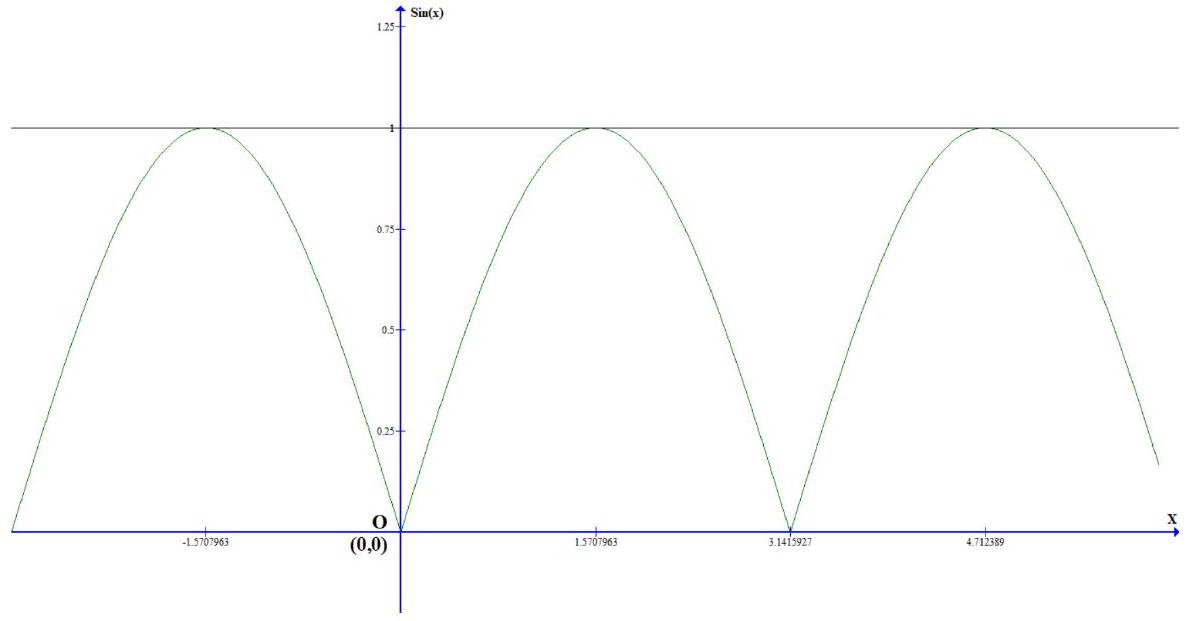
In the fuzzy number , for elements membership value is , for elements membership value is and for any other elements membership value are lies in between ( 0,1 ). Then the fuzzy number satisfies all properties described in Definition 2.
Fig. 2. Graphical structure of the fuzzy set
Remark 1. Fuzzy numbers [3] can handle the uncertainty and imprecision of the system. In the present era, it is applied in numerous fields in mathematics and computer science where precise measurements are not always possible or necessary. Graphical diagram of the fuzzy number described in Example 2 is represented in Figure 2.

3.2 Pentagonal Fuzzy Set (PFS)

A pentagonal fuzzy set [11] represents fuzzy variables in a manner that captures the degree of membership of elements in a set with a shape resembling a trapezoid. There are several extensions of fuzzy sets exist, some of them are triangular fuzzy set (TFS) [51], trapezoidal fuzzy set (TrFS) [52], pentagonal fuzzy set (PFS) [11], hexagonal fuzzy set (HFS) [53], intuitionistic fuzzy set (IFS) [54], neutrosophic fuzzy set (NFS) [9] and so on. The Pentagonal Fuzzy Set (PFS) is defined as follows:
Definition 3. Pentagonal Fuzzy Set: [11]
Consider be a universal set. A pentagonal fuzzy set define on and define as
where the membership function presented as
and are two extreme points of the pentagon with .
Here, in PFS the values and are arbitrary elements in with increasing order ( ). In the membership function ( ) of the pentagonal fuzzy set ( ) is a pentagon form define in Equation (4) and graphically represented on Figure 3, respectively.
Fig. 3. Structural diagram of the Pentagonal Fuzzy Set (PFS) ( )

3.2.1 Set operation on PFS

Assume, and are two PFSs define on . Then the various set operations on PFSs are defined as follows
a). Complement of PFS :
b). Union of two PFSs and :
c). Intersection of two PFSs and :
Example 3. Consider two PFSs and define in the universal set . Then the basic set operations on fuzzy sets are
  1. Complement of PFS :
  1. Union of two PFSs and :
  1. Intersection of two PFSs and :

3.3 Pentagonal Fuzzy Number (PFN)

Pentagonal fuzzy number (PFN) is a pentagonal fuzzy set (PFS) defined in Definition 3 with satisfies the fuzzy numbers properties defined in Definition 2. Then the PFN is defined as

Definition 4. Pentagonal Fuzzy Number: [11]

Consider the set of real numbers be a universal set of discourse. A pentagonal fuzzy number is a PFS define as
where be the membership function define as
and are two extreme points of the pentagon with .
Based on the conditions on the pentagonal fuzzy number ( ) convert into different types of fuzzy number, as
  1. If or , then the PFN becomes trapezoidal fuzzy number (TrFN).
  2. If or , then the PFN becomes triangular fuzzy number (TFN).
Furthermore, the extreme point of pentagonal fuzzy number ( ) lies between and based on the conditions on the PFN can be restructured as follows
  1. If , then PFN becomes TFN.
  2. If , then become TrFN.
Example 4. Let us, be a PFN defined on a universal set of discourse . Then PFN represent as
where the membership function ( ) is a pentagonal shape bounded quintuple shown in above and by real line. The maximum membership value spotted at the point is 7 and the other two corner points are 5 and 9.

3.3.1 Arithmetic Operations on PFN

Assume, and are two PFNs define on . Then the various arithmetic operations on PFNs [10] are defined as follows
a). Addition of two PFNs:
b). Subtraction from PFN to PFN:
c). Scalar multiplication of PFN:
where is a positive scalar number.
d). Multiplication of two PFNs:
e). Scalar power of PFN:
where is a positive scalar number.
More details explanation of arithmetic operation on fuzzy numbers is discoursed by Mukherjee, A. K. et al. [2]. This study explained the limitations and conditions for arithmetic operations on fuzzy sets and fuzzy numbers are mentioned with graphical representation.
Example 5. Let us assume, two PFNs and define in the universal set . Then the arithmetic operations on fuzzy numbers are
  1. Addition of two PFNs and :
  1. Subtraction from to :
  1. Scalar multiplication of PFN by 0.5 :
here is a positive scalar number.
4. Multiplication of two PFNs and :
  1. Scalar power of PFN:
here is a positive scalar number.

3.4 De-fuzzification of PFN

De-fuzzification [54] is a computational procedure to determine an equivalent crisp number for every fuzzy number. The fuzzification and de-fuzzification are two contradictory procedures for crisp to fuzzy numbers and vice versa, respectively. In the fuzzy number system, there is no order relation but in the crisp number system have, so capsizes the fuzzy number to get an order relation. Several methodologies already invented for de-fuzzified the fuzzy numbers, such as centre of area (COA) method, bisector of area (BOA) method, largest of maxima (LOM) method, smallest of maxima (SOM) method, mean of maximum (MOM) method, regular weighted point (RWP) method, graded mean integration value (GMIV) method, centre of approximated interval (COAI) method, centroid based method (CBM) method and so on. Here, we proposed a new method on PFN to de-fuzzify PFN.
Assume, be a PFN define on the real line . Then the proposed de-fuzzification method [11] on PFN ( ) evaluated as follows:
Example 6. Consider two PFNs and then the de-fuzzified values of and is denoted by and , respectively and determine as

4. Fuzzy decision making trial and evaluation laboratory (FDEMATEL) method

This section briefly explains the Decision making trial and evaluation laboratory (DEMATEL) method in a pentagonal fuzzy number (PFN) environment. This method was first invented in 2007 by Tzeng, G. et al. [18]. The DEMATEL method has been extensively utilised in numerous fields, such as risk management [19], airline safety oversight [20], web-advertising impact [17], auditing in a setting of enterprise resource planning [21], the effect of e-learning programs [18], investigating hospital service quality [22], deciding on the quality model’s cost [14], selecting the provider for a mobile banking service [55], risk factors evaluation in automobile industry [56], and so on. Here, the DEMATEL method is applied in a pentagonal fuzzy number (PFN) uncertain environment and called the FDEMATEL method. The structural flowchart of the FDEMATEL methods is graphically presented in Figure 4. The fuzzy DEMATET (FDEMATEL) method is processed as follows:

Assemble direct relation matrices ( ) among criteria


Evaluate aggregated direct relation matrix ( )

Compute de-fuzzified aggregated directrelation matrix ing modified directrelation matrix

Find out totalrelation matrix

Calculate direct influence ( ) and indirect influence ( )
Fig. 4. Hierarchical structure of the DEMATEL method
I. Construct the direct relation matrix :
The estimation of the interrelation between th criteria with th criteria that measured by comparison scale by Table 1 where . There are number of decision makers (DMs) who give opinions based on their experience and knowledge. There are direct relation matrices formulated with order where . The th direct relation matrix
( ) structured as
where entry represents the ratings of th criteria respect to th criteria given by th DM. Additionally, is a pentagonal fuzzy number represented as
II. Aggregated the direct relation matrices ( ):
All number of direct matrices where , merge into one direct relation matrix for further evaluation. Merge the every th entry by Equation (18) and construct single direct relation matrix ( ) as follows:
and direct relation matrix ( ) looks like,
III. De-fuzzified the aggregated direct-relation matrix ( ):
Determine the de-fuzzified aggregated direct-relation matrix ( ) by de-fuzzified every entry of the aggregated direct-relation matrix ( ) using the de-fuzzified formula in Equation (15). The de-fuzzified aggregated direct-relation matrix formulate as
where is the de-fuzzified value of PFN .

IV. Normalizing the modified direct-relation matrix :

Further, normalized the modified direct-relation matrix by using Equation (21) and establish the normalizing direct-relation matrix ( ) as follows:
where is the normalized value of and .
V. Evaluate the total-relation matrix :
Calculate the total-relation matrix from the normalizing direct-relation matrix as follows:
where be the identity matrix of th order and is the th entry of the total-relation matrix .
VI. Determine direct influence ( ) and indirect influence ( ) for the criteria:
The sum of th row entries of the total-relation matrix ( ) is denoted direct influence value and describe as
where and the sum of th column entries of the total-relation matrix ( ) is denoted indirect influence value ( ) and describe as
where .

VII. Evaluate sum values:

Causal diagrams for every criteria are evaluated from the data set. The prominence value of every criteria are lies in the horizontal axis and determined as follows:
and the relation value of every criteria are lies in the vertical axis and determined as follows:
where and are evaluated in previous steps where .

VIII. Calculate threshold value:

Finally, values revealed how much important the criteria is, that is it exhibits the degree of the relation of every criteria with the remaining criteria. Therefore, the criteria have higher value of indicates that the criteria have more relation with other criteria and simultaneously, those criteria have lower value of displayed that the criteria have less relation with other criteria.
On the other side, value unfolds that the kind of relation among the criteria. When the value is positive ( ) then the criteria belongs to the cause group or dispatcher, that is the th criteria influence other criteria. Alternatively, when the value is negative then the criteria belong to the effect group or receiver, that is th criteria influenced by other criteria.
Lastly, based on the and values of the criteria, drawn the causal diagram in plane, where . The causal diagram shows the direct and indirect effect of each criteria over the other criteria. Furthermore, decision makers can set up the threshold value to identify the negligible effect of criteria over all other criteria.

5. Model formulation and Data collection

This section describes this study’s model formulation and data collection process in detail. First, the model of the proposed research will be formulated, followed by the data assembly procedure from three decision experts.

5.1 Model formulation

There are six most important criteria for finding valuable criteria in the sports section based on women’s empowerment, which are considered according to decision makers’ opinions. The detailed discussion on criteria is mentioned in Section 2. The uncertainty capturing mathematical tool is discussed in Section 3 and the fuzzy DEMATEL based MCDM method is mentioned in Section 4, respectively. The direct relation matrices ( ) with order in linguistic terms given by three DMs. The structural flowchart of the proposed model is depicted in Figure 5. All those DMs are experienced, unbiased and professional in their field and they are:
DM1: A women’s international sports champion.
DM2: An officer in sports authority board.
DM3: A social worker works on women’s empowerment.
Fig. 5. Hierarchical structure of the proposed model

5.2 Data collection

This section describes the data collection of this study. Firstly, the data are collected by DMs in linguistic terms in the direct relation matrices ( ) using Table 1 and contained in Table 2. Further, the direct relation matrices ( ) decoded into PFNs using Table 1 and initiated for the fuzzy DEMATEL method using Section 4.
Table 1
Linguistic term with GIPFN and de-fuzzified value for decision matrix
Linguistic Terms Pentagonal Fuzzy Number (PFN) De-fuzzified Value
Extremely Relevant (ER) 13
High Relevant (HR) 11
Very Relevant (VR) 9
Moderate Relevant (MR) 7
Less Relevant (LR) 5
Below Relevant (BR) 3
Weekly Relevant (WR) 1
No Relevant (NR) 0
Table 2
Direct relation matrix ( ) in linguistic terms given by three DMs
Criteria Criteria
frastructure ( )
Supportive
Role Models and Representation Policy and Governance ( ) Community and Cultural Acceptance ( ) Support Systems (Family financial) ( ) Support Systems financial) ( ) (Family
Supportive Infrastructure ( ) NR LR HR VR HR ER
Role Models and Representation ( ) BR NR WR MR VR LR
Policy and Governance ( ) WR HR NR HR MR BR
Community and Cultural Acceptance ( ) VR LR HR NR ER VR
Support Systems (Family and financial) ( ) MR HR VR WR NR LR
Community and Cultural Acceptance ( ) VR MR HR BR VR NR
Criteria Criteria
frastructure ( )
Supportive
Role Models and Representation Policy and Governance ( ) Community and Cultural tance Support Systems (Family financial) ( ) Support Systems (Family financial) ( )
Supportive Infrastructure ( ) NR MR ER HR ER HR
Role Models and Representation ( ) LR NR BR VR HR MR
Policy and Governance ( ) BR ER NR ER VR LR
Community and Cultural Acceptance ( ) HR MR ER NR HR HR
Support Systems (Family and financial) ( ) VR ER HR BR NR MR
Community and Cultural Acceptance ( ) HR VR ER LR HR NR
Criteria Criteria
frastructure
Supportive
Role Models and Representation Policy and Governance ( ) Community and Cultural Support Systems (Family financial) ( ) Support Systems (Family financial)
Supportive Infrastructure ( ) NR BR VR MR VR HR
Role Models and Representation ( ) WR NR BR LR MR BR
Policy and Governance ( ) BR VR NR VR LR WR
Community and Cultural Acceptance ( ) MR BR VR NR HR MR
Support Systems (Family and financial) ( ) LR VR MR BR NR BR
Community and Cultural Acceptance ( ) MR LR VR WR MR NR
Remark 2. Table 2 represented the direct relation matrix ( ) in linguistic terms by three DMs using Table 1. All the ratings are taken in an unbiased way and forwarded for numerical evaluation.

6. Numerical illustration and discussion

The numerical evaluation of the most effective criteria for women’s empowerment through sports is determined and the results are analysed here, in detail. We consider the fuzzy DEMATEL methodology (see Section 4) as an optimization technique in Pentagonal Fuzzy Number (PFN) (see Section 3) as an uncertain environment. Further, consider the Direct relation matrix ( ) (in Table 2) as the data source for numerical evaluation.
The fuzzy DEMATEL method evaluated the required results as follows: Firstly, construct the direct relation matrix ( ) by three DMs using Equation (16), shown in Table 2. Then aggregated direct relation matrices ( ) evaluated by Equation (19). Further, the de-fuzzified aggregated direct-relation matrix ( ) determined by Equation (20) and shown in Table 3. Thereafter, Equation (21) calculated the normalizing modified direct-relation matrix ( ) in Table 4. Then evaluate the total-relation matrix in Table 5 using Equation (22). Finally, the direct influence , indirect influence ,
prominence value and relation value values for every criteria are calculated by Equations (23), (24), (25) and (26), respectively and shown in Table 6.
Table 3
De-fuzzified the aggregated direct-relation matrix ( )
Criteria vs criteria
Supportive Infrastructure ( ) 0.0000 8.1765 18.2652 14.9163 18.2652 19.7944
Role Models and Representation ( ) 4.7035 0.0000 3.3778 11.5578 14.9163 8.1765
Policy and Governance ( ) 3.3778 18.2652 0.0000 18.2652 11.5578 4.7035
Community and Cultural Acceptance ( ) 14.9163 8.1765 18.2652 0.0000 19.7944 14.9163
Support Systems (Family and financial) ( ) 11.5578 18.2652 14.9163 3.3778 0.0000 8.1765
Community and Cultural Acceptance ( ) 14.9163 11.5578 18.2652 4.7035 14.9163 0.0000
Table 4
Normalizing the modified direct-relation matrix ( )
Criteria vs criteria
Supportive Infrastructure ( ) 0.0000 0.1030 0.2300 0.1878 0.2300 0.2492
Role Models and Representation ( ) 0.0592 0.0000 0.0425 0.1455 0.1878 0.1030
Policy and Governance ( ) 0.0425 0.2300 0.0000 0.2300 0.1455 0.0592
Community and Cultural Acceptance ( ) 0.1878 0.1030 0.2300 0.0000 0.2492 0.1878
Support Systems (Family and financial) ( ) 0.1455 0.2300 0.1878 0.0425 0.0000 0.1030
Community and Cultural Acceptance ( ) 0.1878 0.1455 0.2300 0.0592 0.1878 0.0000
Table 5
Total-relation matrix ( )
Criteria vs criteria
Supportive Infrastructure ( ) 0.4752 0.7262 0.8569 0.6652 0.9070 0.7099
Role Models and Representation ( ) 0.3350 0.3609 0.4226 0.4108 0.5740 0.3807
Policy and Governance ( ) 0.3772 0.6386 0.4574 0.5533 0.6439 0.4151
Community and Cultural Acceptance ( ) 0.6152 0.7040 0.8305 0.4881 0.8946 0.6462
Support Systems (Family and financial) ( ) 0.4486 0.6367 0.6086 0.4071 0.5007 0.4397
Community and Cultural Acceptance ( ) 0.5394 0.6522 0.7269 0.4819 0.7454 0.4098
Table 6
Threshold values of the different criteria
Criteria
Supportive Infrastructure ( ) 4.3404 2.7906 7.1310 1.5498
Role Models and Representation ( ) 2.4840 3.7186 6.2026 -1.2346
Policy and Governance ( ) 3.0855 3.9029 6.9884 -0.8174
Community and Cultural Acceptance ( ) 4.1786 3.0064 7.1850 1.1722
Support Systems (Family and financial) ( ) 3.0414 4.2656 7.3070 -1.2242
Community and Cultural Acceptance ( ) 3.5556 3.0014 6.5570 0.5542
Table 6 represented the numerical results of the fuzzy DEMATEL method between criteria of women empowerment through sports. From the prominence value ( ) values, we conclude that the degree of the relationship of one particular criterion among the other criteria. For example, the criteria Support Systems (Family and financial) ( ) is the maximum relation with other criteria. Further, Community and Cultural Acceptance ( ) and Supportive Infrastructure ( ) criteria are the second and third height relation with the remaining criteria, respectively. Additionally, Policy and Governance ( ) and Community and Cultural Acceptance ( ) criteria are the fourth and fifth highest relation and the Role Models and Representation ( ) criteria is the lowest relation among the criteria, respectively.
Besides that, the relation value values of the criteria are also known from Table 6 and it reveals the kind of relation among the criteria. The relation value ( ) values positive ( ) indicates that the criteria belong to the cause group or dispatcher and negative ( ) indicates that the criteria belong to the effect group or receiver. For example, Supportive Infrastructure ( ), Community and Cultural Acceptance ( ) and Community and Cultural Acceptance ( ) criteria are the cause group or dispatcher and Policy and Governance ( ), Support Systems (Family and financial) ( ) and Role Models and Representation ( ) criteria are the effect group or receiver, respectively. The causal diagram among the criteria of women’s empowerment through sports is depicted in Figure 6.
Fig. 6. Causal diagram for every criterion based on and values

7. Conclusion and future research scope

In this article, we find the direct and indirect effects of every criteria over the other criteria of some related criteria for women empowerment in the sports sector. The criteria are taken as Supportive Infrastructure ( ), Role Models and Representation ( ), Policy and Governance ( ), Community and Cultural Acceptance ( ), Support Systems (Family and financial) ( ) and Training and Coaching . we use the concept of multi criteria decision making to find the direct and indirect effects of the criteria. The data sets are collected in terms of linguistic variables from three decision experts. The linguistic terms direct relation matrix ( ) converted to a fuzzy number matrix for further steps. The method namely, fuzzy DEMATEL is taken to find the numerical results in Table 6. In conclusion, the criteria Support Systems (Family and financial) ( ) is the highest relation and the Role Models and Representation ( ) is the least relation with the remaining criteria. Furthermore, the criteria ( ),
( ) and ( ) are in the cause group or dispatcher and the remaining criteria ( ), ( ) and ( ) are in effect group or receiver, respectively.
Through the organized approach, such studies offer important understandings of pretty opportunities, nurturing supportive environments and empowering women to shine in the sports sector. This research will eventually contribute to generating a more inclusive and equitable sports landscape for forthcoming generations. The consequences offer strategic visions for sports organizations, policymakers and stakeholders to implement targeted creativity that improves leadership roles, gender equity and complete empowerment for women in sports.
In future research, the work may be extended in two different ways, either from a theoretical perspective or in terms of model formulations. Anyone may take another type of MCDM method such as Analytical Hierarchy Process (AHP), Analytic Network Process (ANP), Entropy, CRiteria Importance Through Inter-criteria Correlation (CRITIC) and Stepwise Weight Assessment Ratio Analysis (SWARA) methods to find the relationship between the criteria and take different types of uncertainty in data sets like intuitionistic fuzzy sets, Pythagorean fuzzy sets, neutrosophic fuzzy sets, probabilistic linguistic term sets, etc. for better results. In the model portion, anyone may use the different perspectives of women empowerment in different sectors like education, social work, journalism, politics, etc.

Acknowledgement

This research was not funded by any grant.

Conflicts of Interest

The authors declare that they have no known conflicts of interest or personal relationships that could have appeared to influence the work reported in this paper. There are no conflicts of interest between authors.

References

[1] Zadeh, L. A. (1965). Fuzzy sets. Information and Control, 8(3), 338-353. https://doi.org/10. 1016/So019-9958(65)90241-X
[2] Mukherjee, A. K., Gazi, K. H., Salahshour, S., Ghosh, A., & Mondal, S. P. (2023). A brief analysis and interpretation on arithmetic operations of fuzzy numbers. Results in Control and Optimization, 13, 100312. https://doi.org/10.1016/j.rico.2023.100312
[3] Singh, P., Gazi, K. H., Rahaman, M., Salahshour, S., & Mondal, S. P. (2024). A fuzzy fractional power series approximation and taylor expansion for solving fuzzy fractional differential equation. Decision Analytics Journal, 10, 100402. https://doi.org/10.1016/j.dajour.2024.100402
[4] Tudu, S., Gazi, K. H., Rahaman, M., Mondal, S. P., Chatterjee, B., & Alam, S. (2023). Type-2 fuzzy differential inclusion for solving type-2 fuzzy differential equation. Annals of Fuzzy Mathematics and Informatics, 25(1), 33-53. https://doi.org/10.30948/afmi.2023.25.1.33
[5] Klir, G. J., & Yuan, B. (1995). Fuzzy sets and fuzzy logic. (Vol. 4, pp. 1-12). New Jersey: Prentice hall.
[6] Gazi, K. H., Momena, A. F., Salahshour, S., Mondal, S. P., & Ghosh, A. (2024). Synergistic strategy of sustainable hospital site selection in saudi arabia using spherical fuzzy mcdm methodology. Journal of Uncertain Systems. https://doi.org/10.1142/S1752890924500041
[7] Mandal, S., Gazi, K. H., Salahshour, S., Mondal, S. P., Bhattacharya, P., & Saha, A. K. (2024). Application of interval valued intuitionistic fuzzy uncertain mcdm methodology for ph.d supervisor selection problem. Results in Control and Optimization, 15(100411). https://doi.org/ 10.1016/j.rico.2024.100411
[8] Momena, A. F., Gazi, K. H., Mukherjee, A. K., Salahshour, S., Ghosh, A., & Mondal, S. P. (2024). Adaptation challenges of edge computing model in educational institute. Journal of Intelligent & Fuzzy Systems, 1-18. https://doi.org/10.3233/JIFS-239887
[9] Alzahrani, F. A., Ghorui, N., Gazi, K. H., Giri, B. C., Ghosh, A., & Mondal, S. P. (2023). Optimal site selection for women university using neutrosophic multi-criteria decision making approach. Buildings, 13(1), 152. https://doi.org/10.3390/buildings13010152
[10] Singh, P., Gazi, K. H., Rahaman, M., Basuri, T., & Mondal, S. P. (2024). Solution strategy and associated results for fuzzy mellin transformation. Franklin Open, 7, 100112. https://doi.org/ 10.1016/j.fraope.2024.100112
[11] Ghorui, N., Mondal, S. P., Chatterjee, B., Ghosh, A., Pal, A., De, D., & Giri, B. C. (2023). Selection of cloud service providers using mcdm methodology under intuitionistic fuzzy uncertainty. Soft Computing, 27, 2403-2423. https://doi.org/10.1007/s00500-022-07772-8
[12] Chakraborty, A., Mondal, S. P., Alam, S., Ahmadian, A., Senu, N., De, D., & Salahshour, S. (2019). The pentagonal fuzzy number: Its different representations, properties, ranking, defuzzification and application in game problems. Symmetry, 11(2), 248. https://doi.org/https://doi.org/10. 3390/sym11020248
[13] Mondal, S. P., & Mandal, M. (2017). Pentagonal fuzzy number, its properties and application in fuzzy equation. Future Computing and Informatics Journal, 2(2), 110-117. https://doi.org/10. 1016/j.fcij.2017.09.001
[14] Tsai, W.-H., & Hsu, W. (2010). A novel hybrid model based on dematel and anp for selecting cost of quality model development. Total Quality Management & Business Excellence, 21(4), 439-456. https://doi.org/10.1080/14783361003606852
[15] Ghaemi-Zadeh, N., & Eghbali-Zarch, M. (2024). Evaluation of business strategies based on the financial performance of the corporation and investors’ behavior using d-critic and fuzzy multimoora techniques: A real case study. Expert Systems with Applications, 247, 123183. https: //doi.org/10.1016/j.eswa.2024.123183
[16] Biswas, A., Gazi, K. H., Mondal, S. P., & Ghosh, A. (2024). A decision-making framework for sustainable highway restaurant site selection: Ahp-topsis approach based on the fuzzy numbers. Spectrum of Operational Research, 2(1), 1-26. https://doi.org/10.31181/sor2120256
[17] Wei, P.-L., Huang, J.-H., Tzeng, G.-H., & Wu, S.-I. (2010). Causal modeling of web-advertising effects by improving sem based on dematel technique. International Journal of Information Technology & Decision Making, 9(5), 799-829. https://doi.org/10.1142/So219622010004032
[18] Tzeng, G.-H., Chiang, C.-H., & Li, C.-W. (2007). Evaluating intertwined effects in e-learning programs: A novel hybrid mcdm model based on factor analysis and dematel. Expert Systems with Applications, 32(4), 1028-1044. https://doi.org/10.1016/j.eswa.2006.02.004
[19] Samvedi, A., & Jain, V. (2013). A study on the interactions between supply chain risk management criteria using fuzzy dematel method. International Journal of Operational Research, 18(3), 255-271. https://doi.org/10.1504/IJOR.2013.056685
[20] Bongo, M. F., & Seva, R. R. (2023). Evaluating the performance-shaping factors of air traffic controllers using fuzzy dematel and fuzzy bwm approach. Aerospace, 10(3), 252. https://doi. org/10.3390/aerospace10030252
[21] Tsai, W.-H., Chou, Y.-W., Lee, K.-C., Lin, W.-R., & Hwang, E. T. (2013). Combining decision making trial and evaluation laboratory with analytic network process to perform an investigation of information technology auditing and risk control in an enterprise resource planning environment. Systems Research and Behavioral Science, 30(2), 176-193. https://doi.org/10.1002/ sres. 2129
[22] Shieh, J.-I., Wu, H.-H., & Huang, K.-K. (2010). A dematel method in identifying key success factors of hospital service quality. Knowledge-Based Systems, 23(3), 277-282. https://doi.org/10. 1016/j.knosys.2010.01.013
[23] Shieh, J.-I., & Wu, H.-H. (2016). Measures of consistency for dematel method. Communications in Statistics – Simulation and Computation, 45(3), 781-790. https://doi.org/10.1080/03610918. 2013.875564
[24] Lin, Y.-T., Yang, Y.-H., Kang, J.-S., & Yu, H.-C. (2011). Using dematel method to explore the core competences and causal effect of the ic design service company: An empirical case study. Expert Systems with Applications, 38(5), 6262-6268. https://doi.org/10.1016/j.eswa.2010.11.092
[25] Seker, S., & Zavadskas, E. K. (2017). Application of fuzzy dematel method for analyzing occupational risks on construction sites. Sustainability, 9(11), 2083. https:// doi. org/10. 3390/ su9112083
[26] Wu, W.-W. (2012). Segmenting critical factors for successful knowledge management implementation using the fuzzy dematel method. Applied Soft Computing, 12(1), 527-535. https: //doi.org/10.1016/j.asoc.2011.08.008
[27] Wu,H.-H., & Chang, S.-Y. (2015). A case study of using dematel method to identify critical factors in green supply chain management. Applied Mathematics and Computation, 256, 394-403. https://doi.org/10.1016/j.amc.2015.01.041
[28] Wu, H.-H., Chen, H.-K., & Shieh, J.-I. (2010). Evaluating performance criteria of employment service outreach program personnel by dematel method. Expert Systems with Applications, 37(7), 5219-5223. https://doi.org/10.1016/j.eswa.2009.12.068
[29] Theberge, N. (1987). Sport and women’s empowerment. Women’s Studies International Forum, (Vol. 10, No. 4, pp. 387-393). Pergamon. https://doi.org/10.1016/0277-5395(87)90056-2
[30] BI, K., Ahmed, A., Akhter, N., & Ahmed, A. (2024). Empowerment of women through sports: A review. International Journal of Physical Education, Sports and Health, 11(4), 145-147.
[31] Das, A., Mondal, S., & Mondal, J. (2016). Women and sports: A new area of empowerment – an ethnographic study in an urban spot in west bengal. International Journal of Physical Education, Sports and Health, 3(4), 244-248.
[32] Rütten, A., Abu-Omar, K., Lampert, T., & Ziese, T. (2005). Gesundheitsberichterstattung des bundes. Körperliche Aktivität, 26, 1-22.
[33] Wicker, P., Hallmann, K., & Breuer, C. (2013). Analyzing the impact of sport infrastructure on sport participation using geo-coded data: Evidence from multi-level models. Sport Management Review, 16(1), 54-67. https://doi.org/10.1016/j.smr.2012.05.001
[34] Palmer, F. R., & Masters, T. M. (2010). Māori feminism and sport leadership: Exploring māori women’s experiences. Sport Management Review, 13(4), 331-344. https://doi.org/10.1016/j. smr.2010.06.001
[35] Powell, L. M., Slater, S., Chaloupka, F. J., & Harper, D. (2006). Availability of physical activ-ity-related facilities and neighborhood demographic and socioeconomic characteristics: A national study. American Journal of Public Health, 96(9), 1676-1680. https://doi.org/10.2105/ AJPH.2005.065573
[36] Sallis, J. F., Hovell, M. F., & Hofstetter, C. R. (1992). Predictors of adoption and maintenance of vigorous physical activity in men and women. Preventive Medicine, 21(2), 237-251. https: //doi.org/10.1016/0091-7435(92)90022-A
[37] Lavoie, R. A., Amyot, M., & Lapierre, J.-F. (2019). Global meta-analysis on the relationship between mercury and dissolved organic carbon in freshwater environments. Journal of Geophysical Research: Biogeosciences, 124(6), 1508-1523. https://doi.org/10.1029/2018JGo04896
[38] Wasend, M., & LaVoi, N. M. (2019). Are women coached by women more likely to become sport coaches? head coach gender and female collegiate athletes’ entry into the coaching profession.
Women in sport and physical activity journal, 27(2), 85-93. https://doi.org/10.1123/wspaj. 2018-0043
[39] Midgley, C., DeBues-Stafford, G., Lockwood, P., & Thai, S. (2021). She needs to see it to be it: The importance of same-gender athletic role models. Sex Roles, 85, 142-160. https://doi.org/ 10.1007/s11199-020-01209-y
[40] Dietz, B. (2023). Increased exposure to women in sport increases familiarity and liking. The Sport Journal, 1-12.
[41] Sambol, S., Dadswell, K., & Hanlon, C. (2024). Beyond stereotypes: The role of exposure in reshaping children’s biases towards women as coaches in sports. Psychology of Sport and Exercise, 73, 102634. https://doi.org/10.1016/j.psychsport.2024.102634
[42] Fink, J. S. (2015). Female athletes, women’s sport, and the sport media commercial complex: Have we really “come a long way, baby”? Sport Management Review, 18(3), 331-342. https: //doi.org/10.1016/j.smr.2014.05.001
[43] Richard, V., Piumatti, G., Pullen, N., Lorthe, E., Guessous, I., Cantoreggi, N., & Stringhini, S. (2023). Socioeconomic inequalities in sport participation: Pattern per sport and time trends a repeated cross-sectional study. BMC Public Health, 23, 785. https://doi.org/10.1186/s12889-023-15650-7
[44] D’Agostino, C., Piva, E., Pucci, P., & Rossi, C. (2024). A systematic literature review on women’s daily mobility in the global north. Transport Reviews, 44(5), 1016-1044. https://doi.org/10. 1080/01441647.2024.2350613
[45] Cislaghi, B., & Heise, L. (2018). Theory and practice of social norms interventions: Eight common pitfalls. Globalization and Health, 14, 83. https://doi.org/10.1186/s12992-018-0398-x
[46] Dakic, J. G., Hay-Smith, J., Lin, K.-Y., Cook, J., & Frawley, H. C. (2023). Experience of playing sport or exercising for women with pelvic floor symptoms: A qualitative study. Sports Medicine – Open, 9, 25. https://doi.org/10.1186/s40798-023-00565-9
[47] Kenttä, G., Bentzen, M., Dieffenbach, K., & Olusoga, P. (2020). Challenges experienced by women high-performance coaches: Sustainability in the profession. International Sport Coaching Journal, 7(2), 200-208. https://doi.org/10.1123/iscj.2019-0029
[48] Pettigrew, T. F., & Tropp, L. R. (2006). A meta-analytic test of intergroup contact theory. ournal of Personality and Social Psychology, 90(5), 751-783. https://doi.org/10.1037/0022-3514.90.5. 751
[49] Sisjord, M. K., Fasting, K., & Sand, T. S. (2021). Gendered pathways to elite coaching reflecting the accumulation of capitals. Sport, Education and Society, 26(5), 554-566. https://doi.org/10. 1080/13573322.2020.1732904
[50] Burton, L. J., & Leberman, S. (2017). Women in sport leadership research and practice for change. Taylor & Francis.
[51] Singh, P., Gor, B., Gazi, K. H., Mukherjee, S., Mahata, A., & Mondal, S. P. (2023). Analysis and interpretation of malaria disease model in crisp and fuzzy environment. Results in Control and Optimization, 12, 100257. https://doi.org/10.1016/j.rico.2023.100257
[52] Xiao, Z., Xia, S., Gong, K., & Li, D. (2012). The trapezoidal fuzzy soft set and its application in mcdm. Applied Mathematical Modelling, 36(12), 5844-5855. https://doi.org/10.1016/j.apm. 2012.01.036
[53] Nayagam, V. L. G., & Murugan, J. (2021). Hexagonal fuzzy approximation of fuzzy numbers and its applications in mcdm. Complex & Intelligent Systems, 7, 1459-1487. https://doi.org/10. 1007/s40747-020-00242-4
[54] Adhikari, D., Gazi, K. H., Sobczak, A., Giri, B. C., Salahshour, S., & Mondal, S. P. (2024). Ranking of different states in india based on sustainable women empowerment using mcdm method-
ology under uncertain environment. Journal of Uncertain Systems. https://doi.org/10.1142/ S1752890924500107
[55] Zhu, X., Yan, R., & Xu, T. X. (2020). An integrated dematel-anp approach for mobile banking adoptions in china market. Discrete Dynamics in Nature and Society, 2020(1), 1843697. https: //doi.org/10.1155/2020/1843697
[56] Prashar, A., & Aggarwal, S. (2020). Modeling enablers of supply chain quality risk management: A grey-dematel approach. The TQM Journal, 32(5), 1059-1076. https://doi.org/10.1108/TQM-05-2019-0132

  1. *Corresponding author.
    E-mail address: sankar.mondalo2@gmail.com