البحث في الذكاء الاصطناعي الأخضر والمستدام: تحليل متكامل للمواضيع والنمذجة الموضوعية Green and sustainable AI research: an integrated thematic and topic modeling analysis

المجلة: Journal Of Big Data، المجلد: 11، العدد: 1
DOI: https://doi.org/10.1186/s40537-024-00920-x
تاريخ النشر: 2024-04-22

البحث في الذكاء الاصطناعي الأخضر والمستدام: تحليل متكامل للمواضيع والنمذجة الموضوعية

راجو رامان ديبيدوتا باتنايك هيرن هـ. لاثاباي تشاندان كومار كانان جوبيندان وبرما نيدونغادي

*المراسلات:raghu@amrita.edu

مدرسة أماريتا للأعمال، أماريتا فيشوا فيديابيثام، أماريتابوري، كيرالا 690525، الهند
معهد الإدارة الدولية، بوبانسوار، أوديشا، الهند
مركز البحث والتحليل والتكنولوجيا في التعليم (CREATE)، أمارا فيشوا فيديابيثام، أمارتيبوري، كيرالا 690525، الهند
مدرسة أمريتا للحوسبة، جامعة أمريتا فيشوا فيديابيثام، أمارافاتي، أندرا براديش 522503، الهند
معهد الصين لسلسلة إمداد المناطق الحرة، جامعة شنغهاي البحرية، شنغهاي، الصين
مدرسة أمريتا للحوسبة، جامعة أمريتا فيشفا فيديابيثام، أمارثابوري، كيرالا 690525، الهند
مركز العمليات المستدامة وسلاسل الإمداد المرنة، معهد الاستدامة والطاقة والموارد وكلية إدارة الأعمال بجامعة أديلايد، أديلايد، أستراليا
كلية الأعمال، جامعة ووكسن، ساداسيفبيت، تيلانجانا، الهند

الملخص

تتعمق هذه الدراسة في أدبيات الذكاء الاصطناعي الأخضر والذكاء الاصطناعي المستدام من خلال نهج تحليلي مزدوج، يجمع بين التحليل الموضوعي ونمذجة BERTopic لكشف النقاط الموضوعية الواسعة والمواضيع الناشئة الدقيقة. تحدد الدراسة ثلاثة تجمعات موضوعية رئيسية: (1) الذكاء الاصطناعي المسؤول من أجل التنمية المستدامة، الذي يركز على دمج الاستدامة والأخلاقيات ضمن تقنيات الذكاء الاصطناعي؛ (2) التقدم في الذكاء الاصطناعي الأخضر من أجل تحسين الطاقة، الذي يركز على كفاءة الطاقة؛ و(3) التقدم الحسابي المدفوع بالبيانات الضخمة، الذي يبرز تأثير الذكاء الاصطناعي على الجوانب الاجتماعية والاقتصادية والبيئية. في الوقت نفسه، تكشف نمذجة BERTopic عن خمسة مواضيع ناشئة: الذكاء الأخلاقي البيئي، الحوسبة العصبية المستدامة، الذكاء الأخلاقي في الرعاية الصحية، سعي التعلم بالذكاء الاصطناعي، وابتكار الذكاء المعرفي، مما يشير إلى اتجاه نحو تضمين الاعتبارات الأخلاقية والاستدامة في أبحاث الذكاء الاصطناعي. تكشف الدراسة عن تقاطعات جديدة بين الذكاء الاصطناعي المستدام والأخلاقي والحوسبة الخضراء، مما يشير إلى اتجاهات بحثية هامة وتحديد الذكاء الأخلاقي في الرعاية الصحية وسعي التعلم بالذكاء الاصطناعي كمجالات تتطور ضمن تأثيرات الذكاء الاصطناعي الاجتماعية والاقتصادية. تدعو الدراسة إلى نهج موحد للابتكار في الذكاء الاصطناعي، مما يعزز الاستدامة البيئية والنزاهة الأخلاقية لتعزيز تطوير الذكاء الاصطناعي المسؤول. يتماشى هذا مع أهداف التنمية المستدامة، مما يبرز الحاجة إلى التوازن البيئي، ورفاهية المجتمع، والابتكار المسؤول. يبرز هذا التركيز المنقح الحاجة الملحة لدمج الاعتبارات الأخلاقية والبيئية في دورة حياة تطوير الذكاء الاصطناعي، مما يقدم رؤى لتوجيهات البحث المستقبلية والتدخلات السياسية.

الكلمات الرئيسية: الذكاء الاصطناعي الأخضر، الذكاء الاصطناعي المستدام، BERTopic، نمذجة الموضوعات، تزامن الكلمات الرئيسية، أهداف التنمية المستدامة، الأخلاقيات، الذكاء الاصطناعي المعرفي، البيانات الضخمة

مقدمة

الذكاء الاصطناعي الأخضر، الذكاء الاصطناعي المستدام، الذكاء الاصطناعي صفر الكربون، والذكاء الاصطناعي الصافي صفر هي بعض المصطلحات المستخدمة لشرح الجهود والممارسات ضمن المجال الأوسع للذكاء الاصطناعي (AI) التي تهدف إلى تقليل الأثر البيئي لتقنيات الذكاء الاصطناعي. يشير الذكاء الاصطناعي الأخضر إلى تطوير ونشر أنظمة الذكاء الاصطناعي مع التركيز على تقليل تأثيرها البيئي. الذكاء الاصطناعي المستدام هو نهج يركز على الأمد الطويل.
جدوى الاستخدام المسؤول لتقنيات الذكاء الاصطناعي. يتضمن ذلك اعتبارات الاستدامة البيئية، والاستخدام الأخلاقي للبيانات، والأثر الاجتماعي لتطبيقات الذكاء الاصطناعي نحو تحقيق أهداف التنمية المستدامة للأمم المتحدة. يهدف الذكاء الاصطناعي صفر الكربون إلى القضاء على أو تعويض انبعاثات الكربون المرتبطة بتطوير وتدريب ونشر نماذج وأنظمة الذكاء الاصطناعي. يتضمن ذلك استخدام مصادر الطاقة المتجددة، وتحسين كفاءة الطاقة، وتنفيذ استراتيجيات تعويض الكربون.
تركز الأبحاث في الذكاء الاصطناعي الأخضر على تطوير تقنيات الذكاء الاصطناعي المستدامة بيئيًا. يهدف الباحثون إلى تحسين الخوارزميات والأجهزة وعمليات مراكز البيانات لتقليل استهلاك الطاقة وتقليل البصمة الكربونية لأنظمة الذكاء الاصطناعي. يتم استكشاف تقنيات مثل تدريب النماذج بكفاءة طاقية، والخوارزميات المدركة للموارد، وتصميمات الأجهزة الصديقة للبيئة. الهدف هو إنشاء حلول ذكاء اصطناعي تقدم أداءً عاليًا وتتوافق مع الاعتبارات البيئية. تساهم هذه المجال البحثي في التخفيف من الأثر البيئي للذكاء الاصطناعي، وتعزيز كفاءة الطاقة، وتعزيز مستقبل أكثر استدامة لتطبيقات الذكاء الاصطناعي. يتماشى الذكاء الاصطناعي الأخضر مع الجهود العالمية لمواجهة تغير المناخ وخلق تقنيات صديقة للبيئة.
يمكن أن تؤدي تطبيقات الذكاء الاصطناعي التوليدي الحديثة إلى تفاقم القضايا البيئية، حيث إنها غالبًا ما تتطلب موارد حسابية كبيرة لتدريب نماذج ضخمة، مما يؤدي إلى زيادة استهلاك الطاقة وانبعاثات الكربون. علاوة على ذلك، مع زيادة تطبيقات الذكاء الاصطناعي التوليدي وازدياد تعقيدها، قد يؤدي الطلب المستمر على البيانات وتحسين النماذج إلى دورة من الاستخدام المكثف للطاقة، مما قد يطغى على المكاسب التي حققتها مبادرات الذكاء الاصطناعي المستدام.
في ظل الأبحاث المتزايدة حول تطبيقات الذكاء الاصطناعي، تسعى العديد من المناهج المنهجية إلى توحيد الأبحاث الحالية واقتراح أبعاد لمجالات الدراسة الناشئة. على سبيل المثال، يكشف استكشاف سعد وخمخم [73] لتآزر الذكاء الاصطناعي وإدارة سلسلة التوريد الخضراء (GSCM) عن المساهمات الرئيسية للذكاء الاصطناعي في سلاسل التوريد المستدامة بيئيًا. تحدد مراجعتهم المنهجية للأدبيات، التي تستخدم خمس عمليات قوية، التقنيات المتطورة التي تشكل المشهد. مع التركيز على الرعاية الصحية، يتناول سيالا ووانغ [81] الاعتبارات الأخلاقية في الذكاء الاصطناعي، مقترحين إطار “SHIFT” الذي يشمل الاستدامة، والتركيز على الإنسان، والشمولية، والعدالة، والشفافية. يعمل هذا الإطار كدليل لتنفيذ الذكاء الاصطناعي في الرعاية الصحية بشكل أخلاقي، مقدماً رؤى من خلال مراجعة منهجية تمتد على عقدين مؤثرين.
من خلال فهمنا للدراسات المذكورة أعلاه والدراسات الإضافية المذكورة في قسم مراجعة الأدبيات أدناه، نعتقد أن هذه الدراسات لا تقدم نظرة شاملة عن حالة الأدب حول تطبيقات الذكاء الاصطناعي من أجل الاستدامة، والخير الاجتماعي، وتحقيق أهداف صفر انبعاثات الكربون. مع إدراك عدد الجهود البحثية في هذه المجالات الحيوية، نسعى لسد هذه الفجوة من خلال علم المكتبات [41، 59]. تتيح لنا هذه المقاربة رسم خريطة شاملة وتحليل الجسم الحالي من الأدبيات [57] مما يوفر فهماً دقيقاً للمشهد الحالي والاتجاهات الناشئة في تطبيق الذكاء الاصطناعي لتحقيق نتائج مستدامة وذات تأثير اجتماعي [63]، بما في ذلك الجهود المبذولة نحو تحقيق أهداف صفر انبعاثات الكربون. دراستنا، التي تستخدم كل من تحليل التجمعات الموضوعية [64، 65] باستخدام تكرار الكلمات الرئيسية ونمذجة BERTopic [29]، هي مقاربة منهجية قوية وفريدة.
تقدم خريطة الكلمات الرئيسية المحددة من قبل المؤلفين منظورًا كميًا قائمًا على التردد، مما يبرز الموضوعات الأكثر بروزًا وتكرارًا في الأدبيات. من ناحية أخرى، يُعتبر BERTopic أساسيًا لقدراته على التقاط التمثيلات السياقية والدلالية للكلمات، مما يوفر فهمًا أكثر دقة للعلاقات بين الموضوعات والمواضيع المختلفة داخل الأدبيات. من خلال دمج الطريقتين، نضمن تحليلًا شاملاً يلتقط رؤى عميقة مدفوعة بالسياق باستخدام BERTopic ويقوم بربطها بموضوعات واسعة قائمة على التردد من تجميع الكلمات الرئيسية.
بالضبط، نطرح الأسئلة البحثية التالية (RQs):
RQ1: ما هي المجموعات الموضوعية الأساسية في أدبيات الذكاء الاصطناعي الأخضر والذكاء الاصطناعي المستدام التي تلخص تطور هذا المجال والاتجاهات الحالية؟
RQ2: ما هي الموضوعات الناشئة في أدبيات الذكاء الاصطناعي الأخضر والذكاء الاصطناعي المستدام التي من المتوقع أن تؤثر بشكل كبير على مسار هذا المجال؟
RQ3: كيف يمكن أن توجه الرؤى المستمدة من المجموعات الموضوعية الأساسية والمواضيع الناشئة تطوير السياسات والاستراتيجيات لتعزيز ممارسات الذكاء الاصطناعي المستدامة؟
تتناسب المنهجيات المميزة المستخدمة في RQ1 و RQ2 مع أهداف تحليلية مختلفة. يوفر التحليل الموضوعي من خلال تكرار الكلمات الرئيسية رؤية شاملة للمجال، مع تحديد مجالات البحث الواسعة وأهميتها النسبية على مر الزمن. على العكس، يوفر نموذج BERTopic رؤية دقيقة، تكشف عن مناقشات محددة وناشئة وعلاقاتها المعقدة. تعزز هذه الثلاثية المنهجية من صحة نتائجنا، مقدمة فهمًا متعدد الطبقات يمتد من الموضوعات العامة إلى المناقشات الناشئة المحددة.
تقدم هذه الورقة عدة مساهمات في الأدبيات. أولاً، تقدم خريطة شاملة لمجالات الذكاء الاصطناعي الأخضر والمستدام إلى مجالات موضوعية رئيسية باستخدام الكلمات الرئيسية. ثانيًا، من خلال تنفيذ تحليل BERTopic، تهدف الورقة إلى كشف المواضيع الكامنة واستكشاف العلاقات الدلالية ضمن الأدبيات، مما يوفر فهمًا دقيقًا وواعيًا للسياق للتفاعل بين الذكاء الاصطناعي والاستدامة والخير الاجتماعي ومبادرات الكربون الصفري. ثالثًا، من خلال إجراء تحليل زمني، تسعى الدراسة إلى كشف التحولات التاريخية والأنماط، مما يساهم في تقديم رؤى حول التأثير المتطور للذكاء الاصطناعي على ممارسات الاستدامة.
هيكل ورقتنا موضح كما يلي: قسم “مراجعة الأدبيات” يتناول الأدبيات الموجودة، مع تسليط الضوء على الفجوات المحددة، تليه شرح المنهجية المستخدمة في دراستنا. قسم “النتائج والمناقشة” مخصص لتحليل وتفسير نتائجنا. نختتم في قسم “الاستنتاجات مع الآثار”، ملخصين النقاط الرئيسية من بحثنا ومناقشة آثارها على المعنيين.

مراجعة الأدبيات

ظهر تقاطع الذكاء الاصطناعي (AI) والاستدامة كمنطقة مهمة من البحث عبر مختلف التخصصات، مما يعكس اعترافًا متزايدًا بأهمية دمج الممارسات المستدامة في مبادرات الذكاء الاصطناعي [40]. يؤكد العلماء مثل جوبين وآخرون [35] على الحاجة إلى إرشادات أخلاقية لتنظيم الانتشار الواسع
لتنفيذ تقنيات الذكاء الاصطناعي في المجتمع، داعين إلى مبادئ تضمن الاستدامة والمسؤولية الاجتماعية، كما عبر عنها فلوريدي وآخرون [24]. على العكس، شهدت أبحاث الذكاء الاصطناعي الأخضر اهتمامًا كبيرًا موجهًا نحو حلول الحوسبة الموفرة للطاقة، مع آثار محتملة على التقدم في استدامة الطاقة [1]. قام ستروبل وآخرون [82] بتحديد الأثر الاقتصادي والبيئي لتقنيات الذكاء الاصطناعي مثل التعلم العميق (خاصة لتطبيقات معالجة اللغة الطبيعية)، حيث تعتبر تكلفة الأجهزة والكهرباء وموارد الحوسبة المكونات الرئيسية للتكلفة المالية بينما يمكن أن تُعزى التكلفة البيئية إلى البصمة الكربونية المرتبطة بالوقود الذي يشغل الأجهزة الحديثة لمعالجة التنسور. كما تم تقديم عدة توصيات قابلة للتنفيذ لتقليل التكاليف وتحسين العدالة في أبحاث وممارسات معالجة اللغة الطبيعية. قدم ستروبل وآخرون [83] تقديرات محدثة ومعلومات أوسع وقدموا توصيات قابلة للتنفيذ لتقليل التكاليف وتحسين العدالة في مجتمع التعلم الآلي والذكاء الاصطناعي. تستكشف الأعمال الرائدة التي قام بها يوكوياما وآخرون [98] تقنيات مبتكرة لتحسين استهلاك الطاقة في أجهزة الذكاء الاصطناعي، مما يبرز الإمكانية لحلول الحوسبة المستدامة للتخفيف من الأثر البيئي.
يتناول وو وآخرون [93، 94] الآثار البيئية للذكاء الاصطناعي، محللين بصمته الكربونية عبر أبعاد مختلفة مثل البيانات والخوارزميات وأجهزة النظام. من ناحية أخرى، يبرز بيبري [7] دور الطاقة الخضراء والتقنيات الذكية المدفوعة بالبيانات في تحقيق الأهداف البيئية، مؤكدًا على أهمية تقليل استهلاك الطاقة والتلوث من خلال استراتيجيات التنمية المستدامة.
معترفًا بالإمكانات التحويلية للذكاء الاصطناعي في معالجة تحديات الاستدامة، يناقش بيدمونتي [60] وفينويزا وآخرون [89] كل من الفرص والمخاطر المرتبطة بدمج الذكاء الاصطناعي في السعي لتحقيق أهداف التنمية المستدامة 2030. يدعو علماء مثل فان وينسبرغ [86] ودوان وآخرون [18] إلى إعادة تعريف الذكاء الاصطناعي في سياق التنمية المستدامة، مجسدين هذا التحول في المفهوم من خلال مفهوم “الذكاء الاصطناعي الأخضر”. تعطي هذه الإطار الأولوية للنتائج المبتكرة مع مراعاة التكاليف الحاسوبية، وتعزز تقليل الموارد طوال دورة حياة الذكاء الاصطناعي [76].
في خضم هذه المناقشات، يستكشف قطاع الطاقة مصادر الطاقة الجديدة والحلول المبتكرة، بما في ذلك توليد الطاقة الشمسية والمائية [15] وتطبيق الذكاء الاصطناعي في نمذجة أنظمة الطاقة [37]. ومع ذلك، فإن الاستهلاك المتزايد للطاقة من الذكاء الاصطناعي يطرح تحديات، مما يتطلب جهودًا لتعزيز كفاءة الطاقة في أساليب تدريب النماذج [88]. تقدم هياكل الأجهزة الجديدة المستهدفة لإنترنت الأشياء (IoT) طرقًا واعدة لتقليل البصمات الطاقية مع الحفاظ على دقة التعلم (ويلدون وآخرون 2019) [38].
علاوة على ذلك، تسلط غالاز وآخرون [25] الضوء على الاعتماد الواسع لتقنيات الذكاء الاصطناعي في الزراعة العالمية، والغابات، وإدارة البحار، مع تسليط الضوء على فجوات الحوكمة في مبادئ الذكاء الاصطناعي من منظور الاستدامة. يبرز هذا الاستكشاف متعدد الأوجه للتفاعل بين الذكاء الاصطناعي والاستدامة التعقيدات والفرص في تشكيل مشهد تكنولوجي أكثر وعيًا بيئيًا ومسؤولية اجتماعية.
من المتوقع أن يؤثر الذكاء الاصطناعي (AI) على جميع جوانب الحياة البشرية. في بعض الجوانب، تم بالفعل تحقيق التأثير. يتم استكشاف إمكانيات الذكاء الاصطناعي للمساهمة في أهداف التنمية المستدامة للأمم المتحدة بحماس من قبل الباحثين من جميع المجالات تقريبًا. ومع ذلك، هل الذكاء الاصطناعي (التقنيات التي تندرج تحت مظلة الذكاء الاصطناعي) مستدام؟ إذا لم يكن كذلك، كيف يمكن أن يكون مفيدًا في السعي لتحقيق أهداف التنمية المستدامة؟ بينما هناك حماس كبير حول استكشافات قدرة الذكاء الاصطناعي على جلب
العجائب إلى جميع مجالات الحياة، والتي يمكن أن تُعزى جزئيًا إلى إمكانية مساهمته بشكل كبير في أهداف التنمية المستدامة، يجب أن يكون هناك حماس متساوٍ وجهود م dedicatedة للتفكير في السؤالين أعلاه اللذين يحملان وزنًا هائلًا. جادل فان وينسبرغ [86] بأن فرعين عادلين، وهما “الذكاء الاصطناعي من أجل الاستدامة” و”استدامة الذكاء الاصطناعي” يجب أن يكونا المفتاح لتعريف وتطوير وممارسة “الذكاء الاصطناعي المستدام”. الطلب المتزايد على الذكاء الاصطناعي كأداة لتعزيز البنى التحتية الرئيسية الحالية يحول الذكاء الاصطناعي نفسه إلى بنية تحتية، وقد تجد المجتمعات نفسها عاجلاً أم آجلاً محاصرة في أنواع مختلفة من الأقفال، سواء كانت أقفال كربونية [8،77] أو أقفال اعتمادية أو تداخلات لا مفر منها منها [67]. لاحظ فالك وفان وينسبرغ [22] أن مصطلحي “الذكاء الاصطناعي المستدام” و”استدامة الذكاء الاصطناعي” قد تم استخدامهما بشكل مفرط لدرجة أن مختلف المعنيين يحتاجون إلى تذكيرهم بالمعنى الفعلي وراء “الذكاء الاصطناعي من أجل الاستدامة”. دون الاعتراف بأهمية ضمان استدامة الذكاء الاصطناعي، فإن فكرة “الذكاء الاصطناعي من أجل الاستدامة” تكون غير منطقية، وقد تنتهي الحركات أو الجهود (بغض النظر عن مدى تنظيمها) في ذلك الاتجاه إلى نتائج عكسية.
لذا، تشير جميع هذه الأعمال إلى أن المسؤولية الأساسية لأصحاب المصلحة في الذكاء الاصطناعي أو الذكاء الاصطناعي المستدام (كما يفضل معظمنا أن نسمي أنفسنا) هي الجدال والسعي وضمان أن مجموعة المخاطر البيئية المرتبطة بالذكاء الاصطناعي يجب أن تكون في صميم التحليل الأخلاقي والجهود المبذولة لتطوير الأطر الأخلاقية والقانونية والتنظيمية. من المهم الاعتراف بأن هناك طرق غير مستدامة للذكاء الاصطناعي قد يتم تسويقها تحت مسمى الذكاء الاصطناعي المستدام. يجب أن تكون هناك آليات مناسبة للتحقق من مثل هذه الاتجاهات، ويجب أن تكون هناك جهود مركزة على التعاون للاعتراف بطرق الذكاء الاصطناعي المستدام وتمويلها ورعايتها. ومع ذلك، يمكن أن تكون المعلومات الأكثر عمقًا لأصحاب المصلحة المختلفين والمزيد من الاقتراحات للتوصيات القابلة للتنفيذ مفيدة لهم في تعزيز الذكاء الاصطناعي المستدام، والذي بدوره يمكن أن يكون حيويًا للجهود المبذولة لاستكشاف وتوجيه الذكاء الاصطناعي نحو الاستدامة. مستلهمين من ذلك، نعتزم استكشاف الأدبيات ذات الصلة المتعلقة بأبحاث الذكاء الاصطناعي الأخضر والمستدام بشكل منهجي من خلال استخدام إطار متكامل لتحليل النمذجة الموضوعية والثيمات. يتم مناقشة الاستكشافات السابقة التي تبرز أهمية الطرق المكونة بإيجاز فيما يلي.
نظرًا للطبيعة متعددة الأبعاد لأبحاث الذكاء الاصطناعي الأخضر والمستدام، فإن إجراء تحليلات النمذجة الموضوعية وتحليل BERTopic أمر ضروري لفهم هذا المشهد المتطور بسرعة بشكل شامل [3]. من خلال تصنيف وفحص المجموعات الموضوعية بشكل منهجي، يمكن للباحثين اكتشاف العلاقات والأنماط الدقيقة التي قد لا تكون واضحة من خلال طرق مراجعة الأدبيات التقليدية وحدها [53]. بالإضافة إلى ذلك، من خلال الاستفادة من تقنيات معالجة اللغة الطبيعية المتقدمة، توفر نمذجة BERTopic فهمًا أعمق للتفاعل المعقد بين المفاهيم والمواضيع المختلفة، مما يسهل نهجًا مدفوعًا بالبيانات لاكتشاف الموضوعات الكامنة داخل الأدبيات [29]. معًا، تقدم تحليلات النمذجة الموضوعية وBERTopic إطارًا قويًا لتوليف وتفسير مجموعة الأدبيات الواسعة والمتنوعة حول الذكاء الاصطناعي الأخضر والمستدام، مما يساهم في تعزيز المعرفة وتطوير حلول الذكاء الاصطناعي المستدام.

المنهجية

في سعيها للإجابة على أسئلة البحث المحددة لدينا، تهدف هذه الدراسة إلى تحليل أبحاث الذكاء الاصطناعي الأخضر والمستدام باستخدام مجموعة فريدة من تحليلات علم المكتبات وBERTopic. توضح الشكل 1 المنهجية العامة للدراسة، موضحة الخطوات المتسلسلة المتخذة لضمان قوة العملية التحليلية. بينما تم تطبيق تحليلات النمذجة الموضوعية و
تحليلات النمذجة الموضوعية بشكل مستقل، هناك اهتمام متزايد بدمج هذه المنهجيات لتوفير فهم شامل للمجال [3،87]. يبني بحثنا المقترح على هذه الأساس من خلال الاستفادة من التحليل الموضوعي لتحديد المفاهيم العامة وتحليل الموضوعات لاستكشاف المواضيع البحثية الدقيقة. يوفر هذا النهج المتكامل فهمًا شاملاً لأبحاث الذكاء الاصطناعي الأخضر والمستدام.

البيانات
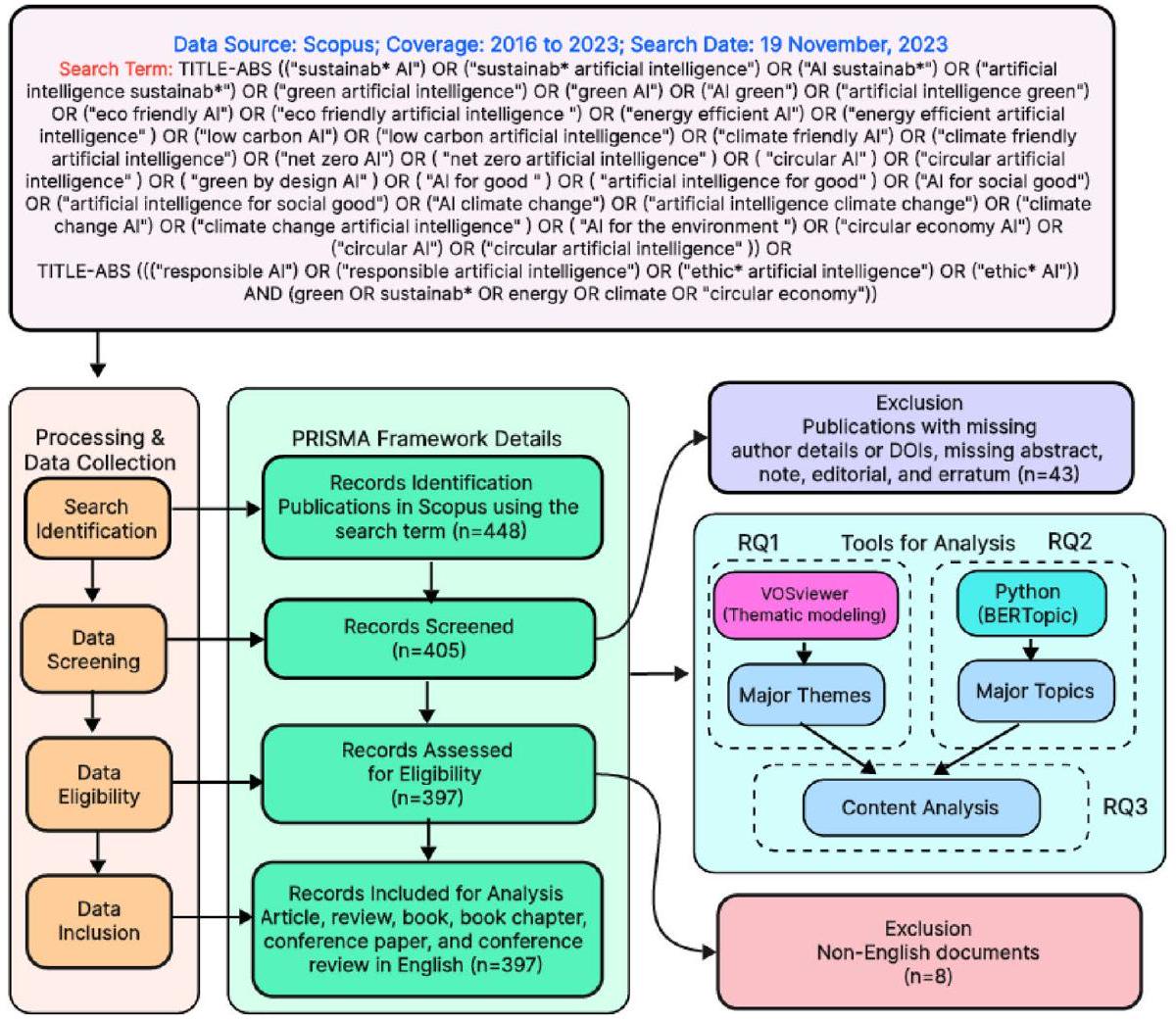
في المرحلة الأولية من دراستنا، التزمنا ببروتوكول PRISMA [55، 64] وجمعنا بشكل منهجي مقالات أكاديمية من قاعدة بيانات Scopus في 19 نوفمبر 2023. تغطي الفترة الزمنية في هذه الدراسة ما بين 2016 و2023. تم اختيار نقطة البداية في 2016 لأنها تلي الاعتماد الرسمي لأهداف التنمية المستدامة في أواخر 2015. شمل استعلام البحث مصطلحات متنوعة تتعلق بالذكاء الاصطناعي المستدام، والذكاء الاصطناعي الأخضر، والاعتبارات الأخلاقية في الذكاء الاصطناعي، مما أسفر عن 448 سجلًا. تم تضمين مستندات من نوع مقالة، كتاب، فصل كتاب، ورقة مؤتمر، ومراجعة. ومع ذلك، قمنا بإزالة الافتتاحية، الملاحظات، التصحيحات، والاستطلاعات القصيرة من التحليل. علاوة على ذلك، تم استبعاد السجلات التي تفتقر إلى مؤلفين، ملخصات، ومستندات غير باللغة الإنجليزية. بعد إزالة المستندات غير ذات الصلة، تم الاحتفاظ بـ 397 سجلًا للتحليل. تم استخدام المحتوى الأساسي لهذه السجلات، بما في ذلك العناوين، الملخصات،
الشكل 1 منهجية البحث
وكلمات المفتاح المحددة من قبل المؤلفين، للتحليل الوصفي، وتحليل المجموعات الموضوعية، وتحليل النمذجة الموضوعية [27،59].
لتنظيم البيانات، والفرز، والقوائم، والتمثيل الرسومي، استخدمنا “MS Excel.” في تحليل علم المكتبات، اعتمدنا مجموعة شاملة من المقاييس لتفكيك أداء المنشورات الأكاديمية، وديناميات التعاون، والأثر، كما تم تعريفه وتقديمه في باتنايك وآخرون [56، 58، 59].

التحليل الموضوعي

يعد التحليل الموضوعي أداة قيمة لتحديد الموضوعات العامة. يتضمن التعرف على الأنماط المكتشفة في جمع البيانات وفحصها وهيكلتها وشرحها وتوثيقها [53]. أكد براون وكلارك [12] على أهمية التحليل الموضوعي كنهج أساسي، مما يوفر للباحثين مهارات لا غنى عنها قابلة للتطبيق عبر منهجيات نوعية متنوعة. جادل العديد من العلماء بأن التحليل الموضوعي، وهو عملية متكاملة للعديد من المنهجيات النوعية، لا ينبغي أن يُنظر إليه كطريقة متميزة ولكن كأداة لدعم الباحثين في تحليلاتهم [11، 33، 72].
في تحليل مجموعتنا الموضوعية، استخدمنا VOSviewer، وهو تطبيق برمجي مصمم لبناء وتصوير الشبكات الببليوغرافية [85]. تستند أساسيات تحليل مجموعتنا الموضوعية على الكلمات المفتاحية المحددة من قبل المؤلفين. يمثل كل عقدة في التحليل كلمة مفتاحية محددة من قبل مؤلف متميز. تشير الخطوط التي تربط العقد إلى تكرار التواجد المشترك للكلمات المفتاحية. في المقابل، غالبًا ما يشير لون العقدة إلى المجموعة أو المجموعة التي تنتمي إليها الكلمة المفتاحية، حيث يمثل كل لون مجموعة موضوعية مختلفة أو مجموعة من المواضيع ذات الصلة الوثيقة [27، 59]. يعتمد هذا التجميع عادةً على تشابه أنماط التواجد المشترك للكلمات المفتاحية، مما يشير إلى أنها تناقش بشكل متكرر في الأدبيات. كما أن المسافة بين العقد في التصور مهمة أيضًا. عمومًا، تشير المسافة الأقصر بين عقدتين إلى تواجد مشترك أقوى أو أكثر تكرارًا، مما يشير إلى أن تلك الكلمات المفتاحية غالبًا ما يتم ذكرها معًا في نفس المقالات أو السياقات، مما يشير بالتالي إلى علاقة أقرب أو درجة أعلى من صلة الموضوع.

تحليل الموضوعات

يسمح استخدام تحليل الموضوعات للباحثين بتعزيز أدواتهم لعمليات التحليل الاستكشافي ومراجعة الأدبيات [9، 28، 32]. يناقش أسموسن ومولر [5] استخدام تحليل الموضوعات وتعلم الآلة لمراجعات الأدبيات. يبرز نيكولينكو وآخرون [52] تحليل الموضوعات للدراسات النوعية ويقترحون مقياس جودة جديد (توافق tf-idf) ونهج شبه إشرافي لفترة لجعل تحليل الموضوعات أكثر فعالية للمواضيع الفرعية المحددة. BERTopic هو نهج لتحليل الموضوعات يستفيد من تمثيلات BERT المدربة مسبقًا (تمثيلات المحولات ثنائية الاتجاه) للحصول على تمثيلات موضوعية أكثر دقة وغنية بالسياق [29]. قام إجر ويو [21] بتقييم أداء أربع تقنيات لتحليل الموضوعات (تخصيص ديريشليت الكامن (LDA)، تحليل المصفوفة غير السلبية (NMF)، Top2Vec، وBERTopic). واحدة من المزايا الرئيسية لـ BERTopic مقارنة بأساليب تحليل الموضوعات التقليدية، مثل تخصيص ديريشليت الكامن (LDA)، هي قدرتها على التقاط المعاني الدلالية والعلاقات السياقية داخل بيانات النص بشكل أكثر فعالية.
نستخدم تقنية BERTopic المتطورة في بايثون، مستفيدين من المحولات وClass-Tf-idf-Transformer لإنشاء مجموعات مكثفة، مما يضمن توليد مواضيع سهلة الفهم مع الحفاظ على الكلمات الأساسية في الوصف [29]. نطبق تقنية نمذجة BERTopic لاستخراج وتحليل المواضيع ذات المعنى ضمن الذكاء الاصطناعي الأخضر والمستدام، مما يساهم في فهم شامل لهذا المجال. بعد استخراج البيانات، خطوة المعالجة المسبقة الدقيقة تعزز جودة وتجانس مجموعة البيانات، وتتضمن إجراءات تنظيف النصوص، وتقنيات معالجة اللغة الطبيعية (NLP)، والتقطيع. كما أن استخدام تمثيلات الجمل التي تم إنشاؤها باستخدام نموذج “all-mpnet-base-v2” من Sentence Transformer وتقليل الأبعاد باستخدام تقنيات تقريبي الشكل الموحد (UMAP) يساهم في تحسين مجموعة البيانات لاستخراج المواضيع ذات المعنى والتصور [47].
بالنسبة لمهمة نمذجة الموضوع الرئيسية، يتم استخدام نموذج “all-MiniLM-L6-v2” من Sentence Transformer، ويتم إنشاء نموذج BERTopic، الذي يتضمن النماذج الخاصة بالتضمين، والتمثيل، والتوجيه، وc-Tf-idf. تعزز حسابات الاحتمالات لتعيينات الموضوعات من قابلية تفسير النتائج، مما يضمن نتيجة دراسة قوية وموثوقة. يتم ضبط نموذج BERTopic على محتوى النص المعالج مسبقًا، مستخرجًا خمسة مواضيع متميزة والاحتمالات المقابلة لكل وثيقة. يتم تحليل المواضيع الناتجة من حيث التماسك، ويتم فحص توزيع المقالات عبر المواضيع، مما يوفر رؤى حول درجة الارتباط بين المقالات والمواضيع المحددة. تضمن هذه المقاربة الشاملة والمتقدمة في تحليل نمذجة الموضوعات موثوقية وقوة نتائج دراستنا.
تم دمج النتائج من كل من التحليل العلمي (VOSviewer) ونمذجة BERTopic لتمييز بين المجالات البحثية الأساسية والمتطورة واستكشاف كيفية تفاعلها لتشكيل اتجاهات البحث المستقبلية وصنع السياسات في الذكاء الاصطناعي المستدام. توفر هذه التكامل المنهجي فهماً متعدد الأبعاد للمجال، مما يجسر الفجوة بين الرؤى الموضوعية الواسعة والتفاصيل الدقيقة.

النتائج والمناقشة

استنادًا إلى منهجيتنا الشاملة، نقدم استكشافًا موجزًا ولكنه شامل لنتائجنا الرئيسية، مسلطين الضوء على المشهد المتطور للمساهمات الأكاديمية والتقدمات في مجال أبحاث الذكاء الاصطناعي الأخضر والمستدام.

تحليل التجمعات الموضوعية استنادًا إلى تكرار الكلمات الرئيسية (RQ1)

تشير تحليل التجميع الموضوعي الذي تم إجراؤه في هذه الدراسة إلى أن أبحاث الذكاء الاصطناعي الأخضر والمستدام المعاصرة تركز على ثلاثة تجمعات محددة. توضح الشكل 2 شبكة التواجد المشترك التي تظهر التجمعات الثلاثة.

العنقود 1 (أحمر): الذكاء الاصطناعي المسؤول من أجل التنمية المستدامة
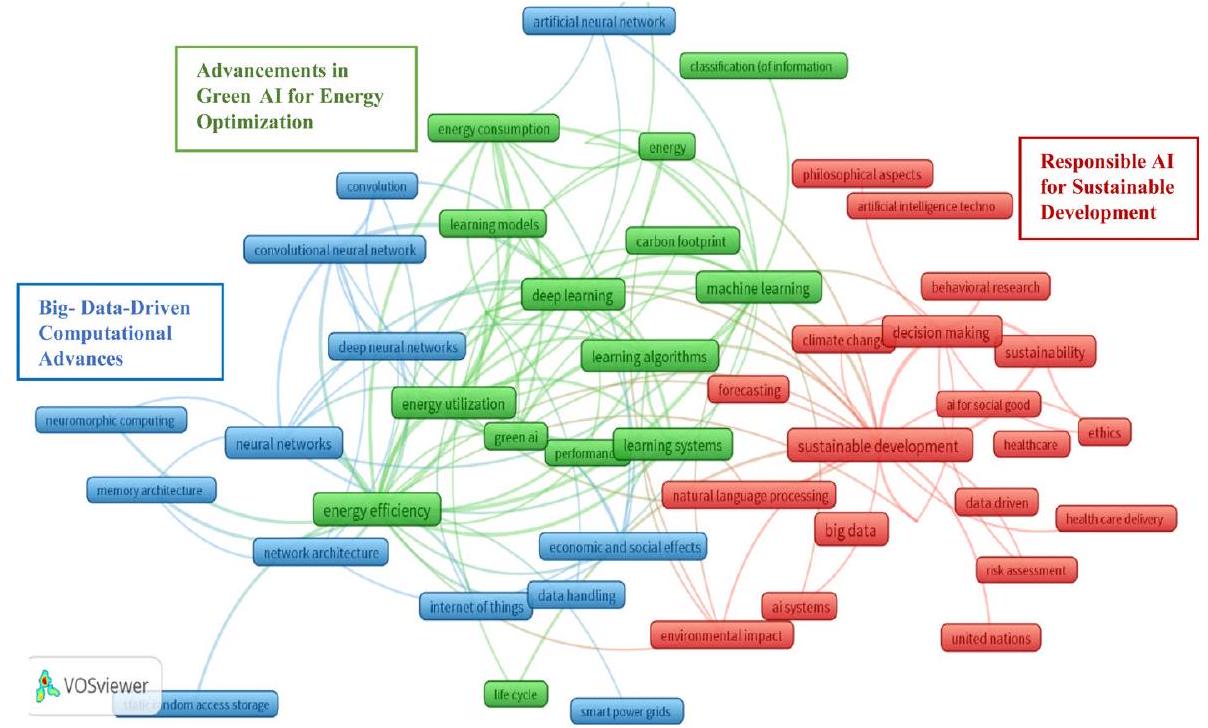
تظهر الشكل 2 الكلمات الرئيسية التي تشكل الكتلة 1، بينما يوضح الجدول 1 المقالات الأكثر استشهادًا التي تمثل الكتلة. كما هو موضح في الشكل، تعكس ثروة من المصطلحات مثل التنمية المستدامة، اتخاذ القرار، الأخلاق، التكنولوجيا الأخلاقية، البحث السلوكي، والأثر البيئي تركيزًا مشتركًا على استغلال الذكاء الاصطناعي لمعالجة التحديات البيئية والتنموية المعقدة. إنه يجسد رؤية حيث لا يقتصر الذكاء الاصطناعي على الأتمتة فحسب، بل يبتكر أيضًا بطرق تعزز من البيئة.
الشكل 2: التجمعات الموضوعية بناءً على تكرار الكلمات الرئيسية
الجدول 1: المقالات الأكثر استشهادًا في المجموعة 1
استشهادات المؤلف(ون) عنوان الورقة تركيز أهداف التنمية المستدامة
١١٠ فلوريدي وآخرون [24] كيف تصمم الذكاء الاصطناعي من أجل الخير الاجتماعي: سبعة عوامل أساسية 1 تقليل غير متساوي
97 توماشيف وآخرون [84] الذكاء الاصطناعي من أجل الخير الاجتماعي: فتح الفرصة لتحقيق تأثير إيجابي. جميع أهداف التنمية المستدامة
82 غلاز وآخرون [25] الذكاء الاصطناعي، المخاطر النظامية، والاستدامة
10
ريدوليد نيكوالييس
٤٧ دوورن [18] الذكاء الاصطناعي في مجال المياه: فرص للاستخدام المسؤول
٣٣ غوبتا وآخرون [30] “تقييم ما إذا كانت الذكاء الاصطناعي هو عامل تمكين أو مثبط للاستدامة على مستوى المؤشرات” جميع أهداف التنمية المستدامة
التوازن والرفاه الاجتماعي [90]. التفاعل بين الذكاء الاصطناعي ومعالجة اللغة الطبيعية يشير إلى إمكانية تطوير أدوات متطورة تظهر وعدًا في إنشاء أدوات متقدمة لرصد البيئة وتحليل السياسات التي يمكن أن تساعد في جعل الجهود المستدامة أكثر شفافية ومسؤولية [18،25]. يشير تضمين الرعاية الصحية إلى إمكانية الذكاء الاصطناعي في تعزيز الطب الدقيق والمبادرات الصحية العالمية، والتي تعد جزءًا لا يتجزأ من تحقيق أهداف التنمية المستدامة للأمم المتحدة [17]. هذه التآزر بين الذكاء الاصطناعي والأطر الأخلاقية أمر حاسم لتشكيل التقنيات التي تدعم مستقبلًا عادلًا ومستدامًا.
تناول فلوريدي وآخرون [24] التحديات المستمرة في تطبيق الذكاء الاصطناعي من أجل الفوائد الاجتماعية من خلال تحديد سبعة اعتبارات أخلاقية مهمة تدعم الجهود الرامية إلى تقليل عدم المساواة وتعزيز العدالة والقيادة المجتمعية القوية، مما يساهم في الهدف 10 من أهداف التنمية المستدامة (تقليل عدم المساواة) والهدف 16 (السلام والعدالة والمؤسسات القوية). هذه العوامل هي (1) القابلية للتكذيب والنشر التدريجي، (2) تدابير الحماية ضد التلاعب بالمؤشرات؛ (3) التدخل المت contextualized للمستقبل؛ (4) المت contextualized للمستقبل.
تفسير وأغراض شفافة؛ (5) حماية الخصوصية وموافقة موضوع البيانات؛ (6) العدالة السياقية؛ و(7) التفسير البشري الودود. تم دعم تحليلهم بـ 27 مثال حالة، وتم تقديم أفضل الممارسات لكل من هذه العوامل التي يمكن أن تعمل كإرشادات أولية لتصميم AI4SG بشكل جيد. قدم توماشيف وآخرون [84] مجموعة من الإرشادات لإنشاء تعاون ناجح على المدى الطويل بين باحثي الذكاء الاصطناعي وخبراء مجالات التطبيق. هذه الإرشادات حيوية حيث يتطلب حركة الذكاء الاصطناعي من أجل الخير الاجتماعي (AI4SG) التعاون بين التخصصات الذي يركز على الذكاء الاصطناعي لمعالجة 17 هدفًا من أهداف التنمية المستدامة. أيضًا، تم تحليل بعض مشاريع الذكاء الاصطناعي الحالية فيما يتعلق بالإرشادات لتحديد الفرص الرئيسية لمشاريع الذكاء الاصطناعي المستقبلية. مع التركيز على الهدف 10 من أهداف التنمية المستدامة (تقليل الفوارق)، جادل غالاز وآخرون [25] أنه على الرغم من الاهتمام المتزايد والاستثمار في نشر تقنيات الذكاء الاصطناعي في مجالات مثل الزراعة، والغابات، واستكشاف الموارد البحرية، إلخ، التي تعتبر حاسمة للاستدامة، لا يزال تقييم المخاطر النظامية لهذه التقنيات غير مستكشف بشكل كافٍ. تم تقديم لمحة عامة عن تقدم هذه التقنيات في هذه المجالات الحرجة، وتم تحديد المخاطر النظامية المحتملة مثل التحيز الخوارزمي والأضرار التوزيعية، والوصول غير المتكافئ والفوائد، والفشل المتسلسل والاضطرابات الخارجية، والمقايضات بين الكفاءة والمرونة. كما تم تسليط الضوء على القيود في الحوكمة الحالية في معالجة مخاطر استدامة الذكاء الاصطناعي.
مع إعطاء الأولوية للهدف السادس من أهداف التنمية المستدامة (المياه النظيفة والصرف الصحي)، أكد دورن [18] على الاستخدام غير المتطور نسبيًا لتقنيات الذكاء الاصطناعي في مجال المياه والحاجة إلى بذل الجهود لتطوير رؤى حول ‘الذكاء الاصطناعي المسؤول’. حددت مراجعة الأدبيات أربع فئات تطبيقية، وهي: النمذجة، التنبؤ والتوقع، دعم القرار والإدارة التشغيلية، والتحسين. تم تقديم ثلاث رؤى، مثل الاستخدام العام للذكاء الاصطناعي، والتحسين متعدد الأهداف (ضمان التعددية والديناميكية للقيم)، واستخدام علم البيانات الموجه بالنظرية. كما تم التوصية بالجهد التآزري من علماء البيانات، والمهنيين، وخبراء المجال، وخبراء العلوم الاجتماعية والإنسانية في السعي نحو ‘الذكاء الاصطناعي المسؤول’. أخيرًا، قام غوبتا وآخرون [30] بتقييم تأثير الذكاء الاصطناعي على 17 هدفًا من أهداف التنمية المستدامة من خلال مناقشة مع لجنة خبراء. تم مناقشة القضايا الرئيسية المرتبطة بالذكاء الاصطناعي في السعي نحو مستقبل مزدهر، مثل خصوصية البيانات، وتم تسليط الضوء على التقييم على مستوى المؤشرات للرقمنة والذكاء الاصطناعي على مستوى مؤشرات أهداف التنمية المستدامة. كما أوصى بتطوير أدوات معيارية ‘سهلة الاستخدام’ لتوجيه ممارسي الذكاء الاصطناعي في تقييم تأثير الذكاء الاصطناعي وأيضًا لتعزيز التعاون عبر التخصصات لضمان تطبيقات ذكاء اصطناعي مسؤولة، مدفوعة بالأخلاق، شاملة، وواعية بالسياق من أجل التنمية المستدامة.

العنقود 2 (الأخضر): التقدم في الذكاء الاصطناعي الأخضر لتحسين الطاقة

توضح الشكل 2 الشبكة الموضوعية للعناقيد 2، بينما تقدم الجدول 2 أفضل المقالات التي تمثل العنقود. تتناول الموضوعات العلاقة التآزرية بين الذكاء الاصطناعي وممارسات الطاقة المستدامة، كما يتضح من الكلمات الرئيسية مثل كفاءة الطاقة، التعلم العميق، استخدام الطاقة، استهلاك الطاقة، والحوسبة الخضراء. يركز العنقود على تطوير الخوارزميات التي تعمل بدقة عالية وتعمل بحد أدنى من متطلبات الطاقة، مما يتماشى مع التقدم الحسابي مع الضرورات البيئية. تشير أهمية ‘الذكاء الاصطناعي الأخضر’ إلى نهج منهجي لتقليل التكلفة الحسابية للخوارزمية
الجدول 2 أفضل المقالات المستشهد بها في العنقود 2
الاستشهادات المؤلف(ون) عنوان الورقة تركيز أهداف التنمية المستدامة
64 Yigitcanlar وآخرون [97] الذكاء الاصطناعي الأخضر: نحو تكنولوجيا فعالة ومستدامة وعادلة للمدن الذكية والمستقبلات 11 مدن ومجتمعات مستدامة
59 Xue وآخرون [96] ماكرو حسابي مدمج في الذاكرة يعتمد على ذاكرة الوصول العشوائي المقاومة للأجهزة الطرفية للذكاء الاصطناعي 7 طاقة نظيفة وميسورة
y
الصناعة، الابتكار والبنية التحتية
33 Zhu وآخرون [102] الذكاء الاصطناعي الأخضر للإنترنت الصناعي للأشياء: حوسبة طرفية ذكية وفعالة من حيث الطاقة
طاقة نظيفة وميسورة
الصناعة، الابتكار والبنية التحتية
27 Wheeldon وآخرون [91، 92] تصميم أجهزة الذكاء الاصطناعي الفعالة من حيث الطاقة للتطبيقات الذكية: أجهزة الذكاء الاصطناعي المعتمدة على التعلم الآلي 7 طاقة نظيفة وميسورة
26 Yuan وآخرون [100] ترانزستورات MoS2 القابلة لإعادة التكوين للتعلم المستمر في الشبكات العصبية المتفجرة 7 طاقة نظيفة وميسورة
الصناعة، الابتكار والبنية التحتية
التدريب والاستدلال، وهو أمر ضروري لتوسيع تطبيقات الذكاء الاصطناعي بشكل مستدام. علاوة على ذلك، تعكس ‘الحوسبة الخضراء’ تحول الصناعة نحو الأجهزة المستدامة، حيث تعتبر المعالجات وحلول التخزين الفعالة من حيث الطاقة محورية. قد يستكشف هذا العنقود أيضًا تحليل دورة حياة نماذج الذكاء الاصطناعي، مع الأخذ في الاعتبار الطاقة المتجسدة من التطوير إلى النشر، لضمان نهج شامل للاستدامة في التكنولوجيا.
من بين الأعمال التمثيلية، حاول Yigitcanlar وآخرون [97] تسليط الضوء على القيود الأساسية في تصور وممارسة أنظمة الذكاء الاصطناعي السائدة من خلال تحليل الأدبيات. لقد دعا إلى الحاجة إلى نهج موحد للذكاء الاصطناعي الأخضر لضمان انتقال سلس نحو المدن الذكية بما يتماشى مع الهدف 11 من أهداف التنمية المستدامة (المدن والمجتمعات المستدامة). التدخل الحكومي المناسب، وتعميم مبادئ الأخلاق في الذكاء الاصطناعي مثل “الشفافية، العدالة والإنصاف، عدم الإيذاء، المسؤولية، الخصوصية، الفائدة، الحرية والاستقلال، الثقة، الاستدامة، الكرامة، والتضامن” [35]، وتطوير أطر أخلاقية مناسبة للذكاء الاصطناعي وإرشادات تنظيمية بالإضافة إلى آليات التنفيذ، ومشاركة الجمهور وغيرهم من أصحاب المصلحة الحيويين لضمان أن يتماشى نهج الذكاء الاصطناعي الأخضر الذي يشمل الأطر الأخلاقية، وإرشادات التنظيم، وأنظمة التنفيذ، وما إلى ذلك، بشكل جيد مع الهدف 12 من أهداف التنمية المستدامة (الاستهلاك والإنتاج المسؤولين). بعد ذلك، أفاد Xue وآخرون [96] بتطوير ماكرو حسابي غير متطاير يمكنه outperform الأنظمة الحالية من حيث المنتج النقطي متعدد البت، وزيادة التوازي بين المدخلات والمخرجات، وتقليل مساحة مصفوفة الخلايا، وتحسين الدقة، وتقليل زمن الحوسبة واستهلاك الطاقة. يساهم هذا العمل في الهدف 7 (طاقة نظيفة وميسورة) والهدف 9 (الصناعة، الابتكار والبنية التحتية) من خلال تطوير أجهزة ذكاء اصطناعي فعالة من حيث الطاقة للأجهزة الطرفية، مما يقلل من البصمة البيئية للذكاء الاصطناعي. هذه الميزة حيوية لتصنيع أجهزة الذكاء الاصطناعي الطرفية الفعالة من حيث الطاقة، مما يساهم بشكل مباشر في التكنولوجيا للذكاء الاصطناعي الأخضر.
على العكس من ذلك، تناول العمل الثالث في القائمة التحدي الناجم عن استهلاك الطاقة العالي لأداء مهام حساب الذكاء الاصطناعي في الإنترنت الصناعي للأشياء (IIoT) بسبب الحاجة إلى خوادم عالية الأداء [101]. تم اقتراح إطار حوسبة طرفية ذكي بهيكل غير متجانس لتحميل معظم مهام الذكاء الاصطناعي من الخوادم. كما تم اقتراح خوارزمية تحسين جديدة لجدولة المهام، وتم تقدير تقليل إجمالي استهلاك الطاقة بنسبة تصل إلى يتم تقديرها بناءً على استخدام استراتيجيات مختلفة، مما يساهم في الذكاء الاصطناعي الأخضر من خلال التكنولوجيا لتحسين كفاءة الطاقة مما يساهم في الهدف 7 والهدف 9.
من ناحية أخرى، تناول Wheeldon وآخرون [91، 92] تصميم أجهزة الذكاء الاصطناعي الفعالة من حيث الطاقة للإنترنت الأشياء بناءً على التعلم الآلي (المنطق الاقتراحي) بما يتماشى مع الهدف 7. تم تحديد القدرة على خفض استهلاك الطاقة مقارنة بأجهزة الذكاء الاصطناعي الحديثة outperform والقدرة على outperform متانة ودقة خوارزميات التعلم الآلي الحديثة من خلال تقييم شامل لمجموعات بيانات التعلم الآلي ذات الفئة الواحدة والمتعددة. مساهمة في الأهداف 7 و9، قدم Yuan [100] ترانزستور ذاكرة مع سلوك تعلم ديناميكي قابل للتعديل يمكنه ضبط قدراته التعليمية، مما يجعله أكثر مرونة لمهام الذكاء الاصطناعي. تم الإبلاغ عن مزايا إعادة التكوين العالية، ومنحنيات التعلم المتنوعة، والبلاستيكية المعتمدة على توقيت النبض المبسط، والتعلم المستمر كفرص فريدة لمسرعات الأجهزة للذكاء الاصطناعي الفعال من حيث الطاقة والتعلم الآلي، خاصة للحوسبة العصبية.

العنقود 3 (الأزرق): التقدم الحسابي المدفوع بالبيانات الضخمة

توضح الشكل 2 الشبكة الموضوعية للعناقيد 3، بينما يظهر الجدول 3 المقالات المستشهد بها بشكل كبير والتي تمثل العنقود. يشمل العنقود 3 مجموعة من الكلمات الرئيسية مثل الشبكات العصبية، الشبكات العصبية التلافيفية، الشبكات العصبية العميقة، أنظمة التعلم، البيانات الضخمة، والبيانات المدفوعة، مما يدل على الابتكارات الحسابية عالية المستوى ودمجها في الأطر الاجتماعية. هذه التقنيات بارعة في معالجة واستخراج رؤى قيمة من البيانات الضخمة، مما يعكس تكاملها في الأطر الاجتماعية. يركز هذا العنقود على الجوانب التكنولوجية للطرق الحسابية، مثل تعقيدات تصميم الشبكات العصبية أو الكفاءات التي تم إدخالها بواسطة
الجدول 3 أفضل المقالات المستشهد بها في العنقود 3
الاستشهادات المؤلف(ون) العنوان تركيز أهداف التنمية المستدامة
273 Bag وآخرون [6] دور الضغوط المؤسسية والموارد في اعتماد تحليلات البيانات الضخمة المدعومة بالذكاء الاصطناعي، وممارسات التصنيع المستدامة وقدرات الاقتصاد الدائري الاستهلاك والإنتاج
134 Sharma وآخرون [79] التقدم الأخير في أبحاث التعلم الآلي لنقل الحرارة القائم على النانو في نظام الطاقة المتجددة 7 طاقة نظيفة وميسورة
36 Kwon وآخرون [42] أجهزة عصبية ضوئية كبيرة الحجم مع دوائر مشبكية ثنائية الاتجاه معدلة بالضوء متعدد الأطياف
9
الصناعة، الابتكار والبنية التحتية
4 Li وآخرون [44] الذكاء الاصطناعي من أجل الخير الاجتماعي: الذكاء الاصطناعي وطرق البيانات الضخمة لصنع القرار البيئي
3 Sapignoli [75] القياس الخاطئ للإنسان: البيانات الضخمة و’التحول في الذكاء الاصطناعي’ في الحوكمة العالمية
10
تقليل الفوارق
16
السلام، العدالة والمؤسسات القوية
الحوسبة العصبية. كما أنها تقيم بشكل نقدي تداعياتها الاجتماعية والاقتصادية، لا سيما في التعامل مع وتحليل مجموعات البيانات الكبيرة من أجل اتخاذ قرارات مستنيرة. دور الذكاء الاصطناعي في الشبكات الكهربائية الذكية، كما يتضح من تحليلات البيانات الضخمة، يتجاوز الأداء الفني، مما قد يحدث ثورة في أنماط توزيع واستهلاك الطاقة. وهذا بدوره قد يؤثر بشكل عميق على الهياكل الاقتصادية وتخصيص الموارد. علاوة على ذلك، يشير العنقود إلى مسار بحث يستكشف الأبعاد الأخلاقية للذكاء الاصطناعي، ومخاوف الخصوصية المتعلقة بالبيانات الضخمة، والفجوة الرقمية، مما يضمن أن تساهم التقدمات التكنولوجية في التنمية الاجتماعية الشاملة والعادلة.
تناول باغ وآخرون [6] الفجوة البحثية المتعلقة بالبحث المحدود حول أسباب اعتماد الشركات المصنعة على الذكاء الاصطناعي المدعوم بتحليلات البيانات الضخمة. استخدموا نظرية المؤسسات ونظرية الموارد القائمة لتفسير تكوين الموارد الملموسة ومهارات القوى العاملة لدفع التمكين التكنولوجي وتحسين ممارسات التصنيع المستدامة لتطوير قدرات الاقتصاد الدائري المرتبطة بالهدف 12 من أهداف التنمية المستدامة (الاستهلاك والإنتاج المسؤولين). تم جمع بيانات أولية من 219 شركة تصنيع سيارات وشركات مرتبطة بها في جنوب إفريقيا. كما تم مناقشة الرؤى المتعلقة بدور الضغوط المؤسسية في اعتماد الذكاء الاصطناعي المدعوم بتحليلات البيانات الضخمة وتأثيره على القدرة على التنمية المستدامة، وتأثيرات المرونة التنظيمية، وديناميكية الصناعة. من ناحية أخرى، استعرض شارما وآخرون [79] تطبيقات تقنيات التعلم الآلي المختلفة لأنظمة الطاقة المتجددة القائمة على النانوسوائل المرتبطة بالهدف 7 من أهداف التنمية المستدامة (الطاقة الميسورة والنظيفة). تعتبر نمذجة التنبؤ المعتمدة على الشبكات العصبية الاصطناعية باستخدام البرمجيات التجارية المعاصرة هي التقنية الأكثر طلبًا. بالإضافة إلى الشبكات العصبية المعروفة، تكتسب تقنيات الضبابية والمعتمدة على الجينات، وتقنيات التعلم الآلي الجماعي مثل الانحدار المعزز، K-means، KNNs، CatBoost، وXGBoost أيضًا شعبية متزايدة. تم تحديد قلق رئيسي في عدم فهم المستخدمين لكيفية عمل الشبكات العصبية والخوارزميات المعتمدة على الضبابية (تقنيات الصندوق الأسود). أفاد كوان وآخرون [42] بتطوير دائرة عصبية ضوئية فعالة من حيث الطاقة وقابلة للتوسع تعمل بالكامل على الضوء باستخدام ترانزستور ضوئي هيتروهيكلي ومقسم ضوئي، مما يساهم مباشرة في الهدف 7 (الطاقة الميسورة والنظيفة) والهدف 9 (الصناعة والابتكار والبنية التحتية). تم استخدام دوائر تشابكية ثنائية الاتجاه معدلة بالضوء متعدد الأطياف لوظائف دقيقة وحساسة للألوان تشبه وظائف الدماغ وللتعرف على الأنماط مباشرة من خلال الأجهزة.
مساهمة في تحقيق الهدف 13 من أهداف التنمية المستدامة (العمل المناخي) ومستقبل أكثر استدامة، كتب لي وآخرون [44] مقالة تحريرية حاولت مراجعة الأعمال المنشورة في عددهم الخاص بالإضافة إلى معالجة أربعة أسئلة ذات صلة تتعلق بـ (1) الشروط اللازمة و (2) الاستخدام المناسب للذكاء الاصطناعي والبيانات الضخمة لتسهيل اتخاذ القرارات البيئية، و (3) مدى خدمة الذكاء الاصطناعي والبيانات الضخمة لأولئك المعرضين لتلوث البيئة، و (4) ملكية وحوكمة الذكاء الاصطناعي والبيانات الضخمة. كما تم تسليط الضوء على المبادئ المهمة للذكاء الاصطناعي من أجل الخير الاجتماعي التي قد تساعد في تمييز القرارات البيئية الجيدة والسيئة بناءً على تقنيات الذكاء الاصطناعي والبيانات الضخمة. أخيرًا، قدم سابينغولي [75] بعض التأملات حول التأثير المحتمل لـ ‘تحول الذكاء الاصطناعي’، المرتبط بجهود الأمم المتحدة لموضوع ‘الذكاء الاصطناعي من أجل الخير’، على ممارسات حقوق الإنسان. يُزعم أن إنشاء أسس جديدة للانتماء البشري والوجود جارٍ، جنبًا إلى جنب مع جهود التدخل وإقامة السياسات. يُتوقع أن يواجه الأنثروبولوجيون أربعة ظواهر ناشئة محتملة، وهي (1) دور متزايد لفنيي البيانات والخبراء.
فيما يتعلق بالقدرات والمسؤولية الأخلاقية لرسم خرائط الحوكمة العالمية المتعلقة بالهدف 16 من أهداف التنمية المستدامة (السلام والعدالة والمؤسسات القوية) (2) حصة أكبر من المشاركة والمسؤولية للقطاع الخاص في حقوق الإنسان والحوكمة العالمية والتبادلات المحتملة لصورة الشركات العامة مقابل الربحية (3) تأثير اتخاذ القرار التلقائي (الذي يبدو غير مرئي) على السكان المستهدفين بما يتماشى مع الهدف 10 من أهداف التنمية المستدامة (تقليل الفوارق) (4) السيناريو الذي تحدد فيه الحسابات الحاسوبية والتفسير الخوارزمي هوياتنا وديناميكياتها مع إضافة بيانات جديدة.

تحليل نمذجة BERTopic (RQ2)

BERTopic ضروري لالتقاط التمثيلات السياقية والدلالية للكلمات، مما يوفر فهماً أكثر دقة للعلاقات بين المواضيع والمواضيع المختلفة في الأدب. يتم تقديم المحتوى الموضوعي، والارتباط بين المواضيع، والأهمية النسبية للمواضيع المعنية في هذا القسم. تعرض الجدول 4 المواضيع والكلمات العشر الأهم التي تمثل كل موضوع (أعلى 10 كلمات بناءً على الاحتمالية).
الجدول 4 تسميات الموضوعات، الكلمات الرئيسية، والمقالات النموذجية
موضوع الكلمات الرئيسية ودرجات احتمالاتها المستندات التمثيلية العائد السنوي
الموضوع 0: الذكاء الاصطناعي الأخلاقي البيئي والاستدامة الذكاء الاصطناعي (0.3651)، الذكاء (0.2762)، الذكاء الاصطناعي (0.2721)، الاستدامة (0.2423)، الأخلاق (0.2085)، البيئي (0.2040)، الذكاء الاصطناعي (0.1937)، الذكاء الاصطناعي (0.1923)، التنمية المستدامة (0.1842)، الذكاء الاصطناعي الاجتماعي (0.1834) غاو وليو [26]، كونتي وآخرون [16]، شين وشين [80]، ماسيه وكور (2022)، بولتي وآخرون [10] 2021.3
الموضوع 1: الحوسبة الخضراء المستدامة باستخدام الشبكات العصبية الطاقة (0.3421)، كفاءة الطاقة (0.2507)، الذاكرة (0.2419)، الحوسبة (0.2347)، الكفاءة (0.2285)، التعلم العميق (0.2160)، الأخضر (0.2118)، الآلة (0.2115)، الذكاء الاصطناعي الأخضر (0.2023)، الشبكة العصبية (0.2004) أجاجيكار وآخرون [2]، يو وآخرون [99]، ميهونيك [48]، وو وآخرون [95]، فيرو وآخرون [23] 2021.9
الموضوع 2: الذكاء الصحي الأخلاقي الرعاية الصحية (0.4932)، الرعاية الصحية (0.3660)، الصحة الفموية (0.3224)، الرعاية الصحية بالذكاء الاصطناعي (0.2951)، القضايا الأخلاقية (0.2885)، الرعاية الصحية بالذكاء الاصطناعي (0.2718)، الصحة بالذكاء الاصطناعي (0.2637)، اتخاذ القرارات في الرعاية الصحية (0.2562)، القرار في الرعاية الصحية (0.2562)، الأخلاقيات والذكاء الاصطناعي (0.2472) كاباسو وأومبريلو [13]، دوكريه وآخرون [20]، ريتشي [66]، بينيستري وبانفي [61]، كاتيراي [36] 2022.0
الموضوع 3: رحلة تعلم الذكاء الاصطناعي الطلاب (0.4965)، نية السلوك (0.4141)، الذكاء الاصطناعي (0.3773)، الذكاء الاصطناعي (0.3531)، الذكاء (0.3478)، تعليم الذكاء الاصطناعي (0.3450)، تعلم الذكاء الاصطناعي (0.3253)، الذكاء الاصطناعي في العلوم والتكنولوجيا والهندسة والفنون والرياضيات (0.2956)، نية تعلم الذكاء الاصطناعي (0.2956)، نية التعلم (0.2956) سانوسي وآخرون [74]، بولاس وآخرون [62]، لين وآخرون [45]، تشاي وآخرون [14]، هسو وآخرون [34] 2022.1
الموضوع -1: ابتكار الذكاء الاصطناعي المعرفي الذكاء، الذكاء الاصطناعي، البيانات، النماذج، الخرف، الصحة، الإدراك، التنمية، الإطار روتكوفسكي وآخرون [68-71]، أرفيند وسينده مادوري [4] 2021.8
الموضوع 0، “الذكاء الاصطناعي الأخلاقي البيئي والاستدامة”، هو الموضوع الأكثر بروزًا، حيث يمثل حوالي من مجموعة البيانات. الموضوع 1، “الحوسبة العصبية المستدامة”، هو ثاني أعلى موضوع بارز، مع حوالي الموضوع 2، “الذكاء الصحي الأخلاقي”، والم topic 3 “رحلة تعلم الذكاء الاصطناعي”، هما من بين المواضيع البارزة الثالثة الأعلى، مع من إجمالي مخرجات البحث.
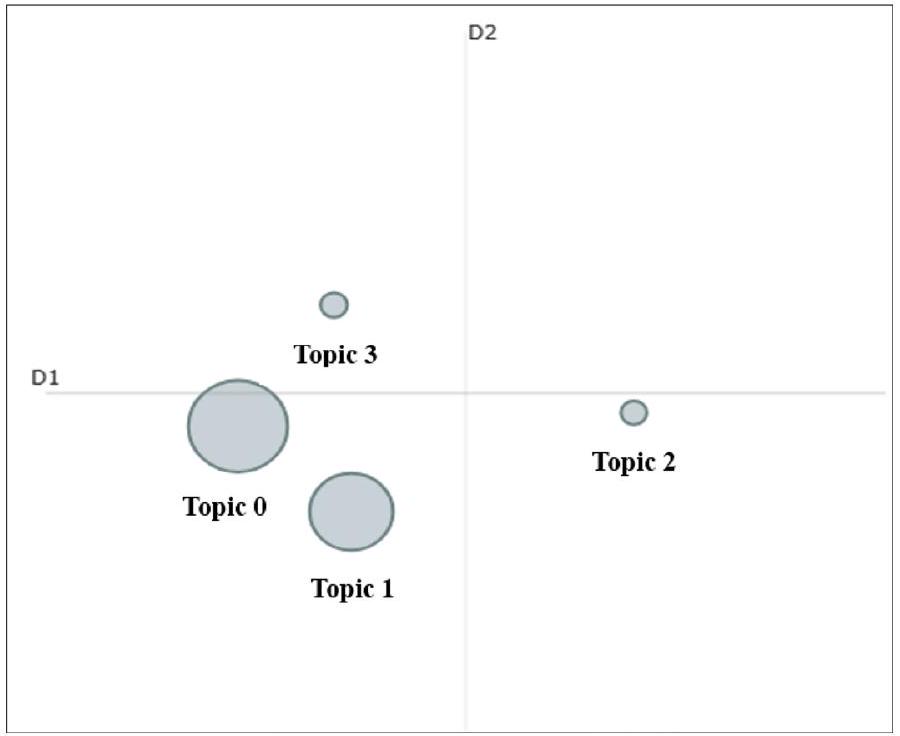
تؤكد المسافة بين نقاط البيانات على الرسم البياني تميز المواضيع [78]. يوضح الشكل 3 في الملحق خريطة المسافة بين المواضيع، مما يؤكد تميز المواضيع.

الموضوع 0: الذكاء الاصطناعي الأخلاقي البيئي والاستدامة

تساهم هذه الموضوعات في المناقشات المستمرة حول التقدم التكنولوجي المستدام والاستخدام المسؤول للذكاء الاصطناعي. على سبيل المثال، استكشاف غاو وليو [26] لمشهد الأخلاقيات البيئية الذكية بحث في كيفية تأثير جاهزية التكنولوجيا، وفائدة الاستخدام المدركة، والوعي البيئي على ميل المستخدمين لتبني الذكاء الاصطناعي في الرياضة. من خلال تحليل 670 استبيانًا صالحًا باستخدام المسوحات العرضية ونمذجة المعادلات الهيكلية، كشفت الدراسة أن جاهزية التكنولوجيا تؤثر بشكل مباشر على الفائدة المدركة للمستخدمين من الذكاء الاصطناعي في الرياضة. بالإضافة إلى ذلك، أظهرت أن الوعي البيئي يؤثر بشكل كبير على الفائدة المدركة، مما يسلط الضوء على فجوة بحثية في اعتبار الوعي البيئي في هذا السياق المحدد. من خلال التأكيد على الدور المحوري للفائدة المدركة، تبرز الدراسة أهميتها في التنبؤ برغبة المستخدمين في تبني الذكاء الاصطناعي في الرياضة من أجل التنمية المستدامة، مما يوفر رؤى قيمة في الخطاب الأخلاقي للذكاء البيئي. يؤكد كونتي وآخرون [16] على ضرورة تحسين الاستراتيجيات للتقدم التكنولوجي المستدام، مع التركيز على الإنتاج المتزايد للتقنيات المعززة للإنتاجية. يبرز عملهم الدور الحاسم للذكاء الاصطناعي في هذا السياق، مقدماً نتائج من تحقيقات مختبرية مخصصة للاستخدام المسؤول للذكاء الاصطناعي من أجل تحسين التكنولوجيا المستدامة. يقترح شين وشين [80] نهجًا يركز على الإنسان ضمن الموضوع 0، مقدمين أساسًا نظريًا وإرشادات عملية لتحقيق الذكاء الاصطناعي الأخضر والمستدام. هدفهم هو تقديم مساهمة كبيرة في المناقشات المحيطة بالاستخدام الواعي بيئيًا للذكاء الاصطناعي، داعين إلى نهج أكثر استدامة وبيئة. يبرز بولتي وآخرون [10] الطبيعة المميزة لـ ‘الذكاء الاصطناعي المستدام’ ضمن الموضوع 0، مؤكدين على تركيزه على التكاليف البيئية للذكاء الاصطناعي التي غالبًا ما يتم تجاهلها في المناقشات السياسية. ناقشوا تقريرًا مشتركًا حول معايير الاستدامة للذكاء الاصطناعي، موضحين أنه أول وثيقة أخلاقية للذكاء الاصطناعي تركز على اعتبارات الاستدامة. ينتقد المؤلفون الأساليب الحالية، داعين إلى إطار ‘أخلاقيات الرغبة’ وإعادة تصور الاستدامة كخاصية من خصائص الأنظمة المعقدة. يقدمون اتجاهات لمزيد من البحث، متسائلين عن فعالية الأساليب المفاهيمية الحالية في إحداث تحول في أخلاقيات الذكاء الاصطناعي، لا سيما فيما يتعلق بالاهتمامات البيئية.

الموضوع 1: الحوسبة العصبية المستدامة

موضوعنا التالي يتصدر المناقشات حول تعزيز كفاءة الطاقة والصداقة البيئية في أنظمة الحوسبة العصبية. تقدم المقالات التمثيلية رؤى من خلال أساليب مبتكرة وعروض عملية، مما يساهم في استمرار
جهود لتطبيقات الذكاء الاصطناعي الأكثر صداقة للبيئة. على سبيل المثال، يقدم أجاجكار وآخرون [2] مساهمة ملحوظة من خلال تقديم إطار تحكم قائم على الذكاء الاصطناعي للبيوت الزجاجية، مما يظهر تأثيرًا كبيرًا تقليل استهلاك الطاقة مقارنة بالطرق التقليدية. وهذا يبرز التأثير المحتمل لتقنيات الذكاء الاصطناعي المتقدمة على الممارسات الزراعية المستدامة. يساهم يو وآخرون [99] برؤى قيمة حول الحوسبة العصبية المستدامة من خلال استكشاف كفاءة الطاقة لنماذج الذكاء الاصطناعي في التطبيقات الطبية. تبرز دراستهم خوارزمية XGB كقائدة في الدقة ووقت التشغيل وكفاءة الطاقة، مما يبرز أهمية نماذج الذكاء الاصطناعي الموفرة للطاقة في السياقات الطبية وتعزيز تطبيقات الحوسبة العصبية الصديقة للبيئة. يتناول مهيوني [48] تحديات الطاقة في التطبيقات المدفوعة بالذكاء الاصطناعي من خلال الدعوة إلى تقنيات ما بعد CMOS، وخاصة تقنية الميمريستور، كحل لأنظمة الذكاء الاصطناعي الموفرة للطاقة. يبرز هذا المنظور الحاجة إلى ابتكارات الأجهزة لتلبية الطلبات غير المستدامة للطاقة في أنظمة الذكاء الاصطناعي الحالية، مما يتماشى مع الهدف العام للحوسبة العصبية المستدامة. يعرض وو وآخرون [95] منصة الحوسبة العصبية المقاومة الكاملة (ARNC)، مقدماً مثالاً ملموساً على نظام مُحسَّن للذكاء الاصطناعي الموفِّر للطاقة. تدمج هذه المنصة ذاكرة FinFET ذات البوابة المقاومة مع ميزات مثل مصفوفات ذاكرة RG-FinFET بسعة 4 بت لكل خلية، وReLU مع استجابات خطية، وADC مع استهلاك منخفض للطاقة. تساهم أعمالهم في هذا المجال من خلال تقديم عرض عملي يعزز جهود الحوسبة العصبية المستدامة. أخيراً، يساهم فيرو وآخرون [23] في الحوار حول الحوسبة العصبية المستدامة من خلال تقييم كفاءة الطاقة لخوارزميات التعلم الآلي. تحدد دراستهم العوامل المؤثرة في استهلاك الطاقة في خوارزميات التعلم الآلي، مما يبرز أهمية اختيارات المعلمات في اعتماد استراتيجيات أكثر خضرة للذكاء الاصطناعي. تضيف هذه الأبحاث رؤى قيمة إلى النقاش حول الحوسبة العصبية الموفرة للطاقة والسعي نحو تطبيقات الذكاء الاصطناعي الصديقة للبيئة.

الموضوع 2: الذكاء الصحي الأخلاقي

يتناول الموضوع الثاني الاعتبارات الأخلاقية والنشر المستدام للذكاء الاصطناعي في الرعاية الصحية، مع معالجة قضايا مثل الدفع الخفي، الأثر البيئي، صحة الفم، الطب المخبري، والاستثمارات الحكومية. على سبيل المثال، يسلط كاباسو وأومبريلو [13] الضوء على التحديات الأخلاقية في الرعاية الصحية المدفوعة بالذكاء الاصطناعي، داعين إلى نهج التصميم الحساس للقيم لتوافق الأنظمة مع القيم الأخلاقية. يستكشف دوكريه وآخرون [20] الآثار الإيجابية المحتملة والتحديات للذكاء الاصطناعي في صحة الفم، مؤكدين على الحاجة إلى تقييم منهجي لتوجيه النشر المستدام القائم على الأدلة. يبرز ريتشي [66] بشكل فريد الأثر البيئي للذكاء الاصطناعي في الرعاية الصحية، مقترحًا الصحة والعدالة والحفاظ على الموارد كمعايير للذكاء الاصطناعي الأخلاقي والمستدام. يركز بينيستري وبانفي [61] على التحديات الأخلاقية في علم الأمراض والطب المخبري، مؤكدين على أهمية تحديد المعايير الأخلاقية لتقنيات الذكاء الاصطناعي. يقدم كاتيراي [36] دراسة حالة حول استثمارات اليابان في الذكاء الاصطناعي، كاشفًا عن عدم التوازن في الاهتمام بالمبادئ الأخلاقية ومؤكدًا على ضرورة اتباع نهج شامل لمعالجة التعقيد الأخلاقي لتقنيات الصحة الرقمية في الرعاية الصحية. تساهم هذه الرؤى معًا في النقاش المستمر حول ممارسات الذكاء الاصطناعي المسؤولة والأخلاقية في قطاع الرعاية الصحية.

الموضوع 3: رحلة تعلم الذكاء الاصطناعي

تستكشف الموضوع 3 المشهد المتعدد الأبعاد لأساليب تعلم الذكاء الاصطناعي، مشتملاً على أبعاد مختلفة مثل تصورات المعلمين، تقنيات التعليم، تصميم التعليم، تصورات الطلاب، والتطبيقات بين التخصصات. يتعمق سانوسي وآخرون [74] في تصورات المعلمين ونواياهم السلوكية لتعليم الذكاء الاصطناعي، مع الأخذ في الاعتبار عوامل مثل قلق الذكاء الاصطناعي، الفائدة المدركة، والثقة. تؤكد نتائجهم على تأثير الذكاء الاصطناعي من أجل الخير الاجتماعي والثقة في العلاقات في النموذج المقترح، مما يبرز أهمية دمج الجوانب المتعلقة بالذكاء الاصطناعي في برامج تطوير المعلمين المهنية. يستكشف بولاس وآخرون [62] تأثير تقنيات الذكاء الاصطناعي على التعليم في سياق ما بعد COVID-19، مع التركيز بشكل خاص على الذكاء الاصطناعي الأخضر وأهميته في التعليم 4.0. يتناول لين وآخرون [45] التحديات المتعلقة بتعليم الذكاء الاصطناعي في المدارس، مقدمين مكونات تصميم تعليمية فعالة بناءً على وجهات نظر المعلمين ذوي الخبرة، بما في ذلك العقبات التي تواجه تعليم الذكاء الاصطناعي، وعمليات التفكير التصميمي التفاعلية، وتوجيه معرفة الذكاء الاصطناعي من أجل الخير الاجتماعي. ينتقل تشاي وآخرون [14] إلى التركيز على الطلاب، مستعرضين تصوراتهم حول تعلم الذكاء الاصطناعي. يدمج نموذج بحثهم نظرية السلوك المخطط ونظرية تحديد الذات، كاشفاً عن العلاقات المتبادلة بين عوامل مثل معرفة الذكاء الاصطناعي، فعالية البرمجة، الاستقلالية، الذكاء الاصطناعي من أجل الخير الاجتماعي، وموارد التعلم. تقدم النتائج رؤى حول تصميم مناهج الذكاء الاصطناعي التي تأخذ في الاعتبار احتياجات الطلاب ورضاهم. يساهم هسو وآخرون [34] من خلال تقييم فعالية التعلم لمنصة MIT App Inventor وأداة تصنيف الصور الشخصية الخاصة بها في دورة AI-STEAM بين التخصصات. تؤكد الدراسة ملاءمة الدورة لطلاب الصف السابع، مع عرض تقدم كبير في مفاهيم الكهروميكانيكا ومعرفة التعرف على الصور. توفر الأبحاث توجيهات قيمة لتطوير دورات AI-STEAM المستدامة، مع التركيز على عوامل مثل التعلم النشط والثقة بالنفس. معًا، تقدم هذه المقالات وجهات نظر شاملة حول تعلم الذكاء الاصطناعي، تشمل كل من المعلمين والطلاب، وتساهم في السعي المستمر نحو تعليم الذكاء الاصطناعي الفعال والمستدام.

الموضوع-1: ابتكار الذكاء الاصطناعي المعرفي

يفتتح الموضوع الأخير بسلسلة من الأوراق التي كتبها روتكوفسكي وآخرون، تركز على تطبيق الذكاء الاصطناعي من أجل الخير الاجتماعي في التنبؤ بالخرف المبكر. يقدم روتكوفسكي وآخرون [68] طريقة فعالة للتعلم الآلي، بما في ذلك تحليل الإشارات المستندة إلى EEG القابلة للارتداء، محققين نتائج واعدة مع دقة متوسطة لنماذج مصنفات الغابة العشوائية والشبكات العصبية المتصلة بالكامل. بناءً على ذلك، يذكر روتكوفسكي وآخرون [71] التطورات في فحص تقلبات نطاق ثيتا المستمدة من EEG، مؤكدين الفوائد الاجتماعية لتطبيق الذكاء الاصطناعي في تشخيص الخرف المبكر. في روتكوفسكي وآخرون [70]، يوسع المؤلفون عملهم، مستخدمين خوارزميات التعلم الآلي لتطوير العلامات الحيوية العصبية لتعزيز رفاهية الأفراد ذوي الإعاقة. يناقشون دراسة تجريبية باستخدام واجهات الدماغ-الكمبيوتر السلبية المستندة إلى EEG للتنبؤ بالضعف الإدراكي الطفيف، مما يظهر الاستخدام الحاسم للذكاء الاصطناعي في تشخيص الخرف المبكر. يتعمق روتكوفسكي وآخرون [69] في التطبيق العملي للتعلم الآلي في التنبؤ بظهور الخرف لدى البالغين المسنين، مسجلين نتائج واعدة في تجارب تعلم الذاكرة القصيرة الأمد الضمنية للعواطف الوجهية مع دقة متوسطة قريبة من . يحدد عملهم مرشحًا للعلامات الحيوية السلوكية والمعرفية لـ
تشخيص الخرف. يقدم أرفيند وسيندهو ماذوري [4] نموذج اكتشاف ابتكار قائم على الذكاء الاصطناعي لأنظمة الاتصالات المعقدة، مؤكدين نهجها الثوري في تحديد الفرص للابتكار. يستخدم النموذج تعدين البيانات المدعوم بالذكاء الاصطناعي لأتمتة اكتشاف الأنماط والارتباطات في مجموعات البيانات الكبيرة، مما يساعد المنظمات في تحديد مجالات الابتكار، مثل تطوير المنتجات الجديدة في الرعاية الصحية والخدمات المخصصة في قطاع التجزئة. بشكل عام، تعزز هذه المساهمات تقاطع ابتكار الذكاء الاصطناعي المعرفي والخير الاجتماعي، لا سيما في تحسين نتائج الرعاية الصحية وتعزيز الابتكار في مختلف القطاعات.
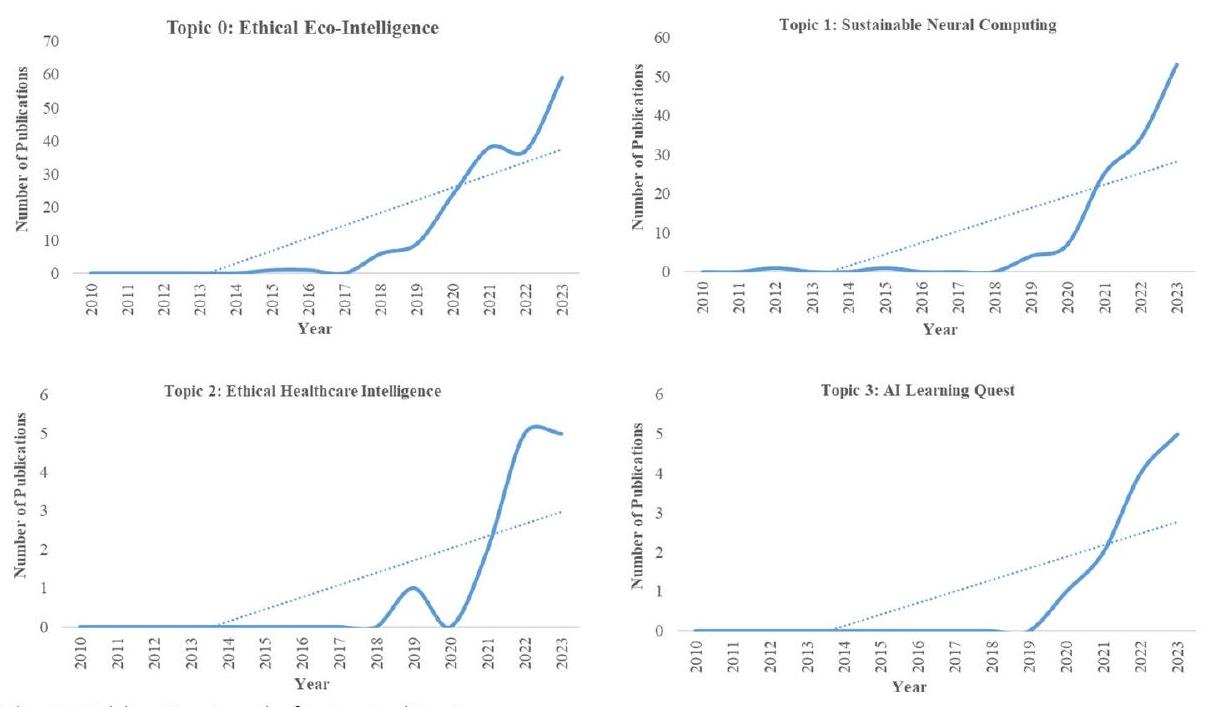
تم تصور التطور الزمني السنوي للمواضيع بناءً على عدد المقالات المنشورة حول كل موضوع ضمن أبحاث الذكاء الاصطناعي الأخضر في الشكل 4 في الملحق. لوحظ أن المزيد من المنشورات تنتمي إلى الموضوع-0 (الذكاء البيئي الأخلاقي) والموضوع-1 (الحوسبة العصبية المستدامة)، وأن هذه المواضيع هي أكثر مجالات البحث نشاطًا. يتم تصوير الاتجاهات الموضوعية المستمدة من عدد المقالات في كل موضوع وسنة نشرها في الشكل 5 في الملحق.
يكشف الفحص الدقيق للأشكال أن تطور مواضيع الذكاء الاصطناعي الأخضر والمستدام يكشف عن مشهد ديناميكي يتشكل من خلال أولويات متغيرة واتجاهات ناشئة على مر الزمن. ظهر ابتكار الذكاء الاصطناعي المعرفي كنقطة محورية منذ عام 2016، حيث شهد نموًا ثابتًا قبل أن يرتفع في الأهمية بحلول عام 2023، مما يعكس تركيزًا متزايدًا على أساليب الذكاء الاصطناعي الرائدة المخصصة لتحديات الاستدامة. في الوقت نفسه، يحظى الذكاء البيئي الأخلاقي باهتمام متزايد، خاصة منذ عام 2018، مما يشير إلى اعتراف متزايد بالضرورات الأخلاقية الكامنة في تطبيقات الذكاء البيئي، مع نمو أسي في السنوات الأخيرة. تشهد الحوسبة العصبية المستدامة نموًا تدريجيًا ولكن ملحوظًا، مع ارتفاعات في عامي 2021 و2023، مما يشير إلى اهتمام متزايد بحلول الحوسبة المستدامة المدفوعة بالشبكات العصبية.
علاوة على ذلك، تكشف تحليلاتنا عن تقاطع متزايد بين الأخلاق والرعاية الصحية والذكاء الاصطناعي، يتجلى في صعود الذكاء الصحي الأخلاقي، الذي يظهر إشارات متقطعة ولكن زيادة ملحوظة في السنوات الأخيرة. أخيرًا، تتكشف السرد مع سعي تعلم الذكاء الاصطناعي، الذي يظهر في البداية إشارات متواضعة ولكنه شهد زيادة من عام 2020 فصاعدًا، مما يبرز اهتمامًا متزايدًا بمبادرات التعلم المدفوعة بالذكاء الاصطناعي ضمن مجال الاستدامة. معًا، تضيء هذه المواضيع المستخرجة التطور المتعدد الأبعاد لأبحاث الذكاء الاصطناعي الأخضر والمستدام، مما يعكس تعقيد المجال المتزايد وسبل الاستفسار المتنوعة التي تدفع التقدم في الابتكار التكنولوجي المستدام.

الاستنتاجات مع الآثار

تم استخدام تحليل الموضوعات باستخدام تكرار الكلمات ونمذجة BERTopic بشكل متزامن في دراستنا لتحليل أدبيات الذكاء الاصطناعي الأخضر والمستدام، حيث ساهم كل منهما بقوة منهجية مميزة. قدم تحليل الموضوعات نهجًا منظمًا ومنهجيًا لتحديد الموضوعات الصريحة، مما يضمن أن المجالات الرئيسية للبحث كانت محددة بوضوح ومفهومة (RQ1). في المقابل، جلبت نمذجة BERTopic عمقًا دقيقًا للتحليل من خلال الاستفادة من تقنيات معالجة اللغة الطبيعية المدركة للسياق (RQ2). كانت هذه الطريقة بارعة بشكل خاص في
كشف العلاقات الدقيقة، التي غالبًا ما يتم تجاهلها، بين الموضوعات، مما يضيف طبقة من التعقيد إلى الهيكل الموضوعي الذي حددته تحليل الموضوعات.
تحليل الببليومترية لأبحاث الذكاء الاصطناعي الأخضر والمستدام في هذه الدراسة يحدد ثلاثة تجمعات موضوعية محورية، كل منها يمثل جانبًا فريدًا من تطور هذا المجال (RQ1). الذكاء الاصطناعي المسؤول من أجل التنمية المستدامة (التجمع 1) يبرز الالتزام بدمج التنمية المستدامة والأطر الأخلاقية في الذكاء الاصطناعي. يعكس هذا التجمع التركيز على تطوير تقنيات الذكاء الاصطناعي التي تأخذ في الاعتبار البيئة وتتوافق أخلاقيًا، مع تقدم كبير في الأجهزة والتقنيات الحاسوبية الموفرة للطاقة. الأعمال المذكورة ضمن هذا التجمع تظهر التزامًا بالابتكار المسؤول، داعيةً إلى الذكاء الاصطناعي الذي يعزز التوازن البيئي ورفاهية المجتمع، وبالتالي يساهم في مستقبل أكثر استدامة. التقدم في الذكاء الاصطناعي الأخضر لتحسين الطاقة (التجمع 2) يركز على التحسينات التكنولوجية التي تهدف إلى تقليل استهلاك الطاقة في الذكاء الاصطناعي. يبرز هذا التجمع التآزر بين الذكاء الاصطناعي وممارسات الطاقة المستدامة، مع التركيز على الحوسبة الخضراء والخوارزميات الموفرة للطاقة. يشير إلى تحول في تطوير الذكاء الاصطناعي، مع إعطاء الأولوية للكفاءة الحاسوبية والاستدامة البيئية. يدور نقاش التجمع حول استراتيجيات عملية لتقليل التكلفة الحاسوبية للذكاء الاصطناعي، مما يظهر التزامًا بالحفاظ على البيئة في مجال التكنولوجيا. التقدمات المدفوعة بالبيانات الكبيرة (التجمع 3) تستكشف تقاطع الذكاء الاصطناعي مع البيانات الكبيرة، مع التركيز على كل من التقدم التكنولوجي والآثار الاجتماعية والاقتصادية والبيئية. يلتقط هذا التجمع طيفًا واسعًا من الأبحاث، من تحسين الأساليب الحاسوبية إلى فهم الآثار الاجتماعية للذكاء الاصطناعي، بما في ذلك الاعتبارات الأخلاقية ومخاوف الخصوصية. تسلط المنشورات في هذا التجمع الضوء على أهمية نهج متوازن يتنقل بين الابتكار التكنولوجي واحتياجات المجتمع ومخاوف البيئة، داعيةً إلى تطوير شامل ومسؤول لتقنيات الذكاء الاصطناعي.
تستفيد دراستنا من نمذجة BERTopic لتفكيك المجال الواسع للأدبيات المتعلقة بالذكاء الاصطناعي الأخضر والمستدام، كاشفةً عن خمسة مواضيع متميزة (RQ2). الذكاء الاصطناعي الأخلاقي والذكاء البيئي والاستدامة (الموضوع 0) يدل على المجال المتزايد للاعتبارات الأخلاقية في الذكاء الاصطناعي مع التركيز على الذكاء البيئي. تتناول الدراسات ضمن هذا الموضوع تعقيدات إدراك المستخدم والدور الضروري للوعي البيئي في اعتماد التكنولوجيا. تؤكد النتائج على ضرورة دمج المداولات الأخلاقية مع الجاهزية التكنولوجية والفائدة، خاصة في مجالات متخصصة مثل الذكاء الاصطناعي في الرياضة. الحوسبة العصبية المستدامة (الموضوع 1) تظهر كموضوع محوري، تركز على تطوير أنظمة حوسبة عصبية موفرة للطاقة وصديقة للبيئة.
تقدم الدراسات التمثيلية طرقًا وتطبيقات رائدة، مثل أطر الذكاء الاصطناعي الموفرة للطاقة للبيوت الزجاجية والتطبيقات الطبية، مما يبرز إمكانيات القطاع في تقليل استهلاك الطاقة. التركيز على تقنيات الأجهزة المبتكرة مثل تقنية الميمريستور ومنصة الحوسبة العصبية المقاومة بالكامل يشير إلى اتجاه حاسم في التكنولوجيا المستدامة، يهدف إلى تقليل كبير في استهلاك الطاقة في عمليات الذكاء الاصطناعي. الذكاء الأخلاقي في الرعاية الصحية (الموضوع 2) يتناول المعضلات الأخلاقية واستراتيجيات النشر المستدامة في الرعاية الصحية المدفوعة بالذكاء الاصطناعي. تغطي دراسات متنوعة مجموعة من القضايا، من الدفع والتأثيرات البيئية إلى مجالات الرعاية الصحية المحددة مثل صحة الفم وطب المختبرات. يدور النقاش حول مواءمة الذكاء الاصطناعي مع المعايير الأخلاقية، مع التركيز على التقييمات المنهجية والحاجة إلى أطر أخلاقية شاملة.
تسلط الضوء على التحديات والفرص المتعددة الأوجه في تحقيق الذكاء الاصطناعي الأخلاقي والمستدام في الرعاية الصحية. رحلة تعلم الذكاء الاصطناعي (الموضوع 3) تستكشف المشهد المتطور لتعليم الذكاء الاصطناعي ومنهجيات التعلم. تسلط الدراسات في هذا الموضوع الضوء على الإدراكات والنوايا والمنهجيات من وجهات نظر كل من المعلمين والطلاب. تؤكد على أهمية دمج الذكاء الاصطناعي في المناهج التعليمية ومنهجيات التدريس مع التوافق مع مفاهيم الخير الاجتماعي والاستدامة.
عند فحص نتائج RQ1 و RQ2 و RQ3، يوفر تقاطع وتباين الموضوعات والمواضيع الرؤى والتوصيات التالية لمشهد الذكاء الاصطناعي الأخضر والمستدام:
  1. تقاطع الأخلاق والاستدامة: تظهر كلتا المنهجيتين التداخل الكبير بين الاعتبارات الأخلاقية والاستدامة في الذكاء الاصطناعي. الذكاء الاصطناعي المسؤول من أجل التنمية المستدامة (التجمع 1) من RQ1، جنبًا إلى جنب مع “الذكاء الأخلاقي البيئي (الموضوع 0)” و”الذكاء الأخلاقي في الرعاية الصحية (الموضوع 2)” من RQ2. بينما تصنف التحليل الموضوعي هذا كموضوع أساسي، توفر نمذجة BERTopic رؤى محددة حول مواضيع النقاش الأصغر في الرعاية الصحية وأخلاقيات الرعاية الصحية. يتماشى هذا مع الهدف 3 من أهداف التنمية المستدامة (الصحة الجيدة والرفاه) من خلال تركيزه على الرعاية الصحية وأخلاقيات الرعاية الصحية ومع الهدف 16 (السلام والعدالة والمؤسسات القوية) من خلال الدعوة إلى الأطر الأخلاقية والتقييمات المنهجية (RQ3).
  2. الذكاء الاصطناعي والبيانات الكبيرة من أجل التأثير الاجتماعي: “التقدمات المدفوعة بالبيانات الكبيرة (التجمع 3)” تقترح استخدام الذكاء الاصطناعي والبيانات الكبيرة لمعالجة الابتكار التكنولوجي مع مراعاة الاحتياجات الاجتماعية والاقتصادية. تحسين التأثير الاجتماعي والاقتصادي من خلال التقدم التكنولوجي يدعم الهدف 8 من أهداف التنمية المستدامة (العمل اللائق والنمو الاقتصادي) والهدف 9 (الصناعة والابتكار والبنية التحتية). ضمن هذا، تكشف نمذجة BERTopic عن الاتجاه الناشئ “رحلة التعلم”، الذي يتماشى مع الهدف 4 (التعليم الجيد)، مثل تعزيز المناهج التعليمية مع اعتبارات الذكاء الاصطناعي الأخلاقي (RQ3).
  3. التقدمات في تقنيات الذكاء الاصطناعي الأخضر وتحسين الطاقة: التركيز على تقليل استهلاك الطاقة وتعزيز الحوسبة الخضراء في “التقدمات في الذكاء الاصطناعي الأخضر لتحسين الطاقة” (التجمع 2) مع “الحوسبة العصبية المستدامة” (الموضوع 1) يدعم الهدف 7 من أهداف التنمية المستدامة (الطاقة النظيفة وبأسعار معقولة) والهدف 12 (الاستهلاك والإنتاج المسؤولين) من خلال تعزيز الخوارزميات والأجهزة الموفرة للطاقة. يجب على شركات التكنولوجيا وباحثي الجامعات التركيز على تقنيات الحوسبة الخضراء لبناء خوارزميات وأجهزة موفرة للطاقة، مع تحفيز صانعي السياسات على التطورات. تتماشى هذه الاستراتيجيات مع الهدف 9 (الصناعة والابتكار والبنية التحتية) والهدف 13 (العمل المناخي) من خلال تعزيز الابتكار في خدمة الحفاظ على البيئة (RQ3).

الآثار على مختلف أصحاب المصلحة

الهيئات الدولية مثل الأمم المتحدة

بينما يمكن أن يكون الذكاء الاصطناعي مفيدًا للغاية في تطبيقات حيوية مختلفة مثل التدخلات في الأزمات، يجب دراسة تأثيره على ممارسات حقوق الإنسان بدقة للبقاء على المسار الصحيح نحو “الذكاء الاصطناعي من أجل الخير”. يجب على الأمم المتحدة والهيئات المماثلة توجيه دمج التنمية المستدامة والأطر الأخلاقية في الذكاء الاصطناعي، كما تم التأكيد عليه في التجمع 1: الذكاء الاصطناعي المسؤول من أجل التنمية المستدامة. يشير هذا التجمع إلى التركيز على
استغلال الذكاء الاصطناعي لمواجهة التحديات البيئية والتنموية المعقدة، مما يبرز الحاجة إلى نهج متكامل للأخلاق والتنمية المستدامة في صنع السياسات المتعلقة بالذكاء الاصطناعي (الشكل 3 والجدول 1 في الوثيقة).
يجب معالجة الجوانب التالية.
  • السيناريو الذي يهيمن فيه المتخصصون في التكنولوجيا والشركات المطورة للتكنولوجيا (بما في ذلك الخاصة) على تحديد الجوانب القانونية والأخلاقية والحكومية للذكاء الاصطناعي يجب التعامل معه بحذر، ويجب أن تكون هناك جهود كبيرة لتحديد الأدوار والمسؤوليات والمساءلة بين خبراء التكنولوجيا، والشركات التكنولوجية، والخبراء القانونيين والأخلاقيين، وعلماء الأنثروبولوجيا، والخبراء الإداريين.
  • يجب أن يتم اتخاذ قرار نشر تكنولوجيا الذكاء الاصطناعي في التدخلات في الأزمات وغيرها من التطبيقات بعد دراسة دقيقة لتأثير اتخاذ القرار التلقائي على السكان المستهدفين لتجنب أي ت compromise محتمل في حقوق الإنسان.
  • يجب أن يؤخذ تأثير الديناميات (النمو) للبيانات المولدة تلقائيًا على التفسيرات التلقائية واتخاذ القرار بعين الاعتبار بعناية قبل وضع السياسات والإرشادات للدول المكونة بشأن الذكاء الاصطناعي.
  • يجب تشجيع نهج الذكاء الاصطناعي الأخضر المنسق بناءً على مبادئ وتوصيات الذكاء الاصطناعي الأخضر نحو “الذكاء الاصطناعي من أجل الخير الاجتماعي” من الأدبيات المتطورة ذات الصلة، حيث إن مبادئ التصميم والتطوير والحوكمة السائدة ليست كافية لتحقيق الذكاء الاصطناعي الأخضر أو المستدام للبشرية.

صناع السياسات على المستوى الوطني

يجب احتضان تعدد الإمكانيات التي تقدمها الذكاء الاصطناعي، ولكن يجب أن تكون هناك آليات للحد من تأثيرها السلبي وسوء استخدامها قبل أن تواجه البشرية آثارًا ضارة. يجب على صناع السياسات الوطنيين معالجة التحديات البيئية واستهلاك الطاقة للذكاء الاصطناعي كما هو موضح في المجموعة 2: التقدم في الذكاء الاصطناعي الأخضر لتحسين الطاقة والآثار الاجتماعية والاقتصادية كما هو موضح في المجموعة 3: التقدم الحسابي المدفوع بالبيانات الضخمة. يجب أن تتضمن التوصيات صياغة وتطبيق أطر أخلاقية وقانونية وتنظيمية قوية ومتوافقة مع الذكاء الاصطناعي الأخضر، وتعزيز نظام صناعي للأجهزة الموفرة للطاقة، وضمان توافق الاستراتيجيات الوطنية مع هذه الأهداف العالمية للاستدامة. يمكن النظر في الاقتراحات التالية.
  • نظرًا لأن الذكاء الاصطناعي الأخضر والمستدام يتطلب صياغة أطر أخلاقية وقانونية وتنظيمية أكثر دقة، عالمية ومتوافقة مع الذكاء الاصطناعي الأخضر أو المستدام مقارنة بالأطر الحالية غير الكافية (في بعض البلدان) للذكاء الاصطناعي التقليدي، يجب أن تكون هناك جهود منسقة لضمان صياغة وتطبيق مثل هذه الأطر.
  • يجب تعزيز نظام بحث وتطوير، بالإضافة إلى نظام صناعي، لتطوير وتسويق أجهزة الحوسبة الثقيلة الموفرة للطاقة والمتوافقة مع أجهزة وأنظمة الذكاء الاصطناعي التي يمكن أن تسهم بشكل كبير في الأعمدة التقنية والاقتصادية والبيئية للذكاء الاصطناعي الأخضر أو المستدام.
  • يجب معالجة تعيين الأدوار والمسؤوليات والالتزامات القانونية للتقنيين والشركات التقنية وغيرهم من أصحاب المصلحة الحيويين داخل الدولة بما يتماشى مع الإرشادات والمعايير الدولية المقدمة من وكالات مثل الأمم المتحدة.
  • يجب معالجة المخاوف المثارة فيما يتعلق بالتأثيرات الاجتماعية والفردية للذكاء الاصطناعي وأي شيء ينطبق على مواقع أو مناطق معينة بشكل محدد بدلاً من محاولة ملاءمتها في قالب مشترك. ومع ذلك، يجب أن تستمر الجهود لدمج مثل هذه القضايا تحت مظلة واحدة لتوفير حلول أفضل على المدى الطويل.
  • يجب إعطاء الأولوية القصوى لقضايا ملحة مثل أمان البيانات والخصوصية والقضايا التي أثارها التفسير التلقائي لاتخاذ القرار في التطبيقات المتعلقة بالحكومة. يجب أن يتم تنفيذ الذكاء الاصطناعي لهذه التطبيقات فقط بعد دراسة دقيقة وبعد موافقة خبراء حقوق الإنسان وعلماء الأنثروبولوجيا والآليات القضائية، إلخ.
  • لضمان التقدم نحو الذكاء الاصطناعي الأخضر، يجب أن تكون هناك نماذج شراكة خاصة عامة خاصة بدلاً من الاعتماد على نماذج الشراكة التقليدية.
  • يجب على الوكالات الحكومية ذات الصلة ووكالات إنفاذ القانون بناء مجموعة من الخبرات وتحديثها مع وتيرة التقدم التكنولوجي للذكاء الاصطناعي لضمان عدم إساءة استخدامه مما يؤثر على الجوانب الاجتماعية والتكنولوجية والاقتصادية والبيئية للذكاء الاصطناعي الأخضر أو المستدام.
  • يجب زيادة الوعي العام حول الآثار الإيجابية والسلبية المحتملة أو سوء الاستخدام وتحديثه مع تطور التكنولوجيا، ويجب أخذ الملاحظات في الاعتبار لتقدير مستوى القبول الاجتماعي قبل أي اتخاذ قرار جاد.

شركات التكنولوجيا

بالنسبة لشركات التكنولوجيا، يبرز تحليل نمذجة BERTopic (RQ2) أهمية فهم العلاقات الدقيقة بين الموضوعات والمواضيع المختلفة في الذكاء الاصطناعي الأخضر والمستدام (الجدول 4). يجب أن تركز الشركات على المسؤولية القانونية، وتوافق السياسات، وتطوير أجهزة مبتكرة وموفرة للطاقة. تحتاج إلى أن تكون في طليعة اعتماد وتعزيز مبادئ الذكاء الاصطناعي الأخضر، وضمان أن استراتيجياتها ومنتجاتها تساهم في الأهداف الأوسع للذكاء الاصطناعي المستدام والأخلاقي.
مع الغزو المحتمل للذكاء الاصطناعي في جميع مجالات الحياة تقريبًا، ستكون شركات التكنولوجيا أصحاب المصلحة الرئيسيين الذين يتحملون مسؤولية جني أقصى فوائد التكنولوجيا. يجب على شركات التكنولوجيا أن تأخذ في الاعتبار على الأقل الاقتراحات التالية لمساهمتها المسؤولة نحو مبادرة الذكاء الاصطناعي الأخضر والمستدام.
  • مع توقع منح المزيد من القوة والمسؤولية لشركات تكنولوجيا الذكاء الاصطناعي، من المؤكد أن هناك المزيد من المسؤولية القانونية والمساءلة، ويجب أن تكون الشركات حذرة جدًا في صياغة سياساتها التنظيمية وارتباطات موظفيها القانونية بما يتماشى مع القوانين واللوائح الوطنية والعالمية.
  • نظرًا لأن التوازن بين الربح والسمعة يتم التحذير منه في مثل هذا السيناريو، يجب على الإدارة العليا أن تظهر الحكمة والنضج لتجنب الجشع مع السعي لتعظيم الربح. يجب أن تبذل جهدًا واعيًا للحفاظ على تحفيز الموظفين ضد أي أنشطة غير قانونية أو إجرامية محتملة.
  • بالإضافة إلى تقدم الخوارزميات والبرمجيات، تعتبر تقنيات توليد البيانات وتخزينها، ومتطلبات الأجهزة الحاسوبية الموفرة للطاقة أيضًا حيوية وهناك إمكانات سوقية لمثل هذا التطوير، يمكن أن تفكر شركات التكنولوجيا التقليدية وشركات الذكاء الاصطناعي في استراتيجيات التنويع أو التوسع لاغتنام الفرصة.
  • نظرًا لوجود مجموعة من الفرص التجارية الجديدة، بما في ذلك تلك المتعلقة بـ “الحوكمة”، فإن القدرة على توظيف الموارد البشرية، وبناء القدرات، وتحقيق المرونة والاستعداد بسرعة كبيرة لاستيعاب مجموعة من الفرص التي يمكن أن تتجسد بشكل كبير، والقدرة على الالتزام تجاه الذكاء الاصطناعي الأخضر أو المستدام ستكون عاملًا رئيسيًا في النجاح في الأوقات القادمة.

قيود هذه الدراسة

توجد عدة عوامل تقيد دراستنا. أولاً، قد يحد نطاق الأدبيات المستندة إلى قاعدة البيانات المختارة من الشمولية، حيث إن استبعاد بعض المجلات أو المؤتمرات أو اللغات قد يتجاهل الأبحاث ذات الصلة في هذا المجال. ثانيًا، بينما يوفر الجمع بين التجميع الموضوعي ونمذجة BERTopic تحليلًا قويًا، فإن كل طريقة لها قيودها الجوهرية في التقاط تعقيدات المجال، مما قد يؤدي إلى تبسيط بعض الجوانب. أيضًا، يمكن أن يؤدي الطابع الذاتي لتفسير الموضوعات والمواضيع، حتى مع تقنيات النمذجة المتقدمة، إلى إدخال تحيزات أو تفسيرات خاطئة، مما يبرز الحاجة إلى مراجعة نقدية والتحقق من صحة من قبل خبراء في المجال. بالإضافة إلى ذلك، حيث تستخدم هذه الدراسة الاقتباسات من المنشورات المتعلقة بالتجمعات الموضوعية والمواضيع المحددة كبديل للتأثير، فإن هذه الدراسة عرضة لجميع القيود المحتملة لتحليل الاقتباسات مثل التحيزات المحتملة في الاقتباس مثل تحيز الاقتباس الإيجابي الذي يؤدي إلى انتشار المفاهيم الخاطئة أيضًا بين الأفكار المستقبلة بشكل جيد وكذلك قمع الانتقادات أو الأبحاث غير الإيجابية [43]، والممارسات مثل عدم النسبة أو متلازمة الكتابة على ورق قديم [49] أو الأخطاء في الاقتباسات أو الإزالة من خلال الدمج [46،50]. تبرز هذه القيود أهمية اعتبار هذه الدراسة كلقطة في الوقت في مشهد سريع التطور لأبحاث الذكاء الاصطناعي (الملف الإضافي 1).

الملحق

انظر الأشكال 3، 4، 5.
الشكل 3 خريطة المسافة بين الموضوعات (باستثناء الضوضاء)
تطور الموضوعات المستخرجة
الشكل 4 تطور الموضوعات المستخرجة (بما في ذلك الضوضاء)
الشكل 5 اتجاه نشر الموضوعات المستخرجة

معلومات إضافية

تحتوي النسخة الإلكترونية على مواد إضافية متاحة على https://doi.org/10.1186/s40537-024-00920-x.
الملف الإضافي 1. مجموعة البيانات المستخدمة في هذه الدراسة.

الشكر والتقدير

نود أن نعبر عن امتناننا العميق لمستشارنا المحبوب، ماتا أميتنانداماي ديفي (أمّا)، لتوفير الدافع والإلهام لهذا العمل البحثي.

مساهمات المؤلفين

ساهم RR و DP و HL في تصور وتصميم العمل، وتفسير البيانات. ساهم CK في جمع البيانات وتنظيمها وتحليلها. قام RR و DP و HL و CK و KG و PN بصياغة العمل ومراجعته بشكل جوهري. قرأ جميع المؤلفين ووافقوا على المخطوطة النهائية.

التمويل

يعلن المؤلفون أنهم لم يتلقوا أي تمويل.

توفر البيانات والمواد

تتوفر مجموعات البيانات المستخدمة خلال الدراسة الحالية كمواد إضافية.

الإعلانات

غير قابل للتطبيق.
غير قابل للتطبيق.

المصالح المتنافسة

يعلن المؤلفون أنهم ليس لديهم مصالح متنافسة.
تم الاستلام: 31 ديسمبر 2023 تم القبول: 7 أبريل 2024
تم النشر عبر الإنترنت: 22 أبريل 2024

References

  1. Ahmad T, Zhang D, Huang C, Zhang H, Dai N, Song Y, Chen H. Artificial intelligence in sustainable energy industry: Status Quo, challenges and opportunities. J Clean Prod. 2021;289:125834.
  2. Ajagekar A, Mattson NS, You F. Energy-efficient ai-based control of semi-closed greenhouses leveraging robust optimization in deep reinforcement learning. Adv Appl Energy. 2023;9:100119.
  3. Alhashmi SM, Hashem IA, AI-Qudah I. Artificial intelligence applications in healthcare: a bibliometric and topic model-based analysis. Intell Syst App. 2023;21:200299.
  4. Arvind KS, Madhuri GS. An energy efficient artificial intelligence based innovation detection for complex data communication model. In: 2023 international conference on distributed computing and electrical circuits and electronics (ICDCECE). IEEE; 2023. p. 1-7.
  5. Asmussen CB, Møller C. Smart literature review: a practical topic modeling approach to exploratory literature review. J Big Data. 2019;6(1):1-18.
  6. Bag S, Pretorius JHC, Gupta S, Dwivedi YK. Role of institutional pressures and resources in the adoption of big data analytics powered artificial intelligence, sustainable manufacturing practices and circular economy capabilities. Technol Forecast Soc Chang. 2021;163:120420.
  7. Bibri SE. The eco-city and its core environmental dimension of sustainability: green energy technologies and their integration with data-driven smart solutions. Energy Inform. 2020;3(1):1-26.
  8. Bibri SE, Krogstie J. The core enabling technologies of big data analytics and context-aware computing for smart sustainable cities: a review and synthesis. J Big Data. 2017;4:1-50.
  9. Blei DM, Ng AY, Jordan MI. Latent dirichlet allocation. J Mach Learn Res. 2003;3:993-1022.
  10. Bolte L, Vandemeulebroucke T, van Wynsberghe A. From an ethics of carefulness to an ethics of desirability: going beyond current ethics approaches to sustainable AI. Sustainability. 2022;14(8):4472.
  11. Boyatzis RE. Transforming qualitative information: thematic analysis and code development. Sage; 1998.
  12. Braun V, Clarke V. Using thematic analysis in psychology. Qual Res Psychol. 2006;3(2):77-101.
  13. Capasso M, Umbrello S. Responsible nudging for social good: new healthcare skills for AI-driven digital personal assistants. Med Health Care Philos. 2022;25(1):11-22.
  14. Chai CS, Chiu TK, Wang , Jiang F, Lin XF. Modeling Chinese secondary school students’ behavioral intentions to learn artificial intelligence with the theory of planned behavior and self-determination theory. Sustainability. 2022;15(1):605.
  15. Chu S, Majumdar A. Opportunities and challenges for a sustainable energy future. Nature. 2012;488(7411):294-303.
  16. Conte F, Cordelli E, Guarrasi V, lannello G, Sicilia R, Soda P et al. Sustainable AI: inside the deep, alongside the green. CEUR Workshop Proceedings. 2022; 3486:22-627.
  17. Das, K. P., & Chandra, J. (2023). A survey on artificial intelligence for reducing the climate footprint in healthcare. Energy Nexus, 9, 100167.
  18. Doorn N. Artificial intelligence in the water domain: opportunities for responsible use. Sci Total Environ. 2021;755:142561.
  19. Duan Y, Edwards JS, Dwivedi YK. Artificial intelligence for decision making in the era of Big Data-evolution, challenges and research agenda. Int J Inf Manage. 2019;48:63-71.
  20. Ducret M, Mörch CM, Karteva T, Fisher J, Schwendicke F. Artificial intelligence for sustainable oral healthcare. J Dent. 2022;127:104344.
  21. Egger R, Yu J. A topic modeling comparison between Ida, nmf, top2vec, and bertopic to demystify twitter posts. Front Sociol. 2022;7:886498.
  22. Falk S, van Wynsberghe A. Challenging AI for sustainability: what ought it mean? AI Ethics. 2023. https://doi.org/ 10.1007/s43681-023-00323-3.
  23. Ferro M, Silva GD, de Paula FB, Vieira V, Schulze B. Towards a sustainable artificial intelligence: a case study of energy efficiency in decision tree algorithms. Concurr Comput Pract Exp. 2023;35(17):e6815.
  24. Floridi L, Cowls J, King TC, Taddeo M. How to design Al for social good: seven essential factors. Ethics, Governance, and Policies in Artificial Intelligence. Philosophical Studies Series. 2021. 144:125-151.
  25. Galaz V, Centeno MA, Callahan PW, Causevic A, Patterson T, Brass I, et al. Artificial intelligence, systemic risks, and sustainability. Technol Soc. 2021;67:101741.
  26. Gao L, Liu Z. Unraveling the multifaceted nexus of artificial intelligence sports and user willingness: a focus on technology readiness, perceived usefulness, and green consciousness. Sustainability. 2023;15(18):13961.
  27. Goodell JW, Kumar S, Li X, Pattnaik D, Sharma A. Foundations and research clusters in investor attention: evidence from bibliometric and topic modeling analysis. Int Rev Econ Financ. 2022;82:511-29.
  28. Griffiths TL, Steyvers M. Finding scientific topics. Proc Natl Acad Sci. 2004;101(suppl_1):5228-35.
  29. Grootendorst, M. (2022). BERTopic: Neural topic modeling with a class-based TF-IDF procedure (arXiv:2203.05794). arXiv. https://doi.org/10.48550/arXiv.2203.05794
  30. Gupta S, Langhans SD, Domisch S, Fuso-Nerini F, Felländer A, Battaglini M, et al. Assessing whether artificial intelligence is an enabler or an inhibitor of sustainability at indicator level. Transp Eng. 2021;4:100064.
  31. Harvard Business Review. How to make generative AI greener; 2023. https://hbr.org/2023/07/how-to-make-gener ative-ai-greener
  32. Hofmann T. Unsupervised learning by probabilistic latent semantic analysis. Mach Learn. 2001;42:177-96.
  33. Holloway I, Todres L. The status of method: flexibility, consistency and coherence. Qual Res. 2003;3(3):345-57.
  34. Hsu TC, Abelson H, Lao N, Chen SC. Is it possible for young students to learn the AI-STEAM application with experiential learning? Sustainability. 2021;13(19):11114.
  35. Jobin A, lenca M, Vayena E. The global landscape of AI ethics guidelines. Nat Mach Intell. 2019;1(9):389-99.
  36. Katirai A. The ethics of advancing artificial intelligence in healthcare: analyzing ethical considerations for Japan’s innovative AI hospital system. Front Public Health. 2023;11:1142062.
  37. Khosravi A, Syri S, Pabon JJ, Sandoval OR, Caetano BC, Barrientos MH. Energy modeling of a solar dish/Stirling by artificial intelligence approach. Energy Convers Manage. 2019;199:112021.
  38. Kim H, Ben-Othman J. Eco-friendly low resource security surveillance framework toward green AI digital twin. IEEE Commun Lett. 2022;27(1):377-80.
  39. König PD, Wurster S, Siewert MB. Consumers are willing to pay a price for explainable, but not for green AI. Evidence from a choice-based conjoint analysis. Big Data Soc. 2022;9(1):20539517211069630.
  40. Kulkov I, Kulkova J, Rohrbeck R, Menvielle L, Kaartemo V, Makkonen H. Artificial intelligence-driven sustainable development: Examining organizational, technical, and processing approaches to achieving global goals. Sustain Dev. 2023. https://doi.org/10.1002/sd.2773.
  41. Kumar C, Pattnaik D, Balas VE, Raman R. Comprehensive scientometric analysis and longitudinal sdg mapping of quality and reliability engineering international journal. J Scientometr Res. 2023;12(3):558-69.
  42. Kwon SM, Kwak JY, Song S, Kim J, Jo C, Cho SS, et al. Large-area pixelized optoelectronic neuromorphic devices with multispectral light-modulated bidirectional synaptic circuits. Adv Mater. 2021;33(45):2105017.
  43. Letrud K, Hernes S. Affirmative citation bias in scientific myth debunking: a three-in-one case study. PLoS ONE. 2019;14(9):e0222213.
  44. Li VO, Lam JC, Cui J. Al for social good: Al and big data approaches for environmental decision-making. Environ Sci Policy. 2021;125:241-6.
  45. Lin XF, Chen L, Chan KK, Peng S, Chen X, Xie S, et al. Teachers’ perceptions of teaching sustainable artificial intelligence: a design frame perspective. Sustainability. 2022;14(13):7811.
  46. McCain KW. Obliteration by incorporation. beyond bibliometrics: harnessing multidimensional indicators of scholarly impact. MIT Press. 2014;129-49. https://doi.org/10.7551/mitpress/9445.003.0011.
  47. McInnes L, Healy J, Melville J. UMAP: uniform manifold approximation and projection for dimension reduction (arXiv:1802.03426). arXiv; 2020. https://doi.org/10.48550/arXiv.1802.03426
  48. Mehonic A. Energy-Efficient AI Systems Based on Memristive Technology. In: International conference “new technologies, development and applications”. Cham: Springer International Publishing; 2022. p. 439-442.
  49. Merton RK. On the shoulders of giants: a Shandean postscript. University of Chicago Press; 1965.
  50. Merton RK. The Matthew effect in science, II: cumulative advantage and the symbolism of intellectual property. Isis. 1988;79(4):606-23.
  51. Murphy K, Di Ruggiero E, Upshur R, Willison DJ, Malhotra N, Cai JC et al. Artificial intelligence for good health: a scoping review of the ethics literature. BMC Med Ethics. 2021;22:1-17.
  52. Nikolenko SI, Koltcov S, Koltsova O. Topic modeling for qualitative studies. J Inf Sci. 2017;43(1):88-102.
  53. Nowell LS, Norris JM, White DE, Moules NJ. Thematic analysis: striving to meet the trustworthiness criteria. Int J Qual Methods. 2017;16(1):1609406917733847.
  54. Ong YS, Gupta A. Air 5: five pillars of artificial intelligence research. IEEE Trans Emerg Top Comput Intell. 2019;3(5):411-5.
  55. Page MJ, McKenzie JE, Bossuyt PM, Boutron I, Hoffmann TC, Mulrow CD, Shamseer L, Tetzlaff JM, AkI EA, Brennan SE, Chou R, Glanville J, Grimshaw JM, Hróbjartsson A, Lalu MM, Li T, Loder EW, Mayo-Wilson E, McDonald S, et al. The PRISMA 2020 statement: an updated guideline for reporting systematic reviews. Syst Rev. 2021;10(1):89.
  56. Pattnaik D, Kumar S, Burton B. Thirty years of The Australian Accounting Review: a bibliometric analysis. Aust Acc Rev. 2021;31:150-64.
  57. Pattnaik D, Kumar S, Burton B, Lim WM. Economic modelling at thirty-five: a retrospective bibliometric survey. Econ Model. 2022;107:105712.
  58. Pattnaik D, Hassan MK, Dsouza A, Ashraf A. Investment in gold: a bibliometric review and agenda for future research. Res Int Bus Fin. 2023;64:101854.
  59. Pattnaik D, Ray S, Raman R. Applications of artificial intelligence and machine learning in the financial services industry: a bibliometric review. Heliyon; 2024.
  60. Pedemonte V. AI for Sustainability: an overview of AI and the SDGs to contribute to the European policy-making; 2020.
  61. Pennestrì F, Banfi G. Artificial intelligence in laboratory medicine: fundamental ethical issues and normative keypoints. Clin Chem Lab Med (CCLM). 2022;60(12):1867-74.
  62. Polas MRH, Jahanshahi AA, Ahamed B, Molla MOF. The future of artificial intelligence in education 4.0: how to go green in the post-COVID-19 context. In: Technology management and its social impact on education. IGI Global; 2023. p. 1-20.
  63. Rama R, Nair VK, Nedungadi P, Ray I, Achuthan K. Darkweb research: past, present, and future trends and mapping to sustainable development goals. Heliyon. 2023;9:e22269.
  64. Raman R, Lathabhai H, Mandal S, Kumar C, Nedungadi P. Contribution of business research to sustainable development goals: bibliometrics and science mapping analysis. Sustainability. 2023;15(17):12982.
  65. Raman R, Nair VK, Shivdas A, Bhukya R, Viswanathan PK, Subramaniam N, Nedungadi P. Mapping sustainability reporting research with the UN’s sustainable development goal. Heliyon. 2023;9:e18510.
  66. Richie C. Environmentally sustainable development and use of artificial intelligence in health care. Bioethics. 2022;36(5):547-55.
  67. Robbins S, van Wynsberghe A. Our new artificial intelligence infrastructure: becoming locked into an unsustainable future. Sustainability. 2022;14(8):4829.
  68. Rutkowski TM, Abe MS, Otake-Matsuura M. Neurotechnology and AI approach for early dementia onset biomarker from EEG in emotional stimulus evaluation task. In: Annual international conference of the IEEE engineering in medicine and biology society. IEEE engineering in medicine and biology society. Annual international conference; 2021. p. 6675-78.
  69. Rutkowski TM, Abe MS, Koculak M, Otake-Matsuura M. Classifying mild cognitive impairment from behavioral responses in emotional arousal and valence evaluation task-Al approach for early dementia biomarker in aging societies一. In: 2020 42nd annual international conference of the IEEE engineering in medicine & biology society (EMBC); 2020. p. 5537-43.
  70. Rutkowski TM, Abe MS, Komendzinski T, Sugimoto H, Narebski S, Otake-Matsuura M. Machine learning approach for early onset dementia neurobiomarker using EEG network topology features. Front Hum Neurosci. 2023;17:1155194.
  71. Rutkowski TM, Abe MS, Tokunaga S, Komendzinski T, Otake-Matsuura M. Dementia digital neuro-biomarker study from theta-band EEG fluctuation analysis in facial and emotional identification short-term memory oddball
    paradigm. In: Annual international conference of the IEEE engineering in medicine and biology society. IEEE engineering in medicine and biology society. Annual international conference; 2022. p. 4056-9.
  72. Ryan GW, Bernard HR. Data management and analysis methods. Handb Qual Res. 2000;2(1):769-802.
  73. Saad SM, Khamkham M. The applications of AI in GSCM – a systematic literature review. In: Advances in manufacturing technology XXXV, vol. 25. IOS Press; 2022. p. 348-53.
  74. Sanusi IT, Ayanwale MA, Chiu TKF. Investigating the moderating effects of social good and confidence on teachers’ intention to prepare school students for artificial intelligence education. Educ Inf Technol. 2023;29:273-95.
  75. Sapignoli M. The mismeasure of the human: Big data and the ‘Al turn’in global governance. Anthropol Today. 2021;37:4-8.
  76. Schwartz R, Dodge J, Smith NA, Etzioni O. Green Al. Commun ACM. 2020;63(12):54-63.
  77. Seto KC, Davis SJ, Mitchell RB, Stokes EC, Unruh G, Ürge-Vorsatz D. Carbon lock-in: types, causes, and policy implications. Annu Rev Environ Resour. 2016;41:425-52.
  78. Sharma A, Rana NP, Nunkoo R. Fifty years of information management research: a conceptual structure analysis using structural topic modeling. Int J Inform Manag. 2021;58:102316.
  79. Sharma P, Said Z, Kumar A, Nizetic S, Pandey A, Hoang AT, et al. Recent advances in machine learning research for nanofluid-based heat transfer in renewable energy system. Energy Fuels. 2022;36(13):6626-58.
  80. Shin D, Shin EY. Human-centered AI: a framework for green and sustainable AI. Computer. 2023;56(6):16-25.
  81. Siala H, Wang Y. SHIFTing artificial intelligence to be responsible in healthcare: a systematic review. Soc Sci Med. 2022;296:114782.
  82. Strubell E, Ganesh A, McCallum A. Energy and policy considerations for deep learning in NLP. arXiv preprint arXiv: 1906.02243; 2019.
  83. Strubell E, Ganesh A, McCallum A. Energy and policy considerations for modern deep learning research. In: Proceedings of the AAAI conference on artificial intelligence, vol. 34, No. 09; 2020. p. 13693-6.
  84. Tomašev N, Cornebise J, Hutter F, Mohamed S, Picciariello A, Connelly B, Belgrave DCM, Ezer D, van der Haert FC, Mugisha F, Abila G, Arai H, Almiraat H, Proskurnia J, Snyder K, Otake-Matsuura M, Othman M, Glasmachers T, de Wever W, et al. Al for social good: unlocking the opportunity for positive impact. Nat Commun. 2020;11(1):2468.
  85. Van Eck NJ, Waltman L. Visualizing bibliometric networks. In: Measuring scholarly impact: methods and practice. Cham: Springer International Publishing; 2021. p. 285-320.
  86. Van Wynsberghe A. Sustainable AI: AI for sustainability and the sustainability of AI. AI and Ethics. 2021;1(3):213-8.
  87. Venugopal A, Gopinathan S, Al-Shammari M, Shah TR. A topic modeling and scientometric analysis of microfoundations of strategy research. Manag Rev Quart. 2023. https://doi.org/10.1007/s11301-023-00379-9.
  88. Verdecchia R, Cruz L, Sallou J, Lin M, Wickenden J, Hotellier E. Data-centric green AI an exploratory empirical study. In: 2022 international conference on ICT for sustainability (ICT4S). p. 35-45.
  89. Vinuesa R, Azizpour H, Leite I, Balaam M, Dignum V, Domisch S, et al. The role of artificial intelligence in achieving the Sustainable Development Goals. Nat Commun. 2020;11(1):1-10.
  90. Wang F, Jiao L, Zhu K, Lin X, Li L. Toward sustainable Al: federated learning demand response in cloud-edge systems via auctions. In: IEEE INFOCOM 2023-IEEE Conference on computer communications; 2023. p. 1-10.
  91. Wheeldon A, Shafik R, Rahman T, Lei J, Yakovlev A, Granmo O-C. Learning automata based energy-efficient AI hardware design for IoT applications. Philos Trans R Soc A Math Phys Eng Sci. 2020;378(2182):20190593.
  92. Wheeldon A, Shafik R, Rahman T, Lei J, Yakovlev A, Granmo OC. Learning automata based energy-efficient AI hardware design for loT applications: learning automata based AI hardware; 2020.
  93. Wu CJ, Raghavendra R, Gupta U, Acun B, Ardalani N, Maeng K, et al. Sustainable AI: environmental implications, challenges and opportunities. Proc Mach Learn Syst. 2022;4:795-813.
  94. Wu H, Zhang X, Wang Y. Sustainable trend of Big Data in enterprise supply chain under the artificial intelligence green financial system. J Environ Public Health. 2022. https://doi.org/10.1155/2022/3065435.
  95. Wu JP, Lee MY, Kao TC, Li YJ, Liu CH, Guo JC, Chung SS. An area and energy efficient all resistive neuromorphiccomputing platform implemented by a 4-bit-per-cell RG-FinFET Memory. In: 2023 international VLSI symposium on technology, systems and applications (VLSI-TSA/VLSI-DAT); 2023. p. 1-2.
  96. Xue CX, Chiu YC, Liu TW, Huang TY, Liu JS, Chang TW, et al. A CMOS-integrated compute-in-memory macro based on resistive random-access memory for AI edge devices. Nat Electron. 2021;4(1):81-90.
  97. Yigitcanlar T, Mehmood R, Corchado JM. Green artificial intelligence: towards an efficient, sustainable and equitable technology for smart cities and futures. Sustainability. 2021;13(16):8952.
  98. Yokoyama AM, Ferro M, de Paula FB, Vieira VG, Schulze B. Investigating hardware and software aspects in the energy consumption of machine learning: a green AI-centric analysis. Concurr Comput Pract Exp. 2023;35(24):e7825.
  99. Yu J-R, Chen C-H, Huang T-W, Lu J-J, Chung C-R, Lin T-W, Wu M-H, Tseng Y-J, Wang H-Y. Energy efficiency of inference algorithms for clinical laboratory data sets: green artificial intelligence study. J Med Internet Res. 2022;24(1):e28036.
  100. Yuan J, Liu SE, Shylendra A, Gaviria Rojas WA, Guo S, Bergeron H, et al. Reconfigurable MoS2 memtransistors for continuous learning in spiking neural networks. Nano Lett. 2021;21(15):6432-40.
  101. Zhu S, Ota K, Dong M. Green AI for IloT: energy efficient intelligent edge computing for industrial internet of things. IEEE Trans Green Commun Netw. 2021;6(1):79-88.
  102. Zhu S, Ota K, Dong M. Energy-efficient artificial intelligence of things with intelligent edge. IEEE Internet Things J. 2022;9(10):7525-32.

ملاحظة الناشر

تظل Springer Nature محايدة فيما يتعلق بالمطالبات القضائية في الخرائط المنشورة والانتماءات المؤسسية.

  1. تظهر هذه الجدول تسميات الموضوعات، وأعلى 10 كلمات بناءً على الاحتمالية، ومقالات نموذجية. الموضوع-1: الذكاء الاصطناعي المعرفي لا يُبلغ عن درجة الاحتمالية لأنه يشكل ضوضاء نموذج BERTopic. هنا، APY=متوسط سنة النشر، محسوب كنسبة بين مجموع حاصل ضرب سنوات النشر وعدد المنشورات على إجمالي عدد المنشورات.

Journal: Journal Of Big Data, Volume: 11, Issue: 1
DOI: https://doi.org/10.1186/s40537-024-00920-x
Publication Date: 2024-04-22

Green and sustainable AI research: an integrated thematic and topic modeling analysis

Raghu Raman , Debidutta Pattnaik , Hiran H. Lathabai , Chandan Kumar , Kannan Govindan and Prema Nedungadi

*Correspondence:raghu@amrita.edu

Amrita School of Business, Amrita Vishwa Vidyapeetham, Amritapuri, Kerala 690525, India
International Management Institute, Bhubaneswar, Odisha, India
Center for Research, Analytics and Technology in Education (CREATE), Amrita Vishwa Vidyapeetham, Amritapuri, Kerala 690525, India
Amrita School of Computing, Amrita Vishwa Vidyapeetham, Amaravati, Andhra Pradesh 522503, India
China Institute of FTZ Supply Chain, Shanghai Maritime University, Shanghai, China
Amrita School of Computing, Amrita Vishwa Vidyapeetham, Amritapuri, Kerala 690525, India
Centre for Sustainable Operations and Resilient Supply Chains, Institute for Sustainability, Energy and Resources and Adelaide Business School, University of Adelaide, Adelaide, Australia
School of Business, Woxsen University, Sadasivpet, Telangana, India

Abstract

This investigation delves into Green AI and Sustainable AI literature through a dualanalytical approach, combining thematic analysis with BERTopic modeling to reveal both broad thematic clusters and nuanced emerging topics. It identifies three major thematic clusters: (1) Responsible AI for Sustainable Development, focusing on integrating sustainability and ethics within AI technologies; (2) Advancements in Green Al for Energy Optimization, centering on energy efficiency; and (3) Big Data-Driven Computational Advances, emphasizing Al’s influence on socio-economic and environmental aspects. Concurrently, BERTopic modeling uncovers five emerging topics: Ethical Eco-Intelligence, Sustainable Neural Computing, Ethical Healthcare Intelligence, AI Learning Quest, and Cognitive AI Innovation, indicating a trend toward embedding ethical and sustainability considerations into AI research. The study reveals novel intersections between Sustainable and Ethical AI and Green Computing, indicating significant research trends and identifying Ethical Healthcare Intelligence and AI Learning Quest as evolving areas within Al’s socio-economic and societal impacts. The study advocates for a unified approach to innovation in AI, promoting environmental sustainability and ethical integrity to foster responsible AI development. This aligns with the Sustainable Development Goals, emphasizing the need for ecological balance, societal welfare, and responsible innovation. This refined focus underscores the critical need for integrating ethical and environmental considerations into the AI development lifecycle, offering insights for future research directions and policy interventions.

Keywords: Green AI, Sustainable AI, BERTopic, Topic modeling, Keywords co-occurrence, Sustainable development goal, Ethics, Cognitive AI, Big data

Introduction

Green AI, Sustainable AI, Zero Carbon AI, and Net Zero AI are a few terminologies used to explain efforts and practices within the broader domain of Artificial Intelligence (AI) that intend to shrink the environmental brunt of AI technologies. Green AI refers to developing and deploying artificial intelligence systems with a focus on minimizing their environmental impact [97]. Sustainable AI is an approach that emphasizes the long-term
viability and responsible use of artificial intelligence technologies [54]. It includes considerations for environmental sustainability [39], ethical use of data [51], and the societal impact of AI applications towards the fulfillment of UN Sustainable Development Goals (SDGs) [84]. Zero Carbon AI aims to eliminate or offset the carbon emissions associated with developing, training, and deploying AI models and systems. This involves using renewable energy sources, improving energy efficiency, and implementing carbon offset strategies [76].
Research in Green AI focuses on developing environmentally sustainable artificial intelligence technologies [88]. Researchers aim to optimize algorithms, hardware, and data center operations to reduce energy consumption and minimize the carbon footprint of AI systems [91, 92]. Techniques such as energy-efficient model training, resourceaware algorithms, and eco-friendly hardware designs are explored [38]. The goal is to create AI solutions that deliver high performance and align with ecological considerations. This research field contributes to mitigating AI’s environmental impact, promoting energy efficiency, and fostering a more sustainable future for artificial intelligence applications. Green AI aligns with global efforts to address climate change and create eco-friendly technologies [25].
Recent generative AI applications could further aggravate environmental issues as they often require substantial computational resources to train large models, leading to increased energy consumption and carbon emissions [31]. Moreover, as generative AI applications increase and become more sophisticated, the continuous need for data and model refinement could drive a cycle of energy-intensive usage, potentially overshadowing the gains made by sustainable AI initiatives.
Amidst the burgeoning research on AI applications, numerous systematic approaches seek to consolidate existing research and propose dimensions for emerging areas of study. For instance, Saad and Khamkham’s [73] exploration into the synergy of AI and Green Supply Chain Management (GSCM) unveils key AI contributions to environmentally sustainable supply chains. Their systematic literature review, employing five robust processes, identifies cutting-edge technologies shaping the landscape. Focusing on healthcare, Siala and Wang [81] delve into ethical considerations in AI, proposing the “SHIFT” framework that spans Sustainability, Human-centeredness, Inclusiveness, Fairness, and Transparency. This framework acts as a compass for the ethical implementation of healthcare AI, offering insights through a systematic review that spans two impactful decades.
From our understanding of the above studies and further studies mentioned in the literature review section below, we believe these studies do not offer a holistic insight into the state of the art of literature on the applications of AI for sustainability, social good, and achieving zero carbon goals. Recognizing the number of research endeavors in these critical areas, we endeavor to fill this gap through Scientometrics [41, 59]. This approach allows us to comprehensively map and analyze the existing body of literature [57] providing a nuanced understanding of the current landscape and emerging trends in the application of AI for sustainable and socially impactful outcomes [63], including efforts towards achieving zero carbon goals. Our study, employing both thematic cluster analysis [64, 65] using keyword co-occurrences and BERTopic modeling [29], is a methodologically robust and unique approach. Thematic cluster analysis through co-occurrence
mapping of keywords specified by authors offers a quantitative, frequency-based perspective, highlighting the literature’s most prominent and recurrent topics. Conversely, BERTopic is essential for its capability to capture contextualized and semantic representations of words, offering a more nuanced understanding of the relationships between various themes and topics within the literature. By integrating both methods, we ensure a comprehensive analysis-capturing deep, context-driven insights with BERTopic and mapping these with empirical, frequency-based broad themes from keywords’ clustering.
Precisely, we ask the following research questions (RQs):
RQ1: What are the foundational thematic clusters in Green AI and Sustainable AI literature that encapsulate the field’s evolution and current trends?
RQ2: Which emerging topics in Green AI and Sustainable AI literature are poised to influence the field’s trajectory significantly?
RQ3: How can the insights derived from foundational thematic clusters and emerging topics guide the development of policies and strategies for advancing sustainable AI practices?
The distinct methodologies employed for RQ1 and RQ2 cater to different analytical objectives. Thematic analysis via keywords’ co-occurrences offers a macroscopic view of the field, identifying broad research areas and their relative prominence over time. Conversely, BERTopic modeling provides a microscopic view, uncovering specific, emerging discussions and their intricate relationships. This methodological triangulation strengthens the validity of our findings, offering a layered understanding that spans from overarching themes to specific emerging discussions.
This paper makes several contributions to the literature. Firstly, it offers a comprehensive mapping of the domains of Green and Sustainable AI into major thematic areas using keywords. Secondly, by implementing BERTopic analysis, the paper aims to uncover latent topics and explore semantic relationships within the literature, providing a nuanced and context-aware understanding of the interplay between AI, sustainability, social good, and zero carbon initiatives. Thirdly, by conducting a temporal analysis, the study seeks to unveil historical shifts and patterns, contributing insights into the evolving impact of AI on sustainability practices.
The structure of our paper is outlined as follows: “Literature review” section delves into the existing literature, highlighting identified gaps, followed by an explanation of the methodology used in our study. “Results and discussion” section is dedicated to the analysis and interpretation of our findings. We conclude in “Conclusions with implications” section, summarizing the main takeaways of our research and discussing their implications for stakeholders.

Literature review

The intersection of artificial intelligence (AI) and sustainability has emerged as a significant area of inquiry across various disciplines, reflecting a growing recognition of the importance of integrating sustainable practices into AI initiatives [40]. Scholars such as Jobin et al. [35] emphasize the need for ethical guidelines to govern the widespread
implementation of AI technologies in society, advocating for principles that ensure sustainability and social responsibility, as articulated by Floridi et al. [24]. Conversely, Green AI research has seen considerable attention directed towards energy-efficient computing solutions, with potential implications for advancements in energy sustainability [1]. Strubell et al. [82] quantified the economic and environmental impact of AI technologies like deep learning (especially for NLP applications), of which the cost of hardware, electricity, and computing resources are the major components of financial cost while environmental cost can be attributed to the carbon footprint associated with fuel powering modern tensor processing hardware. Several actionable recommendations were also given to reduce costs and improve equity in NLP research and practice. Strubell et al. [83] presented updated estimates and broader information and provided actionable recommendations to reduce costs and improve equity in the machine learning and AI community. Pioneering work by Yokoyama et al. [98] explores innovative techniques for optimizing energy consumption in AI hardware, underscoring the potential for sustainable computing solutions to mitigate environmental impact.
Wu et al. [93, 94] delve into the environmental implications of AI, analyzing its carbon footprint across various dimensions such as data, algorithms, and system hardware. Bibri [7], on the other hand, highlights the role of green energy and smart data-driven technologies in achieving environmental objectives, emphasizing the importance of reducing energy consumption and pollution through sustainable development strategies.
Recognizing the transformative potential of AI in addressing sustainability challenges, Pedemonte [60] and Vinuesa et al. [89] discuss both the opportunities and risks associated with integrating AI into the pursuit of SDGs 2030. Scholars such as Van Wynsberghe [86] and Duan et al. [18] advocate for redefining AI within the context of sustainable development, encapsulating this paradigm shift with the concept of “Green AI.” This framework prioritizes innovative outcomes while considering computational costs, promoting resource reduction throughout the entire AI life cycle [76].
Amidst these discussions, the energy sector explores novel energy sources and innovative solutions, including solar and water-based energy generation [15] and the application of AI in modeling energy systems [37]. However, the burgeoning energy consumption of AI poses challenges, necessitating efforts to enhance energy efficiency in model training approaches [88]. Novel AI hardware architectures targeting the Internet of Things (IoT offer promising avenues for reducing energy footprints while maintaining learning accuracy (Wheeldon et al. 2019) [38].
Furthermore, Galaz et al. [25] shed light on the widespread adoption of AI technologies in global agriculture, forestry, and marine management, highlighting governance gaps in AI principles from a sustainability perspective. This multifaceted exploration of the interface between AI and sustainability underscores the complexities and opportunities in shaping a more environmentally conscious and socially responsible technological landscape.
Artificial Intelligence (AI) is going to have an impact on all aspects of human life. In some aspects the impact is already made. The potential of AI to contribute to UN SDGs is being enthusiastically explored by researchers from almost all fields. However, is AI (technologies that come under the umbrella of AI) sustainable? If not, how can it be useful in the pursuit of SDGs? While there is heavy excitement about the explorations of AI’s ability to bring
wonders to all spheres of life, which can be partly attributed to its possibility to contribute substantially to SDGs, equal enthusiasm and dedicated efforts should be there to ponder the above two questions that are of enormous gravity. Van Wynsberghe [86] argued that two equitable branches, viz. ‘AI for sustainability’ and ‘sustainability of AI’ should be the key to defining, developing, and practicing ‘Sustainable AI.’ The increasing demand for AI as a tool for augmenting existing key infrastructures is transforming AI itself as an infrastructure, and societies might sooner or later be trapped in different kinds of lock-ins, be it carbon lock-ins [8,77] or lock-ins of dependencies or interdependencies from which there is no escape [67]. Falk & van Wynsberghe [22] observed that the terms ‘Sustainable AI’ and ‘Sustainability of AI’ are overused to such an extent that various stakeholders are required to be reminded about the actual meaning behind ‘AI for sustainability’. Without acknowledging the importance of ensuring the sustainability of AI, the idea of ‘AI for sustainability’ is counterintuitive, and movements or efforts (no matter how organized they are) in that direction might end up counterproductive.
Thus, all these works suggest that the primordial responsibility of stakeholders of AI or sustainable AI (as most of us would like to call ourselves) is to argue, strive, and ensure that the plethora of environmental risks associated with AI should be at the core of the ethical analysis and efforts for the development of ethical, legal and regulatory frameworks. It is important to acknowledge that unsustainable methods exist for AI that might be marketed under the label of sustainable AI. Proper mechanisms should be in place to check such tendencies, and synergetic-focused efforts should be there to recognize, fund, and nurture sustainable methods of AI. However, more insightful information for various stakeholders and more suggestions of actionable recommendations can be of help to them in promoting sustainable AI, which in turn can be vital for efforts in exploring and directing AI for sustainability. Inspired by this, we intend to systematically explore the relevant literature related to Green and Sustainable AI research through the usage of an integrated framework for thematic and topic modeling analysis. Previous explorations that highlight the importance of constituent methods are briefly discussed next.
Given the multifaceted nature of Green and Sustainable AI research, conducting thematic and BERTopic modeling analyses is imperative to comprehensively understand and navigate this rapidly evolving landscape [3]. By systematically categorizing and examining thematic clusters, researchers can uncover nuanced relationships and patterns that may not be apparent through traditional literature review methods alone [53]. Additionally, by leveraging advanced natural language processing techniques, BERTopic modeling provides a deeper understanding of the intricate interplay between different concepts and themes, facilitating a data-driven approach to uncovering latent topics within the literature [29]. Together, thematic and BERTopic modeling analyses offer a robust framework for synthesizing and interpreting the vast and diverse body of literature on Green and Sustainable AI, ultimately contributing to advancing knowledge and developing sustainable AI solutions.

Methodology

In pursuit of our specific research questions, this study aims to analyze Green and Sustainable AI research using a unique combination of Scientometrics and BERTopic analyses. Figure 1 illustrates the study’s broad methodology, outlining the sequential steps taken to ensure the robustness of the analytical process. While thematic and
topic modeling analyses have been applied independently, there is a growing interest in integrating these methodologies to provide a comprehensive understanding of the field [3,87]. Our proposed research builds upon this foundation by leveraging thematic analysis to identify overarching concepts and topic modeling to explore granular research themes. This integrated approach provides a comprehensive understanding of Green and Sustainable AI research.

Data

In the initial phase of our study, we adhered to the PRISMA protocol [55, 64] and systematically gathered scholarly articles from the Scopus database on November 19, 2023. The period covered in this study spans between 2016 and 2023. The starting point of 2016 is chosen as it follows the formal adoption of the SDGs in late 2015. The search query encompassed diverse terms related to sustainable AI, green AI, and ethical considerations in AI, resulting in 448 records. Documents of the type article, book, book chapter, conference paper, and review are included. However, we removed the editorial, note, erratum, and short survey from the analysis. Further, records with missing authors, abstracts, and non-English language documents are also excluded. Following the elimination of unrelated documents, 397 records were retained for analysis. The core content of these records, including titles, abstracts,
Fig. 1 Research Methodology
and author-specified keywords, was utilized for descriptive analysis, thematic cluster analysis, and topic modeling analysis [27,59].
For data organization, sorting, listing, and graphical representation, we employed “MS Excel.” In the Scientometric analysis, we adopted a comprehensive set of metrics to dissect scholarly publications’ performance, collaboration dynamics, and impact, as defined and presented in Pattnaik et al. [56, 58, 59].

Thematic analysis

The thematic analysis serves as a valuable tool for identifying overarching themes. It involves recognizing, examining, structuring, explaining, and documenting patterns discovered in data collection [53]. Braun and Clarke [12] emphasized the importance of thematic analysis as a foundational approach, providing researchers with indispensable skills applicable across various qualitative methodologies. Numerous scholars have argued that thematic analysis, an integral process to many qualitative methodologies, should not be viewed as a distinct method but as a tool to support researchers in their analysis [11, 33, 72].
For our thematic cluster analysis, we utilized VOSviewer, a software application designed for constructing and visualizing bibliographic networks [85]. The foundation of our thematic cluster analysis rests on the authors’ specified keywords. Each node in the analysis represents a distinct author-specified keyword. The lines connecting nodes indicate the frequency of co-occurrence of keywords. In contrast, the color of a node often indicates the cluster or group to which a keyword belongs, with each color representing a different thematic cluster or set of closely related topics [27,59]. This clustering is usually based on the similarity of the keywords’ co-occurrence patterns, suggesting they are frequently discussed in the literature. The distance between nodes in the visualization is also significant. Generally, a shorter distance between two nodes implies a stronger or more frequent co-occurrence, indicating that those keywords are often mentioned together in the same articles or contexts, thus suggesting a closer relationship or a higher degree of topic relevance.

Topic modeling

Using topic modeling allows researchers to augment their toolkit for exploratory analysis and literature review processes [9, 28, 32]. Asmussen and Møller [5] discuss using topic modeling and machine learning for literature reviews. Nikolenko et al. [52] highlight topic modeling for qualitative studies and propose a new quality metric (tf-idf coherence) and an interval semi-supervised approach to make topic modeling more effective for specific subtopics. BERTopic is a topic modeling approach that leverages pre-trained BERT (Bidirectional Encoder Representations from Transformers) embeddings for more accurate and contextually rich topic representations [29]. Egger and Yu [21] evaluated the performance of four topic modeling techniques (latent Dirichlet allocation (LDA), non-negative matrix factorization (NMF), Top2Vec, and BERTopic. One of the main advantages of BERTopic over traditional topic modeling approaches, such as Latent Dirichlet Allocation (LDA), is its ability to capture semantic meanings and contextual relationships within text data more effectively.
We employ the sophisticated BERTopic in Python, leveraging transformers and Class-Tf-idf-Transformer to create condensed clusters, ensuring a streamlined generation of easily comprehensible topics while preserving essential words in the descriptions [29]. We apply the BERTopic modeling technique to extract and analyze meaningful topics within Green and Sustainable AI, contributing to a comprehensive understanding of the field. Following data extraction, a meticulous preprocessing step enhances the quality and uniformity of the dataset, involving text-cleaning procedures, natural language processing (NLP) techniques, and tokenization. The employment of sentence embeddings generated using the “all-mpnet-base-v2” model from Sentence Transformer and dimensionality reduction using Uniform Manifold Approximation and Projection (UMAP) further refines the dataset for meaningful topic extraction and visualization [47].
For the main topic modeling task, the “all-MiniLM-L6-v2” model from Sentence Transformer is employed, and the BERTopic model is instantiated, incorporating embedding, representation, vectorization, and c-Tf-idf models. Probability calculations for topic assignments enrich the interpretability of the results, ensuring a robust and reliable study outcome. The BERTopic model is fitted to the preprocessed text content, extracting five distinct topics and corresponding probabilities for each document. The generated topics are analyzed for coherence, and the distribution of articles across topics is examined, providing insights into the degree of association between articles and identified topics. This comprehensive and advanced approach in our topic modeling analysis ensures the reliability and robustness of our study findings.
The findings from both the Scientometric analysis (VOSviewer) and BERTopic modeling are synthesized to distinguish between foundational and evolving areas of research and explore how they interact to shape future research directions and policy-making in sustainable AI. This methodological integration offers a multidimensional understanding of the field, bridging the gap between broad thematic insights and detailed topical nuances.

Results and discussion

Building on our comprehensive methodology, we present a concise yet thorough exploration of our key findings, shedding light on the evolving landscape of scholarly contributions and advancements in the realm of Green and Sustainable AI research.

Thematic cluster analysis based on keyword co-occurrences (RQ1)

Thematic clustering analysis carried out in this study indicates that contemporary Green and Sustainable AI research is focused on three specific clusters. Figure 2 illustrates the co-occurrence network showing the three clusters.

Cluster 1 (red): responsible AI for sustainable development

Figure 2 depicts keywords constituting Cluster 1, while Table 1 shows the top-cited articles representing the cluster. As displayed in the figure, a wealth of terms such as sustainable development, decision-making, ethics, ethical technology, behavioral research, and environmental impact reflect a concerted focus on leveraging artificial intelligence to address complex environmental and developmental challenges. It encapsulates a vision where AI not only automates but also innovates in ways that promote ecological
Fig. 2 Thematic Clusters based on keywords co-occurences
Table 1 Top cited articles of Cluster 1
Citations Author(s) Paper title SDG Focus
110 Floridi et al. [24] “How to design Al for social good: seven essential factors” 1 REDUEED NEQUALIIICS
97 Tomašev et al. [84] “Al for social good: unlocking the opportunity for positive impact.” All SDGs
82 Galaz et al. [25] “Artificial intelligence, systemic risks, and sustainability”
10
REDULED NEQUALIIIS
47 Doorn [18] “Artificial intelligence in the water domain: Opportunities for responsible use”
33 Gupta et al. [30] “Assessing whether artificial intelligence is an enabler or an inhibitor of sustainability at the indicator level” All SDGs
balance and social welfare [90]. The interplay between AI and natural language processing implies a potential for developing sophisticated tools that show promise for creating advanced tools for environmental monitoring and policy analysis that can help make sustainable efforts more transparent and responsible [18,25]. The inclusion of healthcare denotes the potential of AI in advancing precision medicine and global health initiatives, which are integral to achieving the United Nations’ Sustainable Development Goals [17]. This synergy between AI and ethical frameworks is critical for shaping technologies that support equitable and sustainable futures.
Floridi et al. [24] tackled the ongoing challenges in applying AI for social benefits by pinpointing seven important ethical considerations that support efforts to reduce inequality and promote justice and strong community leadership, contributing to SDG 10 (Reduced Inequalities) SDG 16 (Peace, Justice, and Strong Institutions). These factors are (1) falsifiability and incremental deployment, (2) safeguards against the manipulation of predictors; (3) receiver-contextualized intervention; (4) receiver-contextualized
explanation and transparent purposes; (5) privacy protection and data subject consent; (6) situational fairness; and (7) human-friendly semanticization. Their analysis was supported by 27 case examples, and best practices for each of these factors that can serve as preliminary guidelines for well-designed AI4SG were presented. Tomašev et al. [84] provided a set of guidelines for establishing successful long-term collaborations between AI researchers and application domain experts. These guidelines are vital as the AI for Social Good (AI4SG) movement requires interdisciplinary collaboration centered on AI towards the address of 17 SDGs. Also, some existing AI projects were analyzed concerning the guidelines to identify key opportunities for future AI projects. Focussing on SDG 10 (Reduced Inequalities), Galaz et al. [25] argued that despite the growing interest and investment in the deployment of AI technologies for domains like agriculture, forestry, marine resources exploration, etc., that are critical for sustainability, systemic risk assessment of these technologies remains underexplored. An overview of the progress of these technologies in these critical domains was provided, and possible systemic risks such as algorithmic bias and allocative harms, unequal access and benefits, cascading failures and external disruptions, and trade-offs between efficiency and resilience were identified. Limitations in current governance in addressing AI sustainability risks were also highlighted.
Prioritizing SDG 6 (Clean Water and Sanitation), Doorn [18] emphasized the relatively underdeveloped usage of AI techniques in the water domain and the need for attempts to develop insights about ‘responsible AI’. The literature review identified four application categories, viz. modeling, prediction and forecasting, decision support and operational management, and optimization. Three insights were provided, like the general use of AI, multi-objective optimization (ensure pluralism and dynamism of values), and the use of theory-guided data science. The synergetic effort from data scientists, professionals, domain experts, and experts from social sciences and humanities for pursuing ‘responsible AI’ was also recommended. Finally, Gupta et al. [30] evaluated the impact of AI on 17 SDGs through an expert panel discussion. Key issues associated with AI for the pursuit of a prosperous future, such as data privacy, were discussed, and indicator-level assessment of digitalization and AI at the indicator level of SDGs was highlighted. It also recommended the development of ‘Easy-to-use’ standard tools to guide AI practitioners in the evaluation of the impact of AI and also to foster collaboration across disciplines to ensure responsible, ethics-driven, inclusive, and context-aware AI applications for sustainable development.

Cluster 2 (green): advancements in green AI for energy optimization

Figure 2 depicts the thematic network of Cluster 2, while Table 2 presents the top articles representing the cluster. The themes delve into the synergistic relationship between artificial intelligence and sustainable energy practices, as evidenced by keywords like energy efficiency, deep learning, energy utilization, energy consumption, and green computing. The cluster emphasizes the development of algorithms that perform with high accuracy and operate with minimal energy demands, aligning computational progress with environmental imperatives. The prominence of ‘green AI’ indicates a systematic approach to reducing the computational cost of algorithm
Table 2 Top Cited Articles of Cluster 2
Citations Author(s) Paper title SDG focus
64 Yigitcanlar et al. [97] “Green artificial intelligence: Towards an efficient, sustainable and equitable technology for smart cities and futures” 11 SUSALANABIE CITIS AND COMNUNTILES
59 Xue et al. [96] “A CMOS-integrated compute-in-memory macro based on resistive random-access memory for AI edge devices” 7 AFOROBELE AND CEEAN ENERGY
y
NOUSTRY, INOVOVION AND NRRASTRUCIURE
33 Zhu et al. [102] “Green AI for IIOT: energy efficient, intelligent edge computing for industrial internet of things”
AFFOROABLE AND CEEAN ENERGY
O NOUSTRY, INOVATION AND NFRASTRUETURE
27 Wheeldon et al. [91, 92] “Learning automata based energy-efficient AI hardware design for IOT applications: learning automata based AI hardware” 7 AFFOROABIE AND CLEAN ENERGY
26 Yuan et al. [100] “Reconfigurable MoS2Memtransistors for Continuous Learning in Spiking Neural Networks” 7 AFFOROABLE AND CIEAN ENERGY
NOUSTRY, WWOVITON AND NRRASTRUCIURE
training and inference, which is essential for sustainably scaling AI applications. Furthermore, ‘green computing’ mirrors the industry’s shift towards sustainable hardware, where energy-efficient processors and storage solutions are pivotal. This cluster may also explore the lifecycle analysis of AI models, considering the embodied energy from development to deployment, to ensure a holistic approach to sustainability in technology.
Among the representative works, Yigitcanlar et al. [97] attempted to highlight the fundamental limitations in mainstream AI system conceptualization and practice via literature analysis. They advocated the need for a consolidated green AI approach to ensure a smooth transition towards smart cities aligning with SDG 11 (Sustainable Cities and Communities). Appropriate government intervention, popularization of AI ethical principles viz. “transparency, justice and fairness, non-maleficence, responsibility, privacy, beneficence, freedom and autonomy, trust, sustainability, dignity, and solidarity” [35], development of suitable AI ethical frameworks and regulation guidelines as well as enforcement mechanisms, engagement of public and other vital stakeholders for ensuring that green AI approach that encompasses ethical frameworks, regulation guidelines, enforcement systems, etc., aligns well with SDG 12 (Responsible Consumption and Production). Next, Xue et al. [96] reported the development of a non-volatile compute-in-memory macro that can outperform existing schemes in terms of multi-bit dot product, increased input-output parallelism, reduced cellarray area, improved accuracy, and reduced computing latency and energy consumption. This work contributes to SDG 7 (Affordable and Clean Energy) and SDG 9 (Industry, Innovation, and Infrastructure) by developing energy-efficient AI hardware for edge devices, reducing the environmental footprint of AI. This advantage is vital for manufacturing energy-efficient artificial intelligence edge devices, making a direct technological contribution to green AI.
Conversely, the third work in the list addressed the challenge caused by high energy consumption for performing AI computation tasks in IIoT (Industrial Internet of Things) due to the requirement for high-end servers [101]. An intelligent edge computing framework with a heterogeneous architecture was proposed to offload most AI tasks from servers. A novel optimization algorithm was also proposed for scheduling tasks, and an overall reduction of energy consumption of up to is estimated on the usage of different strategies, thereby contributing to green AI through technology for energy efficiency improvement contributing to SDG 7 and SDG 9.
On the other hand, Wheeldon et al. [91, 92] dealt with energy-efficient AI hardware design for IoT based on learning automata (propositional logic) aligning with SDG 7. The potential to lower energy consumption than state-of-the-art AI hardware and to outperform the robustness and accuracy of state-of-the-art machine learning algorithms was determined on an extensive evaluation of single and multi-class machine learning datasets. Contributing to SDGs 7 and 9, Yuan [100] introduced a mem transistor with gate-tunable dynamic learning behavior that can adjust its learning capabilities, making it more flexible for AI tasks. Heightened reconfigurability, diverse learning curves, simplified spike-timing-dependent plasticity, and continuous learning are the claimed advantages that offer unique hardware accelerator opportunities for energy-efficient AI and machine learning, especially for neuromorphic computing.

Cluster 3 (blue): Big Data-driven computational advances

Figure 2 depicts the thematic network of Cluster 3, while Table 3 shows the highly cited articles representative of the cluster. Cluster 3 encompasses a range of keywords like neural networks, convolutional neural networks, deep neural networks, learning systems, big data, and data-driven, indicative of high-level computational innovations and their integration into societal frameworks. These technologies are adept at processing and extracting valuable insights from big data, reflecting their integration into societal frameworks. This cluster focuses on the technological aspects of computational methods, such as the intricacies of neural network design or the efficiencies introduced by
Table 3 Top Cited Articles of Cluster 3
Citations Author(s) Title SDG focus
273 Bag et al. [6] “Role of institutional pressures and resources in the adoption of big data analytics powered artificial intelligence, sustainable manufacturing practices and circular economy capabilities” CONSUMPTION AND PRODUCTION
134 Sharma et al. [79] “Recent advances in machine learning research for nanofluidbased heat transfer in renewable energy system” 7 AFOROBEL ANO CEAN ENERGY
36 Kwon et al. [42] “Large-area pixelized optoelectronic neuromorphic devices with multispectral light-modulated bidirectional synaptic circuits”
9
NOUSTRY, INOVATION AND INFRASTRUCTURE
4 Li et al. [44] “Al for social good: Al and big data approaches for environmental decision-making”
3 Sapignoli [75] “The mismeasure of the human: big data and the ‘AI turn’ in global governance”
10
REDUCED INEQUALTIES
16
PEACE, JUSTICE AND STRONG INSTILUIIONS
neuromorphic computing. It also critically assesses their socio-economic ramifications, particularly in handling and analyzing large datasets for informed decision-making. The role of AI in smart power grids, exemplified by big data analytics, transcends technical performance, potentially revolutionizing energy distribution and consumption patterns. This, in turn, could profoundly impact economic structures and resource allocation. Furthermore, the cluster implies a research trajectory exploring the ethical dimensions of AI, privacy concerns related to big data, and the digital divide, thereby ensuring that technological advancements contribute to inclusive and equitable societal development.
Bag et al. [6] addressed the research gap concerning the limited research on reasons for the adoption of big data analytics-powered AI by manufacturing firms. It used institutional theory and resource-based view theory to explain the configuration of tangible resources and workforce skills to drive technological enablement and improve sustainable manufacturing practices to develop circular economy capabilities mapping to SDG 12 (Responsible Consumption and Production). Primary data was collected from 219 automotive and allied manufacturing companies in South Africa. Insights regarding institutional pressures’ role in adopting big data analytics-powered artificial intelligence and its effect on sustainable development capability, the moderating effects of organizational flexibility, and industry dynamism were also discussed. On the other hand, Sharma et al. [79] reviewed the applications of different machine-learning techniques for nanofluid-based renewable energy systems aligned with SDG 7 (Affordable and Clean Energy). Artificial neural network-based model prediction using contemporary commercial software is the most sought-after technique. Apart from well-known neural networks, fuzzy and gene-based techniques, ensemble machine learning techniques such as boosted regression, K-means, KNNs, CatBoost, and XGBoost are also gaining popularity. A major concern was identified in users’ lack of understanding about the functioning of neural networks and fuzzy-based algorithms (black box techniques). Kwon et al. [42] reported the development of a fully light-driven and scalable optoelectronic energy-efficient neuromorphic circuit using a heterostructure phototransistor and photovoltaic divider, directly contributing to SDG 7 (Affordable and Clean Energy) and SDG 9 (Industry, Innovation, and Infrastructure). Multispectral light-modulated bidirectional synaptic circuits were used for precise, color-sensitive brain-like functions and for recognizing patterns directly through hardware.
Contributing to achieving SDG 13 (Climate Action) and a more sustainable future, Li et al. [44] wrote an editorial piece that attempted to review works published in their special issue as well as addressed four pertinent questions related to the (i) conditions for and (ii) appropriate usage of AI and big data to facilitate environmental decision making, (iii) the extent to which AI and big data serve those at risk of environmental pollution, and (iv) ownership and governance of AI and big data. Important principles of AI for Social Good that may help to distinguish good and bad environmental decisions based on AI and big data technologies were also highlighted. Finally, Sapignoli [75] offered some reflections on the possible effect of ‘AI turn,’ associated with efforts of the UN for the theme ‘AI for Good,’ on human rights practices. It is argued that creating new foundations of human belonging and being is in progress, along with efforts of intervention and establishing policies. Four possible emergent phenomena are speculated to be encountered by anthropologists viz. (1) a growing role of data technicians and experts
in terms of capacities and the ethical answerability of global governance mapping to SDG 16 (Peace, Justice, and Strong Institutions) (2) a greater share of participation and responsibility of the private sector for human rights and global governance and possible trade-offs of public image (of corporates) over profitability (3) the effect of automatic decision making (that appears invisible) on the targeted population confirming to SDG 10 (Reduced Inequalities) (4) the scenario in which computational calculation and algorithmic interpretation defines our identities and its dynamics with the addition of new data.

BERTopic modeling analysis (RQ2)

BERTopic is crucial for capturing contextualized and semantic representations of words, providing a more nuanced comprehension of the relationships among different themes and topics in literature. The topical content, the association among topics, and the relative significance of respective topics are presented in this section. Table 4 displays the topics and the top words representing each topic (top 10 words based on probability).
Table 4 Topic labels, top words, and exemplary articles
Topic Keywords and their probability scores Representative documents APY
Topic 0: Ethical Eco-Intelligence AI & Sustainability ai (0.3651), intelligence (0.2762), artificial intelligence (0.2721), sustainability (0.2423), ethics (0.2085), environmental (0.2040), intelligence ai (0.1937), artificial intelligence ai (0.1923), sustainable development (0.1842), ai social (0.1834) Gao & Liu [26], Conte et al. [16], Shin & Shin [80], Masih and Kaur (2022), Bolte et al. [10] 2021.3
Topic 1: Sustainable Neural Green Computing energy (0.3421), energy efficient (0.2507), memory (0.2419), computing (0.2347), efficiency (0.2285), deep learning (0.2160), green (0.2118), machine (0.2115), green ai (0.2023), neural network (0.2004) Ajagekar et al. [2], Yu et al. [99], Mehonic [48], Wu et al. [95], Ferro et al. [23] 2021.9
Topic 2: Ethical Healthcare Intelligence healthcare (0.4932), health care (0.3660), oral health (0.3224), ai healthcare (0.2951), ethical issues (0.2885), ai health care (0.2718), ai health (0.2637), healthcare decision making (0.2562), healthcare decision (0.2562), ethics ai (0.2472) Capasso and Umbrello [13], Ducret et al. [20], Richie [66], Pennestrì and Banfi [61], Katirai [36] 2022.0
Topic 3: AI Learning Quest students (0.4965), behavioral intention (0.4141), ai (0.3773), artificial intelligence (0.3531), intelligence (0.3478), teaching ai (0.3450), learn ai (0.3253), ai steam (0.2956), intention learn ai (0.2956), intention learn (0.2956) Sanusi et al. [74], Polas et al. [62], Lin et al. [45], Chai et al. [14], Hsu et al. [34] 2022.1
Topic -1: Cognitive AI Innovation ai, intelligence, artificial intelligence, data, models, dementia, health, cognitive, development, framework Rutkowski et al. [68-71], Arvind & Sindhu Madhuri [4] 2021.8
Topic 0, “Ethical Eco-Intelligence AI and Sustainability,” is the most prominent topic, representing approximately of the corpus. Topic 1, “Sustainable Neural Computing,” is the 2nd highest prominent topic, with approximately . Topic 2, “Ethical Healthcare Intelligence,” and Topic 3 “, AI Learning Quest,” are the 3rd highest prominent topics, with of the total research output.
The distance between data points on the plot confirms the distinctness of the topics [78]. Figure 3 in Appendix shows the inter-topic distance map, confirming the distinctness of the topics.

Topic 0: Ethical eco-intelligence AI and sustainability

This topic contributes to ongoing discussions about sustainable technological progress and responsible AI use. For example, Gao and Liu’s [26] exploration of the ethical ecointelligence landscape investigated how technology readiness, perceived usefulness, and green consciousness impact users’ inclination to adopt AI Sports. Through the analysis of 670 valid questionnaires using cross-sectional surveys and structural equation modeling, the study disclosed that technology readiness directly influences users’ perceived usefulness of AI Sports. Additionally, it revealed that green awareness significantly affects perceived usefulness, bringing attention to a research gap in consideration of green consciousness in this specific context. Emphasizing the pivotal role of perceived usefulness, the study highlights its significance in predicting users’ willingness to embrace AI Sports for sustainable development, thereby offering valuable insights into the ethical discourse of eco-intelligence. Conte et al. [16] stress the imperative to optimize strategies for sustainable technological advancement, focusing on the escalating production of productivity-enhancing technologies. Their work highlights the critical role of AI in this context, presenting results from laboratory investigations dedicated to the responsible use of AI for sustainable technological improvement. Shin and Shin [80] propose a human-centered AI approach within Topic 0, offering both a theoretical foundation and practical guidelines to achieve green and sustainable AI. Their goal is to make a substantial contribution to discussions surrounding the environmentally conscious use of AI, advocating for a more sustainable and greener approach. Bolte et al. [10] highlight the distinctive nature of ‘Sustainable AI’ within Topic 0, emphasizing its focus on the ecological costs of AI often overlooked in policy discussions. They discussed a joint report on Sustainability Criteria for Artificial Intelligence, positioning it as the first AI ethics document centralizing sustainability considerations. The authors critique current approaches, advocating for an ‘ethics of desirability’ framework and a reconceptualization of sustainability as a property of complex systems. They offer directions for further research, questioning the effectiveness of current conceptual approaches in bringing about a paradigm shift in AI ethics, particularly concerning ecological concerns.

Topic 1: Sustainable neural computing

Our next topic spearheads discussions on enhancing energy efficiency and environmental friendliness in neural computing systems. Representative articles offer insights through innovative approaches and practical demonstrations, contributing to ongoing
efforts for greener AI applications. For instance, Ajagekar et al. [2] make a notable contribution by introducing an AI-based control framework for greenhouses, demonstrating a significant reduction in energy consumption compared to traditional methods. This underscores the potential impact of advanced AI techniques on sustainable agricultural practices. Yu et al. [99] contribute valuable insights into sustainable neural computing by exploring the energy efficiency of AI models in medical applications. Their study highlights the XGB algorithm as a leader in accuracy, run time, and energy efficiency, emphasizing the importance of energy-efficient AI models in medical contexts and promoting environmentally friendly neural computing applications. Mehonic [48] addresses energy challenges in AI-driven applications by advocating for post-CMOS technologies, particularly memristor technology, as a solution for energy-efficient AI systems. This perspective emphasizes the need for hardware innovations to meet the unsustainable energy demands of current AI systems, aligning with the overarching goal of sustainable neural computing. Wu et al. [95] showcase the ALL-resistive neuromorphic computing (ARNC) platform, presenting a tangible example of a system optimized for energy-efficient AI-Inference. This platform integrates Restive-gate FinFET memory with features such as 4-bit-per-cell RG-FinFET memory arrays, ReLU with linear output responses, and an ADC with low power consumption. Their work contributes to the field by offering a practical demonstration that advances sustainable neural computing efforts. Finally, Ferro et al. [23] contribute to the sustainable neural computing dialogue by evaluating the energy efficiency of machine learning algorithms. Their study identifies factors influencing energy consumption in ML algorithms, emphasizing the importance of parameter choices in adopting greener strategies for AI. This research adds valuable insights to the discourse on energy-efficient neural computing and the pursuit of environmentally friendly AI applications.

Topic 2: Ethical healthcare intelligence

Topic 2 delves into the ethical considerations and sustainable deployment of AI in healthcare, addressing issues such as nudging, environmental impact, oral health, laboratory medicine, and governmental investments. For example, Capasso and Umbrello [13] spotlight the ethical challenges in AI-driven healthcare, advocating for the value-sensitive design approach to align systems with ethical values. Ducret et al. [20] explore the potential positive impacts and challenges of AI in oral health, emphasizing the need for a systematic assessment to guide evidence-based sustainable deployment. Richie [66] uniquely emphasizes the environmental impact of AI in healthcare, proposing health, justice, and resource conservation as criteria for ethical and sustainable AI. Pennestrì and Banfi [61] focus on ethical challenges in pathology and laboratory medicine, underscoring the importance of defining ethical norms for AI technologies. Katirai [36] offers a case study on Japan’s AI investments, revealing uneven attention to ethical principles and emphasizing the urgency of a comprehensive approach to address the ethical complexity of digital health technologies in healthcare. Together, these insights contribute to the ongoing discourse on responsible and ethically sound AI practices in the healthcare sector.

Topic 3: Al learning quest

Topic 3 investigates the multifaceted landscape of AI learning methodologies, encompassing various dimensions such as teacher perceptions, educational techniques, instructional design, student perceptions, and interdisciplinary application. Sanusi et al. [74] delve into teachers’ perceptions and behavioral intentions to teach AI, considering factors like AI anxiety, perceived usefulness, and confidence. Their findings emphasize the influence of AI for social good and confidence in the relationships in the proposed model, highlighting the importance of incorporating AI-related aspects into teacher professional programs. Polas et al. [62] explore the influence of AI technologies on education in the post-COVID-19 context, particularly focusing on green AI and its significance in education 4.0. Lin et al. [45] address the challenges of teaching AI in schools, presenting effective instructional design components based on experienced teachers’ perspectives, including obstacles to teaching AI, interactive design thinking processes, and orienteering AI knowledge for social good. Chai et al. [14] shift the focus to students, examining their perceptions of learning AI. Their research model integrates the theory of planned behavior and self-determination theory, revealing the interrelationships among factors like AI knowledge, programming efficacy, autonomy, AI for social good, and learning resources. The findings offer insights into designing AI curricula that consider students’ needs and satisfaction. Hsu et al. [34] contribute by evaluating the learning effectiveness of the MIT App Inventor platform and its Personal Image Classifier tool in an interdisciplinary AI-STEAM course. The study confirms the course’s suitability for 7th-grade students, showcasing significant progress in electromechanical concepts and image recognition knowledge. The research provides valuable guidance for the development of sustainable AI-STEAM courses, emphasizing factors like active learning and self-efficacy. Together, these articles offer comprehensive perspectives on AI learning, encompassing both educators and students, and contribute to the ongoing quest for effective and sustainable AI education.

Topic-1: Cognitive Al innovation

The final topic unfolds with a series of papers by Rutkowski et al., focusing on the application of AI for social good in early-onset dementia prediction. Rutkowski et al. [68] present an efficient machine learning method, including EEG-wearable-based signal analysis, achieving promising results with median accuracies for random forest and fully connected neural network classifier models. Building on this, Rutkowski et al. [71] report developments in EEG-derived theta-band fluctuations examination, emphasizing the social benefits of AI application in early-onset dementia prognosis. In Rutkowski et al. [70], the authors extend their work, employing machine learning algorithms for neuro-biomarker development to enhance the well-being of individuals with disabilities. They discuss a pilot study using EEG-based passive brain-computer interfaces to forecast mild cognitive impairment, showcasing the critical utilization of AI for early-onset dementia prognosis. Rutkowski et al. [69] delve into the practical application of machine learning for elderly adult dementia onset prediction, reporting promising results in facial emotion implicit-short-term-memory learning experiments with median accuracies near . Their work establishes a behavioral and cognitive biomarker candidate for
dementia diagnostics. Arvind & Sindhu Madhuri [4] introduce an AI-based innovation detection model for complex data communication systems, emphasizing its revolutionary approach to identifying opportunities for innovation. The model utilizes AI-assisted data mining to automate the detection of patterns and correlations in large datasets, aiding organizations in identifying areas for innovation, such as new product development in healthcare and tailored services in the retail sector. Overall, these contributions advance the intersection of cognitive AI innovation and social good, particularly in enhancing healthcare outcomes and fostering innovation in various sectors.
The yearly temporal evolution of topics based on the number of articles published on each topic within Green AI research is visualized in Fig. 4 in Appendix. It is observed that more publications belong to topic-0 (Ethical Eco-Intelligence) and topic-1 (Sustainable Neural Computing), and these topics are the most active research strands. The topical trends derived from the number of articles in each topic and their year of publication are depicted in Fig. 5 in Appendix.
A closer examination of the figures reveals that the evolution of Green and Sustainable AI topics unveils a dynamic landscape shaped by shifting priorities and emerging trends over time. Cognitive AI Innovation emerged as a focal point from 2016 onwards, witnessing steady growth before surging in prominence by 2023, reflecting an intensified focus on pioneering AI approaches tailored to sustainability challenges. Concurrently, Ethical Eco-Intelligence garners increasing attention, particularly from 2018 onwards, indicating a growing recognition of the ethical imperatives inherent in eco-intelligence applications, with exponential growth seen in recent years. Sustainable Neural Computing experiences gradual but notable growth, with spikes in 2021 and 2023, signaling a rising interest in sustainable computing solutions driven by neural networks.
Moreover, our analysis reveals a growing intersection between ethics, healthcare, and AI, exemplified by the ascent of Ethical Healthcare Intelligence, showing sporadic mentions but a notable increase in recent years. Finally, the narrative unfolds with AI Learning Quest, initially demonstrating modest mentions but experiencing an uptick from 2020 onwards, underscoring a burgeoning interest in AI-driven learning initiatives within the sustainability domain. Together, these extracted topics illuminate the multifaceted evolution of Green and Sustainable AI research, reflecting the field’s increasing complexity and the diverse avenues of inquiry driving advancements in sustainable technological innovation.

Conclusions with implications

Thematic analysis using keywords co-occurrence and BERTopic modeling were employed in tandem in our study to analyze Green and Sustainable AI literature, each contributing distinct methodological strengths. The thematic analysis offered a structured and systematic approach to identifying explicit themes, ensuring that the primary areas of research were clearly defined and understood (RQ1). In contrast, BERTopic modeling brought a nuanced depth to the analysis by leveraging context-aware natural language processing techniques (RQ2). This method was particularly adept at
uncovering the subtle, often overlooked relationships between topics, adding a layer of sophistication to the thematic structure identified by thematic analysis.
The bibliometric analysis of Green and Sustainable AI research in this study identifies three pivotal thematic clusters, each representing a unique facet of the field’s evolution (RQ1). Responsible AI for Sustainable Development (Cluster 1) underscores a commitment to integrating sustainable development and ethical frameworks into AI. This cluster reflects a focus on developing AI technologies that are environmentally conscious and ethically aligned, with significant advancements in energy-efficient hardware and computing technologies. The cited works within this cluster demonstrate a dedication to responsible innovation, advocating for AI that promotes ecological balance and societal welfare, thereby contributing to a more sustainable future. Advancements in Green AI for Energy Optimization (Cluster 2) emphasizes technological enhancements aimed at minimizing AI’s energy consumption. This cluster highlights the synergy between AI and sustainable energy practices, focusing on green computing and energy-efficient algorithms. It points towards a paradigm shift in AI development, prioritizing computational efficiency and environmental sustainability. The cluster’s discourse centers around practical strategies for reducing the computational cost of AI, showcasing a commitment to environmental stewardship in the realm of technology. Big Data-Driven Computational Advances (Cluster 3) explores the intersection of AI with big data, emphasizing both the technological advancements and the socio-economic and environmental implications. This cluster captures a broad spectrum of research, from enhancing computational methods to understanding the societal impacts of AI, including ethical considerations and privacy concerns. The publications in this cluster highlight the importance of a balanced approach that navigates technological innovation alongside societal needs and environmental concerns, advocating for a comprehensive and responsible development of AI technologies.
Our study harnesses BERTopic modeling to dissect the vast domain of Green and Sustainable AI literature, unveiling five distinct topics (RQ2). Ethical Eco-Intelligence AI and Sustainability (Topic 0) signifies the growing field of ethical considerations in AI with a focus on eco-intelligence. Studies within this topic delve into the intricacies of user perception and the imperative role of green consciousness in technology adoption. Findings underscore the necessity of integrating ethical deliberations with technological readiness and usefulness, particularly in niche areas like AI Sports. Sustainable Neural Computing (Topic 1) emerges as a pivotal theme, concentrating on the development of energy-efficient and environmentally friendly neural computing systems.
Representative studies present groundbreaking methods and applications, such as energysaving AI frameworks for greenhouses and medical applications, underscoring the sector’s potential to reduce energy consumption. The emphasis on innovative hardware technologies like memristor technology and the ALL resistive neuromorphic computing platform points to a critical direction in sustainable technology, aiming for substantial energy reductions in AI operations. Ethical Healthcare Intelligence (Topic 2) addresses the ethical quandaries and sustainable deployment strategies in AI-driven healthcare. Diverse studies cover a range of issues, from nudging and environmental impacts to specific healthcare domains like oral health and laboratory medicine. The discourse pivots around aligning AI with ethical norms, emphasizing systematic assessments and the need for comprehensive ethical
frameworks. It brings to light the multifaceted challenges and opportunities in realizing ethical and sustainable AI in healthcare. AI Learning Quest (Topic 3) explores the evolving landscape of AI education and learning methodologies. Studies on this topic shed light on perceptions, intentions, and methodologies from both the educators’ and students’ perspectives. They underscore the importance of integrating AI into educational curricula and teaching methodologies while aligning with concepts of social good and sustainability.
When examining the results of RQ1, RQ2, and RQ3, the intersection and divergence of themes and topics provide the following insights and recommendations for the Green and Sustainable AI landscape:
  1. The intersection of Ethics and Sustainability: Both methodologies demonstrate the significant overlap between ethical considerations and sustainability in AI. The Responsible AI for Sustainable Development (Cluster 1) from RQ1, along with “Ethical Eco-Intelligence (Topic 0)” and “Ethical Healthcare Intelligence (Topic 2)” from RQ2. While thematic analysis categorizes this as a core theme, BERTopic modeling provides specific insights into smaller discussion topics in healthcare and healthcare ethics. This aligns with SDG 3 (Good Health and Well-being) through its focus on healthcare and healthcare ethics and with SDG 16 (Peace, Justice, and Strong Institutions) by advocating for ethical frameworks and systematic assessments (RQ3).
  2. AI and Big Data for Societal Impact: Big Data-Driven Computational Advances (Cluster 3)” suggests the use of AI and big data to address technological innovation while considering socio-economic and societal needs. Improving socio-economic impact through technological advancements supports SDG 8 (Decent Work and Economic Growth) and SDG 9 (Industry, Innovation, and Infrastructure). Within this, BERTopic modeling reveals the emerging trend “Learning Quest,” which is aligned to SDG 4 (Quality Education), such as enhancing educational curricula with ethical AI considerations (RQ3).
  3. Advancements in Green AI Technologies and Energy Optimization: The emphasis on reducing energy consumption and enhancing green computing in “Advancements in Green AI for Energy Optimization” (Cluster 2) with “Sustainable Neural Computing” (Topic 1) supports SDG 7 (Affordable and Clean Energy) and SDG 12 (Responsible Consumption and Production) through the promotion of energy-efficient algorithms and hardware. Technology firms and university researchers should focus on green computing technologies to build energy-efficient algorithms and hardware, with policymakers incentivizing developments. Such strategies align with SDG 9 (Industry, Innovation, and Infrastructure) and SDG 13 (Climate Action) by fostering innovation in service of environmental stewardship (RQ3).

Implications for various stakeholders

International bodies like the UN

While AI can be of tremendous use in various vital applications like crisis interventions, its effect on human rights practices should be rigorously researched to stay on track toward ‘AI for good.’ The UN and similar bodies should guide the integration of sustainable development and ethical frameworks into AI, as emphasized in Cluster 1: Responsible AI for Sustainable Development. This cluster indicates a focus on
leveraging AI for complex environmental and developmental challenges, underscoring the need for an integrated approach to ethics and sustainable development in AI policy-making (Fig. 3 and Table 1 in the document).
The following aspects should be addressed.
  • The scenario in which the dominance of technologists and technology-developing firms (including private ones) in deciding the legal, ethical, and governance aspects of AI should be cautiously tackled, and there should be a substantial effort to assign roles, accountability and responsibility among technology experts, tech firms, legal and ethical experts, anthropologists, administrative experts.
  • Deployment of AI technology in crisis interventions and other applications should be decided after a rigorous study of the effect of automatic decision-making on targeted populations to avoid possible compromise in human rights.
  • The effect of dynamics (growth) of auto-generated data on automatic interpretations and decision-making should be carefully considered before making policies and guidelines for constituent nations regarding AI.
  • A concerted green AI approach should be encouraged based on green AI principles and recommendations towards ‘AI for social good’ from relevant evolving literature, as mainstream design, development, and governance principles and laws are not sufficient for pursuing green or sustainable AI for humanity.

National level policymakers

The multitude of possibilities offered by AI should be embraced, but mechanisms to curb its negative impact and possible misuse should be in place well before humanity encounters harmful effects. National policymakers must address the ecological and energy consumption challenges of AI as highlighted in Cluster 2: Advancements in Green AI for Energy Optimization and the socio-economic implications as depicted in Cluster 3: Big Data-Driven Computational Advances. The recommendations should include formulating and enforcing robust, green, AI-compliant ethical, legal, and regulatory frameworks, fostering an industrial ecosystem for energy-efficient hardware, and ensuring that national strategies align with these global sustainability goals. The following suggestions can be considered.
  • As green and sustainable AI requires formulation of more diligent, global green AI or sustainable AI-compliant ethical, legal, and regulatory frameworks compared to existing insufficient frameworks (in some countries) for traditional AI, concerted efforts to ensure the formulation and enforcement of such frameworks should be there.
  • An R&D, as well as an industrial ecosystem, should be fostered to develop and market heavy computation competent and compliant energy-efficient hardware for AI devices and systems that can make significant contributions towards techno-economic-environmental pillars of green or sustainable AI.
  • Especially address the assignment of roles, responsibilities, and legal liabilities of technologists, tech firms, and other vital stakeholders within the nation in compliance with international guidelines and norms provided by agencies like the UN.
  • Concerns raised in connection with the social and individual level impacts of AI and anything applicable to specific localities or regions should be specifically addressed rather than trying to fit them into a common template. However, efforts to integrate such issues into one umbrella to provide better solutions in the long run have to continue.
  • Pressing issues like data security, privacy, and issues raised by automatic interpretation for decision-making in governance-related applications should be given topmost priority. AI deployments for such applications should be attempted only after rigorous study and upon approval of human rights experts, anthropologists, judicial mechanisms, etc.
  • To ensure progress toward green AI, special public-private partnership models should be in place rather than relying on traditional PPP models.
  • Relevant government agencies and law enforcement agencies should build an expertise pool and upgrade it with the pace of technological advancement of AI to ensure misuse affecting socio-techno-economic-environmental fronts of green or sustainable AI.
  • Public awareness about the possible positive and negative impacts or misuse should be increased and upgraded with the evolution of technology, and feedback should be taken into account to estimate the level of social acceptance before any serious decision-making.

Technology firms

For technology firms, the BERTopic modeling analysis (RQ2) emphasizes the importance of understanding the nuanced relationships between various themes and topics in Green and Sustainable AI (Table 4). Firms should focus on legal liability, policy alignment, and the development of energy-efficient and innovative hardware. They need to be at the forefront of adopting and promoting green AI principles, ensuring their strategies and products contribute to the broader goals of sustainable and ethical AI.
With the possible invasion of AI into almost all spheres of life, technology firms will be key stakeholders to bear the responsibility of and reap the maximum benefits of the technology. Technology firms should consider at least the following suggestions for their responsible contribution towards the Green and Sustainable AI initiative.
  • As more power and responsibility are expected to be bestowed on AI technology firms, more legal liability and answerability are also bound to be there, and firms should be very careful to formulate their own organizational policies and employee legal bindings in alignment with the national and global laws and regulations.
  • As the profit-reputation trade-off is forewarned in such a scenario, top management should exhibit prudence and maturity to keep away greed while eyeing to maximize profit. It should make a conscious effort to keep employees motivated against any possible illegal or criminal activities.
  • Along with the advancement of algorithms and software, data generation and storage technologies, as energy efficient computational hardware requirements are also vital and there is a market potential for such development, traditional hardware technology firms and AI firms can consider diversification or expansion strategies to grab the opportunity.
  • As a myriad of new business opportunities, including those in ‘governance’ is there, the ability to hire human resources, capacity building, and achieve flexibility and readiness very swiftly to embrace a plethora of opportunities that can drastically materialize and to the ability to abide by the commitment towards green or sustainable AI will be a key determinant of success in coming times.

Limitations of this study

Several factors constrain our study. Firstly, the scope of literature based on the database selected could limit comprehensiveness, as the exclusion of certain journals, conferences, or languages might overlook relevant research in the field. Secondly, while the combination of thematic cluster and BERTopic modeling provides a robust analysis, each method has inherent limitations in capturing the complexities of the field, potentially leading to an oversimplification of some aspects. Also, the subjective nature of interpreting themes and topics, even with advanced modeling techniques, could introduce biases or misinterpretations, underscoring the need for critical review and validation by experts in the field. Additionally, as this study uses citations to the publications related to identified thematic clusters and topics as a proxy for impact, this study is prone to all the possible limitations of citation analysis such as possible citation biases such as affirmative citation bias that leads to proliferation of misconceptions too among the well-received ideas as well as subjugation of criticisms or non-affirmative research [43], practices such as lack of attribution or palimpsestic syndrome [49] misattributions of citations or obliteration by incorporation [46,50]. These limitations highlight the importance of considering this study as a snapshot in time in a rapidly evolving landscape of AI research (Additional file 1).

Appendix

See Figs. 3, 4, 5.
Fig. 3 Inter-topic distance map (excluding noise)
Evolution of Extracted Topics
Fig. 4 Evolution of extracted topics (including noise)
Fig. 5 Publication trend of extracted topics

Supplementary Information

The online version contains supplementary material available at https://doi.org/10.1186/s40537-024-00920-x.
Additional file 1. Dataset used in this study.

Acknowledgements

We want to express our immense gratitude to our beloved Chancellor, Mata Amritanandamayi Devi (AMMA), for providing the motivation and inspiration for this research work.

Author contributions

RR, DP, HL contributed to the conception and design of the work, interpretation of data. CK contributed to the data acquisition, curation, and analysis. RR, DP, HL, CK, KG, and PN have drafted the work and substantively revised it. All authors read and approved the final manuscript.

Funding

The authors declare that they received no funding.

Availability of data and materials

The datasets used during the current study are available as supplementary material.

Declarations

Not applicable.
Not applicable.

Competing interests

The authors declare that they have no competing interests.
Received: 31 December 2023 Accepted: 7 April 2024
Published online: 22 April 2024

References

  1. Ahmad T, Zhang D, Huang C, Zhang H, Dai N, Song Y, Chen H. Artificial intelligence in sustainable energy industry: Status Quo, challenges and opportunities. J Clean Prod. 2021;289:125834.
  2. Ajagekar A, Mattson NS, You F. Energy-efficient ai-based control of semi-closed greenhouses leveraging robust optimization in deep reinforcement learning. Adv Appl Energy. 2023;9:100119.
  3. Alhashmi SM, Hashem IA, AI-Qudah I. Artificial intelligence applications in healthcare: a bibliometric and topic model-based analysis. Intell Syst App. 2023;21:200299.
  4. Arvind KS, Madhuri GS. An energy efficient artificial intelligence based innovation detection for complex data communication model. In: 2023 international conference on distributed computing and electrical circuits and electronics (ICDCECE). IEEE; 2023. p. 1-7.
  5. Asmussen CB, Møller C. Smart literature review: a practical topic modeling approach to exploratory literature review. J Big Data. 2019;6(1):1-18.
  6. Bag S, Pretorius JHC, Gupta S, Dwivedi YK. Role of institutional pressures and resources in the adoption of big data analytics powered artificial intelligence, sustainable manufacturing practices and circular economy capabilities. Technol Forecast Soc Chang. 2021;163:120420.
  7. Bibri SE. The eco-city and its core environmental dimension of sustainability: green energy technologies and their integration with data-driven smart solutions. Energy Inform. 2020;3(1):1-26.
  8. Bibri SE, Krogstie J. The core enabling technologies of big data analytics and context-aware computing for smart sustainable cities: a review and synthesis. J Big Data. 2017;4:1-50.
  9. Blei DM, Ng AY, Jordan MI. Latent dirichlet allocation. J Mach Learn Res. 2003;3:993-1022.
  10. Bolte L, Vandemeulebroucke T, van Wynsberghe A. From an ethics of carefulness to an ethics of desirability: going beyond current ethics approaches to sustainable AI. Sustainability. 2022;14(8):4472.
  11. Boyatzis RE. Transforming qualitative information: thematic analysis and code development. Sage; 1998.
  12. Braun V, Clarke V. Using thematic analysis in psychology. Qual Res Psychol. 2006;3(2):77-101.
  13. Capasso M, Umbrello S. Responsible nudging for social good: new healthcare skills for AI-driven digital personal assistants. Med Health Care Philos. 2022;25(1):11-22.
  14. Chai CS, Chiu TK, Wang , Jiang F, Lin XF. Modeling Chinese secondary school students’ behavioral intentions to learn artificial intelligence with the theory of planned behavior and self-determination theory. Sustainability. 2022;15(1):605.
  15. Chu S, Majumdar A. Opportunities and challenges for a sustainable energy future. Nature. 2012;488(7411):294-303.
  16. Conte F, Cordelli E, Guarrasi V, lannello G, Sicilia R, Soda P et al. Sustainable AI: inside the deep, alongside the green. CEUR Workshop Proceedings. 2022; 3486:22-627.
  17. Das, K. P., & Chandra, J. (2023). A survey on artificial intelligence for reducing the climate footprint in healthcare. Energy Nexus, 9, 100167.
  18. Doorn N. Artificial intelligence in the water domain: opportunities for responsible use. Sci Total Environ. 2021;755:142561.
  19. Duan Y, Edwards JS, Dwivedi YK. Artificial intelligence for decision making in the era of Big Data-evolution, challenges and research agenda. Int J Inf Manage. 2019;48:63-71.
  20. Ducret M, Mörch CM, Karteva T, Fisher J, Schwendicke F. Artificial intelligence for sustainable oral healthcare. J Dent. 2022;127:104344.
  21. Egger R, Yu J. A topic modeling comparison between Ida, nmf, top2vec, and bertopic to demystify twitter posts. Front Sociol. 2022;7:886498.
  22. Falk S, van Wynsberghe A. Challenging AI for sustainability: what ought it mean? AI Ethics. 2023. https://doi.org/ 10.1007/s43681-023-00323-3.
  23. Ferro M, Silva GD, de Paula FB, Vieira V, Schulze B. Towards a sustainable artificial intelligence: a case study of energy efficiency in decision tree algorithms. Concurr Comput Pract Exp. 2023;35(17):e6815.
  24. Floridi L, Cowls J, King TC, Taddeo M. How to design Al for social good: seven essential factors. Ethics, Governance, and Policies in Artificial Intelligence. Philosophical Studies Series. 2021. 144:125-151.
  25. Galaz V, Centeno MA, Callahan PW, Causevic A, Patterson T, Brass I, et al. Artificial intelligence, systemic risks, and sustainability. Technol Soc. 2021;67:101741.
  26. Gao L, Liu Z. Unraveling the multifaceted nexus of artificial intelligence sports and user willingness: a focus on technology readiness, perceived usefulness, and green consciousness. Sustainability. 2023;15(18):13961.
  27. Goodell JW, Kumar S, Li X, Pattnaik D, Sharma A. Foundations and research clusters in investor attention: evidence from bibliometric and topic modeling analysis. Int Rev Econ Financ. 2022;82:511-29.
  28. Griffiths TL, Steyvers M. Finding scientific topics. Proc Natl Acad Sci. 2004;101(suppl_1):5228-35.
  29. Grootendorst, M. (2022). BERTopic: Neural topic modeling with a class-based TF-IDF procedure (arXiv:2203.05794). arXiv. https://doi.org/10.48550/arXiv.2203.05794
  30. Gupta S, Langhans SD, Domisch S, Fuso-Nerini F, Felländer A, Battaglini M, et al. Assessing whether artificial intelligence is an enabler or an inhibitor of sustainability at indicator level. Transp Eng. 2021;4:100064.
  31. Harvard Business Review. How to make generative AI greener; 2023. https://hbr.org/2023/07/how-to-make-gener ative-ai-greener
  32. Hofmann T. Unsupervised learning by probabilistic latent semantic analysis. Mach Learn. 2001;42:177-96.
  33. Holloway I, Todres L. The status of method: flexibility, consistency and coherence. Qual Res. 2003;3(3):345-57.
  34. Hsu TC, Abelson H, Lao N, Chen SC. Is it possible for young students to learn the AI-STEAM application with experiential learning? Sustainability. 2021;13(19):11114.
  35. Jobin A, lenca M, Vayena E. The global landscape of AI ethics guidelines. Nat Mach Intell. 2019;1(9):389-99.
  36. Katirai A. The ethics of advancing artificial intelligence in healthcare: analyzing ethical considerations for Japan’s innovative AI hospital system. Front Public Health. 2023;11:1142062.
  37. Khosravi A, Syri S, Pabon JJ, Sandoval OR, Caetano BC, Barrientos MH. Energy modeling of a solar dish/Stirling by artificial intelligence approach. Energy Convers Manage. 2019;199:112021.
  38. Kim H, Ben-Othman J. Eco-friendly low resource security surveillance framework toward green AI digital twin. IEEE Commun Lett. 2022;27(1):377-80.
  39. König PD, Wurster S, Siewert MB. Consumers are willing to pay a price for explainable, but not for green AI. Evidence from a choice-based conjoint analysis. Big Data Soc. 2022;9(1):20539517211069630.
  40. Kulkov I, Kulkova J, Rohrbeck R, Menvielle L, Kaartemo V, Makkonen H. Artificial intelligence-driven sustainable development: Examining organizational, technical, and processing approaches to achieving global goals. Sustain Dev. 2023. https://doi.org/10.1002/sd.2773.
  41. Kumar C, Pattnaik D, Balas VE, Raman R. Comprehensive scientometric analysis and longitudinal sdg mapping of quality and reliability engineering international journal. J Scientometr Res. 2023;12(3):558-69.
  42. Kwon SM, Kwak JY, Song S, Kim J, Jo C, Cho SS, et al. Large-area pixelized optoelectronic neuromorphic devices with multispectral light-modulated bidirectional synaptic circuits. Adv Mater. 2021;33(45):2105017.
  43. Letrud K, Hernes S. Affirmative citation bias in scientific myth debunking: a three-in-one case study. PLoS ONE. 2019;14(9):e0222213.
  44. Li VO, Lam JC, Cui J. Al for social good: Al and big data approaches for environmental decision-making. Environ Sci Policy. 2021;125:241-6.
  45. Lin XF, Chen L, Chan KK, Peng S, Chen X, Xie S, et al. Teachers’ perceptions of teaching sustainable artificial intelligence: a design frame perspective. Sustainability. 2022;14(13):7811.
  46. McCain KW. Obliteration by incorporation. beyond bibliometrics: harnessing multidimensional indicators of scholarly impact. MIT Press. 2014;129-49. https://doi.org/10.7551/mitpress/9445.003.0011.
  47. McInnes L, Healy J, Melville J. UMAP: uniform manifold approximation and projection for dimension reduction (arXiv:1802.03426). arXiv; 2020. https://doi.org/10.48550/arXiv.1802.03426
  48. Mehonic A. Energy-Efficient AI Systems Based on Memristive Technology. In: International conference “new technologies, development and applications”. Cham: Springer International Publishing; 2022. p. 439-442.
  49. Merton RK. On the shoulders of giants: a Shandean postscript. University of Chicago Press; 1965.
  50. Merton RK. The Matthew effect in science, II: cumulative advantage and the symbolism of intellectual property. Isis. 1988;79(4):606-23.
  51. Murphy K, Di Ruggiero E, Upshur R, Willison DJ, Malhotra N, Cai JC et al. Artificial intelligence for good health: a scoping review of the ethics literature. BMC Med Ethics. 2021;22:1-17.
  52. Nikolenko SI, Koltcov S, Koltsova O. Topic modeling for qualitative studies. J Inf Sci. 2017;43(1):88-102.
  53. Nowell LS, Norris JM, White DE, Moules NJ. Thematic analysis: striving to meet the trustworthiness criteria. Int J Qual Methods. 2017;16(1):1609406917733847.
  54. Ong YS, Gupta A. Air 5: five pillars of artificial intelligence research. IEEE Trans Emerg Top Comput Intell. 2019;3(5):411-5.
  55. Page MJ, McKenzie JE, Bossuyt PM, Boutron I, Hoffmann TC, Mulrow CD, Shamseer L, Tetzlaff JM, AkI EA, Brennan SE, Chou R, Glanville J, Grimshaw JM, Hróbjartsson A, Lalu MM, Li T, Loder EW, Mayo-Wilson E, McDonald S, et al. The PRISMA 2020 statement: an updated guideline for reporting systematic reviews. Syst Rev. 2021;10(1):89.
  56. Pattnaik D, Kumar S, Burton B. Thirty years of The Australian Accounting Review: a bibliometric analysis. Aust Acc Rev. 2021;31:150-64.
  57. Pattnaik D, Kumar S, Burton B, Lim WM. Economic modelling at thirty-five: a retrospective bibliometric survey. Econ Model. 2022;107:105712.
  58. Pattnaik D, Hassan MK, Dsouza A, Ashraf A. Investment in gold: a bibliometric review and agenda for future research. Res Int Bus Fin. 2023;64:101854.
  59. Pattnaik D, Ray S, Raman R. Applications of artificial intelligence and machine learning in the financial services industry: a bibliometric review. Heliyon; 2024.
  60. Pedemonte V. AI for Sustainability: an overview of AI and the SDGs to contribute to the European policy-making; 2020.
  61. Pennestrì F, Banfi G. Artificial intelligence in laboratory medicine: fundamental ethical issues and normative keypoints. Clin Chem Lab Med (CCLM). 2022;60(12):1867-74.
  62. Polas MRH, Jahanshahi AA, Ahamed B, Molla MOF. The future of artificial intelligence in education 4.0: how to go green in the post-COVID-19 context. In: Technology management and its social impact on education. IGI Global; 2023. p. 1-20.
  63. Rama R, Nair VK, Nedungadi P, Ray I, Achuthan K. Darkweb research: past, present, and future trends and mapping to sustainable development goals. Heliyon. 2023;9:e22269.
  64. Raman R, Lathabhai H, Mandal S, Kumar C, Nedungadi P. Contribution of business research to sustainable development goals: bibliometrics and science mapping analysis. Sustainability. 2023;15(17):12982.
  65. Raman R, Nair VK, Shivdas A, Bhukya R, Viswanathan PK, Subramaniam N, Nedungadi P. Mapping sustainability reporting research with the UN’s sustainable development goal. Heliyon. 2023;9:e18510.
  66. Richie C. Environmentally sustainable development and use of artificial intelligence in health care. Bioethics. 2022;36(5):547-55.
  67. Robbins S, van Wynsberghe A. Our new artificial intelligence infrastructure: becoming locked into an unsustainable future. Sustainability. 2022;14(8):4829.
  68. Rutkowski TM, Abe MS, Otake-Matsuura M. Neurotechnology and AI approach for early dementia onset biomarker from EEG in emotional stimulus evaluation task. In: Annual international conference of the IEEE engineering in medicine and biology society. IEEE engineering in medicine and biology society. Annual international conference; 2021. p. 6675-78.
  69. Rutkowski TM, Abe MS, Koculak M, Otake-Matsuura M. Classifying mild cognitive impairment from behavioral responses in emotional arousal and valence evaluation task-Al approach for early dementia biomarker in aging societies一. In: 2020 42nd annual international conference of the IEEE engineering in medicine & biology society (EMBC); 2020. p. 5537-43.
  70. Rutkowski TM, Abe MS, Komendzinski T, Sugimoto H, Narebski S, Otake-Matsuura M. Machine learning approach for early onset dementia neurobiomarker using EEG network topology features. Front Hum Neurosci. 2023;17:1155194.
  71. Rutkowski TM, Abe MS, Tokunaga S, Komendzinski T, Otake-Matsuura M. Dementia digital neuro-biomarker study from theta-band EEG fluctuation analysis in facial and emotional identification short-term memory oddball
    paradigm. In: Annual international conference of the IEEE engineering in medicine and biology society. IEEE engineering in medicine and biology society. Annual international conference; 2022. p. 4056-9.
  72. Ryan GW, Bernard HR. Data management and analysis methods. Handb Qual Res. 2000;2(1):769-802.
  73. Saad SM, Khamkham M. The applications of AI in GSCM – a systematic literature review. In: Advances in manufacturing technology XXXV, vol. 25. IOS Press; 2022. p. 348-53.
  74. Sanusi IT, Ayanwale MA, Chiu TKF. Investigating the moderating effects of social good and confidence on teachers’ intention to prepare school students for artificial intelligence education. Educ Inf Technol. 2023;29:273-95.
  75. Sapignoli M. The mismeasure of the human: Big data and the ‘Al turn’in global governance. Anthropol Today. 2021;37:4-8.
  76. Schwartz R, Dodge J, Smith NA, Etzioni O. Green Al. Commun ACM. 2020;63(12):54-63.
  77. Seto KC, Davis SJ, Mitchell RB, Stokes EC, Unruh G, Ürge-Vorsatz D. Carbon lock-in: types, causes, and policy implications. Annu Rev Environ Resour. 2016;41:425-52.
  78. Sharma A, Rana NP, Nunkoo R. Fifty years of information management research: a conceptual structure analysis using structural topic modeling. Int J Inform Manag. 2021;58:102316.
  79. Sharma P, Said Z, Kumar A, Nizetic S, Pandey A, Hoang AT, et al. Recent advances in machine learning research for nanofluid-based heat transfer in renewable energy system. Energy Fuels. 2022;36(13):6626-58.
  80. Shin D, Shin EY. Human-centered AI: a framework for green and sustainable AI. Computer. 2023;56(6):16-25.
  81. Siala H, Wang Y. SHIFTing artificial intelligence to be responsible in healthcare: a systematic review. Soc Sci Med. 2022;296:114782.
  82. Strubell E, Ganesh A, McCallum A. Energy and policy considerations for deep learning in NLP. arXiv preprint arXiv: 1906.02243; 2019.
  83. Strubell E, Ganesh A, McCallum A. Energy and policy considerations for modern deep learning research. In: Proceedings of the AAAI conference on artificial intelligence, vol. 34, No. 09; 2020. p. 13693-6.
  84. Tomašev N, Cornebise J, Hutter F, Mohamed S, Picciariello A, Connelly B, Belgrave DCM, Ezer D, van der Haert FC, Mugisha F, Abila G, Arai H, Almiraat H, Proskurnia J, Snyder K, Otake-Matsuura M, Othman M, Glasmachers T, de Wever W, et al. Al for social good: unlocking the opportunity for positive impact. Nat Commun. 2020;11(1):2468.
  85. Van Eck NJ, Waltman L. Visualizing bibliometric networks. In: Measuring scholarly impact: methods and practice. Cham: Springer International Publishing; 2021. p. 285-320.
  86. Van Wynsberghe A. Sustainable AI: AI for sustainability and the sustainability of AI. AI and Ethics. 2021;1(3):213-8.
  87. Venugopal A, Gopinathan S, Al-Shammari M, Shah TR. A topic modeling and scientometric analysis of microfoundations of strategy research. Manag Rev Quart. 2023. https://doi.org/10.1007/s11301-023-00379-9.
  88. Verdecchia R, Cruz L, Sallou J, Lin M, Wickenden J, Hotellier E. Data-centric green AI an exploratory empirical study. In: 2022 international conference on ICT for sustainability (ICT4S). p. 35-45.
  89. Vinuesa R, Azizpour H, Leite I, Balaam M, Dignum V, Domisch S, et al. The role of artificial intelligence in achieving the Sustainable Development Goals. Nat Commun. 2020;11(1):1-10.
  90. Wang F, Jiao L, Zhu K, Lin X, Li L. Toward sustainable Al: federated learning demand response in cloud-edge systems via auctions. In: IEEE INFOCOM 2023-IEEE Conference on computer communications; 2023. p. 1-10.
  91. Wheeldon A, Shafik R, Rahman T, Lei J, Yakovlev A, Granmo O-C. Learning automata based energy-efficient AI hardware design for IoT applications. Philos Trans R Soc A Math Phys Eng Sci. 2020;378(2182):20190593.
  92. Wheeldon A, Shafik R, Rahman T, Lei J, Yakovlev A, Granmo OC. Learning automata based energy-efficient AI hardware design for loT applications: learning automata based AI hardware; 2020.
  93. Wu CJ, Raghavendra R, Gupta U, Acun B, Ardalani N, Maeng K, et al. Sustainable AI: environmental implications, challenges and opportunities. Proc Mach Learn Syst. 2022;4:795-813.
  94. Wu H, Zhang X, Wang Y. Sustainable trend of Big Data in enterprise supply chain under the artificial intelligence green financial system. J Environ Public Health. 2022. https://doi.org/10.1155/2022/3065435.
  95. Wu JP, Lee MY, Kao TC, Li YJ, Liu CH, Guo JC, Chung SS. An area and energy efficient all resistive neuromorphiccomputing platform implemented by a 4-bit-per-cell RG-FinFET Memory. In: 2023 international VLSI symposium on technology, systems and applications (VLSI-TSA/VLSI-DAT); 2023. p. 1-2.
  96. Xue CX, Chiu YC, Liu TW, Huang TY, Liu JS, Chang TW, et al. A CMOS-integrated compute-in-memory macro based on resistive random-access memory for AI edge devices. Nat Electron. 2021;4(1):81-90.
  97. Yigitcanlar T, Mehmood R, Corchado JM. Green artificial intelligence: towards an efficient, sustainable and equitable technology for smart cities and futures. Sustainability. 2021;13(16):8952.
  98. Yokoyama AM, Ferro M, de Paula FB, Vieira VG, Schulze B. Investigating hardware and software aspects in the energy consumption of machine learning: a green AI-centric analysis. Concurr Comput Pract Exp. 2023;35(24):e7825.
  99. Yu J-R, Chen C-H, Huang T-W, Lu J-J, Chung C-R, Lin T-W, Wu M-H, Tseng Y-J, Wang H-Y. Energy efficiency of inference algorithms for clinical laboratory data sets: green artificial intelligence study. J Med Internet Res. 2022;24(1):e28036.
  100. Yuan J, Liu SE, Shylendra A, Gaviria Rojas WA, Guo S, Bergeron H, et al. Reconfigurable MoS2 memtransistors for continuous learning in spiking neural networks. Nano Lett. 2021;21(15):6432-40.
  101. Zhu S, Ota K, Dong M. Green AI for IloT: energy efficient intelligent edge computing for industrial internet of things. IEEE Trans Green Commun Netw. 2021;6(1):79-88.
  102. Zhu S, Ota K, Dong M. Energy-efficient artificial intelligence of things with intelligent edge. IEEE Internet Things J. 2022;9(10):7525-32.

Publisher’s Note

Springer Nature remains neutral with regard to jurisdictional claims in published maps and institutional affiliations.

  1. This table shows the topic labels, the top 10 words based on probability, and exemplary articles. Topic-1: Cognitive AI doesn’t report the probability score as it constitutes the noise of the BERTopic model. Here, APY=Average Publication Year, calculated as the ratio between the sum product of years of publications and the number of publications upon the total number of publications