البلمرة الواجهة المنظمة بواسطة القلويات اللجنينية نحو غشاء نانوفلترة عالي الاختيارية ومرتفع النفاذية Lignin alkali regulated interfacial polymerization towards ultra-selective and highly permeable nanofiltration membrane
تعد أغشية البولي أميد المركبة رقيقة الفيلم (TFC PA) واعدة لفصل السوائل بكفاءة طاقة، ولكن تحقيق نفاذية عالية وفصل دقيق عبر غشاء بطريقة سهلة تتوافق مع خط الإنتاج الحالي لا يزال يمثل تحديًا كبيرًا. هنا، نوضح استخدام القلويات اللجنينية (LA) المشتقة من نفايات لب الورق كإضافة في المرحلة المائية لتنظيم عملية تفاعل البوليمر الواجهاتي (IP) لتحقيق غشاء نانوترشيح (NF) عالي الأداء. كشفت مجموعة متنوعة من التوصيفات والمحاكاة الديناميكية الجزيئية أن LA يمكن أن تعزز انتشار وتقسيم جزيئات المونومر المائي بيبيرازين (PIP) إلى المرحلة العضوية وتوزيعها المتجانس على الركيزة، مما يسرع تفاعل IP ويعزز عدم الاستقرار الواجهاتي الأكبر، وبالتالي يمنح تشكيل غشاء TFC NF بطبقة PA رقيقة للغاية، وعالية الترابط، ومجعدة. أظهر الغشاء الأمثل نفاذية مائية ملحوظة قدرها و انتقائية قدرها 191.0، وهو ما يتفوق على أغشية PA NF المتطورة. توفر هذه الدراسة استراتيجية فعالة من حيث التكلفة وقابلة للتوسع لتصنيع غشاء NF عالي الانتقائية وعالي النفاذية لفصل الأيونات الدقيقة وإزالة المركبات العضوية الصغيرة.
أثبت غشاء نانوترشيح (NF) من البولي أميد المركب رقيق الفيلم (TFC PA) إمكانات عميقة في توفير مياه نظيفة من مصادر غير تقليدية مثل مياه الصرف الصحي، ومياه البحر، والمياه المالحة، بسبب انتقائيته البارزة بين المذاب والماء والمذاب والمذاب . عمومًا، يتم تصنيع غشاء PA NF من خلال تفاعل البوليمر الواجهاتي (IP) على ركيزة مسامية، حيث تنتشر المونومرات الأمينية في المرحلة المائية إلى مرحلة المذيب العضوي وت polymerize مع مونومرات كلوريد الأسيلي عند الواجهة المائية العضوية . ومع ذلك، في عملية IP التقليدية، تكون توزيع وانتشار المونومرات غير قابلة للتحكم، مما يؤدي إلى طبقة PA غير مرغوب فيها تفتقر إلى القدرة الانتقائية الدقيقة وارتفاع النفاذية المائية . بالإضافة إلى ذلك، غالبًا ما تواجه تحسين أداء أغشية PA NF مشكلة تبادل: تحسين
الانتقائية والنفاذية المائية في نفس الوقت يثبت أنه تحدٍ، بسبب الخصائص الجوهرية لطبقة PA. عادةً، يتطلب زيادة الانتقائية طبقة PA بدرجة أعلى من الترابط، مما يزيد بدوره من مقاومة نقل الماء وبالتالي يقلل من النفاذية المائية. لذلك، فإن فهم آلية عملية IP وتنظيم تفاعل IP بشكل فعال أمران حاسمان لكسر ظاهرة التبادل لتعزيز أداء غشاء PA NF لمعالجة قضايا ندرة المياه المتزايدة.
عمومًا، تحتوي الدعامة المسامية المستخدمة في عملية IP على مسام موزعة عشوائيًا على السطح ولها تفاعل ضعيف مع المونومرات الأمينية، مما يؤدي إلى توزيع غير متقطع وغير متجانس وتخزين محدود للمونومرات الأمينية على الركيزة. وهذا يؤدي إلى تشكيل طبقة PA سميكة بحجم مسام واسع
. بالإضافة إلى ذلك، أكدت الدراسات الحديثة أن التحكم في التوازن الستيوكيومتري أو حركية انتشار المونومرات التفاعلية أمر مهم لتحقيق أغشية PA NF عالية الأداء . لذلك، تم بذل جهود كبيرة لتنظيم عملية IP لتحسين الانتقائية النفاذية لأغشية NF في العقد الماضي، بما في ذلك تصنيع أغشية مستقلة , بناء طبقة داخلية على الركيزة أو تضمين إضافات من المواد النانوية في المحلول المائي , إلخ. تعمل هذه الأساليب إما على تحسين التوزيع المتجانس للمونومرات الأمينية، أو تنظيم معدلات انتشارها لتصنيع طبقة PA أرق، خالية من العيوب، و/أو مجعدة. على الرغم من تحسين الأداء من خلال الأساليب المذكورة أعلاه، فإن القوة الميكانيكية الضعيفة لطبقة PA المستقلة تجعل من المستحيل تطبيقها فعليًا، وتسبب خطوات التعديل الزائدة التي تتضمن طبقة داخلية أو مواد نانوية صعوبة في التوافق مع خط الإنتاج الحالي وتسبب بصمة كربونية إضافية. بلا شك، فإن البحث عن طريقة بسيطة لتحقيق توزيع متجانس للمونومرات الأمينية وتنظيم معدل تفاعل IP له أهمية كبيرة لتطوير غشاء NF عالي الأداء.
هنا، نبلغ عن طريقة سهلة وعملية للغاية باستخدام القلويات اللجنينية المتجددة (LA) كإضافة في المحلول المائي لتنظيم تفاعل IP لتحقيق غشاء NF عالي الانتقائية وعالي النفاذية. اللجنين، الذي يتم إنتاجه بواسطة خلايا النبات في عملية نمو النبات، يمكن أن يربط الخلايا معًا ويعزز القوة الميكانيكية لخلايا وأنسجة النبات . مستلهمين من اللجنين خلال عملية نمو النبات، نتوقع أن جزيئات LA القابلة للذوبان في الماء يمكن أن تُمتص بشكل متجانس على سطح ركيزة بولي سلفون بسبب التفاعل الكاره للماء والكاره للماء و التراص , بينما توفر أيضًا مجموعات وظيفية محبة للماء وفيرة ( ) للتفاعل مع جزيئات بيبيرازين (PIP) من خلال الروابط الكهروستاتيكية أو روابط الهيدروجين. علاوة على ذلك، نظرًا لأن جزيئات LA تحتوي على كل من حلقة البنزين الكارهة للماء ومجموعات وظيفية محبة للماء، فقد تؤثر على التوتر السطحي للواجهة المائية العضوية كما تفعل المواد السطحية. يمكن أن تحسن هذان الجانبان التوزيع المتجانس لجزيئات PIP على سطح الركيزة، وزيادة معدل انتشار PIP عبر الواجهة المائية العضوية وتقسيمه في المرحلة العضوية، مما يساهم في تشكيل طبقة فصل PA رقيقة للغاية، وعالية الترابط، ومجعدة. يظهر الغشاء المحسن نفاذية مائية نقية ملحوظة قدرها و
انتقائية قدرها 191.0، وهو ما يتفوق على أغشية PA NF المتطورة المبلغ عنها في الأدبيات وفي السوق. تم دراسة آليات تنظيم LA أيضًا بالتفصيل من خلال التجارب، وسلسلة من التوصيفات المتقدمة، والمحاكاة الديناميكية الجزيئية (MD)، وحسابات نظرية الكثافة الوظيفية (DFT). إن إضافة LA في محلول المرحلة المائية متوافقة مع خط الإنتاج الصناعي الحالي، مما يوفر نهجًا بسيطًا وسهلًا لتنظيم عملية IP. علاوة على ذلك، فإن LA متاحة بكثرة من نفايات لب الورق القلوي دون تكلفة إضافية. يوفر عملنا نهجًا فعالًا من حيث التكلفة وقابل للتوسع لتصنيع أغشية TFC قوية مثل NF، والتناضح العكسي، والتناضح الأمامي.
النتائج
تصنيع وتوصيف أغشية TFC المنظمة بواسطة LA
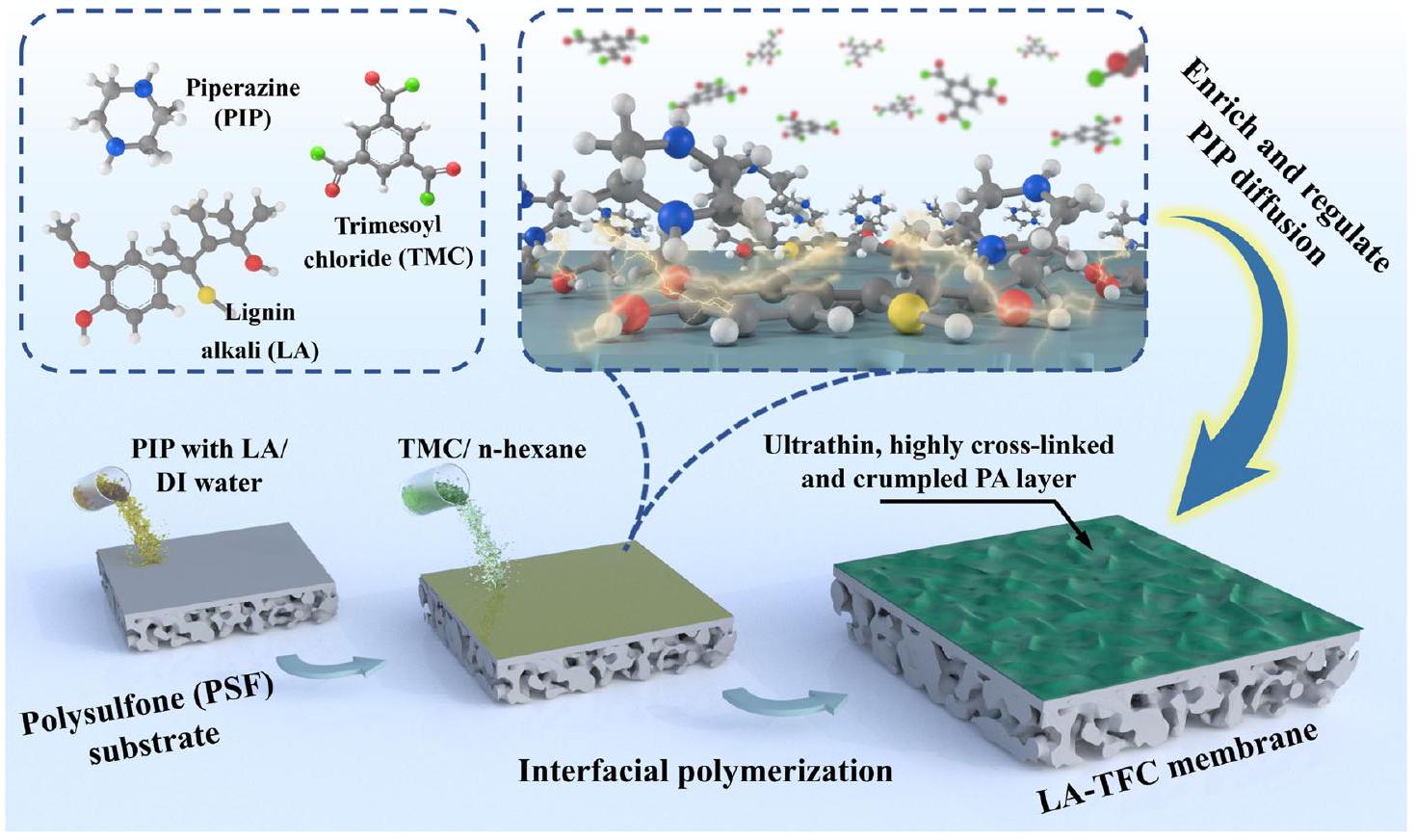
يعتمد أداء غشاء TFC NF بشكل رئيسي على سمك وتجانس النانو لطبقة PA، والتي يمكن تعديلها خلال عملية IP. من خلال التحكم في حالة التشتت الأولية للمونومرات الأمينية وسلوكيات انتشارها من المرحلة المائية إلى المرحلة العضوية يمكن أن تنظم بشكل كبير تشكيل وخصائص فيلم PA النانوي. هنا، قدمنا LA كإضافة إلى محلول PIP المائي من أجل تنظيم توزيع PIP وتفاعله مع كلوريد التريميزويل (TMC) لتصنيع غشاء NF قوي مع طبقة PA رقيقة للغاية، وعالية الترابط، ومجعدة، والتي تُعرف باسم LA-TFC (الشكل 1). للمقارنة، تم استخدام عملية IP التقليدية لتحضير غشاء TFC التحكم (C-TFC) باستخدام محلول PIP بدون LA.
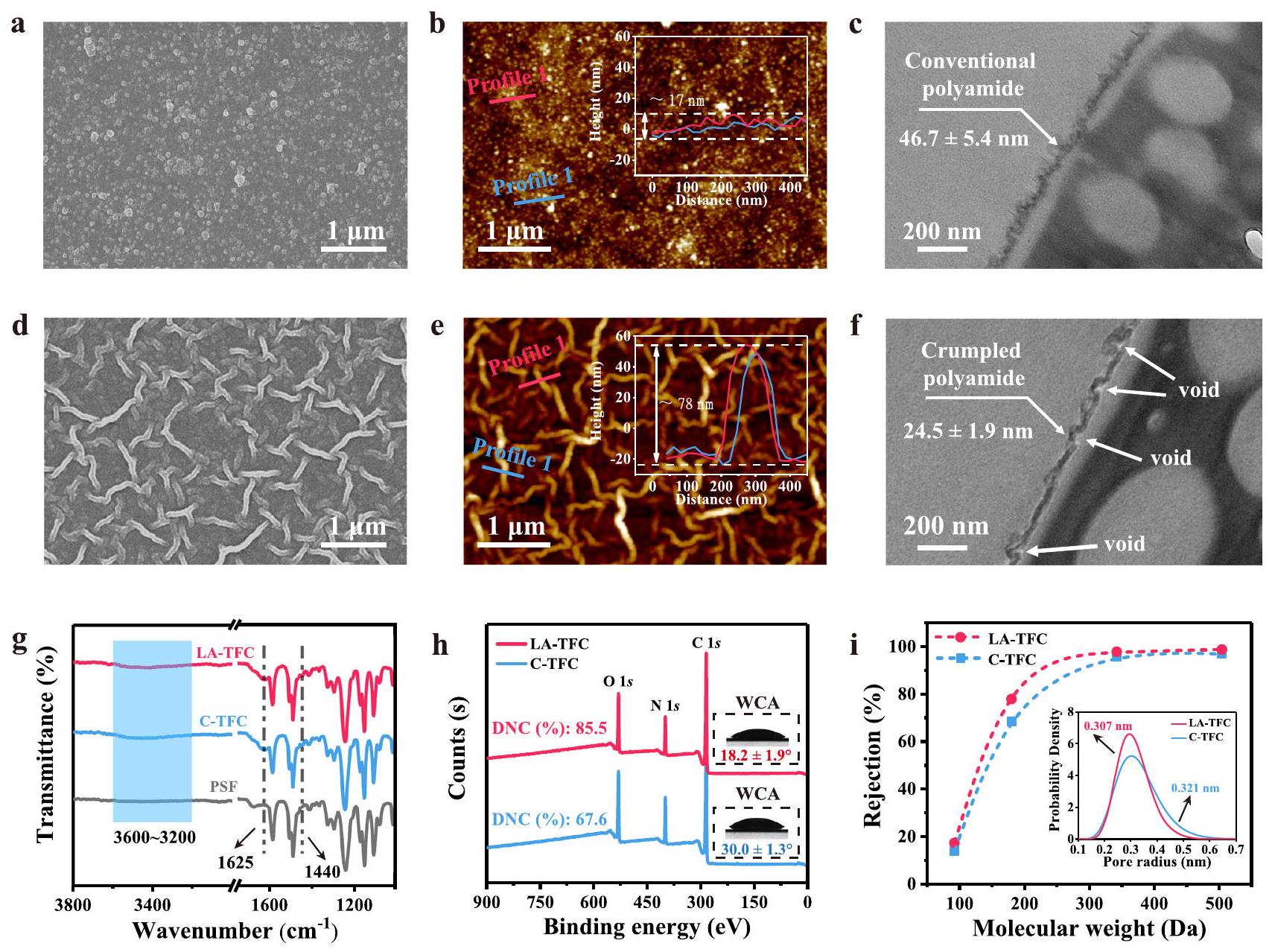
كما لوحظ بواسطة المجهر الإلكتروني الماسح (SEM) والمجهر القوي الذري (AFM) (الشكل 2 والشكل التكميلي 1)، أظهرت أغشية C-TFC و LA-TFC اختلافات واضحة في مورفولوجيا السطح. قدم غشاء C-TFC هيكل PA ناعم وتقليدي نانوي، بينما كان لغشاء LA-TFC هيكل مجعد. وقد تم الإبلاغ عن أن الهيكل المجعد يمكن أن يزيد من مساحة جمع الماء وبالتالي يحسن بشكل فعال نفاذية الغشاء . كما هو موضح في الشكل التكميلي 1، زادت مساحة الهيكل المجعد مع زيادة تركيز LA، وكانت التجاعيد موزعة بشكل أكثر انتظامًا عندما كان تركيز LA هو . تكشف نتائج الخشونة الجذرية المتوسطة (RMS) عن
الشكل 1 | عملية تصنيع الغشاء. توضيح تخطيطي لعملية تصنيع غشاء مركب رقيق من قلويد اللجنين (LA-TFC).
الشكل 2 | الأشكال والخصائص الفيزيائية والكيميائية لأغشية TFC المختلفة. أ، د صور SEM و ب، هـ صور AFM لأشكال السطح لأغشية المركب الرقيق الضابط (C-TFC) ومركب قلويد اللجنين (LA-TFC) على التوالي.صور TEM لأشكال المقطع العرضي لأغشية C-TFC و LA-TFC على التوالي.طيف ATR-FTIR للبولي سلفون (PSF) وأغشية TFC.طيف مسح XPS لأغشية TFC. i MWCO لأغشية TFC
. المرفقات في (ب، هـ) هي ملفات الارتفاع للأفلام النانوية PA المقابلة، والمرفقات في (هـ) هي درجة الربط الشبكي (DNC) وزوايا تماس الماء (WCAs) لأغشية C-TFC و LA-TFC، والمرفقات في (ي) هي توزيعات حجم المسام لأغشية C-TFC و LA-TFC على التوالي. كان تركيز LA لتحضير غشاء LA-TFC هو .
أن غشاء LA-TFC ذو الهيكل المجعد من PA كان له سطح أكثر خشونة من غشاء C-TFC. كان متوسط ارتفاع التجاعيد هو ، وهو أعلى بكثير من تلك النوديلات النانوية (الشكل 2ب و هـ). تم إجراء قياسات مجهر الإلكترون الناقل (TEM) للتحقيق في سمك وهياكل PA الداخلية المختلفة. مقارنةً بغشاء C-TFC، قدم غشاء LA-TFC طبقة PA أرق، وتم ملاحظة فراغات وفيرة بين الفيلم النانوي المجعد PA وركيزة البولي سلفون (PSF)، مما يشير إلى أن الهياكل المجعدة فارغة من الداخل (الشكل 2ف). تظهر النتائج أعلاه أن إضافة LA في محلول الطور المائي يمكن أن تنظم تفاعل PIP و TMC عند الواجهة المائية العضوية خلال عملية IP، مع تحقيق طبقة PA أرق ومجعدة مما يعزز بشكل كبير نفاذية الماء (انظر القسم حول “أداء الفصل لأغشية LA-TFC”).
تم قياس مجموعات السطح الوظيفية لأغشية TFC باستخدام مطياف الأشعة تحت الحمراء بتقنية تحويل فورييه مع وضع الانعكاس الكلي المخفف (ATR-FTIR). تحتوي كل من أغشية C-TFC و LA-TFC على قمم جديدة عند و (الشكل 2ز) مقارنةً بركيزة PSF، والتي تتوافق مع اهتزاز الانحناء و اهتزاز الشد للأميد I، وهي القمم النموذجية لفيلم PA النانوي. بالإضافة إلى ذلك، يُنسب قمة عريضة عند إلى اهتزاز الشد لمجموعات الكربوكسيل . تم التحقيق في التركيب العنصري السطحي لأغشية TFC باستخدام مطياف الأشعة السينية (XPS) (الشكل 2ح والجدول التكميلي 1). مقارنةً بركيزة PSF، انخفضت محتويات الكبريت في كل من أغشية TFC بينما زادت محتويات النيتروجين بسبب تكوين أفلام PA النانوية. علاوة على ذلك، كان غشاء LA-TFC يمتلك طبقة PA أكثر كثافة مع درجة أعلى من الربط الشبكي (DNC) ( ) مقارنةً بغشاء C-TFC ( ) المحسوبة بناءً على نسب N . تم تحديد الوزن الجزيئي القطعي (MWCO) لأغشية TFC من خلال قياس رفض سلسلة من المحاليل العضوية المحايدة (أي، الرافينوز، السكروز، الجلوكوز، والجليسرول) (الشكل 2ي). مقارنةً بغشاء C-TFC، كان لدى غشاء LA-TFC MWCO أصغر (227 Da مقابل 281 Da) وتوزيع حجم مسام أضيق، وفي الوقت نفسه، كان متوسط نصف قطر المسام لغشاء LA-TFC أيضًا أصغر من ذلك في غشاء C-TFC (0.307 نانومتر مقابل 0.321 نانومتر) بسبب DNC الأعلى، مما يجعله أكثر ملاءمة لتطبيقات الفصل الانتقائي العالي.من أجل التحقيق بشكل أكبر في الحالات الكيميائية لمكونات سطح الغشاء، تم استخدام طيف XPS عالي الدقة
, , و (الشكل التكميلي 2 والجدول التكميلي 2). تم تقسيم طيف C 1s إلى ثلاث قمم تشمل 284.6 eV (روابط C-H أو C-C الأليفاتية/العطرية)، , و 288 eV (الأميد ومجموعات الكربوكسيل ). تشمل طيف قمتين عند 399.5 eV و 401.7 eV، تتوافق مع و ، على التوالي. يمكن تقسيم طيف إلى مكونين عند و . كما لوحظ من الجدول التكميلي 2، كانت كل من نسب الأمين غير المتفاعل ومجموعات الكربوكسيل على غشاء LA-TFC (1.8% و 9.4%) أقل من تلك الموجودة على غشاء C-TFC ( و )، مما يشير إلى أن هناك المزيد من روابط الأميد في فيلم PA النانوي لغشاء LA-TFC بسبب DNC الأعلى. علاوة على ذلك، تم تحديد تركيزات مجموعات الكربوكسيل على هذين السطحين من الأغشية أيضًا باستخدام تقنية امتصاص-إزالة صبغة كاتيونية (صبغة التولويدين الزرقاء ) (الشكل التكميلي 3). تظهر النتائج أن كمية مجموعات الكربوكسيل على سطح غشاء LA-TFC كانت أقل من تلك الموجودة على غشاء C-TFC. هذا يتماشى مع DNC الأعلى لغشاء LA-TFC. تم أيضًا التحقيق في قابلية بلل سطح أغشية TFC. كانت زوايا تماس الماء (WCAs) لأغشية LA-TFC و C-TFC هي و ، على التوالي (المرفق في الشكل 2ح). على الرغم من أن غشاء LA-TFC كان يحتوي على محتوى أقل من مجموعات الكربوكسيل المحبة للماء، إلا أنه أظهر قابلية بلل أفضل، ربما بسبب زيادة خشونته السطحية (الشكل التكميلي 1).
آليات تنظيم LA على تشكيل فيلم PA النانوي
يعتبر تشكيل فيلم PA النانوي عملية تفاعل انتشار تشمل خطوتين. أولاً، تنتشر جزيئات PIP من الطور المائي إلى الطور العضوي وتتفاعل مع TMC لتشكيل طبقة PA الأولية. ثم، تنتشر جزيئات PIP التالية ببطء عبر طبقة PA الأولية لتشكيل الفيلم النانوي PA النهائي الأكثر كثافة . يُعتقد أن شكل السطح لفيلم PA النانوي مرتبط ارتباطًا وثيقًا بعدم الاستقرار الواجهوي . بشكل عام، يمكن أن يؤدي زيادة إمدادات أحادية الأمين وظروف التفاعل المعززة إلى أسطح ذات خشونة أكبر.
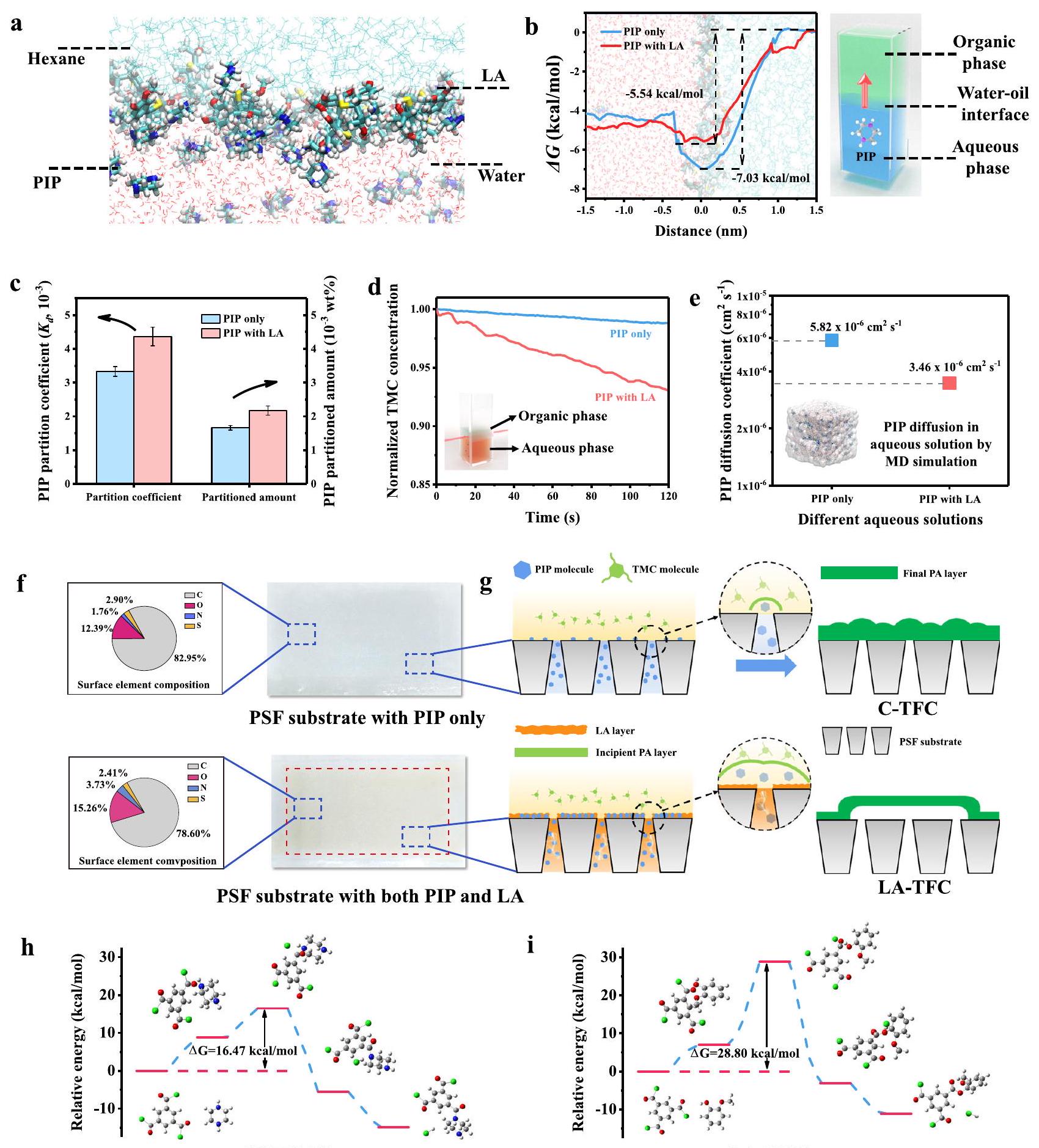
في هذه الدراسة، يمكن لجزيئات LA التي تحتوي على كل من المجموعات الكارهة للماء والمحبة للماء والتي تشير إلى سلوك شبيه بالسطح، أن تتجمع بسهولة عند الواجهة المائية العضوية (الشكل 3أ والشكل التكميلي 4ب)، مما يتسبب في انخفاض حاد في التوتر السطحي (الشكل التكميلي 5). يمكن أن يقلل التوتر السطحي المنخفض من حاجز الطاقة لانتشار PIP من الطور المائي إلى الطور العضوي كما يتضح من محاكاة MD ( مع وجود LA بينما مول بدون LA، الشكل 3ب)، مما يمكن أن يسهل انتشار PIP عبر الواجهة المائية العضوية (الشكل التكميلي 6). علاوة على ذلك، زادت معامل التقسيم لـ PIP في الطورين الهكسان والمائي أيضًا (الشكل 3ج). ستعزز هذه الإمدادات الفعالة من أحادية PIP إلى الطور العضوي وتعزز معدل تفاعل PIP مع TMC (الشكل 3د والشكل التكميلي 7)، مما يؤدي إلى عدم استقرار واجهي أكبر وتعزيز تشكيل طبقة PA أرق وأكثر كثافة مع هيكل مجعد . كما قارننا تأثيرات LA على الأشكال مع عوامل سطحية أخرى مثل دوديكل سلفونات الصوديوم (SDS) و بروميد سيتيل تريميثيل الأمونيوم (CTAB). وجدنا أن الهيكل المجعد ظهر فقط عندما تم استخدام SDS بتركيز أقل (0.25 تركيز الميكل الحرج (CMC))، وأن إضافة CTAB لا يمكن أن تشكل هيكلًا مجعدًا تحت تركيزات مختلفة (الشكل التكميلي 8). تظهر هذه النتيجة أن LA له ميزة أكبر في زيادة نفاذية الماء من خلال زيادة منطقة نفاذية الغشاء بشكل كبير. علاوة على ذلك، قد يكون انتشار PIP في محلول الطور المائي المخزن في مسام الغشاء محدودًا بواسطة LA كما أثبتت قياسات الرنين المغناطيسي النووي (NMR) (الشكل التكميلي 9) ومحاكاة MD (نتيجة الإزاحة التربيعية المتوسطة (MSD) في الشكل التكميلي 10 ونتيجة معامل انتشار PIP في الشكل 3هـ)، مما قد يساهم أيضًا في تشكيل طبقة PA أرق .
بالإضافة إلى ذلك، يمكن أن تحسن LA التوزيع المتجانس لمونومرات PIP على الركيزة. نظرًا لأن جزيئات LA تحتوي على حلقة بنزين كارهة للماء ومجموعات وظيفية محبة للماء مثل الهيدروكسيل الفينولي، وإيثر الميثوكسي، وهيدروكسيل الكحول، يمكن أن يتم امتصاصها بشكل متجانس على سطح ركيزة PSF كما يتضح من ملاحظة المناطق البنية المتميزة والمتوزعة بشكل متجانس على الركيزة الممتصة لـ LA (الشكل 3f). وبالمثل، يمكن أن يتم توزيع PIP بشكل متساوٍ على سطح الركيزة من خلال القوى الجذابة بين PIP والمحببة للماء. المجموعات الوظيفية لـ LA كما أثبتت تحليلات XPS (الجدول التكميلي 4). تظهر نتائج تحليل دالة التوزيع الشعاعي (RDF) من محاكاة MD أن جزيء PIP يميل أكثر ليكون قريبًا من المجموعات الوظيفية المحتوية على الأكسجين لجزيء LA (الشكل التكميلي 11b). يمكن أن يُعزى ذلك إلى حقيقة أن المجموعات الوظيفية للأمين الثانوي في PIP تشكل روابط هيدروجينية بسهولة مع هذه المجموعات في بيئة مائية، مما يؤدي إلى تأثير جذب أقوى. تشير الطاقة الربط الأعلى بين LA و PIP مقارنةً بـ PSF و PIP إلى ميل أكبر لـ LA نحو جزيئات PIP (الشكل التكميلي 11c، d). إن تعزيز LA للتوزيع المتجانس لجزيئات PIP على سطح الركيزة يسهم في تشكيل طبقة PA بحجم مسام أكثر تجانسًا.
علاوة على ذلك، نظرًا لأن جزيئات LA تحتوي على مجموعات هيدروكسيل فينولية، فقد بحثنا أيضًا في ما إذا كانت LA تشارك في تفاعل IP، لأن التقارير السابقة قد أشارت إلى أن البوليفينولات يمكن أن تتفاعل مع TMC لتصنيع أغشية بوليستر NF.. عادةً ما تتضمن عملية تحضير أغشية البوليستر وقت تفاعل IP ممتد لضمان سلامة الغشاء. ومن المRemarkably، حتى مع وقت تفاعل IP قصير يبلغ 10 ثوانٍ، يمكن ملاحظة الهيكل المجعد (الشكل التكميلي 12). بالإضافة إلى ذلك، حقق الغشاء معدل الرفضبينما تظهر أغشية البوليستر عادةً معدلات رفض ملح أقل بكثير، حوالي. يمكن أن يتفوق PIP الأصغر والأكثر تفاعلية على LA الضخم والأقل تفاعلية ليتخلل في الطور العضوي ويتفاعل مع TMC. كما تظهر حسابات DFT أن حاجز طاقة التفاعل بين مجموعة كلوريد الأسيلي ومجموعة الأمين الثانوية في PIP (أصغر بكثير من ذلك بين كلوريد الأسيل ومجموعات الهيدروكسيل الفينولية في LA” (شكل. )، مما يشير إلى أن PIP سيتفاعل بشكل تفضيلي مع TMC عندما تكون كميته كافية. بالإضافة إلى ذلك، تظهر نتائج ATR-FTIR أنه لم يكن هناك قمة اهتزازية للتمدد لمجموعة الإستر.فيفي كل من أغشية C-TFC و LA-TFC (الشكل التكميلي 13) وصورة SEM السطحية لأغشية LA وحدها المتفاعلة مع TMC (LA-TMC) لم تكشف عن أي فرق كبير مقارنةً بسطح مادة PSF (الشكل التكميلي 14)، مما يشير إلى أن LA وحدها لم تتفاعل بفعالية مع TMC.
باختصار، على الرغم من انخفاض انتشار PIP في محلول الطور المائي، يمكن أن يقلل LA من حاجز الطاقة لانتشار PIP من الطور المائي إلى الطور العضوي، ويزيد من توزيع PIP في الطور العضوي ويعزز كمية أكبر من PIP الممتص بشكل موحد على الركيزة المسامية. ستعزز هذه التأثيرات المجمعة الإمداد الفعال من مونومرات PIP إلى الطور العضوي، مما يسرع من تفاعل IP ويعزز عدم الاستقرار السطحي الأكبر لتسهيل تشكيل طبقة PA أكثر كثافة مع سطح أكثر تجاعيدًا.كما هو موضح في الشكل 3g. علاوة على ذلك، فإن نسبة الكمية الأكبر من PIP المشاركة في عملية IP الأولية عند وجود LA، فإن تشكيل طبقة PA الناشئة الأكثر كثافة سيؤخر بشكل أكبر الانتشار اللاحق لـ PIP، مما يمنح غشاء LA-TFC طبقة PA نانوية أرق. من خلال آليات التنظيم المذكورة أعلاه، فإن غشاء LATFC الناتج يتمتع بطبقة PA رقيقة للغاية، ومترابطة بشكل كبير، ومجعدة.
أداء الفصل لأغشية LA-TFC
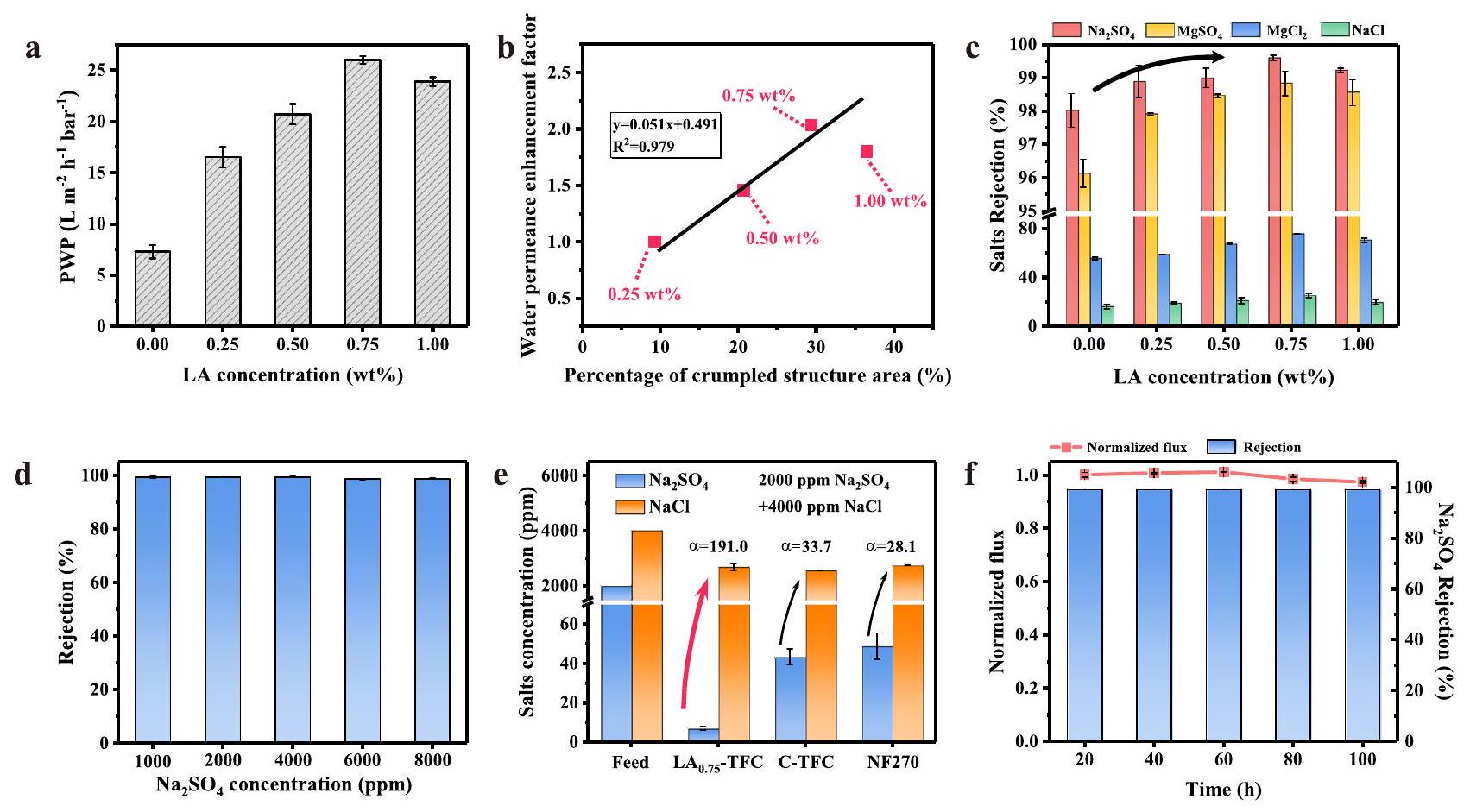
تمت دراسة تأثيرات تركيز LA على أداء فصل أغشية LATFC بشكل منهجي، والنتائج موضحة في الشكل 4. أظهرت جميع أغشية LA-TFC نفاذية أعلى للمياه النقية (PWP) مقارنةً بغشاء C-TFC. زادت PWP لأغشية LA-TFC مع زيادة تركيز LA من 0.00 إلى. ومع ذلك، عندما تم زيادة تركيز LA أكثر إلىتم ملاحظة انخفاض طفيف في PWP. ومن الجدير بالذكر أنأظهرت غشاء -TFC أعلى معدل نفاذية للماءبار، الذي تجاوز ذلك لغشاء C-TFC بمقدار 3.6 ضعف. عادةً، قد تؤدي قيمة MWCO الأصغر وتوزيع حجم المسام الضيق إلى مقاومة أعلى لنقل الماء. ومع ذلك، في دراستنا، على الرغم من أن MWCO لغشاء LA-TFC أصغر من ذلك لغشاء C-TFC (الشكل 2)، إلا أن غشاء LA-TFC لا يزال يتمتع بقدرة نقل مياه فائقة بسبب فيلم PA النانوي الرقيق والمجعد.
PIP-TMC الشكل 3 | آليات قلويد اللجنين (LA) في تصنيع أغشية المركب الرقيق (TFC). أ لقطة لواجهة الماء-الهكسان لمحلول البيبيرازين (PIP) مع LA بعد 10 نانوثانية من محاكاة الديناميات الجزيئية (MD) (الشكل التكميلي 4). ب الطاقة الحرة ( ) من PIP مقابل إحداثيات z العمودية على واجهة الماء-الهكسان (الصورة اليمنى هي التوضيح التخطيطي لسحب PIP من المرحلة المائية إلى المرحلة العضوية). ج معامل التقسيم لـ PIP في المراحل العضوية والمائية وكمية PIP المقسمة في الهكسان (تم حساب معامل تقسيم PIP بواسطة المعادلة (8)، وتم تحديد كمية PIP المقسمة من خلال تحليل الطيف فوق البنفسجي). د التركيز المنظم لثلاثي كلوريد التيرفثاليك (TMC) في الهكسان على مدى زمن التفاعل خلال عملية البوليمرة الواجهة (IP) (البداية
LA-TMC
تركيز TMC هو ). e معدل انتشار PIP في محلول الطور المائي الكتلي بواسطة محاكاة الديناميكا الجزيئية (الإدراج يمثل صندوق المحاكاة). f تركيبات عناصر السطح وصور بصرية لركائز بولي سلفون (PSF) مع PIP فقط ومع كل من PIP و LA الممتصة.المخططات التخطيطية لتكوين أغشية التحكم-TFC (C-TFC) وLA-TFC مع طبقة بولياميد (PA) ذات مورفولوجيا مختلفة. و تغيرات الطاقة الحرة للتفاعلات بين مجموعة كلوريد الأسيل في TMC ومجموعة الأمين في PIP/مجموعة الهيدروكسيل الفينولية في LA، على التوالي (تم حذف السلسلة الألكيلية في جزيء LA للسماح بتقارب الهيكل خلال عملية الحساب). تمثل أشرطة الخطأ الانحراف المعياري لثلاث قياسات مستقلة.
الشكل 4 | أداء الفصل لأغشية المركب الرقيق (TFC) المختلفة. أ تأثيرات تركيزات قلويد اللجنين (LA) على نفاذية الماء النقي (PWP) لأغشية LA-TFC. العلاقة بين عامل تعزيز نفاذية الماء ونسبة مساحة الهيكل المجعد لأغشية LA-TFC. ج تأثيرات تركيزات LA على رفض الأملاح المختلفة لأغشية LA-TFC الأغشية. درفض-TFC في مختلفتركيزات. هـ وتركيزات NaCl في محاليل التغذية والنافذة وعوامل الانتقائية من NaCl إلىمن أغشية TFC المختلفة.أداء الفصل على المدى الطويل لـ-غشاء TFC. تمثل أشرطة الخطأ الانحراف المعياري لثلاث قياسات مستقلة. منطقة ترشيح أكثر فعالية. كما لوحظ بواسطة SEM، كانت جميع أغشية LA-TFC تمتلك هيكلًا مجعدًا؛ علاوة على ذلك، عندما كانت تركيز LAكانت هذه التجاعيد أكثر وفرة وتوزيعًا بشكل موحد في جميع أنحاء سطح الغشاء (الشكل التوضيحي 1). بالمقابل، عندما زادت تركيزات LA إلى، أصبحت طبقة PA المكدسة واضحة، مما أعاق بعد ذلك نقل جزيئات الماء وقلل من نفاذية الماء. لفهم تأثير الهيكل المجعد على نفاذية الماء لغشاء LA-TFC بشكل أعمق، تم التعمق في العلاقة بين نسبة المساحة المجعدة وعامل تعزيز نفاذية الماء. ومن المثير للاهتمام، أن هناك ارتباطًا خطيًا ظهر بين عامل تعزيز نفاذية الماء ونسبة المساحة المجعدة عند استخدام LA بتركيز أقل من (الشكل 4ب والمعلومات التكميلية الشكل 15). هذه النتيجة تتماشى مع المراجعات النقدية الأخيرة حول الأغشية الملتوية التي تشير إلى أن مثل هذه الهياكل يمكن أن تزيد من مساحة نقل المياه الفعالة، مما يزيد بشكل فعال من نفاذية المياه.قام تان وزملاؤه بمزيد من النمذجة لتأثير الفراغات النانوية الموجودة في الهياكل المجعدة على نفاذية الماء، كاشفين أن الغشاء المحتوي على الفراغ يمكن أن يقدم تحسينًا بمقدار 1-2 من حيث النفاذية بسبب زيادة مساحة سطح الترشيح وطرق النقل المحسّنة في الوقت نفسه.. هذا يُظهر أن زيادة نسبة طبقة PA المجعدة الموزعة بشكل جيد تُثبت فائدتها في تعزيز نفاذية الغشاء. ومع ذلك، فإن زيادة تركيز LA أكثر من ذلك إلىتسبب في تقليل عامل التعزيز (الشكل 4ب)، ربما بسبب الطي الواسع لطبقة الرفض (الشكل التوضيحي 1هـ).
تظهر الشكل 4c أن جميع أغشية TFC المنظمة بواسطة LA أظهرت رفضًا أعلى للأملاح مقارنةً بأغشية C-TFC، وذلك بسبب طبقة PA الأكثر كثافة مع DNC أعلى (الجدول التكميلي 3). كما أثبت قياس MWCO هذه النقطة. كما هو موضح في الشكل التكميلي 16، كانت جميع أغشية LA-TFC ذات MWCO أصغر.مقارنةً بتوزيع حجم المسام الأضيق مع غشاء C-TFC. بالنسبة لغشاء PA NF النموذجي، تلعب استبعاد دونان واستبعاد الغربلة عادةً أدوارًا حاسمة في رفض الأيونات. ومع ذلك، في هذه الدراسة، تظهر قياسات الجهد الناتج عن التدفق (الشكل التكميلي 17a) أن شدة الشحنة السلبية السطحية لجميع أغشية LA-TFC كانت أضعف من تلك الخاصة بغشاء C-TFC تحت ظروف pH المحايدة. كما تم مناقشته أعلاه، لم تشارك جزيئات LA في تفاعل IP، وبالتالي كانت شدة الشحنة السلبية الأقل لأغشية LA-TFC تعزى إلى قلة مجموعات الكربوكسيل على سطحها الناتجة عن DNC الأعلى لطبقة PA (الشكل التكميلي 17b والجدول التكميلي 3). لذلك، كانت الزيادة في رفض الأملاح لأغشية LA-TFC تعزى بشكل رئيسي إلى طبقة PA المرتبطة بشكل عالٍ التي تنظمها LA. خاصة، عندما كانت تركيز LA ، الـأظهرت غشاء TFC أعلىرفضبينما قدمت غشاء C-TFC رفضبالنظر إلى الرفض الشامل لمياه الصرف الصحي والملح، تم اختيار الكمية المثلى من LA عند، وبالتالي تم استخدام غشاء -TFC في التجارب التالية.
بشكل عام، ستنخفض قدرة رفض الملح إلى درجة كبيرة عند معالجة المحلول الملحي بتركيز ملح أعلى أو العمل تحت ضغط عالٍ بسبب زيادة تأثير الاستقطاب التركيز وتأثير التظليل. في هذه الدراسة، تم أيضًا التحقيق في متانة غشاء LA-TFC تحت ظروف ملحية عالية أو ضغط تشغيل مرتفع. كما هو موضح في الشكل 4d،-غشاء TFC لا يزال يحتفظ بأكثر منرفض عند تركيز ملح أعلى، وبالمثل، أظهر أيضًا استقرارًاالرفض تحت ضغوط تشغيل مختلفة (الشكل التكميلي 18). لتقييم قدرته على الانتقاء بين الأيونات بشكل أكبر، تم استخدام محلول ملحي محاكى يحتوي على و تم توظيفه كعلف. تظهر النتائج أن أظهرت غشاء TFC مظهراً بارزاًعامل الانتقائية ( )، متجاوزةً تلك الخاصة بـ C-TFC ( ) وأغشية NF270 التجارية ( ) (الشكل 4e). علاوة على ذلك، غشاء TFC قدم أداءً ممتازًا على المدى الطويل نفاذية الماء النقي لـبارمع ممتازرفض و انتقائية تبلغ 191.0، والتي كانت متفوقة على أغشية TFC NF المتطورة المبلغ عنها في الأدبيات وفي السوق. كما نكشف أن نسبة الهيكل الملتوي على فيلم PA النانوي لها علاقة قوية بتحسين نفاذية الماء، مما يمكن أن يوفر مرجعًا لاستكشاف وتصميم أفلام PA الملتوية بشكل أكبر. بالإضافة إلى ذلك، فإن المضاف LA المستخدم في هذا العمل هو مصدر من نفايات لب الورق، مما لن يخلق بصمة كربونية إضافية في عملية تصنيع الأغشية. علاوة على ذلك، فإن إضافة LA في محلول الطور المائي متوافقة مع خط الإنتاج الصناعي الحالي، ولا تتطلب خطوات إضافية أثناء تصنيع أغشية TFC. علاوة على ذلك، فإن المجموعات الوظيفية الوفيرة على جزيء LA تمنحه إمكانات كبيرة لتشكيل مواد مركبة، والتي يمكن استخدامها لتطوير أغشية ذات وظائف خاصة. على سبيل المثال، نوع من الهيدروجيل المصنوع بناءً على مركب LA-Ag النانوي يمتلك تقاربًا جيدًا للخلايا على المدى الطويل وخصائص مضادة للبكتيريا عالية.الذي يوفر إمكانية تصنيع أغشية NF المضادة للبكتيريا الصديقة للبيئة للجيل القادم.
طرق
المواد والمواد الكيميائية
يمكن العثور على المواد والمواد الكيميائية في الملحق طرق التجارب 1.1.
تصنيع أغشية TFC المختلفة
تم تصنيع غشاء C-TFC من خلال تفاعل IP في الموقع على ركيزة PSF UF باستخدام محلول مائي منمحلول هكسان TMC. تم تثبيت ركيزة PSF أولاً على إطار بلاستيكي مخصص للتأكد من أن السطح العلوي فقط هو المعرض للمحلول. ثم، تم صب 20 مل من محلول PIP على الركيزة لمدة 3 دقائق. بعد تصريف محلول PIP، تم استخدام سكين هوائي لإزالة بقايا المحلول على السطح. بعد ذلك، تم الاتصال بالركيزة مع 20 مل من محلول TMC لمدة دقيقة واحدة تلتها شطف بالهكسان لمدة 5 ثوانٍ لإزالة TMC غير المتفاعل. أخيرًا، تم معالجة غشاء C-TFC الناتج في فرن عندلمدة 10 دقائق لتعزيز الربط المتقاطع لشبكة PA ثم تم تخزينها في ماء DI عندلإجراء تجارب إضافية.
كانت عملية تصنيع غشاء LA-TFC مشابهة لتلك الخاصة بغشاء C-TFC كما هو موضح أعلاه، باستثناء أن كمية معينة من LA، أو ) تم إضافته إلى محلول PIP. كانت قيم pH لمحلول الماء المحتوي على LA في نطاق 11.56-11.41، والتي كانت مشابهة لمجموعة التحكم بدون LA. وتمت الإشارة إلى الأغشية الناتجة باسم -أغشية TFC، حيثيمثل تركيز LA. لاستكشاف الاستخدام المحتمل لمياه الصرف من مصنع لب الخشب القلوي كإضافة في محلول مائي لتصنيع غشاء TFC NF، تم جمع سائل أسود يحتوي بشكل أساسي على LA من مصنع لب الخشب القلوي (صناعة الورق كينغشان، فوجيان، الصين). كانت عملية التصنيع مشابهة أيضًا لتلك الخاصة بغشاء C-TFC، وتم الإشارة إلى غشاء NF الناتج باسم BLA-TFC. قبل تفاعل IP، تم تخفيف السائل الأسود بمقدار 20 مرة للحفاظ على تركيز LA كما هو مستخدم في التصنيع.-غشاء TFC وأضيف إلىتم تعديل قيمة pH للمحلول المائي إلى 11.46، وهو مشابه للمحلول المائي الذي يحتوي على LA.من لوس أنجلوس). لم يتم تنفيذ خطوات تنقية إضافية.
توصيف أغشية TFC
“تم استخدام ATR-FTIR (NEXUS 670، الولايات المتحدة الأمريكية) و XPS (Thermo Scientific K-Alpha، الولايات المتحدة الأمريكية) لتحليل التركيب الكيميائي السطحي لأغشية مختلفة. تم استخدام SEM (Regulus 8230، اليابان) لوصف سطح الأغشية وأشكال المقطع العرضي. تم استخدام TEM (JEOL JEM2100، اليابان) و AFM (Dimension Fastscan، Bruker، الولايات المتحدة الأمريكية)”. تم استخدامه لمراقبة سمك طبقة PA وخشونة سطح الغشاء، على التوالي. تم دراسة زوايا الاتصال المائية (WCAs) لأغشية مختلفة على جهاز قياس الزاوية (DSA25E، KRÜSS، ألمانيا) بناءً على طريقة القطرات الثابتة. محلل الجهد المتدفق (SurPASSتم استخدام جهاز 3، أنطون بار، النمسا) لتحديد قيم الجهد الزتاوي لأسطح الأغشية.
أداء الفصل لأغشية TFC
تم قياس أداء فصل أغشية TFC باستخدام معدات ترشيح عبر التدفق (CF016D، ستيرلايتش، الولايات المتحدة الأمريكية) بمساحة ترشيح فعالة من. تم تحديد الضغط الهيدروستاتيكي للمياه (PWP) لأغشية TFC باستخدام الماء المنزوع الأيونات كغذاء. تم ضغط جميع الأغشية مسبقًا عند 5 بار لمدة 30 دقيقة قبل جمع عينة النفاذ. ما لم يُذكر خلاف ذلك، تم الحفاظ على الضغط المطبق، وسرعة التدفق المتقاطع، ودرجة حرارة محلول التغذية عند 5 بار، ، و على التوالي. تم حساب PWP للأغشية باستخدام المعادلة (1):
حيث PWP (يمثل نفاذية الماء النقي للغشاء،هو الحجم الكلي للسائل الذي يتخلل عبر الغشاء خلال وقت الترشيح هو الضغط المطبق، و هو مساحة الترشيح الفعالة، على التوالي.
تم تقييم رفض الملح الفردي لأغشية TFC باستخدام فردي و حل بتركيزكغذاء. تم تقييم انتقائية الأيونات أحادية التكافؤ/ثنائية التكافؤ لأغشية TFC باستخدام محلول مختلط من الأملاح مع و تم تحديد MWCO وتوزيع حجم المسام لأغشية TFC من خلال قياس رفض سلسلة من المواد المحايدة (أي، الجلسرين، الجلوكوز، السكروز، والرافينوز) بتركيزتم حساب رفض الأملاح والمذابّات المحايدة بواسطة المعادلة (2). تم حساب عامل الفصل لـ NaCl إلىتم حساب (كلا من محاليل الملح المختلط والملح المفرد) استنادًا إلى المعادلة (3):
أينيمثل رفض الملح أو المحلول المتعادل، و هي تركيزات الملح أو المحاليل المتعادلة في المحلول المنفذ ومحلول التغذية، على التوالي. تم تحديد تركيز الملح عن طريق قياس موصلية المحلول باستخدام مقياس الموصلية (Mettler Toledo FE38، الولايات المتحدة الأمريكية)، وتم قياس تركيز الأنيونات في محلول الأملاح المختلطة بواسطة كروماتوغرافيا الأيونات (ICS-1100، ThermoFisher Scientific Co.، Ltd.، الولايات المتحدة الأمريكية)، وتم تحليل تركيز المحلول المتعادل بواسطة جهاز تحليل الكربون العضوي الكلي (TOC-L، شيمادزو، اليابان).
محاكاة الديناميكا الجزيئية
في محاكاة محلول الطور المائي، تم استخدام صندوق محاكاة مكعب بأبعادتم استخدامه، والذي احتوى على 100 جزيء PIP، و50 جزيء LA، و5000 جزيء ماء. تم تحليل دالة التوزيع الشعاعي (RDF) لتفاعل PIP مع LA في هذا النموذج. معامل الانتشارتم حساب تركيز PIP في المحلول الكثيف باستخدام الإزاحة التربيعية المتوسطة (MSD) كمعادلة انحدار خطي، كما هو موضح في المعادلتين (4) و (5):
أين هو الإحداثي المكاني الأصلي للجزيئات/الذرات، هو الموضع في الزمن t ، و هو العدد الإجمالي للجزيئات.
لتمثيل محلول الماء-الهكسان ثنائي الطور، صندوق مستطيل بأبعادتم استخدامه لبناء نظام مزيج الهكسان و LA/الماء. تم تقسيم الصندوق إلى ثلاث طبقات من الأسفل إلى الأعلى: هكسان، مزيج LA/الماء، وهكسان. احتوت طبقات الهكسان على 150 جزيئًا من الهكسان، بينما احتوت طبقة مزيج LA/الماء على 100 جزيء PIP و 50 جزيء LA.
تم تهيئة جميع محاكاة الديناميكا الجزيئية باستخدام برنامج باكمولتم نمذجة جزيئات الماء باستخدام نموذج الماء SPCE ثلاثي المواقع.تم اشتقاق معلمات مجال القوة الذرية من معلمات IL لمجال القوة OPLS-AA بواسطة دوهيرتي وآخرين.لتجنب تأثيرات الحدود، استخدمت جميع المحاكاة شروط حدود دورية ثلاثية الأبعاد (PBC). تم تعيين مسافة القطع للتفاعلات غير المرتبطة إلىتم استخدام طريقة شبكة الجسيمات إيوالد (PME) للتفاعلات الكهروستاتيكية بعيدة المدىقبل المحاكاة الرسمية، تم توازن النظام مسبقًا باستخدام خوارزمية الانحدار الأكثر انحدارًا لإزالة الضغط الهيكلي الأولي المفرط.. بعد ذلك، تم إجراء محاكاة NPT لمدة 1 نانوثانية (مع خطوة زمنية قدرها ) تم إجراء ذلك لموازنة النظام إلى كثافته الفعلية. تلا ذلك محاكاة NPT رسمية لمدة 10 نانوثانية مع جمع البيانات باستخدام خطوة زمنية قدرها 2 فيمتوثانية. تم تحقيق اقتران درجة الحرارة والضغط باستخدام ترموستات v-rescale وبارومتر Berendsen، على التوالي، عند 298.15 كلفن وتم إجراء جميع محاكاة الديناميكا الجزيئية باستخدام GROMACSوجميع الهياكل المرئية تم توفيرها بواسطة VMD 1.9.4.
لحساب تغير الطاقة الحرة لعبور PIP عبر الواجهة المائية العضوية، تم استخدام صندوق محاكاة ذو طبقتين بأبعادتم بناؤه. احتلت خليط LA/الماء والهكسان المناطق و ، على التوالي. تم وضع جزيء PIP في الطور المائي مع إحداثيات مركز كتلته عند (قبل أخذ العينات، تم إجراء تقليل الطاقة، تلاه فترة توازن مدتها 1 نانوثانية تحت ظروف NPT باستخدام التحكم في الضغط بواسطة بيريندسن.مع تطبيق قيود الموضع على جزيء PIP. بعد ذلك، تم إجراء محاكاة MD للتمدد تحت ظروف NPT، والتي تقوم بتمديد جزيء PIP بمقدار 4 نانومتر على طول المحور Z لعبور واجهة الماء-العضوي. تم اختيار 20 تكوينًا من مسارات المحاكاة على فترات زمنية منتظمة. خضع كل تكوين لـ 1 نانوثانية من التوازن المسبق تحت NPT و2 نانوثانية من محاكاة أخذ العينات تحت المظلة. تم تعريف إحداثي التفاعل على أنه إسقاط إحداثيات مركز الكتلة لجزيء PIP على المتجه الساحب. لتحديد توزيع الطاقة الحرة لانتشار PIP على الواجهة، استخدمنا طريقة تحليل الهيستوغرام الموزون (WHAM) لتحليل القوة المتوسطة على طول إحداثي التفاعل.في نتائج تغيير الطاقة الحرة النهائية، قمنا بتحديد واجهة الماء-العضوي كنقطة الأصل وأخذنا 1.5 نانومتر في اتجاه الطور المائي والطور العضوي لجمع البيانات المحاكية للتحليل.
حسابات نظرية الكثافة الوظيفية
تم إجراء تحسينات الهندسة وحسابات التردد الاهتزازي التوافقي على PIP و LA و TMC باستخدام طرق DFT مع الوظيفة الهجينة B3LYP. و الـ أساسالمجموعات في برنامج Gaussian 16لأخذ تأثيرات الذوبان في الاعتبار، تم استخدام نموذج المذيب المستمر القابل للاستقطاب SMD.تم تحديد الحد الأدنى المستقر بدون ترددات تخيلية أو حالات انتقالية تحتوي على تردد تخيلي واحد فقط كنقاط ثابتة. شملت الطاقات المبلغ عنها تصحيح طاقة النقطة الصفرية. تم حساب طاقات الربط بناءً على المعادلة (6). تم حساب حاجز الطاقة الحرة للتفاعل باستخدام المعادلة (7):
أينيمثل الطاقة الكلية للنظام مع كل من PIP و PSF أو PIP و LA،هي طاقة النظام بدون PIP، هو طاقة PIP، و و تمثل طاقات غيبس الحرة للمتفاعلات وحالة الانتقال، على التوالي.
توصيف مطياف الأشعة فوق البنفسجية
تم قياس الكمية المقسمة من PIP في الهكسان الفارغ بواسطة مطياف الأشعة فوق البنفسجية (UNICO-UV2، الصين). على وجه التحديد، 5 مل منتم وضع محلول PIP (مع أو بدون إضافة LA) أولاً في زجاجة العينة، ثم تم إضافة 5 مل من الهكسان النقي ببطء. بعد دقيقة واحدة من انتشار PIP فيتم جمع جزء من محلول الهكسان المذكور بالقرب من واجهة الماء العضوي باستخدام ماصة، وتم اختبار امتصاص PIP عند ذروة الطيف المميزة 208 نانومتر. معامل التقسيميمكن حساب PIP في الطورين العضوي والمائي بواسطة المعادلة (8) :
أين و حجم المحلول المائي وحجم المحلول العضوي، على التوالي؛يمثل تركيز PIP في الطور المائي في الوقت الابتدائي؛يمثل تركيز PIP في الطور العضوي.
لمراقبة معدل انتشار PIP في المرحلة العضوية في الموقع، 0.9 مل منتمت إضافة محلول PIP (مع أو بدون إضافة LA) بعناية إلى قاع قبة الكوارتز. ثم، تم إضافة 0.5 مل من الهكسان النقي بلطف فوق طبقة PIP. تم اختبار امتصاص PIP في الهكسان عند ذروة الطيف المميزة 208 نانومتر وتم تسجيله في كل فترة زمنية مدتها 1 ثانية لمدة 120 ثانية.
تم استخدام معدل استهلاك TMC في الطور العضوي لعكس معدل تفاعل IP. لمراقبة استهلاك TMC في الطور العضوي في الموقع، تم استخدام 0.9 مل منتم إضافة محلول PIP المائي (مع أو بدون إضافة LA) بعناية إلى قاع قنينة الكوارتز. ثم، تم إضافة 0.5 مل من الهكسان معثم تم إضافة TMC برفق فوق طبقة PIP. تم اختبار امتصاص TMC في الهكسان عند ذروة الطيف المميزة 290 نانومتر وتم تسجيله في كل ثانية لمدة 120 ثانية.
حساب عوامل تعزيز نفاذية الماء
تم حساب عوامل تحسين نفاذية الماء لأغشية LA-TFC بواسطة المعادلة (9):
أينيمثل عامل تعزيز نفاذية الماء؛ و هي نفاذية الماء النقي لأغشية C-TFC و LA-TFC، على التوالي، والرمز الفرعي يمثل تركيز LA الذي يتراوح من 0.25 إلى.
اختيارية نفاذية الماء/الملح
وفقًا لنموذج انتشار المحلول، يمكن حساب نفاذية الماء/الملح باستخدام المعادلة (10):
أينهو رفض الملح،هو نفاذية الماء النقي،هو نفاذية الملح، هو ضغط التشغيل، و هو فرق الضغط الأسموزي عبر الغشاء.
توفر البيانات
جميع البيانات في المخطوطة أو المعلومات التكميلية متاحة من المؤلفين المعنيين. البيانات المصدرية مقدمة مع هذه الورقة.
References
Mauter, M. S. et al. The role of nanotechnology in tackling global water challenges. Nat. Sustain. 1, 166-175 (2018).
Lu, D. et al. Separation mechanism, selectivity enhancement strategies and advanced materials for mono-/multivalent ion-selective nanofiltration membrane. Adv. Membr. 2, 100032 (2022).
Tang, C. Y. et al. Potable Water reuse through advanced membrane technology. Environ. Sci. Technol. 52, 10215-10223 (2018).
Karan, S., Jiang, Z. & Livingston, A. G. Sub-10 nm polyamide nanofilms with ultrafast solvent transport for molecular separation. Science 348, 1347-1351 (2015).
Lu, X. & Elimelech, M. Fabrication of desalination membranes by interfacial polymerization: history, current efforts, and future directions. Chem. Soc. Rev. 50, 6290-6307 (2021).
Ben-Zvi, A., Taqui, U., Ramon, G. & Nunes, S. P. Alternative materials for interfacial polymerization: recent approaches for greener membranes. Green Chem. 26, 6237-6260 (2024).
. et al. Enhanced water permeability in nanofiltration membranes using 3D accordion-like MXene particles with random orientation of 2D nanochannels. J. Mater. Chem. A 10, 16430-16438 (2022).
Zhang, R., Tian, J., Gao, S. & Van der Bruggen, B. How to coordinate the trade-off between water permeability and salt rejection in nanofiltration? J. Mater. Chem. A 8, 8831-8847 (2020).
Sarkar, P., Modak, S. & Karan, S. Ultraselective and highly permeable polyamide nanofilms for ionic and molecular nanofiltration. Adv. Funct. Mater. 31, 2007054 (2021).
Liang, Y. et al. Polyamide nanofiltration membrane with highly uniform sub-nanometre pores for sub- precision separation. Nat. Commun. 11, 2015 (2020).
Jiang, Z., Karan, S. & Livingston, A. G. Water transport through ultrathin polyamide nanofilms used for reverse osmosis. Adv. Mater. 30, 1705973 (2018).
Zhu, J. et al. Rapid water transport through controllable, ultrathin polyamide nanofilms for high-performance nanofiltration. J. Mater. Chem. A 6, 15701-15709 (2018).
Zhang, X., Lv, Y., Yang, H.-C., Du, Y. & Xu, Z.-K. Polyphenol coating as an interlayer for thin-film composite membranes with enhanced nanofiltration performance. ACS Appl. Mater. Interfaces 8, 32512-32519 (2016).
Yang, Z. et al. Tannic acid nanoscaffold for interfacial polymerization: toward enhanced nanofiltration performance. Environ. Sci. Technol. 52, 9341-9349 (2018).
Zhu, X. et al. Ultrathin thin-film composite polyamide membranes constructed on hydrophilic poly (vinyl alcohol) decorated support toward enhanced nanofiltration performance. Environ. Sci. Technol. 54, 6365-6374 (2020).
Zhao, C. et al. Polyamide membranes with nanoscale ordered structures for fast permeation and highly selective ion-ion separation. Nat. Commun. 14, 1112 (2023).
Smith, R. A. et al. Neighboring parenchyma cells contribute to Arabidopsis xylem lignification, while lignification of interfascicular fibers is cell autonomous. Plant Cell 25, 3988-3999 (2013).
Smith, R. A. et al. Defining the diverse cell populations contributing to lignification in Arabidopsis stems. Plant Physiol. 174, 1028-1036 (2017).
Sun, W. et al. Bioinspired lignin-based loose nanofiltration membrane with excellent acid, fouling, and chlorine resistances toward dye/salt separation. J. Membr. Sci. 670, 121372 (2023).
Shao, S. et al. Nanofiltration membranes with crumpled polyamide films: a critical review on mechanisms, performances, and environmental applications. Environ. Sci. Technol. 56, 12811-12827 (2022).
Wong, M. C. Y., Lin, L., Coronell, O., Hoek, E. M. V. & Ramon, G. Z. Impact of liquid-filled voids within the active layer on transport
through thin-film composite membranes. J. Membr. Sci. 500, 124-135 (2016).
Wang, Z. et al. Nanofiltration membranes with octopus arm-sucker surface morphology: filtration performance and mechanism investigation. Environ. Sci. Technol. 55, 16676-16686 (2021).
Lai, G. S. et al. Tailor-made thin film nanocomposite membrane incorporated with graphene oxide using novel interfacial polymerization technique for enhanced water separation. Chem. Eng. J. 344, 524-534 (2018).
Park, S.-J. et al. Fabrication of polyamide thin film composite reverse osmosis membranes via support-free interfacial polymerization. J. Membr. Sci. 526, 52-59 (2017).
Habib, S., Larson, B. E. & Weinman, S. T. Effect of surfactant structure on MPD diffusion for interfacial polymerization. J. Membr. Sci. Lett. 3, 100055 (2023).
Nulens, I., Zvi, A. B., Vankelecom, I. F. J. & Ramon, G. Z. Re-thinking polyamide thin film formation: How does interfacial destabilization dictate film morphology? J. Membr. Sci. 656, 120593 (2022).
Peng, L. E., Yao, Z., Yang, Z., Guo, H. & Tang, C. Y. Dissecting the role of substrate on the morphology and separation properties of thin film composite polyamide membranes: seeing is believing. Environ. Sci. Technol. 54, 6978-6986 (2020).
Ben-Zvi, A. M. & Ramon, G. Z. Hydrodynamic instability triggered during thin-film formation by interfacial polymerization. Phys. Fluids. 36, 092104 (2024).
Li, X. et al. Regulating the interfacial polymerization process toward high-performance polyamide thin-film composite reverse osmosis and nanofiltration membranes: a review. J. Membr. Sci. 640, 119765 (2021).
Wen, Y. et al. Metal-organic framework enables ultraselective polyamide membrane for desalination and water reuse. Sci. Adv. 8, eabm4149 (2022).
Wang, D. et al. Thin-film composite membranes interlayered with amphiphilic nanosheets via controllable interfacial polymerization for enhanced desalination performance. Environ. Sci. Technol. 58, 11855-11863 (2024).
Zhu, C.-Y. et al. Polyamide nanofilms with linearly-tunable thickness for high performance nanofiltration. J. Membr. Sci. 627, 119142 (2021).
Jimenez-Solomon, M. F., Song, Q., Jelfs, K. E., Munoz-Ibanez, M. & Livingston, A. G. Polymer nanofilms with enhanced microporosity by interfacial polymerization. Nat. Mater. 15, 760-767 (2016).
Karami, P. et al. Novel lignosulfonated polyester membranes with remarkable permeability and antifouling characteristics. J. Membr. Sci. 687, 122034 (2023).
Zheng, J. et al. Separation of textile wastewater using a highly permeable resveratrol-based loose nanofiltration membrane with excellent anti-fouling performance. Chem. Eng. J. 434, 134705 (2022).
Bai, Y. et al. Microstructure optimization of bioderived polyester nanofilms for antibiotic desalination via nanofiltration. Sci. Adv. 9, eadg6134 (2023).
Freger, V. & Ramon, G. Z. Polyamide desalination membranes: formation, structure, and properties. Prog. Polym. Sci. 122, 101451 (2021).
Gan, Q. et al. Nanofoamed polyamide membranes: mechanisms, developments, and environmental implications. Environ. Sci. Technol. 58, 20812-20829 (2024).
Hu, Y., Wang, F., Yang, Z. & Tang, C. Y. Modeling nanovoidenhanced water permeance of thin film composite membranes. J. Membr. Sci. 675, 121555 (2023).
Han, S. et al. Microporous organic nanotube assisted design of high performance nanofiltration membranes. Nat. Commun. 13, 7954 (2022).
Tan, Z., Chen, S., Peng, X., Zhang, L. & Gao, C. Polyamide membranes with nanoscale Turing structures for water purification. Science 360, 518-521 (2018).
Zhu, J. et al. MOF-positioned polyamide membranes with a fishnetlike structure for elevated nanofiltration performance. J. Mater. Chem. A 7, 16313-16322 (2019).
Gan, D. et al. Plant-inspired adhesive and tough hydrogel based on Ag-Lignin nanoparticles-triggered dynamic redox catechol chemistry. Nat. Commun. 10, 1487 (2019).
Martínez, L., Andrade, R., Birgin, E. G. & Martínez, J. M. PACKMOL: A package for building initial configurations for molecular dynamics simulations. J. Comput. Chem. 30, 2157-2164 (2009).
Horn, H. W. et al. Development of an improved four-site water model for biomolecular simulations: TIP4P-Ew. J. Chem. Phys. 120, 9665-9678 (2004).
Jorgensen, W. L., Maxwell, D. S. & Tirado-Rives, J. Development and testing of the OPLS all-atom force field on conformational energetics and properties of organic liquids. J. Am. Chem. Soc. 118, 11225-11236 (1996).
Sambasivarao, S. V. & Acevedo, O. Development of OPLS-AA force field parameters for 68 unique ionic liquids. J. Chem. Theory Comput. 5, 1038-1050 (2009).
Doherty, B., Zhong, X., Gathiaka, S., Li, B. & Acevedo, O. Revisiting OPLS force field parameters for ionic liquid simulations. J. Chem. Theory Comput. 13, 6131-6145 (2017).
Darden, T., York, D. & Pedersen, L. Particle mesh Ewald: an N. (N) method for Ewald sums in large systems. J. Chem. Phys. 98, 10089-10092 (1993).
Payne, M. C., Teter, M. P., Allan, D. C., Arias, T. A. & Joannopoulos, A. J. D. Iterative minimization techniques for ab initio total-energy calculations: molecular dynamics and conjugate gradients. Rev. Mod. Phys. 64, 1045 (1992).
Berendsen, H. J. C., Postma, J. P. M. V., Van Gunsteren, W. F., DiNola, A. & Haak, J. R. Molecular dynamics with coupling to an external bath. J. Chem. Phys. 81, 3684-3690 (1984).
Bussi, G., Donadio, D., & Parrinello, M. Canonical sampling through velocity rescaling. J. Chem. Phys. 126, 014101 (2007).
Abraham, M. J. et al. GROMACS: High performance molecular simulations through multi-level parallelism from laptops to supercomputers. SoftwareX 1, 19-25 (2015).
Humphrey, W., Dalke, A. & Schulten, K. VMD: visual molecular dynamics. J. Mol. Graph. 14, 33-38 (1996).
Kumar, S., Rosenberg, J. M., Bouzida, D., Swendsen, R. H. & Kollman, P. A. The weighted histogram analysis method for free-energy calculations on biomolecules. I. The method. J. Comput. Chem. 13, 1011-1021 (1992).
Stephens, P. J., Devlin, F. J., Chabalowski, C. F. & Frisch, M. J. Ab initio calculation of vibrational absorption and circular dichroism spectra using density functional force fields. J. Phys. Chem. C. 98, 11623-11627 (1994).
Frisch, M. J., Pople, J. A. & Binkley, J. S. Self-consistent molecular orbital methods 25. Supplementary functions for Gaussian basis sets. J. Chem. Phys. 80, 3265-3269 (1984).
Frisch, M. J. et al. Gaussian 16 Rev. C.O1. Wallingford, CT (2016).
Marenich, A. V., Cramer, C. J. & Truhlar, D. G. Universal solvation model based on solute electron density and on a continuum model of the solvent defined by the bulk dielectric constant and atomic surface tensions. J. Phys. Chem. B 113, 6378-6396 (2009).
Wang, Z., Liang, S., Jin, Y., Zhao, L. & Hu, L. Controlling structure and properties of polyamide nanofilms by varying amines diffusivity in organic phase. J. Membr. Sci. 574, 1-9 (2019).
Yang, Z., Guo, H. & Tang, C. Y. The upper bound of thin-film composite (TFC) polyamide membranes for desalination. J. Membr. Sci. 590, 117297 (2019).
الشكر والتقدير
تم دعم هذه الدراسة من قبل المؤسسة الوطنية للعلوم الطبيعية في الصين، منحة رقم 52170063 (S.S.Z.)، مؤسسة البحث الأساسي والتطبيقي في مقاطعة قوانغدونغ، منحة رقم 2022A1515010731 (S.S.Z.)، 2024A1515012474 (S.S.Z.)، و2024B1515040015 (F.G.M)، ومجلس منح البحث في منطقة هونغ كونغ الإدارية الخاصة، منحة رقم SRFS2O21-7SO4 (C.Y.T.). نود أن نشكر J.Q. Wan من جامعة جنوب الصين للتكنولوجيا على توفير سائل الخشب الأسود من مصنع الورق القلوي.
مساهمات المؤلفين
اقترح W.T.Z. و S.S.Z. الفكرة، وصمما البحث، وأشرفا على المشروع. قام W.T.Z. و H.Y.L. و C.X.L. بإجراء التجارب، بما في ذلك تصنيع الأغشية، والتوصيف والتحليلات، وقياسات أداء فصل الأغشية. رسم W.T.Z. الأشكال وكتب المخطوطة. قام W.T.Z. و S.W.Z. و W.W. بإجراء حسابات DFT ومحاكاة MD. حصل S.S.Z. و C.Y.T. و F.G.M. على الأموال، وشاركوا في المناقشة، وراجعوا المخطوطة. ساهم جميع المؤلفين في صياغة ومراجعة المخطوطة.
ملاحظة الناشر تظل Springer Nature محايدة فيما يتعلق بالمطالبات القضائية في الخرائط المنشورة والانتماءات المؤسسية.
الوصول المفتوح هذه المقالة مرخصة بموجب رخصة المشاع الإبداعي للاستخدام غير التجاري، والتي تسمح بأي استخدام غير تجاري، ومشاركة، وتوزيع، وإعادة إنتاج في أي وسيلة أو صيغة، طالما أنك تعطي الائتمان المناسب للمؤلفين الأصليين والمصدر، وتوفر رابطًا لرخصة المشاع الإبداعي، وتوضح إذا قمت بتعديل المادة المرخصة. ليس لديك إذن بموجب هذه الرخصة لمشاركة المواد المعدلة المشتقة من هذه المقالة أو أجزاء منها. الصور أو المواد الأخرى من طرف ثالث في هذه المقالة مشمولة في رخصة المشاع الإبداعي للمقالة، ما لم يُشار إلى خلاف ذلك في سطر الائتمان للمادة. إذا لم تكن المادة مشمولة في رخصة المشاع الإبداعي للمقالة واستخدامك المقصود غير مسموح به بموجب اللوائح القانونية أو يتجاوز الاستخدام المسموح به، ستحتاج إلى الحصول على إذن مباشرة من صاحب حقوق الطبع والنشر. لعرض نسخة من هذه الرخصة، قم بزيارة http:// creativecommons.org/licenses/by-nc-nd/4.0/.
(ج) المؤلفون 2025
كلية علوم البيئة والهندسة، جامعة صن يات صن، قوانغتشو، الصين. مختبر قوانغدونغ الرئيسي لتقنية التحكم في تلوث البيئة وإعادة التأهيل، قوانغتشو، الصين. المعهد المتقدم بين التخصصات للبيئة والبيئة، جامعة بكين نورمال، تشوهاي، الصين. مركز الأدوات والخدمات للعلوم والتكنولوجيا، جامعة بكين نورمال، تشوهاي، الصين. قسم الهندسة المدنية، جامعة هونغ كونغ، منطقة هونغ كونغ الإدارية الخاصة، الصين. البريد الإلكتروني: zhaoshsh7@mail.sysu.edu.cn; tangc@hku.hk; mengfg@mail.sysu.edu.cn
Thin-film composite polyamide (TFC PA) membranes hold promise for energyefficient liquid separation, but achieving high permeance and precise separation membrane via a facile approach that is compatible with present manufacturing line remains a great challenge. Herein, we demonstrate the use of lignin alkali (LA) derived from waste of paper pulp as an aqueous phase additive to regulate interfacial polymerization (IP) process for achieving high performance nanofiltration (NF) membrane. Various characterizations and molecular dynamics simulations revealed that LA can promote the diffusion and partition of aqueous phase monomer piperazine (PIP) molecules into organic phase and their uniform dispersion on substrate, accelerating the IP reaction and promoting greater interfacial instabilities, thus endowing formation of TFC NF membrane with an ultrathin, highly cross-linked, and crumpled PA layer. The optimal membrane exhibited a remarkable water permeance of and selectivity of 191.0, which is superior to the state-of-the-art PA NF membranes. This study provides a cost-effective scalable strategy for fabricating ultra-selective and highly permeable NF membrane for precise ion-ion separation and small organic compounds removal.
Thin-film composite polyamide (TFC PA) nanofiltration (NF) membrane has demonstrated profound potential in supplying clean water from unconventional sources such as wastewater, seawater and brackish water, due to its prominent solute-water and solute-solute selectivity . Generally, PA NF membrane is fabricated by interfacial polymerization (IP) upon a porous substrate, where the amine monomers in an aqueous phase diffuse into an organic solvent phase and polymerize with acyl chloride monomers at the aqueous-organic interface . However, in a conventional IP process, the distribution and diffusion of monomers are uncontrollable, resulting in an undesired PA layer that lacks precise selective capability and high water permeance . In addition, enhancing the performance of PA NF membranes often encounters a trade-off problem: improving
selectivity and water permeance simultaneously proves challenging, ascribing to the intrinsic properties of PA layer. Typically, increase in selectivity requires a PA layer with higher degree of cross-linking, which in turn increases water transport resistance and thereby reduces water permeance. Therefore, understanding the mechanism of IP process and effectively regulating IP reaction are critical for breaking the trade-off phenomenon for promoting PA NF membrane performance to address the increasingly growing water scarcity issues.
Generally, the porous support used in IP process contains randomly distributed pores on the surface and it has week interaction with amine monomers, leading to the discontinuous and non-uniform distribution and limited storage of amine monomers on substrate. This results in the formation of a thick PA layer with wide pore size
distribution. In addition, recent studies have emphasized that controlling stoichiometric equilibrium or diffusion kinetics of reaction monomers is important to achieve high performance PA NF membranes . Therefore, great efforts have been made to regulate IP process for improving the perm-selectivity of NF membranes in the past decade, including free-standing membrane fabrication , building interlayer on substrate or involving nanomaterials additives in aqueous solution , etc. These approaches either improve the uniform dispersion of amine monomers, or regulate their diffusion rates for fabricating thinner, defect-free, and/or crumpled PA layer. Despite the performance improvement by above approaches, the weak mechanical strength of free-standing PA layer makes it impossible for actual application, and redundantly modification steps of involving interlayer or nanomaterials are difficult to be compatible with existing manufacturing line and cause additional carbon footprint. Undoubtedly, seeking a simple method to achieve simultaneously uniform distribution of amine monomers and regulating IP reaction rate is of great significance to develop high performance NF membrane.
Herein, we report a facile and highly practical method using renewable lignin alkali (LA) as an aqueous solution additive to regulate IP reaction to achieve ultra-selective and highly permeable NF membrane. Lignin, produced by plant cells in the plant growth process, can bind cells together and enhance the mechanical strength of plant cells and tissues . Inspired from lignification during plant growth process, we expect that the water soluble LA molecules can be homogeneously adsorbed onto polysulfone substrate surface due to hydrophobichydrophobic interaction and stacking , while also providing abundant hydrophilic functional groups ( ) for interacting with piperazine (PIP) molecules through electrostatic or hydrogen bonding. Moreover, since LA molecules have both hydrophobic benzene ring and hydrophilic functional groups, they may affect the interfacial tension of aqueous-organic interface as surfactants do. These two aspects can improve the uniform distribution of PIP molecules on the substrate surface, and increase the diffusion rate of PIP across the aqueous-organic interface and its partition in organic phase, contributing to the formation of an ultrathin, highly cross-linked and crumpled PA separation layer. The optimized membrane shows a remarkable pure water permeance of and
selectivity of 191.0, which is superior to the state-of-the-art PA NF membranes reported both in literature and in market. The mechanisms of LA regulation are also studied in detail through experiments, a series of advanced characterizations, molecular dynamics (MD) simulations, and Density Functional Theory (DFT) calculations. The addition of LA in aqueous phase solution is compatible with the present industrial production line, which offers a simple and facile approach for IP process regulation. Furthermore, abundant LA is readily available from alkaline paper pulp waste without additional cost. Our work provides a costeffective scalable approach for fabricating robust TFC membranes such as NF, reverse osmosis, and forward osmosis.
Results
Fabrication and characterization of LA regulated TFC membranes
The performance of TFC NF membrane is mainly determined by the thickness and nanoscale homogeneity of PA layer, which can be tuned during IP process. Through controlling the initial dispersion state of amine monomers and their diffusion behaviors from aqueous phase to organic phase can significantly regulate the formation and characteristics of PA nanofilm. Herein, we introduced LA as an additive into PIP aqueous solution in order to regulate PIP distribution and its reaction with trimesoyl chloride (TMC) for fabricating a robust NF membrane with ultrathin, highly cross-linked and crumpled PA layer, which is defined as LA-TFC (Fig. 1). For comparison, a conventional IP process was employed to prepare the control TFC (C-TFC) membrane using PIP solution without LA.
As observed by scanning electron microscopy (SEM) and atomic force microscopy (AFM) (Fig. 2 and Supplementary Fig. 1), the C-TFC and LA-TFC membranes exhibited obviously different surface morphologies. The C-TFC membrane presented a smooth and conventional nano-nodular PA structure, while the LA-TFC membrane had a crumpled structure. It has been reported that the crumpled structure can increase the water collection area thus efficiently improving the membrane permeability . As shown in Supplementary Fig. 1, the area of crumpled structure increased with LA concentration increasing, and the wrinkles distributed the most uniformly when LA concentration was . The root-mean-square roughness (RMS) results reveal
Fig. 1 | Membrane fabrication process. Schematic illustration of fabrication process of lignin alkali-thin film composite (LA-TFC) membrane.
Fig. 2 | Morphologies and physicochemical properties of different TFC membranes. a, d SEM and b, e AFM images of surface morphologies of control-thin film composite (C-TFC) and lignin alkali-thin film composite (LA-TFC) membranes, respectively. TEM images of cross-section morphologies of C-TFC and LA-TFC membranes, respectively. ATR-FTIR spectra of polysulfone (PSF) and TFC membranes. XPS survey scan spectra of TFC membranes. i MWCO of TFC
membranes. Inserts in (b, e) are height profiles of the corresponding PA nanofilms, inserts in (h) are degree of network cross-linking (DNC) and water contact angles (WCAs) of C-TFC and LA-TFC membranes, and inserts in (i) are pore size distributions of C-TFC and LA-TFC membranes, respectively. The concentration of LA for LA-TFC membrane preparation was .
that the LA-TFC membrane with crumpled PA structure had rougher surface than that of C-TFC membrane. The average height of wrinkles was , which was significantly higher than those nano-nodules (Fig. 2b and e). Transmission electron microscopy (TEM) measurements were further performed to investigate the thickness and internal structures of different PA layers. Compared with C-TFC membrane, the LA-TFC membrane presented a thinner PA layer, and abundant voids were observed between the crumpled PA nanofilm and polysulfone (PSF) substrate, indicating that the crumpled structures are hollow inside (Fig. 2f). The above results demonstrate that the addition of LA in aqueous phase solution can regulate the reaction of PIP and TMC at the aqueous-organic interface during IP process, with the resulting thinner and crumpled PA layer achieving greatly enhanced water permeability (see the Section on “Separation performance of LA-TFC membranes”).
The surface functional groups of TFC membranes were measured using Fourier transform infrared spectrometer with attenuated total reflectance mode (ATR-FTIR). Both C-TFC and LA-TFC membranes have new peaks at and (Fig. 2g) in comparison with PSF substrate, corresponding to bending vibration and stretching vibration of amide I, which are the typical peaks of PA nanofilm. Additionally, a broad peak at is ascribed to the stretching vibration of carboxyl groups . The surface elemental
compositions of TFC membranes were investigated using X-ray photoelectron spectrometer (XPS) (Fig. 2h and Supplementary Table 1). Compared with PSF substrate, the sulfur contents of both TFC membranes decreased while the nitrogen contents increased due to the formation of PA nanofilms. Moreover, the LA-TFC membrane possessed denser PA layer with a higher degree of network cross-linking (DNC) ( ) than that of C-TFC membrane ( ) calculated based on the N ratios . The molecular weight cut-off (MWCO) of TFC membranes was determined by measuring the rejections of a series of neutral organic solutes (i.e., raffinose, sucrose, glucose, and glycerol) (Fig. 2i). Compared with C-TFC membrane, the LA-TFC membrane had a smaller MWCO (227 Da vs 281 Da) and a narrower pore size distribution, and meanwhile, the mean pore radius of LA-TFC membrane was also smaller than that of C-TFC membrane ( 0.307 nm vs 0.321 nm ) due to its higher DNC, which is more appropriate for high selective separation applications.
In order to further investigate the chemical states of membrane surface compositions, high-resolution , , and XPS spectra were employed (Supplementary Fig. 2 and Supplementary Table 2). The C 1s spectra are divided into three peaks including 284.6 eV (aliphatic/aromatic C-H or C-C bonds), , and 288 eV (amide and carboxyl groups). The spectra include two peaks at 399.5 eV and 401.7 eV , corresponding to and , respectively. The spectra can be divided into two components at and . As observed from Supplementary Table 2, both the ratios of unreacted amine and carboxyl groups on LA-TFC membrane (1.8% and 9.4%) were lower than those on C-TFC membrane ( and ), implying that there existed more amide bonds in PA nanofilm of LA-TFC membrane due to its higher DNC. Furthermore, the concentrations of carboxyl groups on these two membrane surfaces were also determined using a cationic dye (toluidine blue ) adsorption-desorption technique (Supplementary Fig. 3). The results demonstrate that the amount of carboxyl groups on LA-TFC membrane surface was less than that on C-TFC membrane. This is consistent with the higher DNC of LA-TFC membrane. The surface wettability of TFC membranes was also investigated. The water contact angles (WCAs) of LA-TFC and C-TFC membranes were and , respectively (the insert in Fig. 2h). Despite that the LA-TFC membrane had lower content of hydrophilic carboxyl groups, it exhibited better wettability, possibly ascribing to its increased surface roughness (Supplementary Fig. 1).
Regulating mechanisms of LA on the PA nanofilm formation
The formation of PA nanofilm is considered to be a diffusion-reaction process including two steps. First, PIP molecules diffuse from aqueous phase to organic phase and react with TMC to form the incipient PA layer. Then, the following PIP molecules diffuse slowly across the incipient PA layer to form the final denser PA nanofilm . The surface morphology of PA nanofilm is believed to be closely associated with the interfacial instability . In general, increased amine monomer supply and enhanced reaction conditions could result in surfaces with greater roughness.
In this study, LA molecules containing both hydrophobic and hydrophilic moieties that suggest surfactant-like behavior, can be easily gathered at the aqueous-organic interface (Fig. 3a and Supplementary Fig. 4b), causing a sharp decrease in the interfacial tension (Supplementary Fig. 5). The reduced interfacial tension can decrease the energy barrier of PIP diffusion from aqueous phase to organic phase as evidenced by MD simulation ( with presence of LA while mol without LA, Fig. 3b), which can facilitate the diffusion of PIP across the aqueous-organic interface (Supplementary Fig. 6). Furthermore, the partition coefficient of PIP in hexane and aqueous phases was also increased (Fig. 3c). These would enhance the effective supply of PIP monomers into organic phase and promote the reaction rate of PIP with TMC (Fig. 3d and Supplementary Fig. 7), thus resulting in greater interfacial instabilities and promoting the formation of thinner and denser PA layer with crumpled structure . We also compared the LA impacts on the morphologies with other surfactants such as sodium dodecyl sulfonate (SDS) and cetyltrimethyl ammonium bromide (CTAB). We found that crumpled structure only appeared when SDS with a lower concentration ( 0.25 critical micelle concentration (CMC)) was involved, and the addition of CTAB cannot form a crumpled structure under various concentrations (Supplementary Fig. 8). This result shows that LA has a greater advantage in increasing the water permeance by significantly increasing the membrane permeation area. Furthermore, the PIP diffusion in the aqueous phase bulk solution stored in the membrane pores might be limited by LA as proved by nuclear magnetic resonance (NMR) measurement (Supplementary Fig. 9) and MD simulation (mean square displacement (MSD) result in Supplementary Fig. 10 and PIP diffusion coefficient result in Fig. 3e), which might also contribute to the formation of thinner PA layer .
In addition, LA could improve the uniform distribution of PIP monomers on substrate. Since the LA molecules have hydrophobic benzene ring and hydrophilic functional groups such as phenolic hydroxyl, methoxy ether, and alcohol hydroxyl, they can be uniformly adsorbed onto the PSF substrate surface as evidenced by the observation of distinct and uniformly dispersed brown areas on LA adsorbed substrate (Fig. 3f). Similarly, PIP can be evenly dispersed on the substrate surface through attractive forces between PIP and hydrophilic
functional groups of LA as proved by XPS analyses (Supplementary Table 4). The results of the radial distribution function (RDF) analysis from MD simulation show that the PIP molecule is more inclined to be in close proximity to the oxygen-containing functional groups of LA molecule (Supplementary Fig. 11b). This could be attributed to the fact that the secondary amine functional groups of PIP readily form hydrogen bonds with these groups in a water environment, resulting in a stronger attractive effect. The higher binding energy between LA and PIP compared to PSF and PIP indicates a greater affinity of LA for PIP molecules (Supplementary Fig. 11c, d). The LA promoting the uniform distribution of PIP molecules on the substrate surface is conducive to the formation of PA layer with more uniform pore size.
Furthermore, since LA molecules contain phenolic hydroxyl groups, we also investigated whether LA participated in IP reaction, because previous reports have indicated that polyphenols can react with TMC to fabricate polyester NF membranes . Typically, the preparation of polyester membranes involves extended IP reaction time to ensure membrane integrity. Remarkably, even with a brief IP reaction time of 10 s , the crumpled structure can be observed (Supplementary Fig. 12). Additionally, the membrane achieved a rejection rate of , whereas the polyester membranes usually exhibit much lower salt rejection rates, around . The smaller and more reactive PIP can over-compete the bulky and less reactive LA to diffuse into the organic phase and react with TMC. DFT calculations also show that the reaction energy barrier between the acyl chloride and secondary amine groups in PIP ( ) is much smaller than that between the acyl chloride and phenolic hydroxyl groups of LA (Fig. ), indicating that PIP will preferentially react with TMC when its amount is sufficient. In addition, the ATR-FTIR results show that there was no stretch vibration peak of ester group at in both C-TFC and LA-TFC membranes (Supplementary Fig. 13) and the surface SEM image of LA alone reacting with TMC (LA-TMC) membrane revealed no significant difference with that of PSF substrate (Supplementary Fig. 14), indicating that LA alone did not effectively react with TMC.
In summary, despite the reduced PIP diffusion in the aqueous phase bulk solution, LA can decrease the energy barrier of PIP diffusion from aqueous phase to organic phase, increase the partition of PIP in organic phase and promote more amount of PIP uniformly absorbed onto porous substrate. These combined effects would enhance the effective supply of PIP monomers into the organic phase, consequently accelerating IP reaction and promoting greater interfacial instabilities to facilitate the formation of a denser PA layer with more crumpled surface , as illustrated in the Fig. 3g. Moreover, ascribing to the higher amount of PIP participating into initial IP process when LA existing, the formation of denser incipient PA layer would further retard subsequent diffusion of PIP, thus endowing LA-TFC membrane with thinner PA nanofilm. Through the above regulation mechanisms, the resultant LATFC membrane has ultrathin, highly cross-linked, and crumpled PA layer.
Separation performance of LA-TFC membranes
The effects of LA concentration on the separation performances of LATFC membranes were systematically investigated, and the results are shown in Fig. 4. All LA-TFC membranes exhibited higher pure water permeance (PWP) in comparison with C-TFC membrane. The PWP of LA-TFC membranes increased with an increment in LA concentration from 0.00 to . However, when the LA concentration was further increased to , a slight reduction in PWP was observed. Notably, the -TFC membrane exhibited the highest PWP of bar , which surpassed that of C-TFC membrane by a factor of 3.6 -fold magnification. Usually, smaller MWCO and narrow pore size distribution might result in higher water transport resistance. However, in our study, although the MWCO of LA-TFC membrane is smaller than that of C-TFC membrane (Fig. 2), the LA-TFC membrane still has ultrahigh PWP due to its thinner and crumple PA nanofilm with
PIP-TMC
Fig. 3 | The mechanisms of lignin alkali (LA) in fabrication of thin film composite (TFC) membranes. a The snapshot of the water-hexane interface of piperazine (PIP) solution with LA after 10 ns molecular dynamics (MD) simulation (Supplementary Fig. 4). b The free energy ( ) of PIP versus the z coordinates perpendicular to the water-hexane interface (right image is the schematic illustration of pulling the PIP from the aqueous phase to the organic phase). c The partition coefficient of PIP in organic and aqueous phases and PIP partitioned amount in hexane (the partition coefficient of PIP was calculated by Eq. (8), and PIP partitioned amount was determined by UV spectrophotometer characterization). d The normalized concentration of trimesoyl chloride (TMC) in hexane over reaction time during the interfacial polymerization (IP) process (the initial
LA-TMC
concentration of TMC is ). e The diffusion rate of PIP in aqueous phase bulk solution by MD simulation (the insert represents the simulation box). f Surface element compositions and optical photos of polysulfone (PSF) substrates with PIP only and with both PIP and LA adsorption. Schematic diagrams of formation of control-TFC (C-TFC) and LA-TFC membranes with different morphological polyamide (PA) layer. and Free energy variations for the reactions between acyl chloride group of TMC and amine group of PIP/phenolic hydroxyl group of LA, respectively (the alkyl chain in LA molecule was deleted in order to let structure convergence during the calculation process). Error bars represent standard deviation of three independent measurements.
Fig. 4 | Separation performance of different thin film composite (TFC) membranes. a Effects of lignin alkali (LA) concentrations on pure water permeance (PWP) of LA-TFC membranes. The correlation between water permeance enhancement factor and percentage of crumpled structure area of LA-TFC membranes. c Effects of LA concentrations on different salts rejections of LA-TFC
membranes. d rejections of -TFC at different concentrations. e and NaCl concentrations in the feed and permeant solutions and the selectivity factors of NaCl to of different TFC membranes. Long-term separation performance of -TFC membrane. Error bars represent standard deviation of three independent measurements.
more effective filtration area. As observed by SEM, all LA-TFC membranes possessed a crumpled structure; furthermore, when the LA concentration was , these wrinkles were more abundant and uniformly distributed throughout the membrane surface (Supplementary Fig. 1). In contrast, when the LA concentration increased to , a stacked PA layer became apparently, which subsequently impeded water molecules transport and reduced water permeance. To gain a deeper comprehension of the impact of crumpled structure on the water permeance of LA-TFC membrane, the relationship between crumpled area percentage and water permeance enhancement factor was delved. Intriguingly, a linear correlation emerged between the water permeance enhancement factor and the ratio of crumpled area when utilizing LA with concentration below (Fig. 4b and Supplementary Information Fig. 15). This finding is consistent with the recent critical reviews on crumpled membrane that such structures can increase the effective water-transport area, which effectively increase the water permeance . Tang and co-workers further modeled the effect of nanovoid contained in the crumpled structures on water permeance, revealing that the void containing membrane can potentially offer 1-2 orders of magnitude enhancement in permeance due to simultaneously increased filtration surface area and optimized transport pathways . This demonstrates that an increasing proportion of well-distributed crumpled PA layer proves advantageous for enhancing membrane permeance. However, further increase in LA concentration to caused a reduction in the enhancement factor (Fig. 4b), possibly due to the extensive folding of the rejection layer (Supplementary Fig. 1e).
Figure 4c reveals that all the LA regulated TFC membranes exhibited higher salts rejections than those of C-TFC membrane ascribing to their denser PA layer with higher DNC (Supplementary Table 3). The MWCO measurement also proved this point. As shown in Supplementary Fig. 16, all the LA-TFC membranes had a smaller MWCO ( vs 282 Da ) and narrower pore size distribution in comparison
with C-TFC membrane. For a typical PA NF membrane, the Donnan exclusion and sieving exclusion usually play crucial roles in the ion rejection. However, in this study, the streaming potential measurements (Supplementary Fig. 17a) show that the surface negative charge intensities of all LA-TFC membranes were weaker than that of C-TFC membrane under neutral pH condition. As above discussed, the LA molecules did not participate in IP reaction, thus the less negative charge intensities of LA-TFC membranes were attributed to the less carboxyl groups on their surface caused by the higher DNC of the PA layer (Supplementary Fig. 17b and Supplementary Table 3). Therefore, the increased salts rejections of LA-TFC membranes were mainly attributed to the highly cross-linked PA layer regulated by LA. Especially, when LA concentration was , the -TFC membrane showed the highest rejection of , while the C-TFC membrane presented a rejection of . Considering the PWP and salts rejections comprehensively, the optimal amount of LA was chosen at , thus the corresponding -TFC membrane was used in the following experiments.
In general, the salt rejection will decrease to a great degree when treating saline solution with higher salt concentration or operating under high pressure due to the intensified concentration polarization and shielding effect. In this study, the robustness of LA-TFC membrane under high saline condition or high operation pressure was also investigated. As shown in Fig. 4d, the -TFC membrane still maintained more than rejection at higher salt concentration, and similarly, it also showed stable rejections under different operation pressures (Supplementary Fig. 18). To further assess its ion-ion selective ability, a simulated saline solution containing and was employed as feed . The results demonstrate that the -TFC membrane exhibited a prominent selectivity factor ( ), surpassing those of C-TFC ( ) and commercial NF270 membranes ( ) (Fig. 4e). Moreover, the -TFC membrane presented excellent long-term
pure water permeance of bar with excellent rejection of and selectivity of 191.0 , which was superior to the state-of-the-art TFC NF membranes reported in literature and in market. We also reveal that the percentage of crumpled structure on PA nanofilm has a strong relation to the water permeance enhancement, which can provide a refer to the further exploration and design of crumpled PA nanofilms. In addition, the additive LA used in this work is a resource from paper pulp waste, which will not create additional carbon footprint in membrane fabrication process. Moreover, the addition of LA in aqueous phase solution is compatible with the present industrial production line, and no additional steps are required during TFC membrane manufacturing. Furthermore, the abundant functional groups on LA molecule confer it a great potential to form composite materials, which can be used to develop membranes with special functions. For example, a kind of hydrogel fabricated based on LA-Ag nanocomposite possesses a long-term good cell affinity and high antibacterial property , which provides a possibility to the next generation environment-friendly antibacterial NF membrane fabrication.
Methods
Materials and chemical reagents
Materials and chemical reagents can be found in Supplement Experimental Methods 1.1.
Fabrication of different TFC membranes
The C-TFC membrane was fabricated by IP reaction in situ on a PSF UF substrate using an aqueous solution of and a hexane solution of TMC. The PSF substrate was first fixed onto a customized plastic frame to make sure only the top surface was exposed to the solution. Then, 20 mL PIP solution was poured onto the substrate for 3 min . After PIP solution was drained out, an air knife was used to further remove the residue solution on the surface. Subsequently, the substrate was contacted with 20 mL TMC solution for 1 min followed by hexane rinsing for 5 s to remove unreacted TMC. Finally, the resulting C-TFC membrane was cured in an oven at for 10 min to promote the cross-linking of PA network and then stored in DI water at for further experiments.
The fabrication process of LA-TFC membrane was similar to that of C-TFC membrane as described above, except that a certain amount of LA ( , or ) was added into the PIP solution. The pH values of the LA containing aqueous solutions were in the range of 11.56-11.41, which were similar with the control group without LA . The resulting membranes were denoted as -TFC membranes, where represents the LA concentration. In order to explore the potential use of real alkaline pulp mill wastewater as an additive in aqueous solution for fabricating TFC NF membrane, a black liquor primarily containing LA was collected from an alkaline pulping mill (Qingshan Paper Industry, Fujian, China). The fabrication process was also similar with that of C-TFC membrane, and the resultant NF membrane was denoted as BLA-TFC. Prior to IP reaction, the black liquor was diluted 20 times to maintain the LA concentration the same as that used for fabricating -TFC membrane and added into PIP solution, and then the pH value of the aqueous solution was adjusted to 11.46 that similar with the LA containing aqueous solution of LA). No further purification steps were implemented.
Characterization of TFC membranes
ATR-FTIR (NEXUS 670, USA) and XPS (Thermo Scientific K-Alpha, USA) were used to analyze the surface chemical compositions of different membranes. SEM (Regulus 8230, Japan) was utilized to characterize membrane surface and cross-section morphologies. TEM (JEOL JEM2100, Japan) and AFM (Dimension Fastscan, Bruker, USA) were
employed to observe the PA layer thickness and membrane surface roughness, respectively. The WCAs of different membranes were investigated on a goniometer (DSA25E, KRÜSS, Germany) based on sessile drop method. A streaming potential analyzer (SurPASS 3, Anton Paar, Austria) was utilized to ascertain the zeta potential values of membrane surfaces.
Separation performance of TFC membranes
The separation performances of TFC membranes were measured using a cross-flow filtration equipment (CF016D, Sterlitech, USA) with an effective filtration area of . The PWP of TFC membranes was determined using deionized water as feed. All the membranes were pre-compacted at 5 bar for 30 min prior to permeate sample collection. Unless specified, the applied pressure, cross-flow velocity, and feed solution temperature were maintained at 5 bar, , and , respectively. The PWP of the membranes was calculated by Eq. (1):
where PWP ( ) represents the pure water permeance of membrane, is the total volume of liquid permeating through membrane during filtration time is the applied pressure, and is the effective filtration area, respectively.
Single salt rejection of TFC membranes was evaluated using individual and solution with concentration of as feed. The monovalent/divalent ion selectivity of TFC membranes was assessed using mixed salts solution with and . The MWCO and pore size distribution of TFC membranes were determined by measuring the rejections of a series of neutral solutes (i.e., glycerol, glucose, sucrose, and raffinose) with concentration of . The rejections of salts and neutral solutes were calculated by Eq. (2). The separation factor of NaCl to (both the mixed and single salt solutions) was calculated based on Eq. (3):
where represents the salt or neutral solute rejection, and are the salt or neutral solute concentrations in permeate and feed solutions, respectively. The salt concentration was determined by measuring the solution conductivity using a conductivity meter (Mettler Toledo FE38, USA), the anion ion concentration in mixed salts solution was measured by ion chromatography (ICS-1100, ThermoFisher Scientific Co., Ltd., USA), and the neutral solute concentration was analyzed by a total organic carbon (TOC) analyzer (TOC-L, Shimadzu, Japan).
MD simulations
In the simulation of the aqueous phase bulk solution, a cubic simulation box with dimensions of was used, which contained 100 PIP molecules, 50 LA molecules, and 5000 water molecules. Radial distribution function (RDF) of PIP interaction with LA was analyzed in this model. The diffusion coefficient of PIP in bulk solution was calculated using the mean square displacement (MSD) as a linear regression equation, given by Eqs. (4) and (5):
Where is the original positional coordinate of molecules/atoms, is the position at time t , and is the total number of molecular.
For simulating the water-hexane biphasic solution, a rectangular box with dimensions of was used to construct the system of hexane and LA/water mixture. The box was divided into three layers from bottom to top: hexane, LA/water mixture, and hexane. The hexane layers contained 150 hexane molecules, while the LA/ water mixture layer contained 100 PIP molecules and 50 LA molecules.
All MD simulations were initialized using the Packmol software . The water molecules were modeled using the three-site SPCE water model , and the atomic force field parameters were derived from the IL parameters of the OPLS-AA force field by Doherty et al. . To avoid boundary effects, all simulations used three-dimensional periodic boundary conditions (PBC). The cut-off distance for non-bonded interactions was set to , and the particle mesh Ewald (PME) method was used for long-range electrostatic interactions . Before formal simulation, the system was pre-equilibrated using the steepest descent algorithm to remove excessive initial structural stress . Subsequently, a 1 ns NPT simulation (with a time step of ) was conducted to equilibrate the system to its actual density. This was followed by a 10 ns formal NPT simulation with data collection performed using a 2-fs time step. Temperature and pressure coupling were achieved using the v -rescale thermostat and Berendsen barostat, respectively, at 298.15 K and . All MD simulations were performed using GROMACS , and all visualized structures were provided by VMD 1.9.4 .
For calculating the free energy change of PIP crossing the aqueousorganic interface, a two-layer simulation box with dimensions of was constructed. The LA/water mixture and hexane occupied the regions and , respectively. A PIP molecule was placed in the aqueous phase with its center of mass coordinates at ( ). Prior to sampling, energy minimization was performed, followed by 1 ns pre-equilibration under NPT conditions using Berendsen pressure control , with position restraints applied to the PIP molecule. Subsequently, stretching MD simulations were conducted under NPT conditions, which stretch the PIP molecule by 4 nm along the Z -axis to cross the aqueous-organic interface. 20 configurations were selected from the simulation trajectories at regular time intervals. Each configuration underwent 1 ns of NPT pre-equilibration and 2 ns of umbrella sampling simulations. The reaction coordinate was defined as the projection of the center of mass coordinates for PIP onto the pulling vector. To determine the free energy distribution of PIP interfacial diffusion, we employed the weighted histogram analysis method (WHAM) to analyze the average force along the reaction coordinate . In the results of final free energy change, we set the aqueous-organic interface as the origin point and took 1.5 nm in the direction of the aqueous phase and the organic phase to collect the simulated data for analysis.
Density functional theory calculations
Geometry optimizations and harmonic vibrational frequency calculations were performed on PIP, LA, and TMC using DFT methods with the B3LYP hybrid functional and the basis sets in Gaussian 16 software . To consider solvation effects, SMD’s polarizable continuum solvent model was utilized . Stable minima without imaginary frequencies or transition states with only one imaginary frequency were identified as stationary points. The reported energies included a zero-point energy correction. The binding energies were calculated based on Eq. (6). The reaction free energy barrier was calculated using Eq. (7):
where represents the total energy of the system with both PIP and PSF or PIP and LA, is the energy of the system without PIP, is the energy of PIP, and and represent the Gibbs free energies of reactant and transition state, respectively.
UV spectrophotometer characterization
The partitioned amount of PIP into blank hexane was measured by UV spectrometer (UNICO-UV2, China). Specifically, 5 mL of PIP solution (with or without addition of LA) was first placed in the sample bottle, and then 5 mL of pure hexane was slowly added. After 1 min PIP diffusion at of the above hexane solution near the aqueousorganic interface was collected with a pipette, and the PIP absorbance was tested at the maximum characteristic peak 208 nm . The partition coefficient of PIP in organic and aqueous phases can be calculated by Eq. (8) :
Where and are the volume of the aqueous phase and organic phase solutions, respectively; represents the PIP concentration in the aqueous phase at the initial time; represents the PIP concentration in the organic phase.
To in situ monitor the diffusion rate of PIP into the organic phase, 0.9 mL of PIP solution (with or without addition of LA) was first carefully added into the bottom of a quartz cuvette. Then, 0.5 mL of pure hexane was gently added on top of PIP layer. The PIP absorbance in hexane was tested at the maximum characteristic peak 208 nm and recorded at every 1 s time interval for 120 s .
The consumption rate of TMC in organic phase was used to reflect the IP reaction rate. To in situ monitor the consumption of TMC in organic phase, 0.9 mL of PIP aqueous solution (with or without addition of LA) was first carefully added into the bottom of a quartz cuvette. Then, 0.5 mL hexane with TMC was then gently added on top of PIP layer. The TMC absorbance in hexane was tested at the maximum characteristic peak 290 nm and recorded at every 1 s time interval for 120 s .
Calculation of water permeance enhancement factors
The water permeance enhancement factors of LA-TFC membranes were calculated by Eq. (9):
where represents the water permeance enhancement factor; and are the pure water permeance of C-TFC and LA-TFC membranes, respectively, and the subscript represents the LA concentration varying from 0.25 to .
The water/salt permselectivity
According to solution-diffusion model, the water/salt permselectivity can be calculated by Eq. (10):
where is the salt rejection, is the pure water permeability, is the salt permeability, is the operation pressure, and is the osmotic pressure difference across the membrane .
Data availability
All data in the manuscript or the supplementary information are available from the corresponding authors. Source data are provided with this paper.
References
Mauter, M. S. et al. The role of nanotechnology in tackling global water challenges. Nat. Sustain. 1, 166-175 (2018).
Lu, D. et al. Separation mechanism, selectivity enhancement strategies and advanced materials for mono-/multivalent ion-selective nanofiltration membrane. Adv. Membr. 2, 100032 (2022).
Tang, C. Y. et al. Potable Water reuse through advanced membrane technology. Environ. Sci. Technol. 52, 10215-10223 (2018).
Karan, S., Jiang, Z. & Livingston, A. G. Sub-10 nm polyamide nanofilms with ultrafast solvent transport for molecular separation. Science 348, 1347-1351 (2015).
Lu, X. & Elimelech, M. Fabrication of desalination membranes by interfacial polymerization: history, current efforts, and future directions. Chem. Soc. Rev. 50, 6290-6307 (2021).
Ben-Zvi, A., Taqui, U., Ramon, G. & Nunes, S. P. Alternative materials for interfacial polymerization: recent approaches for greener membranes. Green Chem. 26, 6237-6260 (2024).
. et al. Enhanced water permeability in nanofiltration membranes using 3D accordion-like MXene particles with random orientation of 2D nanochannels. J. Mater. Chem. A 10, 16430-16438 (2022).
Zhang, R., Tian, J., Gao, S. & Van der Bruggen, B. How to coordinate the trade-off between water permeability and salt rejection in nanofiltration? J. Mater. Chem. A 8, 8831-8847 (2020).
Sarkar, P., Modak, S. & Karan, S. Ultraselective and highly permeable polyamide nanofilms for ionic and molecular nanofiltration. Adv. Funct. Mater. 31, 2007054 (2021).
Liang, Y. et al. Polyamide nanofiltration membrane with highly uniform sub-nanometre pores for sub- precision separation. Nat. Commun. 11, 2015 (2020).
Jiang, Z., Karan, S. & Livingston, A. G. Water transport through ultrathin polyamide nanofilms used for reverse osmosis. Adv. Mater. 30, 1705973 (2018).
Zhu, J. et al. Rapid water transport through controllable, ultrathin polyamide nanofilms for high-performance nanofiltration. J. Mater. Chem. A 6, 15701-15709 (2018).
Zhang, X., Lv, Y., Yang, H.-C., Du, Y. & Xu, Z.-K. Polyphenol coating as an interlayer for thin-film composite membranes with enhanced nanofiltration performance. ACS Appl. Mater. Interfaces 8, 32512-32519 (2016).
Yang, Z. et al. Tannic acid nanoscaffold for interfacial polymerization: toward enhanced nanofiltration performance. Environ. Sci. Technol. 52, 9341-9349 (2018).
Zhu, X. et al. Ultrathin thin-film composite polyamide membranes constructed on hydrophilic poly (vinyl alcohol) decorated support toward enhanced nanofiltration performance. Environ. Sci. Technol. 54, 6365-6374 (2020).
Zhao, C. et al. Polyamide membranes with nanoscale ordered structures for fast permeation and highly selective ion-ion separation. Nat. Commun. 14, 1112 (2023).
Smith, R. A. et al. Neighboring parenchyma cells contribute to Arabidopsis xylem lignification, while lignification of interfascicular fibers is cell autonomous. Plant Cell 25, 3988-3999 (2013).
Smith, R. A. et al. Defining the diverse cell populations contributing to lignification in Arabidopsis stems. Plant Physiol. 174, 1028-1036 (2017).
Sun, W. et al. Bioinspired lignin-based loose nanofiltration membrane with excellent acid, fouling, and chlorine resistances toward dye/salt separation. J. Membr. Sci. 670, 121372 (2023).
Shao, S. et al. Nanofiltration membranes with crumpled polyamide films: a critical review on mechanisms, performances, and environmental applications. Environ. Sci. Technol. 56, 12811-12827 (2022).
Wong, M. C. Y., Lin, L., Coronell, O., Hoek, E. M. V. & Ramon, G. Z. Impact of liquid-filled voids within the active layer on transport
through thin-film composite membranes. J. Membr. Sci. 500, 124-135 (2016).
Wang, Z. et al. Nanofiltration membranes with octopus arm-sucker surface morphology: filtration performance and mechanism investigation. Environ. Sci. Technol. 55, 16676-16686 (2021).
Lai, G. S. et al. Tailor-made thin film nanocomposite membrane incorporated with graphene oxide using novel interfacial polymerization technique for enhanced water separation. Chem. Eng. J. 344, 524-534 (2018).
Park, S.-J. et al. Fabrication of polyamide thin film composite reverse osmosis membranes via support-free interfacial polymerization. J. Membr. Sci. 526, 52-59 (2017).
Habib, S., Larson, B. E. & Weinman, S. T. Effect of surfactant structure on MPD diffusion for interfacial polymerization. J. Membr. Sci. Lett. 3, 100055 (2023).
Nulens, I., Zvi, A. B., Vankelecom, I. F. J. & Ramon, G. Z. Re-thinking polyamide thin film formation: How does interfacial destabilization dictate film morphology? J. Membr. Sci. 656, 120593 (2022).
Peng, L. E., Yao, Z., Yang, Z., Guo, H. & Tang, C. Y. Dissecting the role of substrate on the morphology and separation properties of thin film composite polyamide membranes: seeing is believing. Environ. Sci. Technol. 54, 6978-6986 (2020).
Ben-Zvi, A. M. & Ramon, G. Z. Hydrodynamic instability triggered during thin-film formation by interfacial polymerization. Phys. Fluids. 36, 092104 (2024).
Li, X. et al. Regulating the interfacial polymerization process toward high-performance polyamide thin-film composite reverse osmosis and nanofiltration membranes: a review. J. Membr. Sci. 640, 119765 (2021).
Wen, Y. et al. Metal-organic framework enables ultraselective polyamide membrane for desalination and water reuse. Sci. Adv. 8, eabm4149 (2022).
Wang, D. et al. Thin-film composite membranes interlayered with amphiphilic nanosheets via controllable interfacial polymerization for enhanced desalination performance. Environ. Sci. Technol. 58, 11855-11863 (2024).
Zhu, C.-Y. et al. Polyamide nanofilms with linearly-tunable thickness for high performance nanofiltration. J. Membr. Sci. 627, 119142 (2021).
Jimenez-Solomon, M. F., Song, Q., Jelfs, K. E., Munoz-Ibanez, M. & Livingston, A. G. Polymer nanofilms with enhanced microporosity by interfacial polymerization. Nat. Mater. 15, 760-767 (2016).
Karami, P. et al. Novel lignosulfonated polyester membranes with remarkable permeability and antifouling characteristics. J. Membr. Sci. 687, 122034 (2023).
Zheng, J. et al. Separation of textile wastewater using a highly permeable resveratrol-based loose nanofiltration membrane with excellent anti-fouling performance. Chem. Eng. J. 434, 134705 (2022).
Bai, Y. et al. Microstructure optimization of bioderived polyester nanofilms for antibiotic desalination via nanofiltration. Sci. Adv. 9, eadg6134 (2023).
Freger, V. & Ramon, G. Z. Polyamide desalination membranes: formation, structure, and properties. Prog. Polym. Sci. 122, 101451 (2021).
Gan, Q. et al. Nanofoamed polyamide membranes: mechanisms, developments, and environmental implications. Environ. Sci. Technol. 58, 20812-20829 (2024).
Hu, Y., Wang, F., Yang, Z. & Tang, C. Y. Modeling nanovoidenhanced water permeance of thin film composite membranes. J. Membr. Sci. 675, 121555 (2023).
Han, S. et al. Microporous organic nanotube assisted design of high performance nanofiltration membranes. Nat. Commun. 13, 7954 (2022).
Tan, Z., Chen, S., Peng, X., Zhang, L. & Gao, C. Polyamide membranes with nanoscale Turing structures for water purification. Science 360, 518-521 (2018).
Zhu, J. et al. MOF-positioned polyamide membranes with a fishnetlike structure for elevated nanofiltration performance. J. Mater. Chem. A 7, 16313-16322 (2019).
Gan, D. et al. Plant-inspired adhesive and tough hydrogel based on Ag-Lignin nanoparticles-triggered dynamic redox catechol chemistry. Nat. Commun. 10, 1487 (2019).
Martínez, L., Andrade, R., Birgin, E. G. & Martínez, J. M. PACKMOL: A package for building initial configurations for molecular dynamics simulations. J. Comput. Chem. 30, 2157-2164 (2009).
Horn, H. W. et al. Development of an improved four-site water model for biomolecular simulations: TIP4P-Ew. J. Chem. Phys. 120, 9665-9678 (2004).
Jorgensen, W. L., Maxwell, D. S. & Tirado-Rives, J. Development and testing of the OPLS all-atom force field on conformational energetics and properties of organic liquids. J. Am. Chem. Soc. 118, 11225-11236 (1996).
Sambasivarao, S. V. & Acevedo, O. Development of OPLS-AA force field parameters for 68 unique ionic liquids. J. Chem. Theory Comput. 5, 1038-1050 (2009).
Doherty, B., Zhong, X., Gathiaka, S., Li, B. & Acevedo, O. Revisiting OPLS force field parameters for ionic liquid simulations. J. Chem. Theory Comput. 13, 6131-6145 (2017).
Darden, T., York, D. & Pedersen, L. Particle mesh Ewald: an N. (N) method for Ewald sums in large systems. J. Chem. Phys. 98, 10089-10092 (1993).
Payne, M. C., Teter, M. P., Allan, D. C., Arias, T. A. & Joannopoulos, A. J. D. Iterative minimization techniques for ab initio total-energy calculations: molecular dynamics and conjugate gradients. Rev. Mod. Phys. 64, 1045 (1992).
Berendsen, H. J. C., Postma, J. P. M. V., Van Gunsteren, W. F., DiNola, A. & Haak, J. R. Molecular dynamics with coupling to an external bath. J. Chem. Phys. 81, 3684-3690 (1984).
Bussi, G., Donadio, D., & Parrinello, M. Canonical sampling through velocity rescaling. J. Chem. Phys. 126, 014101 (2007).
Abraham, M. J. et al. GROMACS: High performance molecular simulations through multi-level parallelism from laptops to supercomputers. SoftwareX 1, 19-25 (2015).
Humphrey, W., Dalke, A. & Schulten, K. VMD: visual molecular dynamics. J. Mol. Graph. 14, 33-38 (1996).
Kumar, S., Rosenberg, J. M., Bouzida, D., Swendsen, R. H. & Kollman, P. A. The weighted histogram analysis method for free-energy calculations on biomolecules. I. The method. J. Comput. Chem. 13, 1011-1021 (1992).
Stephens, P. J., Devlin, F. J., Chabalowski, C. F. & Frisch, M. J. Ab initio calculation of vibrational absorption and circular dichroism spectra using density functional force fields. J. Phys. Chem. C. 98, 11623-11627 (1994).
Frisch, M. J., Pople, J. A. & Binkley, J. S. Self-consistent molecular orbital methods 25. Supplementary functions for Gaussian basis sets. J. Chem. Phys. 80, 3265-3269 (1984).
Frisch, M. J. et al. Gaussian 16 Rev. C.O1. Wallingford, CT (2016).
Marenich, A. V., Cramer, C. J. & Truhlar, D. G. Universal solvation model based on solute electron density and on a continuum model of the solvent defined by the bulk dielectric constant and atomic surface tensions. J. Phys. Chem. B 113, 6378-6396 (2009).
Wang, Z., Liang, S., Jin, Y., Zhao, L. & Hu, L. Controlling structure and properties of polyamide nanofilms by varying amines diffusivity in organic phase. J. Membr. Sci. 574, 1-9 (2019).
Yang, Z., Guo, H. & Tang, C. Y. The upper bound of thin-film composite (TFC) polyamide membranes for desalination. J. Membr. Sci. 590, 117297 (2019).
Acknowledgements
This study was supported by National Natural Science Foundation of China, grant No. 52170063 (S.S.Z.), Basic and Applied Basic Research Foundation of Guangdong Province, grant No. 2022A1515010731 (S.S.Z.), 2024A1515012474 (S.S.Z.), and 2024B1515040015 (F.G.M), and the Research Grants Council of the Hong Kong Special Administration Region, grant No. SRFS2O21-7SO4 (C.Y.T.). We would like to thank J.Q. Wan from the South China University of Technology for providing alkaline paper mill black liquor.
Author contributions
W.T.Z. and S.S.Z. proposed the idea, designed the research, and supervised the project. W.T.Z., H.Y.L. and C.X.L. performed experiments, including membrane fabrication, characterization and analyses, and membrane separation performance measurements. W.T.Z. drew the figures and wrote the manuscript. W.T.Z., S.W.Z., and W.W. performed DFT calculations and MD simulations. S.S.Z., C.Y.T., and F.G.M. received the funds, participated in discussion, and revised the manuscript. All authors contributed to the drafting and revising the manuscript.
Correspondence and requests for materials should be addressed to Shanshan Zhao, Chuyang Y. Tang or Fangang Meng.
Peer review information Nature Communications thanks Yoshito Ando, Akshay Deshmukh and the other, anonymous, reviewer(s) for their contribution to the peer review of this work. A peer review file is available.
Publisher’s note Springer Nature remains neutral with regard to jurisdictional claims in published maps and institutional affiliations.
Open Access This article is licensed under a Creative Commons Attribution-NonCommercial-NoDerivatives 4.0 International License, which permits any non-commercial use, sharing, distribution and reproduction in any medium or format, as long as you give appropriate credit to the original author(s) and the source, provide a link to the Creative Commons licence, and indicate if you modified the licensed material. You do not have permission under this licence to share adapted material derived from this article or parts of it. The images or other third party material in this article are included in the article’s Creative Commons licence, unless indicated otherwise in a credit line to the material. If material is not included in the article’s Creative Commons licence and your intended use is not permitted by statutory regulation or exceeds the permitted use, you will need to obtain permission directly from the copyright holder. To view a copy of this licence, visit http:// creativecommons.org/licenses/by-nc-nd/4.0/.
(c) The Author(s) 2025
School of Environmental Science and Engineering, Sun Yat-sen University, Guangzhou, China. Guangdong Provincial Key Laboratory of Environmental Pollution Control and Remediation Technology, Guangzhou, China. Advanced Interdisciplinary Institute of Environment and Ecology, Beijing Normal University, Zhuhai, China. Instrumentation and Service Center for Science and Technology, Beijing Normal University, Zhuhai, China. Department of Civil Engineering, The University of Hong Kong, Hong Kong SAR, China. e-mail: zhaoshsh7@mail.sysu.edu.cn; tangc@hku.hk; mengfg@mail.sysu.edu.cn