
البيوچار كإضافة للتربة: الآثار على صحة التربة، احتجاز الكربون، ومرونة المناخ Biochar as a Soil amendment: implications for soil health, carbon sequestration, and climate resilience

المجلة: Discover Soil.، المجلد: 2، العدد: 1
DOI: https://doi.org/10.1007/s44378-025-00041-8
تاريخ النشر: 2025-03-03

مراجعة

البيوچار كإضافة للتربة: الآثار على صحة التربة، احتجاز الكربون، ومرونة المناخ

سوبريتي شيام سيلما أحمد سانكيت ج. جoshi ⋅ هيمين سارما (د)

تاريخ الاستلام: 22 سبتمبر 2024 / تاريخ القبول: 10 فبراير 2025
نُشر على الإنترنت: 03 مارس 2025
© المؤلفون 2025 مفتوح

الملخص

البيوچار، وهو مادة غنية بالكربون تُنتج من خلال التحلل الحراري للكتلة الحيوية العضوية، قد حظي باهتمام متزايد كسماد مستدام للتربة نظرًا لإمكاناته في تعزيز صحة التربة، وتحسين الإنتاجية الزراعية، والتخفيف من تغير المناخ. تستعرض هذه المراجعة الفوائد المتعددة للبيوچار، بما في ذلك قدرته على احتجاز الكربون لفترات طويلة، مما يقلل من غازات الدفيئة في الغلاف الجوي. الخصائص الفريدة للبيوچار، مثل هيكله المسامي، وسعته العالية لتبادل الكاتيونات، وقدراته على احتجاز المغذيات، تعزز بشكل كبير خصوبة التربة، وسعة احتفاظها بالمياه، ونشاط الميكروبات. هذه التحسينات تزيد من مرونة المحاصيل ضد الجفاف، وتآكل التربة، وفقدان المغذيات، مما يدعم أنظمة الزراعة المقاومة لتغير المناخ. بالإضافة إلى ذلك، يمكن أن يؤدي تطبيق البيوچار إلى خفض انبعاثات أكسيد النيتروز والميثان من التربة، مما يساهم بشكل أكبر في التخفيف من تغير المناخ. ومع ذلك، فإن فعالية البيوچار تتأثر بعوامل مثل نوع المواد الخام، وظروف التحلل الحراري، ومعدلات التطبيق. فهم هذه المتغيرات أمر حاسم لتحسين استخدام البيوچار في أنواع التربة المختلفة والظروف البيئية.
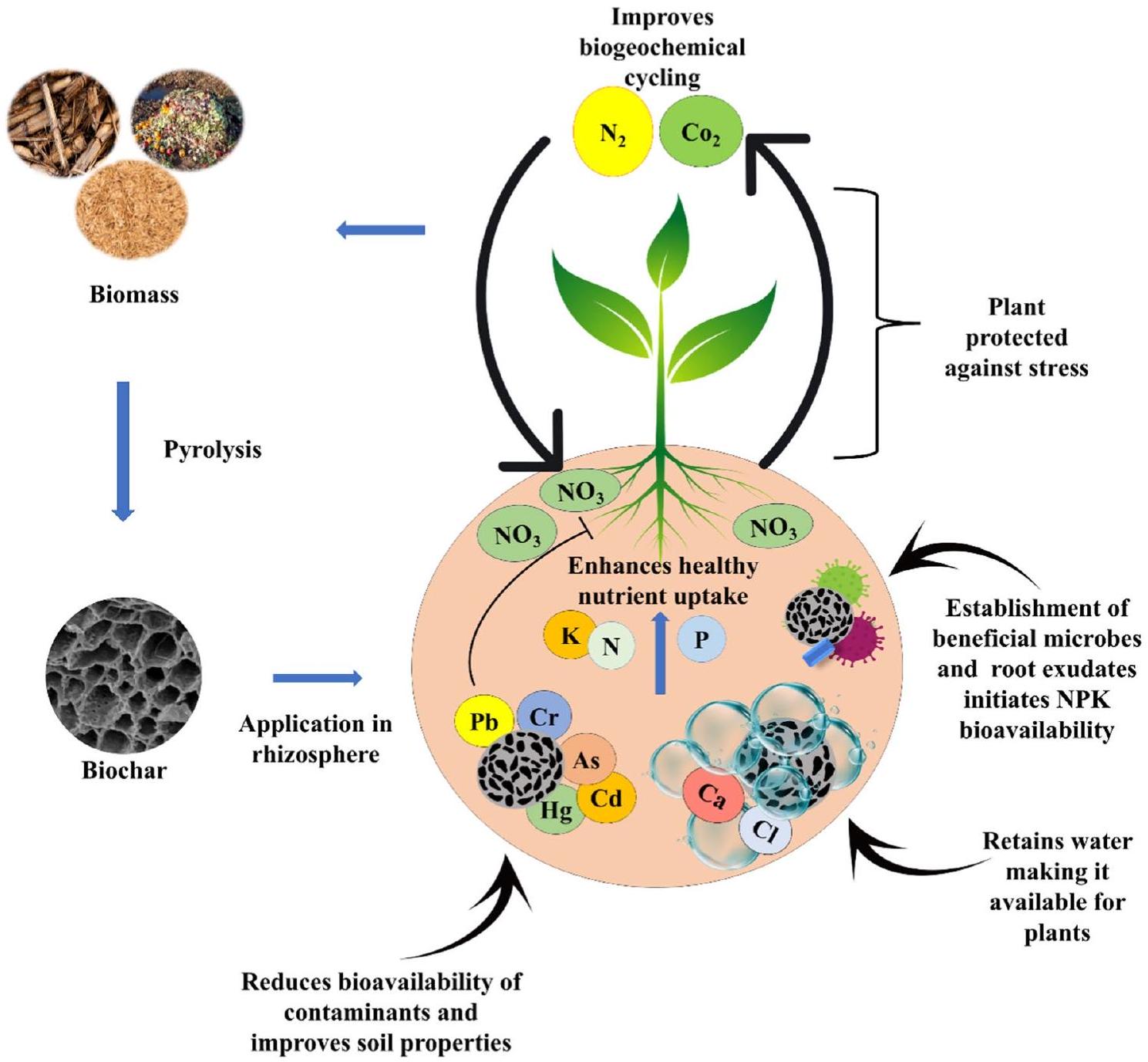
الملخص الرسومي

أهم النقاط

  • تمت مراجعة تقنيات التحلل الحراري لتحسين خصائص وتطبيقات الفحم الحيوي.
  • يعزز احتفاظ التربة بالعناصر الغذائية، وسعة المياه، ودوام المادة العضوية.
  • يقلل من انبعاثات الغازات الدفيئة بينما يعزز صحة التربة المستدامة.
  • يحتجز الكربون لمدة تصل إلى 2000 عام، مما يدعم التخفيف من آثار تغير المناخ.
الكلمات الرئيسية: الفحم الحيوي • خصوبة التربة • الزراعة المستدامة • تعديل التربة • التفاعلات الميكروبية

1 المقدمة

تشمل القضايا الأكثر أهمية في القرن الحادي والعشرين [1] مكافحة تغير المناخ، وتحسين صحة التربة، والتحكم في مياه الصرف الصحي، وإنشاء الطاقة المتجددة. وفقًا للأبحاث [2]، تعرضت خصوبة التربة وصحتها العامة لضغوط نتيجة الزيادة السريعة في التحضر ونمو السكان. بافتراض أن الوتيرة الحالية
إذا لم يتغير نمط التنمية، تقدر إدارة الشؤون الاقتصادية والاجتماعية التابعة للأمم المتحدة (2019) أن عدد سكان العالم سيصل إلى 9.4 إلى 10.1 مليار بحلول عام 2050. استنادًا إلى توقعات مختلفة، من المتوقع أن يزداد استهلاك الغذاء العالمي بـ بين عامي 2010 و2050. يجب إدخال طرق جديدة لزيادة الإنتاجية الزراعية لضمان توفر الغذاء. إن الحفاظ على الإنتاج الزراعي على المدى الطويل أمر غير مستقر بسبب استنفاد العناصر الغذائية في التربة الناجم عن الأنشطة البشرية وتغير المناخ. بعد سنوات من “الثورة الخضراء”، ثبت أن الأسمدة غير العضوية كانت مفيدة. بسبب تراجع مساحة الأراضي لكل فرد وتدهور جودة التربة، زاد استخدام الأسمدة بشكل مستمر. لا يمكن أن تعالج تطبيقات الأسمدة غير العضوية وحدها قضايا خصوبة التربة وجودتها بشكل مستدام.
يبحث الباحثون في جميع أنحاء العالم في البيوچار، وهو مادة كربونية متعددة الاستخدامات، لمواجهة التحدي الثلاثي المتمثل في التخفيف من آثار تغير المناخ، وتعزيز خصوبة التربة، وتلبية الطلب المتزايد على الغذاء. يتم إنتاج البيوچار من خلال تحويل المواد الخام حرارياً في بيئة فقيرة بالأكسجين عند درجات حرارة تتراوح بين [6]. “البيوچار” هو اختصار لمخلفات الكربون الناتجة عن التحلل الحراري، وهي عملية تسخين الكتلة الحيوية في بيئة منخفضة الأكسجين. تُسمى التعديلات التربة المصنوعة من بقايا محترقة “بيوچار”. للبيوچار استخدامات متعددة تتجاوز مجرد تحسين جودة التربة [7]. واحدة من هذه الاستخدامات هي إنتاج الطاقة. روث الدجاج، والمنتجات الثانوية من الغابات والزراعة، ورواسب مصانع الورق هي مجرد أمثلة قليلة من العديد من المواد العضوية التي يمكن استخدامها في إنتاجه [8].
يقدم الفحم الحيوي بديلاً جذابًا لتعديلات التربة التقليدية مثل السماد العضوي والأسمدة الكيميائية، خاصة فيما يتعلق بالاستدامة على المدى الطويل، والتكلفة، والأثر البيئي. تعزز خصائصه الفريدة صحة التربة وتخفف من انبعاثات غازات الدفيئة، مما يجعله إضافة قيمة للممارسات الزراعية المستدامة. يعزز الفحم الحيوي بنية التربة، ويزيد من احتباس الماء، ويعزز التنوع الميكروبي، وهو أمر حاسم لخصوبة التربة على المدى الطويل. يحتفظ بالعناصر الغذائية بفعالية، مما يقلل من التسرب ويحسن احتباس النيتروجين مقارنةً بالسماد العضوي والأسمدة الكيميائية. بينما قد تكون تكلفة إنتاج الفحم الحيوي في البداية أعلى، فإن فوائده على المدى الطويل، مثل تقليل الحاجة إلى الأسمدة الكيميائية، يمكن أن تعوض هذه التكاليف. يمكن إنتاج الفحم الحيوي من المواد النفايات، مما قد يقلل من التكاليف ويوفر حافزًا اقتصاديًا لاستخدامه. تطبيق الفحم الحيوي يقلل بشكل كبير من ، و الانبعاثات مقارنة بالسماد العضوي والأسمدة الكيميائية [10،11]. يمكن أن يساعد أيضًا في معالجة التربة الملوثة من خلال امتصاص المعادن الثقيلة، وهو ما لا تتمتع به الأسمدة العضوية التقليدية أو الأسمدة الكيميائية [12]. هذه التطبيقات هي وسيلة صديقة للبيئة لإحياء التربة التي تدهورت بسبب الاستخدام المفرط. هذه المورد المتجدد القابل للتكيف يمكن أن يولد الحرارة، والكهرباء، والوقود الحيوي السائل. يعتبر البيوكاربون إضافة أساسية للتربة من أجل التمعدن والامتصاص، وهو أيضًا مستقر نسبيًا [14].
يمكن أن يؤدي تطبيق الفحم الحيوي لتحسين الكتلة الحيوية والتربة إلى تعزيز الخصوبة والإنتاجية، بالإضافة إلى المساهمة في التخفيف من تغير المناخ، وفقًا للتقديرات العالمية. يزداد عدد الأشخاص الذين يفكرون في استخدام الفحم الحيوي لزيادة مساحة الأراضي القابلة للزراعة وتخزين الكربون. تساهم العديد من العوامل، مثل مساحة السطح، وسعة الاحتفاظ بالمياه، وسعة تبادل الكاتيونات (CEC)، وحجم المسام، والحجم، والتشتت، وتركيب العناصر، في تأثيراته المعروفة على تجمعات الميكروبات. على سبيل المثال، اكتشفت دراسة أن هذه الفوائد كانت مشتركة بين أراضي التسميد، والأراضي الزراعية، وأراضي إعادة التأهيل. للحفاظ على تربة صحية وخصبة، من الضروري مراعاة تدفق الطاقة في التربة وكفاءة استخدام الكربون من قبل الميكروبات (CUE). يُعرف انتقال الطاقة من النباتات وغيرها من المنتجين الأساسيين إلى الميكروبات والمحللات باسم “تدفق الطاقة في التربة” في علم التربة. ولكنه يذكر مرة أخرى أن هذا التدفق حاسم لدورة المغذيات والحفاظ على بنية التربة. كفاءة استخدام الكربون الميكروبي (CUE) للميكروبات في التربة هي المعدل الذي تطور به الكتلة الحيوية الميكروبية من الكربون العضوي. تعتبر زيادة المادة العضوية وخصوبة التربة من نتائج ارتفاع كفاءة استخدام الكربون الميكروبي، مما يؤدي إلى احتفاظ التربة بمزيد من الكربون. من خلال تحسين بنية التربة وخلق بيئة للميكروبات، يمكن أن يعزز الفحم الحيوي قدرة التربة على الاحتفاظ بالطاقة وإطلاقها. ثم يتم تعزيز تنوع ونشاط الميكروبات. أيضًا، فإن توفير مصدر كربون ثابت للميكروبات يعزز كفاءتها في استخدام الكربون (CUE). نتيجة لذلك، تصبح التربة أكثر صحة ويمكنها الاحتفاظ بمزيد من الكربون.
يُعزز الفحم الحيوي إنتاجية التربة ويزيد من احتجاز الكربون في التربة عند تطبيقه عليها. تشمل هذه المزايا انخفاض الكثافة الظاهرية، وتحسين احتباس الماء والمواد الغذائية، وزيادة النشاط الميكروبي، واستقرار المادة العضوية في التربة، واحتجاز المعادن الثقيلة. وقد يقلل أيضًا من انبعاثات التربة من ثاني أكسيد الكربون، والميثان، وثاني أكسيد النيتروجين، وكلها غازات دفيئة. في الوقت الحالي، يُعتبر الفحم الحيوي الخيار الأفضل للتربة الزراعية التي تسعى لاحتجاز الكربون على المدى الطويل. ويرجع ذلك أساسًا إلى أن المواد العضوية تتحلل ببطء شديد. تمتص النباتات ثاني أكسيد الكربون من الهواء وتحوله إلى كربون ثابت. يُصنع الفحم الحيوي من الكتلة الحيوية للنباتات ثم يُطبق على التربة. تحتوي التربة التي تحتوي على الفحم الحيوي على الكثير من الكربون العضوي الذي يمكن تخزينه لآلاف السنين. قد يؤدي تطبيق الفحم الحيوي على التربة الاستوائية، حتى التربة المتآكلة جدًا، إلى تحسين توفر الفوسفور. لذلك، يؤثر الفحم الحيوي بشكل كبير على الزراعة المستدامة بطريقة إيجابية. تهدف هذه الورقة إلى تقييم تأثير الفحم الحيوي على ديناميات التربة والميكروبات في النظم الزراعية. إليك أهداف هذه الورقة: (1) تقديم ملخص لعمليات تصنيع الفحم الحيوي وخصائصه المرتبطة؛ (2) دراسة كيفية تأثير الفحم الحيوي على الخصائص الفيزيائية للتربة.
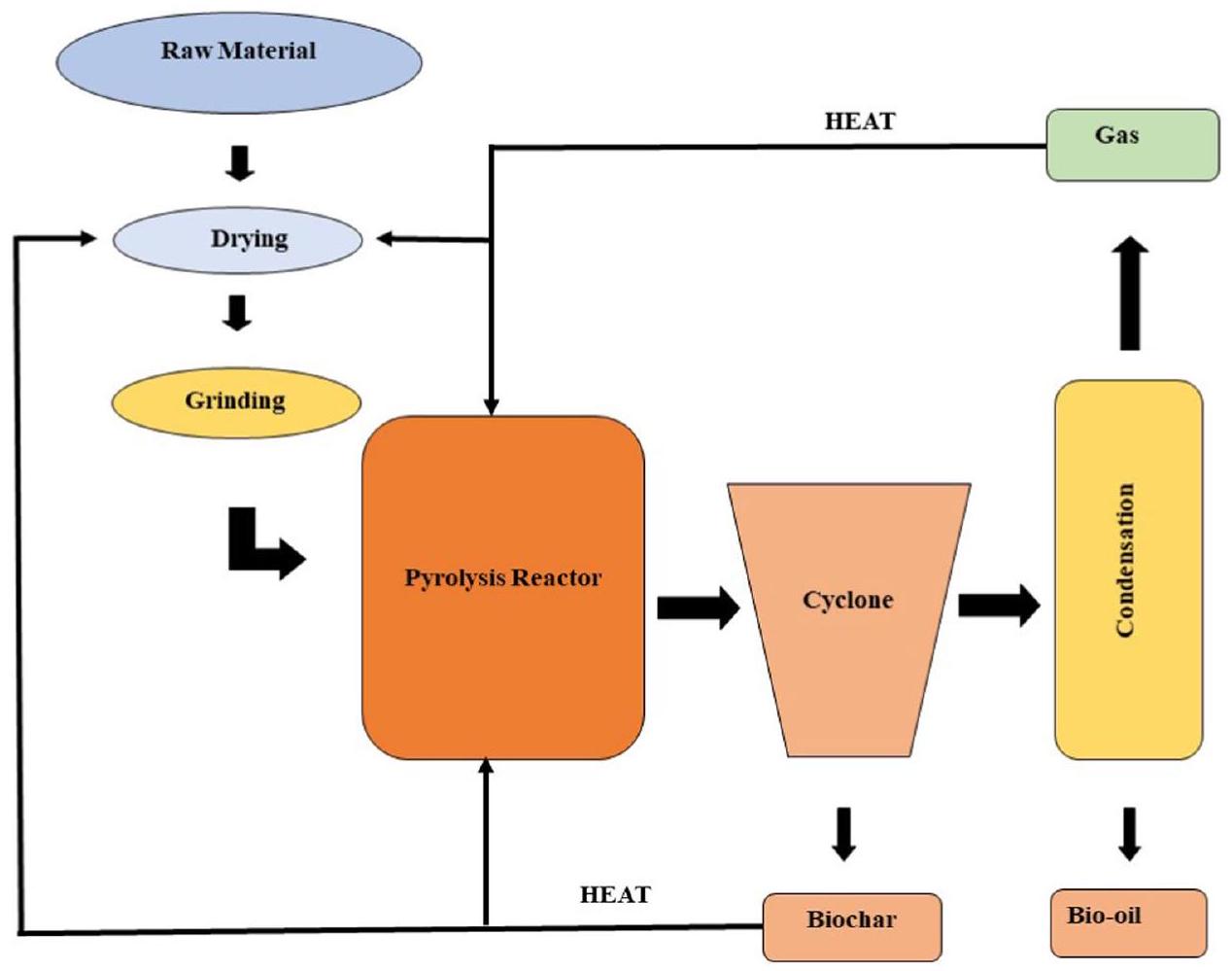
الشكل 1 عرض تخطيطي لعملية إنتاج الفحم الحيوي (التحلل الحراري) مقتبس من [94]
الخصائص الكيميائية؛ (iii) دراسة كيفية تأثير الفحم الحيوي على المجتمعات الميكروبية في التربة، بما في ذلك التنوع والنشاط والكتلة الحيوية؛ (iv) تقييم تأثير الفحم الحيوي على محصول المحاصيل وصحة النباتات؛ و (v) دراسة العواقب البيئية لاستخدام الفحم الحيوي في الزراعة.

طرق إنتاج البيوچار

لقد زادت إنتاجية الفحم الحيوي من الكتلة الحيوية بسبب الاهتمام المتزايد بتطبيقاته المحتملة العديدة. تعتبر عملية التحويل الحراري الكيميائي طريقة معترف بها على نطاق واسع لإنتاج مواد الفحم الحيوي. تشمل عدة عمليات للتحويل الحراري الكيميائي، بما في ذلك التحلل الحراري، والتغويز، والكربنة المائية، والتجفيف الحراري. توضح الشكل 1 مخطط عملية إنتاج الفحم الحيوي، مما يوفر نظرة شاملة بصرية. يتطلب إنتاج الفحم الحيوي تحسين معلمات عملية مختلفة محددة للكتلة الحيوية المستخدمة، بما في ذلك معدل التسخين، ودرجة الحرارة، ومدة الإقامة، وغيرها.
بالإضافة إلى ذلك، يجب اختيار طريقة التصنيع وفقًا لذلك. من الضروري التحكم في الحالة الكيميائية والفيزيائية للفحم الحيوي أثناء التخليق [26]. تعرض الجدول 1 عدة أمثلة على النتائج المحتملة. تكمن أهمية هذه المعلمات في قدرتها على تغيير الخصائص الفيزيائية والكيميائية للفحم الحيوي طوال عملية إنتاجه. يمكن أن تخضع الخصائص الفيزيائية والكيميائية للفحم الحيوي لتغييرات في ظروف مختلفة [27]. وذلك لأن الكتلة الحيوية تتعرض لانخفاض في الوزن خلال العملية.

2.1 التحلل الحراري

تحلل حراري يكسر المركبات العضوية عن طريق تطبيق الحرارة في بيئة خالية من الأكسجين، مع درجات حرارة تتراوح من التحلل الحراري مشتق من كلمتين يونانيتين، “بايرو”، التي تعني النار، و”ليزيس”، التي تعني التحلل أو التفكك إلى عناصره المكونة. ينطوي التحلل الحراري على تفكيك شيء ما إلى عناصره المكونة. وفقًا لبعض الباحثين، يُعتبر التحلل الحراري طريقة بديلة يمكن استخدامها لتحويل النفايات الحيوية إلى منتجات ذات قيمة إضافية. تشمل هذه المنتجات الفحم الحيوي، والزيت الحيوي، والغاز الاصطناعي. خلال العملية، تخضع المكونات اللجنوسليلوزية – مثل الهيميسليلوز، والسليلوز، واللجنين – لعمليات التحلل الجزيئي، والتفكك، والترابط عند درجات حرارة محددة. تؤدي هذه التفاعلات إلى إنتاج منتجات.
الجدول 1: الكتلة الحيوية المستخدمة في إنتاج الفحم الحيوي عند درجات حرارة مختلفة تؤدي إلى خصائص كيميائية متنوعة
الكتلة الحيوية درجة حرارة التحلل الحراري درجة الحموضة نسبة مئوية N% P% K% المراجع
نفايات مصنع الورق 9.4 50.0 0.48 0.22 [68]
النفايات الخضراء (قمامة القطن، العشب، وتقليم النباتات) 6.2 ٣٦.٠ 0.18 1.00 [69]
قش الأرز 9.5 ٤٨ 10 15 20 [70]
فضلات الدواجن 9.9 ٣٨.٠ 2.00 ٣٧.٤٢ 0 [71]
حمأة الصرف الصحي ٤٧.٠ 6.4 ٥.٦ [72]
بقايا الذرة 79.0 9.2 ٦.٧ [73]
فحم الأوكاليبتوس 82.4 0.57 1.87 [68]
قش القمح 9.7 65.70 1.05 0.1 1.2 [74]
خشب (صنوبر بونديروسا) حرائق الغابات ٦.٧ 74.0 16.6 13.6 [73]
قشرة الجوز الأمريكي (Carya illinoinensis) ٧.٦ ٨٣.٤ 1.7 [69]
نشارة الخشب الصلب 12.1 66.5 0.3 [75]
توجد في ثلاث حالات متميزة: صلبة، سائلة، وغازية [30]. تشمل المنتجات الغازية أول أكسيد الكربون، وثاني أكسيد الكربون، والهيدروجين، والغاز الاصطناعي (الهيدروكربونات C1-C2). تشمل المخرجات الصلبة والسائلة الفحم الحيوي والزيت الحيوي، على التوالي. يتم استخدام عدة تصميمات مختلفة للمفاعلات لإنتاج الفحم الحيوي. تشمل هذه التصميمات مفاعلات العربات، وأسرّة مميعة فقاعية، وأفران دافعة، وأفران رملية دوارة مضطربة [31]. كمية الفحم الحيوي المنتجة مرتبطة مباشرة بنوع وتركيب الكتلة الحيوية المستخدمة في عملية التحلل الحراري. تعتبر درجة الحرارة هي المعلمة التشغيلية الأكثر أهمية التي تحدد كفاءة المنتج. بشكل عام، يؤدي زيادة درجة الحرارة خلال عملية التحلل الحراري إلى تقليل إنتاج الفحم الحيوي وزيادة إنتاج الغاز الاصطناعي [32]. يتميز الفسفوروليس بمعلماته التشغيلية الأساسية: درجة الحرارة، ومعدل التسخين، ووقت المعالجة.
بالإضافة إلى ذلك، تساهم هذه المعايير التشغيلية في تصنيف التحلل الحراري إلى الفئات السبع الموجودة حتى الآن. تشمل بعض الأمثلة على هذه الأنواع الفرعية التحلل الحراري السريع، التحلل الحراري الفلاش، التحلل الحراري تحت الفراغ، التحلل الحراري الوسيط، والتحلل الحراري المائي. كل فئة من فئات التحلل الحراري لها إيجابيات وسلبيات مرتبطة بها. توفر الأنواع الفرعية المذكورة أعلاه بيئة يمكن أن تحدث فيها تفاعلات مختلفة تحت ظروف متنوعة، مما يمكن أن يؤدي إلى مجموعة واسعة من المنتجات [33].

2.1.1 التحلل الحراري البطيء

تتطلب تقنية التحلل الحراري البطيء معدل تسخين معتدل وتدهور حراري في جو يفتقر إلى التفاعل. تميز إنتاج الفحم الحيوي كونه المنتج النهائي الرئيسي، ويتطلب وقت إقامة كبير (يتجاوز ساعة واحدة). يُشار إليه أيضًا باسم التحلل الحراري التقليدي، الذي يتضمن تسخين الكتلة الحيوية تدريجيًا بمعدل في الدقيقة بينما يتم زيادة درجة الحرارة في النطاق من [33]. خلال عملية التحلل الحراري البطيء، كان هناك زيادة ملحوظة في إنتاج الزيت والفحم. أظهر عائد المنتج تباينًا كبيرًا اعتمادًا على معدل التسخين. وفقًا لدراسة [28]، كان إنتاج الغاز من التحلل الحراري البطيء هو للخشب لقشور الأرز، و لنفايات الغابات. هناك اقتراح بأن الغاز الاصطناعي ومنتجات زيت التحلل الحراري الناتجة عن التحلل الحراري البطيء للنفايات الصلبة البلدية يمكن استخدامها كوقود بديل ومواد أولية لصناعة مواد كيميائية عالية الجودة. يمكن استخدام المتبقي الناتج خلال هذه العملية، والذي يسمى الفحم الحيوي، في عمليات الهضم اللاهوائي المحسنة كخزن للكربون، ومسرعات كيميائية، ومواد تجذب وتحتفظ بمواد أخرى، وموصلات للكهرباء [35]. وفقًا للأبحاث السابقة، فإن الفحم الحيوي منخفض الحرارة له مساحة سطح معتدلة، مما قد يزيد من زمن الإقامة [36]. في دراسة، تم إنشاء فحم حيوي معدل بـ Nano ZnO/ZnS عن طريق التحلل الحراري التدريجي لقش الذرة الذي تم معالجته بعملية الامتصاص الحيوي وتمت معالجته بالزنك. وفقًا لاختبارات الامتصاص الدفعي، كان للفحم الحيوي المعدل بـ Nano ZnO/ZnS قدرة امتصاص قوية للرصاص (Pb(II))، والنحاس (Cu(II))، والكروم (Cr(VI))، مع سعات امتصاص قصوى من ، و ، على التوالي، والتي كانت أعلى بشكل ملحوظ من الفحم الحيوي الشائع ( ، و ، على التوالي) [37].

2.1.2 التحلل الحراري السريع

التحلل السريع للكتلة الحيوية هو أحدث طريقة تم تطويرها لتوليد الطاقة المستدامة. يتم حاليًا تطوير التحلل السريع بنشاط لتصنيع الوقود السائل وقد أظهر بالفعل جدواه التجارية كطريقة لتصنيع المواد الكيميائية. لقد حلت الوقود الهيدروكربوني عالي الجودة محل الوقود الحيوي من خلال إدخال الزيوت الحيوية بعد اختبارات ناجحة في الغلايات والتوربينات والمحركات. الهدف الرئيسي من التحلل السريع هو تعظيم تحويل الكتلة الحيوية إلى شكل سائل، يعرف باسم الزيت الحيوي. تسخين الكتلة الحيوية بسرعة وتبريد الأبخرة الناتجة بسرعة هما مكونان أساسيان في التحلل السريع لتحقيق إنتاج سائل مثالي [38]. يتم إجراء التحلل السريع بدون أكسجين عند درجات حرارة تتجاوز ومعدل تسخين يتجاوز في الدقيقة. عادةً ما ينتج عملية التحلل منتجات سائلة، و فحم حيوي، و منتجات غازية غير قابلة للتكثيف [33]. عند زيادة درجة الحرارة إلى للتحلل، تم قياس محتوى الزيت ليكون . بعد ذلك، عند ، بدا أنه بلغ ذروته عند . عندما تصل درجة حرارة التحلل إلى ، ينخفض الزيت المنتج إلى [39]. تم إجراء تحلل لصنوبر سريع النبتة (Pinus rigida) عند درجات حرارة مختلفة (300، 400، و ) في مفاعل سرير سائل أسفر عن فحم حيوي. عندما زادت درجة حرارة التحلل من ، انخفض إنتاج فحم حيوي بشكل كبير من ، مع الأخذ في الاعتبار وزن الكتلة الحيوية الجافة [40]. نظرًا لفوائدها اللوجستية والاقتصادية المتصورة مقارنة بطرق التحويل الحرارية التقليدية، هناك اهتمام متزايد بسرعة نحو التحلل السريع للكتلة الحيوية في أوروبا. يمكن نقل المنتج السائل بسهولة إلى وجهته المثالية أو تخزينه حتى الحاجة [41]. من المفيد تطوير تقنيات تحلل فعالة وسريعة للكتلة الحيوية ومواد الكربون الأخرى لتعزيز جودة ومرونة إنتاج المنتجات. تقدم هذه الطرق مزايا عديدة مقارنة بالتحلل التقليدي، والتحلل الفلاش، وعمليات الغازification [42].

2.1.3 التحلل الفلاش

التحلل الفلاش ضروري لتحويل الكتلة الحيوية إلى وقود حيوي صديق للبيئة [43]. يتميز التحلل الفلاش بدرجات حرارة مرتفعة، ومعدلات تسخين سريعة للغاية، وأوقات إقامة قصيرة. لتحقيق التحلل الفلاش، من الضروري إدخال المادة في مفاعل التحلل على شكل مسحوق. عادةً ما يستخدم التحلل الفلاش نطاق درجات حرارة من ، مع معدلات تسخين تتجاوز [44]. أظهر تجربة جارية بنجاح استخدام عملية التحلل الفلاش تحت ضغط جوي لتحويل الكتلة الحيوية السليلوزية إلى سوائل عضوية. تعمل العملية بمعدل تغذية جاف قدره . تظهر دراسة [45] أن مادة نفايات الخشب الصلب يمكن أن تولد عوائد سوائل عضوية تبلغ حوالي من التغذية الجافة، بينما يمكن أن تنتج قش القمح حوالي . يمكن أن تصل عوائد الزيت من التحلل الفلاش إلى تحت ظروف مثالية [43]. أظهرت دراسة على Albizia odoratissima أقصى عائد للزيت الحيوي عند [46]، بينما حققت كتلة نخيل البالم عائد زيت عند . أحجام الجسيمات الأصغر (مثل 1 مم) قد حسنت العوائد، مما يوفر مساحة سطح أكبر لنقل الحرارة والتفاعل [47].

2.1.4 التحلل الفراغي

على مستوى العالم، يتم إنتاج كمية كبيرة من نفايات البلاستيك البلدية (MPW) سنويًا. بديل جذاب يمكن أن يعالج هذه المشكلة هو إعادة تدوير التحلل. يقلل التحلل الفراغي من حدوث التفاعلات الثانوية مقارنةً بالتحلل تحت ضغط جوي [48]. إن الإخلاء السريع للأبخرة وزيادة إنتاج المنتجات السائلة هي فوائد إجراء التحلل الفراغي تحت ضغط فراغ. تتأثر تحلل المواد الخام في التحلل الفراغي بشكل رئيسي بدرجة الحرارة [49]. يمكن استخراج المواد الكيميائية والطاقة من المنتجات النفايات من خلال التحلل الفراغي. تحت هذه العملية، يتم تسخين المواد الخام النفايات إلى درجات حرارة مع الحفاظ على ضغط إجمالي بين 2 و 15 كيلو باسكال. وُجد أن هذه العملية يمكن أن تستعيد الكثير من الزيوت التحليلية مع توليد غاز قليل جدًا [50]. يتم تحلل الجزء المطاطي من الإطارات القديمة في الفراغ لإنتاج الزيت والغاز، بينما يتم استرداد حشو الكربون الأسود كـ CBP أو كربون أسود تحليلي. لهذا السبب يمكن أن يكون CBP بديلاً مناسبًا لبعض درجات الكربون الأسود التجاري في المطاط. عند اختباره كحشو لأسفلت الطرق، نجح CBP بشكل كبير. يمكن استخدام الزيت التحليلي الكامل كوقود سائل [51]. في دراسة، كانت درجة الحرارة المثلى لإنتاج فحم حيوي من روث الخنازير هي ، مما أسفر عن 73% فحم حيوي، إلى جانب الزيت الحيوي والغاز. في حالة قش السكر، أنتج التحلل الفراغي فحمًا بسطح عالٍ ( )، مناسبًا لمعالجة مياه الصرف [52]. يظهر الفحم الحيوي المنتج من خلال التحلل الفراغي قدرة عالية على تبادل الكاتيونات ( )، مما يعزز احتفاظ التربة بالعناصر الغذائية. يمكن تعديل الخصائص السطحية للفحم الحيوي من خلال تنشيط البخار، مما يزيد من مساحة السطح من ، مما يحسن خصائصه الامتصاصية [53].

2.1.5 التحلل الوسيط

تشمل العملية دمج التحلل البطيء والسريع، وهو أمر حاسم لتحقيق توازن بين المنتجات الصلبة والسائلة في التحلل الوسيط. خلال الإجراء، من المعتاد الحفاظ على الضغط عند 1 بار [54]. يتراوح نطاق درجات الحرارة للتحلل الوسيط بين ، مع معدلات تسخين تتراوح من في الدقيقة وأوقات إقامة تتراوح من [55]. تتكون المنتجات النهائية من حوالي سائل، و غازات غير قابلة للتكثيف، و 15-25% فحم حيوي. يتم إنتاج فحم حيوي جاف باستخدام ظروف التحلل الوسيط، والتي يمكن استخدامها مباشرة في الغلايات والمحركات، سواء بمفردها أو جنبًا إلى جنب مع الزيت الحيوي الممتاز. يمكن أيضًا استخدامها لأغراض زراعية لمنع تكوين القطران شديد التفاعل مع هياكل جزيئية كبيرة [33]. إحدى الخصائص المهمة لعمليات التحلل الوسيط هي ميل المنتج السائل للانقسام بسهولة إلى مرحلة عضوية ومرحلة مائية [32،55]. وجدت دراسة أن الفحم الحيوي المنتج من قشور الفول السوداني تحت جو أظهر مجموعة واسعة من أحجام المسام ( ) ومحتوى الكربون ( )، مما يشير إلى إمكاناته كامتزاز فعال للكربون النشط للتطبيقات البيئية [56]. مرة أخرى، ينتج أيضًا فحمًا حيويًا بمحتوى رطوبة أقل (0.7-4) مقارنةً بالتحلل السريع (3-6) والبطيء (2-42). نطاق pH الخاص به (8-9.6) قريب من الكربون النشط، مما يجعله فعالًا لامتصاص الهيدروكيميائي ومناسبًا لمختلف النفايات [33،54،57-59].

2.1.6 التحلل بمساعدة الميكروويف

على الرغم من التقدم الكبير في تكنولوجيا التحلل في العقود الأخيرة، يجب معالجة بعض التحديات التكنولوجية لتحقيق عوائد أعلى وتحسين جودة الوقود الحيوي السائل، كل ذلك مع تقليل استهلاك الطاقة الكلي. يعد التحلل بمساعدة الميكروويف طريقة قابلة للتطبيق للتغلب على التحديات بسبب قدرتها على تسخين المواد بسرعة وكفاءة من خلال ظاهرة “تسخين الميكروويف العازل” [60]. يعد التحلل بمساعدة الميكروويف تقنية فعالة للغاية لاستخراج وتحويل الطاقة من المواد النفايات الموحدة وطريقة جذابة للغاية لتسريع وتعزيز التفاعلات الكيميائية [61،62]. يقدم التحلل بمساعدة الميكروويف (MAP)، وهو طريقة حديثة نسبيًا، العديد من الفوائد مقارنة بالطرق التقليدية [63]. تشمل هذه الفوائد التسخين الحجمي والانتقائي، ومعدلات التسخين السريعة، والتسخين المتجانس في جميع أنحاء المادة [64]. يمكّن تسخين الميكروويف من إنتاج منتجات متفوقة وعمليات أكثر سلاسة من خلال توفير تحكم سريع في التشغيل/الإيقاف [65]. في التحلل الحفزي في الموقع لكرات دوغلاس باستخدام الفحم الحيوي المستخرج من قش الذرة في مفاعل ميكروويف، تم إنتاج كميات كبيرة من الهيدروكربونات ( من الزيت الحيوي) وزيادة الغازات غير القابلة للتكثيف ( ) [66].
تم إنتاج الفحم الحيوي مرة أخرى من التحلل الحفزي بمساعدة الميكروويف للغراس باستخدام وزيادة قدرة الاحتفاظ بالماء (WHC) وسعة تبادل الكاتيونات (CEC) للتربة الرملية. كانت المسامية العالية للبيوكربون، الناتجة عن عملية الميكروويف، أكثر فعالية في تحسين خصائص التربة من التحلل الحراري التقليدي [67].

2.2 الكربنة المائية

الكربنة المائية (HTC) هي تقنية كيميائية حرارية واعدة للغاية لتحويل النفايات إلى كربون. علاوة على ذلك، يمكن معالجة النفايات البلاستيكية باستخدام HTC [76]. الكربنة المائية هي طريقة تزيل الماء وثاني أكسيد الكربون من الوقود، مما يزيد من محتوى الكربون والقيمة الحرارية للوقود [77]. HTC، أو الكربنة المائية، هي عملية تعالج الكتلة الحيوية ذات المحتوى المائي العالي مسبقًا. يمكن بعد ذلك استخدام هذه الكتلة الحيوية المعالجة بعدة طرق. يتم إجراء HTC ضمن 180-250 [78]. تشير HTC إلى تسخين الكتلة الحيوية في بيئة خالية من الأكسجين، باستخدام الماء تحت الحرج والضغط الذاتي الذي يتراوح من اثنين إلى عشرة ميغاباسكال [79]. المنتج الأساسي الذي تقدمه HTC هو مادة مستقرة تسمى الهيدروكربون. بالإضافة إلى ذلك، تنتج منتجات غازية ثانوية، أساسًا ثاني أكسيد الكربون ( )، ومنتجات سائلة قابلة للذوبان في الماء [80]. يتأثر عائد الهيدروكربون بعدة متغيرات، بما في ذلك الملح ودرجة الحرارة والمواد الكيميائية الفينولية ومدة التعرض ودرجة الحموضة وتركيز العامل المعدل [81]. يتأثر عائد الهيدروكربون، أو نسبة الهيدروكربون إلى الوزن الجاف للمواد الخام، بعدة عوامل، بما في ذلك نوع المواد الخام، وحمولة المواد الصلبة (نسبة المواد الخام إلى الماء)، ودرجة حرارة العملية، ومدة الإقامة.
بالمقارنة مع التحلل الحراري، تُعرف الكربنة المائية (HTC) بتقديم فوائد متنوعة، مثل تقليل استهلاك الطاقة وانبعاثات الكربون. تم معالجة نشارة خشب الصنوبر، Sida hermaphrodita، والقش باستخدام HTC عند لمدة 4 ساعات، مما أدى إلى إنتاج الهيدروكربون والمنتجات السائلة ذات الخصائص الكيميائية والفيزيائية المميزة [82]. وبالمثل، تم معالجة نشارة خشب الصنوبر وpolyvinyl chloride (PVC) بشكل مشترك باستخدام HTC، مع درجات حرارة تصل إلى لتعزيز كفاءة إزالة الكلور [83]. تتمتع HTC بمعدل إنتاج فحم أعلى واستهلاك طاقة أقل
مقارنة بالتحلل الحراري، وهو فائدة إضافية. أحد الأسباب هو أن HTC تعمل عند درجات حرارة منخفضة مقارنة بالتحلل الحراري ولا تتطلب تجفيف المواد الخام [79]. يمكن أن تحسن بشكل كبير من ظروف التربة ويمكن استخدامها لالتقاط الكربون لتقليل انبعاثات غازات الدفيئة. أظهرت دراسات متعددة أن الهيدروكربون المنتج أثناء الكربنة المائية مقاوم للتغيير أو التحلل. عزز وجود البيوكربون كل من الجريان والاحتفاظ. تشير الأبحاث إلى أن دمج الهيدروكربون في التربة يمكن أن يعزز قدرتها على الاحتفاظ بالعناصر الغذائية والماء. تعزز مسام الهيدروكربون التخزين والتحكم في إطلاق العناصر الغذائية [84].

2.3 الغازification

يحدث تحويل المواد الكربونية إلى غاز صناعي غازي، والذي يتضمن CO وCO2 وCH4 وH2 وآثار من الهيدروكربونات، عندما تتعرض هذه المواد لدرجات حرارة مرتفعة وعوامل الغازification مثل الهواء الأكسجيني، والبخار، وما إلى ذلك. عند درجات حرارة أعلى، تم إنتاج المزيد من المركبات مثل أول أكسيد الكربون والهيدروجين، بينما تم إنتاج عدد أقل من المركبات مثل ، والهيدروكربونات. المنتج الرئيسي لهذه العملية هو الغاز الصناعي، مع كون الفحم منتجًا ثانويًا ذو عائد أقل [85]. يتم تحقيق الغازification الحراري للكتلة الحيوية اللجنوسليلوزية بشكل أفضل عند درجات حرارة تتراوح بين . عادةً، تكون درجة الحرارة القصوى التي يمكن أن تصل إليها غازifier التدفق المدفوع عند حرق الكتلة الحيوية أعلى بكثير من . أدنى درجة حرارة مقبولة للفحم لمعظم أنواع الغازifiers هي . درجة حرارة الغازification القصوى لغازifier التدفق المدفوع أعلى عمدًا. يمكن تحقيق زيادة في درجة حرارة انصهار الرماد من خلال زيادة إعداد درجة حرارة الغازifier. تتطلب درجة حرارة تفاعل عالية أيضًا طلبًا عاليًا من الأكسجين بسبب أحداث الأكسدة الطاردة للحرارة داخل الغازifier التي تعزز درجة حرارة التفاعل [86]. في دراسة على البيوكربون من ألياف النخيل، تم استخدام درجات حرارة تتراوح من مع كعامل غازification. تم تحليل تحويل الكربون وتفاعل الفحم باستخدام التحليل الحراري الوزني. وجدت الدراسة أن درجات الحرارة الأعلى زادت من تحويل الكربون وتفاعل الفحم. تم تحديد خوارزمية Levenberg Marquardt (LM) كأفضل طريقة للتنبؤ بفقدان الوزن، وتفاعل الفحم، وتحويل الكربون، محققة قيمة انحدار قدرها 0.99 [87]. تم التحقيق في الغازification بالبخار للبيوكربون المشتق من فروع التفاح المقطوعة باستخدام مفاعل سرير ثابت. تم الحصول على أفضل بيوكربون عند درجة حرارة التحلل الحراري قدرها . وجدت الدراسة أن درجات حرارة التفاعل الأعلى ومعدلات تدفق الماء حسنت من إنتاج غاز الهيدروجين، مع كون أفضل الظروف هي درجة حرارة تفاعل قدرها ، ومعدل تدفق الماء قدره ، وحجم الجسيمات قدره [88].

2.4 التوريفيكت

إحدى الطرق الحديثة نسبيًا لإنتاج البيوكربون هي التوريفيكت. يتم التسخين بمعدل منخفض. التوريفيكت، وهو عملية كيميائية حرارية في بيئة غير تفاعلية عند درجات حرارة تتراوح من 200 إلى ، يتم التحقيق فيها حاليًا كوسيلة لمعالجة الكتلة الحيوية مسبقًا [89]. وفقًا لـ [85]، تتغير خصائص الكتلة الحيوية، مثل حجم الجسيمات، ومساحة السطح، ومحتوى الرطوبة، وكثافة الطاقة، ومعدل التسخين، بواسطة التوريفيكت. كقاعدة عامة، تخضع الكتلة الحيوية للكربنة، والتحلل، والتخلص من الهيميسليلوز، واللجنين، والسليلوز أثناء التوريفيكت. ينتج التوريفيكت محلول صلب موحد يتراوح لونه من البني إلى الأسود، بالإضافة إلى غازات يمكن تكثيفها، مثل الماء، والمركبات العضوية، والدهون، والغازات التي لا يمكن تكثيفها ( و ). حوالي من الكتلة تبقى منتجًا صلبًا مع من محتوى الطاقة الأصلي بعد التوريفيكت، مع تحويل إلى منتجات غير قابلة للتكثيف وقابلة للتكثيف [90]. يزيد التوريفيكت من الكارهية للماء وكثافة الطاقة في الكتلة الحيوية بينما يقلل من متطلبات طاقة الطحن [89، 91] أظهرت الأبحاث حول التوريفيكت لبقايا قصب السكر، التي أجريت عند درجات حرارة قدرها مع أوقات احتفاظ قدرها ، أن البقايا المعالجة شهدت تحسينات كبيرة في خصائصها النهائية، والقريبة، والشكلية، مما يجعلها مناسبة تمامًا للاستخدام في عمليات الغازification [92]. درست الدراسة تأثير عملية التوريفيكت على نفايات قشور الجوز عند درجات حرارة تتراوح من مع أوقات احتفاظ تتراوح من 10-30 دقيقة. أشارت النتائج إلى أن الظروف المثلى كانت مع وقت احتفاظ قدره 20 دقيقة، مما أدى إلى تحسين كثافة الطاقة ومؤشرات مواتية [93].
في معظم الأحيان، تُخصص التقنيات المذكورة أعلاه لإنتاج البيوكربون بحجم ماكرو بكميات كبيرة. يمكن تقليل الحجم من خلال تقنيات مختلفة لإنتاج البيوكربون النانوي، المعروف باسم Nano-BC. وفقًا لدراسة [95]، فإن nano-BC هو بيوكربون بحجم توزيع الجسيمات من 1 إلى 100 نانومتر. عادةً ما يتضمن إنتاج nano-BC، وهو مادة كربونية فريدة على النطاق النانوي، استخدام طرق نانوية خضراء وفعالة من حيث الطاقة. أظهرت الدراسات أن nano-BC يختلف عن الفحم الماكرو بعدة طرق: مساحة سطحه المحددة أعلى، ومسامته أعلى، ونصف قطره الهيدروديناميكي أقل، وزاويته السلبية أكبر، ويحتوي على مجموعات وظيفية على السطح تحتوي على الأكسجين تعتبر أفضل، وهناك عيوب كربونية أقل [96، 97]. أولاً، يتم تحويل الكتلة الحيوية إلى BC بكميات كبيرة. ثم، باستخدام تقنيات فصل مختلفة، يتم تقليل الحجم لإنتاج nano-BC. المادة الخام
له تأثير كبير على الخصائص الفيزيائية والكيميائية للنانو-بيوكاربون. يتم إنتاج النانو-بيوكاربون الذي يحتوي على كميات منخفضة من الكربون والأكسجين عادةً من الكتلة الحيوية الغنية بالهيميسليلوز. العكس هو الصحيح بالنسبة للمواد التي تحتوي على نسبة عالية من اللجنين؛ حيث تنتج هذه المواد عادةً نانو-بيوكاربون يمكن أن يتجمع بشكل جيد. كانت النانو-بيوكاربونات المصنوعة من القصب وقش القمح تحتوي في الغالب على جزيئات صغيرة ذات هيكل مفتوح. على عكس النانو-بيوكاربونات الأولى، أظهرت نانو-بيوكاربونات الميسكانثوس تأثيرات تجميع أقل وكانت تحتوي على جزيئات كروية كبيرة. كان للنانو-بيوكاربون الناتج من النفايات الزراعية أيضًا تأثير متناسب مباشر على محتوى الرماد في البيوكاربون الكتلي، بينما لم يكن للنفايات البلدية تأثير مماثل. يتم صنع النانو-بيوكاربون من البيوكاربون الكتلي من خلال بعض الخطوات الإضافية.

2.4.1 طريقة الطحن

تعتبر عملية الطحن الكروي طريقة شائعة لإنشاء النانو-BC، حيث تقوم بتفتيت الفحم الحيوي ميكانيكياً وتقليل حجم الجسيمات إلى النانو. في طريقة الطحن الكروي، يتم طحن المادة إلى جزيئات دقيقة عن طريق كسر الروابط الكيميائية بين الجسيمات وتطبيق الطاقة الحركية للكرات المتحركة عليها. تحدث التفاعلات الكيميائية عادةً في الروابط المعلقة على الأسطح التي تم تشكيلها حديثًا. علاوة على ذلك، تم توثيق تأثيرات عملية الطحن الكروي عالية الطاقة التي تنتج أحيانًا ضغطًا محليًا عاليًا يصل إلى عدة جيجا باسكال ودرجة حرارة تتجاوز [102]. بسبب خصائصه الفريدة، تم استخدام الطحن الكروي كطريقة تخليق ميكانيكي-كيميائي لإنشاء هياكل نانوية مميزة ذات خصائص كيميائية جديدة [101]. يؤدي ضغط المسام والقنوات الطولية أثناء عملية الطحن إلى تكوين مسام أصغر ومسطحة، مما يزيد من المساحة السطحية النوعية. هناك وضعان لهذه الطريقة: رطب وجاف. الفرق بين الاثنين هو ما إذا كان يتم إضافة الماء إلى الفحم الحيوي أثناء طحنه أم لا. أدى الطحن الكروي الرطب لمدة 12 ساعة إلى إنتاج فحم حيوي موزع بشكل أكثر تساويًا وذو جزيئات أصغر مقارنةً بالطحن الكروي الجاف، ويمكن لكلتا تقنيتي الطحن الكروي إنشاء مساحة سطحية نوعية أكبر من الطحن اليدوي [101].

2.4.2 تقنية الموجات فوق الصوتية

التسونيد بالموجات فوق الصوتية هو تقنية بديلة فعالة لإنتاج النانو-بي سي. تقوم الموجات الصدمية بتقشير الهيكل الشبيه بالجرافيت للبيوكاربون وتفتيت الجسيمات من خلال التسونيد، الذي يتضمن تثبيت طرف المجس تحت سطح التعليق. تعتمد التقنية الرئيسية على استخدام الموجات الصدمية والميكروjets الناتجة عن الموجات فوق الصوتية لفتح المسام المغلقة، وإنشاء مسام جديدة، وتعديل هيكل البيوكاربون لتعزيز الميكرو مسامية المواد. يمكن زيادة كمية النانو-بي سي المنتجة مع زيادة مدة التسونيد. تُستخدم الموجات فوق الصوتية لفصل القطع الصغيرة من البيوكاربون الملتصقة بالسطح أو المدمجة في مسام البيوكاربون الأم. وجد العلماء أن البيوكاربون التقليدي المعالج بالموجات فوق الصوتية يمكن تحويله بنجاح إلى نانو بيوكاربون بحجم جسيمات [104]. وجد الباحثون أنه بعد 30 دقيقة من المعالجة بالموجات فوق الصوتية، يمكن أن تنتج الكتلة الحيوية من الفحم الحيوي المصنوعة من مواد خام مختلفة جزيئات من الفحم الحيوي النانوي أصغر من 100 نانومتر [105]. بالإضافة إلى التقنيات المذكورة سابقًا، تم استخدام طرق أخرى أيضًا لإنتاج الفحم الحيوي النانوي. أحد الأمثلة هو استخدام مفاعلات التحلل الحراري بالموجات الدقيقة لتخليق الفحم الحيوي النانوي مباشرة. تتطلب هذه الطريقة خطوة واحدة فقط، مما يجعلها فعالة واقتصادية [106]. تعتبر تقنية الطرد المركزي طريقة أو عملية إضافية بسيطة في إنتاج الفحم الحيوي النانوي؛ حيث تنتج جزيئات الفحم الحيوي النانوية المرتبة. وفقًا للبحث [95]، يمكن استخدام حمض الكبريتيك وحمض النيتريك المركزين لهضم الفحم الحيوي الكتلي، مما يؤدي إلى إنتاج الفحم الحيوي النانوي.

3 خصائص للفحم الحيوي

البيوچار هو مادة صلبة تُنتج من خلال كربنة الكتلة الحيوية. تتضمن هذه العملية تسخين الكتلة الحيوية، مثل الخشب أو روث الحيوانات أو المنتجات الزراعية الثانوية، في بيئة مغلقة مع وجود هواء محدود. يؤثر مصدر المواد الخام وظروف التحلل الحراري المحددة بشكل كبير على خصائص البيوچار. إن اختيار مادة الخام ومعلمات عملية التحلل الحراري المحددة، مثل درجة الحرارة والمدة، تؤثر بشكل كبير على خصائص البيوچار الناتج. بالنسبة لمعظم مواد الخام، هناك قاعدة عامة تنص على أنه كلما ارتفعت درجة الحرارة المستخدمة في عملية التحلل الحراري، سيكون البيوچار الناتج (BC) له محتوى كربوني أعلى، وقيمة طاقة أعلى، ومسامية أكبر، وأبعاد سطحية أكبر. في الوقت نفسه، سيكون له محتوى أقل من الأكسجين والهيدروجين وكثافة أقل.
ومع ذلك، تنتج أشكال مختلفة من الكتلة الحيوية الفحم الحيوي بخصائص مميزة. تؤدي مدة التحلل الحراري الممتدة إلى زيادة في مساحة سطح الكربون الأسود (BC) ومحتوى الكربون (C) [108]. عادةً ما يظهر الفحم الحيوي من الخشب تركيزات أقل من النيتروجين الكلي (N) والفوسفور (P) والبوتاسيوم (K) والكبريت (S) والكالسيوم (Ca) والمغنيسيوم (Mg) والألمنيوم (Al) والصوديوم (Na) والنحاس (Cu). كما أن له محتوى رماد منخفض، وإمكانية منخفضة لتبادل الكاتيونات (CEC)، وكتونات قابلة للتبادل. كانت درجة حرارة التحلل الحراري مرتبطة إيجابيًا بزيادة في الرقم الهيدروجيني والرماد.
المحتوى، القلوية السطحية، وانخفاض الحموضة السطحية. خلال التحلل الحراري السريع، يتم تسخين الكتلة الحيوية بسرعة إلى درجات حرارة تتراوح بين ، إنتاج زيت حيوي.
على النقيض من ذلك، تتضمن التحلل الحراري البطيء تطبيق الحرارة تدريجياً على الكتلة الحيوية حتى تصل إلى درجة الحرارة القصوى المرغوبة، مما يؤدي إلى تشكيل الغاز الاصطناعي والفحم الحيوي كمنتجات رئيسية. يظهر الفحم الحيوي عدة خصائص فيزيائية وكيميائية ملحوظة، مثل مساحة السطح العالية والتمدد، والكثافة المنخفضة، وزيادة سعة تبادل الكاتيونات (CEC)، ودرجة الحموضة المحايدة إلى العالية، وزيادة محتوى الكربون والنيتروجين والفوسفور، بالإضافة إلى الكاتيونات الأساسية مثل الكالسيوم والمغنيسيوم والبوتاسيوم التي توجد أيضاً في التربة. إنها ضرورية كعناصر غذائية للنباتات في تعزيز تطوير المحاصيل ونموها. يؤدي تقليل درجة الحرارة أثناء التحلل الحراري إلى زيادة إنتاج الفحم الحيوي. على العكس من ذلك، فإن ارتفاع درجة الحرارة يزيد من الكربون، ويزيد من مساحة السطح، ويعزز خصائص الامتصاص، ويزيد من التمدد، ويجعل الكربون أكثر متانة. تشير نتائج الأبحاث إلى أن زيادة درجة الحرارة أثناء عملية التحلل الحراري لحمأة مياه الصرف الصحي تؤدي إلى انخفاض إنتاج الكربون الأسود (BC). على وجه التحديد، عند درجة حرارة العائد كان بينما في ، انخفض إلى .
على العكس، مع ارتفاع درجة حرارة التحلل الحراري، انخفض محتوى الكربون من إلى بين ، وفي النهاية وصلت إلى مستوى ثابت. يمكن أن يفسر الوفرة الكبيرة من المواد المتطايرة المحتوية على الكربون في مادة التغذية، التي خضعت بسهولة لعملية الغازification مع زيادة درجة الحرارة، التغيير الملحوظ في محتوى الكربون. كما انخفضت تركيزات الهيدروجين والنيتروجين والأكسجين مع زيادة درجة الحرارة. على وجه التحديد، انخفض محتوى الهيدروجين من إلى ، انخفض محتوى النيتروجين من إلى ، وانخفض محتوى الأكسجين من 8.33% إلى حوالي 0.00% [108].
تختلف خصائص الفحم الحيوي بشكل كبير بناءً على المواد الخام المحددة ومعايير التحلل الحراري المستخدمة خلال إنتاجه. أظهر الفحم الحيوي المُصنّع من قشور الجوز الأمريكي قيمة pH تبلغ 7.2، ومساحة سطح محددة (SSA) من وتركيب كربوني من عند تعرضه للتفكك الحراري عند درجات حرارة أقل من . وعلى العكس، أظهر الفحم الحيوي الناتج من فضلات الدواجن قيمة pH تبلغ 10.3، ومساحة سطح محددة (SSA) من ، ومحتوى C من لقد أثرت درجات حرارة التحلل الحراري المختلفة بشكل ملحوظ على الفحم الحيوي المنتج أثناء استخدام نفس المواد الخام [109]. تعزز درجة الحرارة العالية أثناء التحلل الحراري إنتاج الفحم الحيوي بوجود مساحة سطح محددة متطورة، وارتفاع المسامية، ودرجة حموضة، ومحتوى عالٍ من الكربون والرماد، ولكن مع انخفاض في سعة تبادل الكاتيونات (CEC) ومحتوى المواد المتطايرة [110]. عند درجات حرارة التحلل الحراري العالية ( تخضع المادة لعملية تختفي فيها المجموعات الوظيفية تدريجياً. ونتيجة لذلك، تصبح المادة أكثر مقاومة بسبب درجة تكثيفها العالية وبنيتها العطرية متعددة الحلقات. إن زيادة وفرة الهياكل العطرية في الفحم الحيوي تعزز استقراره على المدى الطويل في التربة، مما يوفر مقاومة أكبر للتدهور الكيميائي والبيولوجي. مع ارتفاع درجة حرارة التحلل الحراري، ترتفع مستويات الكربون والنيتروجين في الفحم الحيوي المستند إلى النباتات، بينما تنخفض المستويات في المواد الخام الغنية بالمعادن. تؤثر خصائص الفحم الحيوي، بما في ذلك الكربون الثابت، والمادة المتطايرة، ومحتوى الرماد، بشكل كبير على فعاليته كتحسين للتربة. يعتبر الكربون الثابت حاسماً لاستقرار الفحم الحيوي في التربة، مما يساهم في احتجاز الكربون على المدى الطويل. ترتبط مستويات الكربون الثابتة الأعلى بتحسين بنية التربة واحتفاظ العناصر الغذائية، مما يعزز نمو النباتات. تؤثر المادة المتطايرة على مسامية الفحم الحيوي ومساحة سطحه، وهو أمر أساسي لامتصاص العناصر الغذائية والنشاط الميكروبي. تميل أنواع الفحم الحيوي ذات المادة المتطايرة المنخفضة إلى أن تكون أكثر استقراراً ومعدلات تحلل أبطأ، مما يجعلها أكثر فعالية كتحسين للتربة على المدى الطويل. يؤثر محتوى الرماد على توفر العناصر الغذائية؛ غالباً ما توفر أنواع الفحم الحيوي ذات محتوى الرماد العالي معادن أساسية مثل البوتاسيوم والكالسيوم. على سبيل المثال، أظهر فحم الهياسينث المائي محتوى رمادياً عالياً، مما حسن من ملفه الغذائي وقدرته على احتجاز الماء. بينما يعزز الفحم الحيوي بشكل عام خصائص التربة، يمكن أن تختلف تأثيراته بناءً على نوع ومصدر الكتلة الحيوية المستخدمة، مما يشير إلى الحاجة إلى اختيار دقيق لتحسين الفوائد في سياقات التربة المحددة.

4 تأثير الفحم الحيوي على ديناميات الطاقة في التربة

نظرًا لأن التربة هي المكونات الأساسية للزراعة، فإن إدارة التربة في وضع دقيق لضمان الدعم المستدام للزراعة في المستقبل. تقوم عملية التمثيل الضوئي في الأنظمة الزراعية بتحويل الإشعاع الشمسي إلى طاقة كيميائية مخزنة في جزيئات الجلوكوز. تشهد التربة تدفقًا مستمرًا وكبيرًا للطاقة على مدار العام. تعتمد الغلاف الحيوي والأنظمة البيئية بشكل أساسي على الطاقة. تعتبر الأنظمة البيئية شبكات معقدة تلتقط الطاقة وتحولها بكفاءة. تظهر الأنظمة البيئية حركة أحادية الاتجاه حيث تتدفق الطاقة من خلالها. تقوم الكائنات الحية التي تقوم بعملية التمثيل الضوئي، مثل النباتات والطحالب، بتحويل الطاقة الشمسية في البداية إلى طاقة كامنة. بعد ذلك، يتم تراكم هذه الطاقة داخل الروابط الكيميائية للجزيئات العضوية أو الكتلة الحيوية. يتم تحويل جزء كبير من هذه الطاقة الكامنة إلى طاقة حرارية عندما تستخدمها الكائنات الحية لأداء وظائف مختلفة، مثل النمو، والحركة، أو التكاثر. لم تعد موجودة في النظام البيئي ولا يمكن استخدامها مرة أخرى.
يستخدم الناس الأنظمة الزراعية لتحويل الطاقة الشمسية إلى أنواع محددة من الكتلة الحيوية، والتي تستخدم بعد ذلك كوقود، أو علف، أو ألياف، أو غذاء. كل نظام زراعي، بدءًا من الزراعة الأولية المحلية وجمع النباتات في الزراعة المبكرة إلى الأنظمة الزراعية المعدلة بشكل كبير في الوقت الحاضر، يتطلب إدخال طاقة إدارة بشرية والطاقة التي يوفرها الشمس. تنشأ الحاجة إلى هذه المدخلات من الاستخراج الكبير للطاقة من الأنظمة الزراعية في شكل مواد محصودة. تحقق علم بيئة شبكات الغذاء من الروابط بين مستويات التغذية المختلفة وتنظيم التنوع البيولوجي، بما في ذلك الكائنات الحية الصغيرة ذاتية التغذية والحيوانات المفترسة الكبيرة. أظهرت الدراسات في هذا المجال نمطًا منتظمًا من علاقات التغذية عبر الأنواع وكيف تؤثر العديد من العناصر، بما في ذلك توزيع تدفق الطاقة وخصائص الأنواع داخل شبكات التفاعل، على هذا النمط وتحافظ عليه. يشير تدفق الطاقة في الشبكات البيئية إلى ترتيب الطاقة داخل المجتمعات، والسرعة التي تتحرك بها الطاقة بين أجزاء مختلفة من الشبكة، واستخدام الطاقة من قبل مجموعات التغذية المختلفة.
حسن الفحم الحيوي من تجانس توزيع الطاقة ومرونة التربة القابلة للزراعة. لوحظت علاقة إيجابية بين تعددية الوظائف وثبات تدفق الطاقة. يعتبر الفحم الحيوي والعناصر الغذائية مدخلات تآزرية تساهم في الحفاظ على تعددية الوظائف على المدى الطويل. إنه مكمل للتربة جديد نسبيًا وواعد يوفر فوائد متنوعة، مثل تسريع نمو المحاصيل وتعزيز احتجاز الكربون في التربة من خلال زيادة حركة الطاقة داخل شبكة الغذاء في التربة.
من المتوقع أن تظهر الديدان الخيطية في التربة، وهي أكثر الكائنات الحية شيوعًا التي تشغل مستويات تغذية مختلفة في شبكة الغذاء في التربة، تدفقات طاقة مميزة عند إدخال الفحم الحيوي. أولاً، يمكن أن يعزز الفحم الحيوي تدفق الطاقة من خلال الكائنات الدقيقة عن طريق زيادة الكتلة الحيوية للميكروبات في التربة. علاوة على ذلك، يمكن أن ترفع الخصائص القلوية وتركيب الفحم الحيوي القابل للاختراق مستوى pH في التربة، وتحسن ترتيبها الفيزيائي، وتحفز نمو النباتات. تساهم هذه التأثيرات مجتمعة في زيادة تدفق الطاقة من خلال العواشب. يمكن أن يساعد إدخال الفحم الحيوي في بيئة التربة في استعادة التوازن في هيكل الطاقة للأنظمة الزراعية التي تهيمن عليها العواشب وتستقبل الأسمدة الاصطناعية. يمكن تحقيق ذلك من خلال زيادة توفر الغذاء للآكلات الكلّية واللحوم. ونتيجة لذلك، قد يتحسن استقرار النظام البيئي وتعدد الوظائف. أدى تطبيق الفحم الحيوي و100% من الأسمدة الاصطناعية NPK بمعدل موصى به إلى تعزيز توزيع تدفق الطاقة بشكل متساوٍ داخل شبكة غذاء الديدان الخيطية في التربة. عبر جميع علاجات الأسمدة الاصطناعية، لوحظ أن إضافة الفحم الحيوي زادت من تدفق الطاقة من خلال الفطريات، وهو ما ارتبط بتركيز أعلى من الكربون في الكتلة الحيوية الفطرية.
تعتبر أنظمة الزراعة، وخاصة تلك الموجودة في المناطق الجافة وشبه الجافة، قلقة للغاية بشأن انخفاض خصوبة التربة الناجم عن الاستخدام غير المسؤول للأسمدة الاصطناعية. أدى تطبيق الأسمدة الكيميائية على المزارع خلال الثورة الخضراء في البداية إلى زيادة كبيرة في العائد الزراعي. ومع ذلك، في الوقت نفسه، كان هناك انخفاض سريع في خصوبة وجودة التربة، مما أثر سلبًا على استدامة أنظمة التربة على المدى الطويل. لذلك، من الضروري وضع استراتيجيات جديدة تتماشى مع مبادئ الاستدامة المتعلقة بجودة التربة، والإنتاجية، واستخدام الموارد، وإمكانية وصول المزارعين. يمكن أن يعزز الفحم الحيوي جودة التربة ويزيد من إنتاجية المحاصيل من خلال زيادة المادة العضوية في التربة. يعتبر الفحم الحيوي حلاً قابلاً للتطبيق لمعالجة التحديات المعقدة لجودة التربة المتدهورة، وإدارة النفايات، وزيادة إنتاج المحاصيل.
يمكن تحسين صحة التربة باستخدام الفحم الحيوي من خلال آليات مختلفة، مما يزيد في النهاية من إنتاجية المحاصيل. إحدى الطرق لمعالجة ذلك هي من خلال تعزيز تنوع المجتمع الميكروبي. لا تخدم مسام الفحم الحيوي فقط كموطن لنمو تجمعات الميكروبات، بل تلعب أيضًا دورًا في جعل النيتروجين متاحًا لتمتصه النباتات. هذا أمر حيوي بشكل خاص للمحاصيل (باستثناء البقوليات) التي لا يمكنها القيام بتثبيت النيتروجين. يعزز الفحم الحيوي توفر النيتروجين لامتصاص النباتات، خاصة في المحاصيل التي لا يمكنها تثبيت النيتروجين بشكل طبيعي. تم ملاحظة زيادة في عوائد الذرة وارتفاع مستويات النيتروجين (N) والكالسيوم (Ca) في أوراق النباتات عند تطبيق الفحم الحيوي بمعدل 15 جرام لكل كيلوغرام من التربة.
بالإضافة إلى ذلك، شهد مستوى pH في التربة انخفاضًا مؤقتًا بسبب ارتفاع محتوى الكربون. تؤثر التغيرات في الكائنات الحية في التربة بشكل مباشر على نمو النباتات. أظهرت دراسات متعددة أن الفطريات الميكوريزية تظهر ميلًا أعلى لنمو الفحم الحيوي. تؤثر الفطريات الميكوريزية، التي تسهل امتصاص العناصر الغذائية والماء من قبل النباتات، على تشكيل وتكامل الكتل الترابية في التربة. قد تنجذب البكتيريا إلى الفحم الحيوي، مما يقلل من تعرضها للتسرب. أدى إدخال الفحم الحيوي إلى التربة المائية إلى تحقيق زيادة في الكتلة الحيوية الميكروبية الكربونية [123]. لقد أدى إضافة الفحم الحيوي، وخاصةً بالاقتران مع الأسمدة النيتروجينية، إلى تعزيز الوفرة النسبية للأنواع البكتيرية المفيدة مثل الأسيودوبكتيريا والبروتيوبكتيريا [124]. يقوم الفحم الحيوي بتغيير -البكتيريا المثبتة المسؤولة عن تحويل الغلاف الجوي إلى الأمونيا . نظرًا لأنه يمكن أن يزيد من درجة حموضة التربة ومحتوى الكربون العضوي، مما يخلق بيئة أكثر ملاءمة للبكتيريا المثبتة للنيتروجين مثل Enterobacter cloacae وBradyrhizobium [125، 126]. كما تم ربط البيوچار بزيادة ملحوظة في تنظيم جين nifH، الضروري لتثبيت النيتروجين، مما يشير إلى زيادة نشاط المجتمعات المثبتة للنيتروجين [125].

5 تأثير الفحم الحيوي على خصائص التربة

تتعلق صحة التربة في الزراعة بقدرة التربة على دعم وتعزيز نمو النباتات وإنتاجيتها. تتميز التربة الخصبة بقدرتها على توفير العناصر الغذائية الأساسية والمياه اللازمة لنمو النباتات، مع كونها خالية من أي مواد قد تكون ضارة. يتم تحديد خصوبة التربة من خلال تركيبها الكيميائي والبيولوجي والفيزيائي. في العديد من المناطق حول العالم، تشكل مشكلة ضعف خصوبة التربة تحديًا كبيرًا. مع تفاقم نقص الغذاء العالمي وتحديات تغير المناخ، من الضروري تنفيذ حلول صديقة للبيئة تعزز إنتاجية التربة وخصوبتها، وتعزز صحة التربة البيوكيميائية، وتقلل من الأثر البيئي للزراعة. أظهرت الأبحاث أن الفحم الحيوي، وهو منتج ثانوي للكربون يتمتع باستقرار عالٍ وخصائص عطرية، يمكن أن يحسن بشكل كبير من جودة التربة عند استخدامه كإضافة.
علاوة على ذلك، يتمتع الفحم الحيوي بالقدرة على تقديم فوائد اقتصادية من خلال زيادة إنتاجية التربة وبالتالي تقليل الاعتماد على الأسمدة الكيميائية مع مرور الوقت. كما هو موضح في الجدول 2، فإن تطبيق الفحم الحيوي له تأثيرات مختلفة على صحة التربة بناءً على نوع التربة ومعدل التعديل. بشكل عام، يظهر الفحم الحيوي مستوى pH مرتفع يتراوح بين 8-11، كما تحدده استخلاص الماء بنسبة 1:10 (وزن إلى وزن). ومع ذلك، فإن إدخال الفحم الحيوي الذي يتمتع بخصائص جيرية كبيرة إلى التربة القلوية قد يؤدي إلى تفاقم صحة التربة من خلال زيادة القلوية. على العكس من ذلك، فإن إضافة الفحم الحيوي يقلل من حموضة التربة الحمضية، مما يعزز صحة التربة. نظرًا لميزاته العديدة، فإن تعديل الفحم الحيوي هو تقنية قيمة لاستعادة التربة الملوثة وتوليد غلات غذائية كبيرة دون الإضرار بالبيئة. إن تطبيق الفحم الحيوي يعزز بشكل فعال دورات المغذيات على نطاق المزرعة من خلال التغلب على نقص المغذيات، حيث إنه يفيد جودة التربة ونمو النباتات.
نتيجة لذلك، تحول التركيز تمامًا نحو دراسة مزايا دمج الفحم الحيوي في التربة لتعزيز نمو النباتات واستقرارها [126]. لقد حظيت فكرة صحة التربة، التي تصف القدرة المستمرة للتربة على العمل كنظام حي أساسي يدعم الكائنات الحية مع الحفاظ على جودة المياه والهواء أو تحسينها، باهتمام كبير. تؤكد هذه التعريفات بشدة على إدارة التربة لحمايتها والحفاظ عليها لصالح الأجيال القادمة [131]. تشمل المكونات الأساسية لصحة التربة المواد العضوية في التربة (SOM) والمعادن الطينية، التي تعمل كمواقع لتبادل وتخزين العناصر الغذائية. أظهرت الدراسات حول استخدام الفحم الحيوي أن التربة التي تتمتع بتنوع وفعالية ميكروبية محسنة غالبًا ما تظهر مقاومة أكبر لمختلف تقنيات الإدارة [132]. يلعب الفحم الحيوي دورًا حيويًا في الحفاظ على صحة التربة من خلال تعزيز نمو الميكروبات التربة. هذه الميكروبات ضرورية لتحليل الركائز العضوية إلى مواد عضوية في التربة (SOM)، مما يسهل العمليات الغذائية البيوجيوكيميائية وتحويل المعادن، ويحسن تركيب التربة وتجمعها، ويمنع الأمراض، وينظم هرمونات نمو النباتات، ويعزز احتفاظ التربة بالمياه وتوافرها للنباتات، ويعادل المواد الضارة والمعادن (اللويد) التي يمكن أن تضر بالنباتات [69].

5.1 التأثيرات على بنية التربة وتركيبها

لقد كانت صناعة الزراعة مهتمة بالفحم الحيوي نظرًا لإمكاناته في تحسين خصائص التربة وإنتاجية المحاصيل. يحسن الفحم الحيوي نسيج التربة ومساماتها، ويزيد من قدرة تبادل الكاتيونات (CEC)، ويحسن قدرة التربة على الحفاظ على توازن الرقم الهيدروجيني، ويسهل ارتباط الأنيونات والكاتيونات المهمة بالتربة. يؤثر مستوى الرقم الهيدروجيني بشكل كبير على تنوع ووفرة ووظائف الكائنات الدقيقة. يمكن أن تساعد قدرة محلول التربة على التخفيف، أو مقاومته لتقلبات الرقم الهيدروجيني الناتجة عن CEC للفحم الحيوي، في الحفاظ على مستويات الرقم الهيدروجيني المثالية وتقليل تقلبات الرقم الهيدروجيني داخل المواطن الدقيقة الموجودة داخل جزيئات الفحم الحيوي.
عندما يتم إدخال الفحم الحيوي في التربة الاستوائية الحمضية، فإنه يزيد من درجة حموضة التربة. وهذا بدوره يحسن من قدرة التربة على الاحتفاظ بالكاتيونات الأساسية ويعزز تغذية المحاصيل. وقد تم التأكيد على أن دمج الفحم الحيوي يزيد من درجة حموضة التربة ويعزز توفر البوتاسيوم والفوسفور. على الرغم من أن الفحم الحيوي القلوي يعمل بشكل أفضل في التربة الحمضية، إلا أن الفحم الحيوي منخفض الحموضة يمكن أن يخفض بشكل فعال درجة حموضة التربة القلوية. يؤدي إضافة الفحم الحيوي إلى أكسدة المزيد من الكربون العطري، مما يرفع من سعة تبادل الكاتيونات في التربة. تزيد سعة تبادل الكاتيونات الأعلى من قدرة التربة على الاحتفاظ بالعناصر الغذائية وتقليل عملية التسرب، مما يحسن من خصوبة التربة. أدى إدخال الفحم الحيوي إلى تغييرات كبيرة في الخصائص الفيزيائية والكيميائية للتربة في المناطق الرطبة في آسيا. في دراسة، ارتفعت مستويات مؤشرات جودة التربة المهمة، بما في ذلك درجة الحموضة، الكربون العضوي، النيتروجين الكلي، واستخدام النيتروجين، بحوالي ، و على التوالي. تم اكتشاف أن جودة التربة يمكن تقييمها من خلال قياس زيادة في الكربون العضوي في التربة، زيادة في الرقم الهيدروجيني، زيادة في إجمالي النيتروجين، و زيادة في استخدام النيتروجين. كما ساهم تطبيق الفحم الحيوي في تطوير كتل تربوية كبيرة، مما قلل من احتمال تآكل التربة [133].
الجدول 2 تأثير الفحم الحيوي على استجابات النبات والتربة
نوع البيوچار درجة حرارة التحلل الحراري معدل التقديم تم العثور على ردود المراجع
نفايات مصنع الورق زيادة في الإنبات [139]
قش الذرة 0٪، 3٪، و5٪ انخفض معدل التسلل مع زيادة معدل تطبيق الفحم الحيوي [139]
قش الذرة 10 و انخفاض كثافة التربة الظاهرية [140]
غبار الخشب ، و يعزز قدرة التربة على احتباس الماء [141]
قش الأرز 0، 1، 3 و 9% يعزز قدرة التربة على احتباس الماء [140]
فحم قشرة الأكاسيا مانجيوم الفطريات الميكوريزية الجذرية زادت بـ [٢٥، ١٤٢]
فحم قشور التبغ حسّن الرقم الهيدروجيني للتربة ومنع تسرب النيتروجين والبوتاسيوم في التربة ذات القوام الخفيف [143]
النفايات الخضراء بأعلى المعدلات مع تطبيق N، العائد مقارنة بـ في غياب الفحم الحيوي [15]
سماد الدواجن زيادة توفر النيتروجين والفوسفور والبوتاسيوم والكالسيوم والمغنيسيوم في التربة [139]
قشور الفول السوداني 0٪، 5٪، و20٪ زيادة [140]

5.2 تأثيرات على قدرة احتفاظ التربة بالمياه

سعة احتباس الماء (WHC) أمر حاسم في الزراعة لأنها تؤثر بشكل مباشر على إنتاجية المحاصيل من خلال تسهيل نمو النباتات. يمكن أن يحسن الفحم الحيوي قدرة التربة على الاحتفاظ بالماء من خلال جعلها أكثر مسامية وتوفير سطح للاحتفاظ بالماء. نظرًا لمساحته السطحية الأكبر وطبيعته المسامية، يمكن للفحم الحيوي أن يحتفظ بمزيد من الماء في كل وحدة حجم من التربة مقارنة بالمواد الأخرى. يسمح شبكة القنوات المملوءة بالماء في مسام الفحم الحيوي بزيادة نفاذية الماء. يعتبر الفحم الحيوي مفيدًا بشكل خاص في بعض المناطق التي تتميز بالري المحدود، والجفاف المطول، وندرة موارد المياه، حيث يقلل من جريان المياه والتآكل. تؤثر تركيبته المحددة على سعة احتباس الماء للفحم الحيوي، والظروف التي يتم إنتاجه فيها من خلال التحلل الحراري، وخصائص التربة التي يتم تطبيقه عليها. عادةً ما يزيد الفحم الحيوي من سعة احتباس الماء في التربة من خلال . في دراسة أجريت [70]، أدى إضافة الفحم الحيوي إلى التربة الطينية إلى زيادة في سعة الاحتفاظ بالمياه، بينما في التربة الرملية، كانت الزيادة يمكن للفحم الحيوي المشتق من قش الأرز الاحتفاظ بالماء حتى 2.7 مرة من وزنه. بالإضافة إلى ذلك، فإن تطبيق نشارة الخشب وفحم قش الأرز بمعدل أسفر عن زيادة في محتوى الرطوبة في التربة مقارنة بمجموعة التحكم بدون أي فحم حيوي.

5.3 تأثيرات على نيتروجين التربة

البيوچار أداة مفيدة لزيادة كمية النيتروجين (N) المدخلة في أنظمة التربة والنبات. تعتمد النظم البيئية على النيتروجين (N). مقارنة بالبيوچار المصنوع من النباتات، يحتوي السماد عادةً على المزيد من المعادن بكميات أعلى. على الرغم من ذلك، فإن الكمية النموذجية من النيتروجين على شكل نترات في العديد من أنواع البيوچار المختلفة تكون عادةً أقل من البيوتشار هو عامل مهم في تحديد إمكانية الوصول إلى النيتروجين في التربة، على الرغم من أن كمية النيتروجين المتاح منخفضة نسبيًا. وذلك لأن البيوتشار يمكن أن يؤثر على الأشكال والعمليات العديدة للنيتروجين التي تحدث خلال دورة النيتروجين. تشمل هذه العمليات تطاير الأمونيا، النترجة، تثبيت النيتروجين وتحريره، النيتروجين العضوي المذاب، وتثبيت النيتروجين البيولوجي. عمومًا، يتمتع البيوتشار بإمكانية كبيرة لتقليل فقدان النيتروجين في التربة في أنواع مختلفة من التربة؛ ومع ذلك، فإن تأثيره على إنتاجية المحاصيل أقل في المناطق المعتدلة مقارنة بالمناطق الاستوائية.

5.4 تأثيرات على الفوسفور في التربة

أحد المغذيات الكبيرة الضرورية لنمو النباتات هو الفوسفور (P)؛ ومع ذلك، يُعتقد أن النباتات تمتص فقط 10-25% من الـ المستخدمة في الأسمدة المعدنية. المتبقي إما أن يُفقد إلى الأجسام المائية أو يُثبت في التربة. تؤثر خصائص التربة المختلفة، مثل الرقم الهيدروجيني، وسعة تبادل الكاتيونات، وتركيبات المواد العضوية والمعادن، والملمس، جميعها على كمية الفوسفور المتاحة للنباتات بسبب التربة. من المعروف أن تطبيق الفحم الحيوي يؤثر على ديناميات الفوسفور في التربة بشكل مباشر وغير مباشر. وذلك لأنه يزيد من كمية الفوسفور الموجودة بالفعل في الفحم الحيوي، ويغير الرقم الهيدروجيني للتربة، ويعدل تكوين التنوع الميكروبي. استخدام الفحم الحيوي المنتج تحت إعدادات تحلل حراري مختلفة ومن مصادر مختلفة لأنواع التربة والمناخات المختلفة زاد بشكل كبير من كمية الفوسفور المتاحة للنباتات. في التربة الزراعية [128، 137]. لذلك، يُوصى بتطبيق الفحم الحيوي بمعدل أعلى من لجني فوائد زيادة الفوسفور المتاح للنباتات [136].

5.5 التأثيرات على العناصر الغذائية الأخرى

انخفضت كميات الكالسيوم والمغنيسيوم في الخس عند إضافة الفحم الحيوي المصنوع من روث الدواجن. ومع ذلك، رفع الفحم الحيوي مستويات الكالسيوم والمغنيسيوم في الهندباء عندما تم إدخال الفحم الخشبي إلى التربة، مما أدى إلى زيادة امتصاص العناصر الدقيقة مثل ، و Mn. عند دمجه مع سماد NPK، أدت معدلات تطبيق البيوچار المرتفعة إلى تحسين غلات المحاصيل في التربة شبه الجافة في أستراليا والتربة الاستوائية في الأمازون. عندما تم استخدام البيوچار على منحدر شديد مع تربة ذات pH منخفض (أقل من 5.2)، أدى ذلك إلى غلات أعلى من الفاصوليا والجزر مقارنة بالمجموعة. من خلال دمج بيوچار سيقان الذرة في التربة الساحلية المالحة، هناك زيادة في الغلة من لحبوب القمح و فول الصويا. لاحظنا زيادة أخرى في إنتاج العنب داخل نفس الحقل بعد استخدام الفحم الحيوي المستخرج من تقليم البساتين.
ومع ذلك، بعد إجراء تجربة ميدانية لمدة 4 سنوات، لم يُلاحظ أي فرق ملحوظ في إنتاجية أو جودة العنب عند إضافة الكتلة الحيوية الخشبية إلى تربة مزارع العنب السويسرية. تم تطبيق 100 ميغاغرام من الوزن الجاف لكل هكتار. زيادة إنتاج الذرة بواسطة الفحم الحيوي بنسبة لإنتاج الذرة وفول الصويا بواسطة . مرة أخرى، تطبيق الفحم الحيوي من لانتانا بمعدل أسفر عن زيادة في إنتاج حبوب الذرة، الذي بلغ [138].

6 إمكانيات احتجاز الكربون للفحم الحيوي وتأثيره على تغير المناخ

يستخدم الفحم الحيوي في التربة كطريقة لاحتجاز الكربون يمكن أن تقلل من الانبعاثات، وتحسن جودة التربة، وتساعد في توليد الطاقة الحيوية [116]. يوفر الفحم الحيوي إمكانيات كبيرة لاحتجاز الكربون والفوائد البيئية، حيث يمكنه احتجاز أكثر من 920 كجم من لكل طن من بقايا المحاصيل المحولة [117]، مع استقرار طويل الأمد في التربة لآلاف السنين [118]. تعتمد قدرة احتجاز الكربون على هيكله العطري المدمج وتفاعلاته مع مكونات التربة، بما في ذلك المعادن والميكروبات [120]. تشير الدراسات الحديثة إلى أن الفحم الحيوي يمكن أن يقلل من انبعاثات غازات الدفيئة (GHG)، بما في ذلك أكسيد النيتروز ( ) وميثان ( )، والتي تسهم بشكل كبير في تغير المناخ [119]. على سبيل المثال، فإن الفحم الحيوي الناتج عن نفايات مصانع الورق، والمواد الحيوية، وفضلات الدواجن قد قلل من الانبعاثات في التربة الحديدية الحمضية. ومع ذلك، لا يزال بعض الباحثين متشككين في هذه النتائج. يؤثر الفحم الحيوي على انبعاثات غازات الدفيئة في التربة بشكل متباين اعتمادًا على عدة عوامل، بما في ذلك رطوبة التربة، ونوع المواد الخام للفحم الحيوي، ودرجة حرارة التحلل الحراري. تؤثر هذه المتغيرات على فعالية الفحم الحيوي في التخفيف من انبعاثات غازات الدفيئة. وقد ثبت أن الفحم الحيوي المشتق من مصادر مثل الكافور، وقش الأرز، والخيزران، والحمأة، ورقائق الخشب الصلب، وروث الخنازير فعال للغاية في إزالة من الغاز الحيوي، مع قدرات امتصاص تتراوح بين من الفحم الحيوي وكفاءة الإزالة لـ [118]. امتصاص يتم تعزيزها بشكل كبير بواسطة عوامل مثل محتوى الرطوبة في الفحم الحيوي (أكثر من )، درجة الحموضة العالية (أعلى من 8.0)، المساحة السطحية المتاحة، والتفاعلات الكيميائية مع المجموعات الوظيفية السطحية مثل OH و يتفاعل مع سطح الفحم الحيوي القلوي من خلال التفاعلات الأيونية مع هذه المجموعات الوظيفية في وجود الماء والأكسجين، مكونًا مركبات مثل التي قد تكون متاحة للنباتات على أنها [145].

7 قيود للفحم الحيوي

تطبيق الفحم الحيوي على التربة له عدة عيوب، وفقًا للمعلومات المتاحة حاليًا. من بين هذه العيوب تسرب الكربون والنيتروجين، وتحرك الملوثات، والعديد من التغيرات غير المرغوب فيها في الهياكل الفيزيائية والبيولوجية للبيئة. وُجد أن تطبيق الفحم الحيوي على الانبعاثات الغازية أنتج نتائج متضاربة وكان له بعض الآثار السلبية على العوائد الزراعية. يمكن أن تعزز قلوية الفحم الحيوي بشكل فعال درجة حموضة التربة وتفيد نمو المحاصيل في التربة الحمضية، ذات القوام الخشن، والرملية. بالإضافة إلى ذلك، يمكن أن تفاقم اختلال التوازن الغذائي والتملح في التربة القلوية بالفعل، مثل تلك الموجودة في الهضاب، والمناظر الطبيعية من الطين، أو بعض المناطق الجافة. يمكن أن يتسبب ذلك في أن تكون درجة حموضة التربة خارج النطاق الأمثل للعديد من المحاصيل، مما يؤدي إلى تأثير ضار على توفر العناصر الغذائية، وخاصة العناصر النزرة والفوسفور، وفي النهاية يعيق نمو المحاصيل. يمكن أن يؤدي التطبيق المفرط للفحم الحيوي إلى قلوية التربة التي تعيق نمو النباتات؛ هذه المادة غنية بالمعادن القلوية ويمكن أن تعادل حموضة التربة بشكل فعال. تطبيق الفحم الحيوي بمعدلات أعلى ( لها تأثير أكثر وضوحًا على الرقم الهيدروجيني مقارنةً بمعدلات أقل . وهذا بدوره يؤثر على ظروف نمو النباتات وتوافر العناصر الغذائية [146]. مرة أخرى، لاحظ بعض الباحثين الذين يحققون في محتوى الماء في التربة أن إدخال الفحم الحيوي في التربة يمكن أن يقلل من قدرتها على الاحتفاظ بالماء [146]. يمكن أن يؤدي تطبيق الفحم الحيوي على التربة أحيانًا إلى حدوث خصائص كارهة للماء أثناء عملية التحضير، مما يؤدي إلى تعديلات في التركيب المحب للماء والكاره للماء في التربة وتقليل الماء المتاح. كمية الفحم الحيوي المستخدمة، نوع التربة، وعملية التصنيع كلها تؤثر على هذا التأثير. بسبب خصائصه الكارهة للماء، يمكن أن يقلل الفحم الحيوي من التوصيل الهيدروليكي، ويطيل من ترطيب مسام التربة، ويعزز من مقاومة الماء في التربة. يمكن أن تؤثر خصائص الفحم الحيوي الكارهة للماء، التي تتأثر بدرجة الحرارة أثناء التحلل الحراري والمواد الخام المستخدمة، على احتفاظ الماء في التربة. وقد وُجد أن الفحم الحيوي المصنوع من قش الميسكانثوس وقش الأرز يظهر خصائص كارهة للماء، بينما الفحم الحيوي المصنوع من قش القمح والخشب اللين وقش الأرز لم يظهر ذلك. ومع ذلك، كان هناك انخفاض في كمية المادة العضوية والمجموعات المحبة للماء، مما أدى إلى انخفاض قدرة التربة على الاحتفاظ بالماء. تشير النتائج إلى أن التأثير السلبي للخصائص الكارهة للماء على احتفاظ الماء في التربة يمكن تقليله من خلال اختيار المواد الخام للفحم الحيوي بعناية وضبط درجات حرارة التحلل الحراري. يمكن أن يؤدي تقدم عمر الفحم الحيوي إلى تقليل حموضة التربة وCEC. الإفراط في استخدام الفحم الحيوي يقلل من إمكانية الوصول إلى الأيونات، مما يؤدي إلى انخفاض خصوبة التربة وCEC بسبب امتصاص الكاتيونات الحيوية مثل الكالسيوم والمغنيسيوم والبوتاسيوم [146].
تشير الأبحاث أيضًا إلى أن الفحم الحيوي يؤثر سلبًا على التفاعلات بين التربة والمحاصيل؛ على الرغم من ترويجه لتحسين احتفاظ العناصر الغذائية، إلا أنه يقلل أيضًا من فقدان العناصر الغذائية في التربة. في دراسة، وُجد أن إضافة 30 طنًا متريًا لكل هكتار (t/ha) من الفحم الحيوي إلى التربة، مع 4 كجم لكل هكتار ( ) من ، أدى إلى انخفاض في تركيبة المنغنيز (Mn) في التربة. استخدام الفحم الحيوي أثناء زراعة الذرة قلل من إجمالي امتصاص المحاصيل للنيتروجين وكفاءتها. بعد تطبيق من الفحم الحيوي، كان هناك انخفاض في مستويات الذرة وانخفاض في
تينيسي، كما أفاد [147]. وفقًا لدراسة [148]، يؤثر الفحم الحيوي سلبًا على العناصر الغذائية في التربة من خلال تعديل خصائص التربة وتغيير امتصاص العناصر الغذائية وثباتها. يمكن أن يؤثر الفحم الحيوي سلبًا على قدرة التربة على الاحتفاظ بالنيتروجين وعناصر تتبع إضافية. أدى تطبيق التنشيط الفيزيائي على الفحم الحيوي إلى تقليل حوالي و في محتويات وP الفعالة، على التوالي [149].
نظرًا لحساسيتها العالية لتلوث التربة، تعتبر ديدان الأرض من أكثر المؤشرات قيمة لصحة التربة. فقط عدد قليل من الدراسات قد فحصت نتائج دمج الفحم الحيوي في التربة فيما يتعلق بديناميات تجمعات ديدان الأرض [150]. لوحظ أن الإضافة لوحظت أن ديدان الأرض في جميع الترب المختبرة [151]. الديوكسينات، الفيورانات، والفينولات هي مركبات سامة في الفحم الحيوي يمكن أن تعيق تكاثر الكائنات الدقيقة. بالإضافة إلى ذلك، يمكن أن يمتص الفحم الحيوي الإنزيمات من الكائنات الدقيقة والعناصر الغذائية غير العضوية مثل النيتروجين (N) من التربة. وفقًا لتقرير، يقلل هذا من عملية معدنة SOC ونشاط الكائنات الدقيقة. قد يقدم تطبيق غبار الفحم الحيوي على التربة الزراعية عناصر قد تكون ضارة بصحة الناس. عندما يتعرض فحم قش الأرز لعملية التحلل الحراري عند درجات حرارة عالية، قد يحتوي على مواد بلورية ضارة مثل السيليكا. يمكن أن يكون لهذه المواد آثار سلبية خطيرة على صحة الإنسان، خاصة على الجهاز التنفسي، إذا تم إدخالها في التربة أثناء تطبيق الفحم الحيوي. يجب أن تقيم الدراسات اللاحقة تأثير الغبار الناتج أثناء تطبيق الفحم الحيوي على صحة الإنسان [152].
بينما من الواضح أن الفحم الحيوي له تأثير كبير على صحة التربة واستدامتها، قد تنشأ تحديات بسبب حجم الإنتاج والاستخدام الزراعي. استكشفت الدراسات الحديثة قابلية التوسع والتأثيرات البيئية لإنتاج الفحم الحيوي. بينما يقدم الفحم الحيوي فوائد كبيرة في تقليل انبعاثات غازات الدفيئة، تظل الجدوى الاقتصادية قيدًا رئيسيًا للإنتاج على نطاق واسع [153]. تختلف تكاليف الإنتاج بشكل كبير، حيث تتراوح من لكل طن، اعتمادًا على التكنولوجيا والمواد الخام المستخدمة [154]. تعتبر كفاءة الطاقة مصدر قلق، حيث تحقق الأنظمة الصغيرة إلى المتوسطة كفاءة تصل إلى وتصل الأنظمة الكبيرة إلى . تشمل التحديات التكاليف العالية المرتبطة بجمع ونقل ومعالجة المواد الخام البيولوجية. تم اقتراح أنظمة الإنتاج المتنقلة أو الموزعة كحلول محتملة لتقليل التكاليف واستخدام الكتلة الحيوية المولدة محليًا [155]. على الرغم من هذه التحديات، يقدم إنتاج الفحم الحيوي تطبيقات بيئية واعدة، بما في ذلك تعديل التربة، احتجاز الكربون، ومعالجة مياه الصرف الصحي [156]. أيضًا، تستدعي العواقب البيئية لإنتاج الفحم الحيوي، وخاصة الانبعاثات الناتجة عن التحلل الحراري واستدامة الإنتاج على نطاق واسع، اعتبارًا دقيقًا. بينما يقدم الفحم الحيوي العديد من الفوائد، مثل تعزيز خصوبة التربة وتقليل انبعاثات غازات الدفيئة، يمكن أن يكون لعملية الإنتاج نفسها آثار بيئية كبيرة يجب معالجتها. يمكن أن يؤدي التحلل الحراري إلى إطلاق مركبات عضوية متطايرة (VOCs) وملوثات أخرى، مما يؤثر سلبًا على خصائص التربة ووظيفتها [157]. وبالتالي، تواجه تسويق الفحم الحيوي عقبات تتطلب مزيدًا من البحث والتطوير لتعظيم إمكاناته في إدارة الموارد المستدامة [156]. لمعالجة هذه المخاوف، يجب أن تركز الدراسات المستقبلية على التحليلات الشاملة للمقايضات بين عوائد الطاقة، وتقليل الكربون، وغيرها من التأثيرات البيئية [158]، فضلاً عن العواقب طويلة الأجل للفحم الحيوي على الكائنات الحية والعمليات البيولوجية في التربة [159].

8 الخاتمة والاتجاهات المستقبلية

الفحم الحيوي، وهو بقايا غنية بالكربون تنتج من خلال التحلل الحراري، يقدم فوائد كبيرة كإضافة للتربة، بما في ذلك تعزيز خصوبة التربة، وزيادة غلات المحاصيل، والتخفيف من تغير المناخ. تعتمد فعالية الفحم الحيوي على اختيار المواد الخام المناسبة وتحسين ظروف التحلل الحراري. الفحم الحيوي عالي الحرارة المصنوع من الخشب فعال في احتجاز الكربون ولكنه له تأثيرات محدودة على إنتاجية المحاصيل، بينما يمكن أن تعزز الفحم الحيوي الغني بالعناصر الغذائية ومنخفض الحرارة من الغلات في التربة الفقيرة بالعناصر الغذائية. من خلال تعزيز صحة التربة، وتحسين إدارة المياه، واحتجاز الكربون، ودعم الزراعة المستدامة، يوفر الفحم الحيوي نهجًا متعدد الجوانب لبناء المرونة المناخية. مع استمرار تغير المناخ في طرح تحديات للأمن الغذائي العالمي واستقرار البيئة، يقدم الفحم الحيوي استراتيجية واعدة للتكيف مع آثاره والتخفيف منها.
يمكن أن يؤدي المزيد من البحث وزيادة استخدام الفحم الحيوي إلى فتح إمكاناته الكاملة في تعزيز المرونة المناخية عبر المناظر الطبيعية الزراعية المتنوعة. ومع ذلك، تتطلب العيوب المحتملة، مثل تراكم المعادن الثقيلة، سمية التربة، وتحديات التكلفة، اعتبارًا دقيقًا. للاستفادة الكاملة من إمكانات الفحم الحيوي، هناك حاجة إلى مزيد من البحث للتحقيق في تأثير الفحم الحيوي على تنوع الكائنات الدقيقة في التربة، ووفرتها، ونشاطها باستخدام تقنيات جزيئية متقدمة لتحديد استجابات مستوى الأنواع، لاستكشاف تأثير الفحم الحيوي على انضغاط التربة والتآكل، خاصة في التربة الرملية أو الطينية، لتعزيز تطبيقه في البنية التحتية الخضراء، لإجراء دراسات حول خصائص الفحم الحيوي الكارهة للماء لفهم تأثيره بشكل أفضل على قدرة الاحتفاظ بالماء وتوافر الماء للنباتات، لمعالجة النتائج غير المتسقة
بشأن تأثير الفحم الحيوي على غلات المحاصيل من خلال التركيز على أنواع التربة، وإدارة الأسمدة، والظروف البيئية. سيساعد ذلك في تحسين تطبيقات الفحم الحيوي للأنظمة الزراعية في العالم الحقيقي.
الشكر والتقدير يود المؤلفون أيضًا أن يعربوا عن شكرهم لجامعة بودولاند، الهند، على دعمها والمساعدة اللوجستية.
مساهمات المؤلفين: قامت سوبرتي شيام بمراجعة وإعداد المسودة الأولى من المخطوطة؛ جمعت سليماء أحمد البيانات وراجعت أجزاء من هذه المقالة؛ قام سانكيت ج. جوشي بتحرير ومراجعة المخطوطة؛ قام هيمن سارما بتصميم وتحرير المخطوطة.
التمويل: يعبّر هيمن سارما عن امتنانه للمنح المقدمة من جامعة ولاية البحث العلمي (SERB-SURE) SUR/2022/000960 في جامعة بودولاند.
توفر البيانات: لم يتم إنشاء أو تحليل أي مجموعات بيانات خلال الدراسة الحالية.
توفر الشيفرة: غير قابل للتطبيق.

الإعلانات

المصالح المتنافسة: يعلن المؤلفون عدم وجود مصالح متنافسة.
الوصول المفتوح: هذه المقالة مرخصة بموجب رخصة المشاع الإبداعي النسب 4.0 الدولية، التي تسمح بالاستخدام والمشاركة والتكيف والتوزيع وإعادة الإنتاج في أي وسيلة أو صيغة، طالما أنك تعطي الائتمان المناسب للمؤلفين الأصليين والمصدر، وتوفر رابطًا لرخصة المشاع الإبداعي، وتوضح ما إذا تم إجراء تغييرات. الصور أو المواد الأخرى من طرف ثالث في هذه المقالة مشمولة في رخصة المشاع الإبداعي للمقالة، ما لم يُذكر خلاف ذلك في سطر الائتمان للمادة. إذا لم تكن المادة مشمولة في رخصة المشاع الإبداعي للمقالة وكان استخدامك المقصود غير مسموح به بموجب اللوائح القانونية أو يتجاوز الاستخدام المسموح به، ستحتاج إلى الحصول على إذن مباشرة من صاحب حقوق الطبع والنشر. لعرض نسخة من هذه الرخصة، قم بزيارة http://creativecommons.org/licenses/by/4.0/.

References

  1. Malyan SK, Kumar SS, Fagodiya RK, Ghosh P, Kumar A, Singh R, et al. Biochar for environmental sustainability in the energy-wateragroecosystem nexus. Renew Sustain Energy Rev. 2021;149: 111379. https://doi.org/10.1016/j.rser.2021.111379.
  2. Vijay V, Shreedhar S, Adlak K, Payyanad S, Sreedharan V, Gopi G, et al. Review of large-scale biochar field-trials for soil amendment and the observed influences on crop yield variations. Front Energy Res. 2021. https://doi.org/10.3389/fenrg.2021.710766.
  3. Martínez-Gómez Á, Poveda J, Escobar C. Overview of the use of biochar from main cereals to stimulate plant growth. Front Plant Sci. 2022. https://doi.org/10.3389/fpls.2022.912264.
  4. Aryal JP, Sapkota TB, Krupnik TJ, Rahut DB, Jat ML, Stirling CM. Factors affecting farmers’ use of organic and inorganic fertilizers in South Asia. Environ Sci Pollut Res. 2021;28:51480-96. https://doi.org/10.1007/s11356-021-13975-7.
  5. Agegnehu G, Bass AM, Nelson PN, Bird MI. Benefits of biochar, compost, and biochar-compost for soil quality, maize yield and greenhouse gas emissions in a tropical agricultural soil. Sci Total Environ. 2016;543:295-306. https://doi.org/10.1016/j.scitotenv.2015.11.054.
  6. Singh B, Singh BP, Cowie AL. Characterisation and evaluation of biochars for their application as a soil amendment. Soil Research. 2010;48:516. https://doi.org/10.1071/SR10058.
  7. Rawat J, Saxena J, Biochar SP. A sustainable approach for improving plant growth and soil properties. Biochar – an imperative amendment for soil and the environment. IntechOpen. 2019. https://doi.org/10.5772/intechopen.82151.
  8. Beheshti M, Etesami H, Alikhani HA. Effect of different biochars amendment on soil biological indicators in a calcareous soil. Environ Sci Pollut Res. 2018;25:14752-61. https://doi.org/10.1007/s11356-018-1682-2.
  9. Amalina F, Abd Razak AS, Zularisam AW, Aziz MAA, Krishnan S, Nasrullah M. Comprehensive assessment of biochar integration in agricultural soil conditioning: advantages, drawbacks, and prospects. Phys Chem Earth Parts A/B/C. 2023;132: 103508. https://doi.org/10. 1016/j.pce.2023.103508.
  10. Umair Hassan M, Huang G, Munir R, Khan TA, Noor MA. Biochar co-compost: a promising soil amendment to restrain greenhouse gases and improve rice productivity and soil fertility. Agronomy. 2024;14:1583. https://doi.org/10.3390/agronomy14071583.
  11. Gao S, Harrison BP, Thao T, Gonzales ML, An D, Ghezzehei TA, et al. Biochar co-compost improves nitrogen retention and reduces carbon emissions in a winter wheat cropping system. GCB Bioenergy. 2023;15:462-77. https://doi.org/10.1111/gcbb.13028.
  12. Xu H. Analysis of the relationship between biochar and soil highlights in science. Eng Technol. 2022;26:59-64. https://doi.org/10.54097/ hset.v26i.3643.
  13. Aslam S, Nazir A. Valorizing combustible and compostable fractions of municipal solid waste to Biochar and compost as an alternative to chemical fertilizer for improving soil health and sunflower yield. Agronomy. 2024;14:1449. https://doi.org/10.3390/agronomy14071449.
  14. Sarma H, Shyam S, Zhang M, Guerriero G. Nano-biochar interactions with contaminants in the rhizosphere and their implications for plant-soil dynamics. Soil Environ Health. 2024;2: 100095. https://doi.org/10.1016/j.seh.2024.100095.
  15. Shareef TME, Zhao B. Review paper: the fundamentals of Biochar as a soil amendment tool and management in agriculture scope: an overview for farmers and gardeners. J Agric Chem Environ. 2017;06:38-61. https://doi.org/10.4236/jacen.2017.61003.
  16. Bo X, Zhang Z, Wang J, Guo S, Li Z, Lin H, et al. Benefits and limitations of biochar for climate-smart agriculture: a review and case study from China. Biochar. 2023;5:77. https://doi.org/10.1007/s42773-023-00279-x.
  17. Joseph SD, Camps-Arbestain M, Lin Y, Munroe P, Chia CH, Hook J, et al. An investigation into the reactions of biochar in soil. Soil Research. 2010;48:501. https://doi.org/10.1071/SR10009.
  18. Barnes AD, Jochum M, Lefcheck JS, Eisenhauer N, Scherber C, O’Connor MI, et al. Energy flux: the link between multitrophic biodiversity and ecosystem functioning. Trends Ecol Evol. 2018;33:186-97. https://doi.org/10.1016/j.tree.2017.12.007.
  19. LeCroy C, Masiello CA, Rudgers JA, Hockaday WC, Silberg JJ. Nitrogen, biochar, and mycorrhizae: alteration of the symbiosis and oxidation of the char surface. Soil Biol Biochem. 2013;58:248-54. https://doi.org/10.1016/j.soilbio.2012.11.023.
  20. Wang M, Fu Y, Wang Y, Li Y, Shen J, Liu X, et al. Pathways and mechanisms by which biochar application reduces nitrogen and phosphorus runoff losses from a rice agroecosystem. Sci Total Environ. 2021;797: 149193. https://doi.org/10.1016/j.scitotenv.2021.149193.
  21. Sánchez-Monedero MA, Cayuela ML, Sánchez-García M, Vandecasteele B, D’Hose T, López G, et al. Agronomic evaluation of Biochar, compost and biochar-blended compost across different cropping systems: perspective from the european project FERTIPLUS. Agronomy. 2019;9:225. https://doi.org/10.3390/agronomy9050225.
  22. Anand A, Kumar R, Kumar V, Kaushal P. Carbon sequestration in soil from paddy straw derived biochar in India. 2022 International Conference and Utility Exhibition on Energy, Environment and Climate Change (ICUE), IEEE; 2022, p. 1-8. https://doi.org/10.1109/ ICUE55325.2022.10113534
  23. Murali M, Gayathri M, Singh V, Raj S, Singh V, Chaubey C, et al. Soil carbon sequestration in the age of climate change: a review. Int J Environ Climate Change. 2023;13:1668-77. https://doi.org/10.9734/ijecc/2023/v13i113322.
  24. Singh Yadav SP, Bhandari S, Bhatta D, Poudel A, Bhattarai S, Yadav P, et al. Biochar application: a sustainable approach to improve soil health. J Agric Food Res. 2023;11: 100498. https://doi.org/10.1016/j.jafr.2023.100498.
  25. Premalatha RP, Poorna Bindu J, Nivetha E, Malarvizhi P, Manorama K, Parameswari E, et al. A review on biochar’s effect on soil properties and crop growth. Front Energy Res. 2023. https://doi.org/10.3389/fenrg.2023.1092637.
  26. Gul S, Whalen JK, Thomas BW, Sachdeva V, Deng H. Physico-chemical properties and microbial responses in biochar-amended soils: Mechanisms and future directions. Agric Ecosyst Environ. 2015;206:46-59. https://doi.org/10.1016/j.agee.2015.03.015.
  27. Han L, Sun K, Yang Y, Xia X, Li F, Yang Z, et al. Biochar’s stability and effect on the content, composition and turnover of soil organic carbon. Geoderma. 2020;364: 114184. https://doi.org/10.1016/j.geoderma.2020.114184.
  28. Waheed QMK, Nahil MA, Williams PT. Pyrolysis of waste biomass: investigation of fast pyrolysis and slow pyrolysis process conditions on product yield and gas composition. J Energy Inst. 2013;86:233-41. https://doi.org/10.1179/1743967113Z.00000000067.
  29. Pecha MB, Garcia-Perez M. Pyrolysis of lignocellulosic biomass: oil, char, and gas. Bioenergy. 2020. https://doi.org/10.1016/B978-0-12-815497-7.00029-4.
  30. Czernik S, Bridgwater AV. Overview of applications of biomass fast pyrolysis oil. Energy Fuels. 2004;18:590-8. https://doi.org/10. 1021/ef034067u.
  31. Zhang P, Duan W, Peng H, Pan B, Xing B. Functional biochar and its balanced design. ACS Environmental Au. 2022;2:115-27. https:// doi.org/10.1021/acsenvironau.1c00032.
  32. Torri IDV, Paasikallio V, Faccini CS, Huff R, Caramão EB, Sacon V, et al. Bio-oil production of softwood and hardwood forest industry residues through fast and intermediate pyrolysis and its chromatographic characterization. Bioresour Technol. 2016;200:680-90. https://doi.org/10.1016/j.biortech.2015.10.086.
  33. Kwaku Armah E, Chetty M, Adebisi Adedeji J, Erwin Estrice D, Mutsvene B, Singh N, et al. Biochar: production, application and the future. Biochar – productive technologies, properties and applications. IntechOpen. 2023. https://doi.org/10.5772/intechopen. 105070.
  34. Lee Y, Eum P-R-B, Ryu C, Park Y-K, Jung J-H, Hyun S. Characteristics of biochar produced from slow pyrolysis of Geodae-Uksae 1. Bioresour Technol. 2013;130:345-50. https://doi.org/10.1016/j.biortech.2012.12.012.
  35. Lu J-S, Chang Y, Poon C-S, Lee D-J. Slow pyrolysis of municipal solid waste (MSW): A review. Bioresour Technol. 2020;312: 123615. https://doi.org/10.1016/j.biortech.2020.123615.
  36. Sonowal S, Koch N, Sarma H, Prasad K, Prasad R. A review on magnetic nanobiochar with their use in environmental remediation and high-value applications. J Nanomater. 2023;2023:1-14. https://doi.org/10.1155/2023/4881952.
  37. Li C, Zhang L, Gao Y, Li A. Facile synthesis of nano ZnO/ZnS modified biochar by directly pyrolyzing of zinc contaminated corn stover for and removals. Waste Manage. 2018;79:625-37. https://doi.org/10.1016/j.wasman.2018.08.035.
  38. Venderbosch RH. Fast Pyrolysis. Thermochemical Processing of Biomass, Wiley; 2019, p. 175-206. https://doi.org/10.1002/97811 19417637.ch6.
  39. Onay O, Kockar OM. Slow, fast and flash pyrolysis of rapeseed. Renew Energy. 2003;28:2417-33. https://doi.org/10.1016/S0960-1481(03)00137-X.
  40. Kim KH, Kim J-Y, Cho T-S, Choi JW. Influence of pyrolysis temperature on physicochemical properties of biochar obtained from the fast pyrolysis of pitch pine (Pinus rigida). Bioresour Technol. 2012;118:158-62. https://doi.org/10.1016/j.biortech.2012.04.094.
  41. Bridgwater AV, Meier D, Radlein D. An overview of fast pyrolysis of biomass. Org Geochem. 1999;30:1479-93. https://doi.org/10. 1016/S0146-6380(99)00120-5.
  42. Graham RG, Bergougnou MA, Overend RP. Fast pyrolysis of biomass. J Anal Appl Pyrolysis. 1984;6:95-135. https://doi.org/10.1016/ 0165-2370(84)80008-X.
  43. Ighalo JO, Iwuchukwu FU, Eyankware OE, Iwuozor KO, Olotu K, Bright OC, et al. Flash pyrolysis of biomass: a review of recent advances. Clean Technol Environ Policy. 2022;24:2349-63. https://doi.org/10.1007/s10098-022-02339-5.
  44. Nyoni B, Fouda-Mbanga BG, Hlabano-Moyo BM, Nthwane YB, Yalala B, Tywabi-Ngeva Z, et al. The Potential of Agricultural Waste Chars as Low-Cost Adsorbents for Heavy Metal Removal From Water, 2024, p. 244-70. https://doi.org/10.4018/979-8-3693-1618-4. ch011.
  45. Scott DS, Piskorz J. The continuous flash pyrolysis of biomass. Can J Chem Eng. 1984;62:404-12. https://doi.org/10.1002/cjce.54506 20319.
  46. Sowmya Dhanalakshmi C, Kaliappan S, Mohammed Ali H, Sekar S, Depoures MV, Patil PP, et al. Flash pyrolysis experiment on albizia odoratissima biomass under different operating conditions: a comparative study on bio-oil, biochar, and noncondensable gas products. J Chem. 2022;2022:1-9. https://doi.org/10.1155/2022/9084029.
  47. Madhu P, Kanagasabapathy H, Manickam IN. Flash pyrolysis of palmyra palm ( Borassus flabellifer) using an electrically heated fluidized bed reactor. Energy Sources. 2016;38:1699-705. https://doi.org/10.1080/15567036.2014.956192.
  48. Miranda R, Pakdel H, Roy C, Vasile C. Vacuum pyrolysis of commingled plastics containing PVC II. Product analysis Polym Degrad Stab. 2001;73:47-67. https://doi.org/10.1016/S0141-3910(01)00066-0.
  49. Nugroho RAA, Alhikami AF, Wang W-C. Thermal decomposition of polypropylene plastics through vacuum pyrolysis. Energy. 2023;277: 127707. https://doi.org/10.1016/j.energy.2023.127707.
  50. Miranda R, Yang J, Roy C, Vasile C. Vacuum pyrolysis of PVC I. Kinetic study Polym Degrad Stab. 1999;64:127-44. https://doi.org/10.1016/ S0141-3910(98)00186-4.
  51. Boucher ME, Chaala A, Pakdel H, Roy C. Bio-oils obtained by vacuum pyrolysis of softwood bark as a liquid fuel for gas turbines. Part II: Stability and ageing of bio-oil and its blends with methanol and a pyrolytic aqueous phase. Biomass Bioenergy. 2000;19:351-61. https://doi.org/10.1016/S0961-9534(00)00044-1.
  52. Carrier M, Hardie AG, Uras Ü, Görgens J. Knoetze J Production of char from vacuum pyrolysis of South-African sugar cane bagasse and its characterization as activated carbon and biochar. J Anal Appl Pyrolysis. 2012;96:24-32. https://doi.org/10.1016/j.jaap.2012. 02.016.
  53. Bardestani R, Kaliaguine S. Steam activation and mild air oxidation of vacuum pyrolysis biochar. Biomass Bioenergy. 2018;108:101-12. https://doi.org/10.1016/j.biombioe.2017.10.011.
  54. Kazawadi D, Ntalikwa J, Kombe G. A review of intermediate pyrolysis as a technology of biomass conversion for coproduction of biooil and adsorption biochar. Journal of Renewable Energy. 2021;2021:1-10. https://doi.org/10.1155/2021/5533780.
  55. Yang Y, Brammer JG, Mahmood ASN, Hornung A. Intermediate pyrolysis of biomass energy pellets for producing sustainable liquid, gaseous and solid fuels. Bioresour Technol. 2014;169:794-9. https://doi.org/10.1016/j.biortech.2014.07.044.
  56. Ibrahim MD, Abakr YA, Gan S, Lee LY, Thangalazhy-Gopakumar S. Intermediate pyrolysis of bambara groundnut shell (BGS) in various inert gases (N2, CO2, and N2/CO2). Energies (Basel). 2022;15:8421. https://doi.org/10.3390/en15228421.
  57. Oh S, Lee J, Lam SS, Kwon EE, Ha J-M, Tsang DCW, et al. Fast hydropyrolysis of biomass conversion: a comparative review. Bioresour Technol. 2021;342: 126067. https://doi.org/10.1016/j.biortech.2021.126067.
  58. Stummann MZ, Høj M, Gabrielsen J, Clausen LR, Jensen PA, Jensen AD. A perspective on catalytic hydropyrolysis of biomass. Renew Sustain Energy Rev. 2021;143: 110960. https://doi.org/10.1016/j.rser.2021.110960.
  59. Marker TL, Felix LG, Linck MB, Roberts MJ. Integrated hydropyrolysis and hydroconversion (IH 2) for the direct production of gasoline and diesel fuels or blending components from biomass, part 1: Proof of principle testing. Environ Prog Sustain Energy. 2012;31:191-9. https://doi.org/10.1002/ep. 10629.
  60. Yin C. Microwave-assisted pyrolysis of biomass for liquid biofuels production. Bioresour Technol. 2012;120:273-84. https://doi.org/10. 1016/j.biortech.2012.06.016.
  61. Zhang Y, Chen P, Liu S, Peng P, Min M, Cheng Y, et al. Effects of feedstock characteristics on microwave-assisted pyrolysis – A review. Bioresour Technol. 2017;230:143-51. https://doi.org/10.1016/j.biortech.2017.01.046.
  62. Zhu L, Lei H, Wang L, Yadavalli G, Zhang X, Wei Y, et al. Biochar of corn stover: Microwave-assisted pyrolysis condition induced changes in surface functional groups and characteristics. J Anal Appl Pyrolysis. 2015;115:149-56. https://doi.org/10.1016/j.jaap.2015.07.012.
  63. Wan Y, Chen P, Zhang B, Yang C, Liu Y, Lin X, et al. Microwave-assisted pyrolysis of biomass: Catalysts to improve product selectivity. J Anal Appl Pyrolysis. 2009;86:161-7. https://doi.org/10.1016/j.jaap.2009.05.006.
  64. Priecel P, Lopez-Sanchez JA. Advantages and limitations of microwave reactors: from chemical synthesis to the catalytic valorization of biobased chemicals. ACS Sustain Chem Eng. 2019;7:3-21. https://doi.org/10.1021/acssuschemeng.8b03286.
  65. Amalina F, Razak ASA, Krishnan S, Sulaiman H, Zularisam AW, Nasrullah M. Biochar production techniques utilizing biomass waste-derived materials and environmental applications – a review. J Hazard Mater Adv. 2022;7: 100134. https://doi.org/10.1016/j.hazadv.2022.100134.
  66. Zhu L, Zhang Y, Lei H, Zhang X, Wang L, Bu Q, et al. Production of hydrocarbons from biomass-derived biochar assisted microwave catalytic pyrolysis. Sustain Energy Fuels. 2018;2:1781-90. https://doi.org/10.1039/C8SE00096D.
  67. Mohamed BA, Ellis N, Kim CS, Bi X, Emam AE. Engineered biochar from microwave-assisted catalytic pyrolysis of switchgrass for increasing water-holding capacity and fertility of sandy soil. Sci Total Environ. 2016;566-567:387-97. https://doi.org/10.1016/j.scitotenv.2016. 04.169.
  68. Layek J, Narzari R, Hazarika S, Das A, Rangappa K, Devi S, et al. Prospects of biochar for sustainable agriculture and carbon sequestration: an overview for eastern himalayas. Sustainability. 2022;14:6684. https://doi.org/10.3390/su14116684.
  69. Zhu X, Chen B, Zhu L, Xing B. Effects and mechanisms of biochar-microbe interactions in soil improvement and pollution remediation: A review. Environ Pollut. 2017;227:98-115. https://doi.org/10.1016/j.envpol.2017.04.032.
  70. Liu D, Zhang W, Lin H, Li Y, Lu H, Wang Y. A green technology for the preparation of high capacitance rice husk-based activated carbon. J Clean Prod. 2016;112:1190-8. https://doi.org/10.1016/j.jclepro.2015.07.005.
  71. Gunes A, Inal A, Taskin MB, Sahin O, Kaya EC, Atakol A. Effect of phosphorus-enriched biochar and poultry manure on growth and mineral composition of lettuce L actuca sativa L. cv. grown in alkaline soil. Soil Use Manag. 2014;30:182-8. https://doi.org/10.1111/sum.12114.
  72. Sakhiya AK, Anand A, Kaushal P. Production, activation, and applications of biochar in recent times. Biochar. 2020;2:253-85. https://doi. org/10.1007/s42773-020-00047-1.
  73. Jatav HS, Rajput VD, Minkina T, Singh SK, Chejara S, Gorovtsov A, et al. Sustainable approach and safe use of biochar and its possible consequences. Sustainability. 2021;13:10362. https://doi.org/10.3390/su131810362.
  74. Yin Y, Li J, Zhu S, Chen Q, Chen C, Rui Y, et al. Effect of biochar application on rice, wheat, and corn seedlings in hydroponic culture. J Environ Sci. 2024;135:379-90. https://doi.org/10.1016/j.jes.2023.01.023.
  75. Agegnehu G, Srivastava AK, Bird MI. The role of biochar and biochar-compost in improving soil quality and crop performance: A review. Appl Soil Ecol. 2017;119:156-70. https://doi.org/10.1016/j.apsoil.2017.06.008.
  76. Che CA, Heynderickx PM. Hydrothermal carbonization of plastic waste: A review of its potential in alternative energy applications. Fuel Communications. 2024;18: 100103. https://doi.org/10.1016/j.jfueco.2023.100103.
  77. Funke A, Ziegler F. Hydrothermal carbonization of biomass: A summary and discussion of chemical mechanisms for process engineering. Biofuels, Bioprod Biorefin. 2010;4:160-77. https://doi.org/10.1002/bbb.198.
  78. Nizamuddin S, Baloch HA, Griffin GJ, Mubarak NM, Bhutto AW, Abro R, et al. An overview of effect of process parameters on hydrothermal carbonization of biomass. Renew Sustain Energy Rev. 2017;73:1289-99. https://doi.org/10.1016/j.rser.2016.12.122.
  79. Fang J, Zhan L, Ok YS, Gao B. Minireview of potential applications of hydrochar derived from hydrothermal carbonization of biomass. J Ind Eng Chem. 2018;57:15-21. https://doi.org/10.1016/j.jiec.2017.08.026.
  80. Heidari M , Dutta A , Acharya B , Mahmud S . A review of the current knowledge and challenges of hydrothermal carbonization for biomass conversion. J Energy Inst. 2019;92:1779-99. https://doi.org/10.1016/j.joei.2018.12.003.
  81. Sharma R, Jasrotia K, Singh N, Ghosh P, et al. A Comprehensive review on hydrothermal carbonization of biomass and its applications. Chemistry Africa. 2020;3:1-19. https://doi.org/10.1007/s42250-019-00098-3.
  82. Magdziarz A, Wilk M, Wądrzyk M. Pyrolysis of hydrochar derived from biomass – experimental investigation. Fuel. 2020;267: 117246. https://doi.org/10.1016/j.fuel.2020.117246.
  83. Zhang X, Zhang L, Li A. Co-hydrothermal carbonization of lignocellulosic biomass and waste polyvinyl chloride for high-quality solid fuel production: Hydrochar properties and its combustion and pyrolysis behaviors. Bioresour Technol. 2019;294: 122113. https:// doi.org/10.1016/j.biortech.2019.122113.
  84. Czerwińska K, Śliz M, Wilk M. Hydrothermal carbonization process: Fundamentals, main parameter characteristics and possible applications including an effective method of SARS-CoV-2 mitigation in sewage sludge. A review. Renew Sustain Energy Rev. 2022;154:111873. https://doi.org/10.1016/j.rser.2021.111873.
  85. Yaashikaa PR, Kumar PS, Varjani S, Saravanan A. A critical review on the biochar production techniques, characterization, stability and applications for circular bioeconomy. Biotechnol Rep. 2020;28: e00570. https://doi.org/10.1016/j.btre.2020.e00570.
  86. Higman C, van der Burgt M. Gasification Processes. Gasification, Elsevier; 2008, p. 91-191. https://doi.org/10.1016/B978-0-7506-8528-3.00005-5.
  87. Arumugasamy SK, Selvarajoo A, Tariq MA. Artificial neural networks modelling: gasification behaviour of palm fibre biochar. Mater Sci Energy Technol. 2020;3:868-78. https://doi.org/10.1016/j.mset.2020.10.010.
  88. Yu T, Abudukeranmu A, Anniwaer A, Situmorang YA, Yoshida A, Hao X, et al. Steam gasification of biochars derived from pruned apple branch with various pyrolysis temperatures. Int J Hydrogen Energy. 2020;45:18321-30. https://doi.org/10.1016/j.ijhydene. 2019.02.226.
  89. Cahyanti MN, Doddapaneni TRKC, Kikas T. Biomass torrefaction: An overview on process parameters, economic and environmental aspects and recent advancements. Bioresour Technol. 2020;301: 122737. https://doi.org/10.1016/j.biortech.2020.122737.
  90. Shankar Tumuluru J, Sokhansanj S, Hess JR, Wright CT, Boardman RD. REVIEW: A review on biomass torrefaction process and product properties for energy applications. Ind Biotechnol. 2011;7:384-401. https://doi.org/10.1089/ind.2011.7.384.
  91. Nhuchhen D, Basu P, Acharya B. A comprehensive review on biomass torrefaction. Int J Renew Energy Biofuels. 2014. https://doi. org/10.5171/2014.506376.
  92. Kanwal S, Chaudhry N, Munir S, Sana H. Effect of torrefaction conditions on the physicochemical characterization of agricultural waste (sugarcane bagasse). Waste Manage. 2019;88:280-90. https://doi.org/10.1016/j.wasman.2019.03.053.
  93. Zhang C, Ho S-H, Chen W-H, Fu Y, Chang J-S, Bi X. Oxidative torrefaction of biomass nutshells: Evaluations of energy efficiency as well as biochar transportation and storage. Appl Energy. 2019;235:428-41. https://doi.org/10.1016/j.apenergy.2018.10.090.
  94. Khitab A, Ahmad S, Khan RA, Arshad MT, Anwar W, Tariq J, et al. Production of biochar and its potential application in cementitious composites. Crystals (Basel). 2021;11:527. https://doi.org/10.3390/cryst11050527.
  95. Jiang M, He L, Niazi NK, Wang H, Gustave W, Vithanage M, et al. Nanobiochar for the remediation of contaminated soil and water: challenges and opportunities. Biochar. 2023;5:2. https://doi.org/10.1007/s42773-022-00201-x.
  96. Rajput VD, Minkina T, Ahmed B, Singh VK, Mandzhieva S, Sushkova S, et al. Nano-biochar: A novel solution for sustainable agriculture and environmental remediation. Environ Res. 2022;210: 112891. https://doi.org/10.1016/j.envres.2022.112891.
  97. Tan X, Liu Y, Gu Y, Xu Y, Zeng G, Hu X, et al. Biochar-based nano-composites for the decontamination of wastewater: A review. Bioresour Technol. 2016;212:318-33. https://doi.org/10.1016/j.biortech.2016.04.093.
  98. Bhushan B, Gupta V, Kotnala S. Development of magnetic-biochar nano-composite: Assessment of its physico-chemical properties. Mater Today Proc. 2020;26:3271-4. https://doi.org/10.1016/j.matpr.2020.02.911.
  99. Ramanayaka S, Tsang DCW, Hou D, Ok YS, Vithanage M. Green synthesis of graphitic nanobiochar for the removal of emerging contaminants in aqueous media. Sci Total Environ. 2020;706: 135725. https://doi.org/10.1016/j.scitotenv.2019.135725.
  100. Naghdi M, Taheran M, Brar SK, Rouissi T, Verma M, Surampalli RY, et al. A green method for production of nanobiochar by ball mill-ing- optimization and characterization. J Clean Prod. 2017;164:1394-405. https://doi.org/10.1016/j.jclepro.2017.07.084.
  101. Xing T, Sunarso J, Yang W, Yin Y, Glushenkov AM, Li LH, et al. Ball milling: a green mechanochemical approach for synthesis of nitrogen doped carbon nanoparticles. Nanoscale. 2013;5:7970. https://doi.org/10.1039/c3nr02328a.
  102. Amusat SO, Kebede TG, Dube S, Nindi MM. Ball-milling synthesis of biochar and biochar-based nanocomposites and prospects for removal of emerging contaminants: A review. J Water Process Eng. 2021;41: 101993. https://doi.org/10.1016/j.jwpe.2021.101993.
  103. Tan M, Li Y, Chi D, Wu Q. Efficient removal of ammonium in aqueous solution by ultrasonic magnesium-modified biochar. Chem Eng J. 2023;461: 142072. https://doi.org/10.1016/j.cej.2023.142072.
  104. Chaubey AK, Pratap T, Preetiva B, Patel M, Singsit JS, Pittman CU, et al. Definitive review of nanobiochar. ACS Omega. 2024. https:// doi.org/10.1021/acsomega.3c07804.
  105. Song B, Chen M, Zhao L, Qiu H, Cao X. Physicochemical property and colloidal stability of micron- and nano-particle biochar derived from a variety of feedstock sources. Sci Total Environ. 2019;661:685-95. https://doi.org/10.1016/j.scitotenv.2019.01.193.
  106. Chausali N, Saxena J, Prasad R. Nanobiochar and biochar based nanocomposites: advances and applications. J Agric Food Res. 2021;5: 100191. https://doi.org/10.1016/j.jafr.2021.100191.
  107. Nair VD, Nair PKR, Dari B, Freitas AM, Chatterjee N, Pinheiro FM. Biochar in the agroecosystem-climate-change-sustainability nexus. Front Plant Sci. 2017. https://doi.org/10.3389/fpls.2017.02051.
  108. Kalus K, Koziel J, Opaliński S. A review of biochar properties and their utilization in crop agriculture and livestock production. Appl Sci. 2019;9:3494. https://doi.org/10.3390/app9173494.
  109. Li S, Harris S, Anandhi A, Chen G. Predicting biochar properties and functions based on feedstock and pyrolysis temperature: a review and data syntheses. J Clean Prod. 2019;215:890-902. https://doi.org/10.1016/j.jclepro.2019.01.106.
  110. Tomczyk A, Sokołowska Z, Boguta P. Biochar physicochemical properties: pyrolysis temperature and feedstock kind effects. Rev Environ Sci Biotechnol. 2020;19:191-215. https://doi.org/10.1007/s11157-020-09523-3.
  111. Khatun M, Hossain M, Joardar JC. Quantifying the acceptance and adoption dynamics of biochar and co-biochar as a sustainable soil amendment. Plant Sci Today. 2024. https://doi.org/10.14719/pst.3242.
  112. El-Naggar A, Jiang W, Tang R, Cai Y, Chang SX. Biochar and soil properties affect remediation of Zn contamination by biochar: A global meta-analysis. Chemosphere. 2024;349: 140983. https://doi.org/10.1016/j.chemosphere.2023.140983.
  113. Hussain R, Kumar H, Bordoloi S, Jaykumar S, Salim S, Garg A, et al. Effect of biochar type and amendment rates on soil physicochemical properties: potential application in bioengineered structures. Adv Civ Eng Mater. 2024;13:1-20. https://doi.org/10.1520/ACEM202001 02.
  114. Wacha K, Philo A, Hatfield JL. Soil energetics: A unifying framework to quantify soil functionality. Agrosyst Geosci Environ. 2022. https:// doi.org/10.1002/agg2.20314.
  115. Zhu B, Wan B, Liu T, Zhang C, Cheng L, Cheng Y, et al. Biochar enhances multifunctionality by increasing the uniformity of energy flow through a soil nematode food web. Soil Biol Biochem. 2023;183: 109056. https://doi.org/10.1016/j.soilbio.2023.109056.
  116. Marzeddu S, Cappelli A, Ambrosio A, Décima MA, Viotti P, Boni MR. A Life cycle assessment of an energy-biochar chain involving a gasification plant in Italy. Land (Basel). 2021;10:1256. https://doi.org/10.3390/land10111256.
  117. Yang Q, Mašek O, Zhao L, Nan H, Yu S, Yin J, et al. Country-level potential of carbon sequestration and environmental benefits by utilizing crop residues for biochar implementation. Appl Energy. 2021;282: 116275. https://doi.org/10.1016/j.apenergy.2020.116275.
  118. Woo SH. Biochar for soil carbon sequestration. Clean Technology. 2013;19:201-11. https://doi.org/10.7464/ksct.2013.19.3.201.
  119. Lyu H, Zhang H, Chu M, Zhang C, Tang J, Chang SX, et al. Biochar affects greenhouse gas emissions in various environments: A critical review. Land Degrad Dev. 2022;33:3327-42. https://doi.org/10.1002/ldr.4405.
  120. Luo L, Wang J, Lv J, Liu Z, Sun T, Yang Y, et al. Carbon sequestration strategies in soil using biochar: advances, challenges, and opportunities. Environ Sci Technol. 2023;57:11357-72. https://doi.org/10.1021/acs.est.3c02620.
  121. Allohverdi T, Mohanty AK, Roy P, Misra M. A review on current status of biochar uses in agriculture. Molecules. 2021;26:5584. https://doi. org/10.3390/molecules26185584.
  122. Sun J, Jia Q, Li Y, Zhang T, Chen J, Ren Y, et al. Effects of arbuscular mycorrhizal fungi and biochar on growth, nutrient absorption, and physiological properties of Maize (Zea mays L.). J Fungi. 2022;8:1275. https://doi.org/10.3390/jof8121275.
  123. Zhang Q, Ge T, Dippold M, Gunina A. Long-term action of biochar in paddy soils: effect on organic carbon and functioning of microbial communities 2023. https://doi.org/10.5194/egusphere-egu23-5811.
  124. Ali I, Yuan P, Ullah S, Iqbal A, Zhao Q, Liang H, et al. Biochar amendment and nitrogen fertilizer contribute to the changes in soil properties and microbial communities in a paddy field. Front Microbiol. 2022. https://doi.org/10.3389/fmicb.2022.834751.
  125. Chen Y, Zhao Y, Wang Y, Liu X, Qin X, Chen Q, et al. Biochar and flooding increase and change the diazotroph communities in tropical paddy fields. Agriculture. 2024;14:211. https://doi.org/10.3390/agriculture14020211.
  126. Su Y, Wang Y, Liu G, Zhang Z, Li X, Chen G, et al. Nitrogen (N) “supplementation, slow release, and retention” strategy improves N use efficiency via the synergistic effect of biochar, nitrogen-fixing bacteria, and dicyandiamide. Sci Total Environ. 2024;908: 168518. https:// doi.org/10.1016/j.scitotenv.2023.168518.
  127. Sindhu SS, Rakshiya YS, Sahu G. Biological control of soilborne plant pathogens with rhizosphere bacteria. Pest Technology. 2009;3:10-21.
  128. Fatima R, Basharat U, Safdar A, Haidri I, Fatima A, Mahmood A, et al. Availability of phosphorous to the soil, their significance for roots of plants and environment. EPH Int J Agriculture Environ Res. 2024. https://doi.org/10.53555/eijaer.v10i1.97.
  129. Palansooriya KN, Wong JTF, Hashimoto Y, Huang L, Rinklebe J, Chang SX, et al. Response of microbial communities to biochar-amended soils: a critical review. Biochar. 2019;1:3-22. https://doi.org/10.1007/s42773-019-00009-2.
  130. Li Q, Zhang J, Ye J, Liu Y, Lin Y, Yi Z, et al. Biochar affects organic carbon composition and stability in highly acidic tea plantation soil. J Environ Manage. 2024;370: 122803. https://doi.org/10.1016/j.jenvman.2024.122803.
  131. Landrat M, Abawalo M, Pikoń K, Fufa PA, Seyid S. Assessing the potential of teff husk for biochar production through slow pyrolysis: effect of pyrolysis temperature on biochar yield. Energies (Basel). 2024;17:1988. https://doi.org/10.3390/en17091988.
  132. Feng Z, Fan Z, Song H, Li K, Lu H, Liu Y, et al. Biochar induced changes of soil dissolved organic matter: The release and adsorption of dissolved organic matter by biochar and soil. Sci Total Environ. 2021;783: 147091. https://doi.org/10.1016/j.scitotenv.2021.147091.
  133. Enaime G, Lübken M. Agricultural waste-based biochar for agronomic applications. Appl Sci. 2021;11:8914. https://doi.org/10.3390/ app11198914.
  134. Kabir E, Kim K-H, Kwon EE. Biochar as a tool for the improvement of soil and environment. Front Environ Sci. 2023. https://doi.org/10. 3389/fenvs.2023.1324533.
  135. Li L, Zhang Y-J, Novak A, Yang Y, Wang J. Role of biochar in improving sandy soil water retention and resilience to drought. Water (Basel). 2021;13:407. https://doi.org/10.3390/w13040407.
  136. Jindo K, Audette Y, Higashikawa FS, Silva CA, Akashi K, Mastrolonardo G, et al. Role of biochar in promoting circular economy in the agriculture sector. Part 1: A review of the biochar roles in soil N, P and K cycles. Chem Biol Technol Agric. 2020;7:15. https://doi.org/10. 1186/s40538-020-00182-8.
  137. Johan PD, Ahmed OH, Omar L, Hasbullah NA. Phosphorus transformation in soils following co-application of charcoal and wood ash. Agronomy. 2021;11:2010. https://doi.org/10.3390/agronomy11102010.
  138. Kannan P, Krishnaveni D, Ponmani S. Biochars and Its Implications on Soil Health and Crop Productivity in Semi-Arid Environment. Biochar Applications in Agriculture and Environment Management, Cham: Springer International Publishing; 2020, p. 99-122. https://doi.org/ 10.1007/978-3-030-40997-5_5.
  139. Sanchez-Reinoso AD, Ávila-Pedraza EA, Restrepo H. Use of Biochar in agriculture. Acta Biolo Colomb. 2020;25:327-38. https://doi.org/ 10.15446/abc.v25n2.79466.
  140. Murtaza G, Ahmed Z, Usman M, Tariq W, Ullah Z, Shareef M, et al. Biochar induced modifications in soil properties and its impacts on crop growth and production. J Plant Nutr. 2021. https://doi.org/10.1080/01904167.2021.1871746.
  141. Shaaban A, Se S-M, Mitan NMM, Dimin MF. Characterization of biochar derived from rubber wood sawdust through slow pyrolysis on surface porosities and functional groups. Procedia Eng. 2013;68:365-71. https://doi.org/10.1016/j.proeng.2013.12.193.
  142. Reyes Moreno G, Elena Fernández M, Darghan CE. Balanced mixture of biochar and synthetic fertilizer increases seedling quality of Acacia mangium. J Saudi Soc Agric Sci. 2021;20:371-8. https://doi.org/10.1016/j.jssas.2021.04.004.
  143. Dong CD, Lung SCC, Chen CW, Lee JS, Chen YC, Wang WCV, et al. Assessment of the pulmonary toxic potential of nano-tobacco stempyrolyzed biochars. Environ Sci Nano. 2019;6:1527-35. https://doi.org/10.1039/C8EN00968F.
  144. Purakayastha TJ, Das KC, Gaskin J, Harris K, Smith JL, Kumari S. Effect of pyrolysis temperatures on stability and priming effects of C3 and C4 biochars applied to two different soils. Soil Tillage Res. 2016;155:107-15. https://doi.org/10.1016/j.still.2015.07.011.
  145. Oni BA, Oziegbe O, Olawole OO. Significance of biochar application to the environment and economy. Ann Agric Sci. 2019;64:222-36. https://doi.org/10.1016/j.aoas.2019.12.006.
  146. Lin Y, Cai Q, Chen B, Garg A. A review of the negative effects of biochar on soil in green infrastructure with consideration of soil properties. Indian Geotech J. 2024. https://doi.org/10.1007/s40098-024-00875-z.
  147. Lentz RD, Ippolito JA. Biochar and manure affect calcareous soil and corn silage nutrient concentrations and uptake. J Environ Qual. 2012;41:1033-43. https://doi.org/10.2134/jeq2011.0126.
  148. Yao Y, Gao B, Zhang M, Inyang M, Zimmerman AR. Effect of biochar amendment on sorption and leaching of nitrate, ammonium, and phosphate in a sandy soil. Chemosphere. 2012;89:1467-71. https://doi.org/10.1016/j.chemosphere.2012.06.002.
  149. Borchard N, Wolf A, Laabs V, Aeckersberg R, Scherer HW, Moeller A, et al. Physical activation of biochar and its meaning for soil fertility and nutrient leaching – a greenhouse experiment. Soil Use Manag. 2012;28:177-84. https://doi.org/10.1111/j.1475-2743.2012.00407.x.
  150. Godlewska P, Ok YS, Oleszczuk P. THE DARK SIDE OF BLACK GOLD: Ecotoxicological aspects of biochar and biochar-amended soils. J Hazard Mater. 2021;403: 123833. https://doi.org/10.1016/j.jhazmat.2020.123833.
  151. Nogueira Cardoso EJB, Lopes Alves PR. Soil Ecotoxicology. Ecotoxicology, InTech; 2012. https://doi.org/10.5772/28447.
  152. Lu W, Ding W, Zhang J, Li Y, Luo J, Bolan N, et al. Biochar suppressed the decomposition of organic carbon in a cultivated sandy loam soil: A negative priming effect. Soil Biol Biochem. 2014;76:12-21. https://doi.org/10.1016/j.soilbio.2014.04.029.
  153. Tang Y, Li Y, Cockerill TT. Environmental and economic spatial analysis system for biochar production – Case studies in the East of England and the East Midlands. Biomass Bioenergy. 2024;184: 107187. https://doi.org/10.1016/j.biombioe.2024.107187.
  154. Meyer S, Glaser B, Quicker P. Technical, economical, and climate-related aspects of biochar production technologies: a literature review. Environ Sci Technol. 2011;45:9473-83. https://doi.org/10.1021/es201792c.
  155. You S, Li W, Zhang W, Lim H, Kua HW, Park Y-K, et al. Energy, economic, and environmental impacts of sustainable biochar systems in rural China. Crit Rev Environ Sci Technol. 2022;52:1063-91. https://doi.org/10.1080/10643389.2020.1848170.
  156. Supraja KV, Kachroo H, Viswanathan G, Verma VK, Behera B, Doddapaneni TRKC, et al. Biochar production and its environmental applications: Recent developments and machine learning insights. Bioresour Technol. 2023;387: 129634. https://doi.org/10.1016/j.biortech. 2023.129634.
  157. Ahmed SF, Mehejabin F, Chowdhury AA, Almomani F, Khan NA, Badruddin IA, et al. Biochar produced from waste-based feedstocks: Mechanisms, affecting factors, economy, utilization, challenges, and prospects. GCB Bioenergy. 2024. https://doi.org/10.1111/gcbb. 13175.
  158. Lee M, Lin Y-L, Chiueh P-T, Den W. Environmental and energy assessment of biomass residues to biochar as fuel: A brief review with recommendations for future bioenergy systems. J Clean Prod. 2020;251: 119714. https://doi.org/10.1016/j.jclepro.2019.119714.
  159. Kuppusamy S, Thavamani P, Megharaj M, Venkateswarlu K, Naidu R. Agronomic and remedial benefits and risks of applying biochar to soil: Current knowledge and future research directions. Environ Int. 2016;87:1-12. https://doi.org/10.1016/j.envint.2015.10.018.
Publisher’s Note Springer Nature remains neutral with regard to jurisdictional claims in published maps and institutional affiliations.

Journal: Discover Soil., Volume: 2, Issue: 1
DOI: https://doi.org/10.1007/s44378-025-00041-8
Publication Date: 2025-03-03

Review

Biochar as a Soil amendment: implications for soil health, carbon sequestration, and climate resilience

Suprity Shyam ⋅ Selima Ahmed ⋅ Sanket J.Joshi ⋅ Hemen Sarma (D)

Received: 22 September 2024 / Accepted: 10 February 2025
Published online: 03 March 2025
© The Author(s) 2025 OPEN

Abstract

Biochar, a carbon-rich material produced through the pyrolysis of organic biomass, has gained increasing attention as a sustainable soil amendment due to its potential to enhance soil health, improve agricultural productivity, and mitigate climate change. This review explores the multifaceted benefits of biochar, including its ability to sequester carbon for long periods, thereby reducing atmospheric greenhouse gases. Biochar’s unique properties, such as its porous structure, high cation exchange capacity, and nutrient retention capabilities, significantly enhance soil fertility, water-holding capacity, and microbial activity. These improvements increase crop resilience against drought, soil erosion, and nutrient loss, supporting climate-resilient agricultural systems. Additionally, biochar’s application can lower nitrous oxide and methane emissions from soils, further contributing to climate change mitigation. However, the effectiveness of biochar is influenced by factors such as feedstock type, pyrolysis conditions, and application rates. Understanding these variables is crucial for optimizing biochar’s use in different soil types and environmental conditions.

Graphical Abstract

Highlights

  • Pyrolysis techniques were reviewed to optimize biochar properties and applications.
  • Boosts soil nutrient retention, water capacity, and organic matter durability.
  • Cuts greenhouse gases while enhancing sustainable soil health.
  • Sequesters carbon for up to 2,000 years, supporting climate change mitigation.
Keywords Biochar • Soil fertility • Sustainable agriculture • Soil amendment • Microbial interactions

1 Introduction

The most critical issues of the twenty-first century [1] include combating climate change, improving soil health, controlling wastewater, and creating renewable energy. According to research [2], the soil’s fertility and overall health have taken a hit due to the increased pressure caused by fast urbanization and population growth. Assuming the present pace
of development does not change, the United Nations Department of Economic and Social Affairs’ Population Division (2019) estimates that the world’s population will reach 9.4 to 10.1 billion by 2050 . Based on various projections, global food consumption is projected to increase by between 2010 and 2050. New methods to increase agricultural productivity must be introduced to guarantee food availability. Sustaining agricultural output in the long run is precarious due to human-caused soil nutrient depletion and climate change [3]. Years after the “green revolution,” it was proven that inorganic fertilizers were beneficial [4]. Due to falling land area per capita and worsening soil quality, fertilizer use has been rising consistently. Inorganic fertilizer applications alone cannot sustainably address soil fertility and quality issues [5].
Researchers worldwide are studying biochar, a versatile carbon substance, to tackle the triple whammy of climate change mitigation, soil fertility enhancement, and meeting the increasing demand for food. Biochar is made by thermally converting raw feedstocks in an oxygen-poor environment at temperatures between [6]. “Biochar” is shorthand for the carbonaceous waste outcome of pyrolysis, the process of heating biomass in a low-oxygen environment. Soil amendments made from charred residue are called “biochar.” Biochar has multiple uses beyond just improving soil quality [7]. One of these is producing energy. Chicken manure, forestry and agricultural byproducts, and paper mill sludge are just a few examples of the many organic materials that can be used in its production[8].
Biochar presents a compelling alternative to traditional soil amendments like compost and chemical fertilizers, particularly regarding long-term sustainability, cost, and environmental impact. Its unique properties enhance soil health and mitigate greenhouse gas emissions, making it a valuable addition to sustainable agricultural practices. Biochar enhances soil structure, increases water retention, and promotes microbial diversity, which is crucial for long-term soil fertility [9, 10]. It effectively retains nutrients, reducing leaching and improving nitrogen retention compared to compost and chemical fertilizers [11]. While initial biochar production can be higher, its long-term benefits, such as reduced need for chemical fertilizers, can offset these costs [12]. Biochar can be produced from waste materials, potentially lowering costs and providing an economic incentive for its use [13]. Biochar application significantly reduces , and emissions compared to compost and chemical fertilizers [10,11]. It can also help remediate contaminated soils by adsorbing heavy metals, which is not a feature of traditional compost or chemical fertilizers [12]. These applications are an eco-friendly way to revive soils that have deteriorated due to wear and tear. This adaptable renewable energy resource can generate heat, electricity, and liquid biofuels. Biochar is an essential soil amendment for mineralization and adsorption, and it is also relatively stable [14].
The application of biochar to improve biomass and soil can boost fertility and productivity, as well as contribute to climate change mitigation, according to worldwide estimations. More and more people are considering using biochar to increase the area of arable land and store carbon. Numerous factors, such as its surface area, water-holding capacity, cation exchange capacity (CEC), pore size, volume, dispersion, and element composition, contribute to its well-known effects on microbial populations. For instance, a study discovered that these advantages were shared by composting grounds, agricultural grounds, and rehabilitation grounds [15]. To maintain healthy and fertile soil, it is crucial to consider the soil’s energy flow and the microorganisms carbon use efficiency (CUE). The movement of energy from plants and other primary producers to microbes and decomposers is known as “soil energy flow” in soil science. But it again states that this flow is critical for nutrient cycling and soil structure preservation [16]. Soil microbes’ microbial carbon utilization efficiency (CUE) is the rate at which they develop microbial biomass from organic carbon. Increased organic matter and soil fertility are outcomes of a high microbial CUE, which causes the soil to retain more carbon. By improving the soil’s structure and creating an environment for microbes, biochar can improve the soil’s ability to retain and release energy. The variety and activity of microbes are then enhanced. Also, giving microbes a consistent carbon source boosts their carbon utilization efficiency (CUE) [17]. The soil becomes healthier and can retain more carbon as a result [18-21].
Biochar enhances soil productivity and increases soil carbon sequestration when applied to soil. These advantages include a lower bulk density, better water and nutrient retention, more microbial activity, stabilizing soil organic matter, and heavy metal sequestration. And it may also reduce soil emissions of carbon dioxide, methane, and nitrogen dioxide, all of which are greenhouse gases [22,23]. At this time, biochar stands out as the best option for agricultural soils looking to sequester carbon over the long term. This is mainly because organic materials decompose at a snail’s pace. Plants absorb carbon dioxide from the air and convert it into fixed carbon dioxide. Biochar is made from plant biomass and then applied to soil. Soil with biochar contains a lot of organic carbon that can be stored for thousands of years [7]. Applying biochar to tropical soils, even very weathered ones, may improve phosphorus availability. Therefore, biochar greatly influences sustainable agriculture [24] in a positive way. This paper aims to critically evaluate how biochar impacts soil and microbial dynamics in agroecosystems. Here are the goals of this paper: (i) to present a synopsis of biochar manufacturing processes and their associated properties; (ii) to study how biochar affects soil’s physical and
Fig. 1 Diagrammatic presentation of the biochar production process (pyrolysis) adapted from [94]
chemical properties; (iii) to examine how biochar impacts soil microbial communities, including diversity, activity, and biomass; (iv) to assess biochar’s impact on crop yield and plant health; and (v) to study the environmental consequences of biochar’s use in farming.

2 Biochar production methods

Biochar production from biomass has increased due to the growing interest in its numerous potential applications. The thermochemical conversion process is a broadly recognized method for producing biochar materials. Several thermochemical conversion processes, including pyrolysis, gasification, hydrothermal carbonization, and torrefaction [25]. Figure 1 illustrates a diagram of the biochar production process, offering a comprehensive visual overview. Biochar production requires refining different process parameters specific to the biomass used, including heating rate, temperature, residence duration, and others.
Additionally, the manufacturing method must be chosen accordingly. Controlling biochar’s chemical and physical states during synthesis is essential [26]. Table 1 displays several instances of potential outcomes. The significance of these parameters lies in their ability to alter the physical and chemical properties of biochar throughout its production process. Biochar’s physical and chemical properties can undergo alterations in varying conditions [27]. This is because the biomass experiences a reduction in weight during the process.

2.1 Pyrolysis

Pyrolysis breaks down organic compounds by applying heat in an oxygen-free environment, with temperatures ranging from . Pyrolysis is derived from two Greek words, “pyro,” meaning fire, and “lysis,” meaning breakdown or fragmentation into its component elements [28]. Pyrolysis involves the breakdown or fragmentation of something into its component elements. According to some researchers [29], pyrolysis is an alternative method that can be used to convert waste biomass into products that have additional value. These products include biochar, bio-oil, and syngas. Throughout the process, lignocellulosic components-such as hemicellulose, cellulose, and lignin undergo depolymerization, fragmentation, and cross-linking at designated temperatures. These reactions result in the production of products that
Table 1 Biomass utilized for biochar production in varied temperatures results in varied chemical characteristics
Biomass Pyrolysis temperature pH C% N% P% K% References
Paper mill waste 9.4 50.0 0.48 0.22 [68]
Green waste (cotton trash, grass, and plant pruning) 6.2 36.0 0.18 1.00 [69]
Rice husk 9.5 48 10 15 20 [70]
Poultry litter 9.9 38.0 2.00 37.42 0 [71]
Sewage sludge 47.0 6.4 5.6 [72]
Corn residue 79.0 9.2 6.7 [73]
Eucalyptus biochar 82.4 0.57 1.87 [68]
Wheat straw 9.7 65.70 1.05 0.1 1.2 [74]
Wood (Pinus ponderosa) Wildfire 6.7 74.0 16.6 13.6 [73]
Pecan shell (Carya illinoinensis) 7.6 83.4 1.7 [69]
Hardwood sawdust 12.1 66.5 0.3 [75]
are in three distinct states: solid, liquid, and gas [30]. The gaseous products comprise carbon monoxide, carbon dioxide, hydrogen, and syngas (C1-C2 hydrocarbons). The solid and liquid outputs include char and bio-oil, respectively. Several different reactor designs are utilized to produce biochar. These reactor designs include wagon reactors, bubbling fluidized beds, paddle kilns, and agitated sand rotating kilns [31]. The amount of biochar produced is directly related to the type and composition of the biomass utilized in the pyrolysis process. Temperature is the most crucial operating process parameter that determines the efficiency of the product. In general, increasing the temperature during the pyrolysis process leads to a reduction in biochar yield and an increase in syngas production [32]. Phosphorolysis is characterized by its primary operating parameters: temperature, heating rate, and processing time.
Additionally, these operational parameters contribute to classifying pyrolysis into the seven subclasses still in existence. A few examples of these subtypes include rapid pyrolysis, flash pyrolysis, vacuum pyrolysis, intermediate pyrolysis, and hydro pyrolysis. Every category of pyrolysis has positives and negatives associated with it. The subclasses as mentioned above offer a setting in which various reactions can occur under various conditions, which can result in a wide range of products [33].

2.1.1 Slow pyrolysis

The slow pyrolysis technique necessitates a moderate heating rate and thermal degradation in an atmosphere that lacks reactivity[34]. The generation of biochar distinguishes it as the main final product, and it necessitates a substantial residence time (exceeding one hour). It is also referred to as conventional pyrolysis, which involves heating the biomass gradually at a rate of per minute while simultaneously increasing the temperature within the range of [33]. Throughout the process of slow pyrolysis, there was a notable increase in the production of oil and char. The product yield showed a substantial variation depending on the rate of heating. According to a study [28], the gas production from slow pyrolysis was for wood for rice husks, and for forestry waste. There is a suggestion that syngas and the pyrolysis oil products generated from the slow pyrolysis of municipal solid waste could be used as alternative fuels and feedstocks to manufacture high-quality chemicals. The residue produced during this procedure, called biochar, can be used in enhanced anaerobic digestion processes as carbon storage, chemical accelerators, substances that attract and hold other substances, and conductors of electricity [35]. According to previous research, low-temperature biochar has a modest surface area, which may increase residence time [36]. In a study, Nano ZnO/ZnS modified biochar was created by gradually pyrolyzing maize stover that had been biosorption-processed and treated with zinc. According to batch sorption tests, the obtained nano ZnO/ZnS modified biochar had strong sorption ability to Pb(II), Cu(II), and Cr(VI), with maximum sorption capacities of , and , respectively, which were significantly higher than the common biochar’s ( , and , respectively) [37].

2.1.2 Fast pyrolysis

Fast pyrolysis of biomass is the latest method developed for generating sustainable energy. Fast pyrolysis is currently undergoing active development for the manufacturing of fluid fuels and has already demonstrated its commercial viability as a method for manufacturing chemicals. High-quality hydrocarbon fuels have superseded biofuels by introducing bio-oils following successful testing in boilers, turbines, and engines. The main aim of fast pyrolysis is to maximize biomass conversion into liquid form, known as bio-oil. Rapidly heating the biomass and rapidly cooling the vapors produced are essential components of fast pyrolysis to achieve optimal liquid production [38]. Fast pyrolysis is conducted without oxygen at temperatures exceeding and with a heating rate surpassing per minute. The pyrolysis process typically produces liquid products, biochar, and non-condensable gaseous products [33]. Upon increasing the temperature to for pyrolysis, the oil content was measured to be . Subsequently, at , it appeared to peak at . When the pyrolysis temperature reaches , the oil produced decreases to [39]. Pyrolysis of fast-pitch pine (Pinus rigida) at different temperatures ( 300,400 , and ) in a liquid-bed reactor yielded biochar. When the pyrolysis temperature was increased from , the production of biochar reduced dramatically from , taking into account the weight of dry biomass [40]. Due to its perceived logistical and economic benefits compared to traditional thermal conversion methods, there is a rapidly increasing attention towards biomass-fast pyrolysis in Europe. The liquid product can be readily transported to its ideal destination or stored until required [41]. It is advantageous to develop efficient and rapid pyrolysis techniques for biomass and other carbon-based materials to enhance the quality and flexibility of product yield. These methods offer numerous advantages compared to traditional pyrolysis, flash pyrolysis, and gasification processes [42].

2.1.3 Flash pyrolysis

Flash pyrolysis is crucial for converting biomass into environmentally friendly biofuels [43]. Flash pyrolysis is characterized by elevated temperatures, exceptionally fast heating rates, and short residence durations. To achieve flash pyrolysis, it is essential to introduce the material into a pyrolysis reactor in the form of powder. Flash pyrolysis typically employs a temperature range of , with heating rates that surpass [44]. An ongoing experiment has successfully shown using a flash pyrolysis process under atmospheric pressure to convert cellulosic biomass into organic liquids. The process operates at a dry feed rate of . A study [45] shows that hardwood waste material can generate organic liquid yields of approximately of the dry feed, while wheat straw can yield around . The oil yields from flash pyrolysis can reach under optimal conditions [43]. A study on Albizia odoratissima indicated maximum biooil yield at [46], while palmyra palm biomass achieved oil yield at . Smaller particle sizes (e.g., 1 mm ) have enhanced yields, providing a larger surface area for heat transfer and reaction [47].

2.1.4 Vacuum pyrolysis

Globally, a substantial amount of municipal plastic waste (MPW) is produced yearly. An attractive alternative that can address this problem is pyrolysis recycling. Vacuum pyrolysis reduces the occurrence of secondary reactions compared to atmospheric pressure pyrolysis [48]. The rapid evacuation of vapors and the increased yield of liquid products are benefits of performing vacuum pyrolysis under vacuum pressure. The degradation of feedstock in vacuum pyrolysis is mainly affected by temperature [49]. Chemicals and energy can be extracted from waste products through vacuum pyrolysis. Under this process, the waste feedstock is heated to temperatures while maintaining a total pressure between 2 and 15 kPa . It was found that this process could recover a lot of pyrolytic oils with very little gas generation [50]. The rubber part of old tires is vacuum pyrolyzed to produce oil and gas, while the carbon black filler is recovered as CBP or pyrolytic carbon black. This is why CBP can be a suitable substitute for certain grades of commercial carbon black in rubber. When tested as a road pavement filler, CBP passed with flying colors. The full pyrolytic oil can be utilized as a liquid fuel [51]. In a study, the optimal temperature for producing biochar from swine manure was , yielding 73% biochar, alongside bio-oil and gas. In the case of sugar cane bagasse, vacuum pyrolysis produced char with a high surface area ( ), suitable for wastewater treatment [52]. Biochar produced through vacuum pyrolysis exhibits a high cation exchange capacity ( ), enhancing soil nutrient retention. The surface characteristics of biochar can be modified through steam activation, increasing the surface area from , which improves its adsorptive properties [53].

2.1.5 Intermediate pyrolysis

The process involves the combination of slow and fast pyrolysis, which is crucial for achieving a balance between solid and liquid products in intermediate pyrolysis. During the procedure, it is customary to maintain pressure at 1 bar [54]. The temperature range for intermediate pyrolysis is between , with heating rates ranging from per minute and residence times varying from [55]. The final products comprise approximately liquid, non-condensable gases, and 15-25% biochar. Dry biochar is generated using intermediate pyrolysis conditions, which can be directly utilized in boilers and engines, either alone or alongside premium bio-oil. It can also be used for agricultural purposes to prevent the formation of highly reactive tars with large molecular structures [33]. An important characteristic of intermediate pyrolysis processes is the tendency of the liquid product to easily divide into an organic phase and an aqueous phase [32,55]. A study found that biochar produced from Bambara groundnut shell under atmosphere exhibited a wide range of pore sizes ( ) and carbon content ( ), indicating its potential as an effective activated carbon adsorbent for environmental applications [56]. Again, it also produces biochar with lower moisture content (0.7-4) compared to fast (3-6) and slow (2-42) pyrolysis. Its pH range (8-9.6) is close to activated carbon, making it effective for hydrometallurgical adsorption and suitable for various wastes [33,54,57-59].

2.1.6 Microwave-assisted pyrolysis

Despite significant advancements in pyrolysis technology in recent decades, certain technological challenges must be addressed to achieve higher yields and improved quality of liquid biofuels, all while reducing overall energy consumption. Microwave-assisted pyrolysis is a feasible method for overcoming challenges due to its ability to rapidly and efficiently heat materials through the “microwave dielectric heating” phenomenon [60]. Microwave-assisted pyrolysis is an extremely effective technique for extracting and converting energy from uniform waste materials and a highly attractive method for accelerating and enhancing chemical reactions [61,62]. Microwave-assisted pyrolysis (MAP), a relatively recent method, offers several benefits compared to traditional methods [63]. These include volumetric and selective heating, rapid heating rates, and uniform heating throughout the material [64]. Microwave heating enables the production of superior products and more streamlined processes by providing rapid on/off control [65]. In situ catalytic pyrolysis of Douglas fir pellets using biochar derived from corn stover in a microwave reactor produced high amounts of hydrocarbons ( of bio-oil) and enriched non-condensable gases ( ) [66].
Biochar, again produced from microwave-assisted catalytic pyrolysis of switchgrass, using and clinoptilolite as catalysts, significantly increased the water-holding capacity (WHC) and cation exchange capacity (CEC) of sandy soil. The biochar’s high porosity, resulting from the microwave process, was more effective in enhancing soil properties than conventional pyrolysis [67].

2.2 Hydrothermal carbonization

Hydrothermal carbonization (HTC) is a highly promising thermochemical technique for converting waste into carbon. Furthermore, plastic wastes can be treated with HTC [76]. Hydrothermal carbonization is a method that removes water and carbon dioxide from fuel, increasing the fuel’s carbon content and calorific value [77]. HTC, or hydrothermal carbonization, is a process that pre-treats biomass with high moisture content. This pre-treated biomass can then be utilized in multiple ways. HTC is conducted within 180-250 [78]. HTC refers to heating biomass in an environment without oxygen, using subcritical water and autogenous pressure ranging from two to ten MPa [79]. The basic product offered by HTC is a stable substance called hydrochar. In addition, it produces gaseous by-products, primarily carbon dioxide ( ), and liquid by-products that are soluble in water [80]. The hydrochar yield is influenced by several variables, including salt, temperature, phenolic chemicals, exposure time, pH , and modifying agent concentration [81]. The hydrochar yield, or the ratio of hydrochar to feedstock dry weight, is influenced by several factors, including the feedstock type, the solids loading (ratio of feedstock to water), the process temperature, and the residence time.
Compared to pyrolysis, hydrothermal carbonization (HTC) is recognized for providing various benefits, such as decreased energy usage and carbon emissions. Pinewood sawdust, Sida hermaphrodita, and straw were processed using HTC at for 4 h , resulting in hydrochar and liquid products with distinct chemical and physical properties [82]. Similarly, pinewood sawdust and polyvinyl chloride (PVC) were co-processed using HTC, with temperatures ranging up to to enhance dechlorination efficiency [83]. HTC has a higher char production rate and lower energy consumption
compared to pyrolysis, which is an added benefit. One reason is that HTC functions at reduced temperatures compared to pyrolysis and does not necessitate feedstock drying [79]. It can greatly improve soil conditions and can be utilized to capture carbon to reduce greenhouse gas emissions. Multiple studies have shown that the hydrochar produced during hydrothermal carbonization is resistant to change or decomposition. The presence of biocarbon enhanced both runoff and retention. Research suggests that incorporating hydrochar into soil can enhance its capacity to hold nutrients and water. The hydrochar pores promote storage and control of nutrient release [84].

2.3 Gasification

The conversion of carbonaceous materials into gaseous syngas, which includes CO, CO2, CH4, H2, and traces of hydrocarbons, occurs when these materials are exposed to elevated temperatures and gasification agents like oxygen air, steam, etc. At higher temperatures, more compounds like carbon monoxide and hydrogen were produced, while fewer compounds like , and hydrocarbons were produced. The primary product of this process is syngas, with char being a lower-yielding by-product [85]. Thermal gasification of lignocellulosic biomass is best accomplished at temperatures between . Typically, the maximum temperature an entrained-flow gasifier can reach when burning biomass is much higher than . The lowest acceptable coal temperature for most gasifier types is . The peak gasification temperature of an entrained-flow gasifier is intentionally higher. An increase in the ash-melting temperature can be achieved by increasing the gasifier temperature setting. A high reaction temperature also corresponds to a high oxygen demand because of the exothermic oxidation events inside the gasifier that enhance the reaction temperature [86]. In a study on palm fiber biochar, temperatures ranging from were used with as the gasifying agent. The carbon conversion and char reactivity were analyzed using thermogravimetric analysis. The study found that higher temperatures increased carbon conversion and char reactivity. The Levenberg Marquardt (LM) algorithm was identified as the best for predicting weight loss, char reactivity, and carbon conversion, achieving a regression value of 0.99 [87]. The steam gasification of biochar derived from pruned apple branches was investigated using a fixed-bed reactor. The optimal biochar was obtained at a pyrolysis temperature of . The study found that higher reaction temperatures and water flow rates improved hydrogen gas yield, with the best conditions being a reaction temperature of , water flow rate of , and particle size of [88].

2.4 Torrefaction

One relatively recent method for producing biochar is torrefaction. It heats at a low rate. Torrefaction, a thermochemical process in a non-reactive environment at temperatures ranging from 200 to , is currently being investigated as a means of pretreatment for biomass [89]. According to [85], the characteristics of biomass, such as particle size, surface area, moisture content, energy density, and heating rate, are changed by torrefaction. As a rule, biomass undergoes carbonization, depolymerization, and devolatilization of hemicellulose, lignin, and cellulose during torrefaction. Torrefaction produces a uniform solid solution ranging in color from brown to black, as well as gases that can be condensed, such as water, organic compounds, and lipids, and gases that cannot ( , and ). Around of the mass remains a solid product with of the original energy content after torrefaction, with converted into non-condensable and condensable products [90]. Torrefaction increases hydrophobicity and energy density in biomass while decreasing grinding energy requirements [89, 91] Research on the torrefaction of sugarcane bagasse, conducted at temperatures of with retention times of , revealed that the treated bagasse underwent significant improvements in its ultimate, proximate, and morphological properties, making it well-suited for use in gasification processes [92]. The study investigated the impact of the torrefaction process on nutshell waste at temperatures ranging from with retention times of 10-30 min. The results indicated that the optimal conditions were with a retention time of 20 min , leading to improved energy density and favorable indices [93].
Most of the time, the techniques as mentioned above are reserved for making macro-sized biochar in bulk. The size can be reduced through various techniques to produce nano-biochar, known as Nano-BC. According to a study [95], nano-BC is biochar with size distribution of the particles from 1 to 100 nm . Producing nano-BC, a unique carbonaceous material on the nanoscale, usually involves using green and energy-efficient nanotechnology methods. Studies have shown that nano-BC differs from macro char in several ways: its specific surface area is higher, its porosity is higher, its hydrodynamic radius is lower, its negative zeta potential is more substantial, it has functional groups on the surface that contain oxygen are considered better, and there are fewer carbon flaws [96, 97]. First, the biomass is converted into bulk BC. Then, using various fractionation techniques, the size is reduced to produce nano-BC. The raw material
has a significant effect on the physiochemical attributes of nano-BC. Nanobiochar containing low amounts of carbon and oxygen is usually produced from biomass that is rich in hemicellulose [98]. The opposite is true for materials with a high lignin content; these materials usually produce nano-BC that can clump together quite well. Nanobiochars made from wicker and wheat straw contained mostly small particles with an open structure. Unlike the first two nano-BCs, miscanthus nano-BC exhibited fewer aggregation effects and had big spherical particles. Agricultural waste nano-BC also had a direct proportionate effect on the bulk biochar’s ash content, whereas municipal waste nano-BC did not [99]. From bulk biochar, nano-BC is made with a couple of additional steps.

2.4.1 Milling method

Ball milling is a popular method for creating nano-BC, which breaks the biochar mechanically and reduces the particles to nanoscale size [100]. In the ball milling method, the substance is ground into a fine particle by breaking chemical bonds between the particles and applying the kinetic energy of the moving balls to it. Chemical reactions typically occur in the dangling bonds on freshly formed surfaces [101]. Furthermore, the effects of a high-energy ball milling operation have been documented to occasionally produce a localized high pressure of several GPa and temperature above [102]. Because of its peculiar characteristics, ball milling has been applied as a mechano-chemical synthesis technique to create distinctive nanostructures with novel chemical characteristics [101]. Squeezing longitudinal pores and canals during the milling process results in smaller, flattened pores, which raises specific surface area. There are two modes for this method: wet and dry. The difference between the two is whether or not water is added to the biochar while it is being ground. Wet ball milling for 12 h produced more evenly distributed and smaller-particle biochar than dry ball milling, and both ball milling techniques can create a more specific surface area of biochar than hand grinding [101].

2.4.2 Ultra-sonication technique

Ultrasonication is an alternative efficient technique for producing nano-BC. Shockwaves exfoliate the graphite-like structure of the biochar and break up the particles through sonication, which involves immobilizing a probe tip beneath the suspension’s surface [103]. The main technique employs shockwaves and ultrasonic-induced microjets to open closed pores, create new ones, and modify the biochar’s structure to enhance the microporosity of materials. The amount of nano-BC produced may be increased with longer sonication durations. Ultrasonic waves are used to separate the small pieces of biochar attached to the exterior or incorporated in the parent biochar’s pores. Scientists found that conventional biochar treated with ultrasound could be successfully transformed into nano biochar with a particle size of [104]. Researchers found that after 30 min of ultrasonic treatment, bulk biochar made from different raw materials could produce particles of nano-BC smaller than 100 nm in size [105]. Besides the previously mentioned techniques, other methods have also been used to produce nano biochar. One example is the use of microwave pyrolysis reactors to directly synthesize nano-BC. A single step is all that is required of this approach, making it both efficient and economical [106]. Centrifugation technology is an additional straightforward method or process in producing nanobiochar; it produces ordered biochar nanoparticles. According to research [95], concentrated sulfuric and nitric acids can be used to digest bulk biochar, resulting in nano-BC.

3 Properties of Biochar

As biochar is a solid substance produced through the carbonization of biomass. This process involves heating biomass, such as wood, animal dung, or agricultural by-products, in a sealed environment with minimal air presence [107]. The origin of the feedstock and the specific pyrolysis conditions have a substantial influence on the characteristics of biochar. The feedstock material selection and the particular pyrolysis process parameters, like temperature and duration greatly influence the properties of the biochar generated. For most feedstock materials, a general rule states that as the temperature used in the pyrolysis process rises, the resulting biochar (BC) will have a higher carbon content, energy value, porosity, and surface dimensions. At the same time, it will have a lower oxygen and hydrogen content and a lower bulk density.
Nevertheless, various forms of biomass produce biochar with distinct characteristics. Extended pyrolysis duration leads to elevated black carbon (BC) surface area and carbon (C) content [108]. Wood biochar typically exhibits lower total N, P, K, S, Ca, Mg, Al, Na, and Cu concentrations. It also has low ash content, a reduced potential for cation exchange capacity (CEC), and interchangeable cations. The pyrolysis temperature positively correlated with the increase in pH , ash
content, surface basicity, and decrease in surface acidity. During rapid pyrolysis, biomass is rapidly heated to temperatures between , producing bio-oil.
In contrast, slow pyrolysis involves gradually applying heat to the biomass until it reaches the desired peak temperature, forming syngas and biochar as the primary products. Biochar exhibits several notable physicochemical characteristics, such as high surface area and porosity, low bulk density, enhanced cation exchange capacity (CEC), neutral to high pH, and increased C, N, P content and essential cations such as Ca, Mg, and K are also found in the soil. They are vital as plant nutrients in promoting crop development and growth. Decreasing the temperature during pyrolysis leads to a higher yield of biochar. Conversely, an elevated temperature increases carbon, a greater surface area, enhanced adsorption characteristics, increased porosity, and more durable carbon [68]. Research findings indicate that increasing the temperature during the pyrolysis process of wastewater sludge results in decreased yields of black carbon (BC). Specifically, at a temperature of , the yield was , whereas at , it dropped to .
Conversely, with a rise in pyrolysis temperature, the carbon content decreased from to between , eventually reaching a steady level. The significant abundance of carbon-containing volatile substances in the feedstock material, which readily underwent gasification with increasing temperature, could explain the observed alteration in the carbon content. The H, N, and O concentrations also decreased as the temperature increased. Specifically, the H content decreased from to , the N content decreased from to , and the O content decreased from 8.33% to approximately 0.00% [108].
The characteristics of biochar vary widely based on the specific raw materials and pyrolysis parameters employed during its production. The biochar synthesized from pecan shells exhibited a pH value of 7.2, a specific surface area (SSA) of , and a carbon composition of when subjected to pyrolysis at temperatures below . Conversely, the biochar generated from poultry litter exhibited a pH value of 10.3 , a specific surface area (SSA) of , and a C content of . Different pyrolysis temperatures notably influenced the biochar produced while utilizing identical feedstock [109]. A high temperature during pyrolysis promotes biochar production with a well-developed specific surface area, high porosity, pH , carbon and ash content, but low cation exchange capacity (CEC) and volatile matter content [110]. At high pyrolysis temperatures ( ), the material undergoes a process where the functional groups gradually disappear. As a result, the material becomes more refractory due to its high degree of condensation and polycyclic aromatic structure. The increased abundance of aromatic structures in biochar enhances its long-term stability in the soil, providing greater resistance to chemical and biological degradation. As the pyrolysis temperature rises, carbon and nitrogen levels in plant-based biochar rise, while the levels in feedstock that are abundant in minerals decrease [68]. Biochar’s properties, including fixed carbon, volatile matter, and ash content, also significantly influence its effectiveness as a soil amendment. Fixed carbon is crucial for biochar’s stability in soil, contributing to long-term carbon sequestration. Higher fixed carbon levels correlate with improved soil structure and nutrient retention, enhancing plant growth [111]. Volatile matter affects biochar’s porosity and surface area, which is essential for nutrient adsorption and microbial activity. Biochars with lower volatile matter tend to have higher stability and slower decomposition rates, making them more effective for long-term soil amendment [112]. Ash content influences nutrient availability; biochars with higher ash content often provide essential minerals like potassium and calcium. For instance, water hyacinth biochar exhibited high ash content, which improved its nutrient profile and water retention capacity [111, 113]. While biochar generally enhances soil properties, its effects can vary based on the type and source of biomass used, indicating the need for careful selection to optimize benefits in specific soil contexts.

4 Biochar impact on soil energy dynamics

Given that soils are the fundamental components of agriculture, soil management is in a delicate position to ensure the sustained support of agriculture in the future. Photosynthesis in agricultural systems transforms solar radiation into chemical energy stored in glucose molecules. Soils experience a continuous and significant energy flow throughout the year [114]. The biosphere and ecosystems are primarily reliant on energy. Ecosystems are complex networks that efficiently capture and convert energy. Ecosystems exhibit unidirectional movement as energy flows through them. Photosynthesizing organisms, such as plants and algae, initially convert solar energy into potential energy. Subsequently, this energy is accumulated within the chemical bonds of organic molecules or biomass. A significant portion of this potential energy is transformed into thermal energy when organisms utilize it to carry out various functions, such as growth, locomotion, or reproduction. It is no longer present in the ecosystem and cannot be utilized again.
People use agroecosystems to convert solar energy into specific types of biomass, which are then used for fuel, feed, fiber, and food. Every agroecosystem, ranging from the initial, localized cultivation and gathering of plants in early agriculture to the extensively modified agroecosystems of the present day, requires the infusion of human stewardship energy and the energy provided by the sun. The necessity for this input arises from the significant extraction of energy from agroecosystems in the form of harvested material. Food-web ecology investigates the interconnections between different trophic levels and the organization of biodiversity, encompassing small autotrophs and large predatory animals. Studies in this field have shown the regular pattern of feeding relationships across species and how many elements, including the distribution of energy flow and species properties within interaction networks, affect and preserve this pattern. Energy flux in ecological networks refers to the arrangement of energy within communities, the speed at which energy moves between different parts of the network, and the energy usage by different trophic groups [18].
Biochar improved the uniformity of energy distribution and the versatility of arable soil. A positive association was observed between multifunctionality and energy flow consistency. Biochar and nutrients are synergistic inputs contributing to the long-term maintenance of multifunctionality [115]. It is a relatively new and promising soil supplement that provides various benefits, such as accelerating crop growth and enhancing soil carbon sequestration through increased movement of energy within the soil food web [116-120].
Soil nematodes, the most common soil fauna occupying various trophic levels in the soil food web, are expected to exhibit distinct energy flows when biochar is introduced. Firstly, biochar can enhance the energy flow through microbivores by increasing the biomass of soil microbes. Moreover, the alkaline properties and biochar’s permeable composition can elevate the soil’s pH level, improve its physical arrangement, and stimulate plant growth. These effects collectively contribute to an increased energy flow through herbivores. Introducing biochar into the soil environment can help restore balance to the energy structure of agroecosystems dominated by herbivores and receiving synthetic fertilizers. This can be achieved by increasing food availability for omnivores and carnivores. As a result, ecosystem stability and multi-functionality may be improved. Applying biochar and 100% NPK synthetic fertilizer at the recommended rate enhanced the even distribution of energy flow within the soil nematode food web. Across all synthetic fertilizer treatments, it was observed that adding biochar increased the flow of energy through fungivores, which was linked to a higher concentration of carbon in the fungal biomass [115].
Farming systems, particularly those in dry and semi-dry regions, are highly concerned about the decrease in soil fertility caused by the irresponsible use of artificial fertilizers. Applying chemical fertilizers to farms during the Green Revolution initially led to a substantial increase in agricultural yield. However, concurrently, there was a swift decline in soil fertility and quality, adversely affecting soil systems’long-term sustainability. Hence, it is crucial to devise novel strategies that conform to sustainability principles about soil quality, productivity, resource utilization, and farmer accessibility. Biochar could enhance soil quality and increase crop productivity by augmenting soil organic matter (SOM). Biochar is a viable solution for addressing the intricate challenges of deteriorating soil quality, waste management, and enhancing crop yield.
Soil health could be improved by using biochar through various mechanisms, ultimately increasing crop yield. One way to address this is by enhancing the diversity of the microbial community. Biochar pores not only serve as a habitat for the growth of microbe populations but also play a role in making nitrogen available for plants to absorb. This is particularly vital for crops (excluding legumes) that cannot perform nitrogen fixation. Biochar enhances the nitrogen availability for plant uptake, particularly in crops that cannot naturally fix nitrogen. Observations were made of increased corn yields and elevated nitrogen ( N ) and calcium (Ca) levels in plant leaves when biochar was applied at a rate of 15 g per kilogram of soil.
Additionally, the soil’s pH experienced a temporary decrease due to a rise in carbon content [121]. Alterations in the soil biota directly impact the growth of plants. Multiple studies have shown that Mycorrhizal fungus exhibits a higher biochar growth propensity. Mycorrhizal fungi, which facilitate plant nutrient and water uptake, influence soil aggregates’ formation and structural integrity [122]. Bacteria may be drawn to the biochar, reducing their vulnerability to leakage. Introducing biochar to paddy soil led to a substantial rise in microbial biomass carbon [123]. Adding biochar, particularly in combination with nitrogen fertilizers, has enhanced the relative abundance of beneficial bacterial species such as Acidobacteria and Proteobacteria [124]. Biochar alters the -fixing bacteria responsible for converting atmospheric into ammonia . Since it can increase soil pH and organic carbon content, creating a more favorable environment for nitrogen-fixing bacteria like Enterobacter cloacae and Bradyrhizobium [125, 126]. Also, biochar has been linked to a significant upregulation of the nifH gene, essential for nitrogen fixation, indicating enhanced activity of diazotrophic communities [125].

5 Biochar impact on soil properties

Soil health in agriculture pertains to the soil’s ability to support and enhance plant growth and productivity. Fertile soil is characterized by its capacity to supply key nutrients and water needed for plant growth while being free from any potentially detrimental substances. The fertility of the soil is determined by its chemical, biological, and physical composition. In numerous regions across the globe, the issue of insufficient soil fertility poses a substantial challenge [127]. As the worldwide food shortage and climate change challenges worsen, it is crucial to implement environmentally friendly solutions that enhance soil productivity and fertility, enhance biochemical soil health, and minimize the ecological impact of agriculture [128,129]. Research has shown that biochar, a carbon by-product with high stability and aromatic properties, can significantly improve soil quality when used as an amendment.
Furthermore, biochar has the potential to offer economic benefits by increasing soil productivity and thereby reducing reliance on chemical fertilizers over time [69]. As demonstrated in Table 2, Biochar application has different impacts on soil health based on the soil type and the amendment rate. Biochars generally exhibit an elevated pH level ranging from 8-11, as determined by a water extract with a ratio of 1:10 (weight to weight). Nevertheless, introducing biochar with substantial liming properties to alkaline soils may exacerbate soil health by increasing alkalinity. Conversely, adding biochar reduces the acidity of acidic soils, thereby enhancing soil health [130]. Due to its numerous advantages, biochar amendment is a valuable technique for restoring polluted soil and generating substantial food yields without harming the environment. Applying biochar effectively enhances farm-scale nutrient cycles by overcoming nutrient deficiencies, as it benefits soil quality and plant growth.
Consequently, the focus has shifted entirely towards examining the advantages of incorporating biochar into the soil to boost plant growth and stability [126]. The idea of soil health, which describes the soil’s continued capacity to function as an essential living system that sustains living organisms while preserving or improving water and air quality, has gained significant attention. This definition strongly emphasizes the management of soils to protect and maintain them for the benefit of future generations [131]. The fundamental components of soil health encompass soil organic matter (SOM) and clay minerals, which function as sites for nutrient exchange and storage. Studies on the use of biochar have demonstrated that soils with enhanced microbial diversity and activity frequently exhibit greater resilience to various management techniques [132]. Biochar plays a crucial role in maintaining soil health by promoting the growth of soil microbes. These microbes are essential for decomposing organic substrates into soil organic matter (SOM), facilitating biogeochemical nutrient processes and mineral transformation, improving soil composition and aggregation, preventing diseases, regulating plant growth hormones, enhancing soil water retention and availability to plants, and neutralizing harmful substances and metal(loid)s that can harm plants [69].

5.1 Effects on soil structure and composition

The agriculture industry has been interested in biochar due to its potential to improve soil properties and crop productivity. Biochar improves the texture and porosity of the soil, increases the cation exchange capacity (CEC), improves the soil’s ability to maintain pH balance, and makes it easier for significant anions and cations to bind to the soil. The pH level substantially impacts the diversity, abundance, and functionality of microorganisms. The soil solution’s buffering capability, or its resistance to pH variations brought on by the CEC of biochar, can aid in preserving ideal pH levels and reducing pH swings inside the microhabitats contained within the biochar particles [75].
When biochar is introduced into acidic tropical soils, it increases the pH of the soil. This, in turn, improves the soil’s ability to retain essential cations and enhances the nutrition of crops. It is confirmed that the incorporation of biochar increases the soil’s pH and enhances the availability of potassium and phosphorus. Although alkaline biochars work better in acidic soils, low-pH biochars can effectively lower the pH of alkaline soils. Adding biochar causes more aromatic carbon to be oxidized, which raises the soil’s CEC. Higher CEC enhances the soil’s capacity to hold nutrients and reduce the leaching process, thereby improving soil fertility. The introduction of biochar led to significant changes in the physicochemical characteristics of the soils in Asia’s humid regions. In a study, the levels of important soil quality indices, including pH , organic carbon, total nitrogen, and N -use, rose by roughly , and , respectively. It was discovered that soil quality can be assessed by measuring a rise in soil organic carbon, a rise in pH , a rise in total nitrogen, and a rise in N-use. Biochar application also facilitated the development of large soil aggregates, thereby reducing the likelihood of soil erosion [133].
Table 2 Effect of Biochar on plant and soil responses
Type of biochar Pyrolysis temperature Rate of application Responses found References
Paper mill waste Increased germination [139]
Corn straw 0%, 3%, and 5% The infiltration rate diminished as the biochar application rate increased [139]
Corn stover 10 and Lowered soil bulk density [140]
Sawdust , and Enhances the soil’s water retention capacity [141]
Rice husk 0, 1, 3 and 9% Enhances the soil’s water retention capacity [140]
Acacia mangium bark biochar Arbuscular Mycorrhizal fungi increased by [25, 142]
Tobacco stalk biochar Improved the soil pH and inhibited N and K leaching in light-textured soils [143]
Green waste At the highest rates with N application, yield compared to in the absence of biochar [15]
Poultry manure Increased N, P, K, Ca, and Mg availability in the soil [139]
Peanut shells 0%, 5%, and 20% Increased [140]

5.2 Effects on soil water retention capacity

Water-holding capacity (WHC) is crucial in agriculture as it directly impacts crop productivity by facilitating plant growth. Biochar can improve the soil’s ability to retain water by making it more porous and providing a surface for water retention. Because of its larger surface area and porous nature, biochar can retain more water in each unit volume of soil than other substances. The network of water-filled channels in biochar pores allows for enhanced water permeability. Biochar is especially advantageous in certain regions characterized by restricted irrigation, protracted droughts, and scarce water supplies, as it reduces water runoff and erosion [134]. Its specific composition influences the WHC of biochar, the conditions under which it is produced through pyrolysis, and the soil properties to which it is applied. Biochar typically increases the WHC of soil by . In a study conducted [70], adding biochar to clay soil resulted in a increase in WHC, while in sandy soil, the increase was [135]. Rice husk-derived biochar can retain water up to 2.7 times its weight. In addition, the application of sawdust and rice-husk biochar at a rate of resulted in a rise in the moisture content of the soil relative to a control group without any biochar.

5.3 Effects on soil nitrogen

Biochar is a useful tool for increasing the amount of nitrogen (N) introduced into soil-plant systems. Ecosystems are dependent on nitrogen (N). Compared to biochar made from plants, manure typically contains more minerals in higher amounts. Despite this, the typical amount of nitrogen in the form of nitrate in the many different kinds of biochar is typically less than . Biochar is an important factor in determining the accessibility of nitrogen in soil, even though the amount of available nitrogen is relatively low. This is because biochar can influence the numerous forms and processes of nitrogen that occur throughout the nitrogen cycle. These include ammonia volatilization, nitrification, nitrogen immobilization and mineralization, dissolved organic nitrogen, and biological nitrogen fixation. Generally, biochar has a significant potential to reduce soil nitrogen losses in different kinds of soil; however, its impact on crop productivity is less in the temperate region than in the tropical region [136].

5.4 Effects on soil phosphorous

One macronutrient necessary for plant growth is phosphorous ( P ); however, it is believed that plants only absorbed 10-25% of the utilized in mineral fertilizers. The remaining is either lost to aquatic bodies or fixed in soils. Different soil characteristics, such as pH , CEC, organic and mineral matter compositions, and texture, all impact the amount of P available to plants because of the soil. The application of biochar is known to affect the dynamics of soil phosphorus directly and indirectly. This is because it raises the amount of phosphorus already present in the biochar, changes the pH of the soil, and alters the constitution of the microbial diversity. Using biochar produced under different pyrolysis settings and from different sources for different soil types and climates significantly increased the amount of plant-available in agricultural soils [128, 137]. Therefore, it is recommended to apply biochar at a rate higher than to reap the benefits of increased plant-available P [136].

5.5 Effects on other nutrients

The amounts of Ca and Mg in lettuce decreased by adding biochar made from poultry manure. Nevertheless, biochar raised the levels of Ca and Mg in the chicory when woody biochar was introduced into the soil, resulting in increased absorption of micronutrients such as , and Mn . When combined with NPK fertilizer, increased biochar application rates improved crop yields in semi-arid Australian and tropical Amazonian soils. When biochar was used on a steep slope with low pH soil (below 5.2), it resulted in higher yields of beans and carrots than the group. By incorporating maize stalk biochar into saline coastal soil, there is a yield increase of for wheat grains and for soybeans. We noted a further augmentation in grape yield within the identical field after utilizing biochar derived from orchard pruning.
Nevertheless, after conducting a 4-year field trial, no discernible disparity was observed in grape yield or quality when wood BC was administered to the soils of Swiss vineyards. Applying 100 Mg dry weight ha of biochar increased maize yield by for maize and soybean yield by . Once more, applying Lantana biochar at a rate of resulted in a rise in maize grain output, which reached [138].

6 Carbon sequestration potential of biochar and its effect on climate change

Biochar is used in soil as a carbon sequestration technique that can reduce emissions, improve soil quality, and facilitate bioenergy generation [116]. Biochar offers significant potential for carbon sequestration and environmental benefits, as it can sequester over 920 kg of per ton of crop residues converted [117], with long-term stability in soil for thousands of years [118]. The carbon sequestration capacity depends on its fused aromatic structure and interactions with soil components, including minerals and microorganisms [120]. Recent studies suggest that biochar can potentially reduce greenhouse gas (GHG) emissions, including nitrous oxide ( ) and methane ( ), which significantly contribute to climate change [119]. For e.g., biochar produced from paper mill waste, biosolids, and poultry litter has decreased emissions in acidic ferrosol soils. However, some researchers remain skeptical of these findings. The impact of biochar on soil GHG emissions varies depending on several factors, including soil moisture, the type of biochar feedstock, and the pyrolysis temperature. These variables influence biochar’s effectiveness in mitigating GHG emissions [144]. Biochar derived from sources such as camphor, rice hulls, bamboo, sludge, hardwood chips, and pig manure has proven highly effective in removing from biogas, with adsorption capacities ranging from of biochar and removal efficiency of [118]. The adsorption of is significantly enhanced by factors such as biochar’s moisture content (over ), high pH (above 8.0), available surface area, and chemical interactions with surface functional groups like OH and interacts with the alkaline biochar surface via ionic interactions with these functional groups in the presence of water and oxygen, forming compounds like , which may be available to plants as [145].

7 Limitations of Biochar

Applying biochar to soil has several drawbacks, according to the information that is currently available. The leaching of carbon and nitrogen, the mobility of contaminants, and several undesirable changes in the environment’s physical and biological structures are among these. It was found that applying biochar to gaseous emissions produced conflicting results and had certain negative effects on agronomic yields [107]. The alkalinity of biochar can effectively enhance the soil’s pH and benefit crops’ growth in acidic, coarse-textured, and sandy soils. In addition, it can exacerbate nutrient imbalances and salinization in already alkaline soils, such as those found in plateaus, loess landscapes, or certain arid regions. This can cause the pH of the soil to be beyond the optimal range for numerous crops, leading to a detrimental effect on the availability of nutrients, particularly trace elements and phosphorus, and eventually hinder crop growth. The excessive application of biochar can lead to soil alkalinity that inhibits plant growth; this material is abundant in alkaline minerals and can effectively neutralize soil acidity. Applying biochar at higher rates ( ) has a more pronounced impact on pH compared to lower rates . This, in turn, influences the conditions for plant growth and the availability of nutrients [146]. Again, certain researchers investigating the water content of soil have observed that introducing biochar into the soil can diminish its ability to hold onto water [146]. Applying biochar to soil can sometimes result in hydrophobicity during the preparation process, resulting in modifications to the soil’s hydrophilic and hydrophobic composition and reduced available water. The quantity of biochar utilized, the type of soil, and the manufacturing process all influence this impact. Due to its hydrophobic characteristics, biochar can reduce hydraulic conductivity, prolong soil pore wetting, and enhance water repellency in soil. The hydrophobicity of biochar, which is affected by temperature during pyrolysis and the raw materials used, can harm the retention of water in soil. It was discovered that biochar made from miscanthus straw and rice husk exhibited hydrophobic properties, whereas biochar made from wheat straw and softwood and rice husk did not. However, there was a reduction in the quantity of organic matter and hydrophilic groups, leading to a decline in the capacity of soil to hold onto water. The results indicate that the adverse effect of hydrophobicity on soil water retention can be reduced by meticulously choosing the raw materials for biochar and adjusting the pyrolysis temperatures. Biochar aging can decrease the acidity of the soil and CEC. Biochar overutilization diminishes ion accessibility, leading to a decline in soil fertility and CEC because of the absorption of vital cations like calcium, magnesium, and potassium [146].
Research also indicates that biochar negatively impacts the interactions between soil and crops; despite its promotion to improve nutrient retention, it also lowers nutrient loss in soil. In a study, it was found that the addition of 30 metric tons per hectare (t/ha) of biochar to soil, along with 4 kg per hectare ( ) of , resulted in a reduction in the manganese ( Mn ) composition of the soil. Using biochar during corn planting reduced the crops’ overall nitrogen uptake and efficiency. After applying of biochar, there was a decrease of corn levels and a decrease of
Tennessee, as reported by [147]. According to a study [148], biochar negatively affects soil nutrients by modifying soil characteristics and altering the absorption and fixing of nutrients. Biochar could negatively impact the soil’s ability to retain nitrogen and additional trace elements. Applying physical activation to biochar reduced approximately and in the effective and P contents, respectively [149].
Due to their high sensitivity to soil contamination, Earthworms serve as the most valuable indicators of soil health. Only a few studies have examined the results of incorporating biochar into soil regarding the dynamics of earthworm populations [150]. It was noted that the addition noted that the earthworms in all tested soils [151]. Dioxins, furans, and phenols are toxic compounds in biochar that can impede the proliferation of microorganisms. In addition, biochar can adsorb enzymes from microorganisms and inorganic nutrients such as nitrogen (N) from the soil. As per a report, this reduces the process of SOC mineralization and the activity of microorganisms. The application of biochar dust to agricultural soils may present possibly harmful elements to people’s health. When rice husk biochar is subjected to high-temperature pyrolysis, it may contain harmful crystalline substances like silica. These substances can have severe detrimental effects on human health, particularly on the respiratory system, if they are introduced into the soil while applying biochar. Subsequent studies should evaluate the impact of the dust generated during biochar application on human health [152].
While it is evident that BC has a significant influence on soil health and sustainability, challenges may arise due to the scale of production and agricultural utilization. Recent studies have explored the scalability and environmental impacts of biochar production. While biochar offers significant greenhouse gas reduction benefits, economic feasibility remains a primary constraint for large-scale production [153]. Production costs vary widely, ranging from per tonne, depending on the technology and feedstock used [154]. Energy efficiency is a concern, with small- to medium-scale systems achieving efficiency and large-scale systems reaching . Challenges include high costs associated with collecting, transporting, and pretreating biomass feedstocks. Mobile or distributed production systems have been proposed as potential solutions to reduce costs and utilize locally generated biomass [155]. Despite these challenges, biochar production offers promising environmental applications, including soil amendment, carbon sequestration, and wastewater treatment [156]. Also, the environmental consequences of biochar production, particularly emissions from pyrolysis and the overall sustainability of large-scale production, warrant careful consideration. While biochar offers numerous benefits, such as enhancing soil fertility and reducing greenhouse gas emissions, the production process itself can have significant environmental impacts that must be addressed. Pyrolysis can release volatile organic compounds (VOCs) and other pollutants, adversely affecting soil properties and functionality [157]. The commercialization of biochar thus faces obstacles that require further research and development to maximize its potential for sustainable resource management [156]. To address these concerns, future studies should focus on comprehensive analyses of trade-offs between energy yields, carbon reduction, and other environmental impacts [158], as well as the long-term consequences of biochar on soil biological organisms and processes [159].

8 Conclusion and future directions

Biochar, a carbon-rich residue produced through pyrolysis, offers substantial benefits as a soil amendment, including enhancing soil fertility, increasing crop yields, and mitigating climate change. The effectiveness of biochar depends on selecting suitable feedstocks and optimizing pyrolysis conditions. High-temperature biochars made from wood are effective for carbon sequestration but have limited effects on crop productivity, while nutrient-rich, low-temperature biochars from animal waste can boost yields on nutrient-poor soils. By enhancing soil health, improving water management, sequestering carbon, and supporting sustainable agriculture, biochar provides a multi-faceted approach to building climate resilience. As climate change continues to pose challenges to global food security and environmental stability, biochar offers a promising strategy to adapt to and mitigate its impacts.
Further research and scaling up biochar use could unlock its full potential in enhancing climate resilience across diverse agricultural landscapes. However, the potential drawbacks, such as heavy metal accumulation, soil toxicity, and cost challenges, require careful consideration. To fully harness biochar’s potential, further research is necessary to investigate the impact of biochar on soil microbial diversity, abundance, and activity using advanced molecular techniques to identify species-level responses, to explore the influence of biochar on soil compaction and erosion, particularly in sandy or silty soils, to enhance its application in green infrastructure, to conduct studies on biochar’s hydrophobic properties to understand better its impact on water holding capacity and plant water availability, to address the inconsistent findings
regarding biochar’s impact on crop yields by focusing on soil types, fertilizer management, and environmental conditions. This will aid in optimizing biochar applications for real-world agricultural systems.
Acknowledgements The authors also extend their thanks to Bodoland University, India for their support and logistical assistance.
Author contributions Suprity Shyam has reviewed and prepared the first draft of the manuscript; Selima Ahmed collected data and reviewed parts of this article; Sanket J Joshi edited and reviwed the manuscript; Hemen Sarma has conceptualized and edited the manuscript.
Funding Hemen Sarma gratefully acknowledges the grants from the State University Research Excellence (SERB-SURE) SUR/2022/000960 at Bodoland University.
Data availability No datasets were generated or analysed during the current study.
Code availability Not applicable.

Declarations

Competing interests The authors declare no competing interests.
Open Access This article is licensed under a Creative Commons Attribution 4.0 International License, which permits use, sharing, adaptation, distribution and reproduction in any medium or format, as long as you give appropriate credit to the original author(s) and the source, provide a link to the Creative Commons licence, and indicate if changes were made. The images or other third party material in this article are included in the article’s Creative Commons licence, unless indicated otherwise in a credit line to the material. If material is not included in the article’s Creative Commons licence and your intended use is not permitted by statutory regulation or exceeds the permitted use, you will need to obtain permission directly from the copyright holder. To view a copy of this licence, visit http://creativecommons.org/licenses/by/4.0/.

References

  1. Malyan SK, Kumar SS, Fagodiya RK, Ghosh P, Kumar A, Singh R, et al. Biochar for environmental sustainability in the energy-wateragroecosystem nexus. Renew Sustain Energy Rev. 2021;149: 111379. https://doi.org/10.1016/j.rser.2021.111379.
  2. Vijay V, Shreedhar S, Adlak K, Payyanad S, Sreedharan V, Gopi G, et al. Review of large-scale biochar field-trials for soil amendment and the observed influences on crop yield variations. Front Energy Res. 2021. https://doi.org/10.3389/fenrg.2021.710766.
  3. Martínez-Gómez Á, Poveda J, Escobar C. Overview of the use of biochar from main cereals to stimulate plant growth. Front Plant Sci. 2022. https://doi.org/10.3389/fpls.2022.912264.
  4. Aryal JP, Sapkota TB, Krupnik TJ, Rahut DB, Jat ML, Stirling CM. Factors affecting farmers’ use of organic and inorganic fertilizers in South Asia. Environ Sci Pollut Res. 2021;28:51480-96. https://doi.org/10.1007/s11356-021-13975-7.
  5. Agegnehu G, Bass AM, Nelson PN, Bird MI. Benefits of biochar, compost, and biochar-compost for soil quality, maize yield and greenhouse gas emissions in a tropical agricultural soil. Sci Total Environ. 2016;543:295-306. https://doi.org/10.1016/j.scitotenv.2015.11.054.
  6. Singh B, Singh BP, Cowie AL. Characterisation and evaluation of biochars for their application as a soil amendment. Soil Research. 2010;48:516. https://doi.org/10.1071/SR10058.
  7. Rawat J, Saxena J, Biochar SP. A sustainable approach for improving plant growth and soil properties. Biochar – an imperative amendment for soil and the environment. IntechOpen. 2019. https://doi.org/10.5772/intechopen.82151.
  8. Beheshti M, Etesami H, Alikhani HA. Effect of different biochars amendment on soil biological indicators in a calcareous soil. Environ Sci Pollut Res. 2018;25:14752-61. https://doi.org/10.1007/s11356-018-1682-2.
  9. Amalina F, Abd Razak AS, Zularisam AW, Aziz MAA, Krishnan S, Nasrullah M. Comprehensive assessment of biochar integration in agricultural soil conditioning: advantages, drawbacks, and prospects. Phys Chem Earth Parts A/B/C. 2023;132: 103508. https://doi.org/10. 1016/j.pce.2023.103508.
  10. Umair Hassan M, Huang G, Munir R, Khan TA, Noor MA. Biochar co-compost: a promising soil amendment to restrain greenhouse gases and improve rice productivity and soil fertility. Agronomy. 2024;14:1583. https://doi.org/10.3390/agronomy14071583.
  11. Gao S, Harrison BP, Thao T, Gonzales ML, An D, Ghezzehei TA, et al. Biochar co-compost improves nitrogen retention and reduces carbon emissions in a winter wheat cropping system. GCB Bioenergy. 2023;15:462-77. https://doi.org/10.1111/gcbb.13028.
  12. Xu H. Analysis of the relationship between biochar and soil highlights in science. Eng Technol. 2022;26:59-64. https://doi.org/10.54097/ hset.v26i.3643.
  13. Aslam S, Nazir A. Valorizing combustible and compostable fractions of municipal solid waste to Biochar and compost as an alternative to chemical fertilizer for improving soil health and sunflower yield. Agronomy. 2024;14:1449. https://doi.org/10.3390/agronomy14071449.
  14. Sarma H, Shyam S, Zhang M, Guerriero G. Nano-biochar interactions with contaminants in the rhizosphere and their implications for plant-soil dynamics. Soil Environ Health. 2024;2: 100095. https://doi.org/10.1016/j.seh.2024.100095.
  15. Shareef TME, Zhao B. Review paper: the fundamentals of Biochar as a soil amendment tool and management in agriculture scope: an overview for farmers and gardeners. J Agric Chem Environ. 2017;06:38-61. https://doi.org/10.4236/jacen.2017.61003.
  16. Bo X, Zhang Z, Wang J, Guo S, Li Z, Lin H, et al. Benefits and limitations of biochar for climate-smart agriculture: a review and case study from China. Biochar. 2023;5:77. https://doi.org/10.1007/s42773-023-00279-x.
  17. Joseph SD, Camps-Arbestain M, Lin Y, Munroe P, Chia CH, Hook J, et al. An investigation into the reactions of biochar in soil. Soil Research. 2010;48:501. https://doi.org/10.1071/SR10009.
  18. Barnes AD, Jochum M, Lefcheck JS, Eisenhauer N, Scherber C, O’Connor MI, et al. Energy flux: the link between multitrophic biodiversity and ecosystem functioning. Trends Ecol Evol. 2018;33:186-97. https://doi.org/10.1016/j.tree.2017.12.007.
  19. LeCroy C, Masiello CA, Rudgers JA, Hockaday WC, Silberg JJ. Nitrogen, biochar, and mycorrhizae: alteration of the symbiosis and oxidation of the char surface. Soil Biol Biochem. 2013;58:248-54. https://doi.org/10.1016/j.soilbio.2012.11.023.
  20. Wang M, Fu Y, Wang Y, Li Y, Shen J, Liu X, et al. Pathways and mechanisms by which biochar application reduces nitrogen and phosphorus runoff losses from a rice agroecosystem. Sci Total Environ. 2021;797: 149193. https://doi.org/10.1016/j.scitotenv.2021.149193.
  21. Sánchez-Monedero MA, Cayuela ML, Sánchez-García M, Vandecasteele B, D’Hose T, López G, et al. Agronomic evaluation of Biochar, compost and biochar-blended compost across different cropping systems: perspective from the european project FERTIPLUS. Agronomy. 2019;9:225. https://doi.org/10.3390/agronomy9050225.
  22. Anand A, Kumar R, Kumar V, Kaushal P. Carbon sequestration in soil from paddy straw derived biochar in India. 2022 International Conference and Utility Exhibition on Energy, Environment and Climate Change (ICUE), IEEE; 2022, p. 1-8. https://doi.org/10.1109/ ICUE55325.2022.10113534
  23. Murali M, Gayathri M, Singh V, Raj S, Singh V, Chaubey C, et al. Soil carbon sequestration in the age of climate change: a review. Int J Environ Climate Change. 2023;13:1668-77. https://doi.org/10.9734/ijecc/2023/v13i113322.
  24. Singh Yadav SP, Bhandari S, Bhatta D, Poudel A, Bhattarai S, Yadav P, et al. Biochar application: a sustainable approach to improve soil health. J Agric Food Res. 2023;11: 100498. https://doi.org/10.1016/j.jafr.2023.100498.
  25. Premalatha RP, Poorna Bindu J, Nivetha E, Malarvizhi P, Manorama K, Parameswari E, et al. A review on biochar’s effect on soil properties and crop growth. Front Energy Res. 2023. https://doi.org/10.3389/fenrg.2023.1092637.
  26. Gul S, Whalen JK, Thomas BW, Sachdeva V, Deng H. Physico-chemical properties and microbial responses in biochar-amended soils: Mechanisms and future directions. Agric Ecosyst Environ. 2015;206:46-59. https://doi.org/10.1016/j.agee.2015.03.015.
  27. Han L, Sun K, Yang Y, Xia X, Li F, Yang Z, et al. Biochar’s stability and effect on the content, composition and turnover of soil organic carbon. Geoderma. 2020;364: 114184. https://doi.org/10.1016/j.geoderma.2020.114184.
  28. Waheed QMK, Nahil MA, Williams PT. Pyrolysis of waste biomass: investigation of fast pyrolysis and slow pyrolysis process conditions on product yield and gas composition. J Energy Inst. 2013;86:233-41. https://doi.org/10.1179/1743967113Z.00000000067.
  29. Pecha MB, Garcia-Perez M. Pyrolysis of lignocellulosic biomass: oil, char, and gas. Bioenergy. 2020. https://doi.org/10.1016/B978-0-12-815497-7.00029-4.
  30. Czernik S, Bridgwater AV. Overview of applications of biomass fast pyrolysis oil. Energy Fuels. 2004;18:590-8. https://doi.org/10. 1021/ef034067u.
  31. Zhang P, Duan W, Peng H, Pan B, Xing B. Functional biochar and its balanced design. ACS Environmental Au. 2022;2:115-27. https:// doi.org/10.1021/acsenvironau.1c00032.
  32. Torri IDV, Paasikallio V, Faccini CS, Huff R, Caramão EB, Sacon V, et al. Bio-oil production of softwood and hardwood forest industry residues through fast and intermediate pyrolysis and its chromatographic characterization. Bioresour Technol. 2016;200:680-90. https://doi.org/10.1016/j.biortech.2015.10.086.
  33. Kwaku Armah E, Chetty M, Adebisi Adedeji J, Erwin Estrice D, Mutsvene B, Singh N, et al. Biochar: production, application and the future. Biochar – productive technologies, properties and applications. IntechOpen. 2023. https://doi.org/10.5772/intechopen. 105070.
  34. Lee Y, Eum P-R-B, Ryu C, Park Y-K, Jung J-H, Hyun S. Characteristics of biochar produced from slow pyrolysis of Geodae-Uksae 1. Bioresour Technol. 2013;130:345-50. https://doi.org/10.1016/j.biortech.2012.12.012.
  35. Lu J-S, Chang Y, Poon C-S, Lee D-J. Slow pyrolysis of municipal solid waste (MSW): A review. Bioresour Technol. 2020;312: 123615. https://doi.org/10.1016/j.biortech.2020.123615.
  36. Sonowal S, Koch N, Sarma H, Prasad K, Prasad R. A review on magnetic nanobiochar with their use in environmental remediation and high-value applications. J Nanomater. 2023;2023:1-14. https://doi.org/10.1155/2023/4881952.
  37. Li C, Zhang L, Gao Y, Li A. Facile synthesis of nano ZnO/ZnS modified biochar by directly pyrolyzing of zinc contaminated corn stover for and removals. Waste Manage. 2018;79:625-37. https://doi.org/10.1016/j.wasman.2018.08.035.
  38. Venderbosch RH. Fast Pyrolysis. Thermochemical Processing of Biomass, Wiley; 2019, p. 175-206. https://doi.org/10.1002/97811 19417637.ch6.
  39. Onay O, Kockar OM. Slow, fast and flash pyrolysis of rapeseed. Renew Energy. 2003;28:2417-33. https://doi.org/10.1016/S0960-1481(03)00137-X.
  40. Kim KH, Kim J-Y, Cho T-S, Choi JW. Influence of pyrolysis temperature on physicochemical properties of biochar obtained from the fast pyrolysis of pitch pine (Pinus rigida). Bioresour Technol. 2012;118:158-62. https://doi.org/10.1016/j.biortech.2012.04.094.
  41. Bridgwater AV, Meier D, Radlein D. An overview of fast pyrolysis of biomass. Org Geochem. 1999;30:1479-93. https://doi.org/10. 1016/S0146-6380(99)00120-5.
  42. Graham RG, Bergougnou MA, Overend RP. Fast pyrolysis of biomass. J Anal Appl Pyrolysis. 1984;6:95-135. https://doi.org/10.1016/ 0165-2370(84)80008-X.
  43. Ighalo JO, Iwuchukwu FU, Eyankware OE, Iwuozor KO, Olotu K, Bright OC, et al. Flash pyrolysis of biomass: a review of recent advances. Clean Technol Environ Policy. 2022;24:2349-63. https://doi.org/10.1007/s10098-022-02339-5.
  44. Nyoni B, Fouda-Mbanga BG, Hlabano-Moyo BM, Nthwane YB, Yalala B, Tywabi-Ngeva Z, et al. The Potential of Agricultural Waste Chars as Low-Cost Adsorbents for Heavy Metal Removal From Water, 2024, p. 244-70. https://doi.org/10.4018/979-8-3693-1618-4. ch011.
  45. Scott DS, Piskorz J. The continuous flash pyrolysis of biomass. Can J Chem Eng. 1984;62:404-12. https://doi.org/10.1002/cjce.54506 20319.
  46. Sowmya Dhanalakshmi C, Kaliappan S, Mohammed Ali H, Sekar S, Depoures MV, Patil PP, et al. Flash pyrolysis experiment on albizia odoratissima biomass under different operating conditions: a comparative study on bio-oil, biochar, and noncondensable gas products. J Chem. 2022;2022:1-9. https://doi.org/10.1155/2022/9084029.
  47. Madhu P, Kanagasabapathy H, Manickam IN. Flash pyrolysis of palmyra palm ( Borassus flabellifer) using an electrically heated fluidized bed reactor. Energy Sources. 2016;38:1699-705. https://doi.org/10.1080/15567036.2014.956192.
  48. Miranda R, Pakdel H, Roy C, Vasile C. Vacuum pyrolysis of commingled plastics containing PVC II. Product analysis Polym Degrad Stab. 2001;73:47-67. https://doi.org/10.1016/S0141-3910(01)00066-0.
  49. Nugroho RAA, Alhikami AF, Wang W-C. Thermal decomposition of polypropylene plastics through vacuum pyrolysis. Energy. 2023;277: 127707. https://doi.org/10.1016/j.energy.2023.127707.
  50. Miranda R, Yang J, Roy C, Vasile C. Vacuum pyrolysis of PVC I. Kinetic study Polym Degrad Stab. 1999;64:127-44. https://doi.org/10.1016/ S0141-3910(98)00186-4.
  51. Boucher ME, Chaala A, Pakdel H, Roy C. Bio-oils obtained by vacuum pyrolysis of softwood bark as a liquid fuel for gas turbines. Part II: Stability and ageing of bio-oil and its blends with methanol and a pyrolytic aqueous phase. Biomass Bioenergy. 2000;19:351-61. https://doi.org/10.1016/S0961-9534(00)00044-1.
  52. Carrier M, Hardie AG, Uras Ü, Görgens J. Knoetze J Production of char from vacuum pyrolysis of South-African sugar cane bagasse and its characterization as activated carbon and biochar. J Anal Appl Pyrolysis. 2012;96:24-32. https://doi.org/10.1016/j.jaap.2012. 02.016.
  53. Bardestani R, Kaliaguine S. Steam activation and mild air oxidation of vacuum pyrolysis biochar. Biomass Bioenergy. 2018;108:101-12. https://doi.org/10.1016/j.biombioe.2017.10.011.
  54. Kazawadi D, Ntalikwa J, Kombe G. A review of intermediate pyrolysis as a technology of biomass conversion for coproduction of biooil and adsorption biochar. Journal of Renewable Energy. 2021;2021:1-10. https://doi.org/10.1155/2021/5533780.
  55. Yang Y, Brammer JG, Mahmood ASN, Hornung A. Intermediate pyrolysis of biomass energy pellets for producing sustainable liquid, gaseous and solid fuels. Bioresour Technol. 2014;169:794-9. https://doi.org/10.1016/j.biortech.2014.07.044.
  56. Ibrahim MD, Abakr YA, Gan S, Lee LY, Thangalazhy-Gopakumar S. Intermediate pyrolysis of bambara groundnut shell (BGS) in various inert gases (N2, CO2, and N2/CO2). Energies (Basel). 2022;15:8421. https://doi.org/10.3390/en15228421.
  57. Oh S, Lee J, Lam SS, Kwon EE, Ha J-M, Tsang DCW, et al. Fast hydropyrolysis of biomass conversion: a comparative review. Bioresour Technol. 2021;342: 126067. https://doi.org/10.1016/j.biortech.2021.126067.
  58. Stummann MZ, Høj M, Gabrielsen J, Clausen LR, Jensen PA, Jensen AD. A perspective on catalytic hydropyrolysis of biomass. Renew Sustain Energy Rev. 2021;143: 110960. https://doi.org/10.1016/j.rser.2021.110960.
  59. Marker TL, Felix LG, Linck MB, Roberts MJ. Integrated hydropyrolysis and hydroconversion (IH 2) for the direct production of gasoline and diesel fuels or blending components from biomass, part 1: Proof of principle testing. Environ Prog Sustain Energy. 2012;31:191-9. https://doi.org/10.1002/ep. 10629.
  60. Yin C. Microwave-assisted pyrolysis of biomass for liquid biofuels production. Bioresour Technol. 2012;120:273-84. https://doi.org/10. 1016/j.biortech.2012.06.016.
  61. Zhang Y, Chen P, Liu S, Peng P, Min M, Cheng Y, et al. Effects of feedstock characteristics on microwave-assisted pyrolysis – A review. Bioresour Technol. 2017;230:143-51. https://doi.org/10.1016/j.biortech.2017.01.046.
  62. Zhu L, Lei H, Wang L, Yadavalli G, Zhang X, Wei Y, et al. Biochar of corn stover: Microwave-assisted pyrolysis condition induced changes in surface functional groups and characteristics. J Anal Appl Pyrolysis. 2015;115:149-56. https://doi.org/10.1016/j.jaap.2015.07.012.
  63. Wan Y, Chen P, Zhang B, Yang C, Liu Y, Lin X, et al. Microwave-assisted pyrolysis of biomass: Catalysts to improve product selectivity. J Anal Appl Pyrolysis. 2009;86:161-7. https://doi.org/10.1016/j.jaap.2009.05.006.
  64. Priecel P, Lopez-Sanchez JA. Advantages and limitations of microwave reactors: from chemical synthesis to the catalytic valorization of biobased chemicals. ACS Sustain Chem Eng. 2019;7:3-21. https://doi.org/10.1021/acssuschemeng.8b03286.
  65. Amalina F, Razak ASA, Krishnan S, Sulaiman H, Zularisam AW, Nasrullah M. Biochar production techniques utilizing biomass waste-derived materials and environmental applications – a review. J Hazard Mater Adv. 2022;7: 100134. https://doi.org/10.1016/j.hazadv.2022.100134.
  66. Zhu L, Zhang Y, Lei H, Zhang X, Wang L, Bu Q, et al. Production of hydrocarbons from biomass-derived biochar assisted microwave catalytic pyrolysis. Sustain Energy Fuels. 2018;2:1781-90. https://doi.org/10.1039/C8SE00096D.
  67. Mohamed BA, Ellis N, Kim CS, Bi X, Emam AE. Engineered biochar from microwave-assisted catalytic pyrolysis of switchgrass for increasing water-holding capacity and fertility of sandy soil. Sci Total Environ. 2016;566-567:387-97. https://doi.org/10.1016/j.scitotenv.2016. 04.169.
  68. Layek J, Narzari R, Hazarika S, Das A, Rangappa K, Devi S, et al. Prospects of biochar for sustainable agriculture and carbon sequestration: an overview for eastern himalayas. Sustainability. 2022;14:6684. https://doi.org/10.3390/su14116684.
  69. Zhu X, Chen B, Zhu L, Xing B. Effects and mechanisms of biochar-microbe interactions in soil improvement and pollution remediation: A review. Environ Pollut. 2017;227:98-115. https://doi.org/10.1016/j.envpol.2017.04.032.
  70. Liu D, Zhang W, Lin H, Li Y, Lu H, Wang Y. A green technology for the preparation of high capacitance rice husk-based activated carbon. J Clean Prod. 2016;112:1190-8. https://doi.org/10.1016/j.jclepro.2015.07.005.
  71. Gunes A, Inal A, Taskin MB, Sahin O, Kaya EC, Atakol A. Effect of phosphorus-enriched biochar and poultry manure on growth and mineral composition of lettuce L actuca sativa L. cv. grown in alkaline soil. Soil Use Manag. 2014;30:182-8. https://doi.org/10.1111/sum.12114.
  72. Sakhiya AK, Anand A, Kaushal P. Production, activation, and applications of biochar in recent times. Biochar. 2020;2:253-85. https://doi. org/10.1007/s42773-020-00047-1.
  73. Jatav HS, Rajput VD, Minkina T, Singh SK, Chejara S, Gorovtsov A, et al. Sustainable approach and safe use of biochar and its possible consequences. Sustainability. 2021;13:10362. https://doi.org/10.3390/su131810362.
  74. Yin Y, Li J, Zhu S, Chen Q, Chen C, Rui Y, et al. Effect of biochar application on rice, wheat, and corn seedlings in hydroponic culture. J Environ Sci. 2024;135:379-90. https://doi.org/10.1016/j.jes.2023.01.023.
  75. Agegnehu G, Srivastava AK, Bird MI. The role of biochar and biochar-compost in improving soil quality and crop performance: A review. Appl Soil Ecol. 2017;119:156-70. https://doi.org/10.1016/j.apsoil.2017.06.008.
  76. Che CA, Heynderickx PM. Hydrothermal carbonization of plastic waste: A review of its potential in alternative energy applications. Fuel Communications. 2024;18: 100103. https://doi.org/10.1016/j.jfueco.2023.100103.
  77. Funke A, Ziegler F. Hydrothermal carbonization of biomass: A summary and discussion of chemical mechanisms for process engineering. Biofuels, Bioprod Biorefin. 2010;4:160-77. https://doi.org/10.1002/bbb.198.
  78. Nizamuddin S, Baloch HA, Griffin GJ, Mubarak NM, Bhutto AW, Abro R, et al. An overview of effect of process parameters on hydrothermal carbonization of biomass. Renew Sustain Energy Rev. 2017;73:1289-99. https://doi.org/10.1016/j.rser.2016.12.122.
  79. Fang J, Zhan L, Ok YS, Gao B. Minireview of potential applications of hydrochar derived from hydrothermal carbonization of biomass. J Ind Eng Chem. 2018;57:15-21. https://doi.org/10.1016/j.jiec.2017.08.026.
  80. Heidari M , Dutta A , Acharya B , Mahmud S . A review of the current knowledge and challenges of hydrothermal carbonization for biomass conversion. J Energy Inst. 2019;92:1779-99. https://doi.org/10.1016/j.joei.2018.12.003.
  81. Sharma R, Jasrotia K, Singh N, Ghosh P, et al. A Comprehensive review on hydrothermal carbonization of biomass and its applications. Chemistry Africa. 2020;3:1-19. https://doi.org/10.1007/s42250-019-00098-3.
  82. Magdziarz A, Wilk M, Wądrzyk M. Pyrolysis of hydrochar derived from biomass – experimental investigation. Fuel. 2020;267: 117246. https://doi.org/10.1016/j.fuel.2020.117246.
  83. Zhang X, Zhang L, Li A. Co-hydrothermal carbonization of lignocellulosic biomass and waste polyvinyl chloride for high-quality solid fuel production: Hydrochar properties and its combustion and pyrolysis behaviors. Bioresour Technol. 2019;294: 122113. https:// doi.org/10.1016/j.biortech.2019.122113.
  84. Czerwińska K, Śliz M, Wilk M. Hydrothermal carbonization process: Fundamentals, main parameter characteristics and possible applications including an effective method of SARS-CoV-2 mitigation in sewage sludge. A review. Renew Sustain Energy Rev. 2022;154:111873. https://doi.org/10.1016/j.rser.2021.111873.
  85. Yaashikaa PR, Kumar PS, Varjani S, Saravanan A. A critical review on the biochar production techniques, characterization, stability and applications for circular bioeconomy. Biotechnol Rep. 2020;28: e00570. https://doi.org/10.1016/j.btre.2020.e00570.
  86. Higman C, van der Burgt M. Gasification Processes. Gasification, Elsevier; 2008, p. 91-191. https://doi.org/10.1016/B978-0-7506-8528-3.00005-5.
  87. Arumugasamy SK, Selvarajoo A, Tariq MA. Artificial neural networks modelling: gasification behaviour of palm fibre biochar. Mater Sci Energy Technol. 2020;3:868-78. https://doi.org/10.1016/j.mset.2020.10.010.
  88. Yu T, Abudukeranmu A, Anniwaer A, Situmorang YA, Yoshida A, Hao X, et al. Steam gasification of biochars derived from pruned apple branch with various pyrolysis temperatures. Int J Hydrogen Energy. 2020;45:18321-30. https://doi.org/10.1016/j.ijhydene. 2019.02.226.
  89. Cahyanti MN, Doddapaneni TRKC, Kikas T. Biomass torrefaction: An overview on process parameters, economic and environmental aspects and recent advancements. Bioresour Technol. 2020;301: 122737. https://doi.org/10.1016/j.biortech.2020.122737.
  90. Shankar Tumuluru J, Sokhansanj S, Hess JR, Wright CT, Boardman RD. REVIEW: A review on biomass torrefaction process and product properties for energy applications. Ind Biotechnol. 2011;7:384-401. https://doi.org/10.1089/ind.2011.7.384.
  91. Nhuchhen D, Basu P, Acharya B. A comprehensive review on biomass torrefaction. Int J Renew Energy Biofuels. 2014. https://doi. org/10.5171/2014.506376.
  92. Kanwal S, Chaudhry N, Munir S, Sana H. Effect of torrefaction conditions on the physicochemical characterization of agricultural waste (sugarcane bagasse). Waste Manage. 2019;88:280-90. https://doi.org/10.1016/j.wasman.2019.03.053.
  93. Zhang C, Ho S-H, Chen W-H, Fu Y, Chang J-S, Bi X. Oxidative torrefaction of biomass nutshells: Evaluations of energy efficiency as well as biochar transportation and storage. Appl Energy. 2019;235:428-41. https://doi.org/10.1016/j.apenergy.2018.10.090.
  94. Khitab A, Ahmad S, Khan RA, Arshad MT, Anwar W, Tariq J, et al. Production of biochar and its potential application in cementitious composites. Crystals (Basel). 2021;11:527. https://doi.org/10.3390/cryst11050527.
  95. Jiang M, He L, Niazi NK, Wang H, Gustave W, Vithanage M, et al. Nanobiochar for the remediation of contaminated soil and water: challenges and opportunities. Biochar. 2023;5:2. https://doi.org/10.1007/s42773-022-00201-x.
  96. Rajput VD, Minkina T, Ahmed B, Singh VK, Mandzhieva S, Sushkova S, et al. Nano-biochar: A novel solution for sustainable agriculture and environmental remediation. Environ Res. 2022;210: 112891. https://doi.org/10.1016/j.envres.2022.112891.
  97. Tan X, Liu Y, Gu Y, Xu Y, Zeng G, Hu X, et al. Biochar-based nano-composites for the decontamination of wastewater: A review. Bioresour Technol. 2016;212:318-33. https://doi.org/10.1016/j.biortech.2016.04.093.
  98. Bhushan B, Gupta V, Kotnala S. Development of magnetic-biochar nano-composite: Assessment of its physico-chemical properties. Mater Today Proc. 2020;26:3271-4. https://doi.org/10.1016/j.matpr.2020.02.911.
  99. Ramanayaka S, Tsang DCW, Hou D, Ok YS, Vithanage M. Green synthesis of graphitic nanobiochar for the removal of emerging contaminants in aqueous media. Sci Total Environ. 2020;706: 135725. https://doi.org/10.1016/j.scitotenv.2019.135725.
  100. Naghdi M, Taheran M, Brar SK, Rouissi T, Verma M, Surampalli RY, et al. A green method for production of nanobiochar by ball mill-ing- optimization and characterization. J Clean Prod. 2017;164:1394-405. https://doi.org/10.1016/j.jclepro.2017.07.084.
  101. Xing T, Sunarso J, Yang W, Yin Y, Glushenkov AM, Li LH, et al. Ball milling: a green mechanochemical approach for synthesis of nitrogen doped carbon nanoparticles. Nanoscale. 2013;5:7970. https://doi.org/10.1039/c3nr02328a.
  102. Amusat SO, Kebede TG, Dube S, Nindi MM. Ball-milling synthesis of biochar and biochar-based nanocomposites and prospects for removal of emerging contaminants: A review. J Water Process Eng. 2021;41: 101993. https://doi.org/10.1016/j.jwpe.2021.101993.
  103. Tan M, Li Y, Chi D, Wu Q. Efficient removal of ammonium in aqueous solution by ultrasonic magnesium-modified biochar. Chem Eng J. 2023;461: 142072. https://doi.org/10.1016/j.cej.2023.142072.
  104. Chaubey AK, Pratap T, Preetiva B, Patel M, Singsit JS, Pittman CU, et al. Definitive review of nanobiochar. ACS Omega. 2024. https:// doi.org/10.1021/acsomega.3c07804.
  105. Song B, Chen M, Zhao L, Qiu H, Cao X. Physicochemical property and colloidal stability of micron- and nano-particle biochar derived from a variety of feedstock sources. Sci Total Environ. 2019;661:685-95. https://doi.org/10.1016/j.scitotenv.2019.01.193.
  106. Chausali N, Saxena J, Prasad R. Nanobiochar and biochar based nanocomposites: advances and applications. J Agric Food Res. 2021;5: 100191. https://doi.org/10.1016/j.jafr.2021.100191.
  107. Nair VD, Nair PKR, Dari B, Freitas AM, Chatterjee N, Pinheiro FM. Biochar in the agroecosystem-climate-change-sustainability nexus. Front Plant Sci. 2017. https://doi.org/10.3389/fpls.2017.02051.
  108. Kalus K, Koziel J, Opaliński S. A review of biochar properties and their utilization in crop agriculture and livestock production. Appl Sci. 2019;9:3494. https://doi.org/10.3390/app9173494.
  109. Li S, Harris S, Anandhi A, Chen G. Predicting biochar properties and functions based on feedstock and pyrolysis temperature: a review and data syntheses. J Clean Prod. 2019;215:890-902. https://doi.org/10.1016/j.jclepro.2019.01.106.
  110. Tomczyk A, Sokołowska Z, Boguta P. Biochar physicochemical properties: pyrolysis temperature and feedstock kind effects. Rev Environ Sci Biotechnol. 2020;19:191-215. https://doi.org/10.1007/s11157-020-09523-3.
  111. Khatun M, Hossain M, Joardar JC. Quantifying the acceptance and adoption dynamics of biochar and co-biochar as a sustainable soil amendment. Plant Sci Today. 2024. https://doi.org/10.14719/pst.3242.
  112. El-Naggar A, Jiang W, Tang R, Cai Y, Chang SX. Biochar and soil properties affect remediation of Zn contamination by biochar: A global meta-analysis. Chemosphere. 2024;349: 140983. https://doi.org/10.1016/j.chemosphere.2023.140983.
  113. Hussain R, Kumar H, Bordoloi S, Jaykumar S, Salim S, Garg A, et al. Effect of biochar type and amendment rates on soil physicochemical properties: potential application in bioengineered structures. Adv Civ Eng Mater. 2024;13:1-20. https://doi.org/10.1520/ACEM202001 02.
  114. Wacha K, Philo A, Hatfield JL. Soil energetics: A unifying framework to quantify soil functionality. Agrosyst Geosci Environ. 2022. https:// doi.org/10.1002/agg2.20314.
  115. Zhu B, Wan B, Liu T, Zhang C, Cheng L, Cheng Y, et al. Biochar enhances multifunctionality by increasing the uniformity of energy flow through a soil nematode food web. Soil Biol Biochem. 2023;183: 109056. https://doi.org/10.1016/j.soilbio.2023.109056.
  116. Marzeddu S, Cappelli A, Ambrosio A, Décima MA, Viotti P, Boni MR. A Life cycle assessment of an energy-biochar chain involving a gasification plant in Italy. Land (Basel). 2021;10:1256. https://doi.org/10.3390/land10111256.
  117. Yang Q, Mašek O, Zhao L, Nan H, Yu S, Yin J, et al. Country-level potential of carbon sequestration and environmental benefits by utilizing crop residues for biochar implementation. Appl Energy. 2021;282: 116275. https://doi.org/10.1016/j.apenergy.2020.116275.
  118. Woo SH. Biochar for soil carbon sequestration. Clean Technology. 2013;19:201-11. https://doi.org/10.7464/ksct.2013.19.3.201.
  119. Lyu H, Zhang H, Chu M, Zhang C, Tang J, Chang SX, et al. Biochar affects greenhouse gas emissions in various environments: A critical review. Land Degrad Dev. 2022;33:3327-42. https://doi.org/10.1002/ldr.4405.
  120. Luo L, Wang J, Lv J, Liu Z, Sun T, Yang Y, et al. Carbon sequestration strategies in soil using biochar: advances, challenges, and opportunities. Environ Sci Technol. 2023;57:11357-72. https://doi.org/10.1021/acs.est.3c02620.
  121. Allohverdi T, Mohanty AK, Roy P, Misra M. A review on current status of biochar uses in agriculture. Molecules. 2021;26:5584. https://doi. org/10.3390/molecules26185584.
  122. Sun J, Jia Q, Li Y, Zhang T, Chen J, Ren Y, et al. Effects of arbuscular mycorrhizal fungi and biochar on growth, nutrient absorption, and physiological properties of Maize (Zea mays L.). J Fungi. 2022;8:1275. https://doi.org/10.3390/jof8121275.
  123. Zhang Q, Ge T, Dippold M, Gunina A. Long-term action of biochar in paddy soils: effect on organic carbon and functioning of microbial communities 2023. https://doi.org/10.5194/egusphere-egu23-5811.
  124. Ali I, Yuan P, Ullah S, Iqbal A, Zhao Q, Liang H, et al. Biochar amendment and nitrogen fertilizer contribute to the changes in soil properties and microbial communities in a paddy field. Front Microbiol. 2022. https://doi.org/10.3389/fmicb.2022.834751.
  125. Chen Y, Zhao Y, Wang Y, Liu X, Qin X, Chen Q, et al. Biochar and flooding increase and change the diazotroph communities in tropical paddy fields. Agriculture. 2024;14:211. https://doi.org/10.3390/agriculture14020211.
  126. Su Y, Wang Y, Liu G, Zhang Z, Li X, Chen G, et al. Nitrogen (N) “supplementation, slow release, and retention” strategy improves N use efficiency via the synergistic effect of biochar, nitrogen-fixing bacteria, and dicyandiamide. Sci Total Environ. 2024;908: 168518. https:// doi.org/10.1016/j.scitotenv.2023.168518.
  127. Sindhu SS, Rakshiya YS, Sahu G. Biological control of soilborne plant pathogens with rhizosphere bacteria. Pest Technology. 2009;3:10-21.
  128. Fatima R, Basharat U, Safdar A, Haidri I, Fatima A, Mahmood A, et al. Availability of phosphorous to the soil, their significance for roots of plants and environment. EPH Int J Agriculture Environ Res. 2024. https://doi.org/10.53555/eijaer.v10i1.97.
  129. Palansooriya KN, Wong JTF, Hashimoto Y, Huang L, Rinklebe J, Chang SX, et al. Response of microbial communities to biochar-amended soils: a critical review. Biochar. 2019;1:3-22. https://doi.org/10.1007/s42773-019-00009-2.
  130. Li Q, Zhang J, Ye J, Liu Y, Lin Y, Yi Z, et al. Biochar affects organic carbon composition and stability in highly acidic tea plantation soil. J Environ Manage. 2024;370: 122803. https://doi.org/10.1016/j.jenvman.2024.122803.
  131. Landrat M, Abawalo M, Pikoń K, Fufa PA, Seyid S. Assessing the potential of teff husk for biochar production through slow pyrolysis: effect of pyrolysis temperature on biochar yield. Energies (Basel). 2024;17:1988. https://doi.org/10.3390/en17091988.
  132. Feng Z, Fan Z, Song H, Li K, Lu H, Liu Y, et al. Biochar induced changes of soil dissolved organic matter: The release and adsorption of dissolved organic matter by biochar and soil. Sci Total Environ. 2021;783: 147091. https://doi.org/10.1016/j.scitotenv.2021.147091.
  133. Enaime G, Lübken M. Agricultural waste-based biochar for agronomic applications. Appl Sci. 2021;11:8914. https://doi.org/10.3390/ app11198914.
  134. Kabir E, Kim K-H, Kwon EE. Biochar as a tool for the improvement of soil and environment. Front Environ Sci. 2023. https://doi.org/10. 3389/fenvs.2023.1324533.
  135. Li L, Zhang Y-J, Novak A, Yang Y, Wang J. Role of biochar in improving sandy soil water retention and resilience to drought. Water (Basel). 2021;13:407. https://doi.org/10.3390/w13040407.
  136. Jindo K, Audette Y, Higashikawa FS, Silva CA, Akashi K, Mastrolonardo G, et al. Role of biochar in promoting circular economy in the agriculture sector. Part 1: A review of the biochar roles in soil N, P and K cycles. Chem Biol Technol Agric. 2020;7:15. https://doi.org/10. 1186/s40538-020-00182-8.
  137. Johan PD, Ahmed OH, Omar L, Hasbullah NA. Phosphorus transformation in soils following co-application of charcoal and wood ash. Agronomy. 2021;11:2010. https://doi.org/10.3390/agronomy11102010.
  138. Kannan P, Krishnaveni D, Ponmani S. Biochars and Its Implications on Soil Health and Crop Productivity in Semi-Arid Environment. Biochar Applications in Agriculture and Environment Management, Cham: Springer International Publishing; 2020, p. 99-122. https://doi.org/ 10.1007/978-3-030-40997-5_5.
  139. Sanchez-Reinoso AD, Ávila-Pedraza EA, Restrepo H. Use of Biochar in agriculture. Acta Biolo Colomb. 2020;25:327-38. https://doi.org/ 10.15446/abc.v25n2.79466.
  140. Murtaza G, Ahmed Z, Usman M, Tariq W, Ullah Z, Shareef M, et al. Biochar induced modifications in soil properties and its impacts on crop growth and production. J Plant Nutr. 2021. https://doi.org/10.1080/01904167.2021.1871746.
  141. Shaaban A, Se S-M, Mitan NMM, Dimin MF. Characterization of biochar derived from rubber wood sawdust through slow pyrolysis on surface porosities and functional groups. Procedia Eng. 2013;68:365-71. https://doi.org/10.1016/j.proeng.2013.12.193.
  142. Reyes Moreno G, Elena Fernández M, Darghan CE. Balanced mixture of biochar and synthetic fertilizer increases seedling quality of Acacia mangium. J Saudi Soc Agric Sci. 2021;20:371-8. https://doi.org/10.1016/j.jssas.2021.04.004.
  143. Dong CD, Lung SCC, Chen CW, Lee JS, Chen YC, Wang WCV, et al. Assessment of the pulmonary toxic potential of nano-tobacco stempyrolyzed biochars. Environ Sci Nano. 2019;6:1527-35. https://doi.org/10.1039/C8EN00968F.
  144. Purakayastha TJ, Das KC, Gaskin J, Harris K, Smith JL, Kumari S. Effect of pyrolysis temperatures on stability and priming effects of C3 and C4 biochars applied to two different soils. Soil Tillage Res. 2016;155:107-15. https://doi.org/10.1016/j.still.2015.07.011.
  145. Oni BA, Oziegbe O, Olawole OO. Significance of biochar application to the environment and economy. Ann Agric Sci. 2019;64:222-36. https://doi.org/10.1016/j.aoas.2019.12.006.
  146. Lin Y, Cai Q, Chen B, Garg A. A review of the negative effects of biochar on soil in green infrastructure with consideration of soil properties. Indian Geotech J. 2024. https://doi.org/10.1007/s40098-024-00875-z.
  147. Lentz RD, Ippolito JA. Biochar and manure affect calcareous soil and corn silage nutrient concentrations and uptake. J Environ Qual. 2012;41:1033-43. https://doi.org/10.2134/jeq2011.0126.
  148. Yao Y, Gao B, Zhang M, Inyang M, Zimmerman AR. Effect of biochar amendment on sorption and leaching of nitrate, ammonium, and phosphate in a sandy soil. Chemosphere. 2012;89:1467-71. https://doi.org/10.1016/j.chemosphere.2012.06.002.
  149. Borchard N, Wolf A, Laabs V, Aeckersberg R, Scherer HW, Moeller A, et al. Physical activation of biochar and its meaning for soil fertility and nutrient leaching – a greenhouse experiment. Soil Use Manag. 2012;28:177-84. https://doi.org/10.1111/j.1475-2743.2012.00407.x.
  150. Godlewska P, Ok YS, Oleszczuk P. THE DARK SIDE OF BLACK GOLD: Ecotoxicological aspects of biochar and biochar-amended soils. J Hazard Mater. 2021;403: 123833. https://doi.org/10.1016/j.jhazmat.2020.123833.
  151. Nogueira Cardoso EJB, Lopes Alves PR. Soil Ecotoxicology. Ecotoxicology, InTech; 2012. https://doi.org/10.5772/28447.
  152. Lu W, Ding W, Zhang J, Li Y, Luo J, Bolan N, et al. Biochar suppressed the decomposition of organic carbon in a cultivated sandy loam soil: A negative priming effect. Soil Biol Biochem. 2014;76:12-21. https://doi.org/10.1016/j.soilbio.2014.04.029.
  153. Tang Y, Li Y, Cockerill TT. Environmental and economic spatial analysis system for biochar production – Case studies in the East of England and the East Midlands. Biomass Bioenergy. 2024;184: 107187. https://doi.org/10.1016/j.biombioe.2024.107187.
  154. Meyer S, Glaser B, Quicker P. Technical, economical, and climate-related aspects of biochar production technologies: a literature review. Environ Sci Technol. 2011;45:9473-83. https://doi.org/10.1021/es201792c.
  155. You S, Li W, Zhang W, Lim H, Kua HW, Park Y-K, et al. Energy, economic, and environmental impacts of sustainable biochar systems in rural China. Crit Rev Environ Sci Technol. 2022;52:1063-91. https://doi.org/10.1080/10643389.2020.1848170.
  156. Supraja KV, Kachroo H, Viswanathan G, Verma VK, Behera B, Doddapaneni TRKC, et al. Biochar production and its environmental applications: Recent developments and machine learning insights. Bioresour Technol. 2023;387: 129634. https://doi.org/10.1016/j.biortech. 2023.129634.
  157. Ahmed SF, Mehejabin F, Chowdhury AA, Almomani F, Khan NA, Badruddin IA, et al. Biochar produced from waste-based feedstocks: Mechanisms, affecting factors, economy, utilization, challenges, and prospects. GCB Bioenergy. 2024. https://doi.org/10.1111/gcbb. 13175.
  158. Lee M, Lin Y-L, Chiueh P-T, Den W. Environmental and energy assessment of biomass residues to biochar as fuel: A brief review with recommendations for future bioenergy systems. J Clean Prod. 2020;251: 119714. https://doi.org/10.1016/j.jclepro.2019.119714.
  159. Kuppusamy S, Thavamani P, Megharaj M, Venkateswarlu K, Naidu R. Agronomic and remedial benefits and risks of applying biochar to soil: Current knowledge and future research directions. Environ Int. 2016;87:1-12. https://doi.org/10.1016/j.envint.2015.10.018.
Publisher’s Note Springer Nature remains neutral with regard to jurisdictional claims in published maps and institutional affiliations.