
التخليق الحيوي الجديد للفلافونويد النشط حيويًا زانثوهومول في الخميرة De novo biosynthesis of the hops bioactive flavonoid xanthohumol in yeast

المجلة: Nature Communications، المجلد: 15، العدد: 1
DOI: https://doi.org/10.1038/s41467-023-44654-5
PMID: https://pubmed.ncbi.nlm.nih.gov/38177132
تاريخ النشر: 2024-01-04

التخليق الحيوي الجديد للفلافونويد النشط زانثوهومول في الخميرة

تم الاستلام: 24 مايو 2023
تم القبول: 26 ديسمبر 2023
نُشر على الإنترنت: 04 يناير 2024
(ط) التحقق من التحديثات

شان يانغ ، روى بينغ تشن © ، شوان كاو ، قودونغ وانغ (1) و يونغجين ج. تشو ©

الملخص

الفلافونويد زانثوهومول هو مادة نكهة مهمة في صناعة التخمير وله مجموعة واسعة من الأنشطة البيولوجية. ومع ذلك، فإن هيكله غير المستقر يؤدي إلى محتواه المنخفض في البيرة. يُعتبر التخليق الحيوي الميكروبي بديلاً مستدامًا وذو جدوى اقتصادية. هنا، نستخدم الخميرة Saccharomyces cerevisiae للتخليق الحيوي الجديد لزانثوهومول من الجلوكوز من خلال موازنة ثلاث مسارات تخليقية متوازية، هندسة إنزيم البرينيليترانسفيراز، تعزيز إمداد المتقدمات، بناء اندماج الإنزيمات، وهندسة البيروكسيسوم. تحسن هذه الاستراتيجيات إنتاج المتقدم الرئيسي لزانثوهومول، ديميثيلزانثوهومول (DMX)، بمقدار 83 ضعفًا وتحقق التخليق الحيوي الجديد لزانثوهومول في الخميرة. كما نكشف أن البرينيليشن هو الخطوة المحدودة الرئيسية في تخليق DMX ونطور استراتيجيات تنظيم أيضية مخصصة لتعزيز توفر DMAPP وكفاءة البرينيليشن. يوفر عملنا طرقًا قابلة للتطبيق لهندسة مصانع الخلايا الخميرية بشكل منهجي للتخليق الحيوي الجديد للمنتجات الطبيعية المعقدة.

الجنجل (Humulus lupulus L.، Cannabaceae)، وهو مكون أساسي في تخمير البيرة، يحتوي على العديد من المستقلبات الثانوية، بما في ذلك الزيوت العطرية، الأحماض المرة والفلافونويدات المبرنلة. من بين هذه المستقلبات، الزانثوهومول هو فلافونويد مزوَّد بمجموعة برينيل وله مجموعة متنوعة من الأنشطة البيولوجية، مثل الوقاية من السرطان، والوقاية من مرض السكري وتخفيفه، وتأثيرات مضادة للأكسدة، مضادة للالتهابات، مضادة للبكتيريا ومنظمة للمناعة. ومع ذلك، فإن التركيز المنخفض (0.1-1% من وزن الخلية الجاف) وعدم استقرار الزانثوهومول أثناء تخمير البيرة لا يسمحان بالحصول على التأثيرات الدوائية والصحية للزانثوهومول من خلال تناول البيرة. . علاوة على ذلك، يواجه استخراج الزانثوهومول من نباتات القفزات نقصًا في المواد بسبب القيود الجغرافية، والنفايات الصلبة المتبقية واستخدام المذيبات سيسبب ضغطًا بيئيًا.
بدلاً من ذلك، يوفر التخليق الحيوي الميكروبي نهجًا متعدد الاستخدامات للإنتاج المستدام للمنتجات الطبيعية النادرة بسبب التطورات الكبيرة في الهندسة الأيضية والتصنيع الاصطناعي.
علم الأحياء يُعتبر خميرة التخمير Saccharomyces cerevisiae مضيفًا مثاليًا لإنتاج المنتجات النباتية الطبيعية، بما في ذلك التربينيدات، القلويات، والفلافونويدات. وبالتالي، قد يوفر تعديل الهندسة الوراثية لـ S. cerevisiae لمثل هذه التخليقات الحيوية مسارًا مستدامًا لتوفير كميات كبيرة من الزانثوهومول وتعزيز مستوى الزانثوهومول في البيرة، حيث أن تعديل التخليق الحيوي للينالول والجرانيول، وهما من أحادي التربين، في خميرة التخمير يؤدي إلى نكهة بيرة ذات طعم هوب. على وجه الخصوص، هندسة إنتاج الزانثوهومول في خميرة التخمير لا تعطي فقط النكهة الكاملة للبيرة، بل توفر أيضًا إمدادًا كافيًا من الزانثوهومول للأغذية الوظيفية والأدوية. ومع ذلك، فإن تعقيد مسارات التخليق الحيوي والتنظيم المحكم لإمداد المتقدمات يجعل من الصعب إعادة بناء التخليق الحيوي الجديد للزانثوهومول في مصانع الخلايا الخميرية. في الواقع، لم تكن هناك تقارير حتى الآن عن التخليق الحيوي الميكروبي للزانثوهومول.
في العقود الأخيرة، بُذلت جهود كبيرة لتحديد الإنزيمات الرئيسية في المسار البيولوجي الكامل لتخليق
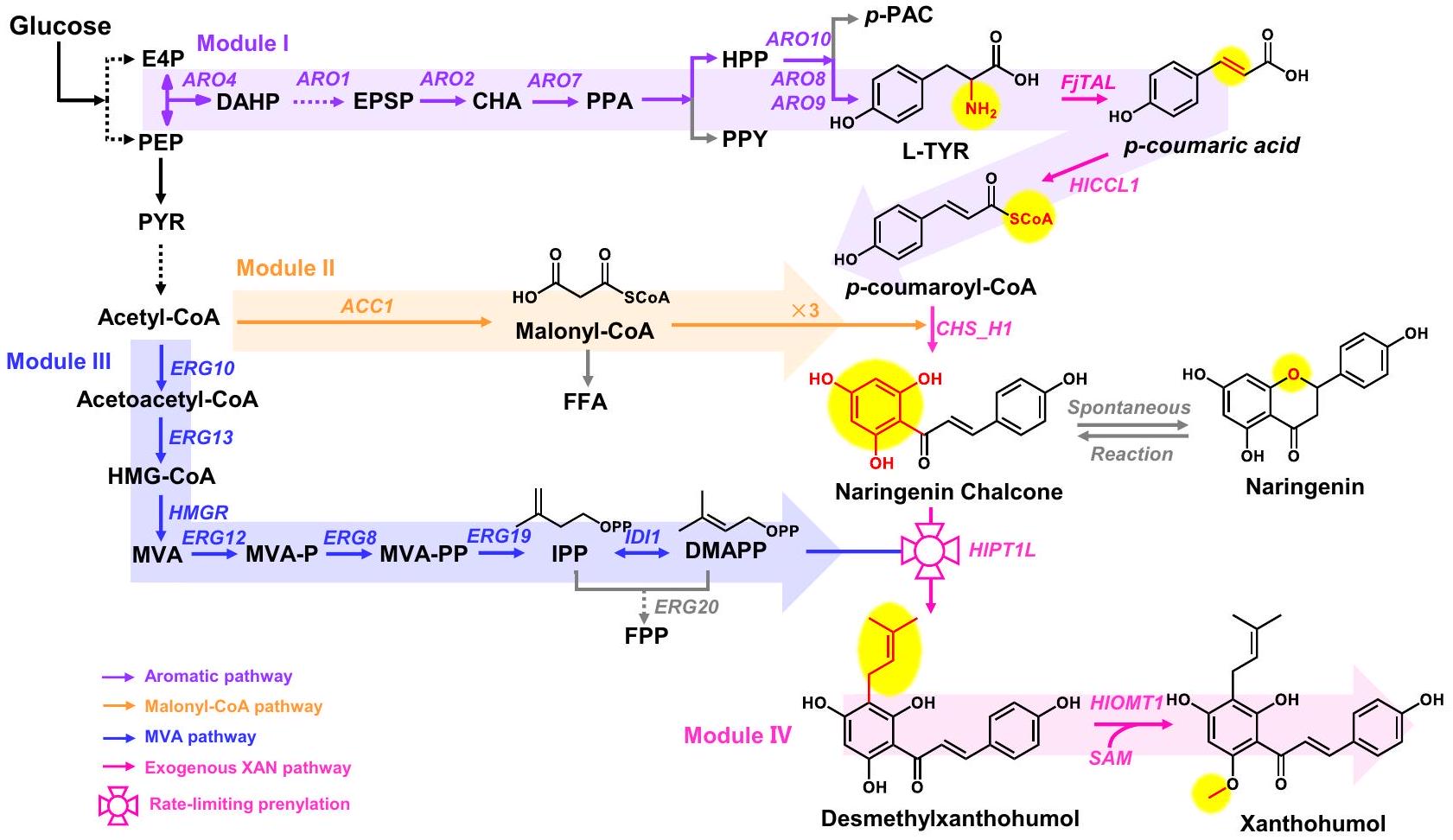
زانثوهومول لتسهيل بناء وتحسين تخليق الزانثوهومول في الخميرة، قمنا برسم خريطة مسارية تخليقية بشكل معياري من الجلوكوز، والتي تتألف من أربعة وحدات: -كوماريك-كوإنزيم أ -تخليق -CA-CoA) (الوحدة الأولى)، توفير مالونيل-CoA (الوحدة الثانية)، البرينلة (الوحدة الثالثة) والميثلة (الوحدة الرابعة) (الشكل 1). التخليق المتوازي للمقدمات الثلاث، -CA-CoA، مالونيل-CoA ودايميثيل أليل بيوفوسفات (DMAPP)، يتطلب توازنًا دقيقًا وضبطًا لمسارات التخليق الحيوي، وهو يختلف عن المسارات الشائعة من الأعلى إلى الأسفل، مثل تخليق التربينود (الشكل التوضيحي التكميلي 1) .
في هذا العمل، نقوم بتصميم منصة خميرة للتخليق الحيوي الجديد للزانثوهومول من خلال موازنة ثلاث مسارات متوازية للتخليق الحيوي العطري، وتوفير مالونيل-كوإنزيم أ، ومسار الميفالونات (MVA). ثم نقوم بتحسين خطوة البريلة المحدودة عن طريق اختيار وهندسة إنزيم البريلاترانسفيراز (PTase) وزيادة توفر DMAPP، مما يتيح تحسناً بمقدار 83 ضعفاً في إنتاج ديميثيلزانثوهومول (DMX). ). أخيرًا، يؤدي تحسين خطوة الميثلة الأخيرة إلى التخليق الحيوي الجديد للزانثوهومول من الجلوكوز في الخميرة. سيسمح هذا التخليق الحيوي الميكروبي للزانثوهومول بتحسين مصانع الخلايا الميكروبية لتوفير مستدام للزانثوهومول وتقديم طرق قابلة للتطبيق لتحسين مسارات التخليق الحيوي المعقدة الأخرى للمنتجات الطبيعية.

النتائج

البناء المعياري لمسار التخليق الحيوي للزانثوهومول
أولاً، قمنا ببناء المسار البيولوجي التصنيعي لإنتاج DMX بشكل معياري، وهو السلف الرئيسي للزانثوهومول. بدأنا أولاً ببناء المسار اللاحق لتخليق DMX بدءًا من L-تيروزين عن طريق التعبير عن جين تايروسين أميوناز ليز FjTAL من Flavobacterium johnsoniae. ، جين ليغاز 4-كومارات-كوإنزيم A HICCL1 ، جين سينثاز الكالكون وجين البرينيليترانسفيراز HIPT1L من H. lupulus (الشكل 2أ). كما عبرنا عن جين إيزوميراز الكالكون غير التحفيزي، HICHIL2، من H. lupulus، والذي ثبت أنه يعزز نشاطات CHS_H1 وHIPT1L . بالإضافة إلى ذلك، . لوبولوس جين ميثيل ترانسفيراز تم التعبير عنه لفحص إمكانية إنتاج الزانثوهومول من DMX. أنتج السلالة الناتجة YS103 نارينجينين كالكون (NC) ونارينجينين (N)، وهو منتج يتكون تلقائيًا من المركب غير المستقر )، لكن لا الزانثوهومول ولا DMX (الشكل 2ب، د).
ثم حاولنا تحسين مسار التخليق الحيوي العلوي لتعزيز تخليق المتقدمات L-تيروزين، مالونيل-كوإنزيم أ وDMAPP. بدأنا بمحاولة تعزيز تخليق L-تيروزين عن طريق حذف الجين ، الذي يشفر إنزيم فينيلبيروفات ديكاربوكسيلاز المتنافس، بالإضافة إلى الإفراط في التعبير عن الجينات (ترميز نسخة مقاومة للتثبيط الارتجاعي من سينثاز DAHP)
الشكل 1 | المسار الأيضي المهندَس للتخليق الحيوي الجديد للزانثوهومول في الخميرة. تم اشتقاق مسار التخليق الحيوي لـ DMX من ثلاثة مسارات وحدات داخلية، بما في ذلك المسار العطري (الوحدة I، التسمية البنفسجية)، ومسار مالونيل-كوإنزيم A (الوحدة II، التسمية البرتقالية)، ومسار MVA (الوحدة III، التسمية الزرقاء). ثم تم مثيلة DMX لتشكيل الزانثوهومول (الوحدة IV، التسمية الوردية). كما تم تمييز الإنزيمات الخارجية باللون الوردي والمسارات الأيضية المتنافسة باللون الرمادي. تمثل الأسهم المنقطة خطوات متعددة. E4P إريثروز 4-فوسفات، PEP فوسفوينولبيروفات، DAHP 3-ديوكسي-D-أرابينوهبتولوزونيك أسيد 7-فوسفات، EPSP 5-إنولبيروفيل-شيكيمات-3-فوسفات، CHA حمض الكوريزميك، PPA بريفينات، PPY فينيلبيروفات، HPP بارا-هيدروكسي-فينيلبيروفات، -PAC بارا-هيدروكسي-أسيتالدهيد، L-TYR إل-تيروزين، FFA حمض دهني حر، PYR بيروفات، HMG-CoA 3-هيدروكسي-3-ميثيلجلوتاريل إنزيم مساعد A، MVA ميفالونات، MVA-P ميفالونات-5-فوسفات، MVA-PP ميفالونات-5-بيري فوسفات، DMAPP دايميثيل أليل ثنائي الفوسفات، IPP
بيروفوسفات إيزوبنتينيل، FPP بيروفوسفات فارنيسيل، SAM S-أدينوسيل-إل-ميثيونين، ترميز ديهيدروجيناز الشيكيمايت، ترميز سينثاز الكوريزومات، ترميز سينثاز DAHP، ترميز إنزيم كوريزومات ميوتاز، ترميز ناقل الأمين العطري I، ترميز ناقل الأمين العطري II، ترميز ARO10 ديكاربوكسيلاز فينيل بيروفات، ترميز ACC1 أسيتيل-كوإنزيم A كربوكسيلاز، ترميز ERG10 أستواستيل-كوإنزيم A ثيولاز، ترميز ERG13 سينثاز HMG-كوإنزيم A، ترميز HMGR مختزل HMG-كوإنزيم A، ترميز ERG12 كيناز ميفالونات، ترميز ERG8 كيناز فوسفوميفالونات، ترميز ERG19 ديكاربوكسيلاز ميفالونات، ترميز IDI1 إيزوميراز إيزوبنتينيل ديفوسفات، ترميز ERG20 سينثاز فارنيسيل ديفوسفات، ترميز FjTAL أميلاز التيروزين، ترميز HICCL1 ربط 4-كومارات-كوإنزيم A، ترميز CHS_H1 سينثاز الكالكون، ترميز HICHIL2 إيزوميراز الكالكون غير التحفيزي، ترميز HIPT1L برينيل ترانسفيراز، ترميز HIOMT1 O-ميثيل ترانسفيراز.
الشكل 2 | تحسين مسار التخليق الحيوي الجديد لـ DMX. أ نظرة عامة تخطيطية على تعديل ثلاثة وحدات تخليق حيوي متوازية. تشمل الوحدات الثلاث المسار العطري (تسمية بنفسجية)، ومسار مالونيل-كوإنزيم A (تسمية برتقالية)، ومسار MVA (تسمية زرقاء). تُشير الأسهم العريضة إلى الخطوات المعززة، والأسهم المتقطعة تُظهر الخطوات المخفضة أو المحذوفة. FjTAL ترمز إلى تايروسين أميوناز-لايز، HICCL1 ترمز إلى 4-كومارات-كوإنزيم A ليغاز، CHS_H1 ترمز إلى تشالكون سينثاز، HICHIL2 ترمز إلى إيزوميراز تشالكون غير تحفيزي، HIPT1L ترمز إلى برينيل ترانسفيراز، aro10 ترمز إلى فينيلبيروفات ديكاربوكسيلاز، و نسخ مقاومة للترميز لإنزيم DAHP سينثاز وإنزيم كوريسميت ميوتاز، ACC1 ترمز لإنزيم أسيتيل-كوأ كربوكسيلاز، tHMG1 ترمز لإنزيم HMG-CoA ريدوكتاز 1 المقطوع، IDI1 ترمز لإنزيم إيزوبنتينيل ديفوسفات
إيزوميراز، النسخة المشفرة لإنزيم سينثاز فاردنيسيل ديفوسفات، P-HIPT1L، الإفراط في التعبير عن إنزيم البرينيليترانسفيراز بواسطة بلازميد pESC-URA. انظر شرح الشكل 1 بخصوص الاختصارات الأخرى. التعديل الأيضي لهذه الوحدات الثلاث حسّن إنتاج المتقدمات NC/N. ج تحور ERG20 وزيادة التعبير عن HIPT1L حسّن إنتاج DMX. د تحليل HPLC لمعيار DMX والمنتج المخمر للسلالات YS103 وYS112 وYS116 وYS117. تم زراعة جميع السلالات في قوارير هزازة بسعة 100 مل تحتوي على 20 مل من الوسط الأدنى. القيم المتوسطة يتم عرض الانحرافات المعيارية ( عينات بيولوجية مستقلة). اختبار الطالب -تم استخدام اختبار – للمقارنة بين مجموعتين ( ، )، و تم عرض القيم في ، . يتم توفير بيانات المصدر كملف بيانات مصدر.
و (ترميز إنزيم كوريسميت ميوتاز) . أنتج السلالة الناتجة YS107 نسبة 52% أكثر من NC/N مقارنة بالسلالة الأصلية YS103 (الشكل 2ب). ثم حاولنا تحسين تخليق مالونيل-كوإنزيم A عن طريق استبدال المحفز الأصلي لجين أسيتيل-كوإنزيم A كاربوكسيلاز (ACC1) بالمحفز المستمر فشل هذا الاستبدال في تحسين إنتاج NC/N، مما يشير إلى أن كربوكسلة الأسيتيل-كوإنزيم أ لم تكن عائقًا في الوقت الحالي.
أخيرًا، حاولنا تعزيز خطوة البرينيلة من خلال زيادة إمداد الركيزة منخفضة المستوى DMAPP وزيادة التعبير عن جين PTase. لم ينجح الإفراط في التعبير عن الجينات المحددة لمعدل MVA مثل tHMG1 (الذي يشفر إنزيم HMG-CoA ريدوكتاز 1 المقطوع) وIDI1 (الذي يشفر إنزيم إيزوبنتينيل ديفوسفات إيزوميراز) في إنتاج DMX في السلالة YS112. افترضنا أن العملية الفعالة لتخليق فوسفات الفارنسيل ثنائي الفوسفات (FPP) تتنافس مع التخليق باستخدام DMAPP، وقد تم الإبلاغ عن طفرة في سينثاز FPP المسماة Erg20 أدى إلى انخفاض النشاط في تحفيز دوران DMAPP . وهكذا، قمنا بالتحوير في الموقع إلى لتحسين توفر DMAPP، والذي نجح في إنتاج DMX في السلالة YS116 (الشكل 2ج، د). تشير هذه البيانات إلى أن حجب استهلاك DMAPP كان أكثر أهمية لتخليق DMX من تعزيز إمداد DMAPP. ومن المثير للاهتمام، أن هذا التعديل حسّن إنتاج NC/N بنسبة 79% (الشكل 2ب)، وقد يكون ذلك بسبب تقليل تدفق MVA نحو تخليق FPP.
وبالتالي زادت توافر أسيتيل-كوإنزيم أ لتوفير مالونيل-كوإنزيم أ. ومع ذلك، كان لدى السلالة YS116 معدل نمو نوعي أقصى منخفض ( ) مقارنة بالسلالة الأصلية YS112 (الشكل التكميلي 2). أشارت هذه البيانات إلى أن طفرة FPPS زادت من توفر مجموعة البرينيل DMAPP وأبطأت نمو الخلايا بشكل أكبر. بعد ذلك، حاولنا زيادة التعبير عن HIPT1L باستخدام بلازميد عالي النسخ، وأنتجت السلالة الناتجة YS117 كمية من DMX تزيد بمقدار 7.7 مرة ( ) مقارنة بالسلالة الأصلية YS116 (الشكل 2ج، د)، مما يشير إلى أن إنزيم PTase كان عاملاً مقيدًا في إنتاج DMX.

توصيف وهندسة إنزيم الفسفوتيرانسفيراز (PTase)

حاولنا أيضًا تعزيز نشاط PTase لتحسين إنتاج DMX (الشكل 3أ). وقد تم الإبلاغ عن أن PTase الغشائي يستهدف البلاستيدات ذات الرقم الهيدروجيني العالي في النباتات ، في حين أن الرقم الهيدروجيني للسيتوسول في الخميرة منخفض (<6) بسبب تراكم المستقلبات الحمضية لذلك، قمنا بزراعة الخميرة المهندسة S. cerevisiae YS116 في وسط مخزن بمحلول MES، الذي حافظ على درجة حموضة الوسط عند 5.4 لمدة 72 ساعة من الزراعة، بينما كانت درجة حموضة وسط التحكم 3.3. كان إنتاج DMX في الوسط المخزن أعلى بمقدار 2.8 مرة مقارنة بالوسط غير المخزن (الشكل 3ب). ومع ذلك، حدث تحويل كامل للمركب السابق NC إلى N، مما يشير إلى أن ارتفاع درجة الحموضة في السيتوسول جعل من الصعب تثبيت التكوين المفتوح للحلقة لـ NC (الشكل 3ب).
الشكل 3 | هندسة إنزيم PTase لتعزيز إنتاج DMX. أ) توضيح تخطيطي لهندسة إنزيم PTase. لتحسين القدرة التحفيزية لإنزيم PTase عن طريق تغيير الرقم الهيدروجيني، فحص بدائل إنزيم PTase، وقص ببتيدات الإشارة الخاصة بإنزيم PTase. ب) إضافة محلول عازل MES زادت من إنتاج DMX في السلالة YS116. تم إضافة محلول عازل MES بقيمة pH تساوي 6.58 بعد 24 ساعة من التخمير. ج) التحليل التطوري لإنزيمات PTase. تم بناء شجرة الجوار باستخدام برنامج MEGA7 وطريقة الاحتمالية القصوى مع 1000 اختبار تمهيدي.
تقييم إنزيمات PTases المختلفة في السلالة YS116 باستخدام بلازميدات ذات نسخ عالية. اقتطاع إنزيمات الفسفوترانسفيراز لإنتاج DMX في السلالة YS116. تم زراعة جميع السلالات في قوارير هزازة بسعة 100 مل تحتوي على 20 مل من الوسط البسيط. القيم المتوسطة يتم عرض الانحرافات المعيارية ( عينات بيولوجية مستقلة). اختبار الطالب -تم استخدام اختبار – لمقارنة مجموعتين ( ، )، و تم عرض القيم في . يتم توفير بيانات المصدر كملف بيانات مصدر.
ثم بحثنا عن إنزيمات PTases بديلة من نباتات القفزات وكائنات أخرى بناءً على تشابه الركائز الفلافونويدية والمانحين البرينيل، بما في ذلك إنزيم HIPT-1 من القفزات. مع التشابه مع HIPT1L، أربعة إنزيمات PTases محددة للكالكون التي تحفز تكثيف الإيزوليكويريتجينين وDMAPP (MaIDT) و CtIDT من عائلة التوتية وGulLDT و SfiLDT من عائلة البقوليات)، أربعة إنزيمات فسفوريل ترانسفيراز محددة للإيزوفلافون (SfFPT ، LaPT1 ، AhR4DT و PcM4DT )، القنب ساتيفا L. CsPT3 و CsPT4 ، وإنزيم PTase القابل للذوبان NphB من العقديات تم تقديم نظرة عامة على جميع إنزيمات PTases المفحوصة وتخصصاتها في الركيزة في البيانات التكميلية 1. تم إجراء محاذاة تسلسل الأحماض الأمينية لهذه الإنزيمات الثلاثة عشر لبناء شجرة تطورية وتقييم العلاقة التطورية بين HIPT1L وهذه الإنزيمات الأخرى (الشكل 3ج). أظهرت النتائج أن HIPT1L وCsPT4 كانا في نفس الفرع، مما يشير إلى أن وظائفهما التحفيزية الإنزيمية كانت متشابهة. كما كان HIPT1L مرتبطًا تطوريًا بشكل وثيق بـ MaIDT وCtIDT وCsPT3 ولكنه كان بعيدًا عن إنزيمات PTase الأخرى.
قمنا بتعبير هذه الإنزيمات الاثني عشر المحسنة بالكودون PTases وHIPT1L في السلالة YS116 باستخدام بلازميد عالي النسخ (الشكل 3د). عندما تم التعبير عن MaIDT وHIPT1 وLaPT1، تم إنتاج المزيد من DMX مقارنةً بالتعبير عن HIPT1L، حيث أدى LaPT1 إلى أعلى إنتاج من DMX. (الشكل 3د). ثم قمنا بقص الببتيد الإشاري الطرفي N لتحسين نشاط الإنزيم بمساعدة الإشارة
برنامج التنبؤ بالببتيدات TargetP (https://services.healthtech.dtu. خدمات TargetP-2.0/)، وتم عرض مواقع التسلسل المقتطع في الشكل التكميلي 3. بعد ذلك، تم نقل تسلسلات PTase المقتطعة، جنبًا إلى جنب مع التسلسلات الكاملة الطول، إلى السلالة YS116 لتقييم إنتاج DMX. أدى اقتطاع HIPT1L وMaIDT وLaPT1 إلى تحسين إنتاج DMX (الشكل 3e-g)، في حين أدى اقتطاع HIPT-1 إلى إنتاج DMX أقل من النسخة الأصلية (الشكل 3h). وأخيرًا، تم اقتطاع تم استخدامه لمزيد من التجارب.

تحسين المسار لتحسين تخليق DMX الحيوي

بعد ذلك، حاولنا تحسين المسارات البيوسنتيزية لتحسين إمداد المتقدم (الشكل 4أ). قمنا أولاً بتحسين مسار MVA لتوفير المتقدم DMAPP. ERG20 تم تقليل تنظيمه لخفض معدل دوران DMAPP بشكل أكبر، عن طريق استبدال محفزه الأصلي بمحفز HXT1 (السلالة YS119) أو محفز ERG1 (السلالة YS120)، وتم تحسين إنتاج DMX بمقدار مرتين و1.4 مرة مقارنة بالسلالة الأصلية YS116، على التوالي (الشكل 4ب). هو محفز يتم تحفيزه بواسطة الجلوكوز العالي ويُثبط بواسطة الجلوكوز المنخفض، ويجب أن يكون مفيدًا عند مزامنة تخليق DMX مع نظام تنظيم GAL المعدل . ومع ذلك، لم تؤدِ هاتان البديلتان فقط إلى زيادة إنتاج NC/N بل قللتا أيضًا من كتلة الخلايا (الشكل التوضيحي التكميلي 4أ). كما قمنا أيضًا بزيادة التعبير عن الجينات ERG10 التي ترمز لإنزيم أستواستيل-كوأ ثيولاز وHMG2 ترميز a
الشكل 4 | هندسة إمداد الركيزة ودمج الإنزيم لتعزيز إنتاج DMX. أ رسم تخطيطي لإمداد الركيزة ودمج الإنزيم. يُظهر الإفراط في التعبير عن الإنزيم باللونين البنفسجي والأزرق، ويُشار إلى التعبير المنخفض باللون الرمادي. تم زيادة إمداد DMAPP من خلال الإفراط في التعبير عن ERG10 و واستبدال المحفز الأصلي لـ مع المروج أو تم تعزيز إمداد NC عن طريق التغذية -CA أو زيادة التعبير عن CHS_H1 و HICHIL2. IDI1-HIPT1L بروتين مدمج مع الرابط (GGGS) إنتاج DMX معزز. استبدال المحفز الأصلي لـ مع المروج أو تحسين إنتاج DMX. ج زيادة التعبير عن و
زيادة إنتاج DMX. د إضافة -CA في أوقات مختلفة لإنتاج DMX. عند 0 ساعة و -تم إضافة CA عند 0 ساعة و24 ساعة، على التوالي. لـ -تم إضافة CA في كل من 0 ساعة و24 ساعة. لمدة 24 ساعة (مضاعفة)، تمت إضافة p-CA عند 24 ساعة. هـ الإفراط في التعبير عن CHS_H1، HICHIL2 أو IDI1HIPT1L أدى الاندماج إلى زيادة إنتاج DMX. تم زراعة جميع السلالات في قوارير هزازة بسعة 100 مل تحتوي على 20 مل من الوسط البسيط. القيم المتوسطة يتم عرض الانحرافات المعيارية ( عينات بيولوجية مستقلة). اختبار الطالب -تم استخدام الاختبار للمقارنة بين مجموعتين ( )، و تم عرض القيم في . يتم توفير بيانات المصدر كملف بيانات مصدر.
طفرة في إنزيم HMG-CoA ريدوكتاز الداخلي (السلالة YS121) ، مما حسّن إنتاج DMX بمقدار 1.9 مرة مقارنة بالسلالة الضابطة YS116. تم دمج نسختين إضافيتين من الجين في الجينوم (السلالة YS123) حسّنت إنتاج DMX بنسبة 34% مقارنة بالسلالة YS121. أشارت هذه النتائج إلى أن الإفراط في التعبير عن الجينات المحددة لمعدل المسار MVA يمكن أن يزيد من إمداد DMAPP، وبالتالي زيادة إنتاج DMX. ومع ذلك، وجدنا أن كمية المتقدم NC/N في السلالة YS123 كانت أقل قليلاً مقارنة بالسلالة YS121 (الشكل التكميلي 4ب)، مما يشير إلى أن الإفراط المستمر في التعبير عن جينات مسار MVA سيؤدي إلى تدفق أيضي مفرط إلى مسار MVA من الأسيتيل-كوإنزيم A، مما يقلل من تخليق مالونيل-كوإنزيم A. كان هذا الملاحظة متسقة مع أن تقليل تنظيم تخليق FPP حسّن إنتاج NC/N (السلالة YS116 في الشكل 2ب) من خلال زيادة محتملة في تدفق الأسيتيل-كوإنزيم A إلى مالونيل-كوإنزيم A. لذلك، حاولنا بناء مسار استخدام الإيزوبنتينول (IUP) لتوفير DMAPP من خلال تخفيف الضغط الأيضي على الأيض المركزي للكربون. ومع ذلك، فشل تعبير IUP مع تزويد الإيزوبنتينول في تحسين إنتاج DMX وقلل من تخليق السلف NC/N (الشكل التكميلي 5).
منذ -حمض الكوماريك ( -CA) لم يتم اكتشافه في السلالة، فافترضنا أن زيادة الـ -يمكن أن يؤدي توفير حمض الكربوكسيليك إلى تحسين إنتاج DMX بشكل أكبر. تغذية تركيزات مختلفة من -CA كان مفيدًا في زيادة إنتاج DMX (الشكل التوضيحي التكميلي 6)، من بينها التغذية -CA عند 24 ساعة حسّن إنتاج DMX بمقدار 2.2 مرة (الشكل 4د). ومن المثير للاهتمام، لم يكن هناك تقريبًا أي -CA المتبقية، مما يشير إلى أن كل الـ -تم تحويل CA إلى -CA-CoA. لذلك، نحن
حاول تحسين حجم المبيعات لـ -CA-CoA نحو تخليق NC من خلال الإفراط في التعبير عن CHS_H1 وHICHIL2 في السلالة YS116. أنتجت السلالة الناتجة YS125 كمية من DMX وNC تزيد بمقدار 2.1 مرة و1.8 مرة على التوالي مقارنة بالسلالة الأصلية YS116 (الشكل 4e)، مما يشير إلى أن الإفراط في التعبير عن CHS_H1 وHICHIL2 يدفع التدفق الأيضي نحو تخليق NC وإنتاج DMX.
على الرغم من أن زيادة إمداد DMAPP و NC حسنت إنتاج DMX، إلا أن تركيز DMX ظل منخفضًا ( ). وبالنظر إلى أن وجود ببتيد إشارة منع إنزيم PTase من الاتصال السريع بالركائز DMAPP وNC، قمنا بمزيد من التعبير عن نسختين إضافيتين من ، مما حسّن إنتاج DMX إلى في السلالة YSC1 (الشكل 4هـ). للأسف، إدخال HIPT1 زاد إنتاج DMX فقط بالمقارنة مع السلالة YS125. وجدنا أن الإنتاج الكلي لـ NC/N في السلالة YSC1 وصل إلى ، مما يشير إلى وجود كمية كافية من المتقدم NC في السيتوسول. وبما أن IDI1 يحفز تحويل IPP إلى DMAPP، فقد دمجنا IDI1 مع لمساعدة التفاعل السريع بين DMAPP و PTase. التكامل الجينومي لنسختين من جين الاندماج IDI1-HIPT1L أدى إلى إنتاج DMX من في السلالة YSC3، والتي كانت أعلى بمقدار 83 مرة و21 مرة مقارنة بالسلالتين YS116 وYSC1، على التوالي (الشكل 4e). أظهرت هذه النتائج أن IDI1-HIPT1L يمكن لاستراتيجية البروتين الاندماجي أن تسمح بالفعل باتصال سريع بين DMAPP وإنزيم PTase وتحسين إنتاج DMX. وبسبب التأثير الكبير لهذه الاستراتيجية الاندماجية، قمنا بنقل نسختين إضافيتين من جين الاندماج IDI1HIPT1. إلى السلالة YSC3 للحصول على السلالة YSC4 (الشكل التوضيحي التكميلي 7)، على أمل زيادة إنتاج DMX بشكل أكبر. علاوة على ذلك، لأن
الشكل 5 | هندسة تخليق DMX في البيروكسيسومات. أ نظرة عامة على المسار الأيضي المهندس لتخليق DMX في البيروكسيسومات. المادة الأولية تم إنتاج -CA بكفاءة في السيتوسول. التفاعل المكون من 3 خطوات من -CA إلى DMX تم توجيهه إلى البيروكسيسوم في -CA إنتاج زائد لشاسيه RB99 (الملصق الوردي). تم أيضًا استهداف وحدات مسار مالونيل-CoA وMVA (الملصق البرتقالي والأزرق) إلى البيروكسيسومات. EfmvaE ترميز ثيولاز أسيتوأسيتيليل-كوإنزيم أ/HMGCoA ريدوكتاز، ترميز إنزيم HMG-CoA سينثاز، ترميز كيناز الميفالونات ترميز كيناز الفوسفوميفالونات ترميز ميفالونات ديفوسفات ديكاربوكسيلاز، IDI1 لكل ترميز إيزوميراز إيزوبنتينيل ديفوسفات، ترميز أسيتيل-كوإنزيم A كربوكسيلاز، HICCL1 لكل ترميز 4-كومارات-كوإنزيم A ليغاز، CHS_H1 لكل ترميز شالكون سينثاز، HICHIL2 لكل
ترميز إيزوميراز الكالكون غير التحفيزي، ترانزفيراز برينيل مقطوع التشفير. هندسة وحدات التخليق الحيوي للمالونيل-كوأ والـ DMX في البيروكسيسوم لتخليق السلف NC/N. ج بناء مسار MVA الكامل في البيروكسيسوم مكن من التخليق الجديد للـ DMX وزاد من إنتاج DMX من خلال تعزيز تعبير PTase وتوفير NC. د تحسين مسار MVA وزيادة التعبير عن IDI1-HIPT1 زيادة إنتاج DMX. تم زراعة جميع السلالات في قارورات هزازة بسعة 100 مل تحتوي على 20 مل من الوسط البسيط. القيم المتوسطة يتم عرض الانحرافات المعيارية ( عينات بيولوجية مستقلة). اختبار الطالب -تم استخدام اختبار – لمقارنة مجموعتين ( ، ). يتم توفير بيانات المصدر كملف بيانات مصدر.
يمكن أن يعزز HICHIL2 نشاط إنزيم HIPT1L، لذا حاولنا دمج HICHIL2 مع HIPT1L لتحسين إنتاج DMX. للأسف، وجدنا أن إضافة هذين البروتينين المندمجين قللت من إنتاج DMX بنسبة (IDI1-HIPT1L ) و (HICHIL2-HIPT1L )، على التوالي، مقارنة بالسلالة YSC3 (الشكل التوضيحي التكميلي 7).

تجزئة البيروكسيسوم لتخليق DMX

أظهرنا أن توفر الركيزة DMAPP كان حاسماً لتفاعل البرينيلاشن أثناء تخليق DMX. إن التقسيم داخل العضيات الفرعية مفيد للإنتاج الانتقائي، حيث يخفف من التنافس مع الإنزيمات السيتوسولية. . البيروكسيسومات هي حاويات مثالية مع إمداد فعال بأسيتيل-كوإنزيم أ من الأحماض الدهنية -الأكسدة وغياب تخليق الأحماض الدهنية والمنافسة على FPP ، مما قد يكون مفيدًا لتجميع المواد الأولية لـ DMX مثل DMAPP ومالونيل-كوإنزيم أ. لذلك قمنا بتقسيم مسار DMX اللاحق عن -CA إلى البيروكسيسومات مع إعادة بناء تخليق DMAPP في البيروكسيسومات
المسارات (الشكل 5أ). استخدمنا مسارًا تم إنشاؤه سابقًا -فرط إنتاج CA ( ) السلالة RB14 كهيكل أساسي ثم تم زيادة التعبير عن ARO1 (الذي يشفر إنزيم ديهيدروجيناز الشيكيمات)، وARO2 (الذي يشفر إنزيم سينثاز الكوريزومات) و (الذي يشفر سينثاز DAHP) في السلالة RB14 للحصول على السلالة RB99 لتحسين المزيد – إنتاج CA. استهداف بيروكسيسومي لـ ACC1 الداخلي ( ) و CHS_H1 الخارجي و (السلالة YS1per) أدت إلى إنتاج NC/N من (الشكل 5ب). المزيد من بناء البيروكسيسوم للبرينيلات من خلال التعبير عن 86 بالمئة و فشل في إنتاج DMX في السلالة المهندسة YS2per (الشكل 5ب، ج).
لتوفير كمية كافية من المتقدم DMAPP لإنتاج DMX، أعدنا بناء مسار MVA في البيروكسيسومات. قمنا بتعبير Enterococcus faecalis (ثيولاز أسيتوأستيل كوإنزيم أ/إتش إم جي-كوإنزيم أ ريدوكتاز ثنائي الوظيفة) وEfmvaSper (سينثاز إتش إم جي-كوإنزيم أ) لتحفيز الخطوات الثلاث الأولى من مسار MVA بسبب كفاءتها العالية وغياب تنظيم التغذية الراجعة في الخميرة. و تم التعبير عنها أيضًا في البيروكسيسومات؛
الشكل 6 | التخليق الحيوي الجديد للزانثوهومول. أ مخطط إنتاج الزانثوهومول من DMX بواسطة إنزيم O-ميثيل ترانسفيراز (HIOMT1). ب زيادة التعبير عن HIOMT1 وHIOMT1sc (محسّن الكودون لـ S. cerevisiae) لإنتاج الزانثوهومول (XAN). تم زراعة جميع السلالات في قارورات هزازة بسعة 100 مل تحتوي على 20 مل من الوسط البسيط. القيم المتوسطة يتم عرض الانحرافات المعيارية ( عينات بيولوجية مستقلة). اختبار الطالب -تم استخدام اختبار – للمقارنة بين مجموعتين ( ، . يتم توفير بيانات المصدر كملف بيانات مصدر.
ومع ذلك، أدى السلالة المهندسة YS5per التي تحتوي على مسار MVA في البيروكسيسوم إلى إنتاج تركيز منخفض من DMX ( ). ثم قمنا بتحسين خطوة البرينيليشن بإضافة نسختين أخريين من البروكسيسومي (السلالة YS8per)، التي حسّنت قليلاً إنتاج DMX (الشكل 5ج). بعد ذلك، CHS_H1 و تم التعبير عنها في السلالة YS8per، وأنتجت السلالة الناتجة YS9per كمية من DMX تزيد بنسبة 63% عن السلالة الأصلية YS8per (الشكل 5ج).
بعد تحسين خطوة البريلة، حاولنا زيادة إمداد DMAPP من خلال التعبير عن نسختين إضافيتين من الجين الأكثر أهمية (السلالة YS11per)، التي حسّنت إنتاج DMX بنسبة 100% (الشكل 5د). هذا التحسن شجعنا على تحسين مسار MVA في البيروكسيسوم بشكل أكبر. وبالتالي، ، و تم التعبير عنها بشكل مفرط في بلازميد عالي النسخ يعبر عن ، وأنتج السلالة الناتجة YS12per كمية من DMX تزيد بمقدار 2.7 مرة عن السلالة YS9per (الشكل 5د). كما حاولنا أيضًا التعبير عن جين الاندماج IDI1-HIPT1 لتوجيه DMAPP نحو PTase (السلالة YS15per)، مما حسّن إنتاج DMX بمقدار 1.7 مرة مقارنة بالسلالة YS9per. ومع ذلك، كانت تراكيز DMX لا تزال منخفضة ( ) وكانت أقل بكثير من تلك الخاصة بالطريق السيتوسولي في السلالة YSC3). قد يُعزى إنتاج DMX المنخفض هذا إلى النشاط المنخفض لإنزيم PTase و/أو انخفاض توفر DMAPP في البيروكسيسومات.

تخليق الزانثوهومول الحيوي

لقد حاولنا أخيرًا التخليق الحيوي للزانثوهومولون من DMX عن طريق التعبير عن جين O-ميثيلترانسفيراز HIOMT1 من H. lupulus في العائل YSC3 الذي يحتوي على مسار التخليق الحيوي لـ DMX في السيتوسول (الشكل 6أ). قمنا بالتعبير عن النسخة الأصلية من HIOMT1 والنسخة المحسنة من حيث الكودون HIOMT1sc للتعبير في S. cerevisiae في سلالة العائل YSC3. السلالات الناتجة YSC6 (HIOMT1) و YSC7 (HIOMT1sc) أنتجت و زانثوهومول (الشكل 6ب)،
على التوالي، وأكد تحليل الكروماتوغرافيا السائلة-مطياف الكتلة إنتاج الزانثوهومول (الشكل التكميلي 8). التراكم العالي لـ DMX ( ) يشير إلى أنه يجب تعزيز خطوة المثيلة بشكل أكبر لتحقيق إنتاج فعال للزانثوهومول من DMX.

مناقشة

الجنجل (H. lupulus L.) هو مصدر قيم للعديد من المستقلبات الثانوية، مثل الزيوت الأساسية، والأحماض المرّة، والفلافونويدات، التي لها تطبيقات طبية محتملة. يُعتبر التخليق الميكروبي نهجًا ممكنًا للإنتاج الفعال للمنتجات الطبيعية ذات المحتوى المنخفض مثل الأحماض المرّة والزيوت الأساسية من الجنجل. زانثوهومول هو فلافونويد وظيفي في البيرة له مجموعة متنوعة من التأثيرات الدوائية. ومع ذلك، فإن تخليقه الحيوي المعقد يشكل تحديات لإنتاجه من جديد في الكائنات الدقيقة. في هذه الدراسة، قمنا بهندسة منهجية لخَميرة الخميرة النامية S. cerevisiae لإنتاج الزانثوهومول من جديد من خلال تحسين مسار التخليق الحيوي وإعادة توجيه الأيض الخلوي.
لتسهيل بناء المسارات وتحسينها، قمنا بتقسيم الأيض المعاد بناؤه إلى ثلاث وحدات: -CA-CoA، مالونيل-CoA ومسارات التخليق الحيوي لـ MVA. هنا، حددنا أن التبرنيل لـ NC مع DMAPP كان خطوة محدودة في تخليق DMX، حيث كان مستوى DMX أقل بكثير من السلف NC في السلالة المهندسة. أظهرت الدراسات السابقة أيضًا أن التبرنيل كان خطوة محدودة في تخليق المركبات المبرنلة. لذا، يجب تعزيز خطوة البرينيلاشن لتحسين إنتاج DMX. هنا، قمنا بتطبيق اكتشاف الإنزيم، وقطع ببتيد الإشارة، وتعزيز مستويات التعبير لتحسين نشاط PTase، مما أدى إلى تحسين كبير في تخليق DMX من NC.
بالإضافة إلى نشاط PTase، فإن التوفر المحدود لـ DMAPP هو عنق زجاجة آخر لفعالية عملية البرينيليشن. ، نظرًا لأن مستوى DMAPP يتم تنظيمه بشكل محكم ويتم تحويله بكفاءة نحو FPP في تخليق الإرجوستيرول في الخميرة قمنا هنا بتطوير عدة استراتيجيات لهندسة المسارات لتعزيز إمداد DMAPP وتحسين توافر DMAPP لـ PTase من خلال دمج الإنزيمات. لتحسين إمداد DMAPP، قللنا من استهلاك DMAPP نحو FPP عن طريق التعبير عن جين طافرة لـ FPPS. ، تقليل تنظيم التعبير عن وتجاوز التعبير عن جينات MVA المحددة لمعدل المفتاح لتعزيز التدفق التصاعدي. حسنت هذه الاستراتيجيات إنتاج DMX. ومع ذلك، كان لا يزال أقل من من المثير للاهتمام، التعبير عن IDI1HIPT1 الجين، الذي يشفر إنزيم اندماجي من إيزوميراز IPP وPTase المختصر، حسّن إنتاج DMX بمقدار 21 ضعفًا مقارنةً عندما تم التعبير عن الجين. لم يكن هذا التعديل يزيد فقط من إمداد DMAPP ولكنه يسهل أيضًا الاتصال بين DMAPP وPTase بمسافة أقصر. لذلك، كان القيد الرئيسي لتحقيق إنتاجية أعلى في دراساتنا هو توفر مانح البرينيل والتواجد المشترك للركائز وPTase، كما تدعم ذلك نتائج عدة دراسات أخرى حول إنتاج المركبات البرينيلية في الخميرة. . بالإضافة إلى ذلك، يمكن تعديل إنزيم PTase المحدد لمعدل التفاعل من خلال هندسة البروتين لزيادة انتقائيته تجاه متبرعي الركيزة المحددين .
أخيرًا، الإفراط في التعبير عن النسخة المحسنة حقق جين ميثيل ترانسفيراز HIOMT1 التخليق الحيوي الجديد للزانثوهومول في الخميرة. ومع ذلك، كان العائد منخفضًا ( ) اقترح أن يتم تعزيز نشاط HIOMT1 و/أو إعادة تدوير SAM لتحسين تحويل DMX إلى زانثوهومول، نظرًا لبقاء كمية أكبر من DMX في السلالة المهندسة. علاوة على ذلك، ينطوي تخليق زانثوهومول على مسارات تخليقية متوازية لثلاثة سوابق. -CA-CoA، مالونيل-CoA وDMAPP، والتي تختلف تمامًا عن مسارات التخليق الحيوي أحادية القناة مثل تخليق التربين (الشكل التوضيحي التكميلي 1)، وبالتالي تتطلب توازنًا دقيقًا بين الوحدات التخليقية المتوازية. بالتفصيل، قمنا بزيادة تخليق المتقدم -CA-CoA من مسار الحمض العطري عن طريق القضاء على التثبيط الارتجاعي وإلغاء المسار التنافسي. من التحديات تعزيز إمداد DMAPP، نظرًا لأن تخليقه الحيوي
يشارك العقدة الرئيسية أسيتيل-كوإنزيم أ مع مالونيل-كوإنزيم أ ويمكن تحويله بسهولة إلى FPP. قمنا بضبط تدفق المسار بعناية بين توفير كمية كافية من مجموعة البرينيل DMAPP وكمية كافية من مجموعة المالونيل مالونيل-كوإنزيم أ من خلال تعديل تعبير الجينات باستبدال المحفز، وتحوير الإنزيمات الرئيسية، وزيادة التعبير عن الإنزيمات المحددة لمعدل التفاعل. لاحظنا أن تعزيز توفر DMAPP من خلال تحور ERG20 أبطأ نمو الخلايا، مما يتطلب استراتيجيات تنظيم دقيقة لموازنة اللياقة الخلوية وتراكم DMAPP.
باختصار، أعاد التنظيم المنهجي والوحدوي لعملية الأيض الخلوية في الخميرة تمكين الإنتاج الميكروبي الجديد للزانثوهومولون من مصدر الكربون الرخيص الجلوكوز. قد تكون الاستراتيجيات المستخدمة لموازنة التخليق الحيوي المتوازي للمقدمات مفيدة لتحسين إنتاج منتجات طبيعية معقدة أخرى.

الطرق

السلالات، البلازميدات، والكواشف

إشريكية قولونية DH5 تم استخدامه لبناء وتكبير البلازميد. سلالة S. cerevisiae SY03 (MATa، MAL2-8c، SUC2، his34، ura3-52، gal804، XI-5:: -Cas9-TCYC1) المستمدة من CEN.PK113-11C (MATa، MAL2-8c، SUC2، his34، ura3-52) تم استخدامها كسلالة أساسية لبناء السلالة . تم وصف مخطط تدفق بناء سلالة الخميرة في الشكل التوضيحي التكميلي 9. تم سرد الأنماط الجينية التفصيلية للسلالات المهندسة والبلازميدات في البيانات التكميلية 2 والبيانات التكميلية 3، على التوالي. تم شراء بوليميراز DNA PrimeStar لتضخيم الجينات من شركة TaKaRa Biotech (داليان، الصين)، و تم شراء خليط Taq Master Mix للبلمرة للتحقق من تفاعل البوليميراز المتسلسل (PCR) ومجموعة MultiS One Step Cloning لبناء البلازميدات من شركة Vazyme Biotech (نانجينغ، الصين). تم توفير مجموعات تنقية هلام الحمض النووي واستخراج البلازميدات من شركة OMEGA Biotech (الولايات المتحدة الأمريكية). تم تصنيع جميع البادئات (البيانات التكميلية 4) في شركة Sangon Biotech (شنغهاي، الصين). كانت مستخلصات الخميرة، التربتون، مسحوق الأجار، البيبتون وجميع المواد الكيميائية الأخرى من Sangon Biotech ما لم يُذكر خلاف ذلك. تم شراء جميع المعايير الكيميائية من Sigma-Aldrich ما لم يُذكر خلاف ذلك. تم تصنيع المعيار التحليلي DMX بواسطة Yuanye Biotech (شنغهاي، الصين). تم تصنيع جميع الجينات الغريبة المحسنة من حيث الكودون (البيانات التكميلية 5) بواسطة Genewiz. تم تصنيع جين EfmvaS (GenBank-KX064238) و EfmvaE (GenBank-KX064239) من E. faecalis بواسطة Genewiz.

الهندسة الوراثية

تم إجراء تعطيل الجين ودمجه باستخدام نظام كريسبر/كاس9 تم بناء بلازميدات معبرة عن gRNA وفقًا لطريقة تجميع فعالة. . باختصار، تم تضخيم جزء العمود الفقري للبلازميد وجزئين يحملان تسلسلات محددة بطول 20 زوجًا قاعديًا، ثم تم تجميع هذه الأجزاء الثلاثة في بلازميدات في المختبر باستخدام مجموعة MultiS One Step Cloning. بعد ذلك، تم تحويل الخلائط المجمعة إلى الإشريكية القولونية وتم التحقق منها بواسطة تسلسل الحمض النووي للحصول على البلازميد الصحيح. تم تصميم التسلسل المحدد بطول 20 زوجًا قاعديًا لبلازميد gRNA باستخدام أداة الويب CHOPCHOP (http:// chopchop.cbu.uib.no). تم تجميع جميع DNAs المانحة لحذف الجين والاندماج بواسطة تفاعل بوليميراز متسلسل بالاندماج في وعاء واحد ثم تم دمجها في مواقع الجينوم المقابلة تم تحضير حمضيات الدنا المانحة لعملية حذف الجين عن طريق دمج الأذرع المتماثلة العلوية والسفلية. تم تجميع حمضيات الدنا المانحة للاندماج الجينومي عن طريق دمج المحفزات، الجينات المستهدفة، الموقفات والأذرع المتماثلة (الشكل التوضيحي التكميلي 10). تم إجراء الطفرة الموجهة في الموقع لجين ERG20 إلى تم إجراء ذلك وفقًا لطريقة اختيار العلامة ذات الطرفين (Two-ESM) . المتحور و تم إجراء الطفرات الجينية بواسطة تفاعل البوليميراز المتسلسل المستهدف. تم استبدال المحفز الخاص بجين ACC1 (من -547 زوج قاعدي إلى -1 زوج قاعدي) بـ . منظم (من -563 زوج قاعدي إلى -1 زوج قاعدي) تم استبداله بـ أو .
للكشف عن الإنزيمات، تم تحسين ترميز جينات PTase والإصدارات المختصرة (الشكل التوضيحي التكميلي 3) من كائنات مختلفة لتناسب S. cerevisiae ثم تم استنساخها في pESC-URA مع
هضم BamHI/HindIII. ال و تم تجميع الشظايا أيضًا في pESC-URA وتم تسمية البلازميدات المُنشأة بـ pESC-IUP و pESC-per على التوالي. الـ IDI1-HIPT1L و CHIL2 تم تجميع الاندماجات باستخدام (GGGS) المرابط. تم ضمان استهداف البروتينات للبروكسيسومات بإضافة إشارة البروكسيسوم الطرفية C مع الرابط المرن GGGS. تم التحقق من جميع المحولات لـ S. cerevisiae بواسطة تفاعل البوليميراز المتسلسل للمستعمرات وتسلسل الحمض النووي.
تم إجراء تحويل الإشريكية القولونية وفقًا لطريقة التحويل الكيميائي. . باختصار، يمكن إضافة نواقل الحمض النووي المجمعة مباشرة إلى معلق خلايا الإشريكية القولونية الكفء. ثم تم حضانة معلق الخلايا في حمام جليدي، وتعرض لنبضة حرارية عند ، تم حضنه مسبقًا عند مع وسط لوريا-بيرتاني (LB) السائل، يُصب على طبق أجار LB ويُزرع طوال الليل عند .

زراعة السلالة

ما لم يُذكر خلاف ذلك، نُميت سلالات الإشريكية القولونية في وسط لوريا-بيرتاني (LB) تريبتون مستخلص الخميرة ) عند و 220 دورة في الدقيقة (هزاز Zhichu ZQZY-CS8). بالإضافة إلى ذلك، تم عادةً إضافة الأميبيسيلين للحفاظ على البلازميد. تم زراعة سلالات الخميرة عمومًا في وسط YPD الذي يتكون من ببتون مستخلص الخميرة و الجلوكوز. تم اختيار السلالات التي تحتوي على بلازميدات تعتمد على URA3 على وسط كامل اصطناعي بدون اليوراسيل (SD-URA)، والذي يتكون من قاعدة نيتروجين الخميرة (YNB) بدون أحماض أمينية و الجلوكوز. تم إزالة علامة URA3 على أطباق SD + 5FOA التي تحتوي على الجلوكوز و حمض 5-فلوروأوريتيك (5-FOA). أُجريت تخميرات الدُفعات في قوارير رجّ بسعة 100 مل مع 20 مل من الوسط الأدنى (دلفت-D) يحتوي على الجلوكوز، ومحاليل المعادن النزرة والفيتامينات . تم تدعيم جميع الوسائط المذكورة أعلاه بـ الهستيدين و/أو اليوراسيل إذا لزم الأمر. ثم، تم إضافة الآجار لصنع الوسط الصلب. تم زراعة خلايا الخميرة عند و220 دورة في الدقيقة في الوسط السائل لمدة 96 ساعة (هزاز Zhichu ZQZY-CS8) مع تلقيح أولي من 0.2. معدلات النمو النوعي القصوى ( ) في زراعات القوارير الهزازة تم تحديدها بواسطة ميل الانحدار الخطي للوغاريتم الطبيعي لـ منحنى القيم مقابل الزمن خلال مرحلة النمو الأسي.

استخلاص المنتج وتحديد كميته

لاستخلاص الزانثوهومول وDMX، تم استخدام جهاز تمزيق خلايا بتدفق مستمر عند ضغط عالٍ جدًا ودرجة حرارة منخفضة لتفتيت خلايا الخميرة. تم كسر عشرة ملiliters من مرق الثقافة من تخمير الدفعة في قارورة هزازة بشكل دوري ثلاث مرات عند 1800 ميجا باسكال. ثم، أضيف 2 مل من كل عينة من خلايا الثقافة المعالجة إلى حجم متساوٍ من الأسيتات الإيثيلية وخلطت جيدًا على سرعة 1600 دورة في الدقيقة لمدة 15 دقيقة. تم جمع الطور الأسيتات الإيثيلية، تجفيفه وإعادة تعليقه في الميثانول. قبل التحليل، تم ترشيح محلول المستخلص من خلال… الغشاء العضوي. تم تحديد كمية جميع العينات المستخرجة بواسطة الكروماتوغرافيا السائلة عالية الأداء (HPLC). تم تحليل العينات باستخدام عمود Poroshell 120 EC-C18 ( ، Agilent) على جهاز كروماتوغرافيا سائلة عالية الأداء 1260 Infinity II (Agilent) مزود بكاشف مصفوفة الصمام الضوئي. تم فصل العينات بواسطة طريقة التدرج باستخدام مذيبين: حمض الفورميك (A) والأسيتونيتريل مع حمض الفورميك (B). تم ضبط شروط الإلوتيون التدريجي كما يلي: ، تدرج لوني خطي من إلى ، تدرج لوني خطي من إلى ; ، تدرج لوني خطي من إلى ; ، تدرج لوني خطي من إلى ; ثم تم تحقيق التوازن في النظام باستخدام الشروط الأولية ( ) لمدة 5 دقائق قبل حقن العينة التالية. كان معدل التدفق . المنتجات المستهدفة – تم الكشف عن CA و N بقياس الامتصاصية عند 288 نانومتر. تم الكشف عن DMX وزانثوهومول بقياس الامتصاصية عند 370 نانومتر. نظام Agilent 1290 Infinity II UHPLC مقترن بجهاز مطياف الكتلة ثلاثي الرباعيات 6470 A
تم استخدام مطياف الكتلة ThermoFisher Q Exactive Hybrid QuadrupoleOrbitrap في وضع التأين بالإلكترورش الساخن الإيجابي لتحليل الزانثوهومول كميًا.

ملخص التقرير

مزيد من المعلومات حول تصميم البحث متاحة في ملخص تقارير مجموعة نيتشر المرتبط بهذا المقال.

توفر البيانات

البيانات التي تدعم نتائج هذا العمل متاحة داخل الورقة البحثية وملفات المعلومات التكميلية. ملخص التقرير لهذا المقال متاح كملف معلومات تكميلية. يتم توفير بيانات المصدر مع هذه الورقة.

References

  1. Kubeš, J. Geography of world hop production 1990-2019. J. Am. Soc. Brew. Chem. 80, 84-91 (2022).
  2. Xu, H. et al. Characterization of the formation of branched shortchain fatty acid: CoAs for bitter acid biosynthesis in hop glandular trichomes. Mol. Plant. 6, 1301-1317 (2013).
  3. Stevens, J. F. & Page, J. E. Xanthohumol and related prenylflavonoids from hops and beer: to your good health! Phytochemistry 65, 1317-1330 (2004).
  4. Miyata, S., Inoue, J., Shimizu, M. & Sato, R. Xanthohumol improves diet-induced obesity and fatty liver by suppressing sterol regulatory element-binding protein (SREBP). Act. J. Biol. Chem. 290, 20565-20579 (2015).
  5. Miranda, C. L. et al. Antioxidant and prooxidant actions of prenylated and nonprenylated chalcones and flavanones in vitro. J. Agric. Food Chem. 48, 3876-3884 (2000).
  6. Legette, L. et al. Human pharmacokinetics of xanthohumol, an antihyperglycemic flavonoid from hops. Mol. Nutr. Food Res. 58, 248-255 (2014).
  7. Yong, W. K. & Abd Malek, S. N. Xanthohumol induces growth inhibition and apoptosis in ca ski human cervical cancer cells. Evid. Based Complement. Altern. Med. 2015, 921306 (2015).
  8. Liu, M. et al. Pharmacological profile of xanthohumol, a prenylated flavonoid from hops (Humulus lupulus). Molecules 20, 754-779 (2015).
  9. Amoriello, T., Mellara, F., Galli, V., Amoriello, M. & Ciccoritti, R. Technological properties and consumer acceptability of bakery products enriched with brewers’ spent grains. Foods 9, 1492 (2020).
  10. Chen, Q.-h et al. Preparative isolation and purification of xanthohumol from hops (Humulus lupulus L.) by high-speed countercurrent chromatography. Food Chem. 132, 619-623 (2012).
  11. Grudniewska, A. & Popłoński, J. Simple and green method for the extraction of xanthohumol from spent hops using deep eutectic solvents. Sep. Purif. Technol. 250, 117196 (2020).
  12. Keasling, J. D. Manufacturing molecules through metabolic engineering. Science 330, 1355-1358 (2010).
  13. Li, S. J., Li, Y. R. & Smolke, C. D. Strategies for microbial synthesis of high-value phytochemicals. Nat. Chem. 10, 395-404 (2018).
  14. Galanie, S., Thodey, K., Trenchard, I. J., Interrante, M. F. & Smolke, C. D. Complete biosynthesis of opioids in yeast. Science 349, 1095-1100 (2015).
  15. Paddon, C. J. et al. High-level semi-synthetic production of the potent antimalarial artemisinin. Nature 496, 528-532 (2013).
  16. Liu, X. et al. Engineering yeast for the production of breviscapine by genomic analysis and synthetic biology approaches. Nat. Commun. 9, 448 (2018).
  17. Denby, C. M. et al. Industrial brewing yeast engineered for the production of primary flavor determinants in hopped beer. Nat. Commun. 9, 965 (2018).
  18. Ban, Z. et al. Noncatalytic chalcone isomerase-fold proteins in Humulus lupulus are auxiliary components in prenylated flavonoid biosynthesis. Proc. Natl Acad. Sci. USA 115, E5223-E5232 (2018).
  19. Li, H. et al. A heteromeric membrane-bound prenyltransferase complex from hop catalyzes three sequential aromatic prenylations in the bitter acid pathway. Plant. Physiol. 167, 650-659 (2015).
  20. Nagel, J. et al. EST analysis of hop glandular trichomes identifies an O-methyltransferase that catalyzes the biosynthesis of xanthohumol. Plant Cell 20, 186-200 (2008).
  21. Novák, P., Matoušek, J. & Bříza, J. Valerophenone synthase-like chalcone synthase homologues in Humulus lupulus. Biol. Plant. 46, 375-381 (2003).
  22. Zhou, Y. J. et al. Modular pathway engineering of diterpenoid synthases and the mevalonic acid pathway for miltiradiene production. J. Am. Chem. Soc. 134, 3234-3241 (2012).
  23. Jendresen, C. B. et al. Highly active and specific tyrosine ammoniaLyases from diverse origins enable enhanced production of aromatic compounds in bacteria and Saccharomyces cerevisiae. Appl. Environ. Microbiol. 81, 4458-4476 (2015).
  24. Abe, I., Morita, H., Nomura, A. & Noguchi, H. Substrate specificity of chalcone synthase: enzymatic formation of unnatural polyketides from synthetic cinnamoyl-CoA. Anal. J. Am. Chem. Soc. 122, 11242-11243 (2000).
  25. Rodriguez, A., Kildegaard, K. R., Li, M., Borodina, I. & Nielsen, J. Establishment of a yeast platform strain for production of -coumaric acid through metabolic engineering of aromatic amino acid biosynthesis. Metab. Eng. 31, 181-188 (2015).
  26. Zhou, Y. J. et al. Production of fatty acid-derived oleochemicals and biofuels by synthetic yeast cell factories. Nat. Commun. 7, 11709 (2016).
  27. Ignea, C., Pontini, M., Maffei, M. E., Makris, A. M. & Kampranis, S. C. Engineering monoterpene production in yeast using a synthetic dominant negative geranyl diphosphate synthase. Acs. Synth. Biol. 3, 298-306 (2014).
  28. Martinez-Munoz, G. A. & Kane, P. Vacuolar and plasma membrane proton pumps collaborate to achieve cytosolic pH homeostasis in yeast. J. Biol. Chem. 283, 20309-20319 (2008).
  29. Tsurumaru, Y. et al. An aromatic prenyltransferase-like gene HIPT-1 preferentially expressed in lupulin glands of hop. Plant Biotechnol. 27, 199-204 (2010).
  30. Wang, R. et al. Molecular characterization and phylogenetic analysis of two novel regio-specific flavonoid prenyltransferases from Morus alba and Cudrania tricuspidata. J. Biol. Chem. 289, 35815-35825 (2014).
  31. Li, J. et al. Biocatalytic access to diverse prenylflavonoids by combining a regiospecific C -prenyltransferase and a stereospecific chalcone isomerase. Acta Pharm. Sin. B 8, 678-686 (2018).
  32. Sasaki, K., Tsurumaru, Y., Yamamoto, H. & Yazaki, K. Molecular characterization of a membrane-bound prenyltransferase specific for isoflavone from Sophora flavescens. J. Biol. Chem. 286, 24125-24134 (2011).
  33. Chen, R. et al. Regio- and stereospecific prenylation of flavonoids by Sophora flavescens prenyltransferase. Adv. Synth. Catal. 355, 1817-1828 (2013).
  34. Shen, G. et al. Characterization of an isoflavonoid-specific prenyltransferase from Lupinus albus. Plant. Physiol. 159, 70-80 (2012).
  35. Yang, T. et al. Stilbenoid prenyltransferases define key steps in the diversification of peanut phytoalexins. J. Biol. Chem. 293, 28-46 (2018).
  36. He, J. et al. Regio-specific prenylation of pterocarpans by a membrane-bound prenyltransferase from Psoralea corylifolia. Org. Biomol. Chem. 16, 6760-6766 (2018).
  37. Rea, K. A. et al. Biosynthesis of cannflavins A and B from Cannabis sativa L. Phytochemistry 164, 162-171 (2019).
  38. Luo, X. et al. Complete biosynthesis of cannabinoids and their unnatural analogues in yeast. Nature 567, 123-126 (2019).
  39. Qian, S., Clomburg, J. M. & Gonzalez, R. Engineering Escherichia coli as a platform for the in vivo synthesis of prenylated aromatics. Biotechnol. Bioeng. 116, 1116-1127 (2019).
  40. Xie, W., Ye, L., Lv, X., Xu, H. & Yu, H. Sequential control of biosynthetic pathways for balanced utilization of metabolic intermediates in Saccharomyces cerevisiae. Metab. Eng. 28, 8-18 (2015).
  41. Ignea, C. et al. Orthogonal monoterpenoid biosynthesis in yeast constructed on an isomeric substrate. Nat. Commun. 10, 3799 (2019).
  42. Chen, R. et al. Engineering cofactor supply and recycling to drive phenolic acid biosynthesis in yeast. Nat. Chem. Biol. 18, 520-529 (2022).
  43. Cao, X. et al. Engineering yeast for high-level production of diterpenoid sclareol. Metab. Eng. 75, 19-28 (2022).
  44. Chatzivasileiou, A. O., Ward, V., Edgar, S. M. & Stephanopoulos, G. Two-step pathway for isoprenoid synthesis. Proc. Natl Acad. Sci. USA 116, 506-511 (2019).
  45. Hammer, S. K. & Avalos, J. L. Harnessing yeast organelles for metabolic engineering. Nat. Chem. Biol. 13, 823-832 (2017).
  46. Cao, X., Yang, S., Cao, C. & Zhou, Y. J. Harnessing sub-organelle metabolism for biosynthesis of isoprenoids in yeast. Synth. Syst. Biotechnol. 5, 179-186 (2020).
  47. Dusseaux, S., Wajn, W. T., Liu, Y., Ignea, C. & Kampranis, S. C. Transforming yeast peroxisomes into microfactories for the efficient production of high-value isoprenoids. Proc. Natl Acad. Sci. USA 117, 31789-31799 (2020).
  48. Cao, C. et al. Construction and optimization of nonclassical isoprenoid biosynthetic pathways in yeast peroxisomes for (+)-valencene production. J. Agric. Food Chem. 71, 11124-11130 (2023).
  49. Gao, J. & Zhou, Y. J. Repurposing peroxisomes for microbial synthesis for biomolecules. Methods Enzymol. 617, 83-111 (2019).
  50. Peng, B. et al. A squalene synthase protein degradation method for improved sesquiterpene production in Saccharomyces cerevisiae. Metab. Eng. 39, 209-219 (2017).
  51. Guo, X. et al. Enabling heterologous synthesis of lupulones in the yeast Saccharomyces cerevisiae. Appl. Biochem. Biotechnol. 188, 787-797 (2019).
  52. Zirpel, B., Degenhardt, F., Martin, C., Kayser, O. & Stehle, F. Engineering yeasts as platform organisms for cannabinoid biosynthesis. J. Biotechnol. 259, 204-212 (2017).
  53. Chen, H. P. & Abe, I. Microbial soluble aromatic prenyltransferases for engineered biosynthesis. Synth. Syst. Biotechnol. 6, 51-62 (2021).
  54. Levisson, M. et al. Toward developing a yeast cell factory for the production of prenylated flavonoids. J. Agric. Food Chem. 67, 13478-13486 (2019).
  55. Munakata, R. et al. Isolation of Artemisia capillaris membranebound di-prenyltransferase for phenylpropanoids and redesign of artepillin C in yeast. Commun. Biol. 2, 384 (2019).
  56. Bongers, M. et al. Adaptation of hydroxymethylbutenyl diphosphate reductase enables volatile isoprenoid production. eLife 9, e48685 (2020).
  57. Wang, P. et al. Complete biosynthesis of the potential medicine icaritin by engineered Saccharomyces cerevisiae and Escherichia coli. Sci. Bull. 66, 1906-1916 (2021).
  58. Chen, R. et al. Molecular insights into the enzyme promiscuity of an aromatic prenyltransferase. Nat. Chem. Biol. 13, 226-234 (2017).
  59. Yang, S., Cao, X., Yu, W., Li, S. & Zhou, Y. J. Efficient targeted mutation of genomic essential genes in yeast Saccharomyces cerevisiae. Appl. Microbiol. Biotechnol. 104, 3037-3047 (2020).
  60. Mans, R. et al. CRISPR/Cas9: a molecular Swiss army knife for simultaneous introduction of multiple genetic modifications in Saccharomyces cerevisiae. FEMS Yeast. Res. 15, fov004 (2015).
  61. Inoue, H., Nojima, H. & Okayama, H. High efficiency transformation of Escherichia coli with plasmids. Gene 96, 23-28 (1990).
  62. Verduyn, C., Postma, E., Scheffers, W. A. & Van Dijken, J. P. Effect of benzoic acid on metabolic fluxes in yeasts: a continuous-culture study on the regulation of respiration and alcoholic fermentation. Yeast 8, 501-517 (1992).

الشكر والتقدير

تم دعم هذه الدراسة ماليًا من قبل المؤسسة الوطنية للعلوم الطبيعية في الصين (21922812) والمشروع الرئيسي على مستوى الحكومة المركزية: إنشاء القدرة على الاستخدام المستدام لموارد الطب الصيني القيمة (2060302). نشكر البروفيسور جونغوي داي (معهد المواد الطبية، الأكاديمية الصينية للعلوم الطبية) على تفضله بتوفير إنزيمات البرينيليترانسفيراز MaIDT وCtIDT وGulLDT.

مساهمات المؤلفين

S.Y. و Y.J.Z. وضعا فكرة الدراسة. S.Y. صمم وأجرى معظم التجارب. R.C. ساهم في بناء السلالة. X.C. حلل البيانات وراجع المخطوطة. G.W. ساهم بالجينات الخارجية وحلل البيانات. S.Y. و Y.J.Z. كتبا المخطوطة.

المصالح المتنافسة

تم تقديم طلب براءة اختراع (رقم الطلب 202310957926.9) لحماية إنتاج الزانثوهومول من الجلوكوز في خميرة S. cerevisiae، من قبل معهد داليان لفيزياء الكيمياء، الأكاديمية الصينية للعلوم، مع تسمية Y.J.Z. و S.Y. كمخترعين. يؤكد المؤلفون الآخرون عدم وجود مصالح متضاربة.

معلومات إضافية

معلومات تكميلية النسخة الإلكترونية تحتوي على
مادة تكميلية متاحة على
https://doi.org/10.1038/s41467-023-44654-5.
يجب توجيه المراسلات وطلبات المواد إلى يونغجين ج. تشو.
معلومات مراجعة الأقران تشكر مجلة Nature Communications كلوديا فيكرز والمراجع(ين) الآخرين المجهولين على مساهمتهم في مراجعة هذا العمل. ملف مراجعة الأقران متاح.
معلومات إعادة الطبع والتصاريح متاحة على http://www.nature.com/reprints
ملاحظة الناشر تظل Springer Nature محايدة فيما يتعلق بالمطالبات القضائية في الخرائط المنشورة والانتماءات المؤسسية.
الوصول المفتوح هذه المقالة مرخصة بموجب رخصة المشاع الإبداعي النسبة 4.0 الدولية، التي تسمح بالاستخدام والمشاركة والتكييف والتوزيع وإعادة الإنتاج بأي وسيط أو صيغة، طالما تم إعطاء الائتمان المناسب للمؤلف(ين) الأصلي(ين) والمصدر، وتوفير رابط إلى رخصة المشاع الإبداعي، والإشارة إلى إذا ما تم إجراء تغييرات. الصور أو المواد الأخرى التابعة لأطراف ثالثة في هذه المقالة مشمولة برخصة المشاع الإبداعي للمقالة، ما لم يُذكر خلاف ذلك في سطر الائتمان للمواد. إذا لم تكن المادة مشمولة برخصة المشاع الإبداعي للمقالة وكان استخدامك المقصود غير مسموح به بموجب التنظيم القانوني أو يتجاوز الاستخدام المسموح به، فستحتاج إلى الحصول على إذن مباشرة من صاحب حقوق النشر. لعرض نسخة من هذه الرخصة، قم بزيارة http://creativecommons.org/ licenses/by/4.0/.
© المؤلف(ون) 2024

  1. قسم التكنولوجيا الحيوية، معهد داليان لفيزياء الكيمياء، الأكاديمية الصينية للعلوم، داليان 116023، الصين. جامعة الأكاديمية الصينية للعلوم، بكين 100049، الصين. المختبر الرئيسي للدولة لعلم جينوم النبات، معهد الوراثة وعلم الأحياء التنموي، الأكاديمية الابتكارية لتصميم البذور، الأكاديمية الصينية للعلوم، بكين 100101، الصين. المختبر الرئيسي للأكاديمية الصينية للعلوم لعلوم الفصل في الكيمياء التحليلية، معهد داليان لفيزياء الكيمياء، الأكاديمية الصينية للعلوم، داليان 116023، الصين. المختبر الرئيسي لداليان للتكنولوجيا الحيوية للطاقة، معهد داليان لفيزياء الكيمياء، الأكاديمية الصينية للعلوم، داليان 116023، الصين. البريد الإلكتروني: zhouyongjin@dicp.ac.cn

Journal: Nature Communications, Volume: 15, Issue: 1
DOI: https://doi.org/10.1038/s41467-023-44654-5
PMID: https://pubmed.ncbi.nlm.nih.gov/38177132
Publication Date: 2024-01-04

De novo biosynthesis of the hops bioactive flavonoid xanthohumol in yeast

Received: 24 May 2023
Accepted: 26 December 2023
Published online: 04 January 2024
(i) Check for updates

Shan Yang , Ruibing Chen © , Xuan Cao , Guodong Wang (1) & Yongjin J. Zhou ©

Abstract

The flavonoid xanthohumol is an important flavor substance in the brewing industry that has a wide variety of bioactivities. However, its unstable structure results in its low content in beer. Microbial biosynthesis is considered a sustainable and economically viable alternative. Here, we harness the yeast Saccharomyces cerevisiae for the de novo biosynthesis of xanthohumol from glucose by balancing the three parallel biosynthetic pathways, prenyltransferase engineering, enhancing precursor supply, constructing enzyme fusion, and peroxisomal engineering. These strategies improve the production of the key xanthohumol precursor demethylxanthohumol (DMX) by 83 -fold and achieve the de novo biosynthesis of xanthohumol in yeast. We also reveal that prenylation is the key limiting step in DMX biosynthesis and develop tailored metabolic regulation strategies to enhance the DMAPP availability and prenylation efficiency. Our work provides feasible approaches for systematically engineering yeast cell factories for the de novo biosynthesis of complex natural products.

Hops (Humulus lupulus L., Cannabaceae), an essential ingredient in beer brewing, contain many secondary metabolites, including essential oils, bitter acids and prenylated flavonoids . Among these metabolites, xanthohumol is a prenylated flavonoid that has a variety of biological activities, such as the prevention of cancer, the prevention and mitigation of diabetes, and antioxidant, anti-inflammatory, antibacterial and immunomodulatory effects . However, the low concentration (0.1-1% dry cell weight) and instability of xanthohumol during beer brewing do not allow the pharmacological and health effects of xanthohumol to be obtained through beer ingestion . Furthermore, xanthohumol extraction from hops faces material shortages due to geographical limitations, and the leftover solid waste and solvent use will bring environmental stress.
Alternatively, microbial biosynthesis provides a versatile approach for the sustainable production of scarce natural products due to the great developments in metabolic engineering and synthetic
biology . The brewing yeast Saccharomyces cerevisiae is considered an ideal host for the production of phyto-natural products, including terpenoids, alkaloids, and flavonoids . Thus, engineering S. cerevisiae for such biosyntheses might provide a sustainable route to supply large amounts of xanthohumol and enhance the xanthohumol level in beer, since engineering biosynthesis of monoterpene linalool and geraniol in brewing yeast gives rise to a hoppy beer flavor . In particular, engineering the production of xanthohumol in brewing yeast not only give the full flavor of beer, and also provide sufficient supply of xanthohumol for functional food and pharmaceuticals. However, the complexity of biosynthetic pathways and the tight regulation of precursor supply make it challenging to reconstruct the de novo biosynthesis of xanthohumol in yeast cell factories. Indeed, it have not yet been any reports on microbial xanthohumol biosynthesis.
In recent decades, considerable efforts have been made to identify the key enzymes in the complete biosynthetic pathway of
xanthohumol . To facilitate the construction and optimization of xanthohumol biosynthesis in yeast, we modularly mapped the biosynthetic pathway from glucose, which comprises four modules: -coumaric-CoA ( -CA-CoA) biosynthesis (Module I), malonyl-CoA supply (Module II), prenylation (Module III) and methylation (Module IV) (Fig. 1). The parallel biosynthesis of the three precursors, -CA-CoA, malonyl-CoA and dimethylallyl pyrophosphate (DMAPP), requires careful balancing and tuning of the biosynthetic pathways and is distinct from common upstream to downstream pathways, such as terpenoid biosynthesis (Supplementary Fig. 1) .
In this work, we engineer a yeast platform for the de novo biosynthesis of xanthohumol by balancing the three parallel aromatic biosynthesis, malonyl-CoA supply, and the mevalonate (MVA) pathway. We then enhance the limiting prenylation step by selecting and engineering prenyltransferase (PTase) and enhancing the DMAPP availability, which enables an 83 -fold improvement in the demethylxanthohumol (DMX) production ( ). Finally, optimization of the last methylation step achieves the de novo biosynthesis of xanthohumol from glucose in yeast. This microbial biosynthesis of xanthohumol will allow microbial cell factories to be optimized for the sustainable supply of xanthohumol and provide feasible approaches to optimize other complex biosynthetic pathways of natural products.

Results

Modular construction of the xanthohumol biosynthetic pathway

First, we modularly constructed the biosynthetic pathway to produce DMX, the key precursor of xanthohumol. We first constructed the downstream pathway of DMX biosynthesis starting with L-tyrosine by expressing the tyrosine ammonia-lyase gene FjTAL from Flavobacterium johnsoniae , the 4 -coumarate-coenzyme A ligase gene HICCL1 , the chalcone synthase gene and the prenyltransferase gene HIPT1L from H. lupulus (Fig. 2a). We also expressed a noncatalytic chalcone isomerase gene, HICHIL2, from H. lupulus, which has been shown to enhance the activities of CHS_H1 and HIPT1L . In addition, the . lupulus -methyltransferase gene was expressed to examine the possible xanthohumol production from DMX. The resulting strain YS103 produced naringenin chalcone (NC) and naringenin ( N , a product spontaneously formed product from the unstable compound ), but neither xanthohumol nor DMX (Fig. 2b, d).
We then tried to optimize the upstream biosynthetic pathway to enhance the synthesis of the precursors L-tyrosine, malonyl-CoA and DMAPP. We first tried to enhance L-tyrosine biosynthesis by knocking out gene , which encodes the competing enzyme phenylpyruvate decarboxylase, as well as overexpressing genes (encoding a feedback-inhibition resistant version of DAHP synthase)
Fig. 1 | Engineered metabolic pathway for the de novo biosynthesis of xanthohumol in yeast. The DMX biosynthetic pathway was derived from three endogenous module pathways, including the aromatic pathway (Module I, purple label), malonyl-CoA pathway (Module II, orange label), and MVA pathway (Module III, blue label). Then, DMX was methylated to form xanthohumol (Module IV, pink label). Exogenous enzymes are also labeled in pink and competing metabolic pathways are labeled in gray. Dotted arrows represent multiple steps. E4P erythrose 4 -phosphate, PEP phosphoenolpyruvate, DAHP 3-deoxy-D-arabino-heptulosonic acid 7-phosphate, EPSP 5-enolpyruvyl-shikimate-3-phosphate, CHA chorismic acid, PPA prephenate, PPY phenylpyruvate, HPP para-hydroxy-phenylpyruvate, -PAC para-hydroxy-acetaldehyde, L-TYR L-tyrosine, FFA free fatty acid, PYR pyruvate, HMG-CoA 3-hydroxy-3methylglutaryl coenzyme A, MVA mevalonate, MVA-P mevalonate-5-phosphate, MVA-PP mevalonate-5-pyrophosphate, DMAPP dimethylallyl diphosphate, IPP
isopentenyl pyrophosphate, FPP farnesyl pyrophosphate, SAM S-adenosyl-Lmethionine, encoding shikimate dehydrogenase, encoding chorismate synthase, encoding DAHP synthase, encoding chorismate mutase, encoding aromatic aminotransferase I, encoding aromatic aminotransferase II, ARO10 encoding phenylpyruvate decarboxylase, ACC1 encoding acetyl-CoA carboxylase, ERG10 encoding acetoacetyl-CoA thiolase, ERG13 encoding HMG-CoA synthase, HMGR encoding HMG-CoA reductase, ERG12 encoding mevalonate kinase, ERG8 encoding phosphomevalonate kinase, ERG19 encoding mevalonate decarboxylase, IDI1 encoding isopentenyl diphosphate isomerase, ERG20 encoding farnesyl diphosphate synthase, FjTAL encoding tyrosine ammonia-lyase, HICCL1 encoding 4-coumarate-coenzyme A ligase, CHS_H1 encoding chalcone synthase, HICHIL2 encoding noncatalytic chalcone isomerase, HIPT1L encoding prenyltransferase, HIOMT1 encoding O-methyltransferase.
Fig. 2 | Optimizing the DMX de novo biosynthetic pathway. a Schematic overview of the modification of three parallel biosynthetic modules. The three modules include the aromatic pathway (purple label), malonyl-CoA pathway (orange label), and MVA pathway (blue label). Upregulated steps are indicated with bold arrows, and downregulated or knockout steps are shown with dashed arrows. FjTAL encoding tyrosine ammonia-lyase, HICCL1 encoding 4-coumarate-coenzyme A ligase, CHS_H1 encoding chalcone synthase, HICHIL2 encoding noncatalytic chalcone isomerase, HIPT1L encoding prenyltransferase, aro10 encoding phenylpyruvate decarboxylase, and encoding resistant versions of DAHP synthase and chorismate mutase, ACC1 encoding acetyl-CoA carboxylase, tHMG1 encoding truncated HMG-CoA reductase 1, IDI1 encoding isopentenyl diphosphate
isomerase, encoding variant of farnesyl diphosphate synthase, P-HIPT1L, overexpression of prenyltransferase by the pESC-URA plasmid. See Fig. 1 legend regarding other abbreviations. Metabolic modification of these three modules improved the production of precursors NC/N. c Mutation of ERG20 and overexpression of HIPT1L improved DMX production. d HPLC analysis of the DMX standard and the fermented product of strains YS103, YS112, YS116 and YS117. All strains were cultivated in 100 mL shake flasks containing 20 mL of minimal medium. Mean values standard deviations are shown ( independent biological samples). Student’s -test was used for comparing two groups ( , ), and values were shown in , . Source data are provided as a Source Data file.
and (encoding a chorismate mutase) . The resulting strain YS107 produced 52% more NC/N than that of the parent strain YS103 (Fig. 2b). We then tried to improve malonyl-CoA biosynthesis by replacing the native promoter of the acetyl-CoA carboxylase gene (ACC1) with the constitutive promoter . This replacement failed to improve the production of NC/N, suggesting that the acetyl-CoA carboxylation was not currently a bottleneck.
Finally, we attempted to enhance prenylation step by enhancing the supply of the low-level substrate DMAPP and overexpressing of the PTase gene. Overexpressing the MVA rate-limiting genes tHMG1 (encoding truncated HMG-CoA reductase 1) and IDI1 (encoding isopentenyl diphosphate isomerase) still failed to produce DMX in strain YS112. We speculated that the efficient process of farnesyl diphosphate (FPP) biosynthesis competed with the biosynthesis with DMAPP, and it has been reported that the FPP synthase mutation Erg20 resulted in decreased activity in catalyzing DMAPP turnover . Thus, we mutated in situ to to improve the DMAPP availability, which succeeded in producing DMX in strain YS116 (Fig. 2c, d). This data suggested that blocking DMAPP consumption was more essential for DMX biosynthesis than enhancing DMAPP supply. Interestingly, this modification improved NC/N production by 79% (Fig. 2b), which might be due to decrease the MVA flux toward FPP biosynthesis,
and thus enhanced the acetyl-CoA availability for malonyl-CoA supply. However, strain YS116 had decreased maximum specific growth rate ( ) compared to parent strain YS112 (Supplementary Fig. 2). These data suggested that mutation of FPPS increased the availability of prenyl moiety DMAPP and further retarded cell growth. Subsequently, we attempted to overexpress HIPT1L by using a high-copy plasmid, and the resulting strain YS117 produced 7.7-fold more DMX ( ) than the parent strain YS116 (Fig. 2c, d), which indicated that PTase was a limiting factor in DMX production.

Characterizing and engineering PTase

We further tried to enhance PTase activity to improve DMX production (Fig. 3a). It has been reported that membrane PTase is targeted to plastids with a high pH in plants , while the yeast cytosolic pH is low (<6) due to the accumulation of acidic metabolites . Therefore, we cultivated the engineered S. cerevisiae YS116 with MES buffered media, which maintained the pH of the media at 5.4 for 72 h of cultivation, while the pH of the control media was 3.3. The DMX production in the buffered medium was 2.8 -fold higher than that in the nonbuffered medium (Fig. 3b). However, there was complete transformation of the precursor NC into N , indicating that the high pH in the cytosol made it difficult to stabilize the ring-opened conformation of NC (Fig. 3b).
Fig. 3 | Engineering the PTase to enhance DMX production. a Schematic illustration of PTase engineering. To improve the catalytic ability of PTase by changing the pH , screening the alternative PTase and truncating the signal peptides of PTase. b Adding MES buffer solution increased DMX production in strain YS116. MES buffer with a pH value of 6.58 was added after 24 h of fermentation. c Phylogenetic analysis of PTases. A neighbor-joining tree was constructed by using MEGA7 software and a maximum likelihood method with 1000 bootstrap tests.
d Evaluating different PTases in strain YS116 by using high-copy plasmids. Truncating PTases for DMX production in strain YS116. All strains were cultivated in 100 mL shake flasks containing 20 mL of minimal medium. Mean values standard deviations are shown ( independent biological samples). Student’s -test was used for comparing two groups ( , ), and values were shown in . Source data are provided as a Source Data file.
We then searched for alternative PTases from hops and other organisms based on similarities of the substrate flavonoids and prenyl donors, including hops HIPT-1 with homology to HIPT1L, four chalcone-specific PTases that catalyze the condensation of isoliquiritigenin and DMAPP (MaIDT and CtIDT from the Moraceae family and GulLDT and SfiLDT from the Leguminosae family), four isoflavone-specific PTases (SfFPT , LaPT1 , AhR4DT and PcM4DT ), Cannabis sativa L. CsPT3 and CsPT4 , and a soluble PTase NphB from Streptomyces . An overview of all examined PTases and their substrate specificities are presented in Supplementary Data 1. Amino acid sequence alignment of these 13 PTases was performed to construct a phylogenetic tree and to evaluate the evolutionary relationship between HIPT1L and these other PTases (Fig. 3c). The results showed that HIPT1L and CsPT4 were in the same branch, indicating that their enzymatic catalytic functions were similar. HIPT1L was also closely evolutionarily related to MaIDT, CtIDT and CsPT3 but was far removed from other PTase enzymes.
We expressed these 12 codon-optimized PTases and HIPT1L in strain YS116 by using a high-copy plasmid (Fig. 3d). When MaIDT, HIPT1 and LaPT1 were expressed, more DMX was produced than when HIPT1L was expressed, among which LaPT1 led to the highest DMX production of (Fig. 3d). We then truncated the N-terminal signal peptide to improve the enzyme activity with the aid of the signal
peptide prediction software TargetP (https://services.healthtech.dtu. services TargetP-2.0/), and the truncated sequence positions are shown in Supplementary Fig. 3. Subsequently, the truncated PTase sequences, together with the full-length sequences, were transferred into strain YS116 to evaluate DMX production. Truncation of HIPT1L, MaIDT and LaPT1 improved DMX production (Fig. 3e-g), while truncation of HIPT-1 led to lower DMX production than the original version (Fig. 3h). Finally, truncated was used for further experiments.

Pathway optimization to improve DMX biosynthesis

Next, we tried to optimize the biosynthetic pathways to improve precursor supply (Fig. 4a). We first optimized the MVA pathway to supply the precursor DMAPP. ERG20 was downregulated to further decrease the turnover of DMAPP, by replacing its native promoter with the HXT1 promoter (strain YS119) or ERG1 promoter (strain YS120), and DMX production was improved by 2 -fold and 1.4 -fold than compared with the parent strain YS116, respectively (Fig. 4b). is a high glucose-induced and low glucose-repressed promoter that should be helpful when synchronizing DMX biosynthesis with the modified GAL regulation system . However, these two replacements not only failed to increase the NC/N production but also reduced the cell biomass (Supplementary Fig. 4a). We also overexpressed genes ERG10 encoding acetoacetyl-CoA thiolase and HMG2 encoding a
Fig. 4 | Engineering substrate supply and enzyme fusion to enhance DMX production. a Schematic diagram of substrate supply and enzyme fusion. Enzyme overexpression is shown in purple and blue, and downregulated expression is indicated in gray. The supply of DMAPP was increased by overexpressing ERG10 and and replacing the native promoter of with the promoter or . The supply of NC was enhanced by feeding -CA or overexpressing CHS_H1 and HICHIL2. IDI1-HIPT1L fusion protein with the linker (GGGS) enhanced DMX production. Replacing the native promoter of with the promoter or improved DMX production. c Overexpression of and
increased DMX production. d Addition of -CA at different times to produce DMX. For 0 h and -CA was added at 0 h and 24 h , respectively. For -CA was added at both 0 h and 24 h . For 24 h (double), p-CA was added at 24 h . e Overexpression of CHS_H1, HICHIL2 or IDI1HIPT1L fusion increased DMX production. All strains were cultivated in 100 mL shake flasks containing 20 mL of minimal medium. Mean values standard deviations are shown ( independent biological samples). Student’s -test was used for comparing two groups ( ), and values were shown in . Source data are provided as a Source Data file.
mutant of endogenous HMG-CoA reductase (strain YS121) , which improved DMX production by 1.9 -fold compared to control strain YS116. The genome integrating another two copies of (strain YS123) further improved DMX production by 34% compared with strain YS121. These results indicated that overexpressing rate-limiting genes in the MVA pathway could increase the supply of DMAPP, thereby increasing DMX production. However, we found that the amount of precursor NC/N in strain YS123 was slightly reduced compared with that in strain YS121 (Supplementary Fig. 4b), indicating that continued overexpression of MVA pathway genes would lead to excessive metabolic flux into the MVA pathway from acetyl-CoA, thus reducing malonyl-CoA biosynthesis. This observation was consistent with that down-regulation of FPP biosynthesis improved NC/N production (strain YS116 in Fig. 2b) by possible increasing the flux of acetyl-CoA to malonyl-CoA. Therefore, we tried to construct an isopentenol utilization pathway (IUP) to supply DMAPP by alleviating the metabolic stress on central carbon metabolism. However, expression of the IUP with isopentenol supplementation failed to improve DMX production and decreased the biosynthesis of precursor NC/N (Supplementary Fig. 5).
Since -coumaric acid ( -CA) was not detected in the strain, we speculated that increasing the -CA supply could further improve DMX production. Feeding different concentrations of -CA was helpful to increase DMX production (Supplementary Fig. 6), among which feeding -CA at 24 h improved DMX production by 2.2 -fold (Fig. 4d). Interestingly, there was almost no -CA remaining, suggesting that all of the -CA was converted into -CA-CoA. Therefore, we
tried to enhance the turnover of -CA-CoA toward NC biosynthesis by overexpressing CHS_H1 and HICHIL2 in strain YS116. The resulting strain YS125 produced 2.1-fold and 1.8-fold more DMX and NC than the parent strain YS116, respectively (Fig. 4e), suggesting that overexpressing CHS_H1 and HICHIL2 drives metabolic flux toward NC biosynthesis and DMX production.
Although an increase in the supply of DMAPP and NC improved DMX production, the DMX titer was still low ( ). Considering that the presence of a signal peptide prevented the PTase enzyme from quickly contacting the substrates DMAPP and NC, we further expressed two extra copies of , which improved DMX production to in strain YSC1 (Fig. 4e). Unfortunately, the introduction of HIPT1 increased DMX production by only compared to the strain YS125. We found that the total production of NC/N in strain YSC1 reached , indicating that there was sufficient amount of the precursor NC in the cytosol. Since IDI1 catalyzed the isomerization of IPP into DMAPP, we fused IDI1 with to help the quick interaction of DMAPP with PTase. Genomic integration of two copies of the fusion gene IDI1-HIPT1L resulted in DMX production of in strain YSC3, which was 83 -fold and 21 -fold higher than that in strains YS116 and YSC1, respectively (Fig. 4e). These results showed that the IDI1-HIPT1L fusion protein strategy could indeed allow quick contact between DMAPP and the PTase enzyme and improve the production of DMX. Due to the significant effect of this fusion strategy, we further transferred two extra copies of the fusion gene IDI1HIPT1 into strain YSC3 to obtain strain YSC4 (Supplementary Fig. 7), hoping to further increase DMX production. Moreover, because
Fig. 5 | Engineering DMX biosynthesis in peroxisomes. a Overview of the engineered metabolic pathway for DMX biosynthesis in peroxisomes. Precursor -CA was efficiently produced in the cytosol. The 3 -step reaction from -CA to DMX was targeted to the peroxisome in the -CA overproducing chassis RB99 (pink label). The malonyl-CoA and MVA pathway modules (orange and blue label) were also targeted to the peroxisomes. EfmvaE encoding acetoacetyl-CoA thiolase/HMGCoA reductase, encoding HMG-CoA synthase, encoding mevalonate kinase, encoding phosphomevalonate kinase, encoding mevalonate diphosphate decarboxylase, IDI1 per encoding isopentenyl diphosphate isomerase, encoding acetyl-CoA carboxylase, HICCL1 per encoding 4-coumarate-coenzyme A ligase, CHS_H1 per encoding chalcone synthase, HICHIL2 per
encoding noncatalytic chalcone isomerase, encoding truncated prenyltransferase. Engineering peroxisomal malonyl-CoA and DMX biosynthetic modules for synthesis of the precursor NC/N. c Construction of the complete MVA pathway in the peroxisome enabled de novo synthesis of DMX and increased DMX production by enhancing PTase expression and NC supply. d Optimizing the MVA pathway and overexpressing IDI1-HIPT1 increased DMX production. All strains were cultivated in 100 mL shake flasks containing 20 mL of minimal medium. Mean values standard deviations are shown ( independent biological samples). Student’s -test was used for comparing two groups ( , ). Source data are provided as a Source Data file.
HICHIL2 could enhance the activity of the HIPT1L enzyme, we tried to fuse HICHIL2 with HIPT1L to improve DMX production. Unfortunately, we found that the addition of these two fusion proteins decreased DMX production by (IDI1-HIPT1L ) and (HICHIL2-HIPT1L ), respectively, compared with strain YSC3 (Supplementary Fig. 7).

Peroxisome compartmentalization for DMX biosynthesis

We showed that the availability of substrate DMAPP was critical for the prenylation reaction during DMX biosynthesis. Sub-organelle compartmentalization is helpful for selective production, as it relieves the competition with cytosolic enzymes . Peroxisomes are ideal compartments with an efficient supply of acetyl-CoA from fatty acid -oxidation and the absence of fatty acid biosynthesis and FPP competition , which might be helpful to accumulate the DMX precursors DMAPP and malonyl-CoA. We thus compartmentalized the DMX downstream pathway from -CA into peroxisomes with reconstruction of the peroxisomal DMAPP biosynthetic
pathways (Fig. 5a). We used a previously constructed -CA-overproducing ( ) strain RB14 as a chassis and then overexpressed ARO1 (encoding shikimate dehydrogenase), ARO2 (encoding chorismate synthase) and (encoding DAHP synthase) in strain RB14 to obtain strain RB99 to further improve -CA production. Peroxisomal targeting of endogenous ACC1 ( ) and exogenous CHS_H1 and (strain YS1per) resulted in NC/N production of (Fig. 5b). Further peroxisomal construction of prenylation through the expression of 86per and failed to produce DMX in the engineered strain YS2per (Fig. 5b, c).
To provide a sufficient pool of the precursor DMAPP for DMX production, we reconstructed the MVA pathway in peroxisomes. We expressed Enterococcus faecalis (bifunctional acetoacetylCoA thiolase/HMG-CoA reductase) and EfmvaSper (HMG-CoA synthase) to catalyze the first three steps of the MVA pathway due to their high efficiency and absence of feedback regulation in yeast. and were also expressed in peroxisomes;
Fig. 6 | De novo biosynthesis of xanthohumol. a Scheme of xanthohumol production from DMX by an O-methyltransferase (HIOMT1). b Overexpressing HIOMT1 and HIOMT1sc (codon-optimized for S. cerevisiae) for xanthohumol (XAN) production. All strains were cultivated in 100 mL shake flasks containing 20 mL of minimal medium. Mean values standard deviations are shown ( independent biological samples). Student’s -test was used for comparing two groups ( , . Source data are provided as a Source Data file.
however, the engineered strain YS5per with the peroxisomal MVA pathway led to the production of a low DMX titer ( ). We then enhanced the prenylation step by adding another two copies of peroxisomal (strain YS8per), which slightly improved DMX production (Fig. 5c). Subsequently, CHS_H1 and were expressed in strain YS8per, and the resulting strain YS9per produced 63% more DMX than the parent strain YS8per (Fig. 5c).
After enhancement of the prenylation step, we further tried to increase the DMAPP supply by expressing another two copies of the most essential gene (strain YS11per), which improved DMX production by 100% (Fig. 5d). This improvement encouraged us to further optimize the peroxisomal MVA pathway. Thus, , and were overexpressed in a high-copy plasmid co-expressing , and the resulting strain YS12per produced 2.7 -fold more DMX than strain YS9per (Fig. 5d). We also tried to express the fusion gene IDI1-HIPT1 to channel DMAPP toward PTase (strain YS15per), which improved DMX production by 1.7 -fold compared to strain YS9per. However, the DMX titers were still low ( ) and were much lower than those of the cytosolic pathway in strain YSC3). This low DMX production might be attributed to the low activity of the PTase enzyme and/or low DMAPP availability in peroxisomes.

Biosynthesis of xanthohumol

We finally tried to biosynthesize xanthohumol from DMX by expressing the O-methyltransferase gene HIOMT1 from H. lupulus in the chassis YSC3 harboring the cytosolic DMX biosynthetic pathway (Fig. 6a). We expressed the original version of HIOMT1 and codonoptimized version HIOMT1sc for expression in S. cerevisiae in the chassis strain YSC3. The resulting strains YSC6 (HIOMT1) and YSC7 (HIOMT1sc) produced and xanthohumol (Fig. 6b),
respectively, and liquid chromatography-mass spectrometry analysis verified xanthohumol production (Supplementary Fig. 8). The high accumulation of DMX ( ) suggests that the methylation step should be further enhanced for efficient xanthohumol production from DMX.

Discussion

Hops (H. lupulus L.) are valuable sources of several secondary metabolites, such as essential oils, bitter acids and flavonoids, which have potential medical applications. Microbial synthesis is considered a feasible approach for the efficient production of low-content natural products such as bitter acids and essential oils from hops . Xanthohumol is a functional flavonoid in beer that has a variety of pharmacological effects. However, its complex biosynthesis poses challenges for its de novo production in microbes. In this study, we systematically engineered the budding yeast S. cerevisiae for de novo xanthohumol biosynthesis by optimizing the biosynthetic pathway and rewiring the cellular metabolism.
To facilitate pathway construction and optimization, we divided the reconstructed metabolism into three modules: the -CA-CoA, malonyl-CoA and MVA biosynthetic pathways. Here, we identified that the prenylation of NC with DMAPP was a limiting step in DMX biosynthesis, since the DMX level was much lower than the precursor NC in engineered strain. Previous studies also showed that the prenylation was a limiting step in biosynthesis of prenylated compounds . Thus, the prenylation step should be enhanced to improve DMX production. Here, we applied enzyme discovery, truncation of the signal peptide and enhancement of expression levels to improve PTase activity, which significantly improved DMX biosynthesis from NC.
In addition to PTase activity, the limited availability of DMAPP is another bottleneck for efficient prenylation , since DMAPP level is tightly regulated and efficiently transformed toward FPP in ergosterol biosynthesis in yeast . We here developed several pathway engineering strategies to enhance the DMAPP supply and enzyme fusion improve the DMAPP availability to PTase. To improve DMAPP supply, we reduced DMAPP consumption toward FPP by expressing an FPPS mutant gene , downregulating the expression of and overexpressing key rate limiting MVA genes for enhanced upstream flux. These strategies improved the DMX production. However, it was still lower than . Interestingly, expressing IDI1HIPT1 gene, encoding a fusion enzyme of IPP isomerase and truncated PTase, improved DMX production by 21-fold compared with when gene was expressed. This modification could not only increase the supply of DMAPP but also facilitate the contact between DMAPP and PTase with a shortened distance. Therefore, the key limitation for a higher product yield in our studies was the availability of the prenyl donor and colocalization of the substrates and PTase, as supported by the findings of several other studies on the production of prenylated compounds in yeast . In addition, the rate-limiting PTase can be modified by protein engineering to increase its selectivity to specific substrate donors .
Finally, overexpressing the optimized -methyltransferase gene HIOMT1 achieved the de novo biosynthesis of xanthohumol in yeast. However, the low titer ( ) suggested that the activity of HIOMT1 and/or the recycling of SAM should be enhanced to improve the transformation of DMX to xanthohumol, since much more DMX remained in the engineered strain. Furthermore, xanthohumol biosynthesis involves parallel biosynthetic pathways for three precursors -CA-CoA, malonyl-CoA and DMAPP, which is quite different from single-channel biosynthetic pathways such as terpenoid biosynthesis (Supplementary Fig. 1), and thus requires carefully balancing of the parallel biosynthetic modules. In detail, we increased the biosynthesis of precursor -CA-CoA from the aromatic acid pathway by eliminating feedback inhibition and knocking out the competitive pathway. It is challenge to enhance the supply of DMAPP, since its biosynthesis
shares the key node acetyl-CoA with malonyl-CoA and it can be easily converted to FPP. We carefully balanced the pathway flux between providing sufficient prenyl moiety DMAPP and sufficient malonyl moiety malonyl-CoA by tuning the gene expression with promoter replacement, mutating the key enzymes and overexpression of ratelimiting enzymes. We observed that enhancing DMAPP availability through ERG20 mutation retarded cell growth, which thus requires precise regulation strategies to balance cellular fitness and DMAPP accumulation.
In summary, systematically and modularly rewired the yeast cellular metabolism enabled the de novo microbial production of xanthohumol from the inexpensive carbon source glucose. The strategies for balancing the parallel biosynthesis of precursors, might be helpful for improving the production of other complex natural products.

Methods

Strains, plasmids, and reagents

Escherichia coli DH5 was used for plasmid construction and amplification. S. cerevisiae strain SY03 (MATa, MAL2-8c, SUC2, his34, ura3-52, gal804, XI-5:: -Cas9-TCYC1) derived from CEN.PK113-11C (MATa, MAL2-8c, SUC2, his34, ura3-52) was used as the background strain for strain construction . The flowchart of yeast strain construction is described in Supplementary Fig. 9. The detailed genotypes of the engineered strains and plasmids are listed in Supplementary Data 2 and Supplementary Data 3, respectively. PrimeStar DNA polymerase for gene amplification was purchased from TaKaRa Biotech (Dalian, China), and Taq Master Mix polymerase for PCR verification and MultiS One Step Cloning Kit for plasmids construction were purchased from Vazyme Biotech (Nanjing, China). DNA gel purification and plasmid extraction kits were supplied by OMEGA Biotech (USA). All primers (Supplementary Data 4) were synthesized at Sangon Biotech (Shanghai, China). Yeast extracts, tryptone, agar powder, peptone and all other chemicals were from Sangon Biotech unless stated otherwise. All chemical standards were purchased from Sigma-Aldrich unless stated otherwise. The DMX analytical standard was synthesized by Yuanye Biotech (Shanghai, China). All codon optimized heterologous genes (Supplementary Data 5) were synthesized by Genewiz. EfmvaS (GenBank-KX064238) and EfmvaE (GenBank-KX064239) from E. faecalis were synthesized by Genewiz.

Genetic engineering

Gene knockout and integration were conducted by using a CRISPR/ Cas9 system . gRNA-expressing plasmids were constructed according to an efficient assembly method . Briefly, the plasmid backbone fragment and two fragments carrying specific 20 bp sequences were amplified, and then these three fragments were assembled into plasmids in vitro by the MultiS One Step Cloning Kit. Subsequently, the assembled mixes were transformed into E. coli and verified by DNA sequencing to obtain the correct plasmid. The specific 20 bp sequence of the gRNA plasmid was designed by the CHOPCHOP webtool (http:// chopchop.cbu.uib.no). All donor DNAs for gene deletion and integration were assembled by one-pot fusion PCR and then integrated into the corresponding genome loci . The donor DNAs for gene knockout were prepared by fusing the upstream and downstream homologous arms. The donor DNAs for genome integration were assembled by fusing promoters, target genes, terminators and homologous arms (Supplementary Fig. 10). In situ site-directed mutation of ERG20 to was conducted according to a two-end selection marker (Two-ESM) method . The mutated and genes were performed by target mutation PCR. The promoter of ACC1 (from -547 bp to -1 bp ) was replaced with . The promoter of (from-563 bp to -1 bp ) was replaced with or .
For enzyme screening, PTase genes and truncated versions (Supplementary Fig. 3) from different organisms were codonoptimized for S. cerevisiae and then cloned into pESC-URA with
BamHI/HindIII digestion. The and fragments were also assembled into pESC-URA and the constructed plasmids were named pESC-IUP and pESC-per, respectively. The IDI1-HIPT1L and CHIL2 fusions were assembled by using a(GGGS) linker. Peroxisomal targeting of proteins was ensured by C-terminal addition of peroxisomal signal with the flexible linker GGGS. All transformants of S. cerevisiae were verified by colony PCR and DNA sequencing.
Transformation of E. coli was performed according to a chemical transformation method . Briefly, the assembled DNA vectors could be directly added to the competent E. coli cell suspension. And then, the cell suspension was incubated in an ice bath, heat-pulsed at , preincubated at with Luria-Bertani (LB) liquid media, poured on LB agar plate and cultured over night at .

Strain cultivation

Unless otherwise specified, E. coli strains were grown in Luria-Bertani (LB) medium ( tryptone, yeast extract, ) at and 220 rpm (Zhichu Shaker ZQZY-CS8). In addition, ampicillin was normally supplemented for plasmid maintenance. Yeast strains were generally cultivated in YPD media consisting of peptone, yeast extract and glucose. Strains containing URA3 based plasmids were selected on synthetic complete media without uracil (SD-URA), which consisted of yeast nitrogen base (YNB) without amino acids and glucose. The URA3 marker was removed on SD + 5FOA plates containing glucose and 5-fluoroorotic acid (5-FOA). Shake flask batch fermentations were conducted in 100 mL shake flasks with 20 mL of minimal medium (Delft-D) containing glucose, and trace metal and vitamin solutions . All the above media were supplemented with histidine and/or uracil if needed. Then, agar was added to make solid media. The yeast cells were cultivated at and 220 rpm in liquid media for 96 h (Zhichu Shaker ZQZY-CS8) with an initial inoculation of 0.2 . The maximum specific growth rates ( ) in shake-flask cultivations were determined by the linear regression slope of the natural logarithm of the values versus time curve during the exponential growth phase.

Product extraction and quantification

For the extraction of xanthohumol and DMX, a low temperature, ultra-high pressure continuous flow cell disrupter was used to disrupt the yeast cells. Ten milliliters of culture broth from shake flask batch fermentation were cyclically broken three times at 1800 MPa . Then, 2 mL of each treated cell culture was added to an equal volume of ethyl acetate and vortexed thoroughly at 1600 rpm for 15 min . The ethyl acetate phase was collected, dried and resuspended in methanol. Before analysis, the extract solution was filtered through a organic membrane. All extracted samples were quantified by high-performance liquid chromatography (HPLC). Samples were analyzed with a Poroshell 120 EC-C18 column ( , Agilent) on a 1260 infinity II HPLC (Agilent) equipped with a photodiode array detector. Samples were eluted by a gradient method with two solvents: formic acid (A) and acetonitrile with formic acid (B). The gradient elution conditions were set as follows: , a linear gradient from to , a linear gradient from to ; , a linear gradient from to ; , a linear gradient from to ; then the system was equilibrated using the initial conditions ( ) for 5 min before the next sample injection. The flow rate was . The target products -CA and N were detected by measuring the absorbance at 288 nm . DMX and xanthohumol were detected by measuring the absorbance at 370 nm . An Agilent 1290 Infinity II UHPLC system coupled to a 6470 A triple quadrupole mass
spectrometer and a ThermoFisher Q Exactive Hybrid QuadrupoleOrbitrap Mass Spectrometer in positive heated electrospray ionization mode was used quantitatively analyze xanthohumol.

Reporting summary

Further information on research design is available in the Nature Portfolio Reporting Summary linked to this article.

Data availability

The data supporting the findings of this work are available within the paper and the Supplementary Information files. A reporting summary for this article is available as a Supplementary Information file. Source data are provided with this paper.

References

  1. Kubeš, J. Geography of world hop production 1990-2019. J. Am. Soc. Brew. Chem. 80, 84-91 (2022).
  2. Xu, H. et al. Characterization of the formation of branched shortchain fatty acid: CoAs for bitter acid biosynthesis in hop glandular trichomes. Mol. Plant. 6, 1301-1317 (2013).
  3. Stevens, J. F. & Page, J. E. Xanthohumol and related prenylflavonoids from hops and beer: to your good health! Phytochemistry 65, 1317-1330 (2004).
  4. Miyata, S., Inoue, J., Shimizu, M. & Sato, R. Xanthohumol improves diet-induced obesity and fatty liver by suppressing sterol regulatory element-binding protein (SREBP). Act. J. Biol. Chem. 290, 20565-20579 (2015).
  5. Miranda, C. L. et al. Antioxidant and prooxidant actions of prenylated and nonprenylated chalcones and flavanones in vitro. J. Agric. Food Chem. 48, 3876-3884 (2000).
  6. Legette, L. et al. Human pharmacokinetics of xanthohumol, an antihyperglycemic flavonoid from hops. Mol. Nutr. Food Res. 58, 248-255 (2014).
  7. Yong, W. K. & Abd Malek, S. N. Xanthohumol induces growth inhibition and apoptosis in ca ski human cervical cancer cells. Evid. Based Complement. Altern. Med. 2015, 921306 (2015).
  8. Liu, M. et al. Pharmacological profile of xanthohumol, a prenylated flavonoid from hops (Humulus lupulus). Molecules 20, 754-779 (2015).
  9. Amoriello, T., Mellara, F., Galli, V., Amoriello, M. & Ciccoritti, R. Technological properties and consumer acceptability of bakery products enriched with brewers’ spent grains. Foods 9, 1492 (2020).
  10. Chen, Q.-h et al. Preparative isolation and purification of xanthohumol from hops (Humulus lupulus L.) by high-speed countercurrent chromatography. Food Chem. 132, 619-623 (2012).
  11. Grudniewska, A. & Popłoński, J. Simple and green method for the extraction of xanthohumol from spent hops using deep eutectic solvents. Sep. Purif. Technol. 250, 117196 (2020).
  12. Keasling, J. D. Manufacturing molecules through metabolic engineering. Science 330, 1355-1358 (2010).
  13. Li, S. J., Li, Y. R. & Smolke, C. D. Strategies for microbial synthesis of high-value phytochemicals. Nat. Chem. 10, 395-404 (2018).
  14. Galanie, S., Thodey, K., Trenchard, I. J., Interrante, M. F. & Smolke, C. D. Complete biosynthesis of opioids in yeast. Science 349, 1095-1100 (2015).
  15. Paddon, C. J. et al. High-level semi-synthetic production of the potent antimalarial artemisinin. Nature 496, 528-532 (2013).
  16. Liu, X. et al. Engineering yeast for the production of breviscapine by genomic analysis and synthetic biology approaches. Nat. Commun. 9, 448 (2018).
  17. Denby, C. M. et al. Industrial brewing yeast engineered for the production of primary flavor determinants in hopped beer. Nat. Commun. 9, 965 (2018).
  18. Ban, Z. et al. Noncatalytic chalcone isomerase-fold proteins in Humulus lupulus are auxiliary components in prenylated flavonoid biosynthesis. Proc. Natl Acad. Sci. USA 115, E5223-E5232 (2018).
  19. Li, H. et al. A heteromeric membrane-bound prenyltransferase complex from hop catalyzes three sequential aromatic prenylations in the bitter acid pathway. Plant. Physiol. 167, 650-659 (2015).
  20. Nagel, J. et al. EST analysis of hop glandular trichomes identifies an O-methyltransferase that catalyzes the biosynthesis of xanthohumol. Plant Cell 20, 186-200 (2008).
  21. Novák, P., Matoušek, J. & Bříza, J. Valerophenone synthase-like chalcone synthase homologues in Humulus lupulus. Biol. Plant. 46, 375-381 (2003).
  22. Zhou, Y. J. et al. Modular pathway engineering of diterpenoid synthases and the mevalonic acid pathway for miltiradiene production. J. Am. Chem. Soc. 134, 3234-3241 (2012).
  23. Jendresen, C. B. et al. Highly active and specific tyrosine ammoniaLyases from diverse origins enable enhanced production of aromatic compounds in bacteria and Saccharomyces cerevisiae. Appl. Environ. Microbiol. 81, 4458-4476 (2015).
  24. Abe, I., Morita, H., Nomura, A. & Noguchi, H. Substrate specificity of chalcone synthase: enzymatic formation of unnatural polyketides from synthetic cinnamoyl-CoA. Anal. J. Am. Chem. Soc. 122, 11242-11243 (2000).
  25. Rodriguez, A., Kildegaard, K. R., Li, M., Borodina, I. & Nielsen, J. Establishment of a yeast platform strain for production of -coumaric acid through metabolic engineering of aromatic amino acid biosynthesis. Metab. Eng. 31, 181-188 (2015).
  26. Zhou, Y. J. et al. Production of fatty acid-derived oleochemicals and biofuels by synthetic yeast cell factories. Nat. Commun. 7, 11709 (2016).
  27. Ignea, C., Pontini, M., Maffei, M. E., Makris, A. M. & Kampranis, S. C. Engineering monoterpene production in yeast using a synthetic dominant negative geranyl diphosphate synthase. Acs. Synth. Biol. 3, 298-306 (2014).
  28. Martinez-Munoz, G. A. & Kane, P. Vacuolar and plasma membrane proton pumps collaborate to achieve cytosolic pH homeostasis in yeast. J. Biol. Chem. 283, 20309-20319 (2008).
  29. Tsurumaru, Y. et al. An aromatic prenyltransferase-like gene HIPT-1 preferentially expressed in lupulin glands of hop. Plant Biotechnol. 27, 199-204 (2010).
  30. Wang, R. et al. Molecular characterization and phylogenetic analysis of two novel regio-specific flavonoid prenyltransferases from Morus alba and Cudrania tricuspidata. J. Biol. Chem. 289, 35815-35825 (2014).
  31. Li, J. et al. Biocatalytic access to diverse prenylflavonoids by combining a regiospecific C -prenyltransferase and a stereospecific chalcone isomerase. Acta Pharm. Sin. B 8, 678-686 (2018).
  32. Sasaki, K., Tsurumaru, Y., Yamamoto, H. & Yazaki, K. Molecular characterization of a membrane-bound prenyltransferase specific for isoflavone from Sophora flavescens. J. Biol. Chem. 286, 24125-24134 (2011).
  33. Chen, R. et al. Regio- and stereospecific prenylation of flavonoids by Sophora flavescens prenyltransferase. Adv. Synth. Catal. 355, 1817-1828 (2013).
  34. Shen, G. et al. Characterization of an isoflavonoid-specific prenyltransferase from Lupinus albus. Plant. Physiol. 159, 70-80 (2012).
  35. Yang, T. et al. Stilbenoid prenyltransferases define key steps in the diversification of peanut phytoalexins. J. Biol. Chem. 293, 28-46 (2018).
  36. He, J. et al. Regio-specific prenylation of pterocarpans by a membrane-bound prenyltransferase from Psoralea corylifolia. Org. Biomol. Chem. 16, 6760-6766 (2018).
  37. Rea, K. A. et al. Biosynthesis of cannflavins A and B from Cannabis sativa L. Phytochemistry 164, 162-171 (2019).
  38. Luo, X. et al. Complete biosynthesis of cannabinoids and their unnatural analogues in yeast. Nature 567, 123-126 (2019).
  39. Qian, S., Clomburg, J. M. & Gonzalez, R. Engineering Escherichia coli as a platform for the in vivo synthesis of prenylated aromatics. Biotechnol. Bioeng. 116, 1116-1127 (2019).
  40. Xie, W., Ye, L., Lv, X., Xu, H. & Yu, H. Sequential control of biosynthetic pathways for balanced utilization of metabolic intermediates in Saccharomyces cerevisiae. Metab. Eng. 28, 8-18 (2015).
  41. Ignea, C. et al. Orthogonal monoterpenoid biosynthesis in yeast constructed on an isomeric substrate. Nat. Commun. 10, 3799 (2019).
  42. Chen, R. et al. Engineering cofactor supply and recycling to drive phenolic acid biosynthesis in yeast. Nat. Chem. Biol. 18, 520-529 (2022).
  43. Cao, X. et al. Engineering yeast for high-level production of diterpenoid sclareol. Metab. Eng. 75, 19-28 (2022).
  44. Chatzivasileiou, A. O., Ward, V., Edgar, S. M. & Stephanopoulos, G. Two-step pathway for isoprenoid synthesis. Proc. Natl Acad. Sci. USA 116, 506-511 (2019).
  45. Hammer, S. K. & Avalos, J. L. Harnessing yeast organelles for metabolic engineering. Nat. Chem. Biol. 13, 823-832 (2017).
  46. Cao, X., Yang, S., Cao, C. & Zhou, Y. J. Harnessing sub-organelle metabolism for biosynthesis of isoprenoids in yeast. Synth. Syst. Biotechnol. 5, 179-186 (2020).
  47. Dusseaux, S., Wajn, W. T., Liu, Y., Ignea, C. & Kampranis, S. C. Transforming yeast peroxisomes into microfactories for the efficient production of high-value isoprenoids. Proc. Natl Acad. Sci. USA 117, 31789-31799 (2020).
  48. Cao, C. et al. Construction and optimization of nonclassical isoprenoid biosynthetic pathways in yeast peroxisomes for (+)-valencene production. J. Agric. Food Chem. 71, 11124-11130 (2023).
  49. Gao, J. & Zhou, Y. J. Repurposing peroxisomes for microbial synthesis for biomolecules. Methods Enzymol. 617, 83-111 (2019).
  50. Peng, B. et al. A squalene synthase protein degradation method for improved sesquiterpene production in Saccharomyces cerevisiae. Metab. Eng. 39, 209-219 (2017).
  51. Guo, X. et al. Enabling heterologous synthesis of lupulones in the yeast Saccharomyces cerevisiae. Appl. Biochem. Biotechnol. 188, 787-797 (2019).
  52. Zirpel, B., Degenhardt, F., Martin, C., Kayser, O. & Stehle, F. Engineering yeasts as platform organisms for cannabinoid biosynthesis. J. Biotechnol. 259, 204-212 (2017).
  53. Chen, H. P. & Abe, I. Microbial soluble aromatic prenyltransferases for engineered biosynthesis. Synth. Syst. Biotechnol. 6, 51-62 (2021).
  54. Levisson, M. et al. Toward developing a yeast cell factory for the production of prenylated flavonoids. J. Agric. Food Chem. 67, 13478-13486 (2019).
  55. Munakata, R. et al. Isolation of Artemisia capillaris membranebound di-prenyltransferase for phenylpropanoids and redesign of artepillin C in yeast. Commun. Biol. 2, 384 (2019).
  56. Bongers, M. et al. Adaptation of hydroxymethylbutenyl diphosphate reductase enables volatile isoprenoid production. eLife 9, e48685 (2020).
  57. Wang, P. et al. Complete biosynthesis of the potential medicine icaritin by engineered Saccharomyces cerevisiae and Escherichia coli. Sci. Bull. 66, 1906-1916 (2021).
  58. Chen, R. et al. Molecular insights into the enzyme promiscuity of an aromatic prenyltransferase. Nat. Chem. Biol. 13, 226-234 (2017).
  59. Yang, S., Cao, X., Yu, W., Li, S. & Zhou, Y. J. Efficient targeted mutation of genomic essential genes in yeast Saccharomyces cerevisiae. Appl. Microbiol. Biotechnol. 104, 3037-3047 (2020).
  60. Mans, R. et al. CRISPR/Cas9: a molecular Swiss army knife for simultaneous introduction of multiple genetic modifications in Saccharomyces cerevisiae. FEMS Yeast. Res. 15, fov004 (2015).
  61. Inoue, H., Nojima, H. & Okayama, H. High efficiency transformation of Escherichia coli with plasmids. Gene 96, 23-28 (1990).
  62. Verduyn, C., Postma, E., Scheffers, W. A. & Van Dijken, J. P. Effect of benzoic acid on metabolic fluxes in yeasts: a continuous-culture study on the regulation of respiration and alcoholic fermentation. Yeast 8, 501-517 (1992).

Acknowledgements

This study was financially supported by the National Natural Science Foundation of China (21922812) and Key project at central government level: The ability establishment of sustainable use for valuable Chinese medicine resources (2060302). We thank Prof. Jungui Dai (Institute of Materia Medica, Chinese Academy of Medical Sciences) for kindly providing prenyltransferase MaIDT, CtIDT and GulLDT.

Author contributions

S.Y. and Y.J.Z. conceived the study. S.Y. designed and performed most of the experiments. R.C. contributed to strain construction. X.C. analyzed the data and revised the manuscript. G.W. contributed exogenous genes and analyzed the data. S.Y. and Y.J.Z. wrote the manuscript.

Competing interests

A patent application (application no. 202310957926.9), for protecting the production of xanthohumol from glucose in S. cerevisiae, has been filed by the Dalian Institute of Chemical Physics, Chinese Academy of Sciences, with Y.J.Z. and S.Y. named as inventors. Other authors claim no competing interests.

Additional information

Supplementary information The online version contains
supplementary material available at
https://doi.org/10.1038/s41467-023-44654-5.
Correspondence and requests for materials should be addressed to Yongjin J. Zhou.
Peer review information Nature Communications thanks Claudia Vickers and the other, anonymous, reviewer(s) for their contribution to the peer review of this work. A peer review file is available.
Reprints and permissions information is available at http://www.nature.com/reprints
Publisher’s note Springer Nature remains neutral with regard to jurisdictional claims in published maps and institutional affiliations.
Open Access This article is licensed under a Creative Commons Attribution 4.0 International License, which permits use, sharing, adaptation, distribution and reproduction in any medium or format, as long as you give appropriate credit to the original author(s) and the source, provide a link to the Creative Commons license, and indicate if changes were made. The images or other third party material in this article are included in the article’s Creative Commons license, unless indicated otherwise in a credit line to the material. If material is not included in the article’s Creative Commons license and your intended use is not permitted by statutory regulation or exceeds the permitted use, you will need to obtain permission directly from the copyright holder. To view a copy of this license, visit http://creativecommons.org/ licenses/by/4.0/.
© The Author(s) 2024

  1. Division of Biotechnology, Dalian Institute of Chemical Physics, Chinese Academy of Sciences, Dalian 116023, China. University of Chinese Academy of Sciences, Beijing 100049, China. State Key Laboratory of Plant Genomics, Institute of Genetics and Developmental Biology, The Innovative Academy of Seed Design, Chinese Academy of Sciences, Beijing 100101, China. CAS Key Laboratory of Separation Science for Analytical Chemistry, Dalian Institute of Chemical Physics, Chinese Academy of Sciences, Dalian 116023, China. Dalian Key Laboratory of Energy Biotechnology, Dalian Institute of Chemical Physics, Chinese Academy of Sciences, Dalian 116023, China. e-mail: zhouyongjin@dicp.ac.cn