التغيرات البروتينية عند العلاج بالسيماغلوتيد لدى الأفراد الذين يعانون من السمنة Proteomic changes upon treatment with semaglutide in individuals with obesity

المجلة: Nature Medicine، المجلد: 31، العدد: 1
DOI: https://doi.org/10.1038/s41591-024-03355-2
PMID: https://pubmed.ncbi.nlm.nih.gov/39753963
تاريخ النشر: 2025-01-01

التغيرات البروتينية عند العلاج بالسيماغلوتيد لدى الأفراد الذين يعانون من السمنة

تاريخ الاستلام: 22 مارس 2024
تاريخ القبول: 14 أكتوبر 2024
تاريخ النشر على الإنترنت: 3 يناير 2025
تحقق من التحديثات

لاسي ماريتي , ديبندر جيل(1) , لوت سيمونسن (1) , كينغ سو , لوكاس زاغكوس , ميخائيل جالاناكيس , يونس سيبسن , ميكيل تريانا إغليسياس , آنا سيشر , ديرك فالكينبورغ , جوناثان كيو. بيرنيل(1) , لوت بيير كوندسن (1) , عبد أ. طهراني & ميلان غيبيلز

الملخص

تعتبر السمنة ومرض السكري من النوع 2 من الأمراض المزمنة الشائعة التي يتم إدارتها بفعالية بواسطة السيماغلوتيد. هنا درسنا تأثيرات السيماغلوتيد على البروتينات الدائرة باستخدام عينات مصل الدم من بداية العلاج ونهايته من تجربتين من المرحلة 3 لمشاركين يعانون من زيادة الوزن أو السمنة، مع أو بدون سكري: STEP و STEP . لقد حددنا أدلة تدعم التأثيرات الواسعة للسيماغلوتيد، مما يشير إلى العمليات المتعلقة بتنظيم وزن الجسم، والتحكم في نسبة السكر في الدم، واستقلاب الدهون، ومسارات الالتهاب. تم تنظيم العديد من البروتينات مع السيماغلوتيد، بعد الأخذ في الاعتبار التغيرات في وزن الجسم و في نهاية التجربة، مما يشير إلى تأثيرات السيماغلوتيد على البروتينات الدائرة تتجاوز فقدان الوزن وتقليل السكر. مقارنة السيماغلوتيد مع ملفات البروتينات في العالم الحقيقي كشفت عن فوائد محتملة على توقيعات البروتينات الخاصة بالأمراض بما في ذلك تقليل تنظيم بروتينات معينة مرتبطة بمخاطر الأمراض القلبية الوعائية، مما يدعم تأثيراته المبلغ عنها في تقليل مخاطر الأمراض القلبية الوعائية وفرص إعادة استخدام الأدوية المحتملة. هذه الدراسة تعرض إمكانيات بيانات البروتيوميات التي تم جمعها من التجارب العشوائية لتوفير رؤى حول آليات الأمراض وفرص إعادة استخدام الأدوية. كما تسلط هذه البيانات الضوء على الحاجة غير الملباة، وأهمية، فحص التغيرات البروتينية استجابة للعلاج الدوائي لفقدان الوزن في التجارب المستقبلية.

تستمر نسبة انتشار السمنة في الزيادة، مع توقع أن يتضاعف العدد العالمي للأفراد المتأثرين من 988 مليون في 2020 إلى ما يقرب من 2 مليار في . وهذا يجعل السمنة واحدة من العوامل الرئيسية المسببة للأمراض المتعددة ، مما يؤثر سلبًا على الصحة الأيضية، والقلبية الوعائية (CV)، والصحة النفسية والبدنية، فضلاً عن الوفيات . التقدم الأخير في تحقيق فقدان الوزن من خلال التدخلات السلوكية، والعلاج الدوائي، وجراحة السمنة الأيضية أو مزيج من هذه الطرق يقلل بشكل فعال من التأثير الاقتصادي والصحي للسمنة
ويحسن جودة الحياة للأفراد المتأثرين . مع هذه النجاحات، يتزايد الزخم لتحديد استراتيجيات علاجية جديدة وأكثر فعالية للسمنة.
البروتيوميات هي دراسة واسعة النطاق لهيكل ووظيفة البروتينات باستخدام منصات عالية الإنتاجية. لديها القدرة على تقديم العديد من الرؤى، بما في ذلك تحسين فهم الفيزيولوجيا المرضية، وتحديد آليات العمل لاستراتيجيات العلاج الحالية، وتطوير علامات حيوية للتنبؤ بالعلاج
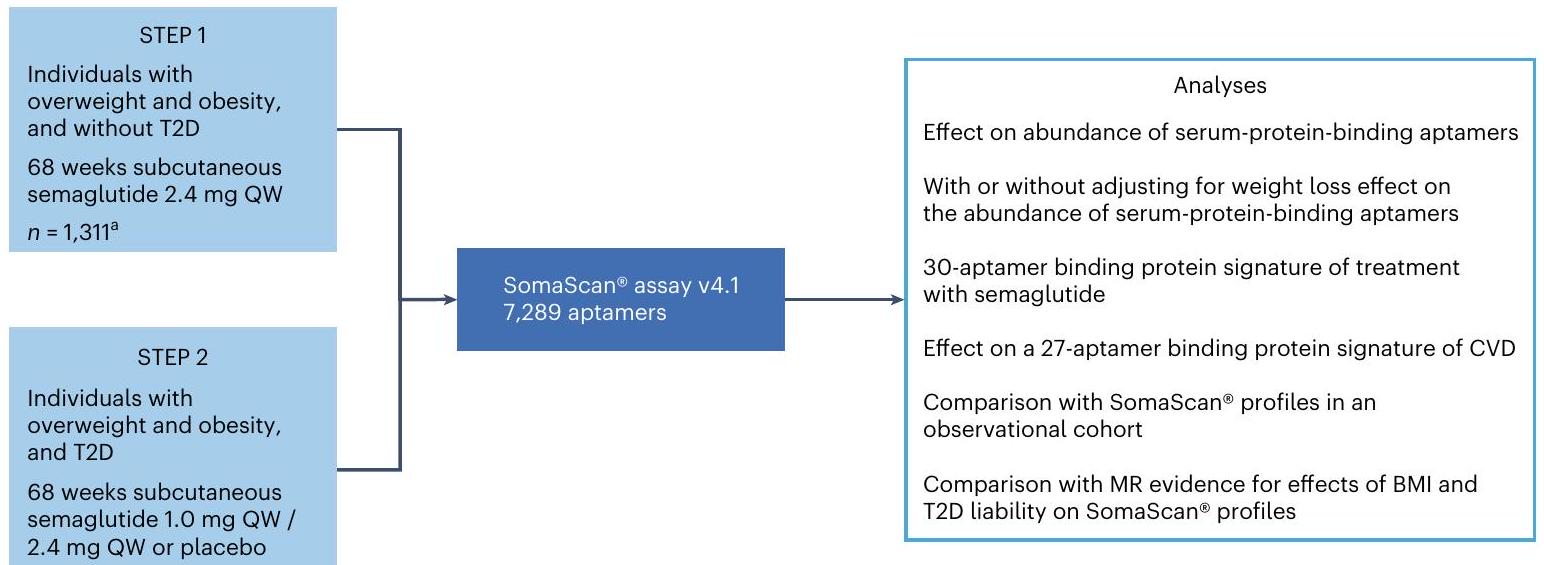
الشكل 1| تصميم الدراسة. من بين 3,171 مشاركًا تم تضمينهم في تجارب STEP 1 و STEP 2، وافق 1,956 مشاركًا (STEP 1، ; STEP 2، ) على التحليلات البروتينية المعتمدة على الأبتامير باستخدام اختبار SomaScan الإصدار 4.1. المشاركون الذين تم تضمينهم
في الدراسة الذين كانت لديهم عينة حيوية متاحة لتوصيف البروتينات. تم استبعاد ذراع السيماغلوتيد 1.0 ملغ من معظم التحليلات اللاحقة، باستثناء تحليل مخاطر الأمراض القلبية الوعائية. MR، التوزيع العشوائي المندلي؛ QW، كل أسبوع.
استجابة وتقدم المرض، وتحديد أهداف علاجية جديدة . كانت منصة SomaScan المعتمدة على الأبتامير هي أول منصة عالية الإنتاجية تستخدم في الدراسات واسعة النطاق القادرة على قياس وفرة نسبية لآلاف البروتينات من أحجام عينات صغيرة في وقت واحد.
يرتبط فقدان الوزن بعد التدخلات الغذائية وجراحة السمنة بتغيرات في البروتينات الدائرة، بما في ذلك البروتينات المتعلقة بالالتهابات والمسارات الأيضية . ومع ذلك، إلى أفضل معرفتنا، تفتقر الدراسات المنشورة التي تبلغ عن تأثير فقدان الوزن الناتج عن العلاج الدوائي على البروتينات.
السيماغلوتيد هو نظير طويل المفعول لببتيد الجلوكاجون الشبيه بالهرمون 1 (GLP-1). في الولايات المتحدة، تمت الموافقة على السيماغلوتيد 1.0 ملغ تحت الجلد مرة واحدة في الأسبوع لأول مرة في عام 2017 للاستخدام في البالغين المصابين بداء السكري من النوع 2 (T2D) , تلاها الموافقة على صيغة فموية في . كانت الموافقة قائمة على عمل ناهضات مستقبلات GLP-1 (GLP-1RAs) في خفض مستويات الهيموغلوبين الغليكوزيل ( ) عن طريق زيادة إفراز الأنسولين المعتمد على الجلوكوز، وتقليل إفراز الجلوكاجون وتأخير إفراغ المعدة . ومع ذلك، فإن ناهضات GLP-1RAs لها أيضًا تأثيرات منفصلة على تنظيم الشهية من خلال تأثيراتها على مراكز الجهاز العصبي المركزي التي تؤدي إلى فقدان الوزن . حاليًا، تمت الموافقة على السيماغلوتيد 2.4 ملغ تحت الجلد مرة واحدة في الأسبوع لإدارة الوزن المزمن لدى البالغين الذين يعانون من السمنة، أو زيادة الوزن مع وجود مرض مصاحب واحد على الأقل مرتبط بالوزن , لتقليل مخاطر الأمراض القلبية الوعائية لدى البالغين الذين يعانون من أمراض قلبية وعائية مثبتة (CVD) مع السمنة أو زيادة الوزن , وفي المراهقين الذين تتراوح أعمارهم بين 12 عامًا وما فوق , بالتزامن مع نظام غذائي منخفض السعرات الحرارية وزيادة خطة النشاط البدني.
في تجربة السيماغلوتيد العشوائية لتأثير العلاج في الأشخاص الذين يعانون من السمنة (STEP) 1 (نية العلاج: 1,961 بالغًا يعانون من زيادة الوزن أو السمنة بدون T2D)، أدى السيماغلوتيد 2.4 ملغ تحت الجلد مرة واحدة في الأسبوع إلى فقدان وزن أكبر مقارنةً بالدواء الوهمي على مدى فترة 68 أسبوعًا (فرق العلاج المقدر -12.4 نقطة مئوية، فترة الثقة ); نصف المشاركين الذين تم علاجهم بالسيماغلوتيد ( ) شهدوا انخفاضًا في الوزن قدره مقارنةً بـ المخصصين للدواء الوهمي . في تجربة STEP2 العشوائية (نية العلاج: 1,210 بالغين يعانون من زيادة الوزن أو السمنة وT2D)، كان الفرق المقدر في العلاج من خط الأساس إلى الأسبوع 68 للسيماغلوتيد 2.4 ملغ مقابل الدواء الوهمي -6.2 نقطة مئوية ( .
في تحليلنا، استخدمنا عينات مصل صائم تم جمعها في بداية العلاج ونهايته في مجموعة كبيرة من المشاركين من تجربتين عشوائيتين مزدوجتي التعمية، خاضعتين للدواء الوهمي من المرحلة 3، STEP 1 و STEP 2، للتحقيق في تأثيرات علاج السيماغلوتيد على البروتينات الدائرة. من خلال فحص التأثيرات بعد فقدان الوزن وأيضًا التأثيرات بعد الأخذ في الاعتبار فقدان الوزن على البروتينات
طوال التجربة لدى أولئك الذين يعانون من T2D والذين لا يعانون منها، ومن خلال مقارنة ملفات البروتينات مع تلك الخاصة بالمجموعات الملاحظة، هدفنا إلى دراسة شاملة لتأثيرات السيماغلوتيد على البروتينات وتوضيح آلية العمل التي تدفع فوائده على الوزن ومضاعفات السمنة، وتحديد إمكانياته للاستخدام في مؤشرات جديدة.

النتائج

خصائص المشاركين في الدراسة

تم تضمين ما مجموعه 3,171 مشاركًا من الذكور والإناث في تجارب STEP 1 و STEP 2؛ يرجى الرجوع إلى الأوراق المنشورة للحصول على التفاصيل الكاملة . من بين هؤلاء، وافق 1,956 مشاركًا (STEP ; STEP ) على التحليلات البروتينية المعتمدة على الأبتامير باستخدام اختبار SomaScan الإصدار 4.1 (SomaLogic) (الشكل 1). يستخدم هذا الاختبار 7,289 أبتامير لقياس الوفرة النسبية لـ بروتينات بشرية فريدة. بعد تصفية توفر العينة في كلا الوقتين، الأفراد الذين لم يكونوا تحت العلاج في نهاية الدراسة في كلا الذراعين ومراقبة جودة المورد، تبقى 1,728 مشاركًا (STEP 1، ; STEP 2، ). بالنسبة لمعظم التحليلات، تم تحليل فقط ذراعي الدواء الوهمي والسيماغلوتيد 2.4 ملغ من تجربة STEP 2 ( ). تظهر الخصائص الأساسية للمشاركين الذين وافقوا في الجدول 1 وكانت مشابهة لتلك الخاصة بالسكان العامين للدراسة في تجارب STEP 1 و STEP 2 . وبالمثل، يتم عرض تحليل لاحق للتغيرات في الوزن، محيط الخصر و لهذه المجموعة الفرعية من المشاركين في الجدول التكميلي 1.

تأثيرات السيماغلوتيد على البروتينات الدائرة

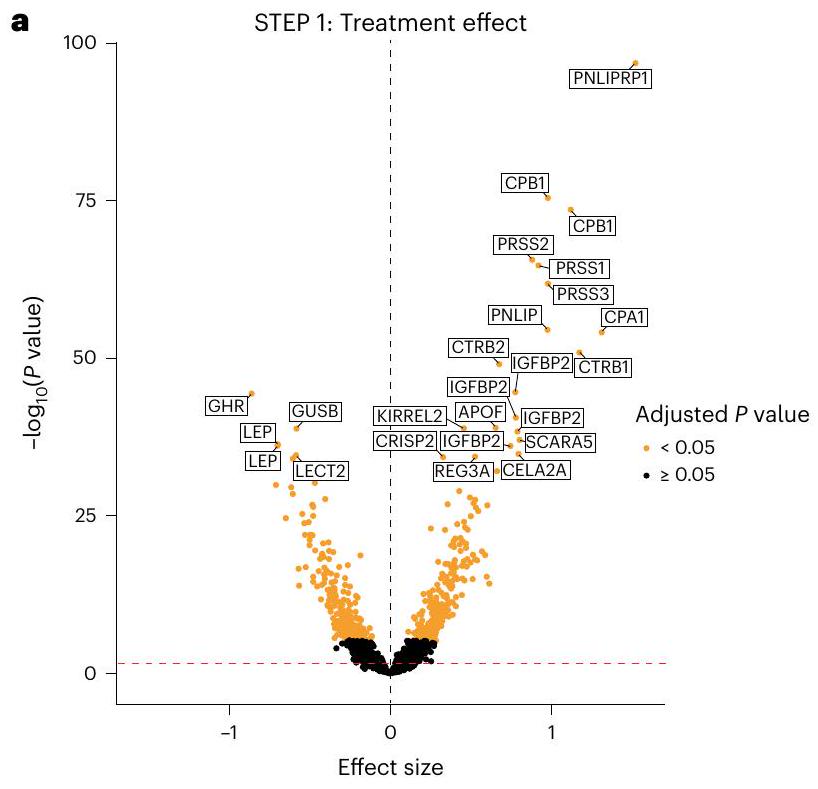
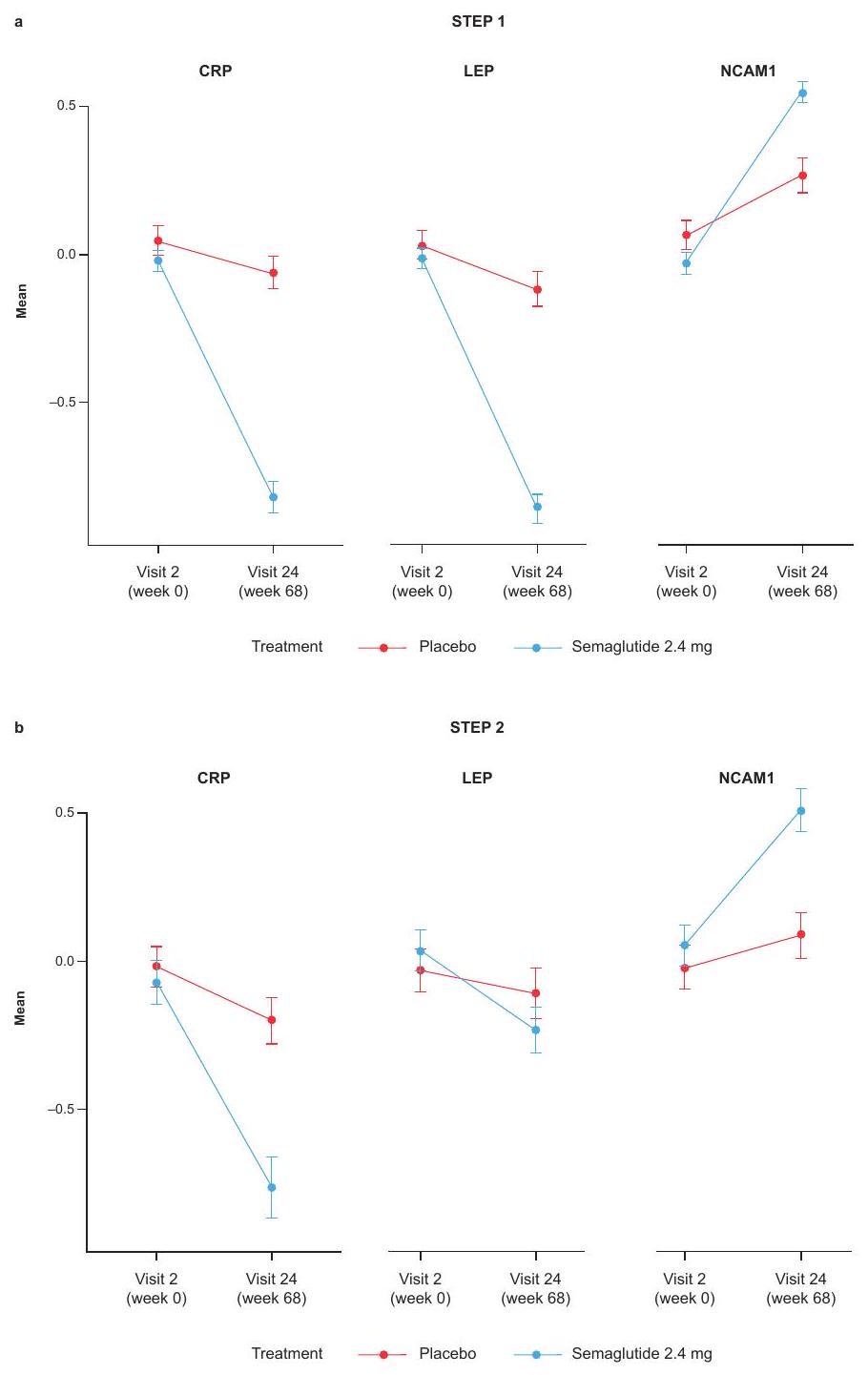
بعد 68 أسبوعًا من العلاج، تم تحديد 495 هدفًا بروتينيًا (438 بروتينًا فريدًا) تأثرت بشكل كبير بعلاج السيماغلوتيد (مقارنةً بالدواء الوهمي) في STEP 1 ( ، بعد تصحيح هولم-بونفيروني لـ 7,289 أبتامير تم اختبارها) (الشكل 2أ والجدول التكميلي 2)، مع 1,718 هدف بروتيني ذو دلالة تحت السيطرة على معدل الاكتشاف الكاذب (FDR). في تجربة STEP 2، تغيرت الوفرة النسبية لـ 277 هدف بروتيني (244 بروتين فريد) بشكل ملحوظ استجابةً لعلاج السيماغلوتيد مقارنةً بالعلاج الوهمي (الشكل 2ب والجدول التكميلي 3؛ مع 1,025 هدف بروتيني ذو دلالة تحت السيطرة على FDR). انظر الجداول التكملية 2 و 3 لتعديلات FDR. القيم ( القيم). العديد من البروتينات التي تم تحديدها في الخطوة 1 والخطوة 2 معروفة بأنها مرتبطة بالسمنة وعلم الأمراض المرتبط بمرض السكري من النوع 2 ومضاعفاته المرتبطة، بما في ذلك بروتين سي التفاعلي (CRP)، الأدبيات (ليبتين، أديبونيكتين)، غريلين، بروتين ربط عامل نمو شبيه بالأنسولين (IGFBP)، مستقبل هرمون النمو (GHR)، جزيء التصاق الخلايا العصبية 1 (NCAM1) ومستقبل نترين (UNC5D)، من بين آخرين. أمثلة على الوفرة النسبية لبروتينات محددة في الخط الأساسي والأسبوع 68.
الجدول 1 | خصائص المشاركين الذين لديهم عينات مصل صائم لتحليلات البروتينات المعتمدة على الأبتامير في الخطوة 1 والخطوة 2
خصائص الخطوة 1، الخطوة 2،
العمر، المتوسط ± الانحراف المعياري (سنوات)
الجنس الأنثوي (%) 955 (72.8) 321 (49.8)
العرق أو المجموعة العرقية، (%)
أبيض 984 (75.1) ٣٨٨ (٦٠.٢)
آسيوي 162 (12.4) 183 (28.4)
أسود أو أمريكي من أصل أفريقي 65 (5.0) 55 (8.5)
آخر 100 (7.6) 19 (2.9)
مجموعة عرقية من أصل إسباني أو لاتيني، 135 (10.3) 77 (11.9)
وزن الجسم، المتوسط ± الانحراف المعياري (كجم)
مؤشر كتلة الجسم (BMI) )
المتوسط ± الانحراف المعياري ( )
توزيع (%)
<30 80 (6.1) ١٢٢ (١٨.٩)
إلى <35 433 (33.0) 231 (35.8)
إلى <40 401 (30.6) 149 (23.1)
397 (30.3) 143 (22.2)
محيط الخصر، المتوسط ± الانحراف المعياري (سم)
المتوسط ± الانحراف المعياري (%)
ما قبل السكري (%) 570 (43.5)
تم الإبلاغ عن العرق والمجموعة العرقية من قبل المحقق. تشمل فئة ‘أخرى’ الأمريكيين الأصليين، هاواي أو غيرهم من سكان جزر المحيط الهادئ، وأي مجموعة عرقية أخرى و’غير قابل للتطبيق’، وهو آخر طريقة تم تسجيل العرق أو المجموعة العرقية بها في فرنسا. تم تحديد وجود ما قبل السكري من قبل الباحثين بناءً على المعلومات المتاحة (على سبيل المثال، السجلات الطبية، الأدوية المصاحبة ومتغيرات مستوى السكر في الدم) ووفقًا لمعايير الجمعية الأمريكية للسكري. انحراف معياري
تم عرض STEP 1 و STEP 2 في الشكل البياني الموسع 1. لم يتم الكشف عن أي تأثير للجنس في الاستجابة البروتينية لعلاج السيماغلوتيد في كل من STEP 1 و STEP 2 (الجداول التكميلية 4 و 5).
لقد لاحظنا توافقًا عاليًا بين الاستجابة البروتينية للعلاج عبر STEP 1 و STEP 2 (الشكل 2c)، ولكن كانت هناك بعض الاختلافات بين الدراستين من حيث تأثير السيماغلوتيد على البروتينات المقاسة (الجداول التكميلية 2 و3 و6-8). تم تنظيم ما مجموعه 33 بروتينًا (بما في ذلك بروتين B-type natriuretic peptide (NT-proBNP) في STEP 1 ولكن ليس في STEP 2، على الرغم من أن ذلك قد يكون بسبب حجم العينة الأكبر في STEP 1 مقارنة بـ STEP 2؛ تعتبر هذه التحليل المقارن استكشافيًا. يمكن العثور على قائمة البروتينات التي تم تنظيمها في STEP 2 ولكن ليس في STEP 1 في الجدول التكميلية 8.
وجدت تحليلات مجموعة البروتينات أن علاج السيماغلوتيد خفض من مستوى البروتينات المشاركة في المسارات البيولوجية الرئيسية التي تحكم استقلاب المواد الغريبة، واستقلاب الأحماض الدهنية، وإشارات مركب الهدف من الراباميسين في الثدييات 1 (MTORC1)، من بين أمور أخرى (الشكل 2 من البيانات الموسعة). بالإضافة إلى ذلك، زادت مستويات الإنزيمات الهضمية المفرزة من البنكرياس الخارجي بواسطة السيماغلوتيد (الشكل 3 من البيانات الموسعة).

فقدان الوزن و -التأثيرات المعدلة للسيماجلوتيد على البروتيوم

تعديلًا لوزن الجسم و التغيرات في نهاية العلاج حددت 47 (38 بروتينًا فريدًا) و15 (14 بروتينًا فريدًا) من أهداف البروتين التي تغيرت بشكل ملحوظ بسبب علاج السيماغلوتيد في STEP 1 وSTEP 2، على التوالي. ، بعد تصحيح هولم-بونفيروني لـ 7,289 أبتامير تم اختبارها (الشكل 2د، هـ)، مع 153 و 21 هدف بروتيني ذو دلالة تحت السيطرة على معدل الاكتشاف الخاطئ، على التوالي) (الجداول التكميلية 6
والبروتينات التي تم تنظيمها بشكل كبير في هذا التحليل مرتبطة بتأثيرات بيولوجية متنوعة (على سبيل المثال، الإجهاد القلبي، الالتهاب وعمليات الأيض الدهني) وقد وُجد سابقًا أنها مرتفعة في أمراض القلب والأوعية الدموية أو مرتبطة بزيادة خطر الإصابة بها. البروتينات التي تم تنظيمها بشكل كبير عند التعديل لتأثيرات وزن الجسم في الخطوة 1 والمعروفة بأنها مرتبطة بخطر الإصابة بأمراض القلب والأوعية الدموية تضمنت تيناسين C (TNC)، NT-proBNP، ثرومبوسبوندين 2 (THBS2)، مستقبل مكون المكمل C1q (مجموعة التمايز 93 (CD93))، مستقبل الماكروفاج 1-النطاق الخارجي (MSR1) وأنجيوبيوتين-2 (ANGPT2). بينما تضمنت البروتينات الأخرى التي تم تنظيمها بشكل كبير وغير المرتبطة بأمراض القلب والأوعية الدموية البروتين السري المتعلق بفريزل-4 (sFRP4) وبروتين ربط الأحماض الدهنية في الكبد (LFABP)، في حين تم تنظيم الجرونولين (GRN) بشكل كبير. مشابهًا للتحليل السابق الذي تم فيه أخذ وزن الجسم في الاعتبار و لم يتم تضمين التغييرات في النموذج، وكانت البروتينات التي تم تنظيمها بشكل كبير غنية بالإنزيمات الهضمية من البنكرياس الخارجي. كان هناك بروتين واحد فقط، وهو المستضد المرتبط بالميلانوما 10A (MAGEA10)، تم تنظيمه بشكل كبير بواسطة السيماغلوتيد في STEP 2، ولكن ليس في STEP 1.

التوقيع البروتيني لعلاج السيماغلوتيد

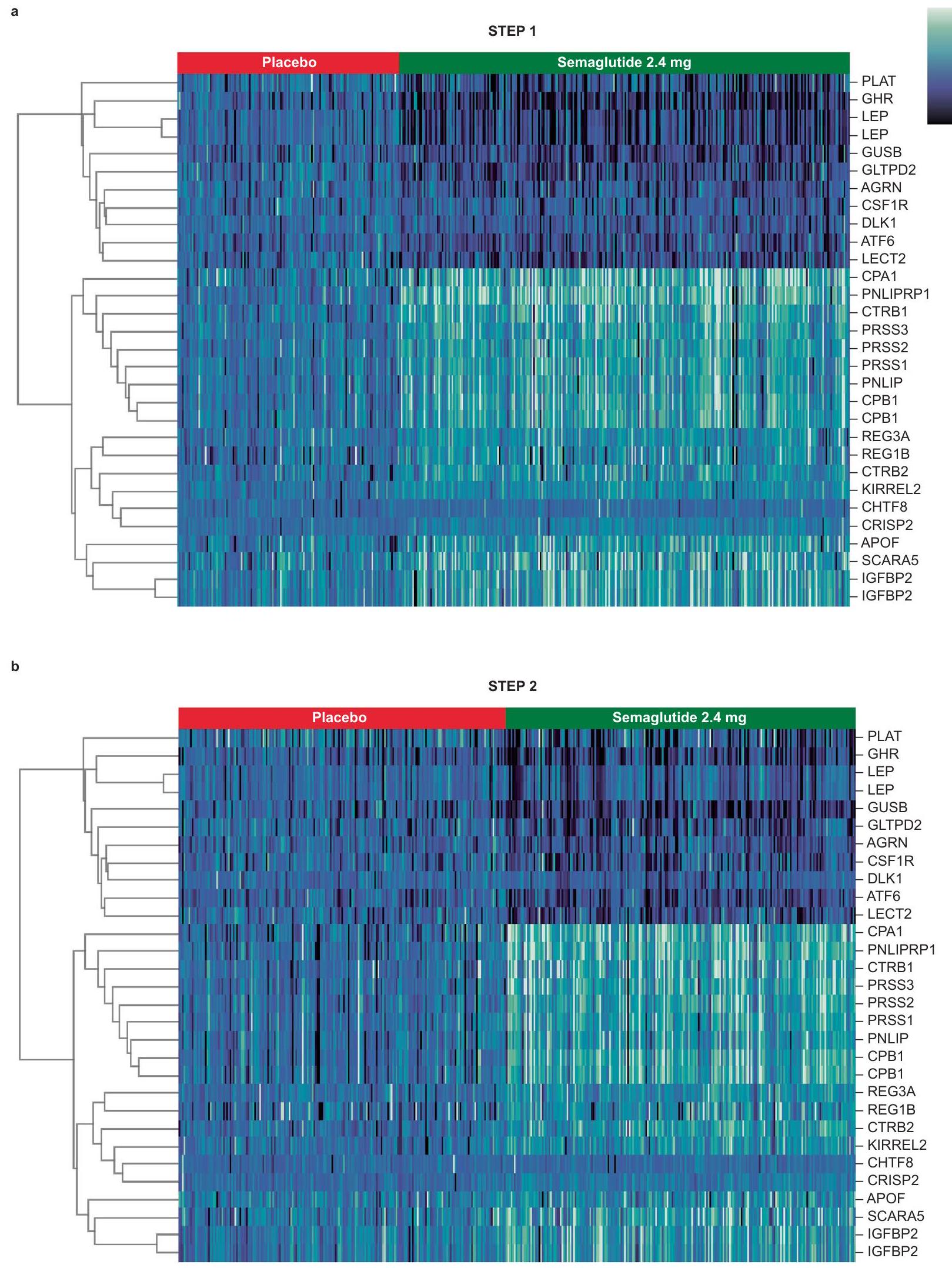
في الخطوة 1، تم تطبيق التعلم الإحصائي واختيار الميزات لاشتقاق توقيع بروتيني يميز المشاركين الذين يتلقون السيماغلوتيد عن المشاركين الذين يتلقون الدواء الوهمي بناءً على التغيرات البروتينية في نهاية العلاج. شمل التوقيع المدرب النهائي 30 أبتامير (الشكل التمديدي 4أ). شمل التوقيع بروتينات مرتبطة بعمليات بيولوجية تتعلق بالسمنة والسكري من النوع الثاني (على سبيل المثال، تكوين الدهون، استقلاب الأحماض الدهنية، التحلل السكري ومسارات الإشارة)، بما يتماشى مع تحليل مجموعة البروتينات الموصوف أعلاه (الشكل التمديدي 2أ)، بالإضافة إلى بروتينات مرتبطة بكتلة الدهون ووظيفتها، وفقدان الوزن، وأمراض القلب والأوعية الدموية، ووظيفة البطانة، واستقلاب الدهون، ووظيفة البنكرياس الصماء والافرازية، والالتهاب وربما خطر الإصابة بالسرطان. كان لتوقيع STEP 1 أداء تصنيفي عالي (منطقة تحت المنحنى في التحقق المتداخل الداخلي) الجامعة الأمريكية في القاهرة )، مما يظهر أن علاج السيماغلوتيد يؤدي إلى توقيع بروتيني مصل محدد. ثم قمنا بتطبيق هذا التوقيع في STEP 2، وهو مجموعة تحقق خارجية، حيث أظهر أداءً مشابهًا في تمييز علاج السيماغلوتيد عن الدواء الوهمي. (الشكل 4ب من البيانات الموسعة).

أثر علاج السيماغلوتيد على بصمة بروتينية لمخاطر أمراض القلب والأوعية الدموية

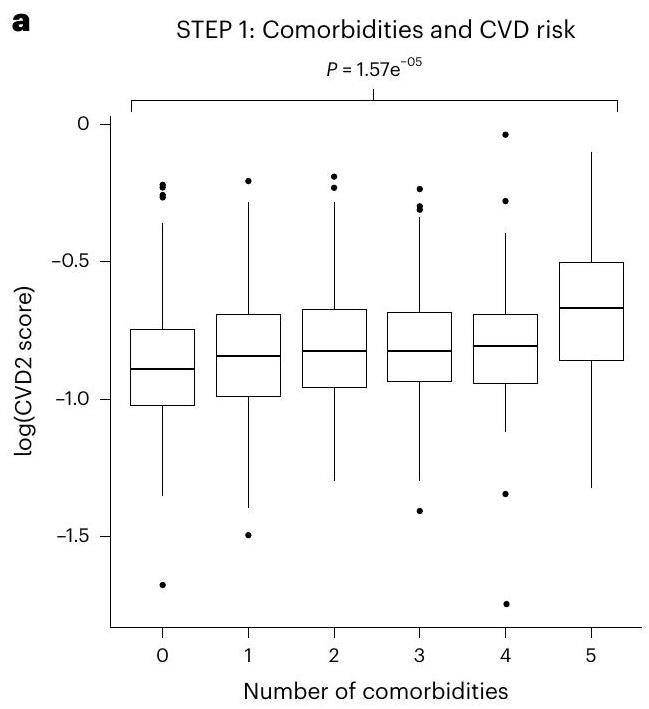
تم وصف درجة مكونة من 27 بروتينًا سابقًا تتنبأ بخطر الإصابة بأمراض القلب والأوعية الدموية الثانوية على مدى 4 سنوات، استنادًا إلى بيانات متعددة المجموعات الكبيرة واستخدام نفس تقنية SomaScan. التكنولوجيا المستخدمة في دراستنا (البيانات الموسعة الجدول 1). كان هناك اتجاه لزيادة عدد الأمراض المصاحبة الأساسية المرتبطة بزيادة درجة خطر الأمراض القلبية الوعائية، مما يشير إلى أن درجة البروتينات الـ 27 تقيس خطر الأمراض القلبية الوعائية النسبي في مجموعة STEP 1 (الشكل 3a). باستخدام بيانات من STEP 1 و STEP 2، وجدنا أن علاج السيماغلوتيد قلل من درجة خطر الأمراض القلبية الوعائية مقارنةً بالعلاج الوهمي (الشكل 3b). تم العثور على نتائج مشابهة ذات دلالة إحصائية عند النظر في جرعات السيماغلوتيد إما 1.0 ملغ أو 2.4 ملغ في STEP 2، دون أي تقليل إضافي في الخطر مع جرعة 2.4 ملغ مقارنةً بجرعة 1.0 ملغ.

مقارنة مع بيانات مجموعة المراقبة الأيسلندية (deCODE)

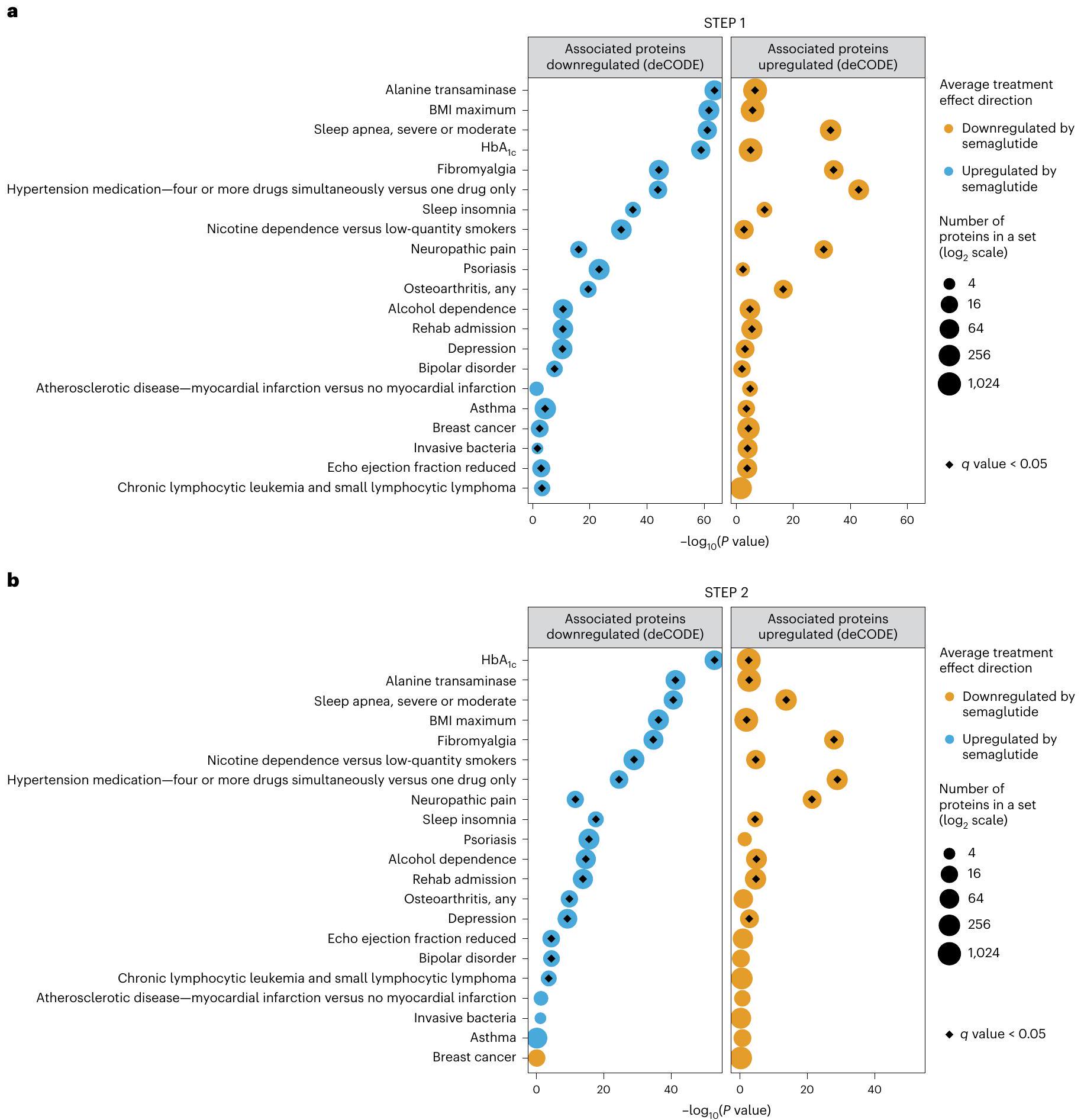
قمنا بعد ذلك بمقارنة تأثير البروتيوم لعلاج السيماغلوتيد في STEP1 و STEP 2 مع مجموعات البروتين (التوقيعات) المرتبطة بظواهر سريرية محددة (الشكل 4). تم إنشاء هذه المجموعات بناءً على بيانات من دراسة سابقة أجرتها deCODE (الطرق)، حيث تم تقدير العلاقات بين مستويات البروتين والعديد من الظواهر السريرية في مجموعة مراقبة تضم 35,559 إيسلندياً. بالنسبة لكل نمط ظاهري، قمنا بتقسيم البروتينات المرتبطة بشكل كبير إلى تلك التي تم تنظيمها لأعلى وتلك التي تم تنظيمها لأسفل. أشارت النتائج من هذا التحليل إلى أن الاضطرابات البروتينية الناتجة عن السيماغلوتيد قد يكون لها تأثير إيجابي على مجموعة واسعة من المعايير الأيضية، ومضاعفات السمنة، وأمراض أخرى.
(الشكل 4). على سبيل المثال، في STEP1، خفض السيماغلوتيد البروتينات التي يتم تنظيمها بشكل زائد في الفيبروميالجيا، ارتفاع ضغط الدم، اضطرابات تعاطي المواد، الألم العصبي، التهاب المفاصل، الصدفية، الاكتئاب، الربو، سرطان الثدي وانخفاض الكسر القذفي، وزاد البروتينات التي يتم تنظيمها بشكل ناقص في هذه الحالات (بالإضافة إلى اللوكيميا اللمفاوية المزمنة واللمفوما اللمفاوية الصغيرة على الرغم من القيمة ) (الشكل 4أ). تظهر النتائج للقائمة الكاملة من الأنماط الظاهرية لـ STEP1 و STEP 2 في الجداول التكميلية 9 و 10 (تحليلات العلامات المميزة) والجداول التكميلية 11 و 12 (تحليلات deCODE)، بما في ذلك القيم.

المقارنة مع تحليلات العشوائية المندلية لمؤشر كتلة الجسم والوراثة الجينية لـ T2D

تم إجراء تحليل العشوائية المندلية للتحقيق في تأثير الوراثة الجينية على خفض مؤشر كتلة الجسم (BMI) وتقليل خطر T2D على البروتينات الدائرة، باستخدام تقديرات الارتباط الجيني للبروتينات الدائرة من مجموعة deCODE. كما هو متوقع، كان هناك تداخل كبير في تأثيرات السيماغلوتيد تحت الجلد على مستويات البروتين في المصل مع تلك المرتبطة بخطر وراثي أقل أو أعلى لـ BMI أو T2D (الشكل 5). على وجه التحديد، كانت البروتينات التي ارتفعت بشكل كبير مع خطر وراثي أعلى لزيادة BMI أو T2D في مجموعة deCODE قد تم تنظيمها بشكل ناقص بواسطة السيماغلوتيد والعكس بالعكس.

المناقشة

باستخدام بيانات من تجارب STEP 1 و STEP 2 المرحلة 3، وجدنا تأثيرات واسعة من علاج السيماغلوتيد تحت الجلد في الأشخاص الذين يعانون من زيادة الوزن أو السمنة (مع وبدون T2D) على البروتينات الدائرة مقارنةً بالعلاج الوهمي. من خلال مقارنة بياناتنا مع علم الوراثة والبروتيوميات في العالم الحقيقي، أظهرنا أن وفرة العديد من البروتينات الأعلى تصنيفًا التي تغيرت بواسطة السيماغلوتيد مرتبطة بمجموعة من العمليات البيولوجية الأساسية التي تؤثر على BMI و T2D، من تنظيم وزن الجسم إلى التحكم في نسبة السكر في الدم، إلى استقلاب الدهون، والمسارات الالتهابية، ووظيفة المناعة، ووظيفة الأنسجة الدهنية والعديد من المضاعفات المرتبطة بالسمنة الأخرى. تم تحديد توقيع بروتيومي توقع بشكل قوي حالة علاج السيماغلوتيد. علاوة على ذلك، تشير بياناتنا إلى أن السيماغلوتيد قد يقلل من خطر الأمراض القلبية الوعائية، حتى في السكان الذين ليس لديهم أمراض قلبية وعائية مثبتة. بالإضافة إلى ذلك، على الرغم من أن أدلة العشوائية المندلية التي تم إنشاؤها باستخدام بيانات ملخصة من دراسات الارتباط الجينومية (GWAS) في هذا التحليل تظهر أن بعض تأثيرات علاج السيماغلوتيد على البروتيوم قد تكون متوسطة من خلال تقليل وزن الجسم وتقليل خطر T2D، تدعم تحليلات بيانات التجارب السريرية أيضًا تأثيرات السيماغلوتيد تتجاوز تلك التي يمكن تفسيرها بفقدان الوزن الملحوظ و التخفيضات.
معًا، تعرض هذه البيانات من التجارب السريرية لعلاج السيماغلوتيد لتقليل وزن الجسم الفرص الواسعة التي توفرها تحليلات البروتيوم، بما في ذلك تقديم رؤى حول آليات العمل وإمكانيات مؤشرات جديدة لاختبارها في الدراسات السريرية. كما توفر نتائجنا بيانات تدعم إعادة استخدام الأدوية. من خلال أخذ تأثير السيماغلوتيد على البروتيوم بالكامل ومقارنته بتوقيعات البروتين المحددة مع الأمراض الفردية من تحليل deCODE، نجد أن السيماغلوتيد قد يكون له تأثير إيجابي على مجموعة متنوعة من الأمراض والعمليات. على سبيل المثال، في كل من
STEP1 و STEP 2، خفض السيماغلوتيد البروتينات التي يتم تنظيمها بشكل زائد في الفيبروميالجيا، ارتفاع ضغط الدم، اضطرابات تعاطي المواد، الألم العصبي والاكتئاب، وزاد البروتينات التي يتم تنظيمها بشكل ناقص في هذه الحالات. ومع ذلك، في المرضى الذين لا يعانون من T2D (STEP 1)، خفض السيماغلوتيد أيضًا البروتينات التي يتم تنظيمها بشكل زائد في التهاب المفاصل، الصدفية، الربو، سرطان الثدي وانخفاض الكسر القذفي، وزاد البروتينات التي يتم تنظيمها بشكل ناقص في هذه الحالات. يتم تفصيل المقارنة الكاملة مع deCODE في الجداول التكميلية 11 و 12. على هذا النحو، توفر بيانات البروتيوم من STEP 1 و STEP 2 رؤى حول مؤشرات جديدة محتملة للسيماغلوتيد. ومع ذلك، يجب اعتبار مثل هذه الملاحظات كمولدة لفرضيات، تتطلب اختبارًا في دراسات ما قبل السريرية والسريرية التي تؤكد الفعالية وتضمن السلامة. على سبيل المثال، تدعم التأثيرات المحتملة على الاعتماد على الكحول دراسة حديثة من العالم الحقيقي لمطابقة درجات الميل في السكان من 83,825 مريضًا يعانون من السمنة، والتي أظهرت أن السيماغلوتيد، مقارنةً بأدوية السمنة الأخرى غير المعتمدة على GLP-1، كان مرتبطًا بـ خطر أقل لحدوث واضطرابات تعاطي الكحول المتكررة على مدى فترة 12 شهرًا بغض النظر عن حالة T2D . تم تكرار هذه النتائج في مجموعة من 598,803 مريضًا يعانون من T2D وتدعم تصميم تجربة سريرية للسيماغلوتيد لعلاج اضطراب تعاطي الكحول.
ليس من المستغرب، كانت البروتينات الأعلى التي تم تنظيمها بشكل زائد بعد علاج السيماغلوتيد في STEP 1 و 2 (بما في ذلك في التحليل المعدل حسب الوزن) مرتبطة بالإنزيمات الهضمية والبنكرياس الخارجي. من المعروف جيدًا أن العديد من علاجات GLP-1RA تزيد من مستويات إنزيمات البنكرياس في الدم (الأميلاز، الليباز) كما تم قياسها بواسطة اختبار المختبر، بما في ذلك في تجربة STEP 1 . نادرًا ما تتجاوز هذه الزيادات الحد الطبيعي الأعلى وقابلة للعكس بعد التوقف عن العلاج . في تجربة LEADER (تأثير الليراجلوتيد وعمله في السكري: تقييم نتائج النتائج القلبية الوعائية) التي تقيم الليراجلوتيد (نظير GLP-1)، لم تكن الارتفاعات الطفيفة الملحوظة في إنزيم البنكرياس تنبؤية لالتهاب البنكرياس الحاد اللاحق . بالإضافة إلى ذلك، أظهرت المراجعات المنهجية السابقة والتحليلات التلوية أن علاج GLP-1RA في الأشخاص الذين يعانون من T2D لم يكن مرتبطًا بزيادة خطر التهاب البنكرياس أو سرطان البنكرياس .
بينما كان هناك توافق عالٍ في تأثير السيماغلوتيد على البروتيوم المقاس بين STEP 1 و 2، كانت هناك أيضًا بعض الاختلافات. تم تنظيم بعض البروتينات بواسطة السيماغلوتيد فقط في STEP 2 (الجدول التكميلية 8)، بينما تم تنظيم بروتينات أخرى بواسطة السيماغلوتيد فقط في STEP1. ومع ذلك، من الصعب تحديد ما إذا كان هذا بسبب بيولوجيا محددة أو نقص القوة الإحصائية بعد التعديل على التعددية في STEP 2 بسبب حجم العينة الأصغر. لذلك، اخترنا إدراج فقط البروتينات التي تم تنظيمها بواسطة السيماغلوتيد في STEP 2 ولكن ليس في STEP 1. قد تساهم بعض الاختلافات في التباين في فقدان الوزن الملحوظ بين المرضى الذين لا يعانون من T2D والذين يعانون منه (STEP1 مقابل STEP 2). على سبيل المثال، تم تنظيم مثبط ميتالوبروتيناز 4 (TIMP4) بواسطة السيماغلوتيد في STEP 2 ولكن ليس في STEP 1. أدى غياب TIMP4 إلى تحسين السمنة الناتجة عن النظام الغذائي الغني بالدهون في الفئران . كانت تعدد الأشكال في TIMP4 مرتبطة أيضًا باستجابات فقدان الوزن لتدخلات السلوك الحياتي . ومع ذلك، يجب تفسير تلك الاختلافات بحذر نظرًا للاختلاف في مجموعات الدراسة والعدد، فضلاً عن فقدان الوزن الأقل في STEP 2.
الشكل 2 | تأثيرات السيماغلوتيد تحت الجلد مقابل تأثيرات العلاج الوهمي على البروتيوم الدائر. أ، ب، أحجام التأثير على مستويات البروتين في STEP 1 (أ) و STEP 2 (ب). ج، مقارنة بين أحجام التأثير في STEP 1 و STEP 2. د، هـ، أحجام التأثير على البروتينات التي ظلت ذات دلالة في نموذج الانحدار بعد التعديل لكل من الأساس والتغيير في وزن الجسم و في STEP 1 (د) و STEP 2 (هـ). تمثل الخط الأحمر المتقطع عتبة FDR. STEP 1: ; STEP 2: . بالنسبة لـ ، تم حساب أحجام التأثير و القيم باستخدام الانحدار الخطي. تم تصحيح القيم للتعددية باستخدام تصحيح هولم-بونفيروني. AMY2A و AMY2B، أميلاز ألفا 2A و 2B؛ APOF، بروتين شحمي F؛ BGN، بيغليكان؛ CD36، مجموعة التمايز 36؛ CELA1 و CELA2A، كيموتريpsinlike elastase 1 و 2A؛ CPA1، كربوكسي ببتيداز A1؛ CPB1، كربوكسي ببتيداز B1؛
CRISP2، بروتين سري غني بالسيستين 2؛ CTRB1 و CTRB2، كيموتريبسينوجين B1 و B2؛ EVA1C، نظير eva-1 C؛ GUSB، غلوكورونيداز بيتا؛ HSPA1A، بروتين الصدمة الحرارية عائلة A عضو 1A؛ KIRREL2، جزيء التصاق عائلة نيفرين شبيه kirre 2؛ LECT2، كيموتاكسين مشتق من خلايا الكريات البيضاء 2؛ LEP، لبتين؛ NPPB، ببتيد ناتريوتيك B؛ PLAT، منشط البلاسمينوجين، نوع الأنسجة؛ PNLIP، ليباز البنكرياس؛ PNLIPRP1 و PNLIPRP2، بروتينات مرتبطة بالليباز البنكرياسي 1 و 2؛ PRSS1 و PRSS2 و PRSS3، تريبسين 1 و 2 و 3؛ PTGR1، مختزل البروستاجلاندين-1؛ REG1B و REG3A، عضو عائلة التجديد 1 بيتا و 3 ألفا؛ SCARA5، عضو مستقبلات الفئة A 5؛ SCGB3A1، عضو عائلة سيكريتوجلوبين 3A 1؛ SHBG، غلوبولين ربط الهرمونات الجنسية.


e
الشكل 3 | العلاقة بين عدد الأمراض المصاحبة والمخاطر المتوقعة لأمراض القلب والأوعية الدموية في الخطوة 1 (أ) وتأثير السيماغلوتيد على المخاطر المتوقعة لأمراض القلب والأوعية الدموية في الخطوة 1 والخطوة 2 (ب). يPredict اختبار CVD2 خطر حدوث حدث قلبي وعائي جديد خلال 4 سنوات للمرضى الذين عانوا بالفعل من حدث قلبي وعائي. . ، سجل (CVD2) مقابل عدد الأمراض المصاحبة: اختبار كروسكال-واليس لمجموع الرتب تمثل الخط المركزي والحدود السفلية والعلوية للصناديق الوسيط والربع الأول والربع الثالث، على التوالي. تشير الشعيرات السفلية والعلوية إلى القيم الدنيا والقصوى، على التوالي، عند نطاق الربعين من حدود الصندوق.
استخدمنا بيانات الأوميكس من دراسة deCODE للحصول على فهم أفضل لتأثيرات السيماغلوتيد على عمليات مرضية أخرى غير السمنة. استخدمنا deCODE لأنه المورد الأكثر حداثة وشمولية لتوقيعات البروتينات للأمراض والصحة، وهو مجموعة محددة جيدًا تم تصنيفها بشكل شامل ولديها بيانات بروتينية حديثة من نفس المنصة المستخدمة في دراستنا الحالية (على الرغم من أنها نسخة سابقة). تم إجراء مقارنات مع ملفات البروتينات المحددة في مجموعة deCODE (وهي مجموعة رصدية تضم 35,559 إيسلنديًا). سمح لنا ذلك بفحص الأماكن التي قد يكون لعلاج السيماغلوتيد فوائد وتقييم تأثيره المحتمل على مجموعة واسعة من الحالات، بما في ذلك أمراض القلب والأوعية الدموية (احتشاء عضلة القلب التصلبي وانخفاض الكسر القذفي في تخطيط صدى القلب)؛ والحالات الأيضية والالتهابية والصحية النفسية؛ والسرطان. وبما يتماشى مع ذلك، فقد قلل علاج السيماغلوتيد بشكل إيجابي من درجة خطر أمراض القلب والأوعية الدموية 2 (CVD2) المحسوبة باستخدام نموذج بروتيني مكون من 27 بروتينًا. على الرغم من أن تحليلاتنا تظهر أن العديد من الاضطرابات البروتينية الناتجة عن علاج السيماغلوتيد مرتبطة بتغيرات في وزن الجسم والجليكيميا، فإن عدم وجود استجابة للجرعة فيما يتعلق بمخاطر الأمراض القلبية الوعائية مع السيماغلوتيد بجرعة 1.0 ملغ و2.4 ملغ في دراسة STEP 2 يدعم تأثيرات السيماغلوتيد على الأمراض القلبية الوعائية بخلاف فقدان الوزن. علاوة على ذلك، كشفت تحليل محدد مسبقًا لتجربة SELECT التي تم تقديمها في المؤتمر الأوروبي للسمنة 2024 أن حجم تأثير هذا العلاج مع السيماغلوتيد كان مستقلًا عن مدى فقدان الوزن المحقق. . في تحليلاتنا، بعد تعديل فقدان الوزن، حوالي من العلامات التي كانت ذات دلالة إحصائية في البداية لم تعد ذات دلالة، مما يشير إلى أن المتبقي لم تتغير علامات المؤشرات نتيجة لفقدان الوزن؛ ومع ذلك، فإن التحقيق الإضافي warranted. لقد قدمنا قائمة شاملة بالتغيرات في البروتيوم المقاس، والتي يمكن الوصول إليها واستخدامها في التحليلات المستقبلية إذا أصبحت بيانات مماثلة متاحة.
لقد أظهرت عدة أدوية من فئة GLP-1RAs، بما في ذلك السيماغلوتيد، أنها تقدم فوائد في نتائج القلب والأوعية الدموية لدى الأشخاص المصابين بداء السكري من النوع الثاني. .
الخطوة 1: ; الخطوة 2: التغيير من الخط الأساسي في (درجة CVD2) عبر مجموعات العلاج: اختبار ويلكوكسون لرتب المجموعات (STEP1، سيماجلوتيد 2.4 ملغ مقابل دواء وهمي)، (الخطوة 2، سيماجلوتيد 1.0 ملغ مقابل الدواء الوهمي)، (الخطوة 2، سيماجلوتيد 2.4 ملغ مقابل الدواء الوهمي) و (الخطوة 2، سيماجلوتيد 2.4 ملغ مقابل سيماجلوتيد 1.0 ملغ). تُعرض البيانات كقيم متوسطة مع أشرطة خطأ تشير إلى تم استخدام اختبار ذو جانبين. تم تصحيح القيم لمقارنات الأذرع الثنائية في الخطوة 2 لاختبار متعدد باستخدام طريقة هولم-بونفيروني. الخطوة 1: ; الخطوة 2: . حدث قلبي وعائي سلبي كبير.
تظهر هذه الفوائد الآن أيضًا لدى الأشخاص الذين يعانون من السمنة والذين لديهم خطر مرتفع من أمراض القلب والأوعية الدموية (أو الذين يعانون من مرض وعائي معروف) ولكن دون الإصابة بمرض السكري من النوع الثاني، كما يتضح من التأثيرات الإيجابية للسيماجلوتيد في تجربة سيميجلوتيد وتأثيراته على أمراض القلب والسكتة الدماغية لدى المرضى الذين يعانون من زيادة الوزن أو السمنة (SELECT). . في تحليلنا الحالي لبيانات STEP 1، وجدنا أدلة على أن السيماغلوتيد قد يقلل من خطر الأمراض القلبية الوعائية حتى في الفئات السكانية التي لا تحتوي على عوامل خطر متعددة للأمراض القلبية الوعائية أو التي لديها أمراض قلبية وعائية مثبتة (الوقاية الأولية). تم الإبلاغ عن بروتينات معينة تم تنظيمها بشكل زائد في الأمراض القلبية الوعائية (لكن تم تنظيمها بشكل ناقص مع علاج السيماغلوتيد، بعد تعديل تأثيرات فقدان الوزن و التقليل) تشمل NPPB (NT-proBNP، الذي يتم إفرازه من خلايا القلب عند تمدد البطين) ANGPT2 (المعني بإعادة تشكيل الأوعية الدموية وتكوين الأوعية) CD93 (المعني في توازن القلب والأوعية الدموية) MSR1 (المعني في استقلاب الدهون ووظيفة المناعة) ، وTHBS2 وTNC (كلاهما متورط في إعادة تشكيل المصفوفة خارج الخلوية) تشير النتائج السابقة إلى أن TNC يتم تنظيمه سلبًا بواسطة علاج GLP-1RA ويت correlates مع حدوث أمراض القلب والأوعية الدموية. مقترحًا أن TNC قد تعمل كوسيط، مع المساهمة في تقليل التعبير الذي يسهم في التأثيرات الواقية للقلب والأوعية الدموية لـ GLP-1RAs. سيتم اختبار هذه الفرضية باستخدام بيانات بروتينية من تجربة SELECT. للبروتينات القلبية الوعائية الستة المذكورة أعلاه التي تم تقليلها بواسطة السيماغلوتيد في STEP 1. وبالمثل، قد يوفر التأثير الإيجابي للسيماغلوتيد على علامات الالتهاب مثل مستويات CRP و NT-proBNP مزيدًا من الفهم للفائدة المحتملة للسيماغلوتيد في المرضى الذين يعانون من فشل القلب مع الحفاظ على كسر القذف (HFpEF). وقد تم تقييم ذلك في تجارب STEP-HFpEF (الأشخاص الذين يعانون من السمنة وHFpEF بدون سكري) وSTEP-HFpEF DM (الأشخاص الذين يعانون من السمنة وHFpEF مع السكري من النوع الثاني). في الواقع، أظهرت بيانات تجارب STEP-HFpEF و STEP-HFpEF DM انخفاضًا كبيرًا في علامات الالتهاب مثل CRP مع السيماغلوتيد مقارنةً بالعلاج الوهمي. على الرغم من الاختلافات في مجموعات الدراسة، تقدم نتائجنا رؤى إضافية لدعم الدراسات المنشورة التي تشير إلى تأثيرات إيجابية مع السيماغلوتيد على النتائج القلبية الوعائية.
الشكل 4 | تأثير السيماغلوتيد في STEP1 (أ) و STEP 2 (ب) على مجموعة مختارة من التوقيعات البروتينية. أ،ب، نتائج تحليل مجموعة البروتينات لمجموعة مختارة من التوقيعات البروتينية المتأثرة بعلاج السيماغلوتيد (وفقًا لـ SomaScan ) في الخطوة 1(أ) والخطوة 2(ب). الخطوة 1: ; الخطوة 2: إثراء تم حساب القيم باستخدام CameraPR. تم إنشاء مجموعات البروتين (التوقيعات) باستخدام بيانات من دراسة أجرتها deCODE التي قدرت العلاقات بين مستويات البروتين والظواهر السريرية في مجموعة مراقبة تضم 35,559 إيسلندياً. . لكل نمط ظاهري، تم تقسيم البروتينات المرتبطة بشكل كبير إلى تلك التي
تم تنظيمها بشكل منخفض مع السمة وتلك التي تم تنظيمها بشكل مرتفع. تشير أحجام الدوائر بصريًا إلى عدد البروتينات في مجموعة ( المقياس). تشير الماس السوداء داخل الدوائر الملونة إلى المجموعات التي تأثرت بشكل كبير بالعلاج (تم تعديلها وفقًا لمعدل الاكتشاف الخاطئ) قيمة قيمة على سبيل المثال، كانت البروتينات التي تم تقليلها مع الألم العصبي في دراسة deCODE مرتفعة بواسطة السيماغلوتيد، وكانت البروتينات التي تم زيادتها مع الألم العصبي في دراسة deCODE منخفضة بواسطة السيماغلوتيد. تتوفر نتائج القائمة الكاملة لمجموعات البروتينات في الجداول التكميلية 11 و12 لـ STEP1 وSTEP 2، على التوالي.
يمكن أن تكون البصمة البروتينية للسيماجلوتيد مفيدة لتقييم عدم الالتزام المتعمد وغير المتعمد بالعلاج الموصوف، خاصةً لدى الأشخاص الذين فقدوا وزنًا معتدلًا. لقد تم إثبات سابقًا أن فقدان الوزن بسبب نظام غذائي منخفض الطاقة جداً
(VLED) أدى إلى تغييرات مضادة في هرمونات تنظيم الشهية، بما في ذلك زيادة ملحوظة في مستويات الجريلين أثناء الصيام وانخفاضات ملحوظة في مستويات اللبتين وGLP-1 وبيبتيد YY (PYY) والكوليسيستوكينين (CCK) والأميلين أثناء الصيام. خلال سنة واحدة من
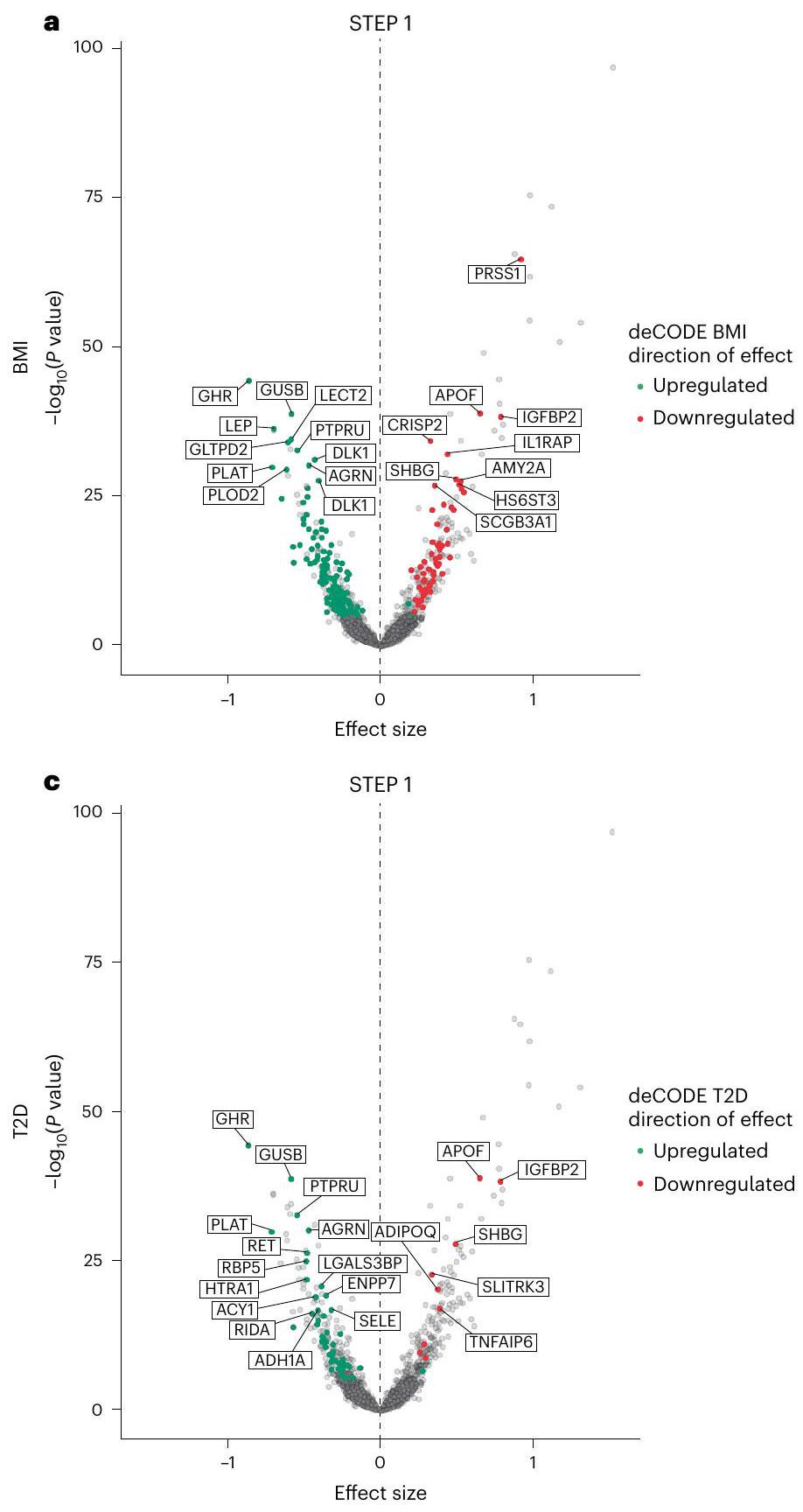
الشكل 5 | مقارنة تأثيرات السيماغلوتيد على البروتينات الدائرة مع التأثيرات المرتبطة بالاستعداد الوراثي لزيادة مؤشر كتلة الجسم ومرض السكري من النوع 2. أ، ب، البروتينات التي زادت أو انخفضت بسبب زيادة مؤشر كتلة الجسم في STEP1 (أ) و STEP 2 (ب). ج، د، البروتينات التي زادت أو انخفضت بسبب مرض السكري من النوع 2 في STEP 1 (ج) و STEP 2 (د). القيم السلبية على -المحور يشير إلى البروتينات التي تم تقليل تعبيرها بواسطة السيماغلوتيد، والقيم الإيجابية تشير إلى البروتينات التي تم زيادة تعبيرها بواسطة السيماغلوتيد. وبالتالي، تُظهر الشكل أن السيماغلوتيد يعكس باستمرار أنماط تعبير البروتينات التي تحركها زيادة مؤشر كتلة الجسم أو داء السكري من النوع الثاني. الخطوة 1: ; الخطوة 2: أحجام التأثير و تم حساب القيم باستخدام الانحدار الخطي. تم تصحيح القيم للتعددية باستخدام تصحيح هولم-بونفيروني. ACY1، أمينواسيلز-1؛ ADH1A، كحول ديهيدروجيناز 1A؛ ADIPOQ، أديبونيكتين؛ AGRN، أجرين؛ ART3، ADP-ribosyltransferase 3؛ BCHE، بيوتيريل كولينستراز؛ C2، مكون المكمل 2؛ CHAD، كوندروأديرين؛ DLK1، بروتين دلتا المتماثل 1؛ ENPP7، إكستونيوكليوتيد بيري فوسفاتاز/فوسفو ديستراز 7؛ FTCD،
فورميدوميدويل ترانسفيراز سايكلودياميناز؛ GLTPD2، بروتين نقل الجليكوليبيد المحتوي على 2؛ GSTA1، الجلوتاثيون -ترانسفيراز A1؛ HS6ST3، هيباران سلفات 6-O-سلفوترانسفيراز 3؛ HTRA1، متطلب درجة حرارة عالية A-1؛ IL1RAP، بروتين ملحق مستقبل الإنتيرلوكين 1؛ IL18RA، مستقبل الإنتيرلوكين 18 1؛ IL19، إنتيرلوكين 19؛ LGALS3BP، بروتين ربط جاليكتين 3؛ MXRA8، مرتبط بإعادة تشكيل المصفوفة 8؛ NFASC، نيوروفاسين؛ PLOD2، بروكولاجين-لايسين، 2-أوكسيغلوتارات 5-ديوكسيجيناز 2؛ PLXNB2 و PLXND1؛ PRCP، بروتين بروبيلي كربوكسي ببتيداز؛ PTPRU، بروتين فوسفاتاز التيروزين مستقبل النوع U؛ RBP5، بروتين ربط الريتينول 5؛ RET، معاد ترتيبها أثناء النقل؛ RIDA، دياميناز الإيمين الوسيطة التفاعلية A؛ SCG3، سيكريتوجرانين III؛ SELE، سيليكتين E؛ SLITRK3، ليفت توجيه الشق وبروتين شبيه مستقبل التيروزين العصبي 3؛ SOD3، سوبر أكسيد ديسموتاز 3؛ TNFAIP6، بروتين مستحث بواسطة نخر الورم ألفا 6؛ UGDH، يوريدين فوسفاتاز-غلوكوز 6-ديهيدروجيناز.
بعد انتهاء تدخل VLED، استمرت اتجاهات هذه التغييرات، ولكن فقط زيادة مستويات الجريلين وانخفاض مستويات PYY أثناء الصيام كانت ذات دلالة إحصائية. على عكس VLED، لم يبدو أن السيماغلوتيد يقلل من مستويات هرمونات الشبع مثل PYY والأميلين، بل زاد من مستويات CCK. من المعروف أن السيماغلوتيد يحسن الشبع ويقلل الرغبة في تناول الطعام المالح، بالإضافة إلى تحسين السيطرة على الأكل. مما أدى إلى فقدان وزن مستدام على مدى 104 أسابيع . يُعتقد أن هذه الأفعال تتم بشكل أساسي من خلال تجمعات مركزية في الدماغ لمستقبلات GLP-1؛ على سبيل المثال، في الوطاء، يؤثر السيماغلوتيد على خلايا البرو-أوبيوميلانوكورتين (POMC) وخلايا النسخة المنظمة للكوكايين والأمفيتامين (CART) وخلايا الببتيد العصبي Y وبروتين أغوتي المرتبط (NPY/AGRP) المعروفة بتثبيط الشهية وتحفيز تناول الطعام، على التوالي. قد تكون هذه التغيرات في هرمونات تنظيم الشهية قد ساهمت في فقدان الوزن المستمر والتغيرات في استجابات استبيان التحكم في الأكل التي لوحظت في STEP 5 على مدى فترة عامين. تشير النتائج التي نبلغ عنها هنا إلى تأثير إضافي لعلاج السيماغلوتيد على المدى الطويل في منع بعض التغيرات التكيفية (التعويضية) في إفراز هرمونات الأمعاء التي تسهم في استعادة الوزن بعد اتباع نظام غذائي منخفض السعرات الحرارية. يجب تفسير هذه النتائج بحذر، حيث لم تكن الظروف مثالية لالتقاط التغيرات الناتجة عن الوجبات. بشكل عام، تتداخل العديد من التغيرات البروتينية التي لوحظت مع علاج السيماغلوتيد مع النتائج التي تلي جراحة تحويل مسار المعدة (GBS). هذا متوقع نظرًا لأن تغيير الوزن له تأثير ملحوظ على البروتينات الدائرة، ويُعتقد أن الزيادات المستدامة في مستويات GLP-1 بعد الوجبات تساهم بشكل إيجابي في كل من نتائج الوزن والتمثيل الغذائي بعد جراحة تحويل مسار المعدة. ومع ذلك، من المهم أن نبرز أن دراسة GBS استخدمت نسخة أقدم من SomaScan. تحليل شمل عددًا أقل من العلامات البروتينية ، وأن المقارنة استخدمت بيانات بعد عامين من جراحة تحويل مسار المعدة مقابل بيانات المتابعة بعد عام واحد في تجارب STEP. أكدنا أن أربعة بروتينات قلبية وعائية (NPPB، CD93، MSR1 وTNC) لم تتغير بعد جراحة تحويل مسار المعدة، مما يشير إلى أن هذه التأثيرات فريدة من نوعها للسيماجلوتيد. بالإضافة إلى ذلك، لم تُلاحظ بعض التغيرات البروتينية بعد جراحة تحويل مسار المعدة بعد علاج السيماجلوتيد. على سبيل المثال، تم تنظيم بروتين كونتاكتين-4 (CNTN4) بعد جراحة تحويل مسار المعدة ولكن ليس بعد السيماجلوتيد. وقد وُصف CNTN4 كعامل خطر لاستخدام الكحول. وقد تم الإبلاغ على نطاق واسع عن زيادة اضطراب استخدام الكحول بعد GBS من ناحية أخرى، تشير البيانات الواقعية إلى أن استخدام السيماغلوتيد في السمنة مرتبط بتقليل اضطرابات استخدام الكحول. .
بالإضافة إلى التأثيرات التي تتجاوز فقدان الوزن للسيماجلوتيد على البروتينات المرتبطة بأمراض القلب والأوعية الدموية (كما تم مناقشته أعلاه)، فإن البروتينات الأخرى التي تم تنظيمها بشكل كبير في هذا التحليل قد تم الإشارة إليها سابقًا في حالات أخرى مثل مرض الزهايمر (TNC جرانولين ), T2D (sFRP4 (المراجع 61،62)) والتهاب الكبد الدهني المرتبط بالتمثيل الغذائي (LFABP ).
تتمتع هذه الدراسة بعدة نقاط قوة. استخدمنا عينات صيام من مجموعات سكانية موصوفة جيدًا من تجربتين عشوائيتين محكومتين كبيرتين من المرحلة الثالثة. مع معدل احتفاظ مرتفع وشمول المشاركين الذين يعانون من داء السكري من النوع الثاني والذين لا يعانون منه، تمكنا من استكشاف التأثيرات المحتملة للسيماجلوتيد على تقليل مخاطر الأمراض القلبية الوعائية، سواء المرتبطة بفقدان الوزن أو التي تتجاوز ذلك. ، بالإضافة إلى مؤشرات جديدة محتملة قد تساعد في توجيه إعادة استخدام الأدوية. دراستنا لها أيضًا قيود. أولاً، تم جمع العينات فقط في البداية ونهاية العلاج لتحليلات البروتيوم. نتيجة لذلك، لم يكن لدينا عينات في نقاط زمنية مبكرة لمقارنة تأثير السيماغلوتيد على البروتيوم خلال مراحل فقدان الوزن وصيانة الوزن للعلاج، ولا استجابةً لتحفيز الوجبات. ثانيًا، المنهجية المستخدمة لدراسة التركيزات النسبية لمستضدات البروتين المرتبطة هي شبه كمية؛ وبالتالي، لا يمكننا التعليق على التركيزات المطلقة للبروتينات. ثالثًا، تم ربط العديد من البروتينات المعبر عنها بشكل مختلف التي تم تحديدها في دراستنا أيضًا بمؤشر كتلة الجسم في دراسة رصدية منشورة سابقًا باستخدام اختبار Olink القائم على الارتباط. ، الذي يدعم نتائجنا. بالإضافة إلى ذلك، بينما يدعم NPPB SomaScan لقد أظهر الأبتامر ارتباطه مع اختبار المناعة NPPB.
قياس لم نقم بإجراء التحقق الفني من العلامات الفردية. لذلك، نعترف بغياب البيانات المزدوجة من الاختبارين المختلفين كحد من حدود هذه الدراسة. لمساعدتنا في التغلب على هذا القيد، ركز عملنا على دمج البيانات من مصادر متعددة، بما في ذلك علم الوراثة، بالإضافة إلى التوقيعات المعقدة بدلاً من البروتينات الفردية. على سبيل المثال، تم استخدام تحليل العشوائية المندلية باستخدام متغيرات وراثية كأدوات للمساعدة في التحقق من بعض التوقيعات البروتينية المستمدة للسمات المحددة. كما لم يتم إجراء تكرار للنتائج المقدمة. أخيرًا، سيكون من القيم العالية لهذه الدراسة مقارنة فقدان الوزن الناتج عن السيماغلوتيد مقابل التغيرات البروتينية الناتجة عن النظام الغذائي؛ ومع ذلك، حسب علمنا، فإن مثل هذه المجموعة من البيانات غير متاحة حاليًا.
في الختام، استخدمنا بيانات التجارب السريرية من الخطوة 1 والخطوة 2 للإشارة إلى تأثير علاج السيماغلوتيد على التأثيرات الواسعة عبر البروتينات الدائرة في الأشخاص الذين يعانون من السمنة، مع وجود أو عدم وجود داء السكري من النوع 2. تسلط التأثيرات الملحوظة الضوء على العمليات البيولوجية المتعلقة بتنظيم وزن الجسم، والسيطرة على نسبة السكر في الدم، وعمليات الأيض الدهني، والمسارات الالتهابية. تدعم الاضطرابات البروتينية التي لوحظت مع علاج السيماغلوتيد التأثيرات الإيجابية على مجموعة من عمليات المرض بما في ذلك أمراض القلب والأوعية الدموية (كما تم فحصه في تجربة SELECT). من خلال التثليث باستخدام الأدلة الواقعية وتحليلات العشوائية المندلية لبيانات ملخص دراسات الارتباط الجينومية، تعرض نتائج هذه الدراسة بشكل جماعي إمكانيات بيانات البروتيوميات من التجارب العشوائية لفك آليات العمل العلاجية الدوائية وتحديد مؤشرات جديدة.

المحتوى عبر الإنترنت

أي طرق، مراجع إضافية، ملخصات تقارير Nature Portfolio، بيانات المصدر، بيانات موسعة، معلومات تكميلية، شكر وتقدير، معلومات مراجعة الأقران؛ تفاصيل مساهمات المؤلفين والمصالح المتنافسة؛ وبيانات توفر البيانات والرموز متاحة علىhttps://doi.org/10.1038/s41591-024-03355-2.

References

  1. World Obesity Federation. World Obesity Atlas 2023 (Global Obesity Observatory, 2023).
  2. Murray, C. J. L. et al. Global burden of 87 risk factors in 204 countries and territories, 1990-2019: a systematic analysis for the Global Burden of Disease Study 2019. Lancet 396, 1223-1249 (2020).
  3. Bhaskaran, K., dos-Santos-Silva, I., Leon, D. A., Douglas, I. J. & Smeeth, L. Association of BMI with overall and cause-specific mortality: a population-based cohort study of 3.6 million adults in the UK. Lancet Diabetes Endocrinol. 6, 944-953 (2018).
  4. Kivimäki, M. et al. Body-mass index and risk of obesity-related complex multimorbidity: an observational multicohort study. Lancet Diabetes Endocrinol. 10, 253-263 (2022).
  5. Tahrani, A. A. & Morton, J. Benefits of weight loss of or more in patients with overweight or obesity: a review. Obesity 30, 802-840 (2022).
  6. Chandramouli, K. & Qian, P. Y. Proteomics: challenges, techniques and possibilities to overcome biological sample complexity. Hum. Genomics Proteomics 2009, 239204 (2009).
  7. Lill, J. R., Mathews, W. R., Rose, C. M. & Schirle, M. Proteomics in the pharmaceutical and biotechnology industry: a look to the next decade. Expert Rev. Proteomics 18, 503-526 (2021).
  8. Gold, L. et al. Aptamer-based multiplexed proteomic technology for biomarker discovery. PLoS ONE 5, e15004 (2010).
  9. Figarska, S. M. et al. Proteomic profiles before and during weight loss: results from randomized trial of dietary intervention. Sci. Rep. 10, 7913 (2020).
  10. Dreyfuss, J. M. et al. High-throughput mediation analysis of human proteome and metabolome identifies mediators of post-bariatric surgical diabetes control. Nat. Commun. 12, 6951 (2021).
  11. OZEMPIC (Semaglutide) Prescribing Information (US Food and Drug Administration, 2017).
  12. RYBELSUS (Semaglutide) Prescribing Information (US Food and Drug Administration, 2020).
  13. Aroda, V. R. et al. Comparative efficacy, safety, and cardiovascular outcomes with once-weekly subcutaneous semaglutide in the treatment of type 2 diabetes: insights from the SUSTAIN 1-7 trials. Diabetes Metab. 45, 409-418 (2019).
  14. Meier, J. J. Efficacy of semaglutide in a subcutaneous and an oral formulation. Front. Endocrinol. 12, 645617 (2021).
  15. Friedrichsen, M., Breitschaft, A., Tadayon, S., Wizert, A. & Skovgaard, D. The effect of semaglutide 2.4 mg once weekly on energy intake, appetite, control of eating, and gastric emptying in adults with obesity. Diabetes Obes. Metab. 23, 754-762 (2021).
  16. Gabery, S. et al. Semaglutide lowers body weight in rodents via distributed neural pathways. JCI Insight 5, e133429 (2020).
  17. WEGOVY (Semaglutide) Prescribing Information (US Food and Drug Administration, 2021).
  18. WEGOVY (Semaglutide) Prescribing Information (US Food and Drug Administration, 2024).
  19. WEGOVY (Semaglutide) Prescribing Information (US Food and Drug Administration, 2022).
  20. Wilding, J. P. H. et al. Once-weekly semaglutide in adults with overweight or obesity. N. Engl. J. Med. 384, 989-1002 (2021).
  21. Davies, M. et al. Semaglutide 2.4 mg once a week in adults with overweight or obesity, and type 2 diabetes (STEP 2): a randomised, double-blind, double-dummy, placebo-controlled, phase 3 trial. Lancet 397, 971-984 (2021).
  22. Williams, S. A. et al. A proteomic surrogate for cardiovascular outcomes that is sensitive to multiple mechanisms of change in risk. Sci. Transl. Med. 14, eabj9625 (2022).
  23. Ferkingstad, E. et al. Large-scale integration of the plasma proteome with genetics and disease. Nat. Genet. 53, 1712-1721(2021).
  24. Wang, W. et al. Associations of semaglutide with incidence and recurrence of alcohol use disorder in real-world population. Nat. Commun. 15, 4548 (2024).
  25. Steinberg, W. M. et al. Impact of liraglutide on amylase, lipase, and acute pancreatitis in participants with overweight/obesity and normoglycemia, prediabetes, or type 2 diabetes: secondary analyses of pooled data from the SCALE Clinical Development Program. Diabetes Care 40, 839-848 (2017).
  26. Steinberg, W. M., Buse, J. B., Ghorbani, M. L. M., Ørsted, D. D. & Nauck, M. A. Amylase, lipase, and acute pancreatitis in people with type 2 diabetes treated with liraglutide: results from the LEADER randomized trial. Diabetes Care 40, 966-972 (2017).
  27. Li, L. et al. Incretin treatment and risk of pancreatitis in patients with type 2 diabetes mellitus: systematic review and meta-analysis of randomised and non-randomised studies. BMJ 348, g2366 (2014).
  28. Abd El Aziz, M., Cahyadi, O., Meier, J. J., Schmidt, W. E. & Nauck, M. A. Incretin-based glucose-lowering medications and the risk of acute pancreatitis and malignancies: a meta-analysis based on cardiovascular outcomes trials. Diabetes Obes. Metab. 22, 699-704 (2020).
  29. Pinto, L. C., Falcetta, M. R., Rados, D. V., Leitão, C. B. & Gross, J. L. Glucagon-like peptide-1 receptor agonists and pancreatic cancer: a meta-analysis with trial sequential analysis. Sci. Rep. 9, 2375 (2019).
  30. Sakamuri, S. et al. Absence of tissue inhibitor of metalloproteinase-4 (TIMP4) ameliorates high fat diet-induced obesity in mice due to defective lipid absorption. Sci. Rep. 7, 6210 (2017).
  31. Aller, E., Mariman, E. C. M., Bouwman, F. G. & van Baak, M. A. Genetic predictors of weight loss by multidisciplinary advice to severely obese subjects. J. Nutrigenet. Nutrigenomics 10, 32-42 (2017).
  32. Deanfield, J. et al. Relevance of body weight and weight change on cardiovascular benefit with semaglutide: a pre-specified analysis of the SELECT trial. Obes. Facts 17, 491-492 (2024).
  33. Marso, S. P. et al. Liraglutide and cardiovascular outcomes in type 2 diabetes. N. Engl. J. Med. 375, 311-322 (2016).
  34. Sattar, N. et al. Cardiovascular, mortality, and kidney outcomes with GLP-1 receptor agonists in patients with type 2 diabetes: a systematic review and meta-analysis of randomised trials. Lancet Diabetes Endocrinol. 9, 653-662 (2021).
  35. Gerstein, H. C. et al. Dulaglutide and cardiovascular outcomes in type 2 diabetes (REWIND): a double-blind, randomised placebo-controlled trial. Lancet 394, 121-130 (2019).
  36. Lincoff, A. M. et al. Semaglutide and cardiovascular outcomes in obesity without diabetes. N. Engl. J. Med. 389, 2221-2232 (2023).
  37. Panagopoulou, V. et al. NTproBNP: an important biomarker in cardiac diseases. Curr. Top. Med. Chem. 13, 82-94 (2013).
  38. Nicolini, G., Forini, F., Kusmic, C., Iervasi, G. & Balzan, S. Angiopoietin 2 signal complexity in cardiovascular disease and cancer. Life Sci. 239, 117080 (2019).
  39. Lugano, R. et al. CD93 maintains endothelial barrier function by limiting the phosphorylation and turnover of VE-cadherin. FASEB J. 37, e22894 (2023).
  40. Yu, H. et al. Scavenger receptor A (SR-A) is required for LPS-induced TLR4 mediated NF-кB activation in macrophages. Biochim. Biophys. Acta 1823, 1192-1198 (2012).
  41. Van Eck, M. et al. Effect of human scavenger receptor class A overexpression in bone marrow-derived cells on cholesterol levels and atherosclerosis in ApoE-deficient mice. Arterioscler. Thromb. Vasc. Biol. 20, 2600-2606 (2000).
  42. Trinh, K., Julovi, S. M. & Rogers, N. M. The role of matrix proteins in cardiac pathology. Int. J. Mol. Sci. 23, 1338 (2022).
  43. Peters, A. E. et al. Proteomic pathways across ejection fraction spectrum in heart failure: an EXSCEL substudy. Preprint at medRxiv https://doi.org/10.1101/2023.05.16.23288273 (2023).
  44. Kosiborod, M. N. et al. Design and baseline characteristics of STEP-HFpEF program evaluating semaglutide in patients with obesity HFpEF phenotype. JACC Heart Fail. 11, 1000-1010 (2023).
  45. Kosiborod, M. N. et al. Semaglutide in patients with heart failure with preserved ejection fraction and obesity. N. Engl. J. Med. 389, 1069-1084 (2023).
  46. Kosiborod, M. N. et al. Semaglutide in patients with obesityrelated heart failure and type 2 diabetes. N. Engl. J. Med. 390, 1394-1407 (2024).
  47. Wroe, A. L. Intentional and unintentional nonadherence: a study of decision making. J. Behav. Med. 25, 355-372 (2002).
  48. Sumithran, P. et al. Long-term persistence of hormonal adaptations to weight loss. N. Engl. J. Med. 365, 1597-1604 (2011).
  49. Wharton, S. et al. Two-year effect of semaglutide 2.4 mg on control of eating in adults with overweight/obesity: STEP 5. Obesity 31, 703-715 (2023).
  50. Garvey, W. T. et al. Two-year effects of semaglutide in adults with overweight or obesity: the STEP 5 trial. Nat. Med. 28, 2083-2091 (2022).
  51. Hill, J. W. Gene expression and the control of food intake by hypothalamic POMC/CART neurons. Open Neuroendocrinol. J. 3, 21-27 (2010).
  52. Morton, G. J. & Schwartz, M. W. The NPY/AgRP neuron and energy homeostasis. Int. J. Obes. Relat. Metab. Disord. 25, S56-S62 (2001).
  53. Jais, A. & Brüning, J. C. Arcuate nucleus-dependent regulation of metabolism-pathways to obesity and diabetes mellitus. Endocr. Rev. 43, 314-328 (2021).
  54. Yousri, N. A. et al. Proteome-wide associations with short- and long-term weight loss and regain after Roux-en-Y gastric bypass surgery. Obesity 30, 129-141 (2022).
  55. Purnell, J. Q. et al. Prospective evaluation of insulin and incretin dynamics in obese adults with and without diabetes for 2 years after Roux-en-Y gastric bypass. Diabetologia 61, 1142-1154 (2018).
  56. Clark, S. L. et al. Combined whole methylome and genomewide association study implicates CNTN4 in alcohol use. Alcohol Clin. Exp. Res. 39, 1396-1405 (2015).
  57. King, W. C. et al. Prevalence of alcohol use disorders before and after bariatric surgery. JAMA 307, 2516-2525 (2012).
  58. Hasanzadeh, Z. et al. Evaluation of the serum Dkk-1, tenascin-C, oxidative stress markers levels and Wnt signaling pathway genes expression in patients with Alzheimer’s disease. J. Mol. Neurosci. 71, 879-887 (2021).
  59. Mao, Q. et al. Disease and region specificity of granulin immunopositivities in Alzheimer disease and frontotemporal lobar degeneration. J. Neuropathol. Exp. Neurol. 76, 957-968 (2017).
  60. Mendsaikhan, A., Tooyama, I. & Walker, D. G. Microglial progranulin: involvement in Alzheimer’s disease and neurodegenerative diseases. Cells 8, 230 (2019).
  61. Bukhari, S. A. et al. Secreted frizzled-related protein 4 and its implication in obesity and type-2 diabetes. IUBMB Life 71, 1701-1710 (2019).
  62. Mahdi, T. et al. Secreted frizzled-related protein 4 reduces insulin secretion and is overexpressed in type 2 diabetes. Cell Metab. 16, 625-633 (2012).
  63. Özenirler, S. et al. Serum liver fatty acid binding protein shows good correlation with liver histology in NASH. Hepatogastroenterology 60, 1095-1100 (2013).
  64. Bao, X. et al. Proteomic profiles of body mass index and waist-to-hip ratio and their role in incidence of diabetes. J. Clin. Endocrinol. Metab. 107, e2982-e2990 (2022).
  65. Roh, J. D. et al. Plasma proteomics of COVID-19-associated cardiovascular complications: implications for pathophysiology and therapeutics. JACC Basic Transl. Sci. 7, 425-441 (2022).
  66. American Diabetes Association. 2. Classification and diagnosis of diabetes. Diabetes Care 40, S11-S24 (2017).
Publisher’s note Springer Nature remains neutral with regard to jurisdictional claims in published maps and institutional affiliations.
Open Access This article is licensed under a Creative Commons Attribution 4.0 International License, which permits use, sharing, adaptation, distribution and reproduction in any medium or format, as long as you give appropriate credit to the original author(s) and the source, provide a link to the Creative Commons licence, and indicate if changes were made. The images or other third party material in this article are included in the article’s Creative Commons licence, unless indicated otherwise in a credit line to the material. If material is not included in the article’s Creative Commons licence and your intended use is not permitted by statutory regulation or exceeds the permitted use, you will need to obtain permission directly from the copyright holder. To view a copy of this licence, visit http://creativecommons. org/licenses/by/4.0/.
© The Author(s) 2025
genetic proxies. Single-nucleotide polymorphisms were clumped at a pairwise linkage disequilibrium and a window of 1 Mb , using the 1000 G European reference panel phase 3 (ref. 74). We explored the effect of BMI and T2D genetic liability on 4,907 plasma proteins using the random-effects inverse-variance-weighted Mendelian randomization method . Associations that survived a Bonferroni procedure correction ( 0.05 level) were considered statistically significant. Mendelian randomization estimates (betas) were reported as an s.d. change in plasma proteins per one s.d. increase in genetically predicted BMI or per one log-odds increase in genetically predicted T2D liability.

ملخص التقرير

معلومات إضافية حول تصميم البحث متاحة في ملخص تقارير مجموعة ناتشر المرتبط بهذه المقالة.

توفر البيانات

نتائج البروتيوميات وبيانات الملخص المرتبطة متاحة من خلال لوحة المعلومات علىhttps://step-proteomics.azurewebsites.net/.Individualيمكن مشاركة بيانات المشاركين من التجارب السريرية STEP 1 و STEP 2 في مجموعات بيانات بصيغة غير محددة الهوية ومجهولة. يمكن العثور على مقترحات طلب الوصول فيhttps://www.novonordisk-trials.com/.Dataيجب ألا تُستخدم لأغراض تجارية. البيانات من دراسة deCODE متاحة في المرجع 23. البيانات المستخدمة في تحليل إثراء مجموعة الجينات متاحة في الجدول التكميلي 11 (المرجع 23). إحصائيات ملخص GWAS للأبتاميرات متاحة علىhttps://www.decode.com/ملخص البيانات/. تم تقديم تفاصيل حول مجموعة جينات العلامة في المرجع 71. البيانات متاحة علىhttps://www.gsea-msigdb.org/gsea/msigdb/.

توفر الشيفرة

رمز المعالجة المسبقة لـ SomaScan بيانات البروتيوميات، وإجراء التحليلات الإحصائية وإنشاء الرسوم البيانية متاحة عبر زينودو علىhttps://doi.org/10.5281/zenodo.13356055 (المرجع 76). R v4.3.1 متاح على https://cran.r-project.org/bin/windows/base/old/4.3.1/.

References

  1. SomaLogic. SomaScan Assay v4.1. (SomaLogic, 2021).
  2. Ding, C. & Peng, H. Minimum redundancy feature selection from microarray gene expression data. J. Bioinform. Comput. Biol. 3, 185-205 (2005).
  3. Wu, D. & Smyth, G. K. Camera: a competitive gene set test accounting for inter-gene correlation. Nucleic Acids Res. 40, e133 (2012).
  4. camera: competitive gene set test accounting for inter-gene correlation (rdrr.io).
  5. Liberzon, A. et al. The Molecular Signatures Database (MSigDB) hallmark gene set collection. Cell Syst. 1, 417-425 (2015).
  6. Pulit, S. L. et al. Meta-analysis of genome-wide association studies for body fat distribution in 694649 individuals of European ancestry. Hum. Mol. Genet. 28, 166-174 (2019).
  7. Mahajan, A. et al. Multi-ancestry genetic study of type 2 diabetes highlights the power of diverse populations for discovery and translation. Nat. Genet. 54, 560-572(2022).
  8. Abecasis, G. R. et al. An integrated map of genetic variation from 1,092 human genomes. Nature 491, 56-65 (2012).
  9. Burgess, S., Butterworth, A. & Thompson, S. G. Mendelian randomization analysis with multiple genetic variants using summarized data. Genet. Epidemiol. 37, 658-665 (2013).
  10. Maretty, L. et al. Proteomic changes upon treatment with semaglutide in individuals with obesity. Zenodo https://doi.org/ 10.5281/zenodo. 13356055 (2024).

شكر وتقدير

تم تمويل هذا التحليل من قبل نوفو نورديسك A/S. نشكر المشاركين والمحققين في التجارب السريرية STEP 1 و STEP 2. تم تقديم الدعم في الكتابة الطبية من قبل C. Bowler و S. Khalid من OPEN Health Communications وتم تمويله من قبل نوفو نورديسك، وفقًا لإرشادات الممارسات الجيدة للنشر (www.ismpp.org/gpp-2022).

مساهمات المؤلفين

قام L.B.K. وM. Geybels وA.A.T. بتصميم الدراسة. قام D.G. وL.Z. بإجراء تحليلات العشوائية المندلية. قام L.M. وJ.S. وM. Galanakis وM.T.I. وK.S. بإجراء التحليل الإحصائي. كتب L.B.K. وD.G. وA.A.T. وM. Geybels الورقة. ساهم D.V. وJ.Q.P. وL.S. وA.S. في تفسير البيانات. قام جميع المؤلفين بمراجعة الورقة بشكل نقدي وملحوظ من حيث المحتوى الفكري ووافقوا على النسخة المقدمة.

المصالح المتنافسة

ل.س.، ك.س.، م. غالاناكيس، م.ت.إي.، ج.س.، أ.س.، ل.ب.ك. وأ.أ.ت. هم موظفون ومساهمون في نوفو نورديسك. د.ج.، ل.م. وم. غيبيلز كانوا موظفين ومساهمين في نوفو نورديسك في وقت التحليل. م. غالاناكيس، م. غيبيلز ود.ف. قد حصلوا على منحة من صندوق الابتكار الدنماركي (204000005B). ج.ك.ب. قد حصل على أتعاب استشارية من بويرنجر إنجلهايم ونوفو نورديسك.
ل.ز. يعلن عدم وجود مصالح متنافسة.

معلومات إضافية
البيانات الموسعة متاحة لهذا البحث فيhttps://doi.org/10.1038/s41591-024-03355-2.
معلومات إضافية النسخة الإلكترونية تحتوي على مواد إضافية متاحة فيhttps://doi.org/10.1038/s41591-024-03355-2.
يجب توجيه المراسلات والطلبات للحصول على المواد إلى عبد أ. طهراني.
معلومات مراجعة الأقران تشكر مجلة ناتشر ميديسين هارالد ميشاك والمراجعين الآخرين المجهولين على مساهمتهم في مراجعة هذا العمل. المحرر الرئيسي: سونيا مولييل، بالتعاون مع فريق ناتشر ميديسين.
معلومات إعادة الطباعة والتصاريح متاحة علىwww.nature.com/reprints.
الشكل البياني الممتد 1 | تأثيرات السيماغلوتيد تحت الجلد مقابل الدواء الوهمي على البروتينات الدائرة؛ الوفرة النسبية لبروتينات محددة عند خط الأساس والأسبوع 68 في STEP1 (أ) وSTEP 2 (ب). تُعرض البيانات كقيم متوسطة مع أشرطة خطأ تشير إلى فترات الثقة 95%. STEP 1: ; الخطوة 2: CRP، بروتين سي التفاعلي؛ LEP، لبتين، NCAM1، جزيء التصاق الخلايا العصبية 1.

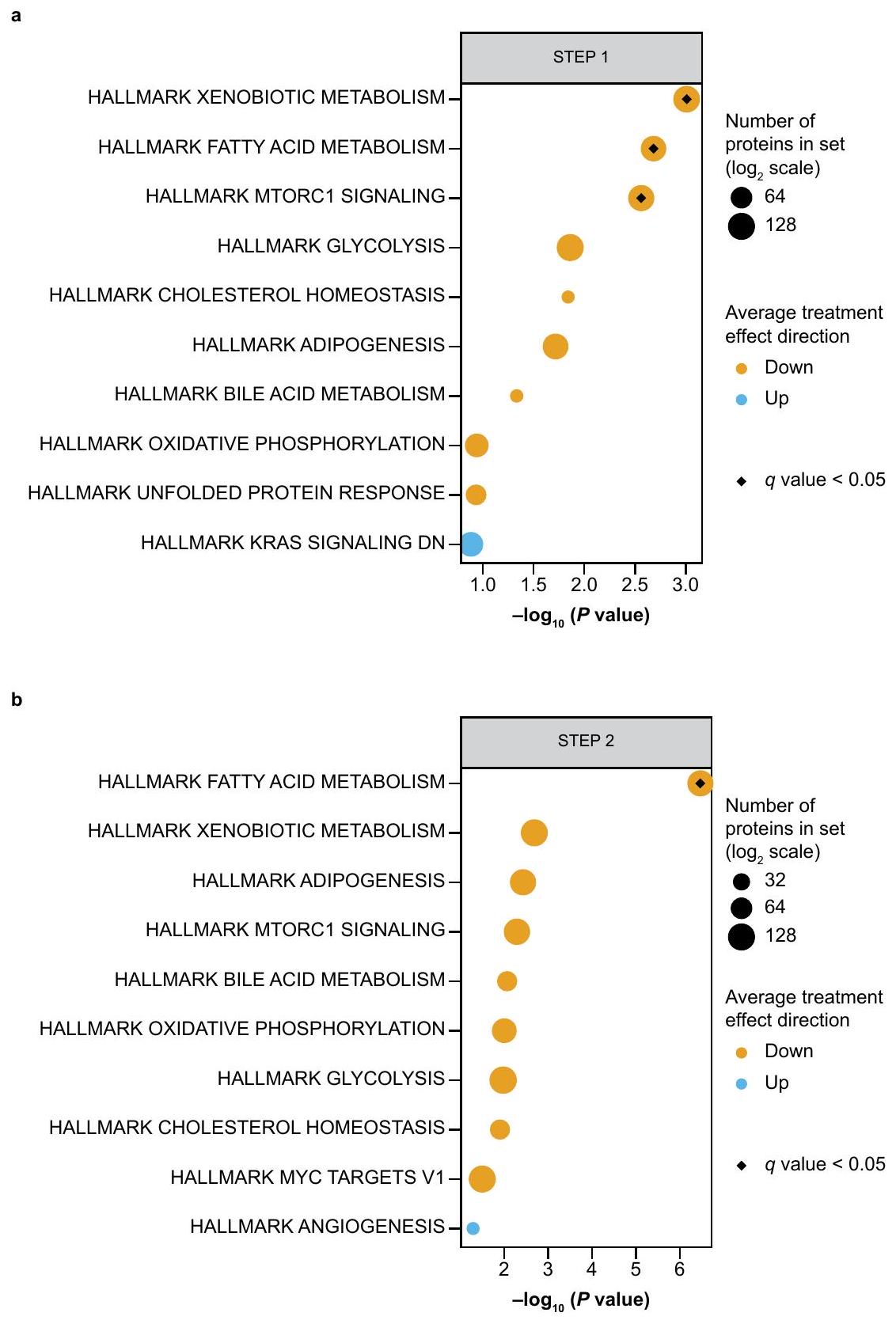
الشكل 2 من البيانات الموسعة | المسارات المتورطة بواسطة البروتينات المتأثرة بـ

علاج السيماغلوتيد في STEP 1 (أ) و STEP 2 (ب). تُظهر الصورة تأثير علاج السيماغلوتيد (وفقًا لـ SomaScan ) على مجموعات الجينات المميزة. تشير أحجام الدوائر بصريًا إلى عدد البروتينات في مجموعة ( -المقياس). تشير الماس السوداء داخل الدوائر الملونة إلى المجموعات التي تأثرت بشكل كبير
حسب العلاج (معدل الاكتشاف الخاطئ المعدل قيمة قيمة ). إثراء تم حساب القيم باستخدام CameraPR. النتائج للقائمة الكاملة من مجموعات الجينات متاحة في الجداول التكميلية 9 و 10 للخطوة 1 والخطوة 2، على التوالي. KRAS، فيروس ساركوما الجرذ كيرستن؛ MTORC1، الهدف الثديي لمركب رابيمايسين 1؛ MYC، جين الأورام الميوسيتي.
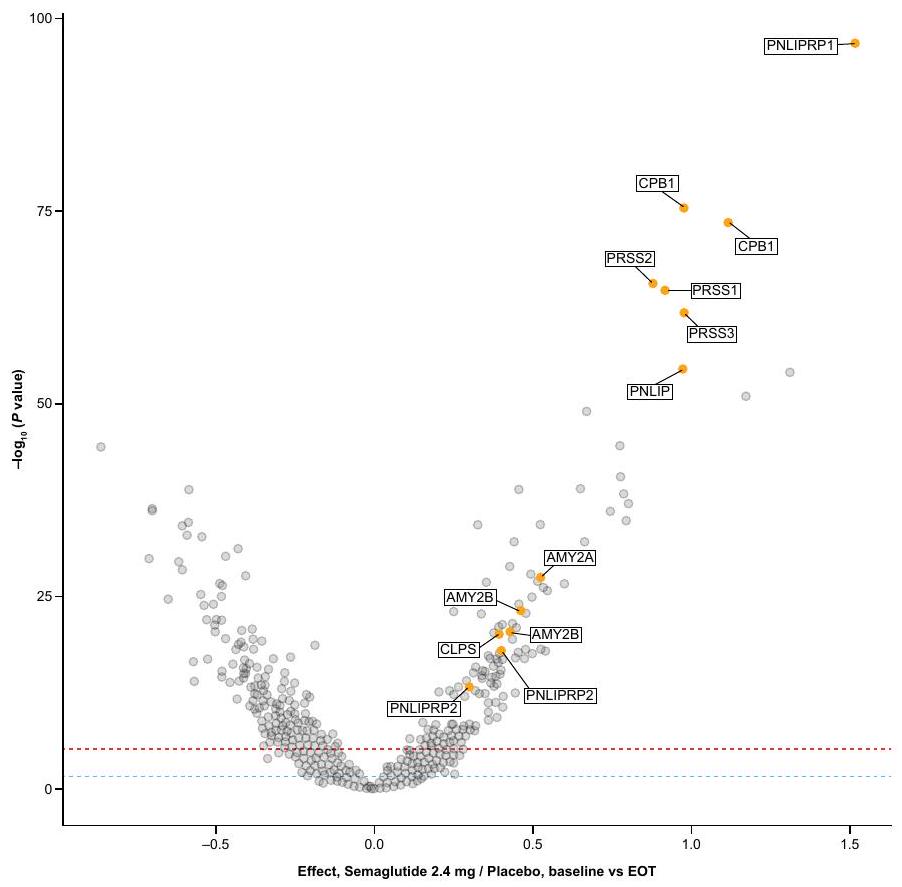
الشكل 3 من البيانات الموسعة | البروتينات التي زادت بسبب علاج السيماغلوتيد مرتبطة بالبنكرياس الخارجي. تم تطبيع حجم التأثير باستخدام المتوسطات والانحرافات المعيارية في البداية لمقارنة النتائج عبر البروتينات، مع الإشارة إلى القيم الإيجابية والسلبية بأن السيماغلوتيد زاد وانخفض مستويات البروتين؛ القيم) تشير إلى مستوى دلالة حجم التأثير (حوالي 500 بروتين [حوالي من الـ
كانت البروتينات المقاسة ذات دلالة إحصائية). الخط الأحمر المتقطع يوضح حد تصحيح بونفيروني، والخط الأزرق المتقطع يوضح معدل الاكتشاف الخاطئ. أحجام التأثير و تم حساب القيم باستخدام الانحدار الخطي. AMY2A/2B، ألفا أميلاز ; CLPS، وحدة البروتياز الكازينوليتك S؛ CPB1، كربوكسي ببتيداز B1؛ EOT، نهاية العلاج؛ PNLIPRP1/2، بروتين مرتبط بالليباز البنكرياسي 1/2؛ PNLIP، ليباز البنكرياس؛ PRSS1/2/3، تريبسين 1/2/3.

البيانات الموسعة الجدول 1 | بروتينات اختبار CVD2

نظام بيولوجي بروتينات
1. حجم الدم وإدرار البول بالملح
1. ببتيدات ناتريوتريك B (NTproBNP)
2. عامل ناتريوتيكي أذيني (ANP)
2. تكوين الحويصلات 3. بروتين شبيه بعامل ريبوزيل أدينوزين 5′-ثنائي الفوسفات (ADP) 11 (ARL11)
3. نمذجة المصفوفة/الأنسجة، النمو، تكوين الأوعية الدموية أو الالتصاق
4. مستقبل سم الجمرة الخبيثة 2 (ANTR2)
5. بروتين الطبقة المتوسطة للغضروف 2 (CILP2)
6. ميوسين-16 (CA125*)
7. بروتين غشاء جولجي 1 (GOLM1)
8. سبوندين-1*
9. عامل فون ويلبراند من النوع A (SVEP1*)
10. فوسفاتاز البروتين التيروزيني من نوع المستقبل إيتا (PTRPJ)
11. مثبط التربسين بين الألفا الثقيل H2 (ITI الثقيل 2*)
12. بروتين كيناز C-المرتبط بالبروتين NELL1 (NELL1)
13. عامل النمو/التمايز الإبيتوبي المشترك (GDF11/8*)
4. المناعة الخلوية
14. ميتالوإيلاستاز البلعميات (MMP12*)
15. كيناز البروتين التيروزيني المستقبل إيربب-3 (ERBB3)
16. جزيء التصاق الخلايا العصبية 1، الشكل 120 كيلو دالتون (NCAM-120*)
5. تعديل قنوات الكالسيوم 17. وحدة فرعية لقناة الكالسيوم المعتمدة على الجهد ألفا-2/دلتا-3 (CA2D3*)
6. معدل تصفية الكبيبات 18. عامل ثلاثي الأوراق 3 (TFF3)
7. الأجسام المضادة/المستقبلات
19. عضو الفئة الفرعية DCC من عائلة الغلوبولين المناعي 4 (IGDC4)
20. جزيء الالتصاق التقاطعي ب (JAM-B)
21. مستقبل محفز معبر عنه على الخلايا النخاعية (sTREM1*)
8. الأيض والدهون
22. بروتين ديسيتيلاز المعتمد على نيكوتيناميد أدينين ثنائي النوكليوتيد (NAD) سرتوين-2 (SIRT2)
23. الوحدة التنظيمية لبروتين الفوسفاتاز 1A (PPR1A)
24. بروتين 11 المنظم بواسطة مستقبلات LDL (LRP11*)
9. التهاب
25. مستقبل منشط البلازمينوجين يوروكيناز (suPAR*)
26. هيباران سلفات ثنائي الوظيفة ن-أسيتيل دياز (NDST1)
10. التجلط 27. ديسينتجرين وبروتيناز معدني مع أنماط ثرومبوسبوندين 13 (ATS13*)

محفظة الطبيعة

المؤلف (المؤلفون) المراسلون: عبد أ. طهراني
آخر تحديث من المؤلف(ين): 26 سبتمبر 2024

ملخص التقرير

تسعى Nature Portfolio إلى تحسين إمكانية تكرار العمل الذي ننشره. يوفر هذا النموذج هيكلًا للاتساق والشفافية في التقرير. لمزيد من المعلومات حول سياسات Nature Portfolio، يرجى الاطلاع على سياسات التحرير وقائمة مراجعة سياسة التحرير.

الإحصائيات

لجميع التحليلات الإحصائية، تأكد من أن العناصر التالية موجودة في أسطورة الشكل، أسطورة الجدول، النص الرئيسي، أو قسم الطرق.
غير متوفر
تم التأكيد
□ X
حجم العينة بالضبط لكل مجموعة/شرط تجريبي، معطاة كرقم منفصل ووحدة قياس

بيان حول ما إذا كانت القياسات قد أُخذت من عينات متميزة أو ما إذا كانت نفس العينة قد تم قياسها عدة مرات

اختبار(ات) الإحصاء المستخدمة وما إذا كانت أحادية الجانب أو ثنائية الجانب
يجب أن تُوصف الاختبارات الشائعة فقط بالاسم؛ واصفًا التقنيات الأكثر تعقيدًا في قسم الطرق.

وصف لجميع المتغيرات التي تم اختبارها

وصف لأي افتراضات أو تصحيحات، مثل اختبارات الطبيعية والتعديل للمقارنات المتعددة

وصف كامل للمعلمات الإحصائية بما في ذلك الاتجاه المركزي (مثل المتوسطات) أو تقديرات أساسية أخرى (مثل معامل الانحدار) وAND التباين (مثل الانحراف المعياري) أو تقديرات عدم اليقين المرتبطة (مثل فترات الثقة)
□ X
بالنسبة لاختبار الفرضية الصفرية، إحصائية الاختبار (مثل F، t، r) مع فترات الثقة، أحجام التأثير، درجات الحرية و القيمة المذكورة أعطِ القيم كقيم دقيقة كلما كان ذلك مناسبًا.
□ لتحليل بايزي، معلومات حول اختيار الأوليات وإعدادات سلسلة ماركوف مونت كارلو
□ للتصاميم الهرمية والمعقدة، تحديد المستوى المناسب للاختبارات والتقارير الكاملة عن النتائج
□ تقديرات أحجام التأثير (مثل حجم كوهين، ، حجم بيرسون، )، موضحًا كيف تم حسابها
تحتوي مجموعة الويب الخاصة بنا حول الإحصائيات لعلماء الأحياء على مقالات حول العديد من النقاط المذكورة أعلاه.

البرمجيات والشيفرة

معلومات السياسة حول توفر الشيفرة الحاسوبية
جمع البيانات
لم يتم استخدام أي برمجيات لجمع البيانات
تحليل البيانات
تم معالجة البيانات في R باستخدام حزمة SomaDatalO لتحميل بيانات البروتيوم الخام من ملفات .adat وحزم tidyverse لمعالجة البيانات. بالنسبة للمقارنة مع بيانات المجموعة الملاحظة، تم ذلك باستخدام cameraPR (نسخة “مُصنفة مسبقًا” من طريقة مجموعة الجينات التنافسية camera)، والتي هي جزء من حزمة Bioconductor limma. تم تشغيل CameraPR مع المعلمات الافتراضية باستخدام limma v3.52.4. R v4.3.1؛ SomaDataIO v6.0.0؛ tidyverse v2.0.0؛ Limma v3.52.4. جميع الشيفرات متاحة على: DOI: 10.5281/zenodo. 13356055
بالنسبة للمخطوطات التي تستخدم خوارزميات أو برمجيات مخصصة والتي تعتبر مركزية للبحث ولكن لم يتم وصفها بعد في الأدبيات المنشورة، يجب أن تكون البرمجيات متاحة للمحررين والمراجعين. نشجع بشدة على إيداع الشيفرة في مستودع مجتمعي (مثل GitHub). راجع إرشادات Nature Portfolio لتقديم الشيفرة والبرمجيات لمزيد من المعلومات.

البيانات

معلومات السياسة حول توفر البيانات

يجب أن تتضمن جميع المخطوطات بيانًا حول توفر البيانات. يجب أن يوفر هذا البيان المعلومات التالية، حيثما كان ذلك مناسبًا:
  • رموز الوصول، معرفات فريدة، أو روابط ويب لمجموعات البيانات المتاحة للجمهور
  • وصف لأي قيود على توفر البيانات
  • بالنسبة لمجموعات البيانات السريرية أو بيانات الطرف الثالث، يرجى التأكد من أن البيان يتماشى مع سياستنا
نتائج البروتيوم وبيانات الارتباط الملخصة متاحة من خلال لوحة معلومات متاحة هنا: https://step-proteomics.azurewebsites.net/ بالإضافة إلى
الجداول التكميلية. يمكن مشاركة بيانات المشاركين الفرديين من التجارب السريرية STEP 1 وSTEP 2 في مجموعات بيانات بصيغة غير محددة ومجهولة الهوية. يمكن العثور على مقترحات طلب الوصول في https://www.novonordisk-trials.com/. deCODE: Ferkingstad، E.، وآخرون. دمج واسع النطاق للبروتيوم البلازمي مع الوراثة والمرض. Nat. Genet. 53، 1712-1721 (2021). البيانات المستخدمة في تحليل إثراء مجموعة الجينات متاحة في الجدول التكميلية 11 في Ferkingstad وآخرون. إحصائيات ملخص GWAS للأبتاميرات متاحة على https://www.decode.com/summarydata/. العلامة: Liberzon، A.، وآخرون. مجموعة جينات قاعدة بيانات التوقيعات الجزيئية (MSigDB) المميزة. Cell Syst. 1، 417-425 (2015). البيانات متاحة على https://www.gsea-msigdb.org/gsea/msigdb.

المشاركون في الأبحاث البشرية

معلومات السياسة حول الدراسات التي تشمل المشاركين في الأبحاث البشرية والجنس والنوع في البحث.
التقارير حول الجنس والنوع
خصائص السكان
تم الإبلاغ عن الجنس ذاتيًا في تجارب STEP 1 وSTEP 2.
تم عشوائية الرجال والنساء البالغين في تجارب STEP 1 (مع زيادة الوزن/السمنة بدون T2D) وSTEP 2 (مع زيادة الوزن/السمنة وT2D). يرجى مراجعة الجدول 1 في المخطوطة. من بين 1,311 مشاركًا من STEP كانت إناثًا. من بين 645 مشاركًا من STEP 2، كانت إناثًا. كان معظم المشاركين من البيض، بمتوسط عمر 47.5 في STEP 1 و56.3 في STEP 2. كان متوسط وزن الجسم 106.0 كجم في STEP 1، و100.0 كجم في STEP 2. كان متوسط مؤشر كتلة الجسم م 2 في STEP 1 و في STEP 2. في STEP 1، من المشاركين كان لديهم مقدمات السكري مقابل لا شيء في STEP 2. كانت الخصائص الأساسية للمشاركين في هذه الدراسة مشابهة لتلك الخاصة بالسكان الدراسين الكليين لتجارب STEP 1 المنشورة (Wilding، J.P.H.، وآخرون. سيماغلوتيد مرة واحدة أسبوعيًا في البالغين الذين يعانون من زيادة الوزن أو السمنة. N. Engl. J. Med. 384، 989-1002 (2021)) وتجربة STEP 2 (Davies، M.، وآخرون. سيماغلوتيد 2.4 ملغ مرة واحدة في الأسبوع في البالغين الذين يعانون من زيادة الوزن أو السمنة، ومرض السكري من النوع 2 (STEP 2): تجربة عشوائية مزدوجة التعمية، مزدوجة الدواء الوهمي، محكومة، المرحلة 3. Lancet 397، 971-984 (2021)).
تضمنت هذه التحليل بيانات من المشاركين الذين أعطوا موافقة لجمع العينات البيولوجية، مع توفر عينات المصل عند الخط الأساسي وعند الأسبوع 68. تم إجراء STEP 1 عبر 129 موقعًا في 16 دولة في آسيا وأوروبا وأمريكا الشمالية وأمريكا الجنوبية، كما هو موضح في منشور سابق (Wilding، J.P.H.، وآخرون. سيماغلوتيد مرة واحدة أسبوعيًا في البالغين الذين يعانون من زيادة الوزن أو السمنة. N. Engl. J. Med. 384، 989-1002 (2021)). تم تجنيد المشاركين في STEP 2 من 149 عيادة خارجية في 12 دولة عبر أوروبا وأمريكا الشمالية وأمريكا الجنوبية والشرق الأوسط وجنوب أفريقيا وآسيا، كما هو موضح في Davies، M.، وآخرون. سيماغلوتيد 2.4 ملغ مرة واحدة في الأسبوع في البالغين الذين يعانون من زيادة الوزن أو السمنة، ومرض السكري من النوع 2 (STEP 2): تجربة عشوائية مزدوجة التعمية، مزدوجة الدواء الوهمي، محكومة، المرحلة 3. Lancet 397، 971-984 (2021). في التحليل الحالي، استخدمنا عينات المصل الصائم التي تم جمعها عند الخط الأساسي ونهاية العلاج في مجموعة كبيرة من المشاركين من STEP 1 وSTEP 2 للتحقيق في تأثيرات علاج سيماغلوتيد على البروتيوم المتداول.
تمت الموافقة على بروتوكول الدراسة لتحليلات البروتيوم من قبل لجنة الأخلاقيات لمنطقة جنوب الدنمارك (رقم. H-21046833).

الإشراف الأخلاقي

التجنيد

يرجى ملاحظة أنه يجب أيضًا تقديم معلومات كاملة حول الموافقة على بروتوكول الدراسة في المخطوطة.

التقارير الخاصة بالمجال

يرجى اختيار الخيار أدناه الذي يناسب بحثك بشكل أفضل. إذا لم تكن متأكدًا، اقرأ الأقسام المناسبة قبل اتخاذ اختيارك.
علوم الحياة
العلوم السلوكية والاجتماعية □ العلوم البيئية والتطورية والبيئية
لنسخة مرجعية من الوثيقة مع جميع الأقسام، انظر nature.com/documents/nr-reporting-summary-flat.pdf

تصميم دراسة علوم الحياة

يجب على جميع الدراسات الإفصاح عن هذه النقاط حتى عندما يكون الإفصاح سلبيًا.
حجم العينة
تم تضمين ما مجموعه 3,171 مشاركًا من الذكور والإناث في تجارب STEP 1 وSTEP 2. من بين هؤلاء، وافق 1,956 مشاركًا (STEP 1، ; STEP ) على تحليلات البروتيوم المعتمدة على الأبتامير باستخدام اختبار SomaScan v4.1 (SomaLogic، بولدر، كولورادو، الولايات المتحدة الأمريكية). بعد تصفية توفر العينة في كلا الوقتين، والأفراد الذين لم يكونوا تحت العلاج في نهاية الدراسة في كلا الذراعين، ومراقبة الجودة من البائع، تبقى 1,728 مشاركًا (STEP 1، ; STEP 2، ). بالنسبة لمعظم التحليلات، تم تحليل فقط ذراعي الدواء الوهمي وسيماغلوتيد 2.4 ملغ من تجربة STEP 2 ( ). تم عرض الخصائص الأساسية للمشاركين الذين وافقوا في الجدول 1 وكانت مشابهة لتلك الخاصة بالسكان الدراسين الكليين لتجارب STEP 1 وSTEP 2. تم تقدير أحجام العينات للنقاط النهائية السريرية، يرجى الرجوع إلى منشورات STEP 1 وSTEP 2 لمزيد من التفاصيل حول ذلك. لم يتم إجراء أي حسابات قوة إضافية فيما يتعلق بدراسة البروتيوم.

استبعاد البيانات

تم استبعاد الموضوعات التي كانت لديها عينات مفقودة (عند الخط الأساسي أو عند الأسبوع 68) أو لم تكن تحت العلاج عند الأسبوع 68. علاوة على ذلك، تم استبعاد العينات التي فشلت في مراقبة الجودة من SomaLogic.

التكرار

تم استخدام بيانات من تجربتين سريريتين (STEP 1 و STEP 2) لفهم ومقارنة تأثيرات السيماغلوتيد على البروتينات الدائرة. لدعم نتائجنا بشكل أكبر، تم دمج بيانات البروتيوم من التجارب السريرية مع نتائج البروتيوم من مجموعات المراقبة بما في ذلك deCODE. لم يتم إجراء تكرار صريح للنتائج المقدمة. بشكل عام، تم اتخاذ نهج محافظ (مثل التحكم في خطأ العائلة باستخدام Bonferroni-Holm) وتمت ملاحظة اتساق داخلي للعديد من النتائج عبر الأبتاميرات الفردية (مثل تحليل إثراء مجموعة الجينات).

التوزيع العشوائي

تم اشتقاق العينات للتحليل من تجربتين سريريتين عشوائيتين من المرحلة 3، STEP 1 و STEP 2، حيث تم توزيع المشاركين عشوائيًا إما على السيماغلوتيد أو الدواء الوهمي. تم توزيع الأفراد عشوائيًا لتلقي إما الدواء الوهمي أو السيماغلوتيد (1.0 ملغ أو 2.4 ملغ).
عمى
كانت كل من تجارب STEP 1 و STEP 2 مزدوجة التعمية. يرجى الرجوع إلى المنشورات الأصلية لـ STEP لمزيد من التفاصيل حول التعمية. في تحليلنا، استخدمنا إجراء التطبيع الخاص بـ SomaLogic، بما في ذلك التطبيع التكيفي بواسطة خطوة الاحتمالية القصوى، والتي تم استخدامها في SomaScan. مجموعة البيانات لجميع التحليلات كما أوصت بها SomaLogic. تم معالجة البيانات في R باستخدام حزمة SomaDataIO لتحميل بيانات البروتيوميات الخام من ملفات .adat وحزم tidyverse لمعالجة البيانات. بعد تصفية العينات التي اجتازت مراقبة الجودة من SomaLogic (RowCheck==TRUE) واختيار الأبتاميرات المستهدفة للبروتينات البشرية، تم تحويل البيانات المتبقية التي تغطي 7,289 أبتامير إلى لوغاريتم الأساس 10، وللأبتامير الواحد، تم توحيد جميع القياسات باستخدام المتوسط والانحراف المعياري (SD) للعينات التي تم الحصول عليها في المرحلة الأساسية.

التقارير عن مواد وأنظمة وطرق محددة

نحتاج إلى معلومات من المؤلفين حول بعض أنواع المواد والأنظمة التجريبية والأساليب المستخدمة في العديد من الدراسات. هنا، يرجى الإشارة إلى ما إذا كانت كل مادة أو نظام أو طريقة مدرجة ذات صلة بدراستك. إذا لم تكن متأكدًا مما إذا كان عنصر القائمة ينطبق على بحثك، يرجى قراءة القسم المناسب قبل اختيار رد.
المواد والأنظمة التجريبية طرق
غير متوفر مشارك في الدراسة غير متوفر مشارك في الدراسة
إكس
إكس إكس
إكس
إكس

البيانات السريرية

معلومات السياسة حول الدراسات السريرية

يجب أن تتوافق جميع المخطوطات مع إرشادات ICMJE لنشر الأبحاث السريرية ويجب أن تتضمن جميع التقديمات قائمة مراجعة CONSORT مكتملة.
تسجيل التجارب السريرية
بروتوكول الدراسة
جمع البيانات
النتائج
الخطوة 1، NCT03548935؛ الخطوة 2، NCT03552757
الخطوة 1 – انظر وايلدينغ وآخرون. نيو إنجلاند جورنال أوف ميديسين 2021؛384:989-1002؛ الخطوة 2 – انظر ديفيز وآخرون. لانسيت. 2021؛397(10278):971-984
المشاركون الذين أعطوا موافقتهم لجمع عينات البيولوجية، تم جمع عينات مصل الدم في البداية وفي الأسبوع 68. تم أخذ جميع العينات البيولوجية من المشاركين الذين صاموا طوال الليل (>8 ساعات).
سوماسكان تم استخدام اختبار v4.1 (سومالوجيك، بولدر، كولورادو، الولايات المتحدة الأمريكية) للتوصيف لـ بروتينات بشرية فريدة تشمل مجموعة متنوعة من العمليات البيولوجية (مثل السرطان، الالتهاب، ووظيفة القلب والأوعية الدموية) وبروتينات/مجالات مُفرَزة، داخل الخلايا، وخارج الخلايا (مثل المستقبلات، الكينازات، عوامل النمو، والهرمونات).

  1. علوم البيانات، نوفو نورديسك A/S، سوبورغ، الدنمارك. قسم علم الأوبئة والإحصاء الحيوي، كلية الصحة العامة، إمبريال كوليدج لندن، لندن، المملكة المتحدة. سيكويا جينتيكس، لندن، المملكة المتحدة. أبحاث السمنة، نوفو نورديسك A/S، مالوف، الدنمارك. مركز الإحصائيات وعلوم البيانات، جامعة هاسلت، هاسلت، بلجيكا. علم الدماغ والدهون، نوفو نورديسك A/S، مالوف، الدنمارك. جامعة أوريغون للصحة والعلوم (OHSU)، بورتلاند، أوريغون، الولايات المتحدة الأمريكية. مكتب المستشار العلمي الرئيسي، نوفو نورديسك A/S، مالوف، الدنمارك. الطب والعلوم، نوفو نورديسك A/S، سوبورغ، الدنمارك. قسم الأيض وعلوم الأنظمة، جامعة برمنغهام، برمنغهام، المملكة المتحدة. العنوان الحالي: QIAGEN A/S، آرهوس، الدنمارك. العنوان الحالي: جينماب A/S، فالبى، الدنمارك. ساهم هؤلاء المؤلفون بالتساوي: عبد أ. طهراني، ميلان جايبلز. البريد الإلكتروني:a.a.tahrani@bham.ac.uk
  2. تم وصف درجة مكونة من 27 بروتينًا سابقًا تتنبأ بخطر الأمراض القلبية الوعائية الثانوية على مدى 4 سنوات، باستخدام بيانات متعددة المجموعات الكبيرة ونفس تقنية SomaScan. التكنولوجيا المستخدمة في دراستنا . تم اشتقاق هذه النتيجة من عينات البلازما لـ 22,849 مشاركًا عبر تسع دراسات سريرية. كانت البروتينات المحددة مرتبطة بـ 10 أنظمة بيولوجية، كما هو ملخص أعلاه.

Journal: Nature Medicine, Volume: 31, Issue: 1
DOI: https://doi.org/10.1038/s41591-024-03355-2
PMID: https://pubmed.ncbi.nlm.nih.gov/39753963
Publication Date: 2025-01-01

Proteomic changes upon treatment with semaglutide in individuals with obesity

Received: 22 March 2024
Accepted: 14 October 2024
Published online: 3 January 2025
Check for updates

Lasse Maretty , Dipender Gill(1) , Lotte Simonsen (1) , Keng Soh , Loukas Zagkos , Michael Galanakis , Jonas Sibbesen , Miquel Triana Iglesias , Anna Secher , Dirk Valkenborg , Jonathan Q. Purnell(1) , Lotte Bjerre Knudsen (1) , Abd A. Tahrani & Milan Geybels

Abstract

Obesity and type 2 diabetes are prevalent chronic diseases effectively managed by semaglutide. Here we studied the effects of semaglutide on the circulating proteome using baseline and end-of-treatment serum samples from two phase 3 trials in participants with overweight or obesity, with or without diabetes: STEP and STEP . We identified evidence supporting broad effects of semaglutide, implicating processes related to body weight regulation, glycemic control, lipid metabolism and inflammatory pathways. Several proteins were regulated with semaglutide, after accounting for changes in body weight and at end of trial, suggesting effects of semaglutide on the proteome beyond weight loss and glucose lowering. A comparison of semaglutide with real-world proteomic profiles revealed potential benefits on disease-specific proteomic signatures including the downregulation of specific proteins associated with cardiovascular disease risk, supporting its reported effects of lowering cardiovascular disease risk and potential drug repurposing opportunities. This study showcases the potential of proteomics data gathered from randomized trials for providing insights into disease mechanisms and drug repurposing opportunities. These data also highlight the unmet need for, and importance of, examining proteomic changes in response to weight loss pharmacotherapy in future trials.

Obesity prevalence continues to increase, with the global number of affected individuals expected to double from 988 million in 2020 to almost 2 billion in . This makes obesity one of the leading risk factors for multimorbidity , negatively impacting metabolic, cardiovascular (CV), mental and physical health, as well as mortality . Recent advances in achieving weight loss through lifestyle behavioral interventions, pharmacotherapy, metabolic bariatric surgery or a combination of these effectively reduce the economic and health impact of obesity
and improve the quality of life of affected individuals . With these successes, momentum is building to identify novel and more effective treatment strategies for obesity.
Proteomics is the large-scale study of the structure and function of proteins using high-throughput platforms. It has the potential to offer numerous insights, including improved understanding of disease pathophysiology, delineation of mechanisms of action for current treatment strategies, development of biomarkers to predict treatment
Fig. 1| Study design. Of the 3,171 participants included in the STEP 1 and STEP 2 trials, 1,956 participants (STEP 1, ; STEP 2, ) consented to aptamerbased proteomic analyses using the SomaScan assay v4.1. Participants included
in the study who had an available biosample for proteomics profiling. The semaglutide 1.0 mg arm was excluded from most downstream analyses, except for the CVD risk analysis. MR, Mendelian randomization; QW, every week.
response and disease progression, and identification of novel therapeutic targets . The SomaScan aptamer-based proteomic platform was the first high-throughput platform used in large-scale studies capable of simultaneously measuring the relative abundance of thousands of proteins from small sample volumes.
Weight loss following dietary interventions and bariatric surgery is associated with changes to the circulating proteome, including proteins related to inflammatory and metabolic pathways . However, to the best of our knowledge, published studies reporting the impact of pharmacotherapy-mediated weight loss on the proteome are lacking.
Semaglutide is a long-acting glucagon-like peptide-1 (GLP-1) analog. In the United States, once-weekly subcutaneous semaglutide 1.0 mg was first approved in 2017 for use in adults with type 2 diabetes (T2D) , followed by approval of an oral formulation in . Approval was based on the action of GLP-1 receptor agonists (GLP-1RAs) to lower glycated hemoglobin ( ) levels by increasing glucose-dependent insulin release, reducing glucagon secretion and delaying gastric emptying . However, GLP-1RAs also have separate effects on appetite regulation mediated by actions on central nervous system centers that result in weight loss . Currently, once-weekly subcutaneous semaglutide 2.4 mg is approved for chronic weight management in adults with obesity, or overweight and with at least one weight-related comorbidity , for reducing CV risk in adults with established cardiovascular disease (CVD) with obesity or overweight , and in adolescents aged 12 years and older , in conjunction with a reduced-calorie diet and increased physical activity plan.
In the randomized Semaglutide Treatment Effect in People with Obesity (STEP) 1 trial (intent to treat: 1,961 adults with overweight or obesity without T2D), once-weekly subcutaneous semaglutide 2.4 mg resulted in greater weight loss compared with placebo over a 68 -week period (estimated treatment difference -12.4 percentage points, confidence interval ); half of the participants treated with semaglutide ( ) had a weight reduction of compared with assigned to placebo . In the randomized STEP2 trial (intent to treat:1,210 adults with overweight or obesity and T2D), the estimated treatment difference from baseline to week 68 for semaglutide 2.4 mg versus placebo was -6.2 percentage points ( .
In our analysis, we used fasting serum samples collected at baseline and end of treatment in a large subset of participants from two randomized, double-blind, placebo-controlled phase 3 trials, STEP 1 and STEP 2, to investigate the effects of semaglutide treatment on the circulating proteome. By examining the effects following weight loss and also effects after accounting for weight loss on the proteome
throughout the trial in those with and without T2D, and by comparing proteomic profiles with those of observational cohorts, we aimed to comprehensively study the proteomic effects of semaglutide treatment and elucidate the mechanism of action driving its benefits on weightand obesity-related complications, and to determine its potential for use in new indications.

Results

Study participant characteristics

A total of 3,171 male and female participants were included in the STEP 1 and STEP 2 trials; please refer to the published papers for full details . Of these, 1,956 participants (STEP ; STEP ) consented to aptamer-based proteomic analyses using SomaScan assay v4.1 (SomaLogic) (Fig. 1). This assay uses 7,289 aptamers to measure the relative abundance of unique human proteins. After filtering for sample availability at both timepoints, individuals not on treatment at study end in both arms and vendor quality control, 1,728 participants (STEP 1, ; STEP 2, ) remained. For the majority of the analyses, only the placebo and semaglutide 2.4 mg arms from the STEP 2 trial were analyzed ( ). Baseline characteristics of consenting participants are shown in Table 1 and were similar to those of the overall study populations of the STEP 1 and STEP 2 trials . Similarly, a post hoc analysis of changes in weight, waist circumference and for this subset of participants is shown in Supplementary Table 1.

Effects of semaglutide on the circulating proteome

After 68 weeks of treatment, 495 protein targets ( 438 unique proteins) were identified to be significantly affected by semaglutide treatment (compared with placebo) in STEP 1 ( , after Holm-Bonferroni correction for the 7,289 aptamers tested) (Fig. 2a and Supplementary Table 2), with 1,718 protein targets significant under false discovery rate (FDR) control. In the STEP 2 trial, the relative abundance of 277 protein targets ( 244 unique proteins) was changed significantly in response to semaglutide treatment relative to placebo (Fig. 2b and Supplementary Table 3; with 1,025 protein targets significant under FDR control). See Supplementary Tables 2 and 3 for FDR-adjusted values ( values). Several of the proteins identified in STEP 1 and STEP 2 are known to be related to obesity and T2D pathophysiology and their associated complications, including C-reactive protein (CRP), adipokines (leptin, adiponectin), ghrelin, insulin-like growth factor binding p rotein(IGFBP), growthhormonereceptor(GHR), neuralcelladhesionmolecule 1 (NCAM1) and netrin receptor (UNC5D), among others. Examples of the relative abundance of specific proteins at baseline and week 68
Table 1 | Characteristics of participants with fasting serum samples for aptamer-based proteomic analyses in STEP 1 and STEP 2
Characteristics STEP 1, STEP 2,
Age, mean ± s.d. (years)
Female sex, (%) 955 (72.8) 321 (49.8)
Race or ethnic group, (%)
White 984 (75.1) 388 (60.2)
Asian 162 (12.4) 183 (28.4)
Black or African American 65 (5.0) 55 (8.5)
Other 100 (7.6) 19 (2.9)
Hispanic or Latino ethnic group, 135 (10.3) 77 (11.9)
Body weight, mean ± s.d. (kg)
BMI ( )
Mean ± s.d. ( )
Distribution, (%)
<30 80 (6.1) 122 (18.9)
to <35 433 (33.0) 231 (35.8)
to <40 401 (30.6) 149 (23.1)
397 (30.3) 143 (22.2)
Waist circumference, mean ± s.d. (cm)
, mean ± s.d. (%)
Prediabetes, (%) 570 (43.5)
Race and ethnic group were reported by the investigator. The category of ‘other’ includes Native American, Hawaiian or other Pacific Islander, any other ethnic group and ‘not applicable’, the last of which is the way race or ethnic group was recorded in France. The presence of prediabetes was determined by investigators on the basis of available information (for example, medical records, concomitant medication and blood glucose variables) and in accordance with American Diabetes Association criteria . s.d., standard deviation.
in STEP 1 and STEP 2 are shown in Extended Data Fig. 1. No effect of sex was detected in the proteomic response to semaglutide treatment in either STEP 1 or STEP 2 (Supplementary Tables 4 and 5).
We observed a high concordance between the proteomic response to treatment across STEP 1 and STEP 2 (Fig. 2c), but there were some differences between the two studies in terms of the impact of semaglutide on the measured proteome (Supplementary Tables 2, 3 and 6-8). A total of 33 proteins (including N-terminal pro B-type natriuretic peptide (NT-proBNP)) were significantly regulated in STEP 1 but not in STEP 2, although this may be owing to the larger sample size in STEP 1 than in STEP 2; this comparative analysis is considered exploratory. A list of the proteins that were regulated in STEP 2 but not in STEP 1 can be found in Supplementary Table 8.
Protein set analyses found that semaglutide treatment downregulated proteins involved in key biological pathways governing xenobiotic metabolism, fatty acid metabolism and mammalian target of rapamycin complex 1 (MTORC1) signaling, among others (Extended Data Fig. 2). In addition, levels of digestive enzymes secreted from the exocrine pancreas were increased by semaglutide (Extended Data Fig. 3).

Weight-loss- and -adjusted effects of semaglutide on the proteome

Adjusting for body weight and changes at the end of treatment identified 47 ( 38 unique proteins) and 15 ( 14 unique proteins) protein targets significantly altered by semaglutide treatment in STEP 1 and STEP 2, respectively ( , after Holm-Bonferroni correction for the 7,289 aptamers tested (Fig. 2d,e), with 153 and 21 protein targets significant under FDR control, respectively) (Supplementary Tables 6
and 7). Significantly regulated proteins in this analysis are implicated in diverse biological effects (for example, cardiac stress, inflammation and lipid metabolism) and have previously been found to be increased in CVD or associated with higher CVD risk. Significantly downregulated proteins when adjusting for body weight effects in STEP 1 known to be associated with CVD risk included tenascin C (TNC), NT-proBNP, thrombospondin 2 (THBS2), complement component C1q receptor (cluster of differentiation 93(CD93)), macrophage scavenger receptor 1-extracellular domain (MSR1) and angiopoietin-2 (ANGPT2). Other significantly downregulated proteins not related to CVD included secreted frizzled-related protein-4 (sFRP4) and liver fatty acid binding protein (LFABP), whereas granulin (GRN) was significantly upregulated. Similar to the previous analysis in which body weight and change were not included in the model, significantly upregulated proteins were enriched in digestive enzymes from the exocrine pancreas. Only one protein, melanoma-associated antigen 10A (MAGEA10), was significantly regulated by semaglutide in STEP 2, but not in STEP 1.

Proteomic signature of semaglutide treatment

In STEP 1, statistical learning and feature selection were applied to derive a protein signature that distinguished participants receiving semaglutide from participants receiving placebo based on proteomic changes at end of treatment. The final trained signature included 30 aptamers (Extended Data Fig. 4a). The signature included proteins implicated in biological processes related to obesity and T2D (for example, adipogenesis, fatty acid metabolism, glycolysis and signaling pathways), consistent with the protein set analysis described above (Extended Data Fig. 2a), along with proteins related to fat mass and function, weight loss, CVD, endothelial function, lipid metabolism, pancreatic endocrine and exocrine function, inflammation and possibly cancer risk. The STEP 1 signature had a high classification performance (internal nested cross-validation area under the curve AUC ), showing that semaglutide treatment results in a specific serum proteomic signature. We then applied this signature in STEP 2, an external validation set, in which it showed similar performance for distinguishing semaglutide treatment from placebo (Extended Data Fig. 4b).

Effect of semaglutide treatment on a proteomic signature of CVD risk

A 27-protein score has previously been described that predicts secondary CVD risk over 4 years, based on large multicohort data and using the same SomaScan technology used in our study (Extended Data Table 1). There was a trend for higher numbers of baseline comorbidities being associated with a higher CVD risk score, suggesting that the 27-protein score quantifies relative CVD risk in the STEP 1 cohort (Fig. 3a). Using data from STEP1 and STEP 2, we found that semaglutide treatment reduced this CVD risk score compared with placebo (Fig. 3b). Similar statistically significant results were found when considering semaglutide doses of either 1.0 mg or 2.4 mg in STEP 2, with no additional risk reduction with the 2.4 mg dose versus the 1.0 mg dose.

Comparison with Icelandic observational cohort data (deCODE)

We next compared the proteomic effect of semaglutide treatment in STEP1 and STEP 2 with protein sets (signatures) associated with specific clinical phenotypes (Fig. 4). These sets were generated based on data from a previous study by deCODE (Methods), in which associations were estimated between protein levels and several clinical phenotypes in an observational cohort of 35,559 Icelanders . For each phenotype, we divided the significantly associated proteins into those that were upregulated and those that were downregulated. Findings from this analysis indicated that the proteomic perturbations resulting from semaglutide might have a favorable impact on a wide range of metabolic parameters, obesity-related complications and other diseases
(Fig. 4). For example, in STEP1, semaglutide lowered proteins that are upregulated in fibromyalgia, hypertension, substance use disorders, neuropathic pain, osteoarthritis, psoriasis, depression, asthma, breast cancer and reduced ejection fraction, and increased proteins that are downregulated in these conditions (plus chronic lymphocytic leukemia and small lymphocytic lymphoma although value ) (Fig. 4a). Results for the full list of phenotypes for STEP1 and STEP 2 are shown in Supplementary Tables 9 and 10 (hallmark analyses) and Supplementary Tables 11 and 12 (deCODE analyses), including values.

Comparison with Mendelian randomization analyses of body mass index and T2D genetic liability

Mendelian randomization analysis was performed to investigate the effect of genetic liability to lower body mass index (BMI) and lower T2D risk on the circulating proteome, using genetic association estimates for circulating proteins from the deCODE cohort. As expected, there was substantial overlap in the effects of subcutaneous semaglutide on serum protein levels with those associated with lower or higher genetic liability to BMI or T2D (Fig. 5). Specifically, proteins that were significantly elevated with higher genetic risk for increased BMI or T2D in the deCODE population were significantly downregulated by semaglutide and vice versa.

Discussion

Using data from the STEP 1 and STEP 2 phase 3 trials, we found broad effects from subcutaneous semaglutide treatment in people with overweight or obesity (with and without T2D) on the circulating proteome compared with placebo. By comparing our data with real-world genetics and proteomics, we have shown that the abundance of many of the top-ranked proteins changed by semaglutide are implicated across a range of biological processes underlying BMI and T2D, from body weight regulation to glycemic control, to lipid metabolism, inflammatory pathways, immune function, adipose tissue function and several other obesity-related complications. A proteomic signature was identified that robustly predicted semaglutide treatment status. Moreover, our data suggest that semaglutide might lower CVD risk, even in populations without established CVD. In addition, although Mendelian randomization evidence generated using summary data from genome-wide association studies (GWAS) in this analysis shows that some effects of semaglutide treatment on the proteome may be mediated through body weight reduction and reduced T2D liability, analyses of the clinical trial data also support effects of semaglutide beyond those that can be explained by the observed weight loss and reductions.
Taken together, these clinical trial data of semaglutide pharmacotherapy for body weight reduction showcase the broad opportunities afforded by proteomic analyses, including offering insights into mechanisms of action and potential novel indications to be tested in clinical studies. Our findings also provide data supporting drug repurposing. Taking the impact of semaglutide on the whole proteome and comparing it with protein signatures identified with individual diseases from the deCODE analysis, we find that semaglutide might have a favorable impact on a variety of diseases and processes. For example, in both
STEP1 and STEP 2, semaglutide lowered proteins that are upregulated in fibromyalgia, hypertension, substance use disorders, neuropathic pain and depression, and increased proteins that are downregulated in these conditions. However, in patients without T2D (STEP 1), semaglutide also lowered proteins that are upregulated in osteoarthritis, psoriasis, asthma, breast cancer and reduced ejection fraction, and increased proteins that are downregulated in these conditions. A full comparison with deCODE is detailed in Supplementary Tables 11 and 12. As such, proteomic data from STEP 1 and STEP 2 provide insight into potential novel indications for semaglutide. However, such observations need to be considered as hypothesis generating, requiring testing in preclinical and clinical studies that confirm efficacy and ensure safety. For example, potential effects on alcohol dependency are supported by a recent real-world population propensity-score-matched study of 83,825 patients with obesity, which showed that semaglutide, compared with other non-GLP-1-based obesity medications, was associated with a lower risk for incident and recurrent alcohol use disorders over a 12 -month period regardless of T2D status . These findings were replicated in a population of 598,803 patients with T2D and support the design of a clinical trial of semaglutide for the treatment of alcohol use disorder.
Not unexpectedly, the top upregulated proteins following semaglutide treatment in STEP 1 and 2 (including in the weight-adjusted analysis) were related to digestive enzymes and the exocrine pancreas. It is well established that multiple GLP-1RA treatments increase levels of blood pancreatic enzymes (amylase, lipase) as measured by laboratory assay, including in the STEP 1 trial . Such increases rarely exceed the upper normal limit and are reversible after treatment discontinuation . In the LEADER (Liraglutide Effect and Action in Diabetes: Evaluation of Cardiovascular Outcome Results) trial evaluating liraglutide (a GLP-1 analog), the observed mild elevations in pancreatic enzyme were not predictive of subsequent acute pancreatitis . In addition, previous systematic reviews and meta-analyses have shown that GLP-1RA treatment in people with T2D was not associated with increased risk of pancreatitis or pancreatic cancer .
While there was high concordance in the impact of semaglutide on the measured proteome between STEP 1 and 2, there were also some differences. Some proteins were regulated by semaglutide only in STEP 2 (Supplementary Table 8), while other proteins were regulated by semaglutide only in STEP1. However, it is difficult to ascertain whether this was due to specific biology or the lack of statistical power after adjustment for multiplicity in STEP 2 due to a smaller sample size. Hence, we elected to list only the proteins that were regulated by semaglutide in STEP 2 but not STEP 1. Some of the differences might contribute to the variance in weight loss observed between patients without and with T2D (STEP1 versus STEP 2). For example, metalloproteinase inhibitor 4 (TIMP4) was upregulated by semaglutide in STEP 2 but not STEP 1. Absence of TIMP4 ameliorated high-fat-diet-induced obesity in mice . Polymorphisms in TIMP4 were also associated with weight loss responses to lifestyle behavioral interventions . However, those differences need to be interpreted with caution considering the contrast in study populations and number, as well as the lower weight loss in STEP 2.
Fig. 2 | Effects of subcutaneous semaglutide versus effects of placebo on the circulating proteome. a,b, Effect sizes on protein levels in STEP 1 (a) and STEP 2 (b). c, Comparison between effect sizes in STEP 1 and STEP 2. d,e, Effect sizes on proteins that remained significant in the regression model after adjusting for both baseline and change in body weight and in STEP 1 (d) and STEP 2 (e). The dashed red line represents the FDR threshold. STEP 1: ; STEP 2: . For , effect sizes and values were computed using linear regression. values were corrected for multiplicity using Holm-Bonferroni correction. AMY2A and AMY2B, alpha-amylase 2A and 2B; APOF, apolipoprotein F;BGN, biglycan; CD36, cluster of differentiation 36; CELA1 and CELA2A, chymotrypsinlike elastase 1 and 2A; CPA1, carboxypeptidase A1; CPB1, carboxypeptidase B1;
CRISP2, cysteine-rich secretory protein 2; CTRB1 and CTRB2, chymotrypsinogen B1 and B2; EVA1C, eva-1 homolog C; GUSB, glucuronidase beta; HSPA1A, heat shock protein family A member 1A; KIRREL2, kirre-like nephrin family adhesion molecule 2; LECT2, leukocyte cell-derived chemotaxin-2; LEP, leptin; NPPB, natriuretic peptide B; PLAT, plasminogen activator, tissue type; PNLIP, pancreatic lipase; PNLIPRP1 and PNLIPRP2, pancreatic lipase-related protein 1 and 2; PRSS1, PRSS2 and PRSS3, trypsin 1, 2 and 3; PTGR1, prostaglandin reductase-1; REG1B and REG3A, regenerating family member 1 beta and 3 alpha; SCARA5, scavenger receptor class A member 5; SCGB3A1, secretoglobin family 3A member 1; SHBG, sex-hormone-binding globulin.


e
Fig. 3 | Relationship between number of comorbidities and predicted CVD risk in STEP 1 (a) and effect of semaglutide on predicted CVD risk in STEP 1 and STEP 2 (b). The CVD2 test predicts the risk of a new cardiovascular event within 4 years for patients who have already experienced a cardiovascular event . , log(CVD2 score) versus number of comorbidities: Kruskal-Wallis rank-sum test . The center line and lower and upper bounds of the boxes represent the median and 1st quartile and 3rd quartile, respectively. The bottom and top whiskers indicate the minimum and maximum values, respectively, at the inter-quartile range from the box bounds.
We used real-world omics from the deCODE study to gain a better understanding about the effects of semaglutide on other disease processes other than obesity. We used deCODE because it is the most contemporary and comprehensive resource of proteomic signatures of disease and health, and is a well-characterized cohort that has been extensively phenotyped and has contemporary proteomics data from the same platform used in our current study (albeit a previous version). Comparisons with proteomic profiles identified in the deCODE cohort (an observational cohort of 35,559 Icelanders ) allowed us to examine where semaglutide treatment might have benefits and assess its potential impact on a wide range of conditions, including CVD (atherosclerotic myocardial infarction and reduced ejection fraction on an echocardiogram); metabolic, inflammatory and mental health conditions; and cancer. Consistent with this, semaglutide treatment favorably reduced the cardiovascular disease 2 (CVD2) risk score calculated using a 27-protein proteomic model . Although our analyses show that many of the proteomic perturbations resulting from semaglutide treatment are linked to changes in body weight and glycemia, the lack of a dose response on CVD risk with semaglutide 1.0 mg and 2.4 mg in STEP 2 supports semaglutide effects on CVD beyond weight loss. Furthermore, a prespecified analysis of the SELECT trial presented at the European Congress of Obesity 2024 revealed that the magnitude of this treatment effect with semaglutide was independent of the extent of achieved weight loss . In our analyses, after adjusting for weight loss, approximately of the initially statistically significant markers were no longer significant, suggesting that the remaining of markers are not changed as a consequence of weight loss; however, additional investigation is warranted. We have provided a comprehensive list of changes in the measured proteome, which can be accessed and used in further analyses should comparable data become available.
Several GLP-1RAs, including semaglutide, have been shown to offer cardiovascular outcome benefit in people with T2D .
STEP 1: ; STEP 2: , Change from baseline in (CVD2 score) across treatment groups: Wilcoxon rank-sum test (STEP1, semaglutide 2.4 mg versus placebo), (STEP 2, semaglutide 1.0 mg versus placebo), (STEP 2, semaglutide 2.4 mg versus placebo) and (STEP 2, semaglutide 2.4 mg versus semaglutide 1.0 mg ). Data are presented as mean values with error bars indicating . Two-sided test was used. values for pairwise arm comparisons in STEP 2 were corrected for multiple testing using the Holm-Bonferroni method. STEP 1: ; STEP 2: . MACE, major adverse cardiovascular event.
These benefits are now also evident in people with obesity at high CVD risk (or with known vascular disease) but without T2D, as shown by the favorable effects of semaglutide in the Semaglutide Effects on Heart Disease and Stroke in Patients with Overweight or Obesity (SELECT) clinical trial . In our current analysis of the STEP 1 data, we found evidence that semaglutide might lower CVD risk even in populations not enriched for multiple CVD risk factors or with established CVD (primary prevention). Specific proteins reported to be upregulated in CVD (but downregulated with semaglutide treatment, after adjusting for effects of weight loss and reduction) include NPPB (NT-proBNP, released from cardiomyocytes on ventricular distension) , ANGPT2 (involved in vascular remodeling and angiogenesis) , CD93 (involved in cardiovascular homeostasis) , MSR1 (involved in lipid metabolism and immune function) , and THBS2 and TNC (both involved in extracellular matrix remodeling) . Previous results indicate that TNC is downregulated by GLP-1RA treatment and correlates with incident CVD , suggesting that TNC may act as a mediator, with downregulation contributing to the cardiovascular-protective effects of GLP-1RAs. This hypothesis will be tested using proteomic data from the SELECT trial for the six cardiovascular proteins listed above that were downregulated by semaglutide in STEP 1. Likewise, the favorable impact of semaglutide on inflammatory markers such as CRP and NT-proBNP levels might provide further insight into the potential benefit of semaglutide in patients with heart failure with preserved ejection fraction (HFpEF). This has been evaluated in the STEP-HFpEF (people with obesity and HFpEF without diabetes) and STEP-HFpEF DM (people with obesity and HFpEF with T2D) trials . Indeed, data from STEP-HFpEF and STEP-HFpEF DM trials have shown a significant reduction in inflammatory markers such as CRP with semaglutide compared with placebo . Despite the differences in study populations, our findings offer additional insight to support published studies that report favorable effects with semaglutide on CV outcomes.
Fig. 4 | Effect of semaglutide in STEP1 (a) and STEP 2 (b) on a selected set of proteomic signatures. a,b, Protein set analysis results for a selected set of proteomic signatures affected by semaglutide treatment (according to SomaScan ) in STEP 1(a) and STEP 2(b). STEP 1: ; STEP 2: . Enrichment values were computed using CameraPR. The protein sets (signatures) were created using data from a study by deCODE that estimated the associations between protein levels and clinical phenotypes in an observational cohort of 35,559 Icelanders . For each phenotype, the significantly associated proteins were divided into those that
were downregulated with the trait and those that were upregulated. Circle sizes visually indicate the number of proteins in a set ( scale). The black diamonds within the colored circles indicate sets that are significantly affected by treatment (FDR-adjusted value value ). For example, proteins downregulated with neuropathic pain in the deCODE study were upregulated by semaglutide, and proteins upregulated with neuropathic pain in the deCODE study were downregulated by semaglutide. Results for the full list of protein sets are available in Supplementary Tables 11 and 12 for STEP1 and STEP 2, respectively.
The proteomic signature of semaglutide could possibly serve to assess intentional and nonintentional nonadherence with prescribed treatment, especially in those with modest weight loss . It has been shown previously that weight loss due to a very-low-energy diet
(VLED) resulted in counter-regulatory changes in appetite-regulating hormones, including a significant increase in fasting levels of ghrelin and significant reductions in the fasting levels of leptin, GLP-1, peptide YY (PYY), cholecystokinin (CCK) and amylin . During 1 year of
Fig. 5 |Comparison of the effects of semaglutide on the circulating proteome with effects associated with genetic liability to higher BMI and T2D. a,b, Proteins that were upregulated or downregulated by higher BMI in STEP1(a) and STEP 2 (b). c,d, Proteins that were upregulated or downregulated by T2D in STEP 1 (c) and STEP 2 (d). Negative values on the -axis indicate proteins that have been downregulated by semaglutide, and positive values indicate proteins that have been upregulated by semaglutide. As such, the figure shows that semaglutide consistently reverses the protein expression patterns driven by higher BMI or T2D. STEP 1: ; STEP 2: . Effect sizes and values were computed using linear regression. values were corrected for multiplicity using Holm-Bonferroni correction. ACY1, aminoacylase-1; ADH1A, alcohol dehydrogenase 1A; ADIPOQ, adiponectin; AGRN, agrin; ART3, ADP-ribosyltransferase 3; BCHE, butyrylcholinesterase; C2, complement component 2; CHAD, chondroadherin; DLK1, protein delta homolog 1; ENPP7, ectonucleotide pyrophosphatase/phosphodiesterase 7;FTCD,
formimidoyltransferase cyclodeaminase; GLTPD2, glycolipid transfer protein domain containing 2; GSTA1, glutathione -transferase A1; HS6ST3, heparan sulfate 6-O-sulfotransferase 3;HTRA1, high-temperature requirement A-1; IL1RAP, interleukin 1 receptor accessory protein; IL18RA, interleukin 18 receptor 1; IL19, interleukin 19; LGALS3BP, galectin 3 binding protein; MXRA8, matrix remodeling associated 8; NFASC, neurofascin; PLOD2, procollagen-lysine,2-oxoglutarate 5-dioxygenase 2; PLXNB2 and PLXND1; PRCP, prolylcarboxypeptidase; PTPRU, protein tyrosine phosphatase receptor type U; RBP5, retinol binding protein 5; RET, rearranged during transfection; RIDA, reactive intermediate imine deaminase A; SCG3, secretogranin III; SELE, selectin E; SLITRK3, slit guidance ligand and neurotrophic tyrosine receptor kinase-like family member 3; SOD3, superoxide dismutase 3; TNFAIP6, tumor necrosis alpha induced protein 6; UGDH, uridine phosphorylase-glucose 6-dehydrogenase.
follow-up after the end of the VLED intervention, the direction of these changes remained, but only the increase in ghrelin levels and reduction in fasting PYY levels were significant. Unlike the VLED, semaglutide did not appear to downregulate levels of satiety hormones such as PYY and amylin, and upregulated CCK levels. Semaglutide is known to improve satiety and reduce cravings for savory food, as well as improve the control of eating , resulting in sustained weight loss over 104 weeks . These actions are thought to be primarily mediated through central brain populations of GLP-1 receptors; for example, in the hypothalamus, semaglutide affects the pro-opiomelanocortin and cocaine- and amphetamine-regulated transcript (POMC/CART) and neuropeptide Y and Agouti-related protein (NPY/AGRP) neurons known to suppress appetite and stimulate food intake, respectively . Such changes in appetite-regulating hormones might have contributed to the sustained weight loss and changes in the control of eating questionnaire responses observed in STEP 5 over a 2-year period . The findings we report here suggest an additional impact of long-term semaglutide treatment in preventing some of the counter-regulatory (adaptive) changes in gut-hormone secretion conducive to weight regain following low-calorie dieting. These findings need to be interpreted with caution, as conditions were not optimized to capture meal-induced changes. Overall, many of the proteomic changes observed with semaglutide treatment overlap with findings following gastric bypass surgery (GBS) . This is expected given that weight change has a marked effect on the circulating proteome and durable increases in postprandial GLP-1 levels are thought to favorably contribute to both weight and metabolic outcomes after GBS . However, it is important to highlight that the GBS study used an older version of the SomaScan assay that included a smaller number of proteomic markers , and that the comparison used 2 year post-GBS data versus the 1-year follow-up data in the STEP trials. We confirmed that four CV proteins (NPPB, CD93, MSR1 and TNC) were not changed following GBS, thereby suggesting that these effects are unique to semaglutide. In addition, some of the proteomic changes after GBS were not observed following semaglutide treatment. For example, contactin-4 (CNTN4) was upregulated after GBS but not semaglutide. CNTN4 has been described as a risk factor for alcohol use , and increased alcohol use disorder has been widely reported after GBS . On the other hand, real-world data suggest that semaglutide use in obesity is associated with reduction in alcohol use disorders .
In addition to the effects beyond weight loss of semaglutide on proteins related to CVD (as discussed above), other significantly regulated proteins in this analysis have previously been implicated in other conditions such as Alzheimer’s disease (TNC , granulin ), T2D (sFRP4 (refs. 61,62)) and metabolic-associated steatohepatitis (LFABP ).
This study has several strengths. We used fasting samples from well-characterized populations from two large phase 3 randomized controlled trials. With a high retention rate and inclusion of participants with and without T2D, we could explore the potential effects of semaglutide on reduction in CVD risk, either linked to or beyond weight loss and , as well as potential novel indications that might help direct drug repurposing. Our study also has limitations. First, samples were collected only at baseline and the end of treatment for proteomic analyses. As a result, we did not have samples at early timepoints to compare the impact of semaglutide on the proteome during the weight loss and weight maintenance phases of treatment, nor in response to meal stimulation. Second, the methodology used for studying relative concentrations of protein-binding aptamers is semiquantitative; hence, we are not able to comment on absolute concentrations of proteins. Third, several of the differentially expressed proteins identified in our study have also been associated with BMI in a previously published observational study using the Olink affinity-based assay , which supports our findings. In addition, while the NPPB SomaScan aptamer has been shown to correlate with the NPPB immunoassay
measurement , we did not perform technical validation of individual markers. Therefore, we acknowledge the absence of paired data from the two different assays as a limitation of this study. To help overcome this limitation, our work focused on integrating data from multiple sources, including genetics, as well as complex signatures rather than individual proteins. For example, Mendelian randomization analysis using genetic instrumental variables was used to help validate some of the derived proteomic signatures for specific traits. Replication of the presented findings was also not performed. Lastly, a comparison of semaglutide-induced weight loss versus diet-induced proteomic changes would be highly valuable for this study; however, to our knowledge, such a dataset is not currently available.
In conclusion, we leveraged STEP 1 and STEP 2 clinical trial data to implicate semaglutide treatment in broad effects across the circulating proteome in people with obesity, with and without T2D. The observed effects highlight biological processes related to body weight regulation, glycemic control, lipid metabolism and inflammatory pathways. The proteomic perturbations observed with semaglutide treatment support favorable effects on a range of disease processes including CVD (as examined in the SELECT trial ). By triangulating with real-world evidence and Mendelian randomization analyses of GWAS summary data, the findings of this study collectively showcase the potential of randomized trial proteomic data for unraveling pharmacotherapeutic mechanisms of action and identifying novel indications.

Online content

Any methods, additional references, Nature Portfolio reporting summaries, source data, extended data, supplementary information, acknowledgements, peer review information; details of author contributions and competing interests; and statements of data and code availability are available at https://doi.org/10.1038/s41591-024-03355-2.

References

  1. World Obesity Federation. World Obesity Atlas 2023 (Global Obesity Observatory, 2023).
  2. Murray, C. J. L. et al. Global burden of 87 risk factors in 204 countries and territories, 1990-2019: a systematic analysis for the Global Burden of Disease Study 2019. Lancet 396, 1223-1249 (2020).
  3. Bhaskaran, K., dos-Santos-Silva, I., Leon, D. A., Douglas, I. J. & Smeeth, L. Association of BMI with overall and cause-specific mortality: a population-based cohort study of 3.6 million adults in the UK. Lancet Diabetes Endocrinol. 6, 944-953 (2018).
  4. Kivimäki, M. et al. Body-mass index and risk of obesity-related complex multimorbidity: an observational multicohort study. Lancet Diabetes Endocrinol. 10, 253-263 (2022).
  5. Tahrani, A. A. & Morton, J. Benefits of weight loss of or more in patients with overweight or obesity: a review. Obesity 30, 802-840 (2022).
  6. Chandramouli, K. & Qian, P. Y. Proteomics: challenges, techniques and possibilities to overcome biological sample complexity. Hum. Genomics Proteomics 2009, 239204 (2009).
  7. Lill, J. R., Mathews, W. R., Rose, C. M. & Schirle, M. Proteomics in the pharmaceutical and biotechnology industry: a look to the next decade. Expert Rev. Proteomics 18, 503-526 (2021).
  8. Gold, L. et al. Aptamer-based multiplexed proteomic technology for biomarker discovery. PLoS ONE 5, e15004 (2010).
  9. Figarska, S. M. et al. Proteomic profiles before and during weight loss: results from randomized trial of dietary intervention. Sci. Rep. 10, 7913 (2020).
  10. Dreyfuss, J. M. et al. High-throughput mediation analysis of human proteome and metabolome identifies mediators of post-bariatric surgical diabetes control. Nat. Commun. 12, 6951 (2021).
  11. OZEMPIC (Semaglutide) Prescribing Information (US Food and Drug Administration, 2017).
  12. RYBELSUS (Semaglutide) Prescribing Information (US Food and Drug Administration, 2020).
  13. Aroda, V. R. et al. Comparative efficacy, safety, and cardiovascular outcomes with once-weekly subcutaneous semaglutide in the treatment of type 2 diabetes: insights from the SUSTAIN 1-7 trials. Diabetes Metab. 45, 409-418 (2019).
  14. Meier, J. J. Efficacy of semaglutide in a subcutaneous and an oral formulation. Front. Endocrinol. 12, 645617 (2021).
  15. Friedrichsen, M., Breitschaft, A., Tadayon, S., Wizert, A. & Skovgaard, D. The effect of semaglutide 2.4 mg once weekly on energy intake, appetite, control of eating, and gastric emptying in adults with obesity. Diabetes Obes. Metab. 23, 754-762 (2021).
  16. Gabery, S. et al. Semaglutide lowers body weight in rodents via distributed neural pathways. JCI Insight 5, e133429 (2020).
  17. WEGOVY (Semaglutide) Prescribing Information (US Food and Drug Administration, 2021).
  18. WEGOVY (Semaglutide) Prescribing Information (US Food and Drug Administration, 2024).
  19. WEGOVY (Semaglutide) Prescribing Information (US Food and Drug Administration, 2022).
  20. Wilding, J. P. H. et al. Once-weekly semaglutide in adults with overweight or obesity. N. Engl. J. Med. 384, 989-1002 (2021).
  21. Davies, M. et al. Semaglutide 2.4 mg once a week in adults with overweight or obesity, and type 2 diabetes (STEP 2): a randomised, double-blind, double-dummy, placebo-controlled, phase 3 trial. Lancet 397, 971-984 (2021).
  22. Williams, S. A. et al. A proteomic surrogate for cardiovascular outcomes that is sensitive to multiple mechanisms of change in risk. Sci. Transl. Med. 14, eabj9625 (2022).
  23. Ferkingstad, E. et al. Large-scale integration of the plasma proteome with genetics and disease. Nat. Genet. 53, 1712-1721(2021).
  24. Wang, W. et al. Associations of semaglutide with incidence and recurrence of alcohol use disorder in real-world population. Nat. Commun. 15, 4548 (2024).
  25. Steinberg, W. M. et al. Impact of liraglutide on amylase, lipase, and acute pancreatitis in participants with overweight/obesity and normoglycemia, prediabetes, or type 2 diabetes: secondary analyses of pooled data from the SCALE Clinical Development Program. Diabetes Care 40, 839-848 (2017).
  26. Steinberg, W. M., Buse, J. B., Ghorbani, M. L. M., Ørsted, D. D. & Nauck, M. A. Amylase, lipase, and acute pancreatitis in people with type 2 diabetes treated with liraglutide: results from the LEADER randomized trial. Diabetes Care 40, 966-972 (2017).
  27. Li, L. et al. Incretin treatment and risk of pancreatitis in patients with type 2 diabetes mellitus: systematic review and meta-analysis of randomised and non-randomised studies. BMJ 348, g2366 (2014).
  28. Abd El Aziz, M., Cahyadi, O., Meier, J. J., Schmidt, W. E. & Nauck, M. A. Incretin-based glucose-lowering medications and the risk of acute pancreatitis and malignancies: a meta-analysis based on cardiovascular outcomes trials. Diabetes Obes. Metab. 22, 699-704 (2020).
  29. Pinto, L. C., Falcetta, M. R., Rados, D. V., Leitão, C. B. & Gross, J. L. Glucagon-like peptide-1 receptor agonists and pancreatic cancer: a meta-analysis with trial sequential analysis. Sci. Rep. 9, 2375 (2019).
  30. Sakamuri, S. et al. Absence of tissue inhibitor of metalloproteinase-4 (TIMP4) ameliorates high fat diet-induced obesity in mice due to defective lipid absorption. Sci. Rep. 7, 6210 (2017).
  31. Aller, E., Mariman, E. C. M., Bouwman, F. G. & van Baak, M. A. Genetic predictors of weight loss by multidisciplinary advice to severely obese subjects. J. Nutrigenet. Nutrigenomics 10, 32-42 (2017).
  32. Deanfield, J. et al. Relevance of body weight and weight change on cardiovascular benefit with semaglutide: a pre-specified analysis of the SELECT trial. Obes. Facts 17, 491-492 (2024).
  33. Marso, S. P. et al. Liraglutide and cardiovascular outcomes in type 2 diabetes. N. Engl. J. Med. 375, 311-322 (2016).
  34. Sattar, N. et al. Cardiovascular, mortality, and kidney outcomes with GLP-1 receptor agonists in patients with type 2 diabetes: a systematic review and meta-analysis of randomised trials. Lancet Diabetes Endocrinol. 9, 653-662 (2021).
  35. Gerstein, H. C. et al. Dulaglutide and cardiovascular outcomes in type 2 diabetes (REWIND): a double-blind, randomised placebo-controlled trial. Lancet 394, 121-130 (2019).
  36. Lincoff, A. M. et al. Semaglutide and cardiovascular outcomes in obesity without diabetes. N. Engl. J. Med. 389, 2221-2232 (2023).
  37. Panagopoulou, V. et al. NTproBNP: an important biomarker in cardiac diseases. Curr. Top. Med. Chem. 13, 82-94 (2013).
  38. Nicolini, G., Forini, F., Kusmic, C., Iervasi, G. & Balzan, S. Angiopoietin 2 signal complexity in cardiovascular disease and cancer. Life Sci. 239, 117080 (2019).
  39. Lugano, R. et al. CD93 maintains endothelial barrier function by limiting the phosphorylation and turnover of VE-cadherin. FASEB J. 37, e22894 (2023).
  40. Yu, H. et al. Scavenger receptor A (SR-A) is required for LPS-induced TLR4 mediated NF-кB activation in macrophages. Biochim. Biophys. Acta 1823, 1192-1198 (2012).
  41. Van Eck, M. et al. Effect of human scavenger receptor class A overexpression in bone marrow-derived cells on cholesterol levels and atherosclerosis in ApoE-deficient mice. Arterioscler. Thromb. Vasc. Biol. 20, 2600-2606 (2000).
  42. Trinh, K., Julovi, S. M. & Rogers, N. M. The role of matrix proteins in cardiac pathology. Int. J. Mol. Sci. 23, 1338 (2022).
  43. Peters, A. E. et al. Proteomic pathways across ejection fraction spectrum in heart failure: an EXSCEL substudy. Preprint at medRxiv https://doi.org/10.1101/2023.05.16.23288273 (2023).
  44. Kosiborod, M. N. et al. Design and baseline characteristics of STEP-HFpEF program evaluating semaglutide in patients with obesity HFpEF phenotype. JACC Heart Fail. 11, 1000-1010 (2023).
  45. Kosiborod, M. N. et al. Semaglutide in patients with heart failure with preserved ejection fraction and obesity. N. Engl. J. Med. 389, 1069-1084 (2023).
  46. Kosiborod, M. N. et al. Semaglutide in patients with obesityrelated heart failure and type 2 diabetes. N. Engl. J. Med. 390, 1394-1407 (2024).
  47. Wroe, A. L. Intentional and unintentional nonadherence: a study of decision making. J. Behav. Med. 25, 355-372 (2002).
  48. Sumithran, P. et al. Long-term persistence of hormonal adaptations to weight loss. N. Engl. J. Med. 365, 1597-1604 (2011).
  49. Wharton, S. et al. Two-year effect of semaglutide 2.4 mg on control of eating in adults with overweight/obesity: STEP 5. Obesity 31, 703-715 (2023).
  50. Garvey, W. T. et al. Two-year effects of semaglutide in adults with overweight or obesity: the STEP 5 trial. Nat. Med. 28, 2083-2091 (2022).
  51. Hill, J. W. Gene expression and the control of food intake by hypothalamic POMC/CART neurons. Open Neuroendocrinol. J. 3, 21-27 (2010).
  52. Morton, G. J. & Schwartz, M. W. The NPY/AgRP neuron and energy homeostasis. Int. J. Obes. Relat. Metab. Disord. 25, S56-S62 (2001).
  53. Jais, A. & Brüning, J. C. Arcuate nucleus-dependent regulation of metabolism-pathways to obesity and diabetes mellitus. Endocr. Rev. 43, 314-328 (2021).
  54. Yousri, N. A. et al. Proteome-wide associations with short- and long-term weight loss and regain after Roux-en-Y gastric bypass surgery. Obesity 30, 129-141 (2022).
  55. Purnell, J. Q. et al. Prospective evaluation of insulin and incretin dynamics in obese adults with and without diabetes for 2 years after Roux-en-Y gastric bypass. Diabetologia 61, 1142-1154 (2018).
  56. Clark, S. L. et al. Combined whole methylome and genomewide association study implicates CNTN4 in alcohol use. Alcohol Clin. Exp. Res. 39, 1396-1405 (2015).
  57. King, W. C. et al. Prevalence of alcohol use disorders before and after bariatric surgery. JAMA 307, 2516-2525 (2012).
  58. Hasanzadeh, Z. et al. Evaluation of the serum Dkk-1, tenascin-C, oxidative stress markers levels and Wnt signaling pathway genes expression in patients with Alzheimer’s disease. J. Mol. Neurosci. 71, 879-887 (2021).
  59. Mao, Q. et al. Disease and region specificity of granulin immunopositivities in Alzheimer disease and frontotemporal lobar degeneration. J. Neuropathol. Exp. Neurol. 76, 957-968 (2017).
  60. Mendsaikhan, A., Tooyama, I. & Walker, D. G. Microglial progranulin: involvement in Alzheimer’s disease and neurodegenerative diseases. Cells 8, 230 (2019).
  61. Bukhari, S. A. et al. Secreted frizzled-related protein 4 and its implication in obesity and type-2 diabetes. IUBMB Life 71, 1701-1710 (2019).
  62. Mahdi, T. et al. Secreted frizzled-related protein 4 reduces insulin secretion and is overexpressed in type 2 diabetes. Cell Metab. 16, 625-633 (2012).
  63. Özenirler, S. et al. Serum liver fatty acid binding protein shows good correlation with liver histology in NASH. Hepatogastroenterology 60, 1095-1100 (2013).
  64. Bao, X. et al. Proteomic profiles of body mass index and waist-to-hip ratio and their role in incidence of diabetes. J. Clin. Endocrinol. Metab. 107, e2982-e2990 (2022).
  65. Roh, J. D. et al. Plasma proteomics of COVID-19-associated cardiovascular complications: implications for pathophysiology and therapeutics. JACC Basic Transl. Sci. 7, 425-441 (2022).
  66. American Diabetes Association. 2. Classification and diagnosis of diabetes. Diabetes Care 40, S11-S24 (2017).
Publisher’s note Springer Nature remains neutral with regard to jurisdictional claims in published maps and institutional affiliations.
Open Access This article is licensed under a Creative Commons Attribution 4.0 International License, which permits use, sharing, adaptation, distribution and reproduction in any medium or format, as long as you give appropriate credit to the original author(s) and the source, provide a link to the Creative Commons licence, and indicate if changes were made. The images or other third party material in this article are included in the article’s Creative Commons licence, unless indicated otherwise in a credit line to the material. If material is not included in the article’s Creative Commons licence and your intended use is not permitted by statutory regulation or exceeds the permitted use, you will need to obtain permission directly from the copyright holder. To view a copy of this licence, visit http://creativecommons. org/licenses/by/4.0/.
© The Author(s) 2025
genetic proxies. Single-nucleotide polymorphisms were clumped at a pairwise linkage disequilibrium and a window of 1 Mb , using the 1000 G European reference panel phase 3 (ref. 74). We explored the effect of BMI and T2D genetic liability on 4,907 plasma proteins using the random-effects inverse-variance-weighted Mendelian randomization method . Associations that survived a Bonferroni procedure correction ( 0.05 level) were considered statistically significant. Mendelian randomization estimates (betas) were reported as an s.d. change in plasma proteins per one s.d. increase in genetically predicted BMI or per one log-odds increase in genetically predicted T2D liability.

Reporting summary

Further information on research design is available in the Nature Portfolio Reporting Summary linked to this article.

Data availability

Proteomic results and summary association data are available through a dashboard at https://step-proteomics.azurewebsites.net/.Individual participant data from the STEP 1 and STEP 2 clinical trials can be shared in datasets in a de-identified and anonymized format. Access request proposals can be found at https://www.novonordisk-trials.com/.Data must not be used for commercial purposes. Data from the deCODE study are available in ref. 23. Data used in the gene set enrichment analysis are available in Supplementary Table 11 (ref. 23). GWAS summary statistics for aptamers are available at https://www.decode.com/ summarydata/. Details regarding the hallmark gene set collection are provided in ref.71.Data are available at https://www.gsea-msigdb.org/ gsea/msigdb/.

Code availability

Code for preprocessing SomaScan proteomics data, performing statistical analyses and generating figures is available via Zenodo at https://doi.org/10.5281/zenodo.13356055 (ref.76). R v4.3.1 is available at https://cran.r-project.org/bin/windows/base/old/4.3.1/.

References

  1. SomaLogic. SomaScan Assay v4.1. (SomaLogic, 2021).
  2. Ding, C. & Peng, H. Minimum redundancy feature selection from microarray gene expression data. J. Bioinform. Comput. Biol. 3, 185-205 (2005).
  3. Wu, D. & Smyth, G. K. Camera: a competitive gene set test accounting for inter-gene correlation. Nucleic Acids Res. 40, e133 (2012).
  4. camera: competitive gene set test accounting for inter-gene correlation (rdrr.io).
  5. Liberzon, A. et al. The Molecular Signatures Database (MSigDB) hallmark gene set collection. Cell Syst. 1, 417-425 (2015).
  6. Pulit, S. L. et al. Meta-analysis of genome-wide association studies for body fat distribution in 694649 individuals of European ancestry. Hum. Mol. Genet. 28, 166-174 (2019).
  7. Mahajan, A. et al. Multi-ancestry genetic study of type 2 diabetes highlights the power of diverse populations for discovery and translation. Nat. Genet. 54, 560-572(2022).
  8. Abecasis, G. R. et al. An integrated map of genetic variation from 1,092 human genomes. Nature 491, 56-65 (2012).
  9. Burgess, S., Butterworth, A. & Thompson, S. G. Mendelian randomization analysis with multiple genetic variants using summarized data. Genet. Epidemiol. 37, 658-665 (2013).
  10. Maretty, L. et al. Proteomic changes upon treatment with semaglutide in individuals with obesity. Zenodo https://doi.org/ 10.5281/zenodo. 13356055 (2024).

Acknowledgements

This analysis was funded by Novo Nordisk A/S. We thank the participants and investigators of the STEP 1 and STEP 2 clinical trials. Medical writing support was provided by C. Bowler and S. Khalid of OPEN Health Communications and funded by Novo Nordisk, in accordance with Good Publication Practice guidelines (www.ismpp. org/gpp-2022).

Author contributions

L.B.K., M. Geybels and A.A.T. conceived the study design. D.G. and L.Z. performed the Mendelian randomization analyses. L.M., J.S., M. Galanakis, M.T.I. and K.S. performed statistical analysis. L.B.K., D.G., A.A.T. and M. Geybels wrote the paper. D.V., J.Q.P., L.S. and A.S. contributed to the interpretation of data. All authors critically and substantially revised the paper for intellectual content and approved the submitted version.

Competing interests

L.S., K.S., M. Galanakis, M.T.I., J.S., A.S., L.B.K. and A.A.T. are employees and shareholders of Novo Nordisk. D.G., L.M. and M. Geybels were employees and shareholders of Novo Nordisk at the time of the analysis. M. Galanakis, M. Geybels and D.V. have received a grant from the Danish Innovation Fund (204000005B). J.Q.P. has received consulting fees from Boehringer Ingelheim and Novo Nordisk.
L.Z. declares no competing interests.

Additional information

Extended data is available for this paper at https://doi.org/10.1038/s41591-024-03355-2.
Supplementary information The online version contains supplementary material available at https://doi.org/10.1038/s41591-024-03355-2.
Correspondence and requests for materials should be addressed to Abd A. Tahrani.
Peer review information Nature Medicine thanks Harald Mischak and the other, anonymous, reviewer(s) for their contribution to the peer review of this work. Primary Handling Editor: Sonia Muliyil, in collaboration with the Nature Medicine team.
Reprints and permissions information is available at www.nature.com/reprints.
Extended Data Fig. 1 | Effects of subcutaneous semaglutide versus placebo on the circulating proteome; relative abundance of specific proteins at baseline and week 68 in STEP1 (a) and STEP 2 (b). Data are presented as mean values with error bars indicating 95% confidence intervals. STEP 1: ; STEP 2: . CRP, C-reactive protein; LEP, leptin, NCAM1, neural cell adhesion molecule1.

Extended Data Fig. 2 | Pathways implicated by proteins affected by

semaglutide treatment in STEP 1 (a) and STEP 2 (b). The figure shows the effect of semaglutide treatment (according to SomaScan ) on hallmark gene sets. Circle sizes visually indicate the number of proteins in a set ( -scale). Black diamonds within the coloured circles indicate sets that are significantly affected
by treatment (false discovery rate-adjusted value value ). Enrichment values were computed using CameraPR. Results for the full list of gene sets are available in Supplementary Tables 9 and 10 for STEP 1 and STEP 2, respectively. KRAS, Kirsten rat sarcoma virus; MTORC1, mammalian target of rapamycin complex 1; MYC, myelocytomatosis oncogene.
Extended Data Fig. 3 | Proteins increased by semaglutide treatment are implicated in the exocrine pancreas. Effect size was normalized using the means and standard deviations at baseline to compare results across proteins, with positive and negative values indicating that semaglutide increased and decreased protein levels; values) indicate the level of significance of the effect size (approximately 500 proteins [approximately of the
measured proteome] were significant). The red dashed line shows the Bonferroni correction limit, and the blue dashed line shows the false discovery rate. Effect sizes and values were computed using linear regression. AMY2A/2B, alphaamylase ; CLPS, caseinolytic protease subunit S;CPB1, carboxypeptidase B1; EOT, end of treatment; PNLIPRP1/2, pancreatic lipase-related protein 1/2; PNLIP, pancreatic lipase; PRSS1/2/3, trypsin 1/2/3.

Extended Data Table 1 | CVD2 test proteins

Biological system Proteins
1. Blood volume and natriuresis
1. Natriuretic peptides B (NTproBNP)
2. Atrial natriuretic factor (ANP)
2. Vesicle biogenesis 3. Adenosine 5′-diphosphate (ADP)ribosylation factor-like protein 11 (ARL11)
3. Matrix/tissue modeling, growth, angiogenesis or adhesion
4. Anthrax toxin receptor 2 (ANTR2)
5. Cartilage intermediate layer protein 2 (CILP2)
6. Mucin-16 (CA125*)
7. Golgi membrane protein 1 (GOLM1)
8. Spondin-1*
9. Sushi von Willebrand factor type A (SVEP1*)
10. Receptor-type tyrosine-protein phosphatase eta (PTRPJ)
11. Inter-alpha-trypsin inhibitor heavy-chain H2 (ITI heavy-chain 2*)
12. Protein kinase C-binding protein NELL1 (NELL1)
13. Growth/differentiation factor shared epitope (GDF11/8*)
4. Cellular immunity
14. Macrophage metalloelastase (MMP12*)
15. Receptor tyrosine-protein kinase erbB-3 (ERBB3)
16. Neural cell adhesion molecule 1, 120-kDa isoform (NCAM-120*)
5. Calcium channel modulation 17. Voltage-dependent calcium channel subunit alpha-2/delta-3 (CA2D3*)
6. Glomerular filtration rate 18. trefoil factor 3 (TFF3)
7. Immunoglobulins/receptors
19. Immunoglobulin superfamily DCC subclass member 4 (IGDC4)
20. Junctional adhesion molecule B (JAM-B)
21. Triggering receptor expressed on myeloid cells (sTREM1*)
8. Metabolism and lipids
22. Nicotinamide adenine dinucleotide (NAD)dependent protein deacetylase sirtuin-2 (SIRT2)
23. Protein phosphatase 1 regulatory subunit 1A (PPR1A)
24. LDL receptor-regulated protein 11 (LRP11*)
9. Inflammation
25. Urokinase plasminogen activator surface receptor (suPAR*)
26. Bifunctional heparan sulfate N-deacetylase/N-sulfotransferase 1 (NDST1)
10. Coagulation 27. A disintegrin and metalloproteinase with thrombospondin motifs 13 (ATS13*)

natureportfolio

Corresponding author(s): Abd A. Tahrani
Last updated by author(s): Sept 26, 2024

Reporting Summary

Nature Portfolio wishes to improve the reproducibility of the work that we publish. This form provides structure for consistency and transparency in reporting. For further information on Nature Portfolio policies, see our Editorial Policies and the Editorial Policy Checklist.

Statistics

For all statistical analyses, confirm that the following items are present in the figure legend, table legend, main text, or Methods section.
n/a
Confirmed
□ X
The exact sample size for each experimental group/condition, given as a discrete number and unit of measurement

A statement on whether measurements were taken from distinct samples or whether the same sample was measured repeatedly

The statistical test(s) used AND whether they are one- or two-sided
Only common tests should be described solely by name; describe more complex techniques in the Methods section.

A description of all covariates tested

A description of any assumptions or corrections, such as tests of normality and adjustment for multiple comparisons

A full description of the statistical parameters including central tendency (e.g. means) or other basic estimates (e.g. regression coefficient) AND variation (e.g. standard deviation) or associated estimates of uncertainty (e.g. confidence intervals)
□ X
For null hypothesis testing, the test statistic (e.g. F, t, r) with confidence intervals, effect sizes, degrees of freedom and value noted Give values as exact values whenever suitable.
□ For Bayesian analysis, information on the choice of priors and Markov chain Monte Carlo settings
□ For hierarchical and complex designs, identification of the appropriate level for tests and full reporting of outcomes
□ Estimates of effect sizes (e.g. Cohen’s , Pearson’s ), indicating how they were calculated
Our web collection on statistics for biologists contains articles on many of the points above.

Software and code

Policy information about availability of computer code
Data collection
No software was used for data collection
Data analysis
Data were processed in R using the SomaDatalO package for loading raw proteomics data from .adat files and tidyverse packages for data processing. For the comparison with observational cohort data, this was performed using cameraPR (a “pre-ranked” version of the competitive gene set method camera), which is part of the Bioconductor limma package. CameraPR was run with default parameters using limma v3.52.4. R v4.3.1; SomaDataIO v6.0.0; tidyverse v2.0.0; Limma v3.52.4. All code is available at: DOI: 10.5281/zenodo. 13356055
For manuscripts utilizing custom algorithms or software that are central to the research but not yet described in published literature, software must be made available to editors and reviewers. We strongly encourage code deposition in a community repository (e.g. GitHub). See the Nature Portfolio guidelines for submitting code & software for further information.

Data

Policy information about availability of data

All manuscripts must include a data availability statement. This statement should provide the following information, where applicable:
  • Accession codes, unique identifiers, or web links for publicly available datasets
  • A description of any restrictions on data availability
  • For clinical datasets or third party data, please ensure that the statement adheres to our policy
Proteomic results and summary association data are available through a dashboard available here: https://step-proteomics.azurewebsites.net/ as well as in
Supplementary Tables. Individual participant data from the STEP 1 and STEP 2 clinical trials can be shared in datasets in a de-identified and anonymized format. Access request proposals can be found at https://www.novonordisk-trials.com/. deCODE: Ferkingstad, E., et al. Large-scale integration of the plasma proteome with genetics and disease. Nat. Genet. 53, 1712-1721 (2021). The data used in the gene set enrichment analysis are available in Supplementary Table 11 in Ferkingstad et al. GWAS summary statistics for aptamers are available at https://www.decode.com/summarydata/. Hallmark: Liberzon, A., et al. The Molecular Signatures Database (MSigDB) hallmark gene set collection. Cell Syst. 1, 417-425 (2015). Data are available at https://www.gsea-msigdb.org/gsea/msigdb.

Human research participants

Policy information about studies involving human research participants and Sex and Gender in Research.
Reporting on sex and gender
Population characteristics
Sex was self-reported in the STEP 1 and STEP 2 trials.
Adult men and women randomized into the STEP 1 (with overweight/obesity without T2D) and STEP 2 (with overweight/ obesity and T2D) trials. Please see Table 1 in the manuscript. Of the 1,311 participants from STEP were female. Of the 645 participants from STEP 2, were female. Most participants were white, with a mean age of 47.5 in STEP 1 and 56.3 in STEP 2. Mean body weight was 106.0 kg in STEP 1, and 100.0 kg in STEP 2. Mean BMI was m 2 in STEP 1 and in STEP 2. In STEP 1, of participants had prediabetes vs none in STEP 2. Baseline characteristics of participants in this study were similar to those of the overall study populations of the published STEP 1 (Wilding, J.P.H., et al. Once-weekly semaglutide in adults with overweight or obesity. N. Engl. J. Med. 384, 989-1002 (2021)) and STEP 2 trial (Davies, M., et al. Semaglutide 2.4 mg once a week in adults with overweight or obesity, and type 2 diabetes (STEP 2): a randomised, double-blind, double-dummy, placebo-controlled, phase 3 trial. Lancet 397, 971-984 (2021)).
This analysis involved data from participants who gave consent for the collection of biosamples, with serum samples available at baseline and at week 68 . STEP 1 was conducted across 129 sites in 16 countries in Asia, Europe, North America, and South America, as described in a previous publication (Wilding, J.P.H., et al. Once-weekly semaglutide in adults with overweight or obesity. N. Engl. J. Med. 384, 989-1002 (2021)). STEP 2 participants were recruited from 149 outpatient clinics in 12 countries across Europe, North America, South America, the Middle East, South Africa, and Asia, as described in Davies, M., et al. Semaglutide 2.4 mg once a week in adults with overweight or obesity, and type 2 diabetes (STEP 2): a randomised, double-blind, double-dummy, placebo-controlled, phase 3 trial. Lancet 397, 971-984 (2021). In the current analysis, we utilized fasting serum samples collected at baseline and end of treatment in a large subset of participants from STEP 1 and STEP 2 to investigate the effects of semaglutide treatment on the circulating proteome.
The study protocol for the proteomic analyses was approved by the ethics committee for the Region of Southern Denmark (no. H-21046833).

Ethics oversight

Recruitment

Note that full information on the approval of the study protocol must also be provided in the manuscript.

Field-specific reporting

Please select the one below that is the best fit for your research. If you are not sure, read the appropriate sections before making your selection.
Life sciences
Behavioural & social sciences □ Ecological, evolutionary & environmental sciences
For a reference copy of the document with all sections, see nature.com/documents/nr-reporting-summary-flat.pdf

Life sciences study design

All studies must disclose on these points even when the disclosure is negative.
Sample size
A total of 3,171 male and female participants were included in the STEP 1 and STEP 2 trials. Of these, 1,956 participants (STEP 1, ; STEP ) consented to aptamer-based proteomic analyses using the SomaScan assay v4.1 (SomaLogic, Boulder, CO, USA). After filtering for sample availability at both timepoints, individuals not on treatment at study end in both arms, and vendor quality control, 1,728 participants (STEP 1, ; STEP 2, ) remained. For the majority of the analyses, only the placebo and semaglutide 2.4 mg arms from the STEP 2 trial were analysed ( ). Baseline characteristics of consented participants are shown in Table 1 and were similar to those of the overall study populations of the STEP 1 and STEP 2 trials. Sample sizes were estimated for the clinical endpoints, please refer to the STEP 1 and STEP 2 publications for further details on this. No further power calculations were performed in connection with the proteomics study.

Data exclusions

Subjects with samples missing (at baseline or at week 68) or not on treatment at week 68 were excluded. Furthermore, samples that failed QC by SomaLogic were excluded.

Replication

Data from two clinical trials (STEP 1 and STEP 2) were used to understand and compare the effects of semaglutide on the circulating proteome. To further corroborate our findings, clinical trial proteomic data were integrated with proteomic results from observational cohorts including deCODE. No explicit replication of the presented findings was performed. In general, a conservative approach was taken (e.g. familywise error control using Bonferroni-Holm) and internal consistency was observed for many findings across individual aptamers (e.g. see gene set enrichment analyses).

Randomization

Samples for the analysis were derived from two phase 3 randomized controlled trials, STEP 1 and STEP 2, in which participants were randomized to either semaglutide or placebo. Individuals were randomized to receive either placebo or semaglutide (1.0 mg or 2.4 mg ).
Blinding
Both STEP 1 and STEP 2 trials were double blinded. Please refer to the original STEP publications for further details regarding blinding. In our analysis, we employed SomaLogic’s normalization procedure, including the adaptive normalization by maximum likelihood step, which was used for the SomaScan data set for all analyses as recommend by SomaLogic. Data were processed in R using the SomaDataIO package for loading raw proteomics data from .adat files and tidyverse packages for data processing. After filtering on samples passing SomaLogic quality control (RowCheck==TRUE) and selecting aptamers targeting human proteins, the remaining data covering 7,289 aptamers were log10 transformed and, for each aptamer, all measurements standardized using the mean and standard deviation (SD) of samples obtained at baseline.

Reporting for specific materials, systems and methods

We require information from authors about some types of materials, experimental systems and methods used in many studies. Here, indicate whether each material, system or method listed is relevant to your study. If you are not sure if a list item applies to your research, read the appropriate section before selecting a response.
Materials & experimental systems Methods
n/a Involved in the study n/a Involved in the study
X
X X
X
X

Clinical data

Policy information about clinical studies

All manuscripts should comply with the ICMJE guidelines for publication of clinical research and a completed CONSORT checklist must be included with all submissions.
Clinical trial registration
Study protocol
Data collection
Outcomes
STEP 1, NCT03548935; STEP 2, NCT03552757
STEP 1 – see Wilding et al. N Engl J Med 2021;384:989-1002; STEP 2 – see Davies et al. Lancet. 2021;397(10278):971-984
Participants who gave consent for the collection of biosamples, had serum samples collected at baseline and week 68 . All biosamples were taken from overnight-fasted (>8 hours) participants.
The SomaScan assay v4.1 (Soma Logic, Boulder, CO, USA) was used for profiling of unique human proteins encompassing a diverse set of biological processes (e.g., cancer, inflammation, and cardiovascular function) and secreted, intracellular, and extracellular proteins/domains (e.g., receptors, kinases, growth factors, and hormones).

  1. Data Science, Novo Nordisk A/S, Søborg, Denmark. Department of Epidemiology and Biostatistics, School of Public Health, Imperial College London, London, UK. Sequoia Genetics, London, UK. Obesity Research, Novo Nordisk A/S, Måløv, Denmark. Center for Statistics and Data Science Institute, Hasselt University, Hasselt, Belgium. Brain and Adipose Biology, Novo Nordisk A/S, Måløv, Denmark. Oregon Health & Science University (OHSU), Portland, OR, USA. Chief Scientific Advisor Office, Novo Nordisk A/S, Måløv, Denmark. Medical & Science, Novo Nordisk A/S, Søborg, Denmark. Department of Metabolism and Systems Science, University of Birmingham, Birmingham, UK. Present address: QIAGEN A/S, Aarhus, Denmark. Present address: Genmab A/S, Valby, Denmark. These authors contributed equally: Abd A. Tahrani, Milan Geybels. e-mail: a.a.tahrani@bham.ac.uk
  2. A 27-protein score has previously been described that predicts secondary CVD risk over 4 years, utilizing large multicohort data and the same SomaScan technology used in our study . This score was derived from plasma samples of 22,849 participants across nine clinical studies. The identified proteins were related to 10 biological systems, as summarized above.