الصمت العابر للتغيرات المفرطة يحافظ على ألفة خلايا B خلال الانفجار النسلي Transient silencing of hypermutation preserves B cell affinity during clonal bursting

المجلة: Nature، المجلد: 641، العدد: 8062
DOI: https://doi.org/10.1038/s41586-025-08687-8
PMID: https://pubmed.ncbi.nlm.nih.gov/40108454
تاريخ النشر: 2025-03-19

الصمت العابر للتغيرات المفرطة يحافظ على ألفة خلايا B خلال الانفجار النسلي

https://doi.org/10.1038/s41586-025-08687-8
تاريخ الاستلام: 15 أبريل 2024
تم القبول: 22 يناير 2025
نُشر على الإنترنت: 19 مارس 2025
الوصول المفتوح

جوهى باي نيكلاس شوان برتراند أوتينو-لوفلر ويليام س. ديويت أمار غارغ جوليانا بورتولاتّو أشني أ. فورا جين-جي شين ألفارو هوبس تياغو ب. ر. كاسترو لوكا ميسين فريدريك أ. ماتسن الرابع مايكل ماير-هيرمان وغابرييل د. فيكتورا

الملخص

خلال عملية نضوج تقارب الأجسام المضادة، تقوم خلايا B في المركز الجرثومي (GC) بتحوير جينات السلاسل الثقيلة والخفيفة للأجسام المضادة في عملية تُعرف بالتحوير المفرط الجسمي (SHM). لوحات من المتحولين ثم يتم اختيار الخلايا ذات التآلفات المختلفة للمستضدات بطريقة داروينية، مما يؤدي إلى زيادة تدريجية في التآلف بين السكان. كما هو الحال مع أي عملية داروينية، يجب تحديد الطفرات النادرة التي تؤدي إلى زيادة اللياقة وتجنب الطفرات الشائعة التي تؤدي إلى فقدان اللياقة. لذا فإن الاكتساب التدريجي للطفرات يشكل خطرًا خلال الانفجارات التكاثرية الكبيرة. عندما تخضع خلايا B في مركز التكاثر لعدة دورات خلوية في غياب الاختيار القائم على الألفة باستخدام مزيج من تجارب الفئران الحية والنمذجة الرياضية، نوضح هنا أن الخلايا الجذعية تحقق هذا التوازن من خلال قمع قوي لتغيير الطفرات أثناء التوسع من نوع الانفجارات الخلوية، بحيث لا ينحرف جزء كبير من النسل الناتج عن هذه الانفجارات عن النمط الجيني السلفي. أظهرت التصوير الحي والتصنيف الخلوي القائم على الصور لسلالة من الفئران تحمل مؤشر نشاط كيناز الدورات الخلوية 2 (CDK2) أن خلايا B التي تمر بانفجارات تكاثرية نشطة تفتقر إلى CDK2 المؤقت. مرحلة شبيهة بـ GO في دورة الخلية التي تحدث فيها عملية التحوير الجيني الانتقائي (SHM). نقترح نموذجًا حيث تؤجل خلايا B التي تدور بشكل غير نشط غالبًا عملية التحوير الجيني الانتقائي حتى المرحلة الشبيهة بـ GO التي تلي آخر جولة من الانقسام في منطقة الظلام في مركز التكاثر، وبالتالي تحافظ على الألفة بينما تتوسع بشكل كلوني في غياب الانتقاء.

يُقدَّر المعدل المتوسط الذي تتراكم به خلايا مركز الجراثيم (GC) B الطفرات في مواقع الأجسام المضادة (Ig) بحوالي واحدة لكل 1,000 قاعدة لكل جيل من الخلايا. ، مما يتوافق مع حوالي ثلثي فرصة اكتساب طفرة واحدة على الأقل في كل خلية ابنة عند النظر في الطول التقريبي البالغ 700 قاعدة من المناطق المتغيرة لسلسلة الأجسام المضادة الثقيلة (Ighv) وسلسلة الأجسام المضادة الخفيفة (Igkv أو Iglv). لأن الطفرات الضارة – التي تؤدي إلى أكواد توقف أو تقليل في الألفة أو السلامة الهيكلية للأجسام المضادة – تتفوق بشكل عام على الطفرات المعززة للألفة بشكل كبير. تتمثل إحدى التحديات الحاسمة بالنسبة لجهاز المناعة الجرثومي (GC) في تحديد الطفرات المفيدة المتعددة مع تجنب معظم، إن لم يكن جميع، الطفرات الضارة. اقترحت النماذج الرياضية المبكرة لطفرات GC والاختيار أن حلاً لهذه المشكلة سيكون من خلال تناوب الخلايا بين مراحل الطفرات العشوائية الجسدية (SHM) والاختيار المدفوع بالمستضد، حيث يعمل الأخير على تطهير السكان من الطفرات الضارة مع إثراء الطفرات المفيدة قبل السماح للخلايا بالتحور مرة أخرى. أدى تخصيص هاتين المرحلتين إلى المنطقة المظلمة (DZ) والمنطقة المضاءة (LZ) على التوالي إلى إنشاء نموذج ‘إعادة الدخول الدوري’، الذي أصبح الآن الإطار القياسي لكيفية عمل اختيار GC. .
مؤخراً، أظهرنا نحن وآخرون أن درجة توسع نسخ خلايا B تختلف بشكل كبير بين الأفراد. ومع كمية المساعدة المقدمة من خلايا T تخضع النسخ الأسرع نموًا
الانتقاء الانتقائي الملحوظ – الذي أطلقنا عليه اسم الانفجارات النسيلية – حيث تتولى ذرية خلية B واحدة هيكل GC مكون من 2000 خلية بالكامل في غضون أيام. تشير مجموعة كبيرة من الأعمال الميكانيكية إلى أن هذه الانفجارات تنبع من خلايا B التي تلقت إشارات تكاثرية قوية بشكل استثنائي من خلايا T المساعدة الجريبية. ) الخلايا الموجودة في LZ. المساعدة من تقوم الخلايا بتحفيز خلايا B للدخول مرة أخرى إلى منطقة التفاعل (DZ) والخضوع لعدة جولات من التكاثر عن طريق ‘القصور الذاتي’ – أي، في غياب إشارات إضافية مشتقة من خلايا T وبالتالي في غياب الاختيار القائم على الألفة. لأن مثل هذه الانفجارات تتطلب جولات متعددة من انقسام الخلايا الحركية دون أن تتخللها عملية اختيار قائمة على الألفة، فإن التوقع، بالنظر إلى معدل الطفرات الموحد لكل دورة خلوية، هو أن خلايا B المنفجرة ستتراكم بسرعة طفرات ضارة تؤدي إلى انخفاض حاد في ألفة الأجسام المضادة وسلامتها. . وبالتالي، إذا تم افتراض معدل ثابت من الحركة التوافقية البسيطة، فإن وجود انفجارات متطابقة سيكون غير متوافق مع إعادة الدخول الدورية.
لحل هذا الصراع الظاهر، بدأنا بفحص أنماط الطفرات في الانفجارات الكلونية بدقة جزيء واحد. ولهذا الغرض، استخدمنا Aicda .روزا26 فئران (AID-Brainbow) ، حيث يتم رسم مصير متعدد الألوان لدماغ قوس قزح الأليل في خلايا B التي تعبر عن إنزيم إزالة الأمين السيتيديني المحفز بالتنشيط (AID) يسمح بالتعرف السهل على مراكز التكاثر (GCs) التي تحتوي على انفجارات متطابقة كبيرة بواسطة المجهر. قمنا بتطعيم هذه الفئران بمستضد النموذج IgY من الدجاج.
الشكل 1 | الأنماط الوراثية الناتجة عن الانفجار النسلي غير متوافقة مع GC المعتمد
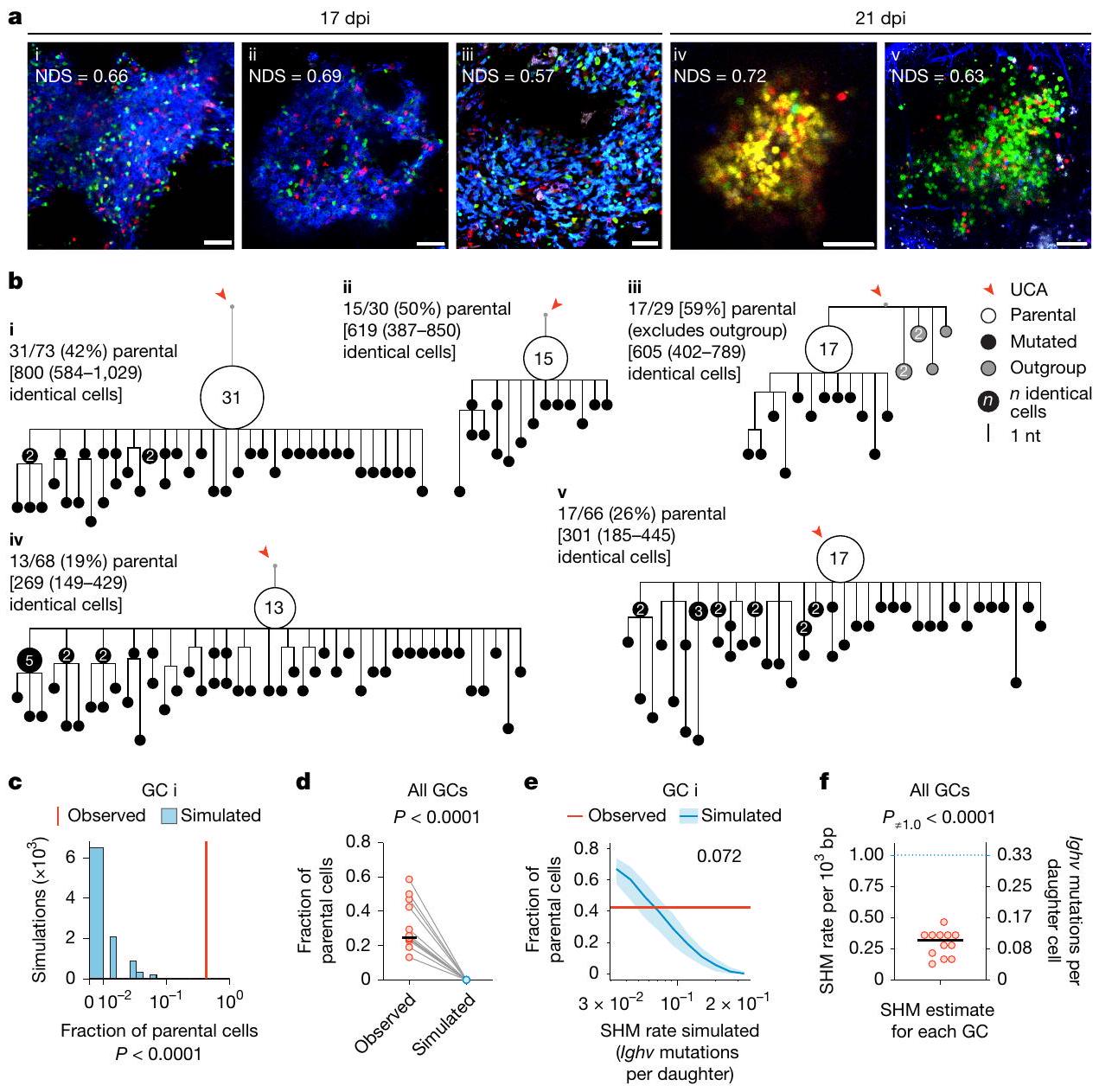
معدلات SHM. أ، صور متعددة الفوتونات لخلية واحدة ملونة تشير إلى الانفجار النسلي، تم الحصول عليها عند 17 أو 21 يومًا بعد الحقن (10-14 يومًا بعد الجرعة النهائية من التاموكسيفين). يمثل معدل الهيمنة المنظم (NDS) نسبة الخلايا التي تنتمي إلى اللون السائد، مع تعديل كثافة الخلايا الفلورية. (انظر البيانات التكميلية 1). قضبان القياس، . ب، الأشجار النشئية لتسلسلات Ighv من GCs في أ. لكل GC، نسبة الخلايا الأبوية والتقديرات لعدد الخلايا المتطابقة ( تم توفير فترة الثقة (CI) المستخرجة إلى 2000 خلية GC (بين قوسين مربعين). تم استبعاد خلايا المجموعة الخارجية في GC iii من الحسابات. انظر الأشجار الإضافية في الشكل 1b,c من البيانات الموسعة. nt، نيوكليوتيد؛ UCA، السلف المشترك غير المتحور. ج، النسبة الأبوية الملحوظة لـ GCi (الخط الأحمر) مقارنة بالتوزيعات من 10,000 عملية تفرع كلوني محاكاة، متطابقة مع أحجام GC المستخرجة (الأعمدة الزرقاء).
تعكس القيم عدد المحاكاة التي تحتوي على كسور أبوية تساوي أو تتجاوز القيمة الملحوظة. د، الكسور الملحوظة للخلايا الأبوية من 12 GC (ب، ج والبيانات الموسعة الشكل 1ب، ج) مقارنةً بالكسور المحاكاة بافتراض معدل SHM ثابت يبلغ 0.333 طفرات Ighv لكل ابنة. القيمة بواسطة الزوج -اختبار. الخط الأسود الأفقي يظهر الوسيط. e، الوسيط (± نطاق الربيع الرباعي) لنسب الأبوين من محاكاة مسح المعلمات لـ GC i مع معدلات SHM التي تزداد هندسياً من 0.033 إلى 0.333 طفرات Ighv لكل ابنة (انظر الشكل 2 في البيانات الموسعة). الخط الأحمر يشير إلى نسبة الأبوين الملاحظة لـ GCi. الرقم يدل على معدل SHM المحاكى الذي تطابق فيه الوسيط بشكل أقرب مع النسبة الملاحظة في vivo. f، معدلات SHM المقدرة لـ 12 انفجاراً كلونياً. القيمة بواسطة عينة واحدة -اختبار ضد معدل SHM النظري البالغ 0.333 طفرات Ighv لكل ابنة. الخط الأسود الأفقي يظهر الوسيط.
في الألمنيوم كعامل مساعد لتشكيل مراكز التكاثر الجرثومي (GCs)، تم تحفيز إعادة التركيب في Brainbow عن طريق العلاج بالتاموكسيفين بدءًا من اليوم الخامس بعد التطعيم (dpi) وتم مسح العقد اللمفاوية الفخذية (pLNs) التي تم جمعها في 17 أو 21 dpi بحثًا عن مراكز التكاثر الجرثومي ذات اللون الواحد مع درجة الهيمنة المنضبطة (NDS؛ مقياس لنسبة الخلايا ذات اللون السائد داخل المركز) أكبر من 0.5، مما يدل على توسع شبيه بالانفجار النسلي. استخدام الميكروتشريح باستخدام خلية واحدة قمنا بعزل خلايا B من 12 من هذه العقد اللمفاوية وتحديد تسلسلات جينات Ighv الخاصة بها. ثم استخدمنا التسلسلات التي تنتمي إلى النسخة السائدة في العقد اللمفاوية لبناء شجرات تطورية طفرية بطريقة غير خاضعة للإشراف باستخدام خوارزمية gctree. في شجرة النسب الجينية، تظهر خلايا B التي تفشل في التحور أثناء التكاثر السريع كعقد كبيرة تحتوي على خلايا متعددة تحمل تسلسل Ighv متطابق، تليها عدد متغير من الفروع الهابطة. إن نسبة وفرة خلايا B عند العقدة الأصلية (المعرفة على أنها العقدة التي تحتوي على أكبر عدد من التسلسلات المتطابقة في النسب المتفجرة، والتي تمثل على الأرجح خلية B التي بدأت الانفجار النسلي) إلى وفرة نسلها المتحور مرتبطة عكسياً بـ
احتمالية الطفرة لكل انقسام (الشكل 1 أ من البيانات الموسعة). كانت الأنماط الوراثية السائدة المستمدة من 12 انفجارًا كلونيًا تم تسلسلها (9 من 17 يومًا بعد الإصابة و3 من 21 يومًا بعد الإصابة) تتكون بشكل موحد من هياكل تحتوي على عقد أبوية كبيرة، مع متوسط نسبة الخلايا الأبوية من (s.d.) (الشكل 1أ، ب والشكل البياني الموسع 1ب، ج). بالمقابل، كانت الأنماط الوراثية الأكبر المستمدة من خمسة مراكز تحكم مع NDS < 0.3 (بما في ذلك نمط وراثي واحد (GC vi) تم الحصول عليه من نفس العقدة اللمفاوية مثل GCi وفيه تم توسيع سلالة شقيقة من نفس مجموعة خلايا B) عمومًا أكثر تفرعًا، وعلى الرغم من أنه لا يمكن إجراء مقارنات كمية نظرًا لأنه لا يمكن، حسب التعريف، تعيين عقدة أبوية لمثل هذه السلالات، إلا أنها عمومًا كانت تفتقر إلى العقد التي تحتوي على عدد كبير من الخلايا المتطابقة (الشكل البياني الموسع 1د، هـ).
التقدير الخطي للنسبة المقاسة من الخلايا الأبوية إلى 2000 خلية يشير إلى أن التوسعات النسيلية في 12 من خلايا GC ذات اللون الواحد يجب أن تحتوي على عدة مئات من خلايا B ذات تسلسلات Ighv متطابقة (الشكل 1ب والشكل التمديدي 1ج). وهذا، من حيث المبدأ، غير متوافق مع فرضية الثبات.
معدل الطفرة 1 لكل قواعد لكل خلية ابنة : بافتراض معدل طفرات موحد واحتمال يقارب الثلثين لاحتفاظ النسل بالتسلسل الأبوي (هنا ننظر فقط إلى جزء Ighv، الذي يبلغ طوله حوالي 300 قاعدة)، فإن النتيجة المتوقعة بعد انفجار من 10 انقسامات هي أنه، في المتوسط، سيكون هناك فقط 18 (أي، ) من 1,024 ( ستحتفظ خلايا B بالتسلسل الأبوي. لاختبار هذه الفرضية بشكل رسمي، استخدمنا محاكاة عملية الولادة والموت. لتوليد الأنماط التطورية مع احتمال طفرات Ighv ثابت قدره طفرة واحدة لكل 1000 قاعدة متضمنة (أو ثلث لكل ابنة بعد انقسام الخلية). لكل GC في الشكل 1a، قمنا بتشغيل محاكاة حتى يتطابق عدد الخلايا مع التقديرات التجريبية من النسخ المتسلسلة (الأقواس المربعة في الشكل 1b والشكل الممتد 1c). قمنا بإجراء 10,000 من هذه المحاكاة لكل GC، وعينة عشوائية من الخلايا من كل محاكاة لمطابقة عدد الخلايا الموجودة في الأنماط التطورية الأصلية في الجسم الحي، ثم حسبنا نسبة الخلايا من النوع الأبوي في كل عينة محاكاة (الشكل 1c، d والشكل الممتد 2a). في 21 فقط من 120,000 عينة مستمدة من المحاكاة، وصلت نسبة الأبوي إلى تلك التي لوحظت في GCs الأصلية في الجسم الحي. كانت جميع هذه الحالات الـ 21 محاكاة لـ GC xi (الشكل الممتد 1c)، الذي كان لديه نسبة منخفضة بشكل استثنائي من الخلايا الأبوية وبالتالي من المحتمل أن يمثل انفجارًا حدث في وقت سابق خلال استجابة GC. كانت الوسيط لنسبة الأبوي لجميع المحاكاة صفر، مقارنة بـ 0.25 لـ GCs المقاسة تجريبيًا (الشكل 1d). أظهر مسح المعلمات أن معدل SHM الذي اقترب أكثر من نسبة الأبوي الملحوظة لكل GC كان، في المتوسط، 0.10 (نطاق 0.043-0.16) طفرات لكل منطقة Ighv لكل خلية ابنة (ما يعادل طفرات لكل تظهر الأنماط الوراثية للانفجارات النسيلية معدلات التحور الجيني التي تتراوح بين نصف وثلث معدلات التحور الجيني المتوسطة التي تم تحديدها سابقًا. .
تثير نتائجنا فرضية أن خلايا B في مراكز التكاثر النشط (GC) تقوم بتقليل معدل التحول الجيني (SHM) بنشاط خلال الانفجارات التكتلية. لاختبار ذلك، سعينا لقياس معدل التحول الجيني في وجود أو غياب الاضطرابات التي تعزز التكاثر الخامل لخلايا B في مراكز التكاثر النشط والتي تؤدي إلى الانفجارات. (الشكل 3أ من البيانات الموسعة). قمنا أولاً بفحص نموذج وراثي يحمل فيه خلايا B المناعية GC طفرة مرتبطة بسرطان بوركيت تتمثل في زيادة وظيفة جين Ccnd3 (Ccnd3 تؤدي هذه الطفرة إلى إبطاء التصدير النووي والانحلال البروتيني لمنظم دورة الخلية السيكلين D3، مما يؤدي إلى زيادات معتدلة في دورة الخلايا الساكنة DZ وفي حجم حجرة DZ نفسها. . في السابق، استخدمنا نبضات مزدوجة النوكليوتيدات للحصول على النسب المئوية المتوسطة للنوع البري (WT) و Ccnd3 خلايا B الجريبية تدخل مرحلة S داخل المنطقة المظلمة في نافذة زمنية مدتها 30 دقيقة استنادًا إلى هذه البيانات، قدرنا أن خلايا B السرطانية المتحورة T283A قد خضعت لـ المزيد من الدورات الخاملة في منطقة النضج (DZ) بمعدل 10 نقاط في البوصة (dpi) (13.5 مقابل 8.1) (الشكل البياني للبيانات الموسعة 3b). بافتراض معدل طفرات موحد لكل دورة انقسام بين خلايا B في منطقة النضج، نتوقع Ccnd3 الخلايا لتراكم المزيد من الطفرات مقارنة بالخلايا البرية ضد الطفرات لكل خلية، على التوالي) (الشكل 3c من البيانات الموسعة). ومع ذلك، فإن توزيعات SHM الملحوظة في WT و Ccnd3 كانت خلايا B GC غير قابلة للتمييز (الشكل البياني الممتد 3c-e)، وبالتالي، كانت معدل الطفرة المقدر لـ Ccnd3 كانت خلايا GC B أقل بكثير من خلايا GC B من النوع البري (الشكل 3f من البيانات الموسعة). بشكل أكثر دقة، بينما حدثت الطفرات بين خلايا النوع البري بمعدل قريب من المعدل المتوقع طفرات لكل ابنة، أو طفرات لكل الأسس)، الطفرات في Ccnd3 كانت خلايا B GC أقل تكرارًا بكثير مما كان متوقعًا ( طفرات لكل ابنة، أو طفرات لكل الأسس) (الشكل 3f من البيانات الموسعة). لذلك، على الرغم من زيادة عدد خلايا DZ التي تشارك في الدورة الحركية، Ccnd3 لم تُظهر الفئران زيادة متزامنة في تراكم الطفرات مع مرور الوقت، مما يشير إلى انخفاض معدل الطفرات لكل انقسام خلوي.
استخدمنا بعد ذلك نموذجًا يمكننا من خلاله إجبار عدة سلالات من خلايا B على الخضوع لعدة جولات من الدوران الخامل في المنطقة المظلمة بشكل جماعي. (الشكل 2أ). قمنا بدمج هذا النموذج التجريبي مع متتبع مشفر وراثيًا يقيس انقسام الخلايا كدالة لـ
تخفيف بروتين الفلورسنت mCherry . استقبل مضيفو WT نقلًا تكيفيًا لـ B1-8 خلايا B (المحددة لـ 4-هيدروكسي-3-نيترو-فينيل أستيل؛ NP)، والتي يعبر عن mCherry تحت محفز حساس للدوكسي سيكلين (DOX)، بالإضافة إلى المستقبل DEC-205 (المشفر بواسطة الجين )، في حين أن الـ 95% المتبقية تفتقر جينياً إلى تعبير DEC-205 ( “). ثم قمنا بتحصين هذه الفئران بـ NP المرتبط بالألبومين البيض (OVA) لتوليد مراكز التكاثر. يؤدي علاج الفئران التي تحتوي على مراكز تكاثر مثبتة بمضاد محدد لـ DEC-205 مرتبط بـ OVA (مضاد-DEC-OVA) إلى تعزيز تقديم OVA إلى الخلايا بواسطة خلايا B GC التي تعبر عن DEC-205 فقط، مما يجبر هذه على التفاعل مع الخلايا، تهاجر إلى منطقة التمايز ثم تخضع بسرعة لعدة جولات من التكاثر في غياب اختيار منطقة الانتقاء. قمنا بتحليل خلايا GC B بعد 72 ساعة من العلاج مع anti-DEC-OVA (10 dpi)، بعد أن خضعت الخلايا لتوسع تكاثري كبير في منطقة DZ (الشكل 2b) ولكن في الغالب قبل أن تبدأ جولة جديدة من الاختيار في منطقة LZ.
قمنا بتحديد شدة فلورية المCherry المقاسة عند 7 أيام بعد الإصابة كنقطة أساس، وحسبنا مدى انقسام الخلايا من 7 إلى 10 أيام بعد الإصابة، مع أو بدون تحفيز التكاثر بواسطة مضاد DEC-OVA. في المتوسط، خضعت الخلايا لـ 3.9 انقسامات بدون العلاج و 5.2 انقسامات مع العلاج (الشكل 2c). ثم قمنا بفرز B1-8. خلايا لقياس أحمال SHM مباشرة من خلال تسلسل الأجسام المضادة المقترنة القائم على القطرات. وبشكل خاص لعينة اليوم العاشر المعالجة بمضاد DEC-OVA، قمنا بفرز خلايا B1-8 التي تعبر عن DEC-205 الخلايا التي كانت لديها مستويات منخفضة من تعبير mCherry (التي تتوافق مع حوالي 7.5 انقسام، في المتوسط)، لتجنب التأثيرات المربكة من السلالات التي خضعت لعدد أقل من الانقسامات (الشكل 2c). بافتراض معدل طفرات واحد لكل 1000 قاعدة لكل خلية ابنة، نتوقع أن نكتسب، بحلول اليوم و 9.3 طفرات Ighv + Iglv (حوالي 700 قاعدة) في الفئران غير المعالجة والمعالجة، على التوالي (الشكل 2d). بينما تراكم SHM من 7 إلى 10 dpi في خلايا B GC من الفئران غير المعالجة يتماشى مع توقعاتنا، بمتوسط 1.6 طفرة لكل خلية، كانت النتيجة التجريبية للفئران المعالجة بـ anti-DEC-OVA مختلفة بشكل ملحوظ. لم تقم خلايا B GC لديهم بتراكم طفرات أقل من المتوقع فحسب، بل أظهرت هذه الخلايا أيضًا عدد طفرات أقل قليلاً من نظرائها غير المعالجين (متوسط 1.1 طفرة لكل خلية؛ الشكل 2d، e والشكل التمديدي 4a). مع الأخذ في الاعتبار معدلات الانقسام، كانت هذه الأحمال الطفرية تت correspond إلى انخفاض في معدل SHM من طفرات Ighv + Iglv لكل خلية ابنة (أو لكل 1,000 قاعدة) في الفئران غير المعالجة إلى (أو لكل 1,000 قاعدة) بعد العلاج مع anti-DEC-OVA (الشكل 2f). معًا، تشير نتائجنا إلى أن معدلات SHM لكل خلية ابنة تنخفض عندما يتم إجبار خلايا B في مركز الجريبات، سواء وراثيًا أو دوائيًا، على الخضوع لمزيد من دورات DZ الساكنة – مما يجادل مرة أخرى ضد معدل موحد من الطفرات لكل جولة من انقسام الخلايا.
للحصول على فهم لآليات كبح SHM في الخلايا الدورية بشكل قصدي، قمنا أولاً بتحديد ظهور الطفرات مع مرور الوقت في إعداد anti-DEC-OVA. على الرغم من أن خلايا B التي تحتوي على DEC-205 تكاثرت بشكل كبير وتجمعت بشكل ملحوظ في منطقة DZ بين 0 ساعة و48 ساعة بعد علاج anti-DEC-OVA (الشكل 2g، h)، إلا أن SHM في هذه المجموعة توقفت تمامًا خلال فترة التوسع هذه، وبعد ذلك استؤنفت بمعدل قريب من الطبيعي (الشكل 2i، j والشكل الإضافي 4b). وبالتالي، فإن كبح SHM بعد العلاج بـ anti-DEC-OVA ليس بسبب تباطؤ متساوٍ في معدلات الطفرات طوال الاستجابة، بل بسبب توقف مؤقت لـ SHM خلال الدورة القصدية، تلاه العودة إلى معدل الأساس في حوالي وقت إعادة الدخول إلى LZ.
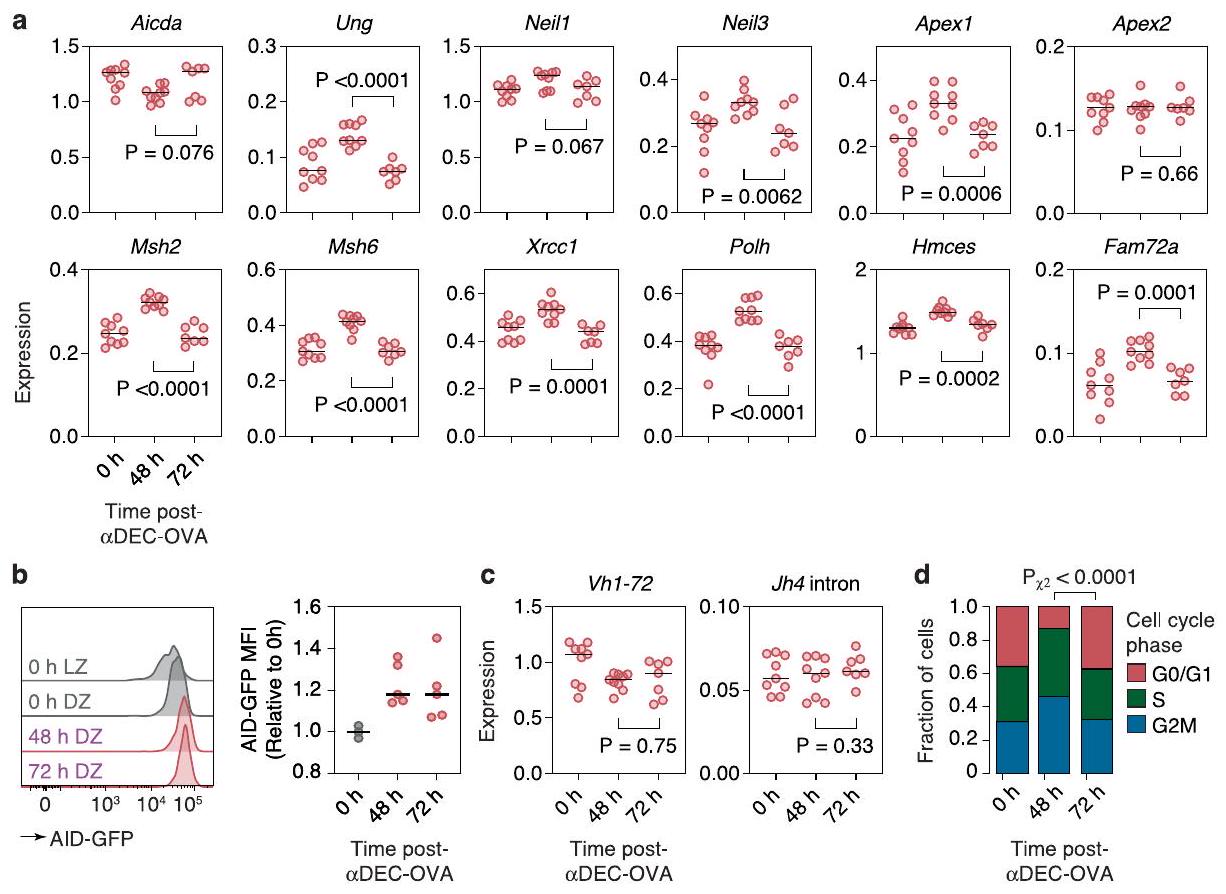
مقارنة تعبير جينات خلايا B بعد 48 و72 ساعة من علاج anti-DEC-OVA استبعدت انخفاض تنظيم Aicda (والذي أكدناه بواسطة تحليل التدفق باستخدام تقرير اندماج AID-GFP) ) كآلية لهذه الوقفة في SHM (الشكل البياني الممتد 5a، b). علاوة على ذلك، كان تعبير العوامل الفعالة downstream لـ SHM (Ung، Neil1، Neil3، Apex1، Apex2، Msh2، Msh6، Polh، Hmces و Fam72a؛ المراجع 32-38) عمومًا أعلى بدلاً من أن يكون أقل بعد 48 ساعة من علاج anti-DEC-OVA، على الرغم من أن التغيرات النسبية كانت متواضعة (الشكل البياني الممتد 5a). لم يكن هناك أيضًا أي انخفاض ملحوظ في Igh mRNA أو في RNA intronic Jh4 (مؤشر حقيقي لنسخ Ighv)، مما يشير إلى أن النسخ
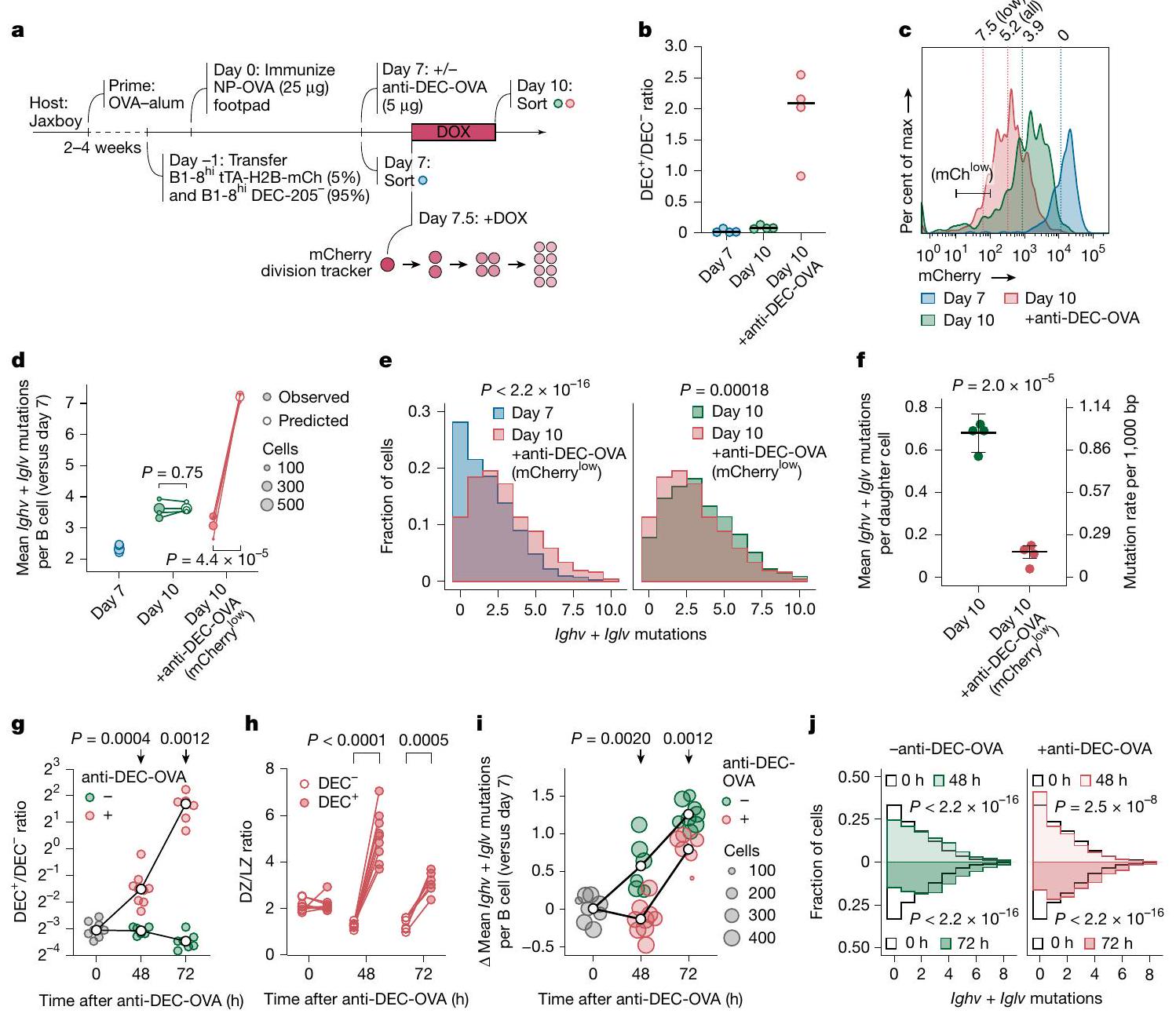
الشكل 2 | معدل SHM ينخفض خلال دورة خلايا القصور الذاتي في منطقة DZ. أ، مخطط لتجربة anti-DEC-OVA. ب، نسبة DEC-205 إلى DEC-205 B1-8 خلايا B GC في الفئران المعالجة وغير المعالجة بـ anti-DEC-OVA. ج، مخطط تدفق الخلايا يظهر العدد المقدر لانقسامات الخلايا، كما تم تقييمه من خلال تخفيف المCherry (عامل 2 لكل جيل)، في B1-8 تعدادات الخلايا. يتم عرض متوسط أعداد الانقسام المقدرة فوق الرسم البياني. DEC- تم فرز الخلايا المستخدمة في التحليل باستخدام المCherry البوابة. د، متوسط عدد الطفرات لكل منطقة Ighv + Iglv لكل فأر. يتم مقارنة عدد الطفرات الملحوظة بالتوقعات المستندة إلى معدل طفرات موحد قدره 1 في 1000 قاعدة لكل خلية ابنة. يمثل كل رمز واحدًا من أربعة فئران لكل مجموعة من تجربتين منفصلتين. تظهر الخطوط السوداء الأفقية الوسيط. هـ، توزيعات الطفرات في العينات المجمعة من د. البيانات الخاصة بالفئران الفردية موجودة في الشكل 4a من البيانات الموسعة.
معدل SHM المستنتج للفئران الفردية من د. الخطوط السوداء الأفقية تشير إلى المتوسط المرجح بالعكس للتباين مع الانحراف المعياري الذي يأخذ في الاعتبار التباينات داخل الفئران الفردية. ج، نسبة DEC-205 إلى DEC-205 B1-8 خلايا B GC في الفئران المعالجة وغير المعالجة بمضاد DEC-OVA كما في (أ). الدائرة البيضاء تشير إلى الوسيط لكل مجموعة. كل رمز يمثل واحدة من الفئران لكل مجموعة من تجربتين مستقلتين. توزيع DZ/LZ لـ DEC-205 و DEC-205 ب1 خلايا B في العقد اللمفاوية في الفئران المعالجة بمضاد DEC-OVA. متوسط التغير في عدد الطفرات لكل منطقة Ighv+Iglu في الفئران المعالجة بمضاد DEC-OVA وغير المعالجة، بالنسبة إلى متوسط النقطة الزمنية. الدائرة البيضاء تشير إلى الوسيط لكل مجموعة. ج، توزيع الطفرات في العينات المجمعة من 0 ساعة، 48 ساعة و72 ساعة من (i). بيانات الفئران الفردية موجودة في الشكل 4b من البيانات الموسعة. قيم بواسطة الطالب -اختبار (ف، ج، ي)، اختبار كولموغوروف-سميرنوف (هـ، ج)، أو مقترن -اختبار (د، هـ).
من منطقة إيغف، شرط لاستهداف المساعدات ، يبقى سليماً خلال الدورة الحركية العطالية (الشكل التوضيحي الممتد 5c). بالمقابل، كانت الدورة الحركية العطالية مرتبطة بانخفاض حاد في نسبة الخلايا المعينة ترنسكريبشونالياً إلى مرحلة G0-G1 من دورة الخلية (الشكل 5d من البيانات الموسعة). هذا يتماشى مع نتائجنا المنشورة سابقاً في Ccnd3. طافرة ويشير إلى أن خلايا B تقضي وقتًا أقل في المراحل المبكرة من دورة الخلية أثناء خضوعها لانقسامات غير نشطة. نظرًا للقيود المعروفة على التحويرات الجينية الموجهة (SHM) في المراحل المبكرة من دورة الخلية. ، افترضنا أن سلالات خلايا B التي تمر بعملية الانفجار النسلي في منطقة النضوج (DZ) ستكون غير قادرة على الخضوع لتغيرات الطفرة الموجهة (SHM) إلا خلال المرحلة النهائية بعد الانقسام الخلوي التي تحدث بين نهاية دورة الخلايا الساكنة والعودة إلى منطقة النضوج (LZ). سيكون هذا النظام معادلاً للخضوع لجولة واحدة من SHM لكل مرور في DZ، بدلاً من واحدة لكل انقسام خلوي (الشكل 3a). لاختبار هذه الفرضية، سعينا لقياس مدة الوقت تقضي الخلايا في G0-G1 تحت ظروف الدورة الطبيعية أو نوع الانفجار النسلي.
تتميز مرحلتا G0 و G1 من دورة الخلية بانخفاض نشاط كيناز المعتمد على السايكلين 2 (CDK2)، والذي، عند الشراكة مع
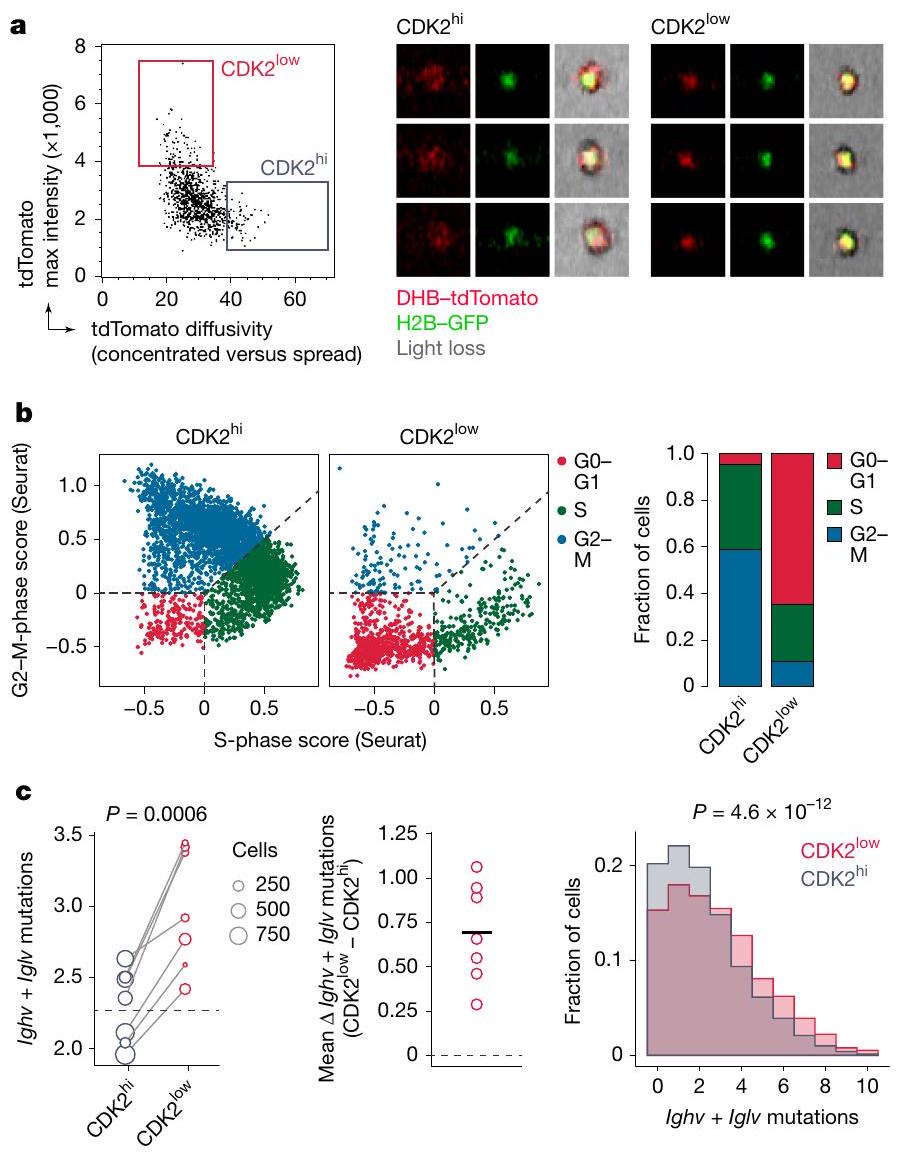
السيكلين E، يعزز التقدم خلال المرحلة G1 وبدء المرحلة S لقياس هذه المراحل بدقة في الجسم الحي، قمنا بإنشاء فئران تحمل جهاز تقارير في الوقت الحقيقي لنشاط CDK2 (الشكل 3ب، ج). يعتمد هذا الجهاز على تركيبات تم نشرها سابقًا. يتكون من الأحماض الأمينية 994-1,087 من هيليكاز الحمض النووي البشري B (DHB) متصلًا في الطرف N ببروتين tdTomato الفلوري الأحمر ومدرجًا في موضع روزا26 المعبر عنه بشكل شائع (روزا26 ; الشكل 3ج). ينتقل مجال DHB من النواة إلى السيتوبلازم بعد الفسفرة بواسطة CDK2. وبالتالي، فإنه يتواجد في النواة عندما تكون نشاط CDK2 غائبًا خلال مرحلة G0، ويخرج تدريجياً إلى السيتوبلازم مع تقدم الخلايا خلال مراحل G1 و S و G2. (الشكل 3ب، د). يسمح هذا القياس القائم على التوطين لنشاط CDK2، الذي يتم تحديده كنسبة الفلورسنت DHBtdTomato من السيتوبلازم إلى النواة (C/N) (الشكل 3ب)، بمراقبة تقدم دورة الخلية بدقة زمنية أكبر مما يمكن تحقيقه باستخدام مؤشرات دورة الخلية المشفرة جينياً التقليدية. التي تتطلب النسخ والترجمة ونضوج البروتينات الفلورية قبل أن يمكن اكتشاف إشارة. روزا26 فئران
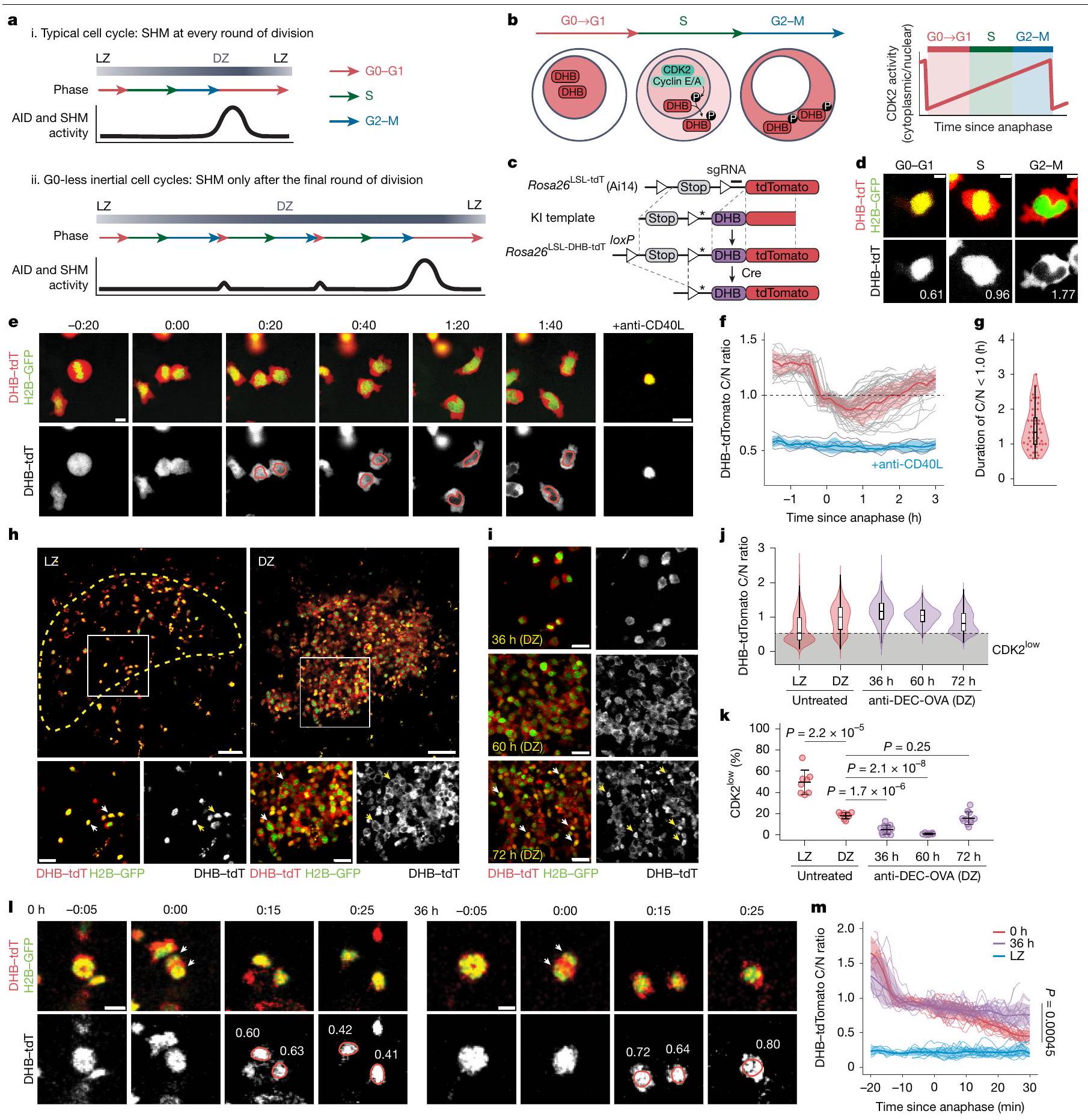
الشكل 3 | دورات خلايا DZ الخاملة تفتقر إلى CDK2 مرحلة شبيهة بـ GO. أ، نموذج مقترح لنشاط AID و/أو SHM. ب، الكشف عن نشاط CDK2 من خلال الانتقال تحت الخلوي لمراسل DHB. ج، روزا26 تصميم أليل الإدخال (KI). النجمة تشير إلى طفرة صامتة تم إدخالها لمنع ارتباط sgRNA في قالب KI. د، DHB-tdTomato (أحمر) وH2B-GFP (أخضر) في خلايا GCB المزروعة، مع نسب C/N المقابلة. قضبان القياس، . لقطات من تصوير الزمن المتقطع لخلايا GCB في ثقافات Nojima التي تعبر عن H2B-GFP (أخضر) وDHBtdTomato (أحمر في الأعلى، تدرج رمادي في الأسفل؛ الفيديو التوضيحي 1). مقياس الرسم، آثار النشاط (رمادي) مع المتوسط ± الانحراف المعياري (أحمر). الخلايا المعالجة بمضاد الأجسام المضادة المضادة لـ CD40L (أزرق) توفر CDK2 مرجع. مدة نسبة C/N أقل من 1.0 (دخول مرحلة S) بعد الطور الانفصالي. كل رمز يمثل خلية ابنة واحدة. h، DHB-tdTomato (أحمر) و H2B-GFP (أخضر) في خلايا GCB. تعبر تعبير CD35 (خط منقط أصفر) عن منطقة LZ (فيديو إضافي 2). تبرز الأسهم في الإضافات DHB-tdTomato النووي في خلايا LZ والتعبير السيتوبلازمي في خلايا DZ. قضبان القياس،
(الأعلى); (أسفل). أنا، DHB-tdTomato (رمادي) بعد العلاج مع anti-DEC-OVA. الأسهم تشير إلى DHB-tdTomato النووي بعد 72 ساعة. مقياس الأشرطة، . رسم بياني على شكل كمان لنشاط CDK2 مع تراكب مخطط الصندوق (الوسيط، النطاق الربعي، النطاق). تشير الصندوق الرمادي إلى CDK2 الحالة (الوسيط لخلايا LZ غير المعالجة). بيانات GC الفردية موجودة في الشكل التمديدي 6b، c. ك، نسبة CDK2 الخلايا في خلايا LZ و DZ المزدوجة في GCs غير المعالجة وخلايا B DZ بعد العلاج مع anti-DEC-OVA. قيم P بواسطة اختبار ستودنت -اختبار. أنا، لقطات من DHB-tdTomato (أحمر) و H2B-GFP (أخضر) من التصوير الزمني الحي بعد 0 ساعة أو 36 ساعة من العلاج مع anti-DEC-OVA (الفيديوهات التكميلية 3 و 4). الصور مصفوفة على وقت الطور الانفصالي، الذي تم تحديده من خلال انفصال الكروماتيد الشقيق (رؤوس الأسهم). يتم الإشارة إلى نشاط CDK2 لكل خلية ابنة. قضبان القياس، تتبع نشاط CDK2 في خلايا DZ مع أو بدون علاج بمضاد DEC-OVA، ملخصًا بالمتوسط والانحراف المعياري. تعمل خلايا LZ غير المنقسمة (باللون الأزرق) كـ CDK2 مرجع. القيمة بواسطة اختبار ت الطالب.
الشكل 4 | يحدث التغير في النمط في خلايا DZ B في CDK2 حالة شبيهة بـ GO. أ، بوابة فرز (يسار) وأمثلة على خلايا GCB مع نواة (CDK2 ) و سيتوبلازمي (CDK2 مراسل DHB-tdTomato كما تم تحديده بواسطة فرز الخلايا القائم على الصور (يمين). انظر البيانات الموسعة الشكل 7a، b لاستراتيجية الفرز الكاملة وأمثلة إضافية. ب، اليسار، تعيين مرحلة دورة الخلية إلى CDK2 و CDK2 خلايا B في DZ من خلال التعبير عن توقيعات النسخ في مرحلة S و G2-M. اليمين، التكميل الكمي. يتم تعيين فئات دورة الخلية باستخدام وظيفة CellCycleScoring في Seurat. يتم تعريف خلايا GO-G1 على أنها تلك التي تفتقر إلى تعبير نسخ مرحلة S ومرحلة G2-M. ج، اليسار، عدد الطفرات Ighv + Iglv في CDK2 و CDK2 الخلايا بعد 72 ساعة من العلاج مع مضاد DEC-OVA. كل رمز يمثل متوسط فأر واحد ويتم قياسه وفقًا لعدد الخلايا التي تم تسلسلها؛ الخط هو متوسط جميع CDK2. خلايا. القيمة بواسطة الزوج -اختبار. الوسط، الفرق بين متوسط CDK2 و CDK2 الخلايا في كل فأر. اليمين، توزيع الطفرات في CDK2 المجمعة و CDK2 الخلايا. الخط الأسود الأفقي يوضح المتوسط. القيمة بواسطة اختبار كولموغوروف-سميرنوف.
تم عبورهم إلى B1-8 مستقبل الخلية ومراسل هيستون 2B (H2B)-EGFP لرؤية الأحداث الانقسامية بدقة.
لاختبار مراسلنا، قمنا بتصوير DHB-tdTomato على مدى فترة طويلة. تم فرز خلايا GCB على طبقات أحادية من خلايا التغذية التي تعبر عن CD40L و BAFF و IL-21 (ثقافات ‘نوجيما’)، والتي تعتبر، عند دمجها، من المحفزات القوية لانقسام خلايا B في مركز الجريبات خارج الجسم. (الفيديو التكميلي 1). لمتابعة سلوك مراسلنا خلال الانتقال من مرحلة M إلى المرحلة S التالية، قمنا بمحاذاة عدة مسارات تحديد موقع خلية مفردة من DHB-tdTomato زمنياً باستخدام الطور الانفصالي كمرجع (الشكل البياني التمديدي 6a). لم نتمكن من ملاحظة أي خلايا تدخل في CDK2 الدولة، التي يكون فيها DHB-tdTomato نوويًا بالكامل، كما كان هو النمط لخلايا B الجريبية المزروعة في ظروف مماثلة ولكن في وجود جسم مضاد مانع لـ CD40L (الشكل 3). وبالتالي، عندما تكون تحت تحفيز مستمر، لا تقوم خلايا B الجريبية أبدًا بإلغاء تنشيط CDK2 بالكامل. بدلاً من ذلك، مباشرة بعد الانقسام، أظهرت جميع الخلايا مستوى وسيط من نشاط CDK2، الذي استمر في الزيادة ووصل إلى نسبة C/N تبلغ 1.0 (الحد المبلغ عنه لبدء تخليق الحمض النووي). ) في وقت وسطي قدره 1.3 ساعة بعد الطور الانفصالي، من متوسط مدة دورة الخلية البالغة 8.7 ساعة (الشكل 3g).
لذلك، فإن خلايا B الجنينية تحت التحفيز الميتوجيني القوي قادرة على الانتقال بسرعة من مرحلة M إلى مرحلة S من دورة الخلية من خلال الحفاظ على نشاط CDK2 قريبًا من العتبة المطلوبة لدخول مرحلة S، والانتقال بسرعة عبر G1 وتجنب فعّال لـ CDK2. مرحلة GO .
للتحقق مما إذا كانت مثل هذه الانتقال السريع من مرحلة M إلى مرحلة S قد لوحظت أيضًا خلال الدورة الحركية في الجسم الحي، قمنا بحقن مضاد DEC-205-OVA في الفئران التي تحتوي على خلايا GC مستمرة مزروعة مع جزء صغير من خلايا B1-8 التي تعبر عن DHB-tdTomato. الخلايا، كما في الشكل 2أ، وتم تصوير خلايا الجراثيم بشكل ثابت وديناميكي باستخدام نوافذ التصوير الحي أظهر التحليل الثابت للخلايا البائية في المنطقة الجريبية غير المعالجة أن خلايا B في المنطقة الجريبية أظهرت بشكل أساسي توطينًا نوويًا لـ DHB-tdTomato (نسبة C/N المتوسطة 0.53؛ الشكل 3h,j,k، الشكل التمديدي 6b والفيديو التكميلي 2). نظرًا لأن خلايا B في المنطقة الجريبية تبقى بشكل رئيسي في حالة هادئة تشبه حالة GO بينما تتنافس على إشارات الاختيار الإيجابي، قمنا بتحديد متوسط خلايا B في المنطقة الجريبية (0.53) كعتبة لتعريف CDK2. الدولة. في خلايا B في DZ، كان DHB-tdTomato، على النقيض من ذلك، غالبًا ما يكون متواجدًا بكثرة في السيتوبلازم (نسبة C/N المتوسطة 1.00 و الخلايا في CDK2 الدولة؛ الشكل 3h,j,k، الشكل الإضافي 6b والفيديو التكميلية 2)، مما يدل على التكاثر النشط. أدى العلاج مع مضاد DEC-205-OVA إلى زيادة ملحوظة في نسبة خلايا B من نوع DZ في دورة الخلية النشطة (نسبة C/N المتوسطة 1.2 و1.1؛ 4.9% و1.0% من الخلايا في CDK2 الحالة عند 36 و 60 ساعة بعد علاج anti-DEC-OVA، على التوالي، مما يشير إلى أن خلايا B في المنطقة الجانبية تتجنب في الغالب مرحلة شبيهة بمرحلة GO، بدلاً من ذلك تحافظ على مستوى متوسط من نشاط CDK2 بعد الانقسام (الشكل 3i-k، الشكل التمديدي 6c والفيديو التكميلية 2). بحلول 72 ساعة بعد العلاج، عندما لا تزال خلايا B في الغالب في المنطقة الجانبية ولكن التكاثر غير القابل للحركة الناتج عن anti-DEC-205-OVA يتراجع. ، انخفض متوسط نسبة C/N إلى 0.81، مع وجود 16% من خلايا DZ B في CDK2 الحالة (الشكل 3i-k، الشكل البياني الموسع 6c والفيديو التوضيحي 2).
أظهرت الصور الزمنية الحية لبروتينات B DZ النشطة أن نسبة C/N في خلايا B DZ ظلت ثابتة فوق CDK2 بعد 36 ساعة من علاج anti-DEC-OVA. عتبة GO (لم نتمكن من تتبع خلايا B لفترة كافية لاكتشاف الزيادة في نسب C/N التي لوحظت في المختبر)، بينما، في غياب العلاج، استمرت نسب C/N في الانخفاض بعد الانقسام، وصولاً إلى CDK2 العتبة خلال 30 دقيقة من الطور الانفصالي (الشكل 3ل، م والفيديوهات التكميلية 3 و4). وبالتالي، فإن خلايا B التي تخضع بنشاط لدورة القصور استجابةً لمضاد DEC-OVA فشلت إلى حد كبير في الدخول إلى CDK2 حالة مشابهة لـ GO.
لإظهار العلاقة بين الحركة التوافقية البسيطة و CDK2 الدولة، سعينا لقياس الحمل الطفراتي بشكل خاص بين CDK2 الخلايا بعد 72 ساعة من علاج anti-DEC-OVA. استخدمنا فرز الخلايا المعتمد على الصور مع تسلسل mRNA على مستوى الخلية الواحدة لعزل خلايا GCB التي تحتوي على نواة (CDK2 ) مقابل السيتوبلازمي (CDK2 مراسل DHB-tdTomato ونمط النسخ DZ (الشكل 4a والشكل الممتد 7a-c). وجدنا الارتباط القوي المتوقع بين DHB-tdTomato النووي وحالة النسخ GO-G1 (أي، عدم وجود برامج التعبير الجيني في مراحل S أو G2-M) بين خلايا B في منطقة DZ (الشكل 4b). والأهم من ذلك، كما توقع نموذجنا، CDK2 كانت خلايا DZ في المتوسط الطفرات الإضافية في Ighv + Iglv، مقارنة بـ CDK2 خلايا DZ من نفس العينة (الشكل 4c)، مما يؤكد أن الطفرة الجسدية تحدث بالفعل عندما تكون خلايا B في حالة CDK2 الدولة. معًا، تُظهر بياناتنا أن تغيير النمط الجيني (SHM) مقيد بخلايا B المزدوجة (DZ) في مرحلة مشابهة لمرحلة GO من دورة الخلية، مما يشير إلى أن قمع تغيير النمط الجيني الذي يظهر خلال الدورة الخلوية الساكنة يعود، على الأقل جزئيًا، إلى التخطي الواسع النطاق لهذه المرحلة خلال الدورة الخلوية الساكنة.
أخيرًا، للحصول على فهم لكيفية تأثير تقييد التحوير الجيني الموجه (SHM) خلال الدورة الحركية على الاختيار النسلي ونضوج الألفة في مراكز التكاثر (GCs)، قمنا بمحاكاة تفاعلات GC كاملة في بيئة افتراضية، حيث تمكنا من إيقاف القدرة الاصطناعية لخلايا B في مراكز التكاثر على قمع التحوير الجيني الموجه خلال الدورة الحركية. قمنا بتكييف نموذج قائم على الوكلاء لتفاعل GC قادر على الانفجارات النسيلية الواقعية. (انظر الطرق والنص التكميلي) لتضمين سيناريوهين: (ط) نسخة صارمة من النموذج في الشكل 3أ، حيث تقوم خلايا B بتقليل SHM إلى الصفر خلال الدورة الساكنة وتُمنع تمامًا من التحور حتى بعد الجولة الأخيرة من DZ
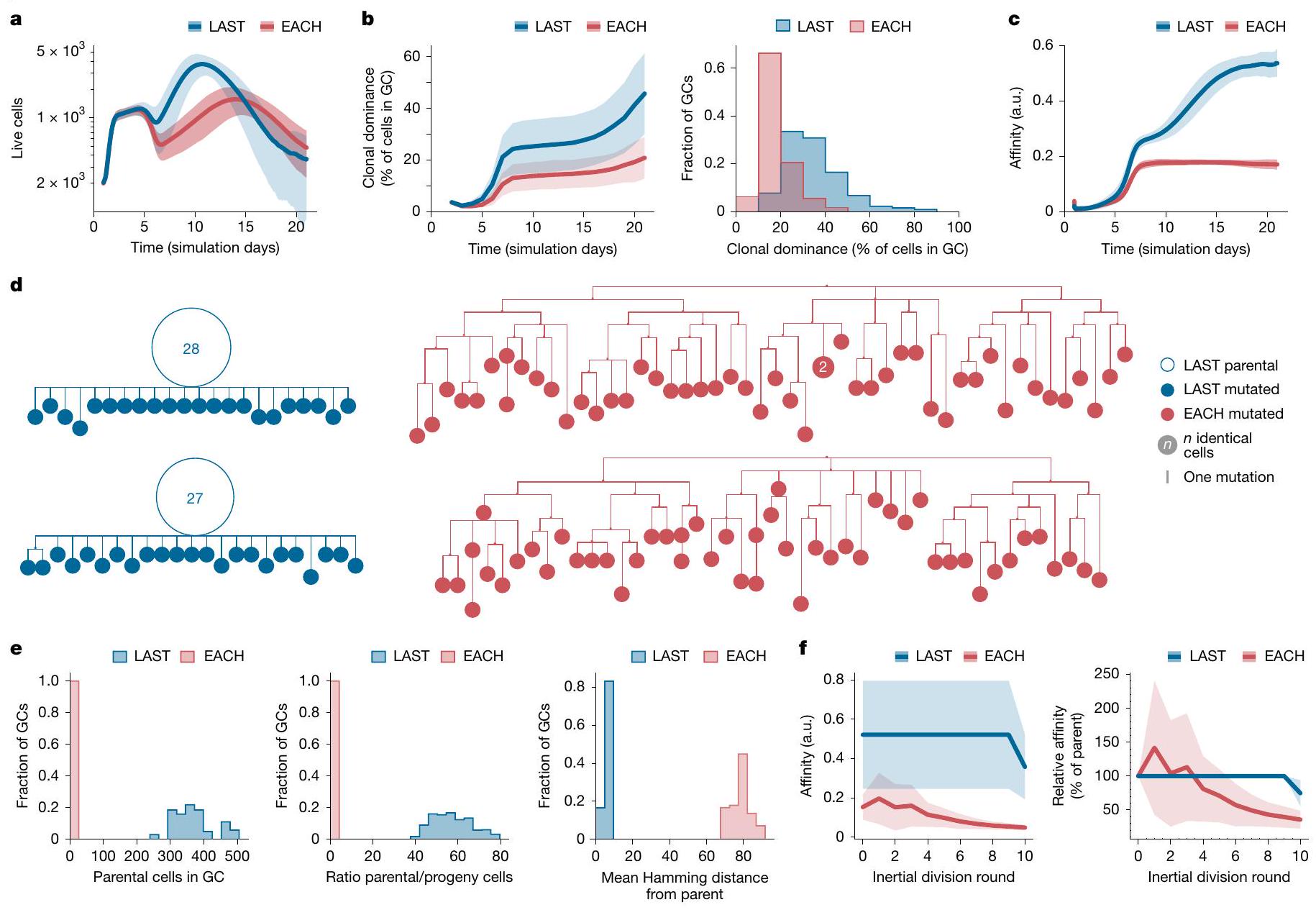
الشكل 5| يتطلب التنظيم الديناميكي لـ SHM التوسع الكلوني المتزامن ونضوج الألفة في المحاكاة. أ-ج، تم إجراء ألف تفاعل GC في المحاكاة لكل من السيناريوهين: EACH، حيث يمكن لخلايا B أن تخضع لعدة انقسامات في كل جولة DZ، بطريقة تعتمد على مقدار المساعدة التي تلقتها في LZ، وهي حرة في التحور بعد كل انقسام خلوي؛ و LAST، الذي يعمل كما في EACH باستثناء أن خلايا B يمكن أن تتحور فقط بعد آخر انقسام حركي في جولة DZ. أ، عدد خلايا GC B الحية. ب، نسبة الخلايا التي تنشأ من نفس المؤسس استنساخ الخلايا (هيمنة النسيلة) على مر الزمن وتوزيع تكرار الهيمنة النسيلية في مراكز التكاثر في اليوم 14. ج، متوسط تقارب خلايا B في مراكز التكاثر بوحدات عشوائية (و.ع.) لــ 1,000 محاكاة تم إجراؤها باستخدام كل نموذج. د، أمثلة على الأشجار النشئية التي تم بناؤها من عينة من
100 خلية مأخوذة من شجرة النشوء والتطور في اليوم الرابع عشر التي خضعت لعشر انقسامات خلوية متتالية. هـ، قياس البيانات كما في د عبر جميع شجرات النشوء والتطور المتفجرة. توزيع شجرات النشوء والتطور المتفجرة وفقًا لعدد الخلايا الأبوية (يسار) ونسبة الخلايا الأبوية إلى الخلايا الناتجة (وسط) في كل شجرة نشوء. يمين، متوسط المسافة الطفرية (هامنج) لجميع الخلايا في شجرة النشوء إلى الخلية التي بدأت الانفجار. ف، يسار، متوسط الألفة المطلقة لخلايا GCB بوحدات الألفة. يمين، التغير في الألفة بالنسبة للعقدة الأبوية للخلايا خلال جميع الانفجارات التي وصلت إلى عشر انقسامات. الحسابات في هـ، ف تشمل شجرة النشوء بأكملها بدلاً من عينات الـ 100 خلية الموضحة في د. المناطق المظللة حول المتوسط تشير إلى الانحراف المعياري.
القسم قبل العودة إلى منطقة الهبوط (LAST)؛ و (ii) نموذج يتم فيه تعطيل هذه الميزة، ويتم الحفاظ على معدل SHM ثابت خلال كل جولة من تقسيم DZ (EACH). عندما تم السماح للخلايا بالتحور، تم تعيين العدد المتوقع من الطفرات في خلية ناتجة مقارنة بوالدها إلى 2.2، بحيث ينتج معدل SHM متوسط قدره 0.66 طفرة لكل جيل في LAST. قمنا بإجراء إجمالي 1,000 محاكاة لكل سيناريو؛ تم محاكاة GCs لمدة 20 يومًا بعد الاندماج الأولي (الذي يتوافق مع حوالي 23 يومًا في الجسم الحي)، وتمت إزالة GCs المتأخرة من التحليل عندما انخفض عددها إلى أقل من 200 خلية.
كانت كل GCs، التي تم تعطيل تقليل SHM خلالها أثناء الانفجار النسلي، أصغر حجماً ومتأخرة حركياً مقارنةً بـ GCs التي تم إنشاؤها بواسطة نموذج LAST (الشكل 5a). كانت كل من معدل التوسع النسلي – المقاس كنسبة مئوية لكل GC تمثلها أكبر نسيلة له – ومتوسط تقارب خلايا B في GCs أعلى بشكل ملحوظ في GCs من نوع LAST (الشكل 5b،c)، مما يشير إلى أن توسع نسائل خلايا B عالية التقارب في GCs يفشل في وجود SHM ثابت. للتحقيق في آثار تقليل SHM على المستوى التطوري، قمنا بإنشاء أشجار لجميع GCs التي تحتوي على نسائل ذات هيمنة تزيد عن 75% في نماذج LAST وEACH. لمحاكاة التجريبي
في ظل الظروف، تم سحب عينات من 100 خلية من كل مجموعة GC، وتم تضمين جميع الخلايا التي تنتمي إلى النسخة المتفجرة في النشوء والتطور. أظهرت نشوء LAST وجود عقد أبوية كبيرة تحتوي على خلايا متعددة ذات تسلسل متطابق، بينما كانت نشوء EACH أكثر تفرعًا وعادة ما تفتقر إلى العقد الموسعة (الشكل 5d)، مما يتطابق نوعيًا مع الأنماط الظاهرية لمجموعات GC المتفجرة وغير المتفجرة في بياناتنا التجريبية (الشكل 1b، c والشكل الممتد 1). وبناءً عليه، كان عدد الخلايا في أكبر عقدة من كل نشوء متفجر أعلى بشكل ملحوظ (193 ضد الخلايا)، وكانت المسافة الطفرية (هامنج) بين الخلية المنفجرة ونسلها أقل بكثير ( ضد الطفرات) في LAST مقارنةً بـ EACH (الشكل 5e). للتحقق من التنبؤ بأن الحفاظ على معدلات SHM خلال الدورة الحركية سيؤدي إلى تدهور في الألفة في نسل انفجار كلوني، اخترنا النشوءات التي خضعت لعشر جولات متتالية من الانقسام الحركي في كلا النموذجين، ورسمنا متوسط الألفة لـ الخلايا بعد كل جولة من الانقسام. كما هو متوقع، أدى الانفجار النسلي في نموذج EACH إلى تدهور متوسط في الألفة مع تكاثر الخلايا، في حين حافظت السلالات المنفجرة في نموذج LAST على ألفة أعلى حتى الجولة النهائية من انقسام DZ (الشكل 5f، g).
نستنتج أن إزالة القيود على SHM خلال الدورة الحركية في السليكو تؤدي إلى فقدان ملحوظ في الألفة بين نسل الانفجار النسلي وفشل عام في نضوج الألفة.
الطفرة الجسدية والتوسع النسلي – اثنان من السمات المميزة لتفاعل مركز الجريبات – هما أمران حاسمان لإنتاج كميات كبيرة من الأجسام المضادة عالية الألفة، ولكنهما قد يسببان مشاكل في نضوج الألفة إذا حدثا في الوقت نفسه. نقترح أن الجهاز المناعي يحل هذا الصراع المحتمل من خلال تقييد التحويرات السريعة (SHM) إلى مرحلة محددة من دورة الخلية التي لا تتاح لخلايا B في المنطقة الناضجة (DZ) التي تنقسم بسرعة حتى نهاية التكاثر الخامل، بحيث تخضع خلايا B لجولة واحدة من الطفرات في كل مرور عبر DZ بدلاً من كل دورة خلوية (الشكل 3a). في هذا الإطار، تشبه الانفجارات الكلونية سلوك خلايا B في النسخة الأصلية من نموذج إعادة الدخول الدوري، حيث تخضع لعدة جولات من الانقسام الخالي من الطفرات قبل كل جولة من التحويرات السريعة. . ومع ذلك، نظرًا لأن هذا النموذج لم يعكس التوزيع الزوني المحدد تجريبيًا وحركيات الهجرة للخلايا الجذعية المتوسطة، فقد تم استبداله لاحقًا من قبل مؤلفيه بنموذج حيث تعيد خلايا B التدوير بشكل أكثر تكرارًا بين المناطق، مع تضاعف محدود في كل مرور عبر منطقة التطور. تشير نتائجنا إلى أن هذين النسختين من إعادة الدخول الدورية تمثلان أقصى طرفين من نفس توزيع نتائج اختيار مركز الجريبات. في أحد طرفي الطيف، تخضع خلايا B المختارة بشكل ضعيف لجولة واحدة فقط من الانقسام، تليها الطفرة الموجهة، قبل العودة إلى منطقة الضوء. يتقارب هذا السيناريو مع نموذج يحدث فيه الطفرة الموجهة بعد كل انقسام ميتوزي، وهو متسق تقريبًا مع متوسط حركيات مركز الجريبات. نظرًا لأن خلايا B GC في الحالة المستقرة تخضع لمتوسط من انقسامين في كل مرور عبر منطقة النضج في الطرف الآخر، تمثل الانفجارات النسيلية انحرافات استثنائية عن سلوك GC المتوسط حيث تتوسع سلالات خلايا B المختارة بقوة بمئات المرات في مرور واحد عبر منطقة النضج. في هذا السيناريو المتطرف، يصبح كتم الطفرات المفرطة خلال معظم دورات الانقسام واضحًا تجريبيًا.
ميكانيكياً، فإن أبسط تفسير لوجود ارتباط بين الدورة الحركية الساكنة وتخفيف SHM هو أن الوقت الإجمالي الذي تقضيه الخلية في مرحلة GO-G1 يتم تقصيره خلال التوسع الحركي، مما يسمح بوقت أقل لعمل AID على جينات الأجسام المضادة قبل بدء تكرار الحمض النووي. هذا النموذج يتماشى مع معدل التحلل البطيء لـ AID للسايتوزينات في المختبر. . ومع ذلك، تشير نتائجنا إلى أن الاختلاف الرئيسي بين خلايا B GC في حالة التوازن وحالة الدوران بالقصور الذاتي هو أن الأخيرة تفشل بشكل خاص في الوصول إلى حالة من النشاط المنخفض أو المعدوم لـ CDK2. تشير الآراء الناشئة حول تنظيم دخول دورة الخلية إلى أنه في الخلايا التي تتكاثر باستمرار، يتميز النشاط المنخفض لـ CDK2 بمرحلة سكون مؤقتة من دورة الخلية – G0 أو على الأقل ‘شبيهة بـ GO’ – والتي يمكن تخطيها تمامًا في الخلايا التي تتكاثر بسرعة كبيرة. . هذا يثير احتمال أن الميزات المحددة لحالة DZ GO-like إما تعزز نشاط AID أو تفضل الإصلاح المعرض للأخطاء على الإصلاح الدقيق لليوراسيلات التي تنتجها في على سبيل المثال، تم إظهار مؤخرًا أن السيكلينات من النوع D، التي يتم التعبير عنها بشكل كبير خلال دورات السكون في DZ تثبيط تجنيد مكونات مسار إصلاح الأخطاء (MMR) إلى إصابات الحمض النووي بدلاً من ذلك، تفضل إصلاح القاعدة الأكثر وفاءً (BER) في GO-G1 (المرجع 56). وبالتالي، فإن آلية محتملة لتقليل تنظيم SHM خلال الدورات الحركية هي أن النشاط العالي للسيكلين D يمنع MMR المعرض للأخطاء. هذه الإمكانية تتماشى مع اكتشافنا أن الفئران التي يتم فيها تثبيت السيكلين D3 تظهر معدلات SHM منخفضة لكل انقسام خلوي. ومع ذلك، سيتطلب ذلك آلية إضافية تعمل خلال الدورات الحركية لضمان إصلاح اليوراسيل المحفز بواسطة AID بشكل موثوق بواسطة BER، والذي يمكن أن يكون أيضًا مسببًا للطفرات في خلايا B GC. .
تم استدعاء معدل ديناميكي من الحركة التوافقية البسيطة في خلايا B في مركز الجريبات في النماذج الرياضية السابقة بالضبط لأنه، في المحاكاة، وُجد أن تقليل احتمالات الطفرات في الخلايا ذات الألفة العالية، وهي تلك التي تنقسم أكثر، يحسن نضوج الألفة. الآلية المقترحة هنا – وهي أن الطفرة محدودة إلى الانقسام الأخير من كل جولة DZ – تتماشى مع تلك التوقعات من خلال تقليل عدد الطفرات في كل مرور DZ بشكل خاص في الخلايا ذات الألفة العالية، وهي تلك الأكثر احتمالاً أن تخضع للتكاثر الخامل في DZ. ومع ذلك،
إن القضاء التام على SHM خلال الدورات الحركية ينتج عنه شجرات عائلية تهيمن عليها العقدة الأبوية بشكل أقوى مما لاحظناه في vivo (قارن الشكل 1b والشكل الإضافي 1c مع الشكل 5d). باستثناء التفسيرات التقنية المتعلقة بعدم الدقة في توقيت الانفجارات النسيلية بالنسبة لأخذ العينات في vivo، فإن هذا يشير إلى أن الطفرة مضغوطة بشدة ولكن قد لا تكون غائبة تمامًا خلال الدورات الحركية.
في الختام، تدعم بياناتنا نموذجًا يتم فيه كتم خلايا B لعملية التحويل الجيني المتسلسل (SHM) خلال الدورة الحركية، بحيث تخضع لدورة واحدة (أو ربما بضع دورات) من SHM في كل مرور عبر المنطقة الجرثومية (DZ)، بدلاً من دورة واحدة لكل دورة خلوية. هذا النموذج يوفق بين ميزتين بارزتين من بيولوجيا المراكز الجرثومية – إعادة الدخول الدوري والانفجار النسلي – ويشرح كيف يمكن للمراكز الجرثومية أن تحقق في الوقت نفسه التوسع النسلي الفعال وتنوع التسلسل المطلوبين لتمكين الأجسام المضادة من النضوج في الارتباط.

المحتوى عبر الإنترنت

أي طرق، مراجع إضافية، ملخصات تقارير Nature Portfolio، بيانات المصدر، بيانات موسعة، معلومات تكميلية، شكر وتقدير، معلومات مراجعة الأقران؛ تفاصيل مساهمات المؤلفين والمصالح المتنافسة؛ وبيانات توفر البيانات والرموز متاحة علىhttps://doi.org/10.1038/s41586-025-08687-8.
  1. أيزن، هـ. ن. وسيسكيند، ج. و. تباينات في تقارب الأجسام المضادة خلال الاستجابة المناعية. الكيمياء الحيوية 3، 996-1008 (1964).
  2. ويغرت، م. ج.، تشيساري، إ. م.، يونكوفيتش، س. ج. وكوهين، م. تباين في تسلسلات سلسلة الضوء لامدا من الأجسام المضادة للفئران. الطبيعة 228، 1045-1047 (1970).
  3. بيريك، سي. وميلشتاين، سي. انحراف الطفرة وتغير المجموعة في نضوج الاستجابة المناعية. مراجعة المناعة 96، 23-41 (1987).
  4. جاكوب، ج.، كيلسوي، ج.، راجيفسكي، ك. ووايس، أ. التوليد داخل النسيلة لطفرات الأجسام المضادة في المراكز الجرثومية. ناتشر 354، 389-392 (1991).
  5. ميسين، ل.، إيرشينغ، ج. وفكتوريا، ج. د. ديناميات خلايا ب في المركز الجرثومي. المناعة 45، 471-482 (2016).
  6. شلومشيك، م. ج.، ليتوين، س. وويغرت، م. في التقدم في علم المناعة (تحرير ميلشرز، ف. وآخرون) 415-423 (سبرينغر، 1989).
  7. تاس، ج. م. وآخرون. تصور نضوجAffinity الأجسام المضادة في المراكز الجرثومية. ساينس 351، 1048-1054 (2016).
  8. فيكتورا، ج. د. وآخرون. ديناميات المركز الجرثومي التي كشفت عنها المجهر الضوئي متعدد الفوتونات مع مُبلغ فلوري قابل للتنشيط بالضوء. خلية 143، 592-605 (2010).
  9. ماير-هيرمان، م. وآخرون. نظرية اختيار خلايا B في المركز الجرثومي، والانقسام، والخروج. تقارير الخلايا. 2، 162-174 (2012).
  10. جيتلين، أ. د.، شولمان، ز. ونوسنزاويغ، م. ج. الاختيار النسلي في المركز الجرثومي من خلال التكاثر المنظم والطفرة المفرطة. الطبيعة 509، 637-640 (2014).
  11. كيبلر، ت. ب. و بيرلسون، أ. س. إعادة دخول دورات خلايا B المركز الجرثومي وكفاءة نضوج الألفة. مناعة. اليوم 14، 412-415 (1993).
  12. أوبريا، م. و بيرلسون، أ. س. الطفرة الجسدية تؤدي إلى نضوج كفاءة الارتباط عندما تعود السنتروسايتات إلى السنتروبلاستات. ج. المناعة. 158، 5155-5162 (1997).
  13. أوبريا، م.، فان نيمويجن، إ. و بيرلسون، أ. س. ديناميات نماذج مراكز الجراثيم ذات المرور الواحد: الآثار المترتبة على نضوج الألفة. نشرة الرياضيات الحيوية 62، 121-153 (2000).
  14. ماكيان، د. وآخرون. توليد تنوع الأجسام المضادة في الاستجابة المناعية لفئران BALB/c لفيروس الإنفلونزا هيماغلوتينين. وقائع الأكاديمية الوطنية للعلوم في الولايات المتحدة الأمريكية 81، 3180-3184 (1984).
  15. ألين، د. وآخرون. توقيت ومتطلبات وراثية ونتائج وظيفية للطفرات الهيكلية أثناء تطور خلايا B. مراجعة المناعة 96، 5-22 (1987).
  16. كلينشتاين، س. هـ.، لوزون، ي. و شلومشيك، م. ج. تقدير معدلات الهايبرموتيشن من بيانات الشجرة النسيلية. مجلة المناعة 171، 4639-4649 (2003).
  17. شلومشيك، م. ج.، واتس، ب.، ويغرت، م. ج. ولتوين، س. كلون: محاكاة حاسوبية مونت كارلو لتوسع الخلايا البائية، الطفرة الجسدية، والاختيار المدفوع بالمستضد. المواضيع الحالية في الميكروبيولوجيا والمناعة 229، 173-197 (1998).
  18. إيرشينغ، ج. وآخرون. تتطلب عملية اختيار المركز الجرثومي ونضوج الألفة تنظيمًا ديناميكيًا لإنزيم mTORC1. المناعة 46، 1045-1058 (2017).
  19. هاينزل، س. وآخرون. مؤقت انقسام يعتمد على Myc يكمل مؤقت موت الخلايا لتنظيم استجابات خلايا T وخلايا B. نات. إيمونول. 18، 96-103 (2017).
  20. فينكين، س.، هارتويجر، هـ.، أوليفيرا، ت. ي.، كارا، إ. إ. ونوسنزاويغ، م. س. تحدد كميات بروتين عامل النسخ MYC قدرة انقسام خلايا B في المركز الجرثومي. المناعة 51، 324-336 (2019).
  21. باي، ج. وآخرون. السايتوكين D3 يقود دورة الخلايا الساكنة في خلايا B في مركز الجريبات الظلامية. ج. التجريب. الطب. 218، e20201699 (2021).
  22. لونغ، ز.، فيليبس، ب.، رادتكي، د.، ماير-هيرمان، م. وبانارد، أ. المنافسة على إعادة التزود بالوقود بدلاً من بدء الدخول الدوري واضحة في المراكز الجرثومية. ساي. إيمونول. 7، eabm0775 (2022).
  23. دوغان، إ. وآخرون. طبقات متعددة من ذاكرة خلايا B مع وظائف فعالة مختلفة. نات. إيمونول. 10، 1292-1299 (2009).
  24. سنipperت، هـ. ج. وآخرون. توازن الكريبت المعوي ينتج عن المنافسة المحايدة بين خلايا جذعية Lgr5 التي تنقسم بشكل متماثل. خلية 143، 134-144 (2010).
  25. ليفيت، ج. وآخرون. استراتيجيات نقل الجينات للتعبير المركب عن البروتينات الفلورية في الجهاز العصبي. ناتشر 450، 56-62 (2007).
  26. ماير-هيرمان، م.، بيندر، س. س.، ميسين، ل. وفيكتورا، ج. د. محاكاة حاسوبية لتلوين Brainbow متعدد الألوان والتطور النسلي لخلايا B في المراكز الجرثومية. Front. Immunol. 9، 2020 (2018).

مقالة

  1. دي ويت، و. س.، ميسين، ل.، فيكتورا، ج. د.، مينيين، ف. ن. وماتسن، ف. أ. ت. استخدام وفرة الجينوتيب لتحسين الاستدلال النشوء والتطور. مول. بيول. إيفول. 35، 1253-1265 (2018).
  2. دي ويت، و. س. وآخرون. BDMS v0.2.0-a.2. زينودوhttps://doi.org/10.5281/zenodo.10467425 (2024).
  3. كازانوفاس، أ.، جاوموت، م.، باوليس، أ. ب.، أجيل، ن. وباكس، أ. P38 يفسفوريل cyclin D3 عند Thr-283 ويستهدفه للتدهور البروتوزومي. Oncogene 23، 7537-7544 (2004).
  4. رامزاني-راد، ب.، تشين، ج.، زو، ز. وريكرت، ر. س. تتحكم السيكلين D3 في التوسع النسلي لخلايا B في مركز الجريبات الظلامية. تقارير الخلايا 33، 108403 (2020).
  5. كراوتش، إي. إي. وآخرون. تنظيم تعبير AID في الاستجابة المناعية. ج. إكسب. ميد. 204، 1145-1156 (2007).
  6. ماول، ر. و. & جيرهارت، ب. ج. AID والطفرات الهيكلية. تقدم في المناعة. 105، 159-191 (2010).
  7. تينغ، ج. وآخرون. MicroRNA-155 هو منظم سلبي لإنزيم إزالة الأمين السيتيديني الناتج عن التحفيز. المناعة 28، 621-629 (2008).
  8. دي نوا، ج. م. ونيوبرجر، م. س. الآليات الجزيئية لتحور الأجسام المضادة. مراجعة سنوية في الكيمياء الحيوية 76، 1-22 (2007).
  9. فينغ، ي.، سيجا، ن.، دي نوا، ج. م. ومارتن، أ. AID في تنويع الأجسام المضادة: هناك والعودة مرة أخرى. اتجاهات المناعة. 41، 586-600 (2021).
  10. وو، ل. وآخرون. HMCES يحمي جينات الأجسام المضادة بشكل خاص من الحذف خلال الطفرات الهيكلية. جينات التطور. 36، 433-450 (2022).
  11. روجيه، م. وآخرون. Fam72a يعزز إصلاح الحمض النووي المعرض للأخطاء أثناء تنويع الأجسام المضادة. ناتشر 600، 329-333 (2021).
  12. فنغ، ي. وآخرون. FAM72A يعارض UNG2 لتعزيز الإصلاح المسبب للطفرات خلال نضوج الأجسام المضادة. ناتشر 600، 324-328 (2021).
  13. تشودري، ج. وآخرون. نزع الأمين من الحمض النووي المستهدف بواسطة إنزيم تنويع الأجسام المضادة AID. ناتشر 422، 726-730 (2003).
  14. بيترسن، س. وآخرون. AID مطلوب للبدء تشكيل التركيز والطفرات في مواقع تغيير الفئة. الطبيعة 414، 660-665 (2001).
  15. شربين، ج.، يي، س. و.، سميث، أ. ل. وجولي، س. ج. إن تقييد إصلاح الحمض النووي خارج الموقع يكشف أن UNG2 يزيل اليوراسيلات الناتجة عن AID بشكل أساسي أو حصري خلال مرحلة G1. ج. تجريب. ميد. 209، 965-974 (2012).
  16. وانغ، ق. وآخرون. دورة الخلية تقيد نشاط إنزيم إزالة الأمين السيتيدين المستحثة بالتنشيط إلى المرحلة المبكرة من G1. ج. تجارب. ميد. 214، 49-58 (2017).
  17. سبنسر، س. ل. وآخرون. يتم التحكم في قرار التكاثر والركود من خلال انقسام في نشاط CDK2 عند الخروج من الانقسام الميتوزي. خلية 155، 369-383 (2013).
  18. هان، أ. ت.، جونز، ج. ت. & ماير، ت. التحليل الكمي لمدد مراحل دورة الخلية وتمايز PC12 باستخدام المستشعرات الحيوية الفلورية. دورة الخلية 8، 1044-1052 (2009).
  19. أرورا، م. وآخرون. التكيف السريع مع تثبيط CDK2 يكشف عن مرونة الدورة الخلوية الداخلية. خلية 186، 2628-2643 (2023).
  20. ساكاوي-ساوانو، أ. وآخرون. تصور الديناميات الزمانية المكانية لتقدم دورة الخلية متعددة الخلايا. خلية 132، 487-498 (2008).
  21. هادجانتاكيس، أ. ك. وبابايواننو، ف. إ. التصوير الديناميكي الحي وتتبع الخلايا باستخدام بروتين هيستون فلوري متصل في الفئران. BMC Biotechnol. 4، 33 (2004).
  22. نوجيما، ت. وآخرون. خلايا مركز الجراثيم B المستمدة من الزرع في المختبر تولد بشكل مختلف خلايا الذاكرة B أو خلايا البلازما في الجسم الحي. نات. كوميونيك. 2، 465 (2011).
  23. كوراوك، م. وآخرون. المستضدات المعقدة تحفز الاختيار النسلي المسموح به في المراكز الجرثومية. المناعة 44، 542-552 (2016).
  24. فيرل، د. ج.، ديغن، س. إ.، باديرا، ت. وكارول، م. س. التقاط التغير في التركيب النسلي بين مراكز الجراثيم الفردية في الفئران. إي لايف 7، e33051 (2018).
  25. جاكوبسن، ج. ت. وآخرون. تعبير Foxp3 بواسطة خلايا المساعدة الجريبية T في المراكز الجرثومية في المرحلة النهائية. ساينس 373، eabe5146 (2021).
  26. ماير-هيرمان، م. نظرية جزيئية لاختيار وانقسام خلايا B في المركز الجرثومي. تقارير الخلايا. 36، 109552 (2021).
  27. Larijani، م. وآخرون. AID يرتبط بالحمض النووي أحادي السلسلة بفاعلية عالية ونصف عمر معقد طويل بطريقة غير معتمدة على التسلسل. مول. سيل. بيو. 27، 20-30 (2007).
  28. ويلسون، ت. م. وآخرون. MSH2-MSH6 يحفز بوليميراز الحمض النووي η، مما يشير إلى دور للطفرات A:T في جينات الأجسام المضادة. ج. تجريب. ميد. 201، 637-645 (2005).
  29. بينا-دياز، ج. وآخرون. إصلاح عدم التطابق غير الكنسي كمصدر لعدم استقرار الجينوم في الخلايا البشرية. مول. خلية 47، 669-680 (2012).
  30. رونا، ج. وآخرون. دور السيكلينات من النوع D المستقل عن CDK في تنظيم إصلاح عدم تطابق الحمض النووي. مول. خلية 84، 1224-1242 (2024).
  31. ماير-هيرمان، م. التغلب على ثنائية الكمية والجودة في استجابات الأجسام المضادة. مجلة المناعة 193، 5414-5419 (2014).
ملاحظة الناشر: تظل شركة سبرينجر ناتشر محايدة فيما يتعلق بالمطالبات القضائية في الخرائط المنشورة والانتماءات المؤسسية.
الوصول المفتوح هذه المقالة مرخصة بموجب رخصة المشاع الإبداعي النسب 4.0 الدولية، التي تسمح بالاستخدام والمشاركة والتكيف والتوزيع وإعادة الإنتاج بأي وسيلة أو صيغة، طالما أنك تعطي الائتمان المناسب للمؤلفين الأصليين والمصدر، وتوفر رابطًا لرخصة المشاع الإبداعي، وتوضح إذا ما تم إجراء تغييرات. الصور أو المواد الأخرى من طرف ثالث في هذه المقالة مشمولة في رخصة المشاع الإبداعي الخاصة بالمقالة، ما لم يُشار إلى خلاف ذلك في سطر الائتمان للمواد. إذا لم تكن المادة مشمولة في رخصة المشاع الإبداعي الخاصة بالمقالة وكان استخدامك المقصود غير مسموح به بموجب اللوائح القانونية أو يتجاوز الاستخدام المسموح به، فستحتاج إلى الحصول على إذن مباشرة من صاحب حقوق الطبع والنشر. لعرض نسخة من هذه الرخصة، قم بزيارةhttp://creativecommons.org/licenses/by/4.0/.
(ج) المؤلفون 2025

طرق

فئران
C57BL/6، B6.SJL (CD45.1)، روزا26 (مرجع 24) و H2B-EGFP المتحولة تم شراء الفئران من مختبرات جاكسون (السلالات 000664، 002014، 017492 و 006069، على التوالي). Aicda فئران تم توفيرها بواسطة C.-A. Reynaud و J.-C. Weill. Col1a1 فئران Vav-tTA تم توفيرها بواسطة م. نوسنزاويغ. Cd79a فئران (سلالة جاكس 020505) تم توفيرها بواسطة م. ريث. Ccnd3 تم إنتاج الفئران في مختبرنا كما تم وصفه سابقًا . إغ ب 1-8 (مرجع 61) و (المرجع 62) تم تربية الفئران والحفاظ عليها في مختبرنا. تم إنتاج فئران DHB-tdTomato في مختبرنا من خلال إدخال الأحماض الأمينية 994-1,087 من دنا الهيليكاز البشري B (DHB) باستخدام تقنية كريسبر-كاس9. upstream من كودون البداية لـ tdTomato من Rosa26 فئران (Ai14) (سلالة جاكس 007914) لإنشاء بروتين اندماجي في الطرف N. تم شراء sgRNA المستهدف (5′-CAAGCTAGATCGAATTCGGC-3′) من تقنيات الحمض النووي المتكاملة. تم توصيل الإدخال الذي يشفر لجزء DHB المحاط بأذرع تجانس بطول 400 قاعدة بواسطة فيروس مرتبط بالأدينوفيروس (AAV) إلى بويضات الفئران المخصبة باستخدام بروتوكول CRISPR-READI كما هو موصوف. تم التحقق من الإدخال الصحيح للأليل بواسطة تسلسل سانجر عبر الموقع بأكمله باستخدام بادئات جينومية موضوعة خارج أذرع التماثل. لتقليل التأثيرات المحتملة الناتجة عن CRISPR، تم إعادة تهجين الفأر المؤسس لمدة لا تقل عن خمسة أجيال مع فئران C57BL/6J قبل الاستخدام التجريبي. تم تربية الفئران والحفاظ عليها في ظروف خالية من مسببات الأمراض المحددة في مركز البيولوجيا المقارنة بجامعة روكفلر. تم الموافقة على جميع إجراءات الحيوانات من قبل لجنة رعاية واستخدام الحيوانات المؤسسية بجامعة روكفلر. تم إجراء جميع التجارب باستخدام فئران ذكور وإناث تتراوح أعمارها بين 5-12 أسبوعًا.

تسمية AID-Confetti

روزا26 .أيكيدا تم تحصين الفئران تحت الجلد في وسادة القدم بـ إي جي واي من الدجاج (إكسا ألفا بيولوجيكالز) في إيمجكت ألوم (ثيرمو فيشر ساينتيفيك) بنسبة 2:1 حجم:حجم. روزا26 تم تحفيز إعادة التركيب إما عن طريق جرعة واحدة عن طريق الفم في اليوم الخامس بعد الإصابة أو جرعتين في اليوم الخامس والسابع بعد الإصابة (انظر البيانات التكميلية 1)، من 10 ملغ من التاموكسيفين (سيغما، T5648) المذاب في زيت الذرة في .

تصوير وتحليل متعدد الفوتونات لخلايا جرانولوزا Brainbow

للتصوير باستخدام تقنية Brainbow، تم جمع العقد اللمفية في الأوقات المحددة بعد التحصين وتم تثبيتها في محلول ملحي مخفف بالفوسفات (PBS) بين شريحتين زجاجيتين مثبتتين معًا باستخدام شحم الفراغ، كما هو موضح سابقًا. تم تصوير العقد اللمفاوية المثبتة على ميكروسكوب أوليمبوس FV1000 العمودي المزود بـ أوليمبوس هدف الغمر في الماء من NA Plan و ليزر سبيكترا فيزيكس ماي-تاي ديب سي تيتانيوم-سافير مضبوط على تحفيز تم الكشف عن الانبعاث باستخدام زوج من CFP و YFP مرشحات، مفصولة بواسطة مرآة ثنائية اللون للكشف عن CFP وGFP وYFP وفلتر RFP منفصل تم تحديد NDS لكل GC من خلال ضرب نسبة الخلايا المتألقة (التي تم تحديدها بواسطة كثافة الخلايا المتألقة في DZ) في نسبة الخلايا ذات اللون الأكثر تكرارًا من Confetti، كما تم وصفه سابقًا. .

عزل خلايا جذرية مفردة لتحليل التدفق وفرز الخلايا

تم عزل GCs AID-Confetti الفردية كما هو موصوف سابقًا عن طريق تضمين pLNs في أجاروز NuSieve GTG منخفض الانصهار في PBS. تم قطع العقد اللمفية إلى شرائح على جهاز ليكا VT1000A للاهتزاز. تم بعد ذلك تشريح الشرائح إلى قطع فردية باستخدام شفرة حلاقة مزدوجة الحافة تحت مجهر ليكا M165FC الفلوري. تم تكسير قطع الشرائح باستخدام مدقات دقيقة في أنابيب ميكروسنتر فيوج. PBS مضاف إليه ألبومين مصل البقر (BSA) و2 مللي مول من EDTA (PBE)، تلاها خلط لطيف. تم صبغ التعليقات بإضافة من كوكتيل الأجسام المضادة (CD38، FAS، B220، TCRαβ و Fc block؛ انظر الجدول 1 في البيانات الموسعة) و
تم فرزها حسب الفهرس الخلوي الفردي على جهاز فرز BD FACSymphony S6. تم تعيين الألوان بعد الاكتساب باستخدام برنامج Diva (الإصدار 8.0.2).

نقل الخلايا المتبناة

تم الحصول على تعليقات الخلايا الطحالية عن طريق ضغط الطحال من B1-8 فئران tTA-H2B-mCherry (Igh .كول1ا1 .فاف-تTAالمتحولة CD45.2/2) من خلال منخل، ثم تحليل كريات الدم الحمراء باستخدام محلول ACK (لونزا)، قبل إعادة التعليق في PBE. تم عزل خلايا B الراكدة عن طريق الاختيار السلبي باستخدام كريات مغناطيسية مضادة لـ CD43 (MACS، ميلتيني بيوتيك)، وفقًا لتعليمات الشركة المصنعة. قبل النقل، تم قياس نسبة خلايا B1-8 المرتبطة بـ NP. تم تحديد الخلايا بواسطة تحليل تدفق الخلايا لخلية الطحال الملونة بـ من NP(19)-فيكويرثرين (APC) (مُركب داخليًا). إجمالي تم نقل خلايا B المرتبطة بـ NP إلى كل متلقي. لتحفيز GCs، تم تحضير فئران CD45.1/1 المتلقية عن طريق الحقن داخل الصفاق بـ OVA في Imject Alum (Thermo Fisher Scientific) عند نسبة في حجم نهائي من ، من أسبوعين إلى أربعة أسابيع قبل نقل الخلايا. B1-8 المنقى تم نقل خلايا B بشكل تكييفي بالنسبة الموضحة في كل شكل. في اليوم التالي، تم تحصين الفئران تحت الجلد في كف القدم بـ -OVA (تكنولوجيا بيو سيرش) في إيمجكت ألوم كما هو مذكور أعلاه. بعد سبعة أيام من التحصين، تم معالجة الفئران بـ من مضاد DEC-OVA، الذي تم إنتاجه في مختبرنا كما هو موصوف “، في PBS، تم حقنه تحت الجلد في وسادة القدم. لتتبع الانقسام، تم إعطاء الفئران 1.6 ملغ من DOX (سيغما) عن طريق الحقن داخل البطن بعد 12 ساعة من العلاج مع anti-DEC-OVA، وتم الحفاظ على الفئران على DOX طوال بقية الدراسة عن طريق إضافة DOX ( ) وسكر السكروز ( ) إلى مياه الشرب. تم تعيين جميع مجموعات العلاج عشوائيًا.

تسلسل وتحليل VDJ على مستوى الخلية الواحدة باستخدام الألواح

للتسلسل الجيني للأجسام المضادة أحادية الخلية المعتمد على الألواح (الشكل 1 والأشكال التكميلية 1 و3c-e)، تم فرز خلايا B GC باستخدام الفهرسة كما هو موضح أعلاه إلى ألواح 96 بئر تحتوي على حافظة TCL (كيوجين) و -ميركابتوإيثانول. تم استخراج RNA من كل خلية وتم تحويله عكسيًا باستخدام بريميرات أوليغو-dT، وتم تضخيم سلاسل Ig الثقيلة بواسطة PCR، كما هو موصوف سابقًا. تم دمج منتجات PCR وتنقيتها باستخدام كرات SPRI وتم تسلسلها باستخدام مجموعة Reagent Nano v2 ذات 500 دورة لمكتبات الخلايا المفردة باستخدام منصة Illumina. جميع التسلسلات متاحة في البيانات التكميلية 2.
لتحليل Ighv في الخلايا المفردة، تم دمج تسلسلات الزوجية الخام باستخدام PANDAseq (الإصدار 2.11) لإعادة بناء الأمبليكون بالكامل. ثم تمت معالجتها باستخدام مجموعة أدوات FASTX. تم تصفية تسلسلات Ig ذات الأعداد العالية لكل خلية مفردة لمزيد من التحليل وتم تقديمها إلى قاعدة بيانات HighV-QUEST (الإصدار 1.6.9). لتعليق إعادة ترتيب جينات V-(D)-J. التسلسلات التي تشارك جينات متطابقة تم تصنيف الأطوال إلى سلالات مستنسخة إذا كانت كانت هوية النوكليوتيدات على الأقل تم بناء أشجار السلالة المستنسخة باستخدام gctree ، وتستند إلى تسلسل جين V غير المتحول من السلالة الجرثومية لذلك الاستنساخ المحدد. تم تضمين خلايا GC في السلالات بغض النظر عن لونها، مما أدى إلى تضمين عدد صغير من الخلايا التي لم تكن من اللون السائد للانفجار. من المحتمل أن تمثل هذه الخلايا التي غيرت لونها بعد تحفيز الانفجار، بسبب نشاط التاموكسيفين المتبقي. بالنسبة لكل استنساخ، تم دائمًا اختيار إعادة البناء الأعلى تصنيفًا التي تم إنشاؤها بواسطة gctree. في الأشجار النشوية من GC أحادي اللون، تم تعيين الحالة الأبوية بأثر رجعي إلى العقدة التي تحتوي على أكبر عدد من التسلسلات المتطابقة، مع الافتراض أن تلك العقدة تمثل خلايا B التي أدت إلى الانفجار الاستنساخي.
تم استقراء أحجام الانفجارات النسيلية إلى 2000 خلية GC كالتالي: (عدد الخلايا عند أو أقل من نقطة الانفجار) × (نسبة الخلايا المتألقة) × [2000/(إجمالي الخلايا المتسلسلة)]، حيث تم تحديد نسبة الخلايا المتألقة من بيانات كثافة الخلايا المستندة إلى التصوير كما هو موضح أعلاه.

تسلسل وتحليل التعبير الجيني وVDJ على مستوى الخلية الواحدة المعتمد على القطرات

لإنشاء مكتبات الأجسام المضادة والتعبير الجيني من 10X Genomics (الأشكال 2d-j و4c والشكل الإضافي 4a,b)، تم تلوين خلايا B GC بشكل مشترك مع
أجسام مضادة موسومة بأوليجونوكليوتيد وسم فردي (HTO) لـ CD45 و MHC-I (Biolegend) لتمييز العينات قبل الفرز. تم تجميع الخلايا في أنبوب ميكروفيوج في PBS مضاف إليه تم عد BSA من أجل التحقق من الصلاحية باستخدام صبغة الترايبان الأزرق. تم إنشاء مكتبات التعبير الجيني للخلايا المفردة ومكتبات مستقبلات خلايا B (BCR) باستخدام مجموعة أدوات الكروموسوم Next GEM Single Cell 5′ Reagent Kit v2 أو v3 (Dual Index) مع تقنية Feature Barcode لبروتينات سطح الخلية، وفقًا لبروتوكول الشركة المصنعة. تم تسلسل المكتبات على جهاز Nextseq2000 (Illumina) أو Aviti 500M (Element) مع عمق تسلسل أدنى يبلغ 30,000 قراءة لكل خلية. تم استخدام CellRanger v.8.0.1 جنبًا إلى جنب مع مرجع الفأر mm39 لإنشاء مصفوفات معرفات جزيئية فريدة (UMI) وعدد HTO. تم معالجة مكتبات BCR باستخدام CellRanger ‘vdj’ مع المعلمات الافتراضية. تم إجراء تحليل النسخ باستخدام Seurat v.5.1.0. تم تعيين فئات دورة الخلية باستخدام وظيفة CellCycleScoring. توقيعات LZ و DZ. تم تعيينها باستخدام دالة AddModuleScore. فقط B1-8 تم تصفية الخلايا التي تحتوي على اقتران Ighv1-72/Ighj2-Iglv1/Iglj1 لمزيد من التحليل.

تصوير بتقنية تسريع الزمن لخلايا GCB في الثقافة

تم الحفاظ على خلايا التغذية NB-21.2D9 التي تعبر عن CD40L و BAFF و IL-21 (المقدمة من G. Kelsoe) في DMEM مضاف إليه 10% من مصل فصيلة الدم المعطل حرارياً ومحلول البنسلين والستربتوميسين (Corning). تم فصل الخلايا باستخدام التربسين وإعادة تعليقها في OptiMEM، وتم تعريضها للإشعاع (20 Gy) وزرعها في أطباق زجاجية ذات 96 بئر (Cellvis) بمعدل 3,000 خلية لكل بئر في OptiMEM مضاف إليه 10% من مصل فصيلة الدم المعطل حرارياً، 2 مللي مول من L-glutamine، 1 مللي مول من الصوديوم بايروفات، 2-ME، محلول البنسلين ستربتوميسين، 10 مليمول HEPES، محلول الفيتامينات MEM (سيغما) والأحماض الأمينية غير الأساسية MEM (جيبكو). في اليوم التالي، تم فرز 2000 خلية B GC تعبر عن DHB-tdTomato وH2B-GFP في كل بئر وتم تزويدها بـ من OptiMEM مع (سيغما-ألدريتش) و أجسام مضادة مانعة لـ CD40L (ثيرمو فيشر ساينتيفيك) تمت إضافة Bio X Cell كما هو موضح. تم إجراء تصوير زمني على جهاز CellDiscoverer7 (زايس) مع هدف. تم الاحتفاظ بالخلايا في بيئة رطبة، حاضنة في تم التقاط الصور في قنوات GFP و RFP كل 5 دقائق.

التصوير داخل الكائن الحي

تم إجراء التصوير داخل الحياة باستخدام نوافذ العقد اللمفية الإربية كما تم وصفه سابقًا. باختصار: في يوم التصوير، تم تركيب نوافذ مصممة خصيصًا من التيتانيوم جراحيًا فوق iLN تحت التخدير مع الإيزوفلورين في الأكسجين. تم وضع الفئران على منصة مدفأة مصممة خصيصًا مع جهاز لتحديد موضع النافذة تحت ميكروسكوب أوليمبوس FV1000 العمودي كما هو موضح أعلاه. تم الحصول على مجموعات بيانات رباعية الأبعاد (4D) كـ -شرائح مفصول (إجمالي حجم) مع زوم و دقة. كاملة -تم الحصول على المكدسات كل دقيقة.

تحديد نشاط CDK2

تم تحديد قناع النواة باستخدام قناة H2B-GFP، وتم رسم قناع السيتوبلازم كحزام. خارج القناع النووي. تم قياس متوسط كثافات البكسل للقناع النووي والسيتوبلازمي في قناة DHB-tdTomato لحساب نشاط CDK2 كنسبة كثافة السيتوبلازم إلى النواة. بالنظر إلى الشكل غير المنتظم والمساحة السيتوبلازمية المحدودة لخلايا B GC، قد يتداخل الشريط السيتوبلازمي مع الفضاء خارج الخلوي. لتقليل هذه المشكلة، قمنا بحساب متوسط متحرك لنشاط CDK2 لكل خلية عبر ثلاث إطارات (الإطار السابق، الحالي والإطار التالي) ورسمنا هذه البيانات في الشكل 3f,m.

فرز الخلايا المعتمد على الصور

روزا26 أو روزا26 تم جمع خلايا B من نوع H2B-GFP GC من الفئران المعالجة بمضاد DEC-OVA (بعد 72 ساعة من العلاج) كما هو موضح أعلاه. تم صبغ تعليقات الخلايا بمزيج من الأجسام المضادة (B220، CD38، FAS، HTO و Fc block) و Zombie NIR (Biolegend).
صبغة القابلية للحياة، ثم تم فرزها على جهاز BD S8 FACSDiscover الفرز الطيفي مع تقنية صورة BDCellView. تم فرز الخلايا بناءً على الحد الأقصى من الكثافة وانتشار فلوروسنت tdTomato، وفقًا لاستراتيجية التصفية الموضحة في الشكل 7a وb من البيانات الموسعة.

محاكاة عمليات الولادة والموت الناتجة عن الانفجار النسلي

استخدمنا حزمة بايثون BDMS لإنشاء شجرات النشوء والتطور مع احتمال طفرات ثابت يبلغ ثلث لكل ابنة بعد انقسام الخلية. في هذه المحاكاة، نفترض معدل ولادة ثابت (يحدد مقياس زمني اعتباطي). لكل تسلسل GC من Brainbow، نقوم بمحاكاة حتى يتطابق عدد الخلايا مع التقدير التجريبي من انفجارات Brainbow. تحدد محاكاتنا ثلاثة أنواع من الخلايا: النوع الأصلي غير المتحور عند جذر الانفجار؛ نوع متحور؛ ونوع غير ذي معنى، يمثل الخلايا المتحورة التي اكتسبت كودون توقف. تتحور بنات الخلايا الأصلية باحتمال ثلث، وكل متحور هو غير ذي معنى باحتمال (أي، في المتوسط 3 من 63 كودون التي تشير إلى يمكن أن تتحور الخلايا إلى أكواد توقف). تموت الأنواع غير المنطقية على الفور. الشيفرة والنتائج لهذه المحاكاة متاحة علىhttps://github.com/dewitt-lab/aid-sim.

تقدير معدلات انقسام خلايا GCB والطفرات

في الشكل 3c من البيانات الموسعة، سعينا للتنبؤ بعدد الطفرات المتراكمة المتوقع بناءً على تاريخ تكاثر خلايا B GC المختلفة. قمنا أولاً بتقدير معدل الانقسام في GCs في حالة التوازن من دراستنا المنشورة سابقًا. نسبة خلايا B التي تدخل مرحلة S على مدى فترة 30 دقيقة، تم قياسها باستخدام التثقيب الثنائي للنيوكليوتيدات . دع كن النسبة من DZ التي تدخل مرحلة S خلال نافذة زمنية مدتها 30 دقيقة. في المتوسط، يعني هذا أن فترة الانقسام هي ، حيث يتم قياسه بالساعات. والأهم من ذلك، يمكننا استخدام هذه الفترة الزمنية لتقدير العدد المتوقع للطفرات. بعد ساعات، لأننا يجب أن نتوقع فقط حدوث الانقسامات. لنكون دقيقين، يجب أن نتوقع العدد المتوسط للطفرات ليكون
أين هو معدل تراكم الطفرات لكل قسم. لغرض هذه الشكل، نعتبره 0.372، بالنظر إلى متوسط طول Ighv البالغ 372 قاعدة، وفرضية العدم لطفرة واحدة لكل 1,000 قاعدة. بسبب خطأ القياس في كل من الوقت المنقضي ونسبة القسمة نحتاج إلى أن نكون حذرين في تتبع انتشار الخطأ. باستخدام الطرق القياسية، نقدر الخطأ في عدد الطفرات ليكون
أين هو الخطأ في الوقت المنقضي و هو الخطأ في تقسيم الدقائق الثلاثين بالنسبة المئوية.
في الشكل الإضافي 3f، قمنا بحساب معدل طفرات Ighv لكل ابنة باستخدام منطق مشابه. لأن لدينا عدد الطفرات في البيانات، يمكننا إعادة ترتيب المعادلة السابقة لتقدير معدل تراكم الطفرات لكل انقسام. عبر
مرة أخرى، باستخدام انتشار الخطأ القياسي، نحصل على الخطأ في معدل الطفرة ليكون
أين هو بطبيعة الحال الخطأ في متوسط عدد الطفرات. إذا أراد المرء معدل الطفرات لكل زوج قاعدي، يحتاج فقط إلى أخذ لأن هذه هي طول الجين.
في الشكل 2d، تم تقدير عدد الطفرات المتوقع في اليوم العاشر لكل من السكان من خلال أخذ عدد الطفرات من مجموعة مرجعية تم قياسها في اليوم السابع، ثم استخدام بيانات تخفيف المCherry لتقدير عدد الانقسامات خلال هذه الفترة. عند جمع هذه المعلومات، تصبح المعادلة
هنا، هو متوسط عدد الطفرات في اليوم العاشر، هو متوسط عدد الطفرات في اليوم السابع و هو عدد الأقسام التي حدثت خلال هذين اليومين. هو عامل زمني تم تحديده عند 3/2.5 لهذه التجربة لمصالحة الفرق في التوقيت بين فترة تخفيف المCherry القابلة للملاحظة (2.5 يوم منذ بدء علاج DOX) وتكاثر الخلايا الناتج عن حقن anti-DEC-OVA (3 أيام منذ حقن anti-DEC-OVA). هو معدل تراكم الطفرات لكل قسم، والذي باستخدام فرضية العدم 1 في 1000 قاعدة يحدد ، نظرًا لطول سلاسل Ighv و Iglv مجتمعة. هو معدل بقاء الطفرات، وهو نقطة دقيقة حول هذا الحساب. سابقًا، تم تحديد معدل الانقسام (وبالتالي، العدد الإجمالي للانقسامات) من خلال قياس مباشرة لجزء الخلايا التي تدخل مرحلة S. ومع ذلك، فإن mCherry موجود فقط في سلالات الخلايا الباقية؛ وبالتالي، فإنه يقدم صورة متفائلة بشكل مفرط عن معدلات الانقسام، لأنه، في GC الواقعي، يُفترض أن الطفرات الضارة يتم القضاء عليها تحت الضغط الانتقائي. لقد افترضنا للسكان في اليوم العاشر لأخذ الاختيار في الاعتبار في البيئة غير المعالجة .ومع ذلك، بالنسبة للسكان المعالجين بمضاد DEC-OVA في اليوم العاشر، يتم فعليًا إيقاف الاختيار (لأن التكاثر يحدث في منطقة النضج في غياب الاختيار القائم على الألفة)، لذا معادلة الخطأ في هذه الحالة تُعطى بواسطة
هنا، هو عدم اليقين في متوسط عدد الطفرات لمدة 7 أيام هو عدم اليقين في رقم تقسيم اليوم-10 (على الرغم من أن عدم اليقين في رقم التقسيم غير مريح للقياس تجريبيًا، إلا أنه تم تضمينه هنا لأغراض تعليمية).
في الشكل 2f، تم تقدير معدل تراكم الطفرات لكل قسم من خلال مقارنة عدد الطفرات في اليوم العاشر بعدد الطفرات في مجموعة مرجعية في اليوم السابع، ثم استخدام بيانات تخفيف المCherry لتقدير عدد الانقسامات خلال هذه الفترة. بشكل أساسي، نقوم بإعادة ترتيب المعادلة السابقة للحصول على
معدل الطفرة هو ببساطة الفرق في عدد الطفرات، مقسومًا على عدد الانقسامات، مضروبًا في عامل يصحح للمتغيرات التي تم اختيارها. تأخذ صيغة الخطأ الشكل

نموذج محاكاة GC القائم على الوكلاء

قمنا بتكييف محاكاة قائمة على الوكلاء تم نشرها سابقًا لتفاعل GC لتحليل تأثيرات أنماط تنظيم SHM المختلفة على تركيبة GC المستنسخة ونضوج الألفة. يتم تقديم وصف كامل للنموذج في النص التكميلي. باختصار، تبدأ المحاكاة بمجموعة من خلايا B المؤسِّسة، التي، بعد جولة أولية من التكاثر، تجمع المستضد من خلايا الدندريتية الجريبية وإشارات من الخلايا في منطقة الهبوط. اعتمادًا على كمية الإشارة المقدمة بواسطة تخضع خلايا B لجولات متتالية من التكاثر في منطقة النضج. يتم تمثيل مشهد الألفة في فضاء رباعي الأبعاد (فضاء الشكل). تؤدي الطفرة إلى تغيير موضع موجه عشوائيًا مع
مسافة واحدة من الموضع السابق. تحدث طفرة خلايا B بعد انقسام الخلية، وفقًا لنماذج الطفرة الموضحة أدناه.
بعد الاختيار، تخضع كل خلية باء لعدد من الانقسامات، تم تحديده بناءً على مستوى MYC في وقت الاختيار. قمنا بتنفيذ نموذجين من طفرات خلايا B أثناء انقسام الخلايا.
  • كل سيناريو: كل خلية ابنة تكتسب طفرات كل انقسام.
  • السيناريو الأخير: فقط خلايا الابنة في الجولة الأخيرة من التكاثر تكتسب طفرات.
    لكلا السيناريوهين، تم تعيينه إلى 2.2؛ أي أن كل descendant يخضع لاثنين من الطفرات بالنسبة لوالده ولديه احتمال 0.2 لاكتساب طفرة ثالثة. تم اختياره بحيث يتطابق معدل الطفرة المتوسط مع القيمة المرصودة لـ الطفرات لكل خلية ابنة في النموذج الأخير.
في النمذجة الحاسوبية، تخضع خلايا B DZ بشكل طبيعي لمتوسط ​​مقداره اثنتان من الانقسامات، وفي الحالات القصوى، عشر انقسامات أو أكثر. لمزيد من التفاصيل، انظر النص التكميلي.
لتحليل المشهد الطفري لمركز التكاثر، قمنا بترجمة مواقع فضاء الشكل إلى تسلسلات BCR. يتم تتبع الطفرات في خلايا فضاء الشكل طوال مسار تفاعل مركز التكاثر. يتم تعيين تسلسل نوكليوتيد عشوائي فريد من 300 قاعدة لكل خلية مُنتِجة، يمثل جزء Ighv من تسلسل BCR حقيقي. نظرًا لأننا قيدنا التسلسل المودل إلى جزء Ighv، فإن الطفرات في فضاء الشكل تتوافق مع استبدال نوكليوتيد عشوائي في تسلسل Ighv مع تردد الطفرات المخفض فقط.
باستخدام تنفيذنا السابق المعتمد على الحاسوب لنموذج ‘Brainbow’ ، اخترنا، من مجموعة تضم 1000 مركز تحكم محاكي، تلك التي تهيمن عليها لون واحد (أكثر من ) (انظر النص التكميلي). قمنا بتقييد تحليل الانفجارات (الشكل 5d-f) إلى انفجارات متطابقة من عشرة جولات متتالية من التكاثر من المجموعة المختارة من مراكز التكاثر، وقمنا بتسلسل الخلايا بعد 70 ساعة من بدء الانفجار.

التحليل الإحصائي

تم إجراء الاختبارات الإحصائية المستخدمة لمقارنة الظروف، كما هو موضح في أساطير الأشكال، في R (الإصدار 4.3.1) أو Python. لم تُستخدم أي طرق إحصائية لتحديد حجم العينة. تم إجراء تحليل تدفق الخلايا باستخدام FlowJo (الإصدار 10). تم حساب فترات الثقة حول نسبة الخلايا الأبوية في انفجار كلوني عبر الإنترنت باستخدام الطريقة الثنائية الدقيقة فيhttps://sample-size.net/confidence-interval-proportion/تم رسم الرسوم البيانية باستخدام R أو Python وتم تنسيقها في Adobe Illustrator CS.

ملخص التقرير

معلومات إضافية حول تصميم البحث متاحة في ملخص تقارير مجموعة نيتشر المرتبط بهذه المقالة.

توفر البيانات

بيانات تسلسل RNA على مستوى الخلية الواحدة وأجسام Seurat متاحة عبر الأرشيف الجيني تحت رقم الوصول GSE285185. الشيفرة والنتائج لمحاكاة عمليات الفرع متاحة علىhttps://github.com/dewitt-lab/aid-simجميع البيانات الأخرى اللازمة لتقييم الاستنتاجات في هذه المخطوطة متاحة عبر زينودو علىhttps://doi.org/10.5281/zenodo. 14516289 (مرجع 70).
58. إغلي، د.، روزاينس، ج.، بيركهوف، ج. وإيغان، ك. إعادة برمجة التطور بعد نقل الكروموسومات إلى الزيجوتات الفأرية الانقسامية. ناتشر 447، 679-685 (2007).
59. ويسنر، س. م.، جونز، ج. م.، هاز، د. إ. ولارجاسبادا، د. أ. نموذج ترانسجيني قابل للكبت لمرض خلايا الص mast المدفوع بجين NRAS في الفأر. بلود 106، 1054-1062 (2005).
60. حبيقة، إ. وآخرون. اختبار وظيفة الجين مبكرًا في سلالة خلايا B في فئران mb1-cre. وقائع الأكاديمية الوطنية للعلوم في الولايات المتحدة الأمريكية 103، 13789-13794 (2006).
61. شيه، ت. أ.، روديرر، م. & نوسنزاويغ، م. س. دور affinity مستقبلات المستضد في استجابات الأجسام المضادة المستقلة عن الخلايا التائية في الجسم الحي. نات. إيمونول. 3، 399-406 (2002).
62. إينابا، ك. وآخرون. توزيع الأنسجة لبروتين DEC-205 الذي يتم الكشف عنه بواسطة الأجسام المضادة وحيدة النسيلة NLDC-145: I. التعبير على الخلايا الشجرية ومجموعات أخرى من كريات الدم البيضاء في الفئران. مناعة الخلايا. 163، 148-156 (1995).
63. ماديسن، ل. وآخرون. نظام قوي وعالي الإنتاجية لتقارير كري وتوصيفه لدماغ الفأر بالكامل. نات. نيوروساينس. 13، 133-140 (2010).

مقالة

  1. تشين، س. وآخرون. CRISPR-READI: توليد فعال لفئران knockin بواسطة electroporation CRISPR RNP وعدوى AAV. تقرير الخلية. 27، 3780-3789 (2019).
  2. باسكوال، ج.، أنجليني، أ. وفيكتورا، ج. د. تحفيز الانتقاء الإيجابي لخلايا B في مراكز التكاثر عن طريق استهداف المستضد إلى DEC-205. طرق البيولوجيا الجزيئية 1291، 125-134 (2015).
  3. ماسلا، أ. ب.، بارترام، أ. ك.، ترسزكوفسكي، ج. م.، براون، د. ج. ونيوفيلد، ج. د. باندا سيك: مجمع نهاية مزدوج لتسلسلات إلومينا. بي إم سي بايوإنفورماتيكس 13، 31 (2012).
  4. لفرانك، م. ب. وآخرون. IMGT، نظام المعلومات الدولي لعلم المناعة الوراثية. أبحاث الأحماض النووية 37، D1006-D1012 (2009).
  5. فيكتورا، ج. د. وآخرون. تحديد خلايا مركز الجريبات البشرية في المناطق الفاتحة والداكنة وعلاقتها بالأورام اللمفاوية لبائية الخلايا البشرية. الدم 120، 2240-2248 (2012).
  6. ماير، إ. ف. ج. وآخرون. نافذة الغدد الليمفاوية المزمنة في الفئران لتصوير الغدد الليمفاوية داخل الجسم على المدى الطويل. بروتوكولات الطبيعة 12، 1513-1520 (2017).
  7. باي، ج. وآخرون. بيانات الدعم لـ ‘الصمت العابر للتغيرات المفرطة يحافظ على Affinity خلايا B خلال الانفجار النسلي’. زينودوhttps://doi.org/10.5281/zenodo. 14516289 (2025).
الشكر والتقدير نشكر C. Lemes Ferreira على تحديد جينات الفئران؛ K. Gordon و J.-P. Truman على فرز الخلايا التقليدي؛ G. Pereira على المساعدة الفنية؛ S. Mazel و S. Shalaby على فرز الخلايا المعتمد على الصور؛ مراكز الموارد البيولوجية المقارنة، التصوير البيولوجي، والجينوم في جامعة روكفلر وجميع موظفي جامعة روكفلر على دعمهم المستمر؛ C.-A. Reynaud و J.-C. Weill و M. Nussenzweig و M. Reth على الفئران؛ G. Kelsoe على خلايا التغذية NB21.2D9؛ A. Escolano على مساهمتها في إنشاء تحرير CRISPRCas9 المعتمد على AAV في الزيغوتات؛ و Y. Song و S. Spencer و J. Di Noia على المناقشات. تم تمويل هذه الدراسة من خلال منح NIH RO1AI139117 و RO1Al119006 و RO1Al157137 و RO1AI173086 لـ G.D.V. و RO1AI146028 لـ F.A.M. كما أن العمل في مختبر G.D.V. مدعوم أيضًا من مؤسسة روبرتسون ومؤسسة ستافروس نيارخوس. تم دعم هذا العمل جزئيًا من قبل وزارة العلوم والثقافة في ساكسونيا السفلى من خلال أموال من برنامج الزوكفت.
تم دعم نيدرساكسن من مؤسسة فولكس فاجن لمشروع ‘CAIMed – مركز ساكسونيا السفلى للذكاء الاصطناعي والأساليب السببية في الطب’ (منحة ZN4257، الممنوحة لـ M.M.-H.). كان J.P. زميل مؤسسة بيرجر من مؤسسة دامون رونيون لأبحاث السرطان. تم دعم W.S.D. من خلال زمالة في فهم الأنظمة الديناميكية ومتعددة المقاييس من مؤسسة جيمس س. مكدونيل. حصل N.S. و A.G. على تمويل من المبادرة الابتكارية للأدوية 2 (JU) بموجب اتفاقية المنحة 101007799. تتلقى JU دعمًا من برنامج أفق 2020 للبحث والابتكار التابع للاتحاد الأوروبي و EFPIA. G.D.V. و F.A.M. هما باحثان في HHMI.
مساهمات المؤلفين: قام ج.ب. بأداء جميع الأعمال التجريبية والتحليل بمساعدة من أ.أ.ف، ت.ب.ر.س، أ.ح، ج.-ج.س و ل.م. قام و.س.د. و ف.أ.م. بإجراء المحاكاة الموضحة في الشكل 1. قام ب.أ.-ل. بإجراء التحليل الرياضي لتجارب SHM في الشكل 2. قام ن.س، أ.ج. و م.م.-ح. بإجراء النمذجة المعتمدة على الوكلاء الموضحة في الشكل 5. قام ج.ب. بإنشاء فئران تقارير DHBtdTomato. قام ج.ب. و ج.د.ف. بتصميم التجارب، وتحليل جميع البيانات التجريبية وكتابة المخطوطة بمشاركة جميع المؤلفين. أشرف ج.د.ف. على الدراسة.
المصالح المتنافسة: جي.دي.في. هو مستشار ويمتلك عقود أسهم في شركة اللقاحات. المؤلفون الآخرون يعلنون عدم وجود مصالح متنافسة.

معلومات إضافية

معلومات إضافية النسخة الإلكترونية تحتوي على مواد إضافية متاحة فيhttps://doi.org/10.1038/s41586-025-08687-8.
يجب توجيه المراسلات والطلبات للحصول على المواد إلى غابرييل د. فيكتورا.
معلومات مراجعة الأقران تشكر Nature المراجعين المجهولين على مساهمتهم في مراجعة هذا العمل.
معلومات إعادة الطباعة والتصاريح متاحة علىhttp://www.nature.com/reprints.
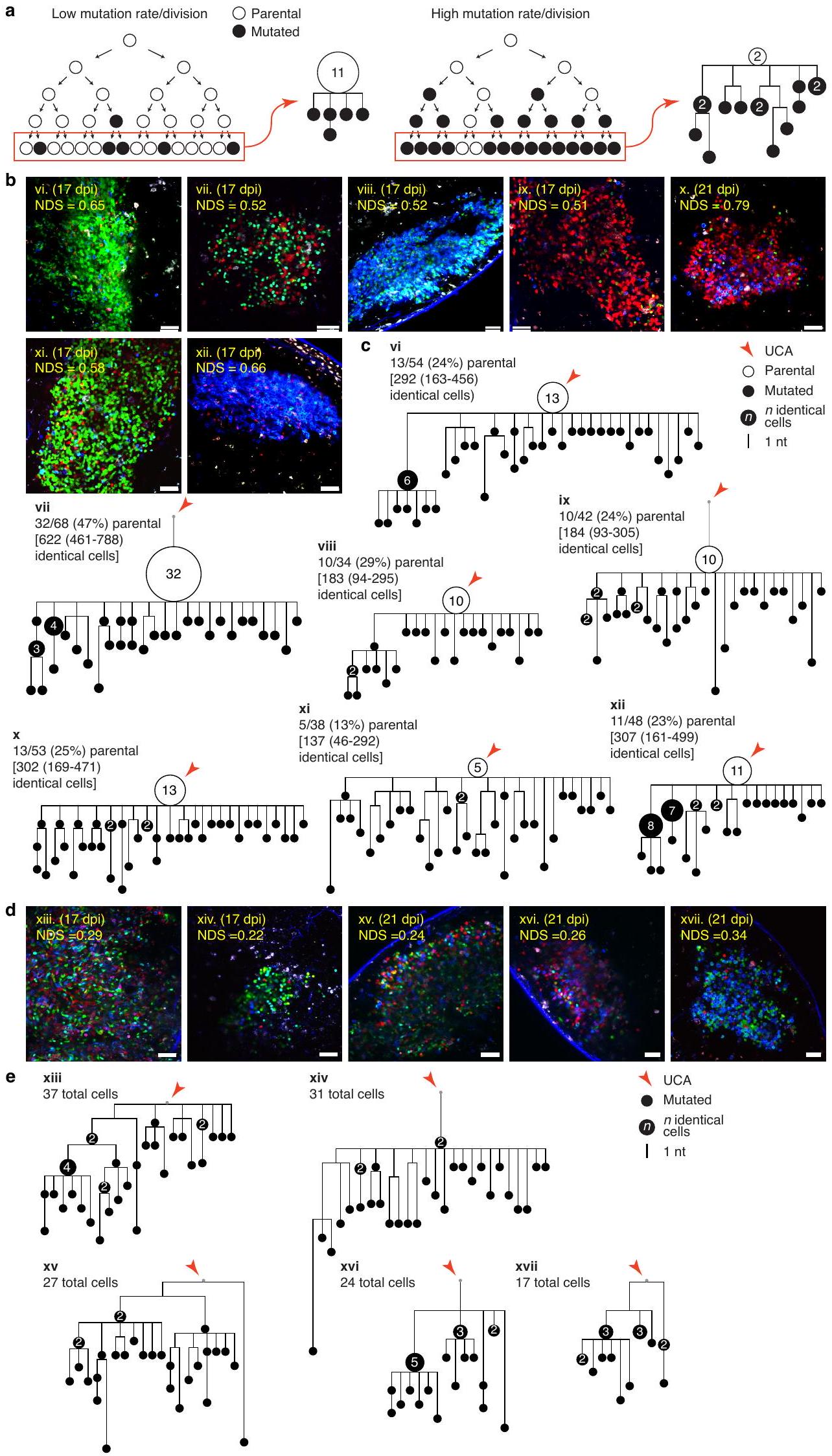
الشكل 1 من البيانات الموسعة | انظر الصفحة التالية للتعليق.

مقالة

الشكل البياني الموسع 1 | النشوء والتطور لـ استنساخ الخلايا من خلايا GCs المتفجرة وغير المتفجرة. أ، توضيح لأشجار النسب لخلايا GCB بافتراض معدلات SHM عالية أو منخفضة وتحويلها إلى هياكل شجرية تطورية. تولد المعدلات المنخفضة عقدًا “أبوية” أكبر تحتوي على تسلسلات متطابقة متعددة. ب، صور متعددة الفوتونات لخلايا GCs أحادية اللون إضافية تشير إلى الانفجار النسلي، تم مسحها عند 17 أو 21 يومًا بعد الحقن (10-14 يومًا بعد الجرعة النهائية من التاموكسيفين). انظر أيضًا البيانات التكميلية 1 للحسابات. NDS، درجة الهيمنة المنضبطة، تمثل الكسر التقريبي للخلايا في GC التي تنتمي إلى اللون السائد، المنضبط بكثافة الخلايا الفلورية. مقياس .
تم استخدام تسلسلات Ighv المستخرجة من GCs في لبناء شجرة النشوء والتطور
الأشجار. لكل GC، نسبة الخلايا الأبوية والعدد الإجمالي المقدر للخلايا المتطابقة في الانفجار عند استقراءه إلى GC مكون من 2000 خلية (بين قوسين) موضح. د، صور متعددة الفوتونات لـ GCs متعددة الألوان تشير إلى تنوع أعلى في سلالة خلايا B تم مسحها عند 17 أو 21 dpi (10 أو 14 يومًا بعد الجرعة النهائية من التاموكسيفين)، التفاصيل كما في مقياس . أشجار النشوء والتطور كما في (ج)، ولكن لم يتم الإشارة إلى النسخ الأبوية، نظرًا لأنها غير محددة في السلالات غير المتفجرة. تم الحصول على GC xiii. من نفس العقدة اللمفاوية مثل GCi. (الشكل 1أ) والسلالة السائدة المعروضة هي توسع لنفسها. استنساخ الخلية (نفس) ، و الطول) الذي تم توسيعه في GCi. (الشكل 1ب).
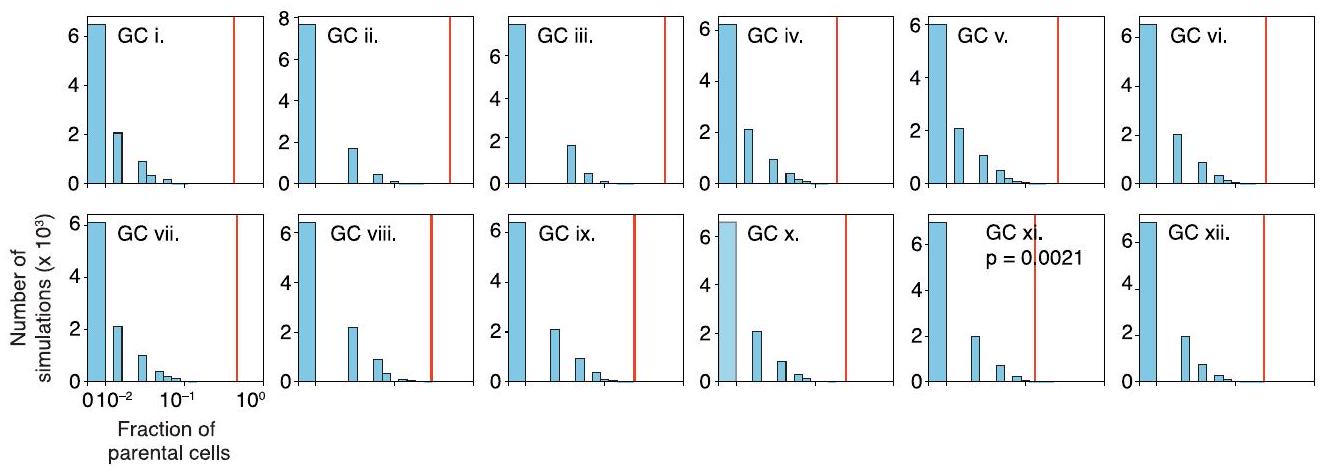
البيانات الموسعة الشكل 2 | محاكاة Brainbow GC. أ، النسب الأبوية الملحوظة لكل من 12 GC في الشكل 1a، b والبيانات الموسعة الشكل 1b، c (الخطوط الحمراء) مقارنة بتوزيع نتائج 10,000 محاكاة لعمليات التفرع النسلي المطابقة لعدد الخلايا المتوقعة في GC التجريبي (الأعمدة الزرقاء). يتم حساب قيم P كنسبة من المحاكاة التي تحتوي على نسب أبوية عند أو فوق القيمة الملحوظة، وهي <0.0001 ما لم يُذكر خلاف ذلك. ب، مثال على مسح معلمة معدل SHM. تظهر الرسوم البيانية نتائج المحاكاة التكرارية لـ GC i. (الشكل 1b) حيث يتم تقليل معدل SHM هندسياً من 0.333 إلى 0.033. يتم إعطاء معدل SHM المحدد لكل مجموعة من المحاكاة أعلاه الرسم البياني. عدد المحاكاة التي تم تشغيلها لكل صف ينخفض هندسياً من 10,000 لـ 0.333 إلى 1,000 لـ
محاكاة 0.033، الأولى منها مستنسخة من الشكل 1c. تُعطى قيم P كنسبة من المحاكاة التي تتجاوز النسبة الأبوية لـ GC المرصود (الموضح كخط أحمر منقط). تُظهر القيم الوسيطة لمجموعة المحاكاة كخط أزرق. المحاكاة التي تقترب قيمتها الوسيطة أكثر من القيمة المرصودة لذلك GC مميزة باللون الأحمر. ج، النسب الأبوية الوسيطة (± نطاق الربيع الرباعي) لعمليات المسح المعلمية كما في ب لمجموعة الـ 12-GC الكاملة في الشكل 1a، b والشكل البياني الممتد 1b، c. تم استنساخ الرسم البياني لـ GC i. من الشكل 1e. تُظهر النسبة الأبوية لـ GC المرصود كخط أحمر. الأرقام تشير إلى معدل SHM المحاكى مع النسبة الأبوية الأقرب إلى ما تم ملاحظته لكل GC.
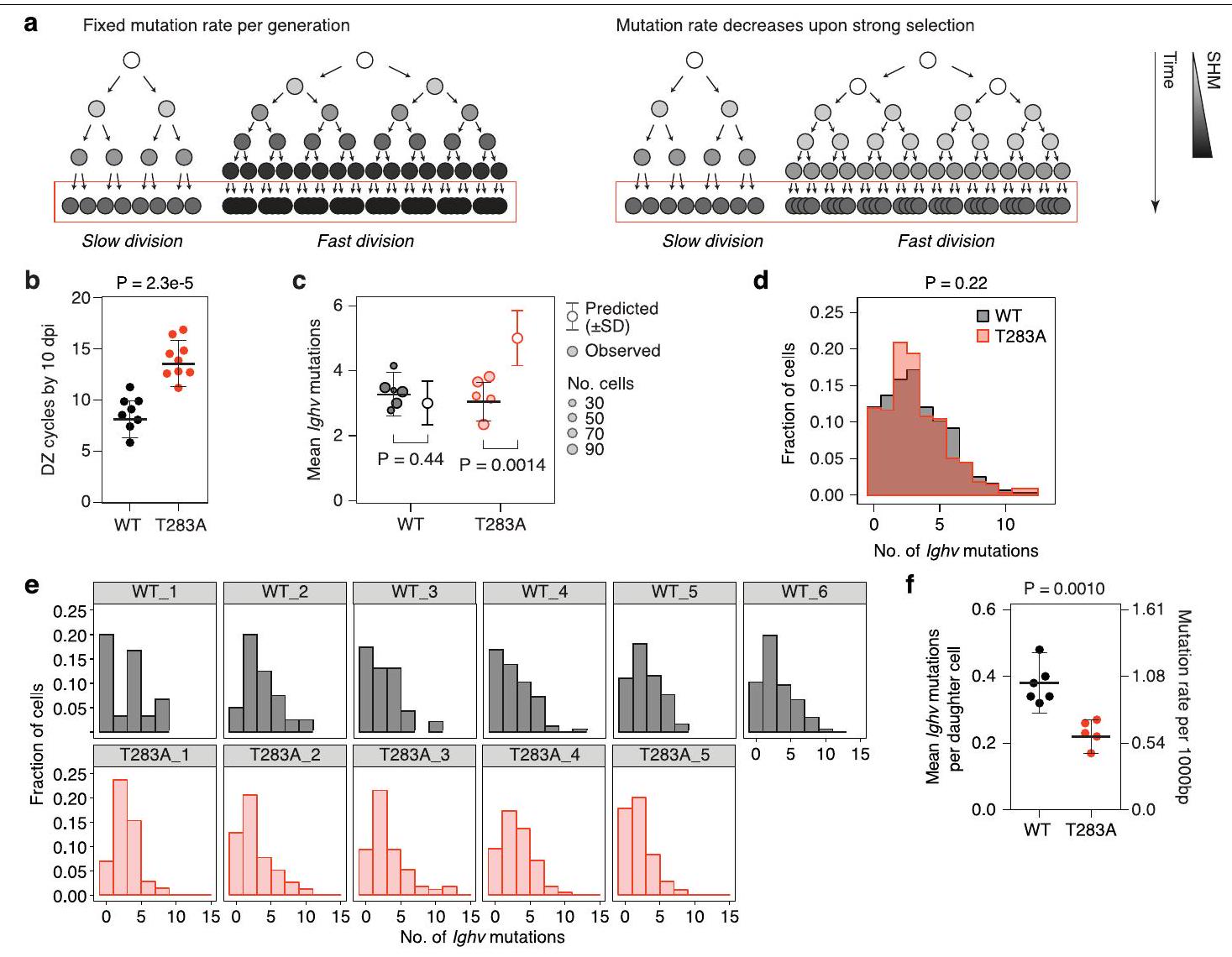
الشكل البياني الممتد 3 | معدل التحول النمائي ينخفض خلال دورة الخلايا الحركية في Ccnd3 خلايا B GC. أ، تمثيل تخطيطي لزيادة SHM مع مرور الوقت

ودورات الانقسام في نماذج معدل الحركة التوافقية الثابتة (اليسار) مقابل الديناميكية (اليمين). ب، العدد المتوقع للانقسامات الحركية غير المتجانسة بحلول 10 أيام بعد الإصابة، استنادًا إلى البيانات المبلغ عنها سابقًا حول الخلايا التي تدخل مرحلة S داخل المنطقة غير المتجانسة لـ (WT) و خلايا B GC (T283A) . كل رمز يمثل فأرًا واحدًا من تجربتين مستقلتين. المتوسط المتوقع مُوزون بعكس التباين والانحراف المعياري يأخذ في الاعتبار التباينات داخل الفئران الفردية. قيم P هي لاختبار t لستودنت. ج، متوسط عدد الطفرات لكل منطقة Ighv لفئران WT وT283A، مقارنة بالأعداد المتوقعة بافتراض معدل تقسيم موحد قدره 1 في قواعد لكل خلية ابنة. تم الحصول على القيم المتوقعة كما هو موضح في
قسم الطرق. كل رمز يمثل فأرًا واحدًا من تجربتين مستقلتين. حجم الرمز يمثل عدد الخلايا التي تم تسلسلها وتحليلها من كل فأر. المتوسط المتوقع مُوزون بالعكس للانحرافات المعيارية ويأخذ في الاعتبار التباينات داخل الفئران الفردية. قيم P هي لاختبار t لستودنت. د، توزيع الطفرات في خلايا WT وT283A المجمعة من ج. قيم P هي لاختبار t لستودنت. هـ، توزيع الطفرات في خلايا B GC من WT الفردي وCcnd3. خلايا B GC. ف، معدل SHM المستنتج لكل فأر كما في ج. كل نقطة تمثل فأراً واحداً، وتم حساب المتوسط والانحراف المعياري الموزون بالعكس لتباين القيم داخل الفئران الفردية. قيم P هي لاختبار t لستودنت.
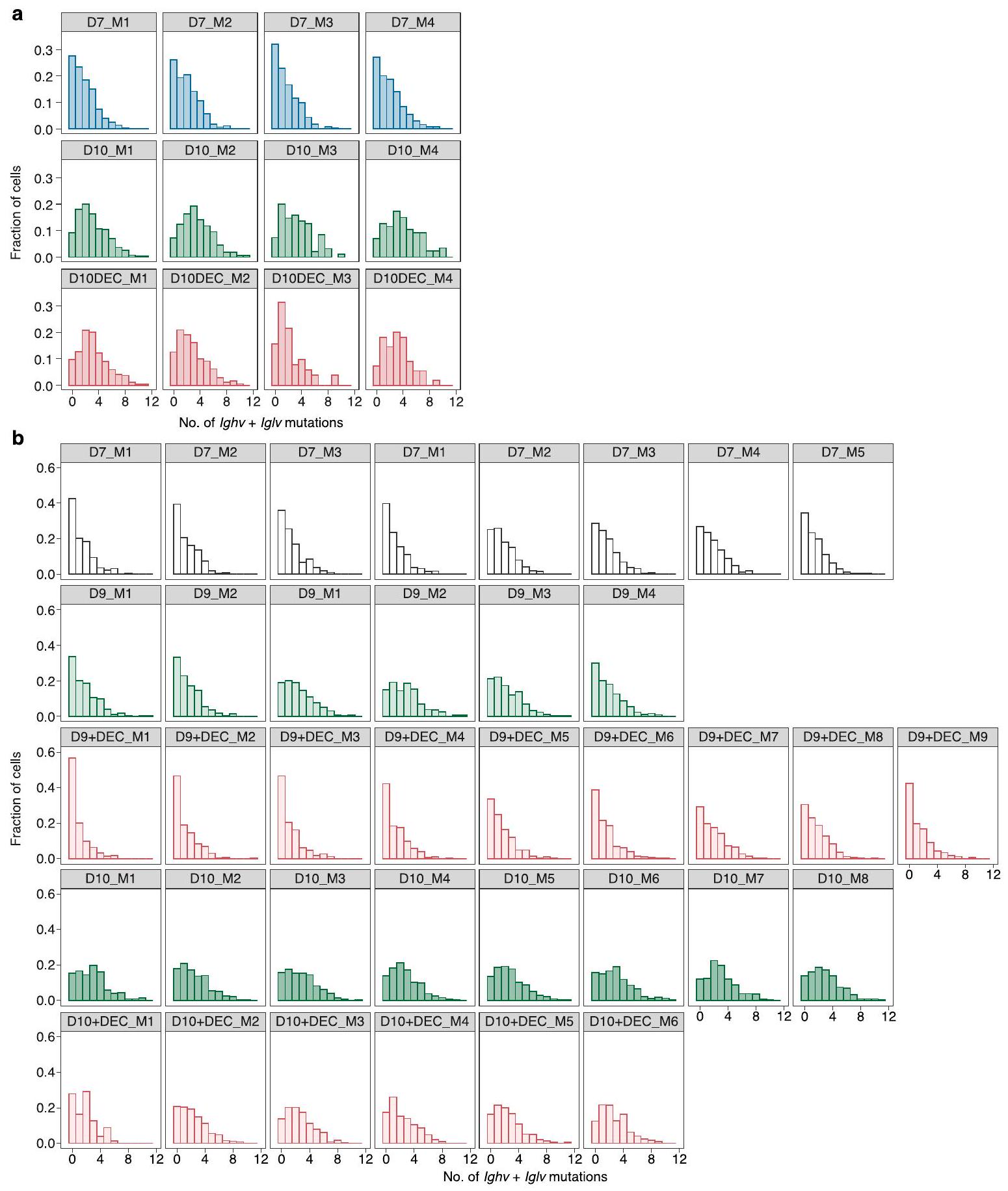
الشكل 4 من البيانات الموسعة | بيانات عدد الطفرات مقسمة حسب الفأر.

توزيع الطفرات في خلايا B GC من فئران فردية عند غير المعالج، و10 dpi المعالج ضد DEC-OVA DEC-205 و DEC-205 خلايا B GC كما هو موضح في الشكل 2a-d. البيانات المجمعة موضحة في الشكل 2e.b، التوزيع
طفرة في DEC- خلايا من فئران فردية بعد 0 و48 و72 ساعة من العلاج بـ anti-DEC-OVA، بالإضافة إلى الضوابط غير المعالجة المقابلة. البيانات المجمعة موضحة في الشكل 2j.
الشكل التمديدي 5| التعبير الجيني في خلايا B الدائرية بشكل غير نشط. تم تحليل خلايا GC B المعالجة بمضاد DEC-OVA وخلية التحكم من حيث الحمل الطفراتي في الشكل 2g-j وتمت ملامحها للتعبير عن الجينات المشاركة في SHM. أ، تعبير Aicda وجينات إصلاح الحمض النووي اللاحقة في خلايا GC B قبل العلاج وبعد 48 و72 ساعة من العلاج. يتم إعطاء قيم P للمقارنة بين الخلايا المعالجة بعد 48 ساعة من مضاد DEC-OVA (غير نشطة في SHM) و72 ساعة بعد مضاد DEC-OVA (تتحور بنشاط). كل رمز يمثل متوسط قيمة التعبير لواحد خلايا من فأر واحد. البيانات من تجربتين مستقلتين. تعبير Ung وApex1 وApex2 وNeil1 وNeil3 وXrcc4 (المعنية بإصلاح القواعد المفقودة)؛ و (مطلوب لإصلاح عدم التطابق)؛ وكانت بوليميراز Polh و Hmces و Fam72a (المعنية بمعالجة الأخطاء الناتجة عن إصابات AID) ليست أقل عند 48 ساعة. ب، تم تحليل تعبير تقرير اندماج AID-GFP بواسطة قياس التدفق في أوقات مختلفة بعد مضاد DEC-OVA.
العلاج. يسار، هيستوجرامات تمثيلية؛ يمين، قياس 2-4 عينات لكل نقطة زمنية. كل رمز يمثل فأراً واحداً. ج، الكشف عن mRNA Vh1-72 (الذي يشفر السلسلة الثقيلة لبروتين B1-8 مستقبل الخلية) و RNA الداخلي الموجود بعد جميع مقاطع Ighj (إنترون Jh4، مما يدل على النسخ النشط لـ Igh) في خلايا B في مركز الجريبات قبل و48 و72 ساعة بعد علاج anti-DECOVA. كل رمز يمثل متوسط قيمة التعبير لواحد خلايا من فأر واحد. البيانات من تجربتين مستقلتين. د، تعيينات دورة الخلية المستندة إلى تعبير الجينات لخلايا GCB من كل نقطة زمنية (البيانات كما في تُجمع الخلايا من فئران من تجربتين مستقلتين كما في (أ، ج). يتم تعيين فئات دورة الخلية باستخدام دالة CellCycleScoring في Seurat. يتم تعريف خلايا GO/G1 على أنها تلك التي تفتقر إلى تعبير نسخ مرحلة S ونسخ مرحلة G2/M.
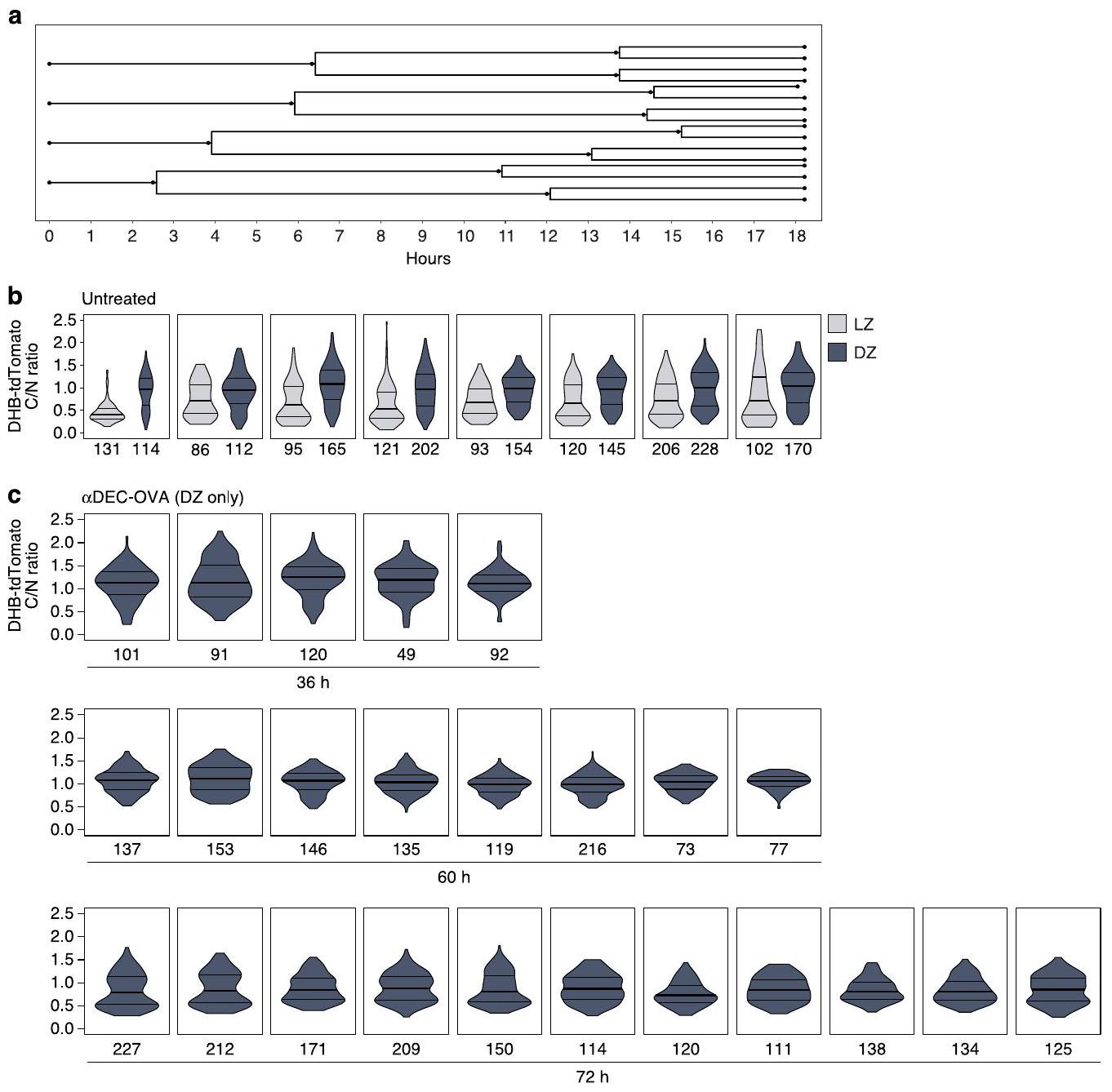
الشكل 6 من البيانات الموسعة | قياس نشاط CDK2 في خلايا GC B التي تدور بشكل غير نشط. أ، تتبع السلالة للخلايا التي تخضع للانقسام في ثقافات نوجيما. يمثل كل خط خلية واحدة. تمثل التفرعات انقسامات الخلايا. ب، مخططات كمان لنسبة DHB-tdTomato C/N في خلايا B من LZ أو DZ داخل GCs غير المعالجة، مقسمة حسب GC الفردي وعرضها مع الوسيط والمدى الربعي.
تم تحديد عدد الخلايا لكل GC أدناه لكل كمان. البيانات المجمعة موضحة في الشكل 3j. ج، مخططات كمان لنسبة C/N لـ DHB-tdTomato في خلايا B من DZ داخل GCs بعد 36 أو 60 أو 72 ساعة من علاج anti-DEC-OVA، مقسمة حسب GC الفردي ومعروضة مع الوسيط ونطاق الربع. يتم الإشارة إلى عدد الخلايا التي تم تسلسلها أدناه لكل كمان. البيانات المجمعة موضحة في الشكل 3j.
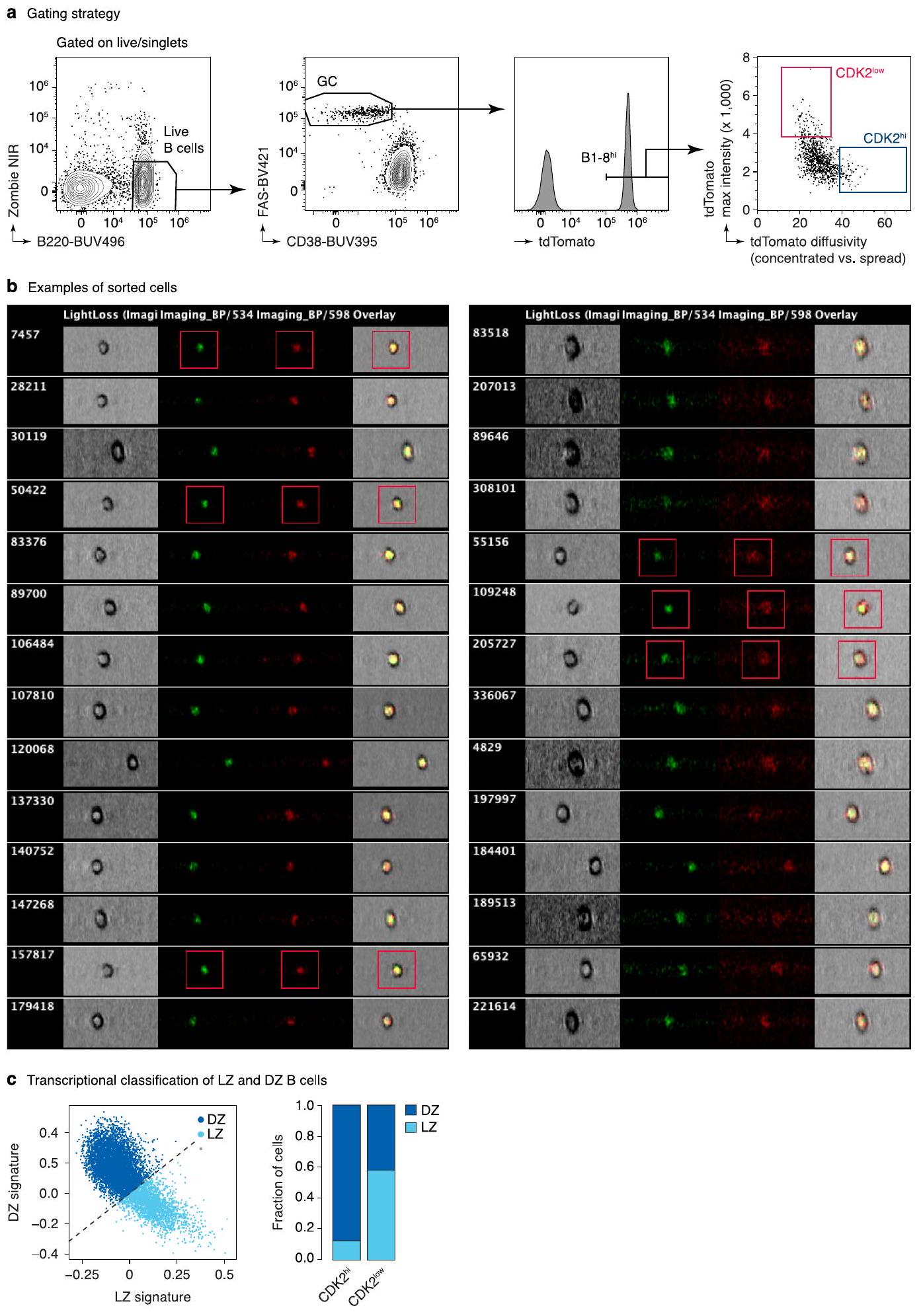
الشكل 7 من البيانات الموسعة | فرز الخلايا المستند إلى الصورة لخلايا B GC من خلال توطين تقرير CDK2. أ، استراتيجية التصفية المستخدمة لفرز الخلايا التي تحتوي على تقرير CDK2 النووي مقابل السيتوبلازمي. تم إعادة إنتاج اللوحة النهائية في الشكل 4أ. ب، إضافي
أمثلة على صور CDK2 المرتبة و CDK2 خلايا GCB. المربعات الحمراء تبرز الصور المقتطعة المعروضة في الشكل 4a.c، مخطط التشتت المستخدم لتصنيف الخلايا كـ DZ أو LZ باستخدام التوقيعات الموصوفة سابقًا. .
الجدول البياني الموسع 1 | الأجسام المضادة المستخدمة في تحليل تدفق الخلايا
أجسام مضادة استنساخ فلوروفور التخفيف النهائي شركة رقم الكتالوج
B220 RA3-6B2 BV785 1:400 بيوليجند ١٠٣٢٤٦
TCRب H57-597 APC-Cy7 1:400 إنفيتروجين ٤٧-٥٩٦١-٨٢
CD38 90/CD38 PerCP-Cy5.5 1:400 بي دي بيوساينس 17-0381-82
فاس/CD95 جو2 PE/Cy7 1:800 بي دي بيوساينس 557653
فاس/CD95 جو2 بي في 421 1:800 بي دي بيوساينس 562633
جي إل 7 GL7 أليكسا فلور 647 1:400 بي دي بيوساينس 561529
CXCR4 2B11 التربية البدنية 1:100 إنفيتروجين 12-9991-82
CD86 جي إل-1 AF488 1:400 بيوليجند ١٠٥٠١٨
CD45.1 A20 BUV395 1:400 بي دي بيوساينس 565212
CD45.2 ١٠٤ APC 1:400 بيوليجند ١٠٩٨١٤

محفظة الطبيعة

المؤلف (المؤلفون) المراسلون:
آخر تحديث بواسطة المؤلف(ين): 19/11/2024

ملخص التقرير

تسعى Nature Portfolio إلى تحسين إمكانية تكرار العمل الذي ننشره. يوفر هذا النموذج هيكلًا للاتساق والشفافية في التقرير. لمزيد من المعلومات حول سياسات Nature Portfolio، يرجى الاطلاع على سياسات التحرير وقائمة مراجعة سياسة التحرير.

الإحصائيات

لجميع التحليلات الإحصائية، تأكد من أن العناصر التالية موجودة في أسطورة الشكل، أسطورة الجدول، النص الرئيسي، أو قسم الطرق.
غير متوفر

حجم العينة بالضبط لكل مجموعة/شرط تجريبي، معطاة كرقم منفصل ووحدة قياس

بيان حول ما إذا كانت القياسات قد أُخذت من عينات متميزة أو ما إذا كانت نفس العينة قد تم قياسها عدة مرات
اختبار(ات) الإحصاء المستخدمة وما إذا كانت أحادية الجانب أو ثنائية الجانب
يجب أن تُوصف الاختبارات الشائعة فقط بالاسم؛ وصف التقنيات الأكثر تعقيدًا في قسم الطرق.

وصف لجميع المتغيرات المشتركة التي تم اختبارها

وصف لأي افتراضات أو تصحيحات، مثل اختبارات الطبيعية والتعديل للمقارنات المتعددة

وصف كامل للمعلمات الإحصائية بما في ذلك الاتجاه المركزي (مثل المتوسطات) أو تقديرات أساسية أخرى (مثل معامل الانحدار) و التباين (مثل الانحراف المعياري) أو تقديرات مرتبطة بعدم اليقين (مثل فترات الثقة)

لاختبار الفرضية الصفرية، يتم استخدام إحصائية الاختبار (مثل F، t، r) مع فترات الثقة، أحجام التأثير، درجات الحرية و قيمة ملحوظة أعطِ القيم كقيم دقيقة كلما كان ذلك مناسبًا.

□ لتحليل بايزي، معلومات حول اختيار القيم الأولية وإعدادات سلسلة ماركوف مونت كارلو

□ لتصميمات هرمية ومعقدة، تحديد المستوى المناسب للاختبارات والتقارير الكاملة عن النتائج
□ تقديرات أحجام التأثير (مثل حجم تأثير كوهين) مؤشر بيرسون (r)، مما يدل على كيفية حسابها
تحتوي مجموعتنا على الإنترنت حول الإحصائيات لعلماء الأحياء على مقالات تتناول العديد من النقاط المذكورة أعلاه.
تم التأكيد

اختبار(ات) الإحصاء المستخدمة وما إذا كانت أحادية الجانب أو ثنائية الجانب
وصف لجميع المتغيرات المشتركة التي تم اختبارها

الهزيمة

ل،
تحتوي مجموعة الويب الخاصة بنا حول الإحصائيات لعلماء الأحياء على مقالات حول العديد من النقاط المذكورة أعلاه.

البرمجيات والشيفرة

معلومات السياسة حول توفر كود الكمبيوتر
جمع البيانات
لم يتم استخدام كود جمع البيانات في هذه الدراسة
تحليل البيانات
تم رسم الرسوم البيانية باستخدام R (الإصدار 4.3.1)، وتم تنسيقها في Adobe Illustrator CS. تم إجراء الاختبارات الإحصائية في R (الإصدار 4.3.1). تم تحليل بيانات تدفق الخلايا باستخدام FlowJo الإصدار 10. استخدمت التحليلات الحاسوبية لبيانات تسلسل RNA على مستوى الخلية الواحدة CellRanger الإصدار 6.0.1، 7.0.1، و8.0.1؛ وR الإصدار 4.3.1. الكود الذي ينفذ محاكاة عمليات ولادة-موت الانفجارات النسيلية المستخدمة في الشكل 1 متاح فيhttps://github.com/WSDeWitt/aid-sim. تم تقديم الوصف الكامل لنموذج محاكاة GC القائم على الوكلاء المستخدم في الشكل 4 في النص التكميلي. تم إجراء تحليل تسلسل Igh باستخدام PANDASeq v.2.11 و HighVQUEST v. 1.6.9 و GCtree (deWitt et. al. 2018).
بالنسبة للمخطوطات التي تستخدم خوارزميات أو برامج مخصصة تكون مركزية في البحث ولكن لم يتم وصفها بعد في الأدبيات المنشورة، يجب أن تكون البرمجيات متاحة للمحررين والمراجعين. نحن نشجع بشدة على إيداع الشيفرة في مستودع مجتمعي (مثل GitHub). راجع إرشادات مجموعة Nature لتقديم الشيفرة والبرمجيات لمزيد من المعلومات.

بيانات

معلومات السياسة حول توفر البيانات

يجب أن تتضمن جميع المخطوطات بيانًا حول توفر البيانات. يجب أن يتضمن هذا البيان المعلومات التالية، حيثما ينطبق:
  • رموز الانضمام، معرفات فريدة، أو روابط ويب لمجموعات البيانات المتاحة للجمهور
  • وصف لأي قيود على توفر البيانات
  • بالنسبة لمجموعات البيانات السريرية أو بيانات الطرف الثالث، يرجى التأكد من أن البيان يتماشى مع سياستنا
ستكون جميع بيانات تسلسل الأجسام المضادة الأولية التي تم إنتاجها لهذه الدراسة متاحة بسرعة للمجتمع عند النشر

البحث الذي يتضمن مشاركين بشريين، بياناتهم، أو مواد بيولوجية

معلومات السياسة حول الدراسات التي تشمل مشاركين بشريين أو بيانات بشرية. انظر أيضًا معلومات السياسة حول الجنس، الهوية/التقديم الجنسي، والتوجه الجنسي والعرق، والعرقية والعنصرية.
التقارير عن الجنس والنوع الاجتماعي غير متوفر
التقارير عن العرق أو الإثنية أو غيرها من المجموعات الاجتماعية ذات الصلة غير متوفر
خصائص السكان غير متوفر
التوظيف غير متوفر
رقابة الأخلاقيات غير متوفر
يرجى ملاحظة أنه يجب أيضًا تقديم معلومات كاملة حول الموافقة على بروتوكول الدراسة في المخطوطة.

التقارير المتخصصة في المجال

يرجى اختيار الخيار أدناه الذي يناسب بحثك بشكل أفضل. إذا لم تكن متأكدًا، اقرأ الأقسام المناسبة قبل اتخاذ قرارك.
علوم الحياة
العلوم السلوكية والاجتماعية
العلوم البيئية والتطورية والبيئية
لنسخة مرجعية من الوثيقة بجميع الأقسام، انظرnature.com/documents/nr-reporting-summary-flat.pdf

تصميم دراسة علوم الحياة

يجب على جميع الدراسات الإفصاح عن هذه النقاط حتى عندما يكون الإفصاح سلبياً.
حجم العينة لم تُستخدم أي طرق إحصائية لتحديد حجم العينة. كانت أعداد الفئران لكل مجموعة ضمن كل تجربة مستقلة محدودة بالأعداد المستخدمة عادة في هذا المجال. تم إجراء تجربة خط الخلايا مرتين مع تكرارات فنية ثلاثية، كما هو المعتاد في مثل هذه الاختبارات.
استبعاد البيانات بالنسبة للبيانات المعروضة في الشكل 4، تم جمع عينة بحجم GC صغير ولكن تم استبعادها من التحليل.
استنساخ تم إجراء التجارب عدة مرات بشكل مستقل، كما هو موضح في أساطير الأشكال.
التوزيع العشوائي تم استخدام فئران من نفس القمامة للتحكم في تأثيرات القمامة والقفص والعمر. تم تقسيم الفئران بشكل عشوائي (على الرغم من عدم وجود إجراء عشوائي محدد) بين المجموعات التجريبية.
عمى لم يكن الباحثون معزولين عن المجموعة التجريبية، حيث أن معظم القراءات (مثل شدة الفلورسنت في FACS) ليست ذات طابع شخصي.

التقارير عن مواد وأنظمة وطرق محددة

نحتاج إلى معلومات من المؤلفين حول بعض أنواع المواد والأنظمة التجريبية والأساليب المستخدمة في العديد من الدراسات. هنا، يرجى الإشارة إلى ما إذا كانت كل مادة أو نظام أو طريقة مدرجة ذات صلة بدراستك. إذا لم تكن متأكدًا مما إذا كان عنصر القائمة ينطبق على بحثك، يرجى قراءة القسم المناسب قبل اختيار رد.
المواد والأنظمة التجريبية
غير متوفر
مشارك في الدراسة
  • الأجسام المضادة
خطوط خلايا حقيقية النواة
□ علم الحفريات وعلم الآثار
الحيوانات وغيرها من الكائنات الحية
□ البيانات السريرية
□ البحث الثنائي الاستخدام الذي يثير القلق
□ نباتات
مشارك في الدراسة
□ تسلسل ChIP
□ قياس التدفق الخلوي
□ التصوير العصبي القائم على الرنين المغناطيسي

الأجسام المضادة

الأجسام المضادة المستخدمة انظر الجدول البياني الموسع 1.
التحقق جميع الأجسام المضادة تم التحقق منها على مواقع الشركات المصنعة.
خطوط خلايا حقيقية النواة
معلومات السياسة حول خطوط الخلايا والجنس والنوع في البحث
مصدر(s) خط الخلايا تم توفير خلايا التغذية NB-21.2D9 بواسطة ج. كيلسوي (جامعة ديوك)
المصادقة تم استخدام خطوط الخلايا فقط لغرض الحفاظ على خلايا B المناعية في الثقافة، والتي تم تأكيد نجاحها وفقًا للبيانات التجريبية. لم يتم إجراء أي مصادقة إضافية بخلاف ما تم توفيره من المصدر الأصلي.
تلوث الميكوبلازما لم يتم اختبار خطوط الخلايا بعد استلامها من المصدر الأصلي ولكن تم استخدامها بأعداد تمرير منخفضة. مقاطع).
الخطوط التي يتم التعرف عليها بشكل خاطئ بشكل شائع (انظر سجل ICLAC) لم يتم استخدام خطوط خلوية يتم التعرف عليها بشكل خاطئ بشكل شائع.

الحيوانات وغيرها من الكائنات البحثية

معلومات السياسة حول الدراسات التي تشمل الحيوانات؛ إرشادات ARRIVE الموصى بها للإبلاغ عن أبحاث الحيوانات، والجنس والنوع في البحث
الحيوانات المخبرية تم استخدام ذكور وإناث الفئران البالغة التي تتراوح أعمارها بين 5-12 أسبوعًا من سلالة C57BL/6J. انظر قسم ‘الفئران’ في الطرق لمزيد من التفاصيل. تم إيواء الفئران في و الرطوبة في دورة ضوء/ظلام مع الوصول الحر إلى الطعام والماء.
الحيوانات البرية لم تتضمن الدراسة حيوانات برية.
التقارير عن الجنس تم استخدام كلا الجنسين من الفئران طوال الدراسة. لم تُلاحظ أي اختلافات ملحوظة بين الجنسين.
عينات تم جمعها من الميدان لم تتضمن الدراسة عينات تم جمعها من الميدان.
رقابة الأخلاقيات تمت الموافقة على جميع البروتوكولات من قبل لجان رعاية واستخدام الحيوانات في جامعة روكفلر (رقم البروتوكول 22058-H).
يرجى ملاحظة أنه يجب أيضًا تقديم معلومات كاملة حول الموافقة على بروتوكول الدراسة في المخطوطة.

النباتات

مخزونات البذور تقرير عن مصدر جميع مخزونات البذور أو المواد النباتية الأخرى المستخدمة. إذا كان ذلك مناسبًا، يرجى ذكر مركز مخزون البذور ورقم الفهرس. إذا تم جمع عينات نباتية من الحقل، يرجى وصف موقع الجمع، التاريخ وإجراءات أخذ العينات.
أنماط جينية نباتية جديدة وصف الطرق التي تم من خلالها إنتاج جميع الأنماط الجينية النباتية الجديدة. يشمل ذلك تلك التي تم إنشاؤها من خلال الأساليب الجينية المتحولة، وتحرير الجينات، والطفرات المعتمدة على المواد الكيميائية/الإشعاع، والتهجين. بالنسبة لخطوط الجينات المتحولة، وصف طريقة التحويل، وعدد الخطوط المستقلة التي تم تحليلها، والجيل الذي أجريت عليه التجارب. بالنسبة لخطوط تحرير الجينات، وصف المحرر المستخدم، والتسلسل الداخلي المستهدف للتحرير، وتسلسل RNA الدليل المستهدف (إذا كان ذلك مناسبًا) وكيفية عمل المحرر.
المصادقة
تم التقدير.
وصف أي إجراءات تحقق لكل مخزون بذور مستخدم أو جينوتيب جديد تم إنشاؤه. وصف أي تجارب تم استخدامها لتقييم تأثير الطفرة، وحيثما ينطبق، كيف تم فحص التأثيرات الثانوية المحتملة (مثل إدخالات T-DNA في موقع ثانٍ، التباين، تحرير الجينات خارج الهدف).

المؤامرات

أكد أن:
توضح تسميات المحاور العلامة والفلوركروم المستخدم (مثل CD4-FITC).
المقاييس على المحاور واضحة تمامًا. قم بتضمين الأرقام على المحاور فقط للرسم البياني في أسفل اليسار من المجموعة (المجموعة هي تحليل للعلامات المتطابقة).
جميع الرسوم البيانية هي رسوم بيانية متساوية الارتفاع مع نقاط شاذة أو رسوم بيانية بالألوان الزائفة.
تم توفير قيمة عددية لعدد الخلايا أو النسبة المئوية (مع الإحصائيات).

المنهجية

تحضير العينة تم عزل الخلايا من العقد اللمفاوية عن طريق الطحن باستخدام مدقات ميكروية disposable (Axygen) في من PBS المضاف إليه BSA و 2 مللي مول من EDTA (PBE)، وSuspensions خلايا مفردة تم الحصول عليها من خلال تمريرتين عبر شبكة. تم صبغ الخلايا بأجسام مضادة موسومة بالفلوريسنت على الثلج لمدة 30 دقيقة. انظر الطرق لمزيد من التفاصيل.
آلة BD FACSSymphony A5 لقياس التدفق الخلوي، BD FACSymphony S6 لفرز الخلايا، BD FACSDiscover S8 للفرز القائم على الصور
برمجيات برنامج FlowJo الإصدار 10
وفرة تجمع الخلايا تم إجراء فرز الخلايا لتسلسل RNA أحادي الخلية باستخدام كروميم. تم تأكيد وفرة مجموعة الخلايا من خلال قياس أوليغو الوسم المستخدم لتحديد عينات وأنواع خلايا مختلفة.
استراتيجية البوابة تم تحديد جميع السكان الإيجابيين والسالبين من خلال التعويض مع ضوابط أحادية اللون. من أجل الفرز والتحليل، تم أولاً تحديد جميع اللمفاويات بناءً على SSC-A مقابل FSC-A، تليها بوابتين أحاديتين (FSC-H مقابل FSC-A و SSC-H مقابل SSC-A). بالنسبة لبوابة GC، تم تحديد الخلايا على أنها B220+، TCRb-، CD38-، وFas+. استراتيجية البوابة لفرز الخلايا المعتمد على الصور موضحة في الشكل 6a من البيانات الموسعة.
قم بتحديد هذا المربع لتأكيد أنه تم تقديم رقم يوضح استراتيجية البوابة في المعلومات التكميلية.

  1. مختبر ديناميات اللمفاويات، جامعة روكفلر، نيويورك، نيويورك، الولايات المتحدة الأمريكية. قسم المناعة النظامية، مركز هيلمهولتز لأبحاث العدوى، براونشفايغ، ألمانيا.
    مركز الدراسات في الفيزياء وعلم الأحياء، جامعة روكفلر، نيويورك، نيويورك، الولايات المتحدة الأمريكية. قسم علوم الجينوم، جامعة واشنطن، سياتل، واشنطن، الولايات المتحدة الأمريكية. معهد هوارد هيوز الطبي، نيويورك، نيويورك، الولايات المتحدة الأمريكية. برنامج البيولوجيا الحاسوبية، مركز فريد هاتشينسون لأبحاث السرطان، سياتل، واشنطن، الولايات المتحدة الأمريكية. معهد هوارد هيوز الطبي، سياتل، واشنطن، الولايات المتحدة الأمريكية.
    قسم الإحصاءات، جامعة واشنطن، سياتل، واشنطن، الولايات المتحدة الأمريكية. مركز ساكسونيا السفلى للذكاء الاصطناعي والأساليب السببية في الطب (CAIMed)، هانوفر، ألمانيا.
    ساهم هؤلاء المؤلفون بالتساوي: نيكلاس شوان، برتراند أوتينو-لوفلر، ويليام س. ديويت، أمار غارغ. البريد الإلكتروني: victora@rockefeller.edu

Journal: Nature, Volume: 641, Issue: 8062
DOI: https://doi.org/10.1038/s41586-025-08687-8
PMID: https://pubmed.ncbi.nlm.nih.gov/40108454
Publication Date: 2025-03-19

Transient silencing of hypermutation preserves B cell affinity during clonal bursting

https://doi.org/10.1038/s41586-025-08687-8
Received: 15 April 2024
Accepted: 22 January 2025
Published online: 19 March 2025
Open access

Juhee Pae , Niklas Schwan , Bertrand Ottino-Loffler , William S. DeWitt , Amar Garg , Juliana Bortolatto , Ashni A. Vora , Jin-Jie Shen , Alvaro Hobbs , Tiago B. R. Castro , Luka Mesin , Frederick A. Matsen IV , Michael Meyer-Hermann & Gabriel D. Victora

Abstract

In the course of antibody affinity maturation, germinal centre (GC) B cells mutate their immunoglobulin heavy- and light-chain genes in a process known as somatic hypermutation (SHM) . Panels of mutant cells with different binding affinities for antigens are then selected in a Darwinian manner, which leads to a progressive increase in affinity among the population . As with any Darwinian process, rare gain-of-fitness mutations must be identified and common loss-of-fitness mutations avoided . Progressive acquisition of mutations therefore poses a risk during large proliferative bursts , when GC B cells undergo several cell cycles in the absence of affinity-based selection . Using a combination of in vivo mouse experiments and mathematical modelling, here we show that GCs achieve this balance by strongly suppressing SHM during clonal-burst-type expansion, so that a large fraction of the progeny generated by these bursts does not deviate from their ancestral genotype. Intravital imaging and image-based cell sorting of a mouse strain carrying a reporter of cyclin-dependent kinase 2(CDK2) activity showed that B cells that are actively undergoing proliferative bursts lack the transient CDK2 GO-like’ phase of the cell cycle in which SHM takes place. We propose a model in which inertially cycling B cells mostly delay SHM until the GO-like phase that follows their final round of division in the GC dark zone, thus maintaining affinity as they clonally expand in the absence of selection.

The average rate at which germinal centre (GC) B cells accumulate mutations in their immunoglobulin (Ig) loci is estimated to be one per 1,000 bases per cell generation , corresponding to about a two-thirds chance of acquiring at least one mutation per daughter cell when considering the roughly 700-bp length of the combined Ig heavy-chain (Ighv) and light-chain (Igkv or Iglv) variable regions. Because deleterious mutations-resulting in stop codons or reductions in antibody affinity or structural integrity-in general greatly outnumber affinity-enhancing mutations , a crucial challenge for the GC is to identify multiple beneficial mutations while avoiding most, if not all, deleterious ones. Early mathematical models of GC mutation and selection proposed that a solution to this problem would be for cells to alternate phases of stochastic somatic hypermutation (SHM) and antigen-driven selection, the latter serving to purge the population of deleterious mutations while enriching for beneficial ones before allowing cells to mutate again. Assigning these two stages to the GC dark zone (DZ) and light zone (LZ), respectively, led to the establishment of the ‘cyclic re-entry’ paradigm, now the standard framework for how GC selection operates .
More recently, we and others showed that the degree to which B cell clones expand varies considerably between individual and with the amount of T cell help provided . The fastest-growing clones undergo
marked selective sweeps-which we termed clonal bursts-in which the descendants of a single B cell take over an entire 2,000 -cell GC structure in a matter of days . A large body of mechanistic work indicates that such bursts derive from B cells that received exceptionally strong proliferative signals from T follicular helper ( ) cells present in the LZ. Help from cells triggers B cells to re-enter the DZ and undergo multiple rounds of proliferation by ‘inertia’ – that is, in the absence of further T cell-derived signals and thus in the absence of affinity-based selection . Because such bursts require multiple rounds of inertial cell division not interspersed with affinity-based selection, the expectation, given a uniform rate of mutation per cell cycle, is that bursting B cells would rapidly accumulate deleterious mutations that would lead to precipitous declines in antibody affinity and integrity . Thus, if a constant rate of SHM is assumed, the existence of clonal bursts would be incompatible with cyclic re-entry.
To resolve this apparent conflict, we began by examining the mutational patterns of clonal bursts at single-GC resolution. To this end, we used Aicda .Rosa26 (AID-Brainbow) mice , in which multicolour fate-mapping of a Brainbow allele in B cells expressing activation-induced cytidine deaminase (AID) allows for easy identification of GCs containing large clonal bursts by microscopy. We immunized these mice with the model antigen chicken IgY
Fig.1|Clonal-burst phylogenies are incompatible with established GC
SHM rates. a, Multiphoton images of single-coloured GCs indicative of clonal bursting, obtained at 17 or 21 dpi (10-14 days after the final dose of tamoxifen). The normalized dominance score (NDS) represents the fraction of cells belonging to the dominant colour, adjusted for fluorescent cell density (see Supplementary Data 1). Scale bars, . b, Phylogenetic trees of Ighv sequences from the GCs in a. For each GC, the parental cell fraction and estimated counts of identical cells ( confidence interval (CI)), extrapolated to a 2,000 -cell GC (in square brackets), are provided. Outgroup cells in GC iii are excluded from calculations. See additional trees in Extended Data Fig. 1b,c. nt, nucleotide; UCA, unmutated common ancestor.c, Observed parental fraction for GCi (red line) compared with distributions from 10,000 simulated clonal branching processes, matched to extrapolated GC sizes (blue bars).
values reflect the number of simulations with parental fractions at or above the observed value. d, Observed fractions of parental cells from 12 GCs (b,c and Extended Data Fig. 1b,c) compared with simulated fractions assuming a constant SHM rate of 0.333 Ighv mutations per daughter. value by paired -test. Horizontal black line shows the median.e, Median ( ± interquartile range) parental fractions from parameter sweep simulations of GC i with SHM rates increasing geometrically from 0.033 to 0.333 Ighv mutations per daughter (see Extended Data Fig. 2). The red line indicates the observed parental fraction for GCi. The number denotes the simulated SHM rate at which the median parental fraction most closely matched the observed fraction in vivo. f, Estimated SHM rates for 12 clonal bursts. value by one-sample -test against the theoretical SHM rate of 0.333 Ighv mutations per daughter. Horizontal black line shows the median.
in alum adjuvant to form GCs, triggered Brainbow recombination by treatment with tamoxifen starting on day 5 post-immunization (dpi) and scanned popliteal lymph nodes (pLNs) collected at 17 or 21 dpi for single-coloured GCs with a normalized dominance score (NDS; a measure of the proportion of cells of the dominant colour within the GC) greater than 0.5 , indicative of clonal-burst-like expansion .Using single-GC microdissection , we isolated B cells from 12 such GCs and sequenced their Ighv genes. We then used sequences belonging to the dominant clone in the GC to build mutational phylogenies in an unsupervised manner using the gctree algorithm . In gctree phylogenies, B cells that fail to mutate while rapidly proliferating appear as large nodes containing multiple cells with an identical Ighv sequence, followed by a variable number of descending branches. The ratio of the abundance of B cells at the parental node (defined as the node with the greatest number of identical sequences in the bursting phylogeny, which probably represents the B cell that initiated the clonal burst) over the abundance of its mutated descendants is inversely related to the
mutational probability per division (Extended Data Fig.1a). Dominant phylogenies derived from the 12 sequenced clonal bursts ( 9 from 17 dpi and 3 from 21 dpi ) consisted uniformly of structures with large parental nodes, with an average fraction of parental cells of (s.d.) (Fig.1a,b and Extended Data Fig. 1b,c). By contrast, larger phylogenies derived from five control GCs with NDS < 0.3 (including one phylogeny (GC vi) that was obtained from the same lymph node as GCi and in which a sister lineage of the same B cell clone was expanded) were generally more branched and, although quantitative comparisons are not possible given that a parental node by definition cannot be assigned to such lineages, generally lacked nodes with a large number of identical cells (Extended Data Fig. 1d,e).
Linear extrapolation of the measured fraction of parental cells to a 2,000 -cell indicated that the clonal expansions in our 12 single-coloured GCs must contain on the order of several hundred B cells with identical Ighv sequences (Fig.1b and Extended Data Fig.1c). This is, at face value, incompatible with the premise of a constant
mutation rate of 1 per bases per daughter cell : assuming a uniform mutation rate and an approximately two-thirds chance of a descendant retaining the parental sequence (here we are looking at the Ighv segment only, which is close to 300 bp in length), the anticipated outcome after a 10 -division burst is that, on average, only 18 (that is, ) of 1,024 ( ) B cells would retain the parental sequence. To formally test this intuition, we used a birth-death process simulation to generate phylogenies with a constant Ighv mutation probability of one mutation per 1,000 bp incorporated (or one-third for each daughter after a cell division). For each GC in Fig. 1a, we ran simulations until the number of cells matched the empirical estimates from the sequenced clones (square brackets in Fig. 1b and Extended Data Fig. 1c). We performed 10,000 such simulations for each GC, randomly sampled cells from each simulation to match the number of cells found in the original in vivo phylogeny and then calculated the fraction of parental-type cells in each simulated sample (Fig.1c,d and Extended Data Fig. 2a). In only 21 of the 120,000 simulation-derived samples did the parental fraction reach that observed in the original GCs in vivo. All 21 such instances were simulations of GC xi (Extended Data Fig. 1c), which had an exceptionally low fraction of parental cells and thus is likely to represent a burst that took place earlier in the course of the GC response. The median parental fraction for all simulations was zero, compared with 0.25 for experimentally measured GCs (Fig.1d).A parameter sweep showed that the SHM rate that most closely approximated the observed parental fraction for each GC was, on average, 0.10 (range 0.043-0.16) mutations per Ighv region per daughter cell (equivalent to mutations per bases per generation; Fig. 1e,f and Extended Data Fig. 2b,c). Thus, clonal-burst phylogenies exhibit SHM rates that are between one-half and one-eighth of previously established average GC mutation rates .
Our findings raise the hypothesis that GC B cells actively downregulate SHM during clonal bursting. To test this, we sought to measure SHM in the presence or absence of perturbations that promote the inertial proliferation of GC B cells that drives bursting (Extended Data Fig. 3a). We first examined a genetic model in which GC B cells carry a Burkitt-lymphoma-associated gain-of-function mutation in the Ccnd3 gene ( Ccnd3 ). This mutation slows the nuclear export and proteasomal degradation of the cell-cycle regulator cyclin D3, leading to moderate increases in DZ inertial cell cycling and in the size of the DZ compartment itself . Previously, we used double-nucleotide pulsing to obtain the average percentages of wild-type (WT) and Ccnd3 GC B cells entering S phase within the DZ in a 30-minute window . On the basis of these data, we estimated that T283A-mutant GC B cells had undergone more inertial cycles in the DZ by 10 dpi ( 13.5 versus 8.1) (Extended Data Fig. 3b). Assuming a uniform mutation rate per division cycle among DZ B cells, we would expect Ccnd3 cells to accumulate more mutations than WT cells versus mutations per cell, respectively) (Extended Data Fig. 3c). However, the observed SHM distributions in WT and Ccnd3 GC B cells were indistinguishable (Extended Data Fig. 3c-e), and, accordingly, the estimated mutation rate of Ccnd3 GC B cells was significantly lower than that of WT GC B cells (Extended Data Fig. 3f). More precisely, whereas mutations among WT cells occurred at a rate close to the predicted one mutations per daughter, or mutations per bases), mutations in Ccnd3 GC B cells were substantially less frequent than expected ( mutations per daughter, or mutations per bases) (Extended Data Fig. 3f). Therefore, despite increasing the number of DZ cells engaging in inertial cycling, Ccnd3 mice did not show a concomitant increase in mutation accrual over time, pointing to a reduced mutation rate per cell division.
We next used a model in which we could deliberately force several B cell lineages to undergo multiple rounds of inertial cycling in the DZ en masse (Fig. 2a). We combined this experimental model with a genetically encoded tracker that measures cell division as a function of the
dilution of mCherry fluorescent protein . WT hosts received an adoptive transfer of B1-8 B cells (specific for 4-hydroxy-3-nitro-phenylacetyl; NP), of which express mCherry under a doxycycline (DOX)-sensitive promoter, as well as the receptor DEC-205 (encoded by the gene ), whereas the remaining 95% genetically lack DEC-205 expression ( ). We then immunized these mice with NP coupled with ovalbumin (OVA) to generate GCs. Treating mice with established GCs with an antibody specific for DEC-205 coupled to OVA (anti-DEC-OVA) leads to enhanced presentation of OVA to cells by DEC-205-expressing GC B cells only, forcing these to interact with cells, migrate to the DZ and then rapidly undergo several rounds of proliferation in the absence of LZ selection . We analysed GC B cells 72 h after treatment with anti-DEC-OVA ( 10 dpi ), after cells have undergone substantial proliferative expansion in the DZ (Fig. 2b) but mostly before they have initiated a subsequent round of selection in the LZ.
Setting the mCherry fluorescence intensity measured at 7 dpi as the baseline, we calculated the extent of cell division from 7 to 10 dpi , with or without anti-DEC-OVA-induced proliferation. On average, cells underwent 3.9 divisions without the treatment and 5.2 divisions with the treatment (Fig. 2c). We then sorted B1-8 cells to directly measure SHM loads by droplet-based paired Ig sequencing. Specifically for the day10 sample treated with anti-DEC-OVA, we sorted DEC-205-expressing B1-8 cells that had low levels of mCherry expression (corresponding to approximately 7.5 divisions, on average), to avoid confounding effects from lineages that underwent fewer divisions (Fig. 2c). Assuming a mutation rate of one per 1,000 bases for each daughter cell, we would expect to gain, by day and 9.3 Ighv + Iglv mutations (around 700 bases) in untreated and treated mice, respectively (Fig. 2d). Whereas the SHM accumulation from 7 to 10 dpi in GC B cells from untreated mice aligned with our predictions, averaging 1.6 mutations per cell, the empirical outcome for mice treated with anti-DEC-OVA was notably distinct. Not only did their GC B cells accumulate fewer mutations than predicted, but these cells also exhibited a slightly lower mutation count than their untreated counterparts (mean 1.1 mutations per cell; Fig. 2d,e and Extended Data Fig. 4a). Accounting for division rates, these mutational loads corresponded to a decrease in the SHM rate from Ighv + Iglv mutations per daughter cell (or per 1,000 bases) in untreated mice to (or per 1,000 bases) after treatment with anti-DEC-OVA (Fig. 2f). Together, our results indicate that SHM rates per daughter cell decrease when GC B cells are forced, either genetically or pharmacologically, to undergo more inertial DZ cycles-once again arguing against a uniform rate of mutation per round of cell division.
To gain insight into the mechanisms that underlie the suppression of SHM in inertially cycling cells, we first quantified the appearance of mutations over time in the anti-DEC-OVA setting. Although DEC-205-sufficient B cells proliferated substantially and accumulated markedly in the DZ between 0 h and 48 h after anti-DEC-OVA treatment (Fig. 2g,h), SHM in this population ceased completely during this expansion period, after which it resumed at a near-normal rate (Fig. 2i, j and Extended Data Fig. 4b). Thus, the suppression of SHM after treatment with anti-DEC-OVA is not due to an even slowdown in mutation rates throughout the response, but rather to a temporary cessation of SHM during inertial cycling, followed by a return to the baseline rate at around the time of LZ re-entry.
A comparison of B cell gene expression at 48 and 72 h after anti-DEC-OVA treatment ruled out downregulation of Aicda (which we confirmed by flow cytometry using an AID-GFP fusion reporter ) as the mechanism for this pause in SHM (Extended Data Fig. 5a,b). Moreover, expression of downstream effectors of SHM (Ung,Neil1,Neil3,Apex1, Apex2, Msh2, Msh6, Polh, Hmces and Fam72a; refs. 32-38) was generally higher rather than lower at 48 h after anti-DEC-OVA treatment, although fold changes were modest (Extended Data Fig. 5a). There was also no detectable downregulation of Igh mRNA or of Jh4 intronic RNA (a real-time indicator of Ighv transcription), suggesting that transcription
Fig. 2 |SHM rate decreases during inertial cell cycling in the DZ. a, Schematic of the anti-DEC-OVA experiment. b, Ratio of DEC-205 to DEC-205 B1-8 GC B cells in anti-DEC-OVA-treated and untreated mice.c, Flow-cytometry plot showing estimated number of cell divisions, as assessed by mCherry dilution (factor of 2 per generation), in B1-8 cell populations. Estimated mean division numbers are shown above the histogram. DEC- cells used in the analysis were sorted using the mCherry gate. d, Mean mutation counts per Ighv + Iglv region per mouse. Observed mutation counts are compared to predictions based on a uniform mutation rate of 1 in 1,000 bases per daughter cell. Each symbol represents one of four mice per group from two separate experiments. Horizontal black lines show the median. e, Mutation distributions in pooled samples from d. Data for individual mice are in Extended Data Fig. 4a.
f, Inferred SHM rate for individual mice from d. Horizontal black lines indicate inverse variance-weighted mean with s.d. accounting for variances within individual mice.g, Ratio of DEC-205 to DEC-205 B1-8 GC B cells in anti-DEC-OVA-treated and untreated mice as in a. The white circle indicates the median for each group. Each symbol represents one of mice per group from 2 independent experiments.h, DZ/LZ distribution of DEC-205 and DEC-205 B1 GC B cells in anti-DEC-OVA-treated mice.i, Mean change in mutation counts per Ighv+Iglu region in anti-DEC-OVA-treated and untreated mice, relative to the time-point mean. The white circle indicates the median for each group. j, Distribution of mutations in pooled 0-h, 48-h and 72-h samples from i. Data for individual mice are in Extended Data Fig. 4b. values by Student’s -test (f,g,i), Kolmogorov-Smirnov test (e,j), or paired -test (d,h).
of the Ighv region, a requirement for AID targeting , is intact during inertial cycling (Extended Data Fig. 5c). By contrast, inertial cycling was associated with a sharp decrease in the proportion of cells assigned transcriptionally to the G0-G1 phase of the cell cycle (Extended Data Fig. 5d). This is in line with our previously published findings in the Ccnd3 mutant and indicates that B cells spend less time in the early phases of the cell cycle while undergoing inertial divisions. Given the established restriction of SHM to the earlier cell-cycle stages , we hypothesized that B cell lineages undergoing clonal bursting in the DZ would be unable to undergo SHM except during the final post-mitotic phase that takes place between the end of inertial cell cycling and return to the LZ. Such a regimen would be equivalent to undergoing one round of SHM per DZ passage, rather than one per cell division (Fig. 3a). To test this hypothesis, we sought to measure the length of time cells spend in G0-G1 under conditions of normal or clonal-burst-type cycling.
The G0 and G1phases of the cell cycle are characterized by low activity of cyclin-dependent kinase 2 (CDK2), which, when partnered with
cyclin E, promotes progression through G1 and S-phase initiation . To measure these phases precisely in vivo, we generated mice carrying a real-time reporter of CDK2 activity (Fig. 3b,c). This reporter, based on previously published constructs , consists of amino acids 994-1,087 of human DNA helicase B (DHB) fused N-terminally to the tdTomato red fluorescent protein and inserted into the ubiquitously expressed Rosa26 locus (Rosa26 ; Fig. 3c). The DHB domain translocates from nucleus to cytoplasm after phosphorylation by CDK2. It therefore localizes to the nucleus when CDK2 activity is absent during G0, gradually exiting to the cytoplasm as cells progress through G1, S and G2 phases (Fig. 3b,d). This localization-based readout for CDK2 activity, determined as the cytoplasmic-to-nuclear (C/N) ratio of DHBtdTomato fluorescence (Fig. 3b), allows for monitoring of cell cycle progression with greater time resolution than can be achieved using conventional genetically encoded cell-cycle indicators that require transcription, translation and maturation of fluorescent proteins to take place before a signal can be detected. Rosa26 mice
Fig. 3 | Inertial DZ cell cycles lack a CDK2 GO-like phase. a, Proposed model for AID and/or SHM activity.b, Detecting CDK2 activity through subcellular translocation of a DHB reporter. c, Rosa26 knock-in (KI) allele design. Asterisk denotes a silent mutation introduced to prevent sgRNA binding in the KI template. d, DHB-tdTomato (red) and H2B-GFP (green) in cultured GCB cells, with corresponding C/N ratios. Scale bars, . e, Snapshots from time-lapse imaging of GCB cells in Nojima cultures expressing H2B-GFP (green) and DHBtdTomato (red at the top, greyscale at the bottom; Supplementary Video 1). Scale bar, activity traces (grey) with mean ± s.d. (red). Cells treated with anti-CD40L blocking antibody (blue) provide a CDK2 reference. , Duration of the C/N ratio below 1.0 (S-phase entry) after anaphase. Each symbol represents one daughter cell. h, DHB-tdTomato (red) and H2B-GFP (green) in GCB cells. CD35 expression (yellow dotted line) delineates the LZ (Supplementary Video 2). Arrowheads in insets highlight nuclear DHBtdTomato in LZ cells and cytoplasmic expression in DZ cells. Scale bars,
(top); (bottom). i, DHB-tdTomato (grey) after treatment with anti-DEC-OVA. Arrowheads highlight nuclear DHB-tdTomato at 72 h . Scale bars, . , Violin plot of CDK2 activity with box plot overlay (median, interquartile range, range). The grey box indicates the CDK2 state (median of untreated LZ cells). Individual GC data are in Extended Data Fig. 6b,c. k, Fraction of CDK2 cells in paired LZ and DZ cells in untreated GCs and DZ B cells after treatment with anti-DEC-OVA.P values by Student’s -test. I, Snapshots of DHB-tdTomato (red) and H2B-GFP (green) from intravital time-lapse imaging at 0 h or 36 h after treatment with anti-DEC-OVA (Supplementary Videos 3 and 4). Images are aligned to the time of anaphase, determined by sister chromatid separation (arrowheads). CDK2 activity is indicated for each daughter cell. Scale bars, . In vivo CDK2 activity traces in DZ cells with or without treatment with anti-DEC-OVA, summarized with mean and s.d. Non-dividing LZ cells (blue) serve as a CDK2 reference. value by Student’s t-test.
Fig. 4 | SHM takes place in DZ B cells in the CDK2 GO-like state. a, Sorting gate (left) and examples of GCB cells with nuclear (CDK2 ) and cytoplasmic (CDK2 ) DHB-tdTomato reporter as identified by image-based cell sorting (right). See Extended Data Fig. 7a,b for full sort strategy and further examples. b, Left, assignment of cell-cycle phase to CDK2 and CDK2 DZ B cells by expression of S-phase and G2-M transcriptional signatures. Right, quantification. Cell-cycle categories are assigned using the CellCycleScoring function in Seurat. GO-G1 cells are defined as those lacking expression of S-phase and G2-M-phase transcripts. c, Left, number of Ighv + Iglv mutations in CDK2 and CDK2 cells 72 h after treatment with anti-DEC-OVA. Each symbol represents the mean of one mouse and is scaled according to the number of cells sequenced; line is the mean of all CDK2 cells. value by paired -test. Middle, difference between mean CDK2 and CDK2 cells in each mouse. Right, distribution of mutations in pooled CDK2 and CDK2 cells. Horizontal black line shows the mean. value by Kolmogorov-Smirnov test.
were crossed to the B1-8 cell receptor and a histone 2B(H2B)-EGFP reporter to accurately visualize mitotic events.
To test our reporter, we longitudinally imaged DHB-tdTomato GCB cells sorted onto feeder cell monolayers expressing CD40L, BAFF and IL-21 (‘Nojima’ cultures), which, in combination, are potent stimulators of GC B cell proliferation ex vivo (Supplementary Video1). To follow the behaviour of our reporter during the transition from M phase to the following S phase, we aligned multiple single-cell DHB-tdTomato localization traces in time using anaphase as a reference (Extended Data Fig. 6a). We were unable to observe any cells entering a CDK2 state, in which DHB-tdTomato is fully nuclear, as was the norm for GC B cells cultured in similar conditions but in the presence of a blocking antibody to CD40L (Fig. 3). Thus, when under constant stimulation, GC B cells never fully deactivated CDK2. Instead, immediately after mitosis, all cells exhibited an intermediate level of CDK2 activity, which continued to build and reached a C/N ratio of 1.0 (the reported threshold for the initiation of DNA synthesis ) within a median time of 1.3 h after anaphase, out of an average total cell-cycle duration of 8.7 h (Fig. 3g).
Therefore, GC B cells under strong mitogenic stimulation are able to transition rapidly from M to S phases of the cell cycle by maintaining CDK2 activity close to the threshold required for S-phase entry, transiting rapidly through G1 and effectively avoiding a CDK2 GO stage .
To verify whether such rapid M-to-S-phase transition was also seen during inertial cycling in vivo, we injected anti-DEC-205-OVA into mice with ongoing GCs seeded with a minor fraction of DHB-tdTomato-expressing B1-8 cells, as in Fig. 2a, and imaged GCs both statically and dynamically using intravital imaging windows . Static analysis of untreated GCs revealed that LZ B cells predominantly showed nuclear localization of DHB-tdTomato (median C/N ratio of 0.53;Fig. 3h,j,k, Extended Data Fig. 6b and Supplementary Video 2). Given that LZ B cells remain mainly in a quiescent GO-like state while competing for positive selection signals, we set the median of LZ B cells ( 0.53 ) as the threshold to define the CDK2 state. In DZ B cells, by contrast, DHB-tdTomato was frequently enriched in the cytoplasm (median C/N ratio of 1.00 and of the cells in the CDK2 state; Fig. 3h,j,k, Extended Data Fig. 6b and Supplementary Video 2), indicative of active proliferation. Treatment with anti-DEC-205-OVA markedly increased the proportion of DZ B cells in active cell cycle (median C/N ratio of 1.2 and 1.1; 4.9% and 1.0% of cells in the CDK2 state at 36 and 60 h after anti-DEC-OVA treatment, respectively), suggesting that inertially cycling DZ B cells mostly avoid a GO-like phase, instead maintaining an intermediate level of CDK2 activity after division (Fig. 3i-k, Extended Data Fig. 6c and Supplementary Video 2). By 72 h after treatment, when B cells are still predominantly in the DZ but anti-DEC-205-OVA-induced inertial proliferation is subsiding , the median C/N ratio fell to 0.81, with 16% of DZ B cells in a CDK2 state (Fig. 3i-k, Extended Data Fig. 6c and Supplementary Video 2).
Intravital time-lapse imaging of actively cycling DZ B cells showed that, at 36 h after anti-DEC-OVA treatment, C/N ratios in DZ B cells remained steadily above the CDK2 GO threshold (we were unable to track B cells for long enough to detect the increase in C/N ratios observed in vitro), whereas, in the absence of treatment, C/N ratios continued to decrease after mitosis, reaching the CDK2 threshold within 30 min of anaphase (Fig. 3l,m and Supplementary Videos 3 and 4). Thus, B cells actively undergoing inertial cycling in response to anti-DEC-OVA largely failed to enter a CDK2 GO-like state.
To demonstrate the relationship between SHM and the CDK2 state, we sought to measure the mutational load specifically among CDK2 cells at 72 h after anti-DEC-OVA treatment. We used image-based cell sorting coupled with single-cell mRNA sequencing to isolate GCB cells with nuclear (CDK2 ) versus cytoplasmic (CDK2 ) DHB-tdTomato reporter and a DZ transcriptional phenotype (Fig. 4a and Extended Data Fig. 7a-c). We found the expected strong association between nuclear DHB-tdTomato and a GO-G1 transcriptional state (that is, a lack of S- or G2-M-phase gene-expression programs) among DZ B cells (Fig. 4b). Crucially, as predicted by our model, CDK2 DZ cells had on average , s.d.) additional mutations in Ighv + Iglv, compared with CDK2 DZ cells from the same sample (Fig. 4c), confirming that somatic mutation indeed takes place when B cells are in a CDK2 state. Together, our data show that SHM is restricted to DZ B cells in the GO-like phase of the cell cycle, which indicates that the suppression of SHM that is evident during inertial cycling is, at least in part, attributable to the widespread skipping of this phase during inertial cell cycling.
Finally, to gain insight into how restricting SHM during inertial cycling might affect clonal selection and affinity maturation in GCs, we simulated full GC reactions in silico, whereby we could artificially turn off the ability of GC B cells to suppress SHM during inertial cycling. We adapted an established agent-based model of the GC reaction capable of realistic clonal bursting (see Methods and Supplementary Text) to include two scenarios: (i) a strict version of the model in Fig. 3a, in which B cells downregulate SHM to zero during inertial cycling and are completely barred from mutating until after the last round of DZ
Fig. 5|Dynamic regulation of SHM is required for simultaneous clonal expansion and affinity maturation in silico. a-c, One thousand in silico GC reactions were performed for each of two scenarios: EACH, in which B cells can undergo several divisions per DZ round, in a manner that depends on the a mount of help they received in the LZ, and are free to mutate after every cell division; and LAST, which works as in EACH except that B cells can mutate only after the last inertial division of a DZ round. a, Number of live GC B cells. b, Percentage of cells originating from the same founder cell clone (clonal dominance) over time and frequency distribution of clonal dominance in GCs at day 14. c, Mean affinity of GC B cells in arbitrary units (a.u.) for the 1,000 simulations performed using each model.d, Example phylogenetic trees constructed from a sample of
100 cells drawn from day-14 phylogenies that had undergone ten consecutive inertial cell divisions.e, Quantification of data as in d across all bursting phylogenies. Distribution of bursting phylogenies according to the number of parental cells (left) and ratio of parental to progeny cells (middle) in each phylogeny. Right, mean mutational (Hamming) distance of all cells in the phylogeny to the cell that initiated the burst.f, Left, mean absolute affinity of GCB cells in a.u. Right, change in affinity in relation to the parental node for cells in the course of all bursts reaching ten divisions. Calculations in e,f are for the entire phylogeny rather than for the 100 -cell samples shown in d. Shaded areas around the mean indicate s.d.
division before returning to the LZ (LAST); and (ii) a model in which this feature is disabled, and SHM is kept at a constant rate during each round of DZ division (EACH). When cells were allowed to mutate, the expected number of mutations in a descendant cell compared to its parent was set to 2.2, so as to yield an average SHM rate of 0.66 mutations per generation in LAST. We performed a total of 1,000 simulations for each scenario;GCs were simulated for 20 days after initial coalescence (corresponding to approximately 23 days in vivo), and late GCs were removed from analysis when they contracted to fewer than 200 cells.
EACH GCs, in which the downmodulation of SHM during clonal bursting is disabled, were smaller in size and kinetically delayed compared with GCs generated by the LAST model (Fig. 5a). Both the rate of clonal expansion-measured as the percentage of each GC accounted for by its largest clone-and the average affinity of GC B cells were markedly higher in LAST GCs (Fig. 5b,c), suggesting that the expansion of high-affinity B cell clones in GCs fails in the presence of constant SHM. To investigate the effects of SHM downregulation at the phylogenetic level, we generated trees for all GCs containing clones with dominance greater than 75% in the LAST and EACH models. To mimic experimental
conditions, samples of 100 cells were drawn from each GC, and all cells belonging to the bursting clone were included in the phylogeny. LAST phylogenies exhibited large parental nodes containing multiple cells with identical sequence, whereas EACH phylogenies were more branched and generally lacked expanded nodes (Fig.5d), qualitatively matching the phenotypes of bursting and non-bursting GCs in our experimental data (Fig. 1b,c and Extended Data Fig. 1). Accordingly, the number of cells in the largest node of each bursting phylogeny was notably higher (193 versus cells), and the mutational (Hamming) distance between the bursting cell and its progeny was much lower ( versus mutations) in LAST compared to EACH (Fig. 5e). To verify the prediction that sustaining SHM rates during inertial cycling would lead to a degradation of affinity in the progeny of a clonal burst, we selected phylogenies that underwent ten consecutive rounds of inertial division in both models, and plotted the average affinity of cells after each round of division. As expected, clonal bursting in the EACH model led to an average decay in affinity as cells proliferated, whereas bursting lineages in the LAST model maintained higher affinities until the final round of DZ division (Fig. 5f,g).
We conclude that removing the constraints on SHM during inertial cycling in silico leads to a marked loss of affinity among the descendants of a clonal burst and an overall failure of affinity maturation.
Somatic mutation and clonal expansion-two of the hallmarks of the GC reaction-are crucial for producing large quantities of high-affinity antibodies, but would pose problems for affinity maturation were they to occur simultaneously . We propose that the immune system solves this potential conflict by restricting SHM to a specific stage of the cell cycle that is unavailable to rapidly dividing DZ B cells until the end of inertial proliferation, such that B cells undergo one round of mutation per DZ passage rather than per cell cycle (Fig. 3a). In this framework, clonal bursts closely resemble the behaviour of B cells in the original version of the cyclic re-entry model, undergoing several rounds of mutation-free division before each round of SHM . However, because this model did not recapitulate the experimentally determined zonal distribution and migration kinetics of average GCs, it was subsequently replaced by its authors by a model in which B cells recycled more frequently between zones, with limited proliferation in each DZ passage . Our findings suggest that these two versions of cyclic re-entry represent extremes of the same distribution of GC selection outcomes. At one end of the spectrum, weakly selected B cells undergo only a single round of division, followed by SHM, before returning to the LZ. This scenario converges with a model in which SHM takes place after every mitosis, and is roughly consistent with average GC kinetics , given that, in steady state, GC B cells undergo an average of two divisions per DZ passage . At the other extreme, clonal bursts represent exceptional deviations from average GC behaviour in which strongly selected B cell lineages expand several hundred-fold in a single DZ passage .It is in this extreme scenario that the silencing of hypermutation during most division cycles becomes experimentally evident.
Mechanistically, the simplest explanation for an association between inertial cycling and dampened SHM would be that the total time a cell spends in the GO-G1 phase is shortened during inertial expansion, allowing less time for AID to act on Ig genes before the onset of DNA replication. Such a model is in agreement with the relatively slow rate of AID deamination of cytosines in vitro . However, our findings suggest that the key difference between steady-state and inertially cycling GC B cells is that the latter specifically fail to access a state of low or no CDK2 activity. Emerging views on the regulation of cell-cycle entry indicate that, in continuously cycling cells, low CDK2 activity characterizes a temporary quiescent phase of the cell cycle-G0 or at least ‘GO-like’-which can be skipped entirely in cells that are proliferating very rapidly . This raises the possibility that specific features of the DZ GO-like state either enhance AID activity or favour error-prone over faithful repair of the uracils it creates in . For example, it was recently shown that D-type cyclins, which are highly expressed during DZ inertial cycles , inhibit the recruitment to DNA lesions of components of the error-prone mismatch repair (MMR) pathway , instead favouring more faithful base excision repair (BER) in GO-G1 (ref. 56). Thus, a potential mechanism for the downregulation of SHM during inertial cycles is that high cyclin D activity keeps error-prone MMR at bay. This possibility is in line with our finding that mice in which cyclin D3 is stabilized show decreased SHM rates per cell division. However, it would require an additional mechanism operating during inertial cycling to ensure that AID-catalysed uracils are repaired faithfully by BER, which in GC B cells can also be mutagenic .
A dynamic rate of SHM in GC B cells had been invoked in previous mathematical models precisely because, in silico, reducing mutational probabilities in high-affinity cells, which are those that divide the most, was found to improve affinity maturation . The mechanism proposed here-namely, that mutation is limited to the last division of each DZ round-aligns with that prediction by reducing the number of mutations per DZ passage specifically in high-affinity cells, which are those most likely to undergo inertial proliferation in the DZ. Nonetheless,
completely eliminating SHM during inertial cycles yields phylogenies that are more strongly dominated by the parental node than are those we observed in vivo (compare Fig. 1b and Extended Data Fig. 1c to Fig. 5d). Barring technical explanations related to imprecisions in the timing of clonal bursts in relation to sampling in vivo, this suggests that mutation is strongly suppressed but may not be entirely absent during inertial cycling.
In conclusion, our data support a model in which B cells silence SHM during inertial cycling, so as to undergo one (or possibly a few) SHM cycles per DZ passage, as opposed to one round per cell cycle. This model reconciles two salient features of GC biology-cyclic re-entry and clonal bursting-and explains how GCs can simultaneously achieve the efficient clonal expansion and sequence diversification that are required for antibodies to affinity mature.

Online content

Any methods, additional references, Nature Portfolio reporting summaries, source data, extended data, supplementary information, acknowledgements, peer review information; details of author contributions and competing interests; and statements of data and code availability are available at https://doi.org/10.1038/s41586-025-08687-8.
  1. Eisen, H. N. & Siskind, G. W. Variations in affinities of antibodies during the immune response. Biochemistry 3, 996-1008 (1964).
  2. Weigert, M. G., Cesari, I. M., Yonkovich, S. J. & Cohn, M. Variability in the lambda light chain sequences of mouse antibody. Nature 228, 1045-1047 (1970).
  3. Berek, C. & Milstein, C. Mutation drift and repertoire shift in the maturation of the immune response. Immunol. Rev. 96, 23-41 (1987).
  4. Jacob, J., Kelsoe, G., Rajewsky, K. & Weiss, U. Intraclonal generation of antibody mutants in germinal centres. Nature 354, 389-392 (1991).
  5. Mesin, L., Ersching, J. & Victora, G. D. Germinal center B cell dynamics. Immunity 45, 471-482 (2016).
  6. Shlomchik, M. J., Litwin, S. & Weigert, M. in Progress in Immunology (eds Melchers, F. et al.) 415-423 (Springer, 1989).
  7. Tas, J. M. et al. Visualizing antibody affinity maturation in germinal centers. Science 351, 1048-1054 (2016).
  8. Victora, G. D. et al. Germinal center dynamics revealed by multiphoton microscopy with a photoactivatable fluorescent reporter. Cell 143, 592-605 (2010).
  9. Meyer-Hermann, M. et al. A theory of germinal center B cell selection, division, and exit. Cell Rep. 2, 162-174 (2012).
  10. Gitlin, A. D., Shulman, Z. & Nussenzweig, M. C. Clonal selection in the germinal centre by regulated proliferation and hypermutation. Nature 509, 637-640 (2014).
  11. Kepler, T. B. & Perelson, A. S. Cyclic re-entry of germinal center B cells and the efficiency of affinity maturation. Immunol. Today 14, 412-415 (1993).
  12. Oprea, M. & Perelson, A. S. Somatic mutation leads to efficient affinity maturation when centrocytes recycle back to centroblasts. J. Immunol. 158, 5155-5162 (1997).
  13. Oprea, M., van Nimwegen, E. & Perelson, A. S. Dynamics of one-pass germinal center models: implications for affinity maturation. Bull. Math. Biol. 62, 121-153 (2000).
  14. McKean, D. et al. Generation of antibody diversity in the immune response of BALB/c mice to influenza virus hemagglutinin. Proc. Natl Acad. Sci. USA 81, 3180-3184 (1984).
  15. Allen, D. et al. Timing, genetic requirements and functional consequences of somatic hypermutation during B-cell development. Immunol. Rev. 96, 5-22 (1987).
  16. Kleinstein, S. H., Louzoun, Y. & Shlomchik, M. J. Estimating hypermutation rates from clonal tree data. J. Immunol. 171, 4639-4649 (2003).
  17. Shlomchik, M. J., Watts, P., Weigert, M. G. & Litwin, S. Clone: a Monte-Carlo computer simulation of B cell clonal expansion, somatic mutation, and antigen-driven selection. Curr. Top. Microbiol. Immunol. 229, 173-197 (1998).
  18. Ersching, J. et al. Germinal center selection and affinity maturation require dynamic regulation of mTORC1 kinase. Immunity 46, 1045-1058 (2017).
  19. Heinzel, S. et al. A Myc-dependent division timer complements a cell-death timer to regulate T cell and B cell responses. Nat. Immunol. 18, 96-103 (2017).
  20. Finkin, S., Hartweger, H., Oliveira, T. Y., Kara, E. E. & Nussenzweig, M. C. Protein amounts of the MYC transcription factor determine germinal center B cell division capacity. Immunity 51, 324-336 (2019).
  21. Pae, J. et al. Cyclin D3 drives inertial cell cycling in dark zone germinal center B cells. J. Exp. Med. 218, e20201699 (2021).
  22. Long, Z., Phillips, B., Radtke, D., Meyer-Hermann, M. & Bannard, O. Competition for refueling rather than cyclic reentry initiation evident in germinal centers. Sci. Immunol. 7, eabm0775 (2022).
  23. Dogan, I. et al. Multiple layers of B cell memory with different effector functions. Nat. Immunol. 10, 1292-1299 (2009).
  24. Snippert, H. J. et al. Intestinal crypt homeostasis results from neutral competition between symmetrically dividing Lgr5 stem cells. Cell 143, 134-144 (2010).
  25. Livet, J. et al. Transgenic strategies for combinatorial expression of fluorescent proteins in the nervous system. Nature 450, 56-62 (2007).
  26. Meyer-Hermann, M., Binder, S. C., Mesin, L. & Victora, G. D. Computer simulation of multi-color Brainbow staining and clonal evolution of B cells in germinal centers. Front. Immunol. 9, 2020 (2018).

Article

  1. DeWitt, W. S., Mesin, L., Victora, G. D., Minin, V. N. & Matsen, F. A. T. Using genotype abundance to improve phylogenetic inference. Mol. Biol. Evol. 35, 1253-1265 (2018).
  2. DeWitt, W. S. et al. BDMS v0.2.0-a.2. Zenodo https://doi.org/10.5281/zenodo.10467425 (2024).
  3. Casanovas, O., Jaumot, M., Paules, A. B., Agell, N. & Bachs, O. P38 phosphorylates cyclin D3 at Thr-283 and targets it for proteasomal degradation. Oncogene 23, 7537-7544 (2004).
  4. Ramezani-Rad, P., Chen, C., Zhu, Z. & Rickert, R. C. Cyclin D3 governs clonal expansion of dark zone germinal center B cells. Cell Rep. 33, 108403 (2020).
  5. Crouch, E. E. et al. Regulation of AID expression in the immune response. J. Exp. Med. 204, 1145-1156 (2007).
  6. Maul, R. W. & Gearhart, P. J. AID and somatic hypermutation. Adv. Immunol. 105, 159-191 (2010).
  7. Teng, G. et al. MicroRNA-155 is a negative regulator of activation-induced cytidine deaminase. Immunity 28, 621-629 (2008).
  8. Di Noia, J. M. & Neuberger, M. S. Molecular mechanisms of antibody somatic hypermutation. Annu. Rev. Biochem. 76, 1-22 (2007).
  9. Feng, Y., Seija, N., Di Noia, J. M. & Martin, A. AID in antibody diversification: there and back again. Trends Immunol. 41, 586-600 (2021).
  10. Wu, L. et al. HMCES protects immunoglobulin genes specifically from deletions during somatic hypermutation. Genes Dev. 36, 433-450 (2022).
  11. Rogier, M. et al. Fam72a enforces error-prone DNA repair during antibody diversification. Nature 600, 329-333 (2021).
  12. Feng, Y. et al. FAM72A antagonizes UNG2 to promote mutagenic repair during antibody maturation. Nature 600, 324-328 (2021).
  13. Chaudhuri, J. et al. Transcription-targeted DNA deamination by the AID antibody diversification enzyme. Nature 422, 726-730 (2003).
  14. Petersen, S. et al. AID is required to initiate focus formation and mutations at sites of class switching. Nature 414, 660-665 (2001).
  15. Sharbeen, G., Yee, C. W., Smith, A. L. & Jolly, C. J. Ectopic restriction of DNA repair reveals that UNG2 excises AID-induced uracils predominantly or exclusively during G1 phase. J. Exp. Med. 209, 965-974 (2012).
  16. Wang, Q. et al. The cell cycle restricts activation-induced cytidine deaminase activity to early G1. J. Exp. Med. 214, 49-58 (2017).
  17. Spencer, S. L. et al. The proliferation-quiescence decision is controlled by a bifurcation in CDK2 activity at mitotic exit. Cell 155, 369-383 (2013).
  18. Hahn, A. T., Jones, J. T. & Meyer, T. Quantitative analysis of cell cycle phase durations and PC12 differentiation using fluorescent biosensors. Cell Cycle 8, 1044-1052 (2009).
  19. Arora, M. et al. Rapid adaptation to CDK2 inhibition exposes intrinsic cell-cycle plasticity. Cell 186, 2628-2643 (2023).
  20. Sakaue-Sawano, A. et al. Visualizing spatiotemporal dynamics of multicellular cell-cycle progression. Cell 132, 487-498 (2008).
  21. Hadjantonakis, A. K. & Papaioannou, V. E. Dynamic in vivo imaging and cell tracking using a histone fluorescent protein fusion in mice. BMC Biotechnol. 4, 33 (2004).
  22. Nojima, T. et al. In-vitro derived germinal centre B cells differentially generate memory B or plasma cells in vivo. Nat. Commun. 2, 465 (2011).
  23. Kuraoka, M. et al. Complex antigens drive permissive clonal selection in germinal centers. Immunity 44, 542-552 (2016).
  24. Firl, D. J., Degn, S. E., Padera, T. & Carroll, M. C. Capturing change in clonal composition amongst single mouse germinal centers. eLife 7, e33051 (2018).
  25. Jacobsen, J. T. et al. Expression of Foxp3 by T follicular helper cells in end-stage germinal centers. Science 373, eabe5146 (2021).
  26. Meyer-Hermann, M. A molecular theory of germinal center B cell selection and division. Cell Rep. 36, 109552 (2021).
  27. Larijani, M. et al. AID associates with single-stranded DNA with high affinity and a long complex half-life in a sequence-independent manner. Mol. Cell. Biol. 27, 20-30 (2007).
  28. Wilson, T. M. et al. MSH2-MSH6 stimulates DNA polymerase η, suggesting a role for A:T mutations in antibody genes. J. Exp. Med. 201, 637-645 (2005).
  29. Pena-Diaz, J. et al. Noncanonical mismatch repair as a source of genomic instability in human cells. Mol. Cell 47, 669-680 (2012).
  30. Rona, G. et al. CDK-independent role of D-type cyclins in regulating DNA mismatch repair. Mol. Cell 84, 1224-1242 (2024).
  31. Meyer-Hermann, M. Overcoming the dichotomy of quantity and quality in antibody responses. J. Immunol. 193, 5414-5419 (2014).
Publisher’s note Springer Nature remains neutral with regard to jurisdictional claims in published maps and institutional affiliations.
Open Access This article is licensed under a Creative Commons Attribution 4.0 International License, which permits use, sharing, adaptation, distribution and reproduction in any medium or format, as long as you give appropriate credit to the original author(s) and the source, provide a link to the Creative Commons licence, and indicate if changes were made. The images or other third party material in this article are included in the article’s Creative Commons licence, unless indicated otherwise in a credit line to the material. If material is not included in the article’s Creative Commons licence and your intended use is not permitted by statutory regulation or exceeds the permitted use, you will need to obtain permission directly from the copyright holder. To view a copy of this licence, visit http://creativecommons.org/licenses/by/4.0/.
(c) The Author(s) 2025

Methods

Mice
C57BL/6, B6.SJL (CD45.1), Rosa26 (ref. 24) and H2B-EGFPtransgenic mice were purchased from Jackson Laboratories (strains 000664,002014,017492 and 006069, respectively).Aicda mice were provided by C.-A. Reynaud and J.-C. Weill. Col1a1 . Vav-tTA mice were provided by M. Nussenzweig. Cd79a mice (Jax strain 020505) were provided by M. Reth. Ccnd3 mice were generated in our laboratory as previously described . IghB1-8 (ref. 61) and (ref. 62) mice were bred and maintained in our laboratory. DHB-tdTomato mice were generated in our laboratory by CRISPR-Cas9-mediated insertion of amino acids 994-1,087 of human DNA helicase B (DHB) upstream of the start codon of tdTomato of Rosa26 (Ai14) mice (Jax strain 007914) so as to create an N-terminal fusion protein. The targeting sgRNA (5′-CAAGCTAGATCGAATTCGGC-3′) was purchased from Integrated DNA Technologies. The insert encoding for the DHB fragment flanked by 400-bp homology arms was delivered by adeno-associated virus (AAV) into fertilized mouse oocytes using the CRISPR-READI protocol as described . Correct insertion of the allele was verified by Sanger sequencing across the entire locus using genomic primers positioned outside the homology arms. To minimize potential CRISPR off-target effects, the founder mouse was back-crossed for at least five generations onto C57BL/6J mice before experimental use. Mice were bred and maintained under specific-pathogen-free conditions at the Rockefeller University Comparative Biology Center. All animal procedures were approved by the Institutional Animal Care and Use Committee of the Rockefeller University. All experiments were performed using male and female mice aged 5-12 weeks.

AID-Confetti labelling

Rosa26 .Aicda mice were immunized subcutaneously in the footpad with chicken IgY (Exalpha Biologicals) in Imject Alum (Thermo Fisher Scientific) at a 2:1 v:v ratio. Rosa26 recombination was induced by either one gavage at 5 dpi or two gavages at 5 dpi and 7 dpi (see Supplementary Data 1), of 10 mg of tamoxifen (Sigma, T5648) dissolved in corn oil at .

Multiphoton imaging and analysis of Brainbow GCs

For Brainbow imaging, lymph nodes (LNs) were collected at the indicated times after immunization and mounted in phosphate-buffered saline (PBS) between two coverslips held together using vacuum grease, as described previously . Mounted pLNs were imaged on an Olympus FV1000 upright microscope equipped with an Olympus NA Plan water-immersion objective and a Spectraphysics Mai-Tai DeepSee Ti-Sapphire laser tuned to an excitation of . Emission was detected using a pair of CFP and YFP filters, separated by a dichroic mirror for CFP, GFP and YFP detection and a separate RFP filter . The NDS for each GC was determined by multiplying the fraction of fluorescent cells (determined by the density of fluorescent cells in the DZ) by the fraction of cells of the most frequent Confetti colour, as described previously .

Isolation of single GCs for flow cytometry and cell sorting

Individual AID-Confetti GCs were isolated as described previously by embedding pLNs in low-melt NuSieve GTG agarose in PBS. LNs were cut into slices on a Leica VT1000A vibratome. Slices were then further dissected into single-GC fragments using a double-edged razor blade under a Leica M165FC fluorescence stereomicroscope. Slice fragments were macerated using micropestles in microcentrifuge tubes containing PBS supplemented with bovine serum albumin (BSA) and 2 mM EDTA (PBE), followed by gentle vortexing. Suspensions were stained by adding of a antibody cocktail (CD38, FAS, B220, TCRαβ and Fc block; see Extended Data Table 1) and
were single-cell index-sorted on a BD FACSymphony S6 sorter. Colour assignment was done after acquisition using Diva software (v. 8.0.2).

Adoptive cell transfers

Splenocyte suspensions were obtained by forcing spleens from B1-8 tTA-H2B-mCherry mice (Igh .Col1a1 .Vav-tTAtransgenic CD45.2/2) through a strainer, then lysing red blood cells with ACK buffer (Lonza), before resuspension in PBE. Resting B cells were isolated by negative selection using anti-CD43 magnetic beads (MACS, Miltenyi Biotech), as per the manufacturer’s instructions. Before transfer, the percentage of NP-binding B1-8 cells was determined by flow cytometry of splenocytes stained with of NP(19)-phycoerythrin (APC) (conjugated in-house). A total of NP-binding B cells was transferred into each recipient. To induce GCs, recipient CD45.1/1 mice were primed intraperitoneally with OVA in Imject Alum (Thermo Fisher Scientific) at a ratio in a final volume of , two to four weeks before cell transfer. Purified B1-8 B cells were adoptively transferred at the proportion indicated in each figure. The following day, mice were immunized subcutaneously in the footpad with -OVA (Biosearch Technologies) in Imject Alum as above. Seven days after immunization, mice were treated with of anti-DEC-OVA, produced in our laboratory as described , in PBS, injected subcutaneously into the footpad. For division tracking, mice were given 1.6 mg DOX (Sigma) by intraperitoneal injection 12 h after treatment with anti-DEC-OVA, and maintained on DOX throughout the remainder of the study by adding DOX ( ) and sucrose ( ) to the drinking water. All treatment groups were randomly assigned.

Plate-based single-cell VDJ sequencing and analysis

For plate-based single-cell Ig sequencing (Fig. 1 and Extended Data Figs. 1 and 3c-e), GC B cells were index-sorted as above into 96-well plates containing TCL buffer (Qiagen) and -mercaptoethanol. RNA from each cell was extracted and reverse-transcribed using oligo-dT primers, and the Ig heavy chains were amplified by PCR, as previously described . The PCR products were combined, purified using SPRI beads and sequenced with the 500-cycle Reagent Nano kit v2 for single-cell libraries using the Illumina platform. All sequences are provided in Supplementary Data 2.
For single-cell Ighvanalyses, raw paired-end sequences were merged using PANDAseq (v.2.11) for full amplicon reconstruction and then processed with the FASTX toolkit. Only Ig sequences with high counts for each single cell were filtered for further analysis and were submitted to the HighV-QUEST (v.1.6.9) database for V-(D)-J gene rearrangement annotation. Sequences that shared genes with identical lengths were classified into clonal lineages if the nucleotide identity was at least . Clonal lineage trees were constructed using gctree , and are rooted on the unmutated germline V-gene sequence of that particular clone. GC B cells were included in lineages regardless of their colour, which led to the inclusion of a small number of cells that were not of the dominant colour of the burst. These are likely to represent cells that changed colour after the burst was induced, owing to residual tamoxifen activity. For each clone, the top-ranked reconstruction generated by gctree was always chosen. In phylogenies from single-coloured GCs, parental status was assigned post hoc to the node that contained the largest number of identical sequences, with the assumption that that node represents the B cell that gave rise to the clonal burst.
Clonal-burst sizes were extrapolated to a 2,000 -cell GC as (number of cells at or below burst point) × (fraction of fluorescent cells) × [2,000/(total cells sequenced)], the fraction of fluorescent cells being determined from imaging-based cell density data as described above.

Droplet-based single-cell VDJ and gene-expression sequencing and analysis

To generate 10X Genomics Ig and gene-expression libraries (Figs. 2d-j and 4 c and Extended Data Fig. 4a,b), GC B cells were co-stained with
individual hashtag oligonucleotide (HTO)-labelled antibodies to CD45 and MHC-I (Biolegend) for sample-level barcoding before sorting. Cells were pooled in a microfuge tube in PBS supplemented with BSA and were counted for viability by trypan blue staining. Single-cell gene expression and B cell receptor (BCR) libraries were generated using the Chromium Next GEM Single Cell 5′ Reagent Kit v2 or v3(Dual Index) with Feature Barcode technology for Cell Surface Protein, according to the manufacturer’s protocol. Libraries were sequenced on a Nextseq2000 (Illumina) or an Aviti 500M (Element) flowcell with a minimum sequencing depth of 30,000 reads per cell. CellRanger v.8.0.1 was used alongside the mm39 mouse reference to generate unique molecular identifier (UMI) and HTO count matrices. BCR libraries were processed with CellRanger ‘vdj’ with default parameters. Transcriptomic analysis was performed using Seurat v.5.1.0. Cell-cycle categories were assigned using the CellCycleScoring function. LZ and DZ signatures were assigned using the AddModuleScore function. Only B1-8 cells with Ighv1-72/Ighj2-Iglv1/Iglj1 pairing were filtered for further analysis.

Time-lapse imaging of GCB cells in culture

NB-21.2D9 feeder cells expressing CD40L, BAFF and IL-21 (provided by G. Kelsoe) were maintained in DMEM supplemented with 10% heat-inactivated FBS and penicillin streptomycin solution (Corning). The cells were detached with trypsin and resuspended in OptiMEM, irradiated (20 Gy) and seeded into 96-well glass-bottom plates (Cellvis) at 3,000 cells per well in OptiMEM supplemented with 10% heat-inactivated FBS, 2 mML -glutamine, 1 mM sodium pyruvate, 2-ME, penicillin streptomycin solution, 10 mM HEPES, MEM vitamin solution (Sigma) and MEM non-essential amino acids (Gibco). The following day, 2,000 DHB-tdTomato- and H2B-GFP-expressing GC B cells were sorted into each well and supplemented with of OptiMEM along with (Sigma-Aldrich) and (Thermo Fisher Scientific). Anti-CD40L blocking antibody , Bio X Cell) was added as indicated. Time-lapse imaging was performed on CellDiscoverer7 (Zeiss) with a objective. Cells were kept in a humidified, incubator at . Images were taken in GFP and RFP channels every 5 min.

Intravital imaging

Intravital imaging was performed using inguinal lymph node (iLN) windows as previously described . In brief: on the day of imaging, custom-designed titanium windows were surgically mounted over the iLN under anaesthesia with isoflurane in oxygen. Mice were placed on a specially designed heated stage with a fixture for window positioning under an Olympus FV1000 upright microscope as above. Four-dimensional (4D) datasets were acquired as -slices apart (total volume) with zoom and resolution. Full -stacks were acquired every one minute.

Quantification of CDK2 activity

The nuclear mask was determined using the H2B-GFP channel, and the cytoplasmic mask was drawn as a band outside the nuclear mask. Mean pixel intensities were measured for the nuclear and cytoplasmic masks in the DHB-tdTomato channel to calculate CDK2 activity as the cytoplasmic-to-nuclear intensity ratio. Considering the irregular shape and limited cytoplasmic area of GC B cells, the cytoplasmic band might overlap with extracellular space. To minimize this issue, we calculated a moving average of each cell’s CDK2 activity across three frames (the preceding, current and the following frames) and plotted this data in Fig. 3f,m.

Image-based cell sorting

Rosa26 or Rosa26 .H2B-GFP GC B cells from anti-DEC-OVA-treated mice ( 72 h after treatment) were collected as described above. Cell suspensions were stained with an antibody cocktail (B220, CD38, FAS, HTO and Fc block) and Zombie NIR (Biolegend)
viability dye, then sorted on a BD S8 FACSDiscover spectral sorter with BDCellView Image Technology. Cells were sorted on the basis of the maximum intensity and diffusivity of tdTomato fluorescence, following the gating strategy indicated in Extended Data Fig. 7a,b.

Simulation of clonal-burst birth-death processes

We used the Python package BDMS to generate phylogenies with a constant mutation probability of one-third for each daughter after a cell division. In this simulation, we assume a fixed unit birth rate (defining an arbitrary timescale). For each Brainbow GC sequenced, we simulate until the number of cells matches the empirical estimate from Brainbow bursts. Our simulation defines three types of cells: the parental unmutated type at the root of the burst; a mutant type; and a nonsense type, representing mutated cells that have acquired a stop codon. Daughters of parental cells mutate with a probability of one-third, and each mutant is nonsense with probability (that is, on average 3 of the 63 codons to which a cell can mutate are stop codons). Nonsense types immediately die. Code and results for these simulations are available at https://github.com/dewitt-lab/aid-sim.

Estimation of GCB cell division and mutation rates

In Extended Data Fig. 3c, we sought to predict the expected number of accumulated mutations given different GC B cell proliferation histories. We first estimated the division rate in steady-state GCs from our previously published fraction of B cells entering S phase over a 30 -minute period, measured using dual nucleotide pulsing . Let be the fraction of the DZ that enters S phase within a 30 -minute window. On average, this means that the division period is , where is measured in hours. More importantly, we can use this division period to estimate the expected number of mutations after hours, because we should expect only divisions to occur. To be specific, we should predict the average number of mutations to be
where is the per-division accumulation mutation rate. For the purpose of this figure, we take this to be 0.372 , given the average Ighv length of 372 bases, and the null hypothesis of one mutation per 1,000 bases. Because of measurement error in both the time elapsed and the division per cent , we need to be careful to track error propagation. Using standard methods, we estimate the error in the mutation count to be
where is the error in the time elapsed and is the error in the 30 -minute division per cent.
In Extended Data Fig. 3f, we calculated the per-daughter Ighv mutation rate using similar logic. Because we have the number of mutations in the data, we can rearrange the previous equation to estimate the per-division mutation accumulation rate via
Again, using standard error propagation, we get the error in the mutation rate to be
where is naturally the error in the mean mutation count. If one wants the per-base-pair mutation rate, one needs to merely take , because that is the length of the gene.
In Fig. 2d, predicted mutation counts at day 10 for both populations were estimated by taking the mutation count from a reference population measured at day 7, then using mCherry dilution data to estimate the number of divisions across this time. Taking these together, the equation becomes
Here, is the average number of mutations at day ten, is the average number of mutations at day 7 and is the number of divisions that took place across those two days. is a time factor that was set at 3/2.5 for this experiment to reconcile the difference in timing between the observable mCherry dilution period ( 2.5 days since initiation of DOX treatment) and the anti-DEC-OVA-induced cell proliferation (3 days since injection of anti-DEC-OVA). is the per-division mutation accumulation rate, which using the 1 in 1,000 bases null hypothesis sets , given the length of the Ighv and Iglv chains combined. is the mutant survival rate, which is a subtle point about this calculation. Previously, the division rate (and therefore, total number of divisions) was determined by directly measuring the fraction of cells entering S phase. However, mCherry is only present in surviving cell lineages; it therefore paints an overly optimistic picture of division rates, because, in the real-life GC, deleterious mutations are presumed to be eliminated under selection. We assumed for the day-10 population to account for selection in the untreated setting .However, for the day-10 anti-DEC-OVA-treated population, selection is effectively turned off (because proliferation happens in the DZ in the absence of affinity-based selection), so . The error equation in this case is given by
Here, is the uncertainty of the day-7 average mutational count and is the uncertainty of the day-10 division number (although division number uncertainty is experimentally inconvenient to measure, it has been included here for didactic purposes).
In Fig. 2f, the per-division mutation accumulation rate was estimated by comparing the number of mutations at day 10 to the mutation count of a reference population at day seven, and then using mCherry dilution data to estimate the number of divisions across this time. Basically, we rearrange the previous equation to get
The mutation rate is simply the difference in the number of mutations, divided by the number of divisions, multiplied by a factor correcting for the mutants that got picked off in selection. The error formula takes on the form

Agent-based GC simulation model

We adapted a previously published agent-based simulation of the GC reaction to analyse the effects of different modalities of SHM regulation on GC clonal composition and affinity maturation. A full description of the model is provided in the Supplementary Text. In brief, the simulations start with a pool of founder B cells, which, after an initial round of proliferation, collect antigen from follicular dendritic cells and signals from cells in the LZ. Depending on the amount of signal provided by cells, B cells undergo successive rounds of proliferation in the DZ. The affinity landscape is represented in a 4D space (Shape Space). Mutation induces a randomly directed change of position with
a distance of one from the previous position. The B cell mutation occurs after cell division, according to the mutation models described below.
After selection, each B cell undergoes a number of divisions, , determined by the level of MYC at the time of selection. We implemented two models of B cell mutation during cell division.
  • EACH scenario: every daughter cell acquires mutations each division.
  • LAST scenario: only daughter cells in the last round of proliferation acquire mutations.
    For both scenarios, is set to 2.2; that is, each descendant undergoes two mutations relative to its parent and has a 0.2 probability of acquiring a third mutation. was chosen so that the average mutation rate matches the observed value of mutations per daughter cell in the LAST model.
In silico, DZ B cells naturally undergo an average of two divisions and, in extreme cases, ten or more divisions. For further details, see the Supplementary Text.
To analyse the mutational landscape of the GC, we translated the shape space positions into BCR sequences. The mutations of cells in the shape space are tracked throughout the course of the GC reaction. Each seeder cell is assigned a unique random nucleotide sequence of 300 base pairs, representing the Ighv segment of a real BCR sequence. Because we restricted the modelled sequence to the Ighv segment, mutations in the shape space correspond to a random nucleotide replacement in the Ighv sequence with a reduced mutation frequency only.
Using our previously established in silico implementation of the ‘Brainbow’ model , we selected, from a pool of 1,000 simulated GCs, those dominated by a single colour (more than ) (see Supplementary Text). We restricted the burst analysis (Fig. 5d-f) to clonal bursts of ten consecutive rounds of proliferation from the selected subset of GCs, and sequenced cells 70 h after the start of the burst.

Statistical analysis

Statistical tests used to compare conditions, indicated in figure legends, were performed in R (v.4.3.1) or Python. No statistical methods were used to determine sample size. Flow-cytometry analysis was performed using FlowJo (v.10). The CIs around the proportion of parental cells in a clonal burst were calculated online using the binomial exact method at https://sample-size.net/confidence-interval-proportion/. Graphs were plotted using R or Python and formatted in Adobe Illustrator CS.

Reporting summary

Further information on research design is available in the Nature Portfolio Reporting Summary linked to this article.

Data availability

Single-cell RNA-sequencing data and Seurat objects are available via the Gene Expression Omnibus under accession number GSE285185. Code and results for simulations branch-process simulations are available at https://github.com/dewitt-lab/aid-sim. All other data needed to evaluate the conclusions in this manuscript are available via Zenodo at https://doi.org/10.5281/zenodo. 14516289 (ref.70).
58. Egli, D., Rosains, J., Birkhoff, G. & Eggan, K. Developmental reprogramming after chromosome transfer into mitotic mouse zygotes. Nature 447, 679-685 (2007).
59. Wiesner, S. M., Jones, J. M., Hasz, D. E. & Largaespada, D. A. Repressible transgenic model of NRAS oncogene-driven mast cell disease in the mouse. Blood 106, 1054-1062 (2005).
60. Hobeika, E. et al. Testing gene function early in the B cell lineage in mb1-cre mice. Proc. Natl Acad. Sci. USA 103, 13789-13794 (2006).
61. Shih, T. A., Roederer, M. & Nussenzweig, M. C. Role of antigen receptor affinity in T cellindependent antibody responses in vivo. Nat. Immunol. 3, 399-406 (2002).
62. Inaba, K. et al. Tissue distribution of the DEC-205 protein that is detected by the monoclonal antibody NLDC-145: I. Expression on dendritic cells and other subsets of mouse leukocytes. Cell. Immunol. 163, 148-156 (1995).
63. Madisen, L. et al. A robust and high-throughput Cre reporting and characterization system for the whole mouse brain. Nat. Neurosci. 13, 133-140 (2010).

Article

  1. Chen, S. et al. CRISPR-READI: efficient generation of knockin mice by CRISPR RNP electroporation and AAV donor infection. Cell Rep. 27, 3780-3789 (2019).
  2. Pasqual, G., Angelini, A. & Victora, G. D. Triggering positive selection of germinal center B cells by antigen targeting to DEC-205. Methods Mol. Biol. 1291, 125-134 (2015).
  3. Masella, A. P., Bartram, A. K., Truszkowski, J. M., Brown, D. G. & Neufeld, J. D. PANDAseq: paired-end assembler for illumina sequences. BMC Bioinformatics 13, 31 (2012).
  4. Lefranc, M. P. et al. IMGT, the international ImMunoGeneTics information system. Nucleic Acids Res. 37, D1006-D1012 (2009).
  5. Victora, G. D. et al. Identification of human germinal center light and dark zone cells and their relationship to human B-cell lymphomas. Blood 120, 2240-2248 (2012).
  6. Meijer, E. F. J. et al. Murine chronic lymph node window for longitudinal intravital lymph node imaging. Nat. Protoc. 12, 1513-1520 (2017).
  7. Pae, J. et al. Supporting data for ‘Transient silencing of hypermutation preserves B cell affinity during clonal bursting’. Zenodo https://doi.org/10.5281/zenodo. 14516289 (2025).
Acknowledgements We thank C. Lemes Ferreira for mouse genotyping; K. Gordon and J.-P. Truman for conventional cell sorting; G. Pereira for technical assistance; S. Mazel and S. Shalaby for image-based cell sorting; the Rockefeller University Comparative Biosciences, Bioimaging and Genomics Resource Centers and all Rockefeller University staff for their continuous support; C.-A. Reynaud, J.-C. Weill, M. Nussenzweig and M. Reth for mice; G. Kelsoe for NB21.2D9 feeder cells; A. Escolano for her contribution to establishing AAV-mediated CRISPRCas9 editing in zygotes; and Y. Song, S. Spencer and J. Di Noia for discussions. This study was funded by NIH grants RO1AI139117, RO1Al119006, RO1Al157137 and RO1AI173086 to G.D.V. and RO1AI146028 to F.A.M. Work in the laboratory of G.D.V. is also supported by the Robertson Foundation and the Stavros Niarchos Foundation. This work was partially supported by the Ministry of Science and Culture of Lower Saxony through funds from the program zukunft.
niedersachsen of the Volkswagen Foundation for the ‘CAIMed – Lower Saxony Center for Artificial Intelligence and Causal Methods in Medicine’ project (grant ZN4257, awarded to M.M.-H.). J.P. was the Berger Foundation Fellow of the Damon Runyon Cancer Research Foundation. W.S.D. was supported by a Fellowship in Understanding Dynamic and Multiscale Systems from the James S. McDonnell Foundation. N.S. and A.G. received funding from the Innovative Medicines Initiative 2 Joint Undertaking (JU) under grant agreement 101007799. The JU receives support from the European Union’s Horizon 2020 research and innovation programme and EFPIA. G.D.V. and F.A.M. are HHMI investigators.
Author contributions J.P. performed all experimental work and analysis with assistance from A.A.V., T.B.R.C., A.H., J.-J.S. and L.M. W.S.D. and F.A.M. performed the simulations described in Fig. 1. B.O.-L. performed the mathematical analysis of the SHM experiments in Fig. 2. N.S., A.G. and M.M.-H. performed the agent-based modelling described in Fig. 5. J.B. generated DHBtdTomato reporter mice. J.P. and G.D.V. conceived the experiments, analysed all experimental data and wrote the manuscript with input from all authors. G.D.V. supervised the study.
Competing interests G.D.V. is an advisor for and owns stock futures in the Vaccine Company. The remaining authors declare no competing interests.

Additional information

Supplementary information The online version contains supplementary material available at https://doi.org/10.1038/s41586-025-08687-8.
Correspondence and requests for materials should be addressed to Gabriel D. Victora.
Peer review information Nature thanks the anonymous reviewers for their contribution to the peer review of this work.
Reprints and permissions information is available at http://www.nature.com/reprints.
Extended Data Fig.1|See next page for caption.

Article

Extended Data Fig. 1 | Phylogenies of cell clones from additional bursting and non-bursting GCs. a, Illustration of GCB cell pedigrees assuming high or low SHM rates and their conversion into phylogenetic tree structures. Low rates generate larger “parental” nodes containing multiple identical sequences. b, Multiphoton images of additional single-coloured GCs indicative of clonal bursting, scanned at 17 or 21 dpi (10-14 days after the final dose of tamoxifen). See also Supplementary Data 1 for calculations. NDS, normalized dominance score, representing the approximate fraction of cells in the GC belonging to the dominant colour, normalized by fluorescent cell density . Scale bar .
c, Ighv sequences obtained from the GCs in a were used to construct phylogenetic
trees. For each GC, the fraction of parental cells and the estimated total number of identical cells in the burst when extrapolated to a 2,000-cell GC (in square brackets) are given. d, Multiphoton images of multicoloured GCs suggestive of higher B cell lineage diversity scanned at 17 or 21 dpi ( 10 or 14 days after the final dose of tamoxifen), details as in . Scale . e, Phylogenetic trees as in c, but parental clones are not indicated, given that they are not defined in non-bursting lineages. GC xiii. was obtained from the same lymph node as GCi. (Fig. 1a) and the dominant lineage shown is an expansion of the same cell clone (same , and length) that was expanded in GCi. (Fig.1b).

Extended Data Fig. 2 | Brainbow GC simulations. a, Observed parental fractions for each of the 12 GCs in Fig. 1a,b and Extended Data Fig. 1b,c (red lines) compared to the distribution of the results of 10,000 simulations of clonal branching processes matched to the number of predicted cells in the experimental GC (blue bars). P values are calculated as the fraction of simulations with parental proportions at or above the observed value, and are <0.0001 unless otherwise indicated. b, Example of an SHM rate parameter sweep. Plots show results of iterative simulations of GC i. (Fig. 1b) where the SHM rate is decreased geometrically from 0.333 to 0.033. The SHM rate set for each set of simulations is given above the graph. The number of simulations run for each row decreases geometrically from 10,000 for the 0.333 to1,000 for
the 0.033 simulation, the first of which is reproduced from Fig.1c.P values are given as the fraction of simulations that exceed the parental fraction of the observed GC (shown as a dotted red line). Median values for the set of simulations are shown as a blue line. The simulation whose median value most closely approaches the observed value for that GC is highlighted in red. c, Median ( ± interquartile range) parental fractions for parameter sweeps as in b for the entire 12-GC set in Fig. 1a,b and Extended Data Fig. 1b,c. The plot for GC i. is reproduced from Fig.1e. The parental fraction of the observed GC is shown as a red line. Numbers indicate the simulated SHM rate with parental fraction closest to that observed for each GC.

Extended Data Fig. 3 | SHM rate decreases during inertial cell cycling in Ccnd3 GC B cells. a, Schematic representation of SHM gain over time

and division cycles in fixed (left) versus dynamic (right) SHM rate models. b, Predicted number of DZ inertial divisions by 10 dpi , based on previously reported data on cells entering the S-phase within the DZ for (WT) and (T283A) GC B cells . Each symbol represents one mouse from 2 independent experiments. Predicted mean is inverse-variance-weighted and standard deviation accounts for variances within individual mice. P values are for Student’s t-test. c, Mean number of mutations per Ighv region for WT and T283A mice, compared to expected numbers assuming a uniform rate of division of 1 in bases per daughter cell. Predicted values were obtained as described in the
methods section. Each symbol represents one mouse from 2 independent experiments. The symbol size represents the number of cells sequenced and analysed from each mouse. Predicted mean is inverse-variance-weighted and standard deviation accounts for variances within individual mice.P values are for Student’s t-test. d, Distribution of mutations in pooled WT and T283A cells from c. P values are for Student’s t-test. e, Distribution of mutations in GC B cells from individual WT and Ccnd3 GC B cells.f, Inferred SHM rate for individual mice as in c. Each dot represents one mouse, inverse-variance-weighted mean and standard deviation is pooled to account for variances within individual mice. P values are for Student’s t-test.

Extended Data Fig. 4 | Mutation count data segregated by mouse.

a, Distribution of mutations in GC B cells from individual mice at untreated, and 10 dpi anti-DEC-OVA-treated DEC-205 and DEC-205 GC B cells as described in Fig. 2a-d. Aggregated data are shown in Fig. 2e.b, Distribution
of mutations in DEC- cells from individual mice at 0,48 , and 72 h after treatment with anti-DEC-OVA, as well as respective non-treated controls. Aggregated data are shown in Fig. 2j.
Extended Data Fig. 5|Gene expression in inertially cycling B cells. The anti-DEC-OVA-treated and control GC B cells analysed for mutational load in Fig. 2g-j were profiled for expression of genes involved in SHM. a, Expression of Aicda and downstream DNA repair genes in GC B cells prior to and at 48 and 72 h post-treatment. P values are given for the comparison between treated cells at 48 h post-anti-DEC-OVA (not actively undergoing SHM) and 72 h post-anti-DECOVA (actively mutating). Each symbol represents the mean expression value of single cells from one mouse. Data are from two independent experiments. Expression of Ung, Apex1, Apex2, Neil1,Neil3, and Xrcc4 (involved in base excision repair); and (required for mismatch repair); and the error-prone polymerase Polh,Hmces, and Fam72a (involved in the error-prone processing of AID-induced lesions) was not lower at 48 h .b, Expression of an AID-GFP fusion reporter analysed by flow cytometry at different times after anti-DEC-OVA
treatment. Left, representative histograms; right, quantification of 2-4 samples for each time point. Each symbol represents one mouse.c, Detection of Vh1-72 mRNA (encoding for the heavy chain of the B1-8 cell receptor) and of the intronic RNA downstream of all Ighj segments (Jh4 intron, indicative of active Igh transcription) in GC B cells prior to and at 48 and 72 h post-anti-DECOVA treatment. Each symbol represents the mean expression value of single cells from one mouse. Data are from two independent experiments. d, Gene-expression-based cell-cycle assignments for GCB cells from each time point (data as in Cells are pooled from mice from 2 independent experiments as in a,c. Cell-cycle categories are assigned using the CellCycleScoring function in Seurat. GO/G1 cells are defined as those lacking expression of S-phase and G2/M-phase transcripts.
Extended Data Fig. 6 | Measuring CDK2 activity in inertially cycling GC B cells. a, Lineage tracing of cells undergoing division in Nojima cultures. Each line represents one cell. Bifurcations represent cell divisions.b, Violin plots of DHB-tdTomato C/N ratio in LZ or DZ B cells within untreated GCs, segregated by individual GC and displayed with median and interquartile range. The number of
cells quantified for each GC is indicated below each violin. Aggregated data are shown in Fig. 3j. c, Violin plots of DHB-tdTomato C/N ratio in DZ B cells within GCs 36, 60, or 72 h post-anti-DEC-OVA treatment, segregated by individual GC and displayed with median and interquartile range. Numbers of cells sequenced are indicated below each violin. Aggregated data are shown in Fig. 3j.
Extended Data Fig. 7| Image-based cell sorting of GC B cells by CDK2 reporter localization. a, Gating strategy used to sort cells with nuclear vs. cytoplasmic CDK2 reporter. Final panel is reproduced in Fig. 4a.b, Additional
examples of images of sorted CDK2 and CDK2 GCB cells. Red squares highlight the cropped images shown in Fig.4a.c, Scatter plot used to classify cells as DZ or LZ using signatures described previously .
Extended Data Table 1 | Antibodies used for flow cytometry
Antibody Clone Fluorophore Final Dilution Company Catalog number
B220 RA3-6B2 BV785 1:400 Biolegend 103246
TCRb H57-597 APC-Cy7 1:400 Invitrogen 47-5961-82
CD38 90/CD38 PerCP-Cy5.5 1:400 BD Biosciences 17-0381-82
Fas/CD95 Jo2 PE/Cy7 1:800 BD Biosciences 557653
Fas/CD95 Jo2 BV421 1:800 BD Biosciences 562633
GL7 GL7 Alexa Fluor 647 1:400 BD Biosciences 561529
CXCR4 2B11 PE 1:100 Invitrogen 12-9991-82
CD86 GL-1 AF488 1:400 Biolegend 105018
CD45.1 A20 BUV395 1:400 BD Biosciences 565212
CD45.2 104 APC 1:400 Biolegend 109814

natureportfolio

Corresponding author(s):
Last updated by author(s): 11/19/2024

Reporting Summary

Nature Portfolio wishes to improve the reproducibility of the work that we publish. This form provides structure for consistency and transparency in reporting. For further information on Nature Portfolio policies, see our Editorial Policies and the Editorial Policy Checklist.

Statistics

For all statistical analyses, confirm that the following items are present in the figure legend, table legend, main text, or Methods section.
n/a

The exact sample size for each experimental group/condition, given as a discrete number and unit of measurement

A statement on whether measurements were taken from distinct samples or whether the same sample was measured repeatedly
The statistical test(s) used AND whether they are one- or two-sided
Only common tests should be described solely by name; describe more complex techniques in the Methods section.

A description of all covariates tested

A description of any assumptions or corrections, such as tests of normality and adjustment for multiple comparisons

A full description of the statistical parameters including central tendency (e.g. means) or other basic estimates (e.g. regression coefficient) AND variation (e.g. standard deviation) or associated estimates of uncertainty (e.g. confidence intervals)

For null hypothesis testing, the test statistic (e.g. F, t, r) with confidence intervals, effect sizes, degrees of freedom and value noted Give values as exact values whenever suitable.

□ For Bayesian analysis, information on the choice of priors and Markov chain Monte Carlo settings

□ For hierarchical and complex designs, identification of the appropriate level for tests and full reporting of outcomes
□ Estimates of effect sizes (e.g. Cohen’s , Pearson’s r), indicating how they were calculated
Our web collection on statistics for biologists contains articles on many of the points above.
Confirmed

The statistical test(s) used AND whether they are one- or two-sided
A description of all covariates tested

програтом

L ,
ur web collection on statistics for biologists contains articles on many of the points above.

Software and code

Policy information about availability of computer code
Data collection
Data collection code was not used in this study
Data analysis
Graphs were plotted using R (v.4.3.1), and formatted in Adobe Illustrator CS. Statistical tests were performed in R (v.4.3.1). Flow cytometry data was analyzed using FlowJo v10. Computational analysis of single-cell RNA sequencing data used CellRanger v6.0.1, v7.0.1, and v8.0.1; and R v. v.4.3.1. Code implementing simulations of clonal burst birth-death processes used in Figure 1 is available at https://github.com/ WSDeWitt/aid-sim. Full description of Agent-Based GC Simulation Model used in Figure 4 is provided in the Supplementary Text. Igh sequencing analysis was carried out using PANDASeq v.2.11, HighVQUEST v. 1.6.9, and GCtree (deWitt et. al. 2018).
For manuscripts utilizing custom algorithms or software that are central to the research but not yet described in published literature, software must be made available to editors and reviewers. We strongly encourage code deposition in a community repository (e.g. GitHub). See the Nature Portfolio guidelines for submitting code & software for further information.

Data

Policy information about availability of data

All manuscripts must include a data availability statement. This statement should provide the following information, where applicable:
  • Accession codes, unique identifiers, or web links for publicly available datasets
  • A description of any restrictions on data availability
  • For clinical datasets or third party data, please ensure that the statement adheres to our policy
All raw Ig sequencing data generated for this study will be promptly available for the community upon publication

Research involving human participants, their data, or biological material

Policy information about studies with human participants or human data. See also policy information about sex, gender (identity/presentation), and sexual orientation and race, ethnicity and racism.
Reporting on sex and gender N/A
Reporting on race, ethnicity, or other socially relevant groupings N/A
Population characteristics N/A
Recruitment N/A
Ethics oversight N/A
Note that full information on the approval of the study protocol must also be provided in the manuscript.

Field-specific reporting

Please select the one below that is the best fit for your research. If you are not sure, read the appropriate sections before making your selection.
Life sciences
Behavioural & social sciences
Ecological, evolutionary & environmental sciences
For a reference copy of the document with all sections, see nature.com/documents/nr-reporting-summary-flat.pdf

Life sciences study design

All studies must disclose on these points even when the disclosure is negative.
Sample size No statistical methods were used to determine sample size. Numbers of mice per group within each independent experiment were limited to numbers typically used in the field. The cell line experiment was performed twice with triplicate technical replicates, as is the standard for such assays.
Data exclusions For 10x data presented in Fig. 4, a sample with small GC size was collected but excluded for analysis.
Replication Experiments were performed multiple times independently, as described in the figure legends.
Randomization Littermate mice were used to control for litter, cage, and age effects. Mice were divided stochastically (albeit without a specific randomization procedure) between experimental groups.
Blinding Experimenters were not blinded to experimental group, since most readouts (e.g. FACS fluorescence intensities) are not subjective.

Reporting for specific materials, systems and methods

We require information from authors about some types of materials, experimental systems and methods used in many studies. Here, indicate whether each material, system or method listed is relevant to your study. If you are not sure if a list item applies to your research, read the appropriate section before selecting a response.
Materials & experimental systems
n/a
Involved in the study
  • Antibodies
【 Eukaryotic cell lines
□ Palaeontology and archaeology
【 Animals and other organisms
□ Clinical data
□ Dual use research of concern
□ Plants
Involved in the study
□ ChIP-seq
□ Flow cytometry
□ MRI-based neuroimaging

Antibodies

Antibodies used See Extended Data Table 1.
Validation All antibodies validated on the manufacturers’ websites.
Eukaryotic cell lines
Policy information about cell lines and Sex and Gender in Research
Cell line source(s) NB-21.2D9 feeder cells were provided by G. Kelsoe (Duke University)
Authentication Cell lines were used solely for the purpose of maintaining GC B cells in culture, which were confirmed successful as per the experimental data. No further authentication was performed beyond that provided by the original source.
Mycoplasma contamination Cell lines were not tested after receipt from the original source but are were used at low passage numbers ( passages).
Commonly misidentified lines (See ICLAC register) No commonly misidentified cell lines were used.

Animals and other research organisms

Policy information about studies involving animals; ARRIVE guidelines recommended for reporting animal research, and Sex and Gender in Research
Laboratory animals 5-12 week old adult male and female mice on the C57BL/6J background were used. See ‘mice’ section in the methods for further details. Mice were housed at and humidity in a light/dark cycle with ad libitum access to food and water.
Wild animals The study did not involve wild animals.
Reporting on sex Both sexes of mice were used throughout the study. No significant differences were noted between sexes.
Field-collected samples The study did not involve samples collected from the field.
Ethics oversight All protocols were approved by the Rockefeller University Institutional Animal Care and Use Committees (protocol number 22058-H).
Note that full information on the approval of the study protocol must also be provided in the manuscript.

Plants

Seed stocks Report on the source of all seed stocks or other plant material used. If applicable, state the seed stock centre and catalogue number. If plant specimens were collected from the field, describe the collection location, date and sampling procedures.
Novel plant genotypes Describe the methods by which all novel plant genotypes were produced. This includes those generated by transgenic approaches, gene editing, chemical/radiation-based mutagenesis and hybridization. For transgenic lines, describe the transformation method, the number of independent lines analyzed and the generation upon which experiments were performed. For gene-edited lines, describe the editor used, the endogenous sequence targeted for editing, the targeting guide RNA sequence (if applicable) and how the editor
Authentication
was appried.
Describe any authentication procedures for each seed stock used or novel genotype generated. Describe any experiments used to assess the effect of a mutation and, where applicable, how potential secondary effects (e.g. second site T-DNA insertions, mosiacism, off-target gene editing) were examined.

Plots

Confirm that:
The axis labels state the marker and fluorochrome used (e.g. CD4-FITC).
The axis scales are clearly visible. Include numbers along axes only for bottom left plot of group (a ‘group’ is an analysis of identical markers).
All plots are contour plots with outliers or pseudocolor plots.
A numerical value for number of cells or percentage (with statistics) is provided.

Methodology

Sample preparation Cells were isolated from lymph nodes by maceration with disposable micropestles (Axygen) in of PBS supplemented with BSA and 2 mM EDTA (PBE), and single cell suspensions obtained by two passes through a mesh. Cells were stained with fluorescently labeled antibodies on ice for 30 minutes. See methods for further details.
Instrument BD FACSSymphony A5 for flow cytometry, BD FACSymphony S6 for cell sorting, BD FACSDiscover S8 for image-based sorting
Software FlowJo v. 10 software
Cell population abundance Cell sorting was performed for Chromium single cell RNA sequencing. Cell population abundance was confirmed by quantification of hashtag oligos used to identify different samples and cell types.
Gating strategy All positive and negative populations were determined by compensation with single color controls. For sorting and analysis, all lymphocytes were first gated based on SSC-A vs FSC-A, followed by 2 singlet gates (FSC-H vs FSC-A and SSC-H vs SSC-A). For GC gating, cells were gated on B220+, TCRb-, CD38-, and Fas+. Gating strategy for image-based cell sorting is shown in Extended Data Figure 6a.
Tick this box to confirm that a figure exemplifying the gating strategy is provided in the Supplementary Information.

  1. Laboratory of Lymphocyte Dynamics, The Rockefeller University, New York, NY, USA. Department of Systems Immunology, Helmholtz Center for Infection Research, Braunschweig, Germany.
    Center for Studies in Physics and Biology, The Rockefeller University, New York, NY, USA. Department of Genome Sciences, University of Washington, Seattle, WA, USA. Howard Hughes Medical Institute, New York, NY, USA. Computational Biology Program, Fred Hutchinson Cancer Research Center, Seattle, WA, USA. Howard Hughes Medical Institute, Seattle, WA, USA.
    Department of Statistics, University of Washington, Seattle, WA, USA. Lower Saxony Center for Artificial Intelligence and Causal Methods in Medicine (CAIMed), Hannover, Germany.
    These authors contributed equally: Niklas Schwan, Bertrand Ottino-Loffler, William S. DeWitt, Amar Garg. e-mail: victora@rockefeller.edu