الفصل الغشائي المدفوع بالطاقة الشمسية للاستخراج المباشر لليثيوم من محلول بحيرة ملحية صناعية Solar-driven membrane separation for direct lithium extraction from artificial salt-lake brine
يزداد الطلب على استخراج الليثيوم من محاليل بحيرات الملح لمعالجة نقص إمدادات الليثيوم. تقنية الفصل بالنانو ترشيح ذات كفاءة عاليةأظهرت كفاءة الفصل إمكانات كبيرة لاستخراج الليثيوم. ومع ذلك، فإنها عادة ما تتطلب تخفيف المحلول الملحي بكمية كبيرة من المياه العذبة وتنتج فقط-محلول غني. مستوحى من عملية الامتصاص الانتقائي للأيونات وإفراز الملح في أشجار المانغروف، نبلغ هنا عن الاستخراج المباشر لليثيوم من محاليل بحيرات الملح باستخدام التأثير التآزري لغشاء فصل الأيونات والمبخر المدفوع بالطاقة الشمسية. المبخر الشمسي المعتمد على غشاء فصل الأيونات هو هيكل متعدد الطبقات يتكون من طبقة فوتوثرمية علوية لتبخير الماء، وغشاء مسامي محب للماء في الوسط لتوليد ضغط شعري كقوة دافعة لنقل الماء، وغشاء فصل أيونات رقيق للغاية في الأسفل للسماح بـللسماح بالمرور ومنع أيونات متعددة التكافؤ الأخرى. تُظهر هذه العملية قدرة ممتازة على استخراج الليثيوم. عند معالجة محلول بحيرة ملحية صناعية بتركيز ملح يصل إلى، التم تقليل النسبة بمقدار 66 مرة (من 19.8 إلى 0.3). يجمع هذا البحث بين فصل الأيونات والتبخر المدفوع بالطاقة الشمسية للحصول مباشرة على مسحوق كلوريد الليثيوم، مما يوفر نهجًا فعالًا ومستدامًا لاستخراج الليثيوم.
الليثيوم، أحد أكثر الموارد قيمة، وجد طريقه إلى صناعات مختلفة، تتراوح بين السيراميك، الزجاج، الأدوية، النووية إلى تكنولوجيا بطاريات الليثيوم المزدهرة.النمو السريع في استهلاك الليثيوم، الذي دفعه توسع سوق بطاريات الليثيوم في السنوات الأخيرة، جعل من الضروري الحصول على الليثيوم من قنوات متعددة.يأتي الحصول على الليثيوم من محاليل بحيرات الملح بنسبةمن الليثيوم القابل للاسترداد على اليابسة. لقد أصبح طريق إمداد حيوي لضمان التطور الصحي لسوق بطاريات الليثيوم. ومع ذلك، فإن استخراج الليثيوم من محاليل بحيرات الملح يمثل تحديًا بسبب التركيز العالي للمواد المتنافسة أيونات، مثل . مقارنة بتقنيات فصل الأيونات التقليدية مثل تبادل الأيونات، التحليل الكهربائي الغشائي ، والاستخلاص بالمذيب ، فصل الأغشية بالنانو ترشيح (NF)يُعتبر من أكثر الطرق كفاءة لاستخراج الليثيوم من المحلول الملحي. يوفر الجمع بين غربلة الحجم واستبعاد دونان في أغشية التناضح النصف نفاذ خيارًا مثاليًا لتحقيق فصل فعال بين الأيونات أحادية التكافؤ وثنائية التكافؤ، لا سيما لـفصل. لتعزيز أداء الفصل، تم إجراء تحقيقات مختلفة، بما في ذلك تطوير مواد أغشية NF مبتكرة وتحسين هيكل الغشاء وخصائص السطحعلى الرغم من
تقدمات كبيرة في فصل و باستخدام عمليات غشاء التناضح النصف نفاذ (NF)، تولد المحاليل الملحية عالية التركيز فرق ضغط أسموزي مرتفع عبر غشاء التناضح النصف نفاذ، مما يتطلب ضغطًا عاليًا مطبقًا قد يتجاوز القوة الميكانيكية لوحدة الغشاء. لذلك، عادةً ما تتضمن عملية التناضح النصف نفاذ التقليدية تخفيف المحلول الملحي عالي التركيز بمقدار 10-20 مرة باستخدام كمية كبيرة من المياه العذبة في مرحلة المعالجة المسبقة.. علاوة على ذلك، عمليات فصل الأغشية NF تنتج فقط-محاليل مُثرية، مما يستلزم تركيزًا إضافيًا للحصول على منتجات ليثيوم صلبة، وهو ما يتطلب عمليات مكثفة للطاقة مثل التقطير الحراري أو التناضح العكسي عالي الضغط للحصول على-محلول مُغَنى بالتركيز المطلوب. ومن ثم، يتطلب تصميم مواد وعمليات فصل مبتكرة لتحقيق كفاءة أعلى وتكلفة أقلانفصال.
التبخر الشمسي بين الواجهات، تقنية مستدامة وفعالة من حيث التكلفة لإنتاج المياه النظيفة، تستغل الطاقة الشمسية وتركز الحرارة المتولدة لتسهيل تبخر المياه.. بالإضافة إلى ذلك، يقدم هذا النهج طريقًا واعدًا لاستعادة موارد الملح من مياه البحر والمحاليل الملحيةأثناء التبخر، تتركز أيونات الملح وفي النهاية تترسب. الامتصاص الانتقائي للأيونات والنقل المدفوع بالتبخر الشمسي بين الواجهات هي عمليات شائعة في النباتات. على سبيل المثال، المانغروف هو نوع من الأشجار المقاومة للملح التي تزدهر في المناطق الساحلية الاستوائية وشبه الاستوائية (الشكل 1أ).يمكن لأشجار المانغروف تنظيم امتصاص وإطلاق الأيونات للتكيف مع البيئة المالحة أو شبه المالحةعندما تتوفر أشعة الشمس ودرجة الحرارة المثلى، تفتح الثغور في الأوراق، مما يؤدي إلى إطلاق جزيئات الماء في الغلاف الجوي على شكل بخار. يتبع هذه العملية تدفق الماء نحو الثغور، مما يعوض جزيئات الماء المتبخرة ويضمن التدفق المستمر للماء والأيونات صعودًا نحو الأوراق.للبقاء على قيد الحياة في مياه البحر، تقوم مضخات الأيونات والقنوات في أغشية الخلايا بنقل الأيونات بشكل انتقائي عبر جذور أشجار المانغروف (الشكل 1ب). بالإضافة إلى ذلك، الملح الغدد الموجودة في الأوراق تمكن أشجار المانغروف من إفراز الملح مباشرة من أنظمتها (موضح في الشكل 1أ)، مما يعزز قدرتها على البقاء في البيئات المالحة..
مستوحى من عملية الامتصاص الانتقائي للأيونات وإفراز الأملاح في أشجار المانغروف، نستخدم التأثير التآزري لغشاء فصل الأيونات والمبخر المدفوع بالطاقة الشمسية لاستخلاص مباشر لمسحوق كلوريد الليثيوم (LiCl) من محاليل بحيرات الملح. توضح الشكل 1ج هيكل المبخر المدفوع بالطاقة الشمسية المعتمد على الغشاء، المكون من ثلاث طبقات وظيفية. لتحقيق كفاءة تحويل ضوئية حرارية عالية، تم اختيار مصفوفة ألياف نانوية من البوليانيلين (PANI) مصطفة عمودياً كطبقة ضوئية حرارية علوية نظرًا لقدرتها على امتصاص ضوء الشمس. في الوسط، يوجد غشاء مسامي كبير من بولي(إيثر سلفون) (PES) محب للماء مع قنوات متصلة لنقل الماء، يولد ضغوط شعيرية تعمل كقوة دافعة لنقل الماء. في الأسفل يوجد غشاء فصل الأيونات رقيق جداً من البولي أميد (PA) يسمح بـللاختراق ومنع أيونات متعددة التكافؤ الأخرى، مثل و . عند العلاج محلول مختلط، ماء وتنتقل الأيونات عبر غشاء PA للوصول إلى الطبقة الضوئية الحرارية تحت ضغط الشعيرات الدموية. مع استمرار تبخر الماء، يمكن جمع مسحوق LiCl الصلب مباشرة على سطح المبخر. يحافظ المبخر الشمسي المعتمد على غشاء فصل الأيونات هذا على تركيز ليثيوم مستقر حتى عند معالجة محاليل ملحية عالية التركيز. توضح هذه الدراسة القدرة المذهلة على تركيز الليثيوم. وتوفر طريقة فعالة للحصول على ليثيوم عالي النقاء مباشرة من مياه بحيرات الملح باستخدام الطاقة المستدامة فقط.
النتائج والمناقشة
تصنيع وتوصيف مبخر شمسي من مصفوفات نانوية من البولي أنيلين (PANI)
الشكل 2أ يوضح الرسم التخطيطي لمبخر الطاقة الشمسية بنانوصفائف البولي أنيلين. تم نمو نانوصفائف البولي أنيلين في الموقع
الشكل 1 | تصميم فصل الغشاء المدفوع بالطاقة الشمسية لاستخراج الليثيوم. صورة لشجرة المانغروف وورقة ذات شفرة تحمل بلورات ملح على سطح الورقة. لملاحظة ظاهرة إفراز الملح، تم وضع هذه الشجرة في “محلول لمدة 4 أسابيع.مخطط تنظيمي لتنظيم دخول وإفراز الماء والأيونات في أشجار المانغروف. تحتوي الجذور على بروتينات نقل تقوم بنقل الماء وأيونات محددة بشكل انتقائي عبر أغشية الخلايا. تمتص الأوراق الطاقة الشمسية وتستخدمها لتحفيز تبخر الماء من خلال الثغور. كما أن الغدد الملحية في الأوراق تمكن من…
تفرز أشجار المانغروف الملح الزائد من الأوراق مباشرة. ج مبدأ عمل غشاء البولي أميد لاستخراج الليثيوم المدفوع بالطاقة الشمسية. تمتص الطبقة الفوتوحرارية الطاقة الشمسية لتسخين الماء، مما يسبب تبخر الماء. تولد طبقة توصيل الماء قوة الشعرية، مما يشجع تدفقًا مستمرًا للماء والأيونات من الأسفل إلى السطح. يسمح الغشاء الانتقائي للأيونات بالانتشار السريع لـأثناء الرفضمع تبخر الماء باستمرار، يمكن جمع مسحوق LiCl الصلب على سطح المبخر الشمسي.
الشكل 2 | توصيف مبخر شمسي من مصفوفات نانوية من البولي أنيلين (PANI). أ) رسم تخطيطي لمبخر شمسي من مصفوفات نانوية من البولي أنيلين.صورة SEM السطحية لمبخر مصفوفات نانوية من PANI. الإدراج هو زاوية التلامس اللحظية لقطرة ماء على سطح مبخر مصفوفات نانوية من PANI. صور SEM المقطعية لمبخر مصفوفات نانوية من PANI مع عرض مكبر لـالطبقة العليا والقسم الداخلي. توزيع حجم المسام لركيزة PES ومبخر مصفوفات نانوية من PANI. وصف تخطيطي للضغط الشعري المتولد في ركيزة PES ومصفوفات نانوية من PANI المبخر.طيف امتصاص الضوء لمبخر مصفوفات نانوية من PANI. الصورة المرفقة هي صورة فوتوغرافية لمبخر مصفوفات نانوية من PANI.درجة حرارة السطح المتغيرة مع الزمن لمبخر نانوصفائف PANI الرطبة، تحت إضاءة تعادل 3 أضعاف ضوء الشمس. الصور المضمنة هي صور حرارية بالأشعة تحت الحمراء لمبخر نانوصفائف PANI تحت إضاءة تعادل 3 أضعاف ضوء الشمس. i التغير في كتلة الماء مع الزمن بسبب التبخر عبر مبخر نانوصفائف PANI الشمسي تحت إضاءة تعادل 3 أضعاف ضوء الشمس. تم توفير بيانات المصدر كملف بيانات مصدر. على غشاء ماكرمسامي من بولي إيثير سلفون (PES) ذو بنية مسامية تشبه الإسفنج (الشكل التوضيحي التكميلي 1) يعمل كركيزة. تم تشكيل الألياف النانوية من خلال عملية بلمرة مونومرات الأنيلين باستخدام بيرسلفات الأمونيوم. صور المجهر الإلكتروني الماسح (SEM) في الشكل يُظهر أن القنوات السطحية والداخلية لركيزة PES كانت مغطاة بألياف نانوية من PANI مصطفة عمودياً مع في القطر و بطول. كانت غشاء PES المغطاة بمصفوفات نانوية من PANI محبة للماء، مع زاوية تماس ماء فورية (CA) تبلغ(مضمن في الشكل 2ب). تم قياس توزيع حجم المسام لركيزة PES قبل وبعد نمو مصفوفات نانوية من PANI باستخدام طريقة ضغط الفقاعات. كما هو موضح في الشكل 2هـ، انخفض متوسط قطر المسام لركيزة PES من 345 نانومتر إلى 225 نانومتر بسبب نمو مصفوفات PANI النانوية على سطحها الداخلي.
يُعد توفير المياه المستقر والفعال مكونًا حيويًا للمبخر الشمسي. خلال عملية التبخر المستقرة عند الواجهة، يتم استبدال جزيئات الماء التي تُزال بالتبخر بتدفق المياه نحو واجهة الهواء والماء. القوة التماسكية بين جزيئات الماء ضرورية للحفاظ على إمداد مستمر من المياه، مما يولد توترًا بين الجزيئات.توتر سطح الماء الذي يتكون في المسام أو القنوات بحجم الميكرومتر يمكن أن يولد ضغطًا شعريًا يكون القوة الدافعة الأساسية لنقل الماء في المبخر الشمسي. ضغط الشعيرات () يمكن تقديرها باستخدام معادلة يونغ-لابلاس،، حيث هو توتر سطح الماء،هل الماء CA على سطح المسام، وهو المسام القطر. بالنسبة للمعادلة أعلاه، هو في، بافتراض هو الماء CA على سطح الغشاء. يمكن للمسام أو القنوات في ركيزة PES ومصفوفات نانو PANI في المبخر الشمسي أن تولد ضغوطًا شعيرية تبلغ 7.6 و12.3 بار في الطور السائل، على التوالي (الشكل 2f). يثبت هذا النتيجة أن حجم المسام الأصغر والسطح المحب للماء يمكن أن يزيد من الضغط الشعيري.
امتصاص ضوء الشمس واسع الطيف بكفاءة وتحويله إلى حرارة هما خطوتان مهمتان في التبخر المدفوع بالطاقة الشمسية. قدم المبخر المصنوع من بوليانيلين سطحًا داكنًا نتيجة لقدرة امتصاص الضوء الاستثنائية لديه، خاصة في النطاق المرئي، حيث تصل إلى حد عالي جدًا.(الشكل 2ج). تقوم مصفوفات البوليانيليين النانوية بحجز الضوء الساقط بكفاءة وتعزز انعكاسه المتعدد حتى الامتصاص، مما يساهم في السعة العالية للامتصاص.. لتقييم أداء تحويل الضوء إلى حرارة، تم مراقبة درجة حرارة سطح المبخر المصنوع من مصفوفات نانوية من البوليانيولين (PANI) تحت إضاءة تعادل 3 أضعاف شدة الشمس باستخدام جهاز تصوير حراري بالأشعة تحت الحمراء (الشكل 2ه). خلال دقيقتين من الإضاءة، ارتفعت درجة حرارة سطح المبخر الرطب من مصفوفات PANI بسرعة من 22.0 إلى. بعد 5 دقائق، وصلت درجة حرارة السطح إلى الحد الأقصى لـ وظلت مستقرة. يمكن عزو أداء تحويل الضوء إلى حرارة إلى الكفاءة العالية لجمع الضوء في مصفوفات ألياف نانوية من PANI. تم قياس معدلات تبخر الماء عند تحت إضاءة شمسية تعادل 3 مرات الشمس من خلال تسجيل فقدان الوزن (الشكل 2i). يمكن عزو هذا الأداء المذهل إلى الكفاءة العالية في تحويل الطاقة الضوئية إلى حرارية والإمداد الفعال للماء في المبخر ذو مصفوفات نانوية من البولياني.
الشكل 3 | تصنيع وتوصيف غشاء PA. أ توضيح تخطيطي لهيكل غشاء PA المدعوم بغشاء SWCNTs. ب صور SEM المقطعية لغشاء PA المدعوم بغشاء SWCNTs. ج درجة التشابك لأغشية PA. د نسب الرفض للمذابيب النموذجية المحايدة، بما في ذلك الرافينوز، السكروز، الجلوكوز، والجليسرول بواسطة أغشية PA. هـ توزيع احتمالية حجم المسام لغشاء PA.
الأغشية، المستمدة من منحنيات الرفض للمذابيب المتعادلة.رفضات “و LiCl بواسطة أغشية PA بدرجات ترابط متقاطعة مختلفة. أُجريت التجارب باستخدام خلية ترشيح بتدفق متقاطع بضغط تشغيل 4 بار وسرعة تدفق متقاطع تبلغ. تمثل شريط الخطأ الانحراف المعياري لثلاث قياسات مكررة. يتم توفير بيانات المصدر كملف بيانات مصدر.
أداء الفصل لغشاء PA
تُعتبر الغشاء ذو الأداء العالي في فصل الأيونات أحادية وثنائية التكافؤ ضروريًا للغاية لاستخراج الليثيوم من المحلول الملحي بفعالية. تعتمد أغشية فصل الأيونات أحادية وثنائية التكافؤ المتطورة على تصميم مركب رقيق الطبقة، حيث يتم ترسيب طبقة انتقائية من بولي أميد (PA)، تتكون من خلال بلمرة بينية السطح بين البيبيرازين (PIP) وثلاثي ميسويل كلوريد (TMC)، على سطح ركيزة مسامية. لقد أبلغنا سابقًا أن ترسيب طبقة رقيقة من فيلم أنابيب الكربون النانوية أحادية الجدار (SWCNTs) على غشاء بولي إيثير سلفون (PES) مسامي كبير يحسن بشكل كبير من جودة طبقة PA المحصل عليها بفضل المسامية العالية، والنعومة، وتوزيع المسام الضيق لفيلم SWCNT.. بناءً على الدراسات السابقةتم تصنيع أغشية PA على سطح فيلم SWCNTs عبر البلمرة بين الواجهات (الشكل 3أ). أولاً، تم تحضير فيلم رقيق من SWCNT من خلال ترشيح فراغي لكمية معينة من تشتت SWCNTs على غشاء PES بحجم مسام يبلغتُظهر صورة SEM السطحية لفيلم أنابيب الكربون أحادية الجدار (SWCNTs) أن هيكلًا مساميًا شبكيًا تشكل من أنابيب الكربون المترابطة مع مسامية عالية (الشكل التكميلي 2أ). ثم تم إجراء عملية بلمرة بينية نموذجية على سطح فيلم SWCNT، حيث تفاعلت PIP وTMC عند واجهة الماء والهكسان لتشكيل طبقة PA. تم تشكيل طبقة PA ناعمة بعد عملية البلمرة البينية باستخدامTMC وحلول PIP (الشكل التوضيحي التكميلي 2ب).
تُظهر صورة SEM المقطعية بنية ذات طبقتين بسماكة تبلغ(الشكل 3ب).
تعكس درجة الترابط المتبادل لغشاء PA الناتج كفاءة التفاعل بين السطحي وتحدد حجم المسام الفعّال. لدراسة تأثير حجم المسام على…الفصل، تم تعديل درجة التشابك المتقاطع لطبقة PA عن طريق تغيير تركيزات TMC من 1,2 إلىأثناء عملية البلمرة بين الواجهات. تم تسمية الغشاء المحصل عليه بـ PA-X، حيث يمثل X تركيز TMC المستخدم في عملية البلمرة بين الواجهات. تم تحليل التركيب الكيميائي لطبقات PA المحصل عليها بواسطة مطيافية فوتوالكترون الأشعة السينية (XPS) (الشكل التكميلي 3). في أطياف C1s لـ XPS، تم الكشف عن أربعة قمم، والتي نُسبت إلى(متمركز عند 288.5 إلكترون فولت)،(متمركز عند 287.7 إلكترون فولت)،(متمركز عند 286.0 إلكترون فولت)، و(المتمركزة عند 284.8 إلكترون فولت) في طبقة البولي أميد، مما يؤكد بشكل إضافي تكوين هيكل البولي أميد. الـتم اشتقاق المجموعة من التفاعل بين كلوريد الأسيل في مونومرات TMC والأمين الثانوي في مونومرات PIP. اليمكن عزو مجموعة الكربوكسيل إلى مجموعة حمض الكربوكسيل التي تتكون نتيجة تحلل مجموعة الأسيل كلوريد غير المتفاعلة. مع زيادة تركيز TMC من 1 إلى 2 و، الالمحتوى زاد تدريجياً من إلى ، و . الـانخفض المحتوى من إلى و (الجدول التكميلي 1). كانت درجات الربط المتبادل لطبقات PA
الشكل 4 | جهاز استخراج الليثيوم المدفوع بالطاقة الشمسية. أ توضيح تخطيطي لجهاز الاستخراج المدفوع بالطاقة الشمسيةجهاز الفصل. الجزء العلوي هو المبخر الشمسي لنانوصفائف PANI الذي يبخر الماء ويولد ضغطًا شعريًا لتشجيع تدفق مستمر للماء والأيونات من الأسفل إلى السطح. تحت PANI
مبخر شمسي بنانوأرايز، غشاء PA-4 هو الحاجز الانتقائي لـ انفصال. صورة لمساحيق الملح الصلبة المتراكمة على سطح المبخر الشمسي لنانوصفائف PANI. ج معدلات العبور عبر الغشاء لـو. يتم توفير بيانات المصدر كملف بيانات مصدر. تم حسابها بناءً على نسبة العناصر O/N من أطياف XPS. كما هو موضح في الشكل 3ج، كانت درجات التشابك لـ PA-1 وPA-2 وPA-4، و، على التوالي. تشير هذه النتائج إلى أن زيادة تركيز TMC يمكن أن تحسن درجة التشابك في طبقة PA خلال عملية البلمرة بين الواجهات PIP-TMC.
تم حساب الوزن الجزيئي القطعي (MWCO) وتوزيع حجم المسام لأغشية PA باستخدام جزيئات عضوية محايدة كمجسات (لمزيد من التفاصيل انظر الطرق التكميلية). كما هو موضح في الشكل 3د، انخفض MWCO لغشاء PA من 422 دالتون إلى 309 دالتون بزيادة تركيز TMC من 1 إلىوفقًا لتناسب الدالة لنموذج المسام المقابل، كان متوسط حجم المسام، و0.57 نانومتر لـ PA-1 وPA-2 وPA-4، على التوالي (الشكل 3هـ). تشير هذه النتيجة إلى أن حجم المسام الفعّال في طبقة PA انخفض مع زيادة درجة التشابك. تم تقييم أداء غشاء PA من خلال تجربة ترشيح بتدفق متقاطع مع ضغط عبر الغشاء يبلغ 4.0 بار. كانت نسب الرفض لـكانوا، ولـ PA-1 وPA-2 وPA-4، على التوالي. رفض LiClزاد قليلاً من 59.1% إلى 61.3% مع زيادة درجة التشابك. هذه النتائج معقولة عند مقارنتها بقطر الأيون المائي وطاقة الترطيب لـو. المائيكان القطر 0.86 نانومتر، أكبر من معظم المسام في غشاء PA. كما أنيدخل غشاء PA، الطاقة المطلوبة لنزع الماء من غلاف الترطيب لـ هو . على النقيض من ذلك، المُرطّبالقطر هو 0.76 نانومتر، في حين أن الطاقة المطلوبة لنزع الماء من غلاف الترطيب لـهل. لذلك، أظهرت غشاء PA معدل رفض أعلى لـمن.
استخراج الليثيوم المدفوع بالطاقة الشمسية
بعد تقييم الخصائص الأساسية لمبخر الطاقة الشمسية بنانوصفائف PANI وغشاء PA، شرعنا في دراسة أداء الفصل المدفوع بالطاقة الشمسية الانفصال. مدفوع بالطاقة الشمسية تم تصميم وبناء جهاز فصل، يدمج مبخر شمسي من نانوصفائف PANI كطبقة فوتوترمال علوية وغشاء PA-4 كحاجز انتقائي لـ الانفصال (الشكل 4أ). لتقييم فصل أداء أثناء التبخر بين السطحي، استخدمنا محلولًا مختلطًا يحتوي على من كلوريد الليثيوم و من ( وكان له مولالية مماثلة لـ). عندما تم إدخال غشاء PA تحت مبخر الطاقة الشمسية ذو المصفوفات النانوية من PANI، انخفض معدل تبخر الماء قليلاً إلىتحت إشعاع شمس لمدة 3 ساعات. (الشكل التوضيحي التكميلي 4). بعد مراقبة تبخر مستقر لمدة 120 دقيقة، تراكمت مساحيق الملح البيضاء على سطح المبخر الشمسي لنانوصفائف PANI (الشكل 4ب)، مما يشير إلى أن الضغط الشعري يمكّن من مرور الماء والأيونات عبر غشاء PA. معدل العبور عبر الغشاء لـتم العثور عليه ليكون، والذي كان أسرع 13 مرة من ذلك الخاص بـفي المبخر الشمسي المعتمد على غشاء فصل الأيونات (الشكل 4ج)، مما يشير إلى أن غشاء PA الرقيق للغاية يحافظ على انتقائيته للأيونات أحادية التكافؤ/ثنائية التكافؤ، حتى تحت عملية الفصل المدفوعة بضغط الشعيرات الدموية.
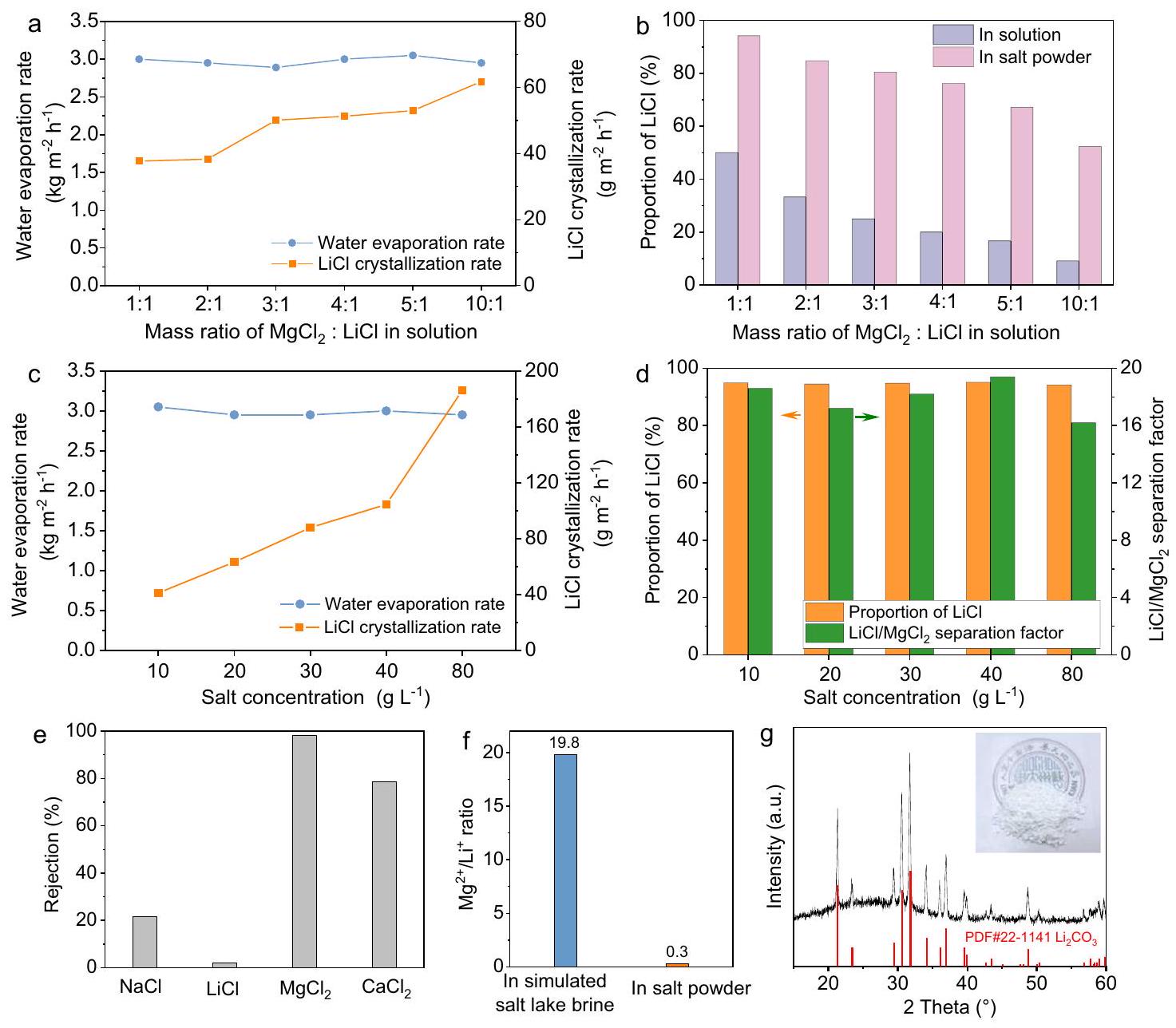
للتحقيق في تأثيرنسبة الاستخلاص الليثيوم المدفوعة بالطاقة الشمسية، تم الحفاظ على تركيز LiCl ثابتًا عند و تركيز المادة زاد تدريجياً من 0.45 إلىتحت إشعاع الشمس لمدة 3 ساعات، ظل معدل تبخر الماء حوالي. ومع ذلك، لوحظ أن معدل تبلور LiCl زاد من 37.3 إلى مع زيادةالنسبة (الشكل 5أ). يمكن تفسير هذه الظاهرة بتوازن دونان، حيث الزيادة في الـالنسبة تسبب زيادة متناسبة فيالتركيز. مع كمية أكبر منفي الحل، المزيديمكن أن تخترق غشاء PA. للحفاظ على التوازن على جانبي الغشاء،بأيون مائي أصغر قطرًا وطاقة ترطيب أقل، كما يمر عبر غشاء PA، مما يزيد من معدل تبلور LiCl. توضح الشكل 5ب نسبة LiCl في المحلول وفي مسحوق الملح الذي تم جمعه على المبخر الشمسي ذو مصفوفات نانوية من PANI. خلال عملية التبخر لـمحلول مختلط بنسبة كتلية 1:1، زادت نسبة LiCl من 50.0% في محلول التغذية إلىفي مسحوق الملح الذي تم جمعه على سطح المبخر PANI. في حالة وجودمحلول مختلط بنسبة كتلية تبلغ، تم إثراء نسبة LiCl من في محلول التغذية إلىفي مسحوق الملح، مما يشير إلى كفاءة عالية في إثراء الليثيوم.
لفحص تأثير تركيزات الملح على استخراج الليثيوم المدفوع بالطاقة الشمسية بشكل أعمق، تم قياس التركيز الكلي لـوكلوريد الليثيوم
الشكل 5 | أداء استخراج الليثيوم المدفوع بالطاقة الشمسية.تأثير الـالنسبة في استخراج الليثيوم المدفوع بالطاقة الشمسية.تأثير تركيزات الملح على استخلاص الليثيوم المدفوع بالطاقة الشمسية. تم قياس معدل تبخر الماء ومعدل تبلور الملح تحت إشعاع شمسي مكافئ لـ 3 شموس. رفض الملح عند تبخير محلول ملحي محاكى لبحيرة ملحية.النسبة في محلول بحيرة الملح المحاكاة وبودرة الملح الصلبة التي تم جمعها على المبخر الشمسي، على التوالي. ج نمط حيود الأشعة السينية (XRD) للرواسب المجمعة بعد الإضافةتطابقت جميع قمم الحيود للرواسب مع المعيار.نمط حيود الأشعة السينية. الصورة المرفقة هي صورة للرواسب المجمعة. تم توفير بيانات المصدر كملف بيانات مصدر. تمت زيادتها من 10 إلى مع الحفاظ علىنسبة الكتلة لـتحت إشعاع الشمس لمدة 3 ساعات، ظل معدل تبخر الماء حوالي، بينما زادت معدل تبلور LiCl من 41.2 إلى(الشكل 5ج). ومن الجدير بالذكر أن غشاء PA حافظ على استقرارأداء الفصل، مع العامل الفصل يبقى فوق 16.2 (الشكل 5د). كانت نسبة LiCl في مسحوق الملح الذي تم جمعه من سطح المبخر الشمسي لشبكات نانوية PANI في النطاق من 94.2 إلى، مما يشير إلى أن الجهاز يمكنه استخراج أيونات الليثيوم بفعالية من خليط حتى في تركيز عالٍ وعالينسبة.
تم استغلال الجهاز بشكل إضافي لمعالجة محلول ملحي لمحاكاة بحيرة مالحة يحتوي على، و(في إشارة إلى تركيبات محلول ملح أويني سالار). في محلول ملحي لمحاكاة بحيرة ملحية، كان تركيز الملح الكلي مرتفعًا حتى و كانت نسبة الكتلة تصل إلى 19.8. تحت إشعاع شمس يعادل 3 أضعاف، كان معدل تبخر الماء حوالي، ومعدل تبلور الملح كان يمكن جمع مسحوق الملح مباشرة من سطح مبخر الطاقة الشمسية لنانوصفائف PANI. تم تحليل التركيب بواسطة مطيافية الانبعاث الذري بالبلازما المقترنة تحريضياً. بالمقارنة مع تركيب محلول ملحي لمحاكاة بحيرة الملح، زادت نسبة NaCl في مسحوق الملح الصلب من إلى النسبة زادت من إلى (الشكل التوضيحي التكميلي 5). وبالمثل،نسبة انخفض من 19% إلى 0.5% وانخفضت نسبة CaCl2 من 2.7% إلىتشير هذه النتائج إلى أن الأملاح أحادية التكافؤ يمكن أن تُثري بواسطة التأثير التآزري لفصل الأيونات المعتمد على الغشاء والتبخر المدفوع بالطاقة الشمسية. لتحديد رفض الملح، نفترض أن مسحوق الملح قد ذاب في الماء المتبخر. الرفض تجاهكان مرتفعًا مثل، والرفض إلى كان(الشكل 5هـ والجدول التكميلي 2). الرفض الأقل قليلاً لـمن ذلك يُعزى إلى القطر المائي الأصغر لـ من. على النقيض من ذلك، كان الرفض لـ NaCl و LiCl هو و ، على التوالي، مما يشير إلى أن أيونات الأملاح أحادية التكافؤ، مثل و ، يمكن أن تمر عبر غشاء PA، بينما معظم الـ و تم رفض الأيونات.
نسبة المغنيسيوم والليثيوم في المحاليل الملحية هي عامل رئيسي في تحديد عملية استخراج الليثيوم. عندما يكون الــ…عندما تكون نسبة الكتلة أقل، يصبح من الأسهل استخراج الليثيوم من محاليل بحيرات الملح. نسبة الكتلة لـفي مساحيق الملح التي تم جمعها على سطح مبخر الطاقة الشمسية من مصفوفات نانو PANI كانت 0.3. هذا انخفاض كبير مقارنة بمحلول بحيرة الملح المحاكاة، مع تقليل بمقدار 66 مرة (الشكل 5f). عند مستوى منخفضالنسبة، بعد إضافة هيدروكسيد الصوديوم وأكسالات الصوديوم لإزالة الكميات الصغيرة المتبقية من و ، يمكن ترسيب الليثيوم بسهولة على شكل بإضافةتم فصل الرواسب بواسطة الطرد المركزي، وغُسلت باستخدام الماء منزوع الأيونات، ثم جُففت في فرن تفريغ. الأبيض المجمّع تمت دراسة المسحوق (الشكل 5ج في الإدخال) بواسطة مطيافية حيود الأشعة السينية للمسحوق (XRD)، حيث تطابقت النمط جيدًا مع النمط القياسي لـ(PDF#22-1141) دون الكشف عن أي إشارات شوائب. تُظهر التحليلات العنصرية الكمية الإضافية أن نقاوةكان حواليالذي يلبي متطلبات جودة البطاريةالنقاء.
لتقييم الإمكانية التطبيقية، أجرينا تجربة في الهواء الطلق من الساعة 9:00 إلى 16:00 تحت ضوء الشمس الطبيعي مع متوسط تدفق حراري شمسي يبلغتم استخدام المبخر الشمسي المعتمد على الغشاء لمعالجة محلول بحيرة الملح المحاكاة. كما هو موضح في الشكل التكميلي 6أ، تأثرت سرعة تبخر الماء بشدة الإشعاع الشمسي. كانت أقصى سرعة لتبخر الماءلوحظ ذلك عند الظهر، وهو ما يتوافق مع النتيجة التي تم الحصول عليها في المختبر تحت إشعاع شمس واحد. في الساعة 16:00، تم جمع بلورات الملح، وتم تجديد البولي أنيلين (PANI) لتجربة الغد. خلال اختبار الأيام الخمسة التالية (الشكل التكميلي 6ب)، تم الحفاظ على كمية الماء المتبخر وبلورات الملح المجموعة بشكل مستقر، مما يظهر إمكاناته الكبيرة للاستخراج العملي لليثيوم. بالإضافة إلى ذلك، فإن قابلية توسيع المبخر الشمسي المعتمد على الغشاء تعتبر أيضًا اعتبارًا مهمًا للغاية. يمكن توسيع النظام بسهولة عن طريق زيادة حجمه وتكثير قدرة معالجة المحلول الملحي باستخدام مجموعة من المبخرات الشمسية.
باختصار، مستلهمين من عمليات الامتصاص الانتقائي للماء/الأيونات وإفراز الملح في أشجار المانغروف، قدمنا تصميمًا تآزريًا لغشاء فصل الأيونات ومبخر بيني يعمل بالطاقة الشمسية، والذي يستخلص بفعالية كلوريد الليثيوم الصلب من محلول ملحي مختلط، محققًا مستوى نقاء يصل إلى. من الجدير بالذكر أن المبخر الشمسي المعتمد على غشاء فصل الأيونات لدينا يُظهر القدرة على معالجة محلول بحيرة ملحية محاكاة مباشرة، حتى عند تركيزات عالية تصل إلى ، مما أدى إلى تقليل ملحوظ بمقدار 66 ضعفًا في الـالنسبة (من 19.8 إلى 0.3). عند مستوى منخفضالنسبة، درجة البطاريةيمكن ترسيب المسحوق من خلال عملية ترسيب بسيطة. من خلال الجمع بين فصل الأيونات والتبخر السطحي المدفوع بالطاقة الشمسية، يقدم بحثنا نهجًا جديدًا وواعدًا لاستخراج الليثيوم باستخدام مصادر الطاقة المتجددة. ومن ثم، من المتوقع أن يؤدي هذا النهج إلى تطوير عملية واعدة لتأمين إمدادات الليثيوم للاستخدامات الطاقية المستقبلية.
الطرق
تصنيع مبخر مصفوفات نانوية من البوليانيليلين (PANI)
في البداية، تم إذابة 93 ملغ من الأنيلين و114 ملغ من بيرسلفات الأمونيوم بشكل منفصل في 50 مل منمحلول حمض البيركلوريك تحت التحريك المغناطيسي. ثم تم تبريدها في حمام ماء مثلج لمدة 30 دقيقة، مما أدى إلى…محلول الأنيلين و aمحلول بيرسلفات الأمونيوم. بعد ذلك، تم صب محلول بيرسلفات الأمونيوم بسرعة في محلول الأنيلين، وتم غمر غشاء PES في الخليط. استمرت التفاعل مع التحريك المغناطيسي في حمام ماء مثلج لمدة 12 ساعة. عند اكتمال التفاعل، تم شطف الغشاء بالماء منزوع الأيونات ونقعه في…محلول هيدروكسيد الأمونيوم لمدة ساعتين. بعد ذلك، تم شطف الغشاء جيدًا بالماء منزوع الأيونات وتجفيفه في فرن هواء قسري عند.
تصنيع غشاء PA
تم تحضير الغشاء متعدد الأميد عند و الرطوبة النسبية. تم إذابة 1.0 جم من PIP و0.24 جم من كبريتات دوديسيل الصوديوم في 100 مل من الماء لإنتاج محلول مائي من PIP. تم وضع فيلم أنابيب الكربون النانوية ذات الجدار الواحد أولاً على صفيحة زجاجية ثم تم نقعه في محلول PIP لمدة 30 ثانية. تم تصريف الصفيحة الزجاجية عمودياً، وتم إزالة محلول PIP الزائد من سطح فيلم أنابيب الكربون النانوية ذات الجدار الواحد. ثم تم استخدام TMC.-محلول الهكسان (1، 2، و) صُب على سطح فيلم أنابيب الكربون النانوية ذات الجدار الأحادي لمدة 30 ثانية مما أدى إلى تكوين طبقة نشطة من البولي أميد. الفيلم الناتج لأنابيب الكربون النانوية ذات الجدار الأحادي دعم البولي أميد تم غمر الغشاء في n-هيكسان لمدة 30 ثانية لإزالة TMC غير المتفاعل، ثم تم تسخينه في فرن عندلمدة 30 دقيقة لزيادة درجة الترابط الشبكي لشبكة البولي أميد. تم وضع الغشاء بعد التسخين في ماء منزوع الأيونات وتخزينه في الثلاجة عند.
توصيف المواد
تم التقاط مورفولوجيا مبخر مصفوفات نانو PANI وأغشية PA بواسطة مجهر إلكتروني ماسح بانبعاث حقلي (Hitachi S8230). تم تحليل خاصية امتصاص الضوء لـ PANI-m بواسطة مطيافية الأشعة فوق البنفسجية والمرئية (UV2600، Shimadzu). تم التقاط الصور تحت الحمراء ودرجات حرارة السطح بواسطة كاميرا تحت حمراء ICI 8320 (ICI، الولايات المتحدة الأمريكية). تم قياس زوايا التلامس للماء على جهاز OCA20 (Data-physics، ألمانيا). تم قياس متوسط حجم المسام لركيزة PES ومبخر مصفوفات نانو PANI بواسطة محلل حجم مسام الغشاء بطريقة ضغط الفقاعات (Beishide، 3H2000PB). تم تحليل عناصر سطح أغشية البولي أميد بواسطة مطيافية فوتوالكترون الأشعة السينية (Thermo Scientific EXCALAB 250).
تقييم فصل غشاء PA
تم تقييم أداء فصل غشاء PA باستخدام جهاز ترشيح بتدفق عرضي في درجة حرارة الغرفة. كانت المساحة الفعالة لغشاء PA هي. إما حلتم استخدام المحلول كحل تغذية. تم حساب الرفض بناءً على المعادلة (1). تم الحصول على تركيز كل محلول بواسطة الموصلية.
أين و تمثل تركيز محاليل العلف والترشيح، على التوالي.
تقييم استخراج الليثيوم المدفوع بالطاقة الشمسية
تم إجراء استخراج الليثيوم المدفوع بالطاقة الشمسية عند درجة حرارة والرطوبة النسبية بنسبة . تم استخدام محاكي شمسي (مصباح Xe، PL-X300، شركة بكين للتقنية الدقيقة المحدودة) للاختبارات الداخلية. جهاز الاختبار لاستخراج الليثيوم المدفوع بالطاقة الشمسية موضح في الشكل 4أ. كلوريد الليثيوم وتمت إضافة محلول مختلط في وعاء. عند تقييم تأثير الـنسبة الاستخلاص الليثيوم المدفوعة بالطاقة الشمسية، تم الحفاظ على تركيز LiCl ثابتًا عندفي محلول الملح المختلط بينماتم زيادة التركيز تدريجياً من 0.45 إلىعند دراسة تأثير تركيزات الملح، تم زيادة تركيز الملح الكلي من 10 إلىمع الحفاظ علىنسبة الكتلة 1.0. تم تمرير المحلول من خلال ورق ترشيح محب للماء إلى غشاء PA. لضمان مرور الأيونات عبر غشاء PA للفصل الانتقائي ثم وصولها إلى مبخر مصفوفات نانو PANI، كان قطر غشاء PA أكبر من قطر مبخر مصفوفات نانو PANI، حيث كان القطران 4.0 سم و3.0 سم على التوالي. تم تسجيل تغير الكتلة للمحلول المختلط ومبخر مصفوفات نانو PANI بواسطة ميزان إلكتروني عالي الدقة (METTLER TOLEDO ML204، دقة 0.1 ملغ) واستخدمت هذه البيانات لحساب معدل تبخر الماء ومعدل تبلور الملح على التوالي. تم جمع مسحوق الملح وإذابته مجددًا في الماء لقياس LiCl و…المحتوى بواسطة مطيافية الانبعاث الذري بالبلازما المحثوثة بالحث (ICP-OES، Agilent 5110).
التم حساب عامل الفصل بواسطة المعادلة التالية (2):
أين و تمثل تركيز LiCl و، على التوالي.
استخلاص الليثيوم من محلول بحيرة ملحية محاكاة
تم إعداد المحلول الملحي بناءً على التركيب النموذجي للمحلول الملحي الحراري الأرضي في ملح أويني سالار.، في بوليفيا، تحتوي على ، ، وتم استخدام محلول ملحي محاكٍ لبحيرة الملح كمحلول تغذية للمبخر الشمسي. تحت الإشعاع المستمر، تشكلت بلورات الملح على سطح طبقة البوليانيولين وتم جمعها بمجرد تغطية السطح بالكامل. أُضيف 5 جرامات من مسحوق الملح المجمّع إلى 5 مل من الماء لإنشاء محلول مشبع بشكل زائد. تم تعديل قيمة الرقم الهيدروجيني إلى 11 باستخدام محلول هيدروكسيد الصوديوم المشبع لإزالة أي بقايا.تمت إزالة الراسب الأبيض بواسطة الطرد المركزي عند 1467 جرام لمدة 10 دقائق. بعد ذلك، تم إضافة محلول أكسالات الصوديوم المشبع ببطء إلى المحلول الشفاف العلوي لإزالة أي كمية صغيرة متبقية من…. تم طرد الخليط مرة أخرى بسرعة 1467 جرام لمدة 10 دقائق، وتم جمع المحلول الشفاف العلوي. وأخيرًا، محلول مشبعتمت إضافة المحلول إلى المحلول المجمّع فيتم جمع الرواسب البيضاء بعد الطرد المركزي وتجفيفها في فرن مزود بتدفق هواء.لمدة 12 ساعة.
توفر البيانات
جميع البيانات التي تدعم نتائج هذه الدراسة متاحة في المقالة، والمعلومات التكميلية، وملف بيانات المصدر. يتم توفير بيانات المصدر مع هذه الورقة.
Li, Z. et al. Continuous electrical pumping membrane process for seawater lithium mining. Energy Environ. Sci. 14, 3152-3159 (2021).
Lang, J. et al. High-purity electrolytic lithium obtained from lowpurity sources using solid electrolyte. Nat. Sustain. 3, 386-390 (2020).
He, L. et al. New insights into the application of lithium-ion battery materials: selective extraction of lithium from brines via a rockingchair lithium-ion battery system. Glob. Chall. 2, 1700079 (2018).
Martin, G., Rentsch, L., Höck, M. & Bertau, M. Lithium market research-global supply, future demand and price development. Energy Stor. Mater. 6, 171-179 (2017).
Tarascon, J. M. & Armand, M. Issues and challenges facing rechargeable lithium batteries. Nature 414, 359-367 (2001).
Liu, C. et al. Lithium extraction from seawater through pulsed electrochemical intercalation. Joule 4, 1459-1469 (2020).
Yang, S., Zhang, F., Ding, H., He, P. & Zhou, H. Lithium metal extraction from seawater. Joule 2, 1648-1651 (2018).
Desaulty, A.-M. et al. Tracing the origin of lithium in Li-ion batteries using lithium isotopes. Nat. Commun. 13, 4172 (2022).
Greim, P., Solomon, A. A. & Breyer, C. Assessment of lithium criticality in the global energy transition and addressing policy gaps in transportation. Nat. Commun. 11, 4570 (2020).
Xu, S. et al. Extraction of lithium from Chinese salt-lake brines by membranes: design and practice. J. Membr. Sci. 635, 119441 (2021).
Liu, G., Zhao, Z. & Ghahreman, A. Novel approaches for lithium extraction from salt-lake brines: a review. Hydrometallurgy 187, 81-100 (2019).
Zhao, X., Yang, H., Wang, Y. & Sha, Z. Review on the electrochemical extraction of lithium from seawater/brine. J. Electroanal. Chem. 850, 113389 (2019).
Sun, Y., Wang, Q., Wang, Y., Yun, R. & Xiang, X. Recent advances in magnesium/lithium separation and lithium extraction technologies from salt lake brine. Sep. Purif. Technol. 256, 117807 (2021).
Park, S. H. et al. Lithium recovery from artificial brine using energyefficient membrane distillation and nanofiltration. J. Membr. Sci. 598, 117683 (2020).
Lu, D. et al. Constructing a selective blocked-nanolayer on nanofiltration membrane via surface-charge inversion for promoting permselectivity over . J. Membr. Sci. 635, 119504 (2021).
Peng, H. & Zhao, Q. A nano-heterogeneous membrane for efficient separation of lithium from high magnesium/lithium ratio brine. Adv. Funct. Mater. 31, 2009430 (2021).
Razmjou, A., Asadnia, M., Hosseini, E., Habibnejad Korayem, A. & Chen, V. Design principles of ion selective nanostructured membranes for the extraction of lithium ions. Nat. Commun. 10, 5793 (2019).
Wang, Z. et al. Nanoparticle-templated nanofiltration membranes for ultrahigh performance desalination. Nat. Commun. 9, 2004 (2018).
Cadotte, J., Forester, R., Kim, M., Petersen, R. & Stocker, T. Nanofiltration membranes broaden the use of membrane separation technology. Desalination 70, 77-88 (1988).
Han, S. et al. Microporous organic nanotube assisted design of high performance nanofiltration membranes. Nat. Commun. 13, 7954 (2022).
Zhu, Y. et al. Regulation of molecular transport in polymer membranes with voltage-controlled pore size at the angstrom scale. Nat. Commun. 14, 2373 (2023).
Xu, P., Hong, J., Xu, Z., Xia, H. & Ni, Q.-Q. Positively charged nanofiltration membrane based on (MWCNTs-COOK)-engineered substrate for fast and efficient lithium extraction. Sep. Purif. Technol. 270, 118796 (2021).
Liang, Y. et al. Polyamide nanofiltration membrane with highly uniform sub-nanometre pores for sub- 1 Å precision separation. Nat. Commun. 11, 2015 (2020).
Bing, S. et al. Bio-inspired construction of ion conductive pathway in covalent organic framework membranes for efficient lithium extraction. Matter 4, 2027-2038 (2021).
Zhao, C. et al. Polyamide membranes with nanoscale ordered structures for fast permeation and highly selective ion-ion separation. Nat. Commun. 14, 1112 (2023).
Somrani, A., Hamzaoui, A. H. & Pontie, M. Study on lithium separation from salt lake brines by nanofiltration (NF) and low pressure reverse osmosis (LPRO). Desalination 317, 184-192 (2013).
Foo, Z. H., Rehman, D., Bouma, A. T., Monsalvo, S. & Lienhard, J. H. Lithium concentration from salt-lake brine by Donnan-enhanced nanofiltration. Environ. Sci. Technol. 57, 6320-6330 (2023).
Tao, P. et al. Solar-driven interfacial evaporation. Nat. Energy 3, 1031-1041 (2018).
Wang, F. et al. A high-performing single-stage invert-structured solar water purifier through enhanced absorption and condensation. Joule 5, 1602-1612 (2021).
Zhao, F., Guo, Y., Zhou, X., Shi, W. & Yu, G. Materials for solarpowered water evaporation. Nat. Rev. Mater. 5, 388-401 (2020).
Qi, D. et al. Polymeric membranes with selective solution-diffusion for intercepting volatile organic compounds during solar-driven water remediation. Adv. Mater. 32, 2004401 (2020).
Zhang, P. et al. Super water-extracting gels for solar-powered volatile organic compounds management in the hydrological cycle. Adv. Mater. 34, 2110548 (2022).
Zhu, M. et al. Tree-inspired design for high-efficiency water extraction. Nature 29, 1704107 (2017).
Zhao, F. et al. Highly efficient solar vapour generation via hierarchically nanostructured gels. Nat. Nanotechnol. 13, 489-495 (2018).
Zhang, Y. et al. Manipulating unidirectional fluid transportation to drive sustainable solar water extraction and brine-drenching induced energy generation. Energy Environ. Sci. 13, 4891-4902 (2020).
Hu, Y. et al. A reconfigurable and magnetically responsive assembly for dynamic solar steam generation. Nat. Commun. 13, 4335 (2022).
Yang, H. et al. Tailoring the salt transport flux of solar evaporators for a highly effective salt-resistant desalination with high productivity. ACS Nano 16, 2511-2520 (2022).
Xia, Y. et al. Spatially isolating salt crystallisation from water evaporation for continuous solar steam generation and salt harvesting. Energy Environ. Sci. 12, 1840-1847 (2019).
Wu, L. et al. Highly efficient three-dimensional solar evaporator for high salinity desalination by localized crystallization. Nat. Commun. 11, 521 (2020).
Reef, R. & Lovelock, C. E. Regulation of water balance in mangroves. Ann. Bot. 115, 385-395 (2014).
Sobrado, M. A. Influence of external salinity on the osmolality of xylem sap, leaf tissue and leaf gland secretion of the mangrove Laguncularia racemosa (L.) Gaertn. Trees 18, 422-427 (2004).
Paliyavuth, C., Clough, B. & Patanaponpaiboon, P. Salt uptake and shoot water relations in mangroves. Aquat. Bot. 78, 349-360 (2004).
Wheeler, T. D. & Stroock, A. D. The transpiration of water at negative pressures in a synthetic tree. Nature 455, 208-212 (2008).
Wang, Y., Lee, J., Werber, J. R. & Elimelech, M. Capillary-driven desalination in a synthetic mangrove. Sci. Adv. 6, eaax5253 (2020).
Sui, H., Han, B.-G., Lee, J. K., Walian, P. & Jap, B. K. Structural basis of water-specific transport through the AQP1 water channel. Nature 414, 872-878 (2001).
Krishnamurthy, P. et al. Role of root hydrophobic barriers in salt exclusion of a mangrove plant Avicennia officinalis. Plant Cell Environ. 37, 1656-1671 (2014).
Semenova, G. A., Fomina, I. R. & Biel, K. Y. Structural features of the salt glands of the leaf of Distichlis spicata ‘Yensen 4a’ (Poaceae). Protoplasma 240, 75-82 (2010).
Yuan, F., Leng, B. & Wang, B. Progress in studying salt secretion from the salt glands in recretohalophytes: How do plants secrete salt? Front. Plant Sci. 7, 977 (2016).
Huang, J. & Kaner, R. B. Nanofiber formation in the chemical polymerization of aniline: a mechanistic study. Angew. Chem. Int. Ed. 43, 5817-5821 (2004).
Chiou, N. R. & Epstein, A. J. Polyaniline nanofibers prepared by dilute polymerization. Adv. Mater. 17, 1679-1683 (2005).
Peng, Y., Wang, Y., Li, W. & Jin, J. Bio-inspired vertically aligned polyaniline nanofiber layers enabling extremely high-efficiency solar membrane distillation for water purification. J. Mater. Chem. A 9, 10678-10684 (2021).
Zhu, Y. et al. Single-walled carbon nanotube film supported nanofiltration membrane with a nearly 10 nm thick polyamide selective layer for high-flux and high-rejection desalination. Small 12, 5034-5041 (2016).
Nightingale, E. R. Jr. Phenomenological theory of ion solvation. Effective radii of hydrated ions. J. Phys. Chem. 63, 1381-1387 (1959).
Levenstein, R., Hasson, D. & Semiat, R. Utilization of the Donnan effect for improving electrolyte separation with nanofiltration membranes. J. Membr. Sci. 116, 77-92 (1996).
Vezzani, D. & Bandini, S. Donnan equilibrium and dielectric exclusion for characterization of nanofiltration membranes. Desalination 149, 477-483 (2002).
Rettig, S. L., Jones, B. F. & Risacher, F. Geochemical evolution of brines in the salar of Uyuni, Bolivia. Chem. Geol. 30, 57-79 (1980).
An, J. W. et al. Recovery of lithium from Uyuni salar brine. Hydrometallurgy 117, 64-70 (2012).
الشكر والتقدير
يشكر المؤلفون دعم البرنامج الوطني الرئيسي للبحث والتطوير في الصين (2022YFB3805900، 2022YFB3805903، 2023YFE0113700)، والمؤسسة الوطنية للعلوم الطبيعية في الصين (21988102، 22208229، 22072104)، وخطة البحث والتطوير الرئيسية لمقاطعة جيانغسو (BE2022056)، والمؤسسة الطبيعية للعلوم في مقاطعة جيانغسو (BK2O220501)، وخطة المواهب الرائدة في الابتكار وريادة الأعمال في جوسو (ZXL2023198).
مساهمات المؤلفين
صمم S.Z. و J.L. و J.J. التجارب. قام X.W. و S.Z. و X.C. بتنفيذ التجارب بما في ذلك تصنيع المبخر PANI وأغشية PA، والتوصيف، واختبار الأداء. قدم M.W. و M.P. اقتراحات ودعمًا فنيًا. نظم S.Z. و J.J. البيانات وكتبا الورقة البحثية. ناقش جميع المؤلفين النتائج ووافقوا على النسخة النهائية من المقالة.
يجب توجيه المراسلات وطلبات المواد إلى لين جيانغ أو جيان جين.
معلومات مراجعة الأقران تشكر مجلة نيتشر كوميونيكيشنز أمير رزمجو والمراجع الآخر، المجهول، على مساهمتهم في مراجعة الأقران لهذا العمل. ملف مراجعة الأقران متاح.
كلية الكيمياء والهندسة الكيميائية وعلوم المواد، المختبر الرئيسي لمقاطعة جيانغسو لتصميم وتطبيق البوليمرات الوظيفية المتقدمة، جامعة سوتشو، سوتشو، جيانغسو، الصين.المركز التعاوني للابتكار في علوم وتكنولوجيا النانو بسوتشو، المختبر الرئيسي لمقاطعة جيانغسو لتقنيات الكربون السلبية المتقدمة، جامعة سوتشو، سوتشو، جيانغسو، الصين.معهد المواد النانوية الوظيفية واللينة (FUNSOM)، المختبر الرئيسي لمقاطعة جيانغسو للمواد والأجهزة الوظيفية القائمة على الكربون، جامعة سوتشو، سوتشو، جيانغسو، الصين.المختبر الرئيسي للاستخدام الشامل والفعال للغاية لموارد بحيرات الملح، معهد تشينغهاي لبحيرات الملح، الأكاديمية الصينية للعلوم، شينينغ، تشينغهاي، الصين. البريد الإلكتروني:ljiang@suda.edu.cn; jjin@suda.edu.cn
Solar-driven membrane separation for direct lithium extraction from artificial salt-lake brine
Received: 25 July 2023
Accepted: 22 December 2023
Published online: 03 January 2024
(A) Check for updates
Shenxiang Zhang , Xian Wei , Xue Cao , Meiwen Peng , Min Wang , Lin Jiang (1) & Jian Jin
The demand for lithium extraction from salt-lake brines is increasing to address the lithium supply shortage. Nanofiltration separation technology with high separation efficiency has shown great potential for lithium extraction. However, it usually requires diluting the brine with a large quantity of freshwater and only yields -enriched solution. Inspired by the process of selective ion uptake and salt secretion in mangroves, we report here the direct extraction of lithium from salt-lake brines by utilizing the synergistic effect of ion separation membrane and solar-driven evaporator. The ion separation membrane-based solar evaporator is a multilayer structure consisting of an upper photothermal layer to evaporate water, a hydrophilic porous membrane in the middle to generate capillary pressure as the driving force for water transport, and an ultrathin ion separation membrane at the bottom to allow to pass through and block other multivalent ions. This process exhibits excellent lithium extraction capability. When treating artificial salt-lake brine with salt concentration as high as , the ratio is reduced by 66 times (from 19.8 to 0.3). This research combines ion separation with solardriven evaporation to directly obtain LiCl powder, providing an efficient and sustainable approach for lithium extraction.
Lithium, one of the most valuable resources, has found its way into various industries, ranging from ceramics, glass, pharmaceuticals, and nuclear to the booming lithium battery technology . The rapid growth in lithium consumption, spurred by the expansion of the lithium battery market in recent years, has made it crucial to source lithium from various channels . Lithium sourcing from salt-lake brines accounts for of recoverable lithium on land . It has become a vital supply route to ensure the healthy development of the lithium battery market. However, lithium extraction from salt-lake brines is challenging because of the high concentration of competing
ions, like . Compared to conventional ion separation technologies such as ion exchange , electrodialysis , and solvent extraction , nanofiltration (NF) membrane separation is considered one of the most efficient methods for extracting lithium from brine. The combination of size sieving and Donnan exclusion in NF membranes offers an ideal option for achieving effective monovalent/divalent ion separation, particularly for separation . To enhance the performance of separation, various investigations have been carried out, including developing innovative NF membrane materials and optimizing the membrane structure and surface properties . Despite
significant advancements in the separation of and using NF membrane processes, highly concentrated brines generate a high osmotic pressure difference across the NF membrane, requiring high applied pressure that may exceed the mechanical strength of the membrane module. Therefore, the conventional NF process typically involves the 10-20 times dilution of high-concentration brine with a large quantity of freshwater in the pre-treatment stage . Moreover, NF membrane separation processes solely yield -enriched solutions, necessitating further concentration to obtain solid lithium products, which requires energy-intensive processes like thermal distillation or high-pressure reverse osmosis to obtain the -enriched solution with the required concentration. Hence, innovative material and separation process design is required to achieve more efficient and cost-effective separation.
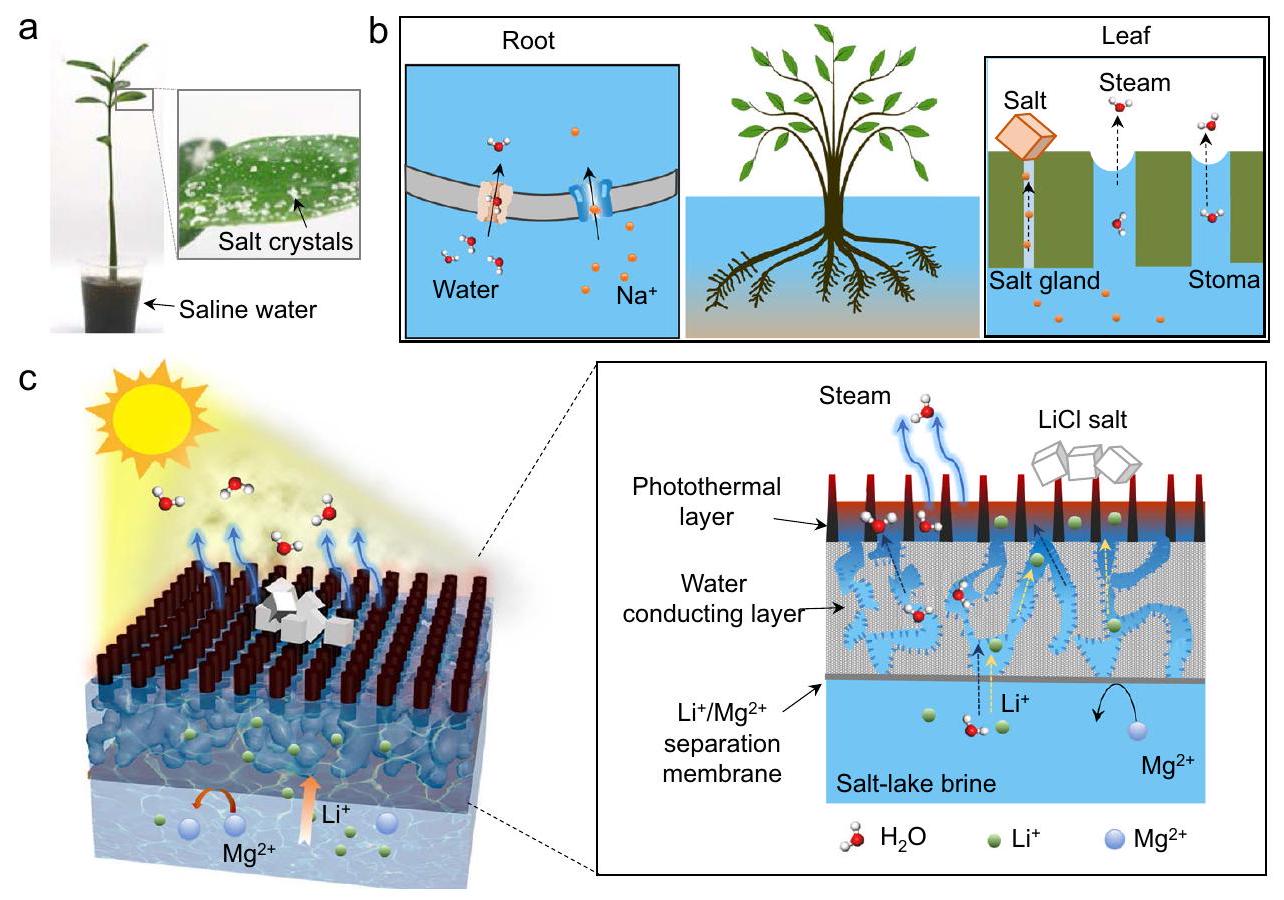
Interfacial solar evaporation, a sustainable and cost-effective technology for clean water production, harnesses solar energy and concentrates generated heat to facilitate water evaporation . Additionally, this approach offers a promising avenue for salt resource recovery from seawater and brines . During evaporation, salt ions become concentrated and eventually precipitate out. Selective ion uptake and transport driven by interfacial solar evaporation are common processes in plants. For instance, mangrove is a type of salttolerant tree that thrives in tropical and subtropical coastal regions (Fig. 1a) . Mangroves can regulate the uptake and release of ions to adapt to the saline or brackish environment . When provided with optimal sunlight and temperature, the stomata in leaves open, causing water molecules to be released into the atmosphere as vapor. This process is followed by water flow towards the stomata, effectively replacing the evaporated water molecules while ensuring the continuous upward flow of water and ions toward the leaves . To survive in seawater, ion pumps and channels in cell membranes selectively transport ions through mangrove roots (Fig. 1b) . Additionally, salt
glands located in leaves enable mangroves to directly secrete salt out of their systems (inset in Fig. 1a), further aiding their ability to survive in saline environments .
Inspired by the process of selective ion uptake and salt secretion in mangroves, we utilize the synergistic effect of ion separation membrane and solar-driven evaporator to direct extraction of lithium chloride (LiCl) powder from salt-lake brines. Figure 1c illustrates the structure of the membrane-based solar-driven evaporator, composed of three functional layers. To realize a high photothermal conversion efficiency, vertically aligned polyaniline (PANI) nanofiber array was selected as the upper photothermal layer owing to its sunlight absorption capacity. In the middle, a hydrophilic poly(ether sulfone) (PES) macroporous membrane with interconnected water-conducting channels generates capillary pressures serving as the driving force for water transport. At the bottom is an ultrathin polyamide (PA) ion separation membrane allowing to pass through and block other multivalent ions, like and . When treating a mixed solution, water and ions trans through the PA membrane to reach the photothermal layer under capillary pressure. As water continually evaporates, solid LiCl powders can be collected directly on the surface of the evaporator. This ion separation membrane-based solar evaporator maintains a stable lithium enrichment even when processing high-concentration salt solutions. This study demonstrates the amazing capability of lithium enrichment. It provides an effective way to directly obtain high-purity lithium from salt-lake brines only using sustainable energy.
Results and discussion
Fabrication and characterization of PANI nanoarrays solar evaporator
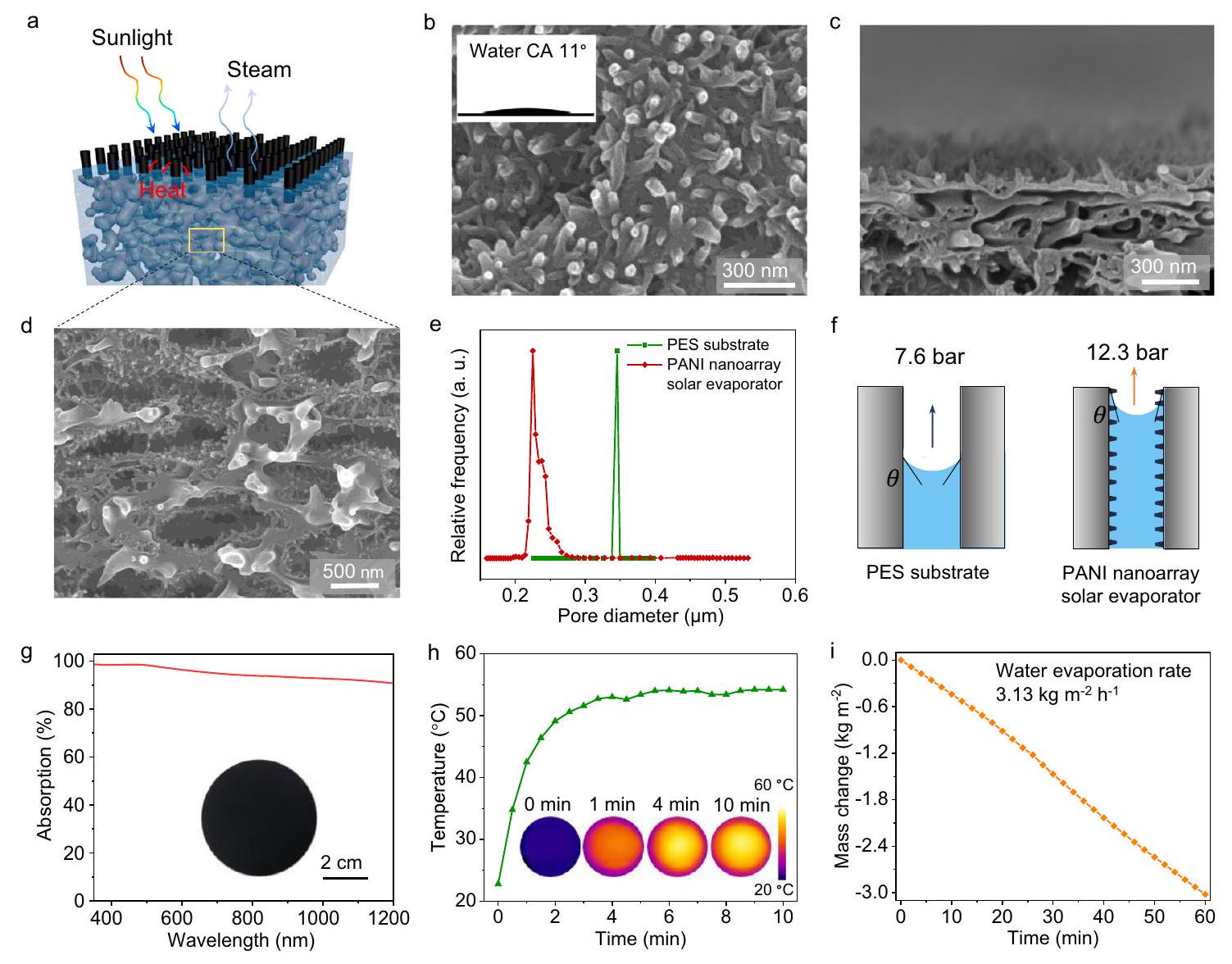
Figure 2a demonstrates the schematic illustration of the PANI nanoarrays solar evaporator. The PANI nanoarrays were grown in situ
Fig. 1 | Design of solar-driven membrane separation for lithium extraction.
a Photograph of mangrove and leaf blade with salt crystals on the leaf surface. To observe the salt secretion phenomenon, this mangrove was placed in a solution for 4 weeks. A schematic of regulating water and ion intake and release in mangroves. The root has transport proteins that selectively transport water and specific ions across the cell membranes. The leaf absorbs solar energy and uses it to drive water’s evaporation through the stomata. Also, the salt glands in leaves enable
mangroves to secrete excess salt out of leaves directly. c Working principle of polyamide membrane-based solar-driven lithium extraction. The photothermal layer absorbs solar energy to heat water, causing water evaporation. The waterconducting layer generates capillary force, encouraging a continuous upward flow of water and ions from the bottom to the surface. The ion-selective membrane allows for rapid diffusion of while rejecting . As water continually evaporates, solid LiCl powder can be collected on the surface of the solar evaporator.
Fig. 2 | Characterization of PANI nanoarrays solar evaporator. a Schematic illustration of PANI nanoarrays solar evaporator. Surface SEM image of PANI nanoarrays evaporator. Inset is the instantaneous CA of a water drop on the PANI nanoarrays evaporator surface. Cross-sectional SEM images of PANI nanoarrays evaporator with an enlarged view of the top layer and the inner section. e Pore size distribution of PES substrate and PANI nanoarrays evaporator. f Schematic description of capillary pressure generated in PES substrate and PANI nanoarrays
evaporator. Light absorption spectrum of PANI nanoarrays evaporator. Inset is a photograph of the PANI nanoarrays evaporator. Time-dependent surface temperature of wet PANI nanoarrays evaporator, under 3 sun illumination. Insets are infrared thermal images of PANI nanoarrays evaporator under 3 sun illumination. i Time-dependent mass change of water due to the evaporation through PANI nanoarrays solar evaporator under 3 sun illumination. Source data are provided as a Source Data file.
on a PES macroporous membrane with a sponge-like pore structure (Supplementary Fig. 1) that serves as a substrate. Nanofibers were formed through a polymerization process of aniline monomers using ammonium persulfate . Scanning electron microscope (SEM) images in Fig. shows that the surface and internal channels of the PES substrate were coated by vertically aligned PANI nanofibers with in diameter and in length. The resulting PANI nanoarrays-coated PES membrane was hydrophilic, with an instantaneous water contact angle (CA) of (inset in Fig. 2b). The pore size distribution of the PES substrate before and after the growth of PANI nanoarrays was measured using the bubble pressure method. As demonstrated in Fig. 2e, the average pore diameter of the PES substrate reduced from 345 nm to 225 nm due to the growth of PANI nanoarrays on its inner surface.
A stable and efficient water supply is a crucial component of the solar evaporator. During the steady interface evaporation process, water molecules removed by evaporation are replaced by water flow toward the air-water interface. The cohesive force between water molecules is crucial in maintaining a continuous water supply, generating tension between the molecules . The water surface tension that forms in micrometer-sized pores or channels can generate a capillary pressure that is the primary driving force for water transport in a solar evaporator. The capillary pressure ( ) can be estimated using the Young-Laplace equation, , where is the surface tension of water, is the water CA on the pore surface, and is the pore
diameter. For the above equation, is at , assuming is the water CA on the membrane surface. The pores or channels in PES substrate and PANI nanoarrays solar evaporator can produce capillary pressures of 7.6 and 12.3 bar in the liquid phase, respectively (Fig. 2f). This result proves that smaller pore size and a hydrophilic surface can increase capillary pressure.
Efficiently absorbing broad-spectrum sunlight and converting it into heat are important steps in solar-driven evaporation. The PANI evaporator presented a dark surface resulting from its exceptional light absorption capacity, particularly in the visible range, reaching as high as (Fig. 2g). The PANI nanoarrays efficiently trap incident light and promote its multiple reflectance until absorption, contributing to the high absorption capacity . To evaluate the light-toheat conversion performance, the surface temperature of the PANI nanoarrays evaporator was monitored under 3 sun illumination using an infrared thermal imager (Fig. 2h). Within 2 min of illumination, the surface temperature of the wet PANI nanoarrays evaporator increased rapidly from 22.0 to . After 5 min , the surface temperature reached a maximum of and remained stable. The light-to-heat conversion performance can be attributed to the superior lightharvesting efficiency of PANI nanofiber arrays. Water evaporation rates were measured at under 3 sun illumination by recording the weight loss (Fig. 2i). This remarkable performance can be attributed to the high photothermal conversion efficiency and efficient water supply of the PANI nanoarrays evaporator.
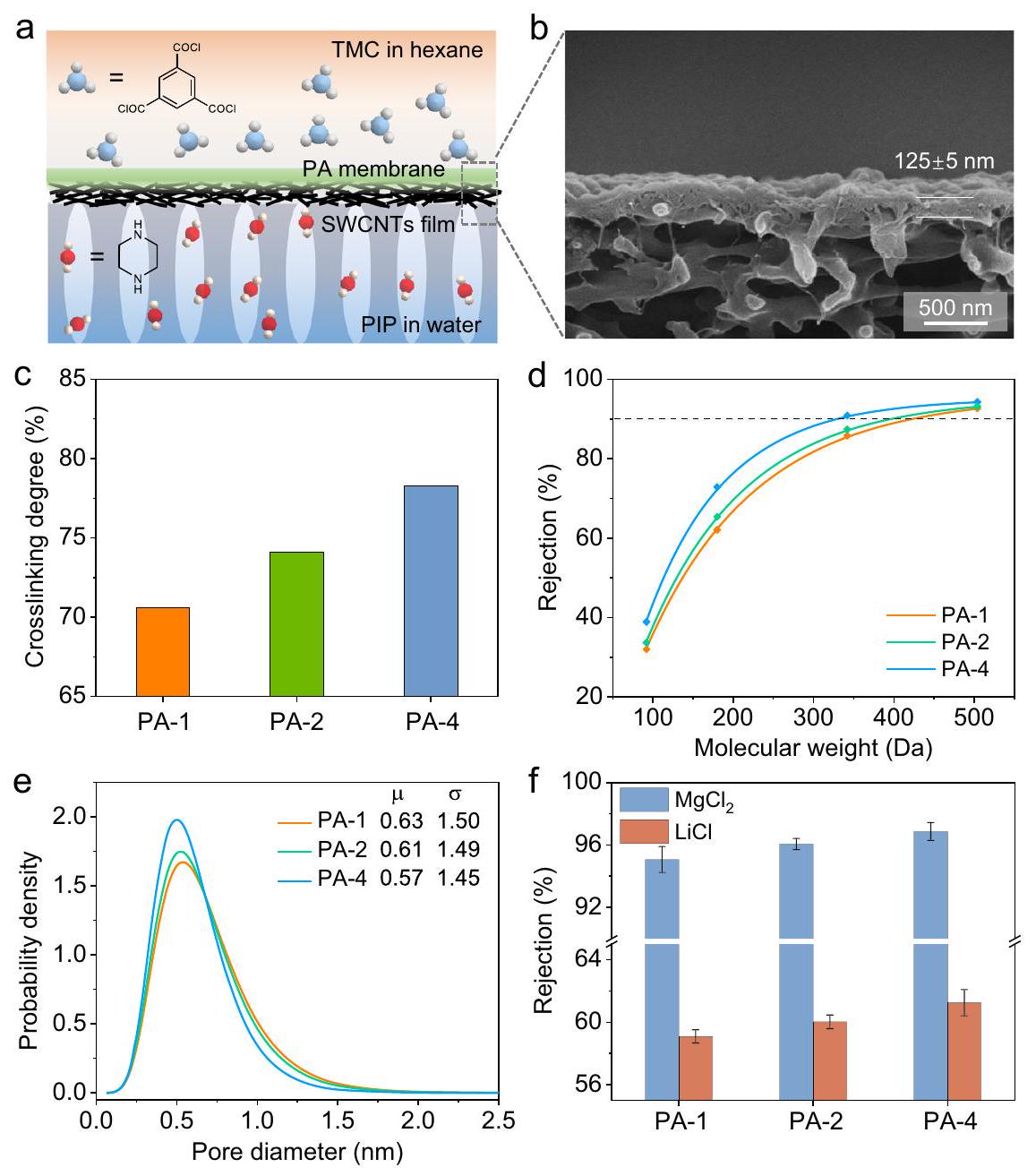
Fig. 3 | Fabrication and characterization of PA membrane. a Schematic illustration of the structure of SWCNTs film supported PA membrane. b Cross-sectional SEM images of the SWCNTs film supported PA membrane. c Crosslinking degree of PA membranes. d Rejections of neutral model solutes, including raffinose, sucrose, glucose, and glycerol by PA membranes. e Pore size probability distribution of the PA
membranes, derived from the rejection curves of neutral solutes. Rejections of and LiCl by PA membranes with different crosslinking degrees. The experiments were conducted using a cross-flow filtration cell with an operating pressure of 4 bar and a cross-flow velocity of . Error bar represents the standard deviation of three replicate measurements. Source data are provided as a Source Data file.
separation performance of PA membrane
A membrane with high mono-/di-valent ion separation performance is highly required to extract lithium from brine effectively. State-of-the-art mono-/di-valent ion separation membranes are based on a thin film composite design, which deposits a PA selective layer, formed by interfacial polymerization between piperazine (PIP) and trimesoyl chloride (TMC), on the top of porous substrate. We have previously reported that deposition of a thin layer of single-walled carbon nanotubes (SWCNTs) film on macroporous PES membrane greatly improves the quality of the obtained PA layer thanks to the high porosity, smoothness, and narrowly distributed pores of the SWCNT film . Following previous studies , PA membranes were fabricated on the surface of SWCNTs film via interfacial polymerization (Fig. 3a). Firstly, a thin SWCNT film was prepared through vacuum-filtrating a certain amount of SWCNTs dispersion onto a PES membrane with pore size of . The surface SEM image of SWCNTs film shows that a network porous structure was formed from interconnected carbon nanotubes with a high porosity (Supplementary Fig. 2a). Then a typical interfacial polymerization process was conducted on the surface of SWCNT film, in which PIP and TMC reacted at water-hexane interface to form the PA layer. A smooth PA layer was formed after the interfacial polymerization process using TMC and PIP solutions (Supplementary Fig. 2b).
The cross-sectional SEM image shows a bilayer structure with a thickness of (Fig. 3b).
The crosslinking degree of the resultant PA membrane reflects the efficiency of the interfacial reaction and determines the effective pore size. To study the effect of pore size on separation, the crosslinking degree of the PA layer was tuned by changing the TMC concentrations of 1,2 , to during the interfacial polymerization process. The obtained membrane was denoted as PA-X, X representing the TMC concentration used in the interfacial polymerization process. The chemical composition of obtained PA layers was analyzed by X-ray photoelectron spectroscopy (XPS) (Supplementary Fig. 3). In the C1s XPS spectra, four peaks were detected, which were ascribed to (centered at 288.5 eV ), (centered at 287.7 eV ), (centered at 286.0 eV ), and (centered at 284.8 eV ) in the PA layer, further confirming the formation of the polyamide structure . The group was derived from the reaction between the acyl chloride in TMC monomers and secondary amine in PIP monomers. The group can be attributed to the carboxyl acid group formed by the hydrolysis of the unreacted acylchloride group. With the TMC concentration increasing from 1 to 2 and , the content gradually increased from to , and . The content decreased from to and (Supplementary Table 1). The crosslinking degrees of PA layers were
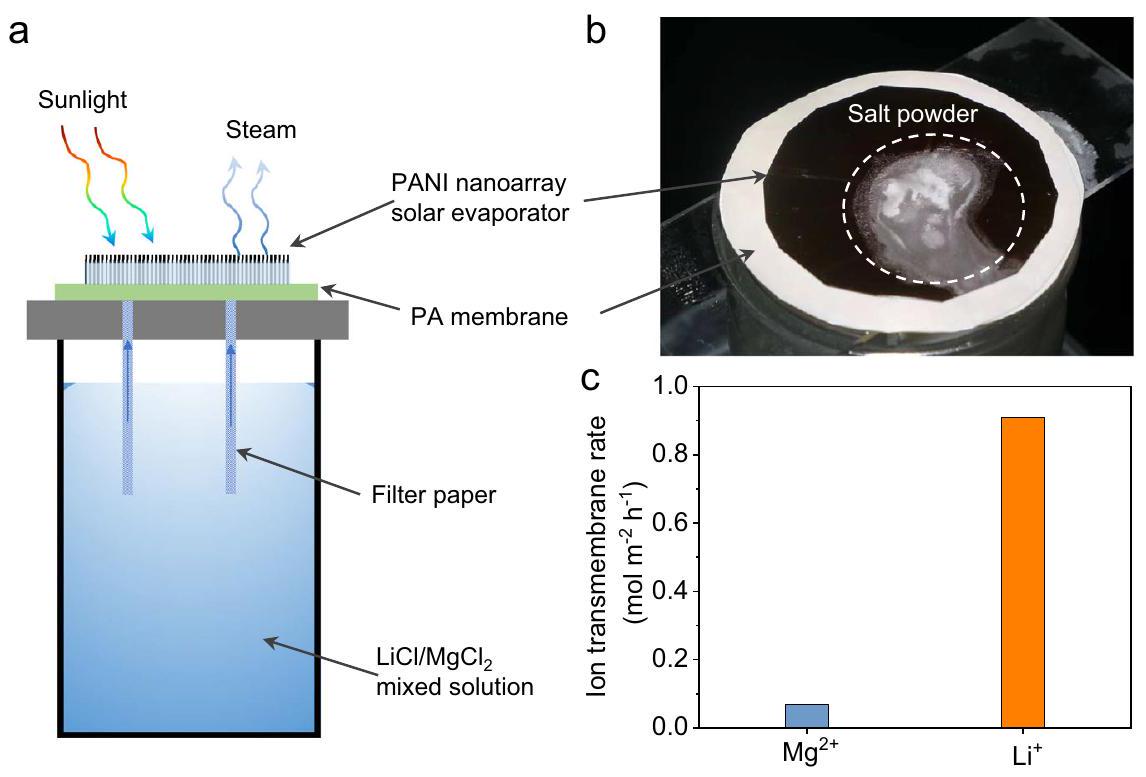
Fig. 4 | Solar-driven lithium extraction device. a Schematic illustration of the solar-driven separation device. The top is the PANI nanoarrays solar evaporator which evaporates water and generates capillary pressure to encourage a continuous upward flow of water and ions from bottom to surface. Beneath PANI
nanoarrays solar evaporator, the PA-4 membrane is the selective barrier for separation. Photograph of solid salt powders accumulated on the surface of the PANI nanoarrays solar evaporator. c Transmembrane rates of and . Source data are provided as a Source Data file.
calculated based on the O/N elemental ratio from the XPS spectra. As shown in Fig. 3c, the crosslinking degrees of PA-1, PA-2, and PA-4 were , and , respectively. These results indicate that the increase in the TMC concentration could improve the crosslinking degree of the PA layer during the PIP-TMC interfacial polymerization process.
The molecular weight cut-off (MWCO) and pore size distribution of the PA membranes were calculated using neutral organic molecules as probes (detailed information see Supplementary Methods). As shown in Fig. 3d, the MWCO of the PA membrane decreased from 422 Da to 309 Da by increasing the TMC concentration from 1 to . According to the function fitting of the corresponding pore model, the mean pore size was , and 0.57 nm for PA-1, PA-2, and PA-4, respectively (Fig. 3e). This result indicates that the effective pore size of the PA layer decreased with the increase of the crosslinking degree. The performance of the PA membrane was evaluated by experimenting with a cross-flow filtration with transmembrane pressure of 4.0 bar. The rejections to were , and for PA-1, PA-2, and PA-4, respectively. The rejection of LiCl slightly increased from 59.1% to 61.3% with the increase of crosslinking degree. These results are reasonable when compared to the hydrated ion diameter and hydration energy of and . The hydrated diameter was 0.86 nm , larger than most of pores in the PA membrane. As enters PA membrane, the energy required to strip water from the hydration shell of is . In contrast, the hydrated diameter is 0.76 nm , whereas the energy required to strip water from the hydration shell of is . Therefore, the PA membrane demonstrated a higher rejection rate to than .
Solar-driven lithium extraction
After evaluating the basic properties of PANI nanoarrays solar evaporator and PA membrane, we proceeded the investigation of the separation performance of solar-driven separation. A solardriven separation device was designed and constructed, which incorporated a PANI nanoarrays solar evaporator as the top photothermal layer and a PA-4 membrane as the selective barrier for separation (Fig. 4a). To evaluate separation
performance during interfacial evaporation, we employed a mixed solution containing of LiCl and of ( and had similar molality of ). When the PA membrane was introduced beneath the PANI nanoarrays solar evaporator, the water evaporation rate slightly decreased to under 3 sun irradiation. (Supplementary Fig. 4). After observing 120 min of stable evaporation, white salt powders accumulated on the surface of the PANI nanoarrays solar evaporator (Fig. 4b), indicating that capillary pressure enables water and ions permeation through the PA membrane. The transmembrane rate of was found to be , which was 13 times faster than that of in the ion separation membrane-based solar evaporator (Fig. 4c), indicating that the ultrathin PA membrane maintains its monovalent/divalent ion selectivity, even under capillary pressure-driven separation process.
To investigate the effect of the ratio on solar-driven lithium extraction, the LiCl concentration was kept constant at and the concentration gradually increased from 0.45 to . Under 3 sun irradiation, the water evaporation rate remained around . However, it is observed that the LiCl crystallization rate increased from 37.3 to with the increase of ratio (Fig. 5a). This phenomenon can be explained by the Donnan equilibrium , where the increase in the ratio causes a proportional rise in concentration. With a higher amount of in the solution, more can permeate through the PA membrane. To maintain equilibrium on both sides of the membrane, with a smaller hydrated ion diameter and lower hydration energy also trans through the PA membrane, increasing the LiCl crystallization rate. Figure 5b demonstrates the proportion of LiCl in solution and in salt powder collected on the PANI nanoarrays solar evaporator. During the evaporation process of mixed solution with mass ratio of 1:1, the proportion of LiCl increased from 50.0% in the feed solution to in the salt powder collected on the PANI evaporator surface. In the case of an mixed solution with a mass ratio of , the proportion of LiCl was enriched from in the feed solution to in the salt powder, indicating a high lithium enrichment efficiency.
To further examine the effect of salt concentrations on solardriven lithium extraction, the total concentration of and LiCl
Fig. 5 | Performance of solar-driven lithium extraction. the effect of the ratio on solar-driven lithium extraction. the effect of salt concentrations on solar-driven lithium extraction. The water evaporation rate and salt crystallization rate were measured under 3 sun irradiation. e Salt rejection when evaporating a simulated salt-lake brine. ratio in simulated salt-lake brine
and solid salt powder collected on the solar evaporator, respectively. g XRD pattern of the collected sediment after adding . All diffraction peaks of the sediment matched with the standard XRD pattern. Inset is a photograph of the collected sediment. Source data are provided as a Source Data file.
was increased from 10 to while maintaining a mass ratio of . Under 3 sun irradiation, the water evaporation rate remained around , while the LiCl crystallization rate increased from 41.2 to (Fig. 5c). Notably, the PA membrane kept a stable separation performance, with the separation factor remaining above 16.2 (Fig. 5d). The proportion of LiCl in the salt powder collected from the surface of PANI nanoarrays solar evaporator was in the range of 94.2 to , indicating that the device can effectively extract lithium ions from mixtures even in high concentration and high ratio.
The device was further exploited to process a simulated salt-lake brine containing , and (referring to the compositions of the Uyuni salar brine ). In the simulated salt-lake brine, total salt concentration was as high as and mass ratio was up to 19.8. Under 3 sun irradiation, the water evaporation rate was around , and salt crystallization rate was . The salt powder can be directly collected from the surface of the PANI nanoarrays solar evaporator. The composition was analyzed by inductively coupled plasma atomic emission spectroscopy. Compared with the composition of simulated salt-lake brine, NaCl proportion in the solid salt powder increased from to proportion increased from to (Supplementary Fig. 5). Correspondingly, proportion
decreased from 19% to 0.5% and CaCl2 proportion decreased from 2.7% to . These results indicate that monovalent salts can be enriched by the synergistic effect of membrane-based ion separation and solardriven evaporation. To determine the salt rejection, we assume that the salt powder was dissolved in the evaporated water. The rejection to was as high as , and the rejection to was (Fig. 5e and Supplementary Table 2). The slightly lower rejection to than that of is ascribed to the smaller hydrated diameter of than . In contrast, the rejection to NaCl and LiCl was and , respectively, indicating that monovalent salt ions, like and , can pass through the PA membrane, while most of the and ions were rejected.
The ratio of magnesium and lithium in brines is a key factor in determining the process of lithium extraction. When the mass ratio is lower, it becomes easier to extract lithium from salt-lake brines. The mass ratio of in the salt powders collected on the surface of the PANI nanoarrays solar evaporator was 0.3 . This is a significant decrease compared to the simulated salt-lake brine, with a reduction of 66 times (Fig. 5f). At a low ratio, after adding NaOH and sodium oxalate to remove residual small amounts of and , lithium can be readily precipitated out in the form of by adding . The sediment was separated by centrifugation, washed using deionized water, and then dried in a vacuum oven. The collected white
powder (Fig. 5g inset) was characterized by powder X-ray diffraction spectroscopy (XRD), whereby the pattern fitted well with the standard pattern of (PDF#22-1141) without any impurity signals being detected. Further quantitative elemental analysis shows that the purity of was around which meets the requirements of batterygrade purity.
To evaluate the potential for application, we carried out an outdoor experiment which carried out from 9:00 to 16:00 under natural sunlight with an average solar heat flux of . The membranebased solar evaporator was employed to treat the simulated salt-lake brine. As shown in Supplementary Fig. 6a, the rate of water evaporation was influenced by the intensity of solar irradiation. The maximum water evaporation rate of was observed at noon, which was consistent with the result obtained in the laboratory under 1 sun irradiation. At 16:00, the salt crystals were collected, and the PANI was regenerated for tomorrow’s experiment. During the following 5-day test (Supplementary Fig. 6b), the amount of evaporated water and collected salt crystals were maintained stable, showing its great potential for practical lithium extraction. In addition, the scalability of the membrane-based solar evaporator is also a critically important consideration. The system can be scaled up easily by increasing its size and multiplying the brine treatment capacity using an array of solar evaporators.
In summary, drawing inspiration from the selective water/ion uptake and salt secretion processes in mangroves, we reported the synergistic design of ion separation membrane and solar-driven interfacial evaporator, which effectively extracts solid LiCl from a mixed salt solution, achieving a purity level of up to . Notably, our ion separation membrane-based solar evaporator demonstrates the ability to directly treat simulated salt-lake brine, even at concentrations as high as , resulting in a remarkable 66 -fold reduction in the ratio (from 19.8 to 0.3 ). At a low ratio, batterygrade powder can be precipitated out through a simple precipitation process. By combining ion separation with solar-driven interfacial evaporation, our research introduces a new and promising approach for lithium extraction utilizing renewable energy sources. Hence, it is expected that this approach will lead to the development of a promising process to secure the lithium supply for future energy uses.
Methods
Fabrication of PANI nanoarrays evaporator
Initially, 93 mg aniline and 114 mg ammonium persulfate were dissolved separately in 50 mL of perchloric acid solution under magnetic stirring. These were then cooled in an ice-water bath for 30 min , resulting in a aniline solution and a ammonium persulfate solution. Subsequently, the ammonium persulfate solution was rapidly poured into the aniline solution, and a PES membrane was submerged in the mixture. The reaction proceeded with magnetic stirring in an ice-water bath for 12 h . Upon completion of the reaction, the membrane was rinsed with deionized water and soaked in a ammonium hydroxide solution for 2 h . Afterward, the membrane was thoroughly rinsed with deionized water and dried in a forced-air oven at .
Fabrication of PA membrane
The polyamide membrane was prepared at and relative humidity. 1.0 g PIP and 0.24 g sodium dodecyl sulfate were dissolved in 100 mL water to produce PIP aqueous solution. The SWCNTs film was first placed on a glass plate and then impregnated with PIP solution for 30 s . The glass plate was drained vertically, and excess PIP solution was removed from the SWCNTs film surface. Then TMC -hexane solution ( 1,2 , and ) was poured onto the surface of SWCNTs film for 30 s which resulted in the formation of a polyamide active layer. The resulting SWCNTs film supported PA
membrane was immersed in n -hexane for 30 s to remove unreacted TMC, then heated in an oven at for 30 min to increase the crosslinking degree of polyamide network. The membrane after heating was placed in deionized water and stored in a refrigerator at .
Material characterizations
The morphology of the PANI nanoarrays evaporator and PA membranes were captured by a field emission SEM (Hitachi S8230). The light absorption property of PANI-m was analyzed by ultraviolet and visible spectrophotometry (UV2600, Shimadzu). The infrared images and surface temperatures were captured by an ICI 8320 infrared camera (ICI, USA). The water CAs were measured on an OCA20 machine (Data-physics, Germany). The average pore size of PES substrate and PANI nanoarrays evaporator were measured by a bubblepressure method membrane pore size analyzer (Beishide, 3H2000PB). The surface elements of the polyamide membranes were analyzed by X-ray photoelectron spectroscopy (Thermo Scientific EXCALAB 250).
Evaluation of separation of PA membrane
The separation performance of PA membrane was evaluated by using a cross-flow filtration apparatus at room temperature. The effective area of PA membrane was . Either solution or solution was used as feed solution. Rejection was calculated based on the Eq. (1). The concentration of each solution was obtained by conductivity.
Where and represent the concentration of feed and filtrate solutions, respectively.
Evaluation of solar-driven lithium extraction
The solar-driven lithium extraction was conducted at a temperature of and relative humidity of . A solar simulator ( Xe lamp, PL-X300, Beijing Precise Technology Co., Ltd.) was used for the indoor tests. The test device for solar-driven lithium extraction is shown in Fig. 4a. A LiCl and mixed solution was added in a container. When evaluating the effect of the ratio on solardriven lithium extraction, the LiCl concentration was kept constant at in the mixed salt solution while the concentration was gradually increased from 0.45 to . When investigating the impact of salt concentrations, the overall salt concentration was increased from 10 to while keeping a mass ratio of 1.0. The solution was conducted through a hydrophilic filter paper to the PA membrane. To ensure that the ions pass through the PA membrane for selective separation and then reach the PANI nanoarrays evaporator, the diameter of the PA membrane is larger than the PANI nanoarrays evaporator, with diameters of 4.0 cm and 3.0 cm , respectively. The mass change of the mixed solution and PANI nanoarrays evaporator were recorded by a high-accuracy electronic balance (METTLER TOLEDO ML204, 0.1 mg accuracy) and used to calculate the water evaporator rate and salt crystallization rate, respectively. The salt powder was collected and redissolved in water to measure the LiCl and content by inductively coupled plasma atomic emission spectroscopy (ICP-OES, Agilent 5110).
The separation factor was calculated by the following Eq. (2):
Where and represent the concentration of LiCl and , respectively.
Lithium extraction from simulated salt-lake brine
The bine was prepared based on the typical geothermal brine composition at Uyuni salar brine , in Bolivia, containing , , and . The simulated saltlake brine was used as the feed solution for the solar evaporator. Under continuous irradiation, salt crystals formed on the PANI layer surface and were collected once the surface was fully covered. 5 g of collected salt powders were added in 5 mL water to create an over-saturated solution. The pH value was adjusted to 11 using a saturated NaOH solution to remove any remaining . The white precipitate was removed by centrifuge at 1467 g for 10 mins . Next, a saturated sodium oxalate solution was slowly added to the upper clear solution in order to remove any remaining small amount of . The mixture was centrifuged again at 1467 g for 10 mins , and the upper clear solution was collected. Finally, a saturated solution was added to the collected solution at . The white precipitates were collected after centrifuge and dried in an air-forced oven at for 12 h .
Data availability
All data supporting the findings of this study are available in the article, the Supplementary Information and the Source Data file. Source data are provided with this paper.
Li, Z. et al. Continuous electrical pumping membrane process for seawater lithium mining. Energy Environ. Sci. 14, 3152-3159 (2021).
Lang, J. et al. High-purity electrolytic lithium obtained from lowpurity sources using solid electrolyte. Nat. Sustain. 3, 386-390 (2020).
He, L. et al. New insights into the application of lithium-ion battery materials: selective extraction of lithium from brines via a rockingchair lithium-ion battery system. Glob. Chall. 2, 1700079 (2018).
Martin, G., Rentsch, L., Höck, M. & Bertau, M. Lithium market research-global supply, future demand and price development. Energy Stor. Mater. 6, 171-179 (2017).
Tarascon, J. M. & Armand, M. Issues and challenges facing rechargeable lithium batteries. Nature 414, 359-367 (2001).
Liu, C. et al. Lithium extraction from seawater through pulsed electrochemical intercalation. Joule 4, 1459-1469 (2020).
Yang, S., Zhang, F., Ding, H., He, P. & Zhou, H. Lithium metal extraction from seawater. Joule 2, 1648-1651 (2018).
Desaulty, A.-M. et al. Tracing the origin of lithium in Li-ion batteries using lithium isotopes. Nat. Commun. 13, 4172 (2022).
Greim, P., Solomon, A. A. & Breyer, C. Assessment of lithium criticality in the global energy transition and addressing policy gaps in transportation. Nat. Commun. 11, 4570 (2020).
Xu, S. et al. Extraction of lithium from Chinese salt-lake brines by membranes: design and practice. J. Membr. Sci. 635, 119441 (2021).
Liu, G., Zhao, Z. & Ghahreman, A. Novel approaches for lithium extraction from salt-lake brines: a review. Hydrometallurgy 187, 81-100 (2019).
Zhao, X., Yang, H., Wang, Y. & Sha, Z. Review on the electrochemical extraction of lithium from seawater/brine. J. Electroanal. Chem. 850, 113389 (2019).
Sun, Y., Wang, Q., Wang, Y., Yun, R. & Xiang, X. Recent advances in magnesium/lithium separation and lithium extraction technologies from salt lake brine. Sep. Purif. Technol. 256, 117807 (2021).
Park, S. H. et al. Lithium recovery from artificial brine using energyefficient membrane distillation and nanofiltration. J. Membr. Sci. 598, 117683 (2020).
Lu, D. et al. Constructing a selective blocked-nanolayer on nanofiltration membrane via surface-charge inversion for promoting permselectivity over . J. Membr. Sci. 635, 119504 (2021).
Peng, H. & Zhao, Q. A nano-heterogeneous membrane for efficient separation of lithium from high magnesium/lithium ratio brine. Adv. Funct. Mater. 31, 2009430 (2021).
Razmjou, A., Asadnia, M., Hosseini, E., Habibnejad Korayem, A. & Chen, V. Design principles of ion selective nanostructured membranes for the extraction of lithium ions. Nat. Commun. 10, 5793 (2019).
Wang, Z. et al. Nanoparticle-templated nanofiltration membranes for ultrahigh performance desalination. Nat. Commun. 9, 2004 (2018).
Cadotte, J., Forester, R., Kim, M., Petersen, R. & Stocker, T. Nanofiltration membranes broaden the use of membrane separation technology. Desalination 70, 77-88 (1988).
Han, S. et al. Microporous organic nanotube assisted design of high performance nanofiltration membranes. Nat. Commun. 13, 7954 (2022).
Zhu, Y. et al. Regulation of molecular transport in polymer membranes with voltage-controlled pore size at the angstrom scale. Nat. Commun. 14, 2373 (2023).
Xu, P., Hong, J., Xu, Z., Xia, H. & Ni, Q.-Q. Positively charged nanofiltration membrane based on (MWCNTs-COOK)-engineered substrate for fast and efficient lithium extraction. Sep. Purif. Technol. 270, 118796 (2021).
Liang, Y. et al. Polyamide nanofiltration membrane with highly uniform sub-nanometre pores for sub- 1 Å precision separation. Nat. Commun. 11, 2015 (2020).
Bing, S. et al. Bio-inspired construction of ion conductive pathway in covalent organic framework membranes for efficient lithium extraction. Matter 4, 2027-2038 (2021).
Zhao, C. et al. Polyamide membranes with nanoscale ordered structures for fast permeation and highly selective ion-ion separation. Nat. Commun. 14, 1112 (2023).
Somrani, A., Hamzaoui, A. H. & Pontie, M. Study on lithium separation from salt lake brines by nanofiltration (NF) and low pressure reverse osmosis (LPRO). Desalination 317, 184-192 (2013).
Foo, Z. H., Rehman, D., Bouma, A. T., Monsalvo, S. & Lienhard, J. H. Lithium concentration from salt-lake brine by Donnan-enhanced nanofiltration. Environ. Sci. Technol. 57, 6320-6330 (2023).
Tao, P. et al. Solar-driven interfacial evaporation. Nat. Energy 3, 1031-1041 (2018).
Wang, F. et al. A high-performing single-stage invert-structured solar water purifier through enhanced absorption and condensation. Joule 5, 1602-1612 (2021).
Zhao, F., Guo, Y., Zhou, X., Shi, W. & Yu, G. Materials for solarpowered water evaporation. Nat. Rev. Mater. 5, 388-401 (2020).
Qi, D. et al. Polymeric membranes with selective solution-diffusion for intercepting volatile organic compounds during solar-driven water remediation. Adv. Mater. 32, 2004401 (2020).
Zhang, P. et al. Super water-extracting gels for solar-powered volatile organic compounds management in the hydrological cycle. Adv. Mater. 34, 2110548 (2022).
Zhu, M. et al. Tree-inspired design for high-efficiency water extraction. Nature 29, 1704107 (2017).
Zhao, F. et al. Highly efficient solar vapour generation via hierarchically nanostructured gels. Nat. Nanotechnol. 13, 489-495 (2018).
Zhang, Y. et al. Manipulating unidirectional fluid transportation to drive sustainable solar water extraction and brine-drenching induced energy generation. Energy Environ. Sci. 13, 4891-4902 (2020).
Hu, Y. et al. A reconfigurable and magnetically responsive assembly for dynamic solar steam generation. Nat. Commun. 13, 4335 (2022).
Yang, H. et al. Tailoring the salt transport flux of solar evaporators for a highly effective salt-resistant desalination with high productivity. ACS Nano 16, 2511-2520 (2022).
Xia, Y. et al. Spatially isolating salt crystallisation from water evaporation for continuous solar steam generation and salt harvesting. Energy Environ. Sci. 12, 1840-1847 (2019).
Wu, L. et al. Highly efficient three-dimensional solar evaporator for high salinity desalination by localized crystallization. Nat. Commun. 11, 521 (2020).
Reef, R. & Lovelock, C. E. Regulation of water balance in mangroves. Ann. Bot. 115, 385-395 (2014).
Sobrado, M. A. Influence of external salinity on the osmolality of xylem sap, leaf tissue and leaf gland secretion of the mangrove Laguncularia racemosa (L.) Gaertn. Trees 18, 422-427 (2004).
Paliyavuth, C., Clough, B. & Patanaponpaiboon, P. Salt uptake and shoot water relations in mangroves. Aquat. Bot. 78, 349-360 (2004).
Wheeler, T. D. & Stroock, A. D. The transpiration of water at negative pressures in a synthetic tree. Nature 455, 208-212 (2008).
Wang, Y., Lee, J., Werber, J. R. & Elimelech, M. Capillary-driven desalination in a synthetic mangrove. Sci. Adv. 6, eaax5253 (2020).
Sui, H., Han, B.-G., Lee, J. K., Walian, P. & Jap, B. K. Structural basis of water-specific transport through the AQP1 water channel. Nature 414, 872-878 (2001).
Krishnamurthy, P. et al. Role of root hydrophobic barriers in salt exclusion of a mangrove plant Avicennia officinalis. Plant Cell Environ. 37, 1656-1671 (2014).
Semenova, G. A., Fomina, I. R. & Biel, K. Y. Structural features of the salt glands of the leaf of Distichlis spicata ‘Yensen 4a’ (Poaceae). Protoplasma 240, 75-82 (2010).
Yuan, F., Leng, B. & Wang, B. Progress in studying salt secretion from the salt glands in recretohalophytes: How do plants secrete salt? Front. Plant Sci. 7, 977 (2016).
Huang, J. & Kaner, R. B. Nanofiber formation in the chemical polymerization of aniline: a mechanistic study. Angew. Chem. Int. Ed. 43, 5817-5821 (2004).
Chiou, N. R. & Epstein, A. J. Polyaniline nanofibers prepared by dilute polymerization. Adv. Mater. 17, 1679-1683 (2005).
Peng, Y., Wang, Y., Li, W. & Jin, J. Bio-inspired vertically aligned polyaniline nanofiber layers enabling extremely high-efficiency solar membrane distillation for water purification. J. Mater. Chem. A 9, 10678-10684 (2021).
Zhu, Y. et al. Single-walled carbon nanotube film supported nanofiltration membrane with a nearly 10 nm thick polyamide selective layer for high-flux and high-rejection desalination. Small 12, 5034-5041 (2016).
Nightingale, E. R. Jr. Phenomenological theory of ion solvation. Effective radii of hydrated ions. J. Phys. Chem. 63, 1381-1387 (1959).
Levenstein, R., Hasson, D. & Semiat, R. Utilization of the Donnan effect for improving electrolyte separation with nanofiltration membranes. J. Membr. Sci. 116, 77-92 (1996).
Vezzani, D. & Bandini, S. Donnan equilibrium and dielectric exclusion for characterization of nanofiltration membranes. Desalination 149, 477-483 (2002).
Rettig, S. L., Jones, B. F. & Risacher, F. Geochemical evolution of brines in the salar of Uyuni, Bolivia. Chem. Geol. 30, 57-79 (1980).
An, J. W. et al. Recovery of lithium from Uyuni salar brine. Hydrometallurgy 117, 64-70 (2012).
Acknowledgements
The authors gratefully acknowledge the support from the National Key Research and Development Program of China (2022YFB3805900, 2022YFB3805903, 2023YFE0113700), the National Natural Science Foundation of China (21988102, 22208229, 22072104), the Key Research and Development Plan of Jiangsu Province (BE2022056), the Natural Science Foundation of Jiangsu Province (BK2O220501), Gusu Innovation and Entrepreneurship Leading Talent Plan (ZXL2023198).
Author contributions
S.Z., J.L. and J.J. designed the experiments. X.W., S.Z. and X.C. performed the experiments including the fabrication of the PANI evaporator and PA membranes, characterization, and performance test. M.W. and M.P. provided suggestions and technical support. S.Z. and J.J. organized the data and wrote the paper. All authors discussed the results and approved the final version of the article.
Correspondence and requests for materials should be addressed to Lin Jiang or Jian Jin.
Peer review information Nature Communications thanks Amir Razmjou and the other, anonymous, reviewer for their contribution to the peer review of this work. A peer review file is available.
College of Chemistry, Chemical Engineering and Materials Science, Jiangsu Key Laboratory of Advanced Functional Polymer Design and Application, Soochow University, Suzhou, Jiangsu, China. Collaborative Innovation Center of Suzhou Nano Science and Technology, Jiangsu Key Laboratory of Advanced Negative Carbon Technologies, Soochow University, Suzhou, Jiangsu, China. Institute of Functional Nano & Soft Materials (FUNSOM), Jiangsu Key Laboratory for Carbon-Based Functional Materials & Devices, Soochow University, Suzhou, Jiangsu, China. Key Laboratory of Comprehensive and Highly Efficient Utilization of Salt Lake Resources, Qinghai Institute of Salt Lakes, Chinese Academy of Sciences, Xining, Qinghai, China. e-mail: ljiang@suda.edu.cn; jjin@suda.edu.cn