القطب الهوائي ثنائي الطور المتناغم يمكّن من أداء عالي ومستدام لخلايا الإلكتروليت السيراميكية البروتونية القابلة للعكس Synergistic dual-phase air electrode enables high and durable performance of reversible proton ceramic electrochemical cells
تعتبر خلايا البروتون السيراميكية الكهربائية القابلة للعكس أجهزة أيونية صلبة واعدة لتوليد الطاقة بكفاءة وتخزينها، ولكنها تتطلب أقطاب هوائية فعالة لتسريع التطبيق التجاري. هنا، نقوم بإنشاء قطب هجين ثلاثي التوصيل من خلال استراتيجية ضبط النسب، يتكون من مرحلة مكعبة.و fase سداسي. على عكس الطريقة الشائعة لإنشاء هجن ذاتية التجميع عن طريق تجاوز حدود تحمل المواد، فإن استراتيجية تعديل النسبة الاستوكيومترية لموقع A / موقع B لا تحقق فقط تفاعلات قوية بين المراحل الهجينة، ولكنها أيضًا يمكن أن تعدل محتويات المراحل بكفاءة. عند العمل كقطب هوائي لخلية كهربائية سيراميكية بروتونية قابلة للعكس، يظهر القطب الهجين مع تآزر مزدوج المراحل أداءً كهربائيًا ممتازًا بكثافة تيار تبلغ @ 1.3 فولت في وضع التحليل الكهربائي وكثافة طاقة ذروية من في وضع خلية الوقود عند.
لقد تم دفع التقدم السريع للتكنولوجيا الحديثة من خلال استغلال واستخدام الوقود الأحفوري بشكل واسع، ولكن هذا أدى أيضًا إلى معضلة معيشية غير مسبوقة للبشرية بسبب مواردها المحدودة وتأثيرات الاحتباس الحراري الناتجة عن منتجات أكسدة هذه الموارد. كونه مادة طاقة خالية من الكربون، يُعتبر الهيدروجين على نطاق واسع أنه سيلعب دورًا أساسيًا في نظام الطاقة المستدام في المستقبل نظرًا لكثافته العالية من الطاقة وطبيعته غير الملوثة، بالإضافة إلى التوفر الواسع لعنصر الهيدروجين على الأرض.خلية أكسيد صلبة قابلة للعكس (R-SOC)، جهاز يسمح بالتحويل المتبادل للطاقة الكيميائية والطاقة الكهربائية، يمكن أن يلبي الطلب على الاستخدام الفعال وإنتاج طاقة الهيدروجين.لسوء الحظ، فإن أنظمة R-SOCs التقليدية المعتمدة على الإلكتروليتات الموصلة للأكسجين تعمل عادةً عند 700 إلىتجعل هذه الحرارة العالية الخلايا تعاني من العديد من التحديات، مثل الختم الهيرمتي الصعب، وتكاليف التشغيل العالية، وعدم توافق المواد، وضعف المتانة. نظرًا للحاجز الطاقي المنخفض بشكل ملحوظ لهجرة البروتون مقارنةً بأيونات الأكسجين، يُعتقد أنه يمكن تشغيل خلايا الإلكتروليت السيراميكية القابلة للعكس (R-PCECs) بشكل محتمل في نطاق درجات الحرارة المتوسطة ( ) دون زيادة واضحة في مقاومة الخلية الأومية، بينما يمكن أن يؤدي خفض درجة حرارة التشغيل إلى تقليل تكاليف التشغيل بشكل فعال بالإضافة إلى ذلك، فإن المواقع المختلفة لتكوين الماء في تشغيل خلايا الوقود (FC) وتوليد الهيدروجين في تشغيل خلايا التحليل الكهربائي (EC) من R-PCECs من R-SOCs تجعلها تتمتع بكفاءة أعلى في استخدام الطاقة وسهولة أكبر في تنقية الهيدروجين.لذلك، خلال العقد الماضي، كان هناك اهتمام متزايد بشكل واضح في خلايا الطاقة المتجددة لتوليد الطاقة وتخزينها..
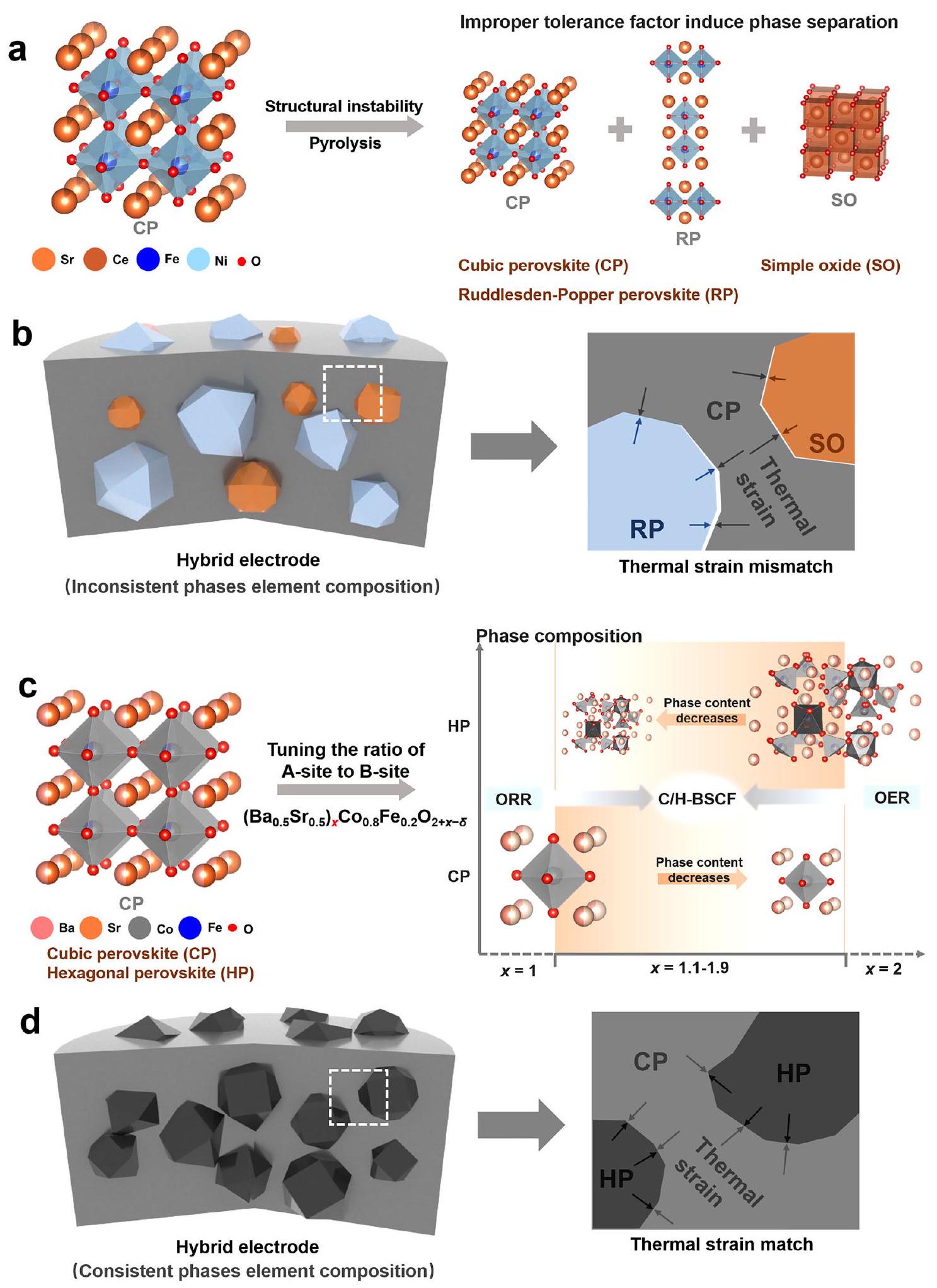
على الرغم من التقدم الإيجابي في فترة زمنية قصيرة نسبيًا بالنسبة لـ R-PCECsومع ذلك، لا تزال عملية تسويقها محدودة، ويرجع ذلك أساسًا إلى الأداء الكهروكيميائي غير الكافي في نطاق درجات الحرارة المتوسطة، نتيجة لندرة الأقطاب الكهربائية الهوائية عالية الكفاءة ذات النشاط العالي في كل من أوضاع خلايا الوقود (FC) وخلايا الطاقة الكهربائية (EC). إن تصميم أقطاب كهربائية هوائية بديلة تتمتع بقدرات عالية على تنشيط الأكسجين والترطيب هو نهج جذاب لتحسين معدل التفاعل الحركي لتفاعلات اختزال الأكسجين وتطور الأكسجين (ORR و OER) في خلايا الطاقة الكهربائية القابلة لإعادة الشحن (R-PCECS).. ومع ذلك، فإن القطب الهوائي أحادي الطور له ميزة هيكلية موحدة و محدودةقنوات النقل، مما يؤدي إلى أقطاب أحادية الطور تظهر عمومًا نشاطًا تحفيزيًا مقبولًا فقط في خلايا الوقود أو خلايا التحليل الكهربائي.لذلك، يتم البحث بشكل مكثف عن أقطاب الهواء في خلايا الوقود الكهربائية ذات الطورين أو الأطوار المتعددة، نظرًا لأن الأقطاب الهجينة يمكن أن توفر مواقع نشطة أكثر وفرة وموصلية أيونية جيدة.. بالإضافة إلى ذلك، يمكن أن تلبي الأقطاب الهجينة مجموعة متنوعة من المتطلبات التحفيزية بفضل التأثيرات التآزرية للعديد من الأطوار. تعتبر طريقة التجميع الذاتي لإنشاء الأقطاب الهجينة، مقارنة بطريقة الخلط الفيزيائي البسيطة، استراتيجية تخليق واعدة لأنها تسمح بتوزيع متجانس للعديد من الأطوار وقرب تلامس الأطوار، مما يقلل من حواجز الطاقة لتوصيل الإلكترونات والأيونات (الشكل 1أ)على سبيل المثال، قام سونغ وآخرون بتخليق إلكترود نانومركب رباعي السطوح من نوع رادلزدن-بوبير (RP). (SCFN) مُغَطَّاة بالسطح بـوجزيئات نانو NiO. نيكل أكسيديمكن أن تسرع الجسيمات النانوية بشكل فعال من امتصاص الأكسجين وتفككه، وتحصل على ديناميات تبادل سطح الأكسجين والبخار بسرعة جيدة.التوصيلية تحت التآزر متعدد الأطوار. Electrode نانو مركب أكثر فعالية يسمىتم إنشاء (BCFZYN) أيضًا بواسطة ليانغ وآخرين باستخدام التركيب والتلاعب بالكاتيونات.يتكون القطب الهوائي بشكل أساسي من مرحلة بيروفسكايت مكعبة، مع وجود طفيف لمرحلة NiO، وتعمل المرحلتان على تعزيز توصيل البروتونات في الكتلة وعملية تبادل الأكسجين على السطح، على التوالي. كما ذُكر أعلاه، فإن عوامل التحمل غير المناسبة للعناصر الجزئية في الأكاسيد تؤدي إلى فصل الطور، مما ينتج عنه هجن ثنائية أو متعددة الطور مع اختلافات واضحة في التركيب العنصري. وبالمثل، تشمل الأقطاب الهجينة التي تم إنشاؤها من خلال عوامل التحمل غير المناسبة ما يلي:بي سي سي واي (BSCFZY) و (NCBCO) ومع ذلك، بسبب الاختلافات الكبيرة في التركيب العنصري للمراحل المختلفة، فإن الإجهاد الحراري الناتج بين المراحل المختلفة من الصعب مقاومته، مما يؤدي إلى انخفاض في النشاط التحفيزي للقطب الكهربائي وانخفاض في استقرار الخلية (الشكل 1ب). بالإضافة إلى ذلك، وبالنظر إلى الهجرة العنصرية الحتمية عند درجات حرارة أعلى، هناك حاجة إلى مزيد من الكشف لتحديد العلاقة بين نشاط القطب الهجين وتركيب/محتوى كل مرحلة تحت ظروف التشغيل العملية.
إن بناء هجين بتفاعل غير متجانس قوي وبنية طور وتركيب قابلين للتحكم هو استراتيجية فعالة لتطوير محفزات مستقرة وفعالة.قام شيو وآخرون بتخليق محفز هجين بمحتوى طور قابل للتحكم من خلال فصل الطور الناتج عن تعديل موقع A بواسطة Sr لهيكل RP.الهجينيتكون من مرحلة البيروفسكايت المفردة (SP)ومرحلة RP“، حيث يظهر الهجين LaSr2.7 أفضل نشاط لتفاعل تطور الأكسجين عند درجة حرارة الغرفة. بالإضافة إلى ذلك، تم إثبات أن الاتصال القوي بين مراحل RP و SP يمكن أن يعزز بشكل فعال هجرة أيونات الأكسجين ويحفز نشاط تفاعل تطور الأكسجين للأكسجين الشبكي. ومع ذلك، فإن LaSr3-تظهر الهجينة قدرة غير مقبولة على تنشيط الأكسجين وترطيب في نطاق درجات الحرارة المتوسطة بسبب نقص الفراغات الأكسجينية الموجودة فيها، مما يقيّد بشدة قابلية استخدام هذه الهجينة كأقطاب هوائية في خلايا الطاقة الكيميائية القابلة لإعادة الشحن.
يُقبل على نطاق واسع أن البيروفسكايت المكعب (C-BSCF)، الذي يحتوي على الأرض القلوية و المعادن الانتقالية في موقع A وموقع B، على التوالي، تتمتع بنشاط قوي في تفاعل اختزال الأكسجين (ORR) وموصلية أيونات الأكسجين. في عام 2004، قدمت C-BSCF ظهورها الرائد ككاثود لخلايا الوقود الصلبة (SOFCs)، محققة كثافة طاقة قصوى ملحوظة منفي. علاوة على ذلك، أنتج زو وآخرون أكسيدًا معقدًا (H-BSCF) بهيكل سداسي مميز يعتمد على C-BSCF من خلال ضبط النسبة الاستوكيةتم استخدام H-BSCF كعامل حفاز منخفض التكلفة لتفاعل الأكسدة، حيث أظهر نشاطًا حفازًا عاليًا وثباتًا ممتازًا، مما يتفوق على معظم أكاسيد المعادن المستخدمة في تفاعل الأكسدة. النشاط الحفاز العالي من جانب واحد والقيودتجعل الموصلية الثلاثية لـ C-BSCF و H-BSCF من الصعب استخدامها على نطاق واسع كأقطاب هوائية في R-PCECs، على الرغم من أن كل مادة لها مزاياها المميزة. في الواقع، فإن نقصستقيد الموصلية التفاعل الكهروتحفيزي للقطب الهوائي في خلايا الوقود ذات الأغشية البوليمرية إلى حدود الطور الثلاثي.
هنا، نبلغ عن عائلة جديدة من الأقطاب الهجينة المعتمدة على BSCF ذات هياكل فريدة وتركيبات متميزة من خلال التحكم ببساطة في نسبة محتوى العناصر من موقع A إلى موقع B في (BSCF- ، حيث يتغير x من 1 إلى 2 بزيادات قدرها 0.1) (الشكل 1ج). تظهر الاختبارات الكهروكيميائية والتوصيف أن الهجين (C/H-BSCF، BSCF1.5)، الذي يتكون تقريبًا الطور المكعب C-BSCF والمرحلة السداسية H-BSCF، تتمتع بأفضل نشاط كهركاتيلي (الشكل 1c). يظهر القطب الهجين C/H-BSCF نشاطًا ممتازًا في اختزال الأكسجين (ORR) وتفاعل الأكسدة (OER) ويحقق أداءً غير مسبوق في كل من أوضاع FC و EC في R-PCECs، والذي يُعتبر نتيجة للتأثير التآزري بين C-BSCF المكعب الذي يتمتع بتفعيل أكسجين ممتاز وموصلية، وH-BSCF السداسي الذي يتمتع بتفاعل ترطيب قوي ووفرة من فراغات الأكسجين. بالإضافة إلى ذلك، يعزز التركيب العنصري المتسق التفاعل بين المرحلتين ويعزز الاستقرار الهيكلي والكيميائي للقطب الهوائي (الشكل 1d). قد يقدم أكسيد C/H-BSCF فرصة جديدة لتسريع اعتماد تكنولوجيا R-PCECs.
النتائج
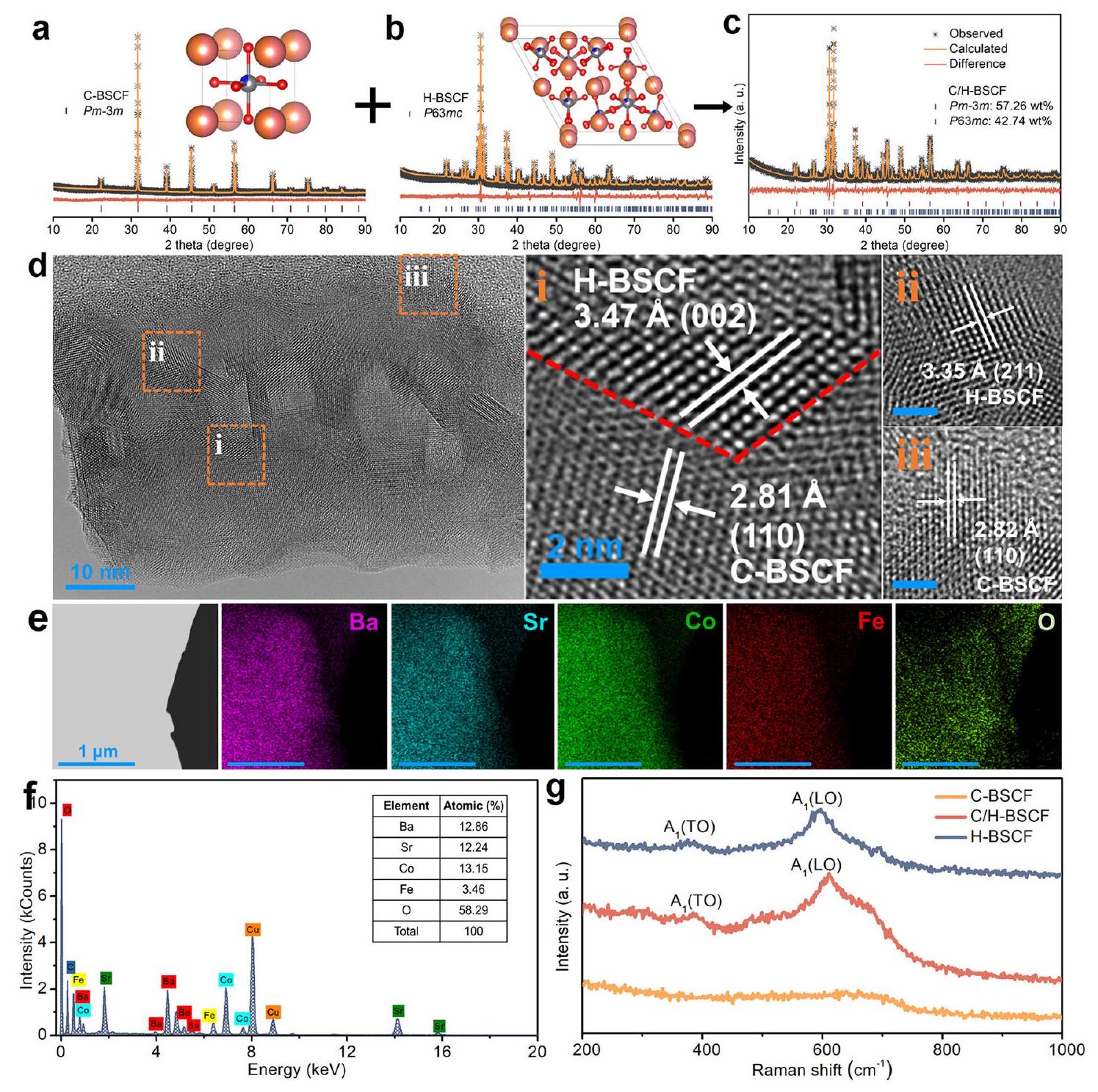
تم استكشاف تأثير محتويات المعادن القلوية المختلفة في موقع A على بنية C-BSCF لتوفير رؤى في البحث عن أقطاب هوائية متفوقة. تم تحليل C-BSCF وC/H-BSCF وH-BSCF التي تم تصنيعها باستخدام حيود الأشعة السينية (XRD). تظهر النتائج أن C/H-BSCF يعرض تراكبًا لقمم حيود C-BSCF المكعبة وH-BSCF السداسية، مما يشير إلى أنه أكسيد مزدوج الطور تم تجميعه ذاتيًا يتكون من مراحل مكعبة وسداسية (الشكل التكميلي 1). تم تأكيد الهياكل المكعبة والسداسية لمساحيق C-BSCF وH-BSCF، على التوالي، من خلال بيانات تحسين ريتفيلد (الشكل 2a، b). تم تحديد أن C-BSCF له مجموعة فراغية من ومعلمات الشبكة لـ (3) . وُجد أن H-BSCF لديه مجموعة فراغية من معلمات الشبكة لـ، من أجل تحسين دقة نتائج تحسين حيود الأشعة السينية (XRD) للهجين C/H-BSCF، تم استخدام تقنيات المجهر الإلكتروني الناقل (TEM) وتحليل الأشعة السينية المشتتة بالطاقة (EDX) لتحديد النسب الكيميائية للطورين (الشكل التوضيحي 2). ثم تم استخدام هذه القيم المحددة كمعلمات مدخلة لعملية تحسين XRD. وقد تم الكشف عن التركيب البلوري لسطح عينة C/H-BSCF بأنهمكعب و سداسي من خلال تحسين XRD، حيث أن الأطوار المكعبة والسداسية تتوافق مع مجموعة الفضاء C-BSCF و H-BSCF، على التوالي (الشكل 2c). تم التأكد من دقة النتائج المحسنة بناءً على عوامل الموثوقية لـ، و . للتحقيق في الميزات غير العرضية لأكاسيد C/H-BSCF لتجميع ذاتي للطورين المزدوجين، تم إجراء سلسلة من BSCF- (حيث تتراوح من 1 إلى 2 بزيادات قدرها 0.1) تم تصنيع الأكاسيد. تظهر أنماط XRD أنه، باستثناء C-BSCF و H-BSCF، اللذان هما أكاسيد أحادية الطور، فإن جميع الأكاسيد الأخرى تظهر مزيجًا من الأطوار المكعبة والسداسية (المكمل
الشكل 3. علاوة على ذلك، يؤكد تحسين XRD لأكاسيد BSCF-1.3 و BSCF-1.7 تركيبها ثنائي الطور (الشكل التوضيحي 4). من خلال دمج هذه النتائج مع بيانات تحسين ريتفيلد لـ
في C/H-BSCF، من الواضح أن محتوى الطور السداسي يزيد تدريجياً بينما ينخفض محتوى الطور المكعب معتقترب قيمة – من 2 (الجدول التكميلي 1). وبالتالي، تتيح هذه الاستراتيجية
الشكل 1 | مخطط تخطيطي لاستراتيجيات التخليق وتأثيرات الحرارة على الأقطاب الهجينة. أ الأقطاب الهجينة التي تتشكل نتيجة عدم الاستقرار الهيكلي والتحلل الحراري تؤدي إلى فصل الطور بسبب عامل التحمل غير المناسب للكاتيون الجزئي في الطور الكلي مما يؤدي إلى تشكيل بيروفسكايت رادلزدن-بوبير أو أكسيد بسيط.إجهاد حراري غير متطابق بين مراحل متعددة من الأقطاب الهجينة
تمت صياغته بواسطة عامل التسامح غير الصحيح.المحتوى الهجين الذي يتم التحكم فيه بالمرحلة والمكون من البيروفسكايت المكعب والسداسي الناتج عن ضبط نسبة موقع A إلى موقع B في البيروفسكايت المكعب. d مطابقة الإجهاد الحراري للأقطاب الهجينة مع تركيبة عنصر المرحلة المتسقة. إنشاء هجن ذات مرحلتين، بالإضافة إلى التعديل المتعمد لتكوين المحتوى لكلتا المرحلتين.
لتأكيد وجود كل من الأطوار المكعبة والسداسية في أكسيد C/H-BSCF بدقة أكبر، تم جمع صورة مجهر إلكتروني ناقل عالي الدقة (HR-TEM). في الشكل 2d، يُلاحظ بوضوح وجود اتصال وثيق بين المستوى البلوري (110) للطور المكعب والمستوى البلوري (002) للطور السداسي في منطقة الإطار (i). من الواضح أنه يمكن ملاحظة المستوى البلوري السداسي (211) والمستوى البلوري المكعب (110) في المواقع (ii) و(iii) على التوالي. علاوة على ذلك، فإن تباعد المستويات البلورية يتوافق مع بيانات تحسين Rietveld للأشعة السينية (XRD) لأكسيد C/H-BSCF الهجين، مما يؤكد وجود هذه المستويات. في الهجين C/H-BSCF، ساهمت الضغوط والتأثيرات البينية الناتجة عن الترتيبات الذرية المختلفة عند واجهة الأطوار C-BSCF (110) وH-BSCF (002) بشكل إيجابي في تعزيز النشاط التحفيزي.تم استخدام صور رسم الخرائط العنصرية TEM-EDX لتحديد الخصائص الكلية لـ C/H-BSCF، والتي كشفت عن توزيع موحد للعناصر على مقياس الميكرون، بالإضافة إلى التحديد الدقيق للنسبة المئوية الذرية لكل عنصر، والتي ظلت متوافقة بشكل وثيق كما ومع ذلك، تعرض ملفات المسح الخطي لمطيافية EDX المحلية لجزيئات C/H-BSCF في الشكل 2e تقلبًا كبيرًا في محتوى العناصر من Ba و Sr، مما يشير إلى وجود طورين (C-BSCF و H-BSCF) في جزيء C/H-BSCF (الشكل التوضيحي 5).تم استخدام مطيافية رامان لتحديد التركيب البلوري والخصائص الاهتزازية لأكاسيد البيروفسكايت.على الرغم من أن الهيكل المكعب المثالي للبيروفسكايت لا يُتوقع أن يظهر نطاقات نشطة في رامان، إلا أن أكاسيد C-BSCF و C/H-BSCF تظهر نطاقات عريضة عندوالذي يمكن أن يُعزى إلى تشويه جان-تيلر للبيروفسكايت المكعب عند درجة حرارة الغرفة (الشكل 2g). علاوة على ذلك، فإن القمم التي لوحظت في و في C/H-BSCF و H-BSCF تشير إلى و أنماط الفونونات الضوئية لمجموعة الفضاء P63mc. لذلك، أكدت طيفيات رامان أيضًا التركيب الثنائي الطور لأكسيد C/H-BSCF في درجة حرارة الغرفة. بالإضافة إلى ذلك، يحافظ C/H-BSCF على هيكل طور وتركيب مستقرين تحت درجات حرارة مختلفة وظروف تكليس طويلة الأمد (الشكل التوضيحي 6).
يمثل أكسيد الهجين C/H-BSCF نشاطًا كهربائيًا ممتازًا كقطب هوائي. طيف impedancia الكهروكيميائي
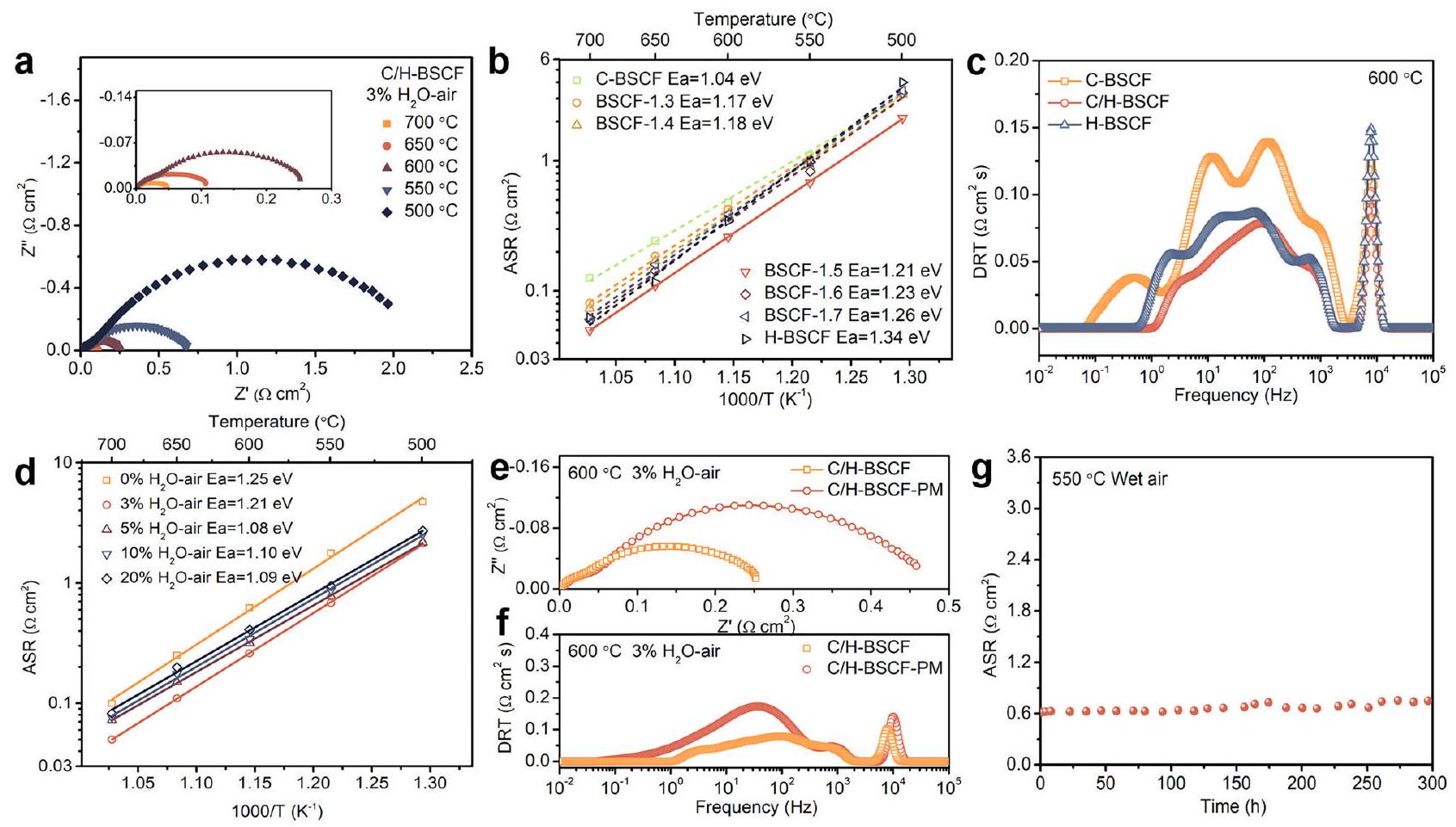
الشكل 3 | أداء تنشيط الأكسجين لأقطاب الهواء. أ مخططات EIS لخلية متماثلة مدعومة بـ BZCYYb مع قطب C/H-BSCF عندتحت-هواء.مخطط أرينيوس لمعدلات التفاعل السطحي لـ C-BSCF و H-BSCF و BSCF-أقطاب كهربائية، و 1.7). تم قياس تحليل DRT لـ EIS عند أقطاب C-BSCF و C/HBSCF و H-BSCF في مخطط أرهينيوس لمعدلات الاستجابة الذاتية المتماثلة خلية مع قطب كهربائي C/H-BSCF عند ضغوط مياه مختلفة (-هواء) عند . e EIS وتحليل DRT للتركيبات الذاتية التجميع والمختلطة جسديًاأقطاب BSCF تم قياسها عندتحت-ظروف الهواء. g الاعتماد الزمني لـ ASR لخلية متماثلة مع إلكترود C/H-BSCF في الهواء الرطب عند. (EIS) للخلية المتماثلة التي تتميز بـ C/H-BSCF/تم تصوير هيكل (BZCYYb)/C/H-BSCF في الشكل 3a وتم قياسه تحت-هواء في، و كاشفًا المقاومة النوعية المحددة للمنطقة (ASR) للقطب الهجين C/H-BSCF لتكون، و على التوالي. بالمقارنة، تحت ظروف تشغيل متطابقة، فإن معدل استجابة السطح (ASR) لأقطاب C-BSCF أحادية الطور و H-BSCF هو 0.48 وفي، على التوالي (الشكل التوضيحي 7 أ، ب). تشير نتائج هذه الاختبارات إلى تحسين كبير في ASR لـ و بالنسبة لقطب C/H-BSCF ثنائي الطور مقارنة بأكاسيد الطور الواحد C-BSCF وH-BSCF (الجدول التكميلي 2)، مما يبرز المزايا المحتملة للتنسيق الثنائي الطور وتعزيز C/H-BSCF كقطب هوائي. علاوة على ذلك، وُجد أن نشاط اختزال الأكسجين (ORR) لـ H-BSCF كان أقل بكثير من نشاط C-BSCF من خلال قياس الطيف الكهربائيimpedance (EIS) لأقطاب C-BSCF وH-BSCF في خلايا متماثلة باستخدام (SDC) الإلكتروليت (الشكل التوضيحي التكميلي 8)، بينما يمكن أن يُعزى الأداء الكهروكيميائي الجيد لـ H-BSCF في الخلايا المتماثلة الناقلة للبروتون إلى القدرة الممتازة على الترطيب. مقارنةً بالقطب الهوائي التقليدي الذي تم تجميعه ذاتيًا، فإن القدرة على تعديل تركيبة المرحلتين لتحسين النشاط التحفيزي للقطب لها قيمة بحثية أعلى وقابلية تطبيق. تم الحصول على قياسات الطيف الكهربائيimpedance (EIS) لمختلف الأقطاب مع محتويات متغيرة من المرحلتين المكعبة والسداسية أيضًا (الشكل التوضيحي التكميلي 7)، مما يكشف أن الهجين C/H-BSCF لديه أقل مقاومة سطحية (ASR) في نطاق درجات الحرارة التشغيلية. ومن الجدير بالذكر أنه مع زيادة محتوى المرحلة السداسية، تنخفض مقاومة السطح ثم ترتفع، بينما تزداد طاقة التنشيط تدريجياً (الشكل 3b). قد تعكس هذه النمط التفاعلات بين المرحلتين المكعبة والسداسية في تفاعلات تنشيط الأكسجين والترطيب تحت درجات حرارة متغيرة.
توزيع أوقات الاسترخاء (DRT) هو نهج مستخدم على نطاق واسع في تحليل تفكيك قياسات الطيف الكهربائي (EIS) في التحليل المكثف لعمليات التفاعل الكهروكيميائي على أسطح الأقطاب.الشكل 3ج يوضح قمم التفكيك لإشارات التحليل الكهربائي للكهروكيميائية (EIS) لأقطاب C-BSCF و C/H-BSCF و H-BSCF عند بواسطة علاج DRT. وفقًا لتوزيع التردد، يتم تصنيف قمم التفكيك إلى ثلاث مناطق متميزة: تردد عالي (التردد الوسيط (IF، ) ، وتردد منخفض ( ). ترتبط هذه المناطق بعمليات نقل الشحنة، وهجرة الأيونات، وتبادل السطح، بالإضافة إلى نقل الكتلة على السطح، على التوالي كما هو موضح في الشكل 3c، مقارنةً بمناطق LF وHF، فإن المقاومة في منطقة IF تتحكم بشكل أساسي في المقاومة الكلية، مما يشير إلى أن معدلات تبادل السطح والانتشار الكتلي للقطب الهوائي، وبشكل خاص الامتصاص السطحي وتفكك الأكسجين والماء، بالإضافة إلى معدلات انتشار أيونات الأكسجين والبروتونات، تحد بشكل كبير من العملية الكهروكيميائية. ومن المثير للاهتمام أن مساحة الذروة للقطب الهجين C/H-BSCF في منطقة IF ليست بين، بل أقل من تلك الخاصة بأقطاب C-BSCF وH-BSCF أحادية الطور. وهذا لا يظهر فقط معدلات تبادل السطح والانتشار الكتلي الممتازة لقطب C/H-BSCF، بل يبرز أيضًا مزايا التأثير التآزري من الطورين في تفاعل اختزال الأكسجين (ORR) وتفاعل الترطيب على سطح القطب الهوائي. في الوقت نفسه، يتم توضيح الاعتماد على درجة الحرارة لمقاومة السطح النشطة (ASR) لأقطاب C-BSCF وC/H-BSCF وH-BSCF في مناطق HF وIF وLF في الشكل التكميلي 9. إن طاقة التنشيط لقطب C/H-BSCF في منطقة IF هي 1.24 eV، والتي تقع في منتصف طاقات التنشيط لأقطاب C-BSCF وH-BSCF. ويرجع ذلك أساسًا إلى الترويج التآزري للتوصيل الأيوني في الطورين المكعب والسداسي في القطب الهجين C/H-BSCF..
لفهم ومقارنة التفاعلات السطحية لـ C-BSCF و C/HBSCF و H-BSCF تحت ظروف عملية، تم إجراء تحليل الطيف الكهربائيimpedance (EIS) للخلايا المتماثلة مع أقطاب هوائية مختلفة عند ضغوط جزئية مختلفة من الأكسجين. ) تم اختبارها وتحليلها بالتزامن مع DRT لعمليات مختلفة (الشكل التكميلي 10). عندما تعرض القطب الهوائي للأكسجين النقي عند كما هو متوقع، ال أظهرت الخلية المتماثلة مقاومة قطبية منخفضة نسبيًا ( ). كما أن انخفض، الأظهر زيادة ملحوظة. الـيظهر القطب الهجين H-BSCF الأدنىعند ضغوط جزئية مختلفة للأكسجين في. ومع ذلك، في منطقة HF، C-BSCF،تظهر أقطاب H-BSCF و H-BSCF تشابهًا و قيم حوالي 0.2، مما يشير إلى أن عمليات نقل الشحن بين الأقطاب المختلفة لا تختلف بشكل كبير.الأسفليُنسب انخفاض المقاومة في مناطق IF و LF بشكل رئيسي إلى انخفاض المقاومة في أقطاب C-BSCF و H-BSCF، مما يشير بشكل أكبر إلى أن معدل ORR السريع لقطب C/H-BSCF الهجين يُعزى بشكل رئيسي إلى معدل انتشار الأيونات الأكسجينية وسطح نقل الكتلة بواسطة الأطوار المكعبة والسداسية، على التوالي. علاوة على ذلك، تم تقييم الخلية المتماثلة مع قطب C/H-BSCF لقياس EIS تحت ضغوط مائية مختلفة من أجل إثبات أن قطب C/H-BSCF الهجين لديه قدرة ترطيب قوية وموصلية بروتونية (الشكل 3d). تم تقليل ASR لقطب C/H-BSCF بشكل كبير تحت-الهواء مقارنةً بظروف الهواء الجاف، على سبيل المثال، سقوطمن 0.62 إلىفي. تشير هذه الانخفاض الكبير في ASR إلى أن قطب C/H-BSCF لديه معدل تفاعل ترطيب سريع وقدرة ممتازة على انتشار البروتونات. ومع ذلك، فإن ما يتجاوز-الهواء، من الجدير بالذكر أن معدل الاستجابة التلقائية في زادت بشكل أكثر وضوحًا مقارنة بـ يمكن أن يُعزى ذلك إلى زيادة ضغط بخار الماء مما يؤدي إلى تنافس بين جزيئات الأكسجين والماء على الامتصاص على سطح القطب، مما يقلل من معدل تفاعل اختزال الأكسجين للقطب. بالإضافة إلى ذلك، انخفضت طاقة التنشيط تدريجياً مع زيادة ضغط الماء، مما يشير إلى أن القطب الهجين C/H-BSCF لديه القدرة على أن يُستخدم كقطب هوائي في خلايا كهربائية كيميائية موصلة للبروتونات.. بالإضافة إلى ذلك، يتم تصنيع القطب الكهربائي المختلط جسديًا C/H-BSCF (C/H-BSCF-PM) من خلال الخلط الميكانيكي لـ C-BSCF المكعب وH-BSCF السداسي، وفقًا لنسبة الطورين من C/H-BSCF الهجين. يتم قياس EIS لهذا القطب على خلية متماثلة مع ASRs من، و في-هواء عند 700,، و ، على التوالي (الشكل التكميلي 11). أظهر القطب الكهربائي C/H-BSCF الذي تم تجميعه ذاتيًا نشاطًا تحفيزيًا متفوقًا مقارنةً بقطب C/H-BSCF-PM. السبب الرئيسي لذلك يُعزى إلى أن الخلط الميكانيكي يؤدي إلى توزيع وواجهة أقل جودة بين المرحلتين، مما يمكن أن يؤثر سلبًا على نقل الأيونات وانتشار السطح، وبالتالي يقيّد معدل تنشيط الأكسجين للقطب الكهربائي (الشكل 3e والشكل التكميلي 12) . يتم تأكيد ذلك من خلال تحليل DRT لدراسة التأثير البيئي لكل من الأقطاب (الشكل 3f والشكل التكميلي 13). كما هو موضح في الشكل 3g، أظهر الخلية المتماثلة مع قطب C/H-BSCF استقرارًا جيدًا على مدى فترات طويلة من الاختبار، مع معدل تدهور لا يتجاوز لنشاط التحفيز.
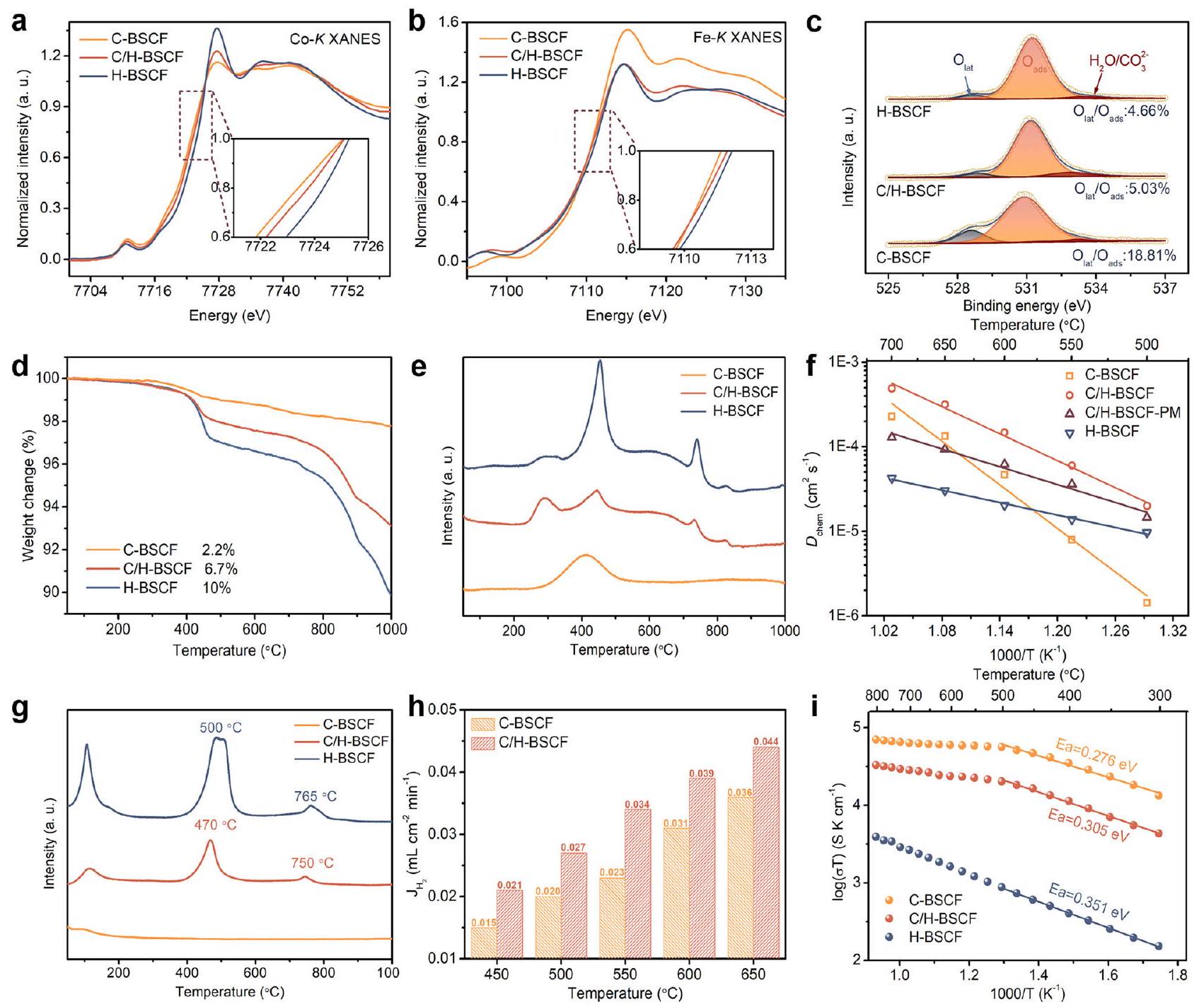
في السابق، استخدمنا تقنية EIS لفحص أداء تنشيط الأكسجين للأقطاب الكهربائية ذات الطور المكعب، والطور السداسي، والعديد من الهجينة ذات الطورين. للتعمق أكثر في الأسباب الكامنة وراء الفروق في النشاط التحفيزي بين C-BSCF وC/HBSCF وH-BSCF وللكشف عن تأثير الهجين ذو الطورين على تعزيز تفاعل اختزال الأكسجين (ORR) وتفاعل أكسدة الأكسجين (OER) عند القطب الكهربائي الهوائي، تم توصيفها واختبارها بواسطة هيكل الامتصاص القريب من حافة الأشعة السينية (XANES)، وطيف الإلكترون بالأشعة السينية (XPS)، والتحليل الحراري الوزني (TGA)،إزالة مبرمجة بالحرارة-TPD)، والأغشية القابلة لاختراق الهيدروجين. حافة الامتصاص (عند 0.7-0.8 شدة طبيعية) في طيف XANES عند -حافةتكون العناصر الانتقالية حساسة بشكل ملحوظ لحالتها التكافؤيةطيف XANES لعنصر الكوبالت-حافة و Feتم عرض حافة المحفزات C-BSCF وC/HBSCF وH-BSCF في الشكل 4a و4b، حيث يمكن رؤية أن H-BSCF يقع عند طاقة أعلى مما يشير إلى وجود حالات أكسدة أعلى من الكوبالت والحديد في BSCF مقارنة بتلك الموجودة في أكسيد الهجين C/H-BSCF. وهذا يقترح أن الطور السداسي يمتلك متوسط حالة أكسدة أعلى في الموقع B، مما قد يكون مسؤولاً عن الانخفاض الحراري الملحوظ لـ H-BSCF عند درجات حرارة عالية، مما يخلق فراغات أكسجين ويعزز الترطيب، كما تم التحقق منه لاحقًا.. في في درجة حرارة الغرفة، يحتوي C-BSCF المكعب على أدنى قيمتين لـ Co و Fe، مما يشير إلى وجود المزيد من فراغات الأكسجين ويسهل تسريع معدل تفاعل اختزال الأكسجين عند سطح القطب الهوائي.. علاوة على ذلك، تم استخدام تحليل XPS أيضًا للكشف عن حالات الأكسدة لـ Co و Fe في عينات مختلفة. حالات التكافؤ المتوسطة لـ Co و Fe من الأعلى إلى الأدنى هي أكاسيد H-BSCF و C/H-BSCF و C-BSCF، على التوالي، والتي تتوافق مع نتائج تحليل XANES (الشكل التكميلي 14). يقدم الشكل 4c طيف XPS لأنواع الأكسجين على سطح المحفز والقمم الناتجة عن فك التداخل المقابل. يمكن تمييز قدرة المحفزات على تنشيط الأكسجين من خلال نسبة الأكسجين الشبكي ( ) إلى الأكسجين الممتص ( ). وفقًا لتحليل مناطق القمة الفرعية، فإن قيم لـ C BSCF و C/H-BSCF و H-BSCF هي، و ، على التوالي. يظهر H-BSCF السداسي انخفاضاً فيالقيم، التي تُعزى بشكل رئيسي إلى وجود جزيئات نانوية من BaO بكثرة على سطح المحفز، مما يعزز امتصاص الأكسجين ويسرع عملية تنشيط الأكسجين (الشكل التكميلي 15).
فقدان الأكسجين الشبكي الناتج عن درجات الحرارة العالية هو أحد الخصائص الحاسمة التي تعكس تشكيل فراغات الأكسجين وقدرة أيونات الأكسجين على الهجرة في الطور الكتلي للقطب الهوائي. علاوة على ذلك، فإن فراغات الأكسجين، التي يمكن أن تعمل كمواقع نشطة في تفاعلات كيميائية كهربائية مختلفة مثل اختزال الأكسجين (ORR)، وأكسدة الأكسجين (OER)، والترطيب، لها تأثير ملحوظ على معدل الحركة الكلي للقطب.توضح الشكل 4d بوضوح منحنيات TGA لـ CBSCF و C/H-BSCF و H-BSCF من درجة حرارة الغرفة إلى. تشير النتائج إلى فقدان كتلة ، و للعينات الثلاث، على التوالي. ويرجع ذلك إلى التخفيض الحراري الذي خفض حالات الفالنس لعناصر الكوبالت والحديد، مما أطلق المزيد من الأكسجين الشبكي. يتمتع الهجين ثنائي الطور C/H-BSCF بفقدان أكسجين مثير للإعجاب، متفوقًا على العديد من الأقطاب الهوائية المتقدمة، مثل (BCFZY، ~1%)، BCFZYN ( ), PBSCF ( )، BCCY ( )، و (BC1.5MN، تم استخدام اختبارات -TPD للتحقيق في خصائص عملية امتصاص الأكسجين مع زيادة درجة الحرارة لمختلف الأكاسيد. تعتبر درجة حرارة الامتصاص الأولية وكمية امتصاص الأكسجين مؤشرات حاسمة على تنشيط الأكسجين ومحتوى فراغات الأكسجين في الأقطاب الكهربائية الهوائية تحت ظروف التشغيل.يمتلك C/H-BSCF الهجين درجة حرارة امتصاص أولية أقل ومحتوى أكسجين أعلى مقارنةً بـ C-BSCF المكعب (الشكل 4e). بالإضافة إلى ذلك، تم تحديد كميات الأكسجين المنبعثة بواسطة-TPD لكل مادة متسقة مع نتائج TGA. و قيم C-BSCF و C/H-BSCF و C/H-BSCF-PM و H-BSCF في نطاق درجة الحرارة من 500 إلىتم تحديدها باستخدام طريقة استرخاء الموصلية (الشكل التكميلي 16)، كما هو موضح في الشكل 4f والشكل التكميلي.. تم حرق جميع العينات إلى قضبان كثيفة وظلت بنية الطور والتركيب مستقرة (الأشكال التكميلية 17 و 18). كما هو متوقع، عند كل درجة حرارة، كلاهما و من C/H-BSCF تظهر قيمًا أعلى بشكل ملحوظ مقارنةً بـ C-BSCF و C/H-BSCFPM و H-BSCF. على سبيل المثال، عند ، الـ و تم قياس قيم أكاسيد C/H-BSCF لتكون و على التوالي، في حين كانت القيم المقابلة لـ C-BSCF هي و . من ناحية أخرى، أظهر H-BSCF أدنى و القيم، التي كانت و ، على التوالي. على الرغم من أن و كانت قيم C-BSCF أعلى من قيم H-BSCF عندكانت معدلات تبادل الأكسجين على السطح وانتشار الطور الكتلي لـ H-BSCF متفوقة بشكل ملحوظ على C-BSCF عندما انخفضت درجة الحرارة إلى 550 و. بالإضافة إلى ذلك، و تم استكشاف قيم أكسيد المركب C/H-BSCF-PM أيضًا تحت نفس الظروف كما هو موضح في الشكل 4 ف والشكل التكميلي 19. على مدار نطاق درجات الحرارة المختبر، و كانت قيم C/H-BSCF-PM أقل من قيم C/H-BSCF التي تم تصنيعها ذاتيًا (الجدول التكميلي 3). يمكن أن يُعزى هذا التباين إلى التوزيع غير الجيد للطور في
الشكل 4 | تعزيز تفعيل الأكسجين، توصيل الأيونات، وتفاعل الترطيب.كو وحديد-طيف XANES لـ C-BSCF و C/H-BSCF و H-BSCF. يظهر الشكل المصغر تكبيرًا موضعيًا. ج طيف XPS لـ C-BSCF و C/H-BSCF و H-BSCF، موضحًا الهياكل.منحنيات TGA و-ملفات TPD من درجة حرارة الغرفة إلى. و مناسب بواسطة الموصلية الإلكترونية
منحنيات الاسترخاء للأقطاب الكهربائية في نطاق درجة الحرارة من. ج -ملفات TPD من درجة حرارة الغرفة إلى. الـ تدفقات النفاذية لأغشية C-BSCF و C/H-BSCF القابلة لنفاذ الهيدروجين عند. الموصلية الكهربائية لـ C-BSCF و C/H-BSCF و H-BSCF بين في الهواء. عينات مختلطة جسديًا في C/H-BSCF-PM، مما أعاق التأثير التآزري للطورين ومن ثم أعاق هجرة الأيونات وتبادل السطح.
تفاعل الترطيب، كشرط مسبق لإدخال البروتونات إلى القطب الهوائي، هو عامل حاسم لكل من توصيل البروتونات وحركية التفاعل الحفزي.تنتقل البروتونات، الموجودة كعيوب أيون الهيدروكسيد داخل أكسيد البيروفسكايت، عبر الهجرة في الطور الكتلي من خلال آلية غروتوس.. في الشكل -تم استخدام TPD لاستكشاف قدرة الترطيب لعينة C-BSCF وC/H-BSCF وH-BSCF. بالإضافة إلى ذلك، ظهر ذروة إزالة الماء الممتص قبلو H-BSCF تظهر أيضًا Remarkableقمم إزالة الامتصاص مقارنةً بـ C-BSCF، والتي تُعزى إلى المساهمة الكبيرة لوجود فراغات الأكسجين في المرحلة السداسية، مما يعزز بشكل كبير من قدرة الترطيب. تم استخدام الأغشية الكثيفة القابلة لاختراق الهيدروجين لاختبار قدرة انتشار البروتونات في C/H-BSCF الهجين وC-BSCF المكعب.كما هو موضح في الشكل 4h. لضمان نتائج موثوقة لاختراق الهيدروجين، تم طلاء كلا جانبي الغشاء بطبقة من البالاديوم بسمك 500 نانومتر باستخدام تقنية الرش المغناطيسي (الشكل التوضيحي التكميلي 20).غشاء نفاذية الهيدروجين ثنائي الطور C/HBSCF لديه حجم أكبرتدفق الاختراق عند، مما يشير إلى أن الهجين يمتلك BSCF أداءً متفوقًا في انتشار البروتونات. على سبيل المثال، كانت تدفق نفاذية الهيدروجين لـ C/H-BSCF هوفيبينما أظهر تدفق C-BSCF فقط. في الوقت نفسه، تم حساب الموصلية البروتونية المقابلة لـ C/H-BSCF و C-BSCF كما هو موضح في الشكل التكميلي 21. تحتاج التفاعلات الكهروكيميائية السريعة للقطب، مثل عملية OER، إلى أن يتمتع القطب بموصلية كافية لتتناسب مع الاستجابة الديناميكية السريعة بالإضافة إلى توصيل أيونات الأكسجين والبروتونات. H-BSCF السداسية الشكل (كان لديه موصلية ضعيفة عند، بينما الهجين C/H-BSCF (يأتي في المرتبة الثانية بعد C-BSCF المكعب (23.2-65.3 S سم) ) (الشكل 4 i. بالإضافة إلى ذلك، تظهر جميع العينات سلوك أشباه الموصلات المعتمد على الحرارة في نطاق طاقات التنشيط لـ C-BSCF و C/H-BSCF و H-BSCF هي، و0.351 إلكترون فولت في نطاق، على التوالي. من الجدير بالذكر أن نقطة تحول تحدث حول ، مما يشير إلى آليات توصيل مختلفة في و النطاقات. ويعزى ذلك بشكل رئيسي إلى حقيقة أن آلية التوصيل مرتبطة ارتباطًا وثيقًا بسلوك قفز البولارون الصغير، الذي يتأثر بتركيبة الأكسجين
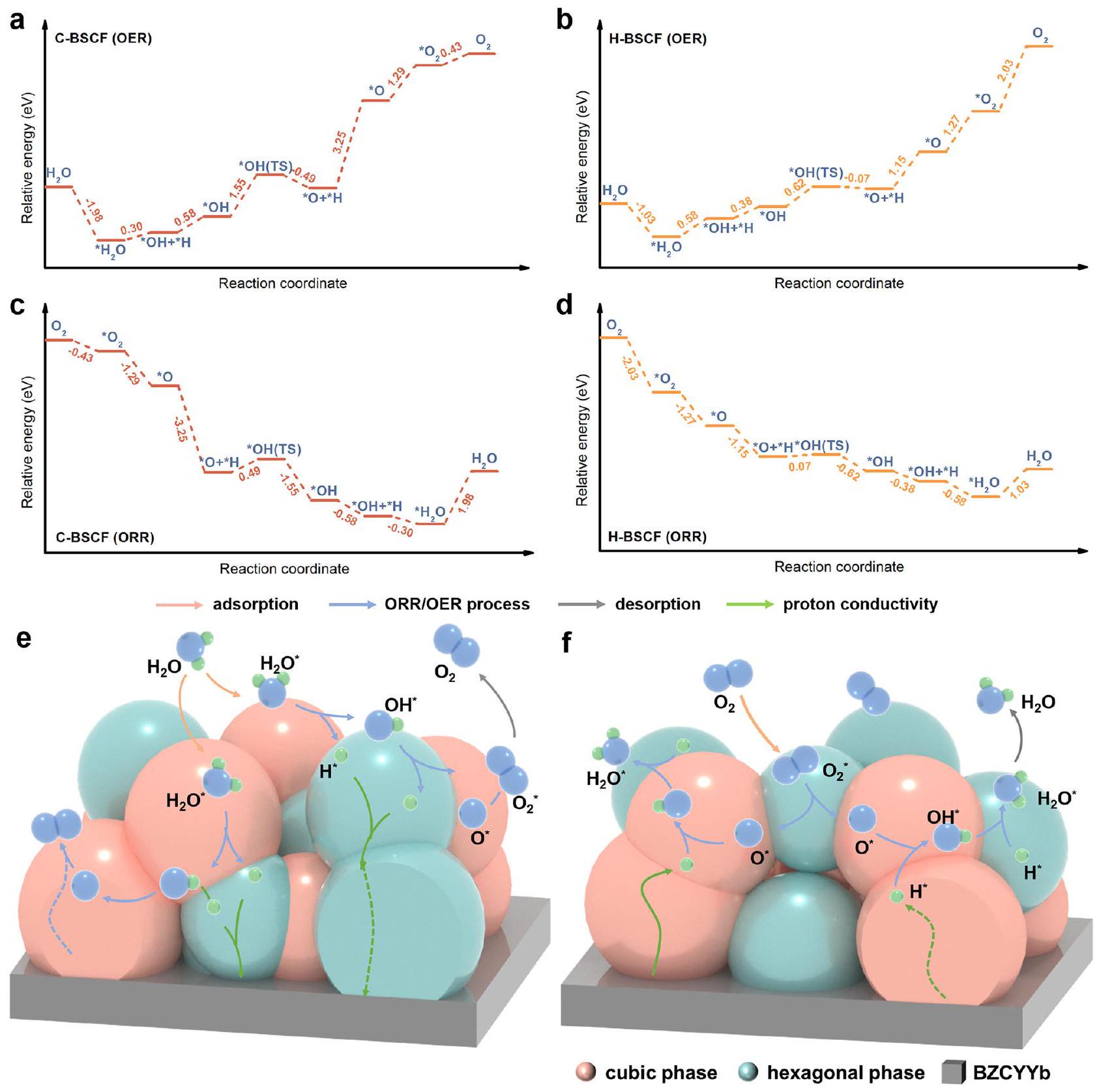
الشكل 5 | حسابات DFT المتعلقة بآليات ORR و OER على الأقطاب الهوائية لـ R-PCECs. حاجز الطاقة لعملية OER على C-BSCF المكعب (100) وأسطح H-BSCF السداسية (0001). حاجز الطاقة لـ
عملية ORR علىمكعب C-BSCF (100) وأسطح H-BSCF السداسية (0001). آلية التحفيز للتآزر ثنائي الطورالموارد التعليمية المفتوحةORR على سطح الهجين C/H-BSCF. إصدار ومعدل هجرة الناقل. بشكل عام، تم تأكيد أن القطب الهجين ثنائي الطور C/H-BSCF يتمتع بتوصيلية ثلاثية متفوقة.وسعة الترطيب في التأثير التآزري لطور البيروفسكايت السداسي والكوبي، كاشفًا عن أصل تنشيط الأكسجين العالي.
قمنا بدراسة معاملات التمدد الحراري (TEC) لمختلف أقطاب الهواء من أجل تأكيد أن C/H-BSCF، وهو قطب مركب ذاتي التجميع ذو مرحلتين لهما نفس التركيب العنصري، يمكن أن يقلل بشكل كبير من الإجهاد الحراري لتحسين التوافق مع الإلكتروليت. الشكل التوضيحي الإضافي 22a يظهر التمدد الخطي (dL/L ) من عينات C-BSCF و C/H-BSCF و C/H-BSCF-PM و H-BSCF مع درجة الحرارة. كانت قيمة معامل التمدد الحراري (TEC) لـ C-BSCF و H-BSCF و ، على التوالي، حيث أن الموصلية الكهربائية الحرارية لـ C-BSCF المكعب تتوافق مع تقارير الأدبياتبينما يظهر H-BSCF السداسي TEC أقل من C-BSCF. كما هو متوقع، فإن TEC لـ
الهجائن C/H-BSCF و C/H-BSCF-PM، التي كانت و ، على التوالي، كانت متوسطة بين تلك الخاصة بـ C-BSCF و H-BSCF. يظهر القطب الهجين توافقًا حراريًا أفضل مع الإلكتروليت مقارنةً بمعظم الأنظمة التقليدية.أقطاب كهربائية قائمة على – (الشكل التكميلي 22ب، ج)من الجدير بالذكر أن العديد من الأقطاب المركبة التي تم إعدادها بواسطة طرق الخلط الفيزيائي والتجميع الذاتي تظهر اختلافات كبيرة من حيث هياكلها ذات الطورين وتركيباتها العنصرية. هذه الاختلافات تعيق الأقطاب المركبة من تنظيم الضغوط الحرارية بفعالية بين الأطوار عند درجات الحرارة العالية. لذلك، فإن معامل التمدد الحراري للأقطاب المركبة التقليدية يعتمد بشكل مباشر على معامل التمدد الحراري لكل طور ونسبة كل طور داخل المركب.. من المثير للاهتمام أن الموصلية الكهربائية الحرارية لـ C/H-BSCF وجدت أنها أقرب إلى الموصلية الكهربائية الحرارية لـ H-BSCF. وهذا يشير إلى أن القطب الهجين C/H-BSCF، الذي يمتلك نفس التركيب العنصري مثل
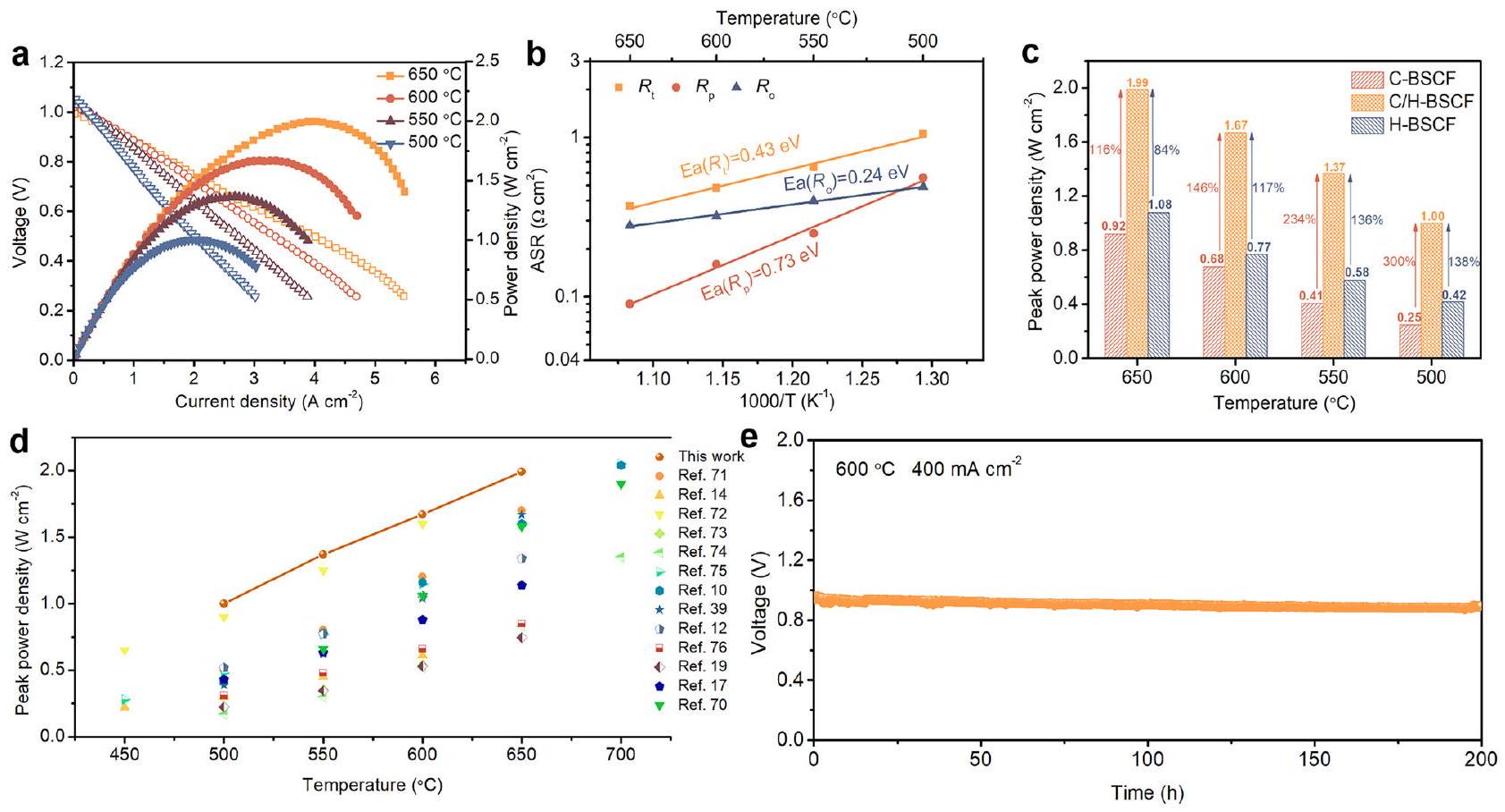
الشكل 6 | الأداء الكهروكيميائي والثبات للخلايا الفردية في وضع FC. أ و منحنيات خلية مفردة مدعومة بالأنود مع-قطب هوائي BSCF في وضع FC.مخططات أرهينيوس، و لـ R-PCECs تحت ظروف جهد الدائرة المفتوحة. ج مقارنة بين PPDs عند درجات حرارة مختلفة للخلايا الفردية
مع أقطاب C-BSCF و C/H-BSCF و H-BSCF. د مقارنة بين PPDs التي تم الحصول عليها باستخدام قطب C/H-BSCF والأقطاب المتقدمة في الأدبيات عند درجات حرارة مختلفة. هـ اختبار الاستقرار لخلية واحدة مع قطب هواء C/H-BSCF في وضع FC. يمكن للطورين، بشكل فعال، تعديل الإجهاد الحراري عند درجات الحرارة العالية، مما يقلل بالتالي من معامل التمدد الحراري الكلي للقطب الهجين. لفهم هذا السلوك بشكل أفضل، قمنا بإجراء تحسين ريتفيلد على تحليل حيود الأشعة السينية للقطب الهجين C/H-BSCF في. تكشف النتائج أنه في تم العثور على نسب الوزن للطورين المكعب والسداسي من C/H-BSCF و على التوالي، كما هو موضح في الشكل التوضيحي 22d. يحقق القطب الهجين C/H-BSCF توافقًا حراريًا ملائمًا عند درجات الحرارة العالية من خلال الانتقال الذاتي من المرحلة المكعبة ذات الموصلية الحرارية العالية إلى المرحلة السداسية ذات الموصلية الحرارية المنخفضة.
تمت دراسة حواجز الطاقة لعمليات ORR و OER الحركية على أسطح C-BSCF المكعبة و H-BSCF السداسية باستخدام نظرية الكثافة الوظيفية (DFT). أولاً، تم حساب طاقات C-BSCF و H-BSCF مع تكوينات مختلفة لمواقع A و B لاختيار النماذج الأكثر منطقية ذات الطاقة الكلية الأقل لإجراء حسابات لاحقة لمسارات ORR و OER (الأشكال التكميلية 23 و 24؛ والجداول التكميلية 4 و 5). بالإضافة إلى ذلك، اخترنا أسطح منخفضة المؤشر مستقرة من C-BSCF (100) و H-BSCF (0001) الموجهة بـ Co و Fe لحسابات DFT، على التوالي.. قبل استخدام نماذج الشرائح المنتهية بـ Co و Fe، قمنا بحساب طاقات السطح للإنهاءات السطحية المختلفة للحصول على أكثر التكوينات الذرية السطحية استقرارًا (الشكل التكميلي 25 والجدول التكميلي 6). لنمذجة عملية OER بدقة أكبر على أسطح C-BSCF و H-BSCF، تم استخدام موقع Fe العلوي على سطح القطب الكهربائي مع انخفاضتم اختيار طاقة الامتزاز كموقع نشط لكل من النموذجين (الشكل التكميلي 26 والجدول التكميلي 7). تُظهر الأشكال 5a و5b ملفات الطاقة لمسار تفاعل معقول من أجل التحقيق الكامل في عملية OER على C-BSCF وH-BSCF، على التوالي. تُقسم عملية OER على سطح القطب الهوائي إلى عدة خطوات: الامتزاز ، * تشير إلى حالة الامتصاص للنوع)، تطور الأكسجين (* * )، و الامتزاز، في حين أن عملية تقليل الأكسجين هي عكس عملية أكسدة الأكسجينمن الجدير بالذكر أن الحد الأقصى لحاجز الطاقة الذي يجب تجاوزه بواسطة C-BSCF في مسار OER هو 3.25 إلكترون فولت، وعملية التفاعل هي * Oمما يشير إلى أن توصيل البروتون هو العامل الرئيسي تقييد معدل OER لقطب C-BSCF. بالمقابل، يتطلب H-BSCF عبور 1.15 eV فقط في هذه العملية، مما يؤكد مرة أخرى القدرة الفائقة على هجرة البروتونات لقطب H-BSCF السداسي. وبالمثل، فإن هجرة البروتونات المواتية لـ يتم أيضًا توضيحه في * العملية. بالنسبة لـ H-BSCF، تصبح إزالة الأكسجين العائق الرئيسي لعملية OER، حيث تحتاج إلى تجاوز حاجز طاقة قدره 2.03 إلكترون فولت، في حين أن C-BSCF تظهر مزايا أكثر من حيث إزالة الأكسجين وامتصاص الماء مقارنةً بـ H-BSCF. ومن ثم، من الواضح أن الجمع بين الأطوار المكعبة والسداسية في C/H-BSCF يحمل مزايا أكثر في عملية OER مقارنةً بـ C-BSCF و H-BSCF أحادية الطور. استنادًا إلى ملفات الطاقة لعملية OER لـ C-BSCF المكعب و H-BSCF السداسي، يُفترض أنه بالنسبة لعملية OER على سطح القطب الهجين C/H-BSCF،سيتم امتصاصه بشكل تفضيلي على سطح الطور المكعب وسيتعرض لعملية التحلل الأولية )، تليها مزيد من التحلل لـ * OH على سطح المرحلة السداسية والانتهاء النهائي من امتصاص الأكسجين (الشكل 5e). علاوة على ذلك، كعملية عكسية لـ OER، يتم توضيح ملفات الطاقة لعمليات ORR لأقطاب C-BSCF المكعبة وH-BSCF السداسية في الشكلين 5c و5d، على التوالي. تمتلك C-BSCF وH-BSCF طاقات امتصاص الأكسجين تبلغ -0.43 و -2.03 eV، مما يشير إلى أن عمليات امتصاص الأكسجين كلاهما تلقائية. ومع ذلك، فإن أكبر حاجز طاقة يجب التغلب عليه لعملية ORR في حالة امتصاص الماء غير التلقائي هو 1.98 و 1.03 eV، على التوالي، لأقطاب C-BSCF وH-BSCF. الحاجز الطاقي الذي تم تجاوزه بواسطة القطب المكعب C-BSCF من إلىهو -6.48 إلكترون فولت، لكن الطاقة المستهلكة بواسطة قطب H-BSCF لنفس عملية التفاعل هي -3.93 إلكترون فولت، مما يشير إلى أن قطب C-BSCF المكعب لديه ميزة كبيرة في تقليل الأكسجين. ونتيجة لذلك، استنادًا إلى عملية ORR لقطب C-BSCF المكعب وقطب H-BSCF السداسي، يتم تصوير تمثيل تخطيطي لعملية ORR التي تحدث على سطح القطب الهجين C/H-BSCF في الشكل 5f. وبالتالي، يظهر القطب الهجين C/H-BSCF أنشطة استثنائية في ORR وOER، والتي يمكن أن تُعزى إلى التأثير التآزري الناجم عن دمج الطورين المكعب والسداسي، مما يجعل هذه الأنشطة قابلة للتنبؤ بشكل كبير.
تم إعداد خلية مفردة مدعومة بالأنود بهيكل Ni-BZCYYb/ BZCYYb/C/H-BSCF لتقييم أداء قطب C/H-BSCF على R-PCECs باستخدام الهيدروجين الجاف. ) كمصدر بروتون للأنود وتدفق الهواء الرطب ( -هواء، ) كمصدر للأكسجين لقطب الهواء. توضح الشكل التكميلية 27 المقطع العرضي لخلية واحدة، والتي تتضمن طبقة إلكتروليت رقيقة تم إنشاؤها باستخدام عملية الطلاء بالدوار. تكشف هذه الخلية الواحدة عن النشاط الكهروكيميائي المتفوق للقطب الهجين C/H-BSCF. ومن الجدير بالذكر أنه عند ، و كثافات القدرة القصوى (PPDs) هي، و ، على التوالي (الشكل 6أ). الأداء الممتاز للخلية مع يُعزى انخفاض مقاومة القطب BSCF بشكل رئيسي إلى انخفاض المقاومة الكهروكيميائية (الشكل التوضيحي 28). المقاومة الكلية ( ) ، ، و مقاومة غير أوميةاعتماد درجة الحرارة المرتبطة بـ EIS لهذه الخلية عند جهد الدائرة المفتوحة (OCV) تم تلخيصه في الشكل 6b. عندفقط، والمكون الرئيسي له هو الأكبر . مع انخفاض في درجة الحرارة إلى و زيادة إلى 0.56 ويجب ملاحظة أن مقاومة الخلية في التشغيل الفعلي يجب أن تكون أقل حتى من تلك التي تم الحصول عليها تحت ظروف جهد الدائرة المفتوحة.
تم قياس الأداءات وEIS لـ C-BSCF المكعب وH-BSCF السداسي كأقطاب هوائية لـ R-PCECs في وضع FC أيضًا في الشكل التكميلي 29. تحقق الخلايا الفردية المزودة بأقطاب C-BSCF وH-BSCF PPDs تبلغ 0.92 وعلى التوالي، فيبينما يتفوق القطب الهجين C/H-BSCF عليهم بـ و على التوالي (الشكل 6ج). من المدهش أن الأداء تزداد كفاءة قطب C/H-BSCF بشكل كبير عند درجات حرارة منخفضة مقارنة بقطبي C-BSCF وH-BSCF، مع تحسينات في و فوق القطبين السابقين في وضع FC عند ، على التوالي. من أجل تحليل سبب الزيادة الكبيرة في الأداء عند درجات الحرارة المنخفضة بوضوح، تعتمد درجة الحرارة علىتم اختبار أقطاب مختلفة وأظهرت النتائج أن الهجين C/H-BSCF لديه أقل طاقة تنشيط (الشكل التكميلي 30). علاوة على ذلك، على الرغم من أن النشاط التحفيزي لأكسيد C/H-BSCF-PM المختلط جسديًا أقل قليلاً من ذلك الخاص بـ C/H-BSCF الهجين، إلا أن C/H-BSCF-PM على R-PCECs لا يزال يظهر أداءً جديرًا بالثناء في وضع FC مع PPDs تبلغ 1.47، ، و عند ، و، على التوالي (الشكل التكميلي 31). نقارن أداء قطب BSCF مع الأقطاب المتطورة المبلغ عنها في الأدبيات في نفس وضع FC، ومن الواضح أن قطب الهواء C/H-BSCF لا يزال في المقدمة (الشكل 6d) . الشكل 6e يوضح تقييم الاستقرار الذي تم إجراؤه على خلية واحدة تحتوي على قطب BSCF في وضع FC. أظهرت النتائج أن النظام عمل بثبات عند لمدة 200 ساعة عند ، مما يظهر الاستقرار التحفيزي الممتاز للقطب.
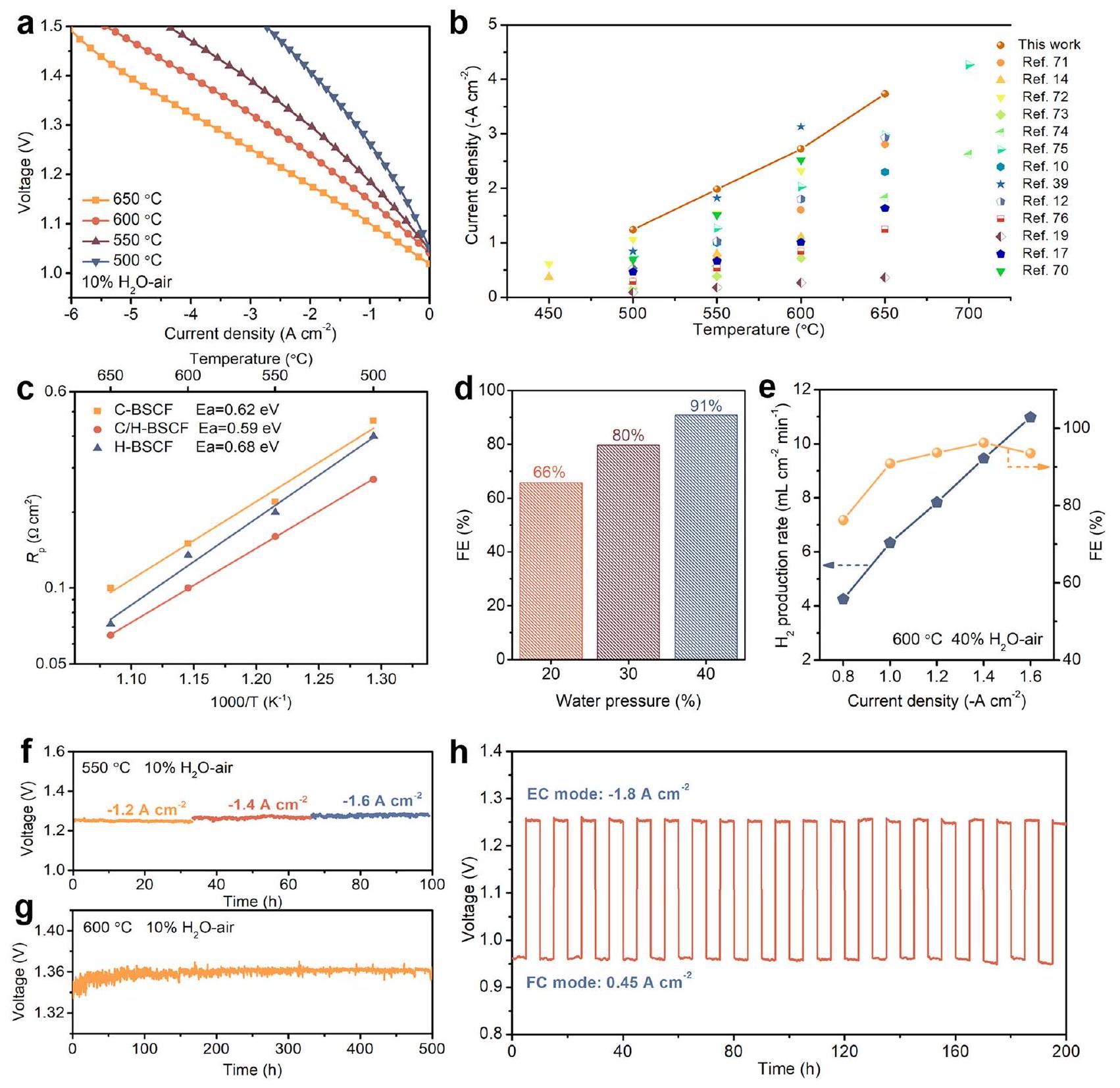
تم التحقق من النشاط الممتاز لـ OER وتحمل الهجين C/H-BSCF بشكل أكبر من خلال التحليل الكهربائي، وكفاءة فاراداي، واختبارات الاستقرار والدورة الثنائية على خلايا فردية. الشكل 7a يوضح منحنيات I-V للخلية مع قطب C/H-BSCF في وضع EC، مع كثافات تيار تبلغ ، و عند ، و تحت -الهواء، على التوالي، عند جهد تطبيقي قدره 1.3 فولت. يظهر BSCF أداءً مشجعًا كقطب هواء في وضع EC، متجاوزًا العديد من الأقطاب الهوائية المبلغ عنها سابقًا، مثل ، و (GCCCO)، ، و (BCFZYM)، SCFN، – (PBCC-BCO) (الشكل 7b). بالإضافة إلى ذلك، فإنه يتفوق أيضًا على (BCFN) الذي طوره Pei وآخرون ( عند )، و الذي أبلغ عنه Bian وآخرون. عند )، والأقطاب الثلاثية الموصلة المعروفة عند و PBSCF ( عند .
تحت ظروف تشغيل متطابقة، تم الحصول على منحنيات لـ R-PCECs مع أقطاب C-BSCF و H-BSCF، كما هو موضح في الشكل التكميلي 32a، b. تم قياس كثافات التيار عند -1.13 و عند ، على التوالي. كما هو متوقع، فإن الهجين ثنائي الطور C/H-BSCF لديه أداءات تحليل كهربائي متفوقة مقارنة بأقطاب C-BSCF و H-BSCF أحادية الطور (الشكل التكميلي 32c). علاوة على ذلك، تم تقييم نشاط OER بشكل أكثر دقة من خلال اختبار EIS لـ R-PCECs مع أقطاب مختلفة عند 1.3 فولت (الشكل التكميلي 33). في الوقت نفسه، تم تلخيص الاعتماد على درجة الحرارة لـ الذي تم قياسه على خلايا فردية مع أقطاب C-BSCF و C/H-BSCF و H-BSCF في الشكل 7c. لا يظهر C/H-BSCF فقط أقل مقاومة وأقل طاقة تنشيط، مما يتوافق مع نتائج ASR في وضع FC. بالإضافة إلى ذلك، فإن الخلايا مع أقطاب C/H-BSCFPM أيضًا حققت أداءً عاليًا من ، -0.79، و عند ، و تحت -الهواء، على التوالي، مما يؤكد مرة أخرى النتيجة التي تفيد بأن أكسيد الهجين ثنائي الطور لديه نشاط تحفيزي أفضل لـ OER من أي من الطورين العاملين بمفردهما (الشكل التكميلي 34).
كفاءة فاراداي (FE)، التي تُعرف بأنها نسبة المنتج الفعلي إلى الناتج النظري، تُعتبر عادةً مؤشراً مهماً على استخدام الطاقة في الأجهزة الكهروكيميائية . بالنسبة لـ R-PCECs، يتم استخدام FE لتعكس استخدام الإلكترونات خلال التفاعل الكهروكيميائي، وهي معلمة مهمة لتقييم قيمة النظام الكامل للخلية للتطبيقات العملية. هنا، تم إجراء تحقيق حول كيفية تأثير ضغوط المياه المختلفة على FE لـ R-PCEC مع قطب C/H-BSCF الهجين مع الحفاظ على كثافة تيار قدرها عند . كما هو موضح في الشكل 7d، تزداد FE تدريجياً مع زيادة ضغط المياه وتصل إلى تحت جو -الهواء. علاوة على ذلك، مع زيادة كثافة التيار، تزداد FE تدريجياً إلى قيمة قصوى تبلغ عند . ومع ذلك، عندما زادت كثافة التيار أكثر إلى ، انخفضت FE إلى . يمكن أن يُعزى هذا الانخفاض إلى العلاقة الإيجابية بين الموصلية الإلكترونية للإلكتروليت وضغط الأكسجين الجزئي، مما يؤدي إلى زيادة الخسائر الإلكترونية . من المثير للاهتمام، أن FE النهائية ظلت ضمن نطاق معقول يبلغ حوالي (الشكل 7e والشكل التكميلي 35). ومع ذلك، تشير FE المقبولة إلى أن أكسيد C/H-BSCF كقطب هواء لديه إمكانات جيدة للتسويق. بالإضافة إلى ذلك، يعرض الشكل التكميلي 36a أنماط XRD لمساحيق CBSCF و C/H-BSCF و H-BSCF بعد المعالجة عند تحت جو -الهواء. تم اكتشاف أن C -BSCF لا يزال يحتفظ بهيكل الطور المكعب، ولكن C/H-BSCF و H-BSCF تظهر درجات متفاوتة من قمم حيود الطور الثانوي (الشكل التكميلي 36b). وهذا يشير إلى أن الضغط العالي للمياه يحفز تباعد Ba في الطور السداسي. لقد تم إثبات أن يمكن أن تعزز بشكل فعال أنشطة ORR و OER لأكاسيد البيروفسكايت المحتوية على Ba. وبالتالي، فإن التباعد المناسب لـ Ba في طور H-BSCF تحت ضغط المياه العالي يوفر إمكانات أكبر لتعزيز النشاط الكهروكيميائي . الشكل 7f و g يظهر نتائج اختبارات التحمل والاستقرار على المدى الطويل لـ R-PCECs مع أقطاب C/H-BSCF في وضع EC. تم اختبار الخلية لمدة 100 ساعة عند ثلاث كثافات تيار تبلغ ، و عند و -الهواء، جميعها حافظت على استقرار ملحوظ (الشكل 7f). في الوقت نفسه، عملت الخلية بثبات عند كثافة تيار ثابتة قدرها عند لمدة تصل إلى 500 ساعة (الشكل 7 g)، هذه النتيجة تتفوق بشكل كبير على استقرار R-PCECs السابقة وتظهر الاستقرار الملحوظ لقطب C/H-BSCF الهجين في وضع EC. إن جدوى التشغيل الدوري طويل الأمد لـ R-PCECs بين أوضاع FC و EC ضرورية لتشغيل تحويل الطاقة على نطاق واسع. كما هو موضح في الشكل 7h، خضعت R-PCEC مع قطب الهواء C/H-BSCF لـ 20 دورة لمدة 200 ساعة عند . كانت كثافات التيار المستخدمة هي لوضع FC و لوضع EC. كشفت النتائج عن قابلية عكسية ممتازة وتحمل لـ R-PCECs باستخدام قطب C/H-BSCF الهجين.
نقاش
باختصار، قمنا بتخليق أكسيد هجين ثنائي الطور بمحتوى طور قابل للتحكم باستخدام تعديل موقع A لأكسيد البيروفسكايت الكلاسيكي C-BSCF. قطب الهواء الهجين C/H-BSCF، المكون من C-BSCF المكعب و H-BSCF السداسي، لديه أفضل أداء لتنشيط الأكسجين بين سلسلة الأقطاب الهجينة المصممة، مع ASR يبلغ فقط عند للخلية المتماثلة. تحقق الخلية الفردية أعلى مستوى من الأداء في أوضاع FC و EC باستخدام C/HBSCF الهجين كقطب هواء، وهو مرتبط ارتباطًا وثيقًا بنشاطه الاستثنائي في ORR و OER. علاوة على ذلك، تظهر التحليلات التجريبية والتوصيفية أن النشاط التحفيزي القوي لقطب C/H-BSCF يعود إلى قدراته الممتازة في تنشيط الأكسجين والترطيب التي توفرها العديد من الفراغات الأكسجينية والتركيب الهيكلي الفريد. في الوقت نفسه، تكشف حسابات DFT عن حواجز الطاقة للبيروفسكايت المكعب والسداسي خلال تفاعلات ORR و OER، مما يظهر المزايا المميزة لكل منهما في عملية حركية التفاعل، ويكشف عن عقلانية القطب الهجين C/H-BSCF للانفجار بنشاط تحفيزي ممتاز بسبب التأثير التآزري للطورين. تظهر هذه النتائج إمكانات القطب الهجين النشط والدائم C/H-BSCF الذي تم بناؤه باستخدام استراتيجية تعديل موقع A لتطبيقات تخزين الطاقة وتحويلها.
طرق
تخليق المواد وتصنيع الخلايا
تم إنتاج مسحوق قطب C/H-BSCF عبر عملية الجل-الهلام عن طريق إذابة ، و في الماء المقطر، مع استخدام EDTA و CA كعوامل معقدة، وتنظيم pH المحلول ليكون حوالي 7 باستخدام الأمونيا. عندما يصبح المحلول شبيهًا بالهلام ثم يتم خبزه عند لمدة 10 ساعات للحصول على السلف. تم حرق هذا السلف لاحقًا عند لمدة 5 ساعات لإنشاء مسحوق القطب النهائي. تم استخدام نفس العملية لتحضير مساحيق الأقطاب والإلكتروليت الأخرى. تم إعداد نصف خلايا وأوراق إلكتروليت بواسطة طرق الطلاء الدوراني وصب القوالب، على التوالي، ثم تم حرقها عند و لمدة 5 ساعات، على التوالي . كانت أقطار نصف الخلايا المحروقة وأوراق الإلكتروليت حوالي 11.8 و 12.4 مم، على التوالي. المساحة النشطة لقطب الهواء للخلية الفردية المدعومة بالأنود هي . سمك الخلية المتماثلة بعد عملية الطحن هو 0.4 مم، والمساحة النشطة للجانب الفردي حوالي تم طحن مسحوق القطب الكهربائي باستخدام 10 مل من الكحول الأيزوبروبيلي، و2 مل من الإيثيلين جلايكول، و1 مل من الجلسرين بسرعة 400 دورة في الدقيقة لمدة 30 دقيقة لصنع معلق جيد الخلط لقطب الهواء. تم تطبيق المعلق على جانب الإلكتروليت من نصف الخلية وعلى الجانبين من ورقة الإلكتروليت. بعد ذلك، تم إجراء عملية التلبيد لمدة ساعتين عندلإنشاء خلايا فردية وخلايا متناظرة. تستخدم اختبارات نفاذية الهيدروجين والموصلية الكهربائية أفلام رقيقة كثيفة وشرائط مكونة من مسحوق الأقطاب الكهربائية، على التوالي. تم تحضير 0.6 جرام من مسحوق C/H-BSCF في صفائح وشرائط بواسطة طريقة الصب بالقالب ثم تم تلبيدها. لمدة 10 ساعات، بينما تم حرق C-BSCF و H-BSCF عند و ، على التوالي.
الاختبار الكهروكيميائي
تم إجراء اختبارات كيميائية كهربائية لـ R-PCECs في كل من أوضاع FC و EC في موقد تسخين كهربائي مزود بجهاز تحكم في درجة الحرارة، والذي تم وضعه في غرفة بيئية. لتسليط الضوء على قابلية عكس R-PCECs، تم الحفاظ على تركيبة الغاز في أقطاب الأكسجين والوقود ثابتة في كلا وضعي الاختبار. في القطب الهوائي، تم استخدام مضخة تدفق ثابتة عالية الضغط وجهاز رذاذ لخلط معدل تدفق معين من بخار الماء في الهواء بحيث كان ضغط الماء في الهواء الرطب هو. بالإضافة إلى ذلك، تأكد من أن القطب الهوائي لديه معدل تدفق غاز إجمالي قدره . بينما تم تزويد القطب الوقود بـغاز الهيدروجين الجاف. بالإضافة إلى ذلك، بالنسبة للخلايا المتماثلة، يمكن تنظيم معدل تدفق المضخة ومعدل تدفق الهواء للحصول على هواء رطب مع ضغوط مائية مختلفة لتلبية متطلبات الاختبار المختلفة. تم استخدام محطة اختبار خلايا الوقود (DH7002، شركة جيانغسو دونغhua للأدوات التحليلية المحدودة) لالتقاطومنحنيات كثافة الطاقة. تم إجراء اختبارات الدورة لـ R-PCECs في أوضاع خلايا الوقود والتحليل الكهربائي فيمحطة عمل كيميائية كهربائية (سولارترون أ) تم استخدامه لقياس EIS للخلايا تحت مجموعة متنوعة من الظروف. تم إجراء جميع الاتصالات المغلقة وجمع التيار في التجارب باستخدام لاصق فضي (DAD-87، شنغهاي، الصين). و تم الحصول على القيم من خلال ملاءمة منحنيات ECR المقاسة على مواد الأقطاب باستخدام ECRTOOLS. لتحفيز استرخاء الموصلية،تم تغيير الضغط من 0.21 ضغط جوي إلى 0.1 ضغط جوي، مما أدى إلى تسجيل انتقال القطب من حالة التوازن الأصلية إلى حالة توازن جديدة.
نفاذ الهيدروجين
تم إجراء اختبار نفاذية الهيدروجين في خلية تفاعل نفاذية ثنائية الاتجاه. تُستخدم تقنية الترسيب المغناطيسي لتبخير أفلام Pd على كلا الجانبين من الفيلم القابل لنفاذية الهيدروجين لمنع تقليل الفيلم القابل لنفاذية الهيدروجين وتسريع انقسام الهيدروجين، وسماكته حوالي 500 نانومتر، ثم تم حرقه عندفي جو من الأرجون لمدة ساعتين. هنا كلا من تم الحفاظ على معدلات التدفئة والتبريد عندمُختوم على أنبوب خزفي بغراء فضي، كان غاز السحب على كلا جانبي فيلم نفاذية الهيدروجينو الأرجون. تم تمرير غاز الذيل من جانب تطهير الأرجون إلى جهاز الكروماتوغرافيا الغازية (GC9860) للكشف.
التوصيفات الأساسية
تم استخدام جهاز Bruker D8 Advance لجمع بيانات حيود الأشعة السينية للمواد المسحوقة عند درجة حرارة الغرفة، بينما تم دراسة التركيب البلوري لمادة القطب بواسطة حيود الأشعة السينية عالية الحرارة باستخدام ملحق Rigaku D/max 2500 V عالي الحرارة. تم استخدام مطياف رامان (نموذج Seki Technotron STR 750 مع ليزر أرجون بطول موجي 514.5 نانومتر) لاستنتاج أوضاع الاهتزاز للعينات المسحوقة. تم استخدام المجهر الإلكتروني الماسح (JEOL-S4800) للحصول على شكل السطح لكل من المساحيق والخلايا. تم الحصول على توزيع العناصر والتركيب المجهري للمسحوق بواسطة HR-TEM (JEOL، JEM-2100) وTEM-EDX (FEI Tecnai G2 T20). تم استكشاف حالات تكافؤ العناصر بواسطة XPS (Thermo ESCALAB 250). تم الكشف عن التغيرات في الكتلة للعينة خلال عملية التسخين باستخدام TGA (نموذج STA 449 F3، NETZSCH).-تم الحصول على TPD بواسطة مطياف الكتلة (MS، هيدن، HPR20)، وتم الحصول على بيانات -TPD بعد معالجة المساحيق في هواء رطب عندلمدة 10 ساعات. تم تحديد المساحة السطحية النوعية للمادة باستخدام جهاز Quanta chrome AutoSorb-iQ3 من خلال إيزوثيرم الامتصاص-الامتزاز للنيتروجين. تم استخدام قضبان كثيفة لاختبار بيانات الموصلية الحرارية في جو الهواء بواسطة جهاز Netzsch 402 C/3/G.-حافة و في-edge XANES تم إجراؤها في NSRRC في تايوان. كانت طاقات الفوتون لـ Co-حافة و Feتم معايرة طيف الحافة باستخدام رقائق معدنية من الكوبالت والحديد كمرجع، على التوالي.
طرق حسابية
تم إجراء جميع الحسابات في إطار نظرية الكثافة الوظيفية باستخدام طريقة الموجة المسطحة المعززة بالمشاريع، كما هو مطبق في حزمة المحاكاة الأولية في فيينا.تم اختيار التقريب العام للتدرج الذي اقترحه بيرديو، وبورك، وإرنزرهوف من أجل إمكانات التبادل والتفاعل.يتم وصف التفاعل بعيد المدى فان دير ووالس بواسطة نهج DFT-D3تم تعيين طاقة القطع للموجة المستوية إلى 500 إلكترون فولت. تم تعيين معيار الطاقة إلىفي الحل التكراري لمعادلة كون-شام. من أجل أخذ في الاعتبار التفاعلات الإلكترونية القوية في الحالة الموضعية و نضيف طاقة هوبارد المحلية U بمقدار 3.70 إلكترون فولت و 3.52 إلكترون فولت على التواليطبقة فراغ منيتم إضافة عمودي إلى الورقة لتجنب التفاعل الاصطناعي بين الصور الدورية، ويتم أخذ تصحيح ثنائي القطب في الاعتبار. يتم تنفيذ تكامل منطقة بريل باستخدام-شبكة لـ C-BSCF و-شبكة لـ H-BSCF. تم استرخاء جميع الهياكل حتى انخفضت القوى المتبقية على الذرات إلى أقل من. بعد أن توافقت تحسينات الهيكل، تم التحقق من استقرار الهياكل الممتصة من خلال حسابات التردد، وتم أيضًا حساب التصحيح الديناميكي الحراري للمواد الممتصة في ظروف التشغيل (الجداول التكميلية 8 و9). قبل الحسابات، تم تحديد أكثر مواقع التعديل استقرارًا للحديد من خلال حساب الطاقة الكلية لهياكل مختلفة تم تعديلها. والمواقع المفضلة للاحتجاز لـتؤخذ أيضًا في الاعتبار من خلال حساب الطاقة الكلية للهياكل الممتصة المقابلة. تم حساب حالات الانتقال باستخدام طريقة Climbing Image-Nudged Elastic Band (CI-NEB). تم أخذ 6 نقاط وسيطة (بما في ذلك الحالة الابتدائية والحالة النهائية) في الاعتبار أثناء حل مسار الحد الأدنى للطاقة. بعد تقارب الحسابات، تم التحقق من حالات الانتقال من خلال حسابات التردد.
توفر البيانات
جميع البيانات التي تم توليدها في هذه الدراسة متاحة في المخطوطة وملف المعلومات التكميلية. يتم توفير ملف البيانات المصدر في هذه الورقة. يتم توفير بيانات المصدر في هذه الورقة.
References
Duan, C., Huang, J., Sullivan, N. & O’Hayre, R. Proton-conducting oxides for energy conversion and storage. Appl. Phys. Rev. 7, 011314 (2020).
Lv, H. et al. Promoting exsolution of RuFe alloy nanoparticles on via repeated redox manipulations for electrolysis. Nat. Commun. 12, 5665 (2021).
Gómez, S. Y. & Hotza, D. Current developments in reversible solid oxide fuel cells. Renew. Sust. Energ. Rev. 61, 155-174 (2016).
Wang, Y. et al. A review of progress in proton ceramic electrochemical cells: material and structural design, coupled with valueadded chemical production. Energy Environ. Sci. 16, 5721-5770 (2023).
Wang, N. et al. Advanced cathode materials for protonic ceramic fuel cells: recent progress and future perspectives. Adv. Energy Mater. 12, 2201882 (2022).
Cao, J., Ji, Y. & Shao, Z. Perovskites for protonic ceramic fuel cells: a review. Energy Environ. Sci. 15, 2200-2232 (2022).
Liu, F., Ding, D. & Duan, C. Protonic ceramic electrochemical cells for synthesizing sustainable chemicals and fuels. Adv. Sci. 10, e2206478 (2023).
Zvonareva, I., Fu, X.-Z., Medvedev, D. & Shao, Z. Electrochemistry and energy conversion features of protonic ceramic cells with mixed ionic-electronic electrolytes. Energy Environ. Sci. 15, 439-465 (2022).
He, F. et al. Catalytic self-assembled air electrode for highly active and durable reversible protonic ceramic electrochemical cells. Adv. Funct. Mater. 32, 2206756 (2022).
Zhou, Y. et al. An efficient bifunctional air electrode for reversible protonic ceramic electrochemical cells. Adv. Funct. Mater. 31, 2105386 (2021).
Liu, Z. et al. High-entropy perovskite oxide: a new opportunity for developing highly active and durable air electrode for reversible protonic ceramic electrochemical cells. Nano-Micro Lett. 14, 1-16 (2022).
Choi, S., Davenport, T. C. & Haile, S. M. Protonic ceramic electrochemical cells for hydrogen production and electricity generation: exceptional reversibility, stability, and demonstrated faradaic efficiency. Energy Environ. Sci. 12, 206-215 (2019).
Duan, C. et al. Highly efficient reversible protonic ceramic electrochemical cells for power generation and fuel production. Nat. Energy 4, 230-240 (2019).
Ding, H. et al. Self-sustainable protonic ceramic electrochemical cells using a triple conducting electrode for hydrogen and power production. Nat. Commun. 11, 1970 (2020).
Kasyanova, A. V. et al. Electrolyte materials for protonic ceramic electrochemical cells: Main limitations and potential solutions. Mater. Rep. Energy 2, 100158 (2022).
Wang, N. et al. Mixed proton-electron-oxide ion triple conducting manganite as an efficient cobalt-free cathode for protonic ceramic fuel cells. J. Mater. Chem. A 8, 11043-11055 (2020).
Liu, Z. et al. One-pot derived thermodynamically quasi-stable triple conducting nanohybrid as robust bifunctional air electrode for reversible protonic ceramic cells. Appl. Catal. B Environ. 319, 121929 (2022).
Song, Y. et al. Self-assembled triple-conducting nanohybrid as a superior protonic ceramic fuel cell cathode. Joule 3, 2842-2853 (2019).
Song, Y. et al. Nanocomposites: a new opportunity for developing highly active and durable bifunctional air electrodes for reversible protonic ceramic cells. Adv. Energy Mater. 11, 2101899 (2021).
Liang, M. et al. A new durable surface nanoparticles-modified perovskite cathode for protonic ceramic fuel cells from selective cation exsolution under oxidizing atmosphere. Adv. Mater. 34, 2106379 (2021).
Kim, J. H. et al. Self-assembled nano-composite perovskites as highly efficient and robust hybrid cathodes for solid oxide fuel cells. J. Mater. Chem. A 10, 2496-2508 (2022).
Jo, M. et al. Layered barium cobaltite structure materials containing perovskite and CdI2-based layers for reversible solid oxide cells with exceptionally high performance. Chem. Eng. J. 451, 138954 (2023).
Zhu, Y. et al. Self-assembled ruddlesden-popper/perovskite hybrid with lattice-oxygen activation as a superior oxygen evolution electrocatalyst. Small 16, e2001204 (2020).
Xu, X. et al. High-performance perovskite composite electrocatalysts enabled by controllable interface engineering. Small 17, e2101573 (2021).
Shao, Z. P. & Haile, S. M. A high-performance cathode for the next generation of solid-oxide fuel cells. Nature 431, 170-173 (2004).
Zhu, Y. et al. Boosting oxygen evolution reaction by creating both metal ion and lattice-oxygen active sites in a complex oxide. Adv. Mater. 32, e1905025 (2020).
Liu, B., Chen, X., Dong, Y., Mao, S. S. & Cheng, M. A high-performance, nanostructured cathode for solidoxide fuel cells. Adv. Energy Mater. 1, 343-346 (2011).
Guan, D. et al. Utilizing ion leaching effects for achieving high oxygen-evolving performance on hybrid nanocomposite with selfoptimized behaviors. Nat. Commun. 11, 3376 (2020).
Shi, H. et al. Building Ruddlesden-Popper and single perovskite nanocomposites: a new strategy to develop high-performance cathode for protonic ceramic fuel cells. Small 17, e2101872 (2021).
Zhao, C. et al. Oxygen reduction reaction catalytic activity enhancement over mullite via interfacing with perovskite oxides. Nano Energy 51, 91-101 (2018).
Lian, S. et al. Uncovering the enhancement mechanism of the oxygen reduction reaction on perovskite/Ruddlesden-Popper oxide heterostructures ( and ( ) . J. Phys. Chem. Lett. 14, 2869-2877 (2023).
Zhang, Y. et al. Enhanced oxygen reduction kinetics of IT-SOFC cathode with coherent interface. J. Mater. Chem. A 10, 3495-3505 (2022).
Sediva, E., Defferriere, T., Perry, N. H., Tuller, H. L. & Rupp, J. L. M. In situ method correlating raman vibrational characteristics to chemical expansion via oxygen nonstoichiometry of perovskite thin films. Adv. Mater. 31, e1902493 (2019).
Chen, G. et al. Two orders of magnitude enhancement in oxygen evolution reactivity on amorphous nanofilms with tunable oxidation state. Sci. Adv. 3, e1603206 (2017).
Gangopadhayay, S., Inerbaev, T., Masunov, A. E., Altilio, D. & Orlovskaya, N. Structural characterization combined with the first principles simulations of barium/strontium cobaltite/ferrite as promising material for solid oxide fuel cells cathodes and hightemperature oxygen permeation membranes. ACS Appl. Mater. Interfaces 1, 1512-1519 (2009).
Bian, H. Q., Ma, S. Y., Li, F. M. & Zhu, H. B. Influence of ZnO buffer layer on microstructure and Raman scattering of film on Si substrate. Superlattices Microstruct. 58, 171-177 (2013).
Wan, T. H., Saccoccio, M., Chen, C. & Ciucci, F. Influence of the discretization methods on the distribution of relaxation times deconvolution: implementing radial basis functions with DRTtools. Electrochim. Acta 184, 483-499 (2015).
Niu, Y. et al. Enhancing oxygen reduction activity and cr tolerance of solid oxide fuel cell cathodes by a multiphase catalyst coating. Adv. Funct. Mater. 31, 2100034 (2021).
Niu, Y. et al. Highly active and durable air electrodes for reversible protonic ceramic electrochemical cells enabled by an efficient bifunctional catalyst. Adv. Energy Mater. 12, 2103783 (2022).
Ren, R. et al. Tuning the defects of the triple conducting oxide perovskite toward enhanced cathode
activity of protonic ceramic fuel cells. J. Mater. Chem. A 7, 18365-18372 (2019).
Agrestini, S. et al. Nature of the magnetism of iridium in the double perovskite . Phys. Rev. B 100, 014443 (2019).
Sun, H. et al. Boosting the oxygen evolution reaction activity of a perovskite through introducing multi-element synergy and building an ordered structure. J. Mater. Chem. A 7, 9924-9932 (2019).
Li, W. et al. High cationic dispersity boosted oxygen reduction reactivity in multi-element doped perovskites. Adv. Funct. Mater. 33, 2210496 (2023).
Xu, X. et al. Tailoring cations in a perovskite cathode for protonconducting solid oxide fuel cells with high performance. J. Mater. Chem. A 7, 20624-20632 (2019).
Zhu, K. et al. Theoretical and experimental investigations on K -doped as a promising cathode for protonconducting solid oxide fuel cells. ChemSusChem 14, 1-12 (2021).
Zhu, Y. et al. Oxygen activation on Ba-containing perovskite materials. Sci. Adv. 8, eabn4072 (2022).
Gao, J., Song, X., Zhou, F., An, S. & Tian, Y. Substituent effects of Ba for on the structure and electrochemical performances of cathode for intermediate temperature solid oxide fuel cells. J. Power Sources 218, 383-392 (2012).
Choe, Y.-J. & Hwang, H.-J. Electrochemical performance and Cr tolerance in a and 0.5) cathode for solid oxide fuel cells. J. Korean Ceram. Soc. 52, 308-314 (2015).
Lim, C. et al. Influence of Ca-doping in layered perovskite on the phase transition and cathodic performance of a solid oxide fuel cell. J. Mater. Chem. A 4, 6479-6486 (2016).
Yi, Y., Ran, R., Wang, W., Zhou, W. & Shao, Z. Perovskite-based nanocomposites as high-performance air electrodes for protonic ceramic cells. Curr. Opin. Green. Sustain. Chem. 38, 100711 (2022).
Kuai, X . et al. Boosting the activity of perovskite for oxygen reduction reactions at low-to-intermediate temperatures through tuning B-site cation deficiency. Adv. Energy Mater. 9, 1902384 (2019).
Choi, S. et al. Exceptional power density and stability at intermediate temperatures in protonic ceramic fuel cells. Nat. Energy 3, 202-210 (2018).
Li, M. et al. A CO -tolerant perovskite oxide with high oxide ion and electronic conductivity. Adv. Mater. 32, e1905200 (2020).
Zohourian, R., Merkle, R., Raimondi, G. & Maier, J. Mixed-conducting perovskites as cathode materials for protonic ceramic fuel cells: understanding the trends in proton uptake. Adv. Funct. Mater. 28, 1801241 (2018).
Poetzsch, D., Merkle, R. & Maier, J. Proton uptake in the -SOFC cathode material : transition from hydration to hydrogenation with increasing oxygen partial pressure. Faraday Discuss. 182, 129-143 (2015).
Wang, P., Xu, D., Cheng, J. & Hong, T. Proton uptake kinetics and electromotive force in cathode material with three mobile carriers for protonic ceramic fuel cells. lonics 27, 1185-1192 (2021).
Yang, M. et al. New perovskite membrane with improved sintering and self-reconstructed surface for efficient hydrogen permeation. J. Membr. Sci. 620, 118980 (2021).
Zhou, C. et al. New reduced-temperature ceramic fuel cells with dual-ion conducting electrolyte and triple-conducting double perovskite cathode. J. Mater. Chem. A 7, 13265-13274 (2019).
Zhang, L. et al. Improved thermal expansion and electrochemical performance of composite cathode for IT-SOFCs. Solid State Sci. 91, 126-132 (2019).
Dyck, C. Thermal expansion matching of composite cathodes to IT-SOFC electrolytes. Solid State Ion. 171, 17-23 (2004).
Aristizabal, M. E., Vega-Castillo, J., Zimicz, G. & Prado, F. Optimizing thermal expansion and polarization resistance of ( and 0.2)/ composite cathode for IT-SOFC. Mater. Lett. 350, 134966 (2023).
Sakai, T. et al. Characteristics of -type perovskite oxide and application as an SOFC cathode. J. Mater. Chem. A 9, 3584-3588 (2021).
Nikonov, A. V. et al. Investigation of thermal, electrical, and electrochemical properties of , 0.5) cathode materials for SOFC. J. Alloy. Compd. 865, 158898 (2021).
Liping, S., Na, L., Qiang, L., Lihua, H. & Hui, Z. Preparation of composite cathode by in situ solmixing method and its high-temperature electrochemical properties. J. Alloy. Compd. 885, 160901 (2021).
Li, S. et al. Performances of composite cathode materials for IT-SOFC. J. Alloy. Compd. 448, 116-121 (2008).
Zou, D. et al. The nanocomposite: a new high-performance cobalt-free triple-conducting cathode for protonic ceramic fuel cells operating at reduced temperatures. J. Mater. Chem. A 10, 5381-5390 (2022).
Zhu, X. et al. Chemical compatibility, thermal expansion matches and electrochemical performance of composite cathodes for intermediate-temperature solid oxide fuel cells. Int. J. Hydrog. Energy 36, 12549-12554 (2011).
Liu, Z. et al. Robust bifunctional phosphorus-doped perovskite oxygen electrode for reversible proton ceramic electrochemical cells. Chem. Eng. J. 450, 137787 (2022).
Li, X. et al. Highly stable and efficient Pt single-atom catalyst for reversible proton-conducting solid oxide cells. Appl. Catal. B Environ. 316, 121627 (2022).
Zhou, Y. et al. An active and robust air electrode for reversible protonic ceramic electrochemical cells. ACS Energy Lett. 6, 1511-1520 (2021).
Pei, K. et al. Surface restructuring of a perovskite-type air electrode for reversible protonic ceramic electrochemical cells. Nat. Commun. 13, 2207 (2022).
Bian, W. et al. Revitalizing interface in protonic ceramic cells by acid etch. Nature 604, 479-485 (2022).
Tang, W. et al. Understanding of A-site deficiency in layered perovskites: promotion of dual reaction kinetics for water oxidation and oxygen reduction in protonic ceramic electrochemical cells. J. Mater. Chem. A 8, 14600-14608 (2020).
Shin, J.-S. et al. Activity of layered swedenborgite structured for oxygen electrode reactions in at intermediate temperature reversible ceramic cells. J. Mater. Chem. A 9, 607-621 (2021).
Saqib, M. et al. Transition from perovskite to misfit-layered structure materials: a highly oxygen deficient and stable oxygen electrode catalyst. Energy Environ. Sci. 14, 2472-2484 (2021).
Liang, M. et al. Magnesium tuned triple conductivity and bifunctionality of perovskite towards reversible protonic ceramic electrochemical cells. Appl. Catal. B Environ. 318, 121868 (2022).
Kresse, G. & Furthmüller, J. Efficient iterative schemes for ab initio total-energy calculations using a plane-wave basis set. Phys. Rev. B 54, 11169 (1996).
Perdew, J. P., Burke, K. & Ernzerhof, M. Generalized gradient approximation made simple. Phys. Rev. Lett. 77, 3865 (1996).
Grimme, S. Semiempirical GGA-type density functional constructed with a long-range dispersion correction. J. Comput. Chem. 27, 1787 (2006).
García-Mota, M. et al. Importance of correlation in determining electrocatalytic oxygen evolution activity on cobalt oxides. J. Phys. Chem. C. 116, 21077-21082 (2012).
Łodziana, Z. Surface verwey transition in magnetite. Phys. Rev. Lett. 99, 206402 (2007).
شكر وتقدير
يتم دعم العمل من قبل البرنامج الوطني الرئيسي للبحث والتطوير في الصين (2022YFB4004000)، مؤسسة العلوم الطبيعية الوطنية في الصين (21878158 و 21706129)، المختبر الوطني الرئيسي لاستخدام الطاقة النظيفة (مشروع صندوق مفتوح رقم ZJUCEU2021001)، مؤسسة العلوم الطبيعية في مقاطعة جيانغسو (BK2O221312)، مؤسسة العلوم الطبيعية للباحثين الشباب في مقاطعة جيانغسو (BK20220879)، مؤسسة العلوم الطبيعية الوطنية للباحثين الشباب في الصين (22209072)، وأساتذة مخصصون في جيانغسو، برنامج البحث والابتكار للدراسات العليا في مقاطعة جيانغسو (KYCX23_1465) وبرنامج تنمية الأطروحات الدكتوراه الممتازة في جامعة نانجينغ للتكنولوجيا (2023-09). كما نُعبر عن شكرنا للدعم من مركز ماكس بلانك-POSTECH-هسينتشو للمواد المعقدة.
مساهمات المؤلفين
كان لدى G.Y. و Y.Z. الفكرة الأصلية لتصميم المواد. قام Z.L. و G.Y. و Y.Z. و Z.S. بتنفيذ مفهوم وتصميم المحتوى المحدد للمشروع. قام Z.L. و Y.B. بإجراء القياسات الكهروكيميائية وتوصيف المواد. أجرى D.G. تحسينات XRD. ساعد H.S. في توصيف TEM وقام بالتحليل. قام W.H. و C.P. و Z.H. و Y.Z. و W.L. بإجراء توصيفات XAS وتحليل البيانات. قام R.R. و W.Z. و Z.L. بتحليل ومناقشة بيانات المشروع. كتب Z.L. و G.Y. و Y.Z. و Z.S. الورقة بشكل مشترك.
المختبر الوطني الرئيسي للهندسة الكيميائية الموجهة للمواد، كلية الهندسة الكيميائية، جامعة نانجينغ للتكنولوجيا، 211816 نانجينغ، جمهورية الصين الشعبية.قسم علوم المواد والهندسة، المعهد المتقدم للعلوم والتكنولوجيا في كوريا (KAIST)، دايجون 34141، جمهورية كوريا.قسم البناء والعقارات، معهد الأبحاث للتنمية الحضرية المستدامة (RISUD) ومعهد الأبحاث للطاقة الذكية (RISE)، جامعة بوليتكنيك هونغ كونغ، كولون، الصين.المركز الوطني لأبحاث الإشعاع المتزامن، 101 طريق هسين-آن، هسينتشو 30076، تايوان.معهد ماكس بلانك لفيزياء المواد الصلبة، شارع نوتنزر 40، 01187 دريسدن، ألمانيا.معهد العلوم الحدودية، جامعة نانجينغ للطيران والفضاء، 210016 نانجينغ، جمهورية الصين الشعبية.مدرسة WA للتعدين: المعادن والطاقة والهندسة الكيميائية (WASM-MECE)، جامعة كورتين، بيرث، WA 6845، أستراليا. البريد الإلكتروني:ygm89525@njtech.edu.cn;zhuyl1989@nuaa.edu.cn;shaozp@njtech.edu.cn
Synergistic dual-phase air electrode enables high and durable performance of reversible proton ceramic electrochemical cells
Received: 26 May 2023
Accepted: 4 January 2024
Published online: 11 January 2024
(A) Check for updates
Zuoqing Liu , Yuesheng Bai , Hainan Sun (1) , Daqin Guan (1) , Wenhuai , Wei-Hsiang Huang , Chih-Wen Pao ( , Zhiwei Hu , Guangming Yang ,
Reversible proton ceramic electrochemical cells are promising solid-state ion devices for efficient power generation and energy storage, but necessitate effective air electrodes to accelerate the commercial application. Here, we construct a triple-conducting hybrid electrode through a stoichiometry tuning strategy, composed of a cubic phase and a hexagonal phase . Unlike the common method of creating selfassembled hybrids by breaking through material tolerance limits, the strategy of adjusting the stoichiometric ratio of the A-site/B-site not only achieves strong interactions between hybrid phases, but also can efficiently modifies the phase contents. When operate as an air electrode for reversible proton ceramic electrochemical cell, the hybrid electrode with unique dual-phase synergy shows excellent electrochemical performance with a current density of @ 1.3 V in electrolysis mode and a peak power density of in fuel cell mode at .
The rapid advancement of modern technology has been driven by the exploitation and extensive use of fossil fuels, but this has also resulted in an unprecedented living dilemma for humanity due to their limited resources and the greenhouse effects of their oxidation product. As a carbon-free energy material, hydrogen is widely accepted to play an essential part in the future sustainable energy system owing to its high energy density and non-pollution nature, and the wide availability of hydrogen element in earth . Reversible solid oxide cell (R-SOC), a device allowing the mutual conversion of chemical and electrical energy, can meet the demand for efficient utilization and production of hydrogen energy . Unfortunately, the conventional R-SOCs based on oxygen-conducting electrolytes normally operate at 700 to . Such high temperature makes the cells suffer from numerous
challenges, such as difficult hermetic sealing, high operating costs, material incompatibility, and poor durability . Due to the significantly lower energy barrier for proton migration compared to that of oxygen ions, it is believed that reversible proton ceramic electrochemical cells (R-PCECs) can be operated potentially at the medium temperature range ( ) without an obvious increase in cell ohmic resistance, while the reduction in operation temperature can effectively lower operation costs . In addition, the different locations of water formation in fuel cell (FC) operation and hydrogen generation in electrolysis cell (EC) operation for R-PCECs from R-SOCs make them higher energy utilization efficiency and easier hydrogen purification . Therefore, during the past decade, there has been an obviously increasing interest in R-PCECs for power generation and storage .
Although favorable progress in a relatively short period of time for the R-PCECs , their commercialization is still limited, mainly due to the insufficient electrochemical performance at the medium temperature range, as caused by the scarcity of high-efficiency air electrodes with high activity in both FC and EC modes. Designing alternative air electrodes with high oxygen activation and hydration capabilities is an attractive approach to improve the kinetic rate of oxygen reduction and oxygen evolution reactions (ORR and OER) in R-PCECS . However, the single-phase air electrode has a unitary structural feature and limited transport channels, resulting in single-phase electrodes that generally exhibit only acceptably single catalytic activity in fuel cells or electrolysis cells . Therefore, air electrodes in R-PCECs are extensively researched using dual-phase or multiphase hybrid electrodes, due to the hybrid electrodes can provide more abundant active sites and good ionic conductivity . Additionally, the hybrid electrodes can satisfy a variety of catalytic requirements owing to the synergistic effects of multiphase. The selfassembly method for creating hybrid electrodes, compared to the straightforward physical mixing method, is a promising synthesis strategy because it allows for a homogeneous distribution of multiphase and close phases contact, lowering the energy barriers for electron and ion conduction (Fig. 1a) . For example, Song et al. synthesized a tetragonal and Ruddlesden-Popper (RP) nanocomposite electrode (SCFN) surface-enriched with and NiO nanoparticles . NiO and nanoparticles can effectively accelerate oxygen adsorption and dissociation, and obtain fast oxygen and vapor surface exchange kinetics and good conductivity under the multiphase synergy. A more effective nanocomposite electrode called (BCFZYN) was also created by Liang et al. using composition and cationic tailoring manipulation . The air electrode consists predominantly of a cubic perovskite phase, with a minor presence of the NiO phase, and the two phases enhance the bulk proton conduction and oxygen surface exchange process, respectively. As mentioned above, improper tolerance factors of partial elements in oxides induce phase separation, thus producing two or multiphase hybrids with distinct differences in elemental composition. Similarly, hybrid electrodes created through improper tolerance factors include the following: BCCY (BSCFZY) and (NCBCO) . However, due to the significant differences in the elemental composition of the different phases, the thermal strain generated between the various phases is difficult to counteract, which results in a decline in the catalytic activity of electrode and a decrease in the stability of the cell (Fig. 1b). Additionally, considering the inevitable elemental migration at higher temperatures, further disclosure is required to determine the relationship between the activity of the hybrid electrode and the composition/content of each phase under practical operating conditions.
Constructing a hybrid with strong heterogeneous interaction and controllable phase structure and composition is an effective strategy to develop stable and efficient catalysts . Xu et al. synthesized a hybrid catalyst with controllable phase content by A-site Sr tailoring-induced phase separation for RP-structured . The hybrid consists of single perovskite (SP) phase and RP phase , in which the LaSr2.7 hybrid exhibits the best OER activity at room temperature. Additionally, it has been demonstrated that the robust coupling contact between the RP and SP phases can effectively promote oxygen ion migration and activate the OER activity of lattice oxygen. However, LaSr3- hybrids exhibit unacceptable oxygen activation and hydration capacity in the medium temperature range because of the insufficient oxygen vacancies present in them, which severely restricts the applicability of these hybrids as air electrodes for R-PCECs.
It is widely accepted that the cubic perovskite (C-BSCF), which contains alkaline earth and
transition metals at the A-site and B-site, respectively, has strong ORR activity and oxygen ion conductivity. In 2004, C-BSCF made its pioneering debut as a cathode for solid oxide fuel cells (SOFCs), achieving a remarkable peak power density of at . Furthermore, Zhu et al. produced complex oxide (H-BSCF) with a distinctive hexagonal structure based on C-BSCF by tuning the stoichiometric ratio . H-BSCF was applied as a low-cost catalyst for OER, exhibiting high catalytic activity and excellent stability, which outperforms most of the metal oxides applied for OER. The one-sided high catalytic activity and restricted triple conductivity of C-BSCF and H-BSCF make it difficult to be widely utilized as air electrodes for R-PCECs, despite the fact that each material has distinct advantages. Actually, the lack of conductivity will restrict the electrocatalytic reaction of the air electrode in PCECs to the triple-phase boundary.
Herein, we report a new family of BSCF-based hybrid electrodes with unique structures and distinct compositions by simply controlling the elemental content ratio of A -site to B -site in (BSCF- , where x varies from 1 to 2 in increments of 0.1) (Fig. 1c). Electrochemical tests and characterization demonstrate that the hybrid (C/H-BSCF, BSCF1.5), which consists roughly of the cubic phase C-BSCF and of the hexagonal phase H-BSCF, has the optimal electrocatalytic activity (Fig. 1c). The hybrid electrode C/H-BSCF exhibits excellent ORR and OER activity and achieves unprecedented performance in both FC and EC modes in R-PCECs, which is found to be a result from the synergistic effect between cubic C-BSCF with excellent oxygen activation and conductivity and hexagonal H-BSCF with strong hydration reaction and abundant oxygen vacancies. Additionally, the consistent elemental composition strengthens the interaction between the two phases and enhances the air electrode’s structural and chemical stability (Fig. 1d). Such C/H-BSCF oxide may present a fresh chance for quickening the adoption of R-PCECs technology.
Results
The influence of different A-site alkali metal contents on the structure of C-BSCF was explored to provide insight into the search for superior air electrodes. The synthesized C-BSCF, C/H-BSCF, and H-BSCF were subjected to analysis using X-ray diffraction (XRD). The results show that C/H-BSCF exhibits a superposition of cubic C-BSCF and hexagonal H-BSCF diffraction peaks, which suggests that it is a self-assembled dual-phase oxide made up of cubic and hexagonal phases (Supplementary Fig. 1). The cubic and hexagonal structures of C-BSCF and H-BSCF powders, respectively, were confirmed through Rietveld refinement data (Fig. 2a, b). C-BSCF was determined to have a space group of and lattice parameters of (3) . H-BSCF was found to have a space group of and lattice parameters of , . In order to improve the accuracy of the XRD refinement results for the C/H-BSCF hybrid, transmission electron microscopy and energy dispersive X-ray (TEM-EDX) techniques were employed to determine the stoichiometries of the two phases (Supplementary Fig. 2). These determined values were then utilized as input parameters for the XRD refinement process. The crystal structural composition of the C/H-BSCF sample surface was revealed to be cubic and hexagonal through XRD refinement, where the cubic and hexagonal phases are consistent with the space group of C-BSCF and H-BSCF, respectively (Fig. 2c). The refined results were confirmed to be accurate based on reliability factors of , and . To investigate the non-accidental features of C/H-BSCF oxides for selfassembling dual phases, a series of BSCF- (where varies from 1 to 2 in increments of 0.1) oxides were synthesized. XRD patterns show that, except for C-BSCF and H-BSCF, which are single-phase oxides, all other oxides exhibit a hybrid of cubic and hexagonal phases (Supplementary
Fig. 3) . Furthermore, the XRD refinement of the oxides of BSCF-1.3 and BSCF-1.7 confirms their dual-phase composition (Supplementary Fig. 4). By combining these results with the Rietveld refinement data of
C/H-BSCF, it is clear that the hexagonal phase content gradually increases and the cubic phase content decreases with the -value approaches 2 (Supplementary Table 1). Thus, this strategy allows for
Fig. 1 | Schematic diagram of the synthesis strategies and thermal effects of hybrid electrodes. a The hybrid electrodes formed by structural instability and pyrolysis induce phase separation due to an improper tolerance factor of the partial cation in the bulk phase thus forming a Ruddlesden-Popper perovskite or simple oxide. Mismatched thermal stress between multiple phases of hybrid electrodes
synthesized by improper tolerance factor. The phase content-controlled hybrid electrode composed of cubic and hexagonal perovskites induced by tuning the ratio of A-site to B-site of cubic perovskite. d Thermal stress match for hybrid electrodes with consistent phase element composition.
the creation of dual-phase hybrids, as well as the intentional modulation of the content composition of both phases.
To confirm more precisely the existence of both cubic and hexagonal phases in the C/H-BSCF oxide, a high-resolution transmission electron microscopy (HR-TEM) image was collected. In Fig. 2d, a close contact between the (110) crystal plane of the cubic phase and the (002) crystal plane of the hexagonal phase is clearly seen in the frame area (i). It is evident that the (211) hexagonal crystal plane and (110) cubic crystal plane can be observed at positions (ii) and (iii), respectively. Moreover, the crystal plane spacing is consistent with the XRD Rietveld refinement data of the hybrid C/H-BSCF, further confirming the presence of these planes. In the C/H-BSCF hybrid, the strain and interfacial effects yielded by the different atomic arrangements at the interface of the C-BSCF (110) and H-BSCF (002) phases have positively contributed to the enhancement of the catalytic activity . TEM-EDX elemental mapping images were used to determine the bulk properties of C/H-BSCF, which revealed a uniform element distribution at the micron scale, as well as the precise determination of the atomic percentage of each element, which remained in close agreement as
expected (Fig. 2e, f). However, the local EDX spectroscopy line-scan profiles of the C/H-BSCF particle in Fig. 2e display a considerable fluctuation in the elemental content of Ba and Sr , indicating the coexistence of two phases (C-BSCF and H-BSCF) in C/H-BSCF particle (Supplementary Fig. 5) . Raman spectroscopy was employed to determine the crystal structure and vibrational characteristics of perovskite oxides . Although the ideal cubic structure of perovskite is not expected to exhibit Raman active bands, C-BSCF and C/H-BSCF oxides exhibit broad bands at , which could be ascribed to Jahn-Teller distortion of the cubic perovskite at room temperature (Fig. 2g) . Furthermore, the peaks observed at and in C/H-BSCF and H-BSCF are indicative of the and optical phonon modes of the P63mc space group . Therefore, Raman spectra also verified the dual-phase composition of C/H-BSCF oxide at room temperature. Additionally, C/H-BSCF maintains a stable phase structure and composition under various temperatures and longtime calcination conditions (Supplementary Fig. 6).
The hybrid oxide C/H-BSCF represents an excellent electrocatalytic activity as an air electrode. The electrochemical impedance spectra
Fig. 3 | Oxygen activation performance of air electrodes. a EIS plots of BZCYYbsupported symmetric cell with C/H-BSCF electrode at under -air. Arrhenius plot of the ASRs for C-BSCF, H-BSCF, and BSCF- electrodes , and 1.7). с The DRT analysis of EIS was measured at C-BSCF, C/HBSCF, and H-BSCF electrodes at . d Arrhenius plot of the ASRs of symmetric
cell with C/H-BSCF electrode at different water pressures ( -air) at . e EIS and DRT analysis of self-assembled and physically mixed BSCF electrodes measured at under -air conditions. g Time dependence of ASR of symmetric cell with C/H-BSCF electrode in wet air at .
(EIS) of the symmetric cell featuring the C/H-BSCF/ (BZCYYb)/C/H-BSCF structure, were depicted in Fig. 3a and measured under -air at , and , revealing the area specific resistance (ASR) of the C/H-BSCF hybrid electrode to be , and , respectively. Comparatively, under identical operating conditions, the ASR of the single-phase C-BSCF and H-BSCF electrodes are 0.48 and at , respectively (Supplementary Fig. 7a, b). The results of these tests suggest a significant improvement in ASR of and for the dual-phase C/H-BSCF electrode relative to the single-phase oxides C-BSCF and H-BSCF (Supplementary Table 2), underscoring the potential advantages of the dual-phase coordination and enhancement for C/H-BSCF as an air electrode. Furthermore, the ORR activity of H-BSCF was found to be much lower than that of C-BSCF through EIS of C-BSCF and H-BSCF electrodes on symmetric cells using (SDC) electrolyte (Supplementary Fig. 8), while the good electrochemical performance of H-BSCF on proton-conducting symmetric cells may be attributed to the excellent hydration ability. Compared to the typical self-assembled air electrode, the capacity to modulate the composition of the two phases to optimize the catalytic activity of the electrode has higher research value and applicability. EIS of the various electrodes with varying cubic and hexagonal phase contents are obtained as well (Supplementary Fig. 7), revealing that the C/H-BSCF hybrid has the lowest ASR in the operating temperature range. Notably, as the hexagonal phase content increases, the ASR decreases and then increases, while the activation energy gradually increases (Fig. 3b). This pattern may reflect interactions between the cubic and hexagonal phases in oxygen activation and hydration reactions under varying temperatures.
The distribution of relaxation times (DRT) is a widely used approach for EIS deconvolution in the intensive analysis of electrochemical reaction processes on electrode surfaces . Figure 3c depicts
the deconvolution peaks of the EIS for C-BSCF, C/H-BSCF, and H-BSCF electrodes at by DRT treatment. According to the frequency distribution, the deconvolution peaks are categorized into three distinct regions: high frequency ( ), intermediate frequency (IF, ), and low frequency ( ). These regions are related to the processes of charge transfer, ion migration, and surface exchange, as well as surface mass transfer, respectively . As depicted in Fig. 3c, compared to the LF and HF regions, the resistance in the IF region primarily governs the total resistance, indicating that the surface exchange and bulk diffusion rates of the air electrode, specifically the surface adsorption and dissociation of oxygen and water, as well as the bulk diffusion rates of oxygen ions and protons, significantly limit the electrocatalytic process. Interestingly, the peak area of the hybrid electrode C/H-BSCF in the IF region is not between, but lower than that of the single-phase C-BSCF and H-BSCF electrodes. This not only demonstrates the excellent surface exchange and bulk diffusion rates of the C/H-BSCF electrode but also highlights the advantages of the synergistic effect from the dual phase in the ORR and hydration reaction on the air electrode surface. Meanwhile, the temperature dependence of ASR for C-BSCF, C/H-BSCF, and H-BSCF electrodes in the HF, IF, and LF regions is illustrated in Supplementary Fig. 9. The activation energy of the C/H-BSCF electrode in the IF region is 1.24 eV , which is in the middle of the activation energies of C-BSCF and H-BSCF. This is mainly due to the synergistic promotion of ionic conduction in the cubic and hexagonal phases in the C/H-BSCF hybrid electrode .
To understand and compare the surface reactions of C-BSCF, C/HBSCF, and H-BSCF air electrodes under practical conditions, the EIS of symmetric cells with different air electrodes at different partial pressures of oxygen ( ) were tested and analyzed in conjunction with DRT for different processes (Supplementary Fig. 10). When the air electrode was exposed to pure oxygen at , as expected, the
symmetric cell demonstrated a relatively low polarization resistance ( ). As the decreased, the showed a significant increase. The H-BSCF hybrid electrode exhibits the lowest at different oxygen partial pressures at . However, in the HF region, the C-BSCF, H-BSCF, and H-BSCF electrodes show similar and values of about 0.2 , indicating that the charge transfer processes of different electrodes do not significantly discrepancy . The lower of C/H-BSCF electrode is mainly attributed to the decrease in resistance of the IF and LF regions compared to C-BSCF and H-BSCF electrodes, which further suggests that the fast ORR rate of the C/H-BSCF hybrid electrode is mainly attributed to the facilitated diffusion rate of the oxygen ions and the surface mass transfer by the cubic and hexagonal phases, respectively. Moreover, the symmetric cell with C/H-BSCF electrode is evaluated for EIS at different water pressures in order to further demonstrate that the C/H-BSCF hybrid electrode has a strong hydration capacity and proton conductivity (Fig. 3d). The ASR of C/H-BSCF dramatically lowered under -air compared to dry air conditions, for example, falling of from 0.62 to at . This significant reduction in ASR indicates that the C/H-BSCF electrode has a fast hydration reaction rate and excellent proton diffusion capability. However, beyond -air, it is worth noting that the ASR at increased more prominently compared to . This can be attributed to the increased water vapor pressure leading to competition between oxygen and water molecules for adsorption on the electrode surface, thus lowering the ORR rate of the electrode. Additionally, the activation energy gradually decreased as the water pressure increased, suggesting that the C/H-BSCF hybrid electrode has the potential to be utilized as an air electrode in proton-conducting electrochemical cells . In addition to this, the physically mixed C/H-BSCF electrode (C/ H-BSCF-PM) is fabricated via the mechanical mixing of cubic C-BSCF and hexagonal H-BSCF, according to the two-phase ratio of the hybrid C/H-BSCF. The EIS of this electrode is measured on a symmetric cell with ASRs of , and at -air at 700 , , and , respectively (Supplementary Fig. 11). The self-assembled C/H-BSCF electrode exhibited superior catalytic activity compared to the C/H-BSCF-PM electrode. The primary reason for this is attributed to the fact that mechanical mixing results in a poorer distribution and interface of the two phases, which can negatively impact ion transport and surface diffusion, thereby constraining the oxygen activation rate of the electrode (Fig. 3e and Supplementary Fig. 12) . This is confirmed by the DRT analysis of the EIS of both electrodes (Fig. 3f and Supplementary Fig. 13). As demonstrated in Fig. 3 g , the symmetric cell with the C/H-BSCF electrode exhibited good stability over extended periods of testing, with a decay rate of merely for the catalytic activity.
Previously, we utilized EIS to examine the oxygen activation performance of electrodes with cubic phase, hexagonal phase, and multiple dual-phase hybridizations. To delve deeper into the underlying reasons for the discrepancies in catalytic activity between C-BSCF, C/HBSCF, and H-BSCF and to reveal the dual-phase hybrid effect on the promotion of ORR and OER at the air electrode, it was characterized and tested by X-ray absorption near edge structure (XANES), X-ray photoelectron spectroscopy (XPS), thermogravimetric analysis (TGA), temperature-programmed desorption ( -TPD), and hydrogen-permeable membranes. The absorption edge (at 0.7-0.8 normalized intensity) in the XANES spectra at the -edge of transition elements are remarkably sensitive to their valence state . The XANES spectra for the Co -edge and Fe -edge of the C-BSCF, C/HBSCF, and H-BSCF catalysts were shown in Fig. 4a, b, in which one can see that the H-BSCF located at the higher energy indicating higher Co and Fe valences in BSCF than those in the hybrid oxide C/H-BSCF. This suggests that the hexagonal phase possesses a higher B-site average valence, which may be responsible for the remarkable thermal reduction of H-BSCF at high temperatures that creates oxygen vacancies and promotes hydration, as further verified later . At
room temperature, cubic C-BSCF has the lowest Co and Fe valences, which implies the presence of more oxygen vacancies and facilitates the acceleration of the ORR rate at the air electrode surface . Furthermore, XPS analysis was also used to reveal the oxidation states of Co and Fe in different samples. The average valence states of Co and Fe from high to low are H-BSCF, C/H-BSCF and C-BSCF oxides, respectively, which are compatible with the results of XANES analysis (Supplementary Fig. 14). Figure 4c presents the XPS spectra of the oxygen species on the catalyst surface and the corresponding deconvolution peaks. The oxygen activation capacity of catalysts can be characterized by the ratio of lattice oxygen ( ) to adsorbed oxygen ( ). According to the subpeak areas analysis, the values of for C BSCF, C/H-BSCF, and H-BSCF are , and , respectively. The hexagonal H-BSCF shows lower values, which is mainly attributed to the abundant BaO nanoparticles on the catalyst surface that enhance oxygen adsorption and speed up the oxygen activation process (Supplementary Fig. 15) .
High-temperature induced loss of lattice oxygen is one of the crucial characteristics that reflects the formation of oxygen vacancies and the oxygen ion’s ability to migrate in the bulk phase of the air electrode. Furthermore, oxygen vacancies, which can serve as active sites in various electrochemical reactions such as ORR, OER, and hydration, have a noteworthy impact on the overall kinetic rate of the electrode . Figure 4d clearly depicts the TGA curves of the CBSCF, C/H-BSCF, and H-BSCF from room temperature to . The results indicate a mass loss of , and for the three samples, respectively. This is due to the thermal reduction that lowered the Co and Fe valence states, releasing more lattice oxygen. The dual-phase hybrid C/H-BSCF has an impressive oxygen loss, outperforming many advanced air electrodes, such as (BCFZY, ~1%), BCFZYN ( ), PBSCF ( ), BCCY ( ), and (BC1.5MN, -TPD tests were used to investigate the characteristics of the oxygen desorption process with increasing temperature for different oxides. The initial desorption temperature and amount of oxygen desorption are critical indications of oxygen activation and oxygen vacancy content of the air electrodes under operating conditions . The hybrid C/H-BSCF has a lower initial desorption temperature and higher resolved oxygen content compared to the cubic C-BSCF (Fig. 4e). In addition, the amounts of oxygen desorption identified by -TPD for each material are consistent with the TGA results. The and values of C-BSCF, C/H-BSCF, C/ H -BSCF-PM, and H -BSCF in the temperature range of 500 to , determined using the conductivity relaxation method (Supplementary Fig. 16), are depicted in Fig. 4f and Supplementary Fig. . All samples were calcined to dense bars and the phase structure and composition remained stable (Supplementary Figs. 17 and 18). As anticipated, at each temperature, both and of C/H-BSCF exhibit significantly higher values compared to C-BSCF, C/H-BSCFPM, and H-BSCF. For instance, at , the and values of the C/H-BSCF oxides were measured to be and , respectively, whereas corresponding values for C-BSCF were and . On the other hand, H-BSCF exhibited the lowest and values, which were and , respectively. Even though the and values of C-BSCF were higher than those of H-BSCF at , the oxygen surface exchange and bulk phase diffusion rates of H-BSCF were noticeably superior to C-BSCF when the temperature dropped to 550 and . Additionally, the and values of the C/H-BSCF-PM composite oxide were also explored under the same conditions as depicted in Fig. 4 f and Supplementary Fig. 19. Throughout the tested temperature range, the and values of C/H-BSCF-PM were lower than those of selfassembled synthesized C/H-BSCF (Supplementary Table 3). This discrepancy can be attributed to the inferior phase distribution of the
Fig. 4 | Enhanced oxygen activation, ion conductivity, and hydration reaction. Co and Fe -edge XANES spectra for C-BSCF, C/H-BSCF, and H-BSCF. The inset shows localized enlargement. c XPS spectra of C-BSCF, C/H-BSCF, and H-BSCF, showing the structures. TGA curves and -TPD profiles from room temperature to . and fitted by the electron conductivity
relaxation curves of the electrodes in the temperature range of . g -TPD profiles from room temperature to . The permeation fluxes of C-BSCF and C/H-BSCF hydrogen-permeable membranes at . i Electrical conductivities of C-BSCF, C/H-BSCF, and H-BSCF between in air.
physically mixed samples in C/H-BSCF-PM, which hindered the synergistic effect of the two phases and subsequently hindered ion migration and surface exchange.
The hydration reaction, as a prerequisite for the introduction of protons into the air electrode, is a determinant for both proton conduction and catalytic reaction kinetics . Protons, existing as hydroxide ion defects within the perovskite oxide, undergo bulk phase migration through the Grotthuss mechanism . In Fig. -TPD was utilized to explore the hydration capacity of C-BSCF, C/H-BSCF, and H-BSCF samples. Besides the desorption peak of adsorbed water appearing before and H-BSCF also show remarkable desorption peaks compared to C-BSCF, which is attributed to the contribution of significant presence of oxygen vacancies in the hexagonal phase, significantly enhancing the hydration capacity. The dense hydrogen-permeable membranes were used to test the proton diffusion ability of the hybrid C/H-BSCF and cubic C-BSCF , as illustrated in Fig. 4h. To ensure reliable hydrogen permeation results, both sides of the membrane were coated with a 500 nm-thick Pd film using magnetron sputtering (Supplementary Fig. 20) . The dual-phase C/HBSCF hydrogen permeation membrane has a larger permeation flux
at , indicating that the hybrid BSCF has superior proton diffusion performance. For example, the hydrogen permeation flux of C/H-BSCF was at , whereas the flux of C-BSCF exhibited only . Meanwhile, the corresponding proton conductivities of C/H-BSCF and C-BSCF were also calculated as shown in Supplementary Fig. 21. The quick electrochemical reactions of the electrode, such as the OER process, need the electrode to have adequate conductivity to match the fast dynamic response in addition to oxygen ion and proton conduction. The hexagonal H-BSCF ( ) had weak conductivity at , while the hybrid C/H-BSCF ( ) is second only to the cubic C-BSCF (23.2-65.3 S cm ) (Fig. 4 i. In addition, all samples exhibit thermally activated semiconductor behavior in the range of . The activation energies of C-BSCF, C/H-BSCF, and H-BSCF are , and 0.351 eV in the range of , respectively. It is noteworthy that a turning point occurs around , suggesting different conductive mechanisms in the and ranges. This is mainly attributed to the fact that the conductive mechanism is closely related to small polaron hopping behavior, which is affected by the combination of the oxygen
Fig. 5 | DFT calculations regarding the ORR and OER mechanisms on the air electrodes of R-PCECs. The energy barrier of the OER process on the a cubic C-BSCF (100) and hexagonal H-BSCF (0001) surfaces. The energy barrier of the
ORR process on the cubic C-BSCF (100) and hexagonal H-BSCF (0001) surfaces. Catalytic mechanism of the dual-phase synergistic OER and ORR on the surface of the hybrid C/H-BSCF.
release and the carrier migration rate. Overall, the dual-phase hybrid electrode C/H-BSCF is confirmed to have superior triple conductivity and hydration capacity in the synergistic effect of the hexagonal and cubic perovskite phases, revealing the origin of its high oxygen activation.
We investigated the thermal expansion coefficients (TEC) of various air electrodes in order to confirm that C/H-BSCF, a self-assembled composite electrode with two phases having the same elemental composition, can significantly reduce the thermal stress to improve the match with the electrolyte. Supplementary Fig. 22a shows the linear expansion (dL/L ) of the C-BSCF, C/H-BSCF, C/H-BSCF-PM and H-BSCF samples with temperature. the TEC of C-BSCF and H-BSCF were and , respectively, where the TEC of cubic C-BSCF is consistent with literature reports , while hexagonal H-BSCF exhibits a lower TEC than C-BSCF. As expected, the TEC of the
C/H-BSCF and C/H-BSCF-PM hybrids, which were and , respectively, were intermediate between those of C-BSCF and H-BSCF. The hybrid electrode shows better thermal matching with the electrolyte compared to the majority of conventional -based electrodes (Supplementary Fig. 22b, c) . It is worth noting that numerous composite electrodes prepared by physical mixing and self-assembly methods exhibit significant differences in terms of their two-phase structures and elemental compositions. These differences hinder the composite electrodes from effectively regulating thermal stresses among the phases at high temperatures. Therefore, the TEC of conventional composite electrodes is directly dependent on the TEC of each phase and the proportion of each phase within the composite . Interestingly, the TEC of C/H-BSCF is found to be closer to the TEC of H-BSCF. This suggests that a C/H-BSCF hybrid electrode, which possesses the same elemental composition as
Fig. 6 | Electrochemical performance and stability of single cells in FC mode. a and curves of an anode-supported single cell with -BSCF air electrode in FC mode. Arrhenius plots of , and for R-PCECs under open-circuit voltage conditions. c Comparison of PPDs at different temperatures for single cells
with C-BSCF, C/H-BSCF, and H-BSCF electrodes. d Comparison of PPDs obtained with C/H-BSCF electrode and advanced electrodes in the literature at different temperatures. e Stability test of a single cell with C/H-BSCF air electrode in FC mode.
the two phases, can effectively modulate thermal stress at high temperatures, consequently reducing the overall TEC of the hybrid electrode. To better understand this behavior, we conducted Rietveld refinement on the XRD analysis of the C/H-BSCF hybrid at . The results reveal that at , the weight ratios of the cubic and hexagonal phases of C/H-BSCF were found to be and , respectively, as shown in Supplementary Fig. 22d. The C/H-BSCF hybrid electrode achieves favorable thermal matching at high temperatures by autonomously transitioning from the high-TEC cubic phase to the lower-TEC hexagonal phase.
The energy barriers of ORR and OER kinetic processes on cubic C-BSCF and hexagonal H-BSCF surfaces were studied using density functional theory (DFT). First, the energies of C-BSCF and H-BSCF with different A – and B -site arrangement configurations were calculated to choose the most reasonable models with the lowest total energy for subsequent calculations of the ORR and OER pathways (Supplementary Figs. 23 and 24; and Supplementary Tables 4 and 5). In addition, we selected stable low-index surfaces of the Co, Fe-terminated C-BSCF (100), and H-BSCF (0001) for DFT calculations, respectively . Before using Co, Fe-terminated slab models, we calculated the surface energies of the different surface terminations to obtain the most stable surface atomic configurations (Supplementary Fig. 25 and Supplementary Table 6). To more accurately model the OER process on the surfaces of C-BSCF and H-BSCF, the Fe-top site on the electrode surface with lower adsorption energy was chosen as the active site for both models (Supplementary Fig. 26 and Supplementary Table 7). Figure 5a, b show the energy profiles of a reasonable reaction pathway in order to fully investigate the OER process on C-BSCF and H-BSCF, respectively. The OER process on the air electrode surface is divided into several steps: adsorption ( , * indicates the species’ adsorbed state), oxygen evolution (* * ), and desorption, whereas the ORR process is the inverse of the OER process . Notably, the maximum energy barrier to be crossed by C-BSCF in the OER pathway is 3.25 eV , and the reaction process is * O , indicating that proton conduction is the main factor
restricting the OER rate of the C-BSCF electrode. In contrast, H-BSCF only requires crossing 1.15 eV in this process, which further validates the superior proton migration capability of hexagonal H-BSCF. Similarly, the favorable proton migration of is also demonstrated in the * process. For H-BSCF, O desorption becomes the major hindrance for the OER process, needing to overcome an energy barrier of 2.03 eV , whereas C-BSCF exhibits more advantages in terms of oxygen desorption and water adsorption compared to H-BSCF. Hence, it is evident that the combination of cubic and hexagonal phases in C/H-BSCF holds more advantages in the OER process than single-phase C-BSCF and H-BSCF. Based on the OER energy profiles of cubic C-BSCF and hexagonal H-BSCF, it is speculated that for the OER process on the surface of hybrid electrode C/H-BSCF, will be preferentially adsorbed on the surface of cubic phase and undergo initial decomposition ( ), followed by further decomposition of * OH on the surface of hexagonal phase and final completion of oxygen desorption (Fig. 5e). Furthermore, as the inverse process of OER, the energy profiles of the ORR processes of the cubic C-BSCF and hexagonal H-BSCF electrodes are illustrated in Fig. 5c, d, respectively. C-BSCF and H-BSCF have oxygen adsorption energies of -0.43 and -2.03 eV , indicating that the oxygen adsorption processes are both spontaneous. However, the largest energy barrier to overcome for the ORR process in the case of non-spontaneous water desorption is 1.98 and 1.03 eV , respectively, for the C-BSCF and H-BSCF electrodes. The energy barrier crossed by the cubic C-BSCF electrode from to is -6.48 eV , but the energy consumed by the H-BSCF electrode for the same reaction process is -3.93 eV , indicating that the cubic C-BSCF electrode has a significant advantage in the reduction of oxygen. As a consequence, based on the ORR process of cubic C-BSCF and hexagonal H-BSCF, a schematic representation of the ORR process occurring on the surface of the hybrid air electrode C/H-BSCF is depicted in Fig. 5f. Hence, the hybrid air electrode C/H-BSCF exhibits exceptional ORR and OER activities, which can be attributed to the synergistic effect arising from the combination of the cubic and hexagonal phases, making these activities highly predictable.
An anode-supported single cell with the structure Ni-BZCYYb/ BZCYYb/C/H-BSCF was prepared to evaluate the performance of the C/ H-BSCF electrode on R-PCECs with dry hydrogen ( ) as the proton source for the anode and flowing wet air ( -air, ) as the oxygen source for the air electrode. Supplementtary Fig. 27 showcases the cross-section of a single cell, which incorporates a thin electrolyte layer created using a spin-coating process. This single cell reveals the superior electrochemical activity of the hybrid electrode C/H-BSCF. Notably, at , and , the peak power densities (PPDs) are , and , respectively (Fig. 6a). The excellent performance of the cell with BSCF electrode is mainly attributed to the smaller electrochemical impedance (Supplementary Fig. 28). The total resistance ( ), , and
ohmic resistance ( ) dependency with temperature corresponding to the EIS of this cell at open-circuit voltage (OCV) were summarized in Fig. 6b. At is only , and the major component of its is the bigger . With a decrease in temperature to and increase to 0.56 and , respectively. It should be noted that the resistance of the cell in actual operation should be even lower than that obtained under OCV conditions.
The performances and EIS of cubic C-BSCF and hexagonal H-BSCF as air electrodes for R-PCECs in FC mode were also measured in Supplementary Fig. 29. The single cells equipped with the C-BSCF and H-BSCF electrodes achieve PPDs of 0.92 and , respectively, at , whereas the hybrid electrode C/H-BSCF outperforms them by and , respectively (Fig. 6c). Surprisingly, the performance
of the C/H-BSCF electrode greatly enhances at lower temperatures compared to the C-BSCF and H-BSCF electrodes, with improvements of and over the former two electrodes in FC mode at , respectively. In order to clearly analyze the reason for the significant increase in performance at lower temperatures, the temperature dependence of of different electrodes is probed and the results showed that the hybrid C/H-BSCF has the lowest activation energy (Supplementary Fig. 30). Furthermore, despite the catalytic activity of the physically mixed C/H-BSCF-PM oxide is slightly lower than that of the hybrid C/H-BSCF, C/H-BSCF-PM on R-PCECs still exhibits commendable performance in FC mode with PPDs of 1.47, , and at , and , respectively (Supplementary Fig. 31). We compare the performance of the BSCF electrode with the cutting-edge electrodes reported in the literature in the same FC mode, and it is apparent that the C/H-BSCF air electrode is still in the forefront (Fig. 6d) . Figure 6e depicts the stability assessment conducted on a single cell featuring a BSCF electrode in FC mode. The results indicated that the system operated steadily at for 200 h at , showcasing the electrode’s excellent catalytic stability.
The superb OER activity and tolerance of the hybrid C/H-BSCF are further verified by electrolysis, Faraday efficiency, stability, and dual-mode cycling tests on single cells. Figure 7a depicts the I-V curves of the cell with C/H-BSCF electrode in EC mode, with current densities of , and at , and under -air, respectively, at 1.3 V applied voltage. BSCF exhibits encouraging performance as an air electrode in EC mode, surpassing numerous previously reported air electrodes, e.g., , (GCCCO), , (BCFZYM), SCFN, – (PBCC-BCO) (Fig. 7b). Besides, it is also superior to (BCFN) developed by Pei et al. ( at ), reported by Bian et al. at ), and the well-known triple-conducting electrodes at and PBSCF ( at .
Under identical operating conditions, curves were obtained for R-PCECs with C-BSCF and H-BSCF electrodes, as shown in Supplementary Fig. 32a, b. The current densities were measured at -1.13 and at , respectively. As expected, the dual-phase hybrid C/H-BSCF has superior electrolysis performances compared to the single-phase C-BSCF and H-BSCF electrodes (Supplementary Fig. 32c). Furthermore, the OER activity was more exact evaluated by testing the EIS of R-PCECs with different electrodes at 1.3 V (Supplementary Fig. 33). Meanwhile, the temperature dependence of measured on single cells with C-BSCF, C/H-BSCF, and H-BSCF electrodes were summarized in Fig. 7c. C/H-BSCF not only exhibits the lowest resistance as well as the lowest activation energy, which coincides to the ASR results in FC mode. In addition, cells with C/H-BSCFPM electrodes also measured high performance of , -0.79 , and at , and under -air, respectively, further confirming the result that the dualphase hybrid oxide has better OER catalytic activity than either phase acting alone (Supplementary Fig. 34).
Faraday efficiency (FE), defined as the ratio of actual product to theoretical output, is usually regarded as a significant indicator of electrochemical device energy utilization . For R-PCECs, FE is utilized to reflect electron utilization during the electrocatalytic reaction and is an important parameter to evaluate the value of the whole system of the cell for practical applications. Herewith, an investigation was conducted on how different water pressures impact the FE
of R-PCEC with C/H-BSCF hybrid electrode while maintaining a current density of at . As shown in Fig. 7d, the FE gradually increases with the increasing water pressure and reaches up to under -air atmosphere. Furthermore, As the current density increases, the FE gradually increases to a maximum value of at . However, when the current density further increased to , the FE dropped to . This drop can be attributed to the positive correlation between the electronic conductivity of the electrolyte and oxygen partial pressure, leading to increased electronic losses . Interestingly, the final FE remained within a reasonable range of approximately (Fig. 7e and Supplementary Fig. 35). However, acceptable FE indicates that C/H-BSCF oxide as an air electrode has a good potential for commercialization. Additionally, Supplementary Fig. 36a displays the XRD patterns of CBSCF, C/H-BSCF, and H-BSCF powders following treatment at under -air. It was discovered that C -BSCF still maintains a cubic phase structure, but that C/H-BSCF and H-BSCF exhibit varying degrees of secondary phase diffraction peaks (Supplementary Fig. 36b). This suggests that the high-water pressure induces the segregation of Ba in the hexagonal phase. It has been demonstrated that can effectively enhance the ORR and OER activities of Ba containing perovskite oxides. Hence, appropriate segregation of Ba in the H-BSCF phase under high water pressure offers greater potential for enhancing electrochemical activity . Figure 7f, g shows the results of tolerance and long-term stability tests on R-PCECs with C/H-BSCF electrodes in EC mode. The cell was tested for 100 h at three current densities of , and at and -air, all of which maintained notable stability (Fig. 7f). Meanwhile, the cell operated stably at a constant current density of at for up to 500 h (Fig. 7 g ), this result greatly outperforms the stability of previous R-PCECs and demonstrates the remarkable stability of the C/H-BSCF hybrid electrode in EC mode. The feasibility of long-term cyclic running of R-PCECs between FC and EC modes is necessary for the operation of large-scale energy conversion. As shown in Fig. 7h, the R-PCEC with C/H-BSCF air electrode underwent 20 cycles for 200 h at . The current densities used were for FC mode and for EC mode. The results revealed excellent reversibility and tolerance of R-PCECs using a C/HBSCF hybrid electrode.
Discussion
In summary, we synthesized a dual-phase hybrid oxide with controllable phase content using A-site modulation of the classical perovskite oxide C-BSCF. The hybrid air electrode C/H-BSCF, composed of cubic C-BSCF and hexagonal H-BSCF, has the greatest oxygen activation performance among the designed series of hybrid electrodes, with an ASR of just at for the symmetric cell. The single cell achieves the top level of performance in FC and EC modes employing the hybrid C/HBSCF as an air electrode, which is inextricably linked to its extraordinary ORR and OER activity. Furthermore, experimental and characterization analyses show that the strong catalytic activity of the C/H-BSCF electrode is due to the superior oxygen activation and hydration capabilities afforded by the numerous oxygen vacancies and unique structural composition. Meanwhile, the DFT calculations reveal the energy barriers for the cubic and hexagonal perovskites during ORR and OER reactions, demonstrating the distinct advantages of each in the reaction kinetics process, and revealing the rationality of the hybrid electrode C/H-BSCF to burst out excellent catalytic activity because of the synergistic effect of the two phases. These results demonstrate the potential of the highly active and durable hybrid electrode C/H-BSCF constructed using the A-site modulation strategy for energy storage and conversion applications.
Methods
Materials synthesis and cell fabrication
The C/H-BSCF electrode powder was produced via the sol-gel process by dissolving , and in deionized water, along with the use of EDTA and CA as complexing agents, and regulating the pH of the solution to approximately 7 with ammonia. When the solution becomes gel-like and then baked at for 10 h to yield the precursor. This precursor was further calcined at for 5 h to create the final electrode powder. The same process was utilized for preparing other electrode and electrolyte powders. Half-cells and electrolyte sheets were prepared by spincoating and die-casting methods, respectively, and then calcined at and for 5 ho , respectively . The diameters of the calcined half-cells and electrolyte sheets were approximately 11.8 and 12.4 mm , respectively. The active area of the air electrode of the anodesupported single cell is . The thickness of the symmetric cell after the grinding process is 0.4 mm , and the active area of the single side is about of electrode powder was ball-milled with 10 mL of isopropyl alcohol, 2 mL of ethylene glycol and 1 mL of glycerol at 400 rpm for 30 min to make a well-mixed air electrode slurry. The electrolyte side of the half-cell and the two sides of the electrolyte sheet received the slurry application. After that, sintering was done for 2 h at to create single cells and symmetric cells. The hydrogen permeability and electrical conductivity tests use dense thin films and strips composed of electrode powder, respectively. 0.6 g of C/H-BSCF powder was prepared in sheets and strips by die-casting method and subsequently sintered for 10 h , while C-BSCF and H-BSCF were fired at and , respectively.
Electrochemical testing
Electrochemical tests of R-PCECs were performed in both FC and EC modes in an electrical heating stove equipped with a temperature controller, which was placed in an environmental chamber. To highlight the reversibility of R-PCECs, the gas composition of the oxygen and fuel electrodes was kept constant in both test modes. At the air electrode, a high-pressure constant flow pump and atomization device were used to mix a certain flow rate of water vapor into the air such that the water pressure in the moist air was . Additionally, make sure the air electrode has a total gas flow rate of . Whereas the fuel electrode was supplied with of dry hydrogen gas. In addition, for symmetric cell, Faraday efficiency, and tolerance tests, the pump flow rate and air flow rate can be regulated to obtain wet air with different water pressures in order to meet different test requirements. The fuel cell test workstation (DH7002, Jiangsu Donghua Analytical Instrument Co., Ltd.) was utilized to capture the and power density curves. Cycling tests of R-PCECs in fuel cell and electrolysis modes were performed at . An electrochemical workstation (Solartron A) was used to measure the EIS of the cells under a variety of conditions. All sealed connections and current collection in the experiments were made using silver glue (DAD-87, Shanghai, China). The and values were gained by fitting the ECR curves measured on the electrode materials using ECRTOOLS. To induce a relaxation of conductivity, the was altered from 0.21 atm to 0.1 atm, leading to the recording of the electrode transitioning from the original equilibrium to a new equilibrium state.
Hydrogen permeation
The hydrogen permeation test was performed in a bidirectional permeation reaction cell. The magnetron sputtering technique is used to sputter Pd films on both sides of the hydrogen-permeable film to prevent the reduction of the hydrogen-permeable film and accelerate the hydrogen cleavage, and the thickness is about 500 nm , and then calcined at in an argon atmosphere for 2 h . Here both the
heating and cooling rates were maintained at . Sealed on a ceramic tube with silver glue, the sweep gas on both sides of the hydrogen permeation film was and argon. The tail gas of the argon purge side was passed into the gas chromatograph (GC9860) for detection.
Basic characterizations
The Bruker D8 Advance was used to acquire room-temperature powder XRD data, while the crystal structure of the electrode material was investigated by high-temperature XRD using a Rigaku D/max 2500 V high-temperature accessory. Raman spectrometer (Seki Technotron model STR 750 with 514.5 nm argon laser) has been used for deducing the vibrational modes of the powder samples. The SEM (JEOL-S4800) was employed to obtain the surface morphology of both powders and cells. Powder elemental distribution and microstructure were obtained by HR-TEM (JEOL, JEM-2100) and TEM-EDX (FEI Tecnai G2 T20). Elemental valence states were explored by XPS (Thermo ESCALAB 250). The mass changes of the sample during the warming process were detected using TGA (Model STA 449 F3, NETZSCH). -TPD were acquired by a mass spectrometer (MS, Hiden, HPR20), and -TPD data were acquired after the powders were pretreated in moist air at for 10 h . The material’s specific surface area was determined using the Quanta chrome AutoSorb-iQ3 instrument through nitrogen adsorption-desorption isotherms. Dense bars were used to test TEC data in air atmosphere by means of Netzsch 402 C/3/G. Co -edge and Fe -edge XANES were performed at NSRRC in Taiwan. The photon energies of Co -edge and Fe -edge spectra were calibrated using metallic Co and Fe foils as references, respectively.
Computational methods
All the calculations are performed in the framework of the density functional theory with the projector augmented plane-wave method, as implemented in the Vienna ab initio simulation package . The generalized gradient approximation proposed by Perdew, Burke, and Ernzerhof is selected for the exchange-correlation potential . The long-range van der Waals interaction is described by the DFT-D3 approach . The cut-off energy for the plane wave is set to 500 eV . The energy criterion is set to in the iterative solution of the Kohn-Sham equation. In order to consider the strong electronic correlations in the localized and orbitals, we add on-site Hubbard U of 3.70 eV and 3.52 eV respectively . A vacuum layer of is added perpendicular to the sheet to avoid artificial interaction between periodic images, and dipole correction is taken into consideration. The Brillouin zone integration is performed using a -mesh for C-BSCF and a -mesh for H-BSCF. All the structures are relaxed until the residual forces on the atoms have declined to less than . After the structure optimizations converged, the stabilities of the adsorbed structures were checked by the frequency calculations, and the thermodynamic correction of adsorbates at operating conditions was also calculated (Supplementary Tables 8 and 9). Before the calculations, the most stable doping sites of Fe were determined by calculating the total energy of different doped structures. And the preferred adsorption sites for are also taken into consideration by calculating the total energy of corresponding adsorption structures. The transition states were calculated by the Climbing Image-Nudged Elastic Band (CI-NEB) method. 6 intermediate points (including the initial state and final state) were taken into consideration while solving the energy minimum path. After the convergence of the calculations, the transition states were verified by frequency calculations.
Data availability
All data generated in this study are provided in the manuscript and Supplementary Information file. The source data file is provided in this paper. Source data are provided in this paper.
References
Duan, C., Huang, J., Sullivan, N. & O’Hayre, R. Proton-conducting oxides for energy conversion and storage. Appl. Phys. Rev. 7, 011314 (2020).
Lv, H. et al. Promoting exsolution of RuFe alloy nanoparticles on via repeated redox manipulations for electrolysis. Nat. Commun. 12, 5665 (2021).
Gómez, S. Y. & Hotza, D. Current developments in reversible solid oxide fuel cells. Renew. Sust. Energ. Rev. 61, 155-174 (2016).
Wang, Y. et al. A review of progress in proton ceramic electrochemical cells: material and structural design, coupled with valueadded chemical production. Energy Environ. Sci. 16, 5721-5770 (2023).
Wang, N. et al. Advanced cathode materials for protonic ceramic fuel cells: recent progress and future perspectives. Adv. Energy Mater. 12, 2201882 (2022).
Cao, J., Ji, Y. & Shao, Z. Perovskites for protonic ceramic fuel cells: a review. Energy Environ. Sci. 15, 2200-2232 (2022).
Liu, F., Ding, D. & Duan, C. Protonic ceramic electrochemical cells for synthesizing sustainable chemicals and fuels. Adv. Sci. 10, e2206478 (2023).
Zvonareva, I., Fu, X.-Z., Medvedev, D. & Shao, Z. Electrochemistry and energy conversion features of protonic ceramic cells with mixed ionic-electronic electrolytes. Energy Environ. Sci. 15, 439-465 (2022).
He, F. et al. Catalytic self-assembled air electrode for highly active and durable reversible protonic ceramic electrochemical cells. Adv. Funct. Mater. 32, 2206756 (2022).
Zhou, Y. et al. An efficient bifunctional air electrode for reversible protonic ceramic electrochemical cells. Adv. Funct. Mater. 31, 2105386 (2021).
Liu, Z. et al. High-entropy perovskite oxide: a new opportunity for developing highly active and durable air electrode for reversible protonic ceramic electrochemical cells. Nano-Micro Lett. 14, 1-16 (2022).
Choi, S., Davenport, T. C. & Haile, S. M. Protonic ceramic electrochemical cells for hydrogen production and electricity generation: exceptional reversibility, stability, and demonstrated faradaic efficiency. Energy Environ. Sci. 12, 206-215 (2019).
Duan, C. et al. Highly efficient reversible protonic ceramic electrochemical cells for power generation and fuel production. Nat. Energy 4, 230-240 (2019).
Ding, H. et al. Self-sustainable protonic ceramic electrochemical cells using a triple conducting electrode for hydrogen and power production. Nat. Commun. 11, 1970 (2020).
Kasyanova, A. V. et al. Electrolyte materials for protonic ceramic electrochemical cells: Main limitations and potential solutions. Mater. Rep. Energy 2, 100158 (2022).
Wang, N. et al. Mixed proton-electron-oxide ion triple conducting manganite as an efficient cobalt-free cathode for protonic ceramic fuel cells. J. Mater. Chem. A 8, 11043-11055 (2020).
Liu, Z. et al. One-pot derived thermodynamically quasi-stable triple conducting nanohybrid as robust bifunctional air electrode for reversible protonic ceramic cells. Appl. Catal. B Environ. 319, 121929 (2022).
Song, Y. et al. Self-assembled triple-conducting nanohybrid as a superior protonic ceramic fuel cell cathode. Joule 3, 2842-2853 (2019).
Song, Y. et al. Nanocomposites: a new opportunity for developing highly active and durable bifunctional air electrodes for reversible protonic ceramic cells. Adv. Energy Mater. 11, 2101899 (2021).
Liang, M. et al. A new durable surface nanoparticles-modified perovskite cathode for protonic ceramic fuel cells from selective cation exsolution under oxidizing atmosphere. Adv. Mater. 34, 2106379 (2021).
Kim, J. H. et al. Self-assembled nano-composite perovskites as highly efficient and robust hybrid cathodes for solid oxide fuel cells. J. Mater. Chem. A 10, 2496-2508 (2022).
Jo, M. et al. Layered barium cobaltite structure materials containing perovskite and CdI2-based layers for reversible solid oxide cells with exceptionally high performance. Chem. Eng. J. 451, 138954 (2023).
Zhu, Y. et al. Self-assembled ruddlesden-popper/perovskite hybrid with lattice-oxygen activation as a superior oxygen evolution electrocatalyst. Small 16, e2001204 (2020).
Xu, X. et al. High-performance perovskite composite electrocatalysts enabled by controllable interface engineering. Small 17, e2101573 (2021).
Shao, Z. P. & Haile, S. M. A high-performance cathode for the next generation of solid-oxide fuel cells. Nature 431, 170-173 (2004).
Zhu, Y. et al. Boosting oxygen evolution reaction by creating both metal ion and lattice-oxygen active sites in a complex oxide. Adv. Mater. 32, e1905025 (2020).
Liu, B., Chen, X., Dong, Y., Mao, S. S. & Cheng, M. A high-performance, nanostructured cathode for solidoxide fuel cells. Adv. Energy Mater. 1, 343-346 (2011).
Guan, D. et al. Utilizing ion leaching effects for achieving high oxygen-evolving performance on hybrid nanocomposite with selfoptimized behaviors. Nat. Commun. 11, 3376 (2020).
Shi, H. et al. Building Ruddlesden-Popper and single perovskite nanocomposites: a new strategy to develop high-performance cathode for protonic ceramic fuel cells. Small 17, e2101872 (2021).
Zhao, C. et al. Oxygen reduction reaction catalytic activity enhancement over mullite via interfacing with perovskite oxides. Nano Energy 51, 91-101 (2018).
Lian, S. et al. Uncovering the enhancement mechanism of the oxygen reduction reaction on perovskite/Ruddlesden-Popper oxide heterostructures ( and ( ) . J. Phys. Chem. Lett. 14, 2869-2877 (2023).
Zhang, Y. et al. Enhanced oxygen reduction kinetics of IT-SOFC cathode with coherent interface. J. Mater. Chem. A 10, 3495-3505 (2022).
Sediva, E., Defferriere, T., Perry, N. H., Tuller, H. L. & Rupp, J. L. M. In situ method correlating raman vibrational characteristics to chemical expansion via oxygen nonstoichiometry of perovskite thin films. Adv. Mater. 31, e1902493 (2019).
Chen, G. et al. Two orders of magnitude enhancement in oxygen evolution reactivity on amorphous nanofilms with tunable oxidation state. Sci. Adv. 3, e1603206 (2017).
Gangopadhayay, S., Inerbaev, T., Masunov, A. E., Altilio, D. & Orlovskaya, N. Structural characterization combined with the first principles simulations of barium/strontium cobaltite/ferrite as promising material for solid oxide fuel cells cathodes and hightemperature oxygen permeation membranes. ACS Appl. Mater. Interfaces 1, 1512-1519 (2009).
Bian, H. Q., Ma, S. Y., Li, F. M. & Zhu, H. B. Influence of ZnO buffer layer on microstructure and Raman scattering of film on Si substrate. Superlattices Microstruct. 58, 171-177 (2013).
Wan, T. H., Saccoccio, M., Chen, C. & Ciucci, F. Influence of the discretization methods on the distribution of relaxation times deconvolution: implementing radial basis functions with DRTtools. Electrochim. Acta 184, 483-499 (2015).
Niu, Y. et al. Enhancing oxygen reduction activity and cr tolerance of solid oxide fuel cell cathodes by a multiphase catalyst coating. Adv. Funct. Mater. 31, 2100034 (2021).
Niu, Y. et al. Highly active and durable air electrodes for reversible protonic ceramic electrochemical cells enabled by an efficient bifunctional catalyst. Adv. Energy Mater. 12, 2103783 (2022).
Ren, R. et al. Tuning the defects of the triple conducting oxide perovskite toward enhanced cathode
activity of protonic ceramic fuel cells. J. Mater. Chem. A 7, 18365-18372 (2019).
Agrestini, S. et al. Nature of the magnetism of iridium in the double perovskite . Phys. Rev. B 100, 014443 (2019).
Sun, H. et al. Boosting the oxygen evolution reaction activity of a perovskite through introducing multi-element synergy and building an ordered structure. J. Mater. Chem. A 7, 9924-9932 (2019).
Li, W. et al. High cationic dispersity boosted oxygen reduction reactivity in multi-element doped perovskites. Adv. Funct. Mater. 33, 2210496 (2023).
Xu, X. et al. Tailoring cations in a perovskite cathode for protonconducting solid oxide fuel cells with high performance. J. Mater. Chem. A 7, 20624-20632 (2019).
Zhu, K. et al. Theoretical and experimental investigations on K -doped as a promising cathode for protonconducting solid oxide fuel cells. ChemSusChem 14, 1-12 (2021).
Zhu, Y. et al. Oxygen activation on Ba-containing perovskite materials. Sci. Adv. 8, eabn4072 (2022).
Gao, J., Song, X., Zhou, F., An, S. & Tian, Y. Substituent effects of Ba for on the structure and electrochemical performances of cathode for intermediate temperature solid oxide fuel cells. J. Power Sources 218, 383-392 (2012).
Choe, Y.-J. & Hwang, H.-J. Electrochemical performance and Cr tolerance in a and 0.5) cathode for solid oxide fuel cells. J. Korean Ceram. Soc. 52, 308-314 (2015).
Lim, C. et al. Influence of Ca-doping in layered perovskite on the phase transition and cathodic performance of a solid oxide fuel cell. J. Mater. Chem. A 4, 6479-6486 (2016).
Yi, Y., Ran, R., Wang, W., Zhou, W. & Shao, Z. Perovskite-based nanocomposites as high-performance air electrodes for protonic ceramic cells. Curr. Opin. Green. Sustain. Chem. 38, 100711 (2022).
Kuai, X . et al. Boosting the activity of perovskite for oxygen reduction reactions at low-to-intermediate temperatures through tuning B-site cation deficiency. Adv. Energy Mater. 9, 1902384 (2019).
Choi, S. et al. Exceptional power density and stability at intermediate temperatures in protonic ceramic fuel cells. Nat. Energy 3, 202-210 (2018).
Li, M. et al. A CO -tolerant perovskite oxide with high oxide ion and electronic conductivity. Adv. Mater. 32, e1905200 (2020).
Zohourian, R., Merkle, R., Raimondi, G. & Maier, J. Mixed-conducting perovskites as cathode materials for protonic ceramic fuel cells: understanding the trends in proton uptake. Adv. Funct. Mater. 28, 1801241 (2018).
Poetzsch, D., Merkle, R. & Maier, J. Proton uptake in the -SOFC cathode material : transition from hydration to hydrogenation with increasing oxygen partial pressure. Faraday Discuss. 182, 129-143 (2015).
Wang, P., Xu, D., Cheng, J. & Hong, T. Proton uptake kinetics and electromotive force in cathode material with three mobile carriers for protonic ceramic fuel cells. lonics 27, 1185-1192 (2021).
Yang, M. et al. New perovskite membrane with improved sintering and self-reconstructed surface for efficient hydrogen permeation. J. Membr. Sci. 620, 118980 (2021).
Zhou, C. et al. New reduced-temperature ceramic fuel cells with dual-ion conducting electrolyte and triple-conducting double perovskite cathode. J. Mater. Chem. A 7, 13265-13274 (2019).
Zhang, L. et al. Improved thermal expansion and electrochemical performance of composite cathode for IT-SOFCs. Solid State Sci. 91, 126-132 (2019).
Dyck, C. Thermal expansion matching of composite cathodes to IT-SOFC electrolytes. Solid State Ion. 171, 17-23 (2004).
Aristizabal, M. E., Vega-Castillo, J., Zimicz, G. & Prado, F. Optimizing thermal expansion and polarization resistance of ( and 0.2)/ composite cathode for IT-SOFC. Mater. Lett. 350, 134966 (2023).
Sakai, T. et al. Characteristics of -type perovskite oxide and application as an SOFC cathode. J. Mater. Chem. A 9, 3584-3588 (2021).
Nikonov, A. V. et al. Investigation of thermal, electrical, and electrochemical properties of , 0.5) cathode materials for SOFC. J. Alloy. Compd. 865, 158898 (2021).
Liping, S., Na, L., Qiang, L., Lihua, H. & Hui, Z. Preparation of composite cathode by in situ solmixing method and its high-temperature electrochemical properties. J. Alloy. Compd. 885, 160901 (2021).
Li, S. et al. Performances of composite cathode materials for IT-SOFC. J. Alloy. Compd. 448, 116-121 (2008).
Zou, D. et al. The nanocomposite: a new high-performance cobalt-free triple-conducting cathode for protonic ceramic fuel cells operating at reduced temperatures. J. Mater. Chem. A 10, 5381-5390 (2022).
Zhu, X. et al. Chemical compatibility, thermal expansion matches and electrochemical performance of composite cathodes for intermediate-temperature solid oxide fuel cells. Int. J. Hydrog. Energy 36, 12549-12554 (2011).
Liu, Z. et al. Robust bifunctional phosphorus-doped perovskite oxygen electrode for reversible proton ceramic electrochemical cells. Chem. Eng. J. 450, 137787 (2022).
Li, X. et al. Highly stable and efficient Pt single-atom catalyst for reversible proton-conducting solid oxide cells. Appl. Catal. B Environ. 316, 121627 (2022).
Zhou, Y. et al. An active and robust air electrode for reversible protonic ceramic electrochemical cells. ACS Energy Lett. 6, 1511-1520 (2021).
Pei, K. et al. Surface restructuring of a perovskite-type air electrode for reversible protonic ceramic electrochemical cells. Nat. Commun. 13, 2207 (2022).
Bian, W. et al. Revitalizing interface in protonic ceramic cells by acid etch. Nature 604, 479-485 (2022).
Tang, W. et al. Understanding of A-site deficiency in layered perovskites: promotion of dual reaction kinetics for water oxidation and oxygen reduction in protonic ceramic electrochemical cells. J. Mater. Chem. A 8, 14600-14608 (2020).
Shin, J.-S. et al. Activity of layered swedenborgite structured for oxygen electrode reactions in at intermediate temperature reversible ceramic cells. J. Mater. Chem. A 9, 607-621 (2021).
Saqib, M. et al. Transition from perovskite to misfit-layered structure materials: a highly oxygen deficient and stable oxygen electrode catalyst. Energy Environ. Sci. 14, 2472-2484 (2021).
Liang, M. et al. Magnesium tuned triple conductivity and bifunctionality of perovskite towards reversible protonic ceramic electrochemical cells. Appl. Catal. B Environ. 318, 121868 (2022).
Kresse, G. & Furthmüller, J. Efficient iterative schemes for ab initio total-energy calculations using a plane-wave basis set. Phys. Rev. B 54, 11169 (1996).
Perdew, J. P., Burke, K. & Ernzerhof, M. Generalized gradient approximation made simple. Phys. Rev. Lett. 77, 3865 (1996).
Grimme, S. Semiempirical GGA-type density functional constructed with a long-range dispersion correction. J. Comput. Chem. 27, 1787 (2006).
García-Mota, M. et al. Importance of correlation in determining electrocatalytic oxygen evolution activity on cobalt oxides. J. Phys. Chem. C. 116, 21077-21082 (2012).
Łodziana, Z. Surface verwey transition in magnetite. Phys. Rev. Lett. 99, 206402 (2007).
Acknowledgements
The work is supported by National Key R&D Program of China (2022YFB4004000), National Natural Science Foundation of China (21878158 and 21706129), State Key Laboratory of Clean Energy Utilization (Open Fund Project No. ZJUCEU2021001), Natural Science Foundation of Jiangsu Province (BK2O221312), Natural Science Foundation for Young Scholars of Jiangsu Province (BK20220879), National Natural Science Foundation for Young Scholars of China (22209072), and Jiangsu Specially-Appointed Professors, Postgraduate Research & Practice Innovation Program of Jiangsu Province (KYCX23_1465) and Cultivation Program for The Excellent Doctoral Dissertation of Nanjing Tech University (2023-09). We also acknowledge support from the Max Planck-POSTECH-Hsinchu Center for Complex Phase Materials.
Author contributions
G.Y. and Y.Z. had the original idea of material design. Z.L., G.Y., Y.Z., and Z.S. carried out the conception and specific content design of the project. Z.L. and Y.B. performed electrochemical measurements and material characterizations. D.G. conducted the XRD refinements. H.S. assisted in the TEM characterizations and analyzed. W.H., C.P., Z.H., Y.Z., and W.L. performed XAS characterizations and date analyzed. R.R., W.Z., and Z.L. analyzed and discussed the project’s data. Z.L., G.Y., Y.Z., and Z.S. co-wrote the paper.
Correspondence and requests for materials should be addressed to Guangming Yang, Yinlong Zhu or Zongping Shao.
Peer review information Nature Communications thanks Xingbo Liu and the other anonymous reviewer(s) for their contribution to the peer review of this work. A peer review file is available.
State Key Laboratory of Materials-Oriented Chemical Engineering, College of Chemical Engineering, Nanjing Tech University, 211816 Nanjing, People’s Republic of China. Department of Materials Science and Engineering, Korea Advanced Institute of Science and Technology (KAIST), Daejeon 34141, Republic of Korea. Department of Building and Real Estate, Research Institute for Sustainable Urban Development (RISUD) and Research Institute for Smart Energy (RISE), The Hong Kong Polytechnic University, Kowloon, China. National Synchrotron Radiation Research Center, 101 Hsin-Ann Road, Hsinchu 30076, Taiwan. Max-Planck-Institute for Chemical Physics of Solids, Nöthnitzer Str. 40, 01187 Dresden, Germany. Institute for Frontier Science, Nanjing University of Aeronautics and Astronautics, 210016 Nanjing, People’s Republic of China. WA School of Mines: Minerals, Energy and Chemical Engineering (WASM-MECE), Curtin University, Perth, WA 6845, Australia. e-mail: ygm89525@njtech.edu.cn; zhuyl1989@nuaa.edu.cn; shaozp@njtech.edu.cn