المكثفات الخزفية المعتمدة على BaTiO3 ذات الانتروبيا العالية المحسّنة مع أداء تخزين الطاقة في درجات الحرارة العالية المعزز بشكل كبير High-entropy engineered BaTiO3-based ceramic capacitors with greatly enhanced high-temperature energy storage performance
المكثفات الخزفية ذات كثافة الطاقة الفائقة تعتبر حيوية في التطبيقات الكهربائية الحديثة، خاصة تحت ظروف درجات الحرارة العالية. ومع ذلك، فإن الكثافة الطاقية المنخفضة نسبياً تحد من نطاق تطبيقها وتعيق تصغير الأجهزة ودمجها. في هذا العمل، نقدم سيراميك مريح قائم على – يتمتع بخصائص تخزين طاقة استثنائية، محققًا كثافة طاقة قابلة للاسترداد كبيرة منوكفاءة طاقة متفوقة تبلغ 93% عند تطبيق مجال كهربائي قدره. من الأهمية الخاصة أن التركيبة ذات الانتروبيا العالية المدروسة تظهر أداءً ممتازًا في تخزين الطاقة عبر نطاق واسع من درجات الحرارة يتراوح من -50 إلى، مع تباين أقل من 9%، بالإضافة إلى أنه يظهر موثوقية كبيرة في الدورات عند و حتىالدورات. كشفت التوصيفات الكهربائية والهيكلية في الموقع أن الهياكل المحلية المصممة ذات الانتروبيا العالية مستقرة للغاية تحت درجات حرارة وحقول كهربائية متغيرة، مما يؤدي إلى أداء متفوق في تخزين الطاقة. توفر هذه الدراسة نموذجًا جيدًا لفعالية هندسة الانتروبيا العالية في تطوير المكثفات العازلة عالية الأداء.
تستخدم المكثفات الخزفية على نطاق واسع في الأجهزة والدوائر الإلكترونية والكهربائية بسبب وظائفها التي لا يمكن استبدالها مثل الربط/ الفصل، حجب التيار المستمر، تشغيل الطاقة، وتخزين الطاقة.. على الرغم من أن تيتانات الباريوم (تم استخدام المكثفات الخزفية القائمة على ) في المجالات المذكورة أعلاه بشكل واسع، لكنها تواجه تحديات من بعض التطبيقات ذات درجات الحرارة العالية المتزايدة مثل المركبات الكهربائية، واستكشاف الغاز في الآبار العميقة، وإلكترونيات الطاقة في الفضاء، والتي تتطلب من المكثفات العمل بشكل موثوق في بيئة تتجاوزأحد العوامل الرئيسية التي تمنع-مبني على المكثفات من العمل في درجات حرارة عالية هي درجة حرارة كوري المنخفضةحيث تتغير الخصائص العازلة والسعة بشكل كبير. بينما معظم الإضافات في المواد العازلة القائمة على – تقلل من درجة حرارة كوري، مما يزيد من سوء أداء تخزين الطاقة عند درجات الحرارة العالية..
إحدى الحلول الممكنة لهذه المشكلة هي اعتماد السيراميك المريح، الذي يمتلك ثابت عازل غير حساس لدرجة الحرارة على مدى واسع من درجات الحرارة بسبب انتقاله الطوري المنتشر.من الأهمية الخاصة أن المواد المريحة عادة ما تظهر استقطابًا ضيقًا –
دوائر المجال الكهربائي ( – الحلقات) المرتبطة بالمناطق القطبية النانوية الديناميكية للغاية (PNRs)، مما يؤدي إلى كثافة طاقة قابلة للاسترداد عالية ( ) وكفاءة طاقة عالية خصائص الاسترخاء فييمكن أن يتم تحفيزه عن طريق استبدال، أو كليهما مع كاتيونات متجانسة أو غير متجانسة. بالنسبة للاستبدال المتجانس، مثل، و ، يحدث الانتقال من الفيروكهربائيات العادية إلى الاسترخائية عند مستوى استبدال مرتفع نسبيًا ( ). من ناحية أخرى، بالنسبة للاستبدال غير المتساوي، فإن تشكيل محلول صلب بين وأعضاء نهاية أكسيد البيروفسكايت الأخرى شائعة. على سبيل المثال،الاسترخاء، حيث تمثل M كاتيون ثلاثي التكافؤ واحد (على سبيل المثال، ) أو أكثر من الكاتيونات مع مكافئ ثلاثي التكافؤ صافي (على سبيل المثال، )، تم دراستها بنشاط تتمثل إحدى الميزات المميزة لهذه الفئة من المواد المريحة في أن طاقات التنشيط لارتباط PNR أعلى بكثير من تلك الخاصة بالمواد المريحة الكلاسيكية.، وهو ما يجعله جذابًا لتطبيقات تخزين الطاقة حيث يمنع ترتيب ثنائي القطب على المدى الطويل تحت الحقول الكهربائية العالية، مما يؤدي إلى ثوابت عازلة غير حساسة للحقل وتشبع الاستقطاب المتأخر.بالمقارنة مع الاستبدال المتجانس، تحل المزيد من الكاتيونات في الوقت نفسه محل كاتيونات المصفوفة في، مما يؤدي إلى خصائص مريحة عند مستويات منخفضة نسبياًتركيز. في بعض الحالات، مثل ، و أعلى المحتوى ( يؤدي ذلك إلى استقرار درجات الحرارة في هضاب العوازل وخسارة عازلة منخفضة عند درجات الحرارة العالية، مما يجعل هذه السيراميك مرغوبة للغاية لمكثفات تخزين الطاقة عند درجات الحرارة العالية.
عندمايتكون من نوعين أو أكثر من الأيونات الموجبة مثل 2) ، الـالخزف عاليمحتوىيمكن تصنيفها كخزف عالي الانتروبيا. إنتروبيا التكوين ( ) يُعرَف بأنه :
أين و تمثل الأنواع العنصرية ونسبة المول للعناصر الموجودة في مواقع الكاتيون (الأنيون)، على التوالي. هو محتوى الغاز العالمي. المواد التي تحتوي على أكبر منتُعرف بأنها مواد ذات انتروبيا عاليةلقد ثبت أن التصميم عالي الانتروبيا فعال في تحسين أداء تخزين الطاقة للمكثفات.. على سبيل المثال، من خلال زيادةمنأفلام أوريفيليوس الرقيقة، وهي نوع من البايروكلايتم استقرار المرحلة من نوع -، والتي هي غير مستقرة حرارياً. علاوة على ذلك، ساهمت الحبوب النانوية البلورية المشوهة والشكل غير المنظم الشبيه بالزجاج الذي تم تقديمه من خلال التصميم عالي الانتروبيا، في تعزيز قوة الانهيار وأداء تخزين الطاقة (من خلال اعتماد تصميم عالي الانتروبيا وهيكل متعدد الطبقات، تم تعزيز كل من المقاومة والاستقطاب، مما أدى إلى ارتفاعمنفينظام ثلاثيتم إدخال العديد من الأيونات بأحجام وشحنات مختلفة فيمصفوفة لتعزيزوتشكيل نانوكلاسترز متعددة الطور. تم تعزيز الإجهاد المحلي والحقول الكهربائية بسبب استراتيجية الانتروبيا العالية، مما أدى إلى تحسينمن و منفي هذا السيراميك الضخم الخالي من الرصاصباختصار، يمكن استخدام استراتيجية عالية الانتروبيا كدليل لتطوير مواد عازلة تتمتع بخصائص تخزين طاقة شاملة فائقة الارتفاع.
في هذا العمل، (المشار إليه بـ نظام BCT20-100xBMZ) الاسترخائي مع عاليتم تصميم المحتوى لتحقيق ثوابت عازلة مستقرة في درجة الحرارة وزيادةللمحلول الصلب، كلاهما يسهم في تحسين أداء تخزين الطاقة، لا سيما عند درجات الحرارة العالية والحقول الكهربائية. وبالتالي، كلاهما عاليمنوعاليمنتم تحقيقها في السيراميك معفي ودرجة حرارة الغرفة. علاوة على ذلك، أظهرت السيراميك استقراراً منمعفوقعبر نطاق واسع من درجات الحرارةكما أظهرت الخزفيات موثوقية ممتازة مع تدهور طفيف في تخزين الطاقة. الخصائص بعد الدورةأوقات في. هذا يؤكد أن هندسة الانتروبيا العالية هي استراتيجية فعالة لتحسين أداء تخزين الطاقة عند درجات الحرارة العالية لـالخزف.
النتائج والمناقشة
الخصائص الهيكلية والكهربائية لـ (100-100x)BCT20الخزف مع اختلاف في إنتروبيا التكوين
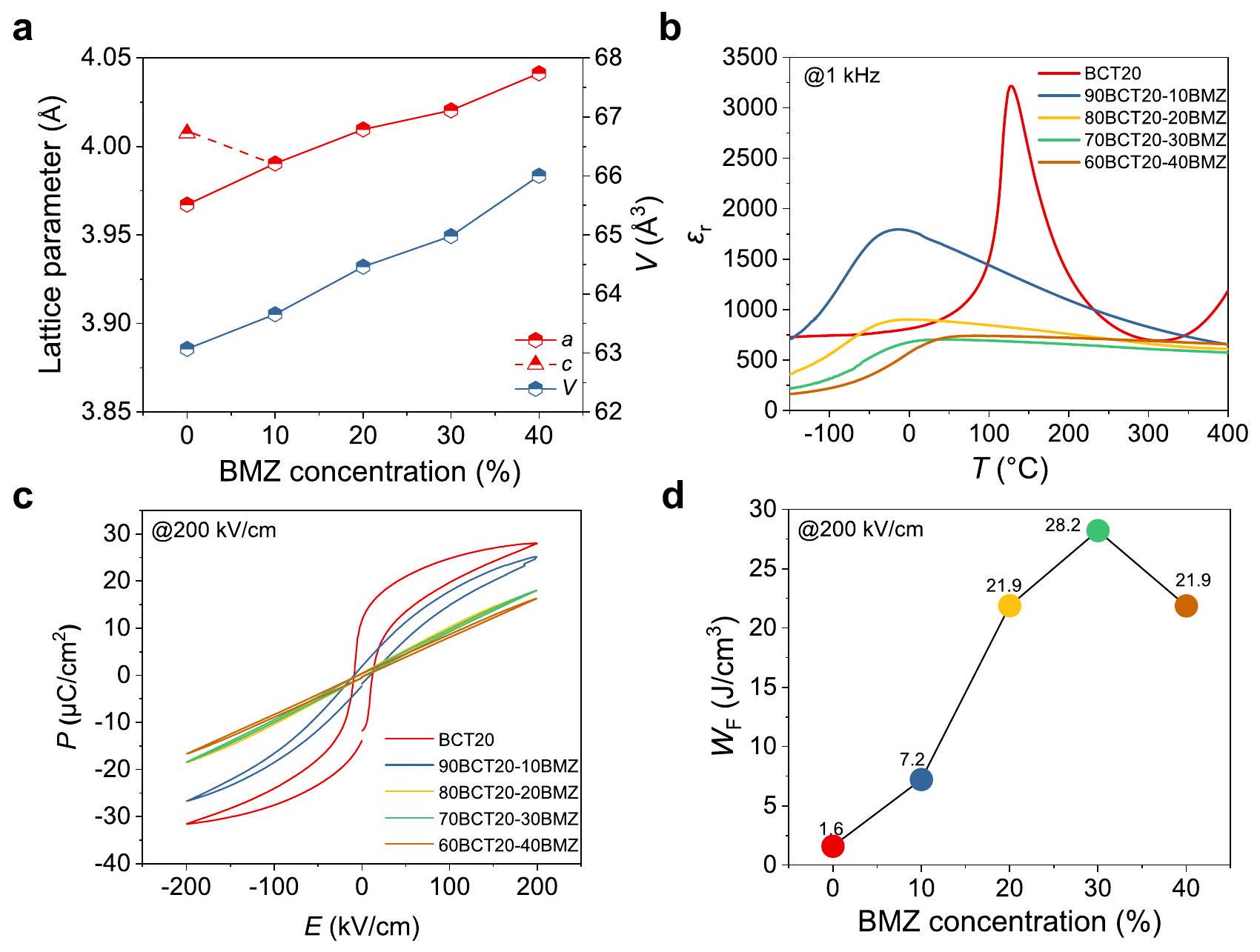
أنماط حيود الأشعة السينية (XRD) لـتم عرض BCT20-100xBMZ في الشكل S1. جميع السيراميك أظهرت هياكل بيروفسكايت نقية. ) مع تنسيق يتغير مع محتوى BMZ. أظهرت سيراميك BCT20 مرحلة رباعية، كما يتضح من انقسام قمم {200}، وهو ما يتماشى مع الدراسة السابقة على المضاف إليها الكالسيوم.الخزفالسيراميك بمحتوى BMZ أعلى منتعرض مرحلة زائفة مكعبة مع واحدة و القمم. تم الإبلاغ عن أن الهيكل العام قد تحول من رباعي السطوح إلى شبه مكعب عندما تم توفير كمية كافية منتم تقديمه فيأنظمة ثنائيةيزداد حجم الشبكة مع زيادة محتوى BMZ، كما هو موضح في الشكل 1a، ويعزى ذلك إلى اختلافات في نصف القطر الأيوني بين و ، وبين و ، مع الأوكتاهيدرا تهيمن على حجم وحدة الخلية البيروفيسكايتثابت العزل الكهربائي المعتمد على درجة الحرارةتُقارن المنحنيات عند 1 كيلوهرتز للسيراميك في الشكل 1b، وتُعطى الخصائص العازلة المعتمدة على درجة الحرارة تحت ترددات مختلفة في الشكل S2. أظهرت سيراميك BCT20 قمم عازلة حادة وحساسة لدرجة الحرارة تقريبًا عند، والذي يتوافق مع نقطة كوري الخاصة به، وهو ما يتماشى مع الدراسة السابقةعندما يتم تقديم BMZ، تشير تشتت التردد لخصائص العزل إلى خصائص الاسترخاء.يمكن تقييم خصائص الاسترخاء من خلال درجة انتشار الانتقال الطوري، عن طريق ملاءمة البيانات العازلة باستخدام قانون كوري-وايس المعدل:، حيث هو الحد الأقصى للثابت العازل و هو درجة الحرارة المقابلة. كما هو موضح في الشكل S3، قيمة السيراميك BCT20 هي 1.2، مما يشير إلى انتقال الطور الشبيه بالفيروإلكتريك. جميع السيراميك الأخرى تظهر قيمة أكبر من 1.5، مما يدل على انتقال طور منتشر وهو سمة نموذجية للمواد المريحة.انتقلت إلى درجات حرارة أعلى مع زيادة محتوى BMZ، كما هو موضح في الشكل 1b، وهو ما يمكن ملاحظته أيضًا في مواد الاسترخاء المعتمدة على BT الأخرى.تنعكس خصائص الاسترخاء في الحلقات. كما هو موضح في الشكل 1c، أظهرت سيراميك BCT20 سلوكًا هيستيريًا الحلقات بسبب الخصائص الفيروكهربائية، بينما تظهر السيراميك مع عنصر BMZ النهائي نحافةالحلقات بسبب الاضطراب في الترتيب بعيد المدى والحقول المحلية غير المرتبة.
خصائص تخزين الطاقة و ) يتم الحصول عليها من خلال التكامل – حلقة، كما هو موضح في الشكل S4. لتقييم أداء تخزين الطاقة بشكل شامل، يتم استخدام معلمة تم تعريفه و الـ قيم هذه الخزفيات عندتمت المقارنة في الشكل 1d، حيث تمتلك تركيبة 70BCT20-30BMZ أعلىقيمة، مما يدل على أنها تتمتع بارتفاعوارتفاعتمت نسبة الأداء الشامل لتخزين الطاقة إلى البنية المجهرية الكثيفة، وانخفاض الفقد الكهربائي، وخصائص الاسترخاء القوية، كما هو موضح في الأشكال S2 و S3 و S5 و S6. استنادًا إلى هذه التوصيفات، تم اختيار 70BCT20-30BMZ للدراسات التفصيلية لتقييم إمكانياته في تطبيقات تخزين الطاقة.
تُعزى الأداء الشامل لتخزين الطاقة لسيراميك 70BCT2030BMZ بشكل أساسي إلى هندسة الانتروبيا العالية. كما هو موضح في الشكل S7، فإن انتروبيا التكوين، المحسوبة باستخدام المعادلة (1)، تزداد تدريجياً مع تركيز BMZ، مع التركيبالسقوط في منطقة الانتروبيا العاليةتم الإبلاغ عن أن التشوه الشبكي الكبير المرتبط بتأثيرات الانتروبيا العالية يعزز من احتمالية التصادمات بين الإلكترونات والذرات، مما يؤدي إلى انخفاض الموصلية وزيادة أداء تخزين الطاقة.كما هو موضح في الشكل S8، فإن عامل التحمل ينخفض بشكل متزايد مع زيادة محتوى BMZ. سيتم مناقشة خصائص تخزين الطاقة عند درجة حرارة الغرفة ودرجات الحرارة العالية لسيراميك 70BCT20-30BMZ في الأقسام التالية.
خصائص تخزين الطاقة عند درجة حرارة الغرفة للسيراميك عالي الانتروبيا 70BCT20-30BMZ
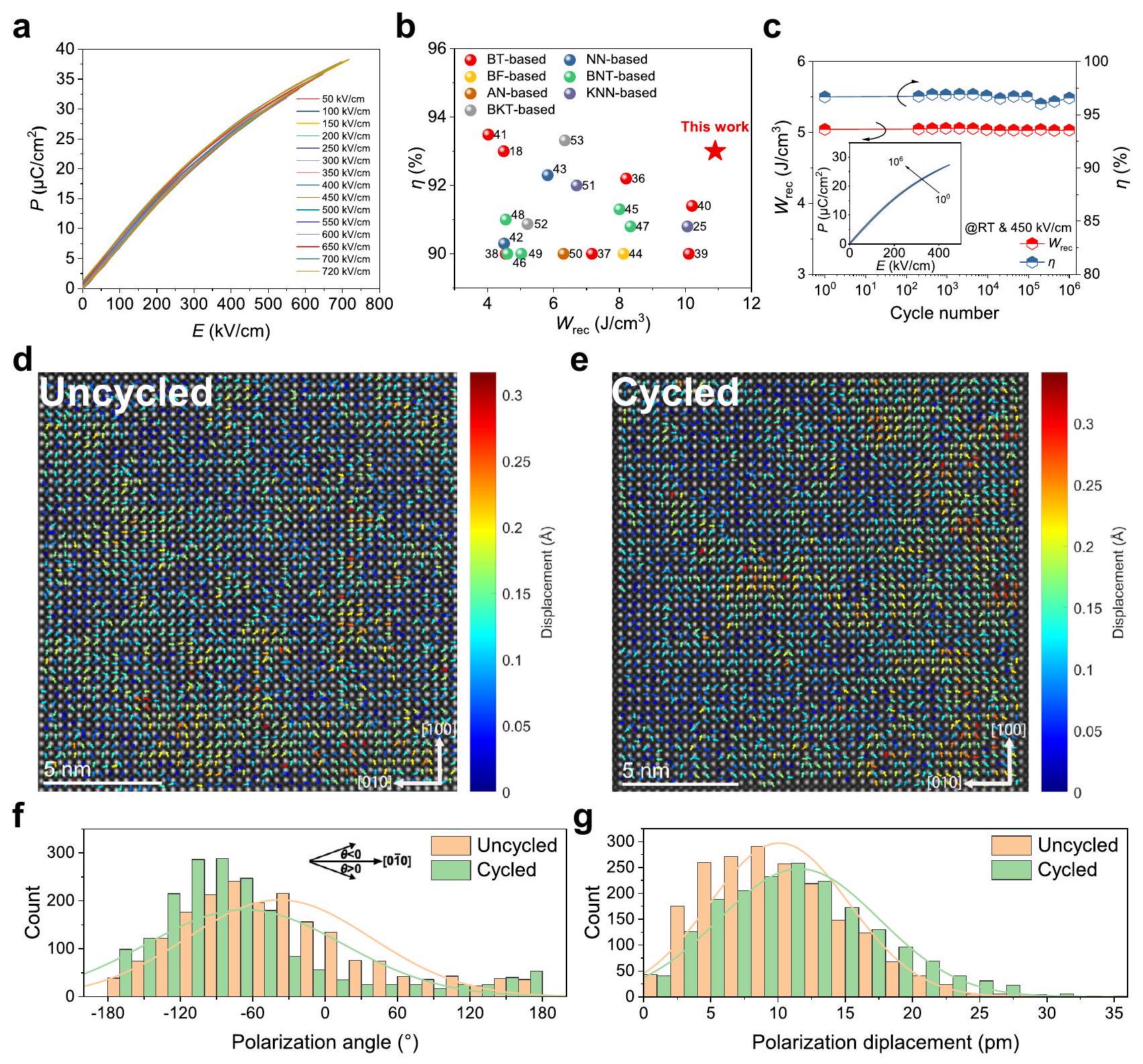
التظهر حلقات -E من سيراميك 70BCT20-30BMZ عند درجة حرارة الغرفة تحت مجالات كهربائية مختلفة في الشكل 2a. هذاتظل الحلقات تحتفظ بشكلها النحيف حتى في ظل مجال كهربائي عالي من، مما يؤدي إلى ارتفاع كلا من منوعاليمنإن قابلية إعادة إنتاج خصائص تخزين الطاقة مرضية، حيث تظهر قيمًا مشابهة مع تباين طفيف عبر عينات مختلفة، كما هو موضح في الشكل S9. أداء تخزين الطاقة لـ 70BCT20-30BMZ يتفوق على معظم السيراميك المريح الخالي من الرصاص المبلغ عنها والتي تكون كفاءتها في الطاقة أكبر منكما هو موضح في الشكل 2ب. الأداء المتميز لتخزين الطاقة مرتبط بخصائصه القوية كموصل غير متجانس وقوة انهيار عالية (BDS)، كما هو موضح في الأشكال S7أ، ب. القوة العالية للانهيار (BDS) في سيراميك 70BCT20-30BMZ مرتبطة بفجوة الطاقة الكبيرة، كما هو موضح في الأشكال S7ج، د، مما يعني أن الإلكترونات من الصعب أن تقفز عبر فجوة الطاقة وتساهم في التوصيل، مما يؤدي إلى تيار تسرب منخفض، خاصة عند وجود مجال كهربائي عالي. تم ملاحظة BDS أقل في العينة معيمكن أن يُعزى ذلك إلى ضعف الالتصاق بين الحبوب، كما يتضح من ميزة الكسر بين الحبيبات في الشكل S11. إن انخفاض BDS للسيراميك معقد تكون مرتبطة بمرحلة ثانوية تشبه الإبرة، كما هو موضح في الشكل S5c. كما تتأثر المراحل الثانوية بتصميم عالي الانتروبيا، كما يتضح من الانخفاض الكبير في تركيزها مع زيادة محتوى BMZ إلى، مما يشير إلى أن الإنتروبيا تلعب دورًا حاسمًا في الذوبان للمرحلة الثانوية داخل تُظهر الحلول الصلبة وتعزز استقرار طور البيروفسكايت. كما هو موضح في الشكل S12، أظهر السيراميك أيضًا خصائص شحن وتفريغ ممتازة، حيثيمكن إطلاق الطاقة المخزنة إلى 1مقاومة الحمل خلال 250 نانوثانية، مما يؤدي إلى كثافة طاقة عالية من. الفرق الطفيف بين كثافة الطاقة المحسوبة من حلقات ( في ) ومنحنيات الشحن والتفريغ فيينشأ من اختلاف المقاييس الزمنية للقياسين.
دائريتم إجراء القياسات عندوتكرر حتى الدورات. تم حساب و كدوال لعدد الدورات موضحة في الشكل 2c. بعد الدورات، أظهرت أداء تخزين الطاقة تغيرًا ضئيلًا، مع و ، مما يدل على موثوقيتها العالية في الدورات. للتحقيق في موثوقية الدورات، تم فحص الهياكل المحلية للسيراميك بواسطة مجهر الإلكترون الناقل الماسح (STEM) قبل وبعد القياسات الدورية. تم التقاط صور المجال المظلم الحلقي بزاوية عالية (HAADF) للعينة قبل وبعد تظهر دورات المجال الكهربائي في الشكل 2d و e، على التوالي. تم تمييز إزاحات الكاتيونات في موقع B في خلايا الوحدة المقابلة بواسطة الأسهم، كما هو موضح في الشكل S13. معظم المناطق في كل من صور HAADF داكنة الزرقة، مما يشير إلى أن مقادير الإزاحة للكاتيونات في موقع B صغيرة قبل وبعد قياس الدورة. ومع ذلك، لا يزال يمكن ملاحظة المناطق القطبية النانوية (PNRs) في العينتين، والتي ترتبط ارتباطًا وثيقًا بخصائص الاسترخاء.لم تتجمع سجلات PNRs لتشكل مناطق قطبية دقيقة حتى بعد تعرضها لجهد كهربائي عالٍ.
الشكل 1 | مقارنة بين الخصائص الهيكلية والكهربائية لـ (100-100x) بلاطات BCT20-100xBMZ. أ. التغيرات في معلمات الشبكة والحجم كدالة لمحتوى BMZ.تغيير الثابت العازلعند 1 كيلوهرتز كدالة لدرجة الحرارة للسيراميك المدروس. جالحلقات فيمن
الخزف. د الحسابيمعامل السيراميك بمحتويات مختلفة من BMZ. الرقم بالقرب من الرمز يمثلقيمة التركيبة المقابلة.
الشكل 2 | أداء تخزين الطاقة عند درجة حرارة الغرفة لسيراميك 70BCT20-30BMZ وهياكلها المحلية. أالحلقات تحت مجالات كهربائية مختلفة. ب مقارنة أداء تخزين الطاقة بين السيراميك 70BCT20-30BMZ وسيراميك الاسترخاء الخالي من الرصاص الآخر.. الرقم بالقرب من الرمز يمثل رقم المرجع المقابل. ج تم قياس موثوقية الدورة عند حتى الدورات. يظهر الرسم التوضيحي الحلقات بعد مختلف صورة HAADF-STEM بدقة ذرية مسجلة على طول الاتجاه البلوري [001] للسيراميك قبل وبعد الدورات تحت سم، على التوالي. تشير اتجاه السهم ولونه إلى إسقاطات اتجاه الإزاحة وحجمها، على التوالي، لأيون الموقع B في وحدة الخلية المقابلة.-g توزيع زاوية متجه الاستقطاب وسعة الإزاحة قبل وبعد الدورة، على التوالي. مجاللـالأوقات، مما يدل على ديناميكيتها العالية تحت الحقول الكهربائية المتكررة. تُظهر توزيعات زوايا الاستقطاب والانحرافات في الشكل 2f و g، على التوالي، تغييرات طفيفة في كلا التوزيعين قبل وبعد الدورات. كما أظهرت الهياكل الدقيقة على النانو استقرارًا عاليًا بعد الدورات، كما هو موضح في الشكل S14. لذلك، فإن PNRs ذات الاستقرار العالي في المجال الكهربائي تمنع من تشكيل مجالات كبيرة مرتبطة بالاستقطاب المتبقي والهيسترسيس في حلقات P-E، مما يؤدي إلى كفاءة طاقة عالية وأداء تخزين طاقة فائق الاستقرار خلال قياسات الدورات.
أداء تخزين الطاقة عند درجات حرارة عالية للسيراميك عالي الانتروبيا 70BCT20-30BMZ
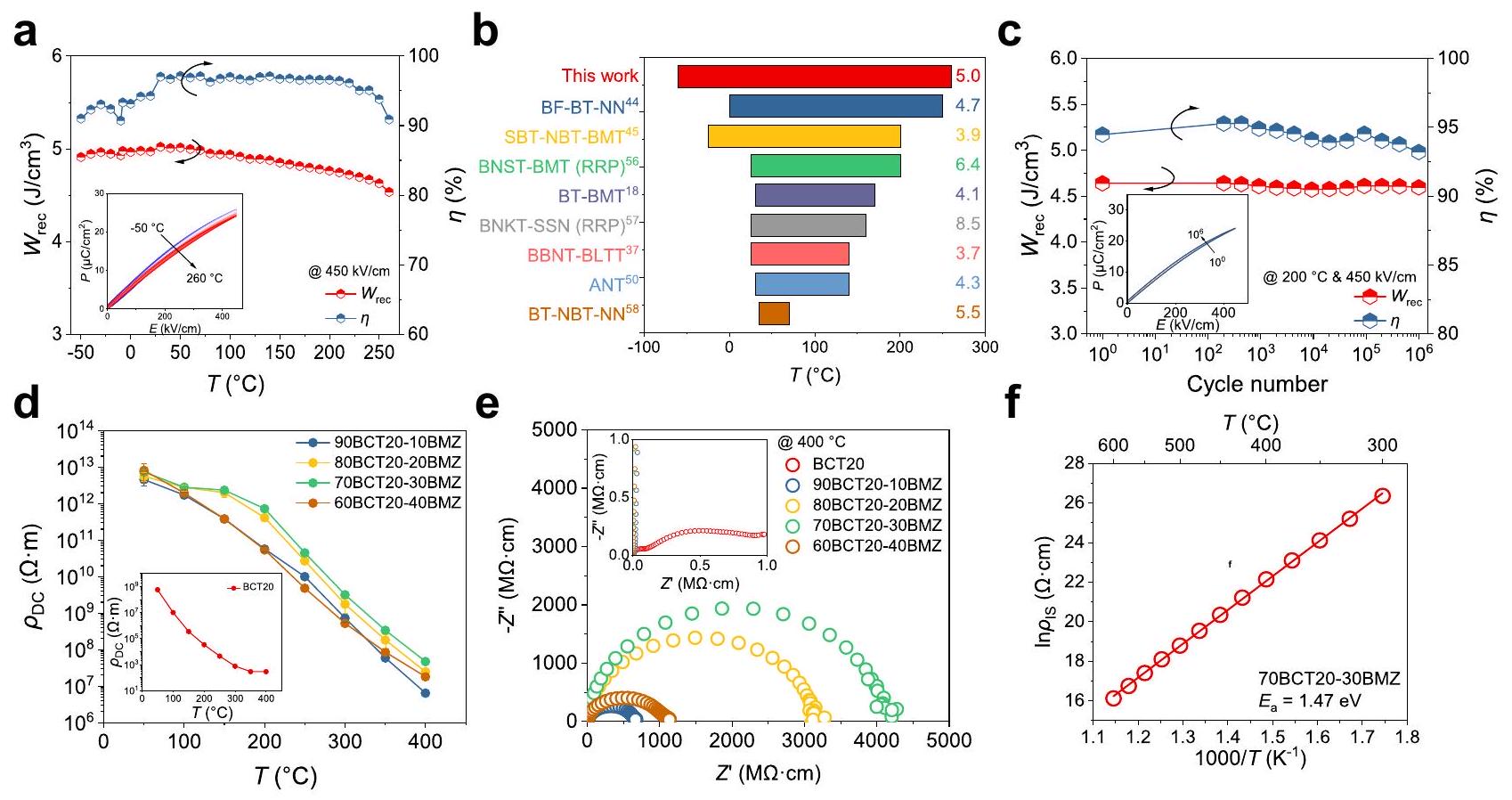
مدفوعين بالخصائص الديناميكية العالية لنسب الطاقة المتجددة والاستقرار الفائق في أداء تخزين الطاقة، قمنا بالتحقيق في درجات الحرارة العالية أداء تخزين الطاقة لـ 70BCT20-30BMZ. تخزين الطاقة و مقاس عند كدالة لدرجة الحرارة موضحة في الشكل 3أ. أظهر السيراميك أداءً مستقرًا في تخزين الطاقة ( و على مدى واسع من درجات الحرارةإلىمن الجدير بالذكر،يبقى فوقحتى في، مما يشير إلى أن كل من فقدان العزل الكهربائي والموصلية هما في أدنى مستوياتهما في ظروف القياس. نطاق درجة الحرارة أينيتجاوزيتم مقارنته مع سيراميك آخرفي الشكل 3ب. على الرغم من أن السيراميك 70BCT20-30BMZ يظهر درجة حرارة أقل في الغرفة مقارنة بالسيراميك الذي تم إعداده من خلال عملية الدرفلة المتكررة نطاق درجة الحرارةأوسع منهم، مما يدل على أدائها الشامل في تخزين الطاقة عند درجات الحرارة العالية. بالنسبة للتطبيقات العملية عند درجات الحرارة العالية، فإن الموثوقية في بيئة درجات الحرارة العالية مهمة. خصائص تخزين الطاقة والحلقات المقاسة عندوالمجال الكهربائي المتكرر لـ
الشكل 3 | أداء تخزين الطاقة عند درجات حرارة عالية لسيراميك 70BCT20-30BMZ. أ و كوظائف لدرجة حرارة القياس. يظهر الشكل الداخلي – حلقات عند درجات حرارة مختلفة.نطاق درجات الحرارة الذي فيهلخزف 70BCT20-30BMZ وغيرها من خزفيات الاسترخاء. الرقم بالقرب من كل عمود يمثل درجة الحرارة في الغرفةتم قياس موثوقية الدورة عند و حتى الدورات. يظهر الرسم التوضيحي حلقات بعد دورات مختلفة. د تباينات المقاومة الكهربائية المستمرة ( ) مع درجة الحرارة لـ (100-100x) سيراميك BCT20-100xBMZ. تمثل أشرطة الخطأ الانحراف المعياري. e مخططات التعقيد للموصلية الخزف فيمخطط أرهينيوس لمقاومة الكتلة ) من سيراميك 70BCT20-30BMZ. موضحة في الشكل 3c والإطار، على التوالي.تظل الحلقات دون تغيير بعددوائر، مما يؤدي إلى الاستقرار و مع تباينات أقل من و على التوالي، مما يكشف عن موثوقية متفوقة عند درجات حرارة مرتفعة تصل إلى.
يُنسب الأداء الممتاز لتخزين الطاقة عند درجات الحرارة العالية إلى المقاومة العالية ) وطاقة تنشيط عالية للتوصيل ( ) من سيراميك 70BCT20-30BMZ. تباينات في مقاومات التيار المستمر ( ) مع درجة الحرارة لـ ( تظهر سيراميك BCT20-100xBMZ في الشكل 3d. مقارنةً بالتراكيب التي تحتوي على مكون BMZ، أظهرت سيراميك BCT20 مقاومة تيار مستمر أقل بسبب البنية المجهرية غير المضغوطة، كما هو موضح في الشكل S5a. عندما تم إدخال مكون BMZ، تحسنت مقاومة التيار المستمر للسيراميك بشكل ملحوظ، حيث وصلت إلىعند درجة حرارة الغرفة. وبالتالي، فإن المقاومة و BDS للتراكيب عالية الانتروبياأعلى من تلك ذات الانتروبيا المتوسطة ) وذات الإنتروبيا المنخفضة ( ) التراكيب. من الأهمية الخاصة أن السيراميك لا يزال يظهر جودة عالية عند درجات حرارة مرتفعة، خاصة التركيبة معيظهر أكبر قيمة بين السيراميك، وهو أمر حاسم للتطبيقات ذات درجات الحرارة العالية. يمكن أيضًا تمييز خصائص العزل الحراري عند درجات الحرارة العالية من خلال قياس المعاوقة. كما هو موضح في الشكل 3e، عرضت سيراميك BCT20 دائرتين نصف دائريتين متميزتين في مخطط المعاوقة المعقد. : نصف دائرة أصغر في منطقة التردد العالي، يُعزى إلى استجابات الحبوب، ونصف دائرة أكبر في منطقة التردد المنخفض، تت correspond إلى استجابات حدود الحبوب. بالمقابل، أظهرت جميع السيراميك الأخرى نصف دائرة واحدة تحت نفس ظروف القياس، مما يدل على استجابة من حدود الحبوب فقط. مع زيادة تركيز BMZ، زادت المقاومة الحجمية ( ) من السيراميك في يتم تحديده من خلال نقطة تقاطع منحنى المعاوقة والمحور، يزيد أولاً ثم ينقص. تم تحقيق أعلى مقاومة حجمية في 70BCT20-30BMZ، متسقة مع النتائج التي تم الحصول عليها في قياسات المقاومة المستمرة. تم استخراج المقاومات الحجمية لسيراميك 70BCT20-30BMZ من منحنيات المعاوقة المقاسة عند درجات حرارة مختلفة، ومخطط أرهينيوس هو المعطاة في الشكل 3f. الطاقة المحفزة المحسوبة للتوصيل هي 1.47 إلكترون فولت، وهو ما يعادل تقريبًا نصف فجوة النطاق البصرية للسيراميك، مما يشير إلى أن آلية التوصيل هي التوصيل الجوهري. كما أن التحسين في التجانس الكهربائي مسؤول أيضًا عن تحسين BDS من خلال تقليل استقطاب الواجهة.. كما هو موضح في الشكل S15، الفرق في التردد بينذروةيتم تقليل الذروة عندما يزيد محتوى BMZ من 0 إلى، مما يشير إلى أن توزيع المجال الكهربائي أكثر انتظامًا وبالتالي فإن BDS أعلى في سيراميك 70BCT2030BMZ. رقم مهم آخر من حيث الأداء (FOM) للمكثفات عالية الحرارة هوثابت، وهو مقياس لكل من العزل والسعة عند درجة حرارة معينة. علاوة على ذلك،الثابت هو استقلالية الهندسة لأنه في الواقع ناتج ثابت العزل والمقاومة الكهربائية للمادة، مما يجعل من الممكن تصنيف ومقارنة عائلات مختلفة من العوازل. مقارنةثابت بين 70BCT20-30BMZ السيراميك والسيراميك العازل الآخر كما هو موضح في الجدول S1 والجدول S2. بغض النظر عن و ثابت RC للسيراميك 70BCT20-30BMZ يتفوق على غيره من السيراميك العازل، مما يدل على إمكانيته الكبيرة في تطبيقات المكثفات ذات درجات الحرارة العالية.
توصيفات هيكلية في الموقع لسيراميك 70BCT2030BMZ عالي الانتروبيا
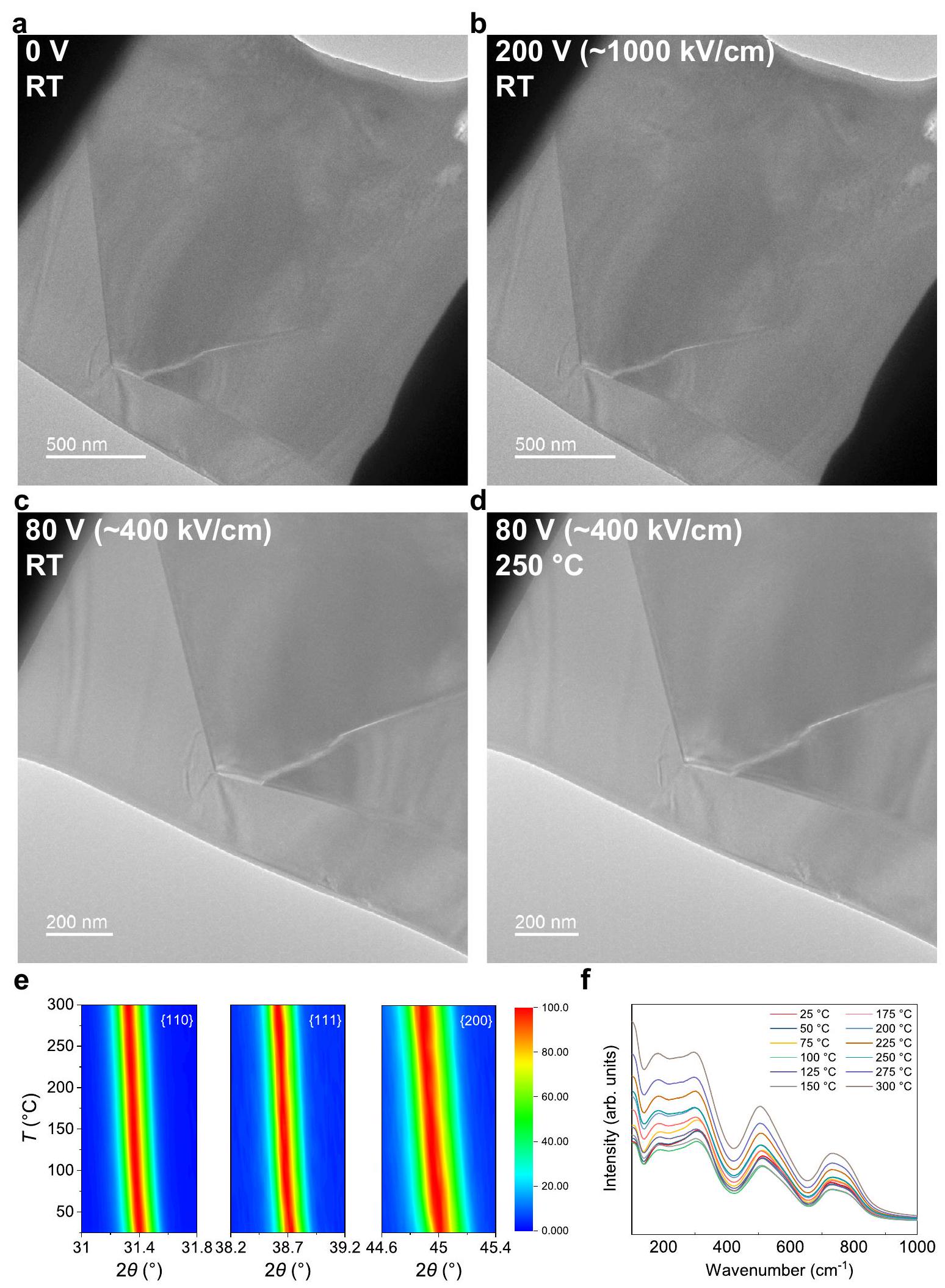
لتحقيق في هياكل سيراميك 70BCT20-30BMZ تحت درجات حرارة عالية وحقول كهربائية، تم إجراء تقنيات توصيف في الموقع بما في ذلك TEM وXRD وطيف رامان، مع تقديم النتائج في الشكل 4. وقد تم الإبلاغ عن أن PNRs في المواد المريحة يمكن أن تتحول إلى مجالات فرّو كهربائية كبيرة تحت حقول كهربائية عالية.“، مما يؤثر على الخصائص الكهربائية. ما يثير الاهتمام بشكل خاص هو أن السيراميك 70BCT20-30BMZ، حتى تحت مجال كهربائي فائق الارتفاع من، لا تشهد المقدمة الكبيرة لمجالات فيروكهربائية كبيرة، كما هو موضح في الشكل 4a، b. علاوة على ذلك، فإن تطبيق مجال كهربائي ثابت منسم، تسخين العينة حتىلم تغير الهيكل المجهري بشكل مرئي، كما هو موضح في الشكل 4c، d. ومن ثم، فإن PNRs في 70BCT20-30BMZ
الشكل 4 | التوصيفات في الموقع لسيراميك 70BCT20-30BMZ. أ-ب صور TEM تم تسجيلها في درجة حرارة الغرفة وتحت 0 فولت و200 فولت، على التوالي. الأجزاء السوداء في أعلى اليسار وأسفل اليمين هي أقطاب بلاتينية. ج-د صور TEM تم تسجيلها تحت 80 فولت وفي درجة حرارة الغرفة و، على التوالي. e تم تكبير ، ، و قمم الانكسار تحت درجات حرارة مختلفة. تم تطبيع الشدات. طيف رامان المقاس تحت درجات حرارة مختلفة. تظهر السيراميك ديناميكية عالية تحت كل من درجات الحرارة العالية والحقول الكهربائية دون أن تتجمع في مجالات كبيرة، مما يتماشى مع الملاحظات منالحلقات المقاسة عند درجات حرارة مختلفة وحقول كهربائية متكررة.
بالإضافة إلى ذلك، تظهر أنماط XRD لـ 70BCT20-30BMZ المقاسة تحت درجات حرارة مختلفة في الشكل S16. أظهرت السيراميك مرحلة زائفة مكعبة دون انتقال في الطور على مدى درجات الحرارة من 25 إلىكما يتضح من غياب انقسام القمة أو تشويه، و القمم في الشكل 4e. تشير التحولات الطفيفة للقمم نحو زوايا أقل إلى توسع الشبكة ضمن هذه النطاقات الحرارية. معامل التوسع المحسوب تقريبًايتماشى مع معامل التمدد الحراري للمكعبمما يشير إلى أن تمدد الشبكة في سيراميك 70BCT20-30BMZ ناتج بشكل أساسي عن التمدد الحراري بدلاً من الانتقالات الطورية. وبالمثل، لم تُلاحظ أي قمم جديدة أو انقسام في القمم في طيف رامان الموضح في الشكل 4f، مما يدل على عدم وجود انتقال طوري في نفس نطاق درجات الحرارة. بشكل عام، كما تكشف هذه التوصيفات في الموقع، فإن هيكل 70BCT20-30BMZ يظهر استقرارًا حراريًا وكهربائيًا قويًا، والذي يُعزى إلى التشوه الكبير في الشبكة والحقول المحلية العشوائية الناتجة عن هندسة الانتروبيا العالية. هذا الاستقرار يدعم الأداء الممتاز لهذه السيراميك في تطبيقات تخزين الطاقة عند كل من درجة حرارة الغرفة ودرجات الحرارة العالية.
باختصار،بي سي تي 20-100تمت تخليق السيراميك وتوصيفه، مع زيادة في إنتروبيا التكوين معبشكل شامل و تم اختيار التركيبة عالية الانتروبيا 70BCT20-30BMZ للدراسات المتعمقة. تظهر هذه التركيبة كلاً من ارتفاعمن ومرتفع من، إلى جانب موثوقية ممتازة في الدورات عند درجة حرارة الغرفة. ومن الأهمية بمكان أن السيراميك 70BCT20-30BMZ أظهر أيضًا استقرارًا ممتازًا عند درجات الحرارة العالية مع و على مدى واسع من درجات الحرارةإلى، في حين تظهر موثوقية فائقة في الدورات مع الحد الأدنى من تدهور الخصائص بعد الدورات عند و كشفت التوصيلات الكهربائية والتوصيفات في الموقع أن المناطق القطبية غير المتجانسة في السيراميك ديناميكية للغاية تحت درجات حرارة وحقول كهربائية متغيرة، وذلك بسبب هندسة الانتروبيا العالية. تؤكد هذه المناطق القطبية الديناميكية على الأداء الممتاز لتخزين الطاقة عند درجات الحرارة العالية وموثوقية الدورة العالية. يبرز هذا البحث الإمكانات الكبيرة لسيراميك 70BCT20-30BMZ في المكثفات عالية الحرارة، ويظهر أن تصميم الانتروبيا العالية هو استراتيجية فعالة في تطوير مواد عازلة عالية الأداء.
طرق
تحضير السيراميك
نقاء عاليأكاسيد وكربونات، وتم وزن MgO (جميعها من العلّامة) وفقًا للصيغة الكيميائية، “، و 0.4، مختصراً كـ ( )BCT20-100xBMZ) وطحنها في إيثانول خالي من الماء باستخدام كرات زركونيا مثبتة باليوروبيوم (YSZ) لمدة 12 ساعة. تم تجفيف المعلق وحرقه عندلمدة ساعتين بمعدل تسخين قدره. بعد ذلك، تم طحن المساحيق المحروقة مرة أخرى باستخدام مطحنة كروية لمدة 24 ساعة لتقليل حجم الجسيمات. تم خلط المساحيق مع تم خلط رابطة Rhoplex وطحنها لمدة ساعتين. تم غربلة المساحيق مع الرابطة وضغطها أحادي المحور إلى كريات بقطر أقل من 30 ميجا باسكال، تليها ضغط إيزوستاتيكي بارد تحت 200 ميجا باسكال لمدة دقيقتين. تم حرق الرباط عن طريق تسخين الكريات عند لمدة ساعتين بمعدل تسخين قدرهتمت عملية التلبيد للكرات عند (كلما زادت نسبة BMZ، انخفضت درجة حرارة التلبيد) لمدة ساعتين لتحقيق سيراميك كثيف. تم تقليل سمك السيراميك المتلبد وتلميعه لتحقيق أسطح متوازية. تم استخدام معاجين الفضة المحترقة أو أفلام الذهب المرشوشة كأقطاب للقياسات.
توصيف الطور والميكروهيكل
تم تحديد نقاء الطور ومعلمات الشبكة بواسطة حيود الأشعة السينية بالمسحوق (D8 Advance، Bruker) على كريات السيراميك الملبدة المطحونة. تم ملاحظة الميكروهياكل للسيراميك بواسطة مجهر إلكتروني مسح ميداني (FE-SEM) (Merlin Compact، Zeiss). قبل ملاحظات SEM، تم تلميع السيراميك وحفره حرارياً عندأدنى من درجة حرارة التلبيد المقابلة لمدة 15 دقيقة. تم حساب متوسط حجم الحبيبات والانحراف المعياري من 200 قياس لحجم الحبيبات. النقل
تم إعداد عينات المجهر الإلكتروني (TEM) بواسطة شعاع أيوني مركّز مزدوج (FIB، Helios 5 UC، ThermoFisher Scientific). تم أولاً ترسيب طبقات حماية من التنجستن بسمك على المناطق المستهدفة في السيراميك.، ثم تمت إزالة المناطق المحيطة بواسطة أيونات غاليوم المسرعة. تم ربط العينات على شبكات نحاسية تجارية ثم تم تقليل سمكها بواسطة أيونات غاليوم بجهد تسريع و تيار شعاعي قدره 30 كيلو فولت و 2.5 نانو أمبير، وأخيرًا تم استخدام 2 كيلو فولت و 40 بيكو أمبير لإزالة الطبقات غير المتبلورة السطحية بدقة. كانت سماكات مناطق التحقيق حوالي انحراف كروي مزدوجتم استخدام مجهر الإلكترون الناقل الماسح المصحح (STEM، Spectra 300، Thermo Fisher Scientific) الذي يعمل بجهد 300 كيلوفولت لتوصيف الهياكل على المستوى الذري والتركيبات الكيميائية. كانت زاوية التقارب في وضع STEM وزوايا قبول الحقل المظلم الحلقي العالي الزاوية (HAADF) 25 مللي راديان و، على التوالي. تم الحصول على أنماط حيود الإلكترون، وصور الحقل الساطع (BF) والحقل المظلم (DF) في مجهر إلكتروني نافذ بجهد 200 كف (Talos F200X، Thermo Fisher Scientific) باستخدام تقنية الحقل المظلم المركز. تم إمالة المناطق المستهدفة إلى محاور منطقة [001] للحصول على أنماط الحيود، ثم تم التقاط بقع الحيود (100) و(110) باستخدام فتحة العدسة الموضوعية لتصوير الحقل المظلم.
قياسات الطيف
تم قياس خصائص الامتصاص البصري للسيراميك المصقول في نطاق الطول الموجي منباستخدام مطياف UV-VIS-NIR (لامبدا 1050 +، بيركن إلمر). فجوات النطاق البصرية ( ) تم حسابها بناءً على معادلة تاوك ، حيث هو معامل امتصاص الضوء، هو ثابت بلانك، هو تردد الضوء، و هو ثابت ملائم. تم تسجيل طيف رامان بواسطة مطياف رامان (HR800، HORIBA) باستخدام تحفيز الليزر بدون استقطاب. دقة مطياف رامان هي.
قياسات العزل، والممانعة، والمقاومة
الثابت العازلوخسارةتم قياسها كدوال لدرجة الحرارة والتردد بواسطة محلل مقاومة (E4990A، Keysight) مدمج مع مرحلة تحكم في درجة الحرارة (HFSE91-PB2، Linkam). تم إجراء قياسات طيف المقاومة بواسطة محلل كسب الطور (1260، Solartron) مزود بواجهة عازلة (1296، Solartron). تم قياس المقاومة النوعية بواسطة مقياس كهربائي (6517B، Keithley). تم حساب المقاومة النوعية المتوسطة والانحراف من 350 بيانات مقاومة نوعية مقاسة.
القياسات المتعلقة بالمواد الفيروكهربائية، والانهيار، والشحن والتفريغ
قياسات الفيروكهربائية (تم إجراء قياسات الحلقة بواسطة جهاز اختبار الفيروكهربائية (TF 1000، AixACCT). تم إجراء قياسات الانهيار بواسطة نظام قياس الانهيار العازل (PK-CPE1701، PolyK). تم تسجيل جهود الانهيار من خلال تطبيق جهد مستمر مع نطاق تصاعدي منحتى انكسر العينة. توزيع ويبلتم استخدامه لوصف BDS للسيراميك. هو احتمال الانهيار التراكمي لحقول كهربائية معينة، هو BDS لكل عينة. و هي خصائص ويبول BDS ومعامل ويبول، على التوالي. تم إجراء قياسات الشحن والتفريغ بواسطة نظام قياس شحن وتفريغ المكثفات (PKCRP1701، PolyK) باستخدام مقاوم تحميل. عينات رقيقة بسماكة حواليتم استخدامها للقياسات المذكورة أعلاه.
ملخص التقرير
معلومات إضافية حول تصميم البحث متاحة في ملخص تقارير مجموعة ناتشر المرتبط بهذه المقالة.
توفر البيانات
جميع البيانات المستخدمة لإنشاء الأشكال في هذه الورقة متوفرة في ملف البيانات المصدر. يتم توفير البيانات المصدر مع هذه الورقة.
References
Sarjeant, W. J., Zirnheld, J. & MacDougall, F. W. Capacitors. IEEE Trans. Plasma Sci. 26, 1368-1392 (1998).
Furman, E. et al. High-temperature, high-power capacitors: the assessment of capabilities. SAE Int. J. Aerosp. 1, 822-831 (2008).
Li, H. et al. Dielectric polymers for high-temperature capacitive energy storage. Chem. Soc. Rev. 50, 6369-6400 (2021).
Zeb, A. & Milne, S. J. High temperature dielectric ceramics: a review of temperature-stable high-permittivity perovskites. J. Mater. Sci: Mater. Electron 26, 9243-9255 (2015).
Li, Q. et al. High-temperature dielectric materials for electrical energy storage. Annu Rev. Mater. Res. 48, 219-243 (2018).
Jaffe B., Cook W. R., Jaffe H. Piezoelectric Ceramics. Academic Press (1971).
Yang, L. et al. Perovskite lead-free dielectrics for energy storage applications. Prog. Mater. Sci. 102, 72-108 (2019).
Wang, G. et al. Electroceramics for high-energy density capacitors: current status and future perspectives. Chem. Rev. 121, 6124-6172 (2021).
Yao, Z. et al. Homogeneous/inhomogeneous-structured dielectrics and their energy-storage performances. Adv. Mater. 29, 1601727 (2017).
Wang, J. & Shen, Z.-H. Modeling-guided understanding microstructure effects in energy storage dielectrics. Microstructures 1, 2021006 (2021).
Li, F., Zhang, S., Damjanovic, D., Chen, L.-Q. & Shrout, T. R. Local structural heterogeneity and electromechanical responses of ferroelectrics: learning from relaxor ferroelectrics. Adv. Funct. Mater. 28, 1801504 (2018).
Zhou, L., Vilarinho, P. M. & Baptista, J. L. Dependence of the structural and dielectric properties of ceramic solid solutions on raw material processing. J. Eur. Ceram. Soc. 19, 2015-2020 (1999).
Shvartsman, V. V., Zhai, J. & Kleemann, W. The dielectric relaxation in solid solutions . Ferroelectrics 379, 77-85 (2009).
Lei, C., Bokov, A. A. & Ye, Z. G. Ferroelectric to relaxor crossover and dielectric phase diagram in the system. J. Appl Phys. 101, 084105 (2007).
Beuerlein, M. A. et al. Current understanding of structure-processing-property relationships in dielectrics. J. Am. Ceram. Soc. 99, 2849-2870 (2016).
Ogihara, H., Randall, C. A. & Trolier-McKinstry, S. Weakly coupled relaxor behavior of ceramics. J. Am. Ceram. Soc. 92, 110-118 (2009).
Yang, L., Kong, X., Cheng, Z. & Zhang, S. Ultra-high energy storage performance with mitigated polarization saturation in lead-free relaxors. J. Mater. Chem. A 7, 8573-8580 (2019).
Hu, Q. et al. Achieve ultrahigh energy storage performance in relaxor ferroelectric ceramics via nanoscale polarization mismatch and reconstruction. Nano Energy 67, 104264 (2020).
Raengthon, N., Sebastian, T., Cumming, D., Reaney, I. M. & Cann, D. P. BaTiO3-Bi( – ceramics for high-temperature capacitor applications. J. Am. Ceram. Soc. 95, 3554-3561 (2012).
Oses, C., Toher, C. & Curtarolo, S. High-entropy ceramics. Nat. Rev. Mater. 5, 295-309 (2020).
Sarkar, A. et al. High-entropy oxides: fundamental aspects and electrochemical properties. Adv. Mater. 31, 1806236 (2019).
Yang, B. et al. High-entropy enhanced capacitive energy storage. Nat. Mater. 21, 1074-1080 (2022).
Qi, J. et al. High-entropy assisted -based ceramic capacitors for energy storage. Cell Rep. Phys. Sci. 3, 101110 (2022).
Yang, B. et al. Engineering relaxors by entropy for high energy storage performance. Nat. Energy 8, 956-964 (2023).
Chen, L. et al. Giant energy-storage density with ultrahigh efficiency in lead-free relaxors via high-entropy design. Nat. Commun. 13, 3089 (2022).
Zhang, S. High entropy design: a new pathway to promote the piezoelectricity and dielectric energy storage in perovskite oxides. Microstructures 3, 2023003 (2023).
Chen, L. et al. Large energy capacitive high-entropy lead-free ferroelectrics. Nano-Micro Lett. 15, 65 (2023).
Gao, Y. et al. Optimizing high-temperature energy storage in tungsten bronze-structured ceramics via high-entropy strategy and bandgap engineering. Nat. Commun. 15, 5869 (2024).
Peng, H. et al. High-entropy relaxor ferroelectric ceramics for ultrahigh energy storage. Nat. Commun. 15, 5232 (2024).
Mitsui, T. & Westphal, W. B. Dielectric and -ray studies of and . Phys. Rev. 124, 1354-1359 (1961).
Shannon, R. D. Revised effective ionic radii and systematic studies of interatomic distances in halides and chalcogenides. Acta Crystallogr A 32, 751-767 (1976).
Yuan, Q. et al. Simultaneously achieved temperature-insensitive high energy density and efficiency in domain engineered lead-free relaxor ferroelectrics. Nano Energy 52, 203-210 (2018).
Uchino, K. & Nomura, S. Critical exponents of the dielectricconstants in diffused-phase-transition crystals. Ferroelectrics 44, 55-61 (1982).
Huang, C.-C. & Cann, D. P. Phase transitions and dielectric properties in perovskite solid solutions. J. Appl Phys. 104, 024117 (2008).
Pan, H. et al. Ultrahigh energy storage in superparaelectric relaxor ferroelectrics. Science 374, 100-104 (2021).
Guo, J. et al. Achieving excellent energy storage properties in finegrain high-entropy relaxor ferroelectric ceramics. Adv. Electron. Mater. 8, 2200503 (2022).
Yang, H. et al. Novel BaTiO3-based, Ag/Pd-compatible lead-free relaxors with superior energy storage performance. ACS Appl Mater. Interfaces 12, 43942-43949 (2020).
Sun, Z. et al. Superior capacitive energy-storage performance in Pbfree relaxors with a simple chemical composition. J. Am. Chem. Soc. 145, 6194-6202 (2023).
Xiao, W. et al. Free energy regulation and domain engineering of ceramics for superior dielectric energy storage performance. Chem. Eng. J. 461, 142070 (2023).
Shi, C. et al. Significantly enhanced energy storage performances and power density in BCZT-xSBT lead-free ceramics via synergistic optimization strategy. Chem. Eng. J. 426, 130800 (2021).
Wei, T. et al. Novel lead-free dielectric ceramics with excellent energy storage properties. Ceram. Int 47, 3713-3719 (2021).
Kang, R. et al. Extraordinary energy storage performance and thermal stability in sodium niobate-based ceramics modified by the ion disorder and stabilized antiferroelectric orthorhombic R phase. J. Mater. Chem. A 9, 24387-24396 (2021).
Qi, H., Xie, A. W., Tian, A. & Zuo, R. Z. Superior energy-storage capacitors with simultaneously giant energy density and efficiency using nanodomain engineered lead-free bulk ferroelectrics. Adv. Energy Mater. 10, 1903338 (2020).
Wang, Z. et al. Achieving ultrahigh energy-storage density with excellent thermal stability in -based relaxors via polarization behavior modulation. ACS Appl Mater. Interfaces 14, 44389-44397 (2022).
Joseph, J., Cheng, Z. & Zhang, S. modified dielectrics for high-temperature energy storage applications. J. Materiomics 8, 731-738 (2022).
Li, D. et al. Lead-free relaxor ferroelectric ceramics with ultrahigh energy storage densities via polymorphic polar nanoregions design. Small 19, 2206958 (2023).
Ye, H. et al. Significantly improvement of comprehensive energy storage performances with lead-free relaxor ferroelectric ceramics for high-temperature capacitors applications. Acta Mater. 203, 116484 (2021).
Li, D. et al. Enhanced energy storage properties achieved in -based ceramics via composition design and domain engineering. Chem. Eng. J. 419, 129601 (2021).
Luo, N. et al. Constructing phase boundary in antiferroelectrics: pathway simultaneously achieving high energy density and efficiency. Nat. Commun. 11, 4824 (2020).
Li, D. et al. Improved energy storage properties achieved in (K, Na) -based relaxor ferroelectric ceramics via a combinatorial optimization strategy. Adv. Funct. Mater. 32, 2111776 (2021).
Niu, Z. et al. -based lead-free relaxor ferroelectric with high energy storage performances via the grain size and bandgap engineering. Mater. Today Chem. 24, 100898 (2022).
Zheng, L. et al. Simultaneously achieving high energy storage performance and remarkable thermal stability in based ceramics. Mater. Today Energy 28, 101078 (2022).
Li, J. et al. Grain-orientation-engineered multilayer ceramic capacitors for energy storage applications. Nat. Mater. 19, 999-1005 (2020).
Liu, G., Chen, L. & Qi, H. Energy storage properties of based lead-free superparaelectrics with large antiferrodistortion. Microstructures 3, 2023009 (2023).
Li, D. et al. A high-temperature performing and near-zero energy loss lead-free ceramic capacitor. Energy Environ. Sci. 16, 4511-4521 (2023).
Zhao, W. et al. Broad-high operating temperature range and enhanced energy storage performances in lead-free ferroelectrics. Nat. Commun. 14, 5725 (2023).
Chen, L. et al. Local diverse polarization optimized comprehensive energy-storage performance in lead-free superparaelectrics. Adv. Mater. 34, e2205787 (2022).
Wang, G. et al. Ultrahigh energy storage density lead-free multilayers by controlled electrical homogeneity. Energy Environ. Sci. 12, 582-588 (2019).
Wang, C., Cao, W., Liang, C., Zhao, H. & Wang, C. Equimolar high-entropy for excellent energy storage performance in -based ceramics. Energy Storage Mater. 70, 103534 (2024).
Jia, W. et al. Advances in lead-free high-temperature dielectric materials for ceramic capacitor application. IET Nanodielectrics 1, 3-16 (2018).
Qu, W., Zhao, X. & Tan, X. Evolution of nanodomains during the electric-field-induced relaxor to normal ferroelectric phase transition in a Sc-doped ceramic. J. Appl Phys. 102, 084101 (2007).
Fan, Z. & Tan, X. Dual-stimuli in-situ TEM study on the nonergodic/ ergodic crossover in the relaxor. Appl Phys. Lett. 114, 212901 (2019).
شكر وتقدير
أقر كل من C.-W.N. وY.-H. Lin بدعم المؤسسة الوطنية للعلوم الطبيعية في الصين (رقم المنحة 52388201). أقر X.K. بدعم المؤسسة الوطنية للعلوم الطبيعية في الصين (رقم المنحة 52302276) ومؤسسة العلوم ما بعد الدكتوراه في الصين (رقم المنحة 2022M721763). أقر L.Y. بدعم المؤسسة الوطنية للعلوم الطبيعية في الصين (رقم المنحة 52302277) والمختبر الوطني الرئيسي للمواد الخزفية الجديدة في جامعة تسينغhua (رقم المنحة KF2O24O1).
مساهمات المؤلفين
تم تصور العمل وتصميمه بواسطة X.K. وL.Y. وC.-W.N. قام X.K. وL.Y. بإعداد العينات وتوصيف القياسات الهيكلية والطيفية والديالكترية والمقاومة والمقاومة الكهربائية والانهيار وقياسات الشحن والتفريغ، ومعالجة البيانات ذات الصلة. قام J.G. وF.M. وT.Z. وH.Z. بإجراء توصيفات TEM وتحليل البيانات. تم إعداد المسودة بواسطة X.K. وتم مراجعتها بواسطة L.Y. وY.-H.L وH.H. وS.Z. وJ.G. وC.-W.N. شارك جميع المؤلفين في تحليل البيانات والمناقشات.
يجب توجيه المراسلات والطلبات للحصول على المواد إلى ليتاو يانغ، جينمينغ قوه أو تسه-وين نان.
معلومات مراجعة الأقران تشكر مجلة Nature Communications عبد المنان، مقبول الرحمن وعبد الرازق محمود على مساهمتهم في مراجعة هذا العمل. يتوفر ملف مراجعة الأقران.
ملاحظة الناشر: تظل شركة سبرينجر ناتشر محايدة فيما يتعلق بالمطالبات القضائية في الخرائط المنشورة والانتماءات المؤسسية.
الوصول المفتوح. هذه المقالة مرخصة بموجب رخصة المشاع الإبداعي النسب-غير التجارية-عدم الاشتقاق 4.0 الدولية، التي تسمح بأي استخدام غير تجاري، ومشاركة، وتوزيع، وإعادة إنتاج في أي وسيلة أو صيغة، طالما أنك تعطي الائتمان المناسب للمؤلفين الأصليين والمصدر، وتوفر رابطًا لرخصة المشاع الإبداعي، وتوضح إذا قمت بتعديل المادة المرخصة. ليس لديك إذن بموجب هذه الرخصة لمشاركة المواد المعدلة المشتقة من هذه المقالة أو أجزاء منها. الصور أو المواد الأخرى من طرف ثالث في هذه المقالة مشمولة في رخصة المشاع الإبداعي الخاصة بالمقالة، ما لم يُشار إلى خلاف ذلك في سطر الائتمان للمادة. إذا لم تكن المادة مشمولة في رخصة المشاع الإبداعي الخاصة بالمقالة وكان استخدامك المقصود غير مسموح به بموجب اللوائح القانونية أو يتجاوز الاستخدام المسموح به، ستحتاج إلى الحصول على إذن مباشرة من صاحب حقوق الطبع والنشر. لعرض نسخة من هذه الرخصة، قم بزيارة http:// creativecommons.org/licenses/by-nc-nd/4.0/.
¹مختبر الدولة الرئيسي للسيراميك الجديد والمعالجة الدقيقة، كلية علوم المواد والهندسة، جامعة تسينغوا، بكين، الصين.معهد الأبحاث المتقدمة للعلوم متعددة التخصصات، معهد بكين للتكنولوجيا، بكين، الصين.مركز المجهر الإلكتروني، مختبر وزارة التعليم الرئيسي للتحضير الأخضر وتطبيق المواد الوظيفية، كلية علوم المواد والهندسة، جامعة هوبى، ووهان، الصين.معهد المواد الفائقة التوصيل والإلكترونيات، كلية الهندسة وعلوم المعلومات، جامعة وولونغونغ، وولونغونغ، نيو ساوث ويلز، أستراليا. البريد الإلكتروني: ltyang@bit.edu.cn; guojinming@hubu.edu.cn; cwnan@mail.tsinghua.edu.cn
High-entropy engineered -based ceramic capacitors with greatly enhanced high-temperature energy storage performance
Received: 21 July 2024
Accepted: 13 January 2025
Published online: 21 January 2025
Check for updates
Xi Kong , Letao Yang ® , Fanqi Meng , Tao Zhang , Hejin Zhang , Yuan-Hua Lin , Houbing Huang , Shujun Zhang , Jinming Guo & Ce-Wen Nan
Ceramic capacitors with ultrahigh power density are crucial in modern electrical applications, especially under high-temperature conditions. However, the relatively low energy density limits their application scope and hinders device miniaturization and integration. In this work, we present a high-entropy -based relaxor ceramic with outstanding energy storage properties, achieving a substantial recoverable energy density of and a superior energy efficiency of 93% at applied electric field of . Of particular importance is that the studied high-entropy composition exhibits excellent energy storage performance across a wide temperature range of -50 to , with variation below 9%, additionally, it demonstrates great cycling reliability at and up to cycles. Electrical and in-situ structural characterizations revealed that the high-entropy engineered local structures are highly stable under varying temperature and electric fields, leading to superior energy storage performance. This study provides a good paradigm of the efficacy of the high-entropy engineering for developing highperformance dielectric capacitors.
Ceramic capacitors are widely used in electronic and electrical devices and circuits due to their irreplaceable functions such as coupling/ decoupling, dc-blocking, power functioning, and energy storage . Although barium titanate ( )-based ceramic capacitors have been extensively used in the above fields, they are facing challenges from some booming high-temperature applications such as electric vehicles, deep-well gas exploration, and aerospace power electronics, which require capacitors to operate reliably in an environment exceeding . One of the key factors preventing -based
capacitors from working at high temperatures is the low Cuire temperature , where the dielectric properties and capacitance change dramatically . While most additives in -based dielectrics lower the Curie temperature, further worsening the high-temperature energy storage performance .
One possible solution for this issue is adopting relaxor ceramics, which possess temperature-insensitive dielectric constant over a wide temperature range due to their diffuse phase transition . Of particular significance is that relaxors typically exhibit slim polarization-
electric field loops ( – loops) associated with the highly dynamic polar nanoregions (PNRs), leading to both high recoverable energy density ( ) and high energy efficiency . The relaxor characteristics in can be induced by replacing , or both with homovalent or heterovalent cations. For homovalent substitution, such as , and , the crossover from normal ferroelectrics to relaxors occurrs at a relatively high substitution level ( ). For heterovalent substitutiton, on the other hand, forming solid solution between and other perovskite oxide end members is common. For example, relaxors, where M represents one trivalent cation (e.g., ) or more cations with a net trivalent equivalent (e.g., ), have been actively studied . One distinct feature of this class of relaxor is that the activation energies for PNR coupling are much higher than those of classical relaxors , which is attractive for energy storage applications as it prevents long-range dipole ordering under high electric fields, leading to field-insensitive dielectric constants and delayed polarization saturation . Compared with homovalent substitution, more cations simultaneously replace the matrix cations in , inducing relaxor characteristics at relatively low concentration . In some cases, such as , and , higher content ( ) results in temperature-stable dielectric plateaus and low dielectric loss at high temperatures, making these ceramics highly desirable for hightemperature energy storage capacitors.
When consists of two or more cation species such as 2) , the ceramics with high content can be classified as high-entropy ceramics . The configuration entropy ( ) is defined as :
where and represent element species and the mole fraction of elements present in cation(anion) sites, respectively. is the universal gas content. Materials with greater than are defined as high-entropy materials . High-entropy design has been proven effective for improving energy storage performance of capacitors . For example, by increasing of Aurivillius thin films, a pyrochlore -type phase was stabilized, which is thermodynamically unstable . Furthermore, the lattice distorted nano-crystalline grains and a disordered amorphous-like phase introduced by the highentropy design, contributed to enhanced breakdown strength and energy storage performance ( ). By adopting the highentropy design and multilayer structure, both resistivity and polarization were enhanced, leading to a high of in ternary system . Numerous ions with various radii and valence states were introduced in matrix to enhance and form multiphase nanoclusters. The local stress and electric fields were enhanced due to the high-entropy strategy, resulting in improved of and of in this lead-free bulk ceramic . In brief, high-entropy strategy can be used as a guide to develop dielectric materials with ultrahigh comprehensive energy storage properties.
In this work, (denoted as BCT20-100xBMZ) relaxor system with high content was designed to achieve temperature-stable dielectric constants and increase the of the solid solution, both conducive to improve the energy storage performance, particularly at high temperatures and electric fields. Consequently, both high of and high of were achieved in the ceramics with at and room temperature. Moreover, the ceramics exhibited a stable of with above across a wide temperature range of . The ceramics also demonstrated excellent reliability with minimal degradation in energy storage
properties after cycling times at . This confirms that highentropy engineering is an effective strategy for improving the hightemperature energy storage performance of ceramics.
Results and discussion
Structural and electrical properties of (100-100x)BCT20 ceramics with varying configuration entropy
The XRD patterns of BCT20-100xBMZ are shown in Fig. S1. All the ceramics exhibited pure perovskite structures ( ) with symmetry changing with BMZ content. BCT20 ceramics exhibited a tetragonal phase, evidenced by the split {200} peaks, consistent with the previous study on Ca -doped ceramics . Ceramics with BMZ content higher than exhibit a pseudocubic phase with single and peaks. It was reported that the overall structure was transformed from tetragonal to pseudocubic when sufficient amount of was introduced in binary systems . The lattice volume increases with BMZ content, as shown in Fig. 1a, attributed to ionic radius differences between and , and between and , with octahedra dominating the perovskite unit cell volume . Temperaturedependent dielectric constant curves at 1 kHz for the ceramics are compared in Fig. 1b and the temperature-dependent dielectric properties under various frequencies are given in Fig. S2. The BCT20 ceramics exhibited relatively sharp and temperature-sensitive dielectric peaks at around , corresponding to its Curie point, which is consistent with the previous study . When BMZ is introduced, frequency dispersion of dielectric properties indicates relaxor characteristics . The relaxor characteristics can be evaluated by the diffuseness degree of phase transition, by fitting the dielectric data using modified Curie-Weiss law: , where is the maximum dielectric constant and is the corresponding temperature . As shown in Fig. S3, the value of BCT20 ceramics is 1.2, indicating the ferroelectric-like phase transition. All other ceramics show value greater than 1.5 , demonstrating diffuse phase transition which is a typical relaxor feature. shifted to higher temperatures with increasing BMZ content, as evidenced in Fig. 1b, which is also observable in other BT-based relaxors . The relaxor characteristics are reflected in the loops. As shown in Fig. 1c, BCT20 ceramics exhibited hysteretic loops due to ferroelectric characteristics, while the ceramics with BMZ endmember show slim loops due to disrupted long-range ordering and disordered local fields.
Energy storage properties ( and ) are obtained by integrating the – loop, as illustrated in Fig. S4. To comprehensively evaluate the energy storage performance, a parameter was defined and the values for these ceramics at are compared in Fig. 1d, where the 70BCT20-30BMZ composition possesses the highest value, indicating it has both a high and a high . The comprehensive energy storage performance was attributed to the dense microstructure, low dielectric loss, and strong relaxor characteristics, as evidenced in Figs. S2, S3, S5, S6. Based on these characterizations, 70BCT20-30BMZ was chosen for detailed studies to assess its potentials in energy storage applications.
The comprehensive energy storage performance of 70BCT2030BMZ ceramics is primarily attributed to the high-entropy engineering. As depicted in Fig. S7, the configuration entropy , calculated using Eq. (1), gradually increases with BMZ concentration, with compositions falling into the high-entropy region . It was reported that the significant lattice distortion associated with high-entropy effects enhances the likelihood of collisions between electrons and atoms, resulting in lower conductivity and higher energy storage performance . As shown in Fig. S8, the tolerance factor decreases monotonically with BMZ content increasing. The roomtemperature and high-temperature energy storage properties of 70BCT20-30BMZ ceramics will be discussed in the following sections.
Room-temperature energy storage properties of high-entropy engineered 70BCT20-30BMZ ceramics
The -E loops of 70BCT20-30BMZ ceramics at room temperature under various electric fields are displayed in Fig. 2a. This loops remain slim shape even under a high electric field of , leading to both high of and high of . The reproducibility of the energy storage properties is satisfying, exhibiting similar values with minimal variation across different samples, as shown in Fig. S9. The energy storage performance of 70BCT20-30BMZ is superior to most of the reported lead-free relaxor ceramics whose energy efficiencies are greater than , as illustrated in Fig. 2b. The outstanding energy storage performance is related to its strong relaxor characteristics and high breakdown strength (BDS), as shown in Figs. S7a, b. The high BDS of 70BCT20-30BMZ ceramics is associated with its large bandgap, as shown in Figs. S7c, d, which means that the electrons are hard to jump across the bandgap and contribute to the conduction, leading to a low leakage current, especially at high electric field. The lower BDS observed in the sample with can be attributed to weak inter-grain adhesion, evidenced by the intergranular fracture feature in Fig. S11. The lower BDS of the ceramic with may be linked to needle-like secondary phases, as shown in Fig. S5c. The secondary phases are also influenced by the high-entropy design, as evidenced by a significant reduction in their concentration as the BMZ content increases to , indicating that the entropy plays a crucial role in the dissolution for the secondary phases within the
solid solutions and enhances the perovskite phase stability. As shown in Fig. S12, the ceramic also exhibited outstanding charge-discharge characteristics, where of the stored energy can be released to the 1 load resistor within 250 ns , leading to a high power density of . The slight difference between the energy density calculated from loops ( at ) and charge-discharge curves at arises from the different time scales of the two measurements .
Cyclic measurements were performed at and repeated up to cycles. The calculated and as functions of cycle number are shown in Fig. 2c. After cycles, the energy storage performance exhibited negligible change, with and , demonstrating its ultrahigh cycling reliability. To investigate the cycling reliability, local structures of the ceramics were examined by scanning transmission electron microscopy (STEM) before and after cyclic measurements. The high-angle annular dark-field (HAADF) images of the sample before and after electric field cycles are displayed in Fig. 2d, e, respectively. The displacements of B-site cations in the corresponding unit cells were marked by arrows, illustrated in Fig. S13. Most regions in both HAADF images are dark blue, indicating the displacement magnitudes of B-site cations are small before and after the cycling measurement. Nevertheless, nano polar regions (PNRs) can still be observed in the two samples, which are closely related to the relaxor characteristics . The PNRs did not coalesce to form micro polar regions even after being exposed to a high electric
Fig. 1 | Comparison of the structural and electrical properties of (100-100x)
BCT20-100xBMZ ceramics. a The variations of lattice parameters and volume as a function of BMZ content. The change of dielectric constant at 1 kHz as a function of temperature for the studied ceramics. c The loops at of
the ceramics. d The calculated parameter for the ceramics with different BMZ contents. The number near the symbol represents the value of the corresponding composition.
Fig. 2 | Room-temperature energy storage performance of 70BCT20-30BMZ ceramics and their local structures. a loops under various electric fields. b Comparison of the energy storage performance between 70BCT20-30BMZ ceramic and other lead-free relaxor ceramics whose . The number near the symbol represents the corresponding reference number. c The cycling reliability measured at up to cycles. The inset shows the loops after various
cycles. d-e Atomic-resolution HAADF-STEM images recorded along the crystallographic [001] direction for the ceramics before and after cycles under cm , respectively. The arrow direction and color denote the projections of the displacement direction and magnitude, respectively, of B-site cation in the corresponding unit cell. -g Distribution of polarization vector angle and displacement amplitude before and after cycling, respectively.
field of for times, demonstrating their high dynamic under repeated electric fields. The distributions of polarization angles and displacements are shown in Fig. 2f, g, respectively, showing slight changes in both distributions before and after cycles. The nanoscale microstructures also exhibited high stability after cycles, as shown in Fig. S14. Therefore, the PNRs with high electric-field stability prevented from forming large domains which is associated with the remnant polarization and hysteresis in P-E loops, leading to high energy efficiency and ultra-stable energy storage performance during cycling measurements.
High-temperature energy storage performance of high-entropy 70BCT20-30BMZ ceramics
Motivated by the highly dynamic PNRs and ultra-stable cycling stability of energy storage performance, we investigated the high-temperature
energy storage performance of 70BCT20-30BMZ. The energy storage and measured at as a function of temperature is presented in Fig. 3a. The ceramic exhibited stable energy storage performance ( and ) over a wide temperature range of to . Notably, remains above even at , indicating both dielectric loss and conductivity are minimal at the measurement conditions. The temperature range where exceeds , is compared with other ceramics in Fig. 3b. Although 70BCT20-30BMZ ceramic exhibits lower room-temperature compared to the ceramics prepared by repeated rolling process , the temperature range is wider than them, demonstrating its comprehensive high-temperature energy storage performance. For practical high-temperature applications, the reliability at high temperature environment is important. The energy storage properties and the loops measured at and repeated electric field of
Fig. 3 | High-temperature energy storage performance of 70BCT20-30BMZ ceramics. a and as functions of measurement temperature. The inset shows the – loops at different temperatures. The temperature range in which for 70BCT20-30BMZ ceramics and other relaxor ceramics. The number near each bar represents the room-temperature . c The cycling reliability was measured
at and up to cycles. The inset shows the loops after various cycles. d Variations of DC resistivity ( ) with temperature for (100-100x) BCT20-100xBMZ ceramics. The error bars represent the standard deviation. e Impedance complex plots of ceramics at . f Arrhenius plot of the bulk resistivity ( ) of 70BCT20-30BMZ ceramics. are shown in Fig. 3c and the inset, respectively. The loops remain unchanged after cycles, leading to stable and with variations less than and , respectively, revealing a superior reliability at elevated temperature up to .
The excellent high-temperature energy storage performance is attributed to the high resistivity ( ) and high activation energy for conductivity ( ) of the 70BCT20-30BMZ ceramics. Variations in DC resistivities ( ) with temperature for ( )BCT20-100xBMZ ceramics are shown in Fig. 3d. Compared to the compositions with BMZ endmember, BCT20 ceramics exhibited lower DC resistivity due to the incompact microstructure, as shown in Fig. S5a. When BMZ endmember was introduced, the DC resistivity of ceramics was improved significantly, reaching at room temperature. Consequently, the resistivity and BDS of the high-entropy compositions are higher than those of medium-entropy ( ) and low-entropy ( ) compositions. Of particular importance is that the ceramics still exhibit high at high temperatures, especially the composition with shows the largest value among the ceramics, which is curcial for high-temperature applications. The hightemperature insulation properties can also be characterized by impedance measurement. As shown in Fig. 3e, the BCT20 ceramics displayed two distinct semicircles in the impedance complex plot at : a smaller semicircle in the high-frequency region, attributed to grain responses, and a larger semicircle in the low-frequency region, corresponding to grain boundary responses. In contrast, all other ceramics exhibited a single semicircle under the same measurement conditions, indicating a response solely from the grain boundaries. With the BMZ concentration increasing, the bulk resistivity ( ) of the ceramics at determined by the intersect point of impedance curve and axis, increases first then decreases. The highest bulk resistivity was achieved in 70BCT20-30BMZ, consistent with the results obtained in DC resistivity measurements. The bulk resistivities of 70BCT20-30BMZ ceramic were extracted from the impedance curves measured at various temperatures, and the Arrhenius plot is
given in Fig. 3f. The calculated activation energy for conductivity is 1.47 eV , almost half of the optical bandgap of the ceramic, indicating that the conduction mechanism is intrinsic conduction. The enhanced electrical homogeneity is also responsible for improving the BDS by reducing the interface polarization . As shown in Fig. S15, the frequency difference between peak and peak is reduced when BMZ content increases from 0 to , indicating the distribution of electric field is more uniform and hence the higher BDS in 70BCT2030BMZ ceramics. Another important figure-of-merit (FOM) for hightemperature capacitors is constant, which is a measure of both the insulation and capacitance at a given temperature . Moreover, constant is geometry independence because it is in fact the product of dielectric constant and resistivity of the material, making it possible to characterize and compare various families of dielectrics. The comparison of constant between 70BCT20-30BMZ ceramics and other dielectric ceramics as shown in Table S1 and Table S2. Regardless of at and , the RC constant of 70BCT20-30BMZ ceramic is superior to that of other dielectric ceramics, demonstrating its great potential for high-temperature capacitor applications.
In-situ structural characterizations for high-entropy 70BCT2030BMZ ceramics
To investigate the structures of 70BCT20-30BMZ ceramics under high temperatures and electric fields, in-situ characterization techniques including TEM, XRD, and Raman spectroscopy were performed, with results are presented in Fig. 4. It has been reported that PNRs in relaxor materials can be transformed into large ferroelectric domains under high electric fields , thereby impacting the electrical properties. Of particular interest is that the 70BCT20-30BMZ ceramics, even under an ultrahigh electric field of , do not witness the significant introduction of large ferroelectric domains, as observed in Fig. 4a, b. Furthermore, applying a constant electric field of cm , heating the sample up to did not visibly alter the microstructure, as shown in Fig. 4c, d. Hence, the PNRs in 70BCT20-30BMZ
Fig. 4 | In-situ characterizations for 70BCT20-30BMZ ceramics. a-b TEM images recorded at room temperature and under 0 V and 200 V , respectively. The black parts on top left and bottom right are Pt electrodes. c-d TEM images recorded
under 80 V and at room temperature and , respectively. e The enlarged , , and diffraction peaks under various temperature. The intensities were normalized. f Raman spectra measured under various temperature.
ceramics exhibit high dynamic under both high temperatures and electric fields without coalescing into large domains, being consistent with observations from loops measured at various temperatures and repeated electric fields.
Additionally, the XRD patterns of 70BCT20-30BMZ measured under different temperatures are shown in Fig. S16. The ceramics exhibited a pseudocubic phase without phase transition over the temperature range of 25 to , as evidenced by the absence of
peak splitting or distortion for , and peaks in Fig. 4e. The slight shifts of peaks towards lower angles suggests lattice expansion within this temperature range. The calculated expansion coefficient approximately , aligns with the thermal expansion coefficient of cubic , indicating that the lattice expansion in 70BCT20-30BMZ ceramics is primarily due to thermal expansion rather than phase transitions. Similarly, no new peaks or peaks splitting are observed in Raman spectra shown in Fig. 4f, signifying that no phase transition in the same temperature range. Overall, as revealed by these in-situ characterizations, the structure of 70BCT20-30BMZ demonstrates robust thermal and electrical stability, which is attributed to the large lattice distortion and random local fields induced by the high-entropy engineering. This stability underpins the excellent performance of these ceramics in energy storage applications at both room temperature and high temperatures.
In summary, BCT20-100 ceramics were synthesized and characterized, with configuration entropy increasing with . Thoroughly considering and , high-entropy composition 70BCT20-30BMZ was selected for in-depth studies. This composition exhibits both a high of and a high of , along with excellent cycling reliability at room temperature. Of particular importance is that 70BCT20-30BMZ ceramics also showed excellent high-temperature stability with and over a broad temperature range of to , meanwhile exhibiting superior cycling reliability with minimal property degradation after cycling at and . Electrical and in-situ characterizations revealed the PNRs in the ceramics are highly dynamic under varying temperatures and electric fields, attributed to the high-entropy engineering. This dynamic PNRs underscores the excellent hightemperature energy storage performance and high cycling reliability. This research highlights the significant potential of 70BCT20-30BMZ ceramics for high-temperature capacitors, and demonstrates that high-entropy design is an effective strategy in developing highperformance dielectric materials.
Methods
Ceramic preparation
High purity ( ) oxides and carbonate , , and MgO (all from Aladdin) were weighed according to the chemical formula , , and 0.4 , abbreviated as ( )BCT20-100xBMZ) and ball milled in anhydrous ethanol with yttrium-stabilized zirconia (YSZ) balls for 12 h . The slurries were dried and calcined at for 2 h with a heating rate of . Afterwards, the calcined powders were ball milled again for 24 h to reduce the particle size. The powders were mixed with Rhoplex binder and ball milled for 2 h . The powders with binder were sieved and uniaxially pressed into diameter pellets under 30 MPa , followed by cold isostatically pressed under 200 MPa for 2 min . The binder was burned out by heating the pellets at for 2 h with a heating rate of . The pellets were sintered at (the higher the BMZ content, the lower the sintering temperature) for 2 h to achieve dense ceramics. The sintered ceramics were thinned and polished to achieve parallel surfaces. Fire-on silver pastes or sputtered gold films were used as electrodes for measurements.
Phase and microstructure characterizations
The phase purity and lattice parameters were determined by powder X-ray diffraction (D8 Advance, Bruker) on ground sintered ceramic pellets. The microstructures of the ceramics were observed by a fieldemission scanning electron microscope (FE-SEM) (Merlin Compact, Zeiss). Before SEM observations, the ceramics were polished and thermally etched at below the corresponding sintering temperature for 15 min . The average grain size and standard deviation were calculated from 200 measured grain size data. Transmission
Electron Microscopy (TEM) specimens were prepared by a dual-beam Focused Ion Beam (FIB, Helios 5 UC, ThermoFisher Scientific). The target cutting areas in ceramics were first deposited with tungsten protection layers with a thickness of , and then the surrounding regions were removed by accelerated Ga ions. The specimens were bonded on commercial Cu grids and then thinned down by Ga ions with accelerating voltage and beam current of 30 kV and 2.5 nA , and finally 2 kV and 40 pA were used for the precise removal of surface amorphous layers. The thicknesses of investigation areas were about . A double spherical aberration ( ) corrected scanning transmission electron microscopy (STEM, Spectra 300, Thermo Fisher Scientific) operated at 300 kV was employed to characterize the atomic-scale structures, chemical compositions. The convergence angle in STEM mode and high-angle annular dark-field (HAADF) acceptance angles were 25 mrad and , respectively. Electron diffraction patterns, bright-field (BF) and dark-field (DF) images were acquired in 200 kV TEM (Talos F200X, Thermo Fisher Scientific) using centered dark field technique. Target areas were tilted to [001] zone axes to obtain diffraction patterns, and then (100) and (110) diffraction spots were caught using objective aperture for DF imaging.
Spectrum measurements
The optical absorption properties of polished ceramics were measured in the wavelength range of using a UV-VIS-NIR spectrometer (Lambda 1050 + , PerkinElmer). The optical bandgaps ( ) were calculated based on Tauc formula , where is the optical absorption coefficient, is Planck constant, is the light frequency, and is a fitting constant. The Raman spectra were recorded by a Raman spectrometer (HR800, HORIBA) using a laser excitation without polarization. The resolution of Raman spectrometer is .
Dielectric, impedance, and resistivity measurements
The dielectric constant and loss were measured as functions of temperature and frequency by an impedance analyzer (E4990A, Keysight) combined with a temperature control stage (HFSE91-PB2, Linkam). The impedance spectroscopy measurements were performed an impedance gain-phase analyzer (1260, Solartron) equipped with a dielectric interface (1296, Solartron). The resistivity was measured by an electrometer (6517B, Keithley). The average resistivity and deviation were calculated from 350 measured resistivity data.
Ferroelectric, breakdown, and charge-discharge measurements
The ferroelectric measurements ( loop measurements) were performed by a ferroelectric tester (TF 1000, AixACCT). The breakdown measurements were performed by a dielectric breakdown measurement system (PK-CPE1701, PolyK). The breakdown voltages were recorded by applying a dc voltage with a ramping rage of until the sample broke down. Weibull distribution was used to characterize the BDS of the ceramics. is the cumulative breakdown probability of a certain electric field, is the BDS of each sample. and are the Weibull characteristic BDS and Weibull modulus, respectively. The charge-discharge measurements were performed by a capacitor charge-discharge measurement system (PKCRP1701, PolyK) using a load resistor. Thin samples with thickness around were used for the above measurements.
Reporting summary
Further information on research design is available in the Nature Portfolio Reporting Summary linked to this article.
Data availability
All the data used to generate figures in this paper are provided in the Source Data file. Source data are provided with this paper.
References
Sarjeant, W. J., Zirnheld, J. & MacDougall, F. W. Capacitors. IEEE Trans. Plasma Sci. 26, 1368-1392 (1998).
Furman, E. et al. High-temperature, high-power capacitors: the assessment of capabilities. SAE Int. J. Aerosp. 1, 822-831 (2008).
Li, H. et al. Dielectric polymers for high-temperature capacitive energy storage. Chem. Soc. Rev. 50, 6369-6400 (2021).
Zeb, A. & Milne, S. J. High temperature dielectric ceramics: a review of temperature-stable high-permittivity perovskites. J. Mater. Sci: Mater. Electron 26, 9243-9255 (2015).
Li, Q. et al. High-temperature dielectric materials for electrical energy storage. Annu Rev. Mater. Res. 48, 219-243 (2018).
Jaffe B., Cook W. R., Jaffe H. Piezoelectric Ceramics. Academic Press (1971).
Yang, L. et al. Perovskite lead-free dielectrics for energy storage applications. Prog. Mater. Sci. 102, 72-108 (2019).
Wang, G. et al. Electroceramics for high-energy density capacitors: current status and future perspectives. Chem. Rev. 121, 6124-6172 (2021).
Yao, Z. et al. Homogeneous/inhomogeneous-structured dielectrics and their energy-storage performances. Adv. Mater. 29, 1601727 (2017).
Wang, J. & Shen, Z.-H. Modeling-guided understanding microstructure effects in energy storage dielectrics. Microstructures 1, 2021006 (2021).
Li, F., Zhang, S., Damjanovic, D., Chen, L.-Q. & Shrout, T. R. Local structural heterogeneity and electromechanical responses of ferroelectrics: learning from relaxor ferroelectrics. Adv. Funct. Mater. 28, 1801504 (2018).
Zhou, L., Vilarinho, P. M. & Baptista, J. L. Dependence of the structural and dielectric properties of ceramic solid solutions on raw material processing. J. Eur. Ceram. Soc. 19, 2015-2020 (1999).
Shvartsman, V. V., Zhai, J. & Kleemann, W. The dielectric relaxation in solid solutions . Ferroelectrics 379, 77-85 (2009).
Lei, C., Bokov, A. A. & Ye, Z. G. Ferroelectric to relaxor crossover and dielectric phase diagram in the system. J. Appl Phys. 101, 084105 (2007).
Beuerlein, M. A. et al. Current understanding of structure-processing-property relationships in dielectrics. J. Am. Ceram. Soc. 99, 2849-2870 (2016).
Ogihara, H., Randall, C. A. & Trolier-McKinstry, S. Weakly coupled relaxor behavior of ceramics. J. Am. Ceram. Soc. 92, 110-118 (2009).
Yang, L., Kong, X., Cheng, Z. & Zhang, S. Ultra-high energy storage performance with mitigated polarization saturation in lead-free relaxors. J. Mater. Chem. A 7, 8573-8580 (2019).
Hu, Q. et al. Achieve ultrahigh energy storage performance in relaxor ferroelectric ceramics via nanoscale polarization mismatch and reconstruction. Nano Energy 67, 104264 (2020).
Raengthon, N., Sebastian, T., Cumming, D., Reaney, I. M. & Cann, D. P. BaTiO3-Bi( – ceramics for high-temperature capacitor applications. J. Am. Ceram. Soc. 95, 3554-3561 (2012).
Oses, C., Toher, C. & Curtarolo, S. High-entropy ceramics. Nat. Rev. Mater. 5, 295-309 (2020).
Sarkar, A. et al. High-entropy oxides: fundamental aspects and electrochemical properties. Adv. Mater. 31, 1806236 (2019).
Yang, B. et al. High-entropy enhanced capacitive energy storage. Nat. Mater. 21, 1074-1080 (2022).
Qi, J. et al. High-entropy assisted -based ceramic capacitors for energy storage. Cell Rep. Phys. Sci. 3, 101110 (2022).
Yang, B. et al. Engineering relaxors by entropy for high energy storage performance. Nat. Energy 8, 956-964 (2023).
Chen, L. et al. Giant energy-storage density with ultrahigh efficiency in lead-free relaxors via high-entropy design. Nat. Commun. 13, 3089 (2022).
Zhang, S. High entropy design: a new pathway to promote the piezoelectricity and dielectric energy storage in perovskite oxides. Microstructures 3, 2023003 (2023).
Chen, L. et al. Large energy capacitive high-entropy lead-free ferroelectrics. Nano-Micro Lett. 15, 65 (2023).
Gao, Y. et al. Optimizing high-temperature energy storage in tungsten bronze-structured ceramics via high-entropy strategy and bandgap engineering. Nat. Commun. 15, 5869 (2024).
Peng, H. et al. High-entropy relaxor ferroelectric ceramics for ultrahigh energy storage. Nat. Commun. 15, 5232 (2024).
Mitsui, T. & Westphal, W. B. Dielectric and -ray studies of and . Phys. Rev. 124, 1354-1359 (1961).
Shannon, R. D. Revised effective ionic radii and systematic studies of interatomic distances in halides and chalcogenides. Acta Crystallogr A 32, 751-767 (1976).
Yuan, Q. et al. Simultaneously achieved temperature-insensitive high energy density and efficiency in domain engineered lead-free relaxor ferroelectrics. Nano Energy 52, 203-210 (2018).
Uchino, K. & Nomura, S. Critical exponents of the dielectricconstants in diffused-phase-transition crystals. Ferroelectrics 44, 55-61 (1982).
Huang, C.-C. & Cann, D. P. Phase transitions and dielectric properties in perovskite solid solutions. J. Appl Phys. 104, 024117 (2008).
Pan, H. et al. Ultrahigh energy storage in superparaelectric relaxor ferroelectrics. Science 374, 100-104 (2021).
Guo, J. et al. Achieving excellent energy storage properties in finegrain high-entropy relaxor ferroelectric ceramics. Adv. Electron. Mater. 8, 2200503 (2022).
Yang, H. et al. Novel BaTiO3-based, Ag/Pd-compatible lead-free relaxors with superior energy storage performance. ACS Appl Mater. Interfaces 12, 43942-43949 (2020).
Sun, Z. et al. Superior capacitive energy-storage performance in Pbfree relaxors with a simple chemical composition. J. Am. Chem. Soc. 145, 6194-6202 (2023).
Xiao, W. et al. Free energy regulation and domain engineering of ceramics for superior dielectric energy storage performance. Chem. Eng. J. 461, 142070 (2023).
Shi, C. et al. Significantly enhanced energy storage performances and power density in BCZT-xSBT lead-free ceramics via synergistic optimization strategy. Chem. Eng. J. 426, 130800 (2021).
Wei, T. et al. Novel lead-free dielectric ceramics with excellent energy storage properties. Ceram. Int 47, 3713-3719 (2021).
Kang, R. et al. Extraordinary energy storage performance and thermal stability in sodium niobate-based ceramics modified by the ion disorder and stabilized antiferroelectric orthorhombic R phase. J. Mater. Chem. A 9, 24387-24396 (2021).
Qi, H., Xie, A. W., Tian, A. & Zuo, R. Z. Superior energy-storage capacitors with simultaneously giant energy density and efficiency using nanodomain engineered lead-free bulk ferroelectrics. Adv. Energy Mater. 10, 1903338 (2020).
Wang, Z. et al. Achieving ultrahigh energy-storage density with excellent thermal stability in -based relaxors via polarization behavior modulation. ACS Appl Mater. Interfaces 14, 44389-44397 (2022).
Joseph, J., Cheng, Z. & Zhang, S. modified dielectrics for high-temperature energy storage applications. J. Materiomics 8, 731-738 (2022).
Li, D. et al. Lead-free relaxor ferroelectric ceramics with ultrahigh energy storage densities via polymorphic polar nanoregions design. Small 19, 2206958 (2023).
Ye, H. et al. Significantly improvement of comprehensive energy storage performances with lead-free relaxor ferroelectric ceramics for high-temperature capacitors applications. Acta Mater. 203, 116484 (2021).
Li, D. et al. Enhanced energy storage properties achieved in -based ceramics via composition design and domain engineering. Chem. Eng. J. 419, 129601 (2021).
Luo, N. et al. Constructing phase boundary in antiferroelectrics: pathway simultaneously achieving high energy density and efficiency. Nat. Commun. 11, 4824 (2020).
Li, D. et al. Improved energy storage properties achieved in (K, Na) -based relaxor ferroelectric ceramics via a combinatorial optimization strategy. Adv. Funct. Mater. 32, 2111776 (2021).
Niu, Z. et al. -based lead-free relaxor ferroelectric with high energy storage performances via the grain size and bandgap engineering. Mater. Today Chem. 24, 100898 (2022).
Zheng, L. et al. Simultaneously achieving high energy storage performance and remarkable thermal stability in based ceramics. Mater. Today Energy 28, 101078 (2022).
Li, J. et al. Grain-orientation-engineered multilayer ceramic capacitors for energy storage applications. Nat. Mater. 19, 999-1005 (2020).
Liu, G., Chen, L. & Qi, H. Energy storage properties of based lead-free superparaelectrics with large antiferrodistortion. Microstructures 3, 2023009 (2023).
Li, D. et al. A high-temperature performing and near-zero energy loss lead-free ceramic capacitor. Energy Environ. Sci. 16, 4511-4521 (2023).
Zhao, W. et al. Broad-high operating temperature range and enhanced energy storage performances in lead-free ferroelectrics. Nat. Commun. 14, 5725 (2023).
Chen, L. et al. Local diverse polarization optimized comprehensive energy-storage performance in lead-free superparaelectrics. Adv. Mater. 34, e2205787 (2022).
Wang, G. et al. Ultrahigh energy storage density lead-free multilayers by controlled electrical homogeneity. Energy Environ. Sci. 12, 582-588 (2019).
Wang, C., Cao, W., Liang, C., Zhao, H. & Wang, C. Equimolar high-entropy for excellent energy storage performance in -based ceramics. Energy Storage Mater. 70, 103534 (2024).
Jia, W. et al. Advances in lead-free high-temperature dielectric materials for ceramic capacitor application. IET Nanodielectrics 1, 3-16 (2018).
Qu, W., Zhao, X. & Tan, X. Evolution of nanodomains during the electric-field-induced relaxor to normal ferroelectric phase transition in a Sc-doped ceramic. J. Appl Phys. 102, 084101 (2007).
Fan, Z. & Tan, X. Dual-stimuli in-situ TEM study on the nonergodic/ ergodic crossover in the relaxor. Appl Phys. Lett. 114, 212901 (2019).
Acknowledgements
C.-W.N. and Y.-H. Lin acknowledged the support of National Natural Science Foundation of China (Grant No. 52388201). X.K. acknowledged the support of National Natural Science Foudation of China (Grant No. 52302276) and China Postdoctoral Science Foundation (Grant No. 2022M721763). L.Y. acknowledged the support of National Natural Science Foundation of China (Grant No. 52302277) and State Key Laboratory of New Ceramic Materials Tsinghua University (Grant No. KF2O24O1).
Author contributions
The work was conceived and designed by X.K., L.Y., and C.-W.N. X.K. and L.Y. prepared the samples and characterized the structural, spectrum, dielectric, impedance, resistivity, ferroelectric, breakdown, and chargedischarge measurements, and processed the related data. J.G., F.M., T.Z., and H.Z. performed the TEM characterizations and data analyzes. The manuscript was drafted by X.K. and revised by L.Y., Y.-H.L, H.H., S.Z., J.G. and C.-W.N. All authors participated in the data analysis and discussions.
Correspondence and requests for materials should be addressed to Letao Yang, Jinming Guo or Ce-Wen Nan.
Peer review information Nature Communications thanks Abdul Manan, Maqbool Ur Rehman and Abd El-razek Mahmoud for their contribution to the peer review of this work. A peer review file is available.
Publisher’s note Springer Nature remains neutral with regard to jurisdictional claims in published maps and institutional affiliations.
Open Access This article is licensed under a Creative Commons Attribution-NonCommercial-NoDerivatives 4.0 International License, which permits any non-commercial use, sharing, distribution and reproduction in any medium or format, as long as you give appropriate credit to the original author(s) and the source, provide a link to the Creative Commons licence, and indicate if you modified the licensed material. You do not have permission under this licence to share adapted material derived from this article or parts of it. The images or other third party material in this article are included in the article’s Creative Commons licence, unless indicated otherwise in a credit line to the material. If material is not included in the article’s Creative Commons licence and your intended use is not permitted by statutory regulation or exceeds the permitted use, you will need to obtain permission directly from the copyright holder. To view a copy of this licence, visit http:// creativecommons.org/licenses/by-nc-nd/4.0/.
¹State Key Laboratory of New Ceramics and Fine Processing, School of Materials Science and Engineering, Tsinghua University, Beijing, China. Advanced Research Institute of Multidisciplinary Science, Beijing Institute of Technology, Beijing, China. Electron Microscopy Center, Ministry-of-Education Key Laboratory of Green Preparation and Application for Functional Materials, School of Materials Science and Engineering, Hubei University, Wuhan, China. Institute for Superconducting and Electronic Materials, Faculty of Engineering and Information Sciences, University of Wollongong, Wollongong, New South Wales, Australia. e-mail: ltyang@bit.edu.cn; guojinming@hubu.edu.cn; cwnan@mail.tsinghua.edu.cn