
تتبع الآلية التنظيمية للحديد النادر على امتصاص الموجات الكهرومغناطيسية للجرافين Tracking Regulatory Mechanism of Trace Fe on Graphene Electromagnetic Wave Absorption

المجلة: Nano-Micro Letters، المجلد: 16، العدد: 1
DOI: https://doi.org/10.1007/s40820-023-01280-6
PMID: https://pubmed.ncbi.nlm.nih.gov/38175333
تاريخ النشر: 2024-01-04

تتبع الآلية التنظيمية للحديد النادر على امتصاص الموجات الكهرومغناطيسية للجرافين

استشهد بـ
رسائل النانو والميكرو
(2024) 16:66
تاريخ الاستلام: 2 يوليو 2023

كايل زانغ يوهاو ليو يانان ليو يويفينغ يان قوانغشنغ ما بو تشونغ رينتشاو تشي شياوشياو هوانغ

تم القبول: 8 نوفمبر 2023
نُشر على الإنترنت: 4 يناير 2024
© المؤلف(ون) 2024

النقاط البارزة

  • تم اقتراح استراتيجية حقن الحامل أولاً من خلال تصميم مادة واجهة غير متجانسة من الحديد/أكسيد الجرافين المختزل (RGO) لإبراز الخصائص التشتتية العازلة للجرافين.
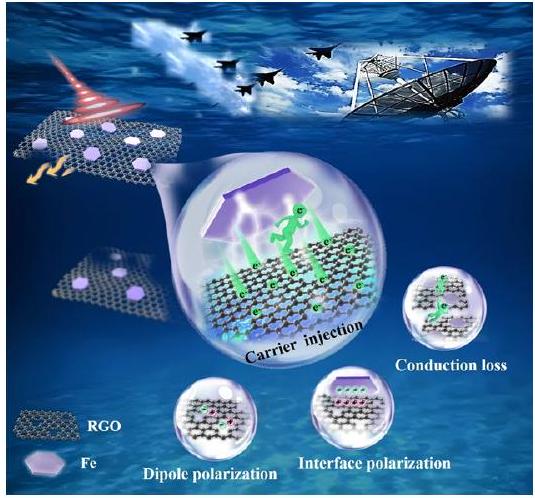
  • تشمل آليات امتصاص الموجات الكهرومغناطيسية بشكل رئيسي فقدان التوصيل المعزز، استقطاب ثنائي القطب واستقطاب الواجهة.
  • قيمة فقدان الانعكاس المتميزة ( ) وامتصاص الموجات العريضة ( 7.52 جيجاهرتز فقط حشو تم الحصول على مركب RGO، الذي يتفوق على الجرافين ذو المكون الواحد.

الملخص

تعتبر الاستقطابية وخسائر التوصيل الآليات الأساسية للاعتام dielectrics لممتصات القائمة على الجرافين، ولكن لم يتم فهمها بالكامل في كشف آلية الخسارة التي تؤثر على الجرافين نفسه. للمرة الأولى، تم تطوير ممتصات قائمة على أكسيد الجرافين المختزل (RGO) بخصائص امتصاص تنظيمية، وآلية امتصاص RGO تنبع أساسًا من سلوك حقن الحاملات لصفائح المعادن النانوية Fe على الجرافين. وبناءً عليه، فإن الحد الأدنى من خسارة الانعكاس ( ) من الوصول المركب “، ويحقق عرض نطاق الامتصاص الفعال 7.52 جيجاهرتز (2.62 مم) مع تحميل تعبئة أقل من باستخدام اختبار الهولوجرام الإلكتروني خارج المحور مع حسابات المحاكاة وتجارب خصائص نقل الحاملات، نوضح هنا سلوك حقن الحاملات من الحديد إلى الجرافين عند الواجهة والتراكم وإعادة ترتيب الشحنات الناتجة، مما يؤدي إلى زيادة الواجهة واستقطاب ثنائي القطب وفقدان التوصيلية. لقد أكدت هذه الدراسة أن تنظيم الخصائص العازلة للجرافين نفسه من خلال إضافة معادن دقيقة يمكن أن يضمن ليس فقط توافقًا جيدًا في المعاوقة، ولكن أيضًا استغلال القدرة على فقدان العزل للجرافين بشكل كامل عند محتوى منخفض من المواد المضافة، مما يفتح طريقًا فعالًا لتصميم ماصات خفيفة الوزن وقد يتم توسيعه ليشمل أنواعًا أخرى من المواد.
الكلمات الرئيسية: أكسيد الجرافين المخفض؛ رقائق الحديد النانوية؛ فقدان العزل؛ امتصاص الموجات الكهرومغناطيسية

1 المقدمة

مع تطور تكنولوجيا الميكروويف وانتشار المنتجات الإلكترونية، لم تجلب الموجات الكهرومغناطيسية (EMW) فقط راحة كبيرة لحياة الناس، بل أنتجت أيضًا الكثير من التداخل الكهرومغناطيسي (EM) [1-3]. الإشعاع الكهرومغناطيسي لا يضر فقط بصحة الإنسان، بل يؤثر أيضًا على التشغيل الطبيعي للمعدات الإلكترونية. باعتبارها الحاجز الرئيسي ضد التداخل الكهرومغناطيسي، تم استخدام المواد الممتصة على نطاق واسع في المجالات العسكرية والمدنية [4-8]. في السنوات الأخيرة، أظهرت المواد الكربونية ذات السماكة المنخفضة والكثافة المنخفضة والخصائص الكهربائية الممتازة (مثل الجرافيت [9]، الجرافين [10]، الكربون الأسود [11] وأنابيب الكربون النانوية (CNTs) [12]) آفاق تطبيق واسعة في مجال امتصاص الموجات الكهرومغناطيسية.
الجرافين، وهو مادة كربونية ناشئة حديثًا ذات هيكل طبقي فريد وموصلية معدنية جوهرية، قد برز كمرشح واعد لامتصاص الموجات الكهرومغناطيسية. ومع ذلك، فإن الجرافين ذو المكون الواحد لا يظهر قدرة مثالية على امتصاص الموجات الكهرومغناطيسية بسبب التناقض بين مطابقة المعاوقة وقوة الامتصاص العالية. أظهرت الدراسات السابقة أن تصميم المكونات الكيميائية والهندسة الهيكلية للجرافين أمران حاسمان لتحسين أداء امتصاص الموجات الكهرومغناطيسية بشكل فعال، خاصة عند دمجه مع مكونات عازلة أو مغناطيسية. على سبيل المثال، فإن التصميم الجيد لهيكل ثلاثي الأبعاد على شكل أكورديون… يمكن أن تعمل المركبات بشكل فعال على تحسين مطابقة المعاوقة وعرض الحد الأدنى من فقدان الانعكاس بمقدار -50.6 ديسيبل عند 15.9 جيجاهرتز، وعرض نطاق الامتصاص الفعال (EAB، RL ) بتردد 5.84 جيجاهرتز مع محتوى حشو [17]. أعد هوانغ وآخرون [18] امتصاص المواد عبر التفاعل الهيدروحراري، تفاعل الأميد، وعملية الاختزال، وقد تم تحسين أداء EMW بشكل كبير بسبب تأثير التآزر EM بين rGO و . المنتج الناتج أظهر بمقدار -48.6 ديسيبل عند 14.4 جيجاهرتز و EAB بمقدار 6.32 جيجاهرتز مع تحميل الحشوات. علاوة على ذلك، لا تزال هناك العديد من المعادن المطلية على RGO (مثل Fe/LrGO [19]، GA@Ni [20]، Co/GN [21] و rGO/FeCo [22]) لتحقيق تطابق أفضل في المقاومة والامتصاص. على الرغم من أدائها المحسن، لا تزال هناك عقبات كبيرة في التطبيق والتطوير. من ناحية، فإن الممتصات المعتمدة على RGO المبلغ عنها تعاني من عيب محتوى الحشوات العالي، مما يؤدي حتمًا إلى عدم تطابق في المقاومة بسبب الموصلية العالية لـ RGO. على الرغم من
يمكن تحسين مطابقة المقاومة عن طريق تقليل محتوى التعبئة، ولكن لا يمكن تحقيق التوهين الفعال. هذا يحد من تطبيقه العملي إلى حد ما. بالإضافة إلى ذلك، هناك تقارير قليلة عن ممتصات الجرافين التي تحتوي على تعبئة أقل من من ناحية أخرى، على الرغم من تحسين خصائص امتصاص الموجات الكهرومغناطيسية للمواد القائمة على الجرافين من خلال تحسين المكونات وتصميم الهياكل مع آليات فقد متعددة، إلا أنها تواجه مشاكل غير واضحة حول كيفية استغلال الجرافين لخصائصه العازلة لتعزيز آلية التخفيف العازل في المركبات. وبالتالي، من الضروري فهم آلية تأثير الجرافين لفهم الخصائص العازلة بشكل أفضل، وهو ما له قيمة تطبيقية مهمة للحصول على مواد امتصاص قائمة على الجرافين ذات تحميل منخفض وقدرة عالية على التخفيف.
لاستكشاف الآلية العازلة لامتصاصات القائمة على الجرافين، تم تأسيس نموذج قفز الإلكترون (EHP) والمعادلة الخاصة بنقل الشحنات الناتجة عن التجميع والشبكة الموصلة أولاً من قبل مجموعة كاو لكشف العلاقة بين درجة الحرارة، الموصلية والسلوكيات العازلة لطبقات الجرافين [23-25]. وهذا يوفر الأساس النظري لفقدان العزل في الجرافين. بالإضافة إلى ذلك، أظهرت النانو مركبات خصائص عازلة واضحة بسبب التفاعل السطحي بين الجرافين والمعادن وبلغت عرض النطاق 4.4 جيجاهرتز بسماكة 2.0 مم. ) [26]. يُذكر أن التفاعل بين الواجهات بين مختلف المواد المضافة والجرافين (مثل GfeTCs [27]، GO/graphene [28]، Ru/graphene [29]، Ag/graphene [30]) سيولد نقل الشحن، مما يؤدي إلى خصائص كهربائية جديدة للجرافين. علاوة على ذلك، فإن الظاهرة القطبية المهمة بين الواجهات غير المتجانسة في المركبات المعتمدة على الجرافين (مثل [31]، و تم إثبات ذلك من خلال الهولوجرام الإلكتروني خارج المحور وخريطة توزيع الشحنة. توفر هذه الدراسات استراتيجيات قابلة للتطبيق لتصميم ممتصات الجرافين ذات الخصائص الممتازة. ومع ذلك، لا يزال هناك مشكلة معدل التعبئة العالي للممتص بسبب الكثافة العالية للمعادن. تم اعتبار مواد المعادن الانتقالية (الحديد، الكوبالت، النيكل) ومركباتها كمرشحين شائعين بسبب قدرتها الفطرية على امتصاص الرنين المغناطيسي الفيرومغناطيسي في امتصاص الموجات الكهرومغناطيسية. علاوة على ذلك، بسبب خصائصها الهيكلية الذرية الخاصة، يظهر الحديد خصائص فيزيائية وكيميائية فريدة.
في العديد من الجوانب. تركيز خاص على أكسيد الحديد الهيماتيت ( ) يُلاحظ لأنه يتمتع بمزايا عملية بسيطة، وطرق متنوعة، وسعر منخفض، وعائد مرتفع، وثبات حراري جيد، وثبات كيميائي [39]. من المهم، يمكن تقليلها بسهولة إلى أشكال مختلفة من الحديد. يحتوي الحديد المعدني على عدد وفير من الإلكترونات الحرة، والتفاعل الإلكتروني بين المعدن والجرافين سيجعل الجرافين يظهر بعض الخصائص الكهربائية الجديدة. لذلك، فإن التحدي يكمن في الاستفادة الكاملة من الإلكترونات الحرة في المعادن لتحقيق خاصية التشتت العازل للجرافين لتحقيق أداء ممتاز في امتصاص الموجات الكهرومغناطيسية تحت تحميل منخفض.
هنا، قدمنا رقائق نانوية من الحديد بتراكيز منخفضة لبناء أكسيد الجرافين المختزل امتصاص مركب يعتمد على القدرات المختلفة لاكتساب وفقدان الإلكترونات (وظيفة العمل للحديد هي 4.5 إلكترون فولت وتلك الخاصة بالجرافين هي 5.0 إلكترون فولت) للحصول على فهم حول التأثيرات التنظيمية للحديد النادر على الخصائص العازلة لـ RGO. كشفت النتائج أن أظهرت خصائص تشتت العازل القوي والتوصيل العالي مقارنةً بـ RGO. لتوضيح آلية الخصائص العازلة لـ RGO، تم تصنيع جهاز ترانزستور تأثير المجال من الحديد/الجرافين (FG-FET) باستخدام طرق الترسيب الكيميائي بالبخار والتبخر الحراري في الفراغ لاستكشاف التفاعل الإلكتروني على المستوى الدقيق بين الجرافين والحديد. أشارت نتائج تأثير هول ومنحنيات خصائص نقل الحاملات إلى أن الواجهة بين الجرافين والحديد هي شكل اتصال أومي، وأن الإلكترونات الحرة من الحديد تُحقن في الجرافين عن طريق التحول من نقل الثقوب في الجرافين. -نوع) إلى نقل الإلكترون ( -النوع)، والذي يمكن استنتاجه أن هذه العملية تعزز بشكل مباشر فقدان التوصيل. إن تراكم الشحنات وإعادة ترتيبها الناتجة عن عملية حقن الحاملات زادت من الاستقطاب بين الواجهات والاستقطاب ثنائي القطب، مما يعزز بشكل متزامن أداء التخفيف العازل، وهو ما تم التحقق منه بواسطة تقنية الهولوجرافيا. مقارنةً بـ RGO، فإن أداء الامتصاص لـ تحسنت بشكل كبير، مع قيمة -53.38 ديسيبل و EAB 7.52 جيجاهرتز ( ) عند تحميل تعبئة أقل . لا يوفر هذا العمل أدلة بحثية جديدة فقط للعلاقة بين الخصائص الكهربائية والخصائص العازلة للجرافين، بل من المتوقع أيضًا أن يوجه الاستكشافات المستقبلية في تصميم مواد امتصاص عالية الأداء قائمة على الجرافين.

2 القسم التجريبي

2.1 إعداد الأغشية النانوية المركبات وترانزستور تأثير الحقل Fe/Graphene (FG-FET)

2.1.1 تخليق البلورات السداسية المفردة أوراق نانوية

ال تم تخليق النانوصفائح من خلال طريقة بسيطة تعتمد على الحل الحراري في حلول مختلطة عند درجات حرارة مناسبة. التفاصيل كما يلي. تم إضافته إلى خليط من الإيثانول وماء منزوع الأيونات (2.8 مل) وتم التحريك حتى تم إذابة المساحيق الصلبة تمامًا. مع التحريك المغناطيسي المستمر، تم إضافة إلى المحلول وتم تحريكه لمدة 40 دقيقة. بعد استقرار الخليط، تم نقل الخليط إلى الأوتوكلاف للتفاعل الحلولي الحراري عند لمدة 18 ساعة. تم غسل المنتج الكستنائي بالإيثانول والماء المقطر ثلاث مرات، على التوالي، وتم تجفيفه في فرن مفرغ من الهواء عند لمدة 8 ساعات. لتعديل السطح، سداسي الشكل تم تفريق النانوصفائح (0.6 جرام) وبروميد الهكسادسيل تريميثيل الأمونيوم (CTAB، 0.2 جرام) في الماء المقطر (50 مل) مع التحريك المغناطيسي في حمام مائي لمدة ساعتين. تم غسل المنتج بالماء المنزوع الأيونات عدة مرات وتجفيفه في وأخيرًا الشكل السداسي المعدل تم الحصول على الأوراق النانوية.

2.1.2 إعداد مركبات Fe/RGO

أولاً، تم تخليق أكسيد الجرافين (GO) باستخدام طريقة هومرز المعدلة المبلغ عنها [41]. ثانياً، تم تحضير تعليق أكسيد الجرافين (100 مل و ) تم خلطها مع كمية معينة من المعدل و 8 ملغ ، على التوالي، وتم خلط المزيج بالموجات فوق الصوتية بشكل متساوٍ لمدة 3 ساعات بواسطة عملية الامتزاز الكهروستاتيكي. ثم تم إغلاق المزيجات وتبريدها في الثلاجة، ومعالجتها بطريقة التجفيف بالتجميد ( ) لمدة 24 ساعة. تم تسمية المواد الأولية الناتجة بـ GO، و ، على التوالي. أخيرًا، تم وضع المنتجات المذكورة أعلاه في فرن الأنابيب وتم معالجتها حراريًا عند لمدة ساعتين تحت الغلاف الجوي ). تم تسمية العينات RGO و Fe/RGO-1 و Fe/RGO-2 و Fe/RGO-3 و Fe/RGO-4، على التوالي. علاوة على ذلك، فإن تحضير و
كان متسقًا مع الطرق المذكورة أعلاه (معلومات داعمة).

2.1.3 إعداد ترانزستور تأثير المجال Fe/Graphene (FG-FET)

تم زراعة الجرافين أحادي الطبقة باستخدام كمصدر للكربون، كغاز ناقل و رقائق النحاس السميكة (111) كقاعدة للنمو بواسطة طريقة ترسيب البخار الكيميائي [42]. تم نقل فيلم الجرافين إلى الركيزة بواسطة عملية النقل الرطب PMMA [43]. ثم تم تحضير فيلم Fe/غرافيت عن طريق ترسيب على سطح الجرافين أحادي الطبقة. تم تصنيع ترانزستور تأثير المجال Fe/graphene (FG-FET) عن طريق التبخر الحراري لـ ( ) الأقطاب الكهربائية على سطح أفلام الجرافين من خلال قناع شبكي لتشكيل أقطاب المصدر والمصرف. كانت طريقة تحضير ترانزستور تأثير المجال الجرافيني (G-FET) متوافقة مع الطريقة المذكورة أعلاه.

2.2 توصيف

تمت دراسة الميكرو مورفولوجيا باستخدام المجهر الإلكتروني الماسح (SEM، SUPRA55، ZEISS MERLIN)، وتم استخدام تحليلات رسم الخرائط الطيفية المشتتة للطاقة (EDS) لجمع الإشارات العنصرية وصور الخرائط. تم إجراء المجهر الإلكتروني الناقل (TEM، Philips-FEI، Tecnai G2 F30) باستخدام مجهر إلكتروني Tecnai F30 يعمل عند 200 كيلوفولت. تم توصيف هيكل المواد التي تم تصنيعها باستخدام حيود الأشعة السينية (XRD) التي تم جمعها على جهاز حيود الأشعة السينية DX-2700. تم قياس أطياف تحويل فورييه للأشعة تحت الحمراء (FTIR، Nicolet is50) ضمن النطاق من تم جمع طيف رامان (532 نانومتر) باستخدام جهاز inVia-Reflex. تم تحديد التركيب العنصري لسطح العينة من خلال قياسات طيف الإلكترون الضوئي بالأشعة السينية (XPS) باستخدام جهاز Thermal Escalab 250، مع مصدر أحادي اللون من الألومنيوم K. مصدر الأشعة السينية. تم اختبار الخصائص المغناطيسية للمواد الهجينة باستخدام مقياس مغناطيسي لعينة مهتزة (Quantum Design، Dynacool-14T). تم اختبار محتوى التركيب للمواد بواسطة ICP-MS (NexION 350X، PerkinElmer). تم اختبار الخصائص الكهربائية للمواد بواسطة مجهر المسح المجهري (SPM، Bruker، Dimension Fastscan) مع وظائف C-AFM وKPFM وEFM، والمسبار الموصل هو المجسات المطلية (الجدول S1). تم قياس الموصلية الكهربائية بواسطة طرق الأربعة مجسات
(ST2742B). تم قياس منحنى خرج التيار للمركب على نظام خصائص أشباه الموصلات (Keithley 4200-SCS). تم قياس العينات الدائرية ( في: 3.04 مم، ) كانت مصنوعة من المادة الهجينة المختلطة بشكل موحد مع البارافين في تمت دراسة السماحية المعقدة والنفاذية باستخدام محلل الشبكة المتجهة Agilent N5230A (VNA). تم حساب قيم RL استنادًا إلى نظرية خط النقل كما يلي [44، 45]:
أين و تمثل مقاومة الإدخال للماص والفضاء الحر، هو سمك العينة، هي سرعة الضوء في الفراغ.

2.3 تفاصيل الحساب

تم إجراء جميع حسابات الموجات الطائرة ضمن نظرية الكثافة الوظيفية (DFT) للهياكل الذرية والإلكترونية باستخدام برنامج CASTEP المقدم في حزمة Materials Studio 2020. تم استخدام تقريب التدرج العام (GGA) مع دالة Perdew-Burker-Ernzerhof (PBE) لتمثيل تأثيرات التبادل والتفاعل. كانت معايير تقارب الطاقة هي ذرة ، كانت القوة القصوى Åكان الحد الأقصى للإجهاد 0.05 جيجا باسكال، وكانت طاقة القطع 400.0 إلكترون فولت. تم أخذ عينات من تكامل منطقة بريلوان باستخدام -كثافة شبكة النقاط. تم استخدام طريقة TS لتصحيح DFT-D لوصف قوى فان der Waals بدقة. تم تعيين الفجوة الفراغية لتكون حوالي Åوالتي يجب أن تؤدي إلى تفاعلات ضئيلة بين النظام وصورهم المرآة.

3 النتائج والمناقشة

3.1 تخليق وتوصيف مركبات Fe/RGO

تم تخليق مركبات Fe/RGO من خلال تفاعل الامتزاز الكهروستاتيكي السهل وطريقة الاختزال الحراري عند درجة حرارة منخفضة (الشكل 1أ). أولاً، تم تخليق الأوراق النانوية السداسية الشكل بواسطة طريقة التحلل المائي.
الشكل 1 عملية التصنيع، التوصيف المجهري. أ رسم تخطيطي لعملية تحضير مركبات Fe/RGO. ب و هـ صور SEM، ، صور TEM و , صور HRTEM لـ نانوصفائح و (الداخل: نتائج نمط SAED المقابل). صورة STEM وخريطة TEM-EDS لـ Fe/RGO-2
GO (مشحون سلبياً) ومعدل تم دمج النانوصفائح (الموجبة الشحنة) بشكل محكم بواسطة طريقة الامتصاص الكهروستاتيكي. وأخيرًا، تم تحضير مركب Fe/RGO عن طريق التجفيف بالتجميد والاختزال الحراري. من خلال التحكم في كمية الإضافة المعدلة أوراق نانوية (0،
، و 8 ملغ )، تم التحقيق في تأثير محتوى طبقات الحديد النانوية على الهيكل الإلكتروني لـ RGO (المعروف باسم RGO، ، و تمت دراسة الميكروهيكل للمركب باستخدام المجهر الإلكتروني الماسح/المجهر الإلكتروني النافذ. يقدم توزيعًا رقيقًا وموحدًا
هيكل نانو لوح سداسي (الشكل 1ب). يمكن رؤية ذلك بوضوح أن يتبلور إلى ورقة نانوية سداسية الشكل بعرض حوالي 100 نانومتر، وسمك حوالي 10 نانومتر ونسبة عرض إلى ارتفاع حوالي 0.1 (الشكل 1c). علاوة على ذلك، كما يتضح من صورة HRTEM في الشكل 1d، فإن تباعد الشبكة هو 0.37 نانومتر مما يتوافق مع المستوى البلوري (120) من ويظهر نمط SAED أن المادة التي تم تخليقها الرقاقة النانوية أحادية البلورة. شكل المركب موضح في الشكل S1. تظهر أوراق RGO شفافة وذات تجاعيد وفيرة مما يسهل تحميل أوراق Fe النانوية. مع زيادة محتوى Fe، تزداد أوراق Fe النانوية بشكل واضح وتوزع بشكل متساوٍ على أوراق RGO. في الوقت نفسه، يمكننا أيضًا الحصول على المحتوى الدقيق لـ Fe في عينات بواسطة قياس ICP، نسبة الحديد هي 0.32، 0.68، 0.94، و في RGO-1 و Fe/RGO-2 و Fe/RGO-3 و Fe/RGO-4، على التوالي. بشكل محدد، بالنسبة لمركب Fe/RGO-2، يتم توزيع رقائق الحديد النانوية بشكل موحد على رقائق RGO مع تجاعيد، مما يظهر نمط اتصال وجه لوجه لزيادة مساحة الاتصال كما هو موضح في الشكل 1e. بالإضافة إلى ذلك، تظهر صورة TEM أن الحديد يحتفظ بالهيكل المجهري للرقائق النانوية السداسية (مع حجم مخفض قليلاً) بعد الاختزال الحراري (الشكل 1f). في
لتحقيق التحقيق في Fe/RGO-2 بالتفصيل، تم الحصول على صور HRTEM و SAED (الشكل 1g) من حافة Fe/RGO-2. الحديد مع تباعد شبكي قدره 0.20 نانومتر يتوافق مع المستوى البلوري (110) هو أحادي البلورة، بينما RGO هو كربون غير متبلور. توزيع العناصر لـ تم تحديد RGO-2 من خلال صورة STEM ورسم TEM-EDS في الشكل 1h-k، حيث يتم توزيع عناصر الكربون والأكسجين بشكل موحد داخل أوراق RGO، بينما يظهر عنصر الحديد توزيعًا سداسيًا.
تتميز البنية البلورية للعينات بنمط حيود الأشعة السينية. من الشكل 2أ، تظهر جميع العينات كربون غير متبلور مع قمة حيود واسعة عند حوالي توافق مع نتيجة صورة HRTEM (الشكل 1g). اختفى الذروة الانعكاسية النموذجية لـ GO عند ، مما يشير إلى أن GO تم تقليله بنجاح (الشكل S2a). بالإضافة إلى ذلك، مقارنةً بالقمم الانكسارية القوية لـ و Fe ، قمم الانكسار المميزة لـ ورقائق نانوية من الحديد في و العينات ليست واضحة، وهو ما يُعزى إلى الحد الأدنى من محتوى الإضافة (شكل تمت دراسة العينات بشكل إضافي بواسطة طيف رامان. تتوافق القمم الثلاثة المميزة مع حزمة D، وحزمة G، وحزمة 2D في الأشكال 2b و S2d. حزمة D
الشكل 2 توصيف الهيكل لـ مركبات RGO. أنماط XRD و طيف رامان لـ RGO و Fe/RGO-1 و Fe/RGO-2 و Fe/RGO-3 و Fe/RGO-4. ج طيف FTIR لـ CTAB- اذهب و Fe/RGO-4، على التوالي. d-f XPS Fe طيف، ج الطيف و O طيف Fe/RGO-4
ذروة ( ) وقمة نطاق G ( ) تمثل العيوب والاضطرابات في الكربون الجرافيتي، و2D باند مرتبط بدرجة تكديس الجرافين. نسبة الشدة ( ) من قمم نطاق D و G تعكس درجة العيوب في المستوى والعيوب الحادة في الهيكل الكربوني [46]. كما هو موضح في الشكل 2b، نسب RGO، Fe/RGO-1، Fe/RGO-2 ، و هي 0.82 و0.90 و0.92 و0.93 و0.94، على التوالي، مما يشير إلى أن إدخال الحديد غير مواتٍ لإعادة بناء الكربنة. لكن المزيد من العيوب سيؤدي إلى مزيد من الاستقطاب الثنائي، وهو مفيد لفقدان العزل. في هذا العمل، تم تقليل أكسيد الجرافين إلى جرافين مخفض باستخدام طريقة الاختزال الحراري. عند درجة حرارة منخفضة درجة تقشير طبقات RGO أقل وهناك تكدس، مما يؤدي إلى قمم ثنائية الأبعاد ضعيفة (الشكل S2d). يوضح الشكل 2c طيف FTIR لـ ، و ذروة الامتصاص يُنسب إلى اهتزاز التمدد في يثبت أن تم تحضيره بنجاح [47]. تم ربط CTAB بنجاح على سطح بسبب وجود و قمم اهتزاز التمدد عند 2930 و [48]. مقارنةً بـ GO و يعرض و قمم اهتزاز التمدد عند 1623 و “، مما يشير إلى أن مجموعاتها الوظيفية المحتوية على الأكسجين قد انخفضت بشكل كبير بعد الاختزال الحراري. تم تحديد الهيكل الإلكتروني والتركيب لـ Fe/RGO-4 من خلال XPS كما هو موضح في الشكل 2d-f. تم ضبط المنحنى بدقة عالية يلاحظ الطيف القمتين النموذجيتين عند 711.2 و 724.8 إلكترون فولت، ويُعزى ذلك إلى و (الشكل 2د). وذروتان عند 710.8 و 718.9 إلكترون فولت من طيف يعكس وجود الحالة المعدنية لـ ، مما يشير إلى تشكيل بعد الاختزال الحراري. تتوافق القمم المميزة مع و عند 713.2 و 725.0 إلكترون فولت وظهور يمكن أن يُعزى ذلك إلى أكسدة الحديد على سطح المادة أثناء الاختبار [49]. طيف Fe/RGO-4 في الشكل 2e يظهر القمم الثلاثة عند و 289.7 إلكترون فولت، مما يتوافق مع و ، على التوالي. علاوة على ذلك، طيف عرض القمم عند و 534 إلكترون فولت، مما يتوافق مع والماء الممتص عبر الطريقة الفيزيائية/الكيميائية على السطح (الشكل 2f) [50]. بالمقارنة مع GO (الشكل S3)، فإن معظم المجموعات الوظيفية المحتوية على الأكسجين لـ تمت إزالتها خلال عملية الاختزال الحراري.

3.2 تحليل أداء امتصاص EMW وآلية الفقد لـ Fe/RGO

بشكل عام، ترتبط خصائص امتصاص الموجات الكهرومغناطيسية ارتباطًا وثيقًا بالسمحية المعقدة ) و النفاذية المعقدة ( ). الجزء الحقيقي ( و يمكن تمثيلها كقدرة تخزين الطاقة الكهربائية والمغناطيسية، بينما الجزء التخيلي ( و يمثل ( ) سعة الفقد، على التوالي. ظل الفقد العازل والفقد المغناطيسي ( و ) تمثل درجة قدرة فقدان طاقة EM [51-53]. لاستكشاف آلية امتصاص EMW، تم قياس المعلمات الكهرومغناطيسية لـ RGO و Fe /RGO-2 بواسطة VNA مع تحميل حشو يتراوح بين 1-5 wt% كما هو موضح في الشكل 3. يوضح الشكل 3a تغير و منحنيات RGO ومركبات Fe/RGO-2 مع تردد الموجات الكهرومغناطيسية الساقطة. يتمتع RGO بأدنى قيمة لـ و عند الإضافة المنخفضة لـ وقيم كل من و تظهر اتجاهًا متزايدًا مع زيادة نسبة التعبئة، واتجاهًا متناقصًا مع زيادة التردد، مما يظهر خصائص تشتت العوازل. هذا بشكل أساسي لتأسيس هيكل شبكة موصلة قوية. ومن المثير للاهتمام، أنه مقارنةً بـ RGO، فإن Fe/ RGO-2 يظهر أعلى و ثابت العزل وخصائص التشتت الأكثر وضوحًا عند نفس محتوى التعبئة. و نفاذية RGO و RGO-2 هي 1 و 0 بدون فقد مغناطيسي في الشكل S4. تم حساب أداء الامتصاص للعينات بناءً على قيمة RL استنادًا إلى نظرية خط النقل (الشكل S5). يظهر مركب RGO تدريجياً أداء امتصاص ملحوظ، بينما الأداء ضعيف مع زيادة نسبة التعبئة. من المدهش أنه مقارنةً بـ RGO، يظهر Fe/RGO-2 أداءً متفوقًا في الامتصاص مع القيمة تصل إلى -46.71 ديسيبل عند و EAB بمعدل 6.73 جيجاهرتز ( ) في تحميل الحشو. تحت تصل ترددات EAB لـ RGO إلى 4.84 جيجاهرتز بسماكة 2.0 مم و من -36.96 ديسيبل يتم تحقيقه عند بينما RGO-2 ليس له امتصاص فعال. بالمقارنة مع RGO، فإن ثوابت التوهين ( ) من تزداد مركبات RGO-2 بشكل ملحوظ، مما يشير إلى التحسن الواضح في أداء الامتصاص من خلال إضافة الحديد لـ RGO، بينما يتغير اتجاه نسبة تطابق المعاوقة. ) من RGO-2 هو عكس (الشكل S6). لذلك، لتحقيق امتصاص EMW عالي الكفاءة، يجب أن يكون كلاهما و يجب أن يؤخذ في الاعتبار. لفهم سبب التغيير الواضح في أداء الامتصاص لـ RGO و Fe/RGO،
الشكل 3 تحليل آليات امتصاص EMW لمركبات RGO و Fe/RGO-2. أ و و من RGO و مركبات RGO-2 بتحميل من 1-5 وزن %
تم تحليل آلية فقدان العازل بشكل أعمق، كما هو موضح في الشكل 3ب، ج. بسبب إضافة محتوى منخفض ( ) من الحديد ، سعة فقدان العزل ( ) وموصلية ( ) من RGO-2 أكثر أهمية ويزداد مع زيادة نسبة التعبئة. استنادًا إلى نظرية استرخاء ديباي ونموذج كول-كول، تلعب خسارة الاستقطاب والموصلية أدوارًا مهمة في تغيير النفاذية [46]. و يمكن التعبير عنها كما يلي [54، 55]:
ال و تمثل المنحنيات مساهمة فقدان التوصيل وفقدان الاستقطاب في ، والذي يتمثل بشكل رئيسي في فقدان التوصيل عند الترددات المنخفضة وفقدان الاستقطاب عند الترددات العالية. يُستنتج أن رقائق الحديد النانوية يمكن أن
تعزيز سلوك الاستقطاب وقدرة فقدان العزل لـ RGO.

3.3 آلية النقل الإلكتروني لـ Fe/Graphene

لفهم آلية تأثير المعدن الحديد على الخصائص الكهربائية للجرافين بالتفصيل، تم تحسين الهيكل الهندسي لـ تم بناء الجرافين باستخدام جرافين أحادي الطبقة مثالي كما هو موضح في الشكل S7. فرق كثافة الشحنة، وظيفة تحديد موضع الإلكترون (ELF) وكثافة الحالات (DOS) لـ تم حساب (001) الجرافين بواسطة DFT لتحليل التفاعل الإلكتروني بين الحديد والجرافين. إن تراكم الشحنة (المنطقة الزرقاء) على سطح الجرافين ونقص الشحنة (المنطقة الحمراء) حول سطح الحديد يثبت التفاعل الإلكتروني الوثيق بين الحديد والجرافين. في الوقت نفسه، يتم توضيح نقل الإلكترونات بالتفصيل داخل يمكن أن يتم عكس الجرافين بواسطة الأسطح المتساوية التي تم الحصول عليها من ELF وشحنة بادر (الشكل 4a). تشير النتائج إلى أنه تم نقل 4.03 إلكترونات من ذرات الحديد إلى ذرات الكربون وأن توزيع الشحنة على الواجهة محصور بشكل رئيسي في الواجهة بين الجرافين والحديد. علاوة على ذلك،
الشكل 4 الأداء الكهربائي لـ الجرافين. أ. مخططات فرق كثافة الشحنة للجرافين أحادي الطبقة الممتص على Fe (110). الشحنات الإيجابية والسلبية موضحة باللون الأزرق والأحمر (قيمة العزل: 0.1). ب. نتائج DOS وPDOS لـ Fe/graphene وFe وgraphene. ج. صورة HRTEM ونمط SAED للجرافين. د. صورة الجهد السطحي و هـ. فرق الجهد التلامسي المقابل المحدد بخط أبيض. الجرافين. منحنيات الخصائص الانتقالية لـ جي-فيت FG-FET عند جهد تصريف قدره 0.2 فولت (تظهر الإضافات مخططات النماذج وخصائص الخرج عند جهد بوابة متغير). المخطط التخطيطي لمبدأ العمل لـ أثر التوصيل من نوع – في طبقة قناة FG-FET
كثافة الحالات (DOS) وكثافة الحالات الجزئية (PDOS) لـ يتم عرض الجرافين والجرافين والحديد في الشكل 4ب. فجوة الطاقة لطبقة الجرافين الأحادية هي 0 إلكترون فولت، وتساهم نطاقات التكافؤ والتوصيل بشكل رئيسي في مدار ذرة الكربون. بالمقارنة مع الحديد، ينتقل مركز نطاق d في Fe/graphene إلى مستوى منخفض حول مستوى فيرمي، مما يشير إلى انتقال الشحنة بين ذرات الحديد والكربون. ويرجع ذلك أساسًا إلى التهجين القوي في و المدارات بعد إدخال ذرات الحديد، مما يعزز النقل الفعال للإلكترونات عند الواجهة لتحقيق حقن حاملات الجرافين. من نتائج الحسابات النظرية، فإنه
يمكن أن نستنتج أن الحديد يمكن أن يتحد بشكل مستقر مع الجرافين من خلال تفاعلات إلكترونية قوية، ويعمل على تحسين الأداء الكهربائي للجرافين من خلال تغيير الحالات الإلكترونية. للتحقق بشكل أكبر من سلوك نقل الإلكترون لـ تم بناء نموذج هيكلي للجرافين، FG-FET، لاستكشاف نوع حقن الحامل ووضع الاتصال لـ الجرافين بواسطة طرق الترسيب الكيميائي من البخار والتبخر الحراري في الفراغ. من صور HRTEM وSAED وRaman، يمكن أن يتبين أن الجرافين المتنامي هو طبقة واحدة وبلورة مفردة، بينما الحديد هو متعدد البلورات تحت الظروف التجريبية (الأشكال 4c و أولاً وقبل كل شيء، الجهد السطحي للحديد عند التلامس مع
تم تحليل الجرافين والجرافين لتقييم ارتفاع الحاجز باستخدام KPFM. من الشكل 4d، لوحظ بوضوح أن فرق الجهد الناتج عن الاتصال يتغير بين طبقات الحديد والجرافين، واستنتج أن ارتفاع الحاجز حوالي 472 مللي فولت، مما يثبت أن هناك نقل فعال للشحنات بين الحديد والجرافين (الشكل 4e). بعد ذلك، تم توصيف سلوك نقل الحامل عند واجهة الحديد/الجرافين في درجة حرارة الغرفة من خلال بناء FET. من الشكل 4f و g، يظهر G-FET نمطاً نموذجياً. -نوع (ثقب) سلوك نقل مهيمن على الحامل و FG-FET يظهر سلوكًا نموذجيًا -نوع (إلكترون). في هذه الأثناء، معامل هول (RH) للجرافين و كما تم التحقق من تغيير نوع الحامل بواسطة قياس تأثير هول في الجرافين. غرافين . غرافين علاوة على ذلك، تُظهر منحنيات خصائص الخرج لجهاز FG-FET أن التيار الخارج يزداد باستمرار مع زيادة جهد البوابة الموجب ويظهر علاقة خطية واضحة، مما يشير إلى أن نوع نقل الحاملات هو بشكل رئيسي إلكترون وأن اتصالًا أومياً جيدًا يتشكل بين الجرافين وواجهة الحديد. وفقًا لنظرية الإلكترونات الحرة في المعادن، يمكن للإلكترونات الحرة داخل الحديد (كمانح للإلكترونات) أن تشكل نقلًا اتجاهيًا إلى الجرافين (كمستقبل للإلكترونات) في المجال الكهربائي الخارجي. لذلك، يمكن استنتاج أن الاتصال الأومي الذي تم تشكيله بواسطة يمكن أن يعزز الجرافين بشكل أفضل نقل الإلكترونات من الحديد إلى الجرافين لتحقيق حقن الحامل، مما يحسن الخصائص الكهربائية للجرافين.

3.4 تحليل معلمات EM وقدرة امتصاص EMW

لتوضيح آلية امتصاص EMW بشكل أكبر الخصائص العازلة لـ تمت دراسة المركبات التي تحتوي على محتويات مختلفة من الحديد مع تحميل الحشو من كما هو موضح في الشكل 5. بشكل عام، الـ و منحنيات RGO، Fe/RGO-1، Fe/RGO-2، Fe/RGO-3 و تظهر المركبات اتجاهًا متزايدًا مع زيادة محتوى الحديد، واتجاهًا متناقصًا مع زيادة التردد، مما يدل على سلوك تشتت عازل واضح (الشكل 5 أ، د). عند 2 جيجاهرتز، زيادة القيمة من 5.78 إلى 14.56 و زيادة من 0.88 إلى 6.21. يتمتع الحديد المعدني بموصلية كهربائية جيدة ووفرة من الإلكترونات الحرة داخله وفقًا لنظرية الإلكترون الحر [57]. يتم نقل الإلكترونات إلى RGO بشكل أسرع على طول الواجهة. في
شكل الاتصال الأومي، الذي يلعب دورًا حاسمًا في زيادة الجزء التخيلي من السماحية المعقدة. بالإضافة إلى ذلك، فإن إدخال رقائق الحديد النانوية يؤدي أيضًا إلى زيادة الاستقطاب. و يظهر بشكل ملحوظ تقلبات الرنين حول 8 و 13 جيجاهرتز، والتي قد تكون بسبب زيادة الاستقطاب الواجهوي. بسبب انخفاض محتوى الحديد (0.32-1.22 ) في مركبات RGO، و قيم جميع العينات هي و (الشكل S9). خصائص الامتصاص لـ تتغير مركبات RGO بشكل ملحوظ مع اختلاف محتوى الحديد. تصف الأشكال 5b-f و S10 أداء امتصاص EMW لـ RGO و Fe/RGO-1 و Fe/RGO-2. ، و المركبات بسمك العينات يتراوح من 1 إلى 5.5 مم في . الـ RGO هو -12.76 ديسيبل عند . على النقيض، الأقوى من RGO-3 و Fe/RGO-4 هي – 17.08 و – 53.38 و – 49.57 و -15.86 ديسيبل عند 4.31 و 2.45 و 3.04 و 2.02 مم، على التوالي، وهي أعلى من تلك الخاصة بـ RGO (الشكل 5g). بالمقارنة مع ، يعتبر EAB أكثر إقناعًا لأداء الامتصاص (خريطة الصورة الملونة المقابلة). بالنسبة لـ RGO، فإن الحد الأقصى لـ EAB هو 2.15 جيجاهرتز ( ). بالتفصيل، فإن الحد الأقصى لـ EAB لـ Fe/RGO-2 و Fe/RGO-3 و Fe/RGO-4 يحقق الكامل امتصاص النطاق، والذي هو 7.52 جيجاهرتز ( 7.03 جيجاهرتز )، و المقابلة لسمك 2.62 و 2.49 و 2.41 مم، على التوالي (الشكل 5h). على وجه الخصوص، و تظهر المركبات قوة فقد عالية وخصائص امتصاص واسعة النطاق مقارنةً بالعينات الأخرى، وهو ما يمكن أن يُعزى إلى تأثير الاستقطاب العازل التآزري لـ Fe وRGO في النظام. توضح الشكل 5i منحنيات تغير RL لـ RGO وFe/RGO-1 وFe/RGO-2 وFe/RGO-3 وFe/RGO-4 عند 2.45 مم. عند نفس السماكة، فإن أداء امتصاص EMW لـ يظهر اتجاهًا متزايدًا أولاً ثم متناقصًا، وينتقل إلى تردد منخفض مع زيادة محتوى الحديد. بالمقارنة مع RGO، Fe/RGO-2 و لديها أداء أفضل في امتصاص EMW (الشكل S11). يجب الإشارة إلى أن الأمثل تتحول القمم نحو ترددات أقل مع زيادة سمك العينة، وهو ما يمكن التعبير عنه بقانون إلغاء ربع الطول الموجي [58]:
الشكل 5 تحليل أداء امتصاص EMW لمركبات Fe/RGO مع جارٍ التحميل. و نفاذية. رسم خرائط الألوان ثلاثي الأبعاد وثنائي الأبعاد للقيم النظرية المحسوبة لـ RL مع سماكات مختلفة RGO و . تلخيصات لـ الحد الأقصى من RL و h EAB عند سماكات مختلفة لعينات المركب RGO و Fe/RGO-1 و Fe/RGO-2 و Fe/RGO-3 و Fe/RGO-4. قيمة RL مقابل التردد لقيم سماكة محددة للعينات.
أين هو السماكة المطابقة، تمثل الطول الموجي للموجات الكهرومغناطيسية، هو سمك الممتص الفعلي و هو تردد المطابقة. من الواضح أن قيم المركبات تتماشى تمامًا مع منحنى قانون التوهين ربع الطول الموجي. عندما يلبي سمك العينة المطابقة المعادلة (6)، ستنعكس الموجة الساقطة على كل واجهة مع مراحل عكسية، مما يؤدي إلى توهين الطاقة للموجات الكهرومغناطيسية. بالإضافة إلى ذلك، يجب أن تكون خصائص المطابقة المعاوقة مطلوبة لامتصاص الموجات الكهرومغناطيسية المثالي. يمكن لممتص الموجات الكهرومغناطيسية الذي يتمتع بمعاوقة متطابقة جيدًا تقليل الانعكاس
للموجات الكهرومغناطيسية وتسهيل الامتصاص. تشير قيمة المطابقة المعاوقة ( ) التي تقترب من 1 إلى أن الكتلة الكبيرة من الموجات الكهرومغناطيسية تدخل الممتص لتوهين [59]. يمكن ملاحظة أن المطابقة المعاوقة لـ RGO عند سماكات مختلفة بعيدة عن 1 بدرجات متفاوتة، مما يشير إلى أن مطابقتها المعاوقة ضعيفة و القيمة أيضًا أسوأ. قيم المطابقة المعاوقة لـ RGO-2 و عند سماكات مختلفة قريبة جدًا من 1. أفضل درجة مطابقة معوقة و كانت تتوافق مع ، مما يوحي بأن الأداء المفضل يرجع إلى المطابقة المعاوقة الممتازة.

3.5 تحليل آلية امتصاص الموجات الكهرومغناطيسية

من أجل تحليل تأثير محتوى الحديد على أداء امتصاص الموجات الكهرومغناطيسية لـ RGO، تم دراسة آليات فقدان العزل لـ Fe/RGO، كما هو موضح في الشكل 6. يتم نقل الإلكترونات الحرة داخل الحديد المعدني على طول واجهة Fe/RGO إلى RGO في شكل هجرة وقفز، والتي تلعب دورًا حاسمًا في زيادة الموصلية بسبب آلية حقن الحامل، كما هو موضح في الشكل 6a. وفقدان الموصلية هو العامل الرئيسي وينخفض مع زيادة التردد عند الترددات المنخفضة، بينما يلعب فقدان الاستقطاب دورًا رائدًا عند الترددات العالية (الشكل 6b، c). مع زيادة الحديد، فإن الإلكترونات الإضافية
التي يتم حقنها عند الواجهة غير المتجانسة تزيد من فقدان الموصلية ( ) في المجال الكهرومغناطيسي. يؤكد العالي أن تراكم الشحنة والواجهة غير المتجانسة لـ RGO وFe يولدان فقدان استقطاب الشحنة الفراغية. استنادًا إلى نظرية الاسترخاء ديباي، يمكن إثبات وجود الاستقطاب من خلال نصف دائرة كول-كول، حيث يعبر كل نصف دائرة من كول-كول عن عملية استرخاء ديباي [60]. الشكل S12 والجدول S2 يوضحان منحنيات RGO وFe/RGO-1 و RGO-2 و RGO-3 و RGO-4، يمكن ملاحظة أن عدد أنصاف الدوائر يزداد مع زيادة الحديد، مما يشير إلى عملية استرخاء معززة مقارنة بـ RGO. ويزداد فقدان الموصلية مع زيادة الموصلية وتقل شدة فقدان الاستقطاب
الشكل 6 تحليل آليات امتصاص الموجات الكهرومغناطيسية لمركبات Fe/RGO. لـ RGO وFe/RGO-1 وFe/RGO-2 وFe/RGO-3 وFe/RGO-4. د، هـ صورة مجهرية TEM وصورة هولوجرافية إلكترونية خارج المحور المقابلة، توزيع المجال الكهربائي، خريطة كثافة الشحنة، ملف كثافة الشحنة على طول المنطقة البيضاء، نموذج الطبقة الكهربائية المزدوجة لـ
( يصبح منحنى سلسًا). من حسابات المبادئ الأولى وخصائص نقل الحامل، يمكن ملاحظة أن تجمع الإلكترونات عند الواجهة وتدفق المجال الكهربائي يهيمنان على فقدان الاستقطاب من خلال آلية حقن الحامل لـ الجرافين. ركزنا على استكشاف هيكل الواجهة ورسمنا توزيعات المجال الكهربائي وكثافة الشحنة باستخدام الهولوجرافيا الإلكترونية (الشكل 6d-i). من الواضح أنه يتم ملاحظة توزيع الشحنات الموجبة والسالبة حول المنطقة الواجهة لطبقة الكربون وورقة الحديد النانوية، مما يشكل مجالًا كهربائيًا خارج المستوى داخل واجهة جامع الحامل، مما يؤدي إلى استرخاء استقطاب واجهة معزز. يمكن أن يتجمع توزيع الشحنات غير المتوازن بسبب هجرة الإلكترونات حول الواجهة غير المتجانسة. تحت المجال الكهرومغناطيسي، يدور ثنائي القطب الكهربائي بشكل متكرر لتعزيز الاستقطاب الواجهة بحيث يستهلك بشكل كبير طاقة الموجة الكهرومغناطيسية. والأهم من ذلك، أن زيادة قدرة التوهين وتحسين خصائص المطابقة المعاوقة هي عوامل رئيسية لتحقيق أداء ممتاز في امتصاص الموجات الكهرومغناطيسية. تزداد قيم و لـ مركبات RGO مع زيادة محتوى الحديد (الشكل S13). تهتز الإلكترونات الجزئية من الحديد التي يتم حقنها في الجرافين وتنتج استرخاء استقطاب تحت الموجات الميكروويف، مما يؤثر بشكل كبير على فقدان استقطاب الواجهة وفقدان الموصلية. ومع ذلك، يمكن أن تحصل المزيد من الواجهات على فقدان عازل مرتفع، لكن أداء الامتصاص لا يتحسن أكثر بشكل رئيسي بسبب عدم تطابق المعاوقة (القيم المنخفضة لـ )، وهو ما يتماشى مع عملنا السابق [61]. لذلك، فإن RGO-2 و RGO-3 يتمتعان بأداء امتصاص ممتاز بسبب خصائص التوهين المناسبة ومطابقة المعاوقة. للمقارنة، تم التحقيق في خصائص الامتصاص لمركبات بدون تفاعل واجهة غير متجانسة من خلال الخلط الميكانيكي بنفس النسبة كما هو موضح أعلاه مع تحميل الحشو. منحنيات و لـ و و و تتغير بشكل ضعيف ولا تظهر سلوك انتشار عازل مع زيادة محتوى الحديد (الشكل S14). لذلك، يوجد تفاعل إلكتروني واجهي بين RGO وFe في
مركبات RGO، مما سيؤثر على الخصائص العازلة لـ RGO وبالتالي يمتلك خصائص امتصاص ممتازة. استنادًا إلى تحليل الآلية أعلاه، من أجل توضيح آلية استجابة الهيكل الإلكتروني للجرافين وخصائص العزل بشكل أكبر، استكشفت هذه الدراسة خصائص النقل الكهربائي لـ
على المقياس الميكروي-النانو. تم استخدام التفاعلات الكهروستاتيكية على نطاق واسع لتوصيف الموصلية، توزيع الجهد، توزيع الشحنة السطحية وخصائص العزل لمختلف العينات من خلال قياسات C-AFM وKPFM وEFM، إلخ. يمكن الحصول على الصور الطبوغرافية السطحية والصور المقابلة لتوزيع التيار لـ من خلال مسح سطح المنطقة الدقيقة باستخدام C-AFM، ويمكن الحصول على منحنيات بشكل أكبر عند نقاط محددة. كما هو موضح في الشكل 7a-d، هناك فرق كبير في الموصلية في مناطق مختلفة كما هو محدد بواسطة الخطوط البيضاء. التيار أقل في منطقة RGO (المنطقة الداكنة) وأعلى في منطقة الاتصال الوثيق لواجهة Fe/RGO (المنطقة الفاتحة). بالإضافة إلى ذلك، تظهر منحنيات لمنطقة سطح RGO أن تيار يزداد مع زيادة منطقة الاتصال ودرجة الربط، مما يشير إلى أن هجرة الإلكترونات والقفز تحدد معًا موصلية RGO، وهو ما يتماشى مع نتائج تحليل الخصائص الكهربائية لحسابات المبادئ الأولى، FG-FET وتحليل موصلية المساحيق (الشكل S15). يمكن ملاحظة من الصور الطبوغرافية للارتفاع وتوزيع الجهد السطحي لـ Fe/RGO أن طبقات RGO تظهر جهد سطحي موحد في نفس الموقع، مما يشير إلى أن الخصائص الإلكترونية لـ RGO ليست متأثرة بشكل كبير بشحنات الهواء المضافة أو عيوب الركيزة (الشكل 7e، f). يزيد الجهد السطحي لمنطقة مع بروز موضع الحديد، مما يشير إلى أن درجة نقل الشحنة بين الحديد وRGO تزداد بسبب استمرارية الواجهة. الشكل 7g يظهر انزياح مستوى فيرمي النسبي لـ مع موضع الاتصال الواجهة وفقًا لصيغة مستوى فيرمي [62]: ، حيث يمثل و سرعة فيرمي وثابت بلانك. يمكن حساب أن كثافات الحامل لـ في مناطق مختلفة تبلغ حوالي و ، على التوالي (الشكل 7h). يتم التحقيق في توزيع الشحنة السطحية وخصائص العزل لـ RGO في مناطق مختلفة تحت تأثير المجس الموصل بواسطة EFM. يتم تعريف تغيير الطور المقاس على أنه الفرق بين الطور الفعلي وطور الاهتزاز الحر للمجس. يتم شرح تأثير التفاعل بين المجس وسطح العينة على حركة المجس من خلال إدخال ثابت القوة، والصيغة هي كما يلي [63]:
حيث يمثل فرق الطور، و و هي عوامل الجودة وثوابت القوة للمجس، و هو ثابت القوة الكهروستاتيكي، و و تمثل الشحنات السطحية للمجس والعينة. يمكن ملاحظته من
الشكل 7 القياس الكهربائي لـ Fe/RGO. أ، هـ، ط صور طبوغرافية AFM لـ Fe/RGO. ب صورة توزيع تيار C-AFM. منحنيات توزيع التيار و منحنيات لمنطقة موضع المعايرة. صورة جهد سطح KPFM. تحول مستوى فيرمي RGO و تتغير قيم كثافة الحامل مع الموقع. و صور التوزيع ومنحنيات منطقة موضع المعايرة لـ منحنى الاستجابة العازلة لـ EFM
المعادلة أعلاه تشير إلى أن فرق الطور يزداد مع زيادة كثافة الشحنة السطحية للعينة. لذلك، يمكن ملاحظة من الشكل 7i-k أن الشحنة تتوزع في الغالب في الجزء المحدب من سطح Fe المغطى بـ RGO، بينما تتوزع الشحنة بشكل أقل في الجزء المسطح من RGO، مما يشير إلى أن وجود Fe يزيد من موصلية RGO. عند النظر فقط في تأثير القوة الكهروستاتيكية، يمكن اعتبار نموذج السعة بين المجس والعينة، ويمكن التعبير عن العلاقة بين فرق الطور ( ) و النفاذية ( ) كما يلي [64]:
حيث و هما زاوية طرف المخروط ونصف قطر الطرف للمجس. هي النفاذية للفراغ، و هي السعة بين الركيزة والمجس. و هما السماكة المحلية والنفاذية النسبية، و ثابت أثناء المسح. تظهر معلمات الكشف العازل المحلي في الجدول S1. من الشكل 71، يمكن حساب النفاذية المتوسطة لـ RGO و Fe/RGO في مناطق مختلفة تقريبًا وفقًا لـ صيغة التوافق، والنتائج المحسوبة هي 6.49 و 6.58. النفاذية في المنطقة أعلى من تلك الخاصة بـ RGO، وهو ما يتماشى مع الاتجاه المتغير للمعلمات العازلة في الأشكال 3 و 5. لذلك، يمكن استنتاج أن واجهات RGO غير المتجانسة مع اختلافات في وظيفة العمل وتفاعلات الهجين المداري تعزز حقن الحامل وإعادة توزيعها في شكل اتصال أوم، مما يعزز فقدان الموصلية، القطع والقطبية الثنائية
فقدان ويوفر إمكانيات لا حصر لها لتعديل الخصائص العازلة والامتصاص. في الوقت نفسه، استكشفنا أيضًا تأثير عناصر المعادن الانتقالية النادرة (Co و Ni) على الخصائص العازلة للجرافين، كما هو موضح في الشكل S16. أظهرت النتائج أن خاصية تشتت العزل للجرافين تحسنت بشكل كبير من خلال آلية حقن الحامل مما أدى إلى أداء امتصاص ملحوظ، مما يشير إلى أن الآلية تتمتع بتكيف عالمي لتحسين خصائص العزل للجرافين.
لفهم أفضل لآلية امتصاص EMW لـ ، يتم عرض مخطط توضيحي في الشكل 8. يمكن أن تُعزى الخصائص الممتازة لامتصاص مركبات Fe/RGO إلى فقدان التوصيل، استرخاء القطبية وتوافق أفضل في المعاوقة. أولاً، فإن استرخاء القطبية المرتبط بالواجهات غير المتجانسة التي تتشكل بين RGO و Fe مفيد في تعزيز القطبية عند الواجهة. ثانيًا، فإن الموصلية المحسنة الناتجة عن آلية حقن الحامل (بما في ذلك هجرة الإلكترونات والقفز) تعزز بشكل فعال فقدان الموصلية، ويزيد تجميع الشحنة وإعادة ترتيبها الناتج من فقدان القطبية عند الواجهة. يُعزى هذا الظاهرة بشكل رئيسي إلى شكل الاتصال الأومي بين واجهة RGO و Fe بناءً على اختلاف وظيفة العمل، مما يسمح للإلكترونات الحرة في Fe أن تُحقن بشكل أفضل في الجرافين. ثالثًا، يمكن أن تُحسن البنية الطبقية الفريدة لـ RGO بشكل فعال من كفاءة نقل الإلكترونات، مما يؤدي إلى فقدان موصلية عالية. رابعًا، تزيد القطبية الثنائية الناتجة عن العيوب في حواف ومناطق المستوى في فقدان العزل. علاوة على ذلك، فإن النفاذية المركبة المناسبة لـ
Fe/RGO المعدلة بمحتوى Fe قدمت توافقًا مثاليًا في المعاوقة، مما يساعد الموجات الدقيقة الساقطة على دخول المركب. وبالتالي، يمكن الحصول على أداء ملحوظ لامتصاص EMW من خلال آليات فقدان متعددة وتوافق جيد في المعاوقة في . يلخص الشكل S17 خصائص امتصاص EMW لمركبات RGO المستندة التي تم الإبلاغ عنها في الأدبيات الحديثة (الجدول S3). مقارنةً بممتصات RGO الأخرى، فإن مركب Fe/RGO في هذه الدراسة يتمتع بخفة الوزن وخصائص امتصاص الموجات الدقيقة واسعة النطاق عند تحميل منخفض ( )، مما يثبت جدوى استراتيجيتنا.

4 الاستنتاج

باختصار، صممت هذه العمل وطور استراتيجية حقن الحامل لاستغلال الخصائص العازلة للجرافين بالكامل بناءً على التوجيه النظري لقدرات اكتساب وفقدان الإلكترون المختلفة. من خلال تنظيم كمية صفائح Fe النانوية في ، تم تحقيق تحسين خصائص تشتت العزل للجرافين من خلال آلية حقن الحامل التي تتشكل من الاتصال الأومي بين واجهة RGO و Fe. تم الكشف عن أن هجرة الإلكترونات تزيد مباشرة من موصلية الجرافين عند الواجهة وأن تجميع الشحنة وإعادة ترتيبها الناتجة تزيد بشكل فعال من فقدان الموصلية، القطبية الثنائية وفقدان القطبية عند الواجهة، وأكدت الهولوجرافيا الإلكترونية أن Fe/RGO تمتلك توزيع شحنة ملحوظ حول موقع الواجهة مقارنةً بـ RGO. نتيجة لذلك،
الشكل 8 مخطط توضيحي لامتصاص EMW لـ Fe/RGO
يظهر Fe/RGO-2 أداءً ممتازًا لامتصاص EMW عند تحميل منخفض قدره يمكن أن تصل قيمة إلى -53.38 ديسيبل عند و EAB هو 7.52 غيغاهرتز ( ، يغطي النطاق الكامل Ku) عند 2.62 مم. يوضح هذا العمل الحالي نظرة داخلية جوهرية على سلوك القطبية العازلة للمواد المستندة إلى الجرافين ويقدم استراتيجية موثوقة للتصنيع القابل للتحكم لمواد جديدة خفيفة الوزن لامتصاص EMW.
الشكر والتقدير تم دعم هذا العمل من قبل المؤسسة الوطنية للعلوم الطبيعية في الصين (NSFC 52372041، 52302087، 51772060، 51672059 و 51621091)، برنامج فريق Heilongjiang Touyan، وصندوق البحث الأساسي للجامعات المركزية (رقم المنحة HIT.OCEF.2021003) وصندوق الابتكار العلمي والتكنولوجي في شنغهاي (SAST2022-60).

الإعلانات

تعارض المصالح يعلن المؤلفون عدم وجود تعارض في المصالح. ليس لديهم أي مصالح مالية متنافسة معروفة أو علاقات شخصية قد تكون قد أثرت على العمل المبلغ عنه في هذه الورقة.
الوصول المفتوح هذه المقالة مرخصة بموجب رخصة المشاع الإبداعي للاستخدام والمشاركة والتكيف والتوزيع وإعادة الإنتاج في أي وسيلة أو تنسيق، طالما أنك تعطي الائتمان المناسب للمؤلفين الأصليين والمصدر، وتوفر رابطًا لرخصة المشاع الإبداعي، وتوضح ما إذا كانت قد تم إجراء تغييرات. الصور أو المواد الأخرى من طرف ثالث في هذه المقالة مشمولة في رخصة المشاع الإبداعي للمقالة، ما لم يُشار إلى خلاف ذلك في سطر ائتمان للمادة. إذا لم تكن المادة مشمولة في رخصة المشاع الإبداعي للمقالة واستخدامك المقصود غير مسموح به بموجب اللوائح القانونية أو يتجاوز الاستخدام المسموح به، ستحتاج إلى الحصول على إذن مباشرة من صاحب حقوق الطبع والنشر. لعرض نسخة من هذه الرخصة، قم بزيارةhttp://creativecommons.org/licenses/by/4.0/.
المعلومات التكميلية تحتوي النسخة الإلكترونية على مواد تكميلية متاحة علىhttps://doi.org/10.1007/s40820-023-01280-6.

References

  1. X. Yang, Y. Duan, S. Li, H. Pang, L. Huang et al., Bio-inspired microwave modulator for high-temperature electromagnetic protection, infrared stealth and operating temperature monitoring. Nano-Micro Lett. 14(1), 28 (2021). https://doi.org/10. 1007/s40820-021-00776-3
  2. Y. Liu, X. Huang, X. Yan, L. Xia, T. Zhang et al., Pushing the limits of microwave absorption capability of carbon fiber in fabric design based on genetic algorithm. J. Adv. Ceram. 12(2), 329-340 (2023). https://doi.org/10.26599/jac.2023. 9220686
  3. P. Song, Z. Ma, H. Qiu, Y. Ru, J. Gu, High-efficiency electromagnetic interference shielding of rGO@FeNi/epoxy composites with regular honeycomb structures. NanoMicro Lett. 14(1), 51 (2022). https://doi.org/10.1007/ s40820-022-00798-5
  4. J. Cheng, H. Zhang, H. Wang, Z. Huang, H. Raza et al., Tailoring self-polarization of bimetallic organic frameworks with multiple polar units toward high-performance consecutive multi-band electromagnetic wave absorption at gigahertz. Adv. Funct. Mater. 32(24), 2201129 (2022). https:// doi.org/10.1002/adfm. 202201129
  5. C. Hou, J. Cheng, H. Zhang, Z. Lu, X. Yang et al., Biomassderived carbon-coated core-shell nanostructures with excellent electromagnetic absorption in C-band. Appl. Surf. Sci. 577, 151939 (2022). https://doi.org/10.1016/j.apsusc. 2021.151939
  6. D. Zhang, T. Liu, M. Zhang, H. Zhang, X. Yang et al., Confinedly growing and tailoring of clusters-WS nanosheets for highly efficient microwave absorption. Nanotechnology 31(32), 325703 (2020). https://doi.org/10.1088/ 1361-6528/ab8b8d
  7. Z. Huang, J. Cheng, H. Zhang, Y. Xiong, Z. Zhou et al., High-performance microwave absorption enabled by modified VB-group laminated with frequency modulation from S-band to Ku-band. J. Mater. Sci. Technol. 107, 155-164 (2022). https://doi.org/10.1016/j.jmst.2021.08.005
  8. H. Zhang, T. Liu, Z. Huang, J. Cheng, H. Wang et al., Engineering flexible and green electromagnetic interference shielding materials with high performance through modulating nanosheets on carbon fibers. J. Materiomics 8(2), 327-334 (2022). https://doi.org/10.1016/j.jmat.2021.09.003
  9. G. Bellis, A. Tamburrano, A. Dinescu, M.L. Santarelli, M.S. Sarto, Electromagnetic properties of composites containing graphite nanoplatelets at radio frequency. Carbon 49(13), 4291-4300 (2011). https://doi.org/10.1016/j.carbon.2011. 06.008
  10. F. Ye, Q. Song, Z. Zhang, W. Li, S. Zhang et al., Direct growth of edge-rich graphene with tunable dielectric properties in porous ceramic for broadband high-performance microwave absorption. Adv. Funct. Mater. 28, 1707205 (2018). https://doi.org/10.1002/adfm. 201707205
  11. Y. Dai, M. Sun, C. Liu, Z. Li, Electromagnetic wave absorbing characteristics of carbon black cement-based composites. Cem. Concr. Compos. 32(7), 508-513 (2010). https:// doi.org/10.1016/j.cemconcomp.2010.03.009
  12. T. Zhao, C. Hou, H. Zhang, R. Zhu, S. She et al., Electromagnetic wave absorbing properties of amorphous carbon nanotubes. Sci. Rep. 4, 5619 (2014). https://doi.org/10.1038/ srep05619
  13. A.K. Geim, K.S. Novoselov, The rise of graphene. Nat. Mater. 6(3), 183-191 (2007). https://doi.org/10.1038/nmat1 849
  14. C.G. Lee, X.D. Wei, J.W. Kysar, J. Hone, Measurement of the elastic properties and intrinsic strength of monolayer graphene. Science 321(5887), 385-388 (2008). https://doi.org/ 10.1126/science. 1157996
  15. A.K. Geim, Graphene: status and prospects. Science 324(5934), 1530-1534 (2009). https://doi.org/10.1126/scien ce. 1158877
  16. R. Murali, Y. Yang, K. Brenner, T. Beck, J.D. Meindl, Breakdown current density of graphene nanoribbons. Appl. Phys. Lett. 94, 243114 (2009). https://doi.org/10.1063/1.3147183
  17. Q. Li, Y. Zhao, X. Li, L. Wang, X. Li et al., MOF induces 2D GO to assemble into 3D accordion-like composites for tunable and optimized microwave absorption performance. Small 16(42), e2003905 (2020). https://doi.org/10.1002/smll. 20200 3905
  18. X. Liu, Y. Huang, L. Ding, X. Zhao, P. Liu et al., Synthesis of covalently bonded reduced graphene oxide- nanocomposites for efficient electromagnetic wave absorption. J. Mater. Sci. Technol. 72, 93-103 (2021). https://doi.org/10.1016/j. jmst.2020.09.012
  19. Y. Ge, H. Wang, T. Wu, B. Hu, Y. Shao et al., Accordionlike reduced graphene oxide embedded with Fe nanoparticles between layers for tunable and broadband electromagnetic wave absorption. J. Colloid Interface Sci. 628, 1019-1030 (2022). https://doi.org/10.1016/j.jcis.2022.08.020
  20. D. Xu, S. Yang, P. Chen, Q. Yu, X. Xiong et al., Synthesis of magnetic graphene aerogels for microwave absorption by insitu pyrolysis. Carbon 146, 301-312 (2019). https://doi.org/ 10.1016/j.carbon.2019.02.005
  21. G. Pan, J. Zhu, S. Ma, G. Sun, X. Yang, Enhancing the electromagnetic performance of Co through the phase-controlled synthesis of hexagonal and Cubic Co nanocrystals grown on graphene. ACS Appl. Mater. Interfaces 5(23), 12716-12724 (2013). https://doi.org/10.1021/am404117v
  22. I. Arief, S. Biswas, S. Bose, FeCo-anchored reduced graphene oxide framework-based soft composites containing carbon nanotubes as highly efficient microwave absorbers with excellent heat dissipation ability. ACS Appl. Mater. Interfaces 9(22), 19202-19214 (2017). https://doi.org/10.1021/acsami. 7b04053
  23. B. Wen, M. Cao, M. Lu, W. Cao, H. Sh et al., Reduced graphene oxides: Light-weight and high-efficiency electromagnetic interference shielding at elevated temperatures. Adv. Mater. 26, 3484-3489 (2014). https://doi.org/10.1002/adma. 201400108
  24. B. Wen, M. Cao, Z. Hou, W. Song, L. Zhang et al., Temperature dependent microwave attenuation behavior for carbonnanotube/silica composites. Carbon 65, 124-139 (2013). https://doi.org/10.1016/j.carbon.2013.07.110
  25. M. Cao, W. Song, Z. Hou, B. Wen, J. Yuan, The effects of temperature and frequency on the dielectric properties, electromagnetic interference shielding and microwave-absorption of short carbon fiber/silica composites. Carbon 48(3), 788-796 (2010). https://doi.org/10.1016/j.carbon.2009.10.028
  26. X. Zhao, Z. Zhang, L. Wang, K. Xi, Q. Cao et al., Excellent microwave absorption property of graphene-coated Fe nanocomposites. Sci. Rep. 3, 3421 (2013). https://doi.org/10.1038/ srep03421
  27. G. Ni, Y. Zheng, S. Bae, C. Tan, O. Kahya et al., Graphene-ferroelectric hybrid structure for flexible transparent electrodes. ACS Nano 6(5), 3935-3942 (2012). https://doi.org/10.1021/ nn3010137
  28. H. Kim, H.H. Kim, J.I. Jang, S.K. Lee, G.W. Lee et al., Doping graphene with an atomically thin two dimensional molecular layer. Adv. Mater. 26, 8141-8146 (2014). https://doi.org/10. 1002/adma. 201403196
  29. M. Kim, K.J. Kim, S.J. Lee, H.M. Kim, S.Y. Cho et al., Highly stable and effective doping of graphene by selective atomic layer deposition of ruthenium. ACS Appl. Mater. Interfaces 9(1), 701-709 (2017). https://doi.org/10.1021/acsami.6b126 22
  30. Y. Ren, S. Chen, W. Cai, Y. Zhu, C. Zhu et al., Controlling the electrical transport properties of graphene by in situ metal deposition. App. Phys. Lett. (2010). https://doi.org/10.1063/1. 3471396
  31. Q. Li, J. Tan, Z. Wu, L. Wang, W. You et al., Hierarchical magnetic-dielectric synergistic microspheres with excellent microwave absorption performance covering the whole band. Carbon 201, 150-160 (2023). https://doi. org/10.1016/j.carbon.2022.08.090
  32. Z. Xiang, J. Xiong, B. Deng, E. Cui, L. Yu et al., Rational design of 2D hierarchically laminated @ nanoporous carbon@rGO nanocomposites with strong magnetic coupling for excellent electromagnetic absorption applications. J. Mater. Chem. C 8(6), 2123-2134 (2020). https://doi.org/10.1039/ c9tc06526a
  33. P. Liu, S. Gao, G. Zhang, Y. Huang, W. You et al., Hollow engineering to -doped carbon nanocages via synergistic protecting-etching strategy for ultrahigh microwave absorption. Adv. Funct. Mater. 31, 2102812 (2021). https://doi.org/ 10.1002/adfm. 202102812
  34. L. Wang, X. Yu, M. Huang, W. You, Q. Zeng et al., Orientation growth modulated magnetic-carbon microspheres toward broadband electromagnetic wave absorption. Carbon 172, 516-528 (2021). https://doi.org/10.1016/j.carbon.2020.09.050
  35. R. Che, L. Peng, X. Duan, Q. Chen, X. Liang, Microwave absorption enhancement and complex permittivity and permeability of Fe encapsulated within carbon nanotubes. Adv. Mater. 16(5), 401-405 (2004). https://doi.org/10.1002/adma. 200306460
  36. W. Li, H. Qi, F. Guo, Y. Du, N. Song et al., Co nanoparticles supported on cotton-based carbon fibers: a novel broadband microwave absorbent. J. Alloys Compd. 772, 760-769 (2019). https://doi.org/10.1016/j.jallcom.2018.09.075
  37. S. Qiu, H. Lyu, J. Liu, Y. Liu, N. Wu et al., Facile synthesis of porous Nickel/Carbon composite microspheres with enhanced electromagnetic wave absorption by magnetic and dielectric losses. ACS Appl. Mater. Interfaces 8(31), 20258-20266 (2016). https://doi.org/10.1021/acsami.6b03159
  38. F. Wang, N. Wang, X. Han, D. Liu, Y. Wang et al., Core-shell FeCo@carbon nanoparticles encapsulated in polydopaminederived carbon nanocages for efficient microwave absorption. Carbon 145, 701-711 (2019). https://doi.org/10.1016/j.carbon. 2019.01.082
  39. H. Lv, X. Liang, Y. Cheng, H. Zhang, D. Tang et al., Coin-like core-shell composites with excellent electromagnetic absorption performance. ACS Appl. Mater. Interfaces 7(8), 4744-4750 (2015). https://doi.org/10.1021/am508 438s
  40. K. Pi, K.M. McCreary, W. Bao, W. Han, Y.F. Chiang et al., Electronic doping and scattering by transition metals on graphene. Phys. Rev. B 80, 075406 (2009). https://doi.org/10.1103/PhysR evB.80.075406
  41. K. Zhang, W. Lv, J. Chen, H. Ge, C. Chu et al., Synthesis of composite having 3D hierarchically porous morphology for high effective electromagnetic wave absorption. Compos. Part B-Eng. 169, 1-8 (2019). https://doi.org/10.1016/j. compositesb.2019.03.081
  42. C. Wang, W. Chen, C. Han, G. Wang, B. Tang et al., Growth of millimeter-size single crystal graphene on cu foils by circumfluence chemical vapor deposition. Sci. Rep. 4, 4537 (2014). https://doi.org/10.1038/srep04537
  43. J.W. Suk, A. Kitt, C.W. Magnuson, Y. Hao, S. Ahmed et al., Transfer of CVD-grown monolayer graphene onto arbitrary substrates. ACS Nano 5(9), 6916-6924 (2011). https://doi.org/10. 1021/nn201207c
  44. C. Wang, Y. Liu, Z. Jia, W. Zhao, G. Wu, Multicomponent nanoparticles synergistic one-dimensional nanofibers as heterostructure absorbers for tunable and efficient microwave absorption. Nano-Micro Lett. 15(1), 13 (2022). https://doi.org/10.1007/ s40820-022-00986-3
  45. G. Qin, X. Huang, X. Yan, Y. He, Y. Liu et al., Carbonized wood with ordered channels decorated by for lightweight and high-performance microwave absorber. J. Adv. Ceram 11(1), 105-119 (2021). https://doi.org/10.1007/s40145-021-0520-z
  46. T. Gao, R. Zhao, Y. Li, Z. Zhu, C. Hu et al., Sub-nanometer Fe clusters confined in carbon nanocages for boosting dielectric polarization and broadband electromagnetic wave absorption. Adv. Funct. Mater. 32, 22043 (2022). https://doi.org/10.1002/ adfm. 202204370
  47. Z. Yan, Z. Xu, Z. Yang, L. Yue, L. Huang, Graphene oxide/ nanoplates supported Pt for enhanced room-temperature oxidation of formaldehyde. Appl. Surf. Sci. 467-468, 277-285 (2019). https://doi.org/10.1016/j.apsusc.2018.10.123
  48. W. Xue, H. He, J. Zhu, P. Yuan, FTIR investigation of CTAB-Almontmorillonite complexes. Spectrochim. Acta A Mol. Biomol. Spectrosc. 67, 1030-1036 (2007). https://doi.org/10.1016/j.saa. 2006.09.024
  49. H. Quan, B. Cheng, Y. Xiao, S. Lei, One-pot synthesis of nanoplates-reduced graphene oxide composites for supercapacitor application. Chem. Eng. J. 286, 165-173 (2016). https://doi.org/10.1016/j.cej.2015.10.068
  50. L. Lei, Z. Yao, J. Zhou, W. Zheng, B. We et al., Hydrangea-like composites derived from metal-organic frameworks with superior microwave absorption. Carbon 173, 69-79 (2021). https://doi.org/10.1016/j.carbon.2020.10.093
  51. B. Du, M. Cai, X. Wang, J. Qian, C. He, A. Shui, Enhanced electromagnetic wave absorption property of binary composites. J. Adv. Ceram. 10(4), 832-842 (2021). https://doi. org/10.1007/s40145-021-0476-z
  52. H. Xu, G. Zhang, Y. Wang, M. Ning, B. Ouyang et al., Sizedependent oxidation-induced phase engineering for MOFs derivatives via spatial confinement strategy toward enhanced microwave absorption. Nano-Micro Lett. 14(1), 102 (2022). https://doi.org/10.1007/s40820-022-00841-5
  53. J. Cheng, C. Li, Y. Xiong, H. Zhang, H. Raza et al., Recent advances in design strategies and multifunctionality of flexible electromagnetic interference shielding materials. NanoMicro Lett. 14(1), 1-31 (2022). https://doi.org/10.1007/ s40820-022-00823-7
  54. D. Zhang, T. Liu, J. Cheng, J. Chai, X. Yang et al., Light-weight and low-cost electromagnetic wave absorbers with high performances based on biomass-derived reduced graphene oxides. Nanotechnology 30(44), 445708 (2019). https://doi.org/10.1088/ 1361-6528/ab35fa
  55. D. Zhang, H. Wang, J. Cheng, C. Han, X. Yang et al., Conductive -NS/CNTs hybrids based 3D ultra-thin mesh electromagnetic wave absorbers with excellent absorption performance. Appl. Surf. Sci. 528, 147052 (2020). https://doi.org/10.1016/j. apsusc.2020.147052
  56. J.S. Galsin, Free-electron theory of metals, in Solid State Physics. ed. by J.S. Galsin (Elsevier, Amsterdam, 2019), pp.177-198. https://doi.org/10.1016/B978-0-12-817103-5.00009-8
  57. H. Lv, Z. Yang, S.J.H. Ong, C. Wei, H. Liao et al., A flexible microwave shield with tunable frequency-transmission and electromagnetic compatibility. Adv. Funct. Mater. 29, 1900163 (2019). https://doi.org/10.1002/adfm. 201900163
  58. J. Cheng, H. Zhang, M. Ning, H. Raza, D. Zhang et al., Emerging materials and designs for low- and multi-band electromagnetic wave absorbers: The search for dielectric and magnetic synergy? Adv. Funct. Mater. 32(23), 2200123 (2022). https:// doi.org/10.1002/adfm. 202200123
  59. Y. Wu, Y. Zhao, M. Zhou, S. Tan, R. Peymanfar et al., Ultrabroad microwave absorption ability and infrared stealth property of nano-micro Cus@rGO lightweight aerogels. Nano-Micro Lett. 14(1), 171 (2022). https://doi.org/10.1007/s40820-022-00906-5
  60. T. Xu, J. Li, D. Zhao, X. Chen, G. Sun et al., Structural engineering enabled bimetallic solid solution structure for efficient electromagnetic wave absorption in gigahertz. Small 19, e2300119 (2023). https://doi.org/10.1002/smll. 202300119
  61. X. Yan, X. Huang, Y. Chen, Y. Liu, L. Xia et al., A theoretical strategy of pure carbon materials for lightweight and excellent absorption performance. Carbon 174, 662-672 (2021). https:// doi.org/10.1016/j.carbon.2020.11.044
  62. X. Qiu, G. Qi, Y. Yang, C. Wang, Electrostatic characteristics of nanostructures investigated using electric force microscopy. J. Solid State Chem. 181(7), 1670-1677 (2008). https://doi.org/ 10.1016/j.jssc.2008.06.036
  63. S.N. Magonov, V. Elings, M.H. Whangbo, Phase imaging and stiffness in tapping-mode atomic force microscopy. Surf. Sci. 375, L385-L391 (1997). https://doi.org/10.1016/S0039-6028(96)01591-9
  64. S. Peng, Q. Zeng, X. Yang, J. Hu, X. Qiu et al., Local dielectric property detection of the interface between nanoparticle and polymer in nanocomposite dielectrics. Sci. Rep. 6, 38978 (2016). https://doi.org/10.1038/srep38978

  1. Renchao Che, rcche@fudan.edu.cn; Xiaoxiao Huang, swliza@hit.edu.cn
    School of Materials Science and Engineering, Harbin Institute of Technology, Harbin 150001, People’s Republic of China
    MIIT Key Laboratory of Advanced Structural-Functional Integration Materials & Green Manufacturing Technology, Harbin Institute of Technology, Harbin 150001, People’s Republic of China
    School of Materials Science and Engineering, Harbin Institute of Technology at Weihai, Weihai 264209, People’s Republic of China
    Laboratory of Advanced Materials, Shanghai Key Lab of Molecular Catalysis and Innovative Materials, Fudan University, Shanghai 200438, People’s Republic of China

Journal: Nano-Micro Letters, Volume: 16, Issue: 1
DOI: https://doi.org/10.1007/s40820-023-01280-6
PMID: https://pubmed.ncbi.nlm.nih.gov/38175333
Publication Date: 2024-01-04

Tracking Regulatory Mechanism of Trace Fe on Graphene Electromagnetic Wave Absorption

Cite as
Nano-Micro Lett.
(2024) 16:66
Received: 2 July 2023

Kaili Zhang , Yuhao Liu , Yanan Liu , Yuefeng Yan , Guansheng Ma , Bo Zhong , Renchao Che , Xiaoxiao Huang

Accepted: 8 November 2023
Published online: 4 January 2024
© The Author(s) 2024

HIGHLIGHTS

  • A carrier injection strategy is firstly proposed by designing Fe/reduced graphene oxide (RGO) heterogeneous interfacial material for giving full play to the dielectric dispersion properties of graphene.
  • The electromagnetic wave absorption mechanisms mainly include enhanced conductance loss, dipole polarization and interfacial polarization.
  • Outstanding reflection loss value ( ) and broadband wave absorption ( 7.52 GHz with only filling) of RGO composite were acquired, which is superior to single-component graphene.

Abstract

Polarization and conductance losses are the fundamental dielectric attenuation mechanisms for graphene-based absorbers, but it is not fully understood in revealing the loss mechanism of affect graphene itself. For the first time, the reduced graphene oxide (RGO) based absorbers are developed with regulatory absorption properties and the absorption mechanism of RGO is mainly originated from the carrier injection behavior of trace metal Fe nanosheets on graphene. Accordingly, the minimum reflection loss ( ) of composite reaches , and the effective absorption bandwidth achieves 7.52 GHz ( 2.62 mm ) with lower filling loading of . Using off-axis electron hologram testing combined with simulation calculation and carrier transport property experiments, we demonstrate here the carrier injection behavior from Fe to graphene at the interface and the induced charge accumulation and rearrangement, resulting in the increased interfacial and dipole polarization and the conductance loss. This work has confirmed that regulating the dielectric property of graphene itself by adding trace metals can not only ensure good impedance matching, but also fully exploit the dielectric loss ability of graphene at low filler content, which opens up an efficient way for designing lightweight absorbers and may be extended to other types materials.

KEYWORDS Reduced graphene oxide; Fe nanosheets; Dielectric loss; Electromagnetic wave absorption

1 Introduction

With the development of microwave technology and the popularization of electronic products, electromagnetic wave (EMW) not only brings great convenience to people’s life, but also produces a lot of electromagnetic (EM) interference [1-3]. EM radiation not only harms human health, but also affects the normal operation of electronic equipment. As the main barrier against EM interference, absorbing materials have been widely used in military and civil fields [4-8]. In recent years, carbon materials with thin thickness, low density and excellent electrical properties (such as graphite [9], graphene [10], carbon black [11] and carbon nanotubes (CNTs) [12]) have shown extensive application prospects in the EMW absorption field.
Graphene, a newly emerging carbon material with unique layered structure and intrinsic metallic conductivity, has emerged as promising candidates for EMW absorption [13-16]. Nevertheless, single-component graphene does not exhibit ideal EMW absorption ability due to the contradiction between impedance matching and high absorption strength. Previous studies have shown that designing chemical components and structural engineering of graphene are crucial for effectively improving the EMW absorption performance, particularly in combination with dielectric or magnetic components. For instance, the welldesigned 3D accordion-like composites can effectively improve the impedance matching and display the minimum reflection loss of -50.6 dB at 15.9 GHz , and effective absorption bandwidth (EAB, RL ) of 5.84 GHz with a filler content of [17]. Huang et al. [18] prepared the absorbing material via hydrothermal reaction, amidation reaction and reduction process, and the EMW performance has been greatly improved due to the EM synergistic effect of rGO and . The resulting product exhibited the of -48.6 dB at 14.4 GHz and EAB of 6.32 GHz with filler loading. Furthermore, there are still many metals coated on RGO (such as Fe/LrGO [19], GA@Ni [20], Co/GN [21] and rGO/FeCo [22]) to achieve a better impedance matching and attenuation. Despite their improved performance, the application and development still exist significant bottlenecks. On the one hand, the reported RGO-based absorbers have the high filler content disadvantage, which inevitably leads to impedance mismatch due to high conductivity of RGO. Although
the impedance matching can be optimized by reducing the filling content, efficient attenuation cannot be achieved. This limits its practical application to some extent. In addition, there are few reports of graphene absorbers filling less than . On the other hand, although the EMW absorbing properties of graphene-based materials have been improved through component optimization and structural design with multiple loss mechanisms, it faces unclear problems about how graphene further exerts itself dielectric properties to enhance the dielectric attenuation mechanism in composites. Thus, it is urgent the effect mechanism of graphene to further understand dielectric properties, which has important application value for obtaining ideal graphene-based absorbing materials with low loading and high loss attenuation ability.
To explore the dielectric mechanism of graphene-based absorbers, the electron-hopping (EHP) model, aggrega-tive-induced-charge-transport and conductive-network equation were first established by Cao’s groups to reveal the relationship between temperature, conductivity and dielectric behaviors of graphene layers [23-25]. This provides the theoretical basis for the dielectric loss of graphene. In addition, nanocomposites exhibited obvious dielectric properties due to the interfacial coupling between graphene and metal and reached the bandwidth of 4.4 GHz with the thickness of 2.0 mm ( ) [26]. It is reported that the interfacial interaction between various dopants and graphene (such as GfeTCs [27], GO/graphene [28], Ru/graphene [29], Ag/graphene [30]) would generate charge transfer, thus resulting in new electrical properties of graphene. Furthermore, the important polarization phenomenon between heterogeneous interfaces in graphene-based composites (such as [31], and has been demonstrated by off-axis electron hologram and charge distribution map. These studies provide feasible strategies for designing graphene absorbers with excellent properties. However, there is still the problem of high absorbent filling rate due to the high density of the metal. Transition metal materials (Fe, Co, Ni ) and their compounds have been considered as the popular candidates due to their intrinsic ferro-magnetic resonance absorption capacity in EMW absorption [35-38]. Moreover, due to its special atomic structural properties, metal Fe exhibits unique physical and chemical properties
in many aspects. Special focus on iron oxide hematite ( ) is observed because it has the advantages of simple process, various methods, low price, high yield, good thermal stability and chemical stability [39]. Importantly, is easily reduced to various morphologies of Fe . Metal Fe interior possesses abundant free electrons and the interfacial electronic interaction between metal and graphene would make graphene exhibit some novel electric properties [40]. Therefore, it is a challenge to make full use of the free electrons in metals to exert dielectric dispersion property of graphene to achieve excellent EMW absorption performance under low loading.
Herein, we introduced trace Fe nanosheets to construct novel reduced graphene oxide ( ) composite absorber based on the different electron gain and loss capabilities (The work function of Fe is 4.5 eV and that of graphene is 5.0 eV ) to gain insight into the regulatory effects of trace Fe on the dielectric properties of RGO. The results revealed that exhibited strong dielectric dispersion characteristic and high conductivity compared with RGO. To clarify the mechanism of dielectric properties of RGO, Fe/graphene field effect transistor (FG-FET) device was fabricated using chemical vapor deposition and vacuum thermal evaporation methods to further explore the micro-interface electronic interaction between graphene and Fe . The results of the Hall effect and carrier transfer characteristic curves indicated that the interface between graphene and Fe is ohmic contact form, and free electrons of Fe are injected into graphene by transforming from graphene hole transport ( -type) to electron transport ( -type), which can be inferred that this process directly enhances the conduction loss. The charge accumulation and rearrangement resulting from the carrier injection process further increased interfacial polarization and dipole polarization thereby synergistically promoting dielectric attenuation performance, which has been verified by holography technology. Compared with RGO, the absorption performance of is greatly improved, with the value of -53.38 dB and EAB of 7.52 GHz ( ) at a lower filling loading of . This work not only provides new research evidence for the relationship between the electricity and dielectric properties of graphene, but also is expected to guide future exploration on designing high-performance graphene-based absorption materials.

2 Experimental Section

2.1 Preparation of Nanosheets, Composites and Fe/Graphene Field Effect Transistor (FG-FET)

2.1.1 Synthesis of Single-Crystal Hexagonal Nanosheets

The nanosheets were synthesized via a simple solvothermal method of in mixture solutions at suitable temperatures. The details are as follows. was added into a mixture of ethanol and deionized water ( 2.8 mL ) and stirred till solid powders were completely dissolved. With continuous magnetic stirring, was added to the solution and stirred for 40 min . After the mixture was stabilized, the mixture was transferred to autoclave for solvothermal reaction at for 18 h . The auburn product was washed by ethanol and distilled water for three times, respectively, and dried in a vacuum oven at for 8 h . For the surface modification, hexagonal nanosheets ( 0.6 g ) and hexadecyltrimethylammonium bromide (CTAB, 0.2 g ) were dispersed in deionized water ( 50 mL ) with magnetic stirring in a water bath for 2 h . The product was washed with deionized water for several times and dried at , and finally the modified hexagonal nanosheets were obtained.

2.1.2 Preparation of Fe/RGO Composites

First, GO was synthesized using a reported modified Hummers’ method [41]. Second, GO suspension ( 100 mL and ) were mixed with a certain amount of modified and 8 mg , respectively, and the mixture was ultrasonic stirred evenly for 3 h by electrostatic adsorption process. Then, the mixtures were sealed and refrigerated in the refrigerator, and treated by freeze-drying method ( ) for 24 h . The obtained precursors were named GO, and , respectively. Finally, the above products were put into the tube furnace and heat treated at for 2 h under atmosphere ( ). The samples were named RGO, Fe/RGO-1, Fe/RGO-2, Fe/RGO-3, Fe/RGO-4, respectively. Furthermore, the preparation of and
was consistent with the above methods (Supporting Information).

2.1.3 Preparation of Fe/Graphene Field Effect Transistor (FG-FET)

Monolayer graphene was grown using as carbon source, as carrier gas and thick Cu foil (111) as a growth matrix by chemical vapor deposition method [42]. The graphene film was transferred to substrate by PMMA wet transfer process [43]. Then, Fe/graphene film were prepared by deposition of on the surface of monolayer graphene. The Fe/graphene field effect transistor (FG-FET) was fabricated by thermal evaporation of ( ) electrodes on the surface of graphene films through a mask reticle to form source and drain electrodes. The preparation of graphene field effect transistor (G-FET) was consistent with the above method.

2.2 Characterization

The micromorphology was investigated by scanning electron microscopy (SEM, SUPRA55, ZEISS MERLIN), and corresponding energy dispersive spectroscopy (EDS) mapping analyses were used for collecting elemental signals and mapping images. Transmission electron microscopy (TEM, Philips-FEI, Tecnai G2 F30) was carried out using Tecnai F30 electron microscope operating at 200 kV . The structure of as-synthesized materials was characterized by X-ray diffraction (XRD) collected on a DX-2700 X-ray diffractometer. Fourier transform infrared (FTIR, Nicolet is50) spectra were measured over the range of . The Raman spectra ( 532 nm ) was collected with inVia-Reflex. The elemental composition of the sample surface was determined by X-ray photoelectron spectroscopy (XPS) measurements using a Thermal Escalab 250, with a monochromatic Al K X-ray source. The magnetic properties of hybrid materials were tested with a vibrating sample magnetometer (Quantum Design, Dynacool-14T). The composition content of the material was tested by ICP-MS (NexION 350X, PerkinElmer). The electrical properties of the materials were tested by scanning probe microscope (SPM, Bruker, Dimension Fastscan) with C-AFM, KPFM and EFM functions, and the conductive probe is coated probes (Table S1). The electrical conductivity was measured by four probe methods
(ST2742B). The current output curve of the composite was measured on the semiconductor characteristic system (Keithley 4200-SCS). The toroidal samples ( in: 3.04 mm , ) were made of the hybrid material uniformly mixed with paraffin at . Its complex permittivity and permeability were characterized by using an Agilent N5230A vector network analyzer (VNA). The RL values were calculated based on the transmission-line theory as follows [44, 45]:
where and represent the input impedance of the absorber and free space, is the thickness of the sample, is the velocity of light in free space.

2.3 Calculation Details

All plane-wave within the density functional theory (DFT) calculations of atomic and electronic structures were performed using the CASTEP program provided in the Materials Studio 2020 package. The generalized gradient approximation (GGA) with Perdew-Burker-Ernzerhof (PBE) function was used to represent the exchange-correlation effects. The energy convergence criterion was atom , the maximum force was , the maximum stress was 0.05 GPa , and the energy cutoff was 400.0 eV . The Brillouin zone integration was sampled by using -point mesh density. TS method for DFT-D correction was used to accurately describe the van der Waals forces. The vacuum gap was set to be about , which should lead to negligible interactions between the system and their mirror images.

3 Results and Discussion

3.1 Synthesis and Characterization of Fe/RGO Composites

Fe/RGO composites were synthesized via a facile electrostatic adsorption reaction and low temperature thermal reduction method (Fig. 1a). Firstly, hexagonal nanosheets were synthesized by solvothermal method. And,
Fig. 1 Synthetic process, microstructural characterization. a Schematic illustration of the preparation process of the Fe/RGO composites. b and e SEM images, , TEM images and , HRTEM images of nanoplatelets and (Inset: the corresponding SAED pattern results). STEM image and TEM-EDS map of Fe/RGO-2
GO (negatively charged) and modified nanosheets (positively charged) were firmly combined by electrostatic adsorption method. Finally, Fe/RGO composite was prepared by freeze-drying and thermal reduction. By controlling the addition amount of modified nanosheets ( 0 ,
, and 8 mg ), the effect of the content of Fe nanosheets on the electronic structure of RGO was investigated (labeled as RGO, , and . The microstructure of the composite was characterized by SEM/TEM. presents a thin and uniformly distributed
hexagonal nanoplate structure (Fig. 1b). It can be clearly seen that crystallizes into a hexagonal nanosheet with a width of about 100 nm , a thickness of about 10 nm and an aspect ratio of about 0.1 (Fig. 1c). Moreover, as can be seen from the HRTEM image in Fig. 1d, the lattice spacing is 0.37 nm corresponding to the (120) crystal plane of and the SAED pattern shows that the as-synthesized nanosheet is single-crystalline. The morphology of composite is shown in Fig. S1. The RGO sheets show translucent and abundant wrinkles which are conducive to the loading of Fe nanosheets. With the increase in Fe content, Fe nanosheets are obviously increased and evenly distributed on the RGO sheets. Meanwhile, we can also obtain the accurate content of Fe in samples by ICP measurement, the percentage of Fe is 0.32, 0.68, 0.94, and in RGO-1, Fe/RGO-2, Fe/RGO-3, and Fe/RGO-4, respectively. Specifically, for the Fe/RGO-2 composite, Fe nanosheets are uniformly dispersed on the RGO sheets with wrinkles, showing a face-to-face contact pattern to increase the contact area as shown in Fig. 1e. In addition, TEM image shows that Fe maintains the hexagonal nanosheet microstructure (with a slightly reduced size) after thermal reduction (Fig. 1f). In
order to investigate the Fe/RGO-2 in detail, the HRTEM and SAED images (Fig. 1g) are obtained from the Fe/RGO-2 edge. Fe with lattice spacing of 0.20 nm corresponding to the (110) crystal plane is monocrystalline, while RGO is amorphous carbon. The elemental distribution of RGO-2 is determined through the STEM image and TEM-EDS mapping in Fig. 1h-k, in which the C and O elements are uniformly distributed within the RGO sheets and Fe element shows a hexagonal distribution.
The crystal structure of the samples is characterized by XRD pattern. From Fig. 2a, all samples show amorphous carbon with a wide diffraction peak at around , consisted with the result of HRTEM image (Fig. 1g). The typical diffraction peak of GO disappeared at , indicating the GO was successfully reduced (Fig. S2a). In addition, compared with the strong diffraction peaks of pure and Fe , the characteristic diffraction peaks of and Fe nanosheets in and samples are not obvious, which is attributed to the minimal addition content of (Fig. . The samples were further analyzed by Raman spectrum. The three characteristic peaks correspond to the D band, G band and 2D band in Figs. 2b and S2d. The D band
Fig. 2 Structure characterization of RGO composites. a XRD patterns and Raman spectra of RGO, Fe/RGO-1, Fe/RGO-2, Fe/RGO-3 and Fe/RGO-4. c FTIR spectra of , CTAB- , GO, and Fe/RGO-4, respectively. d-f XPS Fe spectra, C spectra and O spectra of Fe/RGO-4
peak ( ) and the G band peak ( ) represent defects and disorder of graphitic carbon, and 2D band is related to the degree of graphene stacking. The intensity ratio ( ) of the D and G band peaks reflects the degree of in-plane and edge defects of carbon skeleton [46]. As shown in Fig. 2b, the ratios of RGO, Fe/RGO-1, Fe/RGO-2, , and are 0.82, 0.90, 0.92, 0.93, and 0.94, respectively, indicating that the introduction of Fe is unfavorable to the reconstruction of carbonization. But more defects will lead to more dipole polarization, which is beneficial for dielectric loss. In this work, GO was reduced to RGO by thermal reduction method. At low temperature , the degree of RGO lamellar stripping is lower and there is stack, resulting in weak 2D peaks (Fig. S2d). Figure 2c shows the FTIR spectrum of , and . The absorption peak of is attributed to the stretching vibration in , proving that has been successfully prepared [47]. CTAB was successfully grafted onto the surface due to the presence of and stretching vibration peaks at 2930 and [48]. Compared with GO and shows and stretching vibration peaks at 1623 and , indicating that its oxygen-containing functional groups are significantly reduced after thermal reduction. The electronic structure and composition of the Fe/RGO-4 were characterized via XPS as shown in Fig. 2d-f. The curve-fitting of high-resolution spectrum observes the two typical peaks at 711.2 and 724.8 eV , assigning to and (Fig. 2d). And the two peaks at 710.8 and 718.9 eV of spectrum reflect the existence of the metallic state of , which indicates the formation of after thermal reduction. The characteristic peaks correspond to the and at 713.2 and 725.0 eV and the appearance of could be ascribed to the oxidation of Fe on the surface of the material during testing [49]. The spectra of Fe/RGO-4 in Fig. 2e display the three peaks at and 289.7 eV , corresponding to the and , respectively. Moreover, the spectra of show the peaks at and 534 eV , corresponding to and the adsorbed water via physic/chemistry method on the surface (Fig. 2f) [50]. Compared with the GO (Fig. S3), most oxygen-containing functional groups of were removed during the thermal reduction process.

3.2 Analysis of EMW Absorption Performance and Loss Mechanism of Fe/RGO

In general, the absorption properties of EMW are closely related to the complex permittivity ( ) and complex permeability ( ). The real part ( and ) can be represented as the storage capacity of electrical and magnetic energy, while the imaginary part ( and ) represents the loss capacity, respectively. The tangent of dielectric loss and magnetic loss ( and ) represent the degree of EM energy loss capacity [51-53]. In order to explore the absorption mechanism of EMW, the EM parameters of RGO and Fe /RGO-2 were measured by VNA with 1-5 wt% filler loading as shown in Fig. 3. Figure 3a shows the variation of and curves of RGO and Fe/RGO-2 composites with the frequency of the incident EMW. RGO has the lowest value of the and at the low addition of , and the values of both the and show an increasing trend with the increase in the filling ratio, and a decreasing trend with the increase in frequency, showing dielectric dispersion characteristics. This is mainly to establish a strong conductive network structure. Interestingly, compared with RGO, Fe/ RGO-2 exhibits higher and of dielectric constant and more obvious dispersion characteristic at the same filling content. The and of the permeability of RGO and RGO-2 are 1 and 0 without magnetic loss in Fig. S4. The absorption performance of samples were calculated by the RL value based on the transmission-line theory (Fig. S5). The RGO composite gradually shows significant absorption performance, while performance is poor with the increase in filling ratio. Surprisingly, compared to RGO, Fe/RGO-2 shows superior absorption performance with value reaching -46.71 dB at and EAB of 6.73 GHz ( ) in filler loading. Under , the EAB of RGO reaches 4.84 GHz at a thickness of 2.0 mm and the of -36.96 dB is achieved at , while RGO-2 has no effective absorption. Compared with RGO, the attenuation constants ( ) of RGO- 2 composites increase significantly, indicating the obvious improvement of absorption performance by the addition of Fe for RGO, while the variation trend of the impedance matching ratio ( ) of RGO-2 is opposite (Fig. S6). Therefore, to achieve high efficient EMW absorption, both and should be considered. In order to understand the reason for the obvious change in the absorption performance of RGO and Fe/RGO,
Fig. 3 Analysis on EMW absorption mechanisms of RGO and Fe/RGO-2 composites. a and and of RGO and RGO-2 composites with 1-5 wt% loading
the dielectric loss mechanism are further analyzed, as shown in Fig. 3b, c. Due to the addition of low content ( ) of Fe , the dielectric loss capacity ( ) and conductivity ( ) of RGO-2 is more significant and increase with the increase in filling ratio. Based on the Debye relaxation theory and Cole-Cole model, the polarization and conductivity loss play important roles in the changing of permittivity [46]. The and can be expressed as follows [54, 55]:
The and curves represent the contribution of conductance loss and polarization loss to , which is mainly conductance loss at low frequency and polarization loss at high frequency. It is inferred that the Fe nanosheets could
enhance the polarization behavior and dielectric loss ability of RGO.

3.3 Electronic Transport Mechanism of Fe/Graphene

In order to understand the effect mechanism of metal Fe on graphene electrical property in detail, the optimized geometric structure of graphene was constructed using perfect monolayer graphene as shown in Fig. S7. The charge density difference, electron localization function (ELF) and density of states (DOS) of graphene (001) are calculated by DFT to analyze the electronic interaction between Fe and graphene. The charge accumulation (blue region) on graphene surface and charge depletion (red region) around Fe surface prove the close electronic interaction between Fe and graphene. Meanwhile, the detailed electron transfer within graphene can be reflected by isosurfaces obtained from ELF and Bader charge (Fig. 4a). The results indicate that 4.03 electrons are transferred from Fe atoms to C atoms and the interfacial charge distribution is mainly confined to the interface between graphene and Fe . Moreover, the
Fig. 4 Electrical performance of the graphene. a Charge density difference plots of monolayer graphene adsorbed on Fe (110). The positive and negative charges are shown in blue and red (isovalue: 0.1). b DOS and PDOS results of Fe/graphene, Fe and graphene. c HRTEM image and SAED pattern of graphene. d Surface potential image and e the corresponding contact potential difference marked with white line of graphene. The transfer characteristic curves of G-FET and FG-FET at drain bias of 0.2 V (the insets show schematics of models and output characteristics at variable gate voltage). Schematic diagram of working principle of -type doping effect in FG-FET channel layer
density of states (DOS) and partial density of states PDOS of graphene, graphene and Fe are shown in Fig. 4b. The bandgap of graphene monolayer is 0 eV , and the valence and conduction bands are mainly contributed by the orbital of C atom. Compared with Fe , the d-band center of the Fe/graphene moves to a low level around the Fermi level, indicating the charge transfer between Fe and C atoms. This is mainly due to the strong hybridization in and orbitals after the introduction of Fe atoms, which promotes the effective electron transport at the interface to achieve graphene carrier injection. From the theoretical calculation results, it
can be concluded that Fe can stably combine with graphene by tight electronic interactions, and improve the electrical performance of graphene by changing the electronic states. To further verify the electron transport behavior of graphene structural model, FG-FET was constructed to explore the carrier injection type and contact mode of graphene by CVD and vacuum thermal evaporation methods. From HRTEM, SAED and Raman images, it can be shown that the growing graphene is monolayer and single crystal, and Fe is polycrystalline under experimental conditions (Figs. 4c and . First of all, the surface potential of Fe in contact with
graphene and graphene was analyzed to evaluate the barrier height using KPFM. From Fig. 4d, it was obviously observed that the contact potential difference change between Fe and graphene layers, and inferred that the barrier height is about 472 mV , which proves that there is effective charge transfer between Fe and graphene (Fig. 4e). Subsequently, the Fe/ graphene interface carrier transport behavior was characterized at room temperature by constructing FET. From Fig. 4f, g , the G-FET shows typical -type (hole) carrier-dominated transfer characteristic behavior and FG-FET shows typical -type (electron). Meanwhile, the Hall coefficient (RH) of graphene and graphene also verified the change of carrier type by Hall effect measurement graphene . graphene . Moreover, the output characteristic curves of the FG-FET show that the output current increases continuously with the increase in the positive gate voltage and presents an obvious linear relationship, indicating that the carrier transport type is mainly electron and a good ohmic contact is formed between the graphene and the Fe interface. According to the free electron theory of metals [56], free electrons inside Fe (as an electron donor) can form directional transport to graphene (as an electron acceptor) in the external electric field (Fig. 4h). Therefore, it can be inferred that the ohmic contact form formed by graphene can better promote the electron transport of Fe to graphene to achieve carrier injection, thus improving the electrical properties of graphene.

3.4 EM Parameters Analysis and EMW Absorption Ability

To further clarify the EMW absorption mechanism of , the dielectric properties of composites containing different Fe contents are studied with the filler loading of as shown in Fig. 5. In general, the and curves of RGO, Fe/RGO-1, Fe/RGO-2, Fe/ RGO-3 and composites show an increasing trend with the increase in Fe content, and a decreasing trend with the increase in frequency, which has an obvious dielectric dispersion behavior (Fig. 5a, d). At 2 GHz , the value increase from 5.78 to 14.56 and increase from 0.88 to 6.21. Metallic Fe possesses good electrical conductivity and abundant free electrons inside according to the free electron theory [57]. Electrons are transferred to RGO more quickly along the interface of in
the form of ohmic contact, which plays a crucial role in increasing the imaginary part of the complex permittivity. In addition, the introduction of Fe nanosheets also leads to stronger polarization. and show significant resonance fluctuations around 8 and 13 GHz , which may be due to the enhanced interfacial polarization. Due to the low Fe content (0.32-1.22 ) in RGO composites, the and values of all samples are and (Fig. S9). The absorbing properties of RGO composites change significantly with the difference of Fe content. Figures 5b-f and S10 describe the EMW absorption performances of RGO, Fe/RGO-1, Fe/RGO-2, , and composites with the thickness of the samples varying from 1 to 5.5 mm at . The of RGO is -12.76 dB at . In contrast, the strongest of RGO-3, and Fe/RGO-4 are – 17.08, – 53.38, – 49.57, and -15.86 dB at 4.31, 2.45, 3.04 and 2.02 mm , respectively, which are higher than those of RGO (Fig. 5g). Compared with , the EAB is more convincing for the absorption performance (the corresponding color image map). For the RGO, the maximum EAB is 2.15 GHz ( ). In detail, the maximum EAB of Fe/RGO-2, Fe/RGO-3, and Fe/RGO-4 achieves the full band absorption, which is 7.52 GHz ( ), 7.03 GHz ( ), and corresponding to the thickness of 2.62, 2.49 , and 2.41 mm , respectively (Fig. 5h). In particular, and composites exhibit high loss strength and wide-band absorption properties compared to other samples, which can be attributed to the synergistic dielectric polarization effect of Fe and RGO in the system. Figure 5i depicts the RL variation curves of RGO, Fe/RGO-1, Fe/RGO-2, Fe/RGO-3, and Fe/RGO-4 at 2.45 mm . At the same thickness, the EMW absorption performance of shows a trend of increasing first and then decreasing, and moves to low frequency with the increase in Fe content. Compared with RGO, Fe/RGO-2 and have better EMW absorption performance (Fig. S11). It should be pointed out that the optimal peaks are shifted toward lower frequencies with increasing sample thickness which could be expressed by the quarterwavelength cancelation law [58]:
Fig. 5 Analysis on EMW absorption performance of Fe/RGO composites with loading. and of permeability. 3D and 2D colormapping of calculated theoretical RL values with different thickness of RGO and . Summarizations of maximum RL and h EAB at different thickness for RGO, Fe/RGO-1, Fe/RGO-2, Fe/RGO-3, and Fe/RGO-4 composite samples. i RL value versus frequency for specific thickness values of samples
where is the matching thickness, represent the wavelength of the EMW, is the actual absorber thickness and is the matching frequency. It is obvious that the values of composites are completely consistent with the curve of quarter-wavelength attenuation law. When the matching thickness of the sample satisfies formula (6), incident wave will reflect on each interface with inverse phases, leading to energy attenuation of EMW. In addition, impedance matching properties should be demanded for an ideal EMW absorber. The EMW absorber with well-matched impedance can decrease the reflection
of the EMW and facilitate the absorption. The impedance match value ( ) approaching 1 indicates that the great mass of EMWs enter the absorber to attenuate [59]. It can be seen that the impedance matching of RGO at different thicknesses is far away from 1 to varying degrees, indicating that its impedance matching is poor and the value is also worse. The impedance matching values of RGO-2 and at different thicknesses are very close to 1. The best impedance matching degree and were corresponding to the , implying that the preferable performance is due to the outstanding impedance matching.

3.5 Analysis of EMW Absorption Mechanism

In order to analyze the effect of Fe content on the EMW absorption performance of RGO, the dielectric loss mechanisms of Fe/RGO are studied, as shown in Fig. 6. The free electrons inside the metallic Fe are transferred along the Fe/RGO interface to the RGO in the form of migration and hopping, which play a crucial role in increasing conductivity due to the carrier injection mechanism, as shown in Fig. 6a. And the conductance loss is the main factor and decreases with the increase in frequency at low frequency, while the polarization loss plays a leading role at high frequency (Fig. 6b, c). With the increase in Fe, the additional
injected electrons at the heterogeneous interface increase the conduction loss ( ) in the EM field. The high confirms that the charge accumulation and heterogeneous interface of RGO and Fe generates space charge polarization loss. Based on the Debye relaxation theory, the existence of polarization can be proved by the Cole-Cole semicircle, each semicircle of Cole-Cole expresses a Debye relaxation process [60]. Figure S12 and Table S2 show the curves of RGO, Fe/ RGO-1, RGO-2, RGO-3 and RGO-4, it can be seen that the number of semicircles increases with the increase in Fe , indicating an enhanced relaxation process compared with RGO. And the conductive loss increases with the increase in conductivity and the polarization loss intensity decreases
Fig. 6 Analysis on EMW absorption mechanisms of Fe/RGO composites. of RGO, Fe/RGO-1, Fe/RGO-2, Fe/RGO-3, and Fe/ RGO-4. d, e TEM and corresponding off-axis electron holography image, Electric field distribution, Charge density map, Charge density profile along the white region, The electrical double layer model of
(the curve becomes smooth). From the first-principle calculation and carrier transfer characterization, it can be seen that the interfacial electron aggregation and electric field-derived flowing dominated the polarization loss by the carrier injection mechanism of graphene. We focused on exploring the interface structure and plotted its electric field and charge density distributions using electron holography (Fig. 6d-i). It is obviously observed that there are positive and negative charge distribution around the interfacial region of carbon layer and Fe nanosheet forming an out-plane electric field within the carrier collector interface, leading to an enhanced interfacial polarization relaxation. Unbalanced charge distribution due to electron migration can accumulate around the heterogeneous interface. Under the EM field, the electric dipole turns repeatedly to promote the interfacial polarization so as to considerably consume the EM wave energy. More importantly, increasing attenuation capacity and improving impedance matching characteristics are key factors to achieve excellent EMW absorption performance. The and values of the RGO composites increase with the increase in Fe content (Fig. S13). The partial electrons of Fe injected into the graphene vibrate and produce polarization relaxation under microwave, significantly affecting the interface polarization loss and conductance loss. However, more interfaces can obtain high dielectric loss, but the absorption performance is not further improved mainly due to impedance mismatch (the low values), which is consistent with our previous work [61]. Therefore, RGO-2 and RGO-3 have excellent absorbing performance due to its suitable attenuation characteristics and impedance matching. For comparison, the absorption properties of composites without heterogeneous interfacial interaction were investigated by mechanical mixing in the same ratio as above with filler loading. The and curves of , , and change weakly and does not exhibit dielectric dispersion behavior with the increase in Fe content (Fig. S14). Therefore, there exists an interfacial electronic interaction between RGO and Fe in RGO composites, which would affect the dielectric properties of RGO and thus have excellent absorption properties.
Based on the above mechanism analysis, in order to further clarify the mechanism of graphene’s electronic structure and dielectric property response behavior, this work explored the electrical transport properties of at micro-nanoscale. Electrostatic interactions have been widely used to characterize
the conductivity, potential distribution, surface charge distribution and dielectric properties of various samples by C-AFM, KPFM and EFM measurements, etc. The surface topography and the corresponding current distribution images of can be obtained by scanning the micro-area surface with C-AFM, and the curves can be further obtained at specific points. As shown in Fig. 7a-d, the conductivity has a significant difference in different regions as marked by the white lines. The current is lower in the RGO area (dark area) and higher in the close contact area of the Fe/RGO interface (light area). In addition, the curves of RGO surface region show that the current of increases with the increase in contact area and binding tightness, indicating that the electron migration and hopping jointly determine the conductivity of RGO, which is consistent with the electrical properties analysis results of first principles calculation, FG-FET and powders conductivity analysis (Fig. S15). It can be seen from the topographical height and surface potential distribution images of Fe/RGO that RGO layers show uniform surface potential at the same location, which indicates that the electronic properties of RGO is not significantly affected by air doped charges or substrate defects (Fig. 7e, f). The surface potential of region increases with the position bulge of Fe , indicating that the degree of charge transfer between Fe and RGO increases due to the interface continuity. Figure 7g shows the relative Fermi level offset of with the interface contact position according to the Fermi level formula [62]: , where and represent Fermi velocity and Planck constant. It can be calculated that the carrier densities of in different regions are about and , respectively (Fig. 7h). The surface charge distribution and dielectric properties of RGO in different regions are investigated under the influence of conductive probe by EFM. The measured phase change is defined as the difference between the actual and the free vibration phase of the probe. The influence of the interaction between the probe and the sample surface on the probe motion is explained by introducing a force constant, and the formula is as follows [63]:
where represents the phase difference, and are the quality factors and force constants of the probe, is the electrostatic force constant, and and represent the surface charges of the probe and sample. It can be seen from
Fig. 7 Electrical measurement of the Fe/RGO. a, e, i AFM topographic images of Fe/RGO. b C-AFM current distribution image. The current distribution curves and curves of the calibration position region. KPFM surface potential image. The shift of the RGO Fermi level and carrier density values varies with position. and distribution images and curves of calibration position region of dielectric response curve of EFM
the above equation that the phase difference increases with the increase in the surface charge density of the sample. Therefore, it can be seen from Fig. 7i-k that the charge is mostly distributed in the convex part of RGO coated Fe surface, while the charge is less distributed in the flat part of RGO, indicating that the presence of Fe increases the conductivity of RGO. Considering only electrostatic force effect, the capacitance model can be considered between the probe and the sample, and the relationship between the phase difference ( ) and permittivity ( ) can be expressed as [64]:
where and are the conical tip angle and tip radius of the probe. is the permittivity of the vacuum, and is the capacitance between substrate and probe. and are the local thickness and relative permittivity, and is constant during scanning. The parameters of the local dielectric detection are shown in Table S1. From Fig. 71, the average permittivity of RGO and Fe/RGO in different regions can be roughly calculated according to the fitting formula, and the calculated results are 6.49 and 6.58. The permittivity of region is higher than that of RGO, which is consistent with the changing trend of dielectric parameters in Figs. 3 and 5. Therefore, it can be inferred that RGO heterogeneous interfaces with work function differences and orbital hybrid interactions promote carrier injection and redistribution in the form of ohmic contact, which enhances conductance loss, interface and dipole polarization
loss and provides infinite possibilities for the tunability of dielectric and absorption properties. At the same time, we also explored the influence of trace transition metal elements ( Co and Ni ) on the dielectric properties of graphene, as shown in Fig. S16. The results showed that the dielectric dispersion characteristic of graphene was improved greatly by the carrier injection mechanism resulting in significant absorption performance, which indicates that the mechanism is of universal adaptability to the improvement of graphene dielectric properties.
To have a better understanding of EMW absorption mechanism for , a schematic diagram exhibiting is shown in Fig. 8. The excellent absorption properties of Fe/RGO composites can be attributed to conduction loss, polarization relaxation and better impedance matching. Firstly, the polarization relaxation related to the heterogeneous interfaces formed between RGO and Fe is beneficial in enhancing the interface polarization. Secondly, the improved conductivity caused by the carrier injection mechanism (including electron migration and hopping) effectively enhances the conductance loss, and the resulting charge aggregation and rearrangement further increases the interface polarization loss. This phenomenon is mainly attributed to the ohmic contact form between the RGO and Fe interface based on the difference of work function, which allows the free electrons in Fe to be better injected into the graphene. Thirdly, the unique lamellar structure of RGO can effectively improve the electron transport efficiency, resulting in high conductive loss. Fourthly, the dipole polarization caused by defects in the edge and in-plane regions of increases the dielectric loss. Furthermore, the proper complex permittivity of
Fe/RGO adjusted by Fe content provided an optimal impedance matching, which helps incident microwaves to enter the composite. Consequently, multiple loss mechanisms and good impedance matching in can be obtained significant EMW absorption performance. Figure S17 summarizes the EMW absorption properties of RGObased composites reported in the recent literature (Table S3). Compared with other RGO absorbers, the Fe/RGO composite in this study has lightweight and broadband microwave absorption properties at a low fill loading ( ), proving the feasibility of our strategy.

4 Conclusion

In summary, this work designed and developed a carrier injection strategy for fully exploiting the dielectric properties of graphene based on the theoretical guidance of the different electron gain and loss capabilities. By regulating the amount of Fe nanosheets in , the optimizing dielectric dispersion properties of graphene are achieved through carrier injection mechanism formed by ohmic contact between RGO and Fe interface. It is revealed that electron migration directly increases the conductivity of graphene at the interface and the resulting charge accumulation and rearrangement effectively increase the conductivity loss, dipole polarization and interfacial polarization loss, and the electron holography confirmed that the Fe/RGO possessed significant charge distribution around the interface location compared to RGO. As a result, the
Fig. 8 Schematic diagram of EMW absorption of Fe/RGO
Fe/RGO-2 exhibits excellent EMW absorption performance at a low loading of that the value can reach -53.38 dB at and the EAB is 7.52 GHz ( , covering the full Ku band) at 2.62 mm . This present work elucidates an intrinsic insight into the dielectric polarization behavior of graphene-based materials and provides a reliable strategy for the controllable fabrication of novel lightweight EMW absorbing materials.
Acknowledgements This work was supported by National Natural Science Foundation of China (NSFC 52372041, 52302087, 51772060, 51672059 and 51621091), Heilongjiang Touyan Team Program, the Fundamental Research Funds for the Central Universities (Grant No. HIT.OCEF.2021003) and the Shanghai Aerospace Science and Technology Innovation Fund (SAST2022-60).

Declarations

Conflict of interest The authors declare no interest conflict. They have no known competing financial interests or personal relationships that could have appeared to influence the work reported in this paper.
Open Access This article is licensed under a Creative Commons Attribution 4.0 International License, which permits use, sharing, adaptation, distribution and reproduction in any medium or format, as long as you give appropriate credit to the original author(s) and the source, provide a link to the Creative Commons licence, and indicate if changes were made. The images or other third party material in this article are included in the article’s Creative Commons licence, unless indicated otherwise in a credit line to the material. If material is not included in the article’s Creative Commons licence and your intended use is not permitted by statutory regulation or exceeds the permitted use, you will need to obtain permission directly from the copyright holder. To view a copy of this licence, visit http://creativecommons.org/licenses/by/4.0/.
Supplementary Information the online version contains supplementary material available at https://doi.org/10.1007/ s40820-023-01280-6.

References

  1. X. Yang, Y. Duan, S. Li, H. Pang, L. Huang et al., Bio-inspired microwave modulator for high-temperature electromagnetic protection, infrared stealth and operating temperature monitoring. Nano-Micro Lett. 14(1), 28 (2021). https://doi.org/10. 1007/s40820-021-00776-3
  2. Y. Liu, X. Huang, X. Yan, L. Xia, T. Zhang et al., Pushing the limits of microwave absorption capability of carbon fiber in fabric design based on genetic algorithm. J. Adv. Ceram. 12(2), 329-340 (2023). https://doi.org/10.26599/jac.2023. 9220686
  3. P. Song, Z. Ma, H. Qiu, Y. Ru, J. Gu, High-efficiency electromagnetic interference shielding of rGO@FeNi/epoxy composites with regular honeycomb structures. NanoMicro Lett. 14(1), 51 (2022). https://doi.org/10.1007/ s40820-022-00798-5
  4. J. Cheng, H. Zhang, H. Wang, Z. Huang, H. Raza et al., Tailoring self-polarization of bimetallic organic frameworks with multiple polar units toward high-performance consecutive multi-band electromagnetic wave absorption at gigahertz. Adv. Funct. Mater. 32(24), 2201129 (2022). https:// doi.org/10.1002/adfm. 202201129
  5. C. Hou, J. Cheng, H. Zhang, Z. Lu, X. Yang et al., Biomassderived carbon-coated core-shell nanostructures with excellent electromagnetic absorption in C-band. Appl. Surf. Sci. 577, 151939 (2022). https://doi.org/10.1016/j.apsusc. 2021.151939
  6. D. Zhang, T. Liu, M. Zhang, H. Zhang, X. Yang et al., Confinedly growing and tailoring of clusters-WS nanosheets for highly efficient microwave absorption. Nanotechnology 31(32), 325703 (2020). https://doi.org/10.1088/ 1361-6528/ab8b8d
  7. Z. Huang, J. Cheng, H. Zhang, Y. Xiong, Z. Zhou et al., High-performance microwave absorption enabled by modified VB-group laminated with frequency modulation from S-band to Ku-band. J. Mater. Sci. Technol. 107, 155-164 (2022). https://doi.org/10.1016/j.jmst.2021.08.005
  8. H. Zhang, T. Liu, Z. Huang, J. Cheng, H. Wang et al., Engineering flexible and green electromagnetic interference shielding materials with high performance through modulating nanosheets on carbon fibers. J. Materiomics 8(2), 327-334 (2022). https://doi.org/10.1016/j.jmat.2021.09.003
  9. G. Bellis, A. Tamburrano, A. Dinescu, M.L. Santarelli, M.S. Sarto, Electromagnetic properties of composites containing graphite nanoplatelets at radio frequency. Carbon 49(13), 4291-4300 (2011). https://doi.org/10.1016/j.carbon.2011. 06.008
  10. F. Ye, Q. Song, Z. Zhang, W. Li, S. Zhang et al., Direct growth of edge-rich graphene with tunable dielectric properties in porous ceramic for broadband high-performance microwave absorption. Adv. Funct. Mater. 28, 1707205 (2018). https://doi.org/10.1002/adfm. 201707205
  11. Y. Dai, M. Sun, C. Liu, Z. Li, Electromagnetic wave absorbing characteristics of carbon black cement-based composites. Cem. Concr. Compos. 32(7), 508-513 (2010). https:// doi.org/10.1016/j.cemconcomp.2010.03.009
  12. T. Zhao, C. Hou, H. Zhang, R. Zhu, S. She et al., Electromagnetic wave absorbing properties of amorphous carbon nanotubes. Sci. Rep. 4, 5619 (2014). https://doi.org/10.1038/ srep05619
  13. A.K. Geim, K.S. Novoselov, The rise of graphene. Nat. Mater. 6(3), 183-191 (2007). https://doi.org/10.1038/nmat1 849
  14. C.G. Lee, X.D. Wei, J.W. Kysar, J. Hone, Measurement of the elastic properties and intrinsic strength of monolayer graphene. Science 321(5887), 385-388 (2008). https://doi.org/ 10.1126/science. 1157996
  15. A.K. Geim, Graphene: status and prospects. Science 324(5934), 1530-1534 (2009). https://doi.org/10.1126/scien ce. 1158877
  16. R. Murali, Y. Yang, K. Brenner, T. Beck, J.D. Meindl, Breakdown current density of graphene nanoribbons. Appl. Phys. Lett. 94, 243114 (2009). https://doi.org/10.1063/1.3147183
  17. Q. Li, Y. Zhao, X. Li, L. Wang, X. Li et al., MOF induces 2D GO to assemble into 3D accordion-like composites for tunable and optimized microwave absorption performance. Small 16(42), e2003905 (2020). https://doi.org/10.1002/smll. 20200 3905
  18. X. Liu, Y. Huang, L. Ding, X. Zhao, P. Liu et al., Synthesis of covalently bonded reduced graphene oxide- nanocomposites for efficient electromagnetic wave absorption. J. Mater. Sci. Technol. 72, 93-103 (2021). https://doi.org/10.1016/j. jmst.2020.09.012
  19. Y. Ge, H. Wang, T. Wu, B. Hu, Y. Shao et al., Accordionlike reduced graphene oxide embedded with Fe nanoparticles between layers for tunable and broadband electromagnetic wave absorption. J. Colloid Interface Sci. 628, 1019-1030 (2022). https://doi.org/10.1016/j.jcis.2022.08.020
  20. D. Xu, S. Yang, P. Chen, Q. Yu, X. Xiong et al., Synthesis of magnetic graphene aerogels for microwave absorption by insitu pyrolysis. Carbon 146, 301-312 (2019). https://doi.org/ 10.1016/j.carbon.2019.02.005
  21. G. Pan, J. Zhu, S. Ma, G. Sun, X. Yang, Enhancing the electromagnetic performance of Co through the phase-controlled synthesis of hexagonal and Cubic Co nanocrystals grown on graphene. ACS Appl. Mater. Interfaces 5(23), 12716-12724 (2013). https://doi.org/10.1021/am404117v
  22. I. Arief, S. Biswas, S. Bose, FeCo-anchored reduced graphene oxide framework-based soft composites containing carbon nanotubes as highly efficient microwave absorbers with excellent heat dissipation ability. ACS Appl. Mater. Interfaces 9(22), 19202-19214 (2017). https://doi.org/10.1021/acsami. 7b04053
  23. B. Wen, M. Cao, M. Lu, W. Cao, H. Sh et al., Reduced graphene oxides: Light-weight and high-efficiency electromagnetic interference shielding at elevated temperatures. Adv. Mater. 26, 3484-3489 (2014). https://doi.org/10.1002/adma. 201400108
  24. B. Wen, M. Cao, Z. Hou, W. Song, L. Zhang et al., Temperature dependent microwave attenuation behavior for carbonnanotube/silica composites. Carbon 65, 124-139 (2013). https://doi.org/10.1016/j.carbon.2013.07.110
  25. M. Cao, W. Song, Z. Hou, B. Wen, J. Yuan, The effects of temperature and frequency on the dielectric properties, electromagnetic interference shielding and microwave-absorption of short carbon fiber/silica composites. Carbon 48(3), 788-796 (2010). https://doi.org/10.1016/j.carbon.2009.10.028
  26. X. Zhao, Z. Zhang, L. Wang, K. Xi, Q. Cao et al., Excellent microwave absorption property of graphene-coated Fe nanocomposites. Sci. Rep. 3, 3421 (2013). https://doi.org/10.1038/ srep03421
  27. G. Ni, Y. Zheng, S. Bae, C. Tan, O. Kahya et al., Graphene-ferroelectric hybrid structure for flexible transparent electrodes. ACS Nano 6(5), 3935-3942 (2012). https://doi.org/10.1021/ nn3010137
  28. H. Kim, H.H. Kim, J.I. Jang, S.K. Lee, G.W. Lee et al., Doping graphene with an atomically thin two dimensional molecular layer. Adv. Mater. 26, 8141-8146 (2014). https://doi.org/10. 1002/adma. 201403196
  29. M. Kim, K.J. Kim, S.J. Lee, H.M. Kim, S.Y. Cho et al., Highly stable and effective doping of graphene by selective atomic layer deposition of ruthenium. ACS Appl. Mater. Interfaces 9(1), 701-709 (2017). https://doi.org/10.1021/acsami.6b126 22
  30. Y. Ren, S. Chen, W. Cai, Y. Zhu, C. Zhu et al., Controlling the electrical transport properties of graphene by in situ metal deposition. App. Phys. Lett. (2010). https://doi.org/10.1063/1. 3471396
  31. Q. Li, J. Tan, Z. Wu, L. Wang, W. You et al., Hierarchical magnetic-dielectric synergistic microspheres with excellent microwave absorption performance covering the whole band. Carbon 201, 150-160 (2023). https://doi. org/10.1016/j.carbon.2022.08.090
  32. Z. Xiang, J. Xiong, B. Deng, E. Cui, L. Yu et al., Rational design of 2D hierarchically laminated @ nanoporous carbon@rGO nanocomposites with strong magnetic coupling for excellent electromagnetic absorption applications. J. Mater. Chem. C 8(6), 2123-2134 (2020). https://doi.org/10.1039/ c9tc06526a
  33. P. Liu, S. Gao, G. Zhang, Y. Huang, W. You et al., Hollow engineering to -doped carbon nanocages via synergistic protecting-etching strategy for ultrahigh microwave absorption. Adv. Funct. Mater. 31, 2102812 (2021). https://doi.org/ 10.1002/adfm. 202102812
  34. L. Wang, X. Yu, M. Huang, W. You, Q. Zeng et al., Orientation growth modulated magnetic-carbon microspheres toward broadband electromagnetic wave absorption. Carbon 172, 516-528 (2021). https://doi.org/10.1016/j.carbon.2020.09.050
  35. R. Che, L. Peng, X. Duan, Q. Chen, X. Liang, Microwave absorption enhancement and complex permittivity and permeability of Fe encapsulated within carbon nanotubes. Adv. Mater. 16(5), 401-405 (2004). https://doi.org/10.1002/adma. 200306460
  36. W. Li, H. Qi, F. Guo, Y. Du, N. Song et al., Co nanoparticles supported on cotton-based carbon fibers: a novel broadband microwave absorbent. J. Alloys Compd. 772, 760-769 (2019). https://doi.org/10.1016/j.jallcom.2018.09.075
  37. S. Qiu, H. Lyu, J. Liu, Y. Liu, N. Wu et al., Facile synthesis of porous Nickel/Carbon composite microspheres with enhanced electromagnetic wave absorption by magnetic and dielectric losses. ACS Appl. Mater. Interfaces 8(31), 20258-20266 (2016). https://doi.org/10.1021/acsami.6b03159
  38. F. Wang, N. Wang, X. Han, D. Liu, Y. Wang et al., Core-shell FeCo@carbon nanoparticles encapsulated in polydopaminederived carbon nanocages for efficient microwave absorption. Carbon 145, 701-711 (2019). https://doi.org/10.1016/j.carbon. 2019.01.082
  39. H. Lv, X. Liang, Y. Cheng, H. Zhang, D. Tang et al., Coin-like core-shell composites with excellent electromagnetic absorption performance. ACS Appl. Mater. Interfaces 7(8), 4744-4750 (2015). https://doi.org/10.1021/am508 438s
  40. K. Pi, K.M. McCreary, W. Bao, W. Han, Y.F. Chiang et al., Electronic doping and scattering by transition metals on graphene. Phys. Rev. B 80, 075406 (2009). https://doi.org/10.1103/PhysR evB.80.075406
  41. K. Zhang, W. Lv, J. Chen, H. Ge, C. Chu et al., Synthesis of composite having 3D hierarchically porous morphology for high effective electromagnetic wave absorption. Compos. Part B-Eng. 169, 1-8 (2019). https://doi.org/10.1016/j. compositesb.2019.03.081
  42. C. Wang, W. Chen, C. Han, G. Wang, B. Tang et al., Growth of millimeter-size single crystal graphene on cu foils by circumfluence chemical vapor deposition. Sci. Rep. 4, 4537 (2014). https://doi.org/10.1038/srep04537
  43. J.W. Suk, A. Kitt, C.W. Magnuson, Y. Hao, S. Ahmed et al., Transfer of CVD-grown monolayer graphene onto arbitrary substrates. ACS Nano 5(9), 6916-6924 (2011). https://doi.org/10. 1021/nn201207c
  44. C. Wang, Y. Liu, Z. Jia, W. Zhao, G. Wu, Multicomponent nanoparticles synergistic one-dimensional nanofibers as heterostructure absorbers for tunable and efficient microwave absorption. Nano-Micro Lett. 15(1), 13 (2022). https://doi.org/10.1007/ s40820-022-00986-3
  45. G. Qin, X. Huang, X. Yan, Y. He, Y. Liu et al., Carbonized wood with ordered channels decorated by for lightweight and high-performance microwave absorber. J. Adv. Ceram 11(1), 105-119 (2021). https://doi.org/10.1007/s40145-021-0520-z
  46. T. Gao, R. Zhao, Y. Li, Z. Zhu, C. Hu et al., Sub-nanometer Fe clusters confined in carbon nanocages for boosting dielectric polarization and broadband electromagnetic wave absorption. Adv. Funct. Mater. 32, 22043 (2022). https://doi.org/10.1002/ adfm. 202204370
  47. Z. Yan, Z. Xu, Z. Yang, L. Yue, L. Huang, Graphene oxide/ nanoplates supported Pt for enhanced room-temperature oxidation of formaldehyde. Appl. Surf. Sci. 467-468, 277-285 (2019). https://doi.org/10.1016/j.apsusc.2018.10.123
  48. W. Xue, H. He, J. Zhu, P. Yuan, FTIR investigation of CTAB-Almontmorillonite complexes. Spectrochim. Acta A Mol. Biomol. Spectrosc. 67, 1030-1036 (2007). https://doi.org/10.1016/j.saa. 2006.09.024
  49. H. Quan, B. Cheng, Y. Xiao, S. Lei, One-pot synthesis of nanoplates-reduced graphene oxide composites for supercapacitor application. Chem. Eng. J. 286, 165-173 (2016). https://doi.org/10.1016/j.cej.2015.10.068
  50. L. Lei, Z. Yao, J. Zhou, W. Zheng, B. We et al., Hydrangea-like composites derived from metal-organic frameworks with superior microwave absorption. Carbon 173, 69-79 (2021). https://doi.org/10.1016/j.carbon.2020.10.093
  51. B. Du, M. Cai, X. Wang, J. Qian, C. He, A. Shui, Enhanced electromagnetic wave absorption property of binary composites. J. Adv. Ceram. 10(4), 832-842 (2021). https://doi. org/10.1007/s40145-021-0476-z
  52. H. Xu, G. Zhang, Y. Wang, M. Ning, B. Ouyang et al., Sizedependent oxidation-induced phase engineering for MOFs derivatives via spatial confinement strategy toward enhanced microwave absorption. Nano-Micro Lett. 14(1), 102 (2022). https://doi.org/10.1007/s40820-022-00841-5
  53. J. Cheng, C. Li, Y. Xiong, H. Zhang, H. Raza et al., Recent advances in design strategies and multifunctionality of flexible electromagnetic interference shielding materials. NanoMicro Lett. 14(1), 1-31 (2022). https://doi.org/10.1007/ s40820-022-00823-7
  54. D. Zhang, T. Liu, J. Cheng, J. Chai, X. Yang et al., Light-weight and low-cost electromagnetic wave absorbers with high performances based on biomass-derived reduced graphene oxides. Nanotechnology 30(44), 445708 (2019). https://doi.org/10.1088/ 1361-6528/ab35fa
  55. D. Zhang, H. Wang, J. Cheng, C. Han, X. Yang et al., Conductive -NS/CNTs hybrids based 3D ultra-thin mesh electromagnetic wave absorbers with excellent absorption performance. Appl. Surf. Sci. 528, 147052 (2020). https://doi.org/10.1016/j. apsusc.2020.147052
  56. J.S. Galsin, Free-electron theory of metals, in Solid State Physics. ed. by J.S. Galsin (Elsevier, Amsterdam, 2019), pp.177-198. https://doi.org/10.1016/B978-0-12-817103-5.00009-8
  57. H. Lv, Z. Yang, S.J.H. Ong, C. Wei, H. Liao et al., A flexible microwave shield with tunable frequency-transmission and electromagnetic compatibility. Adv. Funct. Mater. 29, 1900163 (2019). https://doi.org/10.1002/adfm. 201900163
  58. J. Cheng, H. Zhang, M. Ning, H. Raza, D. Zhang et al., Emerging materials and designs for low- and multi-band electromagnetic wave absorbers: The search for dielectric and magnetic synergy? Adv. Funct. Mater. 32(23), 2200123 (2022). https:// doi.org/10.1002/adfm. 202200123
  59. Y. Wu, Y. Zhao, M. Zhou, S. Tan, R. Peymanfar et al., Ultrabroad microwave absorption ability and infrared stealth property of nano-micro Cus@rGO lightweight aerogels. Nano-Micro Lett. 14(1), 171 (2022). https://doi.org/10.1007/s40820-022-00906-5
  60. T. Xu, J. Li, D. Zhao, X. Chen, G. Sun et al., Structural engineering enabled bimetallic solid solution structure for efficient electromagnetic wave absorption in gigahertz. Small 19, e2300119 (2023). https://doi.org/10.1002/smll. 202300119
  61. X. Yan, X. Huang, Y. Chen, Y. Liu, L. Xia et al., A theoretical strategy of pure carbon materials for lightweight and excellent absorption performance. Carbon 174, 662-672 (2021). https:// doi.org/10.1016/j.carbon.2020.11.044
  62. X. Qiu, G. Qi, Y. Yang, C. Wang, Electrostatic characteristics of nanostructures investigated using electric force microscopy. J. Solid State Chem. 181(7), 1670-1677 (2008). https://doi.org/ 10.1016/j.jssc.2008.06.036
  63. S.N. Magonov, V. Elings, M.H. Whangbo, Phase imaging and stiffness in tapping-mode atomic force microscopy. Surf. Sci. 375, L385-L391 (1997). https://doi.org/10.1016/S0039-6028(96)01591-9
  64. S. Peng, Q. Zeng, X. Yang, J. Hu, X. Qiu et al., Local dielectric property detection of the interface between nanoparticle and polymer in nanocomposite dielectrics. Sci. Rep. 6, 38978 (2016). https://doi.org/10.1038/srep38978

  1. Renchao Che, rcche@fudan.edu.cn; Xiaoxiao Huang, swliza@hit.edu.cn
    School of Materials Science and Engineering, Harbin Institute of Technology, Harbin 150001, People’s Republic of China
    MIIT Key Laboratory of Advanced Structural-Functional Integration Materials & Green Manufacturing Technology, Harbin Institute of Technology, Harbin 150001, People’s Republic of China
    School of Materials Science and Engineering, Harbin Institute of Technology at Weihai, Weihai 264209, People’s Republic of China
    Laboratory of Advanced Materials, Shanghai Key Lab of Molecular Catalysis and Innovative Materials, Fudan University, Shanghai 200438, People’s Republic of China