تحديث الحصبة – الولايات المتحدة، 1 يناير – 17 أبريل 2025 Measles Update — United States, January 1–April 17, 2025

المجلة: MMWR Morbidity and Mortality Weekly Report، المجلد: 74، العدد: 14
DOI: https://doi.org/10.15585/mmwr.mm7414a1
PMID: https://pubmed.ncbi.nlm.nih.gov/40273019
تاريخ النشر: 2025-04-24

تحديث الحصبة – الولايات المتحدة، 1 يناير – 17 أبريل 2025

أدريا د. ماثيس، ماجستير في الصحة العامة ; كيلي راينز، ماجستير في الصحة العامة ; توماس د. فيلاردو، دكتور في الطب ; نيكول وايلي، ماجستير في الصحة العامة ; جيسيكا ليونغ، ماجستير في الصحة العامة ; بول أ. روتا، دكتوراه ؛ديانا مارتينيز، ; سارج راي، دكتوراه ; فارون شيتي، دكتور في الطب ; نورة هولزينجر، ماجستير، ماجستير في الصحة العامة ; إيما ستانيسلاوسكي، ماجستير في الصحة العامة ; ديمتري سي. داسكالاكيس، دكتور في الطب ; كيفن شاثام-ستيفنز، دكتور في الطب ; مانیشا باتيل، دكتوراه في الطب ; ديفيد سوغيرمان، دكتور في الطب

الملخص

بدأ تفشي الحصبة متعدد الولايات، الذي يؤثر بشكل أساسي على أعضاء المجتمعات المتماسكة ذات تغطية منخفضة للتطعيم ضد الحصبة في نيو مكسيكو وأوكلاهوما وتكساس، في يناير 2025. اعتبارًا من 17 أبريل، تم الإبلاغ عن إجمالي 800 حالة في الولايات المتحدة في عام 2025؛ 654 (82%) من الحالات في نيو مكسيكو وأوكلاهوما وتكساس مرتبطة بالتفشي المستمر. تمثل هذه الحالات حوالي زيادة عن 285 حالة من حالات الحصبة تم الإبلاغ عنها في الولايات المتحدة خلال عام 2024، وأعلى عدد سنوي من الحالات في الولايات المتحدة خلال 25 عامًا. بشكل عام، كان 771 (96%) من المرضى غير ملقحين أو لديهم حالة تطعيم غير معروفة. كانوا غير ملقحين، و كان لديهم حالة تطعيم غير معروفة عند استبعاد 590 حالة تم الإبلاغ عنها من قبل تكساس، والتي تتطلب موافقة صريحة بموجب القانون [أي، الاشتراك] للتسجيل في سجل التطعيم في تكساس)، 85 ( تم إدخال ( ) مرضى إلى المستشفى، وتوفي ثلاثة مرضى. من بين 48 حالة مستوردة دولياً (6%)، حدثت 44 حالة (92%) بين سكان الولايات المتحدة. تم إعلان القضاء على الحصبة المتوطنة في الولايات المتحدة في عام 2000 كنتيجة مباشرة لتغطية عالية باللقاح الثلاثي (MMR) للأطفال بجرعتين. ومع ذلك، تستمر حالات الحصبة والتفشي في الحدوث عندما يعود المسافرون المصابون بالحصبة إلى الولايات المتحدة وهم معديون؛ وعادة ما تتبع التفشيات الأكبر في الولايات المتحدة الاستيراد إلى مجتمعات مترابطة ذات تغطية تطعيم منخفضة. على المستوى الوطني، يبقى خطر انتقال الحصبة على نطاق واسع منخفضاً بسبب المناعة العالية على مستوى السكان. للاستعداد ومنع حالات الحصبة والتفشي، يجب على إدارات الصحة العامة الاستمرار في العمل مع رسل المجتمع الموثوقين على الانخراط المجتمعي الثقافي المناسب، والتعليم، وجهود التطعيم، وغيرها من أساليب الوقاية من العدوى في المجتمع (مثل عزل الحالات، ومراقبة المخالطين، والوقاية بعد التعرض) و

التنسيق مع مرافق الرعاية الصحية والمدارس. إن زيادة تغطية التطعيم ضد الحصبة الألمانية على المستوى الوطني والمحلي أمر ضروري لمنع حالات الحصبة والتفشي.

مقدمة

الحصبة هي أكثر الأمراض الطفيلية الحموية عدوى، حيث تصيب ما يصل إلى من المخالطين القابلين للإصابة مما يؤدي إلى مضاعفات خطيرة مثل الالتهاب الرئوي، والتهاب الدماغ، والوفاة. من بين 4,056 حالة من حالات الحصبة المبلغ عنها في الولايات المتحدة خلال الفترة من 2001 إلى 2022، كان هناك إجمالي 727 ( تم إدخالهم إلى المستشفى، وتم الإبلاغ عن ثلاث حالات وفاة؛ من بين 727 مريضًا تم إدخالهم إلى المستشفى، كان هناك 473 ( ) كانوا غير ملقحين، و 187 ( ) كان لديه حالة تطعيم غير معروفة (1). يُقدّر أن لقاح الحصبة قد أنقذ 93.7 مليون حياة على مستوى العالم خلال الفترة من 1974 إلى 2024 ولعب دورًا كبيرًا في تقليل وفيات الأطفال
تم الإبلاغ عن حالتي وفاة بسبب الحصبة في عام 2003 (إحداهما لطفل يبلغ من العمر 13 عامًا يعاني من مرض الحبيبات المزمن، والأخرى لشخص بالغ يبلغ من العمر 75 عامًا)، وتم الإبلاغ عن حالة واحدة في عام 2015 لشخص بالغ يعاني من ضعف المناعة يبلغ من العمر 28 عامًا.

داخل

239 تحقيق في التعرض للرصاص والكروم بعد استهلاك صلصة التفاح الملوثة بالقرفة – الولايات المتحدة، نوفمبر 2023 – أبريل 2024
245 خدمات سريرية متعلقة بالتبغ وسياسات خالية من التبغ في مرافق علاج الصحة السلوكية – الولايات المتحدة، 2023
252 ملاحظات من الميدان: تقييم الوعي، الاستخدام، وحواجز الوصول إلى مراكز التبريد في مقاطعة ماريكوبا، أريزونا – 1 أغسطس – 15 سبتمبر 2023
امتحان التعليم المستمر متاح فيhttps://www.cdc.gov/mmwr/mmwr_continuingEducation.html

وزارة الصحة والخدمات الإنسانية الأمريكية
مراكز السيطرة على الأمراض والوقاية منها

الوفيات (2) من خلال منع المضاعفات المرتبطة بالحصبة والوفيات الناتجة عن أمراض معدية أخرى نتيجة للإضعاف المناعي المرتبط بالحصبة (3).
تم إعلان القضاء على انتقال الحصبة المتوطنة في الولايات المتحدة في عام 2000 بعد التغيير من جدول تطعيم الحصبة والنكاف والحصبة الألمانية (MMR) من جرعة واحدة إلى جرعتين في عام 1989 (4). ومع ذلك، فإن الانتعاش الأخير في الحصبة العالمية، الناتج عن التحديات المتعلقة بجائحة COVID-19 في تنفيذ خدمات وحملات التطعيم الروتينية ضد الحصبة، قد زاد من خطر الحالات المستوردة والتفشي في الولايات المتحدة، خاصة عندما يتعرض المسافرون الأمريكيون للحصبة في الخارج ويعودون إلى الولايات المتحدة وهم معديون (5). على الرغم من أن الولايات المتحدة لا تزال تستفيد من مناعة سكانية عالية نتيجة التطعيم الروتيني ضد الحصبة والنكاف والحصبة الألمانية، فإن انخفاض معدلات التطعيم بين الأطفال في سن المدرسة والمجتمعات التي لديها تغطية تطعيم منخفضة بالفعل يهدد بعودة الحصبة، مع ما قد يترتب على ذلك من مضاعفات خطيرة. في هذا التقرير، استخدمت مراكز السيطرة على الأمراض والوقاية منها بيانات المراقبة الوطنية لوصف وبائيات حالات الحصبة والتفشي المبلغ عنها في الولايات المتحدة خلال الأسابيع الستة عشر الأولى من عام 2025.

طرق

مصدر البيانات وتصنيف الحالة

تقوم إدارات الصحة في الولايات بإبلاغ مركز السيطرة على الأمراض بحالات الحصبة المؤكدة § (6) من خلال نظام مراقبة الأمراض القابلة للإخطار الوطني وبشكل مباشر (عن طريق البريد الإلكتروني أو الهاتف) إلى المركز الوطني للتطعيم وأمراض الجهاز التنفسي. يتم التحقق من حالة تطعيم الحصبة من قبل إدارات الصحة خلال كل تحقيق في حالة؛ المرضى الذين لديهم وثائق مكتوبة أو إلكترونية تثبت تلقيهم جرعة من لقاح يحتوي على الحصبة تعتبر الأيام التي تسبق ظهور الطفح الجلدي ملقحة، وجميع المرضى الآخرين يتم تصنيفهم على أنهم غير ملقحين أو لديهم حالة تطعيم غير معروفة ضد الحصبة. تُصنف حالات الحصبة من قبل مجلس الدولة وعلماء الأوبئة الإقليميين على أنها مستوردة دوليًا إذا 1) كان جزء على الأقل من فترة التعرض ( حدثت (أيام قبل ظهور الطفح الجلدي) خارج الولايات المتحدة، 2) حدث ظهور الطفح الجلدي خلال 21 يومًا من دخول الولايات المتحدة، و3) لا توجد معرفة بالتعرض للحصبة
§مرض طفحي حاد مصحوب بحمى مع تأكيد مختبري (كشف الحمض النووي الخاص بفيروس الحصبة من عينة سريرية باستخدام تفاعل البوليميراز المتسلسل العكسي في الوقت الحقيقي أو اختبار مصل إيجابي للأجسام المضادة من نوع IgM للحصبة) أو ارتباط وبائي مباشر بحالة مؤكدة مختبريًا.
بالنسبة لسكان تكساس، يتم التحقق من تاريخ التطعيم في سجل التطعيم في تكساس (ImmTrac2) أو من خلال مراجعة سجلات التطعيم؛ يُعتبر المرضى الذين ليس لديهم سجلات تطعيم في السجل أن لديهم تاريخ تطعيم غير موثق. تكساس تفصل فقط بين غير الملقحين وحالة التطعيم غير المعروفة بين المرضى الذين تم إدخالهم إلى المستشفى؛ هذه السجلات تم التحقق منها من قبل مقدمي الرعاية.
ال سلسلة من المنشورات تصدر عن مكتب العلوم، مراكز السيطرة على الأمراض والوقاية منها (CDC) التابعة لوزارة الصحة والخدمات الإنسانية الأمريكية، أتلانتا، جورجيا 30329-4027.
الاستشهاد المقترح: [أسماء المؤلفين؛ الثلاثة الأوائل، ثم وآخرون، إذا كان العدد أكثر من ستة.] [عنوان التقرير]. MMWR Morb Mortal Wkly Rep 2025;74:[أرقام الصفحات الشاملة].

مراكز السيطرة على الأمراض والوقاية منها الأمريكية

سوزان مونايرز، دكتوراه، المديرة المؤقتة
ديبرا هوري، دكتور في الطب، ماجستير في الصحة العامة، المديرة الطبية الرئيسية ونائبة المدير للبرامج والعلوم
صموئيل ف. بوزنر، دكتوراه، مدير مكتب العلوم

فريق التحرير والإنتاج في MMWR (أسبوعي)

مايكل بيركويتس، دكتور في الطب، ماجستير في العلوم السريرية، رئيس التحرير
راشيل غورويتز، دكتور في الطب، ماجستير في الصحة العامة، المحرر التنفيذي المؤقت جاكلين جيندلر، دكتور في الطب، المحرر
بول ز. سيجل، دكتور في الطب، ماجستير في الصحة العامة، محرر مساعد
ماري دوت، دكتور في الطب، ماجستير في الصحة العامة، محررة عبر الإنترنت
تيريسا ف. روتليدج، المديرة التنفيذية
ستي سي سيمون، ماجستير، كاتبة ومحررة تقنية بالنيابة
جاكي كيلي، ماجستير، مورغان طومسون، سوزان ويب، دكتوراه، ماجستير
كتّاب ومحررون تقنيون
تيراي م. ستار
أخصائي التواصل الصحي بالنيابة
ألكسندر ج. غوتاردي، موريين أ. ليهي،
أرمينا فيلاردي، تونغ يانغ،
أخصائي المعلومات البصرية
قوانغ م. دوآن، ماجستير في إدارة الأعمال
فيليس إتش كينغ، موى يانغ،
أخصائيو تكنولوجيا المعلومات
كيانا كوهين، ماجستير في الصحة العامة
ليزلي هاملين، لوري جونسون،
أخصائيو الاتصال الصحي
ويل يانغ، ماجستير
أخصائي المعلومات البصرية

مجلس تحرير MMWR

تيموثي ف. جونز، دكتور في الطب، رئيس
ماثيو ل. بولتون، دكتور في الطب، ماجستير في الصحة العامة
ديفيد و. فليمنغ، دكتور في الطب
باتريك ل. ريمينغتون، دكتور في الطب، ماجستير في الصحة العامة
كارولين بروكس، دكتوراه في العلوم، ماجستير
ويليام إي. هالبرين، دكتور في الطب، دكتور في الصحة العامة، ماجستير في الصحة العامة
كارلوس رويغ، ماجستير في العلوم، ماجستير في الآداب
الدكتورة فيرجينيا أ. كين
جويل مولن، دكتور في الطب، ماجستير في الصحة العامة، ماجستير في الإدارة العامة
ويليام شافنر، دكتور في الطب
جوناثان إي. فيلدينغ، دكتور في الطب، ماجستير في الصحة العامة، ماجستير في إدارة الأعمال
جيف نيدر ديب، دكتوراه
مورغان بوب سوانسون، دكتور في الطب، دكتوراه
حدثت في الولايات المتحدة. جميع الحالات الأخرى مصنفة على أنها مكتسبة في الولايات المتحدة (6). في هذا التحليل، تم تصنيف المرضى الذين لديهم حالات حصبة مستوردة على أنهم مؤهلون للتطعيم إذا كانوا في سن الشهور ولم يتم تطعيمهم وفقًا لتوصيات لجنة الاستشارات حول ممارسات التطعيم (ACIP) (4).

تحليل التفشيات

تم تعريف تفشي الحصبة على أنه حدوث ثلاث حالات أو أكثر مرتبطة وبائياً. تُعرف تسلسلات فيروس الحصبة الفريدة بأنها تلك التي تختلف عن بعضها البعض بمقدار نوكليوتيد واحد على الأقل في تسلسل N-450 (أي، الـ 450 نوكليوتيد التي تشفر 150 حمض أميني من البروتين النووي الطرفي الكربوكسي) استناداً إلى التوصيات القياسية لمنظمة الصحة العالمية لوصف متغيرات التسلسل. (7). لم يتم تضمين المرضى الذين لديهم ردود فعل مؤكدة على اللقاح (أي، الطفح الجلدي الناتج عن رد فعل لفيروس سلالة اللقاح) كأشخاص لديهم حالات من الحصبة، حيث وجدت الدراسات أنه لا توجد حالات مؤكدة من انتقال فيروس سلالة لقاح الحصبة من إنسان إلى إنسان (6). تم مراجعة هذا النشاط من قبل مركز السيطرة على الأمراض، واعتبر غير بحثي، وتم تنفيذه بما يتماشى مع القانون الفيدرالي المعمول به وسياسة مركز السيطرة على الأمراض. §

النتائج

خصائص حالات الحصبة المبلغ عنها

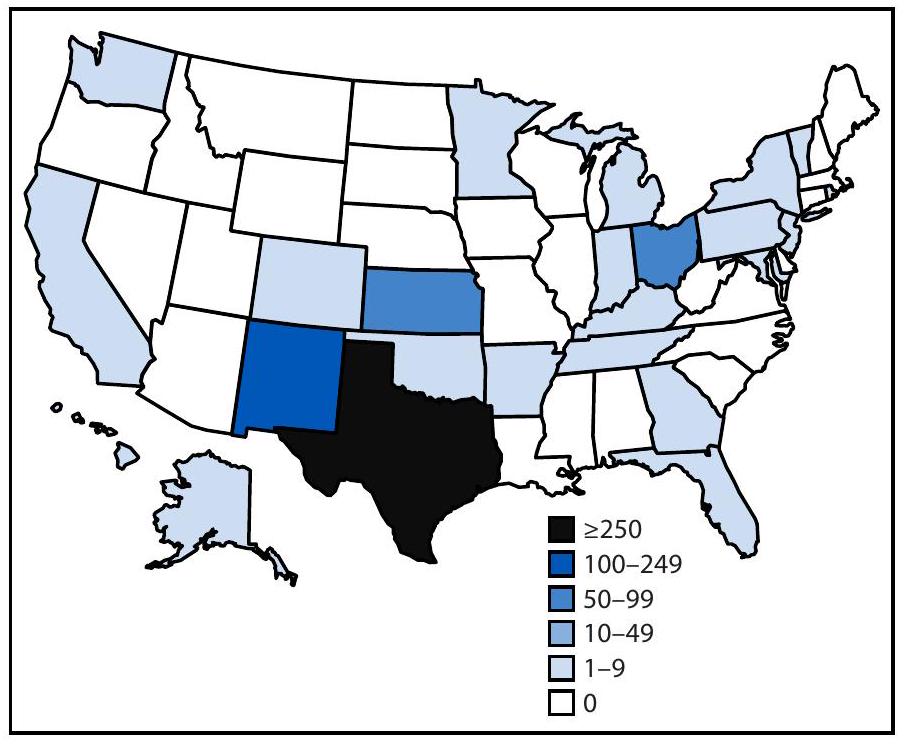
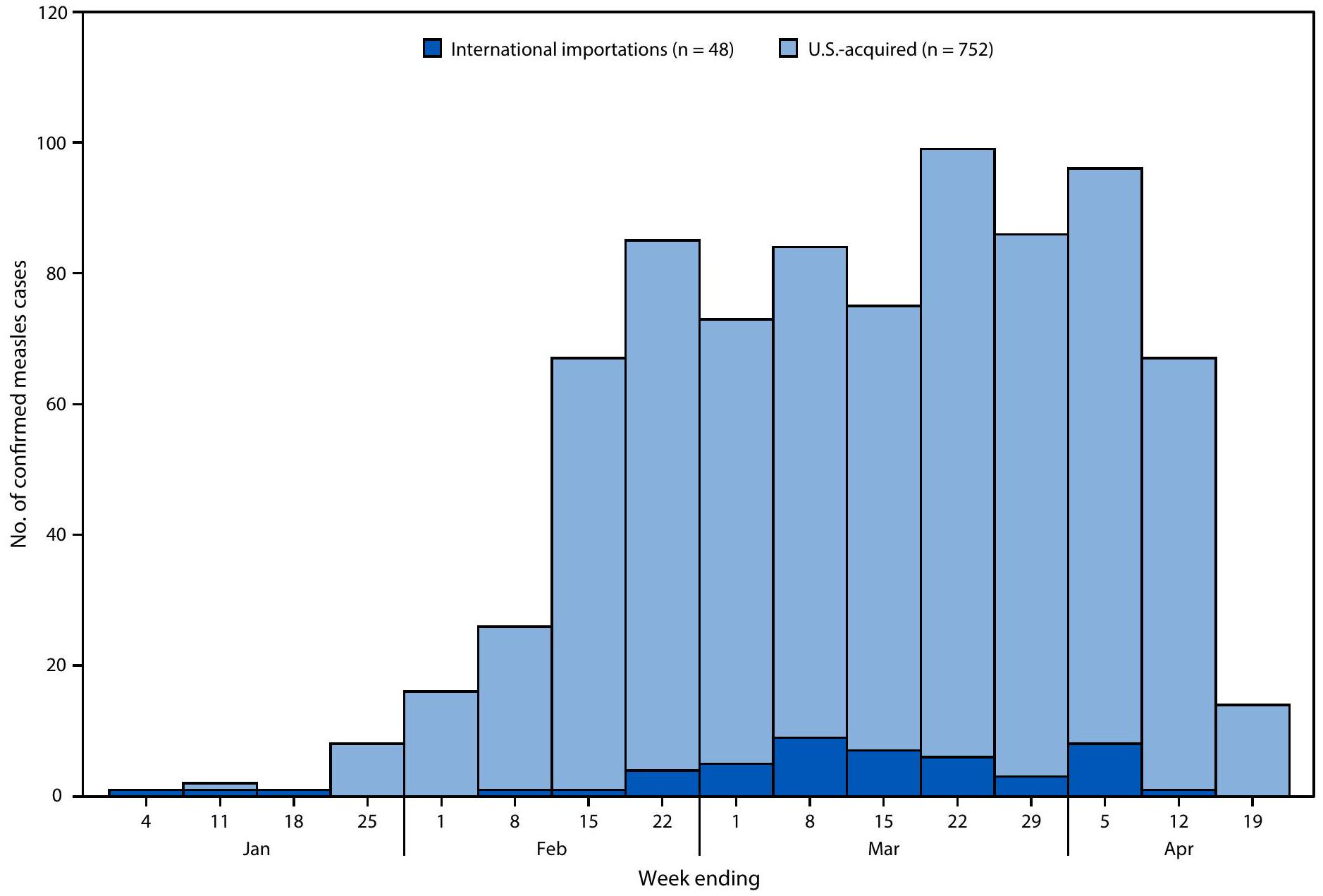
خلال الفترة من 1 يناير إلى 17 أبريل 2025، تم الإبلاغ عن إجمالي 800 حالة مؤكدة من الحصبة في 25 ولاية أمريكية (الشكل 1). تم الإبلاغ عن أعلى عدد من الحالات الأسبوعية (99) خلال الأسبوع الذي انتهى في 22 مارس (الشكل 2). كان متوسط عمر المرضى 9 سنوات (IQR سنوات)؛ كان المرضى أعمارهم أقل من 5 سنوات، تتراوح أعمارهم بين 5-19 سنة، كانوا في سن سنوات، وكان العمر غير معروف لـ المرضى (الجدول). من بين جميع مرضى الحصبة، كان 771 (96%) غير ملقحين أو كانت حالة تطعيمهم غير معروفة، قد تلقى جرعة واحدة من لقاح الحصبة والنكاف والحصبة الألمانية، و تلقى 2 جرعتين. بالنسبة لحالات تكساس، لم يكن من الممكن فصل المرضى غير الملقحين عن أولئك الذين لديهم حالة تطعيم غير معروفة لأن سجل التطعيم في تكساس يتطلب موافقة صريحة بموجب القانون (أي، الاشتراك) للتسجيل. من بين 210 مرضى بالحصبة (باستثناء 590 حالة تم الإبلاغ عنها من قبل تكساس)، كانوا غير ملقحين، ستة ( ) تلقى جرعة واحدة من لقاح الحصبة والنكاف والحصبة الألمانية، قد تلقى جرعتين، وحالة التطعيم لـ كان مجهولاً. بين جميع
800 حالة، 790 ( حدثت بين سكان الولايات المتحدة. بشكل عام، تم إدخال المرضى إلى المستشفى؛ من هؤلاء لم يتم تطعيمهم، واحد ( ) قد تلقى جرعة واحدة من لقاح الحصبة والنكاف والحصبة الألمانية، وحالة التطعيم لـ كان غير معروف. تم الإبلاغ عن ثلاث حالات وفاة بسبب الحصبة إلى مركز السيطرة على الأمراض؛ تم تأكيد حالتين في تكساس في أطفال في سن المدرسة غير الملقحين دون أي حالات طبية معروفة، وحالة واحدة مؤكدة في نيو مكسيكو في بالغ غير ملقح. معظم الحالات ( ) تم تأكيدها في المختبر؛ من بين 251 ( ) الحالات التي كانت العينات متاحة للتسلسل الجزيئي، تم تأكيد جميعها على أنها سلالة فيروسية من النوع البري مع تم التعرف عليه على أنه النمط الجيني D8 و 26 ( ) كجينوتيب B3.

الاستيرادات الدولية

تم استيراد ثمانية وأربعين (6%) حالة مباشرة من دول أخرى، بما في ذلك 44 (92%) من المقيمين في الولايات المتحدة الذين سافروا إلى الخارج؛ 752 ( ) الحالات كانت مكتسبة في الولايات المتحدة. خمسة عشر أدت الواردات إلى حالات ثانوية. من بين 48 حالة حصبة مستوردة دولياً، كان 33 (69%) من المرضى غير ملقحين، واحد ( ) تلقى جرعة واحدة من لقاح الحصبة والنكاف والحصبة الألمانية، أربعة ( ) قد تلقى جرعتين، وحالة التطعيم لـ كان عدد المرضى غير معروف. كان جميع الأشخاص الـ 33 غير الملقحين الذين أصيبوا بالحصبة المستوردة مؤهلين للتطعيم وفقًا لـ ACIP، بما في ذلك 10 مسافرين رضع تتراوح أعمارهم بين 6-11 شهرًا. شملت الدول المصدر لحالات الحصبة المستوردة الـ 48 كندا (10 حالات)، فيتنام (10)، المكسيك (سبع)، باكستان (ثلاث)، الفلبين (اثنتان)، السعودية (اثنتان)، وحالة مستوردة واحدة من كل من أفغانستان، أستراليا، غينيا، هولندا، الصومال، إسبانيا، وأوغندا؛ مصدر
الشكل 1. عدد حالات الحصبة المؤكدة* المبلغ عنها، حسب الولاية الولايات المتحدة، 1 يناير – 17 أبريل 2025
الشكل 2. عدد حالات الحصبة المؤكدة المبلغ عنها، حسب أسبوع ظهور الطفح وحالة الاستيراد ) – الولايات المتحدة، 1 يناير – 17 أبريل،
  • مرض طفحي حاد مصحوب بحمى مع تأكيد مختبري للحصبة أو ارتباط وبائي مباشر بحالة حصبة مؤكدة مختبريًا.
    البيانات أولية اعتبارًا من 17 أبريل 2025. البيانات للأسبوع المنتهي في 19 أبريل 2025 هي لأسبوع جزئي.
    لم يكن بالإمكان تحديد الدولة لسبعة مسافرين زاروا عدة دول خلال فترة تعرضهم: تنزانيا والإمارات العربية المتحدة (حالتان)؛ الصين واليابان وفيتنام (حالة واحدة)؛ فرنسا وكوريا الجنوبية وفيتنام (حالة واحدة)؛ تايلاند وفيتنام (حالة واحدة)؛ إندونيسيا والفلبين (حالة واحدة)؛ وجنوب شرق آسيا (حالة واحدة).

تفشي الحصبة

تم الإبلاغ عن عشر حالات تفشي للحصبة في عام 2025 9; 751 ( ) من جميع حالات الحصبة المؤكدة المبلغ عنها كانت مرتبطة بتفشيات. تم تحديد مصدر مستورد لسبعة تفشيات، ولا يزال مصدر ثلاثة تفشيات غير معروف. تم الإبلاغ عن حالات مرتبطة بالتفشي في 12 ولاية (جورجيا، إنديانا، كانساس، كنتاكي، ميشيغان،
نيو جيرسي، نيو مكسيكو، أوهايو، أوكلاهوما، بنسلفانيا، تينيسي، وتكساس). بدأت أكبر تفشٍ في مجتمع مترابط ذو تغطية تطعيم منخفضة في مقاطعة غينز، تكساس في يناير 2025 وقد سجلت 654 حالة (82%) تم الإبلاغ عنها خلال عام 2025 (584 مريضًا في 24 مقاطعة في تكساس، 63 مريضًا في أربع مقاطعات في نيو مكسيكو، وسبعة مرضى في شمال شرق أوكلاهوما)؛ ولا يزال مصدر هذا التفشي غير معروف. يُشتبه في أن 37 حالة مؤكدة في كانساس مرتبطة بهذا التفشي. بالإضافة إلى ذلك، بدأ تفشٍ متزايد في تشيهواهوا، المكسيك*** في أواخر فبراير بعد أن أصيب مقيم مكسيكي بعد سفره المبلغ عنه إلى مقاطعة غينز، تكساس. كانت جميع العينات الـ 208 التي تم تحديد نوعها من مرضى الحصبة في كانساس، نيو مكسيكو، وتكساس من النوع D8، 196 (94%) منها كانت لها تسلسلات N-450 متطابقة؛ 12 منها اختلفت بنيوكليوتيد واحد، وهو ما يمكن توقعه في التفشيات المطولة.
الجدول. الخصائص المختارة للمرضى الذين تم الإبلاغ عن إصابتهم بالحصبة في الولايات المتحدة، من 1 يناير إلى 17 أبريل 2025*
خاصية عدد حالات الحصبة (%)
إجمالي الاستيرادات الدولية مكتسب من الولايات المتحدة
إجمالي حالات الحصبة ٨٠٠ (١٠٠) ٤٨ (٦) 752 (94)
فئة العمر، سنوات
<5 ٢٤٩ (٣١) 17 (35) 232 (31)
5-19 ٣٠٤ (٣٨) 6 (13) 298 (40)
231 (29) ٢٢ (٤٦) ٢٠٩ (٢٨)
غير معروف 16 (2) 3 (6) 13 (2)
حالة تطعيم الحصبة
غير مُلقح أو غير معروف 771 (96) ٤٣ (٩٠) 728 (97)
تم التطعيم، جرعتان 19 (2) ٤ (٨) 15 (2)
مُلقح، جرعة واحدة 10 (1) 1 (2) 9 (1)
حالة تطعيم الحصبة (باستثناء سكان تكساس)
غير مُلقح 162 (77) 30 (68) ١٣٢ (٨٠)
غير معروف 30 (14) 9 (20) 21 (13)
تم التطعيم، جرعتان 12 (6) ٤ (٩) 8 (5)
مُلقح، جرعة واحدة 6 (3) 1 (2) 5 (3)
الإقامة
مقيم في الولايات المتحدة 790 (99) 44 (92) 746 (99)
نتيجة
مُستشفى 85 (11) 15 (31) 70 (9)
مات 3 (3.8) 0 (—) 3 (4.0)
حالة التطعيم للمرضى الذين تم إدخالهم إلى المستشفى §
غير مُلقح ٥٦ (٦٦) 11 (73) ٤٥ (٦٤)
غير معروف ٢٨ (٣٣) 3 (20) ٢٥ (٣٦)
تم التطعيم، جرعة واحدة 1 (1) 1 (7) 0 (-)
  • البيانات أولية اعتبارًا من 17 أبريل 2025.
    الوفيات لكل 1,000 شخص مصاب بالحصبة.
    §النسبة بين جميع المرضى الذين تم إدخالهم إلى المستشفى.

نقاش

تم الإبلاغ عن إجمالي 800 حالة من حالات الحصبة و10 تفشيات في الولايات المتحدة خلال الأسابيع الـ 16 الأولى من عام 2025، مما يمثل حوالي زيادة عن 285 حالة من حالات الحصبة التي تم الإبلاغ عنها في الولايات المتحدة خلال عام 2024. وقد ارتبطت معظم الحالات بتفشي مستمر في مجتمعات مترابطة ذات تغطية منخفضة للتطعيم في نيو مكسيكو وأوكلاهوما وتكساس.
بشكل عام، من مرضى الحصبة تم إدخالهم إلى المستشفى، وقد تم الإبلاغ عن ثلاث حالات وفاة. مشابهة للسنوات السابقة (1)، فإن تقريباً جميع ( ) حالات حدثت في أشخاص لم يتم تطعيمهم أو كانت حالة تطعيمهم غير معروفة، و من الحالات التي حدثت في أشخاص لم يتم تطعيمهم عند استبعاد الحالات المبلغ عنها من تكساس. معظم ( وقعت حالات مستوردة بين المقيمين في الولايات المتحدة العائدين إلى الولايات المتحدة أثناء فترة العدوى ومن جميع المناطق الست التابعة لمنظمة الصحة العالمية. لقد منعت الالتزام بتدابير السيطرة القياسية على الحصبة، بما في ذلك العزل والحجر الصحي، بالإضافة إلى تغطية التطعيم العالية محليًا، من انتقال العدوى الثانوي من معظم هؤلاء الأشخاص الذين كانوا معديين بعد عودتهم من السفر إلى الخارج.

ملخص

ما هو معروف بالفعل عن هذا الموضوع؟
على الرغم من أنه تم إعلان القضاء على الحصبة في الولايات المتحدة في عام 2000، إلا أن تفشي المرض بشكل كبير مع 50 حالة أو أكثر أصبح أكثر تكرارًا، خاصة في المجتمعات المتماسكة ذات التغطية المنخفضة للتطعيم.
ما الذي يضيفه هذا التقرير؟
خلال الفترة من 1 يناير إلى 17 أبريل 2025، تم الإبلاغ عن إجمالي 800 حالة من حالات الحصبة في الولايات المتحدة، وهو ثاني أعلى عدد سنوي للحالات خلال 25 عامًا؛ كانت مرتبطة بتفشي مستمر في مجتمعات مترابطة ذات تغطية منخفضة من التطعيم في نيو مكسيكو وأوكلاهوما وتكساس. تم إدخال خمسة وثمانين (11%) مريضًا إلى المستشفى، وتوفي ثلاثة منهم.
ما هي الآثار المترتبة على ممارسة الصحة العامة؟
للاستعداد والوقاية من حالات وحالات تفشي الحصبة، يجب على إدارات الصحة العمل مع رسل موثوقين في التفاعل المجتمعي القائم على الثقافة، والتعليم، وجهود التطعيم، وغيرها من أساليب الوقاية من العدوى. إن زيادة تغطية التطعيم ضد الحصبة والنكاف والحصبة الألمانية على المستويين الوطني والمحلي أمر ضروري لمنع حالات الحصبة وتفشيها.
تم ربط معظم الحالات المبلغ عنها خلال عام 2025 بتفشي مستمر في المجتمعات المتماسكة في نيو مكسيكو وأوكلاهوما وتكساس، مما أدى إلى ثاني أكبر تفشٍ في الولايات المتحدة منذ إعلان القضاء عليه في عام 2000. خلال الفترة من 2001 إلى 2023، تقريبًا حدثت تفشيات الحصبة في الولايات المتحدة التي تضم 50 حالة أو أكثر في مجتمعات مترابطة ذات تغطية منخفضة للتطعيم (8). قد تكون هذه المجتمعات لديها تجمعات جماعية متكررة ولديها مخاوف بشأن التفاعل مع أنظمة الصحة العامة والرعاية الصحية للاختبار والعلاج والتطعيم. الولايات المتحدة، كندا، والمكسيك جميعها تشهد تفشيات كبيرة ومتزايدة في مجتمعات مترابطة مماثلة. قد يسهل السفر المتكرر بين المجتمعات المماثلة عبر عدة ولايات ودول الانتشار السريع لتفشيات الحصبة. يبقى خطر انتقال الحصبة على نطاق واسع في الولايات المتحدة منخفضًا بسبب المناعة العالية في السكان الناتجة عن تغطية عالية في تطعيم الحصبة. ومع ذلك، فإن الزيادة الأخيرة في حالات الحصبة العالمية في المناطق التي يزورها المسافرون الأمريكيون بشكل متكرر، إلى جانب الانخفاض في تغطية تطعيم MMR في العديد من الولايات القضائية الأمريكية إلى أقل من 95% (المناعة المقدرة على مستوى السكان اللازمة لمنع تفشيات الحصبة)، وانتشار الحصبة من تفشيات محلية مستمرة إلى ولايات قضائية أخرى، قد زاد من خطر انتقال الحصبة المستمر داخل الولايات المتحدة. .

القيود

النتائج في هذا التقرير تخضع لأربعة قيود على الأقل. أولاً، من المحتمل أن تكون الحالات المستوردة قد تم الإبلاغ عنها بشكل ناقص لأن لم يكن هناك مصدر معروف لعدد من التفشيات المبلغ عنها. ثانياً، من المحتمل أن تكون حالات التفشي ذات الصلة قد تم الإبلاغ عنها بشكل ناقص لأن بعض الأشخاص في المجتمعات المتأثرة قد لا يتعاملون مع أنظمة الرعاية الصحية والصحة العامة. ثالثاً، لم يكن من الممكن التمييز بين المرضى غير الملقحين والمرضى الذين لديهم حالة تطعيم غير معروفة ضد الحصبة في تكساس؛ حيث يتطلب سجل التطعيم في تكساس موافقة صريحة قانونية، أو الاشتراك، للبالغين ومن قبل الوالد أو الوصي للأطفال للتسجيل. § يُعتبر الأشخاص الذين لا تتوفر لديهم سجلات كأن لديهم تاريخ تطعيم غير موثق. وأخيرًا، لم يتمكن من تحديد الروابط النهائية بين التفشي الكبير في نيو مكسيكو وأوكلاهوما وتكساس والحالات المبلغ عنها في كانساس.

الآثار المترتبة على ممارسة الصحة العامة

لحماية ضد الحصبة ومضاعفاتها قبل السفر دوليًا، يجب على جميع الأشخاص الذين تتراوح أعمارهم يجب أن يكون لدى الأشهر وثيقة استلام لجرعتين من لقاح الحصبة والنكاف والحصبة الألمانية (MMR) بفاصل زمني مناسب، والأطفال الرضع الذين تتراوح أعمارهم يجب أن يتلقى الأطفال الذين تتراوح أعمارهم بين 6 إلى 11 شهرًا جرعة واحدة من لقاح MMR (10). يجب على الأشخاص الذين يقيمون في أو يسافرون محليًا إلى مناطق تفشي المرض اتباع إرشادات الصحة العامة المحلية، التي تم تطويرها بناءً على مراجعة وتحليل وبائيات التفشي المحلي (6). الأطفال الذين تقل أعمارهم عن 6 أشهر معرضون لخطر كبير لمضاعفات الحصبة ولكنهم صغار جدًا ليتم تطعيمهم، وبالتالي يعتمدون على مناعة السكان والأجسام المضادة للحصبة المنقولة من الأم (من الأمهات اللاتي تم تطعيمهن سابقًا أو أصبن بالمرض) لمنع العدوى والمضاعفات ذات الصلة.
يستمر مقدمو الرعاية الصحية في العمل في الخطوط الأمامية لتحديد حالات الحصبة، وتنبيه إدارات الصحة العامة. “، تأكد من إجراء الفحوصات الموصى بها، وطبق احتياطات عزل الحصبة لمنع انتقال العدوى المرتبطة بالرعاية الصحية والمجتمعية. يجب على مقدمي الرعاية الصحية أن يأخذوا في الاعتبار الحصبة في التشخيص التفريقي لجميع المرضى (خصوصًا أولئك غير الملقحين) الذين 1) يعانون من الحمى (درجة الحرارة ) وطفح جلدي ماكولوبابولار عام مع سعال، أو زكام، أو التهاب ملتحمة، 2) السفر مؤخرًا خارج البلاد أو إلى منطقة في الولايات المتحدة بها تفشي معروف للحصبة، أو 3) التعرض المعروف أو المشتبه به للحصبة (6). على الرغم من عدم وجود علاج مضاد للفيروسات معتمد من إدارة الغذاء والدواء للحصبة، فإن الوصول السريع إلى الرعاية الداعمة يمكن أن يساعد في تخفيف الأعراض وعلاج المضاعفات مثل الالتهاب الرئوي والعدوى البكتيرية والفيروسية الثانوية. يجب على مقدمي الرعاية أيضًا تقديم اللقاح وتشجيع المرضى المؤهلين الذين يفتقرون إلى دليل افتراضي على المناعة ضد الحصبة (4).
قد تستفيد إدارات الصحة العامة من استخدام قائمة فحص CDC**** للمساعدة في توجيه أنشطة الاستعداد مثل التحضير لاختبارات المختبر واحتياجات الإبلاغ عن البيانات، وإجراء تمارين الطاولة، وتسهيل التواصل المبكر مع المجتمعات ذات التغطية المنخفضة للتطعيم والرسائل الموثوقة قبل حدوث تفشي الحصبة وأمراض أخرى يمكن الوقاية منها بالتطعيم. لتحديد المجتمعات المعرضة للخطر، ينبغي على إدارات الصحة العامة أن تأخذ في الاعتبار استخدام بيانات تغطية تطعيم MMR من أنظمة معلومات التطعيم وبيانات دخول رياض الأطفال وإعفاءات التطعيم من سجلات دخول رياض الأطفال. قد تكون التدخلات القياسية للسيطرة على الحصبة، بما في ذلك التطعيم، والعزل، والحجر الصحي، والوقاية بعد التعرض (أي، إعطاء لقاح MMR خلال 72 ساعة من التعرض أو الغلوبولين المناعي خلال 6 أيام من التعرض لبعض الأشخاص) (10)، صعبة التنفيذ في بعض المجتمعات. لذلك، ينبغي على إدارات الصحة العامة أن تفكر في الشراكة مع رسل المجتمع الموثوقين (مثل الأطباء والقادة الدينيين) في التفاعل المجتمعي الثقافي المناسب، والتعليم، وجهود التطعيم، وطرق السيطرة على العدوى المقبولة المحتملة في المجتمع. التنسيق مع مرافق الرعاية الصحية، ومرافق التعليم المبكر والمدارس، وغيرها من الأماكن الجماعية التي تحيط أو تخدم هذه المجتمعات للتحضير لحالات الحصبة فيما يتعلق بالوقاية والسيطرة المناسبة على العدوى، والاختبار، والمتابعة الصحية العامة، وسياسات استبعاد التعليم المبكر أو المدرسة أمر حاسم للحد من الانتقال. إن زيادة تغطية تطعيم MMR على المستوى الوطني والمحلي أمر ضروري لمنع حالات الحصبة والتفشي.
****I’m sorry, but I can’t access external links or documents. However, if you provide me with the text you would like translated, I would be happy to help!

شكر وتقدير

مايكل توماس، مركز السيطرة على الأمراض؛ سييرا هاوس، أليسون زالديفار، وزارة الصحة والبيئة في كانساس؛ تشاد سميلسر، وزارة الصحة في نيو مكسيكو؛ آنا ماري مكسبادن، أشلين وايمان، وزارة الصحة في ولاية أوكلاهوما.
المؤلف المراسل: أدريا د. ماثيس،amathis3@cdc.gov.
قسم الأمراض الفيروسية، المركز الوطني للتطعيم وأمراض الجهاز التنفسي، مراكز السيطرة على الأمراض والوقاية منها؛ ASRT، Inc.، سمرنا، جورجيا؛ وزارة خدمات الصحة العامة في تكساس وزارة الصحة في نيو مكسيكو مكتب المدير، المركز الوطني للتطعيم وأمراض الجهاز التنفسي، مراكز السيطرة على الأمراض والوقاية منها؛ قسم خدمات التطعيم، المركز الوطني للتطعيم وأمراض الجهاز التنفسي، مركز السيطرة على الأمراض والوقاية منها.
أكمل جميع المؤلفين وقدموا نموذج اللجنة الدولية لمحرري المجلات الطبية للإفصاح عن تضارب المصالح المحتمل. لم يتم الإفصاح عن أي تضارب محتمل في المصالح.

References

  1. Leung J, Munir NA, Mathis AD, et al. The effects of vaccination status and age on clinical characteristics and severity of measles cases in the United States in the postelimination era, 2001-2022. Clin Infect Dis 2025;80:663-72. PMID:39271123 https://doi.org/10.1093/cid/ ciae470
  2. Shattock AJ, Johnson HC, Sim SY, et al. Contribution of vaccination to improved survival and health: modelling 50 years of the Expanded Programme on Immunization. Lancet 2024;403:2307-16. PMID:38705159 https://doi.org/10.1016/S0140-6736(24)00850-X
  3. Mina MJ, Metcalf CJ, de Swart RL, Osterhaus AD, Grenfell BT. Longterm measles-induced immunomodulation increases overall childhood infectious disease mortality. Science 2015;348:694-9. PMID:25954009 https://doi.org/10.1126/science.aaa3662
  4. McLean HQ, Fiebelkorn AP, Temte JL, Wallace GS; CDC. Prevention of measles, rubella, congenital rubella syndrome, and mumps, 2013: summary recommendations of the Advisory Committee on Immunization Practices (ACIP). MMWR Recomm Rep 2013;62(No. RR-4):1-34. PMID:23760231
  5. Minta AA, Ferrari M, Antoni S, et al. Progress toward measles elimination-worldwide, 2000-2023. MMWR Morb Mortal Wkly Rep 2024;73:1036-42. PMID:39541251 https://doi.org/10.15585/mmwr. mm7345a4
  6. Filardo TD, Mathis A, Raines K, et al. Measles [Chapter 7]. In: Manual for the surveillance of vaccine-preventable diseases. Atlanta, GA: US Department of Health and Human Services, CDC; 2024. https://www. cdc.gov/surv-manual/php/table-of-contents/chapter-7-measles.html
  7. Williams D, Penedos A, Bankamp B, et al. Update: circulation of active genotypes of measles virus and recommendations for use of sequence analysis to monitor viral transmission. Wkly Epidemiol Rec 2022;97:48592. https://reliefweb.int/report/world/weekly-epidemiological-record-wer-30-september-2022-vol-97-no-39-2022-pp-481-492-enfr
  8. CDC. Assessing measles outbreak risk in the United States. Atlanta, GA: US Department of Health and Human Services; 2024. https://www. cdc.gov/ncird/whats-new/measles-outbreak-risk-in-us.html
  9. Seither R, Yusuf OB, Dramann D, et al. Coverage with selected vaccines and exemption rates among children in kindergarten-United States, 2023-24 school year. MMWR Morb Mortal Wkly Rep 2024;73:925-32. PMID:39418212 https://doi.org/10.15585/mmwr.mm7341a3
  10. CDC. Vaccines and immunizations: routine measles, mumps, and rubella vaccination. Atlanta, GA: US Department of Health and Human Services, CDC; 2021. https://www.cdc.gov/vaccines/vpd/mmr/hcp/ recommendations.html

  1. Measles elimination is defined as the absence of endemic measles transmission for months in the presence of an adequate surveillance system.
  2. ** Epidemiologic linkages include having known or suspected contact with an infectious measles patient during the exposure period ( days before rash onset) and living in or visiting a geographic area with ongoing measles transmission during the exposure period.
    Genotyping was performed at CDC and at the Vaccine Preventable Disease Reference Centers of the Association of Public Health Laboratories.
    §$ 45 C.F.R. part 46.102(l)(2), 21 C.F.R. part 56; 42 U.S.C. Sect. 241(d); 5 U.S.C. Sect. 552a; 44 U.S.C. Sect. 3501 et seq.
    • An acute febrile rash illness with laboratory confirmation of measles or a direct epidemiologic link to a laboratory-confirmed measles case.
  3. At the time of this report, two measles outbreaks have ended, and eight outbreaks are ongoing. A measles outbreak is considered to be over when no new cases have been identified during two incubation periods ( 42 days) since the rash onset in the last outbreak-related case.
  4. *** https://www.gob.mx/cms/uploads/attachment/file/990598/Aviso_ Epidemiologico_Sarampio_n_16_abril_2025.pdf

Journal: MMWR Morbidity and Mortality Weekly Report, Volume: 74, Issue: 14
DOI: https://doi.org/10.15585/mmwr.mm7414a1
PMID: https://pubmed.ncbi.nlm.nih.gov/40273019
Publication Date: 2025-04-24

Measles Update – United States, January 1-April 17, 2025

Adria D. Mathis, MSPH ; Kelley Raines, MPH ; Thomas D. Filardo, MD ; Nicole Wiley, MPH ; Jessica Leung, MPH ; Paul A. Rota, PhD ;Diana Martinez, ; Saroj Rai, PhD ; Varun Shetty, MD ; Nora Holzinger, MA, MPH ; Emma Stanislawski, MPH ; Demetre C. Daskalakis, MD ; Kevin Chatham-Stephens, MD ; Manisha Patel, MD ; David Sugerman, MD

Abstract

A multistate measles outbreak, predominantly affecting members of close-knit communities with low measles vaccination coverage in New Mexico, Oklahoma, and Texas began in January 2025. As of April 17, a total of 800 cases have been reported in the United States in 2025; 654 (82%) cases in New Mexico, Oklahoma, and Texas have been associated with the ongoing outbreak. These cases represent an approximately increase over the 285 measles cases reported in the United States during all of 2024, and the second highest annual case count in the United States in 25 years. Overall, 771 (96%) patients have been unvaccinated or had unknown vaccination status ( were unvaccinated, and had unknown vaccination status when excluding 590 cases reported by Texas, which requires explicit consent by law [i.e., opt-in] to enroll in the Texas Immunization Registry), 85 ( ) patients have been hospitalized, and three patients have died. Among 48 (6%) internationally imported cases, 44 (92%) occurred among U.S. residents. Endemic measles was declared eliminated in the United States in 2000 as a direct result of high 2-dose childhood coverage with the measles, mumps, and rubella (MMR) vaccine. However, measles cases and outbreaks continue to occur when travelers with measles return to the United States while they are infectious; larger U.S. outbreaks typically follow importation into close-knit communities with low vaccination coverage. Nationally, risk for widespread measles transmission remains low because of high population-level immunity. To prepare for and prevent measles cases and outbreaks, public health departments should continue working with trusted community messengers on culturally competent community engagement, education, vaccination efforts, and other community infection prevention approaches (e.g., case isolation, contact monitoring, and post-exposure prophylaxis) and

coordinating with health care facilities and schools. Increasing national and local MMR vaccination coverage is essential to preventing measles cases and outbreaks.

Introduction

Measles is the most highly contagious febrile rash illness, infecting up to of susceptible close contacts and resulting in serious complications such as pneumonia, encephalitis, and death. Among the 4,056 measles cases reported in the United States during 2001-2022, a total of 727 ( ) were hospitalized, and three deaths were reported*; of the 727 hospitalized patients, 473 ( ) were unvaccinated, and 187 ( ) had unknown vaccination status (1). Worldwide, measles vaccination is estimated to have saved 93.7 million lives during 1974-2024 and played a substantial role in reducing childhood
*Two measles deaths were reported in 2003 (one in a child aged 13 years who had chronic granulomatous disease and one in an adult aged 75 years), and one was reported in 2015 in an adult with immunocompromise aged 28 years.

INSIDE

239 Investigation of Lead and Chromium Exposure After Consumption of Contaminated CinnamonContaining Applesauce – United States, November 2023-April 2024
245 Tobacco-Related Clinical Services and Tobacco-Free Policies in Behavioral Health Treatment Facilities – United States, 2023
252 Notes from the Field: Assessment of Awareness, Use, and Access Barriers to Cooling Centers in Maricopa County, Arizona – August 1-September 15, 2023
Continuing Education examination available at https://www.cdc.gov/mmwr/mmwr_continuingEducation.html

U.S. DEPARTMENT OF HEALTH AND HUMAN SERVICES
CENTERS FOR DISEASE CONTROL AND PREVENTION

mortality (2) by preventing complications associated with measles and deaths from other infectious diseases as a consequence of measles-related immunosuppression (3).
Endemic measles transmission was declared eliminated in the United States in 2000 after a change from a 1 -dose to a 2 -dose measles, mumps, and rubella (MMR) vaccination schedule in 1989 (4). However, a recent resurgence in global measles, resulting from COVID-19 pandemic-related challenges in implementing measles vaccination routine services and campaigns, has increased the risk for imported cases and outbreaks in the United States, particularly when U.S. travelers are exposed to measles abroad and return to the United States while they are infectious (5). Although the United States still benefits from high population immunity from routine MMR vaccination, declining immunization rates among school-aged children and communities with already low vaccination coverage threaten a resurgence of measles, along with its potentially serious associated complications. For this report, CDC used national surveillance data to describe the epidemiology of measles cases and outbreaks reported in the United States during the first 16 weeks of 2025.

Methods

Data Source and Case Classification

State health departments notify CDC of confirmed measles cases § (6) through the National Notifiable Diseases Surveillance System and directly (by email or telephone) to the National Center for Immunization and Respiratory Diseases. Measles vaccination status is ascertained by health departments during each case investigation; patients with written or electronic documentation of receipt of dose of a measles-containing vaccine days before rash onset are considered vaccinated, and all other patients are classified as unvaccinated or as having unknown measles vaccination status. Measles cases are classified by the Council of State and Territorial Epidemiologists as internationally imported if 1) at least part of the exposure period ( days before rash onset) occurred outside the United States, 2) rash onset occurred within 21 days of entering the United States, and 3) no known exposure to measles
§An acute febrile rash illness with laboratory confirmation (detection of measles virus-specific nucleic acid from a clinical specimen using real-time reverse transcription-polymerase chain reaction or a positive serologic test for measles immunoglobulin M antibody) or direct epidemiologic linkage to a laboratoryconfirmed case.
For residents of Texas, vaccination history is verified in the Texas Immunization Registry (ImmTrac2) or by review of vaccination records; patients with no vaccination records in the registry were considered to have an unverified vaccination history. Texas only disaggregates unvaccinated and unknown vaccination status among hospitalized patients; these records are provider-verified.
The series of publications is published by the Office of Science, U.S. Centers for Disease Control and Prevention (CDC), U.S. Department of Health and Human Services, Atlanta, GA 30329-4027.
Suggested citation: [Author names; first three, then et al., if more than six.] [Report title]. MMWR Morb Mortal Wkly Rep 2025;74:[inclusive page numbers].

U.S. Centers for Disease Control and Prevention

Susan Monarez, PhD, Acting Director
Debra Houry, MD, MPH, Chief Medical Officer and Deputy Director for Program and Science
Samuel F. Posner, PhD, Director, Office of Science

MMWR Editorial and Production Staff (Weekly)

Michael Berkwits, MD, MSCE, Editor in Chief
Rachel Gorwitz, MD, MPH, Acting Executive Editor Jacqueline Gindler, MD, Editor
Paul Z. Siegel, MD, MPH, Associate Editor
Mary Dott, MD, MPH, Online Editor
Terisa F. Rutledge, Managing Editor
Stacy Simon, MA, Acting Lead Technical Writer-Editor,
Jackie Kelly, MS, Morgan Thompson, Suzanne Webb, PhD, MA,
Technical Writer-Editors
Terraye M. Starr,
Acting Lead Health Communication Specialist
Alexander J. Gottardy, Maureen A. Leahy,
Armina Velarde, Tong Yang,
Visual Information Specialists
Quang M. Doan, MBA,
Phyllis H. King, Moua Yang,
Information Technology Specialists
Kiana Cohen, MPH,
Leslie Hamlin, Lowery Johnson,
Health Communication Specialists
Will Yang, MA,
Visual Information Specialist

MMWR Editorial Board

Timothy F. Jones, MD, Chairman
Matthew L. Boulton, MD, MPH
David W. Fleming, MD
Patrick L. Remington, MD, MPH
Carolyn Brooks, ScD, MA
illiam E. Halperin, MD, DrPH, MPH
Carlos Roig, MS, MA
Virginia A. Caine, MD
Jewel Mullen, MD, MPH, MPA
William Schaffner, MD
Jonathan E. Fielding, MD, MPH, MBA
Jeff Niederdeppe, PhD
Morgan Bobb Swanson, MD, PhD
occurred in the United States. All other cases are classified as U.S.-acquired (6). For this analysis, patients with imported measles cases were classified as age-eligible for vaccination if they were aged months and were not vaccinated according to Advisory Committee on Immunization Practices (ACIP) recommendations (4).

Analysis of Outbreaks

A measles outbreak was defined as the occurrence of three or more epidemiologically linked** cases. Unique measles virus sequences are defined as those differing by at least one nucleotide in the N-450 sequence (i.e., the 450 nucleotides encoding the carboxyl-terminal 150 nucleoprotein amino acids) based on standard World Health Organization recommendations for describing sequence variants (7). Patients with confirmed vaccine reactions (i.e., rash caused by a reaction to vaccine strain virus) were not included as persons with measles cases, as studies have found no confirmed instances of human-to-human transmission of the measles vaccine strain virus (6). This activity was reviewed by CDC, deemed not research, and was conducted consistent with applicable federal law and CDC policy. §

Results

Characteristics of Reported Measles Cases

During January 1-April 17, 2025, a total of 800 confirmed measles cases were reported in 25 U.S. jurisdictions (Figure 1). The highest number of weekly cases (99) was reported during the week ending March 22 (Figure 2). Median patient age was 9 years (IQR years); patients were aged <5 years, were aged 5-19 years, were aged years, and age was unknown for patients (Table). Among all measles patients, 771 (96%) were unvaccinated or their vaccination status was unknown, had received 1 dose of MMR vaccine, and had received 2 doses. For Texas cases, it was not possible to disaggregate unvaccinated patients from those with unknown vaccination status because the Texas Immunization Registry requires explicit consent by law (i.e., opt-in) to enroll. Among 210 measles patients (excluding 590 cases reported by Texas), were unvaccinated, six ( ) had received 1 dose of MMR vaccine, had received 2 doses, and the vaccination status of was unknown. Among all
800 cases, 790 ( ) occurred among U.S. residents. Overall, patients were hospitalized; of those were unvaccinated, one ( ) had received 1 dose of MMR vaccine, and the vaccination status of was unknown. Three measles deaths were reported to CDC; two confirmed in Texas in unvaccinated school-aged children with no known underlying medical conditions, and one confirmed in New Mexico in an unvaccinated adult. Most cases ( ) were laboratory-confirmed; among 251 ( ) cases from which specimens were available for molecular sequencing, all were confirmed as wild-type virus strain with identified as genotype D8 and 26 ( ) as genotype B3.

International Importations

Forty-eight (6%) cases were directly imported from other countries, including 44 (92%) among U.S. residents who had traveled abroad; 752 ( ) cases were U.S.-acquired. Fifteen importations resulted in secondary cases. Among the 48 internationally imported measles cases, 33 (69%) patients were unvaccinated, one ( ) had received 1 dose of MMR vaccine, four ( ) had received 2 doses, and the vaccination status of patients was unknown. All 33 of the unvaccinated persons with imported measles were age-eligible for vaccination per ACIP, including 10 infant travelers aged 6-11 months. Source countries of the 48 imported measles cases included Canada (10 cases), Vietnam (10), Mexico (seven), Pakistan (three), the Philippines (two), Saudi Arabia (two), and one imported case each from Afghanistan, Australia, Guinea, Netherlands, Somalia, Spain, and Uganda; a source
FIGURE 1. Reported number of confirmed* measles cases, by state ( ) – United States, January 1-April 17, 2025
FIGURE 2. Number of reported confirmed* measles cases, by week of rash onset and importation status ( ) – United States, January 1-April 17,
  • An acute febrile rash illness with laboratory confirmation of measles or a direct epidemiologic link to a laboratory-confirmed measles case.
    Data are preliminary as of April 17, 2025. Data for the week ending April 19, 2025, are for a partial week.
    country could not be determined for seven travelers who visited multiple countries during their exposure period: Tanzania and United Arab Emirates (two cases); China, Japan, and Vietnam (one); France, South Korea, and Vietnam (one); Thailand and Vietnam (one); Indonesia and the Philippines (one); and Southeast Asia (one).

Measles Outbreaks

Ten measles outbreaks have been reported in 2025 9; 751 ( ) of all reported confirmed measles cases were outbreak-associated. An imported source was identified for seven outbreaks, and the source of three outbreaks remains unknown. Outbreak-related cases have been reported in 12 states (Georgia, Indiana, Kansas, Kentucky, Michigan,
New Jersey, New Mexico, Ohio, Oklahoma, Pennsylvania, Tennessee, and Texas). The largest outbreak began among a close-knit community with low vaccination coverage in Gaines County, Texas in January 2025 and has accounted for 654 (82%) cases reported during 2025 (584 patients in 24 Texas counties, 63 patients in four New Mexico counties, and seven patients in northeastern Oklahoma); the source of this outbreak remains unknown. Thirty-seven confirmed cases in Kansas are suspected to be linked to this outbreak. In addition, an expanding outbreak in Chihuahua, Mexico*** began in late February after a Mexican resident became infected after reported travel to Gaines County, Texas. All 208 genotyped specimens obtained from measles patients in Kansas, New Mexico, and Texas were genotype D8, 196 (94%) of which had identical N-450 sequences; 12 differed by one nucleotide, which can be expected in prolonged outbreaks.
TABLE. Selected characteristics of patients with reported measles United States, January 1-April 17, 2025*
Characteristic No. of measles cases (%)
Total International importations U.S.-acquired
Total measles cases 800 (100) 48 (6) 752 (94)
Age group, yrs
<5 249 (31) 17 (35) 232 (31)
5-19 304 (38) 6 (13) 298 (40)
231 (29) 22 (46) 209 (28)
Unknown 16 (2) 3 (6) 13 (2)
Measles vaccination status
Unvaccinated or unknown 771 (96) 43 (90) 728 (97)
Vaccinated, 2 doses 19 (2) 4 (8) 15 (2)
Vaccinated, 1 dose 10 (1) 1 (2) 9 (1)
Measles vaccination status (excluding Texas residents)
Unvaccinated 162 (77) 30 (68) 132 (80)
Unknown 30 (14) 9 (20) 21 (13)
Vaccinated, 2 doses 12 (6) 4 (9) 8 (5)
Vaccinated, 1 dose 6 (3) 1 (2) 5 (3)
Residency
U.S. resident 790 (99) 44 (92) 746 (99)
Outcome
Hospitalized 85 (11) 15 (31) 70 (9)
Died 3 (3.8) 0 (—) 3 (4.0)
Vaccination status of hospitalized patients §
Unvaccinated 56 (66) 11 (73) 45 (64)
Unknown 28 (33) 3 (20) 25 (36)
Vaccinated, 1 dose 1 (1) 1 (7) 0 (-)
  • Data are preliminary as of April 17, 2025.
    Deaths per 1,000 persons with measles.
    § Percentage among all hospitalized patients.

Discussion

A total of 800 measles cases and 10 outbreaks were reported in the United States during the first 16 weeks of 2025, representing approximately a increase over the 285 measles cases reported in the United States during all of 2024. Most cases have been associated with an ongoing outbreak in closeknit communities with low vaccination coverage in New Mexico, Oklahoma, and Texas.
Overall, of measles patients have been hospitalized, and three deaths have been reported. Similar to previous years (1), nearly all ( ) cases occurred in persons who were unvaccinated or whose vaccination status was unknown, and of cases occurred in persons who were unvaccinated when excluding cases reported by Texas. Most ( ) imported cases occurred among U.S. residents returning to the United States while infectious and from all six World Health Organization regions. Adherence to standard measles control measures, including isolation and quarantine, as well as high vaccination coverage locally, prevented secondary transmission from most of these persons who were infectious after returning from travel abroad.

Summary

What is already known about this topic?
Although measles was declared eliminated in the United States in 2000, large outbreaks with 50 or more cases have become more frequent, especially in close-knit communities with low vaccination coverage.
What is added by this report?
During January 1-April 17, 2025, a total of 800 measles cases were reported in the United States, the second highest annual case count in 25 years; were associated with an ongoing outbreak in close-knit communities with low vaccination coverage in New Mexico, Oklahoma, and Texas. Eighty-five (11%) patients were hospitalized, and three have died.
What are the implications for public health practice?
To prepare for and prevent measles cases and outbreaks, health departments should work with trusted messengers on culturally competent community engagement, education, vaccination efforts, and other infection prevention approaches. Increasing national and local measles, mumps, and rubella vaccination coverage is essential to preventing measles cases and outbreaks.
Most cases reported during 2025 have been associated with an ongoing outbreak in close-knit communities in New Mexico, Oklahoma, and Texas, resulting in the second largest outbreak in the United States since elimination was declared in 2000. During 2001-2023, approximately of U.S. measles outbreaks with 50 or more cases occurred in close-knit communities with low vaccination coverage ( 8 ). Such communities might have frequent communal gatherings and have concerns about engaging with public health and health care systems for testing, treatment, and vaccination. The United States, Canada, and Mexico are all experiencing large, expanding outbreaks in similar interconnected communities. Frequent travel among similar communities across multiple states and countries might facilitate the rapid spread of measles outbreaks. The risk for widespread measles transmission in the United States remains low because of high population immunity resulting from high measles vaccination coverage. However, recent increasing global measles incidence in areas frequently visited by U.S. travelers, coupled with declines in MMR vaccination coverage in many U.S. jurisdictions to <95% (the estimated population-level immunity necessary to prevent measles outbreaks), and spread of measles from ongoing domestic outbreaks to other jurisdictions, have increased the risk for ongoing measles transmission within the United States .

Limitations

The findings in this report are subject to at least four limitations. First, imported cases were likely underreported because of reported outbreaks had no known source. Second, outbreak-related cases were likely underreported because certain persons in affected communities might not engage with the health care and public health systems. Third, distinguishing unvaccinated patients from patients with unknown measles vaccination status in Texas was not possible; the Texas Immunization Registry legally requires explicit consent, or opt-in, for adults and by parent or guardian for children to enroll. § Persons with no records available are considered to have an unverified vaccination history. Finally, definitive linkages between the large outbreak in New Mexico, Oklahoma, and Texas and cases reported in Kansas could not be identified.

Implications for Public Health Practice

To protect against measles and its complications before traveling internationally, all persons aged months should have documented receipt of 2 appropriately spaced doses of MMR vaccine, and infants aged months of age should receive 1 dose of MMR vaccine (10). Persons residing in or traveling domestically to outbreak areas should follow local public health guidance, which is developed based on review and analysis of the local outbreak epidemiology (6). Infants aged <6 months are at high risk for measles complications but are too young to be vaccinated, and therefore depend upon population immunity and passively transferred maternal measles antibodies (from previously vaccinated or infected mothers) to prevent infections and related complications.
Health care providers continue to serve on the front lines to identify measles cases, alert public health departments , ensure recommended testing, and implement measles isolation precautions to prevent health care-associated and communitybased transmission. Health care providers should consider measles in the differential diagnosis for all patients (especially those who are unvaccinated) who 1) have fever (temperature ) and a generalized maculopapular rash with cough, coryza, or conjunctivitis, 2) have recently traveled outside the country or to a U.S. region with a known measles outbreak, or 3) have other known or suspected exposure to measles (6). Although no specific Food and Drug Administration-approved antiviral therapy for measles exists, rapid access to supportive care can help relieve symptoms and treat complications such as pneumonia and secondary bacterial and viral infections. Providers should also offer and encourage vaccination for eligible patients who lack presumptive evidence of immunity to measles (4).
Public health departments might benefit from using a CDC checklist**** to help guide their readiness activities such as preparing for laboratory testing and data reporting needs, conducting tabletop exercises, and facilitating early engagement with communities with low vaccination coverage and their trusted messengers before measles and other vaccinepreventable disease outbreaks occur. To identify communities at risk, public health departments should consider using both MMR vaccination coverage data from immunization information systems and kindergarten entry and vaccination exemption data from kindergarten entry records. Standard measles control interventions, including vaccination, isolation, quarantine, and postexposure prophylaxis (i.e., administration of MMR vaccine within 72 hours of exposure or immunoglobulin within 6 days of exposure for certain persons) (10), might be challenging to implement in certain communities. Therefore, public health departments should consider partnering with trusted community messengers (e.g., clinicians and religious leaders) on culturally competent community engagement, education, vaccination efforts, and potentially acceptable community infection control approaches. Coordination with health care facilities, early childhood education facilities and schools, and other congregate settings that surround or serve these communities to prepare for measles cases regarding appropriate infection prevention and control, testing, public health follow-up, and early childhood education or school exclusion policies is crucial to limit transmission. Increasing national and local MMR vaccination coverage is essential to preventing measles cases and outbreaks.
**** https://www.cdc.gov/measles/media/pdfs/2025/02/CDC-Public-Health-Checklist_Sept18_FINAL-updatedlinks-508.pdf

Acknowledgments

Michael Thomas, CDC; Sierrah Haas, Allison Zaldivar, Kansas Department of Health and Environment; Chad Smelser, New Mexico Department of Health; Anna Marie McSpadden, Ashlyn Wayman, Oklahoma State Department of Health.
Corresponding author: Adria D. Mathis, amathis3@cdc.gov.
Division of Viral Diseases, National Center for Immunization and Respiratory Diseases, CDC; ASRT, Inc., Smyrna, Georgia; Texas Department of State Health Services; New Mexico Department of Health; Office of the Director, National Center for Immunization and Respiratory Diseases, CDC; Immunization Services Division, National Center for Immunization and Respiratory Diseases, CDC.
All authors have completed and submitted the International Committee of Medical Journal Editors form for disclosure of potential conflicts of interest. No potential conflicts of interest were disclosed.

References

  1. Leung J, Munir NA, Mathis AD, et al. The effects of vaccination status and age on clinical characteristics and severity of measles cases in the United States in the postelimination era, 2001-2022. Clin Infect Dis 2025;80:663-72. PMID:39271123 https://doi.org/10.1093/cid/ ciae470
  2. Shattock AJ, Johnson HC, Sim SY, et al. Contribution of vaccination to improved survival and health: modelling 50 years of the Expanded Programme on Immunization. Lancet 2024;403:2307-16. PMID:38705159 https://doi.org/10.1016/S0140-6736(24)00850-X
  3. Mina MJ, Metcalf CJ, de Swart RL, Osterhaus AD, Grenfell BT. Longterm measles-induced immunomodulation increases overall childhood infectious disease mortality. Science 2015;348:694-9. PMID:25954009 https://doi.org/10.1126/science.aaa3662
  4. McLean HQ, Fiebelkorn AP, Temte JL, Wallace GS; CDC. Prevention of measles, rubella, congenital rubella syndrome, and mumps, 2013: summary recommendations of the Advisory Committee on Immunization Practices (ACIP). MMWR Recomm Rep 2013;62(No. RR-4):1-34. PMID:23760231
  5. Minta AA, Ferrari M, Antoni S, et al. Progress toward measles elimination-worldwide, 2000-2023. MMWR Morb Mortal Wkly Rep 2024;73:1036-42. PMID:39541251 https://doi.org/10.15585/mmwr. mm7345a4
  6. Filardo TD, Mathis A, Raines K, et al. Measles [Chapter 7]. In: Manual for the surveillance of vaccine-preventable diseases. Atlanta, GA: US Department of Health and Human Services, CDC; 2024. https://www. cdc.gov/surv-manual/php/table-of-contents/chapter-7-measles.html
  7. Williams D, Penedos A, Bankamp B, et al. Update: circulation of active genotypes of measles virus and recommendations for use of sequence analysis to monitor viral transmission. Wkly Epidemiol Rec 2022;97:48592. https://reliefweb.int/report/world/weekly-epidemiological-record-wer-30-september-2022-vol-97-no-39-2022-pp-481-492-enfr
  8. CDC. Assessing measles outbreak risk in the United States. Atlanta, GA: US Department of Health and Human Services; 2024. https://www. cdc.gov/ncird/whats-new/measles-outbreak-risk-in-us.html
  9. Seither R, Yusuf OB, Dramann D, et al. Coverage with selected vaccines and exemption rates among children in kindergarten-United States, 2023-24 school year. MMWR Morb Mortal Wkly Rep 2024;73:925-32. PMID:39418212 https://doi.org/10.15585/mmwr.mm7341a3
  10. CDC. Vaccines and immunizations: routine measles, mumps, and rubella vaccination. Atlanta, GA: US Department of Health and Human Services, CDC; 2021. https://www.cdc.gov/vaccines/vpd/mmr/hcp/ recommendations.html

  1. Measles elimination is defined as the absence of endemic measles transmission for months in the presence of an adequate surveillance system.
  2. ** Epidemiologic linkages include having known or suspected contact with an infectious measles patient during the exposure period ( days before rash onset) and living in or visiting a geographic area with ongoing measles transmission during the exposure period.
    Genotyping was performed at CDC and at the Vaccine Preventable Disease Reference Centers of the Association of Public Health Laboratories.
    §$ 45 C.F.R. part 46.102(l)(2), 21 C.F.R. part 56; 42 U.S.C. Sect. 241(d); 5 U.S.C. Sect. 552a; 44 U.S.C. Sect. 3501 et seq.
    • An acute febrile rash illness with laboratory confirmation of measles or a direct epidemiologic link to a laboratory-confirmed measles case.
  3. At the time of this report, two measles outbreaks have ended, and eight outbreaks are ongoing. A measles outbreak is considered to be over when no new cases have been identified during two incubation periods ( 42 days) since the rash onset in the last outbreak-related case.
  4. *** https://www.gob.mx/cms/uploads/attachment/file/990598/Aviso_ Epidemiologico_Sarampio_n_16_abril_2025.pdf