تحسين الخصائص الفيزيائية والكيميائية للثوم المجفف باستخدام خريطة تنظيم ذاتي وتطوير نموذج توقع بالذكاء الاصطناعي Optimization of dried garlic physicochemical properties using a self-organizing map and the development of an artificial intelligence prediction model

المجلة: Scientific Reports، المجلد: 15، العدد: 1
DOI: https://doi.org/10.1038/s41598-025-87167-5
PMID: https://pubmed.ncbi.nlm.nih.gov/39856175
تاريخ النشر: 2025-01-24

افتح

تحسين الخصائص الفيزيائية والكيميائية للثوم المجفف باستخدام خريطة تنظيم ذاتي وتطوير نموذج توقع بالذكاء الاصطناعي

هاني س. المسيري , محمد قناوي , منى علي , مريت رستم , أحمد البلتاجي , علي سالم & عبد الله الشوادفي الوكيل

الملخص

تم إجراء التجارب على مستويات مختلفة من طاقة الأشعة تحت الحمراء، وتدفق الهواء، ودرجة الحرارة. تم تحسين العلاقات بين عوامل العملية المدخلة وعوامل الاستجابة للخصائص الفيزيائية والكيميائية للثوم المجفف باستخدام خريطة ذاتية التنظيم (SOM)، وتم تطوير النموذج باستخدام التعلم الآلي. تم استخدام الشبكة العصبية الاصطناعية (ANN) بدقة توقع 99% وخريطة ذاتية التنظيم (SOM) بدقة تجميع 97% لتحديد الخصائص النوعية للثوم. تم تحديد خمسة مجالات رئيسية، وتم تقديم رؤى قيمة لتحسين إنتاج الثوم وتحسين جودته العامة. تراوحت قيم (aw) للعينة بين 0.43 و0.48. كانت أقصى محتوى من فيتامين C هو , تليها درجة حرارة الهواء و سرعة الهواء تحت . زادت قيم تغيير اللون الكلي مع IR ودرجة حرارة الهواء الأعلى ولكنها انخفضت مع زيادة سرعة الهواء. أيضًا، انخفضت قوة نكهة الثوم، ومحتوى الأليسين، ونشاط الماء، ومستويات فيتامين C مع زيادة IR ودرجة حرارة الهواء. أظهرت النتائج تأثيرًا كبيرًا للعوامل المستقلة على معلمات الاستجابة ( ). من المثير للاهتمام أن توقعات التعلم الآلي تطابقت عن كثب مع مجموعات بيانات الاختبار، مما يوفر رؤى قيمة لفهم والسيطرة على العوامل التي تؤثر على أداء تجفيف الثوم.

الكلمات الرئيسية: التعلم الآلي، المجففات المستمرة، التجفيف بالأشعة تحت الحمراء، الخصائص الفيزيائية والكيميائية
المعروف علميًا باسم Allium sativum، تم زراعة الثوم عالميًا لقرون بسبب خصائصه الطهي والطبية الفريدة . لقد حصل على اعتراف كبير كتوابل قيمة في إعداد الطعام اليومي. الثوم غني بمكونات قيمة مثل الأليسين، والسيلينيوم (Se)، والجرمانيوم (Ge)، وسوبر أكسيد ديسموتاز (SOD)، وهي مواد حيوية نشطة لها فوائد عديدة لصحة الإنسان. يمتلك الأليسين، على وجه الخصوص، خصائص مضادة للأكسدة ومضادة للبكتيريا. للأسف، على الرغم من الفوائد الصحية المتعددة للثوم للإنسان، يتم فقد حوالي من محصول الثوم أثناء التخزين بسبب التلف الميكروبي والتنفس . يحتوي الثوم الطازج على محتوى رطوبة مرتفع (أكثر من )، مما يعزز إنبات فصوص الثوم وتعفنها أثناء التخزين، مما يؤدي إلى تقصير مدة الصلاحية. لذلك، لتمديد مدة صلاحية الثوم مع الحفاظ على قيمته الغذائية، يجب تقليل محتوى الرطوبة في الثوم إلى . إن تجفيف فصوص الثوم باستخدام طرق التجفيف بالحمل الحراري، مثل مجففات الصواني، يستغرق وقتًا طويلاً ويتطلب طاقة كبيرة . في التجفيف بالحمل الحراري، يتعرض الجزء الخارجي من الثوم بشكل أساسي للتسخين من خلال الحمل الحراري، بينما يتم تسخين الأجزاء المتبقية من خلال التوصيل. تزيل هذه العملية الرطوبة من سطح الثوم، مما يؤدي إلى تدرج رطوبة يسهل حركة السائل نحو الطبقة الخارجية . ومع ذلك، فإن التجفيف بالحمل الحراري له عدة عيوب، بما في ذلك أوقات تجفيف طويلة، وتأثيرات سلبية محتملة على الخصائص الحسية والخصائص الغذائية،
وهجرة المواد المذابة من داخل الطعام إلى السطح، مما يؤدي إلى تصلب الحالة. مع تقدم تكنولوجيا التجفيف، تم تصميم مجففات جديدة وأكثر تطورًا لمعالجة أوجه القصور في مجففات الهواء الساخن وتعزيز جودة المنتجات المجففة . في السنوات الأخيرة، اكتسبت مجففات الأشعة تحت الحمراء شعبية وزادت من الاهتمام في البلدان النامية بسبب تكلفتها المعقولة، وبساطتها، وانخفاض تكاليف التشغيل. يتضمن التجفيف بالأشعة تحت الحمراء تسخين المواد الرطبة باستخدام الإشعاع تحت الأحمر .
إن التنبؤ بدقة بمعلمات التجفيف أمر حيوي لتحسين ظروف العملية، وتقليل استهلاك الطاقة، والحفاظ على جودة المنتج المستقرة. أصبحت الشبكات العصبية الاصطناعية (ANNs) ضرورية لتحليل العلاقات المعقدة عبر مجالات مختلفة، وخاصة معالجة الطعام. الذكاء الاصطناعي (AI) ونظيره المدفوع بالبيانات، التعلم الآلي (ML)، هما تخصصان يتطوران بسرعة مع تطبيقات متزايدة في النمذجة، والمحاكاة، والتحكم، والتحسين داخل صناعة معالجة الطعام . تسهل هذه التكاملات اتخاذ القرارات الآلية، مما يقلل من الأخطاء البشرية ويعزز الكفاءة التشغيلية في تجفيف الطعام . علاوة على ذلك، تظهر نماذج الذكاء الاصطناعي كفاءة في التنبؤ بأوقات التجفيف وتحليل أنماط استهلاك الطاقة، مما يمكّن من تحسين تقليل استهلاك الموارد مع الحفاظ على جودة المنتج . يعد نموذج يستفيد من قدرات التنبؤ للشبكات العصبية الاصطناعية للتنبؤ بدقة بعملية التجفيف بناءً على المتغيرات المدخلة مثل سمك المنتج، وضغط الكابينة، ووقت التجفيف أمرًا حيويًا لتوفير الوقت والطاقة . وجد جعفري وآخرون أن نموذج ANN تفوق على طرق النمذجة الرياضية من حيث الإنتاجية والدقة عند التنبؤ بتغيرات نسبة الرطوبة لفلفل الجرس الأخضر أثناء تجفيف الهواء الساخن في سرير مائع. بالمثل، طور نادين وآخرون نموذج ANN للتنبؤ بتغيرات اللون في شرائح التفاح أثناء التجفيف بالهواء الساخن. في دراسة أخرى، طبق ساري ميسلي وآخرون نموذج ANN لنمذجة حركيات تجفيف أوراق الزعتر باستخدام الميكروويف. درس زالبوري وآخرون هريس البصل بسمك متنوع، وتم تجفيفه باستخدام طرق RWD وCD لتقييم حركيات التجفيف، والخصائص الفيزيائية والكيميائية، والتحليل الحراري للبودرة المجففة. أظهرت النتائج زيادة في سمك الهريس من 2 إلى 6 مم، وزاد وقت التجفيف من 135 إلى 240 دقيقة لطريقة RWD ومن 510 إلى 660 دقيقة لطريقة CD. للتنبؤ بدقة بنسبة الرطوبة لهريس البصل باستخدام RWD وCD، تم استخدام MLF-ANN مع خوارزمية الانتشار العكسي. كانت ANN طريقة فعالة للتنبؤ بنسبة الرطوبة لكلتا طريقتي التجفيف. أظهرت النتيجة أن نموذج ANN مع 12 و18 خلية عصبية في الطبقة المخفية يمكن أن يتنبأ بنسبة الرطوبة، مع قيمة عالية لطريقة RWD وCD، على التوالي. استخدم خزاعي وآخرون ANN للتنبؤ والتحكم في إجراء تجفيف العنب في مجفف هواء ساخن. على الرغم من وجود العديد من الدراسات حول تجفيف مختلف المنتجات الزراعية، لم تركز أي أبحاث بشكل خاص على تجفيف شرائح الثوم باستخدام التجفيف المستمر بمساعدة الأشعة تحت الحمراء والتجفيف الحراري وتحسين العملية باستخدام تقنيات ANN فيما يتعلق بالخصائص النوعية. لاحظ زالبوري وآخرون أن نموذج الشبكة العصبية الاصطناعية (ANN) توقع نسبة الرطوبة. أظهرت النمذجة الرياضية أن نموذج الأسطوانة الأسية ذو الحدين كان له أعلى وأدنى قيم RSME وSEE. علاوة على ذلك، تم التنبؤ بدقة بنسبة الرطوبة باستخدام MLF-ANN مع خوارزمية الانتشار العكسي، متفوقًا على النموذج الرياضي. أظهر انتقال الكتلة المحسوب باستخدام نهج دينشر ودست التحليلي أن Deff وhm في نطاق إلى و إلى ، على التوالي. درس كالسكي وآخرون تجفيف أوراق ستيفيا ريبوديان في مجفف حراري تحت درجات حرارة هواء مختلفة لتحليل حركيات التجفيف، والشبكات العصبية الاصطناعية (ANNs)، ونماذج النظام العصبي الضبابي التكيفي (ANFIS) للتنبؤ بحركيات تجفيف الأوراق. علاوة على ذلك، تم تحليل مساحيق الأوراق المجففة لخصائص اللون، ومحتوى حمض الأسكوربيك، ومحتوى الفينول الكلي، والنشاط المضاد للأكسدة، ونشاط الماء، ومؤشر الذوبان في الماء، والامتصاصية، والكثافة، والفراغ الكلي، ومؤشرات التدفق، ومؤشر كار، وزاوية الاستراحة. أظهرت النتائج أن نموذج ANFIS مع 0.9998 ، يقدم توقعًا أكثر دقة لديناميات تجفيف الأوراق المجففة في مجفف هواء ساخن متدفق مقارنة بالنمذجة الرياضية ونمذجة الشبكات العصبية الاصطناعية. تستخدم هذه الدراسة مجففًا مستمرًا لفحص تأثير كثافات الأشعة تحت الحمراء المتغيرة، وتدفق الهواء، بالإضافة إلى درجة حرارة الهواء على الخصائص الفيزيائية والكيميائية لبودرة الثوم، بما في ذلك (تغير اللون الكلي، قوة النكهة، نشاط الماء، فيتامين C، ومحتوى الأليسين) خلال عملية التجفيف بالأشعة تحت الحمراء. تهدف البحث أيضًا إلى تطوير نموذج قائم على التعلم الآلي للتنبؤ بالتغيرات في الجودة الفيزيائية والكيميائية لبودرة الثوم المجففة. تقدم الخرائط الذاتية التنظيم (SOM) نهجًا جديدًا لاكتشاف كيفية تحسين ظروف الدراسة. يتم استخدام تحليل المكونات الرئيسية (PCA) لفهم ظروف التجفيف والعلاقة بين الجودة الفيزيائية والكيميائية لبودرة الثوم المجففة.

المواد والطرق

تحضير العينة

تم الحصول على فصوص الثوم الطازج (Allium sativum L.) من المتجر المحلي وتم الاحتفاظ بها في الثلاجة عند لإجراء مزيد من التحليل. بعد فترة استقرار مدتها ساعتان عند درجة حرارة الغرفة، تم تقشير العينات وتقطيعها إلى قطع بسماكة 6 مم باستخدام آلة تقطيع الطعام الصناعية قبل التجفيف. لمنع البني غير الإنزيمي، تم غمر عينات الثوم في ميتابيسلفيت الصوديوم حل في تم تجفيف عينات طازجة تزن حوالي 500 جرام حتى 0.05 جرام من الماء تم تحقيق الأساس الجاف لمحتوى الرطوبة النهائي باستخدام مجفف الأشعة تحت الحمراء.

مجفف سير ناقل

عملية تجفيف الثوم استخدمت مجفف حزام ناقل هجين مع نظام تسخين بالأشعة تحت الحمراء. المجفف، الذي يقيس في الطول والارتفاع والوزن، يتضمن نظام حزام ناقل، مغذي، نظام حمل هواء ساخن، غرفة تجفيف، منطقة جمع المنتجات، ونظام تسخين بالأشعة تحت الحمراء.

غرفة التجفيف

تم تصميم المجفف مع غرفة تجفيف مقسمة إلى قسمين متساويين، كل منهما يقيس تم بناؤه من صفائح فولاذية مقاومة للصدأ بسمك 2 مم. كانت الجدران الخارجية محمية بطبقة من الأسبستوس. كانت هناك حزام ناقل من شبكة سلكية من الفولاذ المقاوم للصدأ يربط غرف التجفيف ويستخدم لنقل العينات داخل وخارج.

نظام الحمل الحراري بالهواء الساخن

نظام الهواء الساخن الحمل لديه مروحة وسخانين كهربائيين لتوليد سرعة الهواء الجاف المطلوبة (0.2 إلى تم التحكم في تدفق الهواء إلى الغرفة بواسطة صمام موجود عند مدخل أنبوب PVC. تم تسخين الهواء عن طريق مروره فوق سخانين كهربائيين حلزونيين بحجم 1.5 كيلو وات. تدير وحدة تحكم هذه السخانات لضمان درجة حرارة ثابتة طوال عملية التجفيف.

نظام الحرارة بالأشعة تحت الحمراء

تم تجهيز نظام التسخين بالأشعة تحت الحمراء بمصابيح هالوجين بقوة 1000 واط (فيلبس، نوع أنبوب)، كل منها بطول 35.5 سم وقطر 0.6 سم. مع نطاق شدة التسخين، تم تثبيت مصابيح الأشعة تحت الحمراء على السطح الداخلي العلوي لحجرة التجفيف لتمكين التسخين المتساوي. تتوازى مصابيح الأشعة تحت الحمراء مع حزام النقل بفاصل 15 سم بينها. يمكن تعديل شدة الإشعاع تحت الأحمر للمصابيح عن طريق تنظيم الجهد من خلال منظم الطاقة.

نظام حزام النقل

يمكن أن يوقف مفتاح التشغيل الناقل عندما يتم وضع المنتج مباشرة تحت سخانات الأشعة تحت الحمراء. يتيح هذا المجفف استخدام تسخين الأشعة تحت الحمراء والهواء الساخن بشكل مستقل أو فوري عن طريق تشغيل أنظمة التسخين وإيقافها. تم تتبع درجة حرارة الهواء خلال عملية التجفيف باستخدام ثنائيات حرارية من النوع T مرتبطة بجهاز تسجيل البيانات، الذي يتمتع بدقة . بالمقابل، تم قياس سرعة الهواء داخل الغرفة باستخدام مقياس سرعة الهواء بالسلك الساخن بدقة .

تقنية التجفيف

تم إنشاء المجفف عند تدفقات الهواء الجاف ، و تم التقديم عند 40 و 50 و تجفيف درجات حرارة الهواء تحت كثافات الأشعة تحت الحمراء المختلفة (IR) 1500، 2000، و تم تشغيل المجفف لمدة 45 دقيقة لتحقيق ظروف تجفيف مستقرة قبل كل اختبار تجفيف. تم تجفيف العينات حتى انخفض محتوى الرطوبة النهائي لها إلى أقل من 0.05 جرام ماء/جرام قاعدة جافة (تراوحت مدة التجفيف الكلية من 10 إلى 5 ساعات). تم سحق شرائح الثوم المجففة عن طريق الطحن، وتم تخزين مسحوق الثوم في حتى الاستخدام.

محتوى الرطوبة

تم وضع حوالي 20 جرام من العينة في طبق وتجفيفها في فرن مفرغ عند ضغط 85 كيلو باسكال و لـ محتوى الرطوبة الأولي للثوم. بعد التجفيف، تم وزن العينة ثلاث مرات للحصول على قيمة متوسطة. كان محتوى الرطوبة الأولي للثوم حوالي (و.ب.). محتوى الرطوبة في الثوم ( تم تحديده باستخدام المعادلة. .
محتوى الرطوبة النهائي تم تحديده على أساس جاف وفقًا للمعادلة. .
يتم إعطاء Mt للعينة الجافة مع مرور الوقت t بواسطة المعادلة. .

نشاط الماء (aw)

تم استخدام عينة وزنها 3 جرام لقياس نشاط الماء ) في بواسطة تقنية LabMASTER. تقوم الآلة بقياس رطوبة الهواء من خلال إغلاق العينات في غرفة مغلقة محكمة للتحقق بدقة وموثوقية من نشاط الماء. ).

محتوى فيتامين C

تم تحديد محتوى فيتامين C في العينة باستخدام طريقة المعايرة القياسية 2,6-ثنائي كلوروفينول إندوفينول. المواد الكيميائية المستخدمة كانت محلول حمض الميتا فوسفوريك، معيار حمض الأسكوربيك يحتوي على 0.1 ملغ من حمض الأسكوربيك في 1 مل من 3% ومحلول الصبغة الذي يحتوي على 50 ملغ من 2،6-ثنائي كلوروفينول إندوفينول في 200 مل من الماء المقطر. تم حساب معدل احتفاظ فيتامين C وفقًا للمعادلة 4.

تحديد قوة النكهة

تم تقييم طريقة الكلورامين-تي للزيت الطيار الذي يحتوي على مركبات الكبريت المسؤولة عن حدة الثوم. تم تحديد محتوى الزيت الطيار في المادة بوحدات ملغ من الزيت لكل غرام من المادة الجافة. .

تحديد محتوى الأليسين

تم قياس كمية الأليسين في العينة الأولية والعينة الجافة عند 412 نانومتر استنادًا إلى الطريقة الطيفية الموضحة بواسطة تم استخراج محتوى الأليسين (AC) كنسبة احتفاظ مقارنة بالثوم الطازج، كما هو موضح في المعادلة 5.
و هي الأليسين من الطازج ) ومجفف ( عينات )، على التوالي.

قياس التغيرات اللونية الكلي ( )

تم تقييم لون العينات الطازجة والمجففة باستخدام مقياس الألوان وفقًا للطريقة الموضحة بواسطة . في الملخص، تم أخذ خمس سعات لونية من سطح العينة لكل فحص، وتم التحقق من متوسط التغيرات اللونية. التغيرات اللونية الإجمالية ( ) تم حسابها باستخدام المعادلة 6.
، ويمثل قيم البياض، والصفرة/الزرقة، والحمرة/الخضرة. يشير الحرف السفلي “0” إلى قيمة لون الثوم. تشير القيمة العالية لتغيرات اللون الكلي إلى ( ) يعني تغييرًا أكبر في لون العينة المبيضة.

أساليب تعلم الآلة

الشبكة العصبية الاصطناعية (ANN)

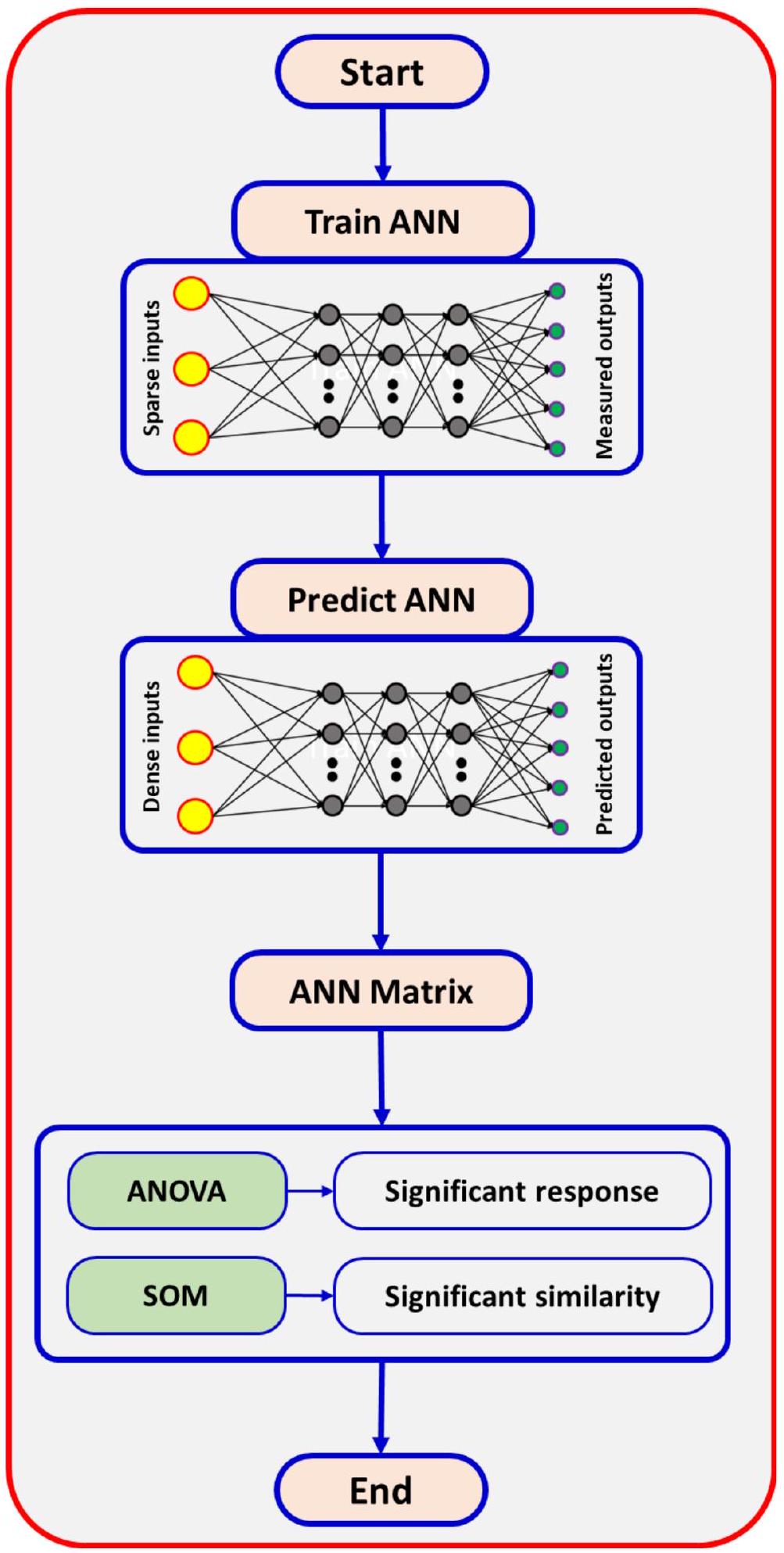
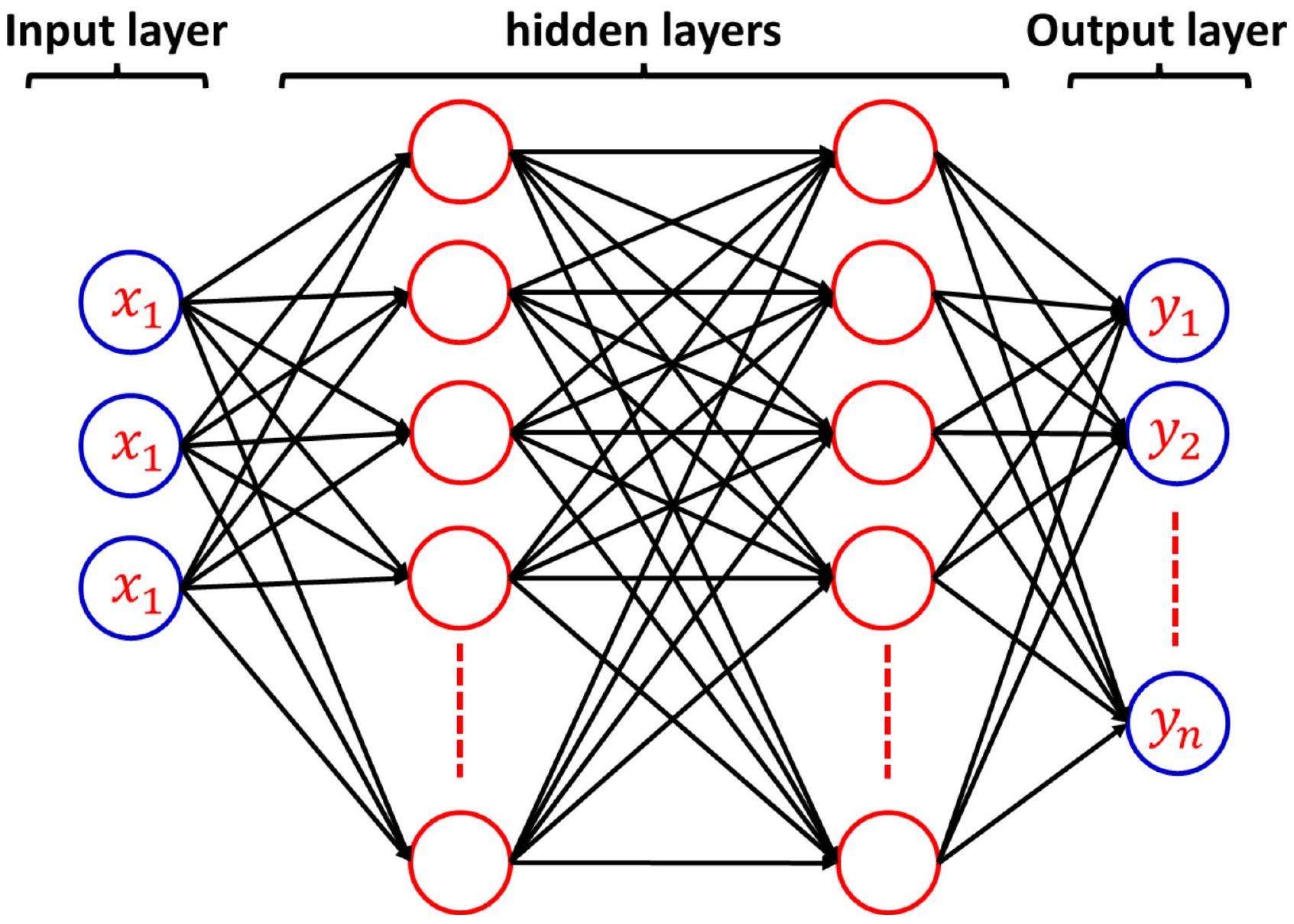
الشبكات العصبية الاصطناعية (ANNs) هي تقنية قوية تعتمد على البيانات في الذكاء الاصطناعي. إنها نمذجة قائمة على التعلم الآلي مع مفهوم التعلم الموجه. تتكون الشبكة العصبية الاصطناعية من ثلاث طبقات: طبقة الإدخال، والطبقة المخفية، وطبقة الإخراج. يتم نقل البيانات عبر الخلايا العصبية من طبقة الإدخال إلى الطبقات السفلية. تؤثر الخلايا العصبية في طبقتي الإخراج والإدخال بشكل كبير على المتغيرات. على الرغم من أن وجود عدد أكبر من الخلايا العصبية يمكن أن يقلل من الأخطاء، إلا أنه يتطلب أيضًا وقتًا أطول. تقوم الأوزان ودوال النقل بتعديل الإشارات التي تمر عبر الخلايا العصبية، وتستمر هذه العملية حتى يتم تحقيق الإخراج المطلوب. يمكن أن يختلف عدد الخلايا العصبية في كل طبقة اعتمادًا على هيكل المشكلة. توضح الشكل 1 الإجراء، بما في ذلك مراحل التدريب والتنبؤ للشبكة العصبية الاصطناعية. تتضمن بنية الشبكة العصبية الاصطناعية في الشكل 2 طبقات الإدخال والإخراج والطبقات المخفية. يتكون نموذج الشبكة العصبية الاصطناعية الحالي من ثلاثة عوامل إدخال: درجة حرارة الهواء (T)، تدفق الهواء (V)، شدة الأشعة تحت الحمراء (IR)، وخصائص الثوم الفيزيائية والكيميائية.
تم دمج نموذج الشبكة العصبية الاصطناعية بنجاح مع طرق أخرى، principalmente نهج (SOM)، لتحسين ظروف التجفيف وتوفير بيانات قيمة عن نوع التجفيف. تعتبر عملية SOM، مثالاً رئيسياً على النمذجة المعتمدة على التعلم الآلي غير الموثق بمفهوم التعلم غير المراقب، حيث تنظم البيانات المتنوعة في خريطة ميزات ثنائية الأبعاد. وفقًا لعلي حميد وآخرون. , هذه الخريطة تحافظ على الهيكل الطوبولوجي لنقاط الإحصائيات من خلال تجميعها وفقًا لأعلى تشابه بينها. عندما يتم تقديم هذه الأشكال المدخلة في الشبكة العصبية، تحدث منافسة بين أجزاء طبقة الإخراج، مما يؤدي إلى تنشيط الخلايا العصبية ‘الناجحة’. يتم توضيح هذا المفهوم، حيث تتطابق الأوزان بشكل وثيق مع نمط الإدخال، بشكل أفضل في الدراسة التي أجراها كافه وآخرون. لتحديد الفائز. يعرض ما سبق هيكل الشبكة: طبقة واحدة تطبق هذه الشروط على الخلايا العصبية، والتي تتجمع بنجاح لتشكيل مجموعات. يقوم النظام بمعالجة معلمات مختلفة: تغيير اللون الكلي، قوة النكهة، نشاط الماء، فيتامين C، ومحتوى الأليسين. أدى تنظيم هذه المعلمات الناتجة إلى مجموعات نتج عنها 400 خلية عصبية ناتجة. تم تنفيذ التجميع بنجاح باستخدام طريقة قابلة للمقارنة مع التحليل. تسهل هذه الطريقة إنشاء مجموعات بيانات منظمة وسهلة الفهم.

تحليل المكونات الرئيسية (PCA)

سمح تحليل المكونات الرئيسية (PCA)، الذي تم تنفيذه باستخدام برنامج Minitab 2022 LLC، بإضافة تفاصيل إحصائية. حاولت هذه التقنية الإحصائية فك شفرة العلاقات المعقدة والاختلافات بين الخصائص الفيزيائية والكيميائية للثوم. يتضمن تحليل القيم الذاتية لمصفوفة التباين مجموعات البيانات المتوقعة (تغيير اللون الكلي، قوة النكهة، نشاط الماء، فيتامين C، وتركيز الأليسين) من الشبكة العصبية الاصطناعية (ANN). تم اختيار الآليتين الأوليين بناءً على التباين الكلي والقيمة الذاتية، وهما عاملان حاسمان في اختيار وشرح تحليل المكونات الرئيسية (PCA) . الشكل 3 يظهر تحليل PCA للمعلمات الحاكمة، مع تحديد ستة مكونات. بالنظر إلى معايير كايسر-غوتمان، يتم اعتبار القيم الذاتية فقط التي تزيد عن الواحد، وبالتالي، يتم استخدام أول مكونين رئيسيين فقط، PC1 و PC2، لعرض العلاقات بين جودة الثوم المختلفة.

منهجية التحقق

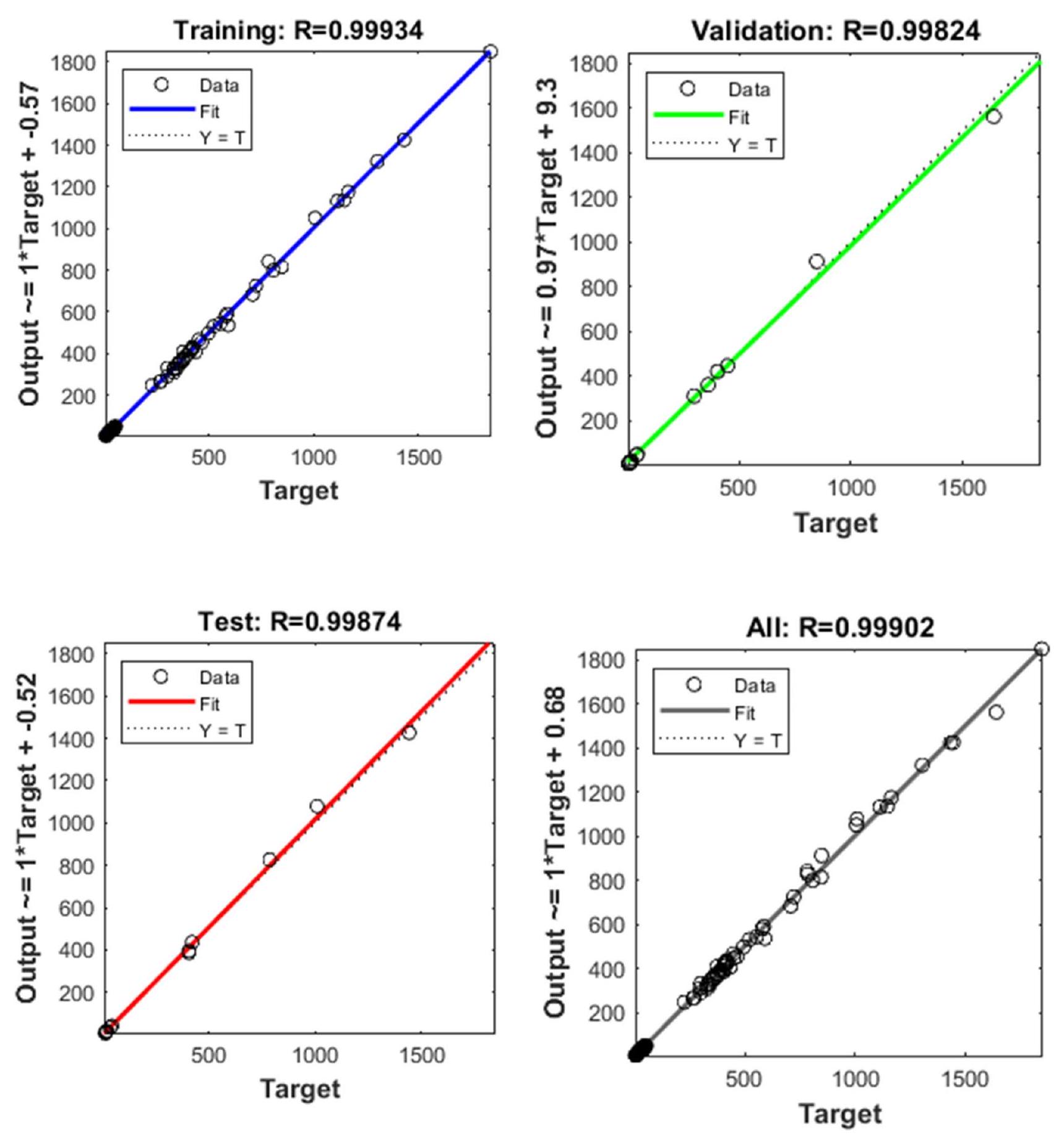
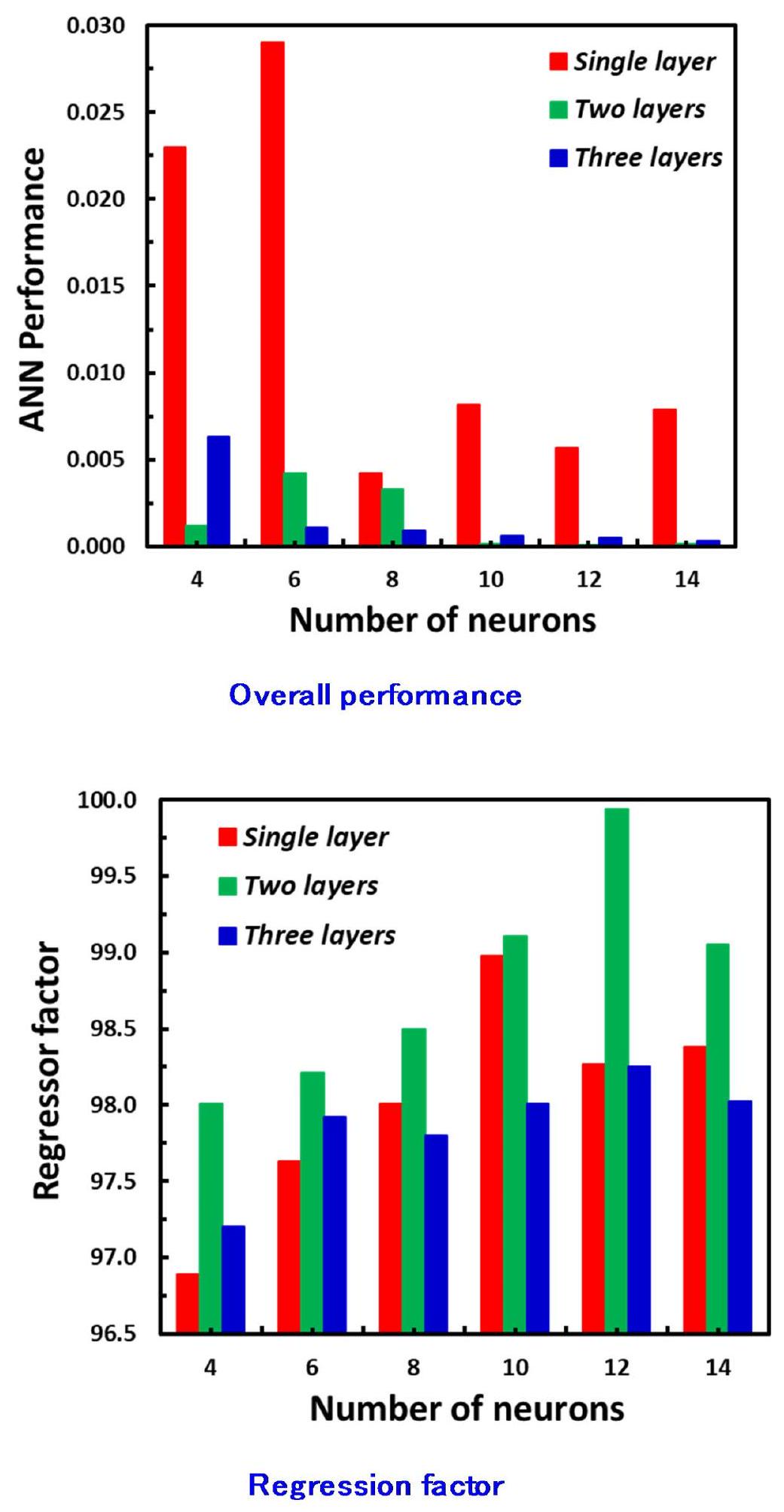
تم استخدام تقنية الانتشار العكسي، باستخدام دالة سيغمويد، خلال مرحلة تدريب ANN. تم تطوير كود خاص لنموذج ANN باستخدام برنامج MATLAB. تم تقسيم مجموعة البيانات بشكل عشوائي، مع مخصص للتدريب و للاختبار. قدم إعداد ANN الذي يحتوي على 12 خلية عصبية عبر طبقتين مخفيتين التوازن الأمثل بين الأداء والانحدار، كما هو موضح في الشكل 4. يوضح الشكل 5 انحدار وأداء ANN من خلال 1 إلى 3 طبقات مخفية و 4 إلى 14 خلية عصبية مع دقة التنبؤ. الانتشار العكسي هو طريقة تدريب لـ ANN تظل مستقرة عند معدلات تعلم منخفضة. بالإضافة إلى ذلك، يتم إخضاع جميع الحالات لدالة سيغمويد، كما هو موضح في المعادلة 7:
قبل دمجها في إطار ANN، تم تعديل مجموعة البيانات وفقًا للمعادلة 8:
الشكل 1. خريطة الطريق للشبكات العصبية الاصطناعية (ANNs) المستخدمة في التحقيق الحالي.

تقييم أداء النماذج

تم استخدام تقنية ليفنبرغ-ماركارد لتقليل الأخطاء، وبعد 1000 تكرار، تم تسجيل الحد الأدنى من الخطأ. تم استخدام مقاييس إحصائية مثل معامل الارتباط وجذر متوسط المربعات
الشكل 2. الهيكل لثلاث طبقات خلال التدريب، الاختبار، والتحقق من نموذج الشبكات العصبية الاصطناعية (ANNs).
الشكل 3. مجموعات المكونات الرئيسية لمحتويات الجودة المتوقعة باستخدام القيم الذاتية.
الشكل 4. أداء الانحدار خلال التدريب، الاختبار، والتحقق من نموذج ANN.
تم تشغيل خطأ (RMSE) لتقدير أداء النماذج. يتم وصف معامل الارتباط ( ) ومتوسط مربع الخطأ (RMSE) في المعادلات 9 و .
تم إجراء تجارب ثلاثية لكل حالة تجفيف. يتم تقديم البيانات التجريبية كمتوسطات ± انحرافات معيارية (SD). تم إجراء التحليلات الإحصائية باستخدام برنامج SPSS الإحصائي (الإصدار
الشكل 5. أداء ANN والانحدار مع الطبقات المخفية والخلايا العصبية.
27.0، SPSS Inc.، شيكاغو، إلينوي، الولايات المتحدة الأمريكية). تم تقييم تأثيرات إعدادات التشغيل المختلفة على خصائص التجفيف ومعلمات الجودة باستخدام تحليل التباين (ANOVA)، الذي تلاه اختبار دانكان المتعدد النطاقات بعد ذلك عند مستوى دلالة 0.05.

النتائج والمناقشة نشاط الماء (aw)

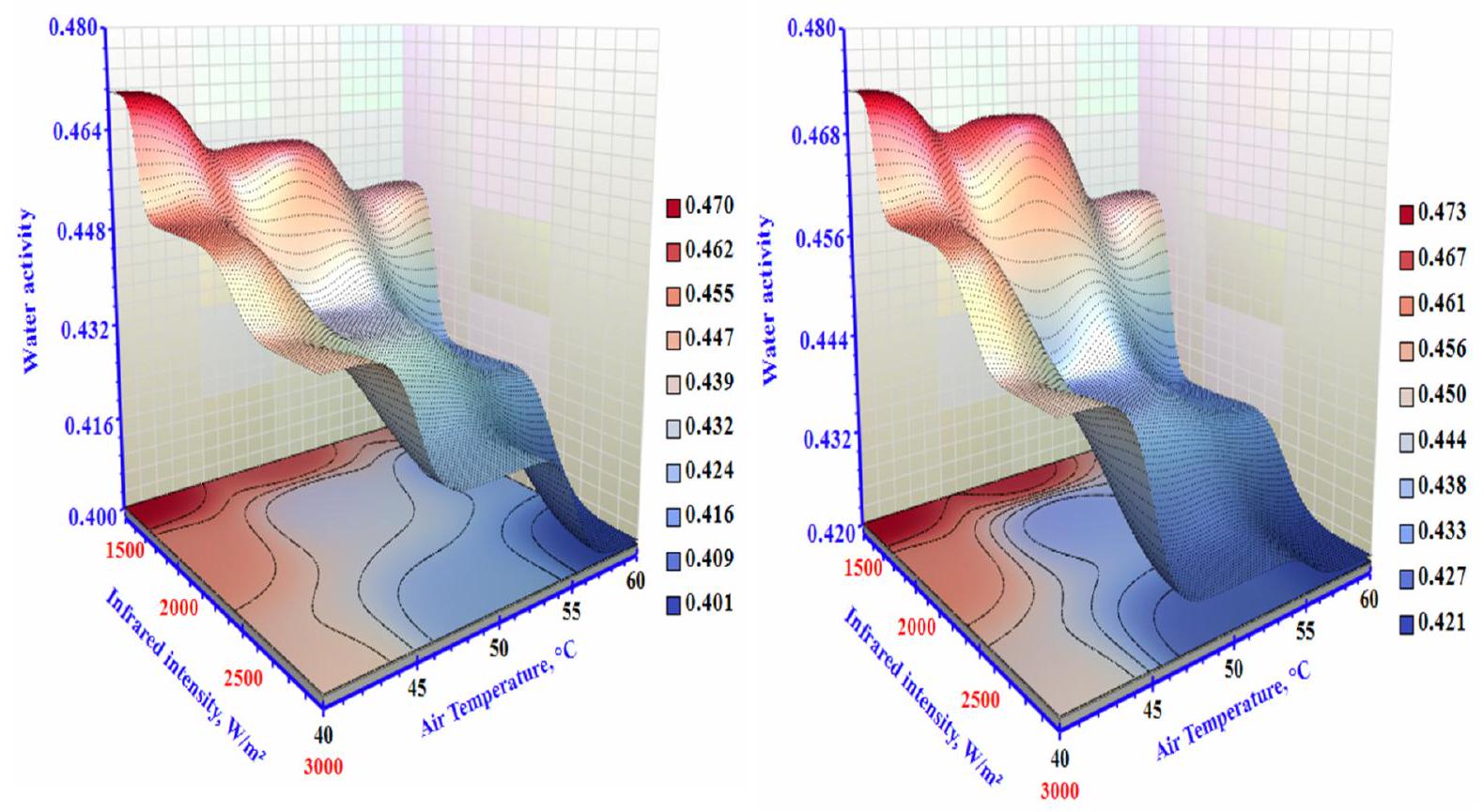
تشير نشاط الماء (aw) لمادة غذائية إلى أن الطعام ذو نشاط الماء المنخفض لديه مستوى نشاط ماء أقل من 0.8. وهذا يعني أن نشاط الماء المطلوب للمنتجات الجافة هو 0.6، وهو الحد القياسي لتكاثر الخمائر والميكروبات . الشكل 6 يعرض ( ) للعينة كدالة لإعدادات التجفيف المختلفة. ( ) للعينة أقل من 0.6 في جميع الاختبارات، مما يدل على أن العينات خالية من الأذى البكتيري النموذجي. تراوحت قيم للعينة بين 0.43 و 0.48. إن ارتفاع IR و T مع انخفاض تدفق الهواء هو السبب وراء تبخر الرطوبة بشكل أسرع من العينة . إن تحقيق ( ) المطلوب بشكل أسرع ممكن بفضل فقدان الماء بشكل أقوى من الشريحة وانتشار الرطوبة بشكل أكثر نشاطًا داخل العينة . تظهر نتائج هذه الدراسة أن التجفيف باستخدام عملية تسخين بالأشعة تحت الحمراء يمكن أن يوفر قيم موثوقة من لعمر تخزين ممتد للثوم.

محتوى فيتامين C

يمكن العثور على فيتامين C في معظم الفواكه والخضروات الطازجة؛ ومع ذلك، فهو ليس مستقرًا جدًا وعادة ما يتدهور أثناء المعالجة عند تعرضه للحرارة أو الأكسجين أو الضوء . يظهر تأثير درجات حرارة الهواء المختلفة، وتدفق الهواء، وIR على فيتامين C للعينة المجففة في الشكل 7. انخفض محتوى فيتامين C في الثوم المجفف مع زيادة درجة حرارة الهواء وشدة الإشعاع. تم ملاحظة الحد الأدنى من محتوى فيتامين C عند و تحت كان . كان الحد الأقصى لمحتوى فيتامين C هو ، تلاه درجة حرارة هواء قدرها و سرعة الهواء تحت . بسبب حساسيته للحرارة، يتدهور فيتامين C بسرعة. يُنصح باستخدام وقت تجفيف قصير باستخدام طرق درجات حرارة هواء منخفضة للحفاظ على فيتامين C مع تحقيق كفاءات جافة كبيرة. سيتحلل بزيادة مدة عملية التجفيف. عند مستويات أعلى من T و IR، تم تسجيل أدنى مستوى من فيتامين C. الوقت الإضافي للعينات في المجفف وشدة IR الأعلى، التي غيرت في النهاية تركيبة المنتج النهائي وتسببت في التحلل الحراري، هي المسؤولة عن الانخفاض في فيتامين . تم فحص تحسين ظروف تجفيف الثوم باستخدام الميكروويف من قبل شارما وبرساد . اكتشفت أبحاثهم حول المجفف الهجين أن زيادة تدفق الهواء من 1.0 إلى مع الحفاظ على نفس مستوى T والطاقة قد أطالت وقت التجفيف. على عكس ما قد يتوقعه المرء أثناء تجفيف الهواء الساخن، تم زيادة وقت التجفيف بدلاً من تقليله. أحد التفسيرات المحتملة هو أن المادة تبرد بسبب زيادة سرعة الهواء، مما يقلل من درجة حرارة العينة. ومع ذلك، مع تدفق هواء قدره و ، أظهرت العينة المجففة الحد الأقصى من فيتامين C خلال عملية التجفيف.

محتوى الأليسين

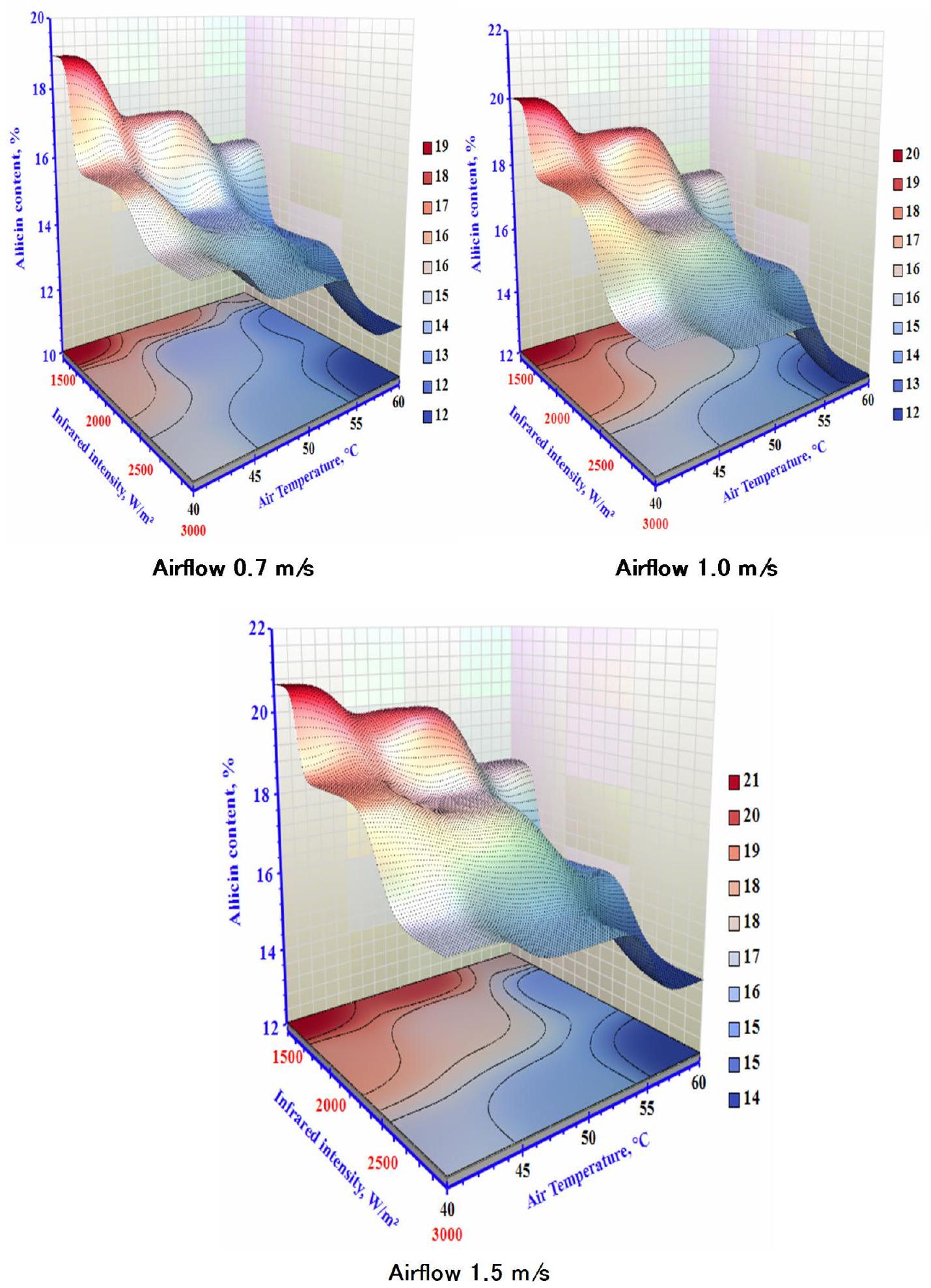
يظهر تأثير درجات الحرارة المختلفة، V، وIR على محتوى الأليسين للعينة المجففة في الشكل 8. بالإضافة إلى ذلك، كان هناك انخفاض ملحوظ في محتوى الأليسين مع مستويات أعلى من IR مع زيادة درجة الحرارة، بغض النظر عن معدلات السرعة. يمكن أن يُعزى هذا الاكتشاف إلى أن درجة الحرارة المثلى للألييناز في الثوم هي ، وتقل نشاط الألييناز عند درجات حرارة أعلى من هذه النقطة المثلى . يمكن الاحتفاظ بالأليسين بشكل أفضل عند درجات حرارة أقل بعد تمزق خلية الثوم. يمكن أن يُعزى هذا الانخفاض إلى التحلل الناتج عن الحرارة للأليين، المركب السابق للأليسين، كما وثق فنغ وآخرون. . يمكن أن يؤدي انخفاض محتوى الرطوبة إلى مستويات أعلى من الأليسين، حيث يمكن أن تؤدي زيادة درجة الحرارة عند 40 و إلى تغيير طبيعة الألييناز في الثوم، مما ينتج المزيد من الأليسين خلال عملية التجفيف. . عادةً ما تؤدي درجات حرارة المنتج الداخلية الأعلى إلى تسريع معدل تحلل الأليسين. ومع ذلك، أدت مستويات الطاقة الأشعة تحت الحمراء الأعلى إلى تقليل أوقات التجفيف. التوازن بين هذه العوامل أنتج قيم محتوى أليسين مشابهة في العينات المجففة عند مستويات طاقة أشعة تحت حمراء مختلفة. كما أظهرت المقارنة بين ظروف التجفيف المختلفة فرقًا كبيرًا، حيث أن درجة الحرارة هي التأثير الرئيسي. يمكن ربط الزيادة الكبيرة في محتوى الأليسين بارتفاع المركبات الحساسة للحرارة، حيث تعزز درجات الحرارة الأعلى تحويل المركبات الأليلية إلى ثيو سلفينات دياليل، كما أبلغ عن ذلك بورانيك وآخرون. يزداد محتوى الأليسين مع تجفيف الهواء الساخن مع ارتفاع درجة الحرارة من إلى . ومع ذلك، فإن درجات الحرارة فوق يمكن أن يتسبب في تحلل الأليسين، مما يؤدي إلى انخفاض المحتوى. أثر تدفق الهواء بشكل كبير على محتوى الأليسين في العينة. رفع (V) إلى عند أدنى (T) ونتيجة IR تقريبًا المزيد من الأليسين يتوازى مع المحتوى المنخفض من الأليسين المسجل عند مستويات عالية (T) وIR ومستويات منخفضة (V).

قوة النكهة

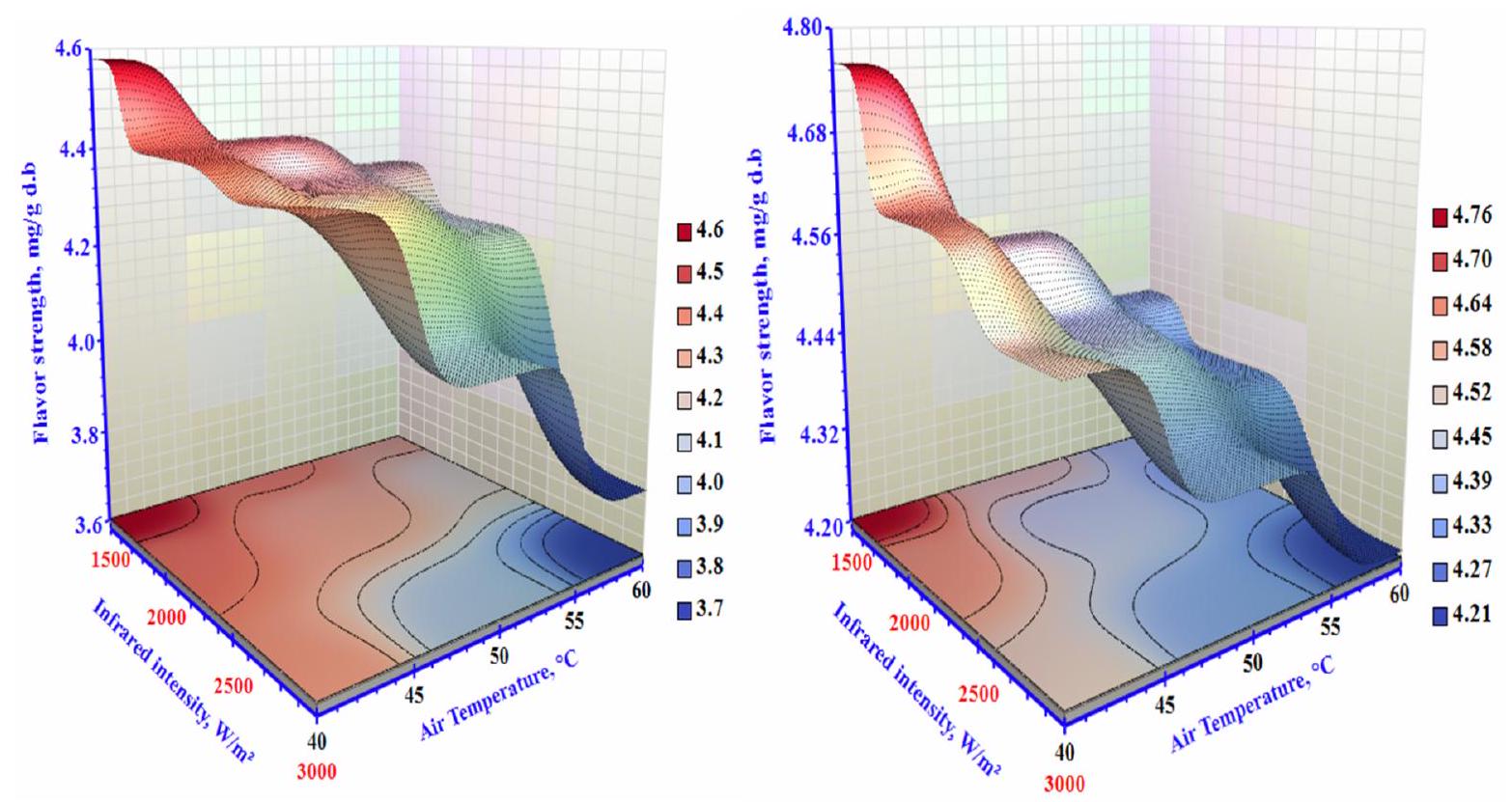
بالنظر إلى منظور الموافقة السوقية، تعتبر قوة النكهة عاملاً نوعياً حاسماً لمنتجات الثوم المجفف. تعرض الشكل 9 الثوم المجفف بمستويات نكهة متنوعة عبر إعدادات تجفيف مختلفة. لذلك، تم تسجيل أعلى محتوى نكهة تحت إعدادات V عالية، وT منخفضة، وIR. وعلى العكس، تم ملاحظة أدنى مستوى نكهة عند ، و كان هناك ارتباط بين انخفاض النكهة وزيادة درجة حرارة التجفيف من إلى من ناحية أخرى، كان هناك ارتباط سلبي بين تدفق الهواء ونكهة الثوم. وقد أبلغت نتائج مشابهة من قبل فنغ وآخرين. لثوم باستخدام التجفيف بالأشعة تحت الحمراء التحفيزية، فيجييل لتجفيف الثوم باستخدام الميكروويف الفراغي، وراو وآخرون. الذي وصف انخفاضًا في النكهة في المادة.

التغيير الكلي لألوان التغيير

اللون هو سمة جودة حاسمة تؤثر على قبول المستهلك وقيمة المواد الغذائية في السوق. الأدنى يستخدم كمعيار تصنيع لتقييم لون الثوم الجاف. تم تمثيل نتائج التغير الكلي في اللون في الشكل 10. أظهرت التحليلات الإحصائية التي تم إجراؤها أن درجة حرارة الهواء الجاف والأشعة تحت الحمراء لها تأثير كبير ( أثر على من العينة المجففة، مع يزداد بشكل ملحوظ مع ارتفاع درجة الحرارة والأشعة تحت الحمراء
تدفق الهواء
تدفق الهواء
تدفق الهواء
الشكل 6. تأثير قوة الأشعة تحت الحمراء ودرجة حرارة الهواء على نشاط الماء في الثوم المجفف عند تدفقات هواء مختلفة.
ارتفعت المستويات. مع زيادة درجة حرارة التجفيف، زاد في كل علاج بسبب زيادة شدة البني غير الإنزيمي عند درجات حرارة أعلى . تتماشى هذه النتيجة مع الذي وجد أن عمليات الجفاف المطولة تؤدي إلى تفاعلات تحمير أكثر وضوحًا، مما يؤثر على المركبات في العينات ومن المحتمل أن يؤثر على تدهور الصبغات والتفاعلات الإنزيمية وغير الإنزيمية. كما هو موضح في الشكل 10، زاد مع ارتفاع (IR) ولكنه انخفض مع زيادة (V). يمكن أن يُعزى الانخفاض في δE مع زيادة (V) إلى تأثير التبريد الناتج عن تدفق الهواء المار على العينات داخل غرفة التجفيف، مما يؤدي إلى انخفاض عام.
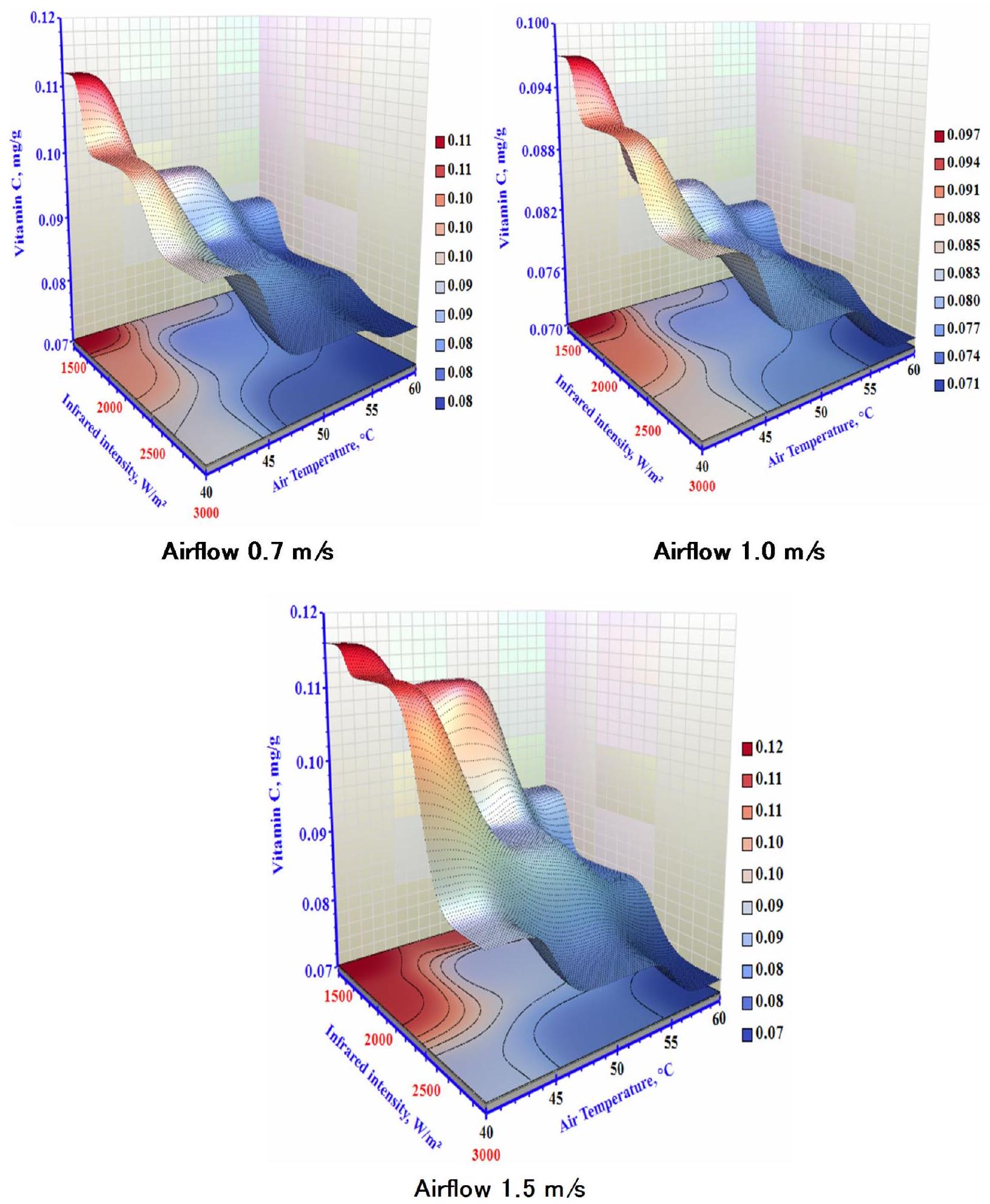
الشكل 7. تأثير قوة الأشعة تحت الحمراء ودرجة حرارة الهواء على محتوى فيتامين C في الثوم المجفف عند تدفقات هواء مختلفة.
فقدان الحرارة إلى الغرفة تاغينزاد وآخرون تمت دراسة التغير العام في لون التوت الأسود العضوي خلال عملية التجفيف بالهواء الساخن/الأشعة تحت الحمراء الهجينة، سواء مع أو بدون معالجة بالموجات فوق الصوتية، لمدة 15 و30 و45 دقيقة. أظهرت نتائجهم انخفاضًا مستمرًا في إجمالي تباين اللون في العينات مع زيادة درجة حرارة هواء التجفيف من 50 إلى ومن 60 إلى . بالمثل، أوزبك تم فحص التغير العام في لون البطاطا الحلوة باستخدام التجفيف الهجين بالأشعة تحت الحمراء/الهواء الساخن. وجدت الدراسة أن درجات حرارة الهواء الأعلى أدت إلى تغييرات أصغر في لون العينات بسمك 6 مم.
الشكل 8. تأثير قوة الأشعة تحت الحمراء ودرجة حرارة الهواء على محتوى الأليسين في الثوم المجفف عند تدفقات هواء مختلفة.

نتائج أداء التمييز

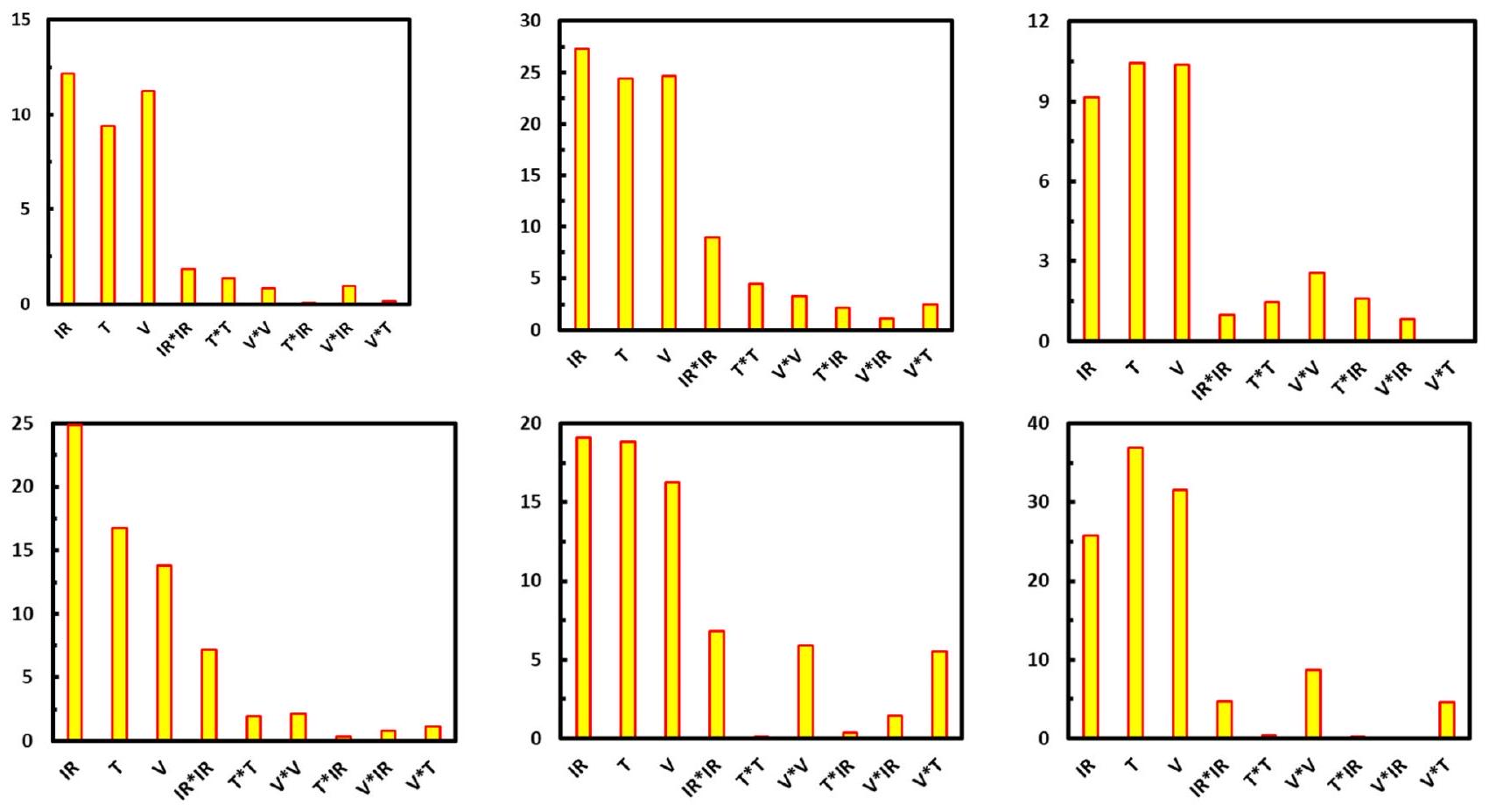
في العديد من التكوينات المختلفة، تعتبر الشبكة العصبية الاصطناعية (ANN) الطريقة المثالية لتوقع نتائج الهياكل غير الخطية. تقدير بيانات المخرجات لمجموعة المعلمات المستهدفة، وتراكب سلوك التقنية، وملء الشبكة بالبيانات التجريبية هي المكونات الرئيسية للإجراء. من مخطط باريتو (الشكل 11)، تم تقدير قيمة الحد لتكون 2.11، حيث ستكون المتغيرات ذات دلالة إحصائية فوق هذه القيمة. وغير مهم أدناه تلعب الإشعاع والسرعة ودرجة الحرارة أدوارًا أساسية
تدفق الهواء
تدفق الهواء
تدفق الهواء
الشكل 9. تأثير قوة الأشعة تحت الحمراء ودرجة حرارة الهواء على قوة نكهة الثوم المجفف عند تدفقات هواء مختلفة.
في التحكم في خصائص الجودة لجميع المتغيرات. كانت الإشعاع هو العامل الأول الذي يؤثر على اللون والأليسين ونشاط الماء، يليه درجة الحرارة والسرعة. أما بالنسبة للنكهة وفيتامين C، فإن درجة الحرارة تأتي أولاً بسبب السرعة وشدة الإشعاع. يتم أخذ التفاعل بين العوامل في الاعتبار، بينما لا يمكن لتجربة العامل الواحد تحديد التفاعلات بين المعلمات، خاصة بالنسبة للون. الاتصال بالسرعة أكثر أهمية بالنسبة للنكهة وفيتامين C، لكن تفاعل الإشعاع أكثر أهمية بالنسبة للأليسين ونشاط الماء. وفقًا للقيم الذاتية، يؤثر كل متغير على هيكل PC1 بشكل معقول، مع فيتامين
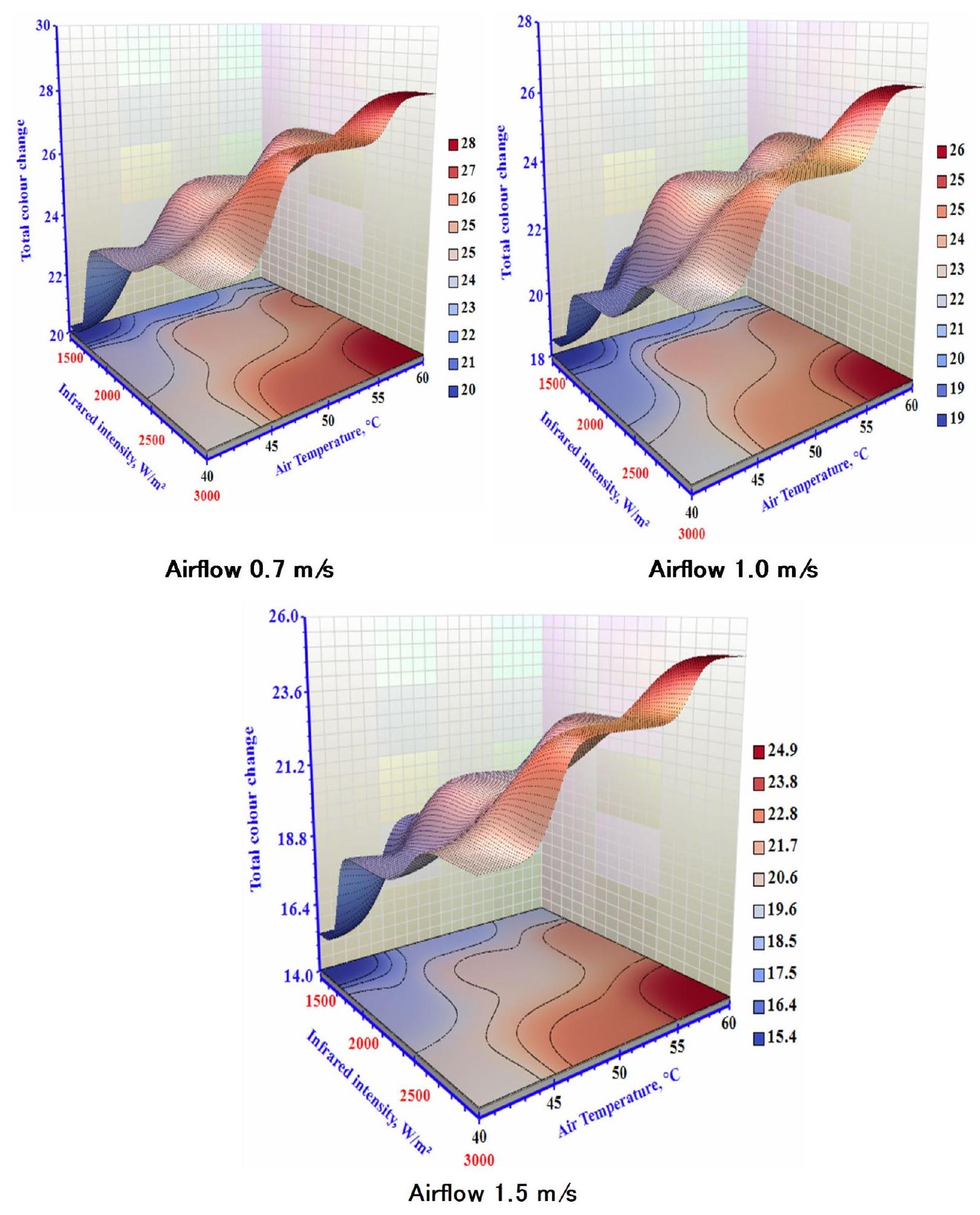
الشكل 10. تأثير قوة الأشعة تحت الحمراء ودرجة حرارة الهواء على التغير الكلي للثوم المجفف عند تدفقات هواء مختلفة.
تعتبر المتغيرات C الأكثر تأثيرًا على جميع المعلمات في تركيبة هذا المكون. من ناحية أخرى، فإن المتغيرات الأكثر أهمية في PC2 هي النكهة، نشاط الماء، ومحتوى الأليسين؛ هذه المتغيرات تؤثر على التباين وتساهم بشكل كبير في الفروق التي يمثلها هذا المكون الرئيسي. يوضح الشكل 12 العلاقة بين PC1 و PC2 لتوضيح المتغيرات المرتبطة بشكل أفضل. يرتبط فيتامين C والأليسين ونشاط الماء بشكل إيجابي، مما يشير إلى زيادته. يتواجد التغير الكلي في اللون، وPC1 الإيجابي، وPC2 السلبي في النكهة مع أولوية متزايدة، مع تقدم PC1.
الشكل 11. مخططات باريتو للخصائص الفيزيائية الكيميائية للثوم المجفف باستخدام نظام تسخين بالأشعة تحت الحمراء تحت ظروف تجفيف مختلفة.
الشكل 12. تحليل المكونات الرئيسية لشريحة الثوم المجفف المعرضة لطاقة الأشعة تحت الحمراء، وتدفق الهواء، ودرجة حرارة الهواء المجفف.
تظهر المعلومات المرفقة أنه بينما يؤثر التجفيف سلبًا على اللون، إلا أنه له تأثير إيجابي على النكهة، ونشاط الماء، وفيتامين C، والأليسين.
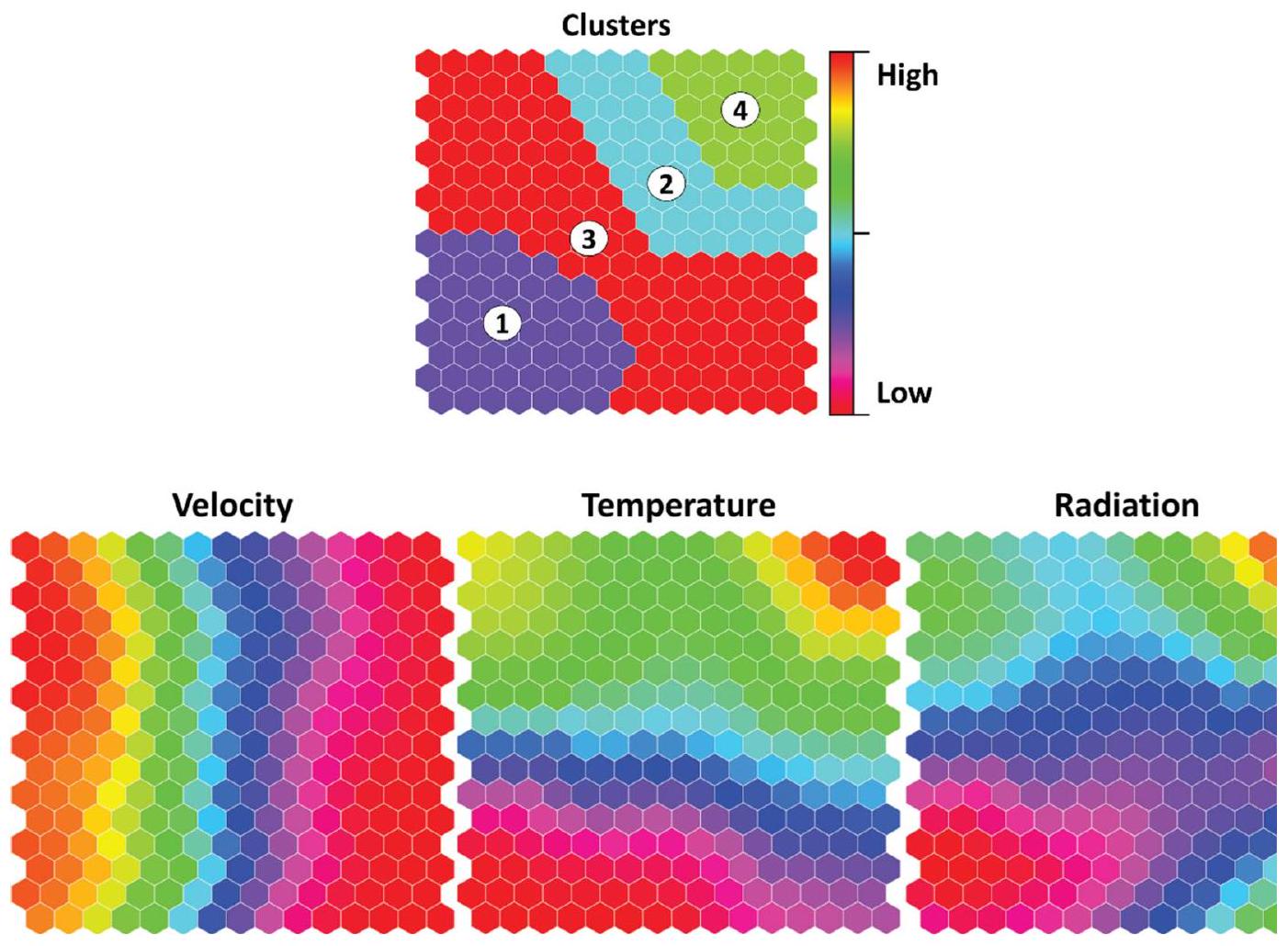
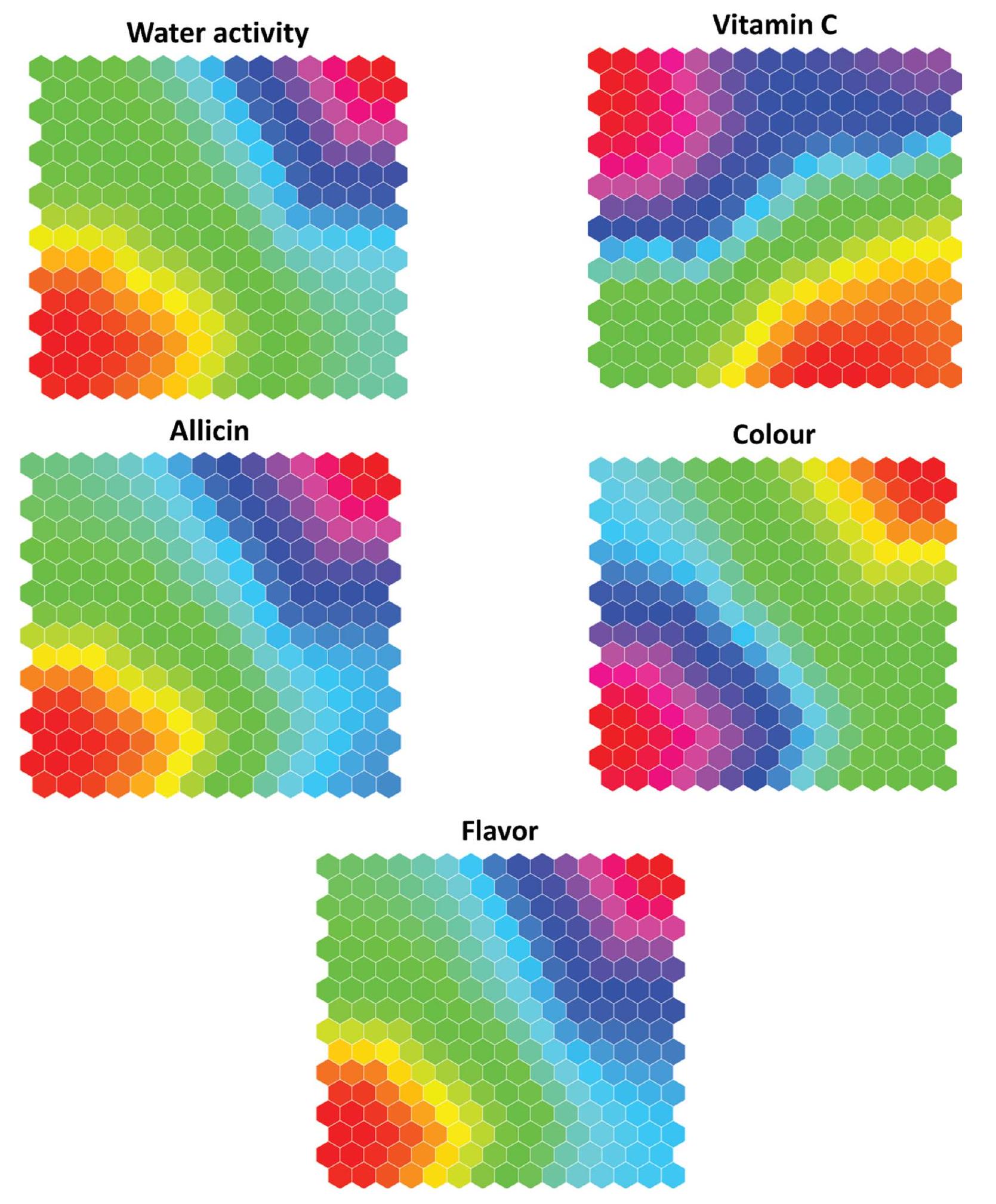
تُجمع محاكاة الشبكات العصبية الاصطناعية باستخدام خوارزميات إضافية لتحسين إعدادات المجفف أو مراقبة تقنية التجفيف من خلال طريقة الخريطة الذاتية التنظيم (SOM). على الرغم من أن التقييم السابق يوفر نظرة شاملة على جودة المواد، فإن الخرائط الذاتية التنظيم (SOM)، وهي طريقة مثيرة لاستخراج المعلومات، يمكن أن توفر معرفة بديلة حول أفضل ظروف العمل. تم عرض تمثيلات SOM في الشكل 13، والتي تم تجميعها في أربعة مجموعات وفقًا لتشابه الميزات، مع دقة التجميع. يمكن ملاحظة اختلافات كبيرة في V و T و IR عبر جميع المجموعات على الخريطة في الشكل 13، مما يوفر سياقًا كبيرًا لدراستنا. تُظهر خصائص الجودة تباينًا كبيرًا مع المجموعات في الشكل 14. تعرض الخريطة نشاطًا مائيًا عاليًا، ونكهة، ولون، وكمية متوسطة من فيتامين C للمجموعة الأولى. تحتوي هذه المجموعة على قيم أعلى لكل من الحمل الحراري والإشعاع. يشير اللون إلى قيم منخفضة إلى متوسطة نسبيًا، بينما يُظهر فيتامين C قيمًا متوسطة إلى عالية. تحتوي هذه المجموعة على نطاق واسع من التغيرات في الحمل الحراري والإشعاع، من القيم المنخفضة إلى العالية. يُظهر نشاط الماء، والأليسين، والنكهة في المجموعة الثانية قيمًا أقل، بينما يُظهر اللون قيمًا متوسطة. تحتوي هذه المجموعة على قيم عالية السرعة مع قيم متوسطة لكل من درجة الحرارة والإشعاع. في المجموعة الرابعة، تُظهر جميع المتغيرات قيمًا أعلى، بينما تحتوي كل من الحمل الحراري والإشعاع أيضًا على قيم أعلى.

الخاتمة

تطبيق خوارزميات التعلم الآلي لتحسين عمليات تجفيف الطعام يزداد شعبية في صناعة المواد الغذائية بسبب قدرتها على تحسين إعدادات التجفيف مع الحفاظ على الخصائص الفيزيائية والكيميائية (تغير اللون الكلي، قوة النكهة، نشاط الماء، فيتامين C، ومحتوى الأليسين). الشبكة العصبية الاصطناعية (ANN) مع توقع الدقة وخرائط التنظيم الذاتي (SOM) مع تم استخدام دقة التجميع لتحديد الخصائص النوعية للثوم. تبحث هذه الدراسة في كيفية تأثير تدفق الهواء ودرجة الحرارة ومستويات الأشعة تحت الحمراء على الخصائص الفيزيائية والكيميائية للثوم. وجدت الدراسة أن تدفق الهواء العالي ودرجات الحرارة المنخفضة ومستويات الأشعة تحت الحمراء حققت أعلى محتوى من النكهة. في المقابل، حدث أقل محتوى من النكهة عند ، و ز. زادت الفروق اللونية الإجمالية مع زيادة شدة الأشعة تحت الحمراء ودرجة حرارة الهواء، ولكنها انخفضت مع انخفاض تدفق الهواء. تم العثور على خمسة مجالات للتحسين باستخدام نهج (SOM)؛ أشار المجموعة الرابعة إلى إمكانية تحسين الجودة من خلال الحفاظ على درجة حرارة الهواء والأشعة تحت الحمراء ثابتة. تسلط الدراسة الضوء على أهمية دمج التحليل الإحصائي المتقدم وتعلم الآلة لتحسين معالجة المواد الغذائية. يمكن أن تبحث الأبحاث المستقبلية في تطبيق هذه الأساليب عبر مختلف الأطعمة وطرق التجفيف، مما قد يحول الصناعة من خلال استخدام الإحصائيات لتحسين جودة المنتج وكفاءة العمليات.
هنا، نقدم الاقتراحات التالية للتطوير لتوفير بعض الاتجاهات لتجفيف الطعام في المستقبل: (أ) يمكن أن يؤدي تطوير تقنيات المراقبة ذات الصلة لتجفيف الفواكه والخضروات، مثل رؤية الكمبيوتر وتقنية المستشعرات، إلى تمكيننا من مراقبة العملية المعقدة لتجفيف الطعام بشكل أفضل. (ب) يمكن أن تحل تقنية التجفيف المعتمدة على المجالات الفيزيائية الفعالة العديد من المشكلات في تجفيف الفواكه والخضروات، ولكن كل واحدة
الشكل 13. مجموعات خريطة التنظيم الذاتي (SOM) لمصفوفة ظروف التجفيف.
الشكل 14. مجموعات خرائط التنظيم الذاتي لمتغيرات الإخراج (إجمالي تغيير اللون، قوة النكهة، نشاط الماء، فيتامين C، ومحتوى الأليسين) لشريحة الثوم المجفف.
للتكنولوجيا عيوب. يمكن لتقنيات التجفيف في المجالات الفيزيائية عالية الكفاءة أن تحل مشاكل مختلفة. يمكن أن تزيد تقنيات المعالجة بالموجات فوق الصوتية والميكروويف من معدل التجفيف، لكن تجانس التجفيف ليس جيدًا بما فيه الكفاية. يمكن استخدام دمج هذه التقنيات الفعالة في مجالات التجفيف الفيزيائية في مساحات أو أوقات مختلفة لتحقيق أقصى استفادة من تحسين المنتجات المجففة. باستخدام مزايا تقنيات الذكاء الاصطناعي المختلفة، يمكننا مراقبة عملية التجفيف بشكل أفضل، والتحكم في التطبيق المعقول لهذه التقنيات الفعالة في الوقت والمكان، وتحليل ونمذجة عملية التجفيف.

توفر البيانات

بيان توافر البيانات: المساهمات الأصلية المقدمة في الدراسة مدرجة في المقالة؛ يمكن توجيه المزيد من الاستفسارات إلى المؤلف الأول (هاني س. المصري،elmesiry@ujs.edu.cn) والمؤلف المراسل.
تاريخ الاستلام: 2 أغسطس 2024؛ تاريخ القبول: 16 يناير 2025
نُشر على الإنترنت: 24 يناير 2025

References

  1. Sharma, G. P. & Prasad, S. Specific energy consumption in microwave drying of garlic cloves. Energy 31, 1921-1926 (2006).
  2. EL-Mesery, H. S. & El-khawaga, S. E. Drying process on biomass: evaluation of the drying performance and energy analysis of different dryers. Case Stud. Therm. Eng. 33, 101953 (2022).
  3. Krishnamurthy, K., Khurana, H. K., Soojin, J., Irudayaraj, J. & Demirci, A. Infrared heating in food processing: an overview. Compr. Rev. Food Sci. Food Saf. 7, 2-13 (2008).
  4. Zhou, L. et al. Drying of garlic slices (Allium sativum L.) and its effect on thiosulfinates, total phenolic compounds and antioxidant activity during infrared drying. J. Food Process. Preserv. 41, e12734 (2017).
  5. Pishva, P. & Azadmard Damirchii, S. The effect of different pre-treatments prior to garlic drying on the quality of produced garlic powder. Food Sci. Technol. 17, 177-184 (2020).
  6. Feng, Y. et al. Effect of freeze-thaw cycles pretreatment on the vacuum freeze-drying process and physicochemical properties of the dried garlic slices. Food Chem. 324, 126883 (2020).
  7. El-Mesery, H. S., Hu, Z., Ashiagbor, K. & Rostom, M. A study into how thickness, infrared intensity, and airflow affect drying kinetics, modeling, activation energy, and quality attributes of apple slices using infrared dryer. J. Food Sci. (2024).
  8. El-Mesery, H. S., Ashiagbor, K., Hu, Z. & Rostom, M. Mathematical modeling of thin-layer drying kinetics and moisture diffusivity study of apple slices using infrared conveyor-belt dryer. J. Food Sci. 89, 1658-1671 (2024).
  9. El-Mesery, H. S. et al. Effects of storage conditions and packaging materials on the postharvest quality of fresh Chinese tomatoes and the optimization of the tomatoes’ physiochemical properties using machine learning techniques. LWT 201, 116280 (2024).
  10. Kalsi, B. S., Singh, S., Alam, M. S. & Bhatia, S. Microwave drying modelling of Stevia rebaudiana leaves using artificial neural network and its effect on color and biochemical attributes. J. Food Qual. 2811491 (2023). (2023).
  11. Miraei Ashtiani, S. H. & Martynenko, A. Toward intelligent food drying: integrating artificial intelligence into drying systems. Dry. Technol. 42, 1240-1269 (2024).
  12. Omari, A., Behroozi-Khazaei, N. & Sharifian, F. Drying kinetic and artificial neural network modeling of mushroom drying process in microwave-hot air dryer. J. Food Process. Eng. 41, e12849 (2018).
  13. Kaur, M., Bhatia, S., Kalsi, B. S. & Phutela, U. G. Unveiling the biomass conversion potential: study on drying methods’ influence on polyphenols and linked antioxidant activities in euryhaline microalgal biomass with AI-predicted drying kinetics. Biomass Convers. Biorefinery 1-16 (2024).
  14. Jafari, S. M., Ghanbari, V., Ganje, M. & Dehnad, D. Modeling the drying kinetics of green bell pepper in a heat pump assisted fluidized bed dryer. J. Food Qual. 39, 98-108 (2016).
  15. Nadian, M. H., Rafiee, S., Aghbashlo, M., Hosseinpour, S. & Mohtasebi, S. S. Continuous real-time monitoring and neural network modeling of apple slices color changes during hot air drying. Food Bioprod. Process. 94, 263-274 (2015).
  16. Sarimeseli, A., Coskun, M. A. & Yuceer, M. Modeling microwave drying kinetics of Thyme (T hymus Vulgaris L.) leaves using ANN Methodology and dried product quality. J. Food Process. Preserv. 38, 558-564 (2014).
  17. Zalpouri, R. et al. Drying kinetics, physicochemical and thermal analysis of onion puree dried using a refractance window dryer. Processes 11, 700 (2023).
  18. Khazaei, N. B., Tavakoli, T., Ghassemian, H., Khoshtaghaza, M. H. & Banakar, A. Applied machine vision and artificial neural network for modeling and controlling of the grape drying process. Comput. Electron. Agric. 98, 205-213 (2013).
  19. Zalpouri, R. et al. Mathematical and artificial neural network modelling for refractance window drying kinetics of coriander (Coriandrum sativum L.) followed by the determination of energy consumption, mass transfer parameters and quality. Biomass Convers. Biorefinery 1-17 (2023).
  20. Kalsi, B. S., Singh, S., Alam, M. S. & Sidhu, G. K. Comparison of ANN and ANFIS modeling for predicting drying kinetics of Stevia rebaudiana leaves in a hot-air dryer and characterization of dried powder. Int. J. Food Prop. 26, 3356-3375 (2023).
  21. AOAC. Official Method of Analysis. 18th Edition. AOAC Press. Maryland, USA. (2005). https://doi.org/10.32741/fihb.3.honey
  22. Salehi, F., Cheraghi, R. & Rasouli, M. Mass transfer kinetics (soluble solids gain and water loss) of ultrasound-assisted osmotic dehydration of apple slices. Sci. Rep. 12, 15392 (2022).
  23. EL-Mesery, H. S. Improving the thermal efficiency and energy consumption of convective dryer using various energy sources for tomato drying. Alexandria Eng. J. 61, 10245-10261 (2022).
  24. El-Mesery, H. S. & Mwithiga, G. Performance of a convective, infrared and combined infrared- convective heated conveyor-belt dryer. J. Food Sci. Technol. 52, 2721-2730 (2015).
  25. Madhu, B., Mudgal, V. D. & Champawat, P. S. Influence of the packaging material and storage temperature on the shelf life of garlic powder. J. Food Sci. Technol. 1-11 (2021).
  26. Feng, Y. et al. Improvement of the catalytic infrared drying process and quality characteristics of the dried garlic slices by ultrasound-assisted alcohol pretreatment. Lwt 116, 108577 (2019).
  27. Salehi, F. & Kashaninejad, M. Modeling of moisture loss kinetics and color changes in the surface of lemon slice during the combined infrared-vacuum drying. Inf. Process. Agric. 5, 516-523 (2018).
  28. Ahmed, A. N. et al. Machine learning methods for better water quality prediction. J. Hydrol. 578, 124084 (2019).
  29. Ashtiani, S. H. M., Javanmardi, S., Jahanbanifard, M., Martynenko, A. & Verbeek, F. J. Detection of mulberry ripeness stages using deep learning models. IEEE Access. 9, 100380-100394 (2021).
  30. Ali Hameed, A., Karlik, B., Salman, M. S. & Eleyan, G. Robust adaptive learning approach to self-organizing maps. KnowledgeBased Syst. 171, 25-36 (2019).
  31. Kaveh, M. et al. Machine learning approaches for estimating apricot drying characteristics in various advanced and conventional dryers. J. Food Process. Eng. 46, e14475 (2023).
  32. EL-Mesery, H. S., Sarpong, F. & Atress, A. S. H. Statistical interpretation of shelf-life indicators of tomato (Lycopersicon esculentum) in correlation to storage packaging materials and temperature. J. Food Meas. Charact. 1-11 (2021).
  33. Miraei Ashtiani, S. H., Salarikia, A. & Golzarian, M. R. Analyzing drying characteristics and modeling of thin layers of peppermint leaves under hot-air and infrared treatments. Inf. Process. Agric. 4, 128-139 (2017).
  34. Dhaliwal, H. K., Gänzle, M. & Roopesh, M. S. Influence of drying conditions, food composition, and water activity on the thermal resistance of Salmonella enterica. Food Res. Int. 147, 110548 (2021).
  35. Wang, J. & Chao, Y. Drying characteristics of irradiated apple slices. J. Food Eng. 52, 83-88 (2002).
  36. Royen, M. J., Noori, A. W. & Haydary, J. Experimental study and mathematical modeling of convective thin-layer drying of apple slices. Processes 8, 1-17 (2020).
  37. İlter, I. et al. Microwave and hot air drying of garlic puree: drying kinetics and quality characteristics. Heat. Mass. Transf. 54, 2101-2112 (2018).
  38. Liu, Z. L. et al. Effect of high-humidity hot air impingement blanching (HHAIB) and drying parameters on drying characteristics and quality of broccoli florets. Dry. Technol. (2019).
  39. Baeghbali, V., Ngadi, M. & Niakousari, M. Effects of ultrasound and infrared assisted conductive hydro-drying, freeze-drying and oven drying on physicochemical properties of okra slices. Innov. Food Sci. Emerg. Technol. 63, 102313 (2020).
  40. Sharma, G. P. & Prasad, S. Optimization of process parameters for microwave drying of garlic cloves. J. Food Eng. 75, 441-446 (2006).
  41. Guo, X. et al. An evaluation of different pretreatment methods of hot-air drying of garlic: drying characteristics, energy consumption and quality properties. Lwt 180, 114685 (2023).
  42. Feng, Y. et al. Effect of catalytic infrared dry-blanching on the processing and quality characteristics of garlic slices. Food Chem. 266, 309-316 (2018).
  43. Thuwapanichayanan, R., Prachayawarakorn, S. & Soponronnarit, S. Heat and moisture transport behaviour and quality of chopped garlic undergoing different drying methods. J. Food Eng. 136, 34-41 (2014).
  44. Puranik, V., Mishra, V., Singh, N. & Rai, G. K. N. S. Studies on development of protein rich germinated green gram pickle and its preservation by using class one preservatives. (2011).
  45. Figiel, A. Drying kinetics and quality of vacuum-microwave dehydrated garlic cloves and slices. J. Food Eng. 94, 98-104 (2009).
  46. Rao, P. P., Nagender, A., Rao, L. J. & Rao, D. G. Studies on the effects of microwave drying and cabinet tray drying on the chemical composition of volatile oils of garlic powders. Eur. Food Res. Technol. 224, 791-795 (2007).
  47. El-Mesery, H. S., Qenawy, M., Hu, Z. & Alshaer, W. G. Evaluation of infrared drying for okra: Mathematical modelling, moisture diffusivity, energy activity and quality attributes. Case Stud. Therm. Eng. 50, 103451 (2023).
  48. Geng, Z., Torki, M., Kaveh, M., Beigi, M. & Yang, X. Characteristics and multi-objective optimization of carrot dehydration in a hybrid infrared/hot air dryer. LWT 172, 114229 (2022).
  49. Salarikia, A., Miraei Ashtiani, S. H. & Golzarian, M. R. Comparison of drying characteristics and quality of Peppermint leaves using different drying methods. J. Food Process. Preserv. 41, 1-13 (2017).
  50. Taghinezhad, E., Kaveh, M., Khalife, E. & Chen, G. Drying of organic blackberry in combined hot air-infrared dryer with ultrasound pretreatment. Dry. Technol. 39, 2075-2091 (2021).
  51. Özbek, H. N. Radio frequency-assisted hot air drying of carrots for the production of carrot powder: Kinetics and product quality. Lwt 152, 112332 (2021).
  52. Golpour, I., Kaveh, M., Amiri Chayjan, R. & Guiné, R. P. F. Optimization of Infrared-convective drying of White Mulberry Fruit using response surface methodology and development of a predictive model through Artificial neural network. Int. J. Fruit Sci. 20, S1015-S1035 (2020).
  53. Bhotmange, M. & Shastri, P. Application of Artificial Neural Networks to Food and Fermentation Technology. in (ed. Suzuki, K.) Ch. 10IntechOpen, (2011). https://doi.org/10.5772/16067
  54. Boateng, I. D., Yang, X. M. & Li, Y. Y. Optimization of infrared-drying parameters for Ginkgo biloba L. seed and evaluation of product quality and bioactivity. Ind. Crops Prod. 160, 113108 (2021).

مساهمات المؤلفين

مساهمات المؤلفين: التصور، H.S.E.، M.Q.، M.A.، وM.R.; المنهجية، H.S.E.، M.Q.، وM.A.; البرمجيات، H.S.E.، M.Q.، وM.A.; التحقق، H.S.E.، M.Q.، M.A.، وM.R.; التحليل الرسمي، H.S.E. وM.Q.; التحقيق، H.S.E.، M.Q.، M.A.، M.R.، A.E.، A.S.، وA.E.E.; الموارد، H.S.E.، M.Q.، M.A.، A.E.، A.S.، وM.R; تنظيم البيانات، H.S.E.، M.Q.، M.A.، وM.R.; كتابة – إعداد المسودة الأصلية، H.S.E. وM.Q.; الكتابة – المراجعة والتحرير، H.S.E.، A.E.، A.S.، وM.Q.; التصور، H.S.E.، M.Q.، M.A.، وM.R.; الإشراف، H.S.E.; إدارة المشروع، H.S.E.، M.Q.، M.A.، M.R.، A.E.، A.S.، وA.E.E.; الحصول على التمويل، H.S.E.، A.E.، A.S.، وA.E.E. جميع المؤلفين قرأوا ووافقوا على النسخة المنشورة من المخطوطة.

تمويل

تم توفير تمويل الوصول المفتوح من قبل جامعة بيكس. لم تتلقَ هذه البحث أي تمويل خارجي.

الإعلانات

المصالح المتنافسة

يعلن المؤلفون عدم وجود مصالح متنافسة.

بيان لجنة المراجعة المؤسسية

غير قابل للتطبيق.
غير قابل للتطبيق.

معلومات إضافية

يجب توجيه المراسلات والطلبات للحصول على المواد إلى م.ق. أو أ.س.
معلومات إعادة الطبع والتصاريح متاحة علىwww.nature.com/reprints.
ملاحظة الناشر: تظل شركة سبرينغر ناتشر محايدة فيما يتعلق بالمطالبات القضائية في الخرائط المنشورة والانتماءات المؤسسية.
الوصول المفتوح هذه المقالة مرخصة بموجب رخصة المشاع الإبداعي النسب 4.0 الدولية، التي تسمح بالاستخدام والمشاركة والتكيف والتوزيع وإعادة الإنتاج بأي وسيلة أو صيغة، طالما أنك تعطي الائتمان المناسب للمؤلفين الأصليين والمصدر، وتوفر رابطًا لرخصة المشاع الإبداعي، وتوضح ما إذا تم إجراء تغييرات. الصور أو المواد الأخرى من طرف ثالث في هذه المقالة مشمولة في رخصة المشاع الإبداعي الخاصة بالمقالة، ما لم يُشار إلى خلاف ذلك في سطر الائتمان للمادة. إذا لم تكن المادة مشمولة في رخصة المشاع الإبداعي الخاصة بالمقالة وكان استخدامك المقصود غير مسموح به بموجب اللوائح القانونية أو يتجاوز الاستخدام المسموح به، فستحتاج إلى الحصول على إذن مباشرة من صاحب حقوق الطبع والنشر. لعرض نسخة من هذه الرخصة، قم بزيارةhttp://creativecommons.org/licenses/by/4.0/.
© المؤلفون 2025

  1. مدرسة الطاقة وهندسة الطاقة، جامعة جيانغسو، تشنجيانغ 212013، الصين. معهد بحوث الهندسة الزراعية، مركز البحوث الزراعية، الدقي، الجيزة 12611، مصر. قسم الهندسة الميكانيكية، كلية هندسة الطاقة، جامعة أسوان، أسوان 81528، مصر. أكاديمية البحث العلمي والتكنولوجيا، ASRT، القاهرة، مصر. قسم الهندسة الزراعية، كلية الزراعة، جامعة المنصورة، المنصورة 35516، مصر. قسم الهندسة المدنية، كلية الهندسة، جامعة المنيا، المنيا 61111، مصر. مجموعة أبحاث التشخيصات الهيكلية والتحليل، كلية الهندسة وتكنولوجيا المعلومات، جامعة بيكس، بيكس، المجر. قسم الهندسة الزراعية، كلية الزراعة والموارد الطبيعية، جامعة أسوان، أسوان، مصر. البريد الإلكتروني:m_qenawy@ujs.edu.cn; salem.ali@mik.pte.hu

Journal: Scientific Reports, Volume: 15, Issue: 1
DOI: https://doi.org/10.1038/s41598-025-87167-5
PMID: https://pubmed.ncbi.nlm.nih.gov/39856175
Publication Date: 2025-01-24

OPEN

Optimization of dried garlic physicochemical properties using a self-organizing map and the development of an artificial intelligence prediction model

Hany S. El-Mesery , Mohamed Qenawy , Mona Ali , Merit Rostom , Ahmed Elbeltagi , Ali Salem & Abdallah Elshawadfy Elwakeel

Abstract

The experiments were conducted at different levels of infrared power, airflow, and temperature. The relationships between the input process factors and response factors’ physicochemical properties of dried garlic were optimized by a self-organizing map (SOM), and the model was developed using machine learning. Artificial Neural Network (ANN) with 99% predicting accuracy and Self-Organizing Maps (SOM) with 97% clustering accuracy were used to determine the quality characteristics of garlic. Specifically, five key areas were identified, and valuable insights were offered for optimizing garlic production and improving its overall quality. The (aw) values for the sample ranged from 0.43 to 0.48. The maximum vitamin C content was , followed by an air temperature of and air velocity under . The total color change values increased with IR and higher air temperature but declined with higher air velocity. Also, the garlic’s flavor strength, allicin content, water activity, and vitamin C levels decreased as the IR and air temperature increased. The results demonstrated a significant impact of the independent parameters on the response parameters ( ). Interestingly, the machine learning predictions closely matched the test data sets, providing valuable insights for understanding and controlling the factors affecting garlic drying performances.

Keywords Machine learning, Continuous dryers, Infrared drying, Physicochemical properties
Scientifically known as Allium sativum, Garlic has been cultivated globally for centuries due to its unique culinary and medicinal properties . It has gained significant recognition as a valuable condiment in everyday food preparation. Garlic is rich in valuable components like allicin, selenium (Se), germanium (Ge), and superoxide dismutase (SOD), which are bioactive substances with numerous benefits for human health. Allicin, in particular, possesses antioxidant and antibiotic properties. Regrettably, despite garlic’s multiple health benefits to humans, around of the garlic crop is lost during storage due to microbial and respiratory spoilage . Fresh garlic has a high moisture content (more than ), which promotes garlic clove sprouting and rotting during storage, resulting in a shorter shelf life. Thus, to extend garlic’s shelf life while maintaining its nutritional value, the moisture content of garlic must be reduced to . Dehydrating garlic cloves using convection drying methods, such as tray dryers, is time-consuming and requires substantial energy . In convective drying, the outer part of the garlic primarily undergoes heating through convection, while the remaining parts are heated through conduction. This process removes moisture from the garlic surface, resulting in a moisture gradient that facilitates the movement of liquid towards the outer layer . However, convective drying has several disadvantages, including lengthy drying times, potentially negative effects on sensory characteristics and nutritional properties,
and the migration of solutes from the inside of the food to the surface, resulting in case hardening. As drying technology advances, newer and more sophisticated dryers have been designed to address the shortcomings of hot air dryers and enhance the quality of the dried products . In recent years, infrared dryers have gained popularity and garnered increased attention in developing countries because of their affordability, simplicity, and low operational costs. Infrared drying involves heating wet materials using infrared radiation .
Accurately predicting drying parameters is vital for enhancing process conditions, reducing energy usage, and maintaining stable product quality. Artificial neural networks (ANNs) have become essential for analyzing intricate relationships across various fields, particularly food processing. Artificial intelligence (AI) and its data-driven counterpart, machine learning (ML), are rapidly evolving disciplines with increasing applications in modeling, simulation, control, and optimization within the food processing industry . This integration facilitates automated decision-making, reducing human errors and enhancing operational efficiency in food drying . Moreover, AI models demonstrate proficiency in predicting drying times and analyzing energy usage patterns, thereby enabling optimization to minimize resource consumption while preserving product quality . A model that leverages the predictive capabilities of ANNs to accurately forecast the drying process based on input variables like product thickness, cabin pressure, and drying time is crucial for saving time and energy . Jafari et al. found that the ANN model outperformed mathematical modeling methods regarding productivity and accuracy when predicting variations in the moisture ratio of green bell peppers during hot air fluidized bed drying. Similarly, Nadian et al. developed an ANN model to forecast the color changes in sliced apples during hot air drying. In another study, Sarimeseli et al. applied an ANN to model the microwave-drying kinetics of thyme leaves. Zalpouri et al. investigated the onion puree of varying thicknesses, and it was dried using RWD and CD methods to evaluate drying kinetics, physicochemical qualities, and thermal analysis of the dried powder. The results showed an increase in the thickness of the puree from 2 to 6 mm , and drying time increased from 135 to 240 min for RWD and 510 to 660 min for CD. To predict accurate MR of onion puree using RWD and CD, MLF- ANN with a back-propagation algorithm was used. ANN was an effective method for predicting MR for both drying methods. The result showed that the ANN model with 12 and 18 neurons in the hidden layer could predict the MR, with a high value for RWD and CD, respectively. Khazaei et al. employed ANN to predict and control the grape drying procedure in a hot air dryer. Although there are many studies on drying various agricultural products, no research specifically focused on drying garlic slices using continuous infrared-assisted convective hot air drying and optimizing the process with ANN techniques about quality attributes. Zalpouri et al. observed that an artificial neural network (ANN) model predicted MR. The mathematical modeling showed that the Exponential two-term model had the highest and lowest RSME and SEE values. Moreover, MR was accurately predicted using MLF-ANN with a back-propagation algorithm, outperforming the mathematical model. Mass transfer calculated using Dincer and Dost analytical approach showed Deff and hm in the range of to and to , respectively. Kalsi et al. investigated the drying of Stevia rebaudiana leaves in a convection dryer under different air temperatures to analyze the drying kinetics, Artificial Neural Networks (ANNs), and Adaptive Neuro-Fuzzy System (ANFIS) models to predict the drying kinetics of leaves. Further, dried leaf powders were analyzed for color properties, ascorbic acid and total phenol contents, antioxidant activity, water activity, water solubility index, hygroscopicity, density, bulk porosity, flowability indices, Carr index, and angle of repose. The results showed that the ANFIS model with of 0.9998 , offers a more accurate forecast of the drying kinetics of leaves dried in a convective hot-air dryer in comparison to mathematical and ANN modeling. This study employs a continuous dryer to examine the impact of varying infrared intensities, airflow, as well as air temperature on the physicochemical properties of garlic powder, including (total color change, flavor strength, water activity, vitamin C, and allicin content) during infrared drying. The research also aims to develop a machine learning-based model to forecast the changes in the physicochemical quality of dried garlic powder. A novel approach for discovering how to optimize the conditions of the study is offered by self-organizing maps (SOM). Principal component analysis (PCA) is used to understand drying conditions and the relationship between the physicochemical quality of dried garlic powder.

Materials and methods

Sample preparation

Fresh garlic clove (Allium sativum L.) was obtained from the local shop and reserved in the refrigerator at for further analysis. After a 2 -hour stabilization period at ambient temperature, the samples were peeled and sliced into 6 mm thick pieces using an industrial food slicer before drying. To prevent nonenzymatic browning, the garlic samples were immersed in a Sodium metabisulfite solution at . Fresh samples of approximately 500 g were dehydrated until 0.05 g water dry basis of final moisture content was achieved using the infrared dryer.

Conveyor-belt dryer

The garlic drying process used a hybrid conveyor belt dryer with an infrared heating system. The dryer, measuring in length, height, and weight, includes a conveyor belt system, feeder, hot air convection system, drying chamber, product collection area, and infrared heating system.

Drying chamber

The dryer was designed with a drying chamber divided into two equal sections, each measuring , constructed from 2 mm thick stainless-steel sheets. The exterior walls were shielded with an asbestos layer. A stainless-steel wire mesh conveyor belt connected the drying chambers and was employed to move samples in and out.

Hot air convection system

The convective hot air system has a fan and two electric heaters to generate the required drying air velocity ( 0.2 to ). The airflow into the chamber was controlled by a valve positioned at the inlet of the PVC pipe. The air was warmed by flowing over two spiral electric heaters with a 1.5 kW size. A control unit manages these heaters to ensure a steady temperature throughout the drying process.

Infrared heat system

The infrared heating system was equipped with 1000 W halogen lamps (Philips, tube type), each measuring 35.5 cm long and 0.6 cm in diameter. With a heating intensity range, the IR lamps were mounted on the drying chamber’s upper interior surface to enable even heating. The IR lamps parallel the conveyor belt at a 15 cm spacing between them. The infrared radiation intensity of the lamps could be varied by regulating the voltage through a power regulator.

Conveyor-belt system

A switch could halt the conveyor when the product was placed directly beneath the infrared heaters. This dryer lets infrared and hot air heating be used independently or instantaneously by switching the heating systems on and off. The air temperature during the drying process was tracked with T-type thermocouples linked to a data logger, which has an accuracy of . In contrast, the air velocity within the chamber was measured using a hot wire anemometer with an accuracy of .

Drying technique

The dryer was established at drying airflows of , and applied at 40,50 , and , drying air temperatures under different infrared intensities (IR) of 1500,2000 , and . The dryer was run for 45 min to achieve steady-state drying conditions before each drying test. The samples were dried until their final moisture content dropped below 0.05 g water/g dry basis (total drying time ranged from 10 to 5 h ). The dried garlic slices were crushed by grinding, and the garlic powder was stored at until use.

Moisture content

About 20 g of the sample was placed in a dish and dried in a vacuum oven at 85 kPa and for for garlic’s initial moisture content. After drying, the sample was weighed three times to obtain an average value. The garlic’s initial moisture content was about (w.b.). The garlic’s moisture content ( ) was determined using Eq. .
The final moisture content was determined on dry bases following Eq. .
The Mt of the dry sample over time t is given by Eq. .

Water activity (aw)

A 3 g sample was used to measure water activity ( ) at by the LabMASTER technique. The machine measures the air humidity by closing the samples in a controlled closed chamber to accurately and reliably assess water activity ( ).

Vitamin C content

The vitamin C content of the sample was determined using the 2,6-dichlorophenol indophenol standard titration method . The reagents used were (meta-phosphoric acid) solution, ascorbic acid standard containing 0.1 mg Lascorbic acid in 1 ml of 3% , and the dye solution containing 50 mg of 2,6-dichlorophenolindophenol in 200 ml of distilled water. The vitamin C retention rate was calculated according to the Eq. 4.

Flavor strength determination

The Chloramine-T method assessed the volatile oil containing sulfur compounds responsible for garlic’s pungency. The volatile oil content in the material was determined in mg oil per g of dry matter .

Allicin content determination

The amount of allicin in the initial and dry sample was measured at 412 nm based on the spectrophotometric method detailed by . The allicin content (AC) was extracted as relative retention compared to fresh garlic, as described in Eq. 5.
and are the allicin of fresh ( ) and dried ( ) samples ( ), respectively.

The total color changes measurement ( )

The color of fresh and dried samples was assessed with a colorimeter according to the method outlined by . In summary, five color capacities were taken from the sample’s surface for each examination, and the mean color changes were verified. The total color changes ( ) were computed using Eq. 6.
, and a denote whiteness, yellowness/blueness, and redness/greenness values. The subscript ” 0 ” represents the color value of the garlic. A high value of total color changes ( ) means a greater change in the blanched sample color.

Machine learning approaches

Artificial neural network (ANN)

Artificial Neural Networks (ANNs) are a powerful, data-driven artificial intelligence technique. It is machine learning-based modeling with a supervised learning concept. An ANN consists of three layers: input, hidden, and output. Data is transmitted via the neurons from an input layer to the layers below. The neurons in the output and input layers significantly impact the variables. Although having more neurons can reduce errors, it is also more time-consuming. Weights and transfer functions modify the signals passing through the neurons, and this process repeats until the desired output is achieved. The number of neurons in each layer can vary depending on the problem’s structure . Figure 1 illustrates the procedure, including the training and prediction stages of the ANN. The ANN architecture in Fig. 2 includes input, output, and hidden layers. The current ANN model comprises three input factors: air temperature (T), airflow (V), infrared intensity (IR), and garlic physicochemical properties.
The ANN model was successfully integrated with other methods, mainly the (SOM) approach, to optimize drying conditions and provide valuable data on a drying type. The SOM procedure, a key example of unverified machine learning-based modeling with an unsupervised learning concept, organizes varied data into a twodimensional feature map. According to Ali Hameed et al. , this map maintains the topologic structure of the statistics points via clustering them according to their highest similarity. When these input shapes are presented in the neural network, competition between the output layer parts takes place, resulting in the activation of ‘winning’ neurons. This concept, where weights closely match the input pattern, is better explained in the study conducted by Kaveh et al. to identify the winner. The above presents the architecture of the network: a single layer applies these conditions to the neurons, which then successfully combine to form clusters. The system processes different parameters: total color change, flavor strength, water activity, vitamin C, and allicin content. Organizing these output parameters into clusters resulted in 400 output neurons. Clustering was successfully executed using a method comparable to analysis. This approach facilitates the creation of wellorganized and understandable data groupings.

Principal component analysis (PCA)

Principal Component Analysis (PCA), carried out with the Minitab 2022 LLC software, allowed for adding statistical details. This statistical technique tried deciphering the complex relations and differences between garlic’s physicochemical properties. The eigendecomposition of the covariance matrix incorporates the anticipated data sets (total color change, flavor strength, water activity, vitamin C, and allicin concentration) from the artificial neural network (ANN). The first two mechanisms were selected based on total variance and eigenvalue, crucial factors in choosing and explaining Principal Component Analysis (PCA) . Figure 3 shows the PCA analysis of the governing parameters, identifying six components. Considering Kaiser-Guttman criteria, only eigenvalues higher than unity are considered, and thus, only the first two principal components, PC1 and PC2, are utilized to showcase the relationships among the various quality of garlic.

Validation methodology

The back-propagation technique, utilizing the sigmoid function, is employed during the ANN training stage. For the ANN model, private code was developed using MATLAB software. The dataset was randomly split, with allocated for training and for testing. The ANN setup featuring 12 neurons across two hidden layers offered the optimal equilibrium among functioning and regression, as illustrated in Fig. 4. Figure 5 illustrates the ANN’s regression and functioning by 1 to 3 hidden layers and 4 to 14 neurons with predicting accuracy. Back-propagation is a training method for ANN that remains stable at low learning rates. Additionally, all cases are subjected to the sigmoid function, as described in Eq. 7:
Before being integrated into the ANN framework, the data set was adjusted according to Eq. 8:
Fig. 1. The road map for Artificial Neural Networks (ANNs) is employed in the present investigation.

Evaluation of model performances

The technique known as Levenberg-Marquardt was used to minimize errors, and after 1000 repeats, the minimum error was recorded. Statistical measures such as correlation coefficient and root mean square
Fig. 2. The structure for three layers during training, testing, and validation of the Artificial Neural Networks (ANNs) model.
Fig. 3. Principal component groups of the predicted quality contents using eigenvalues.
Fig. 4. The regression performance during training, testing, and validation of the ANN model.
error (RMSE) were operated to estimate the performance of the models. The correlation coefficient ( ) and mean square error (RMSE) are described in Eqs. 9 and .
Triplicate experiments were performed for each drying condition. The experimental data are presented as means ± standard deviations (SD). Statistical analyses were performed using SPSS statistics software (version
Fig. 5. The ANN’s functioning and regression with hidden layers and neurons.
27.0, SPSS Inc., Chicago, IL, USA). The effects of various operating settings on the drying properties and quality parameters were assessed using an analysis of variance (ANOVA), which proceeded by a post hoc Duncan’s multiple range test at a significance rank of 0.05 .

Results and discussion Water activity (aw)

A dietary substance’s water activity (aw) indicates that low water activity food has a water activity level of less than 0.8 . This meant the required water activity for dry products was 0.6 , which is the standard limitation for reproducing yeast and microbes . Figure 6 displays the ( ) of the sample as a function of different drying settings. The ( ) of the sample is lower than 0.6 in all tests, signifying that the samples are free from archetypal bacterial harm. The values for the sample ranged from 0.43 to 0.48 . Rising IR and T with dropping airflow is the reason for the faster moisture evaporation from sample . Faster achievement of the required ( ) is made possible by more forceful water loss from the slice and more active diffusion of moisture inside the sample . The findings of this investigation show that drying using an infrared heating process can offer reliable values for extended shelf life for the garlic.

Vitamin C content

Vitamin C can be found in most fresh fruits and vegetables; however, it is not very stable and is usually degraded during processing when subjected to heat, oxygen, or light . The influence of different air temperatures, airflow, and IR on the Vitamin C of the dried sample is shown in Fig. 7. The vitamin C content of dried garlic decreased with an increase in air temperature and radiation intensity. The minimum value of vitamin C content was observed at , and under was . The maximum vitamin C content was , followed by an air temperature of and air velocity under . Due to its heat sensitivity, vitamin C quickly degrade. A short drying time using low air temperature methods is advised to preserve vitamin C while attaining significant dry inefficiencies. It will break down by increasing the duration of the dehydrating process. At higher levels of T and IR, the lowest level of vitamin C was recorded. The samples’ additional time in the dryer and higher IR intensity, which ultimately changed the composition of the finished good and caused thermal degradation, is responsible for the drop in vitamin . The improvement of the conditions for drying garlic using microwave was examined by Sharma and Prasad . Their hybrid dryer research discovered that extending the airflow from 1.0 to while maintaining the same T and power level lengthened the dehydrating time. In contrast to what might be anticipated during hot air drying, the drying time was increased rather than decreased. One possible explanation is that the material cooled due to the increased air velocity, reducing the sample’ temperature. Nevertheless, with an airflow of , and , the dried sample showed the maximum vitamin C during the drying procedure.

Allicin content

The influence of different T, V, and IR on the allicin content of the dried sample is depicted in Fig. 8. Additionally, there was a noticeable decrease in allicin content with higher levels of IR as the temperature increased, regardless of the velocity rates. This finding can be attributed to the fact that the optimal temperature for alliinase in garlic is , and alliinase activity decreases at temperatures above this optimal point . The allicin could be retained better at lower temperatures after the rupture of the garlic cell. This decrease can be attributed to the temperature-induced degradation of alliin, the precursor compound for allicin, as documented by Feng et al. . The reduced moisture content can lead to higher allicin levels, as the rising temperature at 40 and can denature and inactivate alliinase in garlic, thereby producing more allicin during the drying process . Usually, higher internal product temperatures speed up allicin’s degradation rate. However, higher IR power levels led to shorter drying times. The balance between these factors produced similar allicin content values in samples dried at varying IR power levels. The comparison of different drying conditions also showed a significant difference, as temperature is the main effect. The substantial increase in allicin content could be linked to the rise in heatsensitive compounds, with higher temperatures enhancing the conversion of allyl compounds into diallyl thiosulfinates, as reported by Puranik et al. . The allicin content increases with hot air drying as the temperature rises from to . However, temperatures above can cause allicin to break down, resulting in lower content. The airflow significantly impacted the allicin content in the sample. Rising the (V) to at the lowest (T) and IR resulted in roughly more allicin paralleled to the lowly allicin content recorded at high (T) and IR levels and low (V).

Flavor strength

Considering the perspective of market approval, flavor strength is a crucial quality factor for dry garlic products. Figure 9 displays dried garlic with varied flavor levels across different drying settings. Therefore, the highest flavor content was recorded under high V, low T, and IR settings. Conversely, the lowest flavor level was observed at , and . A flavor decrease was correlated with a drying temperature rise from to . On the other hand, there was a negative correlation between the airflow and the garlic flavor. Similar outcomes were reported by Feng et al. for garlic using catalytic infrared drying, Figiel for vacuum-microwave drying garlic, and Rao et al. , who described a decrease in flavor in the material.

The total change of color changes

Color is a crucial quality attribute affecting consumer acceptance and foodstuffs’ market value. The lowest is used as the manufacturing standard for assessing the color of dry garlic. The results of the total color change are represented in Fig. 10. The performed statistical analysis indicated that drying air temperature and IR significantly ( ) affected the of the dried sample, with increasing notably as temperature and IR
Airflow
Airflow
Airflow
Fig. 6. The impact of infrared power and air temperature on the water activity of dried garlic at different air airflows.
levels rose. As the drying temperature increased, the increased in each treatment due to more severe nonenzymatic browning at higher temperatures . This finding aligns with , who found that extended dehydration processes lead to more pronounced browning reactions, affecting the compounds in the samples and likely influencing pigment degradation and both enzymatic and non-enzymatic reactions. As shown in Fig. 10, the increased with higher (IR) but decreased with greater (V). The decrease in δE with increased (V) can be credited to the cooling influence of the passing airflow on the samples within the dehydrating room, resulting in overall
Fig. 7. The impact of infrared power and air temperature on the vitamin C content of dried garlic at different air airflows.
heat loss to the chamber . Taghinezhad et al. investigated the overall color change in organic blackberries during hybrid hot air/infrared drying, both with and without ultrasonic pretreatment, for 15, 30, and 45 min . Their results showed a consistent decrease in the total color variation of the samples as the drying air temperature increased from 50 to and from 60 to . Similarly, Özbek examined the overall sweet potatoes color change using hybrid infrared/hot air drying. The study found that higher air temperatures led to smaller changes in the color of samples with a thickness of 6 mm .
Fig. 8. The impact of infrared power and air temperature on the allicin content of dried garlic at different air airflows.

Discrimination performance results

In many different configurations, the Artificial Neural Network (ANN) is the ideal method for predicting the results of nonlinear structures. Estimating the output data of the intended collection of parameter combinations, overlaying the technique behavior, and filling the network with empirical data are the key components of the procedure . From the Pareto chart (Fig. 11), the limit value was estimated to be 2.11 , where the variable would be significant above it and unimportant below it . Radiation, velocity, and temperature play essential roles
Airflow
Airflow
Airflow
Fig. 9. The impact of infrared power and air temperature on the flavor strength of dried garlic at different air airflows.
in controlling the quality attributes of all variables. Radiation was the first factor influencing color, allicin, and water activity, followed by temperature and velocity. As for flavor and vitamin C, the temperature comes first due to velocity and radiation intensity. The interaction between factors is considered, whereas a single-factor experiment cannot identify interactions amongst the parameters, especially for the color. The velocity contact is more significant for flavor and vitamin C, but the radiation interaction is more important for allicin and water activity. According to the eigenvectors, each variable affects PC1’s structure reasonably, with the vitamin
Fig. 10. The impact of infrared power and air temperature on the total change of dried garlic at different air airflows.
C variable having the most significant impact on all of the parameters in this component’s composition. On the other hand, the most significant variables in PC2 are flavor, water activity, and allicin content; these variables influence the variance and significantly contribute to the differences represented by this main component. Figure 12 shows the relationship between PC1 & PC2 to demonstrate the correlated variables better. The Vitamin C, allicin, and water activity correlate positively, indicating its increment. The total color change, Positive PC1, and negative PC2 are present in the flavor with growing priority, with PC1 preceding. Accordingly, the
Fig. 11. Pareto charts for physicochemical properties of dried garlic using an infrared heating system under different drying conditions.
Fig. 12. Principal component analysis of dried garlic slices subjected to infrared power, airflow, and drying air temperature.
accompanying information shows that while drying harms color, it has a good impact on flavor, water activity, vitamin C, and allicin.
The ANN simulations are combined using extra algorithms to improve dryer settings or monitor the dehydrating technique through the self-organizing map (SOM) method. Although the previous evaluation provides an extensive overview of the quality material, self-organizing maps (SOM), an exciting information extraction approach, can provide an alternate knowledge of the best working conditions. The SOM representations are shown in Fig. 13, which are grouped into four clusters according to feature similarity, with clustering accuracy. Significant differences in V, T, and IR across all clusters can be observed on the map in Fig. 13, which provides substantial context for our study. The quality characteristics show a considerable variation with clusters in Fig. 14. The map displays high water activity, flavor, color, and medium vitamin C for the first cluster. This cluster has higher values of both convection and radiation. The colour indicates relatively low-to-medium values, while the vitamin C shows medium-to-high values. This cluster has a wide range of convection and radiation changes, from low to high values. The second cluster’s water activity, allicin, and flavor exhibit lower values, while the color shows medium values. This cluster has high-velocity values with medium values for both temperature and radiation. In the fourth cluster, all variables show higher values, whereas both convection and radiation also have higher values.

Conclusion

The application of machine learning algorithms to improve food drying processes is increasingly popular in the food industry due to their ability to enhance drying settings while maintaining physicochemical properties (total color change, flavor strength, water activity, vitamin C, and allicin content). Artificial Neural Network (ANN) with predicting accuracy and Self-Organizing Maps (SOM) with clustering accuracy were used to determine the quality characteristics of garlic. This investigation examines how various airflow, temperature, and IR affect the physicochemical properties of garlic. The study found that high airflow, low temperature, and IR levels achieved the highest flavor content. In contrast, the lowest flavor content occurred at , and IR. The total color difference increased with higher IR intensity and air temperature but decreased with lower airflow. Five improvement areas were found using the (SOM) approach; the fourth group indicated the potential for improving quality by keeping constant air temperature and IR. The study highlights the importance of combining advanced statistical analysis and machine learning to optimize foodstuff processing. Future research could investigate the application of these methods across different foods and dehydrating methods, possibly transforming the industry by using statistics to improve product quality and operational efficiency.
Here, we give the following development suggestions to provide some directions for the future drying of food: (a) The development of relevant observation technologies for fruit and vegetable drying, such as computer vision and sensor technology, can enable us to observe the complex process of food drying better. (b) Drying technology based on efficient physical fields can solve many problems in drying fruits and vegetables, but each
Fig. 13. Self-organizing map (SOM) clusters of the matrix for drying conditions.
Fig. 14. Self-organizing maps clusters of output variables (total color change, flavor strength, water activity, vitamin C, and allicin content) for dried garlic slices.
technology has disadvantages. Different high-efficiency physical field drying technologies can solve different problems. Ultrasonic pretreatment and microwave technologies can increase the drying rate, but the drying uniformity is not good enough. The combination of these efficient physical field drying technologies can be used in different spaces or times to maximize the optimization of dried products. Using the advantages of different artificial intelligence technologies, we can better observe the drying process, control the reasonable application of these efficient physical field drying technologies in time and space, and analyze and model the drying process.

Data availability

Data Availability Statement: The original contributions presented in the study are included in the article; further inquiries can be directed to the first author (Hany S. El-Mesery, elmesiry@ujs.edu.cn) and the corresponding author.
Received: 2 August 2024; Accepted: 16 January 2025
Published online: 24 January 2025

References

  1. Sharma, G. P. & Prasad, S. Specific energy consumption in microwave drying of garlic cloves. Energy 31, 1921-1926 (2006).
  2. EL-Mesery, H. S. & El-khawaga, S. E. Drying process on biomass: evaluation of the drying performance and energy analysis of different dryers. Case Stud. Therm. Eng. 33, 101953 (2022).
  3. Krishnamurthy, K., Khurana, H. K., Soojin, J., Irudayaraj, J. & Demirci, A. Infrared heating in food processing: an overview. Compr. Rev. Food Sci. Food Saf. 7, 2-13 (2008).
  4. Zhou, L. et al. Drying of garlic slices (Allium sativum L.) and its effect on thiosulfinates, total phenolic compounds and antioxidant activity during infrared drying. J. Food Process. Preserv. 41, e12734 (2017).
  5. Pishva, P. & Azadmard Damirchii, S. The effect of different pre-treatments prior to garlic drying on the quality of produced garlic powder. Food Sci. Technol. 17, 177-184 (2020).
  6. Feng, Y. et al. Effect of freeze-thaw cycles pretreatment on the vacuum freeze-drying process and physicochemical properties of the dried garlic slices. Food Chem. 324, 126883 (2020).
  7. El-Mesery, H. S., Hu, Z., Ashiagbor, K. & Rostom, M. A study into how thickness, infrared intensity, and airflow affect drying kinetics, modeling, activation energy, and quality attributes of apple slices using infrared dryer. J. Food Sci. (2024).
  8. El-Mesery, H. S., Ashiagbor, K., Hu, Z. & Rostom, M. Mathematical modeling of thin-layer drying kinetics and moisture diffusivity study of apple slices using infrared conveyor-belt dryer. J. Food Sci. 89, 1658-1671 (2024).
  9. El-Mesery, H. S. et al. Effects of storage conditions and packaging materials on the postharvest quality of fresh Chinese tomatoes and the optimization of the tomatoes’ physiochemical properties using machine learning techniques. LWT 201, 116280 (2024).
  10. Kalsi, B. S., Singh, S., Alam, M. S. & Bhatia, S. Microwave drying modelling of Stevia rebaudiana leaves using artificial neural network and its effect on color and biochemical attributes. J. Food Qual. 2811491 (2023). (2023).
  11. Miraei Ashtiani, S. H. & Martynenko, A. Toward intelligent food drying: integrating artificial intelligence into drying systems. Dry. Technol. 42, 1240-1269 (2024).
  12. Omari, A., Behroozi-Khazaei, N. & Sharifian, F. Drying kinetic and artificial neural network modeling of mushroom drying process in microwave-hot air dryer. J. Food Process. Eng. 41, e12849 (2018).
  13. Kaur, M., Bhatia, S., Kalsi, B. S. & Phutela, U. G. Unveiling the biomass conversion potential: study on drying methods’ influence on polyphenols and linked antioxidant activities in euryhaline microalgal biomass with AI-predicted drying kinetics. Biomass Convers. Biorefinery 1-16 (2024).
  14. Jafari, S. M., Ghanbari, V., Ganje, M. & Dehnad, D. Modeling the drying kinetics of green bell pepper in a heat pump assisted fluidized bed dryer. J. Food Qual. 39, 98-108 (2016).
  15. Nadian, M. H., Rafiee, S., Aghbashlo, M., Hosseinpour, S. & Mohtasebi, S. S. Continuous real-time monitoring and neural network modeling of apple slices color changes during hot air drying. Food Bioprod. Process. 94, 263-274 (2015).
  16. Sarimeseli, A., Coskun, M. A. & Yuceer, M. Modeling microwave drying kinetics of Thyme (T hymus Vulgaris L.) leaves using ANN Methodology and dried product quality. J. Food Process. Preserv. 38, 558-564 (2014).
  17. Zalpouri, R. et al. Drying kinetics, physicochemical and thermal analysis of onion puree dried using a refractance window dryer. Processes 11, 700 (2023).
  18. Khazaei, N. B., Tavakoli, T., Ghassemian, H., Khoshtaghaza, M. H. & Banakar, A. Applied machine vision and artificial neural network for modeling and controlling of the grape drying process. Comput. Electron. Agric. 98, 205-213 (2013).
  19. Zalpouri, R. et al. Mathematical and artificial neural network modelling for refractance window drying kinetics of coriander (Coriandrum sativum L.) followed by the determination of energy consumption, mass transfer parameters and quality. Biomass Convers. Biorefinery 1-17 (2023).
  20. Kalsi, B. S., Singh, S., Alam, M. S. & Sidhu, G. K. Comparison of ANN and ANFIS modeling for predicting drying kinetics of Stevia rebaudiana leaves in a hot-air dryer and characterization of dried powder. Int. J. Food Prop. 26, 3356-3375 (2023).
  21. AOAC. Official Method of Analysis. 18th Edition. AOAC Press. Maryland, USA. (2005). https://doi.org/10.32741/fihb.3.honey
  22. Salehi, F., Cheraghi, R. & Rasouli, M. Mass transfer kinetics (soluble solids gain and water loss) of ultrasound-assisted osmotic dehydration of apple slices. Sci. Rep. 12, 15392 (2022).
  23. EL-Mesery, H. S. Improving the thermal efficiency and energy consumption of convective dryer using various energy sources for tomato drying. Alexandria Eng. J. 61, 10245-10261 (2022).
  24. El-Mesery, H. S. & Mwithiga, G. Performance of a convective, infrared and combined infrared- convective heated conveyor-belt dryer. J. Food Sci. Technol. 52, 2721-2730 (2015).
  25. Madhu, B., Mudgal, V. D. & Champawat, P. S. Influence of the packaging material and storage temperature on the shelf life of garlic powder. J. Food Sci. Technol. 1-11 (2021).
  26. Feng, Y. et al. Improvement of the catalytic infrared drying process and quality characteristics of the dried garlic slices by ultrasound-assisted alcohol pretreatment. Lwt 116, 108577 (2019).
  27. Salehi, F. & Kashaninejad, M. Modeling of moisture loss kinetics and color changes in the surface of lemon slice during the combined infrared-vacuum drying. Inf. Process. Agric. 5, 516-523 (2018).
  28. Ahmed, A. N. et al. Machine learning methods for better water quality prediction. J. Hydrol. 578, 124084 (2019).
  29. Ashtiani, S. H. M., Javanmardi, S., Jahanbanifard, M., Martynenko, A. & Verbeek, F. J. Detection of mulberry ripeness stages using deep learning models. IEEE Access. 9, 100380-100394 (2021).
  30. Ali Hameed, A., Karlik, B., Salman, M. S. & Eleyan, G. Robust adaptive learning approach to self-organizing maps. KnowledgeBased Syst. 171, 25-36 (2019).
  31. Kaveh, M. et al. Machine learning approaches for estimating apricot drying characteristics in various advanced and conventional dryers. J. Food Process. Eng. 46, e14475 (2023).
  32. EL-Mesery, H. S., Sarpong, F. & Atress, A. S. H. Statistical interpretation of shelf-life indicators of tomato (Lycopersicon esculentum) in correlation to storage packaging materials and temperature. J. Food Meas. Charact. 1-11 (2021).
  33. Miraei Ashtiani, S. H., Salarikia, A. & Golzarian, M. R. Analyzing drying characteristics and modeling of thin layers of peppermint leaves under hot-air and infrared treatments. Inf. Process. Agric. 4, 128-139 (2017).
  34. Dhaliwal, H. K., Gänzle, M. & Roopesh, M. S. Influence of drying conditions, food composition, and water activity on the thermal resistance of Salmonella enterica. Food Res. Int. 147, 110548 (2021).
  35. Wang, J. & Chao, Y. Drying characteristics of irradiated apple slices. J. Food Eng. 52, 83-88 (2002).
  36. Royen, M. J., Noori, A. W. & Haydary, J. Experimental study and mathematical modeling of convective thin-layer drying of apple slices. Processes 8, 1-17 (2020).
  37. İlter, I. et al. Microwave and hot air drying of garlic puree: drying kinetics and quality characteristics. Heat. Mass. Transf. 54, 2101-2112 (2018).
  38. Liu, Z. L. et al. Effect of high-humidity hot air impingement blanching (HHAIB) and drying parameters on drying characteristics and quality of broccoli florets. Dry. Technol. (2019).
  39. Baeghbali, V., Ngadi, M. & Niakousari, M. Effects of ultrasound and infrared assisted conductive hydro-drying, freeze-drying and oven drying on physicochemical properties of okra slices. Innov. Food Sci. Emerg. Technol. 63, 102313 (2020).
  40. Sharma, G. P. & Prasad, S. Optimization of process parameters for microwave drying of garlic cloves. J. Food Eng. 75, 441-446 (2006).
  41. Guo, X. et al. An evaluation of different pretreatment methods of hot-air drying of garlic: drying characteristics, energy consumption and quality properties. Lwt 180, 114685 (2023).
  42. Feng, Y. et al. Effect of catalytic infrared dry-blanching on the processing and quality characteristics of garlic slices. Food Chem. 266, 309-316 (2018).
  43. Thuwapanichayanan, R., Prachayawarakorn, S. & Soponronnarit, S. Heat and moisture transport behaviour and quality of chopped garlic undergoing different drying methods. J. Food Eng. 136, 34-41 (2014).
  44. Puranik, V., Mishra, V., Singh, N. & Rai, G. K. N. S. Studies on development of protein rich germinated green gram pickle and its preservation by using class one preservatives. (2011).
  45. Figiel, A. Drying kinetics and quality of vacuum-microwave dehydrated garlic cloves and slices. J. Food Eng. 94, 98-104 (2009).
  46. Rao, P. P., Nagender, A., Rao, L. J. & Rao, D. G. Studies on the effects of microwave drying and cabinet tray drying on the chemical composition of volatile oils of garlic powders. Eur. Food Res. Technol. 224, 791-795 (2007).
  47. El-Mesery, H. S., Qenawy, M., Hu, Z. & Alshaer, W. G. Evaluation of infrared drying for okra: Mathematical modelling, moisture diffusivity, energy activity and quality attributes. Case Stud. Therm. Eng. 50, 103451 (2023).
  48. Geng, Z., Torki, M., Kaveh, M., Beigi, M. & Yang, X. Characteristics and multi-objective optimization of carrot dehydration in a hybrid infrared/hot air dryer. LWT 172, 114229 (2022).
  49. Salarikia, A., Miraei Ashtiani, S. H. & Golzarian, M. R. Comparison of drying characteristics and quality of Peppermint leaves using different drying methods. J. Food Process. Preserv. 41, 1-13 (2017).
  50. Taghinezhad, E., Kaveh, M., Khalife, E. & Chen, G. Drying of organic blackberry in combined hot air-infrared dryer with ultrasound pretreatment. Dry. Technol. 39, 2075-2091 (2021).
  51. Özbek, H. N. Radio frequency-assisted hot air drying of carrots for the production of carrot powder: Kinetics and product quality. Lwt 152, 112332 (2021).
  52. Golpour, I., Kaveh, M., Amiri Chayjan, R. & Guiné, R. P. F. Optimization of Infrared-convective drying of White Mulberry Fruit using response surface methodology and development of a predictive model through Artificial neural network. Int. J. Fruit Sci. 20, S1015-S1035 (2020).
  53. Bhotmange, M. & Shastri, P. Application of Artificial Neural Networks to Food and Fermentation Technology. in (ed. Suzuki, K.) Ch. 10IntechOpen, (2011). https://doi.org/10.5772/16067
  54. Boateng, I. D., Yang, X. M. & Li, Y. Y. Optimization of infrared-drying parameters for Ginkgo biloba L. seed and evaluation of product quality and bioactivity. Ind. Crops Prod. 160, 113108 (2021).

Author contributions

Author Contributions: Conceptualization, H.S.E., M.Q., M.A., and M.R.; methodology, H.S.E., M.Q., and M.A.; software, J H.S.E., M.Q., and M.A.; validation, H.S.E., M.Q., M.A., and M.R.; formal analysis, H.S.E.,. and M.Q.; investigation, H.S.E., M.Q., M.A., M.R., A.E., A.S., and A.E.E.; resources, H.S.E., M.Q., M.A., A.E., A.S., and M.R; data curation, H.S.E., M.Q., M.A., and M.R.; writing-original draft preparation, H.S.E., and M.Q.; writ-ing-review and editing, H.S.E., A.E., A.S., and M.Q.; visualization, H.S.E., M.Q., M.A., and M.R.; supervision, H.S.E.; project administration, H.S.E., M.Q., M.A., M.R., A.E., A.S., and A.E.E.; funding acquisition, H.S.E., A.E., A.S., and A.E.E. All authors have read and agreed to the published version of the manuscript.

Funding

Open access funding provided by University of Pécs. This research received no external funding.

Declarations

Competing interests

The authors declare no competing interests.

Institutional review board statement

Not applicable.
Not applicable.

Additional information

Correspondence and requests for materials should be addressed to M.Q. or A.S.
Reprints and permissions information is available at www.nature.com/reprints.
Publisher’s note Springer Nature remains neutral with regard to jurisdictional claims in published maps and institutional affiliations.
Open Access This article is licensed under a Creative Commons Attribution 4.0 International License, which permits use, sharing, adaptation, distribution and reproduction in any medium or format, as long as you give appropriate credit to the original author(s) and the source, provide a link to the Creative Commons licence, and indicate if changes were made. The images or other third party material in this article are included in the article’s Creative Commons licence, unless indicated otherwise in a credit line to the material. If material is not included in the article’s Creative Commons licence and your intended use is not permitted by statutory regulation or exceeds the permitted use, you will need to obtain permission directly from the copyright holder. To view a copy of this licence, visit http://creativecommons.org/licenses/by/4.0/.
© The Author(s) 2025

  1. School of Energy and Power Engineering, Jiangsu University, Zhenjiang 212013, China. Agricultural Engineering Research Institute, Agricultural Research Center, Dokki, Giza 12611, Egypt. Mechanical Engineering Department, Faculty of Energy Engineering, Aswan University, Aswan 81528, Egypt. Academy of Scientific Research and Technology, ASRT, Cairo, Egypt. Agricultural Engineering Department, Faculty of Agriculture, Mansoura University, Mansoura 35516, Egypt. Civil Engineering Department, Faculty of Engineering, Minia University, Minia 61111, Egypt. Structural Diagnostics and Analysis Research Group, Faculty of Engineering and Information Technology, University of Pécs, Pécs, Hungary. Agricultural Engineering Department, Faculty of Agriculture and Natural Resources, Aswan University, Aswan, Egypt. email: m_qenawy@ujs.edu.cn; salem.ali@mik.pte.hu