تحويل الطاقة الكيميائية من خلال التحفيز بواسطة محرك جزيئي صناعي Transducing chemical energy through catalysis by an artificial molecular motor

المجلة: Nature، المجلد: 637، العدد: 8046
DOI: https://doi.org/10.1038/s41586-024-08288-x
PMID: https://pubmed.ncbi.nlm.nih.gov/39815097
تاريخ النشر: 2025-01-15

تحويل الطاقة الكيميائية من خلال التحفيز بواسطة محرك جزيئي صناعي

https://doi.org/10.1038/s41586-024-08288-x
تم الاستلام: 23 مايو 2024
تم القبول: 25 أكتوبر 2024
تم النشر على الإنترنت: 15 يناير 2025
الوصول المفتوح

بينغ لاي وانغ , ستيفان بورسلي , مارتن ج. باور , أليساندرو كافاسو , نيكولاس جيوسيبوني & ديفيد أ. لي

الملخص

تظهر الخلايا مجموعة من الأنشطة الميكانيكية التي تولدها بروتينات المحرك المدعومة من خلال التحفيز . يثير هذا السؤال الأساسي حول كيفية تمكين تسريع تفاعل كيميائي من تحويل الطاقة المنبعثة من ذلك التفاعل (وبالتالي، القيام بالعمل) بواسطة محفز جزيئي . هنا نوضح تحويل الطاقة الكيميائية إلى قوة ميكانيكية على المستوى الجزيئي في شكل انقباض مدعوم وإعادة تمدد مدعومة لجيل بوليمر متقاطع مرتبط يقوده دوران اتجاهي للتحفيز الاصطناعي لمحركات جزيئية. الدوران المستمر للدوران حول الثابت لمحركات الجزيئات المدفوعة بالتحفيز المدمجة في الإطار البوليمري للجيل يلتوي سلاسل البوليمر من الشبكة المتقاطعة حول بعضها البعض. يزيد هذا تدريجياً من الالتواء ويشد التشابكات، مما يتسبب في انقباض ماكروسكوبي للجيل إلى حوالي من حجمه الأصلي. يؤدي الإضافة اللاحقة للإنانتيومر المعاكس لنظام الوقود إلى تشغيل دوران جزيئات المحرك في الاتجاه المعاكس، مما يفك التشابكات ويتسبب في إعادة تمدد الجيل. يؤدي الاستمرار في التواء السلاسل في الاتجاه الجديد إلى إعادة انقباض الجيل. بالإضافة إلى التشغيل، ينتج دوران جزيئات المحرك في الجيل نتائج كيميائية وفيزيائية أخرى، بما في ذلك تغييرات في معامل يونغ ومعامل التخزين – الأخير يتناسب مع الزيادة في تقاطعات السلاسل الناتجة عن دوران المحرك. توضح التجربة العمل ضد حمل بواسطة محفز عضوي صناعي، وآلية تحويل الطاقة ، تُعلم كل من النقاش المحيط بآلية توليد القوة بواسطة المحركات البيولوجية ومبادئ التصميم لتكنولوجيا النانو الجزيئية الاصطناعية.

تقريبًا جميع المحركات البيولوجية الجزيئية هي محفزات . إنها تحول الطاقة من تفاعل الوقود إلى النفايات الذي تحفزه – عمومًا أدينوزين ثلاثي الفوسفات بالإضافة إلى الماء إلى أدينوزين ثنائي الفوسفات بالإضافة إلى فوسفات غير عضوي – لتشغيل مجموعة متنوعة من المهام المطلوبة من قبل الخلية، بما في ذلك النقل، والتخليق، وتوليد القوة. أصبحت بروتينات المحرك معقدة بشكل رائع من خلال التطور، مما يجعل من الصعب تقديم إجابات أساسية حول كيفية تسبب عمل التحفيز في تحويل الطاقة من تفاعل مسرع . على الرغم من حدوث ضربة طاقة (تغيير تكويني لزج كبير السعة ) خلال آلية الميوسين (بروتين المحرك المولد للقوة في العضلة )، إلا أنه يتم التنازع حول ما إذا كانت ضربة الطاقة ضرورية حتى لتوليد القوة بواسطة الآلات الجزيئية.
يمكن أن توفر المحركات الجزيئية الاصطناعية والمضخات رؤى حول آليات الحركة على المستوى الجزيئي المدعومة . تم ربط الآلات الجزيئية بمكونات أخرى لأداء مهام ، بما في ذلك استخدام محركات دوارة مدفوعة بالضوء لدفع انقباض الجيل . ومع ذلك، فإن القيام بالعمل باستخدام محركات جزيئية مدفوعة بالتحفيز الاصطناعي – النظائر الاصطناعية لبروتينات المحرك – لا يزال بعيد المنال.
تم الإبلاغ مؤخرًا عن محرك دوار جزيئي ثنائي الأريل يعمل من خلال التحفيز العضوي لتفاعل الوقود إلى النفايات . يقوم جزيء المحرك بتحفيز تفاعل كاربودييميد إلى يوريا ، مما يشكل مؤقتًا أنهدريدًا حيث يصل المحرك إلى مجموعة مختلفة من الديناميات التكوينية مقارنة بتلك المتاحة في حالة الحمض الثنائي. يؤدي استخدام كاربودييميد كيرالي ومروج التحلل المائي الكيرالي إلى إدخال عدم تماثل حركي في الدورة الكيميائية الميكانيكية ، مما يؤدي إلى دوران مستمر موجه للدوران حول الثابت. اعتبرنا ما إذا كان يمكن دمج مثل هذا المحرك الدوار المدفوع بالتحفيز البسيط هيكليًا في مصفوفة من المواد اللينة واستخدامه لأداء عمل ميكانيكي من خلال تحويل الطاقة الكيميائية (الشكل 1ب) بواسطة تحفيز جزيئات المحرك (الشكل 1ج).
المحرك 1 (الشكل 1أ) هو نظير للمحرك الدوار المبلغ عنه سابقًا ، تم اشتقاقه مع ألكينات طرفية تمتد من مواضع 4 و 5 من الثابت ومواضع 3 و 4 من الدوران لتمكين ربط المحرك بالبوليمرات المنتهية بالأزيد من خلال إضافة حلقة أزيد-ألكين بواسطة النحاس (قسم المعلومات التكميلية 2). الوقود مع كاربودييميد ثنائي الأيزوبروبيل (DIC) في وجود 4-ثنائي ميثيل أمين بيريدين (DMAP)
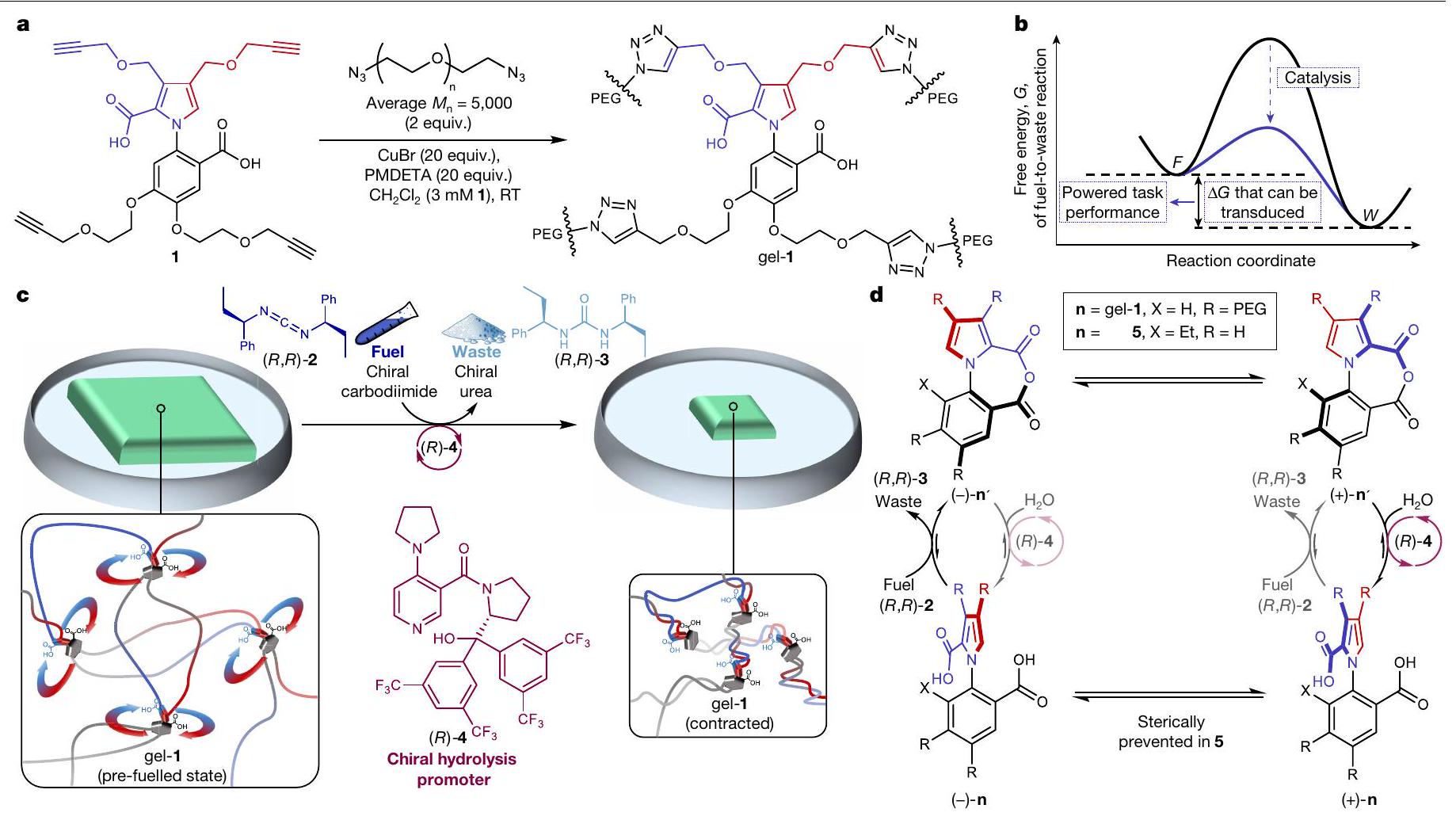
الشكل 1 | انقباض جيل بوليمر مع محرك جزيئي مدعوم كيميائيًا مدمج بشكل تساهمي. أ، التركيب الكيميائي للمحرك 1 ودمجه في جيل متقاطع مرتبط (جيل-1) مع وحدات المحرك عند عقد الشبكة من خلال إضافة حلقة أزيد-ألكين المحفزة بالنحاس (CuAAC) مع سلاسل PEG المنتهية بالأزيد. RT، درجة حرارة الغرفة. ب، تحويل الطاقة الكيميائية بواسطة تحفيز تفاعل الوقود ( )-إلى-النفايات ( ) بواسطة رافعة جزيئية. تعتمد الطاقة المتاحة للتحويل على الفرق في الجهد الكيميائي بين الوقود والنفايات وعدم التماثل الحركي لدورة المحرك الكيميائي . ج، يؤدي معالجة الجيل-1 مع وقود كيرالي ( )-2 ومروج التحلل المائي الكيرالي إلى دوران موجه لمكونات المحرك
من خلال التحفيز لتحلل كاربودييميد إلى يوريا بواسطة المحرك. هذا يلتف سلاسل البوليمر حول بعضها البعض، مما يزيد من الالتواء ويخلق تشابكات فيزيائية جديدة، مما يؤدي إلى انقباض الجيل. يؤدي نظام الوقود و إلى دوران موجه في اتجاه عقارب الساعة للدوران حول الثابت الفينيل في الجيل-1، مما يزيد من الالتواء في اتجاه حلزوني (+) في سلاسل البوليمر. د، آلية دوران مستمر موجه لوحدات المحرك في الجيل-1 ولفك الازدواجية لنموذج المحرك مع و تحت ظروف الوقود المستخدمة لتجارب الجيل (دي أوكسان ).
أدى إلى تشكيل أنهدريد مؤقت (قسم المعلومات التكميلية 4.1)، مما يشير إلى أن التحولات الكيميائية الرئيسية من الحمض إلى الأنهدريد إلى الحمض في الدورة الكيميائية الميكانيكية للمحرك غير متأثرة بالوظائف الإضافية.

دمج جزيئات المحرك في إطار الجيل

تم معالجة رباعي الألكين مع بولي إيثيلين جلايكول (PEG) المنتهي بالبيز أزيد (الوزن الجزيئي المتوسط) ، CuBr و -بنتاميثيل ثنائي إيثيلين ثلاثي الأمين (PMDETA) في ، مما يشكل الجيل-1 من خلال الربط الكيميائي لسلاسل البوليمر عند عقد المحرك (الشكل 1أ وقسم المعلومات التكميلية 3.1). بعد إزالة أملاح النحاس وPMDETA عن طريق الغسل المتتالي مع وملح الصوديوم الإيثيلين ثنائي الأمين رباعي الأسيتيك -EDTA)، تم انتفاخ الجيل-1 في دي أوكسان . يوازن هذا النظام المذيبي الحاجة إلى انتفاخ الجيل-1 مع ذوبانية الوقود الكيميائي، وتم استخدامه في جميع تجارب الوقود المبلغ عنها في هذه الدراسة (أقسام المعلومات التكميلية 3.2 و3.3).

التحيز الاتجاهي أثناء الوقود

تم معالجة نموذج حمض ثنائي متماثل (المرجع 9)، الذي لا يمكنه الدوران بالكامل وبالتالي، يوجد كأتراب متماثل، مع كاربودييميد كيرالي ( )-2 ومروج التحلل المائي ( )-4 في دي أوكسان/ ، مما ينتج يوريا (الشكل 1د). أدى تفاعل التحفيز العضوي إلى فائض متماثل من (+)-5، مما يؤكد
أن نظام الوقود الكيرالي يولد تحيز دوران موجه مشابه في دورة المحرك الكيميائي للنموذج الجزيئي المدفوع بالتحفيز السابق (الشكل الممتد 1أ وقسم المعلومات التكميلية 4.2). بعد ذلك، أكدنا أن الجيل-1 يحفز ترطيب كاربودييميد إلى يوريا بكفاءة مشابهة لتلك الخاصة بالمحرك الأحادي (الشكل الممتد 1ب وقسم المعلومات التكميلية 4.3). أظهرت هذه التجارب أن (1) انتشار مواد الوقود داخل الجيل ليس محددًا للسرعة ; (2) المحركات الدوارة عند عقد الشبكة للجيل المنتفخ متاحة للوقود الكيميائي؛ و (3) عند دمجها بشكل تساهمي في الجيل، المحرك يحتفظ بالقدرة على العمل كعامل مساعد لتفاعل الوقود إلى النفايات .

انكماش الجل المدعوم بالوقود

مع وجود بروتوكول وقود كيميائي مناسب تم إنشاؤه، تم إعداد مربع رقيق من الجل-1 (الأبعاد التقريبية، ; تم معالجة حوالي 0.08 مليمول من وحدات المحرك بمحلول من محفز التحلل الكيرالي مكافئ) في الديوكسان في درجة حرارة الغرفة. إضافة تسبب في تمدد الجل (حوالي المرتبطة بالتورم المدفوع بالانتشار وتغيير محتمل في حالة بروتنة المحرك كـ أساسي (قسم المعلومات التكميلية 5.4.1). بدأ التزود بالوقود ; الشكل 2d) عن طريق إضافة الكاربودييميد الكيرالي ( )-2 ( مكافئ) في الديوكسان/ فقط بعد أن أصبح حجم الجل مستقرًا (4 ساعات بعد إضافة ( )-4; الشكل 2أ وقسم المعلومات التكميلية 5.3).

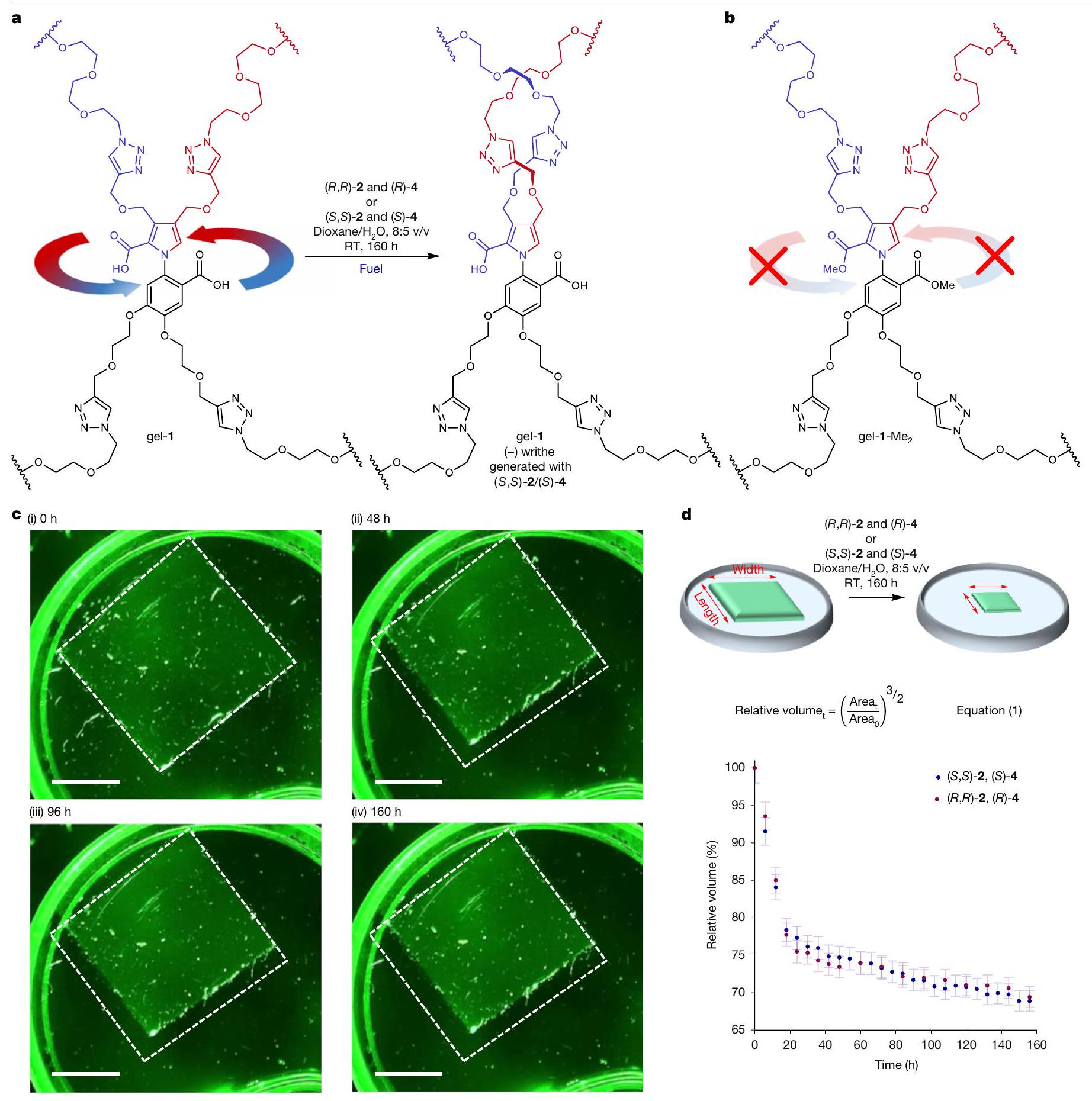
الشكل 2 | الانكماش الكلي للجيل-1 تحت تغذية كيميائية.

أ. الدوران الاتجاهي للدوار حول الثابت أثناء التحفيز بواسطة المحركات المدمجة في الجل-1 يؤدي إلى التواء سلاسل البوليمر، مما يسبب الالتواء (تداخلات إضافية في الخيوط؛ مقاطع الفيديو التكميلية 1-4). ب. جزيئات المحرك في استر الميثيل تتحكم في الجل-1- غير قادرين على تحفيز تفاعل الوقود إلى النفايات (ولا يمكن لمجموعات الميثيل الدوران بجانب بعضها البعض) وبالتالي، لا تدور بشكل اتجاهي تحت تغذية كيميائية (فيديو إضافي 6 وقسم المعلومات الإضافية 5.4.3). ج، صور للجيل-1 خلال انقباض مدعوم كيميائيًا مع و (الفيديوهات التكميلية 1 و 2) عند 0 ساعة (i)، 48 ساعة (ii)، 96 ساعة (iii) و 160 ساعة (iv). الخط المنقط الأبيض يوضح
مخطط الجل قبل التعبئة . قضبان القياس، 3 مم. د، انكماش الجل-1 تحت التغذية الكيميائية. المعادلة (1) تعطي الانخفاض في الحجم (بافتراض انكماش متساوي الاتجاهات) بناءً على التغير في مساحة الوجه الأفقي للجل (المصبوب ثم مقطوع على شكل منشور مستطيل)، كما هو موضح من الأعلى (تم قياس مساحة الجل بواسطة تحليل الصور باستخدام ImageJ 1.52a؛ قسم المعلومات التكميلية 5.2). تم رسم النسبة المئوية للتغير في الحجم بالنسبة للوقت، مع استمرار الانكماش تحت التغذية لمدة 7 أيام. تم إجراء التغذية باستخدام ( )-2 و ( )-4 (نقاط بيانات زرقاء) أو ( )-2 و (نقاط البيانات الحمراء).
ثم حدث انكماش للهلام لمدة 7 أيام (الشكل 2د (المسار الأزرق) ومقاطع الفيديو التكميلية 1 و 2)، مما أدى إلى تقريباً انكماش الهلام (يتم تحديده من خلال قياس الانخفاض في مساحة سطح الهلام ويفترض تأثير متساوي على الحجم) (الشكل 2د،
حتى بعد أن توقف الهلام عن الانكماش، استمرت عملية تحفيز ترطيب الكاربودي إيميد بواسطة المحركات المدمجة في الهلام طالما أن هناك وقود غير متفاعل متبقي أو إذا تم تجديد الوقود.
مشتق من الإستر ثنائي الميثيل للهلام، هلام-1- (حيث يتم ميثلة مجموعات الأحماض الكربوكسيلية في المحرك، وبالتالي، فإنها غير قادرة على تحفيز ترطيب الوقود (الشكل 2ب)) أظهرت انتفاخًا مشابهًا عند معالجتها بـ لكن لا يوجد انكماش بعد الإضافة (الفيديو التكميلي 6 وقسم المعلومات التكميلية 5.4.3).
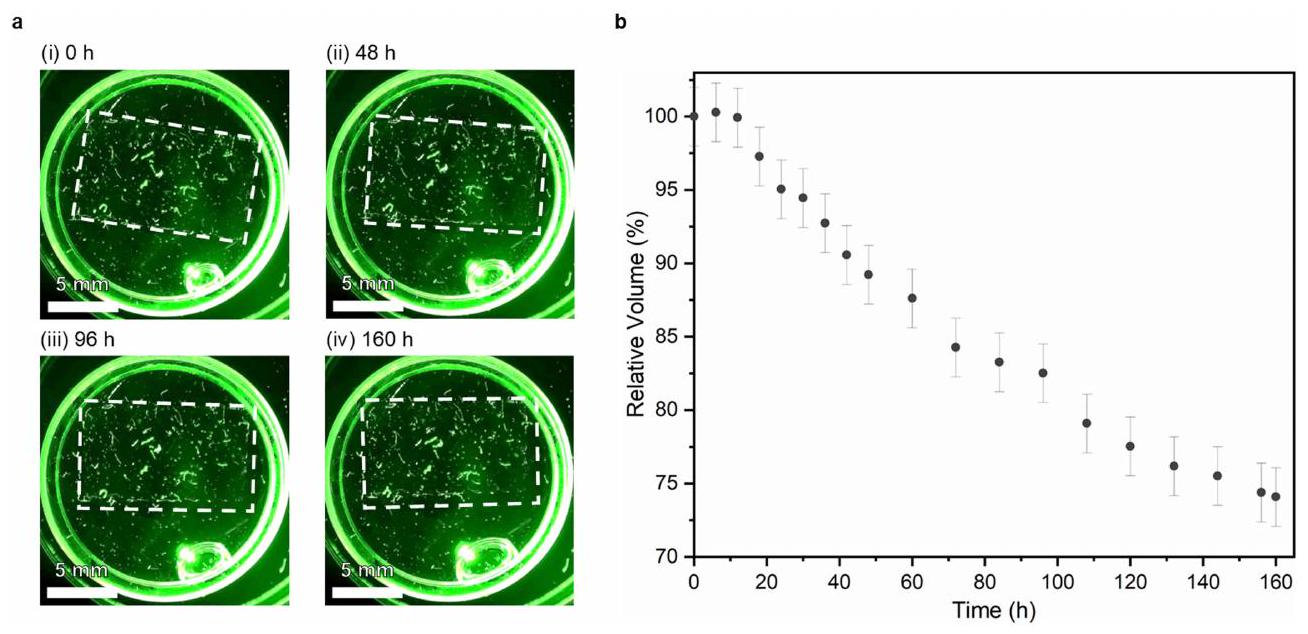
من الاتجاهية التي تم الحصول عليها من خلال التزود بالوقود (الشكل البياني الموسع 1a)، تكون دوران المحرك في الاتجاه المعاكس لعقارب الساعة مع الـ ( )-2 و ( نظام الوقود (-4) ، مما يولد (-) التواء في سلاسل البوليمر للجيل-1. تغذية عينة نقية من الجيل-1 مع مواد كيميائية ذات تشيير معكوس، أي، و تسبب في انكماش الهلام بمعدل وملف مشابهين (الشكل 2d (المسار الأحمر) ومقاطع الفيديو التكميلية 3 و 4) لـ )-2 و ( نظام الوقود -4). يؤدي دوران جزيئات المحرك في اتجاه عقارب الساعة إلى التواء خيوط البوليمر لإدخال التواء مع إحساس لولبي إيجابي. ومع ذلك، أدى تغذية عينة من الجل-1 بنظام وقود غير كيرالي (DIC و DMAP) إلى عدم انكماش الجل، على الرغم من التحفيز الفعال لتفاعل الوقود إلى النفايات بواسطة المحركات المدمجة في الجل (فيديو إضافي 5 وقسم المعلومات الإضافية 5.4.2؛ الشكل البياني الممتد 2 يظهر التغذية باستخدام DIC غير الكيرالي ومروج التحلل الكيرالي). )-4).

توصيف هلام مرتبط بالوقود

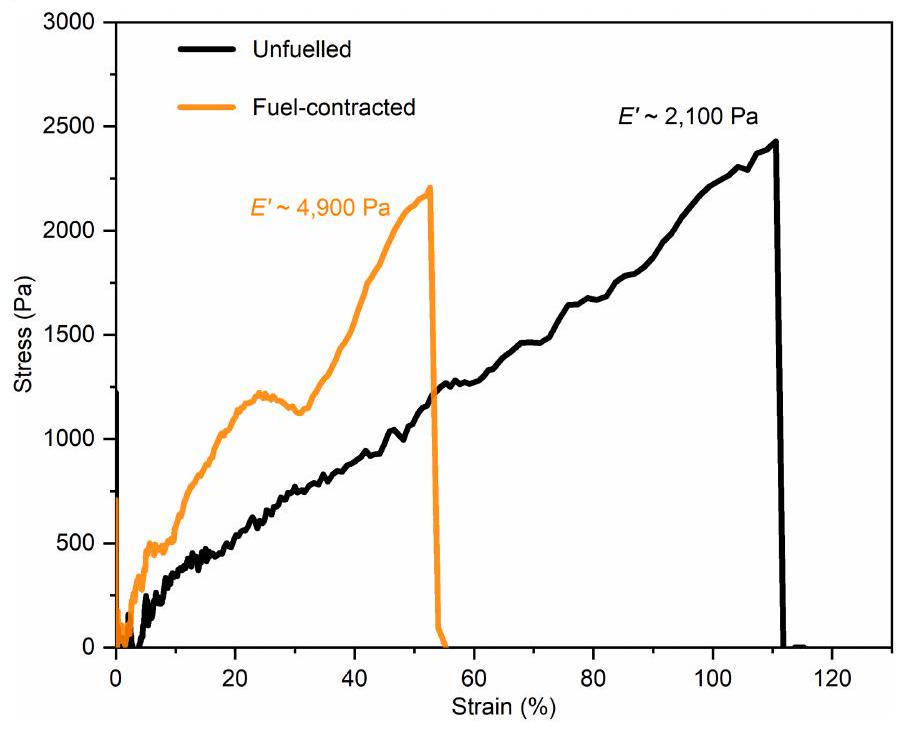
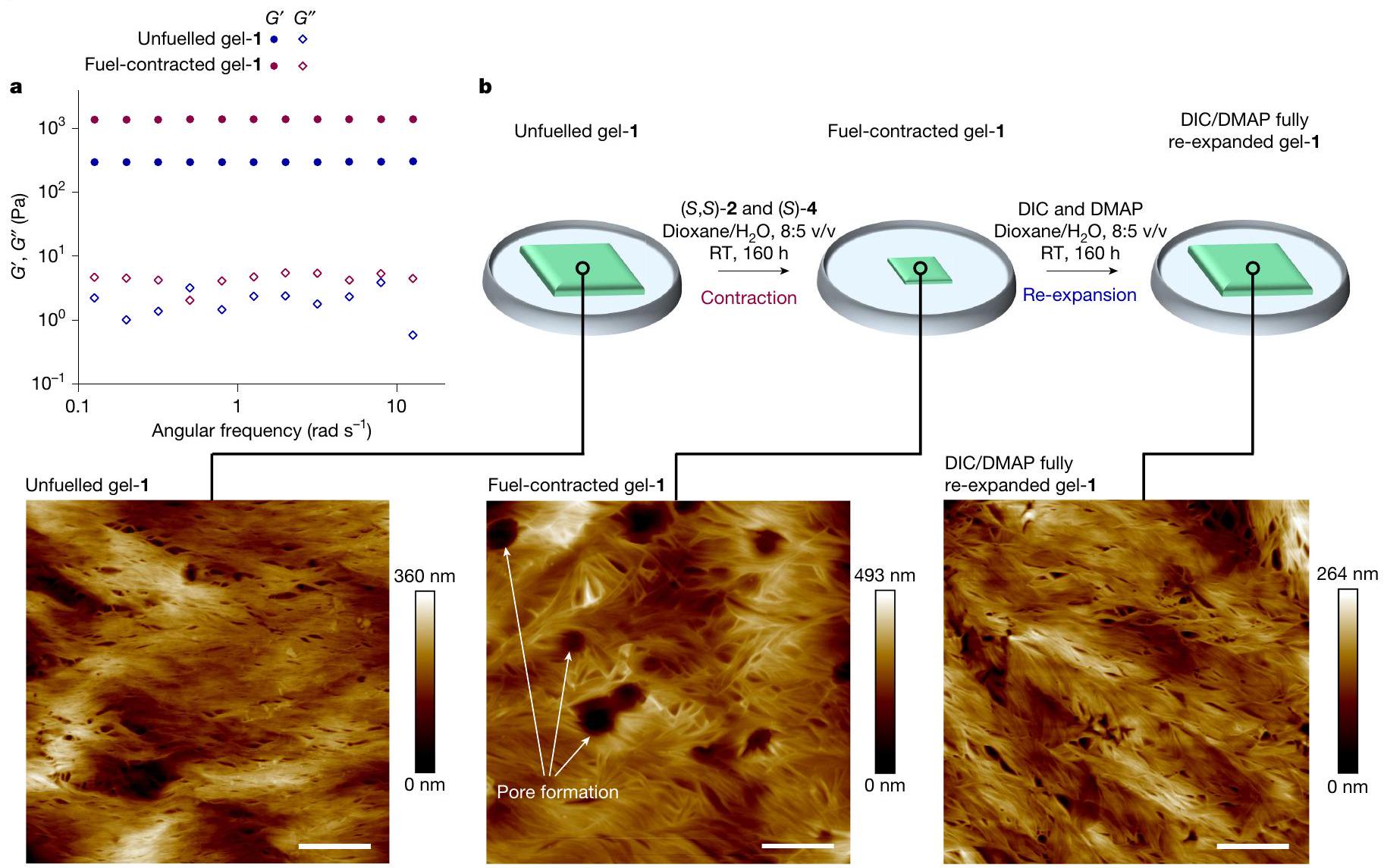
تمت مقارنة ريوولوجيا الجل-1 قبل وبعد التزويد بالوقود مع -2 و -4 (الشكل 3أ والمعلومات التكميلية القسم 6). معامل التخزين (المرن) ( تم قياس ) الهلام ووجد أنه أعلى بمقدار 2-3 أوامر من حيث الحجم من معامل الفقدان ( ) في حد القابلية للقياس أقل من 10 باسكال. بالنسبة للهلام غير المدعوم بالوقود والهلام المدعوم بالوقود، ثابت عبر نطاق التردد الكامل (الشكل 3أ)، وهو أمر نموذجي للهلامات البوليمرية عند الترددات المنخفضة في النظام الهيدروديناميكي. إن معامل التخزين يتناسب مع عدد التقاطعات مضروبًا في الطاقة المرنة لكل سلسلة. لذلك، فإن الزيادة بمقدار 4.7 مرة في تشير القيمة 1.4 كيلو باسكال للهلام المدعوم بالوقود و0 كيلو باسكال للهلام غير المدعوم بالوقود إلى أن زيادة عدد تشابكات الخيوط في الهلام تحدث نتيجة للتزويد بالوقود. القيمة المتوسطة لـ 4.7 تشابكات لكل محرك في شبكة الهلام المتعاقدة (قسم المعلومات التكميلية 8.2) تتماشى مع عدم التماثل الحركي وبيانات استهلاك الوقود المقاسة في المحلول، والتي تتنبأ بحوالي خمس دورات بناءً على حوالي 25 تفاعل من الوقود إلى النفايات يتم تحفيزها بواسطة كل محرك في الهلام. تظهر اختبارات الشد للهلام-1 أن معامل يونغ ( ضغط الهلام المتعاقد (4.9 كيلو باسكال) أعلى من ضغط الهلام غير المدعوم (2.1 كيلو باسكال)، مما يتوافق مع تكوين تشابكات جديدة نتيجة للتغذية (الشكل البياني الإضافي 3 وقسم المعلومات التكميلية 7). يصل الضغط عند الكسر إلى قيم مشابهة تبلغ حوالي 2.5 كيلو باسكال تقريبًا من التمدد في الشكل غير المنكمش للهلام وحوالي 50% في شكله المنكمش، بما يتماشى مع تكسير الهلام غير المتجانس طوبولوجيًا عند نقاط العيوب إن الاختلافات في الريولوجيا والخصائص الميكانيكية بين الجل غير المدعوم والجل المدعوم بالوقود هي نتيجة مباشرة لتشابك سلاسل البوليمر بواسطة دوران المحركات المدفوعة بالتحفيز على النانو.
كانت التأثيرات الناتجة عن التواء خيوط البوليمر في الجل المدعوم بالوقود واضحة أيضًا على المقياس المجهري (قسم المعلومات التكميلية 6). تُظهر صور المجهر الذري (AFM) لسطح الجل تغييرات في تكوين سلسلة البوليمر مقارنةً بالجل غير المدعوم بالوقود، مع ظهور العديد من الانحناءات بعد الانكماش (الشكل 3ب)، مما يعكس زيادة في الالتواء. يمكن أن يُعزى انخفاض تجانس السطح وظهور مسام بقطر ميكرومتر في الجل بعد التزويد بالوقود (الشكل 3ب، جل مدعوم بالوقود-1) إلى تأثير التواء خيوط البوليمر حول بعضها البعض، مما يولد فراغات كبيرة خالية من المادة بين المناطق الأكثر كثافة وتشابكًا. . عند إعادة التوسع (التزويد بالـ DIC و
DMAP)، الهيكل المجهري للهلام يعود ليكون مشابهًا لذلك للهلام غير المدعوم (الشكل 3ب، الهلام المعاد توسيعه).
تشير جميع الميزات والقياسات الكلية والميكروسكوبية إلى أن انكماش الجل-1 تحت التغذية بالكاربودييميد الكيرالي ومروج التحلل المائي هو نتيجة للدوران الاتجاهي لجزيئات المحرك المدفوع بالتحفيز العضوي، مما يزيد من التشابك (الالتواء) ) من خيوط البوليمر في الهلام .

الكيمياء الميكانيكية عند قوة التوقف

النقطة التي تتوقف عندها انكماش الهلام في تجارب التغذية الكيرالية، على الرغم من بقاء الوقود واستمرار التحفيز، تتوافق مع القوة التي تمارسها خيوط البوليمر الملتوية وضغط الأسموزي الناتج عن انكماش الهلام، مما يساوي التحيز الاتجاهي لدوران جزيئات المحرك تحت التحفيز. هذه هي قوة التوقف، وهي مقياس أداء نموذجي لبروتينات المحرك. كيف تستجيب البروتينات المحركة للقوة المطبقة من الناحية الكيميائية والتشكيلية غالبًا ما يكون من الصعب تفكيكها بوضوح. ومع ذلك، نظرًا لأن آلية التحفيز لتفاعل الوقود إلى النفايات بواسطة هو سلسلة محددة جيدًا من الخطوات، هنا من الواضح ما يتوافق مع قوة التوقف من حيث آلية كيميائية ميكانيكية. اتجاه دوران تحت التحفيز (ثابت التروس (المرجع 12) أو أستوميان (المرجع 3) ينشأ من عامل عدم التماثل كورتين-هاميت للمحرك. يتم تحديد ذلك من خلال نوعين من الحلول الحركية من نوع كورتين-هاميت في دورة التفاعل (الشكل 1d). تؤثر القوة التي تمارسها خيوط البوليمر الملتوية على التحيز في عمليات تبادل التكوين. و ; الشكل 1د). القوة الثابتة تت correspond إلى النقطة التي فيها . سيتم الوصول إلى ذلك عندما تكون النسب و والتي تكون 1:1 لكلا الزوجين من المتناظرات في غياب القوة، يتم دفعها بعيدًا عن 1:1 بواسطة القوة المطبقة بحيث عند قوة التوقف، تتوازن مع تأثير كورتين-هاميت.
بمجرد استنفاد إمدادات الوقود، تكون جزيئات المحرك محصورة حركيًا في حالة ثنائية الحمض، وتبقى الهلامة متقلصة (لا يحدث استرخاء/إعادة تمدد للهلامة على مدى عدة أشهر). ومع ذلك، فإن القدرة على اختيار اتجاه دوران المحركات وفقًا ليدوية الوقود تمكن من عكس انكماش الهلامة الكلي من خلال فك سلاسل البوليمر بالطاقة (الشكل 4، مقاطع الفيديو التكميلية 7 و8 وقسم المعلومات التكميلية 5.5).

تشغيل جزيئات المحرك في الاتجاه المعاكس
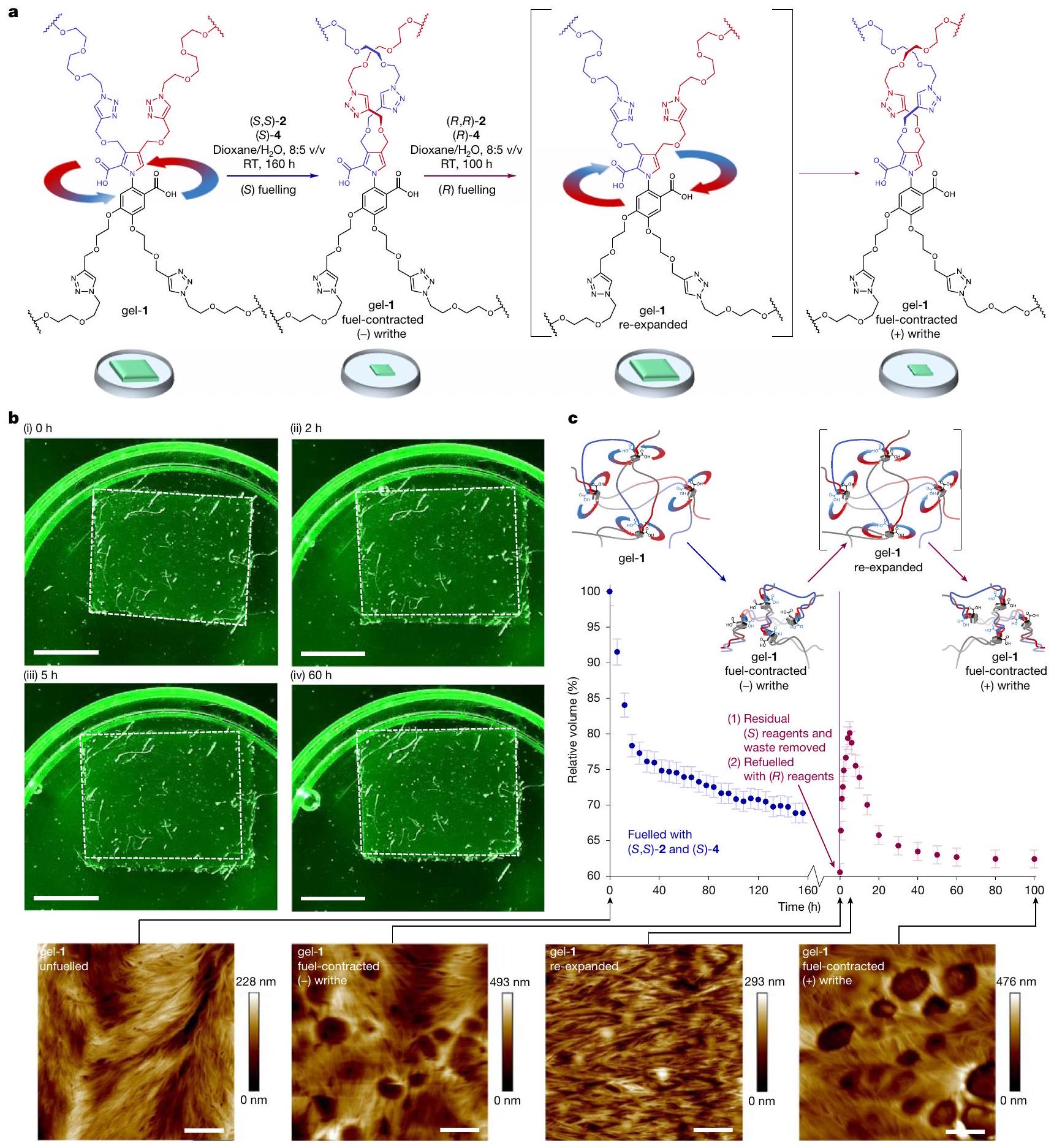
تم تقليص عينة من الجل-11 إلى حوالي حجمه الأصلي عن طريق التزويد بـ و لتسبب دورانًا عكسيًا وتحفيز ( – ) التواءات في خيوط البوليمر تم غسل الجل المنكمش (-)-writhe بشكل مكثف لإزالة النفايات والوقود والمركبات المتبقية، مما أدى إلى تقليل حجم الجل المنكمش (-)-writhe ‘الفارغ’ الآن. بحجمها الأصلي (الشكل 4c؛ نقطة البيانات الحمراء عند 0 ساعة من التعبئة الثانية). ثم تم إعادة انتفاخ الجل المنكمش (-)-writhe في الديوكسان/الماء ( ) و ( )-2 و ( )-4 أضيفت لتوليد دوران المحركات المدمجة في الجل المدفوعة بالتحفيز في الاتجاه المعاكس (أي، في اتجاه عقارب الساعة). تحت هذا النظام من التغذية، انبسط الجل المنكمش (-)-writhe أولاً لمدة 5 ساعات من رفع مستوى الصوت إلى الحد الأقصى من حجم الجل الأصلي (الشكل 4c، نقاط البيانات الحمراء). تقريبًا يمكن أن يُعزى جزء من هذا التوسع إلى الانتفاخ المدفوع بالانتشار نتيجة إضافة دفعة جديدة من الوقود ومُعزز التحلل المائي، ولكن التوسع كان أكثر تواضعًا في التجارب الضابطة (التزويد الثاني بـ أو DIC/DMAP؛ تشير المعلومات التكميلية القسم 5.5 والفيديو التكميلية 9) إلى أن التوسع الكبير ناتج عن التفكيك المدفوع في اتجاه عقارب الساعة للخيوط البوليمرية الملتوية في الاتجاه المعاكس. بعد الوصول إلى الحجم الأقصى للهلام تحت تغذية بـ -2 و -4 نظام التزود بالوقود (5 ساعات؛ الشكل 4c (نقاط البيانات الحمراء))،
الشكل 3 | مقارنة ريوولوجية وAFM للهلام-1 قبل وبعد الانكماش المدعوم كيميائيًا والتوسع المدعوم كيميائيًا لاحقًا. أ، تغير في (معامل التخزين) و (معامل الفقد) قبل وبعد انكماش الجل، كدالة للتردد الزاوي (قسم المعلومات التكميلية 6). ب، صور AFM للجل-1 قبل وبعد الانكماش المدعوم، وبعد إعادة التمدد تحت تغذية غير شيرالية
(قسم المعلومات التكميلية 6). تعكس مظهر المسام ذات القطر الميكرو متر التباينات الموجودة بشكل جوهري في مثل هذه الجل: المناطق ذات الكثافات الأعلى من المحركات تنتج المزيد من التشابكات عند التغذية، مما يترك فراغات (مسام) بينها. . تتقلص المسام في الحجم أو تختفي عند إعادة توسيع الجل المدعوم بالوقود. قضبان القياس، .
تستمر دوران المحركات تحت التحفيز في الاتجاه الساعي مع عقارب الساعة ويبدأ الجل في الانكماش مرة أخرى، ليصل إلى حجم أدنى من بعد حوالي 60 ساعة من التزود بالوقود بـ و (الشكل 4c (نقاط البيانات الحمراء)، مقاطع الفيديو التكميلية 7 و 8 وقسم المعلومات التكميلية 5.5). إن إعادة التمدد المعززة وإعادة الانكماش للهلام المنكمش مصحوبة مرة أخرى بإغلاق وإعادة فتح المسام الدقيقة القابلة للرصد بواسطة AFM (الشكل 4c والشكل التكميلية 14).
الحجم الأصلي للهلام لا يتم استعادته بالكامل من خلال التمدد المدعوم (الشكل 4c، نقاط البيانات الحمراء). وهذا متوقع لأن جميع الخيوط الملتوية في الأصل لن تنفك بالكامل في نفس الوقت. بمجرد أن يصبح زوج الخيوط الملتوية في اتجاه عكس عقارب الساعة مفكوكًا بالكامل بواسطة المحرك الذي يدور الآن في اتجاه عقارب الساعة، سيستمر ذلك الزوج من الخيوط في الالتواء في اتجاه عقارب الساعة بواسطة المحرك، مما يلف تلك الخيوط حول بعضها البعض مرة أخرى قبل أن يتم فك بعض الأزواج الأخرى من الخيوط الملتوية في اتجاه عكس عقارب الساعة في الهلام بالكامل. وبالتالي، فإن التمدد الذي يتم بوساطة الدوران الاتجاهي المدعوم لا يعيد الهلام إلى حالته المتوازنة (على الرغم من أن التغذية بنظام التغذية غير الكيرالي تفعل ذلك؛ انظر قسم المعلومات التكميلية 5.5.3)، بل يدفع الهلام من حالة غير متوازنة إلى أخرى. ومن الجدير بالذكر أن معدل إعادة التمدد (0-5 ساعات؛ الشكل 4c (نقاط البيانات الحمراء)) أسرع بكثير من معدل الانكماش اللاحق. ; الشكل 4c (نقاط البيانات الحمراء)). نحن نعزو ذلك إلى أن إعادة التمدد تتسارع بفعل القوة الناتجة عن فك الالتواء التي تمارسها الخيوط الملتوية، مما يحسن من عدم التماثل الحركي (التحيز الستيريوكيميائي) للخطوات الكيميائية المحكومة في تحفيز المحرك الدوار. إطلاق الطاقة المرنة المخزنة في
الهلام المتعاقد لتسريع هذه العملية هو نتيجة مباشرة لتحويل الطاقة من تفاعل الوقود إلى النفايات بواسطة تحفيز دوران المحرك خلال الانقباض الأول المدعوم بالوقود (الشكل 4c (نقاط البيانات الزرقاء)).

تحويل الطاقة من خلال عدم التماثل الحركي
تعمل الأجيال الحالية من الهلامات والبوليمرات الكيميائية المستجيبة (على سبيل المثال، pH) المستخدمة في التشغيل من خلال التبديل. بالمقابل، تولد وحدات الجزيئات المحركة في الجل-1 قوة من خلال تغذية انحياز حركيات التغيرات الشكلية في الحالة الأساسية لتحقيق عدم التماثل الحركي – نفس نوع آلية رافعة المعلومات المدفوعة بالتحفيز كما هو موجود في الجزيئات المحركة البيولوجية. من خلال القيام بذلك، يتم تراكم العمل؛ كل دورة من المحرك تضيف تدريجياً إلى القوة المتولدة والعمل المنجز. هذا يختلف جوهرياً عن التبديل، حيث يتم إلغاء أي عمل يتم بواسطة تغيير حالة المفتاح من خلال دورة تشغيل كاملة. إن توليد القوة وأداء العمل بواسطة الجل-1 يذكر بميوسين II، البروتين المحرك الذي يساهم في انقباض العضلات في معظم خلايا الحيوانات. (على الرغم من أن الجل-1 يعمل من خلال ديناميات جزيئية دوارة بدلاً من خطية). الميوسين II هو بروتين سداسي مع كتلة جزيئية تبلغ 450 كيلودالتون، في حين أن كل وحدة محرك عضوي في الجل-1 تتكون من 17 ذرة غير هيدروجينية فقط. ومع ذلك، في كلتا الحالتين، فإن فعل التحفيز يتسبب في توليد القوة وأداء العمل بواسطة المحفز الذي يحول الطاقة الكيميائية من التفاعل المحفز إلى الطاقة الميكانيكية وتخزين الطاقة المرنة (الشكل 1ب). تعني بساطة نظام المحرك الاصطناعي أن الكيمياء الميكانيكية
الشكل 4 | التمدد والانكماش المعاد كيميائيًا لعينة من هلام الوقود المنكمش – 1.a، عينة من هلام-1 التي تم انكماشها بـ و ( )-4 (أي أنظمة التزويد بالوقود التي تدفع الدوران عكس عقارب الساعة للمحركات) ثم تم غسلها بشكل شامل لإزالة النفايات والوقود المتبقي، وتمت معالجة المحفز الهيدروليكي بعد ذلك بـ و (أي، نظام الوقود ذو التوجه المعاكس) لتشغيل دوران مكونات المحرك في الاتجاه المعاكس (أي، في اتجاه عقارب الساعة). يقوم نظام الوقود الثاني أولاً بتشغيل فك التواء خيوط البوليمر الملتوية في الاتجاه المعاكس، مما يتسبب في تمدد الجل الذي كان متقلصًا سابقًا ( ؛ النقاط البيانية الحمراء في (ج)، بعد ذلك تبدأ عملية الدوران المدفوعة بالتحفيز في إعادة تقديم الالتواء في الاتجاه المعاكس. ب، صور للجيل-1 خلال هذا التمدد المدفوع كيميائيًا وإعادة الانكماش (الفيديوهات التكميلية 7 و8) عند 0 ساعة (i)، 2 ساعة (ii)، 5 ساعات (iii) و60 ساعة (iv). الخط المتقطع الأبيض يوضح ملامح الجيل المنكمش قبل عملية التزويد الثانية ( ، نقطة بيانات حمراء). قضبان المقياس، نسبة التغير في الحجم مرسومة بالنسبة للوقت، تظهر
سلوك الانكماش-التوسع-إعادة الانكماش المدعوم للهلام-1 عند التزويد المتكرر بأنظمة ذات تشيّع متعاكس (نقاط البيانات الزرقاء، و نقاط بيانات حمراء، و تظهر صورة AFM مظهر المسام ذات القطر الميكرو متر في الجل بعد التزويد بالوقود و لتدوير المحركات في اتجاه عكس عقارب الساعة، مما يولد (-) التواء في سلاسل البوليمر (الصورة الثانية من اليسار في AFM). ثم يتم تغذية الجل المتقلص (-)-التواء بـ ( )-2 و ( (-4) يدور المحركات في اتجاه عقارب الساعة. عند نقطة إعادة التمدد القصوى، عندما يتم فك معظم الالتواءات الأصلية، تظهر صورة AFM أن عدد وحجم المسام قد انخفض بشكل كبير (الصورة الثالثة من اليسار). يستمر دوران المحركات في اتجاه عقارب الساعة في إعادة انكماش الهلام (مع التواء (+) في خيوط البوليمر)، وتظهر المسام بقطر ميكرومتر مرة أخرى في الهلام (صورة AFM على اليمين). قضبان القياس، معلومات إضافية متوفرة في قسم المعلومات التكميلية 5.5.
آلية حدوث ذلك واضحة تمامًا. حيث تحدث كلا التغيرات الشكلية الرئيسية في دورة التروس بين الأتروبيزومات المتناظرة ((+)-1 و(-)-1؛ (+)-1′ و(-)-1′)، لا يوجد هناك ضربة طاقة. إن العرض التجريبي لتحويل الطاقة الكيميائية لأداء عمل ضد حمل من خلال عدم التماثل الحركي يوفر توضيحًا آليًا بسيطًا لكيفية تمكن المحركات الجزيئية المدفوعة بالتحفيز من استخراج النظام من الفوضى. .

المحتوى عبر الإنترنت

أي طرق، مراجع إضافية، ملخصات تقارير Nature Portfolio، بيانات المصدر، بيانات موسعة، معلومات إضافية، شكر وتقدير، معلومات مراجعة الأقران؛ تفاصيل مساهمات المؤلفين والمصالح المتنافسة؛ وبيانات توفر البيانات والرموز متاحة علىhttps://doi.org/10.1038/s41586-024-08288-x.
  1. شليوا، م. وويهلكي، ج. المحركات الجزيئية. ناتشر 422، 759-765 (2003).
  2. هوارد، ج. قوة البروتين. البيولوجيا الحالية 16، R517-R519 (2006).
  3. أستوميان، ر. د. عدم أهمية ضربة القوة بالنسبة للاتجاه، قوة التوقف، والكفاءة المثلى للآلات الجزيئية المدفوعة كيميائيًا. مجلة الفيزياء الحيوية. 108، 291-303 (2015).
  4. هوفمان، ب. م. كيف تستخرج المحركات الجزيئية النظام من الفوضى (مراجعة قضايا رئيسية). تقرير. تقدم. الفيزياء. 79، 032601 (2016).
  5. هوانغ، و. وكاربلوس، م. الأساس الهيكلي لآلية الضربة القوية مقابل آلية العتلة البراونية للبروتينات الحركية. وقائع الأكاديمية الوطنية للعلوم في الولايات المتحدة الأمريكية 116، 19777-19785 (2019).
  6. أمانو، س.، بورسلي، س.، لي، د. أ. وسون، ز. محركات كيميائية: دفع الأنظمة بعيدًا عن التوازن من خلال دورات تفاعل المحفز. نات. نانو تكنولوج. 16، 1057-1067 (2021).
  7. أمانو، س. وآخرون. استخدام التحفيز لدفع الكيمياء بعيدًا عن التوازن: ربط عدم التماثل الحركي، وضربات القوة ومبدأ كورتين-هاميت في رافعات براونية. ج. أم. كيم. سوس. 144، 20153-20164 (2022).
  8. سوييني، هـ. ل. وهدوس، أ. رؤى هيكلية ووظيفية حول آلية محرك الميوسين. مراجعة سنوية لعلم الأحياء الفيزيائية 39، 539-557 (2010).
  9. بورسلي، س.، كريدت، إ.، لي، د. أ. وروبرتس، ب. م. و. دوران اتجاهي مستقل مدفوع حول رابطة تساهمية مفردة. ناتشر 604، 80-85 (2022).
  10. أستوميان، ر. د. عدم التماثل الحركي والاتجاهية في الأنظمة الجزيئية غير المتوازنة. أنجيو. كيم. إنترناشونال. إيد. 63، e202306569 (2024).
  11. بورسلي، س.، لي، د. أ. وروبرتس، ب. م. و. العجلات الجزيئية والتماثل الحركي: إعطاء الكيمياء اتجاهًا. أنجيو. كيم. إنترناش. إد. 63، e202400495 (2024).
  12. راجازون، ج. و برينس، ل. ج. استهلاك الطاقة في التجميع الذاتي المدفوع بالوقود الكيميائي. نات. نانو تكنولوجي. 13، 882-889 (2018).
  13. شوارز، ب. س.، تينا-سولسونا، م.، داي، ك. و بوكهوفن، ج. دورات التفاعل الحفاز المدفوعة بالكاربودييميد لتنظيم العمليات فوق الجزيئية. كيم. كوميونيك. 58، 1284-1297 (2022).
  14. سانغشاي، ت.، الشحيمي، س.، بينوتشيو، إ. وراغازون، ج. رافعات جزيئية صناعية: أدوات تمكّن العمليات الماصة للطاقة. أنجيو. كيم. إنترناش. إيد. 62، e202309501 (2023).
  15. كومورا، ن.، زيلسترا، ر. و. ج.، فان ديلدن، ر. أ.، هارادا، ن. وفيرينغا، ب. ل. دوار جزيئي أحادي الاتجاه مدفوع بالضوء. ناتشر 401، 152-155 (1999).
  16. لي، د. أ.، وونغ، ج. ك. ي.، ديهز، ف. وزيربيتو، ف. دوران أحادي الاتجاه في دوار جزيئي متشابك ميكانيكياً. ناتشر 424، 174-179 (2003).
  17. غوينتر، م. وآخرون. دوران بتردد كيلوهيرتز مدعوم بأشعة الشمس لمحرك جزيئي قائم على الهيميثيوإنديجو. نات. كوميونيك. 6، 8406 (2015).
  18. ويلسون، م. ر. وآخرون. محرك صغير جزيئي يعمل بالوقود الكيميائي بشكل مستقل. ناتشر 534، 235-240 (2016).
  19. إيرباس-تشاكماك، س. وآخرون. محركات جزيئية دوارة وخطية مدفوعة بنبضات من وقود كيميائي. ساينس 358، 340-343 (2017).
  20. بوم، أ.-ك. وآخرون. محرك رافعة دوارة من أوريغامي الحمض النووي. ناتشر 607، 492-498 (2022).
  21. تشانغ، ل. وآخرون. محرك جزيئي كهربائي. ناتشر 613، 280-286 (2023).
  22. برير، ج. وآخرون. دوران أحادي الاتجاه مدفوع بالطاقة الحمراء عن رابطة تحت السيطرة الإنزيمية. مسودة مسبقة فيhttps://doi.org/10.26434/chemrxiv-2024-tz8vc (2024).
  23. سيريللي، ف.، لي، ج.-ف.، كاي، إ. ر. ولي، د. أ. رافعة معلومات جزيئية. ناتشر 445، 523-527 (2007).
  24. فنغ، ل. وآخرون. الامتصاص الميكانيكي النشط المدفوع بواسطة مضخات الكاسيت. العلوم 374، 1215-1221 (2021).
  25. أمانو، س.، فيلدن، س. د. ب. ولي، د. أ. مضخة جزيئية صناعية مدفوعة بالتحفيز. ناتشر 594، 529-534 (2021).
  26. بورسلي، س.، لي، د. أ. وروبرتس، ب. م. و. رافعة معلومات مزدوجة البوابة حركيًا مدفوعة ذاتيًا بواسطة ترطيب الكاربودييميد. ج. أم. كيم. سوس. 143، 4414-4420 (2021).
  27. توماس، د. وآخرون. الضخ بين المراحل باستخدام رافعة جزيئية تعمل بالوقود النبضي. نات. نانو تكنولوجي. 17، 701-707 (2022).
  28. كوررا، س. وآخرون. رؤى حركية وطاقة حول تشغيل مضخة فوق جزيئية مستقلة تعمل بالطاقة الضوئية في حالة عدم التوازن المبدد. نات. نانو تكنولوج. 17، 746-751 (2022).
  29. بينكس، ل. وآخرون. دور عدم التماثل الحركي وضربات القوة في رافعة المعلومات. كيم 9، 2902-2917 (2023).
  30. لي، ق. وآخرون. انكماش ماكروسكوبي لجيل ناتج عن الحركة المتكاملة لمحركات جزيئية مدفوعة بالضوء. نات. نانو تكنولوجي. 10، 161-165 (2015).
  31. فوي، ج. ت. وآخرون. التحكم المزدوج بالضوء في الآلات النانوية التي تدمج وحدات المحرك والمعدل. نات. نانو تكنولوجي. 12، 540-545 (2017).
  32. بيرو، أ.، وانغ، و.-ز.، بوهلر، إ.، مولان، إ. وجيوسيبوني، ن. تفعيل الانحناء للهيدروجيل من خلال دوران المحركات الجزيئية المدفوعة بالضوء. أنجيو. كيم. إنترناش. إد. 62، e202300263 (2023).
  33. تينا-سولسونا، م. وآخرون. مواد فوق جزيئية غير متوازنة قابلة للتفكك بمدة حياة قابلة للتعديل. نات. كوميونيك. 8، 15895 (2017).
  34. كاريياوَسَم، ل. س. وهارتلي، س. س. التجميع المبدد لخلائط الأحماض الكربوكسيلية المائية المدعومة بالكاربودييميدات. مجلة الجمعية الأمريكية للكيمياء 139، 11949-11955 (2017).
  35. بورسلي، س.، لي، د. أ. وروبرتس، ب. م. و. وقود كيميائي للآلات الجزيئية. نات. كيم. 14، 728-738 (2022).
  36. ليانغ، ل. وأستروك، د. تفاعل الإضافة الدائرية بين الألكاين والأزيد المحفز بالنحاس (I) (CuAAC) ‘تفاعل النقر’ وتطبيقاته. نظرة عامة. مراجعات كيمياء التنسيق. 255، 2933-2945 (2011).
  37. هاجل، ج.، هارازتي، ت. وبوهيم، هـ. الانتشار والتفاعل في هيدروجيل PEG-DA. واجهات حيوية 8، 36 (2013).
  38. يافاري، ن. وأزيزيان، س. نموذج مختلط لديناميكا الانتشار والاسترخاء لتورم الهلاميات. ج. مول. ليك. 363، 119861 (2022).
  39. غوجون، أ. وآخرون. سلسلة دوائر دوارة ثنائية الاستقرار [c2] كمنشطات شبيهة بالعضلات قابلة للعكس في الجل النشط ميكانيكياً. مجلة الجمعية الأمريكية للكيمياء 139، 14825-14828 (2017).
  40. كولار-إيتي، ج.-ر. وآخرون. السلوك الميكانيكي للهلام القابل للانقباض المعتمد على المحركات الجزيئية المدفوعة بالضوء. نانو سكيل 11، 5197-5202 (2019).
  41. ساكاي، ت. وآخرون. تصميم وتصنيع هيدروجيل عالي القوة مع هيكل شبكة متجانس بشكل مثالي من الماكرو مونويمرات على شكل رباعي الأوجه. ماكرومولكيولز 41، 5379-5384 (2008).
  42. أشفريدج، ز. وآخرون. أهمية العقد: تشابكات جزيئية منظمة. مراجعات جمعية الكيمياء 51، 7779-7809 (2022).
  43. بايسي، م.، أورلانديني، إ. وويتنجتون، س. ج. التفاعل بين الالتواء والعقدة للبوليمرات المتورمة والمضغوطة. مجلة الكيمياء والفيزياء 131، 154902 (2009).
  44. هو، ل.، تشانغ، ق.، لي، إكس. وسيربي، م. ج. بوليمرات استجابة للمؤثرات للكشف والتحكم. مواد. أفق. 6، 1774-1793 (2019).
  45. هاوس، ج. ر. وآخرون. توليد الطاقة المتبادلة في عضلة صناعية مدفوعة كيميائيًا. نانو ليت. 6، 73-77 (2006).
  46. تشاتيرجي، م. ن.، كاي، إ. ر. ولي، د. أ. ما وراء المفاتيح: رفع جزيء طاقةً إلى الأعلى باستخدام آلة جزيئية مقسمة. ج. أم. كيم. سوس. 128، 4058-4073 (2006).
  47. بوكهوفن، ج.، هندريكسن، و. إ.، كوبر، ج. ج. م.، إيلكيما، ر. وفان إيش، ج. هـ. التجميع العابر للمواد النشطة المدعومة بتفاعل كيميائي. ساينس 349، 1075-1079 (2015).
  48. برونز، سي. جي. التقدم في حساء المعاني لتصنيف الآلات الجزيئية الاصطناعية. نات. نانو تكنولوجي. 17، 1231-1234 (2022).
ملاحظة الناشر: تظل شركة سبرينغر ناتشر محايدة فيما يتعلق بالمطالبات القضائية في الخرائط المنشورة والانتماءات المؤسسية.
الوصول المفتوح هذه المقالة مرخصة بموجب رخصة المشاع الإبداعي النسب 4.0 الدولية، التي تسمح بالاستخدام والمشاركة والتكيف والتوزيع وإعادة الإنتاج بأي وسيلة أو صيغة، طالما أنك تعطي الائتمان المناسب للمؤلفين الأصليين والمصدر، وتوفر رابطًا لرخصة المشاع الإبداعي، وتوضح إذا ما تم إجراء تغييرات. الصور أو المواد الأخرى من طرف ثالث في هذه المقالة مشمولة في رخصة المشاع الإبداعي الخاصة بالمقالة، ما لم يُشار إلى خلاف ذلك في سطر الائتمان للمواد. إذا لم تكن المادة مشمولة في رخصة المشاع الإبداعي الخاصة بالمقالة وكان استخدامك المقصود غير مسموح به بموجب اللوائح القانونية أو يتجاوز الاستخدام المسموح به، فسيتعين عليك الحصول على إذن مباشرة من صاحب حقوق الطبع والنشر. لعرض نسخة من هذه الرخصة، قم بزيارةhttp://creativecommons.org/licenses/by/4.0/.
(ج) المؤلفون 2025

طرق

تم تقديم تخليق جميع المركبات وإجراءات التجارب التفصيلية لجميع التجارب الأخرى في المعلومات التكميلية.

طريقة تمثيلية لتكوين الجل-1

حل لـ في حالة إزالة الغازات تم إضافته إلى محلول بولي أوكسي إيثيلين ثنائي (أزيد) (متوسط ; و PMDETA في حالة إزالة الغازات تم تشكيل الجل في 10 دقائق وتم غسله بشكل مكثف بـ -EDTA والماء. تم الحصول على هلام شفاف وعديم اللون-1 (7.6 ملغ من الهلام الجاف، العائد).
لتشكيل هلامات بشكل موحد مناسب لتجارب انكماش الوقود، بعد خلط المواد المتفاعلة (عند نقطة تشكيل الهلام المذكورة أعلاه)، تم تجانس الخليط بسرعة. ) وتم نقله إلى قالب مصنوع خصيصًا من الفولاذ المقاوم للصدأ (الارتفاع × العرض × العمق). بعد 30 دقيقة، تم نقل الجل من القالب إلى زجاجة مغلقة مع وتم تحريكه على لوحة مهتزة (تردد الاهتزاز، 160 دورة في الدقيقة) لمدة تم تكرار الإجراء، حيث تم غسل الجل بمذيبات مختلفة بالترتيب التالي: محلول EDTA عند pH 9 تعديل الرقم الهيدروجيني إلى 9.0 باستخدام حوالي 2 م NaOH، محلول EDTA في (مرتين)، مزيج من ديكسان ؛ مرتين). كان العدد الإجمالي للغسلات عشرة.

انكماش الوقود العام للجيل-1

تم إذابته في الديوكسان في خلية كوارتز أسطوانية ( ). عينة مربعة من الجل تقيس تقريبًا تمت إضافة إلى المحلول. تم السماح للهلام بالتوازن لمدة هـ. بعد ذلك، تمت الإضافة وتمت مراقبة حجم الجل بواسطة تسجيل الفيديو باستخدام كاميرا Veho DX-3 USB.

AFM

تم الحصول على صور AFM عن طريق مسح العينات باستخدام Nanoscope 8 (Bruker) الذي يعمل في وضع النقر بالقوة القصوى. تعتمد تقنية AFM بالقوة القصوى على تكنولوجيا النقر بالقوة القصوى، حيث يهتز المجس بطريقة مشابهة لما هو عليه في وضع النقر، ولكن بعيدًا عن تردد الرنين. في كل مرة يتم فيها تقريب الطرف والعينة، يتم التقاط منحنى القوة. يمكن التحكم في هذه القوى عند مستويات أقل بكثير من وضع الاتصال وأقل حتى من وضع النقر، مما يتيح التشغيل على أكثر العينات حساسية ونعومة، كما هو الحال هنا. تم استخدام طرف سيليكون فائق الحدة على رافعة نيتريد.
(بروكر، ScanAsyst؛ ثابت الزنبرك لـ ونصف قطر الطرف حوالي 5 نانومتر). خلال تصوير AFM، تم تقليل القوة لتجنب سحب الجزيئات بواسطة الطرف. هنا، القوة القصوى المطبقة حوالي 50 بيكومتر. تم إجراء جميع تحليلات الصور باستخدام برنامج متكامل.

قياسات الريولوجيا

تم إجراء قياسات الريولوجيا باستخدام جهاز ريو متر هجين من TA Instruments HR-3 مزود بألواح فولاذية متوازية من نوع بيلتييه مع تحكم في درجة الحرارة (قطر 20 مم) تم ضبطه على ، ومع مصيدة للمذيبات لإنشاء حاجز بخاري مستقر حرارياً، مما يقضي تقريباً على أي فقدان للمذيب أثناء التجربة. تم إجراء تجارب الاهتزاز تحت إجهاد وفي نطاق التردد من 0.1 إلى 10 هرتز. في الرسوم البيانية، تمت إزالة جميع النقاط التي أظهرت عزم دوران مختلف عن الإزاحة (أي، رسم ليساجو مختلف عن خط مستقيم). تم استخدام البيانات، الموضحة في الشكل 3أ، لتحديد (معامل التخزين) و (معامل الفقدان).

توفر البيانات

البيانات التي تدعم نتائج هذه الدراسة متاحة في المقالة ومعلوماتها التكميلية أو متاحة من مستودع بيانات ماندلي.https://data.mendeley.com/) على https:// doi.org/10.17632/b4tfyf522s.1.
الشكر والتقدير نشكر ب. م. و. روبرتس على المناقشات المفيدة ومنصة إنكا التابعة لمعهد شارل سادورن، م. معلووم، ل. جاكومين وإ. مولان على التوصيف الفيزيائي للمواد. تم تمويل هذا العمل من قبل مجلس أبحاث الهندسة والعلوم الفيزيائية (EPSRC؛ EP/PO27067/1)، وبرنامج هورايزون 2020 التابع للمفوضية الأوروبية من خلال مشروع شبكة التدريب الابتكاري (MSCA-ITN) آرت مومَا (رقم المنحة 860434) ومجلس الأبحاث الأوروبي (رقم المنحة المتقدمة 786630). نشكر مجلس المنح الدراسية الصيني (CSC؛ رقم الملف 202108310032) وجامعة مانشستر على منحة الدكتوراه لـ ب. ل. و. د. أ. ل. هو أستاذ بحث في الجمعية الملكية.
مساهمات المؤلفين: قام P.-L.W. و S.B. و D.A.L. بتصور المشروع. قام P.-L.W. بتخليق المحرك وأجرى تجارب انكماش الهلام. ساعد M.J.P. في تجارب تشكيل الهلام والانكماش. تحت إشراف A.C.، قام P.-L.W. و M.J.P. بإعداد الهلام المناسب. قام A.C. بإجراء قياسات AFM والريولوجيا. أدار D.A.L. و S.B. و N.G. البحث. كتب P.-L.W. و M.J.P. و S.B. و D.A.L. الورقة بمشاركة من N.G. و A.C.
المصالح المتنافسة يعلن المؤلفون عدم وجود مصالح متنافسة.

معلومات إضافية

معلومات إضافية النسخة الإلكترونية تحتوي على مواد إضافية متاحة علىhttps://doi.org/10.1038/s41586-024-08288-x.
يجب توجيه المراسلات والطلبات للحصول على المواد إلى نيكولاس جيوسيبوني أو ديفيد أ. لي.
تُعرب Nature عن شكرها لديسوكي آوكي، وجياوين تشين، والمراجعين الآخرين المجهولين، على مساهمتهم في مراجعة هذا العمل.
معلومات إعادة الطبع والتصاريح متاحة علىhttp://www.nature.com/reprints.

مقالة
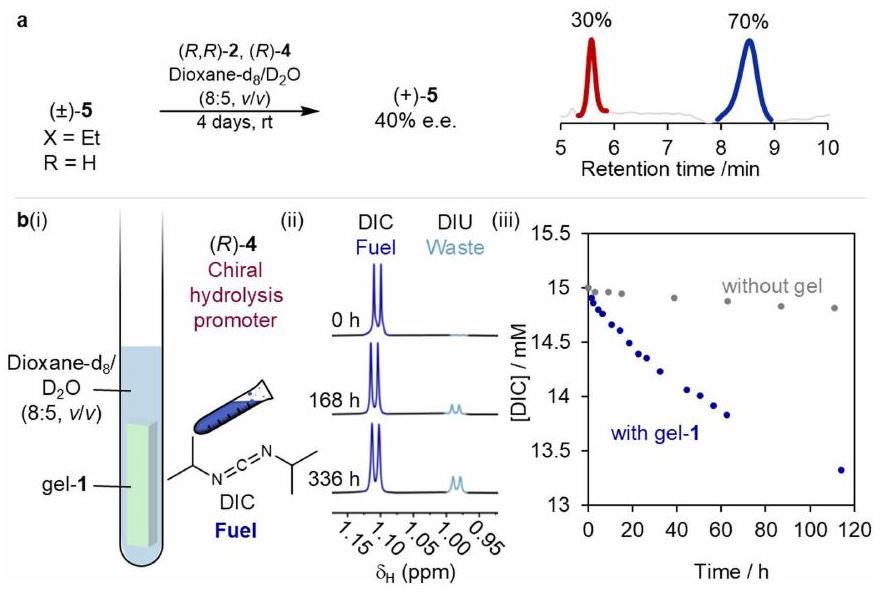
الشكل البياني الموسع 1| الانحياز الاتجاهي والفعالية التحفيزية لجيل-1 والمركبات النموذجية. أ، HPLC مائل (عمود ChiralPak-IF، : – بروه : تحليل يظهر إزالة التراكيب غير المتكافئة لـ e.e. تحت التزود بالوقود مع -2 و -4 (الشكل 1d؛ قسم المعلومات التكميلية 4.2)؛ انحياز اتجاهي بنسبة 2.3:1 دوران عقارب الساعة: عكس عقارب الساعة (أي يتم ارتكاب ‘خطأ’ في الدوران الاتجاهي كل 3 أو 4 دورات). ب، (i) تحفيز تفاعل وقود الكاربودييميد إلى اليوريا بواسطة الجل-1 (قسم المعلومات التكميلية 4.3). (ii) جزئي طيف الرنين المغناطيسي النووي (ديكسان- ( ) يظهر تقدم تفاعل الوقود إلى النفايات. تم استخدام ثنائي إيزوبروبيل كاربودييميد (DIC) كوقود في هذه التجربة حيث ترددات H NMR لـ DIC وديisopropylurea (DIU) المستخدمة لمراقبة التفاعل لا تتداخل مع تلك الخاصة بالهلام-1. (iii) رسم بياني لاستهلاك وقود DIC للتفاعل غير المحفز (رمادي) والتفاعل المحفز بالهلام-1 (أزرق)، يظهر تحفيز تفاعل الوقود إلى النفايات بواسطة الهلام-1. تم الحصول على نتائج مماثلة باستخدام وقود كيرالي. )-2 أو ( )-2 بدلاً من DIC (انظر قسم المعلومات التكميلية 4.3).
الشكل البياني الموسع 2 | الانكماش الكلي للجيل-1 تحت تغذية كيميائية باستخدام وقود غير متماثل ومروج تحلل متماثل. أ، صور للجيل-1 أثناء الانكماش المدعوم كيميائيًا مع و DIC عند (i) 0 ساعة، (ii) 48 ساعة، (iii) 96 ساعة و (iv) 160 ساعة. الخط المنقط الأبيض يوضح شكل الجل السابق
إلى التزود بالوقود . انكماش الجل-1 تحت التغذية الكيميائية. تم رسم التغير في نسبة الحجم على مدى الزمن، مع استمرار الانكماش تحت التغذية لمدة 7 أيام.

مقالة

الشكل البياني الممتد 3 | اختبار الشد للهلام-1، غير المدعوم (أسود) والمدعوم بالوقود (برتقالي) مع ( )-2 و ( )-4 بعد 7 أيام. تظهر اختبارات الشد أن معامل يونغ للهلام المتقلص بالوقود (4.9 كيلو باسكال) أعلى من ذلك للهلام غير المدعوم بالوقود (2.1 كيلو باسكال)، بما يتماشى مع تكوين تشابكات جديدة. نلاحظ أنه على الرغم من زيادة صلابة الهلام عند الانكماش المدفوع بالوقود، إلا أن الإجهاد عند الكسر لا يزال محدودًا بالعيوب في الهلام (يصل إلى 2.4 كيلو باسكال لـ التمدد في الهلام غير المدعوم بالوقود، و2.25 كيلو باسكال لـ التمدد في الهلام المتقلص بالوقود).

  1. ¹قسم الكيمياء، جامعة مانشستر، مانشستر، المملكة المتحدة. ²مدرسة الكيمياء والهندسة الجزيئية، جامعة شرق الصين العادية، شنغهاي، الصين. ³مجموعة أبحاث سامس، جامعة ستراسبورغ ومعهد شارل سادورن، ستراسبورغ، فرنسا. معهد جامعة فرنسا (IUF)، باريس، فرنسا. البريد الإلكتروني:giuseppone@unistra.fr; david.leigh@manchester.ac.uk

Journal: Nature, Volume: 637, Issue: 8046
DOI: https://doi.org/10.1038/s41586-024-08288-x
PMID: https://pubmed.ncbi.nlm.nih.gov/39815097
Publication Date: 2025-01-15

Transducing chemical energy through catalysis by an artificial molecular motor

https://doi.org/10.1038/s41586-024-08288-x
Received: 23 May 2024
Accepted: 25 October 2024
Published online: 15 January 2025
Open access

Peng-Lai Wang , Stefan Borsley , Martin J. Power , Alessandro Cavasso , Nicolas Giuseppone & David A. Leigh

Abstract

Cells display a range of mechanical activities generated by motor proteins powered through catalysis . This raises the fundamental question of how the acceleration of a chemical reaction can enable the energy released from that reaction to be transduced (and, consequently, work to be done) by a molecular catalyst . Here we demonstrate the molecular-level transduction of chemical energy to mechanical force in the form of the powered contraction and powered re-expansion of a crosslinked polymer gel driven by the directional rotation of artificial catalysis-driven molecular motors. Continuous rotation of the rotor about the stator of the catalysis-driven motor-molecules incorporated in the polymeric framework of the gel twists the polymer chains of the cross-linked network around one another. This progressively increases writhe and tightens entanglements, causing a macroscopic contraction of the gel to approximately of its original volume. The subsequent addition of the opposite enantiomer fuelling system powers the rotation of the motor-molecules in the reverse direction, unwinding the entanglements and causing the gel to re-expand. Continued powered twisting of the strands in the new direction causes the gel to re-contract. In addition to actuation, motor-molecule rotation in the gel produces other chemical and physical outcomes, including changes in the Young modulus and storage modulus-the latter is proportional to the increase in strand crossings resulting from motor rotation. The experimental demonstration of work against a load by a synthetic organocatalyst, and its mechanism of energy transduction , informs both the debate surrounding the mechanism of force generation by biological motors and the design principles for artificial molecular nanotechnology.

Almost all biomolecular motors are catalysts . They transduce energy from the fuel-to-waste reaction they catalyse-generally adenosine triphosphate plus water to adenosine diphosphate plus inorganic phosphate-to power the diverse array of tasks required by the cell, including transport, synthesis and force generation. Motor proteins have become exquisitely complex through evolution, making it difficult to provide fundamental answers to how the action of catalysis causes the energy from an accelerated reaction to be transduced . Although a power stroke (a large-amplitude viscoelastic conformational change ) occurs during the mechanism of myosin (the force-generating motor protein in the muscle ), it is contested whether a power stroke is even necessary for force generation by molecular machines.
Artificial molecular motors and pumps can provide insights regarding the mechanisms of powered molecular-level motion . Molecular machines have been interfaced with other components to perform tasks , including the use of light-driven rotary motors to drive the contraction of gels . However, performing work using artificial catalysis-driven molecular motors-the synthetic analogues of motor proteins-has remained elusive.
A biaryl molecular rotary motor that operates through the organocatalysis of a fuel-to-waste reaction was recently reported . The motor molecule catalyses a carbodiimide-to-urea fuel-to-waste reaction , transiently forming an anhydride in which the motor accesses a different set of conformational dynamics to those available in the diacid state. The use of a chiral carbodiimide and a chiral hydrolysis promoter introduces kinetic asymmetry in the chemomechanical cycle , resulting in the continuous directionally biased rotation of the rotor about the stator. We considered if such a structurally simple catalysis-driven rotary motor could be incorporated into a soft-matter matrix and used to perform mechanical work through the transduction of chemical energy (Fig.1b) by motor-molecule catalysis (Fig.1c).
Motor 1 (Fig. 1a) is an analogue of the previously reported rotary motor , derivatized with terminal alkynes extending from the 4 – and 5-positions of the stator and 3-and 4-positions of the rotor to enable the attachment of the motor to azide-terminated polymers through copper-mediated azide-alkyne click cycloaddition (Supplementary Information section 2). Fuelling with diisopropylcarbodiimide (DIC) in the presence of 4 -dimethylaminopyridine (DMAP)
Fig.1|Contraction of a polymer gel with a covalently embedded, chemically fuelled molecular motor. a, Chemical structure of motor 1 and its incorporation into a cross-linked gel (gel-1) with motor units at the reticulation nodes through copper(I)-catalysed azide-alkyne cycloaddition (CuAAC) with azide-terminated PEG chains. RT, room temperature. b, Transduction of chemical energy by the catalysis of a fuel ( )-to-waste ( ) reaction by a molecular ratchet. The energy available for transduction depends on the difference in the chemical potential between the fuel and waste and the kinetic asymmetry of the chemical engine cycle . c, Treatment of gel-1 with chiral fuel ( )-2 and chiral hydrolysis promoter leads to the directional rotation of the motor components
through the catalysis of carbodiimide-to-urea hydration by the motor. This winds the polymer chains around each other, increasing writhe and creating new physical entanglements, resulting in gel contraction. The and fuelling system causes biased clockwise rotation of the pyrrole rotor about the phenyl stator in gel-1, increasing writhe in a (+)-helical sense in the polymer strands. d, Mechanism of continuous directionally biased rotation of the motor units in gel-1 and of the deracemization of motor model with and under the fuelling conditions used for the gel experiments (dioxane ).
resulted in transient anhydride formation (Supplementary Information section 4.1), indicating that the key acid-to-anhydride-to-acid chemical transformations in the chemomechanical cycle of the motor are unaffected by the additional functionalization.

Motor-molecule incorporation into a gel framework

Tetra-alkyne was treated with bisazide-terminated polyethylene glycol (PEG; number-average molecular weight ), CuBr and -pentamethyldiethylenetriamine (PMDETA) in , forming gel-1 through the chemical cross-linking of polymer chains at the motor nodes (Fig. 1a and Supplementary Information section 3.1). After the removal of copper salts and PMDETA by successive washings with and aqueous sodium ethylenediaminetetraacetate -EDTA), gel-1 was swollen in dioxane . This solvent system balances the need to swell gel-1 with the solubility of the chemical fuel, and was used in all of the fuelling experiments reported in this study (Supplementary Information sections 3.2 and 3.3).

Directional bias during fuelling

A racemic model diacid (ref. 9), which cannot fully rotate and, therefore, exists as an enantiomeric atropisomer, was treated with chiral carbodiimide ( )-2 and hydrolysis promoter ( )-4 in dioxane/ , producing urea (Fig.1d). The organocatalysis reaction resulted in a enantiomeric excess of (+)-5, confirming
that the chiral fuelling system generates similar directional rotational bias in the chemical engine cycle to the previous catalysis-driven motor molecule (Extended Data Fig. 1a and Supplementary Information section 4.2). We next confirmed that gel-1 catalyses carbodiimide-to-urea hydration with an efficacy similar to that of the monomeric motor (Extended Data Fig. 1b and Supplementary Information section 4.3). These experiments demonstrated that (1) the diffusion of the fuelling reagents within the gel is not rate limiting ; (2) the rotary motors at the reticulation nodes of the swollen gel are accessible to the chemical fuel; and (3) when covalently embedded in the gel, motor retains the ability to function as a catalyst for the fuel-to-waste reaction .

Fuelled gel contraction

With an appropriate chemical fuelling protocol established, a thin square of gel-1 (approximate dimensions, ; around 0.08 mmol motor units) was treated with a solution of the chiral hydrolysis promoter equiv.) in dioxane at room temperature. The addition of caused an expansion of the gel (approximately ) associated with diffusion-driven swelling and a likely change in the protonation state of the motor as is basic (Supplementary Information section 5.4.1). Fuelling commenced ; Fig. 2d) by adding chiral carbodiimide ( )-2 ( equiv.) in dioxane/ only after the size of the gel was stable ( 4 h after the addition of ( )-4;Fig. 2a and Supplementary Information section 5.3).

Fig. 2 | Macroscopic contraction of gel-1 under chemical fuelling.

a, Directional rotation of the rotor about the stator during catalysis by the motors embedded in gel-1 results in the twisting of the polymer chains, inducing writhe (additional strand crossings; Supplementary Videos 1-4). b, Motor molecules in the methyl ester controlling gel-1- are unable to catalyse the fuel-to-waste reaction (nor can the methyl groups rotate past each other) and, therefore, do not directionally rotate under chemical fuelling (Supplementary Video 6 and Supplementary Information section 5.4.3). c, Images of gel-1 during a chemically fuelled contraction with and (Supplementary Videos 1 and 2) at 0 h (i), 48 h (ii), 96 h (iii) and 160 h (iv). The white dashed line shows the
outline of the gel before fuelling . Scale bars, 3 mm . d, Contraction of gel-1 under chemical fuelling. Equation (1) gives the decrease in volume (assuming isotropic contraction) based on the change in area of the horizontal face of the gel (moulded and then cut into the shape of a rectangular prism), pictured from above (the gel area is measured by image analysis using ImageJ 1.52a; Supplementary Information section 5.2). The percentage change in volume was plotted with respect to time, with contraction continuing under fuelling for 7 days. Fuelling carried out with ( )-2 and ( )-4 (blue data points) or ( )-2 and (red data points).
Contraction of the gel then occurred for 7 days (Fig. 2d (blue trace) and Supplementary Videos 1 and 2), resulting in an approximate contraction of the gel (determined by measuring the decrease in surface area of the gel and assuming an isotropic effect on volume (Fig. 2d,
equation (1) and Supplementary Information section 5.2). Even after the gel stopped contracting, the catalysis of carbodiimide hydration by the gel-embedded motors continued as long as unreacted fuel remained or if the fuel was replenished.
A dimethyl ester derivative of the gel, gel-1- (in which the carboxylic acid groups of the motor are methylated and are, therefore, unable to catalyse the hydration of the fuel (Fig. 2b)) displayed similar swelling when treated with but no contraction after the addition of (Supplementary Video 6 and Supplementary Information section 5.4.3).
From the directionality obtained by fuelling (Extended Data Fig. 1a), the directional rotation of the motor is anticlockwise with the ( )-2 and ( )-4 fuelling system, generating (-) writhe in the polymer chains of gel-1. Fuelling a pristine sample of gel-1 with reagents of opposite chirality, that is, and , caused gel contraction with a similar rate and profile (Fig. 2d (red trace) and Supplementary Videos 3 and 4) to the ( )-2 and ( )-4 fuelling system. A clockwise rotation of the motor molecules results in twisting of the polymer strands to introduce writhe with a positive helical twist sense. However, fuelling a sample of gel-1 with an achiral fuelling system (DIC and DMAP) led to no contraction of the gel, despite the efficient catalysis of the fuel-to-waste reaction by the gel-embedded motors (Supplementary Video 5 and Supplementary Information section 5.4.2; Extended Data Fig. 2 shows fuelling with achiral DIC and chiral hydrolysis promoter ( )-4).

Fuel-contracted gel characterization

The rheology of gel-1 was compared before and after fuelling with -2 and -4 (Fig. 3a and Supplementary Information section 6 ). The storage (elastic) modulus ( ) of the gel was measured and found to be 2-3 orders of magnitude higher than the loss modulus ( ) in the measurability limit below 10 Pa . For both unfuelled and fuel-contracted gels, is constant across the whole frequency range (Fig. 3a), which is typical for polymer gels at low frequency in the hydrodynamic regime. The storage modulus is proportional to the number of crossings multiplied by the elastic energy per chain. Therefore, the 4.7 -fold increase in for the unfuelled gel and 1.4 kPa for the fuel-contracted gel) indicates that an increase in the number of strand entanglements in the gel occurs as a result of fuelling . The average value of 4.7 entanglements per motor in the contracted gel network (Supplementary Information section 8.2) is consistent with the kinetic asymmetry and fuel-use data measured in solution, which predict around five rotations based on the approximately 25 fuel-to-waste reactions catalysed by each motor in the gel. Tensile tests of gel-1 show that the Young modulus ( ) of the contracted gel ( 4.9 kPa ) is higher than that of the unfuelled gel ( 2.1 kPa ), in agreement with the formation of new entanglements by fuelling (Extended Data Fig. 3 and Supplementary Information section 7). The stress at break reaches similar values of around 2.5 kPa for approximately of elongation in the uncontracted form of the gel and for around 50% in its contracted form, in agreement with the topologically heterogeneous gel breaking at defect points . The differences in rheology and mechanical properties between the unfuelled and fuel-contracted gels are a direct consequence of the winding of the polymer chains by catalysis-driven motor rotation at the nanoscale.
Effects caused by the twisting of the polymer strands in the fuelled gel were also evident at the microscopic scale (Supplementary Information section 6 ). Atomic force microscopy (AFM) images of the gel surface show changes in the polymer-chain conformation compared with the unfuelled gel, with the appearance of numerous kinks after contraction (Fig. 3b), reflecting an increase in writhe. The reduction in surface homogeneity and the appearance of micrometre-diameter pores in the gel after fuelling (Fig. 3b, fuel-contracted gel-1) can be attributed to the action of the winding of polymer chains around each other, generating large spaces empty of material in between denser, highly entangled regions . On re-expansion (fuelling with DIC and
DMAP), the microscopic structure of the gel reverts to being similar to that of the unfuelled gel (Fig. 3b, re-expanded gel).
All the macroscopic and microscopic features and measurements are indicative that the contraction of gel-1 under fuelling with the chiral carbodiimide and hydrolysis promoter is a result of the organocatalysisdriven directional rotation of the motor molecules, increasing the entanglement (writhe ) of the polymer strands in the gel .

Chemomechanics at the stall force

The point at which gel contraction stops in the chiral fuelling experiments, despite fuel remaining and catalysis continuing, corresponds to the unravelling force exerted by the twisted polymer strands and the osmotic pressure from gel contraction, equalling the directional bias for rotation of the motor molecules under catalysis. This is the stall force, a typical performance measure of motor proteins . How motor proteins respond to an applied force in chemical and conformational terms is often difficult to deconvolute clearly. However, because the mechanism of catalysis of the fuel-to-waste reaction by is a well-defined series of steps, here it is apparent what the stall force corresponds to in terms of a chemomechanical mechanism. The directionality of rotation of under catalysis (the ratcheting constant (ref. 12) or Astumian’s (ref. 3)) arises from the Curtin-Hammett asymmetry factor of the motor. This is determined by the two Curtin-Hammett-type kinetic resolutions in the reaction cycle (Fig. 1d). The force exerted by the twisted polymer strands affect the bias in the conformational exchange processes and ; Fig. 1d). The stall force corresponds to the point at which . This would be reached when the ratios and , which are both 1:1 for the pairs of enantiomeric conformers in the absence of force, are driven away from 1:1 by the applied force such that at the stall force, they balance the Curtin-Hammett effect.
Once the fuel supply is exhausted, the motor molecules are kinetically locked in the diacid state and the gel remains contracted (no relaxa-tion/re-expansion of the gel occurs for the course of several months). However, the ability to select the direction of rotation of the motors according to the handedness of the fuel enables the macroscopic gel contraction to be reversed by powered unwinding of the polymer chains (Fig. 4, Supplementary Videos 7 and 8 and Supplementary Information section 5.5).

Powering the motor molecules in reverse

A sample of gel-11 was contracted to approximately of its original size by fuelling with and to cause anticlockwise rotation and induce ( – ) twists in the polymer strands ( h; Fig. 4c (blue data points)). The resulting (-)-writhe-contracted-gel was then washed extensively to remove waste and residual fuel and reagents, resulting in a further reduction in the volume of the now-’empty’ (-)-writhe-contracted gel to of its original size (Fig. 4c; red data point at 0 h of the second fuelling). The ( – )-writhe-contracted gel was then re-swollen in dioxane/water ( ) and ( )-2 and ( )-4 added to power the catalysis-driven rotation of the gel-embedded motors in the opposite direction (that is, clockwise). Under this fuelling regime, the (-)-writhe-contracted gel first expanded for 5 h from the mum volume to a maximum of of the original gel size (Fig. 4c, red data points). Approximately of this expansion can be attributed to diffusion-driven swelling from the addition of the new batch of fuel and hydrolysis promoter, but much more modest expansion in control experiments (second fuellings with or DIC/DMAP; Supplementary Information section 5.5 and Supplementary Video 9) indicate that the substantial expansion results from the powered clockwise unwinding of the anticlockwise-twisted polymer strands. After the maximum size of the gel is reached under fuelling with the -2 and -4 fuelling system (5 h; Fig. 4c (red data points)), the
Fig. 3 | Rheological and AFM comparison of gel-1 before and after chemically fuelled contraction and subsequent chemically fuelled re-expansion. a, Variation in (storage modulus) and (loss modulus) before and after gel contraction, as a function of angular frequency (Supplementary Information section 6).b, AFM images of gel-1 before and after fuelled contraction, and after re-expansion under achiral fuelling
(Supplementary Information section 6). The appearance of the micrometre-diameter pores reflects heterogeneities that are intrinsically present in such gels: regions with higher densities of motors produce more entanglements on fuelling, leaving free space (pores) between them . The pores reduce in size or disappear on fuelled re-expansion of the gel. Scale bars, .
rotation of the motors under catalysis continues in the clockwise direction and the gel begins to re-contract, reaching a minimum volume of after approximately 60 h of fuelling with and (Fig. 4c (red data points), Supplementary Videos 7 and 8 and Supplementary Information section 5.5). The powered re-expansion-re-contraction of the contracted gel is, again, accompanied by the closing and reopening of the micrometre-scale pores observable by AFM (Fig. 4c and Supplementary Fig. 14).
The original volume of the gel is not fully recovered by the powered expansion (Fig.4c, red data points). This is as expected because all the originally twisted strands will not become fully unwound at the same time. Once an anticlockwise-twisted strand pair becomes fully unwound by the now-clockwise-rotating motor, that strand pair will continue to be twisted clockwise by the motor, winding those strands around each other again before some of the other, anticlockwise-twisted strand pairs in the gel have been fully unwound. As such, expansion mediated by powered directional rotation does not return the gel to its equilibrium state (although fuelling with the achiral fuelling system does; see Supplementary Information section 5.5.3), but rather drives the gel from one out-of-equilibrium state to another. Notably, the rate of re-expansion (0-5 h; Fig. 4c (red data points)) is considerably faster than the rate of subsequent contraction ( ; Fig. 4c (red data points)). We attribute this to the re-expansion being accelerated by the untwisting force exerted by the twisted strands, improving the kinetic asymmetry (stereochemical bias) of the chemically gated steps of the motor rotary catalysis. The release of elastic energy stored in
the contracted gel to accelerate this process is a direct result of energy being transduced from the fuel-to-waste reaction by motor rotational catalysis during the first fuelled contraction (Fig.4c (blue data points)).

Energy transduction through kinetic asymmetry

Current generations of artificial chemically (for example, pH ) responsive gels and polymers used for actuation operate through switching . By contrast, the motor-molecule units in gel-1 generate force by fuelling the biasing of the kinetics of ground-state conformational changes to achieve kinetic asymmetry-the same type of catalysis-driven information ratchet mechanism as that found in biological motor molecules. In doing so, work is accumulated; each turn of a motor progressively adds to the force generated and work done. This is fundamentally different to switching, where any work done by the change in state of the switch is undone by a full operating cycle . The generation of force and performing of work by gel-1 is reminiscent of myosin II, the motor protein that powers muscle contraction in most animal cells (although gel-1 acts through rotary rather than linear molecular-level dynamics). Myosin II is a hexameric protein with a molecular mass of 450 kD , whereas each organocatalytic motor unit in gel-1 consists of just 17 non-hydrogen atoms. Nevertheless, in both cases, the action of catalysis causes force to be generated and work to be done by the catalyst transducing chemical energy from the catalysed reaction to mechanical energy and elastic energy storage (Fig. 1b). The simplicity of the synthetic motor system means that the chemomechanical
Fig. 4 | Chemically fuelled expansion-re-contraction of a sample of fuelcontracted gel-1.a, a gel-1 sample that had been contracted with and ( )-4 (that is, the fuelling systems that drive the anticlockwise rotation of the motors) and then exhaustively washed to remove waste and residual fuel and hydrolysis promoter was then treated with and (that is, the fuelling system of opposite chirality) to power the rotation of the motor components in the opposite direction (that is, clockwise). The second fuelling system first powers the untwisting of the anticlockwise-twisted polymer strands, causing an expansion of the previously contracted gel ( ; red data points in c), after which the catalysis-driven rotation begins to reintroduce writhe of the opposite twist sense. b, Images of gel-1 during this chemically fuelled expansion-re-contraction (Supplementary Videos 7 and 8) at 0 h (i), 2 h (ii), 5 h (iii) and 60 h (iv). The white dashed line shows the outline of the contracted gel before the second fuelling ( , red data point). Scale bars, , Percentage change in volume plotted with respect to time, showing
the powered contraction-expansion-re-contraction behaviour of gel-1 on successive fuelling with systems of opposite chirality (blue data points, and ; red data points, and . The AFM image shows the appearance of the micrometre-diameter pores in the gel after fuelling with and to rotate the motors anticlockwise, generating (-) writhe in the polymer chains (second AFM image from the left). Subsequent fuelling of the contracted (-)-writhe gel with ( )-2 and ( )-4 rotates the motors clockwise. At the point of maximum re-expansion, when most of the original twists have been unwound, the AFM image shows that the number and size of pores are greatly reduced (third AFM image from the left). A continued clockwise rotation of the motors re-contracts the gel (with (+) writhe in the polymer strands), and micrometre-diameter pores reappear in the gel (AFM image on the right). Scale bars, . Additional information is provided in Supplementary Information section 5.5.
mechanism by which this happens is clearly apparent. As both key conformational changes in the ratcheting cycle occur between enantiomeric atropisomers ((+)-1 and (-)-1; (+)-1′ and (-)-1′), there is no power stroke. The experimental demonstration of the transduction of chemical energy to perform work against a load through kinetic asymmetry provides a minimalist mechanistic illustration of how catalysis-driven molecular motors can extract order from chaos .

Online content

Any methods, additional references, Nature Portfolio reporting summaries, source data, extended data, supplementary information, acknowledgements, peer review information; details of author contributions and competing interests; and statements of data and code availability are available at https://doi.org/10.1038/s41586-024-08288-x.
  1. Schliwa, M. & Woehlke, G. Molecular motors. Nature 422, 759-765 (2003).
  2. Howard, J. Protein power strokes. Curr. Biol. 16, R517-R519 (2006).
  3. Astumian, R. D. Irrelevance of the power stroke for the directionality, stopping force, and optimal efficiency of chemically driven molecular machines. Biophys. J. 108, 291-303 (2015).
  4. Hoffmann, P. M. How molecular motors extract order from chaos (a key issues review). Rep. Prog. Phys. 79, 032601 (2016).
  5. Hwang, W. & Karplus, M. Structural basis for power stroke vs. Brownian ratchet mechanisms of motor proteins. Proc. Natl Acad. Sci. USA 116, 19777-19785 (2019).
  6. Amano, S., Borsley, S., Leigh, D. A. & Sun, Z. Chemical engines: driving systems away from equilibrium through catalyst reaction cycles. Nat. Nanotechnol. 16, 1057-1067(2021).
  7. Amano, S. et al. Using catalysis to drive chemistry away from equilibrium: relating kinetic asymmetry, power strokes and the Curtin-Hammett principle in Brownian ratchets. J. Am. Chem. Soc. 144, 20153-20164 (2022).
  8. Sweeney, H. L. & Houdusse, A. Structural and functional insights into the Myosin motor mechanism. Annu. Rev. Biophys. 39, 539-557 (2010).
  9. Borsley, S., Kreidt, E., Leigh, D. A. & Roberts, B. M. W. Autonomous fuelled directional rotation about a covalent single bond. Nature 604, 80-85 (2022).
  10. Astumian, R. D. Kinetic asymmetry and directionality of nonequilibrium molecular systems. Angew. Chem. Int. Ed. 63, e202306569 (2024).
  11. Borsley, S., Leigh, D. A. & Roberts, B. M. W. Molecular ratchets and kinetic asymmetry: giving chemistry direction. Angew. Chem. Int. Ed. 63, e202400495 (2024).
  12. Ragazzon, G. & Prins, L. J. Energy consumption in chemical fuel-driven self-assembly. Nat. Nanotechnol. 13, 882-889 (2018).
  13. Schwarz, P. S., Tena-Solsona, M., Dai, K. & Boekhoven, J. Carbodiimide-fuelled catalytic reaction cycles to regulate supramolecular processes. Chem. Commun. 58, 1284-1297 (2022).
  14. Sangchai, T., Al Shehimy, S., Penocchio, E. & Ragazzon, G. Artificial molecular ratchets: tools enabling endergonic processes. Angew. Chem. Int. Ed. 62, e202309501 (2023).
  15. Koumura, N., Zijlstra, R. W. J., van Delden, R. A., Harada, N. & Feringa, B. L. Light-driven monodirectional molecular rotor. Nature 401, 152-155 (1999).
  16. Leigh, D. A., Wong, J. K. Y., Dehez, F. & Zerbetto, F. Unidirectional rotation in a mechanically interlocked molecular rotor. Nature 424, 174-179 (2003).
  17. Guentner, M. et al. Sunlight-powered kHz rotation of a hemithioindigo-based molecular motor. Nat. Commun. 6, 8406 (2015).
  18. Wilson, M. R. et al. An autonomous chemically fuelled small-molecule motor. Nature 534, 235-240 (2016).
  19. Erbas-Cakmak, S. et al. Rotary and linear molecular motors driven by pulses of a chemical fuel. Science 358, 340-343 (2017).
  20. Pumm, A.-K. et al. A DNA origami rotary ratchet motor. Nature 607, 492-498 (2022).
  21. Zhang, L. et al. An electric molecular motor. Nature 613, 280-286 (2023).
  22. Berreur, J. et al. Redox-powered autonomous unidirectional rotation about a bond under enzymatic control. Preprint at https://doi.org/10.26434/chemrxiv-2024-tz8vc (2024).
  23. Serreli, V., Lee, C.-F., Kay, E. R. & Leigh, D. A. A molecular information ratchet. Nature 445, 523-527 (2007).
  24. Feng, L. et al. Active mechanisorption driven by pumping cassettes. Science 374, 1215-1221 (2021).
  25. Amano, S., Fielden, S. D. P. & Leigh, D. A. A catalysis-driven artificial molecular pump. Nature 594, 529-534 (2021).
  26. Borsley, S., Leigh, D. A. & Roberts, B. M. W. A doubly kinetically-gated information ratchet autonomously driven by carbodiimide hydration. J. Am. Chem. Soc. 143, 4414-4420 (2021).
  27. Thomas, D. et al. Pumping between phases with a pulsed-fuel molecular ratchet. Nat. Nanotechnol. 17, 701-707 (2022).
  28. Corra, S. et al. Kinetic and energetic insights into the dissipative non-equilibrium operation of an autonomous light-powered supramolecular pump. Nat. Nanotechnol. 17, 746-751 (2022).
  29. Binks, L. et al. The role of kinetic asymmetry and power strokes in an information ratchet. Chem 9, 2902-2917 (2023).
  30. Li, Q. et al. Macroscopic contraction of a gel induced by the integrated motion of light-driven molecular motors. Nat. Nanotechnol. 10, 161-165 (2015).
  31. Foy, J. T. et al. Dual-light control of nanomachines that integrate motor and modulator subunits. Nat. Nanotechnol. 12, 540-545 (2017).
  32. Perrot, A., Wang, W.-Z., Buhler, E., Moulin, E. & Giuseppone, N. Bending actuation of hydrogels through rotation of light-driven molecular motors. Angew. Chem. Int. Ed. 62, e202300263 (2023).
  33. Tena-Solsona, M. et al. Non-equilibrium dissipative supramolecular materials with a tunable lifetime. Nat. Commun. 8, 15895 (2017).
  34. Kariyawasam, L. S. & Hartley, C. S. Dissipative assembly of aqueous carboxylic acid anhydrides fueled by carbodiimides. J. Am. Chem. Soc. 139, 11949-11955 (2017).
  35. Borsley, S., Leigh, D. A. & Roberts, B. M. W. Chemical fuels for molecular machinery. Nat. Chem. 14, 728-738 (2022).
  36. Liang, L. & Astruc, D. The copper(I)-catalyzed alkyne-azide cycloaddition (CuAAC) ‘click’ reaction and its applications. An overview. Coord. Chem. Rev. 255, 2933-2945 (2011).
  37. Hagel, J., Haraszti, T. & Boehm, H. Diffusion and interaction in PEG-DA hydrogels. Biointerphases 8, 36 (2013).
  38. Yavari, N. & Azizian, S. Mixed diffusion and relaxation kinetics model for hydrogels swelling. J. Mol. Liq. 363, 119861 (2022).
  39. Goujon, A. et al. Bistable [c2] daisy chain rotaxanes as reversible muscle-like actuators in mechanically active gels. J. Am. Chem. Soc. 139, 14825-14828 (2017).
  40. Colard-Itté, J.-R. et al. Mechanical behaviour of contractile gels based on light-driven molecular motors. Nanoscale 11, 5197-5202 (2019).
  41. Sakai, T. et al. Design and fabrication of a high-strength hydrogel with ideally homogeneous network structure from tetrahedron-like macromonomers. Macromolecules 41, 5379-5384 (2008).
  42. Ashbridge, Z. et al. Knotting matters: orderly molecular entanglements. Chem. Soc. Rev. 51, 7779-7809 (2022).
  43. Baiesi, M., Orlandini, E. & Whittington, S. G. Interplay between writhe and knotting for swollen and compact polymers. J. Chem. Phys. 131, 154902 (2009).
  44. Hu, L., Zhang, Q., Li, X. & Serpe, M. J. Stimuli-responsive polymers for sensing and actuation. Mater. Horiz. 6, 1774-1793 (2019).
  45. Howse, J. R. et al. Reciprocating power generation in a chemically driven synthetic muscle. Nano Lett. 6, 73-77 (2006).
  46. Chatterjee, M. N., Kay, E. R. & Leigh, D. A. Beyond switches: ratcheting a particle energetically uphill with a compartmentalized molecular machine. J. Am. Chem. Soc. 128, 4058-4073 (2006).
  47. Boekhoven, J., Hendriksen, W. E., Koper, G. J. M., Eelkema, R. & van Esch, J. H. Transient assembly of active materials fueled by a chemical reaction. Science 349, 1075-1079 (2015).
  48. Bruns, C. J. Moving forward in the semantic soup of artificial molecular machine taxonomy. Nat. Nanotechnol. 17, 1231-1234 (2022).
Publisher’s note Springer Nature remains neutral with regard to jurisdictional claims in published maps and institutional affiliations.
Open Access This article is licensed under a Creative Commons Attribution 4.0 International License, which permits use, sharing, adaptation, distribution and reproduction in any medium or format, as long as you give appropriate credit to the original author(s) and the source, provide a link to the Creative Commons licence, and indicate if changes were made. The images or other third party material in this article are included in the article’s Creative Commons licence, unless indicated otherwise in a credit line to the material. If material is not included in the article’s Creative Commons licence and your intended use is not permitted by statutory regulation or exceeds the permitted use, you will need to obtain permission directly from the copyright holder. To view a copy of this licence, visit http://creativecommons.org/licenses/by/4.0/.
(c) The Author(s) 2025

Methods

The synthesis of all the compounds and detailed experimental procedures for all the other experiments are given in the Supplementary Information.

Representative method for formation of gel-1

A solution of in degassed was added to a solution of polyoxyethylene bis(azide) (average ; and PMDETA in degassed . The gel was formed in 10 min and was washed extensively with -EDTA and water. A colourless and transparent gel-1 was obtained ( 7.6 mg dry gel, yield).
To form gels in a uniform shape suitable for the fuel contraction experiments, after the reagents were mixed (at the point of gel formation discussed above), the mixture was quickly homogenized ( ) and transferred to a custom-made stainless steel mould of (height × width × depth). After 30 min , the gel was transferred from the mould to a closed bottle with , and agitated on a shaking plate (shaking frequency, 160 turns per minute) for . The procedure was repeated, washing the gel with different solvents in the following sequence: , EDTA solution at pH 9 ( adjusting the pH to 9.0 with approximately 2 MNaOH ), , EDTA solution at (twice), a mixture of dioxane ; twice). The total number of washings was ten.

General fuel contraction of gel-1

was dissolved in dioxane in a cylindrical quartz cell ( ). A square sample of gel measuring approximately was added to the solution. The gel was allowed to equilibrate for h. Subsequently, was added and the gel size was monitored by video recording using a Veho DX-3 USB camera.

AFM

AFM images were obtained by scanning the samples using Nanoscope 8 (Bruker) operated in the peak-force tapping mode. Peak-force AFM is based on the peak-force tapping technology, during which the probe is oscillating in a similar fashion as it is in tapping mode, but far below the resonance frequency. Each time the tip and the sample are brought together, a force curve is captured. These forces can be controlled at levels much lower than the contact mode and even lower than the tapping mode, enabling operation on the most delicate, soft samples, as is the case here. An ultrasharp silicon tip on a nitride lever was used
(Bruker, ScanAsyst; spring constant of and tip radius of about 5 nm ). During AFM imaging, the force was reduced to avoid dragging the molecules by the tip. Here the applied peak force is about 50 pN . All the analyses of the images were conducted with integrated software.

Rheology measurements

Rheology measurements were performed using a TA Instruments hybrid rheometer HR-3 equipped with standard Peltier parallel steel plates with temperature control ( 20 mm diameter) set at , and with a solvent trap to create a thermally stable vapour barrier, virtually eliminating any solvent loss during the experiment. Oscillation experiments were performed under a strain of and in the frequency range from 0.1 to 10 Hz . In the plots, all the points that showed a torque different from the displacement (that is, Lissajous plot different from a straight line) were removed. The data, shown in Fig. 3a, were used to determine (storage modulus) and (loss modulus).

Data availability

The data that support the findings of this study are available in the Article and its Supplementary Information or are available from the Mendeley data repository (https://data.mendeley.com/) at https:// doi.org/10.17632/b4tfyf522s.1.
Acknowledgements We thank B. M. W. Roberts for useful discussions and the platform InCa of the Institut Charles Sadron, M. Maaloum, L. Jacomine and E. Moulin for the physical characterization of the materials. This work was funded by the Engineering and Physical Sciences Research Council (EPSRC; EP/PO27067/1), the European Commission’s Horizon 2020 programme through the Marie Skłodowska-Curie Action-Innovative Training Network (MSCA-ITN) project ArtMoMa (grant no. 860434) and the European Research Council (advanced grant no. 786630). We thank the China Scholarship Council (CSC; file no. 202108310032) and the University of Manchester for a PhD studentship to P.-L.W. D.A.L. is a Royal Society Research Professor.
Author contributions P.-L.W., S.B. and D.A.L. conceived the project. P.-L.W. synthesized the motor and carried out the gel contraction experiments. M.J.P. assisted with the gel formation and contraction experiments. Under the guidance of A.C., P.-L.W. and M.J.P. prepared suitable gels. A.C. performed the AFM and rheology measurements. D.A.L., S.B. and N.G. directed the research. P.-L.W., M.J.P., S.B. and D.A.L. wrote the paper with input from N.G. and A.C.
Competing interests The authors declare no competing interests.

Additional information

Supplementary information The online version contains supplementary material available at https://doi.org/10.1038/s41586-024-08288-x.
Correspondence and requests for materials should be addressed to Nicolas Giuseppone or David A. Leigh.
Peer review information Nature thanks Daisuke Aoki, Jiawen Chen and the other, anonymous, reviewer(s) for their contribution to the peer review of this work.
Reprints and permissions information is available at http://www.nature.com/reprints.

Article

Extended Data Fig. 1| Directional bias and catalytic efficacy of gel-1 and model compounds. a, Chiral HPLC (ChiralPak-IF column, : – PrOH : analysis showing e.e. deracemisation of under fuelling with -2 and -4 (Fig. 1d; Supplementary Information section 4.2); a directional bias of 2.3:1 clockwise:anti-clockwise rotation (i.e. a ‘mistake’ is made in directional rotation every 3 or 4 turns).b, (i) Catalysis of a carbodiimide-to-urea fuel-to-waste reaction by gel-1 (Supplementary Information section 4.3). (ii) Partial NMR spectra (dioxane- ( ) showing progression of the fuel-to-waste reaction. Diisopropylcarbodiimide (DIC) was used as the fuel in this experiment as the H NMR resonances of DIC and diisopropylurea (DIU) used to monitor the reaction do not overlap with those of gel-1. (iii) Plot of the consumption of DIC fuel for the uncatalysed (grey) and gel-1-catalysed (blue) reactions, showing catalysis of the fuel-to-waste reaction by gel-1. Similar results were obtained using chiral fuel ( )-2 or ( )-2 instead of DIC (see Supplementary Information section 4.3).
Extended Data Fig. 2 | Macroscopic contraction of gel-1 under chemical fuelling with an achiral fuel and a chiral hydrolysis promoter. a, Images of gel-1 during chemically fuelled contraction with and DIC at (i) 0 h , (ii) 48 h , (iii) 96 h and (iv) 160 h . The white dashed line shows the outline of the gel prior
to fuelling . , Contraction of gel-1 under chemical fuelling. The change in %volume was plotted over time, with contraction continuing under fuelling for 7 days.

Article

Extended Data Fig. 3 | Tensile test of gel-1, unfuelled (black) and fuelcontracted (orange) with ( )-2 and ( )-4 after 7 days. The tensile tests show that the Young modulus of the fuel-contracted gel ( 4.9 kPa ) is higher than that of the unfuelled gel ( 2.1 kPa ), in agreement with the formation of new entanglements. We note that despite the increased stiffness of the gel upon fuel-driven contraction, the stress at break is still limited by defects in the gels (reaching 2.4 kPa for elongation in the unfuelled gel, and 2.25 kPa for elongation in the fuel-contracted gel).

  1. ¹Department of Chemistry, University of Manchester, Manchester, UK. ²School of Chemistry and Molecular Engineering, East China Normal University, Shanghai, China. ³SAMS Research Group, Université de Strasbourg and Institut Charles Sadron, Strasbourg, France. Institut Universitaire de France (IUF), Paris, France. e-mail: giuseppone@unistra.fr; david.leigh@manchester.ac.uk