تصعيد الاضطراب في الكالديرا كما يتضح من زيادة انبعاث الكبريت الخفيف النظائر Escalation of caldera unrest indicated by increasing emission of isotopically light sulfur
تُعتبر الحفر البركانية انخفاضات ناتجة عن بعض من أكبر الانفجارات البركانية. فترات الهدوء الطويلة بين الانفجارات تُعطل أحيانًا بفترات من الاضطراب، حيث تثير زيادة النشاط الزلزالي، وتشوه الأرض، وانبعاثات الغاز القلق بشأن احتمال إعادة نشاط البركان. ومع ذلك، فإن تفسير مثل هذه الإشارات الفيزيائية والكيميائية معقد بسبب قلة الأمثلة على الاضطراب المراقب الذي انتهى بانفجار، وبسبب فهمنا المجزأ للعوامل والأطر الزمنية لإعادة تنشيط الحفر البركانية. هنا نوضح أن الملاحظات الغازية على مدى عقود متعددة في حفر كامبي فليغري المضطرب في إيطاليا تسجل زيادة غير مسبوقة في انبعاث الكبريت الخفيف نظريًا من الفومارولات منذ عام 2018. ثم نستخدم توازن الغاز الهيدروحراري والمحاكاة العددية لتفريغ الصهارة لنقترح أن مثل هذا التغيير في انبعاثات الكبريت ناتج عن تفريغ الغاز المدفوع بفقدان الضغط من الصهارة المافية فيالعمق، جنبًا إلى جنب مع بعض مدى إعادة تحريك الكبريت من المعادن الحرارية المائية. تشير دراسة مجموعة بيانات عالمية إلى أنه، على الرغم من التنوع في سلوك الانفجارات والإعداد التكتوني، قد يكون زيادة إنتاج الكبريت عملية شائعة خلال تصعيد الاضطراب في الكالديرات بشكل عام. وبالتالي، قد تُفيد ملاحظاتنا ونماذجنا لسلوك الكبريت في تفسير الاضطراب وتقييم المخاطر في الكالديرات التي تعود إلى النشاط والبراكين النشطة حراريًا في جميع أنحاء العالم.
تتخلل المناطق النشطة بركانيًا على الأرض أحيانًا هياكل بركانية غارقة ذات أحجام وأعمار متغيرة، تُعرف باسم الكالديرات.“. تُعتبر هذه الانخفاضات شبه الدائرية غالبًا ناتجة عن التفريغ السريع لخزانات الصهارة خلال الانفجارات الكبيرة من التدفقات البركانية إلى الانفجارات (التي تؤدي في النهاية إلى تشكيل الإغنيمبرايت”.الانفجارات. بمجرد تشكيلها في واحدة أو أكثر من الانفجارات التي تشكل الكالديرا، فإن الكالديرات، خاصة إذا كانت متجددةهي مواقع لثورات داخل الكالديرا تحدث بشكل متقطع، وعادة ما تتخللها فترات من النشاط الهيدروحراري المكثف.التي يمكن أن تستمر لقرون أو أكثر.
عادةً ما يُتوقع استئناف النشاط الثوري في الكالديرات التي تعود إلى النشاط من خلال تغييرات فوق المستوى الطبيعي في الزلازل، وتشوه الأرض، وكيمياء/تدفق انبعاثات السوائل الحرارية. ومع ذلك، فإن هذه الاضطرابات في الكالديراتتعتبر بعض الظواهر البركانية الأكثر غموضًا وإرباكًا، خاصة لأنها يمكن أن تستمر لعقود دون أن تؤدي بالضرورة إلى ثوران. ومن ثم، بينما العديد من البراكين النشطة في عصر الهولوسين شهدت اضطرابات تاريخيةلم يشهد معظمهم ثورانًا في العصر الآلي، مما يجعل التعرف المسبق على الاحتمالات
مؤشرات الانفجار غير مؤكدة للغاية. لا تزال هناك أسئلة حول الآليات المحركة لاضطراب الكالديرا، وخاصة فيما يتعلق بالحمم البركانية.ضد الهيدروحراريالطبيعة.
مثال ملحوظ تقدمه كالديرا كامبي فليغري (CF) المتجددة، في منطقة نابولي الحضرية الضاحية (إيطاليا) (الشكل البياني الموسع 1). بعد أربعة قرون من السكون والانخفاض بعد ثوران عام 1538، شهدت CF اضطرابات منذ الخمسينيات، مع زيادة صافية لـ (المرجع 12) الإجمالي في أربع حلقات رئيسية لرفع الأرض (1950-1952، 1969-1972، 1982-1984 ومن 2000 حتى الآن)، حيث يرتبط أحدث حلقتين بزلزالية بركانية-تكتونية شديدة.يوجد توافق على أن التشوه/الزلازل ناتجة عن استجابة مرنة/هشةمن القشرة الضحلة إلى تراكم الضغط في قاعدة النظام الهيدروحراريالعمق)، الناتج عن تصاعد نقل السوائل الماجماتية. ومع ذلك، لا يزال هناك جدل حول ما إذا كان الصهارة تتسلل على عمق ضحلأو يبقى ثابتًا عند العمقلذلك، فإن تطور الاضطرابات المحتملة، واحتمالية حدوث ثورة، لا تزال غير محددة إلى حد كبير.
لأن المتطايرات الماجماتية هي عوامل حاسمة في إثارة الاضطراباتقياس الكيمياء، والتركيب النظائري، وتدفق انبعاثات السوائل السطحية أمر ضروري لمراقبة الكالديرا.ثاني أكسيد الكربون ( )، مع أنواع غير تفاعلية طفيفة (النيتروجين والغازات النبيلة)، أثبتت أنها مفيدة بشكل خاص لتتبع تدفق المتطايرات المشتقة من الصهارة إلى الأنظمة الحرارية المائية المستضيفة في الكالديرا . ومع ذلك، نظرًا لأن هذه المواد المتطايرة قابلة للذوبان بشكل ضعيف في الصهارات السيليكاتية، يمكن تزويدها بشكل فعال بواسطة الصهارات المتوقفة في الوشاح، ومن ثم فإن زيادة تركيزها في التفريغات السطحية ليست بالضرورة دليلاً على زيادة احتمال الانفجارعلى النقيض من ذلك، الكبريت هو متطاير بركاني رئيسي، وذلك بسبب معامل تقسيم البخار/المصهور المنخفض لديه.يتم استخراجها من الصهر في ظروف متوسطة إلى علوية من القشرة الأرضية، وبالتالي تصبح مؤشراً محتملاً مفيداً جداً على تصاعد الاضطرابات. مع تزايد نشاط الفوهات البركانية، تصبح المعادن الهيدروحرارية يمكن أن يعيد تحريك الكبريت ويساهم، جنبًا إلى جنب مع الكبريت المستمد من الصهارة، في تسريع الإنتاج السطحي.
تصاعد الكبريت في كامبي فليغري
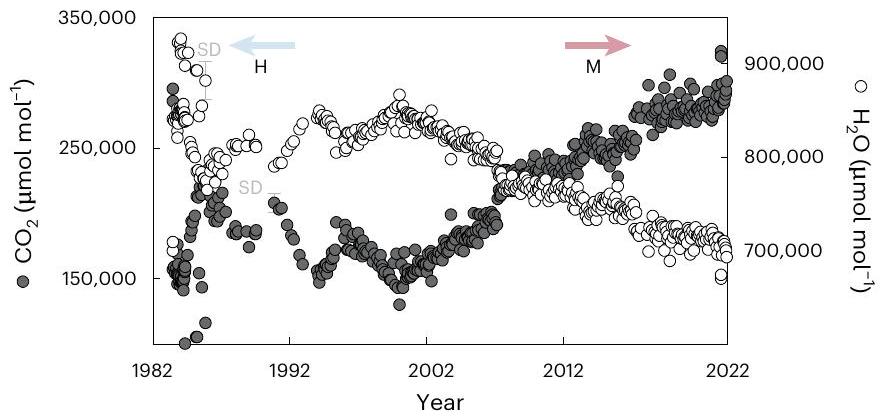
تم أخذ السجل المستمر الاستثنائي لتكوين الفومارول في CF (الجدول التكميلي 1) سابقًالتحديد تقدم ملحوظ نحو تقليل الرطوبة، وزيادة…تركيبات غنية على مدى العقود الأربعة الماضية (الشكل 1أ). بالإضافة إلى بعض程度 من تكثف البخار في النظام الحراري المائيتم تفسير هذا الانتقال على أنه يعكس طبيعة غاز الفومارول المتزايدة الماجماتية، مدعومًا بتقارب نسب الديوتيريوم/الهيدروجين (D/H) في بخار الفومارول نحو القيم الماجماتية.قيم الدلتا ديوتيريوم من -10 إلى مقابل SMOW (مياه المحيط القياسية المتوسطة)؛ الشكل 1ب). ومع ذلك، فإن الملاحظة التي نبرزها هي الزيادة غير المسبوقة، التي تبلغ خمسة أضعاف، في الكبريت الفوماري، في شكل كبريتيد الهيدروجين.“، منذ أوائل عام 2018 (الشكل 1c). هذه الزيادة في الفومارولية الوفرة (الشكل 2) تتوازى مع تحول نظائري منهجي (الشكل 1c) نحو تركيبات سلفور سلبية النظير (
الشكل 1| كرونوجرام لتطور تركيبة فومارول CF من 1982 إلى 2023. بيانات من الجدول التكميلي 1. عدم اليقين التحليلي عند انحراف معياري واحد (s.d.) من المتوسط. أ، تقدم من-غني (هيدروحراري (H)) إلى يلاحظ وجود تركيبات غنية (ماجما (M)). ب، تركيبة نظائر الديوتيريوم (، بالنسبة إلى SMOW) من بخار الفومارول يتطور إلى توقيعات أكثر إيجابية تدريجياً، ضمن نطاق غاز الماجما. ج، تزداد التركيزات منذ عام 2018، متزامنة مع تحول نظائري سلبي في تركيبة نظائر الكبريت. د، الغاز المرصود (الفومارولات) مقابل الغاز النموذجي (عند التوازن مع البيريت الحراري المائي؛ الطرق) النسب. الفائض خلال الفترة من 2018 حتى الآن (وفي الثمانينيات) تعنيالضغط البخاري غير محمي بواسطة البيريت خلال الاضطرابات المتزايدة. الزلازل البركانية التكتونية (عدد الأحداث الشهري، الأعمدة الرمادية؛ بيانات من INGV Osservatorio Vesuviano) مقابل التقديرالتدفق من منطقة سولفاتارا. يتم حساب هذا التدفق عن طريق ضرب الانتشارالناتج من هيكل تفريغ غاز سولفاتارابجانب الفومارولنسبة (اللوحة د). مقابل فيينا كانيون ديابلو ترويلت (VCDT)). هذا التغيير النظائري أكبر حتى من الملاحظخلال الاضطراب الأقوى (من حيث معدل الرفع والزلازل) في الفترة من 1982 إلى 1984 (الشكل 1c). التغيرات الفومارية الملحوظة (الأشكال 1 و 2) تتطلب أن مصدرًا إضافيًا من الكبريت، مختلف نظائريًا، قد دخل حيز التنفيذ في CF منذ عام 2018. نتخيل سيناريوهين محتملين (هيدروحراري مقابل بركاني) لعملية المصدر المعنية.
أ
ب
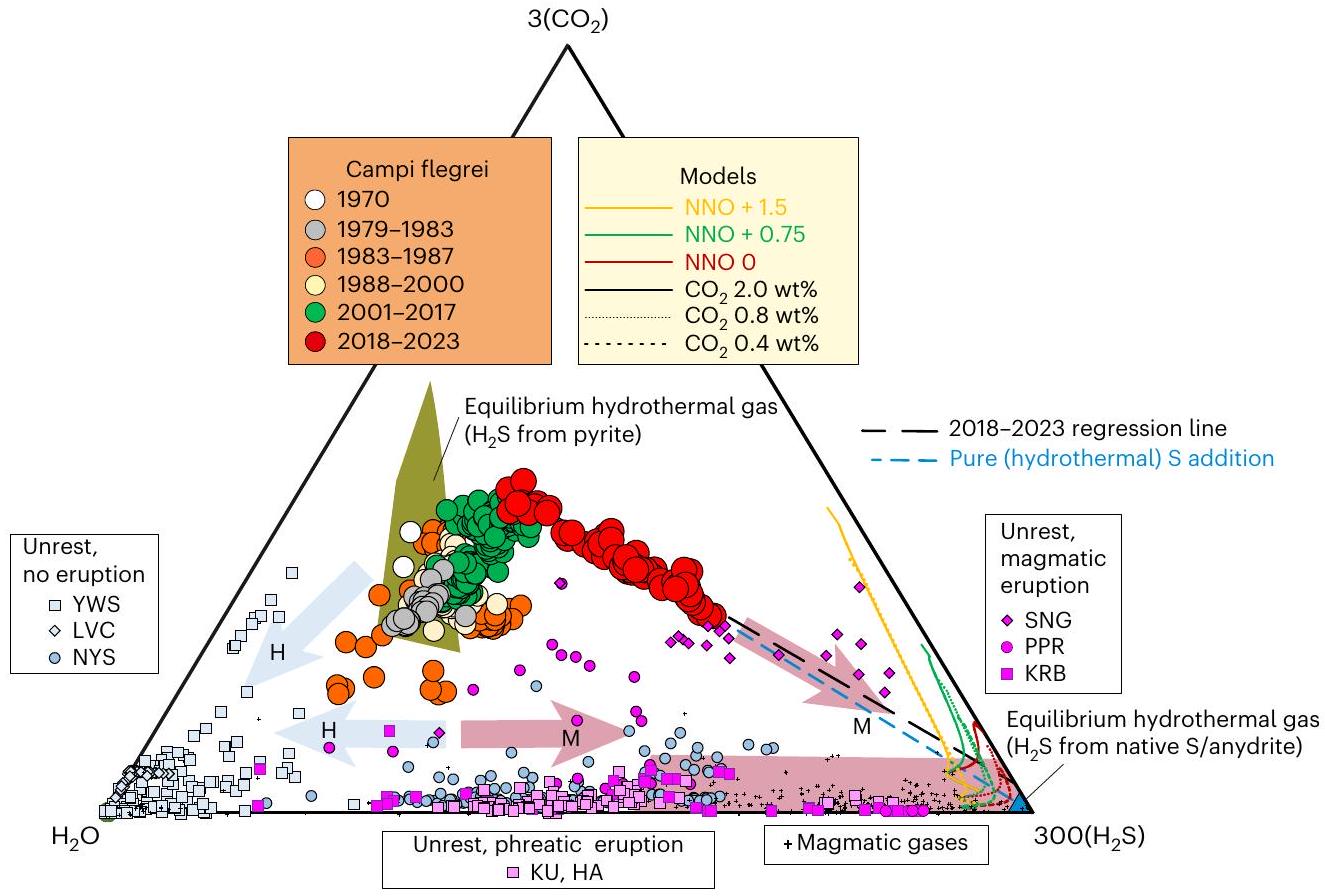
الشكل 2 | مخطط لتكوين الأنواع الرئيسية لـفومارولات. الـ، و تم تعديل تركيزات العناصر بواسطة عوامل 1 و3 و300، على التوالي، لأغراض العرض. تم تمييز نتائج الفومارول من 1983 إلى 2023 (الجدول التكميلي 1) زمنياً (بواسطة درجات الألوان) لتسليط الضوء على التطور الزمني. كما تم عرض نتائج 1970 و1979-1983 لفومارولات CF الأخرى (المعلومات التكميلية). يتم مقارنة تركيبة الفومارول مع (1) التركيبة النموذجية للغازات الماجماتية التي تتشكل خلال تفريغ الضغط للانصهارات التراكيباسلتية CF (الشكل 5)؛ (2) التركيبة النموذجية للغازات الحرارية المائية التي فيهاتتحكم الفجائية بالمعادن الهيدروحرارية الحاملة للكبريت (البيريت، الكبريت الأصلي والأنهدريت) (الطرق)؛ (3) التركيب الملحوظ للفومارولات في ثمانية كالديرات/براكين هيدروحرارية عالمية كانت في حالة من الاضطراب مؤخرًا (المكملات
المعلومات؛ YWS، يلوستون؛ LVC، حوض وادي الطويل؛ NYS، نيسيروس؛ KU، كوساتسو-شيراني؛ HA، هاكوني؛ SNG، سييرا نيجرا؛ PPR، بلانشون-بيتروا؛ KRB، كوتشينويرابوجيما)؛ (4) تركيب الغازات الماجمائية عالية الحرارة (لبيانات المصدر، انظر المعلومات التكميلية). لاحظ تطورات فومارول CF المميزة في 1983-1987 (نحو القطب الحراري، H) و2018-الحاضر (نحو القطب الماجماتي، M). يمكن تفسير التقدم شبه الخطي لفومارول CF بعد 2018 على أنه يعكس مزيجًا من (1) إضافة الكبريت النقي من تحلل الكبريت الأصلي/الأنهدريت، الناتج عن تعرض سطح معدني جديد بسبب التصدع/الزلازل (2) الخلط مع الغاز الماجماتي الغني بالكبريت الذي يتم تزويده من خلال تفريغ الماجما (عن طريق تخفيف الضغط) داخل القشرة المتوسطة.نظام أنابيب الصهارة (الشكل 4).
إعادة تحريك الكبريت من المعادن الهيدروحرارية
نظرًا لمرحلة النشاط الحالية لسيولة الكبريت، فإن إعادة تحريك الكبريت المرتبط بالمعادن الهيدروحرارية هو دافع محتمل للتصعيد.النقل الفوماري (سيناريو هيدروحراري). خلال فترات السكون التي تستمر لقرون إلى آلاف السنين في الكالديرات، يتم عادةً احتجاز أي كبريت يتم تزويده من المصدر الماجماتي في العمق في مجموعة متنوعة من رواسب المعادن الهيدروحرارية. التي تتشكل من خلال التفاعلات بين الصخور المضيفة والمواد المتطايرة الماغماتية خلال الاضطرابات، تتأثر الظروف الهيدروحرارية بزيادة نقل غازات الصهارة. والزلازل، مما يؤدي إلى ارتفاع درجة الحرارة وتغير في ظروف الأكسدة والاختزال. وبالتالي، يمكن إعادة تحريك الكبريت المخزن في المعادن الحرارية المائية إلى المرحلة الغازية الحرارية المائية.في CF، البيريت هو أكثر المعادن المحتوية على الكبريت وفرة.ومع ذلك، تشير خطتان من الأدلة إلى أن إعادة ذوبان البيريت هو مصدر غير محتمل للزيادة. شوهد في CF منذ عام 2018. أولاً، البيريت الهيدروحراري في CF ثقيل نظرياً ( من 3.3 إلى مقابل فيينا كانيون ديابلو ترويلت؛ مرجع 36 )، بحيث أن أي إعادة تحريك (عند التوازن) من البيريت (الطرق) ستؤدي إلى تحريك الفومارول.إلى أعلى“، وهو عكس ما يتم ملاحظته (الشكل 3أ). نود أن نحذر من أن بعض النظائر الخفيفة (من -11.0 إلى; الشكل 3أ) يمكن أن يتشكل من البيريت إذا كانت آلية تحلله تتضمن التفكك إلى كبريتات مائية و (الطرق). ثانيًا، وبالتالي بشكل أكثر حسمًا، أصل البيريت للزيادة بعد عام 2018يتعارض مع حسابات توازن الغاز الهيدروحراري (الطرق) التي تثبت التوازنتركيب مرحلة الغاز الهيدروحرارية التي فيهاالضغط البخاري يتحكم فيه تحلل البيريتنتائج هذه تشير الحسابات (الشكل 1d) إلى أن التركيبات النموذجية والملاحظة (الفومارول) تتطابق ضمن حدود عدم اليقين خلال الفترة من 2003 إلى أوائل 2018، مما يدعم صحة نهج النموذج. ومع ذلك، فإنها تختلف خلال الاضطرابات الكبرى في 1982-1984 (والسنوات التالية) ومن منتصف 2018 فصاعدًا (الشكل 1d). نستنتج أن توازن البيريت يتحكم فيالضغط البخاري خلال النشاط الهيدروحراري الخلفي في CF ولكن لا يمكن تفسير التصعيد الذي لوحظ من عام 2018 فصاعدًا. كما تم تحديد الكبريت الأصلي والكبريتات (الألونيتي والأنهدريت) في باراجينيسيس المعادن الهيدروحرارية في CF.تشير توازنات الغاز والمعادن (الطرق) إلى أن هذه المعادن غير مستقرة عند ظروف درجة الحرارة (T) والضغط (P) الهيدروحراري CF (الشكل البياني الموسع 2)، ومن ثم لديها ميل قوي للتفكك إلىالتسارع بعد عام 2018 فيالإفراج يتزامن مع زيادة كبيرة في النشاط الزلزالي (الشكل 1e). لذلك، نحن نرى أن فتح شقوق جديدة مدفوعًا بالنشاط الزلزالي قد يكون قد أنشأ مسارات جديدة لهجرة الغاز، مما يعرض أسطح معدنية جديدة لتفاعلات الغاز والمعادن ويسبب استخراج فعال للكبريت، من الكبريت الأصلي والكبريتات، إلى الطور الغازي. الكبريت الأصلي والألونيتي وفيرون في البيئة السطحية الضحلة (حول الفومارولات)، حيث يتشكلون من الأكسدة القريبة من السطح للفومارولي.. تركيبات النظائر الكبريتية لهذه الرواسب الفومارية (كبريت طبيعي، -5.5 إلى؛ الكبريتات، -1.7 إلى; المرجع 36 ) تقع ضمن نطاق تلك الفوهات الغازية المصدرية (الشكل 3أ). ومع ذلك، فإن الكبريت الأصلي والألونيت غائبان، والأنهدريت نادر (منخفض جداً ليكون قابلاً للقياس لـ )، في التجمع المعدني الهيدروحراري العميقنظرًا لأن النشاط الزلزالي يتجمع في هذا الجزء الأعمق من النظام الهيدروحراري (بين عمق 1 و 3 كيلومترات؛ الشكل 4)، لا يمكننا استبعاد، ولكن نعتبره غير محتمل، أن الكبريت الأصلي والأنهدريت هما مصدران مناسبان للانبعاثات البخارية بعد عام 2018.زيادة.
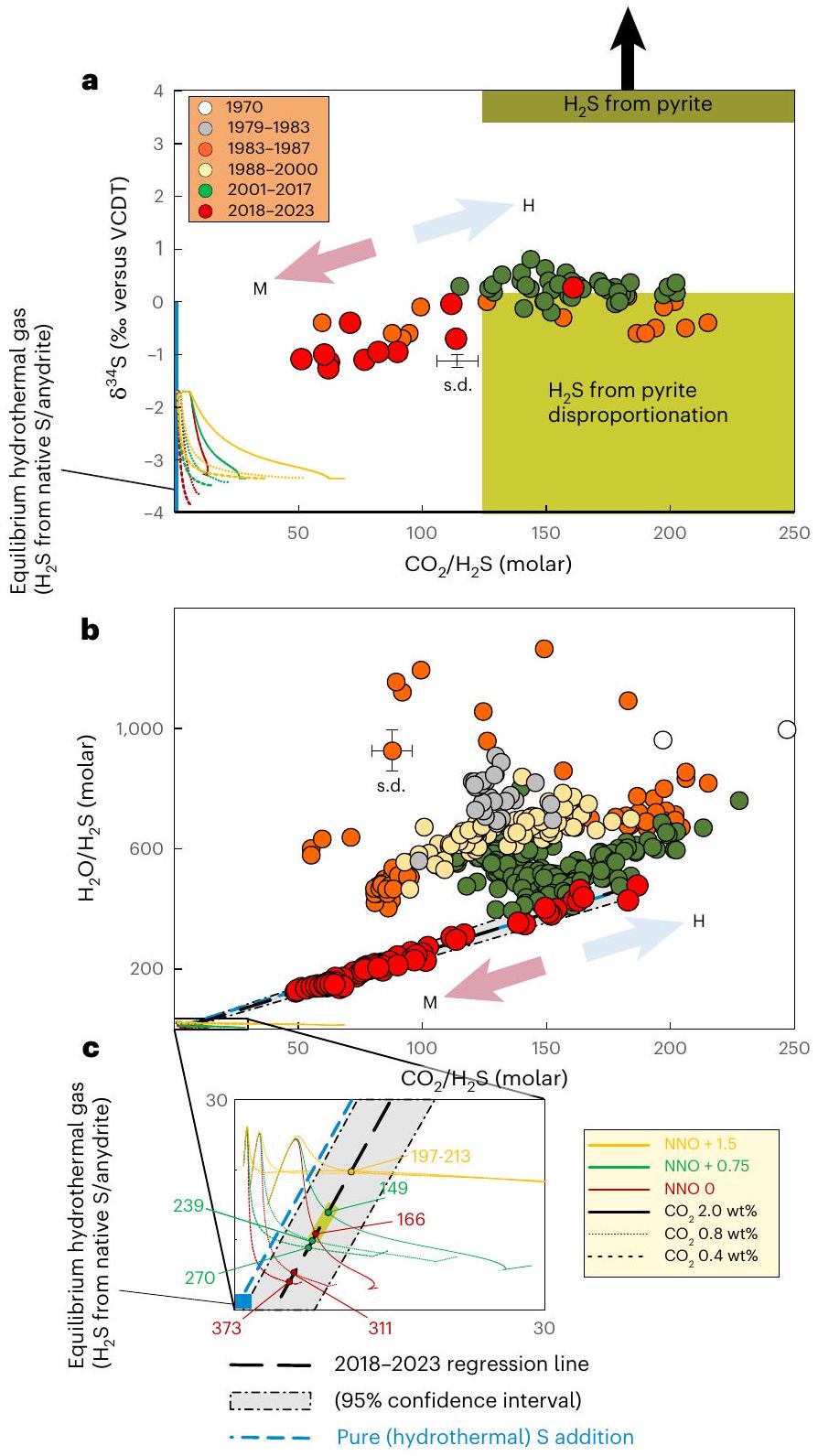
الشكل 3 | التركيب الكيميائي ونظائر الكبريت لفومارولات CF. أ-ج، النسب في فومارولات بوكّا غراندي موضوعة مقابل تركيبات نظائر الكبريت للفومارولوفتيلةالنسب (عدم اليقين التحليلي عند انحراف معياري واحد عن المتوسط (s.d.)) (ب، ج). تحدد نتائج الفومارول من 2018 إلى 2023 اتجاهًا خطيًا يتطلب إضافة الكبريت الزائد، الخفيف النظائر (<-1.5%) من إما (1) تحلل الكبريت الأصلي/الأنهدريت أو (2) الغازات الماغماتية الغنية بالكبريت (أو مزيج من الاثنين).مجالاتالمكونة من تحلل البيريت مشتقة من المعادلات (3) و(5) و(11) (الطرق). التركيب النظائري المتوقع لـ يتم الحصول على تحليل الكبريت من تحلل الكبريت الأصلي من نتائج المرجع 36 (تركيب الغاز الهيدروحراري في حالة التوازن مستمد من دمج المعادلات (9) و(10) و(13)؛ الطرق). في الأشكال a-c، خطوط نموذج انبعاث الغاز البركاني هي نفسها كما في الشكل 2 (تم نمذجة التركيب النظائري للكبريت في الغازات البركانية كما هو موضح في البيانات التكميلية 1 والطرق). يوضح الإطار (اللوحة c) خط الانحدار من 2018 إلى 2023 (interval الثقة الموضح) يتقاطع مع اتجاهات تفريغ الصهارة عند ضغوط تشغيل النموذج التي – اعتمادًا على شروط إدخال تشغيل النموذج – تتراوح من 149 إلى 373 ميغاباسكال (البيانات التكميلية 1). في الفرضية الصهارية لزيادةالإفراج، المصدر الماجما هو ما فيك (تراكايباسالتي) ويخضع لعملية إزالة الغاز تحت الضغط في نظام الأنابيب في منتصف القشرة الأرضية، عندعمق.
الماغما المافية كمصدر للكبريت
ثانيًا، نعتبر فرضية الأصل الماجماتي (السيناريو الماجماتي) للنافورات الغازيةما بعد 2018تثير التصعيد السؤال عما إذا كانت الظروف التي تسمح بإطلاق الكبريت النشط من الصهارة قد تم الوصول إليها. إن إطلاق الكبريت الناتج عن انخفاض الضغط (المدفوع بالصعود) هو دالة معقدة لتكوين الصهارة، وحجم التغير في الضغط ودرجة الحرارة، ومحتوى المتطايرات الأولي، وحالة أكسدة الصهارة، وأنماط صعود الصهارة/انخفاض الضغط.تشير أدلة احتواء الصهر (MI) إلى أن الصهارات الأبوية لـ CF هي تراكيباستية.بمجرد تطبيقها على هذه التراكيب، فإن النمذجة العددية لغازات الصهارة (الطرق) تشير إلى سلوك عميق لإزالة الكبريت (الشكل 5). تحصر حساباتنا (البيانات التكميلية 1) أن التراكيت البازلتية CF تصبح مشبعة بالغازات عند ضغوط عالية (منإلىللبدايةمحتويات 0.4 إلى” ). الـ-مهيمنكسر المولمن 0.65-0.82؛ الشكل 5e) تحتوي المرحلة الغازية الماجماتية التي تتشكل عند ضغوط عالية على إجمالي مرتفع نسبيًامن 0.025 إلى 0.1؛ الشكل 5f)، مما يشير إلى إزالة فعالة للكبريت من المصهور. باستخدام الحد الأقصى لمحتوى الكبريت منفي MIs كتقدير لمحتوى الكبريت من الوالدين (الشكل البياني الممتد 3)، نجد أن نصف الشحنة الكبريتية الأولية تُفقد كغاز خلال عملية إزالة الغاز الناتجة عن انخفاض الضغط في الضغط (الشكل 5أ)، ضمن منطقة تخزين الماجما الرئيسية العميقة (الشكل 4). يُستنتج أن هذا الكبريت في الطور الغازي هو مزيج من و (الشكل 5ج). يتماشى إزالة الكبريت العميق مع التركيب الفقير من الكبريت للانصهارات المتطورة، من النوع التراكيت إلى الفونوليت، (الشكل البياني الممتد 3) التي تتشكل عادةً (وتُخزن) في أعماق ضحلة.تشير نتائج النمذجة إلى فرضية مصدر الماجما للفومارولات بعد عام 2018التصعيد لا يتطلب نقل الصهارة إلى مستويات ضحلة. بدلاً من ذلك، نجد أنه إذا تم استقراء تركيبات غازات الفومارول (بعد 2018) إلى تركيزات أعلى من الكبريت (الشكل 3ب، ج)، وبالتالي تقليل مساهمة السوائل الحرارية المائية، فإنها تتقاطع مع الاتجاهات النموذجية لتركيبات غازات الصهارة عندضغطفي نماذجنا المفضلة (الأولية; انصهار الأكسدة والاختزال عند NNO إلى NNO +0.75، حيث NNO هو عازل أكسيد النيكل عند درجة حرارة بركانية ; طرق)، أو أعمق (، أو إذا كانت الصهارة-أفقر. نحذر من أنه، بالنظر إلى الأخطاء (البيانات التكميلية 1) المرتبطة بالانحدار الخطي لبيانات الاتجاه (الشكل 3ب،ج)، جنبًا إلى جنب مع عدم اليقين في معلمات التهيئة (بشكل أساسي أكسدة واختزال الصهارة والمحتوى) وعلى معايرة نموذج إزالة الغازات نفسهلا يمكن استنتاج ضغط/عمق مصدر الصهارة بدقة. ومع ذلك، فإن نتائجنا قد تشير إلى صعود الصهارة في الأعلى، أو مباشرة فوق (إلى عمق ضحل يصل إلى )، الـ منطقة تخزين الماجما العميقة (الشكل 4).
لاختبار جدوى الفرضية الماجماتية، قمنا أيضًا بتحليل التركيب النظائري للكبريت في الشوائب المحتجزة في الأوليفين من اثنين من أكثر الانفجارات غنى بالماجما في النشاط البركاني الحديث. (الجدول التكميلي 2). نتائجنا (الشكل 6) تحدد مصدر الماغما CF ليكون من. هذه القيم تقع ضمن نطاق بازلت منتصف المحيطوهي أخف نظيرًا (مستنفدة في ) مما هو مشاهد في براكين القوس الأخرى حول العالم تحدد توقيع الكبريت الخفيف النظائري للانصهارات الأبوية لـ CF، كما تشير نتائج MI لدينا،قيم في السوائل الماجماتية بين -3.7 و o (الأشكال 3a و 6b). وبالتالي، يمكن أن يفسر زيادة إمداد الكبريت الماغماتي الخفيف النظائري إلى النظام الهيدروحراري الانخفاض الملحوظ فيمن الفوماروليكمنذ عام 2018 (الشكل 1c). ومن الجدير بالذكر أن الغاز المودل هو مزيج من و (الشكل 5)، بينما تحتوي الفومارولات فقط على تشير نتائجنا إلى مصدر الصهارةيتم تحويله كميًا إلىوبالتالي الحفاظ على إجمالي الكبريت الغازي، عند التبريد ( ) وإعادة التوازن في الغلاف الهيدروحراري.
تغيير جذري في سلوك انبعاث الغازات من الكالديرا
لا يمكن حل فرضيات الهيدروحرارية مقابل الماجماتية بسهولة من نتائجنا وحدها وليست متعارضة بالضرورة؛ بل إن الاثنين
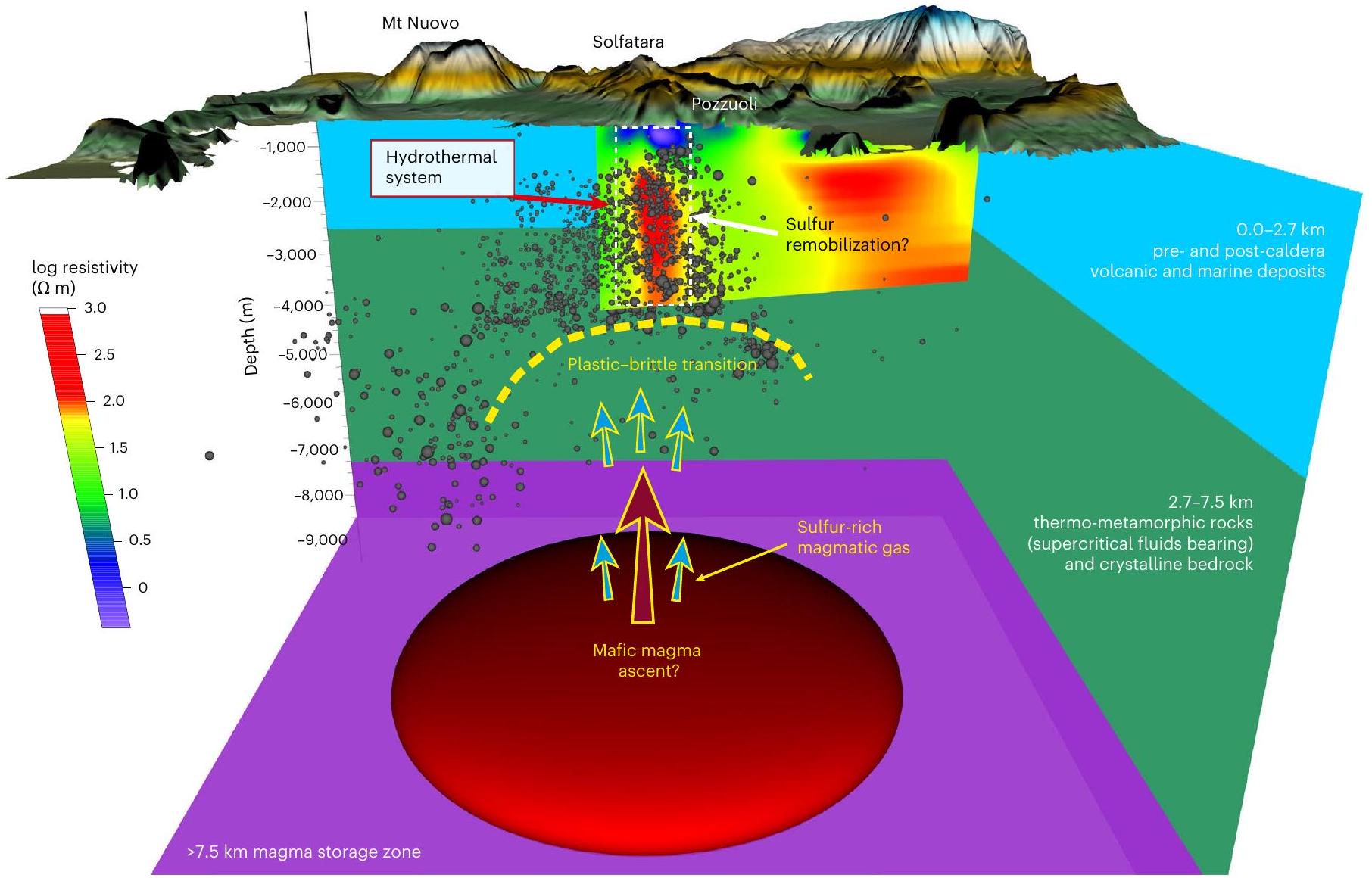
الشكل 4 | نظام السباكة في CF. أعيد رسمه وفقًا للنموذج الطبقي المقترح من قبل المرجع 38. نموذج المقاومة ثنائي الأبعاد لسولفاتارا من النظام الهيدروحراري الناتج عن قياسات الصوت المغناطيسي الكهربائي.يتم الإبلاغ عنها أيضًا كقسم. تشير قيم المقاومة العالية بشكل رئيسي إلى الطور الغازي تظهر القيم المنخفضة للمقاومة مناطق تحتوي على سائل، والتي قد تكون ناتجة في النهاية عن تكثف بخار الماء الحراري.تم تسجيل الزلازل بواسطة شبكة رصد الزلازل في أوزيرفاتوريو فيسوفيانو منذ عام 2018، وتظهر كدوائر رمادية، حيث تكون أبعادها متناسبة مع الحجم. يمكن أن تعمل العمليات معًا حيث إن إعادة تحريك الكبريت ستعتمد في النهاية على تسخين النظام الهيدروحراري.نتيجة لزيادة إمدادات الغاز الماجماتي. تسارع السطحقد يكون الإفراج، على الأقل من حيث المبدأ، متسقًا مع سيناريو يكون فيه إمداد الغاز الماغماتي ثابتًا، ولكن النظام الهيدروحراري يطلق الكبريت بشكل أكثر نشاطًا – أو يصبح أكثر شفافية لإمداد الغاز الماغماتي – بسبب زيادة التمدد (عن طريق التشوه المستمر والتسخين) والتصدع (بسبب تصاعد النشاط الزلزالي). ومع ذلك، مقارنة بالاضطراب من 2018 حتى الآن في CF، كانت أزمة البرايديسيزم في 1982-1984 أقوى بكثير.للمعدل الارتفاع والزلازل، ومع ذلك فإن الملاحظكانت الرحلة أكثر تواضعًا بكثير (كيميائيًا وإيزوتوبيًا);الأشكال 1-3). بالنظر إلى ندرة الأنهدريتفي الصخور الهيدروحرارية العميقة التي تشكل الحجم الرئيسي المسبب للزلازل (الشكل 4)، يبدو من غير المحتمل أن التصدع وحده – وبالتالي تعرض أسطح المعادن المحتوية على الكبريت الجديدة – يمكن أن يفسر الزيادة الكبيرة والمستمرة في الكبريت بعد عام 2018 (الشكل 1c، d). لذلك، نعتبر أن إزالة الضغط عن الصهارة المافية أثناء الهجرة الصاعدة فيإلىنطاق العمق (الشكل 4)، كمصدر الأكثر احتمالاً لزيادة الكبريت بعد عام 2018. نلاحظ أن فترة صعود الصهارة المستندة إلى الغاز التي استنتجناها تتوافق مع تلك المستمدة من نمذجة التشوه بعد عام 2018.ومع نتائج التصوير الزلزالي المحليالتي تشير إلى الصعود إلى الأعماقكعامل رئيسي في الاضطرابات المستمرة (بعد 2018). كما أن صعود الصهارة الغنية بالمتطايرات الجديدة مرتبط أيضًا بالزيادة الملحوظة في انبعاث الغاز.. بينما من الممكن على الأقل من حيث المبدأ أن مصدر الماجما الثابت يطلق المزيد من الغاز بسبب الغليان الثانيأي صهارة مخزنة بشكل سطحي في القشرة العليا ست يجب أن تكون بحجم محدود (للهروب من الكشف الزلزالي)، وخاصة إذا كانت فليزك، وبالتالي ستظل مصدرًا غير كافٍ للكمية الكبيرة (المرجع 15) ومخرجات سطح الكبريت (الشكل 1e)، بسبب انخفاض محتوى المواد المتطايرة (الشكل البياني الموسع 3).
نتائجنا هي تلميح لتطورات إضافية للاحتجاجات التي تستمر بخلاف ذلكسنوات. تشير التحليلات الاستعادية لنتائج الفوماروليك المتاحة (القليلة) قبل الثمانينيات (الشكل البياني الإضافي 4) إلى أنقد يكون الارتفاع في الفومارول قد استمر، على الرغم من وتيرته البطيئة، لأكثر من قرن. ومع ذلك، فإن الزيادة بعد عام 2018 غير مسبوقة من حيث المعدل والسعة، وبالتالي تمثل تغييرًا كبيرًا في سلوك إزالة الغازات.
زيادة الكبريت خلال اضطراب الكالديرا قد لا تكون فريدة من نوعها في CF. لقد حددنا ثمانية كالديرات/براكين هيدروحرارية موزعة عالميًا ومراقبة جيدًا (معلومات إضافية) تتوفر لها ملاحظات غاز طويلة الأمد (الشكل 2). نود أن نحذر من أن هذه الأنظمة البركانية متنوعة جدًا من حيث الحجم وتاريخ الانفجارات وتركيب الصهارة، مما يجعل التعميم أو تصدير التفسيرات من نظام إلى آخر ليس بالأمر السهل. ومع ذلك، تُظهر تحليل هذه المجموعة العالمية من البيانات (الشكل 2) استمرار وجود تركيبات فقيرة بالكبريت ورطبة في الكالديرات (على سبيل المثال، يلوستون، وادي لونغ) حيث لم يتطور الاضطراب إلى انفجار. بالمقابل، تم ملاحظة تقدم نحو تركيبات فومارول غنية بالكبريت بشكل متزايد في الأنظمة البركانية (على سبيل المثال، سييرا نيغرا، بلانشون-بيتروا وكوتشينويرابوجيما) التي تصاعد فيها الاضطراب أخيرًا (على مدى فترات زمنية من سنوات/عقود) إلى انفجار. هذا السلوك العام يقترح أن تتبع تطور الاضطراب باستخدام الكبريت في الغازات البركانية يمكن أن يكون
الشكل 6 | التركيب النظائري للكبريت في الشوائب المعدنية. أ، التركيب النظائري للكبريت في الشوائب المعدنية مقابل محتوى الكبريت (تم قياسه بواسطة مطيافية الكتلة للأيونات الثانوية؛ البيانات من الجدول التكميلي 2). تُظهر الشريط الأحمر مجموعة من البازلتات في منتصف المحيطتم نشر بيانات MI والزجاج من البراكين القوسية في أمريكا الوسطى المتعلقة بالألماس الرمادي والصلبان.وCascade، على التوالي. تُظهر الخط الأصفر-البني نتائج تحليل الانحدار الأقل تربيعًا المطبق على البيانات، مع افتراض تفريغ نظام مغلق في حالة التوازن، بينما المنطقة المظللة تمثل خطأ معياري واحد من الانحدار. الرمز الكبير على شكل خماسي
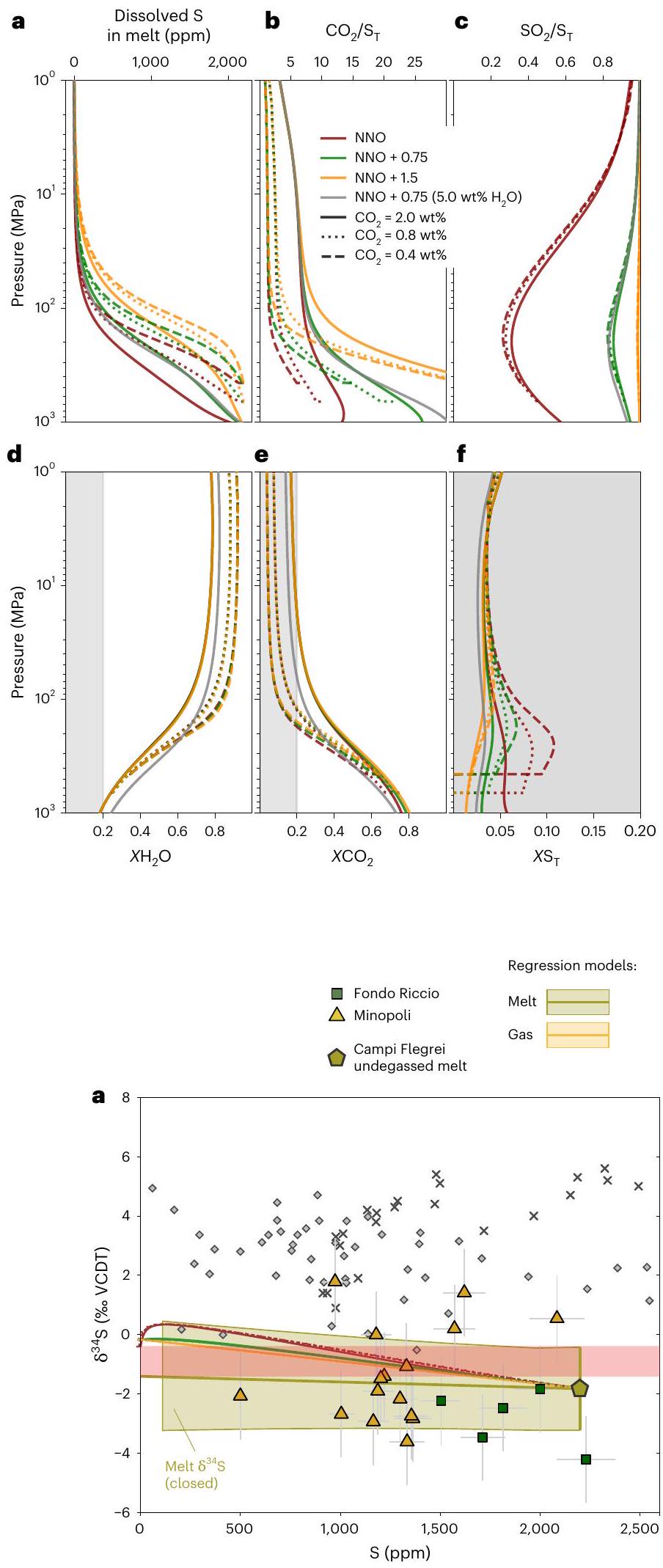
الشكل 5 | نتائج محاكاة النموذج لعملية انبعاث الغازات البركانية. جميع البيانات من البيانات التكميلية 1. توضح الرسوم البيانية اعتماد الضغط على الانصهار المتوازن (أ) والغاز (ب-ف) المستنتج من محاكاة النموذج.لإزالة الغازات المدفوعة بفعل تخفيف الضغط في نظام مغلق من انصهارات التراكيت-basaltic CF (الطرق). نتائج تسع عمليات نموذجية، تم تهيئتها عند نقاط مختلفةالمحتويات وظروف الأكسدة والاختزال (البيانات التكميلية 1) موضحة. أ، الكبريت المذاب في الصهارة، مما يدل على فقدان الكبريت بشكل نسبي عميق لصهارات CF. ب، تطور الغاز البركاني النموذجي المعتمد على الضغطنسبة (إجمالي الكبريت). ج، تحديد أنواع الكبريت في الطور الغازي، مما يشير إلى أنه عند ضغوط أعلى منيتكون منفي NNO إلىفي، إلى في. وهذا يعني أنه، في فرضية سيناريو الماجما، الفومارولييمكن أن يكون بمثابة وكيل للكبريت الماجماتي الكلي فقط بشرط أن يكون مصدر الصهارة مختزلاً. عميق ، أو ) وأن أي يتم تحويله إلى أثناء تمدد الغاز وتبريده، من درجة حرارة الماجما إلى درجة حرارة السطحتطور متوقع بواسطة النموذج و كسور المولات في مرحلة الغاز الماجماتي المتوازنة. يصبح الغاز بشكل متزايد-غني (و-غني) مع زيادة ضغط تشغيل النموذج. مفيد لتقييم المخاطر والتخفيف منها ليس فقط في CF، ولكن في البراكين الكالديرية/الحرارية المائية على مستوى العالم.
قبول فرضية الماجما لزيادة الكبريت في CF لن يوفر دليلاً قاطعاً على أن ثوراناً سيحدث بالضرورة، و/أو أنه وشيك. نتائج علم الصخور وكيمياء المعادنتشير إلى أن الفوهات البركانية عادة ما تمر بعدة حلقات من إمداد الصهارة.قبل أن يتم الوصول أخيرًا إلى ظروف الضغط الزائد الحرجة لبدء الانفجار، ربما في غضون عقود إلى أقل من قرن.على سبيل المثال، كان آخر ثوران بركاني في عام 1538 ميلادي، حيث تم إعادة بناء تاريخ تشوه الأرض بالتفصيل.، تم توقعه من خلال وضع الصهارة في القشرة العليا بدءًا من وقت مبكر مثلسنوات قبل (أو ربما أكثر)، ومن خلال مؤشرات جيولوجية/كيميائية مذهلةلا توجد اليوم أدلة جيوديسية/زلازلية على
يظهر التنبؤ بـمن الصهر غير المنزوع الغاز. الخطوط الصفراء والخضراء والحمراء هي نماذج إزالة الغاز للأمام تم حسابها باستخدام Sulfur_X (المرجع 27) ومجمعة مع عوامل تكسير نظائر الكبريت للكبريتيد-كبريتات،-كبريتيد و – (الطرق؛ جميع الحسابات المبلغ عنها في البيانات التكميلية 1). الخطوط الصلبة والمقطعة والمتقطعة تظهر نتائج النموذج مع المتغير المحتويات (2.0، 0.8 وجميع أشرطة الخطأ هي 2 انحراف معياري من المتوسط.نفس الشيء كمالكن الإبلاغ عن تطور نموذج تركيبات نظائر الكبريت الغازية في حالة التوازن (لعملية تفريغ النظام المغلق). أنماط تشوه الأرض غير الشعاعية وغير المتماثلة وزيادة النشاط الزلزالي نحو الأعلىكما تم الاستنتاج لمرحلة التحضير/التمهيد لثورة عام 1538. بالإضافة إلى ذلك، فإن فومارولات CF لا تزال بعيدة من الناحية التركيبية عن التوقيعات البركانية الواضحة التي لوحظت قبل ثورات الكالديرا في أماكن أخرى (الشكل 2). ومع ذلك، فإن حقيقة أن الصهارة القاعدية قد تكون قد تسربت في منتصف القشرة الأرضية (يتطلب نظام السباكة اتخاذ أي إجراء ممكن أو تكثيفه لزيادة الاستعداد للانفجار في هذه المنطقة ذات الكثافة السكانية العالية.يعيش الناس داخل الفوهة البركانية). يجب أن تؤخذ أي تطورات تركيبية إضافية للغازات المنبعثة نحو نطاق الغاز الماغماتي (الشكل 2) بعين الاعتبار كعلامة على زيادة احتمال حدوث ثوران.
المحتوى عبر الإنترنت
أي طرق، مراجع إضافية، ملخصات تقارير Nature Portfolio، بيانات المصدر، بيانات موسعة، معلومات تكميلية، شكر وتقدير، معلومات مراجعة الأقران؛ تفاصيل مساهمات المؤلفين والمصالح المتنافسة؛ وبيانات توفر البيانات والرموز متاحة علىhttps://doi.org/10.1038/s41561-024-01632-w.
References
Branney, M. & Acocella, V. in The Encyclopedia of Volcanoes 299-315 (eds. Sigurdsson, H. et al.) (Elsevier, 2015).
Druitt, T. H. & Sparks, R. S. J. On the formation of calderas during ignimbrite eruptions. Nature 310, 679-681 (1984).
Orsi, G., De Vita, S. & Di Vito, M. The restless, resurgent Campi Flegrei nested caldera (Italy): constraints on its evolution and configuration. Geotherm. Res. 74, 179-214 (1996).
Lowenstern, J. B. & Hurwitz, S. Monitoring a supervolcano in repose: heat and volatile flux at the Yellostone caldera. Elements 4, 35-40 (2008).
Newhall, C. G. & Dzurisin, D. Historical Unrest at Large Calderas of the World (USGS, 1988).
Acocella, V., Di Lorenzo, R., Newhall, C. & Scandone, R. An overview of recent (1988-2014) caldera unrest: knowledge and perspectives. Revs. Geophys. 53, 896-955 (2015).
Wicks, C. W., Thatcher, W., Dzurisin, D. & Svarc, J. Uplift, thermal unrest and magma intrusion at Yellowstone caldera. Nature 440, 72-75 (2006).
Hill, D. P. in Mechanisms of Activity and Unrest at Large Calderas Vol. 269 (eds. Troise, C. et al.) 171-187 (Geological Society of London, 2006).
Dzurisin, D., Savage, J. C. & Fournier, R. O. Recent crustal subsidence at Yellowstone caldera, Wyoming. Bull. Volcanol. 52, 247-270 (1990).
Gottsmann, J. et al. Oscillations in hydrothermal systems as a source of periodic unrest at caldera volcanoes: multiparameter insights from Nisyros, Greece. Geophys. Res. Lett. https://doi.org/ 10.1029/2007GL029594 (2007).
Di Vito, M. A. et al. Magma transfer at Campi Flegrei caldera (Italy) before the 1538 AD eruption. Sci. Rep. https://doi.org/10.1038/ srep32245 (2016).
Scarpa, R. et al. in Campi Flegrei, Active Volcanoes of the World Series (eds. Orsi, G. et al.) 257-282 (Springer, 2022).
Kilburn, C. R. J., De Natale, G. & Carlino, S. Progressive approach to eruption at Campi Flegrei caldera in southern Italy. Nat. Commun. https://doi.org/10.1038/ncomms15312 (2017).
Kilburn, C. R. J., Carlino, S., Danesi, S. & Pino, N. A. Potential for rupture before eruption at Campi Flegrei caldera, Southern Italy. Commun. Earth Environ. https://doi.org/10.1038/s43247-023-00842-1 (2023).
Chiodini, G. et al. in Campi Flegrei, Active Volcanoes of the World Series (eds. Orsi, G. et al.) 239-256 (Springer, 2022).
Chiodini, G. et al. Magmas near the critical degassing pressure drive volcanic unrest towards a critical state. Nat. Commun. https://doi.org/10.1038/ncomms13712 (2016).
D’Auria, L. et al. Magma injection beneath the urban area of Naples: a new mechanism for the 2012-2013 volcanic unrest at Campi Flegrei caldera. Sci. Rep. https://doi.org/10.1038/ srep13100 (2015).
Moretti, R., Troise, C., Sarno, F. & De Natale, G. Caldera unrest driven by -induced drying of the deep hydrothermal system. Sci. Rep. https://doi.org/10.1038/s41598-018-26610-2 (2018).
Troise, C., De Natale, G., Schiavone, R., Somma, R. & Moretti, R. The Campi Flegrei caldera unrest: discriminating magma intrusions from hydrothermal effects and implications for possible evolution. Earth Sci. Rev. 188, 108-122 (2019).
Farrar, C. D. et al. Forest-killing diffuse emission at Mammoth Mountain as a sign of magmatic unrest. Nature 376, 675-678 (1995).
Sorey, M. L. et al. Carbon dioxide and helium emissions from a reservoir of magmatic gas beneath Mammoth Mountain, California. J. Geophys. Res. Solid Earth 103, 15303-15323 (1998).
Chiodini, G. et al. Magma degassing as a trigger of bradyseismic events: the case of Phlegrean Fields (Italy). Geophys. Res. Lett. https://doi.org/10.1029/2002GL016790 (2003).
Lowenstern, J. B., Smith, R. B. & Hill, D. P. Monitoring super-volcanoes: geophysical and geochemical signals at Yellowstone and other large caldera systems. Phil. Trans. R. Soc. A 364, 2055-2072 (2006).
Chiodini, G. et al. Insights from fumarole gas geochemistry on the origin of hydrothermal fluids on the Yellowstone Plateau. Geochim. Cosmochim. Acta 89, 265-278 (2012).
Caliro, S., Chiodini, G. & Paonita, A. Geochemical evidences of magma dynamics at Campi Flegrei (Italy). Geochim. Cosmochim. Acta 132, 1-15 (2014).
Edmonds, M. & Wallace, P. J. in Elements Vol. 13 (eds. Putirka, K. D. & Cooper, K. M.), 29-34 (Mineralogical Society of America, 2017).
Ding, S., Plank, T., Wallace, P. J. & Rasmussen, D. J. Sulfur_X: a model of sulfur degassing during magma ascent. Geochem. Geophysi. Geosyst. https://doi.org/10.1029/2022GC010552 (2023).
Wallace, P. J. & Edmonds, M. The sulfur budget in magmas: evidence from melt inclusions, submarine glasses, and volcanic gas emissions. Rev. Mineral. Geochem. 73, 215-246 (2011).
Henley, R. W. et al. Porphyry copper deposit formation by sub-volcanic sulphur dioxide flux and chemisorption. Nat. Geosci. 8, 210-215 (2015).
Giggenbach, W. F. Geothermal gas equilibria. Geochim. Cosmochim. Acta 44, 2021-2032 (1980).
Giggenbach, W. F. Redox processes governing the chemistry of fumarolic gas discharges from White Island, New Zealand. Appl. Geochem. 2, 143-161 (1987).
Chiodini, G. et al. Hydrothermal pressure-temperature control on emissions and seismicity at Campi Flegrei (Italy). J. Volcanol. Geotherm. Res. https://doi.org/10.1016/j.jvolgeores.2021.107245 (2021).
Allard, P., Maiorani, A., Tedesco, C., Cortecci, D. & Turi, B. Isotopic study of the origin of sulfur and carbon in Solfatara fumaroles, Campi Flegrei caldera. J. Volcanol. Geotherm. Res. 48, 139-159 (1991).
Hedenquist, J. W. & Lowenstern, J. B. The role of magmas in the formation of hydrothermal ore deposits. Nature 370, 519-527 (1994).
Piochi, M. et al. Native sulfur, sulfates and sulfides from the active Campi Flegrei volcano (southern Italy): genetic environments and degassing dynamics revealed by mineralogy and isotope geochemistry. J. Volcanol. Geotherm. Res. 304, 180-193 (2015).
Mangiacapra, A. et al. The deep magmatic system of the Campi Flegrei caldera (Italy). Geophys. Res. Lett. https://doi.org/10.1029/ 2008GL035550 (2008).
Zollo, A. et al. Seismic reflections reveal a massive melt layer feeding Campi Flegrei caldera. Geophys. Res. Lett. https://doi.org/ 10.1029/2008GL034242 (2008).
Buono, G. et al. New insights Into the recent magma dynamics under Campi Flegrei caldera (Italy) from petrological and geochemical evidence. J. Geophys. Res. Solid Earth https://doi.org/ 10.1029/2021JBO23773 (2022).
Labidi, J., Cartigny, P., Birck, J. L., Assayag, N. & Bourrand, J. J. Determination of multiple sulfur isotopes in glasses: a reappraisal of the MORB S. Chem. Geol. 334, 189-198 (2012).
Muth, M. J. & Wallace, P. J. Slab-derived sulfate generates oxidized basaltic magmas in the southern Cascade arc (California, USA). Geology 49, 1177-1181 (2021).
Taracsák, Z. et al. Sulfur from the subducted slab dominates the sulfur budget of the mantle wedge under volcanic arcs. Earth Planet. Science Lett. https://doi.org/10.1016/j.epsl.2022.117948 (2023).
Astort, A. et al. Tracking the 2007-2023 magma-driven unrest at Campi Flegrei caldera (Italy). Commun. Earth Environ. https://doi.org/10.1038/s43247-024-01665-4 (2024).
Giacomuzzi, G., Chiarabba, C., Bianco, F., De Gori, P. & Agostinetti, N. P. Tracking transient changes in the plumbing system at Campi Flegrei Caldera. Earth Planet. Sci. Lett. https://doi.org/10.1016/ j.epsl.2024.118744 (2024).
Lima, A. et al. Thermodynamic model for uplift and deflation episodes (bradyseism) associated with magmatic-hydrothermal activity at the Campi Flegrei (Italy). Earth Sci. Rev. 97, 44-58 (2009).
Costa, F., Shea, T. & Ubide, T. Diffusion chronometry and the timescales of magmatic processes. Nat. Rev. Earth Environ. 1, 201-214 (2020).
Parks, M. M. et al. Evolution of Santorini Volcano dominated by episodic and rapid fluxes of melt from depth. Nat. Geosci. 5, 749-754 (2012).
Druitt, T. H., Costa, F., Deloule, E., Dungan, M. & Scaillet, B. Decadal to monthly timescales of magma transfer and reservoir growth at a caldera volcano. Nature 482, 77-80 (2012).
Guidoboni, E. & Ciuccarelli, C. The Campi Flegrei caldera: historical revision and new data on seismic crises, bradyseisms, the Monte Nuovo eruption and ensuing earthquakes (twelfth century 1582 AD). Bull. Volcanol. 73, 655-677 (2011).
Rosi, M. et al. Defining the pre-eruptive states of active volcanoes for improving eruption forecasting. Front. Earth Sci. https://doi.org/10.3389/feart.2022.795700 (2022).
Publisher’s note Springer Nature remains neutral with regard to jurisdictional claims in published maps and institutional affiliations.
Open Access This article is licensed under a Creative Commons Attribution-NonCommercial-NoDerivatives 4.0 International License, which permits any non-commercial use, sharing, distribution and reproduction in any medium or format, as long as you give appropriate credit to the original author(s) and the source, provide a link to the Creative Commons licence, and indicate if you modified the licensed material. You do not have permission under this licence to share adapted material derived from this article or parts of it. The images or other third party material in this article are included in the article’s Creative Commons licence, unless indicated otherwise in a credit line to the material. If material is not included in the article’s Creative Commons licence and your intended use is not permitted by statutory regulation or exceeds the permitted use, you will need to obtain permission directly from the copyright holder. To view a copy of this licence, visit http://creativecommons.org/licenses/by-nc-nd/4.0/.
(c) The Author(s) 2025
طرق
تركيب غاز الفومارول
تتوفر مجموعة بيانات تركيبة الفومارول في الجدول التكميلي 1. تستند هذه المجموعة إلى مسوحات أخذ عينات دورية (شهرية) من فومارول بوكّا غراندي. ) تقع داخل فوهة سولفاتارا، أكبر تجلي هيدروحراري لـ CF. تم نشر نتائج التركيب قبل عام 2022 في أماكن أخرى (المرجع 32 والمراجع المذكورة فيه). تم جمع العينات باستخدام بروتوكولات قياسية باستخدام قوارير مسبقة التفريغ مملوءة بمحلول 4 M NaOH وتم تحليلها في المختبرعن طريق كروماتوغرافيا الغاز (للمكونات الرئيسية؛ طراز Agilent Technologies 6890N) وقياس الطيف الكتلي (للنظائر المائية؛ طراز Thermo Fisher deltaXP وطراز Picarro L2130-i). لقياسات التركيب النظائري للكبريت الكلي، تم جمع 50 مل من محلول عينة NaOH في flask حجمي سعة 100 مل. 2 مل من ثم أضيفت المحلول، وترك المزيج الناتج للراحة لمدة حوالي ساعة. ثم تمت إزالة الفائض من الأكسجين عن طريق غليان المحلول. تم معايرة المحلول باستخدام HCl 6 M مع مؤشر الميثيل البرتقالي، مع الحفاظ على المحلول تحت التحريك والتسخين إلى للسماح بالمنتج لتفريغ الغاز. لترسيب الباريت، 20 مل منتم إضافة المحلول إلى 50 مل من المكثف تحت التحريك المستمر. ثم تم تصفية المحلول الناتج باستخدامفلتر، وتم تجفيف الباريت الراسب عندفي فرن لمدة 24 ساعة. ثم تم جمع الراسب باستخدام ملعقة تيفلون، ثم تم وزنه.على أساس محتوى الكبريت المتوقع بحوالي ) في كبسولات من القصدير (بنسب 1/5) أُضيفت لتحفيز تفاعل الأكسدة لأي نوع من أنواع الكبريت المخفض. نسب نظائر الكبريت ( تم تحليلها في جامعة باليرمو بواسطة مطياف الكتلة لنسبة النظائر (Thermo Scientific Delta V ADVANTAGE) بعد الاحتراق على الإنترنت في محلل العناصر (Thermo Fisher Scientific Flash 2000) المتصل بمطياف الكتلة لنسبة النظائر من خلال واجهة Conflo-IV. تم التعبير عن نسب نظائر الكبريت بطريقة تقليديةتدوين الوحدة كأجزاء في الألف من الانحرافات عن المعيار الدولي، VCDT، كما يلي:
أينتم معايرة العينات على مقياس VCDT باستخدام مواد مرجعية معتمدة من الوكالة الدولية للطاقة الذرية (IAEA-SO-6:; NBS ; الوكالة الدولية للطاقة الذرية-S-1: ; الوكالة الدولية للطاقة الذرية – SO-5: ; NBS 127: الدقة التحليلية المستندة إلى الانحرافات المعيارية لعدة تحليلات للمعايير (أو مزيج من التحليلات المتكررة للعينات والمعايير) كانت.
شموليات الانصهار
تم اختيار بلورات الأوليفين والكلينوبيروكسيين يدويًا من الرماد البركاني في مينوبولي2 وفوندو ريتشيو، وهما الانفجارات الأكثر غنى بالماجما في تاريخ CF الحديث (معلومات إضافية). قبل إجراء تحليلات MI، تم فحص البلورات المختارة يدويًا تحت المجهر. تم اختيار البلورات التي تحتوي على MI زجاجية وتم تثبيتها بشكل فردي في لاصق كريستال بوند، ثم تم تلميعها حتى تظهر. ثم تم تثبيت البلورات في الإيبوكسي وتلميعها وتنظيفها. تم تحليل محتويات العناصر الرئيسية S و Cl و F في MI الزجاجية وبلوراتها المضيفة باستخدام جهاز Cameca SX100 EPMA في قسم علوم الأرض بجامعة كامبريدج. تم إجراء جميع التحليلات عند جهد تسريع 15 كيلو فولت. كانت المعايير المستخدمة للتحليلات هي أوليفين جزيرة سانت جون (Mg، لتحليلات الأوليفين)، بيريكلاز (Mg، لتحليلات الزجاج والبيروكسيين)، ديوبسيد (Si)، جاديت (Na)، فلسبار بوتاسي (K)، فاياليت (Fe)، كورندوم (Al)، أباتيت دورانغو (P)، وولاستونيت (Ca)، روتيل (Ti)، معدن الكروم (Cr)، معدن المنغنيز (Mn)، معدن النيكل (Ni)، بايريت (S)، فلوريت (F) وهاليت (Cl). تم تحليل الزجاجات باستخدام شعاع غير مركّز. تم استخدام تيار شعاعي قدره 5 نانو أمبير للتحليل وتم تحليل الصوديوم أولاً باستخدام أوقات عد على القمة لمدة 30 ثانية؛ أظهرت الاختبارات قبل التحليلات عدم وجود حركة للصوديوم باستخدام هذه الحالة التحليلية. تم تحليل جميع العناصر الأخرى باستخدام تيار شعاع 80 نانو أمبير. العد لـو F تم تسجيلها جميعًا لـمن عينة زجاجية لتأكيد أن هذا الإعداد التحليلي لا يحرك المواد المتطايرة. تم نقل موضع قمة الكبريت للتحليلات غير المعروفة إلىلأخذ في الاعتبار تحول موضع الذروة بين الكبريت المخفض (البيريت، عند 61,387) والأكسيد (سيليستين، 61,355 ). كانت نسبة الخطأ للعناصر الرئيسية والثانوية، بخلاف، مما يزيد إلى لـ لـ S و لـ Cl. تم تحليل ما مجموعه 43 MI وخلجان. تم تحليل حوامل الأوليفين باستخدامقطر الشعاع، تيار شعاع 20 نانو أمبير للعناصر الرئيسية ( ) و تيار 100 نانو أمبير لجميع العناصر النزرة الأخرى. تم تحليل الكلينوبيروكسيين باستخدام تيار شعاع 60 نانو أمبير. لم يتم ملاحظة أي حركة للصوديوم أثناء تحليل الكلينوبيروكسيين. جميع النتائج والأخطاء مذكورة في الجدول التكميلي 2.
نسب نظائر الكبريتتم تحليلها في MI المختارة والمداخل البحرية ) في منشأة الميكروبروب الأيوني الوطنية في شمال شرق قسم الجيولوجيا والجيوفيزياء، معهد وودز هول للمحيطات، باستخدام جهاز Cameca IMS-1280. شعاع أولي من Cs+ مع تيار شعاعي من وتم استخدام جهد تسريع قدره 10 كيلو فولت للتحليلات. تم تسريع الأيونات الثانوية باستخدام جهد عينة قدره -10 كيلو فولت. تم استخدام بندقية إلكترونية ذات زاوية سقوط عمودية لتعويض شحن العينة. قبل التحليلات، تم استخدام ما قبل الشبكة لتنظيف سطح العينة من أي تلوث محتمل. بعد ما قبل الشبكة، تم توسيط فتحة المجال باستخدام و نقل الألواح. ثم تم تمرير شعاع الأيون الثانوي عبرفتحة المجال،شق المدخل وشق الخروج. تم إجراء التحليلات في وضع الجمع المتعدد باستخدام ثلاثة كواشف مضاعف الإلكترون: L2 و . تم تحليل كل نظير باستخدام إجمالي 20 دورة، كل منها يتكون من 4 ثوانٍ. تم ضبط قدرة الفصل الكتلي على 5000. تم تحليل ثلاثة معايير جنبًا إلى جنب مع العينات غير المعروفة: A36 (زجاج تحت جليدي آيسلندي، S)، STAP (زجاج تحت جليدي آيسلندي، 530 جزء في المليون من الكبريت) و HAW-16095 (زجاج بيكريت هاواي، س (المرجع 42)). هذه النظارات تغطي تقريبًا الكاملةالنطاق الذي تم ملاحظته في عيناتنا غير المعروفة (500-2,230 جزء في المليون؛ الشكل 6). لم نجد أي ارتباط بين التخصيص الكتلي الآلي (IMF) ومحتوى الكبريت. تم قياس قيم IMF، المحسوبة كالتالي:
تكونلـ STAP،لـ A36 ولـ HAW-16095. هذا يتفق مع الملاحظات السابقةلتحليلات باستخدام تحليلات جمع EM-EM أحادي في منشأة المايكروبروب الوطنية في الشمال الشرقي وتختلف عن الدراسات الأخرىالذي استخدم FC-EM لجمع البيانات المتعددة في تحليلاتهم. لقياس المجهولالقيم، قمنا بتطبيق تصحيح صندوق النقد الدولي باستخدام متوسط صندوق النقد الدولي المقاس من المعايير الثلاثة. تم طرح هذا من القياسالقيم. يُقدّر خطأ تصحيح صندوق النقد الدولي بـ.
تم تحديد محتويات الكبريت من خلال ملاءمة انحدار خطي بدون تقاطع بين محتويات الكبريت القياسية والمقاسة.القيم. هذه الانحدار لديهخطأ نسبي. تم تحديد خلفية الكبريت باستخدام خمس تحليلات متكررة للأوليفين، كانتلـ، ما يعادل 19 جزء في المليون من الكبريت.
التوقيع النظائري لـمن تحلل البيريت
يمكن للمعادن الكبريتية الهيدروحرارية إعادة تحريك الكبريت إلى المرحلة الغازيةالبيريت هو المعدن الهيدروحراري الأكثر وفرة في CF ويُوجدبشكل شائع في وجوه التغيير الهيدروحراري البروبيلي عند درجات حرارة وفي نطاق العمق، داخل (وحتى قاعدة) النظام الحراري المائي الذي يدعم انبعاثات الغاز السطحية في سولفاتارا-بيسكياريليلذلك، نحن نختبر الفرضية القائلة بأن زيادة نقل الكبريت ناتجة عن إعادة ذوبان البيريت.بسبب تغير درجة الحرارة الهيدروحرارية وظروف الأكسدة والاختزال، كما تسبب في زيادة تدفق غاز الصهارة.
التركيب النظائري لـفي توازن نظائري مع البيريت ) (الشكل 3أ) يتم حسابه من:
أينهو المقاس التركيب النظائري للبايريت الهيدروحراري في CF من مقابل VCDT)، و s هو عامل الفصل للبايريت-تفاعل تبادل النظائر (المقدر في نطاق باستخدام المعادلات في المرجع 59). نظرًا لأن المصطلح (المقابل لعامل الإثراء ) فقط في الظروف المستكشفة، أيتكون في توازن نظائري مع البيريت ثقيل نظائريًا (من ) وبالتالي غير متوافق مع الفومارول الملاحظ التوقيع النظائري (الشكل 3أ). نحن أيضًا نقوم بنمذجة التركيب النظائري لـتكونت من تفكك البيريت إلى الكبريت السداسي التكافؤ (أيون الكبريتات المائي) والمختزلفيمثل:
قد تحدث هذه التفاعل إذا حدث تحلل البيريت في محلول مائي حراري حيث يتم تقسيم جزء من الكبريت المنطلق إلى الطور السائل، وفي هذه الحالة:
أينهو الكبريتات المذابة – الغازيةعامل تفرقة نظائر الكبريت (مأخوذ من المرجع 59). ستنتج هذه التفاعل نظائر أخف وزناً من الناحية النظيرية (من -11.0 إلى; الشكل 3 أ ) على الأقل من حيث المبدأ متسق مع الملاحظات على الفومارولات.
توازنات الغاز الهيدروحرارية
التركيب التوازن لمرحلة الغاز الهيدروحرارية، التيتتحكم الهيدروlysis للبايريت في الفجائية، ويتم الحصول عليها من خلال حل التفاعل :
حيث (FeO) يتوافق مع الحديد ثنائي التكافؤ المدمج في معدن هيدروحراري من الألمنيوم والسيليكات (ربما كلوريت أو إيبيدوت) وهو السيليكات الألمنيومية في شكلها المؤين الخالي من الحديدمن خلال إعادة ترتيب المعادلة،الضغط البخاري المتحكم فيه بواسطة تفاعل يشمل البيريت والسيليكات هو:
لحل المعادلة (7)، يتم حساب درجة الحرارةمنالتوازن في ظروف الأكسدة والاختزال الهيدروحرارية النموذجية :
ماء ويُفترض أن تكون الفجوات تحت السيطرة من خلال التعايش بين السائل والبخاروبواسطة تفاعل نقل الماءعلى التوالي:
الغاز الهيدروحراري المتوازنيتم حساب النسبة عن طريق القسمة (المعادلة (7)) بواسطة (المعادلة (10)):
تتم مقارنة هذه التراكيب المتوقعة بواسطة النموذج مع تراكيب الفومارول في الشكل 1d.
باستخدام نهج مشابه، استكشفنا أيضًا خيارات هيدروحرارية أخرى ممكنةالمصادر، بما في ذلك إعادة تحريك الكبريت من الكبريت الأصلي ) وأنهيدريت ( )، باستخدام المعادلات:
لذلك، بعد إعادة الترتيب؛
يمكن دمج هذا مع المعادلة (10) لاستنتاج التوازننسبة تتحكم بها الكبريت الأصلي. بالمثل بالنسبة للجبس اللامائي:
النموذج و النسب أعلى بكثير من القيم المقاسة (الشكل 2 من البيانات الموسعة)، مما يعكس ظروف تقليل شديدة في النظام الحراري المائي الذي يغذي سولفاتارا. تشير هذه الحسابات إلى أن الكبريت الأصلي والأنهدريت، إذا تعرضا لمرحلة غازية ماغماتية تغذي، يمكن أن يعملوا كـالمصادر، وبالتالي قد تفسر الفائضتمت ملاحظته منذ عام 2018 (“إضافة S النقية (الهيدروحرارية)” في الأشكال 2 و 3). وقد تم اقتراح الجبس، على وجه الخصوص، مؤخرًاكمصدر محتمل لـفي CF. ومع ذلك، نود أن نحذر من أن هذا المعدن نادر في تجميع المعادن الهيدروحرارية العميقة، مما يجعله مصدرًا ممكنًا من الناحية الديناميكية الحرارية، ولكنه غير محتمل جيولوجيًا..
نمذجة انبعاث الغازات من الماجما
نستخدم نموذجًا عدديًا لتفريغ الغازات البركانيةلاستنتاج (1) عمق/ضغط الفاصل بين الصهارة الذي يتم فيه إزالة الكبريت بنشاط من صهارات CF، (2) تركيب الغاز الذي يتم تسليمه في كل خطوة من خطوات تخفيف الضغط في مسار صعود الصهارة (النموذجي) و (3) من خلال الجمع مع حسابات توازن الكتلة ومعرفة عوامل تباين النظائر ذات الصلة، تركيب نظائر الكبريت في الغاز البركاني (وفي الصهارة المتبقية). نحن نستخدم Sulfur_X، نموذجمصمم لإعادة إنتاج تطور S و CO2 المعتمد على الضغط،وحالة الأكسدة والاختزال في الصهر والبخار المتواجدين معًا في صهارات القوس المافية-المتوسطة الصاعدة. تستخدم الحسابات نماذج إزالة غاز ثاني أكسيد الكربون الموجودة مسبقًا (نستخدم نموذجًامناسب للانصهارات القاعدية الغنية بالقلويات) جنبًا إلى جنب مع معلمة تجريبية لمعاملات تقسيم الكبريت بين البخار والانصهار استنادًا إلى بيانات تجريبية. يأخذ النموذج في الاعتبار تفاعلين أثناء عملية إزالة الغاز: و تبدأ حساباتنا باستخدام تركيب العناصر الرئيسية; ; ; كل في ) من شاملة انصهار مستضيفة أوليفين من نوع تراخيباست (OL7) من ثوران فوندوريتشيو. تُستخدم شموليات الانصهار من فوندوريتشيو كمدخلات للانصهار الأولي (الانصهار الأبوي) ( ) و S ( “; الشكل 6) في نماذجنا (البيانات التكميلية 1). نلاحظ أن نموذج انبعاث الكبريت_Xيوفر تقديرًا لتركيزات الكبريتيد والكبريتات عند تشبع الكبريتيد، والتي يمكن من خلالها حساب الذوبانية الكلية للكبريت في الصهارة. نجد أنه حتى في أكثر تجاربنا اختزالًا عند NNO، تظل ذوبانية الكبريت عند، مما يعني أن الصهر سيبقى غير مشبع بالنسبة للكبريتيدات. وبشكل متسق، فإن الكبريتيدات غير موجودة في بلورات الأوليفين أو البيروكسين التي استضافت شموليات الصهر المدروسة. تكون محتويات ثاني أكسيد الكربون المقاسة في زجاج شموليات صهر CF عادةً منخفضة (بشكل عام ، ولكن بالتأكيد <0.3 وزن٪؛ المراجع 64،65). ومع ذلك، من المعروف أن سجلات MI تقدر بشكل كبير أقل من القيمة الحقيقية (صهر الوالدين)المحتويات بسبب الاحتجاز المسبق (إلى مرحلة سائلة منفصلة) والاحتجاز اللاحق (إلى فقاعات الانكماش)خسارة. ومن ثم، للتعامل مع عدم اليقين الناجم عن القيود الضعيفة في البدايةالمحتوى نحن نقوم بتشغيل محاكياتنا باستخدام مجموعة من ذوبان الأبوينالمحتويات ( و ; البيانات التكميلية 1). نحن نعتبر السيناريو الأكثر واقعية في ضوءالطبيعة الغنية لبركانية فليغري (والإيطالية بشكل عام)أكسدة اختزال الماجماهو المصدر الثاني الأكبر لعدم اليقين في محاكياتنا حيث من المعروف أنه يؤثر بشكل كبير على تصنيف الكبريت (في الصهر والغاز ) ومن ثم سلوكها في إزالة الغازات نتائج تجارب توازن الطورعلى التراكيبيات التراخية، وبشكل خاص تشابهنسب المعادن الفيرومغنيسية في العينات التجريبية والطبيعية (الكلينوبيروكسي، الأوليفين والبيوتيت) تحدد حالة الأكسدة والاختزال للصهارة عند مستوى NNO، أو 0.5 وحدة لوغاريتمية فوقه (NNO + 0.5). وبالتالي، من المتوقع أن تغطي نماذجنا عند NNO وNNO + 0.75 الطيف الكامل لحالة الأكسدة والاختزال لصهارات التغذية العميقة CF، على الرغم من أنه تم إجراء ثلاث تجارب في ظروف أكثر أكسدة (NNO + 1.5) لاستكشاف حساسية النموذج لتغير حالة الأكسدة والاختزال (البيانات التكميلية 1). من المهم أن نأخذ في الاعتبار أن تجاربنا تُجرى في ظروف متساوية الحرارة (; تم تقديره باستخدام rhyolite-MELTS ) وبدون السماح بالتبلور، وبالتالي فهي تمثل (نظام مغلق) إزالة الغاز بالتفريغ من التراكيت البازلت، دون محاولة لإعادة إنتاج تركيبات الصهارة الأكثر تطورًا (من التراكيت إلى الفونوليت). من المعروف أن هذه الصهارات الأكثر فليسكية تعاني من نقص منهجي في كل من الكبريت (الشكل البياني للبيانات الموسعة 3ب) و (المرجع 72)، وأخذًا في الاعتبار الشدة تصريف عند CF (من كلا الفومارولات)وهياكل التفريغ المنتشرة )، من غير المحتمل أن تكون مصادر للمواد المتطايرة للاحتجاجات المستمرة.
تشير نتائج حسابات النموذج (الشكل 5 والشكل الإضافي 3) إلى أن إطلاق الكبريت من تراكيباستات CF يبدأ في عمق نسبي خلال مسار ضغط الصهارة (الصعود). خاصة في الظروف الأكثر اختزالاً، يتم فقدان حوالي نصف (NNO + 0.75) أو أكثر (NNO) من الشحنة الكبريتية الأولية من الصهارة (وتوزيعها في المرحلة الغازية) في الـ “فترة الضغط (إلىفترة العمق) (الشكل 5). إن فقدان الكبريت العميق نسبيًا إلى الغاز في CF يتماشى مع الانخفاض الكبير في الكبريت الذي لوحظ في العينات الطبيعية، من التراكيت البازلتية ميس ( ) إلى أكثر تطوراً ( نظام إدارة المعلومات (MIS) ) (الشكل البياني الموسع 3). لاحظ أن ظروف الاحتجاز الأكثر ضحالة ( ) وبالتالي تخزين الصهارة بشكل أقل عمقاً ( تم استنتاج (العمق)للمواد المعدنية ذات الكبريت الأقل، من التراكيت إلى الفونوليت. يصبح التركيب المتوقع للغاز البركاني المتوازن (الشكل 5ب-ف) بشكل متزايد-أغنى مع زيادة الضغط، لكناعتماد الضغط مقابل أقل حدة مما توقعته نماذج أخرىكما تم الإشارة إليه بالفعللتركيبات الصهارة الأخرى. أعلى نموذج (مولاري)نسبتُلاحظ فيفي النماذج التي تعمل بمستويات عالية من البداية (الشكل 5ب). في ظروف تشغيل النموذج، إجمالي غاز الكبريت الماجماتييُحسب أنه يتكون تقريبًا من في NNO (و ) و عند NNO +0.75 (و ) (الشكل 5ج). هو بلا شك النوع السائد من الكبريت في ظروف السطح (ضغط 0.1 ميغاباسكال)، كما هو موجود عادة في البراكين النشطة و/أو ذات الفتحات المفتوحة..
التركيب النظائري للكبريت الغازي الماجماتي الكلي )، الموضح في الشكل 3أ والشكل 6، يتم حسابه على أنه :
أينمحدد عندالجزء المتبقي من الكبريت في المصهور عند كل خطوة من خطوات تخفيف الضغط (مستمد من نموذج إزالة الغازات) ) و هو عامل تفرقة نظائر الكبريت في توازن الغاز-الانصهار (محسوب من المعادلة 39 في المرجع 59). كما هو معرفالمشتقتأخذ القيم في الاعتبار كل من تصنيف الكبريت في الصهر والغاز (في حالتنا، تم حسابها من نموذج إزالة الغازات) ) وعوامل الفصل ذات الصلة بين جميع أزواج الكبريت المؤكسد/المختزل. جميع الحساباتالقيم هي. جميع الحسابات، الملخصة في البيانات التكميلية 1، تم إجراؤها على افتراض ظروف توازن النظام المغلق. تشير النتائج (الأشكال 3a و 6) إلى النموذج المحاكى قيم تتراوح منإلىأكثر إيجابيةالمؤلفات (حتى ) يتم الحصول عليها عند انخفاض الضغط إذا تم افتراض ظروف إزالة الغازات في نظام مفتوح (انظر البيانات التكميلية 1).
توفر البيانات
تم توفير بيانات المصدر مع هذه الورقة. جميع البيانات الأخرى التي تم إنشاؤها أو تحليلها في هذه الدراسة متاحة في الجداول التكميلية 1 و 2، وفي البيانات التكميلية 1 ومن خلال figshare.https://doi.org/10.6084/m9. فيغشير. 25794447.
توفر الشيفرة
تم إتاحة كود Sulfur_X مفتوح المصدر المستخدم لإنشاء منحنيات إزالة الغازات في الأشكال 2 و 3 و 5 والشكل الإضافي 3 للجمهور من قبل المؤلفين.كبرنامج بايثون عبر جيت هاب (https://github.com/ sdecho/Sulfur_X.git).
References
Giggenbach, W. F. & Gouguel, R. L. Collection and Analysis of Geothermal Volcanic Water and Gas Discharges (DSIR, 1989).
Caliro, S. et al. The origin of the fumaroles of La Solfatara (Campi Flegrei, South Italy). Geochim. Cosmochim. Acta https://doi.org/ 10.1016/j.gca.2007.04.007 (2007).
Christenson, B. W. et al. Cyclic processes and factors leading to phreatic eruption events: insights from the 25 September 2007 eruption through Ruapehu Crater Lake, New Zealand. J. Volcanol. Geotherm. Res. https://doi.org/10.1016/j.jvolgeores.2010.01.008 (2010).
Stix, J. & de Moor, J. M. Understanding and forecasting phreatic eruptions driven by magmatic degassing. Earth Planets Space https://doi.org/10.1186/s40623-018-0855-z (2018).
Rosi, M. & Sbrana, A. Phlegrean Fields. Quad. Ric. Sci. 9, 187 (1987).
Mormone, A. et al. Secondary hydrothermal minerals in buried rocks at the Campi Flegrei caldera, Italy: a possible tool to understand the rock-physics and to assess the state of the volcanic system. Period. Mineral. https://doi.org/10.2451/ 2011PMOO27 (2011).
Chiodini, G., Cioni, R. & Marini, L. Reactions governing the chemistry of crater fumaroles from Vulcano Island, Italy, and implications for volcanic surveillance. Appl. Geochem. https://doi.org/10.1016/0883-2927(93)90004-Z (1993).
Cardellini, C. et al. Monitoring diffuse volcanic degassing during volcanic unrests: the case of Campi Flegrei (Italy). Sci. Rep. https://doi.org/10.1038/s41598-017-06941-2 (2017).
Marini, L., Moretti, R. & Accornero, M. Sulfur isotopes in magmatic-hydrothermal systems, melts, and magmas. Rev. Mineral. Geochem. https://doi.org/10.2138/rmg.2011.73.14 (2011).
D’Amore, F. & Panichi, C. Evaluation of deep temperatures of hydrothermal systems by a new gas geothermometer. Geochim. Cosmochim. Acta 44, 549-556 (1980).
Marini, L., Principe, C. & Lelli, M. Revised conceptual model of the Solfatara magmatic-hydrothermal system (Campi Flegrei, Italy), time changes during the last 40 years, and prediction of future scenarios. Preprint at EGUsphere https://doi.org/10.5194/ egusphere-2024-1306 (2024).
Iacono-Marziano, G., Morizet, Y., Le Trong, E. & Gaillard, F. New experimental data and semi-empirical parameterization of solubility in mafic melts. Geochim. Cosmochim. Acta 97, 1-23 (2012).
Mormone, A. et al. A CO2-rich magma source beneath the Phlegraean Volcanic District (Southern Italy): evidence from a melt inclusion study. Chem. Geol. https://doi.org/10.1016/ j.chemgeo.2011.05.019 (2011).
Esposito, R. et al. Magmatic evolution of the Campi Flegrei and Procida volcanic fields, Italy, based on interpretation of data from well-constrained melt inclusions. Earth Sci. Rev. 185, 325-356 (2018).
Rasmussen, D. J., Plank, T. A., Wallace, P. J., Newcombe, M. E. & Lowenstern, J. B. Vapor-bubble growth in olivine-hosted melt inclusions. Am. Mineral. https://doi.org/10.2138/am-2020-7377 (2020).
Moretti, R. & Neuville, D. R. Magma Redox Geochemistry (AGU, 2021).
Hughes, E. C., Saper, L. M., Liggins, P., O’Neill, H. S. C. & Stolper, E. M. The sulfur solubility minimum and maximum in silicate melt. J. Geol. Soc. https://doi.org/10.1144/jgs2021-125 (2023).
Oppenheimer, C., Fischer, T. P. & Scaillet, B. in Treatise on Geochemistry 2nd edn (eds Holland, H. D. & Turekian, K. K.) 111-179 (Elsevier, 2014).
Bardeglinu, I. Pre-eruptive Magma Conditions at Campi Flegrei (italy): An Experimental Petrology Study. PhD thesis, Univ. d’Orléans and Univ. PisaFirenze (2020).
Ghiorso, M. S. & Gualda, G. A. R. An mixed fluid saturation model compatible with rhyolite-MELTS. Contrib. Mineral. Petrol. https://doi.org/10.1007/s00410-015-1141-8 (2015).
Arienzo, I., Moretti, R., Civetta, L., Orsi, G. & Papale, P. The feeding system of Agnano-Monte Spina eruption (Campi Flegrei, Italy): dragging the past into present activity and future scenarios. Chem. Geol. https://doi.org/10.1016/j.chemgeo.2009.11.012 (2010).
Aiuppa, A. et al. First observations of the fumarolic gas output from a restless caldera: implications for the current period of unrest (2005-2013) at Campi Flegrei. Geochem. Geophys. Geosyst. https://doi.org/10.1002/ggge. 20261 (2013).
Tamburello, G. et al. Escalating degassing at the Pisciarelli fumarolic system, and implications for the ongoing Campi Flegrei unrest. J. Volcanol. Geotherm. Res. https://doi.org/10.1016/ j.jvolgeores.2019.07.005 (2019).
Moretti, R., Papale, P. & Ottonello, G. A model for the saturation of C-O-H-S fluids in silicate melts. Geol. Soc. Spec. Publ. https://doi.org/10.1144/GSL.SP.2003.213.01.06 (2003).
Aiuppa, A., Fischer, T. P., Plank, T., Robidoux, P. & Di Napoli, R. Along-arc, inter-arc and arc-to-arc variations in volcanic gas ratios reveal dual source of carbon in arc volcanism. Earth Sci. Rev. 168, 24-47 (2017).
Caliro, S. et al. Data for ‘Escalation of caldera unrest indicated by increasing emission of isotopically light sulfur’. figshare https://doi.org/10.6084/m9.figshare. 25794447 (2024).
Tarquini, S. et al. Release of a -resolution DEM for the Italian territory: comparison with global-coverage DEMs and anaglyph-mode exploration via the web. Comput. Geosci. 38, 168-170 (2012).
Cannatelli, C. et al. Geochemistry of melt inclusions from the Fondo Riccio and Minopoli 1 eruptions at Campi Flegrei (Italy). Chem. Geol. https://doi.org/10.1016/j.chemgeo.2006.07.012 (2007).
Arienzo, I., Mazzeo, F. C., Moretti, R., Cavallo, A. & D’Antonio, M. Open-system magma evolution and fluid transfer at Campi Flegrei caldera (southern Italy) during the past 5 ka as revealed by geochemical and isotopic data: the example of the Nisida eruption. Chem. Geol. 427, 109-124 (2016).
Cioni, R. et al. in Volcanic Hazard (ed. Latter, J. H.) 384-398 (Springer, 1989).
Dall’Aglio, M., Martini, M. & Tonani, F. Rilevamento geochimico delle emissioni vulcaniche dei Campi Flegrei. Quaderni de “La Ricerca Scientifica”, 83 (1972).
شكر وتقدير
تم تمويل هذا العمل من قبل رئاسة الوزراء الإيطالية – إدارة الحماية المدنية (DPC)، ولكنه لا يمثل بالضرورة الرأي والسياسات الرسمية لـ DPC (S.C. و M.A.D.V.). كما حصل المؤلفون على تمويل من مشروع البحث INGV LOVE-CF (ربط الملاحظات السطحية بنظام الأنابيب تحت البركانية: نهج متعدد التخصصات لتوقع الثورات البركانية في كالديرا كامبي فليغري، إيطاليا) (L.P.) ومن الاتحاد الأوروبي Next-GenerationEU (خطة التعافي والقدرة على الصمود الوطنية – NRRP، المهمة 4، المكون 2، الاستثمار 1.3 – D.D. 1243 2/8/2022، PEOOOOOO5) في إطار شراكة RETURN الموسعة (A.A.).
مساهمات المؤلفين
قام S.C. و G.C. و A.A. بوضع مفهوم الدراسة. ساهم R.A. و A.C. و E.C. و M.A.D.V. و C.M. و F.R. و A.S. و J.L. و A.M. و B.M. و L.P. و Z.T. و C.T. و S.V. في تحسين المفهوم الأولي وجمع البيانات وتحليلها وتفسيرها. قام A.A. بصياغة النسخة الأصلية من المخطوطة بمساهمات من S.C. و G.C. و L.P. و Z.T. و C.T. و S.V. ساهم جميع المؤلفين المشاركين في تحرير النسخة النهائية من المخطوطة.
يجب توجيه المراسلات والطلبات للحصول على المواد إلى A. Aiuppa.
معلومات مراجعة الأقران تشكر مجلة Nature Geoscience برونو سكايلت، يوري تاران والمراجعين الآخرين المجهولين على مساهمتهم في مراجعة هذا العمل. المحرر الرئيسي: ستيفان لاخوفيتش، بالتعاون مع فريق Nature Geoscience.
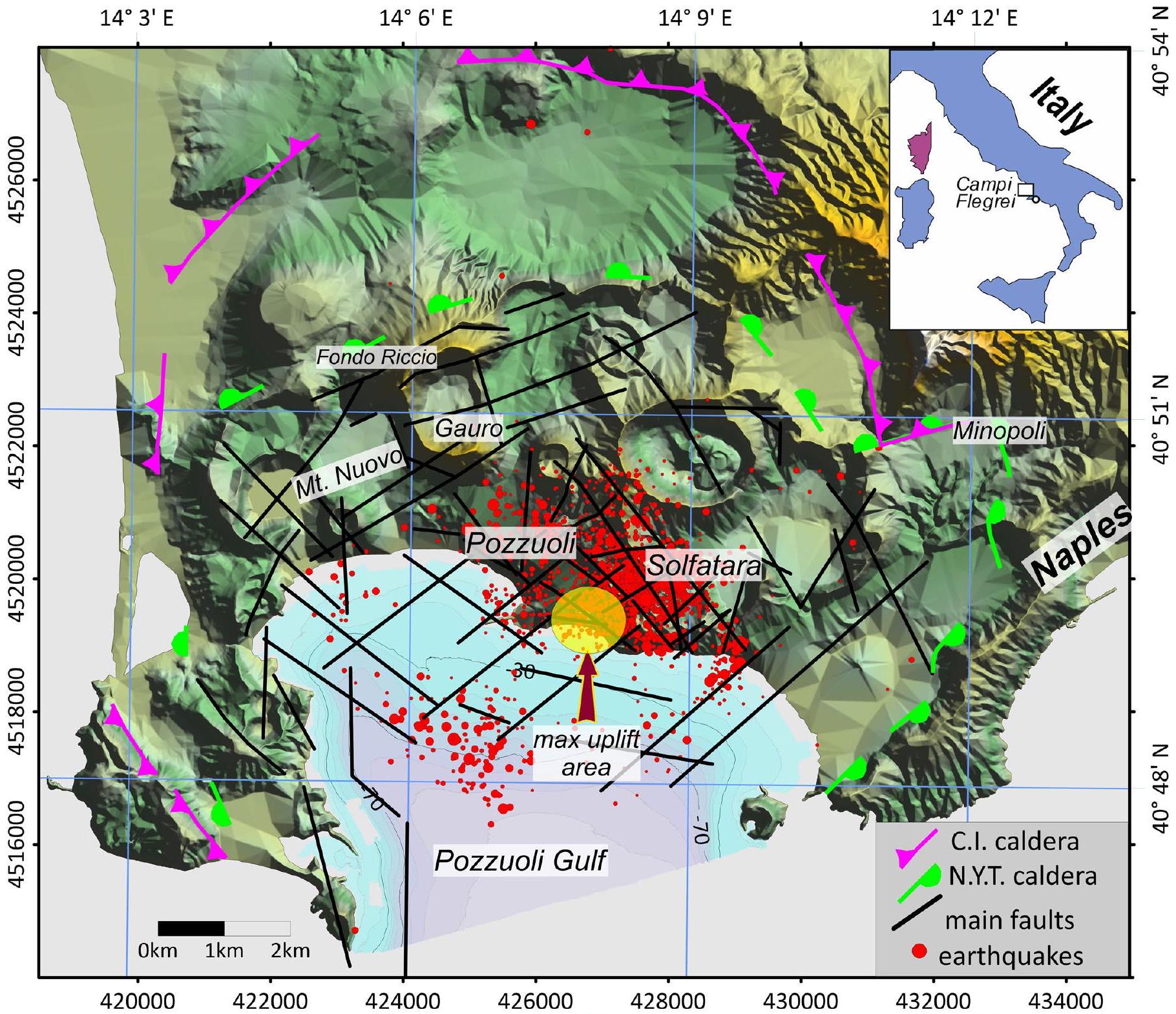
الشكل البياني الممتد 1| حوض الكالديرا CF. الخريطة مستندة إلى نموذج الارتفاع الرقمي، ويظهر مراكز الزلازل بعد عام 2018 (https://www.ov.ingv.it/index.php/monitoraggio-e-infrastrutture/bollettini-tutti/bollett-mensili-cf)، والهياكل الرئيسية (الصدوع وحواف الكالديرا) ومركز الارتفاع الأقصى الحالي.
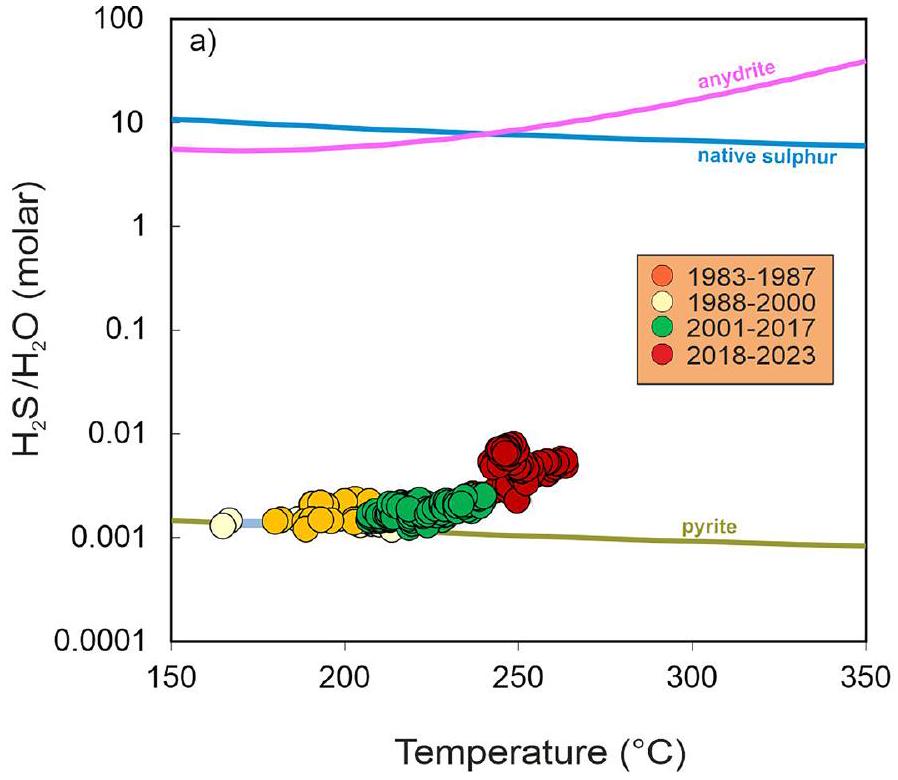
الشكل البياني الممتد 2 | توازن الغازات الهيدروحرارية. (أ) الغاز المقاس (الجدول التكميلي 1) مقابل الغاز المودل (انظر الطرق)نسبة. درجة الحرارة (-المحور) هو درجة الحرارة المتوازنة المقدرة من التوازن (المعادلة 8؛ انظر الطرق). توضح خطوط النموذج اعتماديات الضغط لـنسب لـالضغط البخاري الذي يتحكم به التوازن مع إما البيريت (المعادلة 7) أو الكبريت الأصلي (المعادلة 13) أو الأنهدريت (المعادلة 14). في جميع الحالات،تتحكم الفجائية في التعايش بين السائل والبخار (المعادلة 9). (ب) التطور الزمني للقياسات (الجدول التكميلي 1) والنمذجة (المعادلات 10 و 11 و 13)
نسب. يعتبر تحلل البيريت (المعادلة 6) هو السيطرة الرئيسية على الفومارولاتفي مرحلة 2003-2017، ولكن لا يمكن تفسير الزيادةتمت ملاحظته خلال الاضطرابات المتزايدة (1982-1984 وما بعد 2018). الكبريت الطبيعي في ظروف عدم التوازن مع تركيبة الفومارول (عند درجات حرارة هيدروحرارية CF وظروف الأكسدة والاختزال)، وبالتالي سيتم إعادة تحريكه إلى المرحلة الغازية إذا تم كشف أسطح معدنية جديدة أمام تيار الغاز خلال زيادة النشاط الزلزالي (وانفتاح بعض الشقوق/ الكسور و/أو مسارات هجرة الغاز).
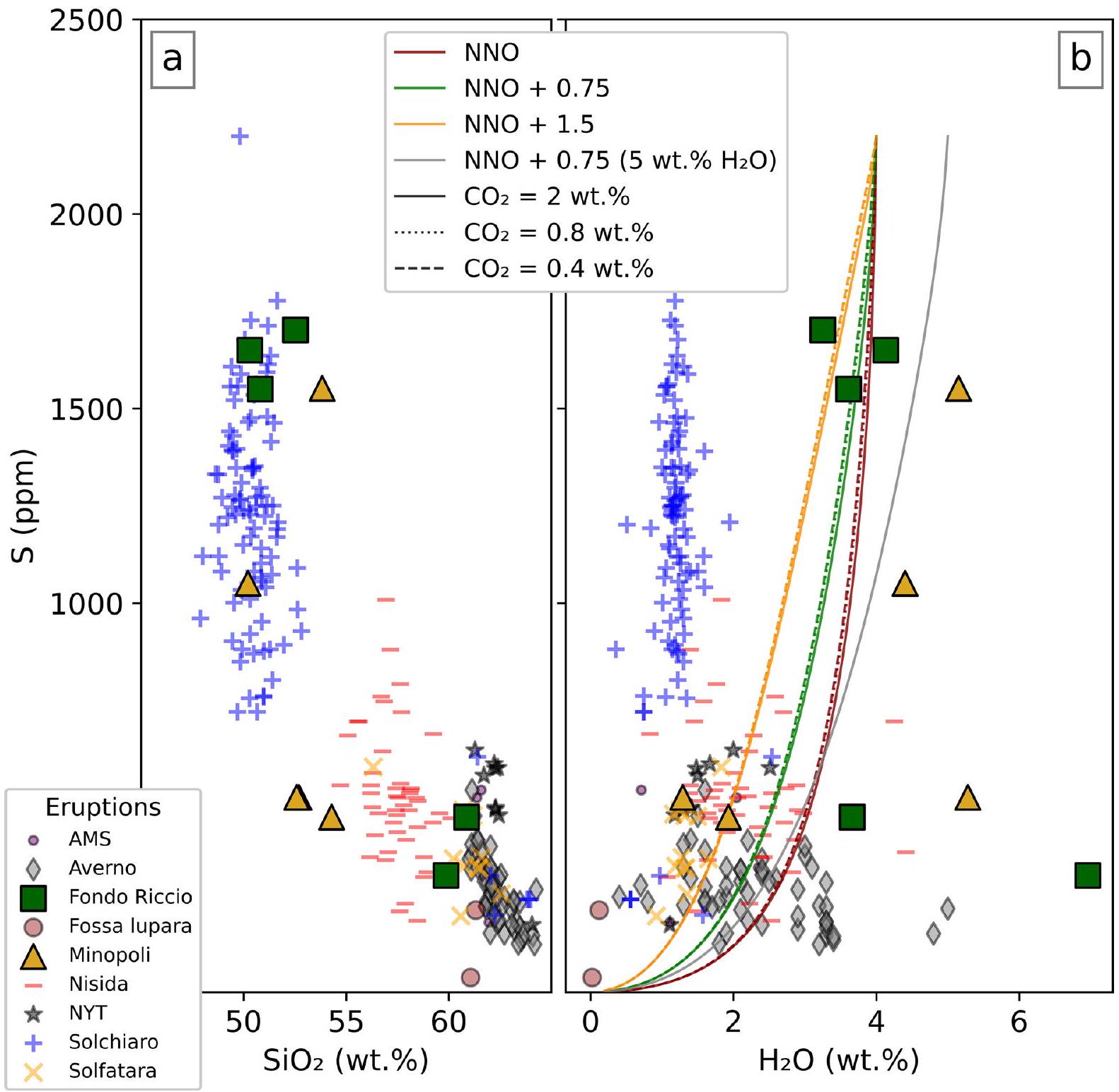
الشكل 3 من البيانات الموسعة | تركيب شمولات الصهارة (MIs) من CF، تم تجميعها من الأدبيات. أ، الشمولات الصهارية التراكيتية المحبوسة في البلورات من ثورات مينوبولي وفوندو ريتشيو (التي تم دراستها هنا لمحتوى الكبريت وتركيب نظائر الكبريت؛ الجدول التكميلي 2) هي أكثر المنتجات البركانية المافية التي تم قياسها على الإطلاق.في CF، وبالتالي الأكثر تمثيلاً للانصهارات الأبوية العميقة. في (ب) تطور النموذج المتوقع للذائب يذوبومحتويات S (البيانات من تشغيل النماذج 1-10 في البيانات التكميلية 1) موضحة للمقارنة، وتعيد بشكل جيد إنتاج الكبريت (وفقدان من الانصهار (إلى المرحلة البخارية) عند تخفيف الضغط أثناء إزالة الغازات (منطقة التخزين للانصهارات الأكثر تطورًا – من التراكيت إلى الفونوليت – والفقيرة في المواد المتطايرة ).
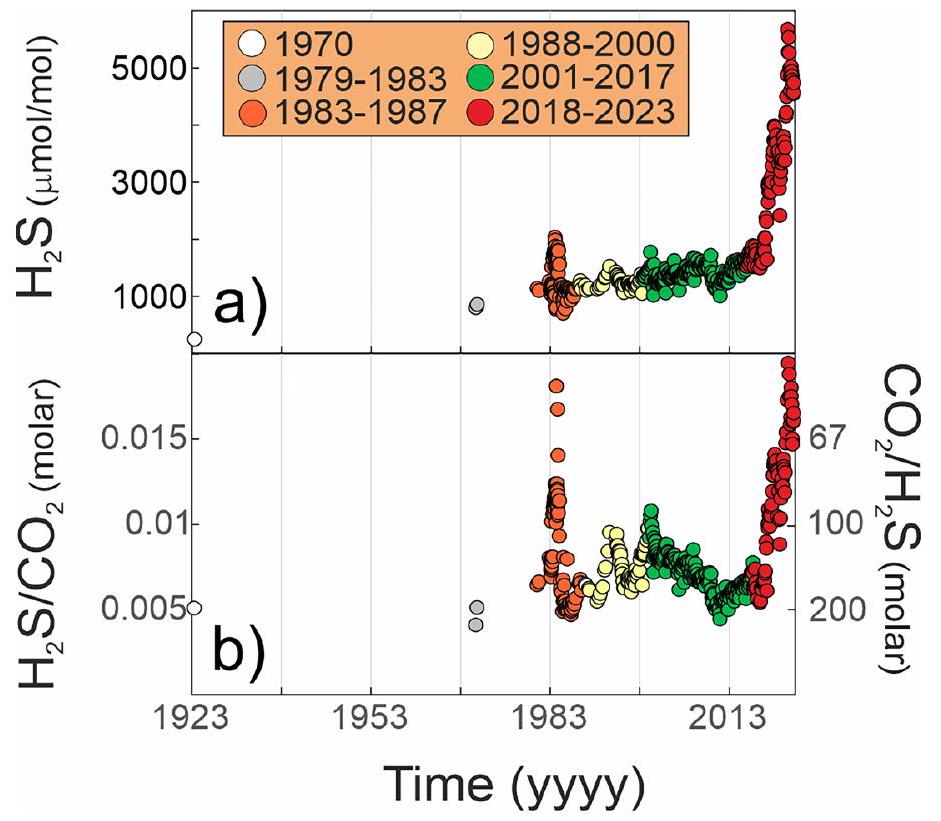
الشكل البياني الممتد 4 | كرونوجرام لتطور تركيبة الفومارولخلال الفترة من 1923 إلى 2023. (أ) التركيزات؛ (ب) النسب. الفائض خلال الفترة من 2018 حتى الآن غير مسبوق في تاريخ إزالة غاز ثاني أكسيد الكربون في القرن الأخير. البيانات من: 1983-2023 (هذه الدراسة، الجدول التكميلي 1، والمصدر 33)؛ 1980-81 (فومارول FC، المصدر 81)؛ 1970 (المصدر 82)؛ 1923 (التركيب المبلغ عنه في المصدر 82).
المعهد الوطني للجيوفيزياء والبراكين، مرصد فيزوف، نابولي، إيطاليا.المعهد الوطني للجيوفيزياء والبراكين، قسم بولونيا، بولونيا، إيطاليا.قسم علوم الأرض والبحار، جامعة باليرمو، باليرمو، إيطاليا.قسم الجيولوجيا والجيولوجيا الفيزيائية، معهد وودز هول للمحيطات، وودز هول، ماساتشوستس، الولايات المتحدة الأمريكية.قسم علوم الأرض، جامعة كامبريدج، كامبريدج، المملكة المتحدة.الاتحاد الوطني بين الجامعات لعلوم البحار، CoNISMa، روما، إيطاليا. البريد الإلكتروني:alessandro.aiuppa@unipa.it
Escalation of caldera unrest indicated by increasing emission of isotopically light sulfur
Received: 10 May 2024
Accepted: 16 December 2024
Published online: 24 January 2025
Check for updates
S. Caliro (B , G. Chiodini , R. Avino , A. Carandente , E. Cuoco , M. A. Di Vito , C. Minopoli , F. Rufino , A. Santi , J. Lages , A. Mangiacapra , B. Monteleone , L. Pappalardo , Z. Taracsák , C. Tramati , S. Vizzini & A. Aiuppa
Calderas are depressions formed by some of the largest volcanic eruptions. Their long-lived inter-eruptive periods are occasionally interrupted by phases of unrest, in which escalating seismicity, ground deformation and gas emissions raise concerns of potential volcano reawakening. However, interpretation of such physico-chemical signals is complicated by few examples of monitored unrest that culminated into eruption and by our fragmentary understanding of the drivers and timescales of caldera reactivation. Here we show that multi-decadal gas observations at the restless Campi Flegrei caldera in Italy record an unprecedented increase in isotopically light sulfur release from fumaroles since 2018. We then use hydrothermal gas equilibria and numerical simulations of magmatic degassing to propose that such a change in sulfur emissions results from decompression-driven degassing of mafic magma at depth, along with some extent of sulfur remobilization from hydrothermal minerals. Examination of a global dataset indicates that, despite the diversity in eruptive behaviour and tectonic setting, increasing sulfur output may be a common process during unrest escalation at calderas generally. Hence, our observations and models of sulfur behaviour may inform interpretations of unrest and hazard assessment at reawakening calderas and hydrothermal active volcanoes worldwide.
Volcanically active regions on Earth are occasionally punctuated by subsided volcanic structures of variable size and age, referred to as calderas . These often-subcircular depressions are commonly thought to have derived from rapid emptying of magma reservoirs during large-scale effusive to explosive (eventually ignimbrite-forming ) eruptions. Once formed in one or multiple caldera-forming eruption(s), calderas, especially if resurgent , are sites of episodic intra-caldera eruptions, typically interspersed within repose periods of intense hydrothermal activity that can last for centuries or longer .
Resumption of eruptive activity at reawakening calderas is normally anticipated by above-background changes in seismicity, ground deformation and chemistry/flux of hydrothermal fluid emissions. However, these caldera unrests are some of the most enigmatic and puzzling volcanic phenomena, especially because they can persist for decades without necessarily culminating into eruption. Hence, while many of the calderas active in the Holocene epoch have experienced historical unrest , most of them have not witnessed eruption in the instrumental era, rendering ex-ante identification of possible
eruption precursors highly uncertain. Questions remain regarding the driving mechanisms of caldera unrest, and especially on their magmatic versus hydrothermal nature.
A remarkable example is offered by the resurgent Campi Flegrei (CF) caldera, in the suburban metropolitan area of Napoli (Italy) (Extended Data Fig. 1). After four centuries of dormancy and subsidence following the 1538 eruption , CF has experienced unrest since the 1950s, with a net uplift of (ref.12) total in four main ground uplift episodes (1950-1952, 1969-1972, 1982-1984 and 2000-present), the two most recent of which are associated with intense volcano-tectonic seismicity . Consensus exists that deformation/seismicity are caused by elastic/brittle response of the shallow crust to pressure build-up at the base of the hydrothermal system depth), caused by escalating magmatic fluid transport . However, debate remains on whether magma is intruding at shallow depth or remains stationarily at depth . Therefore, possible unrest evolution, and likelihood of an eruption, remain largely undetermined.
Because magmatic volatiles are critical drivers of unrest , measuring the chemistry, the isotopic composition and the flux of surface fluid emissions is essential for caldera monitoring . Carbon dioxide ( ), with minor unreactive species (nitrogen and noble gases), has proved especially useful for tracing the influx of magma-derived volatiles into caldera-hosted hydrothermal systems . However, because these volatiles are poorly soluble in silicate melts, they can be effectively supplied by magmas stalled in the mantle , and hence an increase in their concentration in surface discharges is not necessarily a hint for increased eruption probability . Sulfur, by contrast, is a major magmatic volatile that, due to its lower vapourmelt partitioning coefficient , is exsolved from the melt at mid- to upper-crustal conditions , thus becoming a potentially very useful tracer of escalating unrest. As calderas become increasingly restless, hydrothermal minerals can remobilize sulfur and contribute, alongside magma-sourced sulfur, to accelerating surface output .
Escalating sulfur at Campi Flegrei
The exceptionally continuous record of fumarole composition at CF (Supplementary Table 1) has been taken previously to identify a remarkable progression towards less-hydrous, more- -rich compositions over the past four decades (Fig. 1a). In addition to some extent of steam condensation in the hydrothermal system , this transition has been interpreted to reflect an increasingly magmatic nature of the fumarolic gas, supported by the convergence of deuterium/ hydrogen (D/H) ratios in fumarolic steam towards magmatic values ( (delta deuterium) values of -10 to versus SMOW (standard mean ocean water);Fig.1b). However, an observation we bring to light is the unprecedented, five times increase in fumarolic sulfur, in the form of hydrogen sulfide , since early 2018 (Fig. 1c). This increase in fumarolic abundance (Fig. 2) is paralleled by a systematic isotopic shift (Fig. 1c) towards negative sulfur isotope compositions (
Fig. 1| Chronogram of CF fumarole compositional evolution from 1982 to
2023. Data from Supplementary Table 1. Analytical uncertainty at 1 standard deviation (s.d.) of the mean. a, A progression from -rich (hydrothermal (H)) to -rich (magmatic (M)) compositions is observed. b, Deuterium isotope composition ( , relative to SMOW) of fumarolic steam evolves to progressively more positive signatures, within the magmatic gas range . c, concentrations increase since 2018, paralleled by a negative isotopic shift of the sulfur isotope composition. d, Observed (fumaroles) versus modelled (at equilibrium with hydrothermal pyrite; Methods) gas ratios. The excess during 2018-present (and in the 1980s) implies fugacity is not buffered by pyrite during accelerating unrest. e, Volcano-tectonic seismicity (monthly number of events, grey bars; data from INGV Osservatorio Vesuviano) versus the estimated flux from the Solfatara area. This flux is calculated by multiplying the diffuse output from the Solfatara degassing structure by the fumarolic ratio (panel d).
versus Vienna Canyon Diablo Troilite (VCDT)). This isotopic change is even larger than observed during the stronger (for rate of uplift and seismicity) 1982-1984 unrest (Fig. 1c). The observed fumarolic changes (Figs. 1 and 2) require that an additional, isotopically distinct source of sulfur has come into play at CF since 2018. We envisage two possible endmember scenarios (hydrothermal versus magmatic) for the involved source process.
a
b
Fig. 2 | Diagram of major species’ composition for fumaroles. The , and concentrations are scaled by factors 1,3 and 300 , respectively, for presentation purposes. The 1983-2023 fumarole results (Supplementary Table 1) are chronologically distinguished (by colour tones) to emphasize temporal evolution. The 1970 and 1979-1983 results for other CF fumaroles are also shown (Supplementary Information). Fumarole composition is contrasted against (1) the modelled composition of magmatic gases formed during decompressional degassing of trachybasaltic CF melts (Fig. 5); (2) the modelled composition of hydrothermal gases in which fugacity is controlled by S-bearing hydrothermal minerals (pyrite, native sulfur and anhydrite) (Methods); (3) the observed fumarole compositions at eight global calderas/hydrothermal volcanoes that have recently been in a state of unrest (Supplementary
Information; YWS, Yellowstone; LVC, Long Valley Caldera; NYS, Nisyros; KU, Kusatsu-Shirane; HA, Hakone; SNG, Sierra Negra; PPR, Planchón-Peteroa; KRB, Kuchinoerabujima); (4) the composition of high-temperature magmatic gases (for data provenance, see Supplementary Information). Note the distinct CF fumarole evolutions in 1983-1987 (towards the hydrothermal pole, H) and 2018-present (towards the magmatic pole, M). The almost linear post-2018 CF fumarole progression can be interpreted to reflect a combination of (1) pure sulfur addition from native S/anhydrite breakdown, caused by exposure of new mineral surface due to fracturing/seismicity (2) mixing with sulfur-rich magmatic gas supplied by magma degassing (by decompression) within the midcrustal ( ) magmatic plumbing system (Fig.4).
Sulfur remobilization from hydrothermal minerals
Given the current CF solfatara stage of activity, remobilization of hydrothermal mineral-bounded sulfur is a possible driver for the escalating fumarolic transport (hydrothermal scenario). During the centuries- to millennia-long repose periods of calderas, any sulfur supplied by the magmatic source at depth is typically sequestered in a variety of hydrothermal mineral deposits that form via reactions between host rocks and magmatic volatiles .During unrest, hydrothermal conditions are perturbed by escalating magmatic gas transport and seismicity, resulting in higher temperature and change in redox conditions. Consequently, sulfur stored in hydrothermal minerals can be remobilized into the hydrothermal gas phase . At CF, pyrite is the most abundant sulfur-bearing mineral . Two lines of evidence suggest, however, that pyrite redissolution is an unlikely source for the excess seen at CF since 2018. First, CF hydrothermal pyrite is isotopically heavy ( of 3.3 to versus Vienna Canyon Diablo Troilite; ref. 36 ), so that any remobilized (at equilibrium) from pyrite (Methods) would cause shifting of the fumarole to higher , which is the opposite to what is observed (Fig. 3a). We caution that some isotopically light ( of -11.0 to ; Fig. 3a) can potentially be formed from pyrite if its decomposition mechanism involves disproportionation into aqueous sulfate and (Methods). Second, and hence more conclusively, a pyrite origin for the post-2018 excess is inconsistent with hydrothermal gas equilibrium calculations (Methods) that fix the equilibrium composition of the hydrothermal gas phase in which fugacity is controlled by pyrite decomposition . Results of these
calculations (Fig. 1d) indicate that modelled and observed (fumarole) compositions match within uncertainty during 2003 to early 2018 , supporting validity of the model approach. However, they diverge during the two major unrests of 1982-1984 (and following years) and from mid2018 onwards (Fig. 1d). We conclude that pyrite equilibria control fugacity during background hydrothermal activity at CF but cannot explain the escalation seen from 2018 onwards. Native sulfur and sulfates (alunite and anhydrite) have also been identified in the CF hydrothermal mineral paragenesis . Gas-mineral equilibria (Methods) indicate that these minerals are unstable at the CF hydrothermal temperature (T) and pressure (P) conditions (Extended Data Fig. 2), and hence have a strong tendency to decompose to . The post-2018 acceleration in release is concurrent with a significant seismicity increase (Fig.1e). We therefore argue that the seismicity-driven opening of new fractures may have created new gas migration pathways, exposing new mineral surfaces to gas-mineral reactions and causing effective sulfur extraction, from native sulfur and sulfates, into the gas phase. Native sulfur and alunite are abundant in the shallow supergene environment (around the fumaroles), where they form by near-surface oxidation of fumarolic . The sulfur isotopic compositions of these fumarolic incrustations (native sulfur, -5.5 to ; sulfates, -1.7 to ; ref. 36 ) are within the range of that of source fumarolic (Fig. 3a). However, native sulfur and alunite are absent, and anhydrite is rare (too low to be measurable for ), in the deep hydrothermal mineral assemblage . Since seismicity clusters in this deeper portion of the hydrothermal system (between 1 and 3 km depth; Fig. 4), we cannot exclude, but consider it unlikely, that native sulfur and anhydrite are suitable sources for the post-2018 fumarolic increase.
Fig. 3 | Chemical and sulfur isotope composition of CF fumaroles. a-c, The ratios in Bocca Grande fumaroles plotted versus the sulfur isotope compositions of fumarole and fumarole ratios (analytical uncertainty at 1 standard deviation of the mean (s.d.)) (b,c). The 2018-2023 fumarole results identify a linear trend that requires addition of excess, isotopically light (<-1.5%) sulfur from either (1) native sulfur/anhydrite breakdown or (2) sulfur-rich magmatic gases (or a combination of the two). In , the fields of formed by pyrite breakdown are derived from equations (3), (5) and (11) (Methods). The predicted isotope composition of from native sulfur breakdown is obtained from results of ref. 36 (equilibrium hydrothermal gas composition is derived by combining equations (9), (10) and (13); Methods). In a-c, the magmatic degassing model lines are the same as in Fig. 2 (the predicted sulfur isotope composition of magmatic gases is modelled as shown in Supplementary Data 1 and Methods). The inset (panel c) shows the 2018-2023 regression line ( confidence interval shown) intersects the magma degassing trends at model degassing run pressures that-depending on model run input conditions-range from 149 to 373 MPa (Supplementary Data 1). In the magmatic hypothesis for the escalating release, the source magma is mafic (trachybasaltic) and undergoes decompressional degassing in the mid-crustal plumbing system, at depth.
Mafic magma as the source of sulfur
Second, we consider the hypothesis of a magmatic origin (magmatic scenario) for fumarolic . The post-2018 escalation raises the question whether conditions that would allow active sulfur degassing from the magma have been reached. Decompressional (ascent-driven) sulfur degassing is a complex function of melt composition, the magnitude of change in pressure and temperature, initial volatile content, melt oxidation state and modes of magma ascent/decompression . Melt inclusion (MI) evidence suggests the CF parental melts are trachybasaltic . Once applied to these compositions, numerical modelling of magmatic degassing (Methods) suggests a deep sulfur degassing behaviour (Fig. 5). Our calculations (Supplementary Data 1) constrain that CF trachybasalts become volatile-saturated at high pressures (from to for initial contents of 0.4 to ). The -dominated ( molar fraction, of 0.65-0.82; Fig. 5e) magmatic gas phase that forms at high pressures contains relatively high total of 0.025 to 0.1 ; Fig. 5f), suggesting effective removal of sulfur from the melt. Using the maximum sulfur content of in MIs as an estimate for parental melt sulfur content (Extended Data Fig. 3), we find that half of the initial sulfur cargo is lost to gas on decompression-driven degassing at pressure (Fig. 5a), within the deep CF main magma storage zone (Fig. 4). This gas-phase sulfur is inferred to be a mixture of and (Fig.5c).Deep sulfur degassing is consistent with the sulfur-poor compositions of evolved, trachytic to phonolitic, CF melts (Extended Data Fig. 3) that are typically formed (and stored) at shallower depths . Modelling results imply that a magmatic source hypothesis for the post-2018 fumarolic escalation does not require magma transport to shallow levels. Rather, we find that if the observed (post2018) fumarolic gas compositions are extrapolated to higher sulfur concentrations (Fig. 3b,c), hence minimizing the hydrothermal fluid contribution, they intercept the modelled magmatic gas composition trends at pressure in our preferred models (initial ; melt redox at NNO to NNO +0.75 , where NNO is the nickelnickel oxide buffer at a magmatic temperature of ; Methods), or deeper ( , or ) if the magma is -poorer . We caution that, considering errors (Supplementary Data 1) associated with linear regression of the data trend (Fig. 3b,c), combined with uncertainty on initialization parameters (primarily magma redox and content) and on calibration of the degassing model itself ,the magma source pressure/depth cannot be precisely inferred. However, our results would be indicative of magma ascent at the top, or right above (to as shallow as ), the deep CF magma storage zone (Fig. 4).
To test feasibility of the magmatic hypothesis, we also analysed the sulfur isotopic composition in olivine-hosted trachybasaltic MIs from two of the most mafic eruptions of the recent CF activity (Supplementary Table 2). Our results (Fig. 6) constrain the CF magmatic source to have of . These values fall within the mid-ocean-ridge basalt range , and are isotopically lighter (depleted in ) than seen at other arc volcanoes worldwide . The isotopically light sulfur signature of CF parental melts, implied by our MI results, constrain the values in magmatic fluids between -3.7 and o (Figs. 3a and 6b). Hence, an increased supply of isotopically light magmatic sulfur to the hydrothermal system can explain the observed drop in of the fumarolic since 2018 (Fig.1c). Notably, since the modelled gas is a mixture of and (Fig. 5), while the fumaroles contain only , our results suggest magma-sourced delivered at depth is quantitatively converted into , hence conserving the total gaseous sulfur , on cooling ( ) and re-equilibration in the hydrothermal envelope.
A step change in caldera degassing behaviour
The hydrothermal versus magmatic hypotheses are not easy to resolve from our results alone and are not mutually exclusive; rather, the two
Fig. 4 | The CF plumbing system. Redrawn according to the stratigraphic model proposed by ref. 38 . Two-dimension resistivity model of Solfatara of hydrothermal system resulting from audiomagnetotelluric measurements is also reported as a section. High resistivity values mainly indicate gas-phase
zones, while low resistivity values reveal zones with presence of liquid, eventually derived from condensation of hydrothermal vapour . Earthquakes recorded by the Osservatorio Vesuviano seismic network since 2018 are reported as grey circles, whose dimensions are proportional to magnitude.
processes can work in combination since sulfur remobilization would ultimately be driven by heating of the hydrothermal system caused by escalating magmatic gas supply. Accelerating surface release may, at least in principle, be consistent with a scenario in which the magmatic gas supply is constant, but the hydrothermal system more actively releases sulfur-or becomes more transparent to the magmatic gas supply-because of increasing stretching (by continuous deformation and heating) and fracturing (by escalating seismicity). However, compared with the 2018-present unrest at CF, the 1982-1984 bradyseismic crisis has been much stronger for rate of uplift and seismicity, and yet the observed excursion has been far more modest (both chemically and isotopically ;Figs. 1-3). Considering the rarity of anhydrite in the deep hydrothermal rocks that compose the main seismogenetic volume (Fig. 4), it seems unlikely fracturing alone-and hence exposure of new sulfur-bearing mineral surfaces-can explain the large, persistent post-2018 excess sulfur excursion (Fig. 1c,d). We hence consider decompressional degassing of mafic magma, on upward migration in the to depth range (Fig. 4), as the most likely source for the post-2018 excess sulfur. We note that our inferred, gas-based magma ascent interval is consistent with those derived from modelling of post2018 deformation and with local earthquake tomography results that point to ascent to depths as the driver of the ongoing (post2018) unrest. Ascent of new, volatile-rich magma is also implicated by the observed increase in gas output . While at least in principle it is possible for a stationary magmatic source to release more gas due to second boiling , any shallow-stored magma in the upper crust would
need to be of limited volume (to escape seismological detection), and especially if felsic would hence remain an insufficient source for the large (ref.15) and sulfur (Fig.1e) surface output, due to low volatile content (Extended Data Fig. 3).
Our results are a hint for further evolution of the unrest that is otherwise ongoing for years. Retrospective analysis of the (few available) pre-1980s fumarolic results (Extended Data Fig. 4) indicates that the increase in the fumaroles may have continued, although at a sluggish rate, for more than a century. Yet the post-2018 increase is unprecedented for rate and amplitude, and hence marks a step change in degassing behaviour.
Escalating sulfur during caldera unrest may not be unique to CF. We have identified eight well-monitored, globally distributed calderas/hydrothermal volcanoes (Supplementary Information) for which long-term gas observations are available (Fig. 2). We caution these volcanic systems are very diverse in size, eruptive history and magma composition, making generalization or exportation of interpretations from one system to another not straightforward. Yet analysis of this global dataset (Fig. 2) shows persistence of sulfur-poor, hydrous compositions at calderas (for example, Yellowstone, Long Valley) where unrest has not culminated into eruption. By contrast, progression towards increasingly sulfur-rich fumarole compositions has been observed at volcanic systems (for example, Sierra Negra, PlanchónPeteroa and Kuchinoerabujima) in which unrest has finally escalated (over timescales of years/decades) to eruption. This general behaviour suggests tracking unrest evolution using volcanic gas sulfur can be
Fig. 6 | Sulfur isotopic composition of CF MIs. a, MI sulfur isotopic composition plotted against sulfur content (measured by secondary ion mass spectrometry; data from Supplementary Table 2). The red band shows the range of mid-ocean-ridge basalts . Grey diamonds and crosses are published MI and glass data from arc volcanics in Central America and the Cascades , respectively. The yellow-brown line shows the results of a total least-squares regression fitted to the data, assuming equilibrium closed-system degassing, while the shaded area is 1 standard error of the regression. The large pentagon symbol
Fig. 5 | Results of model simulations of magmatic degassing. All data from Supplementary Data 1. The plots illustrate the pressure dependency of equilibrium melt (a) and gas (b-f) inferred from model simulations of decompression-driven, closed-system degassing of trachybasaltic CF melts (Methods). Results of nine model runs, initialized at different contents and redox conditions (Supplementary Data 1), are shown. a, Dissolved sulfur in the melt, demonstrating relatively deep sulfur degassing for CF melts. b, Pressure-dependent evolution of the model magmatic gas ratio ( , total sulfur). c, Sulfur speciation in the gas phase, indicating that, at pressures higher than makes up from at NNO to at , to at . This implies that, in the magmatic scenario hypothesis, fumarolic can serve as a proxy of total magmatic sulfur only at condition that the magma source is reduced ( ), deep ( , or ) and that any is converted into during gas expansion and cooling, from magmatic temperature to surface temperature , Model-predicted evolution of and molar fractions in the equilibrium magmatic gas phase. The gas becomes increasingly -rich (and -rich) with increasing model run pressure.
beneficial for hazard assessment and mitigation not only at CF, but at calderas/hydrothermal volcanoes globally.
Accepting a magmatic hypothesis for escalating sulfur at CF would not provide conclusive evidence that an eruption will necessarily occur, and/or is imminent. Petrology and mineral chemistry results indicate calderas typically undergo multiple magma resupply episodes before the critical overpressure conditions for eruption initiation are finally reached, perhaps in decades to less than a century . For example, the last magmatic eruption in AD 1538, for which ground deformation history has been reconstructed in detail , was anticipated by magma emplacement in the upper crust starting as early as years before (or potentially more), and by remarkable geophysical/geochemical precursors . There is today no geodetic/seismological evidence for
shows the predicted of the undegassed melt. Yellow, green and red lines are forward degassing models calculated using Sulfur_X (ref. 27) and combined with sulfur isotope fractionation factors for sulfide-sulfate, -sulfide and – (Methods; all calculations reported in Supplementary Data 1). Solid, dashed and dotted lines show model runs with variable contents (2.0, 0.8 and ). All error bars are 2 s.d. of the mean. , Same as but reporting the model evolution of the equilibrium gas sulfur isotope compositions (for closed-system degassing).
non-radial, asymmetric ground deformation patterns and upward migrating seismicity , as inferred for the 1538 eruption preparatory/ run-up phase . In addition, the CF fumaroles are still compositionally far from the manifestly magmatic signatures observed before caldera eruptions elsewhere (Fig. 2). Yet the fact mafic magma may have intruded in the mid-crustal ( ) plumbing system demands any possible action is put in place or intensified to increase preparedness for eruption in this intensively inhabited area ( people are living inside the caldera). Any further compositional evolution of the fumaroles towards the magmatic gas range (Fig. 2) should be carefully considered as a sign of increased eruption likelihood.
Online content
Any methods, additional references, Nature Portfolio reporting summaries, source data, extended data, supplementary information, acknowledgements, peer review information; details of author contributions and competing interests; and statements of data and code availability are available at https://doi.org/10.1038/s41561-024-01632-w.
References
Branney, M. & Acocella, V. in The Encyclopedia of Volcanoes 299-315 (eds. Sigurdsson, H. et al.) (Elsevier, 2015).
Druitt, T. H. & Sparks, R. S. J. On the formation of calderas during ignimbrite eruptions. Nature 310, 679-681 (1984).
Orsi, G., De Vita, S. & Di Vito, M. The restless, resurgent Campi Flegrei nested caldera (Italy): constraints on its evolution and configuration. Geotherm. Res. 74, 179-214 (1996).
Lowenstern, J. B. & Hurwitz, S. Monitoring a supervolcano in repose: heat and volatile flux at the Yellostone caldera. Elements 4, 35-40 (2008).
Newhall, C. G. & Dzurisin, D. Historical Unrest at Large Calderas of the World (USGS, 1988).
Acocella, V., Di Lorenzo, R., Newhall, C. & Scandone, R. An overview of recent (1988-2014) caldera unrest: knowledge and perspectives. Revs. Geophys. 53, 896-955 (2015).
Wicks, C. W., Thatcher, W., Dzurisin, D. & Svarc, J. Uplift, thermal unrest and magma intrusion at Yellowstone caldera. Nature 440, 72-75 (2006).
Hill, D. P. in Mechanisms of Activity and Unrest at Large Calderas Vol. 269 (eds. Troise, C. et al.) 171-187 (Geological Society of London, 2006).
Dzurisin, D., Savage, J. C. & Fournier, R. O. Recent crustal subsidence at Yellowstone caldera, Wyoming. Bull. Volcanol. 52, 247-270 (1990).
Gottsmann, J. et al. Oscillations in hydrothermal systems as a source of periodic unrest at caldera volcanoes: multiparameter insights from Nisyros, Greece. Geophys. Res. Lett. https://doi.org/ 10.1029/2007GL029594 (2007).
Di Vito, M. A. et al. Magma transfer at Campi Flegrei caldera (Italy) before the 1538 AD eruption. Sci. Rep. https://doi.org/10.1038/ srep32245 (2016).
Scarpa, R. et al. in Campi Flegrei, Active Volcanoes of the World Series (eds. Orsi, G. et al.) 257-282 (Springer, 2022).
Kilburn, C. R. J., De Natale, G. & Carlino, S. Progressive approach to eruption at Campi Flegrei caldera in southern Italy. Nat. Commun. https://doi.org/10.1038/ncomms15312 (2017).
Kilburn, C. R. J., Carlino, S., Danesi, S. & Pino, N. A. Potential for rupture before eruption at Campi Flegrei caldera, Southern Italy. Commun. Earth Environ. https://doi.org/10.1038/s43247-023-00842-1 (2023).
Chiodini, G. et al. in Campi Flegrei, Active Volcanoes of the World Series (eds. Orsi, G. et al.) 239-256 (Springer, 2022).
Chiodini, G. et al. Magmas near the critical degassing pressure drive volcanic unrest towards a critical state. Nat. Commun. https://doi.org/10.1038/ncomms13712 (2016).
D’Auria, L. et al. Magma injection beneath the urban area of Naples: a new mechanism for the 2012-2013 volcanic unrest at Campi Flegrei caldera. Sci. Rep. https://doi.org/10.1038/ srep13100 (2015).
Moretti, R., Troise, C., Sarno, F. & De Natale, G. Caldera unrest driven by -induced drying of the deep hydrothermal system. Sci. Rep. https://doi.org/10.1038/s41598-018-26610-2 (2018).
Troise, C., De Natale, G., Schiavone, R., Somma, R. & Moretti, R. The Campi Flegrei caldera unrest: discriminating magma intrusions from hydrothermal effects and implications for possible evolution. Earth Sci. Rev. 188, 108-122 (2019).
Farrar, C. D. et al. Forest-killing diffuse emission at Mammoth Mountain as a sign of magmatic unrest. Nature 376, 675-678 (1995).
Sorey, M. L. et al. Carbon dioxide and helium emissions from a reservoir of magmatic gas beneath Mammoth Mountain, California. J. Geophys. Res. Solid Earth 103, 15303-15323 (1998).
Chiodini, G. et al. Magma degassing as a trigger of bradyseismic events: the case of Phlegrean Fields (Italy). Geophys. Res. Lett. https://doi.org/10.1029/2002GL016790 (2003).
Lowenstern, J. B., Smith, R. B. & Hill, D. P. Monitoring super-volcanoes: geophysical and geochemical signals at Yellowstone and other large caldera systems. Phil. Trans. R. Soc. A 364, 2055-2072 (2006).
Chiodini, G. et al. Insights from fumarole gas geochemistry on the origin of hydrothermal fluids on the Yellowstone Plateau. Geochim. Cosmochim. Acta 89, 265-278 (2012).
Caliro, S., Chiodini, G. & Paonita, A. Geochemical evidences of magma dynamics at Campi Flegrei (Italy). Geochim. Cosmochim. Acta 132, 1-15 (2014).
Edmonds, M. & Wallace, P. J. in Elements Vol. 13 (eds. Putirka, K. D. & Cooper, K. M.), 29-34 (Mineralogical Society of America, 2017).
Ding, S., Plank, T., Wallace, P. J. & Rasmussen, D. J. Sulfur_X: a model of sulfur degassing during magma ascent. Geochem. Geophysi. Geosyst. https://doi.org/10.1029/2022GC010552 (2023).
Wallace, P. J. & Edmonds, M. The sulfur budget in magmas: evidence from melt inclusions, submarine glasses, and volcanic gas emissions. Rev. Mineral. Geochem. 73, 215-246 (2011).
Henley, R. W. et al. Porphyry copper deposit formation by sub-volcanic sulphur dioxide flux and chemisorption. Nat. Geosci. 8, 210-215 (2015).
Giggenbach, W. F. Geothermal gas equilibria. Geochim. Cosmochim. Acta 44, 2021-2032 (1980).
Giggenbach, W. F. Redox processes governing the chemistry of fumarolic gas discharges from White Island, New Zealand. Appl. Geochem. 2, 143-161 (1987).
Chiodini, G. et al. Hydrothermal pressure-temperature control on emissions and seismicity at Campi Flegrei (Italy). J. Volcanol. Geotherm. Res. https://doi.org/10.1016/j.jvolgeores.2021.107245 (2021).
Allard, P., Maiorani, A., Tedesco, C., Cortecci, D. & Turi, B. Isotopic study of the origin of sulfur and carbon in Solfatara fumaroles, Campi Flegrei caldera. J. Volcanol. Geotherm. Res. 48, 139-159 (1991).
Hedenquist, J. W. & Lowenstern, J. B. The role of magmas in the formation of hydrothermal ore deposits. Nature 370, 519-527 (1994).
Piochi, M. et al. Native sulfur, sulfates and sulfides from the active Campi Flegrei volcano (southern Italy): genetic environments and degassing dynamics revealed by mineralogy and isotope geochemistry. J. Volcanol. Geotherm. Res. 304, 180-193 (2015).
Mangiacapra, A. et al. The deep magmatic system of the Campi Flegrei caldera (Italy). Geophys. Res. Lett. https://doi.org/10.1029/ 2008GL035550 (2008).
Zollo, A. et al. Seismic reflections reveal a massive melt layer feeding Campi Flegrei caldera. Geophys. Res. Lett. https://doi.org/ 10.1029/2008GL034242 (2008).
Buono, G. et al. New insights Into the recent magma dynamics under Campi Flegrei caldera (Italy) from petrological and geochemical evidence. J. Geophys. Res. Solid Earth https://doi.org/ 10.1029/2021JBO23773 (2022).
Labidi, J., Cartigny, P., Birck, J. L., Assayag, N. & Bourrand, J. J. Determination of multiple sulfur isotopes in glasses: a reappraisal of the MORB S. Chem. Geol. 334, 189-198 (2012).
Muth, M. J. & Wallace, P. J. Slab-derived sulfate generates oxidized basaltic magmas in the southern Cascade arc (California, USA). Geology 49, 1177-1181 (2021).
Taracsák, Z. et al. Sulfur from the subducted slab dominates the sulfur budget of the mantle wedge under volcanic arcs. Earth Planet. Science Lett. https://doi.org/10.1016/j.epsl.2022.117948 (2023).
Astort, A. et al. Tracking the 2007-2023 magma-driven unrest at Campi Flegrei caldera (Italy). Commun. Earth Environ. https://doi.org/10.1038/s43247-024-01665-4 (2024).
Giacomuzzi, G., Chiarabba, C., Bianco, F., De Gori, P. & Agostinetti, N. P. Tracking transient changes in the plumbing system at Campi Flegrei Caldera. Earth Planet. Sci. Lett. https://doi.org/10.1016/ j.epsl.2024.118744 (2024).
Lima, A. et al. Thermodynamic model for uplift and deflation episodes (bradyseism) associated with magmatic-hydrothermal activity at the Campi Flegrei (Italy). Earth Sci. Rev. 97, 44-58 (2009).
Costa, F., Shea, T. & Ubide, T. Diffusion chronometry and the timescales of magmatic processes. Nat. Rev. Earth Environ. 1, 201-214 (2020).
Parks, M. M. et al. Evolution of Santorini Volcano dominated by episodic and rapid fluxes of melt from depth. Nat. Geosci. 5, 749-754 (2012).
Druitt, T. H., Costa, F., Deloule, E., Dungan, M. & Scaillet, B. Decadal to monthly timescales of magma transfer and reservoir growth at a caldera volcano. Nature 482, 77-80 (2012).
Guidoboni, E. & Ciuccarelli, C. The Campi Flegrei caldera: historical revision and new data on seismic crises, bradyseisms, the Monte Nuovo eruption and ensuing earthquakes (twelfth century 1582 AD). Bull. Volcanol. 73, 655-677 (2011).
Rosi, M. et al. Defining the pre-eruptive states of active volcanoes for improving eruption forecasting. Front. Earth Sci. https://doi.org/10.3389/feart.2022.795700 (2022).
Publisher’s note Springer Nature remains neutral with regard to jurisdictional claims in published maps and institutional affiliations.
Open Access This article is licensed under a Creative Commons Attribution-NonCommercial-NoDerivatives 4.0 International License, which permits any non-commercial use, sharing, distribution and reproduction in any medium or format, as long as you give appropriate credit to the original author(s) and the source, provide a link to the Creative Commons licence, and indicate if you modified the licensed material. You do not have permission under this licence to share adapted material derived from this article or parts of it. The images or other third party material in this article are included in the article’s Creative Commons licence, unless indicated otherwise in a credit line to the material. If material is not included in the article’s Creative Commons licence and your intended use is not permitted by statutory regulation or exceeds the permitted use, you will need to obtain permission directly from the copyright holder. To view a copy of this licence, visit http://creativecommons.org/licenses/by-nc-nd/4.0/.
(c) The Author(s) 2025
Methods
Fumarole gas composition
The fumarole composition dataset is available in Supplementary Table 1. This dataset is based on periodic (monthly) sampling surveys of the Bocca Grande fumarole ( ) located inside the Solfatara crater, the largest hydrothermal manifestation of CF. Pre-2022 compositional results have been published elsewhere (ref. 32 and references therein). Samples were collected using standard protocols using pre-evacuated flasks filled with 4 M NaOH solutions , and were analysed in the laboratory by gas chromatography (for major components; Agilent Technologies model 6890N) and mass spectrometry (for water isotopes; Thermo Fisher model deltaXP and Picarro model L2130-i). For measurements of the total sulfur isotopic compositions, 50 ml of NaOH sample solution were collected in a 100 ml volumetric flask. 2 ml of a solution were then added, and the resulting mixture was left to rest for about 1 h . Oxygen excess was then removed by boiling the solution. The solution was titrated with HCl 6 M using methyl orange indicator, keeping the solution under stirring and heating to to allow the produced to degas. To precipitate barite, 20 ml of a solution were added to 50 ml of condensate under continuous stirring. The obtained solution was then filtered with filter, and the precipitated barite was dried at in an oven for 24 h . The precipitate was then collected with a Teflon spatula, then weighed on the basis of the expected sulfur content of approximately ) in tin capsules (in1/5 proportions) was added to catalyse the oxidation reaction of any reduced sulfur species. Sulfur isotope ratios ( ) were analysed at Università di Palermo by isotope ratio mass spectrometry (Thermo Scientific Delta V ADVANTAGE) after on-line combustion in an elemental analyser (Thermo Fisher Scientific Flash 2000) connected to the isotope ratio mass spectrometer through a Conflo-IV interface. Sulfur isotope ratios were expressed in conventional unit notation as parts per mil deviations from the international standard, VCDT, as follows:
where . Samples were calibrated to the VCDT scale using certified reference materials of the International Atomic Energy Agency (IAEA-SO-6: ; NBS ; IAEA-S-1: ; IAEA-SO-5: ; NBS 127: ). Analytical precision based on the standard deviations of multiple analyses of standards (or a combination of repeated analyses of the samples and standards) was .
Melt inclusions
Olivine and clinopyroxene phenocrysts were hand picked from tephra of Minopoli2 and Fondo Riccio, the two most mafic eruptions in the recent CF history (Supplementary information). Before MI analyses, hand-picked crystals were inspected under a microscope. Crystals containing glassy MIs were picked and individually mounted in crystalbond adhesive, then polished until exposed. Crystals were then mounted in epoxy and polished and cleaned. Major elements S, Cl, and F contents in glassy MIs and their host crystals were analysed using a Cameca SX100 EPMA at the Department of Earth Sciences, University of Cambridge. All analyses were carried out at 15 kV accelerating voltage. Standards used for analyses were St John’s Island olivine (Mg, for olivine analyses), periclase ( Mg , for glass and pyroxene analyses), diopside (Si), jadeite (Na), potassic feldspar (K), fayalite (Fe), corundum (Al), Durango apatite (P), wollastonite (Ca), rutile (Ti), chromium metal (Cr), manganese metal (Mn), nickel metal (Ni), pyrite (S), flourite (F) and halite (Cl). Glasses were analysed using a defocused beam. A 5 nA beam current was used to analyse and Ca . Sodium was analysed first using 30 s on-peak counting times; tests before analyses showed no Na mobility using this analytical condition. All other elements were analysed using 80 nA beam current. Counts
for and F were all recorded for min on a glass sample to confirm that this analytical set-up does not mobilize volatiles. The sulfur peak position was moved for the unknown analyses to to account for the peak position shift between reduced S (pyrite, at 61,387 ) and oxidized (celestine, 61,355 ). Relative error was for major and minor elements, apart from , increasing to for for S and for Cl . A total of 43 MIs and embayments were analysed. Olivine hosts were analysed using a beam diameter, a 20 nA beam current for major elements ( ) and a 100 nA current for all other trace elements. Clinopyroxenes were analysed using a 60 nA beam current. No Na mobility was observed during clinopyroxene analyses. All results and errors are reported in Supplementary Table 2.
Sulfur isotope ratios were analysed in selected MIs and embayments ( ) at the North East National Ion Microprobe Facility at the Department of Geology and Geophysics, Woods Hole Oceanographic Institute, using a Cameca IMS-1280 instrument. A Cs+ primary beam with a beam current of and an accelerating voltage of 10 kV was used for the analyses. Secondary ions were accelerated using a sample voltage of -10 kV . A normal-incidence electron gun was used to compensate for sample charging. Before analyses, a pre-raster was used to clean the sample surface of any potential contamination. After the pre-raster, the field aperture was centred using the and transfer plates. The secondary ion beam was then passed through a field aperture, entrance slit and exit slit. Analyses were carried out in multi-collection mode using three electron multiplier detectors: L2 and . Each isotope was analysed using a total of 20 cycles, each consisting of 4 s . Mass resolving power was set at 5,000. Three standards were analysed alongside the unknowns: A36 (Icelandic subglacial glass, S), STAP (Icelandic subglacial glass, 530 ppm S ) and HAW-16095 (Hawaiian picrite glass, S (ref. 42)). These glasses cover nearly the full range observed in our unknowns (500-2,230 ppm; Fig. 6). We find no correlation between instrumental mass fractionation (IMF) and S content. Measured IMF values, calculated as:
are for STAP, for A36 and for HAW-16095. This agrees with previous observations for analyses using EM-EM mono-collection analyses at the North East National Ion Microprobe Facility and differs from other studies that used FC-EM multi-collection for their analyses. To quantify the unknown values, we applied an IMF correction using the average IMF measured from the three standards . This was subtracted from the measured values. The error of the IMF correction is estimated at .
Sulfur contents were quantified by fitting a zero-intercept linear regression between standard S contents and measured values. This regression has a relative error. The sulfur background, determined using five olivine repeat analyses, was for , equal to 19 ppm S .
Isotopic signature of from pyrite decomposition
Hydrothermal sulfur minerals can remobilize sulfur to gas phase . Pyrite is the most abundant hydrothermal mineral at CF and is found ubiquitously in the propylitic hydrothermal alteration facies at temperatures and in the depth range, well within (and down to the base of) the hydrothermal system sustaining the Solfatara-Pisciarelli surface gas emissions . We therefore test the hypothesis that the escalating sulfur transport is caused by pyrite redissolution ,because of changing hydrothermal temperature and redox conditions , as caused by escalating magmatic gas influx .
The isotopic composition of in isotopic equilibrium with pyrite ( ) (Fig. 3a) is calculated from:
where is the measured isotopic composition of hydrothermal pyrite at CF ( of versus VCDT), and s is the fractionation factor of the pyrite- isotopic exchange reaction (estimated in the range using equations in ref. 59). Since the term (corresponding to the enrichment factor ) is only at the explored conditions, any formed at isotopic equilibrium with pyrite is isotopically heavy ( of ) and hence incompatible with the observed fumarolic isotopic signature (Fig. 3a). We additionally model the isotopic composition of formed by pyrite disproportionation into hexavalent S (aqueous sulfate ion) and reduced in , such as:
This reaction may potentially occur if pyrite decomposition takes place in a hydrothermal brine where part of the released sulfur is partitioned into the liquid phase, in which case:
where is the dissolved sulfate-gaseous sulfur isotope fractionation factor (taken from ref. 59). This reaction would produce isotopically lighter ( of -11.0 to ; Fig. 3 a ) , at least in principle consistent with observations on fumaroles.
Hydrothermal gas equilibria
The equilibrium composition of a hydrothermal gas phase, whose fugacity is controlled by pyrite hydrolysis, is obtained by solving reaction :
in which ( FeO ) corresponds to divalent iron incorporated into an (unidentified) aluminium-silicate hydrothermal mineral (possibly chlorite or epidote) and is the aluminium-silicate in its protonated, iron-free form . By rearranging the equation, the fugacity controlled by reaction involving pyrite and silicate is:
To solve equation (7), temperature is calculated from the equilibrium at typical hydrothermal redox conditions :
Water and fugacities are assumed to be controlled by liquidvapour coexistence and by the water-shift reaction , respectively:
The equilibrium hydrothermal gas ratio is computed by dividing (equation (7)) by (equation (10)):
These model-predicted compositions are compared with fumarole compositions in Fig. 1d.
Using a similar approach, we also explored other possible hydrothermal sources, including sulfur remobilization from native sulfur ( ) and anhydrite ( ), using equations:
For which, after rearranging;
This can be combined with equation (10) to infer the equilibrium ratio controlled by native sulfur. Similarly for anhydrite:
The modelled and ratios are orders of magnitude higher than the measured ones (Extended Data Fig. 2), reflecting very reducing conditions of the hydrothermal system feeding Solfatara. These calculations imply that native sulfur and anhydrite, if exposed to a feeding magmatic gas phase, can act as sources, hence potentially explaining the excess observed since 2018 (“Pure (hydrothermal) S addition” in Figs. 2 and 3). Anhydrite, in particular, has recently been proposed as a potential source of at CF. We caution, however, that this mineral is rare in the deep hydrothermal mineral assemblage, making it a thermodynamically possible, but geologically unlikely, source of .
Magma degassing modelling
We use a numerical magmatic degassing model to infer (1) the depth/ pressure magma interval over which sulfur is actively degassed from CF melts, (2) the composition of the gas that is delivered at each decompression step of the (model) magma ascent path and (3) by combination with mass-balance calculations and knowledge of the relevant isotope fraction factors, the sulfur isotope composition of the magmatic gas (and of the residual melt). We use Sulfur_X, a model designed to reproduce the pressure-dependent evolution of S, CO2, and redox state in coexisting melt and vapour in ascending mafic-intermediate arc magmas. Calculations utilize previously existing COH degassing models (we use a model appropriate for alkali-rich mafic melts) alongside an empirical parametrization of vapour-melt sulfur partition coefficients based on experimental data. The model takes two reactions into account during degassing: and . Our calculations are initialized using the major element composition ( ; ; ; all in ) of a trachybasaltic olivine-hosted melt inclusion (OL7) from the Fondo Riccio eruption. Melt inclusions from Fondo Riccio are used as inputs for the initial (parental melt) ( ) and S ( ; Fig. 6) in our model runs (Supplementary Data 1). We note that the Sulfur_X degassing model provides an estimate on the sulfide and sulfate concentrations at sulfide saturation, from which the melt’s total S solubility can be calculated. We find that even for our most reduced runs at NNO, S solubility remains at , which means the melt would remain undersaturated for sulfide. Consistently, sulfides are not present in the olivine or pyroxene crystals that hosted the studied melt inclusions. Measured CO2 contents in the glass of CF melt inclusions are typically low (generally , but certainly <0.3 wt%; refs. 64,65). However, MI records are known to severely underestimate the real (parental melt) contents because of pre-entrapment (to an exsolved fluid phase) and post-entrapment (to shrinkage bubbles) loss . Hence, to cope with uncertainty caused by the poorly constrained initial content,
we run our simulations using a range of parental melt contents ( and ; Supplementary Data 1). We consider the scenario the most realistic in view of the -rich nature of Phlegrean (and Italian in general) volcanism . Magma redox is the second largest source of uncertainty in our simulations as it is known to severely impact sulfur speciation (in melt and gas ) and hence its degassing behaviour . Results of phase equilibrium experiments on CF trachybasalts, and specifically the similarity of ratios in experimental and natural sample ferromagnesian minerals (clinopyroxene, olivine and biotite), constrain magma redox at the NNO buffer, or 0.5 log units above it (NNO + 0.5). Hence, our model runs at NNO and NNO + 0.75 are expected to cover the full redox spectrum of CF deep-feeding melts, although three runs at more oxidized (NNO + 1.5) conditions have also been performed to explore model sensitivity to changing redox (Supplementary Data 1). It is important to consider that our runs are conducted in isothermal conditions ( ; estimated using rhyolite-MELTS ) and with no crystallization allowed, and as such are representative of (closed system) decompressional degassing of a trachybasalt, with no attempt to reproduce more evolved magma compositions (trachytic to phonolitic). These more felsic magmas are known to be systematically poor in both sulfur (Extended Data Fig. 3b) and (ref. 72), and considering the intense discharge at CF (from both fumaroles and diffuse degassing structures ), are unlikely sources of volatiles for the ongoing unrest.
Results of model calculations (Fig. 5 and Extended Data Fig. 3) indicate that sulfur release from CF trachybasalts starts relatively deep during the magma decompressional (ascent) path. Especially in more reduced conditions, roughly half (NNO + 0.75 ) or more (NNO) of the initial sulfur cargo is lost from melt (and partitioned into the gas phase) in the pressure interval ( to depth interval) (Fig. 5). This relatively deep sulfur loss to gas at CF is consistent with the large sulfur drop observed in natural samples, from trachybasaltic MIs ( ) to more evolved ( ) MIS ( ) (Extended Data Fig. 3). Note that shallower entrapment conditions ( ) and hence shallower magma storage ( depth) have been inferred for such sulfur-poorer trachytic to phonolitic MIs. The model-predicted composition of the equilibrium magmatic gas (Fig. 5b-f) becomes increasingly -richer with increasing pressure, but the versus pressure dependence is less steep than predicted by other models , as already noted for other arc magma compositions. The highest modelled (molar) ratios are observed at in the model runs with high initial (Fig. 5b). At the model run conditions, total magmatic gaseous sulfur is calculated to consist roughly of at NNO (and ) and at NNO +0.75 (and ) (Fig. 5c). is by far the dominant sulfur species at surface conditions ( 0.1 MPa pressure), as typically found in erupting and/or open-vent volcanoes .
The isotopic composition of total magmatic gaseous sulfur ( ), illustrated in Fig. 3a and Fig. 6, is calculated as :
where is fixed at residual fraction of sulfur remaining in the melt at each decompression step (derived from the degassing model ) and is the gas-melt equilibrium sulfur isotope fractionation factor (calculated from equation 39 in ref. 59). As defined , the derived values account for both the sulfur speciation in melt and gas (in our case, calculated from the degassing model ) and the relevant fractionation factors between all oxidized/reduced sulfur couples. All calculated values are . All calculations, summarized in Supplementary Data 1, are made assuming closed-system equilibrium conditions. Results (Figs. 3a and 6) indicate modelled values ranging from to . More positive compositions (up to ) are obtained at low
pressure if open-system degassing conditions are assumed (see Supplementary Data 1).
Data availability
Source data are provided with this paper. All other data generated or analysed in this study are provided in Supplementary Tables 1 and 2, in Supplementary Data 1 and via figshare (https://doi.org/10.6084/m9. figshare. 25794447.
Code availability
The open-source Sulfur_X code used to generate the degassing curves of Figs. 2, 3 and 5 and Extended Data Fig. 3 is made publicly available by the authors as a Python program via GitHub (https://github.com/ sdecho/Sulfur_X.git).
References
Giggenbach, W. F. & Gouguel, R. L. Collection and Analysis of Geothermal Volcanic Water and Gas Discharges (DSIR, 1989).
Caliro, S. et al. The origin of the fumaroles of La Solfatara (Campi Flegrei, South Italy). Geochim. Cosmochim. Acta https://doi.org/ 10.1016/j.gca.2007.04.007 (2007).
Christenson, B. W. et al. Cyclic processes and factors leading to phreatic eruption events: insights from the 25 September 2007 eruption through Ruapehu Crater Lake, New Zealand. J. Volcanol. Geotherm. Res. https://doi.org/10.1016/j.jvolgeores.2010.01.008 (2010).
Stix, J. & de Moor, J. M. Understanding and forecasting phreatic eruptions driven by magmatic degassing. Earth Planets Space https://doi.org/10.1186/s40623-018-0855-z (2018).
Rosi, M. & Sbrana, A. Phlegrean Fields. Quad. Ric. Sci. 9, 187 (1987).
Mormone, A. et al. Secondary hydrothermal minerals in buried rocks at the Campi Flegrei caldera, Italy: a possible tool to understand the rock-physics and to assess the state of the volcanic system. Period. Mineral. https://doi.org/10.2451/ 2011PMOO27 (2011).
Chiodini, G., Cioni, R. & Marini, L. Reactions governing the chemistry of crater fumaroles from Vulcano Island, Italy, and implications for volcanic surveillance. Appl. Geochem. https://doi.org/10.1016/0883-2927(93)90004-Z (1993).
Cardellini, C. et al. Monitoring diffuse volcanic degassing during volcanic unrests: the case of Campi Flegrei (Italy). Sci. Rep. https://doi.org/10.1038/s41598-017-06941-2 (2017).
Marini, L., Moretti, R. & Accornero, M. Sulfur isotopes in magmatic-hydrothermal systems, melts, and magmas. Rev. Mineral. Geochem. https://doi.org/10.2138/rmg.2011.73.14 (2011).
D’Amore, F. & Panichi, C. Evaluation of deep temperatures of hydrothermal systems by a new gas geothermometer. Geochim. Cosmochim. Acta 44, 549-556 (1980).
Marini, L., Principe, C. & Lelli, M. Revised conceptual model of the Solfatara magmatic-hydrothermal system (Campi Flegrei, Italy), time changes during the last 40 years, and prediction of future scenarios. Preprint at EGUsphere https://doi.org/10.5194/ egusphere-2024-1306 (2024).
Iacono-Marziano, G., Morizet, Y., Le Trong, E. & Gaillard, F. New experimental data and semi-empirical parameterization of solubility in mafic melts. Geochim. Cosmochim. Acta 97, 1-23 (2012).
Mormone, A. et al. A CO2-rich magma source beneath the Phlegraean Volcanic District (Southern Italy): evidence from a melt inclusion study. Chem. Geol. https://doi.org/10.1016/ j.chemgeo.2011.05.019 (2011).
Esposito, R. et al. Magmatic evolution of the Campi Flegrei and Procida volcanic fields, Italy, based on interpretation of data from well-constrained melt inclusions. Earth Sci. Rev. 185, 325-356 (2018).
Rasmussen, D. J., Plank, T. A., Wallace, P. J., Newcombe, M. E. & Lowenstern, J. B. Vapor-bubble growth in olivine-hosted melt inclusions. Am. Mineral. https://doi.org/10.2138/am-2020-7377 (2020).
Moretti, R. & Neuville, D. R. Magma Redox Geochemistry (AGU, 2021).
Hughes, E. C., Saper, L. M., Liggins, P., O’Neill, H. S. C. & Stolper, E. M. The sulfur solubility minimum and maximum in silicate melt. J. Geol. Soc. https://doi.org/10.1144/jgs2021-125 (2023).
Oppenheimer, C., Fischer, T. P. & Scaillet, B. in Treatise on Geochemistry 2nd edn (eds Holland, H. D. & Turekian, K. K.) 111-179 (Elsevier, 2014).
Bardeglinu, I. Pre-eruptive Magma Conditions at Campi Flegrei (italy): An Experimental Petrology Study. PhD thesis, Univ. d’Orléans and Univ. PisaFirenze (2020).
Ghiorso, M. S. & Gualda, G. A. R. An mixed fluid saturation model compatible with rhyolite-MELTS. Contrib. Mineral. Petrol. https://doi.org/10.1007/s00410-015-1141-8 (2015).
Arienzo, I., Moretti, R., Civetta, L., Orsi, G. & Papale, P. The feeding system of Agnano-Monte Spina eruption (Campi Flegrei, Italy): dragging the past into present activity and future scenarios. Chem. Geol. https://doi.org/10.1016/j.chemgeo.2009.11.012 (2010).
Aiuppa, A. et al. First observations of the fumarolic gas output from a restless caldera: implications for the current period of unrest (2005-2013) at Campi Flegrei. Geochem. Geophys. Geosyst. https://doi.org/10.1002/ggge. 20261 (2013).
Tamburello, G. et al. Escalating degassing at the Pisciarelli fumarolic system, and implications for the ongoing Campi Flegrei unrest. J. Volcanol. Geotherm. Res. https://doi.org/10.1016/ j.jvolgeores.2019.07.005 (2019).
Moretti, R., Papale, P. & Ottonello, G. A model for the saturation of C-O-H-S fluids in silicate melts. Geol. Soc. Spec. Publ. https://doi.org/10.1144/GSL.SP.2003.213.01.06 (2003).
Aiuppa, A., Fischer, T. P., Plank, T., Robidoux, P. & Di Napoli, R. Along-arc, inter-arc and arc-to-arc variations in volcanic gas ratios reveal dual source of carbon in arc volcanism. Earth Sci. Rev. 168, 24-47 (2017).
Caliro, S. et al. Data for ‘Escalation of caldera unrest indicated by increasing emission of isotopically light sulfur’. figshare https://doi.org/10.6084/m9.figshare. 25794447 (2024).
Tarquini, S. et al. Release of a -resolution DEM for the Italian territory: comparison with global-coverage DEMs and anaglyph-mode exploration via the web. Comput. Geosci. 38, 168-170 (2012).
Cannatelli, C. et al. Geochemistry of melt inclusions from the Fondo Riccio and Minopoli 1 eruptions at Campi Flegrei (Italy). Chem. Geol. https://doi.org/10.1016/j.chemgeo.2006.07.012 (2007).
Arienzo, I., Mazzeo, F. C., Moretti, R., Cavallo, A. & D’Antonio, M. Open-system magma evolution and fluid transfer at Campi Flegrei caldera (southern Italy) during the past 5 ka as revealed by geochemical and isotopic data: the example of the Nisida eruption. Chem. Geol. 427, 109-124 (2016).
Cioni, R. et al. in Volcanic Hazard (ed. Latter, J. H.) 384-398 (Springer, 1989).
Dall’Aglio, M., Martini, M. & Tonani, F. Rilevamento geochimico delle emissioni vulcaniche dei Campi Flegrei. Quaderni de “La Ricerca Scientifica”, 83 (1972).
Acknowledgements
This work was funded by the Italian Presidenza del Consiglio dei Ministri-Dipartimento della Protezione Civile (DPC), but does not necessarily represent DPC official opinion and policies (S.C. and M.A.D.V.). The authors also received funding from the INGV research project LOVE-CF (Linking Surface Observables to Subvolcanic Plumbing-Aystem: A Multidisciplinary Approach for Eruption Forecasting at Campi Flegrei Caldera, Italy) (L.P.) and from the European Union Next-GenerationEU (National Recovery and Resilience Plan-NRRP, Mission 4, Component 2, Investment 1.3-D.D. 1243 2/8/2022, PEOOOOOO5) under the RETURN Extended Partnership (A.A.).
Author contributions
S.C., G.C. and A.A. devised the study concept. R.A., A.C., E.C., M.A.D.V., C.M., F.R., A.S., J.L., A.M., B.M., L.P., Z.T., C.T. and S.V. contributed to refinement of the initial concept and to data collection, analysis and interpretation. A.A. drafted the original version of the manuscript with contributions of S.C., G.C., L.P., Z.T., C.T. and S.V. All coauthors contributed to editing the final version of the manuscript.
Correspondence and requests for materials should be addressed to A. Aiuppa.
Peer review information Nature Geoscience thanks Bruno Scaillet, Yuri Taran and the other, anonymous, reviewer(s) for their contribution to the peer review of this work. Primary Handling Editor: Stefan Lachowycz, in collaboration with the Nature Geoscience team.
Extended Data Fig. 1| The CF caldera. The map is based on a digital elevation model , and illustrates epicenters of post 2018 earthquakes (https://www.ov.ingv.it/ index.php/monitoraggio-e-infrastrutture/bollettini-tutti/bollett-mensili-cf), main structures (faults and caldera rims) and the center of the current maximum uplift.
Extended Data Fig. 2 | Hydrothermal gas equilibria. (a) Measured (Supplementary Table 1) vs. modelled (see Methods) gas ratio. Temperature ( -axis) is the equilibrium temperature estimated from the equilibrium (Eq. 8; see Methods). The model lines illustrate the pressure dependencies of ratios for fugacity controlled by equilibrium with either pyrite (Eq. 7), native sulphur (Eq. 13) or anhydrite (Eq. 14). In all cases, fugacity is controlled by liquid-vapor coexistence (Eq. 9). (b) Temporal evolution of measured (Supplementary Table 1) and modelled (Eqs.10,11 and 13)
ratios. Pyrite breakdown (Eq. 6) is the dominant control of fumarolic in the 2003-2017 phase, but cannot explain the excess observed during accelerating unrest (1982-84 and post-2018). Native sulphur is in disequilibrium conditions with fumarole composition (at CF hydrothermal T and redox conditions), and therefore will be remobilised to the gas phase if new mineral surfaces are exposed to the gas stream during escalating seismicity (and opening on few cracks/ fractures and/or gas migration paths).
Extended Data Fig. 3 | The composition of CF melt inclusions (MIs), compiled from the literature. a, The trachybasaltic MIs entrapped in crystals from the Minopoli and Fondo Riccio eruptions (studied here for sulphur content and sulphur isotope composition; Supplementary Table 2) are the most mafic volcanic products ever measured at CF, and hence the most representative of the deep parental melts. In (b) the model predicted evolution of dissolved
melt and S contents (data from model runs 1-10 in Supplementary Data 1) are shown for comparison, and nicely reproduce the sulphur (and ) loss from melt (to the vapor phase) upon decompressional degassing to (the storage zone of more evolved – trachytic to phonolitic – and volatile-poor melts ).
Extended Data Fig. 4 | Chronogram of fumarole composition evolution at during 1923 to 2023 . (a) concentrations; (b) ratios. The excess during 2018-present is unprecedented in the recent (last century) CF degassing history. Data from: 1983-2023 (this study, Supplementary Table 1, and ref. 33); 1980-81(FC fumarole, ref. 81); 1970 (ref. 82); 1923 (composition reported in ref. 82).
Istituto Nazionale di Geofisica e Vulcanologia, Osservatorio Vesuviano, Napoli, Italy. Istituto Nazionale di Geofisica e Vulcanologia, Sezione di Bologna, Bologna, Italy. Dipartimento di Scienze della Terra e del Mare, Università di Palermo, Palermo, Italy. Department of Geology and Geophysics, Woods Hole Oceanographic Institute, Woods Hole, MA, USA. Department of Earth Sciences, University of Cambridge, Cambridge, UK. Consorzio Nazionale Interuniversitario per le Scienze del Mare, CoNISMa, Roma, Italy. e-mail: alessandro.aiuppa@unipa.it