تصميم دقيق لمواقع ثنائية الذرة القائمة على السيلينيوم غير المتماثلة من أجل تقليل الأكسجين بكفاءة Precisely designing asymmetrical selenium-based dual-atom sites for efficient oxygen reduction
نظرًا لتفاعلاتها التآزرية، فإن المحفزات الثنائية الذرات (DACs) ذات المواقع النشطة المحددة جيدًا تجذب اهتمامًا متزايدًا. ومع ذلك، هناك حاجة إلى مزيد من الأبحاث التجريبية والدراسات النظرية لبناء مواقع ثنائية الذرات بشكل أكثر وضوحًا وفهم التآزر الذي يسهل التفاعلات الحفزية متعددة الخطوات. هنا، نقوم بتصميم دقيق لسلسلة من المحفزات الثنائية الذرات القائمة على السيلينيوم غير المتماثلة التي تتكون من عناصر غير متجانسة.، إلخ.) مواقع نشطة للتفاعل الفعال لتقليل الأكسجين (ORR). كشفت التوصيفات الطيفية والحسابات النظرية أن ذرات السيلينيوم غير المتجانسة يمكن أن تستقطب بفعالية توزيع الشحنة لذرات المعادن الأخرى من خلال تنظيم قصير المدى. بالإضافة إلى ذلك، مقارنة بمواقع ذرات السيلينيوم أو الحديد الفردية، تسهل مواقع ذرات السيلينيوم والحديد المزدوجة تقليل حاجز طاقة التحويل من *O إلى *OH عبر التفاعل المشترك لوسائط *O. من بين هذه المحفزات المزدوجة القائمة على السيلينيوم المصممة، تحقق محفزات السيلينيوم-الحديد المزدوجة أداءً متفوقًا في تفاعل ORR القلوي، مع جهد نصف موجي قدره 0.926 فولت مقابل قطب الهيدروجين القابل للعكس. بالإضافة إلى ذلك، بطارية زنك-هواء القائمة على – لديها سعة نوعية عالية ( ) وكثافة طاقة قصوى ( قد يوفر هذا العمل منظورًا جيدًا لتصميم DACs غير المتجانسة لتحسين كفاءة ORR.
من المتوقع أن يؤدي زيادة الجيل القادم من تقنيات تخزين وتحويل الطاقة المتجددة، مثل بطاريات المعادن-الهواء وخلايا الوقود، إلى تقليل الاعتماد على الوقود الأحفوري وتحقيق انبعاثات صافية صفرية.. ومع ذلك، فإن تطبيقها التجاري قد تم تقييده بشدة بسبب تفاعل اختزال الأكسجين الكاثودي (ORR) الذي لا يمكن استبداله، والذي يتمتع بحركية بطيئة.لقد حفزت هذه القيود تطوير محفزات كهربائية لتفاعل اختزال الأكسجين خالية من البلاتين ذات أداء عالٍ، وتكاليف معقولة، ودوام طويل.مؤخراً، لقد أدى استخدام المحفزات أحادية الذرة من المعادن والنيتروجين والكربون (SACs) إلى تعزيز موجة جديدة من الأبحاث بسبب كفاءتها العالية في استخدام الذرات وبنيتها الإلكترونية القابلة للتغيير.من بين المحفزات الأحادية الذرة المستندة إلى المعادن الانتقالية التي تم دراستها بشكل متكرر، يُعتبر الحديد-نيتروجين-كربون (Fe-N-C) هو المرشح الأكثر نشاطًا والأكثر وعدًا كبديل للتجاري.محفزات. ومع ذلك، تواجه SACs صعوبة في دفع تفاعلات التحفيز الأساسية المتعددة بكفاءة وتعطيل الاتصال الخطي بين طاقات الامتزاز للوسطاء.. مقارنة مع
تقليديالمواقع النشطة، SACs من M-N-C المنسقة غير المتماثلة (مع تكوينات غير متماثلة مثلويمكن لـ M-M) تخصيص التفاعل بين المواقع النشطة والوسطاء بسبب حالة ملء الإلكترونات الفريدة وتوزيع الشحنة غير المتناظر لذرات المعدن المركزية.النشاط التحفيزي الفطري لـ Fe-N-C لتفاعل اختزال الأكسجين (ORR) مرتبط بشكل كبير بالحالات الإلكترونية لمواقع النشاط، والتي يمكن تعديلها من خلال هندسة التنسيق غير المتماثل.يتضمن تكوين M-M المنسق بشكل غير متماثل إدخال ذرة معدن ثانية مجاورة لمركز معدن واحد لبناء مواقع ذرية مزدوجة من المعادن.تستفيد هذه المحفزات الثنائية الذرية غير المتماثلة M-M من مزايا الاستخدام الأقصى للذرات وتكوينات التنسيق القابلة للتعديل للمحفزات الذرية الفردية، بينما توفر الفرصة لزيادة الكفاءة التحفيزية من خلال استغلال التأثيرات التآزرية.يمكن تعديل الهيكل الإلكتروني لذرتي معدن متجاورتين بتنسيق غير متماثل من خلال تفاعلهما، مما يؤدي بدوره إلى تحسين امتصاص/إزالة الوسطاء نحو قمة مخطط نشاط البركان.. حاليًا، تم إدخال بعض المعادن الانتقالية بنجاح لبناء أزواج ذرية مزدوجة من المعادن (، ، و ، مما يؤدي في الوقت نفسه إلى تحفيز إعادة توزيع الشحنات وتوفير مواقع غير متكافئة لتقليل حواجز طاقة التفاعل.
بالإضافة إلى بناء مواقع نشطة مزدوجة المعادن، يمكن أن يؤدي دمج الذرات غير المعدنية إلى ضبط الـ-مركز الحزام للفلز المركزيولكنها تقدم أيضًا مواقع تآزرية إضافية لتسهيل تحويل وسائط ORR. على سبيل المثال، زونغ وآخرون.تم تصميم مواقع الذرات الثنائية من الحديد والفوسفور لتعطيل العلاقات التقليدية للتدرج من خلال تفاعلات الروابط الهيدروجينية في الكرة الثانية، مما يفضل امتصاص/إطلاق الأنواع المحتوية على الأكسجين ويسرع من حركيات تفاعل اختزال الأكسجين.. مؤخرًا، قام صن وآخرون.تم بناء محفز ثنائي الذرة غير المتماثل من النحاس والسيلينيوم، حيثيمكن أن تعمل الجزء كموضع تآزري لتسريع التحول منإلىذرة السيلينيوم (Se)، عنصر الكالكوجين، يمتلك المزيد من الإلكترونات التكافؤية من ) و الذرات تفعل، وهو ما يُتوقع أن يُخصص هيكل الإلكترون لذرة المعدن المركزية بشكل أكثر كفاءة.
هنا، أنواع مختلفة من SeM غير المتماثل، إلخ.) محفزات ثنائية الذرات تتكون منتمت تخليق المواقع النشطة بنجاح من خلال استراتيجية التحلل الحراري ثلاثية الخطوات. تم الحصول على SeM-تحقق المحفزات الثنائية الذرات كلاهما نشاطًا مرضيًا في تفاعل اختزال الأكسجين القلوي.عرضت أعلى جهد نصف موجي قدره 0.926 فولت مقابل RHE. يمكن لمعدل السيلينيوم تنظيم التكوين التنسيقي المحلي والبنية الإلكترونية لمواقع الحديد المركزية من خلال تحفيز توزيع شحنة قطبي. والأهم من ذلك، أن التشارك في التسمم بين ذرات السيلينيوم والحديد يسهل بشكل مناسب تحويل * O إلى * OH، مما يزيد بشكل كبير من نشاط اختزال الأكسجين الرباعي الإلكترونات. وبالتالي، فإنيحقق المحفز كثافة طاقة قصوى ملحوظة تبلغواستدامة ملحوظة تصل إلى 380 ساعة في بطارية زنك-هواء قلوية.
النتائج
تركيب وتوصيف
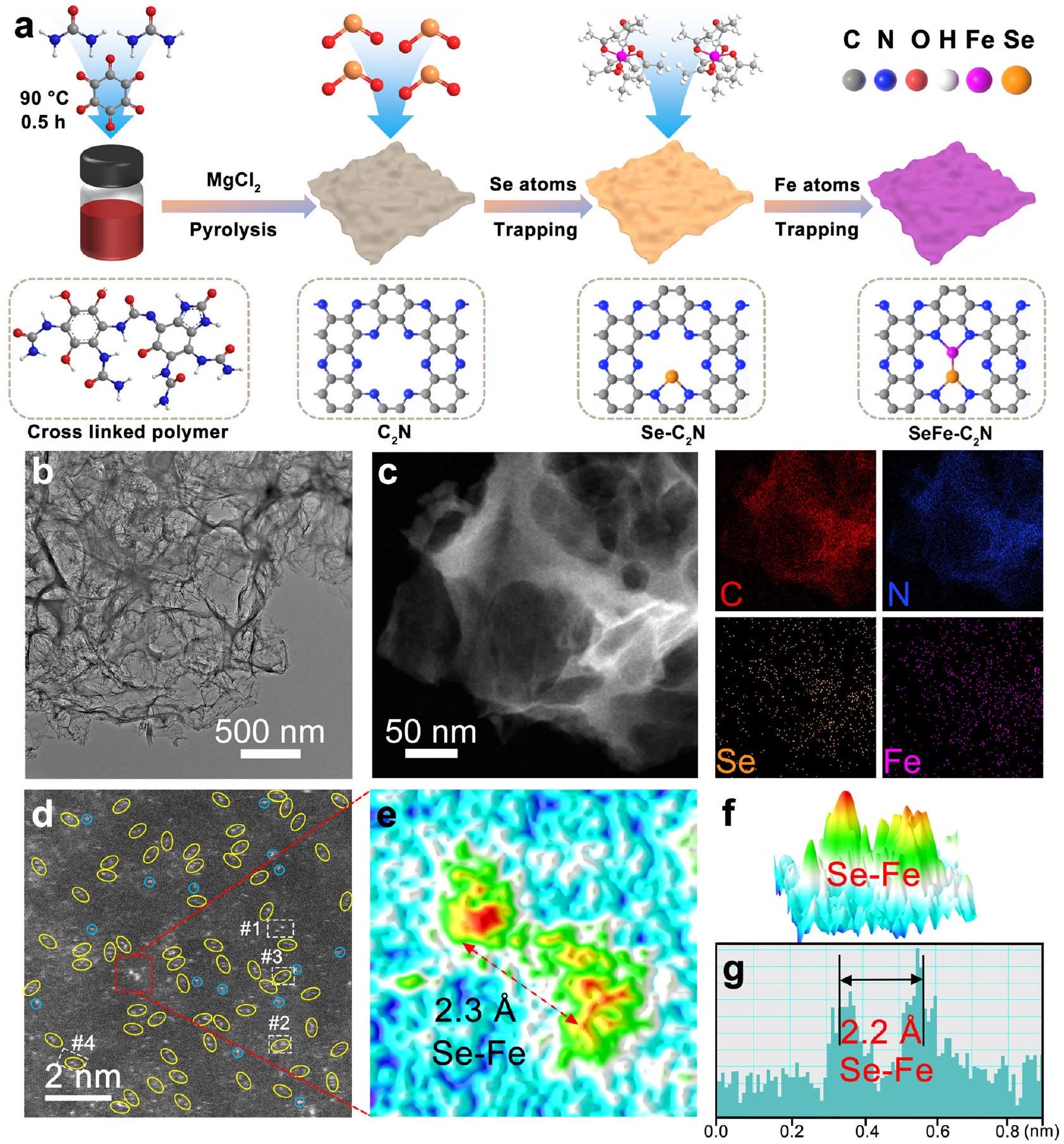
الشكل 1أ يوضح بشكل تخطيطي نهج التصنيع لـ SeFeأولاً، تم تخليق البوليمر المتقاطع عن طريق تسخين خليط من سيكلوهكسانهكسون واليوريا عند (الأشكال التكميلية 1-2). تؤدي هذه التنظيم المسبق الأولي للسوابق إلى تشكيل هيكل عظمي عطري مستقر (الأشكال التكميلية 3-5 والجدول 1)، والذي لن يتعرض لإعادة ترتيب كبيرة خلال معالجة التحلل الحراري اللاحقة. بعد عملية تخليق ذوبان الملح مع اللامائيةفي، تم الحصول على مادة تحتوي على نسبة عالية من الأنواع النيتروجينية الشبيهة بالبيرول أو البيرازين (الشكل التكميلي 6). علاوة على ذلك، تم إجراء عملية غسل حمضي كافية وغسل بالماء/الإيثانول للتخلص من بقايا محتملة تحتوي على المغنيسيوم (الأشكال التكميلية 7-9 والجدول 2)، مما يسهل التخليق الدقيق والمتتابع للمحفز المستهدف. الناتجالمادة الأساسية تتميز بوجود مسام دقيقة محددة بشكل جيد هيكل ( التجاويف)، التي تغطيها نيتروجين شبيه بالبيرازين بإحكام ولها درجة عالية من التشابه مع المثالي.
من الجدير بالذكر، غير المشبع-الحافة المرتبطة N فييمكن أن تعمل التجاويف كمواقع تنسيق واعدة لتثبيت ذرات المعادن. تم الحصول علىتم خلط الركيزة بعد ذلك معبنسبة وزن 1:1 عن طريق الطحن، بعد ذلك تم إخضاعه لجولة ثانية من التحلل الحراري عندتحتجو لتخليق Se-. بعد امتصاص الـالمواد السابقة وإجراء معالجة التحلل الحراري الثالثة فيتحتالغلاف الجويعينة مع مواقع الذرات المزدوجة المنسقة غير المتناظرة المثبتة على السطح ثنائي الأبعادتم الحصول عليه. للمقارنة، الـ و تم تصنيع العينات من خلال عملية مماثلة.
أظهرت المجهرية الإلكترونية الناقلة (TEM) أن SeFe-يمتلك هيكلًا ثنائي الأبعاد من طبقات النانو (الشكل 1ب). لا يوجد معدن أو أكسيد معدني قابل للاكتشاف، وهو ما يتماشى مع أنماط حيود الأشعة السينية للمواد المسحوقة (الشكل التكميلي 10)، مما يشير إلى الحالة الموزعة ذريًا لذرات السيلينيوم والحديد. بالإضافة إلى ذلك، يكشف رسم الخرائط العنصرية في الشكل 1ج أنوC موزعة بشكل متجانس في جميع أنحاء العينة. كما هو موضح في الأشكال التكميلية 11-12، و تظهر أشكالًا مشابهة وتوزيعات عناصر ذرية. يمكن لتقنية المسح المجهري الإلكتروني المظلم الحلقوي العالي الزاوية المصححة للانحراف (HAADF-STEM) تحديد الحالة الموزعة ذريًا لمعدن بمزيد من التفصيل. من ناحية، يمكن تحديد المسافة بين ذرتين معدنيتين متجاورتين من صور HAADF-STEM. بالمقارنة مع مواقع الذرات الفردية، فإن المسافة بين الذرات المعدنية المتجاورة في مواقع الذرات المزدوجة المدعومة على مواد الكربون المخدرة بالنيتروجين عادة ما تكون مضغوطة ضمن نطاق القشرة التنسيقية الرابعة (مسافة M1-M2).يمكن أن تؤدي هذه القرب إلى تأثير تآزري كبير يغير الهيكل الإلكتروني ويعزز امتصاص وفك الارتباط للوسائط.من ناحية أخرى، يمكن أن تمثل نسبة مواقع الذرات المزدوجة داخل منطقة ميكروسكوبية، كما تم اشتقاقها من التحليل الإحصائي، مؤشراً على النسبة الإجمالية لمواقع الذرات المزدوجة في المحفز، مما يؤثر بدوره على الأداء التحفيزي للمواد.
كما هو موضح في الشكل 1d، تم تأكيد تشتت الذرات لـ Se و Fe بشكل أكبر من خلال عدم وجود جزيئات نانوية من Se أو Fe. من المهم أن معظم مواقع الذرات المزدوجة (المحاطة ببيضاوات صفراء) وعدد قليل من مواقع الذرات الفردية (المعلمة بدوائر زرقاء) مرئية، مما يبرز الفرضية المتعلقة بموقع نشط غير عادي. الشكل التكميلي 13 يعرض تقييم النسبة بين مواقع الذرات المزدوجة ومواقع الذرات الفردية. تمثل مواقع الذرات المزدوجة المواقع النشطة السائدة فيعند تكبير الصورة أكثر، تكون المسافة بين ذرات السيلينيوم والحديد المجاورة هي، الذي يتماشى مع تباعد المسام للذرات و (الشكل 1e-f). تشير هذه المحاذاة إلى الوجود المستقر لمواقع ثنائية الذرة من السيلينيوم والحديد. يكشف توزيع الكثافة (الشكل 1g) على طول الخط المنقط الأبيض أن المسافة بين ذرات السيلينيوم والحديد المجاورة كانت الذي يتطابق بشكل وثيق مع القطر الفعال لـالذرات للتفاعل مع بعضها البعض. علاوة على ذلك، تم اكتشاف بعض أزواج النقاط التي كانت قريبة من بعضها، مما قد يُعزى إلى التجاعيد والتموجات الوفيرة فيمصفوفة تمنع الخط التناسبيالأزواج من كونها متوازية مع المستوى القاعدي، مما يؤدي إلى مسافات متغيرة بين مواقع ثنائي المعدن سيلينيوم-حديد في صور AC-STEM. الشكل التوضيحي الإضافي 14 يوضح حصريًا مسافات سيلينيوم-حديد من المناطق #2 إلى #4 في الشكل 1d ويقدم نماذج تخطيطية بديهية لمواقع ثنائي المعدن سيلينيوم-حديد المثبتة علىالإطار. أظهرت النتائج أن المسافات البصرية لمواقع Se-Fe كانت، و 0.13 نانومتر، على التوالي، والتي لم تتطابق تمامًا مع الطول الرابطي النظري لتنسيق سيلينيوم-حديد. تعود المسافات المرئية المختلفة بشكل رئيسي إلى الدوران المحوري لـالمواقع على الركيزة المطوية. عادةً، تكون المسافات البصرية لروابط السيلينيوم-الحديد عند دوران المسافات المحورية، و تختلف. تم تحديد محتويات السيلينيوم والحديد عبر مطيافية الانبعاث الضوئي الناتجة عن البلازما المقترنة بالحث (ICP-OES) على أنها 1.66 و
الشكل 1 | توصيف الشكل الخارجي لـ SeFe-. توضيح لتصنيع SeFe-. صورة TEM لـ SeFe-صورة STEM ورسم الخرائط العنصرية لـصورة HAADF-STEM لـ، موضحًا الذرات المزدوجة (الصفراء موزعة في الركيزة. تم تسليط الضوء على ملفات شدة على طول الخط الأحمر المنقط في د. ف نموذج ثلاثي الأبعاد لنقاط ساطعة من ذرات السيلينيوم والحديد على طول الخط الأحمر المنقط وملفات الكثافة المقابلة حول الموقع #1 في د. على التوالي، بنسبة مولارية من (الجدول التكميلي 3).
درجة الجرافيتية لـتم تحليلها بواسطة مطيافية رامان (الشكل التكميلي 15). في جميع العينات، كانت هناك قمتان مميزتان فقط للكربون عند (نطاق D، كربون غير منظم/ معيب) و تم الكشف عن (G band، الكربون الجرافيتي). نسبة الشدةمن نطاق D إلى نطاق G هو مؤشر يُستخدم لتقييم تشوه الشبكة البلورية وبلورية النانو المعمارية. بالمقارنة مع تلك الخاصة بـ، ، و ، الـقيمة SeFe-ينخفض إلى 0.94، مما يشير إلى أن درجة أكبر من الجرافيتية تتولد بواسطة ثلاثة- التحلل الحراري من خطوة واحدة، والذي يعد مفيدًا لنقل الإلكترونات واستقرار الموقع النشط أثناء تفاعل اختزال الأكسجين (ORR). الـتكشف قياسات الامتزاز-الامتزاز العكسي أن جميع العينات تظهر منحنى امتصاص من النوع الأول (الشكل التكميلي 16a)، مما يكشف أيضًا عن وجود عدد كبير من المسام الدقيقة والمسامات المتوسطة الصغيرة الموروثة منالتي تتولد خلال تبخر درجات الحرارة العاليةويساهم في تعرض الموقع النشط والنقل الكتلي خلال تفاعل الأكسدة الاختزالية للأكسجين. مع عدم حركةعلىتقل مساحة سطح العينات، ويميل ذروة المسام الدقيقة إلى التحول سلبًا (الأشكال التكميلية 16ب-هـ). بالإضافة إلى ذلك،المحفز لديه مساحة سطحية أقل قليلاً أكثر من و “، الذي ينتج عن الدرجة العالية من إشغال مواقع ثنائية SeFe داخل المسام الدقيقة (تجاويف).
معلومات الترابط العنصري السطحي لـتمت دراسته باستخدام مطياف الإلكترونات الضوئية بالأشعة السينية (XPS). الدقة العاليةطيف (الشكل التوضيحي 17) منيمكن أن يُحل إلى أربعة قمم، والتي ترتبط بـ، و الكربون المنسق مع السيلينيوم المخدر (C-Se، 289.9 eVكما هو موضح في الشكل التكميلية 18، القمة المميزة عندالموافق لـكان الرابطة موجودة في و . هذه القمة أكدت وجود في و وفقًا للشكل التكميلي 19، تظهر أنواع المعادن-N في، و “، مما يدل على تنسيق ذرات السيلينيوم والحديد الموزعة ذريًا مع ذرات النيتروجين. ثم، انتقالات الإلكترون لـ، و N يتم تحديدها من طيف XPS. بالمقارنة مع تلك من و ، الـطاقات الربط لـ SeFe-الانتقال إلى مواقع طاقة أعلى بمقدار 0.2 إلكترون فولت و0.1 إلكترون فولت، على التوالي. تشير هذه المقارنة إلى وجود حالة فقيرة بالإلكترونات لذرات النيتروجين حول الحديد والسيلينيوم. بالإضافة إلى ذلك، السيلينيوم المميزذروة Se-N تتحول بشكل طفيف ( -0.1 eV ) بعد إدخال ذرات الحديد في، مما يشير إلى أن ذرة السيلينيوم تصبح غنية قليلاً بالإلكترونات (الشكل التكميلي 20). من الواضح أن قمة جديدة تقع عند 49.8 إلكترون فولت تظهر في قياس السيلينيوم عالي الدقةطيف XPS لـالذي قد يُعزى إلىالتفاعلات. مقارنةً مع ذلك من، الـذروة فيانتقل نحو موقع طاقة ارتباط أقل (-0.5 eV)، مما يشير إلى انتقال كبير للإلكترونات إلى ذرة الحديد (الشكل التكميلي 21). فوق كل شيء، بعد أن تشكل ذرات الحديد والسيلينيوم تفاعلات مدارية، يحدث انتقال للإلكترونات من ذرات النيتروجين إلى ذرات الحديد والسيلينيوم المنسقة، مما يؤدي إلى تغيير كبير في حالة أكسدة الحديد وتغيير طفيف في حالة أكسدة السيلينيوم.
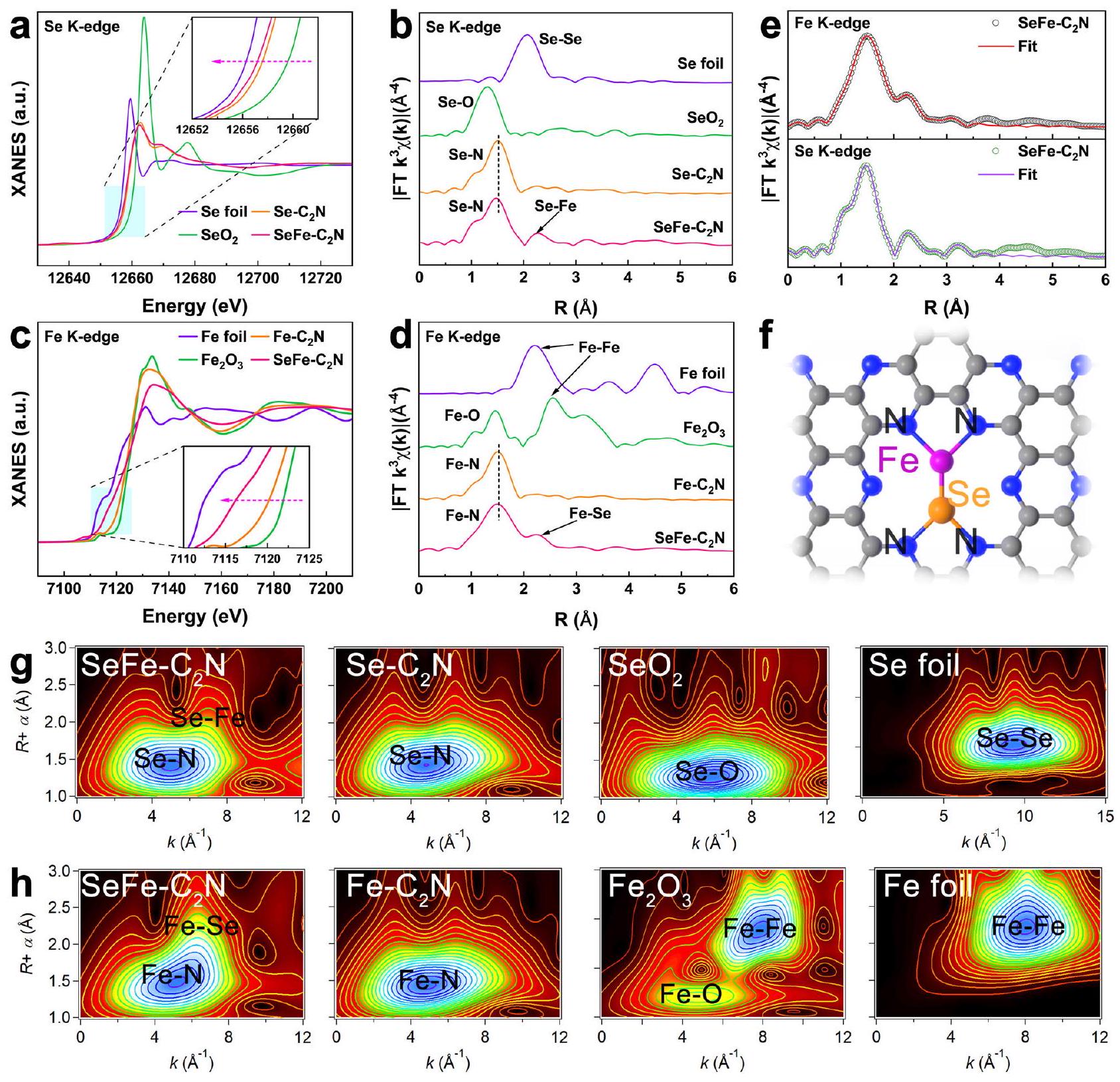
حالات التكافؤ والتنسيقات الذرية المنسقة لذرات السيلينيوم والحديد فيتم فحص المحفزات عبر مطيافية امتصاص الأشعة السينية (XAS). كما هو موضح من خلال طيف امتصاص الأشعة السينية عند حافة سيلينيوم K (XANES) (الشكل 2a)، فإن مواقع عتبة الامتصاص لـ و أعلى من تلك الخاصة برقائق السيلينيوم ولكنها أقل من تلك الخاصة بـ، مما يعني القيمة الإيجابية للسلينيوم. يمكن الحصول على حالة الأكسدة للمعادن الانتقالية من خلال ملاءمة موضع حافة الامتصاص للمعادن بشكل خطي. تم تحديد حافة امتصاص المعدن باستخدام القيمة القصوى للمشتق الأول لـ XANES. كما هو موضح في الشكل التوضيحي 22، فإن منحنى XANES لحافة K للسلينيوم للمركب SeFe- يمكن مقارنته بـ، مما يكشف عن الحالة المؤكسدة المنخفضة قليلاً للسلينيوم فيمقارنة مععلاوة على ذلك، تم تحويل فورييه-طيف الامتصاص الدقيق للأشعة السينية الممتد الموزون (FT-EXAFS) لـ SeFe-عرضت قمة رئيسية واحدة وقمم صغيرة عند و فيالفضاء، يعكس الـ Se-N والأصداف التنسيقية الأولى، على التوالي (الشكل 2ب). بالمقارنة مع ورقة السيلينيوم، فإن ذروة التنسيق سيلينيوم-سيلينيوم ( ) غائب في Se- و ، مما يدل على الحالة الموزعة ذريًا لذرة السيلينيوم. وبالمثل، فإن موضع عتبة الامتصاص لحافة الحديد K لـ يقع بين تلك الخاصة برقائق الحديد (الشكل 2ج)، الذي يشير إلى حالة شحنة إيجابيةمن الحديد. وبالمثل، فإن حالة الأكسدة المناسبة للحديدعينة من طيف XANES عند حافة الحديد (Fe K) أقل من تلك الخاصة بـ (الشكل التوضيحي 23)، الذي يتماشى مع الحديدنتائج XPS (الشكل التوضيحي 21). حالات الأكسدة المنخفضة للحديد والسيلينيوم فيمن و ساهمت في إعادة توزيع الشحنة القطبية من خلال التفاعلات الإلكترونية بين السيلينيوم والحديد. بالإضافة إلى ذلك، فإن الحواف الصغيرة المختلفة عندلـ و يتم تعيينها عمومًا إلىالانتقال. بالإضافة إلى ذلك، كما هو موضح في الشكل 2أ والشكل 2ج، يتم رصد ظاهرة الانزياح إلى اليسار عند حافة سيلينيوم K وحافة حديد K، ولكن بسبب الخاصية شبه المعدنية الفريدة للسيلينيوم، فإن انزياح عتبة الامتصاص أقل من ذلك للحديد في الحالة غير المتماثلة.النظام، الذي يتأثر أيضًا بالنيتروجين المجاور وذرات الكربون. إن إعادة توزيع الإلكترونات في موقع الحديد النشط مفيدة لتحفيز امتصاص جزيئات الأكسجين..
كما هو موضح في الشكل 2d، طيف FT-EXAFS لحافة الحديد K لـ SeFeيظهر ذروة واضحة عندوقمة الكتف عندالتي تُنسب إلى وجود و التنسيق، على التوالي. علاوة على ذلك، فإن أصل مسارات الانعكاس الخلفي لـمعروض في الشكل التكميلية 24. الحديد-نيتروجين وتتناسب مسارات التشتت بشكل جيد مع عند حافة Fe K. علاوة على ذلك، فإن SeFe- عند حافة كاف السيلينيوم تتطابق بشكل جيد مع السيلينيوم-نيتروجين والسندات، مما يدل على وجود، و روابط الحديد لتحديد تكوينات التنسيق الدقيقة لـ Se و Fe لعينات مختلفة، تم إجراء تحليلات ملائمة منحنيات EXAFS باستخدام طريقة المربعات الصغرى الكمية (الشكل 2e والأشكال التكميلية 25-27). هنا، يعتمد أصل مسارات الانعكاس (Fe-N، Fe-Se، Se-N، و Se-Fe) المستخدمة في ملاءمة EXAFS على حسابات FEFF من خلال النموذج الذري المحدد مسبقًا.نصفنتائج التركيب (الجدول التكميلي 4) يكشف أن ذرة السيلينيوم مرتبطة مع ذرتين من النيتروجين (طول الرابطة ) وذرة حديد واحدة (طول الرابطة ). بشكل مشابه، فإن أعداد التنسيق المتوسطة لـ N و Se حول ذرة الحديد في طول الرابطة هو 2.1 ) وطول الرابطة 0.9 )، على التوالي (الجدول التكميلي 5). المعلمات الهيكلية المحلية لـتشير إلىتتنسق الذرات كذرات مزدوجة غير متماثلةمواقع الواجهة علىمصفوفة.
استنادًا إلى نتائج XAS، تم تطوير نموذج هيكل واجهة ذرية ثلاثي الأبعاد لـتم بناؤه، كما هو موضح في الشكل 2f. للتحقيق في عدم التماثلتم حساب طيف XANES النظري أيضًا على أساس مواقع الذرات المزدوجة بعمق،نموذج عند حافة سي K وحافة حديد K (الأشكال التكميلية 28-29). وجدنا أن منحنيات الحساب لـيمكن أن يعيد بشكل فعال إنتاج الميزات الرئيسية للطيف التجريبي لـ. بالإضافة إلى ذلك، تم إجراء تحليل تحويل الموجات (WT) لتمييز ذرات الانعكاس الخلفي بشكل أكبر. تمثيلات WT البيانية لـ SeFe- عند حافة سي (الشكل 2g) وحافة حديد (الشكل 2h) تظهر أقصى شدة سائدة عند نُسب إلىالتفاعل، وأقصى شدة ثانٍ عند“، مما يتوافق مع تنسيق Se-Fe. على عكس مخططات الكنتور لرقائق Se و Fe، لا يوجد Se-Se أو قابلية تعريف أخرى.تمت ملاحظة الإشارات. بشكل جماعي، أظهرت الأنواع Se و Fe أنها موزعة ذريًا فيمع ذرة مزدوجة غير متناظرةهيكل التنسيق.
أداء التحفيز الكهربائي لتفاعل اختزال الأكسجين
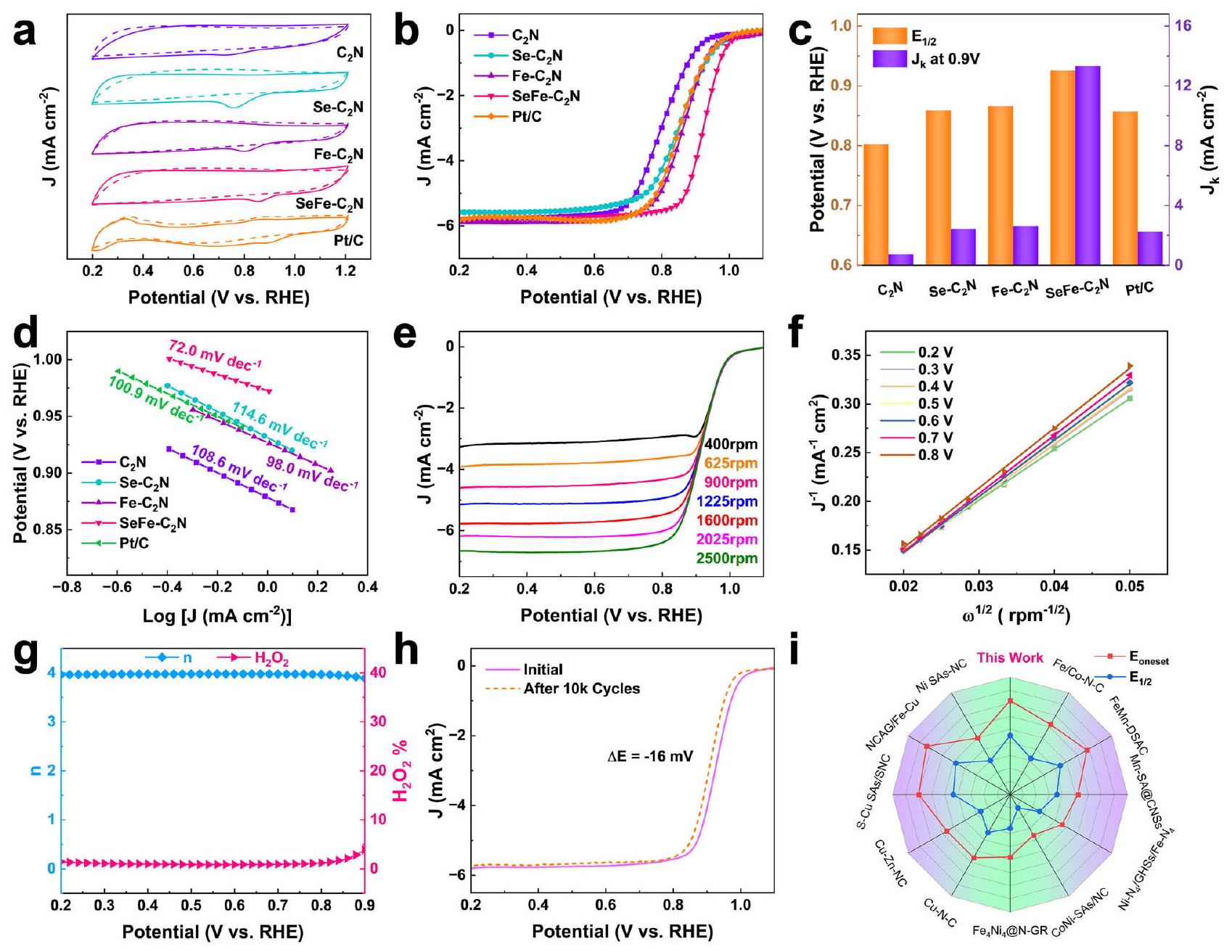
أنشطة ORR لـتم قياس المحفزات فيإلكتروليت قلوي مشبع بتركيز 0.1 م عبر قطب كهربائي دوار معدل بواسطة محفز (الشكل التوضيحي 30). تم تسجيل الفولتاموجرامات الدورية (CVs) فيتظهر الأجواء قمم كاثودية واضحة، مما يشير إلى أداء معين لتفاعل اختزال الأكسجين لجميع العينات (الشكل 3أ)كما يتضح من منحنيات الفولتمترية المسحية الخطية (LSV)، فإن SeFe-أظهر المحفز نشاطًا مثاليًا، مع جهد نصف موجي أعلى من 0.926 فولت مقابل RHE وأعلى بداية إيجابية ( ) من 1.06 فولت (الشكل 3ب، ج). علاوة على ذلك، و العوامل المساعدة تظهر انخفاضًا ملحوظًاقيم 0.859 و 0.867 فولت، على التوالي، مما يشير إلى التأثير التآزري لتعاون SeFe في زيادة تحفيز تفاعل اختزال الأكسجين. لمزيد من التحقق من تفوق الـالمحفز، تم إجراء تحليل مقارن على أحمال الكتلة المختلفة من البلاتين في Pt/C. كما هو موضح في الشكل التكميلي 31، فإن الأمثلمن-الأقطاب الكهربائية المعدلة، مع تحميلات مختلفة من الكتلة البلاتينية، وصلت إلى حد أقصى قدره 0.888 فولت، وهو أقل بمقدار 38 مللي فولت من ذلك لـمحفز. بالإضافة إلى ذلك،تم تصنيع مواد بتحميلات مختلفة من الحديد، كما هو موضح في الشكل التكميلية 32. أداء تفاعل الأكسدة الاختزالية للأكسجين لهذه الموادالمواد موضحة في الشكل التكميلية 33. تشير هذه النتائج إلى أن مواد Fe/C أظهرت نشاطات منخفضة في اختزال الأكسجين القلوي، والتي هي أقل بكثير من تلك الخاصة بـالمحفز. بالإضافة إلى ذلك، عدد التحلل الحراري
الشكل 2 | توصيف التركيب المحلي الذري لـ SeFe-. سي عادي-طيف XANES الحافة والبيانات المقابلةFT-طيف EXAFS الموزون لـ SeFe. طيف XANES لحدود الحديد K العادية و المطابقة d FT لـ-طيف EXAFS الموزون لـ SeFe-منحنى تركيب FT-EXAFS فيفضاء SeFe-في الـ
حواف K للسيليكون والحديد. نموذج هيكلي لموقع النشاط (مستمد من نتيجة EXAFS. WT للـ FT -مرجح-وظيفة SeFe-وعينات مرجعية عند حواف Se و Fe K، على التوالي. قد تؤدي الخطوات إلى مستويات متفاوتة من النشاط بينالمجموعة والمجموعات الضابطة الأخرى. وبناءً عليه، تم إضافة مجموعات ضابطة إضافية من المحفزات، بما في ذلك و تم تضمين المحفزات (الأشكال التكميلية 34-36). على الرغم من درجات الجرافيتية المماثلة، فإن أنشطة ORR لـ Seو Fe-Cكانت المحفزات أقل من تلك الخاصة بـ SeFe-العامل المساعد (الأشكال التكميلية 37-38). هذه المقارنة تعزز أكثر من الادعاء بأن الأداء التحفيزي المتفوق لـ” يُنسب إلى التأثير التآزري لمواقع الذرات المزدوجة من السيلينيوم والحديد. بالإضافة إلى ذلك، كثافة التيار الحركي ( ) من SeFe- عند 0.9 فولت يصلالذي هوأضعافًا أكبر من ذلك من Se-أضعاف أكبر من، وأكبر بمقدار 8.3 مرة من Pt/C، الشكل 3ج). علاوة على ذلك، فإن قيمة ميل تافل (الشكل 3د) لـأقل من تلك الخاصة بـ Se-، و Pt/C ) المحفزات، مما يدل على أن يتطلب جهدًا زائدًا أصغر لتحقيق نفس كثافة التيار. لذلك، فإن الميل الأصغر لجدول تافل لمواقع الذرات المزدوجة SeFe يشير إلى تعزيز حركية اختزال الأكسجين..
بالإضافة إلى ذلك، فإن منحنيات LSV تدور بمعدلات مختلفة (تم الحصول على الشكل 3e) لاختبار مسارات ORR لـتظهر الرسوم البيانية الملائمة لكوتشي-ليفش (K-L) المقابلة (الشكل 3f) أن يظهر حركيات تفاعل من الدرجة الأولى بالنسبة لتركيز الأكسجين. على مدى نطاق الجهد الكامل، عدد نقل الإلكترون (يُقدَّر أن يكون في نطاقكما هو موضح في الشكل 3g، فإن نتائج قياس القطب الكهربائي ذو القرص الدوار (RRDE) تؤدي إلى انخفاضعائد أقل من، مما يشير بشكل أكبر إلى مسار ORR على المحفز. تم استخدام مخططات نايكويست لقياس الطيف الكهروكيميائي (EIS) لتقييم خصائص نقل الشحنة لجميع المحفزات. كما هو موضح في الشكل التوضيحي 39،يوفر الأصغر
شكل. | النشاط الكهروكيميائي لـ SeFe-في KOH. منحنيات السيرة الذاتية في (خط متقطع) و (خط صلب). منحنيات استقطاب b ORR؛ مقاومة الحل السلسليهي 1.5، 2.0، 4.7، 3.3، ولـ، و ، على التوالي. ج جهد نصف الموجة ( ) وكثافة التيار الحركي ( ) عند 0.9 فولت. د الرسوم البيانية لتافل المقابلة. هـ، و منحنيات LSV لـ SeFe-في دوران مختلف سرعاتوحساب مخططات K-L لـ SeFe-عدد نقل الإلكترونانتقائية SeFe-. اختبار المتانة لـ SeFe-لـ 10000 دورة. i مقارنة النشاط التحفيزي لـ SeFe-مع تلك المحفزات التي تم الإبلاغ عنها سابقًا. لم يتم تحقيق جميع الإمكانيات-مصحح. مقاومة نقل الكهروكيميائية )، مما يشير إلى عملية نقل شحنة مواتية. يمكن تحديد المساحة السطحية الكهروكيميائية (ECSA) من خلال مكثف مزدوج الطبقة الكهربائية ( ). تم حسابه من SeFe- هو (الأشكال التكميلية 40-41)، والتي هي أكبر من تلك الخاصة بالعناصر الأخرى، مما يشير إلى كثافة أعلى لمواقع النشاط السطحي. لتحديد النشاط الفطري للمحفز، يتم اعتماد تردد التحويل (TOF)، والذي يتميز بعدد تحويل جزيئات الركيزة على موقع نشط واحد محفز في وحدة الزمن ( أو ). كما هو موضح في الشكل التوضيحي 42، تم الحصول على يقدم قيمة TOF أعلى منمن أن تفعل و عند 0.9 فولت في 0.1 م كوه، مما يشير إلى النشاط المتفوق الداخلي لتفاعل اختزال الأكسجينالمكونات. الاستفادة من إعادة توزيع الإلكترونات وتأثير التآزر بين الذرات الثنائية،كما أظهرت مقاومة جيدة للميثانول (الشكل التوضيحي 43). بالإضافة إلى ذلك، تعتبر الاستقرار على المدى الطويل معيارًا مهمًا آخر للمواد المحفزة الكهربائية. تم إجراء قياسات الكرونوأمبريومتر، وكانت التيار لـصيانة للقيمة الأصلية بعد 700 دقيقة من التشغيل (الشكل التوضيحي 44). بعد اختبار المتانة المعجل (ADT) في نطاق الجهد لـ الدورات، منتم تقليلها بمقدار 16 مللي فولت فقط، مما يشير إلى انخفاض طفيف في النشاط التحفيزي (الشكل 3h). الشكل والتركيب لـبعد أن تم توصيف ADT عبر XPS وTEM وHAADF-STEM (الأشكال التكميلية 45-47). من المRemarkably، لا يحدث أي تجمع أو تدهور ملحوظ في المواقع الذرية الموزعة لـ Se-Fe، مما يشير إلى وجود تآزر ثنائي الذرة.تمتلك المواقع استقرارًا طويل الأمد. تم تنفيذ قياسات XAS إضافية لتقييم قابلية عكس بيئة التنسيق الذري لذرات السيلينيوم والحديد في SeFe-العامل المساعد. كما هو موضح في الأشكال التكميلية 48-49، تظل طيفيات XANES وEXAFS لحافة سيلينيوم K وحافة حديد K تقريبًا كما هي قبل وبعد التفاعل، مما يدل على استعادة الـحالة التكافؤ والرابطة. التغير القابل للعكس في حالة التكافؤ وتكوين التنسيق الذري لكل من الحديد والسيلينيوم أشار إلى المساهمة النشطة لذرات الحديد والسيلينيوم في التفاعل الحفزي لتفاعل اختزال الأكسجين. كما هو موضح في الشكل 3i والجدول التكميلي 6، بالمقارنة مع المحفزات التي تم الإبلاغ عنها مؤخرًا،لديه إمكانيات كبيرة للتقدم في التطبيقات العملية.
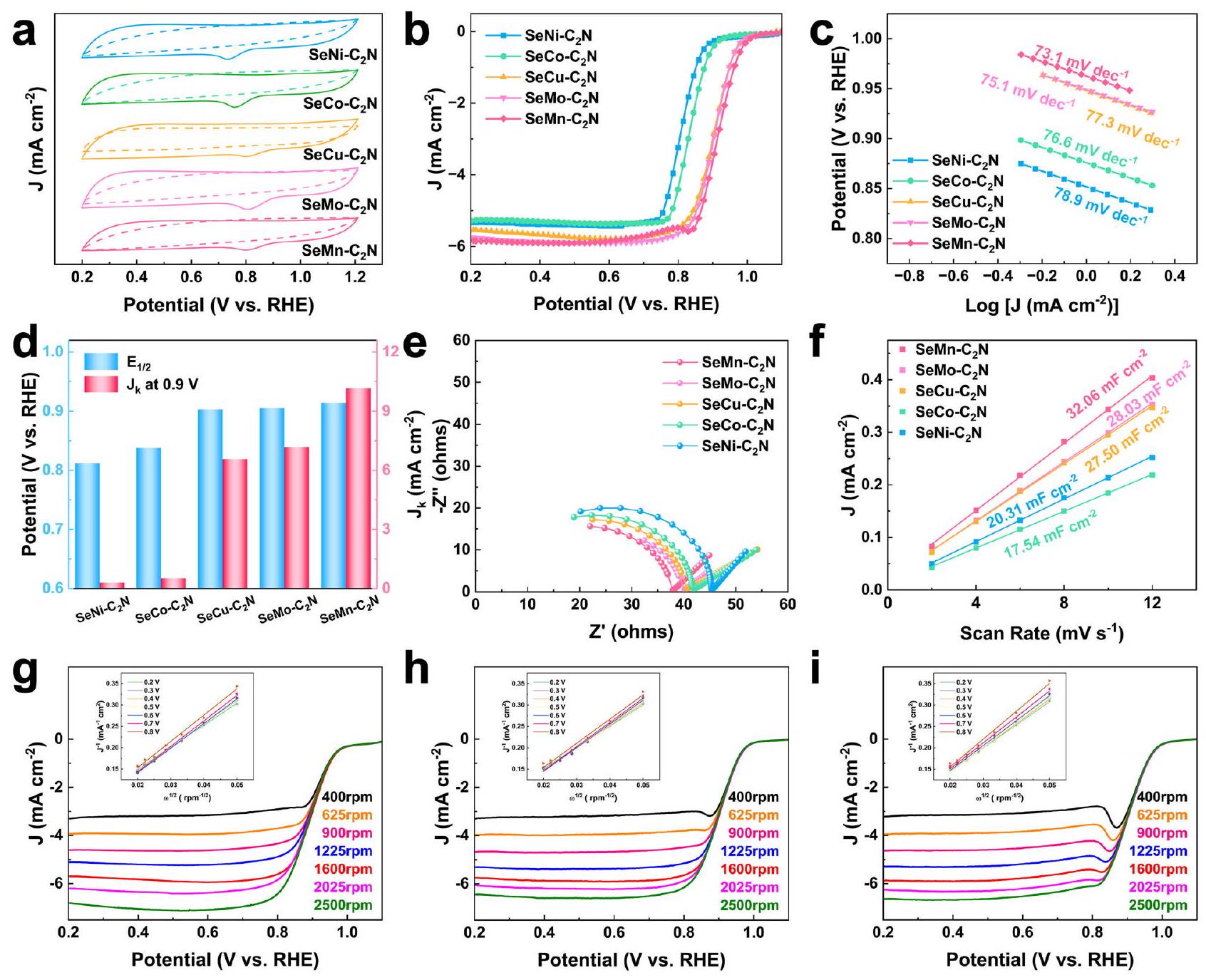
SeM-محفزات مع عناصر أخرى، أو مو) تم تصنيعها أيضًا لاستكشاف التأثير التنظيمي العالمي لمعدل السيلينيوم. كانت أنماط XRD لـ SeM-تظهر المحفزات (الشكل التوضيحي التكميلي 50) غياب جزيئات النانو المعدنية أو جزيئات النانو المعدنية المؤكسدة. توزيعات متجانسة منوعناصر معدنية أخرى تم ملاحظتها من خرائط EDS لـ SeM-المحفزات (الأشكال التكميلية 51-55). صور HAADF-STEM عالية الدقة لـ SeM- (الأشكال التكميلية 56-60) تكشف عن النجاح
الشكل 4 | النشاط الكهروكيميائي لتفاعل اختزال الأكسجين (ORR) لـ SeM، إلخ.) في في (خط منقط) – و (خط صلب) الإلكتروليتات المشبعة. ب منحنيات استقطاب ORR؛ مقاومة الحل السلسليهم، و لـ، على التوالي. رسوم بيانية من نوع Tafel؛ملخص لـ و ؛ الخصائص نصف الدائرية لمنحنيات EIS؛القيم لجميع العينات.منحنيات LSV عند سرعات مختلفة (400-2500 دورة في الدقيقة) ومطابقة مخططات K -L عند إمكانيات مختلفةسيمو-، و على التوالي. لم يتم -مصحح. تشكيل مواقع الذرات المزدوجة (المميزة بالبيضاوات الصفراء). لديهم قيم مشابهة لـ (الشكل التكميلي 61) ودرجة أعلى من الجرافيتية، مما يفضل نقل الإلكترونات، وبالتالي يسهل عملية اختزال الأكسجين. بالإضافة إلى ذلك، يتم عرض طيف XPS عالي الدقة في الأشكال التكميلية 62-66. الأنواع الرئيسية من النيتروجين في و لا تزال تشبه البيرول والبيرازين، و على التوالي)، وهو ما يعادل ( الشكل التوضيحي التكميلي 19c). بالإضافة إلى ذلك، تم ملاحظة قمم Se-M الجديدة في Seتؤكد طيفيات XPS بشكل إضافي التفاعل الإلكتروني بين السيلينيوم وذرات المعادن الأخرى. البيانات المقاسة من XANES من SeM (M تمثل تظهر المحفزات للمعادن والسيلينيوم في الأشكال التكميلية 67-71. مواقع حافة الامتصاص لـ-حافة الـالعينات تقع بين تلك الخاصة برقائق المنغنيز وعينات، ورق الألمنيوم وعينات، رقائق النيكل وعينات أكسيد النيكل، رقائق النحاس وعينات أكسيد النحاس، ورقائق الموليبدينوم وعينات. تشير هذه النتائج إلى أن متوسط حالات الأكسدة للمعادن، ومو هي 2.6، 2.7، 1.5، 1.7، و1.4، على التوالي. حواف K لـ SeM-توجد العينات بين تلك الخاصة بورق السيلكون وعينات، بمتوسط حالات أكسدة السيلينيومو 0.7 لـ، و على التوالي. الكمية
نتائج تركيب EXAFS (الأشكال التكميلية 72-77 والجداول التكميلية 7-8) عند السيلينيوم وتتيح حواف K استخراج معلمات هيكلية محددة، والتي تظهر بناء ثنائي الذرة غير المتماثل.المواقع وكشف التأثير التآزري بين السيلينيوم وذرات المعادن الأخرى.
نظرًا للتنظيم الإلكتروني وتأثير التآزر لمعدل السيلينيوم، فإنتظهر العينات أداءً مرغوبًا في تفاعل الأكسدة الاختزالية للأكسجين (الشكل 4أ، ب). مع انحدارات تافل مشابهة (الشكل 4ج)،، و إظهار أنشطة التحفيز لـ ORR معقيم 0.914 و 0.905 و 0.903 فولت، على التوالي، وزيادةالقيم (الشكل 4د)، مما يدل على النشاط الكهروكيميائي المرضي غير المتماثلالمواقع. بالإضافة إلى ذلك، SeM-يمتلك قدرة سريعة على نقل الإلكترونات (الشكل 4e) بسبب إعادة توزيع الشحنة وزيادة تعرض مواقع النشاط (الشكل التوضيحي 78 والشكل 4f) الناتجة عن عمليات التحلل الحراري المتعددة. كما هو موضح في الشكل 4g-i، أعداد نقل الإلكترونات (تم حسابها من معادلة K-L هي 3.97 و 3.96 و 3.94 لـ، ، و ، على التوالي، مما يشير إلى تأثير مسار نقل الإلكترونات الأربعة الفعال على محفزات.
لتأكيد آفاق التطبيق العملي لـتم تجميع بطارية زنك-هواء مائية محلية الصنع (ZAB) مع SeFe-طبقة انتشار الغاز المعدلة كالكاثود (المكملات
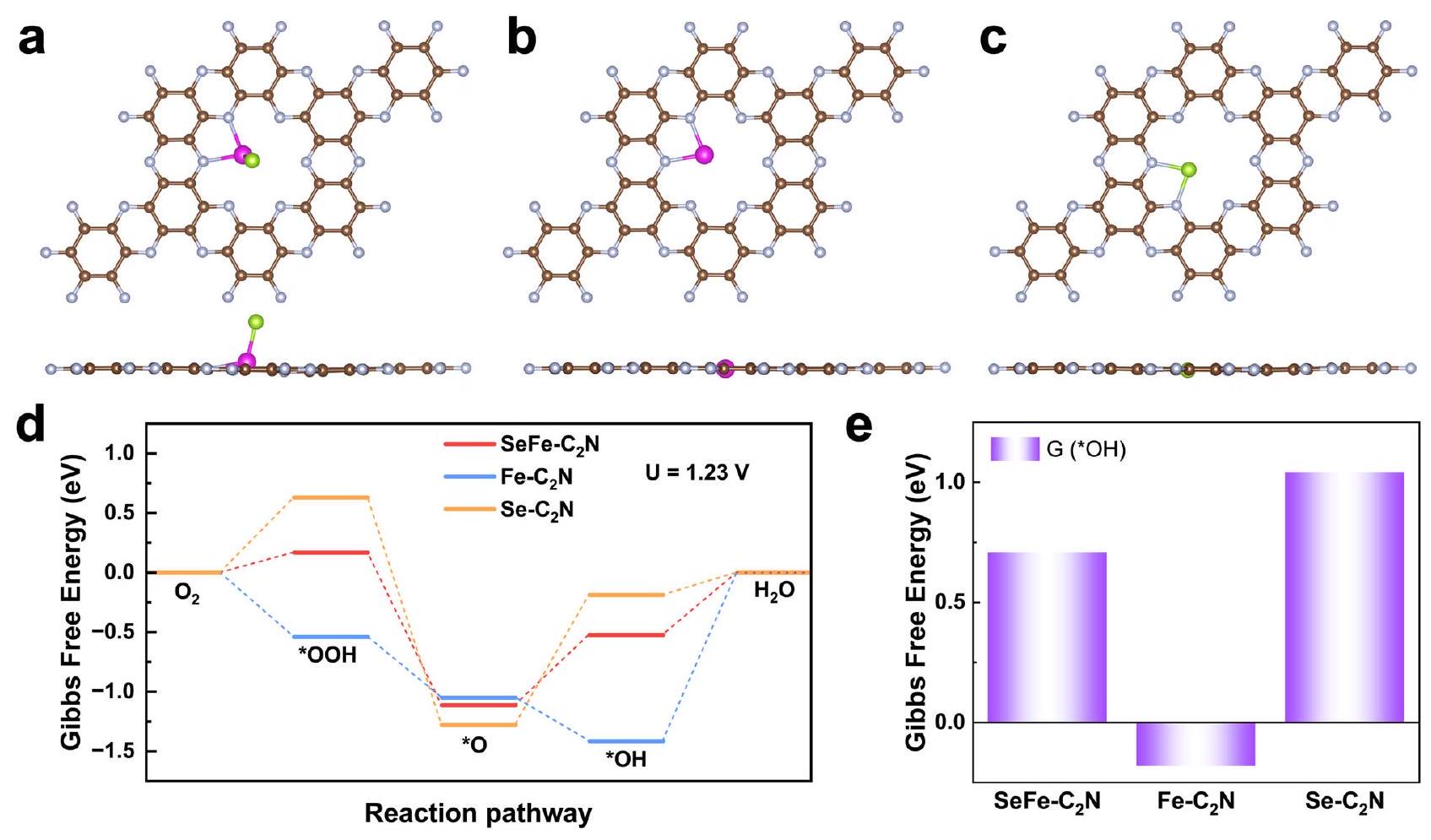
الشكل 5 | الحساب النظري لتفاعل اختزال الأكسجين. أ-ج التكوينات الذرية لـ SeFe و ، على التوالي. تمثل الذرات البنية والرمادية والبنفسجية والخضراء الكربون والنيتروجين والحديد والسيلينيوم، على التوالي. د طاقة غيبس الحرة مخطط الـ ORR على، و سي- . طاقات جيبس الحرة لـ * OH الممتصة على ، و .
الشكل 79). كما هو موضح في الشكل التكميلي 80a، فإن SeFe--المعتمد على ZAB قدم جهد فتح عالي (1.50 فولت)، متجاوزًا بشكل كبير جهد الدائرة المفتوحة لبطارية Pt/C (1.37 فولت). ومن الجدير بالذكر أن الأمثلحقق كثافة طاقة قصوى قدرها، والذي كان أعلى من ذلك الخاص بقطب الهواء المعدل بـ Pt/C التجاري، الشكل التوضيحي التكميلي 80ب). السعة النوعية لـ SeFe--المعتمد على ZAB في هو (الشكل التوضيحي الإضافي 80c)، والذي هو أفضل من ذلك لـ Pt/ . علاوة على ذلك، فإن SeFe-يمكن أن تعمل البطارية المعتمدة على ذلك بشكل قوي لمدة تصل إلى 50 ساعة مع انخفاض طفيف في جهد التفريغ (الشكل التكميلي 80d)، مما يدل على المتانة الاستثنائية لـبطارية زنك-هواء قائمة على. لمزيد من التحقق من استقرار الشحن القابل لإعادة الاستخدام لـتم إجراء اختبار شحن وتفريغ جلفاني ثابت طويل الأمد بفاصل 10 دقائق لكل دورة.أظهر زنك-هواء القابل لإعادة الشحن القائم على تغيير طفيف في جهد الشحن/التفريغ لأكثر من 380 ساعة في (الشكل التوضيحي التكميلي 80e). بالإضافة إلى ذلك، تشير مقارنة أداء خلايا الزنك-هواء المجمعة حديثًا مع المحفزات التي تم الإبلاغ عنها مؤخرًا إلى أن يمتلك نشاطًا واستقرارًا ملحوظين في التطبيقات العملية (الجدول التكميلي 9).
دراسة نظرية لـ SeFe-على ORR
للحصول على فهم أعمق للأداء التحفيزي العالي لـالعوامل المساعدة في عملية اختزال الأكسجين، التفاعلات الكهروكيميائية لـ، و تمت دراسة المحفزات لتفاعل الأكسدة الاختزالية للأكسجين (ORR) من خلال حسابات نظرية الكثافة الوظيفية (DFT) (البيانات التكميلية 1). توضح الأشكال 5a-c أكثر التكوينات استقرارًا لـسطح مشبع بالحديد (Fe) وذرات السيلينيوم غير المعدنية (Se)، ذرة حديد مفردة، وذرة سيلينيوم مفردة. ومن الجدير بالذكر أنه على عكس التشبع الثنائي الشائع في، حيث توجد ذرات المنشطات عادة في نفس المستوى، على السطح، ذرة السيلينيوم و ليست في مستوى واحد. بعد ذلك، قمنا بفحص التغير في الطاقة الحرة لجيبس على طول مسار تفاعل الأكسدة والاختزال عند الجهد التوازني. وخطوات تحديد الإمكانات المختلفة (PDSs) (الشكل 5d). إن PDS لموقع الحديد على هو إزالة * OH ، مع وهو ما يتماشى مع الأبحاث السابقة. بالمقارنة مع المشوب غير المعدني السطح، الذي يحتوي أيضًا على ذرات مفردة، لديه تفاعلات ضعيفة مع *OOH و *OH ولكن تفاعلات قوية مع *O. وبالتالي، فإن تحويل PDS على يتضمن تحويل * O إلى * OH ، وعلى عكس إضافة ذرة واحدة من الحديد والسيلينيوم، يمكن أن تنظم الإضافة المشتركة للحديد والسيلينيوم بشكل فعال قوة الامتصاص للوسائط المحتوية على الأكسجين، مما يجعلها أكثر اعتدالًا.السطح. بعد عدة محاولات علىعلى السطح، تم تحديد ذرات السيلينيوم كمواقع الامتزاز الأكثر استقرارًا خلال عملية اختزال الأكسجين (الشكل التكميلي 81).
أولاً، تمتص جزيئات الأكسجين وتفعّل موقع السيلينيوم لتكوين *OOH. خلال التفاعل الأساسي الثاني، تطلق *OOH الممتصة واحدة منبعد الحصول على إلكترون واحد، بينما تتفاعل ذرات السيلينيوم والحديد مع *O. إن تكوين هذا التفاعل المشترك يقلل من حاجز الطاقة الديناميكية الحرارية لـ *O إلى *OH بعد واحدوتم الحصول على إلكترون. أخيرًا، يتم تفريغ *OH من موقع Se بينما يتم الحصول على آخر إلكترون. لم يغير تشويب Se فقط PDS للحديد الأصلي الهيكل ولكن أيضًا قلل من من PDS من 1.41 إلكترون فولت إلى 0.59 إلكترون فولت، مما يشير إلى وظيفة تحفيزية مرضية لتفاعل اختزال الأكسجين. يوضح مخطط الطاقة الحرة لتفاعل اختزال الأكسجين بوضوح أن قوة الامتزاز للوسط *OH تلعب دورًا حاسمًا في النشاط الكهروكيميائي لتفاعل اختزال الأكسجين. توضح الشكل 5e بوضوح أن الإفراط في الربط لـ *OH علىيعيق تحويله الإضافي إلى، عامل مهم في تقليل كفاءة ORR. الامتزاز الضعيف لـ * OH علىغير مواتٍ أيضًا لإكمال ORR. ومع ذلك، فإن الربط المناسب علىتضمن السطح نشاط ORR بكفاءة. باختصار، فإن التشارك في التخصيب لذرات السيلينيوم والحديد يزيد بشكل مناسب من تفاعل الحديد والسيلينيوم في التخصيب الذري الفردي، مما يؤدي إلى امتصاص أكثر اعتدالًا على الركيزة وتحويل حراري أكثر ملاءمة.إلى.
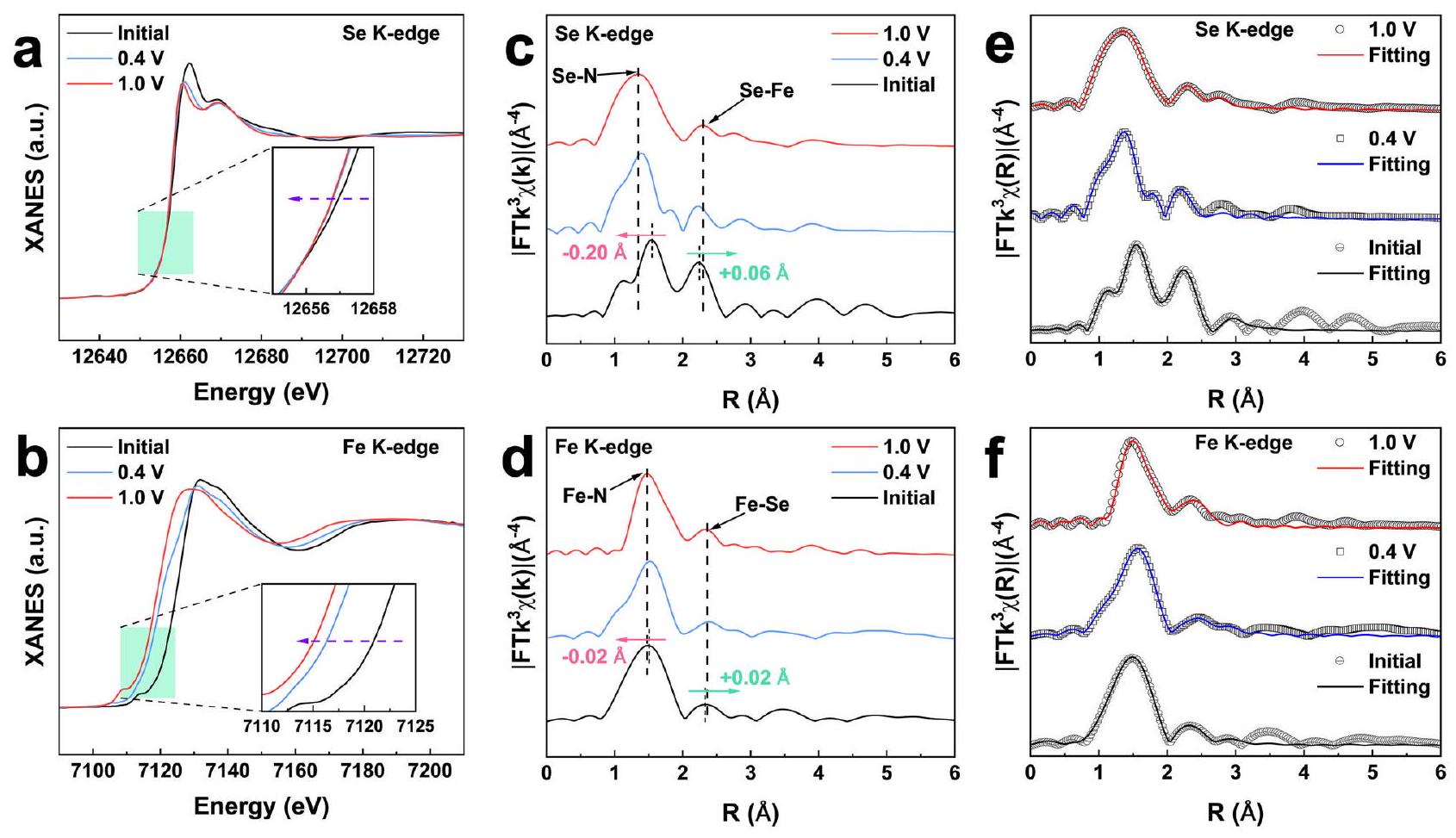
الشكل 6 | تكشف تقنية XAS أثناء التشغيل عن الآلية التآزرية لـ SeFe-. أ، ب طيف XANES لعنصر SeFe- عند حافة سي K وحافة حديد K تحت عدة فولتات. ج، د تحويلات فورييه لـ-طيف EXAFS في حالة التشغيل الموزون لـ SeFe-في حواف Se و Fe k، على التوالي. e، f منحنيات تركيب FT فيالفضاء عند حافة سي K وحافة حديد K لـ، على التوالي.
تحليل XAS أثناء التشغيل
لاستكشاف التطور الهيكلي والإلكتروني لـتم إجراء XAS operando بالتفصيل تحت ظروف تشغيل الجهاز الواقعية (الشكل التكميلي 82)طيف XANES أثناء التشغيل لـتم جمع المحفزات عند حافة Se K وحافة Fe K تحت عدة فولتية مطبقة، كما هو موضح في الشكل 6a و6b، على التوالي. بالمقارنة مع الحالة الأصلية،تميل الموضع إلى التحول السلبي (-0.5 eV، الشكل التوضيحي 83) مع زيادة الجهد الكاثودي، مما يشير إلى حالة أكسدة مخفضة للسلينيوم في SeFe العامل.. من المحتمل أن تنشأ هذه الظاهرة من انتقال الإلكترون بين السيلينيوم والوسيط المحتوي على الأكسجين الممتص. بالمثل، هناك تحول واضح في الطاقة السلبية بمقدار 6.7 إلكترون فولت لـيلاحظ (الشكل التوضيحي 84)، مما يشير إلى أن حالة التكافؤ للحديد (Fe) تنخفض بعد امتصاص أنواع *O.
تطور تكوين التنسيق الذري لـيمكن تحديد الموقع النشط بشكل أكبر من خلال EXAFS أثناء التشغيل. كما هو موضح في الشكل 6c، فإن شدة قمم Se-Fe تنخفض بشكل ملحوظ مع زيادة الجهد المطبق. بالإضافة إلى ذلك، هناك تحول واضح في نطاق منخفض من القمة السائدة Se-N منإلىوانزياح طفيف نحو اليمين في قمة السيلينيوم-الحديد الثانويةإلىيمكن ملاحظته. بالنسبة لمواقع الحديد، فإن طول رابطة الحديد-السيلينيوم يتوسع قليلاً، مع تحول طفيف نحو القيم المنخفضة في الذروة السائدة لحديد-النيتروجين منإلى (الشكل 6د). تظهر نتائج XANES وEXAFS أثناء التشغيل أن تخضع المواقع لتطور هيكلي، قد يكون ناتجًا عن امتصاص وسائط الأكسجين أثناء تشغيل ZAB. بالنظر إلى امتصاص الأنواع المحتوية على الأكسجين علىالمواقع التي كشفتها حسابات DFT والفروق في طيف XANES أثناء التشغيل، تم إضافة مسارات تشتت Se-O وFe-O لتناسب EXAFS أثناء التشغيل بشكل كمي. كما هو متوقع، كانت منحنيات التناسب لذرات الأكسجين الممتصة علىيتطابق جيدًا مع بيانات التجربة التشغيلية (الشكل 6e). تحت جهد مطبق قدره 1.0 فولت، يتم تنسيق السيلينيوم مع حوالي ذرة نيتروجين واحدة (طول الرابطة )، ذرة واحدة من الحديد ( Fe، طول الرابطةوذرة أكسجين واحدة (Se-O، طول الرابطة من ) (الأشكال التكميلية 85 والجدول التكميلية 10). في الوقت نفسه، يتم أيضًا ملاءمة المجال التنسيقي الأول للحديد كروابط Fe-N اثنتين ( )، رابطة واحدة من الحديد والسيلينيوم ( ) ورابطة واحدة من FeO (الشكل التوضيحي التكميلي 86 والجدول التكميلي 11). مع زيادة الجهد المطبق والمعالجة المتعاقبة لمحفزات اختزال الأكسجين، يزداد عدد التنسيق للأكسجين حول مواقع السيلينيوم والحديد، بينما تخضع التهيئة لإجراء ضبط دقيق مع إجهاد انكماش صغير لرابطة Se-N. بشكل عام، تم التحقيق بشكل أكبر في تأثير التحفيز التآزري باستخدام XAS أثناء التشغيل.الذي يلعب دورًا مهمًا في زيادة كفاءة عملية اختزال الأكسجين.
نقاش
باختصار، غير متكافئ غير متجانسمواقع نشطة مزدوجة الذرات مثبتة في (SeM- تم تصنيعها بنجاح. نظرًا لتوزيع الشحنة القطبية بين الأجزاء غير المتماثلة من السيلينيوم والحديد، فإن الناتجيعرض المحفز أداءً ممتازًا في معدل الأكسدة الاختزالية، معمن 0.926 فولت في وسط قلوي. التهجين المداري غير المتماثلتقوم الذرات المزدوجة بضبط طاقة الوسائط الممتصة/المحررة في المواقع النشطة. SeFe-تظهر ZABs المعتمدة على – كثافة طاقة قصوى مماثلة لـأظهرت تحليلات XAS التشغيلية أن ذرات السيلينيوم والحديد الثنائية تعمل كمواقع مساعدة للتفاعل. بالإضافة إلى ذلك، كشفت حسابات DFT بشكل أكبر أن التأثير المساعد للتفاعل بينتغير مواقع الذرات المزدوجة خطوات تحديد الجهد وتسريع تكوين *OH. يمكن أن يلهم التصميم العقلاني لمحفزات مواقع الذرات المزدوجة غير المتماثلة تصنيع وتطوير محفزات الأكسجين.
طرق
المواد الكيميائية
جميع المواد الكيميائية المستخدمة في هذه التجربة كانت متاحة تجارياً وتم استخدامها مباشرة دون تنقية إضافية. سيكلوهكسانهكسون أوكتاهيدراتعلاء الدين)، يوريا،
كلوريد المغنيسيومحمض الكبريتيكأسيتيلاستون الحديد (III) من شركة شي لونغ العلمية، الحديد(II) أسيتيل أسيتوناتماكلين)، كوبالت(II) أسيتيل أسيتونات (ماكلين)، أسيتيل أسيتونات النيكل (II) (ماكلين)، أسيتيل أسيتونات النحاس(II)ماكلينثنائي أكسيد موليبدينوم (VI) ثنائي أسيتيل أسيتوناتماكلين)، فحم الكربون فولكان XC-72R (رقم CAS: 1333-86-4، مركز مواد SCI) بلاتين/كربون تجاري (20 وزن%، ألفا أيسر)، إيثانولشركة تيانجين فويو للكيماويات الدقيقة المحدودة)، محلول نافيون 117 (في خليط من الكحوليات الأليفاتية المنخفضة والماء، علاء الدين). مستويات نقاء غازات الأكسجين والنيتروجين هي 99.999.
تحضير
كانت الخطوة الأولية تتضمن إعداد خليط مطحون جيدًا من السيكلوهكسانهكسون واليوريا بنسبة مولية من. تم تسخين هذا المزيج بلطف عند لمدة 0.5 ساعة. بعد ذلك، المنتج المتقاطع الناتج والمجففتم طحنها مع نسبة كتلة من. بعد ذلك، خضعت المسحوق الناتج للتكلس عند درجات حرارة ، و لمدة ساعتين، باستخدام معدل تسخين قدرهتحت حماية النيتروجين. عند الوصول إلى درجة حرارة الغرفة، تم تعريض عينات الكربون لسلسلة من الغسلات باستخدام حمض الكبريتيك.الماء منزوع الأيونات، والإيثانول بالتتابع. بعد التجفيف طوال الليل في فرن مفرغ من الهواء عند، الـ، و تم الحصول على عينات.
تحضير
90 ملغ من المنتج كما هوتم خلطه مع 6 ملغ من أسيتيل أسيتونات الحديد (III) من خلال طريقة الطحن. بعد ذلك، تم نقل المسحوق إلى فرن أنبوبي تحت جو من النيتروجين المتدفق إلى درجة حرارةفيثم تم تسخين المادة الناتجة لمدة ساعتين. بعد ذلك، تم تبريدها بشكل طبيعي إلى درجة حرارة الغرفة،تمت تخليقه واستخدامه مباشرة دون أي معالجة إضافية.
تحضير
ثاني أكسيد السيلينيوم ( ) و (نسبة كتلة 1:1) تم خلطها وطحنها بالكامل إلى مسحوق متجانس. بعد ذلك، تم تسخين المسحوق في فرن أنبوبي تحت جو من النيتروجين المتدفق. تم رفع درجة الحرارة في البداية إلىلمدة 30 دقيقة، ثم زادت إلىفيوتم الاحتفاظ به لمدة ساعة واحدة. بعد التبريد الطبيعي إلى درجة حرارة الغرفة،تمت تخليقه واستخدامه مباشرة دون أي معالجة إضافية.
تحضير SeM-
إجمالي 90 ملغ من المنتج الناتجتم خلطه مع 6 ملغ من أسيتيل أسيتونات الحديد (III) من خلال طريقة الطحن. بعد ذلك، تم تسخين المسحوق في فرن أنبوبي تحت جو من النيتروجين المتدفق إلى درجة حرارةفيثم تم تعريض المادة للتسخين المسبق لمدة ساعتين. بعد ذلك، تم تبريدها بشكل طبيعي إلى درجة حرارة الغرفة،تم الحصول عليه واستخدامه مباشرة دون مزيد من المعالجة. بالنسبة لـ SeMn، وSeMo- تم إعداد هذه العينات كمجموعات تحكم من خلال نهج مشابه لـباستثناء أنه تم إضافة أملاح معدنية متنوعة بنفس الكمية المولية.
تحضير و
ال و تمت معالجة المحفزات بعلاج حراري إضافي. على وجه التحديد، تم تسخينها عند و على التوالي، لمدة ساعتين تحت جو من النيتروجين المتدفق مع. يتم تعيين المحفزات الناتجة على أنها و ، على التوالي.
تحضير مواد Fe/C
فحم الكوك فالكين XC-72R (رقم CAS: 1333-86-4) بحجم جزيئات متوسطتم اختيارها كركيزة. في عملية تركيب نموذجية، تم سونكة 90 ملغ من الكربون الأسود فولكان XC-72R و6 و18 و30 ملغ من أسيتيل أسيتونات الحديد (III) في الإيثانول، على التوالي. بعد التبخر الكامل للإيثانول تحت التسخين والتحريك، تم تسخين المساحيق المختلطة الناتجة في فرن أنبوبي تحت جو من النيتروجين المتدفق إلى درجة حرارةفيثم تم تعريض المادة للتسخين المسبق لمدة ساعتين. بعد ذلك، تم تبريدها بشكل طبيعي إلى درجة حرارة الغرفة،، و تم الحصول عليها.
توصيفات
تم استخدام جهاز Bruker D8 Advance وجهاز Rigaku Ultima IV لإجراء تجارب حيود الأشعة السينية (XRD). تم الحصول على طيف رامان باستخدام مطياف LabRAM HR Evo المزود بالليزر الهيليوم-نيون 532 نانومتر. تم إجراء قياسات XPS باستخدام مطياف الإلكترونات Escalab 250Xi المزود بـالإشعاع. الـتم إجراء قياسات الإيزوثيرم لامتصاص-إزالة الامتصاص عند 77 كلفن باستخدام جهاز BELSORP MAX لتحديد المساحات السطحية المحددة وتوزيعات أحجام المسام للعينات. تم تحديد الهياكل الكيميائية للعينات باستخدام مطيافية FTIR مع مطياف Bruker Tensor II. تم إجراء قياسات التحليل الحراري الوزني (TGA-MS) على جهاز Pyris Diamond / OmniStarTM. تم إجراء تحليل TEM على مجهر FEI Talos F200S الإلكتروني الماسح. تم إجراء HAADF-STEM باستخدام مجهر JEOL JEM-ARM200CF، الذي يعمل عند 200 كيلوفولت ومزود بمسدس انبعاث بارد من نوع Schottky. تم إجراء تحليل ICP-OES باستخدام جهاز Shimadzu ICPE-9820. تم جمع بيانات امتصاص الأشعة السينية عند حافة Se K وحافة Fe K في محطتي BL1W1B و4B7B في منشأة الإشعاع المتزامن في بكين (BSRF).
القياسات الكهروكيميائية لتفاعل اختزال الأكسجين
تم إجراء جميع الاختبارات الكهروكيميائية في درجة حرارة الغرفة باستخدام جهاز CHI 760E (شركة CH Instrument Co., Ltd.، شنغهاي، الصين) مزود بجهاز تحكم في السرعة (شركة Pine Co.، الولايات المتحدة الأمريكية). محلول إلكتروليتي 0.1 M KOH (pH = تم تحضيره عن طريق إذابة 2.95 جرام من هيدروكسيد البوتاسيوم النقي في 500 مل من الماء المنزوع الأيونات مع التحريك المستمر لضمان الذوبان الكامل. تم إجراء التجربة باستخدام نظام ثلاثي الأقطاب. كان القطب العامل يتكون من قطب دوار من الكربون الزجاجي (GC-RDE) بقطر قرص يبلغ 5 مم (مساحة السطح الهندسية: )، الذي تم تغطيته بالعامل المساعد. كانت القطب المرجعي هو قطب الكالوميل المشبع (SCE)، وكان القطب المضاد هو قطب من البلاتين. تم تحضير حبر العامل الكهربي عن طريق توزيع 2 ملغ من العامل المساعد في محلول يتكون من من الإيثانول، من الماء المنزوع الأيونات، ومن نافيون ( ). بعد ذلك، تم إسقاط كمية من الحبر المتجانس على قطب الكربون الزجاجي GC-RDE المصقول حديثًا ) وسمح لها بالجفاف بشكل طبيعي. اختبارات CV مع تمت إجراء اختبارات المحاليل الكهربية المشبعة بمعدل مسحتم إجراء قياسات LSV بمعدل مسح قدرهفيمحلول مشبع بسرعات دوران متغيرة تتراوح بين 400 إلى 2025 دورة في الدقيقة. لم يتم تحقيق جميع الإمكانيات-تم تصحيحه. وفقًا لمعادلة نرنست، تم معايرة جميع الجهود إلى القطب الهيدروجيني القابل للعكس (RHE):
تم عرض مزيد من المعلومات حول معايرة SCE المشار إليها بـ RHE في الملاحظة التكميلية 1. مقاومة المحلول ( ) ومقاومة نقل الشحنة تم تقييمها باستخدام مطيافية الامتزاز الكهروكيميائية (EIS) عبر نطاق تردد إلى 0.01 هرتز، مع سعة مطبقة قدرها 5 مللي فولت عند جهد الدائرة المفتوحة (OCP). تم إجراء اختبارات المتانة من خلال التبديل بين 0.6 و 1.0 فولت مقابل
تم إجراء اختبار الاستقرار على المدى الطويل بناءً على الاستجابة الكرونوأمبيرومترية (CA) عند 0.8 فولت مقابل RHE مع سرعات دوران 1600 دورة في الدقيقة.تم الحصول عليه من منحنيات السيرة الذاتية في المنطقة غير الفارادية عند معدلات مسح مختلفة (2 إلىخلال قياسات RDE، تم استخدام معادلة كوتيكي-ليفش (K-L) لتحديد كثافة التيار الحركي وعدد الإلكترونات المنقولة ( )
أين و تمثل كثافة التيار الحركي، وكثافة التيار المحدودة بالانتشار، والتيار المقاس، على التوالي؛يمثل السرعة الزاوية للقرص، حيث هو سرعة الدوران)؛ هو تركيز الكتلة لـ; هو ثابت فارادايهي اللزوجة الحركية ( ); و هو عدد نقل الإلكترون لعملية اختزال الأكسجين؛ هو معامل الانتشار لـ.
بالنسبة لقياسات RRDE، فإن عائد بيروكسيد الهيدروجينورقم نقل الإلكترونتم تحديدها من خلال المعادلات التالية:
أين و هما التيار الحلقي والتيار القرصي، على التوالي. هو كفاءة جمع الحلقة تم إجراء اختبارات RRDE للتحقيق فيانتقائية العينات مع جهد القطب الحلقي 1.23 فولت مقابل RHE.
صيغة الحساب لـ TOF هي كما يلي:
أينهو عدد الإلكترونات لكل كولوم، هو كثافة التيار الحركي،هو تحميل المحفز، هو محتوى المعادن في العينات، هو الكتلة المولية للمعدن، و هو عدد أفوجادرو.
فوق كل شيء، تم إجراء القيم المستمدة أو المقاسة الرئيسية لقياسات ORR مرة واحدة فقط.
قياسات بطارية الزنك-هواء
في هذه المجموعة، يتم صنع الأنود لبطارية الزنك – الهواء من رقائق الزنك المصقولة بسمك 0.5 مم. المحلول المائي المختلط يتكون من 6 م كOH وكان يعمل كالإلكتروليت. الـ SeFe-تم تطبيق حبر المحفز بشكل موحد على ورق الكربون الموصل لتصنيع القطب السالب الهوائي بتحميل قدره. تم استخدامه كعامل تحفيز كهربائي للتحكم للمقارنة. تم جمع منحنى الاستقطاب التفريغي بمعدل مسحباستخدام جهاز CHI 760E. تم إجراء اختبارات استقرار الدورة للشحن والتفريغ في، مع كل دورة تستمر لمدة 10 دقائق، باستخدام جهاز اختبار البطاريات متعدد القنوات LANHE CT3002A.
حساب DFT
تم إجراء محاكاة حسابية باستخدام حزمة المحاكاة Abinitio فيينا (VASP)، مع استخدام إمكانيات موجة معززة للمشاريع (PAW) لوصف التفاعلات بين نوى الذرات والإلكترونات التكافؤية ضمن إطار نظرية الكثافة الوظيفية.كانت طاقة التبادل-الارتباط تم حسابه باستخدام التقريب العام للتدرج (GGA) لوظيفة بيردو-بورك-إرنزرهوف (PBE)لتجربة منطقة بريلوان، تم تعيين نقطة k إلىشبكة نقطة غاما، مع طاقة قطع لمدار الموجة المس plane محددة بـ 520 إلكترون فولت. كانت معايير التقارب لحساب القوة وحساب الطاقة و ، على التوالي. الـ النموذج يحتوي على 48 ذرة كربون، 24 ذرة نيتروجين، 1 ذرة حديد، و1 ذرة سيلينيوم. تم تعيين مساحة الفراغ أكبر منعلى طول الاتجاه العمودي لتجنب التفاعل بين الطبقات. في عملية اختزال الأكسجين الجزيئي، تم تبسيط الأكسجين الجزيئي إلى أربع خطوات أساسية لتكوين الماء وتوليد الطاقة الكهربائية، طاقة غيبس الحرة (يمكن التعبير عن ( ) لكل خطوة من خطوات التفاعل كما يلي :
أينيمثل الفرق في الطاقة بين الوسائط قبل وبعد الامتصاص على سطح المحفز.هو فرق طاقة النقطة الصفرية،تغير الإنتروبيا.كان يُستخدم للنظر في الجهد الكهربائي.
قياسات XAFS والمعالجة
استخدم وحدة ATHENA ضمن حزمة IFEFFIT لمعالجة بيانات EXAFS وفقًا للبروتوكولات المعتمدة.أولاً، تم استيراد البيانات باستخدام المعادلة التالية:
و هي البيانات التجريبية، هو شدة الضوء الساقط، I و هي شدة الضوء المكتشفة.
بعد ذلك، البيانات التجريبيةتم جمعه. بعد إجراء طرح الخلفية والتطبيع، تم الحصول على المنحنى المطبعتم اشتقاقه. ثم تم إخضاع البيانات لـ وتحويلات E-k لتحويله إلى فضاء k، مما ينتج . بعد ذلك، وظيفة التذبذبتم استخراجها. من خلال تحويل فورييه مع نافذة هانينغتم الحصول على دالة التوزيع الشعاعي. تم تحديد معلمات التنسيق الدقيقة للذرة المركزية من خلال ملاءمة المنحنيات بأقل المربعات باستخدام وحدة ARTEMIS ضمن مجموعة برامج IFEFFIT:
عدد التنسيقعامل ديباي-والرعامل تقليل السعةمرتبطة بقوة الذروة. على النقيض من ذلك، فإن المسافة بين الذرات R ومرتبطة بموقع الذروة.
عادة ما يتم تحديد سعة التشتت، إزاحة الطور، وطول المسار الحر المتوسط من خلال حسابات Feff. تم تثبيت معلمة تقليل السعةبواسطة عينة الرقاقة. كانت أشرطة الخطأ التي تم تحديدها من خلال ملاءمة EXAFS كما يلي:، و، و
تفاصيل إضافية حول معالجة بيانات XAFS متاحة في الملاحظة التكميلية 2.
توفر البيانات
References
Wang, J. et al. Micromechanism in all-solid-state alloy-metal batteries: regulating homogeneous lithium precipitation and flexible solid electrolyte interphase evolution. J. Am. Chem. Soc. 143, 839-848 (2021).
Debe, M. Electrocatalyst approaches and challenges for automotive fuel cells. Nature 486, 43-51 (2012).
Tang, C . et al. Defect engineering toward atomic in hierarchical graphene for rechargeable flexible solid Zn-air batteries. Adv. Mater. 29, 1703185 (2017).
Gao, R. et al. Pt/Fe with Pt-Fe pair sites as a catalyst for oxygen reduction with ultralow Pt loading. Nat. Energy 6, 614-623 (2021).
Shang, H. et al. Atomic design of carbon-based dual-metal site catalysts for energy applications. Nano Res 16, 6477-6506 (2023).
Song, Z. et al. Progress and perspective of single-atom catalysts for membrane electrode assembly of fuel cells. Carbon Energy 5, e342 (2023).
Xiao, F. et al. Recent advances in electrocatalysts for proton exchange membrane fuel cells and alkaline membrane fuel cells. Adv. Mater. 33, 2006292 (2021).
Lim, B. et al. Pd-Pt bimetallic nanodendrites with high activity for oxygen reduction. Science 324, 1302-1305 (2009).
Ahsan, M. A. et al. Tuning of trifunctional NiCu bimetallic nanoparticles confined in a porous carbon network with surface composition and local structural distortions for the electrocatalytic oxygen reduction, oxygen and hydrogen evolution reactions. J. Am. Chem. Soc. 142, 14688-14701 (2020).
Zitolo, A. et al. Identification of catalytic sites for oxygen reduction in iron- and nitrogen-doped graphene materials. Nat. Mater. 14, 937-942 (2015).
Qiao, B. et al. Single-atom catalysis of CO oxidation using . Nat. Chem. 3, 634-641 (2011).
Ding, S. et al. Transforming energy with single-atom catalysts. Joule 3, 2897-2929 (2019).
Chen, C. et al. Dual-metal single-atomic catalyst: the challenge in synthesis, characterization, and mechanistic investigation for electrocatalysis. SmartMat 3, 533-564 (2022).
Shang, H. et al. Engineering unsymmetrically coordinated single atom sites with enhanced oxygen reduction activity. Nat. Commun. 11, 3049 (2020).
Qin, S. et al. Fe-Co-Ni ternary single-atom electrocatalyst and stable quasi-solid-electrolyte enabling high-efficiency zinc-air batteries. Nano Res. Energy 3, e9120122 (2024).
Wang, X. et al. Electronic structure regulation of the Fe-based sin-gle-atom catalysts for oxygen electrocatalysis. Nano Energy 121, 109268 (2024).
Li, J. et al. Identification of durable and non-durable sites in N-C materials for proton exchange membrane fuel cells. Nat. Catal. 4, 10-19 (2021).
Liu, S. et al. Atomically dispersed iron sites with a nitrogen-carbon coating as highly active and durable oxygen reduction catalysts for fuel cells. Nat. Energy 7, 652-663 (2022).
Wan, X. et al. Iron atom-cluster interactions increase activity and improve durability in Fe-N-C fuel cells. Nat. Commun. 13, 2963 (2022).
Zhong, X. et al. Engineering Pt and Fe dual-metal single atoms anchored on nitrogen-doped carbon with high activity and durability towards oxygen reduction reaction for zinc-air battery. Appl. Catal. B 286, 119891 (2021).
Zhang, W. et al. Emerging dual-atomic-site catalysts for efficient energy catalysis. Adv. Mater. 33, 2102576 (2021).
Yang, Y. et al. O-coordinated W-Mo dual-atom catalyst for pH universal electrocatalytic hydrogen evolution. Sci. Adv. 6, eaba6586 (2020).
Zhang, L. et al. High-density asymmetric iron dual-atom sites for efficient and stable electrochemical water oxidation. Nat. Commun. 15, 9440 (2024).
Pei, J. et al. Integrating host design and tailored electronic effects of yolk-shell diatomic sites for efficient electroreduction. Angew. Chem. Int. Ed. 63, e202316123 (2024).
Cheng, Y. et al. Design strategies towards transition metal single atom catalysts for the oxygen reduction reaction – A review. Nano Res. Energy 2, e9120082 (2023).
Zhong, G. et al. Atomically dispersed catalysts derived from Mn -hexamine coordination frameworks for oxygen reduction reaction. Carbon Energy 6, e484 (2024).
Wang, J. et al. Non-precious-metal catalysts for alkaline water electrolysis: operando characterizations, theoretical calculations, and recent advances. Chem. Soc. Rev. 49, 9154-9196 (2020).
Pu, T. et al. Dual atom catalysts for energy and environmental applications. Angew. Chem. Int. Ed. 62, e202305964 (2023).
Liu, M. et al. Ferredoxin-inspired design of S-synergized Fe-Fe dualmetal center catalysts for enhanced electrocatalytic oxygen reduction reaction. Adv. Mater. 36, 2309231 (2024).
Wu, X.-G. et al. FeCo-N encapsuled in nitrogen-doped carbon nanotubes as bifunctional electrocatalysts with a high stability for zinc air batteries. Rare Met 42, 1526-1534 (2023).
Zhang, Y.-X. et al. General synthesis of a diatomic catalyst library via a macrocyclic precursor-mediated approach. J. Am. Chem. Soc. 145, 4819-4827 (2023).
Zhou, X. et al. Theoretically revealed and experimentally demonstrated synergistic electronic interaction of CoFe dual-metal sites on N -doped carbon for boosting both oxygen reduction and evolution reactions. Nano Lett. 22, 3392-3399 (2022).
Li, H. et al. Enhanced Fe 3d delocalization and moderate spin polarization in Fe-Ni atomic pairs for bifunctional ORR and OER electrocatalysis. Appl. Catal. B 285, 119778 (2021).
Liu, Y. et al. Optimizing Fe-3d electron delocalization by asymmetric Fe-Cu diatomic configurations for efficient anion exchange membrane fuel cells. Adv. Energy Mater. 13, 2302719 (2023).
Li, H. et al. A durable half-metallic diatomic catalyst for efficient oxygen reduction. Energy Environ. Sci. 15, 1601-1610 (2022).
Yang, G. et al. Regulating Fe-spin state by atomically dispersed N in Fe-N-C catalysts with high oxygen reduction activity. Nat. Commun. 12, 1734 (2021).
Zhu, P. et al. Regulating the moiety by constructing dual-metal atom sites for efficient electrochemical oxygen reduction. Nano Lett. 22, 9507-9515 (2022).
Iqbal, M. S. et al. Single-atom catalysts for electrochemical reduction to . Rare Met 42, 1075-1097 (2023).
Zong, L. et al. Promoting oxygen reduction reaction on atomically dispersed Fe sites via establishing hydrogen bonding with the neighboring P atoms. Adv. Energy Mater. 13, 2203611 (2023).
Bhunia, S. et al. Rational design of mononuclear iron porphyrins for facile and selective reduction: activation of bond by 2 nd sphere hydrogen bonding. J. Am. Chem. Soc. 140, 9444-9457 (2018).
Sun, Z. et al. Understanding synergistic catalysis on Cu-Se dual atom sites via operando X-ray absorption spectroscopy in oxygen reduction reaction. Angew. Chem. Int. Ed. 62, e202217719 (2023).
Sun, K. et al. Nature-inspired design of molybdenum-selenium dual-single-atom electrocatalysts for reduction. Adv. Mater. 34, 2206478 (2022).
Niu, Z. et al. Long-range regulation of Se doping for oxygen reduction of atomically dispersed Sb catalysts for ultralowtemperature solid-state Zn-air batteries. ACS Catal. 13, 7122-7131 (2023).
Chen, X. et al. Pre-adsorption of chlorine enhances the oxyphilic property and oxygen reduction activity of -NC electrocatalyst in seawater electrolyte. Chem. Eng. J. 482, 148856 (2024).
Mahmood, J. et al. Nitrogenated holey two-dimensional structures. Nat. Commun. 6, 6486 (2015).
Fechler, N. et al. Eutectic syntheses of graphitic carbon with high pyrazinic nitrogen content. Adv. Mater. 28, 1287-1294 (2016).
Hu, X . et al. Versatile, aqueous soluble quantum dots with enriched active edges and oxygenated groups. J. Am. Chem. Soc. 142, 4621-4630 (2020).
Zhong, W. et al. Electronic spin moment as a catalytic descriptor for Fe single-atom catalysts supported on . J. Am. Chem. Soc. 143, 4405-4413 (2021).
Xu, W. et al. Coordinatively unsaturated single Co atoms immobilized on for efficient oxygen reduction reaction. Nano Res 16, 2294-2301 (2023).
Zhang, L. et al. Hybrid double atom catalysts for hydrogen evolution reaction: a sweet marriage of metal and nonmetal. Adv. Energy Mater. 14, 2302754 (2024).
Wang, X. et al. p-d orbital hybridization induced by asymmetrical FeSn dual atom sites promotes the oxygen reduction reaction. J. Am. Chem. Soc. 146, 21357-21366 (2024).
Yao, D. et al. Inter-metal interaction with a threshold effect in NiCu dual-atom catalysts for electroreduction. Adv. Mater. 35, 2209386 (2023).
Yi, J.-D. et al. Atomically dispersed iron-nitrogen active sites within porphyrinic triazine-based frameworks for oxygen reduction reaction in both alkaline and acidic media. ACS Energy Lett. 3, 883-889 (2018).
Hu, H. et al. Atomically dispersed selenium sites on nitrogen-doped carbon for efficient electrocatalytic oxygen reduction. Angew. Chem. Int. Ed. 61, e202114441 (2022).
Wang, Y. et al. Synergistic Fe-Se atom pairs as bifunctional oxygen electrocatalysts boost low-temperature rechargeable Zn-air battery. Angew. Chem. Int. Ed. 62, e202219191 (2023).
Yi, Y. et al. A new dynamic covalent bond of Se-N: towards controlled self-assembly and disassembly. Chem. Eur. J. 19, 9506-9510 (2013).
Yang, H. et al. Atomically dispersed as the active site for electrochemical reduction. Nat. Energy 3, 140-147 (2018).
Han, A. et al. An adjacent atomic platinum site enables single-atom iron with high oxygen reduction reaction performance. Angew. Chem. Int. Ed. 60, 19262-19271 (2021).
Ravel, Y. & Newville, M. ATHENA and ARTEMIS: interactive graphical data analysis using IFEFFIT. Phys. Scr. 2005, 1007 (2005).
Tafel, J. et al. Über die polarisation bei kathodischer Wasserstoffentwicklung. Phys. Chem. 50U, 641-712 (1905).
Shu, D. et al. Non-metal doped as an electrocatalyst for oxygen reduction reaction: a density functional calculation. N. J. Chem. 47, 20151-20156 (2023).
Luo, Y. et al. Stabilized hydroxide-mediated nickel-based electrocatalysts for high-current-density hydrogen evolution in alkaline media. Energy Environ. Sci. 14, 4610-4619 (2021).
Friebel, D. et al. Balance of nanostructure and bimetallic interactions in Pt model fuel cell catalysts: in situ XAS and DFT study. J. Am. Chem. Soc. 134, 9664-9671 (2012).
Han, G. et al. Substrate strain tunes operando geometric distortion and oxygen reduction activity of single-atom sites. Nat. Commun. 12, 6335 (2021).
Tong, M. et al. Operando cooperated catalytic mechanism of atomically dispersed and for promoting oxygen reduction reaction. Angew. Chem. Int. Ed. 60, 14005-14012 (2021).
Blöchl, P. E. Projector augmented-wave method. Phys. Rev. B 50, 17953 (1994).
Bajdich, M. et al. Theoretical investigation of the activity of cobalt oxides for the electrochemical oxidation of water. J. Am. Chem. Soc. 135, 13521-413530 (2013).
Kresse, G. & Furthmüller, J. Efficiency of ab-initio total energy calculations for metals and semiconductors using a plane-wave basis set. Comput. Mater. Sci. 6, 15-50 (1996).
Perdew, J. P. et al. Generalized gradient approximation made simple. Phys. Rev. Lett. 77, 3865-3868 (1996).
Nørskov, J. K. et al. Origin of the overpotential for oxygen reduction at a fuel-cell cathode. J. Phys. Chem. B 108, 17886-17892 (2004).
Yang, T. et al. Atomically dispersed Ru in intermetallic alloy as an efficient methanol oxidation electrocatalyst. Chem. Commun. 57, 2164-2167 (2021).
جميع البيانات التي تدعم نتائج هذه الدراسة متاحة ضمن الورقة وملفات المعلومات التكميلية الخاصة بها أو من المؤلفين المقابلين عند الطلب. يتم توفير بيانات المصدر مع هذه الورقة.
الشكر والتقدير
تم دعم هذا العمل من قبل المؤسسة الوطنية للعلوم الطبيعية في الصين (أرقام المنح 22201262 إلى H.S.، U22A20143 إلى B.Z.، 22375019 إلى W.C.، و22103047 إلى L.Z. (ليانغ تشانغ))، برنامج صندوق أبحاث معهد بكين للتكنولوجيا للباحثين الشباب (2022CX01011 إلى W.C.) ومؤسسة العلوم ما بعد الدكتوراه في الصين (رقم 2021M701864 إلى X.L.). مختبر الدولة الرئيسي للمركبات الذكية الخضراء والتنقل تحت مشروع رقم ZZ2O23-063 إلى L.Z. (ليانغ تشانغ)، برنامج تدريب البحث الطلابي بجامعة تسينغhua، برنامج دوتشي ومبادرة البحث العلمي. يشكر المؤلفون مركز التحليل المتقدم وتسلسل الجينات بجامعة تشنغتشو وBL1W1B و4B7B في منشأة الإشعاع المتزامن في بكين (BSRF)، وBL14W1 في منشأة الإشعاع المتزامن في شنغهاي (SSRF) ومركز تسينغhua للحوسبة عالية الأداء على المساعدة في التوصيفات والحسابات.
مساهمات المؤلفين
H.S. وW.C. تصوروا الدراسة، وصمموا الدراسة، وكتبوا الورقة. قام X.W. وN.Z. بأداء تخليق العينة، وأجروا معظم التفاعلات، وجمعوا البيانات وحللوها، وكتبوا الورقة. قام W.C. وZ.S. بإجراء توصيفات هيكل الامتصاص بالأشعة السينية وتحليل البيانات. قام X.W. وL.Z. (ليلي تشانغ) وY.L. بإجراء القياسات الكهروكيميائية. قام H.D. وX.L. وL.Z. (ليانغ تشانغ) بإجراء حسابات DFT. ساعد B.Z. في مراجعة الورقة.
. يجب توجيه المراسلات والطلبات للحصول على المواد إلى هويشان شانغ، شوان لو أو وينشينغ تشين.
معلومات مراجعة الأقران تشكر مجلة Nature Communications نيكولاس ألونسو-فانتي، والمراجعين الآخرين المجهولين على مساهمتهم في مراجعة الأقران لهذا العمل. يتوفر ملف مراجعة الأقران.
¹مدرسة الهندسة الكيميائية، جامعة تشنغتشو، تشنغتشو، جمهورية الصين الشعبية.مختبر المعادن الحرجة في تشونغيوان، جامعة تشنغتشو، تشنغتشو، جمهورية الصين الشعبية.مركز طاقة الاحتراق، مدرسة المركبات والتنقل، المختبر الرئيسي للدولة للمركبات الذكية الخضراء والتنقل، جامعة تسينغhua، بكين، جمهورية الصين الشعبية.مركز الطاقة والتحفيز، مدرسة علوم المواد والهندسة، معهد بكين للتكنولوجيا، بكين، الصين.ساهم هؤلاء المؤلفون بالتساوي: شياوشين وانغ، نينغ تشانغ. البريد الإلكتروني:shanghs@zzu.edu.cn;lx1107@mail.tsinghua.edu.cn;wxchen@bit.edu.cn
Precisely designing asymmetrical seleniumbased dual-atom sites for efficient oxygen reduction
Received: 29 May 2024
Accepted: 2 January 2025
Published online: 07 January 2025
Check for updates
Xiaochen Wang , Ning Zhang , Huishan Shang ®, Haojie Duan , Zhiyi Sun , Lili Zhang , Yuanting Lei , Xuan Luo , Liang Zhang , Bing Zhang & Wenxing Chen
Owing to their synergistic interactions, dual-atom catalysts (DACs) with welldefined active sites are attracting increasing attention. However, more experimental research and theoretical investigations are needed to further construct explicit dual-atom sites and understand the synergy that facilitates multistep catalytic reactions. Herein, we precisely design a series of asymmetric selenium-based dual-atom catalysts that comprise heteronuclear , etc.) active sites for the efficient oxygen reduction reaction (ORR). Spectroscopic characterisation and theoretical calculations revealed that heteronuclear selenium atoms can efficiently polarise the charge distribution of other metal atoms through short-range regulation. In addition, compared with the Se or Fe single-atom sites, the SeFe dual-atom sites facilitate a reduction in the conversion energy barrier from *O to *OH via the coadsorption of *O intermediates. Among these designed selenium-based dual-atom catalysts, selenium-iron dual-atom catalysts achieves superior alkaline ORR performance, with a half-wave potential of 0.926 V vs. a reversible hydrogen electrode. In addition, the -based Zn -air battery has a high specific capacity ( ) and a maximum power density ( ). This work may provide a good perspective for designing heteronuclear DACs to improve ORR efficiency.
The increase in the next generation of renewable energy storage and conversion technologies, such as metal-air batteries and fuel cells, is projected to minimise the dependency on fossil fuels and achieve net zero emissions . However, their commercial application has been severely restricted by the irreplaceable cathodic oxygen reduction reaction (ORR), which has sluggish kinetics . This restriction has motivated the development of platinum-free ORR electrocatalysts with high performance, affordable costs, and high durability . Recently,
the use of metal-nitrogen-carbon single-atom catalysts (SACs) has fostered a fresh research surge because of their high atom utilisation efficiency and alterable electronic structure . Among the frequently studied transition metal-based SACs, Fe-N-C is the most active leading candidate and is promising as a substitute for commercial catalysts . However, SACs have difficulty efficiently driving multiple elementary catalytic reactions and disrupting the linear connection between the adsorption energies of intermediates . Compared with
conventional active sites, asymmetry-coordinated M-N-C SACs (with asymmetric configurations such as and M-M) can tailor the interaction between active sites and intermediates because of the unique electron-filling state and asymmetric charge distribution of central metal atoms . The inherent catalytic activity of Fe-N-C for the ORR is highly related to the electronic states of the active sites, which can be tailored through asymmetric coordinated engineering . An asymmetrically coordinated M-M configuration involves the introduction of a second metal atom adjoining one metal centre to construct dual-metal atomic sites . These asymmetric M-M dual-atom catalysts inherit the advantages of maximal atomic utilisation and adjustable coordination configurations for SACs while providing the opportunity to increase the catalytic efficiency by exploiting synergistic effects . The electronic structure of asymmetrically coordinated adjoining two-metal atoms can potentially be adjusted by their interaction, which in turn refines the adsorption/desorption of intermediates towards the top of the activity volcano plot . Currently, some transition metals have been successfully introduced to construct dual-metal atomic pairs ( , , and ), simultaneously triggering charge redistribution and offering asymmetric sites to reduce the reaction energy barriers.
In addition to constructing dual-metal active sites, incorporating nonmetallic atoms can not only tune the -band centre of the central metal but also offer additional synergistic sites to facilitate the conversion of ORR intermediates. For example, Zong et al. . devised Fe, P dual-atom sites to disrupt conventional scaling relationships via second-sphere hydrogen bonding interactions, which favour the adsorption/desorption of oxygen-containing species and accelerate the reaction kinetics of the ORR . Recently, Sun et al. . constructed an asymmetrical Cu -Se dual-atom catalyst, in which the moiety can function as a synergistic site to accelerate the transformation from to . The selenium ( Se ) atom , a chalcogen element, possesses more valence electrons than the ) and atoms do, which is expected to tailor the electron structure of the central metal atom more efficiently .
Herein, various asymmetric SeM , etc.) dual-atom catalysts comprising active sites were successfully synthesised via a three-step pyrolysis strategy. The obtained SeM- dual-atom catalysts both achieve satisfactory alkaline ORR activity. exhibited the highest half-wave potential of 0.926 V vs. RHE. The Se modulator can regulate the local coordination configuration and the electronic structure of central Fe sites by triggering a polarised charge distribution. More importantly, the codoping of Se and Fe atoms appropriately facilitates the transformation of * O to * OH , which considerably increases the four-electron ORR activity. Consequently, the catalyst achieves a remarkable maximum power density of and noteworthy sustainability for up to 380 h in an alkaline Zn-air battery.
Results
Synthesis and characterisation of
Figure 1a schematically illustrates the fabrication approach for SeFe. First, the cross-linked polymer was synthesized by heating the mixture of cyclohexanehexone and urea at (Supplementary Figs. 1-2). This initial preorganisation of precursors leads to the formation of a stable aromatic skeletal structure (Supplementary Figs. 3-5 and Table 1), which would not experience substantial rearrangement during subsequent pyrolysis treatment. Following a salt melt synthesis process with anhydrous at , a material with a high relative content of pyrrolic or pyrazine-like nitrogen species was obtained (Supplementary Fig. 6). Moreover, sufficient acid leaching and water/ethanol washing were conducted to eliminate potential Mgcontaining residues (Supplementary Figs. 7-9 and Table 2), thereby facilitating the successive, precise synthesis of the target catalyst. The resulting substrate is characterised by a well-defined micropore
structure ( cavities), which is tightly covered by pyrazine-like nitrogen and has a high degree of similarity to the ideal .
Notably, the unsaturated -bonded edge N in the cavities can serve as promising coordination sites to anchor metal atoms . The obtained substrate was subsequently mixed with at a weight ratio of 1:1 by grinding, after which it was subjected to a second round of pyrolysis at under a atmosphere to synthesize Se- . After absorbing the precursors and performing a third pyrolysis treatment at under a atmosphere, the sample with the asymmetrically coordinated dual atom sites immobilised on the two-dimensional was obtained. For comparison, the and samples were fabricated via a similar process.
Transmission electron microscopy (TEM) demonstrated that SeFe- possesses a two-dimensional nanosheet structure (Fig. 1b). There is no detectable metal or metallic oxide, which is consistent with the powder X-ray diffraction (PXRD) patterns (Supplementary Fig. 10), indicating the atomically dispersed state of Se and Fe atoms. Additionally, the element mapping in Fig. 1c reveals that , and C are homogeneously scattered throughout the sample. As shown in Supplementary Figs. 11-12, and exhibit similar morphologies and atomic element distributions. Aberration-corrected highangle annular dark-field scanning TEM (HAADF-STEM) can identify the atomically dispersed state of a metal in more detail. On the one hand, the distance between two adjacent metal atoms can be determined from HAADF-STEM images. In contrast to single-atom sites, the interatomic distance between adjacent metal atoms in dual-atom sites supported on nitrogen-doped carbon materials is typically narrowed within the range of the fourth coordination shell (M1-M2 distance ). This proximity can lead to a considerable synergistic effect that alters the electronic structure and enhances the adsorption and desorption of intermediates . On the other hand, the proportion of dualatom sites within a microcosmic region, as derived from statistical analysis, can serve as an indicator of the overall percentage of dualatom sites in the catalyst, thereby influencing the catalytic performance of the materials.
As illustrated in Fig. 1d, the atomic scattering of Se and Fe was further confirmed by the lack of Se or Fe nanoparticles. Importantly, most dual-atom sites (circled by yellow ellipses) and a few singleatom sites (marked by blue circles) are visible, which highlights the conjecture regarding an atypically active site. Supplementary Fig. 13 displays the evaluation of the ratio between dual-atom and singleatom sites. Dual-atom sites account for of the dominant active sites in . Upon further magnification, the distance between neighbouring Se and Fe atoms is , which aligns with the pore spacing of the atoms and (Fig. 1e-f). This alignment suggests the stable existence of dual-atom Se-Fe sites. The intensity distribution (Fig. 1g) along the white dotted line reveals that the spacing between adjoining Se and Fe atoms was , which closely matches the effective diameter of atoms for interaction with each other. Moreover, some dot pairs were detected to be close quarters, which might be attributed to the abundant wrinkles and ripples in the matrix that prevent the coaxial line of pairs from being parallel to the basal plane, resulting in variable distances between the Se-Fe bimetal sites in the AC-STEM images. Supplementary Fig. 14 exclusively illustrates the Se-Fe distances from areas #2 to #4 in Fig. 1d and presents intuitive schematic models of Se-Fe bimetal sites immobilised on the framework. The results indicated that the visual distances of the Se-Fe sites were , and 0.13 nm , respectively, which did not exactly correspond to the theoretical bond length of Se-Fe coordination. The different visual distances are due mainly to the axial rotation of the sites on the folded substrate. Typically, the visual distances of the Se-Fe bonds at axial distance rotations of , and are different. The contents of Se and Fe determined via inductively coupled plasma-optical emission spectrometry (ICP-OES) are 1.66 and
Fig. 1 | Morphology characterisation of SeFe- . a Illustration of the fabrication of SeFe- . TEM image of SeFe- . c STEM image and elemental mapping of . d HAADF-STEM image of , showing the dual atoms (yellow
ellipse) dispersed in the substrate. e Intensity profiles highlighted along the red dotted line in d. f 3D model of dual-atom Se-Fe bright spots along the red dotted line and corresponding intensity profiles around location #1 in d. , respectively, with a molar ratio of (Supplementary Table 3).
The degree of graphitisation of was analysed via Raman spectroscopy (Supplementary Fig. 15). In all the samples, only two characteristic peaks of carbon at (D band, disordered/ defective carbon) and (G band, graphitic carbon) were detected. The intensity ratio of the D band to the G band is an indicator used to evaluate the lattice distortion and crystallinity of the nanoarchitectures. Compared with those of , , and , the value of SeFe- decreases to 0.94 , indicating that a greater degree of graphitisation is generated by three-
step pyrolysis, which is advantageous for electron transfer and the stability of the active site during the ORR . The adsorption-desorption measurements reveal that all samples display a typical type-I sorption isotherm (Supplementary Fig. 16a), additionally revealing the existence of abundant micropores and small mesopores inherited from , which are generated during the high-temperature evaporation of and conducive to active site exposure and mass transport during the ORR. With the immobility of on cavities, the surface area of the samples tends to decrease, and the microporous peak shifts negatively (Supplementary Figs. 16b-e). Additionally, the catalyst has a slightly lower surface area ( ) than and , which results from the high occupation degree of SeFe dual sites within the micropores ( cavities).
The surface elemental bonding information of was studied via X-ray photoelectron spectroscopy (XPS). The highresolution spectra (Supplementary Fig. 17) of can be resolved into four peaks, which are associated with , , and carbon coordinated with doped Se (C-Se, 289.9 eV. As depicted in Supplementary Fig. 18, the characteristic peak at corresponding to the bond was present in and . This peak confirmed the existence of in and . According to Supplementary Fig. 19, metal-N species appear in , and , demonstrating the coordination of atomically dispersed Se and Fe atoms with N atoms. Then, the electron transitions of , and N are determined from the XPS spectrum. Compared with those of and , the binding energies of SeFe- shift to higher energy positions by 0.2 eV and 0.1 eV , respectively. This comparison indicates the existence of an electron-poor state of N atoms around Fe and Se . In addition, the characteristic Se peak of Se-N shifts negligibly ( -0.1 eV ) after the introduction of Fe atoms into , which suggests that the Se atom becomes slightly electron rich (Supplementary Fig. 20). Apparently, a new peak located at 49.8 eV appears in the high-resolution Se XPS spectrum of , which might be attributed to interactions. Compared with that of , the peak in shifted towards a lower bonding energy position ( -0.5 eV ), indicating a considerable transfer of electrons to the Fe atom (Supplementary Fig. 21). Above all, after the Fe and Se atoms form orbital interactions, electron transfer occurs from the N atoms to the coordinated Fe and Se atoms, resulting in a large change in the Fe oxidation state and a slight change in the Se oxidation state.
The valence states and atomic coordinated configurations of the Se and Fe atoms in the catalyst were examined via X-ray absorption spectroscopy (XAS). As shown by the Se K-edge X-ray absorption near-edge structure (XANES) spectra (Fig. 2a), the adsorption threshold positions of and are higher than that of Se foil but lower than that of , implying the positive valence of Se. The oxidation state of the transition metal can be obtained by fitting the position of the absorption edge of the metal linearly. The metal absorption edge was located using the maximal value of the first derivative of XANES. As shown in Supplementary Fig. 22, the first-derivative Se K-edge XANES curve for SeFe- is comparable to that of , revealing the slightly decreased oxidation state of Se in compared with . Furthermore, the Fourier transformed -weighted extended X-ray absorption fine structure (FT-EXAFS) spectrum of SeFe- exhibited one major peak and small peaks at and in space, reflecting the Se-N and first coordination shells, respectively (Fig. 2b). Compared with that of Se foil, the Se-Se coordination peak ( ) is absent in Se- and , demonstrating the atomically dispersed state of the Se atom. Similarly, the adsorption threshold position of the Fe K-edge for is located between those of the Fe foil and (Fig. 2c), which indicates a positive valence state of Fe. Similarly, the fitted Fe oxidation state of the sample from the Fe K -edge XANES spectra is lower than that of (Supplementary Fig. 23), which aligns with the Fe XPS results (Supplementary Fig. 21). The lower oxidation states of Fe and Se in than in and contributed to the polarised charge redistribution through Se-Fe electronic interactions. In addition, the different small preedges at for and are generally assigned to the transition. Additionally, as shown in Fig. 2a and Fig. 2c, the left-shift phenomenon is monitored at the Se K-edge and the Fe Kedge, but owing to the unique semimetallic feature of selenium, the absorption threshold shift is smaller than that of iron in the asymmetrical system, which is also influenced by adjacent nitrogen
and carbon atoms. The electron redistribution Fe active site is advantageous for triggering the adsorption of oxygen molecules .
As shown in Fig. 2d, the Fe K-edge FT-EXAFS spectrum of SeFe presents an apparent peak at and a shoulder peak at , which are ascribed to the presence of and coordination, respectively. Furthermore, the origin of the backscattering paths for is displayed in Supplementary Fig. 24. The Fe-N and scattering paths fit well with the at the Fe K -edge. Moreover, the SeFe- at the Se K-edge matches well with the Se-N and bonds, demonstrating the existence of , and Fe bonds in . To further identify the fine coordination configurations of Se and Fe for different samples, quantitative least squares EXAFS curve-fitting analyses were conducted (Fig. 2e and Supplementary Figs. 25-27). Herein, the origin of the backscattering paths (Fe-N, Fe-Se, Se-N, and Se-Fe) used in the EXAFS fitting is based on FEFF calculations through the preset atomic model ( moiety) . The fitting results of (Supplementary Table 4) reveal that the Se atom is coordinated with two nitrogen atoms (bond length of ) and one iron atom (bond length of ). Analogously, the average coordination numbers of N and Se around the Fe atom in are 2.1 (bond length of ) and 0.9 (bond length of ), respectively (Supplementary Table 5). The local structural parameters of indicate that atoms are coordinated as asymmetric dual-atom interface sites on the matrix.
On the basis of the XAS results, a three-dimensional atomic interface structure model of was constructed, as shown in Fig. 2f. To investigate the asymmetrical dual-atom sites in depth, the theoretical XANES spectrum was also calculated on the basis of the model at the Se K-edge and Fe K-edge (Supplementary Figs. 28-29). We found that the calculation curves for could effectively reproduce the main features of the experimental spectra of . In addition, wavelet transform (WT) analysis was conducted to further distinguish the backscattering atoms. The WT contour plots of SeFe- at the Se K-edge (Fig. 2g) and Fe K-edge (Fig. 2h) exhibit a predominant intensity maximum at , attributed to the interaction, and a second intensity maximum at , corresponding to Se-Fe coordination. In contrast to the contour plots of the Se foil and Fe foil, no identifiable Se-Se or signals are observed. Collectively, the Se and Fe species were shown to be atomically distributed in with an asymmetric dual-atom coordination structure.
Electrocatalytic ORR performance
The ORR activities of the catalysts were measured in an saturated 0.1 M alkaline electrolyte via a catalyst-modified rotating disk electrode (Supplementary Fig. 30). The cyclic voltammograms (CVs) recorded in an atmosphere show obvious cathodic peaks, implying a certain ORR performance for all the samples (Fig. 3a) . As demonstrated by the linear sweep voltammetry (LSV) curves, the SeFe- catalyst exhibited optimum activity, with a higher half-wave potential of 0.926 V vs. RHE and the most positive onset ( ) of 1.06 V (Fig. 3b, c). Moreover, the and catalysts display considerably lower values of 0.859 and 0.867 V , respectively, suggesting the synergistic effect of SeFe cooperation on increasing ORR catalysis. To further validate the superiority of the catalyst, a comparative analysis was conducted on various platinum mass loadings in Pt/C. As illustrated in Supplementary Fig. 31, the optimal of the -modified working electrodes, with differing platinum mass loadings, reached a maximum of 0.888 V , which is 38 mV lower than that of the catalyst. Additionally, materials with varying Fe loadings were synthesised, as shown in Supplementary Fig. 32. The ORR performance of these materials is presented in Supplementary Fig. 33. These findings indicate that the Fe/C materials exhibited low alkaline ORR activities, which are considerably inferior to those of the catalyst. In addition, the number of pyrolysis
Fig. 2 | Atomic local structure characterisation of SeFe- . a Normalised Se -edge XANES spectra and corresponding FT -weighted EXAFS spectra of SeFe. c Normalised Fe K-edge XANES spectra and matching d FT of -weighted EXAFS spectra of SeFe- . e FT-EXAFS fitting curve in space of SeFe- at the
Se and Fe K-edges. f Structural model of the active site ( ) derived from the EXAFS result. WT for the FT -weighted -function of SeFe- and reference samples at the Se and Fe K -edges, respectively.
steps may result in varying levels of activity between the group and the other control groups. Accordingly, additional control groups of the catalysts, including the and catalysts, have been included (Supplementary Figs. 34-36). Despite comparable degrees of graphitisation, the ORR activities of the Se and Fe-C catalysts were lower than that of the SeFe- catalyst (Supplementary Figs. 37-38). This comparison further substantiates the assertion that the superior catalytic performance of is attributed to the synergistic effect of the Se-Fe dual-atom sites. Additionally, the kinetic current density ( ) of SeFe- at 0.9 V reaches , which is times greater than that of Se- times greater than that of , and 8.3 times greater than that of Pt/C , Fig. 3c). Furthermore, the value of the Tafel slope (Fig. 3d) for is lower than those of the Se- , and Pt/C ) catalysts, demonstrating that requires a smaller overpotential to achieve the same current density. Therefore, the smaller Tafel slope of the SeFe dual-atom sites suggests strengthened ORR kinetics .
In addition, LSV curves rotating at various rates ( , Fig. 3e) were obtained to test the ORR pathways of . The corresponding fitted Koutechy-Levich (K-L) plots (Fig. 3f) show that exhibits first-order reaction kinetics with respect to the oxygen concentration. Over the whole potential range, the electron transfer number ( ) is estimated to be in the range of . As illustrated in Fig. 3g, the rotating ring disk electrode (RRDE) measurement results in a low yield of less than , which further suggests the direct ORR pathway on the catalyst. Nyquist plots of electrochemical impedance spectroscopy (EIS) were employed to evaluate the charge transfer properties of all the catalysts. As illustrated in Supplementary Fig. 39, delivers the smallest
Fig. | ORR electrochemical activity of SeFe- in KOH. a CV curves of in (dashed line) and (solid line). b ORR polarisation curves; series solution resistance are 1.5, 2.0, 4.7, 3.3, and for , and , respectively. c Half-wave potential ( ) and kinetic current density ( ) at 0.9 V . d Corresponding Tafel plots. e, f LSV curves of SeFe- at various rotation
speeds and calculated K-L plots of SeFe- . g Electron transfer number and selectivity of SeFe- . Durability test of SeFe- for 10000 cycles. i Comparison of the catalytic activity of SeFe- with that of previously reported catalysts. All the potentials have not been -corrected.
electrochemical transfer resistance ( ), which indicates a favourable charge transfer process. The electrochemical surface area (ECSA) can be determined via an electric double-layer capacitor ( ). The calculated of SeFe- is (Supplementary Figs. 40-41), which is greater than that of the other samples, indicating a higher surface-active site density. To quantify a catalyst’s inherent activity, the turnover frequency (TOF) is adopted, which is characterised as the conversion number of substrate molecules over one catalytic active site per unit time ( or ). As shown in Supplementary Fig. 42, the obtained presents a higher TOF value of than do and at 0.9 V in 0.1 M KOH , suggesting the superior intrinsic ORR activity of moieties. Benefiting from the electronic redistribution and dual-atom synergistic effect, also exhibited good methanol resistance (Supplementary Fig. 43). Additionally, long-term stability is another important criterion for electrocatalysts. Chronoamperometric measurements were conducted, and the current of maintained of the original value after 700 min of operation (Supplementary Fig. 44). After the accelerated durability test (ADT) in the potential range of for cycles, the of was attenuated by only 16 mV , indicating a small decrease in catalytic activity (Fig. 3h). The morphology and composition of after ADT were characterised via XPS, TEM, and HAADF-STEM
(Supplementary Figs. 45-47). Remarkably, no discernible aggregation or degradation occurs at the atomically distributed Se-Fe sites, indicating that synergistic dual-atom sites have long-term stability. Additional XAS measurements were implemented to evaluate the reversibility of the atomic coordination environment of the Se and Fe atoms in the SeFe- catalyst. As depicted in Supplementary Figs. 48-49, the XANES and EXAFS spectra of the Se K-edge and Fe K-edge remain almost the same before and after the reaction, demonstrating the recovery of the valence state and bond. The reversible change in the valence state and atomic coordination configuration for Fe and Se indicated the active contribution of Fe and Se atoms in the catalytic reaction for the ORR. As depicted in Fig. 3i and Supplementary Table 6, in comparison with recently reported catalysts, has considerable potential for advancement in practical applications.
SeM- catalysts with other elements ( , or Mo) were also fabricated to explore the universal regulatory effect of the Se modulator. The XRD patterns of the SeM- catalysts (Supplementary Fig. 50) show the absence of metal nanoparticles or metal oxide nanoparticles. Homologous distributions of , and other metal elements are observed from the EDS maps of the SeM- catalysts (Supplementary Figs. 51-55). High-resolution HAADF-STEM images of SeM- (Supplementary Figs. 56-60) reveal the successful
Fig. 4 | ORR electrochemical activity of SeM , etc.) in in (dotted line)- and (solid line)saturated electrolytes. b ORR polarisation curves; series solution resistance are , and for , respectively.
c Tafel plots; summary of and ; e semicircular characteristics of the EIS curves; values for all the samples. LSV curves at different speeds (4002500 rpm ) and matching K -L plots at different potentials of , SeMo- , and , respectively. All the potentials have not been -corrected.
formation of dual atom sites (highlighted by yellow ellipses). They possess similar values of (Supplementary Fig. 61) and a higher degree of graphitisation, which favour electron transfer, thus facilitating the ORR process. In addition, the high-resolution XPS spectra are shown in Supplementary Figs. 62-66. The predominant nitrogen species in and are still pyrrolic and pyrazine-like , and , respectively), which is analogous to ( , Supplementary Fig. 19c). In addition, the newly observed Se-M peaks in the Se XPS spectra further confirm the electronic interaction between Se and other metal atoms. The measured XANES data from the SeM (M represents ) catalysts for the metal and Se are shown in Supplementary Figs. 67-71. The adsorption edge positions of the -edge of the samples are located between those of the Mn foil and samples, Co foil and samples, Ni foil and NiO samples, Cu foil and CuO samples, and Mo foil and samples. These findings suggest that the average oxidation states of the metals , and Mo are 2.6, 2.7, 1.5, 1.7, and 1.4, respectively. The Se K-edges of the SeM- samples are located between those of the Se foil and samples, with average Se oxidation states of and 0.7 for , and , respectively. The quantitative
EXAFS fitting results (Supplementary Figs. 72-77 and Supplementary Tables 7-8) at the Se and K-edges enable the extraction of specific structural parameters, which demonstrate the construction of asymmetric dual-atom sites and reveal the synergistic effect between Se and other metal atoms.
Owing to the electronic regulation and synergistic effect of the Se modulator, the samples exhibit desirable ORR performance (Fig. 4a, b). With similar Tafel slopes (Fig. 4c), , and show ORR catalytic activities with values of 0.914 , 0.905 , and 0.903 V , respectively, and enhanced values (Fig. 4d), demonstrating the satisfactory electrocatalytic activity of asymmetrical sites. In addition, SeM- possesses quick electron transfer ability (Fig. 4e) due to the charge redistribution of and more exposure of activity sites (Supplementary Fig. 78 and Fig. 4f) caused by multiple pyrolyses. As illustrated in Fig. 4g-i, the electron transfer numbers ( ) calculated from the K-L equation are 3.97, 3.96, and 3.94 for , , and , respectively, which indicates the effectual four-electron-transfer route on the catalysts.
To corroborate the practical application prospects of , a homemade aqueous Zn-air battery (ZAB) was assembled with a SeFe-modified gas diffusion layer as the cathode (Supplementary
Fig. 5 | Theoretical calculation of the ORR. a-c Atomic configurations of SeFe and , respectively. Brown, grey, purple and green atoms represent carbon, nitrogen, iron and selenium, respectively. d Gibbs free energy
diagram of the ORR on , and Se- . e Gibbs free energies of * OH absorbed on , and .
Fig. 79). As shown in Supplementary Fig. 80a, the SeFe- -based ZAB delivered a high opening voltage ( 1.50 V ), considerably exceeding the open-circuit voltage of the Pt/C-based battery ( 1.37 V ). Notably, the optimum achieved a maximum power density of , which was higher than that of a commercial Pt/Cmodified air electrode ( , Supplementary Fig. 80b). The specific capacity of the SeFe- -based ZAB at is (Supplementary Fig. 80c), which is superior to that of Pt/ . Moreover, the SeFe- -based battery could serve robustly for up to 50 h with minor discharge voltage attenuation (Supplementary Fig. 80d), which indicates the outstanding durability of the -based Zn -air battery. To further validate the rechargeable stability of , a long-term galvanostatic chargedischarge examination with an interval of 10 min each cycle was performed. The -based rechargeable ZAB demonstrated a slight change in charge/discharge voltage in excess of 380 h at (Supplementary Fig. 80e). In addition, a comparison of the performance of the as-assembled ZABs for recently reported catalysts indicates that has remarkable activity and stability in practical applications (Supplementary Table 9).
Theoretical study of SeFe- on the ORR
To gain a deeper understanding of the high catalytic performance of catalysts in the ORR process, the electrocatalytic reactivities of the , and catalysts for the ORR were studied through density functional theory (DFT) calculations (Supplementary Data 1). Figure 5a-c illustrate the most stable configurations of the surface doped with Fe and nonmetallic Se atoms, single-atom Fe, and single-atom Se. Notably, unlike common dualatom doping in , where doping atoms are typically found in the same plane, on the surface, the Se atom and are not coplanar. We subsequently inspected the change in the Gibbs free energy along the ORR pathway at the equilibrium potential and different potential determination steps (PDSs) (Fig. 5d). The PDS of the Fe site on is the desorption of * OH , with , which is consistent with previous research . In comparison with , the nonmetallic doped surface, which is also single-atom doped, has weak interactions with *OOH and *OH but strong interactions with *O. Consequently, the conversion of PDS on involves the conversion of * O to * OH , and . Unlike single-atom doping of Fe and Se , the codoping of Fe and Se can effectively regulate the adsorption strength of O-containing intermediates, making it more moderate on the surface. After multiple attempts on the surface, Se atoms were identified as the most stable adsorption sites during the ORR process (Supplementary Fig. 81).
First, the oxygen molecules adsorb and activate the Se site to form *OOH. During the second elementary reaction, the absorbed *OOH releases one after one electron is obtained, while the Se and Fe atoms coadsorb *O. This coadsorption formation reduces the thermodynamic energy barrier of *O to *OH after one and electron are obtained. Finally, *OH desorbs from the Se site while the last electron is obtained. The doping of Se not only altered the PDS of the original Fe structure but also reduced the of the PDS from 1.41 eV to 0.59 eV , indicating satisfactory ORR catalytic functionality. The free energy diagram of the ORR clearly shows that the adsorption strength of the *OH intermediate plays a crucial role in the electrochemical activity of the ORR. Figure 5e clearly demonstrates that the overbinding of * OH on impedes its further conversion into , an important factor in decreasing the ORR efficiency. The weak adsorption of * OH on is also unfavourable for the complete ORR. However, appropriate binding on the surface ensures efficient ORR activity. In summary, the codoping of Se and Fe atoms appropriately increases the reactivity of Fe and Se single-atom doping, leading to more moderate adsorption on the substrate and more favourable thermodynamic conversion of to .
Fig. 6 | Operando XAS reveals the synergistic mechanism of SeFe- . a, b Operando XANES spectra of SeFe- at the Se K-edge and Fe K-edge under several voltages. c, d FTs of -weighted operando EXAFS spectra of SeFe- at
the Se and Fe k-edges, respectively. e, f FT fitting curves in space at the Se K-edge and Fe K -edge of , respectively.
Operando XAS analysis
To explore the structural and electronic evolution of in detail, operando XAS was performed under realistic device operation conditions (Supplementary Fig. 82) . Operando XANES spectra of the catalysts at the Se K -edge and Fe K-edge were collected under several applied voltages, as presented in Fig. 6a, b, respectively. Compared with the pristine state, the position tends to negatively shift ( -0.5 eV , Supplementary Fig. 83) with increasing cathodic voltage, indicating a reduced oxidation state of Se in working SeFe- . This phenomenon probably originates from electron transfer between Se and the adsorbed O-containing intermediate . Similarly, an obvious negative energy shift of 6.7 eV for is observed (Supplementary Fig. 84), which indicates that the valence state of Fe decreases after the adsorption of *O species.
The evolution of the atomic coordination configuration of the active site could be further identified through operando EXAFS. As shown in Fig. 6c, the intensities of the Se-Fe peaks considerably decrease as the applied voltage increases. In addition, an obvious low-R shift of the dominant Se-N peak from to and a slight high-R shift of the secondary Se-Fe peak from to can be observed. For the Fe sites, the Fe-Se bond length slightly expands, together with a slight low-R shift in the dominant Fe-N peak from to (Fig. 6d). Operando XANES and EXAFS results demonstrate that sites undergo structural evolution, which might be caused by the adsorption of oxygen intermediates during ZAB operation. Considering the adsorption of oxygen-containing species on sites revealed by DFT calculations and the differences in operando XANES spectra, Se-O and Fe-O scattering paths were added to fit the operando EXAFS quantitatively. As expected, the fitting curves of O atoms adsorbed on match well with the operando experimental data (Fig. 6e). Under an applied voltage of 1.0 V , Se is coordinated with approximately one N atom ( , bond length of ), one Fe atom ( Fe, bond length of ), and one oxygen atom (Se-O, bond length
of ) (Supplementary Figs. 85 and Supplementary Table 10). Simultaneously, the first coordination sphere of Fe is also fitted as two Fe-N bonds ( ), one Fe-Se bond ( ), and one FeO bond (Supplementary Fig. 86 and Supplementary Table 11). With increasing applied voltage and the successive processing of ORR catalysts, the coordination number of O around the Se and Fe sites increases, whereas the configuration undergoes a fine-tuning procedure with a small contraction strain of the Se-N bond. Overall, operando XAS further investigated the synergistic catalytic effect of , which plays an important role in increasing the efficiency of the ORR process.
Discussion
In summary, asymmetric heteronuclear dual-atom active sites anchored in (SeM- ) have been successfully fabricated. Owing to the polarised charge distribution between the asymmetric Se and Fe moieties, the resulting catalyst displays outstanding ORR performance, with an of 0.926 V in alkaline media. The orbital hybridization of the asymmetrical dual atoms fine-tunes the energy of the intermediates adsorbed/desorbed at the active sites. SeFe- -based ZABs exhibit a comparable maximum power density of . Operando XAS analysis indicated that the Se-Fe dual atoms serve as cocatalytic sites. In addition, DFT calculations further revealed that the cocatalytic effect between dualatom sites changes the potential determination steps and accelerates *OH formation. The rational design of innovative asymmetrical dualatom site catalysts could inspire the manufacture and development of oxygen catalysts.
Methods
Chemicals
All chemicals utilized in this experiment were commercially available and used directly without additional purification. Cyclohexanehexone octahydrate , Aladdin), Urea ,
Kemiou), Magnesium chloride ( , Aladdin), Sulphuric acid ( , XiLong Scientific), Iron(III) acetylacetonate , , Aladdin), Manganese(II) acetylacetonate , Macklin), Cobalt(II) acetylacetonate ( , Macklin), Nickel(II) acetylacetonate ( , Macklin), Copper(II) acetylacetonate , Macklin , Bis(acetylacetonato) dioxomolybdenum(VI) ( , Macklin), Vulcan XC-72R carbon black (CAS No.: 1333-86-4, SCI Materials Hub) commercial Pt/C (20 wt%, Alfa Aesar), Ethanol , Tianjin Fuyu Fine Chemical Co., Ltd), Nafion 117 solution ( in a mixture of lower aliphaticalcohols and water, Aladdin). The purity levels of oxygen and nitrogen gases are 99.999 .
Preparation of
The initial step involved the preparation of a thoroughly ground mixture of cyclohexanehexone and urea with a molar ratio of . This mixture was then gently heated at for 0.5 h . Following this, the formed cross-linked product and anhydrous were ground together with a mass ratio of . Subsequently, the resulting powder underwent calcination at temperatures of , and for 2 h , utilising a heating rate of under nitrogen protection. Upon reaching room temperature, the carbon samples were subjected to a series of washes using sulphuric acid , deionized water, and ethanol in succession. Following overnight drying in a vacuum oven at , the , and samples were obtained.
Preparation of
The 90 mg of as-obtained was mixed with 6 mg Iron(III) acetylacetonate through the grinding method. Subsequently, the powder was transferred in a tube furnace under a flowing nitrogen atmosphere to a temperature of at . The obtained material was then annealed for 2 h . Following natural cooling to room temperature, was synthesised and employed directly without any additional treatment.
Preparation of
The selenium dioxide ( ) and (a mass ratio of 1:1) were mixed and fully ground into a homogeneous powder. Subsequently, the powder was heated in a tube furnace under a flowing nitrogen atmosphere. The temperature was initially raised to for 30 min , subsequently increased to at and maintained for 1 h . After natural cooling to room temperature, was synthesised and utilised directly without any additional treatment.
Preparation of SeM-
A total of 90 mg of the as-obtained was mixed with 6 mg of iron(III) acetylacetonate through the grinding method. Subsequently, the powder was heated in a tube furnace under a flowing nitrogen atmosphere to a temperature of at . The material was then subjected to annealing for a duration of 2 h . Following natural cooling to room temperature, was obtained and directly used without further treatment. For SeMn, and SeMo- , these samples were prepared as control groups via a similar approach as , except that diverse metal salts were added in the same molar amount.
Preparation of and
The and catalysts were subjected to additional pyrolysis treatment. Specifically, they were annealed at and respectively, for a duration of 2 h under a flowing nitrogen atmosphere with . The resulting catalysts are designated as and , respectively.
Preparation of Fe/C materials
Vulcan XC-72R carbon black (CAS No.: 1333-86-4) with average particle size of was selected as the substrate. In a typical synthetic process, 90 mg Vulcan XC-72R carbon black and 6, 18, and 30 mg Iron(III) acetylacetonate were sonicated in ethanol, respectively. After completely evaporating ethanol under heating and stirring, the obtained mixed powders was heated in a tube furnace under a flowing nitrogen atmosphere to a temperature of at . The material was then subjected to annealing for a duration of 2 h . Following natural cooling to room temperature, , and were obtained.
Characterisations
The Bruker D8 Advance and a Rigaku Ultima IV were employed to perform the XRD experiments. The Raman spectra were acquired using a LabRAM HR Evo spectrometer equipped with a 532 nm He -Ne laser. XPS measurements were performed using an Escalab 250Xi electron spectrometer equipped with radiation. The adsorption-desorption isotherms conducted at 77 K using a BELSORP MAX G instrument was performed to determine the specific surface areas and pore size distributions of the samples. The chemical structures of the samples were characterised using FTIR spectroscopy with a Bruker Tensor II spectrometer. Thermogravimetric mass spectrometry (TGA-MS) measurements were performed on Pyris Diamond /OmniStarTM. The TEM analysis was performed on the FEI Talos F200S emission scanning electron microscope. HAADF-STEM was performed using a JEOL JEM-ARM200CF microscope, which operated at 200 kV and was equipped with a Schottky cold-field emission gun. ICP-OES analysis was performed using a Shimadzu ICPE-9820 instrument. The Se K-edge and Fe K-edge X-ray absorption data were collected at BL1W1B and 4B7B stations in the Beijing Synchrotron Radiation Facility (BSRF).
Electrochemical measurements for the ORR
All electrochemical tests were carried out at room temperature using a CHI 760E (CH Instrument Co., Ltd., Shanghai, China) fitted with a speed controller (Pine Co., Ltd., USA). 0.1 M KOH electrolyte (pH = ) was prepared by dissolving 2.95 g of pure KOH in 500 mL of deionized water with continuous agitation to ensure complete dissolution. The experiment was conducted using a threeelectrode system. The working electrode consisted of a glassy carbon rotating disk electrode (GC-RDE) with a disk diameter of 5 mm (geometric surface area: ), which was coated with the catalyst. The reference electrode was a saturated calomel electrode (SCE), and the counter electrode was a platinum electrode. The electrocatalyst ink was prepared by dispersing 2 mg of catalyst into a solution consisting of of ethanol, of deionized water, and of Nafion ( ). Subsequently, of homogeneous ink was dropped on the freshly polished GC-RDE glass carbon electrode ( ) and allowed to dry naturally. CV tests with -saturated electrolytes were performed at a scan rate of . LSV measurements were performed at a scan rate of in an -saturated solution with variable rotation speeds ranging from 400 to 2025 rpm . All the potentials have not been -corrected. According to the Nernst equation, all of the potentials were calibrated to the reversible hydrogen electrode (RHE):
Further information of SCE calibration referred to RHE was shown in Supplementary Note 1. The solution resistance ( ) and charge transfer resistance were assessed using electrochemical impedance spectroscopy (EIS) across a frequency range of to 0.01 Hz , with an applied amplitude of 5 mV at the open circuit potential (OCP). Durability tests were performed by cycling between 0.6 and 1.0 V versus
RHE for 10,000 cycles at room temperature. The long-term stability test was conducted on the basis of the chronoamperometric response (CA) at 0.8 V vs. RHE with rotation speeds 1600 rpm . The was obtained from the CV curves in the nonfaradaic region at various scan rates (2 to ). During RDE measurements, the Koutecky-Levich (K-L) equation was employed to determine the kinetic current density and the number of electrons transferred ( )
Where and represent the kinetic current density, diffusionlimiting current density and measured current, respectively; represents the angular velocity for the disk , where is the rotation speed); is the bulk concentration of ; is the Faraday constant is the kinetic viscosity ( ); and is the electron transfer number of the ORR process; is the diffusion coefficient of .
For the RRDE measurements, the yield of hydrogen peroxide and the electron transfer number were determined via the following equations:
where and are the ring current and disk current, respectively. is the ring collection efficiency ( ). RRDE tests were performed to investigate the selectivity of the samples with a ring electrode potential of 1.23 V vs. RHE.
The calculation formula for the TOF is as follows:
where is the electron number per Coulomb , is the kinetic current density, is the catalyst loading, is the metal content of the samples, is the molar mass of the metal, and is the Avogadro number .
Above all key derived or measured values of ORR measurements were only performed once.
Zn-air battery measurements
In this assembly, the anode of the Zn -air battery is made of polished zinc foil with a thickness of 0.5 mm . The mixed aqueous solution composed of 6 M KOH and was act as the electrolyte. The SeFe- catalyst ink was uniformly applied to conductive carbon paper to fabricate the air cathode with a loading of . was used as the control electrocatalyst for comparison. The discharge polarisation curve was collected at a scan rate of using the CHI 760E. The cycling stability tests for charging and discharging were conducted at , with each cycle lasting 10 min , utilising a LANHE CT3002A multi-channel battery testing instrument.
DFT calculation
Our computational simulations were conducted using the Vienna Abinitio Simulation Package (VASP), employing projector augmented wave (PAW) pseudopotentials to characterise the interactions between atomic cores and valence electrons within the framework of density functional theory . The exchange-correlation energy was
computed using the generalised gradient approximation (GGA) of the Perdew-Burke-Ernzerhof (PBE) functional . To sample the Brillouin zone, the k point was set to gamma point grid, with a cut-off energy of the plane wave orbit set to 520 eV . The convergence criterion of the force calculation and energy calculation were and , respectively. The model contains 48 C atoms, 24 N atoms, 1 Fe atom, and 1 Se atom. Vacuum space was set larger than along the vertical direction to avoid the interaction between interlayers. In the ORR process, molecular oxygen was simplified into four basic steps to form water and generate electric energy, the Gibbs free energy ( ) of each reaction step can be expressed as follows :
where represents the energy difference between the intermediates before and after adsorption on the catalyst surface. is the zeropoint energy difference, the entropy change. was used to consider the electric potential.
XAFS measurements and processing
Utilise the ATHENA module within the IFEFFIT package to process EXAFS data in accordance with established protocols . Firstly, the data were imported using the following equation:
and are the experimental data, is the Incident light intensity, I and are the detected light intensity.
Subsequently, the experimental data was collected. After performing the background subtraction and normalisation, the normalised curve was derived. The data was then subjected to and E-k transformations to convert it into k-space, yielding . Following this, the oscillation function was extracted. Through Fourier transformation with a Hanning window , the radial distribution function was obtained. The precise coordination parameters of the central atom were determined through least-squares curve fitting utilising the ARTEMIS module within the IFEFFIT software suite:
The coordination number , Debye-Waller factor , amplitude reduction factor are correlated with peak strength. In contrast, the interatomic spacing R and are associated with peak position.
The scattering amplitude , phase shift , and mean free path are typically determined through Feff calculations. The amplitude reduction parameter was fixed by the foil sample. The error bars determined by EXAFS fitting were as follows: , and . Additional details regarding the processing of XAFS data are provided in Supplementary Note 2.
Data availability
All data supporting the findings of this study are available within the paper and its supplementary information files or from the corresponding authors upon request. Source data are provided with this paper.
References
Wang, J. et al. Micromechanism in all-solid-state alloy-metal batteries: regulating homogeneous lithium precipitation and flexible solid electrolyte interphase evolution. J. Am. Chem. Soc. 143, 839-848 (2021).
Debe, M. Electrocatalyst approaches and challenges for automotive fuel cells. Nature 486, 43-51 (2012).
Tang, C . et al. Defect engineering toward atomic in hierarchical graphene for rechargeable flexible solid Zn-air batteries. Adv. Mater. 29, 1703185 (2017).
Gao, R. et al. Pt/Fe with Pt-Fe pair sites as a catalyst for oxygen reduction with ultralow Pt loading. Nat. Energy 6, 614-623 (2021).
Shang, H. et al. Atomic design of carbon-based dual-metal site catalysts for energy applications. Nano Res 16, 6477-6506 (2023).
Song, Z. et al. Progress and perspective of single-atom catalysts for membrane electrode assembly of fuel cells. Carbon Energy 5, e342 (2023).
Xiao, F. et al. Recent advances in electrocatalysts for proton exchange membrane fuel cells and alkaline membrane fuel cells. Adv. Mater. 33, 2006292 (2021).
Lim, B. et al. Pd-Pt bimetallic nanodendrites with high activity for oxygen reduction. Science 324, 1302-1305 (2009).
Ahsan, M. A. et al. Tuning of trifunctional NiCu bimetallic nanoparticles confined in a porous carbon network with surface composition and local structural distortions for the electrocatalytic oxygen reduction, oxygen and hydrogen evolution reactions. J. Am. Chem. Soc. 142, 14688-14701 (2020).
Zitolo, A. et al. Identification of catalytic sites for oxygen reduction in iron- and nitrogen-doped graphene materials. Nat. Mater. 14, 937-942 (2015).
Qiao, B. et al. Single-atom catalysis of CO oxidation using . Nat. Chem. 3, 634-641 (2011).
Ding, S. et al. Transforming energy with single-atom catalysts. Joule 3, 2897-2929 (2019).
Chen, C. et al. Dual-metal single-atomic catalyst: the challenge in synthesis, characterization, and mechanistic investigation for electrocatalysis. SmartMat 3, 533-564 (2022).
Shang, H. et al. Engineering unsymmetrically coordinated single atom sites with enhanced oxygen reduction activity. Nat. Commun. 11, 3049 (2020).
Qin, S. et al. Fe-Co-Ni ternary single-atom electrocatalyst and stable quasi-solid-electrolyte enabling high-efficiency zinc-air batteries. Nano Res. Energy 3, e9120122 (2024).
Wang, X. et al. Electronic structure regulation of the Fe-based sin-gle-atom catalysts for oxygen electrocatalysis. Nano Energy 121, 109268 (2024).
Li, J. et al. Identification of durable and non-durable sites in N-C materials for proton exchange membrane fuel cells. Nat. Catal. 4, 10-19 (2021).
Liu, S. et al. Atomically dispersed iron sites with a nitrogen-carbon coating as highly active and durable oxygen reduction catalysts for fuel cells. Nat. Energy 7, 652-663 (2022).
Wan, X. et al. Iron atom-cluster interactions increase activity and improve durability in Fe-N-C fuel cells. Nat. Commun. 13, 2963 (2022).
Zhong, X. et al. Engineering Pt and Fe dual-metal single atoms anchored on nitrogen-doped carbon with high activity and durability towards oxygen reduction reaction for zinc-air battery. Appl. Catal. B 286, 119891 (2021).
Zhang, W. et al. Emerging dual-atomic-site catalysts for efficient energy catalysis. Adv. Mater. 33, 2102576 (2021).
Yang, Y. et al. O-coordinated W-Mo dual-atom catalyst for pH universal electrocatalytic hydrogen evolution. Sci. Adv. 6, eaba6586 (2020).
Zhang, L. et al. High-density asymmetric iron dual-atom sites for efficient and stable electrochemical water oxidation. Nat. Commun. 15, 9440 (2024).
Pei, J. et al. Integrating host design and tailored electronic effects of yolk-shell diatomic sites for efficient electroreduction. Angew. Chem. Int. Ed. 63, e202316123 (2024).
Cheng, Y. et al. Design strategies towards transition metal single atom catalysts for the oxygen reduction reaction – A review. Nano Res. Energy 2, e9120082 (2023).
Zhong, G. et al. Atomically dispersed catalysts derived from Mn -hexamine coordination frameworks for oxygen reduction reaction. Carbon Energy 6, e484 (2024).
Wang, J. et al. Non-precious-metal catalysts for alkaline water electrolysis: operando characterizations, theoretical calculations, and recent advances. Chem. Soc. Rev. 49, 9154-9196 (2020).
Pu, T. et al. Dual atom catalysts for energy and environmental applications. Angew. Chem. Int. Ed. 62, e202305964 (2023).
Liu, M. et al. Ferredoxin-inspired design of S-synergized Fe-Fe dualmetal center catalysts for enhanced electrocatalytic oxygen reduction reaction. Adv. Mater. 36, 2309231 (2024).
Wu, X.-G. et al. FeCo-N encapsuled in nitrogen-doped carbon nanotubes as bifunctional electrocatalysts with a high stability for zinc air batteries. Rare Met 42, 1526-1534 (2023).
Zhang, Y.-X. et al. General synthesis of a diatomic catalyst library via a macrocyclic precursor-mediated approach. J. Am. Chem. Soc. 145, 4819-4827 (2023).
Zhou, X. et al. Theoretically revealed and experimentally demonstrated synergistic electronic interaction of CoFe dual-metal sites on N -doped carbon for boosting both oxygen reduction and evolution reactions. Nano Lett. 22, 3392-3399 (2022).
Li, H. et al. Enhanced Fe 3d delocalization and moderate spin polarization in Fe-Ni atomic pairs for bifunctional ORR and OER electrocatalysis. Appl. Catal. B 285, 119778 (2021).
Liu, Y. et al. Optimizing Fe-3d electron delocalization by asymmetric Fe-Cu diatomic configurations for efficient anion exchange membrane fuel cells. Adv. Energy Mater. 13, 2302719 (2023).
Li, H. et al. A durable half-metallic diatomic catalyst for efficient oxygen reduction. Energy Environ. Sci. 15, 1601-1610 (2022).
Yang, G. et al. Regulating Fe-spin state by atomically dispersed N in Fe-N-C catalysts with high oxygen reduction activity. Nat. Commun. 12, 1734 (2021).
Zhu, P. et al. Regulating the moiety by constructing dual-metal atom sites for efficient electrochemical oxygen reduction. Nano Lett. 22, 9507-9515 (2022).
Iqbal, M. S. et al. Single-atom catalysts for electrochemical reduction to . Rare Met 42, 1075-1097 (2023).
Zong, L. et al. Promoting oxygen reduction reaction on atomically dispersed Fe sites via establishing hydrogen bonding with the neighboring P atoms. Adv. Energy Mater. 13, 2203611 (2023).
Bhunia, S. et al. Rational design of mononuclear iron porphyrins for facile and selective reduction: activation of bond by 2 nd sphere hydrogen bonding. J. Am. Chem. Soc. 140, 9444-9457 (2018).
Sun, Z. et al. Understanding synergistic catalysis on Cu-Se dual atom sites via operando X-ray absorption spectroscopy in oxygen reduction reaction. Angew. Chem. Int. Ed. 62, e202217719 (2023).
Sun, K. et al. Nature-inspired design of molybdenum-selenium dual-single-atom electrocatalysts for reduction. Adv. Mater. 34, 2206478 (2022).
Niu, Z. et al. Long-range regulation of Se doping for oxygen reduction of atomically dispersed Sb catalysts for ultralowtemperature solid-state Zn-air batteries. ACS Catal. 13, 7122-7131 (2023).
Chen, X. et al. Pre-adsorption of chlorine enhances the oxyphilic property and oxygen reduction activity of -NC electrocatalyst in seawater electrolyte. Chem. Eng. J. 482, 148856 (2024).
Mahmood, J. et al. Nitrogenated holey two-dimensional structures. Nat. Commun. 6, 6486 (2015).
Fechler, N. et al. Eutectic syntheses of graphitic carbon with high pyrazinic nitrogen content. Adv. Mater. 28, 1287-1294 (2016).
Hu, X . et al. Versatile, aqueous soluble quantum dots with enriched active edges and oxygenated groups. J. Am. Chem. Soc. 142, 4621-4630 (2020).
Zhong, W. et al. Electronic spin moment as a catalytic descriptor for Fe single-atom catalysts supported on . J. Am. Chem. Soc. 143, 4405-4413 (2021).
Xu, W. et al. Coordinatively unsaturated single Co atoms immobilized on for efficient oxygen reduction reaction. Nano Res 16, 2294-2301 (2023).
Zhang, L. et al. Hybrid double atom catalysts for hydrogen evolution reaction: a sweet marriage of metal and nonmetal. Adv. Energy Mater. 14, 2302754 (2024).
Wang, X. et al. p-d orbital hybridization induced by asymmetrical FeSn dual atom sites promotes the oxygen reduction reaction. J. Am. Chem. Soc. 146, 21357-21366 (2024).
Yao, D. et al. Inter-metal interaction with a threshold effect in NiCu dual-atom catalysts for electroreduction. Adv. Mater. 35, 2209386 (2023).
Yi, J.-D. et al. Atomically dispersed iron-nitrogen active sites within porphyrinic triazine-based frameworks for oxygen reduction reaction in both alkaline and acidic media. ACS Energy Lett. 3, 883-889 (2018).
Hu, H. et al. Atomically dispersed selenium sites on nitrogen-doped carbon for efficient electrocatalytic oxygen reduction. Angew. Chem. Int. Ed. 61, e202114441 (2022).
Wang, Y. et al. Synergistic Fe-Se atom pairs as bifunctional oxygen electrocatalysts boost low-temperature rechargeable Zn-air battery. Angew. Chem. Int. Ed. 62, e202219191 (2023).
Yi, Y. et al. A new dynamic covalent bond of Se-N: towards controlled self-assembly and disassembly. Chem. Eur. J. 19, 9506-9510 (2013).
Yang, H. et al. Atomically dispersed as the active site for electrochemical reduction. Nat. Energy 3, 140-147 (2018).
Han, A. et al. An adjacent atomic platinum site enables single-atom iron with high oxygen reduction reaction performance. Angew. Chem. Int. Ed. 60, 19262-19271 (2021).
Ravel, Y. & Newville, M. ATHENA and ARTEMIS: interactive graphical data analysis using IFEFFIT. Phys. Scr. 2005, 1007 (2005).
Tafel, J. et al. Über die polarisation bei kathodischer Wasserstoffentwicklung. Phys. Chem. 50U, 641-712 (1905).
Shu, D. et al. Non-metal doped as an electrocatalyst for oxygen reduction reaction: a density functional calculation. N. J. Chem. 47, 20151-20156 (2023).
Luo, Y. et al. Stabilized hydroxide-mediated nickel-based electrocatalysts for high-current-density hydrogen evolution in alkaline media. Energy Environ. Sci. 14, 4610-4619 (2021).
Friebel, D. et al. Balance of nanostructure and bimetallic interactions in Pt model fuel cell catalysts: in situ XAS and DFT study. J. Am. Chem. Soc. 134, 9664-9671 (2012).
Han, G. et al. Substrate strain tunes operando geometric distortion and oxygen reduction activity of single-atom sites. Nat. Commun. 12, 6335 (2021).
Tong, M. et al. Operando cooperated catalytic mechanism of atomically dispersed and for promoting oxygen reduction reaction. Angew. Chem. Int. Ed. 60, 14005-14012 (2021).
Blöchl, P. E. Projector augmented-wave method. Phys. Rev. B 50, 17953 (1994).
Bajdich, M. et al. Theoretical investigation of the activity of cobalt oxides for the electrochemical oxidation of water. J. Am. Chem. Soc. 135, 13521-413530 (2013).
Kresse, G. & Furthmüller, J. Efficiency of ab-initio total energy calculations for metals and semiconductors using a plane-wave basis set. Comput. Mater. Sci. 6, 15-50 (1996).
Perdew, J. P. et al. Generalized gradient approximation made simple. Phys. Rev. Lett. 77, 3865-3868 (1996).
Nørskov, J. K. et al. Origin of the overpotential for oxygen reduction at a fuel-cell cathode. J. Phys. Chem. B 108, 17886-17892 (2004).
Yang, T. et al. Atomically dispersed Ru in intermetallic alloy as an efficient methanol oxidation electrocatalyst. Chem. Commun. 57, 2164-2167 (2021).
Acknowledgements
This work was supported by the National Natural Science Foundation of China (Grant Nos. 22201262 to H.S., U22A20143 to B.Z., 22375019 to W.C., and 22103047 to L.Z. (Liang Zhang)), the Beijing Institute of Technology Research Fund Programme for Young Scholars (2022CX01011 to W.C.) and the China Postdoctoral Science Foundation (No. 2021M701864 to X.L.). State Key Laboratory of Intelligent Green Vehicle and Mobility under Project No. ZZ2O23-063 to L.Z. (Liang Zhang), Tsinghua University Student Research Training Programme, Dushi Programme and Initiative Scientific Research Programme. The authors thank the Centre for Advanced Analysis and Gene Sequencing of Zhengzhou University and BL1W1B and 4B7B in the Beijing Synchrotron Radiation Facility (BSRF), BL14W1 in the Shanghai Synchrotron Radiation Facility (SSRF) and Tsinghua Centre of High Performance Computing for help with characterisations and computations.
Author contributions
H.S. and W.C. conceived the study, designed the study, and wrote the paper. X.W. and N.Z. performed the sample synthesis, performed most of the reactions, collected and analysed the data, and wrote the paper. W.C. and Z.S. carried out the X-ray absorption fine structure characterisations and data analysis. X.W., L.Z. (Lili Zhang) and Y.L. conducted the electrochemical measurements. H.D., X.L. and L.Z. (Liang Zhang) performed the DFT calculations. B.Z. helped to check and revise the paper.
Competing interests
The authors declare that they have no competing interests.
Correspondence and requests for materials should be addressed to Huishan Shang, Xuan Luo or Wenxing Chen.
Peer review information Nature Communications thanks Nicolas Alonso-Vante, and the other, anonymous, reviewer(s) for their contribution to the peer review of this work. A peer review file is available.
¹School of Chemical Engineering, Zhengzhou University, Zhengzhou, P. R. China. Zhongyuan Critical Metals Laboratory, Zhengzhou University, Zhengzhou, P. R. China. Centre for Combustion Energy, School of Vehicle and Mobility, State Key Laboratory of Intelligent Green Vehicle and Mobility, Tsinghua University, Beijing, P. R. China. Energy & Catalysis Centre, School of Materials Science and Engineering, Beijing Institute of Technology, Beijing, China. These authors contributed equally: Xiaochen Wang, Ning Zhang. e-mail: shanghs@zzu.edu.cn; lx1107@mail.tsinghua.edu.cn; wxchen@bit.edu.cn