تصميم معزز بتعلم الآلة لمحفزات خلايا الوقود من جزيئات النانو البلاتينية بين المعادن عالية الأداء Machine-learning-accelerated design of high-performance platinum intermetallic nanoparticle fuel cell catalysts
سبائك PtCo المدعومة بالكربون معروفة بأنها واحدة من أكثر المرشحين وعدًا كعوامل تحفيز لتفاعل اختزال الأكسجين ذات البلاتين المنخفض لخلايا الوقود ذات غشاء تبادل البروتون. ومع ذلك، فإن التبادل الداخلي بين حجم الجسيمات ودرجة التنظيم في PtCo يجعل من الصعب تحقيق نشاط محدد مرتفع ومساحة سطح نشطة كبيرة في الوقت نفسه. هنا، من خلال عمليات الفحص المعجلة بواسطة التعلم الآلي من الفضاء التكويني الهائل، نحن قادرون على قياس تأثير التنظيم الكيميائي على الاستقرار الديناميكي الحراري إحصائيًا. نجد أن إدخاليمكن أن يوفر النيكل في البلاتين والكوبالت طاقة استقرار إضافية من خلال التحفيزالاضطراب، مما يسهل عملية الترتيب ويحقق توازنًا محسّنًا بين النشاط المحدد ومساحة السطح النشطة. مسترشدين بالتنبؤ النظري، فإن الثلاثي الصغير الحجم والمنظم بشكل كبير و تم تحضير المحفزات تجريبيًا، مما يظهر مساحة سطح نشطة كهربائيًا كبيرة منونشاط نوعي عالٍ من.
خلايا الوقود بغشاء تبادل البروتون (PEMFCs) ذات انبعاثات كربونية صفرية صافية هي أجهزة تحويل طاقة واعدة.لكن الاستخدام المكثف لمحفزات الكهروكيميائية القائمة على البلاتين ذات التكلفة العالية لتعزيز تفاعل اختزال الأكسجين البطيء (ORR) عند الكاثود يحد من تجاريتها على نطاق واسع.لهذا الغرض، حددت وزارة الطاقة الأمريكية (DOE) هدفين مستندين إلى الأداء المعتمد على المعادن من مجموعة البلاتين (PGM) كأهداف تكلفة، بما في ذلك القدرة المقدرة ( ) والنشاط ( لذا، فإن الحد الكبير من استخدام المعادن النادرة (PGM) من خلال استخدام المحفزات الكهربائية لتفاعل اختزال الأكسجين (ORR) ذات النشاط الكتلي العالي (MA) أمر ضروري لتحقيق التوسع التجاري الكامل لخلايا الوقود ذات الأغشية البوليمرية (PEMFCs)..
مؤخراً، تم التحقيق بشكل مكثف في جزيئات النانو المركبة المعدنية المعتمدة على البلاتين المدعومة بالكربون ذات الترتيب الهيكلي كعوامل حفازة منخفضة البلاتين لتعزيز تفاعل اختزال الأكسجين (ORR) في خلايا الوقود ذات الأغشية البوليمرية (PEMFCs).نظرًا للنشاط المعتمد على درجة الترتيب المعلنة في المحفزات البينية المعدنية، فإن تحقيق درجة ترتيب عالية أو حتى كاملة يعد أمرًا مرغوبًا بشدة عند تحضير المحفزات السبيكية.. إلى لتعزيز درجة ترتيب محفزات IMCs، فإن التلدين عند درجات حرارة عالية أمر حاسم لتشكيل سبائك Pt-M بنسبة ستوكيومترية مثالية ولتجاوز حاجز الطاقة لانتقال الفوضى إلى الترتيب داخل كل جزيء نانوي فردي.مما يؤدي حتمًا إلى تلبيد المحفزات إلى جزيئات أكبر مع انخفاض في المساحة السطحية الكهروكيميائية (ECSA)كما يتضح في تخليق سبائك PtCo باستخدام طريقة النقع النموذجية، يمكن ملاحظة العلاقة المتأرجحة بين حجم الجسيمات ودرجة الترتيب بوضوح (الشكل 1a). يمكن تحقيق MA مقبول لمحفزات ذات جسيمات كبيرة مع ECSA منخفضة من خلال تعويض مرتفع جداً.. ومع ذلك، لاستخدام معين للبلاتين في مجموعة إلكترود الغشاء (MEA، )، يعني انخفاض ECSA عامل خشونة Pt صغير في MEA (ECSA المعايرة على الكاثود، ) الذي يزيد من مقاومة نقل الأكسجين المحلية، مما يؤدي في النهاية إلى انخفاض كبير في أداء خلية الوقود، خاصة عند كثافة تيار عالية.
الشكل 1 | تطوير نموذج التعلم الآلي. أ رسم تخطيطي يوضح معضلة ECSA و SA في تخليق محفز IMC ثنائي البلاتين والكوبالت النموذجي.رسم تخطيطي يفترض وجودتركيبة مع قوة دافعة حرارية أعلى لانتقال من الحالة غير المنظمة إلى الحالة المنظمة. رسم توضيحي تخطيطي يوضح تغيير معدل تشكيل طور IMC بعد تعزيز القوة الدافعة الديناميكية الحرارية. تمثل الألوان الأرجوانية والزرقاء و PtCo، على التوالي. د مخطط تدفق الفحص للثلاثي التوليفات. التشوه الهيكلي وتوزيع الطاقة النسبيةتركيبات. إجراءات التعلم النشط لبناء نموذج توقع التعلم الآلي للطاقة النسبية لـ.
تم تطوير بعض الطرق المصممة بشكل معقد لتحضير المحفزات البينية المعدنية المعتمدة على البلاتين بحجم صغير، مثل المعالجة الحرارية المساعدة بمصفوفة KCl.ترسيب البخار الكيميائي عند درجات حرارة منخفضة باستخدام سوائل عضوية معدنيةتركيب ربط الكبريتتركيب مساعد بواسطة جزيئات صغيرة، والتحلل الحراري للمركبات ثنائية المعدن. تركز هذه الطرق على مقاومة التلبيد أثناء التلدين عند درجات الحرارة العالية؛ وغالبًا ما يكون درجة ترتيب المحفزات الناتجة من المركبات المعدنية المتداخلة منخفضة، على الرغم من أنه يمكن التغلب على الحاجز الطاقي العالي لترتيب الذرات من خلال التلدين عند درجات الحرارة العالية. السبب وراء هذه الظاهرة ربما يكون القوة الديناميكية الحرارية المنخفضة في عملية الانتقال من الحالة غير المرتبة إلى الحالة المرتبة.، مما سيحد بشكل كبير من معدل نواة مرحلة IMC.
مؤخراً، أظهرت طرق التعلم الآلي إمكانيات كبيرة في تسريع اكتشاف المواد من خلال التنقل بكفاءة في مساحات التصميم وتوقع الخصائص، مما يقلل بشكل كبير من تكلفة تحديد وتحسين المواد الحفازة.. هنا، نقوم بإجراء الفحص الحسابي المعزز بتعلم الآلة، بهدف التصميم من الصفر لتكوين العنصر لزيادة القوة الدافعة الديناميكية الحرارية لانتقال الحالة من الفوضى إلى النظام، وبالتالي تعزيز نواة مرحلة IMC ذات درجة تنظيم عالية (الشكل 1ب، ج). بعد الفحص المنهجي للثلاثي“السبائك (يمثل PtCo أكثر سبائك المحفزات الواعدة لتطبيقات خلايا الوقود ذات الأغشية البوليمرية); M هو عنصر معدني أساسي آخر)، بما في ذلك قابلية الذوبان المتبادل في السبائك، وطاقة الانتقال المرتبة، وتوقع النشاط الناتج عن الإجهاد، نحصل على حلين مثاليين لـ و . تم تحضيره تجريبيًاتظهر محفزات IMC مساحة سطح كهربائية فعالة كبيرةوارتفاع SA من، مما أدى إلى MA مرتفع من المنظم للغايةتظهر المحفزات أيضًا أداءً محسّنًا في MEA في التطبيقات العملية-خلايا الوقود الهوائية.
النتائج والمناقشة
الفحص الحسابي للثلاثيسبائك
لتقليل التجارب والأخطاء التجريبية، قمنا بإجراء فحص نظري لـنظام ثلاثي مع العنصر الثالث M من مجموعة أولية تضم 16 عنصرًا محتملًا، بما في ذلك، و Bi. يهدف سبك العنصر الثالث إلى تسهيل الطلب مع الحفاظ، إن لم يكن تعزيز، أداء ORR السطحي. لذلك، خضعت 16 مرشحًا للت筛ين في الجوانب الثلاثة التالية: ذوبانية M في سبيكة PtCo، وتعزيز انتقال أكثر قابلية للتطبيق من الفوضى إلى النظام في الثلاثي. مقارنةً بـ PtCo الثنائي، وإمكانية نشاط ORR أعلى في (الشكل 1د). وبالتالي، نجح هذا النهج المنهجي في تضييق المرشحين الثلاثيين المحتملين إلى اثنين: و والتي تم التحقق منها تجريبيًا لاحقًا.
الشكل 1e يوضح المصفوفتين المستخدمتين لتقييم قابلية ذوبان M في سبيكة PtCo: الطاقة النسبية لـ فيما يتعلق بـ PtCo و PtM ، والتشوه الهيكلي الناتج عن ذوبان M. من أجل ، ، و Ge، فصل الثلاثيإن الانتقال إلى PtCo و PtM غير مواتٍ من الناحية الديناميكية الحرارية. ومع ذلك، من المهم أن نلاحظ أنه حتى عندما يكون الفصل مفضلًا من الناحية الديناميكية الحرارية، يمكن أن يتم تثبيت تشكيل سبيكة ثلاثية من الناحية الحركية. في الوقت نفسه، يظهر Ge و Sc تشوهًا هيكليًا كبيرًا بعد تحسين نظرية الوظائف الكثيفة (DFT) (الشكل 1e والشكل التكميلي S1). لذلك، تم إخضاع العناصر القابلة للذوبان الستة Fe و Ti و Ga و Mn و Cu و Ni، الواقعة في الجزء السفلي الأيسر من الشكل 1e، لتقييم الترتيب في المرحلة التالية.
تعتمد نشاط ودوام محفزات سبائك البلاتين بشكل كبير على درجة ترتيب البلاتين وتم استخدام ترتيب وارن-كاولي قصير المدى (SRO) لقياس الترتيب الكيميائي لنظام السبيكة. لقد قمنا بتعريف طاقة الترتيبكطاقة
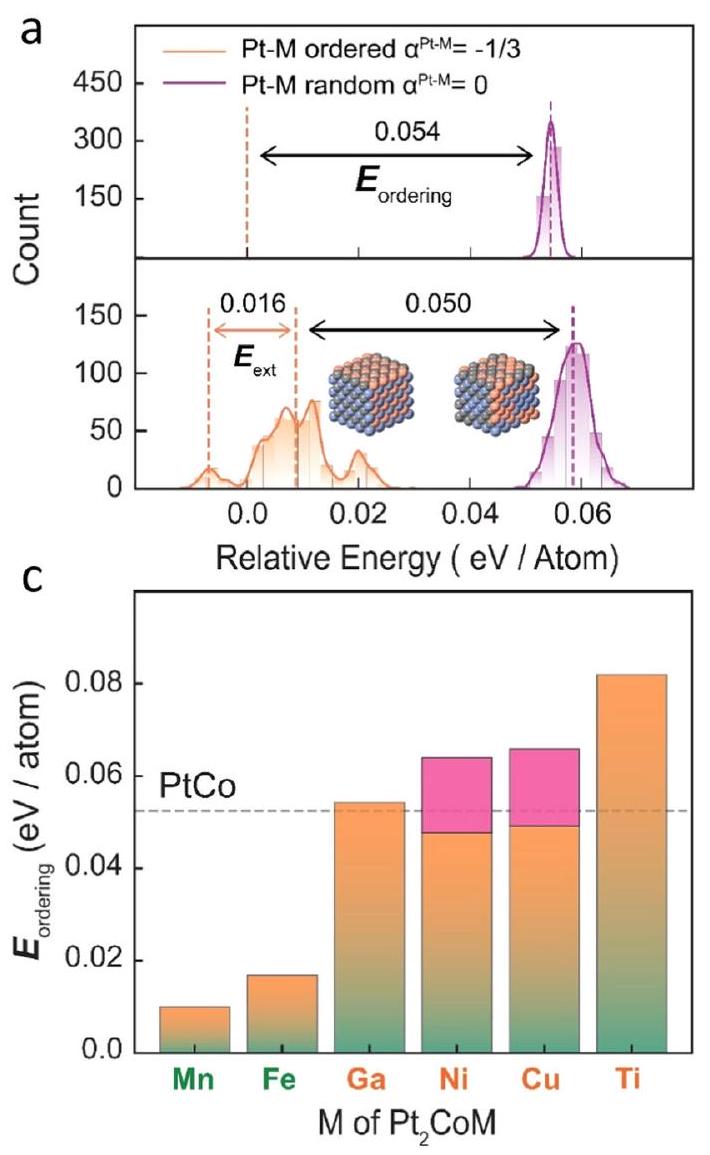
الشكل 2 | تغذية راجعة لنتائج نموذج التعلم الآلي. أ توزيع الطاقات النسبية المتوقعة بواسطة التعلم الآلي للـ PtCo العشوائي والمنظم (الأعلى) و (الأسفل). ب الطاقات النسبية لـالتكوينات كدالة لـس.ر.أ و س.ر.أيمثل قيمة SRO الأعلى درجة عدم الانتظام الأعلى. تمثل المثلثات والدوائر نقاط البيانات المحسوبة بواسطة DFT (تكوين واحد لكل نقطة بيانات) و ML (متوسط 20 تكوينًا لكل بيانات).
نموذج التنبؤ، على التوالي. ترتيب الطاقةلستة قابلة للذوبانتركيبات. الخط المتقطع يمثلمن PtCo للمرجع. الجزء الأحمر يمثل الطاقة الإضافية للتثبيت مناضطراب. مخطط بركان نشاط d ORR لأربعة مرتبةطلبت PtCo وخمسة PtCo غير مرتبة.
الفرق بين التكوينات المرتبة (SRO من : ، حيث تحتفظ ذرات البلاتين بنفس المواقع مثل المركبات البينية PtCo) والتكوينات المختلطة عشوائيًا ( ). طاقة الطلب يقيس القوة الدافعة الديناميكية الحرارية لانتقال الفوضى إلى النظام. للتغلب على صعوبة التعامل مع الترتيبات الذرية المتنوعة فيباستخدام حسابات DFT، تم اعتماد استراتيجية التعلم النشط لتدريب نموذج التنبؤ بالطاقة النسبية لكلنظام ثلاثي (الشكل 1f والجدول التكميلي S1). اخترنا نموذج الانحدار باستخدام العمليات الغاوسية (GPR) كنموذج تعلم آلي بسبب قدرته على قياس عدم اليقين.تم تنفيذ التعلم النشط، وبعد إكمال 7 جولات من التكرارات، تم استخدام أكثر من 100 نقطة بيانات DFT لكل منها.، مما أدى إلى دقة توقع طاقة التكوين مع خطأ أقل من الذرة (الأشكال التكميلية S2-S5، الجدول التكميلية S2). تم تطبيق نموذج التعلم الآلي المدرب بعد ذلك للتنبؤ بالطاقة الناتجة عن تشكيل 300 ترتيباً ( ) و 300 عشوائي ( ) التكوينات، بالإضافة إلى 3800 هيكل بدرجات ترتيب متفاوتة (الشكل التكميلي S6). وجدنا أن البلاتين والكوبالت المرتب كان أكثر استقرارًا بمقدار 0.054 إلكترون فولت لكل ذرة مقارنة بالتكوينات التي تم فيها خلط البلاتين والكوبالت بشكل عشوائي (اللوحة العلوية من الشكل 2a). يُظهر إدخال النحاس حاجزًا حراريًا مشابهًا بين متوسط طاقة التكوين للتكوينات المرتبة والعشوائية (0.050 إلكترون فولت لكل ذرة). ومن المثير للاهتمام، أننا وجدنا قمة صغيرة إضافية تضيف طاقة استقرار إضافية.لكل ذرة منهيكل منظم. توضح التحليلات الإضافية أن الطاقة الإضافية للتثبيت لـ
أصول ترتيب Pt-M منالاضطراب (الجزء الأحمر في الشكل 2c)، حيث إن الطاقة النسبية للتكوين لـيزداد مع، لكنه يرتبط عكسياً مع (الشكل 2ب والأشكال التكميلية S7 و S8). وبالمثل، حددنا أن Ga و Ni و Ti لديهم القدرة على تشكيل بنية IMC أكثر ترتيبًا، لكن إدخال Mn و Fe سيقلل بشكل كبير من القوة الدافعة الديناميكية الحرارية لانتقال الفوضى إلى النظام. (الشكل 2c والجدول التكميلي S1). في مجال الكفاءة الحاسوبية، كانت عملية التدريب والتنبؤ باستخدام نماذج التعلم الآلي تتطلب وقتًا ضئيلًا مقارنة بحسابات DFT، مما أدى إلى تقليل كبير في الوقت اللازم لإقامة العلاقة بين الترتيب الكيميائي والاستقرار (الشكل التكميلي S9).
عند تحفيز تفاعل اختزال الأكسجين، يجب تحويل محفزات سبائك البلاتين إلى هياكل نواة-غلاف سبائك@بلاتين من خلال إزالة السبائك كهربائياً في الموقع أو من خلال الغسل المسبق في الحمض.تتأثر الخصائص الإلكترونية لقشرة البلاتين بشدة بالنواة السبيكية بسبب تأثيرات الربط و/أو الإجهاد المعروفة.لتقييم نشاط ORR لـو تيقمنا بحساب طاقات الامتزاز لـ و كموصوف للنشاط باستخدام نماذج ألواح Pt-shell المرتبة-النواة (الشكل 2d والجداول التكميلية S3 و S4)تظهر النتائج المحسوبة أن تأثيرات الإجهاد تلعب دورًا مهيمنًا في تنظيم نشاط تفاعل اختزال الأكسجين (ORR). (الشكل التوضيحي S10). للمقارنة، قمنا أيضًا بتحديد النشاط المحسوب لـ PtCo المرتب وغير المرتب مع درجات مختلفة من ترتيب نواة PtCo تحت السطح. عمومًا، يمتلك PtCo المرتب نشاطًا أعلى من نظيره غير المرتب. من بين السبائك الثلاثية، و عرض
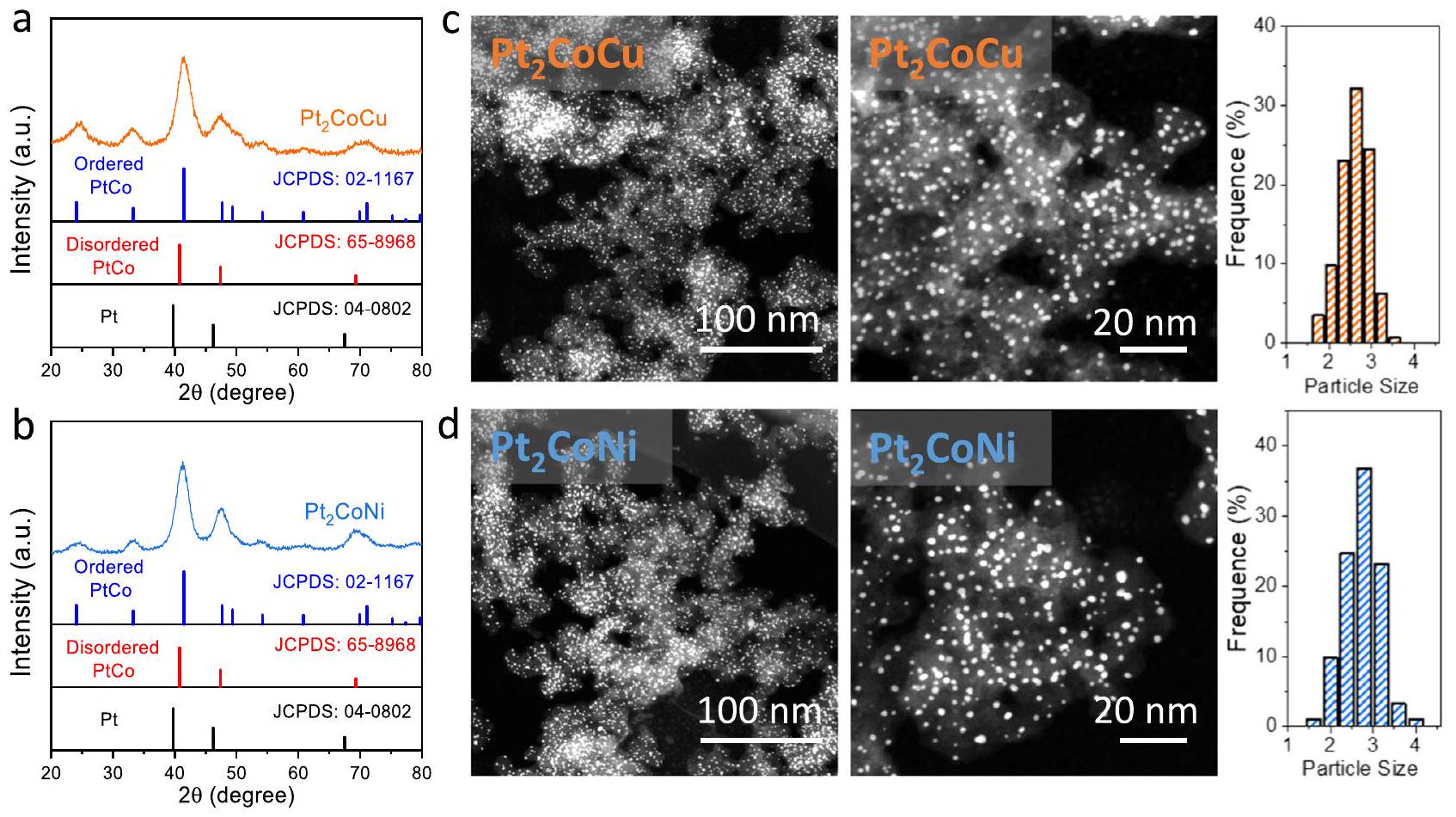
الشكل 3 | تخليقمحفزات IMC. أنماط XRD لـ و المحفزات. صور HAADF-STEM وتوزيع حجم الجسيمات المقابل لـ و محفزات.
نشاط ORR قابل للمقارنة مع PtCo المرتب بالكامل، وبالتالي تم اختيارها أخيرًا للتحقق التجريبي. لقد كانت هناك أبحاث سابقة تشير إلى أن نظام PtCoNi وPtCoCu الثلاثي يعدان محفزات ممتازة لـ ORR بسبب مستويات الضغط القريبة من المثلى لنشاط ORR أعلى.، مما يتماشى جيدًا مع نتائج الفحص الحسابي لدينا. والأهم من ذلك، أن دراستنا تقدم منظور تصميم مبتكر يتمثل في إدخاليستفيد من القوة الديناميكية الحرارية للانتقال من الفوضى إلى النظام، مما يؤدي إلى توازن أكثر ملاءمة بين النشاط المحدد (SA) والمساحة السطحية النشطة كهربائيًا (ECSA).
تركيب وتوصيفمحفزات
ال و تم تخليق المحفزات عن طريق النقع الرطب لـوأملاح المعادن غير النبيلة المقابلة على دعم كربوني بلاك بيرل 2000، تليها عملية تلدين عند درجات حرارة عالية فيقمنا أولاً بإجراء تحليلات حيود الأشعة السينية بالمسحوق (XRD) للتحقق منالهياكل البينية المعدنية من النوع – من خلال المقارنة مع بطاقات ملف حيود المسحوق القياسية للـ IMC المقابلة (الشكل 3 أ، ب). يختلف عن الهيكل المكعب المتمركز في الوجه في سبيكة PtCo غير المرتبة، حيث توجد قمتان مميزتان في الشبكة الفائقة حوالي و تم العثور عليها في و عينات، تشير إلى تشكيل الـالهياكل. بعد تحسين ريتفيلد لنماذج حيود الأشعة السينية، تمكنا من الحصول على معلمات الملاءمة لكل قمة حيود (الشكل التكميلي S11 والجدول التكميلي S5). بالإضافة إلى ذلك، أظهرت قمم (111) اتساعًا واضحًا وعدم وجود فصل في الطور، مما يشير إلى وجود طور IMC موحد وحجم بلورات صغير. كانت أحجام البلورات المتوسطة المحسوبة باستخدام معادلة ديباي-شيرر بناءً على العرض الكامل عند نصف الحد الأقصى لقمة (111) هي 2.94 نانومتر و3.19 نانومتر لـ و ، على التوالي.
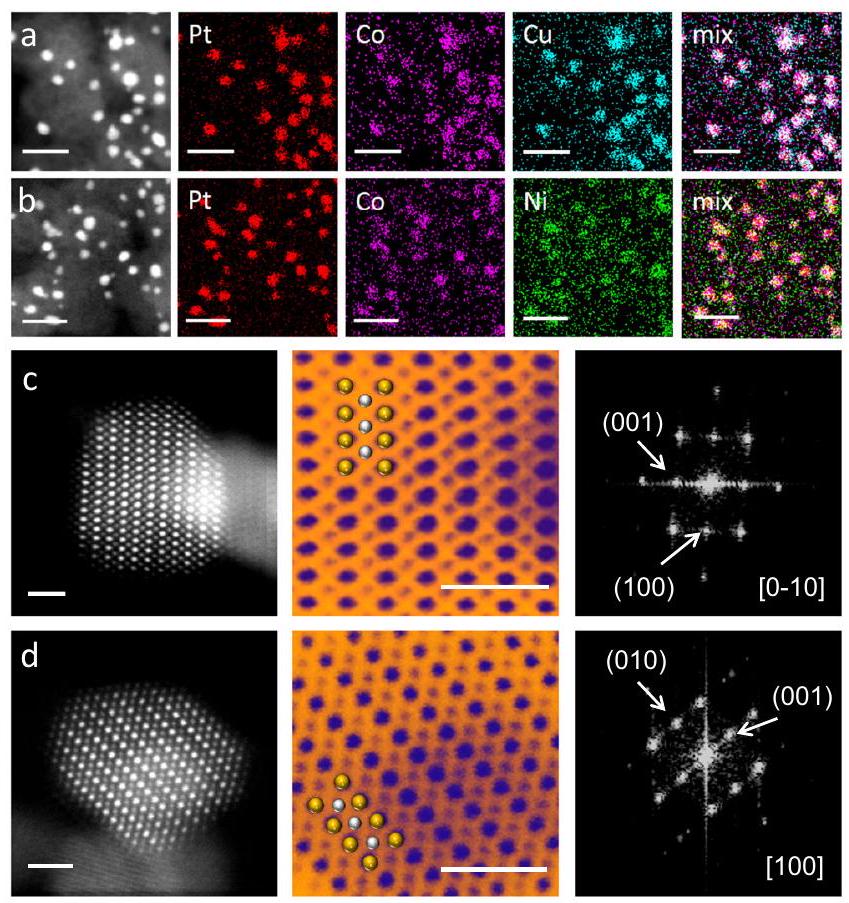
كشف المجهر الإلكتروني الناقل بتقنية الحقل المظلم الزاوي العالي (HAADF-STEM) أنتم توزيع جزيئات IMC بشكل متجانس على كامل مصفوفة الكربون ولم يتم العثور على تجمعات واضحة أو نمو مفرط للجزيئات في كل من مجالات الرؤية ذات الدقة المنخفضة والعالية (الشكل 3c، d). أشارت التحليلات الإحصائية إلى توزيع ضيق لحجم الجزيئات منالمحفزات في نطاقبمتوسط حجم بقيم 2.62 و 2.73 نانومتر، على التوالي، والتي كانت قريبة من القيم المقدرة بواسطة حيود الأشعة السينية (XRD). علاوة على ذلك، أظهرت خريطة العناصر باستخدام التحليل الطيفي للطاقة المشتتة (EDS) مع مجال بصري واسع التوزيعات المتجانسة للبلاتين وعناصر المعادن غير الثمينة الأخرى في الجسيمات النانوية الفردية دون تمييز للعناصر (الشكل 4أ، ب).
ثم قمنا بإجراء HAADF-STEM المصحح للانحراف بدقة ذرية للتحقق من الهيكل المنظم لـالعوامل المساعدة (الشكل 4c، d). بسبب اختلافات التباين في الرقم الذري (Z) بين البلاتين والمعادن غير النفيسة في شبكة مرتبة، يمكن العثور على الانتظام الدوري في السطوع على طول محور المنطقة المحدد؛ ستظهر ذرات البلاتين أكثر سطوعًا من المعادن غير النفيسة الأخرى ذات التباين Z الأقل. من خلال تباين Z وقطر الذرة بعد التكبير المحلي، يمكننا ملاحظة تكديس متناوب من الأعمدة المضيئة والداكنة للبلاتين والمعادن غير النفيسة. اقترحت توقعاتنا النظرية أن الكوبالت مع النحاس أو النيكل يميل إلى إظهار احتلال عشوائي للمواقع. ومع ذلك، فإن التمييز بين أو الموقع في هيكل السبيكة يمثل تحديًا بسبب تشابه نصف القطر الذري لهاأنماط تحويل فورييه السريع (FFT) أكدت بشكل أكبر الهياكل المرتبة ذات الأربعة زوايا المركزية.المحفزات (الشكل 4ج، د).
الأداء الكهروكيميائي
قمنا أولاً بتقييم نشاط ORR للمواد الحفازة باستخدام تقنية القطب الدوار (RDE). للمقارنة، قمنا أيضًا بتحضير مواد حفازة ثنائية من PtCo باستخدام نفس طريقة النقع الرطب. نوعان من مواد حفازة PtCo، بما في ذلك النوع عالي الترتيب/كبير الحجم (PtCo*) والنوع منخفض الترتيب/صغير الحجم ( )، تم الحصول عليها في ظروف التلدين عند درجات حرارة عالية ومنخفضة، على التوالي (الشكل 1أ). كما هو متوقع، أظهر محفز PtCo عالي الترتيب/كبير الحجم نشاطًا داخليًا أعلى مع SA من لكن ECSA أقل بكثير منمن تلك المحفزات ذات الترتيب المنخفض/الحجم الصغير (SA: ; ECSA: ) (الشكل 5 أ والجدول التكميلي S6). العلاقة التبادلية بين SA و ECSA تجعل المحفز الثنائي PtCo يظهر نشاط كتلي محدود (MA) أقل من (الشكل 5ب). بالمقابل، فإن الثلاثي عالي الترتيب/صغير الحجمالمحفزات كسرت مثل هذا التبادل
الشكل 4 | توصيف الهيكل. خرائط العناصر بتقنية EDS لـ و المحفزات، مقياس الرسم 10 نانومتر. صور HAADF-STEM بدقة ذرية وأنماط FFT لـ و العوامل المساعدة. الكرات الصفراء تمثل البلاتين والكرات الفضية تمثل. مقياس الرسم: 1 نانومتر .
العلاقة، مع إظهار SA مرتفع في نفس الوقت ( ) و ECSA ( )، مما يؤدي إلى MA كبير من علاوة على ذلك، بعد 30,000 اختبار متانة معجل (ADT) من خلال تغيير الجهد بين 0.6 و 0.95 فولت في RDE،أظهرت المحفزات انخفاضًا في و في الماجستير، جنبًا إلى جنب مع انخفاض في و في SA (الشكل 5c و d والشكل التكميلي S12). من المعروف جيدًا أنه سيتم تشكيل هيكل نواة-غلاف IMCs@Pt في الإلكتروليتات الحمضية، ويمكن أن يعمل غلاف البلاتين على تثبيت M ضد التسرب لضمان المتانة تحت ظروف الجهد القاسية..
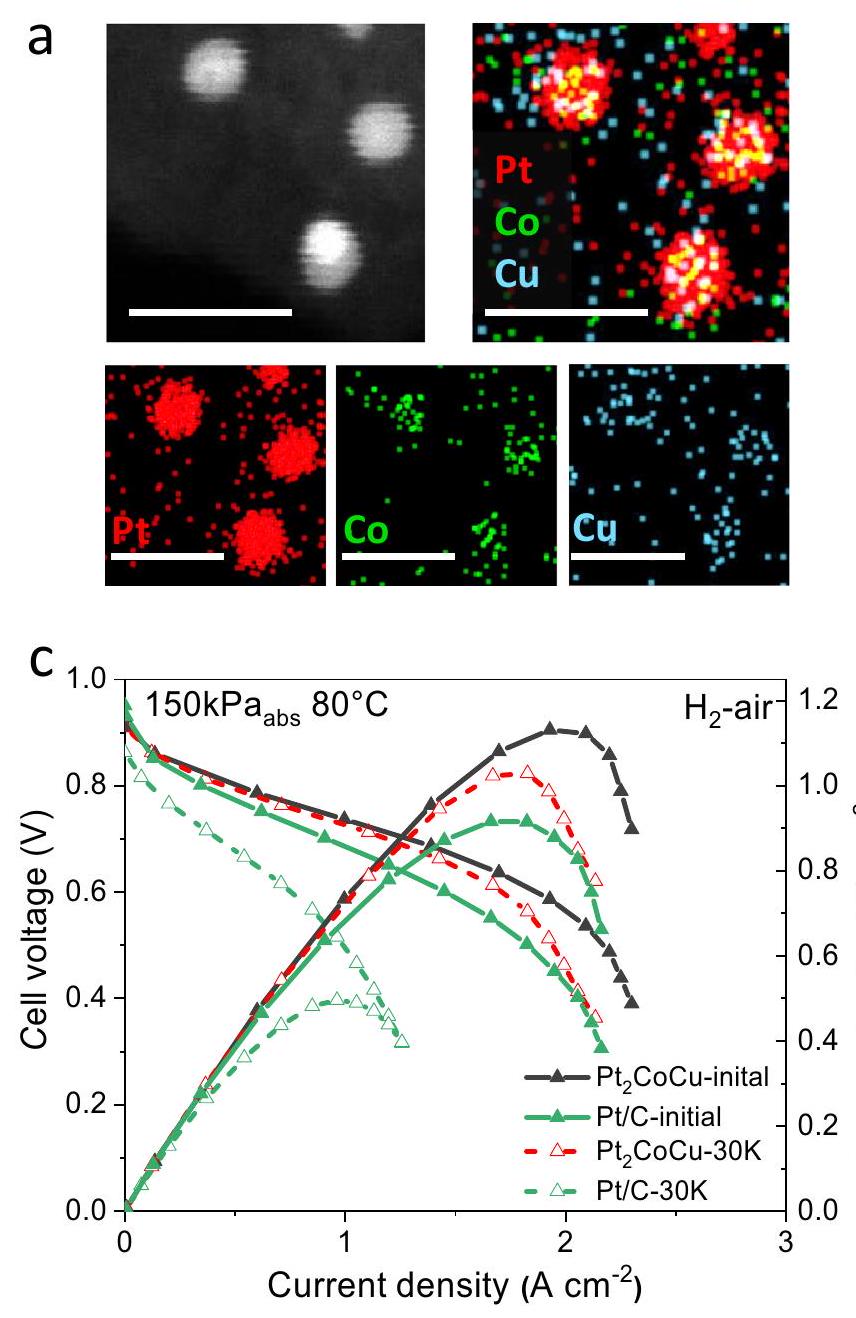
قمنا بتقييم أداء خلايا الوقود ذات الأغشية البوليمرية (PEMFC) بشكل إضافيمحفزات IMCs تحت الظروف العملية-ظروف الهواء. قبل اختبارات خلايا الوقود ذات الأغشية البوليمرية، تم تعريض محفزات IMCs النقية لعملية غسل حمضي ودرجات حرارة منخفضة-التلدين لتشكيل هياكل نواة قشرة نشطة ومستقرة من Pt-IMCs@Ptأظهرت خرائط العناصر باستخدام EDS التكوين الناجح لهيكل النواة-القشرة مع قشرة غنية بالبلاتين (الشكل 6أ). وقد أكدت صور HAADF-STEM بدقة ذرية والملفات الكثافة المقابلة ذلك بوضوح.نواة بين فلزية محاطة بقشرة من البلاتين بسمك ثلاث طبقات ذرية (الشكل 6ب). تحميلات منخفضة من البلاتين و تم اعتمادها لـالكاثود الخاص بـ IMCs والأنود التجاري Pt/C، على التوالي. للمقارنة، تجاريتم اختباره أيضًا كعامل حفاز للقطب السالب بتحميل قدرهتحميل البلاتين المنخفضأظهرت كاثودات IMCs كثافات طاقة ذروة عالية منفيالتي كانت قابلة للمقارنة معالكاثود بتحميل Pt تقريبًا مضاعف (الشكل 6c). الأداء المحسن للطاقة لـمحفز IMC في منطقة الكثافة الحالية العاليةنُسب ذلك إلى ميزة المساحة السطحية الكهربائية العالية في تقليل خسائر نقل الكتلة.
قمنا أخيرًا بتقييم متانة الـ و الكاثودات من مقياسين، فقدان الجهد عند وماجستير. بعد
الشكل 5 | أداء RDE. أ، ب مقارنة بين ECSA و SA و MA لـ، و المحفزات. منحنيات استقطاب ORR وفقدان MA/SA و (د) المحفزات بعد 30 ك ADT.
الشكل 6 | أداء خلايا الوقود. أ خرائط العناصر بتقنية EDS لـهياكل النواة والغلاف. مقياس الرسم: 10 نانومتر. ب صور HAADF-STEM بدقة ذرية وملفات شدة تظهر نواة بين معدنية مع غلاف رقيق من البلاتين. مقياس الرسم: 1 نانومتر. جرسوم بيانية لاستقطاب الهواء / رسوم بيانية لكثافة الطاقة قبل وبعد موجة مربعة بزاوية 30 كيلوكلفن
ب
ADT. شروط الاختبار:هواءالرطوبة النسبية. د فقدان MA لـ EOT و BOT. شروط الاختبار: , الرطوبة النسبية. بروتوكول ADT القياسي لموجة مربعة من الجهد يتراوح بين 0.60 و 0.95 فولت (ثلاث ثوانٍ من الثبات عند كل جهد) كما اقترحته وزارة الطاقة الأمريكية (الشكل التكميلية S13)، تم الحصول على مخططات استقطاب التيار/الطاقة في بداية الاختبار (BOT) وفي نهاية الاختبار (EOT) (الشكل 6c). فقدان الجهد لـ الكاثود في كان 17 مللي فولت، وهو ما كان أقل بكثير منالكاثود (خسارة 137 مللي فولت). بالنظر إلى عدم استقرار التيار في منطقة الجهد العالي، توصي وزارة الطاقة بإجراء اختبار متعدد النقاط فيلمدة 15 دقيقة تحت نسبة كاثود منخفضة تبلغ 9.5، وتم حساب MA بناءً على متوسط كثافة التيار في الدقيقة الأخيرة (الشكل 6d).تم الاحتفاظ بمحفز IMCمن BOT-MA الخاص به، والذي كان أعلى بكثير من Pt/C (احتفاظ 30% MA) وتجاوز هدف DOE (أقل من 40% فقدان مع BOT MA من ).
باختصار، وبمساعدة الفحص الحسابي المعزز بتعلم الآلة، قمنا بتأسيس استراتيجية تصميم تعاونية بين التجربة والنظرية لكتاليسا IMC صغيرة الحجم ومرتبة بشكل عالي لخلايا الوقود. بفضل الهياكل المرتبة المحددة جيدًا لـ IMC على المستوى الذري، يمكن ضمان توافق أفضل بين التجربة ومحاكاة تعلم الآلة، مما يجعل من الممكن بسرعة اكتشاف تركيبات IMC المحتملة ذات القوة الديناميكية الحرارية العالية للانتقال من الفوضى إلى النظام من مساحة التصميم الضخمة. حسابيًا، وجدنا أن السبائكعززت تشكيل IMC بسبب الطاقة الإضافية المستقرة المقدمة بواسطةالاضطراب. أظهرت النتائج التجريبية أن الثلاثييمكن أن تحقق محفزات IMC التوافق بين الحجم الصغير (وبالتالي ارتفاع ECSA) ودرجة التنظيم العالية (وبالتالي ارتفاع SA)، وأخيرًا تحقق أداءً محسّنًا بشكل كبير عند تطبيقه في خلايا الوقود العملية.
طرق
حساب DFT
تم إجراء جميع حسابات DFT باستخدام حزم محاكاة فيينا Ab Initio (VASP)تمت معالجة التفاعل بين الإلكترونات الأساسية وإلكترونات التكافؤ باستخدام طريقة الموجة المعززة المتوقعة (PAW).تم استخدام حد طاقة حركية قدره 400 إلكترون فولت لمجموعة الأساس الموجي المسطح. تم تقييم طاقة التبادل والتصحيح بواسطة دالة بيردو-بورك-إرنزرهوف (PBE) على مستوى التقريب العام للتدرج (GGA).تحمل الطاقة لـتم استخدامه في حسابات الهيكل الإلكتروني، وتم إجراء تحسين الهندسة حتى كانت جميع القوى أقل منتم تنزيل وحدة الخلية لـ PtCo في مجموعة الفضاء P4/mmm من مشروع المواد.لبناء وحدة الخلية لـ، (M هو العنصر الثالث المضاف إلى PtCo)، تم تكرار وحدة الخلية لـ PtCo مرتين وتم استبدال ذرة Co بذرة M. كانت ثوابت الشبكة لجميع تم إعادة تحسين وحدات الخلايا بواسطة DFT. لتحليل الذوبانية وطاقة الانتقال من الفوضى إلى النظام، أ ( كانت سوبرسيل تم بناؤه استنادًا إلى تحسين DFTخلية الوحدة. ترتيب الذرات الأوليتم خلط السوبرسيل لتوليد تكوينات بدرجات ترتيب مختلفة. أ (تم استخدام شبكة نقاط كيه من نوع مونكهورست-باك لأخذ عينات من منطقة بريلوان لنموذج السوبرسيل.لتحليل نشاطالمعبأة بإحكامتمت محاكاة الأسطح (111) بواسطة خمس طبقات (نموذج اللوح، حيث اثنانتم تثبيت الطبقات السفلية وتم السماح لثلاث طبقات من جلد البلاتين (Pt) المضافة عليها بالاسترخاء. تم تقييم نشاط PtCo المنظم باستخدام ثلاث طبقات من جلد البلاتين مع طبقتين من نواة PtCo المنظمة. تم خلط ترتيب البلاتين (Pt) والكوبالت (Co) في نواة PtCo المنظمة لتوليد نماذج لوح PtCo غير المنظمة. طبقة فراغ منتمت إضافته أعلاه وأسفل اللوح لتجنب التفاعلات الدورية.تم استخدام شبكة نقاط كيه Monkhorst-Pack لأخذ عينات من منطقة بريلون لنموذج الشريحة. تم تضمين استقطاب الدوران في حساب نموذج الشريحة لـو Ni. تم حساب طاقة الامتزاز لـ O و OH بواسطة المعادلات التالية:
حيث و هي طاقات محسوبة باستخدام نظرية الكثافة (DFT) للسطح النظيف، والسطح مع الأكسجين (O) والهيدروكسيل (OH) على التوالي. و هي طاقات و هي -6.76 إلكترون فولت و -14.22 إلكترون فولت على التوالي، والتي تم حسابها بواسطة DFT باستخدام و جزيء موضوع على نموذج الخلية المكعبة. تم تعريف طاقة غيبس الحرة للامتصاص بواسطة:
أين هو تصحيح الذوبان، هو تصحيح نقطة الصفر و هو التصحيح الانتروبي، في هذا العمل استخدمنا قيم التصحيح من المرجع.
ترتيب المدى القصير. يتم تعريف ترتيب المدى القصير وارن-كاولي كما في المعادلة (4) :
أين و تشير إلى نوعين من عناصر السبائك، هو نسبة العنصر هو احتمال العثور على في الجوار القريب من. عند نقطة ثابتةسلبي القيمة تشير إلى التفضيل لتشكيل رابطة، وهي سمة من سمات سبيكة مرتبة؛ على العكس من ذلك، إيجابية القيمة توضح فصل X و Y ؛ و القيمة القريبة من 0 تمثل تكوين سبيكة عشوائي. هنا التكوينات ذات أقل قيمة لترتيب المدى القصيرتُعرف بأنها سبائك مرتبة، وتكوينات معتعتبر سبائك عشوائية.
اختبار الذوبانية
تشمل العناصر المرشحة الأولية الستة عشر المعدن القلوي Na؛ المعدن القلوي الأرضي Mg؛ المعادن الانتقالية من المجموعة 3d Sc، Ti، Mn، Fe، Ni، Cu؛ عناصر المجموعة Pبالنظر إلى أن القيم الأدنى والأعلى لـلـنموذج السوبرسيل و على التوالي، كما هو موضح في الشكل التوضيحي S6.تم إنشاء هياكل بدرجات ترتيب مختلفة (أربعة هياكل لكل) و هيكل واحد لـ، 4/6). تم تطبيق خوارزمية مينتي كارلو لتوليد الهياكل بالمعطيات المعطاةالقيمة من خلال التلاعب في ترتيب Pt و Co و M فينموذج السوبرسيل. تم إجراء تحسينات هندسية باستخدام نظرية الكثافة الوظيفية (DFT) على هذه الهياكل. تم استخدام الانحراف المعياري الجذري (RMSD) لقياس التشوه الهيكلي خلال تحسينات الهندسة، يتم تعريف RMSD على أنه:
حيث n هو العدد الإجمالي للذرات في نموذج السوبرسيل. و هي مواقع الذرة i قبل وبعد تحسين الهندسة.
تعلم الآلة
تم تدريب نموذج التعلم الآلي (ML) ليحل محل حسابات DFT للتنبؤ بالطاقة لتكوين سبيكة معين. إن استخراج الميزات من هيكل السبيكة كمدخلات لنموذج التعلم الآلي بناءً على المعرفة المتخصصة له أهمية كبيرة في تبرير نموذج التنبؤ. نظرًا لأن استقرار يظهر ارتباطًا قويًا مع درجة الترتيب (الشكل التكميلي S8)، تم تصميم بصمات رقمية بُعدها 15 تعكس درجة ترتيب تكوينات السبائك وتطبيقها كمدخل لنموذج التعلم الآلي. تتكون الميزات من جزئين. ترتيب وارن-كاولي قصير المدى المحدد بواسطة ثلاثة أنواع من الأزواج الثنائية. و ) في ثلاث قشور مجاورة تم استخدامها، والتي تشكل الأبعاد التسعة الأولى في الميزة. بالإضافة إلى ذلك، أعداد من أزواج الروابط الثنائية المختلفة ( كانت الأبعاد الستة الأخرى للميزة. لتجنب الوزن غير المتوازن بسبب نطاقات القيم المختلفة لكل بعد في الميزة، تم توحيد الميزات الأصلية لتكون لها متوسط 0 وانحراف معياري 1. علاوة على ذلك، لإزالة الميزات الزائدة وتقليل متطلبات الحساب، تم إجراء تحليل المكونات الرئيسية (PCA) وتم الاحتفاظ فقط بالمكونات الرئيسية التي لها نسبة من التباين.كانت محجوزة. تم حساب الطاقة النسبية بواسطة DFT (مرجع الطاقة إلى النظامتم استخدام نموذج السوبرسيل كناتج لنموذج التعلم الآلي.
تم اختيار نموذج الانحدار باستخدام العمليات الغاوسية (GPR) كنموذج تعلم آلي من خلال الاستفادة من قدرته على قياس عدم اليقين.تعتبر عملية الانحدار باستخدام العمليات الغاوسية تقنية انحدار بايزي غير معلم. على عكس طرق الانحدار التقليدية، توفر عملية الانحدار باستخدام العمليات الغاوسية توزيعًا لاحقًا بدلاً من قيمة دقيقة لهدف التنبؤ. يمكن اعتبار العملية الغاوسية كأنها توزيع غاوسي لانهائي، وكل مجموعة من المتغيرات العشوائية النهائية لعملية الانحدار باستخدام العمليات الغاوسية تتبع توزيعًا طبيعيًا متعدد المتغيرات، والذي يمكن الإشارة إليه بـ:
أينهي مجموعة من المتغيرات العشوائية،هي الخصائص المستهدفة، هو متوسط الخصائص المستهدفة، هي مصفوفة التغاير. لنقطة البيانات الجديدةكان من الضروري التنبؤ، مجموعة الاتحاد لـ و تتبع أيضًا التوزيع الطبيعي المتعدد المتغيرات التالي:
التوزيع البعدي لـيمكن حسابها من خلال تعظيم دالة الاحتمالية، وتُعبر النتائج كما يلي:
تم استخدام حزمة scikit-learn لبناء نموذج GPR. كل عنصر في مصفوفة التغاير يشير إلى التغاير بين عنصرين، تم تعريفهما بواسطة دالة الأساس الشعاعي (RBF):
أين و هما عامل المقياس وعامل الطول، على التوالي. خلال عملية تدريب نموذج التعلم الآلي، قيم و تم تحسينها لتعظيم الاحتمالية الهامشية اللوغاريتمية. تتراوح قيم و محدود بين و تم إجراء 50 تحسينًا مستقلًا لتجنب الحلول المحلية المثلى.
التعلم النشط
يظهر سير العمل للتعلم النشط في الشكل التوضيحي الإضافي S2. تم استخدام عدم اليقين الذي قدمه نموذج GPR المدرب كمعيار لاختيار العينات في الجيل التالي. نظرًا لصعوبة استنفاد فضاء تكوين السبائك، تم إجراء محاكاة مونت كارلو للبحث عنالتكوين مع عدم اليقين العالي في التنبؤ. بدءًا من هيكل مُهيأ عشوائيًا، تتحكم تحسينات مونت كارلو في تطور الهيكل على طول اتجاه عدم اليقين العالي من خلال تغيير ترتيب الذرات. عندما يكون عدم اليقين في الهيكل الجديد أعلى من ذلك في الهيكل السابق، يتم قبول الهيكل الجديد؛ وعندما يكون عدم اليقين في الهيكل الجديد أقل من ذلك في الهيكل السابق، يتم قبول الهيكل الجديد باحتمالية معينة. بالإضافة إلى ذلك، لتجنب الوقوع في الأمثل المحلي، تم إجراء 20 محاكاة وتم استخراج أول 10 هياكل بأعلى عدم يقين. تم تصنيف الهياكل العشرة الجديدة التي تم البحث عنها بواسطة DFT وأضيفت إلى مجموعة البيانات الموجودة مسبقًا. ثم تم إعادة تدريب نموذج التعلم الآلي باستخدام قاعدة البيانات الموسعة. تم تكرار هذه الدورة من التعلم النشط 7 مرات. تم عرض التكوينات Pt 2 CoCu التي تم البحث عنها والتي تمثلها t-SNE في عملية التعلم النشط في الشكل التكميلي S3. تم قياس دقة التنبؤ لنموذج التعلم الآلي باستخدام متوسط الخطأ المطلق (MAE) ومعامل التحديد (R2)، حيث أنتم اعتماد البيانات كمجموعة تدريبية والباقيكانت البيانات هي مجموعة الاختبار. يتم عرض تطور دقة التنبؤ في عملية التعلم النشط في الأشكال التكميلية S4-5. تم استخدام نموذج التعلم الآلي المكتمل للتنبؤ بالطاقة لـ 300 هيكل سبيكة مرتبة و300 هيكل سبيكة عشوائية.
المواد والكيماويات
تم إنتاج الكربون الأسود (اللآلئ السوداء 2000، BP2000) بواسطة شركة أمريكا كابوت. تم شراء Pt/C التجارية (TEC10E20E) من تانكا. جميع المواد الكيميائية الأخرى كانت متاحة تجارياً من شركة سينوفارم للمواد الكيميائية المحدودة، الصين، بما في ذلك حمض الكلوروبلاتينيك ( ) ، كلوريد الكوبالت سداسي الماء ( ) ، كلوريد النحاس المائي ( كلوريد السيكل هكساهيدرات )، الإيثانول، والإيزوبروبانول. تم استخدام جميع المواد الكيميائية كما هي دون مزيد من التنقية. ماء DI ( ) المستخدمة في جميع التجارب تم تحضيرها عن طريق المرور عبر نظام تنقية فائق النقاء.
تحضير المحفزات
ال و تم تحضير محفزات IMC باستخدام دعم الكربون الأسود BP2000 من خلال طريقة النقع التقليدية التي تضمنت نقع الملح المعدني في حالة رطبة والتقليل الحراري اللاحق في.أخذ تركيبعلى سبيل المثال، 50 ملغ BP2000،، و تم خلطه أولاً في دورق دائري سعة 100 مل يحتوي على 40 مل من الماء المقطر. بعد التحريك طوال الليل، تم معالجة الخليط بالموجات فوق الصوتية لمدة ساعتين قبل التجفيف باستخدام مبخر دوار. أخيرًا، تم نقل المسحوق المجفف إلى فرن أنبوبي وتم تقليله حراريًا عندتحت التدفقأر لمدة ساعتين.
قياسات RDE
التم تقييم محفزات IMC لنشاطها في تفاعل اختزال الأكسجين (ORR) باستخدام تقنيات RDE باستخدام محطة كهربائية CHI (النموذج 760E) في خلية ثلاثية الأقطاب. تتكون حبر المحفز من 4 ملغ من المحفز وتم تحضير 2 مل من نافيونيوم في 2 مل من الإيزوبروبانول من خلال الموجات فوق الصوتية. ثم تم تطبيق الحبر عن طريق الطلاء بالتنقيط على القطب الكهربائي العامل، وهو قرص من الكربون الزجاجي بقطر 5.0 مم، وترك ليجف في الهواء عند درجة حرارة الغرفة. تم توفير الأقطاب المرجعية والبديلة بواسطة محلول مشبع.وصفيحة بلاتينية، على التوالي. تم الإشارة إلى جميع الإمكانيات في هذه الدراسة إلى القطب الهيدروجيني القابل للعكس (RHE) لكل اختبار. تم تنشيط المحفز باستخدام الفولتمترية الدورية (معدلات المسح لـ ونطاقات محتملة من مقابل RHE) حتى تحقيق منحنى مستقر. ثم تم إجراء قياسات الفولتمترية المسحية الخطية (LSV) فيمشبعحل، sweeping الجهد من 0.05 إلى 1.05 فولت بمعدل (1600 دورة في الدقيقة). شملت حسابات النشاط الكتلي تصحيح السعة وتصحيح المقاومة الداخلية. بالنسبة لاختبارات المتانة المعجلة (ADTs)، تم تدوير الجهد بين 0.6 و 0.95 فولت بمعدل في درجة حرارة الغرفة تحتمشبعالحل. تم تحديد المساحة السطحية النشطة كهربائياً (ECSA) من خلال اختبار إزالة CO. كان اختبار إزالة CO يتضمن نفخ CO فيالكهربائي، مع الاحتفاظ بالجهد عند 0.05 فولت لمدة 10 دقائق، تليها فقاعاتإلى المحلول الكهربائي لمدة 30 دقيقة. بعد ذلك، تم تسجيل منحنى الفولتمترية الدورية عن طريق المسح من 0.05 فولت إلى 1.05 فولت بمعدل.
اختبارات خلايا الوقود ذات الأغشية البوليمرية (PEMFCs)
خضعت المحفزات أولاً لمعالجة حمضية ثم للتسخين اللاحق لإنشاء هياكل نواة-غلاف Pt-IMCs@Pt.، الذي هدف إلى التخفيف من تأثير السم الناتج عن الكاتيونات المعدنية المتسربة أثناء تشغيل خلية الوقود. تم إعداد حبر موحد عن طريق توزيع المحفزات في مزيج من المذيبات من الن-بروبانول والماء (1:1)، مع دمج أيونومر Aquivion D72-25BS بنسبة أيونومر/كربون تبلغ 0.8. تم الحفاظ على تركيز الحبر عند تم إنشاء الغشاء المغلف بالتحفيز عن طريق تطبيق رذاذ فوق صوتي (ExactaCoat FC، شركة Sono-Tek) على غشاء GORE Nafion. ). تم استخدام طبقة انتشار الغاز (GDL) من فريدنبرغ (H24CX483، ) مع طبقة ميكرو مسامية. تم تجميع مجموعة أقطاب الغشاء (MEA)، التي تتضمن طبقتين من GDL، وحشوتين، وCCM المُعد، مع ضغط قدره تم تطبيق حقل التدفق المتعرج ذو القنوات السبع لجميع اختبارات الخلايا الفردية (صممه هوبرت غاستيجر وزملاؤه). حيث كان فرق الضغط بين مدخل ومخرج مجال التدفق أقل من 10 كيلو باسكال.
تم صنع MEA بـأو كاثود Pt/C القياسي (TEC10E20E، تانكا، ) والأنود التجاري Pt/C مع تحميل Pt في البداية، تم إنشاء منحنيات المعايرة لتحديد العلاقة بين عدد دورات الرش وكمية المحفز. تتيح هذه الطريقة تحقيق تحميل محدد من البلاتين من خلال ضبط عدد دورات الرش. تضمن قابلية إعادة إنتاج الأداة دقة كل عملية رش.
تم تقييم النشاط الكتلي (MA) لـ MEA عند، الرطوبة النسبيةمنفذفيمعدل التدفق (المعادل لنسبة الستيوكيومترية لـ ). تم تنفيذ وقت الانتظار لمدة 15 دقيقة، وتم حساب النشاط الكتلي بناءً على التيار المتوسط خلال الدقيقة الأخيرة. تم تصحيح التيار المقابل لـالتقاطع. الـتم إجراء أداء الهواء لخلية واحدة فيالرطوبة النسبيةمنفذ-هواء فيمعدل التدفق. للمقارنة، تم تصنيع MEA باستخدامالكاثودات بتحميلتم قياسها أيضًا. وفقًا لبروتوكول وزارة الطاقة الأمريكية لاختبار التحمل المعجل (ADT) للمواد الحفازة القائمة على البلاتين على دعائم قائمة على الكربون، شمل اختبار التحمل المعجل (ADT) لوحدة تبادل البروتون (MEA) تطبيق جهد موجي مربع من 0.6 إلى 0.95 فولت، يستمر 3 ثوانٍ عند كل مستوى جهد. تم تشغيل كل اختبار حتى 30,000. دورات عند، مع تدفقللأنود والكاثود، على التوالي.
توصيف
تم إجراء تحليل حيود الأشعة السينية (XRD) على جهاز ياباني من نوع Rigaku DMax-مقياس حيود الأشعة السينية مع anode دوار مزود بمونكروماتوغراف غرافيتيالإشعاع. تم إنتاج صور HAADF-STEM على جهاز FEI Talos F200X الذي يعمل بجهد 200 كف. تم إنتاج صور HAADF-STEM بدقة ذرية على جهاز JEM ARM200F (S) TEM المصحح لعيوب البروبة والذي يعمل بجهد 200 كف. تم استخدام رسم خرائط EDS على جهاز FEI Talos F200X المزود بنظام Super X-EDS.
توفر البيانات
جميع بيانات المصدر لنمذجة DFT والتعلم الآلي التي تم استخدامها في هذه الدراسة متاحة من مستودع GitHub:https://github. com/ZhangLabTHU/PtCoM. تم توفير بيانات المصدر مع هذه الورقة.
References
Banham, D. & Ye, S. Current status and future development of catalyst materials and catalyst layers for proton exchange membrane fuel cells: an industrial perspective. ACS Energy Lett. 2, 629-638 (2017).
Yarlagadda, V. et al. Boosting fuel cell performance with accessible carbon mesopores. ACS Energy Lett. 3, 618-621 (2018).
Pollet, B. G., Kocha, S. S. & Staffell, I. Current status of automotive fuel cells for sustainable transport. Curr. Opin. Electrochem. 16, 90-95 (2019).
Kongkanand, A. & Mathias, M. F. The priority and challenge of highpower performance of low-platinum proton-exchange membrane fuel cells. J. Phys. Chem. Lett. 7, 1127-1137 (2016).
US Department of Energy, Multi-Year Research, Development, and Demonstration Plan, https://www.energy.gov/sites/default/files/ 2017/05/f34/fcto_myrdd_fuel_cells.pdf (2017).
Kodama, K., Nagai, T., Kuwaki, A., Jinnouchi, R. & Morimoto, Y. Challenges in applying highly active Pt-based nanostructured catalysts for oxygen reduction reactions to fuel cell vehicles. Nat. Nanotechnol. 16, 140-147 (2021).
Chong, L. et al. Ultralow-loading platinum-cobalt fuel cell catalysts derived from imidazolate frameworks. Science 362, 1276-1281 (2018).
Yang, C.-L. et al. Sulfur-anchoring synthesis of platinum intermetallic nanoparticle catalysts for fuel cells. Science 374, 459-464 (2021).
Escudero-Escribano, M. et al. Tuning the activity of Pt alloy electrocatalysts by means of the lanthanide contraction. Science 352, 73-76 (2016).
Antolini, E. Alloy vs. intermetallic compounds: Effect of the ordering on the electrocatalytic activity for oxygen reduction and the stability of low temperature fuel cell catalysts. Appl. Catal. B Environ. 217, 201-213 (2017).
Li, J. et al. Hard-Magnet L10-CoPt Nanoparticles Advance Fuel Cell Catalysis. Joule 3, 124-135 (2018).
Song, T. W. et al. Intermetallic PtFe Electrocatalysts for the Oxygen Reduction Reaction: Ordering Degree-Dependent Performance. Small 18, 2202916 (2022).
Zeng, W.-J. et al. Phase diagrams guide synthesis of highly ordered intermetallic electrocatalysts: separating alloying and ordering stages. Nat. Commun. 13, 7654 (2022).
Li, J. & Sun, S. Intermetallic nanoparticles: synthetic control and their enhanced electrocatalysis. Acc. Chem. Res. 52, 2015-2025 (2019).
Yan, Y. et al. Intermetallic nanocrystals: Syntheses and catalytic applications. Adv. Mater. 29, 1605997 (2017).
Li, M. et al. Ultrafine jagged platinum nanowires enable ultrahigh mass activity for the oxygen reduction reaction. Science 354, 1414-1419 (2016).
Chen, C. et al. Highly crystalline multimetallic nanoframes with three-dimensional electrocatalytic surfaces. Science 343, 1339-1343 (2014).
Zhang, L. et al. Platinum-based nanocages with subnanometerthick walls and well-defined, controllable facets. Science 349, 412-416 (2015).
Wang, X. X., Swihart, M. T. & Wu, G. Achievements, challenges and perspectives on cathode catalysts in proton exchange membrane fuel cells for transportation. Nat. Catal. 2, 578-589 (2019).
Chen, H. et al. A surfactant-free strategy for synthesizing and processing intermetallic platinum-based nanoparticle catalysts. J. Am. Chem. Soc. 134, 18453-18459 (2012).
Choi, D. S., Robertson, A. W., Warner, J. H., Kim, S. O. & Kim, H. Lowtemperature chemical vapor deposition synthesis of Pt-Co alloyed nanoparticles with enhanced oxygen reduction reaction catalysis. Adv. Mater. 28, 7115-7122 (2016).
Song, T. W. et al. Small molecule-assisted synthesis of carbon supported platinum intermetallic fuel cell catalysts. Nat. Commun. 13, 6521 (2022).
Yoo, T. Y. et al. Scalable production of intermetallic Pt-Co electrocatalyst for high-power proton-exchange-membrane fuel cell. Energ. Environ. Sci. 16, 1146-1154 (2023).
Wang, Y. et al. Fundamentals, materials, and machine learning of polymer electrolyte membrane fuel cell technology. Energy AI 1, 100014 (2020).
Mou, T. et al. Bridging the complexity gap in computational heterogeneous catalysis with machine learning. Nat. Catal. 6, 122-136 (2023).
Zhong, M. et al. Accelerated discovery of CO2 electrocatalysts using active machine learning. Nature 581, 178-183 (2020).
Back, S., Tran, K. & Ulissi, Z. W. Toward a design of active oxygen evolution catalysts: insights from automated density functional theory calculations and machine learning. ACS Catal. 9, 7651-7659 (2019).
Konno, N., Mizuno, S., Nakaji, H. & Ishikawa, Y. Development of compact and high-performance fuel cell stack. SAE Int. J. Altern. Pow. 4, 123-129 (2015).
Takahashi, T. et al. Accelerated durability testing of fuel cell stacks for commercial automotive applications: A case study. J. Electrochem. Soc. 169, 044523 (2022).
Bu, L. et al. Biaxially strained PtPb/Pt core/shell nanoplate boosts oxygen reduction catalysis. Science 354, 1410-1414 (2016).
Strasser, P. et al. Lattice-strain control of the activity in dealloyed core-shell fuel cell catalysts. Nat. Chem. 2, 454-460 (2010).
Nørskov, J. K. et al. Origin of the overpotential for oxygen reduction at a fuel-cell cathode. J. Phys. Chem. B 108, 17886-17892 (2004).
Li, J. et al. Anisotropic Strain Tuning of L10 Ternary Nanoparticles for Oxygen Reduction. J. Am. Chem. Soc. 142, 19209-19216 (2020).
Hu, B. et al. High activity and durability of a Pt-Cu-Co ternary alloy electrocatalyst and its large-scale preparation for practical proton exchange membrane fuel cells. Compos. Part B Eng. 222, 109082 (2021).
Wang, D. et al. Structurally ordered intermetallic platinum-cobalt core-shell nanoparticles with enhanced activity and stability as oxygen reduction electrocatalysts. Nat. Mater. 12, 81-87 (2013).
Ahn, C. Y. et al. Differences in the Electrochemical Performance of Pt-Based Catalysts Used for Polymer Electrolyte Membrane Fuel Cells in Liquid Half- and Full-Cells. Chem. Rev. 124, 15075-15140 (2021).
Kresse, G. & Furthmüller, J. Efficient iterative schemes for ab initio total-energy calculations using a plane-wave basis set. Phys. Rev. B 54, 11169 (1996).
Kresse, G. & Joubert, D. From ultrasoft pseudopotentials to the projector augmented-wave method. Phys. Rev. B 59, 1758 (1999).
Perdew, J. P., Burke, K. & Ernzerhof, M. Generalized gradient approximation made simple. Phys. Rev. Lett. 77, 3865 (1996).
Jain, A. et al. Commentary: The Materials Project: A materials genome approach to accelerating materials innovation. APL Mater. 1, 011002 (2013).
Monkhorst, H. J. & Pack, J. D. Special points for Brillouin-zone integrations. Phys. Rev. B 13, 5188 (1976).
Owen, L., Playford, H., Stone, H. & Tucker, M. A new approach to the analysis of short-range order in alloys using total scattering. Acta Mater. 115, 155-166 (2016).
Deringer, V. L. et al. Gaussian process regression for materials and molecules. Chem. Rev. 121, 10073-10141 (2021).
Pedregosa, F. et al. Scikit-learn: Machine learning in Python. J. Mach. Learn. Res. 12, 2825-2830 (2011).
Simon, C., Hasche, F., Muller, D. & Gasteiger, H. A. Influence of the Gas Diffusion Layer Compression on the Oxygen Mass Transport in PEM Fuel Cells. ECS Trans. 69, 1293-1302 (2015).
شكر وتقدير
نحن نعترف بدعم التمويل من المؤسسة الوطنية للعلوم الطبيعية في الصين (المنح 22325903، 22221003، 22103047، 22305158، و22071225)، البرنامج الوطني الرئيسي للبحث والتطوير في الصين (المنحة 2018YFA0702001)، خطة مشروع العلوم والتكنولوجيا الكبرى في مقاطعة آنهوي (المنح 202203a0520013 و2021d05050006)، الأموال المشتركة من مختبر هيفي للإشعاع السنكروتروني الوطني (المنحة KY2060000175)، مؤسسة العلوم ما بعد الدكتوراه في الصين (المنحة 2022M722195 و2023T160435) وصناديق أبحاث USTC لمبادرة الدرجة الأولى المزدوجة (المنحة YD2060002032).
مساهمات المؤلفين
H.-W.L. و L.Z. و P.Y. تصوروا وصمموا المشروع. L.Z. و X.N. و K.C. قاموا بإجراء حسابات DFT والتعلم الآلي. P.Y. و S.-B.L. و X.Z. قاموا بتخليق وتوصيف المحفزات. M.Z. قام بإجراء توصيف HAADF-STEM. P.Y. و S.-B.L. قاموا بإجراء الاختبار الكهروكيميائي. P.Y. و X.N. و L.Z. و H.-W.L. شاركوا في كتابة الورقة. جميع المؤلفين ناقشوا النتائج وعلقوا على المخطوطة.
مركز هيفي الوطني للبحوث في العلوم الفيزيائية على المقياس المجهري، قسم الكيمياء، جامعة العلوم والتكنولوجيا في الصين، هيفي 230026، الصين.مركز طاقة الاحتراق، كلية المركبات والتنقل، المختبر الوطني الرئيسي للمركبات الذكية الخضراء والتنقل، جامعة تسينغhua، بكين 100084، الصين.ساهم هؤلاء المؤلفون بالتساوي: بينغ يين، شيانغفو نيو.البريد الإلكتروني: zhangbright@tsinghua.edu.cn; hwliang@ustc.edu.cn
Machine-learning-accelerated design of high-performance platinum intermetallic nanoparticle fuel cell catalysts
Received: 4 July 2023
Accepted: 28 December 2023
Published online: 10 January 2024
(A) Check for updates
Peng Yin , Xiangfu Niu , Shuo-Bin , Kai Chen , Xi Zhang , Ming Zuo , Liang Zhang & Hai-Wei Liang
Carbon supported PtCo intermetallic alloys are known to be one of the most promising candidates as low-platinum oxygen reduction reaction electrocatalysts for proton-exchange-membrane fuel cells. Nevertheless, the intrinsic trade-off between particle size and ordering degree of PtCo makes it challenging to simultaneously achieve a high specific activity and a large active surface area. Here, by machine-learning-accelerated screenings from the immense configuration space, we are able to statistically quantify the impact of chemical ordering on thermodynamic stability. We find that introducing of Ni into PtCo can provide additional stabilization energy by inducing disorder, thus facilitating the ordering process and achieveing an improved tradeoff between specific activity and active surface area. Guided by the theoretical prediction, the small sized and highly ordered ternary and catalysts are experimentally prepared, showing a large electrochemically active surface area of and a high specific activity of .
Proton exchange membrane fuel cells (PEMFCs) with net-zero carbon emission are promising energy conversion devices , but the heavy use of high-cost platinum-based electrocatalysts for boosting the sluggish oxygen reduction reaction (ORR) at the cathode limits their large-scale commercialization . To this end, the US Department of Energy (DOE) has set two mass-normalized performance based on platinum group metal (PGM) as cost targets, including rated power ( ) and activity ( . Hence, significant reduction of PGM usage by using ORR electrocatalysts with high mass activity (MA) is imperative to achieve full-commercialization of PEMFCs .
Recently, carbon supported structurally ordered Pt-based intermetallic compound (IMC) nanoparticles have been extensively investigated as low-Pt catalysts to boost ORR for PEMFCs . Since the pronounced ordering-degree-dependent activity in intermetallic catalysts, the realization of high or even full ordering degree is highly desirable when preparing the alloy catalysts . To
promote the ordering degree of IMCs catalysts, high-temperature annealing is crucial to form the Pt-M alloys with ideal stoichiometric ratio and to overcome energy barrier of disorder-to-order transition within every individual nanoparticle , which inevitably leads to the sintering of catalysts into larger particles with decreased electrochemical surface area (ECSA) . As demonstrated in a typical impregnation synthesis of PtCo alloy, the seesaw relation between particle size and ordering degree could be clearly observed (Fig. 1a). An acceptable MA of large-particle catalysts with a low ECSA could be achieved by the compensation of a very high . However, for a certain Pt usage in the membrane electrode assembly (MEA, ), a low ECSA means a small Pt roughness factor in MEA (normalized ECSA on a cathode, ) that exacerbates the local oxygen transfer resistance, which eventually leads to a significantly decreased fuel cell performance, particularly at the high current density .
Fig. 1 | Development of machine learning model. a Schematic illustration showing the dilemma of ECSA and SA in a typical binary PtCo IMC catalyst synthesis. Schematic illustration assuming the presence of combination with higher thermodynamic driving force of disordered-to-ordered transition.
c Schematic illustration showing the change of IMC phase formation rate after
enhancing thermodynamic driving force. Purple and blue colors represent and PtCo, respectively. d Screening flowchart of ternary combinations. e Structural deformation and relative energy distribution of combinations. f Active learning procedures to construct machine learning prediction model for relative energy of .
Some elaborately designed methods have been developed for preparing small-size Pt -based intermetallic catalysts, such as KCl matrix-assisted annealing , low temperature chemical vapor deposition with organometallic precursors , sulfur-anchoring synthesis , small-molecule assisted synthesis , and thermal decomposition of bimetallic complexes . These methods focus on the anti-sintering during the high-temperature annealing; the ordering degree of the resulted IMCs catalysts is often low, even though the high kinetic energy barrier of atom ordering could be overcome by the hightemperature annealing. The reason behind this phenomenon is probably the low thermodynamic driving force in the disordered-to-order transition process , which would significantly limit the nucleation rate of IMC phase.
Recently, machine learning methods have demonstrated significant potential in accelerating material discovery by efficiently navigating design spaces and predicting properties, thereby substantially reducing the cost of identifying and optimizing catalytic materials . Here, we perform the machine-learning-accelerated computational screening, aiming at the de novo design of the element composition to increase the thermodynamic driving force for the disordered-to-order transition and thus promote the nucleation of IMC phase with high ordering degree (Fig. 1b, c). After the systematic screening of the ternary alloys (PtCo represents the most promising alloy catalyst for practical PEMFCs applications ; M is another base metal element), including alloy mutual solubility, ordering transition energy, and strain-induced activity prediction, we obtain two optimal solutions of and . The experimentally prepared IMC catalysts show both large ECSA of and high SA of , which lead to a high MA of . The highly ordered catalysts also exhibit enhanced MEA performance in practical -air fuel cells.
Results and discussion
Computational screening of ternary alloys
To reduce the experimental trials and errors, we performed theoretical screening of the ternary system with the third element M from an initial pool of 16 potential elements, including , and Bi . The alloying of the third element aims to facilitate the ordering while maintaining, if not enhancing the surface ORR performance. Therefore, the 16 candidates underwent screening in the following three aspects: solubility of M in PtCo alloy, promotion of a more feasible disorder-to-order transition in ternary compared to binary PtCo, and the potential for higher ORR activity in (Fig. 1d). Consequently, this systematic approach successfully narrowed down the potential ternary candidates to two: and , which were subsequently experimentally verified.
Figure 1e shows the two matrics used to assess the solubility of M in PtCo alloy: the relative energy of with respect to PtCo and PtM , and the structural deformation due to the M dissolving. For , , and Ge , the segregation of ternary to PtCo and PtM is thermodynamically unfavorable. However, it is important to note that even when segregation is thermodynamically preferred, the formation of a ternary alloy can still be kinetically stabilized. Meanwhile, Ge and Sc exhibit significant structural deformation after the density functional theory (DFT) optimization (Fig. 1e and Supplementary Fig. S1). Therefore, six soluble element Fe, Ti, Ga, Mn, Cu , and Ni , located in the left bottom of Fig. 1e were subjected to the ordering assessment in the next stage.
The activity and durability of Pt alloy catalysts are strongly dependent on the ordering degree of Pt and . Warren-Cowley short range order (SRO) was used to quantify the chemical ordering of the alloy system. We defined the ordering energy as the energy
Fig. 2 | Result feedback of machine learning model. a ML predicted relative energies distribution of random and ordered PtCo (upper) and (bottom). b Relative energies of configurations as a function of SRO and SRO . A higher SRO value represents a higher disordered degree. Triangles and circles represent data points computed by DFT (1 configurations per data point) and ML (average of 20 configurations for each data
point) prediction model, respectively. c Ordering energy for six soluble combinations. Dashed line represents of PtCo for reference. Red part represents the extra stabilization energy from the disordering. d ORR activity volcano plot of four ordered , ordered PtCo and five disordered PtCo.
difference between ordered configurations (SRO of : , where Pt atoms hold the same positions as PtCo intermetallics) and randomly mixed configurations ( ). The ordering energy measures the thermodynamic driving force for the disorder-to-order transition. To overcome the intractability of the diverse interatomic arrangements in using DFT calculation, an active learning strategy was adopted to train the prediction model of relative energy for each ternary system (Fig. 1f and Supplementary Table S1). We selected Gaussian Process Regression (GPR) as the machine leaning model due to its ability for uncertainty measurement . Active learning was implemented, and after completing 7 rounds of iterations, over 100 DFT data points were used for each , resulting in a formation energy prediction accuracy with an error below Atom (Supplementary Figs. S2-S5, Supplementary Table S2). The trained machine learning model was then applied to predict the formation energies of 300 ordered ( ) and 300 random ( ) configurations, as well as 3800 structures with varying ordering degrees (Supplementary Fig. S6). We found that the ordered PtCo was 0.054 eV per atom more stable than the configurations where Pt and Co were randomly mixed (upper panel of Fig. 2a). The introduction of Cu exhibits a similar thermodynamic barrier between the mean formation energy of ordered and random configurations ( 0.050 eV per atom). Interestingly, we found an extra small peak bringing an extra stabilization energy per atom for the ordered structure. Further analysis demonstrates that the extra stabilization energy of the
Pt-M ordering origins from the disordering (red section in Fig. 2c), where the relative formation energy of increases with , but oppositely correlates with (Fig. 2b and Supplementary Figs. S7 and S8). Simialrly, we indentified that Ga, Ni, Ti held the potential to form more ordered IMC structure, but the introduction of Mn and Fe would significantly suppress the thermodynamic driving force for the disorder-to-order transition of (Fig. 2c and Supplementary Table S1). In the realm of computational efficiency,the training and predicting with machine learning models required negligible time compared to DFT calculations, leading to a significant reduction in the time required to establish the correlation between chemical ordering and stability (Supplementary Fig. S9).
When catalyzing ORR, the Pt alloy catalysts should be convereted into alloy@Pt core-shell structures by in situ electrochemical dealloying or pre-leaching in acid . The electronic properties of the Pt-shell are strongly influenced by the alloy core due to the well-known ligand and/or strain effects . To evaluate the ORR activity of the and Ti, we calculated the adsorption energies of and as the activity descriptor using Pt-shell slab models with ordered -core (Fig. 2d and Supplementary Tables S3 and 4) . The computed results show that strain effects play a dominated role in regulating the ORR activity of (Supplementary Fig. S10). For comparision, we also marked the calculated activity of ordered and disordered PtCo with various ordering degree of subsurface PtCo core. Generally, ordered PtCo poesses higher activity than disordered counterpart. Among the ternary alloys, and show
Fig. 3 | Synthesis of IMC catalysts. XRD patterns of and catalysts. HAADF-STEM images and corresponding particle size distribution of and catalysts.
comparable ORR activity with fully ordered PtCo, and thus were finally selected for the experimental validation. There has been prior research reporting PtCoNi and PtCoCu ternary system as excellent ORR catalyst due to their near-optimum strain levels for higher ORR activity , aligning well with our computational screening results. More importantly, our study provides a innovative design perspective that the introduction of leverages the thermodynamic driving force for the disordered-to-order transition, resulting in a more favorable tradeoff between specfic activity (SA) and electrochemically active surface area (ECSA).
Synthesis and characterizations of catalysts
The and catalysts were synthesized by the wetimpregnation of and corresponding non-noble metal salts on a carbon support Black Pearl 2000, followed by a high-temperature annealing at . We first performed the powder X-ray diffraction (XRD) characterizations to verify the -type intermetallic structures by comparing with the standard Powder Diffraction File cards of corresponding IMC (Fig. 3a, b). Different from a face-centered cubic structure in disordered PtCo alloy, two characteristic super-lattice peaks at around and were found in the and samples, indicating the formation of the structures. After Rietveld refinement of the XRD patterns, we could obtain the fitting parameters for each diffraction peak (Supplementary Fig. S11 and Supplementary Table S5). In addition, the (111) peaks showed obvious broadening and no phase separation, suggesting a uniform IMC phase and small crystallite size. The average crystallite sizes calculated by the DebyeScherer equation based on the full-width at half-maximum of (111) peak were 2.94 nm and 3.19 nm for and , respectively.
High-angle annular dark-field scanning transmission electron microscopy (HAADF-STEM) revealed that IMC nanoparticles were homogeneously distributed over the whole carbon matrix and no obvious aggregates or overgrowth of nanoparticles were found in both low- and high-resolution view fields (Fig. 3c, d). Statistical analyses suggested a narrow particle size distribution of catalysts in the range of , with average size
of 2.62 and 2.73 nm , respectively, which were close to the values estimated by XRD. Further, energy dispersive spectroscopy (EDS) elemental mapping with a large visual field indicated the homogeneous distributions of Pt and other non-noble metal elements in individual nanoparticles without element segregation (Fig. 4a, b).
We then performed aberration-corrected HAADF-STEM with atomic resolution to verify the ordered structure of the catalysts (Fig. 4c, d). Owing to the atomic number (Z)-contrast differences between Pt and non-noble metals in an ordered lattice, the periodic regularity of brightness could be found along the specific zone axis; the Pt atoms will appear brighter than other non-noble metals with lower Z-contrast. Through their Z-contrast and atomic radius after local amplification, we could observe an alternating bright and dark stacking of Pt and non-noble metal columns. Our theoretical predictions suggested that Co with Cu or Ni tends to exhibit random site occupation. However, distinguishing the or position in the alloy structure is challenging due to their similar atomic radius . Fast Fourier transform (FFT) patterns further confirmed the facecentered tetragonal ordered structures of the catalysts (Fig. 4c, d).
Electrochemical Performance
We first evaluated the ORR activity of the catalysts by the rotating disk electrode (RDE) technique. For comparison, we also prepared binary PtCo catalysts by the identical wet-impregnation method. Two types of PtCo catalysts, including the high-ordered/large-sized one (PtCo*) and the low-ordered/small-sized one ( ), were obtained at hightemperature and low-temperature annealing condition, respectively (Fig. 1a). As expected, the high-ordered/large-sized PtCo catalyst exhibited a higher intrinsic activity with SA of but a much lower ECSA of than that of the low-ordered/small-sized catalyst (SA: ; ECSA: ) (Fig. 5a and Supplementary Table S6). The trade-off relation between SA and ECSA makes the binary PtCo catalyst showing a limited mass activity (MA) of lower than (Fig. 5b). In contrast, the high-ordered/smallsized ternary catalysts broke such trade-off
Fig. 4 | Structure characterization. EDS elemental mappings of the and catalysts, scale bar 10 nm . Atomic-resolution HAADF-STEM images and FFT patterns of and catalysts. Yellow balls represent Pt and silver balls represent . Scale bar: 1 nm .
relation, simultaneously showing a high SA ( ) and ECSA ( ), thus leading to a large MA of . Moreover, after 30 K accelerated durability test (ADT) by cycling the potential between 0.6 and 0.95 V in RDE, the catalysts showed a drop of and in the MA, along with a decrease of and in the SA (Fig. 5c, d and Supplementary Fig. S12). It has been well known that an IMCs@Pt core-shell structure would be formed in acid electrolytes and the Pt-shell could stabilize M against leaching to guarantee the durability under harsh voltage conditions .
We further evaluated the PEMFC performance of the IMCs catalysts under practical -air conditions. Prior to PEMFCs tests, the pristine IMCs catalysts were subjected to acid leaching and lowtemperature -annealing to form active and stable Pt-IMCs@Pt coreshell structures . EDS elemental mapping indicated the successful formation of core-shell structure with a Pt-rich shell (Fig. 6a). Atomic resolution HAADF-STEM and corresponding intensity profiles clearly verified an intermetallic core surrounded by a Pt shell with three atomic layers (Fig. 6b). Low Pt loadings of and were adopted for the IMCs cathode and the commercial Pt/C anode, respectively. For comparison, commercial was also tested as the cathode catalyst with a loading of . The low-Pt-loading IMCs cathodes displayed high peak power densities of at , which were comparable to that of cathode at a nearly double Pt loading (Fig. 6c). The enhanced power performance of the IMC catalyst in high-current-density region ( ) was attributed to the advantage of high ECSA in minimizing mass-transport losses .
We finally evaluated the durability of the and cathodes from two metrics, voltage loss at and MA. After a
Fig. 5 | RDE performance. a, b Comparison of ECSA, SA , and MA of , and catalysts. ORR polarization curves and MA/SA loss of and (d) catalysts after 30 K ADT.
Fig. 6 | Fuel cell performance. a EDS elemental mappings of coreshell structures. Scale bar: 10 nm . b Atomic resolution HAADF-STEM images and intensity profiles showing an intermetallic core with an thin Pt shell. Scale bar: 1 nm . c /air polarization plots/power density plots before and after 30 K square wave
b
ADT. Test conditions: air relative humidity, . d The loss of MA of EOT and BOT. Test conditions: , relative humidity, .
standard ADT protocol of a square wave potential cycling between 0.60 and 0.95 V ( 3 -second hold at each voltage) suggested by US DOE (Supplementary Fig. S13), the current/power polarization plots at the beginning of test (BOT) and at the end of test (EOT) were obtained (Fig. 6c). The voltage loss for the cathode at was 17 mV , which was much lower than the cathode ( -137 mV loss). Considering the instability of current in the high voltage region, DOE recommends multi-point test at for 15 min under a low cathode stoichiometry of 9.5, and the MA was calculated based on the average current density at the last 1 min (Fig. 6d). The IMC catalyst retained of its BOT-MA, which was much higher than Pt/ C (30% MA retention) and exceeded the DOE target (less than 40% loss with an BOT MA of ).
In summary, aided by the machine-learning-accelerated computational screening, we established an experiment-theory-collaborative design strategy of small-sized and highly ordered IMC catalysts for fuel cells. Thanks to the well-defined ordered structures of IMC in atomic level, a better concordance between experiment and machine learning simulation can be guaranteed, which makes it feasible to quickly discover potential IMC combinations with high thermodynamic driving force for the disorder-to order transition from the enormous design space. Computationally, we found that alloying promoted the formation of IMC due to the addtional stabilization energy introduced
by the disordering. Experimental results demonstrated that the ternary IMC catalysts could achieve the compatibility of small size (thus high ECSA) and high ordering degree (thus high SA), and finally achieved much improved mass-normalized performance in practical fuel cells.
Methods
DFT Calculation
All DFT calculations were performed using Vienna Ab Initio simulation packages (VASP) . The interaction between the core and valence electrons was treated using projected-augmented wave (PAW) method . A kinetic energy cutoff of 400 eV was used for the planewave basis set. The exchange-correlation energy was evaluated by the Perdew-Burke-Ernzerhof (PBE) functional at the generalized gradient approximation (GGA) level . The energy tolerance of was used in electronic structure calculations, and the geometry optimization was performed until all force was less than . The unit cell of PtCo in P4/mmm space group was downloaded from Material Project . To construct the unit cell for , ( M is the third element doped to PtCo), the unit cell of PtCo was repeated twice and a Co atom was replaced by an M atom. The lattice constants of all unit cells were re-optimized by DFT. To analyze the solubility and disorder-to-order transition energy of , a ( ) supercell was
constructed based on the DFT optimized unit cell. Atomic arrangement of initial supercell was shuffled to generate configurations with different ordering degrees. A ( ) Monkhorst-Pack k-point grid was utilized to sample the Brillouin zone for the supercell model . To analyze the activity of , the closepacked (111) surfaces were simulated by a five-layer ( ) slab model, in which two bottom layers were fixed and three Pt skin layers added on them were allowed to relax. Activity of ordered PtCo were evaluated using three Pt-skin layers with two ordered PtCo-core layers. The arrangement of Pt and Co in the ordered PtCo-core were shuffled to generate disordered PtCo slab models. A vacuum layer of was added above and below the slab to avoid periodic interactions. A Monkhorst-Pack k-point grid was employed to sample the Brillouin zone for slab model. The spin polarization was included in the calculation of slab model for and Ni . The adsorption energy of O and OH were calculated by the following Equations:
where the and are DFT calculated energies for clean surface, surface with O and OH , respectively. The and are energies of and are -6.76 eV and -14.22 eV respectively, which are calculated by DFT using a and molecule placed on a cubic cell model. The adsorption Gibbs free energy was defined by:
Where is the solvation correction, is the zero point correction and is the entropic correction, in this work we used correction values from the reference .
Short Range Order. The Warren-Cowley short range order is defined as Eq. (4) :
where and denote two kinds of alloy elements, is the ratio of element is the probability of finding in the neighbor shell of . At a fixed , a negative value suggests the preference for forming bond, which is characteristic of an ordered alloy; on the contrary, a positive value demonstrates the segregation of X and Y ; and value close to 0 represents a random alloy configuration. Here the configurations with the lowest short range order value are defined as order alloy, and configurations with are regarded as random alloy.
Solubility Test
The initial 16 candidate elements include alkali metal Na ; alkaline-earth metal Mg; 3d transition metals Sc, Ti, Mn, Fe, Ni, Cu; P-block elements . Given that the lowest and highest values of for the supercell model are and respectively, as depicted in Supplementary Fig. S6. structures with different ordering degrees were generated (four structures for each and , one structure for , 4/6). Mente Carlo algorithm was applied to generate structures with the given value by manipulating the arrangement of Pt , Co and M in supercell model. Geometry optimizations were then conducted by DFT on these structures. Root mean square deviation (RMSD) was used to quantify the structural deformation during the
geometry optimizations, RMSD is defined as:
where n is the total number of atoms in the supercell model, and are the positions of i -th atom before and after geometry optimization.
Machine Learning
Machine learning (ML) model was trained to replace DFT calculation to predict the energy for given alloy configuration. Extracting features from alloy structure as the input of ML model based on domain knowledge is of great importance for rationalizing the prediction model. Given that the stability of exhibits a strong correlation with the ordering degree (Supplementary Fig. S8), 15-dimensional numerical fingerprints reflecting the ordering degree of alloy configurations were designed and applied as the input of the ML model. The features consist of two parts. The Warren-Cowley short range order defined by three kinds of diatomic pairs ( and ) in three neighboring shells were used, which constituted the first nine dimensions in the feature. In addition, numbers of different diatomic bond pairs ( ) were the other six dimensions for the feature. To avoid unbalanced weighting due to the different value ranges of each dimension in the feature, the original features were standardized to have a mean of 0 and a standard deviation of 1 . Furthermore, to remove the redundant features and reduce calculation demands, principal component analysis (PCA) was carried out and only the principal components with a proportion of variance were reserved. The DFT calculated relative energy of (energy reference to ordered supercell model) was used as the output for the ML model.
The Gaussian Process Regression (GPR) model was selected as the machine leaning model by taking advantage of its ability for uncertainty measurement . Gaussian process regression is a non-parametric Bayesian inference regression technique. Unlike traditional regression method, Gaussian Process Regression gives a posterior distribution rather than exact value for the prediction target. Gaussian Process can be regarded as an infinite Gaussian distribution, and each final random variables set of Gaussian Process obeys a multivariate normal distribution, which can be denoted by:
where is a set of random variables, is the target properties, is mean of target properties, is the covariance matrix. For the new datapoint needed to be predicted, the union set of and also obey following multivariate normal distribution:
The posterior distribution of can be calculated by maximizing the likelihood function, and the results are expreseed as following:
The scikit-learn package was used for constructing GPR model . Each term in the covariance matrix indicate the covariance between
two elements, which was defined by the radial-basis function (RBF):
where and are scale factor and length factor, respectively. During the ML model training process, values of and were optimizated to maximize the log-marginal-likelihood. The values range of and is limited to between and , and 50 independent optimizations were conducted to avoid local optimums.
Active Learning
The workflow of active learning is shown in Supplementary Fig. S2. The uncertainty given by trained GPR model was used as the criterion to select samples in next generation. Due to the difficulty of exhausting the alloy configuration space, Monte Carlo simulation was performed to search the configuration with the high prediction uncertainty. Starting from a randomly initialized structure, Monte Carlo optimization controls the evolution of the structure along the high uncertainty direction through changing the atomic arrangement. When the uncertainty of the new structure is higher than that of the previous structure, the new structure was accepted; when the uncertainty of the new structure is lower than that of the previous structure, the new structure was accepted with a certain probability. In addition, to avoid getting trapped in local optimums, 20 simulations were performed and the first 10 structures with the highest uncertainty were extracted. The newly searched 10 structures were labeled by DFT and added into the pre-existing dataset. Then the ML model was retrained using the extended database. Such an active learning iteration was repeated 7 times. The searched Pt 2 CoCu configurations representing by their t -SNE in the active learning process was shown in Supplementary Fig. S3. The prediction accuracy of the ML model was measured using mean absolute error (MAE) and coefficient of determination (R2), where the data was adopted as the training set and the remaining data was the test set. The evolution of prediction accuracy in the active learning process are shown in Supplementary Figs. S4-5. The completed ML model was used to predict the energies of 300 ordered alloy structures and 300 random alloy structures.
Materials and Chemicals
Carbon black (Black Pearls 2000, BP2000) was produced by America Cabot Corporation. Commercial Pt/C (TEC10E20E) was purchased from TANAKA. All others chemicals were commercially available from Sinopharm Chemical Reagent Co. Ltd., China, including chloroplatinic acid ( ), cobalt chloride hexahydrate ( ), copper chloride dehydrate ( ), cickel chloride hexahydrate ( ), ethanol, and isopropanol. All the chemicals were used as received without further purification. DI water ( ) used in all experiments was prepared by passing through an ultra-pure purification system.
Catalysts preparation
The and IMC catalysts were prepared with the BP2000 carbon black support by a conventional impregnation method that involved the wetness impregnation of metal salt and subsequent thermal reduction in . Taking the synthesis of for an example, 50 mg BP2000, , and was first mixed in a 100 mL roundbottom flask containing 40 mL DI water. After stirring overnight, the mixture was subjected to ultrasonic treatment for 2 h before drying by using a rotary evaporator. Finally, the dried powder was transferred to a tube furnace and thermally reduced at under flowing Ar for 2 h .
RDE Measurements
The IMC catalysts was assessed for their ORR activity using the RDE techniques using a CHI Electrochemical Station (Model 760E) in a three-electrode cell. The catalyst ink, comprising 4 mg of catalyst and of Nafion in 2 mL of isopropanol, was prepared through sonication. Then, the ink was applied via drop-coating onto the working electrode, a 5.0 mm diameter glassy carbon disk, and left to air-dry at room temperature. Reference and counter electrodes were provided by saturated and a platinum plate, respectively. All potentials in this study were referenced to the reversible hydrogen electrode (RHE) for each test. The catalyst underwent activation using cyclic voltammetry (scan rates of and potential ranges of vs. RHE) until achieving a stable curve. Linear sweep voltammetry (LSV) measurements were then conducted in -saturated solution, sweeping the potential from 0.05 to 1.05 V at a rate of (1600 rpm). Mass activity calculations involved capacitancecorrection and IR-correction. For accelerated durability tests (ADTs), the potential was cycled between 0.6 and 0.95 V at a rate of at room temperature under -saturated solution. The electrochemical active surface area (ECSA) was determined through a CO stripping test. CO stripping test involved bubbling CO into electrolyte, holding potential at 0.05 V for 10 min , followed by bubbling into the electrolyte for 30 min . Subsequently, a cyclic voltammetry curve was recorded by scanning from 0.05 V to 1.05 V at a rate of .
PEMFCs Tests
The catalysts first underwent acid treatment and subsequent annealing to create Pt-IMCs@Pt core-shell structures , which aimed to mitigate the poison effect of leached metal cation during the fuel cell operation. A uniform ink was prepared by dispersing catalysts in a solvent blend of n-propanol and water (1:1), incorporating Aquivion D72-25BS ionomer at an ionomer/carbon ratio of 0.8 . The ink concentration was maintained at . The catalyst-coated-membrane was created by applying an ultrasonic spray (ExactaCoat FC, Sono-Tek Corporation) on a GORE Nafion membrane ( ). A gas diffusion layer (GDL) was used Freudenberg (H24CX483, ) with a microporous layer. The membrane electrode assembly (MEA), incorporating two GDLs, two gaskets, and the prepared CCM, was assembled with a compression of . The seven channel serpentine flow field was applied for the all single-cell tests (designed by Hubert Gasteiger and co-workers ), where the pressure drop between the inlet and outlet of the flow filed was less than 10 kPa .
The MEA was made with the or benchmark Pt/C cathode (TEC10E20E, TANAKA, ) and the commercial Pt/C anode with a Pt loading . Initially, calibration curves were established to quantify the correlation between the number of spray cycles and catalyst loading. This approach allows the attainment of a specific Pt loading by adjusting the number of spraying cycles. The reproducibility of the instrument ensures the accuracy of each spraying.
The mass activity (MA) of MEA was assessed at , relative humidity, , outlet at flow rate (equivalent to the stoichiometry ratio of ). A hold time of 15 min was implemented, and the mass activity calculated based on the average current during the last 1 min . The corresponding current was corrected for crossover. The -air performance of single cell was conducted at relative humidity, , outlet -air at flow rate. For comparison, MEA made with cathodes with a loading of were also measured. According to the US DOE ADT protocol for PGM-based catalysts on carbon-based supports, the accelerated durability test (ADT) for the MEA involved applying a square wave voltage from 0.6 to 0.95 V , lasting 3 seconds at each voltage level. Each test was run up to 30,000
cycles at , with flow for the anode and cathode, respectively.
Characterization
XRD were performanced on a Japan Rigaku DMax- rotation anode x-ray diffractometer equipped with graphite monochromatized radiation. HAADF-STEM images were produced on FEI Talos F200X operated at 200 kV . Atomic resolution HAADF-STEM images were produced on probe aberration-corrected JEM ARM200F (S) TEM operated at 200 kV . EDS mapping were used FEI Talos F200X equipped with Super X-EDS system.
Data availability
All source data for DFT modeling and machine learning that were used in this study are available from the GitHub repository: https://github. com/ZhangLabTHU/PtCoM. Source data are provided with this paper.
References
Banham, D. & Ye, S. Current status and future development of catalyst materials and catalyst layers for proton exchange membrane fuel cells: an industrial perspective. ACS Energy Lett. 2, 629-638 (2017).
Yarlagadda, V. et al. Boosting fuel cell performance with accessible carbon mesopores. ACS Energy Lett. 3, 618-621 (2018).
Pollet, B. G., Kocha, S. S. & Staffell, I. Current status of automotive fuel cells for sustainable transport. Curr. Opin. Electrochem. 16, 90-95 (2019).
Kongkanand, A. & Mathias, M. F. The priority and challenge of highpower performance of low-platinum proton-exchange membrane fuel cells. J. Phys. Chem. Lett. 7, 1127-1137 (2016).
US Department of Energy, Multi-Year Research, Development, and Demonstration Plan, https://www.energy.gov/sites/default/files/ 2017/05/f34/fcto_myrdd_fuel_cells.pdf (2017).
Kodama, K., Nagai, T., Kuwaki, A., Jinnouchi, R. & Morimoto, Y. Challenges in applying highly active Pt-based nanostructured catalysts for oxygen reduction reactions to fuel cell vehicles. Nat. Nanotechnol. 16, 140-147 (2021).
Chong, L. et al. Ultralow-loading platinum-cobalt fuel cell catalysts derived from imidazolate frameworks. Science 362, 1276-1281 (2018).
Yang, C.-L. et al. Sulfur-anchoring synthesis of platinum intermetallic nanoparticle catalysts for fuel cells. Science 374, 459-464 (2021).
Escudero-Escribano, M. et al. Tuning the activity of Pt alloy electrocatalysts by means of the lanthanide contraction. Science 352, 73-76 (2016).
Antolini, E. Alloy vs. intermetallic compounds: Effect of the ordering on the electrocatalytic activity for oxygen reduction and the stability of low temperature fuel cell catalysts. Appl. Catal. B Environ. 217, 201-213 (2017).
Li, J. et al. Hard-Magnet L10-CoPt Nanoparticles Advance Fuel Cell Catalysis. Joule 3, 124-135 (2018).
Song, T. W. et al. Intermetallic PtFe Electrocatalysts for the Oxygen Reduction Reaction: Ordering Degree-Dependent Performance. Small 18, 2202916 (2022).
Zeng, W.-J. et al. Phase diagrams guide synthesis of highly ordered intermetallic electrocatalysts: separating alloying and ordering stages. Nat. Commun. 13, 7654 (2022).
Li, J. & Sun, S. Intermetallic nanoparticles: synthetic control and their enhanced electrocatalysis. Acc. Chem. Res. 52, 2015-2025 (2019).
Yan, Y. et al. Intermetallic nanocrystals: Syntheses and catalytic applications. Adv. Mater. 29, 1605997 (2017).
Li, M. et al. Ultrafine jagged platinum nanowires enable ultrahigh mass activity for the oxygen reduction reaction. Science 354, 1414-1419 (2016).
Chen, C. et al. Highly crystalline multimetallic nanoframes with three-dimensional electrocatalytic surfaces. Science 343, 1339-1343 (2014).
Zhang, L. et al. Platinum-based nanocages with subnanometerthick walls and well-defined, controllable facets. Science 349, 412-416 (2015).
Wang, X. X., Swihart, M. T. & Wu, G. Achievements, challenges and perspectives on cathode catalysts in proton exchange membrane fuel cells for transportation. Nat. Catal. 2, 578-589 (2019).
Chen, H. et al. A surfactant-free strategy for synthesizing and processing intermetallic platinum-based nanoparticle catalysts. J. Am. Chem. Soc. 134, 18453-18459 (2012).
Choi, D. S., Robertson, A. W., Warner, J. H., Kim, S. O. & Kim, H. Lowtemperature chemical vapor deposition synthesis of Pt-Co alloyed nanoparticles with enhanced oxygen reduction reaction catalysis. Adv. Mater. 28, 7115-7122 (2016).
Song, T. W. et al. Small molecule-assisted synthesis of carbon supported platinum intermetallic fuel cell catalysts. Nat. Commun. 13, 6521 (2022).
Yoo, T. Y. et al. Scalable production of intermetallic Pt-Co electrocatalyst for high-power proton-exchange-membrane fuel cell. Energ. Environ. Sci. 16, 1146-1154 (2023).
Wang, Y. et al. Fundamentals, materials, and machine learning of polymer electrolyte membrane fuel cell technology. Energy AI 1, 100014 (2020).
Mou, T. et al. Bridging the complexity gap in computational heterogeneous catalysis with machine learning. Nat. Catal. 6, 122-136 (2023).
Zhong, M. et al. Accelerated discovery of CO2 electrocatalysts using active machine learning. Nature 581, 178-183 (2020).
Back, S., Tran, K. & Ulissi, Z. W. Toward a design of active oxygen evolution catalysts: insights from automated density functional theory calculations and machine learning. ACS Catal. 9, 7651-7659 (2019).
Konno, N., Mizuno, S., Nakaji, H. & Ishikawa, Y. Development of compact and high-performance fuel cell stack. SAE Int. J. Altern. Pow. 4, 123-129 (2015).
Takahashi, T. et al. Accelerated durability testing of fuel cell stacks for commercial automotive applications: A case study. J. Electrochem. Soc. 169, 044523 (2022).
Bu, L. et al. Biaxially strained PtPb/Pt core/shell nanoplate boosts oxygen reduction catalysis. Science 354, 1410-1414 (2016).
Strasser, P. et al. Lattice-strain control of the activity in dealloyed core-shell fuel cell catalysts. Nat. Chem. 2, 454-460 (2010).
Nørskov, J. K. et al. Origin of the overpotential for oxygen reduction at a fuel-cell cathode. J. Phys. Chem. B 108, 17886-17892 (2004).
Li, J. et al. Anisotropic Strain Tuning of L10 Ternary Nanoparticles for Oxygen Reduction. J. Am. Chem. Soc. 142, 19209-19216 (2020).
Hu, B. et al. High activity and durability of a Pt-Cu-Co ternary alloy electrocatalyst and its large-scale preparation for practical proton exchange membrane fuel cells. Compos. Part B Eng. 222, 109082 (2021).
Wang, D. et al. Structurally ordered intermetallic platinum-cobalt core-shell nanoparticles with enhanced activity and stability as oxygen reduction electrocatalysts. Nat. Mater. 12, 81-87 (2013).
Ahn, C. Y. et al. Differences in the Electrochemical Performance of Pt-Based Catalysts Used for Polymer Electrolyte Membrane Fuel Cells in Liquid Half- and Full-Cells. Chem. Rev. 124, 15075-15140 (2021).
Kresse, G. & Furthmüller, J. Efficient iterative schemes for ab initio total-energy calculations using a plane-wave basis set. Phys. Rev. B 54, 11169 (1996).
Kresse, G. & Joubert, D. From ultrasoft pseudopotentials to the projector augmented-wave method. Phys. Rev. B 59, 1758 (1999).
Perdew, J. P., Burke, K. & Ernzerhof, M. Generalized gradient approximation made simple. Phys. Rev. Lett. 77, 3865 (1996).
Jain, A. et al. Commentary: The Materials Project: A materials genome approach to accelerating materials innovation. APL Mater. 1, 011002 (2013).
Monkhorst, H. J. & Pack, J. D. Special points for Brillouin-zone integrations. Phys. Rev. B 13, 5188 (1976).
Owen, L., Playford, H., Stone, H. & Tucker, M. A new approach to the analysis of short-range order in alloys using total scattering. Acta Mater. 115, 155-166 (2016).
Deringer, V. L. et al. Gaussian process regression for materials and molecules. Chem. Rev. 121, 10073-10141 (2021).
Pedregosa, F. et al. Scikit-learn: Machine learning in Python. J. Mach. Learn. Res. 12, 2825-2830 (2011).
Simon, C., Hasche, F., Muller, D. & Gasteiger, H. A. Influence of the Gas Diffusion Layer Compression on the Oxygen Mass Transport in PEM Fuel Cells. ECS Trans. 69, 1293-1302 (2015).
Acknowledgements
We acknowledge the funding support from the National Natural Science Foundation of China (Grants 22325903, 22221003, 22103047, 22305158, and 22071225), the National Key Research and Development Program of China (Grant 2018YFA0702001), the Plan for Anhui Major Provincial Science & Technology Project (Grants 202203a0520013 and 2021d05050006), the Joint Funds from Hefei National Synchrotron Radiation Laboratory (Grant KY2060000175), the China Postdoctoral Science Foundation (Grant 2022M722195 and 2023T160435) and USTC Research Funds of the Double First-Class Initiative (Grant YD2060002032).
Author contributions
H.-W.L., L.Z. and P.Y. conceived and designed the project. L.Z., X.N. and K.C. carried out the DFT calculations and machine learning. P.Y., S.-B.L. and X.Z. synthesized and characterized the catalysts. M.Z. performed the HAADF-STEM characterization. P.Y. and S.-B.L. performed electrochemical test. P.Y., X.N., L.Z. and H.-W.L. co-wrote the paper. All the authors discussed the results and commented on the manuscript.
Correspondence and requests for materials should be addressed to Liang Zhang or Hai-Wei Liang.
Peer review information Nature Communications thanks the anonymous reviewer(s) for their contribution to the peer review of this work. A peer review file is available.
Hefei National Research Center for Physical Sciences at the Microscale, Department of Chemistry, University of Science and Technology of China, Hefei 230026, China. Center for Combustion Energy, School of Vehicle and Mobility, State Key Laboratory of Intelligent Green Vehicle and Mobility, Tsinghua University, Beijing 100084, China. These authors contributed equally: Peng Yin, Xiangfu Niu. e-mail: zhangbright@tsinghua.edu.cn; hwliang@ustc.edu.cn