تعديل الشوائب الكبريتية لتنسيق المدارات p-d عبر ذرة ثنائية غير متماثلة من الزنك والقصدير لتعزيز اختزال ثاني أكسيد الكربون إلى الفورمات Sulfur-doping tunes p-d orbital coupling over asymmetric Zn-Sn dual-atom for boosting CO2 electroreduction to formate
تفاعل المدارات في المواقع ثنائية المعدن يلعب دورًا حاسمًا في تحديد النشاط التحفيزي، مما يسهل تعديل الشحنات ويعزز كفاءة عملية الاختزال الكهربائي. هنا، نعرض نهج حفر مشترك للربط لإنشاء مواقع ذرة ثنائية غير متماثلة من Zn-Sn (DASs) داخل هياكل الكربون ذات القشرة الصفار المستمدة من الإطار المعدني العضوي (MOF) (المسمى ). تتكون DASs من مركز Sn واحد ( -block) مشبع جزئيًا بالكبريت ومركز Zn واحد ( -block) مع تنسيق N، مما يسهل اقتران المدارات بين ثنائي. الترتيب يظهر توزيعًا غير متماثل للشحنات والذرات، مما يؤدي إلى تكوين امتصاص مستقر لـ الوسائط. في خلية من النوع H، يظهر كفاءة فاراداي مثيرة للإعجاب للفورمات تبلغ عند -0.84 فولت. في خلية التدفق، الهيكل الإلكتروني غير المتماثل لـ SNC يسهل الوصول العالي، مما يؤدي إلى كثافة تيار عالية تبلغ عند -0.90 فولت. تظهر الحسابات النظرية أن المواقع غير المتماثلة في مع تقارب امتصاص مثالي يقلل من حاجز الاختزال، وبالتالي تحسين الكفاءة العامة لـ الاختزال.
الزيادة المفرطة في غازات الدفيئة في الغلاف الجوي تؤدي حاليًا إلى مجموعة من القضايا البيئية . هناك حاجة ملحة للتقدم بسرعة في تطوير تقنيات فعالة ومستدامة تهدف إلى تحويل إلى مواد كيميائية قيمة، من أجل تسهيل عملية إعادة تدوير الكربون . تفاعل الاختزال الكهربائي لـ يقدم حلاً مستدامًا لتحقيق الهدف . ومع ذلك، فإن التباين الكبير في توزيع المنتجات يزيد من التكلفة الاقتصادية لعملية فصل المنتجات . الفورمات يعمل كوسيط مهم لتخزين الهيدروجين، مما يسمح بالاحتواء الآمن والفعال لطاقة الهيدروجين في حالة سائلة، مما يضمن سلامة تخزين ونقل الهيدروجين . بشكل محدد، تحويل إلى الفورمات ينطوي على آلية نقل إلكترونين، مع جهد ابتدائي قدره -0.19 فولت مقابل . تحويل إلى الفورمات
يعرض جهدًا زائدًا أقل مقارنة بعمليات نقل الإلكترون المتعددة المعنية في تقليل إلى مركبات . ومع ذلك، لا يزال الجهد الزائد الحالي والانتقائية غير كافيين. وبالتالي، فإن تطوير محفزات فعالة لتقليل استهلاك الطاقة وتعزيز الانتقائية لإنتاج حمض الفورميك هو أمر بالغ الأهمية.
مؤخراً، تظهر المواد القائمة على Sn إمكانات كبيرة لـ -إلى-فورمات. وفقًا للتقارير، فإن محفزات Sn ذات الموقع الواحد، التي تتميز بهيكل محلي محدد جيدًا، لديها القدرة على تحويل بشكل انتقائي إلى الفورمات أو . المحفزات ذات المواقع الثنائية المعدنية المتفاعلة الموزعة ذريًا تظهر نشاطًا داخليًا أكبر مقارنة بالموقع الواحد في بيئات تحفيزية معقدة، مثل . التفاعل بين المواقع الثنائية المعدنية لديه القدرة على تعزيز تقارب الوسائط في
العملية التحفيزية . يمكن تخصيص المواقع المعدنية الثنائية الحالية وإنتاجها بشكل فعال من خلال التنظيم الدقيق للهيكل النشط المحلي. علاوة على ذلك، هناك تأثير اقتران مداري فريد بين مجموعات مختلفة من المعادن. يؤدي اقتران المدارات إلى إنشاء مدارات مختلطة، تتميز عادةً بمستويات طاقة مرتفعة مقارنة بالمدارات الأصلية. المدارات المختلطة قادرة على الانخراط بفعالية في إنشاء أو كسر الروابط التنسيقية في عملية ديناميكية، مما يحسن من تفاعل النظام. علاوة على ذلك، يمكن أن يسهل اقتران تعزيز تداخل المدارات، مما يزيد من احتمالية تكوين الروابط التنسيقية . هذا التعديل الطفيف في توزيع الإلكترونات داخل المدارات يؤدي إلى تحول أساسي في إمكانات الربط بين العناصر المعدنية، مما يؤثر بالتالي على الخصائص التحفيزية بطريقة تآزرية . في الوقت نفسه، يمكن أن تؤدي وجود مواقع ذرة ثنائية (DASs) إلى توزيع غير متساوٍ بشكل ملحوظ لقطبية الشحن. ومع ذلك، من الصعب ضبط DASs بدقة من أجل تعزيز تأثير الاقتران وبالتالي تحسين الخصائص التحفيزية؛ يبقى هذا التنظيم أيضًا تحديًا كبيرًا.
هنا، يظهر ثنائي Zn-Sn غير متماثل مع تشبع جزئي بالكبريت، موزع ذريًا على هياكل الكربون في تكوين قشرة صفار، نشاطًا تحفيزيًا كبيرًا لـ من خلال بروتوكول حفر مشترك للربط (المشار إليه بـ ). لا يعزز تعديل الهيكل المحلي لمواقع المعادن الثنائية وبنية القشرة الصفار فقط اقتران مراكز Zn-Sn ولكن أيضًا يقدم وصولًا تحفيزيًا عاليًا. أظهر كفاءة فاراداي ملحوظة للفورمات ( ) تبلغ عند -0.84 فولت في خلية H، وحقق كثافات تيار تصل إلى عند -0.90 فولت عند دمجه في القطب الغازي لخلية التدفق. تشير حسابات نظرية الكثافة الوظيفية (DFT) إلى أن إدخال تشبع جزئي بالكبريت في DASs من Zn-Sn يعطل التناظر المحلي، مما يؤدي إلى تقليل تدريجي في عدد الإلكترونات المنقولة إلى مركز Sn. وهذا يؤدي إلى تعزيز كبير في سعة تخزين الإلكترون لـ . نتيجة لذلك، يمكن أن يؤدي تقليل حاجز الطاقة إلى تعزيز كفاءة تحويل -إلى-فورمات.
النتائج والمناقشة
تخليق وتوصيفات هيكلية لـ
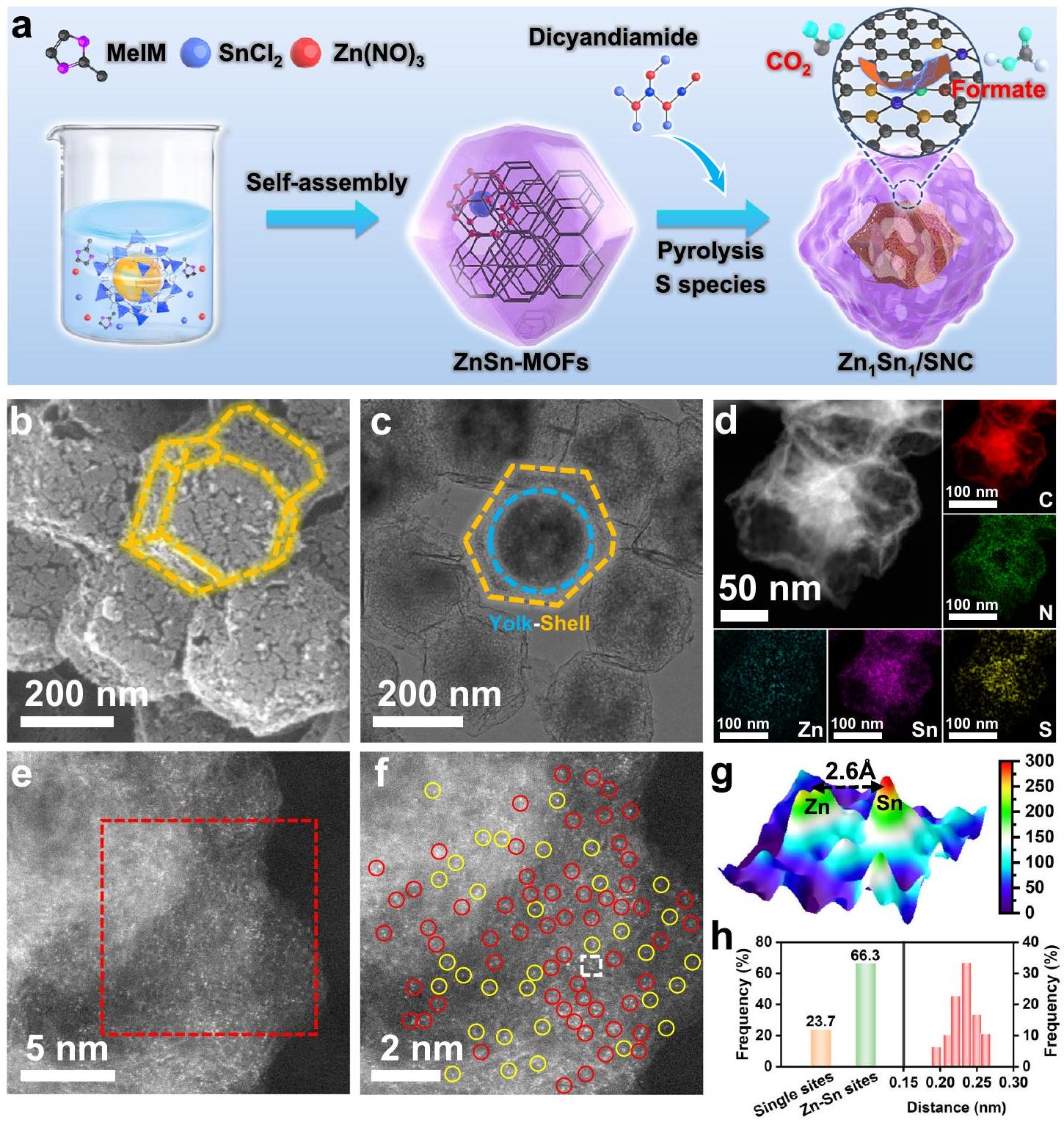
تم تخليق عبر طريقة حفر مشتركة من خطوة واحدة، كما هو موضح في الشكل 1a. في البداية، تم تشكيل شكل متعدد الأوجه ثنائي المعدن ZnSn-MOFs، من خلال دمج عقد Zn وSn مع 2-ميثيل إيميدازول كربط منسق في محلول ميثانول (الشكل التكميلي 1). يعمل هيكل MOF كهيكل ماكرو قوي لعملية الكربنة اللاحقة. بعد ذلك، تم إضافة مزيج من مسحوق الكبريت وديكسياندياميد لإدخال عناصر تنسيق محددة لتعديل الهيكل. شملت عملية التحلل الحراري تسخينًا سريعًا إلى في جو من الأرجون، تلاها لمدة ساعتين، مما أدى إلى تعطيل الهيكل المنظم لـ MOF . يؤدي الجمع بين الروابط الغازية S والامونيا المسببة للتآكل الناتجة عن ديكسياندياميد إلى تآكل الإطار الأساسي لـ . تؤدي هذه العملية إلى إنشاء هيكل رئيسي ذو قشرة صفار عالية النفاذية وتشكيل مواقع ثنائية الذرة غير متماثلة من Zn-Sn مشبعة جزئيًا بالكبريت. علاوة على ذلك، من خلال الحفاظ على درجة حرارة كربنة مثالية، تبخرت بعض عقد Zn وتحولت إلى ذرات فردية، بينما ظلت ذرات Sn موزعة على المستوى الذري. تم تحديد التركيب الكتلي لـ Zn وSn ليكون و ، على التوالي، باستخدام تحليل طيف الانبعاث الضوئي بالتحليل الطيفي (الجدول S1).
تتميز مادة ZIF-8 بوجود أقفاص جزيئية وفيرة تظهر تأثير حبس مكاني قوي، مما يجعلها قالبًا مناسبًا للغاية لتغليف الأنواع المعدنية. تؤدي معالجة التحلل الحراري إلى إنتاج مواد كربونية تحتوي على العديد من الروابط، وعيوب وفيرة، ومساحات سطحية محددة عالية. بالإضافة إلى ذلك، تعد الهيكل المكاني الفريد الذي توفره مواد MOF تعدل
بيئة التنسيق لذرات المعادن وتزيد من الفصل المكاني بين مواقع المعادن. في عملية التحلل الحراري، تخضع الغالبية العظمى من ذرات Zn للتبخر، مما يؤدي إلى تشتت ذرات Zn التي تميل إلى الارتباط مع ذرات Sn، مما يشكل مواقع ثنائية Zn-Sn. قد تؤدي تشكيل هذه الأزواج الذرية إلى تغييرات في التكوينات الإلكترونية أو أنواع الروابط بسبب التغيرات في التفاعل الداخلي لأنواع المعادن. لذلك، يجب ألا يكون محتوى Sn مرتفعًا بشكل مفرط لضمان تشكيل الأزواج الذرية بشكل منظم دون تكتل.
تظهر المجهر الإلكتروني الماسح (SEM) أن لها هيكل متعدد الأوجه فريد (الشكل 1b والملاحظة التكملية 1). تظهر صور المجهر الإلكتروني الناقل (TEM) والمجهر الإلكتروني الناقل الماسح (STEM) أن يمتلك بنية صفار-قشرة محددة جيدًا تتكون من قشرة خارجية ذات نسيج ونواة داخلية كثيفة. نفس الشيء ينطبق على المقارنة.عينة (الشكل S3)، تظهر هيكل قشرة صفار مشابه. يتم ملاحظة هياكل مختلفة في المقابل، و العوامل المساعدة بسبب اختلافات في طرق التحضير (الأشكال S4-S5). وهذا يشير إلى أن الاستخدام المشترك لسياناميد وكبريت مسحوق أثناء التخليق أمر حاسم لتعديل ZIF-8 بشكل فعال.تظهر منحنيات الامتزاز-الامتزاز العكسي أن الهيكل المعدل متعدد الأوجه لـتتمتع SNC بمساحة سطحية كبيرة، مما يوضح سهولة الوصول للأنواع التفاعلية وكفاءة نقل الكتلة (الشكل التوضيحي التكميلي 6). تظهر مطيافية الأشعة السينية المشتتة للطاقة (EDS، الشكل 1d) تشتتًا متجانسًا للزنك والقصدير والعناصر الخفيفة الكبريت والكربون والنيتروجين. تؤكد هذه التوزيعات أيضًا التركيب العام للمورفولوجياتوزيع المعادن علىتم فحصه باستخدام مجهر المسح الإلكتروني المجهز بتصحيح الشذوذ (AC-STEM)، كما هو موضح في الشكل 1e، f. تشير النتائج إلى عدم وجود جزيئات مميزة في، مما يشير إلى تشتت على مستوى الذرة لـالأزواج الذرية. الأنواع الموزعة ذريًا مميزة بالبيضاوات الحمراء، تمثل أزواج Zn-Sn الذرية. وبالمثل، الأنواع المعدنية في، و توزع العينات بشكل ذري (الأشكال التكميلية S7-8). يتم تصور أزواج الزنك والقصدير الذرية باستخدام صور بدقة ثلاثية الأبعاد (الشكل 1g)، والتي تحدد مواقعتظهر الأزواج الذرية قمم لونية بارزة. يتم إجراء تحليل إحصائي على أنواع ومسافات الأزواج المعدنية في الشكل 1f. لا تشكل ذرات الزنك والقصدير أزواج ثنائية فقط؛ بل إن بعضها يشكل مواقع فردية. تشكل الأزواج الذرية من الزنك والقصديرمن التركيب الكلي (الشكل 1h). المسافة المتوسطة بينالأزواج تتعلق بـ، متطابقًا بشكل وثيق مع الطول المتوقع للرابطة المباشرةالتنسيق وفقًا للاعتبارات النظرية.
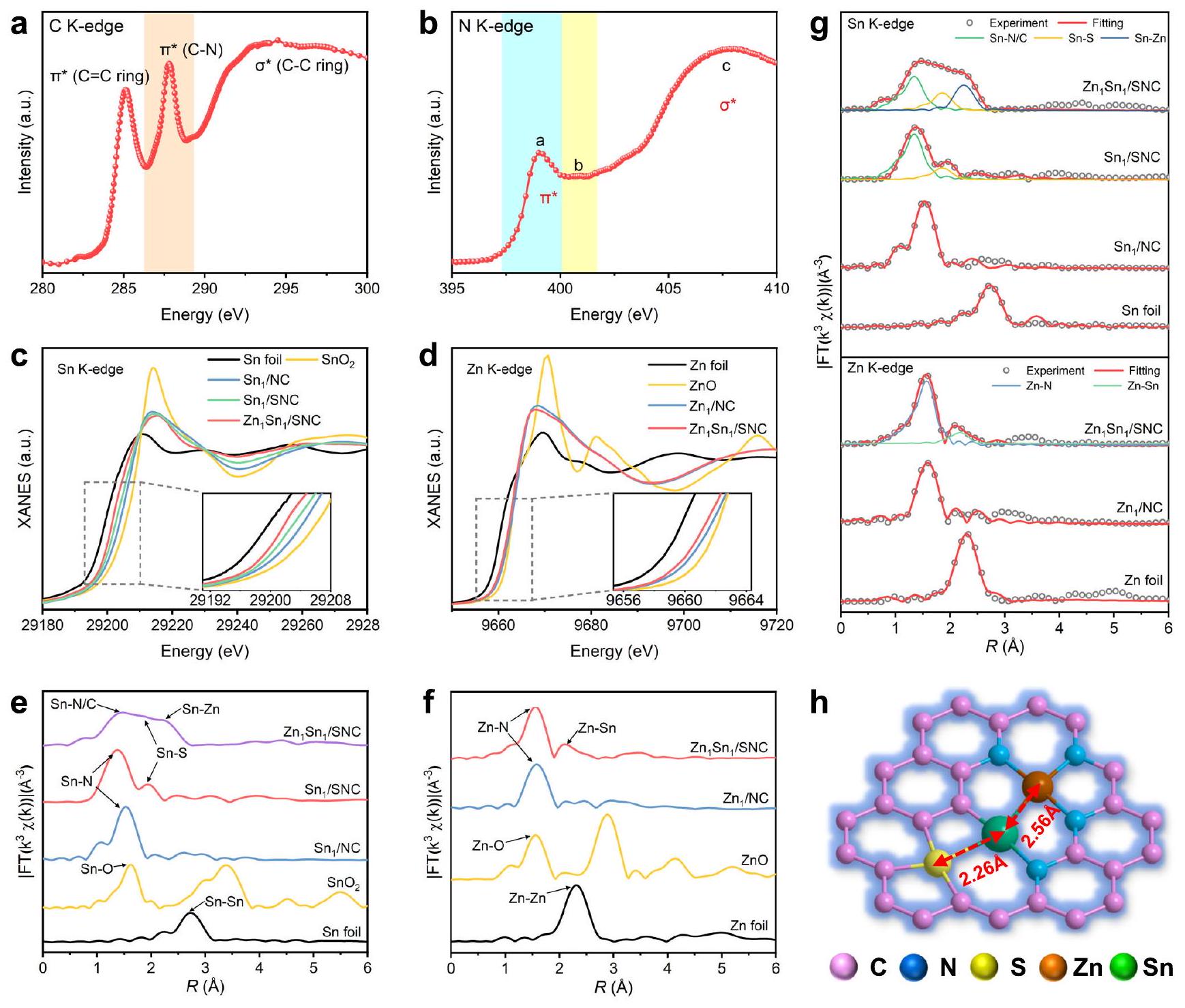
ظهرت قمتان فقط لتوقيع الكربون على، “، و المحفزات، كما يتضح من قياس حيود الأشعة السينية (XRD) (الشكل التكميلي 9). لم يتم الكشف عن أي قمم معدنية تتعلق بالزنك أو القصدير في العينات الأربع، مما يشير إلى عدم وجود جزيئات نانوية مرئية. يتم استخدام مطيافية الأشعة السينية للأشعة السينية (XPS) لتحليل الحالات الكيميائية وأنواع العناصر C و N و S فيكما هو موضح في الشكل التكميلي 10a،ذروة الرابطة (284.2 eV) في طيف C 1s تؤكد النجاح في إدخال الكبريت في الإطار الكربوني. الطيف (الشكل التوضيحي الإضافي 10ب) يظهر أربعة أنواع رئيسية من أنواع النيتروجين في بيريدينيك“ن” بيروليكورق الجرافيت. تشير هذه النتائج إلى وجود التنسيق فينتائج التركيب لـ Sيعرض الطيف قممًا مميزة تتعلق بالهيكل الشبيه بالثيوفين C-S-C ) والأكسيد S ، مما يؤكد دمج S في إطار الكربون المضاف إليه النيتروجين. هيكل التنسيق للعناصر الخفيفة في يمكن فحصه بدقة باستخدام مطيافية امتصاص الأشعة السينية الناعمة من الإشعاع السنكروتروني (الشكل 2 أ، ب والملاحظة التكميلية 2). يتكون طيف حافة الكربون (C K-edge) بشكل رئيسي من ثلاثة قمم مميزة تُنسب إلىانتقال، و الانتقال. ينشأ توافق هذه الروابط الكيميائية من حركة الإلكترونات إلى المدارات المضادة للرابطة من خلال انتقالات ثنائية القطب. أما بالنسبة لطيف النيتروجين، فإنه يظهر
الشكل 1 | تخليق وتوصيفات هيكلية لـ /SNC DASs. رسم تخطيطي مركب لـ SNC DASs. ب SEM من SNC DASs. c TEM من /SNC DASs. خريطة EDS لـ /SNC DASs. e، صورة AC-STEM لـ /SNC DASs.محاكاة صورة ثلاثية الأبعاد لـ Zn-Sn DASs.الكثافة الإحصائية لـالمواقع والمواقع الفردية، بالإضافة إلىالمسافة الثنائية الذرات في صورة ACSTEM الموضحة في (f). تم توفير بيانات المصدر كملف بيانات مصدر. ثلاث قمم مميزة تُعرف باسم، و ج، المرتبطة بالنيتروجين الموجود في البيريدين والبيرول المعين إلى الانتقال، بالإضافة إلى النيتروجين في الهياكل الجرافيتية المعينة لـانتقال
تم استخدام مطيافية امتصاص الأشعة السينية الدقيقة (XAFS) لاستكشاف الهيكل التنسيقي المحلي ومعلومات التكافؤ الإلكتروني لمواقع الذرات المزدوجة من الزنك والقصدير (الملاحظة التكميلية 3). تم استخدام هيكل امتصاص الأشعة السينية بالقرب من الحافة (XANES) لتحديد حالات التكافؤ الكيميائية للعناصر في العينات.يظهر طيف XANES عند حافة Sn K (الشكل 2c) أن موضع الحافة القريب من عنصر Sn فيبين مستويات الطاقة لرقائق القصدير و، مما يشير إلى حالة أكسدة القصدير فييتراوح بين و . علاوة على ذلك، توضح الشكل 2d أن موضع طاقة حافة الامتصاص عند حافة Zn K يقع ضمن نطاق القيم الملاحظة للرقائق الزنك و ZnO. حالة الأكسدة للزنك فيأكبر من ذلك فيبينما حالات الأكسدة للقصدير في و SNC أعلى أيضًا من ذلك في . تشير هذه النتائج إلى تعديل التكافؤ للمعادن المجاورة والذرات المنسقة في الموقع يؤدي إلى تغييرات في حالات الأكسدة.
في SNC، يؤدي إدخال ذرات الكبريت في موقع التقسيم الجزئي إلى زيادة نقل الإلكترونات من المركز المعدني إلى عنصر الكبريت.
توفر بنية الامتصاص الدقيقة للأشعة السينية الممتدة (EXAFS) معلومات عن القطبية وطول الرابطة وزاوية الرابطة للروابط الكيميائية في المواد، مما يساعد في دراسة خصائصها وتغيراتها. تعرض الشكل 2e طيف EXAFS لجميع العينات عند حافة Sn K. تشير النتائج إلى أنيكشف عن إشارة رئيسية عند، الذي يتوافق مع مسار Sn-N. بالإضافة إلى ذلك، يوجد إشارة كتف عند يتم ملاحظته، موزعًا بينقمم تشتت الروابط. القمة عند يُنسب إلى ذروة إشارة التنسيق. بالمقارنة،يعرض قمتين مميزتين عند و على التوالي المنسوبة إلى و إشارات التنسيق، مما يشير إلى وجود تنسيق جزئي لـ S في SNC، متسقة مع الخصائص. بالمقابل،يظهر فقط قمة مميزة عندالذي ينتمي إلىإشارة، تشير إلى تنسيق حصري لـ Sn -N فيمن الجدير بالذكر أن أيًا من العينات لا تظهر تمييزًا واضحًاتظهر قمم الميزات مقارنة بإشارة رقائق القصدير، كاشفة عن الطبيعة المشتتة لذرات القصدير. وبالمثل، تكشف طيفيات EXAFS (الشكل 2f) عن هيمنة Zn-N ( ) وزنك-القصدير
الشكل 2 | الحالة الكيميائية والبيئة التنسيقية المحلية لـ DASs. منحنيات XANES لحافة C و (b) N. طيف XANES لـعينات SNC DASs والعينات المرجعية عند (ج) حافة Sn و (د) حافة Zn. طيف EXAFS لـو عينات المرجع عند حافة (e) Sn و (f) Zn، على التوالي. ملاءمات EXAFS لـ SNC DASs عند (g) حافة Sn و Zn K. h نموذج الهيكل الذري لـأنظمة البيانات الموزعة. يتم توفير بيانات المصدر كملف بيانات المصدر. ( ) إشارات ذروة التشتت في عند حافة Zn K، بينما يعرض فقط Zn-Nمسار التشتت. تظهر هذه النتائج التأثير الكبير للتنسيق بين الـمركز مزدوج وذرات S/N داخل القشرة الأولى، ربما ناتج عن تداخل المدارات بين المعدنين، مما يؤدي إلى تعديل حالة الأكسدة وبيئة التنسيق. يسمح التناسب الكمي لطيف EXAFS (الشكل 2g و S11-18 والجداول S2-S3) بتحديد معلمات التنسيق لـوعينات المرجع، موفرة هياكل تنسيق محددة.
علاوة على ذلك، تؤكد نتائج التركيب وجود مواقع ثنائية المعدن جزئية من ZnSn في، حيث يتناسق معدن Sn مع كل من S و N ، بينما يتناسق Zn مع N. هياكل التنسيق لـ SNC و أيضًا تتماشى مع الهياكل المتوقعة. في الختام، فييحدث الترابط المباشر لذرات ثنائية المعدن، وتؤكد البنية الهندسية غير المتماثلة لـ DASs، حيث ينسق مركز Sn واحد ذرة S وذرتين من N/C، كأكثر تكوين هيكلي فعلي محتمل، كما هو موضح في الشكل 2h.
الكهربائية التحفيزيةأداء
تباينات في المواقع المعدنية لـ، و أدى إلى اختلافات فينشاط، يقاس في جهاز مصنوع في المنزل
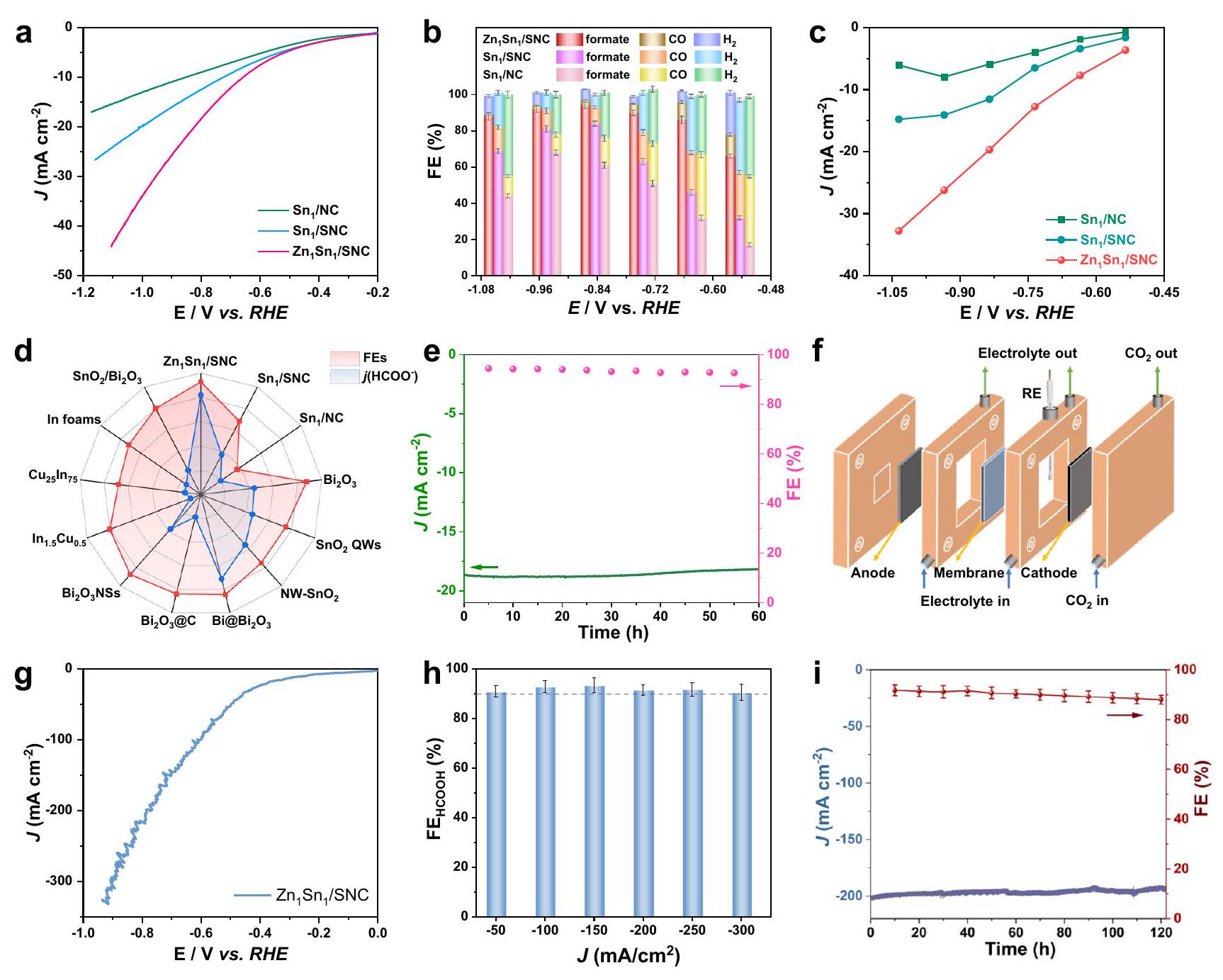
خلية من نوع H مملوءة بـالإلكتروليت (الشكل التوضيحي التكميلي 19 والملاحظة 4). إن دمج مواقع ثنائية المعدن من الزنك والقصدير في إطار MOF ذو الهيكل الصفاري يوفر نموذجًا مناسبًا للتحقيق الأداء بشكل شامل وفهم تأثير التهجين المداري. توضح منحنى LSV من الشكل 3a جهد البدء التنافسي البالغ 54 مللي فولت لـالاتجاه البارز في الكثافة الحالية لـيقترح تحسينًا جوهريًانشاط الاختزال الكهربائي. على العكس، فإنالعينة، التي تفتقر إلى إضافة القصدير، تظهر الأدنى النشاط (الشكل التوضيحي التكميلي 20 والملاحظة 4). علاوة على ذلك، التأثير التعاوني بين تعزز المواقع المعدنية النشاط التحفيزي لـتقليل. تم ملاحظة اختلافات في الأداء فيمحاليل مشبعة بالآرغونتشير إلى القدرة التحفيزية المتفوقة للمواقع ثنائية المعدن في تحويللتشكيل الفورمات (الشكل التوضيحي 21). يوضح الشكل 3ب كفاءة فاراداي للفورمات لجميع العينات، مما يشير إلى لديه أعلى كفاءة. الـقيمة لـعند -0.84 فولت هو 94.6%، وهو أعلى بكثير من المحفزات الأخرى، و . تسلط هذه النتيجة الضوء على الوظيفة الأساسية لدمج Sn في تحسين كفاءة منتج الفورمات بشكل عام. هدفنا هو التحقيق بشكل منهجي في كيفية اختلافتؤثر النسب على الأداء التحفيزي، إعداد عينات بنسب من،
الشكل 3 | الكهروكيميائيةخصائص /SNC DASs. نتائج LSV من أنظمة DAS الخاصة بـ SNC وعينات المرجع. تم تصحيح الجهد بـتعويض iR. بمننموذج DASs وعينات المرجع. جميع أشرطة الخطأ في (ب) تمثل الخطأ المعياري للمتوسط.من, و العوامل المساعدة. د مقارنة FEs لـ
اختبار المتانة لـ DASs مع محفزات أخرى تم الإبلاغ عنها. DASs عند -0.80 فولت. نموذج تخطيطي لخلايا التدفق.مناختبارات المتانة لـ DASs. DASs عند -0.75 فولت. تم توفير بيانات المصدر كملف بيانات مصدر. وكلا من الأعلى والأدنىتؤثر النسب على أداء المحفز، لذا تم تحديد النسبة النهائية عند (الشكل التوضيحي 23). لتحديد المنتجات المحتملة في الطور السائل، تم إجراء تحليل طيف الرنين المغناطيسي النووي (NMR)، مما كشف عن وجود إشارات تت correspond إلى منتج الفورمات (الشكل التوضيحي 22). يوضح الشكل 3c بوضوح كثافات التيار الجزئي لمنتجات الفورمات. ) من العينات الفردية، مما يشير إلى أن لديه أعلى كثافة تيار عند جميع إمكانيات التفاعل.منيحققعند -1.04 فولت، وهو ما يزيد بشكل ملحوظ عن، و ، و الـ منترتفع SNC بسرعة مع زيادة الإمكانيات. في هذا الصدد،تظهر انتقائية متفوقة لحمض الفورميك وكثافة تيار أعلى من المحفزات والعينات الضابطة المبلغ عنها سابقًا (الشكل 3d والجدول S4). الهيكل غير المتماثل المميز لـيمكنه الاحتفاظ بالاستقرار بعد التحفيز المستمر لمدة 60 ساعة، معفوق (الشكل 3e). تظهر مورفولوجيا وبنية العينة بعد اختبار المتانة تغييرات طفيفة. تُظهر نتائج التوصيف أن بنية القشرة الصفارية محفوظة، مع احتفاظ الزنك والقصدير بخصائصهما الذرية الموزعة (الأشكال S24-26). خلال عملية التفاعل بأكملها، هناك تسرب معدني ضئيل. مما يؤدي إلى تغييرات ضئيلة في محتوى المعدن قبل وبعد التفاعل (الجدول S1). بشكل عام، فإن متانةيتم تعزيزها بشكل كبير من خلال هيكلها غير المتناظر والاستقرار الفطري لمادة الإطار العضوي المعدنية.
بعد ذلك، تم إجراء تقييم إضافي للعمومأداءتم إجراء ذلك تحت الظروف الصناعية الحالية باستخدام هيكل خلية تدفق مصمم خصيصًا (الشكل 3f و S27). تشير بيانات منحنى LSV إلى أن التحسينات في القطب الكهربائي لتشتت الغاز تؤدي إلى زيادة كثافة التيار فيعملية، الوصول إلىعند -0.90 فولت. علاوة على ذلك، يتم ضمان مستوى عالٍ من انتقائية الفورمات عند زيادة التيارات، متجاوزًا 90.6% عبر نطاق واسع من كثافات التيار من 50 إلىكما هو موضح في الشكل 3h. الـالمادة تظهر استقرارًا ملائمًا لمدة 120 ساعة عند تعرضها لجهد قدره -0.75 فولت، مع الحفاظ على تيار تشغيل ثابت. (الشكل 3i). على مدار كاملاختبار الاستقرارالقياسات maintained حولفي الساعة. تم حسابها من معادلة عائد الكربون الفردي، عوائد الكربون الفردي لـ و عند -0.84 فولت كانت و ، على التوالي (الشكل التوضيحي 28). الـلديه أعلى عائد كربوني فردي، مما يعني استخدامًا أكثر اكتمالًا وكفاءة لـفي.
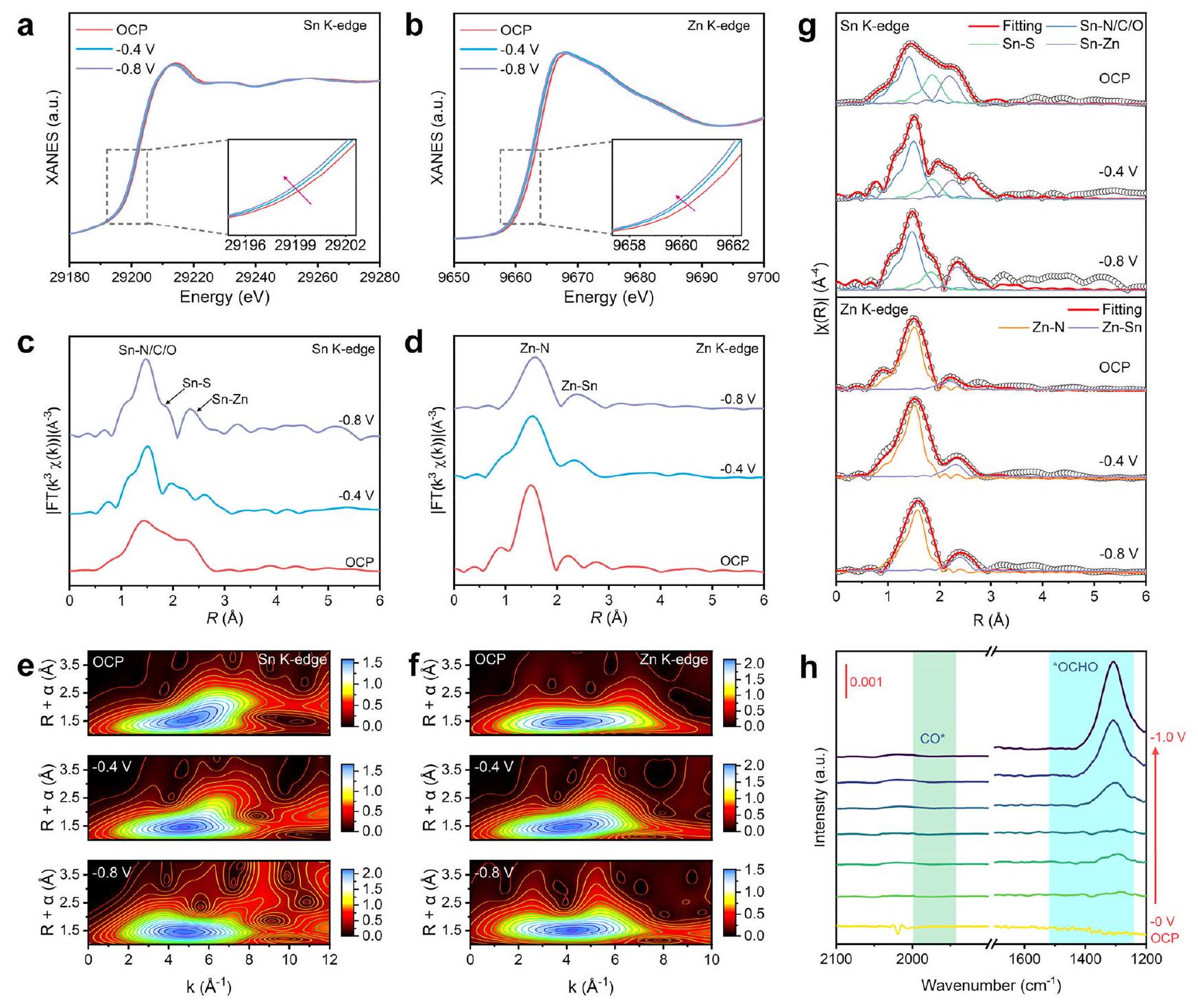
الشكل 4 | توصيف XAFS في الموقع لـ /SNC DASs. طيف XANES لحافة K لـ Sn و (ب) Zn من عند إمكانيات تطبيقية مختلفة. التوضيح هو تكبير للحافة الممتصة. FT-EXAFS لـمع وبدون تطبيق الجهد عند (ج) حافة كاين من القصدير و (د) حافة كاين من الزنك. مخططات WT-EXAFS لـ SNC في إمكانات مختلفة عند (e) حافة كاينون القصدير و(f) حافة كاينون الزنك. g منحنى تركيب FT-EXAFS SNC مع وبدون تطبيق جهد عند حافة Zn و Sn K. اختبار ATR-FTIR في الموقع علىتُقدم بيانات المصدر كملف بيانات مصدر.
دراسة آلية مواقع الذرات المزدوجة غير المتماثلة من الزنك والقصدير لتعزيزلتنسيق
لتوضيح الخصائص الهيكلية الديناميكية لـ Zn-Sn DASs، تم إجراء قياسات تجريبية في الموقع خلال ظروف العمل الحقيقية. (الشكل التوضيحي 29 والملاحظة 5-6). في الشكل 4a، تُظهر طيف XANES انزياحًا سلبيًا في الطاقة لحافة امتصاص القصدير (Sn) مع انتقال النظام من حالة جهد الدائرة المفتوحة (OCP) إلى -0.40 فولت إلى -0.80 فولت، مما يغطي نطاقًا يبلغ حوالي 2.3 إلكترون فولت. تُظهر هذه الهجرات انخفاضًا في حالات الأكسدة الملحوظة في موقع القصدير. بالمقارنة مع ورقة القصدير القياسية وSnO، فإن حالة الأكسدة للقصدير داخل الـتتراوح حالات أكسدة القصدير في OCP، -0.4 فولت و -0.8 فولت، ضمن نطاق متوسط، كما يتضح في طيف المشتقات الأولى (الشكل التكميلي 30). تظهر هذه النتائج أن حالات أكسدة القصدير في OCP هي و 0.596 ، على التوالي. وبالمثل، يظهر عتبة الامتصاص لـ Zn انزياحًا نحو الأسفل في الطاقة خلال ظروف التفاعل (الشكل 4ب) حالات الأكسدة لـ Zn عند OCP، -0.4 فولت و -0.8 فولت هي و 0.740 ، على التوالي، مما يشير إلى أن حالات التكافؤ تنخفض أيضًا مع الانخفاض التدريجي للجهد (الشكل التكميلي 31). تُنسب هذه الظواهر إلى إنشاء الروابط الناتجة من التفاعل بين موقع الزنك – القصدير المزدوج والممتصوبالتالي تحفيز إعادة تنظيم الإلكترونات داخل الزنك والقصدير والنيتروجين والكبريت والأكسجين في. قد يؤدي هذا الترتيب الإلكتروني إلى تهجين مدارات الإلكترونات d-p بين المعدنين Zn وSn. تعاني المواقع النشطة لـ Sn وZn من انخفاض في حالات التكافؤ الخاصة بها تحت قياسات in-situ، حيث تقع كلتا حالتي التكافؤ ضمن النطاق من 0 إلى. بالإضافة إلى ذلك، تُظهر طيفيات EXAFS (الشكل 4c، d) الموقع المزدوج غير المتناظر Zn-Sn وهو يتعرض للالتواء والتمدد ضمن نطاق مسموح به نتيجة لتفاعله معمع الحفاظ على تكوين محلي مستقر خلالتظهر التغيرات في WT-EXAFS عند إمكانيات مختلفة بوضوح أن زيادة الجهد تسبب بعض الانكماش فيالرابطة (الشكل 4e، f). تشير النتائج إلى أن تنسيق الـتخضع المواقع لبعض التغييرات خلال التفاعل، مما يؤدي إلى تحسين انتقائية الفورمات للهيكل التنسيقي المستقر الجديد. تم اشتقاق التوافقات المحددة لـ EXAFS من البيانات المعروضة في الشكل 4g و S32-33، وتم توثيقها في الجدول S5 و S6. يظهر حافة الامتصاص عند حواف Zn و Sn ارتفاعًا تحت ظروف OCP مقارنةً بطيف XANES الأصلي. يُعتقد أن هذا الارتفاع يُعزى إلىآلية الامتزاز
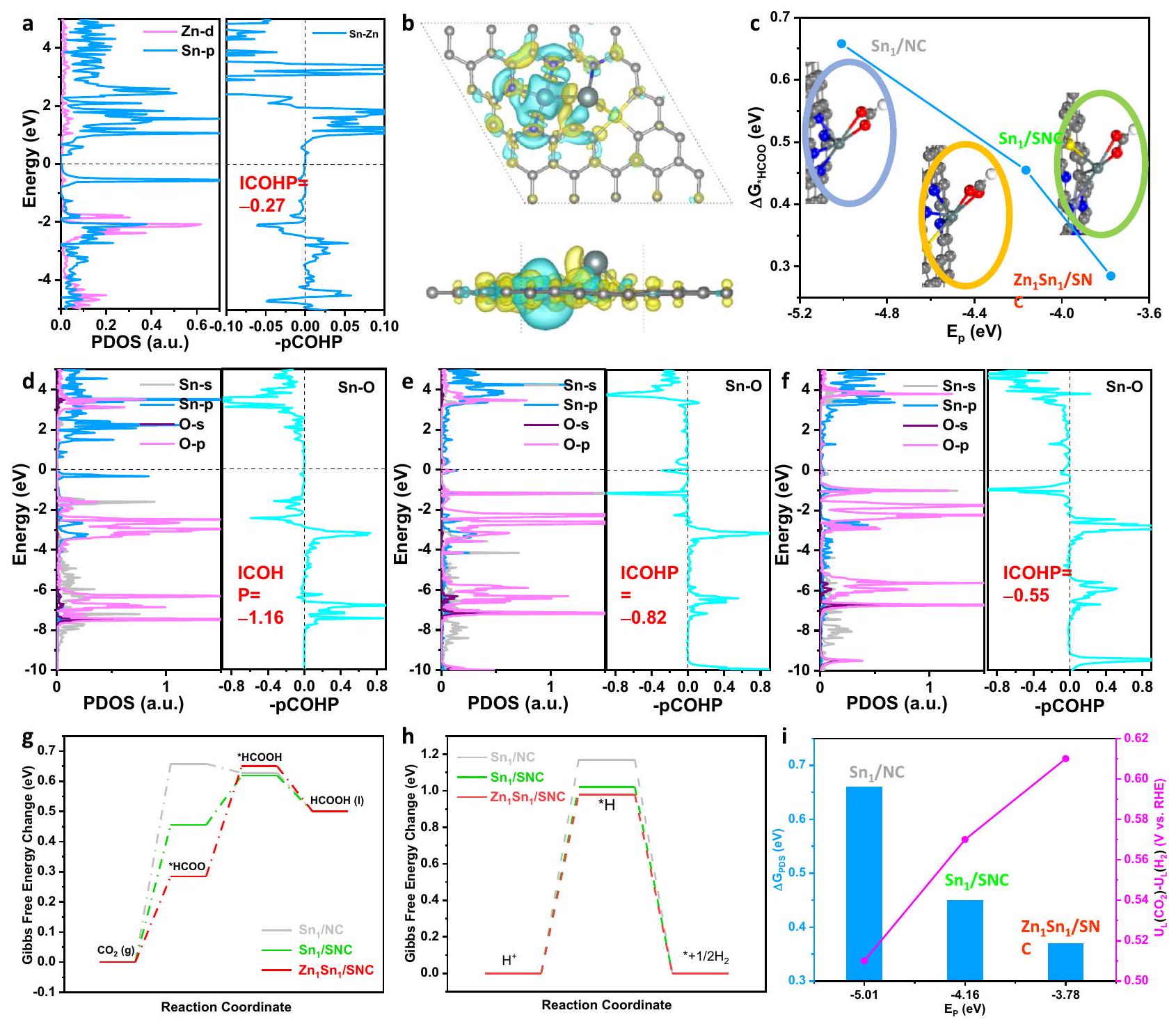
الشكل 5 | نظرينشاط /SNC DACs. كثافة جزئية من حالات البيانات وبيانات COHP لأوربيتالز d لزنك وأوربيتالز p للقصدير. b كثافة الشحنة التفاضلية بين ذرة الزنك والذرة المتبقية في DACs، الخط الأصفر والسماوي مع قيمة السطح بورتشير العلامات إلى كثافة الشحنة المعززة والمخفضة، على التوالي.العلاقة بين طاقة الامتزاز لـ HCOO ومركز نطاق p لذرة Sn. الصورة المرفقة هي تكوين الامتزاز لـ HCOO. متوسط.تحليل pCOHP لذرة Sn وذرة O في نوع *HCOO على، و . الخط الأحمر الأفقي يحدد مستوى فيرمي.تغير الطاقة الحرة لـالاختزال إلى HCOOH و HER. i مقارنة بـ و (فولت مقابل RHE) على ، و تُقدم بيانات المصدر كملف بيانات مصدر. ). مع إدخال جهد سالب، يحدث تحول نحو الأسفل في طاقة حافة الامتصاص، مما يؤدي إلى تقليل حالة التكافؤ للزنك والقصدير. وهذا يشير إلى تحويل سريع لـوإزالة جزيئات الفورمات الممتصة عندموقعين مزدوجين.
من أجل مزيد من الربط بين المسار التحفيزي في موقع Zn-Sn النشط، تم إجراء مطيافية الأشعة تحت الحمراء بتحويل فورييه مع الانعكاس الكلي المخفف (ATR-FTIR) للكشف عن الوسائط الرئيسية في (ملاحظة إضافية. 7). تم الحصول على طيف ATR-FTIR، الذي يعتمد على الجهود المطبقة، عن طريق تقليل الجهود بشكل تدريجي من 0 إلى -1.0 فولت، كما هو موضح في الشكل 4h. في محلول إلكتروليتي يحتوي علىمشبع بـيعتبر الطيف تحت الأحمر المسجل في حالة OCP بمثابة المرجع الأساسي، حيث لم يتم ملاحظة أي إشارات جماعية مميزة في البداية. في عمليةيُقترح أن تحويلالتشكيل (*OCHO) أكثر فعالية من التحويل إلى *COOH. في الاختبارات التجريبية التي أجريت علىمحفز، قمة مميزة تتوافق معأوشو حواليتمت ملاحظته، وأظهر هذا الذروة زيادة شدة الضوء مع انخفاض الجهود المطبقة. بالإضافة إلى ذلك، COتظهر القمم المميزة عادةً حول. أظهرت النتائج أن لم تمتص بشكل كبيرالوسطاء خلال التفاعل، مما يشير إلى أن CO لم يكن المنتج الرئيسي.
طريقة نظرية الكثافة الوظيفية (DFT) درست تأثير – الاقتران المداري فوق غير المتماثلنمط على إنتاج HCOOH فينموذج، مقارنة بـ و النماذج في الشكل التكميلية 34، البيانات التكميلية 1، والملاحظة.تظهر الأشكال التكميلية 35 و S36 نتائج محاكاة الديناميات الجزيئية من أولياتها (AIMD) تحت ظروف 300 كلفن و 700 كلفن، مما يشير إلى الاستقرار الديناميكي الحراري لـالتكوين. لكشف تأثيرالتهجين المداري في موقع القصدير النشط، وكثافة الحالات الجزئية (PDOS) ونتائج تداخل المدارات البلورية (COHP) لذرات الزنك والقصدير من أجلتم حساب نموذج في الشكل 5a و S37. تحت مستوى فيرمي البالغ 5 إلكترون فولت، كانت شدة PDOS لذرات الزنك والقصدير تعزى بشكل رئيسي إلى و المدارات، على التوالي، التي كانت جميعها تمتلك تداخلات مدارية كبيرة مع قيمة COHP المتكاملة السلبية (ICOHP) -0.27. الشحنة التفاضلية نتيجة الكثافة الهيكل بين ذرة الزنك والذرات المتبقية أشار إلى انتقال شحنة واضح من ذرة الزنك إلى ذرة القصدير، مما يعزز في الوقت نفسه قوة ارتباط Sn-S، كما هو موضح في الشكل 5b. على وجه التحديد، عرض الشكل التكميلي 38 نتائج PDOS و COHP للقصدير والمركب.ذرة للنماذج المذكورة. في نطاق الطاقة من -10 إلى 0 إلكترون فولت، و مدارات ذرة القصديرمدارات ذرة الكبريتالأوربيتالز لذرة النيتروجين تمتلك أيضًا تراكبات طاقة واسعة بقيمة ICOHP تبلغ -1.60 لـلـ، و -1.33 لـ مع الإشارة إلى أن القيمة السلبية الأكثر تعني قوة ارتباط أقوى. كان المقصود بذلك أنالارتباط المداري فوقيمكن لزوج الذرات أن يعزز بشكل كبيرقوة الربط، مما يفيد في الحفاظ على حالات الشحن لموقع Sn النشط. بالنظر إلى خاصية الحمض لويس لـتم حساب خزان الشحنة لمواقع النشاط في الجزيء لاحقًا ضمن مخطط تحليل شحنة بادر للتحقيق في تباين إنتاج HCOOH. فيالسطح، قام ذرة القصدير (Sn) بتقليل 1.25 إلكترون لتنسق نظام N-C. بعد زرع ذرة ذات سالبية كهربائية أقل مثل الكبريت (S) أو الزنك (Zn) لكسر تماثل المركز النشط، انخفض عدد الإلكترونات المنقولة من ذرة القصدير تدريجياً إلى 1.16 لـو 0.98 لـ، مما يدل على قدرة قوية على تخزين الإلكترونات لذرات القصدير مع الارتباط المداري فوق غير المتماثلذرة مزدوجة. من المثير للاهتمام أن العدد المشحون من ذرات القصدير النشطة (1.25، 1.16، و) كان سلبياً متناسباً مع موضع مركز نطاق p ( ) من عنصر الكتلة p ( ، و -3.78 إلكترون فولت ) في الشكل التكميلي 39، والذي تم تسميته كموصّف فعالية فعّالة يشبه مركز نطاق d التقليدي ( ).
للتحقق من العلاقة بين شدة الامتزاز للوسائط الرئيسية وذرة القصدير النشطة لـتم محاكاة امتصاص أنواع HCOO على المنتج HCOOH، NC، اس إن سيسطح SNC. طاقات الامتزاز للوسط HCOO ( ) كانت 0.28 إلكترون فولت، على التوالي، والتي كانت مرتبطة سلبًا بـقيمة موقع Sn، تم عرض تكوينات الامتزاز المقابلة في الشكل 5c. مع ملاحظة أن قيمة طاقة الامتزاز الأقل إيجابية تشير إلى قوة ارتباط قوية. المستوى الأعلى من الطاقة لـالقريب من مستوى فيرمي أدى إلى امتصاص أقوى لعينات HCOO، بشكل خاص لـالتكوين. عرض الشكل 5d-f نتائج PDOS و COHP لذرة Sn وذرة O المرتبطة بـ HCOO. في نطاق الطاقة من -10 إلى -3 إلكترون فولت، و مدارات ذرة القصديرالمدارات الذرية لذرة الأكسجين لديها اقتران مداري واسع، والذي يكرس بالكامل لحالات الترابط.الرابطة في النماذج المذكورة. من -3 إلكترون فولت إلى مستوى فيرمي، ساهمت التهجينات المدارية المذكورة أعلاه بشكل رئيسي في حالات المضادة للرابطة.الرابطة. إن مستوى الطاقة الأعلى وشدة حالات المضاد للرابطة يولدان قوة ربط أضعف لـ و ، مما يدل على الأقوى رابطة لامتصاص HCOO علىنموذج. هناك علاقة إيجابية بين طاقات الامتصاص لأنواع HCOO وقيمة ICOHP للنماذج المذكورة، مثل -1.16 لـلـ، و -0.55 لـ كما هو موضح في الشكل التكميلي 40.
في الـتقليل عملية HCOOH، امتصاص الوسيط الرئيسي COOH أو H للتفاعل التنافسي مع CO أوتم حسابه أيضًا على النماذج المذكورة أعلاه. الأشكال التكميلية 41-S43 تشير إلى تكوينات الامتزاز المحسّنة وطاقة الامتزاز. كانت طاقات الامتزاز لـ COOH و H أيضًا تتناسب سلبًا معالقيمة، مماثلة لتلك الخاصة بأنواع HCOO. وقد دعمت بشكل كافٍ أنيمكن أن يُستخدم كموصّف فعّال للنشاط. كانت طاقات الامتصاص لـ HCOO أقل بكثير من تلك الخاصة بـ COOH و H، مما يُظهر التوليد التفضيلي لـ HCOO في العملية الكهروكيميائية.عملية التخفيض. الشكل 5 ج عرضت تغيير الطاقة الحرة لـالاختزال إلى HCOOH ، الخطوة المحددة بواسطة الجهد (PDS) علىكان النموذج هو الخطوة الأولى للبروتون إلى نوع HCOO مع تغيير في الطاقة الحرة قدره 0.66 إلكترون فولت، ثم انخفض إلى 0.45 إلكترون فولت علىنموذج.قلل بشكل غير مباشر حاجز الهيدروجين في الخطوة الأولى بمقدار 0.28 إلكترون فولت، لكنه زاد من حاجز البروتون التالي إلى HCOOH. مع 0.37 إلكترون فولت، الذي عمل كـ PDS لتوليد HCOOH منجزيء، أيضًا أقل من ذلك من و النماذج. بالمقارنة مع مسار COOH إلى CO في الشكل التوضيحي 44، كانت طاقات الامتزاز لـ HCOO على النماذج المذكورة جميعها أقل من تلك الخاصة بـ COOH، مثل، و ، مما يفيد في إنتاج HCOOH بدلاً من منتج CO. عرض الشكل 5 h تغييرات الطاقة الحرة لعملية HER، على سبيل المثال، ، و ، إن امتصاص الهيدروجين على الموقع النشط للقصدير هو خطوة تحديد السرعة، وكانت تغييرات الطاقة الحرة لها أعلى بكثير من تلك الخاصة بمنتج HCOOH. اقترحت الدراسات السابقة أن الفجوة في الإمكانية المحدودة لـالتقليل و HERعكست انتقائيةتقليل حيث يكون أكثر إيجابيةالقيمة أظهرت انتقائية أعلىشكل 5i يصور العلاقة بين و قيمة لـالاختزال إلى HCOOH، مما يشير إلىتمتلك أفضل نشاط وانتقائية بسبب أقلوأكبرقيمةفوق كل شيء، النشاط والانتقائية لـتم تعزيز تقليل منتج HCOOH لاحقًا علىنموذج، الذي كان مرتبطًا بـمستوى طاقة الشريط لموقع ذرة القصدير النشطة المستحثة بواسطة – الترابط المداري مع بناء رابطة غير متماثلة بين الزنك والقصدير.
نقاش
في الختام، تم تصنيع DASs غير المتماثلة Zn-Sn، حيث تتناسق مراكز المعادن مع عناصر غير متجانسة من المجموعة الرئيسية المختلفة (S أو N)، بنجاح باستخدام طريقة طلاء الرابطة، مما يظهر أداءً جيدًا.الأداء. يتم تحقيق قدرة امتصاص الموقع المعدني المحسنة من خلال تزاوج مميز لـالأوربيتال، مما يساهم في ارتفاع انتقائية عملية التحفيز.تظهر زيادة ملحوظة في الكفاءة الفارادية لإنتاج الفورمات في كل من خلية H وخلية التدفق. تؤكد حسابات DFT ونتائج التوصيف متعدد الأطياف في الموقع أن الموقع غير المتماثل Zn-Sn يعزز بشكل فعال قوة امتصاص الأنواع *HCOO في تقليل ثاني أكسيد الكربون، مما يشير إلى سلوك تحفيزي على DASs Zn-Sn. لا تخلق نتائجنا رؤى فقط فيالهجين المداري فيولكنها تقدم أيضًا وجهات نظر جديدة للحصول على فهم أعمق للتأثيرات الإلكترونية الفريدة للمواقع غير المتماثلة وآليات العلاقة بين التركيب والنشاط.
طرق
المواد الكيميائية
نيترات الزنك سداسي الماءكلوريد القصديربيكربونات البوتاسيومتم شراء تشتت Nafion D-521 (5% وزن في الماء و1-بروبانول)، 2-ميثيل إيميدازول، مسحوق الكبريت من ألفا أيسر. تم الحصول على ثنائي سيانيد الدياميد، الميثانول والإيثانول من سينوفارم كيميكل. تم شراء غشاء Nafion 211/117 من دوبونت.تم صب الماء النقي للغاية بواسطة جهاز ميلي-كيو. غاز الهيليوم عالي النقاء ( ) وثاني أكسيد الكربون ( تم شراء ( ) من شركة هايبوا للغاز. كانت جميع المواد الكيميائية والغازات من الدرجة التحليلية واستخدمت دون مزيد من التنقية.
تحضير و عينات
عادةً، و تم إضافة المواد بشكل متزامن إلى 80 مل من محلول الميثانول مع التحريك لمدة 30 دقيقة. ثم، تم إذابة 3.24 جرام من 2-ميثيل إيميدازول في 80 مل من محلول الميثانول. تم إضافة محلول سلفيد المعدن على الفور إلى محلول الرباط أعلاه وتم التحريك باستمرار لمدة 5 ساعات. تم الحصول على المساحيق (ZnSn MOFs) عن طريق الغسل بالميثانول عدة مرات والتجفيف فيفي فرن فراغي طوال الليل. وتم تحضير ZnSn-MOFs بواسطة نهج حفر الرابطة. أولاً، تم وضع الكبريت المطحون مع مسحوق دايسياندياميد (في الأعلى) ومسحوق ZnSn-MOFs (في الأسفل) بشكل متتابع في فرن أنبوبي، ثم تم التحلل الحراري عندبمعدلتحت جو من الأرجون لمدة ساعتين. الناتج كما هو-تم استخدام محفز SNC مباشرة مستخدمة للاختبارات الكهروكيميائية واختبارات التوصيف دون معالجة إضافية. تم تحضير محفز -SNC بواسطة إجراءات مماثلة باستثناء استخداملنقش أنواع الزنك. و تم تحضيرها بنفس الإجراء، فقط كان من الضروري تعديل نسبة السلف إلى 2:1 و 1:2.
تحضير و عينات
عادةً، و تم إضافة المواد بشكل متزامن إلى 80 مل من محلول الميثانول مع التحريك لمدة 30 دقيقة. ثم، تم إذابة 3.24 جرام من 2-ميثيل إيميدازول في 80 مل من محلول الميثانول. تم إضافة محلول سلفيد المعدن على الفور إلى محلول الرباط أعلاه وتم التحريك باستمرار لمدة 5 ساعات. تم الحصول على المساحيق (ZnSn MOFs) عن طريق الغسل بالميثانول عدة مرات والتجفيف فيفي فرن مفرغ من الهواء طوال الليل. الـتم تحضير المحفز -NC عن طريق التحلل الحراري المباشر لـ ZIF-8 فيبمعدلتحت جو من الأرجون لمدة 4 ساعات.
تحضير و عينات
عادةً، و تم إضافة المواد بشكل متزامن إلى 80 مل من محلول الميثانول مع التحريك لمدة 30 دقيقة. ثم تم إذابة 3.24 جرام من 2-ميثيل إيميدازول في 80 مل من محلول الميثانول. تم إضافة محلول سلفيد المعدن على الفور إلى محلول الرباط أعلاه وتم التحريك باستمرار لمدة 5 ساعات. المساحيقتم الحصول على MOFs عن طريق الغسل بالميثانول عدة مرات والتجفيف فيفي فرن مفرغ من الهواء طوال الليل. الـتم تحضير المحفز عن طريق التحلل الحراري أولاً لـ ZIF-8 عند درجة حرارة عالية، ثم تمت إزالة الأنواع المتبقية من الزنك بواسطة النقش الحمضي، ثم تم تشريب الأنواع من القصدير. تحت حماية جو الأرجون، تم إجراء التحلل الحراري عند 1000 بمعدللمدة ساعتين.
القياسات الكهروكيميائية لـ
التم تنفيذ التجارب على جهاز العمل الكهربائي CHI 760e باستخدام خلية من النوع H مملوءة بمحلول إلكتروليتي 0.1 M KHCO3. ورقة بلاتين وتم استخدام (KCl المشبع) كقطب مضاد وقطب مرجعي، على التوالي. تم فصل غشاء نافيون 211 بين غرفة الكاثود وغرفة الأنود قبل إضافة محلول 0.1 M KHCO3. قبل القياس الرسمي،تم ضخ المحلول بواسطة فقاعات الأرجون لمدة 30 دقيقة ثم تم التبديل إلىتم إجراء منحنيات LSV بمعدل مسحمع الفقاعات المستمرةبمعدل تدفق قدره 15 SCCM عبر مقياس تدفق الكتلة الدقيق. تم الإبلاغ عن جميع الجهود مقابل القطب الهيدروجيني القابل للعكس (RHE) وتم تصحيحها بواسطة تعويض انخفاض الجهد الداخلي (iR-drop). تم تصحيح الجهد بـ التعويض. تم فحص منتجات الغاز عبر جهاز كروماتوغرافيا الغاز شيمادزو 2010 بلس (GC)، الذي كان مزودًا بكاشف BID وعمود محشو من نوع شين كاربون ST 100/120. تم استخدام الهيليوم عالي النقاء (99.9999%) كغاز حامل لجهاز الكروماتوغرافيا. تم فحص المنتجات السائلة بواسطة طيف الرنين المغناطيسي النووي من خلال جهاز مطياف الرنين المغناطيسي النووي Bruker AV 400 MHz، الذي يستخدم و DMSO كمذيب ومعيار داخلي (الرنين المغناطيسي النووي:عند 4.69 جزء في المليون، DMSO عند 2.71 جزء في المليون).
تفاصيل قياس جهاز خلية التدفق
الطازج-تم رش عينة SNC على GDL (28 BC، متجر سينيرو) بتحميل قدرهكقطب عمل (كاثود). (متجر سينيرو) تم رشه على GDL (28 قبل الميلاد، متجر سينيرو) بتحميل تم استخدامه كقطب مضاد (أنود). تم إدخال غشاء تبادل البروتون (نافيو 117) بين غرفة الكاثود وغرفة الأنود في خلية التدفق. على جانب الكاثود، المحلول الكهربائي (تم ضخها بواسطة مضخة حقن بمعدل تدفق ثابت قدره 15 سم مكعب في الدقيقة. نقاء عاليتم تدفق الغاز بمعدل 30 SCCM خلف غشاء الكاثود.تم استخدام قطب مرجعي (KCl مشبع). تم تحديد مقاومة المحلول بواسطة طيف الامتياز الكهروكيميائي الثابت عند ترددات تتراوح من 0.1 هرتز إلى 100 كيلوهرتز. تم تعويض جميع الجهود المقاسة باستخدام إعداد ثلاثي الأقطاب يدويًا.
توفر البيانات
البيانات التي تدعم نتائج هذه الدراسة متاحة ضمن المقال وملفات المعلومات التكميلية الخاصة به. جميع بيانات المصدر الأخرى ذات الصلة متاحة من المؤلفين المراسلين. يتم توفير بيانات المصدر مع هذه الورقة.
References
Schoedel, A., Ji, Z. & Yaghi, O. M. The role of metal-organic frameworks in a carbon neutral energy cycle. Nat. Energy 1, 16034 (2016).
Zhong, M. et al. Accelerated discovery of electrocatalysts using active machine learning. Nature 581, 178-183 (2020).
Guo, X. et al. Grid integration feasibility and investment planning of offshore wind power under carbon-neutral transition in China. Nat. Commun. 14, 2447 (2023).
Tian, Q. et al. Mesoporous carbon spheres with programmable interiors as efficient nanoreactors for electrosynthesis. Nat. Commun. 15, 983 (2024).
Deng, G. et al. Body-Centered-Cubic-Kernelled Nanocluster with Alkynyl Protection: Synthesis, Total Structure, and Electroreduction. J. Am. Chem. Soc. 145, 3401-3407 (2023).
Lees, E. W. et al. Gas diffusion electrodes and membranes for reduction electrolysers. Nat. Rev. Mater. 7, 55-64 (2022).
Liu, W. et al. Isolated Cu-Sn diatomic sites for enhanced electroreduction of to CO. Nano Res. 16, 8729-8736 (2023).
Zhang, P. et al. Surface Ru-H bipyridine complexes-grafted nanohybrids for efficient photocatalytic methanation. J. Am. Chem. Soc. 145, 5769-5777 (2023).
Sun, Z. et al. Sulfur-bridged asymmetric cuni bimetallic atom sites for reduction with high efficiency. Adv. Mater. 36, e2404665 (2024).
Su, J. et al. Recent development of nanomaterials for carbon dioxide electroreduction. SmartMat 3, 35-53 (2022).
Fang, W. et al. Durable conversion in the proton-exchange membrane system. Nature 626, 86-91 (2024).
Xie, Y. et al. High carbon utilization in reduction to multi-carbon products in acidic media. Nat. Catal. 5, 564-570 (2022).
Guo, W. et al. Asymmetric Cu sites for enhanced electroreduction to products. CCS Chem. 0, 1-9 (2023).
Chu, A. T. et al. Organic non-nucleophilic electrolyte resists carbonation during selective electroreduction. J. Am. Chem. Soc. 145, 9617-9623 (2023).
Zhang, J. et al. Tuning the reaction path of electroreduction reaction on indium single-atom catalyst: Insights into the active sites. Nano Res 15, 4014-4022 (2022).
Xu, Q.-J. et al. Understanding oxygen vacant hollow structure heterojunction to promote reduction. Rare Met 42, 1888-1898 (2023).
Wang, Q. et al. Recent advances in copper-based catalysts for electrocatalytic reduction toward multi-carbon products. Nano Res. Energy 3, e9120112 (2024).
Deng, Y. et al. Operando spectroscopic analysis of axial oxygencoordinated single-Sn-atom sites for electrochemical CO2 reduction. J. Am. Chem. Soc. 145, 7242-7251 (2023).
Chang, B. et al. Electrochemical reduction of carbon dioxide to multicarbon products: challenges and perspectives. Energy Environ. Sci. 16, 4714-4758 (2023).
Dong, J. et al. Continuous electroproduction of formate via CO2 reduction on local symmetry-broken single-atom catalysts. Nat. Commun. 14, 6849 (2023).
Han, N. et al. Ultrathin bismuth nanosheets from in situ topotactic transformation for selective electrocatalytic reduction to formate. Nat. Commun. 9, 1320 (2018).
Bi, J. et al. High-rate CO2 electrolysis to formic acid over a wide potential window: An electrocatalyst comprised of indium
nanoparticles on chitosan-derived graphene. Angew. Chem., Int. Ed. 62, e202307612 (2023).
Wang, N. et al. Suppressing the liquid product crossover in electrochemical CO2 reduction. SmartMat 2, 12-16 (2021).
Cho, J. et al. 2D Metal/Graphene and 2D metal/graphene/metal systems for electrocatalytic conversion of to formic acid. Angew. Chem. Int. Ed. 63, e202320268 (2024).
Wang, T. et al. Halogen-incorporated Sn catalysts for selective electrochemical Reduction to Formate. Angew. Chem., Int. Ed. 62, e202211174 (2023).
Ruan, S. et al. Bismuth nanosheets with rich grain boundaries for efficient electroreduction of to formate under high pressures. Chin. J. Catal. 43, 3161-3169 (2022).
Jiang, X. et al. Boosting CO2 electroreduction to formate via bismuth oxide clusters. Nano Res. 16, 12050-12057 (2023).
Li, S. et al. Ampere-level electroreduction with single-pass conversion exceeding in acid over silver penetration electrodes. Nat. Commun. 15, 6101 (2024).
Bok, J. et al. Designing atomically dispersed Au on tensile-strained Pd for efficient CO2 electroreduction to formate. J. Am. Chem. Soc. 143, 5386-5395 (2021).
Wang, J.-J. et al. A review of non-noble metal-based electrocatalysts for electroreduction. Rare Met 40, 3019-3037 (2021).
Shen, J. & Wang, D. How to select heterogeneous reduction electrocatalyst. Nano Res. Energy 3, e9120096 (2024).
Ding, J. et al. A tin-based tandem electrocatalyst for reduction to ethanol with selectivity. Nat. Energy 8, 1386-1394 (2023).
Li, L. et al. Copper as a single metal atom based photo-, electro-, and photoelectrochemical catalyst decorated on carbon nitride surface for efficient reduction: A review. Nano Res. Energy 1, 9120015 (2022).
Kim, J. et al. A red-light-powered silicon nanowire biophotochemical diode for simultaneous reduction and glycerol valorization. Nat. Catal. 7, 977-986 (2024).
Lian, Z., Dattila, F. & López, N. Stability and lifetime of diffusiontrapped oxygen in oxide-derived copper reduction electrocatalysts. Nat. Catal. 7, 401-411 (2024).
Sun, Z. & Chen, W. Proximity effect of binuclear catalyst for plastics recycling. Matter 6, 2562-2564 (2023).
Li, Y. et al. Synergistic effect of atomically dispersed Ni-Zn pair sites for enhanced electroreduction. Adv. Mater. 33, 2102212 (2021).
Chai, Y. et al. Dual-atom catalyst with N-colligated Zn1Co1 species as dominant active sites for propane dehydrogenation. J. Am. Chem. Soc. 146, 263-273 (2024).
Zhang, L. et al. Hybrid double atom catalysts for hydrogen evolution reaction: A sweet marriage of metal and nonmetal. Adv. Energy Mater. 14, 2302754 (2024).
Wang, L. et al. Axial dual atomic sites confined by layer stacking for electroreduction of to tunable syngas. J. Am. Chem. Soc. 145, 13462-13468 (2023).
Mo, S. et al. Non-interacting Ni and Fe dual-atom pair sites in N -doped carbon catalysts for efficient concentrating solar-driven photothermal reduction. Angew. Chem., Int. Ed. 62, e202313868 (2023).
Zhang, Z.-J. et al. Modulating -d orbital hybridization by nanoparticles enables carbon nanofibers high cycling stability as anode for sodium storage. Rare Met 42, 4039-4047 (2023).
Sun, T. et al. Strengthened d-p orbital-hybridization of single atoms with sulfur species induced bidirectional catalysis for lithium-sulfur batteries. Adv. Funct. Mater. 33, 2306049 (2023).
Liu, G. et al. Strengthened d-p orbital hybridization through asymmetric coordination engineering of single-atom catalysts for durable lithium-sulfur batteries. Nano Lett. 22, 6366-6374 (2022).
Han, Z. et al. Engineering d-p orbital hybridization in single-atom metal-embedded three-dimensional electrodes for batteries. Adv. Mater. 33, 2105947 (2021).
Shang, H. et al. Engineering unsymmetrically coordinated single atom sites with enhanced oxygen reduction activity. Nat. Commun. 11, 3049 (2020).
Pei, J. et al. Integrating host design and tailored electronic effects of Yolk-Shell diatomic sites for efficient electroreduction. Angew. Chem., Int. Ed. 63, e202316123 (2024).
Pei, J. et al. A replacement strategy for regulating local environment of single-atom catalysts to facilitate electroreduction. Nat. Commun. 15, 416 (2024).
Zu, X. et al. Efficient and robust carbon dioxide electroreduction enabled by atomically dispersed sites. Adv. Mater. 31, 1808135 (2019).
Chen, P. et al. Interfacial engineering of cobalt sulfide/graphene hybrids for highly efficient ammonia electrosynthesis. PNAS 116, 6635-6640 (2019).
Zhang, J. et al. Tuning the coordination environment in single-atom catalysts to achieve highly efficient oxygen reduction reactions. J. Am. Chem. Soc. 141, 20118-20126 (2019).
Su, X. et al. Complementary Operando Spectroscopy identification of in-situ generated metastable charge-asymmetry clusters for reduction to ethanol. Nat. Commun. 13, 1322 (2022).
Yang, Y. et al. Operando studies reveal active Cu nanograins for electroreduction. Nature 614, 262-269 (2023).
Liu, K. et al. Ultra-fast pulsed discharge preparation of coordinatively unsaturated asymmetric copper single-atom catalysts for reduction. Adv. Funct. Mater. 34, 202312589 (2024).
Pei, W. et al. Investigation of dual atom doped single-layer MoS2 for electrochemical reduction of carbon dioxide by first-principle calculations and machine-learning. J. Mater. Inf. 3, 26 (2023).
Wang, L. et al. Axial dual atomic sites confned by layer stacking for electroreduction of to tunable syngas. J. Am. Chem. Soc. 145, 13462-13468 (2023).
. et al. Exclusive sites realize near-unity CO selectivity for electrochemical reduction. J. Am. Chem. Soc. 139, 14889-14892 (2017).
Ren, W. et al. Isolated diatomic Ni-Fe metal-nitrogen sites for synergistic electroreduction of . Angew. Chem. Int. Ed. 58, 6972-6976 (2019).
شكر وتقدير
تم دعم هذا العمل من قبل المؤسسة الوطنية للعلوم الطبيعية في الصين (22375019). تم دعم هذا العمل من قبل مشروع تمويل صندوق البحث العلمي بجامعة قوانغشي مينزو (مشروع بدء البحث العلمي لتقديم المواهب تحت رقم المنحة 2020KJQD18)، ومؤسسة قوانغشي للعلوم الطبيعية (2023GXNSFBA026279)، وقاعدة العلوم والتكنولوجيا في قوانغشي وصندوق خاص للمواهب (Guike AD21220068). تم دعم هذا العمل من قبل صندوق بدء التشغيل للمواهب العليا في جامعة جيانغسو (21JDG041)، ومؤسسة العلوم ما بعد الدكتوراه في الصين (2023M731357). نشكر الحسابات النظرية التي أجريت في المنطقة الشمالية الغربية من مركز سوغون الوطني للحوسبة الفائقة ومنطقة A6 في مركز بكين للحوسبة السحابية الفائقة، المدعومة من PARATERA. يشكر المؤلفون BL1W1B في منشأة الإشعاع السنكروتروني في بكين (BSRF)، وBL14W1 في منشأة الإشعاع السنكروتروني في شنغهاي (SSRF)، وBL12B في المختبر الوطني للإشعاع السنكروتروني (NSRL) على المساعدة في التوصيفات.
مساهمات المؤلفين
و. س. تصور الفكرة، صمم الدراسة وكتب الورقة. ب. ب. و هـ. س. نفذا معظم التفاعلات، جمعا و قام بتحليل البيانات وكتب الورقة. قام ب. ب. بإجراء تشخيصات المجهر الإلكتروني. قام ز. و.، ز. س. (تشيي سون) وز. د. بتنفيذ تشخيصات هيكل الامتصاص بالأشعة السينية. قام ب. ب.، هـ. س.، ز. س. (تشيي سون) و و. س. بإجراء القياسات الكهروكيميائية. قام ز. س. (تشونغتي سون) بإجراء حسابات DFT. ساعد هـ. س.، ز. و.، ز. س. (تشونغتي سون) و و. س. في مراجعة وتنقيح الورقة. قام ز. س. (تشونغتي سون) وز. د. بتنفيذ بعض التجارب وتنقيح الورقة.
يجب توجيه المراسلات والطلبات للحصول على المواد إلى وينشينغ تشين.
معلومات مراجعة الأقران تشكر مجلة Nature Communications فا يانغ، ويوجين جي، والمراجعين الآخرين المجهولين على مساهمتهم في مراجعة الأقران لهذا العمل. يتوفر ملف مراجعة الأقران.
ملاحظة الناشر: تظل شركة سبرينغر ناتشر محايدة فيما يتعلق بالمطالبات القضائية في الخرائط المنشورة والانتماءات المؤسسية.
الوصول المفتوح. هذه المقالة مرخصة بموجب رخصة المشاع الإبداعي النسب-غير التجارية-عدم الاشتقاق 4.0 الدولية، التي تسمح بأي استخدام غير تجاري، ومشاركة، وتوزيع، وإعادة إنتاج في أي وسيلة أو صيغة، طالما أنك تعطي الائتمان المناسب للمؤلفين الأصليين والمصدر، وتوفر رابطًا لرخصة المشاع الإبداعي، وتوضح إذا قمت بتعديل المادة المرخصة. ليس لديك إذن بموجب هذه الرخصة لمشاركة المواد المعدلة المشتقة من هذه المقالة أو أجزاء منها. الصور أو المواد الأخرى من طرف ثالث في هذه المقالة مشمولة في رخصة المشاع الإبداعي الخاصة بالمقالة، ما لم يُشار إلى خلاف ذلك في سطر الائتمان للمادة. إذا لم تكن المادة مشمولة في رخصة المشاع الإبداعي الخاصة بالمقالة وكان استخدامك المقصود غير مسموح به بموجب اللوائح القانونية أو يتجاوز الاستخدام المسموح به، ستحتاج إلى الحصول على إذن مباشرة من صاحب حقوق الطبع والنشر. لعرض نسخة من هذه الرخصة، قم بزيارة http:// creativecommons.org/licenses/by-nc-nd/4.0/.
(ج) المؤلفون 2025
مركز الطاقة والتحفيز، كلية علوم المواد والهندسة، معهد بكين للتكنولوجيا، بكين 100081، الصين. مختبر قوانغشي الرئيسي لمواد البوليسكاريد والتعديل، مختبر العمليات الكيميائية والبيولوجية التحويلية لمؤسسات التعليم العالي في قوانغشي، كلية الكيمياء والهندسة الكيميائية، جامعة قوانغشي مينزو، ناننينغ 530008، الصين. كلية علوم المواد والهندسة، جامعة جيانغسو، زينجيانغ، جيانغسو 212013، جمهورية الصين الشعبية. البريد الإلكتروني: wxchen@bit.edu.cn
Sulfur-doping tunes -d orbital coupling over asymmetric Zn-Sn dual-atom for boosting electroreduction to formate
Received: 29 February 2024
Accepted: 26 February 2025
Published online: 05 March 2025
(4) Check for updates
Bo Peng , Hao She , Zihao Wei , Zhiyi Sun , Ziwei Deng , Zhongti Sun & Wenxing Chen
The interaction of orbitals at bimetallic sites plays a crucial role in determining the catalytic reactivity, which facilitates the modulation of charges and enhances the efficiency of electroreduction process. Here, we show a ligand co-etching approach to create asymmetric Zn-Sn dual-atom sites (DASs) within metal-organic framework (MOF)-derived yolk-shell carbon frameworks (named ). The DASs comprise one Sn center ( -block) partially doped with sulfur and one Zn center ( -block) with N coordination, facilitating the coupling of orbitals between the dimer. The arrangement displays an asymmetric distribution of charges and atoms, leading to a stable adsorption configuration of intermediates. In H-type cell, exhibits an impressive formate Faraday efficiency of at -0.84 V . In flow cell, the asymmetric electronic architecture of SNC facilitates high accessibility, leading to a high current density of at -0.90 V . Theoretical calculations show the asymmetric sites in with ideal adsorption affinity lower the reduction barrier, thus improve the overall efficiency of reduction.
The overabundance of greenhouse gases in the atmosphere is currently leading to a multitude of environmental issues . There is an urgent need to expeditiously advance the development of effective and sustainable technologies aimed at converting into valuable chemicals, in order to facilitate the process of carbon recycling . The electroreduction reaction of offers a sustainable solution for achieving the goal . However, the significant variation in product distribution increases the economic cost of the product separation process . Formate serves as a significant medium for the storage of hydrogen, allowing for the safe and effective containment of hydrogen energy in a liquid state, thereby ensuring the safety of hydrogen storage and transportation . Specifically, the conversion of to formate involves a two-electron transfer mechanism, with an initial potential of -0.19 V vs. . The conversion of to formate
exhibits a lower overpotential in comparison to the multi-electron transfer processes involved in reducing to compounds . However, the current overpotential and selectivity remain inadequate. Consequently, the development of effective catalysts to minimize energy consumption and enhance the selectivity for formic acid production is of paramount importance.
Recently, the Sn-based materials show great potential for -toformate. According to reports, the Sn single-site catalysts, characterized by a well-defined local structure, have the ability to selectively convert into formate or . Catalysts with atomically dispersed interacting binuclear metal sites demonstrate greater intrinsic activity compared to single-site in complex catalytic environments, such as . The interaction between the binuclear sites has the potential to enhance the affinity of the intermediates in the
catalytic process . The current binuclear metal sites can be customized and effectively produced by the fine regulation of local active structure. Furthermore, there is a unique orbital coupling effect between different groups of metals. The coupling of orbitals leads to the creation of hybridized orbitals, typically characterized by elevated energy levels in comparison to the original orbitals. the hybridized orbitals are able to effectively engage in the creation or breaking of coordination bonds in dynamic process, thereby improving the reactivity of the system. Furthermore, orbital coupling can facilitate enhanced orbital overlap, thereby increasing the likelihood of coordination bond formation . This slight modification in the distribution of electrons within the orbitals results in a fundamental shift in the bonding potential between the metallic elements, consequently influencing the catalytic properties in a synergistic manner . Simultaneously, the presence of dual-atom sites (DASs) can result in a notably uneven distribution of charge polarization. However, it is difficult to precisely tune the DASs in order to enhance the coupling effect and thus improve catalytic properties; such regulation also remains a significant challenge.
Herein, an asymmetric Zn-Sn dimer with partial sulfur doping, dispersed atomically on carbon frameworks in a yolk-shell configuration, demonstrates significant catalytic activity for the through a ligand coetching protocol (denoted as ). The local structural modulation of the metal dual-sites and the constucted yolkshell structure not only promotes the coupling of Zn-Sn centers but also presents high catalytic accessibility. The demonstrated a notable formate Faraday efficiency ( ) of at -0.84 V in the H -cell, and achieved current densities of up to at -0.90 V when integrated into the gas diffusion electrode of the flow cell. Density functional theory (DFT) calculations indicate that the introduction of partial S doping into Zn-Sn DASs disrupts the local symmetry, resulting in a gradual reduction in the number of electrons transferred to the Sn center. This leads to a significant enhancement in the electron storage capacity of . As a result, the reduction of the energy barrier can enhance the efficiency of the transformation of -to-formate.
Results and discussion
Synthesis and structural characterizations of
The was synthesized via one-step ligand co-etching method, depicted in Fig. 1a. Initially, a typical bimetallic ZnSn-MOFs polyhedron, was formed by merging Zn and Sn metal nodes with 2-methylimidazole as a coordinating ligand in a methanol solution (Supplementary Fig. 1). The MOF structure serves as a robust macrostructure for the subsequent carburization process. Subsequently, a blend of sulfur powder and dicyandiamide was added to introduce specific coordinating elements for structural adjustment. The pyrolysis process included swift heating to in Ar atmosphere, followed for 2 h , disrupting the ordered MOF structure . The combination of gaseous S-ligands and corrosive ammonia generated by dicyandiamide collaboratively corrodes the primary framework of . This process results in the creation of a highly permeable yolkshell main structure and the formation of partially sulfur-coordinated asymmetric Zn-Sn diatomic sites. Moreover, by maintaining an optimal carburization temperature, certain Zn nodes evaporated and transformed into individual atoms, while the Sn atoms remained dispersed at the atomic level. The mass composition of Zn and Sn was determined to be and , respectively, using inductively coupled plasma optical emission spectroscopy analysis (Table S1).
The ZIF-8 material is characterized by its abundant molecular cages that exhibit a strong spatial confinement effect, making it a highly suitable template for the encapsulation of metal species. Pyrolysis treatment yields carbon materials with numerous ligands, abundant defects, and high specific surface areas. Additionally, the unique spatial structure provided by MOF materials modifies the
coordination environment of metal atoms and increases spatial separation between metal sites. In the pyrolysis process, the majority of Zn atoms undergo evaporation, leading to the dispersion of Zn atoms which have a tendency to bond with Sn atoms, forming the Zn Sn dual sites. The formation of these atomic pairs may cause changes in electronic configurations or bonding types because of variations in the intrinsic reactivity of metal types. As such, the Sn content should not be excessively high to guarantee the controlled formation of atomic pairs without aggregation.
The scanning electron microscope (SEM) shows that has a unique polyhedron structure (Fig. 1b and Supplementary Note 1). Transmission electron microscopy (TEM) images and scanning TEM (STEM) exhibit that the has a well-defined yolk-shell architecture formed by a textured outer shell and a dense inner core. The same is true for comparison sample (Fig. S3), showing a similar yolk-shell structure. Different structures are observed in the corresponding , and catalysts due to variations in preparation methods (Figs. S4-S5). This suggests that the combined use of cyanamide and sulfur powder during synthesis is crucial for effectively modulating ZIF-8. The adsorption-desorption isotherms show that the modified polyhedron structure of SNC has a large surface area of , illustrating good accessibility for reactive species and efficient mass transfer (Supplementary Fig. 6). The energy dispersive X-ray spectroscopy (EDS, Fig. 1d) shows a homogeneous dispersion of Zn, Sn, and light elements S, C, and N. Such distributions also confirm the global morphology composition of . The distribution of metals over was examined using aberration-corrected STEM (AC-STEM), as illustrated in Fig. 1e, f. The results indicate the absence of distinct particles in , suggesting atomic-level dispersion of atomic pairs. Atomically dispersed species are highlighted by red ellipses, representing Zn-Sn atomic pairs. Likewise, metal species in , and samples are distributed atomically (Supplementary Figs. S7-8). Zn-Sn atomic pairs are visualized using three-dimensional (3D) resolution images (Fig. 1g), which the positions of atomic pairs show prominent color peaks. Statistical analysis is performed on the types and distances of metal pairs in Fig. 1f. Zn and Sn atoms do not exclusively form diatomic pairs; instead, some form single sites. Zn-Sn atomic pairs constitute of the total composition (Fig. 1h). The average distance between pairs is about , closely matching the expected bond length for direct coordination according to theoretical considerations.
Only two carbon signature peaks are appeared on the , , and catalysts, as evidenced by X-ray diffraction (XRD) measurement (Supplementary Fig. 9). No metal peaks corresponding to Zn or Sn are detected in the four samples, suggesting the lack of visible nanoparticles. X-ray photoelectron spectroscopy (XPS) is used to analyze the chemical states and elemental types of C, N , and S in . As shown in Supplementary Fig. 10a, the bond peak ( 284.2 eV ) in the C 1s spectrum confirms the successful introduction of S into the carbon framework. The spectrum (Supplementary Fig. 10b) shows four main types of nitrogen species in : pyridinic , pyrrolic N , and graphitic . These results indicate the existence of coordination in . The fitting results of the S spectrum display characteristic peaks related to the thiophene-like C-S-C structure ( ) and oxidized S , confirming the incorporation of S into the nitrogen-doped carbon framework. The coordination structure of light elements in can be thoroughly examined using synchrotron-radiation soft X-ray absorption spectroscopy (Fig. 2a, b and Supplementary Note. 2) . The C K-edge spectrum mainly consists of three distinct peaks attributed to transition, , and transition. The alignment of these chemical bonds arises from the movement of electrons to antibonding orbitals through dipole transitions. As for the N spectrum, it exhibits
Fig. 1 | Synthesis and structural characterizations of /SNC DASs. a Composite diagram of SNC DASs. b SEM of SNC DASs. c TEM of /SNC DASs. d EDS mapping of /SNC DASs. e, AC-STEM image of /SNC DASs. 3D image simulation of Zn-Sn DASs. Statistical density of the sites and single sites, as well as diatomic distance in the ACSTEM image shown in (f). Source data are provided as a Source Data file.
three distinct peaks denoted as , and c , which are associated with the nitrogen present in pyridine and pyrrole assigned to the transition, as well as the nitrogen in graphitic structures assigned to the transition.
X-ray absorption fine structure spectroscopy (XAFS) was used to explore the local coordination structure and electronic valence information of the Zn-Sn dual-atom sites (Supplementary Note. 3). X-ray absorption near-edge structure (XANES) was used to determine the chemical valence states of the elements in the samples . The Sn K-edge XANES spectrum (Fig. 2c) shows that the near-edge position of the Sn element in is between the energy levels of Sn foil and , indicating an oxidation state of Sn in ranging from and . Furthermore, Fig. 2d demonstrates that the adsorption edge energy position at Zn K-edge falls within the range of values observed for Zn foil and ZnO . The oxidation state of Zn in is greater than that in , while the oxidation states of tin in and SNC are also higher than that in . These results indicate that the valence modulation of neighboring metal and coordinating atoms at the site leads to changes in the oxidation states. In
SNC, the introduction of S atoms in the partial partition site results in increased electron transfer from the metal center to the S element.
Extended X-ray absorption fine structure (EXAFS) provides information on the polarity, bond length, and bond angle of chemical bonds in materials, which aids the study of their properties and variations. Figure 2e displays the EXAFS spectra of all samples at the Sn K -edge. The results indicate that reveals a main signal at , corresponding to the Sn-N path. Additionally, a shoulder signal at is observed, distributed among the bond scattering peaks. The peak at is attributed to the coordination peak signal. In comparison, exhibits two characteristic peaks at and , respectively ascribed to the and coordination signals, suggesting the presence of partial S coordination in SNC, consistent with characteristics. In contrast, only presents a characteristic peak at , which belongs to the signal, indicating exclusive Sn -N coordination in . Notably, none of the samples exhibit distinct feature peaks compared to the Sn foil signal, revealing the dispersed nature of Sn atoms. Similarly, EXAFS spectra (Fig. 2f) reveal the predominant Zn-N ( ) and Zn-Sn
Fig. 2 | Chemical state and local coordination environment of DASs. a C and (b) N K-edge XANES curves. XANES spectra of the SNC DASs and the reference samples at (c) Sn and (d) Zn K-edge. EXAFS spectra of the and
the reference samples at the (e) Sn and (f) Zn K-edge, respectively. EXAFS fittings of SNC DASs at (g) Sn and Zn K-edge. h Atomic structure model of DASs. Source data are provided as a Source Data file.
( ) scattering peak signals in at Zn K-edge, whereas only displays the Zn-N scattering path. These results demonstrate the significant coordination effect among the dual center and S/N atoms within the first shell, possibly arising from orbital hybridization between the two metals, thereby modulating the oxidation state and coordination environment. Quantitative fitting of the EXAFS spectra (Fig. 2g and S11-18 and Tables S2-S3) allows determination of the coordination parameters for and the reference samples, providing specific coordination structures.
Furthermore, the fitting results confirm the presence of partial ZnSn bimetallic sites in , with Sn metal coordinating both S and N , while Zn coordinates with N . The coordination structures of SNC and also align with the expected structures. In conclusion, in , direct bonding of bimetallic atoms occurs, and the asymmetric DASs geometric structure, where a single Sn center coordinates one S atom and two N/C atoms, is confirmed as the most likely actual structural configuration, as shown in Fig. 2h.
Electrocatalytic performance of
Variations in the metallic sites of , and led to differences in activity, measured in a home-made
H type cell filled with electrolyte (Supplementary Fig. 19 and Note 4). The incorporation of Zn-Sn bimetallic sites in the yolk-shell structured MOF framework offers a suitable model to investigate performance comprehensively and understand the impact of orbital hybridization. LSV curve from Fig. 3a illustrates the competitive onset voltage of 54 mV for . The prominent trend in current density of suggests an improved intrinsic electroreduction activity. Conversely, the sample, lacking Sn doping, demonstrates the lowest activity (Supplementary Fig. 20 and Note 4). Furthermore, the cooperative effect between metal sites enhances catalytic activity for reduction. Performance variations noticed in solutions saturated with Ar and indicate the superior catalytic capability of bimetallic sites in converting to formate (Supplementary Fig. 21). Figure 3b illustrates the formate Faradaic efficiency of all samples, indicating has the highest efficiency. The value of at -0.84 V is 94.6%, notably higher than other catalysts , and . This result highlights the essential function of Sn integration in improving the overall formate product efficiency. We aimed to systematically investigate how different ratios affect catalytic performance, preparing samples with ratios of ,
Fig. 3 | Electrochemical properties of /SNC DASs. a LSV results of SNC DASs and the reference samples. The potential was corrected with iR compensation. b of DASs and the reference samples. All the error bars in (b) represent the standard error of the mean. of , and catalysts. d The comparation of FEs for
DASs with other reported catalysts. e Durability test of DASs at -0.80 V . f Schematic model of flow-cell. of DASs. i Durability test of DASs at -0.75 V . Source data are provided as a Source Data file.
and . Both higher and lower ratios impact catalyst performance, so the final ratio was set at (Supplementary Fig. 23). To identify potential liquid phase products, nuclear magnetic resonance spectroscopy (NMR) analysis was performed, revealing the presence of signals corresponding to formate product (Supplementary Fig. 22). Figure 3c clearly shows the partial current densities of the formate products ( ) of the individual samples, indicating that has the highest current density at all reaction potentials. The of achieves at -1.04 V , which is significantly higher than the , and , and the of SNC raises rapidly with increased potentials. With this regard, demonstrates superior selectivity for formic acid and higher current density than previously reported catalysts and control samples (Fig. 3d and Table S4). The distinctive asymmetric structure of enables it to retain stability after continuous catalysis for 60 h , with the above (Fig. 3e). The morphology and structure of the sample after durability testing exhibit minimal changes. Characterization results show that the yolk-shell structure is preserved, with zinc and tin maintaining their dispersed atomic properties (Figs. S24-26). During the entire reaction process, there is minimal metal leaching,
leading to negligible variations in metal content pre- and post-reaction (Table S1). Overall, the durability of is significantly enhanced by its asymmetric structure and the inherent stability of the MOF.
Subsequently, additional assessment of the overall performance of under industrial current conditions was conducted utilizing a custom-designed flow-cell structure (Fig. 3f and S27). The LSV curve data suggests that enhancements to the gas diffusion electrode result in increased current density in the process, reaching at -0.90 V . Moreover, a high level of formate selectivity is ensured at increased currents, exceeding 90.6% across a wide range of current densities from 50 to , as illustrated in Fig. 3h. The material demonstrates favorable stability for a duration of 120 h when subjected to a potential of -0.75 V , while maintaining a steady operation current. (Fig. 3i). Throughout the entire stability test, the measurements maintained around per hour. Calculated from the single carbon yield equation, the single carbon yields of and at -0.84 V were and , respectively (Supplementary Fig. 28). The has the highest single carbon yield, implying a fuller and more efficient utilization of in .
Fig. 4 | In situ XAFS characterization of /SNC DASs. a Sn and (b) Zn K-edge XANES spectra of the at different applied potentials. The illustration is a magnification of the absorbed edge. FT-EXAFS of with and without applying voltage at (c) Sn and (d) Zn K-edge. WT-EXAFS plots of SNC at
different potentials at (e) Sn and (f) Zn K-edge. g FT-EXAFS fitting curve of SNC with and without applying voltage at Zn and Sn K-edge. h In situ ATR-FTIR test on . Source data are provided as a Source Data file.
Mechanism study of asymmetric Zn-Sn dual atom sites for boosting to formate
To elucidate the dynamic structural characteristics of the Zn-Sn DASs, the in-situ experimental measurements were conducted during realworking conditions (Supplementary Fig. 29 and Note. 5-6). In Fig. 4a, the XANES spectra show a negative energy shift of the Sn absorption edge as the system transitions from the open circuit potential (OCP) state to -0.40 V to -0.80 V , covering a range of approximately 2.3 eV . These migrations display a reduction in the oxidation states observed at the Sn site. In contrast to the standard Sn foil and SnO , the oxidation state of Sn within the DASs consistently falls within an intermediate range, as revealed in the firstderivative spectra (Supplementary Fig. 30). These results show that the Sn oxidation states of OCP, -0.4 V and -0.8 V are and 0.596 , respectively. Likewise, the absorption threshold of Zn exhibits a downward shift in energy during reaction conditions (Fig. 4b) The oxidation states of Zn at OCP, -0.4 V and -0.8 V are and 0.740 , respectively, indicating that the valence states also decrease with the gradual decrease of voltage (Supplementary Fig. 31). Such occurrences are ascribed to the creation of linkages resulting
from the interplay between Zn – Sn dual-site and absorbed , consequently instigating the reorganization of electrons within Zn, Sn, N, S , and O in . This electronic rearrangement may lead to hybridization of d-p electronic orbitals between the two Zn-Sn metals. The active sites of Sn and Zn experience a reduction in their valence states under in-situ measurements, with both valence states falling within the range of 0 to . Besides, the EXAFS spectra (Fig. 4c, d) show the asymmetric Zn-Sn dual site as it undergoes twisting and stretching within a permissible range as a result of its interaction with , while maintaining a stable local configuration during . The changes of WT-EXAFS at different potentials are also clearly shown that the increase in potential causes some contraction of the bond (Fig. 4e, f). The results indicate that the coordination of the sites undergoes some changes during the reaction, which leads to a better formate selectivity of the newly formed stable coordination structure. The specific EXAFS fittings were derived from the data presented in Fig. 4g and S32-33, and are documented in Table S5, S6. The absorption edge at the Zn and Sn K-edges demonstrates an elevation under OCP conditions in contrast to the original XANES spectra. This rise is believed to be attributed to the adsorption mechanism (
Fig. 5 | Theoretical activity of /SNC DACs. a Partial density of states and COHP data of Zn d orbitals and Sn p orbitals. b Differential charge density between Zn atom and residual atom in the DACs, the yellow and cyan contour with the surface value of bohr marks augmented and reduced charge density, respectively. The relationship between the adsorption energy of HCOO and p band center of Sn atom. Inset is the adsorption configuration of HCOO
intermediate. pCOHP analysis of Sn atom and O atom of *HCOO species on the , and . The horizontal red line marks the fermi level. he free energy change of reduction to HCOOH and HER. i Comparison of and (V vs. RHE) on the , and . Source data are provided as a Source Data file. ). As a negative potential is introduced, there is a downward shift in the absorption edge energy, leading to a reduction in the valence state of Zn and Sn . This suggests a swift conversion of and the elimination of adsorbed formate molecules at dual sites.
In order to further correlate the catalytic pathway at the Zn-Sn active site, in-situ attenuated total reflectance Fourier transform infrared spectroscopy (ATR-FTIR) was performed to detect the key intermediates in (Supplementary Note. 7). The ATR-FTIR spectra, which are dependent on the applied potentials, were acquired by incrementally decreasing the potentials from 0 to -1.0 V , as illustrated in Fig. 4h. In an electrolyte solution containing saturated with , the infrared spectrum recorded at OCP state is regarded as the baseline reference, with no distinctive group signals initially observed. In the process of , it is suggested that the conversion of to formate (*OCHO) is more effective than the conversion to *COOH. In experimental tests conducted on catalyst, a distinct peak corresponding to OCHO at approximately was observed, and this peak exhibited an increasing
intensity as the applied potentials decreased. Additionally, CO characteristic peaks typically appeared around . The results showed that did not adsorb significant intermediates during the reaction, indicating that CO was not the major product.
Density functional theory (DFT) method investigated the effect of – orbital coupling over asymmetrical motif on the HCOOH yield in the model, compared with and models in Supplementary Fig. 34, Supplementary data 1, and Note. . Supplementary Fig. 35 and S36 displayed the ab-initio molecule dynamics (AIMD) simulation results with 300 K and 700 K conditions, indicating the thermodynamical stability of configuration. To reveal the influence of orbital hybridization on the active Sn site, the partial density of states (PDOS) and crystal orbital overlap population (COHP) results of Zn and Sn atom for the model were calculated in Fig. 5a and S37. Under the fermi level of 5 eV , the PDOS intensity of Zn and Sn atom was mainly attributed by and orbitals, respectively, which all possessed large orbital overlaps with negative integrated COHP (ICOHP) value of -0.27 . Differential charge
density result of structure between Zn atom and remanent atoms indicated evident charge transfer from Zn atom to Sn atom, simultaneously reinforcing Sn-S binding strength, as shown in Fig. 5b. Specifically, Supplementary Fig. 38 displayed the PDOS and COHP results of Sn and coordinated atom for the said models. In the energy range from -10 to 0 eV , the and orbitals of Sn atom and orbitals of S atom or orbitals of N atom also owned wide energy superpositions with ICOHP value of -1.60 for for , and -1.33 for . Noting that the more negative value marks stronger binding strength. It meant that orbital coupling over atom pair can significantly enhance the binding strength, benefiting for maintaining the charge states of active Sn site. Considering the feature of Lewis acid for molecule, the charge reservoir of active sites was ulteriorly calculated within the scheme of Bader charge analysis to investigate the disparity of HCOOH yield. In the surface, the Sn atom reduced 1.25 electrons to coordinated N-C system. Following the implanting of less electronegativity S or Zn atom to break the symmetry of active center, the transferred electron numbers of Sn atom gradually decreased to 1.16 for and 0.98 for , demonstrating powerful electron reservoir capacity of Sn atoms with the orbital coupling over asymmetrical dualatom. Interestingly, the charged number of active Sn atom (1.25,1.16, and ) was negatively proportional to the p -band center position ( ) of p-block element ( , and -3.78 eV ) in Supplementary Fig. 39, which was termed as an effective activity descriptor resembling with traditional d-band center ( ).
To verify the relationship between the adsorption intensity of key intermediates and of active Sn atom for reduction to HCOOH product, the adsorption of HCOO species was simulated on the NC, SNC and SNC surface. Their adsorption energies of HCOO intermediate ( ) were , and 0.28 eV , respectively, which was also negatively correlated to value of Sn site, corresponding adsorption configurations were displayed in Fig. 5c. Noting that the less positive adsorption energy value signifies strong binding strength. The higher energy level of close to the fermi level led to stronger uptake of HCOO species, specifically for configuration. Figure 5d-f showcased the PDOS and COHP results of Sn atom and bonding O atom of HCOO . In the energy range from -10 to -3 eV , the and orbitals of Sn atom and orbitals of O atom have wide orbital coupling, which all dedicated to the bonding states of bond in the said models. From -3 eV to fermi level, the above orbitals hybridizations mainly contributed to the antibonding states of bond. The higher energy level position and intensity of antibonding states generates the weaker binding strength for and , indicating strongest bond for the adsorption of HCOO on the model. It has a positive correlation between the adsorption energies of HCOO species and ICOHP value for the said models, such as, -1.16 for for , and -0.55 for , as shown in Supplementary Fig. 40.
In the reduction to HCOOH process, the adsorption of key intermediate COOH or H for competitive reaction to CO or was also calculated on the abovementioned models. Supplementary Figs. 41-S43 marked the optimized adsorption configurations and adsorption energies. The adsorption energies of COOH and H were also negatively proportional to the value, same as that of HCOO species. It substantiated adequately that can be served as an effective activity descriptor. Their adsorption energies of HCOO were distinctly lower than that of COOH and H , demonstrating preferential generation of HCOO in the electrochemical reduction process. Figure 5 g showcased the free energy change of reduction to HCOOH , the potential-determined step (PDS) on the model was the first protonation step to HCOO species with the free energy change of 0.66 eV , then reduced to be 0.45 eV on the model. ulteriorly decreased the hydrogenation barrier of first step with 0.28 eV , but enhanced the next protonation barrier to HCOOH
with 0.37 eV , which served as the PDS of the generation of HCOOH from molecule, also lower than that of and models. Compared with the COOH pathway to CO in Supplementary Fig. 44, the adsorption energies of HCOO on the said models were all lower than that of COOH , such as , and , benefiting to produce HCOOH rather than CO product. Figure 5 h displayed their free energy changes of HER, e.g., , and , the uptake of H on the active Sn site is the PDS, their free energy changes were significantly higher than that of HCOOH product. Previous studies proposed that the disparity of limited potential for reduction and HER reflected the selectivity of reduction where a more positive value demonstrated higher selectivity . Figure 5i depicted the relationship between and value for reduction to HCOOH , indicating possessed best activity and selectivity because of its least and largest value . Above all, the activity and selectivity of reduction to HCOOH product was ulteriorly boosted on the model, which was correlated with the band energy level position of active Sn atom induced by the – orbital coupling with the construction of asymmetrical Zn Sn bond.
Discussion
In conclusion, an asymmetric Zn-Sn DASs, where metal centers coordinate with different main group heteroatoms ( S or N ), is successfully synthesized using a ligand coetching method, demonstrating good performance. Enhanced metal site adsorption capability is achieved through distinct hybridization of orbitals, contributing to high catalytic process selectivity. The exhibits a notable increase in the faradaic efficiency for formate production in both H -cell and flow-cell. DFT calculations and multispectral in situ characterization results further confirm that the asymmetric Zn-Sn site effectively enhances *HCOO species adsorption strength in CO2RR, indicating catalytic behavior on Zn-Sn DASs. Our findings not only create insights into the orbital hybridization in , but also offer new perspectives for gaining a deeper understanding of the unique electronic effects of asymmetric sites and their mechanisms of structure-activity.
Methods
Chemicals
Zinc nitrate hexahydrate , Tin chloride , Potassium bicarbonate , Nafion D-521 dispersion (5% wt in water and 1-propanol), 2-methylimidazole, sulfur powder were purchased from Alfa Aesar. Dicyandiamide, methanol and ethanol were obtained from Sinopharm Chemical. Nafion 211/117 membrane was purchased from Dupont. ultrapure water was pured by milli-Q instrument. High purity Helium gas ( ) and carbon dioxide ( ) were purchased from Haipu Gas Company. All the chemicals and gases were analytical grade and used without further purification.
Preparation of and samples
Typically, and were added synchronously into 80 ml of methanol solution for stirring 30 min . Then, 3.24 g 2-methylimidazole was dissolved in 80 ml methanol solution. The metal precursor solution was added immediately into the above ligand solution and stirred constantly for 5 h . The powders ( ZnSn MOFs) were obtained by washing with methanol for several times and drying at in a vacuum oven for overnight. And the ZnSn-MOFs was prepared by a ligand coetching approach. Firstly, the sulfur ground with dicyandiamide powder (upstream) and ZnSn-MOFs powder (downstream) were placed successively in a tubular furnace, and then pyrolysis at with a rate of under an Ar atmosphere for 2 h . The as-obtained -SNC catalyst was directly
used for electrochemical and characterization tests without further treatment. The -SNC catalyst was prepared by similar procedures except for using to etch the Zn species. and were prepared by the same procedure, only the precursor ratio of Zn and Sn needed to be adjusted to 2:1 and 1: 2 .
Preparation of and samples
Typically, and were added synchronously into 80 ml of methanol solution for stirring 30 min . Then, 3.24 g 2-methylimidazole was dissolved in 80 ml methanol solution. The metal precursor solution was added immediately into the above ligand solution and stirred constantly for 5 h . The powders ( ZnSn MOFs) were obtained by washing with methanol for several times and drying at in a vacuum oven for overnight. The -NC catalyst was prepared by direct pyrolysis of ZIF-8 at with a rate of under an Ar atmosphere for 4 h .
Preparation of and samples
Typically, and were added synchronously into 80 ml of methanol solution for stirring 30 min . Then, 3.24 g 2-methylimidazole was dissolved in 80 ml methanol solution. The metal precursor solution was added immediately into the above ligand solution and stirred constantly for 5 h . The powders MOFs) were obtained by washing with methanol for several times and drying at in a vacuum oven for overnight. The catalyst was prepared by first pyrolysis of ZIF-8 at high temperature, then the residual Zn species were removed by acid etching, and then the Sn species was impregnated. Under the protection of Ar atmosphere, the pyrolysis was conducted at 1000 with a rate of for 2 h .
Electrochemical measurements for
The experiments were executed on a CHI 760e electrochemical workstation with a H-type cell filled with 0.1 M KHCO 3 electrolyte. Pt foil and (saturated KCl ) were used as the counter electrode and reference electrode, respectively. Nafion 211 membrane was separated the cathodic chamber and anodic before adding 0.1 M KHCO 3 solution. Before the formal measurement, the solution was pured by bubbling Ar for 30 min and then switched to . The LSV curves were conducted at scan rate of with persistent bubbling at flow rate of 15 sccm via an accurate mass flowmeter. All the potential was reported versus the reversible hydrogen electrode (RHE) and corrected by iR-drop compensation. The potential was corrected with compensation. The gas products were checked via the Shimazu 2010 plus gas chromatography (GC), which was equipped with BID detector and ShinCarbon ST 100/120 packed column. High purity helium (99.9999%) was used as the carrier gas for the GC. The liquid products were checked by the NMR spectra through a Bruker AV 400 MHz NMR spectrometer, which uses and DMSO as solvent and internal standard ( NMR: at 4.69 ppm , DMSO at 2.71 ppm ).
Flow-cell device measurement details
The fresh -SNC sample was sprayed on GDL (28 BC, Sinero Store) with a loading of as the working electrode (cathode). (Sinero Store) sprayed on GDL (28 BC, Sinero Store) with a loading of was used as the counter electrode (anode). A proton exchange membrane (Nafion 117) was inserted between the cathodic chamber and anodic chamber of the flow cell. On cathode side, electrolyte ( ) was pumped by a syringe pump with a constant flow rate of 15 sccm . High purity gas was flowed at a rate of 30 sccm behind the cathode GDL. An (saturated KCl) reference electrode was employed. The solution resistance was determined by potentiostatic electrochemical impedance spectroscopy at frequencies ranging from 0.1 Hz to 100 kHz . All the measured potentials using three-electrode setup were manually compensated.
Data availability
The data supporting the findings of this study are available within the article and its Supplementary Information files. All other relevant source data are available from the corresponding authors. Source data are provided with this paper.
References
Schoedel, A., Ji, Z. & Yaghi, O. M. The role of metal-organic frameworks in a carbon neutral energy cycle. Nat. Energy 1, 16034 (2016).
Zhong, M. et al. Accelerated discovery of electrocatalysts using active machine learning. Nature 581, 178-183 (2020).
Guo, X. et al. Grid integration feasibility and investment planning of offshore wind power under carbon-neutral transition in China. Nat. Commun. 14, 2447 (2023).
Tian, Q. et al. Mesoporous carbon spheres with programmable interiors as efficient nanoreactors for electrosynthesis. Nat. Commun. 15, 983 (2024).
Deng, G. et al. Body-Centered-Cubic-Kernelled Nanocluster with Alkynyl Protection: Synthesis, Total Structure, and Electroreduction. J. Am. Chem. Soc. 145, 3401-3407 (2023).
Lees, E. W. et al. Gas diffusion electrodes and membranes for reduction electrolysers. Nat. Rev. Mater. 7, 55-64 (2022).
Liu, W. et al. Isolated Cu-Sn diatomic sites for enhanced electroreduction of to CO. Nano Res. 16, 8729-8736 (2023).
Zhang, P. et al. Surface Ru-H bipyridine complexes-grafted nanohybrids for efficient photocatalytic methanation. J. Am. Chem. Soc. 145, 5769-5777 (2023).
Sun, Z. et al. Sulfur-bridged asymmetric cuni bimetallic atom sites for reduction with high efficiency. Adv. Mater. 36, e2404665 (2024).
Su, J. et al. Recent development of nanomaterials for carbon dioxide electroreduction. SmartMat 3, 35-53 (2022).
Fang, W. et al. Durable conversion in the proton-exchange membrane system. Nature 626, 86-91 (2024).
Xie, Y. et al. High carbon utilization in reduction to multi-carbon products in acidic media. Nat. Catal. 5, 564-570 (2022).
Guo, W. et al. Asymmetric Cu sites for enhanced electroreduction to products. CCS Chem. 0, 1-9 (2023).
Chu, A. T. et al. Organic non-nucleophilic electrolyte resists carbonation during selective electroreduction. J. Am. Chem. Soc. 145, 9617-9623 (2023).
Zhang, J. et al. Tuning the reaction path of electroreduction reaction on indium single-atom catalyst: Insights into the active sites. Nano Res 15, 4014-4022 (2022).
Xu, Q.-J. et al. Understanding oxygen vacant hollow structure heterojunction to promote reduction. Rare Met 42, 1888-1898 (2023).
Wang, Q. et al. Recent advances in copper-based catalysts for electrocatalytic reduction toward multi-carbon products. Nano Res. Energy 3, e9120112 (2024).
Deng, Y. et al. Operando spectroscopic analysis of axial oxygencoordinated single-Sn-atom sites for electrochemical CO2 reduction. J. Am. Chem. Soc. 145, 7242-7251 (2023).
Chang, B. et al. Electrochemical reduction of carbon dioxide to multicarbon products: challenges and perspectives. Energy Environ. Sci. 16, 4714-4758 (2023).
Dong, J. et al. Continuous electroproduction of formate via CO2 reduction on local symmetry-broken single-atom catalysts. Nat. Commun. 14, 6849 (2023).
Han, N. et al. Ultrathin bismuth nanosheets from in situ topotactic transformation for selective electrocatalytic reduction to formate. Nat. Commun. 9, 1320 (2018).
Bi, J. et al. High-rate CO2 electrolysis to formic acid over a wide potential window: An electrocatalyst comprised of indium
nanoparticles on chitosan-derived graphene. Angew. Chem., Int. Ed. 62, e202307612 (2023).
Wang, N. et al. Suppressing the liquid product crossover in electrochemical CO2 reduction. SmartMat 2, 12-16 (2021).
Cho, J. et al. 2D Metal/Graphene and 2D metal/graphene/metal systems for electrocatalytic conversion of to formic acid. Angew. Chem. Int. Ed. 63, e202320268 (2024).
Wang, T. et al. Halogen-incorporated Sn catalysts for selective electrochemical Reduction to Formate. Angew. Chem., Int. Ed. 62, e202211174 (2023).
Ruan, S. et al. Bismuth nanosheets with rich grain boundaries for efficient electroreduction of to formate under high pressures. Chin. J. Catal. 43, 3161-3169 (2022).
Jiang, X. et al. Boosting CO2 electroreduction to formate via bismuth oxide clusters. Nano Res. 16, 12050-12057 (2023).
Li, S. et al. Ampere-level electroreduction with single-pass conversion exceeding in acid over silver penetration electrodes. Nat. Commun. 15, 6101 (2024).
Bok, J. et al. Designing atomically dispersed Au on tensile-strained Pd for efficient CO2 electroreduction to formate. J. Am. Chem. Soc. 143, 5386-5395 (2021).
Wang, J.-J. et al. A review of non-noble metal-based electrocatalysts for electroreduction. Rare Met 40, 3019-3037 (2021).
Shen, J. & Wang, D. How to select heterogeneous reduction electrocatalyst. Nano Res. Energy 3, e9120096 (2024).
Ding, J. et al. A tin-based tandem electrocatalyst for reduction to ethanol with selectivity. Nat. Energy 8, 1386-1394 (2023).
Li, L. et al. Copper as a single metal atom based photo-, electro-, and photoelectrochemical catalyst decorated on carbon nitride surface for efficient reduction: A review. Nano Res. Energy 1, 9120015 (2022).
Kim, J. et al. A red-light-powered silicon nanowire biophotochemical diode for simultaneous reduction and glycerol valorization. Nat. Catal. 7, 977-986 (2024).
Lian, Z., Dattila, F. & López, N. Stability and lifetime of diffusiontrapped oxygen in oxide-derived copper reduction electrocatalysts. Nat. Catal. 7, 401-411 (2024).
Sun, Z. & Chen, W. Proximity effect of binuclear catalyst for plastics recycling. Matter 6, 2562-2564 (2023).
Li, Y. et al. Synergistic effect of atomically dispersed Ni-Zn pair sites for enhanced electroreduction. Adv. Mater. 33, 2102212 (2021).
Chai, Y. et al. Dual-atom catalyst with N-colligated Zn1Co1 species as dominant active sites for propane dehydrogenation. J. Am. Chem. Soc. 146, 263-273 (2024).
Zhang, L. et al. Hybrid double atom catalysts for hydrogen evolution reaction: A sweet marriage of metal and nonmetal. Adv. Energy Mater. 14, 2302754 (2024).
Wang, L. et al. Axial dual atomic sites confined by layer stacking for electroreduction of to tunable syngas. J. Am. Chem. Soc. 145, 13462-13468 (2023).
Mo, S. et al. Non-interacting Ni and Fe dual-atom pair sites in N -doped carbon catalysts for efficient concentrating solar-driven photothermal reduction. Angew. Chem., Int. Ed. 62, e202313868 (2023).
Zhang, Z.-J. et al. Modulating -d orbital hybridization by nanoparticles enables carbon nanofibers high cycling stability as anode for sodium storage. Rare Met 42, 4039-4047 (2023).
Sun, T. et al. Strengthened d-p orbital-hybridization of single atoms with sulfur species induced bidirectional catalysis for lithium-sulfur batteries. Adv. Funct. Mater. 33, 2306049 (2023).
Liu, G. et al. Strengthened d-p orbital hybridization through asymmetric coordination engineering of single-atom catalysts for durable lithium-sulfur batteries. Nano Lett. 22, 6366-6374 (2022).
Han, Z. et al. Engineering d-p orbital hybridization in single-atom metal-embedded three-dimensional electrodes for batteries. Adv. Mater. 33, 2105947 (2021).
Shang, H. et al. Engineering unsymmetrically coordinated single atom sites with enhanced oxygen reduction activity. Nat. Commun. 11, 3049 (2020).
Pei, J. et al. Integrating host design and tailored electronic effects of Yolk-Shell diatomic sites for efficient electroreduction. Angew. Chem., Int. Ed. 63, e202316123 (2024).
Pei, J. et al. A replacement strategy for regulating local environment of single-atom catalysts to facilitate electroreduction. Nat. Commun. 15, 416 (2024).
Zu, X. et al. Efficient and robust carbon dioxide electroreduction enabled by atomically dispersed sites. Adv. Mater. 31, 1808135 (2019).
Chen, P. et al. Interfacial engineering of cobalt sulfide/graphene hybrids for highly efficient ammonia electrosynthesis. PNAS 116, 6635-6640 (2019).
Zhang, J. et al. Tuning the coordination environment in single-atom catalysts to achieve highly efficient oxygen reduction reactions. J. Am. Chem. Soc. 141, 20118-20126 (2019).
Su, X. et al. Complementary Operando Spectroscopy identification of in-situ generated metastable charge-asymmetry clusters for reduction to ethanol. Nat. Commun. 13, 1322 (2022).
Yang, Y. et al. Operando studies reveal active Cu nanograins for electroreduction. Nature 614, 262-269 (2023).
Liu, K. et al. Ultra-fast pulsed discharge preparation of coordinatively unsaturated asymmetric copper single-atom catalysts for reduction. Adv. Funct. Mater. 34, 202312589 (2024).
Pei, W. et al. Investigation of dual atom doped single-layer MoS2 for electrochemical reduction of carbon dioxide by first-principle calculations and machine-learning. J. Mater. Inf. 3, 26 (2023).
Wang, L. et al. Axial dual atomic sites confned by layer stacking for electroreduction of to tunable syngas. J. Am. Chem. Soc. 145, 13462-13468 (2023).
. et al. Exclusive sites realize near-unity CO selectivity for electrochemical reduction. J. Am. Chem. Soc. 139, 14889-14892 (2017).
Ren, W. et al. Isolated diatomic Ni-Fe metal-nitrogen sites for synergistic electroreduction of . Angew. Chem. Int. Ed. 58, 6972-6976 (2019).
Acknowledgements
This work was supported by the National Natural Science Foundation of China (22375019). This work was supported by Guangxi Minzu University Scientific Research Fund Funding Project (Introduction of Talents Scientific Research Start-up Project under Grant No.2020KJQD18), Guangxi Natural Science Foundation (2023GXNSFBA026279), Guangxi Science and Technology Base and Special Funding for Talents (Guike AD21220068). This work was supported by the Start-up Foundation for Senior Talents of Jiangsu University (21JDG041), and the China Postdoctoral Science Foundation (2023M731357). We thank the theoretical calculations performed on the Northwest District of the Sugon National Supercomputer Center and the A6 Zone of the Beijing Super Cloud Computing Center, supported by PARATERA. The authors thank the BL1W1B in the Beijing Synchrotron Radiation Facility (BSRF), BL14W1 in the Shanghai Synchrotron Radiation Facility (SSRF), BL12B in the National Synchrotron Radiation Laboratory (NSRL) for help with characterizations.
Author contributions
W. C. conceived the idea, designed the study and wrote the paper. B. P. and H.S. performed most of the reactions, collected and
analyzed the data, and wrote the paper. B. P. performed electronmicroscopy characterizations. Z.W., Z.S. (Zhiyi Sun) and Z.D. carried out the X-ray absorption fine structure characterizations. B.P., H.S., Z.S. (Zhiyi Sun) and W.C. conducted the electrochemical measurements. Z.S. (Zhongti Sun) performed the DFT calculations. H.S., Z.W., Z.S. (Zhongti Sun) and W.C. helped to check and revise the paper. Z.S. (Zhongti Sun) and Z.D. performed some of the experiments and revised the paper.
Competing interests
The authors declare no competing interests.
Additional information
Supplementary information The online version contains
Correspondence and requests for materials should be addressed to Wenxing Chen.
Peer review information Nature Communications thanks Fa Yang, Yujin Ji, and the other, anonymous, reviewer(s) for their contribution to the peer review of this work. A peer review file is available.
Publisher’s note Springer Nature remains neutral with regard to jurisdictional claims in published maps and institutional affiliations.
Open Access This article is licensed under a Creative Commons Attribution-NonCommercial-NoDerivatives 4.0 International License, which permits any non-commercial use, sharing, distribution and reproduction in any medium or format, as long as you give appropriate credit to the original author(s) and the source, provide a link to the Creative Commons licence, and indicate if you modified the licensed material. You do not have permission under this licence to share adapted material derived from this article or parts of it. The images or other third party material in this article are included in the article’s Creative Commons licence, unless indicated otherwise in a credit line to the material. If material is not included in the article’s Creative Commons licence and your intended use is not permitted by statutory regulation or exceeds the permitted use, you will need to obtain permission directly from the copyright holder. To view a copy of this licence, visit http:// creativecommons.org/licenses/by-nc-nd/4.0/.
(c) The Author(s) 2025
Energy & Catalysis Center, School of Materials Science & Engineering, Beijing Institute of Technology, Beijing 100081, China. Guangxi Key Laboratory of Polysaccharide Materials and Modification, Laboratory of Chemical and Biological Trans-forming Process of Guangxi Higher Education Institutes, School of Chemistry and Chemical Engineering, Guangxi Minzu University, Nanning 530008, China. School of Materials Science and Engineering, Jiangsu University, Zhen-Jiang, Jiangsu 212013, PR China. e-mail: wxchen@bit.edu.cn