تعديل حجم المسام القابل للتعديل في الإطارات العضوية المعدنية بواسطة التحويل الضوئي لفصل U(VI)/V(V) الانتقائي Photoisomerization-mediated tunable pore size in metal organic frameworks for U(VI)/V(V) selective separation
الاستخراج الانتقائي لليورانيوم من مياه البحر يعد تحديًا كبيرًا، خاصةً مع وجود الفاناديوم، الذي يشكل عقبة كبيرة لمعظم الممتزات القائمة على الأميدوكسي. يمكن أن تحسن الممتزات ذات المسام المتطابقة في الحجم وبيئة التنسيق من انتقائية اليورانيوم، لكنها عادةً ما تؤدي إلى تدهور سعة الامتصاص. هنا، يتم اقتراح استراتيجية تنسيق مكاني متطابق ديناميكي لتحسين أداء استخراج اليورانيوم. يتم إدخال مفتاح ضوئي من نوع دايريلثين (DAE) ذو خاصية التحويل الضوئي إلى الإطارات العضوية المعدنية (MOFs)، حيث توفر المسام القابلة للتعديل في الحجم وبيئة التنسيق مساحة محصورة بدقة لالتقاط اليورانيوم تحت التعديل الديناميكي للإشعاع فوق البنفسجي-المرئي (UV-Vis). يمكن أن يقوم المادة المقترحة ذات القدرة على التعديل الضوئي بشكل فعال باستخراج اليورانيوم من نظام غني بالفاناديوم، حيث تصل سعة امتصاص اليورانيوم إلى و الـ تم تسجيل نسبة عامل الفصل حتى 215. تؤكد محاكاة العناصر المحدودة تعزيز نقل الكتلة تحت الحالة المفتوحة لـ DAE، مما يؤدي إلى تحسين سعة الامتزاز. تشير حسابات نظرية الكثافة الوظيفية (DFT) إلى توافق الحجم بين هيكل المسام وأنواع اليورانيوم، بالإضافة إلى التنسيق المكاني بين الحالة المغلقة لـ DAE وأنواع اليورانيوم، مما يؤدي إلىالانتقائية وأداء استخراج اليورانيوم. تقدم الأعمال الحالية استراتيجية واعدة لتحسين قدرة استخراج اليورانيوم وانتقائية U(VI)/V(V) في بيئة مياه البحر.
اليورانيوم هو مورد حيوي ومحمى مطلوب لتطوير الطاقة النوويةتحتوي المحيطات على حوالي 4.5 مليار طن من اليورانيوم، وهو ما يعادل تقريبًا ألف مرة أكثر مما هو موجود على اليابسة.الاستخراج الانتقائي لليورانيوم من مياه البحر واعد ولكنه لا يزال يواجه تحديات بسبب التركيز المنخفض للغاية لليورانيوم (3.3 جزء في البليون) بالإضافة إلى عدد كبير من الأيونات المتداخلة.بالنسبة للطريقة المعتمدة حاليًا لعملية الامتزاز، فإن الهياكل الرابطة المصممة بشكل جيد تعتبر حاسمة في تحكم الانتقائية تجاه اليورانيوم، حيث جذبت المواد الماصة التي تحتوي على وظيفة الأميدوكسيم ذات السعة العالية للامتصاص وقدرة الربط الانتقائية العديد من الانتباهات.. ومع ذلك، تظهر هذه المواد انتقائية محدودة لليورانيوم والفاناديوم، حيث كانت عوامل الفصل (SF) عادة أقل من 5 بسبب تكوين بنية الإيميد-دي أوكسيما الدائرية بين مجموعات الأميدوكسيما المجاورة الزائدة..
الفرق الكبير في التكوين الهندسي بين الأنواع السائدة من اليورانيوم وأنواع الفاناديوم يلهم الأبحاث لتحسين الانتقائية من خلال بناء هيكل مسامي متطابق الحجم بدقةاستفادةً من الهيكل الداخلي القابل للتعديل والمواقع النشطة الوفيرة، يمكن أن توفر الأطر العضوية المعدنية (MOFs) كمية كبيرة من المساحة الهندسية المحصورة محليًا للتنسيق المكاني مع أيونات الضيوف.مما يجعله مرشحًا محتملاً للفصل الانتقائي. بشكل عام، من المفترض أن تحسن المسام المتطابقة في الحجم انتقائية اليورانيوم من خلال تأثير غربلة الحجم.. على سبيل المثال، الـ UiO المسامي-وتم اقتراح مواد DUT-5-POR التي تحتوي على مسام متوافقة مع اليورانيوم، وقد حسنت الـإلى 17.03 و 25.66، على التوالي. ومع ذلك، فإن المسام المتطابقة بدقة ستقلل بشكل ملحوظ من قدرة نقل الكتلة وإمكانية الوصول إلى مواقع الربط للأيونات المستهدفة، مما سيقمع ميزة المواقع النشطة الوفيرة ويؤدي إلى قدرة امتصاص نسبية منخفضة، حيث أن قدرة الامتصاص لمواد UiO-66-3C4N و DUT-5-POR هي فقط و على التواليسيؤدي التوسع المناسب في حجم المسام إلى زيادة سعة الامتزاز من خلال تحسين عملية نقل الكتلة، ولكن هذه ليست حلاً قابلاً للتطبيق لتحقيق التوازن بين الانتقائية والسعة، حيث ستؤدي إلى تدهور الانتقائية من خلال تقليل استقرار التنسيق للأيونات المستهدفة في المسام الداخلية.لذلك، يجب تطوير حل فعال لمثل هذه المعضلة.
تم اقتراح المواد العضوية المعدنية المنظمة ديناميكيًا ذات الهياكل المسامية القابلة للتعديل لفصل فعال للخلائط ذات الأحجام المختلفة، مما قدم بعض الإشارات لحل المعضلة.إن التمدد والانكماش القابلين للعكس للثقوب في المواد الإطار الجزيئي (المعروفة بسلوك التنفس) الذي triggered بواسطة التعديل الممكن للضوء الخارجي قد مكن من تحقيق كفاءة فصل ملهمة للجزيئات الضيفية المتشابهة.على سبيل المثال، مع تعديل الهيكل المفضل للضوء والتمييز بين الضيوف الناتج عن تأثير البوابة، أتاح إطار عمل بقدرة التحويل الضوئي كفاءة عالية. / فصلعند 195 كلفن و100 كيلو باسكال بمساعدة تعديل الأشعة فوق البنفسجيةيوفر الديايريثين (DAE) خصائص هيكلية فريدة للتعديل المسؤول عن الضوء، حيث يؤدي الربط القابل للعكس الناتج عن إعادة ترتيب الإلكترونات بين حلقتين مناسبتين تحت إشعاع مختلف إلى التحويل بين الأيزومرات cis-trans (التي تعتبر على التوالي حالات الفتح والإغلاق).بالإضافة إلى ذلك، فإن وجود ذرة غير متجانسة تحتوي على زوج من الإلكترونات في DAE يجعل التفاعلات التنسيقية المحتملة مع جزيئات الضيف ممكنة.. لذلك، فإن مشتقات DAE هي عوامل ربط واعدة يمكن دمجها في الإطار لتحفيز التعديل الهيكلي لفصل فعال لـمننوع.
في هذا العمل، نقترح استراتيجية تنسيق متوافقة مع حجم استجابة للضوء الديناميكي لتحقيق الالتقاط الانتقائي العالي لليورانيوم، حيث يوفر هيكل المسام المستجيب للضوء بقدرة تعديل الحجم الديناميكي وقدرة التنسيق المكاني بيئة تنسيق ملائمة لأنواع اليورانيوم المستهدفة. في الحالة المفتوحة المعدلة بواسطة الضوء المرئي، يسهل الهيكل المرن للمسام حركة الأيونات عبر المسام ويزيد من إمكانية الوصول إلى الهدف.إلى مواقع الربط، مما سيؤدي إلى قدرة امتصاص عالية. عندما تم تعديل هيكل المسام في MOFs بواسطة ضوء الأشعة فوق البنفسجية كحالة مغلقة، فإن الهيكل الصلب والمتقلص نسبيًا يوفر ليس فقط المسام المتطابقة بالحجم بدقة لـولكن أيضًا بيئة تنسيق فعالة لـبدلاً منستكون الميزتان مفيدتين للاستخراج الانتقائي لـ فوق حسب علمنا، لم يتم الإبلاغ عن مثل هذه الاستراتيجية في مجال استخراج اليورانيوم من مياه البحر، لكنها أثبتت فعاليتها الكبيرة في هذه الورقة، حيث أظهرت قدرة عالية على استخراج اليورانيوم. ) وغير مسبوق تم تحقيق عامل الفصل (215).
على وجه التحديد، في هذا العمل، تم تصنيع مادة إطار خفيفة مسؤولة من خلال دمج التحويل الضوئي لمادة DAE في إطارين مستقرين من زيولايت إيميدازولات (ZIFs) لهما خصائص مشابهة. تركيب كيميائي ولكن بحجم مسام مختلف، ZIF-70 و ZIF-60، على التواليتم تقييم تنظيم تقويم الأيونات داخل هيكل المسام تحت الحالة الثنائية المستقرة لتحويل دAE باستخدام محاكاة العناصر المحدودة. تم دراسة السلوك الضوئي، ومقاومة تعب التعب الضوئي، وسعة الامتزاز، وانتقائية الامتزاز تحت الحالتين المذكورتين أعلاه. بالإضافة إلى ذلك، تم فحص أداء الامتزاز للمواد الضوئية المقترحة في أنظمة مياه البحر الطبيعية ذات الملوحة العالية وتركيزات عالية من الأيونات المتنافسة. أظهرت المركبات المقترحة أداءً مثيرًا للإعجاب.الانتقائية وقدرات الامتزاز مع الحفاظ على الاستقرار الهيكلي لفترات طويلة. كما تم تحليل الآلية للتحديد الدقيق والالتقاط الانتقائي لليورانيوم بعمق بمساعدة الحسابات النظرية.
النتائج والمناقشة
التحليل الهيكلي لمركبات الإطار المعدني العضوي
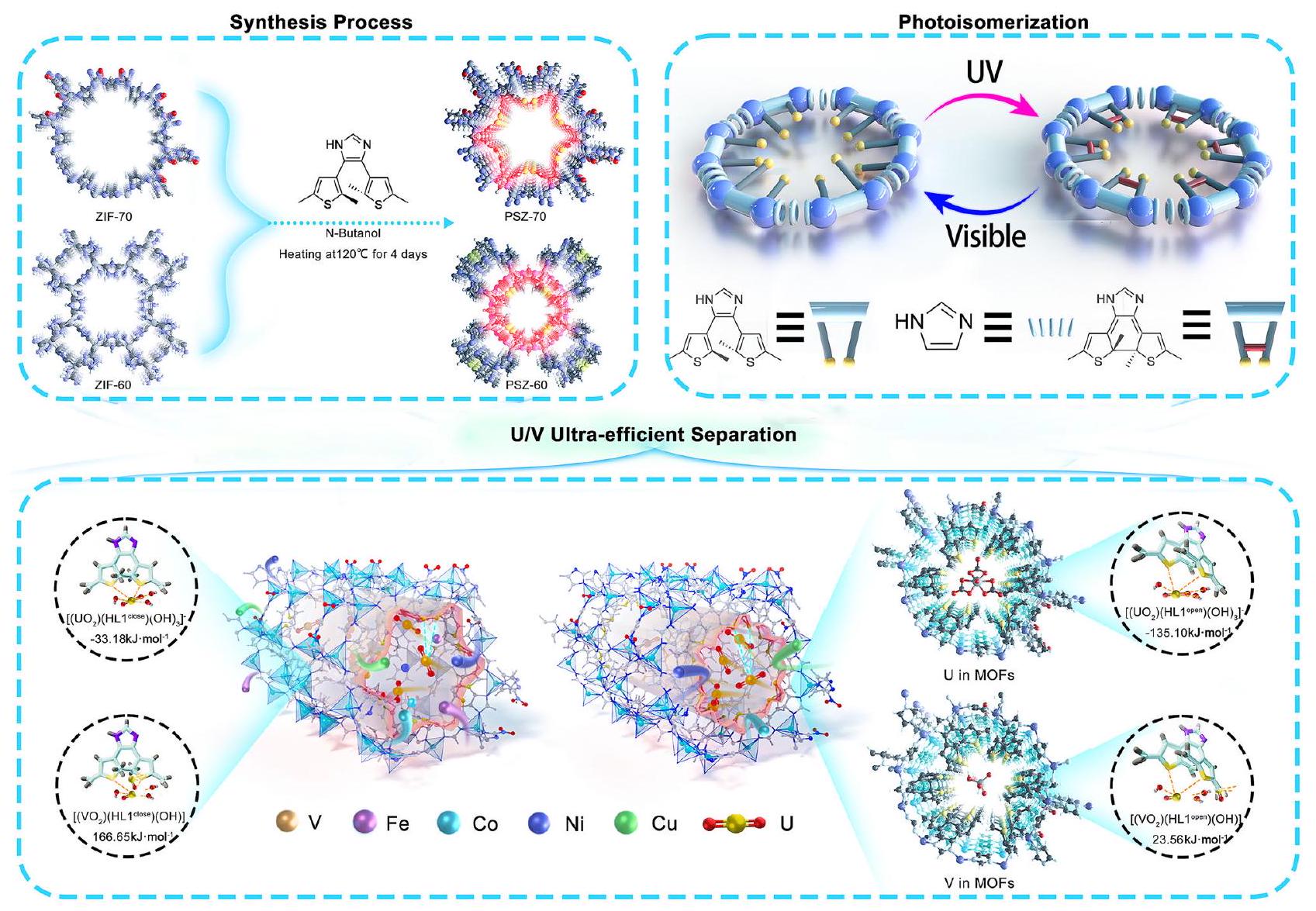
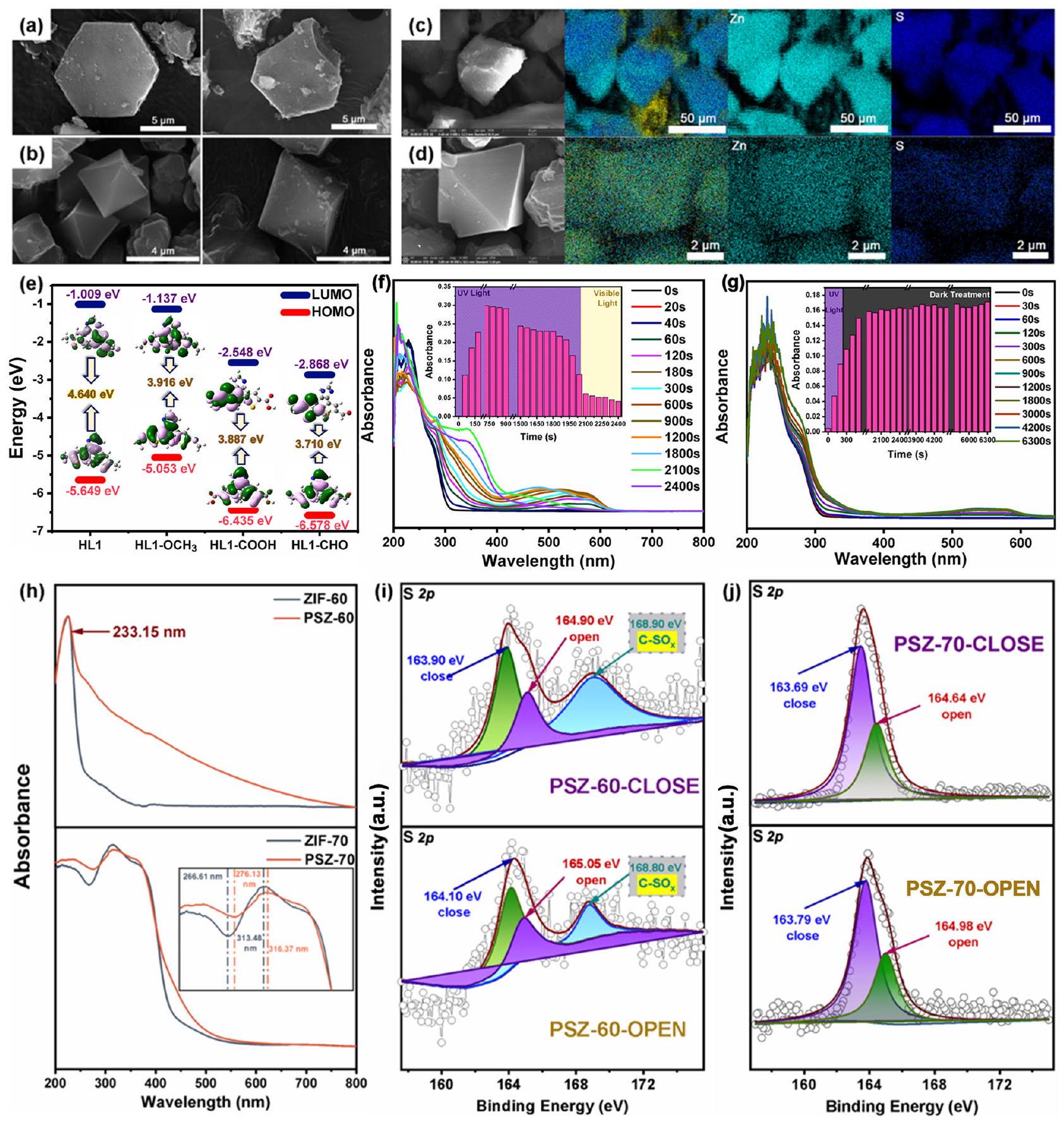
تم توضيح هيكل الأطر المدمجة مع المحولات الضوئية، وعملية التحويل الضوئي، والتنسيق المكاني المقيد للمواد المقترحة في الشكل 1. تُظهر الأشكال 2a و2b والأشكال التكميلية 2-5 أشكال ZIF-70 وZIF-60 قبل وبعد تحميل المحولات الضوئية، على التوالي. لم تُظهر الهياكل الهرمية الكبيرة للموادين أي تغييرات واضحة بعد معالجة حرارية طويلة الأمد مع المذيبات العضوية بسبب الاستقرار الحراري الممتاز للمواد.؛ ومع ذلك، ظهرت عدد معين من الهياكل التداخلية اللاملارية على أسطح المواد. كانت هذه الهياكل متوافقة مع شكل هياكل HL1 (4،5-ثنائي(2،5-ثنائي الميثيل-3-ثينيل)-1H-إيميدازول) التي تشكلت عبر التجميع الذاتي (الشكل التكميلي 1) وتم دمجها بنجاح في المواد. بالإضافة إلى ذلك، كشفت تحليل خريطة العناصر أن الكبريت الموجود في مجموعات الثيوفين الوظيفية لمفاتيح HL1 كان موزعًا بشكل موحد على أسطح المادتين (الشكل 2ج، د)، وكان هناك ارتباط قوي بين اتجاه التوزيع وذرات الزنك التي تعمل كنقاط معدنية، مما يشير إلى حدوث ارتباط مستقر بين العناصر الهيكلية التي تشكل مواد MOFs، وهو أيضًا أحد العناصر في بناء البيئة الدقيقة للتنسيق داخل الإطار. مقارنة التغيرات في المساحات الكلية للقمم المميزة في الرنين المغناطيسي النووي (NMR)تم تحديد أن معدلات التثبيت للمواد المركبة من MOFs الضوئية (Photoswitch-ZIFs، أي PSZ-60 و PSZ-70) من خلال طيف الرنين المغناطيسي النووي (الرسوم التوضيحية التكميلية 6-10) وصلت إلى (PSZ-70) و (PSZ-60). كوحدة وظيفية في المادة، على الرغم من أن HL1 تظهر سلوكها الضوئي الكيميائي، لا يمكن تجاهل عملية تنسيق ذرات الكبريت مع اليورانيوم في الجزيء أيضًا. والأهم من ذلك، بالنسبة لـ PSZ-70 و PSZ-60، ستؤثر نسبة الكبريت الموجودة بشكل مباشر على أداء المادتين من حيث قدرة امتصاص اليورانيوم.بالنظر إلى الاختلافات في تكوينات البلورات، تم الاستنتاج أن هذا التباين ناتج بشكل رئيسي عن الفرق في حجم قطر النافذة. ) وقطر الفتحة ( )، مما يؤدي إلى فشل التبادل في بعض نقاط التقاء الإيميدازول غير المعادلة خلال عملية تبادل الليغاند المدعوم بالمذيب (SALE). للنظر في الاستقرار الحراري لعملية التثبيت بين المادتين، قمنا باختبار معدل التثبيت لـ HL1 داخل المادتين في نقاط زمنية مختلفة من درجة حرارة تبادل الحرارة الحالية، كما هو موضح في الشكل التكميلي 11. من الواضح أن معدل التثبيت لا يتحسن بشكل ملحوظ مع وقت تبادل الليغاند بعد 4 أيام، بل له تأثير سلبي ضعيف على الاستقرار الحراري للمواد نفسها. أنماط XRD (حيود الأشعة السينية) لهذه المادتين من MOFs ونظائرها المعدلة المقابلة موضحة في الشكل التكميلي 12. يحتوي إيميدازول الإستر من الزيوليت، وهو هيكل هيدروفوبي نموذجي، على درجة كبيرة من المقاومة المكانية.. لذلك، أضاف حلقتا الثيوفين في HL1 تأثيرات حجمية إلى مجموعة الإيميدازول المرتبطة بعقدة المعدن، مما أدى إلى أن تكون بلورية PSZ-70، كما هو موضح في الشكل، أفضل من
الشكل 1 | بناء إطار مادة ضوئية مركبة وشرح لعملية استخراج اليورانيوم الانتقائية. عملية التخليق قسم تطعيم المونومرات القابلة للتصوير الضوئي في ZIF-60 و ZIF-70. قسم التصوير الضوئي الاستجابة الضوئية للتحول المركب MOFs المعزولة ضوئيًا. قسم الفصل الفائق الكفاءة U/V التعرف التفاضلي والفصل لـ و عن طريق مركبات MOFs المعزولة بالصور المركبة في نظام تداخل الأيونات المتعددة المعادن. ذلك من ZIF-70³8. ZIF-60 ( )، بحجم نصف ZIF-70 ( )، يمتلك عائقًا حجميًا أكبر وبالتالي يؤدي إلى انخفاض جزئي في شدة القمم ذات الزاوية المنخفضة وزيادة في الشدة النسبية للقمم ذات الزاوية العالية. كانت هذه التغيرات الطفيفة متوافقة أيضًا مع نتائج معدل التثبيت التي تم الإشارة إليها في السابق طيف الرنين المغناطيسي النووي.
قبل متابعة أي تحقيق إضافي، حصلنا على طيف تحت الأحمر نظري (الشكل التكميلي 13) من خلال نمذجة وتحسين التركيب الكيميائي لوحدة الفوتوإيزومر HL1 باستخدام برنامج Gaussian 16. عرض الطيف التجريبي للمنتج المُركب قمم امتصاص عند، و (المنطقة الحمراء في الشكل التوضيحي 14)، والتي تتماشى مع القيم النظرية وتؤكد الهيكل الكيميائي المميز للمنتج المصمم. علاوة على ذلك، قمنا بـتم إجراء اختبارات امتصاص الغاز على مواد MOFs قبل وبعد ربط مفتاح HL1 الضوئي، والنتائج المقابلة موضحة في الشكل التكميلي 15. مع مساحة سطح محددة أكبر، يمتلك ZIF-70 مواقع نشطة جوهرية أكثر من ZIF-60.كما يتضح من الانخفاض في المساحة السطحية المحددة لمركبات MOFs القابلة للتفاعل بعد ربط مفتاح الضوء، فإن حجم وحدة التحويل الضوئي المقدمة بناءً على نفس تبادل الليجند يعكس بشكل غير مباشر ميزة ZIF-70 على ZIF-60 من حيث حجم المسام وعدد المسام الهيكلية الفعالة، وهو ما تم الإشارة إليه أيضًا في نتائج التوصيف ذات الصلة المذكورة أعلاه.
دراسات سلوك الفوتوكيمياء
تم الحصول على المدارات الجزيئية لعدد من DAEs ذات هيكل قابل للمقارنة مع هيكل HL1 من خلال نظرية الكثافة الوظيفية (DFT) تمت المحاكاة باستخدام حزمة Gaussian 16 (الشكل 2e). الفرق في الطاقة بين أعلى مدار جزيئي مشغول (HOMO) وأدنى مدار جزيئي غير مشغول (LUMO) يحدد النطاق البصري لجزيء.وفقًا لنظرية الكم في الكيمياء الضوئية الجزيئية، فإن هناك نظام الاقتران يزيد من عدد المدارات الجزيئية المترابطة ويعزز درجة تفكك π، ويمكن لمجموعة الميثيل في نهاية سلسلة الجانبية لحلقة الثيوفين أن توسع نطاق الامتصاص الضوئي لجزيئات DAE من خلال تأثيرها المانح للإلكترونات لتعزيز كفاءة تبديل التدوير.لذلك، استخدمنا مطيافية الأشعة فوق البنفسجية-المرئية (UV-Vis) لتقييم الخصائص البصرية للبوليمر القابل للتبديل HL1 المذاب في الميثانول (الشكل 2f). عرض طيف HL1 درجات متفاوتة من الامتصاص عند 285 و340 نانومتر و545 نانومتر خلال 10 دقائق، وخلال هذه الفترة، تغير لون المحلول تدريجياً من الأرجواني إلى القرمزي، والذي افترض أنه يدل على تغيير من التكوين المفتوح إلى التكوين المغلق عند التعرض للأشعة فوق البنفسجية.. بالإضافة إلى ذلك، تلاشى اللون الأحمر بسرعة إلى لون أصفر فاتح يكاد يكون غير قابل للاكتشاف عندما تم تغيير مصدر الإشعاع إلى الضوء المرئي عند طول موجي قدره 515 نانومتر (الشكل التكميلي 16)زيادة ونقصان في نطاقات الامتصاص فيفي طيف مشتقات سلسلة DAE تم نسبها إلى عملية دورة التحويل الضوئي المقابلة.. لذلك، استنادًا إلى النتائج المذكورة أعلاه، قمنا بمراقبة التغيرات في الامتصاص عند 545 نانومتر مع مرور الوقت ولاحظنا اتجاه تقلب واضح يتوافق مع انتقال تكويني مفتوح-مغلق واحد لجزيء مفتاح الضوء HL1. لاستكشاف ما إذا كان يمكن لجزيء HL1 الحفاظ على حالته المغلقة لفترة طويلة، تم قياس التغير في الامتصاص لـ
الشكل 2 | توصيف الخصائص الفيزيائية والكيميائية للمواد. أ صور SEM لـ ZIF-70 (يسار) و PSZ-70 (يمين). ب ZIF-60 (يسار) و PSZ-60 (يمين). ج، د صور SEM وتحليل EDX (C(أصفر)، N(أخضر)، O(أحمر)، Zn(تركوازي)، S(أزرق داكن)، الرسوم الفرعية من اليسار إلى اليمين هي تركيبة جميع العناصر، Zn و S، على التوالي) لـ PSZ-70 (أعلى) و PSZ-60 (أسفل). هـ مخطط المدارات الجزيئية لـ HL1 والمشتقات الجزئية المقابلة.امتصاص HL1 في محلول ميثانول في نطاق الطول الموجيتحت ظروف مصدر ضوء التحويل UV-visible (يسار) وظروف الظلام UV (يمين) (تظهر الأشكال المرفقة في كل من 2 ف و 2 ج تغيير الامتصاصية للمحلول المثبت عند 545 نانومتر، على التوالي).تحليل DRS لـ ZIF-70 و ZIF-60 و PSZ-70 و PSZ-60 (تظهر الرسوم البيانية العلوية و
السفلية تغير الامتصاص في نطاق قبل وبعد تطعيم الفوتوسويتش مع ZIF-60 و ZIF-70، على التوالي؛ الشكل المضمن في الرسم البياني السفلي هو عرض مكبر للطيف في نطاق تحليل XPS لعملية الانتقال التكويني المفتوح/المغلق لـ PSZ-60 (تظهر الرسوم البيانية العلوية والسفلية تغيرات طاقة الربط لقمم الانقسام في طيف PSZ-60 في الحالة المفتوحة والمغلقة بعد التحويل الضوئي).تحليل XPS لعملية الانتقال التكويني المفتوح/المغلق لـ PSZ-70 (تظهر الرسوم البيانية العلوية والسفلية تغيرات طاقة الربط لقمم الانقسام في طيف PSZ-70 في الحالة المفتوحة والمغلقة بعد التحويل الضوئي).
تمت دراسة HL1 عند 545 نانومتر في الظلام بعد إزالة مصدر الضوء بعد 10 دقائق من الإشعاع فوق البنفسجي (الشكل 2g). كما هو متوقع، زاد تغير الامتصاص خلال أول 10 دقائق من التعرض للأشعة فوق البنفسجية تدريجياً، مما يشير إلى أن نسبة الهيكل المغلق في النظام المختلط زادت بشكل مطرد خلال هذا الوقت. بعد فترة طويلة في
الظلام، لم يتغير الامتصاص عند 545 نانومتر بشكل ملحوظ. لذلك، يمكن أن تتحكم التعديلات الاصطناعية في وقت الإشعاع بدقة في عملية تبديل الفوتوسويتش لجزيئات DAE لتحقيق الحالة المغلقة المناسبة والحفاظ على هذه الحالة لفترة طويلة دون تدخل من مصادر الضوء الخارجية.
تم تحليل أنماط امتصاص الضوء للركيزتين ومنتجات التعديل القابلة للتبديل بالضوء المقابلة في نطاق الطول الموجي لـ باستخدام مطيافية الانعكاس المنتشر (DRS) (الشكل 2h). زاد تطعيم مونومر HL1 بشكل كبير من الامتصاص في نطاق لـ ZIF-60، الذي كان لديه تقريباً عدم امتصاص في المنطقة المرئية. لذلك، كانت قدرة المواد المركبة على تعديل امتصاص الضوء تقريباً بالكامل بسبب تبديل الضوء لجزيئات ذات استجابات فوتوكيميائية واسعة . بسبب نسبة التطعيم الأعلى، تم ملاحظة مثل هذا التغيير أيضاً في ZIF-70 و PSZ-70. ومن الجدير بالذكر أن الخصائص القوية لامتصاص الأشعة فوق البنفسجية لسلسلة مواد ZIFs لم تتأثر على الرغم من عملية تبادل اللجند الطويلة التي تحدث في جو محلول عضوي عالي الحرارة . بالإضافة إلى ذلك، أظهر طيف DRS لامتصاص PSZ-70 مقابل الوقت تحت نفس ظروف الإشعاع فوق البنفسجي تغيرات ارتفاع وانخفاض مماثلة لتلك الخاصة بالمونومر (الشكل التكميلي 17)، مما يشير إلى أن عملية SALE لم تؤثر على نشاط تبديل الضوء. اقترحت هذه الهيمنة على الركيزة إمكانية التحويلات المتناغمة للإيزوميرات من خلال النظر في كينتيك التدوير السريع المغلق السابق عند التعرض للأشعة فوق البنفسجية لمونومرات HL1.
استنادًا إلى تحليل طيف S في مطيافية الإلكترون الضوئي بالأشعة السينية (XPS) لـ PSZ-70، فإن القمة التي لها طاقة ربط تبلغ 163.79 eV تعتبر عادةً مؤشراً على وجود هيكل مغلق بين حلقات الثيوفين، بينما المجموعة الأخرى من قمم المكونات الموجودة عند 164.98 eV تتوافق مع الشكل المفتوح (الشكل 2i) . استنادًا إلى الهيكل الكيميائي الفريد لجزيء DAE، ليس من الصعب فهم الفرق بين طاقة الربط في حالتين إيزوميريتين، أي أن السبب الكامن يأتي من وجود أو عدم وجود العطرية في كلا الحالتين . في حالة الفوتوسويتش المغلقة، يفقد DAE عطرته الجوهرية، مما يفضل تزاوجًا أوسع للإلكترونات في جميع أنحاء الجزيء، وهذا إعادة الترتيب تحدد أيضًا الموقع النهائي وشكل القمة لإشارة القمة المنقسمة. ومع ذلك، بشكل غير عادي، في طيف PSZ-60، بالإضافة إلى ظهور قمتين مشابهتين للانقسام مقارنة بـ PSZ-70، تظهر قمة انقسام جديدة S مع طاقة ربط قريبة من 169 eV (الشكل 2j). يُعتقد عمومًا أن القمم الأوسع مثل القمم المذكورة أعلاه التي تتركز عند 168-169 eV تُعزى إلى تكوين أو تحويل منتجات أكسدة الكبريت العنصري، وبشكل أكثر تحديدًا إلى توليد ذرات الكبريت المعزولة أو الثيولات بسبب إشعاع الأشعة السينية . بالمقارنة مع جزيئات DAE المحملة في مواد الركيزة ZIFs ذات أحجام المسام المختلفة، فإن السبب مرتبط بإمكانية كسر روابط C-S-C في الثيوفين تحت نفس ظروف الاختبار. تؤثر استقرار MOFs نفسها، كعناصر مدمجة في إطار المادة في شكل استبدالات موصلية متطابقة، على قوة روابط اللجند هناك . أما بالنسبة للمكونات المختلفة الوحيدة في مادتين الركيزة، 2-نيتروإيميدازول و 2-ميثيلإيميدازول، فإن مجموعة النيترو ذات التأثير القوي في جذب الإلكترونات الموجودة في 2-نيتروإيميدازول يمكن أن تقلل بشكل فعال من كثافة الإلكترونات الزائدة في النظام بعد تطعيم DAE، مما يوفر استقرارًا أقوى للإطار . على العكس من ذلك، فإن مجموعة الميثيل ذات التأثير المانح للإلكترونات تزيد من القوة الطاردة بين الإلكترونات، مما يجعل الروابط الكيميائية في الإطار أكثر عرضة للكسر ، وزيادة مساحة قمة انقسام أكسيد الكبريت للحالة المغلقة هي أيضًا دليل قوي على هذا التحليل.
سلوك تصحيح الأيونات في محاكاة مجالات COMSOL متعددة الفيزياء
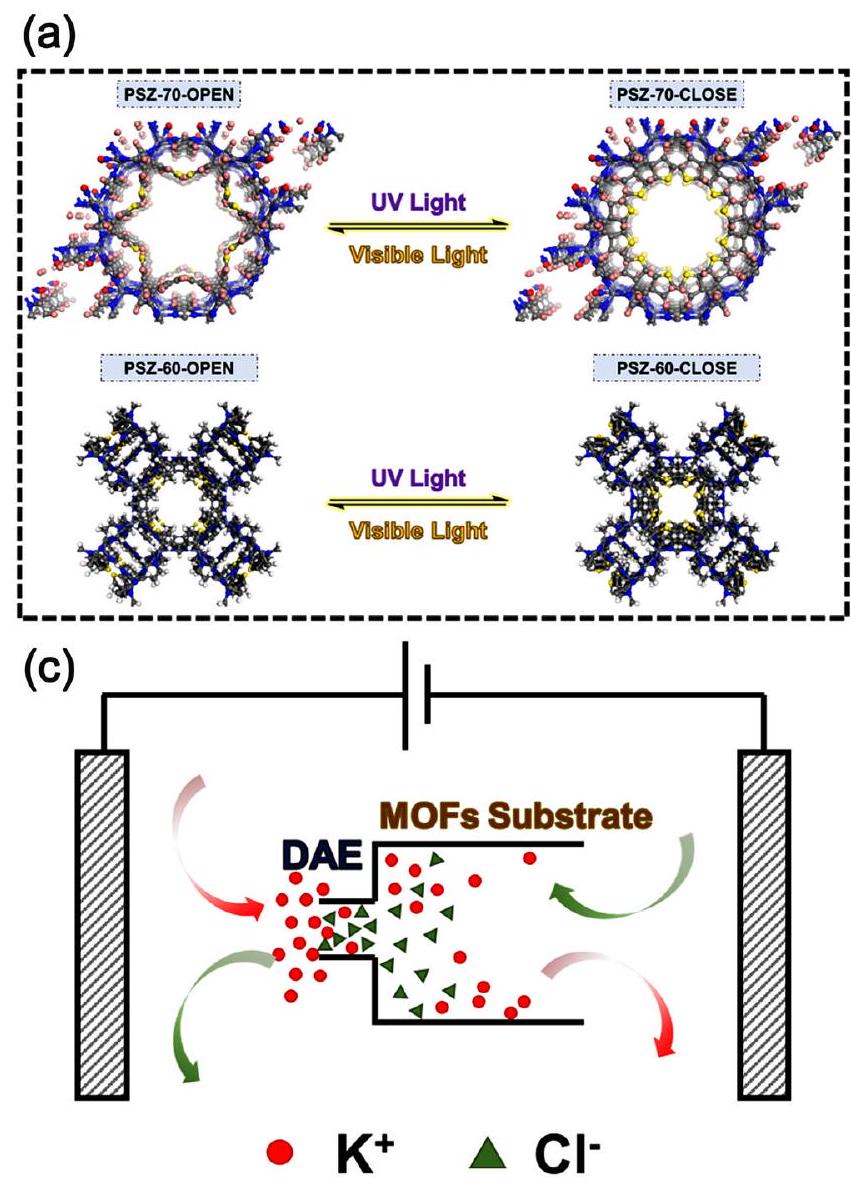
تمت دراسة قدرة تصحيح البوابة لمركبات التحويل الضوئي من خلال تطوير نموذج نظري باستخدام برنامج COMSOL Multiphysics 6.0. يوضح الشكل 3a التغيرات التفاضلية داخل قناة المسام لمادتين مركبتين تم تحويلهما ضوئيًا في حالة الإيزوميرية الثنائية المستقرة، والتي تخدم بشكل أساسي لتقديم هذا الاختلاف التكويني لتصور نموذج
البناء، والهياكل الهندسية في حالات التشغيل والإيقاف التي تم نمذجتها في الشكل 3b. بالإضافة إلى ذلك، تم تطبيق معادلة بواسون-نيرنست-بلانك لحل مشكلة نقل الأيونات في المجالات الكهربائية ونقل المادة المخففة عند واجهات الحقول الفيزيائية. تم إنشاء تعبيرات التدفق المستقلة عن الزمن حيث كانت جميع العمليات المعنية عمليات مستقرة. تم تلخيص الشروط الحدودية ذات الصلة وإعدادات المعلمات في المعلومات التكميلية (الجدول التكميلي 1 و 2) .
يوضح الشكل 3c و d سلوك أيونات محلول الإلكتروليت المهاجرة داخل قناة المسام لمادة التحويل الضوئي كما تحركها حقل كهربائي. تم دراسة سلوك تصحيح الأيونات لقنوات النانو المسامية عند و (الأشكال التكميلية 18، 19)، وتم تكوين كثافة الشحنة على سطح DAE كإيجابية في الظروف الحمضية وسلبية في الظروف القلوية. ومن الجدير بالذكر أن هناك ارتباطًا كبيرًا بين الخصائص الكهربائية لكثافة الشحنة على سطح قناة النانو المسامية والحقول الكهربائية الخارجية المطبقة الإيجابية والسلبية في بيئات المحاليل الحمضية والقلوية المختلفة. عندما كانت الخصائص الكهربائية متكافئة، كانت تدفق الأيونات داخل المسام أقل من ذلك في محاكاة الخلية الكهربية، وعندما كان العكس صحيحًا، كانت غنية الأيونات داخل المسام أكبر، وهو ظاهرة يمكن أن تُعزى إلى العمل الكهروستاتيكي. تم تجميع الأيونات ذات المجال الكهربائي المعاكس في الجدار الداخلي للمسام في الظروف القلوية؛ على سبيل المثال، وفقًا لنظرية الطبقة المزدوجة الانتشارية، تم توزيع الأيونات ذات المجال الكهربائي المماثل بشكل منتشر داخل المسام، مما أدى إلى توليد قوة مجال كهربائي إضافية مع زيادة كثافة الشحنة المحلية، مما زاد من حركة السباحة. لوحظ أن تراكم تدفق الأيونات قد زاد. من ناحية أخرى، كان سلوك هجرة الأيونات داخل قنوات النانو المسامية مدفوعًا بشكل أساسي بتغيرات الشحنة السطحية عندما كانت كثافة شحنة سطح المسام معاكسة للمجال الكهربائي الخارجي. زاد عدد الأيونات ذات الخصائص الكهربائية المعاكسة مع كثافة شحنة سطح قناة النانو المسامية، وزادت سمك الطبقة الممتصة بشكل متساوٍ. انخفض التوتر السطحي مع زيادة القوة الطاردة بين الشحنات المتجانسة. وهذا بدوره زاد من تدفق الأيونات الحرة المقابل وأدى إلى تراكم منخفض نسبيًا على الجدار الداخلي لقناة المسام.
تظهر الشكل التكميلية 20 تقلبات تدفق الأيونات للمواد التي تم تحويلها ضوئيًا في الحالات المفتوحة والمغلقة، على التوالي. عندما كانت وضعيتي الهجرة تحملان نفس الجهد وكثافة الشحنة السطحية، لم يكن هناك فرق كبير بينهما بشكل عام، ولكن كان هناك فرق كبير في السلوك عند تقاطع واجهة الصلبة والسائلة المحددة مسبقًا وداخل قناة المسام المركبة. توضح الشكل 3ب أن التعديل الذاتي لهيكل إغلاق نموذج هندسة المفتاح الضوئي أدى إلى تقليل نسبي في حجم مسام القناة (باللون الأصفر). بالإضافة إلى ذلك، أثر هيكل المسام غير المتماثل طوليًا على ميل القيمة المطلقة لتيار الأيونات للتغير مع تدرج الجهد.. كانت الطبقة الثنائية المنتشرة في هذه الحالة أقرب إلى أو حتى أوسع من حجم المسام للطبقة الممتصة وأظهرت قدرة أكثر وضوحًا على تصحيح الأيونات مقارنةً بحالة الفتح للضوء. لذلك، سمح إدخال مفاتيح DAE الضوئية بضبط دقيق لقنوات المسام التي تهاجر من خلالها الأيونات، مما كان دليلاً على القدرة على التصحيح المحكم.
سلوك امتصاص اليورانيوم
تم إجراء اختبارات الامتزاز استنادًا إلى نظام مياه البحر المحاكي (الشكل التوضيحي 21).قبل إجراء دراسات الامتزاز التفصيلية، تم تقييم استقرار مادتين ركيزتين عبر مجموعة من حموضة وقلوية المحلول (الشكل التوضيحي 22). أظهر نسبة ذوبان Zn(II) عدم تحمل مواد MOFs ذات الهياكل الأساسية المستندة إلى الإيميدازوليوم لمثل هذه الظروف. من ناحية أخرى، فإن الاستقرار الاستثنائي الذي أظهرته كلا المادتين في البيئات القلوية الضعيفة إلى القلوية يشكل الأساس و
الشكل 3 | نمذجة العناصر المحدودة ومحاكاة انتقال الكتلة لمركبات الإطار المعدني العضوي التي تم تحويلها ضوئيًا. أ رسم تخطيطي للانتقال التوافقي النظري المفتوح/المغلق لـ PSZ-70 و PSZ-60. ب محاكاة هيكل المادة المركبة في برنامج COMSOL في حالات الفتح والإغلاق للمفتاح الضوئي ((i) بناء نموذج محوري متماثل؛ (ii) النموذج الهندسي ثنائي الأبعاد لهيكل المسام عندما يكون المفتاح الضوئي في حالة الفتح؛ (iii) النموذج ثنائي-
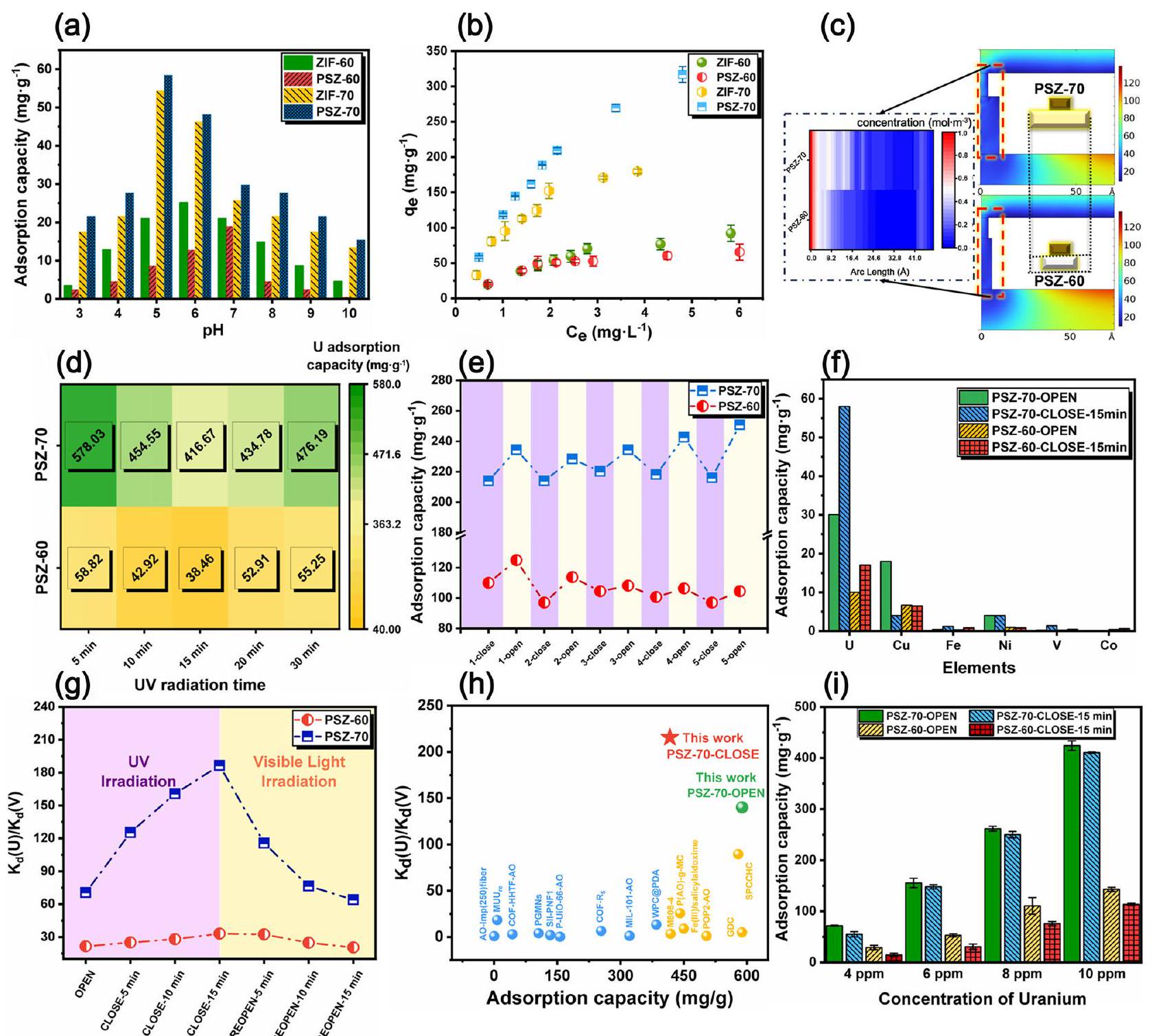
نموذج هندسي بعدي لهيكل المسام عندما يكون المفتاح الضوئي في حالة الإغلاق). ج توضيح لسلوك السباحة للأيونات في المركبات الضوئية المدفوعة بواسطة حقل كهربائي (معوكمثال). خريطة حرارية لتدفق التركيز لـفي النظام الذي تم محاكاته تجريبيًا في حالة الفتح لمفتاح الصور. شرط أساسي حاسم للتحقيق في سلوك الامتزاز والفصل للمواد في الدراسات اللاحقة. كما هو موضح في الشكل 4أ، عندما زاد الرقم الهيدروجيني من 3 إلى 5، زادت سعة الامتزاز للمادة بشكل ملحوظ. من ناحية، كان هذا الزيادة ناتجة بشكل رئيسي عن زيادة نسبة محتوى الأنواع الهيدروكسيدية متعددة النوى المشحونة إيجابياً لليورانيوم، مثل، و ، مما قلل من محتوى الشحنة الصافية بين الممتز والممتز عليه وبالتالي أدى إلى ضعف تأثير التنافر. من ناحية أخرى، تم تعزيز قدرة التنسيق الخلوي بين اليورانيوم ومجموعة الإيميدازول المؤينة في الهيكل الجزيئي للمادة، مما حسن من قدرة الامتزاز.. عندما كان نظام الحل في بيئة قلوية ضعيفة عند كانت الشحنة السطحية للمادة المذكورة أعلاه سالبة، وكانت نسبة الأنواع المشحونة سلبياً من اليورانيوم مشابهة لتلك الخاصة بـو. بالإضافة إلى ذلك، زادت نسبة هذه الأنواع مع زيادة الرقم الهيدروجيني، مما أدى إلى زيادة في التنافر الكهروستاتيكي خلال عملية الامتزاز. وقد انخفضت سعة الامتزاز بشكل ملحوظ، مما يشير إلى أن التفاعل الرابط بين المجموعات الوظيفية وأنواع اليورانيوم الممتزّة لم يهيمن على مسار سعة الامتزاز للمادة في هذه العملية.
تم إنشاء وتناسب خطوط الامتزاز لـ ZIF-70 و ZIF-60 كمواد ركيزة ومشتقاتها المعزولة ضوئيًا المقابلة باستخدام نماذج لانغموير وفرويدليش. (الشكل 4ب والجدول التكميلي 3). وصلت سعات امتصاص اليورانيوم إلى (ZIF-70) و (ZIF-60)، على التوالي، مع الحفاظ على القدرة الجيدة على الامتزاز لسلسلة مواد MOFsومع ذلك، مع إدخال مفاتيح الصور، زادت قدرة الامتصاص لـ PSZ-70 بينما انخفضت قدرة الامتصاص لـ PSZ-60. دون النظر في تأثير معدل التعديل أو عوامل أخرى على الممتص نفسه، فإن المفتاح لتحديد الفرق في سعة الامتصاص هو تدفق المادة الممتصة في المسام المختلفة. للتحقق من هذه الفرضية، قمنا بضبط الركيزة بنسب متساوية وفقًا للاختلاف في أحجام المسام بين ZIF-70 و ZIF-60 استنادًا إلى المحاكاة السابقة وفحصنا سلوك نقل الأيونات الناتج عن المجالات الكهربائية في الأقسام الفرعية (الشكل 4c). باستخدام خط الاعتراض ثنائي الأبعاد الذي تم إنشاؤه سابقًا داخل الفتحة كنظام مرجعي، وُجد أن تدفق الأيونات انخفض بشكل حاد مع زيادة المسافة داخل PSZ-60 مقارنةً بـ PSZ-70. إن توسيع هذه الظاهرة إلى عملية الامتصاص الفعلية أشار إلى أن إدخال مفتاح الصور HL1 بدلاً من ذلك أعاق دخول أنواع اليورانيوم إلى داخل مسام ZIF-60، والذي تم تصوره على أنه انخفاض في قدرة الامتصاص للمادة.
كما هو موضح في الشكل 4d والشكل التكميلي 23، تحت نفس ظروف الإشعاع فوق البنفسجي، اختلفت السعة القصوى لامتصاص المركبين المتحولين ضوئيًا بالنسبة لوقت الإشعاع. كانت وحدة الإيميدازول في المونومر HL1 في حالة الحلقة المفتوحة تتضمن ستةتم تشكيل قاعدة شيف غير عطرية عندما
الشكل 4 | امتصاص وفصل اليورانيوم بواسطة المواد العضوية المعدنية المركبة المعاد تشكيلها بالضوء. أ تغير في السعة القصوى للامتصاص مع الرقم الهيدروجيني لـ ZIF-70 و PSZ-70 و ZIF-60 و PSZ-60.إيزوثيرم الامتصاص لمركبين من MOFs وموادهم المركبة الضوئية المتناظرة المقابلة عند 298 كلفن. ج. تصور حركة الأيونات من خلال أحجام المسام المختلفة لمركبات MOFs. د. مقارنة السعة القصوى لامتصاص اليورانيوم من خلال عملية التحويل الضوئي لـ PSZ-70 و PSZ-60. هـ. اختبار إجهاد التحويل الضوئي تحت دورات التعرض المتناوبة للأشعة فوق البنفسجية والمرئية (اللون الأرجواني يشير إلى قياسات الامتصاص تحت إشعاع الأشعة فوق البنفسجية، واللون الأصفر يشير إلى قياسات الامتصاص تحت إشعاع الضوء المرئي، وعرض الأشرطة لا يرتبط بمدة القياس. الرقم القريب يشير إلى عدد المرات التي كان فيها المفتاح الضوئي في الحالة المغلقة خلال اختبار الخمس دورات (أي، كان المفتاح الضوئي في الحالة المغلقة لـ المرّة nthوصف هذه الحالة ينطبق أيضًا على الحالة المفتوحة). فاختيار الامتزاز لـ PSZ-70 و PSZ-60 مع حالاتهما المتساوية المفتوحة/المغلقة لبعض الكاتيونات المعدنية في أنظمة مياه البحر المحاكاة.اختبار قابلية فصل اليورانيوم والفاناديوم من خلال التحويل المتزامن القابل للعكس تحت تأثير الضوء. مقارنة بين السعات القصوى للاحتجاز ونسب فصل U(VI)/V(V) لمواد الإطار العضوي المعدني التي تم تحويلها ضوئيًا مع مواد الامتصاص في بعض الأنظمة التجريبية المماثلة. قدرات الامتصاص لـ PSZ-70 و PSZ-60 في التكوينات المفتوحة والمغلقة بالكامل في مياه البحر الطبيعية مع ارتفاعات اليورانيوم. تمثل أشرطة الخطأ في الشكل 4b و i الانحرافات المعيارية (SD) المحسوبة من ثلاث تجارب مكررة مستقلة لكل نقطة بيانات، وتم حساب SD لتعكس تباين القياسات.
أدى الإشعاع فوق البنفسجي إلى إغلاق وتدوير مدارات الإلكترونات الخاصة به. لذلك، افترضنا أن السبب الرئيسي للظاهرة الملحوظة كان مرتبطًا بتغيير الخصائص الحساسة للضوء للمونومر الضوئي، مما يفسر الهسترس في درجة الإغلاق بالنسبة لتلك الخاصة بالمونومر كما يتضح من التغيير في السعة القصوى للامتصاص. كانت جزيئات DAE ذات خصائص امتصاص ضوئي فريدة، وكان التغيير الناتج في الحساسية الضوئية ناتجًا بشكل رئيسي عن تغيير في بنية تزاوج الإلكترونات. وبالمثل، في بيئة مقيدة مثل تلك الخاصة بالمواد الإطارية المعدنية العضوية (MOFs) المحددة بواسطة طوبولوجيا الإطار، كانت العملية الحركية لـ كانت تفاعل التدوير لوحدة التحويل الضوئي محكومة بعدة عوامل، حيث استنتج ويليامز وآخرون أن معدل التحويل الضوئي كان دالة على طوبولوجيا الإطار..
استنادًا إلى فرضية وجود تأخير زمني في عملية التحويل الضوئي للـ DAE في الإطار مقارنةً بتلك الخاصة بالوحيد، فإن التغيرات في قدرة الامتصاص للمركبات تنبع من نقل الكتلة الأيونية وعمليات التنسيق في قنوات المسام. وفقًا لنتائج النمذجة، مع عملية التحويل الضوئي للـ DAE، تقلص حجم مسام الـ MOFs أكثر، مما خلق ظروفًا غير مواتية لدخول أيونات الامتصاص الضيفية. الإطار. بالإضافة إلى ذلك، مقارنةً بالتكوين الأولي لتبديل الصور، زادت درجة الترافق لجزيئات DAE تدريجياً تحت إشعاع UV، وتم متوسط الإلكترونات الموجودة في ذرات الكبريت التي تخضع للتنسيق مع أنواع اليورانيوم في جميع أنحاء النظام، مما أدى إلى انخفاض قدرة ارتباط جزيئات DAE مع اليورانيوم.بالإضافة إلى التغييرات المذكورة أعلاه في خصائص المسام، أدى التأثير المشترك إلى انخفاض في قدرة الامتصاص لمركبات MOFs على اليورانيوم.
من الجدير بالذكر أنه مع التطبيق المستمر للإشعاع فوق البنفسجي، شهدت سعة الامتصاص لمادتين MOFs درجة معينة من التعافي. بالنظر إلى أن تفاعل فتح الحلقة لجزيئات DAE يمكن أن يتم فقط بواسطة الضوء المرئي، يمكن استبعاد تأثير عملية التحول التوافقي المعنية في هذه العملية على سلوك الامتصاص للمواد.بالنسبة لأنظمة تعليق المواد الماصة المعرضة للإشعاع فوق البنفسجي لفترات طويلة، يمكن لجزيئات الماء في المذيب أن تتفاعل مع جزيئات DAE في إطار MOFs من خلال شبكة من الروابط الهيدروجينية.وبذلك تزيد من مقطع امتصاصها وتجعلها أكثر عرضة للفقد بسبب الإشعاع فوق البنفسجيلذلك، وفقًا لعملية التغيير في سلوك الامتزاز العام المعكوس في الشكل 4d، ليس من الصعب معرفة أنه عندما يصل التبديل الضوئي تمامًا إلى التكوين المغلق، فإن الإشعاع المستمر للأشعة فوق البنفسجية يؤدي إلى تفكك جزء من جزيئات DAE، وستزداد هذه النسبة بشكل أكبر مع تمديد وقت الإشعاع، كما يظهر ظاهرة مشابهة في التحويل الضوئي للوحيدات (الجزء المرفق من الشكل 2f). بناءً على ذلك، يؤدي هذا إلى زيادة في منطقة النقل الفعال للكتلة في قناة المسام لمركبات MOFs، والتي تظهر كزيادة جديدة في سعة الامتزاز.
تظهر الشكل 4e التغير في السعة الامتصاصية لنفس دفعة من تعليقات المواد الماصة لنفس إيقاف التبديل الضوئي الناتج عن الإشعاع فوق البنفسجي وفتح الحلقة الناتج عن الضوء المرئي. بشكل عام، وفقًا لآلية الحلقة المغلقة الناتجة عن الأشعة فوق البنفسجية لـيمكن أن تؤدي التفاعلات الضوئية غير القابلة للعكس بين جزيئات متجانسة معينة في نظام الإلكترون في مركز DAE إلى التعب. استجابةً لهذه الظاهرة، تم استخدام طرق كيميائية على نطاق واسع للتوسع-أنظمة مترافقة وإضافة مجموعات ماصة للإلكترونات لتحسين مقاومة المواقع الفضائية، مما يقلل من إنتاج الأكسجين المفرد في مختلف نواتج الأكسدة أثناء تبديل الإشعاع، مما يؤدي إلى تحسين مقاومة التعب.في العمل الحالي، استنادًا إلى منظور إبطاء تجميع جزيئات DAE في المحلول المائي والظاهرة الناتجة عن الت quenching الذاتي، فإن وجود ZIFs الركيزة مع مقاومة الموقع المكاني الفطرية حمى جزيئات HL1 بشكل فعال، مما قلل من نسبة المنتجات الثانوية للتحول الأيزوميري خلال الاختبارات المذكورة أعلاه. علاوة على ذلك، فإن تأثير الدفع والسحب الإلكتروني في الطور السائل بين العقدة المعدنية الفقيرة بالإلكترونات ونهاية النيتروجين الغنية بالإلكترونات من حلقة البيريدين لجزيئات DAE منع بشكل فعال التعدد الذاتي لجزيئات DAE، مما أدى إلى إطالة عمرها الضوئي واستقرار المركبات وتوفير تغذية راجعة إيجابية للحفاظ على مقاومة التعب لمفاتيح الصور..
استخراج انتقائي لـ U(VI) يتم بوساطة عملية التحويل الضوئي
تظهر نتائج انتقائية الامتزاز للمواد المركبة في الشكل 4f والجدول التكميلي 4 للحالتين: المفتوحة تمامًا والمغلقة تمامًا. أظهرت قدرة كلا المادتين على فصل حالات الإيزومر الخاصة باليورانيوم بشكل انتقائي تباينًا كبيرًا في الأنظمة المعقدة التي تتواجد فيها عدة أيونات معدنية. ومن المRemarkable، أظهرت مركبات MOFs المركبة ضعف قدرة الامتزاز لليورانيوم في الحالة المفتوحة مقارنة بالحالة المغلقة. على الرغم من أنه قد يبدو منطقيًا الافتراض بأن هناك المزيد من المواقع النشطة للامتزاز في الحالة المفتوحة مقارنة بنظام اليورانيوم الفردي، إلا أن النحاس وأيونات التدخل الأخرى مرتبطة بالليغاندات في المواد، التي تعيق إلى حد ما امتصاص اليورانيوم. بالإضافة إلى ذلك، أظهر راشيل وآخرون أن تنسيق النحاس (II) مع مشتقات DAE بعد معالجة الأشعة فوق البنفسجية زاد بشكل كبير من كمية مكونات الروابط التساهمية في MOFs المركبة في الحالة المغلقة.لذا فإن الممتز يتمتع بتأثير العوامل المتزامنة لتعزيز التنسيق مع اليورانيوم، والتأثير المشترك هو أن المواد في الحالة المغلقة أكثر قدرة على التقاط اليورانيوم في نظام معقد. بالصدفة، استنادًا إلى المناقشة أعلاه حول قدرة الامتصاص للمواد، من منظور هيكل MOFs، في الحالة المغلقة، تم تحويل المساحة الداخلية الشبيهة بالقفص التي تحمل الممتص الضيف، مما أدى إلى توسع -سحابة الإلكترون للنظام المترافق، والتي زادت من احتمال التفاعل المتاح مع أيونات المعادن الضيفية التي تنتقل في قنوات المسام. وبالتالي، كانت MOFs أكثر احتمالاً للتنسيق مع أنواع اليورانيوم لتشكيل الهيكل الأكثر استقرارًا، مما يفسر امتصاصها الانتقائي الممتاز على MOFs في الحالة المغلقة.
مقارنةً بنظام ماص واحد، عندما يكون الجسم المعرض للإشعاع نظامًا متعدد المكونات، فإن حركيات التحويل الضوئي لتكوين المادة في أوقات مختلفة غير معروفة تمامًا. بالنظر إلى تأثير عملية الامتصاص، فإن التحويل بين الحلقة المفتوحة والمغلقة داخل جزيء المونومر HL1 يحدث بالضرورة بالتنسيق مع أنواع اليورانيوم والفاناديوم. إن التغير الأحادي في عامل الفصل U(VI)/V(V) عند الإشعاع بمصادر ضوء مختلفة والقدرة الأعلى على الفصل التي تم إثباتها في اختبارات الانتقائية السابقة، بينما تعكس التأثير الضار لامتصاص المادة على التحويل الضوئي، تؤكد أيضًا حدوث الفوتوديسوربشن عند مستوى معين (الشكل 4g).
الشكل 4 هـ يظهرعامل الفصل لمركبات الفوتوإيزومرية التي تم إنشاؤها في كلا الحالتين ويقارنها مع نتائج استخراج اليورانيوم المبلغ عنها تحت الظروف المقابلة (الجدول التكميلي 5 يسرد الظروف والبيانات ذات الصلة)بالنظر إلى تباين الأنظمة التجريبية، فإنكان عامل الفصل لمادة الإيزومرية الضوئية التي تم إنشاؤها هو الأعلى المسجل حتى الآن للتطبيقات في أنظمة مياه البحر المحاكية بسبب التأثير التآزري بين عملية التنسيق والقيود الهندسية الخاصة، مما يوضح فعالية استراتيجية الفصل الانتقائي لليورانيوم باستخدام وحدات التبديل الضوئي. تم التحقيق في القدرة على الاستخراج في مياه البحر الطبيعية مع اليورانيوم المضاف لتقييم جدوى وتطبيق تقنية امتصاص اليورانيوم بواسطة المواد الإيزومرية الضوئية في البيئات البحرية المعقدة (الشكل 4i).زادت السعات القصوى لامتصاص المركبات الضوئية المتمايزة مع زيادة تركيز الركيزة الممتصة في كل من الحالة المفتوحة تمامًا والحالة المغلقة تمامًا، مما يدل على الألفة القوية لهذه المواد لليورانيوم في البيئة الطبيعية. لذلك، من المعقول أن نستنتج أن الهياكل الإطارية المعدنية المحملة بمفاتيح ضوئية جزيئية HL1 يمكن أن تلبي الطلب على استخراج اليورانيوم تحت ظروف مواقع مياه البحر الحقيقية وتساهم بشكل أكبر في هدف إثراء اليورانيوم بكفاءة عالية وتكلفة منخفضة بسبب الميزة الفريدة للتحويل المتمايزي المعدل بالضوء.
حسابات DFT لتكوين الامتزاز
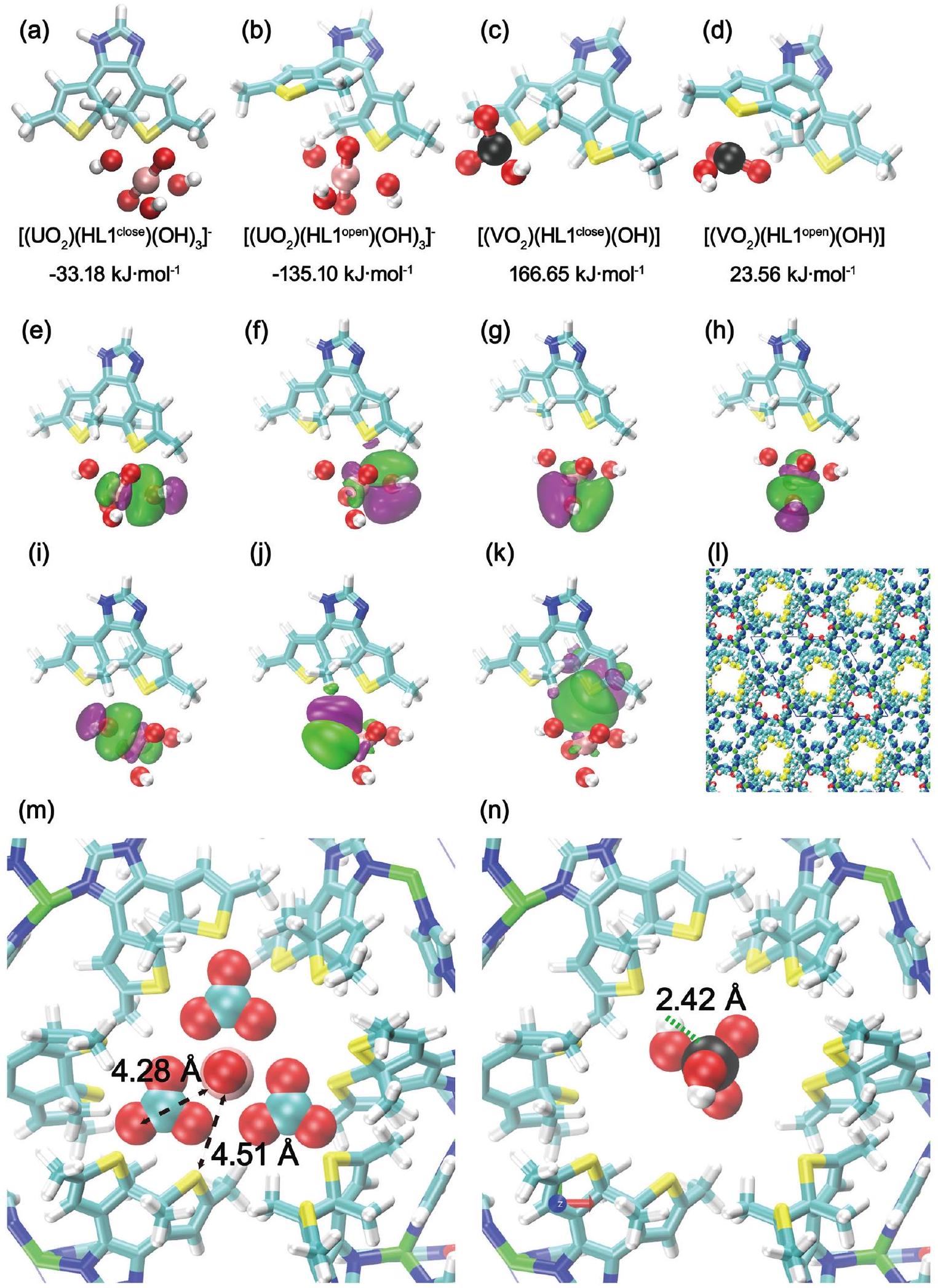
لتوفير فهم شامل لهيكل التنسيق ورابطة المعدن-الليغاند، بالإضافة إلى شرح الأسباب وراء السعة الأعلى لامتصاص اليورانيوم في PSZ-70 ) مقارنة بـ ZIF-70 ( )، السعة الأعلى لامتصاص اليورانيوم في الحالات المفتوحة من PSZ-70/PSZ-60 (588.24/ ) مقارنة بالدول القريبة ( تحقيق مستوى عالٍ SF لـ PSZ-70/PSZ-60، والأعلى تمت مقارنة SF للحالة المغلقة (215.28/33.45) مع الحالة المفتوحة (139.8/27.77)، قمنا بإجراء محاكاة DFT للمعقدات المكونة من HL 1 و (أو ). من الجدير بالذكر أنه، استنادًا إلى تحليل التغير في سعة الامتزاز لـ ZIF-60/PSZ-60 في الشكل 4ب، ج بسبب سعة نقل الكتلة المحدودة داخليًا، هناك قيود في استخدام DFT لأخذ سعة التنسيق HL1 لهذه المادة في الاعتبار بمفردها. في هذا الوقت، العلاقة العددية المنعكسة فييستخدم فقط لتقييم قدرة الربط لـ HL1 مع U(VI)/V(V). هناك عدة معقدات محتملة (الأشكال التكميلية 24-27)، كل منها بعدد مختلف من، و (أو تمت محاكاة ) وحدات، والمعقد الذي لديه أدنى طاقة ارتباط الليغاندتم تحديده كأكثر المركبات استقرارًا (الشكل 5a-k). على الرغم منوهي الأنيونات الأكثر وفرة في مياه البحر، ومعقداتها مع HL 1 وتظهر طاقات ارتباط أعلى بشكل ملحوظ (أكثر منأعلى فيمع حواجز طاقة أصغر بكثير،وتميل HL1 إلى تشكيل معقدات معبدلاً منو. لذلك، من منظور الطاقة، تأثير وقد تكون قدرة استخراج اليورانيوم من MOFs لدينا صغيرة نسبيًا.
كما يتضح من الشكل 5a و 5b، فإن كل من الحالة المغلقة والحالة المفتوحة لـ HL1 المنسقة إلىعبر 3 مجموعات هيدروكسيل، مكونة [( )(HL1) معقد. حيث أن اليورانيوم يوجد بشكل رئيسي في شكلفي مياه البحريمكن أن تحدث تفاعل التعقيد كما يلي:
أظهرت التحليلات الإضافية أن هناك سبعة روابط معدنية-رابطة (الشكل. ) كانوا حاضرين في معقد، مع ثلاثة روابط مزدوجة بين U و O منالمجموعات ورابطة واحدة بين U و S في الجزء HL1. يتم وصف تركيب كل رابطة في الجدول التكميلي 6. لقد استقرت الروابط السبعةمعقد، مما يجعل تفاعل التعقيد طاردًا للحرارة. على وجه التحديد،قيم منوكانوا و ، على التوالي. أظهرت الأبحاث السابقة المستندة إلى ثلاث تفاعلات لمركبات اليورانيوم مع روابط الغلوتاريميديديوكسيمايد أنالقيمة المستخلصة من هذه المحاكاة باستخدام نظرية الكثافة موثوقة للتنبؤ باتجاهات التفاعلات. لذلك، المنخفضشرح لماذا كان لدى PSZ70 قدرة أكبر على امتصاص اليورانيوم مقارنة بـ ZIF-70.
على الرغم من أنه تم ملاحظة نفس نوع الروابط والتركيب الكيميائي المتطابق لـو، لوحظت اختلافات في هيكل التنسيق.وحدة ثنائي ميثيل ثيوفين التي لم تكن مرتبطة مباشرة بـتم تدويره لتقليل العوائق الفراغية بينوهذه المجموعة، التي كانت مستحيلة فينظرًا لأن مجموعتي ثنائي ميثيل ثيوفين تم ربطهما معًا في. وبالتالي، في بقيت أقرب إلى ذرات الكبريت، مما شكل روابط أقوىالسندات وصنع ) أكثر استقرارًا من. على وجه التحديد، المسافة بين الولايات المتحدة في هوالذي هوأقصر من المسافة في. وبالتالي، الـمنكانأقل منمنما قد يفسر لماذا كانت سعة امتصاص اليورانيوم في الحالة المفتوحة من PSZ-70/PSZ-60 أكبر من تلك في الحالة المغلقة.
تشير الأشكال 5c و 5d إلى أن كل من الحالة المغلقة والحالة المفتوحة لـ HL1 تتناسق مععبر واحد، يشكل معقد. نظرًا لأن الأدبيات تشير إلى أن الفاناديوم يوجد بشكل رئيسي كـفي مياه البحريمكن أن تحدث تفاعل التعقيد كما يلي:
في الـمعقد، تم ملاحظة رابطتين معدنيتين فقط (الشكل التكميلي 29)، بما في ذلك رابطة واحدة بين V وذرة الأكسجين منمجموعة ورابطة مفردة بين ذرة الفاناديوم وذرة الكبريت في الجزء HL1. يتم وصف تركيب كل رابطة في الجدول التكميلي 7. مع توفر عدد أقل من الروابط لـ لتثبيت المعقد، أصبحت تفاعل التعقيد ماصًا للحرارة، وقيم من كانت أكبر بكثير من تلك الخاصة بـ . بالتحديد، الـمنكانأقل من ذلك، مما يفسر سبب ارتفاع تم تحقيق SF لـ PSZ-70/PSZ-60. لوحظ فرق أكبر في الحالة المغلقة لـ HL1، مع منأقل من ذلك من، مما يفسر لماذا كان SF في الحالة المغلقة أكبر من تلك في الحالة المفتوحة.
تم إجراء محاكاة DFT بشكل إضافي لتوضيح الهيكل التفصيلي لـ PSZ-70. تم تمييز الهيكل المحسن لـ PSZ-70-close (الشكل 51) بوجود ثقوب محاطة بـ HL1، وكانت أحجام هذه الثقوب تتوافق مع حجمنصف قطر الثقب، الذي يُعرَّف بأنه المسافة بين مركز الثقب وأقرب ذرة في MOF، هونصف القطر، والذي يُعرَّف بأنه المسافة بين U وأبعد ذرة في، هو تظهر الشكل 5 م أن الهيكل المحسن لـتداخل تمامًا مع الهيكل المحسن لـ PSZ-70-close؛ هذه الفتحة، من خلال احتجازفي الحالة المغلقة من PSZ-70، كانت مسؤولة عن الانتقائية الممتازة لليورانيوم. بالمقارنة مع ذلك منحجمكان أصغر بكثير. نصف القطر لـ(المسافة بين V وأبعد ذرة في) هو ، وهو أقصر من نصف قطر الثقب. كما هو موضح في الشكل.كان من الصعب أكثر على PSZ-70 الاقتراب من الفخبسبب عدم تطابق الحجم. لذلك، تأثر عملية احتجاز أنواع اليورانيوم في المادة الضوئية المتغيرة التي تم تحضيرها حديثًا بتأثير تنسيق مكاني هائل، ويمكن استخلاص استنتاجات من نتائج الامتزاز المذكورة أعلاه وكذلك من نتائج المحاكاة المذكورة أعلاه حول سلوك المسام للبوليمرات الضوئية والمركبات.الذي كان لديه تطابق هندسي أفضل مع هيكل المسام من المنافسكان مرتبطًا بقوة داخل المسام وبالتالي منسقًا بقوة مع ربيطات HL1، مما يفسر الفصل الممتاز بين اليورانيوم والفاناديوم في المركبات الضوئية؛ وقد يكون هذا الفصل ناتجًا عن الظروف المحصورة مكانيًا التي توفرها مسام MOFs. وبالمثل، أظهرت ربيطات الأميدوكسيم الصديقة لليورانيوم اتجاهية مكانية أقل عند تعقيدها مع اليورانيوم؛ وبالتالي، لم يكن من الممكن تحقيق الالتقاط الدقيق لليورانيوم في أنظمة مياه البحر المعقدة.
طرق
توصيفات
تم الحصول على جميع الصور الرقمية المأخوذة بواسطة المجهر الإلكتروني الماسح (SEM) من مجهر Thermo Scientific Apreo II SEM Field Emission Scanning Electron Microscope، وتم الحصول على نمط التحليل الطيفي بالأشعة السينية المشتتة للطاقة (EDX) للعناصر المقاسة باستخدام جهاز التحليل الطيفي بالأشعة السينية EDAX GENESIS Series. جميع العينات المعنية تحتاج إلى رشها بالذهب لمدة 120 ثانية قبل الاختبار.تم تسجيل طيف الرنين المغناطيسي النووي على جهاز Bruker Avance NEO بتردد 400 ميجاهرتز و600 ميجاهرتز باستخدام DMSO-مع عدة قطرات من حمض ثلاثي فلورو الأسيتيك-d كحل نقيض الرنين المغناطيسي النووي. تم معايرة طيف العينات المطابقة ضد DMSOتم تسجيل أنماط حيود الأشعة السينية البودرة (PXRD) على جهاز حيود الأشعة السينية متعدد الوظائف من شركة ريجاكو طراز ألتيميا IV مع مصدر أشعة سينية نحاسية وكاشف عددي. تم قياس العينات من 5 إلى 90 درجة في 2 ثيتا باستخدام سرعة مسحثيتا في الدقيقة. تم قياس طيف تحويل فورييه للأشعة تحت الحمراء (FT-IR) للعينات على جهاز مطياف فورييه لتحويل الأشعة تحت الحمراء من نوع Bruker ALPHA. تم إعداد جميع العينات باستخدام طريقة ضغط بروميد البوتاسيوم. البيانات حول الـتم جمع منحنيات امتصاص الغاز عند 77 كلفن على جهاز تحليل المساحة السطحية المحددة وحجم المسام المتعدد المحطات Micromeritics ASAP 2460 Series. تم إزالة الغاز من جميع العينات وتم الاحتفاظ بها فيلمدة 10 ساعات.
تم تسجيل طيف الامتصاص بالأشعة فوق البنفسجية والمرئية باستخدام جهاز مطياف بيركن إلمر لامدا 35. تم استخدام طيف الانعكاس المنتشر للمواد المركبة ذات الهيكل الضوئي المتغاير.
الشكل 5 | آلية فصل اليورانيوم بواسطة MOFs المعاد تشكيلها بالضوء. أ-د الهياكل المعقدة المحسّنة التي تم تشكيلها بواسطة و و ، و ، و و وفقًا لمحاكاة DFT. الإلكترون –المدارات بين U و O في مجموعة الهيدروكسيل وبين U و S في مجموعة ثنائي ميثيل ثيوفين لـمعقد. قمت بتحسين هيكل PSZ-70-close من محاكاة DFT. م، ن تداخل الهيكل المحسن
هيكلمع الهيكل المحسن لـ PSZ-70-close، وتداخل الهيكل المحسن لـمع الهيكل المحسن لـ PSZ-70-close. يتم عرض ذرات H و C و N و O و S و U و V و Zn بالألوان الأبيض والسماوي والأزرق والأحمر والأصفر والوردي والأسود والأخضر، على التوالي. يتم الإشارة إلى مدارات NBO بواسطة أسطح متساوية اللون الأخضر والبنفسجي. تم قياسها باستخدام مطياف UV-vis-NIR (فارين كاري 5000)، وتم استخدام كبريتات الباريوم النقية طيفياً كمرجع أثناء التحليل. تم استخدام جهاز كراتوس AXIS UltraDLD لإجراء مطيافية الإلكترون الضوئي بالأشعة السينية (XPS) على العينات أثناء استخداممصدر الإشعاع عند 10 كيلو فولت و5 مللي أمبير.
تركيب ZIF-60 و ZIF-70 و PSZ-60 و PSZ-70
ZIF-60: حرك لمدة ساعة أثناء استخدام الموجات فوق الصوتيةمنالذي تم إذابته في 90 مل من محلول DMF. عندما أصبح المزيج شفافًا، من الإيميدازول و تم إضافة 2-ميثيل إيميدازول إلى نظام التفاعل وتم التحريك لمدة 10 ساعات فيبعد انتهاء التفاعل، تم تبريد النظام إلى درجة حرارة الغرفة، وغسله ثلاث مرات بالتناوب مع الإيثانول ومحلول DMF، وتم تجفيف المنتج الأبيض المسحوق الناتج تحت الفراغ.
ZIF-70: تم ملء أنبوب بايركس بـ 0.2 جرام من، ثم تم صب 1 مل من محلول DMF بعناية على جدار الأنبوب وتم استخدام الموجات فوق الصوتية حتى أصبح المحلول صافياً وعديم اللون. ثم تم دمج هذا المحلول الصافي مع 2.5 مل من محلول DMF و 0.05 جرام (0.74 مليمول) من الإيميدازول، 2-نيتروإيميدازول، ثم تم استخدام الموجات فوق الصوتية مرة أخرى للحصول على محلول أصفر واضح. تم استخدام النيتروجين السائل لتجميد النظام، وتم ختم أنبوب البيركس باستخدام التفريغ الداخلي واللهب. تم إنشاء نظام التفاعل على دفعات، ثم تم تعريض أنابيب البيركس المختومة لتفاعل لمدة 4 أيام فيبعد انتهاء التفاعل، تم السماح للأنابيب الزجاجية بالتبريد بشكل طبيعي إلى درجة حرارة الغرفة. ثم تم غسل المنتجات بمحلول DMF بالتناوب مع محلول MeOH قبل أن يتم غمرها في محلول كلوروفورم جديد للاستخدام لاحقًا.
PSZ-60 و PSZ-70: إن تحضير MOFs المعزولة ضوئيًا هو نفسه، مع الاختلاف الوحيد هو الركيزة المستخدمة في التفاعل. تم خلط المعزول الضوئي HL1 مع 50 مل من محلول الن-بيوتانول وتم إذابته بواسطة الموجات فوق الصوتية، ثم أضيفت كمية معينة من مادة ZIFs وتركها فيلمدة أربعة أيام. بعد التفاعل، تم تبريد النظام إلى درجة حرارة الغرفة، وتم التخلص من السائل المتبقي في وعاء التفاعل، وتم غسل المنتج ثلاث مرات باستخدام DMF مع الغسل بالتناوب بمحلول الميثانول، ثم تم تجفيف المادة الصلبة الناتجة عن عملية الغسل بالتجميد لاستخدامها في التجارب اللاحقة.
تركيب مفتاح الصور DAE (HL1)
تم تطهير وعاء مزود بجاكيت سعة 1000 مل بغاز النيتروجين قبل تغذية التفاعل. تم استخدام التحريك الميكانيكي لخلط الكمية الكافية.إلى 100 مل من ثنائي كلورو الميثان، وتم ضبط مضخة تدوير المبرد الخارجي عند نطاق درجة حرارة يتراوح بين -15 إلى من البيريدين و تم إضافة 2.5-ثنائي ميثيل ثيوفين مع الحفاظ على معدل تسارع ثابت للقطرات بمعدل نصف قطرة كل ثانية باستخدام قمع تساقط الضغط الثابت. تم استخدام نفس معدل التساقط لإضافة 2.285 ملكلوريد الأوكسالييل بعد إضافة المتفاعلات. تم ضبط درجة حرارة التفاعل علىبعد الإضافة وتم الحفاظ عليها هناك لمدة 4 ساعات. تم الآن إيقاف دوران المبرد الخارجي، وتم استخدام TLC (الكروماتوغرافيا الطبقية الرقيقة) لتتبع التفاعل في الوقت الحقيقي. تم نقل خليط التفاعل إلى قمع فصل لفصل الطبقة العضوية بعد 250 مل منتم إضافة الماء المنزوع الأيونات بحذر إلى القارورة على عدة دفعات عندما وصلت درجة حرارة النظام إلىتم استخدام الكلوروفورم لاستخراج الطبقة المائية مرتين. ثم تم خلط الأطوار العضوية المنفصلة، وتحيدها ثلاث مرات بالماء المقطر، وغسلها بمحلول بيكربونات الصوديوم المشبع ومحلول كلوريد الصوديوم المشبع بتلك الترتيب. بعد استخدام كبريتات الصوديوم اللامائية لتجفيف الطور العضوي، تم الحصول على السائل البني المحمر عن طريق الترشيح تحت ضغط منخفض، ثم تم تركيزه بواسطة التبخر الدوراني، ثم تم فصل المنتج عن الشوائب. باستخدام كروماتوغرافيا العمود مع هلام السيليكاخليط المذيبات من الهكسان وحل الإيثيل أسيتات. أظهرت التحقق باستخدام الكروماتوغرافيا الطبقية الرقيقة أنكانت القيمة 0.38. هذا هو 1,2-ثنائي-(2,5-ثنائي الميثيل-ثيوفين-3-يل)-إيثانيديون.
باستخدام المنتج الوسيط من التفاعل أعلاه كدليل، تم إضافة 25 مل من حمض الأسيتيك الجليدي إلى الكأس، ثم 2.875 جرامتم إضافة أسيتات الأمونيوم بينما تم استخدام التحريك المغناطيسي. أخيرًا، تم إضافة 450 ملغ من المنتج الوسيط عندما كانت المحلول واضحًا وشفافًا، وتم توزيعه بالتساوي في جميع أنحاء النظام. ثم تم الحفاظ على نظام التفاعل عند الغليان لمدة 48 ساعة عند، إضافة محلول الفورمالديهايد قطرة قطرة. تم تشكيل كمية صغيرة من مادة غير قابلة للذوبان ذات لون أبيض مائل للاصفرار عند انتهاء التفاعل، وتم تبريد النظام إلى درجة حرارة الغرفة، ثم أضيف 45 مل من الماء المنزوع الأيونات. بعد ذلك، تم تحييد النظام إلىاستخدام الأمونيا، مع العلم أنه سيكون هناك زيادة أخرى في كمية المواد غير القابلة للذوبان. تم وضع نظام التعليق في قمع تقسيم، وتم استخراج الطور العضوي باستخدام 250 مل من ثنائي كلورو الميثان في ثلاث خطوات. بعد ذلك، تم غسله بمحلول بيكربونات الصوديوم المشبع ومحلول كلوريد الصوديوم المشبع، وتجفيفه بكبريتات الصوديوم اللامائية، ثم تم ترشيحه تحت ضغط منخفض للحصول على محلول برتقالي. تم استخدام التبخر الدوراني لتجفيف المحلول، وعندما تشكلت بلورات بيضاء عديدة، تمت إضافة كمية صغيرة من إثير ميثيل التيرت-بيوتيل وغليها. المنتج النهائي، ثنائي (2،5-ثنائي ميثيل-3-ثينيل)-1H-إيميدازول)، تم ترشيحه بسرعة تحت ضغط منخفض. العائد: العائد.
تحليل NMR لـ HL1/ZIF-70/PSZ-70/ZIF-60/PSZ-60
تم وزن العينات المراد اختبارها بدقة وذوبانها باستخدام DMSO- مع ثلاث قطرات من حمض ثلاثي فلورو الأسيتيك-d، مع التحكم في تركيز جميع العينات ليكون 0.1 م. تم اختبار مواد MOFs قبل وبعد التطعيم مع الفوتوإيزومر باستخدام جهاز Bruker Avance NEO 400 ميغاهيرتز وجهاز Bruker Avance NEO 600 ميغاهيرتز، على التوالي.
تم قياس طيف NMR وتم تصحيحه من حيث الأساس والطور باستخدام برنامج MestRenova، ثم تم تحليله بدقة من خلال العثور على القمم والتكامل. تم تحديد قمم البروتون في الأطياف وفقًا للهيكل الكيميائي للمواد المقاسة، وتم تحليل MOFs بواسطة الجزيئات العضوية الموجودة في الكتل البنائية الهيكلية. تم تحديد معدل التطعيم باستخدام طريقة مقارنة مساحة القمة مع التحكم في تركيز العينة قبل وبعد الفوتو سويتش. بناءً على الاختلافات والخصائص في تركيب الهيكل الكيميائي لمواد MOFs، تم حساب معدلات التطعيم كما هو موضح أدناه:
بالنسبة لـ PSZ-60:
بالنسبة لـ PSZ-70:
دراسة امتصاص الأشعة فوق البنفسجية-المرئية لـ HL1
في أنبوب زجاجي شفاف من الكوارتز سعة 50 مل، يتم وزن 0.0018 غرام من مونومر HL1 بدقة، صب 20 مل من على جدار الأنبوب، وتطبيق الموجات فوق الصوتية لمدة 10 دقائق لذوبانه تمامًا. تم وضع النظام المحضر في المفاعل الضوئي مع جهاز التحريك المغناطيسي، وتم تطبيق إشعاع UV في نفس الوقت مع تشغيل جهاز التحريك. تم استخدام مقياس الطيف الضوئي UV-visible لقياس
الأطياف في منطقة بعد الحصول على العينات في الفترات الزمنية المناسبة.
دراسة أطياف الانعكاس المنتشر الصلب المرئي للأشعة فوق البنفسجية لمواد MOFs
تم إيداع كمية مناسبة من العينة على سطح زجاج الكوارتز في صينية العينة بعد طحن MOFs بدقة، وتم إحكام غلق الغطاء اللولبي في الأسفل لنشر العينة بالتساوي في النافذة. تم قياس أطياف العينات بين 200 نانومتر و800 نانومتر باستخدام كمرجع.
الامتصاص في مياه البحر المحاكية الملوثة باليورانيوم
تم استخدام 1 لتر من الماء منزوع الأيونات لذوبان 0.153 غرام من بيكربونات الصوديوم و25.6 غرام من كلوريد الصوديوم. ثم تم تطبيق الموجات فوق الصوتية على هذا المحلول لمدة 24 ساعة وتم تخزينه في حاوية كيميائية معقمة. كانت الإجراءات المستخدمة لإعداد نظام الامتصاص كما يلي: تم ضبط كمية مياه البحر المحاكية اللازمة للتجربة إلى باستخدام 0.01 م NaOH وHCl، ثم تمت إضافة مياه البحر المحاكية، محلول نترات اليورانيوم، وتعليق الممتص إلى أنبوب الطرد المركزي PE بالكمية المناسبة بناءً على الاختلافات في تجربة الامتصاص التي تم التحقيق فيها. لمحاكاة العملية الفعلية لاستخراج اليورانيوم من مياه البحر، قمنا بضبط تركيز نترات اليورانيوم في دراسة الامتصاص الثابت ليكون في نطاق وكتلة الممتص المعني لتكون 5 ملغ. تم إخراج الأنابيب من جهاز اهتزاز الهواء عند درجة حرارة ثابتة بعد 24 ساعة وتم الطرد المركزي عند 12000 دورة في الدقيقة. بعد إضافة كمية معينة من السائل العلوي، تم قياس امتصاص المحلول عند 652 نانومتر باستخدام الطيف الضوئي بعد 20 دقيقة من تطوير اللون. تم قياس البيانات وتسجيلها.
الامتصاص المعتمد على الرقم الهيدروجيني لليورانيوم في مياه البحر المحاكية الملوثة باليورانيوم
وفقًا للطريقة المستخدمة لضبط الرقم الهيدروجيني لمياه البحر المحاكية، تم ضبط الرقم الهيدروجيني لثمانية أنابيب طرد مركزي إلى و10، على التوالي، وتم حساب التركيز النهائي لليورانيوم بنفس الطريقة. يمكن الحصول على سلوك سعة الامتصاص للمادة مع الرقم الهيدروجيني باستخدام الرقم الهيدروجيني على الرسم البياني لمعدل إزالة اليورانيوم، حيث يتم التعبير عن معدل إزالة اليورانيوم بالمعادلة التالية:
حيث هو التركيز الفعلي لليورانيوم في كل أنبوب، هو تركيز اليورانيوم في كل أنبوب في لحظة توازن الامتصاص.
دراسة الديناميكا الحرارية للامتصاص في مياه البحر المحاكية الملوثة باليورانيوم
لدراسة السلوك الديناميكي الحراري لامتصاص ركائز MOFs، يجب إجراء عدة تجارب متوازية، ويجب استخدام أشرطة الخطأ لتعكس تقلب البيانات. تم ملاءمة البيانات التجريبية بناءً على نموذجين من نماذج الامتصاص. أحدهما هو نموذج امتصاص لانغموير، والتعبير الرياضي المحدد هو:
حيث هو التركيز عند توازن الامتصاص في الأنبوب، هو الحد الأقصى لسعة الامتصاص للمادة في النظام الحالي، و هو معامل الارتباط لوصف قدرة المادة على الارتباط باليورانيوم.
والآخر هو نموذج امتصاص فريدنليخ، والذي له المعادلة هي:
حيث و هما الثوابت التجريبية المتعلقة بالتجربة.
تم ملاءمة البيانات التجريبية للنموذجين عند 300 كلفن، وتم استخدام نتيجة معامل الارتباط لنسب سلوك الامتصاص للمواد. تم حساب الحد الأقصى لسعة الامتصاص لمواد الممتص عند ظروف درجة الحرارة الحالية باستخدام معادلة الإيزوثيرم الامتصاص المقابلة.
سلوك الامتصاص للمواد في حالتين من الفوتوإيزومرية في مياه البحر المحاكية الملوثة باليورانيوم
في هذا الجزء من العمل، تم استخدام تصميم نظام الامتصاص في بيئة مياه البحر المحاكية لإجراء التحكم في تبديل حالتين من MOFs الفوتوإيزومرية بشكل مصطنع باستخدام إشعاع UV خارجي. من المتوقع أن تحقق هذه الجزء من الدراسة، على عكس تجارب الامتصاص الثابت التقليدية، تأثير وقت الإشعاع على درجة إغلاق الفوتو سويتش، ثم تقييم قدرة الاحتفاظ باليورانيوم في الحالة المغلقة الحالية باستخدام الحد الأقصى لسعة الامتصاص للمادة في الوقت المقابل.
بعد حماية الجهاز من الضوء، يتم نقل تعليق الممتص تحت إشعاع UV إلى أنبوب الطرد المركزي على دفعات مع تدرج زمني معين تحت التحريك المغناطيسي، ثم تتم إضافة مياه البحر المحاكية ومحلول نترات اليورانيوم بالتتابع وفقًا لترتيب نظام الامتصاص حتى يتم الوصول إلى توازن الامتصاص ثم يتم تحديد امتصاص المحلول. من المهم أن نتذكر أن هذه الخطوات يجب أن تتم في ظلام كامل. من خلال رسم مقابل ، يمكن تحديد سعة الامتصاص للمركبات الفوتوإيزومرية في أوقات الإشعاع المختلفة.
اختبار تعب الفوتو سويتش
في هذا الجزء من البحث حول مقاومة التعب، تم تعريض تعليق الممتص لضوء UV لمدة 15 دقيقة، وتم إخراج النظام من العاكس الضوئي بمجرد أخذ عينة. في هذه المرحلة، يتم وضعه في بيئة مشعة بالضوء المرئي، بعد 20 دقيقة من التعرض، نعتقد أن الفوتو سويتش قد استعاد تمامًا تكوينه الإغلاق الأولي. بعد ذلك، يتم تكرار العملية، مع تسجيل عملية أخذ عينة واحدة من الضوء المرئي كدورة واحدة. ثم يتم إجراء خمس دورات لضمان صحة وثبات البيانات التجريبية.
دراسة سلوك الامتصاص الانتقائي للمواد في مياه البحر المحاكية
في هذا القسم من الدراسة، قمنا بالتحقيق في الامتصاص الانتقائي للحالة المفتوحة والمغلقة لمادتين من MOFs الفوتوإيزومرية. قمنا بتغيير تركيزات ستة عناصر – اليورانيوم، الفاناديوم، النحاس، الحديد، النيكل، والكوبالت – إلى 100 مرة من التركيز الموجود في مياه البحر الطبيعية لأغراض الاختبار. تم إعداد نظام الامتصاص ووضعه في حمام هوائي ذو درجة حرارة ثابتة لمدة 24 ساعة قبل تحديد عناصر المعادن باستخدام ICP-OES. كانت تنظيم مفتاح الصور للمادتين كما هو موصوف في منهجية البحث أعلاه.
لإجراء حسابات نسب عوامل فصل اليورانيوم-الفاناديوم، يجب الرجوع إلى المعادلات التالية:
يجب أخذ معاملات التقسيم k لليورانيوم والفاناديوم في الاعتبار فيما يتعلق بالتركيز الأولي للمادتين في المحلول والتركيز بعد توازن الامتزاز. وقد تم تقديم نتائج قياسات التركيز ذات الصلة في الجدول التكميلي 4.
اختبار استقرار انتقائية اليورانيوم/الفاناديوم ضمن دورة مفتوحة-مغلقة-مفتوحة لمفتاح ضوئي معدل في الموقع
على عكس دراسات الانتقائية للمواد المركبة من MOFs ذات التشكيلات المفتوحة/المغلقة المحددة، فإن عملية التعديل في الموقع تأخذ في الاعتبار تأثير نظام المحلول على عملية التحويل الضوئي، والتي من حيث المبدأ يصعب التنبؤ بالاتجاهات في تغيير خصائصها ذات الصلة. تم إعداد نظام مكون متعدد المعادن مطابق لتجارب انتقائية الأيونات، ثم أضيفت كمية معينة من تعليق الممتص للاستخدام في الامتصاص. تم أخذ عينات في فترات زمنية مختلفة تحت إشعاع مصادر ضوء خارجية مختلفة، وتم تحديد التغيرات في الوقت الحقيقي في قدرة المواد على فصل اليورانيوم والفاناديوم باستخدام ICP-OES.
الامتصاص في مياه البحر الطبيعية الملوثة باليورانيوم
تم عزل مياه البحر الطبيعية من نينغدي، مقاطعة فوجيان، التي تم استخدامها في الدراسات، وتصفيتها للتخلص من أي ملوثات غير قابلة للذوبان قبل الاستخدام. تم إضافة نفس اليورانيوم إلى ثلاث مجموعات متوازية من التجارب بتركيزات من، و 10 جزء في المليون، على التوالي. تم التحكم في التحويل الضوئي للمواد الماصة من خلال الحفاظ على نفس نسبة الصلب إلى السائل للمواد الماصة في كل أنبوب PE للحفاظ على السيطرة على المتغيرات حتى تم الوصول إلى توازن الامتصاص بعد 24 ساعة. فيما يتعلق بخلفية تركيز اليورانيوم المقابل، تم تقييم السعة القصوى للامتصاص للمادة طيفياً.
المحاكاة وحسابات DFT
يمكن الحصول على طرق محاكاة COMSOL التفصيلية وطرق حساب DFT في المعلومات التكميلية.
توفر البيانات
جميع البيانات التي تدعم نتائج هذه الدراسة متاحة ضمن النص الرئيسي، والمعلومات التكميلية، وملف بيانات المصدر. تم إيداع بيانات المصدر لتجارب الامتزاز والإحداثيات الذرية للنماذج الحاسوبية المحسّنة في Figshare تحت رمز الوصول DOI الرابط [https://doi.org/10.6084/m9.figshare. 25293835].
References
Prelas, M. A. et al. A review of nuclear batteries. Prog. Nucl. Energy 75, 117-148 (2014).
Seko, N. et al. Aquaculture of uranium in seawater by a fabricadsorbent submerged system. Nucl. Technol. 144, 274-278 (2003).
Maaz, M. et al. New insights on Uranium recovery from seawater and aqueous media. Appl. Mater. Today 18, 100461 (2020).
Liu, P. et al. Recent advances in antibiofouling materials for seawater-Uranium extraction: a review. Materials 16, 6451 (2023).
Das, S. et al. Novel poly(imide dioxime) sorbents: development and testing for enhanced extraction of uranium from natural seawater. Chem. Eng. J. 298, 125-135 (2016).
Wang, D. et al. Significantly enhanced uranium extraction from seawater with mass produced fully amidoximated nanofiber adsorbent. Adv. Energy Mater. 8, 1802607 (2018).
Djogic, R., Sipos, L. & Branica, M. Characterization of Uranium(VI) in seawater. Limnol. Oceanogr. 31, 1122-1131 (1986).
Gunathilake, C. et al. Amidoxime-modified mesoporous silica for uranium adsorption under seawater conditions. J. Mater. Chem. A 3, 11650-11659 (2015).
Wang, Z. et al. Multifunctional high boron content MOFs nano-cocrystals for precise boron neutron capture therapy for brain glioma in situ. Nano Today 45, 101558 (2022).
Mo, Q. et al. Engineering single-atom sites into pore-confined nanospaces of porphyrinic metal-organic frameworks for the highly efficient photocatalytic hydrogen evolution reaction. J. Am. Chem. Soc. 144, 22747-22758 (2022).
Chen, C. et al. Nanospace engineering of metal-organic frameworks through dynamic spacer installation of multifunctionalities for efficient separation of ethane from ethane/ethylene mixtures. Angew. Chem. Int. Ed. 60, 9680-9685 (2021).
Zhang, S. et al. Stereoscopic 2D super-microporous phosphazenebased covalent organic framework: design, synthesis and selective sorption towards uranium at high acidic condition. J. Hazard. Mater. 314, 95-104 (2016).
Yuan, Y. et al. A bio-inspired nano-pocket spatial structure for targeting uranyl capture. Angew. Chem. Int. Ed. 59, 4262-4268 (2020).
Wang, W. et al. Structural and coordination microenvironment regulated MOF with phosphorylurea group to boost uranium adsorption. Sep. Purif. Technol. 346, 127409 (2024).
Varsha, M. V. & Nageswaran, G. Review-2D layered metal organic framework nanosheets as an emerging platform for electrochemical sensing. J. Electrochem. Soc. 167, 136502 (2020).
Song, Z. et al. Smart solvent-responsive covalent organic framework membranes with self-regulating pore size. ACS Appl. Polym. Mater. 5, 3043-3054 (2023).
Mccarver, G. A. et al. Unraveling thermally regulated gating mechanisms in TPT pore-partitioned MOF-74: a computational endeavor. Chem. Mater. 36, 8098-8106 (2024).
Mounfield, W. P., lii & Walton, K. S. Effect of synthesis solvent on the breathing behavior of MIL-53(Al). J. Colloid Interface Sci 447, 33-39 (2015).
Shi, Y.-X. et al. Guest-induced switchable breathing behavior in a flexible metal-organic framework with pronounced negative gas pressure. Inorg. Chem. 57, 8627-8633 (2018).
Carrington, E. J. et al. Solvent-switchable continuous-breathing behaviour in a diamondoid metal-organic framework and its influence on versus selectivity. Nat. Chem. 9, 882-889 (2017).
Fan, C. B. et al. Significant enhancement of separation by a photochromic diarylethene unit: a temperature- and lightresponsive separation switch. Angew. Chem. Int. Ed. 56, 7900-7906 (2017).
Uchida, K. et al. Photochromic crystalline systems mimicking biofunctions. Chem. Eur. J. 24, 8491-8506 (2018).
Wu, J. et al. Photochromic inorganic-organic complex derived from low-cost deep eutectic solvents with tunable photocurrent responses and photocatalytic properties. CrystEngComm 22, 1078-1085 (2020).
Kobatake, S. et al. Rapid and reversible shape changes of molecular crystals on photoirradiation. Nature 446, 778-781 (2007).
Hnid, I. et al. Visualization and comprehension of electronic and topographic contrasts on cooperatively switched diarylethenebridged ditopic ligand. Nanomaterials 12, 1318 (2022).
Baggi, N. et al. Tuning the photochemical ring-closing reaction efficiency in diarylethene-based photoswitches through engineering of internal charge transfer. Phys. Chem. Chem. Phys. 25, 7741-7749 (2023).
Yokojima, S. et al. Characterization of cationic diarylethene by electron spin resonance and absorption spectra – ratio of open/ closed-ring isomers. J. Phys. Chem. A 110, 8137-8143 (2006).
Lvov, A. G. et al. Photochromic diarylethene ligands featuring 2-(imidazol-2-yl)pyridine coordination site and their iron(II) complexes. Beilstein J. Org. Chem. 15, 2428-2437 (2019).
Tan, W. et al. Near-infrared photochromic diarylethene iridium (III) complex. Org. Lett. 11, 161-164 (2009).
Banerjee, R. et al. High-throughput synthesis of zeolitic imidazolate frameworks and application to capture. Science 319, 939-943 (2008).
Zhang, L. et al. Nickel metal-organic framework derived hierarchically mesoporous nickel phosphate toward smoke suppression and mechanical enhancement of intumescent flame retardant wood fiber/poly(lactic acid) composites. ACS Sustain. Chem. Eng. 7, 9272-9280 (2019).
Hu, Z. et al. Direct synthesis of hierarchically porous metal-organic frameworks with high stability and strong bronsted acidity: the decisive role of hafnium in efficient and selective fructose dehydration. Chem. Mater. 28, 2659-2667 (2016).
Manos, M. J. & Kanatzidis, M. G. Layered metal sulfides capture Uranium from seawater. J. Am. Chem. Soc. 134, 16441-16446 (2012).
Patra, K. et al. Molecular models of atomically dispersed Uranium at mos2 surfaces reveal cooperative mechanism of water reduction. J. Am. Chem. Soc. 146, 20147-20157 (2024).
Liu, Y. et al. Enhanced Uranium extraction via charge dynamics and interfacial polarization in mos2/go heterojunction electrodes. Small 20, 2401374 (2024).
Zhang, D. et al. High-performance Photoelectrocatalytic Reduction of by the hydrophilic-hydrophobic composite /ZIF-8. Int. J. Electrochem. Sci. 16, 150951 (2021).
Qi, Y. et al. Hydrophobic nanoporous silver with ZIF encapsulation for nitrogen reduction electrocatalysis. Molecules 28, 2781 (2023).
Duan, H. et al. Tailoring stability, catalytic activity and selectivity of covalent metal-organic frameworks via steric modification of metal nodes. J. Mater. Chem. A 11, 12777-12783 (2023).
Wei, X. et al. Ce-Modified flowerlike NiFe-MOF nanostructure based on ion competitive coordination for enhancing the oxygen evolution reaction. Inorg. Chem. 62, 3238-3247 (2023).
. et al. Precise molecular design for high-performance luminogens with aggregation-induced emission. Adv. Mater. 32, 1903530 (2020).
Morimoto, M., Kobatake, S. & Irie, M. Multi-colored photochromic crystals of diarylethene mixtures. Adv. Mater. 14, 1027-1029 (2002).
Kim, E. et al. Preparation and holographic recording of diarylethenedoped photochromic films. ETRI J 25, 253-257 (2003).
Kang, H. et al. A new sensitive symmetric fluorescein-linked diarylethene chemosensor for detection. J. Photochem. Photobiol. A Chem. 367, 465-470 (2018).
Ma, L. et al. Unsymmetrical photochromic bithienylethene-bridge tetraphenylethene molecular switches: Synthesis, aggregationinduced emission and information storage. Chin. Chem. Lett. 31, 361-364 (2020).
Zuo, G. et al. Fabrication and characterization of Ag/AgCl@ZIF-8 hybrid nanostructure and used its as photocatalyst for degradation of rhodamine B under visible light. J. Porous Mater. 27, 339-345 (2020).
Fu, Q.-T. et al. Diarylethene-based conjugated polymer networks for ultrafast photochromic films. New J. Chem. 43, 15797-15803 (2019).
Mendoza, S. M. et al. Characterization by X-ray photoemission spectroscopy of the open and closed forms of a dithienylethene switch in thin films. J. Phys. Chem. C 111, 16533-16537 (2007).
Li, W. et al. Self-assembled multilayers of alternating gold nanoparticles and dithiols: approaching to superlattice. Colloids Surf. A Physicochem. Eng. Asp. 175, 217-223 (2000).
Xu, L. N. et al. Pendant thiol groups-attached for initiating metal deposition. Appl. Surf. Sci. 211, 184-188 (2003).
Li, N., Xu, J. & Feng, R. Governing metal-organic frameworks towards high stability. Chem. Commun. 52, 8501-8513 (2016).
Chen, X., Jiang, H. & Hou, B. Boosting chemical stability, catalytic activity, and enantioselectivity of metal-organic frameworks for batch and flow reactions. J. Am. Chem. Soc. 139, 13476-13482 (2017).
Yang, F., Sadam, H. & Zhang, Y. A de novo sacrificial-MOF strategy to construct enhanced-flux nanofiltration membranes for efficient dye removal. Chem. Eng. Sci. 225, 115845 (2020).
Wang, J., Zhang, M. & Zhai, J. Theoretical simulation of the ion current rectification (ICR) in nano-pores based on the Poisson-Nernst-Planck (PNP) model. Phys. Chem. Chem. Phys. 16, 23-32 (2014).
Qian, S., Joo, S. W. & Ai, Y. Effect of linear surface-charge nonuniformities on the electrokinetic ionic-current rectification in conical nanopores. J. Colloid Interface Sci. 329, 376-383 (2009).
Liu, T., Zhang, R. & Chen, M. Vertically aligned polyamidoxime/ graphene oxide hybrid sheets’ membrane for ultrafast and selective extraction of Uranium from seawater. Adv. Funct. Mater. 32, 2111049 (2022).
Chen, X., Li, W. & Zhang, G. Highly stable and activated Ceriumbased MOFs superstructures for ultrahigh selective uranium (VI) capture from simulated seawater. Mater. Today Chem. 23, 100705 (2022).
Zhao, W., Li, L. & Liao, J. Regenerable and stable biomimetic hydroxyl-modified metal-organic frameworks for targeted uranium capture. Chem. Eng. J. 433, 133787 (2022).
Peng, Y., Zhang, Y. & Tan, Q. Bioinspired construction of Uranium ion trap with abundant phosphate functional groups. ACS Appl. Mater. Interfaces 13, 27049-27056 (2021).
Williams, D. E., Martin, C. R. & Dolgopolova, E. A. Flipping the switch: fast photoisomerization in a confined environment. J. Am. Chem. Soc. 140, 7611-7622 (2018).
Cho, H. S., Yang, J. & Gong, X. Isotherms of individual pores by gas adsorption crystallography. Nat. Chem. 11, 562-570 (2019).
He, W., Li, D. & Guo, S. Redistribution of electronic density in channels of metal-organic frameworks for high-performance quasisolid lithium metal batteries. Energy Storage Mater 47, 271-278 (2022).
Xin, Z., Wang, Y. & Chen, Y. Metallocene implanted metalloporphyrin organic framework for highly selective electroreduction. Nano Energy 67, 104233 (2020).
Liu, X., Qin, L. & Yu, Y. Light-Driven Handedness Inversion of Cholesteric Liquid Crystals. Prog. Chem. 35, 247-262 (2023).
Hanikel, N., Pei, X. & Chheda, S. Evolution of water structures in metal-organic frameworks for improved atmospheric water harvesting. Science 374, 454-459 (2021).
Zhang, J., Xu, S. & Wang, Z. Stimuli-responsive deep-blue organic ultralong phosphorescence with lifetime over 5 s for reversible water-jet anti-counterfeiting printing. Angew. Chem. Int. Ed. 60, 17094-17101 (2021).
Zhou, J., Wang, S. & Zhang, J. Enhancing bioinspired aramid nanofiber networks by interfacial hydrogen bonds for multiprotection under an extreme environment. ACS Nano 17, 3620-3631 (2023).
Cheng, H., Qiao, B. & Li, H. Protein-activatable diarylethene monomer as a smart trigger of noninvasive control over reversible generation of singlet oxygen: a facile, switchable, theranostic strategy for photodynamic-immunotherapy. J. Am. Chem. Soc. 143, 2413-2422 (2021).
Park, J., Feng, D. & Yuan, S. Photochromic metal-organic frameworks: reversible control of singlet oxygen generation. Angew. Chem. Int. Ed. 54, 430-435 (2015).
Schwartz, H. A., Laurenzen, H. & Kerschbaumer, S. High fatigue resistance of a photochromic dithienylethene embedded into the pores of a metal-organic framework (MOF). Photochem. Photobiol. Sci. 19, 1730-1740 (2020).
Nie, H., Schauser, N. S. & Self, J. L. Light-switchable and selfhealable polymer electrolytes based on dynamic diarylethene and metal-ion coordination. J. Am. Chem. Soc. 143, 1562-1569 (2021).
Ao, J., Zhang, H. & Xu, X. A novel ion-imprinted amidoxime-functionalized UHMWPE fiber based on radiation-induced crosslinking for selective adsorption of uranium. RSC Adv 9, 28588-28597 (2019).
Xu, M. Y., Han, X. L. & Hua, D. B. Polyoxime-functionalized magnetic nanoparticles for uranium adsorption with high selectivity over vanadium. J. Mater. Chem. A 5, 12278-12284 (2017).
Zhang, L. X., Yang, S. & Qian, J. Surface ion-imprinted polypropylene nonwoven fabric for potential Uranium seawater extraction with high selectivity over vanadium. Ind. Eng. Chem. Res. 56, 1860-1867 (2017).
Ma, L., Huang, C. & Yao, Y. Y. Self-assembled MOF microspheres with hierarchical porous structure for efficient uranium adsorption. Sep. Purif. Technol. 314, 123526 (2023).
Xie, Y. H., Wu, Y. & Liu, X. L. Rational design of cooperative chelating sites on covalent organic frameworks for highly selective uranium extraction from seawater. Cell Rep. Phys. Sci. 4, 101220 (2023).
Zhu, J. et al. Investigation of uranium (VI) adsorption by poly(dopamine) functionalized waste paper derived carbon. J. Taiwan Inst. Chem. Eng. 91, 266-273 (2018).
Zhao, Z. W. et al. Defect controlled MOF-808 for seawater uranium capture with high capacity and selectivity. J. Mol. Liq. 367, 120514 (2022).
Zhang, Y. Z. et al. Poly(amidoxime)-graft-magnetic chitosan for highly efficient and selective uranium extraction from seawater. Carbohydr. Polym. 301, 120367 (2023).
Wu, M. B. et al. Wooden composite separators with ultrahigh uranium/vanadium selectivity and antibacterial property for capturing uranium from seawater. Compos. Commun. 32, 101159 (2022).
Li, N. et al. High-capacity amidoxime-functionalized -cyclodextrin/ graphene aerogel for selective uranium capture. Environ. Sci. Technol. 55, 9181-9188 (2021).
Xin, Q. et al. Enhanced performance in uranium extraction by the synergistic effect of functional groups on chitosan-based adsorbent. Carbohydr. Polym. 300, 120270 (2023).
Cheng, G. et al. Extremely stable amidoxime functionalized covalent organic frameworks for uranium extraction from seawater with high efficiency and selectivity. Sci. Bull. 66, 1994-2001 (2021).
Song, Y. et al. Nanospace decoration with uranyl-specific hooks for selective Uranium extraction from seawater with ultrahigh enrichment index. ACS Cent. Sci. 7, 1650-1656 (2021).
Hu, Y. et al. Photochemically triggered self-extraction of uranium from aqueous solution under ambient conditions. Appl. Catal. B Environ. 322, 122092 (2023).
Aihara, T. et al. Rate of adsorption of Uranium from seawater with a calix 6 arene adsorbent. Sep. Sci. Technol. 27, 1655-1667 (1992).
Luan, X. F. et al. Theoretical insights on improving amidoxime selectivity for potential uranium extraction from seawater. J. Phys. Chem. A 126, 406-415 (2022).
Wang, C. Z. et al. Complexation of vanadium with amidoxime and carboxyl groups: uncovering the competitive role of vanadium in uranium extraction from seawater. Radiochim. Acta 105, 541-553 (2017).
شكر وتقدير
شكرًا للأستاذ جون لي في جامعة تسينغhua على الاقتراحات القيمة والمساعدة في حسابات DFT. تم دعم هذا العمل من قبل
مؤسسة العلوم الطبيعية الوطنية في الصين (22176077، ب.د.ق؛ 22106058، و.ف.); صناديق البحث الأساسية للجامعات المركزية (lzujbky-2023-stlt01، ب.د.ق؛ lzujbky-2022-sp04، ب.د.ق.); برنامج العلوم والتكنولوجيا في مقاطعة قانسو، الصين (23ZDFA014، ب.د.ق.).
مساهمات المؤلفين
وافق جميع المؤلفين على النسخة النهائية من المخطوطة. قام ز.ب.س.، ب.د.ك.، و و.و.س. بتصميم المشروع. قام ز.ب.س. بإجراء العمل التجريبي، وتحليل البيانات، وصياغة المخطوطة الأولية. ساعد ز.ي.س.، ه.و.و.، ت.ز.و.، و ش.و.ش. في تخليق الفوتوسويتش و المركبات المعدنية العضوية المركبة. ساعد ل.و. و س.ش. في تحليل نتائج التوصيف. قام و.ف. و ز.ب.س. بإجراء أعمال المحاكاة والحسابات. أشرف و.ف.، و.ي.س. و ب.د.ك. على العمل.
يجب توجيه المراسلات والطلبات للحصول على المواد إلى في وي، ياسينغ وانغ أو دوكيانغ بان.
معلومات مراجعة الأقران تشكر مجلة Nature Communications سوبياو ليو، شويان سونغ، والمراجعين الآخرين المجهولين على مساهمتهم في مراجعة هذا العمل. يتوفر ملف مراجعة الأقران.
ملاحظة الناشر: تظل شركة سبرينجر ناتشر محايدة فيما يتعلق بالمطالبات القضائية في الخرائط المنشورة والانتماءات المؤسسية.
الوصول المفتوح هذه المقالة مرخصة بموجب رخصة المشاع الإبداعي النسب-غير التجارية-عدم الاشتقاق 4.0 الدولية، التي تسمح بأي استخدام غير تجاري، ومشاركة، وتوزيع، واستنساخ في أي وسيلة أو صيغة، طالما أنك تعطي الائتمان المناسب للمؤلفين الأصليين والمصدر، وتوفر رابطًا لرخصة المشاع الإبداعي، وتوضح إذا قمت بتعديل المادة المرخصة. ليس لديك إذن بموجب هذه الرخصة لمشاركة المواد المعدلة المشتقة من هذه المقالة أو أجزاء منها. الصور أو المواد الأخرى من طرف ثالث في هذه المقالة مشمولة في رخصة المشاع الإبداعي الخاصة بالمقالة، ما لم يُشار إلى خلاف ذلك في سطر الائتمان للمادة. إذا لم تكن المادة مشمولة في رخصة المشاع الإبداعي الخاصة بالمقالة واستخدامك المقصود غير مسموح به بموجب اللوائح القانونية أو يتجاوز الاستخدام المسموح به، ستحتاج إلى الحصول على إذن مباشرة من صاحب حقوق الطبع والنشر. لعرض نسخة من هذه الرخصة، قم بزيارة http:// creativecommons.org/licenses/by-nc-nd/4.0/. (ج) المؤلف(ون) 2025
مركز العلوم الحدودية للنظائر النادرة، كلية العلوم والتكنولوجيا النووية، جامعة لانتشو، لانتشو، الصين.المختبر الوطني الرئيسي لطب الإشعاع والحماية، كلية طب الإشعاع والحماية، مركز الابتكار التعاوني لطب الإشعاع في مؤسسات التعليم العالي في جيانغسو، جامعة سوتشو، سوتشو، الصين. البريد الإلكتروني:wuf@lzu.edu.cn; yxwang@suda.edu.cn; panduoqiang@lzu.edu.cn
Selective extracting uranium from seawater is quite challenging, particularly the presence of vanadium, which poses a significant obstacle for most amidoxime absorbents. Adsorbents with size-matched pores and coordination environment can improve the uranium selectivity but usually deteriorate the adsorption capacity. Herein, a dynamically matched spatial coordination strategy is proposed to improve the performance of uranium extraction. The diarylethene (DAE) photoswitch with photoisomerization characteristic is introduced into Metal-Organic Frameworks (MOFs), in which the tunable pore size and coordination environment provide a precisely confined space for uranium capture under the dynamic adjustment of ultraviolet-visible (UV-Vis) irradiation. Proposed material with photo-responsive gated rectification capability can effectively extract uranium from vanadium-rich system, the uranium adsorption capacity reaches and the separation factor ratio is recorded up to 215 . Finite element simulation confirms the enhancement of mass transfer under the open-state of DAE, which leads to the improved adsorption capacity. Density Functional Theory (DFT) calculations suggest size-matching between pore structure and uranium species, as well as the spatial coordination between the closed-state DAE and uranium species, results in the selectivity and uranium extraction performance. Current work presents a promising strategy for improving the uranium extraction ability and U(VI)/V(V) selectivity under seawater environment.
Uranium is a crucial and safeguarded resource required for nuclear energy development . The oceans contain about 4.5 billion tons of uranium, nearly a thousand times more than on land . The selective extraction of uranium from seawater is promising but still challenged by the extreme low uranium concentration ( 3.3 ppb ) as well as a large number of interfering ions . For the currently well accepted adsorption approach, the well-designed bonding structures are critical in
governing the selectivity towards uranium, in which the amidoxime functioned adsorbents with high adsorption capacity and selective bonding ability have drawn numerous attentions . However, such materials show limited selectivity for uranium and vanadium, the separation factors (SF) were usually less than 5 dues to the formation of cyclic imide-dioxime structure between excessive adjacent amidoxime groups .
The significant geometric configuration difference between the prevailed uranium species and vanadium species inspires researches to improve the selectivity by constructing an accurately size-matched pore structure . Benefiting from the modifiable internal pore structure and abundant active sites, the metal organic frameworks (MOFs) could provide a large amount of locally confined geometrical space for the spatial coordination with guest ions , making it a potential candidate for the selective separation. In general, the size-matched pores are supposed to improve the uranium selectivity through a size-sieving effect . For instance, the porous UiO- and DUT-5-POR materials containing uranyl compatible pores were proposed and have improved the to 17.03 and 25.66, respectively . However, the precisely matched pore will remarkably reduce the mass transfer ability and the accessibility of binding sites for target ions, which will suppress the advantage of the abundant active sites and lead to a relative low adsorption capacity, the adsorption capacity of UiO-66-3C4N and DUT-5-POR materials are merely and , respectively . The appropriate enlargement of pore size will increase the adsorption capacity by optimizing the mass transfer process, but this is still not a feasible solution for balancing the selectivity and capacity, as it will deteriorate the selectivity by decreasing the coordination stability of target ions in the interior pore . Therefore, an effective solution to such dilemma should be developed.
The dynamically regulated MOFs with tunable pore structures have been proposed for efficient separation of mixtures with different sizes, which offered some hints for solving the dilemma . The reversible expansion and contraction of pores in MOFs (known as breathing behavior) triggered by the feasible modulation of external light enabled the inspiring separation efficiency for the similar guest molecules . For instance, with the light-preferred structure modulation and the guest discriminatory deriving from gate effect, a framework with photoisomerization capability enabled an efficient / separation at 195 K and 100 kPa with the help of UV modulation . The diarylethene (DAE) offers unique structural characteristics for the photo responsible modulation, in which the reversible bond deriving electron rearrangement between two amenable rings under different irradiation leads to the cis-trans isomerization (regarded as the open and close states, respectively) . In addition, the presence of a heteroatom with a lone pair of electrons in DAE makes potential coordination interactions with guest molecules possible . Therefore, the DAE derivatives are promising ligands that could be integrated into the framework to induce the structural modulation for efficient separation of from species.
Herein, we propose a viable dynamic light-responsible size-match coordination strategy in this work to achieve the highly selective capture of uranium, in which a light-responsible pore structure with dynamic size-modulating ability and spatial coordination ability offers a favorable coordination environment for target uranium species. In the opened state modulated by the visible light, the flexible pore structure facilitates the movement of ions through the pore and increases the accessibility of target to binding sites, which will lead to high adsorption capacity. When the pore structure of MOFs was modulated by UV light as the closed state, the relatively rigid and shrink structure provides not only the precisely size matched pore for , but also effective coordination environment for rather than . Both two features will be beneficial for selective extraction of over . To the best of our knowledge, such strategy was never reported in the field of uranium extraction from seawater but were proved to be very effective in this paper, as high uranium extraction ability ( ) and unprecedented separation factor (215) were achieved.
Specifically, in this work, a light responsible framework material was manufactured by integrating the photosensitive DAE isomerization into two stable zeolite imidazolate frameworks (ZIFs) with similar
chemical composition but different pore size, ZIF-70 and ZIF-60, respectively . The ionic rectification regulation inside the pore structure under the bistable state of DAE isomerization was evaluated by employing the finite element simulation. The photochemical behavior, photoswitch-fatigue resistance, adsorption capacity and adsorption selectivity were investigated under the above two states. In addition, the adsorption performance of the proposed photoisomeric materials was examined in natural seawater systems with high salinity and high concentrations of competing ions. The proposed composites exhibited impressive selectivity and adsorption capabilities while maintaining the structural stability for long periods. The mechanism for the precise identification and selective capture of uranium were also analyzed in depth with the aid of theoretical calculations.
Results and Discussion
MOFs structural characterization
The structure of photoswitch grafted frameworks, the photoisomerized process, and the spatially confined coordination of proposed materials were depicted in Fig. 1. Figure 2a, b and Supplementary Figs. 2-5 show the morphologies of ZIF-70 and ZIF-60 before and after photoswitch loading, respectively. The macroscopic prismatic structures of the two materials did not exhibit obvious changes after long-term heat treatment with organic solvents due to the excellent thermal stability of the materials ; however, a certain number of lamellar intercalation structures appeared on the surfaces of the materials. These structures were consistent with the morphology of the HL1 (4,5-bis(2,5-dimethyl-3-thienyl)-1H-imidazole) photoswitch monoliths that formed via self-assembly (Supplementary Fig. 1) and were successfully integrated into the materials. In addition, elemental mapping analysis revealed that the sulfur present in the thiophene functional groups of HL1 photoswitches was uniformly distributed on the surfaces of the two materials (Fig. 2c, d), and there was a strong correlation between the distribution trend and the zinc atoms serving as metal nodes, which suggested that stable bonding occurred between the structural elements that composed the MOFs materials, which is also one of the elements in constructing the coordination microenvironment within the framework. Comparing the changes in the integral areas of the characteristic peaks in the NMR ( Nuclear Magnetic Resonance) spectra of the composite photoisomeric MOFs materials (Photoswitch-ZIFs, i.e. PSZ-60 and PSZ-70) (Supplementary Figs. 6-10), we determined that the grafting rates of the photoswitches reached (PSZ-70) and (PSZ-60). As a functional unit in the material, although HL1 exhibits its photochemical behavior, the coordinating process of sulfur atoms to uranium in the molecule cannot be ignored as well. More importantly, for PSZ-70 and PSZ-60, the proportion of sulfur present will directly affect the performance of the two materials in terms of uranium adsorption capacity . Considering the differences in the crystal configurations, it was concluded that this discrepancy mainly derived from the difference in the size of the window diameter ( ) and aperture diameter ( ), leading to exchange failure at some of the nonequivalent imidazole junctions during the solvent-assisted ligand exchange (SALE) process. For considering the thermal stability of the grafting process between the two materials, we tested the grafting rate of HL1 inside the two materials at different time points of the current heat exchange temperature, as shown in Supplementary Fig. 11. It is evident that the grafting rate does not significantly improve with the ligand exchange time after 4 days, but rather has a weak adverse effect on the thermal stability of the materials themselves. The XRD (X-ray Diffraction) patterns of these two MOFs materials and their corresponding modified photoisomers are shown in Supplementary Fig. 12. Zeolite imidazole ester, a typical hydrophobic structure, has a considerable degree of spatial resistance . Therefore, the two thiophene rings of HL1 added steric effects to the imidazole group coupled with the metal node, resulting in the crystallinity of PSZ-70, as shown in the figure, being better than
Fig. 1 | Construction of a composite photoisomeric material framework and illustration of the selective uranium extraction process. Synthesis Process
Section Grafting of photoisomerization monomers in ZIF-60 and ZIF-70. Photoisomerization Section Photo-responsive isomerization of composite
photoisomerized MOFs. U/V Ultra-efficient Separation Section Differential recognition and separation of and by composite photoisomerized MOFs in a polymetallic ion interference system.
that of ZIF-70³8. ZIF-60 ( ), with half size of ZIF-70 ( ), possesses greater steric hindrance and thus results in a partial decrease in the intensity of lower-angle peaks and an increase in the relative intensity of higher-angle peaks. This subtle change was also consistent with the grafting rate results reflected in the previous NMR spectra.
Before pursuing any further investigation, we obtained a theoretical infrared spectrum (Supplementary Fig. 13) by modeling and optimizing the chemical structure of the photoisomeric unit HL1 using Gaussian 16 software. The experimental spectrum of the synthesized product displayed absorption peaks at , and (red area in Supplementary Fig. 14), which are consistent with the theoretical values and verify the designed photoswitch’s distinctive chemical structure of the product. Furthermore, we performed gas adsorption tests on the MOFs materials before and after HL1 photoswitch grafting, and the corresponding results are shown in Supplementary Fig. 15. With larger specific surface area, ZIF-70 possesses more intrinsic active sites than ZIF-60 . As determined from the reduction in the specific surface area of the two substrate MOFs after grafting the photoswitch, the size of the photoisomerization unit introduced basing on the same ligand exchange indirectly reflects the advantage of ZIF-70 over ZIF-60 in terms of the pore size and the effective number of structural pores, which was also reflected in the relevant characterization results mentioned above.
Photochemical behavior studies
Molecular orbitals for a few DAEs with a structure comparable to that of HL1 were obtained through Density Functional Theory (DFT)
simulations using Gaussian 16 package (Fig. 2e). The energy difference between the highest occupied molecular orbital (HOMO) and the lowest unoccupied molecular orbital (LUMO) determines the optical range of a molecule . According to the quantum theory of molecular photochemistry, an extended -conjugation system increases the number of coupled molecular orbitals and enhances the degree of πdissociation, and the methyl group at the side chain end of the thiophene ring can further extend the optical absorption band of DAE molecules through its electron-donating effect to enhance the efficiency of cyclization switching . Therefore, we used ultraviolet-visible (UV-Vis) spectroscopy to evaluate the optical characteristics of the HL1 photoswitchable monomer dissolved in methanol (Fig. 2f). The spectrum of HL1 displayed varying degrees of absorption at 285 , 340 nm , and 545 nm within 10 min , during which time the color of the solution gradually changed from purple to crimson, which was assumed to indicate a change from the open-loop conformation to the closed-loop conformation upon irradiation with UV light . In addition, the red color soon faded to an almost undetectable light yellow when the irradiation source was changed to visible light at a wavelength of 515 nm (Supplementary Fig. 16) . The increase and decrease in the absorption bands at in the spectra of the DAE series derivatives were attributed to the corresponding photoisomerization cycle process . Therefore, based on the above results, we monitored the changes in absorbance at 545 nm with time and observed a clear fluctuation trend corresponding to a single open-closed conformational transition of the HL1 photoswitch molecule. To further explore whether the HL1 molecule can maintain its closed state for a long time, the change in absorbance of
Fig. 2 | Characterization of physical and chemical properties of materials. a SEM images of ZIF-70 (left) and PSZ-70 (right). b ZIF-60 (left) and PSZ-60 (right). c, d SEM images and EDX analysis (C(yellow), N(green), O(red), Zn(turquoise), S(dark blue), subgraphs from left to right are the composition of all elements, Zn and S, respectively) of PSZ-70 (up) and PSZ-60 (down). e Molecular orbital diagram of HL1 and corresponding partial derivatives. Absorbance of HL1 in a methanol solution in the wavelength range of under UV-visible switching light source conditions (left) and UV-dark conditions (right) (the inset figures in both 2 f and 2 g show the absorbance change of the solution anchored at 545 nm , respectively). DRS analysis of ZIF-70, ZIF-60, PSZ-70, and PSZ-60 (The top and
bottom graphs show the change of absorbance in the range of before and after grafting the photoswitch with ZIF-60 and ZIF-70, respectively; the inset figure of bottom graph is an enlarged display of the spectrum in the range of XPS analysis of the open/closed conformational transition process of PSZ-60 (The top and bottom graphs show the binding energy changes of the splitting peaks in the spectra of PSZ-60 in the photoisomerized open-state and closed-state). XPS analysis of the open/closed conformational transition process of PSZ-70 (The top and bottom graphs show the binding energy changes of the splitting peaks in the spectra of PSZ-70 in the photoisomerized open-state and closed-state).
HL1 at 545 nm in the dark after removing the light source after 10 min of UV irradiation were investigated (Fig. 2g). As expected, the change in absorbance during the first 10 min of UV exposure gradually increased, suggesting that the proportion of the closed structure in the mixed system increased steadily during this time. After a long period in
the dark, the absorbance at 545 nm did not change significantly. Therefore, artificial adjustments in the irradiation time can precisely control the photoswitching process of DAE molecules to achieve the appropriate closed state and maintain this state for a long time without interference from outside light sources.
The light absorption patterns of the two substrates and the corresponding photoswitchable modification products were analyzed in the wavelength range of using diffuse reflectance spectroscopy (DRS) (Fig. 2h). The grafting of the HL1 monomer significantly increased the absorption in the range of for ZIF-60, which had almost no absorption in the visible region. Therefore, the ability of composite materials to modulate light absorption was almost entirely due to the photoswitching of molecules with broad photochemical responses . Owing to the higher grafting ratio, such a change was also observed in the ZIF-70 and PSZ-70. Notably, the strong UV-absorbing properties of the ZIFs series of materials were not affected despite the long ligand exchange process occurring in a high-temperature organic solution atmosphere . In addition to this, the DRS spectra of PSZ-70 absorbance versus time under the same UV irradiation conditions similarly exhibited a rise and fall change consistent with that of the monomer (Supplementary Fig. 17), indicating that the SALE process did not detract from the photoswitching activity. This retention of substrate dominance suggested the potential for synergistic isomerization conversions by considering the previous fast-closed cyclization kinetics upon UV irradiation of HL1 monomers.
Based on the analysis of the S spectra in the X-ray photoelectron spectroscopy (XPS) of PSZ-70, the peak with a binding energy of 163.79 eV is usually considered to indicate a closed structure between the thiophene rings, whereas the other set of component peaks located at 164.98 eV corresponds to the open form (Fig. 2i) . Based on the unique chemical structure of the DAE molecule, it is not difficult to understand the difference between the binding energy in the two isomeric states, i.e., the underlying reason comes from the presence or absence of aromaticity in both states . In the photoswitch-closed state, DAE loses its intrinsic aromaticity, thus favoring a more extensive conjugation of electrons throughout the molecule, and this rearrangement also determines the final position and peak shape of the split peak signal. Anomalously, however, in the spectrum of PSZ-60, in addition to the two similar splitting peaks appearing therein compared to PSZ-70, a new S splitting peak with a binding energy close to 169 eV appears (Fig. 2j). It is generally believed that broader peaks such as the above peaks centered at 168169 eV are attributed to the formation or transformation of oxidation products of elemental sulfur, and more specifically to the generation of isolated sulfur atoms or thiols due to the irradiation of X-rays . In contrast to DAE molecules loaded in ZIFs substrate materials with different pore sizes, the reason is related to the possibility with which the C-S-C bonds in thiophene are broken under the same test conditions. The stability of the MOFs themselves, as components integrated into the material framework in the form of identical linker substitutions, influences the strength of the ligand bonds therein . As for the only different components in the two substrate materials, 2-nitroimidazole and 2-methylimidazole, the nitro group with a strong electron-attracted effect contained in 2-nitroimidazole can effectively reduce the excessive electron density in the system after grafting DAE, thus providing stronger stability for the framework . On the contrary, the methyl group with an electron-donating effect increases the repulsive force between electrons, making the chemical bonds in the framework more susceptive for bond breakage , and the increase in the area of the sulfur oxide splitting peak for the closed state is also strong evidence for this analysis.
Ion rectification behavior in COMSOL multiphysics field simulations
The gating rectification ability of the photoisomerization composites was investigated through developing a theoretical model using COMSOL Multiphysics 6.0 software. Figure 3a depicts the differential changes inside the pore channel of two photoisomerized composite MOFs materials in the isomerization bistable state, which mainly serves to introduce this conformational difference to visualize the model
construction, the geometrical structures in the on and off states that were modeled in Fig. 3b. Additionally, the Poisson-Nernst-Planck equation was applied to solve the problem of ion transport in electrostatic and dilute matter transfer fields at physical field interfaces. Time-independent flux expressions were established since all the processes involved were steady-state processes. The relevant boundary conditions and parameter settings are summarized in the Supplementary Information (Supplementary Table 1 and 2) .
Figure 3c, d depict the behavior of electrolyte solution ions migrating inside the pore channel of the photoisomerization material as driven by an electric field. The ion rectification behavior of the nanopore channels was investigated at and (Supplementary Figs. 18,19), and the charge density of the DAE surface was configured as positive for acidic conditions and negative for alkaline conditions. Notably, there was a significant correlation between the electrical characteristics of the charge density on the surface of the nanopore channel and the positive and negative applied external electric fields for various acidic and alkaline solution environments. When the two electrical properties were equivalent, the ion flux inside the pore was lower than that in an electrolytic cell simulation, and when the opposite was true, the ion enrichment inside the pore was greater, a phenomenon that can be as attributed to electrostatic action. Ions with the opposite electric field were enriched in the inner wall of the pore under alkaline conditions; for instance, according to diffusive double layer theory, ions with the same electric field were distributed diffusely inside the pore, generating an additional electrostatic field force with increasing local charge density, which increased the swimming motility. The buildup of the ion flow was observed to increase. The migratory behavior of ions within nanopore channels, on the other hand, was primarily driven by changes in surface charge when the pore surface charge density was opposite to the external electric field. The number of ions with opposite electrical characteristics increased with the surface charge density of the nanopore channel, and the thickness of the adsorbed layer increased equally. The interfacial tension decreased as the repulsive force between homogenous charges increased. This, in turn, increased the corresponding free-ion flow and resulted in a comparatively low accumulation on the inner wall of the pore channel.
Supplementary Fig. 20 shows the ion flux fluctuations of the photoisomerized material in the open and closed states, respectively. When the two migration modes had the same voltage and surface charge density, there was little difference between them in general, but there was a significant difference in behavior at the predefined solid-liquid interface junction and inside the composite pore channel. Figure 3b shows that the subjective adjustment of the closure structure of the photoswitch geometry model resulted in a relative reduction in the channel pore size (yellow). In addition, the pore structure of the longitudinally asymmetric influenced the tendency of the absolute value of the ion current to vary with the potential gradient . The diffuse bilayer produced in this case was closer to or even wider than the pore size of the adsorbed layer and exhibited a more pronounced ion rectification capacity than the photoswitch open state. Therefore, the introduction of DAE photoswitches allowed fine-tuning of the pore channels that ions migrate through, which was indicative of gated rectification ability.
Uranium adsorption behavior
Adsorption tests were conducted based on a simulated seawater system (Supplementary Fig. 21) . Before conducting detailed adsorption studies, the stability of two substrate materials across a range of solution acidity and alkalinity were assessed (Supplementary Fig. 22). The dissolution percentage of Zn(II) revealed the intolerance of MOFs materials with imidazolium-based backbones to such conditions. On the other hand, the exceptional stability exhibited by both materials in weakly basic to basic environments serves as the foundation and
Fig. 3 | Finite element modeling and mass transfer simulation of the photoisomerized MOFs. a Diagram of the theoretical open/closed conformational transition of PSZ-70 and PSZ-60. b Simulation of the structure of the composite material in COMSOL software in the open and closed states of the photoswitch ((i) Construction of axisymmetric model; (ii) the two-dimensional geometric model of the pore structure when the photoswitch is under the open-state; (iii) the two-
dimensional geometric model of the pore structure when the photoswitch is under the closed-state). c Illustration of the swimming behavior of ions in photoisomeric composites driven by an electric field (with and as examples). d Heatmap of the concentration flux of in the experimentally simulated system in the photoswitch open state.
crucial prerequisite for investigating the adsorption and separation behavior of the materials in subsequent studies. As shown in Fig. 4a, when the pH increased from 3 to 5, the adsorption capacity of the material increased significantly. On the one hand, this increase was mainly due to the increase in the content ratio of the positively charged multinuclear hydroxide species of uranium, such as , and , which reduced the net charge content between the adsorbent and the adsorbate and thus resulted in the weakening of the repulsion effect. On the other hand, the chelating coordination ability between uranium and the protonated imidazole group in the molecular skeleton of the material was enhanced, which improved the adsorption capacity . When the solution system was in a weakly alkaline environment at , the surface charge of the above material was negative, and the proportion of negatively charged uranium species was similar to that of and . Additionally, the proportion of these species increased with increasing pH , thus leading to an increase in electrostatic repulsion during the adsorption process. The adsorption capacity significantly decreased, indicating that the binding interaction between the functional groups and the adsorbent uranium species did not dominate the course of the adsorption capacity of the material in this process.
The adsorption isotherms of ZIF-70 and ZIF-60 as substrate materials and their corresponding photoisomerized derivatives were established and fitted with the Langmuir and Freundlich models
(Fig. 4b and Supplementary Table 3). The uranium adsorption capacities reached (ZIF-70) and (ZIF-60), respectively, maintaining the good adsorption ability of the MOFs series of materials . However, with the introduction of photoswitches, the adsorption capability of PSZ-70 increased whereas the adsorption capability of PSZ-60 decreased. Without considering the influence of the grafting rate or other factors on the adsorbent itself, the key to determining the difference in the adsorption capacity is the flux of the adsorbate in different pores. To verify this conjecture, we adjusted the substrate in equal proportion to the difference in pore sizes between ZIF-70 and ZIF-60 based on previous simulations and examined the transferring behavior of ions induced by electric fields in subsections (Fig. 4c). Using the previously established twodimensional intercept line inside the aperture as a reference system, it was found that the ion flux decreased sharply with increasing distance inside the PSZ-60 compared to that inside the PSZ-70. Extending this phenomenon to the actual adsorption process indicated that the introduction of the HL1 photoswitch instead hindered the entry of the uranium species into the interior of the ZIF-60 pore, which was visualized as a decrease in the adsorption capacity of the material.
As shown in Fig. 4d and Supplementary Fig. 23, under the same UV irradiation conditions, the maximum adsorption capacity of the two photoisomerized composites varied with respect to the irradiation time. The imidazole unit of the HL1 monomer in the open-loop state included six electrons, a nonaromatic Schiff base was formed when
Fig. 4 | Adsorption and separation of uranium by the composite photoisomerized MOFs. a Variation in the maximum adsorption capacity with pH for ZIF-70, PSZ-70, ZIF-60, and PSZ-60. Adsorption isotherms of two substrate MOFs and their corresponding photoisomeric composites at 298 K . c Visualization of ion swimming by different substrate pore sizes of MOFs. d Comparison of the maximum adsorption capacity of uranium by the photoisomerization process of PSZ-70 and PSZ-60. e Photoisomerization fatigue test under alternate UV-Vis exposure cycles (Purple color indicates the absorbance measurements under UV irradiation, yellow color indicates the absorbance measurements under visible light irradiation, and the bar widths do not correlate with the measurement duration. Number-close indicates the number of times the photoswitch was in the closed state during the five cycles test (i.e., the photoswitch was in the closed state for the
nth time ( ), and this description also applies to the open state). f Adsorption selectivity of PSZ-70 and PSZ-60 with their corresponding open/ closed isomeric states for some metal cations in simulated seawater systems. Test of the separability of uranium and vanadium by in situ photocontrolled reversible isomerization. h Comparison of the maximum adsorption capacities and U(VI)/V(V) separation ratios of photoisomerized MOFs with adsorbent materials in some of the similar experimental systems. i PSZ-70 and PSZ-60’s adsorption abilities in fully open and closed conformations in natural seawater with uranium spikes. Error bars in Fig. 4b and i represent standard deviations (SD) calculated from three independent replicate experiments for each data point, the SD was computed to reflect the variability of the measurements.
UV irradiation induced the closure and cyclization of its electron orbitals. Therefore, we hypothesized that the main reason for the observed phenomenon was related to the change in the photosensitive properties of the photoisomeric monomer, which explains the hysteresis in the degree of closure relative to that of the monomer shown by the change in the maximum adsorption capacity. DAE molecules with unique light-absorbing properties, the resulting change in photosensitivity was mainly the result of a change in the electron conjugation structure. Similarly, in a constrained environment such as for MOFs defined by the frame topology, the kinetic process of the
cyclization reaction of the photoisomerization unit was governed by several factors, as Williams et al. concluded that the photoisomerization rate was a function of the frame topology .
On the premise that there is a time lag in the DAE photoisomerization process in the framework compared with that of the monomer, the changes in the adsorption capacity of the composites are deriving from the ion mass transfer and coordination processes in the pore channels. According to modeling results, with the DAE photoisomerization process, the MOFs pore size further contracted, creating unfavorable conditions for the guest adsorbate ions to enter
the framework. In addition to this, compared to the initial conformation of photoswitching, the degree of conjugation of the DAE molecules gradually increased under UV irradiation, and the electrons contained in the sulfur atoms that undergo coordination with the uranium species were averaged throughout the system, which led to the decrease in the binding capacity of DAE molecules with uranium . Combined with the above changes in pore properties, the combined effect led to a decrease in the adsorption capacity of the composite MOFs for uranium.
It is noteworthy that with the continuous application of UV irradiation, the adsorption capacity of the two MOFs materials underwent a certain magnitude of recovery. Considering that the ring-opening reaction of DAE molecules can only be driven by visible light, the influence of the conformational transformation process involved in this process on the adsorption behavior of the materials can be excluded . For adsorbent suspension systems subjected to prolonged UV irradiation, water molecules in the solvent can interact with the DAE molecules in the framework of MOFs via a hydrogen bonding network , thereby increasing their absorption cross-section and making them more susceptible to loss by UV radiation . Therefore, according to the change process of the overall adsorption behavior reflected in Fig. 4d, it is not difficult to know that when the photoswitching completely reaches the closed-loop conformation, the continuous UV irradiation leads to the dissociation of part of the DAE molecules, and this ratio will further increase with the extension of the irradiation time, and a similar phenomenon is also reflected in the photoisomerization of the monomers (inset of Fig. 2f). On this basis, this leads to an increase in the effective mass-transfer region in the pore channel of the MOFs, which is displayed as a re-increase in the adsorption capacity.
Figure 4e shows the change in the adsorptive capacity of the same batch of adsorbent suspensions for the same UV radiation-induced photoswitching off and visible light-induced ring opening. In general, according to the UV-induced closed-loop mechanism of the electron system in the DAE center, irreversible photoreactions between certain homologous molecules can lead to fatigue. In response to this phenomenon, chemical methods have been widely used to expand -conjugated systems and add electron-absorbing groups to improve the resistance of space sites, thus reducing the production of singlet oxygen in various oxidation byproducts during irradiation switching and leading to improved fatigue resistance . In the present work, based on the perspective of slowing the aggregation of DAE molecules in aqueous solution and the resulting self-quenching phenomenon, the presence of substrate ZIFs with inherent spatial site resistance effectively protected HL1 molecules, reducing the proportion of isomerization byproducts during the above tests. Moreover, the push-pull electron effect in the liquid phase between the electrondeficient metal node and the electron-rich nitrogen end of the pyridine ring of DAE molecules effectively prevented the self-polymerization of DAE molecules, thus prolonging the photochemical lifetime and stability of the composites and providing positive feedback for maintaining the fatigue resistance of the photoswitches .
Selective U(VI) extraction mediated by photoisomerization process
The results of the adsorption selectivity for the composite materials are shown in Fig. 4f and Supplementary Table 4 for the two states: completely open and completely closed. The ability of both materials to selectively separate the respective isomeric states of uranium exhibited considerable variance in complex systems in which several metal ions coexist. Remarkably, the two composite MOFs showed weaker uranium adsorption ability in the open state than in the closed state. Although it may seem logical to assume that there are more active sites for adsorption in the open state than in the single uranium system, copper and other interfering ions are bound to ligands in the
materials, which to some extent inhibits uranium adsorption. Additionally, Rachel et al. demonstrated that the coordination of Cu (II) to DAE derivatives following UV irradiation treatment considerably increased the amount of covalent bonding components in closed-state composite MOFs . The adsorbent itself is therefore subjected to the influence of coexisting to enhance coordination with uranium, and the combined effect is that closed-state materials are more capable of capturing uranium in complex system. Coincidentally, based on the above discussion on the adsorption capacity of materials, from the perspective of the MOFs structure, in the closed state, the cage-like internal space carrying the guest adsorbent was isomerized, resulting in the expansion of the -electron cloud of the conjugate system, which increased the accessible interact probability with the guest metal ions transferring in pore channels. Thus, the MOFs was more likely to coordinate with uranium species to form the most stable structure, which explains its excellent selective adsorption on closedstate MOFs.
Compared with a single adsorbent system, when the irradiation object is a multicomponent system, the switching kinetics of the photomodulated conformation of the material at different times are completely unknown. Considering the influence of the adsorption process, the open-closed loop switching within the HL1 monomer molecule necessarily occurs in coordination with the uraniumvanadium species. The monotonic variation in the U(VI)/V(V) separation factor upon irradiation with different light sources and the higher separation capacity demonstrated in previous selectivity tests, while reflecting the adverse effect of material adsorption on photoisomerization, also confirmed the occurrence of photodesorption at a certain level (Fig. 4g).
Figure 4 h shows the separation factor of the asconstructed photoisomeric composites in both states and compares them with the reported uranium extraction results under the corresponding conditions (Supplementary Table 5 lists the relevant conditions and data) . Considering the variability of the experimental systems, the separation factor of the as-constructed photomodulate isomerization material were the highest recorded to date for applications in simulated seawater systems due to the synergic effect between coordination process and special geometrical constraints, demonstrating the effectiveness of the strategy of selective uranium separation by using photoswitching units. The capacity for extraction in natural seawater with spiked uranium was investigated to further evaluate the feasibility and application of the technique of uranium adsorption by photoisomeric materials in complicated marine settings (Fig. 4i) . The maximum adsorption capacities of the two photoisomeric composites increased as the concentration of the adsorbent substrate increased in both the completely open and completely closed states, demonstrating the strong affinity of these materials for uranium in the natural environment. Therefore, it is reasonable to conclude that MOFs loaded with HL1 molecular photoswitches can meet the demand for uranium extraction under real seawater site conditions and further contribute to the goal of highefficiency and low-cost uranium enrichment due to the unique feature of light-modulated isomerization.
DFT calculations of the adsorption configuration
To provide a comprehensive understanding of the coordination structure and metal-ligand bonding, as well as to explain the reasons behind the higher uranium adsorption capacity of PSZ-70 ( ) compared to ZIF-70 ( ), the higher U adsorption capacity of the open states of PSZ-70/PSZ-60 (588.24/ ) compared to the close states ( ), the achievement of a high SF for PSZ-70/PSZ-60, and the higher SF of the close state (215.28/33.45) compared to the open state (139.8/27.77), we conducted DFT simulations of complexes formed from HL 1 and (or ). It is worth noting that, based on
the analysis of the change in adsorption capacity of ZIF-60/PSZ-60 in Fig. 4b, c due to its internally limited mass transfer capacity, there is a limitation in using DFT to account for the HL1 coordination capacity of this material alone. At this time the numerical relationship reflected in is only used to evaluate the binding capacity of HL1 to U(VI)/V(V). Several possible complexes (Supplementary Figs. 24-27), each with different numbers of , and (or ) units were simulated, and the complex with the lowest -ligand binding energy was identified as the most stable complex (Fig. 5a-k). Although and are most abundant anions in seawater, their complexes with HL 1 and shows significantly higher binding energies (more than higher in . With significantly smaller energy barriers, the and HL1 tend to form complexes with instead of and . Therefore, from energetic perspective, the impact of and on the U extraction ability of our MOFs could be relatively small.
As can be seen, from Fig. 5a, b, both the closed and open states of HL1 coordinated to via 3 hydroxyl groups, forming a [( )(HL1) complex. Since uranium mainly exists in the form of in seawater , the complexation reaction can occur as follows:
Further analysis suggested that seven metal-ligand bonds (Fig. ) were present in the complex, with three double bonds between U and the O of groups and a single bond between U and the S in the HL1 moiety. The composition of each bond is described in Supplementary Table 6. The seven bonds stabilized the complex, making the complexation reaction exothermic. Specifically, the values of and were and , respectively. Previous research based on three reactions of uranyl complexes with glutarimidedioximate ligands suggested that the value determined from these DFT simulations is reliable for predicting the trends of the reactions . Therefore, the low explained why PSZ70 had a greater uranium adsorption capacity than ZIF-70.
Although the same type of bonding and identical chemical composition were observed for and , differences in the coordination structure were still observed. In , the dimethylthiophene unit that was not directly coordinated with rotated to reduce the steric hindrance between and this group, which was impossible in since the two dimethylthiophene groups were linked together in . Consequently, in remained closer to the S atoms, forming stronger bonds and making [( ) more stable than . Specifically, the U-S distance in is , which is shorter than the distance in . Consequently, the of was lower than the of , which could explain why the U adsorption capacity of the open state of PSZ-70/PSZ-60 was greater than that of the closed state.
Figure 5c, d suggest that both the closed and open states of HL1 coordinate to via one , forming a complex. Since the literature implies that vanadium mainly exists as in seawater , the complexation reaction can occur as follows:
In the complex, only two metal-ligand bonds (Supplementary Fig. 29) were observed, including a single bond between V and the O atom of the group and a single bond between V and the S atom in the HL1 moiety. The composition of each bond is described in Supplementary Table 7. With fewer bonds available to
stabilize the complex, the complexation reaction became endothermic, and the values of were significantly greater than those of . Specifically, the of was lower than that of , which explains why a high SF was achieved for PSZ-70/PSZ-60. A greater difference was observed in the closed state of HL1, with a of lower than that of , which explains why the SF in the closed state was greater than that in the open state.
DFT simulations were further conducted to elucidate the detailed structure of PSZ-70. The optimized structure of PSZ-70-close (Fig. 51) was characterized by holes that were enclosed by HL1, and the sizes of these holes coincided with the size of . The radius of the hole, which is defined as the distance between the center of the hole and the closest atom in the MOF, is . The radius of , which is defined as the distance between U and the outmost atom in , is . Figure 5 m shows that the optimized structure of overlapped exactly with the optimized structure of PSZ-70-close; this hole, by trapping in the closed state of PSZ-70, was responsible for the excellent uranium selectivity. Compared with that of , the size of was significantly smaller. The radius of (the distance between V and the outmost atom in ) is , which is short than the radius of the hole . As shown in Fig. , it was more difficult for PSZ-70-close to trap due to the size mismatch. Therefore, the precise trapping process of the uranium species in the as-prepared photoisomeric material was influenced by an immense spatial coordination effect, and conclusions can be drawn from the above adsorption results as well as from the outcomes of the above simulations on the pore behavior of the photoswitch monomers and the composites. Namely, , which had a better geometrical match with the pore structure than the competitor , was firmly bound inside the pore and thus strongly coordinated with the HL1 ligands, which accounted for the excellent separation of uranium and vanadium in the photoisomeric composites; this separation was possibly caused by the spatially confined conditions provided by the MOFs pores. Similarly, typical uranium-friendly amidoxime ligands exhibited less spatial directionality when complexed with uranium; thus, the precise capture of uranium could not be achieved in complicated seawater systems.
Methods
Characterizations
All scanning electron microscope (SEM) digital photograph were obtained from Thermo Scientific Apreo II SEM Field Emission Scanning Electron Microscope and Energy Dispersive X-Ray Spectroscopy (EDX) pattern of the measured elements were obtained utilizing EDAX GENESIS Series X-ray energy spectrometer. All samples involved need to be sprayed with gold for 120 s before testing. NMR were recorded on Bruker Avance NEO 400 MHz and 600 MHz NMR spectrometer using DMSO- with several drops Trifluoroacetic acid-d as the NMR solvent. The correspondence samples’ spectra were calibrated against DMSO. Powder X-ray diffraction (PXRD) patterns were recorded on a Rigaku Corporation Combined Multifunctional X-Ray Diffractometer Ultima IV Series with a copper X-ray source and a scintillation counter detector. Samples were measured from 5 to 90 degrees in 2 theta using a scan speed of theta per minutes. Fourier infrared transform spectra (FT-IR) of samples were measured on a Bruker ALPHA Fourier Transform Infrared Spectrometer. All samples are prepared using the potassium bromide compression method. Data on the gas adsorption isotherm were gathered at 77 K on a Micromeritics ASAP 2460 Series Multi-Station Expanded Automatic Specific Surface and Pore Size Analyzer. All samples were degassed and held at for 10 h .
UV-Vis absorbance spectroscopy was recorded on PerkinElmer Lambda 35 Ultraviolet Visible Spectrophotometer. Photoheterostructured composites Diffuse Reflectance Spectroscopy (DRS)
Fig. 5 | Separation mechanism of uranium by the photoisomerized MOFs. a-d Optimized complex structures formed by and and , and , and and according to DFT simulations. e- orbitals between U and O in the hydroxyl group and between U and S in the dimethylthiophene group for the complex. I Optimized structure of PSZ-70-close from DFT simulations. m, n Overlap of the optimized
structure of with the optimized structure of PSZ-70-close, and overlap of the optimized structure of with the optimized structure of PSZ-70-close. H, C, N, O, S, U, V, and Zn atoms are shown in white, cyan, blue, red, yellow, pink, black, and green, respectively. The NBO orbitals are indicated by green and purple isosurfaces.
were measured with a UV-vis-NIR spectrometer (Varian Cary 5000), spectrally pure barium sulfate was used as a reference during the analysis. A Kratos AXIS UltraDLD equipment was used to carryout X-ray photoelectron spectroscopy (XPS) on the samples while employing an radiation source at 10 kV and 5 mA .
Synthesis of ZIF-60, ZIF-70, PSZ-60 and PSZ-70
ZIF-60: Stir for an hour while sonicating of that has been dissolved in 90 mL of DMF solution. When the mixture was transparent, of imidazole and of 2-methylimidazole were added to the reaction system and stirred for 10 h at . After the reaction was complete, the system was cooled to the room temperature, washed three times alternately with ethanol and DMF solution, and the resultant white powdered product was dried under vacuum.
ZIF-70: The Pyrex tube was filled with 0.2 g of , then 1 mL of DMF solution was carefully poured along the tube’s wall and sonicated until the solution was clear and colorless. This cleared solution was then incorporated with 2.5 mL of DMF solution, 0.05 g ( 0.74 mmol ) of imidazole, of 2-nitroimidazole, then sonicated one more to obtain a clarified yellow solution. Liquid nitrogen was used to freeze the system, and the Pyrex tube was sealed using internal evacuation and flame. The reaction system was created in batches, and then the sealed Pyrex tubes were subjected to a 4 -day reaction at . Following the reaction’s termination, the glass tubes were allowed to cool naturally to room temperature. The products were then washed with DMF solution alternating with MeOH solution before being submerged in brand-new chloroform solution for further usage.
PSZ-60 and PSZ-70: The preparation of the two photoisomerized MOFs is identical, with the only difference being the MOFs substrate used in the reaction. The synthesized photoisomer HL1 was mixed with 50 mL of n -butanol solution and dissolved by ultrasonication, and a certain amount of ZIFs material was added and left at for four days. Following the reaction, the system was cooled to room temperature, the remaining liquid in the reaction vessel was discarded, the product was washed three times with DMF while alternately washing with methanol solution, and the solid that resulted from the washing process was then freeze-dried for use in subsequent experiments.
Synthesis of DAE photoswitch (HL1)
A 1000 mL jacketed flask inside had nitrogen gas purged before reaction feeding. Mechanical stirring was used to mix enough into 100 mL of dichloromethane, and an external low-temperature coolant circulation pump was adjusted at a temperature range of -15 to of pyridine and of 2,5-dimethylthiophene were added while maintaining a constant drop acceleration rate of half a drop every second using a constant pressure dropping funnel. The same dropping rate was used to add 2.285 mL of oxalyl chloride following the addition of the reactants. The reaction temperature was set to after the addition and maintained there for 4 h . The external coolant circulation was now stopped, and TLC (thin-layer chromatography) was used to track the reaction in real time. The reaction mixture was transferred to a separatory funnel to separate the organic layer after 250 mL of deionized water was cautiously added to the flask in multiple pieces when the system temperature reached of chloroform was used to extract the aqueous layer twice. The separated organic phases were then mixed, neutralized three times with deionized water, and washed with saturated sodium bicarbonate solution and saturated sodium chloride solution in that sequence. After using anhydrous sodium sulfate to dry the organic phase, the reddish-brown liquid was then obtained by filtering under reduced pressure, concentrated by spin evaporation, and then the product was separated from impurities
using silica gel column chromatography with an eluent mixture of hexane and ethyl acetate solution. Verification using thin-layer chromatography revealed that the Value was 0.38 . This is intermediate 1,2-bis-(2,5-dimethyl-thiophen-3-yl)-ethanedione.
Using the intermediate product from the above reaction as a guide, 25 mL of glacial acetic acid was added to the flask, then 2.875 g of ammonium acetate was added while magnetic stirring was used. Finally, 450 mg of the intermediate product was added when the solution was lucid and transparent, and it was evenly dispersed throughout the system. The reaction system was then maintained at reflux for 48 h at , adding of formaldehyde solution drop by drop. A little amount of off-white insoluble substance was formed when the reaction was finished, the system was cooled to room temperature, and 45 ml of deionized water was added. After that, the system was neutralized to using ammonia, with the knowledge that there would be a further increase in the amount of insoluble material. The suspension system was put into a partition funnel, and the organic phase was extracted using 250 mL of dichloromethane in three steps. After that, it was washed with saturated sodium bicarbonate solution and saturated sodium chloride solution, dried with anhydrous sodium sulfate, and then filtered under reduced pressure to obtain an orange solution. Rotating evaporation was used to dry the solution, and once numerous off-white crystals had formed, a small amount of methyl tert-butyl ether was added and boiled. The final product, bis(2,5-dimethyl-3-thienyl)-1H-imidazole), was then quickly filtered under decreased pressure. Yield: yield.
NMR analysis of HL1/ZIF-70/PSZ-70/ZIF-60/PSZ-60
The samples to be tested were accurately weighed and dissolved using DMSO- with three drops of Trifluoroacetic acid-d, controlling the concentration of all samples to be 0.1 M . The MOFs materials before and after grafting with the photoisomer were tested using a Bruker Avance NEO 400 MHz and a Bruker Avance NEO 600 MHz , respectively.
The measured NMR spectra were baseline and phase corrected using MestRenova software, and then accurately analyzed by peak finding and integration. The proton peaks in the spectra were identified according to the chemical structure of the measured substances, and the MOFs were analyzed by the organic molecules contained in the structural building blocks. The grafting rate was determined using the peak area comparison method while controlling the sample concentration before and after the grafting photoswitch. Based on the differences and peculiarities of the chemical structure composition of the two MOFs materials, their grafting rates were calculated as shown below:
For PSZ-60:
For PSZ-70:
UV-Vis absorption spectroscopy study of HL1
In a 50 mL transparent quartz glass tube, correctly weigh 0.0018 g of HL1 monomer, pour 20 mL of along the tube’s wall, and sonicate for 10 min to completely dissolve it. The prepared system was placed in the photochemical reactor with the magnetic stirring device, and the UV radiation was applied simultaneously with the stirring device being switched on. A UV-visible spectrophotometer was used to
measure the spectra in the region after samples were obtained at the proper time intervals.
Study of UV-visible solid diffuse reflectance spectra of MOFs materials
An appropriate amount of sample was deposited on the quartz glass surface in the sample tray after the MOFs had been thoroughly ground, and the screw cap was tightened at the bottom to spread the sample out equally in the window. Spectra of samples between 200 nm and 800 nm were measured using as a reference.
Adsorption in U-spiked simulated seawater
1 L of deionized water was used to dissolve 0.153 g of sodium bicarbonate and 25.6 g of sodium chloride. This solution was then sonicated for 24 h and stored in a sterile reagent container. The procedure used to set up the adsorption system was as follows: the amount of simulated seawater needed for the experiment was adjusted to using 0.01 M NaOH and HCl , and then the simulated seawater, uranyl nitrate solution, and adsorbent suspension were added to the PE centrifuge tube in the appropriate quantity based on the differences in the adsorption experiment being investigated. To simulate the actual process of uranium extraction from seawater, we set the concentration of uranyl nitrate in the static adsorption study to be in the range of and the mass of the adsorbent involved to be 5 mg . The tubes were taken out from a constant temperature air bath shaker after 24 h and centrifuged at 12000 rpm . After adding a certain amount of supernatant, 0.5 M nitric acid solution, deionized water, and arsenazo (III) solution to a clean 20 mL glass vial, the solution’s absorbance was measured at 652 nm by spectrophotometry after 20 min of color development. The data were measured and recorded.
pH-dependent uranium adsorption in U-spiked simulated seawater
According to the method for adjusting the pH of simulated seawater, the pH of the eight centrifuge tubes was set to , and 10 , respectively, and the final uranium concentration was calculated in the same way. The behavior of the adsorption capacity of the material with pH can be obtained by using pH on the graph of uranium removal rate, where the uranium removal rate is expressed by the following equation:
Where is the actual initial concentration of uranium in each tube, is the concentration of uranium in each tube at the moment of adsorption equilibrium.
Adsorption thermodynamics study in U-spiked simulated seawater
For the study of the thermodynamic behavior of the adsorption of MOFs substrates, several parallel experiments should be conducted, and error bars should be used to reflect the fluctuation of the data. The experimental data were fitted based on the following two adsorption models. One of them is the Langmuir adsorption model, and the specific mathematical expression is:
Where is the concentration at adsorption equilibrium in the tube, is the maximum adsorption capacity of the material in the current system, and is the correlation coefficient to characterize the binding ability of the material to uranium.
And the other one is the Freundlich adsorption model, which has the equation is:
Where and are the experiment-related empirical constants.
The experimental data were fitted to the two models at 300 K , and the result of the correlation coefficient was used to attribute the adsorption behavior of the materials. The maximum adsorption capacity of the adsorbent materials at the current temperature conditions was calculated using the corresponding adsorption isotherm equation.
Adsorption behavior of materials in two states of photoisomerization in U-spiked simulated seawater
In this section of the work, the design of the adsorption system in a simulated seawater environment was used to carry out the switching control of the two photoisomeric MOFs artificially utilizing external UV irradiation. This portion of the study is expected to investigate, in contrast to conventional static adsorption experiments, the impact of irradiation time on the degree of photoswitch closure, and then evaluate the retention capacity of uranium in the current closed state using the material’s maximum adsorption capacity at the corresponding time.
After the instrument is protected from light, the suspension of adsorbent under UV irradiation is pipetted into a centrifuge tube in batches with a certain time gradient under magnetic stirring, and then simulated seawater and uranyl nitrate solution are added sequentially according to the arrangement of the adsorption system until the adsorption equilibrium is reached and then the absorbance of the solution is determined. It is important to remember that these steps must be carried out in complete darkness. By plotting versus , the adsorption capacity of the photoisomeric composites can be determined at different irradiation times.
Photoswitch fatigue test
In this section of the research on fatigue resistance, the adsorbent suspension was exposed to UV light for 15 minutes, and the system was taken out of the photochemical reflector as soon as a sample was taken. At this point it is placed in a visible light irradiated environment, after 20 minutes of exposure, we believe that the photoswitch has completely recovered from its initial closing conformation. Following this, the operation is repeated, with one UV-visible light sampling process being recorded as one cycle. Five cycles are then carried out to ensure the validity and consistency of the experimental data.
Study of selective adsorption behavior of materials in simulated seawater
In this section of the study, we investigated the open and closed state selective adsorption of two photoisomeric MOFs. We varied the concentrations of six elements-U, V, Cu, Fe, Ni, and Co-to 100 times the concentration found in natural seawater for the test out of convenience. The adsorption system was set up and placed in a constant temperature air bath shaker for 24 h before the determination of the metal elements using ICP-OES. The regulation of the photoswitch of the two materials was the same as the research methodology described above.
For the calculation of the material uranium-vanadium separation factor ratios, the following equations are to be referred to:
The partition coefficients k for uranium and vanadium need to be accounted for concerning the initial concentration of the two substances in solution and the concentration after adsorption equilibrium,
and the results of the relevant concentration measurements have been given in Supplementary Table 4.
Stability testing of uranium/vanadium selectivity within the open-closed-open cycle of an in-situ modulated photoswitch
In contrast to selectivity studies of composite MOFs with defined open/closed conformations, the in-situ modulation process incorporates the effect of the solution system on the photoisomerization process, which is in principle difficult to predict trends in the change of its relevant properties. A polymetallic component system identical to the ion-selectivity experiments was prepared, and then a certain amount of adsorbent suspension was added for adsorption. Samples were taken at different time intervals under the irradiation of different external light sources, and the real-time changes in the ability of the materials to separate uranium and vanadium were determined using ICP-OES.
Adsorption in U-spiked natural seawater
Natural seawater from Ningde, Fujian Province, which was utilized in the studies, had to be isolated and filtered to get rid of any insoluble pollutants before use. The same uranium was spiked into three parallel sets of experiments at concentrations of , and 10 ppm , respectively. The photoisomerization of the adsorbent was controlled by maintaining the same solid-liquid ratio of the adsorbent in each PE tube to maintain control of the variables until the adsorption equilibrium was reached after 24 h . With respect to the backdrop of the corresponding uranium concentration, the material’s maximal adsorption capacity was assessed spectrophotometrically.
Simulations and DFT calculations
The detailed COMSOL simulation methods and DFT calculation methods can be obtained in the supplementary information.
Data availability
All data supporting the findings of this study are available within the main text, supplementary information, and source data file. The source data of adsorption experiments and the atomic coordinates of the optimized computational models have been deposited in Figshare under accession code DOI link [https://doi.org/10.6084/m9.figshare. 25293835].
References
Prelas, M. A. et al. A review of nuclear batteries. Prog. Nucl. Energy 75, 117-148 (2014).
Seko, N. et al. Aquaculture of uranium in seawater by a fabricadsorbent submerged system. Nucl. Technol. 144, 274-278 (2003).
Maaz, M. et al. New insights on Uranium recovery from seawater and aqueous media. Appl. Mater. Today 18, 100461 (2020).
Liu, P. et al. Recent advances in antibiofouling materials for seawater-Uranium extraction: a review. Materials 16, 6451 (2023).
Das, S. et al. Novel poly(imide dioxime) sorbents: development and testing for enhanced extraction of uranium from natural seawater. Chem. Eng. J. 298, 125-135 (2016).
Wang, D. et al. Significantly enhanced uranium extraction from seawater with mass produced fully amidoximated nanofiber adsorbent. Adv. Energy Mater. 8, 1802607 (2018).
Djogic, R., Sipos, L. & Branica, M. Characterization of Uranium(VI) in seawater. Limnol. Oceanogr. 31, 1122-1131 (1986).
Gunathilake, C. et al. Amidoxime-modified mesoporous silica for uranium adsorption under seawater conditions. J. Mater. Chem. A 3, 11650-11659 (2015).
Wang, Z. et al. Multifunctional high boron content MOFs nano-cocrystals for precise boron neutron capture therapy for brain glioma in situ. Nano Today 45, 101558 (2022).
Mo, Q. et al. Engineering single-atom sites into pore-confined nanospaces of porphyrinic metal-organic frameworks for the highly efficient photocatalytic hydrogen evolution reaction. J. Am. Chem. Soc. 144, 22747-22758 (2022).
Chen, C. et al. Nanospace engineering of metal-organic frameworks through dynamic spacer installation of multifunctionalities for efficient separation of ethane from ethane/ethylene mixtures. Angew. Chem. Int. Ed. 60, 9680-9685 (2021).
Zhang, S. et al. Stereoscopic 2D super-microporous phosphazenebased covalent organic framework: design, synthesis and selective sorption towards uranium at high acidic condition. J. Hazard. Mater. 314, 95-104 (2016).
Yuan, Y. et al. A bio-inspired nano-pocket spatial structure for targeting uranyl capture. Angew. Chem. Int. Ed. 59, 4262-4268 (2020).
Wang, W. et al. Structural and coordination microenvironment regulated MOF with phosphorylurea group to boost uranium adsorption. Sep. Purif. Technol. 346, 127409 (2024).
Varsha, M. V. & Nageswaran, G. Review-2D layered metal organic framework nanosheets as an emerging platform for electrochemical sensing. J. Electrochem. Soc. 167, 136502 (2020).
Song, Z. et al. Smart solvent-responsive covalent organic framework membranes with self-regulating pore size. ACS Appl. Polym. Mater. 5, 3043-3054 (2023).
Mccarver, G. A. et al. Unraveling thermally regulated gating mechanisms in TPT pore-partitioned MOF-74: a computational endeavor. Chem. Mater. 36, 8098-8106 (2024).
Mounfield, W. P., lii & Walton, K. S. Effect of synthesis solvent on the breathing behavior of MIL-53(Al). J. Colloid Interface Sci 447, 33-39 (2015).
Shi, Y.-X. et al. Guest-induced switchable breathing behavior in a flexible metal-organic framework with pronounced negative gas pressure. Inorg. Chem. 57, 8627-8633 (2018).
Carrington, E. J. et al. Solvent-switchable continuous-breathing behaviour in a diamondoid metal-organic framework and its influence on versus selectivity. Nat. Chem. 9, 882-889 (2017).
Fan, C. B. et al. Significant enhancement of separation by a photochromic diarylethene unit: a temperature- and lightresponsive separation switch. Angew. Chem. Int. Ed. 56, 7900-7906 (2017).
Uchida, K. et al. Photochromic crystalline systems mimicking biofunctions. Chem. Eur. J. 24, 8491-8506 (2018).
Wu, J. et al. Photochromic inorganic-organic complex derived from low-cost deep eutectic solvents with tunable photocurrent responses and photocatalytic properties. CrystEngComm 22, 1078-1085 (2020).
Kobatake, S. et al. Rapid and reversible shape changes of molecular crystals on photoirradiation. Nature 446, 778-781 (2007).
Hnid, I. et al. Visualization and comprehension of electronic and topographic contrasts on cooperatively switched diarylethenebridged ditopic ligand. Nanomaterials 12, 1318 (2022).
Baggi, N. et al. Tuning the photochemical ring-closing reaction efficiency in diarylethene-based photoswitches through engineering of internal charge transfer. Phys. Chem. Chem. Phys. 25, 7741-7749 (2023).
Yokojima, S. et al. Characterization of cationic diarylethene by electron spin resonance and absorption spectra – ratio of open/ closed-ring isomers. J. Phys. Chem. A 110, 8137-8143 (2006).
Lvov, A. G. et al. Photochromic diarylethene ligands featuring 2-(imidazol-2-yl)pyridine coordination site and their iron(II) complexes. Beilstein J. Org. Chem. 15, 2428-2437 (2019).
Tan, W. et al. Near-infrared photochromic diarylethene iridium (III) complex. Org. Lett. 11, 161-164 (2009).
Banerjee, R. et al. High-throughput synthesis of zeolitic imidazolate frameworks and application to capture. Science 319, 939-943 (2008).
Zhang, L. et al. Nickel metal-organic framework derived hierarchically mesoporous nickel phosphate toward smoke suppression and mechanical enhancement of intumescent flame retardant wood fiber/poly(lactic acid) composites. ACS Sustain. Chem. Eng. 7, 9272-9280 (2019).
Hu, Z. et al. Direct synthesis of hierarchically porous metal-organic frameworks with high stability and strong bronsted acidity: the decisive role of hafnium in efficient and selective fructose dehydration. Chem. Mater. 28, 2659-2667 (2016).
Manos, M. J. & Kanatzidis, M. G. Layered metal sulfides capture Uranium from seawater. J. Am. Chem. Soc. 134, 16441-16446 (2012).
Patra, K. et al. Molecular models of atomically dispersed Uranium at mos2 surfaces reveal cooperative mechanism of water reduction. J. Am. Chem. Soc. 146, 20147-20157 (2024).
Liu, Y. et al. Enhanced Uranium extraction via charge dynamics and interfacial polarization in mos2/go heterojunction electrodes. Small 20, 2401374 (2024).
Zhang, D. et al. High-performance Photoelectrocatalytic Reduction of by the hydrophilic-hydrophobic composite /ZIF-8. Int. J. Electrochem. Sci. 16, 150951 (2021).
Qi, Y. et al. Hydrophobic nanoporous silver with ZIF encapsulation for nitrogen reduction electrocatalysis. Molecules 28, 2781 (2023).
Duan, H. et al. Tailoring stability, catalytic activity and selectivity of covalent metal-organic frameworks via steric modification of metal nodes. J. Mater. Chem. A 11, 12777-12783 (2023).
Wei, X. et al. Ce-Modified flowerlike NiFe-MOF nanostructure based on ion competitive coordination for enhancing the oxygen evolution reaction. Inorg. Chem. 62, 3238-3247 (2023).
. et al. Precise molecular design for high-performance luminogens with aggregation-induced emission. Adv. Mater. 32, 1903530 (2020).
Morimoto, M., Kobatake, S. & Irie, M. Multi-colored photochromic crystals of diarylethene mixtures. Adv. Mater. 14, 1027-1029 (2002).
Kim, E. et al. Preparation and holographic recording of diarylethenedoped photochromic films. ETRI J 25, 253-257 (2003).
Kang, H. et al. A new sensitive symmetric fluorescein-linked diarylethene chemosensor for detection. J. Photochem. Photobiol. A Chem. 367, 465-470 (2018).
Ma, L. et al. Unsymmetrical photochromic bithienylethene-bridge tetraphenylethene molecular switches: Synthesis, aggregationinduced emission and information storage. Chin. Chem. Lett. 31, 361-364 (2020).
Zuo, G. et al. Fabrication and characterization of Ag/AgCl@ZIF-8 hybrid nanostructure and used its as photocatalyst for degradation of rhodamine B under visible light. J. Porous Mater. 27, 339-345 (2020).
Fu, Q.-T. et al. Diarylethene-based conjugated polymer networks for ultrafast photochromic films. New J. Chem. 43, 15797-15803 (2019).
Mendoza, S. M. et al. Characterization by X-ray photoemission spectroscopy of the open and closed forms of a dithienylethene switch in thin films. J. Phys. Chem. C 111, 16533-16537 (2007).
Li, W. et al. Self-assembled multilayers of alternating gold nanoparticles and dithiols: approaching to superlattice. Colloids Surf. A Physicochem. Eng. Asp. 175, 217-223 (2000).
Xu, L. N. et al. Pendant thiol groups-attached for initiating metal deposition. Appl. Surf. Sci. 211, 184-188 (2003).
Li, N., Xu, J. & Feng, R. Governing metal-organic frameworks towards high stability. Chem. Commun. 52, 8501-8513 (2016).
Chen, X., Jiang, H. & Hou, B. Boosting chemical stability, catalytic activity, and enantioselectivity of metal-organic frameworks for batch and flow reactions. J. Am. Chem. Soc. 139, 13476-13482 (2017).
Yang, F., Sadam, H. & Zhang, Y. A de novo sacrificial-MOF strategy to construct enhanced-flux nanofiltration membranes for efficient dye removal. Chem. Eng. Sci. 225, 115845 (2020).
Wang, J., Zhang, M. & Zhai, J. Theoretical simulation of the ion current rectification (ICR) in nano-pores based on the Poisson-Nernst-Planck (PNP) model. Phys. Chem. Chem. Phys. 16, 23-32 (2014).
Qian, S., Joo, S. W. & Ai, Y. Effect of linear surface-charge nonuniformities on the electrokinetic ionic-current rectification in conical nanopores. J. Colloid Interface Sci. 329, 376-383 (2009).
Liu, T., Zhang, R. & Chen, M. Vertically aligned polyamidoxime/ graphene oxide hybrid sheets’ membrane for ultrafast and selective extraction of Uranium from seawater. Adv. Funct. Mater. 32, 2111049 (2022).
Chen, X., Li, W. & Zhang, G. Highly stable and activated Ceriumbased MOFs superstructures for ultrahigh selective uranium (VI) capture from simulated seawater. Mater. Today Chem. 23, 100705 (2022).
Zhao, W., Li, L. & Liao, J. Regenerable and stable biomimetic hydroxyl-modified metal-organic frameworks for targeted uranium capture. Chem. Eng. J. 433, 133787 (2022).
Peng, Y., Zhang, Y. & Tan, Q. Bioinspired construction of Uranium ion trap with abundant phosphate functional groups. ACS Appl. Mater. Interfaces 13, 27049-27056 (2021).
Williams, D. E., Martin, C. R. & Dolgopolova, E. A. Flipping the switch: fast photoisomerization in a confined environment. J. Am. Chem. Soc. 140, 7611-7622 (2018).
Cho, H. S., Yang, J. & Gong, X. Isotherms of individual pores by gas adsorption crystallography. Nat. Chem. 11, 562-570 (2019).
He, W., Li, D. & Guo, S. Redistribution of electronic density in channels of metal-organic frameworks for high-performance quasisolid lithium metal batteries. Energy Storage Mater 47, 271-278 (2022).
Xin, Z., Wang, Y. & Chen, Y. Metallocene implanted metalloporphyrin organic framework for highly selective electroreduction. Nano Energy 67, 104233 (2020).
Liu, X., Qin, L. & Yu, Y. Light-Driven Handedness Inversion of Cholesteric Liquid Crystals. Prog. Chem. 35, 247-262 (2023).
Hanikel, N., Pei, X. & Chheda, S. Evolution of water structures in metal-organic frameworks for improved atmospheric water harvesting. Science 374, 454-459 (2021).
Zhang, J., Xu, S. & Wang, Z. Stimuli-responsive deep-blue organic ultralong phosphorescence with lifetime over 5 s for reversible water-jet anti-counterfeiting printing. Angew. Chem. Int. Ed. 60, 17094-17101 (2021).
Zhou, J., Wang, S. & Zhang, J. Enhancing bioinspired aramid nanofiber networks by interfacial hydrogen bonds for multiprotection under an extreme environment. ACS Nano 17, 3620-3631 (2023).
Cheng, H., Qiao, B. & Li, H. Protein-activatable diarylethene monomer as a smart trigger of noninvasive control over reversible generation of singlet oxygen: a facile, switchable, theranostic strategy for photodynamic-immunotherapy. J. Am. Chem. Soc. 143, 2413-2422 (2021).
Park, J., Feng, D. & Yuan, S. Photochromic metal-organic frameworks: reversible control of singlet oxygen generation. Angew. Chem. Int. Ed. 54, 430-435 (2015).
Schwartz, H. A., Laurenzen, H. & Kerschbaumer, S. High fatigue resistance of a photochromic dithienylethene embedded into the pores of a metal-organic framework (MOF). Photochem. Photobiol. Sci. 19, 1730-1740 (2020).
Nie, H., Schauser, N. S. & Self, J. L. Light-switchable and selfhealable polymer electrolytes based on dynamic diarylethene and metal-ion coordination. J. Am. Chem. Soc. 143, 1562-1569 (2021).
Ao, J., Zhang, H. & Xu, X. A novel ion-imprinted amidoxime-functionalized UHMWPE fiber based on radiation-induced crosslinking for selective adsorption of uranium. RSC Adv 9, 28588-28597 (2019).
Xu, M. Y., Han, X. L. & Hua, D. B. Polyoxime-functionalized magnetic nanoparticles for uranium adsorption with high selectivity over vanadium. J. Mater. Chem. A 5, 12278-12284 (2017).
Zhang, L. X., Yang, S. & Qian, J. Surface ion-imprinted polypropylene nonwoven fabric for potential Uranium seawater extraction with high selectivity over vanadium. Ind. Eng. Chem. Res. 56, 1860-1867 (2017).
Ma, L., Huang, C. & Yao, Y. Y. Self-assembled MOF microspheres with hierarchical porous structure for efficient uranium adsorption. Sep. Purif. Technol. 314, 123526 (2023).
Xie, Y. H., Wu, Y. & Liu, X. L. Rational design of cooperative chelating sites on covalent organic frameworks for highly selective uranium extraction from seawater. Cell Rep. Phys. Sci. 4, 101220 (2023).
Zhu, J. et al. Investigation of uranium (VI) adsorption by poly(dopamine) functionalized waste paper derived carbon. J. Taiwan Inst. Chem. Eng. 91, 266-273 (2018).
Zhao, Z. W. et al. Defect controlled MOF-808 for seawater uranium capture with high capacity and selectivity. J. Mol. Liq. 367, 120514 (2022).
Zhang, Y. Z. et al. Poly(amidoxime)-graft-magnetic chitosan for highly efficient and selective uranium extraction from seawater. Carbohydr. Polym. 301, 120367 (2023).
Wu, M. B. et al. Wooden composite separators with ultrahigh uranium/vanadium selectivity and antibacterial property for capturing uranium from seawater. Compos. Commun. 32, 101159 (2022).
Li, N. et al. High-capacity amidoxime-functionalized -cyclodextrin/ graphene aerogel for selective uranium capture. Environ. Sci. Technol. 55, 9181-9188 (2021).
Xin, Q. et al. Enhanced performance in uranium extraction by the synergistic effect of functional groups on chitosan-based adsorbent. Carbohydr. Polym. 300, 120270 (2023).
Cheng, G. et al. Extremely stable amidoxime functionalized covalent organic frameworks for uranium extraction from seawater with high efficiency and selectivity. Sci. Bull. 66, 1994-2001 (2021).
Song, Y. et al. Nanospace decoration with uranyl-specific hooks for selective Uranium extraction from seawater with ultrahigh enrichment index. ACS Cent. Sci. 7, 1650-1656 (2021).
Hu, Y. et al. Photochemically triggered self-extraction of uranium from aqueous solution under ambient conditions. Appl. Catal. B Environ. 322, 122092 (2023).
Aihara, T. et al. Rate of adsorption of Uranium from seawater with a calix 6 arene adsorbent. Sep. Sci. Technol. 27, 1655-1667 (1992).
Luan, X. F. et al. Theoretical insights on improving amidoxime selectivity for potential uranium extraction from seawater. J. Phys. Chem. A 126, 406-415 (2022).
Wang, C. Z. et al. Complexation of vanadium with amidoxime and carboxyl groups: uncovering the competitive role of vanadium in uranium extraction from seawater. Radiochim. Acta 105, 541-553 (2017).
Acknowledgements
Thanks to Prof. Jun Li at Tsinghua University for the valuable suggestions and assistance with DFT calculations. This work was supported by the
National Natural Science Foundation of China (22176077, P.D.Q.; 22106058, W.F.); the Fundamental Research Funds for the Central Universities (lzujbky-2023-stlt01, P.D.Q.; lzujbky-2022-sp04, P.D.Q.); the Science and Technology Program of Gansu Province, China (23ZDFA014, P.D.Q.).
Author contributions
All authors have given approval to the final version of the manuscript. Z.P.C., P.D.Q., and W.W.S. conceptualized the project. Z.P.C. conducted the experimental work, analyzed the data, and drafted the initial manuscript. Z.Y.X., H.W.W., T.Z.W., and X.W.X. assisted in synthesizing photoswitch and composite MOFs. L.W. and C.S.W. assisted in analyzing the characterization results. W.F. and Z.P.C conducted the simulation and calculation work. W.F., W.Y.X. and P.D.Q. supervised the work.
Correspondence and requests for materials should be addressed to Fei Wu, Yaxing Wang or Duoqiang Pan.
Peer review information Nature Communications thanks Subiao Liu, Shuyan Song, and the other, anonymous, reviewers for their contribution to the peer review of this work. A peer review file is available.
Publisher’s note Springer Nature remains neutral with regard to jurisdictional claims in published maps and institutional affiliations.
Open Access This article is licensed under a Creative Commons Attribution-NonCommercial-NoDerivatives 4.0 International License, which permits any non-commercial use, sharing, distribution and reproduction in any medium or format, as long as you give appropriate credit to the original author(s) and the source, provide a link to the Creative Commons licence, and indicate if you modified the licensed material. You do not have permission under this licence to share adapted material derived from this article or parts of it. The images or other third party material in this article are included in the article’s Creative Commons licence, unless indicated otherwise in a credit line to the material. If material is not included in the article’s Creative Commons licence and your intended use is not permitted by statutory regulation or exceeds the permitted use, you will need to obtain permission directly from the copyright holder. To view a copy of this licence, visit http:// creativecommons.org/licenses/by-nc-nd/4.0/.
(c) The Author(s) 2025
Frontiers Science Center for Rare Isotopes, School of Nuclear Science and Technology, Lanzhou University, Lanzhou, China. State Key Laboratory of Radiation Medicine and Protection, School of Radiation Medicine and Protection, Collaborative Innovation Center of Radiological Medicine of Jiangsu Higher Education Institutions, Soochow University, Suzhou, China. e-mail: wuf@lzu.edu.cn; yxwang@suda.edu.cn; panduoqiang@lzu.edu.cn