
DOI: https://doi.org/10.1002/bse.3665
تاريخ النشر: 2024-01-11
تعزيز استراتيجيات الأعمال الخضراء مع الصناعة 4.0 والحوكمة نحو الاستدامة: وجهة نظر قائمة على الموارد الطبيعية والقدرة الديناميكية
المراسلة
البريد الإلكتروني: ys102@hotmail.com
[تم إضافة تصحيح في 20 يناير 2024، بعد النشر الأول على الإنترنت: تم إزالة العنوان الحالي لناديا غولكو وتم تضمينه في قائمة الانتماءات في هذه النسخة.]
الملخص
تستكشف الدراسة تأثير العوامل السياقية المحيطة بتخطيط الإنتاج وممارسات اتخاذ القرار الاستثماري الاستراتيجي الأخضر (GSIDMP) في الشركات البريطانية. نستخدم نهجًا مختلطًا كمنهجية بحث لدراسة الاتجاه الحالي لتخطيط الإنتاج وGSIDMP. يعتمد النموذج المفاهيمي لهذه الدراسة بشكل واضح على نظرية الموارد (RBT)، ووجهة النظر القائمة على الموارد الطبيعية، والقدرات الديناميكية. نفحص تجريبيًا العلاقة بين GSIDMP، والابتكار التكنولوجي، والقدرة الديناميكية، وأداء الشركات. كانت دراستنا قائمة على عينة مختارة من الشركات المدرجة في المملكة المتحدة، مؤشر FTSE ALL-Share للفترة (2012-2021). كما تستخدم الدراسة بيانات من مسح الابتكار في المملكة المتحدة (2018-2020) والإفصاح المؤسسي من خلال التقارير السنوية للشركات كنهج تكميلي لجمع البيانات. تستكشف نتائج هذه الدراسة الاعتماد المتبادل بين قدرة الشركات الديناميكية، والابتكار التكنولوجي المتقدم وآليات الحوكمة، وتأثيرها الوسيط على العلاقة بين GSIDMP وأداء الشركات. تسلط هذه الدراسة الضوء على استراتيجيات الابتكار التجاري الحالية. تكشف النتائج كيف شكلت الممارسات الحالية لتخطيط الإنتاج وGSIDM في الشركات الكبيرة في المملكة المتحدة من خلال قدرات الامتصاص والتكيف في غرف الاجتماعات، وقدرات توليد المعرفة والتعاون المعرفي، واعتماد التكنولوجيا، وآليات الحوكمة المؤسسية. تقدم هذه الدراسة رؤى حول الانخراط الاستباقي لغرف الاجتماعات في أنشطة الاستكشاف والاستغلال لتعزيز التوازن من خلال مسارات الابتكار المختلفة المرتبطة بالإنتاج الأخضر وGSIDMP نحو الاستدامة. نقدم تداعيات إدارية لصانعي القرار، والجهات التنظيمية، والمستثمرين، والباحثين، وغيرهم من أصحاب المصلحة.
الكلمات الرئيسية
1 | المقدمة
لعمليات تنفيذ الشركات لاستراتيجيات التنمية المستدامة (أرانز وآخرون، 2022). ضمن هذا الإطار، تخلق الشركات الاستباقية استراتيجيات الابتكار الأخضر من خلال تنفيذ استراتيجيات بيئية في ممارسات اتخاذ القرار الاستثماري الاستراتيجي الأخضر (GSIDMP). استنادًا إلى مراجعة أدبية منهجية تجمع بين الدراسات حول الصناعة 4.0، والتصنيع الرشيق، والتصنيع المرن، كشف دينغ وآخرون (2023) أن دمج هذه العناصر يعزز القدرة التنافسية من حيث التكلفة، بينما يعزز التصنيع المرن المرونة. ركزت دراسات أخرى على ربط التحولات الرقمية والمستدامة بممارسات سلسلة التوريد (جابور وآخرون، 2020؛ لارا شيلينغ وسورينغ، 2023) والتنمية المستدامة (باج وآخرون، 2021). يعزز اعتماد التكنولوجيا المتقدمة القدرات الديناميكية للشركة عبر مراحل مختلفة من خلق القيمة والتقاطها (كليمنت وهفتور، 2021؛ ساورا وآخرون، 2022). إدارة الابتكار في المنتجات أمر حاسم لمواءمة خلق القيمة والتقاطها من خلال المراحل المختلفة لابتكار نموذج الأعمال (سجودين وآخرون، 2020). يدفع اعتماد التكنولوجيا المتقدمة التغيير الاقتصادي والاجتماعي، والتقنيات الناشئة حديثًا هي مجال محوري ومبحوث بشكل كبير (بارك وآخرون، 2022). تسارع تقنيات الصناعة 4.0 استراتيجيات الابتكار في الأعمال وتؤثر بشكل إيجابي على التنمية البيئية (غوبتا وآخرون، 2023؛ خان، تشودري، وآخرون، 2021).
RQ: ما هي العوامل الرئيسية التي تدفع تخطيط الإنتاج الحالي وGSIDMP في الشركات البريطانية؟
تسلط النتائج الضوء على المحركات الرئيسية التي تعزز GSIDMP الحالية في الشركات الكبيرة في المملكة المتحدة. يتشكل تخطيط الإنتاج وGSIDMP من خلال القدرات الديناميكية للشركات، وقدرات امتصاص وتكيف مجالس الإدارة، وقدرات توليد المعرفة والتعاون المعرفي، واعتماد التكنولوجيا، ومرونة الاستراتيجية لأعضاء المجلس، وآليات الحوكمة المؤسسية، والثقافة الوطنية. ثالثًا، النموذج المفاهيمي المعتمد في هذه الدراسة متجذر في نظرية الموارد (RBT)، ووجهة النظر القائمة على الموارد الطبيعية، والقدرات الديناميكية. لقد أولت الدراسات السابقة اهتمامًا ضئيلًا لتصوير تخطيط الإنتاج وGSIDMP استنادًا إلى triangulation النظرية من خلال دمج نظرية الهيكلة القوية ومنظور القدرات الديناميكية، لا سيما دور مديري المجلس (الوكيل في التركيز) في اعتبار سياق الهياكل الناشئة (الوكلاء في السياق).
2 | الأدبيات: تطوير الفرضيات
2.1 | التصور
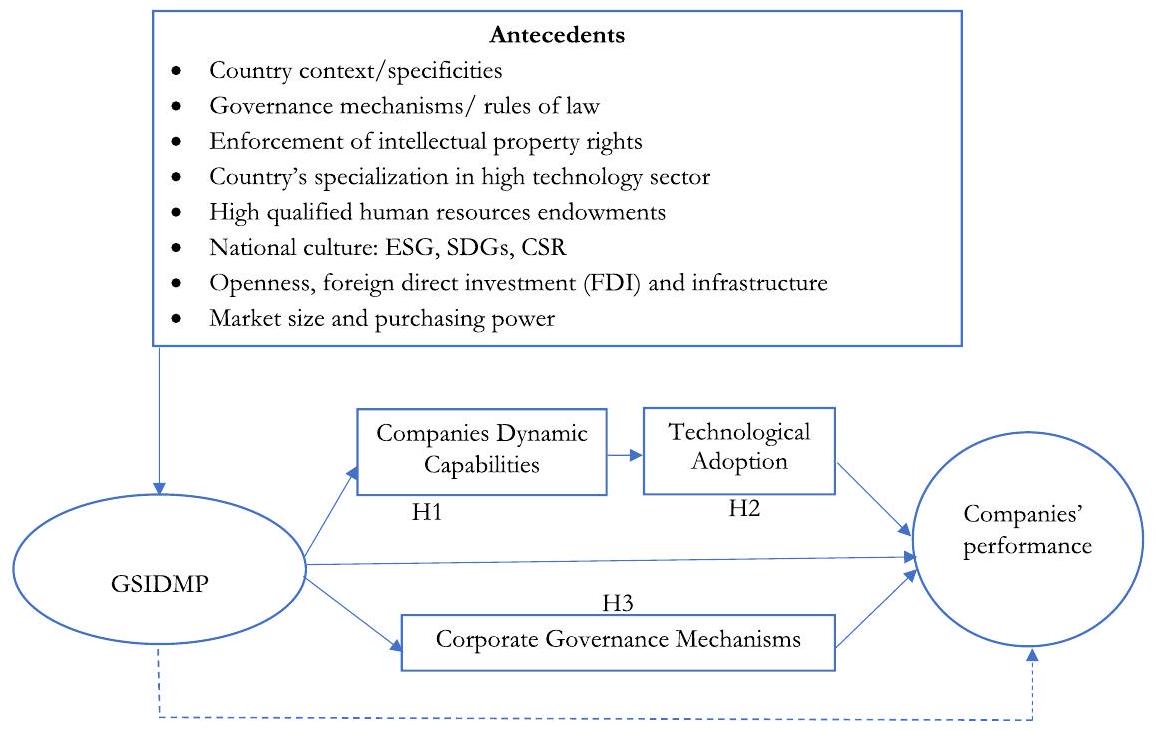
2.2 | دعم GSIDMP من خلال اعتماد التكنولوجيا، القدرة الديناميكية، والحوكمة نحو الاستدامة
الإعدادات (انظر برونزويكر وتشيسبرو، 2018؛ تشيسبرو، 2017؛ تشيسبرو وبوغرز، 2014؛ لي وميوزو، 2019؛ مادالينو وآخرون، 2020؛ راديكيتش والكران، 2022). يعتمد اعتماد التكنولوجيا المتقدمة على القدرات الديناميكية للشركات من خلال تحسين البيانات، بينما تمكّن القدرات التصنيعية الديناميكية الشركات من دمج عمليات التصنيع المستدامة. تجعل التحولات التكنولوجية المرونة في عمليات إعادة التصنيع التشغيلية أمرًا حاسمًا لأداء الابتكار في التصنيع (باغ وآخرون، 2021). ومع ذلك، تتأثر هذه التحولات بالقدرات الديناميكية وتتطلب استثمارات كبيرة في التقنيات المتقدمة (غارسيا-سانشيز وآخرون، 2021). بالإضافة إلى حجم الشركة ومستوى الخبرة، فإن إنفاق البحث والتطوير وكثافتهما هما مؤشرات رئيسية للقدرة الديناميكية لأنها تقيس الاستثمارات في البحث عن حلول تكنولوجية جديدة أو مسارات ابتكارية أخرى. تزيد مسارات البحث والتطوير وغيرها من المسارات المتعلقة بالابتكار من احتمال تعديل الشركات لقاعدتها الموارد من خلال منتجات جديدة، بينما لا يمكن لمستويات الاستثمار التقليدية التقاط قدرات الشركات فيما يتعلق بفعالية الاستثمار (لاكوسونين وبلتونيمي، 2018).
جهودها التنظيمية ومواردها لتطوير منتجات خضراء وتحقيق التنمية المستدامة لأن ممارسات الاستدامة يمكن أن تحسن أدائها (سونغ وآخرون، 2018). ومع ذلك، تم توجيه القليل من الاهتمام نحو دراسة العلاقة بين اعتماد التكنولوجيا، والقدرة الديناميكية، وGSIDMP، وأداء الشركة بشكل تجريبي. وبالتالي، قمنا بتطوير الفرضيات التالية:
H1. الوساطة بين قدرة الشركة الديناميكية وعلاقة GSIDM وأداء الشركة.
H2. الوساطة بين اعتماد التكنولوجيا والارتباط بين GSIDM وتعزيز أداء الشركات.
2.3 | تأثير حوكمة الشركات
3 | منهجية البحث
3.1 | طريقة جمع البيانات
- “إدخال منتج أو عملية جديدة أو محسّنة بشكل كبير.”
- “المشاركة في مشروع الابتكارات لم تكتمل بعد، تم تقليصها، أو التخلي عنها.”
- أشكال تنظيمية جديدة ومحسّنة بشكل كبير، هياكل أعمال أو ممارسات، ومفاهيم أو استراتيجيات تسويقية.
- تشمل أنشطة الاستثمار البحث والتطوير الداخلي، والتدريب، واكتساب المعرفة الخارجية أو الآلات والمعدات المرتبطة بأنشطة الابتكار.
- MVILEY
3.2 | التحليل التجريبي
بعد اتباع النماذج باستخدام طريقة المربعات الصغرى العادية (OLS). لتقليل الخطأ المعياري وتجنب تأثير تحيز المتغيرات المفقودة، قمنا بإعادة إجراء الانحدارات باستخدام نماذج اللوحات ذات التأثيرات الثابتة والتأثيرات العشوائية.
| المتغيرات | رموز | تعريفات |
| ممارسات اتخاذ القرارات الاستثمارية الاستراتيجية الخضراء | GSIDMP | المكونات الرئيسية لتقليل عدد المتغيرات والتعرف على الهيكل الأساسي للقدرة الديناميكية للشركة استنادًا إلى مجموعة من الأصول غير الملموسة غير الحالية. |
| اعتماد التكنولوجيا | TADPT | نسبة الإفصاح عن اعتماد التكنولوجيا باستخدام قاموس شامل يعتمد على قائمة الكلمات (حقيبة الكلمات) مصممة لالتقاط أكبر عدد ممكن من الكلمات المختلفة المتعلقة بالصناعة 4 واعتماد التكنولوجيا |
| القدرات الديناميكية للشركات | مراكز السيطرة على الأمراض والوقاية منها | المكونات الرئيسية لتقليل عدد المتغيرات والتعرف على الهيكل الأساسي للقدرة الديناميكية للشركة استنادًا إلى مجموعة من الأصول الملموسة وغير الملموسة غير الحالية بما في ذلك البحث والتطوير وكثافة براءات الاختراع في البحث والتطوير) |
| آليات الحوكمة | الحكومة | المكونات الرئيسية لتقليل عدد المتغيرات والتعرف على الهيكل الأساسي للقدرة الديناميكية للشركة استنادًا إلى مجموعة من متغيرات آلية الحوكمة بما في ذلك تجربة درجة ESG – حجم المجلس – استقلالية المجلس – استقلالية لجنة التدقيق. |
| أداء الشركة | PERF | المكونات الرئيسية لتقليل عدد المتغيرات والتعرف على الهيكل الأساسي للقدرة الديناميكية للشركة استنادًا إلى مجموعة من مقاييس الربحية. |
| حجم الشركة | FSIZE | اللوغاريتم الطبيعي لإجمالي أصول الشركة. |
| عائد على حقوق الملكية | العائد على حقوق الملكية | هو مقياس صافي دخل الشركة مقسومًا على حقوق المساهمين. |
| حجم لجنة التدقيق | حجم التدقيق | عدد المديرين في لجنة التدقيق. |
| استقلال لجنة التدقيق | تدقيق مع الصناعة | نسبة المديرين المستقلين في لجنة التدقيق |
| خبرة لجنة التدقيق | تدقيق مع خبرة | مستوى الخبرة المحاسبية في لجنة التدقيق. |
| حجم المجلس | بي سايز | عدد المديرين في مجلس الإدارة. |
| استقلالية المجلس | رَبْط | نسبة المديرين المستقلين في مجلس الإدارة. |
| خبرة المجلس | BEXP | مستوى الخبرة المحاسبية في مجلس الإدارة. |
| المبيعات إلى الأصول | STA | الانحراف المعياري للمبيعات/إجمالي الأصول على مدار السنوات المالية الست الماضية |
| تقلبات الأسهم الفردية | بيتا | ميل خط الانحدار لمدة 52 أسبوعًا لتغير نسبة سعر السهم بالنسبة لمؤشره القياسي |
| القيمة السوقية | MCAP | القيمة الإجمالية لجميع أسهم الشركة. يتم حسابها عن طريق ضرب سعر السهم في إجمالي عدد الأسهم المصدرة. |
| العائد على الأصول | العائد على الأصول | مقياس الربحية (EBIT
|
| الرافعة المالية | ليف | الديون طويلة الأجل/إجمالي الأصول |
4 | النتائج والمناقشة
4.1 | استراتيجيات الابتكار الحالية في الشركات الكبرى في المملكة المتحدة
“واصلنا تقديم الإشراف على فعالية العمليات والعمليات الهندسية والتكنولوجية الرئيسية، بما في ذلك تسليم برامج تطوير المنتجات الرئيسية والتكنولوجيا.” (RR، AR، 2021، ص. 106)
“سنبحث عن خيارات جديدة وطرق مبتكرة لتسريع تنفيذ المشاريع، لكننا سنقوم بذلك فقط بما يتماشى مع معاييرنا البيئية والاجتماعية وحوكمة الشركات.” (الرئيس التنفيذي، RT، AR، 2021، ص. 13)
“… مركزنا الرقمي الجديد في بوني، الهند، مصمم لإنشاء وتنمية وتقديم مجموعة من الحلول الرقمية لدعم نماذج الأعمال الجديدة والناشئة … سنستخدم المركز للتعاون والشراكة مع مؤسسات رائدة أخرى ….” (BP, AR, 2021, ص.14)
“الاستثمار لخلق نمو طويل الأمد وقيمة مستدامة، التكنولوجيا هي شريان الحياة لعملنا …” (المدير التنفيذي، RR، AR، 2021، ص.7)
“نحن نبتكر مع تركيز قوي على الرقمية لدفع الكفاءات التشغيلية، وتمكين قوتنا العاملة، والتفاعل بشكل أفضل مع عملائنا.” (BP، AR، 2021، ص.14)

كثافة البحث والتطوير الداخلي وأنواع أخرى من مشاريع الاستثمار الاستراتيجي في الأصول الملموسة وغير الملموسة، بما في ذلك البحث والتطوير الخارجي، ورأس المال البشري الماهر، والتعاون مع الجامعات، ومراكز البحث الوطنية والدولية الأخرى، كما يتضح من الاقتباس التالي من التقارير السنوية للشركة:
“نقدر أننا سنستثمر حوالي
“نبتكر من خلال الاستثمار في العلوم، والمنصات، والقدرات، بما في ذلك استخدام تقنيات AZ وقدرات البحث.” (AZ، AR، 2021، ص.25)
“تستخدم فرق التسويق والبحث والتطوير لدينا هذه الرؤى بالإضافة إلى أفضل الأفكار والتفكير من المتخصصين خارج يونيليفر لتطوير علامتنا التجارية ومنتجاتنا. أنفقنا
“نتعاون مع علي بابا عبر 13 سوقًا. في الصين، تتجاوز شراكتنا التجارة الأساسية إلى التحول الرقمي عبر سلسلة القيمة: من الموردين إلى التسويق إلى إعادة تدوير المستهلك. في مارس 2021، أطلقنا مركز ابتكار مشترك في هانغتشو، الصين، لاختبار وتحسين وتوسيع ابتكارات المنتجات بسرعة. لقد ساعدتنا شراكتنا الاستراتيجية مع منصة لزادا التابعة لعلي بابا في وصول منتجاتنا إلى المستهلكين عبر جنوب شرق آسيا منذ 2017.” (U، AR، 2021، ص.26)


(باريلي وراديك، 2021). تستمد شركات التصنيع الصناعية بشكل أساسي استراتيجيات الابتكار المختلفة، وشركات التصنيع القائمة على الهندسة، وشركات الخدمات المعتمدة على المعرفة، كما هو موضح في الأشكال 4 و5. تواصل هذه الشركات الحفاظ على مواقعها كأكبر الشركات النشطة المبتكرة من 2008 إلى 2020، كما هو موضح في الشكل 4.
“لدينا تميز هندسي في قلبنا وتركيز مذهل على الابتكار، والبحث، ونشاط التطوير الذي يخلق فرصًا لإنشاء قيمة كبيرة.” (RR، رئيس، 2021، ص.5)
“مع الانتقال إلى الكربون المنخفض في قلب استراتيجيتنا، سنواصل تركيز جهودنا الاستكشافية على السلع الأساسية الضرورية للانتقال الطاقي. كما نقيم الفرص الناشئة في الاقتصاد الدائري وإنتاج الطاقة الخضراء.” (RT، AR، 2021، ص.17)
“تطوير منتجات وتقنيات تساعد عملائنا على إزالة الكربون … نحن نعمل عن كثب مع عملائنا وآخرين لتطوير سلاسل قيمة أكثر أمانًا واستدامة وتسريع تطوير مسارات إنتاج أنظف لمنتجاتنا … سنسعى جاهدين لمواءمة أولويات أعمالنا مع توقعات المجتمع وضمان أن تكون اعتبارات الاستدامة في صميم كل قرار نتخذه.” (RT، AR، 2021، ص.13)
“في 2022، سنركز على تنفيذ الاستراتيجية بالتعاون مع شركائنا وأصحاب المصلحة الآخرين.” (رئيس، RT، AR، ص.7)
“أدت الجهود التعاونية أيضًا إلى تقدم قدرات الإصلاح والتجديد لمحامل تقلل من الطلب على قطع الغيار بحوالي. يدعم ذلك أهدافنا في الاستدامة من خلال زيادة الاقتصاد الدائري.” (RR، AR، 2021، ص.46)
“نحن نعمل بالشراكة مع شبكة متنامية من أصحاب المصلحة – الحكومات، والمجتمعات، والعملاء، والموردين – الذين يساعدون في توسيع فهمنا، وقدراتنا، وفي النهاية، قدرتنا على أن نكون أفضل مشغل ووصي مسؤول على الموارد” (RT، AR، ص. 23).
“سنقوم بتطوير مشاريع مثل رينكون وسيماندو، وفي أوي توغوي نتوقع الوصول إلى إنتاج مستدام في الربع الأول من العام.” (الرئيس التنفيذي، RT، AR، 2021، ص.9)
“المواد المستخدمة في المنتجات اليوم قد لا تكون الخيار المفضل في المستقبل إذا لم تتمكن من إثبات مؤهلاتها البيئية والاجتماعية والحوكمة (ESG) أو تطوير حلول دائرية قوية.” (RT، AR، 2021، ص.107)
لقد زادت استثماراتنا في العلوم والتكنولوجيا لتعزيز جودة وفعالية منتجاتنا … كما أن تركيز أنشطة البحث والتطوير لدينا على مشاريع أقل وأكبر يساعد أيضًا في طرح الابتكارات في السوق بشكل أسرع. في المجموع، ساعد برنامج الابتكار لدينا في تحقيق“مليار في العائدات الإضافية في عام 2021، ضعف ما كان عليه في عام 2020.” (الرئيس التنفيذي، U، AR، 2021، ص. 15)
4.2 | التأثيرات الوسيطة لاعتماد التكنولوجيا، CDC، وآليات الحوكمة على GSIDMP وأداء الشركات
| متغير | ملاحظة | معنى | الانحراف المعياري | من | ماكس | |||||||||
| أداء | 1960 | 19 | 18.21 | -18 | 42.76 | |||||||||
| GSIDMP | 1960 | 8.201 | 15.091 | -85.15 | ٢٦٩.١١ | |||||||||
| مراكز السيطرة على الأمراض والوقاية منها | 1960 | ٥٣٧١.٣٤١ | ٣٦٦٦٨.١٥٨ | 0 | 772,000 | |||||||||
| اعتماد التكنولوجيا | 1960 | 98553.863 | 97810.971 | 0 | 615,947 | |||||||||
| الحوكمة | 1960 | 12.99 | 16.143 | 0 | ٢٨ | |||||||||
| الارتباطات الزوجية | ||||||||||||||
| المتغيرات | (1) | (2) | (3) | (4) | (5) | |||||||||
| (1) العائد على الأصول | 1.000 | |||||||||||||
| (2) GSIDMP |
|
1.000 | ||||||||||||
| (3) اعتماد التكنولوجيا |
|
|
1.000 | |||||||||||
| (4) مراكز السيطرة على الأمراض |
|
|
|
1.000 | ||||||||||
| (5) آلية الحوكمة |
|
|
|
|
1.000 | |||||||||
كان أداء الشركة 19، وكانت القيم الدنيا والقصوى 18 و42.76 على التوالي، كما هو موضح في الجدول 2. كانت القيمة المتوسطة للقدرات الديناميكية للشركات 5371، في حين كانت القيمة القصوى 772,000. كانت القيمة المتوسطة لتبني التكنولوجيا 98,553، مما يمثل التكرار المتوسط للكلمات المتعلقة بتبني التكنولوجيا المعلنة في التقارير السنوية للشركات. كانت القيمة المتوسطة لمؤشر الحوكمة 12.99. وهذا يشير إلى أن معظم الشركات المدرجة في عيّنتنا تؤثر بشكل إيجابي على آليات الحوكمة والأداء المالي.
تأثير اعتماد التكنولوجيا على GSIDMP وأداء الشركات
“واصلنا الاستثمار بحذر في التقنيات الجديدة والمنتجات والخدمات التي سيحتاجها عملاؤنا لنجاحهم في المستقبل ورأينا استثماراتنا الأخيرة تفتح فرص نمو جديدة.” (الرئيس التنفيذي، RR، AR، 2021، ص. 6)
iii. تأثير القدرات الديناميكية للشركات على GSIDMP وأداء الشركات
“تعكس أولوياتنا كيفية عملنا على تحقيق نموّنا من خلال استراتيجية الابتكار وتحقيق هدفنا المتمثل في دفع حدود العلم لتقديم أدوية تغير الحياة. مراكز البحث والتطوير العالمية في كامبريدج (المملكة المتحدة)، غايثيرسبيرغ، ماريلاند (الولايات المتحدة)، غوتنبرغ، السويد، ومراكز ومكاتب بحث وتطوير أخرى؛ جنوب سان فرانسيسكو، كاليفورنيا، الولايات المتحدة، نيويورك، نيويورك، الولايات المتحدة، نيو هافن، كونيتيكت، الولايات المتحدة، بوسطن، ماساتشوستس، الولايات المتحدة، ألدرلي بارك وماكليسفيلد، المملكة المتحدة، شنغهاي، الصين، أوساكا، اليابان.” (AZ, AR, 2021, ص. 2)
“يشمل نظام الموردين لدينا ملايين الأشخاص حول العالم – من الشركات المتعددة الجنسيات الكبيرة إلى الشركات الناشئة والمنتجين المحليين الصغار الذين يقدمون لنا السلع والخدمات مثل المواد الخام، والخدمات اللوجستية، والإعلانات، والخدمات المهنية، وأكثر من ذلك بكثير. نحن نعمل أيضًا مع مجموعة متنوعة من الشركاء التجاريين، بما في ذلك نظراء الصناعة، ووكالات الابتكار، والجامعات، والمشاريع المشتركة، للمساعدة في فتح آفاق النمو وإيجاد حلول تفيد أصحاب المصلحة لدينا.” (CBO, U AR, 2021, ص. 27)
“نحن نستغل فرص النمو الاستراتيجي لمنتجاتنا الراسخة … تتميز المنشآت الجديدة بمعدات تصنيع متقدمة على مساحة أصغر ولكن بكفاءة أعلى، بما في ذلك قدرات الهندسة الرقمية والروبوتات …” (RR، AR، 2021، ص. 29)
iii. تأثير آليات الحوكمة على GSIDMP وأداء الشركات
| المتغيرات | أداء OLS | أداء ثابت | أداء عشوائي |
| GSIDMP | 5.4208* (8.9908) | 5.1121* (6.772) | 5.0065* (6.665) |
| اعتماد التكنولوجيا | 1.5705** (4.7706) | 1.7405** (4.9906) | 1.7405** (4.9906) |
| ج. GSIDMP#ج. اعتماد التكنولوجيا | 9.872*** (0.659) | 10.25*** (0.697) | 10.25*** (0.697) |
| ثابت | 12.02* (0.123) | 8.17* (0.254) | 8.725* (0.176) |
| لا ملاحظات | 1940 | 1940 | 1940 |
|
|
0.320 | 0.280 | 0.275 |
| المتغيرات | أداء OLS | أداء ثابت | أداء عشوائي | ||||||
| GSIDMP |
|
|
|
||||||
| مراكز السيطرة على الأمراض |
|
|
|
||||||
| ج. GSIDMP #ج.CDC |
|
|
|
||||||
| ثابت |
|
|
|
||||||
| لا ملاحظات | 1956 | 1956 | 1956 | ||||||
|
|
0.290 | 0.241 | 0.200 | ||||||
| عدد group_id | 304 | 304 |
تقوم الهيئة بتقييم تخصيص رأس المال عبر محفظة بي بي، بما في ذلك مستوى ومزيج النفقات الرأسمالية والتخارجات، والاستحواذات الاستراتيجية. تستعرض الهيئة وتوافق على الاستثمارات الرأسمالية التي
أكثر من
“في جميع حالات الاستثمار، نعتبر ما إذا كانت حالة الاستثمار تدعم تنفيذ استراتيجيتنا لتصبح شركة طاقة متكاملة وأهدافنا لتحقيق صافي انبعاثات صفرية. كما نقيم ما إذا كانت حالة الاستثمار تتضمن قدرة مميزة تمتلكها شركة بي بي أو تنوي تطويرها … نأخذ في الاعتبار كيف ترتبط أي فرصة عمل مقترحة بالانتقال إلى الطاقة واحتياجات المجتمع والبيئة.” (بي بي، التقرير السنوي، 2021، ص. 34)
| المتغيرات | أداء OLS | أداء ثابت | أداء عشوائي |
| GSIDMP | 6.2321* (6.1258) | 6.0081* (4.642) | 6.0012* (4.625) |
| آلية الحوكمة | 4.4706** (5.1206) | 2.9905* (1.7305) | 9.7406* (6.9606) |
| c.GSIDMP#c.آلية_الحوكمة | 8.8110*** (4.3210) | 7.7710** (1.9109) | 6.8010** (5.4310) |
| ثابت | 6.957** (0.659) | 8.743** (1.694) | 8.137** (0.937) |
| لا ملاحظات | 1940 | 1940 | 1940 |
|
|
0.202 | 0.180 | 0.080 |
| لا يوجد معرف مجموعة | ٢١٤ | ٢١٤ |
5 | الخاتمة
تتمتع مجالس الإدارة بمرونة استراتيجية، وآليات حوكمة مؤسسية، وثقافة وطنية، وقضايا الامتثال مع الهيئات التنظيمية ومتطلبات وضع المعايير. تضيف نتائج الدراسة إلى الأدبيات الموجودة حول التخطيط والإدارة الإنتاجية، بشكل أساسي حول تأثير العوامل السياقية المحيطة بالتخطيط والإدارة الإنتاجية من خلال GSIDMP. تحمل نتائج هذه الدراسة تداعيات إدارية لصانعي القرار، والجهات التنظيمية، والمستثمرين، والباحثين، وغيرهم من أصحاب المصلحة.
5.1 | المساهمة النظرية
5.2 | التداعيات الإدارية
ابتكار المنتجات الخضراء من خلال العمليات التشغيلية الخضراء يأخذ في الاعتبار تقليل الأثر السلبي على البيئة ومنع توليد النفايات عبر سلاسل القيمة وتعزيز الأداء البيئي والمالي للشركات. لا تحدث GSIDMP في عزلة، بل تتأثر بعوامل سياقية متنوعة بما في ذلك الثقافة الوطنية، وهيكل الحوكمة المؤسسية الداخلية والخارجية، وتعتمد على التزام غرف الاجتماعات بالقضايا البيئية واهتمامات أصحاب المصلحة. تتشكل سلوكيات غرف الاجتماعات بواسطة عوامل ثقافية تتعلق بالسياق الوطني. تؤثر هذه العوامل السياقية على العلاقة بين نتائج أداء الشركات وGSIDMP. أخيرًا، قد تساعد هذه الدراسة الشركات في إعادة تشكيل سياساتها الحالية بشأن الاستثمارات في الصناعات وتوجيهها لإدارة رأس المال العامل بفعالية مع التركيز على استراتيجيات الابتكار الأخضر وGSIDMP واستراتيجيات العمليات.
5.3 | القيود واتجاهات البحث المستقبلية
بيان تضارب المصالح
الشكر والتقدير
ORCID
محمود المرزوقي (د) https://orcid.org/0000-0001-9867-6057
خالد حسيني (د) https://orcid.org/0000-0003-3641-1031
V. G. فينكاتيش (د) https://orcid.org/0000-0002-5340-4637
ناديا غولكو (د) https://orcid.org/0000-0001-9208-5117
REFERENCES
Alkaraan, F., Albitar, K., Hussainey, K., & Venkatesh, V. G. (2022). Corporate transformation toward industry 4.0 and financial performance: The influence of environmental, social, and governance (ESG). Technological Forecasting and Social Change, 175, 121423. https://doi.org/10. 1016/j.techfore.2021.121423
Alkaraan, F., Elmarzouky, M., Hussainey, K., & Venkatesh, V. G. (2023). Sustainable strategic investment decision-making practices in UK companies: The influence of governance mechanisms on synergy between industry 4.0 and circular economy. Technological Forecasting and Social Change, 187(122187), 122187. https://doi.org/10.1016/j.techfore. 2022.122187
Andersén, J. (2021). A relational natural-resource-based view on product innovation: The influence of green product innovation and green suppliers on differentiation advantage in small manufacturing firms. Technovation, 104, 102254. https://doi.org/10.1016/j.technovation.2021. 102254
Arranz, N., Arroyabe, M., Li, J., & Fernandez de Arroyabe, J. C. (2020). Innovation as a driver of eco-innovation in the firm: An approach from the dynamic capabilities theory. Business Strategy and the Environment, 29(3), 1494-1503. https://doi.org/10.1002/bse. 2448
Arranz, N., Arroyabe, M. F., Li, J., Arranz, C. F. A., & Fernandez de Arroyabe, J. C. (2022). An integrative view of eco-innovation in the service sector : Dynamic capabilities, coopération and comporte environnementalism. Business Strategy and the Environment, 32(6), 28822895. https://doi.org/10.1002/bse. 3276
Bai, C., Dallasega, P., Orzes, G., & Sarkis, J. (2020). Industry 4.0 technologies assessment: A sustainability perspective. International Journal of Production Economics, 229, 107776. https://doi.org/10.1016/j.jpe. 2020.107776
Benitez, G. B., Ayala, N. F., & Frank, A. G. (2020). Industry 4.0 innovation ecosystems: An evolutionary perspective on value cocreation. International Journal of Production Economics, 228, 107735. https://doi.org/ 10.1016/j.ijpe.2020.107735
Chesbrough, H., & Bogers, M. (2014). Explicating open innovation: Clarifying an emerging paradigm for understanding innovation. In H. Chesbrough, W. Vanhaverbeke, & J. West (Eds.), New Frontiers in Open Innovation (pp. 3-28). Oxford University Press. https://doi.org/10. 1093/acprof:oso/9780199682461.003.0001
Chesbrough, H. (2020). Open innovation results: Going beyond the hype and getting down to business. Oxford University Press.
Climent, R. C., & Haftor, D. M. (2021). Business model theory-based prediction of digital technology use: An empirical assessment. Technological Forecasting and Social Change, 173, 121174. https://doi.org/10. 1016/j.techfore.2021.121174
Culot, G., Nassimbeni, G., Orzes, G., & Sartor, M. (2020). Behind the definition of Industry 4.0: Analysis and open questions. International Journal of Production Economics, 226, 107617. https://doi.org/10.1016/j.jpe. 2020.107617
Ding, B., Hernández, X. F., & Jané, N. A. (2023). Combining lean and agile manufacturing competitive advantages through Industry 4.0 technologies: An integrative approach. Production Planning & Control, 34(5), 442-458. https://doi.org/10.1080/09537287.2021. 1934587
Dixon, S., Meyer, K., & Day, M. (2014). Building dynamic capabilities of adaptation and innovation: A study of micro-foundations in a transition economy. Long Range Planning, 47(4), 186-205. https://doi.org/ 10.1016/j.Irp.2013.08.011
Erbetta, F., Bruno, C., & Pirovano, C. (2022). Corporate sustainability and performance: An efficiency perspective. Business Strategy and the Environment, 32(6), 2649-2661. https://doi.org/10.1002/bse. 3262
García-S’anchez, I., Gallego-Alvarez, I., & Zafra-G’omez, J. (2021). Do independent, female and specialist directors promote eco-innovation and eco-design in agri-food firms? Business Strategy and the Environment, 30(2), 1136-1152. https://doi.org/10.1002/bse. 2676
Gupta, B. B., Gaurav, A., Panigrahi, P. K., & Arya, V. (2023). Analysis of artificial intelligence-based technologies and approaches on sustainable entrepreneurship. Technological Forecasting and Social Change, 186, 122152. https://doi.org/10.1016/j.techfore.2022.122152
Hart, S. L. (1995). A natural-resource-based view of the firm. Academy of Management Review, 20(4), 986-1014. https://doi.org/10.2307/ 258963
Hart, S. L., & Dowell, G. (2010). A natural-resource-based view of the firm: Fifteen years after. Journal of Management, 37(5), 1464-1479. https:// doi.org/10.1177/0149206310390219
Helfat, C. E., & Martin, J. A. (2015). Dynamic managerial capabilities: Review and assessment of managerial impact on strategic change. Journal of Management, 41(5), 1281-1312. https://doi.org/10.1177/ 0149206314561301
Helfat, C. E., & Peteraf, M. A. (2003). The dynamic resource-based view: Capability lifecycles. Strategic Management Journal, 24, 997-1010. https://doi.org/10.1002/smj. 332
Hermelingmeier, V., & von Wirth, T. (2021). The nexus of business sustainability and organizational learning: A systematic literature review to identify key learning principles for business transformation. Business Strategy and the Environment, 30, 1839-1851. https://doi.org/10. 1002/bse. 2719
Hervas-Oliver, J. L., Parrilli, M. D., & Sempere-Ripoll, F. (2021). SME modes of innovation in European catching-up countries. Technological
Hussainey, K., Albitar, K., & Alkaraan, F. (2022). Corporate narrative reporting on Industry 4.0 technologies: Does governance matter? International Journal of Accounting & Information Management, 30(4), 457-476. https://doi.org/10.1108/IJAIM-02-2022-0024
Jabbour, C. J. C., Fiorini, P. D. C., Ndubisi, N. O., Queiroz, M. M., & Piato, E. L. (2020). Digitally enabled sustainable supply chains in the
Kamble, S., Gunasekaran, A., & Dhone, N. C. (2020). Industry 4.0 and lean manufacturing practices for sustainable organisationsal performance in Indian manufacturing companies. International Journal of Production Research, 58(5), 1319-1337. https://doi.org/10.1080/00207543. 2019.1630772
Klarner, P., Yoshikawa, T., & Hitt, M. A. (2021). A capability-based view of boards: A new conceptual framework for board governance. Academy of Management Perspectives, 35, 123-141. https://doi.org/10.5465/ amp.2017.0030
Kumar, S., Sureka, R., Lim, W. M., Mangla, S. K., & Goyal, N. (2021). What do we know about business strategy and environmental research? Insights from business strategy and the environment. Business Strategy and the Environment, 30(8), 3454-3469. https://doi.org/10.1002/bse. 2813
Laaksonen, O., & Peltoniemi, M. (2018). (2018) The essence of dynamic capabilities and their measurement. International Journal of Management Reviews, 20, 184-205. https://doi.org/10.1111/ijmr. 12122
Lara Schilling, L., & Seuring, S. (2023). Linking the digital and sustainable transformation with supply chain practices. International Journal of Production Research, 1-25. https://doi.org/10.1080/00207543.2023. 2173502
Lee, H., & Miozzo, M. (2019). Which types of knowledge-intensive business services firms collaborate with universities for innovation? Research Policy, 48, 1633-1646. https://doi.org/10.1016/j.respol. 2019.03.014
Murphy, L., & Maguire, W. (2011). Applying mixed methods research in evaluating clinical trials. Qualitative Research in Accounting & Management, 8(1), 72-90. https://doi.org/10.1108/11766091111124711
Nadeem, M., Bahadar, S., Gull, A. A., & Iqbal, U. (2020). Are women ecofriendly? Board gender diversity and environmental innovation.
Nahum, N., & Carmeli, A. (2020). Leadership style in a board of directors: Implications of involvement in the strategic decision-making process. Journal of Management and Governance, 24, 199-227. https://doi.org/ 10.1007/s10997-019-09455-3
Park, I., Triulzi, G., & Magee, C. L. (2022). Tracing the emergence of new technology: A comparative analysis of five technological domains. Technological Forecasting and Social Change, 184, 122014. https://doi. org/10.1016/j.techfore.2022.122014
Parrilli, M. D., Balavac, M., & Radicic, D. (2020). Business innovation modes and their impact on innovation outputs: Regional variations and the nature of innovation across EU regions. Research Policy, 49(8), 104047. https://doi.org/10.1016/j.respol.2020.104047
Powell, W. W., Koput, K. W., & Smith-Doerr, L. (1996). Interorganisational collaboration and the locus of innovation: Networks of learning in biotechnology. Administrative Science Quarterly, 41, 116-145. https://doi. org/10.2307/2393988
Radicic, D. (2020). Breadth of external knowledge search in service sectors. Business Process Management Journal, 27(1), 230-252. https:// doi.org/10.1108/BPMJ-01-2020-0018
Radicic, D., & Alkaraan, F. (2022). Relative effectiveness of open innovation strategies in single and complex SME innovators. Technology Analysis & Strategic Management, 1-14. https://doi.org/10.1080/ 09537325.2022 .2130042
Rowley, T., Behrens, D., & Krackhardt, D. (2000). Redundant governance structures: An analysis of structural and relational embeddedness in the steel and semiconductor industries. Strategic Management Journal, 21(3), 369-386. https://doi.org/10.1002/(SICI)1097-0266(200003) 21:3<369::AID-SMJ93>3.0.CO;2-M
Saura, J. R., Palacios-Marqués, D., & Ribeiro-Soriano, D. (2022). Exploring the boundaries of open innovation: Evidence from social media mining. Technovation, 119, 102447. https://doi.org/10.1016/j. technovation.2021.102447
Shubbak, M. H. (2018). Innovation capability, network embeddedness and economic performance: Profiling solar power innovators in China. Int. Journal of Technological Learning, Innovation and Development., 10(3-4), 258-294. https://doi.org/10.1504/IJTLID.2018.093723
Singh, S. K., Del Giudice, M., Chiappetta Jabbour, C. J., Latan, H., & Sohal, A. S. (2022). Stakeholder pressure, green innovation, and performance in small and medium-sized enterprises: The role of green dynamic capabilities. Business Strategy and the Environment, 31(1), 500-514. https://doi.org/10.1002/bse. 2906
Singh, S. K., Del Giudice, M., Chierici, R., & Graziano, D. (2020). Green innovation and environmental performance: The role of green transformational leadership and green human resource management. Technological Forecasting and Social Change, 150, 119762. https://doi.org/ 10.1016/j.techfore.2019.119762
Soh, K. L., & Wong, W. P. (2021). Circular economy transition: Exploiting innovative eco-design capabilities and customer involvement.Journal
of Cleaner Production, 320(3), 128858. https://doi.org/10.1016/j. jclepro.2021.128858
Song, W., Ren, S., & Yu, J. (2018). Bridging the gap between corporate social responsibility and new green product success: The role of green organizational identity. Business Strategy and the Environment, 28(1), 88-97. https://doi.org/10.1002/bse. 2205
Tashakkori, A., Newman, L. (2010). Mixed Methods, https://doi.org/10. 1016/B978-0-08-044894-7.00287-6
Teece, D. J. (2007). Explicating dynamic capabilities: The nature and microfoundations of (sustainable) enterprise performance. Strategic Management Journal, 28, 1319-1350. https://doi.org/10.1002/smj. 640
Teece, D. J. (2009). Dynamic capabilities and strategic management: Organizing for innovation and growth. USA: Oxford University Press.
Teece, D. J. (2012). Dynamic capabilities: Routines versus entrepreneurial action. Journal of Management Studies, 49, 1395-1401. https://doi. org/10.1111/j.1467-6486.2012.01080.x
Teece, D. J. (2017). Dynamic capabilities and (digital) platform lifecycles, entrepreneurship, innovation, and platforms. Advances in Strategic Management, 37, 211-225. https://doi.org/10.1108/S0742332220170000037008
Teece, D. J. (2018). Profiting from innovation in the digital economy: Enabling technologies, standards, and licensing models in the wireless world. Research Policy, 47(8), 1367-1387. https://doi.org/10.1016/j. respol.2017.01.015
Teece, D. J., Pisano, G., & Shuen, A. (1997). Dynamic capabilities and strategic management. Strategic Management Journal, 18(7), 509-533. https://doi.org/10.1002/(SICI)1097-0266(199708)18:7<509::AID-SMJ882>3.0.CO;2-Z
Utami, H., & Alamanos, E. (2023). In S. Papagiannidis (Ed.), Resource-based theory: A review. https://open.ncl.ac.uk/. ISBN: 9781739604400
Yu, Y., Zhang, J. Z., Cao, Y., & Kazancoglu, Y. (2021). Intelligent transformation of the manufacturing industry for Industry 4.0: Seizing financial benefits from supply chain relationship capital through enterprise green management. Technological Forecasting and Social Change, 172, 120999. https://doi.org/10.1016/j.techfore.2021.120999
Zheng, S., Zhang, W., & Du, J. (2011). Knowledge-based dynamic capabilities and innovation in networked environments. Journal of Knowledge Management, 15(6), 1035-1051. https://doi.org/10.1108/ 13673271111179352
- Abbreviations: AR, Annual report; AZ, AstraZeneca; BP, The British Petroleum Company; CDM, Companies dynamic capabilities; CEO, Chief executive officer; CSR, Corporate social responsibility; ESG, Environmental, social and governance; FDI, Foreign direct investment; GSIDMP, Green strategic investment decision-making practices; GVA, Gross value added; IoT, Internet of Things; OECD, The Organization for Economic Co-operation and Development; OLS, Ordinary least squares; ONS, Office for National Statistics; R&D, Research and development; RBT, Resource-based theory; RQ, Research question; RT, Rio Tinto; SDGs, The sustainable development goals; U, Unilever; UK, United Kingdom; UKIS, UK innovation survey.This is an open access article under the terms of the Creative Commons Attribution-NonCommercial-NoDerivs License, which permits use and distribution in any medium, provided the original work is properly cited, the use is non-commercial and no modifications or adaptations are made.
© 2024 The Authors. Business Strategy and The Environment published by ERP Environment and John Wiley & Sons Ltd. https://www.ons.gov.uk/economy/governmentpublicsectorandtaxes/ researchanddevelopmentexpenditure/timeseries/glbh/gerd
https://sponsored.bloomberg.com/article/mubadala/the-future-of-esg-Investing?sref= eWvCRkRs Office of National Statistics
DOI: https://doi.org/10.1002/bse.3665
Publication Date: 2024-01-11
Reinforcing green business strategies with Industry 4.0 and governance towards sustainability: Natural-resource-based view and dynamic capability
Correspondence
Email: ys102@hotmail.com
[Correction added on 20 January 2024, after first online publication: The present address of Nadia Gulko has been removed and was included in the affiliation list in this version.]
Abstract
The study explores the influence of contextual factors surrounding production planning and green strategic investment decision-making practices (GSIDMP) in UK companies. We utilize a mixed-method approach as a research methodology to study the current trend of production planning and GSIDMP. This study’s conceptual model is rooted conspicuously in the resource-based theory (RBT), natural-resource-based view, and dynamic capabilities. We empirically examine the nexus among GSIDMP, technological innovation, dynamic capability, and companies’ performance. Our study was based on a sample selected from UK-listed companies, FTSE ALL-Share Index for the period (2012-2021). Also, the study utilizes data from the UK Innovation Survey (2018-2020) and corporate disclosure through companies’ annual reports as a complementary approach for data collection. Findings of this study explore the interdependencies among company dynamic capability, advanced technological innovation and governance mechanisms, and their mediation influence on the nexus between GSIDMP and companies’ performance. This study sheds lights on current business innovation strategies. Findings reveal how current practices of production planning and GSIDM in large UK companies shaped by boardrooms absorptive and adaptive capabilities, knowledge-generating and knowledge-collaboration capabilities, technological adoption, and corporate governance mechanisms. This study offers insight regarding boardrooms proactive engagement in exploration and exploitation activities to strengthen ambidexterity through various innovation trajectories associated with green production and GSIDMP towards sustainability. We provide managerial implications for decision-makers, regulators, investors, scholars, and other stakeholders.
KEYWORDS
1 | INTRODUCTION
understanding of the processes by which companies implement sustainable development strategies (Arranz et al., 2022). Within this paradigm, proactive companies create green innovation strategies by implementing environmental strategies in their green strategic investment decision-making practices (GSIDMP). Based on a systematic literature review combining studies on Industry 4.0, lean manufacturing, and agile manufacturing, Ding et al. (2023) revealed that integrating these elements enhances cost competitiveness, whereas agile manufacturing strengthens flexibility. Other studies focused on linking digital and sustainable transformations to supply chain practices (Jabbour et al., 2020; Lara Schilling & Seuring, 2023) and sustainable development (Bag et al., 2021). Advanced technological adoption strengthens a company’s dynamic capabilities across various value creation and capture stages (Climent & Haftor, 2021; Saura et al., 2022). Product innovation management is critical for aligning value creation and capture through the various stages of business model innovation (Sjödin et al., 2020). Advanced technological adoption drives economic and social change, and newly emerging technologies are a pivotal and highly researched domain (Park et al., 2022). Industry 4.0 technologies accelerate business innovation strategies and positively impact environmental development (Gupta et al., 2023; Khan, Chowdhary, et al., 2021).
RQ: What are the key factors driving current production planning and GSIDMP in UK companies?
findings shed light on the key drivers that reinforce current GSIDMP in large UK companies. Production planning and GSIDMP are shaped by companies’ dynamic capabilities, boardrooms’ absorptive and adaptive capabilities, knowledge-generating and knowledge-collaboration capabilities, technological adoption, board members’ strategic agility, corporate governance mechanisms, and national culture. Third, the conceptual model adopted in this study is rooted in resource-based theory (RBT), natural-resource-based view, and dynamic capabilities. Previous studies have paid little attention to the conceptualization of production planning and GSIDMP based on theory triangulation by amalgamating strong structuration theory and the dynamic capability perspective, particularly the role of board directors (agent-in-focus) in considering the context of emergent structures (agents-in-context).
2 | LITERATURE: HYPOTHESES DEVELOPMENT
2.1 | Conceptualization
2.2 | Backing GSIDMP with technological adoption, dynamic capability, and governance toward sustainability
settings (see Brunswicker & Chesbrough, 2018; Chesbrough, 2017; Chesbrough & Bogers, 2014; Lee & Miozzo, 2019; Madaleno et al., 2020; Radicic & Alkaraan, 2022). Advanced technological adoption leverages companies’ dynamic capabilities through improved data, while dynamic manufacturing capabilities enable companies to amalgamate sustainable manufacturing processes. Technological transformation makes flexibility in operational remanufacturing processes critical to manufacturing innovation performance (Bag et al., 2021). However, this transformation is influenced by dynamic capabilities and involves substantial investments in advanced technologies (García-S’anchez et al., 2021). In addition to company size and level of experience, R&D expenditure, and intensity are key indicators of dynamic capability because they measure investments in searching for new technological solutions or other innovation trajectories. R&D and other innovationrelated trajectories increase the probability of companies modifying their resource bases through new products, whereas conventional investment levels cannot capture companies’ abilities regarding investment effectiveness Laaksonen and Peltoniemi (2018).
organizational efforts and resources to develop green products and achieve sustainable development because sustainability practices can improve their performance (Song et al., 2018). However, little attention has been directed toward empirically examining the interdependency among technological adoption, dynamic capability, GSIDMP, and company performance. Thus, we developed the following hypotheses:
H1. A company’s dynamic capability mediates the relationship between GSIDM and company performance.
H2. Technological adoption mediates the nexus between GSIDM and strengthens companies’ performance.
2.3 | The influence of corporate governance
3 | RESEARCH METHODOLOGY
3.1 | Data collection method
- “The introduction of a new or significantly improved product or process.”
- “Engagement in innovations project not yet complete, scaled back, or abandoned.”
- “New and significantly improved organizational forms, business structures or practices, and marketing concepts or strategies.”
- “Investment activities include internal R&D, training, acquisition of external knowledge or machinery and equipment linked to innovation activities.”
- MVILEY
3.2 | Empirical analysis
following the models using ordinary least squares (OLS). To reduce the standard error and avoid the effect of omitted variable bias, we reran our regressions using fixed-effects and random-effects panel models.
| Variables | Symbols | Definitions |
| Green strategic investment decision-making practices | GSIDMP | Principal components to reduce the number of variables and to learn about the underlying structure of firm dynamic capability based on set of non-current intangible assets. |
| Technological adoption | TADPT | Percentage of technological adoption disclosure using a comprehensive dictionary based on wordlist (bag of words) designed to capture as many different words as possible relating to the industry 4 and technological adoption |
| Companies’ dynamic capabilities | CDC | Principal components to reduce the number of variables and to learn about the underlying structure of firm dynamic capability based on set of non-current tangible and intangible assets including R&D and R&D intensity patents) |
| Governance mechanisms | GOV | Principal components to reduce the number of variables and to learn about the underlying structure of firm dynamic capability based on set of governance mechanism variables including ESG score-board experience-board size-board independents-audit committee independent. |
| Firm performance | PERF | Principal components to reduce the number of variables and to learn about the underlying structure of firm dynamic capability based on set of profitability measures. |
| Firm size | FSIZE | Natural log of total assets of the company. |
| Return on equity | ROE | Is the measure of a company’s net income divided by its shareholders’ equity. |
| Audit committee size | Audit com size | The number of directors on the audit committee board. |
| Audit committee independence | Audit com ind | The percentage of independent directors on the audit committee board |
| Audit committee expertise | Audit com exp | The level of accounting expertise on the audit committee. |
| Board size | BSIZE | The number of directors on the board of directors. |
| Board independence | BIND | The percentage of independent directors on the board of directors. |
| Board expertise | BEXP | The level of accounting expertise on the board of directors. |
| Sales to assets | STA | The standard deviation of sales/total asset over the last six fiscal year |
| Idiosyncratic stock volatility | BETA | The slope of the 52-week regression line of percentage price change of the stock relative to its benchmark |
| Market capitalization | MCAP | The total value of all a company’s shares of stock. It is calculated by multiplying the price of a stock by its total number of outstanding shares. |
| Return on assets | ROA | Measure of profitability (EBIT
|
| Financial leverage | LEV | Long-term debt/total assets |
4 | RESULTS AND DISCUSSION
4.1 | Current innovation strategies in large UK firms
“We continued to provide oversight of the effectiveness of key engineering and technology processes and operations, including the delivery of major product development and technology programmes.” (RR, AR, 2021, p.106)
“We will look for new options and innovative ways of bringing projects on stream faster, but we will only do this in line with our ESG standards.” (CEO, RT, AR, 2021, p.13)
“… Our new digital hub in Pune, India, is designed to create, grow and deliver a range of digital solutions to support new and emerging business models … We will use the hub to partner and collaborate with other leading institutions ….” (BP, AR, 2021, p.14)
“Investing to create long-term growth and sustainable value technology is the lifeblood of our business …” (CEO, RR, AR, 2021, p.7)
“We innovate with a strong focus on digital to drive operational efficiencies, empower our workforce, and engage better with our customers.” (BP, AR, 2021, p.14)
intensity of internal R&D and other types of strategic investment projects in both tangible and intangible assets, including external R&D, skilled human capital, collaboration with universities, and other national and international research centers, as revealed by the following extract from the company’s annual reports:
“We estimate that we will invest approximately
“Innovate by investing in science, platforms, and capabilities, including using AZ technologies and research capabilities.” (AZ, AR, 2021, p.25)
“Our marketing and R&D teams use these insights plus the best ideas and thinking from specialists outside Unilever to develop our brands and products. We spent
“We partner with Alibaba across 13 markets. In China, our collaboration goes beyond core commerce into digital transformation across the value chain: from suppliers to marketing to consumer recycling. In March 2021, we launched a joint innovation centre in Hangzhou, China, to quickly test, refine, and scale product innovations. Our strategic partnership with Alibaba’s Lazada platform has helped our products reach consumers across South East Asia since 2017.” (U, AR, 2021, p.26)
(Parrilli & Radicic, 2021). Industrial manufacturing companies primarily derive various innovation strategies, engineering-based manufacturing companies, and knowledge-intensive service companies, as shown in Figures 4 and 5. These companies continue to maintain their positions as the largest active innovative companies from 2008 to 2020, as shown in Figure 4.
“We have engineering excellence at our heart and an incredible focus on innovation, research, and development activity that creates opportunities for significant value creation.” (RR, Chair, 2021, p.5)
“With the low-carbon transition at the heart of our strategy, we will continue to focus our exploration efforts on commodities essential for the energy transition. We also evaluate emerging opportunities in the circular economy and green energy production.” (RT, AR, 2021 p.17)
“Develop products and technologies that help our customers decarbonize … We are working closely with our customers and others to develop more secure and sustainable value chains and accelerate the development of cleaner production pathways for our products … We will strive to align our business priorities with society’s expectations and ensure sustainability considerations are at the core of every decision we make.” (RT, AR, 2021, p.13)
“In 2022, we will focus on delivering the strategy in collaboration with our partners and other stakeholders.” (Chairman, RT, AR, p.7)
“Collaborative efforts also led to the advancement of repair and refurbishment capabilities for bearings that reduce the demand for spare parts by around. This supports our sustainability goals by increasing the circular economy.” (RR, AR, 2021, p.46)
“We work in partnership with a growing network of stakeholders – governments, communities, customers, and suppliers – who help expand our understanding, capabilities, and, ultimately, our ability to be the best operator and a responsible steward of resources” (RT, AR, p.23).
“We will advance projects like Rincon and Simandou, and at Oyu Tolgoi we expect to reach sustainable production in the first quarter of the year.” (CEO, RT, AR, 2021, p.9)
“Materials used in products today may not be the preferred choice in the future if they cannot establish their environmental, social, and governance (ESG) credentials or develop strong circular solutions.” (RT, AR, 2021, p.107)
“We have stepped up our investments in science and technology to strengthen the quality and efficacy of our products … Focusing our R&D activities on fewer and bigger projects also brings innovations to market faster. In total, our innovation programme helped to deliverbillion in incremental turnover in 2021 double that of 2020.” (CEO, U, AR, 2021, p.15)
4.2 | The mediating effects of technology adoption, CDC, and governance mechanisms on GSIDMP and companies’ performance
| Variable | Obs | Mean | Std. dev. | Min | Max | |||||||||
| Performance | 1960 | 19 | 18.21 | -18 | 42.76 | |||||||||
| GSIDMP | 1960 | 8.201 | 15.091 | -85.15 | 269.11 | |||||||||
| CDC | 1960 | 5371.341 | 36668.158 | 0 | 772,000 | |||||||||
| Technology adoption | 1960 | 98553.863 | 97810.971 | 0 | 615,947 | |||||||||
| Governance | 1960 | 12.99 | 16.143 | 0 | 28 | |||||||||
| Pairwise correlations | ||||||||||||||
| Variables | (1) | (2) | (3) | (4) | (5) | |||||||||
| (1) ROA | 1.000 | |||||||||||||
| (2) GSIDMP |
|
1.000 | ||||||||||||
| (3) Technological adoption |
|
|
1.000 | |||||||||||
| (4) CDC |
|
|
|
1.000 | ||||||||||
| (5) Governance mechanism |
|
|
|
|
1.000 | |||||||||
of company performance was 19 , and the minimum and maximum values were 18 and 42.76, respectively, as shown in Table 2. The mean value of companies’ dynamic capabilities was 5371, whereas the maximum value was 772,000 . The mean value of technological adoption was 98,553 , representing the average frequency of words related to technological adoption disclosed in the companies’ annual reports. The mean value of the governance indicator was 12.99. This indicates that most of the companies included in our sample positively affect governance mechanisms and financial performance.
i. The influence of technological adoption on GSIDMP and companies’ performance
“We continued to invest prudently in the new technologies, products, and services our customers will need for their future success and saw our more recent investments deliver new growth opportunities.” (CEO, RR, AR, 2021, p.6)
ii. The influence of companies’ dynamic capabilities on GSIDMP and companies’ performance
“Our priorities reflect how we are working to deliver our growth through innovation strategy and achieve our purpose of pushing the boundaries of science to deliver life-changing medicines. Global R&D centers Cambridge (UK), Gaithersburg, MD (US), Gothenburg, Sweden, and other R&D centers and offices; South San Francisco, CA, US New York, NY, US, New Haven, CT, US Boston, MA, US, Alderley Park and Macclesfield, UK, Shanghai, China, Osaka, Japan.” (AZ, AR, 2021, p.2)
“Our supplier ecosystem includes millions of people worldwide – from large multinationals to startups and small local producers who provide us with goods and services such as raw materials, logistics, advertising, professional services, and much more. We also work with various business partners, including industry peers, innovation agencies, universities and joint ventures, to help unlock growth and find solutions that benefit our stakeholders.” (CBO, U AR, 2021, p.27)
“We are seizing strategic growth opportunities for our established products … The new facilities feature advanced manufacturing equipment on a smaller but more efficient footprint, including digital engineering and robotics capabilities …” (RR, AR, 2021, p.29)
iii. Influence of governance mechanisms on GSIDMP and companies’ performance
| Variables | OLS performance | Fixed performance | Random performance |
| GSIDMP | 5.4208* (8.9908) | 5.1121* (6.772) | 5.0065* (6.665) |
| Technological adoption | 1.5705** (4.7706) | 1.7405** (4.9906) | 1.7405** (4.9906) |
| c. GSIDMP#c.Technological adoption | 9.872*** (0.659) | 10.25*** (0.697) | 10.25*** (0.697) |
| Constant | 12.02* (0.123) | 8.17* (0.254) | 8.725* (0.176) |
| No observations | 1940 | 1940 | 1940 |
|
|
0.320 | 0.280 | 0.275 |
| Variables | OLS Performance | Fixed performance | Random performance | ||||||
| GSIDMP |
|
|
|
||||||
| CDC |
|
|
|
||||||
| c. GSIDMP #c.CDC |
|
|
|
||||||
| Constant |
|
|
|
||||||
| No observations | 1956 | 1956 | 1956 | ||||||
|
|
0.290 | 0.241 | 0.200 | ||||||
| Number of group_id | 304 | 304 |
“The board assesses capital allocation across the bp portfolio, including the level and mix of capital expenditures and divestments, strategic acquisitions. The board reviews and approves capital investments that
are more than
“For all investment cases, we consider whether the investment case supports the delivery of our strategy to become an integrated energy company and our net zero aims. We also assess if the investment case involves distinctive capability that bp has or intends to develop … We consider how any proposed business opportunity is connected to the energy transition, societal needs, and the environment.” (BP, AR,2021, p.34)
| Variables | OLS performance | Fixed performance | Random performance |
| GSIDMP | 6.2321* (6.1258) | 6.0081* (4.642) | 6.0012* (4.625) |
| Governance_mechanism | 4.4706** (5.1206) | 2.9905* (1.7305) | 9.7406* (6.9606) |
| c.GSIDMP#c.Governance_mechanism | 8.8110*** (4.3210) | 7.7710** (1.9109) | 6.8010** (5.4310) |
| Constant | 6.957** (0.659) | 8.743** (1.694) | 8.137** (0.937) |
| No observations | 1940 | 1940 | 1940 |
|
|
0.202 | 0.180 | 0.080 |
| No group-id | 214 | 214 |
5 | CONCLUSION
boardrooms’ strategic agility, corporate governance mechanisms, national culture, and compliance issues with regulatory bodies and standard-setter requirements. The study’s findings add to the extant literature on production planning and control, predominantly on the influence of contextual factors surrounding production planning and control through GSIDMP. The results of this study have managerial implications for decision-makers, regulators, investors, scholars, and other stakeholders.
5.1 | Theoretical contribution
5.2 | Managerial implications
green product innovation through green operational processes take into consideration reducing the negative impact on the environment and prevent waste generation across the value chains and strengthening companies environmental and financial performance. GSIDMP do not take place in isolation, instead they are influenced by various contextual factors including national culture, internal and external corporate governance structure, and contingent on boardrooms commitment to environmental issues and stakeholders’ concern. Boardrooms behaviors are shaped by cultural factors related to the national context. These contextual factors impact the relationship between companies’ performance outcomes and GSIDMP. Finally, this study may help companies reshape their existing policies on investments in industries and direct them to manage their working capital effectively with a focused on green innovation strategies, GSIDMP, and operations strategies.
5.3 | Limitations and future research directions
CONFLICT OF INTEREST STATEMENT
ACKNOWLEDGEMENTS
ORCID
Mahmoud Elmarzouky (D) https://orcid.org/0000-0001-9867-6057
Khaled Hussainey (D) https://orcid.org/0000-0003-3641-1031
V. G. Venkatesh (D) https://orcid.org/0000-0002-5340-4637
Nadia Gulko (D) https://orcid.org/0000-0001-9208-5117
REFERENCES
Alkaraan, F., Albitar, K., Hussainey, K., & Venkatesh, V. G. (2022). Corporate transformation toward industry 4.0 and financial performance: The influence of environmental, social, and governance (ESG). Technological Forecasting and Social Change, 175, 121423. https://doi.org/10. 1016/j.techfore.2021.121423
Alkaraan, F., Elmarzouky, M., Hussainey, K., & Venkatesh, V. G. (2023). Sustainable strategic investment decision-making practices in UK companies: The influence of governance mechanisms on synergy between industry 4.0 and circular economy. Technological Forecasting and Social Change, 187(122187), 122187. https://doi.org/10.1016/j.techfore. 2022.122187
Andersén, J. (2021). A relational natural-resource-based view on product innovation: The influence of green product innovation and green suppliers on differentiation advantage in small manufacturing firms. Technovation, 104, 102254. https://doi.org/10.1016/j.technovation.2021. 102254
Arranz, N., Arroyabe, M., Li, J., & Fernandez de Arroyabe, J. C. (2020). Innovation as a driver of eco-innovation in the firm: An approach from the dynamic capabilities theory. Business Strategy and the Environment, 29(3), 1494-1503. https://doi.org/10.1002/bse. 2448
Arranz, N., Arroyabe, M. F., Li, J., Arranz, C. F. A., & Fernandez de Arroyabe, J. C. (2022). An integrative view of eco-innovation in the service sector : Dynamic capabilities, coopération and comporte environnementalism. Business Strategy and the Environment, 32(6), 28822895. https://doi.org/10.1002/bse. 3276
Bai, C., Dallasega, P., Orzes, G., & Sarkis, J. (2020). Industry 4.0 technologies assessment: A sustainability perspective. International Journal of Production Economics, 229, 107776. https://doi.org/10.1016/j.jpe. 2020.107776
Benitez, G. B., Ayala, N. F., & Frank, A. G. (2020). Industry 4.0 innovation ecosystems: An evolutionary perspective on value cocreation. International Journal of Production Economics, 228, 107735. https://doi.org/ 10.1016/j.ijpe.2020.107735
Chesbrough, H., & Bogers, M. (2014). Explicating open innovation: Clarifying an emerging paradigm for understanding innovation. In H. Chesbrough, W. Vanhaverbeke, & J. West (Eds.), New Frontiers in Open Innovation (pp. 3-28). Oxford University Press. https://doi.org/10. 1093/acprof:oso/9780199682461.003.0001
Chesbrough, H. (2020). Open innovation results: Going beyond the hype and getting down to business. Oxford University Press.
Climent, R. C., & Haftor, D. M. (2021). Business model theory-based prediction of digital technology use: An empirical assessment. Technological Forecasting and Social Change, 173, 121174. https://doi.org/10. 1016/j.techfore.2021.121174
Culot, G., Nassimbeni, G., Orzes, G., & Sartor, M. (2020). Behind the definition of Industry 4.0: Analysis and open questions. International Journal of Production Economics, 226, 107617. https://doi.org/10.1016/j.jpe. 2020.107617
Ding, B., Hernández, X. F., & Jané, N. A. (2023). Combining lean and agile manufacturing competitive advantages through Industry 4.0 technologies: An integrative approach. Production Planning & Control, 34(5), 442-458. https://doi.org/10.1080/09537287.2021. 1934587
Dixon, S., Meyer, K., & Day, M. (2014). Building dynamic capabilities of adaptation and innovation: A study of micro-foundations in a transition economy. Long Range Planning, 47(4), 186-205. https://doi.org/ 10.1016/j.Irp.2013.08.011
Erbetta, F., Bruno, C., & Pirovano, C. (2022). Corporate sustainability and performance: An efficiency perspective. Business Strategy and the Environment, 32(6), 2649-2661. https://doi.org/10.1002/bse. 3262
García-S’anchez, I., Gallego-Alvarez, I., & Zafra-G’omez, J. (2021). Do independent, female and specialist directors promote eco-innovation and eco-design in agri-food firms? Business Strategy and the Environment, 30(2), 1136-1152. https://doi.org/10.1002/bse. 2676
Gupta, B. B., Gaurav, A., Panigrahi, P. K., & Arya, V. (2023). Analysis of artificial intelligence-based technologies and approaches on sustainable entrepreneurship. Technological Forecasting and Social Change, 186, 122152. https://doi.org/10.1016/j.techfore.2022.122152
Hart, S. L. (1995). A natural-resource-based view of the firm. Academy of Management Review, 20(4), 986-1014. https://doi.org/10.2307/ 258963
Hart, S. L., & Dowell, G. (2010). A natural-resource-based view of the firm: Fifteen years after. Journal of Management, 37(5), 1464-1479. https:// doi.org/10.1177/0149206310390219
Helfat, C. E., & Martin, J. A. (2015). Dynamic managerial capabilities: Review and assessment of managerial impact on strategic change. Journal of Management, 41(5), 1281-1312. https://doi.org/10.1177/ 0149206314561301
Helfat, C. E., & Peteraf, M. A. (2003). The dynamic resource-based view: Capability lifecycles. Strategic Management Journal, 24, 997-1010. https://doi.org/10.1002/smj. 332
Hermelingmeier, V., & von Wirth, T. (2021). The nexus of business sustainability and organizational learning: A systematic literature review to identify key learning principles for business transformation. Business Strategy and the Environment, 30, 1839-1851. https://doi.org/10. 1002/bse. 2719
Hervas-Oliver, J. L., Parrilli, M. D., & Sempere-Ripoll, F. (2021). SME modes of innovation in European catching-up countries. Technological
Hussainey, K., Albitar, K., & Alkaraan, F. (2022). Corporate narrative reporting on Industry 4.0 technologies: Does governance matter? International Journal of Accounting & Information Management, 30(4), 457-476. https://doi.org/10.1108/IJAIM-02-2022-0024
Jabbour, C. J. C., Fiorini, P. D. C., Ndubisi, N. O., Queiroz, M. M., & Piato, E. L. (2020). Digitally enabled sustainable supply chains in the
Kamble, S., Gunasekaran, A., & Dhone, N. C. (2020). Industry 4.0 and lean manufacturing practices for sustainable organisationsal performance in Indian manufacturing companies. International Journal of Production Research, 58(5), 1319-1337. https://doi.org/10.1080/00207543. 2019.1630772
Klarner, P., Yoshikawa, T., & Hitt, M. A. (2021). A capability-based view of boards: A new conceptual framework for board governance. Academy of Management Perspectives, 35, 123-141. https://doi.org/10.5465/ amp.2017.0030
Kumar, S., Sureka, R., Lim, W. M., Mangla, S. K., & Goyal, N. (2021). What do we know about business strategy and environmental research? Insights from business strategy and the environment. Business Strategy and the Environment, 30(8), 3454-3469. https://doi.org/10.1002/bse. 2813
Laaksonen, O., & Peltoniemi, M. (2018). (2018) The essence of dynamic capabilities and their measurement. International Journal of Management Reviews, 20, 184-205. https://doi.org/10.1111/ijmr. 12122
Lara Schilling, L., & Seuring, S. (2023). Linking the digital and sustainable transformation with supply chain practices. International Journal of Production Research, 1-25. https://doi.org/10.1080/00207543.2023. 2173502
Lee, H., & Miozzo, M. (2019). Which types of knowledge-intensive business services firms collaborate with universities for innovation? Research Policy, 48, 1633-1646. https://doi.org/10.1016/j.respol. 2019.03.014
Murphy, L., & Maguire, W. (2011). Applying mixed methods research in evaluating clinical trials. Qualitative Research in Accounting & Management, 8(1), 72-90. https://doi.org/10.1108/11766091111124711
Nadeem, M., Bahadar, S., Gull, A. A., & Iqbal, U. (2020). Are women ecofriendly? Board gender diversity and environmental innovation.
Nahum, N., & Carmeli, A. (2020). Leadership style in a board of directors: Implications of involvement in the strategic decision-making process. Journal of Management and Governance, 24, 199-227. https://doi.org/ 10.1007/s10997-019-09455-3
Park, I., Triulzi, G., & Magee, C. L. (2022). Tracing the emergence of new technology: A comparative analysis of five technological domains. Technological Forecasting and Social Change, 184, 122014. https://doi. org/10.1016/j.techfore.2022.122014
Parrilli, M. D., Balavac, M., & Radicic, D. (2020). Business innovation modes and their impact on innovation outputs: Regional variations and the nature of innovation across EU regions. Research Policy, 49(8), 104047. https://doi.org/10.1016/j.respol.2020.104047
Powell, W. W., Koput, K. W., & Smith-Doerr, L. (1996). Interorganisational collaboration and the locus of innovation: Networks of learning in biotechnology. Administrative Science Quarterly, 41, 116-145. https://doi. org/10.2307/2393988
Radicic, D. (2020). Breadth of external knowledge search in service sectors. Business Process Management Journal, 27(1), 230-252. https:// doi.org/10.1108/BPMJ-01-2020-0018
Radicic, D., & Alkaraan, F. (2022). Relative effectiveness of open innovation strategies in single and complex SME innovators. Technology Analysis & Strategic Management, 1-14. https://doi.org/10.1080/ 09537325.2022 .2130042
Rowley, T., Behrens, D., & Krackhardt, D. (2000). Redundant governance structures: An analysis of structural and relational embeddedness in the steel and semiconductor industries. Strategic Management Journal, 21(3), 369-386. https://doi.org/10.1002/(SICI)1097-0266(200003) 21:3<369::AID-SMJ93>3.0.CO;2-M
Saura, J. R., Palacios-Marqués, D., & Ribeiro-Soriano, D. (2022). Exploring the boundaries of open innovation: Evidence from social media mining. Technovation, 119, 102447. https://doi.org/10.1016/j. technovation.2021.102447
Shubbak, M. H. (2018). Innovation capability, network embeddedness and economic performance: Profiling solar power innovators in China. Int. Journal of Technological Learning, Innovation and Development., 10(3-4), 258-294. https://doi.org/10.1504/IJTLID.2018.093723
Singh, S. K., Del Giudice, M., Chiappetta Jabbour, C. J., Latan, H., & Sohal, A. S. (2022). Stakeholder pressure, green innovation, and performance in small and medium-sized enterprises: The role of green dynamic capabilities. Business Strategy and the Environment, 31(1), 500-514. https://doi.org/10.1002/bse. 2906
Singh, S. K., Del Giudice, M., Chierici, R., & Graziano, D. (2020). Green innovation and environmental performance: The role of green transformational leadership and green human resource management. Technological Forecasting and Social Change, 150, 119762. https://doi.org/ 10.1016/j.techfore.2019.119762
Soh, K. L., & Wong, W. P. (2021). Circular economy transition: Exploiting innovative eco-design capabilities and customer involvement.Journal
of Cleaner Production, 320(3), 128858. https://doi.org/10.1016/j. jclepro.2021.128858
Song, W., Ren, S., & Yu, J. (2018). Bridging the gap between corporate social responsibility and new green product success: The role of green organizational identity. Business Strategy and the Environment, 28(1), 88-97. https://doi.org/10.1002/bse. 2205
Tashakkori, A., Newman, L. (2010). Mixed Methods, https://doi.org/10. 1016/B978-0-08-044894-7.00287-6
Teece, D. J. (2007). Explicating dynamic capabilities: The nature and microfoundations of (sustainable) enterprise performance. Strategic Management Journal, 28, 1319-1350. https://doi.org/10.1002/smj. 640
Teece, D. J. (2009). Dynamic capabilities and strategic management: Organizing for innovation and growth. USA: Oxford University Press.
Teece, D. J. (2012). Dynamic capabilities: Routines versus entrepreneurial action. Journal of Management Studies, 49, 1395-1401. https://doi. org/10.1111/j.1467-6486.2012.01080.x
Teece, D. J. (2017). Dynamic capabilities and (digital) platform lifecycles, entrepreneurship, innovation, and platforms. Advances in Strategic Management, 37, 211-225. https://doi.org/10.1108/S0742332220170000037008
Teece, D. J. (2018). Profiting from innovation in the digital economy: Enabling technologies, standards, and licensing models in the wireless world. Research Policy, 47(8), 1367-1387. https://doi.org/10.1016/j. respol.2017.01.015
Teece, D. J., Pisano, G., & Shuen, A. (1997). Dynamic capabilities and strategic management. Strategic Management Journal, 18(7), 509-533. https://doi.org/10.1002/(SICI)1097-0266(199708)18:7<509::AID-SMJ882>3.0.CO;2-Z
Utami, H., & Alamanos, E. (2023). In S. Papagiannidis (Ed.), Resource-based theory: A review. https://open.ncl.ac.uk/. ISBN: 9781739604400
Yu, Y., Zhang, J. Z., Cao, Y., & Kazancoglu, Y. (2021). Intelligent transformation of the manufacturing industry for Industry 4.0: Seizing financial benefits from supply chain relationship capital through enterprise green management. Technological Forecasting and Social Change, 172, 120999. https://doi.org/10.1016/j.techfore.2021.120999
Zheng, S., Zhang, W., & Du, J. (2011). Knowledge-based dynamic capabilities and innovation in networked environments. Journal of Knowledge Management, 15(6), 1035-1051. https://doi.org/10.1108/ 13673271111179352
- Abbreviations: AR, Annual report; AZ, AstraZeneca; BP, The British Petroleum Company; CDM, Companies dynamic capabilities; CEO, Chief executive officer; CSR, Corporate social responsibility; ESG, Environmental, social and governance; FDI, Foreign direct investment; GSIDMP, Green strategic investment decision-making practices; GVA, Gross value added; IoT, Internet of Things; OECD, The Organization for Economic Co-operation and Development; OLS, Ordinary least squares; ONS, Office for National Statistics; R&D, Research and development; RBT, Resource-based theory; RQ, Research question; RT, Rio Tinto; SDGs, The sustainable development goals; U, Unilever; UK, United Kingdom; UKIS, UK innovation survey.This is an open access article under the terms of the Creative Commons Attribution-NonCommercial-NoDerivs License, which permits use and distribution in any medium, provided the original work is properly cited, the use is non-commercial and no modifications or adaptations are made.
© 2024 The Authors. Business Strategy and The Environment published by ERP Environment and John Wiley & Sons Ltd. https://www.ons.gov.uk/economy/governmentpublicsectorandtaxes/ researchanddevelopmentexpenditure/timeseries/glbh/gerd
https://sponsored.bloomberg.com/article/mubadala/the-future-of-esg-Investing?sref= eWvCRkRs Office of National Statistics