تعزيز توليد فوق أكسيد الهيدروجين الضوئي التحفيزي من خلال ضبط كثافة روابط الهيدرازون في الأطر العضوية التساهمية Enhancing photocatalytic hydrogen peroxide generation by tuning hydrazone linkage density in covalent organic frameworks
تحويل الطاقة الشمسية إلى طاقة كيميائية أو مواد كيميائية عالية القيمة قد جذب اهتمامًا بحثيًا كبيرًا في سياق أزمة الطاقة العالمية. بيروكسيد الهيدروجين ( ) هو عامل مؤكسد متعدد الاستخدامات وقوي يُستخدم على نطاق واسع في التخليق الكيميائي والتعقيم الطبي.كما أنها تعمل كمصدر للطاقة النظيفة في خلايا الوقود، حيث تولد الكهرباء بدون انبعاثات كربونية. مؤخرًا، تم إنتاج من الماء والأكسجين باستخدام الأطر العضوية التساهمية (COFs) كعوامل تحفيز ضوئي قد جذبت اهتمامًا كبيرًا؛ ومع ذلك، فإن الدراسات المنهجية التي تبرز دور الروابط في تحديد الأداء التحفيزي الضوئي نادرة. في ظل هذه الظروف، نوضح هنا أن تغيير الروابط الإيمينية والهيدرازونية داخل الإطار يؤثر بشكل كبير على التحفيز الضوئي.الإنتاج. توفر المواد العضوية الإطارية ذات الروابط الهيدرازونية عالية الكثافة مواقع ربط مثالية للماء والأكسجين، مما يعززنشاط الجيل (1588من الماء النقي في الهواء)، مما يؤدي إلى تحويل الطاقة الشمسية إلى طاقة كيميائية بكفاءة عالية.
تحويل الطاقة الشمسية إلى طاقة كيميائية، مما يؤدي إلى الحصول على مواد كيميائية ذات قيمة مضافة عالية مثل الهيدروجينو بيروكسيد الهيدروجينمن موارد مستدامة واقتصادية مثل الماء ) والأكسجين له أهمية كبيرة في معالجة القضايا البيئية. بيروكسيد الهيدروجين هو مؤكسد أخضر متعدد الاستخدامات يُستخدم على نطاق واسع في التبييض، وتنقية المياه، والتعقيم الطبي، والتركيب العضوي.. بالإضافة إلى ذلك، استخدام في خلايا الوقود وك fuente غير ملوثة للطاقة للمركبات والصواريخ قد تم إثباته. استخداميعتبر ذلك ميزة خاصة لأنه يطلق فقط الماء والأكسجين كنواتج ثانوية، مما يشكل تهديدًا بيئيًا ضئيلًا.على الرغم من أن القدرة الإنتاجية للطاقةخلايا الوقود أقل قليلاً من تلك الخاصة بـخلية وقود، تعتبر مصدر طاقة خضراء ملائم بسبب سهولة نقله وتخزينه في ظروف البيئة المحيطةطريقة الأكسدة التقليدية للأنثراكوينون المستخدمة في الإنتاجصناعياً له عيوب كبيرة، بما في ذلك خطوات متعددة تتطلب طاقة عالية للهدرجة واستخراج وتنقية مملة لـ. بالإضافة إلى ذلك، فإنه ينتج كمية كبيرة من النفايات الكيميائية الخطرة، مما يشكل تهديدًا كبيرًا للبيئة . في هذا السياق، استراتيجيات التحفيز الضوئي لـتعتبر الإنتاجات الأكثر نظافة وصداقة للبيئة، مع انبعاثات كربونية صفرية..
على مر السنين، تم تكريس جهود كبيرة نحو تطوير المحفزات الضوئية لـالجيل، بما في ذلك مختلف
مواد مثل أشباه الموصلات غير العضوية (مثل أكاسيد المعادن وكبريتيدات المعادن)نيتريد الكربون الجرافيتيبوليمرات مسامية ومتصلةالراتنجاتإطارات عضوية معدنية (MOFs)وأطر عضوية تساهمية (COFs). ومع ذلك، فإن التحديات مثل ضعفتم الإبلاغ عن كفاءات الجيل بسبب عوامل مثل نقص البلورية، وفجوة النطاق الواسعة، وانخفاض المسامية، أو عدم توافق الانتقائية الحمراء. بالنظر إلى التحديات، برزت المواد العضوية المسامية البلورية (COFs) كفئة واعدة من المواد العضوية البلورية المسامية للتصوير الضوئي.الجيل بسبب قدرتها على تقديم وظائف قابلة للتعديل، وجمع الضوء بكفاءة في المنطقة المرئية، وفجوة نطاق ضيقة، وامتداد-التفاعل، فصل الشحنات بكفاءة وثبات ضوئي عالي. علاوة على ذلك، فإن دمج التريازينهيبتازينبنزوتيازولبيبيريدينبايرين، وبورفيرينإدخال الوحدات في هيكل COF ثبت أنه مفيد للغاية لتسريع بشكل كبيرالجيل. أظهرت العديد من التقارير الحديثة تطبيقات المواد الإطارية العضوية (COFs) للتصوير الضوئي الفعال والدائم.توليد في وجود مانحي الإلكترونات التضحية وإمدادات كافية من الأكسجين – عوامل حاسمة لتحقيق نتائج مرضيةالنشاط من خلال تعزيز نصف تفاعل الأكسدة.
في الأبحاث الجارية، أظهرت الأطر العضوية المتشابكة التي تحتوي على وحدات مانحة-مستقبلة (D-A) كفاءة في التحفيز الضوئيتوليد بسبب تحسين فصل الإلكترونات والثقوب والنقل، إلى جانب معدل إعادة التركيب المنخفضتمت ملاحظة فصل الشحنات الممتاز، وتوليد الفوتونات المتعددة، وانتقال الكتلة في هياكل الإطار العضوي (COFs) التي تحتوي على نمط البنزوتريثيوفين، مثل البنزو[1،2-b:3،4-b’:5،6-b”] تريثيوفين-2،5،8-تريكاربالدهيد (BTT) كمانح للإلكترونات.حتى الآن، تم العثور على أن الغالبية العظمى من المواد الإطارية العضوية ذات الروابط الأمينية والفينيلية نشطة في التحفيز الضوئي.جيل. ومع ذلك، فإن هذه المواد الإطارية العضوية التساهمية غالبًا ما تفتقر إلى مواقع نشطة كافية لعمليات أكسدة الماء وتقليل الأكسجين بشكل فعال. في هذا السياق، من المتوقع أن توفر الروابط الهيدرازونية القطبية في المواد الإطارية العضوية التساهمية مواقع مرغوبة لارتباط كل من الماء والأكسجين، مما يعزز أكسدة الماء وتقليل الأكسجين في الوقت نفسه بشكل فعال.. مؤخرًا، تأثير الروابط في هياكل الإطار العضوي الموصلة للضوء (COFs) المانحة-القبول على التحفيز الضوئيتم إثبات توليد الطاقة من الماء باستخدام ضوء الشمسحيث لوحظ أنه بالمقارنة مع الروابط الإيمينية والفينيلية، توفر روابط الهيدرازون نقل شحنات فعال ونقل كتلة إلى المواقع الحفازة، مع مستوى عالٍ جداًمعدل التوليد. ومع ذلك، لم تقم أي دراسات بالإبلاغ عن تحقيق مقارن في التحفيز الضوئيتوليد عن طريق ضبط كثافة روابط الهيدرازون على طول هيكل COF لتحسين الأداء الضوئي التحفيزي.
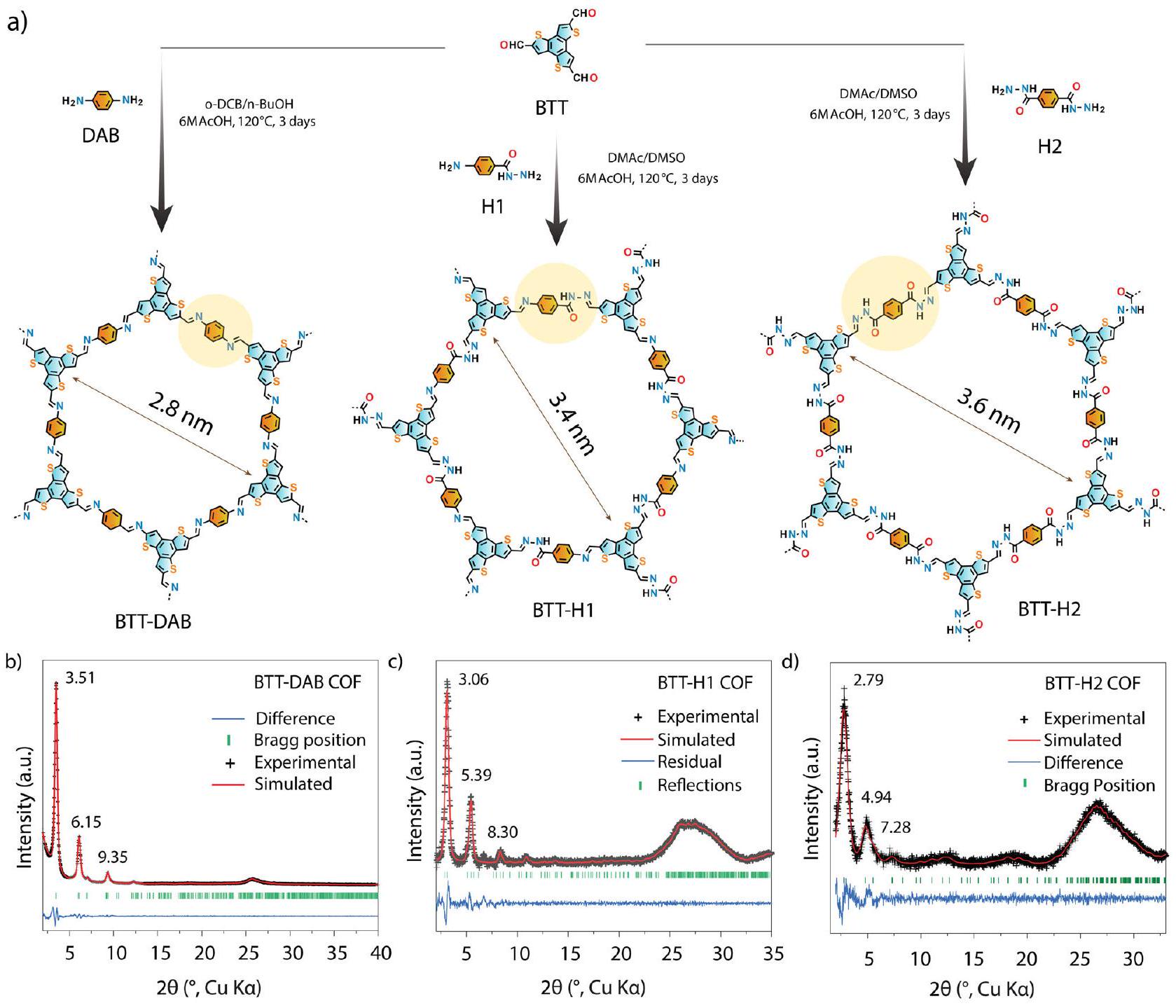
من أجل دراسة تأثير الروابط التساهمية الموجودة في هيكل COF على التحفيز الضوئيالجيل، نبلغ هنا عن سلسلة من COFs بأعداد متغيرة من الروابط الإيمينية والهيدرازونية: BTT-DAB مع روابط إيمينية، BTT-H1 مع رابط إيميني واحد ورابط هيدرازوني واحد، وBTT-H2 مع رابطتين هيدرازونيتين (الشكل 1). يبرز عملنا الذي يتضمن تجارب محكومة، مدعومة بحسابات نظرية الكثافة الوظيفية (DFT)، الدور الحاسم للروابط الهيدرازونية المحبة للماء والقطبية في تنشيطوتخفيض حاجز الطاقة لـ و الوسطاء فيالجيل. تُظهر دراستنا أن الألفة الأكبر للماء لرابطة الهيدرازون وتفاعلها المعزز مع الأكسجين في المواقع الحفازة يزيدان بشكل متزامن من معدلالجيل.
النتائج والمناقشة
إن الاختيار الدقيق لوحدات الربط والروابط أمر ضروري للتطبيقات الضوئية الحفازة حيث تعمل كموصلات أو جسور لتوليد الإثارة ونقل الشحنة عبر الهيكل الأساسي. لتسهيل العملية الضوئية الحفازةالجيل، قمنا بتصميم وتصنيع مجموعة من ثلاثة COFs بأعداد متغيرة من روابط الإيمين والهيدرازون. لتحقيق تخليق مثل هذه COFs، قمنا بإجراء تفاعل قاعدة شيف لمركب بنزو[1،2-b:3،4-b’:5،6-b”] تريثيوفين-2،5،8-تريكاربالدهيد (BTT) مع 4-. ديامينوبنزين (DAB)، 4-أمينوبنزوهيدرازيد (H1) وديهيدرازيد التيريفثاليت (H2) لإنتاج BTT-DAB وBTT-H1 وBTT-H2 COFs، على التوالي، تحت ظروف ذائبية حرارية (الشكل 1a). وُجد أن هذه COFs غير قابلة للذوبان في المذيبات العضوية الشائعة الاستخدام، بما في ذلك ثنائي ميثيل سلفوكسيد،-ثنائي ميثيل الفورماميد، رباعي هيدروفوران، ميثانول وأسيتون.
تم تأكيد التكرارية طويلة المدى لمركبات COFs القائمة على BTT باستخدام تحليل حيود الأشعة السينية بالمسحوق (PXRD).إشعاع ). أظهرت تحليلات PXRD انعكاسات قوية عند 3.51 ودرجات BTT-DAB، 3.06 ودرجات لـ BTT-H1، و 2.79 ودرجات لـ BTT-H2، تتوافق مع الوجوه (100) و(110) لهيكل شبكة سداسية بدائية (الشكل 1b-d). وجود انعكاسات إضافية عنددرجات لـ BTT-DAB،درجات لـ BTT-H1 ويمكن تعيين درجات BTT-H2 لـ 210 مستوى، مما يشير إلى تشكيل COFs بدرجة عالية من البلورية. بالإضافة إلى ذلك، تظهر مستويات الانكسار (001) لثلاثة من COFs BTT قممًا حولدرجات، والتي يمكن أن تُعزى إلى ضعف النظام طويل المدى لـالتفاعل مع مسافة تكديس الطبقات المتداخلة على طول الاتجاه c. وفقًا للنمذجة النظرية وتحسين باولي، تعتمد BTTDAB وBTT-H1 وBTT-H2 نموذج AA المتداخل المماثل ضمن (رقم 175)، (رقم 143)، و (رقم 175) مجموعات الفضاء، على التوالي (الشكل التكميلي 1 والجداول 1-3). بعد تحسين الهندسة، تم حساب أنماط PXRD ومقارنتها مع الأنماط التجريبية المقابلة. تم صياغة النماذج الهيكلية لـ BTT-DAB و BTT-H1 و BTT-H2 من خلال إنشاء طبقات سداسية ثنائية الأبعاد متوقعة في وضع تكديس AA (مظلل) وفقًا لتوبولوجيا hcb، مما أسفر عن قيم متبقية منخفضة بشكل معقول ومستوى مرضٍ من التمايز في الملفات. من ناحية أخرى، يمكن استبعاد نموذج AB المتداخل (المتداخل) بسبب الفرق بين أنماط PXRD المحاكاة والتجريبية (الشكل التكميلي 2).
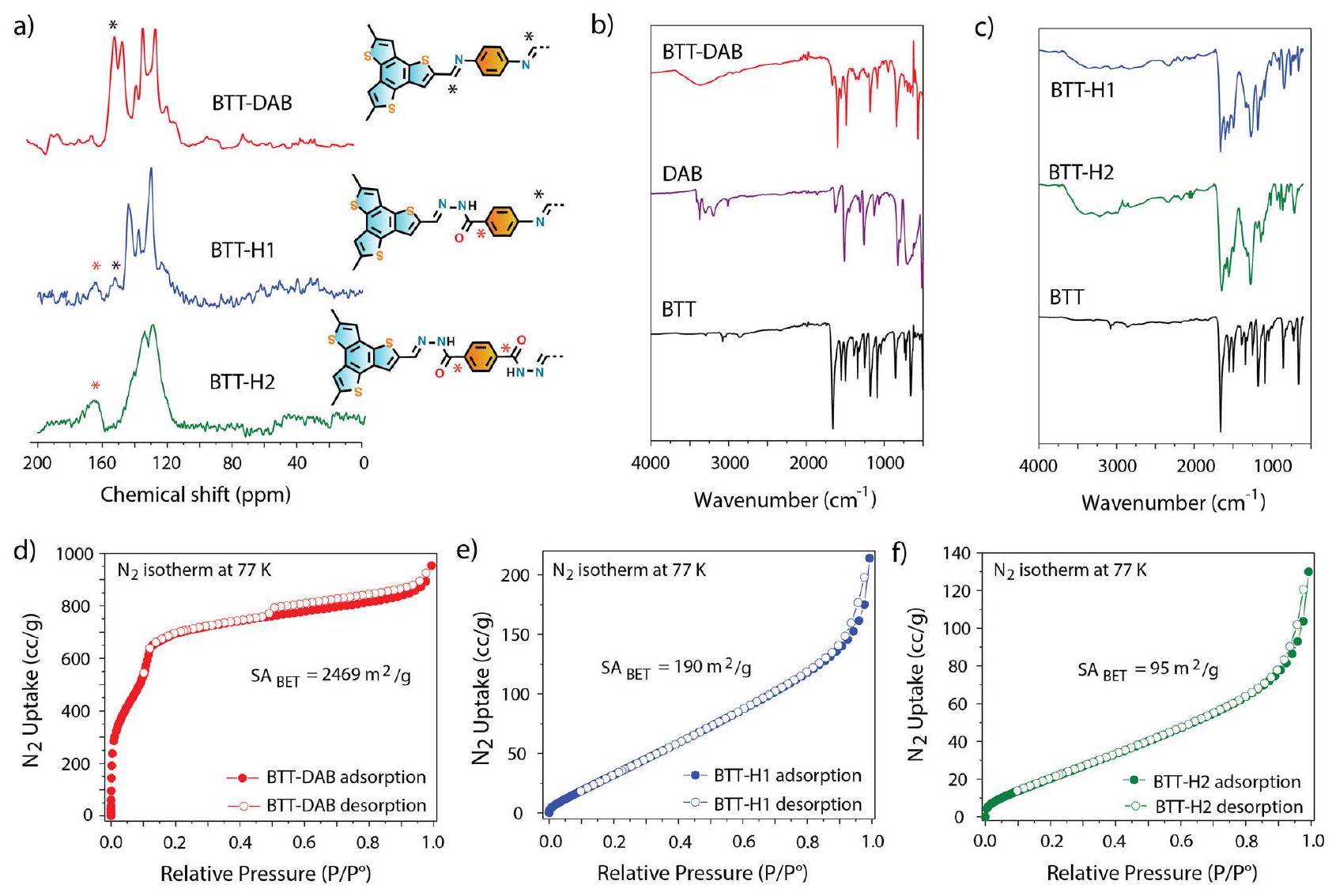
تم تأكيد السلامة الهيكلية للإيمين، والإيمين/الهيدرازون، والهيدرازون المرتبطة بـ COFs من خلال الحالة الصلبةتحليل الطيف النووي المغناطيسي بتدوير الزاوية السحرية عبر الاستقطاب المتقاطعتحليلات C CP-MAS NMR) (الشكل 2a). الإشارة في المجال المنخفض عند 157 جزء في المليون تتوافق مع رابط الإيمين ( ) من BTT-DAB COF، بينما تم ملاحظة القمم عند 156 و 164 جزء في المليون بسبب وجود الإيمين والكربونيل وظائف روابط الهيدرازون في BTT-H1 COF. القمة المميزة عند 164 جزء في المليون لـ BTT-H2 COF المرتبطة بالهيدرازون تتوافق مع احتفاظ الاهتزاز غير المتماثل للكربونيل. ) مجموعة في رابط الهيدرازون. تم التحقق من الهيكل وبناء الروابط في العمود الفقري لـ COF بشكل أكبر من خلال تحليل طيف الأشعة تحت الحمراء بتقنية تحويل فورييه (FTIR). يظهر طيف FT-IR لـ BTT-DAB وجود الإيمينتمدد عندبينمااختفاء تمدد BTT من“، مما يدل على تكوين روابط الإيمين من خلال تفاعل تكثيف قاعدة شيف (الشكل 2ب). احتفاظ قمم الكتف عندالموافق لـالأمين الثانوي والقمة القوية عندالموافق لـتشير الروابط الهيدرازونية معًا إلى وجود أمين ثانوي وكربونيل الروابط الهيدرازونية في BTT-H1 و BTT-H2 COFs (الشكل 2b و c والشكل التكميلي 3).
تم تحديد مسامية COFs المانحة-المانعة التي تم تصنيعها باستخدامتحليلات الامتصاص التي أجريت عند 77 كلفن.أظهر منحنى الامتصاص للـ BTT-DAB المرتبط بالإيمين نوعًا أول من المنحنيات يتميز بخطوات مميزة، بينما أظهرت الـ BTT-H1 و BTT-H2 منحنيات من النوع الثاني. كانت المساحة السطحية المحددة المحسوبة باستخدام نموذج بروناوير-إيميت-تيلر (BET) 2469 و190 و95 للـ BTT-DAB و BTT-H1 و BTT-H2 على التوالي (الشكل 2d-f). تظهر الـ COFs المرتبطة جزئيًا وكليًا بالهيدرازون مساحة سطحية أقل من الـ COFs المرتبطة بالإيمين المماثلة بسبب مرونتها والدوران الحر في الإطار، والتعبئة غير الفعالة وتكوين العيوب، وهو ما يتماشى مع النتائج المماثلة التي تم الإبلاغ عنها سابقًا.تغيير ظروف التخليق عن طريق تعديل المذيب
الشكل 1 | تخليق وبلورية محفزات COF الضوئية. أ مخطط تخليق BTT-DAB المرتبط بالإيمين، وBTT-H1 المرتبط جزئيًا بالإيمين والهيدرازون، وBTT-H2 المرتبط بالهيدرازون. مقارنة بين المحاكاة والتجارب. تم الحصول على أنماط PXRD لـ BTT-DAB، c BTT-H1، و d BTT-H2 تظهر تشكيل COFs بلورية. أدت التركيبات ودرجة الحرارة إلى مواد ذات مسامية معتدلة (الشكل التكميلي 4). كما يشير ملف توزيع حجم المسام إلى أن BTT-DAB وBTT-H1 وBTT-H2 ذات طبيعة مسامية متوسطة، مع زيادة حجم المسام من BTT-DAB إلى BTT-H2، بما يتماشى مع التوقعات النظرية (الشكل التكميلي 5).
علاوة على ذلك، قمنا بتقييم خصائص امتصاص الماء لمركبات الإطار العضوي، حيث لاحظنا أن مركب BTT-H2 المرتبط بالهيدرازون أظهر قدرة قوية على امتصاص الماء (أكثر من 3 مرات) مقارنة بمركب BTT-DAB المرتبط بالإيمين عند ضغط منخفض (الشكل التوضيحي 6)، مما يشير إلى التأثير القوي لمواقع ربط الماء الموجودة بكثرة في مركب COF المرتبط بالهيدرازون لتحسين التفاعل مع الماء. ومع ذلك، في نطاقات الضغط العالية (أظهر BTT-DAB امتصاصًا حادًا للماء من خلال التأثير الشعري بسبب مساحته السطحية العالية.من المعروف جيدًا أن الامتزاز عند الضغط المنخفض يهيمن عليه التفاعلات الكيميائية، في حين أن الامتزاز عند الضغط العالي يهيمن عليه المسامية بسبب التفاعلات المختلفة بين المادة الممتزة والمادة الممتزّة.أظهرت تحليلات المجهر الإلكتروني الماسح بالانبعاث الميداني (FESEM) أن COFs BTT-DAB وBTT-H1 وBTT-H2 تحمل أشكالاً على شكل قضبان تم إنشاؤها من تجميع بلورات صغيرة معًا (الشكل التوضيحي 7)، وهو ما تم دعمه أيضًا بواسطة المجهر الإلكتروني الناقل عالي الدقة (HR-TEM). تحليلات (الشكل التوضيحي التكميلي 8). تم إجراء تحليلات الوزن الحراري (TGA) للـ COFs لتحليل الاستقرار الحراري للـ COFs، حيث الاستقرار الحراري يصل إلىتمت ملاحظته (الشكل التكميلي 9).
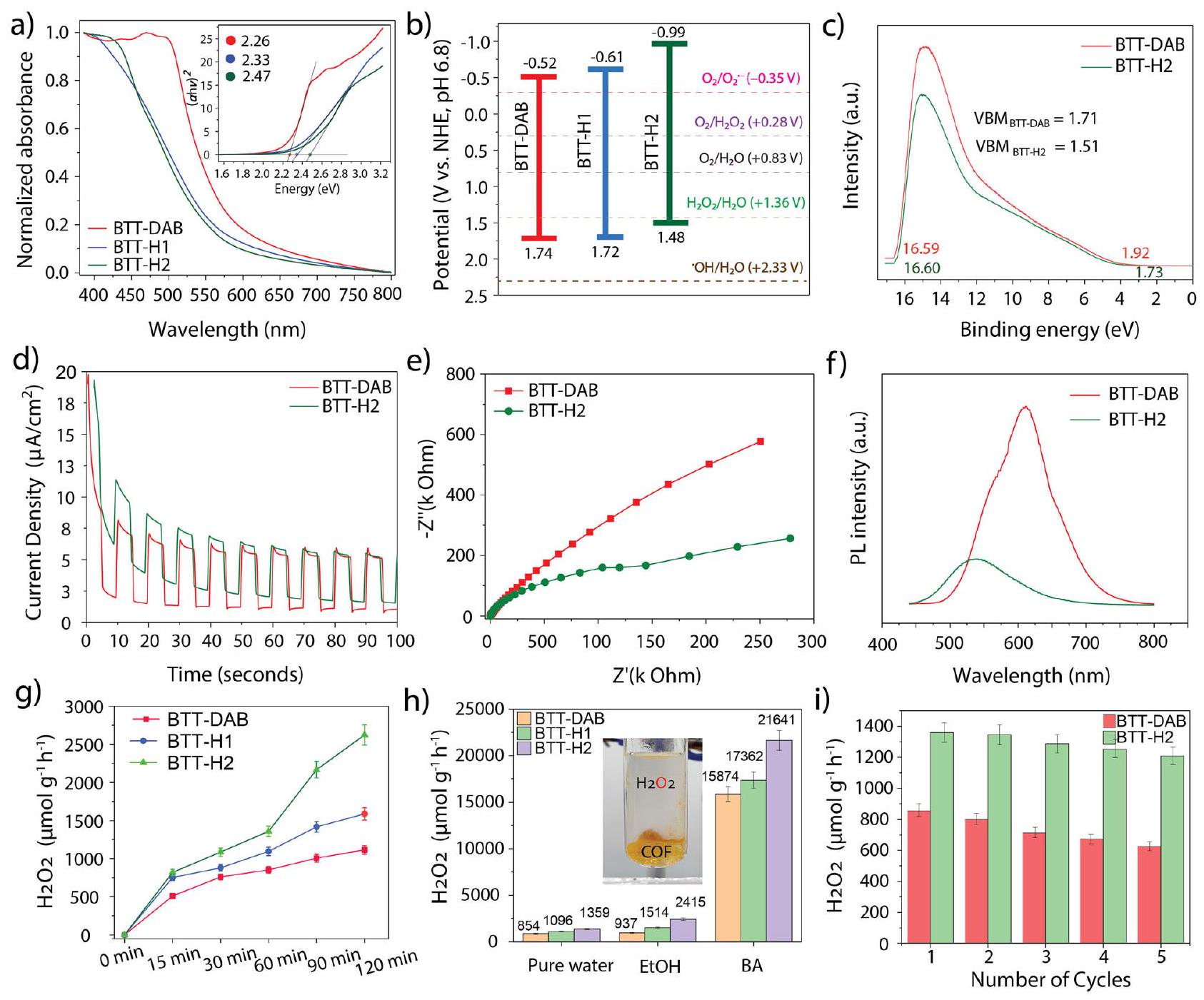
لتحليل الخصائص البصرية للـ COFs المرتبطة بالإيمين والهيدرازون، تم فحص امتصاص عينات الـ COF باستخدام تحليلات الطيف الكهرومغناطيسي فوق البنفسجي-المرئي (UV-vis) في الحالة الصلبة (الشكل 3أ). في تحليلات الانعكاس المنتشر للأشعة فوق البنفسجية-المرئية، تم ملاحظة حواف الامتصاص لـ BTTDAB و BTT-H1 و BTT-H2 في النطاق منبينما وُجد أن ذيل الامتصاص يمتد إلى ما بعد 750 نانومتر، مما يظهر القدرة على امتصاص الضوء في المنطقة المرئية. أظهر COF المرتبط بالإيمين BTT-DAB فجوة بصرية قدرها 2.26 إلكترون فولت، بينما أظهر COF المرتبط بالإيمين/الهيدرازون BTT-H1 فجوة بصرية قدرها 2.33 إلكترون فولت، وأظهر COF المرتبط بالهيدرازون BTT-H2 فجوة قدرها 2.47 إلكترون فولت، كما تم تأكيده من خلال مخططات تاوك (الشكل 3أ، الإطار).
علاوة على ذلك، تم تحديد مواقع نطاقات BTT-DAB وBTT-H1 وBTT-H2 من خلال دمج فجوات النطاق البصرية التي تم تحديدها باستخدام مخططات تاوك وإمكانات الاختزال من مخططات موت-شوتكي (الشكل 3ب والشكل التكميلي 10). تم تقدير نطاقات التوصيل (CB) لـ BTT-DAB وBTT-H1 وBTT-H2 لتكون، و -0.99 إلكترون فولت [بالنسبة إلى القطب الهيدروجيني العادي (NHE)]، على التوالي. إن BTT-H2 COF
الشكل 2 | توصيف المحفزات الضوئية القائمة على COF. أ الحالة الصلبةتحليلات C CP-MAS NMR لـ BTT-DAB و BTT-H1 و BTT-H2 COFs تظهر وجود قمم مميزة. ب تحليلات FT-IR لـ BTT-DAB COF تظهر تكوين الإيمين.
COFs. تحليل FT-IR لـ BTT-H1 و BTT-H2 COFs يظهر تشكيل روابط الإيمين والهيدرازون. منحنيات امتصاص النيتروجين لـ BTT-DAB و BTT-H1 و BTT-H2 COFs تظهر تشكيل مواد مسامية. عرضت القيمة السلبية القصوى لإمكانات نطاق التوصيل بمقدار -0.99 فولت (مقابل NHE، )، مما يدل على القدرة الفائقة على الاختزال الضوئي لمواقع الهيدرازون في مصفوفة COF. إنها خاصية بالغة الأهمية لأنها تساعد في تقليل الأكسجين الجزيئي إلى الجذير الفائق الأكسيد ( ، الخط الوردي المتقطع، -0.35 فولت)، مما يعزز تفاعل اختزال الأكسجين (ORR) لتوليد. لذلك، يمكن الافتراض أن معدل توليد أيونات الجذور الحرة السوبر أكسيد قد يزيد مع زيادة كثافة روابط الهيدرازون. علاوة على ذلك، أظهرت تحليلات UPS التي تم تنفيذها لتقييم مستوى الطاقة لأقصى نطاق تكافؤ بدقة موقع نطاق التكافؤ عند 1.71 eV و 1.51 eV (مقابل NHE) لـ BTT-DAB و BTT-H2، على التوالي، والتي وُجدت أيضًا متوافقة مع تحليلات موت-شوتكي (الشكل 3c). وُجد أن مستويات نطاق التكافؤ لـ BTT-DAB و BTT-H2 COFs أعلى من الإمكانات الديناميكية الحرارية للتفاعل المباشر.تفاعل أكسدة الماء (WOR) ضد NHE ، في )، مما يشير إلى وجود تفاعل ضوئي محفز شامل ممكن من الناحية الديناميكية الحرارية الجيل. بالإضافة إلى ذلك، تشير قيم نطاق الفالنس الإيجابية للـ COFs التي تم تصنيعها إلى تفضيل تفاعل الأربعة إلكترونات (أكسدة الماء (خط متقطع أسود، +0.83 فولت).
لتحليل توليد حاملات الشحنة عند تعرضها للإشعاع الضوئي المرئي، تم إجراء قياسات كثافة التيار الضوئي. أثبتت هذه التحليلات أن روابط الهيدرازون تفيد في النقل الفائق السرعة لحاملات الشحنة بسبب تراكم-كثافة السكان المداريين للإلكترونات بالقرب من حافة نطاق التكافؤ (الشكل 3d). أشارت نصف دائرة نصف القطر في مخطط نايكويست المستمد من تحليلات طيف الامتياز الكهروكيميائي (EIS) إلى أن COF BTT-H2 المرتبط بالهيدرازون لديه مقاومة منخفضة، وقدرة محسنة على هجرة الشحن مقارنة بـ COF BTT-DAB المرتبط بالإيمين، وهي خصائص مثالية لمحفز ضوئي عالي الأداء (الشكل 3e). علاوة على ذلك، الفلورية الضوئية (PL) أظهرت القياسات أن شدة الذروة المنخفضة لـ BTT-H2 مقارنةً بـ BTT-DAB COF، مما يشير إلى إمكانية انخفاض إعادة اتحاد الإلكترون والثقب في COFs المرتبطة بالهيدرازون (الشكل 3f). من خلال هذه التحليلات الفوتوفيزيائية، من الواضح أن COFs المرتبطة بالهيدرازون تمتلك حركة معززة لحاملات الشحنة مدعومة بفصل الشحنة الفعال وتقليل إعادة اتحاد الإلكترون والثقب مقارنةً بـ COFs المرتبطة بالإيمين.
التمثيل الضوئي لبيروكسيد الهيدروجين ( )
بالنظر إلى البلورية، وفجوة الطاقة البصرية المواتية ومواقع النطاق، تم استخدام COFs المرتبطة بالإيمين والهيدرازون في التحفيز الضوئي.الجيل باستخدام الهواء والماء وضوء الشمس الطبيعي الوفير تحت الظروف المحيطة. الجيل الضوئي التحفيزي لـتم تنفيذ ذلك باستخدام الماء النقي والأكسجين الجوي، وهو نهج بسيط واقتصادي ومستدام. في التجارب الضوئية النموذجية، تم توزيع COFs المعتمدة على الإيمين والهيدرازون في الماء النقي للغاية، تلاها الإشعاع باستخدام LED أزرق بقوة 40 واط. ). تم مراقبة تقدم التفاعل على فترات زمنية من ، و120 دقيقة، كل منها تشكل تفاعلًا منفصلًا لتقييم التحفيز الضوئي بدقةالنشاط كدالة للوقت (الشكل 3g). أولاً، تشكيلتم الكشف عنه باستخدام مجموعة اختبار البيروكسيد وتم تحديد كميته بشكل أكبر بواسطة مطيافية الأشعة فوق البنفسجية والمرئية باستخدام محلول حمض الكبريتيك أكسلفات التيتانيوم (IV).أظهر التجربة المتغيرة مع الزمن أن معدل التحفيز الضوئي اتبع تغيرًا خطيًا مع الوقت عند المسح على مدى 120 دقيقة. أظهر BTT-H2 COF مع روابط هيدرازون من الجانبينجيل يصل إلى“، الذي كان متفوقًا على COF BTT-H1 القائم على الإيمين/الهيدرازون ( )، بينما تم العثور على جيل الروابط الثنائية الجانبين من BTT-DAB ليكون 854 (الشكل 3g). نعتقد أن التخفيض الضوئي الأكبر
الشكل 3 | التوصيف الفوتوفيزيائي والتحفيز الضوئيأداء الجيل. طيف امتصاص الأشعة فوق البنفسجية والمرئية للمواد الصلبة BTT-DAB وBTT-H1 وBTT-H2. يظهر الرسم المصغر مخطط تاوك لتحديد فجوات الطاقة للمواد العضوية المتشابكة. الترتيبات الطاقية المستمدة تجريبياً للمواد العضوية المتشابكة BTT-DAB وBTT-H1 وBTT-H2 مقارنة بإمكانات اختزال الأكسجين وتطور الأكسجين (مقابل NHE عند pH 6.8) جنبًا إلى جنب مع تفاعلات أخرى. تحليلات UPS للمواد العضوية المتشابكة BTT-DAB وBTT-H2. استجابات التيار الضوئي للمواد العضوية المتشابكة BTT-DAB وBTT-H2. مخططات نايكويست EIS للمواد العضوية المتشابكة BTT-DAB وBTT-H2.طيف الفوتولومينسنس لـ BTT-DAB و BTT-H2
COFs.تحفيز ضوئي يعتمد على الزمنجيل BTT-DAB و BTT-H1 و BTT-H2 COF في الماء النقي تحت الضوء المرئي ). تشير أشرطة الخطأ إلى الخطأ في القياس. h التحفيز الضوئينشاط BTT-DAB و BTT-H1 و BTT-H2 COF في وجود مانحات إلكترونات تضحوية مختلفة. (الزاوية: نظام ثنائي الطور من الماء وكحول البنزيل). تحليل قابلية إعادة التدوير لـ BTT-DAB و BTT-H2 على مدى خمس دورات متتالية (ساعتين لكل منها) للتفاعل الضوئي التحفيزي.الجيل. تساهم كثافة الجهد وكثافة التيار الضوئي المستندة إلى الهيدرازون في الأداء الفوتوكاتاليتيكي المتفوق لـ BTT-H2 COF (الشكل 3ب، د). يمكن أيضًا أن يُعزى ذلك إلى تحسين التفاعل مع الماء وميول امتصاص الأكسجين الأفضل لرابطة الهيدرازون مقارنة برابطة الإيمين..
عندما تم استخدام الماء النقي تحت ظروف جوية (هواء)، فإنمعدل توليد BTT-H2 COFتم العثور على مصباح الزينون؛ 2 ساعة) يتجاوز العديد من المحفزات الضوئية غير المتجانسة القياسية، بما في ذلك – وغيرها من COFs المبلغ عنها، بعامل عدة بسبب الكثافة المتزايدة لروابط الهيدرازون في هيكل COF (الجدول التكميلي 5). في حالات استثنائية، قيم عالية لـتم تحقيق الجيل إما باستخدام عامل تضحيةفقاعات من النقاءأو استخدام الأضواء عالية الكثافة (الجدول التكميلي 5). التحفيز الضوئي تم أيضًا فحص الجيل باستخدام BTT-DAB وBTT-H1 وBTT-H2 COF باستخدام مانحات إلكترونات تضحوية مختلفة مثل الكحول الإيثيلي (EtOH) والكحول البنزيلي (BA) (الشكل 3h). زيادة طفيفة فيتم ملاحظة العائد عندماتم استخدام محلول مائي من الإيثانول. ومع ذلك، في وجودBA المائي، زيادة ملحوظة في العائد منتمت ملاحظته، والذي كان أعلى بحوالي 15 مرة. يمكن أن يُعزى هذا التحسن الكبير إلى فصل الطور الذي يحدث في وجود BA، حيث يبقى COF في الطور العضوي بينمايبقى في المرحلة المائية ومحمياً من التحلل بسبب التداخل مع المحفز الضوئي COF (الشكل 3h في الإطار). بما أن COF المرتبط بالهيدرازون BTT-H2 يحمل حافة VB تقع عند 1.51 فولت (تم الحصول عليها من تحليل UPS)، وهي أعلى من الجهد المطلوب لأكسدة الكحول البنزيلي إلى بنزالدهيد (1.98 فولت مقابل NHE)، فإن تكوين بنزالدهيد من الكحول البنزيلي يتم تثبيته خلال عملية التمثيل الضوئي لـمن خلال الاستفادة من فصل الطور، يعزز تنفيذ نظام ثنائي الطور من الماء والكحول البنزيلي توليداً غير مقيد لـ. الـيتم إنتاجه يذوب في المرحلة المائية (ماء نقي)، بينما يبقى المحفز الضوئي COF في المرحلة العضوية (BA)، والتي يمكن بعد ذلك تجديدها لـتركيب. قد تكون هذه الاستراتيجية واعدة لعملية التمثيل الضوئي المستمرة لـوقد توفر جسرًا من المختبر إلى الصناعة.
تم تقييم قابلية إعادة تدوير محفزات BTT-DAB و BTT-H2 COF على مدى خمس جولات متتالية، والتي أظهرت قابلية إعادة تدوير أفضل مع انخفاض في في النشاط الضوئي التحفيزي لمركب BTT-H2 COF المرتبط بالهيدرازون مقارنة بمركب BTT-DAB COF المرتبط بالإيمين الذي أظهر انخفاضًا في (الشكل 3i). بالإضافة إلى ذلك، تجربة التحفيز الضوئي على المدى الطويل لـتمت عملية التوليد على مدى 12 ساعة. كميةتم إنتاجه بواسطة BTT-H2 COF المرتبط بالهيدرازون بشكل مستمر على مدى 8 ساعات، ومع ذلك ينخفض إلى حد ما بعد 8 ساعات من الإشعاع بسبب التوازن بينالتكوين والتحلل الذي يُلاحظ عادةً فيالتمثيل الضوئي (الشكل التوضيحي التكميلي 12)من المثير للاهتمام أنه عندما تم استعادة BTT-H2 COF بعد 8 ساعات من التحفيز الضوئي واستخدامه في تفاعل تحفيزي ضوئي جديد،نشاطتمت ملاحظته، مما يشير إلى أن COF BTT-H2 المرتبط بالهيدرازون يمكن إعادة استخدامه بنشاط كبير. كما تم التأكيد من خلال تحليل PXRD و FT-IR والخصائص المسامية والتحليلات الشكلية قبل وبعد التحفيز الضوئي.تم الاحتفاظ بتفاعل الجيل، البلورية، السلامة الهيكلية، المساحة السطحية والشكل الخارجي لـ BTT-H2، مما يؤكد متانة BTT-H2 لـالجيل (الشكل التوضيحي التكميلي 11).
في التحفيز الضوئيعملية التوليد،يمكن أن يتفاعل المنتج بشكل حتمي مع الإلكترونات) أو ثقوب ( ) ويمكن أن تتحلل أكثر إلى جذور الهيدروكسيلأو الجذور الحرة السوبر أكسيد ( )، مما يؤدي إلى توليد الماء أو ، على التوالي. لذلك، دينامياتتمت دراسة التكوين والتحلل باستخدام COF BTT-H2 المرتبط بالهيدرازون، حيث من المتوقع أن تحدث الظاهرتان في وقت واحد خلال عملية التحفيز الضوئي (الشكل التكميلي 13). في هذه التحليلات، لوحظ أن تكوينيتبع حركيات من الدرجة صفر، في حين أن تحلليتبع حركيات من الدرجة الأولى. ومن ثم، فإن الإجمالييمكن أن يُقال إن الجيل هو كما يلي:
أين هو وقت رد الفعل و هو تركيز المنتج، و و هي ثوابت معدل التكوين والتحلل، على التوالي. تحدد البيانات المجهزة خطيًا أن يكون، و الـ القيم التي تم الحصول عليها عند 298 كيلفن و 313 كيلفن كانت و ، على التوالي. لذلك، فإن مقدار زاد لفترة معينة، بعد ذلك مقدارانخفضت (في تفاعل التحفيز الضوئي على المدى الطويل) بسبب التوازن بينالتكوين والتحلل.
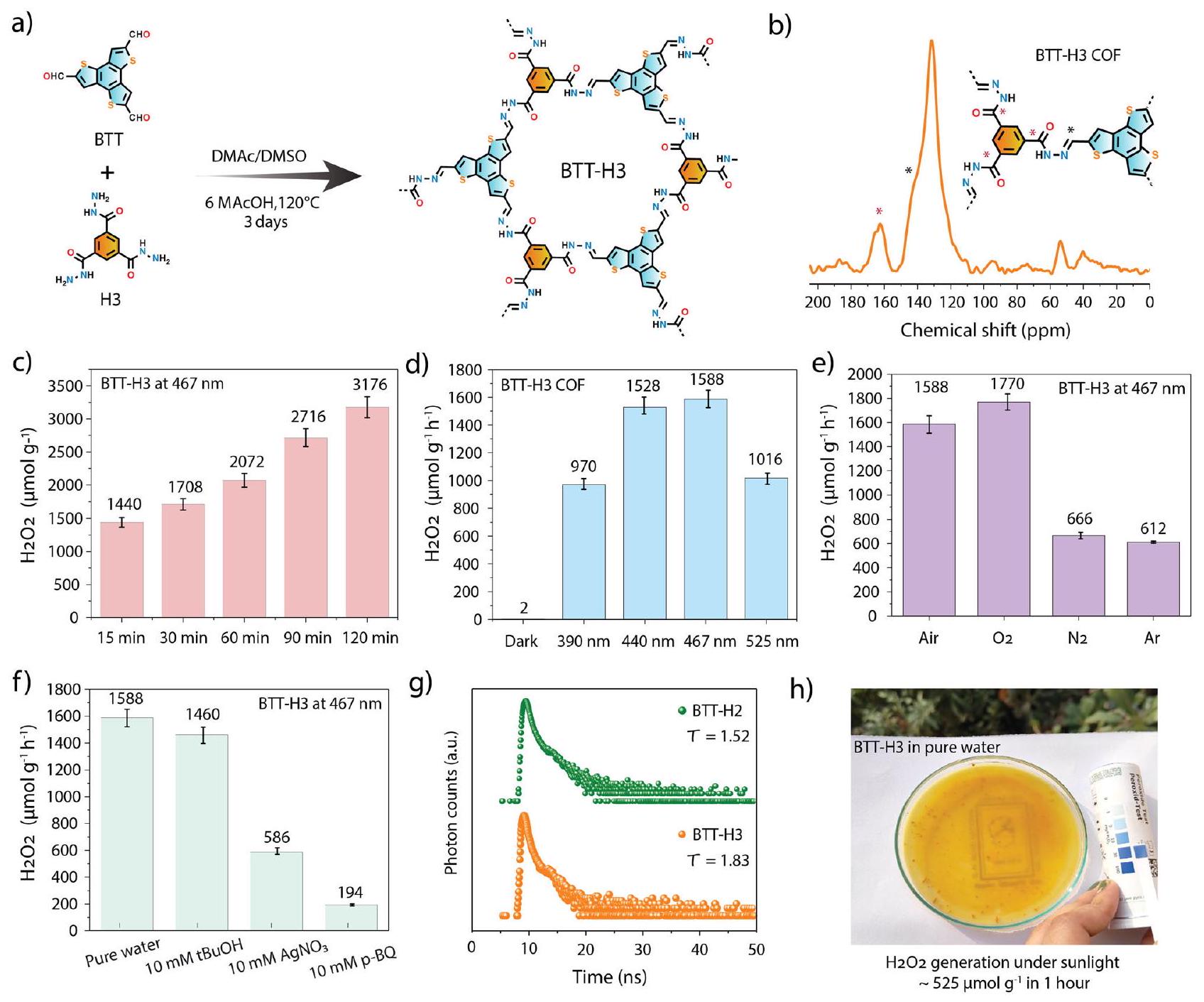
التحفيز الضوئيتجارب الجيل تشير إلى أن النشاط الضوئي الحفاز لـيمكن زيادة الجيل من خلال زيادة كثافة روابط الهيدرازون في إطار COF. للتحقق من تأثير روابط الهيدرازون على التحفيز الضوئيفي الجيل، استهدفنا تخليق COF المرتبط بالهيدرازون مع أقصى كثافة من روابط الهيدرازون. لتحقيق تخليق مثل هذا COF المرتبط بالهيدرازون (BTT-H3)، تم إجراء تفاعل التكثيف بين بنزو[1،2-b:3،4-b’:5،6-b”] ثلاثي الكبريتين-2،5،8-ثلاثي الكربالدهيد (BTT) وهيدرازيد ثلاثي الكربون بنزين-1،3،5.تم تنفيذها تحت ظروف سولفثرمالية (الشكل 4أ). الحالة الصلبةأظهرت تحليلات CP-MAS NMR اختفاء الكربونيلالتحول الكيميائي عند 190 جزء في المليون لمقدمة BTT وظهور قمة عند 164 جزء في المليون لمجموعات الكربونيل لرابطة الهيدرازون، مما يدل على تشكيل BTT-H3 COF المطلوب (الشكل 4b). أكدت تحليلات PXRD وFT-IR والتمعدن أيضًا تشكيل BTT-H3 COF بلورية معتدلة ومسامية (الشكل التكميلي 14). على الرغم من أن BTT-H3 COF أظهر بلورية منخفضة نسبيًا مقارنة بـ BTT-H1 وBTT-H2، إلا أنه أظهر فجوة بصرية أقل مدعومة بإمكانات اختزال أكثر سلبية تبلغ -1.2 فولت وكثافة أعلى من المواقع الحفازة لتفاعلات أكسدة الماء وتقليل الأكسجين (الشكل التكميلي 14 h). كما هو متوقع، استنادًا إلى الخصائص المرغوبة مثل الكثافة العالية للمواقع الحفازة، فجوة بصرية منخفضة، وإمكانات اختزال سلبية كبيرة، أظهر BTT-H3 COF أعلى نشاط ضوئي. معدل الجيل بمعدل مرتفع يصل إلىأكثر من 2 ساعة مقارنةً بـ BTT-H2 COF الذي يحتوي على كثافة أقل نسبيًا من روابط الهيدرازون (الشكل 4c). كانت أوقات الوميض للـ BTT-H3 COF المرتبط بكثافة عالية من الهيدرازون (1.83 نانوثانية) أعلى من تلك الخاصة بـ BTT-H2 COF المرتبط بكثافة منخفضة نسبيًا من الهيدرازون (1.52 نانوثانية) أو BTT-DAB COF المرتبط بالإيمين (1.60 نانوثانية)، مما يشير إلى أن BTT-H3 COF يمكن أن يثبطإعادة التركيب بكفاءة (الشكل 4g والشكل التكميلي 15).
علاوة على ذلك، التحفيز الضوئيتم تقييم نشاط BTT-H3 COF باستخدام شدة ضوء مختلفة، وأظهر أداءً أفضل عند شدة 467 نانومتر (الشكل 4d). وُجد أن العائد الكمي الظاهر (AQY) كانتمت ملاحظته عند 467 نانومتر (الشكل التوضيحي 16)، وكانت تحويل الطاقة الشمسية إلى طاقة كيميائية (SCC) ، وهو أعلى من كفاءة تحويل الطاقة الشمسية إلى الكتلة الحيوية في النباتاتمن المثير للاهتمام أن نلاحظ، عندما تعرضت المياه المشتتة من BTT-H3 لأشعة الشمس لمدة ساعة واحدة، كمية كبيرة منتم إنتاجه أيضًا (الشكل 4 ح). وهذا يوفر دليلًا على أن المورد المتجدد المتاح بسهولة من ضوء الشمس كافٍ لإنتاج كمية كبيرة من. بالإضافة إلى ذلك، نجد أن BTT-H3 COF يمكنه توليد بكفاءةفي مجموعة أوسع من عينات المياه الحقيقية المتاحة، بما في ذلك مياه التناضح العكسي، ومياه الصنبور، ومياه الأنهار، ومياه البحر (الشكل التكميلي 17). من المدهش أنالعائد من مياه البحر كان مرتفعًا كما، مما يظهر فائدة المواد الإطارية العضوية للتطبيقات العملية.
آلية التحفيز الضوئيجيل
فهم آلية التحفيز الضوئيإن توليد الطاقة باستخدام COFs كعوامل تحفيز ضوئي أمر حاسم لتحسين كفاءتها واستقرارها. إن فهم مسارات التفاعل والمواقع النشطة داخل COFs يسمح بإجراء تعديلات مستهدفة لتعزيز أدائها التحفيزي الضوئي، وهو أمر ضروري لإنتاج بيروكسيد الهيدروجين المستدام وتطبيقاته في الكيمياء الخضراء وإزالة التلوث البيئي. من أجل تحليل دور الأكسجين في التحفيز الضوئيالجيل،تم إجراء تجربة التمثيل الضوئي باستخدام الماء المشبع بالأكسجين. ونتيجة لذلك، لوحظ أن معدلتم زيادة الجيل باستخدام BTT-H3 COF إلى (الشكل 4e). ومع ذلك، عندما تم تطهير الماء بالنيتروجينانخفاض كبير فيتم ملاحظة العائد، مما يشير إلى ضرورة الأكسجين خلالرد فعل الجيل. الانخفاض الكبير فيتوليد تحت تطهير الأرجون (Ar) أكد أيضًا على الدور الحاسم للأكسجين في تفاعل اختزال الأكسجين الضوئي التحفيزي.
بشكل عام، في الخطوة الأولى من التحفيز الضوئيتقبل جزيئات الأكسجين الجزيئي الإلكترونات الناتجة عن المحفز الضوئي تحت إشعاع الضوء لتكوين أيون الجذير الفائق الأكسيد ( ) من خلال تفاعل اختزال الأكسجين (ORR). علاوة على ذلك، في مسار ORR المتدرج، يتكون الوسط من تفاعلمعأيون. أخيرًا، يتفاعل وسيط OOH مع إلكترون يتبعه أيون لتوليدلتأكيد هذه الآلية، قدمنا جزيءًا مخلصًا،-بنزوكوينون (-BQ; محلول مائي بتركيز 10 مللي مول)، الذي يختار بشكل خاص التقاط أيون الجذير الفائق الأكسيد، إلى خليط التفاعل، مما أدى إلى تقليل كبير في معدلالجيل (الشكل 4f). قدرة الاختزال الضوئي لمواقع المستقبل في رابط الهيدرازون في BTT-H3 COF تسهل هذه العملية. بالإضافة إلى ذلك، فإن الضعفتوليد في وجود جامع الإلكتروناتمحلول مائي) أكد على مشاركة اختزال الإلكترون الواحد الناتج عن الضوء في الجيل (الشكل 4g). علاوة على ذلك، فإن إضافة البوتانول الثلاثي، وهو مادة تمتص الجذور الحرة للهيدروكسيل ( )، بالكاد أثرت على معدل الإنتاج، مما يشير إلى أنالراديكالي لا يساهم فيرد فعل الجيلتمت ملاحظة خصائص مشابهة أيضًا للـ BTT-DAB المرتبط بالإيمين، و BTT-H1 و BTT-H2 المرتبطين بالهيدرازون (الشكل التكميلي 18).
تم إجراء تجارب قطب كهربائي دائري القرص (RRDE) لتحديد عدد نقل الإلكترونات المتضمنة في اختزال الأكسجين.
الشكل 4 | التخليق، التوصيف والتحفيز الضوئيأداء الجيل من BTT-H3 COF. أ مخطط تخليق BTT-H3 COF مع روابط هيدرازون ذات كثافة عالية. ب الحالة الصلبةتحليلات C CP-MAS NMR تظهر تشكيل BTT-H3 COF. ج التحفيز الضوئي المعتمد على الزمنتوليد BTT-H3 COF في الماء النقي تحت الضوء المرئي ). تشير أشرطة الخطأ إلى الخطأ في القياس. د التحفيز الضوئيتوليد باستخدام BTT-H3 مع شدة ضوء متغيرة في الماء النقي تظهر أفضل أداء عند 467 نانومتر. تشير أعمدة الخطأ إلى الخطأ في القياس. e التحفيز الضوئيتوليد باستخدام BTT-H3 تحت أجواء مختلفة (الهواء،و Ar )، في الماء النقي تحت الضوء المرئيتشير أشرطة الخطأ إلى الخطأ في القياس.تحفيز ضوئينشاط BTT-H3 في وجود عوامل مختلفة للتخلص من الشوائب، تحت الضوء المرئي ). تشير أشرطة الخطأ إلى الخطأ في القياس. ج ملف زوال عمر الفلورية لـ BTT-H2 و BTT-H3 COFs. ح صورة لـ COF الموزعة في الماء المعرض لأشعة الشمس تظهر توليد كميات كبيرة من . أثناء عملية التمثيل الضوئي لـتم العثور على متوسط عدد نقل الإلكترونات في تفاعل اختزال الأكسجين (ORR) باستخدام BTT-H2 و BTT-H3 COFs ليكون 2.64 و 2.28 على التوالي، وفقًا لتحليلات RRDE (الشكل التكميلي 19)، مما يؤكد تقليلإلىتحدث عبرعملية ORR. بالإضافة إلى ذلك، تم استخدام تجارب RRDE أيضًا للتحقيق في WOR (ومسارات WOR) للـ COFs المرتبطة بالهيدرازون، والتي اقترحت أن كل من BTT-H2 و BTT-H3 المرتبطتين بالهيدرازون تولدانعبرعملية WOR (الشكل التوضيحي التكميلي 20)، متوافقة مع المحفزات الضوئية المعتمدة على COF المبلغ عنهامن الجدير بالذكر أنه في مسار WOR نحوالجيل، المُنتَجيمكن للجزيئات المشاركة في إنتاجعبرعملية متسلسلة )، والتي يمكن أن تكون أكثر ملاءمة من الناحية الديناميكية الحرارية ويمكن أن تتجنب أيضًا تسمم المحفز. تم تقييم الرنين المغناطيسي الإلكتروني (EPR) لتوضيح دور الـالوسيط المعني في ORR. الكشف عن إشارة DMPO-في طيف EPR أكد توليدعن الهيدرازون- المركبات العضوية الإطارية المرتبطة تحت إشعاع الضوء المرئي (الشكل التكميلي 21). نعتقد أن الهيدروفيلية المترافقة بشكل عالٍتوفر المصفوفات العمودية في BTT-H3 COF الغني بالهيدرازون مواقع تحفيزية وفيرة لكل من تفاعل أكسدة الماء وتفاعل اختزال الأكسجين، مما يظهر الكفاءة الضوئية التحفيزية.الجيل.
الدراسات الحاسوبية
لكي نفكك تفاعل جزيئات الماء مع هيكل COF وتأثير الروابط على المستوى المجهري، تم إجراء نظرية الكثافة الوظيفية (DFT) ومحاكاة الديناميكا الجزيئية. في الخطوة الأولى من التحليل، تم تطبيق DFT لاشتقاق الهندسات المثلى للـ COFs. توافقت الحسابات مع هندسات مستقرة لكل من الطور الأحادي والطور الكتلي المكدس (الشكل التكميلي 22). أظهرت الإمكانيات المحلية المحسوبة لـ BTT-H3 COF المرتبطة بالهيدرازون، والتي تحتوي على مسام مزينة بمصفوفات من مستقبلات/مانحات البروتون، درجة عالية من فصل الشحنات مقارنةً بـ BTT-DAB المرتبطة بالإيمين حيث أن الروابط الهيدرازونية هي تفتقر الإلكترونات، بينما وحدات البنزوترثيوفين (BTT) غنية بالإلكترونات (الشكل التكميلي 23 أ، ب). تؤكد الدراسة الحاسوبية بذلك وجود قنوات نقل الشحنات داخل الجزيئات (IRCT) في الأطر العضوية المرتبطة بالهيدرازون، والتي تساعد في إنتاج الشحنات الحرة وتسهيل تفكك الإثارة وفصل الشحنات. يعزز ارتباط جزيئات الماء عند العقد المحبة للماء التي تتكون من روابط الهيدرازون تفاعل أكسدة الماء إلى جانب تفاعل اختزال الأكسجين، مما يؤثر على التفاعل مع الأكسجين المذاب في إطار التحفيز.. بالإضافة إلى ذلك، أهمية وحدة BTT للتصوير الضوئي التحفيزيتمت مقارنة الجيل مع نظير لهجزيء متماثل مع ذرات الكبريت مستبدلة بالكربون. ومع ذلك، فإن وجودذرة الكربون في جزيء 4,7-ديهيدرو-1H-سايكلوبنتا[e]-أس-إنداسين-2,5,8-تريكاربالدهيد تحفز عدم المسطحية (ذرات الهيدروجين خارج المستوى) في مثل هذه الهياكل بسبب تكديس الطبقات لتكوين COFs (الشكل التكميلي 24). لذلك، من المتوقع أن تكون النشاط الضوئي التحفيزي لجزيء 4,7-ديهيدرو-1H-سايكلوبنتا[e]-أس-إنداسين-2,5,8-تريكاربالدهيد مع ذرة الكربون أقل بكثير مقارنةً بـ BTT مع ذرة الكبريت.
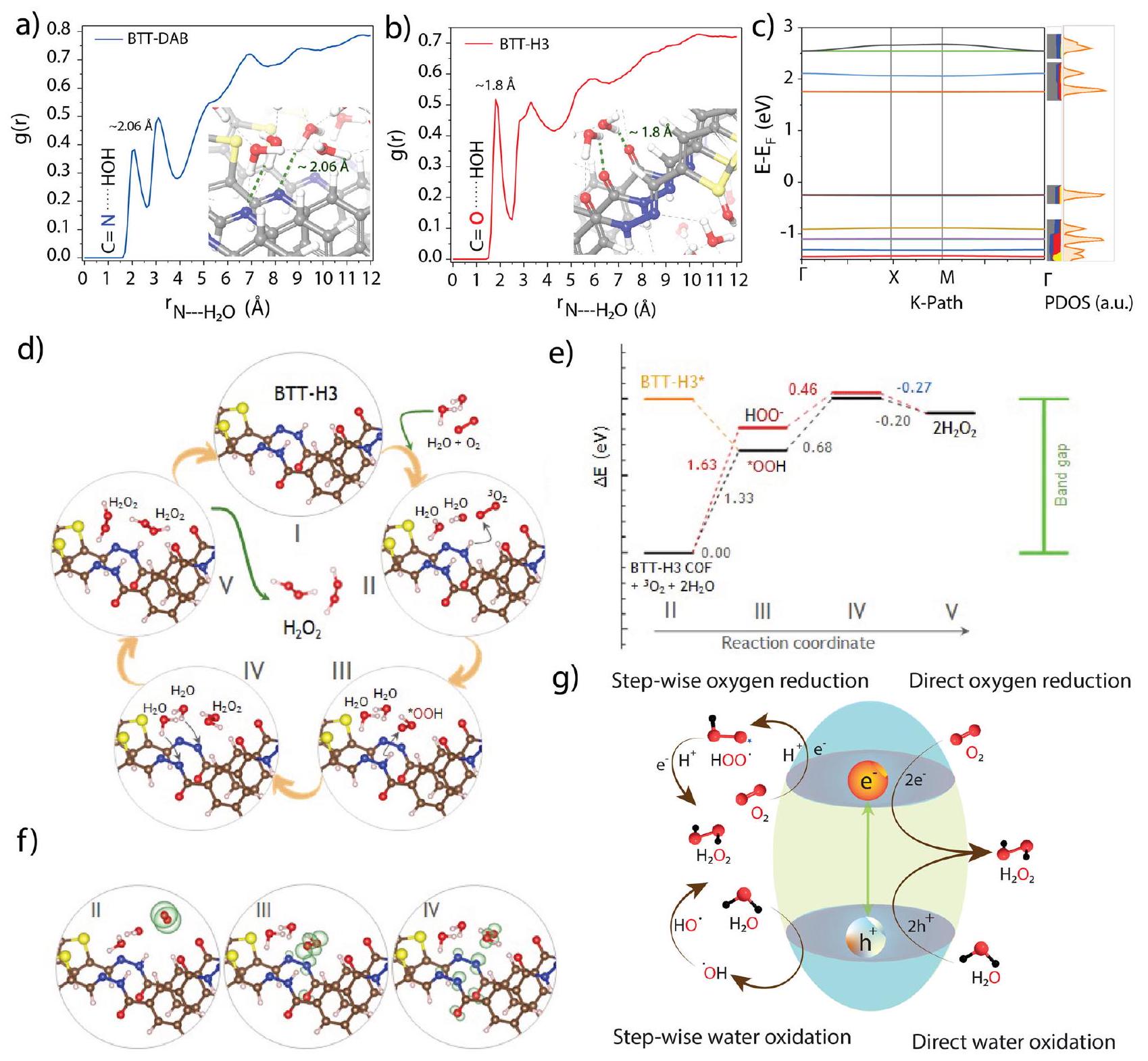
تشير الألفة العالية للإلكترون في الهيدرازون إلى إمكانيته في التبرع بالبروتون ليعمل كمركز تحفيزي فعال لتقليل الأكسجين/أكسدة الماء. لذلك، لفهم تفاعل الماء والأكسجين الثنائي مع هذا المركز التحفيزي، تم إجراء محاكاة الديناميكا الجزيئية الكلاسيكية (MD) من خلال وضع جزء COF في بيئة مائية صريحة.قمم عند مسافات الروابط الهيدروجينيةتشير إلى الماء المرتبط؛ حيث تشير الكثافة الأعلى إلى ارتباط أقوى، أي وجود طبقة ماء غير متحركة. في COF المرتبط بالإيمين BTT-DAB، الـتوجد مواقع ربط (إيمين) ترتبط بالماء بقوة أقل بشكل ملحوظ مقارنةً بروابط الهيدرازون الموجودة في BTT-H3 COF (الشكل 5a).
من ناحية، في BTT-H3 COF، يشكل الأكسجين الكربوني رابطة هيدروجينية قوية للغاية مع الماء (الشكل 5ب). من ناحية أخرى، تعمل مجموعة -NH في روابط الهيدرازون كمانح للرابطة الهيدروجينية، مما يشكل روابط هيدروجينية مع الماء، وتعمل روابط الهيدرازون كمتقبل لروابط الهيدروجين (الشكل التكميلي 23c). تم التحقق من هذه النتائج النظرية من خلال قياسات زاوية الاتصال مع الماء. في قياسات زاوية الاتصال لـ BTT-H3، لوحظ التفاعل القوي (النفاذية للماء) مع روابط الهيدرازون مقارنةً بـ BTT-DAB COF المرتبطة بالإيمين، وهو ما يعد ميزة للتفاعل الضوئي.توليد من الماء (الشكل التوضيحي التكميلي 23d). أظهر الكثافة المحسوبة للحالات (DOS) كثافة أعلى من-الإلكترونات المدارية بالقرب من حافة نطاق التكافؤ لـ BTT-H3 COF، مما يمنح القدرة العالية على التبرع بالإلكترونات في COFs المرتبطة بالهيدرازون بكثافة عالية (الشكل 5c). عالية-كثافة الإلكترونات المدارية تعزز النقل من خلال إنشاء حالات غير محلية، مما يؤدي إلى تحسين قدرات امتصاص الضوء في نطاق الأشعة فوق البنفسجية والمرئية، ويجعلها أفضل في جمع الطاقة الشمسية لتحفيز التفاعلات الضوئية. التمديدالنظام يعزز إزالة التوطين، مما يقلل من فرص إعادة اتحاد الإلكترون والثقب، وهو ما يضر بالتحفيز الضوئي. التحسين-كثافة الإلكترونات المدارية في BTT H3 COF المرتبطة بالهيدرازون تمكن من تحسين حركة الإلكترونات والفجوات مقارنةً بـ BTT-DAB COF المرتبطة بالإيمين (الشكل التوضيحي 25). وبالتالي، نفترض أن دمج هذه الميزات الواعدة في محفز ضوئي قائم على COF واحد، وهو BTT-H3، قد يجعل من الممكن إجراء عملية التمثيل الضوئي بكفاءة.مع وفرة من الماء والهواء باستخدام ضوء الشمس الطبيعي.
على الرغم من القيود الجوهرية للدراسات الحاسوبية، خاصة عند تطبيقها على أنظمة مثالية قد لا تلتقط جميع تفاصيل الإعداد التجريبي، فإن الدراسة الحاسوبية تقدم رؤى لا تقدر بثمن حول الملاحظات التجريبية. بعد فهم الآلية الجزيئية لتوليدمن الأكسجين والماء في مركز الهيدرازون من BTT-H3 COF في التحفيز الضوئي العامالجيل، قمنا بدراسة الملف الطاقي للمسارات الميكانيكية المحتملة لـتفاعل الجيل. لهذا الغرض، استخدمنا حسابات DFT، باستخدام مدخلات MD حول توزيع الماء والأكسجين (المتفاعلات) حول المواقع الحفازة لـ BTT-H3 COF. في ما يلي، نعتبر بعض الاحتمالات ونقيم جدواها. في الاحتمال الأول، نعتبر أن التفاعل يبدأ بتفكيك الماء وامتصاصأو الإلكترونات المرتبطة بالبروتونات بواسطة COFs عند التحفيز الضوئي، مما يولد واحداًالجزيء. في الخطوة التالية، عند الاسترخاء،يمكن أن تتحد لتشكلغاز أو يتفاعل مع الأكسجين المذاب لتكوين آخرالجزيء. يتم تقديم ملف الطاقة الإلكترونية لهذا المسار التفاعلي في الشكل التكميلية 26، والذي يتضمن حاجز طاقة مرتفع. تم حسابالجهد المحتمل، الذي يتجاوز 3 إلكترون فولت، أعلى من الطاقة النظرية لفجوة النطاق في COF، مما يجعله غير مواتٍ من الناحية الديناميكية الحرارية. قد تفسر خصائص الحمض-القاعدة في الحالة المثارة لـ COF هذه الملاحظة. يتم عرض فصل الشحنة في الحالة الأساسية في COF وتراكم كثافة الإلكترون في مجموعة الهيدرازون في الشكل التكميلية 23a. تشير الألفة الإلكترونية الأعلى إلى أن الروابط الهيدرازونية من المرجح أن تطلق بروتونًا أكثر من قبول واحد. يكشف تحليل المدار الجزيئي الحدودي (HOMO) عن كثافة إلكترونية كبيرة فوق رابطة -NH- في الحالة الأساسية (الشكل التكميلية 23e، f). في المقابل، يظهر المدار الانتقالي أن كثافة الإلكترون تتحول بعيدًا عن مجموعة -NH-، مما يضعف الـالرابطة في الحالة المثارة. في نفس الوقت، كثافة الإلكترون على و تزداد المجموعات، مما يجعل هذه المجموعات الوظيفية أقل احتمالًا لقبول البروتونات في الحالة المثارة.
تشير زيادة حموضة روابط الهيدرازون في حالة الإثارة لـ BTT-H3 COF إلى مسار بديل محتمل لـتوليد. يبدأ هذا المسار بنقل البروتون المرتبط بالإلكترون في حالة الإثارة أو نقل ذرة الهيدروجين من COF إلى الديوكسجين، مما ينتج مباشرة الجذير الهيدروبيروكسي.أو من خلال سوبر أكسيد (متوسط. هذاالجذري بعد ذلك يتفاعل مع ذرة هيدروجين أخرى من مجموعة الهيدرازون المجاورة، منتجًا جزيئًا واحدًا من (الشكل 5d). عند التحفيز الضوئي، يتم نقل بروتون واحد من روابط الهيدرازون في BTT-H3 COF إلى الأكسجين الجزيئي المذاب، مما ينتج راديكال (I II). ثم، يتم نقل بروتون آخر من الجزء المجاور من الهيدرازين إلى، إنتاج واحد (II → III). وبالتالي، يتم توليد فراغين بروتونيين في BTT-H3 COF (III). يقوم BTT-H3 COF بسهولة بامتصاص البروتونات من الماء المرتبط بالهيدروجين، مما ينتج عنه جزيء آخر من وتجديد محفز BTTH3 COF الضوئي. الجهد المختزل المحسوب هو 2.01 إلكترون فولت، وهو متوافق مع طاقة فجوة النطاق للـ COF، مما يجعله مواتياً حرارياً (الشكل 5e). هذه العملية تخلق فراغين من الهيدروجين في الـ COF، مما يدفع أكسدة الماء وإنتاج آخر.الجزيء، وبالتالي إكمال الدورة التحفيزية. تم اكتشاف أن الطاقات الحرة للوسطاء الجذريين على طول مسار التفاعل كانت أقل من تلك الخاصة بالوسطاء الأيونيين (في الخطوة الثانية،التكوين أكثر ملاءمة من الناحية الطاقية من)، مما يشير إلى تفاعل جذري وسيط، وهو استنتاج مدعوم بأدلة تجريبية. بالإضافة إلى ذلك، تؤكد كثافات الدوران المحسوبة المتركزة على الوسائط الجذرية وجود أيون الجذر الفائق الأكسيد (الأنواع، مما يشير إلى مسار تقليل الأكسجين خطوة بخطوة (الشكل 5f). ومن ثم، فإن عملية نقل إلكترون واحدة خطوة بخطوة – وهي مسار مفضل أكثر للتصوير الضوئيتوليد – هو تفاعل يتطلب طاقة أقل (الشكل 5g).
باختصار، قمنا بتخليق سلسلة من المواد العضوية الإطارية المرتبطة بالهيدرازون مثل BTT-H1 وBTT-H2 وBTT-H3 مع روابط هيدرازون متغيرة وحققنا في فعاليتها في التحفيز الضوئي.توليد من الماء النقي تحت الهواء. تؤكد نتائجنا على الدور الحاسم لروابط الهيدرازون في COFs من أجل الكفاءة.التمثيل الضوئي
الشكل 5 | الدراسات الحاسوبية للضوء المحفزالتوزيع الشعاعي (المستخرج من محاكاة الديناميكا الجزيئية الكلاسيكية) للماء بالنسبة لـ:نقطة مركز BTT-DAB و O مراكز BTT-H3. هيكل النطاق وكثافة الحالة المتوقعة (PDOS) لـ BTT-H3. آلية جزيئية لتوليد من الأكسجين والماء في مركز الهيدرازون لـ BTT-H3
COFs. e الملف الطاقي الإلكتروني لتفاعل توليد بيروكسيد الهيدروجين. f كثافات الدوران (كتل خضراء فاتحة شبه شفافة) للأنواع الجذرية. g توضيح للآلية العامة للتصوير الضوئي.توليد عبر تفاعل اختزال الأكسجين وتفاعل أكسدة الماء. تجاوز أداء COF BTT-DAB المرتبط بالإيمين بسبب تعزيز التفاعل مع الماء واتجاهات امتصاص الأكسجين لـ COFs الهيدرازونية. ومن الجدير بالذكر أن COF BTT-H3 أظهر نشاطًا ضوئيًا استثنائيًا. جيل ( ) دون الحاجة إلى مانحين خارجيين للإلكترونات. علاوة على ذلك، أظهر ذلك أهمية كبيرة إنتاج ) تحت التعرض لأشعة الشمس لمدة ساعة واحدة، مما يبرز إمكانيته في استغلال الموارد المتجددة. باستخدام المحاكاة الجزيئية، أظهرنا أن -توفر المصفوفات العمودية في BTT-H3 COF مواقع تحفيزية وفيرة لتفاعلات أكسدة الماء وتقليل الأكسجين. أوضحت حسابات DFT والمحاكاة الديناميكية الجزيئية المفصلة توزيع الشحنة على وحدات الهيدرازون وميولها تجاه جزيئات الماء والأكسجين، مما يدعم نتائجنا التجريبية. تم اقتراح مسارات تفاعل محتملة. نعتقد أن بحثنا يساهم في تطوير محفزات ضوئية عالية الأداء قائمة على COF من أجل الاستدامة.توليد من الماء والأكسجين الجوي, مدفوعًا بضوء الشمس الطبيعي، مما يوفر آفاقًا واعدة في علم المواد والطاقة المتجددة.
طرق
تحضير BTT-DAB COF
بنزو[1،2-ب:3،4-ب’:5،6-ب”] ثلاثي ثيوفين-2،5،8-ثلاثي الكربالديهيد (BTT، ) و 4-ديامينوبنزين (DAB، تم أخذها في أنبوب بايركس سعة 10 مل، وتم إذابتها في ortho-dichlorobenzene و -بيوتانول ( – بالإضافة إلى إضافة 6 م من حمض الأسيتيكحمض كعامل حفاز. يتم تسليط الموجات فوق الصوتية على خليط التفاعل في أنبوب بايركس لمدة 10 دقائق. يتم إجراء ثلاث دورات تجميد-ضخ-ذوبان على خليط التفاعل المتجانس للغاية. يتم الآن تسخين الأنابيب المغلقة التي تحتوي على مونومرات الوصل العضوي الموزعة في المذيبات عندلمدة 3 أيام. بعد التبريد إلى درجة حرارة الغرفة، تم تصفية المسحوق الداكن ذو اللون البرتقالي باستخدام الأسيتون، الميثانول، التتراهيدروفوران، والهكسان.
تحضير BTT-H1 COF
بنزو[1،2-ب:3،4-ب’:5،6-ب”] ثلاثي ثيوفين-2،5،8-ثلاثي الكربالديهيد (BTT، ) و 4-أمينوبنزوهيدرازيد (H1، 33 ملغ، 0.22 مليمول) تم أخذها في أنبوب بايركس سعة 10 مل، وتم إذابتها في DMSO و DMAC (0.5 مل) بالإضافة إلى إضافة 6 م من حمض الأسيتيككعامل مساعد. يتم تسليط الموجات فوق الصوتية على خليط التفاعل في أنبوب البيركس لمدة 10 دقائق. يتم جعل خليط التفاعل المتجانس للغاية يخضع لثلاث دورات من التجميد والضخ والذوبان. يتم الآن تسخين الأنابيب المغلقة التي تحتوي على مونومرات الروابط العضوية الموزعة في المذيبات عندلمدة 3 أيام. بعد التبريد إلى درجة حرارة الغرفة، تم تصفية المسحوق الداكن ذو اللون الأصفر باستخدام الأسيتون والميثانول والتتراهيدروفوران والهكسان.
تحضير BTT-H2 COF
بنزو[1،2-ب:3،4-ب’:5،6-ب”] ثلاثي ثيوفين-2،5،8-ثلاثي الكربالديهيد (BTT، ) و ثنائي هيدرازيد التيرفثاليك ( تم أخذ (0.22 ملليمول) في أنبوب بايركس سعة 10 مل، وتم إذابته في DMSO و DMAC بالإضافة إلى إضافة 6 م من حمض الأسيتيكيتم تسليط الموجات فوق الصوتية على خليط التفاعل في أنبوب بايركس لمدة 10 دقائق. يتم الآن تسخين الأنابيب المغلقة التي تحتوي على مونومرات الروابط العضوية الموزعة في المذيبات.لمدة 3 أيام. بعد التبريد إلى درجة حرارة الغرفة، تم ترشيح المسحوق الأصفر الفاتح باستخدام الأسيتون والميثانول والتتراهيدروفوران والهكسان.
إجراء عملية التمثيل الضوئي
تشمل الإجراءات التجريبية أخذ جرعة مثلى من المحفز الضوئي COF (5 ملغ) موزعة في 10 مل من الماء النقي عن طريق الموجات فوق الصوتية لمدة 15 دقيقة. يتم تجنب الاستخدام المفرط للمحفز لأنه قد يتسبب في تحلله.تم توليدها. بالنسبة لجو الأكسجين والنيتروجين والأرجون، تم عادةً نفخ المحلول باستمرار مع غاز الأكسجين النقي والنيتروجين والأرجون، على التوالي. بالنسبة للتجارب المضبوطة، تم استخدام عوامل تضحية مختلفة (مثل الإيثانول، الكحول الإيزوبروبيلي والكحول البنزيلي) ومواد امتصاص (بارا-بنزوكوينون، تيرت-بيوتانول، ) تم استخدامها. تم السماح لمزيج التفاعل بالتحريك في الظلام لمدة 30 دقيقة للوصول إلى توازن الامتصاص-الامتزاز. تم تعريض النظام لمصدر ضوء زينون ( 40 واط ) مع الحفاظ على درجة حرارة التفاعل حوالي . بعد أخذ عينات في فترة زمنية محددة، يتم سحب المحلول باستخدام حقنة، ثم يتم طرده مركزياً، ثم يتم ترشيحه (باستخدام فلتر) لإزالة محفز COF الضوئي بشكل أكبر. تشكيلتم الكشف عنه بواسطة مجموعة اختبار البيروكسيد وتم تحديد كميته بواسطة مطياف الأشعة فوق البنفسجية والمرئية باستخدام محلول أكسلفات التيتانيوم (الرابع) وحمض الكبريتيك.
كشف عن بيروكسيد الهيدروجين
تم تحضير محلول كاشف التيتانيوم المائي عن طريق تخفيف أكسيد التيتانيوم (IV) – هيدرات حمض الكبريتيك.في حمض الكبريتيك. يتفاعل المحلول الحمضي عديم اللون من أكسيد الكبريتات المائية التيتانيوم مع، مما أدى إلى تشكيل مركب بيروكسيتيتانيوم أصفرتم قياس الامتصاص عند 412 نانومتر. كلما زادت شدة اللون، زادت تركيزتم توليدها، وفقًا لقانون لامبرت-بير. التفاعلات للكشف عنمن خلال قياس الألوان باستخدام كبريتات التيتانيوم هي كما يلي.
تركيز المنتجيمكن حسابه من منحنى المعايرة الذي تم إنشاؤه بواسطة شدة الامتصاص والتركيز المعروف لـحل. رسم بياني للامتصاص مقابل تم تحويل التركيز إلى رسم بياني خطي، مما أدى إلى الحصول على قيمة معينة للانحدار والاعتراض. تم استخدام قيم الانحدار والاعتراض لحساب التركيز لـتم إنشاؤه.
تجربة قابلية إعادة التدوير للمواد المحفزة القائمة على COF
بعد ساعتين من التفاعل الضوئي الحفاز، تم طرد المحفز الضوئي COF، وغسله بالماء المقطر، وتجفيفه. ثم، تم إعادة استخدام المحفز الناتج في التفاعل الضوئي الحفاز التالي. تم تكرار نفس الدورة على مدى خمس تفاعلات باستخدام المحفز الضوئي COF المعاد تدويره في كل مرة لمدة ساعتين.
ديناميكاالتكوين والتحلل
ديناميات التحفيز الضوئيتمت دراسة التكوين والتحلل من خلال توزيع BTT-H2 COF المرتبط بالهيدرازون (15 ملغ) في محلول مائي بتركيز 1 مللي مول.تحت المستمر و تفاعل الفقاعات باستخدام مصباح زينون (40 واط).
توفر البيانات
البيانات التي تدعم نتائج هذه الدراسة متاحة ضمن المقال والمعلومات التكميلية الخاصة به. البيانات المصدرية متاحة عند الطلب من المؤلفين المراسلين. يتم توفير البيانات المصدرية مع هذه الورقة.
References
Freakley, S. J. et al. Palladium-tin catalysts for the direct synthesis of with high selectivity. Science 351, 965-968 (2016).
Ciriminna, R., Albanese, L., Meneguzzo, F. & Pagliaro, M. Hydrogen peroxide: a key chemical for today’s sustainable development. ChemSusChem 9, 3374-3381 (2016).
Bryliakov, K. P. Catalytic asymmetric oxygenations with the environmentally benign Oxidants and . Chem. Rev. 117, 11406-11459 (2017).
Mase, K., Yoneda, M., Yamada, Y. & Fukuzumi, S. Seawater usable for production and consumption of hydrogen peroxide as a solar fuel. Nat. Commun. 7, 11470 (2016).
Zeng, X., Liu, Y., Hu, X. & Zhang, X. Photoredox catalysis over semiconductors for light-driven hydrogen peroxide production. Green Chem. 23, 1466-1494 (2021).
Sanlı, A. E. A possible future fuel cell: the peroxide/peroxide fuel cell. Int. J. Energy Res. 37, 1488-1497 (2013).
He, T. & Zhao, Y. Covalent organic frameworks for efficient hydrogen peroxide production. EnergyChem 6, 100121 (2024).
Campos-Martin, J. M., Blanco-Brieva, G. & Fierro, J. L. G. Hydrogen peroxide synthesis: an outlook beyond the anthraquinone process. Angew. Chem. Int. Ed. 45, 6962-6984 (2006).
Siahrostami, S. et al. A review on challenges and successes in atomic-scale design of catalysts for electrochemical synthesis of hydrogen peroxide. ACS Catal. 10, 7495-7511 (2020).
Hou, H., Zeng, X. & Zhang, X. Production of hydrogen peroxide by photocatalytic processes. Angew. Chem. Int. Ed. 59, 17356-17376 (2020).
Yu, F.-Y., Zhou, Y.-J., Tan, H.-Q., Li, Y.-G. & Kang, Z.-H. Versatile photoelectrocatalysis strategy raising up the green production of hydrogen peroxide. Adv. Energy Mater. 13, 2300119 (2023).
Hirakawa, H. et al. Au nanoparticles supported on : effective inorganic photocatalysts for production from water and under visible light. ACS Catal. 6, 4976-4982 (2016).
Tada, H., Teranishi, M. & Naya, S.-i Hydrogen peroxide production by inorganic photocatalysts consisting of gold nanoparticle and metal oxide toward oxygen cycle chemistry. J. Phys. Chem. C 127, 5199-5209 (2023).
Wang, W. et al. Photothermal-enabled single-atom catalysts for high-efficiency hydrogen peroxide photosynthesis from natural seawater. Nat. Commun. 14, 2493 (2023).
Li, Z. et al. Dipole field in nitrogen-enriched carbon nitride with external forces to boost the artificial photosynthesis of hydrogen peroxide. Na. Commun. 14, 5742 (2023).
Xie, L. et al. Photosynthesis of hydrogen peroxide based on : the road of a cost-effective clean fuel production. Small 19, 2301007 (2023).
Yang, T. et al. Covalent furan-benzimidazole-linked polymer hollow fiber membrane for clean and efficient photosynthesis of hydrogen peroxide. Adv. Func. Mater. 33, 2300714 (2023).
Cheng, J., Wan, S. & Cao, S. Promoting solar-driven hydrogen peroxide production over thiazole-based conjugated polymers via generating and converting singlet oxygen. Angew. Chem. Int. Ed. 62, e202310476 (2023).
Liu, L. et al. Linear conjugated polymers for solar-driven hydrogen peroxide production: the importance of catalyst stability. J. Am. Chem. Soc. 143, 19287-19293 (2021).
Wang, X. et al. Ambient preparation of benzoxazine-based phenolic resins enables long-term sustainable photosynthesis of hydrogen peroxide. Angew. Chem. Int. Ed. 62, e202302829 (2023).
Isaka, Y., Kawase, Y., Kuwahara, Y., Mori, K. & Yamashita, H. Twophase system utilizing hydrophobic metal-organic frameworks (MOFs) for photocatalytic synthesis of hydrogen peroxide. Angew. Chem. Int. Ed. 58, 5402-5406 (2019).
Liu, C. et al. Semiconducting MOF@ZnS heterostructures for photocatalytic hydrogen peroxide production: heterojunction coverage matters. Adv. Func. Mater. 32, 2111404 (2022).
Kondo, Y., Kuwahara, Y., Mori, K. & Yamashita, H. Design of metalorganic framework catalysts for photocatalytic hydrogen peroxide production. Chem. 8, 2924-2938(2022).
Krishnaraj, C. et al. Strongly reducing (diarylamino)benzene-based covalent organic framework for metal-free visible light photocatalytic generation. J. Am. Chem. Soc. 142, 20107-20116 (2020).
Wu, W. et al. Pyridine-based covalent organic frameworks with pyridyl-imine structures for boosting photocatalytic production via one-step 2e oxygen reduction. Angew. Chem. Int. Ed. 63, e202404563 (2024).
Alam, A. et al. Covalent organic frameworks for photocatalytic hydrogen peroxide generation. ACS Mater. Lett. 6, 2007-2049 (2024).
Tan, K. T. et al. Covalent organic frameworks. Nat. Rev. Methods Prime. 3, 1 (2023).
Wang, H. et al. Covalent organic framework photocatalysts: structures and applications. Chem. Soc. Rev. 49, 4135-4165 (2020).
Mishra, B., Alam, A., Kumbhakar, B., Díaz Díaz, D. & Pachfule, P. Impact of the crystallinity of covalent organic frameworks on photocatalytic hydrogen evolution. Cryst. Growth Des. 23, 4701-4719 (2023).
He, T. & Zhao, Y. Covalent organic frameworks for energy conversion in photocatalysis. Angew. Chem. Int. Ed. 62, e202303086 (2023).
Chen, L. et al. Acetylene and diacetylene functionalized covalent triazine frameworks as metal-free photocatalysts for hydrogen peroxide production: a new two-electron water oxidation pathway. Adv. Mater. 32, 1904433 (2020).
Chen, D. et al. Covalent organic frameworks containing dual reduction centers for overall photosynthetic hydrogen peroxide production. Angew. Chem. Int. Ed. 62, e202217479 (2023).
Chang, J.-N. et al. Oxidation-reduction molecular junction covalent organic frameworks for full reaction photosynthesis of . Angew. Chem. Int. Ed. 62, e202218868 (2023).
Kou, M. et al. Molecularly engineered covalent organic frameworks for hydrogen peroxide photosynthesis. Angew. Chem. Int. Ed. 61, e202200413 (2022).
Sun, J. et al. Pyrene-based covalent organic frameworks for photocatalytic hydrogen peroxide production. Angew. Chem. Int. Ed. 62, e202216719 (2023).
Kondo, Y., Hino, K., Kuwahara, Y., Mori, K. & Yamashita, H. Photosynthesis of hydrogen peroxide from dioxygen and water using aluminium-based metal-organic framework assembled with por-phyrin- and pyrene-based linkers. J. Mater. Chem. A 11, 9530-9537 (2023).
Das, P., Roeser, J. & Thomas, A. Solar light driven production and selective oxidations using a covalent organic framework photocatalyst prepared by a multicomponent reaction. Angew. Chem. Int. Ed. 62, e202304349 (2023).
Mou, Y. et al. Linkage microenvironment of azoles-related covalent organic frameworks precisely regulates photocatalytic generation of hydrogen peroxide. Angew. Chem. Int. Ed. 62, e202309480 (2023).
Shu, C. et al. Mixed-linker strategy for the construction of sulfonecontaining D-A-A covalent organic frameworks for efficient photocatalytic hydrogen peroxide production. Angew. Chem. Int. Ed. 63, e202403926 (2024).
Zhou, E., Wang, F., Zhang, X., Hui, Y. & Wang, Y. Cyanide-based covalent organic frameworks for enhanced overall photocatalytic hydrogen peroxide production. Angew. Chem. Int. Ed. 63, e202400999 (2024).
Qin, C. et al. Dual donor-acceptor covalent organic frameworks for hydrogen peroxide photosynthesis. Nat. Commun. 14, 5238 (2023).
Stegbauer, L., Schwinghammer, K. & Lotsch, B. V. A hydrazonebased covalent organic framework for photocatalytic hydrogen production. Chem. Sci. 5, 2789-2793 (2014).
Chen, R. et al. Rational design of isostructural 2D porphyrin-based covalent organic frameworks for tunable photocatalytic hydrogen evolution. Nat. Commun. 12, 1354 (2021).
Liu, W. et al. A hydrazone-based covalent organic framework as an efficient and reusable photocatalyst for the cross-dehydrogenative coupling reaction of N -aryltetrahydroisoquinolines. ChemSusChem 10, 664-669 (2017).
Lin, Q. et al. Structural conjugation tuning in covalent organic frameworks boosts charge transfer and photocatalysis performances. ACS Appl. Mater. Interfaces 16, 5869-5880 (2024).
Liu, R. et al. Linkage-engineered donor-acceptor covalent organic frameworks for optimal photosynthesis of hydrogen peroxide from water and air. Nat. Catal. 7, 195-206 (2024).
Song, Y., Guo, L., Du, Y., Yang, L. & Wang, L. Dual emission N-doped carbon dot@benzotrithiophene tricarbaldehyde-terephthalic dihydrazide covalent organic framework. Chem. Commun. 56, 14913-14916 (2020).
Li, Y., Sui, J., Cui, L.-S. & Jiang, H.-L. Hydrogen bonding regulated flexibility and disorder in hydrazone-linked covalent organic frameworks. J. Am. Chem. Soc. 145, 1359-1366 (2023).
Zhuang, H. et al. Hydrazone-linked covalent organic frameworks. Angew. Chem. Int. Ed. 63, e202404941 (2024).
Biswal, B. P. et al. Pore surface engineering in porous, chemically stable covalent organic frameworks for water adsorption. J. Mater. Chem. A 3, 23664-23669 (2015).
Singh, R., Wang, L., Ostrikov, K. & Huang, J. Designing carbon-based porous materials for carbon dioxide capture. Adv. Mater. Interfaces 11, 2202290 (2024).
Frantz, T. S., Ruiz, W. A., da Rosa, C. A. & Mortola, V. B. Synthesis of ZSM-5 with high sodium content for adsorption. Microporous Mesoporous Mater. 222, 209-217 (2016).
Cheng, H., Cheng, J., Wang, L. & Xu, H. Reaction pathways toward sustainable photosynthesis of hydrogen peroxide by polymer photocatalysts. Chem. Mater. 34, 4259-4273 (2022).
Tan, D. et al. Covalent organic frameworks enable sustainable solar to hydrogen peroxide. Adv. Func. Mater. 34, 2311655 (2024).
Deng, M. et al. Extending the -conjugation system of covalent organic frameworks for more efficient photocatalytic production. Green Chem. 25, 3069-3076 (2023).
Chen, W. et al. Modulating benzothiadiazole-based covalent organic frameworks via halogenation for enhanced photocatalytic water splitting. Angew. Chem. Int. Ed. 59, 16902-16909 (2020).
Sun, J. et al. Metal-organic frameworks and covalent organic frameworks as photocatalysts for production from oxygen and water. J. Mater. Chem. A 11, 21516-21540 (2023).
Zhang, Z. et al. Tris(triazolo)triazine-based covalent organic frameworks for efficiently photocatalytic hydrogen peroxide production. Angew. Chem. Int. Ed. 63, e202411546 (2024).
Shao, C. et al. Perfluoroalkyl-modified covalent organic frameworks for continuous photocatalytic hydrogen peroxide synthesis and extraction in a biphasic fluid system. Nat. Commun. 15, 8023 (2024).
Yue, J.-Y. et al. Phenanthridine-based covalent organic frameworks for boosting overall solar production. Angew. Chem. Int. Ed. 4, e202417115 (2024).
Zhang, Y. et al. generation from and on a near-infrared absorbing porphyrin supramolecular photocatalyst. Nat. Energy 8, 361-371 (2023).
Kormann, C., Bahnemann, D. W. & Hoffmann, M. R. Photocatalytic production of hydrogen peroxides and organic peroxides in aqueous suspensions of titanium dioxide, zinc oxide, and desert sand. Environ. Sci. Technol. 22, 798-806 (1988).
Li, L., Xu, L., Hu, Z. & Yu, J. C. Enhanced mass transfer of oxygen through a gas-liquid-solid interface for photocatalytic hydrogen peroxide production. Adv. Func. Mater. 31, 2106120 (2021).
Barber, J. Photosynthetic energy conversion: natural and artificial. Chem. Soc. Rev. 38, 185-196 (2009).
Hou, Y. et al. Efficient photosynthesis of hydrogen peroxide by cyano-containing covalent organic frameworks from water, air and sunlight. Angew. Chem. Int. Ed. 63, e202318562 (2024).
Wei, Z. et al. Efficient visible-light-driven selective oxygen reduction to hydrogen peroxide by oxygen-enriched graphitic carbon nitride polymers. Energy Environ. Sci. 11, 2581-2589 (2018).
Yang, T. et al. Robust covalent organic framework photocatalysts for production: linkage position matters. Angew. Chem. Int. Ed. 63, e202404077 (2024).
Bai, X., Guo, L., Jia, T. & Hu, Z. Superhydrophilic covalent organic frameworks accelerate photocatalytic production of hydrogen peroxide through proton channels. J. Mater. Chem. A 12, 13116-13126 (2024).
Jiang, K., Zhao, J. & Wang, H. Catalyst design for electrochemical oxygen reduction toward hydrogen peroxide. Adv. Func. Mater. 30, 2003321 (2020).
Mok, D. H., Back, S. & Siahrostami, S. Validating selectivity descriptor for electrosynthesis of from oxygen reduction reaction. Angew. Chem. Int. Ed. 63, e202404677 (2024).
شكر وتقدير
تشكر A.C. مجلس البحث العلمي والصناعي (CSIR) على تقديم زمالة البحث الجامعي. ويعرب A.A. عن تقديره لمركز S. N. Bose الوطني للعلوم الأساسية لبرنامج البحث المتقدم لما بعد الدكتوراه (APRP)، ويعرب U.P. عن تقديره للمركز الفني للبحوث (TRC) على التمويل. P.P. يشكر مركز إس. إن. بوس الوطني للعلوم الأساسية (SNBNCBS) ومجلس أبحاث العلوم والهندسة (SERB) (رقم المنحة SRG/2022/000217) على الدعم المالي. لقد استخدمت هذه البحث مرافق الأجهزة المقدمة من المركز الفني للبحوث (TRC) في SNBNCBS تحت إدارة العلوم والتكنولوجيا، حكومة الهند.
مساهمات المؤلفين
A.A. و P.P. تصوروا المشروع وصمموا التجارب. A.C. و A.A. قاموا بتخليق COFs وأجروا التجارب الضوئية. U.P. و S.D. و T.S.D. قاموا بإجراء الدراسات الحاسوبية. A.S. قام بإجراء التحليل الكهروكيميائي. جميع المؤلفين فسروا البيانات، و A.A. و T.S.D. و P.P. كتبوا المخطوطة بمشاركة من المؤلفين الآخرين.
يجب توجيه المراسلات وطلبات المواد إلى تانوسري سها-داسغوبتا أو براديب باتشفولي.
معلومات مراجعة الأقران تشكر Nature Communications باسكال فان دير فورت والمراجعين الآخرين المجهولين على مساهمتهم في مراجعة الأقران لهذا العمل. يتوفر ملف مراجعة الأقران.
ملاحظة الناشر تظل Springer Nature محايدة فيما يتعلق بالمطالبات القضائية في الخرائط المنشورة والانتماءات المؤسسية.
الوصول المفتوح هذه المقالة مرخصة بموجب رخصة المشاع الإبداعي للاستخدام غير التجاري، والتي تسمح بأي استخدام غير تجاري، ومشاركة، وتوزيع، وإعادة إنتاج في أي وسيلة أو صيغة، طالما أنك تعطي الائتمان المناسب للمؤلفين الأصليين والمصدر، وتوفر رابطًا لرخصة المشاع الإبداعي، وتوضح إذا قمت بتعديل المادة المرخصة. ليس لديك إذن بموجب هذه الرخصة لمشاركة المواد المعدلة المشتقة من هذه المقالة أو أجزاء منها. الصور أو المواد الأخرى من طرف ثالث في هذه المقالة مشمولة في رخصة المشاع الإبداعي للمقالة، ما لم يُشار إلى خلاف ذلك في سطر الائتمان للمادة. إذا لم تكن المادة مشمولة في رخصة المشاع الإبداعي للمقالة واستخدامك المقصود غير مسموح به بموجب اللوائح القانونية أو يتجاوز الاستخدام المسموح به، ستحتاج إلى الحصول على إذن مباشرة من صاحب حقوق الطبع والنشر. لعرض نسخة من هذه الرخصة، قم بزيارة http:// creativecommons.org/licenses/by-nc-nd/4.0/.
(ج) المؤلفون 2025
¹قسم العلوم الكيميائية والبيولوجية، مركز S. N. Bose الوطني للعلوم الأساسية، كولكاتا 700106، الهند. قسم فيزياء المواد المكثفة والمواد، مركز S. N. Bose الوطني للعلوم الأساسية، كولكاتا 700106، الهند. مركز الأبحاث التقنية، مركز S. N. Bose الوطني للعلوم الأساسية، كولكاتا 700106، الهند. قسم الكيمياء، جامعة تشودري رانبير سينغ، جيند 126102 هاريانا، الهند. البريد الإلكتروني: tanusri@bose.res.in; ps.pachfule@bose.res.in
Enhancing photocatalytic hydrogen peroxide generation by tuning hydrazone linkage density in covalent organic frameworks
Received: 9 August 2024
Accepted: 3 January 2025
Published online: 08 January 2025
Check for updates
Avanti Chakraborty , Akhtar Alam , Uttam Pal , Archisman Sinha , Subhadip Das , Tanusri Saha-Dasgupta Pradip Pachfule (B
The conversion of solar energy into chemical energy or high-value chemicals has attracted considerable research interest in the context of the global energy crisis. Hydrogen peroxide ( ) is a versatile and powerful oxidizing agent widely used in chemical synthesis and medical disinfection. also serves as a clean energy source in fuel cells, generating electricity with zero-carbon emissions. Recently, the sustainable production of from water and oxygen using covalent organic frameworks (COFs) as photocatalysts has attracted considerable attention; however, systematic studies highlighting the role of linkages in determining photocatalytic performance are scarce. Under these circumstances, herein, we demonstrate that varying the imine and hydrazone linkages within the framework significantly influences photocatalytic production. COFs with high-density hydrazone linkages, providing optimal docking sites for water and oxygen, enhance generation activity ( 1588 from pure water in the air), leading to highly efficient solar-tochemical energy conversion.
Conversion of solar energy into chemical energy, resulting in high value-added chemicals such as hydrogen and hydrogen peroxide from sustainable and economical resources like water ( ) and oxygen , is of immense importance to tackle environmental concerns. Hydrogen peroxide is a versatile green oxidant extensively used in bleaching, water purification, medical disinfection and organic synthesis . In addition, the use of in fuel cells and as a nonpolluting source of energy for vehicles and rockets has been demonstrated. The use of is particularly advantageous because it releases only water and oxygen as byproducts, posing minimal environmental threat . Although the output power potential of the fuel cell is slightly lower than that of the fuel cell, it is considered a
favorable green energy source due to its ease of transport and storage under ambient conditions . The conventional anthraquinone oxidation method used for producing industrially has significant disadvantages, including multiple energy-intensive steps for hydrogenation and tedious extraction and purification of . Additionally, it generates a considerable amount of hazardous chemical waste, posing a substantial threat to the environment . In this context, photocatalytic strategies for production are considered to be the cleanest, greenest and most environmentally friendly, with zero-carbon emissions .
Over the years, significant efforts have been devoted towards the development of photocatalysts for generation, including various
materials such as inorganic semiconductors (e.g., metal oxides and metal sulfides) , graphitic carbon nitride , porous and conjugated polymers , resins , metal organic frameworks (MOFs) , and covalent organic frameworks (COFs) . However, challenges such as poor generation efficiencies have been reported owing to the factors such as lack of crystallinity, wide band gap, low porosity or incompatible redox selectivity. Considering the challenges, among the various materials, COFs have emerged as a promising class of crystalline porous organic materials for photocatalytic generation due to their ability to offer tunable functionalities, efficient light harvesting in the visible region, narrow band gap, extended -conjugation, efficient charge separation and high photostability . Furthermore, the incorporation of triazine , heptazine , benzothiazole , bipyridine , pyrene , and porphyrin moieties into the COF backbone has been found to be highly beneficial for significantly accelerating the generation. Many recent reports demonstrated the applications of COFs for efficient and durable photocatalytic generation in the presence of sacrificial electron donors and an adequate supply of oxygen-crucial factors for achieving satisfactory activity by enhancing the oxidation halfreaction .
In ongoing research, COFs bearing donor-acceptor (D-A) units have demonstrated efficient photocatalytic generation due to improved electron-hole separation and transport, along with a lower recombination rate . Excellent charge separation, multi-exciton photogeneration and mass transfer have been observed in COFs containing the benzotrithiophene motif, e.g., benzo[1,2-b:3,4-b’:5,6-b”] trithiophene-2,5,8-tricarbaldehyde (BTT) as an electron donor . To date, the majority of COFs with imine and vinylene linkages have been found to be active for photocatalytic generation . However, these COFs often lack sufficient active sites for effective water oxidation and oxygen reduction. In this context, it is expected that polar hydrazone linkages in COFs can provide desirable sites for docking both water and oxygen, thus promoting simultaneous water oxidation and oxygen reduction to efficiently generate . Recently, the effect of linkages in donor-acceptor COFs on the photocatalytic generation from water using solar light has been demonstrated , where was observed that compared to imine and vinylene linkages, hydrazone linkages provide efficient charge transfer and mass transport to catalytic sites, with a very high generation rate. However, no studies have reported a comparative investigation of photocatalytic generation by tuning the density of hydrazone bonds along the COF backbone to improve photocatalytic performance.
In order to investigate the effect of the covalent bonds present in the COF backbone on photocatalytic generation, we report here a series of COFs with varying numbers of imine and hydrazone linkages: BTT-DAB with imine linkages, BTT-H1 with one imine and one hydrazone linkage, and BTT-H2 with two hydrazone linkages (Fig. 1). Our work involving controlled experiments, supplemented by density functional theory (DFT) calculations, highlights the crucial role of the hydrophilic and polar hydrazone linkages in activating and lowering the energy barrier of the and intermediates in generation. Our study demonstrates that the greater water affinity of the hydrazone linkage and its enhanced interaction with oxygen at the catalytic sites synergistically increases the rate of generation.
Results and discussion
The careful selection of linker units and linkages is essential for photocatalytic applications as they act as connectors or bridges for the photogeneration of excitons and charge transport through the backbone. To facilitate the photocatalytic generation, we designed and synthesized a set of three COFs with variable numbers of imine and hydrazone linkages. To achieve the synthesis of such COFs, we carried out the Schiff base reaction of electron-rich benzo[1,2-b:3,4-b’:5,6-b”] trithiophene-2,5,8-tricarbaldehyde (BTT) with electron-deficient 4-
diaminobenzene (DAB), 4-aminobenzohydrazide (H1) and terephthalic dihydrazide (H2) to yield BTT-DAB, BTT-H1, and BTT-H2 COFs, respectively, under solvothermal conditions (Fig. 1a). These COFs were found to be insoluble in commonly used organic solvents, including dimethylsulfoxide, -dimethylformamide, tetrahydrofuran, methanol and acetone.
The long-range periodicity of the BTT-based donor-acceptor COFs was confirmed using powder X-ray diffraction (PXRD) analysis ( radiation; ). The PXRD analyses showed strong reflections at 3.51 and degrees for BTT-DAB, 3.06 and degrees for BTT-H1, and 2.79 and degrees for BTT-H2, corresponding to the (100) and (110) facets of a primitive hexagonal lattice structure (Fig. 1b-d). The presence of additional reflections at degrees for BTT-DAB, degrees for BTT-H1 and degrees for BTT-H2 can be assigned to 210 planes, indicating the formation of COFs with a high degree of crystallinity. In addition, the (001) diffraction planes of the three BTT COFs show peaks around degrees, which can be attributed to the weak long-range order of the interaction with an interlayer stacking distance along the c direction. According to the theoretical modeling and Pawley refinement, BTTDAB, BTT-H1, and BTT-H2 adopt a similar eclipsed AA model within the (No. 175), (No. 143), and (No.175) space groups, respectively (Supplementary Fig. 1 and Tables 1-3). After geometry optimization, the PXRD patterns were calculated and compared with the corresponding experimental patterns. The structural models of BTT-DAB, BTT-H1, and BTT-H2 were formulated by creating anticipated two-dimensional hexagonal layers in AA stacking mode (eclipsed) following the hcb topology, which resulted in reasonably low residual values and a satisfactory level of differentiation in the profiles. On the other hand, AB staggered model (staggered) can be eliminated because of the difference between the simulated and experimental PXRD patterns (Supplementary Fig. 2).
The structural integrity of the imine, imine/hydrazone, and hydrazone-linked COFs was confirmed by solid-state crosspolarization magic angle spinning nuclear magnetic resonance spectroscopy ( C CP-MAS NMR) analyses (Fig. 2a). The lower field signal at 157 ppm corresponds to the imine linkage ( ) of BTT-DAB COF, while the peaks at 156 and 164 ppm were observed due to the presence of the imine and the carbonyl functionalities of the hydrazone linkages of the BTT-H1 COF. The signature peak at 164 ppm for the hydrazone-linked BTT-H2 COF corresponds to the retention of the asymmetric vibration of the carbonyl ( ) group in the hydrazone linkage. The structure and construction of the linkages in the COF backbone were further verified by Fourier transform infrared (FTIR) spectroscopy analysis. The FT-IR spectrum of BTT-DAB shows the imine stretching at , while the stretching of BTT disappears from , demonstrating the formation of imine linkages through the Schiff base condensation reaction (Fig. 2b). The retention of the shoulder peaks at corresponding to the of the secondary amine and the strong peak at corresponding to the of the hydrazone linkages together indicate the presence of secondary amine and carbonyl of the hydrazone linkages in BTT-H1 and BTT-H2 COFs (Fig. 2b, c and Supplementary Fig. 3).
The porosity of the synthesized donor-acceptor COFs was determined by using sorption analyses performed at 77 K . The sorption isotherm for imine-linked BTT-DAB exhibited a type-I isotherm characterized by distinct steps, whereas BTT-H1 and BTT-H2 showed type-II isotherms. The specific surface area calculated using the Brunauer-Emmett-Teller (BET) model showed the surface areas of 2469, 190, and 95 for BTT-DAB, BTT-H1, and BTT-H2 COFs, respectively (Fig. 2d-f). The partially and fully hydrazone-linked COFs exhibit a lower surface area than analogous imine COFs due to their flexible and free rotation in the framework, inefficient packing and defect formation, which is consistent with similar findings reported previously . The alteration of synthetic conditions by modifying the solvent
Fig. 1 | Synthesis and crystallinity of COF photocatalysts. a Scheme of synthesis of imine-linked BTT-DAB, partial imine and hydrazone-linked BTT-H1 and hydrazone-linked BTT-H2 COFs. Comparison of simulated and experimentally
obtained PXRD patterns of BTT-DAB, c BTT-H1, and d BTT-H2 showing the formation of crystalline COFs.
combinations and temperature resulted in the materials with moderate porosity (Supplementary Fig. 4). The pore size distribution profile also suggests that BTT-DAB, BTT-H1 and BTT-H2 are mesoporous in nature, with the pore size increasing from BTT-DAB to BTT-H2, in agreement with the theoretical prediction (Supplementary Fig. 5).
Further, we evaluated the water adsorption properties of COFs, where we observed that the hydrazone-linked BTT-H2 COF exhibited a strong water uptake capacity (more than 3 times) compared to the imine-linked BTT-DAB COF at a lower pressure (Supplementary Fig. 6), indicating the strong influence of water docking sites present in abundance in hydrazone-linked COF for better interaction with water. However, at high-pressure ranges ( ), BTT-DAB showed a sharp uptake of water via the capillary effect due to its high surface area . It is well known that low pressure adsorption is dominated by chemical interactions, whereas high pressure adsorption is dominated by porosity due to the different interactions between the adsorbate and the adsorbent . Field emission scanning electron microscopy (FESEM) analyses showed that BTT-DAB, BTT-H1, and BTT-H2 COFs bear rod-shaped morphologies generated from assembled small crystallites together (Supplementary Fig. 7), which were further supported by high-resolution transmission electron microscopy (HR-TEM)
analyses (Supplementary Fig. 8). Thermogravimetric analyses (TGA) of the COFs were performed to analyze the thermal stability of the COFs, where the thermal stability up to was observed (Supplementary Fig. 9).
To analyze the optical properties of the imine and hydrazonelinked COFs, the absorbance of the COF samples was screened using solid-state ultraviolet-visible (UV-vis) spectroscopy analyses (Fig. 3a). In the UV-vis diffuse reflectance analyses, the absorption edges of BTTDAB, BTT-H1, and BTT-H2 were observed in the range of , whereas the absorbance tail was found to be extended beyond 750 nm , showing the ability to absorb the light in the visible region. The iminelinked BTT-DAB COF showed an optical band gap of 2.26 eV , whereas imine/hydrazone-linked BTT-H1 COF showed an optical band gap of 2.33 eV and hydrazone-linked BTT-H2 COF showed the band gap of 2.47 eV , as confirmed from the Tauc plots (Fig. 3a, Inset).
Further, the band positions of BTT-DAB, BTT-H1 and BTT-H2 were determined by combining the optical band gaps determined using Tauc plots and reduction potentials from Mott-Schottky plots (Fig. 3b and Supplementary Fig. 10). The conduction bands (CB) of BTT-DAB, BTT-H1 and BTT-H2 were estimated to be , and -0.99 eV [vs. normal hydrogen electrode (NHE)], respectively. The BTT-H2 COF
Fig. 2 | Characterization of COF-based photocatalysts. a Solid-state C CP-MAS NMR analyses of BTT-DAB, BTT-H1 and BTT-H2 COFs showing the presence of signature peaks. b FT-IR analyses of BTT-DAB COF showing the formation of imine
COFs. c FT-IR analyses of BTT-H1 and BTT-H2 COFs showing the formation of imine and hydrazone linkages. Nitrogen sorption isotherms of d BTT-DAB, e BTT-H1 and f BTT-H2 COFs showing the formation of porous materials.
exhibited the maximum negative value of the conduction band potential of -0.99 eV (vs. NHE, ), indicating the superior photoreduction ability of the hydrazone sites in the COF matrix. It is a very crucial property as it assists in reducing molecular oxygen to the superoxide radical ( , dashed pink line, -0.35 V ), thereby promoting the oxygen reduction reaction (ORR) to generate . It is, therefore, could be assumed that the generation rate of superoxide radical anions may increase as the density of hydrazone linkages increases. Furthermore, UPS analyses executed to evaluate the energy level of the valence band maximum precisely showed the valence band position at 1.71 eV and 1.51 eV (vs. NHE) for BTT-DAB and BTT-H2, respectively, which were also found to be in agreement with the MottSchottky analyses (Fig. 3c). The valence band levels of the BTT-DAB and BTT-H2 COFs were found to be higher than the thermodynamic potential for the direct water oxidation reaction (WOR) vs. NHE , at ), indicating a thermodynamically feasible overall photocatalytic generation. In addition, the positive valence band values of the as-synthesized COFs indicate the favorable four-electron ( ) water oxidation (dashed black line, +0.83 V ).
To analyze the charge carrier generation upon visible light irradiation, the photocurrent density measurements were performed. These analyses proved that the hydrazone linkages benefit the ultrafast transport of charge carriers due to the accumulation of -orbital population density of electrons near the valence band edge (Fig. 3d). The semicircle radius in the Nyquist plot obtained from the electrochemical impedance spectroscopy (EIS) analyses suggested that the hydrazone-linked BTT-H2 COF has a reduced resistance, and an enhanced charge migration ability as compared to the imine-linked BTT-DAB COF, which are ideal properties for a high-performance photocatalyst (Fig. 3e). Furthermore, photoluminescence (PL)
measurements showed the lower peak intensity for BTT-H2 as compared to the BTT-DAB COF, suggesting the possibility of lower electron-hole recombination in the hydrazone-linked COFs (Fig. 3f). Form these photophysical analyses, it is clear that hydrazone-linked COFs possess enhanced charge carrier mobility assisted by efficient charge separation and reduced recombination of electron-hole in comparison with the imine-linked COFs.
Photosynthesis of hydrogen peroxide ( )
Considering the crystallinity, favorable optical band gap and band positions, the imine and hydrazone-linked COFs were used for photocatalytic generation using abundant natural air, water and sunlight under ambient conditions. The photocatalytic generation of was carried out using pure water and atmospheric oxygen, which is a simple, economical, and sustainable approach. In typical photocatalytic experiments, the imine and hydrazone-based COFs were dispersed in ultrapure water, followed by irradiation with a 40 W blue LED ( ). The reaction progress was monitored over time intervals of , and 120 min , each constituting a separate reaction to precisely evaluate the photocatalytic activity as a function of time (Fig. 3g). Firstly, the formation of was detected using a peroxide test kit and further quantified by UV-Vis spectroscopy using the titanium(IV) oxsulphate sulfuric acid solution . The timevarying experiment showed that the photocatalytic rate followed a linear variation with time when scanned over 120 min . The BTT-H2 COF with both-sided hydrazone linkages showed generation as high as , which was superior to the imine/hydrazone-based BTT-H1 COF ( ), while the corresponding generation for the both-sided imine-linked BTT-DAB was found to be 854 (Fig. 3g). We believe that the greater photoreduction
Fig. 3 | Photophysical characterization and photocatalytic generation performance. a Solid-state UV-vis absorption spectra of BTT-DAB, BTT-H1 and BTT-H2. Inset shows a Tauc plot for the determination of band gaps of the COFs. b Experimentally derived energy band alignments of BTT-DAB, BTT-H1 and BTT-H2 COFs compared to oxygen reduction and oxygen evolution potentials (vs. NHE at pH 6.8) along with other reactions. c UPS analyses of BTT-DAB and BTT-H2 COFs. d The photocurrent responses of BTT-DAB and BTT-H2. e EIS Nyquist plots of BTTDAB and BTT-H2 COFs. Photoluminescence spectra of BTT-DAB and BTT-H2
COFs. Time-dependent photocatalytic generation of BTT-DAB, BTT-H1 and BTT-H2 COF in pure water under visible light ( ). Error bars indicate the error in the measurement. h Photocatalytic activity of BTT-DAB, BTT-H1 and BTT-H2 COF in the presence of different sacrificial electron donors. (Inset: A twophase system of water-benzyl alcohol). i Recyclability analyses for BTT-DAB and BTT-H2 for over five consecutive cycles (2 h each) for photocatalytic generation.
potential and photocurrent density of the hydrazone-based BTT-H2 COF account for their superior photocatalytic performance (Fig. 3b, d). This can also be attributed to the improved interaction of water and better oxygen uptake tendency of the hydrazone linkage compared to the imine linkage .
When pure water was used under atmospheric conditions (air), the generation rate of the BTT-H2 COF Xenon lamp; 2 h ) was found to exceed many benchmark heterogeneous photocatalysts, including – and other reported COFs, by a factor of several due to the increasing density of hydrazone bonds in the COF backbone (Supplementary Table 5). In exceptional cases, high values for generation were achieved either by using a sacrificial agent , bubbling of pure , or utilizing high intensity lights (Supplementary Table 5). The photocatalytic generation using BTT-DAB, BTT-H1 and BTT-H2 COF was also screened using different sacrificial electron donors such as ethyl alcohol (EtOH) and benzyl alcohol (BA) (Fig. 3h). A slight increase in yield was observed when a aqueous solution of EtOH was used. However, in the
presence of aqueous BA , a significant increase in the yield of was observed, which was approximately 15 times higher. This significant improvement can be attributed to the phase separation that occurs in the presence of BA, where the COF remains in the organic phase while the remains in the aqueous phase and is protected from degradation due to interference with the COF photocatalyst (Fig. 3h inset). As the hydrazone-linked BTT-H2 COF bears a VB edge located at 1.51 V (obtained from UPS analysis), higher than the potential required for oxidation of benzyl alcohol to benzaldehyde ( 1.98 V vs. NHE), the formation of benzaldehyde from benzyl alcohol is inhibited during the photosynthesis of . By taking advantage of the phase separation, the implementation of a biphasic water-benzyl alcohol system promotes the unhindered generation of . The produced dissolves in the aqueous phase (pure water), while the COF photocatalyst remains in the organic phase (BA), which can then be rejuvenated for synthesis . This strategy could be promising for the continuous photosynthesis of and may provide a bridge from the laboratory to the industry.
The recyclability of the BTT-DAB and BTT-H2 COF photocatalysts was evaluated over five consecutive runs, which showed better recyclability with a drop of in the photocatalytic activity of the hydrazone-linked BTT-H2 COF compared to the imine-linked BTT-DAB COF that exhibited a drop of (Fig. 3i). Additionally, the long-term photocatalytic experiment for generation was performed over a period of 12 h . The amount of produced by the hydrazone-linked BTT-H2 COF increased steadily over 8 h , which however drops down to some extent after 8 h of irradiation due to the equilibrium between formation and decomposition that is commonly observed in photosynthesis (Supplementary Fig. 12) . Fascinatingly, when the BTT-H2 COF was recovered after 8 h of photocatalysis and used for a fresh photocatalytic reaction, the activity of was observed, suggesting that the hydrazone-linked BTT-H2 COF could be reused with considerable activity. As confirmed from the PXRD, FT-IR, porosity and morphological analyses before and after the photocatalytic generation reaction, the crystallinity, structural integrity, surface area and morphology of BTT-H2 were found to be retained, confirming the durability of BTT-H2 for generation (Supplementary Fig. 11).
In the photocatalytic generation process, the produced can inevitably react with electrons ( ) or holes ( ) and can further decompose into hydroxyl radicals or superoxide radicals ( ), leading to the generation of water or , respectively. Therefore, the dynamics of formation and decomposition were studied using hydrazone-linked BTT-H2 COF, as both phenomena are expected to occur simultaneously during the process of photocatalysis (Supplementary Fig. 13). In these analyses, it was observed that the formation of follows the zero-order kinetics, whereas the decomposition of follows the first-order kinetics . Hence, the overall generation can be stated as follows:
where is the reaction time and is the concentration of produced , and and are the formation and decomposition rate constants, respectively. The linear fitted data determines the to be , and the values obtained at 298 K and 313 K were and , respectively. Therefore, the amount of increased for a certain period, after which the amount of decreased (in the long-term photocatalytic reaction) due to the equilibrium between formation and decomposition.
The photocatalytic generation experiments suggest that the photocatalytic activity of generation can be increased by increasing the density of hydrazone linkages in the COF framework. To validate the impact of hydrazone linkages on photocatalytic generation, we targeted the synthesis of hydrazone-linked COF with the maximum density of hydrazone linkages. To achieve the synthesis of such hydrazone-linked COF (BTT-H3), the condensation reaction of Benzo[1,2-b:3,4-b’:5,6-b”] trithiophene-2,5,8-tricarbaldehyde (BTT) and benzene-1,3,5-tricarbohydrazide was carried out under solvothermal conditions (Fig. 4a). Solid-state CP-MAS NMR analyses showed the disappearance of the carbonyl chemical shift at 190 ppm for the BTT precursor and the appearance of a peak at 164 ppm for the carbonyl groups of the hydrazone linkage, demonstrating the formation of the desired BTT-H3 COF (Fig. 4b). The PXRD, FT-IR and porosity analyses further confirmed the formation of moderately crystalline and porous BTT-H3 COF (Supplementary Fig. 14). Although BTT-H3 COF showed relatively low crystallinity compared to BTT-H1 and BTT-H2, it exhibited a lower optical band gap aided by a more negative reduction potential of -1.2 V and a higher density of catalytic sites for water oxidation and oxygen reduction reactions (Supplementary Fig. 14 h ). As expected, based on the desired properties such as high density of catalytic sites, low optical band gap, large negative reduction potential, BTT-H3 COF showed the highest photocatalytic generation rate with a rate as high as over 2 h compared to the BTT-H2 COF which has a relatively lower density of hydrazone linkages (Fig. 4c). The fluorescence lifetimes of the highdensity hydrazone-linked BTT-H3 COF ( 1.83 ns ) were higher than those of the relatively low-density hydrazone-linked BTT-H2 COF ( 1.52 ns ) or the imine-linked BTT-DAB COF ( 1.60 ns ), indicating that BTT-H3 COF can suppress recombination efficiently (Fig. 4g and Supplementary Fig. 15).
Furthermore, the photocatalytic activity of the BTT-H3 COF evaluated using different light intensities showed better performance at an intensity of 467 nm (Fig. 4d). The apparent quantum yield (AQY) was found to be observed at 467 nm (Supplementary Fig. 16), and the solar-to-chemical energy conversion (SCC) was , which is higher than the solar-to-biomass conversion efficiency in plants . It is fascinating to note, when the BTT-H3 COF dispersed water was exposed to sunlight for 1 h , a significant amount of was also generated (Fig. 4 h ). This provides evidence that the readily available renewable resource of sunlight is sufficient for producing a significant amount of . In addition, we find that BTT- H 3 COF can efficiently generate in a wider range of available real-world water samples, including RO water, tap water, river water and seawater (Supplementary Fig. 17). Surprisingly, the yield from seawater was as high as , showing the utility of COFs for practical applications.
Mechanism of photocatalytic generation
Understanding the mechanism of photocatalytic generation using COFs as photocatalysts is crucial for optimizing their efficiency and stability. Understanding the reaction pathways and active sites within COFs allows targeted modifications to enhance their photocatalytic performance, which is essential for sustainable hydrogen peroxide production and its applications in green chemistry and environmental remediation. In order to analyze the role of oxygen in the photocatalytic generation, the photosynthesis experiment was carried out using oxygen-saturated water. As a result, it was observed that the rate of generation using BTT-H3 COF was increased up to (Fig. 4e). However, when the water was purged with nitrogen , a significant drop in the yield was observed, suggesting the necessity of oxygen during the generation reaction. The significant drop in generation under argon (Ar) purging also emphasized the crucial involvement of oxygen in the photocatalytic oxygen reduction reaction.
In general, in the first step of photocatalytic generation, the molecular oxygen accepts electrons generated from the photocatalyst under light irradiation to form the superoxide radical anion ( ) through the oxygen reduction reaction (ORR) pathway. Further, in the stepwise ORR route, the intermediate is formed by the reaction of with ion. Finally, * OOH intermediate reacts with an electron followed by an ion to generate . To validate this mechanism, we introduced a scavenger molecule, -benzoquinone ( -BQ; 10 mM aqueous solution), which is selective for scavenging the superoxide radical anion, into the reaction mixture, which resulted in a significant reduction in the rate of generation (Fig. 4f) . The photoreduction ability of the acceptor sites of the hydrazone linkage in the BTT-H3 COF mediates this process. Additionally, the poor generation in the presence of the electron scavenger aqueous solution) confirmed the involvement of photogenerated oneelectron reduction in the generation (Fig. 4g). Furthermore, the addition of tertiary butanol, a scavenger of hydroxyl radicals ( ), hardly affected the production rate, suggesting that the radical does not contribute to the generation reaction . Similar characteristics were also observed for imine-linked BTT-DAB, and hydrazone-linked BTT-H1 and BTT-H2 COFs (Supplementary Fig. 18).
Rotating ring-disk electrode (RRDE) experiments were conducted to determine the number of electron transfers involved in the ORR
Fig. 4 | Synthesis, characterization and photocatalytic generation performance of BTT-H3 COF. a Scheme of synthesis of BTT-H3 COF with highly dense hydrazone linkages. b Solid-state C CP-MAS NMR analyses showing the formation of BTT-H3 COF. c Time-dependent photocatalytic generation of BTT-H3 COF in pure water under visible light ( ). Error bars indicate the error in the measurement. d Photocatalytic generation using BTT-H3 with variable light intensity in pure water showing the best performance at 467 nm . Error bars indicate the error in the measurement. e Photocatalytic generation using BTT-H3
under different atmospheres (Air, and Ar ), in pure water under visible light . Error bars indicate the error in the measurement. Photocatalytic activity of BTT-H3 in the presence of different scavenging agents, under visible light ( ). Error bars indicate the error in the measurement. g Fluorescence lifetime decay profile of BTT-H2 and BTT-H3 COFs. h Photograph of COF dispersed water exposed to sunlight showing the generation of significant amounts of .
during the photosynthesis of . The average number of electron transfers in the ORR using BTT-H2 and BTT-H3 COFs was found to be 2.64 and 2.28, respectively, according to the RRDE analyses (Supplementary Fig. 19), confirming the reduction of to taking place via a ORR process. In addition, the RRDE experiments were also used to investigate the WOR ( WOR and WOR) pathways for the hydrazone-linked COFs, which suggested that both the hydrazonelinked BTT-H2 and BTT-H3 COFs generate via the WOR process (Supplementary Fig. 20), consistent with reported COF-based photocatalysts . It is worth mentioning that in the WOR pathway towards generation, the generated molecules can participate in the production of via the cascaded process ( ), which could be more thermodynamically favorable and also can avoid the catalyst poisoning. Electron paramagnetic resonance (EPR) was assessed to further clarify the role of the intermediate involved in ORR. The detection of the signal of DMPO- in the EPR spectra confirmed the generation of by hydrazone-
linked COFs under visible-light irradiation (Supplementary Fig. 21). We believe that the highly conjugated hydrophilic -columnar arrays in the hydrazone-enriched BTT-H3 COF provide ample catalytic sites for both the water oxidation reaction and the oxygen reduction reactiondemonstrating the efficient photocatalytic generation.
Computational studies
To unravel the interaction of water molecules with the COF backbone and the influence of linkers at the microscopic level, the density functional theory (DFT) and molecular dynamics simulations were carried out. In the first step of the analysis, DFT was applied to derive the optimal geometries of the COFs. The calculations converged to stable geometries for both the monolayer and stacked bulk phases (Supplementary Fig. 22). Computed local potentials for hydrazonelinked BTT-H3 COF, which have the pores inlaid with arrays of proton acceptors/donors, showed a high degree of charge separation as compared to imine-linked BTT-DAB as the hydrazone linkages are
electron deficient and the benzotrithiophene (BTT) units are electron rich (Supplementary Fig. 23a, b). The computational study thus confirms the presence of intramolecular charge transfer (IRCT) channels in hydrazone-linked COFs, which assist in producing free charges and facilitating exciton dissociation and charge separation. The binding of water molecules at the hydrophilic knots formed by hydrazone linkages promotes the water oxidation reaction alongside the oxygen reduction reaction, influencing the interaction with dissolved oxygen throughout the catalytic framework . In addition, the importance of the BTT unit for photocatalytic generation was compared with an analogous symmetric molecule with sulfur atoms substituted by carbon. However, the presence of carbon atom in 4,7-dihydro-1H-cyclopenta[e]-as-indacene-2,5,8-tricarbaldehyde molecule induces non-planarity (out-of-plane hydrogen atoms) in such structures due to the interlayer stacking for the formation of COFs (Supplementary Fig. 24). Therefore, it is expected that the photocatalytic activity of 4,7-dihydro-1H-cyclopenta[e]-as-indacene-2,5,8-tricarbaldehyde molecule with carbon atom should be much lower compared to BTT with sulfur atom.
The high electron affinity of the hydrazone indicates its protondonating potential to act as an efficient catalytic center for oxygen reduction/water oxidation. Therefore, to understand the interaction of water and dioxygen with this catalytic center, classical molecular dynamics (MD) simulations were carried out by placing the COF fragment in an explicit water environment . Peaks at hydrogen bonding distances indicated bound water; the higher intensity of which indicates stronger binding, i.e., the presence of an immobile water layer. In imine-linked BTT-DAB COF, the (imine) binding sites are present, which bind to water with notably less strength compared to the hydrazone linkages present in BTT-H3 COF (Fig. 5a).
On the one hand, in BTT-H3 COF, the carbonyl-oxygen forms a highly robust hydrogen bond with water (Fig. 5b). On the other hand, the – NH group of the hydrazone linkages acts as a hydrogen bond donor, forming hydrogen bonds with water, and the of the hydrazone linkages acts as an acceptor of hydrogen bonding (Supplementary Fig. 23c). These theoretical findings were further validated through contact angle measurements with water. In contact angle measurements for BTT-H3, the strong interaction (hydrophilicity) of water with hydrazone linkages was observed as compared to iminelinked BTT-DAB COF, which is advantageous for photocatalytic generation from water (Supplementary Fig. 23d). The calculated density of states (DOS) showed a higher density of -orbital electrons near the valence band edge for the BTT-H3 COF, which renders the high electron-donating capability in highly dense hydrazone-linked COFs (Fig. 5c). High -orbital electron density enhances transport by creating delocalized states, which leads to the enhanced light absorption capabilities in the UV-visible range and makes them better at harvesting solar energy to drive photocatalytic reactions. The extended system promotes delocalization, lowering the chances of electron-hole recombination, which is detrimental to photocatalysis. The enhanced -orbital electron density in hydrazone-linked BTT H3 COF enables improved mobility of electrons and holes as compared to imine-linked BTT-DAB COF (Supplementary Fig. 25). We thus conjecture that the amalgamation of these promising features in a single COF-based photocatalyst, namely BTT-H3, could make it possible to perform efficient photosynthesis of with abundant water and air utilizing natural sunlight.
Despite the inherent limitations of computational studies, especially when applied to idealized systems that may not capture all details of the experimental setup, the computational study provides invaluable insights into experimental observations. Having understood the molecular mechanism of the generation of from oxygen and water at the hydrazone center of the BTT-H3 COF
in the overall photocatalytic generation, we proceeded to study the energy profile of the potential mechanistic pathways for the generation reaction. For this purpose, we used DFT calculations , employing the MD inputs on the distribution of water and oxygen (reactants) around the catalytic sites of the BTT-H3 COF. In the following, we consider a few possibilities and judge their feasibility. In the first possibility, we consider the reaction to begin with water splitting and the uptake of or proton-coupled electrons by the COFs upon photoexcitation, generating one molecule. In the subsequent step, upon relaxation, the can either combine to form gas or react with dissolved oxygen to form another molecule. The electronic energy profile of this reaction pathway is presented in Supplementary Fig. 26, which involves a high energy barrier. The computed potential, exceeding 3 eV , is higher than the theoretical band gap energy of the COF, making it thermodynamically unfavorable. The excited-state acidbase properties of the COF may rationalize this observation. The ground state charge separation in the COF and the accumulation of electron density in the hydrazone moiety are shown in Supplementary Fig. 23a. The higher electron affinity suggests that hydrazone linkages are more likely to release a proton than accept one. Analysis of the frontier molecular orbital (HOMO) reveals significant electron density over the – NH- bond in the ground state (Supplementary Fig. 23e, f). In contrast, the transition orbital shows that the electron density shifts away from the -NH- group, weakening the bond in the excited state. At the same time, the electron density on the and groups increases, making these functional groups less likely to accept protons in the excited state.
The increased acidity of the hydrazone linkages of BTT-H3 COF in the excited state implies an alternative possible pathway for generation. This pathway initiates with excited-state electron-coupled proton transfer or hydrogen atom transfer from the COF to dioxygen, directly producing hydroperoxide radical or through a superoxide ( ) intermediate. This radical then interacts with another hydrogen atom from the adjacent hydrazone moiety, producing one molecule of (Fig. 5d). Upon photoexcitation, one proton is transferred from hydrazone linkages of BTT-H3 COF to dissolved molecular oxygen, producing a radical (I II). Then, another proton is transferred from the adjacent hydrazine moiety to , producing one (II → III). Thus, two proton vacancies are generated in the BTT-H3 COF (III). BTT-H3 COF readily uptakes protons from the hydrogen-bonded water, generating another molecule of and regenerating the BTTH3 COF photocatalyst. The computed reduction potential is 2.01 eV , which is compatible with the band gap energy of the COF, rendering it thermodynamically favorable (Fig. 5e). This process creates two hydrogen vacancies in the COF, driving water oxidation and the production of another molecule, thus completing the catalytic cycle. The free energies of the radical intermediates along the reaction pathway were discovered to be lower than those of the ionic intermediates (in step II, formation is energetically more favorable than ), indicating a radical mediated reaction, a conclusion supported by experimental evidence. Additionally, computed spin densities localized on the radical intermediates further confirm the presence of superoxide anion radical ( ) species, suggesting a stepwise oxygen reduction pathway (Fig. 5f). Hence a stepwise one-electron transfer process-a more favored pathway for photocatalytic generation-is a less energydemanding reaction (Fig. 5g).
In summary, we synthesized a series of hydrazone-linked COFs such as, BTT-H1, BTT-H2, and BTT-H3 with varying hydrazone linkages and investigated their efficacy in photocatalytic generation from pure water under air. Our findings underscore the critical role of hydrazone linkages in COFs for efficient photosynthesis,
Fig. 5 | Computational studies of the photocatalytic generation. Radial distribution (obtained from classical molecular dynamics simulation) of water with respect to: N center of BTT-DAB and O centers of BTT-H3. c Band structure and projected density of states (PDOS) for BTT-H3. d Molecular mechanism of the generation of from oxygen and water at the hydrazone center of the BTT-H3
COFs. e Electronic energy profile of the hydrogen peroxide generation reaction path. f Spin densities (semitransparent light green blobs) of the radical species. g Illustration of the overall photocatalytic mechanism of generation via oxygen reduction reaction and water oxidation reaction.
surpassing the performance of imine-linked BTT-DAB COF due to enhanced water interaction and oxygen uptake tendencies for hydrazone COFs. Notably, BTT-H3 COF exhibited exceptional photocatalytic generation ( ) without external sacrificial electron donors. Furthermore, it demonstrated significant production ( ) under sunlight exposure for 1 h , showcasing its potential for renewable resource utilization. Using molecular simulations, we have demonstrated that the -columnar arrays in BTT-H3 COF provided abundant catalytic sites for water oxidation and oxygen reduction reactions. The DFT calculations and detailed MD simulations elucidated the charge distribution on hydrazone moieties and their affinity for water and oxygen molecules, supporting our experimental findings. Possible reaction pathways have been suggested. We believe that our research contributes to the development of high-performance COF-based photocatalysts for sustainable generation from water and atmospheric oxygen,
driven by natural solar light, offering promising prospects in materials science and renewable energy.
Methods
Preparation of BTT-DAB COF
Benzo[1,2-b:3,4-b’:5,6-b”] trithiophene-2,5,8-tricarbaldehyde (BTT, ) and 4-diaminobenzene (DAB, ) were taken in a 10 mL Pyrex tube, and dissolved in ortho-dichlorobenzene and -butanol ( – ) along with the addition of 6 M acetic acid as catalyst. The reaction mixture in the Pyrex tube is sonicated for 10 min . The highly homogeneous reaction mixture is made to undergo three freeze-pump-thaw cycles. The sealed tubes containing the organic linker monomers dispersed in solvents are now heated at for 3 days. After cooling to room temperature, the dark, orange-colored powder was filtered using acetone, methanol, tetrahydrofuran, and hexane.
Preparation of BTT-H1 COF
Benzo[1,2-b:3,4-b’:5,6-b”] trithiophene-2,5,8-tricarbaldehyde (BTT, ) and 4 -aminobenzohydrazide (H1, 33 mg , 0.22 mmol ) were taken in a 10 mL Pyrex tube, and dissolved in DMSO and DMAC ( 0.5 mL ) along with the addition of 6 M acetic acid as catalyst. The reaction mixture in the Pyrex tube is sonicated for 10 min . The highly homogeneous reaction mixture is made to undergo three freeze-pump-thaw cycles. The sealed tubes containing the organic linker monomers dispersed in solvents are now heated at for 3 days. After cooling to room temperature, the dark, yellowcolored powder was filtered using acetone, methanol, tetrahydrofuran, and hexane.
Preparation of BTT-H2 COF
Benzo[1,2-b:3,4-b’:5,6-b”] trithiophene-2,5,8-tricarbaldehyde (BTT, ) and terephthalic dihydrazide ( , 0.22 mmol ) were taken in a 10 mL Pyrex tube, and dissolved in DMSO and DMAC along with the addition of 6 M acetic acid . The reaction mixture in the Pyrex tube is sonicated for 10 min . The sealed tubes containing the organic linker monomers dispersed in solvents are now heated at for 3 days. After cooling to room temperature, the light, yellow-colored powder was filtered using acetone, methanol, tetrahydrofuran, and hexane.
Procedure of the photosynthesis of
The experimental procedure includes taking an optimum dosage of the COF photocatalyst ( 5 mg ) dispersed in 10 mL pure water by ultrasonication for 15 min . Excessive use of the catalyst is avoided since it may decompose the generated. For the oxygen, nitrogen and argon atmosphere, the solution was generally bubbled continuously with pure oxygen gas, nitrogen and argon, respectively. For controlled experiments, different sacrificial agents (e.g., ethanol, isopropyl alcohol and benzyl alcohol) and scavengers (para-benzoquinone, tertbutanol, ) were used. The reaction mixture was allowed to stir in the dark for 30 min to reach the absorption-desorption equilibrium. The system was irradiated with a xenon lamp source ( 40 W ) by maintaining the reaction temperature around . After sampling at a given time interval, the solution is withdrawn with a syringe, centrifuged, and then filtered (using a filter) to remove the COF photocatalyst further. The formation of was detected by a peroxide test kit and was quantified by UV-Vis spectroscopy with the Titanium (IV) oxsulfate-sulfuric acid solution.
Detection of hydrogen peroxide
The aqueous Ti reagent solution was prepared by diluting Titanium (IV) oxysulfate-sulfuric acid hydrate in sulfuric acid. The colorless acidic solution of aqueous titanium oxysulfate reacts with , resulting in the formation of a yellow peroxotitanium complex , the absorbance of which was measured at 412 nm . The higher the intensity of coloration, the greater the concentration of generated, according to the Lambert-Beer Law. The reactions for the detection of through titanium sulfate colorimetry are as follows.
The concentration of the produced can be calculated from the calibration curve established by the absorbance intensity and the known concentration of the solution. A plot of absorbance versus
concentration was made into a linear fit graph, obtaining a certain slope and intercept value. The slope and intercept values were used to calculate the concentration of generated.
Recyclability experiment of COF-based photocatalyst
After 2 h of photocatalytic reaction, the COF photocatalyst was centrifuged, washed with deionized water, and dried. Then, the resulting photocatalyst was reused for the next photocatalytic reaction. The same cycle was repeated over five reactions using the recycled COF photocatalyst each time over 2 h .
Kinetics of formation and decomposition
The dynamics of photocatalytic formation and decomposition were studied by dispersing hydrazone-linked BTT-H2 COF ( 15 mg ) in a 1 mM aqueous solution of under continuous and bubbling using a Xenon lamp ( 40 W ).
Data availability
The data that support the findings of this study are available within the article and its Supplementary Information. Source data are available upon request from the corresponding authors. Source data are provided with this paper.
References
Freakley, S. J. et al. Palladium-tin catalysts for the direct synthesis of with high selectivity. Science 351, 965-968 (2016).
Ciriminna, R., Albanese, L., Meneguzzo, F. & Pagliaro, M. Hydrogen peroxide: a key chemical for today’s sustainable development. ChemSusChem 9, 3374-3381 (2016).
Bryliakov, K. P. Catalytic asymmetric oxygenations with the environmentally benign Oxidants and . Chem. Rev. 117, 11406-11459 (2017).
Mase, K., Yoneda, M., Yamada, Y. & Fukuzumi, S. Seawater usable for production and consumption of hydrogen peroxide as a solar fuel. Nat. Commun. 7, 11470 (2016).
Zeng, X., Liu, Y., Hu, X. & Zhang, X. Photoredox catalysis over semiconductors for light-driven hydrogen peroxide production. Green Chem. 23, 1466-1494 (2021).
Sanlı, A. E. A possible future fuel cell: the peroxide/peroxide fuel cell. Int. J. Energy Res. 37, 1488-1497 (2013).
He, T. & Zhao, Y. Covalent organic frameworks for efficient hydrogen peroxide production. EnergyChem 6, 100121 (2024).
Campos-Martin, J. M., Blanco-Brieva, G. & Fierro, J. L. G. Hydrogen peroxide synthesis: an outlook beyond the anthraquinone process. Angew. Chem. Int. Ed. 45, 6962-6984 (2006).
Siahrostami, S. et al. A review on challenges and successes in atomic-scale design of catalysts for electrochemical synthesis of hydrogen peroxide. ACS Catal. 10, 7495-7511 (2020).
Hou, H., Zeng, X. & Zhang, X. Production of hydrogen peroxide by photocatalytic processes. Angew. Chem. Int. Ed. 59, 17356-17376 (2020).
Yu, F.-Y., Zhou, Y.-J., Tan, H.-Q., Li, Y.-G. & Kang, Z.-H. Versatile photoelectrocatalysis strategy raising up the green production of hydrogen peroxide. Adv. Energy Mater. 13, 2300119 (2023).
Hirakawa, H. et al. Au nanoparticles supported on : effective inorganic photocatalysts for production from water and under visible light. ACS Catal. 6, 4976-4982 (2016).
Tada, H., Teranishi, M. & Naya, S.-i Hydrogen peroxide production by inorganic photocatalysts consisting of gold nanoparticle and metal oxide toward oxygen cycle chemistry. J. Phys. Chem. C 127, 5199-5209 (2023).
Wang, W. et al. Photothermal-enabled single-atom catalysts for high-efficiency hydrogen peroxide photosynthesis from natural seawater. Nat. Commun. 14, 2493 (2023).
Li, Z. et al. Dipole field in nitrogen-enriched carbon nitride with external forces to boost the artificial photosynthesis of hydrogen peroxide. Na. Commun. 14, 5742 (2023).
Xie, L. et al. Photosynthesis of hydrogen peroxide based on : the road of a cost-effective clean fuel production. Small 19, 2301007 (2023).
Yang, T. et al. Covalent furan-benzimidazole-linked polymer hollow fiber membrane for clean and efficient photosynthesis of hydrogen peroxide. Adv. Func. Mater. 33, 2300714 (2023).
Cheng, J., Wan, S. & Cao, S. Promoting solar-driven hydrogen peroxide production over thiazole-based conjugated polymers via generating and converting singlet oxygen. Angew. Chem. Int. Ed. 62, e202310476 (2023).
Liu, L. et al. Linear conjugated polymers for solar-driven hydrogen peroxide production: the importance of catalyst stability. J. Am. Chem. Soc. 143, 19287-19293 (2021).
Wang, X. et al. Ambient preparation of benzoxazine-based phenolic resins enables long-term sustainable photosynthesis of hydrogen peroxide. Angew. Chem. Int. Ed. 62, e202302829 (2023).
Isaka, Y., Kawase, Y., Kuwahara, Y., Mori, K. & Yamashita, H. Twophase system utilizing hydrophobic metal-organic frameworks (MOFs) for photocatalytic synthesis of hydrogen peroxide. Angew. Chem. Int. Ed. 58, 5402-5406 (2019).
Liu, C. et al. Semiconducting MOF@ZnS heterostructures for photocatalytic hydrogen peroxide production: heterojunction coverage matters. Adv. Func. Mater. 32, 2111404 (2022).
Kondo, Y., Kuwahara, Y., Mori, K. & Yamashita, H. Design of metalorganic framework catalysts for photocatalytic hydrogen peroxide production. Chem. 8, 2924-2938(2022).
Krishnaraj, C. et al. Strongly reducing (diarylamino)benzene-based covalent organic framework for metal-free visible light photocatalytic generation. J. Am. Chem. Soc. 142, 20107-20116 (2020).
Wu, W. et al. Pyridine-based covalent organic frameworks with pyridyl-imine structures for boosting photocatalytic production via one-step 2e oxygen reduction. Angew. Chem. Int. Ed. 63, e202404563 (2024).
Alam, A. et al. Covalent organic frameworks for photocatalytic hydrogen peroxide generation. ACS Mater. Lett. 6, 2007-2049 (2024).
Tan, K. T. et al. Covalent organic frameworks. Nat. Rev. Methods Prime. 3, 1 (2023).
Wang, H. et al. Covalent organic framework photocatalysts: structures and applications. Chem. Soc. Rev. 49, 4135-4165 (2020).
Mishra, B., Alam, A., Kumbhakar, B., Díaz Díaz, D. & Pachfule, P. Impact of the crystallinity of covalent organic frameworks on photocatalytic hydrogen evolution. Cryst. Growth Des. 23, 4701-4719 (2023).
He, T. & Zhao, Y. Covalent organic frameworks for energy conversion in photocatalysis. Angew. Chem. Int. Ed. 62, e202303086 (2023).
Chen, L. et al. Acetylene and diacetylene functionalized covalent triazine frameworks as metal-free photocatalysts for hydrogen peroxide production: a new two-electron water oxidation pathway. Adv. Mater. 32, 1904433 (2020).
Chen, D. et al. Covalent organic frameworks containing dual reduction centers for overall photosynthetic hydrogen peroxide production. Angew. Chem. Int. Ed. 62, e202217479 (2023).
Chang, J.-N. et al. Oxidation-reduction molecular junction covalent organic frameworks for full reaction photosynthesis of . Angew. Chem. Int. Ed. 62, e202218868 (2023).
Kou, M. et al. Molecularly engineered covalent organic frameworks for hydrogen peroxide photosynthesis. Angew. Chem. Int. Ed. 61, e202200413 (2022).
Sun, J. et al. Pyrene-based covalent organic frameworks for photocatalytic hydrogen peroxide production. Angew. Chem. Int. Ed. 62, e202216719 (2023).
Kondo, Y., Hino, K., Kuwahara, Y., Mori, K. & Yamashita, H. Photosynthesis of hydrogen peroxide from dioxygen and water using aluminium-based metal-organic framework assembled with por-phyrin- and pyrene-based linkers. J. Mater. Chem. A 11, 9530-9537 (2023).
Das, P., Roeser, J. & Thomas, A. Solar light driven production and selective oxidations using a covalent organic framework photocatalyst prepared by a multicomponent reaction. Angew. Chem. Int. Ed. 62, e202304349 (2023).
Mou, Y. et al. Linkage microenvironment of azoles-related covalent organic frameworks precisely regulates photocatalytic generation of hydrogen peroxide. Angew. Chem. Int. Ed. 62, e202309480 (2023).
Shu, C. et al. Mixed-linker strategy for the construction of sulfonecontaining D-A-A covalent organic frameworks for efficient photocatalytic hydrogen peroxide production. Angew. Chem. Int. Ed. 63, e202403926 (2024).
Zhou, E., Wang, F., Zhang, X., Hui, Y. & Wang, Y. Cyanide-based covalent organic frameworks for enhanced overall photocatalytic hydrogen peroxide production. Angew. Chem. Int. Ed. 63, e202400999 (2024).
Qin, C. et al. Dual donor-acceptor covalent organic frameworks for hydrogen peroxide photosynthesis. Nat. Commun. 14, 5238 (2023).
Stegbauer, L., Schwinghammer, K. & Lotsch, B. V. A hydrazonebased covalent organic framework for photocatalytic hydrogen production. Chem. Sci. 5, 2789-2793 (2014).
Chen, R. et al. Rational design of isostructural 2D porphyrin-based covalent organic frameworks for tunable photocatalytic hydrogen evolution. Nat. Commun. 12, 1354 (2021).
Liu, W. et al. A hydrazone-based covalent organic framework as an efficient and reusable photocatalyst for the cross-dehydrogenative coupling reaction of N -aryltetrahydroisoquinolines. ChemSusChem 10, 664-669 (2017).
Lin, Q. et al. Structural conjugation tuning in covalent organic frameworks boosts charge transfer and photocatalysis performances. ACS Appl. Mater. Interfaces 16, 5869-5880 (2024).
Liu, R. et al. Linkage-engineered donor-acceptor covalent organic frameworks for optimal photosynthesis of hydrogen peroxide from water and air. Nat. Catal. 7, 195-206 (2024).
Song, Y., Guo, L., Du, Y., Yang, L. & Wang, L. Dual emission N-doped carbon dot@benzotrithiophene tricarbaldehyde-terephthalic dihydrazide covalent organic framework. Chem. Commun. 56, 14913-14916 (2020).
Li, Y., Sui, J., Cui, L.-S. & Jiang, H.-L. Hydrogen bonding regulated flexibility and disorder in hydrazone-linked covalent organic frameworks. J. Am. Chem. Soc. 145, 1359-1366 (2023).
Zhuang, H. et al. Hydrazone-linked covalent organic frameworks. Angew. Chem. Int. Ed. 63, e202404941 (2024).
Biswal, B. P. et al. Pore surface engineering in porous, chemically stable covalent organic frameworks for water adsorption. J. Mater. Chem. A 3, 23664-23669 (2015).
Singh, R., Wang, L., Ostrikov, K. & Huang, J. Designing carbon-based porous materials for carbon dioxide capture. Adv. Mater. Interfaces 11, 2202290 (2024).
Frantz, T. S., Ruiz, W. A., da Rosa, C. A. & Mortola, V. B. Synthesis of ZSM-5 with high sodium content for adsorption. Microporous Mesoporous Mater. 222, 209-217 (2016).
Cheng, H., Cheng, J., Wang, L. & Xu, H. Reaction pathways toward sustainable photosynthesis of hydrogen peroxide by polymer photocatalysts. Chem. Mater. 34, 4259-4273 (2022).
Tan, D. et al. Covalent organic frameworks enable sustainable solar to hydrogen peroxide. Adv. Func. Mater. 34, 2311655 (2024).
Deng, M. et al. Extending the -conjugation system of covalent organic frameworks for more efficient photocatalytic production. Green Chem. 25, 3069-3076 (2023).
Chen, W. et al. Modulating benzothiadiazole-based covalent organic frameworks via halogenation for enhanced photocatalytic water splitting. Angew. Chem. Int. Ed. 59, 16902-16909 (2020).
Sun, J. et al. Metal-organic frameworks and covalent organic frameworks as photocatalysts for production from oxygen and water. J. Mater. Chem. A 11, 21516-21540 (2023).
Zhang, Z. et al. Tris(triazolo)triazine-based covalent organic frameworks for efficiently photocatalytic hydrogen peroxide production. Angew. Chem. Int. Ed. 63, e202411546 (2024).
Shao, C. et al. Perfluoroalkyl-modified covalent organic frameworks for continuous photocatalytic hydrogen peroxide synthesis and extraction in a biphasic fluid system. Nat. Commun. 15, 8023 (2024).
Yue, J.-Y. et al. Phenanthridine-based covalent organic frameworks for boosting overall solar production. Angew. Chem. Int. Ed. 4, e202417115 (2024).
Zhang, Y. et al. generation from and on a near-infrared absorbing porphyrin supramolecular photocatalyst. Nat. Energy 8, 361-371 (2023).
Kormann, C., Bahnemann, D. W. & Hoffmann, M. R. Photocatalytic production of hydrogen peroxides and organic peroxides in aqueous suspensions of titanium dioxide, zinc oxide, and desert sand. Environ. Sci. Technol. 22, 798-806 (1988).
Li, L., Xu, L., Hu, Z. & Yu, J. C. Enhanced mass transfer of oxygen through a gas-liquid-solid interface for photocatalytic hydrogen peroxide production. Adv. Func. Mater. 31, 2106120 (2021).
Barber, J. Photosynthetic energy conversion: natural and artificial. Chem. Soc. Rev. 38, 185-196 (2009).
Hou, Y. et al. Efficient photosynthesis of hydrogen peroxide by cyano-containing covalent organic frameworks from water, air and sunlight. Angew. Chem. Int. Ed. 63, e202318562 (2024).
Wei, Z. et al. Efficient visible-light-driven selective oxygen reduction to hydrogen peroxide by oxygen-enriched graphitic carbon nitride polymers. Energy Environ. Sci. 11, 2581-2589 (2018).
Yang, T. et al. Robust covalent organic framework photocatalysts for production: linkage position matters. Angew. Chem. Int. Ed. 63, e202404077 (2024).
Bai, X., Guo, L., Jia, T. & Hu, Z. Superhydrophilic covalent organic frameworks accelerate photocatalytic production of hydrogen peroxide through proton channels. J. Mater. Chem. A 12, 13116-13126 (2024).
Jiang, K., Zhao, J. & Wang, H. Catalyst design for electrochemical oxygen reduction toward hydrogen peroxide. Adv. Func. Mater. 30, 2003321 (2020).
Mok, D. H., Back, S. & Siahrostami, S. Validating selectivity descriptor for electrosynthesis of from oxygen reduction reaction. Angew. Chem. Int. Ed. 63, e202404677 (2024).
Acknowledgements
A.C. is grateful to the Council of Scientific and Industrial Research (CSIR) for providing the Junior Research Fellowship. A.A. acknowledges the S. N. Bose National Centre for Basic Sciences for the Advanced Postdoctoral Research Programme (APRP), and U.P. acknowledges the Technical Research Centre (TRC) for funding. P.P.
is thankful to S. N. Bose National Centre for Basic Sciences (SNBNCBS) and the Science and Engineering Research Board (SERB) (Grant No. SRG/2022/000217) for the financial support. This research has used instrumentation facilities provided by the Technical Research Centre (TRC) at the SNBNCBS under the Department of Science and Technology, Government of India.
Author contributions
A.A. and P.P. conceived the project and designed the experiments. A.C. and A.A. synthesized the COFs and performed the photocatalytic experiments. U.P., S.D., and T.S.D. carried out the computational studies. A.S. performed the electrochemical analysis. All authors interpreted data, and A.A., T.S.D., and P.P. wrote the manuscript with input from the other authors.
Correspondence and requests for materials should be addressed to Tanusri Saha-Dasgupta or Pradip Pachfule.
Peer review information Nature Communications thanks Pascal Van Der Voort and the other, anonymous, reviewers for their contribution to the peer review of this work. A peer review file is available.
Publisher’s note Springer Nature remains neutral with regard to jurisdictional claims in published maps and institutional affiliations.
Open Access This article is licensed under a Creative Commons Attribution-NonCommercial-NoDerivatives 4.0 International License, which permits any non-commercial use, sharing, distribution and reproduction in any medium or format, as long as you give appropriate credit to the original author(s) and the source, provide a link to the Creative Commons licence, and indicate if you modified the licensed material. You do not have permission under this licence to share adapted material derived from this article or parts of it. The images or other third party material in this article are included in the article’s Creative Commons licence, unless indicated otherwise in a credit line to the material. If material is not included in the article’s Creative Commons licence and your intended use is not permitted by statutory regulation or exceeds the permitted use, you will need to obtain permission directly from the copyright holder. To view a copy of this licence, visit http:// creativecommons.org/licenses/by-nc-nd/4.0/.
(c) The Author(s) 2025
¹Department of Chemical and Biological Sciences, S. N. Bose National Centre for Basic Sciences, Kolkata 700106, India. Department of Condensed Matter and Materials Physics, S. N. Bose National Centre for Basic Sciences, Kolkata 700106, India. Technical Research Centre, S. N. Bose National Centre for Basic Sciences, Kolkata 700106, India. Department of Chemistry, Chaudhary Ranbir Singh University, Jind 126102 Haryana, India. e-mail: tanusri@bose.res.in; ps.pachfule@bose.res.in