تعزيز صحة التربة وإنتاجية المحاصيل: دور بكتيريا حل الزنك في الزراعة المستدامة Enhancing soil health and crop productivity: the role of zinc-solubilizing bacteria in sustainable agriculture

المجلة: Plant Growth Regulation، المجلد: 105، العدد: 3
DOI: https://doi.org/10.1007/s10725-025-01294-7
تاريخ النشر: 2025-03-04

تعزيز صحة التربة وإنتاجية المحاصيل: دور بكتيريا حل الزنك في الزراعة المستدامة

غانغادار سيثي ⋅ كيشان كومار بيهيرا ⋅ رياز سايد ⋅ فاراناسي أدارش ⋅ ب. س. سيبرا ⋅ لاكشمي سينغ . عبد الرحمن أ. العامرو ماهيسواري بيهيرا

تاريخ الاستلام: 21 نوفمبر 2024 / تاريخ القبول: 31 يناير 2025 / تاريخ النشر على الإنترنت: 4 مارس 2025
© المؤلفون 2025

الملخص

الزنك ضروري للعديد من الوظائف الفسيولوجية للنباتات، بما في ذلك تنشيط الإنزيمات، وتخليق البروتينات، ومقاومة الضغوط. ومع ذلك، فإن ما يقرب من نصف الأراضي الزراعية في العالم تعاني من نقص الزنك، مما يؤثر سلبًا على إنتاجية المحاصيل وصحة الإنسان، خاصة في المناطق التي تعتمد على الأنظمة الغذائية النباتية. غالبًا ما تفشل طرق تكميل الزنك التقليدية، مثل الأسمدة الكيميائية، بسبب القيود البيئية والاقتصادية. تسلط هذه الدراسة الضوء على بكتيريا إذابة الزنك (ZSB) كبديل مستدام، قادرة على تحويل الزنك غير القابل للذوبان إلى أشكال حيوية متاحة من خلال آليات مثل إنتاج الأحماض العضوية، والتعقيد، ونشاط السايدروفور، مما يعزز امتصاص الزنك من قبل النباتات. تساهم هذه البكتيريا أيضًا في صحة التربة من خلال تحسين التنوع الميكروبي، ونشاط الإنزيمات، وبنية التربة، مما يعزز دورة المغذيات ويدعم نمو النباتات. تظهر الدراسات الميدانية أن تلقيح ZSB يزيد من غلة المحاصيل، ويحسن صحة النباتات، ويعزز الجودة الغذائية للمنتجات. يبرز دمج ZSB في تركيبات الأسمدة الحيوية دورها في الزراعة المستدامة من خلال تقليل الاعتماد على الأسمدة الكيميائية. تؤكد هذه الدراسة على الحاجة إلى أبحاث متقدمة في تقنيات الجيل التالي مثل الهندسة الجينومية، والتركيبات النانوية، والزراعة الدقيقة لتعزيز فعالية وتبني ZSB. على الرغم من وعدها، فإن التحديات مثل التخزين، وتباين الأداء الميداني، والعقبات التنظيمية تحد من التبني الواسع. في النهاية، يوفر استخدام ZSB مسارًا واعدًا لمعالجة التحديات العالمية لنقص الزنك، وصحة التربة، وأمن الغذاء، مما يساهم في ممارسات الزراعة المستدامة. يجب أن تركز الأبحاث المستقبلية على تحسين تركيبات ZSB، وتطوير سلالات قوية، ودمج ZSB مع الزراعة الدقيقة. وبالتالي، تستنتج هذه الدراسة أن الأسمدة الحيوية المعتمدة على ZSB تقدم حلاً قيمًا وصديقًا للبيئة لنقص الزنك، مما يعزز الزراعة المستدامة ويساهم في الأمن الغذائي العالمي وصحة التربة.

الكلمات الرئيسية: مقاومة الضغوط غير الحيوية ⋅ التغذية المعدنية ⋅ الزراعة المستدامة ⋅ امتصاص المغذيات
ماهيسواري بيهيرا
beheramaheswari97@gmail.com
غانغادار سيثي
gangadharsethig@gmail.com
كيشان كومار بيهيرا
kishanbehera777@gmail.com
رياز سايد
sayyedrz@gmail.com
فاراناسي أدارش
varanasiadarsh229@gmail.com
ب. س. سيبرا
bssipra@gmail.com
لاكشمي سينغ
lakshmisingh@ouat.ac.in
عبد الرحمن أ. العامرو
abdulrahman.alamro@outlook.com
قسم علم النبات، كلية شايلا بالا النسائية المستقلة، كوتاك، أوديشا 753001، الهند
2 قسم البيولوجيا الجزيئية والتكنولوجيا الحيوية، مركز جامعة أسام الزراعية، جورهات 785013، الهند
3 قسم العلوم البيولوجية والكيمياء، كلية الآداب والعلوم، جامعة نزوى، نزوى 616، سلطنة عمان
4 كلية الزراعة، جامعة جيت، راياجادا 765022، الهند
5 قسم علم النبات، جامعة رافنشاو، كوتاك 753003، الهند
6 قسم علم النبات، كلية العلوم الأساسية والإنسانية، جامعة أوديشا للزراعة والتكنولوجيا، بوبانسوار 751003، الهند
7 قسم حماية النباتات، كلية الزراعة والغذاء، جامعة القصيم، بريدة 51452، المملكة العربية السعودية

مقدمة

الزنك (Zn) هو أحد العناصر الدقيقة المهمة التي تحتاجها النباتات لنموها وتطورها الجيد. إنه مكون أساسي لمجموعة واسعة من المسارات الفسيولوجية والتمثيلية، والتي لها آثار على صحة النبات. الزنك هو أحد العناصر النزرة، وعلى الرغم من أنه مطلوب فقط بكميات صغيرة لإنتاج تأثيراته الكبيرة في تعزيز النمو، إلا أنه يلعب دورًا كبيرًا في العديد من العمليات المتعلقة بالوظائف الإنزيمية، وتخليق البروتينات، والمسارات الأيضية (أوبادياي وآخرون 2022أ، ب، ج؛ يونس وآخرون 2023). لا يمكن المبالغة في أهمية الزنك في الزراعة. يمكن أن يؤدي نقص الزنك إلى إعاقة شديدة في غلة وجودة المحاصيل، مما يمثل قيدًا رئيسيًا على أنظمة إنتاج الغذاء العالمية. تؤكد أكثر من 300 تفاعل إنزيمي يستخدم الزنك كعامل مساعد لإنتاج البروتينات، والكربوهيدرات، والدهون، وجزيئات مهمة أخرى على الأهمية المركزية لهذا العنصر الدقيق في الزراعة. يلعب الزنك أيضًا دور المثبت في هيكل الغشاء، مما يحافظ على سلامة الخلايا ويحمي الخلية من الإجهاد التأكسدي. تمتد أهميته إلى تطوير الجذور، وإنتاج البذور، والقدرة العامة للنبات، مما يجعل الزنك عنصرًا حيويًا في الجهود العالمية لتعزيز إنتاجية المحاصيل وضمان الأمن الغذائي (كومار وآخرون 2019؛ أوبادياي وآخرون 2022أ، ب، ج).
ومع ذلك، فإن نقص الزنك في التربة الزراعية يمثل مصدر قلق عالمي كبير، يؤثر على غلة المحاصيل ويساهم في انعدام الأمن الغذائي في العديد من المناطق. يُقدّر أن ما يقرب من من الأراضي الزراعية في العالم تعاني من نقص الزنك، مما يؤثر على كل من إنتاجية المحاصيل والتغذية البشرية. التأثير الناتج عن نقص الزنك على المحاصيل موثق جيدًا. تظهر النباتات التي تعاني من نقص الزنك مجموعة من الأعراض، بما في ذلك النمو المتعثر، والكلوروز، وتقليل حجم الأوراق، وضعف تطوير الجذور. كما أن المحاصيل التي تعاني من نقص الزنك أكثر عرضة للإجهاد البيئي، مثل الجفاف، والحرارة، والأمراض، مما يزيد من فقدان الغلة. علاوة على ذلك، يؤثر نقص الزنك في المحاصيل مباشرة على الجودة الغذائية للطعام، حيث أن الزنك هو عنصر دقيق رئيسي لصحة الإنسان. السكان الذين يعتمدون على الأنظمة الغذائية النباتية هم أكثر عرضة لنقص الزنك، مما يمكن أن يؤدي إلى مجموعة من المشاكل الصحية، بما في ذلك ضعف وظيفة المناعة، وتأخر النمو، والخلل المعرفي. وهذا يبرز الحاجة الملحة لاستراتيجيات فعالة للتخفيف من نقص الزنك في التربة الزراعية وضمان مستويات كافية من الزنك في المحاصيل الغذائية (أسونساو وآخرون 2010؛ خان وآخرون 2022؛ يونس وآخرون 2023).
نظرًا لانتشار نقص الزنك في التربة، كان الباحثون يبحثون عن طرق لمكافحة هذه المشكلة؛ الحل الأكثر وضوحًا هو الأسمدة الكيميائية Zn. على الرغم من أن هذه الأسمدة تقدم حلولًا قصيرة الأجل في شكل زيادة توفر الزنك، إلا أن تطبيقها المستمر له العديد من العيوب مثل السمية البيئية، وعدم الجدوى الاقتصادية، وانخفاض كفاءة التربة. بالإضافة إلى ذلك، يمكن أن يؤدي الإفراط في استخدام
الأسمدة الكيميائية إلى تدهور التربة وإزعاج الوجود الطبيعي للكائنات في الكمية المطلوبة من المغذيات في التربة مما يجعل التربة أقل خصوبة مع مرور الوقت. لقد استدعت هذه القيود استكشاف بدائل صديقة للبيئة ومستدامة لتعزيز توفر الزنك (Zn) في التربة الزراعية (حفيظ وآخرون 2013).
أحد الأساليب الواعدة التي حظيت باهتمام كبير في السنوات الأخيرة هو استخدام بكتيريا إذابة الزنك (ZSB). ZSB هي مجموعة من الكائنات الدقيقة المفيدة التي تمتلك القدرة الفريدة على تحويل الأشكال غير القابلة للذوبان من الزنك إلى أشكال حيوية يمكن للنباتات امتصاصها بسهولة. تعزز هذه البكتيريا، من خلال آليات كيميائية حيوية مختلفة، ذوبانية الزنك في التربة، مما يسهل امتصاصه بواسطة جذور النباتات. الدور البيئي لـ ZSB له أهمية قصوى في الحفاظ على خصوبة التربة ودورة المغذيات، حيث تساهم في العملية الطبيعية لتحريك المغذيات وتعزز التفاعلات بين النباتات والميكروبات التي تعتبر ضرورية لنمو النباتات الصحي (سندهو وآخرون 2019؛ أوبادياي وآخرون 2022أ، ب، ج؛ هارون وآخرون 2022).
استخدام ZSB في الزراعة له أهمية خاصة في سياق الزراعة المستدامة، حيث يركز على تقليل استخدام المدخلات الاصطناعية وتعزيز الممارسات الصديقة للبيئة. تهدف الزراعة المستدامة إلى الحفاظ على صحة التربة، وتعزيز التنوع البيولوجي، وتقليل الأثر البيئي للأنشطة الزراعية. في هذا الصدد، تقدم ZSB حلاً طبيعياً وصديقاً للبيئة لنقص الزنك، حيث تقلل من الحاجة إلى الأسمدة الكيميائية وتحسن خصوبة التربة من خلال وسائل بيولوجية. من خلال استغلال إمكانيات ZSB، يمكن للمزارعين تعزيز إنتاجية المحاصيل مع تقليل الاعتماد على الأسمدة الاصطناعية، التي ليست فقط مكلفة ولكنها تساهم أيضاً في تدهور التربة وتلوث البيئة (كوموات وآخرون 2019؛ كوشواه وآخرون 2020).
بالإضافة إلى دورها في إذابة الزنك، تساهم بكتيريا إذابة الزنك أيضًا في صحة التربة بشكل عام من خلال تعزيز نمو الكائنات الدقيقة المفيدة في التربة وتحسين هيكل التربة. إن دمج بكتيريا إذابة الزنك في الممارسات الزراعية المستدامة لديه القدرة على معالجة التحديات المتعددة المرتبطة بالزراعة الحديثة، بما في ذلك نقص العناصر الغذائية، وتدهور التربة، والتلوث البيئي. تمتد الفوائد المحتملة لبكتيريا إذابة الزنك إلى ما هو أبعد من تأثيرها المباشر على توفر الزنك. كجزء من المفهوم الأوسع لتفاعلات النباتات مع الميكروبات، يمكن أن تساهم بكتيريا إذابة الزنك أيضًا في صحة النباتات من خلال تعزيز المقاومة للإجهادات غير الحيوية والحيوية.
لذلك، ستستكشف هذه المراجعة الآليات التي من خلالها تقوم ZSB بإذابة الزنك، ودورها البيئي في صحة التربة، وإمكاناتها في إحداث ثورة في الزراعة الحديثة من خلال توفير بديل صديق للبيئة ومستدام للأسمدة الزنك التقليدية.

الزنك عنصر حيوي في تغذية النباتات

الزنك (Zn) هو عنصر غذائي دقيق حيوي في تغذية النباتات، حيث يلعب دورًا حيويًا في عمليات فسيولوجية وكيميائية حيوية متنوعة ضرورية لنمو النباتات وتطورها. على الرغم من أنه مطلوب بكميات صغيرة، إلا أن مساهمة الزنك في الصحة العامة وإنتاجية النباتات كبيرة. إن فهم أهمية الزنك في فسيولوجيا النباتات، وأعراض نقص الزنك، والعوامل التي تؤثر على توافر الزنك الحيوي في التربة أمر ضروري لتحسين إنتاج المحاصيل وضمان الزراعة المستدامة.

الأهمية البيولوجية للزنك

يلعب الزنك دورًا متعدد الأوجه في فسيولوجيا النباتات، حيث ينظم مجموعة واسعة من العمليات التي تعتبر حاسمة لنمو النباتات وتطورها وتحملها للضغوط. على الرغم من كونه عنصرًا غذائيًا دقيقًا، فإن تأثير الزنك على الصحة العامة وإنتاجية النباتات عميق، حيث إنه ضروري للنشاط الإنزيمي، وتخليق البروتين، وتنظيم العديد من المسارات الأيضية الرئيسية. الشكل 1 يمثل نظرة عامة على الوظائف المختلفة وأعراض نقص الزنك.

الزنك كعامل مساعد لوظائف الإنزيمات

الزنك هو عامل مساعد لأكثر من 300 إنزيم في النباتات، العديد منها يشارك في عمليات الأيض الحيوية مثل تخليق البروتين، وعمليات الأيض للكربوهيدرات، والأحماض النووية.
تعتمد هذه الإنزيمات على الزنك من أجل استقرارها الهيكلي ووظيفتها التحفيزية. على سبيل المثال، الزنك هو مكون رئيسي للإنزيمات مثل الكربونيك أنهيدراز، الذي يلعب دورًا في تثبيت ثاني أكسيد الكربون خلال عملية التمثيل الضوئي، والسوبر أوكسيد ديسموتاز، الذي يعد ضروريًا لتسميم الأنواع التفاعلية من الأكسجين (ROS) وحماية النباتات من الإجهاد التأكسدي. كما أن الزنك ي stabilizes الهياكل البروتينية ويساهم في الطي الصحيح للبروتينات، مما يضمن أن التفاعلات الإنزيمية تسير بكفاءة (Barrameda-Medina et al. 2014; Hassan et al. 2020; Zlobin 2021; Ali et al. 2023a, b). توضح الجدول 1 قائمة الإنزيمات التي يعمل فيها الزنك كعامل مساعد.

الزنك في التعبير الجيني وتخليق البروتين
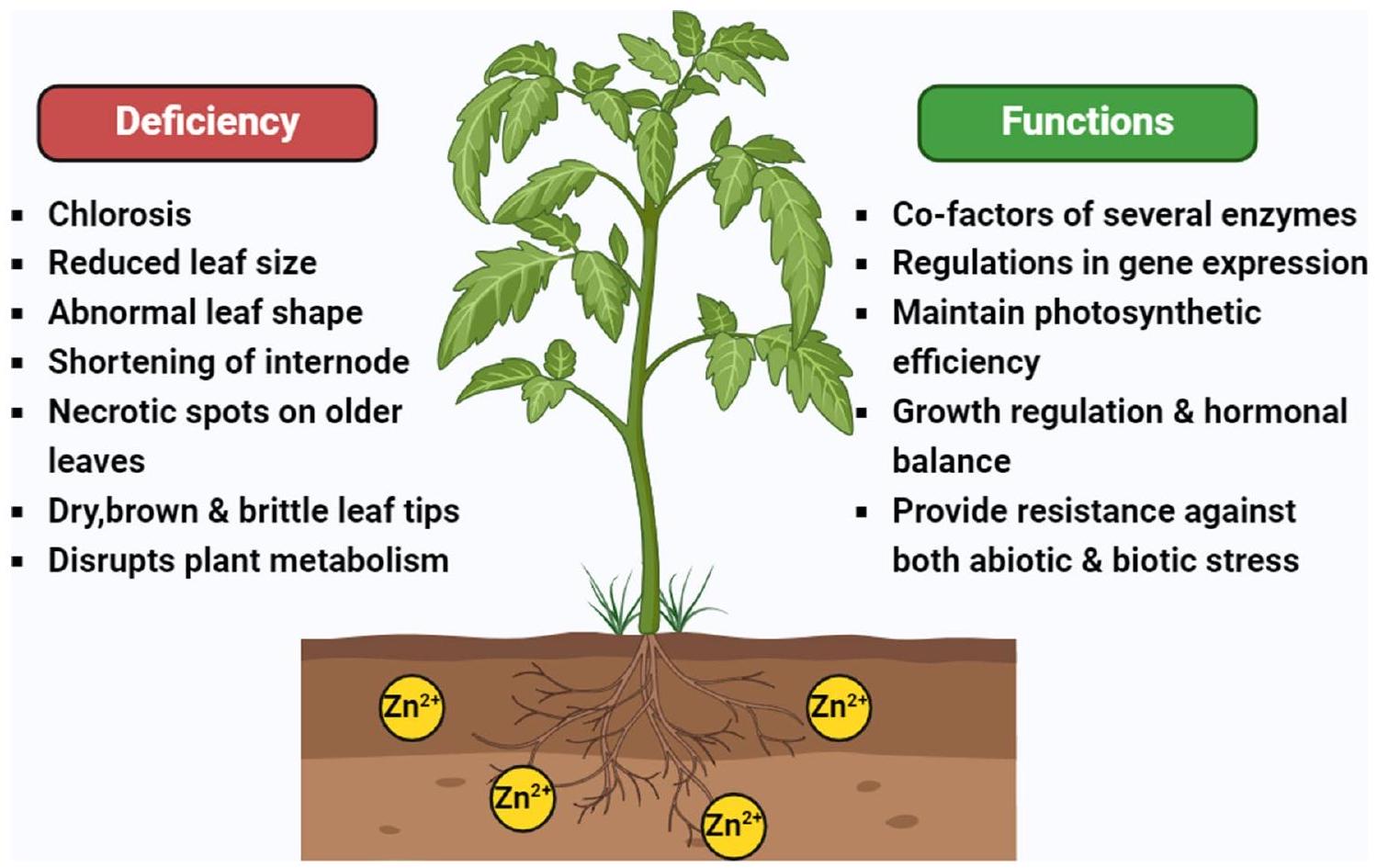
يلعب الزنك دورًا أساسيًا في تنظيم التعبير الجيني في النباتات. إنه يشارك في وظيفة بروتينات إصبع الزنك، وهي نوع من عوامل النسخ التي ترتبط بالحمض النووي وتتحكم في نسخ الجينات المعنية بالنمو والتطور واستجابات الإجهاد. بالإضافة إلى ذلك، يشارك الزنك في تكوين الريبوسوم واستقرار جزيئات RNA، والتي تعتبر حيوية لتخليق البروتين. يضمن وجود الزنك في الريبوسوم أن يتم ترجمة المعلومات الجينية إلى بروتينات وظيفية بكفاءة (بان وآخرون 2017؛ باربوسا وآخرون 2017؛ زلوبين وآخرون 2020).
الشكل 1 وظائف مختلفة وأعراض نقص الزنك (Zn)
الجدول 1 قوائم الإنزيمات حيث يعمل الزنك كعامل مساعد
إنزيم الدور في نظام النبات آثار نقص الزنك مرجع
الكربونيك أنهيدراز يسهل تثبيت ثاني أكسيد الكربون خلال عملية التمثيل الضوئي كفاءة التمثيل الضوئي المنخفضة والنمو المتعثر سينغ وآخرون 2019
الكحول ديهيدروجيناز مشارك في التنفس اللاهوائي والمسارات الأيضية إنتاج الطاقة المتعطل في ظل ظروف نقص الأكسجين ساكسانا وآخرون 2023
سوبر أكسيد ديسموتاز يخلص الجسم من الأنواع التفاعلية من الأكسجين (ROS) ويخفف من التوتر زيادة الإجهاد التأكسدي وتلف الخلايا سينغ وآخرون 2019
بوليميراز RNA أساسي لتخليق RNA والنسخ اضطراب في تخليق البروتين ونمو ضعيف زين وآخرون 2019
بروتينات إصبع الزنك تنظيم تعبير الجينات وارتباط الحمض النووي تنظيم الجينات المعاق وعيوب التطور مولك وآخرون 2023
فوسفوليباز C مشارك في مسارات نقل الإشارة إشارات الإجهاد المخفضة والاستجابات التكيفية ساغار وسينغ 2021

الزنك وعملية التمثيل الضوئي وإنتاج الكلوروفيل

الزنك مطلوب لإنتاج وصيانة الكلوروفيل، الصبغة الخضراء التي تلتقط الطاقة الضوئية لعملية التمثيل الضوئي. لذلك يلعب الزنك دورًا حاسمًا في ضمان تحويل الطاقة بشكل صحيح في النباتات، واستقرار هيكل البلاستيدات الخضراء، ومساعدة عملية تخليق الكلوروفيل الإنزيمية. ينظم الزنك إنزيم الكربونيك أنهيدراز، وهو إنزيم يحفز التفاعل بين ثاني أكسيد الكربون والماء لإنتاج بيكربونات وبروتونات، وهو تفاعل أساسي في مسار استيعاب الكربون في عملية التمثيل الضوئي. ومن ثم، فإن توفير الزنك بشكل مثالي هو مفتاح لاستقرار وكفاءة العمليات الضوئية وفي النهاية لاستقرار الطاقة في النبات (بهارتي وآخرون 2014؛ زانغ وآخرون 2019).

Zn وتنظيم نمو النبات والتوازن الهرموني

هذا هو أحد المكونات المهمة للهرمونات النباتية مثل الأوكسينات التي تنظم انقسام الخلايا، والتمدد، والتمايز. يتم تصنيع الأوكسينات من خلال سلسلة من المسارات، والتي يمكن أن تتأثر بنقص الزنك، مما يؤدي إلى أنماط نمو غير طبيعية، ونباتات متقزمة، وجذور متطورة بشكل سيئ. يلعب الزنك أيضًا دورًا في تعديل حمض الأبسيسيك (ABA) الذي يعد جزيء إشارة رئيسي يشارك في إغلاق الثغور وكفاءة استخدام المياه خلال أوقات الضغط غير الحيوي أو الجفاف (حسن وآخرون 2020؛ ليو وآخرون 2022؛ سباغ وآخرون 2022).

الزنك ومرونة الإجهاد

الزنك ضروري لزيادة تحمل النباتات للضغوط غير الحيوية والحيوية. يرتبط بإزالة سمية الجذور الحرة ويحمي النباتات من الأضرار التأكسدية تحت عوامل الضغط البيئي مثل الجفاف والحرارة والملوحة وهجوم مسببات الأمراض من خلال إنزيمات مضادة للأكسدة. بالإضافة إلى ذلك، يعزز الزنك السلامة الهيكلية لأغشية الخلايا، مما يجعلها أقل عرضة للتلف من الضغوط المختلفة. يلعب الزنك أيضًا دورًا في تنشيط النبات.
نظام المناعة من خلال تمكين إنتاج البروتينات المتعلقة بتكوين الأمراض والمواد الثانوية التي تمنع غزو العوامل الممرضة (ما وآخرون 2017؛ نادراجاه 2020؛ هان وآخرون 2021؛ مولك وآخرون 2023).

أعراض نقص الزنك

نقص الزنك هو واحد من أكثر نقص المغذيات الدقيقة انتشارًا الذي يؤثر على المحاصيل عالميًا، خاصة في المناطق ذات التربة الكلسية أو القلوية. عندما تفتقر النباتات إلى الزنك الكافي، تظهر مجموعة من الأعراض البصرية والفسيولوجية، مما يؤدي غالبًا إلى انخفاض كبير في غلة المحاصيل وجودتها. التعرف على هذه الأعراض أمر ضروري للتدخل المبكر وإصلاح الأضرار لمنع الأذى طويل الأمد للنباتات. واحدة من أكثر الأعراض البصرية شيوعًا لنقص الزنك هي الكلوروز، وهي حالة تتميز بصفرة الأوراق بسبب نقص إنتاج الكلوروفيل (هاجيساليه أوغلو 2020؛ ناتاشا وآخرون 2022). غالبًا ما يؤدي نقص الزنك إلى تقليل حجم الأوراق بشكل مميز، حيث يتم إنتاج أوراق أصغر وأضيق. في الحالات الشديدة، قد تظهر النباتات التي تعاني من نقص الزنك أيضًا أشكال أوراق غير طبيعية، حيث تبدو الأوراق مشوهة أو مجعدة أو متجعدة. يسبب نقص الزنك تقصير الفروع، مما يؤدي إلى مظهر مضغوط أو “مجموعات”، حيث تتجمع الأوراق بالقرب من الساق (روداني وآخرون 2018؛ خان وآخرون 2022). في المراحل المتقدمة من نقص الزنك، قد تتطور بقع نخرية على الأوراق، خاصة على الأوراق القديمة. تمثل هذه البقع مناطق موت الخلايا الناتجة عن انهيار سلامة الغشاء وتراكم أنواع الأكسجين التفاعلية. بالإضافة إلى ذلك، قد تظهر أطراف الأوراق التي تعاني من نقص الزنك أعراض حروق، حيث تصبح أطراف الأوراق جافة وبنية وهشة. يمكن أن يؤخر نقص الزنك بدء الإزهار في المحاصيل ويقلل من العدد الإجمالي للزهور والثمار المنتجة. وذلك لأن الزنك ضروري للتطور التناسلي للنباتات، حيث يؤثر على تكوين حبوب اللقاح، والتخصيب، وإنتاج البذور. قد تعاني النباتات التي تعاني من نقص الزنك من ضعف في تكوين الثمار، وانخفاض في صلاحية البذور، وانخفاض في الغلة الإجمالية. كما يؤثر على نمو الجذور، مما يؤدي إلى أنظمة جذرية ضعيفة التطور تكون
أقل فعالية في امتصاص الماء والمغذيات من التربة. يؤدي نقص الزنك إلى نقص في إنتاج الأوكسين، مما يؤدي إلى تقليل تكوين الجذور الجانبية وعدد شعيرات الجذور، مما يضعف قدرة النبات على دعم النمو الصحي فوق الأرض (هاجيساليه أوغلو 2020؛ زينغ وآخرون 2021؛ علي وآخرون 2021؛ خان وآخرون 2022).

توفر الزنك في التربة

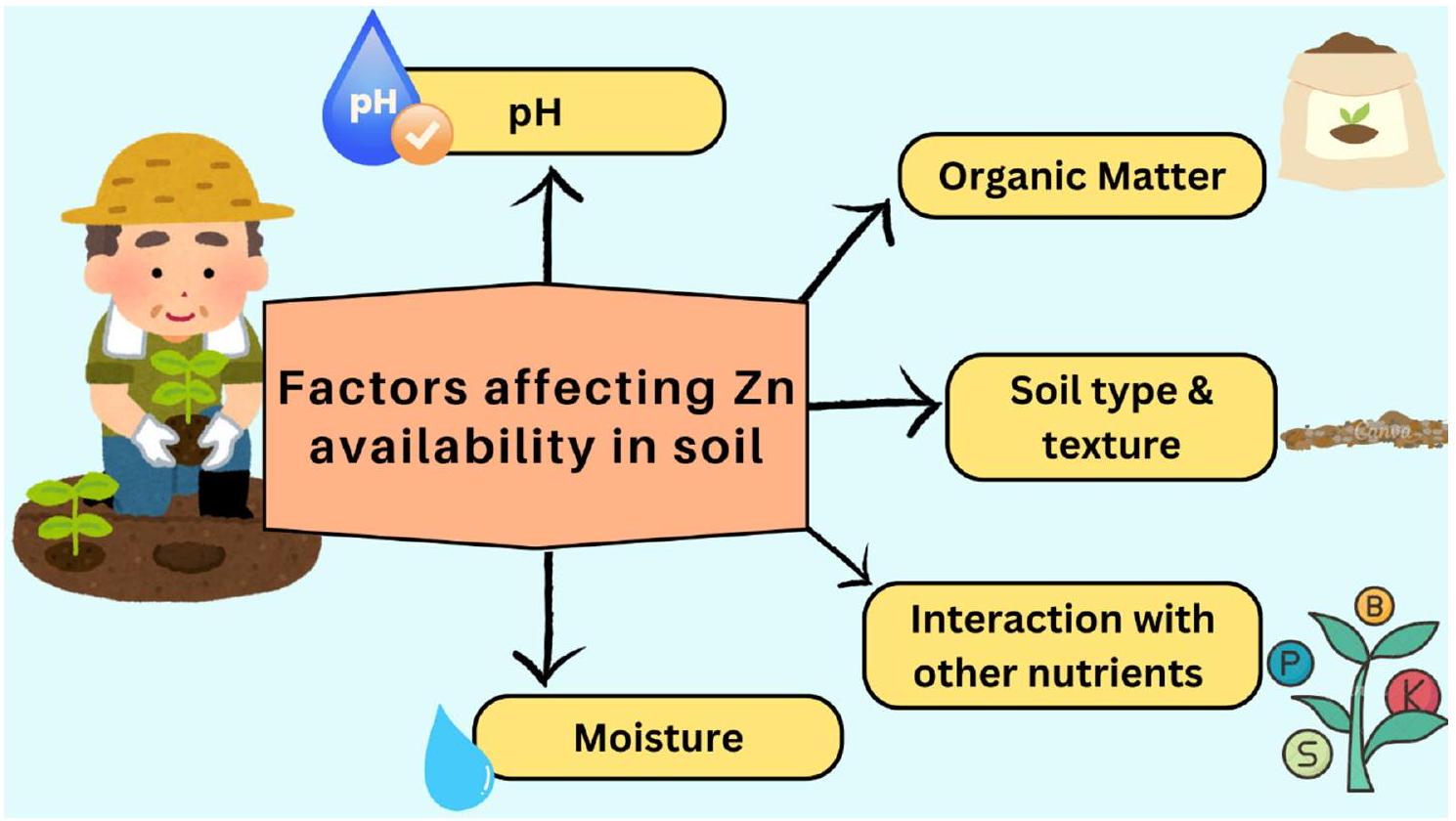
يتأثر توفر الزنك في التربة بعدة عوامل، بما في ذلك درجة حموضة التربة، ومحتوى المادة العضوية، ونوع التربة. تحدد هذه العوامل قابلية ذوبان الزنك وإمكانية وصوله إلى جذور النباتات، مما يجعل توفر الزنك الحيوي اعتبارًا رئيسيًا في إدارة المحاصيل. الشكل 2 يمثل العوامل المختلفة التي أثرت على توفر الزنك.

درجة حموضة التربة

تعتبر درجة حموضة التربة واحدة من أكثر العوامل أهمية التي تؤثر على توفر الزنك. يكون الزنك متاحًا أكثر للنباتات في التربة الحمضية قليلاً، حيث يتراوح نطاق درجة الحموضة المثالي لامتصاص الزنك بين 5.5 و 7.0 (لورا وديلغادو 2020).

المادة العضوية

تعتبر المادة العضوية مفتاحًا لطريقة احتفاظ التربة بالزنك وجعله متاحًا للنباتات. يمكن أن تجعل أيضًا الزنك أكثر توفرًا، حيث تقوم المادة العضوية بتعقيد الزنك في شكل قابل للذوبان يكون أكثر توفرًا لامتصاص الجذور. في الوقت نفسه، يؤدي تحلل المادة العضوية إلى إطلاق الأحماض العضوية
التي تساعد في إذابة الزنك من الأشكال المعدنية القليلة الذوبان (كاور وغارغ 2021).

نوع التربة وملمسها

تظهر أنواع التربة المختلفة قدرات متفاوتة للاحتفاظ بالزنك وإطلاقه. على سبيل المثال، تحتوي التربة الطينية على قدرة أعلى لتبادل الكاتيونات، مما يسمح لها بالاحتفاظ بأيونات الزنك بشكل أكثر فعالية من التربة الرملية. ومع ذلك، في التربة الطينية القلوية العالية، قد يصبح الزنك ثابتًا وغير متاح للنباتات. من ناحية أخرى، تميل التربة الرملية إلى أن تكون أكثر عرضة لتسرب الزنك، خاصة في المناطق ذات الأمطار الغزيرة، مما يؤدي إلى انخفاض توفر الزنك. تؤثر الخصائص الفيزيائية للتربة، مثل الملمس والبنية، أيضًا على اختراق الجذور وقدرة النبات على الوصول إلى الزنك المتاح في منطقة الجذر (ماكارينكو وآخرون 2020؛ سوغانيا وآخرون 2020).

التفاعلات مع المغذيات الأخرى

غالبًا ما يتأثر توفر الزنك في التربة بالتفاعلات مع مغذيات أخرى، وخاصة الفوسفور والحديد. يمكن أن يؤدي التسميد المفرط بالفوسفور، على سبيل المثال، إلى تحفيز نقص الزنك من خلال تعزيز تكوين مركبات الفوسفات الزنك غير القابلة للذوبان، والتي لا تتوفر لامتصاص النبات. وبالمثل، يمكن أن تتنافس مستويات عالية من الحديد أو المنغنيز في التربة مع الزنك لامتصاصه بواسطة جذور النباتات، مما يؤدي إلى تفاعلات متضادة تقلل من توفر الزنك (نولاس وآخرون 2018).
الشكل 2 العوامل المؤثرة على توفر الزنك في التربة

رطوبة التربة

يتأثر توفر الزنك أيضًا برطوبة التربة. في التربة المشبعة بالماء أو التربة ذات الصرف السيئ، يمكن أن يقل توفر الزنك بسبب نقص التهوية وتكوين المركبات غير القابلة للذوبان. على العكس من ذلك، في المناطق المعرضة للجفاف، يمكن أن تحد رطوبة التربة المنخفضة من حركة الزنك في التربة، مما يجعله أقل توفرًا للنباتات (نولاس وآخرون 2018).
يتطلب معالجة نقص الزنك فهمًا شاملاً لهذه العوامل لتطوير ممارسات إدارة التربة الفعالة. في الهند، حيث يؤثر نقص الزنك في التربة على المحاصيل الرئيسية مثل الأرز والقمح والبقوليات، يمكن أن يؤدي تحسين توفر الزنك من خلال التدخلات المستهدفة مثل تسميد الزنك، وإدارة المادة العضوية، واستخدام بكتيريا إذابة الزنك إلى تعزيز إنتاجية المحاصيل بشكل كبير والمساهمة في ممارسات الزراعة المستدامة.

بكتيريا إذابة الزنك: بديل للزراعة المستدامة

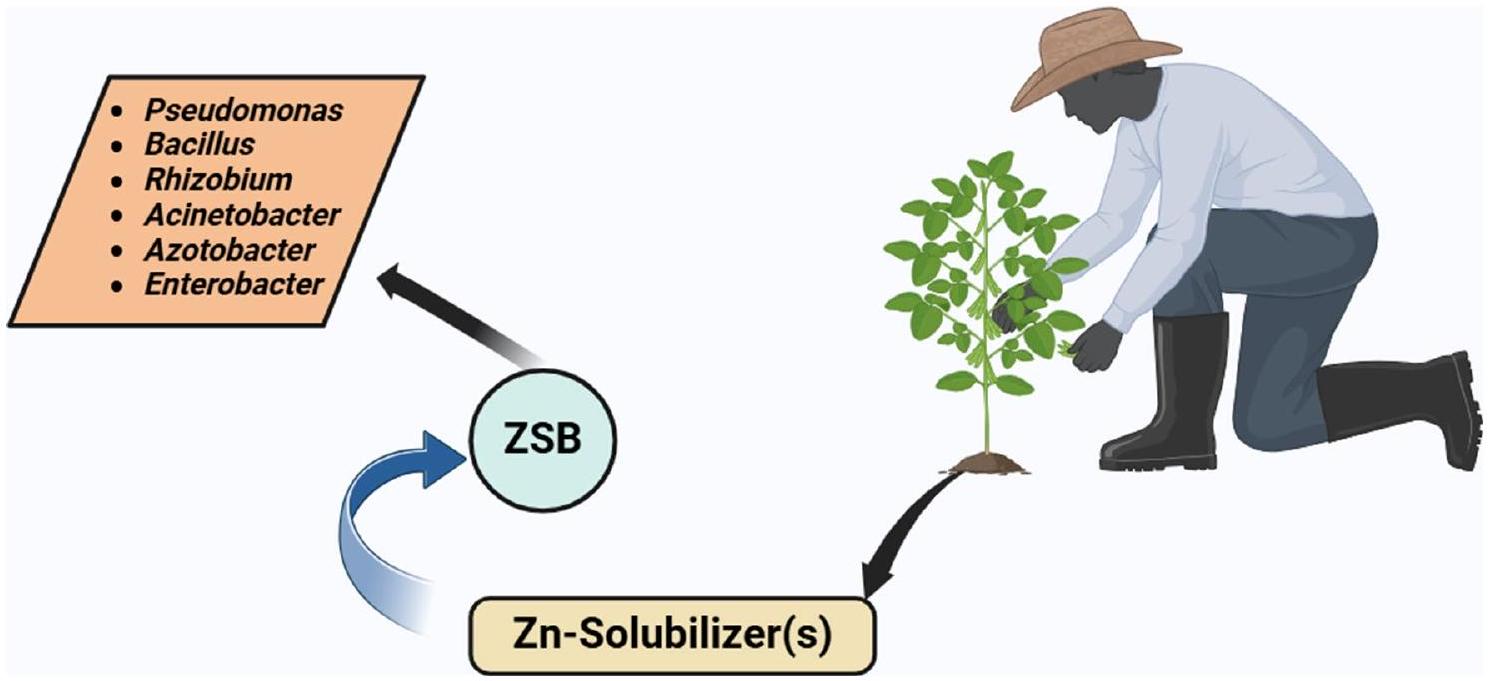
تلعب بكتيريا إذابة الزنك دورًا حيويًا في تعزيز التوافر الحيوي للزنك للنباتات، خاصة في التربة التي يكون فيها الزنك غير متاح بسبب ارتباطه بمركبات غير قابلة للذوبان. توفر بكتيريا إذابة الزنك بديلاً بيولوجيًا للأسمدة الكيميائية، مما يدعم الزراعة المستدامة من خلال تحسين صحة التربة وإنتاجية المحاصيل (سابور وآخرون 2021). تم تحديد عدة أنواع بكتيرية كإذابة للزنك، قادرة على تحويل الأشكال غير القابلة للذوبان من الزنك إلى أشكال متاحة للنباتات. هذه البكتيريا ليست فقط ضرورية لدورة المغذيات ولكن أيضًا لتعزيز نمو النبات، وزيادة خصوبة التربة، وتحسين مقاومة النبات للإجهاد. تشمل الأجناس الأكثر دراسة من بكتيريا إذابة الزنك بكتيريا الزائفة، والباسيلس، والريزوبيا. كل من هذه
الأنواع البكتيرية تستخدم آليات فريدة لإذابة الزنك، ودورها في الزراعة المستدامة يصبح ذا أهمية متزايدة. تم الإبلاغ عن أجناس بكتيرية أخرى مثل الأسيتيوباكتر، والأزوتوباكتر، والإنتيروباكتر كإذابة للزنك بشكل فعال (حسين وآخرون 2018؛ كومار وآخرون 2019؛ نيتو وآخرون 2020؛ سينغ وآخرون 2024). تستخدم كل من هذه البكتيريا مسارات كيميائية حيوية مختلفة لجعل الزنك متاحًا للنباتات، مما يعزز غالبًا خصوبة التربة العامة وتنوع الميكروبات في هذه العملية. الشكل 3 يمثل أنواع مختلفة من بكتيريا إذابة الزنك المستخدمة.

تحديد بكتيريا إذابة الزنك
يمكن تحديد بكتيريا إذابة الزنك (ZSB) بواسطة طرق ميكروبيولوجية وكيميائية حيوية وجزيئية مختلفة لعزل وتأكيد سلالات البكتيريا التي يمكنها إذابة الزنك. تتضمن الاستراتيجية عادة جمع عينات من التربة من المناطق التي يُعرف أن النبات يعاني من نقص في الزنك أو في المناطق التي يُتوقع أن تكون فيها نشاطات إذابة الزنك أعلى (عادةً في منطقة الجذور أو المنطقة القريبة من الجذور). يتم تخفيف عينات التربة بطرق مختلفة وزرعها على وسائط انتقائية – مثل أجار المغذيات، أو وسائط محددة لإذابة الزنك تحتوي على مركبات زنك غير قابلة للذوبان، مثل أكسيد الزنك (ZnO) أو كربونات الزنك (ZnCO3). يتم زرع المستعمرات على وسائط صلبة أو سائلة تحتوي على مصادر غير قابلة للذوبان من الزنك. يتم الإشارة إلى إذابة الزنك من خلال تشكيل منطقة إذابة تحيط بالمستعمرات. يتم تحديد مؤشر الإذابة كنسبة قطر المنطقة الواضحة إلى قطر المستعمرة. يتم إجراء التقديرات النوعية والكمية باستخدام مطيافية الامتصاص الذري (AAS) أو مطيافية الانبعاث الضوئي البلازمي المقترن بالحث (ICP-OES) تليها اختبارات كيميائية حيوية (تلطيخ جرام، اختبار الكاتالاز، اختبار الأكسيداز، استخدام مصدر الكربون) ثم يتم التعرف عليها بواسطة اختبار جزيئي. التحاليل الكيميائية وتقنيات الكروماتوغرافيا
الشكل 3 البكتيريا الرئيسية المستخدمة في إذابة الزنك
تؤكد على إفراز البكتيريا للأحماض العضوية، والسيدروفورات، ومواد الخلب الأخرى. يتم اختبار سلالات ZSB المختارة تحت ظروف حقلية لتقييم فعاليتها في إذابة الزنك وتعزيز نمو النبات (هاشمنجاد وآخرون 2021؛ ياسمين وآخرون 2021؛ عثمان وآخرون 2022).

آليات إذابة الزنك

تستخدم البكتيريا مسارات كيميائية حيوية مختلفة لتحقيق إذابة الزنك، حيث تعتمد الغالبية العظمى من هذه المسارات على المستقلبات التي قد تحول المعادن غير القابلة للذوبان إلى أشكال متاحة حيوياً. تشمل المسارات المعنية إنتاج الأحماض العضوية، والتعقيد والتعقيد لأيونات الزنك، وإنتاج السيدروفورات. كل آلية تعتمد على العوامل البيئية (مثل الرقم الهيدروجيني، ووسائط التربة، والميكروبات). تعتبر المعرفة العميقة بهذه المسارات الأيضية ضرورية لتعظيم إمكانيات ZSB في الزراعة المستدامة. يمثل الشكل 4 نظرة عامة عامة على آلية إذابة الزنك بواسطة ZSBs.

إنتاج الأحماض العضوية

عادةً ما يتم إجراء إذابة الزنك من خلال إنتاج الأحماض العضوية، التي تؤدي إلى حموضة البيئة المحيطة بها، مما يؤدي إلى إذابة مركب الزنك. بالإضافة إلى ذلك، يتسبب انخفاض الرقم الهيدروجيني في تحويل أشكال الزنك غير القابلة للذوبان (مثل أكسيد الزنك، فوسفات الزنك) إلى أشكال قابلة للذوبان (مثل ) القابلة للامتصاص بواسطة النباتات. بكتيريا إذابة الزنك
أنتجت حمض الستريك وحمض الجلوكونيك كواحد من الأحماض العضوية الرئيسية. إنها تخلق معقدات قابلة للذوبان مع الزنك تمكن من امتصاص المعدن بواسطة النباتات. على سبيل المثال، تنتج أنواع بكتيريا الزائفة والباسيلاس كميات كبيرة من هذه الأحماض وتلعب دورًا مهمًا في إذابة الزنك في التربة. بخلاف ذلك، تقوم بكتيريا إذابة الزنك أيضًا بإفراز أنواع مختلفة من الأحماض العضوية مثل حمض اللبنيك، وحمض الأكساليك، وحمض الأسيتيك، وما إلى ذلك. معًا، تقوم هذه الأحماض بخلب أيونات الزنك وتجعلها متاحة في منطقة الجذور (سينغ وآخرون 2018؛ كومawat وآخرون 2019؛ خالد وآخرون 2022؛ ياداف وآخرون 2022أ، ب).

خلب وتكوين أيونات الزنك
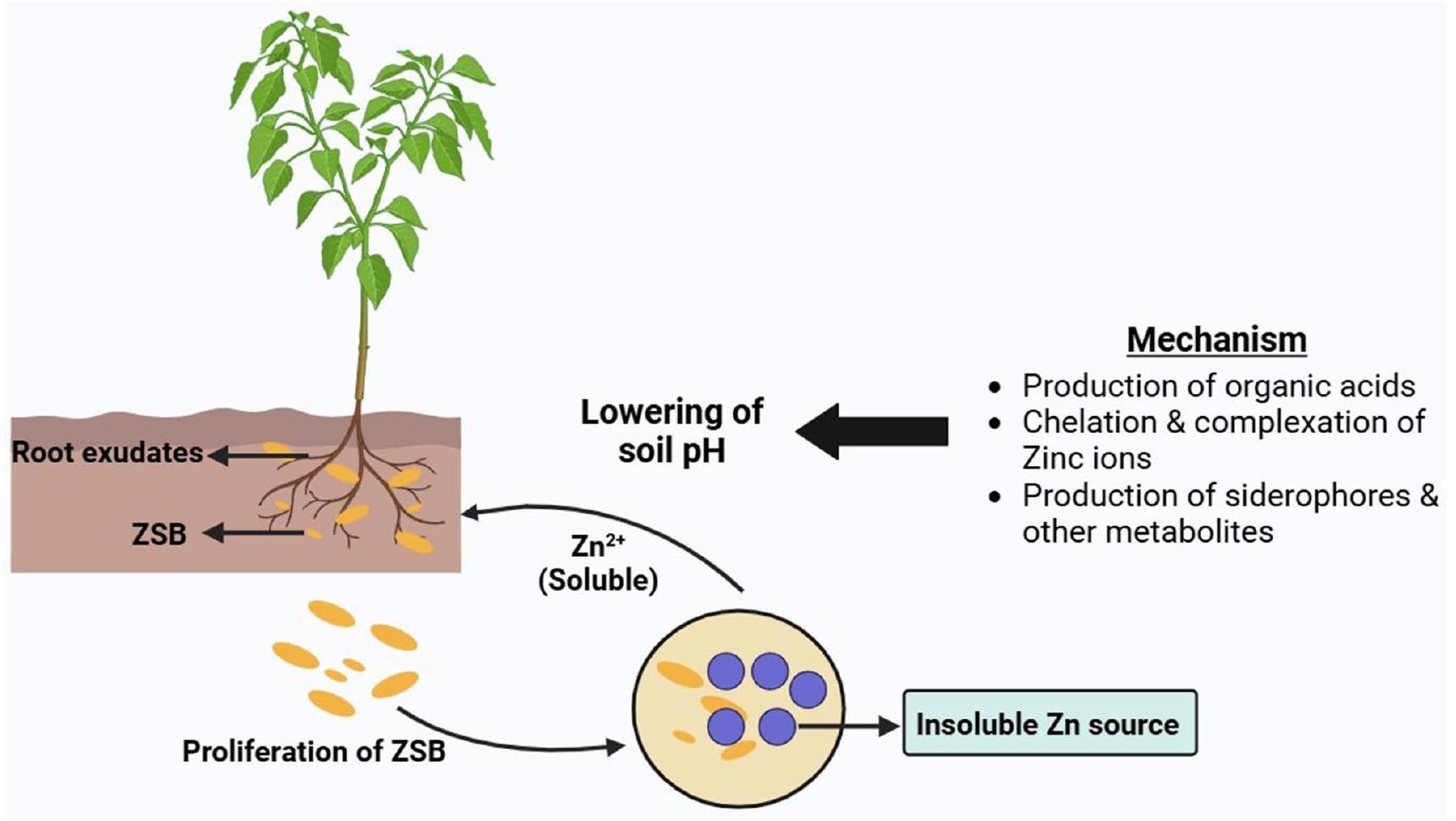
الخلب هو آلية يتم فيها ربط الجزيئات العضوية التي تفرزها البكتيريا بأيونات الزنك، مما يشكل معقدات قابلة للذوبان. تمنع هذه العملية أيضًا الزنك من الترسيب كمركبات غير قابلة للذوبان، مما يبقيه متاحًا لامتصاص النبات. من خلال التغلب على انخفاض القابلية للذوبان، وحماية الزنك من أن يكون مقيدًا في مصفوفة التربة، فإن الخلب يعزز أيضًا قابلية ذوبان الزنك. تقوم البكتيريا أيضًا بإفراز روابط عضوية مختلفة تلعب دور الخالب. تمتلك هذه الروابط قدرة عالية على أيونات الزنك، مما يؤدي إلى تشكيل معقد مستقر من الزنك والروابط. على سبيل المثال، يمكن أن تعمل الأحماض العضوية مثل حمض الستريك وحمض الأكساليك كروابط، مما يزيد من توفر الزنك عن طريق إيقاف إعادة ترسيب الزنك في الأرض. تقوم أنواع بكتيرية أخرى بتخليق الأحماض الأمينية مثل الهيستيدين والسيستين التي يمكن أن تخلب إلى
الشكل 4 نظرة عامة عامة على آلية إذابة الزنك
الزنك وتحسين قابلية ذوبان الزنك. بالإضافة إلى الخلب، تعمل الأحماض الأمينية أيضًا كمصادر للنيتروجين والكربون للنباتات (كومار وآخرون 2018؛ سيندهو وآخرون 2019؛ بهات وماهشوري 2020).

إنتاج السيدروفورات وغيرها من المستقلبات الميكروبية

السيدروفورات هي مركبات ذات وزن جزيئي منخفض تفرزها البكتيريا ولها قدرة عالية على أيونات المعادن، بما في ذلك الزنك (نيثيابريا وآخرون 2021، 2024). بينما يتم إنتاج السيدروفورات بشكل أساسي لجمع الحديد من البيئة، فإنها تلعب أيضًا دورًا كبيرًا في إذابة الزنك من خلال الارتباط بأيونات الزنك وتسهيل نقلها إلى خلايا البكتيريا أو جعلها متاحة للنباتات (باتيل وآخرون 2018). بالإضافة إلى السيدروفورات، تنتج البكتيريا مستقلبات ثانوية أخرى، مثل السطحيات الحيوية، التي تعزز إذابة الزنك. تغير هذه المركبات الخصائص السطحية لجزيئات التربة ومعادن الزنك، مما يسهل إطلاق أيونات الزنك في محلول التربة. غالبًا ما تتأثر إنتاج مثل هذه المستقلبات بالظروف البيئية، بما في ذلك الرقم الهيدروجيني للتربة، ودرجة الحرارة، وتوافر المغذيات (كامران وآخرون 2017؛ هيفيرون 2019؛ حسين وآخرون 2020؛ عثمان وآخرون 2022).

أثر بكتيريا إذابة الزنك على صحة التربة

تلقى بكتيريا إذابة الزنك (ZSB) اهتمامًا متزايدًا في سياق الزراعة المستدامة، لأن هذه البكتيريا يمكن أن تذيب الأشكال غير القابلة للذوبان من الزنك غير العضوي إلى أشكال متاحة للنباتات. لا تجعل ZSB الزنك متاحًا للنباتات فحسب، بل تساهم أيضًا في الصحة العامة للتربة. تناقش هذه الجزء تأثير ZSB على التفاعل الميكروبي، ونشاط إنزيمات التربة، وهيكلة التربة، ومحتوى المواد العضوية وإعادة تأهيل التربة التي تعاني من نقص الزنك مما يؤدي إلى زيادة الاستدامة الزراعية.

التفاعلات الميكروبية في منطقة الجذور

تعتبر منطقة الجذور، وهي المنطقة المحيطة بجذور النباتات، نظامًا بيئيًا ديناميكيًا حيث تحدث تفاعلات معقدة بين النباتات والميكروبات التربة والمغذيات. تعتبر بكتيريا إذابة الزنك جزءًا أساسيًا من هذه المجتمع الميكروبي، حيث تتفاعل مع ميكروبات مفيدة أخرى وتؤثر على التنوع البيولوجي والصحة العامة للتربة (بروكلينغ وآخرون 2019؛ بيهيرا وآخرون 2024).
العلاقات التبادلية مع النباتات تُعرف هذه الأنواع بتشكيل تفاعل متبادل مع النباتات من خلال إذابة الزنك وكذلك العناصر الغذائية الكبرى والصغرى الأخرى، مما يعزز نمو النبات. بدورها، تطلق النباتات إفرازات جذرية، بما في ذلك السكريات، والأحماض الأمينية، والأحماض العضوية، كمواد مغذية لـ
ZSB. تنشط هذه الإفرازات المغذية مجتمعًا بكتيريًا كاملًا، يدعم إذابة الزنك وكذلك عناصر المغذيات الأخرى مثل الفوسفور والحديد (غارسيا وكاو-كنيفين 2018؛ شميت وآخرون 2018).
التفاعلات التآزرية مع ميكروبات أخرى في منطقة الجذور، تتفاعل ZSB بشكل تآزري مع ميكروبات مفيدة أخرى، مثل بكتيريا تثبيت النيتروجين، وبكتيريا إذابة الفوسفات، والفطريات الميكوريزية. ينتج عن هذه التآزر نظام أفضل لامتصاص المغذيات للنباتات. بما في ذلك الأنواع، مثل الريزوبيا من عائلة البقوليات، المعروفة بشكل أساسي بسبب قدرتها على تثبيت النيتروجين في البقوليات ولكنها أيضًا تذيب الزنك وتوصله إلى نباتها المضيف مع النيتروجين. وبالتالي، فإنها تعظم التركيب الغذائي للتربة مع تقليل الحاجة إلى الأسمدة (ملونغو وآخرون 2018؛ خاني وآخرون 2019؛ محمود وآخرون 2020).
التفاعلات المعادية مع مسببات الأمراض يمكن لبعض البكتيريا القابلة للذوبان في الزنك أن تعمل أيضًا كعوامل للتحكم البيولوجي ضد المعادين المحددين لمسببات الأمراض المنقولة عبر التربة. من خلال إنتاج مركبات مضادة للميكروبات أو من خلال التنافس مع مسببات الأمراض على المساحة والمواد الغذائية، تساهم بكتيريا ZSB في الحفاظ على مجتمع ميكروبي صحي داخل التربة. على سبيل المثال، تنتج أنواع بكتيريا Pseudomonas مستقلبات ثانوية لتثبيط الفطريات والبكتيريا المسببة للأمراض التي يمكن أن تلحق الضرر بالمحاصيل بينما تجعل الزنك أكثر توافراً حيوياً (Badri et al. 2009; Pii et al. 2015; Ambreetha and Balachandar 2019).

نشاط إنزيمات التربة

إنزيمات التربة هي محفزات بيولوجية تتوسط العمليات الكيميائية الحيوية الأساسية في التربة، بما في ذلك دورة المغذيات، وتحلل المواد العضوية، وتفكيك المركبات العضوية المعقدة. تعزز البكتيريا القابلة للذوبان في الزنك نشاط إنزيمات التربة الرئيسية مثل الفوسفاتاز، الديهيدروجيناز، اليورياز، البروتياز، السليلوز، والأميلاز؛ مما يحسن خصوبة التربة وتوافر المغذيات (Walitang et al. 2019; Zlobin 2021; Ali et al. 2023a, b).

هيكل التربة والمواد العضوية

تعتبر البنية الفيزيائية للتربة ومحتواها من المواد العضوية عوامل حاسمة في تحديد صحة التربة وخصوبتها. تلعب البكتيريا القابلة للذوبان في الزنك دورًا أساسيًا في الحفاظ على وتعزيز بنية التربة، بشكل أساسي من خلال تفاعلاتها مع المواد العضوية وتأثيرها على تجميع التربة. تساهم ZSB في تحلل المواد العضوية
من خلال إنتاج إنزيمات تقوم بتفكيك المركبات العضوية المعقدة إلى جزيئات أبسط. تزيد هذه العملية من مستويات الدبال في التربة، مما يحسن قدرتها على الاحتفاظ بالرطوبة والمغذيات. كما تعمل المواد العضوية كخزان للمغذيات التي يمكن إطلاقها ببطء مع مرور الوقت، مما يدعم نمو النباتات على المدى الطويل. تعزز ZSB تجميع التربة من خلال إنتاج السكريات المتعددة خارج الخلوية (EPS) وأفلام حيوية أخرى تربط جزيئات التربة معًا. تعزز بنية التربة المحسنة، الناتجة عن نشاط ZSB، التهوية والصرف. تضمن التهوية المناسبة للتربة أن تتلقى جذور النباتات الأكسجين الكافي للتنفس، بينما يمنع الصرف المحسن تشبع التربة بالماء، مما قد يؤدي إلى أمراض الجذور وتقليل النشاط الميكروبي. تلعب ZSB، من خلال تعزيز تجميع التربة وتحلل المواد العضوية، دورًا حيويًا في الحفاظ على التوازن بين التهوية والصرف (Costerousse et al. 2018; Khan et al. 2019; Jalal et al. 2022; Barreto et al. 2024).

التقنيات من الجيل التالي المستخدمة في ZSB

ومع ذلك، يجب تحسين أداء ZSB للزراعة المستدامة، وهو ما يمكن تحقيقه من خلال تطوير تقنيات الجيل التالي. تعالج هذه الابتكارات التحديات الحالية في هذا المجال، مثل التباينات في الأداء الميداني، وقيود التخزين، والفعالية المتباينة في ظروف بيئية مختلفة. أدناه، نحدد عدة تقنيات متقدمة لديها القدرة على إحداث ثورة في تطبيق ZSB.

الأساليب الجينومية

يوفر التحليل الميتاجينومي لـ ZSB رؤى حول الآليات الجينية التي تحكم ذوبان الزنك، بما في ذلك جينات إنتاج الأحماض العضوية وتخليق السايدروفور. من خلال استخدام التحليلات الميتاجينومية، أصبح من الممكن دراسة ديناميات المجتمعات الميكروبية في منطقة الجذور، والتي هي تفاعلات تآزرية بين ZSB وميكروبات التربة الأخرى التي تزيد من توافر الزنك (Haroon et al. 2022; Rani et al. 2023).

كريسبر

تم استخدام أدوات الهندسة الوراثية المختلفة مثل CRISPR-Cas9 لإنشاء سلالات ZSB ذات تنفيذ متقدم. على سبيل المثال، يمكن جعل ZSB ذات الخصائص المعدلة وراثيًا تتحمل الظروف البيئية القاسية، وتنتج كميات أكبر من المستقلبات لذوبان الزنك، وتقاوم التثبيط التنافسي الذي تفرضه ميكروبات التربة (Cherif-Silini et al. 2021).

الصيغ النانوية

تم تطوير الأسمدة الحيوية النانوية باستخدام تكنولوجيا النانو وتطبيقات ZSB. تعزز هذه الصيغ الاستقرار، وعمر التخزين وكفاءة ذوبان الزنك للبكتيريا. تحمي تقنيات النانو-تغليف ميكروبات ZSB من الضغوط البيئية وتسهّل الإفراج المنضبط بالقرب من أنظمة جذور النباتات بحيث يمكن ضمان أداء متسق (Panpatte et al. 2016; Sehrawat and Sindhu 2024).

المعلوماتية الحيوية والنماذج المدفوعة بالذكاء الاصطناعي

هنا، في النهاية، أدوات المعلوماتية الحيوية الجديدة للتنبؤ بأداء ZSB في ظروف التربة والمناخ المتنوعة. يتم تحسين صيغ ZSB واستراتيجيات التطبيق باستخدام التعلم الآلي ونماذج الذكاء الاصطناعي بحيث تكون فعالة في ظروف الحقل (Khalid et al., 2022; Choudhary et al. 2024).

التجمعات الميكروبية متعددة الوظائف

تتوفر المغذيات وصحة التربة بشكل أكبر من خلال تطوير تجمعات من ZSB مع ميكروبات مفيدة أخرى، على سبيل المثال، بكتيريا تثبيت النيتروجين، بكتيريا ذوبان الفوسفات، والفطريات الميكوريزية. معًا، تقدم هذه التجمعات حلولًا شاملة لنقص المغذيات، مما يعزز كل من نمو النبات والمحصول (Aamir et al. 2020).

الزراعة الدقيقة ودمج إنترنت الأشياء

تُستخدم أجهزة إنترنت الأشياء لمراقبة صحة التربة ونشاط ZSB في الوقت الحقيقي. يمكن اتخاذ قرارات بشأن تطبيقات ZSB بناءً على ظروف معينة في الحقل استنادًا إلى بيانات توافر الزنك الحيوي من خلال أجهزة الاستشعار وأنظمة تعتمد على إنترنت الأشياء (Bhattacharjee et al. 2023).

أنظمة الصياغة والتوصيل المتقدمة

تُطور تقنيات الصياغة المبتكرة، مثل الهيدروجيل والأفلام الحيوية، لتعزيز توصيل واستمرارية ZSB في التربة. تضمن هذه الأنظمة نشاطًا بكتيريًا مستدامًا، حتى في ظل ظروف بيئية صعبة، وتحسن امتصاص المغذيات بواسطة النباتات (Prasad et al. 2021; Arora et al. 2024).

البكتيريا القابلة للذوبان في الزنك في إنتاجية المحاصيل

تكتسب البكتيريا القابلة للذوبان في الزنك أهمية متزايدة في الزراعة في السنوات الأخيرة حيث إنها طريقة صديقة للبيئة ومستدامة لتعزيز توافر الزنك في التربة. بدورها، تعزز نمو النبات، وتزيد من غلة المحاصيل، وتحسن جودتها الغذائية. من المعروف أن تلقيح ZSB يزيد بشكل مستمر من الغلة في محاصيل متعددة. يضمن التوافر المحسن للزنك أن تتمكن النباتات من أداء الأدوار الفسيولوجية الرئيسية التي تتراوح بين تنشيط الإنزيمات، وتخليق البروتين، وتكوين الكلوروفيل، مما يساهم في زيادة إنتاج الكتلة الحيوية وزيادة الغلة (Jalal et al. 2020; Ofori et al. 2022; Obaid et al. 2022).
في التجربة الميدانية التي أجريت في الهند، أظهرت نباتات القمح الملقحة بأنواع Pseudomonas وBacillus زيادة بنسبة 20-30% في غلة الحبوب مقارنة بالنباتات غير الملقحة. ساهم التوافر المحسن للزنك في تحسين التفرع، وزيادة طول السنبلة، وعدد الحبوب في السنبلة، مما أدى في النهاية إلى تحسين الغلة الكلية (Karnwal 2021a, b; Singh et al. 2022; Yadav et al. 2023).
أظهرت الأبحاث التي أجريت في التربة الفقيرة بالزنك في بنغلاديش أن نباتات الأرز الملقحة بـ ZSB كانت لديها غلة حبوب أعلى مقارنة بالنباتات الضابطة. قامت سلالات ZSB بعملية ذوبان الزنك بشكل فعال، مما زاد من امتصاص النبات وعزز من تطوير السنبلة وملء الحبوب (Islam et al. 2024).
الزنك هو عنصر غذائي دقيق حيوي لصحة الإنسان، وتعتبر تعزيز المحاصيل بالزنك استراتيجية رئيسية لمكافحة نقص الزنك في السكان البشر. لقد أظهر تلقيح ZSB في القمح زيادة في محتوى الزنك في الحبوب بنسبة ، مما يحسن قيمتها الغذائية للاستهلاك البشري. بالإضافة إلى ذلك، تميل حبوب القمح من النباتات المعالجة بـ ZSB إلى أن تحتوي على محتوى بروتين أعلى وخصائص خبز أفضل. وقد وُجد أن تلقيح نباتات الأرز بـ ZSB يزيد من محتوى الزنك في حبوب الأرز بنسبة ، مما يجعل المحصول أكثر تغذية ويعالج سوء التغذية في المناطق الفقيرة بالزنك (Das et al. 2019; Paramesh et al. 2020; Wani et al. 2022).
بالإضافة إلى الغلة، يعزز تلقيح ZSB كل من إنتاج الكتلة الحيوية للجذع والجذر. أظهرت التجارب الميدانية في الذرة أن النباتات المعالجة بـ ZSB تظهر زيادة في وزن الجذع الجاف و زيادة في الكتلة الحيوية للجذور مقارنة بالنباتات الضابطة. هذه الكتلة الحيوية المحسنة تترجم إلى نمو نباتي أكثر قوة، وتحمل أفضل للإجهاد، وإنتاجية أعلى (باتيل وآخرون، 2024).
لم تُظهر الحبوب فقط، بل أيضًا تلقيح المحاصيل الخضرية بـ ZSB أنه يحسن كل من الغلة والمحتوى الغذائي. على سبيل المثال، أظهرت نباتات الطماطم التي تم تلقيحها بأنواع من بكتيريا Pseudomonas زيادة في إنتاج الفاكهة وتحسين في تركيز الزنك في الفواكه
تعزيز جودتها الغذائية. وبالمثل، أظهرت نباتات الخيار الملقحة زيادة بنسبة 20% في إنتاج الثمار وتحسين محتوى المغذيات الدقيقة (توريخون وآخرون 2023؛ زانغ وآخرون 2023).
يمكن أن يؤثر ZSB أيضًا على محتوى البروتين والفيتامينات في المحاصيل. في دراسة على العدس، أدى تلقيح ZSB إلى زيادة في محتوى البروتين و زيادة في تركيز الزنك في البذور، مما يجعل المحصول أكثر تغذية. بالإضافة إلى ذلك، تم إثبات أن محتوى الفيتامينات في بعض المحاصيل، مثل فيتامين C في الطماطم، يتحسن مع تلقيح ZSB (Dhaliwal et al.، 2021). يوضح الجدول 2 تأثيرات سلالات ZSB المختلفة على المحاصيل المختلفة.

بكتيريا حلّ الزنك كمواد حيوية

يمكن أن تكون ZSB فعالة كعوامل حيوية قادرة على تحسين توفر العناصر الغذائية وتعزيز نمو النباتات المستدام. إن الحاجة المتزايدة لممارسات الزراعة المستدامة تجعل من الأسمدة الحيوية المعتمدة على ZSB أكثر استخدامًا على نطاق واسع. يمكن أن تلعب هذه العوامل الحيوية دورًا مهمًا في تقليل الاعتماد على الأسمدة الكيميائية، ومكافحة نقص الزنك في التربة، وزيادة إنتاجية المحاصيل (Srithaworn et al. 2023).

تقنيات الصياغة

تتوفر الأسمدة الحيوية ZSB بصيغ مختلفة، كل منها له مزايا مميزة ومناسب لظروف زراعية متنوعة. تشمل الصيغ الشائعة السوائل، والمساحيق، والأشكال الحبيبية، التي تختلف في طرق تطبيقها، وعمرها الافتراضي، وفعاليتها في أنواع التربة المختلفة.

تركيبات سائلة

الأسمدة الحيوية السائلة، على النقيض، تتكون من ثقافات بكتيرية حية معلقة في وسط غني بالمغذيات. يتم امتصاصها بالكامل من قبل النباتات وسهلة التطبيق. تم تصميم الأسمدة الحيوية السائلة للاستخدام مباشرة في التربة أو لرشها على المحاصيل. لكنها تتمتع بعمر افتراضي أقصر نسبيًا من التركيبات الأخرى وتحتاج إلى تخزينها بعناية للحفاظ على صلاحية البكتيريا (كومار وآخرون 2019؛ لادوهيا وآخرون 2024).

تركيبات المساحيق

تشمل الأسمدة الحيوية المسحوقة خلايا بكتيرية مجففة مدمجة مع وسط ناقل مثل الخث أو الفيرميكوليت أو التلك. تتمتع هذه الطلاءات باستقرار أعلى وعمر افتراضي أطول من تركيباتها السائلة، مما يجعلها سهلة التخزين والنقل. يمكن استخدام هذه الأسمدة الحيوية المسحوقة كمواد تلقيح للبذور قبل الزراعة أو يمكن…
الجدول 2 ZSBs مع تأثيراتها على المحاصيل المختلفة
محصول سلالة بكتيرية أثر مرجع
أرز بوركولديريا؛ أسيتيتوباكتر زيادة امتصاص الزنك فيدا وآخرون (2014)
إنتروبكتر كلوكا زيادة امتصاص الزنك كريثيكا وآخرون (2016)
رالستونيا بيكتي، الزائفة الزنجارية، كليبسيلا الرئوية وبوركولدرية سيباكيا زيادة امتصاص الزنك ميشرا وآخرون (2017)
باسيلاس نشاط الأيض المعزز زيب وآخرون (2018)
باسيلاس أريابهاتا
بوركولدرية سيباكيا
زيادة إنتاج الحبوب
كور وآخرون (2019)
أوبادياي وآخرون (2022ب)
قمح سيرراتيا ليكويفاكسيانز FA-2، باكillus ثورنجينسيس FA-3، سيرراتيا مارسيانس FA-4 تحسين في غلة الحبوب عبيد الله وآخرون، (2015)
بانتوايا ديسبيرسا، ب. أغلوميرانس، بseudomonas فراجى، ريزوبيوم سب، وإي. كلواكاي زيادة التوافر الحيوي للزنك كامران وآخرون (2017)
Trichoderma harzianum و Bacillus amyloliquefaciens نمو النباتات المحسن سينغ وآخرون (2021)
باسيلاس spp. تعزيز التخصيب الحيوي بالزنك ياداف وآخرون (2022أ، ب)
بنتويا نوع، كليبسيلا نوع، بريفباكتيريوم نوع، أسيتيبكتير نوع، ألكاليجينيس NCCP-650، سيتروباكتير نوع، إكسيغوباكتيريوم نوع، راوولتيلا نوع، وأسيتيبكتير نوع. نمو النباتات المحسن علي وآخرون (2023أ، ب)
ذرة باسيلاس سب. AZ6 زيادة الكتلة الحيوية حسين وآخرون (2015)
ب. أريابهاتا ز م 31، ب. سوبتيليس ز م 63 زيادة امتصاص الزنك ممتاز وآخرون (2020)
سيرراتيا. نوع. زيادة في فسيولوجيا النبات جين وآخرون (2020)
بوركولدرية سيباكيا وأسينتوباكتر باومانني زيادة امتصاص الزنك أوبادياي وآخرون (2021)
أسيتيتوباكتر كالكواسيتيكوس، باكillus بروتيوتيكوس وستينوتروفوموناس بافاني زيادة امتصاص الزنك سلطان وآخرون (2023)
العدس الأخضر نيتسيريا، المكورات العنقودية، الإشريكية القولونية، وباسيلاس. زيادة الكتلة الحيوية للنباتات إقبال وآخرون (2010)
حمص إنترobacter تحسين جودة الحبوب أولا وآخرون (2020)
أوكروبكتريم إنترميديوم، باينيباسيلاس بوليميكسا، باكترس سيريوس، ستينوتروفوموناس مالطوفيلي، ستربتوميس، وأرثروبكتير غلوبيفورمي زيادة التوافر الحيوي للزنك بتول وآخرون (2021)
فول الصويا الستربتوميس spp. زيادة الكتلة الحيوية للنباتات سوريشادكون وآخرون (2022)
البازلاء الحمامية بسيودوموناس بليكوجلوسيسيدا SRI-156، بريفباكتيريوم أنتيكوم SRI-158 زيادة في محصول الحبوب غوبالاكريشنان وآخرون 2016
طماطم بكتيريا الزائفة spp. VBZ4 زيادة عدد الثمار لكل نبات كارنوال 2021أ، ب
عدس رايزوبيوم spp. RL9 تحسين الكتلة الحيوية وبروتين الحبوب واني وآخرون 2008
مخلوطة بالتربة. كما أنها تساعد في عملية توزيع البكتيريا المتجانسة الإيجابية في جميع أنحاء منطقة الجذور (سينده وآخرون 2019).

تركيبات حبيبية

يمكن أن تكون الزراعة المستدامة هي الحل لكل هذا؛ وأحد الطرق لتعزيز الزراعة المستدامة هو من خلال استخدام الأسمدة الحيوية الحبيبية، وهي أسمدة مركبة تحتوي على مواد حيوية نشطة، تُصنع عن طريق تغليف البكتيريا على حبيبات من الطين أو الجبس أو أي مادة غير نشطة. إنها حبيبات بطيئة الإطلاق، مما يعني أنها تُدخل البكتيريا إلى التربة على مدى فترة طويلة. التركيبات الحبيبية مناسبة للاستخدام على نطاق واسع وتعمل بشكل جيد في الزراعة الميكانيكية.
بالإضافة إلى ذلك، يتعلمون بشكل جيد جداً عن رطوبة التربة ويحتفظون بالماء (ماسود وآخرون 2022).

مواد الحامل

المادة الحاملة هي واحدة من أهم مكونات تركيبات الأسمدة الحيوية. يجب أن تكون المادة الحاملة جيدة لحماية البكتيريا، وأن تسمح بمدة صلاحية أطول، وأن تكون سهلة التطبيق. غالبًا ما تُستخدم الخث وغيرها من المواد العضوية للبكتيريا بسبب كفاءتها في الحفظ على المدى الطويل. كما تُستخدم مواد حاملة غير عضوية مثل التلك والفيرميكوليت بشكل شائع بسبب استقرارها وسهولة التعامل معها وتوافقها مع المحاصيل المختلفة (هارون وآخرون 2022؛ أوبادياي وآخرون 2022أ، ب، ج).

تقنيات الطلاء

لقد عززت التطورات التكنولوجية الحديثة في الطلاءات البوليمرية صياغة الأسمدة الحيوية ZSB. يمكن تطبيق ZSB مباشرة على البذور بفضل تقنية تغليف البذور، التي تضمن استعمار البكتيريا مبكرًا في منطقة الجذور. يمكن أن تؤدي تقنيات الطلاء وتقنيات الطلاء بالإفراج المنضبط أيضًا إلى صياغة تركيبات بطيئة الإفراج تهدف إلى توصيل اللقاحات البكتيرية إلى منطقة جذور النبات بشكل مستمر طوال موسم النمو (خالد وآخرون، 2022؛ سهرات وسينده 2024).

التكامل مع الأسمدة التقليدية

تعزيز كفاءة المغذيات

التطبيق المشترك لمخصبات ز.س.ب الحيوية مع المخصبات التقليدية يعزز كفاءة العناصر الغذائية الكلية ويقلل من استخدام المخصبات الكيميائية. تعمل مخصبات ز.س.ب على تعزيز تأثير المخصبات التقليدية من خلال إذابة الزنك والعناصر الغذائية الضرورية الأخرى، مما يمكن النبات من امتصاصها بشكل أكثر فعالية. من خلال القيام بذلك، فإن هذا النظام المتكامل مفيد ليس فقط لنمو المحاصيل ولكن أيضًا لتقليل فقد العناصر الغذائية عبر الغسل والتبخر (خالد وآخرون، 2022).

تقليل استخدام الأسمدة

أظهرت الدراسات أن دمج الأسمدة الحيوية ZSB مع جرعات مخفضة من الأسمدة الكيميائية يمكن أن يحقق عوائد مماثلة أو حتى أعلى مقارنة بالجرعات الكاملة من الأسمدة الكيميائية وحدها. وهذا يقلل من الأثر البيئي لاستخدام الأسمدة، ويخفض تكاليف المدخلات للمزارعين، ويعزز ممارسات الزراعة المستدامة (حسين وآخرون 2019؛ ياداف وآخرون 2023).

توفير مغذيات متوازن

يمكن أن تساعد الأسمدة الحيوية ZSB أيضًا في تحقيق توازن في إمدادات العناصر الغذائية من خلال جعل الزنك وغيرها من العناصر الدقيقة أكثر توفرًا للنباتات. على سبيل المثال، فإن دمج ZSB مع أسمدة النيتروجين والفوسفور يضمن أن تحصل النباتات على إمداد كافٍ من جميع العناصر الغذائية الأساسية، مما يؤدي إلى نمو وإنتاجية مثالية (سينغ وآخرون 2024).

التوافق مع الأسمدة الحيوية الأخرى

يمكن دمج الأسمدة الحيوية ZSB مع أسمدة حيوية أخرى، مثل البكتيريا المحللة للفوسفور أو البكتيريا المثبتة للنيتروجين، لإنشاء مخصبات حيوية متعددة الوظائف تعالج نقص العناصر الغذائية المتعددة. تعظم هذه المقاربة التآزرية من توفر العناصر الغذائية وتحسن الصحة العامة للتربة، مما يؤدي إلى زيادة غلة المحاصيل وتحسين
durability (أحمد وآخرون 2021؛ ساراتامبال وآخرون 2022؛ محمود وآخرون 2024).
تلعب ZSB دورًا مهمًا كمخصبات حيوية في الزراعة المستدامة. يمكن أن تساعد ZSB في التخفيف من نقص الزنك وتقليل الاعتماد على الأسمدة الكيميائية من خلال زيادة توفر الزنك الحيوي في التربة وتحسين امتصاص العناصر الغذائية في المحاصيل. لقد أظهرت مخصبات ZSB الحيوية زيادة في إنتاجية المحاصيل وصحة التربة، مع استمرار التجارب الميدانية الناجحة والتقدم في تقنيات التركيب لدعم تلك الاستنتاجات. ومع ذلك، هناك حواجز عملية واضحة أمام الاعتماد الواسع لأسمدة ZSB الحيوية في الأنظمة الزراعية تتعلق بالتخزين والنقل وتنوع الظروف الميدانية. ومع تقدم البحث، من المتوقع أن تلعب مخصبات ZSB الحيوية دورًا حاسمًا في استراتيجيات إدارة العناصر الغذائية المستدامة.

المزايا والقيود

يمكن أن يؤدي استخدام البكتيريا المحللة للزنك إلى العديد من المزايا البيئية والاقتصادية المهمة للنظام الزراعي البيئي. كما أن ZSB مفيدة أيضًا في تقليل التلوث البيئي الناجم عن الأسمدة الكيميائية الاصطناعية للزنك، مما يقلل من البصمة الكربونية للممارسات الزراعية ويعزز استعادة النظام البيئي وصحة التربة على المدى الطويل. من وجهة نظر اقتصادية، تستفيد مخصبات ZSB الحيوية المزارعين من خلال تقليل تكاليف مدخلات الأسمدة، وتعزيز كفاءة استخدام العناصر الغذائية، وزيادة غلة المحاصيل وجودتها. هذه المزايا مهمة بشكل خاص للمزارعين الصغار وفي السياقات الفقيرة بالموارد حيث يكون استخدام الأسمدة محدودًا. بينما لا يزال البحث حول ZSB يتطور وتطبيقاتها الميدانية لا تزال غير شائعة، فإن الأدلة على قدرة ZSB على تحسين الأنظمة الزراعية والمساعدة في تحقيق الاستدامة البيئية والمرونة الاقتصادية تزداد قوة.
على الرغم من الوعد الذي أظهرته التجارب المخبرية على ZSB، إلا أن هناك نقصًا في التجارب الميدانية على نطاق واسع التي تؤكد فعاليتها عبر أنواع التربة المختلفة، وظروف المناخ، وأنواع المحاصيل. يقيّد ذلك قدرتنا على تحويل الاكتشافات المخبرية إلى حلول زراعية واقعية. يمكن أن تؤثر درجة حموضة التربة، والمواد العضوية، والميكروبات الأخرى في التربة على أداء ZSB. يمكن أن تقيد تلك التفاعلات النجاح المستمر لـ ZSB بين الأنظمة الزراعية المختلفة. أحد التحديات الرئيسية للاستخدام الواسع للمخصبات الحيوية مثل ZSB هو قدرتها على الأداء بشكل متكرر عبر مواسم النمو المتعاقبة. يمكن أن تؤثر الاختلافات في المعلمات البيئية، مثل درجة الحرارة والرطوبة، على قدرتها على البقاء وقدرتها على تحليل الزنك. علاوة على ذلك، فإن المتطلبات التنظيمية المتعلقة بتطوير وتسويق الأسمدة الحيوية التي تحتوي على ZSB صعبة في معظم المناطق. لا يزال إنتاج المخصبات الميكروبية على نطاق واسع وبـ
ارتفاع القابلية والفعالية يمثل تحديًا للاعتماد العالمي على نطاق واسع.

وجهات نظر مستقبلية

لذا، ستكون هناك حاجة إلى جهود معززة تهدف إلى صياغة الميكروبات للحفاظ على قابلية ZSB ونشاطها في بيئة الحقل. يمكن أن تساعد تقنيات التغطية أو التركيب المشترك مع ميكروبات مفيدة أخرى أيضًا في تحسين فعالية ومرونة تلك البكتيريا. نظرًا لنمو الزراعة الدقيقة، يمكن أيضًا تضمين ZSB في أنظمة إدارة التغذية المحددة حسب الموقع لتطبيق أكثر ملاءمة بيئيًا بناءً على متطلبات التربة والمحاصيل. يمكن أن يحسن ذلك من كفاءة الأسمدة الحيوية للزنك. وهذا يشير إلى إمكانية تحقيق تقدم أبوي في علم الجينوم الميكروبي والهندسة الأيضية لإنشاء سلالات أكثر مرونة من ZSB، والتي يمكن تحقيقها عبر مجموعة واسعة من البيئات الزراعية. هناك أيضًا حاجة إلى مزيد من الدراسات لتقييم فعالية ZSB جنبًا إلى جنب مع طرق تحسين صحة التربة الأخرى، مثل استخدام المدخلات العضوية والممارسات الزراعية المستدامة، لتحسين تأثيرها الجماعي على زيادة خصوبة التربة وتوافر الزنك. بالإضافة إلى ذلك، تحتاج الحكومات والمنظمات الزراعية إلى تقديم الدعم السياسي والحوافز لتشجيع تطبيق تقنيات قائمة على ZSB. سيكون من ‘الحاسم’ رفع الوعي بين المزارعين وتعليمهم حول الفوائد المحتملة للأسمدة الحيوية المستدامة للزنك.

الخاتمة

تلعب البكتيريا المحللة للزنك (ZSB) دورًا حاسمًا في تعزيز صحة التربة وإنتاجية المحاصيل من خلال تحسين التوافر الحيوي للزنك والعناصر الغذائية الأساسية الأخرى في الأنظمة الزراعية. من خلال آليات مختلفة، بما في ذلك إنتاج الأحماض العضوية وعمليات التخلل، تسهل هذه الميكروبات المفيدة امتصاص الزنك بواسطة النباتات، مما يعالج مباشرة المشكلة الواسعة لنقص الزنك في التربة. إن قدرتها على تعزيز دورة العناصر الغذائية، وتعزيز التنوع الميكروبي، وتحسين الصحة العامة للتربة يبرز أهميتها في الزراعة المستدامة.
مع تراجع خصوبة التربة، وارتفاع أسعار الأسمدة، والحاجة إلى معالجة تدهور البيئة، تواجه الزراعة العالمية العديد من التحديات، وتوفر ZSB طريقة بديلة تكون صديقة للبيئة، ومستدامة، وآمنة. تقلل إضافات ZSB من بصمات الكربون الزراعية وتدفق العناصر الغذائية بينما تعزز من هيكل التربة وصحتها، من خلال تقليل الاعتماد على الأسمدة الكيميائية. لا يساعد ذلك فقط في زيادة غلة المحاصيل ولكنه أيضًا
مفيد للنظم البيئية والتنوع البيولوجي، ويؤدي إلى ممارسات زراعية مرنة.
عند النظر إلى المستقبل، فإن الإمكانيات للبحث المستقبلي حول ZSB واسعة. سيكون من الضروري التحقيق في المسارات الجينية والبيوكيميائية المعنية في تحليل الزنك، وتحسين التركيبات للمخصبات الحيوية، واستكشاف تفاعلاتها مع أنظمة المحاصيل المتنوعة لتحقيق أقصى فعالية لها. بالإضافة إلى ذلك، ستكون التطبيقات العملية في بيئات زراعية مختلفة، من المزارع الصغيرة إلى العمليات الكبيرة، ضرورية لتحويل نتائج البحث إلى فوائد واقعية.
لذا، فإن دمج ZSB في الممارسات الزراعية يمثل استراتيجية واعدة لتعزيز الاستدامة الزراعية. مع تقدم البحث والتطوير في هذا المجال، فإن اعتماد مخصبات ZSB الحيوية لديه القدرة على تحسين صحة التربة بشكل كبير، وزيادة إنتاجية المحاصيل، والمساهمة في مستقبل زراعي أكثر استدامة ومرونة.
الشكر والتقدير المؤلفون ممتنون لكلية شايلا بالا النسائية المستقلة، كوتاك-753001، أوديشا، الهند؛ مركز جامعة أسام الزراعية DBT، جورهات-785013، الهند؛ جامعة نزوى، سلطنة عمان؛ جامعة GIET، راياجادا-765022، أوديشا، الهند؛ جامعة رافنشو، كوتاك-753003، أوديشا، الهند؛ جامعة القصيم، المملكة العربية السعودية؛ وجامعة أوديشا للزراعة والتكنولوجيا، بوبانسوار-751003، الهند لتقديم الدعم اللازم.
مساهمات المؤلفين ج. س.: التصور، كتابة المسودة الأصلية. ك. ك. ب.: التصور، التحليل الرسمي، كتابة المسودة الأصلية. ر. س.: الإشراف، كتابة المراجعة والتحرير. ف. أ.: تنسيق البيانات، البرمجيات. ب. س. س.: التحليل الرسمي، البرمجيات. ل. س.: الإشراف، التحقق، كتابة المراجعة والتحرير. أ. أ: التحقق، كتابة المراجعة والتحرير. م. ب.: التصور، التحليل الرسمي، التحقق، كتابة المسودة الأصلية.
التمويل لم تتلقَ هذه الدراسة أي تمويل.
توفر البيانات لم يتم إنشاء أو تحليل أي مجموعات بيانات خلال الدراسة الحالية.

الإعلانات

المصالح المتنافسة يعلن المؤلفون عدم وجود مصالح متنافسة.
الوصول المفتوح. هذه المقالة مرخصة بموجب رخصة المشاع الإبداعي النسب-غير التجاري-عدم الاشتقاق 4.0 الدولية، التي تسمح بأي استخدام غير تجاري، ومشاركة، وتوزيع، وإعادة إنتاج في أي وسيلة أو صيغة، طالما أنك تعطي الائتمان المناسب للمؤلفين الأصليين والمصدر، وتوفر رابطًا لرخصة المشاع الإبداعي، وتوضح إذا قمت بتعديل المادة المرخصة. ليس لديك إذن بموجب هذه الرخصة لمشاركة المواد المعدلة المشتقة من هذه المقالة أو أجزاء منها. الصور أو المواد الأخرى من طرف ثالث في هذه المقالة مشمولة في رخصة المشاع الإبداعي الخاصة بالمقالة، ما لم يُشار إلى خلاف ذلك في سطر الائتمان للمادة. إذا لم تكن المادة مشمولة في رخصة المشاع الإبداعي الخاصة بالمقالة وكان استخدامك المقصود غير مسموح به بموجب اللوائح القانونية أو يتجاوز الاستخدام المسموح به، فسيتعين عليك الحصول على إذن
مباشرة من صاحب حقوق الطبع والنشر. لعرض نسخة من هذه الرخصة، قم بزيارة http://creativecommons.org/licenses/by-nc-nd/4.0/.

References

Aamir M, Rai KK, Zehra A, Dubey MK, Kumar S, Shukla V, Upadhyay RS (2020) Microbial bioformulation-based plant biostimulants: a plausible approach toward next generation of sustainable agriculture. Microbial endophytes. Woodhead Publishing, pp 195-225
Ahmad I, Ahmad M, Hussain A, Jamil M (2021) Integrated use of phosphate-solubilizing Bacillus subtilis strain IA6 and zincsolubilizing Bacillus sp. strain IA16: a promising approach for improving cotton growth. Folia Microbiol 66(1):115-125
Ali MF, Ammar A, Bilal S, Ali U, Huma N, Adnan M (2021) Mitigating zinc deficiency in plants and soils through agronomic techniques: a review. J Environ Agric Sci 23(12):1-10
Ali MM, Gull S, Hu X, Hou Y, Chen F (2023a) Exogenously applied zinc improves sugar-acid profile of loquat (Eriobotrya japonica Lindl.) By regulating enzymatic activities and expression of their metabolism-related genes. Plant Physio Biochem 201:107829
Ali M, Ahmed I, Tariq H, Abbas S, Zia MH, Mumtaz A, Sharif M (2023b) Growth improvement of wheat (Triticum aestivum) and zinc biofortification using potent zinc-solubilizing bacteria. Front Plant Sci 14:1140454
Ambreetha S, Balachandar D (2019) Rhizobacteria-mediated root architectural improvement: a hidden potential for agricultural sustainability. Plant growth promoting rhizobacteria for agricultural sustainability: from theory to practices, 111-128
Arora PK, Tripathi S, Omar RA, Chauhan P, Sinhal VK, Singh A, Srivastava A, Garg SK, Singh VP (2024) Next-generation fertilizers: the impact of bionanofertilizers on sustainable agriculture. Microb Cell Fact 23(1):254
Assunção AG, Schat H, Aarts MG (2010) Regulation of the adaptation to zinc deficiency in plants. Plant Signal Behave 5(12):1553-1555
Badri DV, Weir TL, Van der Lelie D, Vivanco JM (2009) Rhizosphere chemical dialogues: plant-microbe interactions. Curr Opin Biotech 20(6):642-650
Barbosa BCF, Silva SC, de Oliveira RR, Chalfun A (2017) Zinc supply impacts on the relative expression of a metallothionein-like gene in Coffea arabica plants. Plant Soil 411:179-191
Barrameda-Medina Y, Montesinos-Pereira D, Romero L, Blasco B, Ruiz JM (2014) Role of GSH homeostasis under Zn toxicity in plants with different zn tolerance. Plant Sci 227:110-121
Barreto MSC, Elzinga EJ, Rouff AA, Siebecker MG, Sparks DL, Alleoni L, R F (2024) Zinc speciation in highly weathered tropical soils affected by large scale vegetable production. Sci Environ 916:170223
Batool S, Asghar HN, Shehzad MA, Yasin S, Sohaib M, Nawaz F, Akhtar G, Mubeen K, Zahir ZA, Uzair M (2021) Zinc-solubilizing bacteria-mediated enzymatic and physiological regulations confer zinc biofortification in chickpea (Cicer arietinum L). J Soil Sci Plant Nutri 21(3):2456-2471
Behera PR, Behera KK, Sethi G, Prabina BJ, Bai AT, Sipra BS, Adarsh V, Das S, Behera KC, Singh L, Mishra MK, Behera M (2024) Enhancing agricultural sustainability through Rhizomicrobiome: a review. J Basic Microbiol 64(11):e2400100
Bharti K, Pandey N, Shankhdhar D, Srivastava PC, Shankhdhar SC (2014) Effect of exogenous zinc supply on photosynthetic rate, chlorophyll content and some growth parameters in different wheat genotypes. Cereal Res Commun 42:589-600
Bhatt K, Maheshwari DK (2020) Zinc solubilizing bacteria (Bacillus megaterium) with multifarious plant growth promoting activities alleviates growth in Capsicum annuum L. 3 Biotech. 10(2): 36
Bhattacharjee A, Dubey S, Sharma S (2023) Next-generation bioformulations for plant growth promotion and stress mitigation: a promising approach for sustainable agriculture. J Plant Growth Regul 42(10):6741-6759
Broeckling CD, Paschke MW, Vivanco JM, Manter D (2019) Rhizosphere ecology
Cherif-Silini H, Silini A, Chenari Bouket A, Alenezi FN, Luptakova L, Bouremani N, Nowakowska JA, Oszako T, Belbahri L (2021) Tailoring next generation plant growth promoting microorganisms as versatile tools beyond soil desalinization: a road map towards field application. Sustainability 13(8):4422
Choudhary S, Saharan BS, Gera R, Kumar S, Prasad M, Gupta A, Duhan JS (2024) Molecular characterization and validation of zinc solubilization potential of bacteria isolated from onion (Allium cepa L.) rhizosphere. Microbe 4:100145
Costerousse B, Schönholzer-Mauclaire L, Frossard E, Thonar C (2018) Identification of heterotrophic zinc mobilization processes among bacterial strains isolated from wheat rhizosphere (Triticum aestivum L). Appl Environ Microbiol 84(1):e01715-e01717
Das A, Singh SK, Kumar M, Kumar O (2019) Evaluation of different methods of zinc application on growth, yield and biofortification of zinc in rice (Oryza sativa L). J Indian Soc Soil Sci 67(1):92-102
Dhaliwal SS, Sharma V, Shukla AK, Kaur J, Verma V, Singh P, Singh H Abdel-Hafez Sayed SH, Gaber S, Ali A, Hossain R A (2021) Enrichment of zinc and iron micronutrients in lentil (Lens culinaris Medik.) Through biofortification. Mol 26(24):7671
Garcia J, Kao-Kniffin J (2018) Microbial group dynamics in plant rhizospheres and their implications on nutrient cycling. Front Microbiol 9:1516
Gopalakrishnan S, Vadlamudi S, Samineni S, Sameer Kumar C (2016) Plant growth-promotion and biofortification of chickpea and pigeonpea through inoculation of biocontrol potential bacteria, isolated from organic soils. Springerplus 5:1-11
Hacisalihoglu G (2020) Zinc (zn): the last nutrient in the alphabet and shedding light on Zn efficiency for the future of crop production under suboptimal zn. Plants 9(11):1471
Hafeez BM, K Y, Khanif YM, Saleem M (2013) Role of zinc in plant nutrition-a review. Am J Exp Agric 3(2):374-391
Han G, Qiao Z, Li Y, Wang C, Wang B (2021) The roles of CCCH zinc-finger proteins in plant abiotic stress tolerance. Int J Mol Sci 22(15):8327
Haroon M, Khan ST, Malik A (2022) Zinc-solubilizing bacteria: an option to increase zinc uptake by plants. Microbial Biofertilizers and Micronutrient Availability: The Role of Zinc in Agriculture and Human Health, 207-238
Hashemnejad F, Barin M, Khezri M, Ghoosta Y, Hammer EC (2021) Isolation and identification of insoluble zinc-solubilising bacteria and evaluation of their ability to solubilise various zinc minerals. J Soil Sci Plant Nutr 21:2501-2509
Hassan MU, Aamer M, Umer Chattha M, Haiying T, Shahzad B, Barbanti L, Nawaz M, Rasheed A, Afzal A, Liu Y, Guoqin H (2020) The critical role of zinc in plants facing the drought stress. Agri 10(9):396
Hefferon K (2019) Biotechnological approaches for generating zincenriched crops to combat malnutrition. Nutr 11(2):253
Hussain A, Arshad M, Zahir ZA, Asghar M (2015) Prospects of zinc solubilizing bacteria for enhancing growth of maize. Pak J Agri Sci 52(4)
Hussain A, Zahir ZA, Asghar HN, Ahmad M, Jamil M, Naveed M, Zaman Akhtar, M F U (2018) Zinc solubilizing bacteria for zinc biofortification in cereals: a step toward sustainable nutritional security. Role of Rhizospheric Microbes in Soil: Volume 2: Nutrient Management and Crop Improvement, 203-227
Hussain A, Zahir ZA, Ditta A, Tahir MU, Ahmad M, Mumtaz MZ, Hayat K, Hussain S (2019) Production and implication of
bio-activated organic fertilizer enriched with zinc-solubilizing bacteria to boost up maize (Zea mays L.) production and biofortification under two cropping seasons. Agronomy 10(1):39
Hussain A, Zahir ZA, Asghar HN, Imran M, Ahmad M, Hussain S (2020) Integrating the potential of Bacillus sp. Az6 and organic waste for zinc oxide bio-activation to improve growth, yield and zinc content of maize grains. Pak J Agri Sci 57(1)
Iqbal U, Jamil N, Ali I, Hasnain S (2010) Effect of zinc-phosphatesolubilizing bacterial isolates on growth of Vigna radiata. Annals Microbiol 60:243-248
Islam MA, Hasan MM, Akter T, Islam SMS (2024) Development of Iron and Zinc Biofortified Rice Variety for Nutrition Improvement in Bangladesh. Food Sci Engi. 322-330
Jain D, Kour R, Bhojiya AA, Meena RH, Singh A, Mohanty SR, Rajpurohit D, Ameta KD (2020) Zinc tolerant plant growth promoting bacteria alleviates phytotoxic effects of zinc on maize through zinc immobilization. Sci Rep 10(1): 13865
Jalal A, Shah S, Teixeira Filho MCM, Khan A, Shah T, Ilyas M, Rosa PAL (2020) Agro-biofortification of zinc and iron in wheat grains. Gesunde Pflanzen 72(3):227-236
Jalal A, Galindo FS, Freitas LA, da Silva Oliveira CE, de Lima BH, Pereira ÍT, Ferraz GF, Silva de Souza J, Nunes, da Costa K, Nogueira TAR, Teixeira Filho, M C M (2022) Yield, zinc efficiencies and biofortification of wheat with zinc sulfate application in soil and foliar nanozinc fertilisation. Crop and Pasture Science
Kamran S, Shahid I, Baig DN, Rizwan M, Malik KA, Mehnaz S (2017) Contribution of zinc solubilizing bacteria in growth promotion and zinc content of wheat. Front Microbiol 8:2593
Karnwal A (2021a) Pseudomonas spp., a zinc-solubilizing vermicompost bacteria with plant growth-promoting activity moderates zinc biofortification in tomato. Int J Veg Sci 27(4):398-412
Karnwal A (2021b) Zinc solubilizing Pseudomonas spp. from vermicompost bestowed with multifaceted plant growth promoting properties and having prospective modulation of zinc biofortification in Abelmoschus esculentus L. J Plant Nutr 44(7):1023-1038
Kaur H, Garg N (2021) Zinc toxicity in plants: a review. Planta 253(6):129
Khalid S, Amanullah, Ahmed I (2022) Enhancing zinc biofortification of wheat through integration of zinc, compost, and zinc-solubilizing bacteria. Agri 12(7):968
Khan A, Singh J, Upadhayay VK, Singh AV, Shah S (2019) Microbial biofortification: a green technology through plant growth promoting microorganisms. Sustain. Green Technol. Environ. Management: 255-269
Khan ST, Malik A, Alwarthan A, Shaik MR (2022) The enormity of the zinc deficiency problem and available solutions; an overview. Arab J Chem 15(3):103668
Khani AG, Enayatizamir N, Norouzi Masir M (2019) Impact of plant growth promoting rhizobacteria on different forms of soil potassium under wheat cultivation. Lett App Microbiol 68(6):514-521
Khatoon Z, Huang S, Farooq MA, Santoyo G, Rafique M, Javed S, Gul B (2022) Role of plant growth-promoting bacteria (PGPB) in abiotic stress management. Mitigation of Plant Abiotic Stress by Microorganisms, pp 257-272
Kour D, Rana KL, Yadav N, Yadav AN, Kumar A, Meena VS, Singh B, Chauhan VS, Dhaliwal HS, Saxena AK (2019) Rhizospheric microbiomes: biodiversity, mechanisms of plant growth promotion, and biotechnological applications for sustainable agriculture. Plant growth promoting rhizobacteria for agricultural sustainability: from theory to practices, 19-65
Krithika S, Balachandar D (2016) Expression of zinc transporter genes in rice as influenced by zinc-solubilizing Enterobacter cloacae strain ZSB14. Front. Plant Sci 7:446
Kumar A, Patel JS, Meena VS (2018) Rhizospheric microbes for sustainable agriculture: an overview. Role of Rhizospheric Microbes
in Soil: Volume 1: Stress Management and Agricultural Sustainability, 1-31
Kumar A, Dewangan S, Lawate P, Bahadur I, Prajapati S (2019) Zincsolubilizing bacteria: a boon for sustainable agriculture. Plant Growth Promoting Rhizobacteria for Sustainable Stress Management: Volume 1: Rhizobacteria in Abiotic Stress Management, 139-155
Kumawat N, Kumar R, Khandkar UR, Yadav RK, Saurabh K, Mishra JS, Dotaniya ML, Hans H (2019) Silicon (Si)-and zinc (Zn)-solubilizing microorganisms: role in sustainable agriculture. Biofertilizers Sustainable Agric Environ, 109-135
Kushwaha P, Kashyap PL, Pandiyan K, Bhardwaj AK (2020) Zincsolubilizing microbes for sustainable crop production: current understanding, opportunities, and challenges. Phytobiomes: Curr Insights Future Vistas, 281-298
Ladohia S, Rana N, Srivastava P, Kumar R, Mehta S, Pareek B (2024) Use of zinc solubilizing biofertilizers for increasing the growth and yield of cereals: a review. J Appl Nat Sci 16(3)
Liu Z, Meng J, Sun Z, Su J, Luo X, Song J, Li P, Sun Y, Yu C, Peng X (2022) Zinc application after low temperature stress promoted rice tillers recovery: aspects of nutrient absorption and plant hormone regulation. Plant Sci 314:111104
Lora AM, Delgado A (2020) Factors determining zn availability and uptake by plants in soils developed under Mediterranean climate. Geoderma 376:114509
Ma D, Sun D, Wang C, Ding H, Qin H, Hou J, Huang X, Xie Y, Guo T (2017) Physiological responses and yield of wheat plants in zinc-mediated alleviation of drought stress. Front Plant Sci 8:860
Mahmood I, Sami A, Asad SA, Shah GA, Rana RM, Raja NI, Sher A, Mashwani ZR, Quyyum A, Iqbal J, Awan TH (2024) Zinc-Oxide-Nanoparticles in conjugation with Zn-Solubilizing Bacteria improve Zn Biofortification and Nitrogen Use Efficiency in Wheat. J Soil Sci Plant Nutr 24(3):5565-5585
Mahmud K, Makaju S, Ibrahim R, Missaoui A (2020) Current progress in nitrogen fixing plants and microbiome research. Plants 9(1):97
Majeed A, Muhammad Z, Ahmad H (2018) Plant growth promoting bacteria: role in soil improvement, abiotic and biotic stress management of crops. Plant Cell Rep 37(12):1599-1609
Makarenko N, Bondar V, Makarenko V, Symochko L (2020) Factors affecting mobility of zinc in soils of Ukraine. Internat J Ecosyst Ecol Sci 10(4)
Masood F, Ahmad S, Malik A (2022) Role of rhizobacterial bacilli in zinc solubilization. Microb Biofertilizers Micronutrient Availability: Role zinc Agric Hum Health, 361-377
Mhlongo MI, Piater LA, Madala NE, Labuschagne N, Dubery IA (2018) The chemistry of plant-microbe interactions in the rhizosphere and the potential for metabolomics to reveal signaling related to defense priming and induced systemic resistance. Front Plant Sci 9:112
Moulick D, Bhutia KL, Sarkar S, Roy A, Mishra UN, Pramanick B, Maitra S, Shankar T, Hazra S, Skalicky M, Brestic B, Barek V, Hossain A (2023) The intertwining of Zn-finger motifs and abiotic stress tolerance in plants: current status and future prospects. Front Plant Sci 13:1083960
Mumtaz MZ, Ahmad M, Jamil M, Hussain T (2017) Zinc solubilizing Bacillus spp. potential candidates for biofortification in maize. Microbiol Res 202:51-60
Nadarajah KK (2020) ROS homeostasis in abiotic stress tolerance in plants. Int J Mol Sci 21(15):5208
Natasha N, Shahid M, Bibi I, Iqbal J, Khalid S, Murtaza B, Bakhat HF, Farooq AB, U, Amjad M, Hammad HM, Niazi NK, Arshad M (2022) Zinc in soil-plant-human system: a data-analysis review. Sci Total Environ 808:152024
Nithyapriya S, Lalitha S, Sayyed RZ, Reddy MS, Dailin DJ, Enshasy HE, Suriani NL, Herlambang S (2021) Production, purification, and characterization of bacillibactin siderophore of Bacillus
subtilis and its application for improvement in plant growth and oil content in sesame. Sustain 13:5394
Nithyapriya S, Lalitha S, Devi SU, Perveen K, Alshaikh NA, Sayyed RZ, Mastinu A (2024) Purification and characterization of desferrioxamine B of Pseudomonas fluorescens and its application to improve oil content, nutrient uptake, and plant growth in peanuts. Microbiol Eco 87:60
Nitu R, Rajinder K, Sukhminderjit K (2020) Zinc solubilizing bacteria to augment soil fertility—A comprehensive review. Int J Agricult Sci Vet Med 8:38-44
Noulas C, Tziouvalekas M, Karyotis T (2018) Zinc in soils, water and food crops. J Trace Ele Med Bio 49:252-260
Obaid H, Shrestha RK, Liu D, Elsayed NS, Ni J, Ni C (2022) Biofortification of maize with zinc and its effect on human health. J Soil Sci Plant Nutr 22(2):1792-1804
Ofori KF, Antoniello S, English MM, Aryee AN (2022) Improving nutrition through biofortification-A systematic review. Front Nutr 9:1043655
Othman NMI, Othman R, Zuan ATK, Shamsuddin AS, Zaman NBK, Sari NA, Panhwar QA (2022) Isolation, characterization, and identification of zinc-solubilizing bacteria (ZSB) from wetland rice fields in Peninsular Malaysia. Agri 12(11): 1823
Pan J, Huang X, Li Y, Li M, Yao N, Zhou Z, Li X (2017) Zinc protects against cadmium-induced toxicity by regulating oxidative stress, ions homeostasis and protein synthesis. Chemos 188:265-273
Panpatte DG, Jhala YK, Shelat HN, Vyas RV (2016) Nanoparticles: the next generation technology for sustainable agriculture. Microb Inoculants Sustainable Agricultural Productivity: 2: Funct Appl, 289-300
Paramesh V, Dhar S, Dass A, Kumar B, Kumar A, El-Ansary DO, Elansary HO (2020) Role of integrated nutrient management and agronomic fortification of zinc on yield, nutrient uptake and quality of wheat. Sustain 12(9):3513
Patel JN, Alam MS (2024) Impact of Foliar Fortification of Zinc and Iron on Nutrient Content and their uptake by Maize Crop. J Exp Agri Internat 46(7):973-982
Patel PR, Shaikh SS, Sayyed RZ (2018) Modified chrome azurol S method for detection and estimation of siderophores having affinity for metal ions other than iron Fe. Environ Sustain 1(1):81-87
Pii Y, Mimmo T, Tomasi N, Terzano R, Cesco S, Crecchio C (2015) Microbial interactions in the rhizosphere: beneficial influences of plant growth-promoting rhizobacteria on nutrient acquisition process. A review. Biol. Fert. Soils. 51: 403-415.
Prasad K, Khare A, Rawat P (2021) Microbial Functions Improve Agricultural Soil Health, Quality Productivity and Environmental sustainability for future generation. Gulf J Mol Biol 1(1):24-37
Rani N, Chauhan A, Kaur S, Solanki MK, Tripathi M, Jain D, Singh S, Upadhyay SK, Kaur G (2023) Molecular mechanistic of Znsolubilizing bacteria for agronomic eminence: recent updates and futuristic development. J Plant Growth Regul. 1-15
Rudani K, Vishal P, Kalavati P (2018) The importance of zinc in plant growth-A review. Int Res J Nat Appl Sci 5(2):38-48
Sabagh ELA, Islam MS, Hossain A, Iqbal MA, Mubeen M, Waleed M, Reginato M, Battaglia M, Ahmed S, Rehman A, Arif M, Athar HR, Ratnasekera DP, Danish S, Raza MA, Rajendran K, Mushtaq M, Skalicky M, Brestic M, Soufan W, Fahad S, Pandey S, Kamran M, Datta R, Abdelhamid MT (2022) Phytohormones as growth regulators during abiotic stress tolerance in plants. Front Agron 4:765068
Saboor A, Muhammad AA, Hussain S, El Enshasy HE, Hussain S, Ahmed N, Gafur A, Sayyed RZ, Shah F, Danish S, Datta S R (2021) Zinc nutrition and arbuscular mycorrhizal symbiosis effects on maize (Zea mays L.) growth and productivity. Saudi J Biol Sci 28(11):6339-6351
Sagar S, Singh A (2021) Emerging role of phospholipase C mediated lipid signaling in abiotic stress tolerance and development in plants. Plant Cell Rep 40(11):2123-2133
Sarathambal C, Dinesh R, Srinivasan V, Sheeja TE, Jeeva V, Manzoor M (2022) Changes in bacterial diversity and composition in response to co-inoculation of arbuscular mycorrhizae and zincsolubilizing bacteria in turmeric rhizosphere. Curr Microbiol 79:1-9
Saxena V, Bharti MK, Kumar P, Singh J, Patel VB (2023) Effect of zinc uptake on alcohol dehydrogenase, protein and mineral contents of hydroponically grown chickpea (Cicer arietinum). J Plant Nutr 46(6):867-876
Schmidt H, Nunan N, Höck A, Eickhorst T, Kaiser C, Woebken D, Raynaud X (2018) Recognizing patterns: spatial analysis of observed microbial colonization on root surfaces. Front Environ Sci 6:61
Sehrawat A, Sindhu SS (2024) Zinc-solubilizing microorganisms: contributions in nutrient availability and implications for Crop Productivity in Sustainable Agriculture. Plant Holobiome Engineering for Climate-Smart Agriculture. Springer Nature Singapore, Singapore, pp 183-213
Sindhu SS, Sharma R, Sindhu S, Phour M (2019) Plant nutrient management through inoculation of zinc-solubilizing bacteria for sustainable agriculture. Biofertilizers Sustainable Agric Environ, 173-201
Singh D, Geat N, Rajawat MVS, Prasanna R, Kar A, Singh AM, Saxena AK (2018) Prospecting endophytes from different Fe or Zn accumulating wheat genotypes for their influence as inoculants on plant growth, yield, and micronutrient content. Annals Microbiol 68:815-833
Singh P, Shukla AK, Behera SK, Tiwari PK (2019) Zinc application enhances superoxide dismutase and carbonic anhydrase activities in zinc-efficient and zinc-inefficient wheat genotypes. J Soil Sci Plant Nutr 19(3):477-487
Singh K, Batra R, Sharma S, Saripalli G, Gautam T, Singh R, Pal S, Malik P, Kumar M, Jan I, Singh S, Kumar D, Pundir S, Chaturvedi D, Verma A, Rani A, Kumar A, Sharma H, Chaudhary J, Kumar K, Kumar S, Singh VK, Singh VP, Kumar S, Kumar R, Gaurav SS, Sharma S, Sharma PK, Balyan HS, Gupta PK (2021) WheatQTLdb: a QTL database for wheat. Mol Genet Genomics 296(5):1051-1056
Singh J, Singh AV, Upadhayay VK, Khan A, Chandra R (2022) Prolific contribution of Pseudomonas protegens in Zn biofortification of wheat by modulating multifaceted physiological response under saline and non-saline conditions. World J Microbiol Biotechnol 38(12):227
Singh S, Chhabra R, Sharma A, Bisht A (2024) Harnessing the power of zinc-solubilizing Bacteria: a Catalyst for a sustainable agrosystem. Bacteria 3(1):15-29
Srithaworn M, Jaroenthanyakorn J, Tangjitjaroenkun J, Suriyachadkun C, Chunhachart O (2023) Zinc solubilizing bacteria and their potential as bioinoculant for growth promotion of green soybean (Glycine max L. Merr.) PeerJ. 11:e15128
Suganya A, Saravanan A, Manivannan N (2020) Role of zinc nutrition for increasing zinc availability, uptake, yield, and quality of maize (Zea mays L.) grains: an overview. Commun Soil Sci Plant Anal 51(15):2001-2021
Sultan A, Youssef HIA (2023) Biofertilizer effect of some zinc dissolving bacteria free and encapsulated on Zea mays growth. Archives Microbiol 205(5):202
Suriyachadkun C, Chunhachart O, Srithaworn M, Tangchitcharoenkhul R, Tangjitjareonkun J (2022) Zinc-solubilizing Streptomyces spp. as bioinoculants for promoting the growth of soybean (Glycine max (L.) Merrill). J Microbiol Biotechnol 32(11):1435
Torrejón BP, Cáceres A, Sánchez M, Sainz L, Guzmán M, BermúdezPerez FJ, Ramírez-Rodríguez GB, Delgado-López JM (2023)
Multifunctional nanomaterials for biofortification and protection of tomato plants. Environ Sci Technol 57(40):14950-14960
Ullah A, Heng S, Munis MFH, Fahad S, Yang X (2015) Phytoremediation of heavy metals assisted by plant growth promoting (PGP) bacteria: a review. Environ Exper Bot 117:28-40
Ullah A, Farooq M, Nadeem F, Rehman A, Hussain M, Nawaz A, Naveed M (2020) Zinc application in combination with zinc solubilizing Enterobacter sp. MN17 improved productivity, profitability, zinc efficiency, and quality of desi chickpea. J Soil Sci Plant Nutr 20(4):2133-2144
Upadhayay VK, Singh AV, Khan A (2022a) Cross talk between zincsolubilizing bacteria and plants: a short tale of bacterial-assisted zinc biofortification. Front Soil Sci 1:788170
Upadhayay VK, Singh AV, Khan A, Sharma A (2022b) Contemplating the role of zinc-solubilizing bacteria in crop biofortification: an approach for sustainable bioeconomy. Front Agron 4:903321
Upadhayay VK, Singh AV, Khan A, Singh J, Pareek N, Raghav A (2022c) FE-SEM/EDX based zinc mobilization analysis of Burkholderia cepacia and Pantoea rodasii and their functional annotation in crop productivity, soil quality, and zinc biofortification of paddy. Front Microbiol 13:852192
Upadhyay H, Gangola S, Sharma A, Singh A, Maithani D, Joshi S (2021) Contribution of zinc solubilizing bacterial isolates on enhanced zinc uptake and growth promotion of maize (Zea mays L). Folia Microbiol 66:543-553
Vaid SK, Kumar B, Sharma A, Shukla AK, Srivastava PC (2014) Effect of Zn solubilizing bacteria on growth promotion and zn nutrition of rice. J Soil Sci Plant Nutr 14(4):889-910
Walitang D, Samaddar S, Roy Choudhury A, Chatterjee P, Ahmed S, Sa T (2019) Diversity and plant growth-promoting potential of bacterial endophytes in rice. Plant growth promoting rhizobacteria (PGPR): prospects for sustainable agriculture, 3-17
Wani PA, Khan MS, Zaidi A (2008) Effect of metal-tolerant plant growth-promoting Rhizobium on the performance of pea grown in metal-amended soil. Archives Environ Cont Toxic 55:33-42
Wani SH, Gaikwad K, Razzaq A, Samantara K, Kumar M, Govindan V (2022) Improving zinc and iron biofortification in wheat through genomics approaches. Mol Biol Rep 49(8):8007-8023
Yadav RC, Sharma SK, Varma A, Rajawat MVS, Khan MS, Sharma PK, Malviya D, Singh UB, Rai JP, Saxena AK (2022a) Modulation in biofertilization and biofortification of wheat crop by inoculation of zinc-solubilizing rhizobacteria. Front Plant Sci 13:777771
Yadav VK, Yadav RC, Choudhary P, Sharma SK, Bhagat N (2022b) Mitigation of drought stress in wheat (Triticum aestivum L.) by
inoculation of drought tolerant Bacillus paramycoides DT-85 and Bacillus paranthracis DT-97. J Appl Biol Biotechnol 10:59-69
Yadav RC, Sharma SK, Varma A, Singh UB, Kumar A, Bhupenchandra I, Rai JP, Sharma PK, Singh HV (2023) Zinc-solubilizing Bacillus spp. in conjunction with chemical fertilizers enhance growth, yield, nutrient content, and zinc biofortification in wheat crop. Front Microbiol 14:1210938
Yasmin R, Hussain S, Rasool MH, Siddique MH, Muzammil S (2021) Isolation, characterization of Zn solubilizing bacterium (Pseudomonas Protegens RY2) and its contribution in growth of chickpea (Cicer arietinum L) as deciphered by improved growth parameters and zn content. Dose-response 19(3):15593258211036791
Younas N, Fatima I, Ahmad IA, Ayyaz MK (2023) Alleviation of zinc deficiency in plants and humans through an effective technique; biofortification: a detailed review. Acta Ecol Sin 43(3):419-425
Zeb H, Hussain A, Naveed M, Ditta A, Ahmad S, Jamshaid MU, Ahmad HT, Hussain MB, Aziz R, Haider MS (2018) Compost enriched with ZnO and Zn -solubilising bacteria improves yield and Zn -fortification in flooded rice. Italian J Agron 13(4):310-316
Zeng H, Zhang X, Ding M, Zhang X, Zhu Y (2019) Transcriptome profiles of soybean leaves and roots in response to zinc deficiency. Physiol Planta 167(3):330-351
Zeng H, Wu H, Yan F, Yi K, Zhu Y (2021) Molecular regulation of zinc deficiency responses in plants. J Plant Physiol 261:153419
Zhang J, Wang S, Song S, Xu F, Pan Y, Wang H (2019) Transcriptomic and proteomic analyses reveal new insight into chlorophyll synthesis and chloroplast structure of maize leaves under zinc deficiency stress. J Proteom 199:123-134
Zhang L, Zuluaga MYA, Pii Y, Barone A, Amaducci S, Miras-Moreno B, Martinelli E, Bellotti G, Trevisan M, Puglisi E, Lucini L (2023) A Pseudomonas Plant Growth promoting Rhizobacterium and Arbuscular Mycorrhiza differentially modulate the growth, photosynthetic performance, nutrients allocation, and stress response mechanisms triggered by a mild zinc and cadmium stress in tomato. Plant Sci 337:111873
Zlobin IE (2021) Current understanding of plant zinc homeostasis regulation mechanisms. Plant Physiol Biochem 162:327-335
Zlobin IE, Pashkovskiy PP, Kartashov AV, Nosov AV, Fomenkov AA, Kuznetsov VV (2020) The relationship between cellular zn status and regulation of Zn homeostasis genes in plant cells. Environ Exp Bot 176:104104
Publisher’s note Springer Nature remains neutral with regard to jurisdictional claims in published maps and institutional affiliations.

Journal: Plant Growth Regulation, Volume: 105, Issue: 3
DOI: https://doi.org/10.1007/s10725-025-01294-7
Publication Date: 2025-03-04

Enhancing soil health and crop productivity: the role of zincsolubilizing bacteria in sustainable agriculture

Gangadhar Sethi ⋅ Kishan Kumar Behera ⋅ Riyaz Sayyed ⋅ Varanasi Adarsh ⋅ B. S. Sipra ⋅ Lakshmi Singh . Abdulrahman A. Alamro Maheswari Behera

Received: 21 November 2024 / Accepted: 31 January 2025 / Published online: 4 March 2025
© The Author(s) 2025

Abstract

Zinc is essential for various plant physiological functions, including enzyme activation, protein synthesis, and stress resistance. However, nearly half of the world’s arable soils are zinc-deficient, adversely affecting crop productivity and human health, especially in regions reliant on plant-based diets. Traditional zinc supplementation methods, such as chemical fertilizers, often fall short due to environmental and economic limitations. This study highlights Zinc solubilizing bacteria (ZSB) as a sustainable alternative, capable of converting insoluble zinc into bioavailable forms through mechanisms like organic acid production, chelation, and siderophore activity, thus enhancing plant zinc uptake. These bacteria also contribute to soil health by improving microbial diversity, enzyme activity, and soil structure, promoting nutrient cycling and supporting plant growth. Field studies demonstrate that ZSB inoculation increases crop yields, enhances plant health, and improves the nutritional quality of produce. The integration of ZSB into biofertilizer formulations further highlights their role in sustainable agriculture by reducing dependence on chemical fertilizers. This study emphasizes the need for advanced research into next-generation technologies like genomic engineering, nano-formulations, and precision agriculture to enhance the efficacy and adoption of ZSB. Despite their promise, challenges such as storage, field performance variability, and regulatory hurdles limit widespread adoption. Ultimately, the use of ZSB offers a promising pathway to address global challenges of zinc deficiency, soil health, and food security, contributing to sustainable agricultural practices. Future research should focus on optimizing ZSB formulations, developing robust strains, and integrating ZSB with precision agriculture. Hence this study concludes that ZSB-based biofertilizers offer a valuable, eco-friendly solution to zinc deficiency, promoting sustainable agriculture and contributing to global food security and soil health.

Keywords Abiotic stress resilience ⋅ Mineral nutrition ⋅ Sustainable agriculture ⋅ Nutrient uptake
Maheswari Behera
beheramaheswari97@gmail.com
Gangadhar Sethi
gangadharsethig@gmail.com
Kishan Kumar Behera
kishanbehera777@gmail.com
Riyaz Sayyed
sayyedrz@gmail.com
Varanasi Adarsh
varanasiadarsh229@gmail.com
B. S. Sipra
bssipra@gmail.com
Lakshmi Singh
lakshmisingh@ouat.ac.in
Addulrahman A. Alamro
abdulrahman.alamro@outlook.com
Department of Botany, Shailabala Women’s Autonomous College, Cuttack, Odisha 753001, India
2 Department of Molecular Biology and Biotechnology, DBTAssam Agricultural University Centre, Jorhat 785013, India
3 Department of Biological Sciences and Chemistry, College of Arts and Science, University of Nizwa, Nizwa 616, Sultanate of Oman
4 School of Agriculture, GIET University, Rayagada 765022, India
5 Department of Botany, Ravenshaw University, Cuttack 753003, India
6 Department of Botany, College of Basic Science and Humanities, Odisha University of Agriculture & Technology, Bhubaneswar 751003, India
7 Department of Plant Protection, College of Agriculture and Food, Qassim University, Buraydah 51452, Saudi Arabia

Introduction

Zinc ( Zn ) is one of the important micronutrients required by plants for good growth and development. This is an essential component of a wide range of physiological and metabolic pathways, which have implications for plant health. Zinc is one of the trace elements, and while it is only required in small supply to produce its dramatic growth-promoting effects, it plays a huge role in many processes related to enzymatic functions, protein synthesis, and metabolic pathways (Upadhayay et al. 2022a, b, c; Younas et al. 2023). The importance of zinc in agriculture cannot be overstated. Zinc deficiency can severely impair the yield and quality of crops, representing a major constraint on global food production systems. Over 300 enzymatic reactions that use zinc as a cofactor to produce proteins, carbohydrates, lipids, and other important molecules emphasize the central importance of this micronutrient in agriculture. Zinc also plays the role of stabilizer in the membrane structure, upholding cellular integrity and shielding the cell against oxidative stress. Its importance extends to root development, seed production, and overall plant vigour, making zinc a vital element in the global effort to enhance crop productivity and ensure food security (Kumar et al. 2019; Upadhayay et al. 2022a, b, c).
However, zinc deficiency in agricultural soils is a significant global concern, affecting crop yields and contributing to food insecurity in many regions. It is estimated that nearly of the world’s arable soils are zinc-deficient, impacting both crop productivity and human nutrition. The impact of zinc deficiency on crops is well documented. Plants suffering from zinc deficiency exhibit a range of symptoms, including stunted growth, chlorosis, reduced leaf size, and poor root development. Zinc-deficient crops are also more susceptible to environmental stress, such as drought, heat, and disease, further exacerbating yield losses. Moreover, zinc deficiency in crops directly affects the nutritional quality of food, as zinc is a key micronutrient for human health. Populations that rely on plant-based diets are particularly vulnerable to zinc deficiency, which can lead to a range of health issues, including impaired immune function, growth retardation, and cognitive dysfunction. This highlights the urgent need for effective strategies to mitigate zinc deficiency in agricultural soils and ensure adequate zinc levels in food crops (Assunção et al. 2010; Khan et al. 2022; Younas et al. 2023).
Given the prevalence of zinc deficiency in soils, researchers have been searching for ways to combat this problem; the most obvious solution is chemical Zn fertilizers. Though these fertilizers offer short-term solutions in the form of elevated zinc availability, their continued application has many drawbacks such as environmental toxicity, cost-ineffectiveness, and low soil efficiency. In addition, over-application of
chemical fertilizers can cause soil degradation and disturb the natural presence of organisms in the required amount of nutrients in the soil causing soil to be less fertile with time. These constraints have necessitated the exploration of ecofriendly and sustainable substitutes for bolstering zinc (Zn) bioavailability in farm soils (Hafeez et al. 2013).
One promising approach that has gained significant attention in recent years is the use of zinc-solubilizing bacteria (ZSB). ZSB are a group of beneficial microorganisms that possess the unique ability to convert insoluble forms of zinc into bioavailable forms that plants can readily absorb. These bacteria, through various biochemical mechanisms, enhance the solubility of zinc in the soil, thereby facilitating its uptake by plant roots. The ecological role of ZSB is of paramount importance in maintaining soil fertility and nutrient cycling, as they contribute to the natural process of nutrient mobilization and promote plant-microbe interactions that are essential for healthy plant growth (Sindhu et al. 2019; Upadhayay et al. 2022a, b, c; Haroon et al. 2022).
The use of ZSB in agriculture is particularly relevant in the context of sustainable agriculture, where the focus is on minimizing the use of synthetic inputs and promoting environmentally friendly practices. Sustainable agriculture aims to maintain soil health, enhance biodiversity, and reduce the environmental impact of farming activities. In this regard, ZSB offers a natural and eco-friendly solution to zinc deficiency, as they reduce the need for chemical fertilizers and improve soil fertility through biological means. By harnessing the potential of ZSB, farmers can enhance crop productivity while reducing the reliance on synthetic fertilizers, which are not only expensive but also contribute to soil degradation and environmental pollution (Kumawat et al. 2019; Kushwaha et al. 2020).
In addition to their role in zinc solubilization, ZSB also contributes to overall soil health by promoting the growth of beneficial soil microorganisms and improving soil structure. The integration of zinc-solubilizing bacteria into sustainable agricultural practices has the potential to address multiple challenges associated with modern farming, including nutrient deficiency, soil degradation, and environmental pollution. The potential benefits of zinc-solubilizing bacteria extend beyond their immediate impact on zinc availability. As part of the broader concept of plant-microbe interactions, ZSB can also contribute to plant health by promoting resistance to abiotic and biotic stresses (Majeed et al. 2018; Khatoon et al. 2022; Rani et al. 2023).
Therefore, this review will explore the mechanisms by which ZSB solubilizes zinc, their ecological role in soil health, and their potential to revolutionize modern agriculture by providing an eco-friendly and sustainable alternative to conventional zinc fertilizers.

Zinc a vital component in Plant Nutrition

Zinc ( Zn ) is a crucial micronutrient in plant nutrition, playing a vital role in various physiological and biochemical processes that are essential for plant growth and development. While required in small quantities, zinc’s contribution to the overall health and productivity of plants is significant. Understanding the importance of zinc in plant physiology, the symptoms of zinc deficiency, and the factors influencing zinc bioavailability in soils is essential for optimizing crop production and ensuring sustainable agriculture.

Biological importance of zinc

Zinc plays a multifaceted role in plant physiology, regulating a broad range of processes that are critical to plant growth, development, and stress tolerance. Despite being a micronutrient, the influence of zinc on the overall health and productivity of plants is profound, as it is essential for enzymatic activity, protein synthesis, and the regulation of several key metabolic pathways. Figure 1 represents the overview of various functions and deficiency symptoms of Zinc.

Zinc as cofactor for enzymes’ functions

Zinc is a cofactor for over 300 enzymes in plants, many of which are involved in vital metabolic processes such as protein synthesis, carbohydrate metabolism, and nucleic acid
production. These enzymes depend on zinc for their structural stability and catalytic function. For example, zinc is a key component of enzymes such as carbonic anhydrase, which plays a role in carbon dioxide fixation during photosynthesis, and superoxide dismutase, which is essential for detoxifying reactive oxygen species (ROS) and protecting plants from oxidative stress. Zinc also stabilizes protein structures and contributes to the proper folding of proteins, ensuring that enzymatic reactions proceed efficiently (Barrameda-Medina et al. 2014; Hassan et al. 2020; Zlobin 2021; Ali et al. 2023a, b). Table 1 depicts the list of enzymes where Zn serve as a cofactor.

Zn in Gene expression and protein synthesis

Zinc plays a fundamental role in regulating gene expression in plants. It is involved in the function of zinc-finger proteins, a type of transcription factor that binds to DNA and controls the transcription of genes involved in growth, development, and stress responses. Additionally, zinc is involved in ribosome biogenesis and the stabilization of RNA molecules, which are critical for protein synthesis. The presence of zinc in the ribosome ensures that the translation of genetic information into functional proteins occurs efficiently (Pan et al. 2017; Barbosa et al. 2017; Zlobin et al. 2020).
Fig. 1 Various functions and deficiency symptoms of Zinc (Zn)
Table 1 Lists of enzymes where Zn act as a co-factor
Enzyme Role in plant system Effects of Zn deficiency Reference
Carbonic anhydrase Facilitates carbon dioxide fixation during photosynthesis Reduced photosynthetic efficiency and stunted growth Singh et al. 2019
Alcohol dehydrogenase Involved in anaerobic respiration and metabolic pathways Impaired energy production under low oxygen conditions Saxena et al. 2023
Superoxide dismutase Detoxifies reactive oxygen species (ROS) and mitigates stress Increased oxidative stress and cell damage Singh et al. 2019
RNA polymerase Essential for RNA synthesis and transcription Disrupted protein synthesis and poor growth Zeng et al. 2019
Zinc finger proteins Regulate gene expression and DNA binding Impaired gene regulation and developmental abnormalities Moulick et al. 2023
Phospholipase C Involved in signal transduction pathways Reduced stress signaling and adaptive responses Sagar and Singh 2021

Zn and photosynthesis and chlorophyll production

Zinc is required for producing and maintaining chlorophyll, the green pigment that captures light energy for photosynthesis. Zinc therefore plays a crucial role in ensuring proper energy conversion in plants, stabilizing chloroplast structure and assisting the enzymatic chlorophyll biosynthesis process. Zinc regulates carbonic anhydrase, an enzyme that catalyzes the reaction between carbon dioxide and water to produce bicarbonate and protons, a fundamental reaction of the photosynthetic carbon assimilation pathway. Hence, optimal zinc supply is key to the stability and efficiency of the photosynthetic processes and ultimately to the energy homeostasis of the plant (Bharti et al. 2014; Zhang et al. 2019).

Zn and plant growth regulation and hormonal balance

This is one of an important constituents of plant hormones like auxins which regulates the cell division, elongation, and differentiation. Auxins are synthesized through a series of pathways, which can be affected by zinc deficiency, resulting in abnormal growth patterns, stunted plants, and poorly developed roots. Zinc also plays role in abscisic acid (ABA) modulation which is a key signalling molecule involved in stomatal closure and water-use efficiency during times of abiotic stress or drought (Hassan et al. 2020; Liu et al. 2022; Sabagh et al. 2022).

Zn and stress resilience

Zinc is essential for increasing plants’ tolerance to abiotic and biotic stresses. It is associated with the detoxification of ROS and protects the plants from oxidative damage under environmental stress factors like drought, heat, salinity, and pathogen attack through antioxidant enzymes. In addition, zinc enhances the structural integrity of cell membranes, which are less likely to sustain damage from different stressors. Zinc also plays a role in activating the plant
immune system by enabling the production of pathogene-sis-related proteins and secondary metabolites that prevent pathogen invasion (Ma et al. 2017; Nadarajah 2020; Han et al. 2021; Moulick et al. 2023).

Symptoms of zinc deficiency

Zinc deficiency is one of the most widespread micronutrient deficiencies affecting crops globally, particularly in areas with calcareous or alkaline soils. When plants lack sufficient zinc, a range of visual and physiological symptoms manifest, often resulting in significant reductions in crop yield and quality. Recognizing these symptoms is essential for early intervention and remediation to prevent long-term damage to plants. One of the most common visual symptoms of zinc deficiency is chlorosis, a condition characterized by the yellowing of leaves due to insufficient chlorophyll production (Hacisalihoglu 2020; Natasha et al. 2022). Zinc deficiency often results in a characteristic reduction in leaf size, with smaller, narrower leaves being produced. In severe cases, zinc-deficient plants may also exhibit abnormal leaf shapes, with leaves appearing distorted, crinkled, or wrinkled. Zinc deficiency causes the shortening of internodes, which leads to a compacted or “rosetted” appearance, where leaves cluster closely together along the stem (Rudani et al. 2018; Khan et al. 2022). In advanced stages of zinc deficiency, necrotic spots may develop on the leaves, particularly on older leaves. These spots represent areas of cell death caused by the breakdown of membrane integrity and the accumulation of reactive oxygen species. Additionally, the tips of zincdeficient leaves may exhibit burn-like symptoms, where the leaf tips become dry, brown, and brittle. Zinc deficiency can delay the onset of flowering in crops and reduce the overall number of flowers and fruits produced. This is because zinc is critical for the reproductive development of plants, influencing pollen formation, fertilization, and seed production. Zinc-deficient plants may experience poor fruit set, reduced seed viability, and lower overall yield. It also affects root growth, resulting in poorly developed root systems that are
less effective at absorbing water and nutrients from the soil. A lack of adequate auxin production due to zinc deficiency leads to reduced lateral root formation and fewer root hairs, compromising the plant’s ability to support healthy growth above ground (Hacisalihoglu 2020; Zeng et al. 2021; Ali et al. 2021; Khan et al. 2022).

Zinc availability in soils

The availability of zinc in soils is influenced by several factors, including soil pH , organic matter content, and soil type. These factors determine the solubility of zinc and its accessibility to plant roots, making zinc bioavailability a key consideration in crop management. Figure 2 represents various factors that influenced the Zn availability.

Soil pH

Soil pH is one of the most critical factors affecting zinc availability. Zinc is most available to plants in slightly acidic soils, with a pH range of 5.5 to 7.0 being optimal for zinc uptake (Lora and Delgado 2020).

Organic matter

Organic material is key to the way soil holds on to zinc and makes it available to plants. They can also make zinc more available, as the organic matter complexes zinc into a soluble form that is more available to root uptake. Meanwhile, the breakdown of organic material releases organic acids
which assists in solubilizing zinc from sparingly soluble in mineral form (Kaur and Garg 2021).

Soil type and texture

Different soil types exhibit varying capacities to retain and release zinc. Clay soils, for instance, have a higher cation exchange capacity, which allows them to hold onto zinc ions more effectively than sandy soils. However, in highly alkaline clay soils, zinc may become fixed and unavailable to plants. Sandy soils, on the other hand, tend to be more prone to zinc leaching, especially in regions with high rainfall, leading to lower zinc availability. The physical properties of soils, such as texture and structure, also influence root penetration and the plant’s ability to access available zinc in the root zone (Makarenko et al. 2020; Suganya et al. 2020).

Interactions with other nutrients

The availability of zinc in soils is often influenced by interactions with other nutrients, particularly phosphorus and iron. Excessive phosphorus fertilization, for example, can induce zinc deficiency by promoting the formation of insoluble zinc-phosphate compounds, which are not available for plant uptake. Similarly, high levels of iron or manganese in the soil can compete with zinc for absorption by plant roots, leading to antagonistic interactions that reduce zinc availability (Noulas et al. 2018).
Fig. 2 Factors affecting the Zn availability in soil

Soil moisture

The availability of zinc is also affected by soil moisture. In waterlogged soils or soils with poor drainage, zinc availability can be reduced due to reduced aeration and the formation of insoluble compounds. In contrast, in drought-prone areas, reduced soil moisture can limit the mobility of zinc in the soil, making it less available to plants (Noulas et al. 2018).
Addressing zinc deficiency requires a comprehensive understanding of these factors to develop effective soil management practices. In India, where zinc deficiency in soils affects major crops like rice, wheat, and pulses, improving zinc availability through targeted interventions such as zinc fertilization, organic matter management, and the use of zinc-solubilizing bacteria can significantly enhance crop productivity and contribute to sustainable agricultural practices.

Zinc solubilizing bacteria: an alternative to sustainable agriculture

Zinc solubilization by bacteria plays a crucial role in enhancing the bioavailability of zinc to plants, particularly in soils where zinc is otherwise unavailable due to its association with insoluble compounds. ZSB offer a biological alternative to chemical fertilizers, supporting sustainable agriculture by improving soil health and crop productivity (Saboor et al. 2021). Several bacterial species have been identified as zinc solubilizers, capable of converting insoluble zinc forms into plant-available forms. These bacteria are not only essential for nutrient cycling but also for promoting plant growth, enhancing soil fertility, and improving plant resistance to stress. The most studied ZSB genera include Pseudomonas, Bacillus, and Rhizobium. Each of these
bacterial species uses unique mechanisms to solubilize zinc, and their role in sustainable agriculture is becoming increasingly significant. Other bacterial genera like Acinetobacter, Azotobacter, and Enterobacter have been reported to solubilize zinc effectively (Hussain et al. 2018; Kumar et al. 2019; Nitu et al. 2020; Singh et al. 2024). Each of these bacteria employs various biochemical pathways to make zinc available to plants, often enhancing overall soil fertility and microbial diversity in the process. Figure 3 represents different ZSBs used.

Identification of ZSB

Zinc-Solubilizing Bacteria (ZSB) can be identified by various microbiological, biochemical and molecular methods for isolating and confirming bacterial strains that can solubilize zinc. The strategy usually involves collecting soil samples from areas where the plant is known to be deficient in zinc or in areas when the zinc-solubilizing activity is expected to be higher (usually at the rhizosphere or the area close to the roots). Samples of soil are variously diluted and plated out on selective media – such as nutrient agar, or specific zincsolubilizing media with insoluble zinc compounds, such as zinc oxide ( ZnO ) or zinc carbonate ( ZnCO 3 ). The colonies are plated onto solid or liquid media with insoluble sources of zinc. Zinc solubilization is indicated by the formation of a zone of solubilization surrounding the colonies. The solubilization index is determined as the ratio of the diameter of the clear zone to the colony diameter. The qualitative and quantitative estimation are performed using atomic absorption spectroscopy (AAS) or inductively coupled plasma-optical emission spectrometry (ICP-OES) followed by biochemical tests (Gram staining, catalase test, oxidase test, carbon source utilization) and then identified by molecular test. Chemical assays and chromatographic techniques
Fig. 3 Major ZSBs used
confirm the bacteria’s release of organic acids, siderophores, and other chelating agents. Selected ZSB strains are tested under field conditions to assess their efficacy in solubilizing zinc and enhancing plant growth (Hashemnejad et al. 2021; Yasmin et al. 2021; Othman et al. 2022).

Mechanisms of Zn solubilization

Bacteria utilize different biochemical pathways to achieve zinc solubilization, as the majority of these pathways depend on the metabolites that might transform insoluble minerals into bioavailable forms. The involved pathways include the production of organic acids, chelation and complexation of zinc ions, and production of siderophores. Each mechanism is dependent on environmental factors (e.g. pH, soil media, and microbes). An in-depth knowledge of these metabolic pathways is crucial for maximizing the potential of ZSB in sustainable agriculture. Figure 4 represents a general overview of the mechanism of Zn solubilization by ZSBs.

Production of organic acids

Zinc solubilization is usually carried out through production of organic acids, which acidify the environment around them, solubilizing zinc compound. Additionally, the lower pH causes an inter-conversion of insoluble zinc forms (e.g., zinc oxide, zinc phosphate) into soluble forms (e.g., ) absorbable by plants. Zinc-solubilizing bacteria
produced citric acid and gluconic acids as one of the major organic acids. They create soluble complexes with zinc that enable uptake of the metal by plants. For example, Pseudomonas and Bacillus species produce a large amount of these acids and play an important role in zinc solubilization in the soil. Apart from that, zinc-solubilizing bacteria also secrete various types of organic acids such as lactic acid, oxalic acid, acetic acid, etc. Together, these acids chelate zinc ions and make them available in the rhizosphere (Singh et al. 2018; Kumawat et al. 2019; Khalid et al., 2022; Yadav et al. 2022a, b).

Chelation and complexation of zinc ions

Chelation is a mechanism in which organic molecules secreted by the bacteria bind to the zinc ions, forming soluble complexes. This process also prevents zinc from precipitating as virtually insoluble compounds, which remains available for plant uptake. By overcoming the low solubility, and protecting zinc from being chained in the soil matrix, chelation would also enhance the solubility of zinc. Bacteria also secrete different organic ligands playing the role of chelators. They possess a high zinc ions affinity, leading to form a stable zinc-ligand complex. For example, organic acids such as citric and oxalic acid can work as ligands, increasing the availability of zinc by stopping the re-precipitation of zinc in the land. Other bacterial species synthesize amino acids like histidine and cysteine that can chelate to
Fig. 4 General overview of the mechanism of Zn solubilization
zinc and improve solubility of zinc. In addition to chelation, amino acids also act as nitrogen and carbon sources for plants (Kumar et al. 2018; Sindhu et al. 2019; Bhatt and Maheshwari 2020).

Production of Siderophores and other Microbial metabolites

Siderophores are low-molecular-weight compounds secreted by bacteria that have a high affinity for metal ions, including zinc (Nithyapriya et al. 2021, 2024). While siderophores are primarily produced to scavenge iron from the environment, they also play a significant role in zinc solubilization by binding to zinc ions and facilitating their transport into bacterial cells or making them available to plants (Patel et al. 2018). Besides siderophores, bacteria produce other secondary metabolites, such as biosurfactants, that enhance zinc solubilization. These compounds alter the surface properties of soil particles and zinc minerals, facilitating the release of zinc ions into the soil solution. The production of such metabolites is often influenced by environmental conditions, including soil pH , temperature, and nutrient availability (Kamran et al. 2017; Hefferon 2019; Hussain et al. 2020; Othman et al. 2022).

Impact of zinc-solubilizing bacteria on soil health

Zinc-solubilizing bacteria (ZSB) have been receiving increasing attention in the context of sustainable agriculture, because these bacteria can solubilize insoluble forms of inorganic zinc into plant-available forms. ZSB not only make zinc available to plants, but also contribute to the overall health of the soil. This part discusses ZSB on microbial interaction, soil enzyme activity, soil structuring, organic matter content and their remediation of zinc-deficient soils leading to greater agricultural sustainability.

Microbial interactions in the rhizosphere

The rhizosphere, the zone surrounding plant roots, is a dynamic ecosystem where complex interactions between plants, soil microorganisms, and nutrients take place. Zincsolubilizing bacteria are an essential part of this microbial community, interacting with other beneficial microbes and influencing overall soil biodiversity and health (Broeckling et al. 2019; Behera et al. 2024).
Symbiotic relationships with plants Such species are known to form mutualistic interaction with plants by solubilizing zinc as well as other macro and micronutrients, promoting plant growth. In turn, plants release root exudates, including sugars, amino acids, and organic acids, as nutrients for
ZSB. These nutrient exudates activate a full bacterial community, which supports the solubilization of zinc as well as other nutrient elements such as phosphorus and iron (Garcia and Kao-Kniffin 2018; Schmidt et al. 2018).
Synergistic interactions with other microorganisms In the rhizosphere, ZSB interact synergistically with other beneficial microorganisms, such as nitrogen-fixing bacteria, phosphate-solubilizing bacteria, and mycorrhizal fungi. This synergy produces a better nutrient uptake system for plants. Including species, such as Rhizobium of the Leguminosae family, which is mostly known due to its ability to fix nitrogen in legumes but also solubilizes zinc and deliver it to its host plant along with nitrogen. As such, it optimizes the nutritional composition of the soil while decreasing the need for fertilizers (Mhlongo et al. 2018; Khani et al. 2019; Mahmud et al. 2020).
Antagonistic interactions with pathogens Some zinc-solubilizing bacteria can also act as biocontrol agents against antagonists specific to soil-borne pathogens. Through the production of antimicrobial compounds or by outcompeting pathogens for space and nutrients, ZSB contribute to the maintenance of a healthy microbial community within the soil. For example, Pseudomonas species produce secondary metabolites to inhibit pathogenic fungi and bacteria that can damage crops while also making zinc more bioavailable (Badri et al. 2009; Pii et al. 2015; Ambreetha and Balachandar 2019).

Soil enzyme activity

Soil enzymes are biological catalysts that mediate essential biochemical processes in the soil, including nutrient cycling, organic matter decomposition, and the breakdown of complex organic compounds. Zinc-solubilizing bacteria enhance the activity of key soil enzymes such as phosphatase, dehydrogenase, urease, protease, cellulase, and amylase; thereby improving soil fertility and nutrient availability (Walitang et al. 2019; Zlobin 2021; Ali et al. 2023a, b).

Soil structure and Organic Matter

The physical structure of soil and its organic matter content are critical factors in determining soil health and fertility. Zinc-solubilizing bacteria play an essential role in maintaining and enhancing soil structure, primarily through their interactions with organic matter and their influence on soil aggregation. ZSB contribute to the decomposition of organic
matter by producing enzymes that break down complex organic compounds into simpler molecules. This process increases the levels of humus in the soil, which improves its ability to retain moisture and nutrients. Organic matter also serves as a reservoir of nutrients that can be released slowly over time, supporting long-term plant growth. ZSB enhances soil aggregation through the production of extracellular polysaccharides (EPS) and other biofilms that bind soil particles together. Improved soil structure, resulting from ZSB activity, enhances aeration and drainage. Proper soil aeration ensures that plant roots receive adequate oxygen for respiration, while improved drainage prevents waterlogging, which can lead to root diseases and reduced microbial activity. ZSB, by promoting soil aggregation and organic matter decomposition, plays a crucial role in maintaining the balance between aeration and drainage (Costerousse et al. 2018; Khan et al. 2019; Jalal et al. 2022; Barreto et al. 2024).

Next generation technologies used for ZSB

However, the performance of ZSB for sustainable agriculture needs to be improved, which can be achieved by developing next-generation techniques. These innovations address existing challenges in the domain, such as variances in field performance, storage limitations, and divergent efficacies in different environmental conditions. Below, we outline several advanced technologies that have the potential to revolutionize the application of ZSB.

Genomic approaches

Metagenomic analysis of ZSB offers insights into the genetic mechanisms governing zinc solubilization, including organic acid production genes and siderophore synthesis. By using metagenomic analyses, it became possible to study the dynamics of microbial communities in the rhizosphere, which are synergistic interactions between ZSB and other soil microorganisms that increase zinc availability (Haroon et al. 2022; Rani et al. 2023).

CRISPR

Various genetic engineering tools such as CRISPR-Cas9 has been utilized to create ZSB strains with advanced execution. For instance, ZSB with genetically manipulated characteristics can be made to withstand adverse environmental conditions, produce greater quantities of metabolites for solubilizing zinc, and resist competitive inhibition imposed by soil microbes (Cherif-Silini et al. 2021).

Nano-formulations

Nano-biofertilizers are developed using nanotechnology and ZSB applications. These formulations enhance stability, shelf life and zinc solubilization efficiency of bacteria. Nano-encapsulation technologies safeguard ZSB microorganisms from environmental stressors and facilitate controlled release in proximity to the root systems of plants so consistent performance can be assured (Panpatte et al. 2016; Sehrawat and Sindhu 2024).

Bioinformatics and AI-driven models

Herein, ultimately novel bioinformatics tools for predicting ZSB performance in heterogeneous soil and climatic conditions. ZSB formulations and application strategies are optimized using machine learning and AI models so that they are effective in the field conditions (Khalid et al., 2022; Choudhary et al. 2024).

Multi-functional microbial consortia

Nutrient availability & soil health is further enhanced through the development of consortia of ZSB with other beneficial microbes, for instance, nitrogen-fixing bacteria, phosphate-solubilizing bacteria, and mycorrhizal fungi. Together, these consortia offer comprehensive solutions to nutrient deficiencies, enhancing both plant growth and yield (Aamir et al. 2020).

Precision agriculture and IoT integration

Real-time monitoring IoT devices are being used to monitor soil health and ZSB activity. ZSB applications based on specific conditions of the field can be decided based on data on zinc bioavailability through sensors and IoT-based systems (Bhattacharjee et al. 2023).

Advanced formulation and delivery systems

Innovative formulation techniques, such as hydrogels and biofilms, are being developed to enhance the delivery and persistence of ZSB in the soil. These systems ensure sustained bacterial activity, even under challenging environmental conditions, and improve nutrient uptake by plants (Prasad et al. 2021; Arora et al. 2024).

Zinc-solubilizing bacteria in crop productivity

Zinc solublizing bacteria has been gaining importance in agriculture in the recent years as they are an eco-friendly and sustainable method to enhance the availability of zinc in soils. In turn, it enhances plant growth, increases crop yields and improves their nutritional quality. Inoculation of ZSB has been known to consistently increase yield in multiple crops. The improved availability of zinc, in turn, ensures that plants can perform key physiological roles ranging from enzyme activation, protein synthesis, and chlorophyll formation, contributing to enhanced biomass production and increased yield (Jalal et al. 2020; Ofori et al. 2022; Obaid et al. 2022).
In the field trial conducted in India, wheat plants inoculated with Pseudomonas and Bacillus species showed a 20-30% increase in grain yield compared to non-inoculated plants. The enhanced availability of zinc contributed to better tillering, increased spike length, and a higher number of grains per spike, ultimately improving total yield (Karnwal 2021a, b; Singh et al. 2022; Yadav et al. 2023).
Research conducted in zinc-deficient soils in Bangladesh demonstrated that rice plants inoculated with ZSB had a higher grain yield compared to control plants. The ZSB strains solubilized zinc effectively, increasing plant uptake and promoting better panicle development and grain filling (Islam et al. 2024).
Zinc is a vital micronutrient for human health, and biofortification of crops with zinc is a key strategy to combat zinc deficiency in human populations. ZSB inoculation in wheat has been shown to increase grain zinc content by , improving its nutritional value for human consumption. Additionally, wheat grains from ZSB-treated plants tend to have higher protein content and better baking qualities. Inoculating rice plants with ZSB has been found to increase the zinc content in rice grains by , making the crop more nutritious and addressing malnutrition in zinc-deficient regions (Das et al. 2019; Paramesh et al. 2020; Wani et al. 2022).
In addition to yield, ZSB inoculation enhances both shoot and root biomass production. Field trials in maize have shown that ZSB-treated plants exhibit a increase in shoot dry weight and a increase in root biomass compared to control plants. This improved biomass translates to more robust plant growth, better stress tolerance, and higher yields (Patel et al., 2024).
Not only cereals, but also inoculation of vegetable crops with ZSB has also been shown to improve both yield and nutritional content. For instance, tomato plants inoculated with Pseudomonas species showed a increase in fruit yield and an improvement in zinc concentration in the fruits,
enhancing their nutritional quality. Similarly, inoculated cucumber plants demonstrated a 20% increase in fruit yield and improved micronutrient content (Torrejón et al. 2023; Zhang et al. 2023).
ZSB can also influence the protein and vitamin content of crops. In a study on lentils, ZSB inoculation led to a increase in protein content and a increase in the zinc concentration in the seeds, making the crop more nutritious. Additionally, the vitamin content of certain crops, such as vitamin C in tomatoes, has been shown to improve with ZSB inoculation (Dhaliwal et al., 2021). Table 2 shows the effects of various ZSB strains on the different crops.

Zinc-solubilizing bacteria as bioinoculants

Potentially, ZSB are an effective bioinoculant capable of improving the availability of nutrients and promoting sustainable plant growth. The growing need for sustainable agricultural practices makes ZSB-based biofertilizers more used in larger scales. These bioinoculants can play an important role in minimizing reliance on chemical fertilizers, combating zinc deficiency in soils, and enhancing productivity of crops (Srithaworn et al. 2023).

Formulation techniques

ZSB biofertilizers are available in different formulations, each with distinct advantages and suited for various agricultural conditions. Common formulations include liquid, powder, and granular forms, which vary in their application methods, shelf life, and effectiveness in different soil types.

Liquid formulations

Liquid biofertilizers, in contrast, are comprised of live bacterial cultures that are suspended in a nutrient-rich medium. Fully absorbed by plants and easy to apply. Liquid biofertilizers are made to be used in the soil directly or sprayed on crops. But they have a relatively shorter shelf life than the other formulations and need to be stored very carefully to keep the bacterial viability (Kumar et al. 2019; Ladohia et al. 2024).

Powder formulations

Powdered biofertilizers involve dehydrated bacterial cells combined with a carrier medium like peat, vermiculite, or talc. These coatings have a higher stability and longer shelf life than their liquid formulations, thus making them easy to store and transport. These powdered ZSB biofertilizers can be used as inoculants to seeds before sowing or can me
Table 2 ZSBs along with their effects on different crops
Crop Bacterial Strain Effect Reference
Rice Burkholderia; Acinetobacter Enhanced Zn uptake Vaid et al. (2014)
Enterobacter cloacae Enhanced Zn uptake Krithika et al. (2016)
Ralstonia picketti, Pseudomonas aeruginosa, Klebsiella pneumoniae and Burkholderia cepacian Enhanced Zn uptake Mishra et al. (2017)
Bacillus sp. Enhanced metabolic activity Zeb et al. (2018)
Bacillus aryabahttai
Burkholderia cepacian
Enhanced grain yield
Kour et al. (2019)
Upadhayay et al. (2022b)
Wheat Serratia liquefaciens FA-2, Bacillus thuringiensis FA-3, Serratia marcescens FA-4 Improvement in grain yield Abaid-Ullah et al., (2015)
Pantoea dispersa, P. agglomerans, Pseudomonas fragi, Rhizobium sp., and E. cloacae Increased bioavailability of Zn Kamran et al. (2017)
Trichoderma harzianum and Bacillus amyloliquefaciens Enhanced plant growth Singh et al. (2021)
Bacillus spp. Enhanced Zn biofortification Yadav et al. (2022a, b)
Pantoea sp., Klebsiella sp., Brevibacterium sp., Acinetobacter sp., Alcaligenes sp. NCCP-650, Citrobacter sp., Exiguobacterium sp., Raoultella sp., and Acinetobacter sp. Enhanced plant growth Ali et al. (2023a, b)
Maize Bacillus sp. AZ6 Increased biomass Hussain et al. (2015)
B. aryabhattai ZM31, B. subtilis ZM63 Enhanced Zn uptake Mumtaz et al. (2020)
Serratia. sp. Increased plant physiology Jain et al. (2020)
Burkholderia cepacian and Acinetobacter baumannii Enhanced Zn uptake Upadhyay et al. (2021)
Acinetobacter calcoaceticus, Bacillus proteolyticus and Stenotrophomonas pavanii Enhanced Zn uptake Sultan et al. (2023)
Green gram Neisseria, Staphylococcus cocci, Escherichia coli, and Bacillus sp. Increased plant biomass Iqbal et al. (2010)
Chickpea Enterobacter sp. Improved grain quality Ullah et al. (2020)
Ochrobactrum intermedium, Paenibacillus polymyxa, Bacillus cereus, Stenotrophomonas maltophili, Streptomyces, and Arthrobacter globiformi Increased bioavailability of Zn Batool et al. (2021)
Soybean Streptomyces spp. Increased plant biomass Suriyachadkun et al. (2022)
Pigeonpea Pseudomonas plecoglossicida SRI-156, Brevibacterium antiquum SRI-158 Improved grain yield Gopalakrishnan et al. 2016
Tomato Pseudomonas spp. VBZ4 Increased number of fruits per plant Karnwal 2021a, b
Lentil Rhizobium spp. RL9 Improvement of biomass and grain protein Wani et al. 2008
mixed with soil. They also help with the process of positive homogenous bacteria distribution throughout the rhizosphere (Sindhu et al. 2019).

Granular formulations

Sustainable agriculture could be the answer to all of this; and one way to promote sustainable agriculture is through the use of granular biofertilizers, compound fertilizers with bioactive substances, which are made by coating bacteria on granules of clay, gypsum or any inert matter. They’re slowrelease granules, which means they introduce bacteria into the soil over a long time period. Granular formulations are suited to broad-scale use and work well in mechanized
systems. Besides this, they learn very well on soil moisture and preserve up water (Masood et al. 2022).

Carrier materials

The carrier material is one of the most vital components of biofertilizer formulations. A good carrier should be protective to the bacteria, allow for longer shelf life, and be easy to apply. Peat and other organic carriers are often used for bacteria because of their long-term preservation efficiency. Other inorganic carriers like talc and vermiculite are also commonly used because of their stability, handling, and compatibility with various crops (Haroon et al. 2022; Upadhayay et al. 2022a, b, c).

Coating technologies

Recent technological advancements in polymer coatings have enhanced the formulation of ZSB biofertilizers. Direct application of ZSB on seeds is possible due to seed coating technology, which ensures early colonization of bacteria in the rhizosphere. Coating and controlled release coating techniques can also lead to the formulation of slow-release formulations aimed at delivering bacterial inoculants to the plant root zone continuously throughout the growing season (Khalid et al., 2022; Sehrawat and Sindhu 2024).

Integration with traditional fertilizers

Enhancing nutrient efficiency

Combined application of ZSB biofertilizers with traditional fertilizers enhances total nutrient efficiency and minimizes use of chemical fertilizers. ZSB enhance the effect of conventional fertilizers by solubilizing zinc and other necessary nutrients, which enables the plant to take them up more effectively. By doing so, this integrated system is beneficial for not only crop growth but also reducing nutrient losses via leaching and volatilization (Khalid et al., 2022).

Reduction in fertilizer Use

Studies have shown that combining ZSB biofertilizers with reduced doses of chemical fertilizers can achieve similar or even higher yields compared to full doses of chemical fertilizers alone. This reduces the environmental impact of fertilizer use, lowers input costs for farmers, and promotes more sustainable agricultural practices (Hussain et al. 2019; Yadav et al. 2023).

Balanced nutrient supply

ZSB biofertilizers can also help in achieving a balanced nutrient supply by making zinc and other micronutrients more available to plants. For example, combining ZSB with nitrogen and phosphorus fertilizers ensures that plants receive an adequate supply of all essential nutrients, leading to optimal growth and productivity (Singh et al. 2024).

Compatibility with other biofertilizers

ZSB biofertilizers can be combined with other biofertilizers, such as phosphorus-solubilizing bacteria or nitrogenfixing bacteria, to create multi-functional bioinoculants that address multiple nutrient deficiencies. This synergistic approach maximizes nutrient availability and improves overall soil health, leading to higher crop yields and better
sustainability (Ahmad et al. 2021; Sarathambal et al. 2022; Mahmood et al. 2024).
ZSB play an important role as bioinoculants in sustainable agriculture. ZSB can help mitigate zinc deficiency and reduce dependence on chemical fertilizers by increasing zinc bioavailability in soils and improving nutrient uptake in crops. ZSB bioinoculants have shown to increase crop productivity and soil health, with successful field trials and advances in formulation techniques continuing to support those conclusions. There, however, are clear practical barriers to widespread adoption of ZSB biofertilizers into agricultural systems related to the storage, transport, and variability in field conditions. However, as research progresses, ZSB bioinoculants are expected to play a crucial role in sustainable nutrient management approaches.

Advantages, and limitations

The use of zinc-solubilizing bacteria can result in numerous environmental and economic advantages important to the ecological agricultural system. ZSB are also helpful in lowering the environmental pollution caused by synthetic chemical zinc fertilizers, thereby lowering the carbon footprint of agricultural practices and promoting ecosystem restoration and long-term soil health. ZSB bioinoculants, from an economic viewpoint, benefit farmers by reducing fertilizer input costs, enhancing nutrient use efficiency, and augmenting crop yield and quality. These advantages are especially important for smallholder farmers and in resource-poor contexts where use of fertilizer is limited. While research on ZSB is still evolving and their field applications are still not so common, the evidence for ZSB’s ability to upgrade agricultural systems and help deliver environmental sustainability and economic resilience keeps becoming stronger.
Despite the promise shown in laboratory experimentation on ZSB, there is a lack of large-scale field trials affirming their effectiveness across various soil types, climatic conditions, and crop species. It restricts our ability to translate laboratory discoveries into real-world agricultural solutions. Soil pH, organic matter, and other microorganisms in the soil can affect the performance of ZSB. Those interactions can constrain the consistent success of ZSB among various agricultural systems. A key challenge to widespread use of bioinoculant such as ZSB is their ability to perform repeatedly over successive growing seasons. Differences in environmental parameters, like temperature and moisture, could potentially impact their survivability and zinc-solubilizing capacity. Moreover, the regulatory requirements related to the development and commercialization of biofertilizers containing ZSB are difficult in most areas. The production of microbial inoculants at a large scale and with
high viability and efficacy is still a challenge for large-scale global adoption.

Future perspectives

Hence, enhanced efforts aimed at formulating microbes will be needed to maintain ZSB viability and activity under the field environment. Encapsulation technologies or coformulation along with other beneficial microorganisms could also help in improving the efficacy and resilience of the very bacteria. Due to the growth of precision agriculture, ZSB can also be included in site-specific nutrition management systems for more environmentally optimal application based on soil and crop requirements. It can improve the efficiency of zinc biofertilizers. This suggests potential for paternal advances in microbial genomics and metabolic engineering to create more resilient strains of ZSB, which can be fulfilled across a wide range of agricultural settings. There is also a need for further studies to evaluate the effectiveness of ZSB along with other soil health improvement methods, such as the use of organic inputs and sustainable agricultural practices, to optimize their collective impact on increasing soil fertility and zinc availability. Additionally, governments and agricultural organizations need to provide policy support and incentives to encourage the application of ZSB-based technologies. It will prove ‘critical’ to raise awareness among farmers and educate them on the potential benefits of sustainable zinc biofertilizers.

Conclusion

Zinc-solubilizing bacteria (ZSB) play a critical role in enhancing soil health and crop productivity by improving the bioavailability of zinc and other essential nutrients in agricultural systems. Through various mechanisms, including the production of organic acids and chelation processes, these beneficial microorganisms facilitate the uptake of zinc by plants, directly addressing the widespread issue of zinc deficiency in soils. Their ability to enhance nutrient cycling, promote microbial diversity, and improve overall soil health underscores their importance in sustainable agriculture.
With declining soil fertility, higher fertilizer prices, and the need to address environmental degradation, global agriculture is dealing with many challenges, and ZSB provide an alternative method that is environmentally sound, sustainable, and safe. ZSB additions lower agricultural carbon footprints and nutrient runoff while enhancing soil structure and health, by reducing reliance on chemical fertilizers. This does not only help boost crop yields but is also
beneficial to ecosystems and biodiversity, and leads to resilient farming practices.
Looking ahead, the potential for future research on ZSB is vast. Investigating the genetic and biochemical pathways involved in zinc solubilization, optimizing formulations for bioinoculants, and exploring their interactions with diverse cropping systems will be crucial for maximizing their efficacy. Additionally, practical applications in various agricultural settings, from smallholder farms to large-scale operations, will be essential for translating research findings into real-world benefits.
Therefore, the integration of ZSB into agricultural practices represents a promising strategy for enhancing agricultural sustainability. As research and development in this field progress, the adoption of ZSB bioinoculants has the potential to significantly improve soil health, boost crop productivity, and contribute to a more sustainable and resilient agricultural future.
Acknowledgements The authors are thankful to Shailabala Women’s Autonomous College, Cuttack-753001, Odisha, India; DBT-Assam Agricultural University Centre, Jorhat- 785013, India; University of Nizwa, Sultanate of Oman; GIET University, Rayagada- 765022, Odisha, India; Ravenshaw University, Cuttack- 753003, Odisha, India; Qassim University, Saudi Arabia; and Odisha University of Agriculture & Technology, Bhubaneswar- 751003, India for providing the necessary support.
Author contributions G. S.: conceptualization, writing-original draft. K. K. B.: conceptualization, formal analysis, writing-original draft. R. S.: Supervision, writing-review and editing. V. A.: data curation, software. B.S. S.: formal analysis, software. L. S.: Supervision, validation, writing-review and editing. A. A: Validation, writing-review and editing. M. B.: conceptualization, formal analysis, validation, writingoriginal draft.
Funding This research did not receive any funding.
Data availability No datasets were generated or analysed during the current study.

Declarations

Competing interests The authors declare no competing interests.
Open Access This article is licensed under a Creative Commons Attribution-NonCommercial-NoDerivatives 4.0 International License, which permits any non-commercial use, sharing, distribution and reproduction in any medium or format, as long as you give appropriate credit to the original author(s) and the source, provide a link to the Creative Commons licence, and indicate if you modified the licensed material. You do not have permission under this licence to share adapted material derived from this article or parts of it. The images or other third party material in this article are included in the article’s Creative Commons licence, unless indicated otherwise in a credit line to the material. If material is not included in the article’s Creative Commons licence and your intended use is not permitted by statutory regulation or exceeds the permitted use, you will need to obtain permission
directly from the copyright holder. To view a copy of this licence, visit http://creativecommons.org/licenses/by-nc-nd/4.0/.

References

Aamir M, Rai KK, Zehra A, Dubey MK, Kumar S, Shukla V, Upadhyay RS (2020) Microbial bioformulation-based plant biostimulants: a plausible approach toward next generation of sustainable agriculture. Microbial endophytes. Woodhead Publishing, pp 195-225
Ahmad I, Ahmad M, Hussain A, Jamil M (2021) Integrated use of phosphate-solubilizing Bacillus subtilis strain IA6 and zincsolubilizing Bacillus sp. strain IA16: a promising approach for improving cotton growth. Folia Microbiol 66(1):115-125
Ali MF, Ammar A, Bilal S, Ali U, Huma N, Adnan M (2021) Mitigating zinc deficiency in plants and soils through agronomic techniques: a review. J Environ Agric Sci 23(12):1-10
Ali MM, Gull S, Hu X, Hou Y, Chen F (2023a) Exogenously applied zinc improves sugar-acid profile of loquat (Eriobotrya japonica Lindl.) By regulating enzymatic activities and expression of their metabolism-related genes. Plant Physio Biochem 201:107829
Ali M, Ahmed I, Tariq H, Abbas S, Zia MH, Mumtaz A, Sharif M (2023b) Growth improvement of wheat (Triticum aestivum) and zinc biofortification using potent zinc-solubilizing bacteria. Front Plant Sci 14:1140454
Ambreetha S, Balachandar D (2019) Rhizobacteria-mediated root architectural improvement: a hidden potential for agricultural sustainability. Plant growth promoting rhizobacteria for agricultural sustainability: from theory to practices, 111-128
Arora PK, Tripathi S, Omar RA, Chauhan P, Sinhal VK, Singh A, Srivastava A, Garg SK, Singh VP (2024) Next-generation fertilizers: the impact of bionanofertilizers on sustainable agriculture. Microb Cell Fact 23(1):254
Assunção AG, Schat H, Aarts MG (2010) Regulation of the adaptation to zinc deficiency in plants. Plant Signal Behave 5(12):1553-1555
Badri DV, Weir TL, Van der Lelie D, Vivanco JM (2009) Rhizosphere chemical dialogues: plant-microbe interactions. Curr Opin Biotech 20(6):642-650
Barbosa BCF, Silva SC, de Oliveira RR, Chalfun A (2017) Zinc supply impacts on the relative expression of a metallothionein-like gene in Coffea arabica plants. Plant Soil 411:179-191
Barrameda-Medina Y, Montesinos-Pereira D, Romero L, Blasco B, Ruiz JM (2014) Role of GSH homeostasis under Zn toxicity in plants with different zn tolerance. Plant Sci 227:110-121
Barreto MSC, Elzinga EJ, Rouff AA, Siebecker MG, Sparks DL, Alleoni L, R F (2024) Zinc speciation in highly weathered tropical soils affected by large scale vegetable production. Sci Environ 916:170223
Batool S, Asghar HN, Shehzad MA, Yasin S, Sohaib M, Nawaz F, Akhtar G, Mubeen K, Zahir ZA, Uzair M (2021) Zinc-solubilizing bacteria-mediated enzymatic and physiological regulations confer zinc biofortification in chickpea (Cicer arietinum L). J Soil Sci Plant Nutri 21(3):2456-2471
Behera PR, Behera KK, Sethi G, Prabina BJ, Bai AT, Sipra BS, Adarsh V, Das S, Behera KC, Singh L, Mishra MK, Behera M (2024) Enhancing agricultural sustainability through Rhizomicrobiome: a review. J Basic Microbiol 64(11):e2400100
Bharti K, Pandey N, Shankhdhar D, Srivastava PC, Shankhdhar SC (2014) Effect of exogenous zinc supply on photosynthetic rate, chlorophyll content and some growth parameters in different wheat genotypes. Cereal Res Commun 42:589-600
Bhatt K, Maheshwari DK (2020) Zinc solubilizing bacteria (Bacillus megaterium) with multifarious plant growth promoting activities alleviates growth in Capsicum annuum L. 3 Biotech. 10(2): 36
Bhattacharjee A, Dubey S, Sharma S (2023) Next-generation bioformulations for plant growth promotion and stress mitigation: a promising approach for sustainable agriculture. J Plant Growth Regul 42(10):6741-6759
Broeckling CD, Paschke MW, Vivanco JM, Manter D (2019) Rhizosphere ecology
Cherif-Silini H, Silini A, Chenari Bouket A, Alenezi FN, Luptakova L, Bouremani N, Nowakowska JA, Oszako T, Belbahri L (2021) Tailoring next generation plant growth promoting microorganisms as versatile tools beyond soil desalinization: a road map towards field application. Sustainability 13(8):4422
Choudhary S, Saharan BS, Gera R, Kumar S, Prasad M, Gupta A, Duhan JS (2024) Molecular characterization and validation of zinc solubilization potential of bacteria isolated from onion (Allium cepa L.) rhizosphere. Microbe 4:100145
Costerousse B, Schönholzer-Mauclaire L, Frossard E, Thonar C (2018) Identification of heterotrophic zinc mobilization processes among bacterial strains isolated from wheat rhizosphere (Triticum aestivum L). Appl Environ Microbiol 84(1):e01715-e01717
Das A, Singh SK, Kumar M, Kumar O (2019) Evaluation of different methods of zinc application on growth, yield and biofortification of zinc in rice (Oryza sativa L). J Indian Soc Soil Sci 67(1):92-102
Dhaliwal SS, Sharma V, Shukla AK, Kaur J, Verma V, Singh P, Singh H Abdel-Hafez Sayed SH, Gaber S, Ali A, Hossain R A (2021) Enrichment of zinc and iron micronutrients in lentil (Lens culinaris Medik.) Through biofortification. Mol 26(24):7671
Garcia J, Kao-Kniffin J (2018) Microbial group dynamics in plant rhizospheres and their implications on nutrient cycling. Front Microbiol 9:1516
Gopalakrishnan S, Vadlamudi S, Samineni S, Sameer Kumar C (2016) Plant growth-promotion and biofortification of chickpea and pigeonpea through inoculation of biocontrol potential bacteria, isolated from organic soils. Springerplus 5:1-11
Hacisalihoglu G (2020) Zinc (zn): the last nutrient in the alphabet and shedding light on Zn efficiency for the future of crop production under suboptimal zn. Plants 9(11):1471
Hafeez BM, K Y, Khanif YM, Saleem M (2013) Role of zinc in plant nutrition-a review. Am J Exp Agric 3(2):374-391
Han G, Qiao Z, Li Y, Wang C, Wang B (2021) The roles of CCCH zinc-finger proteins in plant abiotic stress tolerance. Int J Mol Sci 22(15):8327
Haroon M, Khan ST, Malik A (2022) Zinc-solubilizing bacteria: an option to increase zinc uptake by plants. Microbial Biofertilizers and Micronutrient Availability: The Role of Zinc in Agriculture and Human Health, 207-238
Hashemnejad F, Barin M, Khezri M, Ghoosta Y, Hammer EC (2021) Isolation and identification of insoluble zinc-solubilising bacteria and evaluation of their ability to solubilise various zinc minerals. J Soil Sci Plant Nutr 21:2501-2509
Hassan MU, Aamer M, Umer Chattha M, Haiying T, Shahzad B, Barbanti L, Nawaz M, Rasheed A, Afzal A, Liu Y, Guoqin H (2020) The critical role of zinc in plants facing the drought stress. Agri 10(9):396
Hefferon K (2019) Biotechnological approaches for generating zincenriched crops to combat malnutrition. Nutr 11(2):253
Hussain A, Arshad M, Zahir ZA, Asghar M (2015) Prospects of zinc solubilizing bacteria for enhancing growth of maize. Pak J Agri Sci 52(4)
Hussain A, Zahir ZA, Asghar HN, Ahmad M, Jamil M, Naveed M, Zaman Akhtar, M F U (2018) Zinc solubilizing bacteria for zinc biofortification in cereals: a step toward sustainable nutritional security. Role of Rhizospheric Microbes in Soil: Volume 2: Nutrient Management and Crop Improvement, 203-227
Hussain A, Zahir ZA, Ditta A, Tahir MU, Ahmad M, Mumtaz MZ, Hayat K, Hussain S (2019) Production and implication of
bio-activated organic fertilizer enriched with zinc-solubilizing bacteria to boost up maize (Zea mays L.) production and biofortification under two cropping seasons. Agronomy 10(1):39
Hussain A, Zahir ZA, Asghar HN, Imran M, Ahmad M, Hussain S (2020) Integrating the potential of Bacillus sp. Az6 and organic waste for zinc oxide bio-activation to improve growth, yield and zinc content of maize grains. Pak J Agri Sci 57(1)
Iqbal U, Jamil N, Ali I, Hasnain S (2010) Effect of zinc-phosphatesolubilizing bacterial isolates on growth of Vigna radiata. Annals Microbiol 60:243-248
Islam MA, Hasan MM, Akter T, Islam SMS (2024) Development of Iron and Zinc Biofortified Rice Variety for Nutrition Improvement in Bangladesh. Food Sci Engi. 322-330
Jain D, Kour R, Bhojiya AA, Meena RH, Singh A, Mohanty SR, Rajpurohit D, Ameta KD (2020) Zinc tolerant plant growth promoting bacteria alleviates phytotoxic effects of zinc on maize through zinc immobilization. Sci Rep 10(1): 13865
Jalal A, Shah S, Teixeira Filho MCM, Khan A, Shah T, Ilyas M, Rosa PAL (2020) Agro-biofortification of zinc and iron in wheat grains. Gesunde Pflanzen 72(3):227-236
Jalal A, Galindo FS, Freitas LA, da Silva Oliveira CE, de Lima BH, Pereira ÍT, Ferraz GF, Silva de Souza J, Nunes, da Costa K, Nogueira TAR, Teixeira Filho, M C M (2022) Yield, zinc efficiencies and biofortification of wheat with zinc sulfate application in soil and foliar nanozinc fertilisation. Crop and Pasture Science
Kamran S, Shahid I, Baig DN, Rizwan M, Malik KA, Mehnaz S (2017) Contribution of zinc solubilizing bacteria in growth promotion and zinc content of wheat. Front Microbiol 8:2593
Karnwal A (2021a) Pseudomonas spp., a zinc-solubilizing vermicompost bacteria with plant growth-promoting activity moderates zinc biofortification in tomato. Int J Veg Sci 27(4):398-412
Karnwal A (2021b) Zinc solubilizing Pseudomonas spp. from vermicompost bestowed with multifaceted plant growth promoting properties and having prospective modulation of zinc biofortification in Abelmoschus esculentus L. J Plant Nutr 44(7):1023-1038
Kaur H, Garg N (2021) Zinc toxicity in plants: a review. Planta 253(6):129
Khalid S, Amanullah, Ahmed I (2022) Enhancing zinc biofortification of wheat through integration of zinc, compost, and zinc-solubilizing bacteria. Agri 12(7):968
Khan A, Singh J, Upadhayay VK, Singh AV, Shah S (2019) Microbial biofortification: a green technology through plant growth promoting microorganisms. Sustain. Green Technol. Environ. Management: 255-269
Khan ST, Malik A, Alwarthan A, Shaik MR (2022) The enormity of the zinc deficiency problem and available solutions; an overview. Arab J Chem 15(3):103668
Khani AG, Enayatizamir N, Norouzi Masir M (2019) Impact of plant growth promoting rhizobacteria on different forms of soil potassium under wheat cultivation. Lett App Microbiol 68(6):514-521
Khatoon Z, Huang S, Farooq MA, Santoyo G, Rafique M, Javed S, Gul B (2022) Role of plant growth-promoting bacteria (PGPB) in abiotic stress management. Mitigation of Plant Abiotic Stress by Microorganisms, pp 257-272
Kour D, Rana KL, Yadav N, Yadav AN, Kumar A, Meena VS, Singh B, Chauhan VS, Dhaliwal HS, Saxena AK (2019) Rhizospheric microbiomes: biodiversity, mechanisms of plant growth promotion, and biotechnological applications for sustainable agriculture. Plant growth promoting rhizobacteria for agricultural sustainability: from theory to practices, 19-65
Krithika S, Balachandar D (2016) Expression of zinc transporter genes in rice as influenced by zinc-solubilizing Enterobacter cloacae strain ZSB14. Front. Plant Sci 7:446
Kumar A, Patel JS, Meena VS (2018) Rhizospheric microbes for sustainable agriculture: an overview. Role of Rhizospheric Microbes
in Soil: Volume 1: Stress Management and Agricultural Sustainability, 1-31
Kumar A, Dewangan S, Lawate P, Bahadur I, Prajapati S (2019) Zincsolubilizing bacteria: a boon for sustainable agriculture. Plant Growth Promoting Rhizobacteria for Sustainable Stress Management: Volume 1: Rhizobacteria in Abiotic Stress Management, 139-155
Kumawat N, Kumar R, Khandkar UR, Yadav RK, Saurabh K, Mishra JS, Dotaniya ML, Hans H (2019) Silicon (Si)-and zinc (Zn)-solubilizing microorganisms: role in sustainable agriculture. Biofertilizers Sustainable Agric Environ, 109-135
Kushwaha P, Kashyap PL, Pandiyan K, Bhardwaj AK (2020) Zincsolubilizing microbes for sustainable crop production: current understanding, opportunities, and challenges. Phytobiomes: Curr Insights Future Vistas, 281-298
Ladohia S, Rana N, Srivastava P, Kumar R, Mehta S, Pareek B (2024) Use of zinc solubilizing biofertilizers for increasing the growth and yield of cereals: a review. J Appl Nat Sci 16(3)
Liu Z, Meng J, Sun Z, Su J, Luo X, Song J, Li P, Sun Y, Yu C, Peng X (2022) Zinc application after low temperature stress promoted rice tillers recovery: aspects of nutrient absorption and plant hormone regulation. Plant Sci 314:111104
Lora AM, Delgado A (2020) Factors determining zn availability and uptake by plants in soils developed under Mediterranean climate. Geoderma 376:114509
Ma D, Sun D, Wang C, Ding H, Qin H, Hou J, Huang X, Xie Y, Guo T (2017) Physiological responses and yield of wheat plants in zinc-mediated alleviation of drought stress. Front Plant Sci 8:860
Mahmood I, Sami A, Asad SA, Shah GA, Rana RM, Raja NI, Sher A, Mashwani ZR, Quyyum A, Iqbal J, Awan TH (2024) Zinc-Oxide-Nanoparticles in conjugation with Zn-Solubilizing Bacteria improve Zn Biofortification and Nitrogen Use Efficiency in Wheat. J Soil Sci Plant Nutr 24(3):5565-5585
Mahmud K, Makaju S, Ibrahim R, Missaoui A (2020) Current progress in nitrogen fixing plants and microbiome research. Plants 9(1):97
Majeed A, Muhammad Z, Ahmad H (2018) Plant growth promoting bacteria: role in soil improvement, abiotic and biotic stress management of crops. Plant Cell Rep 37(12):1599-1609
Makarenko N, Bondar V, Makarenko V, Symochko L (2020) Factors affecting mobility of zinc in soils of Ukraine. Internat J Ecosyst Ecol Sci 10(4)
Masood F, Ahmad S, Malik A (2022) Role of rhizobacterial bacilli in zinc solubilization. Microb Biofertilizers Micronutrient Availability: Role zinc Agric Hum Health, 361-377
Mhlongo MI, Piater LA, Madala NE, Labuschagne N, Dubery IA (2018) The chemistry of plant-microbe interactions in the rhizosphere and the potential for metabolomics to reveal signaling related to defense priming and induced systemic resistance. Front Plant Sci 9:112
Moulick D, Bhutia KL, Sarkar S, Roy A, Mishra UN, Pramanick B, Maitra S, Shankar T, Hazra S, Skalicky M, Brestic B, Barek V, Hossain A (2023) The intertwining of Zn-finger motifs and abiotic stress tolerance in plants: current status and future prospects. Front Plant Sci 13:1083960
Mumtaz MZ, Ahmad M, Jamil M, Hussain T (2017) Zinc solubilizing Bacillus spp. potential candidates for biofortification in maize. Microbiol Res 202:51-60
Nadarajah KK (2020) ROS homeostasis in abiotic stress tolerance in plants. Int J Mol Sci 21(15):5208
Natasha N, Shahid M, Bibi I, Iqbal J, Khalid S, Murtaza B, Bakhat HF, Farooq AB, U, Amjad M, Hammad HM, Niazi NK, Arshad M (2022) Zinc in soil-plant-human system: a data-analysis review. Sci Total Environ 808:152024
Nithyapriya S, Lalitha S, Sayyed RZ, Reddy MS, Dailin DJ, Enshasy HE, Suriani NL, Herlambang S (2021) Production, purification, and characterization of bacillibactin siderophore of Bacillus
subtilis and its application for improvement in plant growth and oil content in sesame. Sustain 13:5394
Nithyapriya S, Lalitha S, Devi SU, Perveen K, Alshaikh NA, Sayyed RZ, Mastinu A (2024) Purification and characterization of desferrioxamine B of Pseudomonas fluorescens and its application to improve oil content, nutrient uptake, and plant growth in peanuts. Microbiol Eco 87:60
Nitu R, Rajinder K, Sukhminderjit K (2020) Zinc solubilizing bacteria to augment soil fertility—A comprehensive review. Int J Agricult Sci Vet Med 8:38-44
Noulas C, Tziouvalekas M, Karyotis T (2018) Zinc in soils, water and food crops. J Trace Ele Med Bio 49:252-260
Obaid H, Shrestha RK, Liu D, Elsayed NS, Ni J, Ni C (2022) Biofortification of maize with zinc and its effect on human health. J Soil Sci Plant Nutr 22(2):1792-1804
Ofori KF, Antoniello S, English MM, Aryee AN (2022) Improving nutrition through biofortification-A systematic review. Front Nutr 9:1043655
Othman NMI, Othman R, Zuan ATK, Shamsuddin AS, Zaman NBK, Sari NA, Panhwar QA (2022) Isolation, characterization, and identification of zinc-solubilizing bacteria (ZSB) from wetland rice fields in Peninsular Malaysia. Agri 12(11): 1823
Pan J, Huang X, Li Y, Li M, Yao N, Zhou Z, Li X (2017) Zinc protects against cadmium-induced toxicity by regulating oxidative stress, ions homeostasis and protein synthesis. Chemos 188:265-273
Panpatte DG, Jhala YK, Shelat HN, Vyas RV (2016) Nanoparticles: the next generation technology for sustainable agriculture. Microb Inoculants Sustainable Agricultural Productivity: 2: Funct Appl, 289-300
Paramesh V, Dhar S, Dass A, Kumar B, Kumar A, El-Ansary DO, Elansary HO (2020) Role of integrated nutrient management and agronomic fortification of zinc on yield, nutrient uptake and quality of wheat. Sustain 12(9):3513
Patel JN, Alam MS (2024) Impact of Foliar Fortification of Zinc and Iron on Nutrient Content and their uptake by Maize Crop. J Exp Agri Internat 46(7):973-982
Patel PR, Shaikh SS, Sayyed RZ (2018) Modified chrome azurol S method for detection and estimation of siderophores having affinity for metal ions other than iron Fe. Environ Sustain 1(1):81-87
Pii Y, Mimmo T, Tomasi N, Terzano R, Cesco S, Crecchio C (2015) Microbial interactions in the rhizosphere: beneficial influences of plant growth-promoting rhizobacteria on nutrient acquisition process. A review. Biol. Fert. Soils. 51: 403-415.
Prasad K, Khare A, Rawat P (2021) Microbial Functions Improve Agricultural Soil Health, Quality Productivity and Environmental sustainability for future generation. Gulf J Mol Biol 1(1):24-37
Rani N, Chauhan A, Kaur S, Solanki MK, Tripathi M, Jain D, Singh S, Upadhyay SK, Kaur G (2023) Molecular mechanistic of Znsolubilizing bacteria for agronomic eminence: recent updates and futuristic development. J Plant Growth Regul. 1-15
Rudani K, Vishal P, Kalavati P (2018) The importance of zinc in plant growth-A review. Int Res J Nat Appl Sci 5(2):38-48
Sabagh ELA, Islam MS, Hossain A, Iqbal MA, Mubeen M, Waleed M, Reginato M, Battaglia M, Ahmed S, Rehman A, Arif M, Athar HR, Ratnasekera DP, Danish S, Raza MA, Rajendran K, Mushtaq M, Skalicky M, Brestic M, Soufan W, Fahad S, Pandey S, Kamran M, Datta R, Abdelhamid MT (2022) Phytohormones as growth regulators during abiotic stress tolerance in plants. Front Agron 4:765068
Saboor A, Muhammad AA, Hussain S, El Enshasy HE, Hussain S, Ahmed N, Gafur A, Sayyed RZ, Shah F, Danish S, Datta S R (2021) Zinc nutrition and arbuscular mycorrhizal symbiosis effects on maize (Zea mays L.) growth and productivity. Saudi J Biol Sci 28(11):6339-6351
Sagar S, Singh A (2021) Emerging role of phospholipase C mediated lipid signaling in abiotic stress tolerance and development in plants. Plant Cell Rep 40(11):2123-2133
Sarathambal C, Dinesh R, Srinivasan V, Sheeja TE, Jeeva V, Manzoor M (2022) Changes in bacterial diversity and composition in response to co-inoculation of arbuscular mycorrhizae and zincsolubilizing bacteria in turmeric rhizosphere. Curr Microbiol 79:1-9
Saxena V, Bharti MK, Kumar P, Singh J, Patel VB (2023) Effect of zinc uptake on alcohol dehydrogenase, protein and mineral contents of hydroponically grown chickpea (Cicer arietinum). J Plant Nutr 46(6):867-876
Schmidt H, Nunan N, Höck A, Eickhorst T, Kaiser C, Woebken D, Raynaud X (2018) Recognizing patterns: spatial analysis of observed microbial colonization on root surfaces. Front Environ Sci 6:61
Sehrawat A, Sindhu SS (2024) Zinc-solubilizing microorganisms: contributions in nutrient availability and implications for Crop Productivity in Sustainable Agriculture. Plant Holobiome Engineering for Climate-Smart Agriculture. Springer Nature Singapore, Singapore, pp 183-213
Sindhu SS, Sharma R, Sindhu S, Phour M (2019) Plant nutrient management through inoculation of zinc-solubilizing bacteria for sustainable agriculture. Biofertilizers Sustainable Agric Environ, 173-201
Singh D, Geat N, Rajawat MVS, Prasanna R, Kar A, Singh AM, Saxena AK (2018) Prospecting endophytes from different Fe or Zn accumulating wheat genotypes for their influence as inoculants on plant growth, yield, and micronutrient content. Annals Microbiol 68:815-833
Singh P, Shukla AK, Behera SK, Tiwari PK (2019) Zinc application enhances superoxide dismutase and carbonic anhydrase activities in zinc-efficient and zinc-inefficient wheat genotypes. J Soil Sci Plant Nutr 19(3):477-487
Singh K, Batra R, Sharma S, Saripalli G, Gautam T, Singh R, Pal S, Malik P, Kumar M, Jan I, Singh S, Kumar D, Pundir S, Chaturvedi D, Verma A, Rani A, Kumar A, Sharma H, Chaudhary J, Kumar K, Kumar S, Singh VK, Singh VP, Kumar S, Kumar R, Gaurav SS, Sharma S, Sharma PK, Balyan HS, Gupta PK (2021) WheatQTLdb: a QTL database for wheat. Mol Genet Genomics 296(5):1051-1056
Singh J, Singh AV, Upadhayay VK, Khan A, Chandra R (2022) Prolific contribution of Pseudomonas protegens in Zn biofortification of wheat by modulating multifaceted physiological response under saline and non-saline conditions. World J Microbiol Biotechnol 38(12):227
Singh S, Chhabra R, Sharma A, Bisht A (2024) Harnessing the power of zinc-solubilizing Bacteria: a Catalyst for a sustainable agrosystem. Bacteria 3(1):15-29
Srithaworn M, Jaroenthanyakorn J, Tangjitjaroenkun J, Suriyachadkun C, Chunhachart O (2023) Zinc solubilizing bacteria and their potential as bioinoculant for growth promotion of green soybean (Glycine max L. Merr.) PeerJ. 11:e15128
Suganya A, Saravanan A, Manivannan N (2020) Role of zinc nutrition for increasing zinc availability, uptake, yield, and quality of maize (Zea mays L.) grains: an overview. Commun Soil Sci Plant Anal 51(15):2001-2021
Sultan A, Youssef HIA (2023) Biofertilizer effect of some zinc dissolving bacteria free and encapsulated on Zea mays growth. Archives Microbiol 205(5):202
Suriyachadkun C, Chunhachart O, Srithaworn M, Tangchitcharoenkhul R, Tangjitjareonkun J (2022) Zinc-solubilizing Streptomyces spp. as bioinoculants for promoting the growth of soybean (Glycine max (L.) Merrill). J Microbiol Biotechnol 32(11):1435
Torrejón BP, Cáceres A, Sánchez M, Sainz L, Guzmán M, BermúdezPerez FJ, Ramírez-Rodríguez GB, Delgado-López JM (2023)
Multifunctional nanomaterials for biofortification and protection of tomato plants. Environ Sci Technol 57(40):14950-14960
Ullah A, Heng S, Munis MFH, Fahad S, Yang X (2015) Phytoremediation of heavy metals assisted by plant growth promoting (PGP) bacteria: a review. Environ Exper Bot 117:28-40
Ullah A, Farooq M, Nadeem F, Rehman A, Hussain M, Nawaz A, Naveed M (2020) Zinc application in combination with zinc solubilizing Enterobacter sp. MN17 improved productivity, profitability, zinc efficiency, and quality of desi chickpea. J Soil Sci Plant Nutr 20(4):2133-2144
Upadhayay VK, Singh AV, Khan A (2022a) Cross talk between zincsolubilizing bacteria and plants: a short tale of bacterial-assisted zinc biofortification. Front Soil Sci 1:788170
Upadhayay VK, Singh AV, Khan A, Sharma A (2022b) Contemplating the role of zinc-solubilizing bacteria in crop biofortification: an approach for sustainable bioeconomy. Front Agron 4:903321
Upadhayay VK, Singh AV, Khan A, Singh J, Pareek N, Raghav A (2022c) FE-SEM/EDX based zinc mobilization analysis of Burkholderia cepacia and Pantoea rodasii and their functional annotation in crop productivity, soil quality, and zinc biofortification of paddy. Front Microbiol 13:852192
Upadhyay H, Gangola S, Sharma A, Singh A, Maithani D, Joshi S (2021) Contribution of zinc solubilizing bacterial isolates on enhanced zinc uptake and growth promotion of maize (Zea mays L). Folia Microbiol 66:543-553
Vaid SK, Kumar B, Sharma A, Shukla AK, Srivastava PC (2014) Effect of Zn solubilizing bacteria on growth promotion and zn nutrition of rice. J Soil Sci Plant Nutr 14(4):889-910
Walitang D, Samaddar S, Roy Choudhury A, Chatterjee P, Ahmed S, Sa T (2019) Diversity and plant growth-promoting potential of bacterial endophytes in rice. Plant growth promoting rhizobacteria (PGPR): prospects for sustainable agriculture, 3-17
Wani PA, Khan MS, Zaidi A (2008) Effect of metal-tolerant plant growth-promoting Rhizobium on the performance of pea grown in metal-amended soil. Archives Environ Cont Toxic 55:33-42
Wani SH, Gaikwad K, Razzaq A, Samantara K, Kumar M, Govindan V (2022) Improving zinc and iron biofortification in wheat through genomics approaches. Mol Biol Rep 49(8):8007-8023
Yadav RC, Sharma SK, Varma A, Rajawat MVS, Khan MS, Sharma PK, Malviya D, Singh UB, Rai JP, Saxena AK (2022a) Modulation in biofertilization and biofortification of wheat crop by inoculation of zinc-solubilizing rhizobacteria. Front Plant Sci 13:777771
Yadav VK, Yadav RC, Choudhary P, Sharma SK, Bhagat N (2022b) Mitigation of drought stress in wheat (Triticum aestivum L.) by
inoculation of drought tolerant Bacillus paramycoides DT-85 and Bacillus paranthracis DT-97. J Appl Biol Biotechnol 10:59-69
Yadav RC, Sharma SK, Varma A, Singh UB, Kumar A, Bhupenchandra I, Rai JP, Sharma PK, Singh HV (2023) Zinc-solubilizing Bacillus spp. in conjunction with chemical fertilizers enhance growth, yield, nutrient content, and zinc biofortification in wheat crop. Front Microbiol 14:1210938
Yasmin R, Hussain S, Rasool MH, Siddique MH, Muzammil S (2021) Isolation, characterization of Zn solubilizing bacterium (Pseudomonas Protegens RY2) and its contribution in growth of chickpea (Cicer arietinum L) as deciphered by improved growth parameters and zn content. Dose-response 19(3):15593258211036791
Younas N, Fatima I, Ahmad IA, Ayyaz MK (2023) Alleviation of zinc deficiency in plants and humans through an effective technique; biofortification: a detailed review. Acta Ecol Sin 43(3):419-425
Zeb H, Hussain A, Naveed M, Ditta A, Ahmad S, Jamshaid MU, Ahmad HT, Hussain MB, Aziz R, Haider MS (2018) Compost enriched with ZnO and Zn -solubilising bacteria improves yield and Zn -fortification in flooded rice. Italian J Agron 13(4):310-316
Zeng H, Zhang X, Ding M, Zhang X, Zhu Y (2019) Transcriptome profiles of soybean leaves and roots in response to zinc deficiency. Physiol Planta 167(3):330-351
Zeng H, Wu H, Yan F, Yi K, Zhu Y (2021) Molecular regulation of zinc deficiency responses in plants. J Plant Physiol 261:153419
Zhang J, Wang S, Song S, Xu F, Pan Y, Wang H (2019) Transcriptomic and proteomic analyses reveal new insight into chlorophyll synthesis and chloroplast structure of maize leaves under zinc deficiency stress. J Proteom 199:123-134
Zhang L, Zuluaga MYA, Pii Y, Barone A, Amaducci S, Miras-Moreno B, Martinelli E, Bellotti G, Trevisan M, Puglisi E, Lucini L (2023) A Pseudomonas Plant Growth promoting Rhizobacterium and Arbuscular Mycorrhiza differentially modulate the growth, photosynthetic performance, nutrients allocation, and stress response mechanisms triggered by a mild zinc and cadmium stress in tomato. Plant Sci 337:111873
Zlobin IE (2021) Current understanding of plant zinc homeostasis regulation mechanisms. Plant Physiol Biochem 162:327-335
Zlobin IE, Pashkovskiy PP, Kartashov AV, Nosov AV, Fomenkov AA, Kuznetsov VV (2020) The relationship between cellular zn status and regulation of Zn homeostasis genes in plant cells. Environ Exp Bot 176:104104
Publisher’s note Springer Nature remains neutral with regard to jurisdictional claims in published maps and institutional affiliations.