تعزيز نقل الشحنة والبروتون عبر ثلاثي Co/Co3O4/CoB لتقليل أكسيد النيتريك كهربائياً إلى الأمونيا Boosted charge and proton transfer over ternary Co/Co3O4/CoB for electrochemical nitric oxide reduction to ammonia
تفاعل اختزال أكسيد النيتريك الكهربائي (NORR) يحمل إمكانيات كبيرة لإزالة الملوث البيئي NO وفي الوقت نفسه إنتاج الأمونيا ذات القيمة المضافة العالية.. هنا، نقوم بتصميم وتصنيع ثلاثي بشكل دقيقالهياكل غير المتجانسة التي تظهر مستوى عالٍكفاءة فارادايفي NORR معمعدل العائد من ( ) عند -0.5 فولت مقابل القطب الهيدروجيني القابل للعكس، متفوقًا على معظم المحفزات الكهروكيميائية لنظام نازع الأكسجين المبلغ عنها حتى الآن. يُعزى الأداء المتفوق لنظام نازع الأكسجين إلى تحسين نقل الشحنة والبروتون عبر الثلاثي.الهياكل غير المتجانسة. نقل الشحنة بين CoB ويؤدي إلى كوبالت ناقص الإلكترونات وغني بالإلكتروناتتزيد مواقع الكوبالت الناقصة الإلكتروناتالانفصال لتوليد *H بينما يكون التنسيق المنخفض الغني بالإلكتروناتالمواقع لا تعزز الامتصاص. *H المتكون على مواقع Co الفقيرة بالإلكترونات هو أكثر ملاءمة للنقل إلى المواقع الغنية بالإلكترونات.المواقع الممتصة بـ NO، مما يسهل الهدرجة الانتقائية لـ NO. هذه الدراسة تمهد الطريق لتصميم وتطوير محفزات كهربائية عالية الكفاءة للاختزال الكهربائي لـ NO إلى.
الأمونيا ) هو مادة كيميائية لا غنى عنها في الزراعة، والصناعة الكيميائية، والتبريد، وحامل الهيدروجين، والرعاية الصحية للأسف،يتطلب إنتاج الأسمدة بالطريقة التقليدية هابر-بوش ظروفًا قاسية من درجات الحرارة العالية والضغط العالي، مما يؤدي إلى انبعاث كميات كبيرة من غازات الدفيئة.أحد البدائل لطريقة هابر-بوش لـالتركيب هو الاختزال الكهروكيميائي للأنواع المحتوية على النيتروجين، بما في ذلك غاز النيتروجين ) ، أكسيد النيتريك (NO) ، نيتريت ونتراتتواجه تفاعل اختزال النيتروجين (NRR) مشكلة انخفاضكفاءة فاراداي ) و معدل العائد بسبب الطاقة العالية للتفككمنوتطور الهيدروجين التنافسي تفاعل (HER) (إمكانات الاختزال لـ مقابل RHE) و مقابل RHE) قريبون من بعضهم البعض) الاختزال الكهربائي لـوإلى و تحتوي على مسارات تفاعل أكثر تعقيدًا، وتنتج المزيد من أنواع المنتجات الثانوية المحتوية على النيتروجينبالمقارنة مع NRR، فإن تفاعل اختزال أكسيد النيتريك الكهربائي (NORR) هو أكثر ملاءمة من الناحية الحركية والديناميكية الحرارية لأن أكسيد النيتريك يمتلك طاقة تفكك أقل. ) وإمكانات اختزال أكثر إيجابية ( 0.71 فولت مقابل RHE) . النهج لربط أكسدة NO مع يعتبر التخفيض أيضًا بديلاً لـ NORR. لكن NORR لإنتاجيتطلب عمومًا استهلاكًا أقل للطاقةفي السنوات الأخيرة، أصبحت NORR
تزداد جاذبيتها بشكل متزايد لأن NORR لا يمكنها فقط إزالة الملوث البيئي NO من غاز العادم الصناعي، ولكنها أيضًا تنتج مواد كيميائية ذات قيمة مضافة.
يتضمن الاختزال الكهروكيميائي لـ NO تنشيطًا كيميائيًا لـ NO يتبعه هيدروجين NO.. حاليا، الـ و معدل العائد في عملية اختزال النيتروجين الكهروكيميائية لا يزال معوقًا بسبب الضعف في امتصاص أكسيد النيتريك والإمداد البطيء للبروتونات. لتحسين أداء اختزال النيتروجين، بذل الباحثون جهودًا لتعزيز امتصاص أكسيد النيتريك من خلال تعديل أكاسيد المعادن الانتقالية أو هندسة الفراغات.يمكن تعزيز إمداد البروتونات من خلال استخدام المحفزات الكهروكيميائية المعتمدة على المعادن التي ستسهلانفصالبناء ذرات مفردة في أكاسيد المعادن غير المتبلورة مع فراغات أكسجين لتشكيل مجموعات معدن-O يمكن أن يسرع من هدرجة NO لإنتاج. ومع ذلك، حتى الآن، لا يزال من الصعب الحصول على كلا من الجودة العالية و معدل العائد في نفس الوقت بسبب التوازن المعقد لامتصاص NO والانفصال. أظهرت الدراسات المبكرة قدرة عالية نسبيًا على امتصاص NO على مدىسطح. ومع ذلك، فإن التفعيل الضعيف والانفصال عنعلىيقيّد بشكل كبير تفاعل الهدرجة في. شركة ميتاليك كواالهياكل غير المتجانسة مصممة لتعزيزالانفصال لزيادة المتاح *. لكن هذا يسرع HER في الوقت نفسه، مما يؤدي إلى انخفاض NORR FE و معدل العائدتوزيع شحنات الضبط على سطح المحفز قادر على توجيه نقل *H لتعزيز هدرجة NO أثناء NORRالبورون (B) يمتلكالبنية الإلكترونية، التي تظهر حالات تكافؤ مرنة خلال التفاعلات الحفزية. إدخال البورون فيمن المتوقع أن تعمل الهيكلية غير المتجانسة على تحسين امتصاص NO والانفصال، وفي الوقت نفسه تحفيز نقل *H لتعزيز هدرجة NO وكبح HER أثناء NORR، مما يعزز بشكل كبير نشاط NORR وانتقائيته.
في هذه الدراسة، قمنا بتصميم وتصنيع مركب ثلاثي من الكوبالت/الهياكل غير المتجانسة عن طريق تقليلمعالثلاثيأظهر المحفز أداءً كهربائيًا ممتازًا
أداء NORR، تحقيق معدل العائد من ( ) و من عند -0.5 فولت مقابل RHE، متفوقًا على معظم المحفزات الكهروكيميائية NORR المبلغ عنها حتى الآن. لإظهار إمكانيات التطبيق، تم تجميع بطارية Zn-NO باستخدام ككاثود، الذي قدم كثافة طاقة عالية منسلسلة من التجارب وحسابات نظرية الكثافة (DFT) كشفت أن نقل الشحنة والبروتون المعزز عبر الثلاثيعززت بشكل فعال عملية التحويل الكهربائي NORR. بالتفصيل، فإن نقل الشحنة بين CoB وأنتج كوبا إلكترونياً ناقصاً وغنياً بالإلكتروناتالمواقع الغنية بالكوبيوم التي تفتقر إلى الإلكترونات عززتتفكك لتوليدبينما يكون التركيب منخفض التنسيق الغني بالإلكتروناتالمواقع التي تم الترويج لها لم تُظهر أي امتصاص و*نقل البروتون. بفضل تعزيز نقل الشحنة والبروتون، فإن حاجز الطاقة للخطوة المحددة المحتملة في عملية NORR من *NO إلى *HNO عبر الثلاثيتم تقليله بشكل كبير. علاوة على ذلك،يمكن أن يسهل أيضًا امتصاص *NH و*مفيد لتقليل NO لإنتاج.
النتائج
تحضير المحفز وخصائص هيكله
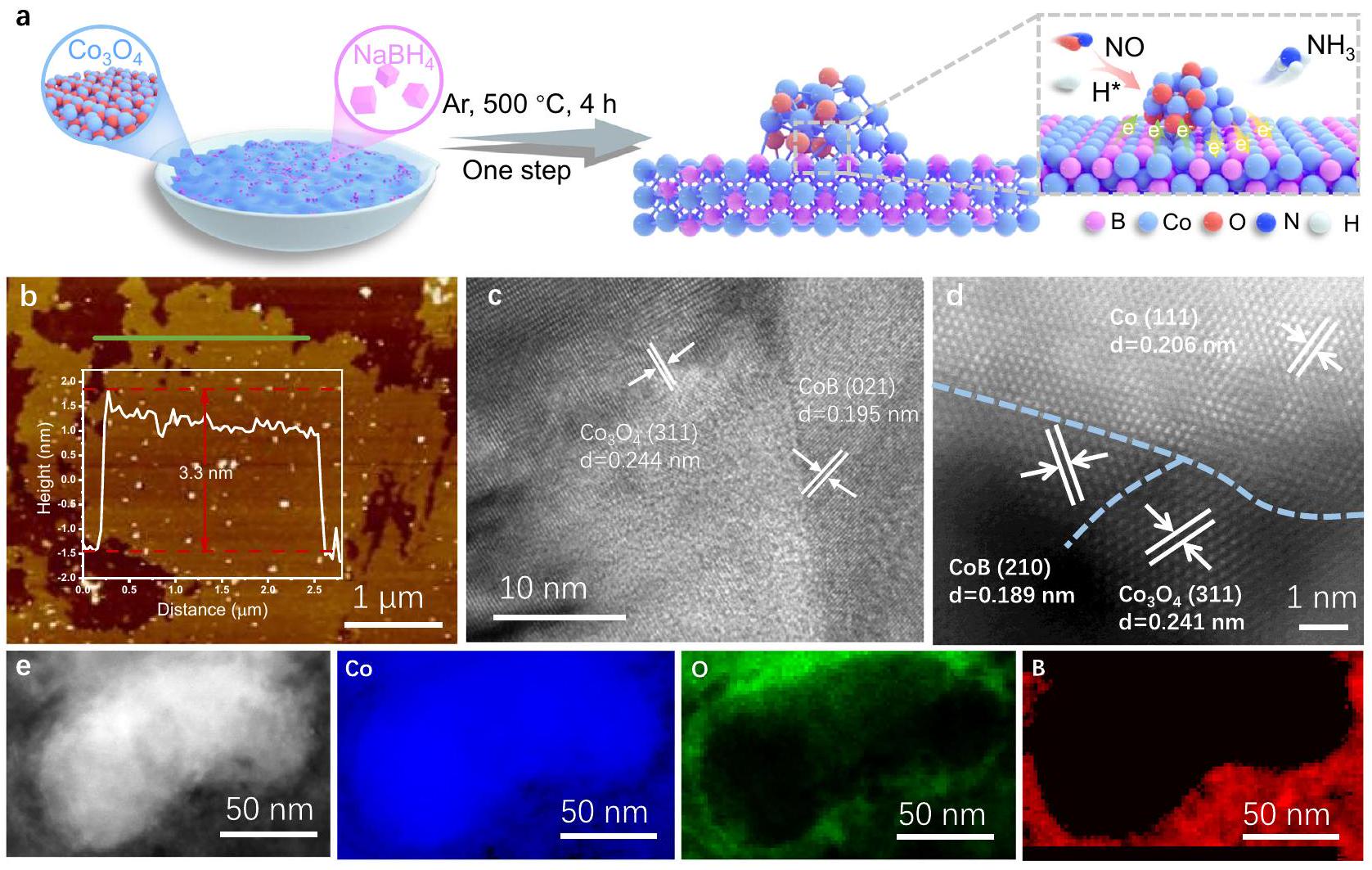
الثلاثيتم تخليق محفز كهربائي ذو هيكل غير متجانس عن طريق الاختزاليستخدمفي جو من الأرجون عندلمدة 4 ساعات (الشكل 1أ). من خلال تطبيق نفس الطريقة،يمكن أيضًا الحصول عليه عن طريق تقليل نسبة الجودة لـالمُحضَّريظهر شكل الجسيمات النانوية المدعومة على الأوراق النانوية استنادًا إلى قياس المجهر الإلكتروني الناقل (TEM، الشكل التوضيحي 1). يبلغ متوسط سمك الأوراق النانويةتم تحديدها بواسطة المجهر القوي الذري (AFM، الشكل 1b). تتكون الجسيمات النانوية على الأوراق النانوية من جسيمات نانوية كبيرة محاطة بالعديد من الجسيمات النانوية الصغيرة (HRTEM، الشكل التكميلية 2).يعرض
الشكل 1 | التخليق والشكل الخارجي لـرسم تخطيطي يوضح عملية التخليق لـ. صورة AFM لـ. يظهر الشكل الداخلي ملف الارتفاع على طول الخط الأحمر في (ب). ج صورة HRTEM لـ Co/
صورة HAADF-STEM المصححة للانحرافصورة HAADF-STEM وخرائط EELS المقابلة لـ، وعناصر B في تم توفير بيانات المصدر للشكل 1 كملف بيانات مصدر.
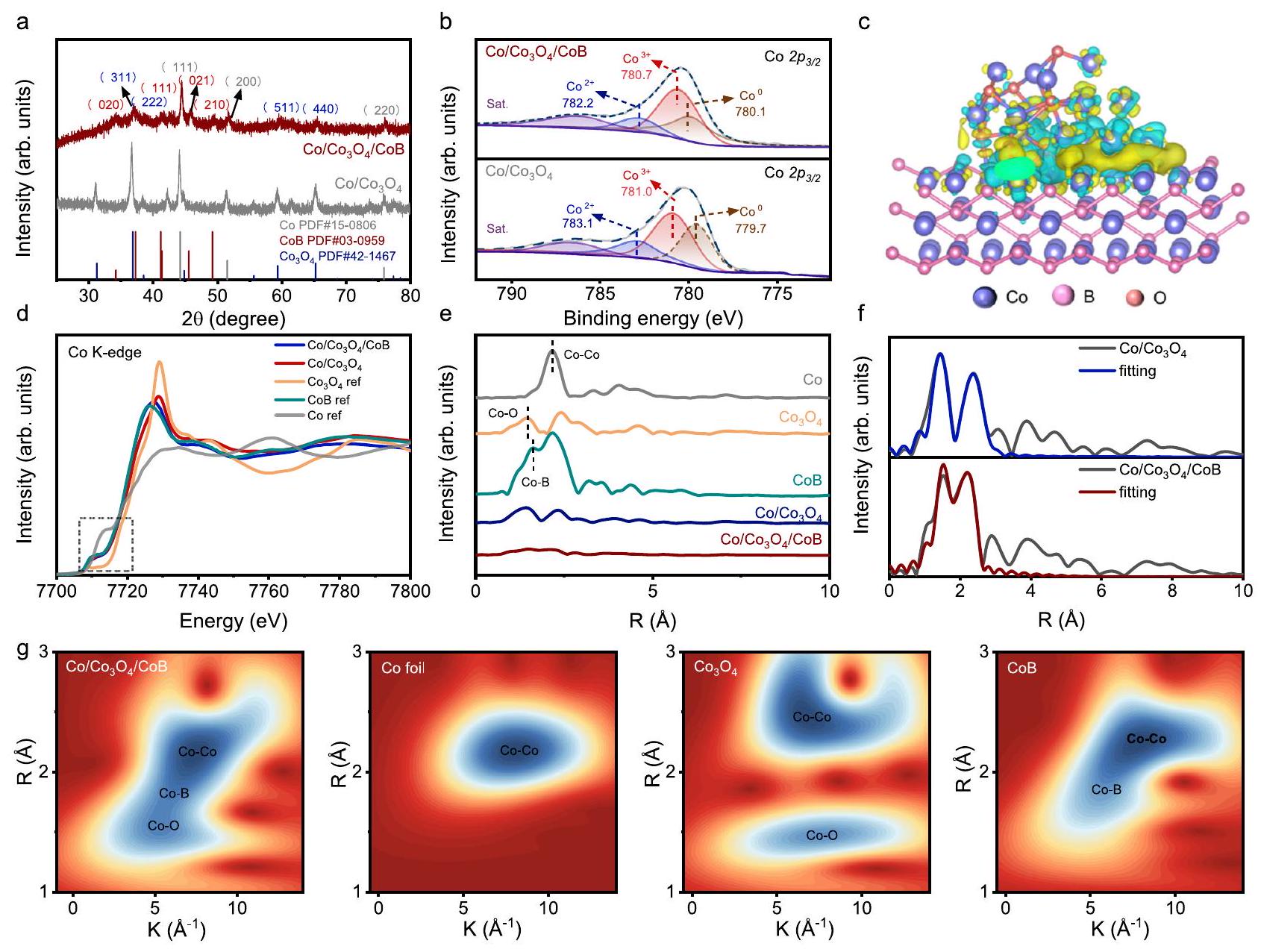
الشكل 2 | الميزات الهيكلية لـ. أنماط XRD لـ و . ب طيف XPS لـ و تحليل فرق كثافة الشحنة لـتمثل الألوان الصفراء والزرقاء مناطق تراكم الإلكترونات ونقصها، على التوالي. قيمة السطح المتساوي هي. طيف XANES عند حافة K لعنصر الديكلوريد، Co foil، CoB، و . طيف FT-EXAFS لـ، ورق الألمنيوم، CoB، و. منحنيات تركيب FT-EXAFS لـ و في فضاء R.رسوم بيانية لخطوط الكنتور WTفويل كوبر، كوبر بوند، وتم توفير بيانات المصدر للشكل 2 كملف بيانات مصدر. المراحل البلورية (311) و CoB (021) من صورة HRTEM (الشكل 1c). لتحديد الهيكل بدقةتم إجراء قياس HAADF-STEM المصحح للانحراف بشكل إضافي. كما هو موضح في الشكل 1d، توجد واجهات وفيرة بين، ويمكن ملاحظة مراحل CoB بوضوح، مما يشير إلى تشكيل ثلاثيالهياكل غير المتجانسة. توضح خريطة طيف فقدان طاقة الإلكترون (EELS) (الشكل 1e) المدمجة مع صورة HRTEM (الشكل التكميلي 2) أنالهيكل غير المتجانس يتكون من طبقة نانوية من CoB مدعومة بكوبلت كبير وكوبلت صغيرالجزيئات النانوية. للمقارنة،يظهر هيكل غير متجانس من جزيئات نانوية من الكوبالت مدعومة علىالأغشية النانوية (الأشكال التكميلية 3 و 4).
البنية وحالة التكافؤ لـتم تحليلها بواسطة حيود الأشعة السينية بالمسحوق (XRD) وطيف الإلكترون الضوئي بالأشعة السينية (XPS). كما هو موضح في الشكل 2a، تظهر أنماط XRD قمم حيود واضحة من (PDF #42-1467)، Co (PDF #15-0806) و CoB (PDF #03-0959) لـ ، و (PDF #42-1467) و Co (PDF #15-0806) لـ طيف XPS لـ B 1sكما يدل CoB على تشكيل CoB (الشكل التوضيحي الإضافي 5). في الشكل 2ب،طيف XPS لـيعرض ثلاثة قمم عند طاقات الربط لـو 783.1 إلكترون فولت، والتي يمكن أن تُعزى إلى و على التوالي. ل، الـ القمة تتحول قليلاً إلى طاقة ارتباط أعلى (780.1 إلكترون فولت)، بينما و تتحول القمم نحو ارتباط أقل الطاقات مقارنة بتلك الخاصة بـ. لأن و توجد بشكل رئيسي في Co ويمكن استنتاج أنه مع إدخال CoB يؤدي إلى فقدان المزيد من الإلكترونات في Co واكتساب المزيد من الإلكترونات فيلتوضيح نقل الإلكترون بين واجهات مختلفة في و تم إجراء حسابات DFT. هنا، من خلال موازنة قوة الحوسبة ودقة الحساب،تم تصميمه بواسطة Co (111) و (311) تجمعات مدعومة على بينماتم تصميمه بواسطة تجمعات Co (111) المدعومة على (311) (للتفاصيل، انظر حسابات DFT في قسم الطريقة). أولاً، تم تحليل شحنة بادر على و نماذج. من أجل النموذج، 3.64 | e| يتم نقله من Co إلى (الشكل التوضيحي التكميلي 6، الجدول التكميلي 1، والبيانات التكميلية 1). في يحصل و من Co و CoB، على التوالي (الشكل التوضيحي 7، الجدول التوضيحي 1، والبيانات التوضيحية 1). تحليل فرق كثافة الشحنة لـتشير إلى إعادة توزيع شحنات كبيرة عند الواجهة بين CoB و (الشكل 2ج)، مع انتقال الإلكترونات من Co إلى CoB ومن CoB إلى . علاوة على ذلك، فإن متوسط عدد نقل الإلكترونات لكل ذرة كوبالت في و تم تحليلها. كما هو موضح في الجدول التكميلي 1، يفقد الكوبالت المزيد من الإلكترونات (-0.22 e مقابل -0.13 e) ويكتسب المزيد من الإلكترونات (+0.51 e مقابل +0.08 e) في مقارنةً بـ ، مما يدل على أن إدخال CoB يمكن أن يعدل الهيكل الإلكتروني لـ Co وفيأشعة سينية
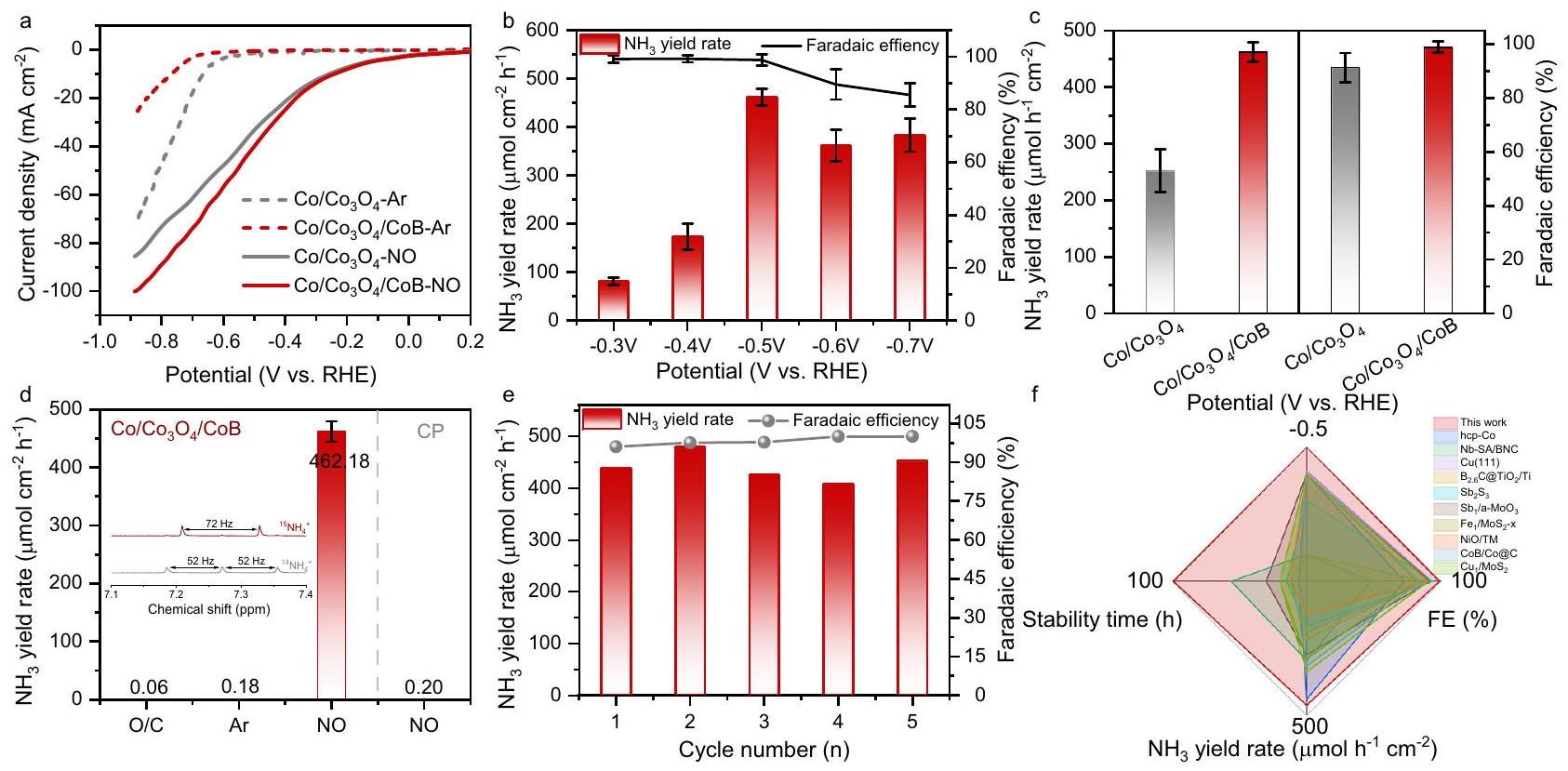
الشكل 3 | أداء NORR الكهروكيميائي. أ منحنيات LSV لـ و مع مسح لـمسجل في PBS مشبع بـ 0.1 م من الأرجون ومشبع بـ NOمعتصحيح iR). ب و معدل العائد على عند إمكانيات كاثودية مختلفة مع تحميل كتلة من في. ج مقارنة أداء NORR بين و عند -0.5 فولت مقابل RHE. أداء d NORR على ورق الكربون (CP) تحت ظروف مختلفة (O/C تمثل الدائرة المفتوحة) الحالة). يظهر الشكل الداخليطيف الرنين المغناطيسي النووي للتquantify. اختبار الاستقرارعند -0.5 فولت مقابل RHE.مقارنة أداء التحفيز الكهربائي لتفاعل اختزال النيتروجينمع المحفزات الكهروكيميائية الأخرى المبلغ عنها في الأدبيات. تشير أشرطة الخطأ إلى الانحراف المعياري المستمد من ثلاث قياسات مستقلة، مع وجود العلامة المركزية التي تشير إلى القيمة المتوسطة. تم توفير بيانات المصدر للشكل 3 كملف بيانات مصدر. تم إجراء مطيافية الامتصاص (XAS)، بما في ذلك هيكل الامتصاص القريب من حافة الأشعة السينية (XANES) وهيكل الامتصاص الدقيق الممتد للأشعة السينية (EXAFS)، لفحص التركيب الإلكتروني وبيئة التنسيق للكوبيوم (Co) في و . في طيف XANES عند حافة Co K (الشكل 2d)، موقع حافة الامتصاص لـ و تقع بين ذلك لرقائق الكوبالت والمراجع، تشير إلى أن متوسط حالة التكافؤ لذرة الكوبالت في و ضمن O و، بسبب التعايش بين كل من الكوبالت المعدني ولفهم التركيب المحلي حول ذرة الكوبالت في هذه العينات، يتم تحويل طيف EXAFS إلى فضاء R. تعرض أطياف EXAFS في فضاء R (الشكل 2e) قممًا سائدة من، و روابط التنسيق فيرقائق، على التوالي. طيف FTEXAFS لـ و يمكن أن يتم تركيبه بشكل جيد باستخدام مسارات الانعكاس الخلفي لـ و (الشكل 2f، الجداول التكميلية 2 و 3). من الجدير بالذكر أن عدد تنسيق Co-O (2.2) في Co/ أقل بكثير من ذلك (5.7) فيالمنسق بشكل منخفضهيكل فيمفيد لامتصاص NOمخطط كونتور تحويل الموجة (WT) لـيظهر CoB (الشكل 2 ج) ثلاثة أقصى شدة عند حوالي 7.2 و 5.9 و، الذي يتوافق مع ، و التنسيق، على التوالي. للمقارنة، يظهر فقط تنسيقات Co – Co و Co O (الشكل التوضيحي التكميلي 8).
أداء NORR الكهروكيميائي
أداء اختزال NO الكهروكيميائي علىتم تقييمه في خلية إلكتروليتية من نوع H مملوءة بمحلول مائي من عازلة الفوسفات الملحية (PBS) بتركيز 0.1 م. كما هو موضح في الشكل 3a والشكل التكميلي 9، تكشف منحنيات الفولتمترية المسحية الخطية (LSV) (سواء تم تصحيحها لـ iR أم لا) أن كلا من و تظهر كثافة تيار متزايدة بشكل ملحوظ فيالجو مقارنةً بجو الأرجون النقي، مما يشير إلى تفضيل NORR على و السطح. الكرونوأمبرو متري (تحليل كهربائي لمدة ساعة واحدة) والأشعة فوق البنفسجية – المرئية (UV-vis) تم استخدام القياسات اللونية لتحديد الكمية بشكل كميالكفاءة الفارادية (FE) ومعدل العائد (الأشكال التكميلية 10 و 11). عند -0.5 فولت مقابل RHE،يعرض الأمثلمن و معدل العائد من ( )، أعلى بكثير من ( من و معدل العائد من، الشكل 3ب، ج).تقدم قياسات الرنين المغناطيسي النووي (NMR) نتائج قابلة للمقارنة (الأشكال التكميلية 12-14). المنتجات الثانوية المحتملة الناتجة عن Co/تم فحص خلال NORR بواسطة مطيافية الكتلة الكهروكيميائية التفاضلية (DEMS) ، ومطيافية الامتصاص بالأشعة فوق البنفسجية والمرئية ، وكروماتوغرافيا الغاز (الأشكال التكميلية 15-18). الهيدروكسيلامين و لم يتم الكشف عن المنتجات الثانوية. علاوة على ذلك، أجرينا تجربة NORR علىفي محلول إلكتروليتي مائي 0.1 م KOH. كانت أداء NORR أقل مقارنة بالتجربة التي أجريت في 0.1 م PBS (الشكل التكميلي 19). كان أداء NORR الأفضل لـ مقارنةً بـ يمكن أن ينعكس ذلك بشكل أكبر من خلال نصف القطر الأصغر لنصف الدائرة في طيف التحليل الطيفي للامتصاص الكهروكيميائي (EIS) (الشكل التكميلي 20)، مما يشير إلى مقاومة نقل شحنة أصغر. ) فوق السطح. تشير سلسلة من التجارب الضابطة إلى أن النيتروجين في المنتج ينشأ فقط من NO (الشكل 3d). ورق الكربون نفسه يظهر نشاط NORR ضئيل، مما يكشف أن يتم إنتاجه بشكل رئيسي على (الشكل 3د). باستخدام النظائركمادة متفاعلة، تظهر القمم المزدوجة المميزة (الموضحة في الشكل 3d) بفاصل قدره 72 هرتز، مما يتوافق مع، مما يشير إلى أن هو المصدر الوحيد للنيتروجين لـالإنتاج. بالإضافة إلى النشاط التحفيزي الممتاز،كما يظهر استقرارًا تحفيزيًا جيدًا. خلال خمس دورات تحليل كهربائي متتالية عند -0.5 فولت مقابل RHE، و معدل العائد يبقى تقريبًا دون تغيير (الشكل 3e). علاوة على ذلك، يظهر هذا المحفز استقرارًا جيدًا في التيار لـ عند -0.5 فولت مقابل RHE (الشكل التوضيحي 21). يظهر استقرارًا هيكليًا جيدًا خلال NORR استنادًا إلى تحليلات XRD وHRTEM وXPS (الأشكال التكميلية 22-24). الثلاثييحقق مستوى عالٍمن و معدل العائد لـ
الشكل 4 | آلية التفاعل. أ الطاقة المحسوبة لامتصاص NO على النيتروجين في Co (111) و CoB (021) و (311). طاقة امتصاص NO المحسوبة على و . الدائرة الزرقاء تشير إلى جزيء NO. ترميز ألوان الذرات: بنفسجي، كوبالت؛ أحمر، أكسجين؛ وردي، بورون؛ برتقالي، نيتروجين. منحنيات اختراق امتصاص NO من و العوامل المساعدة فيتحليل COHP لرابطة Co-N أثناء امتصاص NO على Co/Co3 وطاقة غيبس الحرة لـفصل و . طيف EPR المسجل على مدى و عند التحليل الكهربائي في غياب NO.مقارنة الطاقة الحرة لجيبس لامتصاص *H على الكوبالتمواقع و تحليل COHP لـ * NH و * على و تم توفير بيانات المصدر للشكل 4 كملف بيانات مصدر. بالإضافة إلى الاستقرار الطويل الأمد عند جهد كاثودي منخفض قدره -0.5 فولت مقابل RHE، وهو أفضل من معظم المحفزات الكهروكيميائية NORR المبلغ عنها (الشكل 3f والجداول التكميلية 4 و 5). لإظهار الإمكانية التطبيقية العملية لـمحفز، بطارية Zn-NO معتم تجميع الكاثود وقطعة الزنك الأنودية (الشكل التكميلي 25)، والتي يمكن أن توفر جهد دائرة مفتوحة (OCV) قدره 2.04 فولت (الشكل التكميلي 26) وكثافة طاقة قصوى قدرها، متفوقًا على جميع النتائج المبلغ عنها في الأدبيات (الأشكال التكميلية 27 و28، الجدول التكميلية 6). تزداد كثافة تيار التفريغ الناتج باستمرار من 0.5 إلىوكل خطوة تظهر هضبة تفريغ مستقرة، مما يشير إلى أن خلايانا تتمتع بقدرة تفريغ ممتازة (الشكل التكميلي 29). علاوة على ذلك،معدل العائد يظهر أقصى قيمة لـعند 8 مللي أمبير لكل سنتيمتر (الشكل التوضيحي 30). من المهم أن بطارية Zn-NO يمكنها إزالة ملوث NO، وإنتاجوتوليد الكهرباء في نفس الوقت.
آلية التفاعل
لفهم الأداء الممتاز لشركة NORRتم قياس مساحة السطح وفقًا لطريقة بروناور-إيميت-تيلر (BET) ومساحة السطح النشطة كهربائيًا (ECSA) للمحفزات التي تم تحضيرها أولاً. بالمقارنة معيعرض مساحة سطح BET أعلى (الشكل التكميلي 31) وECSA (الشكل التكميلي 32)، مما سيوفر المزيد من المواقع النشطة لتحفيز تفاعل NORR الكهروكيميائي. لتوضيح المواقع التفاعلية لامتصاص/تنشيط NO والانفصال بالإضافة إلى عملية بروتنة الوسائط الممتصة غير مفعلتم إجراء سلسلة من حسابات DFT، ولم يتم تحقيق أي تقدم، بالإضافة إلى قياسات الرنين المغناطيسي الإلكتروني (EPR). كانت طاقات امتصاص NO مع نهاية N/نهاية O على مواقع Co في Co (111)، (311) ومواقع CoB (021) ومواقع B في CoB (021) تم حسابها بواسطة DFT (الشكل 4a والأشكال التكميلية 33-35). تشير النتائج إلى أن NO يفضل الامتصاص على مواقع Co من (311) في شكل امتصاص N-end، مع أدنى طاقة امتصاص تبلغ -3.64 إلكترون فولت. بالمقارنة معيرتبط بـ NO بشكل أقوى (الشكل 4b والبيانات التكميلية 1). الهيكل المنسق بشكل منخفض Co-O في (الشكل 2f والجدول التكميلي 2) يساهم في امتصاص NO كما يتضح من تحليل اختراق NO (الشكل 4c) تم استخدام تحليل كثافة السكان في المدارات البلورية (COHP) بشكل إضافي للتحقيق في قوة امتصاص NO على و (الشكل 4د) . مقارنة بـيعرض قيمة ICOHP المدمجة الأكثر سلبية لرابطة Co – N، مما يشير إلى امتصاص أقوى لـ NO علىسطح CoBتم إجراء حسابات DFT لاستكشاف عملية تفكك الماء. كانت حاجز الطاقة لتحويل الماء من الحالة الممتصةإلى حالة الانتقال (TS) على و هي 0.50 إلكترون فولت و 0.66 إلكترون فولت، على التوالي (الشكل 4e، الأشكال التكميلية 36 و 37، الجدول التكميلية 6). تشير هذه النتيجة إلى أن التفكك لـ أكثر ملاءمة حركيًا على . من أجل مواصلة التحقيق في قدرة الانفصال على و تم إجراء قياسات طيف رامان في الموقع عند إمكانيات كاثودية مختلفة. ثلاثة أنواع من أوضاع تمدد O-H تنتمي إلى
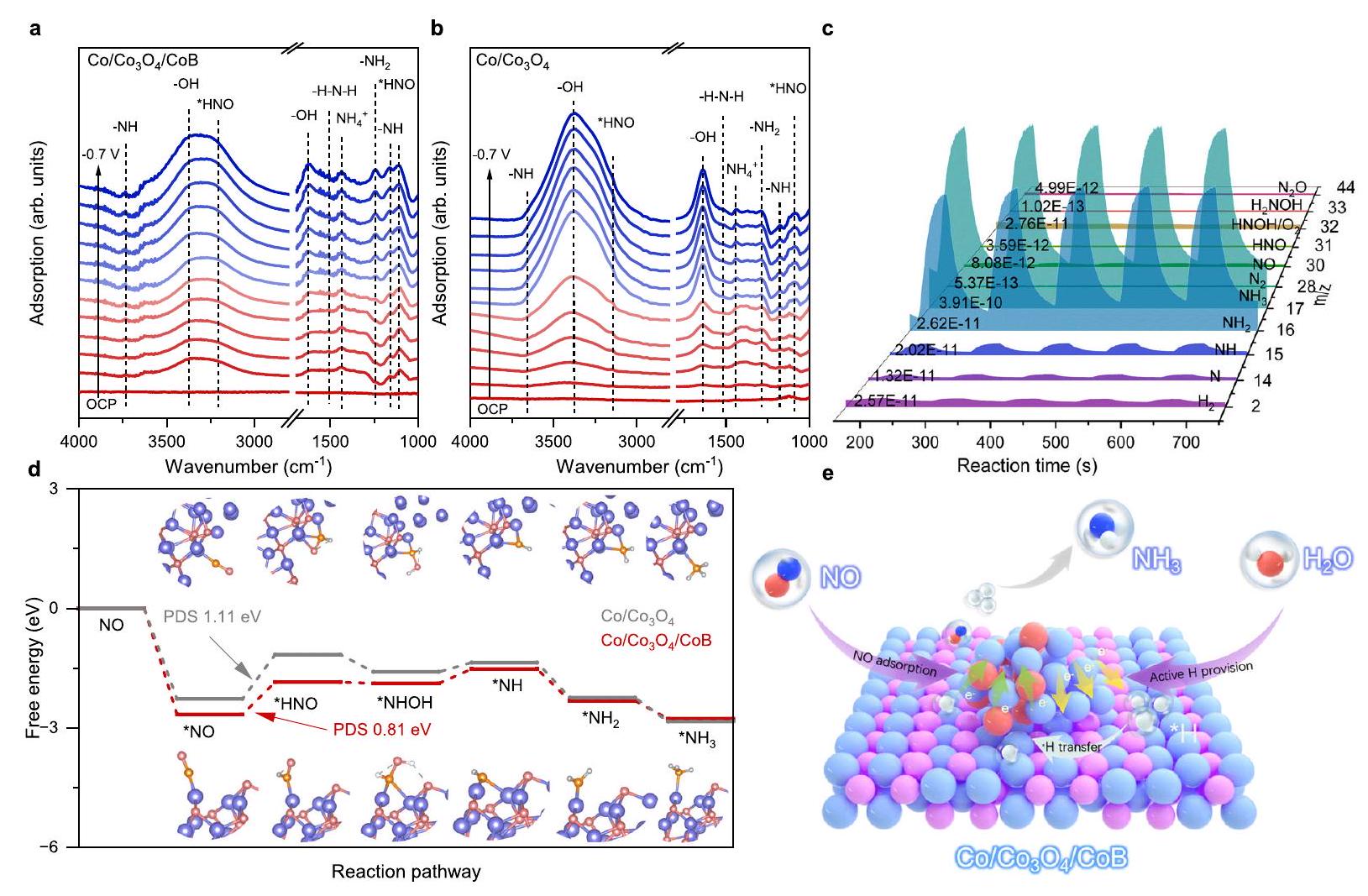
الشكل 5 | مسار التفاعل. طيف ATR-SEIRAS في الموقع المسجل على مدى و في 0.1 م PBS عند الجهد الكاثودي المطبق من OCP إلى -0.7 فولت مقابل RHE. نتائج قياسات DEMS عبر الإنترنت على عند -0.5 فولت مقابل RHE. د تم حساب مخططات الطاقة الحرة لجيبس NORR على و CoB عند 0 فولت مقابل RHE. ترميز ألوان الذرات: بنفسجي، كوبالت؛ أحمر، أكسجين؛ برتقالي، نيتروجين؛ رمادي، هيدروجين. توضيح تخطيطي يوضح آلية NORR على Co/المحفز الكهربائي. ترميز ألوان الذرات: الأزرق الفاتح، الكوبالت؛ الوردي، البورون؛ الأحمر، الأكسجين؛ الأزرق الداكن، النيتروجين؛ الرمادي، الهيدروجين. تم توفير بيانات المصدر للشكل 5 كملف بيانات مصدر. ، و على التوالييتم ملاحظتها. النسبة النسبية لـيعرض اتجاهًا طفيفًا متزايدًا مع زيادة الجهد الكاثودي المطبق، مما يشير إلى أنأقرب إلى سطح المحفز وقد يتأثر أكثر بالحقل الكهربائي. الـنسبة فوقCoB دائمًا أعلى من ذلكفي جميع الجهود الكاثودية المدروسة، مما يشير إلى قدرة أفضل على تفكك الماء على CoB (الأشكال التكميلية 38 و 39). نتيجة لذلك، يمكن أن يولد المزيد من *H كما هو موضح في قياس EPR السائل باستخدام 5,5-ثنائي ميثيل-1-بيرولين-N-أكسيد (DMPO) كعامل حبس *H (الشكل 4 ف). اختفى إشارة DMPO-H تمامًا عندما تم إدخال NO في نظام التفاعل (الشكل التكميلي 40)، مما يشير إلى أن *H المتولد يمكن أن يتم استهلاكه بسرعة بواسطة NO على السطح. هذا يؤكد أكثر أن *H هو أكثر ملاءمة للتفاعل مع NO لتكوينالمتوسطات بدلاً من التوليد. تم توليد *H على المواقع المعدنية Co في يمكن نقله بسرعة إلى الجوارسطح لتحفيز تفاعل *NO الهدرجة (الشكل 4 ج)، بفضل الغنى النسبي بالإلكتروناتفيمن ذلك في. نتيجة لذلك، تم تعزيز الشحن ونقل إلىتعزيز اختزال NO الكهروكيميائي لإنتاجتم إجراء تحليل COHP للتحقيق في قدرة الامتزاز للوسائط المحتوية على النيتروجين على و قيمة ICOHP لـالرابطة هي و على و على التوالي (الشكل 4 ح، ط، الأشكال التكميلية 41 و42)، مما يشير إلى طاقة حالة ارتباط أعلى لـ *علىمنالكثافة المتوقعة للحالات (PDOS) لـ و عند امتصاص *NH و *تم تحليلها (الأشكال التكميلية 43 و 44). (أعلى قمة تحت مستوى فيرمي) موقع أعلى أكثر من ذلك منعند امتصاص * NH و *مما يشير إلى أن حالات عدم الترابط للوسطاء NORR تقع عند طاقات أعلى مع شغلات أقل علىالسطح، مما يؤدي إلى روابط أقوى للوسائط علىخلال نورتشير نتائج COHP و PDOS إلى زيادة في امتصاص *NH و *الوسطاء فوق، مما يسهل على NORR الإنتاج .
لكشف مسار التفاعل في عملية التحليل الكهربائي لنظام NORR، تم إجراء قياسات طيف الامتصاص بالأشعة تحت الحمراء المعززة بواسطة الانعكاس الكلي المخفف (ATR-SEIRAS) في الموقع لاستكشاف الوسائط التفاعلية في نطاق الجهد من OCP إلى -0.7 فولت (مقابل RHE). على مدارالسطح (الشكل 5أ)، الحزم عند 1103 وتنتمي إلى أنواع *HNO بينما الحزم عند 1167، 1245، و تتعلق بـ تمددتأرجح، والانحناء، على التوالي. الأشرطة التي زادت تدريجياً عند 1456 ويمكن أن يُعزى إلىوتراكم الأنواع – OH علىسطح. بالإضافة إلى ذلك، يوجد امتصاص واسع متداخل حوالييلاحظ، حيث توجد الحزم عند 3380 وتُعزى إلى تمدد -OH و -NH، على التواليتظهر طيف ATR-SEIRAS في الموقع كدالة للوقت أيضًا نفس الوسائط التفاعلية علىالسطح (الشكل التوضيحي 45). مقارنة بـ (الشكل 5ب)، عدد كبير من الوسائط التفاعلية المهمة بما في ذلك *NH و *يمكن ملاحظته فوقالسطح عند إمكانيات كاثودية أقل سلبية، مما يشير إلى تسريع كبير في حركية تفاعل NORR على Co/. من ناحية أخرى، كمية أكبر من * NH و * تمت ملاحظة تراكم الوسائط علىسطح مقارنة مع و ، مما يعني القدرة الأضعف على تزويد *H على (الشكل التوضيحي التكميلي 46). لتأكيد الوسطاء التفاعليين الرئيسيين بشكل أكبر، تم قياس DEMS تم الأداء على مدى عند -0.5 فولت مقابل RHE. كما هو موضح في الشكل 5c والشكل التكميلي 47، يمكن ملاحظة أن NO ينخفض مع انخفاض NOH و HNOH الوسيطة، وفي الوقت نفسه ، و زيادة. هذه الوسائط التي تم ملاحظتها في DEMS تتماشى جيدًا مع النتائج التي تم الحصول عليها من قياسات ATR-SEIRAS في الموقع. لذلك، فإن مسار NORR الذي يحدث علىيُعتقد أن السطح يتبع *لا * * *NH . بالإضافة إلى ذلك، إشارة في قياس DEMS أقوى بكثير من ذلك لـ، و ، موضحًا الارتفاع في NORR فوقالشكل 5d يقارن مخطط طاقة التفاعل لـ NORR على و السطح (نماذج البنية للوسطاء موضحة في الأشكال التكميلية 48 و49). بالمقارنة مع *NOH، فإن البروتنة الأولى لـ NO أكثر ملاءمة من الناحية الطاقية لتكوين *HNO (الأشكال التكميلية 50 و51)، والتي تمثل الخطوة المحددة للجهد (PDS) في NORR على و . بوضوح، يظهر حاجز طاقة تفاعل أقل (0.81 إلكترون فولت) في PDS مقارنة بذلكمنبسبب عملية البروتنة المتسارعة لـ NO على. البروتون الثاني يتفاعل بشكل تفضيلي مع *HNO لتوليد *HNOH مع من -1.88 إلكترون فولت، بدلاً من *N مع من -0.82 إلكترون فولت. أخيرًا، تحدث ثلاث عمليات بروتنة متتالية حتىيتشكل. بالإضافة إلى ذلك، تم حساب طاقة التفاعل لـ NORR أيضًا على مدى، و CoB (الأشكال التكميلية 52-55 والجدول 7). طاقة التفاعل للخطوة المحددة المحتملة (*NO إلى *HNO) هي و 1.6 إلكترون فولت فوق، و CoB ، على التوالي، أعلى بكثير من ذلك على . هذه النتيجة تدل على أن الخطوة الأولى من هدرجة NO يمكن تعزيزها بشكل ملحوظ على السبيكة الثلاثيةالهياكل غير المتجانسة.
نقاش
باختصار، لقد قمنا بتصميم وإعداد نظام ثلاثيالهياكل غير المتجانسة من خلال تفاعل اختزال الحالة الصلبة الحراريةبواسطةالمُعَدّعرضت مستوى عالٍمنمعمعدل العائد منوثبات طويل الأمد عند جهد كاثودي منخفض قدره -0.5 فولت مقابل RHE، متفوقًا على معظم المحفزات الكهروكيميائية NORR المبلغ عنها في الأدبيات. الأداء الاستثنائي لـ NORRنتج عن الشحنة الفريدة وانتقال الكتلة داخلالهياكل غير المتجانسة (الشكل 5e). تم تعزيز نقل الإلكترونات فيأنتج كوبا إلكترونياً ناقصاً وغنياً بالإلكتروناتيمكن أن تعزز مواقع الكوبالت التي تعاني من نقص الإلكترونات بشكل فعالالانفصال لتوليد *H بينما التنسيق المنخفض الغني بالإلكتروناتالمواقع التي تم الترويج لها لم تظهر أي امتصاص.تكونت على موقع الكوبالت الناقص الإلكترونات كانت أكثر ملاءمة لنقلها إلى الموقع الغني بالإلكتروناتالموقع الممتص بـ NO، مما يسهل الهدرجة الانتقائية لـ NO. بفضل تعزيز نقل الشحنة والبروتون، فإن حاجز الطاقة للخطوة المحددة المحتملة من *NO إلى *HNO في NORR على Co/تم تقليله بشكل كبير. علاوة على ذلك، تم تقديم CoB فييمكن أن يسهل أيضًا امتصاص *NH و*المتوسطات. كل ذلك ساهم بشكل كبير في تعزيز عملية التحليل الكهربائي لنزع أكسيد النيتروجين. هذه الدراسة تمهد الطريق لتصميم وتطوير محفزات كهربائية عالية الكفاءة لتقليل أكسيد النيتروجين إلى.
طرق
المواد والكواشف
تم شراء ورق الكربون (99.99%) وكربون كيتجن من شركة سوزو سينيرو للتكنولوجيا المحدودة. أسيتات الكوبالت (II) رباعي الماءبوليمر البولي فينيل بيروليدون (PVP،بوروهيدريد الصوديومكلوريدالإيثانول )، تم شراؤها من شركة شنجهاي تيتان العلمية المحدودة. كلوريد هيدروكسيل الأمونيوم ، ) ، ثنائي ميثيل سلفوكسيد-D6 ( )، هيدروكسيد الصوديوم ( ) ، سترات ثلاثي الصوديوم ثنائي هيدرات نيتروبروسيد الصوديومحمض الكبريتيك ( ) ، بيروكسيد الهيدروجين ( ) ، ومحلول عازل الفوسفات (PBS، ) تم شراؤها من شركة شنجهاي أداماس للمواد الكيميائية المحدودة. محلول هيبوكلوريت الصوديوم (NaClO، الكلور المتاح )، حمض الساليسيليك ( ) تم شراؤها من شركة ماكلين للتكنولوجيا الكيميائية المحدودة. ماء منزوع الأيونات (18.25 تم الحصول على (المقاومية) من خلال معدات مياه فائقة النقاء في المختبر. جميع المواد الكيميائية من الدرجة التحليلية وتستخدم مباشرة دون مزيد من التنقية.
تركيبأوراق نانوية
التم تحضير الأوراق النانوية بطريقة الهيدروحرارية على النحو التالي: و PVP تم إذابتها في 70 مل من الميثانول تحت التحريك لمدة 30 دقيقة. تم نقل المزيج إلى وعاء أوتوكلاف من الفولاذ المقاوم للصدأ مبطن بتفلون سعة 100 مل، وتم إغلاقه وتسخينه إلى لمدة 12 ساعة. بعد التبريد إلى تم جمع المنتجات بواسطة الطرد المركزي، وغسلت ثلاث مرات بالإيثانول، وجففت عندوتم تحميصه عند لمدة 5 ساعات في الهواء .
تركيب و
في تخليق نموذجي لـ و تم خلطها بشكل موحد في هاون بنسبة كتلة قدرهاثم تم وضع الخليط في أنبوب كوارتز أفقي وتسخينه إلىبمعدل انحدار قدرهتحت جو من الأرجون، الذي تم الحفاظ عليه عند لمدة 4 ساعات. تم غسل المنتجات الناتجة بشكل مكثف بمزيج من الإيثانول والماء المقطر وجمعها عن طريق الترشيح. أخيرًا، تم غسل تم تجفيفه عند لمدة 12 ساعة في فرن مفرغ من الهواء. للتحضير نسبة الكتلة لـ و تم تعديله إلىبينما تم الحفاظ على باقي معايير التحضير دون تغيير.
القياسات الكهروكيميائية
تم إجراء قياسات كيميائية كهربائية على جهاز العمل الكيميائي الكهربائي CHI660E في خلية كيميائية كهربائية من نوع H (الشكل التكميلي 56) مفصولة بغشاء نافيوني 117.سمك كاندو بونت) في تكوين ثلاثي الأقطاب عنداخترنا محلول عازل PBS بتركيز 0.1 م ) للحفاظ على درجة حموضة الإلكتروليت أثناء عملية NORR. تم معالجة الغشاء بشكل متتابع في محلول مائي عندلمدة ساعة واحدة، ثم فيحل فيلمدة ساعتين وأخيرًا في الماء منزوع الأيونات عند لمدة 6 ساعات. الحفاز المغلف على ورق الكربون ( ) تم استخدامه كقطب عمل، لوحة من البلاتين تم استخدامه كالكاثود، وتم استخدام قطب مرجعي من محلول مائي مشبع بتركيز 3.5 م من كلوريد البوتاسيوم.تم معايرة القطب المرجعي في-مشبع 0.1 م PBS باستخدام نظام أقطاب Pt متماثل.
لتحضير القطب العامل، تم تفريق 2.5 ملغ من المحفز الكهربائي و2.5 ملغ من كربون كيتجن بالموجات فوق الصوتية فيإيثانولماء نقي للغاية، ومحلول نافيوندو بونت) لتشكيل حبر محفز متجانس يليه إسقاطمن حبر المحفز على قطعة من CP ( ) الذي تم تجفيفه عند تحميل كتلة المحفز كانقبل جميع الاختبارات الكهروكيميائية، 30 دقيقة من النقاء العاليغاز ) و 30 دقيقة من غاز ) تشبع الإلكتروليت لاستبعاد الهواء في نظام التفاعل.
تم إجراء الفولتمترية المسحية الخطية (LSV) بمعدل مسح قدرهقبل 50 دورة من الفولتمترية الدورية بمعدل مسحللحصول على منحنى مستقر معتصحيح iR. تم توفير البيانات غير المصححة iR لجميع المحفزات في المعلومات التكميلية. تم الحصول على طيف الامتياز الكهربائي (EIS) بدون تصحيح iR في نطاق التردد من 0.01 هرتز إلى 100 كيلوهرتز عند سعة جهد متردد تبلغ 5 مللي فولت عند جهد الدائرة المفتوحة تحتتم تشغيل الكرونوأمبرو متري لتقييم الاستقرار تحت التحريك المستمر (1600 دورة في الدقيقة) عند كثافات تيار مختلفة. تم تحويل جميع الجهود في هذه الدراسة إلى مقياس القطب الهيدروجيني القابل للعكس (RHE) وفقًا للمعادلة التالية:
حساب الكفاءة فاراداي (FE) ومعدل العائد (Y)
أينهو سعر المنتج هو الشحنة الكلية، هو تركيز المنتجاتهو حجم الإلكتروليت في حجرة الكاثود” : عدد نقل الإلكترونات في المنتجات؛ F: ثابت فاراداي ( ); : الكتلة المولية للمنتجات ( ); س: مساحة القطب الكهربائي ( ); ت: زمن التفاعل .
تحليل ECSA
“تم تقييم المساحة السطحية النشطة كهربائياً (ECSA) من خلال قياسات الفولتمترية الدورية (CV) التي أجريت ضمن منطقة الجهد غير الفارادي في محلول إلكتروليتي 0.1 M PBS، حيث يكون انخفاض iR ضئيلاً. سعة الطبقة الثنائية الكهربائية (تم تحديده من الميل الخطي للتيار السعوي ) تم رسمها مقابل معدل المسح ( ). تم تحديد المساحة الفعالة السطحية الكهربائية (ECSA) للمحفز من خلال تطبيع سعة الطبقة المزدوجة ( ) ضد السعة النوعية القياسية ( ) لأسطح المعادن الملساء في محلول إلكتروليتي محايد بتركيز 1.0 م، وفقًا للعلاقة: ECSA .
تQuantification of
معدل العائد لـتم تحديد NORR كميًا بواسطة طريقة الإندوفينول الأزرق وNMR. بالنسبة لطريقة الإندوفينول الأزرق، تم معايرة منحنيات التركيز-الامتصاص باستخدام معيارحل مع سلسلة من التركيزات. منحنى التوافقيظهر علاقة خطية جيدة بين الامتصاص و التركيز. لقياس الرنين المغناطيسي النووي، بعد NORR، تم إخراج الإلكتروليت، الذي تم ضبط درجة حموضته إلى 3 باستخدام محلول مائي من HCl بتركيز 0.5 م، ثم أُرسل للت quantification بواسطة الرنين المغناطيسي النوويمع معيار داخلي لحمض الماليك. كان عدد المسحات 128 لجميع قياسات الرنين المغناطيسي النووي. منحنى التوافقيظهر علاقة خطية جيدة.
تجربة وسم النظائر
التجربة وسم النظائر استمرت علىطيف الرنين المغناطيسي النوويلتحديد مصدر النيتروجين لـ NORR. استبدلمعلإجراء تجربة NORR عند -0.5 فولت مقابل RHE. بعد التجربة، تم تحميض 2 مل من الكاثوليت بواسطةتم إضافة الحلول المذكورة أعلاه إلى أنبوب NMR وخلطها مع محلول حمض الماليك المائي.محلول مائي و DMSO- ثم تم تحليلها بواسطةقياسات الرنين المغناطيسي النووي.
تحديد كمية الهيدروكسيلامين ( )
لتحديد الكميةتم تنفيذ الإجراءات الأدبية التالية: 1.0 مل من الكاثوليت (أو معيارتم إضافة 1.0 مل من محلول PBS ) و 8-هيدروكسيكولين. تحت اهتزاز قوي،تمت الإضافة وتم تسخين الخليط عندلمدة دقيقة واحدة. في حضورستتحول المحلول من الأصفر الفاتح إلى الأزرق المخضر، مما يظهر قمة امتصاص عندرسم امتصاص الذروة معأدى التركيز إلى منحنى المعايرة.
بطارية Zn-NO
تم استخدام ورق الكربون المغلف ككاثود لأداء عملية NORR في إلكتروليت كاثودي (0.1 م PBS). تم استخدام لوحة زنك مصقولة كأنود في إلكتروليت أنودي.، وتم استخدام غشاء نافيون 117 لفصل الكاثود عن الأنود. تم تقييم بطارية Zn-NO على جهاز العمل الكهربائي CHI660E تحت جو محيط عند .
توصيفات
تمت دراسة المعلومات الشكلية باستخدام مجهر القوة الذرية (AFM، بارك NX10)، ومجهر المسح الإلكتروني ذو الانبعاث الميداني (SEM، زيس-سيغما-300)، ومجهر الإلكترون الناقل (TEM، جيول JEM-1400). تم إجراء مجهر الإلكترون الناقل عالي الدقة (HRTEM) ومجهر الإلكترون الناقل ذو الحقل المظلم عالي الزاوية المصحح للانحراف (HAADF-STEM) على جهاز جيول JEM 2100 F وJEM-ARM 300 F Grand ARM. تم تسجيل أنماط حيود الأشعة السينية (XRD) على جهاز براكير D8 Advance Diffractometer (إشعاع Cu-Kα: تمت دراسة حالات التكافؤ السطحية بواسطة مطيافية الأشعة السينية للألكترونات (XPS، PHI-5300) باستخدام إشعاع Mg Kα. ). تم جمع طيف امتصاص الأشعة السينية بالقرب من حافة الامتصاص (XANES) وهيكل الامتصاص الدقيق الممتد (EXAFS) عند حافة كوبر (Co K-edge) في خط شعاع HXMA من المصدر الضوئي الكندي (CLS) باستخدام وضع الفلورية ومونكروماتور سيليكون (Si (111)). تم ضغط العينات إلى رقائق لجمع البيانات عند تم طرح الخلفية من بيانات EXAFS الخام، وتم تطبيعها وتحويلها فوريير باستخدام إجراءات قياسية باستخدام برنامج ATHENA. تم معالجة بيانات EXAFS المكتسبة وفقًا للإجراءات القياسية باستخدام وحدة ATHENA المدمجة في حزم برامج IFEFFIT.تم الحصول على طيف EXAFS الموزون عن طريق طرح الخلفية بعد الحافة من الامتصاص الكلي ثم تطبيعها لخطوة قفزة الحافة. تم قياس طيف الامتصاص للأشعة فوق البنفسجية والمرئية (UV-vis) على جهاز Agilent S3 Cary 5000. تم استخدام جهاز NMR من نوع Bruker 600 M مع تقليل الماء لتسجيل الـطيف الرنين المغناطيسي النووي. تم قياس مساحة السطح وفقًا لطريقة بروناوير-إيميت-تيلر (BET) على جهاز U.S. Quantachrome ASAP 2020 M عند 77 كلفن.
لا قياسات اختراق الامتصاص
تم إجراء قياسات اختراق امتصاص NO على محلل امتصاص ديناميكي (mixSorb S) مزود بكاشف موصلية حرارية (TCD) مدمج مع مطياف الكتلة (OMNISTARTM). أولاً، تم معالجة 40 ملغ من المحفز في جو هيلي عالي النقاء بمعدل تدفقلمدة ساعة واحدة. بعد ذلك، تم تعريض العينة لغاز NO (متوازن بواسطة الهيليوم) عند معدل تدفق غاز إجمالي قدرهفيمصحوبًا بتسجيل إشارة TCD وإشارة MS لغاز NO عندحتى تحقق إشارة كتلة المخرج لثاني أكسيد النيتروجين التشبع.
قياسات الانعكاس الكلي المخفف في الموقع – مطيافية الامتصاص بالأشعة تحت الحمراء المعززة بالسطح (ATR-SEIRAS)
تم تسجيل طيف ATR-SEIRAS في الموقع على جهاز مطياف FTIR INVENIO-R (Bruker) مزود بكاشف من الزئبق والكادميوم والتيلوريوم (MCT) مبرد بالنيتروجين السائل (الشكل التوضيحي 57). تم تحضير حبر المحفز عن طريق خلط 5 ملغ من المحفز،إيثانولماء نقي للغاية، ومحلول نافيون تحت الموجات فوق الصوتية لمدة 30 دقيقة. بعد ذلك،تم إسقاط حبر المحفز ببطء على بلورة سيليكون مائلة الوجه لتحضير القطب العامل لخلية الطيف الكهروكيميائية المصنوعة حسب الطلب والمثبتة على ملحق ATR.تم استخدام القطب الكهربائي كقطب مرجعي وتم استخدام سلك بلاتيني كقطب مضاد. تم إضافة الإلكتروليت مسبقًا مع تدفق مستمر للغاز الأرجون بمعدل تدفق قدرهلمدة 30 دقيقة لإزالة التداخل من و قبل قياس ATR-SEIRAS. تم قياس الخلفية عند جهد الدائرة المفتوحة. بعد ذلك،تم حقن الغاز وكانت طيف الامتصاص تم تسجيله عند إمكانيات تطبيقية مختلفة من OCP إلى -0.7 فولت مقابل RHE. بعد ذلك، تم جمع الطيف عند -0.5 فولت مقابل RHE كل 5 دقائق لمدة 60 دقيقة.
قياسات الطيف الكتلي الكهربائي التفاضلي عبر الإنترنت (DEMS)
تم إجراء قياس DEMS في الموقع على Linglu (الشكل التكميلي 58). تم تطبيق طبقة من التفلون لفصل الإلكتروليت عن نظام الفراغ. حافظ نظام الفراغ، الذي يتكون من مضختين جافتين ومضخة توربينية واحدة، على درجة الفراغ أقل منتم تحضير حبر المحفز عن طريق خلط 3 ملغ من المحفز،إيثانولماء نقي للغاية، ومحلول نافيون تحت الموجات فوق الصوتية لمدة 30 دقيقة. بعد ذلك،تم إسقاط حبر المحفز ببطء على فيلم الذهب لتحضير القطب العامل.تم استخدام القطب الكهربائي كقطب مرجعي وتم استخدام سلك بلاتيني كقطب مضاد. قبل قياس DEMS، تم نفخ NO/Ar في المحلول الكهربائي حتى التشبع. I-تم استخدام اختبار لمدة 100 ثانية لإجراء تحقيقات DEMS.
طيف رامان في الموقع
تم إجراء قياسات رامان في الموقع بشكل مشترك بواسطة جهاز رامان RXN1 (نظام كايسر البصري) ومحطة العمل الكهروكيميائية CHI660E. تم استخدام خلية طيفية كهروكيميائية مصنوعة خصيصًا كجهاز تفاعل لتمكين القياسات في الموقع. تم الحصول علىمحفز، وكان سلك البلاتين يعمل كإلكترود عمل، وإلكترود مرجعي، وإلكترود مضاد، على التوالي. تم غمر إلكترود العمل في المحلول الكهربائي وتم وضعه بحيث تكون سطح الإلكترود عموديًا على الليزر. تم الحصول على طيف رامان في الموقع بينما كانت الإلكترودات تحت التحكم الجهد الثابت. تم إجراء التجربة لمدة 200 ثانية تحت كل جهد ثابت.
قياسات EPR
تم استخدام 5,5-dيميثيل-1-بيرولين N-أكسيد (DMPO) لالتقاط الجذري الهيدروجيني غير المستقر لتكوين مركب DMPO-H لتوليد طيف EPR. باختصار، تم خلط 5 مل من الإلكتروليت معتم إزالة الأكسجين من خليط DMPO عن طريق نفخ الأرجون. تم إجراء التحليل الكهربائي بالتيار الثابت لمدة 10 دقائق في خلية من النوع H تحت حماية الأرجون. تم إجراء قياس EPR على مقياس الطيف JES X320 من شركة JEOL والذي يعمل بتردد قريب من 9.5 جيجاهرتز، وعرض مسح قدره 200 غاوس، وقوة 20 مللي واط.معلمات التوافق:, lwpp معلمات التوافق:.
حسابات نظرية الكثافة (DFT)
نظرًا لقيود القدرة الحاسوبية، اخترنا وضعًا مبسطًا، وهو CoB المدعوم من الجوار Co والعناقيد، مع الجمع بين الشكل ثلاثي الواجهات لـالهياكل غير المتجانسة. اختيار استخدام وجوه البلورات من، و لنموذجالهيكل غير المتجانس يعتمد بشكل أساسي على خصائص XRD. تظهر هذه الوجوه البلورية أقوى تشتت في أنماط XRD وهي أيضًا الوجوه المستقرة حراريًا. يُلاحظ أن Co (111) وتم أخذ (311) مجموعات من وجه (111) لبلورة أحادية من الكوبالت ووجه (311) منبلورة مفردة، على التوالي.
تم إجراء جميع الحسابات في إطار نظرية الكثافة الوظيفية باستخدام طريقة الموجة المسطحة المعززة بالمشروطة، كما تم تنفيذها في حزمة المحاكاة الأولية فيينا (VASP).تم اختيار تقريب التدرج العام الذي اقترحه بيرديو، وبورك، وإرنزرهوف لجهد التبادل-الارتباط.تم استخدام تصحيح Grimme D3 تصحيح انتشار يعتمد على عدد التنسيقتم تعيين طاقة القطع للموجة المستوية إلى 450 إلكترون فولت. تم تعيين معيار الطاقة إلىفي الحل التكراري لمعادلة كون-شام. طبقة فراغ منتم إضافته عموديًا على الورقة لتجنب التفاعل الاصطناعي بين صور دورية. تم إجراء تكامل منطقة بريل باستخدام-شبكة. تم استرخاء جميع الهياكل حتى انخفضت القوى المتبقية على الذرات إلى أقل من أقصى قوة ذرية فيهو 0.047، مما يلبي متطلبات التقارب. بالإضافة إلى ذلك، قمنا أيضًا بتقييم الاستقرار الهيكلي باستخدام الديناميات الجزيئية من أوليات (AIMD). تم أخذ عينات من منطقة بريل باستخدام-نقطة شبكة. تم إجراء حسابات متسقة ذاتيًا مع عتبة تقارب الطاقة منتم تنفيذ AIMD ضمن مجموعة (NVT) القياسية بواسطة منظمات حرارة Nosé-Hoover مع خطوة زمنية قدرها 1.0 فيمتوثانية عند درجة حرارة محددة من. في محاكاة AIMD حتى 10 بيكوثانية، الهيكل المتغاير لـلم يتم تدمير CoB، وكانت البنية البلورية الأساسية مستقرة، مما يثبت عقلانية البنية (الأشكال التكميلية 59-61 والبيانات التكميلية 2). تم تضمين استقطاب الدوران في الحسابات والإعداد الافتراضي للعزم المغناطيسي (MAGMOM= عدد ذرات ) تم اختياره لجميع الحسابات. الطاقة الحرة لجيبس ( ) تم حساب وسائط التفاعل بواسطة ما يلي:
أينهي طاقة الامتزاز. و هي الفرق بين طاقة النقطة الصفرية والإنتروبيا، على التوالي. تم حساب طاقة النقطة الصفرية والإنتروبيا في الظروف القياسية التي تتوافق مع ضغط من عند درجة حرارة 298.15 كلفن. تم استخدام طريقة الصورة المتسلقة للحزام المرن (cNEB) للبحث عن مسار التفاعل وحالة الانتقال، وتم استخدام حساب تردد الاهتزاز لتأكيد ذلك بشكل أكبر .
توفر البيانات
تم توفير بيانات المصدر لجميع الأشكال والجداول التي تم إنشاؤها في هذه الدراسة كملف بيانات مصدر. تم توفير بيانات المصدر مع هذه الورقة.
References
Li, K. et al. Enhancement of lithium-mediated ammonia synthesis by addition of oxygen. Science 374, 1593-1597 (2021).
Tayyebi, A. et al. Bias-free solar production by perovskite-based photocathode coupled to valorization of glycerol. Nat. Catal. 7, 510-521 (2024).
Mehta, P. et al. Overcoming ammonia synthesis scaling relations with plasma-enabled catalysis. Nat. Catal. 1, 269-275 (2018).
Fu, X. et al. Continuous-flow electrosynthesis of ammonia by nitrogen reduction and hydrogen oxidation. Science 379, 707-712 (2023).
Suryanto, B. H. R. et al. Challenges and prospects in the catalysis of electroreduction of nitrogen to ammonia. Nat. Catal. 2, 290-296 (2019).
Weng, G. et al. A high-efficiency electrochemical protonconducting membrane reactor for ammonia production at intermediate temperatures. Joule 7, 1333-1346 (2023).
Hawtof, R. et al. Catalyst-free, highly selective synthesis of ammonia from nitrogen and water by a plasma electrolytic system. Sci. Adv. 5, eaat5778 (2019).
Zhao, X. et al. Comprehensive understanding of the thriving ambient electrochemical nitrogen reduction reaction. Adv. Mater. 33, 2007650 (2021).
Han, S. et al. Ultralow overpotential nitrate reduction to ammonia via a three-step relay mechanism. Nat. Catal. 6, 402-414 (2023).
Zhang, R. et al. A Zn-nitrite battery as an energy-output electrocatalytic system for high-efficiency ammonia synthesis using carbon-doped cobalt oxide nanotubes. Energy Environ. Sci. 15, 3024-3032 (2022).
Pan, D. et al. Integrated electrocatalytic synthesis of ammonium nitrate from dilute NO gas on metal organic frameworks-modified gas diffusion electrodes. Nat. Commun. 15, 7243 (2024).
Shen, H. et al. Electrochemical ammonia synthesis: mechanistic understanding and catalyst design. Chem 7, 1708-1754 (2021).
Ren, Y. et al. Strategies to suppress hydrogen evolution for highly selective electrocatalytic nitrogen reduction: challenges and perspectives. Energy Environ. Sci. 14, 1176-1193 (2021).
Li, Y. et al. Advanced electrocatalysis for energy and environmental sustainability via water and nitrogen reactions. Adv. Mater. 33, 2000381 (2021).
Chen, G.-F. et al. Electrochemical reduction of nitrate to ammonia via direct eight-electron transfer using a copper-molecular solid catalyst. Nat. Energy 5, 605-613 (2020).
Li, S. et al. ITO@TiO nanoarray: an efficient and robust nitrite reduction reaction electrocatalyst toward production under ambient conditions. eScience 2, 382-388 (2022).
Long, J. et al. Direct electrochemical ammonia synthesis from nitric oxide. Angew. Chem. Int. Ed. 59, 9711-9718 (2020).
Li, Y. et al. Electrocatalytic reduction of low-concentration nitric oxide into ammonia over Ru nanosheets. ACS Energy Lett. 7, 1187-1194 (2022).
Liu, Y., Wang, Y., Liu, Z. & Wang, Q. Oxidation removal of nitric oxide from flue gas using UV photolysis of aqueous hypochlorite. Environ. Sci. Technol. 51, 11950-11959 (2017).
Wang, D. et al. Coupling electrocatalytic nitric oxide oxidation over carbon cloth with hydrogen evolution reaction for nitrate synthesis. Angew. Chem. Int. Ed. 60, 24605-24611 (2021).
Zhang, R. et al. Electrochemical nitrate reduction in acid enables high-efficiency ammonia synthesis and high-voltage pollutesbased fuel cells. Nat. Commun. 14, 8036 (2023).
Liang, J. et al. Amorphous boron carbide on titanium dioxide nanobelt arrays for high-efficiency electrocatalytic NO reduction to . Angew. Chem. Int. Ed. 61, e202202087 (2022).
Meng, J., Cheng, C., Wang, Y., Yu, Y. & Zhang, B. Carbon support enhanced mass transfer and metal-support interaction promoted activation for low-concentrated nitric oxide electroreduction to ammonia. J. Am. Chem. Soc. 146, 10044-10051 (2024).
Zhang, H. et al. Isolated electron-rich ruthenium atoms in intermetallic compounds for boosting electrochemical nitric oxide reduction to ammonia. Angew. Chem. Int. Ed. 62, e202213351 (2023).
Guo, X. et al. Aqueous electroreduction of nitric oxide to ammonia at low concentration via vacancy engineered FeOCl . Angew. Chem. Int. Ed. 63, e202318792 (2024).
Liu, P. et al. High-performance production via NO electroreduction over a NiO nanosheet array. Chem. Commun. 57, 13562-13565 (2021).
Wang, D. et al. Hexagonal cobalt nanosheets for high-performance electrocatalytic NO reduction to NH3. J. Am. Chem. Soc. 145, 6899-6904 (2023).
Chen, K., Wang, G., Guo, Y., Ma, D. & Chu, K. Iridium single-atom catalyst for highly efficient NO electroreduction to . Nano Res. 16, 8737-8742 (2023).
Chen, K., Wang, J., Zhang, H., Ma, D. & Chu, K. Self-tandem electrocatalytic NO reduction to NH3 on a W single-atom catalyst. Nano Lett. 23, 1735-1742 (2023).
Chen, K. et al. p-Block antimony single-atom catalysts for nitric oxide electroreduction to ammonia. ACS Energy Lett. 8, 1281-1288 (2023).
Ma, L. et al. Catalytic performance and reaction mechanism of NO oxidation over catalysts. Appl. Catal., B 267, 118371 (2020).
Yung, M. M., Holmgreen, E. M. & Ozkan, U. S. Cobalt-based catalysts supported on titania and zirconia for the oxidation of nitric oxide to nitrogen dioxide. J. Catal. 247, 356-367 (2007).
Liu, D. et al. ZIF-67-derived 3D hollow mesoporous crystalline wrapped by nanosheets for photocatalytic removal of nitric oxide. Small 15, 1902291 (2019).
Cao, H. et al. Rational design of Cu-doped tetrahedron of spinel oxide for high-performance nitric oxide electrochemical sensor. ACS Appl. Mater. Interfaces 15, 23489-23500 (2023).
Yang, B. et al. Electron-deficient cobalt nanocrystals for promoted nitrate electrocatalytic reduction to synthesize ammonia. Nano Energy 117, 108901 (2023).
Liu, Y. et al. Cobalt-based metallic heterostructure as a highly active electrocatalyst for alkaline overall water splitting. Angew. Chem. Int. Ed. 63, e202319239 (2024).
Zhang, L. et al. High-performance electrochemical NO reduction into by nanosheet. Angew. Chem. Int. Ed. 60, 25263-25268 (2021).
Wu, B. et al. Boron-modulated electronic-configuration tuning of cobalt for enhanced nitric oxide fixation to ammonia. Nano Lett. 23, 7120-7128 (2023).
Xiao, L. et al. Identification of as superior active sites for electrocatalytic NO reduction to NH3 with high single-pass conversion efficiency. Angew. Chem. Int. Ed. 63, e202319135 (2024).
Garrido-Barros, P., Derosa, J., Chalkley, M. J. & Peters, J. C. Tandem electrocatalytic fixation via proton-coupled electron transfer. Nature 609, 71-76 (2022).
Chalkley, M. J., Garrido-Barros, P. & Peters, J. C. A molecular mediator for reductive concerted proton-electron transfers via electrocatalysis. Science 369, 850-854 (2020).
Dai, J. et al. Cu(II) ions induced structural transformation of cobalt selenides for remarkable enhancement in oxygen/hydrogen electrocatalysis. ACS Catal. 9, 10761-10772 (2019).
Song, D. et al. Acidic media regulated hierarchical cobalt compounds with phosphorous doping as water splitting electrocatalysts. Adv. Energy Mater. 11, 2100358 (2021).
Li, H. et al. Earthworm-inspired nanofibrous electrocatalyst with confined channels for enhanced ORR/OER performance. Adv. Mater. 36, 2311272 (2024).
Jiang, B. et al. A mesoporous non-precious metal boride system: synthesis of mesoporous cobalt boride by strictly controlled chemical reduction. Chem. Sci. 11, 791-796 (2020).
Guo, S. et al. Electrocatalytic hydrogenation of quinolines with water over a fluorine-modified cobalt catalyst. Nat. Catal. 13, 5297 (2022).
Lin, Q . et al. Tuning the interface of by atomic replacement strategy toward high-performance electrocatalytic oxygen evolution. ACS Nano 16, 15460-15470 (2022).
Jakub, Z. et al. Local structure and coordination define adsorption in a model single-atom catalyst. Angew. Chem. Int. Ed. 58, 13961-13968 (2019).
Yu, P. et al. Co Nanoislands rooted on Co-N-C nanosheets as efficient oxygen electrocatalyst for Zn-air batteries. Adv. Mater. 31, 1901666 (2019).
Li, M. et al. Proximity electronic effect of Ni/Co diatomic sites for synergistic promotion of electrocatalytic oxygen reduction and hydrogen evolution. Adv. Funct. Mater. 33, 2210867 (2023).
Gu, Y. et al. Boosting selective nitrogen reduction via geometric coordination engineering on single-tungsten-atom catalysts. Adv. Mater. 33, 2100429 (2021).
Yue, X., Cheng, L., Li, F., Fan, J. & Xiang, Q. Highly strained Bi-MOF on bismuth oxyhalide support with tailored intermediate adsorption/desorption capability for robust photoreduction. Angew. Chem. Int. Ed. 61, e202208414 (2022).
Dong, G., Huang, X. & Bi, Y. Anchoring black phosphorus quantum dots on Fe-doped nanowires for efficient photocatalytic nitrogen fixation. Angew. Chem. Int. Ed. 61, e202204271 (2022).
Wang, Y.-H. et al. In situ Raman spectroscopy reveals the structure and dissociation of interfacial water. Nature 600, 81-85 (2021).
Chen, X. et al. Revealing the role of interfacial water and key intermediates at ruthenium surfaces in the alkaline hydrogen evolution reaction. Nat. Commun. 14, 5289 (2023).
Ni, J. et al. Atomic Co-P catalytic pair drives efficient electrochemical nitrate reduction to ammonia. Adv. Energy Mater. 14, 2400065 (2024).
Li, J. et al. Efficient ammonia electrosynthesis from nitrate on strained ruthenium nanoclusters. J. Am. Chem. Soc. 142, 7036-7046 (2020).
Liu, H. et al. Efficient electrochemical nitrate reduction to ammonia with copper-supported rhodium cluster and single-atom catalysts. Angew. Chem. Int. Ed. 61, e202202556 (2022).
Chu, K., Li, Q. -q, Liu, Y. -p, Wang, J. & Cheng, Y. -h Filling the nitrogen vacancies with sulphur dopants in graphitic for efficient and robust electrocatalytic nitrogen reduction. Appl. Catal. B. 267, 118693 (2020).
Li, Y. et al. Local spin-state tuning of iron single-atom electrocatalyst by S-coordinated doping for kinetics-boosted ammonia synthesis. Adv. Mater. 34, 2202240 (2022).
Liu, S. et al. Proton-filtering covalent organic frameworks with superior nitrogen penetration flux promote ambient ammonia synthesis. Nat. Catal. 4, 322-331(2021).
Li, P. et al. Visible-light-driven nitrogen fixation catalyzed by nanostructures: enhanced performance by oxygen vacancies. J. Am. Chem. Soc. 142, 12430-12439 (2020).
Li, H., Shang, J., Ai, Z. & Zhang, L. Efficient visible light nitrogen fixation with BiOBr nanosheets of oxygen vacancies on the exposed {001} facets. J. Am. Chem. Soc. 137, 6393-6399 (2015).
Qin, C. et al. Crystal-plane-dependent Fischer-Tropsch performance of cobalt catalysts. ACS Catal. 8, 9447-9455 (2018).
Kresse, G. & Joubert, D. From ultrasoft pseudopotentials to the projector augmented-wave method. Phys. Rev. B Condens. Matter 59, 1758-1775 (1999).
Perdew, J. P., Burke, K. & Ernzerhof, M. Generalized gradient approximation made simple. Phys. Rev. Lett. 77, 3865-3868 (1996).
Grimme, S., Antony, J., Ehrlich, S. & Krieg, H. A consistent and accurate ab initio parametrization of density functional dispersion correction (DFT-D) for the 94 elements H-Pu. J. Chem. Phys. 132, 154104 (2010).
Monkhorst, H. J. & Pack, J. D. Special points for Brillouin-zone integrations. Phys. Rev. B 13, 5188-5192 (1976).
Gerry, C. C. Coherent states and the Kepler-Coulomb problem. Phys. Rev. A 33, 6-11 (1986).
Henkelman, G., Uberuaga, B. P. & Jónsson, H. A climbing image nudged elastic band method for finding saddle points and minimum energy paths. J. Chem. Phys. 113, 9901-9904 (2000).
الشكر والتقدير
يُعرب المؤلفون عن شكرهم للدعم المالي من المؤسسة الوطنية للعلوم الطبيعية في الصين (22125604 و 22436003 لد.س.ز.)، برنامج نجوم شنغهاي الصاعدة (22QA1403700 لد.ل.ب.) ولجنة العلوم والتكنولوجيا لبلدية شنغهاي (23230713700 لد.س.ز.)، وصندوق بدء جامعة مدينة هونغ كونغ (9020003 لد.ب.ل.)، ITF-RTH – أستاذية STEM العالمية (9446006 لد.ب.ل.)، ومختبر JC STEM للتكنولوجيا المتقدمة إعادة التدوير (9228005 لد.ب.ل.).
يُعرب X.Y.W. عن تقديره للدعم الذي تلقاه من برنامج دعم سفر الطلاب CLSI. تم اختبار طيف XAFS في خط شعاع HXMA لمصدر الضوء الكندي (CLS)، وهو مرفق بحثي وطني تابع لجامعة ساسكاتشوان، والذي يتم دعمه من قبل مؤسسة كندا للابتكار (CFI)، ومجلس أبحاث العلوم الطبيعية والهندسة (NSERC)، والمجلس الوطني للبحوث (NRC)، وحكومة ساسكاتشوان. يشكر المؤلفون شركة شنتشن HUASUAN للتكنولوجيا المحدودة على المساعدة في حسابات DFT (https:// huasuankeji.com).
مساهمات المؤلفين
أجرى X.X.F. التجارب، وحلل البيانات، وكتب المسودة الأولى من المخطوطة. ساعد Z.Y.T.، Y.J.S.، W.Q.Q.، J.L.S.، Z.L.W. و H.Y.D. في القياسات والتحليل، وناقشوا وراجعوا المخطوطة. قام X.Y.W. و Y.A.W. بإجراء قياسات وتحليل XAFS. أشرف L.P.H. و B.L. و D.S.Z. على المشروع، وإعداد المخطوطة والنقاش.
ملاحظة الناشر تظل Springer Nature محايدة فيما يتعلق بالمطالبات القضائية في الخرائط المنشورة والانتماءات المؤسسية.
الوصول المفتوح هذه المقالة مرخصة بموجب رخصة المشاع الإبداعي للاستخدام والمشاركة والتكيف والتوزيع وإعادة الإنتاج في أي وسيلة أو تنسيق، طالما أنك تعطي الائتمان المناسب للمؤلفين الأصليين والمصدر، وتوفر رابطًا لرخصة المشاع الإبداعي، وتوضح ما إذا كانت هناك تغييرات قد تم إجراؤها. الصور أو المواد الأخرى من طرف ثالث في هذه المقالة مشمولة في رخصة المشاع الإبداعي للمقالة، ما لم يُذكر خلاف ذلك في سطر الائتمان للمادة. إذا لم تكن المادة مشمولة في رخصة المشاع الإبداعي للمقالة واستخدامك المقصود غير مسموح به بموجب اللوائح القانونية أو يتجاوز الاستخدام المسموح به، ستحتاج إلى الحصول على إذن مباشرة من صاحب حقوق الطبع والنشر. لعرض نسخة من هذه الرخصة، قم بزيارة http://creativecommons.org/ licenses/by/4.0/.
(ج) المؤلفون 2025
معهد الابتكار لحياد الكربون، المختبر الدولي المشترك للكيمياء الحفزية، المختبر الوطني الرئيسي للصلب الخاص المتقدم، قسم الكيمياء، كلية العلوم، جامعة شنغهاي، شنغهاي، الصين. قسم علوم المواد والهندسة، جامعة مدينة هونغ كونغ، منطقة هونغ كونغ الإدارية الخاصة، الصين. معهد تصميم واكتشاف التفاعلات الكيميائية (WPI-ICReDD)، جامعة هوكايدو، سابورو، اليابان. قسم الهندسة الميكانيكية والميكاترونكس، معهد واترلو للتكنولوجيا النانوية، جامعة واترلو، أونتاريو واترلو، كندا. قسم الكيمياء، معهد هونغ كونغ للطاقة النظيفة (HKICE) ومركز الألماس الفائق والأفلام المتقدمة (COSDAF)، جامعة مدينة هونغ كونغ، منطقة هونغ كونغ الإدارية الخاصة، الصين. البريد الإلكتروني: lphan@shu.edu.cn; bliu48@cityu.edu.hk; dszhang@shu.edu.cn
Boosted charge and proton transfer over ternary for electrochemical nitric oxide reduction to ammonia
Received: 13 October 2024
Accepted: 24 April 2025
Published online: 26 May 2025
Xiaoxuan Fan , Zhenyuan Teng , Lupeng Han (D) ® , Yongjie Shen , Xiyang Wang , Wenqiang Qu , Jialing Song , Zhenlin Wang , Haiyan Duan , Yimin A. Wu , Bin Liu Dengsong Zhang ®
The electrochemical nitric oxide reduction reaction (NORR) holds a great potential for removing environmental pollutant NO and meanwhile generating high value-added ammonia . Herein, we tactfully design and synthesize a ternary heterostructure that displays a high Faradaic efficiency of in NORR with an yield rate of ( ) at -0.5 V versus reversible hydrogen electrode, outperforming most of the reported NORR electrocatalysts to date. The superior NORR performance is attributed to the enhanced charge and proton transfer over the ternary heterostructure. The charge transfer between CoB and yields electron-deficient Co and electron-rich . The electron-deficient Co sites boost dissociation to generate *H while the electron-rich low-coordination sites promote NO adsorption. The *H formed on electron-deficient Co sites is more favorable to transfer to electronrich sites adsorbed with NO, facilitating the selective hydrogenation of NO. This study paves the way for designing and developing highly efficient electrocatalysts for electrochemical reduction of NO to .
Ammonia ( ) is an indispensable chemical for agriculture, chemical industry, refrigerant, hydrogen carrier, and healthcare . Unfortunately, production by traditional Haber-Bosch method requires harsh conditions of high temperature and high pressure, emitting a large quantity of greenhouse gases . One of the alternatives to the Haber-Bosch method for synthesis is the electrocatalytic reduction of nitrogen-containing species, including nitrogen gas ( ), nitric oxide (NO), nitrite , and nitrate . The nitrogen reduction reaction (NRR) suffers from low Faradaic efficiency ( ) and yield rate because of the high dissociation energy of and the competitive hydrogen evolution
reaction (HER) (the reduction potential of vs. RHE) and vs. RHE) are close to each other) . The electroreduction of and to and have more complicated reaction pathways, and generate more types of N -containing byproducts . Compared with NRR, the electrochemical NO reduction reaction (NORR) is kinetically and thermodynamically more favorable because NO possesses a lower dissociation energy ( ) and a more positive reduction potential ( 0.71 V vs. RHE) . The approach to couple NO oxidation with reduction is also considered as an alternative to NORR. But NORR to produce generally requires lower energy consumption . In recent years, NORR is becoming
increasingly attractive because NORR not only can remove environmental pollutant NO from industrial exhaust gas, but also produces value-added chemicals.
The electrochemical reduction of NO involves chemical activation of NO followed by NO hydrogenation . Currently, the and yield rate in electrochemical NORR are still impeded by the weak adsorption of NO and the sluggish proton supply. To improve the NORR performance, researchers have made endeavors to enhance the adsorption of NO by transition metal oxide modification or vacancy engineering . The proton supply could be enhanced by using metalbased electrocatalysts that would facilitate dissociation . Constructing single atoms in amorphous metal oxides with oxygen vacancies to form metal-O moieties could accelerate hydrogenation of NO to produce . However, till now, it is still intractable to acquire both high and yield rate simultaneously because of the complex balance of the NO adsorption and dissociation. Early studies have shown fairly high NO adsorption capacity over surface . However, the poor activation and dissociation of on greatly restricts the hydrogenation reaction in . Metallic Co on heterostructure is designed to promote dissociation to increase available * . But this concurrently accelerates HER, leading to a low NORR FE and yield rate . Tuning charge distribution on catalyst’s surface is able to directionally drive *H transfer to enhance NO hydrogenation during NORR . Boron (B) possesses a electronic structure, which exhibits flexible valence states during catalytic reactions. Introducing B into the heterostructure is anticipated to optimize NO adsorption and dissociation, and in the meantime induce *H transfer to promote NO hydrogenation and suppress HER during NORR, thus greatly enhancing NORR activity and selectivity.
In this study, we tactfully designed and synthesized a ternary Co/ heterostructure by reducing with . The ternary catalyst exhibited an excellent electrochemical
NORR performance, achieving an yield rate of ( ) and an of at -0.5 V vs. RHE, outperforming most of the reported NORR electrocatalysts to date. To demonstrate the application potential, a Zn-NO battery was assembled using the as the cathode, which delivered a high power density of . A series of experiments and density functional theory (DFT) calculations revealed that the enhanced charge and proton transfer over the ternary effectively boosted the electrochemical NORR. In detail, the charge transfer between CoB and yielded electron-deficient Co and electron-rich . The electron-deficient Co sites boosted dissociation to generate , while the electron-rich low-coordination sites promoted NO adsorption and *H transfer. Thanks to the enhanced charge and proton transfer, the energy barrier of the NORR potential-determining step from *NO to *HNO over the ternary was greatly reduced. Furthermore, the could also facilitate adsorption of *NH and * , beneficial for NO reduction to produce .
Results
Catalyst synthesis and structure characterization
The ternary heterostructured electrocatalyst was synthesized by reducing using in an Ar atmosphere at for 4 h (Fig. 1a). By applying the same method, could also be obtained by decreasing the quality ratio of . The as-prepared shows the morphology of nanoparticles supported on nanosheets based on the transmission electron microscope (TEM, Supplementary Fig. 1) measurement. The average thickness of the nanosheets is determined by atomic force microscopy (AFM, Fig. 1b). The nanoparticles on the nanosheets are composed of large nanoparticles surrounded by many small nanoparticles (HRTEM, Supplementary Fig. 2). shows
Fig. 1 | Synthesis and morphology of . a Schematic diagram showing the synthesis process of . AFM image of . The inset shows the height profile along the red line in (b). c HRTEM image of Co/
. d Aberration-corrected HAADF-STEM image of . e HAADF-STEM image and the corresponding EELS mappings of , and B elements in . Source data for Fig. 1 are provided as a Source Data file.
Fig. 2 | Structural features of . a XRD patterns of and . b XPS spectra of and . c The charge density difference analysis for . Yellow and blue colors represent electron accumulation and depletion regions, respectively. The isosurface value is . d Co K-edge XANES spectra of , Co foil, CoB, and . e The FT-EXAFS spectra of , Co foil, CoB , and . f FT-EXAFS fitting curves for and in R space. WT contour plots of , Co foil, CoB , and . Source data for Fig. 2 are provided as a Source Data file.
(311) and CoB (021) crystalline phases from the HRTEM image (Fig. 1c). To precisely determine the structure of , aberrationcorrected HAADF-STEM measurement was further performed. As shown in Fig. 1d, abundant interfaces among , and CoB phases can be clearly observed, suggesting the formation of a ternary heterostructure. The electron energy loss spectroscopy (EELS) mapping (Fig. 1e) combined with the HRTEM image (Supplementary Fig. 2) clarifies that the heterostructure is composed of a CoB nanosheet supported with large Co and small nanoparticles. For comparison, shows a heterostructure of Co nanoparticles supported on nanosheets (Supplementary Figs. 3 and 4).
The structure and valence state of were analyzed by X-ray powder diffraction (XRD) and X-ray photoelectron spectroscopy (XPS). As shown in Fig. 2a, the XRD patterns show clear diffraction peaks of (PDF #42-1467), Co (PDF #15-0806) and CoB (PDF #03-0959) for , and (PDF #42-1467) and Co (PDF #15-0806) for . The B 1s XPS spectrum of CoB also evidences the formation of CoB (Supplementary Fig. 5). In Fig. 2b, the XPS spectrum of exhibits three peaks at binding energies of and 783.1 eV , which can be attributed to and , respectively . For , the peak slightly shifts to a higher binding energy ( 780.1 eV ), while the and peaks shift toward lower binding
energies as compared to those of . Because and mainly exist in Co and , respectively, it can be inferred that the introduction of CoB leads to more electron loss in Co and more electron gain in . To clarify the electron transfer among different interfaces in and , DFT calculations were conducted. Herein, by balancing the computation power and calculation accuracy, the was modeled by Co (111) and (311) clusters supported on , while was modeled by Co (111) clusters supported on (311) (for details see DFT calculations in Method section). Firstly, the Bader charge was analyzed over and models. For the model, 3.64 | e| is transferred from Co to (Supplementary Fig. 6, Supplementary Table 1, and Supplementary Data 1). In gets and from Co and CoB , respectively (Supplementary Fig. 7, Supplementary Table 1, and Supplementary Data 1). The charge density difference analysis of indicates a significant charge redistribution at the interface between CoB and (Fig. 2c), with electron transfer from Co to CoB and from CoB to . Furthermore, the average numbers of electron transfer per Co atom in and were analyzed. As compared in Supplementary Table 1, Co loses more electrons (-0.22 e vs. -0.13 e) and gains more electrons ( +0.51 e vs. +0.08 e) in as compared to , evidencing that CoB introduction can modulate the electronic structure of Co and in . X-ray
Fig. 3 | Electrochemical NORR performance. a LSV curves of and with a scanning of recorded in 0.1 M Ar -saturated and NOsaturated PBS ( , with iR-correction). b and yield rate over at various cathodic potentials with a mass loading of at . c Comparison of NORR performance between and at -0.5 V vs. RHE. d NORR performance over and carbon paper (CP) under different conditions (O/C represents open circuit
condition). The inset shows the nuclear magnetic resonance spectra to quantify . e Stability test of at -0.5 V vs. RHE. Comparison of electrocatalytic NORR performance of with other reported electrocatalysts in literature. The error bars denote the standard deviation derived from three independent measurements, with the central marker indicating the mean value. Source data for Fig. 3 are provided as a Source Data file.
absorption spectroscopy (XAS), including X-ray absorption near-edge structure (XANES) and extended X-ray absorption fine structure (EXAFS), was performed to examine the electronic structure and coordination environment of Co in and . In the Co K-edge XANES spectra (Fig. 2d), the position of the absorption edge for and are located between that for Co foil and references, indicating that the average valence state of Co atom in and are within O and , owing to co-existence of both metallic Co and . To understand the local structure around Co atom in these samples, the EXAFS spectra are transformed into R-space. The R-space EXAFS spectra (Fig. 2e) display dominant peaks of , and coordination bonds in foil and , respectively. The FTEXAFS spectra of and can be well-fitted using backscattering paths of and (Fig. 2f, Supplementary Tables 2 and 3). Notably, the Co-O coordination number (2.2) in Co/ is significantly lower than that (5.7) in . The lowcoordinated structure in is beneficial for NO adsorption . The wavelet transform (WT) contour plot of CoB (Fig. 2 g ) displays three intensity maximums at around 7.2, 5.9, and , corresponding to the , and coordination, respectively . For comparison, only shows Co – Co and Co O coordinations (Supplementary Fig. 8).
Electrochemical NORR performance
The electrochemical NO reduction performance over was assessed in an H-type electrolytic cell filled with 0.1 M phosphate buffer saline (PBS) aqueous solution. As shown in Fig. 3a and Supplementary Fig. 9, the linear sweep voltammetry (LSV) curves (iR-corrected or not) reveal that both and exhibit a significantly increased current density in atmosphere as compared to pure Ar atmosphere, suggesting preferred NORR on and surface. Chronoamperometric ( 1 h electrolysis) and ultraviolet-visible (UV-vis)
colorimetric measurements were used to quantitatively determine the Faradaic efficiency (FE) and yield rate (Supplementary Figs. 10 and 11). At -0.5 V vs. RHE, the displays the optimum of and yield rate of ( ), much higher than ( of and yield rate of , Fig. 3b, c). nuclear magnetic resonance (NMR) measurements give comparable results (Supplementary Figs. 12-14). The possible by-products produced over Co/ during NORR were checked by differential electrochemical mass spectroscopy (DEMS), UV-vis absorption spectroscopy, and gas chromatography (Supplementary Figs. 15-18). The hydroxylamine and by-products were not detected. Moreover, we conducted the NORR experiment over in 0.1 M KOH aqueous electrolyte. The NORR performance was poorer as compared with the experiment conducted in 0.1 M PBS (Supplementary Fig. 19). The better NORR performance of as compared to that of can be further reflected by the smaller semicircle radius in the electrochemical impedance spectroscopy (EIS) spectrum (Supplementary Fig. 20), indicating a smaller charge transfer resistance ( ) over surface. A series of control experiments indicate that the nitrogen in the product originates solely from NO (Fig. 3d). Carbon paper itself shows negligible NORR activity, disclosing that is mainly produced on (Fig. 3d). Using isotopic as the reactant, the characteristic double peaks (inset in Fig. 3d) appear with a separation of 72 Hz , corresponding to , indicating that is the sole nitrogen source of production. Besides excellent catalytic activity, also displays good catalytic stability. During five consecutive electrolysis cycles at -0.5 V vs. RHE, the and yield rate remain nearly unchanged (Fig. 3e). Moreover, this catalyst exhibits good current stability for at -0.5 V vs. RHE (Supplementary Fig. 21). shows a good structural stability during the NORR based on the XRD, HRTEM and XPS characterizations (Supplementary Figs. 22-24). The ternary achieves a high of and yield rate of
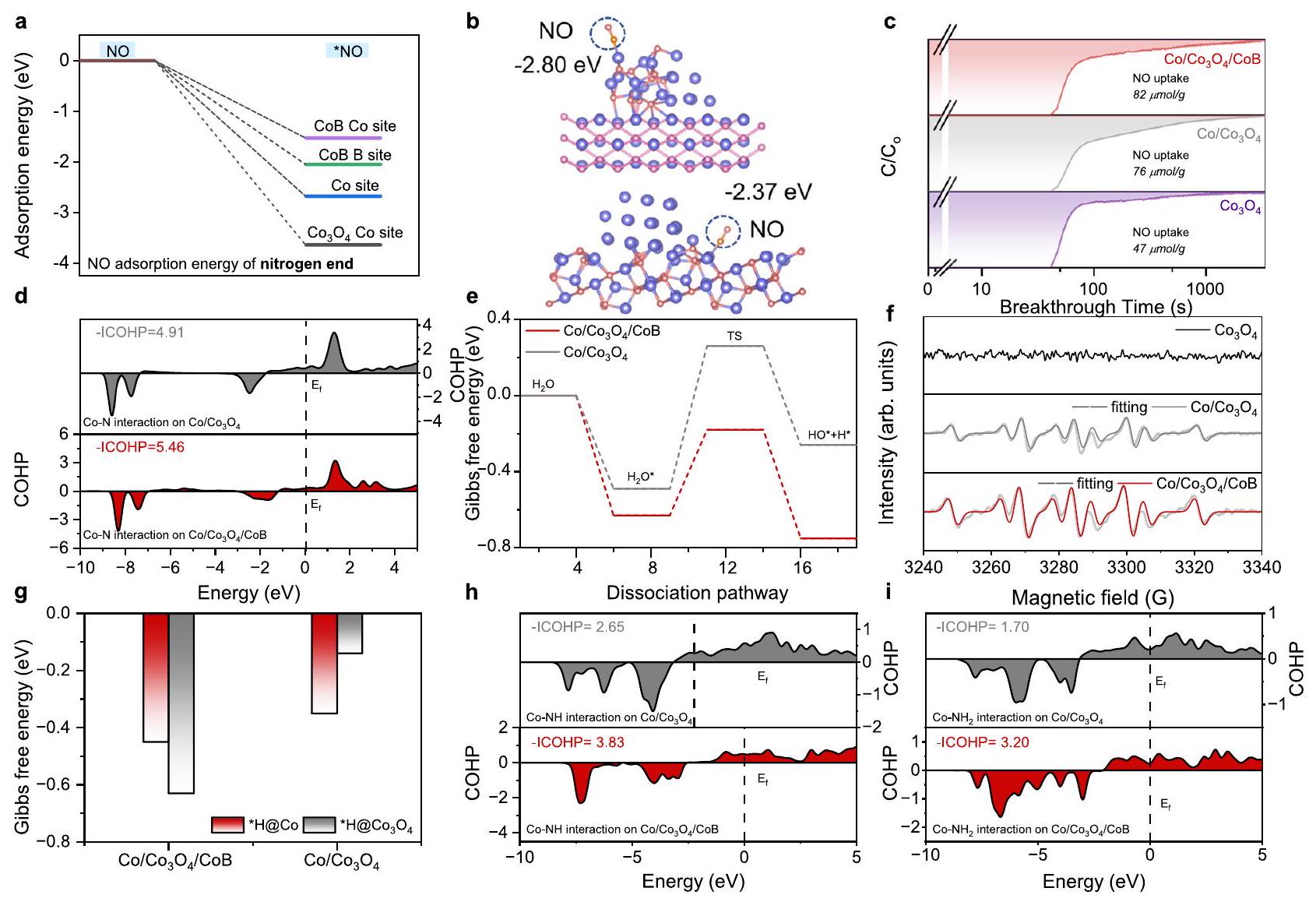
Fig. 4 | Reaction mechanism. a The calculated NO adsorption energy of nitrogen end on Co (111), CoB (021) and (311). The calculated NO adsorption energy on and . The blue circle marks the NO molecule. Atom color-coding: Purple, cobalt; red, oxygen; pink, boron; nitrogen, orange. c NO adsorption breakthrough curves of and catalysts at . d The COHP analysis of Co-N bond during NO adsorption on Co/Co3
and . e Gibbs free energy for dissociation on and . f EPR spectra recorded over and upon electrolysis in the absence of NO. Comparison of Gibbs free energy for *H adsorption on Co and sites of and . The COHP analysis of * NH and * on and . Source data for Fig. 4 are provided as a Source Data file. as well as long-time stability at a low cathodic potential of -0.5 V vs. RHE, superior to most of the reported NORR electrocatalysts (Fig. 3f and Supplementary Tables 4 and 5). To demonstrate the practical application potential of the catalyst, a Zn-NO battery with cathode and Zn plate anode was assembled (Supplementary Fig. 25), which could deliver an open circuit voltage (OCV) of 2.04 V (Supplementary Fig. 26) and a maximum power density of , outperforming all reported results in the literature (Supplementary Figs. 27 and 28, Supplementary Table 6). The output discharge current density increases continuously from 0.5 to and each step exhibits a stable discharging plateau, indicating that our cell has an excellent discharge capability (Supplementary Fig. 29). Moreover, the yield rate exhibits a maximum of at 8 mA cm (Supplementary Fig. 30). Significantly, the Zn-NO battery can remove NO pollutant, produce and generate electricity at the same time.
Reaction mechanism
To understand the excellent NORR performance of , Brunauer-Emmett-Teller (BET) surface area and electrochemically active surface area (ECSA) of the as-prepared catalysts were first measured. Compared to displays a higher BET surface area (Supplementary Fig. 31) and ECSA (Supplementary Fig. 32), which shall offer more active sites to catalyze electrochemical NORR. To clarify the reactive sites for NO adsorption/activation and dissociation as well as the protonation process of adsorbed intermediates
on , a series of DFT calculations, NO breakthrough and electron paramagnetic resonance (EPR) measurements were conducted. The NO adsorption energies with N-end/O-end on the Co sites of Co (111), (311), and CoB (021) and the B sites of CoB (021) were computed by DFT (Fig. 4a and Supplementary Figs. 33-35). The results indicate that NO prefers to adsorb on Co sites of (311) in the form of N-end adsorption, having the most negative adsorption energy of -3.64 eV . Compared to binds to NO more strongly (Fig. 4b and Supplementary Data 1). The low-coordinated Co-O structure in (Fig. 2f and Supplementary Table 2) contributes to NO adsorption as demonstrated by NO breakthrough analysis (Fig. 4c) . A crystal orbital Hamilton population (COHP) was further employed to investigate the NO adsorption strength on and (Fig. 4d) . Compared to displays a more negative integrated COHP (ICOHP) value of the Co – N bond, indicating a stronger NO adsorption on the CoB surface . DFT calculation was further performed to explore the water dissociation process. The energy barrier for water transformation from the adsorbed state to the transition state (TS) on and are 0.50 eV and 0.66 eV , respectively (Fig. 4e, Supplementary Figs. 36 and 37, Supplementary Table 6). This result indicates that the dissociation of is more kinetically favorable on . In order to further investigate the dissociation ability of and , in-situ Raman spectroscopy measurements were conducted at different applied cathodic potentials. Three types of O-H stretching modes belonging to
Fig. 5 | Reaction pathway. In-situ ATR-SEIRAS spectra recorded over and in 0.1 M PBS at the applied cathodic potential from OCP to -0.7 V vs. RHE. c Online DEMS measurement results over at -0.5 V vs. RHE. d The calculated NORR Gibbs free energy diagrams over and CoB at 0 V vs. RHE. Atom color-coding: Purple, cobalt; red, oxygen; orange, nitrogen;
gray, hydrogen. e Schematic illustration showing the NORR mechanism over Co/ electrocatalyst. Atom color-coding: Light blue, cobalt; pink, boron; red, oxygen; deep blue, nitrogen; gray, hydrogen. Source data for Fig. 5 are provided as a Source Data file. , and , respectively , are observed. The relative proportion of displays a little increasing trend along with increasing the applied cathodic potential, suggesting that is closer to the catalyst’s surface and could be more affected by the electric field. The proportion over CoB is always higher than that over at all studied cathodic potentials, suggesting better water dissociation ability over CoB (Supplementary Figs. 38 and 39) . Consequently, could generate more *H as reflected in the liquid EPR measurement using 5,5-dimethyl-1-pyrroline-N-oxude (DMPO) as the *H trapping regent (Fig. 4 f. The DMPO-H signal completely disappeared when NO was introduced into the reaction system (Supplementary Fig. 40), indicating that the generated *H could be rapidly consumed by NO on the surface. This further verifies that *H is more favorable for bonding with NO to form intermediates rather than generating . The *H generated on the metallic Co sites in can be quickly transferred to the neighboring surface to trigger the *NO hydrogenation reaction (Fig. 4 g ), thanks to the relatively electron-richer in than that in . As a result, the enhanced charge and transfer over promote electrochemical NO reduction to produce . The COHP analysis was performed to investigate the adsorption capacity of nitrogencontaining intermediates on and . The ICOHP value of the bond is and on and , respectively (Fig. 4 h , i, Supplementary Figs. 41 and 42), indicating a higher bonding state energy of * on than . The projected density of states (PDOS) of and upon adsorption of *NH and * were analyzed (Supplementary Figs. 43 and 44). The (the highest peak below the Fermi level) position of is higher
than that of upon adsorption of * NH and * , indicating that the antibonding states of NORR intermediates are located at higher energies with lower occupancies on surface, which results in stronger bindings of intermediates on during NORR . Both the COHP and PDOS results indicate enhanced adsorption of *NH and * intermediates over , which is conducive to NORR for producing .
To reveal the reaction pathway of electrochemical NORR, in-situ attenuated total reflection surface enhanced infrared absorption spectroscopy (ATR-SEIRAS) measurements were conducted to probe the reaction intermediates in the potential range from OCP to -0.7 V (vs. RHE). Over the surface (Fig. 5a), the bands at 1103 and belong to *HNO species while the bands at 1167,1245 , and are related to stretching, wagging, and bending, respectively . The gradually increased bands at 1456 and can be attributed to and – OH species accumulation on the surface . Additionally, a wide overlapped absorption at around is observed, in which the bands at 3380 and are assigned to the stretching of -OH and -NH , respectively . The in-situ ATR-SEIRAS spectra as a function of time also display the same reaction intermediates over surface (Supplementary Fig. 45). Compared to (Fig. 5b), a large number of important reactive intermediates including *NH and * can be observed over surface at less negative cathodic potentials, suggesting much enhanced NORR reaction kinetics on Co/ . On the other hand, a larger amount of * NH and * intermediates were observed accumulating on surface compared with and , implying the weaker ability of supplying *H on (Supplementary Fig. 46). To further confirm the key reaction intermediates, the DEMS measurement was
performed over at -0.5 V vs. RHE. As displayed in Fig. 5c and Supplementary Fig. 47, it can be observed that NO decreases with a decrease of NOH and HNOH intermediates, and meanwhile , and increase. These intermediates observed in DEMS align well with the results obtained from in-situ ATR-SEIRAS measurements. Therefore, the NORR pathway taking place on the surface is speculated to follow *NO * * *NH . Additionally, the signal of in the DEMS measurement is much stronger than that of , and , explaining the high in NORR over . Figure 5d compares the reaction energy diagram of NORR over and surface (the structural models of intermediates are shown in Supplementary Figs. 48 and 49). Compared with *NOH, the first protonation of NO is more energetically favorable to form *HNO (Supplementary Figs. 50 and 51), which is the potential-determining step (PDS) of NORR on and . Clearly, shows a lower reaction energy barrier ( 0.81 eV ) in PDS than that of , owing to the accelerated protonation process of NO over . The second proton preferentially reacts with *HNO to generate *HNOH with a of -1.88 eV , rather than *N with a of -0.82 eV . Finally, three successive protonation processes occur until is formed. Besides, the reaction energy of NORR was also calculated over , and CoB (Supplementary Figs. 52-55 and Table 7). The reaction energy of the potentialdetermining step (*NO to *HNO) is and 1.6 eV over , and CoB , respectively, much higher than that over . This result evidences that the first step of NO hydrogenation can be notably boosted over the ternary heterostructure.
Discussion
In summary, we have designed and prepared a ternary heterostructure through a thermal solid-state reduction reaction of by . The prepared displayed a high of with yield rate of and long-time stability at a low cathodic potential of -0.5 V vs. RHE, outperforming most of the reported NORR electrocatalysts in the literature. The extraordinary NORR performance of was resulted from the unique charge and mass transfer within the heterostructure (Fig. 5e). The enhanced electron transfer in yielded electron-deficient Co and electron-rich . The electron-deficient Co sites could effectively boost dissociation to generate *H while the electron-rich low coordination sites promoted NO adsorption. The formed on electrondeficient Co site was more favorable to transfer to electron-rich site adsorbed with NO, facilitating the selective hydrogenation of NO. Thanks to the enhanced charge and proton transfer, the energy barrier of the potential-determining step from *NO to *HNO in NORR over Co/ was significantly reduced. Moreover, the introduction of CoB in could also facilitate the adsorption of *NH and * intermediates. All of which greatly promoted electrochemical NORR. This study paves the way for designing and developing highly efficient electrocatalysts for reducing NO to .
Methods
Reagents and materials
Carbon paper (99.99%) and Ketjen carbon were purchased from Suzhou Sinero Technology Co., Ltd. Cobalt(II) acetate tetrahydrate , polyvinyl pyrrolidone (PVP, , sodium borohydride , chloride , ethanol ( ), were purchased from Shanghai Titan Scientific Co., Ltd. Hydroxylammonium chlorideammonium , ), dimethyl Sulfoxide-D6 ( ), sodium hydroxide ( ), trisodium citrate , sodium nitroprusside dihydrate , sulfuric acid
( ), hydrogen peroxide ( ), and phosphate buffer solution (PBS, ) were purchased from Shanghai Adamas Reagents Co., Ltd. Sodium hypochlorite solution (NaClO, available chlorine ), salicylic acid ( ) were purchased from Macklin Biochemical Technology Co., Ltd. Deionized water (18.25 resistivity) was obtained via an ultrapure water equipment in laboratory. All the reagents are analytical-grade and directly used without further purification.
Synthesis of nanosheets
The nanosheets were prepared by a hydrothermal method as follows: and PVP were dissolved in 70 mL methanol under stirring for 30 min . The mixture was transferred into a 100 mL Teflon-lined stainless-steel autoclave that was sealed and heated to for 12 h . After cooling to , the products were harvested by centrifugation, washed three times with ethanol, dried at , and calcined at for 5 h in air .
Synthesis of and
In a typical synthesis of and were uniformly mixed in a mortar at a mass ratio of . The mixture was then placed in a horizontal quartz tube and heated to at a ramp rate of under an Ar atmosphere, which was maintained at for 4 h . The resulting products were washed extensively by an ethanol/deionized water mixture and collected by filtration. Finally, the washed was dried at for 12 h in a vacuum oven. For preparing , the mass ratio of and was adjusted to , while other preparation parameters were kept unchanged.
Electrochemical measurements
Electrochemical measurements were performed on a CHI660E electrochemical workstation in an H-type electrochemical cell (Supplementary Fig. 56) separated by a Nafion 117 membrane ( , thickness was , Dupont) in a three-electrode configuration at . We chose 0.1 M PBS buffer solution ( ) to maintain the pH of the electrolyte during NORR. The membrane was sequentially treated in a aqueous solution at for 1 h , then in a solution at for 2 h and finally in deionized water at for 6 h . The catalyst coated on carbon paper ( ) was used as the working electrode, a platinum plate was used as the counter electrode, and an (saturated 3.5 M KCl aqueous solution) electrode was used as the reference electrode. The reference electrode was calibrated in -saturated 0.1 M PBS using a symmetric Pt electrode system.
To prepare the working electrode, 2.5 mg of electrocatalyst and 2.5 mg of Ketjen carbon were ultrasonically dispersed in ethanol, ultrapure water, and Nafion solution ( , Du Pont) to form a homogeneous catalyst ink followed by dropping of the catalyst ink onto a piece of CP ( ) that was dried at , the catalyst mass loading was . Before all electrochemical tests, 30 min of high-purity gas ( ) and 30 min of gas ( ) saturated the electrolyte to exclude air in the reaction system.
Linear sweep voltammetry (LSV) was performed at a scanning rate of prior to 50 cycles of cyclic voltammetry at a scan rate of to obtain a stable curve with iR-correction. The non-iR corrected data for all catalysts are provided in the Supplementary Information. The electrochemical impedance spectroscopy (EIS) was obtained without iR-correction in the frequency range from 0.01 Hz to 100 kHz upon an AC voltage amplitude of 5 mV at an open-circuit potential under . The chronoamperometry was operated to evaluate the stability under continuous stirring (1600 rpm) at different current densities. All potentials in this study were converted to the
reversible hydrogen electrode (RHE) scale according to the following equation:
Calculation of Faradaic efficiency (FE) and yield rate (Y)
Where is the charge of product is the total charge, is the concentration of products is the volume of electrolyte in the cathode compartment : the number of electron transfer in products; F: Faraday constant ( ); : the molar mass of products ( ); s: the area of the electrode ( ); t: the reaction time .
ECSA analysis
Electrochemical active surface area (ECSA) was evaluated through cyclic voltammetry (CV) measurements conducted within the nonFaradaic potential region in 0.1 M PBS electrolyte, where iR drop is negligible. The electrochemical double-layer capacitance ( ) was determined from the linear slope of capacitive current ( ) plotted against scan rate ( ). The ECSA of the catalyst was determined by normalizing the double-layer capacitance ( ) against the standard specific capacitance ( ) for smooth metal surfaces in 1.0 M netural electrolyte, following the relation: ECSA .
Quantification of
The yield rate of in NORR was quantitatively determined by the indophenol blue method and NMR. For the indophenol blue method, the concentration-absorbance curves were calibrated using a standard solution with a series of concentrations. The fitting curve shows a good linear relationship between absorbance and concentration. For NMR measurement, after NORR, the electrolyte was taken out, whose pH was adjusted to 3 using a 0.5 M HCl aqueous solution, and then sent for quantification by NMR with internal standard of maleic acid . The number of scans was 128 for all NMR measurements. The fitting curve shows a good linear relationship.
isotope labeling experiment
The isotope labeling experiment proceeded on the NMR spectroscopy to identify the nitrogen source for NORR. Replace with to conduct the NORR experiment at -0.5 V vs. RHE. After the experiment, take 2 mL of the catholyte were acidized by of the above solutions were respectively added to a NMR tube and mixed with maleic acid aqueous solution aqueous solution and DMSO- , and then analyzed by NMR measurements.
Quantification of hydroxylamine ( )
To quantify , the following literature procedures were executed: 1.0 mL of the catholyte (or standard solution) was added 1.0 mL PBS buffer ( ) and 8-hydroxylquinoline. Under vigorous shaking, was added and the mixture was heated at for 1 min . In the presence of , the solution would turn from light yellow to bluegreen, showing an absorption peak at . Plotting the peak absorbance with concentration yielded a calibration curve.
Zn-NO battery
coated on carbon paper was employed as the cathode to perform the NORR in a cathodic electrolyte ( 0.1 M PBS). A polished Zn plate was applied as the anode in an anodic electrolyte , and a Nafion 117 membrane was used to separate the cathode from the anode. The Zn-NO battery was assessed on a CHI660E electrochemical workstation under an ambient atmosphere at .
Characterizations
The morphological information was characterized by atomic force microscopy (AFM, Park NX10), field emission scanning electron microscopy (SEM, Zeiss-sigma-300), and transmission electron microscopy (TEM, JEOL JEM-1400). High-resolution transmission electron microscopy (HRTEM) and aberration-corrected high-angle annular dark-field scanning transmission electron microscopy (HAADF-STEM) were conducted on a JEOL JEM 2100 F and JEM-ARM 300 F Grand ARM. X-ray diffraction (XRD) patterns were recorded on a Bruker D8 Advance Diffractometer (Cu-Kα radiation: ). The surface valence states were studied by X-ray photoelectron spectroscopy (XPS, PHI-5300) with Mg Kα radiation ( ). The X-ray absorption near edge structure (XANES) and extended X-ray absorption fine structure (EXAFS) spectra at the Co K-edge were collected at the HXMA beamline of the Canadian Light Source (CLS) using Fluorescence mode and Si (111) monochromator. The samples were pressed into wafers for collecting the data at . The EXAFS raw data were background subtracted, normalized and Fourier transformed by standard procedures using the ATHENA program. The acquired EXAFS data were processed according to the standard procedures using the ATHENA module implemented in the IFEFFIT software packages. The -weighted EXAFS spectra were obtained by subtracting the postedge background from the overall absorption and then normalizing for the edge-jump step. The ultraviolet-visible (UV-vis) absorbance spectra were measured on an Agilent S3 Cary 5000. A Bruker 600 M NMR instrument with water suppression was used to record the NMR spectra. The Brunauer-Emmett-Teller (BET) surface area was measured on a U.S. Quantachrome ASAP 2020 M at 77 K .
NO adsorption breakthrough measurements
The NO adsorption breakthrough measurements were carried out on a dynamic sorption analyzer (mixSorb S) equipped with a thermal conductivity detector (TCD) combined with a mass spectrometer (OMNISTARTM). Firstly, 40 mg of catalyst was pre-treated in a high purity He atmosphere at a flow rate of for 1 h . Afterwards, the sample was exposed to NO gas ( balanced by He ) at a total gas flow rate of at accompanied by recording the TCD signal and the MS signal of NO at until the outlet mass signal of NO achieved saturation.
In-situ attenuated total reflection-surface enhanced infrared absorption spectroscopy (ATR-SEIRAS) measurements
In-situ ATR-SEIRAS spectra were recorded on an INVENIO-R FTIR spectrometer (Bruker) equipped with a liquid nitrogen-cooled mercury cadmium telluride (MCT) detector (Supplementary Fig. 57). The catalyst ink was prepared by mixing 5 mg of catalyst, ethanol, ultrapure water, and Nafion solution under sonication for 30 min . Next, catalyst ink was slowly dropped onto a face-angled Si crystal to prepare the working electrode of the custom-made spectroelectrochemical cell fixed on the ATR accessory. electrode was employed as the reference electrode and a Pt wire was used as the counter electrode. Electrolyte was added in advance with continuous Ar flow at a flow rate of for 30 minutes to remove interference of and prior to ATR-SEIRAS measurement. The background was measured at open circuit potential. Subsequently, gas was injected and the absorption spectra were
recorded at different applied potentials from OCP to -0.7 V vs. RHE. Afterwards, spectrum was collected at -0.5 V vs. RHE every 5 min for 60 min .
Online differential electrochemical mass spectroscopy (DEMS) measurements
In-situ DEMS measurement was conducted on Linglu (Supplementary Fig. 58). A Teflon layer was applied to separate the electrolyte from the vacuum system. The vacuum system, comprising of two dry pumps and one turbo pump, kept the vacuum degree below . The catalyst ink was prepared by mixing 3 mg of catalyst, ethanol, ultrapure water, and Nafion solution under sonication for 30 min . Next, catalyst ink was slowly dropped onto gold film to prepare the working electrode. electrode was employed as the reference electrode and a Pt wire was used as the counter electrode. Before the DEMS measurement, NO/Ar was bubbled into the electrolyte until saturation. I- test for 100 s was used to conduct DEMS investigations.
In-situ Raman spectroscopy
The in-situ Raman measurements were carried out jointly by an RXN1 Raman instrument (KAISER OPTICAL SYSTEM) and a CHI660E electrochemical workstation. A custom-made spectroelectrochemical cell was used as a reactor to enable the in-situ measurements. The obtained catalyst, , and platinum wire served as the working electrode, reference electrode, and counter electrode, respectively. The working electrode was immersed in the electrolyte and positioned such that the electrode plane was perpendicular to the laser. In-situ Raman spectra were obtained while the electrodes were under potentiostatic control. The experiment was conducted for 200 s under each fixed potential.
EPR measurements
5,5-dimethyl-1-pyrroline N -oxide (DMPO) was used to capture the unstable hydrogen radical to form the DMPO-H adduct to generate EPR spectrum. Briefly, 5 mL of electrolyte was mixed with of DMPO and the mixture was deoxygenated by bubbling Ar. The constant current electrolysis was carried out for 10 min in the H-type cell under the protection of Ar. EPR measurement was performed on a JES X320, JEOL Co. spectrometer operated at a frequency near 9.5 GHz , sweep width of 200 G , and power of 20 mW . fitting parameters: , lwpp fitting parameters: .
Density functional theory (DFT) calculations
Considering the limitations of computational power, we opted for a simplified mode, namely CoB supported neighboring Co and clusters, combininng with the morphology and three interfaces of heterostructure. The choice of using crystal facets of , and to model heterostructure is primarily based on the XRD characterizations. These crystal facets exhibit the strongest diffraction in the XRD patterns and are also the thermodynamically stable facets. It is noted that the Co (111) and (311) clusters are taken from (111) facet of Co single crystal and (311) facet of single crystal, respectively.
All calculations were performed in the framework of the density functional theory with the projector augmented plane-wave method, as implemented in the Vienna ab initio simulation package (VASP) . The generalized gradient approximation proposed by Perdew, Burke, and Ernzerhof was selected for the exchange-correlation potential . The Grimme D3 correction used a coordination number dependent dispersion correction . The cut-off energy for the plane wave was set to 450 eV . The energy criterion was set to in the iterative solution of the Kohn-Sham equation. A vacuum layer of was added perpendicular to the sheet to avoid artificial interaction between
periodic images. The Brillouin zone integration was performed using a -mesh . All the structures were relaxed until the residual forces on the atoms had declined to less than . The maximum atomic force in is 0.047 , which meets the convergence requirement. In addition, we also evaluated the structural stability by using ab initio molecular dynamics (AIMD). The Brillouin zone was sampled using -point grid. Self-consistent calculations were conducted with an energy convergence threshold of . The AIMD was performed within the canonical (NVT) ensemble by Nosé-Hoover thermostats with a time step of 1.0 fs at a finite temperature of . In the AIMD simulation up to 10 ps , the heterostructure of CoB was not destroyed, and the basic crystal structure was stable, proving the rationality of the structure (Supplementary Figs. 59-61 and Supplementary Data 2). Spin polarization was included in the calculations and the default setting of magnetic moment (MAGMOM= number of atoms of ) was chosen for all calculations. The Gibbs free energy ( ) of reaction intermediates was calculated by the following:
where is the adsorption energy. and are the difference for the zero-point energy and entropy, respectively. The zero-point energy and entropy were calculated at the standard conditions corresponding to the pressure of of at the temperature of 298.15 K . The climbing image nudged elastic band (cNEB) method was used to search the reaction path and transition state, and the vibration frequency calculation was used to confirm it further .
Data availability
Source data for all the figures and tables generated in this study are provided as a Source Data file. Source data are provided with this paper.
References
Li, K. et al. Enhancement of lithium-mediated ammonia synthesis by addition of oxygen. Science 374, 1593-1597 (2021).
Tayyebi, A. et al. Bias-free solar production by perovskite-based photocathode coupled to valorization of glycerol. Nat. Catal. 7, 510-521 (2024).
Mehta, P. et al. Overcoming ammonia synthesis scaling relations with plasma-enabled catalysis. Nat. Catal. 1, 269-275 (2018).
Fu, X. et al. Continuous-flow electrosynthesis of ammonia by nitrogen reduction and hydrogen oxidation. Science 379, 707-712 (2023).
Suryanto, B. H. R. et al. Challenges and prospects in the catalysis of electroreduction of nitrogen to ammonia. Nat. Catal. 2, 290-296 (2019).
Weng, G. et al. A high-efficiency electrochemical protonconducting membrane reactor for ammonia production at intermediate temperatures. Joule 7, 1333-1346 (2023).
Hawtof, R. et al. Catalyst-free, highly selective synthesis of ammonia from nitrogen and water by a plasma electrolytic system. Sci. Adv. 5, eaat5778 (2019).
Zhao, X. et al. Comprehensive understanding of the thriving ambient electrochemical nitrogen reduction reaction. Adv. Mater. 33, 2007650 (2021).
Han, S. et al. Ultralow overpotential nitrate reduction to ammonia via a three-step relay mechanism. Nat. Catal. 6, 402-414 (2023).
Zhang, R. et al. A Zn-nitrite battery as an energy-output electrocatalytic system for high-efficiency ammonia synthesis using carbon-doped cobalt oxide nanotubes. Energy Environ. Sci. 15, 3024-3032 (2022).
Pan, D. et al. Integrated electrocatalytic synthesis of ammonium nitrate from dilute NO gas on metal organic frameworks-modified gas diffusion electrodes. Nat. Commun. 15, 7243 (2024).
Shen, H. et al. Electrochemical ammonia synthesis: mechanistic understanding and catalyst design. Chem 7, 1708-1754 (2021).
Ren, Y. et al. Strategies to suppress hydrogen evolution for highly selective electrocatalytic nitrogen reduction: challenges and perspectives. Energy Environ. Sci. 14, 1176-1193 (2021).
Li, Y. et al. Advanced electrocatalysis for energy and environmental sustainability via water and nitrogen reactions. Adv. Mater. 33, 2000381 (2021).
Chen, G.-F. et al. Electrochemical reduction of nitrate to ammonia via direct eight-electron transfer using a copper-molecular solid catalyst. Nat. Energy 5, 605-613 (2020).
Li, S. et al. ITO@TiO nanoarray: an efficient and robust nitrite reduction reaction electrocatalyst toward production under ambient conditions. eScience 2, 382-388 (2022).
Long, J. et al. Direct electrochemical ammonia synthesis from nitric oxide. Angew. Chem. Int. Ed. 59, 9711-9718 (2020).
Li, Y. et al. Electrocatalytic reduction of low-concentration nitric oxide into ammonia over Ru nanosheets. ACS Energy Lett. 7, 1187-1194 (2022).
Liu, Y., Wang, Y., Liu, Z. & Wang, Q. Oxidation removal of nitric oxide from flue gas using UV photolysis of aqueous hypochlorite. Environ. Sci. Technol. 51, 11950-11959 (2017).
Wang, D. et al. Coupling electrocatalytic nitric oxide oxidation over carbon cloth with hydrogen evolution reaction for nitrate synthesis. Angew. Chem. Int. Ed. 60, 24605-24611 (2021).
Zhang, R. et al. Electrochemical nitrate reduction in acid enables high-efficiency ammonia synthesis and high-voltage pollutesbased fuel cells. Nat. Commun. 14, 8036 (2023).
Liang, J. et al. Amorphous boron carbide on titanium dioxide nanobelt arrays for high-efficiency electrocatalytic NO reduction to . Angew. Chem. Int. Ed. 61, e202202087 (2022).
Meng, J., Cheng, C., Wang, Y., Yu, Y. & Zhang, B. Carbon support enhanced mass transfer and metal-support interaction promoted activation for low-concentrated nitric oxide electroreduction to ammonia. J. Am. Chem. Soc. 146, 10044-10051 (2024).
Zhang, H. et al. Isolated electron-rich ruthenium atoms in intermetallic compounds for boosting electrochemical nitric oxide reduction to ammonia. Angew. Chem. Int. Ed. 62, e202213351 (2023).
Guo, X. et al. Aqueous electroreduction of nitric oxide to ammonia at low concentration via vacancy engineered FeOCl . Angew. Chem. Int. Ed. 63, e202318792 (2024).
Liu, P. et al. High-performance production via NO electroreduction over a NiO nanosheet array. Chem. Commun. 57, 13562-13565 (2021).
Wang, D. et al. Hexagonal cobalt nanosheets for high-performance electrocatalytic NO reduction to NH3. J. Am. Chem. Soc. 145, 6899-6904 (2023).
Chen, K., Wang, G., Guo, Y., Ma, D. & Chu, K. Iridium single-atom catalyst for highly efficient NO electroreduction to . Nano Res. 16, 8737-8742 (2023).
Chen, K., Wang, J., Zhang, H., Ma, D. & Chu, K. Self-tandem electrocatalytic NO reduction to NH3 on a W single-atom catalyst. Nano Lett. 23, 1735-1742 (2023).
Chen, K. et al. p-Block antimony single-atom catalysts for nitric oxide electroreduction to ammonia. ACS Energy Lett. 8, 1281-1288 (2023).
Ma, L. et al. Catalytic performance and reaction mechanism of NO oxidation over catalysts. Appl. Catal., B 267, 118371 (2020).
Yung, M. M., Holmgreen, E. M. & Ozkan, U. S. Cobalt-based catalysts supported on titania and zirconia for the oxidation of nitric oxide to nitrogen dioxide. J. Catal. 247, 356-367 (2007).
Liu, D. et al. ZIF-67-derived 3D hollow mesoporous crystalline wrapped by nanosheets for photocatalytic removal of nitric oxide. Small 15, 1902291 (2019).
Cao, H. et al. Rational design of Cu-doped tetrahedron of spinel oxide for high-performance nitric oxide electrochemical sensor. ACS Appl. Mater. Interfaces 15, 23489-23500 (2023).
Yang, B. et al. Electron-deficient cobalt nanocrystals for promoted nitrate electrocatalytic reduction to synthesize ammonia. Nano Energy 117, 108901 (2023).
Liu, Y. et al. Cobalt-based metallic heterostructure as a highly active electrocatalyst for alkaline overall water splitting. Angew. Chem. Int. Ed. 63, e202319239 (2024).
Zhang, L. et al. High-performance electrochemical NO reduction into by nanosheet. Angew. Chem. Int. Ed. 60, 25263-25268 (2021).
Wu, B. et al. Boron-modulated electronic-configuration tuning of cobalt for enhanced nitric oxide fixation to ammonia. Nano Lett. 23, 7120-7128 (2023).
Xiao, L. et al. Identification of as superior active sites for electrocatalytic NO reduction to NH3 with high single-pass conversion efficiency. Angew. Chem. Int. Ed. 63, e202319135 (2024).
Garrido-Barros, P., Derosa, J., Chalkley, M. J. & Peters, J. C. Tandem electrocatalytic fixation via proton-coupled electron transfer. Nature 609, 71-76 (2022).
Chalkley, M. J., Garrido-Barros, P. & Peters, J. C. A molecular mediator for reductive concerted proton-electron transfers via electrocatalysis. Science 369, 850-854 (2020).
Dai, J. et al. Cu(II) ions induced structural transformation of cobalt selenides for remarkable enhancement in oxygen/hydrogen electrocatalysis. ACS Catal. 9, 10761-10772 (2019).
Song, D. et al. Acidic media regulated hierarchical cobalt compounds with phosphorous doping as water splitting electrocatalysts. Adv. Energy Mater. 11, 2100358 (2021).
Li, H. et al. Earthworm-inspired nanofibrous electrocatalyst with confined channels for enhanced ORR/OER performance. Adv. Mater. 36, 2311272 (2024).
Jiang, B. et al. A mesoporous non-precious metal boride system: synthesis of mesoporous cobalt boride by strictly controlled chemical reduction. Chem. Sci. 11, 791-796 (2020).
Guo, S. et al. Electrocatalytic hydrogenation of quinolines with water over a fluorine-modified cobalt catalyst. Nat. Catal. 13, 5297 (2022).
Lin, Q . et al. Tuning the interface of by atomic replacement strategy toward high-performance electrocatalytic oxygen evolution. ACS Nano 16, 15460-15470 (2022).
Jakub, Z. et al. Local structure and coordination define adsorption in a model single-atom catalyst. Angew. Chem. Int. Ed. 58, 13961-13968 (2019).
Yu, P. et al. Co Nanoislands rooted on Co-N-C nanosheets as efficient oxygen electrocatalyst for Zn-air batteries. Adv. Mater. 31, 1901666 (2019).
Li, M. et al. Proximity electronic effect of Ni/Co diatomic sites for synergistic promotion of electrocatalytic oxygen reduction and hydrogen evolution. Adv. Funct. Mater. 33, 2210867 (2023).
Gu, Y. et al. Boosting selective nitrogen reduction via geometric coordination engineering on single-tungsten-atom catalysts. Adv. Mater. 33, 2100429 (2021).
Yue, X., Cheng, L., Li, F., Fan, J. & Xiang, Q. Highly strained Bi-MOF on bismuth oxyhalide support with tailored intermediate adsorption/desorption capability for robust photoreduction. Angew. Chem. Int. Ed. 61, e202208414 (2022).
Dong, G., Huang, X. & Bi, Y. Anchoring black phosphorus quantum dots on Fe-doped nanowires for efficient photocatalytic nitrogen fixation. Angew. Chem. Int. Ed. 61, e202204271 (2022).
Wang, Y.-H. et al. In situ Raman spectroscopy reveals the structure and dissociation of interfacial water. Nature 600, 81-85 (2021).
Chen, X. et al. Revealing the role of interfacial water and key intermediates at ruthenium surfaces in the alkaline hydrogen evolution reaction. Nat. Commun. 14, 5289 (2023).
Ni, J. et al. Atomic Co-P catalytic pair drives efficient electrochemical nitrate reduction to ammonia. Adv. Energy Mater. 14, 2400065 (2024).
Li, J. et al. Efficient ammonia electrosynthesis from nitrate on strained ruthenium nanoclusters. J. Am. Chem. Soc. 142, 7036-7046 (2020).
Liu, H. et al. Efficient electrochemical nitrate reduction to ammonia with copper-supported rhodium cluster and single-atom catalysts. Angew. Chem. Int. Ed. 61, e202202556 (2022).
Chu, K., Li, Q. -q, Liu, Y. -p, Wang, J. & Cheng, Y. -h Filling the nitrogen vacancies with sulphur dopants in graphitic for efficient and robust electrocatalytic nitrogen reduction. Appl. Catal. B. 267, 118693 (2020).
Li, Y. et al. Local spin-state tuning of iron single-atom electrocatalyst by S-coordinated doping for kinetics-boosted ammonia synthesis. Adv. Mater. 34, 2202240 (2022).
Liu, S. et al. Proton-filtering covalent organic frameworks with superior nitrogen penetration flux promote ambient ammonia synthesis. Nat. Catal. 4, 322-331(2021).
Li, P. et al. Visible-light-driven nitrogen fixation catalyzed by nanostructures: enhanced performance by oxygen vacancies. J. Am. Chem. Soc. 142, 12430-12439 (2020).
Li, H., Shang, J., Ai, Z. & Zhang, L. Efficient visible light nitrogen fixation with BiOBr nanosheets of oxygen vacancies on the exposed {001} facets. J. Am. Chem. Soc. 137, 6393-6399 (2015).
Qin, C. et al. Crystal-plane-dependent Fischer-Tropsch performance of cobalt catalysts. ACS Catal. 8, 9447-9455 (2018).
Kresse, G. & Joubert, D. From ultrasoft pseudopotentials to the projector augmented-wave method. Phys. Rev. B Condens. Matter 59, 1758-1775 (1999).
Perdew, J. P., Burke, K. & Ernzerhof, M. Generalized gradient approximation made simple. Phys. Rev. Lett. 77, 3865-3868 (1996).
Grimme, S., Antony, J., Ehrlich, S. & Krieg, H. A consistent and accurate ab initio parametrization of density functional dispersion correction (DFT-D) for the 94 elements H-Pu. J. Chem. Phys. 132, 154104 (2010).
Monkhorst, H. J. & Pack, J. D. Special points for Brillouin-zone integrations. Phys. Rev. B 13, 5188-5192 (1976).
Gerry, C. C. Coherent states and the Kepler-Coulomb problem. Phys. Rev. A 33, 6-11 (1986).
Henkelman, G., Uberuaga, B. P. & Jónsson, H. A climbing image nudged elastic band method for finding saddle points and minimum energy paths. J. Chem. Phys. 113, 9901-9904 (2000).
Acknowledgements
The authors gratefully acknowledge financial support from the National Natural Science Foundation of China (22125604 and 22436003 to D.S.Z.), Shanghai Rising-Star Program (22QA1403700 to L.P.H.) and Science and Technology Commission of Shanghai Municipality (23230713700 to D.S.Z.), the City University of Hong Kong startup fund (9020003 to B.L.), ITF-RTH – Global STEM Professorship (9446006 to B.L.), and JC STEM lab of Advanced Upcycling (9228005 to B.L.).
X.Y.W. acknowledges the receipt of support from the CLSI Student Travel Support Program. XAFS spectra were tested at the HXMA beamline of the Canadian Light Source (CLS), a national research facility of the University of Saskatchewan, which is supported by the Canada Foundation for Innovation (CFI), the Natural Sciences and Engineering Research Council (NSERC), the National Research Council (NRC), and the Government of Saskatchewan. The authors thank Shenzhen HUASUAN Technology Co., Ltd for assistance on DFT calculations (https:// huasuankeji.com).
Author contributions
X.X.F. performed the experiments, analyzed the data, and wrote the first draft of the manuscript. Z.Y.T., Y.J.S., W.Q.Q., J.L.S., Z.L.W. and H.Y.D. helped with the measurements and analysis, discussed and revised the manuscript. X.Y.W. and Y.A.W. performed the XAFS measurements and analysis. L.P.H., B.L. and D.S.Z. supervised the project, manuscript preparation and discussion.
Correspondence and requests for materials should be addressed to Lupeng Han, Bin Liu or Dengsong Zhang.
Peer review information Nature Communications thanks Liang Chu, and the other, anonymous, reviewer(s) for their contribution to the peer review of this work. A peer review file is available.
Publisher’s note Springer Nature remains neutral with regard to jurisdictional claims in published maps and institutional affiliations.
Open Access This article is licensed under a Creative Commons Attribution 4.0 International License, which permits use, sharing, adaptation, distribution and reproduction in any medium or format, as long as you give appropriate credit to the original author(s) and the source, provide a link to the Creative Commons licence, and indicate if changes were made. The images or other third party material in this article are included in the article’s Creative Commons licence, unless indicated otherwise in a credit line to the material. If material is not included in the article’s Creative Commons licence and your intended use is not permitted by statutory regulation or exceeds the permitted use, you will need to obtain permission directly from the copyright holder. To view a copy of this licence, visit http://creativecommons.org/ licenses/by/4.0/.
(c) The Author(s) 2025
Innovation Institute of Carbon Neutrality, International Joint Laboratory of Catalytic Chemistry, State Key Laboratory of Advanced Special Steel, Department of Chemistry, College of Sciences, Shanghai University, Shanghai, China. Department of Materials Science and Engineering, City University of Hong Kong, Hong Kong SAR, China. Institute for Chemical Reaction Design and Discovery (WPI-ICReDD), Hokkaido University, Sapporo, Japan. Department of Mechanical and Mechatronics Engineering, Waterloo Institute for Nanotechnology, University of Waterloo, ON Waterloo, Canada. Department of Chemistry, Hong Kong Institute of Clean Energy (HKICE) & Center of Super-Diamond and Advanced Films (COSDAF), City University of Hong Kong, Hong Kong SAR, China. e-mail: lphan@shu.edu.cn; bliu48@cityu.edu.hk; dszhang@shu.edu.cn