تعقيدات سلسلة إمداد البلاستيك العالمية كما تكشفها تحليل تدفق المواد المرتبط بالتجارة Complexities of the global plastics supply chain revealed in a trade-linked material flow analysis

المجلة: Communications Earth & Environment، المجلد: 6، العدد: 1
DOI: https://doi.org/10.1038/s43247-025-02169-5
تاريخ النشر: 2025-04-10

تعقيدات سلسلة إمداد البلاستيك العالمية كما تكشفها تحليل تدفق المواد المرتبط بالتجارة

خولة حسيني (د، جينهوي لي (د و كوانيين تان ©

الملخص

لقد أصبحت البلاستيك جزءًا لا يتجزأ من حياتنا. يتطلب معالجة القضايا البيئية العالمية المتعلقة بالبلاستيك تحليلًا شاملاً على طول سلسلة التوريد بأكملها. هنا، نقدم تحليل تدفق المواد المرتبط بالتجارة العالمية للبلاستيك لعام 2022. على مستوى العالم، تم تداول 436.66 مليون طن (م) من البلاستيك في عام 2022، حيث تمثل المنتجات النهائية وحدها 111 م. تشير نتائجنا إلى أن البلاستيك يخضع لتركيز جغرافي، حيث تتركز المواد الأولية في البلدان الغنية بالموارد النفطية والمعالجة في البلدان ذات القدرة التصنيعية الكبيرة. علاوة على ذلك، هناك تحول كبير في التخلص من النفايات: حيث تبرز الحرق كطريقة بارزة للتخلص من النفايات. ، يتم تقليل مكب النفايات بشكل كبير ( )، في حين ظلت نسبة إعادة التدوير العالمية ثابتة ( تتقلص الفجوات في الدخل بين الدول في سياق واردات النفايات البلاستيكية، مما يعيد تشكيل أنماط التجارة العالمية في البلاستيك. إن كشف سلسلة التوريد المعقدة للبلاستيك أمر حاسم لتقليل التلوث وتعزيز إدارة البلاستيك المستدام.

تعتبر البلاستيكيات واحدة من أكثر المواد انتشارًا على كوكبنا، وذلك بفضل تنوعها، ومتانتها، وتكلفتها المنخفضة نسبيًا. لقد تضاعف الطلب العالمي على البلاستيكيات أربع مرات خلال العقود الماضية. ومن المتوقع أن يتضاعف بحلول ، مما أدى إلى تأثيرات شديدة على البيئة وصحة الإنسان نما الإنتاج العالمي السنوي من البلاستيك من 2 مليون طن في عام 1950 إلى 400 مليون طن في ، بمعدل نمو سنوي قدره .
تلوث البلاستيك هو قضية عالمية ملحة تشكل تحديات كبيرة على الصعيدين البيئي والاقتصادي والصحة العامة. وقد ظهرت الاتفاقيات بين الحكومات كأدوات محورية في مكافحة تلوث البلاستيك، تهدف إلى تنسيق الجهود الدولية، وتحديد الأهداف المشتركة، وإقامة أطر لإدارة نفايات البلاستيك المستدامة. في مارس 2022، وافقت الجمعية العامة للبيئة التابعة لبرنامج الأمم المتحدة للبيئة (UNEP) في نيروبي بالإجماع على قرار لإنشاء معاهدة ملزمة قانونياً بحلول عام 2024 لمنع وتقليل وإنهاء تلوث البلاستيك العالمي. . تهدف القرار والمفاوضات بين الحكومات التي تلت ذلك إلى معالجة دورة حياة البلاستيك بالكامل، بما في ذلك إنتاجه وتصميمه والتخلص منه. على الرغم من الاعتراف المتزايد بتلوث البلاستيك كقضية بيئية عالمية حرجة، إلا أن هناك نقصًا ملحوظًا في التحليل الشامل للبلاستيك على طول سلسلة الإمداد الخاصة به.
يتطلب معالجة الآثار البيئية لإنتاج واستهلاك البلاستيك العالمي فهمًا أعمق لسلسلة التوريد المعقدة لإنتاج واستخدام وتطبيق والتخلص من البلاستيك. تحليل تدفق المواد (MFA) هو طريقة فعالة لدراسة استقلاب المواد والموارد. حتى الآن، فإن المخزونات والتدفقات العالمية من البلاستيك قد
لم يتم تقييمه بشكل شامل على طول سلسلة الإمداد. جير et al. قدمت تحليلًا عالميًا أوليًا لتدفق المواد البلاستيكية من عام 1950 إلى 2015، من خلال تطوير ودمج البيانات حول إنتاج البلاستيك واستخدامه ونهايته. بينما يوفر دراستهم تقدمًا كبيرًا في قياس الإنتاج العالمي للبلاستيك واستخدامه والتخلص منه، قد لا تغطي نطاقهم الزمني بالكامل التقدم التكنولوجي السريع والتغيرات في أنماط استخدام البلاستيك في السنوات الأخيرة. بالإضافة إلى ذلك، من خلال التركيز على نمط البلاستيك العالمي، قد لا تلتقط نتائجهم التباينات الإقليمية في ممارسات الإنتاج والاستهلاك وإدارة النفايات.
ركزت الدراسات الحالية على تحليل تدفق المواد البلاستيكية على المستوى الإقليمي والوطني، بما في ذلك أوروبا. الصين الولايات المتحدة الأمريكية أفريقيا الشرق الأوسط الهند واليابان . تم إجراء دراسات وطنية أخرى في المملكة المتحدة جنوب أفريقيا وتايلاند أدى النداء لإنهاء تلوث البلاستيك إلى عدد كبير من الدراسات التي قامت بتقييم تدفقات النفايات البلاستيكية العالمية وطرق التخلص منها. لقد قدمت الغالبية العظمى من هذه الدراسات تحليلًا متعدد الجوانب على المستوى الوطني أو الإقليمي، ومع ذلك لم يتم فحص تحليل شامل لمخزونات البلاستيك العالمية وتدفقاتها على طول سلسلة الإمداد بأكملها.
تتناول هذه الدراسة الفجوة البحثية الحالية من خلال تقديم تحليل لتدفق المواد المرتبط بالتجارة العالمية للبلاستيك استنادًا إلى عام 2022. أولاً، سيتم الكشف عن التدفقات والاحتياطيات العالمية للبلاستيك المنتج في عام 2022 مع تحليل مفصل حسب أنواع البوليمرات وقطاعات تطبيقات البلاستيك. ثانيًا، سيتم تقييم تجارة منتجات البلاستيك على طول سلسلة التوريد بأكملها من المواد الخام إلى منتجات نفايات البلاستيك. ثالثًا، سيتم تناول التخلص من النفايات العالمية.
وسيتم تحليل مصائر النفايات البلاستيكية من خلال تقديم مقارنة إقليمية لمعالجة النفايات البلاستيكية والتخلص منها. وأخيرًا، استنادًا إلى النتائج، سيتم اقتراح توصيات سياسية لإدارة مستدامة عالمية لموارد البلاستيك. ستدعم النتائج في النهاية مفاوضات المعاهدة لتعزيز كفاءة موارد البلاستيك وتقليل تلوث البلاستيك.

النتائج

تحليل تدفق المواد البلاستيكية المرتبطة بالتجارة العالمية

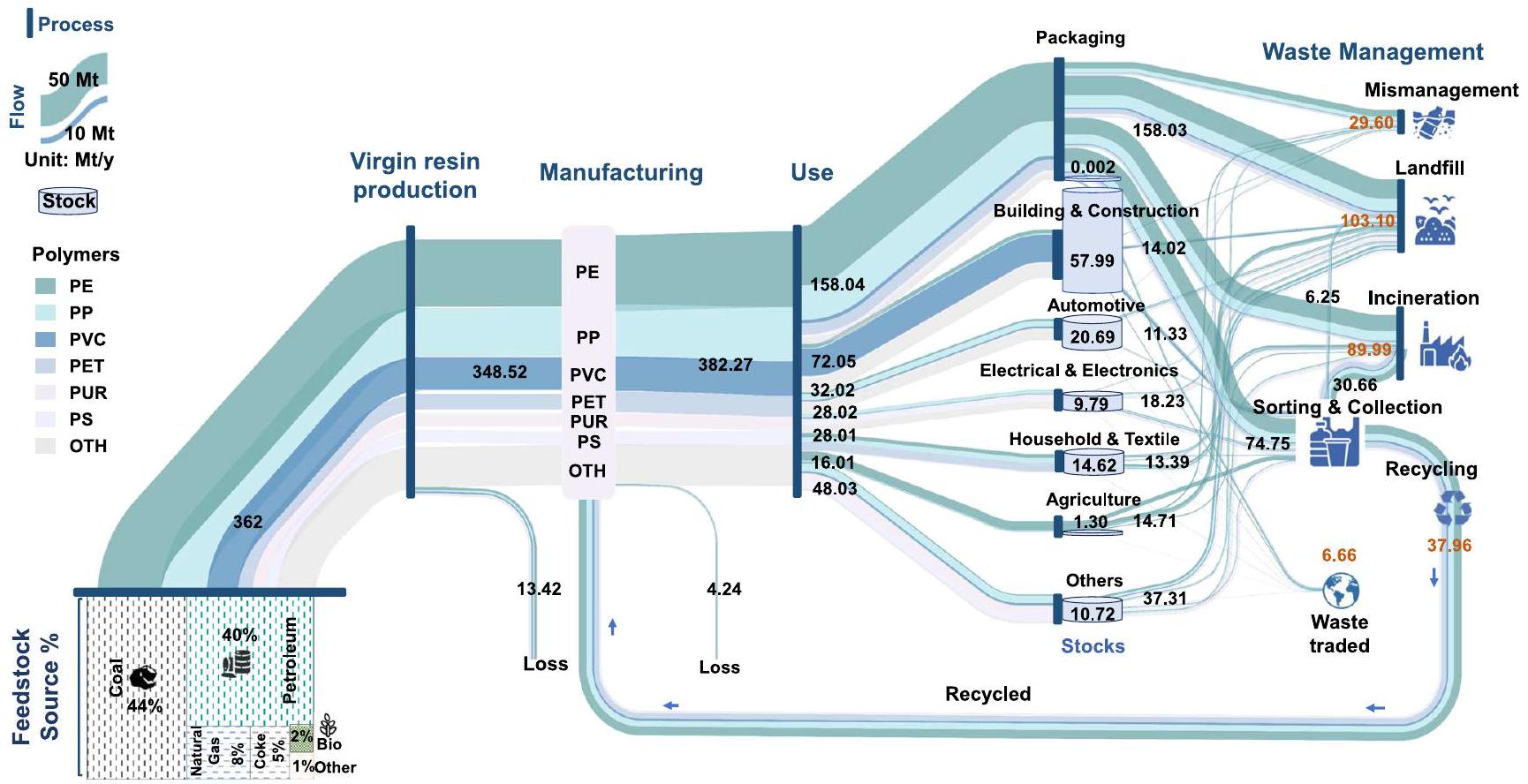
بلغ الإنتاج العالمي من البلاستيك في عام 2022 حوالي 400 مليون طن، منها 362 مليون طن تم إنتاجها كإنتاج راتنج بلاستيكي جديد وحوالي 38 مليون طن تم توليدها كمواد بلاستيكية ثانوية من إعادة التدوير الميكانيكي للبلاستيك (الشكل 1). حوالي 98% من البلاستيك الجديد الذي تم إنتاجه عالميًا في عام 2022 تم توليده من مواد أولية قائمة على الوقود الأحفوري. مشتق من الفحم، من النفط، من الغاز الطبيعي، من الكوكا كولا و من مصادر أخرى). فقط تشكل المواد الخام البلاستيكية العالمية من مصادر حيوية. كانت الخسائر من مرحلة إنتاج البلاستيك الجديد تمثل 13.42 مليون طن. تم معالجة إجمالي 348.52 مليون طن من البلاستيك الجديد، وكان إجمالي كمية البلاستيك المصنع في عام 2022 حوالي 386.41 مليون طن (بما في ذلك البلاستيك المعاد تدويره الذي تم تحويله في مرحلة التصنيع). كانت إجمالي خسائر البلاستيك في مرحلة التصنيع حوالي 4.24 مليون طن. دخل إجمالي 382.12 مليون طن من البلاستيك مرحلة الاستخدام، مع 158.04 مليون طن في التعبئة والتغليف، و72.05 مليون طن في البناء والتشييد، و32.02 مليون طن في السيارات، و28.02 مليون طن في الكهرباء والإلكترونيات، و28.01 مليون طن في المنازل والنسيج، و16.01 مليون طن في الزراعة، و48.03 مليون طن في غيرها.
نقدر مخزونات البلاستيك في مختلف قطاعات صناعة البلاستيك بناءً على متوسط عمر المنتج العالمي. بلغ إجمالي كمية مخزونات البلاستيك ، حيث يمثل قطاع البناء والتشييد الحصة الأكبر ( )، تليها السيارات، والأدوات المنزلية والنسيج، والكهرباء والإلكترونيات مع ، و على التوالي. ساهم قطاع التعبئة والتغليف بمقدار 2 كيلو طن في إجمالي المخزونات. وبالمثل، كان لقطاع الزراعة حصة صغيرة نسبياً، حيث بلغ 1.30 مليون طن، مما يمثل حوالي من مخزونات البلاستيك العالمية.
بلغ إجمالي النفايات الناتجة في عام 2022 حوالي 267.68 مليون طن، منها 74.75 مليون طن تم فرزها وجمعها لإعادة التدوير الميكانيكي و6.66 مليون طن تم تداولها. من بين إجمالي النفايات البلاستيكية التي تم جمعها وفرزها، تم إعادة تدوير 37.96 مليون طن من البلاستيك (تمثل من الإنتاج الأولي)، تم تحويل 30.66 مليون طن إلى منشآت الحرق، و6.25 مليون طن المتبقية
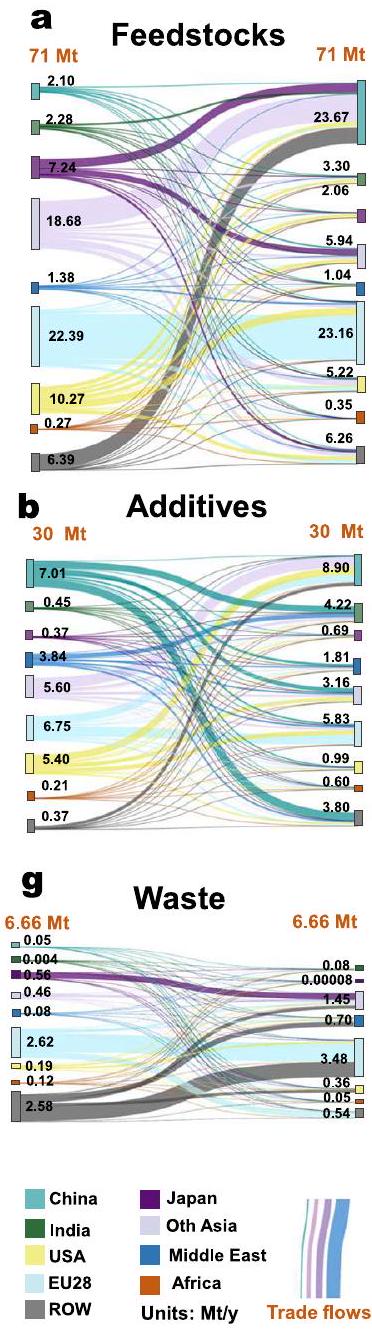
تم دفنها في مكبات النفايات. في المجموع، تم إدارة 29.60 مليون طن من البلاستيك بشكل غير صحيح، وتم دفن 103.10 مليون طن، وتم حرق 89.99 مليون طن. تم تداول ما مجموعه 436.66 مليون طن من البلاستيك في عام 2022 (الشكل 2). من بين ذلك، شكلت تجارة المواد الخام 71 مليون طن (الشكل 2أ). كانت دول الاتحاد الأوروبي 28 أكبر مصدر لمواد البلاستيك الخام. )، تليها أوث آسيا ( ) ، و الولايات المتحدة ( أكبر مستوردي المواد الخام لإنتاج البلاستيك هم الصين ( )، تليها دول الاتحاد الأوروبي 28 ( )، و ROW ( ) (للتصنيف الإقليمي والبلدان، انظر الجدول التكميلية 10). يعود الحجم الكبير من الواردات والصادرات في الاتحاد الأوروبي 28 إلى تجارة البلاستيك داخل المنطقة وإعادة تصدير المواد الخام إقليمياً. تم تداول ما مجموعه 30 مليون طن من الإضافات (الشكل 2ب)، مع كون الصين أكبر مصدر. ) تليها الاتحاد الأوروبي 28 ( أث آسيا ، الولايات المتحدة الأمريكية والشرق الأوسط كانت أكبر الدول المستوردة للإضافات هي الصين، تليها الاتحاد الأوروبي 28، وآسيا الأخرى، والولايات المتحدة الأمريكية، والشرق الأوسط. تم تصدير حوالي 152 مليون طن من البلاستيك كمواد بلاستيكية أولية (الشكل 2c). وتسيطر منطقة آسيا الأخرى كأكبر مصدر للمواد البلاستيكية الأولية بحصة تبلغ 51.55 مليون طن. ، تليها دول الاتحاد الأوروبي 28 والولايات المتحدة .
تم تقسيم المرحلة المتوسطة بين الأشكال المتوسطة من البلاستيك والمنتجات المتوسطة المصنعة بإجمالي تجارة تبلغ 47 مليون طن و19 مليون طن على التوالي (الشكل 2د، هـ). تشير الأشكال المتوسطة من المنتجات البلاستيكية إلى المنتجات البلاستيكية التي لا تزال في مرحلة مبكرة من سلسلة التوريد. تتكون هذه الأشكال من البلاستيك من البلاستيك الأولي الذي تم معالجته وتجميعه بالفعل في عناصر أكبر، مثل الألواح، والأفلام، والصفائح، والخيوط. سيتم بعد ذلك تشكيل الأشكال المتوسطة من البلاستيك، وتصنيعها، وتجميعها لإنتاج المنتجات المصنعة المتوسطة والنهائية. الصين هي أكبر مصدر للأشكال المتوسطة من البلاستيك. والبلاستيكات المصنعة المتوسطة . وبالمثل، كانت دول الاتحاد الأوروبي 28 مسؤولة عن 15.07 مليون طن من الأشكال الوسيطة من البلاستيك و1.73 مليون طن من البلاستيك المصنع الوسيط، بينما كانت دول آسيا الأخرى مسؤولة عن 5.73 مليون طن و1.42 مليون طن على التوالي، والهند عن 1.59 مليون طن و1.22 مليون طن على التوالي، واليابان عن 0.86 مليون طن و0.24 مليون طن على التوالي.
شكلت المنتجات البلاستيكية النهائية أكبر حصة تجارية على طول سلسلة الإمداد البلاستيكية بإجمالي 111 مليون طن (الشكل 2f). صدرت الصين، كواحدة من الدول ذات أكبر قدرة تصنيع، إجمالي 44.25 مليون طن. ) تليها منطقة جنوب شرق آسيا ( ) ، و EU28 ( ). كان أكبر مستورد للمنتجات البلاستيكية النهائية هو الاتحاد الأوروبي 28 (35%)، يليه الولايات المتحدة الأمريكية (20%)، وآسيا الأخرى (14%)، وبقية العالم (13%)، والصين والشرق الأوسط (5% لكل منهما)، وأفريقيا (4%)، واليابان (3%)، والهند (2%).
الشكل 1 | الدورات العالمية للبلاستيك في عام 2022. يتم توضيح الدورات العالمية للبلاستيك من خلال التدفقات. يت correspond لون وعرض التدفقات إلى أنواع وكتل البلاستيك، على التوالي. جميع الوحدات بالميغا طن/سنة. ملاحظة: الاختلافات الطفيفة في القيم تعود إلى التقريب أثناء حسابات توازن الكتلة.

الشكل 2 | التجارة العالمية في البلاستيك على طول سلسلة الإمداد بأكملها. يتم رسم التجارة العالمية لكل فئة من فئات سلسلة إمداد البلاستيك كما يلي: أ تدفقات تجارة المواد الأولية. ب تدفقات تجارة إضافات البلاستيك. ج تدفقات تجارة البلاستيك الأولية. د تدفقات تجارة الأشكال الوسيطة من البلاستيك. هـ تدفقات تجارة البلاستيك المصنع الوسيط. و تدفقات تجارة البلاستيك النهائي. تدفقات تجارة نفايات البلاستيك. معدلات الاستيراد والتصدير العالمية
على طول سلسلة إمداد البلاستيك. يتم التعبير عن القيم التجارية العالمية المرسومة في تظهر نتائج تحليل عدم اليقين من خلال أشرطة الخطأ. يتم توضيح تحليل مفصل لتكوين البلاستيك لكل فئة تجارية في الأشكال التكميلية 3-9. يتم تقديم التصنيف الإقليمي في الجدول التكميلية 10. ملاحظة: الاختلافات الطفيفة في القيم تعود إلى التقريب أثناء حسابات توازن الكتلة.
بلغت تجارة النفايات البلاستيكية العالمية في عام 2022 حوالي 6.66 مليون طن (الشكل 2g). قامت دول الاتحاد الأوروبي 28 بتصدير واستوردت أكثر من من نفايات البلاستيك العالمية. كانت اليابان ثاني أكبر مصدر لنفايات البلاستيك ( )، تليها منطقة شرق آسيا ( ، الولايات المتحدة الأمريكية ( )، أفريقيا ( ) و ROW ( حظرت الصين استيراد نفايات البلاستيك في عام 2018، مما غيّر الاتجاه العالمي لاستيراد وتصدير نفايات البلاستيك. كانت الصين أكبر مستورد لنفايات البلاستيك لمدة 25 عامًا. في عام 2022، كانت أكبر مستورد للنفايات البلاستيكية هي دول الاتحاد الأوروبي 28 (3.48 مليون طن)، تليها دول آسيا الأخرى (1.45 مليون طن)، والشرق الأوسط (0.7 مليون طن) والولايات المتحدة الأمريكية (0.36 مليون طن). أصبحت دول الاتحاد الأوروبي 28 مستورداً صافياً للنفايات البلاستيكية في عام 2022، حيث بلغ إجمالي وارداتها من النفايات 3.48 مليون طن بينما بلغ إجمالي صادراتها 2.62 مليون طن. استوردت هولندا ما مجموعه 0.81 مليون طن من النفايات البلاستيكية، مما يمثل من إجمالي الواردات على المستوى الإقليمي و على مستوى عالمي. كانت ألمانيا مسؤولة عن من إجمالي واردات نفايات البلاستيك في الاتحاد الأوروبي 28، تليها بلجيكا ( ) والنمسا (8%) (الشكل التوضيحي التكميلي 10a). كانت هذه الدول الأوروبية وحدها تمثل حوالي من إجمالي واردات النفايات البلاستيكية في الاتحاد الأوروبي 28. فيما يتعلق بصادرات النفايات البلاستيكية، تظهر نتائجنا أن ألمانيا لديها أعلى معدل لصادرات النفايات البلاستيكية في الاتحاد الأوروبي 28، حيث تمثل من الصادرات الإقليمية)، تليها بلجيكا (15%)، فرنسا (13%) وإيطاليا (10%) (الشكل التوضيحي التكميلي 10b). تواصل دول آسيا الأخرى الهيمنة على سوق تجارة البلاستيك العالمية كدول مستقبلة. سجلت ماليزيا، بإجمالي واردات نفايات قدره 0.35 مليون طن، أكبر حصة من واردات البلاستيك في
المنطقة ( )، تليها فيتنام ( )، إندونيسيا ( ) وتايلاند ( ) (الشكل التوضيحي التكميلي 11). يتم توضيح معدل الاستيراد والتصدير العالمي للمواد البلاستيكية على طول مراحل مختلفة من سلسلة التوريد في الشكل 2h. تهيمن الصين والاتحاد الأوروبي 28 ودول آسيا الأخرى على أكبر عمليات الاستيراد والتصدير في مراحل مختلفة، مما يجعلها لاعبين رئيسيين ضمن سلسلة التوريد العالمية للمواد البلاستيكية. يتم توضيح تحليل المكون البلاستيكي لكل مرحلة بلاستيكية تم النظر فيها في الدراسة من خلال الأشكال التوضيحية التكميلية 3-9.

إنتاج واستهلاك البلاستيك على المستوى العالمي والإقليمي
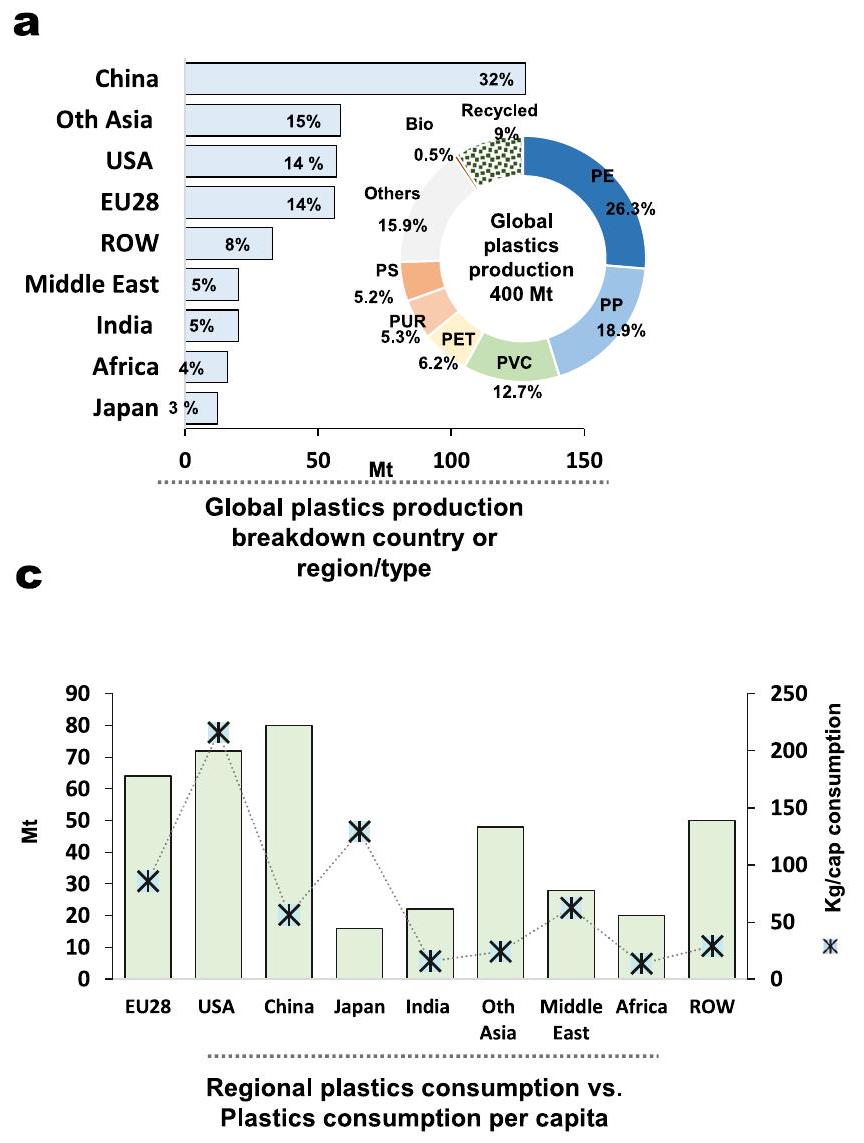
بلغ الإنتاج العالمي من البلاستيك 400 مليون طن في عام 2022. كانت الصين أكبر منتج للبلاستيك. )، تليها أوث آسيا ( الولايات المتحدة (14%)، الاتحاد الأوروبي 28 (14%)، الشرق الأوسط (5%)، الهند (5%)، أفريقيا (4%)، اليابان (3%)، وبقية العالم ( ) (الشكل 3أ). أكبر بوليمر يتم إنتاجه على مستوى العالم هو البولي إيثيلين (PE) الذي يمثل 26% من الإنتاج العالمي. البوليمرات الأخرى التي يتم إنتاجها بكميات كبيرة هي البولي بروبيلين (PP) ( ) ، PVC ( ) ، PET ( ) ، PUR ( ) و PS ( ). شكلت البلاستيكات الثانوية 9% من الإنتاج العالمي والبلاستيك الحيوي نسبة صغيرة نسبيًا ( يتم توضيح إنتاج البوليمرات الإقليمي مع تفصيل حسب نوع البوليمر في الشكل التوضيحي الإضافي 2.
من حيث الاستهلاك، كانت الصين أكبر مستهلك للبوليمرات مع من الاستهلاك العالمي. ثاني أكبر مستهلك للبلاستيك هو الولايات المتحدة الأمريكية (18%)، تليها الاتحاد الأوروبي 28 (16%) ومنطقة آسيا الأخرى (12%).
الشكل 3 | اتجاهات إنتاج واستهلاك البلاستيك العالمية. أ تحليل إنتاج البلاستيك العالمي حسب البلد ونوع البوليمر. ب تحليل استهلاك البلاستيك العالمي حسب البلد والمنطقة وتطبيقات البلاستيك العالمية. ج كمية استهلاك البلاستيك الإقليمي واستهلاك البلاستيك للفرد (البلاستيك
ب
توزيع استهلاك البلاستيك العالمي حسب الدولة أو المنطقة/النوع

إنتاج البلاستيك للفرد مقابل استهلاك البلاستيك للفرد

يتم التعبير عن الاستهلاك لكل منطقة/دولة بوحدات ميغا طن سنويًا واستهلاك البلاستيك لكل فرد بالكيلوغرام لكل فرد. د إنتاج البلاستيك لكل فرد مقارنة باستهلاك البلاستيك لكل فرد (القيم بالكيلوغرام لكل فرد). لمزيد من التفاصيل، انظر الجدول التكميلي 1.
الهند واليابان شكلتا و على التوالي، بينما الشرق الأوسط وأفريقيا لـ و من الاستهلاك العالمي (الشكل 3ب).
من حيث الاستهلاك للفرد، تمتلك الولايات المتحدة أعلى استهلاك للبلاستيك للفرد. غطاء). تشكل البلاستيكات حوالي إنتاج النفايات الصلبة البلدية في الولايات المتحدة ، حيث تعتبر الحاويات البلاستيكية والتغليف المصدر الرئيسي لنفايات البلاستيك. وقد سجلت دول الاتحاد الأوروبي 28 واليابان أيضًا استهلاكًا مرتفعًا نسبيًا من البلاستيك للفرد، مع قبعة و غطاء على التوالي (الشكل 3ج). وفقًا للنتائج، من حيث الكمية الإجمالية بالوزن، هناك درجة كبيرة من التطابق بين التوزيع الجغرافي لإنتاج البلاستيك واستهلاكه، مما يشير إلى ارتباط مكاني بين أنماط الإنتاج والاستهلاك. ومع ذلك، عندما يتم تعديل المقارنات على أساس استهلاك الفرد، تصبح الفجوات أكثر وضوحًا (الشكل 3د)؛ حيث تظهر المناطق ذات الكثافة السكانية المنخفضة ولكن لديها قدرات إنتاجية كبيرة أرقام إنتاج أعلى للفرد، مما يتناقض مع المناطق ذات الكثافة السكانية العالية، ولكن قد يكون استهلاك الفرد مرتفعًا بشكل غير متناسب مقارنة بالإنتاج المحلي. تشير هذه العلاقة إلى أن الإنتاج المحلي للبلاستيك يقود إلى حد كبير أنماط الاستهلاك داخل نفس المناطق، ربما بسبب عوامل مثل الكفاءة اللوجستية، والسياسات الاقتصادية، وديناميات السوق.

إدارة نفايات البلاستيك العالمية والإقليمية

نقدر أن إجمالي 267.68 مليون طن من نفايات البلاستيك تم إنتاجها في عام 2022 (الشكل 4ب). الصين مسؤولة عن أكبر كمية من النفايات الإقليمية المنتجة، حيث تمثل من النفايات العالمية. أنتجت الولايات المتحدة الأمريكية ما مجموعه 40.1 مليون طن من نفايات البلاستيك، تليها منطقة جنوب شرق آسيا (35 مليون طن)، والاتحاد الأوروبي 28 (30 مليون طن)
والهند (9.48 مليون طن). أنتجت اليابان والشرق الأوسط وأفريقيا كمية صغيرة نسبيًا من نفايات البلاستيك مقارنةً بـ و 2 مليون طن على التوالي. أنتجت بقية العالم 63.47 مليون طن من إجمالي النفايات البلاستيكية العالمية (الشكل 4c). تشمل كمية النفايات الإجمالية المتولدة النفايات/الخردة المستوردة والمصدرة عالميًا. والذي يتم معالجته بشكل إضافي في منشآت إعادة التدوير في الدول المضيفة أو إعادة تصديره داخل نفس المنطقة.
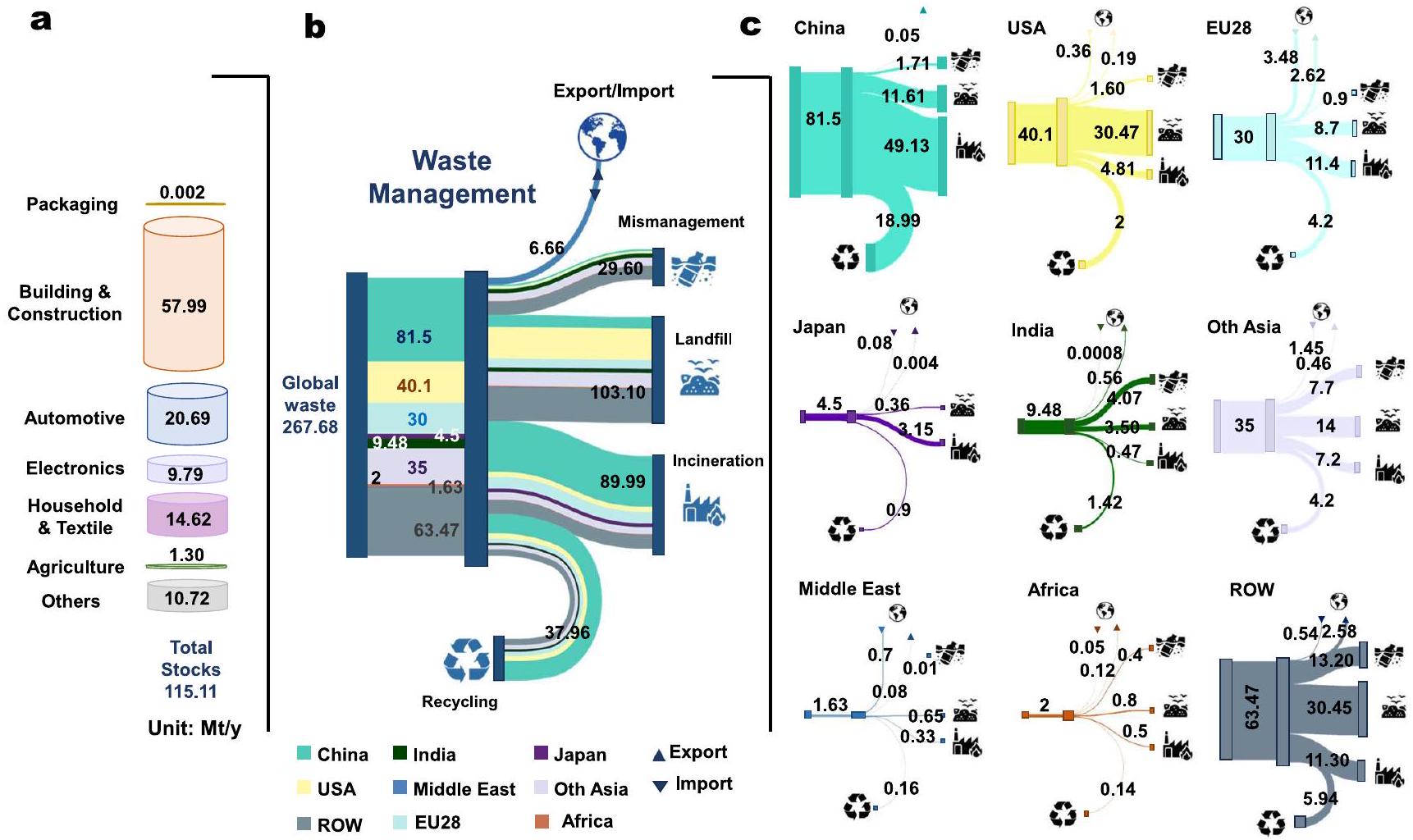
يوجد تنوع واسع في التقدم التكنولوجي وهياكل أنظمة معالجة النفايات البلاستيكية تختلف بشكل كبير في جميع أنحاء العالم. على مستوى العالم، تظل المدافن الوجهة الرئيسية لنفايات البلاستيك، حيث تمثل 103.37 مليون طن. ). هذا المبلغ يظهر تحسنًا مقارنة بالنفايات المتراكمة التاريخية في مكبات النفايات التي قدرها جير ورفاقه. ( من إجمالي النفايات). وهذا يعكس تغييرات الصين في أنماط إدارة النفايات الصلبة في المناطق الحضرية والريفية في السنوات الأخيرة. أظهرت نتائجنا أن معدل الحرق في الصين بلغ في عام 2022، بينما كانت كمية النفايات البلاستيكية المدفونة فقط وتمثل النفايات البلاستيكية التي تم إدارتها بشكل غير صحيح 2% (1.71 مليون طن). إن التحول الكبير في الصين نحو حرق النفايات تحت السيطرة الهوائية مدعوم بالهدف الطموح الذي وضعته البلاد لتحقيق “صفر مكبات” من النفايات الصلبة البلدية الأساسية بحلول تمتلك اليابان واحدة من أعلى معدلات الحرق تحت السيطرة الهوائية في العالم، حيث تم حرق 3.15 مليون طن (70%) من إجمالي النفايات، وتم دفن 8% في المدافن، وإعادة تدوير ما يقرب من 20% من إجمالي النفايات. كما بذلت دول متقدمة أخرى جهودًا كبيرة في تنفيذ استراتيجيات لإدارة نفايات البلاستيك. شكلت نفايات البلاستيك المدفونة في المدافن في دول الاتحاد الأوروبي 28 ما مقداره 8.7 مليون طن (29%)، بينما كانت نسبة سوء الإدارة والحرق 3% و38% على التوالي.
تظل النفايات البلاستيكية المطمورة في الولايات المتحدة مرتفعة نسبيًا، حيث تم دفن 30.47 مليون طن (76%)، وتم حرق 12%، وتم إدارة 4% بشكل غير صحيح، وفقط 5%
الشكل 4 | النفايات البلاستيكية العالمية المتولدة. أ. المخزونات العالمية من البلاستيك حسب القطاع الصناعي. ب. إدارة النفايات العالمية ونفايات نهاية العمر، تحليل حسب الدولة/ المنطقة. ج. إدارة النفايات البلاستيكية على المستوى الإقليمي والوطني. لون وعرض التدفقات
تتوافق مع الدول وكتلة النفايات البلاستيكية، على التوالي. جميع الوحدات بوحدات Mt/y. ملاحظة: الفروق الطفيفة في القيم ناتجة عن التقريب أثناء حسابات توازن الكتلة.
إعادة التدوير. انخفض معدل إعادة تدوير البلاستيك في الولايات المتحدة بشكل كبير مقارنةً بعام 2015، عندما وصل معدل إعادة تدوير البلاستيك إلى تاريخياً، اعتمدت الولايات المتحدة على الصين كأكبر متلقٍ لنفايات البلاستيك. . ومع ذلك، عندما فرضت الصين حظرًا على استيراد نفايات البلاستيك في عام 2018، تعرضت إدارة نفايات البلاستيك في الولايات المتحدة للاضطراب، مما أدى إلى انخفاض كبير في اتجاهات إعادة تدوير البلاستيك. بالإضافة إلى ذلك، من المتوقع أن تنمو نفايات البلاستيك في الولايات المتحدة بشكل أكبر في المستقبل لتصل إلى 86 مليون طن بحلول .

نقاش

معضلة مصدر البلاستيك العالمي من الوقود الأحفوري

قمنا بحساب المواد الأولية للإنتاج العالمي للبلاستيك في عام 2022. إجمالي من البلاستيكات العذراء العالمية تم إنتاجها من المواد الأولية المشتقة من الوقود الأحفوري، مع من الفحم، و من النفط والغاز الطبيعي على التوالي. نتائجنا تتماشى مع الدراسات السابقة. ويوضح أنه في عام 2022 تم إحراز تقدم ضئيل في تقليل الاعتماد على المواد الأولية من الوقود الأحفوري لإنتاج البلاستيك. إن الكمية الكبيرة من الفحم المستخدمة في إنتاج البلاستيك الجديد مدفوعة بشكل رئيسي من قبل الصين، التي تعد واحدة من أكبر مستهلكي الفحم للطاقة وإنتاج الصناعة الكيميائية، مما يزيد من المخاوف البيئية المتعلقة بإنتاج البلاستيك. بالإضافة إلى ذلك، فإن التوسع العالمي في صناعة البتروكيماويات يؤدي إلى زيادة استهلاك النفط، خاصة من الصين. حوالي من إجمالي استخدام النفط في الصين، تم استهلاكه من قبل الصناعة الكيميائية إن الاعتماد الكبير على المواد الأولية من الوقود الأحفوري لإنتاج البلاستيك سيزيد من تعقيد الجهود العالمية للتخفيف من تغير المناخ. ومع ذلك، فإن البلاستيك ينتج انبعاثات غازات دفيئة أقل على مدار دورة حياته مقارنة بالمواد البديلة مثل المعادن أو الزجاج. . بالإضافة إلى ذلك، تواجه المواد البلاستيكية الحيوية عدة تحديات، بما في ذلك الانبعاثات المحتملة خلال مرحلة الإنتاج، والآثار البيئية مثل استخدام الأراضي والتغذية الزائدة، والمنافسة مع إنتاج الغذاء، والحواجز الاقتصادية والتكنولوجية للاستخدام على نطاق واسع . هذه المفارقة تعزز المعضلة: بينما تسهم المواد البلاستيكية في الاعتماد على الوقود الأحفوري ومشاكل التلوث الواسعة، فإنها توفر في الوقت نفسه فوائد بيئية من حيث تقليل الانبعاثات وكفاءة الطاقة. إن عدم وجود بدائل قابلة للتطبيق للمواد البلاستيكية التي يمكن
تنفيذها على نطاق عالمي يمثل تحديًا كبيرًا في السعي نحو حلول مستدامة. نظرًا لهذه المفارقة والخيارات المحدودة للاستبدال المستدام على نطاق واسع، فإن تطبيق مبادئ الاقتصاد الدائري وتقليل تدفقات البلاستيك يظهر كحل حاسم. من خلال التركيز على استراتيجيات مثل إعادة التدوير، وإعادة الاستخدام، وإعادة تصميم المنتجات من أجل الاستدامة، يمكننا تقليل الأثر البيئي للبلاستيك والتحرك نحو مستقبل أكثر استدامة. . بالإضافة إلى ذلك، تحتاج المخاطر البيئية المرتبطة باستهلاك المواد الأولية الأحفورية لصناعة الكيميائيات إلى تدخل كبير في كفاءة الموارد والدائرية. سيتطلب ذلك التحول من المواد الأولية الأحفورية إلى المواد الأولية البيوجينية والمعاد تدويرها، وتنفيذ تقنيات احتجاز الكربون وتخزينه، وإزالة الكربون من إمدادات الطاقة على طول سلسلة إمداد المنتجات الكيميائية والبلاستيكية.

التحول العالمي في أنماط تجارة البلاستيك

تجارة المنتجات البلاستيكية العالمية هي شبكة معقدة وواسعة، تتميز بالاعتماد الجغرافي والاقتصادي الكبير. لقد حددنا نقاط ساخنة إقليمية مختلفة في مراحل مختلفة من سلسلة إمداد البلاستيك. نظرًا لأن البلاستيك يعتمد بشكل أساسي على المواد المشتقة من الوقود الأحفوري، فإن الدول الغنية بالنفط هي المصدر الرئيسي للمنتجات البترولية المكررة والبتروكيماويات، مما يدعم سلسلة الإمداد العالمية لإنتاج البلاستيك. تلعب صناعة إضافات البلاستيك دورًا حيويًا في قطاع التصنيع من خلال تعديل وتعزيز خصائص البلاستيك لتلبية متطلبات التطبيقات المتنوعة. شهد سوق إضافات البلاستيك في الصين نموًا سريعًا بسبب قطاع التصنيع الواسع، مع توقعات بقيمة سوقية ستنمو بمعدل سنوي قدره على مدى السنوات الخمس المقبلة تتمتع أوروبا بتنظيمات صارمة تحكم استخدام الإضافات في إنتاج البلاستيك، مما يلزم الدول الأوروبية بتسجيل جميع الإضافات المصنعة أو المنتجة في وكالة المواد الكيميائية الأوروبية. تساهم الأطر التنظيمية والتقدم التكنولوجي في تعزيز إنتاج الإضافات الوظيفية المبتكرة وإدخال الإضافات المستدامة مثل البلاستيكات القابلة للتحلل. ومع ذلك، تم تحديد عدد كبير من الإضافات والمونومرات المنتجة والمتداولة في السوق العالمية كمواد قد تكون مصدر قلق محتمل لـ
سمّيتها بناءً على معايير الاتحاد الأوروبي إطلاق المواد المضافة السامة إلى الطعام من عبوات البلاستيك ووجود مواد سامة محتملة يزيد ذلك من الحاجة إلى تنفيذ تنظيمات أكثر صرامة في إنتاج وتجارة إضافات البلاستيك. ومع ذلك، فإن الطبيعة المعقدة لإضافات البلاستيك، التي تختلف بشكل كبير في النوع والتركيز والتفاعل مع البوليمر الأساسي، تطرح تحديات كبيرة في قياس تدفقاتها ومخزوناتها وتداولها بدقة. هناك حاجة ملحة لبيانات إحصائية ومنهجيات أكثر قوة لفهم هذه الإضافات وقياسها بشكل أفضل. يجب أن تتعاون المؤسسات الأكاديمية والهيئات التنظيمية مثل منظمة الجمارك العالمية (WCO) والشركات بشكل وثيق. إن التصنيف الدقيق وتقييم الإضافات أمران أساسيان لضمان الامتثال للمعايير البيئية ومعايير السلامة.
من خلال دراسة أنماط تجارة النفايات العالمية لعام 2022، وجدنا أن عددًا من الدول المتقدمة، وخاصة دول الاتحاد الأوروبي 28، تظهر كدول مستوردة صافية لنفايات البلاستيك/الخردة. أدت المخاوف البيئية المتعلقة بنفايات البلاستيك والتلوث إلى جهود تنظيمية دولية وتحولات نحو ممارسات أكثر استدامة. أحد العوامل الرئيسية التي قد تكون شكلت أنماط تجارة البلاستيك العالمية هو تنفيذ تعديلات اتفاقية بازل بشأن نفايات البلاستيك في . هذه التعديلات تلزم الدول المصدرة بإجراء معالجة مسبقة لنفايات البلاستيك لتحويلها إلى مواد معاد تدويرها أو خردة نظيفة تلبي معايير محددة قبل اتباع إجراء الموافقة المسبقة المستنيرة (PIC) للتصدير، خاصة بالنسبة لنفايات البلاستيك المختلطة (الدخول ‘Y48’) . قد تؤدي هذه التغييرات إلى تقليل كبير في انبعاثات غازات الدفيئة وزيادة الحوافز للدول المتقدمة لاستيراد خردة البلاستيك النظيفة، مما قد يؤدي إلى انخفاض انبعاثات غازات الدفيئة. كما أن عملية المعالجة المسبقة تقلل من وزن المواد المنقولة، مما يؤدي إلى تقليل استهلاك الوقود والانبعاثات أثناء النقل. بالإضافة إلى ذلك، من المحتمل أن تؤدي تكاليف النقل العالية إلى تركيز تجارة نفايات البلاستيك في المستقبل ضمن مجموعات تجارية في نفس المناطق الجغرافية . بشكل عام، يوفر استيراد نفايات البلاستيك/الخردة النظيفة فرصًا لاستغلال المواد التي كان سيتم التخلص منها في مدافن النفايات، مما يعزز نهجًا أكثر استدامة في إدارة النفايات . يمكن أن يعزز استيراد نفايات البلاستيك/الخردة النظيفة أيضًا صناعة إعادة التدوير في الدول المتقدمة، مما يدعم الطلب على البلاستيك المعاد تدويره في عمليات التصنيع ويقلل من الأثر البيئي لإنتاج البلاستيك الجديد.

الآفاق السياسية لإدارة مستدامة لنفايات البلاستيك

تظهر ممارسات إدارة نفايات البلاستيك العالمية اختلافات إقليمية كبيرة، تعكس الفروق في القدرات الاقتصادية، والأطر التنظيمية، والتقدم التكنولوجي، والمواقف الثقافية تجاه النفايات. في الدول ذات الدخل المرتفع، غالبًا ما تكون هناك أنظمة متطورة، تدمج تقنيات الفرز وإعادة التدوير المتقدمة، وخدمات جمع النفايات الشاملة، واللوائح الصارمة. على سبيل المثال، نفذت دول الاتحاد الأوروبي برامج وسياسات إعادة تدوير واسعة تهدف إلى تحقيق معدلات إعادة تدوير عالية وتقليل التخلص في المدافن . في المقابل، تكافح العديد من المناطق النامية مع بنية تحتية محدودة، مما يؤدي إلى معدلات أعلى من التخلص غير السليم والتسرب البيئي.
لاحظنا أن إجمالي النفايات الناتجة أقل من الكمية المقدرة سابقًا ، ويرجع ذلك أساسًا إلى نهجنا المنهجي الذي استخدمناه. استخدمنا نهج توازن الكتلة لعام 2022 لضمان حساب جميع المدخلات والمخرجات، مما يوفر تمثيلًا أكثر دقة لتوليد النفايات. على عكس الدراسات السابقة التي غالبًا ما تشمل النفايات التراكمية من السنوات السابقة، يركز نموذجنا حصريًا على النفايات الناتجة خلال عام 2022. علاوة على ذلك، تأخذ تحليلاتنا في الاعتبار مخزون البلاستيك (141.58 مليون طن) الذي لم يتم تضمينه في تيار النفايات لعام 2022 لأنه لا يزال قيد الاستخدام. يتم الاحتفاظ بهذه المخزونات ضمن قطاعات مختلفة حيث يمتد عمر مادة البلاستيك لأكثر من عام واحد (الشكل 4أ، الجدول التكميلي 6).
تظل نسبة إعادة التدوير العالمية ثابتة، مما يظهر تقدمًا ضئيلًا عن التقديرات السابقة ، مع حساب من الإنتاج الأولي. فقط 38 مليون طن
(من بين 75 مليون طن تم فرزها وجمعها) يتم إعادة تدويرها. تساهم عدة تحديات في التقدم المحدود في تعزيز ممارسات إعادة التدوير العالمية. إحدى القضايا الرئيسية هي التنوع الكبير وتعقيد المواد البلاستيكية، التي تشمل أنواعًا ودرجات وإضافات مختلفة . يحد هذا التعقيد من الفرز الفعال ومعالجة نفايات البلاستيك، حيث تتطلب الأنواع المختلفة غالبًا معالجة منفصلة للحفاظ على الجودة. بالإضافة إلى ذلك، فإن تلوث نفايات البلاستيك بفضلات الطعام، والملصقات، والشوائب الأخرى يقوض جهود إعادة التدوير، حيث يمكن أن تؤدي هذه الملوثات إلى تدهور جودة المواد المعاد تدويرها وتخلق تحديات تشغيلية في مرافق إعادة التدوير . تلعب العوامل الاقتصادية أيضًا دورًا حاسمًا؛ غالبًا ما تكون ظروف السوق المحيطة بتكلفة البلاستيك الجديد أكثر ملاءمة من تلك الخاصة بالبلاستيك المعاد تدويره، ويرجع ذلك أساسًا إلى تقلب أسعار النفط . يثني هذا الحاجز الاقتصادي عن الاستثمار في بنية إعادة التدوير التحتية والتكنولوجيا، مما ي perpetuates دورة انخفاض معدلات إعادة التدوير. علاوة على ذلك، فإن عدم وجود آلية تعزز تصميم المنتجات لتحقيق كفاءة أعلى في الموارد يعني أن العديد من المنتجات يصعب تفكيكها أو إعادة تدويرها بشكل فعال، أو حتى لا يمكن إعادة تدويرها بسبب الإضافات التي تم حظر استخدامها بالفعل في المنتجات. يعد التصميم البيئي والتوحيد القياسي في مرحلة التصميم عوامل حاسمة لتعزيز معدل إعادة تدوير البلاستيك. من خلال دمج مبادئ الاستدامة في عملية التصميم، يمكن للمصنعين إنشاء منتجات ليست فقط وظيفية ولكن أيضًا ملائمة لإعادة التدوير الفعالة. يشمل ذلك اختيار مواد قابلة لإعادة التدوير، وتقليل استخدام الإضافات التي يمكن أن تتداخل مع عمليات إعادة التدوير، وضمان أن منتجات البلاستيك يمكن إعادة تدويرها بسهولة في نهاية دورة حياتها .
تظهر نتائجنا أن الولايات المتحدة، على الرغم من التقدم في تقنيات إعادة التدوير، لديها واحدة من أدنى معدلات إعادة تدوير البلاستيك ( )، وتواجه تحديات كبيرة في إدارة نفايات البلاستيك . قد يؤدي زيادة معدل إعادة تدوير البلاستيك، ودمج السياسات الدائرية، والحد من المدافن إلى تحسين ممارسات إدارة النفايات في الولايات المتحدة. حددت الدول الأوروبية هدفًا طموحًا لتحقيق من جمع زجاجات البلاستيك بحلول عام 2025، و بحلول عام 2029 ودمج 25% من البلاستيك المعاد تدويره في زجاجات المشروبات من . بالمثل، في عام 2019، اعتمدت اليابان استراتيجية تدوير موارد البلاستيك بهدف تنفيذ استراتيجيات الاقتصاد الدائري في قطاع البلاستيك من خلال تحقيق 60% من إعادة تدوير البلاستيك بحلول عام 2030 وتقليل انبعاثات البلاستيك أحادي الاستخدام بنسبة بحلول عام 2030. حددت البلاد هدفًا طموحًا لتعظيم إنتاج البلاستيك الحيوي بحلول عام 2030، ليصل إلى حوالي . وضعت الصين تدابير رسمية لإدارة الأفلام الزراعية في عام 2020 بهدف الحد من الأثر البيئي لفيلم المولش على التربة وتعزيز إعادة استخدامها وإعادة تدويرها . يعد تلوث الأفلام الزراعية بالفعل عاملًا رئيسيًا في تدهور التربة في المناطق الريفية ومصدرًا متزايدًا للتلوث للبيئة وصحة الإنسان . استجابةً لذلك، حددت الحكومة الصينية هدفًا لتحقيق من معدل الجمع للأفلام الزراعية بحلول .
استنادًا إلى نتائجنا، تمتلك اليابان والصين والاتحاد الأوروبي 28 من بين أعلى معدلات الحرق لنفايات البلاستيك، حيث تمثل و على التوالي. يُعزى ارتفاع معدل حرق البلاستيك في أوروبا إلى تركيز القارة على استرداد الطاقة ومبادرات تحويل النفايات إلى طاقة، مما يعد وسيلة لتقليل الاعتماد على المدافن والتخفيف من الآثار البيئية المرتبطة بنفايات البلاستيك . في اليابان، تلعب الحرق دورًا كبيرًا في إدارة النفايات بسبب محدودية مساحة المدافن، واللوائح الصارمة بشأن التخلص من النفايات، والتقنيات المتقدمة التي تسمح بتوليد الطاقة بكفاءة من حرق النفايات . أدت الزيادة السريعة في القطاع الصناعي في الصين وزيادة توليد النفايات إلى زيادة تاريخية في معدل الحرق لإدارة النفايات الصلبة كبديل لممارسات نفايات المدافن . بحلول سبتمبر 2022، كان هناك 811 منشأة حرق لاسترداد الطاقة في الصين ومن المتوقع أن يزداد هذا العدد أكثر . يمكن أن يقلل الحرق المنظم من النفايات وينتج الطاقة، لكنه أيضًا يشكل مخاطر بيئية تؤدي إلى إطلاق ملوثات ضارة تتطلب تقنيات متقدمة وإطارًا تنظيميًا صارمًا حتى يمكن الحد من الآثار السلبية.
تقدم إنتاج البلاستيك، واستهلاكه، والتخلص من النفايات في إفريقيا تحديات وفرص فريدة. بينما شهدت المنطقة زيادة كبيرة في إنتاج البلاستيك واستهلاكه مدفوعة بالنمو الاقتصادي
تواجه أنظمة إدارة النفايات في أفريقيا تحديات غير مسبوقة بسبب التحضر. إن جمع النفايات غير الكافي، وممارسات التخلص غير السليمة، والبنية التحتية المحدودة لإعادة التدوير تزيد من تلوث البيئة، ومخاطر الصحة البشرية، واستنزاف الموارد في القارة. على الرغم من التحديات، هناك اعتراف متزايد بالحاجة إلى حلول مستدامة لإدارة نفايات البلاستيك. وجدنا أن متوسط معدل إعادة تدوير البلاستيك في إفريقيا حوالي ، ومع ذلك قد تكون هذه النسبة أعلى عند النظر في إعادة التدوير غير الرسمية، التي يقوم بها جامعو النفايات أو إعادة التدوير غير الرسميين. تلعب إعادة تدوير البلاستيك غير الرسمية في القارة الأفريقية وفي دول أخرى نامية دورًا حاسمًا في إدارة النفايات، حيث تقدم فوائد وتطرح تحديات كبيرة. وغالبًا ما تتميز هذه الممارسات في إدارة النفايات بعمليات صغيرة الحجم وغير منظمة، وتوفر سبل العيش لملايين الأشخاص. على الرغم من فوائدها الاقتصادية والبيئية، تحدث ممارسات إعادة التدوير غير الرسمية غالبًا في ظروف خطرة تعرض العمال لمخاطر صحية نتيجة السموم والملوثات. يتطلب معالجة هذه القضايا اتباع نهج متكامل يعزز قدرات القطاع غير الرسمي من خلال تحسين التكنولوجيا، والسياسات الداعمة، والتعاون الدولي، بهدف حماية كل من المجتمعات والبيئة. يمكن أن يعزز تحسين التآزر بين أنظمة إعادة التدوير غير الرسمية والرسمية إدارة نفايات البلاستيك ويعزز الاستدامة في الدول النامية.

مبادئ الاقتصاد الدائري لإدارة مستدامة عالمية للبلاستيك

تقدم مبادئ الاقتصاد الدائري نهجًا استراتيجيًا لإدارة تدفق المواد البلاستيكية والتخفيف من التلوث العالمي. يتماشى ذلك مع نتائج دراستنا: (i) إعادة الاستخدام: إعادة استخدام المنتجات البلاستيكية يطيل من دورة حياتها، مما يبقيها في التداول ويبعدها عن مجرى النفايات. تشجيع إعادة استخدام الحاويات والأكياس البلاستيكية يمكن أن يقلل بشكل كبير من حجم النفايات البلاستيكية الناتجة، خاصة في التعبئة والتغليف، مما يدعم ممارسات أكثر استدامة في إدارة البلاستيك. هذا المبدأ يدعو أيضًا إلى تجنب الإنتاج والاستهلاك غير الضروري للبلاستيك. من خلال حظر إنتاج البلاستيك أحادي الاستخدام غير الضروري، يمكن تقليل الطلب على المواد البلاستيكية بشكل كبير. وهذا يتماشى مع الحاجة إلى تقليل الاعتماد على الوقود الأحفوري، الذي يعد المصدر الرئيسي لإنتاج البلاستيك. (ii) التقليل: تقليل الاستخدام العام للبلاستيك والموارد المطلوبة لإنتاجه أمر ضروري. تصميم المنتجات بشكل فعال يقلل من استخدام المواد، جنبًا إلى جنب مع توعية المستهلكين لتعزيز البدائل القابلة للاستخدام المتكرر والدائم، يمكن أن يساعد في تحقيق هذا الهدف. يمكن أن يخفف هذا التقليل من الآثار البيئية المرتبطة بإنتاج البلاستيك. (iv) إعادة التدوير: إعادة التدوير هي استراتيجية حاسمة لإدارة نفايات البلاستيك. تعزيز إعادة تدوير البلاستيك سيعزز من تقليل الطلب على إنتاج البلاستيك الجديد وتقليل انبعاثات غازات الدفيئة. ومع ذلك، لا يزال معدل إعادة التدوير العالمي ثابتًا، مما يبرز الحاجة إلى تحسين البنية التحتية والعمليات الخاصة بإعادة التدوير. (v) الاستعادة: يتضمن هذا المبدأ استعادة وتجديد الأنظمة الطبيعية التي تدهورت بسبب تلوث البلاستيك. الجهود المبذولة لتنظيف النفايات البلاستيكية من البيئة واستعادة النظم البيئية ضرورية للتخفيف من الآثار البيئية الواسعة لتلوث البلاستيك. يمكن أن يؤدي تنفيذ هذه المبادئ إلى تقليل الأثر البيئي لإنتاج واستهلاك البلاستيك بشكل كبير، مما يتماشى مع الحاجة الملحة إلى حلول مستدامة لمعالجة تلوث البلاستيك العالمي.

قيود الدراسة

بينما توفر دراستنا رؤى قيمة حول تدفقات البلاستيك العالمية، والمخزونات، والتخلص من النفايات، من المهم الاعتراف بحدودها. قد تؤدي الاختلافات في ممارسات جمع البيانات عبر مناطق مختلفة إلى إدخال عدم دقة. سيكون من المفيد التعاون مع المؤسسات الحكومية والأكاديمية لتوحيد طرق جمع البيانات وتحسين جودة البيانات من أجل الأبحاث المستقبلية. سيساهم ذلك في ضمان أن تكون البيانات المستخدمة أكثر اتساقًا وموثوقية، مما يسمح بإجراء مقارنات وتحليلات أكثر دقة. علاوة على ذلك، فإن المحاسبة العالمية للبلاستيك معقدة بطبيعتها بسبب الطبيعة المعقدة لتدفقات التجارة والنطاق المتنوع من أنواع البلاستيك والإضافات المعنية. بينما توفر دراستنا نظرة شاملة على تدفقات البلاستيك العالمية، والمخزونات، والتخلص من النفايات، إلا أنها محدودة في
القدرة على تقديم تحليلات مفصلة لإنتاج وإزالة المواد المضافة المحددة. لقد ركزنا بشكل أساسي على المواد المضافة الأكثر استخدامًا وتداولًا، والتي قد لا تعكس الطيف الكامل للمواد المضافة البلاستيكية المتداولة. في الأبحاث المستقبلية، نهدف إلى التعمق في مجموعة متنوعة من البلاستيك والمواد المضافة لتقديم فهم أكثر شمولاً لتدفقاتها وتأثيراتها الفردية. بالإضافة إلى ذلك، لا تأخذ دراستنا في الاعتبار الدور الكبير لأنظمة إعادة التدوير غير الرسمية، التي تلعب دورًا حيويًا في إدارة النفايات البلاستيكية العالمية. قد يؤثر هذا النقص في الشمولية على دقة معدل إعادة التدوير العالمي، الذي قد يكون أعلى إذا تم احتساب إعادة تدوير النفايات غير الرسمية. يجب أن تأخذ الأبحاث المستقبلية في الاعتبار دمج البيانات من شبكات إعادة التدوير غير الرسمية للحصول على رؤية أكثر شمولية لإدارة النفايات البلاستيكية وممارسات إعادة التدوير في جميع أنحاء العالم.

الاستنتاجات

في هذه الدراسة، نكشف عن التدفقات والاحتياطيات العالمية لعام 2022 من خلال تقديم تحليل لتدفق المواد المرتبط بالتجارة العالمية مع تفصيل حسب نوع البلاستيك على طول سلسلة الإمداد بأكملها من المواد الأولية إلى إدارة النفايات والتخلص منها. نحن نقدر ونوضح إدارة النفايات العالمية لكشف مصائر نفايات البلاستيك وربط النقاط المفقودة التي تهيمن على عالم البلاستيك المعقد. كما نقوم برسم خريطة للتجارة العالمية في البلاستيك على طول سلسلة الإمداد بأكملها. تشير نتائجنا إلى أن البلاستيك يخضع لتركيز جغرافي. المواد الأولية للبلاستيك، التي تستمد في الغالب من المواد الأحفورية، والإنتاج الأولي للبلاستيك مركزة بشدة في البلدان التي تتمتع بموارد نفطية وفيرة وتملك صناعات بتروكيماوية متقدمة. معالجة وتصنيع البلاستيك مركزة في الغالب في المناطق التي تتميز بقدرات تصنيع كبيرة. ومن الجدير بالذكر أن الصين وحدها تمثل من الناتج العالمي للمنتجات البلاستيكية النهائية. إن هذا التركيز الجغرافي له تداعيات كبيرة على ديناميات التجارة العالمية، والسياسات البيئية، والممارسات المستدامة، تمامًا كما هو الحال في التركيز الملحوظ في تعدين ومعالجة المعادن والمواد المعدنية.
تظهر نتائج إدارة نفايات البلاستيك العالمية أن الحرق يبرز كأكثر الطرق ممارسة لإدارة نفايات البلاستيك، حيث يمثل معالجة النفايات البلاستيكية العالمية. يحدث هذا التحول بالتزامن مع انخفاض ملحوظ في التخلص من البلاستيك في المدافن، والذي يشكل طرق إدارة النفايات البلاستيكية على مستوى العالم. على الرغم من هذه التطورات، ظلت نسبة إعادة التدوير العالمية ثابتة عند “، مما يعكس تحسناً طفيفاً عن السنوات السابقة. علاوة على ذلك، فإن ديناميات تجارة البلاستيك العالمية تشهد تغييرات كبيرة، حيث أصبحت الدول المتقدمة مستوردين بارزين لنفايات البلاستيك والخردة. وقد برزت دول الاتحاد الأوروبي 28، على وجه الخصوص، كمستورد صافي، حيث تمثل من واردات النفايات البلاستيكية العالمية.
فهم وقياس الحركة العالمية وتراكم البلاستيك أمران حيويان لتوجيه قرارات السياسة، وتنفيذ استراتيجيات إدارة فعالة، ورصد التقدم نحو أهداف الاستدامة البيئية. توفر الرؤى المستخلصة من نتائجنا بيانات وأدلة قيمة لإبلاغ الأكاديميين وصانعي السياسات حول تدفقات البلاستيك العالمية، مما يمكّن الدول وأصحاب المصلحة من التعاون بفعالية في مواجهة هذا التحدي البيئي العالمي الملح. إن احتساب التدفقات والاحتياطيات العالمية من البلاستيك ليس فقط ضرورة علمية، بل هو أيضًا أداة عملية لصانعي السياسات لتصميم سياسات وتنظيمات قائمة على الأدلة تدفع نحو تحقيق تقدم نحو كوكب أنظف وأكثر صحة للأجيال الحالية والمستقبلية.

طرق

إطار البحث

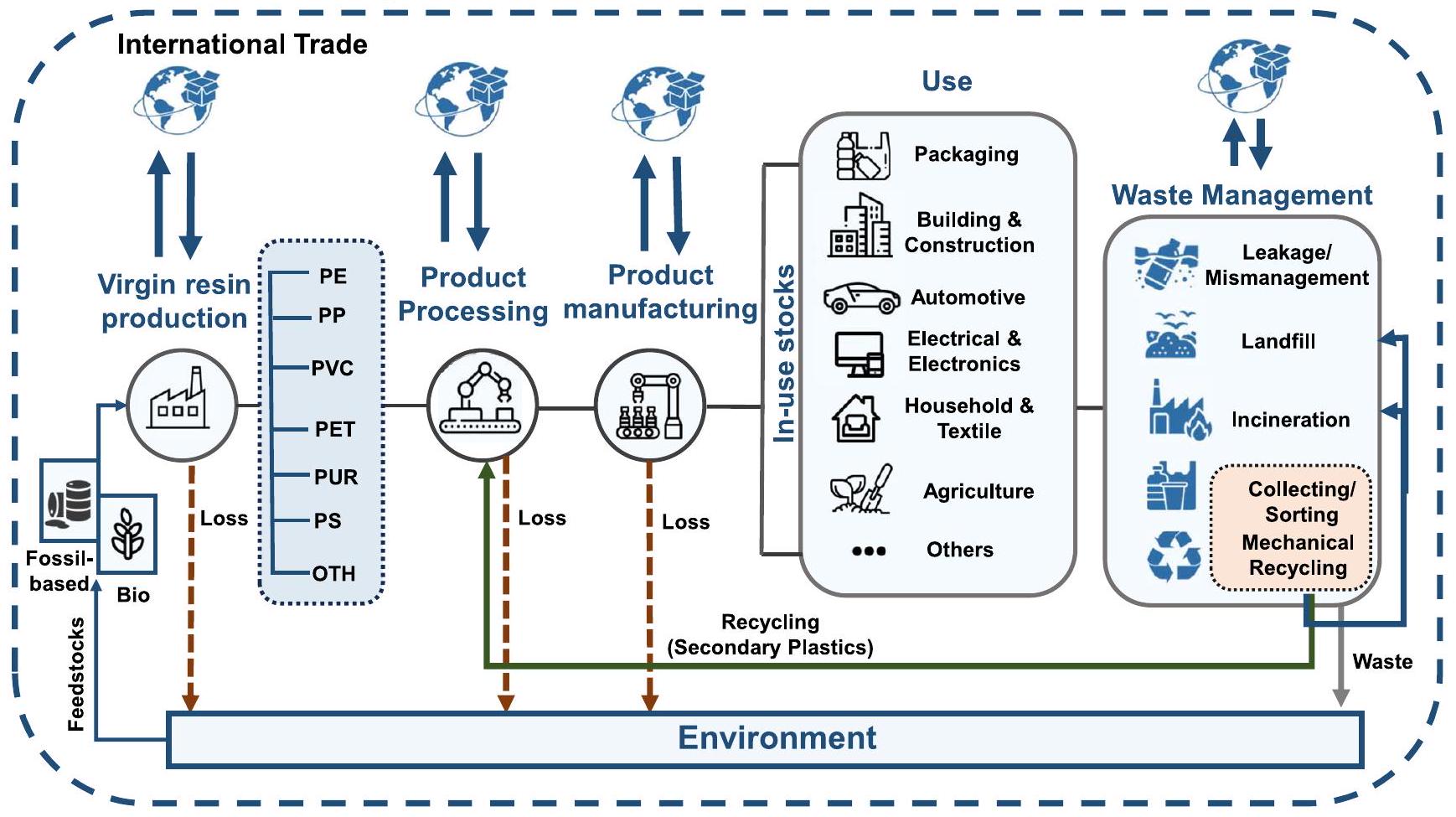
يوضح الشكل 5 مخطط النظام لدورات البلاستيك العالمية. نحن نغطي دورات البلاستيك التالية: إنتاج الراتنج الخام، معالجة المنتجات، تصنيع المنتجات، الاستخدام وإدارة النفايات. يعتمد تداول البلاستيك العالمي المرتبط بتحليل تدفق المواد على عام 2022 لأنه يوفر أكثر البيانات شمولاً وحداثة المتاحة، مما يسمح بتحليل مفصل للديناميات والأنماط التجارية الحالية. بالإضافة إلى ذلك، يعكس تحليل عام 2022 التعافي بعد الجائحة وأحدث الاتجاهات في إنتاج البلاستيك وتداوله، مما يوفر رؤى قيمة لفهم الحالة الحالية لصناعة البلاستيك العالمية.

دورات البلاستيك العالمية

الشكل 5 | مخطط نظام دورات البلاستيك العالمية. يتضمن النظام بوليمرات مختارة: بولي (إيثيلين) (PE)، بولي (بروبيلين) (PP)، بولي (كلوريد الفينيل) (PVC)، بولي (إيثيلين تيريفثاليت) (PET)، بولي (يوريثان) (PUR)، بولي (ستايرين) (PS) وغيرها (OTH) ويحلل دوراتها من إنتاج المواد الأولية إلى إدارة النفايات.
يتضمن مخطط النظام مراحل مختلفة على طول سلسلة التوريد؛ (i) إنتاج الراتنجات البكر: تتضمن هذه المرحلة إنتاج الراتنجات من الموارد الطبيعية والاصطناعية مثل المواد الأولية البتروكيماوية. (ii) المعالجة والتصنيع: تتضمن هذه المرحلة تحويل الراتنجات البكر إلى منتجات شبه نهائية ومنتجات بلاستيكية نهائية. الأنواع البلاستيكية التي سيتم اعتبارها هي بولي (إيثيلين) (PE)، بولي (بروبيلين) (PP)، بولي (كلوريد الفينيل) (PVC)، بولي (إيثيلين تيريفثاليت) (PET)، بولي (يوريثان) (PUR)، بولي (ستايرين) (PS) وغيرها (OTH)؛ (iii) مرحلة الاستخدام: يتم تصنيف استهلاك المنتجات البلاستيكية إلى قطاعات مثل التعبئة والتغليف، البناء والتشييد، السيارات، الكهرباء والإلكترونيات، المنزل والنسيج، الزراعة، وغيرها. يعتمد اختيار هذه القطاعات على أدبيات سابقة واسعة. تم تحديد هذه القطاعات كمستهلكين رئيسيين للبلاستيك بسبب مساهمتها الكبيرة في إجمالي استهلاك البلاستيك وتأثيراتها البيئية. يتم تقديم وصف لمنتجات البلاستيك التي تتكون منها كل فئة من فئات استخدام البلاستيك المختارة في الجدول التكميلي 2؛ (رابعًا) إدارة النفايات: تتضمن المرحلة النهائية إدارة نفايات البلاستيك، بما في ذلك سوء الإدارة، ومدافن النفايات، والحرق، وإعادة التدوير الميكانيكية. تعتبر إعادة تدوير البلاستيك مصدرًا للبلاستيك الثانوي، الذي يعيد الدخول إلى مرحلة معالجة المنتجات.

تحليل تدفق المواد المرتبطة بتجارة البلاستيك العالمية

يتبع الحساب العالمي لتدفقات البلاستيك مبدأ توازن الكتلة ، مع ضمان تتبع المدخلات والمخرجات من البلاستيك بدقة عبر دول ومناطق مختلفة. يتضمن ذلك حساب التدفقات المحلية، وتدفقات التجارة، وتدفقات الفقد، وتدفقات إعادة التدوير باستخدام المعادلة التالية (1):
أين يدل على مرحلة حياة نوع مادة البلاستيك (Px) تشير إلى الدولة j التي تم تناولها في هذه الدراسة، هل Px موجود في تدفقات التغذية المحلية من المرحلة في البلاد هل Px مضمن في استيراد المنتجات المحتوية على البلاستيك من المرحلة في البلد هو البلاستيك
إعادة التدوير في المرحلة في البلد المواد البلاستيكية الموجودة في المنتجات التي تستهلكها الطلب المحلي من المرحلة في البلد يتم تصدير البلاستيك المتمثل في المنتجات المحتوية على البلاستيك من المرحلة في البلد فقدان البلاستيك أثناء الإنتاج مرحلة في البلاد هو الإضافة الصافية للبلاستيك إلى المخزون من المرحلة في البلد .
سيتم حساب تدفقات البلاستيك الداخلة والخارجة في مرحلة الاستخدام بناءً على نموذج التأخير. التدفق الخارجي في سنة معينة يساوي التدفق الداخلي في الماضي ويتم حسابه باستخدام المعادلتين (2) و (3):
أين و تشير إلى تدفق البلاستيك ودفقه من صناعة في السنة بينما و تشير إلى إجمالي تدفقات البلاستيك في مرحلة الاستخدام في السنة وسنة على التوالي؛ و تشير إلى إنتاج البلاستيك المستخدم في فئة الاستخدام النهائي في السنة وسنة ، على التوالي.
يُفترض استهلاك البلاستيك استنادًا إلى بيانات الإنتاج والتجارة المعروفة. وبالتالي، فإن العلاقة بين إنتاج البلاستيك والتجارة الصافية والاستهلاك تتبع مبادئ توازن الكتلة. يتم حساب استهلاك البلاستيك على المستوى الوطني والإقليمي استنادًا إلى المعادلة (4):
أين هو استهلاك البلاستيك في القطاع في الوقت هو إنتاج البلاستيك (الراتنج أو الألياف) في الوقت يمثل صافي واردات البلاستيك في الوقت هو استيراد النفايات البلاستيكية في الوقت الحالي ، هو نسبة الراتنج أو الألياف في القطاع في الوقت هو نفايات البلاستيك المعاد تدويرها في الوقت و هو صافي استيراد المنتجات النهائية في القطاع .
أخيرًا، يتم حساب جميع نسب العائد والخسائر على طول المراحل المختلفة باستخدام معاملات النقل استنادًا إلى الإحصاءات الصناعية وتقديراتها ذات الصلة. وتشمل هذه النفايات الناتجة عن إنتاج الراتنج الخام، والنفايات الناتجة عن عمليات التصنيع شبه النهائية، والنفايات الناتجة عن تصنيع المنتجات، وأخيرًا النفايات والخسائر الناتجة عن عملية إدارة النفايات. بينما يتم تحديد هذه الخسائر على أنها تدخل البيئة، إلا أن مساراتها البيئية المحددة (مائية أو أرضية) ووجهاتها النهائية لم يتم نمذجتها في دراستنا.

محاسبة مخزون البلاستيك

في هذه الدراسة، نقوم بتحديد مخزونات البلاستيك باستخدام نهج تحليل تدفق المواد استنادًا إلى مبادئ توازن الكتلة. يتضمن حساب مخزونات البلاستيك تقييم المدخلات والمخرجات وتراكم المواد داخل حدود نظام محددة على مدى فترة زمنية معينة.
يتم تحديد مخزون البلاستيك لنظام معين وإطار زمني باستخدام المعادلة (5):
أين هو مخزون البلاستيك في الوقت هو إجمالي إنتاج البلاستيك، يمثل إجمالي واردات البلاستيك إلى النظام في الوقت تشير إلى إجمالي صادرات البلاستيك من النظام، و هو إجمالي توليد النفايات داخل النظام.

المحاسبة العالمية والإقليمية للنفايات

إجمالي النفايات الناتجة في تم حسابه بناءً على المعادلة (6):
أين تشير إلى مجموع قطاعات تطبيقات البلاستيك في عام 2022، كمية البلاستيك الأولي المنتج في السنة ( ) واستخدمت في القطاع و تشير إلى نسبة البلاستيك في قطاع الاستخدام الصناعي (i) المستخدم لمدة j سنوات.

جمع البيانات

تم جمع بيانات كل دولة ومنطقة من مصادر متنوعة، بما في ذلك الإحصاءات الوطنية، وتقارير الصناعة، وقواعد البيانات الدولية مثل قاعدة بيانات الأمم المتحدة للتجارة. يشمل استخدام رموز النظام المنسق (HS) مجموعة واسعة من المواد البلاستيكية، بما في ذلك المواد الأولية، والإضافات، والبلاستيكات الأولية، والبلاستيكات الوسيطة، والمنتجات النهائية، والنفايات. لقد جمعنا إجمالي 566 رمزًا من رموز النظام المنسق (37 رمزًا للمواد الأولية البلاستيكية، 80 للإضافات البلاستيكية، 67 للبلاستيكات الأولية في شكل البوليمرات والمونومرات، 115 للبلاستيكات الوسيطة، 263 للبلاستيكات النهائية، و4 لنفايات البلاستيك. يتم مناقشة رموز النظام المنسق للمواد والمنتجات البلاستيكية بشكل أكبر في الملاحظة التكميلية 2. لضمان الدقة، يتم التحقق من بيانات التجارة من خلال تقارير التجارة الإقليمية ومنشورات الصناعة، وحل التباينات من خلال استشارة مصادر إضافية أو تعديل البيانات بناءً على أنماط التجارة المعروفة. تقدم تقارير الصناعة والاستطلاعات رؤى حول قدرات إنتاج البلاستيك، وعمليات التصنيع، وأنماط الاستهلاك. قد يختلف عمر المنتج بشكل كبير عبر المناطق، لذلك استنادًا إلى الأدبيات المنشورة السابقة، قمنا بالنظر في التوزيعات وإجراء تحليل الحساسية (الجدول التكميلية 6). يتم تقديم نسب إدارة النفايات العالمية والإقليمية في الجداول التكميلية 7 و8 على التوالي.

تحليل الحساسية

تم تصميم تحليل الحساسية لتقييم تأثير التغيرات في المعلمات الرئيسية على نتائج نموذج MFA المرتبط بالتجارة العالمية. يتم تغيير معلمات مثل معدلات إنتاج البلاستيك العالمية والإقليمية، ومعدلات الاستهلاك، ومقاييس توليد النفايات، وأعمار منتجات البلاستيك بشكل منهجي لتقييم تأثيرها على نتائج النموذج. بالنسبة لإنتاج البلاستيك العالمي والإقليمي، يتم تغيير… و تُطبق. يتم تعديل معدلات الاستهلاك بواسطة و بينما نفايات البلاستيك
تتغير معدلات الجيل بواسطة و لكل فرد. يتم تغيير محتوى البلاستيك في منتجات مختلفة بواسطة لعدم اليقين المنخفض لعدم اليقين العالي. يتم تقييم عدم اليقين في بيانات التجارة من خلال مقارنة الأرقام المبلغ عنها للواردات والصادرات بين الشركاء التجاريين. يتم تحديد الفجوات كنسبة مئوية من إجمالي حجم التجارة، مما يوفر رؤى حول التناقضات المحتملة في البيانات ويعلم التعديلات على تقديرات التجارة (الملاحظة التكميلية 3، الجدول التكميلية 9).

توفر البيانات

جميع البيانات اللازمة لتقييم الاستنتاجات في الورقة موجودة في النص الرئيسي و/أو في المواد التكميلية. مجموعة البيانات المستخدمة في هذه الدراسة متاحة مجانًا في مستودع الوصول المفتوح زينودو.https://doi. org/10.5281/zenodo.14906505). يمكن الحصول على أي معلومات إضافية حول هذه الورقة عند الطلب من المؤلفين.
تاريخ الاستلام: 8 سبتمبر 2024؛ تاريخ القبول: 26 فبراير 2025؛
نُشر على الإنترنت: 10 أبريل 2025

References

  1. Geyer, R., Jambeck, J. R. & Law, K. L. Production, use, and fate of all plastics ever made. Science 3, e1700782 (2017).
  2. OECD Global Plastics Outlook https://www.oecd.org/en/ publications/global-plastics-outlook_aa1edf33-en.html (2022).
  3. Law, K. L. & Thompson, R. C. Microplastics in the Seas. Science345, 144-145 (2014).
  4. Rochman, C. M. et al. Classify plastic waste as hazardous. Nature 494, 169-171 (2013).
  5. PlasticsEurope. Global and Regional Plastics Facts https://plasticseurope. org/knowledge-hub/plastics-the-fast-facts-2023 (2023).
  6. UNEP. Historic day in the campaign to beat plastic pollution: Nations commit to develop a legally binding agreement https://www.unep. org/news-and-stories/press-release/historic-day-campaign-beat-plastic-pollution-nations-commit-develop (2022).
  7. Brunner, P. H. & Rechberger, H. Handbook of Material Flow Analysis: For Environmental, Resource, and Waste Engineers 2nd edn (CRC Press, 2017).
  8. Amadei, A. M., Rigamonti, L. & Sala, S. Exploring the EU Plastic Value Chain: A Material Flow Analysis. Resour. Conserv. Recycl. 197, 107105 (2023).
  9. Kawecki, D., Scheeder, P. R. W. & Nowack, B. Probabilistic material flow analysis of seven commodity plastics in Europe. Environ. Sci. Technol. 52, 9874-9888 (2018).
  10. Cimpan, C., Bjelle, E. L. & Strømman, A. H. Plastic packaging flows in Europe: a hybrid input-output approach. J. Ind. Ecol. 25, 1572-1587 (2021).
  11. Eriksen, M. K., Pivnenko, K., Faraca, G., Boldrin, A. & Astrup, T. F. Dynamic material flow analysis of PET, PE, and PP flows in Europe: evaluation of the potential for circular economy. Environ. Sci. Technol. 54, 16166-16175 (2020).
  12. Jiang, X. et al. Assessment of plastic stocks and flows in China: 19782017. Resour. Conserv. Recycl. 161, 104969 (2020).
  13. Jian, X. et al. Material flow analysis of china’s five commodity plastics urges radical waste infrastructure improvement. Environ. Res. Infrastructure Sustain.2, 025002 (2022).
  14. Xia, L. et al. Mapping Chinese Plastic Flows from 2001 to 2040 based on dynamic probabilistic material flow analysis and scenario projection. Resour. Conserv. Recycl. 203, 10749 (2024).
  15. Liu, Y., Zhou, C., Li, F., Liu, H. & Yang, J. Stocks and Flows of Polyvinyl Chloride (PVC) in China: 1980-2050. Resour. Conserv. Recycl. 154, 104584 (2020).
  16. Chen, L. Y., Liu, W. X., Yang, T. & Nowack, B. Probabilistic material flow analysis of eight commodity plastics in China: comparison between 2017 and 2020. Resour. Conserv. Recycl. 191, 106880 (2023).
  17. Di, J., Reck, B. K., Miatto, A. & Graedel, T. E. United States Plastics: Large Flows, Short Lifetimes, and Negligible Recycling. Resour. Conserv. Recycl. 167, 105440 (2021).
  18. Smith, R. L., Takkellapati, S. & Riegerix, R. C. Recycling of Plastics in the United States: Plastic Material Flows and Polyethylene Terephthalate (PET) Recycling Processes. ACS Sustain. Chem. Eng. 10, 2084-2096 (2022).
  19. Akan, O. D. et al. Plastic waste: status, degradation and microbial management options for Africa. J. Environ. Manag.292, 112758 (2021).
  20. Babayemi, J. O., Nnorom, I. C., Osibanjo, O. & Weber, R. Ensuring sustainability in plastics use in Africa: consumption, waste generation, and projections. Environ. Sci. Eur. 31, 1-20 (2019).
  21. Alarif, W. M. et al. The occurrence of microplastic in marine ecosystems in the Middle East: a review. Reg. Stud. Mar. Sci. 67, 103208 (2023).
  22. Emami, N. et al. Plastics in the Indian Economy: A Comprehensive Material Flow Analysis. J. Mater. Cycles. Waste Manag. 26, 3584-3595 (2024).
  23. Mutha, N. H., Patel, M. & Premnath, V. Plastics materials flow analysis for India. Resour. Conserv. Recycl. 47, 222-244 (2006).
  24. Nakatani, J., Maruyama, T. & Moriguchi, Y. Revealing the intersectoral material flow of plastic containers and packaging in Japan. Proc. Natl. Acad. Sci. USA. 117, 19844-19853 (2020).
  25. Drewniok, M. P., Gao, Y., Cullen, J. M. & Cabrera Serrenho, A. What to Do about Plastics? Lessons from a Study of United Kingdom Plastics Flows. Environ. Sci. Technol. 57, 4513-4521 (2023).
  26. Olatayo, K. I., Mativenga, P. T. & Marnewick, A. L. Comprehensive evaluation of plastic flows and stocks in South Africa. Resour. Conserv. Recycl. 170, 105567 (2021).
  27. Nakem, S. et al. Material Flow Analysis (MFA) and Life Cycle Assessment (LCA) Study for Sustainable Management of PVC Wastes in Thailand. Computer Aided Chemical Engineering.38, 1689-1694 (2016).
  28. Tumu, K., Vorst, K. & Curtzwiler, G. Global Plastic Waste Recycling and Extended Producer Responsibility Laws. J. Environ. Manag.348, 119242 (2023).
  29. Schwarz, A. E., Lensen, S. M. C., Langeveld, E., Parker, L. A. & Urbanus, J. H. Plastics in the Global environment assessed through material flow analysis, degradation and environmental transportation. Sci. Total Environ.875, 162644 (2023).
  30. Ryberg, M. W., Hauschild, M. Z., Wang, F., Averous-Monnery, S. & Laurent, A. Global environmental losses of plastics across their value chains. Resour. Conserv. Recycl. 151, 104459 (2019).
  31. Lebreton, L. & Andrady, A. Future Scenarios of Global Plastic Waste Generation and Disposal. Palgrave Commun. 5, 6 (2019).
  32. Nayanathara Thathsarani Pilapitiya, P. G. C. & Ratnayake, A. S. The World of Plastic Waste: A Review. Clean. Mater. 11, 100220 (2024).
  33. Xu,T.et al. Evolving Patterns and Drivers of Waste Plastic Trade in Key Global Economies. Resour. Conserv. Recycl. 206, 107606 (2024).
  34. Wen, Z., Xie, Y., Chen, M. & Dinga, C. D. China’s Plastic Import Ban Increases Prospects of Environmental Impact Mitigation of Plastic Waste Trade Flow Worldwide. Nat. Commun. 12, 1-9 (2021).
  35. Kan, M. et al. Seven Decades of Plastic Flows and Stocks in the United States and Pathways toward Zero Plastic Pollution by 2050. J. Ind. Ecol. 27, 1538-1552 (2023).
  36. National Development and Reform Commission, M. of H. and U.R.D.M. of E. Notice on the Issuance of the “Implementation Plan for the Strength and Weakness of Urban Domestic Waste Classification and Treatment Facilities” https://en.ndrc.gov.cn/ (2020).
  37. Brooks, A. L., Wang, S. & Jambeck, J. R. The Chinese Import Ban and Its Impact on Global Plastic Waste Trade. Sci. Adv. 4 eaat0131 (2018).
  38. Cabernard, L., Pfister, S., Oberschelp, C. & Hellweg, S. Growing Environmental Footprint of Plastics Driven by Coal Combustion. Nat. Sustain 5, 139-148 (2022).
  39. Jiang, M. et al. Tracing Fossil-Based Plastics, Chemicals and Fertilizers Production in China. Nat. Commun. 15, 1-12 (2024).
  40. Meng, F., Brandão, M. & Cullen, J. M. Replacing Plastics with Alternatives Is Worse for Greenhouse Gas Emissions in Most Cases. Environ. Sci. Technol. 58, 2716-2727 (2024).
  41. Chen, G. et al. Replacing traditional plastics with biodegradable plastics: impact on carbon emissions. Engineering 32, 152-162 (2024).
  42. Choudhury, B. K., Haloi, R., Bharadwaj, K. K., Rajkhowa, S. & Sarma, J. Bio-based and biodegradable plastics as alternatives to conventional plastics. Plastic Microplastic Environ. Manag. Health Risks 170-186, https://doi.org/10.1002/9781119800897.CH9 (2022).
  43. Turkcu, D., Tura, N. & Ojanen, V. A conceptual framework of the sustainability challenges experienced during the life cycle of biobased packaging products. Sustainability 14, 10465 (2022).
  44. Gerassimidou, S., Martin, O. V., Chapman, S. P., Hahladakis, J. N. & lacovidou, E. Development of an integrated sustainability matrix to depict challenges and trade-offs of introducing bio-based plastics in the food packaging value Chain. J. Clean. Prod. 286, 125378 (2021).
  45. Geng, Y., Sarkis, J. & Bleischwitz, R. How to globalize the circular economy. Nature 565, 153-155 (2019).
  46. Mordor Intelligence. Plastic additives market – growth, trends, COVID19 impact, and forecasts (2023-2028) https://www. researchandmarkets.com/reports/4514983/plastic-additives-market-growth-trends-covid (2023).
  47. European Chemical Agency. Plastic additives initiative https://echa. europa.eu/plastic-additives-initiative (2019).
  48. Wiesinger, H., Wang, Z. & Hellweg, S. Deep dive into plastic monomers, additives, and processing aids. Environ. Sci. Technol. 55, 9339-9351 (2021).
  49. Hahladakis, J. N., Velis, C. A., Weber, R., lacovidou, E. & Purnell, P. An overview of chemical additives present in plastics: migration, release, fate and environmental impact during their use, disposal and recycling. J. Hazard Mater. 344, 179-199 (2018).
  50. Basel Convention. Additional annexes and amendments to annexes, Basel Convention on the control of transboundary movements of hazardous wastes https://www.basel.int/theconvention/overview/ textoftheconvention/tabid/1275/default.aspx (2021).
  51. Basel Convention Basel Convention & Basel Protocol on Liability and Compensation and Annexes https://www.basel.int/theconvention/ overview/liabilityprotocol/tabid/2399/default.aspx (2019).
  52. Liu, F., Fan, C., Li, J. & Tan, Q. Unraveling the driving factors of the plastic waste trade network formation and dynamics. J. Environ. Manag. 348, 119422 (2023).
  53. Sun, N. & Tabata, T. Environmental impact assessment of china’s waste import ban policies: an empirical analysis of waste plastics importation from Japan. J. Clean. Prod. 329, 129606 (2021).
  54. Law, K. L. et al. The United States’ contribution of plastic waste to land and ocean. Sci. Adv. 6, eabd0288 (2020).
  55. OECD Global Plastics Outlook: Economic Drivers, Environmental Impacts and Policy Options https://www.oecd.org/en/events/2022/ 02/global-plastics-outlook-economic-drivers-environmental-impacts-and-policy-options.html (2022).
  56. Singh, N. & Walker, T. R. Plastic recycling: a Panacea or environmental pollution problem. npj Mater. Sustain. 2, 1-7 (2024).
  57. Klotz, M., Haupt, M. & Hellweg, S. Potentials and limits of mechanical plastic recycling. J. Ind. Ecol. 27, 1043-1059 (2023).
  58. Kaufmann, R. K. & Connelly, C. Oil price regimes and their role in price diversions from market fundamentals. Nat. Energy 5, 141-149 (2020).
  59. James, B. D., Ward, C. P., Hahn, M. E., Thorpe, S. J. & Reddy, C. M. Minimizing the environmental impacts of plastic pollution through ecodesign of products with low environmental persistence. ACS Sustain. Chem. Eng. 12, 1185-1194 (2024).
  60. Jones, M. P., Archodoulaki, V. M. & Köck, B. M. The power of good decisions: promoting eco-informed design attitudes in plastic selection and use. Resour. Conserv. Recycl. 182, 106324 (2022).
  61. European Commission. Single-use plastics https://environment.ec. europa.eu/topics/plastics/single-use-plastics_en (2019).
  62. Ministry of Environment. Plastic Resource Circulation Strategy https:// www.env.go.jp/press/106866.html (2019).
  63. National Development and Reform Commission and Ministry of Ecology and Environment. Printing and Distributing the Action Plan for Plastic Pollution Control in the 14th Five-Year Plan https://www.ndrc. gov.cn/xxgk/zcfb/tz/202001/t20200119_1219275.html (2021).
  64. Zhang, Q. Q., Ma, Z. R., Cai, Y. Y., Li, H. R. & Ying, G. G. Agricultural plastic pollution in China: generation of plastic debris and emission of phthalic acid esters from agricultural films. Environ. Sci. Technol. 55, 12459-12470 (2021).
  65. National Development and Reform Commission. Notice of the National Development and Reform Commission and the Ministry of Ecology and Environment on Printing and Distributing the Action Plan for Plastic Pollution Control in the 14th Five-Year Plan https://www. gov.cn/zhengce/zhengceku/2021-09/16/content_5637606.htm (2021).
  66. Eurostat. Waste management indicators https://ec.europa.eu/ eurostat/statistics-explained/index.php?title=Waste_management_ indicators&oldid=461870 (2024).
  67. Tabata, T. Waste-to-energy incineration plants as greenhouse gas reducers: a case study of seven Japanese Metropolises. Waste Manag. Res. 31, 1110-1117 (2013).
  68. Tabata, T. & Tsai, P. Heat supply from municipal solid waste incineration plants in Japan: current situation and future challenges. Waste Manag. Res. 34, 148-155 (2015).
  69. Teng, F., Wang, Z., Ren, K., Liu, S. & Ding, H. Analysis of Composition Characteristics and Treatment Techniques of Municipal Solid Waste Incineration Fly Ash in China. J. Environ. Manag. 357, 120783 (2024).
  70. Ministry of Ecology and Environment of the People’s Republic of China. The Ministry of Ecology and Environment has released the exemption from punishment for environmental violations committed by domestic waste incineration plants https://www.mee.gov.cn/ ywgz/sthjzf/zfzdyxzcf/202209/t20220921_994584.shtml (2024).
  71. UNEP. Africa Waste Management Outlook https://www.unep.org/ ietc/resources/publication/africa-waste-management-outlook (2018).
  72. Schröder, P., Oyinlola, M., Barrie, J., Fwangkwal, B. & Abolfathi, S. Making Policy Work for Africa’s Circular Plastics Economy. Resour. Conserv. Recycl. 190, 106868 (2023).
  73. International Labour Organization. Women and men in the informal economy: A statistical picture https://www.ilo.org/publications/ women-and-men-informal-economy-statistical-picture-third-edition (2018).
  74. The World Bank. The Informal Recycling Sector in Developing Countries https://ppp.worldbank.org/public-private-partnership/ library/informal-recycling-sector-developing-countries (2022).
  75. WEIGO. Waste pickers and human rights https://www.wiego.org/ project/waste-pickers-and-human-rights/ (2019).
  76. Ferronato, N. & Torretta, V. Waste mismanagement in developing countries: a review of global issues. Int J. Environ. Res. Public Health 16, 1060 (2019).
  77. Zeng, X. et al. Reshaping global policies for circular economy. Circ. Econ. 1, 100003 (2022).
  78. Velenturf, A. P. M. & Purnell, P. Principles for a sustainable circular economy. Sustain. Prod. Consum 27, 1437-1457 (2021).
  79. Van der Voet, E., Kleijn, R., Huele, R., Ishikawa, M. & Verkuijlen, E. Predicting future emissions based on characteristics of stocks. Ecol. Econ. 41, 223-234 (2002).

شكر وتقدير

تدعم هذه الدراسة ماليًا من قبل “الصندوق الوطني للعلوم الطبيعية في الصين” (72274105، W2433174).

مساهمات المؤلفين

قام ك.هـ. بتصور الدراسة، وجمع البيانات والتحليل الفني. قام ج.ل. بتصور وتصميم البحث، وتحليل النتائج. ساهم ق.ت. في تطوير المنهجية، وجمع البيانات وأجرى التحليل.

المصالح المتنافسة

يعلن المؤلفون عدم وجود مصالح متنافسة.

معلومات إضافية

معلومات إضافية النسخة الإلكترونية تحتوي على مواد إضافية متاحة على
https://doi.org/10.1038/s43247-025-02169-5.
يجب توجيه المراسلات والطلبات للحصول على المواد إلى كوانيين تان.
معلومات مراجعة الأقران تشكر Communications Earth and Environment ويلي هاوس والمراجعين الآخرين المجهولين على مساهمتهم في مراجعة هذا العمل. المحررون الرئيسيون: سومابارنا غوش [ملف مراجعة الأقران متاح].
معلومات إعادة الطباعة والتصاريح متاحة علىhttp://www.nature.com/reprints
ملاحظة الناشر: تظل شركة سبرينجر ناتشر محايدة فيما يتعلق بالمطالبات القضائية في الخرائط المنشورة والانتماءات المؤسسية.
الوصول المفتوح هذه المقالة مرخصة بموجب رخصة المشاع الإبداعي النسب 4.0 الدولية، التي تسمح بالاستخدام والمشاركة والتكيف والتوزيع وإعادة الإنتاج بأي وسيلة أو صيغة، طالما أنك تعطي الائتمان المناسب للمؤلفين الأصليين والمصدر، وتوفر رابطًا لرخصة المشاع الإبداعي، وتوضح ما إذا تم إجراء تغييرات. الصور أو المواد الأخرى من طرف ثالث في هذه المقالة مشمولة في رخصة المشاع الإبداعي الخاصة بالمقالة، ما لم يُشار إلى خلاف ذلك في سطر الائتمان للمواد. إذا لم تكن المادة مشمولة في رخصة المشاع الإبداعي الخاصة بالمقالة وكان استخدامك المقصود غير مسموح به بموجب اللوائح القانونية أو يتجاوز الاستخدام المسموح به، فستحتاج إلى الحصول على إذن مباشرة من صاحب حقوق الطبع والنشر. لعرض نسخة من هذه الرخصة، قم بزيارةhttp://creativecommons.org/licenses/by/4.0/.
© المؤلف(ون) 2025

  1. المختبر المشترك الرئيسي للدولة لمحاكاة البيئة ومراقبة التلوث، كلية البيئة، جامعة تسينغhua، بكين، الصين.
    ⟶البريد الإلكتروني: qy_tan@tsinghua.edu.cn

Journal: Communications Earth & Environment, Volume: 6, Issue: 1
DOI: https://doi.org/10.1038/s43247-025-02169-5
Publication Date: 2025-04-10

Complexities of the global plastics supply chain revealed in a trade-linked material flow analysis

Khaoula Houssini (D, Jinhui Li (D & Quanyin Tan ©

Abstract

Plastic has become an integral part of our lives. Addressing the global environmental concerns of plastics requires a comprehensive analysis along the whole supply chain. Here, we provide a global trade-linked material flow analysis of plastics for the year 2022. Globally, 436.66 million tonnes (Mt) of plastics were traded in 2022, with final products alone accounting for 111 Mt . Our findings suggest that plastics are subject to geographical concentration, with feedstocks concentrated in oil-resource rich countries and processing in countries with large manufacturing capacity. Furthermore, there is a significant shift in waste disposal: incineration is emerging as a prominent waste disposal method , landfill is decreasing substantially ( ), while the global recycling rate remained stagnant ( ). Income disparities among countries diminish in the context of plastic waste imports, reshaping the global plastics trade patterns. Uncovering the complex plastic supply chain is crucial for reducing pollution and promoting sustainable plastic management.

Plastics are one of the most ubiquitous materials in our planet, owing to their versatility, durability, and relatively low cost. The global demand for plastics has quadrupled over the past decades and it is projected to double by , resulting in severe impacts on the environment and human health . The global annual production of plastics grew from 2 Mt in 1950 to 400 Mt in , at an annual growth rate of .
Plastic pollution is a pressing global issue that poses significant environmental, economic, and public health challenges. Intergovernmental conventions have emerged as pivotal instruments in the fight against plastic pollution, aiming to coordinate international efforts, set common goals, and establish frameworks for sustainable plastic waste management. In March 2022, the United Nations Environment Assembly under the United Nations Environment Programme (UNEP) in Nairobi unanimously approved a resolution to create a legally binding treaty by 2024 to prevent, reduce, and end global plastic pollution . The resolution and the subsequently intergovernmental negotiations are aimed to address the full lifecycle of plastic, including its production, design and disposal. Despite the growing recognition of plastic pollution as a critical global environmental issue, there is a notable lack of comprehensive analysis of plastics along their supply chain.
Addressing the environmental impacts of the global plastics production and consumption require a deeper understanding of the complex supply chain of plastic production, use, application and disposal. Material flow analysis (MFA) is an effective method for studying the metabolism of materials and resources . To date, the global stocks and flows of plastics have
not been comprehensively evaluated along the whole supply chain. Geyer et al. presented a first global material flow analysis of plastics from 1950 to 2015, by developing and combining data on plastic production, use and end-of-life. While their study provides a significant advance in quantifying global plastic production, use, and disposal, their temporal scope may not fully account for rapid technological advancements and changes in plastic use patterns in the recent years. In addition, by focusing on global plastics pattern, their findings may not capture the regional variations in production, consumption, and waste management practices.
Existing studies have focused on regional and national plastics material flow analysis, including Europe , China , USA , Africa , Middle East , India and Japan . Other national studies were conducted in United Kingdom , South Africa and Thailand . The call to end plastic pollution resulted in a wide number of studies that have evaluated global plastic waste flows and disposal . The majority of these studies have provided an MFA at national or regional level, however a comprehensive analysis of global plastics stocks and flows along the whole supply chain has not been examined.
This study addresses the exiting research gap by providing a first global trade-linked material flow analysis of plastics based on the year 2022. First, the global flows and stocks of plastics produced in 2022 will be uncovered with a detailed breakdown per polymer types and plastics application sectors. Second, the trade of plastic products along the whole supply chain will be evaluated from feedstock to plastic waste products. Third, the global waste disposal
and end-of-life fates will be analyzed by providing a regional comparison of plastic waste treatment and disposal. Finally, based on the findings policy recommendations will be proposed for a global sustainable management of plastic resources. The findings will ultimately support the treaty negotiations to enhance plastics resource efficiency and reduce plastics pollution.

Results

Global trade-linked plastics material flow analysis

The global plastic production in 2022 accounted of 400 Mt , from which 362 Mt are produced as plastic virgin resin production and around 38 Mt generated as secondary plastics from plastic mechanical recycling (Fig. 1). Around 98% of the global virgin plastics produced in 2022 is generated from fossil-fuel based feedstocks ( derived from coal, from petroleum, from natural gas, from coke and from other sources). Only of the global plastics feedstocks are generated from bio sources. Losses from virgin plastics production stage accounted for 13.42 Mt . A total of 348.52 Mt of virgin plastics were processed, and the total amount of plastics manufactured in 2022 was around 386.41 Mt (comprising the recycled plastic diverted in the manufacturing stage). The total plastics losses in the manufacturing stage accounted for around 4.24 Mt . A total of 382.12 Mt of plastics entered the use stage, with 158.04 Mt in packaging, 72.05 Mt in building and construction, 32.02 Mt in automotive, 28.02 Mt in electrical and electronics, 28.01 Mt in household and textile, 16.01 Mt in agriculture, and 48.03 Mt in others.
We estimate plastics stocks in different plastics industrial sectors based on the global average product life-time. The total amount of plastics stocks amounted to , with the building and construction sector accounting with the largest share ( ), followed by automotive, household and textile, electrical and electronics with , and , respectively. The packaging sector contributed 2 kt to the total stocks. Similarly, the agricultural sector accounted for a relatively small share, with 1.30 Mt , representing about of global plastics stocks.
The total waste generated in 2022 amounted to 267.68 Mt of which 74.75 Mt were sorted and collected for mechanical recycling and 6.66 Mt traded. Among the total plastic waste collected and sorted, 37.96 Mt of plastics have been recycled (accounting for of the primary production), 30.66 Mt were diverted to incineration facilities, and the remaining 6.25 Mt
landfilled. In total 29.60 Mt of plastics have been mismanaged, 103.10 Mt landfilled, 89.99 Mt incinerated. A total of 436.66 Mt of plastics were traded in 2022 (Fig. 2). Among those, feedstocks trade accounted for 71 Mt (Fig. 2a). EU28 was the largest exporter of plastics feedstocks ( ), followed by Oth Asia ( ), and USA ( ). The largest importers of feedstocks for plastics production are China ( ), followed by EU28 ( ), and ROW ( ) (for the regional denomination and countries classification see Supplementary Table 10). EU28’s large amount of import and export is due to the trade of plastics within the region and the re-export of feedstock regionally. A total of 30 Mt additives were traded (Fig. 2b), with China as the largest exporter ( ) followed by EU28 ( ), Oth Asia ( ), USA , and Middle East . The largest importers of additives were China, followed by EU28, Oth Asia, USA, Middle East. Around 152 Mt of plastics were exported as primary plastics (Fig. 2c). Oth Asia region dominates as the largest exporters of primary plastics accounting with 51.55 Mt , followed by EU28 and USA .
Intermediate stage has been divided between intermediate forms of plastics and intermediate manufactured with a total trade of 47 Mt and 19 Mt respectively (Fig. 2d, e). Intermediate forms of plastic products refer to plastic products that are still at an early stage of the supply chain. Such forms of plastic products consist of primary plastics that have already been processed and assembled into larger elements, such as sheets, films, plates, and yarns. Intermediate forms of plastics will then be further molded, shaped, manufactured, assembled to produce intermediate and final manufactured products. China is the largest exporter of intermediate forms of plastics and intermediate manufactured plastics . Similarly, EU28 was responsible for 15.07 Mt of intermediate forms of plastics and for 1.73 Mt for intermediate manufactured plastics, Oth Asia for 5.73 Mt and 1.42 Mt respectively, India for 1.59 Mt and 1.22 Mt respectively, and Japan for 0.86 Mt and 0.24 Mt respectively.
Final plastics products accounted for the largest trade share along the whole supply chain of plastics with a total of 111 Mt (Fig. 2f). China, as one the countries with the largest manufacturing capacity exported a total of 44.25 Mt ( ) followed by Oth Asia region ( ), and EU28 ( ). The largest importer of plastics final products was EU28 (35%), followed by USA (20%), Oth Asia (14%), ROW (13%), China and Middle East (5% each), Africa (4%), Japan (3%) and India (2%).
Fig. 1 | Global plastic cycles in 2022. The global plastics cycles are illustrated by flows. Color and width of flows correspond to the types and mass of plastics, respectively. All units in Mt/y. Note: minor discrepancies in values are due to rounding during mass balance calculations.

Fig. 2 | Global plastics trade along the whole supply chain. The global trade of each plastic supply chain category is mapped as follow: a Feedstocks trade flows. b Plastics additives trade flows. c Primary plastics trade flows. d Intermediate forms of plastics trade flows. e Intermediate manufactured plastics trade flows. f Final plastics trade flows. Plastics waste trade flows. The global import and export rates
along the supply chain of plastics. The global mapped trade values are expressed in . Uncertainty analysis results are shown through error bars. A detailed analysis of plastics composition for each trade category is illustrated in Supplementary Figs. 3-9. Regional classification is provided in Supplementary Table 10. Note: minor discrepancies in values are due to rounding during mass balance calculations.
The global plastic waste traded in 2022 accounted to 6.66 Mt (Fig. 2g). EU28 exported and imported more than of the global plastic waste. The second largest exporter of plastic waste was Japan ( ), followed by Oth Asia region ( ), USA ( ), Africa ( ) and ROW ( ). China’s ban on plastics waste import in 2018 changed the global trend of plastic waste import and export. China had been the largest importer of plastic waste for 25 years . In 2022, the largest importer of plastics waste was EU28 ( 3.48 Mt ), followed by Oth Asia ( 1.45 Mt ), Middle East ( 0.7 Mt ) and USA ( 0.36 Mt ). EU28 become a net importer of plastic waste in 2022 with its total waste import accounting for 3.48 Mt while the total export 2.62 Mt . Netherland imported a total of 0.81 Mt of plastic waste, accounting for of the total import at regional level and at a global level. Germany was responsible of of the total import of plastic waste in EU28, followed by Belgium ( ) and Austria (8%) (Supplementary Fig. 10a). These European countries alone accounted for around of the total plastic waste import in EU28. Regarding plastic waste export, our results show that Germany has the highest export rate of plastic waste in EU28 accounting for of regional export), followed by Belgium (15%), France (13%) and Italy (10%) (Supplementary Fig. 10b). Oth Asia countries continue to dominate the global plastics trade market as recipient countries. Malaysia with a total waste import of 0.35 Mt registered the largest plastic import share in the
region ( ), followed by Viet Nam ( ), Indonesia ( ), and Thailand ( ) (Supplementary Fig. 11). The global import and export rate for plastics along different stages of the supply chain is illustrated in Fig. 2h. China, EU28 and Oth Asia countries dominate the largest imports and exports in different stages, emerging as major players within the global supply chain of plastics. An analysis of the plastic component of each plastic stage considered in the study is illustrated from Supplementary Figs. 3-9.

Global and regional plastics production and consumption

The global production of plastics accounted for 400 Mt in 2022. China was the largest producer of plastics ( ), followed by Oth Asia ( ), USA (14%), EU28 (14%), Middle East (5%), India (5%), Africa (4%), Japan (3%), and ROW ( ) (Fig. 3a). The largest polymer produced worldwide is PE accounting of 26% of the global production. Other largely produced polymers are PP ( ), PVC ( ), PET ( ), PUR ( ) and PS ( ). Secondary plastics accounted for 9% of the global production and bio-plastics a relatively small fraction ( ). The regional polymer production with a breakdown per polymer type is illustrated in Supplementary Fig. 2.
In terms of consumption, China was the largest consumer of polymers with of the global consumption. The second largest consumer of plastics is USA (18%), followed by EU28 (16%) and Oth Asia region (12%).
Fig. 3 | Global plastics production and consumption trends. a Global plastic production breakdown per country and polymer type. b Global plastic consumption breakdown per country and region and global plastic applications. c Regional plastics consumption amount and plastics consumption per capita (plastics
b
Global plastics consumption breakdown country or region/type
d

Plastics per capita production vs. per capita consumption

consumption per region/country is expressed in Mt/y and plastics consumption per capita in kg/cap). d Plastics production per capita compared to plastics consumption per capita (values in kg/cap). For further details see Supplementary Table 1.
India and Japan accounted for and respectively, while Middle East and Africa for and of the global consumption (Fig. 3b).
In terms of consumption per capita, USA has the highest plastics consumption per capita ( cap ). Plastics account for approximately of USA municipal solid waste generation , with plastic containers and packaging being the main source of plastic waste. EU28 and Japan have also registered a relatively high plastic consumption per capita, with cap and cap respectively (Fig. 3c). According to the results, in terms of total quantity by weight, there is a significant degree of match between the geographic distribution of plastic production and consumption, thereby suggesting a spatial coupling of production-consumption patterns. However, when comparisons are adjusted on the basis of per capita consumption, disparities become more evident (Fig. 3d); regions with lower populations but substantial production capacities exhibit higher per capita production figures, contrasting with densely populated regions, but per capita consumption may be disproportionately high compared with local production. Such correlation suggests that local plastic production largely drives the consumption patterns within the same regions, potentially due to factors like logistical efficiency, economic policies, and market dynamics.

Global and regional plastics waste management

We estimate a total of 267.68 Mt of plastics waste was generated in 2022 (Fig. 4b). China is responsible of the largest regional waste generated accounting for of global waste. USA generated a total of 40.1 Mt of plastic waste, followed by Oth Asia region ( 35 Mt ), EU28 ( 30 Mt )
and India ( 9.48 Mt ). Japan, Middle East and Africa generated a relatively small amount of plastic waste in comparison with and 2 Mt respectively. ROW generated the remaining 63.47 Mt of the total global waste of plastics (Fig. 4c). The amount of the total waste generated includes the total waste/scrap imported and exported globally , which is further processed in recycling facilities in host countries or re-exported within the same region.
There is a wide diversity in technical advancement and plastic waste treatment system structures varying significantly worldwide. Globally, landfill remains the main destination of plastics waste, accounting for 103.37 Mt ( ). This amount shows improvement from the historical accumulated waste in landfill estimated by Geyer et al. ( of the total waste). This reflects China changes patterns in urban and rural solid waste management in the recent years. Our result showed that China incineration rate amounted to in 2022, while the total plastic waste landfill was only and plastics waste mismanaged accounted for 2% ( 1.71 Mt ). China major shift towards air-controlled incineration of waste management is backed by the ambitious goal set by the country to achieve “zero landfill” of primary municipal solid waste by . Japan has one of the highest air-controlled incineration rates in the world, with 3.15 Mt (70%) of the total waste incinerated, 8% landfilled, and nearly 20% of the total waste recycled. Other developed countries made also major efforts in implementing strategic schemes for plastics waste management disposal. Plastic waste disposed in landfill in EU28 accounted for 8.7 Mt (29%), while mismanagement and incineration accounted for 3% and 38% respectively.
The total plastic waste landfilled in USA remains relatively high, with 30.47 Mt (76%) landfilled, 12% incinerated, 4% mismanaged and only 5%
Fig. 4 | Global plastics waste generated. a Global plastics stocks per industrial sector. b Global waste management and end-of-life waste, breakdown per country/ region. c Regional and national plastics waste management. Color and width of flows
correspond to the countries and mass of plastic waste, respectively. All units in Mt/y units. Note: minor discrepancies in values are due to rounding during mass balance calculations.
recycled. The recycling rate of USA dropped significantly comparing to 2015, when plastic recycling rate reached . Historically, the United States has relied on China as its largest plastic waste recipient . However, when China imposed plastic waste import in 2018, plastic waste management in USA was disrupted, resulting in a significant drop of its plastic recycling trends. In addition, plastic waste in USA is estimated to grow further in the future reaching 86 Mt by .

Discussion

The global plastics fossil-fuel source dilemma

We calculated the feedstocks for the global production of plastics in 2022. A total of of the global virgin plastics was generated from fossil fuel feedstocks, with from coal, and from petroleum and natural gas respectively. Our results are in line with previous studies and demonstrate that in 2022 little progress has been made to reduce the reliance of fossil-fuel feedstocks for plastic production. The large amount of coal application for virgin plastics production is mainly driven by China, one of the largest consumers of coal for energy and chemical industry production, rising further environmental concerns related to plastics production. In addition, the global expansion of the petrochemical industry is resulting in a surge of oil consumption, especially from China. Around of the total use of oil in China was consumed by the chemical industry . The high reliance on fossil-fuel feedstocks for plastics production will further compromise the global efforts to mitigate climate change. Yet, plastics result in lower greenhouse gas emissions throughout their life cycle compared to alternative materials like metals or glass . In addition, bioplastics face several challenges, including potential emissions during the production stage, environmental impacts such as land use and eutrophication, competition with food production, and economic and technological barriers for a large-scale use . This paradox amplifies the dilemma: while plastics contribute to fossil fuel dependence and pervasive pollution issues, they simultaneously provide environmental benefits in terms of reduced emissions and energy efficiency. The lack of viable alternatives to plastics that can
be implemented on a global scale presents a significant challenge in the quest for sustainable solutions. Given this paradox and the limited sustainable substitution options at a large scale, implementing circular economy principles and reducing plastic flows emerges as a crucial solution. By focusing on strategies such as recycling, reuse, and redesigning products for longevity, we can minimize the environmental impact of plastics and move towards a more sustainable future . In addition, the environmental risks associated with the consumption of fossil feedstocks for the chemical industry need substantial resource efficacy and circularity intervention. This will require a shift from fossil fuel feedstocks to biogenic and recycled feedstocks, the implementation of carbon capture and sequestration technologies and the decarbonization of energy supply along the supply chain of chemical and plastic products.

The global shift of plastic trade patterns

The global trade of plastic products is a complex and expansive network, marked by significant geographic and economic interdependencies. We identified different regional hotspots in different stages of the plastic supply chain. Being that plastics are predominantly fossil-fuel based materials, oil rich countries are key exporters of refined petroleum products and petrochemicals, supporting the global supply chain for plastic production. The plastic additive industry plays a crucial role in the manufacturing sector by modifying and enhancing the properties of plastics to meet diverse application requirements. China’s plastic additive market has seen rapid growth due to its expansive manufacturing sector, with a market value projected to grow at annual rate of over the next five years . Europe has stringent regulations governing the use of additives in plastic production which oblige European countries to register all additives manufactured or produced in the European Chemicals Agency . Regulatory frameworks and technological advancement boost the production of innovative functional additives and the introduction of sustainable additives such biodegradable plasticizers. Yet, a large number of additives and monomers produced and traded in the global market have been identified as substances of potential concern for
their toxicity based on the European Union criteria . The release of toxic additives into the food from the plastics packaging and the presence of potentially toxic substances further increases the need to implement stricter regulations in plastics additives production and trade. Yet, the complex nature of plastic additives, which varies widely in type, concentration, and interaction with the base polymer, poses significant challenges in accurately quantifying their flows, stocks and trade. There is a critical need for more robust statistical data and methodologies to better understand and quantify these additives. Academic institutions, regulatory bodies such as the World Customs Organization (WCO), and enterprises must collaborate closely. An accurate classification and valuation of additives are essential to ensure compliance with environmental and safety standards.
By examining the global waste trade patterns of 2022, we found that a number of developed countries, in particular EU28 are emerging as plastic waste/scrap net importer. Environmental concerns regarding plastic waste and pollution have led to international regulatory efforts and shifts toward more sustainable practices. One major factor that could have shaped the global plastics trade patterns could be the implementation of the Basel Convention Plastic Waste Amendments in . These amendment mandates that exporter countries conduct pretreatment of plastic waste to transform it into recycled material or clean scraps that meet specified criteria before following the Prior Informed Consent (PIC) procedure for export, especially for mixed plastic waste (entry ‘Y48’) . These changes might result in significant GHG emission reductions and more incentives for developed countries to import clean plastic scraps, which could result in lower GHG emissions. The pretreatment process further reduces the weight of the transported materials, leading to decreased fuel consumption and emissions during transportation. In addition, high transportation costs are likely to result in future plastic waste trade being more concentrated within trade groups in the same geographical areas . Overall, clean plastic waste/scrap import offers opportunities for utilizing materials that would otherwise be disposed of in landfills, promoting a more sustainable approach to waste management . Importing clean plastic waste/scrap can further supplement the recycling industry of developed countries, supporting the demand for recycled plastics in manufacturing processes and reducing the environmental impact of virgin plastic production.

Policy prospective for a sustainable management of plastic waste

Global plastic waste management practices exhibit significant regional variations, reflecting differences in economic capabilities, regulatory frameworks, technological advancements, and cultural attitudes towards waste. In high-income countries, sophisticated systems are often in place, integrating advanced sorting and recycling technologies, comprehensive waste collection services, and stringent regulations. For instance, countries in the European Union have implemented extensive recycling programs and policies aimed at achieving high recycling rates and reducing landfill disposal . In contrast, many developing regions struggle with limited infrastructure, leading to higher rates of improper disposal and environmental leakage.
We observed that the total waste generated is lower than the amount estimated previously , primarily due to our methodological approach we employed. We utilized a mass balance approach for the year 2022 to ensure that all inputs and outputs are accounted for, providing a more precise representation of waste generation. Unlike previous studies that often include cumulative waste from previous years, our model focuses exclusively on the waste generated within the year 2022. Furthermore, our analysis account for plastics stock ( 141.58 Mt ) that are not included in the waste stream for 2022 because they are still in use. These stocks are retained within various sectors where the lifespan of the plastic material extends beyond one year (Fig. 4a, Supplementary Table 6).
The global recycling rate remain stagnant showing little progress from previous estimates , accounting of of primary production. Only 38 Mt
(out of the 75 Mt sorted and collected) is recycled. Several challenges contribute to the limited progress in enhancing global recycling practices. One major issue is the vast diversity and complexity of plastic materials, which include various types, grades, and additives . This complexity limits the efficient sorting and processing of plastic waste, as different types often require separate processing to maintain quality. Additionally, contamination of plastic waste with food residues, labels, and other impurities further undermines recycling efforts, as these contaminants can degrade the quality of recycled materials and create operational challenges in recycling facilities . Economic factors also play a crucial role; the market conditions surrounding the cost of virgin plastic are often more favorable than those for recycled plastic, primarily due to fluctuating oil prices . This economic barrier discourages investment in recycling infrastructure and technology, perpetuating the cycle of low recycling rates. Furthermore, the lack of mechanism promoting product design for higher resources efficiency means many products are difficult to be dismantled or recycled effectively, or even cannot be recycled due to the additives that already been prohibited for use in products. Eco-design and standardization at the design stage are critical factors for enhancing the recycling rate of plastics. By integrating sustainability principles into the design process, manufacturers can create products that are not only functional but also conducive to efficient recycling. This includes choosing recyclable materials, minimizing the use of additives that can interfere with recycling processes, and ensuring that plastics products can be easily recycled at the end of their life cycle .
Our findings show that USA, despite advances in recycling technologies has one of the lowest plastics recycling rates ( ), facing significant challenges in its plastic waste management . Increasing plastics recycling rate, integrating circular policies and limiting landfill could benefit USA waste management practices. European countries set an ambitious target to achieve of collection of plastics bottles by 2025, and by 2029 and incorporating 25% of recycled plastic in PET beverage bottles from . Similarly, in 2019 Japan adopted the Plastic Resource Circulation Strategy with the aim to implement circular economy strategies in the plastic sector by achieving 60% of plastic recycling by 2030 and reduce single-use plastic emissions by by 2030 . The country set an ambitious target to maximize the production of bioplastic by 2030 , reaching approximately . China formulated official measures for the management of agricultural films in 2020 with the aim to limit the environmental impact of mulch film on soil and promote their reuse and recycling . Agricultural film pollution is indeed a major factor of the degradation of soil in rural areas and a growing source of contamination to the environment and human health . In response, the Chinese government set as a target to achieve of collection rate for agricultural films by .
Based on our findings Japan, China and EU28 have among the highest incinerations rates for plastic waste accounting for and respectively. Europe’s high plastic incineration rate is attributed to the continent’s focus on energy recovery and waste-to-energy initiatives, serving as a mean to reduce landfill dependence and mitigate environmental impacts associated with plastic waste . In Japan, incineration plays a significant role in waste management due to limited landfill space, strict regulations on waste disposal, and advanced technologies that allow for efficient energy generation from waste incineration . China’s rapidly growing industrial sector and escalating waste generation have led to an historical increase of incineration rate for solid waste management as an alternative to landfill waste practices . By September 2022, there were 811 incineration facilities to energy recovery in China and this number is expected to grow further . Controlled incineration can reduce waste and produce energy, yet it also poses environmental risks resulting in the release of harmful pollutants that require advanced technologies and stringent regulatory framework so that the negatives impacts could be limited.
Plastic production, consumption, and waste disposal in Africa present unique challenges and opportunities. While the region has seen a significant increase in plastic production and consumption driven by economic growth
and urbanization, waste management systems in Africa face unprecedented challenges. Inadequate waste collection, improper disposal practices, and limited recycling infrastructure exacerbate environmental pollution, human health risks, and resource depletion in the continent . Despite challenges, there is a growing recognition of the need for sustainable plastic waste management solutions . We found that the average plastic recycling rate in Africa is around , however this rate might be higher when considering informal recycling, conducted by waste pickers or informal recyclers. Informal plastic recycling in the African continent and in other developing countries plays a critical role in waste management, offering both benefits and posing significant challenges. Such waste management practices are often characterized by small-scale, unregulated operations and they provide livelihoods for millions of people . Despite their economic and environmental benefits, informal recycling practices often occur under hazardous conditions that expose workers to health risks from toxins and pollutants . Addressing these issues requires integrated approaches that enhance the capabilities of the informal sector through improved technologies, supportive policies, and international cooperation, aiming to protect both communities and the environment. Enhancing the synergies between informal and formal recycling systems can streamline plastic waste management and promote sustainability in developing countries.

Circular economy principles for a global sustainable management of plastics

Circular economy principles offer a strategic approach to managing plastic material flow and mitigating global pollution , aligning with the findings of our study: (i) Reuse: reusing plastic products extends their life cycle, keeping them in circulation and out of the waste stream. Encouraging the reuse of plastic containers and bags can significantly reduce the volume of plastic waste generated, especially for packaging, supporting more sustainable practices in plastic management. This principle further advocates for the avoidance of unnecessary plastic production and consumption. Banning the production of unnecessary single-use plastics, the demand for plastic feedstocks can be significantly reduced. This aligns with the need to decrease reliance on fossil fuels, which are the primary source of plastic production. (ii) Reduce: reducing the overall use of plastics and the resources required for their production is essential. Efficient product design that minimizes material use, combined with consumer education to promote durable and reusable alternatives, can help achieve this goal. This reduction can mitigate the environmental impacts associated with plastic production. (iv) Recycle: recycling is a critical strategy for managing plastic waste. Enhancing plastics recycling will promote the reduction of demand for virgin plastic production and lowering greenhouse gas emissions. However, the global recycling rate remains stagnant, highlighting the need for improved recycling infrastructure and processes. (v) Restore: this principle involves restoring and regenerating natural systems that have been degraded by plastic pollution. Efforts to clean up plastic waste from the environment and restore ecosystems are crucial for mitigating the pervasive environmental impacts of plastic pollution. Implementing these R principles can significantly reduce the environmental impact of plastic production and consumption, aligning with the urgent need for sustainable solutions to address global plastic pollution.

Study limitations

While our study provides valuable insights into the global plastic flows, stocks and waste disposal, it is important to acknowledge its limitations. Variations in data collection practices across different regions may introduce inaccuracies. Collaborating with government and academic institutions to standardize data collection methods and improve data quality would be beneficial for future research. This would ensure that the data used is more consistent and reliable, allowing for more accurate comparisons and analyses. Furthermore, a global accounting of plastics is inherently complex due to the intricate nature of trade flows and the diverse range of plastic types and additives involved. While our study provides a comprehensive overview of global plastic flows, stocks, and waste disposal, it is limited in its
ability to offer detailed analyses of specific additives’ production and disposal. We have focused primarily on the most commonly used and traded additives, which may not capture the full spectrum of plastic additives in circulation. In future research, we aim to delve into the multitude of plastics and additives to provide a more comprehensive understanding of their individual flows and impacts. Additionally, our study does not account for the significant role of informal recycling systems, which play a crucial part in the global plastic waste management. This lack of inclusion may affect the accuracy of the global recycling rate, which might be higher if informal waste recycling is accounted. Future research should consider integrating data from informal recycling networks to gain a more holistic view of plastic waste management and recycling practices worldwide.

Conclusions

In this study we uncover the global flows and stocks for the year 2022 by providing a first global trade-linked material flow analysis with breakdown per plastic type along the whole supply chain from feedstocks to waste management disposal. We estimate and illustrate the global waste management to reveal the fates of plastic waste and connect the missing dots dominating the complex world of plastics. We further map the global plastic trade along the whole supply chain. Our findings suggest that plastics are subject to geographical concentration. Plastic feedstocks, predominantly derived from fossil-fuel materials, and the primary production of plastics are intensely concentrated in countries endowed with abundant oil resources and possessing advanced petrochemical industries. The processing and manufacturing of plastics are predominantly concentrated in regions characterized by large-scale manufacturing capabilities. Notably, China alone accounts for of the global output of final plastic products. This geographical concentration has significant implications for global trade dynamics, environmental policies, and sustainable practices, much like the concentration observed in the mining and processing of metals and minerals.
Results from the global plastics waste management fates show that incineration is emerging as the most practiced method for managing plastic waste, accounting for of global plastic waste treatment. This shift is occurring alongside a notable decline in plastic landfill disposal, which constitutes of plastic waste management methods globally. Despite these developments, the global recycling rate remained stagnant at , reflecting little improvement from previous years. Moreover, the dynamics of the global plastics trade are undergoing significant changes, with developed countries becoming prominent importers of plastic waste and scrap. EU28, in particular, has emerged as a net importer, accounting for of global plastic waste imports.
Understanding and quantifying the global movement and accumulation of plastics are vital for guiding policy decisions, implementing effective management strategies, and monitoring progress towards environmental sustainability goals. The insights gained from our findings provide valuable data and evidence to inform academia and policymakers on the global plastic flows, enabling countries and stakeholders to collaborate effectively in addressing this pressing global environmental challenge. Accounting for global flows and stocks of plastic is not only a scientific necessity but also a practical tool for policymakers to design evidence-based policies and regulations that drive progress towards a cleaner, healthier planet for current and future generations.

Methods

Research framework

The system diagram of the global plastic cycles is illustrated in Fig. 5. We cover the following plastics cycles: virgin resin production, product processing, product manufacturing, use and waste management. The global plastic trade linked MFA is based on the year 2022 because it provides the most comprehensive and recent data available, allowing for a detailed analysis of current trade dynamics and patterns. Additionally, an analysis of the year 2022 reflects the post-pandemic recovery and the latest trends in plastic production and trade, offering valuable insights for understanding the current state of the global plastic industry.

Global Plastics Cycles

Fig. 5 | Global plastic cycles system diagram. The system includes selected polymers: Poly(ethylene) (PE), Poly(propylene) (PP), Poly(vinyl chloride) (PVC), Poly(ethylene terephthalate) (PET), Poly(urethane) (PUR), Poly(styrene) (PS) and others (OTH) and analyzes their cycles from feedstocks production to waste management.
The system diagram involves different stages along the supply chain; (i) virgin resin production: this stage involves the production of resins from natural and synthetic resources such as petrochemical feedstocks. (ii) processing and manufacturing: this stage involves the transformation of virgin resins into semi-finished products and final plastic-containing products. The plastic types that will be considered are Poly(ethylene) (PE), Poly(propylene) (PP), Poly(vinyl chloride) (PVC), Poly(ethylene terephthalate) (PET), Poly(urethane) (PUR), Poly(styrene) (PS) and others (OTH); (iii) use stage: the consumption of plastic products is categorized into sectors such as packaging, building and construction, automotive, electrical and electronics, household and textile, agriculture, and others. This selection of these sectors is based on extensive previous literature . These sectors are identified as major consumers of plastics due to their significant contribution to overall plastic consumption and environmental impacts. A description of the plastics products comprising each of the selected plastics use category is provided in Supplementary Table 2; (iv) waste management: the final stage involves the management of plastic waste, including mismanagement, landfilling, incineration, and mechanical recycling. The recycling of plastics is considered as a source of secondary plastics, which reenter the product processing stage.

Global plastic trade-linked material flow analysis

The global accounting of plastics flows follows the mass balance principle , ensuring that the inputs and outputs of plastics are accurately tracked across different countries and regions. This involves calculating domestic flows, trade flows, loss flows, and recycling flows using the following Eq. (1):
where denotes the th life stage of plastics material type (Px), denotes the jth country covered in this study, is the Px contained in domestic feedin flows from th stage in country is the Px embedded in import of plastics contained products from th stage in country is the plastics
recycling in the th stage in country is plastics contained in products consumed by domestic demand from th stage in country is exported plastics embodied in plastics contained products from the th stage in country is plastics loss during the production of stage in country is the plastics net addition to the stock of the th stage in country .
Plastics inflows and outflows in the use stage will be calculated based on the delay model . The outflow in a certain year is equal to the inflow of the past and is calculated by using Eqs. (2) and (3):
where and refer to the plastics inflow and outflow of industry in year , whereas and refer to the total plastics inflows in the use stage in year and year , respectively; and refer to the production of plastics used in end-use category in year and year , respectively.
The plastics consumption is assumed based on the known production and trade data. Thus, the relationship among plastics production, net trade and consumption follows the principles of mass balance. Consumption of plastics at national and regional is calculated based on Eq. (4):
where is the consumption of plastics in sector at time is the production of plastics (resin or fiber) at time represents the net import of plastics at time is the waste import of plastics at time , is the ratio of resin or fiber in sector at time is the recycled plastic waste at time and, is the net import of finished products in sector .
Finally, all the yield ratios and losses along the different stages are calculated using transfer coefficients based on industrial statistics and their related estimates. These include waste from virgin resin production, waste from semi-manufacturing processes, waste from product manufacturing and finally waste and losses from waste management process. While these losses are quantified as entering the environment, their specific environmental pathways (aquatic or terrestrial) and ultimate destinations are not modeled in our study.

Plastics stocks accounting

In this study, we quantify plastic stocks using the MFA approach based on mass balance principles. The calculation of plastic stocks involves assessing the inputs, outputs, and accumulation of materials within a defined system boundary over a given time period.
The plastics stock for a given system and timeframe is determined using Eq. (5):
where is the stock of plastics at time is the total production of plastics, represents the total imports of plastics into the system at time denotes the total exports of plastics from the system, and is the total waste generation within the system.

Global and regional waste accounting

The total waste generated in was calculated based on Eq. (6):
where indicates the sum of the plastics application sectors in year 2022, the amount of primary plastics produced in year ( ) and used in sector and indicates the fraction of plastics in industrial use sector (i) used for j years.

Data collection

Data collection for each country and region are collected from various sources, including national statistics, industry reports, and international databases such as the UN Comtrade. The use of Harmonized System (HS) codes covers a broad range of plastic materials, including feedstocks, additives, primary plastics, intermediate plastics, final products, and waste. We have totally collected 566 HS codes ( 37 HS codes for plastics feedstocks, 80 for plastics additives, 67 for primary plastics in polymers and monomers forms, 115 for intermediate plastics, 263 for final plastics, and 4 for plastics waste. HS codes of plastic materials and products are further discussed in Supplementary Note 2. To ensure accuracy, trade data are cross-checked with regional trade reports and industry publications, resolving discrepancies by consulting additional sources or adjusting data based on known trade patterns. Industry reports and surveys offer insights into plastic production capacities, manufacturing processes, and consumption patterns. The product lifetime might vary significantly across regions, therefore based on previous published literature we have considered distributions and conducted sensitivity analysis (Supplementary Table 6). The global and regional waste management ratios are provided in Supplementary Tables 7 and 8 respectively.

Sensitivity analysis

The sensitivity analysis is designed to assess the impact of variations in key parameters on the outcomes of the global trade-linked MFA model. Parameters such as global and regional plastics production rates, consumption rates, waste generation metrics, and plastics product lifespans are systematically varied to evaluate their influence on the model’s results. For global and regional plastics production, variations of and are applied. Consumption rates are adjusted by and , while plastic waste
generation rates are altered by and per capita. The plastic content of various products is varied by for low uncertainties and by for high uncertainties. Uncertainties in trade data are assessed by comparing reported import and export figures between trading partners. Discrepancies are quantified as a percentage of the total trade volume, providing insights into potential data inconsistencies and informing adjustments to trade estimates (Supplementary Note 3, Supplementary Table 9).

Data availability

All data needed to evaluate the conclusions in the paper are present in the main text and/or in the Supplementary Materials. The dataset used in this study is freely available in the open-access repository Zenodo (https://doi. org/10.5281/zenodo.14906505). Any further information regarding this paper can be obtained upon request from the authors.
Received: 8 September 2024; Accepted: 26 February 2025;
Published online: 10 April 2025

References

  1. Geyer, R., Jambeck, J. R. & Law, K. L. Production, use, and fate of all plastics ever made. Science 3, e1700782 (2017).
  2. OECD Global Plastics Outlook https://www.oecd.org/en/ publications/global-plastics-outlook_aa1edf33-en.html (2022).
  3. Law, K. L. & Thompson, R. C. Microplastics in the Seas. Science345, 144-145 (2014).
  4. Rochman, C. M. et al. Classify plastic waste as hazardous. Nature 494, 169-171 (2013).
  5. PlasticsEurope. Global and Regional Plastics Facts https://plasticseurope. org/knowledge-hub/plastics-the-fast-facts-2023 (2023).
  6. UNEP. Historic day in the campaign to beat plastic pollution: Nations commit to develop a legally binding agreement https://www.unep. org/news-and-stories/press-release/historic-day-campaign-beat-plastic-pollution-nations-commit-develop (2022).
  7. Brunner, P. H. & Rechberger, H. Handbook of Material Flow Analysis: For Environmental, Resource, and Waste Engineers 2nd edn (CRC Press, 2017).
  8. Amadei, A. M., Rigamonti, L. & Sala, S. Exploring the EU Plastic Value Chain: A Material Flow Analysis. Resour. Conserv. Recycl. 197, 107105 (2023).
  9. Kawecki, D., Scheeder, P. R. W. & Nowack, B. Probabilistic material flow analysis of seven commodity plastics in Europe. Environ. Sci. Technol. 52, 9874-9888 (2018).
  10. Cimpan, C., Bjelle, E. L. & Strømman, A. H. Plastic packaging flows in Europe: a hybrid input-output approach. J. Ind. Ecol. 25, 1572-1587 (2021).
  11. Eriksen, M. K., Pivnenko, K., Faraca, G., Boldrin, A. & Astrup, T. F. Dynamic material flow analysis of PET, PE, and PP flows in Europe: evaluation of the potential for circular economy. Environ. Sci. Technol. 54, 16166-16175 (2020).
  12. Jiang, X. et al. Assessment of plastic stocks and flows in China: 19782017. Resour. Conserv. Recycl. 161, 104969 (2020).
  13. Jian, X. et al. Material flow analysis of china’s five commodity plastics urges radical waste infrastructure improvement. Environ. Res. Infrastructure Sustain.2, 025002 (2022).
  14. Xia, L. et al. Mapping Chinese Plastic Flows from 2001 to 2040 based on dynamic probabilistic material flow analysis and scenario projection. Resour. Conserv. Recycl. 203, 10749 (2024).
  15. Liu, Y., Zhou, C., Li, F., Liu, H. & Yang, J. Stocks and Flows of Polyvinyl Chloride (PVC) in China: 1980-2050. Resour. Conserv. Recycl. 154, 104584 (2020).
  16. Chen, L. Y., Liu, W. X., Yang, T. & Nowack, B. Probabilistic material flow analysis of eight commodity plastics in China: comparison between 2017 and 2020. Resour. Conserv. Recycl. 191, 106880 (2023).
  17. Di, J., Reck, B. K., Miatto, A. & Graedel, T. E. United States Plastics: Large Flows, Short Lifetimes, and Negligible Recycling. Resour. Conserv. Recycl. 167, 105440 (2021).
  18. Smith, R. L., Takkellapati, S. & Riegerix, R. C. Recycling of Plastics in the United States: Plastic Material Flows and Polyethylene Terephthalate (PET) Recycling Processes. ACS Sustain. Chem. Eng. 10, 2084-2096 (2022).
  19. Akan, O. D. et al. Plastic waste: status, degradation and microbial management options for Africa. J. Environ. Manag.292, 112758 (2021).
  20. Babayemi, J. O., Nnorom, I. C., Osibanjo, O. & Weber, R. Ensuring sustainability in plastics use in Africa: consumption, waste generation, and projections. Environ. Sci. Eur. 31, 1-20 (2019).
  21. Alarif, W. M. et al. The occurrence of microplastic in marine ecosystems in the Middle East: a review. Reg. Stud. Mar. Sci. 67, 103208 (2023).
  22. Emami, N. et al. Plastics in the Indian Economy: A Comprehensive Material Flow Analysis. J. Mater. Cycles. Waste Manag. 26, 3584-3595 (2024).
  23. Mutha, N. H., Patel, M. & Premnath, V. Plastics materials flow analysis for India. Resour. Conserv. Recycl. 47, 222-244 (2006).
  24. Nakatani, J., Maruyama, T. & Moriguchi, Y. Revealing the intersectoral material flow of plastic containers and packaging in Japan. Proc. Natl. Acad. Sci. USA. 117, 19844-19853 (2020).
  25. Drewniok, M. P., Gao, Y., Cullen, J. M. & Cabrera Serrenho, A. What to Do about Plastics? Lessons from a Study of United Kingdom Plastics Flows. Environ. Sci. Technol. 57, 4513-4521 (2023).
  26. Olatayo, K. I., Mativenga, P. T. & Marnewick, A. L. Comprehensive evaluation of plastic flows and stocks in South Africa. Resour. Conserv. Recycl. 170, 105567 (2021).
  27. Nakem, S. et al. Material Flow Analysis (MFA) and Life Cycle Assessment (LCA) Study for Sustainable Management of PVC Wastes in Thailand. Computer Aided Chemical Engineering.38, 1689-1694 (2016).
  28. Tumu, K., Vorst, K. & Curtzwiler, G. Global Plastic Waste Recycling and Extended Producer Responsibility Laws. J. Environ. Manag.348, 119242 (2023).
  29. Schwarz, A. E., Lensen, S. M. C., Langeveld, E., Parker, L. A. & Urbanus, J. H. Plastics in the Global environment assessed through material flow analysis, degradation and environmental transportation. Sci. Total Environ.875, 162644 (2023).
  30. Ryberg, M. W., Hauschild, M. Z., Wang, F., Averous-Monnery, S. & Laurent, A. Global environmental losses of plastics across their value chains. Resour. Conserv. Recycl. 151, 104459 (2019).
  31. Lebreton, L. & Andrady, A. Future Scenarios of Global Plastic Waste Generation and Disposal. Palgrave Commun. 5, 6 (2019).
  32. Nayanathara Thathsarani Pilapitiya, P. G. C. & Ratnayake, A. S. The World of Plastic Waste: A Review. Clean. Mater. 11, 100220 (2024).
  33. Xu,T.et al. Evolving Patterns and Drivers of Waste Plastic Trade in Key Global Economies. Resour. Conserv. Recycl. 206, 107606 (2024).
  34. Wen, Z., Xie, Y., Chen, M. & Dinga, C. D. China’s Plastic Import Ban Increases Prospects of Environmental Impact Mitigation of Plastic Waste Trade Flow Worldwide. Nat. Commun. 12, 1-9 (2021).
  35. Kan, M. et al. Seven Decades of Plastic Flows and Stocks in the United States and Pathways toward Zero Plastic Pollution by 2050. J. Ind. Ecol. 27, 1538-1552 (2023).
  36. National Development and Reform Commission, M. of H. and U.R.D.M. of E. Notice on the Issuance of the “Implementation Plan for the Strength and Weakness of Urban Domestic Waste Classification and Treatment Facilities” https://en.ndrc.gov.cn/ (2020).
  37. Brooks, A. L., Wang, S. & Jambeck, J. R. The Chinese Import Ban and Its Impact on Global Plastic Waste Trade. Sci. Adv. 4 eaat0131 (2018).
  38. Cabernard, L., Pfister, S., Oberschelp, C. & Hellweg, S. Growing Environmental Footprint of Plastics Driven by Coal Combustion. Nat. Sustain 5, 139-148 (2022).
  39. Jiang, M. et al. Tracing Fossil-Based Plastics, Chemicals and Fertilizers Production in China. Nat. Commun. 15, 1-12 (2024).
  40. Meng, F., Brandão, M. & Cullen, J. M. Replacing Plastics with Alternatives Is Worse for Greenhouse Gas Emissions in Most Cases. Environ. Sci. Technol. 58, 2716-2727 (2024).
  41. Chen, G. et al. Replacing traditional plastics with biodegradable plastics: impact on carbon emissions. Engineering 32, 152-162 (2024).
  42. Choudhury, B. K., Haloi, R., Bharadwaj, K. K., Rajkhowa, S. & Sarma, J. Bio-based and biodegradable plastics as alternatives to conventional plastics. Plastic Microplastic Environ. Manag. Health Risks 170-186, https://doi.org/10.1002/9781119800897.CH9 (2022).
  43. Turkcu, D., Tura, N. & Ojanen, V. A conceptual framework of the sustainability challenges experienced during the life cycle of biobased packaging products. Sustainability 14, 10465 (2022).
  44. Gerassimidou, S., Martin, O. V., Chapman, S. P., Hahladakis, J. N. & lacovidou, E. Development of an integrated sustainability matrix to depict challenges and trade-offs of introducing bio-based plastics in the food packaging value Chain. J. Clean. Prod. 286, 125378 (2021).
  45. Geng, Y., Sarkis, J. & Bleischwitz, R. How to globalize the circular economy. Nature 565, 153-155 (2019).
  46. Mordor Intelligence. Plastic additives market – growth, trends, COVID19 impact, and forecasts (2023-2028) https://www. researchandmarkets.com/reports/4514983/plastic-additives-market-growth-trends-covid (2023).
  47. European Chemical Agency. Plastic additives initiative https://echa. europa.eu/plastic-additives-initiative (2019).
  48. Wiesinger, H., Wang, Z. & Hellweg, S. Deep dive into plastic monomers, additives, and processing aids. Environ. Sci. Technol. 55, 9339-9351 (2021).
  49. Hahladakis, J. N., Velis, C. A., Weber, R., lacovidou, E. & Purnell, P. An overview of chemical additives present in plastics: migration, release, fate and environmental impact during their use, disposal and recycling. J. Hazard Mater. 344, 179-199 (2018).
  50. Basel Convention. Additional annexes and amendments to annexes, Basel Convention on the control of transboundary movements of hazardous wastes https://www.basel.int/theconvention/overview/ textoftheconvention/tabid/1275/default.aspx (2021).
  51. Basel Convention Basel Convention & Basel Protocol on Liability and Compensation and Annexes https://www.basel.int/theconvention/ overview/liabilityprotocol/tabid/2399/default.aspx (2019).
  52. Liu, F., Fan, C., Li, J. & Tan, Q. Unraveling the driving factors of the plastic waste trade network formation and dynamics. J. Environ. Manag. 348, 119422 (2023).
  53. Sun, N. & Tabata, T. Environmental impact assessment of china’s waste import ban policies: an empirical analysis of waste plastics importation from Japan. J. Clean. Prod. 329, 129606 (2021).
  54. Law, K. L. et al. The United States’ contribution of plastic waste to land and ocean. Sci. Adv. 6, eabd0288 (2020).
  55. OECD Global Plastics Outlook: Economic Drivers, Environmental Impacts and Policy Options https://www.oecd.org/en/events/2022/ 02/global-plastics-outlook-economic-drivers-environmental-impacts-and-policy-options.html (2022).
  56. Singh, N. & Walker, T. R. Plastic recycling: a Panacea or environmental pollution problem. npj Mater. Sustain. 2, 1-7 (2024).
  57. Klotz, M., Haupt, M. & Hellweg, S. Potentials and limits of mechanical plastic recycling. J. Ind. Ecol. 27, 1043-1059 (2023).
  58. Kaufmann, R. K. & Connelly, C. Oil price regimes and their role in price diversions from market fundamentals. Nat. Energy 5, 141-149 (2020).
  59. James, B. D., Ward, C. P., Hahn, M. E., Thorpe, S. J. & Reddy, C. M. Minimizing the environmental impacts of plastic pollution through ecodesign of products with low environmental persistence. ACS Sustain. Chem. Eng. 12, 1185-1194 (2024).
  60. Jones, M. P., Archodoulaki, V. M. & Köck, B. M. The power of good decisions: promoting eco-informed design attitudes in plastic selection and use. Resour. Conserv. Recycl. 182, 106324 (2022).
  61. European Commission. Single-use plastics https://environment.ec. europa.eu/topics/plastics/single-use-plastics_en (2019).
  62. Ministry of Environment. Plastic Resource Circulation Strategy https:// www.env.go.jp/press/106866.html (2019).
  63. National Development and Reform Commission and Ministry of Ecology and Environment. Printing and Distributing the Action Plan for Plastic Pollution Control in the 14th Five-Year Plan https://www.ndrc. gov.cn/xxgk/zcfb/tz/202001/t20200119_1219275.html (2021).
  64. Zhang, Q. Q., Ma, Z. R., Cai, Y. Y., Li, H. R. & Ying, G. G. Agricultural plastic pollution in China: generation of plastic debris and emission of phthalic acid esters from agricultural films. Environ. Sci. Technol. 55, 12459-12470 (2021).
  65. National Development and Reform Commission. Notice of the National Development and Reform Commission and the Ministry of Ecology and Environment on Printing and Distributing the Action Plan for Plastic Pollution Control in the 14th Five-Year Plan https://www. gov.cn/zhengce/zhengceku/2021-09/16/content_5637606.htm (2021).
  66. Eurostat. Waste management indicators https://ec.europa.eu/ eurostat/statistics-explained/index.php?title=Waste_management_ indicators&oldid=461870 (2024).
  67. Tabata, T. Waste-to-energy incineration plants as greenhouse gas reducers: a case study of seven Japanese Metropolises. Waste Manag. Res. 31, 1110-1117 (2013).
  68. Tabata, T. & Tsai, P. Heat supply from municipal solid waste incineration plants in Japan: current situation and future challenges. Waste Manag. Res. 34, 148-155 (2015).
  69. Teng, F., Wang, Z., Ren, K., Liu, S. & Ding, H. Analysis of Composition Characteristics and Treatment Techniques of Municipal Solid Waste Incineration Fly Ash in China. J. Environ. Manag. 357, 120783 (2024).
  70. Ministry of Ecology and Environment of the People’s Republic of China. The Ministry of Ecology and Environment has released the exemption from punishment for environmental violations committed by domestic waste incineration plants https://www.mee.gov.cn/ ywgz/sthjzf/zfzdyxzcf/202209/t20220921_994584.shtml (2024).
  71. UNEP. Africa Waste Management Outlook https://www.unep.org/ ietc/resources/publication/africa-waste-management-outlook (2018).
  72. Schröder, P., Oyinlola, M., Barrie, J., Fwangkwal, B. & Abolfathi, S. Making Policy Work for Africa’s Circular Plastics Economy. Resour. Conserv. Recycl. 190, 106868 (2023).
  73. International Labour Organization. Women and men in the informal economy: A statistical picture https://www.ilo.org/publications/ women-and-men-informal-economy-statistical-picture-third-edition (2018).
  74. The World Bank. The Informal Recycling Sector in Developing Countries https://ppp.worldbank.org/public-private-partnership/ library/informal-recycling-sector-developing-countries (2022).
  75. WEIGO. Waste pickers and human rights https://www.wiego.org/ project/waste-pickers-and-human-rights/ (2019).
  76. Ferronato, N. & Torretta, V. Waste mismanagement in developing countries: a review of global issues. Int J. Environ. Res. Public Health 16, 1060 (2019).
  77. Zeng, X. et al. Reshaping global policies for circular economy. Circ. Econ. 1, 100003 (2022).
  78. Velenturf, A. P. M. & Purnell, P. Principles for a sustainable circular economy. Sustain. Prod. Consum 27, 1437-1457 (2021).
  79. Van der Voet, E., Kleijn, R., Huele, R., Ishikawa, M. & Verkuijlen, E. Predicting future emissions based on characteristics of stocks. Ecol. Econ. 41, 223-234 (2002).

Acknowledgements

This study is financially supported by “National Natural Science Foundation of China” (72274105, W2433174).

Author contributions

K.H. conceived the study, conducted data collection and technical analysis. J.L research conceptualization and design, result analysis. Q.T contributed to methodology development, data collection and performed the analysis.

Competing interests

The authors declare no competing interests.

Additional information

Supplementary information The online version contains supplementary material available at
https://doi.org/10.1038/s43247-025-02169-5.
Correspondence and requests for materials should be addressed to Quanyin Tan.
Peer review information Communications Earth and Environment thanks Willi Haas and the other, anonymous, reviewer(s) for their contribution to the peer review of this work. Primary Handling Editors: Somaparna Ghosh [A peer review file is available].
Reprints and permissions information is available at http://www.nature.com/reprints
Publisher’s note Springer Nature remains neutral with regard to jurisdictional claims in published maps and institutional affiliations.
Open Access This article is licensed under a Creative Commons Attribution 4.0 International License, which permits use, sharing, adaptation, distribution and reproduction in any medium or format, as long as you give appropriate credit to the original author(s) and the source, provide a link to the Creative Commons licence, and indicate if changes were made. The images or other third party material in this article are included in the article’s Creative Commons licence, unless indicated otherwise in a credit line to the material. If material is not included in the article’s Creative Commons licence and your intended use is not permitted by statutory regulation or exceeds the permitted use, you will need to obtain permission directly from the copyright holder. To view a copy of this licence, visit http://creativecommons.org/licenses/by/4.0/.
© The Author(s) 2025

  1. State Key Joint Laboratory of Environment Simulation and Pollution Control, School of Environment, Tsinghua University, Beijing, China.
    ⟶e-mail: qy_tan@tsinghua.edu.cn