تغيرات في استحلاب PD-L1 تشكل استجابات المناعة المضادة للورم في الميلانوما Alterations in PD-L1 succinylation shape anti-tumor immune responses in melanoma

المجلة: Nature Genetics، المجلد: 57، العدد: 3
DOI: https://doi.org/10.1038/s41588-025-02077-6
PMID: https://pubmed.ncbi.nlm.nih.gov/40069506
تاريخ النشر: 2025-03-01

تغيرات في استحلاب PD-L1 تشكل استجابات المناعة المضادة للورم في الميلانوما

تاريخ الاستلام: 11 نوفمبر 2023
تم القبول: 6 يناير 2025
نُشر على الإنترنت: 11 مارس 2025
تحقق من التحديثات

لونغ ليانغ شينوي كوانغ ي هي لين زو بوي لاو شين لي دينغن لو لان قونغ وينبين زو فانغلين زانغ شياوي ليانغ تشوفينغ بن داندان ليو تاو دينغ هوي لي شوانغ زهاو ،

الملخص

تخضع الأورام لإعادة برمجة الأيض لتلبية المتطلبات الطاقية والتركيبية والأكسدة والاختزال الضرورية للسرطانات، وغالبًا ما تتميز بزيادة تحلل الجلوكوز وإنتاج حمض اللبنيك. ومع ذلك، لا يزال دور الأيض الميتوكوندري في مناعة الورم غير واضح. تدمج الدراسة الحالية بين النسخ الجزيئي المكاني، والنسخ الجزيئي الكلي، والبروتيوميات، كاشفة عن ارتباط قوي بين المستقلب سوكسينيل-CoA ومناعة الورم فضلاً عن فعالية علاج مضاد بروتين الموت الخلوي المبرمج-1 (PD-1) لدى المرضى المصابين بالميلانوما. مستويات سوكسينيل-CoA المرتفعة، من خلال مكملات -كيتوجلوتارات أو السكسينات، عززت القضاء على الأورام بواسطة خلايا T، سواء في المختبر أو في الجسم الحي. من الناحية الميكانيكية، أدت السكسنة للرباط الخاص بـ PD-1 (PD-L1) عند الليسين 129 إلى تحلله. زيادة مستوى كارنيتين بالميتويل ترانسفيراز 1A (CPT1A)، الذي تم تحديده كعامل سكسينيل لـ PD-L1، عزز النشاط المضاد للأورام. في الدراسات السريرية، زاد البيزافيبريت، وهو دواء لعلاج فرط شحميات الدم، من مستوى CPT1A وتعاون مع الأجسام المضادة أحادية النسيلة CTLA-4 لتثبيط نمو الورم. سريرياً، ارتبطت مستويات أعلى من PD-L1 ومستويات أقل من CPT1A في الأورام باستجابة أفضل للعلاج المضاد لـ PD-1، مما يشير إلى وجود علامات حيوية محتملة للتنبؤ بفعالية العلاج.

يعمل الجهاز المناعي كدفاع رئيسي ضد تكوين الأورام، لكن الأورام قد تطورت آليات للهروب من المراقبة المناعية من خلال تغيير البيئة الدقيقة المناعية، مما يعقد القضاء الفعال عليها. لقد أحدثت العلاجات التي تستهدف بروتينات نقاط التفتيش المناعية، مثل بروتين موت الخلايا المبرمج-1 (PD-1) و ligand PD-1 (PD-L1)، ثورة في علاج السرطان، حيث زادت بشكل ملحوظ من فترة البقاء على قيد الحياة عبر أنواع مختلفة من الأورام. . ومع ذلك، تظل معدلات الاستجابة للأجسام المضادة وحيدة النسيلة المضادة لـ PD-L1 أو PD-1
دون المستوى الأمثل، مع فقط من المرضى عبر أورام متنوعة يستجيبون بشكل إيجابي علاوة على ذلك، فإن حوالي ثلث المستجيبين الأوائل يتعرضون للانتكاس، مما يبرز الفهم غير المكتمل لآليات مسار نقاط التفتيش المناعية. لذا فإن تحديد العلامات الحيوية التنبؤية وآليات المقاومة أمر ضروري لتعزيز فعالية علاج حجب نقاط التفتيش المناعية.
أظهرت الدراسات الحديثة التأثير الكبير لتمثيل الأورام على المناعة المضادة للأورام. المستقلبات المشتقة من الورم، مثل
مثل اللاكتات، تؤثر سلبًا على وظيفة خلايا T بينما تؤثر التغيرات في تركيبة المستقلبات على تنشيط خلايا T وإعادة برمجة الأيض ومع ذلك، لا يزال دور استقلاب الورم في وظيفة خلايا المناعة غير واضح. قد يسهم استقلاب الورم، الذي يتميز بمستويات غير طبيعية من نواتج الأيض، في خلق بيئة ميكروية مثبطة للمناعة.
بالإضافة إلى إنتاج الطاقة، ينظم الأيض الميتوكوندري وظائف البروتينات من خلال التعديلات بعد الترجمة (PTMs) مثل الأسيتيلation، المالونيلation والسكسينيلation. السكسينيل، وهو تعديل ما بعد الترجمة المحفوظ، يتضمن نقل مجموعة سكسينيل من سكسينيل-CoA إلى الليسين. -مجموعة الأمين يتم إنتاج السكسينيل-CoA من خلال إزالة الكربوكسيل المؤكسدة لـ -كيتوجلوتارات (AKG) بواسطة أكسوجلوتارات ديهيدروجيناز (OGDH) أو من خلال التحويل العكسي للسكسينات عبر سينثاز السكسينيل-CoA (SCS) على الرغم من أن كل من الأسيتيل والسكسيلايشن يؤثران على بقايا الليسين المماثلة، إلا أن السكسيلايشن يضيف شحنة سالبة، مما ينتج عنه تأثير أكبر على وظيفة البروتين. لقد حددت الدراسات إنزيمات الميتوكوندريا، مثل السكسينيلation لإنزيم البيروفات كيناز M2، التي تخضع للسكسينيلation، مما يعزز لاحقًا إنتاج ATP ويساعد على بقاء الخلايا في ظل نقص المغذيات. يتم تنظيم استبدال البروتين بالسوكسينات بواسطة الأسيليترانسفيراز، وإزالة الأسيتيل، وأسيليترانسفيراز الكوانزيم A (CoA)، حيث يقوم الكارنيتين بالميتويلترانسفيراز 1A (CPT1A)، وهو سوكسينيلترانسفيراز، بتعديل إنزيمات مثل الإندونوكليز وS100A11 (المراجع 14-17). ومع ذلك، لا يزال دور الاستبدال بالسوكسينات في مناعة الأورام غير مفهوم جيدًا.
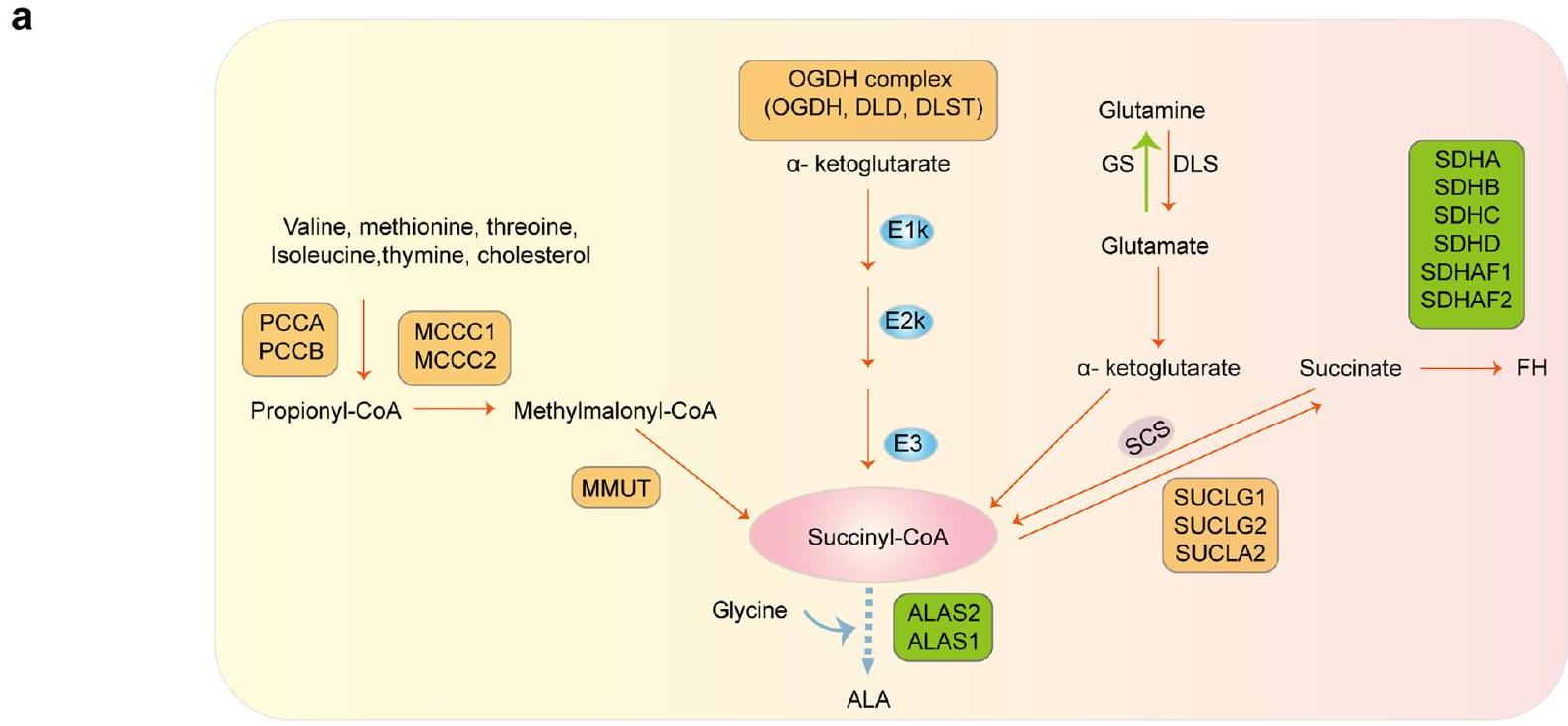
في الدراسة الحالية، نوضح أن التعبير العالي عن OGDH وSCS وSDH في خلايا الورم يسرع من استهلاك السكسينيل-CoA، ويثبت PD-L1 ويقمع الاستجابات المناعية المضادة للورم. إن السكسينيلation لـ PD-L1 يؤدي إلى تحللها عبر المسار الإندوسومي-الليزوزومي، مما يعزز السُميّة الخلوية. CPT1A، وهو سكسينيل ترانسفيراز، يتوسط في سكسينيل PD-L1، مما يعزز تحلله ويسهل CD8 تنشيط الخلايا. تعتبر مستويات التعبير المشتركة لـ CPT1A و PD-L1 علامة تشخيصية، مما يحسن الدقة التنبؤية للاستجابة لعلاج الأجسام المضادة أحادية النسيلة المضادة لـ PD-1. تحدد الدراسة الحالية علامة حيوية محتملة لفعالية حجب نقاط التفتيش المناعية وتقترح استراتيجية علاجية جديدة لعلاج السرطان.

النتائج

السكسينيل-CoA يشكل المناعة المضادة للأورام

تم تحليل بيانات البروتيوم للأفراد المصابين بالميلانوما الذين تم علاجهم بالعلاج المناعي لاستكشاف دور استقلاب الميتوكوندريا في مناعة الورم. ارتبط التعبير العالي عن دورة حمض ثلاثي الكربوكسيل (دورة TCA) ومسارات الفسفرة التأكسدية (OXPHOS) بتحسن في التوقعات (الشكل 1أ) واستجابة أفضل للعلاج المناعي (الشكل البياني الموسع 1أ). كانت الإنزيمات المشاركة في OXPHOS ودورة TCA مرتبطة إيجابيًا بتسلل الخلايا المناعية وتنشيطها. الخلايا على كل من المستويات النسخية والبروتينية (الشكل 1ب والشكل البياني الممتد 1ب)، مما يشير إلى وجود صلة بين الأيض المؤكسد في خلايا الورم والمناعة المضادة للورم. المفتاح
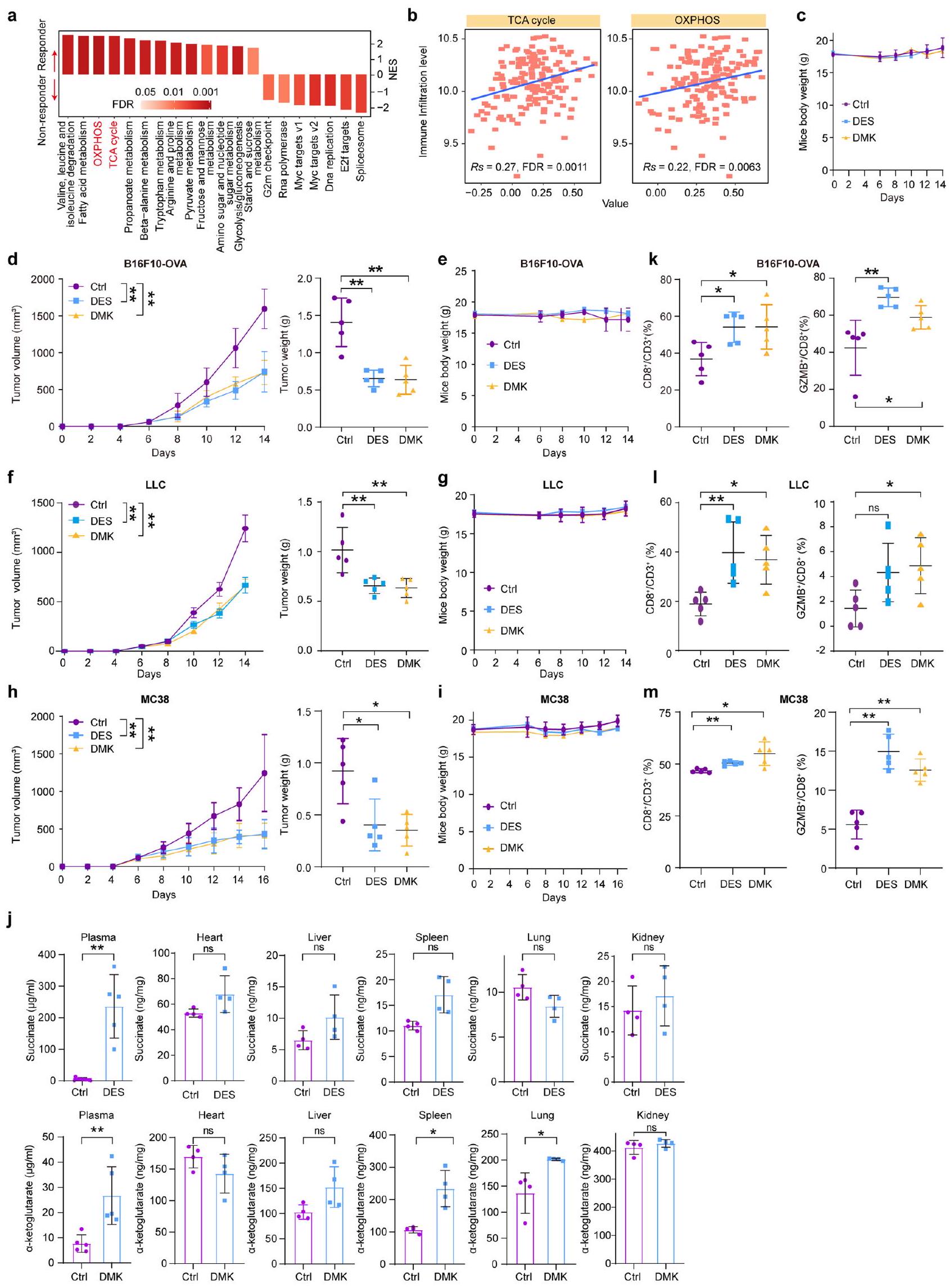
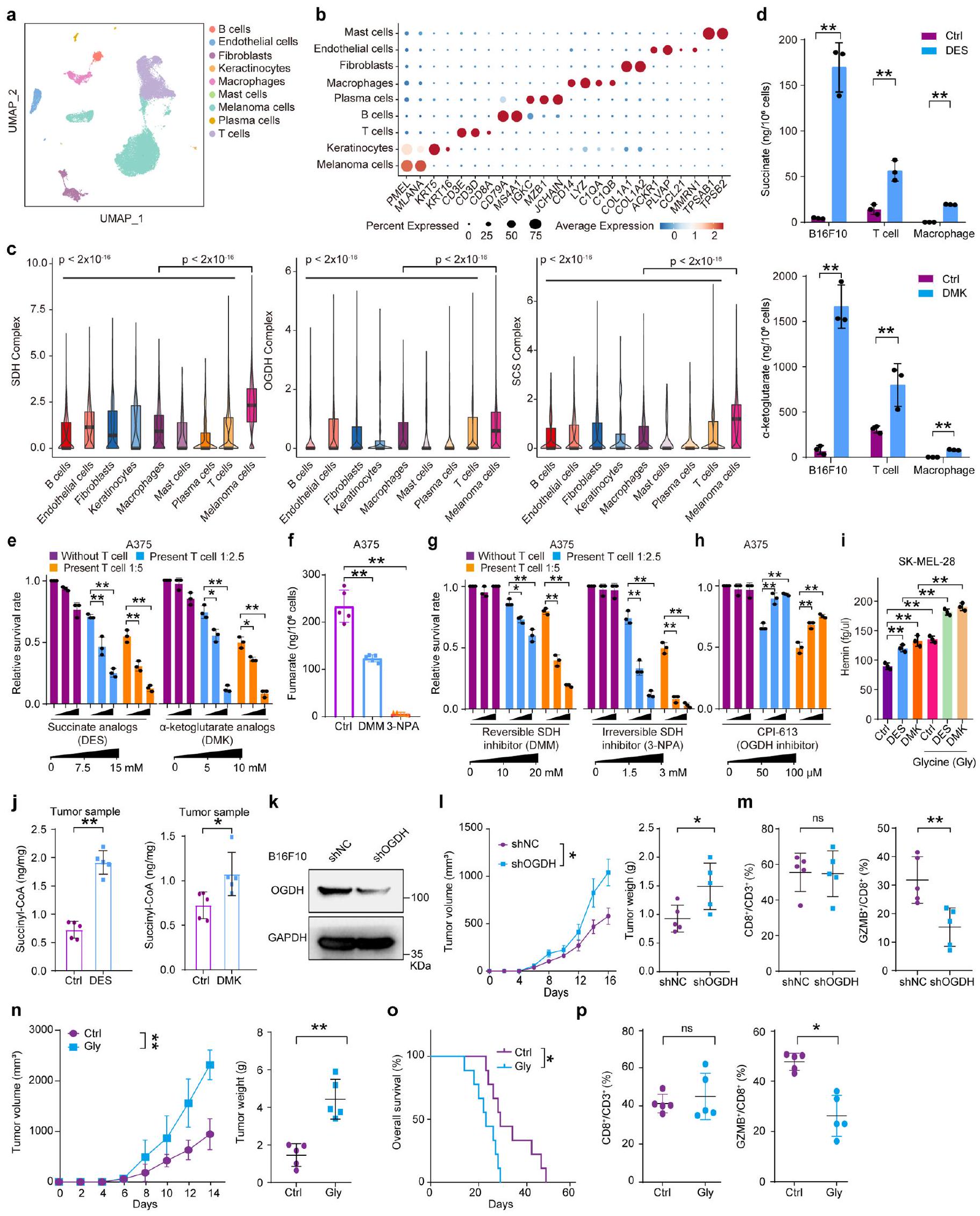
كانت الإنزيمات التي تربط دورة TCA وOXPHOS (OGDH وSCS وSDH؛ ملاحظة إضافية) وفيرة في المستجيبين للعلاج المناعي وارتبطت بنتائج أفضل (الشكل 1c). كان المرضى الذين لديهم تعبير عالٍ عن جميع الإنزيمات الثلاثة (Three_Complex_high) أكثر احتمالًا للاستجابة للعلاج المناعي وكان لديهم توقعات أفضل بشكل ملحوظ (الشكل 1d,e). أشارت هذه الملاحظات إلى أن التعبير العالي عن الإنزيم قد يؤدي إلى مستويات غير طبيعية من المستقلبات، مثل AKG أو السكسينات، مما يساهم في مناعة الورم. في الفئران المناعية السليمة، التي تم علاجها بـ AKG (ثنائي ميثيل -كيتوجلوتارات (DMK) وسكسينات (دي إيثيل سكسينات (DES)) قاما بتقليل نمو الأورام في الميلانوما (B16F10 أو B16F10-OVA) وسرطان القولون (MC38) وسرطان الرئة (LLC) دون التأثير على وزن الجسم (الشكل 1f، الشكل التمديدي 1c-i والملاحظة التكميلية) وزيادة البقاء على قيد الحياة (الشكل 1g). أظهرت تحليلات ما بعد العلاج زيادة في مستويات السكسينات وAKG في الأورام والبلازما، مع تغييرات طفيفة في الأعضاء الأخرى (الشكل 1h، الشكل التمديدي 1j والملاحظة التكميلية)، مما يشير إلى أن هذه النظائر، على الرغم من دخولها غير المحدد إلى الخلايا، قد تمارس تأثيرات مميزة اعتمادًا على الملفات الأيضية الداخلية للخلايا المختلفة. أظهرت قياسات التدفق الخلوي زيادة في تسلل الخلايا والمفعلة خلايا (الشكل 1i والشكل الإضافي 1k-m.)، ولكن لم تحدث تغييرات كبيرة في خلايا الكبت المشتقة من النخاع، أو خلايا T التنظيمية، أو البلعميات (الشكل الإضافي 2a). كشفت تقنية المناعية النسيجية المتعددة الفلورية (mIHC) عن زيادة في الخلايا اللمفاوية التائية السامة للخلايا (CTLs) بعد علاج DES و DMK (الشكل 1j؛ الملاحظة التكميلية). على الرغم من أن الدراسات السابقة ربطت بين السكسينات و AKG واستقطاب البلعميات لم تُلاحظ أي تغييرات في البلعميات من أنسجة مختلفة (الشكل البياني الممتد 2ب). لم يؤثر استنفاد البلعميات باستخدام ليفوسومات الكلودرونات على فعالية DES أو DMK (الشكل البياني الممتد 2ج، د). كما أن العلاج بمثبط SDH ثنائي ميثيل مالونات (DMM) قمع نمو الورم، ونشط تظهر خلايا T والبقاء المطول (الشكل البياني الممتد 2e-g)، مما يشير إلى أن استقلاب AKG إلى السكسينات أمر حاسم للمناعة المضادة للأورام. تجارب إضافية باستخدام مضاد CD8 أجسام مضادة لاستنفاد CD8 أظهرت خلايا T عدم وجود تأثير كبير على نمو الورم عند علاجها بـ DES أو DMK (الشكل 1k والشكل الإضافي 2h,i)، حيث كانت الجرعات العالية تثبط تكاثر الخلايا في المختبر (الشكل الإضافي 2j). كشفت التحليلات المكانية وتحليل التعبير الجيني على مستوى الخلية الواحدة لسرطان الجلد عن تعبير مرتفع لـ OGDH و SCS و SDH في خلايا الورم الخبيثة (Mal) مقارنةً بحدود الورم (Bdy) والخلايا غير الخبيثة (nMal) (الشكل 11، الشكل الإضافي 3a-c والشكل التكميلية 1)، مما يشير إلى أن نظائر المستقلبات تؤثر بشكل أساسي على خلايا الورم مباشرة.
لتقييم تأثيرات DES و DMK على أنواع الخلايا المختلفة، تم زراعة خلايا الورم وخلايا المناعة من الفئران معًا ومعالجتها بهذه المركبات. أظهرت التحليلات أن مستويات السكسينات و AKG كانت مرتفعة بشكل ملحوظ في خلايا الورم مقارنة بخلايا المناعة (الشكل 3d من البيانات الموسعة). لذلك، من المحتمل أن DES و DMK قد تعززان المناعة المضادة للورم من خلال زيادة هذه المستقلبات في خلايا الورم. للتحقيق بشكل أعمق، تقوم هذه النظائر، مثبطات SDH و OGDH، بتعديل تدفق المستقلبات وزيادة مستويات السكسينات أو AKG داخل الخلايا.
الشكل 1| يشكل السكسينيل-CoA المناعة المضادة للورم. أ، أظهر تحليل الانحدار الأحادي لكوكس أن موسوعة كيوتو لعلم الجينات والجنوم (KEGG) ومسارات السمات المميزة للسرطان مرتبطة ببقاء المرضى المصابين بالميلانوما. المرضى). E2F، عامل ربط المحفز E2. ب، خرائط الحرارة التي تظهر ارتباط سبيرمان بين OXPHOS أو دورة TCA و CD8 الخلايا التائية استنادًا إلى بيانات TCGA، مع قوة الارتباط ( ) والأهمية (FDR) المشار إليها. ج، أعلى، ثمانية إنزيمات حيوية تدفع دورة حمض الستريك والتنفس الخلوي. في المنتصف، اختلافات التعبير البروتيني لهذه الإنزيمات في المستجيبين السريريين (Rs، المرضى) وغير المستجيبين (NRs، المرضى). أقل، ارتباطات هذه الإنزيمات مع بقاء المرضى عبر نماذج كوكس أحادية المتغير. د، هـ، نسبة المرضى الذين لديهم استجابات علاجية مختلفة للعلاج المناعي (د) ومنحنيات كابلان-ماير التي تظهر البقاء على قيد الحياة (هـ) بين الثلاثة معقدات. المجموعات ومجموعات أخرى تتلقى علاج المناعة PD-1 أو الخلايا اللمفاوية المتسللة إلى الورم في مجموعة البروتيوميات ( قياسات حجم الورم بعد علاجات DMK أو DES في الفئران
الموت الخلوي المبرمج *
موت الخلايا المبرمج
*
أيض الأحماض الدهنية
**
**
استجابة IFNγ
**
*
**
**
استجابة IFNα
*
سبليسوسوم
نسخ الحمض النووي
دورة الخلية
عوامل النسخ الأساسية
أهداف Myc v1
أهداف E2F
مسار مراقبة الرنا المرسال
إصلاح الاقتطاع النووي
□ – استقلاب الأدوية، إنزيمات أخرى *
إصلاح الحمض النووي
ب


(الشكل 1م، ن)، تليها تجارب قتل الخلايا التائية (الملاحظة التكميلية). أظهرت DES أو DMK زيادة في السمية الخلوية المعتمدة على الخلايا التائية، كما هو موضح بواسطة صبغة الكريستال البنفسجي، في حين لم تتأثر تكاثر الورم في غياب الخلايا التائية (الملاحظة التكميلية والشكل الممتد 3هـ). تم العلاج بمثبط SDH القابل للعكس DMM والمثبط غير القابل للعكس حمض 3-نيتروبروبيونيك (3-NPA)، الذي يرتبط تساهميًا بمتبقية الأرجينين في النواة الحفازة للديهايدروجيناز السكسينيك A (SDHA) إلى تعطيل SDH، مما أدى إلى تراكم السكسينات داخل الخلايا، وانخفاض الفومارات وزيادة قتل خلايا الورم بواسطة خلايا T (الشكل 3f، g من البيانات الموسعة). ومع ذلك، فإن مثبط OGDH (CPI-613) قلل من السمية الخلوية لخلايا T، مما يشير إلى أن AKG يتم تحويله بواسطة OGDH إلى مستقلبات تالية تعزز من مناعة الورم (الشكل 3h من البيانات الموسعة). . من المحتمل أن تكون هذه المستقلبات هي السكسينيل-CoA والسكسينات، لأن السكسينات تزيد أيضًا من مستويات السكسينيل-CoA داخل الخلايا من خلال تفاعل عكسي يتم تحفيزه بواسطة SCS . بالإضافة إلى ذلك، يمكن أن يقلل الجلايسين من مستويات السكسينيل-CoA عبر مسار تخليق الهيم . أدى العلاج المشترك لخلايا الورم مع الجلايسين ومثبطات SDH (DMM و3-NPA)، وDES أو DMK إلى تثبيط كبير في سُمية الخلايا التائية (الشكل 1o). أكدت تقنية الكروماتوغرافيا السائلة-مطياف الكتلة (LC-MS) أن هذه العلاجات زادت من مستويات السكسينيل-CoA، في حين أن الجلايسين قلل من مستويات السكسينيل-CoA (الشكل 1p). كما زادت تخليق الهيم مع الجلايسين وDES أو DMK (البيانات الموسعة الشكل 3i والملاحظة التكميلية). أظهرت عينات الورم من الفئران المعالجة بـ DES وDMK زيادات كبيرة في السكسينيل-CoA (البيانات الموسعة الشكل 3j). أدى تقليل OGDH أو إعطاء الجلايسين إلى تعزيز نمو الورم وقمع تنشيط خلايا T في الجسم الحي (الشكل الإضافي 3k-p). تشير هذه النتائج إلى أن زيادة مستوى السكسينيل-CoA داخل الخلايا تعزز من المناعة المضادة للأورام التي تعتمد على خلايا T.

زاد السكسينيل-CoA من نشاط خلايا CTL عن طريق تقليل PD-L1 في خلايا السرطان

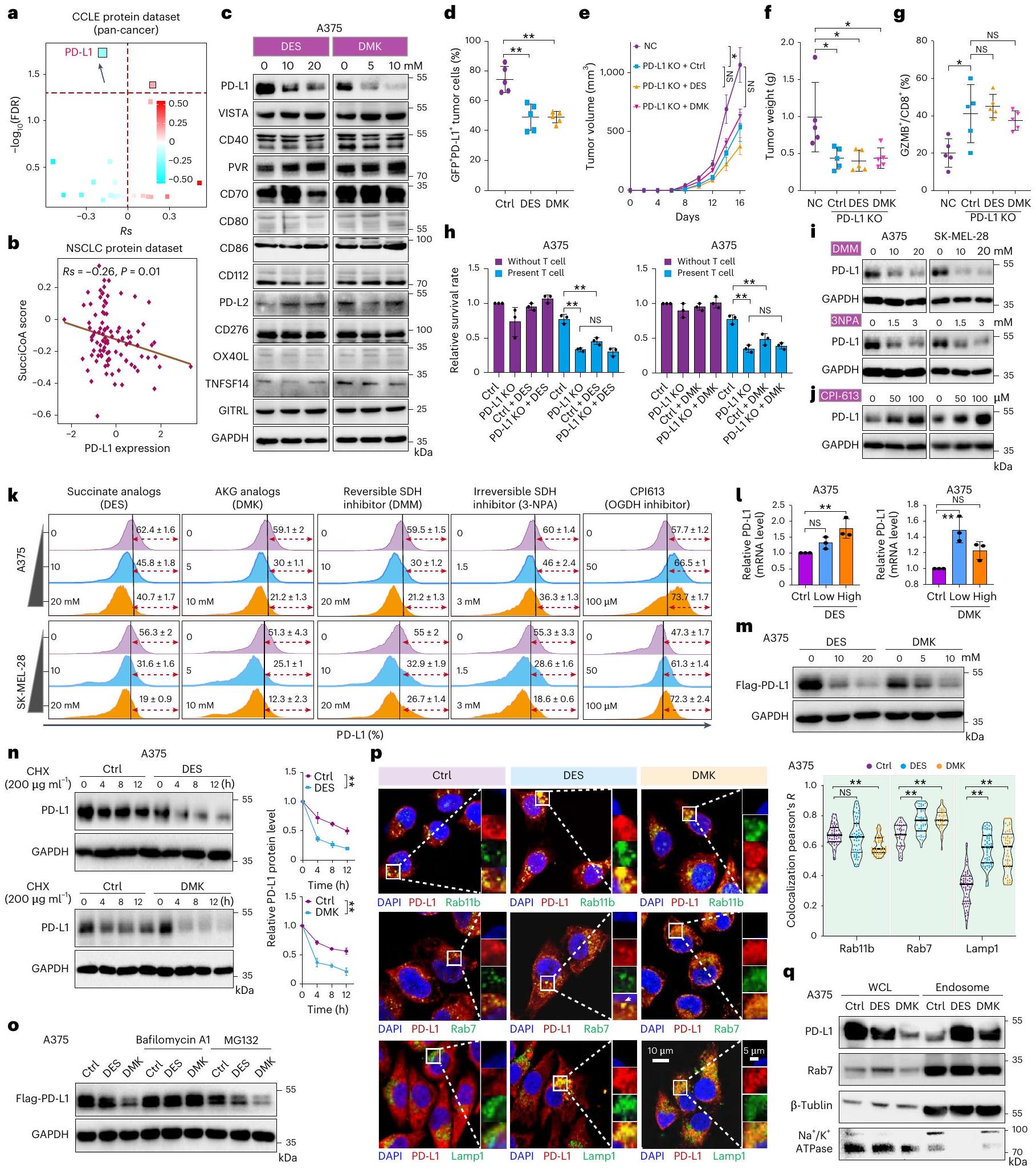
يتم تصنيع السكسينيل-CoA من خلال إزالة الكربوكسيل المحفزة بواسطة OGDH من AKG أو التحويل العكسي للسكسينات بواسطة SCS. تعمل الأحماض الأمينية مثل الفالين، والميثيونين، والثريونين، والإيزوليوسين كمواد سابقة. خلال عملية استقلاب الأحماض الأمينية، يتم كربوكسيل بروبيونيل-CoA لتكوين D-ميثيلمالونيل-CoA، والذي يتم تحويله بعد ذلك إلى سوكسينيل-CoA عبر فيتامين. إعادة ترتيب تعتمد على لاستكشاف العلاقة بين السكسينيل-CoA ومناعة الورم، تم تطوير مؤشر (درجة SucciCoA؛ ملاحظة إضافية) لتقدير محتوى السكسينيل-CoA في الأورام (الشكل 4a من البيانات الموسعة). أظهرت تحليل الارتباط وجود درجة SucciCoA أعلى في غير المستجيبين للعلاج المناعي (الشكل 4b من البيانات الموسعة) ونتائج بقاء أسوأ في المرضى الذين لديهم درجات مرتفعة (الشكل 4c، d من البيانات الموسعة). ومن الجدير بالذكر أنه تم ملاحظة ارتباط سلبي بين مستويات PD-L1 وإنتاج السكسينيل-CoA في بيانات البروتيوم من قاعدة بيانات موسوعة خلايا السرطان (CCLE) (الشكل 2a). الذي وُجد أيضًا في سرطان الرئة غير صغير الخلايا (NSCLC؛ الشكل 2ب). أدى العلاج بـ DES و DMK لزيادة مستويات السكسينيل-CoA إلى تقليل يعتمد على الجرعة في PD-L1، دون تأثير على نقاط التفتيش المناعية الأخرى (الشكل 2ج). تشمل نظائر المستقلبات لدورة TCA، بما في ذلك ثنائي ميثيل الفومارات (DMF)،
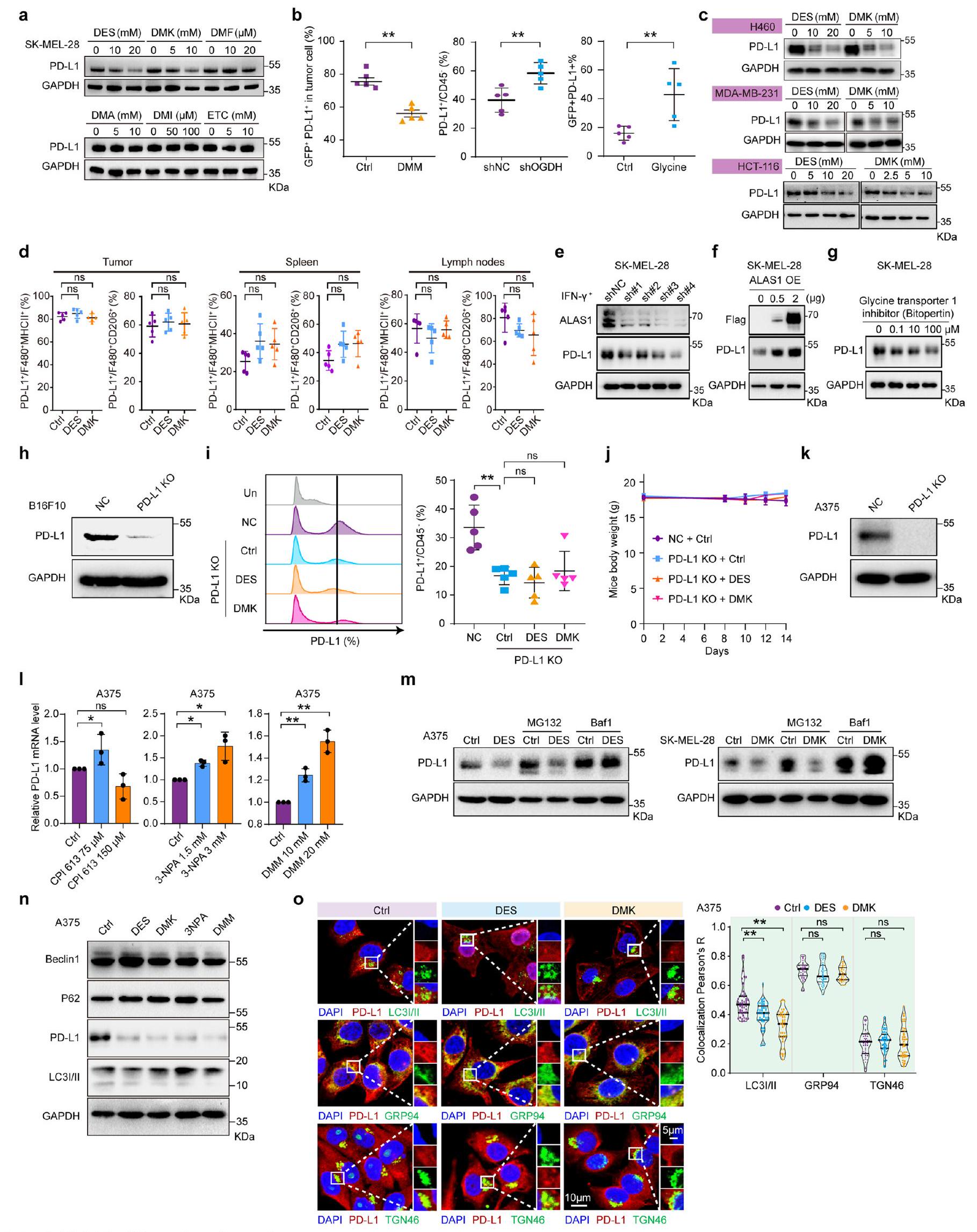
تم اختبار ثلاثي إيثيل سيترات، الإيتاكونات والماليات، ووجد أن DES و DMK فقط هما اللذان خفضا مستويات بروتين PD-L1 (الشكل التمديدي 5a). بالإضافة إلى ذلك، أدى العلاج بـ DES و DMK و DMM إلى خفض PD-L1 في أنسجة الأورام لدى الفئران، ولكنه زاد من PD-L1 في الفئران التي تم فيها تقليل OGDH وعولجت بالجلايسين (الشكل 2d والشكل التمديدي 5b). لوحظت تأثيرات مشابهة في أنواع أخرى من السرطان، ولكن لم يُلاحظ أي تأثير في البلعميات التي تعبر عن PD-L1 (الشكل التمديدي 5c، d). لتوضيح ما إذا كان DES أو DMK ينظم PD-L1 عبر السكسينيل-CoA، تم تقليل ALAS1 ( الإنزيم -أمينوليفولينيك سينثاز 1، وهو إنزيم محدد للسرعة في تخليق الهيم، يقوم بتكثيف السكسينيل-CoA والجليسين لتكوين الأمينوليفولينيك، والذي يزيد من مستوى السكسينيل-CoA، ويقلل من مستويات PD-L1، في حين أن التعبير المفرط عن ALAS1 كان له تأثير عكسي (الشكل 5e، f من البيانات الموسعة). كما أدى تثبيط نقل الجليسين إلى تقليل PD-L1، مما يشير إلى أن زيادة السكسينيل-CoA تقلل من PD-L1 (الشكل 5g من البيانات الموسعة). أظهرت تجارب تكوين الأورام في الفئران المعدلة وراثيًا (KO) لـ PD-L1 أن DES و DMK قاما بتثبيط نمو الورم وزيادة تنشيط الخلايا، دون أي تأثيرات إضافية في مجموعة PD-L1KO (الشكل 2e-g والبيانات الموسعة الشكل. تشير هذه النتائج إلى أن تأثيرات DES و DMK المضادة للورم تتوسطها CD8 ترافق خلايا T مع انخفاض مستويات PD-L1. أظهرت تجارب إضافية مع PD-L1 KO أن DES و DMK لم تعزز قتل خلايا T (الشكل 2h والشكل الإضافي 5k). بالإضافة إلى ذلك، أدت مثبطات SDH (3-NPA و DMM) إلى انخفاض مستويات PD-L1، في حين أن مثبط OGDH، CPI-613، زاد من تعبير PD-L1 (الشكل 2i-j). أكدت قياسات التدفق الخلوي هذه النتائج، حيث أظهرت انخفاض تعبير PD-L1 على الغشاء بعد العلاج بمثبطات SDH و DES و DMK، في حين زادت CPI-613 من مستويات PD-L1 (الشكل 2k).
للتحقيق في كيفية تنظيم هذه المستقلبات لمستويات PD-L1، تم تحليل تعبير RNA الرسول لـ PD-L1 بعد العلاج بـ DES أو DMK. زاد كل من DES و DMK من مستويات mRNA لـ PD-L1، مشابهًا لـ 3-NPA و DMM، في حين لم يكن لـ CPI-613 تأثير ملحوظ (الشكل 21 والشكل الممتد 51). في خطوط الخلايا ذات التعبير المستقر لـ PD-L1، أدى علاج DES و DMK إلى تقليل أكثر وضوحًا في مستويات بروتين PD-L1 مقارنة بمستويات mRNA (الشكل 2m). علاوة على ذلك، أظهر اختبار مطاردة السيكلوهكسيميد (CHX) أن علاج DES و DMK قلل من عمر النصف لـ PD-L1 (الشكل 2n). تم عكس هذا الانخفاض في البروتين بواسطة بافيلوميسين A1، وهو مثبط لتحلل الليسوزوم، ولكن ليس بواسطة مثبط البروتيازوم MG132 (الشكل 2o). لوحظت نتائج مماثلة في خطوط خلايا A375 أو SK-Mel-28 مع الإنترفيرون (IFN). تعبير PD-L1 الناتج عن – (الشكل 5m من البيانات الموسعة)، مما يشير إلى أن تقليل PD-L1 الذي يتم بوساطة السكسينيل-CoA يحدث بشكل أساسي على مستوى البروتين.
يتم تصنيع PD-L1 في الشبكة الإندوبلازمية (ER) وينتقل إلى غشاء الخلية عبر جهاز جولجي، حيث يخضع إما لإعادة تدوير حويصلات الإندوسوم أو للتحلل في الليزوزوم. يمكن أيضًا تحللها عبر مسار البلعمة الذاتية – الليسوسوم لفحص التغيرات في الالتهام الذاتي بعد العلاج، تم تحليل العلامات الرئيسية للالتهام الذاتي. انخفضت مستويات LC3 I أو II، بينما ظلت مستويات p62 و beclin1 دون تغيير (الشكل البياني الممتد 5n). أظهر تحليل المناعة الفلورية عدم وجود زيادة في التوطن المشترك لـ PD-L1 مع LC3 (الشكل البياني الممتد 50)، مما يشير إلى أن تحلل PD-L1 الذي تم تحفيزه بواسطة
الشكل 2 | زاد السكسينيل-CoA من نشاط CTL من خلال تقليل PD-L1.
معامل ارتباط رتب سبيرمان بين درجة SucciCoA ونقاط التفتيش المناعية في مجموعة بيانات خطوط خلايا السرطان من قاعدة بيانات CCLE خطوط الخلايا) أو في مجموعة بروتين NSCLC ( ; المرضى). تحليل Western blot لبروتين PD-L1 ونقاط التفتيش المناعية الأخرى في خلايا A375 المعالجة بـ DES أو DMK ). تم قياس تعبير PD-L1 في خلايا الورم بواسطة تحليل تدفق الخلايا في الفئران الحاملة لورم B16F10 المعالجة بـ DES أو DMK ( لكل مجموعة). حجم الورم تم قياسه في الفئران التي تم حقنها بخلايا B16F10 المستقرة في KO PD-L1، المعالجة بـ DES أو DMK ( لكل مجموعة). ف، وزن الورم الذي تم قياسه بعد euthanasia للفئران ( لكل مجموعة). تQuantification of خلايا CTL في الأورام لكل مجموعة). صبغة الكريستال البنفسجي لخلايا A375 WT و PD-L1 KO التي تم زراعتها مع خلايا T المنشطة مع أو بدون DES أو DMK ( ). تحليل Western blot لمستويات بروتين PD-L1 في خلايا A375 و SK-MEL-28 المعالجة بمثبطات SDH (DMM، 3-NPA) (i) أو مثبط OGDH (CPI-613؛ j) ). ك، غشاء
هذه المركبات ليست معتمدة على الالتهام الذاتي. إشارات المناعة الفلورية لـ PD-L1 في الشبكة الإندوبلازمية (GRP94) جهاز جولجي (TGN46) والأجسام الحويصلية الدائرية (Rab11) لم تظهر أي اختلافات ملحوظة بعد علاج DES أو DMK. ومع ذلك، كان توطين PD-L1 في الأجسام الكيسية المتأخرة (Rab7) والليزوزومات (Lamp1) تم زيادة (الشكل 2p، الشكل الإضافي 50 والشكل التكميلية 2). بالإضافة إلى ذلك، كشفت عزل الحويصلات الخلوية عن زيادة في محتوى PD-L1 في الحويصلات بعد علاجات DES و DMK، مما يتماشى مع نتائج الفلورية.
(الشكل 2q). تشير هذه النتائج إلى أن زيادة مستوى السكسينيل-CoA داخل الخلايا تعزز تحلل PD-L1 عبر المسار الحويصلي-الليزوزومي.

تحفيز التحلل لبروتين PD-L1 عند Lys129
يعتبر السكسينيلation تعديلًا فريدًا للبروتينات. على عكس الميثيليشن (14 دالتون) والأسيتيلation (40 دالتون)، فإن السكسينيلation (100 دالتون) يسبب تغييرًا ملحوظًا في الكتلة ويحول الشحنة الموجبة إلى سالبة، مما يؤثر على تنظيم وظيفة البروتين. كلا من السكسينات و AKG يرفعان

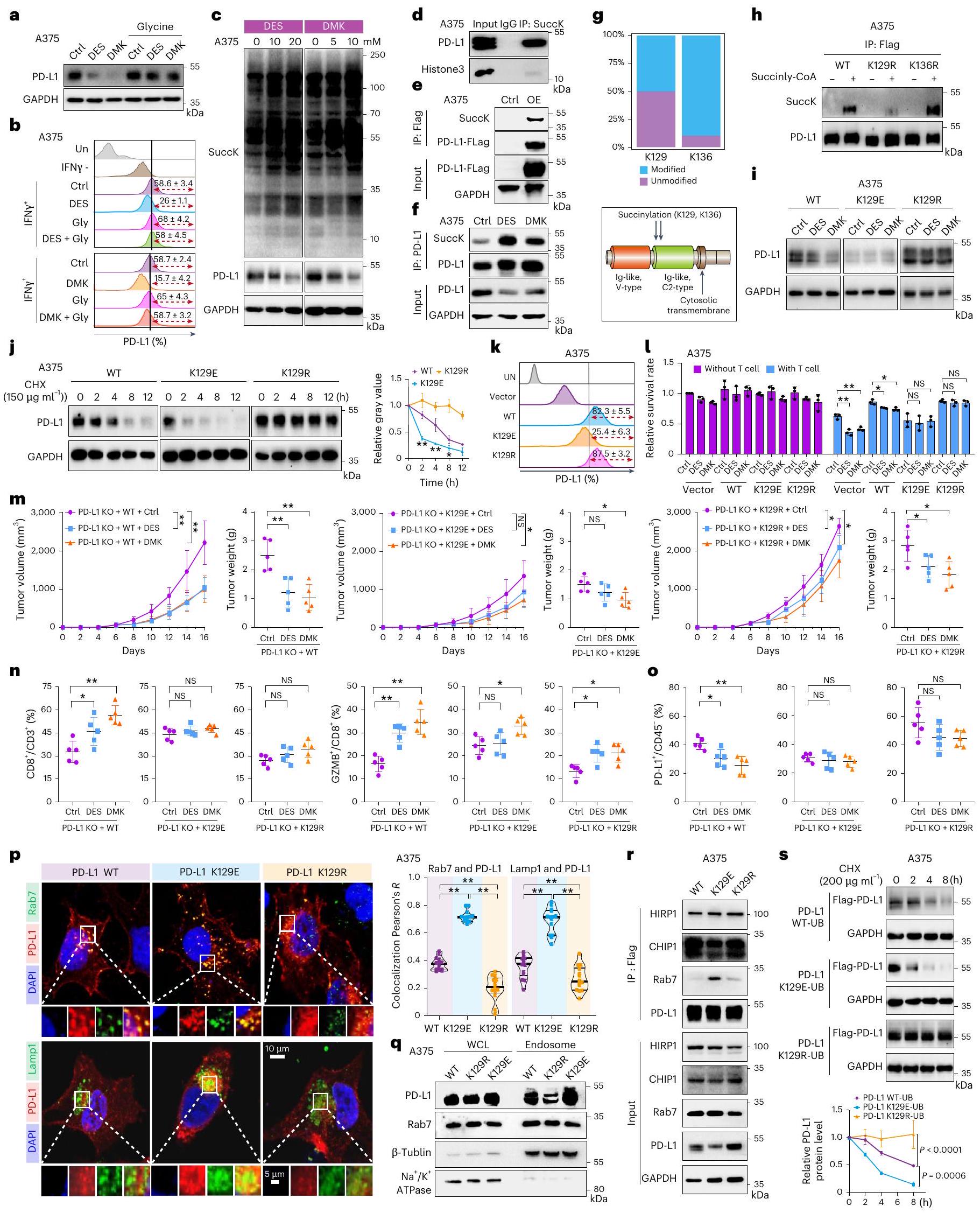
الشكل 3 | يؤدي استبدال السكسينيل لموقع ليسين 129 في PD-L1 إلى تحلله. أ، ب، مستويات PD-L1 في خلايا A375 المعالجة بـ DES أو DMK، ومع أو بدون جلايسين تم تحليلها بواسطة تقنية الويسترن بلوت (أ) وقياس التدفق الخلوي (ب) ( ). ج، علاج DES أو DMK الذي يحفز السكسينيل في البروتينات الكلية في خلايا A375، تم الكشف عنه بواسطة أجسام مضادة شاملة للسكسينيل مع PD-L1 كتحكم إيجابي. د، تم الكشف عن السكسينيل الداخلي وPD-L1 بواسطة تقنية الويسترن بلوتينغ في خلايا A375 ( ). تم عزل PD-L1 المسمى بعلم خارجي (OE) وتحليل السكسينيل بواسطة جسم مضاد للسكسينيلين الشامل ). تم تقييم مستويات السكسينيل في PD-L1 في خلايا A375 بعد علاج DES أو DMK. ج، إحصائيات الببتيدات المحددة لموقع السكسينيل في PD-L1 والنمط الهيكلي لـ PD-L1. ح، تم التعبير عن PD-L1 العادي والمتحور مع علامة العلم في خلايا A375، وتم حضنها مع سكسينيل-CoA وتحليلها من أجل السكسينيل. ). تحليل Western blot لمستخلص البروتين الكلي من خلايا A375 التي تعبر عن PD-L1 WT أو الطفرات Lys129Arg (K129R) أو Lys129Glu (K129E)، المعالجة بـ DES أو DMK . التحليل الغربي لخلايا A375 التي تعبر عن طفرات PD-L1 المعالجة بـ CHX، مع تقدير مستويات PD-L1 ).
مستويات غشاء PD-L1 للطفرات تم قياسها بواسطة تحليل تدفق الخلايا ). قمت بتربية طفرات PD-L1 مع خلايا T. تم تقييم بقائها من خلال صبغة الكريستال البنفسجي ( ). نمو الورم )، قياس ، تسلل CTL (ن) وتعبير PD-L1 (o) تم تقييمه في نماذج الفئران B16F10 التي تم حقنها بخلايا PD-L1 عادية أو متحورة تم علاجها بـ DES أو DMK لكل مجموعة). تألق المناعة لتواجد PD-L1 مع Rab7 وLamp1. تم قياس التواجد المشترك. مقياس الرسم، 10 أو تحليل Western blot لكسور الإندوسومات من خلايا A375 التي تم نقلها بـ PD-L1 WT أو الطفرات ). PD-L1، تم الكشف عن مستويات ATPase وRab7 في الحويصلات الداخلية والمستخلصات الكاملة، مع -توبولين كعنصر تحكم في التحميل. r، IP لـ PD-L1 WT والطفرات مع HIRP1 و CHIP1 و Rab11 و Rab7. s، تحليل Western blot لـ A375 WCL التي تعبر عن PD-L1 WT-UB أو K129R-UB أو K129E-UB الطفرات، المعالجة بـ CHX لأوقات مختلفة. للحصول على تفاصيل حول التصور والإحصائيات وإمكانية التكرار، انظر الطرق. لاحظ، في يمثل عينات مستقلة بيولوجيًا، وفي اللوحات الأخرى، تجارب مستقلة.
مستويات السكسينيل-CoA، وزيادة السكسينيل في البروتين علاج الجلايسين يعيد مستويات بروتين PD-L1 وتوزيعه على الغشاء بعد علاج DES وDMK من خلال تقليل السكسينيل-CoA (الشكل 3أ، ب). لوحظت زيادة في سكسينيل البروتين باستخدام جسم مضاد شامل يتعرف على سكسينيل الليسين (الشكل 3ج) وأكدت اختبارات الترسيب المناعي (IP) سكسينيل PD-L1 بعد علاج DES أو DMK (الشكل 3د-و والملاحظة التكميلية). كان هذا متسقًا عبر خطوط خلايا ورمية أخرى (الشكل التمديدي 6أ). حددت LC-MS موقعين للسكسينيل على PD-L1، عند الليسينات Lys129 وLys136 (الشكل 3ز والشكل التمديدي 6ب). أظهرت الطفرات في PD-L1 التي تم استبدال Lys129 بالأرجينين سكسينيل أقل (الشكل 3ح). استبدال Lys129 بالجلوتامات mimicked السكسينيل، مما أدى إلى تقليل مستويات PD-L1، بينما لم يكن لـ Lys129Arg (K129R) أي تأثير من هذا القبيل (الشكل 3ط)، مما يشير إلى أن DES وDMK تستهدفان بشكل أساسي Lys129. الطفرة Lys129Glu (K129E) قللت من نصف عمر PD-L1، بينما Lys129Arg (K129R) زادته (الشكل 3ي). لم تؤثر الطفرة في مواقع الليسين Lys136 على استقرار PD-L1 (الشكل التمديدي 6ج). أظهرت قياسات التدفق الخلوي انخفاض مستويات PD-L1 على الغشاء في الطفرة K129E (الشكل 3ك). منع علاج التونيكاميسين الجليكوزيل (الشكل التمديدي 6د، هـ) ولم يغير موقع PD-L1 في الشبكة الإندوبلازمية وجهاز جولجي تأثير K129E على PD-L1 (الشكل التمديدي 6و، ز)، مما يشير إلى أن الجليكوزيل ليس له دور في تنظيم السكسينيل على PD-L1.
تم إجراء اختبارات قتل خلايا T لتحديد ما إذا كانت DES و DMK تؤثر على PD-L1 عبر السكسينيلation في موقع Lys129. عززت طفرة K129E قتل خلايا T لخلايا الورم، في حين أن الطفرات PD-L1 من النوع البري (WT) و K129R منعت قتل خلايا الورم بواسطة خلايا T. ومع ذلك، فإن علاج DES أو DMK عزز بشكل كبير قتل الورم بواسطة خلايا T في مجموعة PD-L1 WT، دون تأثيرات ملحوظة في مجموعات K129E أو K129R (الشكل 3I). في الجسم الحي، أظهرت الخلايا التي تعبر عن PD-L1 من النوع البري أو الطفرات، بعد KO PD-L1 الداخلي، أن الإفراط في التعبير عن PD-L1 WT عزز نمو الورم. نمت الأورام التي تعبر عن الطفرة K129R بشكل أسرع من تلك التي تحتوي على PD-L1 WT، في حين أن الطفرة K129E أبطأت النمو. قمع علاج DES أو DMK نمو الورم في خلايا تعبر عن PD-L1 WT بشكل مفرط، ولكن كان له تأثير ضئيل في Lys129.
مجموعات الطفرات (الشكل 3م). كلا من مجموعتي PD-L1 WT و K129R قاما بتثبيط تنشيط خلايا T، مع زيادة تنشيط العلاج بـ DES أو DMK ت decreased في مجموعة WT، ولكن بشكل طفيف فقط في مجموعتي K129R و K129E (الشكل 3n). انخفضت مستويات PD-L1 في الأورام بعد علاج DES أو DMK في مجموعة WT، ولكن ليس في المجموعات الطافرة (الشكل 30).
لتوضيح دور Lys129 في تحلل PD-L1 في الجسيمات الحالة، أظهر تحليل المناعة الفلورية لموقع الطفرات في PD-L1 انخفاضًا في التداخل بين الطفرة K129R وRab7 وزيادة في تواجد K129E مع الجسيمات المتأخرة والجسيمات الحالة (الشكل 3p). أكدت عملية عزل الجسيمات النتائج، حيث أظهرت K129R انخفاضًا في التواجد الجسيمي وظهرت K129E بزيادة في التواجد (الشكل 3q). كشفت تجربة IP عن زيادة في ارتباط الطفرة K129E مع Rab7، ولكن لم يكن هناك تغيير ملحوظ في الارتباط مع بروتينات استقرار الغشاء الأخرى، مثل CHIP1 وHIRP1 (المراجع 28،36) (الشكل 3r).
تعتمد عملية التحلل داخل الحويصلات لـ PD-L1 على تعديله بمونوأوبيكويتين. لاستكشاف تأثير السكسينيل على المونويوبيكويتين لــ PD-L1، تم إضافة جزيء يوبكويتين إلى الطرف الكربوكسي لــ PD-L1 لمحاكاة المونويوبيكويتين (UB). أظهر عمر النصف لــ PD-L1-UB أن طفرة K129E قصرت من عمره النصفي، بينما أطالت K129R من عمره النصفي (الشكل 3s). تشير هذه النتائج إلى أن السكسينيل عند Lys129 قد يؤثر على تحلل PD-L1 المونويوبيكويتين في الحويصلات، متقدماً عبر معقد الفرز الحويصلي المطلوب للنقل، المرحلة المتأخرة من التحلل.

CPT1A يساهم في السكسينيلation لـ PD-L1
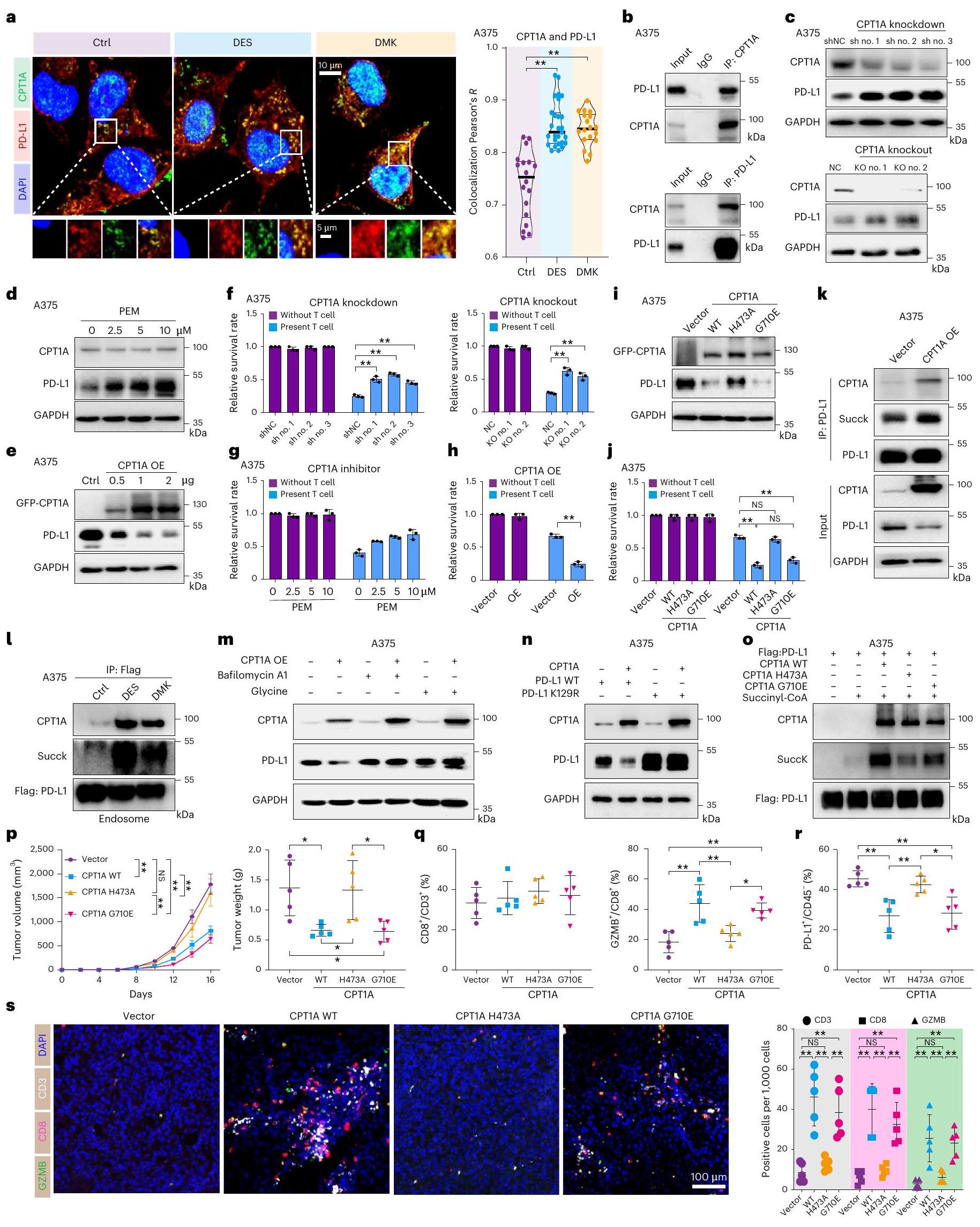
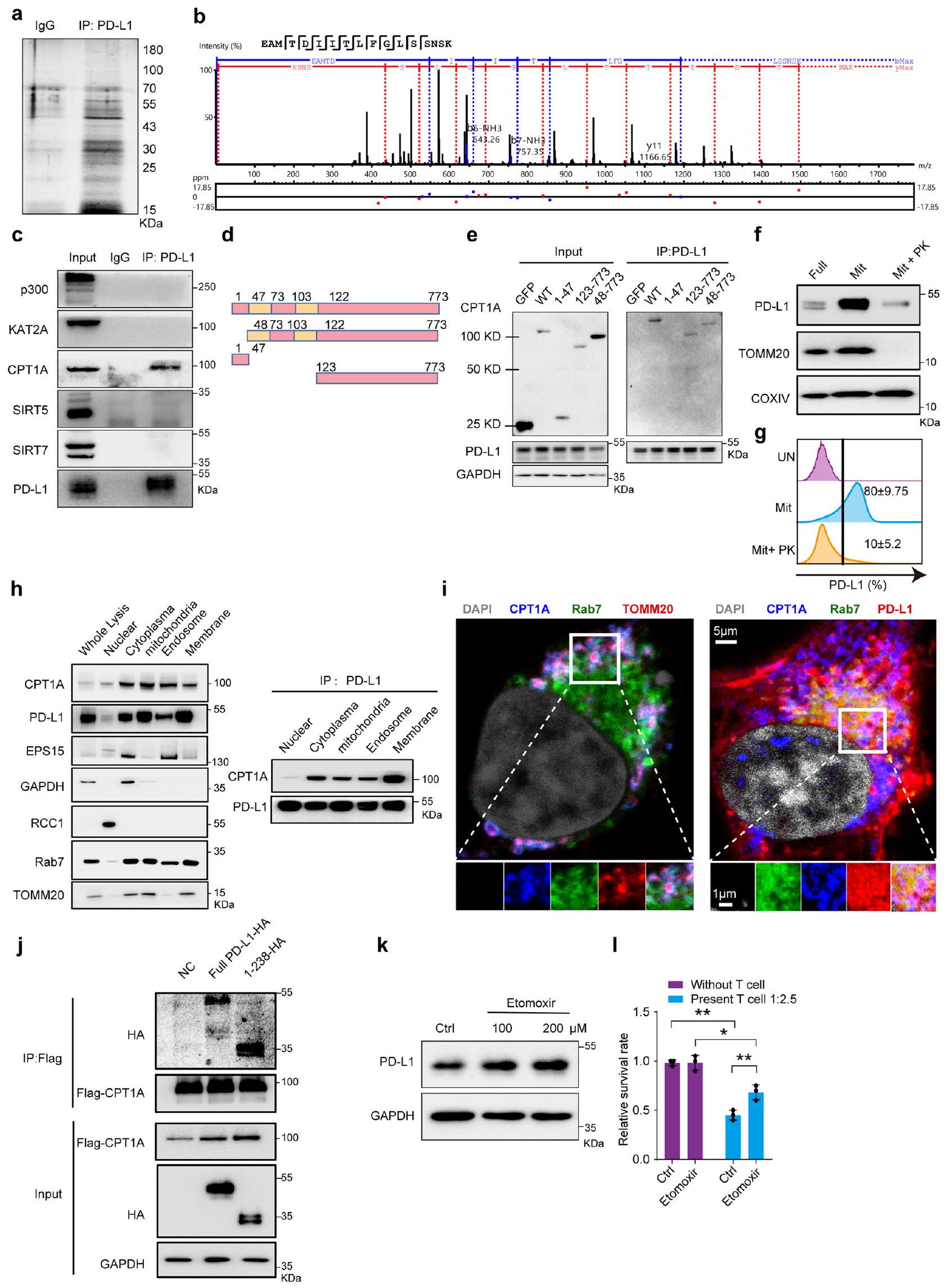
تم استخدام MS لتحديد البروتينات التي تتفاعل مع PD-L1، مما كشف عن ارتباطه بالسوكسينيل ترانسفيراز CPT1A (الشكل التوضيحي الممتد 7a، b والجدول التكميلي 1). أكدت تحليل المناعة الفلورية التوطين المشترك في السيتوبلازم بين PD-L1 وCPT1A (الشكل 4a). كما حدد تحليل IP تفاعلات بين PD-L1 وإنزيمات مرتبطة بالسوكسينيل، بما في ذلك الديسوكسينيلازات سرتوين 5 وسرتوين 7 والسوكسينيل ترانسفيرازات KAT2A وP300 (المرجع 10)، لكن فقط CPT1A ارتبط بشكل محدد بـ PD-L1، متفاعلاً مع منطقته الحفازة (الأحماض الأمينية 123-773) (الشكل 4b والشكل التوضيحي الممتد 7c-e).
الشكل 4 | CPT1A يساهم في السكسينيلation لـ PD-L1. أ، التوضع المشترك لـ PD-L1 مع CPT1A تم اكتشافه بواسطة التألق المناعي في خلايا A375 المعالجة أو غير المعالجة بـ DES أو DMK. ب، IP لـ CPT1A (أعلى) و PD-L1 (أسفل)، مع التحليل الغربي لاكتشاف كلا البروتينين. ج، التحليل الغربي لـ PD-L1 في خلايا A375 التي تم تقليل CPT1A أو KO. د، تثبيط نشاط CPT1A باستخدام PEM واكتشاف PD-L1 بواسطة التحليل الغربي. هـ، مستويات بروتين PD-L1 بعد التعبير الخارجي عن CPT1A. و، خلايا CPT1A التي تم تقليلها أو KO تم زراعتها مع خلايا T لمدة 24 ساعة، تليها صبغة الكريستال البنفسجي. .ج، تم معالجة خلايا A375 بـ PEM لمدة 24 ساعة، ثم تم زراعتها مع أو بدون خلايا T المنشطة لمدة 24 ساعة لتقييم تأثير القتل .ه، خلايا التعبير المفرط عن CPT1A تم زراعتها مع خلايا T لتقييم تأثير القتل ). التحليل الغربي لبروتين PD-L1 بعد التعبير المفرط عن الطفرات CPT1A وHis473Ala (H473A) وGly710Glu (G710E) ). ج، خلايا CPT1A WT والطافرة المزروعة مع خلايا T لتقييم تأثير القتل . تحليل التلطيخ الغربي لتأثير زيادة التعبير عن CPT1A على السكسينيلation لـ
PD-L1 ( ). 1، تأثير علاج DES أو DMK على السكسينيلation لـ PD-L1 وتعبير CPT1A في الحويصلات الداخلية ( ” ). م، خلايا التعبير المفرط لـ CPT1A المعالجة بـ bafilomycin A1 و glycine، تليها تقنية الويسترن بلوت للكشف عن PD-L1 ( ” ). ن، التعبير الخارجي لـ CPT1A مع PD-L1 WT أو Lys129Arg (K129R)، تلاه تحليل الغربي للكشف عن PD-L1 ( ). تم تنقية CPTA1 والطفرات التي تتفاعل مع PD-L1 في السكسينيل-CoA للكشف عن السكسينيلation لـ PD-L1 ). ب، نمو الورم في الفئران التي تم حقنها بخلايا B16F10 التي تعبر عن CPT1A WT أو H473A أو G710E ( لكل مجموعة). تQuantification of و خلايا CTL في كتل الورم لكل مجموعة). تحديد كمية PD-L1 في خلايا الورم باستخدام تقنية تحليل تدفق الخلايا لكل مجموعة). صبغة المناعة لـ CD3 و CD8 و GZMB في أورام B16F10 ( لكل مجموعة). شريط القياس، للحصول على تفاصيل حول التصور والإحصائيات وإمكانية التكرار، انظر الطرق. ملاحظة، في يمثل عينات مستقلة بيولوجيًا، وفي اللوحات الأخرى، تجارب مستقلة.
على الرغم من أن CPT1A يقع بشكل أساسي في الميتوكوندريا، إلا أن دراسة حديثة اقترحت وجود محتمل لـ PD-L1 في الميتوكوندريا. أظهر عزل الميتوكوندريا وهضم البروتيناز K انخفاضًا كبيرًا في كل من PD-L1 وعلامة الغشاء الخارجي للميتوكوندريا TOMM20 (ناقل الغشاء الخارجي للميتوكوندريا 20)، في حين أن البروتين داخل الميتوكوندريا COXIV (السيتوكروم ظل الوحدة الفرعية 4II من الأكسيداز غير متأثرة (الشكل 7f من البيانات الموسعة). أكدت قياسات التدفق الخلوي أيضًا أن المجال الخارجي لـ PD-L1 مكشوف للسايتوبلازم وانخفض بعد هضم البروتيناز K (الشكل 7g من البيانات الموسعة). أظهرت التحليلات المناعية عبر مكونات خلوية مختلفة تفاعلات PD-L1 وCPT1A في السايتوبلازم (باستثناء النواة) والغشاء الخلوي والحويصلات والميتوكوندريا (الشكل 7h من البيانات الموسعة). أكدت الفلورة المناعية موقعهما في الميتوكوندريا والحويصلات (الشكل 7i من البيانات الموسعة). تم تأكيد ارتباط الجزء الخارجي من PD-L1 (1-238) بـ CPT1A من خلال التحليل المناعي (الشكل 7j من البيانات الموسعة). أظهرت دراسة علاقة CPT1A بـ PD-L1 أن تقليل CPT1A أو إزالته زاد من تعبير PD-L1 (الشكل 4c) وأن العلاج بمثبطات CPT1A (ماليات بيرهيكسيلين (PEM) أو إيتوموكسيير) رفع مستويات PD-L1 (الشكل 4d والشكل 7k من البيانات الموسعة). قلل الإفراط في التعبير عن CPT1A من مستويات PD-L1 بطريقة تعتمد على الجرعة (الشكل 4e). كشفت اختبارات قتل الخلايا التائية أن انخفاض مستويات أو نشاط CPT1A أثر سلبًا على قتل خلايا الورم بواسطة الخلايا التائية، بينما زاد الإفراط في التعبير عن CPT1A من ذلك (الأشكال 4f-h والشكل 71 من البيانات الموسعة).
CPT1A WT، الطفرة His473Ala (H473A؛ غير نشطة) والطفرة Gly710Glu (G710E) (التي تحتفظ بنشاط السكسينيل ترانسفيراز) أظهرت أن CPT1A WT وG710E قللا من مستويات PD-L1، بينما لم يكن لـ H473A أي تأثير (الشكل 4i). تم تعزيز قتل خلايا T في الخلايا التي تحتوي على CPT1A WT أو G710E، ولكن ليس H473A (الشكل 4j). كما زاد الإفراط في التعبير عن CPT1A من سكسينيل PD-L1 (الشكل 4k) وتم تحديد التفاعل بين CPT1A وPD-L1 في الحويصلات الداخلية، مما زاد بشكل أكبر بواسطة علاج DES أو DMK (الشكل 4I). تم إنقاذ مستويات PD-L1 باستخدام بافيلوميسين A1 أو الجلايسين (الشكل 4m). قلل CPT1A من مستويات PD-L1 WT ولكن لم يكن له أي تأثير على الطفرة K129R (الشكل 4n). أظهر الاختبار في المختبر أن CPT1A WT وG710E زادا من سكسينيل PD-L1، مما يشير إلى أن CPT1A يعمل كـ سكسينيل ترانسفيراز لـ PD-L1 (الشكل 40 والملاحظة التكميلية).
أظهرت الدراسات داخل الجسم أن تقليل CPT1A أدى إلى تسريع نمو الورم، وعرقلة CD8 تنشيط خلايا T، انخفاض البقاء وزيادة مستويات PD-L1 (الشكل البياني الممتد 8a-f)، في حين أن زيادة التعبير عن CPT1A (WT وG710E) منعت نمو الورم وزادت تسلل الخلايا وتنشيطها (الشكل وتظهر البيانات الموسعة الشكل 8g، h). يرتبط ارتفاع تعبير CPT1A في الميلانوما بتوقعات أفضل وزيادة في النشاط الخلايا (الشكل البياني الممتد 8i,j). أدى الإفراط في التعبير عن CPT1A أيضًا إلى تقليل مستويات PD-L1 (الشكل 4r) وأكدت المIHC زيادة CD8 تسلل وتفعيل خلايا T (الشكل 4s).
أشارت دراسة سابقة إلى أن نقص CPT1A قد يؤثر على تقديم المستضدات. أظهرت تقنية تحليل تدفق الخلايا أن CPT1A WT عزز تقديم المستضد، في حين أن الطفرات H473A و G710E لم يكن لها تأثير كبير (الشكل 8k من البيانات الموسعة). تشير هذه النتائج إلى
إن تنظيم CPT1A لعرض المستضدات مستقل عن نشاطه في نقل السكسينيل.
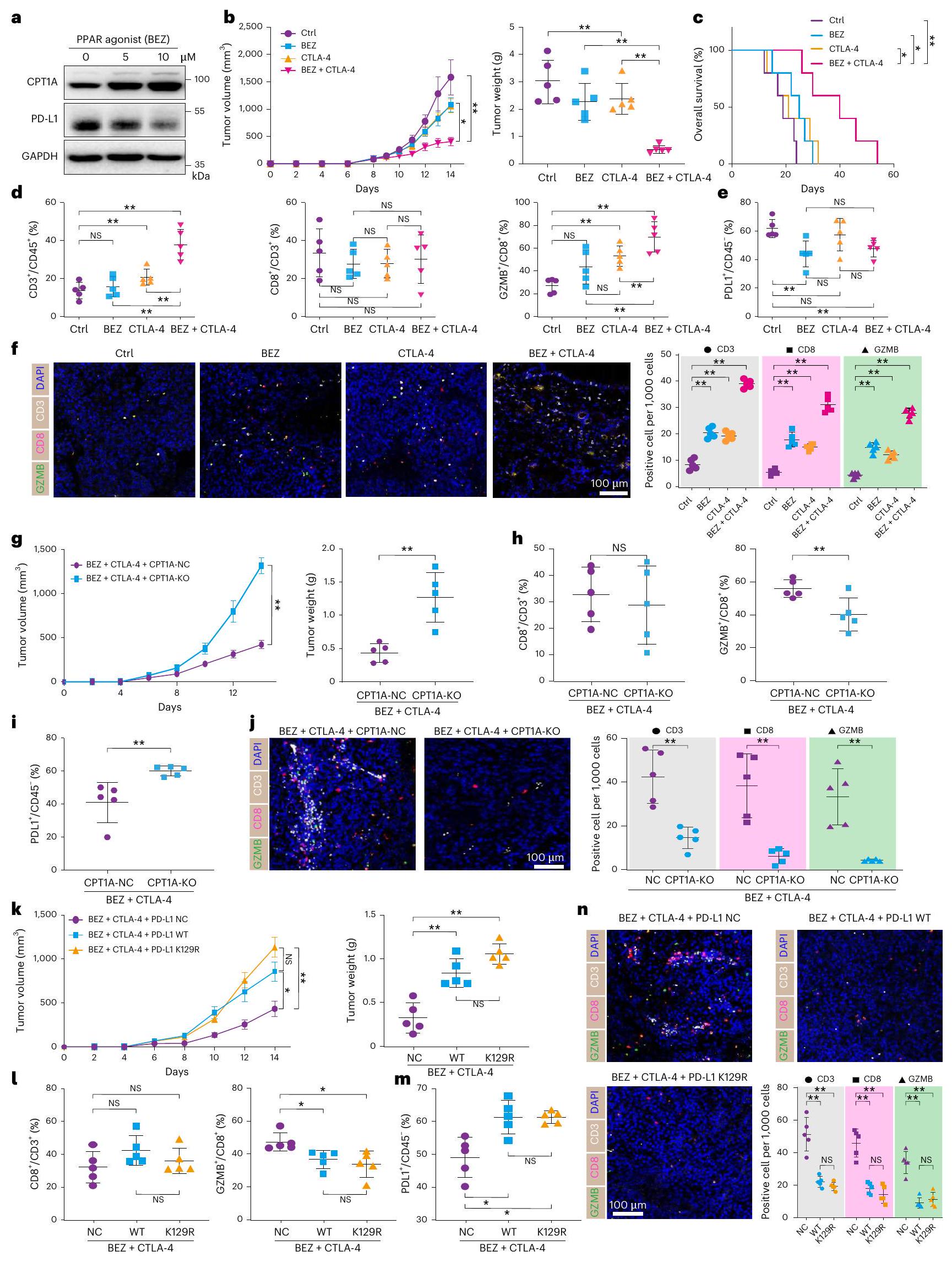
تحفيز ارتفاع CPT1A يتعاون مع حجب CTLA-4. يتم تنظيم تعبير CPT1A بواسطة مستقبلات البروكسيسوم المنشطة للبروتين (PPAR). مساعد (PGC-1 )، الذي ينظم CPT1A بشكل إيجابي استجابةً لتنشيطه لاستكشاف إمكانيات CPT1A في العلاج المناعي، تم استخدام البيزافيبريت (BEZ)، وهو عامل خافض للدهون يعمل كمنشط لمستقبلات PPAR وينشط PPAR/PGC1. تم استخدام المسار . زاد BEZ من تعبير CPT1A بطريقة تعتمد على الجرعة وقلل من مستويات PD-L1 (الشكل 5a). على الرغم من عدم العثور على ارتباط بين استجابة الأجسام المضادة CTLA-4 وCPT1A أو توقيعات السكسينيل في عينات سريرية سابقة (الشكل التمديدي 81)، فإن الجمع بين BEZ وmAb مضاد CTLA-4 أوقف نمو الورم وقلل من حجم الورم وأطال البقاء دون التأثير على وزن الجسم (الشكل 5b، c والشكل التمديدي 8m). كشفت قياسات التدفق الخلوي عن زيادة الخلايا في مجموعة التركيب (الشكل 5د). كلا العلاجين قللا من مستويات PD-L1 في CD45 خلايا الورم (الشكل 5e) وmIHC أظهرت زيادة في CD8 تسلل وتفعيل خلايا T (الشكل 5f). أدى تقليل CPT1A إلى تقليل التأثير التآزري لـ BEZ و mAb المضاد لـ CTLA-4 على نمو الورم و تسلل خلايا T (الشكل 5g-j). أدى الإفراط في التعبير عن PD-L1 WT والطفرات K129R إلى تقليل التأثيرات المضادة للورم، حيث كان للطفرات K129R تأثير مثبط أقوى (الشكل 5k). على الرغم من عدم ملاحظة اختلافات كبيرة في نمو الورم أو قمع المناعة، إلا أن الإفراط في التعبير حافظ على مستويات مرتفعة من PD-L1 (الشكل 5l-n). تشير هذه النتائج إلى أن CPT1A هو هدف واعد لعلاج الميلانوما المناعي.

مستويات CPT1A تت correlates مع فعالية الأجسام المضادة PD-1 في الميلانوما

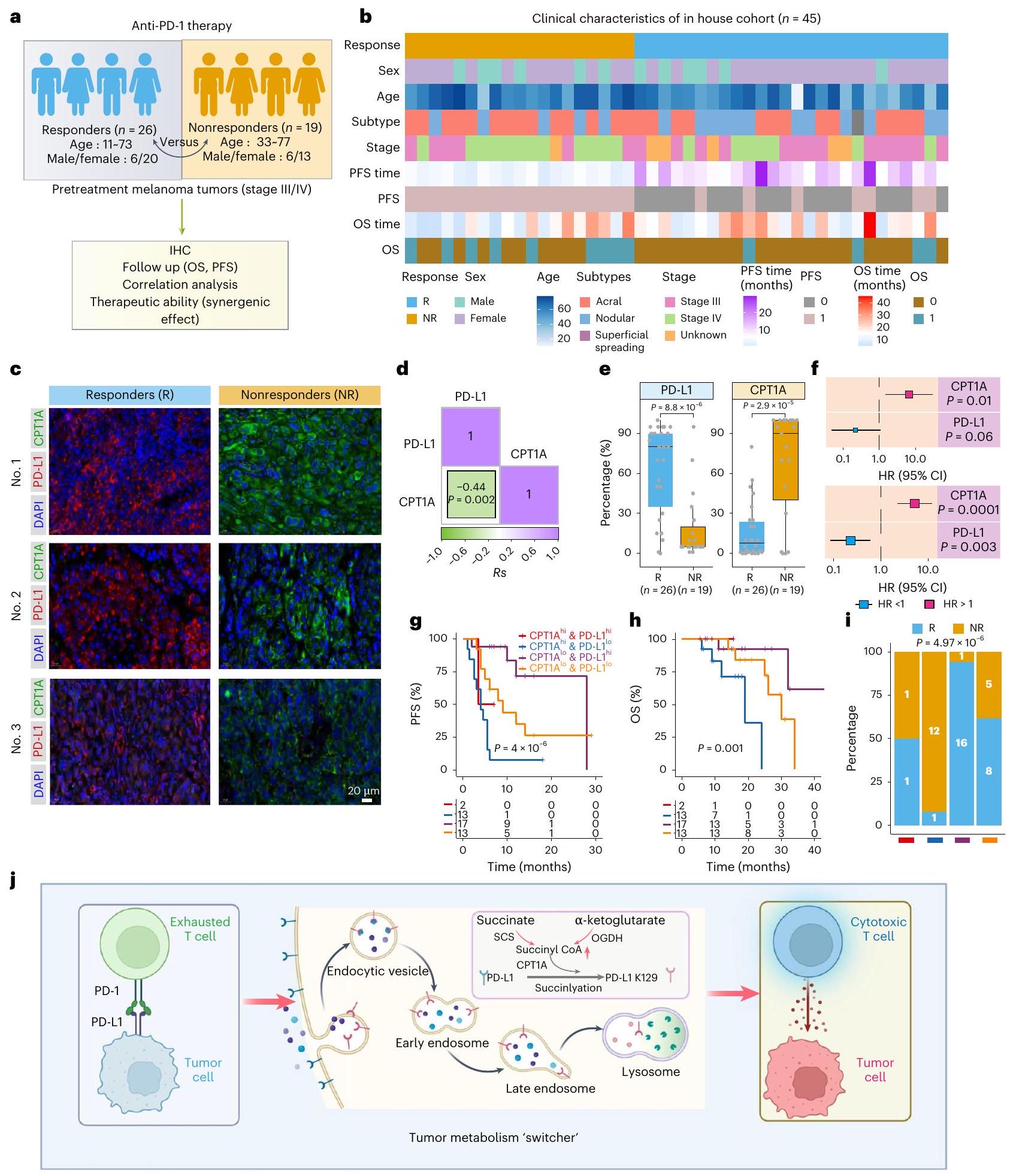
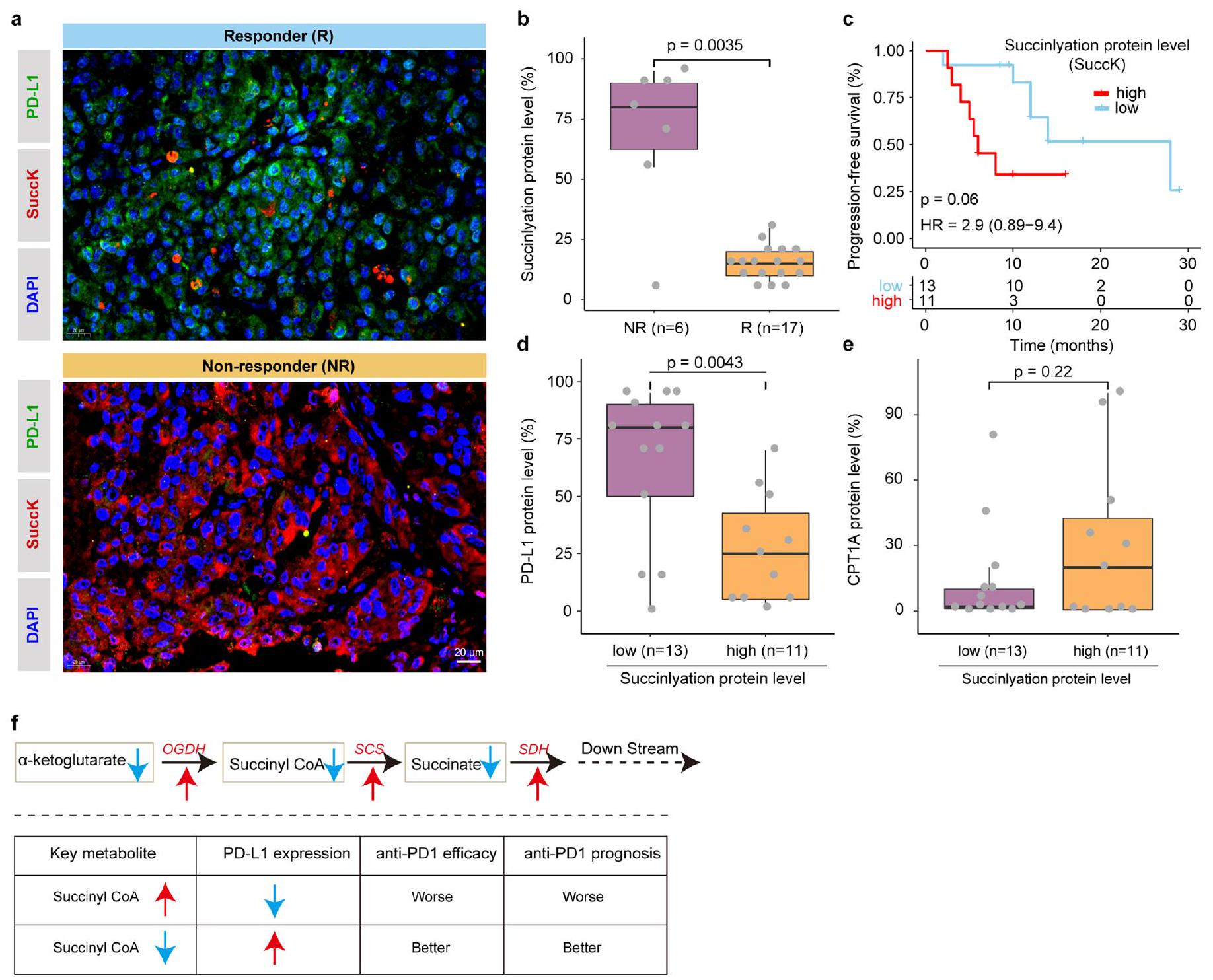
فقط مجموعة صغيرة من المرضى تستجيب لحجب PD-1 أو PD-L1، لأن مقاومة المناعة المعتمدة على PD-1 تعتمد على توفر PD-L1 داخل الأورام. لقد حددت دراستنا CPT1A كوسيط رئيسي في تعديل وتحلل PD-L1. للتحقيق بشكل أعمق في العلاقة بين CPT1A وPD-L1، تم تحليل عينات الأورام من 45 مريضًا مصابًا بالميلانوما تم علاجهم باستخدام العلاج الأحادي بمضاد PD-1 (الشكل 6 أ، ب والجدول التكميلي 2). لوحظت علاقة سلبية قوية بين تعبير CPT1A وPD-L1 في عينات استئصال الورم. ومن الجدير بالذكر أن غير المستجيبين (NRs) أظهروا مستويات أعلى بشكل ملحوظ من CPT1A ومستويات أقل من PD-L1 مقارنة بالمستجيبين (Rs) (الشكل 6 ج-هـ). يتماشى ذلك مع الدراسات السابقة. كان لدى المرضى الذين يعبرون عن PD-L1 بمستويات عالية استجابة أفضل لعلاج الأجسام المضادة أحادية النسيلة المضادة لـ PD-1، كما يتضح من زيادة البقاء العام (OS) والبقاء بدون تقدم (PFS) (الشكل 6f). بالإضافة إلى ذلك، كان لدى المرضى الذين يعبرون عن CPT1A بمستويات منخفضة وPD-L1 بمستويات عالية بقاء بدون تقدم أطول (متوسط PFS لمدة 10 أشهر مقابل شهرين) (الشكل 6g,h). أظهر المرضى الذين يعبرون عن CPT1A بمستويات منخفضة وPD-L1 بمستويات عالية استجابات محسنة لعلاج الأجسام المضادة أحادية النسيلة المضادة لـ PD-1 (الشكل 6i). كما وُجدت علاقة سلبية بين مستويات PD-L1 وإجمالي استحاثة البروتين، حيث ارتبطت مستويات استحاثة البروتين المنخفضة باستجابة أفضل وتوقعات أفضل (الشكل التمديدي 9a-e). بشكل جماعي، تشير هذه النتائج إلى أن انخفاض CPT1A وارتفاع PD-L1 قد يتنبأ بفعالية الأجسام المضادة أحادية النسيلة المضادة لـ PD-1 في الميلانوما.
الشكل 5 | تحفيز ارتفاع CPT1A يتعاون مع حجب CTLA-4.
تحليل البقعة الغربية لمستويات CPT1A و PD-L1 في الخلايا المعالجة بجرعات متفاوتة من BEZ ). يسار، نمو الورم لخلايا B16F10 في الفئران المناعية المعالجة بالتحكم، BEZ، مضاد CTLA-4 أو تركيبتها. يمين، أوزان الأورام ملخصة بعد euthanizing الفئران. لكل مجموعة). ج، بقاء الفئران الحاملة لورم B16F10 بعد العلاجات مع التحكم، BEZ، مضاد CTLA-4 أو تركيبتها ( لكل مجموعة). د، قياس و نسب CTL في كتل الأورام من مجموعات مختلفة لكل مجموعة). e، قياس مستويات PD-L1 في خلايا الورم باستخدام تحليل تدفق الخلايا ( لكل مجموعة). ف، تلوين مناعي لـ CD3 و CD8 و GZMB في كتل أورام B16F10 بعد العلاج ( لكل مجموعة). شريط القياس، نمو الورم لخلايا CPT1A KO (g) أو خلايا PD-L1 WT وLys129Arg (K129R) B16F10 (k)، جنبًا إلى جنب مع خلايا B16F10 التحكم السلبية، في الفئران المناعية المعالجة بـ BEZ
والمضاد لـ CTLA-4. تم تلخيص أوزان الأورام بعد القتل الرحيم ( لكل مجموعة). ح، ل، تقدير و نسب CTL (I) في كتل الأورام من مجموعات مختلفة لكل مجموعة). تحديد مستويات PD-L1 في خلايا الورم باستخدام قياس التدفق الخلوي مع خلايا CPT1A KO (i) أو خلايا PD-L1WT وLys129Arg (K129R) B16F10، بالإضافة إلى خلايا B16F10 كتحكم سلبي بعد العلاج مع BEZ وCTLA-4. لكل مجموعة). تلوين المناعة لـ CD3 و CD8 و GZMB في كتل أورام B16F10 بعد العلاج بخلايا CPT1A KO (j) أو خلايا PD-L1 WT و K129R B16F10 (n)، جنبًا إلى جنب مع خلايا B16F10 كعينة سلبية بعد العلاج بـ BEZ و CTLA-4 ( لكل مجموعة). شريط القياس، . لمزيد من التفاصيل حول التصور والإحصائيات وإمكانية التكرار، انظر الطرق. ملاحظة: في a، يمثل تجارب مستقلة، وفي الألواح الأخرى، عينات بيولوجية مستقلة.
الشكل 6 | مستويات CPT1A ترتبط بفعالية الأجسام المضادة PD-1 في الميلانوما.
أ. ملخص لمجموعة الميلانوما الداخلية. ب. خريطة حرارية توضح الخصائص السريرية لمجموعة الميلانوما الداخلية المعالجة بالأجسام المضادة المناعية المضادة لـ PD-1. تمثل كل عمود مريضًا فرديًا. تشمل Rs أولئك الذين لديهم استجابة كاملة (CR) أو استجابة جزئية (PR) أو مرض مستقر (SD). الشهور، في حين تشمل NRs أولئك الذين الشهور أو المرض المتقدم (PD). PFS، 0 تعني خلو من التقدم، 1 تعني التقدم أو الوفاة؛ OS: 0 تعني على قيد الحياة، 1 تعني الوفاة. ج، صور فلورية تمثيلية تظهر تعبير CPT1A و PD-L1 في المرضى ذوي الاستجابات العلاجية المختلفة. د، خريطة حرارية توضح علاقة سلبية كبيرة بين تعبير CPT1A و PD-L1 (معامل ارتباط سبيرمان). هـ، مخططات صندوقية تظهر اختلاف تعبير CPT1A و PD-L1 بين R ( المرضى) و NR ( تحليل الانحدار الأحادي لكوكس للبقاء على قيد الحياة (أعلى) والبقاء بدون تقدم (أسفل)
استنادًا إلى تعبير CPT1A و PD-L1 المرضى). ج، ح، مخططات كابلان-ماير توضح التأثيرات التآزرية للتعبير عن CPT1A و PD-L1 على فترة البقاء بدون تقدم (ج) وفترة البقاء الكلي (ح). i، نسب المرضى الذين لديهم استجابات مختلفة للعلاج المناعي في المجموعة ( المرضى). ج، مخطط تلخيصي. تراكم السكسينات أو السكسينيل-CoA المشتق من الأوكسيغلوتيرات يتوسط سكسينيل PD-L1، مما يعمل كمؤشر على التحلل الليزوزومي الداخلي لـ PD-L1. تم تحديد CPT1A، كونه سكسينيلترانسفيراز يتحكم في سكسينيل PD-L1، كهدف جديد لعلاج الميلانوما وقد يُستخدم بالاشتراك مع PD-L1 كعلامة للتنبؤ بتأثير العلاج المضاد لـ PD-1. لمزيد من التفاصيل حول التصوير والإحصائيات وإمكانية التكرار، انظر الطرق. ملاحظة، تشير إلى النسخ البيولوجية المستقلة. HR، نسبة المخاطر. تم إنشاء الرسم التخطيطي باستخدامبايو ريندر.كوم.

نقاش

الدراسة الحالية حددت وجود علاقة بين التعبير العالي عن OGDH وSCS وSDH في الميلانوما والاستجابة لعلاج المناعة باستخدام الأجسام المضادة ضد PD-1. هذه الإنزيمات تقلل من مستويات السكسينيل-CoA، وزيادة السكسينيل-CoA تعزز من سكسينيل PD-L1، مما يعزز من تحللها. تم تحديد CPT1A، وهو سكسينيل ترانسفيراز يتحكم في سكسينيل PD-L1، كهدف علاجي جديد وعلامة بيولوجية محتملة للميلانوما لفعالية الأجسام المضادة ضد PD-1 (الشكل 6j والشكل الممتد 9f).
يُشكل استقلاب الورم البيئة الدقيقة للورم، لكن تأثيرات المستقلبات على الأورام وخلايا المناعة لا تزال غير واضحة. تستخدم الأورام امتصاص الجلوكوز المفرط لعملية التحلل السكري، مما ينتج حمض اللبنيك الذي يثبط السمية الخلوية لخلايا T. يعمل اللاكتات على تثبيط كربوكسيلاز البيروفات وتنشيط ديهيدروجيناز البيروفات (PDH)، مما يقلل من إفراز السكسينات، في حين أن تثبيط PDH يمكّن خلايا T من تصدير السكسينات، مما يحافظ على السمية الخلوية من خلال الإشارات الذاتية عبر مستقبل السكسينات 1 (SUCNR1). .
على الرغم من نمط ورنغ، تعتمد الميلانوما أيضًا على الأيض الميتوكوندري لتخليق الجزيئات والتفاعلات الأكسدة والاختزال، مستخدمةً وسائط مثل السترات والأوكسالوستات. يتم استقلاب الجلوتامين إلى AKG، الذي يدخل دورة TCA ويتم تحويله بواسطة OGDH إلى سوكسينيل-CoA. نقص الجلوتامين في خلايا الورم يزيد من مستويات PD-L1، في حين أن الإضافة تمنع نمو الميلانوما. إن تثبيط OGDH أو استقلاب الجلوتامين زاد من PD-L1 وعزز نمو الورم. ومع ذلك، فإن مضادات الجلوتامين لها تأثيرات مضادة للورم. مقترحًا أن الجلوتامين وAKG يؤثران على المراقبة المناعية بطرق تتجاوز تنظيم تعبير PD-L1.
إدارة السكسينات القابلة للاختراق الخلوي وAKG أوقفت نمو الورم في الفئران، وهو تأثير يعتمد بشكل كبير على الخلايا. أظهرت دراسة MS أن علاجات DES و DMK زادت من مستويات السكسينات و AKG في البلازما والأورام، ولكن ليس في الأعضاء الأخرى، مما يشير إلى تأثيرات أيضية محددة للأنسجة. الأشكال القابلة للاختراق الخلوي من السكسينات و AKG تدخل الخلايا بسرعة، مؤثرة على كل من خلايا الورم وخلايا T. ومع ذلك، فإن تأثيراتها المحددة على خلايا T تتطلب مزيدًا من التحقيق. بالإضافة إلى ذلك، تشير هذه النتائج إلى أن السكسينات قد تنشط خلايا T من خلال آليات أخرى غير الارتباط بمستقبلها، SUCNR1.
دورة TCA، الموجودة في مصفوفة الميتوكوندريا، تشمل كل من المسارات الهدم والبناء. في العقد الماضي، تم تحديد أدوار غير استقلابية لمتوسطات دورة TCA. السكسينيل-CoA، المشتق من دورة TCA، يعمل كركيزة أساسية للسكسينيلation. تؤدي عيوب دورة TCA، مثل نقص SDH، إلى ارتفاع مستويات السكسينيل-CoA وهايبرسكسينيل الهيستون، مما يرتبط بزيادة التعبير الجيني. تماشيًا مع هذه النتائج، فإن مثبطات SDH (DMM و3-NPA) زادت أيضًا من مستويات السكسينيل-CoA. إن تحويل السكسينات إلى الفومارات بواسطة SDH يثبط نشاط خلايا T في الميلانوما. ومع ذلك، لم يؤثر العلاج بـ DMF على تعبير PD-L1، وقد يكون الزيادة في السكسينات داخل الخلايا أكثر ملاءمة لتكوين السكسينيل-CoA. على الرغم من أن السكسينيل-CoA يتم تصنيعه في الميتوكوندريا، إلا أن آليات نقله إلى السيتوبلازم أو النواة لا تزال غير واضحة، على الرغم من وجود أدلة على السكسنة في هذه الأقسام. من الجدير بالذكر أن السكسينات في السيتوسول يمكن تحويلها مرة أخرى إلى سكسينيل-CoA وانتقل OGDH إلى النواة “، مما قد يفسر السكسينيل في السيتوبلازم والنواة. ستوفر المزيد من الدراسات حول نقل السكسينيل-CoA رؤى حول الأيض الخلوي والتعديلات بعد الترجمة. تظهر بياناتنا سكسينيل PD-L1 في السيتوبلازم. يخضع PD-L1 لعدة تعديلات بعد الترجمة، بما في ذلك الفسفرة، والأسيتيل، والبالميتويل، التي تنظم وظيفته. على سبيل المثال، تؤدي الفسفرة التي تتم بوساطة AMPK عند Ser195 إلى تحلل PD-L1 عبر التحلل المرتبط بالشبكة الإندوبلازمية. ويعمل البالمتويل على تثبيت موضعه في الغشاء بينما يسهل الأسيتيل من دخول النواة لـ Lys263 على الرغم من أن تعبير PD-L1 يتم التحكم فيه بشكل صارم، إلا أن الإشارة لتدهوره في الليزوزوم لا تزال غير معروفة. دراستنا تحدد السكسينيلation كإشارة لتدهور PD-L1 في الدورة الحويصلية. يرتبط زيادة إنتاج سكسينيل-CoA والسكسينيلation في خلايا الورم بتحسن التوقعات وزيادة الاستجابات المناعية.
تثبط الأحماض الدهنية قصيرة السلسلة، بما في ذلك السكسينيل-CoA، CPT1A وأكسدة الأحماض الدهنية الميتوكوندرية. تُبرز الأبحاث الحديثة السكسينيل-CoA كركيزة لنشاط السكسينيل ترانسفيراز الليسين CPT1A. أظهرت أبحاثنا أن CPT1A يعمل كإنزيم نقل السكسينيل للّيسين لـ PD-L1، حيث أن تثبيط CPT1A يزيد من مستويات PD-L1. علاوة على ذلك، فإن زيادة CPT1A عبر المنشط PGC-1 (BEZ) تقلل من مستويات PD-L1 وتعزز الاستجابة المناعية المضادة للأورام تجاه علاج anti-CTLA-4. قد يقلل BEZ، وهو عامل خافض للدهون آمن سريرياً، من الأحداث السلبية المرتبطة بالمناعة مقارنة بالعلاجات المجمعة مع anti-CTLA-4. إنه يسهل نشاط خلايا T. ويؤثر بشكل أكثر وضوحًا، مما يوفر خيارًا واعدًا لتركيبة العلاج. PGC-1 تنظم تكوين الميتوكوندريا وعمليات الأيض للطاقة. خلايا الميلانوما التي تحتوي على مستويات عالية من PGC-1 ومستويات OXPHOS تظهر قدرة هجرة منخفضة، في حين أن PGC-1 المنخفض زيادة التعبير عن الإمكانية النقيلية . هذه التباين في PGC-1 قد يؤثر التعبير على مستويات PD-L1 والهروب المناعي مع انخفاض PGC-1 مرتبط بزيادة PD-L1 وهروب المناعة في خلايا الميلانوما.
تقليل مستويات CPT1A أو الإفراط في التعبير عن PD-L1 (WT أو K129R) أثر سلبًا على فعالية مجموعة BEZ وCTLA-4 mAb في الفئران الحاملة للأورام، مما يبرز أهمية تعديل PD-L1 ومستويات CPT1A في تعديل تنشيط المناعة عبر PGC-1α. علاوة على ذلك، فإن نشاط السكسينيل ترانسفيراز لـ CPT1A ضروري لنمو الورم. أظهر كل من طفرة G710E وWT تأثيرات مثبطة مشابهة على تقدم الورم، في حين أن طفرة H473A لم تظهر أي تأثير ملحوظ. على الرغم من أن تقليل CPT1A يعزز نمو الورم، إلا أن الدراسات السابقة أفادت بأنه يقلل من تقديم المستضدات المعتمدة على معقد التوافق النسيجي الكبير-I أو -II ويعيق قتل الورم بواسطة خلايا T. إن الإفراط في التعبير عن طفرات CPT1A (H473A و G710E)، التي تفتقر فقط إلى نشاط الكارنيتين بالميتويل ترانسفيراز، يعيق أيضًا تقديم المستضدات، مما يشير إلى أن نشاط السكسينيل ترانسفيراز لـ CPT1A ليس له دور في هذه العملية. تشير هذه النتائج إلى أن CPT1A يعمل من خلال مسارات متميزة، مما يبرز إمكانيته كهدف متعدد الأوجه في علاج السرطان المناعي، مؤثرًا على كل من تقديم المستضدات وتعبير PD-L1.
باختصار، تؤكد بياناتنا على الدور التنظيمي للتسلسلات السكسينية في استقرار PD-L1. من المرجح أن تستجيب أورام المرضى التي تحتوي على مستويات منخفضة من التسلسلات السكسينية وCPT1A للعلاج المناعي. كإنزيم رئيسي في استقلاب الأحماض الدهنية، فإن تثبيط CPT1A يزيد من مستوى PD-L1، مما يضع مثبطاته كعوامل متآزرة محتملة في العلاج المناعي. تقترح الدراسة الحالية أن استهداف التسلسلات السكسينية لـ PD-L1 باستخدام جزيئات صغيرة يمكن أن يعزز فعالية العلاجات المضادة لـ PD-L1 أو PD-1.

المحتوى عبر الإنترنت

أي طرق، مراجع إضافية، ملخصات تقارير Nature Portfolio، بيانات المصدر، بيانات موسعة، معلومات تكميلية، شكر وتقدير، معلومات مراجعة الأقران؛ تفاصيل مساهمات المؤلفين والمصالح المتنافسة؛ وبيانات توفر البيانات والرموز متاحة علىhttps://doi.org/10.1038/s41588-025-02077-6.

References

  1. Gonzalez, H., Hagerling, C. & Werb, Z. Roles of the immune system in cancer: from tumor initiation to metastatic progression. Genes Dev. 32, 1267-1284 (2018).
  2. Korman, A. J., Garrett-Thomson, S. C. & Lonberg, N. The foundations of immune checkpoint blockade and the ipilimumab approval decennial. Nat. Rev. Drug Discov. 21, 509-528 (2022).
  3. Ribas, A. & Wolchok, J. D. Cancer immunotherapy using checkpoint blockade. Science 359, 1350-1355 (2018).
  4. Morad, G., Helmink, B. A., Sharma, P. & Wargo, J. A. Hallmarks of response, resistance, and toxicity to immune checkpoint blockade. Cell 184, 5309-5337(2021).
  5. Kumagai, S. et al. Lactic acid promotes PD-1 expression in regulatory T cells in highly glycolytic tumor microenvironments. Cancer Cell 40, 201-218.e9 (2022).
  6. Pucino, V. et al. Lactate buildup at the site of chronic inflammation promotes disease by inducing T cell metabolic rewiring. Cell Metab. 30, 1055-1074.e8 (2019).
  7. Wu, X. et al. Targeting protein modifications in metabolic diseases: molecular mechanisms and targeted therapies. Signal Transduct. Target. Ther. 8, 220 (2023).
  8. Diskin, C., Ryan, T. A. J. & ONeill, L. A. J. Modification of proteins by metabolites in immunity. Immunity 54, 19-31 (2021).
  9. Zhang, Z. et al. Identification of lysine succinylation as a new post-translational modification. Nat. Chem. Biol. 7, 58-63 (2011).
  10. Sreedhar, A., Wiese, E. K. & Hitosugi, T. Enzymatic and metabolic regulation of lysine succinylation. Genes Dis. 7, 166-171 (2020).
  11. Alarcon, C., Wicksteed, B., Prentki, M., Corkey, B. E. & Rhodes, C. J. Succinate is a preferential metabolic stimulus-coupling signal for glucose-induced proinsulin biosynthesis translation. Diabetes 51, 2496-2504 (2002).
  12. Xu, H. et al. Lysine acetylation and succinylation in HeLa cells and their essential roles in response to UV-induced stress. Sci. Rep. 6, 30212 (2016).
  13. Wang, F. et al. SIRT5 desuccinylates and activates pyruvate kinase M2 to block macrophage IL-1 production and to prevent DSS-induced colitis in mice. Cell Rep. 19, 2331-2344 (2017).
  14. Du, J. et al. Sirt5 is a NAD-dependent protein lysine demalonylase and desuccinylase. Science 334, 806-809 (2011).
  15. Wang, Y. et al. KAT2A coupled with the -KGDH complex acts as a histone H3 succinyltransferase. Nature 552, 273-277 (2017).
  16. Kurmi, K. et al. Carnitine palmitoyltransferase 1 A has a lysine succinyltransferase activity. Cell Rep. 22, 1365-1373 (2018).
  17. Yuan, H.-F. et al. PRMT5 confers lipid metabolism reprogramming, tumour growth and metastasis depending on the SIRT7-mediated desuccinylation of PRMT5 K387 in tumours. Acta Pharmacol. Sin. 43, 2373-2385 (2022).
  18. Harel, M. et al. Proteomics of melanoma response to immunotherapy reveals mitochondrial dependence. Cell 179, 236-250.e18 (2019).
  19. Wu, J.-Y. et al. Cancer-derived succinate promotes macrophage polarization and cancer metastasis via succinate receptor. Mol. Cell 77, 213-227.e5 (2020).
  20. Liu, P.-S. et al. -Ketoglutarate orchestrates macrophage activation through metabolic and epigenetic reprogramming. Nat. Immunol. 18, 985-994 (2017).
  21. Yang, Y. et al. Succinate dehydrogenase inhibitor dimethyl malonate alleviates LPS/D-galactosamine-induced acute hepatic damage in mice. Innate Immun. 25, 522-529 (2019).
  22. Scallet, A. C., Haley, R. L., Scallet, D. M., Duhart, H. M. & Binienda, Z. K. 3-Nitropropionic acid inhibition of succinate dehydrogenase (complex II) activity in cultured Chinese hamster ovary cells: antagonism by L-carnitine. Ann. NY Acad. Sci. 993, 305-309 (2003).
  23. Dörsam, B. & Fahrer, J. The disulfide compound -lipoic acid and its derivatives: a novel class of anticancer agents targeting mitochondria. Cancer Lett. 371, 12-19 (2016).
  24. Furuyama, K. & Sassa, S. Interaction between succinyl CoA synthetase and the heme-biosynthetic enzyme ALAS-E is disrupted in sideroblastic anemia. J. Clin. Invest. 105, 757-764 (2000).
  25. Li, F. et al. NADP -IDH mutations promote hypersuccinylation that impairs mitochondria respiration and induces apoptosis resistance. Mol. Cell 60, 661-675 (2015).
  26. Nusinow, D. P. et al. Quantitative proteomics of the cancer cell line encyclopedia. Cell 180, 387-402.e16 (2020).
  27. Chan, L.-C. et al. IL-6/JAK1 pathway drives PD-L1 Y112 phosphorylation to promote cancer immune evasion. J. Clin. Invest. 129, 3324-3338 (2019).
  28. Burr, M. L. et al. CMTM6 maintains the expression of PD-L1 and regulates anti-tumour immunity. Nature 549, 101-105 (2017).
  29. Maher, C. M. et al. Small-molecule sigma1 modulator induces autophagic degradation of PD-L1. Mol. Cancer Res. 16, 243-255 (2018).
  30. Eletto, D., Dersh, D. & Argon, Y. GRP94 in ER quality control and stress responses. Semin. Cell Dev. Biol. 21, 479-485 (2010).
  31. Pfeffer, S. R. Entry at the trans-face of the Golgi. Cold Spring Harb. Perspect. Biol. 3, a005272 (2011).
  32. Ferro, E., Bosia, C. & Campa, C. C. RAB11-mediated trafficking and human cancers: an updated review. Biology (Basel) 10, 26 (2021).
  33. Bucci, C., Bakke, O. & Progida, C. Rab7b and receptors trafficking. Commun. Integr. Biol. 3, 401-404 (2010).
  34. Cheng, X.-T. et al. Revisiting LAMP1 as a marker for degradative autophagy-lysosomal organelles in the nervous system. Autophagy 14, 1472-1474 (2018).
  35. Smestad, J., Erber, L., Chen, Y. & Maher, L. J. 3rd Chromatin succinylation correlates with active gene expression and is perturbed by defective TCA cycle metabolism. iScience 2, 63-75 (2018).
  36. Wang, H. et al. HIP1R targets PD-L1 to lysosomal degradation to alter T cell-mediated cytotoxicity. Nat. Chem. Biol. 15, 42-50 (2019).
  37. Yao, H. et al. Inhibiting PD-L1 palmitoylation enhances T-cell immune responses against tumours. Nat. Biomed. Eng. 3, 306-317 (2019).
  38. Xie, X.-Q. et al. Targeting ATAD3A-PINK1-mitophagy axis overcomes chemoimmunotherapy resistance by redirecting PD-L1 to mitochondria. Cell Res. 33, 215-228 (2023).
  39. Song, S. et al. Peroxisome proliferator activated receptor (PPARα) and PPAR gamma coactivator (PGC-1α) induce carnitine palmitoyltransferase IA (CPT-1A) via independent gene elements. Mol. Cell. Endocrinol. 325, 54-63 (2010).
  40. Viscomi, C. et al. In vivo correction of COX deficiency by activation of the AMPK/PGC-1 axis. Cell Metab. 14, 80-90 (2011).
  41. Brand, A. et al. LDHA-associated lactic acid production blunts tumor immunosurveillance by T and NK cells. Cell Metab. 24, 657-671 (2016).
  42. Elia, I. et al. Tumor cells dictate anti-tumor immune responses by altering pyruvate utilization and succinate signaling in CD8 T cells. Cell Metab. 34, 1137-1150.e6 (2022).
  43. Fischer, G. M. et al. Metabolic strategies of melanoma cells: mechanisms, interactions with the tumor microenvironment, and therapeutic implications. Pigment Cell Melanoma Res. 31, 11-30 (2018).
  44. Altman, B. J., Stine, Z. E. & Dang, C. V. From Krebs to clinic: glutamine metabolism to cancer therapy. Nat. Rev. Cancer 16, 619-634 (2016).
  45. Chang, L.-C., Chiang, S.-K., Chen, S.-E. & Hung, M.-C. Targeting 2-oxoglutarate dehydrogenase for cancer treatment. Am. J. Cancer Res. 12, 1436-1455 (2022).
  46. Byun, J.-K. et al. Inhibition of glutamine utilization synergizes with immune checkpoint inhibitor to promote antitumor immunity. Mol. Cell 80, 592-606.e8 (2020).
  47. Ishak Gabra, M. B. et al. Dietary glutamine supplementation suppresses epigenetically-activated oncogenic pathways to inhibit melanoma tumour growth. Nat. Commun. 11, 3326 (2020).
  48. Leone, R. D. et al. Glutamine blockade induces divergent metabolic programs to overcome tumor immune evasion. Science 366, 1013-1021 (2019).
  49. Martínez-Reyes, I. & Chandel, N. S. Mitochondrial TCA cycle metabolites control physiology and disease. Nat. Commun. 11, 102 (2020).
  50. Cheng, J. et al. Cancer-cell-derived fumarate suppresses the anti-tumor capacity of CD8 cells in the tumor microenvironment. Cell Metab. 35, 961-978.e10 (2023).
  51. Li, J. et al. HDAC1/2/3 are major histone desuccinylases critical for promoter desuccinylation. Cell Discov. 9, 85 (2023).
  52. Su, Z. et al. TNF- -induced KAT2A Impedes BMMSC quiescence by mediating succinylation of the mitophagy-related protein VCP. Adv. Sci. 11, e2303388 (2024).
  53. Gut, P. et al. SUCLA2 mutations cause global protein succinylation contributing to the pathomechanism of a hereditary mitochondrial disease. Nat. Commun. 11, 5927 (2020).
  54. Cha, J.-H. et al. Metformin promotes antitumor immunity via endoplasmic-reticulum-associated degradation of PD-L1. Mol. Cell 71, 606-620.e7 (2018).
  55. Gao, Y. et al. Acetylation-dependent regulation of PD-L1 nuclear translocation dictates the efficacy of anti-PD-1 immunotherapy. Nat. Cell Biol. 22, 1064-1075 (2020).
  56. McGarry, J. D., Mannaerts, G. P. & Foster, D. W. A possible role for malonyl-CoA in the regulation of hepatic fatty acid oxidation and ketogenesis. J. Clin. Invest. 60, 265-270 (1977).
  57. Mills, S. E., Foster, D. W. & McGarry, J. D. Interaction of malonyl-CoA and related compounds with mitochondria from different rat tissues. Relationship between ligand binding and inhibition of carnitine palmitoyltransferase I. Biochem. J 214, 83-91 (1983).
  58. Ma, Y. et al. Functional analysis of molecular and pharmacological modulators of mitochondrial fatty acid oxidation. Sci. Rep. 10, 1450 (2020).
  59. Lu, X. et al. Effective combinatorial immunotherapy for castration-resistant prostate cancer. Nature 543, 728-732 (2017).
  60. Vazquez, F. et al. PGC1α expression defines a subset of human melanoma tumors withincreased mitochondrial capacity and resistance to oxidative stress. Cancer Cell 23, 287-301 (2013).
  61. Luo, C. et al. A PGC1α-mediated transcriptional axis suppresses melanoma metastasis. Nature 537, 422-426 (2016).
Publisher’s note Springer Nature remains neutral with regard to jurisdictional claims in published maps and institutional affiliations.
Open Access This article is licensed under a Creative Commons Attribution-NonCommercial-NoDerivatives 4.0 International License, which permits any non-commercial use, sharing, distribution and reproduction in any medium or format, as long as you give appropriate credit to the original author(s) and the source, provide a link to the Creative Commons licence, and indicate if you modified the licensed material. You do not have permission under this licence to share adapted material derived from this article or parts of it. The images or other third party material in this article are included in the article’s Creative Commons licence, unless indicated otherwise in a credit line to the material. If material is not included in the article’s Creative Commons licence and your intended use is not permitted by statutory regulation or exceeds the permitted use, you will need to obtain permission directly from the copyright holder. To view a copy of this licence, visit http://creativecommons.org/licenses/by-nc-nd/4.0/.
© The Author(s) 2025, corrected publication 2025

طرق

بيان أخلاقي

تم إجراء جميع الدراسات البشرية والحيوانية وفقًا للإرشادات الأخلاقية ذات الصلة وتمت الموافقة عليها من قبل اللجان الأخلاقية المناسبة. تم اعتماد بروتوكول الدراسة (أرقام البروتوكول 2022020580 و 202103617) من قبل لجنة المراجعة المؤسسية لمستشفى شيانغيا وتم جمع جميع عينات الأنسجة وفقًا لسياسة الموافقة المستنيرة. تم الحصول على موافقة مستنيرة مكتوبة من جميع المشاركين وتم إجراء الدراسة وفقًا للمبادئ الموضحة في إعلان هلسنكي. تمت الموافقة على جميع التجارب الحيوانية من قبل لجنة رعاية واستخدام الحيوانات بمستشفى شيانغيا بموجب بروتوكول رقم 2020sydw0466 وتم تنفيذ جميع الإجراءات التجريبية وفقًا للإرشادات المؤسسية.

زراعة الخلايا والعلاج

تم الحصول على جميع خطوط الخلايا المستخدمة من مجموعة الثقافة الأمريكية. تم زراعة خطوط خلايا H460 البشرية (سرطان الرئة غير صغير الخلايا) و B16F10 و B16F10-OVA و MC38 (سرطان الجلد وسرطان القولون) في وسط معهد روسويل بارك التذكاري-1640 (الصناعات البيولوجية (BI)) معززة بـ مصل الجنين البقري (FBS؛ BI)، البنسلين ( ) وستربتوميسين (جيبكو). تم زراعة خطوط الخلايا A375 و SK-MEL-28 (ميلانوما بشرية) و HCT-116 (سرطان القولون) و LLC (سرطان الرئة في الفئران) في وسط ديلبيكو المعدل من إيجل (DMEM؛ BI). تم اختبار جميع خطوط الخلايا بانتظام للكشف عن تلوث الميكوبلازما ووجدت سلبية. تم إضافة المركبات بتركيزات وأوقات محددة. MG132 تمت الإضافة قبل 6 ساعات من حصاد الخلايا. تم معالجة الخلايا مسبقًا بالبافيلوميسين. لمدة ساعتين، تليها DES (15 مللي مول) و DMK (5 مللي مول). تم إضافة الجلايسين (100 مللي مول) لمدة 6-8 ساعات بعد 18 ساعة من معالجة نظائر الأيض. بالنسبة لعلاج الخلايا للكشف عن PD-L1 أو قتل الخلايا التائية، تم استخدام DES (10 مللي مول و 20 مللي مول)، DMK (5 مللي مول و 10 مللي مول)، 3-NPA (1.5 و 3 مللي مول)، DMM (10 و 20 مللي مول) و CPI-613 (50 و ) تم استخدامها لعلاج الخلايا لمدة 24 ساعة. تونيكاميسين تم إضافته عند التحويل الجيني أو بعد 24 ساعة من التحويل الجيني لمدة 24 ساعة. بيتوبيرتين هيغرومايسين وبوروميسين تم استخدامه لفحص خطوط الخلايا المستقرة. لاكتشاف PD-L1، تم معالجة الخلايا بـ PEM أو إيتوموكسيير لمدة 24 ساعة. تم الكشف عن PD-L1 في خلايا الميلانوما تحت ظروف IFN. التحريض. تم إضافة المركبات إلى الوسط الكامل بالتركيزات والأوقات المحددة.

الأجسام المضادة والمواد الكيميائية

مضاد PD-L1 (رقم الكات. 13684)، مضاد p62 (رقم الكات. 88588)، مضاد LC3A/B (رقم الكات. 12741)، مضاد Rab7 (رقم الكات. 95746)، مضاد PD-L2 (رقم الكات. 82723)، مضاد VISTA (رقم الكات. 54979)، مضاد – -ATPase (v23565)، مضاد CD40 (رقم الكات. 40868) وOX4OL (رقم الكات. 14991) كانت من Cell Signaling Technology. مضاد PD-L1 البشري (رقم الكات. ab213524 أو ab213480)، مضاد Granzyme B (رقم الكات. ab4059)، مضاد Rab7B (رقم الكات. ab193360)، مضاد CD3 (رقم الكات. ab16669)، مضاد CD8 ” (رقم الكاتالوج ab217344) و anti-Beclin1 (رقم الكاتالوج ab207612) من Abcam. Anti-PD-L1 (رقم الكاتالوج 66248-1-Ig)، anti-TGN46 (رقم الكاتالوج 13573-1-AP)، anti-CPT1A (رقم الكاتالوج 15184-1-AP)، anti-Rab11B (رقم الكاتالوج 15903-1-AP)، anti-GRP94 (رقم الكاتالوج 14700-1-AP)، anti-HIP1R (رقم الكاتالوج 16814-1-AP) و anti-glyceraldehyde 3-phosphate dehydrogenase (GAPDH؛ رقم الكاتالوج 60004-1-Ig) من Proteintech. Anti-CD70 (رقم الكاتالوج A2032)، anti-CD80 (رقم الكاتالوج A25138)، anti-CD86 (رقم الكاتالوج A1199)، anti-CD112 (رقم الكاتالوج A9622)، anti-CD276 (رقم الكاتالوج A17216)، anti-TNFSF14 (رقم الكاتالوج A2002) و GITRL (رقم الكاتالوج A7028) من شركة ABclonal Biotechnology Co., Ltd. CY3 goat anti-rabbit IgG (رقم الكاتالوج GB21303)، FITC goat anti-rabbit IgG (رقم الكاتالوج GB22303)، DAPI (رقم الكاتالوج G1012) و CY5 goat anti-rabbit IgG من Servicebio (رقم الكاتالوج K1034G-Cy5.5). DES (رقم الكاتالوج W237712)، DMK (رقم الكاتالوج 349631)، 3-NPA (رقم الكاتالوج N5636)، DMM (رقم الكاتالوج 36441)، glycine (رقم الكاتالوج G7126)، DMF (رقم الكاتالوج PHR2118)، triethyl citrate (ETC، رقم الكاتالوج 27500)، dimethyl itaconic acid (DMI، رقم الكاتالوج 592498) و DMA (رقم الكات
(Baf-A1، رقم الكاتالوج S1413) كانت من Selleck. BEZ (رقم الكاتالوج HY-B0637)، إيتوموكساير (رقم الكاتالوج HY-50202)، C75 (رقم الكاتالوج HY-12364)، PEM (رقم الكاتالوج HY-B1334A)، بيتوبيرتين (رقم الكاتالوج HY-10809)، تونيكاميسين (رقم الكاتالوج HY-A0098)، هيغرومايسين B (رقم الكاتالوج HY-K1051) و CPI-613 (رقم الكاتالوج HY-15453) كانت من MedChemExpress. تم شراء الأجسام المضادة المضادة لـ CTLA-4 في الفئران (رقم الكاتالوج BE0164) والأجسام المضادة المضادة لـ CD8α في الفئران (رقم الكاتالوج BE0061) من Bio X Cell. للحصول على قائمة بالأجسام المضادة المستخدمة في دراسة تدفق الخلايا، يرجى مراجعة الملاحظة التكميلية.

عزل RNA، RT-qPCR

تم عزل RNA الكلي من خلايا السرطان البشرية المزروعة باستخدام TRIzol (إنفيتروجين) وفقًا للبروتوكول القياسي: تم تحويل RNA الكلي إلى cDNA باستخدام نظام تخليق السلسلة الأولى SuperScript III (تقنيات الحياة) وفقًا لتعليمات الشركة المصنعة. تم إجراء PCR الكمي (qPCR) باستخدام نظام qPCR (Eppendorf). تم تطبيع جميع مستويات تعبير mRNA إلى GAPDH وحسابها باستخدام الطريقة. كان بادئ PD-L1 البشري كما يلي: الأمامي، -TATGGTGGTGCCGACTACAA-3′; عكسي، -TGCTTGTCCAGATGACTTCG-3′. كان بادئ جين GAPDH البشري كما يلي: الأمامي، -كاتغاغاagtatgacaacagcct-3′; عكسي، 5′-AGTCCTTCCACGATACCAA AGT-3′.

التحليل الغربي

تم تحلل الخلايا في محلول التفاعل المناعي الإشعاعي البارد (بيوتايم) في وجود كوكتيل مثبطات البروتياز و فوس ستوب (روش) بعد غسلتين بمحلول ملحي معزز بالفوسفات (PBS). تم وصف طريقة عزل الحويصلات في الملاحظات التكميلية. تم إزالة لزوجة المستخلص بواسطة الموجات فوق الصوتية وتم تحديد تركيز البروتين باستخدام مجموعة اختبار بروتين BCA من بيرس (ثيرمو فيشر ساينتيفيك). تم تحميل كميات متساوية من البروتينات على هلام بولي أكريلاميد. تم تعريض المستخلصات الكاملة للخلايا إلى التحليل الكهربائي لهلام بولي أكريلاميد مع دوديكان سلفات الصوديوم ونقله إلى غشاء نيتروسليلوز (NC)، تلاه حجب باستخدام 5% حليب خالي من الدسم في PBS ثم تم التحري باستخدام الأجسام المضادة الأولية المحددة طوال الليل في بعد الغسل بمحلول PBS-Tween 20، تم تحضين الغشاء مع إنزيم البيروكسيداز المرتبط بالأجسام المضادة من الماعز ضد الأجسام المضادة من الأرانب IgG (جاكسون إيمونوريسيرش، رقم الكات. 111-005-003) أو الأجسام المضادة من الماعز ضد الأجسام المضادة من الفئران IgG (جاكسون إيمونوريسيرش، رقم الكات. 115-005003). ثم تم إجراء اختبار كيمياء ضوئية معززة لعرض أشرطة البروتين المحددة.

المناعية الفلورية

تم تثبيت الخلايا باستخدام 4% من البارافورمالدهيد، وتم اختراقها في 0.1% من Triton X-100 (PBS) ثم تم حجبها بمصل الألبومين البقري (BSA). تم تحضين الشرائح مع الأجسام المضادة الأولية المحددة طوال الليل، تلاها تحضين مع الأجسام المضادة الثانوية المرتبطة بـ FITC أو Cy3 لمدة ساعة واحدة في درجة حرارة الغرفة (RT). تم صبغ النوى بـ DAPI. تم تثبيت عينات الورم بـ بارافورمالدهيد لمدة 15 دقيقة عند درجة حرارة الغرفة، ثم تم الحضانة مع 3% مصل حمار، 1% BSA و0.1% تريتون X-100 لـ عند درجة حرارة الغرفة. تم صبغ العينات بالأجسام المضادة الأولية طوال الليل في ثم تم استخدام الأجسام المضادة الثانوية FITC و/أو Cy3 في درجة حرارة الغرفة لمدة ساعة واحدة. تم تصوير الصور باستخدام ميكروسكوب متماسك (Zeiss LSM 510).
لأنسجة الأورام لدى المرضى، تم خبز مقاطع البارافين من عينات المرضى لمدة 120 دقيقة عند ثم تم إزالة البارافين. تم إجراء استرجاع المستضد باستخدام محلول EDTA، pH 8.0، عند درجة حرارة دون الغليان لمدة 8 دقائق، تلاها 7 دقائق عند درجة حرارة دون الغليان في فرن ميكروويف. بعد إخماد الفلورية التلقائية، تم حجب العينات في 3% BSA وPBS مع 0.25% Triton X-100 لمدة ساعة واحدة عند درجة حرارة الغرفة. تم تحضين الأجسام المضادة الأولية المستهدفة (CPT1A، 1:400؛ PD-L1، 1:200؛ السكسينيل، رقم الكاتالوج PTM-419 أو PTM-410، 1:200) طوال الليل في في محلول الحجب وفي اليوم التالي لمدة 30 دقيقة عند درجة حرارة الغرفة. بعد الغسيل المكثف في PBS- ترايتون X-100، الأجسام المضادة الثانوية، بما في ذلك أليكسا فلور-488 ماعز مضاد للأرانب IgG (جاكسون إيمونوريسيرش، رقم الكات. 111-545-003) أو Cy3 ماعز مضاد للفئران IgG
تم إضافة (Jackson ImmunoResearch، رقم الكاتالوج 115-165-003) إلى محلول الحجب وتم حضنه لمدة ساعتين. تم حضن DAPI لمدة 10 دقائق في درجة حرارة الغرفة في الظلام. تم الكشف عن الصور والتقاطها بواسطة المجهر الفلوري (Nikon، ECLIPSE Ts2R). تم تقدير تعبير الورم لـ CPT1A و PD-L1 والسوكينيل بواسطة درجة نسبة الورم، التي تمثل نسبة خلايا الورم ذات الصبغة الغشائية. .

البلازميدات والناقلات

تم إنشاء خطوط خلايا نقل مستقرة باستخدام ناقل فيروس لنتي (sh)RNA (Horizon Discovery Ltd). تم وصف تسلسلات الاستهداف على النحو التالي: CPT1A shRNA البشرية: رقم 1: 5′-ACAGTGGTATTTGAAGTTA-3’، رقم 2: -TGGACTTCATTCCTGGAAA-3′ ورقم 3: 5′-ACGATGTACGCCAAGATCG-3′; والفأر: رقم 1: 5′-GGC AGAAAATTGTTCTTAT-3′ ورقم 2: -AGAGACAACTGTAAGTCAA-3′.
تم شراء مجموعة shRNA الخاصة بـ OGDH (فأر) من شركة سانتا كروز للتكنولوجيا الحيوية، رقم الكاتالوج sc-60106-SH. تم شراء بلازميدات CPT1A (موسومة بعلامة الهيماغلوتينين (HA)) و PD-L1 (موسومة بعلامة العلم) من شركة سينو بيولوجيكال. تم إنشاء بلازميدات CPT1A WT، والطفرات، والتراكيب المقطوعة باستخدام متجهات pEGFP-C2. تم إنشاء بلازميدات للتعبير المستقر باستخدام pCDH-MCS-Puro-GFP. تم بناء PD-L1 الموسوم بعلامة HA وقطعها باستخدام pcDNA3.1-CHA. تم إنتاج متجهات علامة اختيار الهيروجموسين B باستخدام pCDH-MCS-HyB-GFP، وتم أيضًا صنع ALAS1 (موسوم بعلامة العلم) باستخدام pCMV-tag2b. تم ربط بلازميد PD-L1-UB بين تسلسل PD-L1 وتسلسل UBB باستخدام تسلسل T2A، الذي تم إنشاؤه بواسطة VectorBuilder Inc. تم إنشاء طفرات محددة باستخدام مجموعة الطفرات السريعة Mut Express II V2 (شركة نانجينغ ووانزيم للتكنولوجيا الحيوية المحدودة).
استخدام pLentiCRISPR v. 2 لإنشاء خلايا KO أو knockdown لـ CPT1A أو PD-L1، تسلسلات الاستهداف هي كما يلي: CPT1A دليل وحيد (sg)RNA رقم 1: 5′-CACCGTAGCTGTCCAT TGACGTATC-3′; رقم 2: 5′-CACCGAGCTGTCCATTGACGTATCC-3′; PD-L1 sgRNA، إنسان: 5′-ACCGTTCAGCAAATGCCAGT-3′; وفأر: 5′-TATGGCAGCAAC GTCACGA-3′.
لتغليف الفيروس اللينتي، تم إدخال تعبير أو تركيبات LentiCRISPR KO في خلايا HEK293T باستخدام بلازميدات التعبئة (psPAX2 و pMD2.G). تم تغيير الوسط بعد 16 ساعة من الإدخال. تم جمع السائل الفائق بعد 24 و 48 ساعة من الإدخال. خلايا A375 و SK-MEL-28 ( تم حضانة (التوافق الخلوي) في وسط يحتوي على فيروس لنتivirus مع بوليبراين ; سيلك كيميكالز). تم اختيار الخلايا بواسطة البيروميسين بعد 48 ساعة من العدوى ( ; سيلك كيميكالز).

نموذج الفأر والعلاج التجريبي في الجسم الحي

تمت الموافقة على جميع التجارب الحية من قبل لجنة رعاية واستخدام الحيوانات في المستشفى الثالث شيانغيا التابع لجامعة وسط جنوب الصين (تشانغشا، هونان، الصين). خلايا الأورام الخبيثة من النوع البري، بما في ذلك B16F10 ( ), B16F10-OVA ( )، شركة ذات مسؤولية محدودة ( ) و MC38 ( تم حقنها تحت الجلد في إناث الفئران من سلالة C57BL/6 التي تبلغ من العمر 6 أسابيع (من مركز شنغهاي SLAC للحيوانات المخبرية). بعد أسبوع، تم تجميع الفئران وتقسيمها عشوائيًا إلى عدة مجموعات. تم علاج المجموعات يوميًا بـ DES و DMK. ، عن طريق البطن (i.p.))، DMM ( ، التحكم في المركبة. لتقليل خلايا T، مضاد CD8 للفأر تم إعطاء (Bio X Cell) للفئران المصابة بأورام B16F10 المعالجة بالتمثيل الغذائي. خلايا B16F10 KO PD-L1 تم حقنها أيضًا في الفئران ومجموعة التحكم السلبية، تلاها العلاج بـ DES أو DMK ووسائطهما المعنية. لتقليل عدد البلعميات في فئران C57BL/6، تم إعطاء حبيبات محملة بالكودرونات (FormuMax Scientific, Inc.) عن طريق الحقن. تم إعطاء جرعة أولية عن طريق البطن من تم إعطاء ليفوسومات الكلودرونات 48 ساعة قبل حقن خلايا الميلانوما، تليها لاحقاً جرعات عند الفترات. لبناء خطوط خلوية مستقرة مفرطة التعبير، تم نقل PD-L1 WT والطفرات (Lys129Arg: K129R أو Lys129Glu: K129E)، وCPT1A WT والطفرات (His473Ala: H473A أو Gly710Glu: G710E) إلى خلايا B16F10، وتم اختيار المتجه باستخدام البيروميسين ثم تم حقنها في الفئران لتقييم التأثير.
في تجارب العلاج المركب، تم إعطاء BEZ عند يوميًا و mAb CTLA-4 عند لكل فأر في تم حقن 100 ميكرولتر من محلول Dulbecco’s PBS كل 3 أيام عن طريق الحقن داخل الصفاق. علاوة على ذلك، تم معالجة خلايا KO لـ CPT1A أو خلايا التعبير المفرط لـ PD-L1 وخلايا التحكم السلبية الخاصة بها معًا لاختبار ما إذا كان BEZ يعزز فعالية علاج الأجسام المضادة CTLA-4 من خلال محور CPT1A-PD-L1. كما تم إنتاج خلايا KO لـ OGDH وحقنها في الفئران لتقييم دور إنتاج السكسينيل-CoA في مناعة الورم. تم مراقبة نمو الورم وجمع الأورام لتحليل تدفق الخلايا (FACS). كما تم تجميد أورام الزرع بسرعة في النيتروجين السائل. تم إعداد كتل الأورام المدمجة في البارافين لمزيد من التحليل.

جمع البيانات السريرية والعينات

تم معالجة مقاطع البارافين من أنسجة الأورام لـ 45 مريضًا مصابًا بالميلانوما باستخدام الأجسام المضادة المضادة لـ PD-1 في مستشفى شيانغيا بين مارس 2018 ويناير 2022. تم متابعة جميع المرضى لـ الشهور. تم الموافقة على بروتوكول الدراسة من قبل لجنة المراجعة المؤسسية في مستشفى شيانغيا. تم جمع جميع عينات الأنسجة بموافقة خطية مستنيرة من جميع المرضى. تم تلخيص المعلومات السريرية في الجدول التكميلي 2. تم تصنيف المرضى إلى مجموعات استجابة بناءً على معايير RECIST (معايير تقييم الاستجابة في الأورام الصلبة) 1.1؛ حيث تم تصنيف المرضى الذين لديهم استجابة كاملة (CR) أو استجابة جزئية (PR) أو مرض مستقر (SD) مع بقاء خالي من المرض (PFS) > 6 أشهر كـ Rs، بينما تم تصنيف المرضى الذين لديهم SD وPFS تم تصنيف الأشهر و PD كـ NRs .

تحليل إثراء المسارات و GSVA

استخدمنا خوارزميات التقدير (الإصدار 1.0.13) لتقييم مستوى التسلل المناعي الكلي. تم حساب مستوى تسلل مجموعات خلايا المناعة من خلال إجراء تحليل تنوع مجموعة الجينات (GSVA، الإصدار 1.40.1) توقيع الجين للمنشطة تم تنزيل الخلايا من تشارونتونغ وآخرون. تم استرجاع مجموعات الجينات ‘h.all.v6.1.symbols’ و ‘c2.cp.kegg.v6.2’ من قاعدة بيانات MSigDB.http://software.broadinstitute.org/gsea/msigdb/index.jsp) تم إجراء تحليل إثراء المسارات باستخدام حزمة fgsea (الإصدار 1.18.0) وحزمة clusterProfiler (الإصدار 4.0.5) .

تحليل النسخ الجيني المكاني لمجموعات بيانات الميلانوما

تم التحكم نوعياً في بيانات النسخ الجيني المكاني باستخدام معايير تشمل إجمالي النقاط، والوسيط الفريد لمعرفات الجزيئات لكل نقطة، والوسيط للجينات لكل نقطة، والوسيط للجينات الميتوكوندرية أو النقاط. تم إجراء التطبيع عبر النقاط باستخدام دالة log(نسبة التباين إلى المتوسط) وتم إنشاء مخططات تعبير الميزات المكانية باستخدام دالة SpatialFeaturePlot في Seurat (الإصدار 4.4.0). تم إضافة درجة التوقيع المستمدة من مجموعة بيانات تسلسل RNA أحادي الخلية (رقم الوصول إلى مجموعة بيانات التعبير الجيني (GEO) GSE189889 (المرجع 72)؛ ملاحظة إضافية) إلى ‘البيانات الوصفية’ لمجموعة بيانات ST من خلال حساب متوسط مستويات التعبير لكل جين. تم تحديد مناطق Mal و Bdy و nMal في شرائح ST بواسطة دالة BoundaryDefine في حزمة Cottrazm (الإصدار 0.1.1). تم حساب التركيب الخلوي لكل نقطة باستخدام دالة SpatialDecon وتم إنشاء مخططات دائرية للتفكيك باستخدام دالة DeconPieplot في حزمة Cottrazm (الإصدار 0.1.1). تم حساب مستوى مجمع OGDH/SCS/SDH لكل نقطة ثم تم مقارنة مستوى مجمع OGDH/SCS/SDH عبر مواقع مختلفة (Mal وBdy وnMal) باستخدام اختبار ويلكوكسون لمجموع الرتب.

التصور، الإحصائيات وإمكانية التكرار

تُعرض جميع البيانات الكمية كقيم متوسطة ± الانحراف المعياري من ثلاثة تجارب مستقلة على الأقل. الدلالة الإحصائية: ثنائية الجانب، غير مرتبطة، اختبار ستودنت. تم استخدام اختبارات – في الأشكال 1h و4h و5g-j والأشكال البيانية الممتدة 1j و2c-e,g و3j,l-n,p و5b؛ وتم استخدام تحليل التباين الأحادي (ANOVA) متبوعًا باختبار المقارنات المتعددة لتوكاي في الأشكال 1f,i-k,n,p و2d-h,l,n,p و3j,l-p,s و4a,f-h,j,p-s و5b-f,k-n والأشكال البيانية الممتدة 1c-h,k-m و2a,b,d,h,i و3d-i و5d,i,j,l,o و7 و8b,c,e,f,h,k-m؛ وتم استخدام اختبار ويلكوكسون للرتب المجمعة ذو الجانبين في الشكل 1l.
وتم استخدام تحليل الارتباط سبيرمان ثنائي الجانب في الأشكال 2a وb و6d والأشكال البيانية للبيانات الموسعة 1b مع تصحيح معدل الاكتشاف الكاذب (FDR) للمقارنات المتعددة؛ وتم استخدام اختبار لوغ-رانك في الأشكال 1e وg و5c و6g وh والأشكال البيانية للبيانات الموسعة 2f و3o و4c وd و8d وi؛ الجانب الثنائي تم استخدام اختبار فيغ. 1d؛ واختبار فيشر الدقيق ذو الجانبين في الشكل 6i. بالنسبة للشكل الممتد Data Fig.1a، تم إجراء تحليل إثراء المسار باستخدام درجة الإثراء المنضبطة لتقييم إثراء مجموعات الجينات المحددة مسبقًا. تم تقييم الدلالة الإحصائية باستخدام اختبار ذو الجانبين. القيم، مع تصحيح FDR للمقارنات المتعددة. تُشير القيم إلى النجوم: غير ذي دلالة ). بالنسبة للأشكال 1c-e و 6f-h والأشكال البيانية الموسعة 4c,d و 8i و 9c، تم إجراء تحليل البقاء باستخدام حزمة R الخاصة بالبقاء (v.3.5.7). تم حساب نسبة المخاطر (HR) باستخدام نموذج المخاطر النسبية لكوك. فترة الثقة (CI) المبلغ عنها ومنحنى البقاء كابلان-ماير المودل بواسطة دالة survfit. في البيانات الممثلة كرسوم بيانية صندوقية (الشكل 6e والأشكال البيانية الممتدة 8j وl و9b وd وe)، الخط الأوسط يتوافق مع الوسيط، بينما تصف الحواف السفلية والعلوية الربع الأول والربع الثالث، ويمتد الشوكة العلوية من الحافة إلى أكبر قيمة لا تتجاوز يمتد النطاق الربعي (IQR) من المفصل والشعيرات السفلية من المفصل إلى أصغر قيمة، في أقصى حد. النطاق بين الربعين يظهر IQR والنقاط الشاذة تُرسم بشكل فردي كنقاط خارج الشعيرات، التي تمتد من المفاصل إلى أبعد نقاط البيانات ضمن. المدى بين الربيعيات. في البيانات الممثلة كرسوم غابة (الأشكال 1a و6f)، تم استخدام نموذج انحدار كوكس أحادي المتغير لحساب نسبة المخاطر: كل مربع يمثل نسبة المخاطر لجين أو مسار معين، مع حجم المربع الذي يتناسب مع وزن التحليل. الخط الأفقي الممتد من كل مربع يشير إلى من معدل HR، تمثيل نطاق القيم التي من المتوقع أن يقع فيها معدل HR الحقيقي مع الثقة. يتم استخدام خط عمودي متقطع عند HR=1 كنقطة مرجعية، حيث تشير قيم HR إلى يسار هذا الخط إلى انخفاض خطر الحدث، وتشير قيم HR إلى يمين هذا الخط إلى زيادة الخطر. تمثل صورة المناعية الفلورية تجارب (الأشكال 1j، 2p، 3p، 4a، s، 5f، j، n و6c والأشكال الإضافية 50، 6f، g، 7i و9a). تحتوي عدة أشكال على لوحات تم إنشاؤها باستخدام BioRender. بشكل عام، لم يتم استخدام أي طريقة إحصائية لتحديد حجم العينة مسبقًا. لم يتم استبعاد أي بيانات من التحليلات. لم تكن التجارب عشوائية. لم يكن الباحثون معصوبي الأعين فيما يتعلق بالتخصيص أثناء التجارب وتقييم النتائج. تم تحليل البيانات المعلوماتية الحيوية وتصويرها باستخدام برنامج R (الإصدار 4.1.0). تم تحليل البيانات التجريبية وتصويرها باستخدام برنامج GraphPad Prism (الإصدار 8.0.1).

ملخص التقرير

معلومات إضافية حول تصميم البحث متاحة في ملخص تقارير مجموعة نيتشر المرتبط بهذه المقالة.

توفر البيانات

تم الحصول على بيانات النسخ الجيني المكاني وصبغة المناعة الفلورية لأنسجة الميلانوما الخبيثة البشرية المثبتة بالفورمالين والمضمنة في البارافين من موقع 10x Genomics (https:// www.10xgenomics.com/resources/datasets“). تم استرجاع بيانات النسخ الجيني للخلايا المفردة لسرطان الجلد من GEO (https://www.ncbi.nlm.nih.gov/geo“) تحت رقم الوصول GSE189889 (المرجع 72). تم الحصول على بيانات البروتيوميات المعالجة والبيانات السريرية لسرطان الجلد الميلانيني المعالج بمضاد PD-1 أو الخلايا اللمفاوية المتسللة إلى الورم من Geiger وآخرون. تم الحصول على بيانات ترانسكريبتوم mRNA المعالجة لورم الميلانوما المعالج بمضاد CTLA-4 من لو وآخرون. مجموعة جيدي (رقم الإضافة PRJEB23709: العلاج الأحادي بمضاد PD-1 و
تم تنزيل العلاج المشترك لمضاد PD-1 mAb أو مضاد CTLA-4 mAb من قاعدة بيانات أرشيف قراءة التسلسلhttps://www.ncbi.nlm.nih. gov/bioproject). مجموعة ليو/فان ألين (phs000452.v3: الميلانوما النقيلي المعالج بـ anti-PD-1 أو CTLA-4) تم تنزيله من قاعدة بيانات dbGaP (https://www.ncbi.nlm.nih.gov/gap). مجموعتان من GEO (أرقام الوصول: GSE35640 (مرجع 78) و GSE135222 (مرجع 79); https:// www.ncbi.nlm.nih.gov/geoتم تضمينها لمزيد من التحليل. تم تنزيل مجموعة IMvigor210 المعالجة بمضاد PD-L1 من http://researchpub.gene.com/IMvigor210CoreBiologiesتم تنزيل تعبير mRNA والبيانات السريرية لـ 33 نوعًا من السرطان من بوابة بيانات مشروع الجينوم السرطاني (TCGA).https://portal. gdc.cancer.gov) تم تنزيل بيانات البروتيوميات من CCLE من cBioportalhttps://www.cbioportal.org“). تم تنزيل مجموعة البيانات البروتينية لسرطان الرئة الغدي والبيانات السريرية من بوابة بيانات اتحاد تحليل الأورام البروتينية السريرية (https://بروتيوميات.سرطان.حكومة/بوابة البيانات) تم توفير بيانات المصدر مع هذه الورقة.

توفر الشيفرة

لا يحتوي هذا البحث على كود أصلي. تم تحليل جميع البيانات ومعالجتها باستخدام حزم البرمجيات المنشورة، والتي تم تقديم تفاصيلها والاستشهاد بها إما في قسم الطرق أو في الملاحظات التكميلية.

References

  1. Liu, H. et al. ADORA1 inhibition promotes tumor immune evasion by regulating the ATF3-PD-L1 axis. Cancer Cell 37, 324-339.e8 (2020).
  2. . et al. The beneficial role of sunitinib in tumor immune surveillance by regulating tumor PD-L1. Adv. Sci. 8, 2001596 (2021).
  3. Du, K. et al. Pathway signatures derived from on-treatment tumor specimens predict response to anti-PD1 blockade in metastatic melanoma. Nat. Commun. 12, 6023 (2021).
  4. Yoshihara, K. et al. Inferring tumour purity and stromal and immune cell admixture from expression data. Nat. Commun. 4, 2612 (2013).
  5. Hänzelmann, S., Castelo, R. & Guinney, J. GSVA: gene set variation analysis for microarray and RNA-Seq data. BMC Bioinf. 14, 7 (2013).
  6. Charoentong, P. et al. Pan-cancer immunogenomic analyses reveal genotype-immunophenotype relationships and predictors of response to checkpoint blockade. Cell Rep. 18, 248-262 (2017).
  7. Liberzon, A. et al. Molecular signatures database (MSigDB) 3.0. Bioinformatics 27, 1739-1740 (2011).
  8. Sergushichev, A. A. An algorithm for fast preranked gene set enrichment analysis using cumulative statistic calculation. Preprint at bioRxiv https://doi.org/10.1101/060012 (2016).
  9. Yu, G., Wang, L.-G., Han, Y. & He, Q.-Y. clusterProfiler: an R package for comparing biological themes among gene clusters. OMICS 16, 284-287 (2012).
  10. Stuart, T. et al. Comprehensive integration of single-cell data. Cell 177, 1888-1902.e21 (2019).
  11. Li, J. et al. Single-cell characterization of the cellular landscape of acral melanoma identifies novel targets for immunotherapy. Clin. Cancer Res. 28, 2131-2146 (2022).
  12. Xun, Z. et al. Reconstruction of the tumor spatial microenvironment along the malignant-boundary-nonmalignant axis. Nat. Commun. 14, 933 (2023).
  13. Beck, L. et al. Clinical proteomics of metastatic melanoma reveals profiles of organ specificity and treatment resistance. Clin. Cancer Res. 27, 2074-2086 (2021).
  14. Xue, G. et al. Clinical drug screening reveals clofazimine potentiates the efficacy while reducing the toxicity of anti-PD-1 and CTLA-4 immunotherapy. Cancer Cell 42, 780-796.e6 (2024).
  15. Gide, T. N. et al. Distinct immune cell populations define response to anti-PD-1 monotherapy and anti-PD-1/anti-CTLA-4 combined therapy. Cancer Cell 35, 238-255.e6 (2019).
  16. Liu, D. et al. Integrative molecular and clinical modeling of clinical outcomes to PD1 blockade in patients with metastatic melanoma. Nat. Med. 25, 1916-1927 (2019).
  17. Ulloa-Montoya, F. et al. Predictive gene signature in MAGE-A3 antigen-specific cancer immunotherapy. J. Clin. Oncol. 31, 2388-2395 (2013).
  18. Jung, H. et al. DNA methylation loss promotes immune evasion of tumours with high mutation and copy number load. Nat. Commun. 10, 4278 (2019).
  19. Chang, K. et al. The cancer genome atlas pan-cancer analysis project. Nat. Genet. 45, 1113-1120 (2013).
  20. Edwards, N. J. et al. The CPTAC data portal: a resource for cancer proteomics research. J. Proteome Res. 14, 2707-2713 (2015).

شكر وتقدير

الدراسة الحالية مدعومة من البرنامج الوطني الرئيسي للبحث والتطوير في الصين (رقم المنحة 2022YFC2504700 إلى X.C.)، البرنامج الرئيسي لمؤسسة العلوم الطبيعية الوطنية في الصين (أرقام المنح U22A2O329 إلى H.L. و82130090 إلى X.C.)، صندوق العلوم للمجموعات البحثية الإبداعية لمؤسسة العلوم الطبيعية الوطنية في الصين (رقم المنحة 82221002 إلى X.C.)، مؤسسة العلوم الطبيعية الوطنية في الصين (أرقام المنح 81920108004 و82270127 إلى J.L.، 82100137 إلى L.L. و82102891 إلى X.K.)، مؤسسة العلوم الطبيعية في مقاطعة هونان للعلماء الشباب المتميزين (أرقام المنح 2022JJ20097 إلى X.K. و2024JJ4075 إلى L.L.)، برنامج الابتكار في العلوم والتكنولوجيا لمقاطعة هونان (رقم المنحة 2022RC3004 إلى H.L.)، برنامج البحث العلمي لمختبر FuRong (أرقام المنح 2023 SK2095 إلى H.L. و2024PT5106 إلى X.K.)، برنامج البحث في جامعة وسط الجنوب للدراسات المتقدمة بين التخصصات (رقم المنحة 2023QYJC004 إلى H.L.)، برنامج البحث المدفوع بالابتكار في جامعة وسط الجنوب (رقم 2023CXQD025 إلى X.K.)، المجلس الوطني للعلوم والتكنولوجيا في تايوان (أرقام المنح NSTC 113-2639-B-039-001-ASP وT-Star
مركز NSTC 113-2634-F-039-001 إلى م.-س.هـ.) وبرنامج مركز البحث في المناطق المميزة من وزارة التعليم في تايوان (منحة إلى م.-س.هـ.).

مساهمات المؤلفين

صمم L.L. و H.L. و J.L. و X.C. الدراسة وصاغوا المخطوطة. قام L.L. و X.K. و Z.L. و P.L. و D.L. و L.G. و W.Z. و X.L. و F.Z. و B.H. و X.L. و D.L. و L.Z. و H.L. بتنفيذ التجارب. قام Y.H. و T.D. بإجراء التحليل الإحصائي وتحليل المعلومات الحيوية. جمع X.K. عينات المرضى والمعلومات. قام L.L. و X.K. و Y.H. و W.Z. و S.Z. و J.S. و H.L. و M.-C.H. بمراجعة المخطوطة. قرأ جميع المؤلفين ووافقوا على المخطوطة النهائية.

المصالح المتنافسة

يعلن المؤلفون عدم وجود مصالح متنافسة.

معلومات إضافية

البيانات الموسعة متاحة لهذا البحث فيhttps://doi.org/10.1038/s41588-025-02077-6.
معلومات إضافية النسخة الإلكترونية تحتوي على مواد إضافية متاحة فيhttps://doi.org/10.1038/s41588-025-02077-6.
يجب توجيه المراسلات والطلبات للحصول على المواد إلى جينغ ليو، هونغ ليو أو شيانغ تشين.
تُعرب مجلة Nature Genetics عن شكرها لـ Ping-Chih Ho و Evanna Mills والمراجعين الآخرين المجهولين على مساهمتهم في مراجعة هذا العمل. تقارير مراجعي الأقران متاحة.
معلومات إعادة الطباعة والتصاريح متاحة علىwww.nature.com/reprints.
الشكل البياني الممتد 1| انظر الصفحة التالية للتعليق.
الشكل 1 من البيانات الموسعة | يرتبط دورة حمض الستريك (TCA) والتنفس الخلوي المؤكسد (OXPHOS) بمناعة مضادة للورم وتغيرات في المستقلبات تنظم نمو الورم. أ، تم إثراء مجموعة الجينات KEGG ومجموعة الجينات الرئيسية بواسطة GSEA للتعبير البروتيني، حيث يظهر المستجيبون غنى في OXPHOS ودورة TCA، بينما غير المستجيبين يظهرون غنى في مسارات الربط وتكرار الحمض النووي (FDR ). ب، يوضح مخطط الانتشار لارتباط رتبة سبيرمان العلاقات بين دورة TCA / OXPHOS والتسلل المناعي الكلي في بيانات البروتيوم لورم الميلانوما ( ). ج، تغييرات وزن الجسم في الفئران الحاملة للأورام التي تم تزويدها بالسكسينات وAKG (ن = 5/مجموعة). د-ي، منحنيات نمو الورم، الأوزان النهائية للأورام، ووزن جسم الفئران
الأوزان في الفئران الحاملة للأورام B16F10-OVA (د، هـ)، LLC (و، ز)، أو MC38 (ح، ط) المعالجة بـ Ctrl، DES، أو DMK ( مجموعة ). مستويات السكسينات و AKG في البلازما مجموعة) وأنسجة مختلفة( مجموعة) من الفئران الحاملة للأورام بعد ساعة من DES أو DMK ( ) الحقن، مقاسة عبر مطياف الكتلة. تحديد كمية CD8 و GZMB نسب خلايا T في الفئران الحاملة للأورام B16F10-OVA (ك)، LLC (ل)، أو MC38 (م) تحت هذه العلاجات المجموعة ). لمزيد من التفاصيل حول التصور والإحصائيات وإمكانية التكرار، انظر الطرق. ملاحظة: تشير إلى النسخ البيولوجية المستقلة في جميع التجارب.
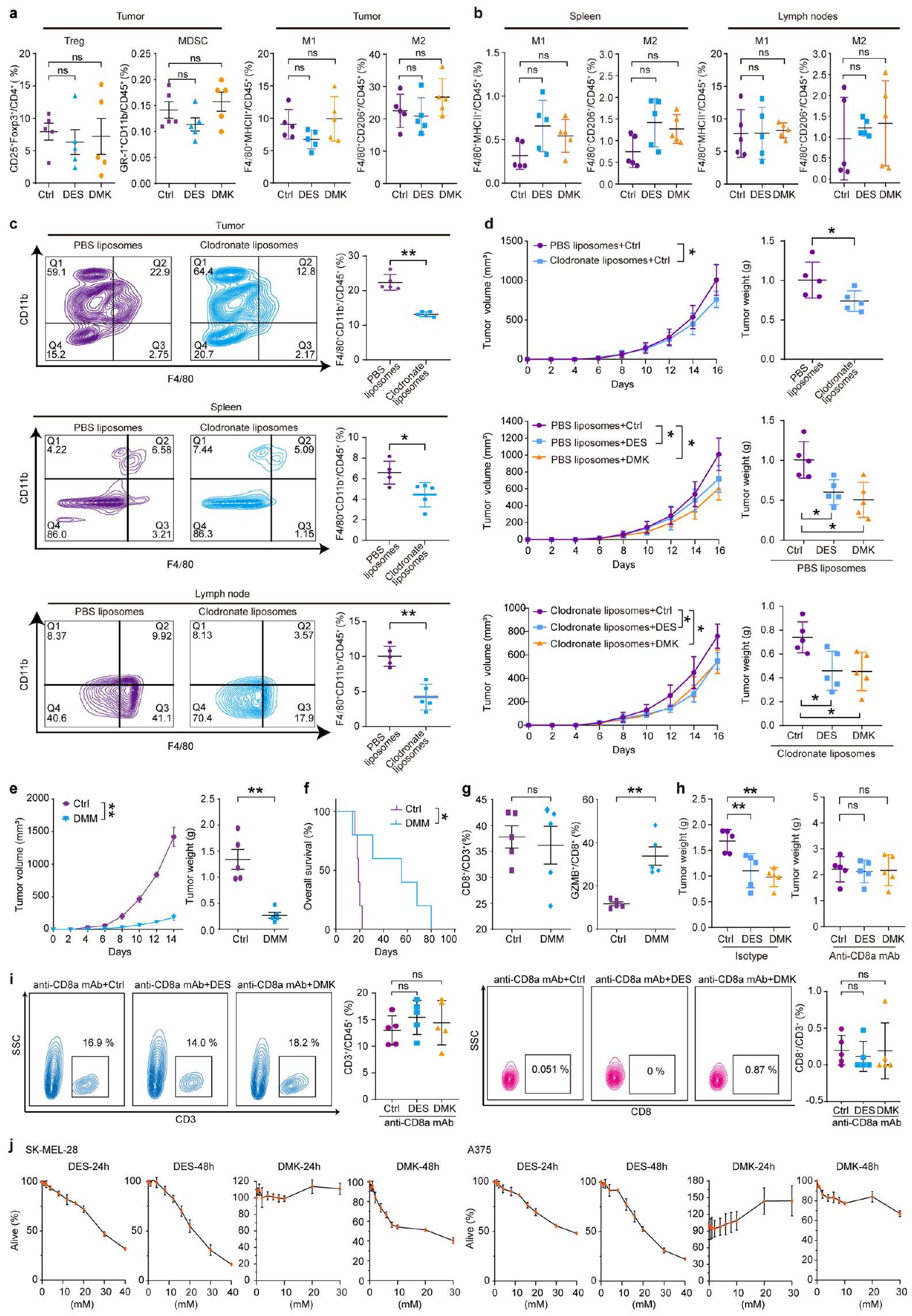
الشكل البياني الممتد 2 | انظر الصفحة التالية للتعليق.
الشكل البياني الموسع 2 | تعتمد التأثيرات المضادة للورم لمشتقات السكسينات والكتوجلوتارات على الخلايا، بينما تثبيط إنتاج السكسينيل-CoA يعزز نمو الورم. أ، النسب المئوية لـ Treg (CD25 فوكس بي 3 /CD4 ), MDSC (GR-1 ), M1 (F4/80 ), و M2 (F4/80 CD45 ) خلايا في كتل الورم المعالجة بـ Ctrl أو DES أو DMK ( المجموعة). ب، نسب البلعميات M1 و M2 في الطحال والعقد اللمفاوية تحت هذه العلاجات ( مجموعة). ج، تحليل تدفق الخلايا لفحص F4/80 CD11b البلاعم في الأورام والطحال والعقد اللمفاوية بعد علاج ليفوسوم الكلودرونات مجموعة). د، منحنيات نمو الورم والأوزان النهائية في الفئران المعالجة بـ PBS أو ليفوزومات الكلودرونات، بالاشتراك مع Ctrl أو DES أو DMK ( مجموعة). نمو الورم، وزن الورم (هـ) والبقاء العام (و) في
فئران B16F10-GFP الحاملة للورم المعالجة بالدي ميثيل مالونات (DMM) مجموعة). ج، قياس و نسب خلايا T في أورام الفئران المعالجة بـ Ctrl أو DMM أوزان الأورام (ح)، تقدير ، و نسب الخلايا (i) في أورام الفئران المعالجة بالأجسام المضادة المضادة لـ CD8a بالاشتراك مع Ctrl أو DES أو DMK فئران/مجموعة). قابلية SK-MEL-28 ) وخلايا الميلانوما A375 ( ) تم معالجتها بتركيزات مختلفة من DES أو DMK لمدة 24 أو 48 ساعة، تم قياسها بواسطة اختبار CCK-8 (OD عند 450 نانومتر). لمزيد من التفاصيل حول التصوير والإحصائيات وإمكانية التكرار، انظر الطرق. ملاحظة: تشير إلى النسخ البيولوجية المستقلة في جميع التجارب.
الشكل البياني الممتد 3 | انظر الصفحة التالية للتعليق.
الشكل البياني الممتد 3 | تغيير مستويات السكسينيل-CoA في خلايا الورم يؤثر على نمو الورم في الجسم الحي. أ، تُبرز مخططات UMAP الأنواع الرئيسية من الخلايا في أنسجة الميلانوما (GSE189889). ب، يعرض DotPlot جينات العلامة لأنواع الخلايا الفرعية في النسخ الجيني أحادي الخلية. ج، يكشف VlnPlot عن الفروقات بين الميلانوما وأنواع الخلايا الأخرى. خلايا من 9 مرضى، تشمل 19392 خلية ميلانوما، 9554 خلية T، 425 خلية بلازما، 89 خلية مَاست، 1562 بلاعم، 214 خلية كيراتينوسيت، 2230 فيبروبلاست، 1701 خلية بطانية، 1041 خلية B). د، مستويات السكسينات و AKG في خلايا الورم والمناعة التي تم زراعتها مع DES أو DMK ( مجموعة). تم معالجة خلايا A375 بمستقلبات DES أو DMK، وزرعها مع خلايا T، وصبغها بصبغة الكريستال البنفسجي لقياس البقاء ( ). تم قياس مستويات الفومارات في خلايا A375 بعد معالجة DMM و 3-NPA بواسطة LC-MS مجموعة). ج، ح، خلايا A375 المعالجة بمثبط SDH (DMM أو 3-NPA) (ج) أو مثبط OGDH (CPI-613) (ح)، المزروعة مع خلايا T، وصبغت بصبغة الكريستال البنفسجي لقياس البقاء
( ). تم تحليل خلايا SK-MEL-28 المعالجة بـ DES و DMK والجليسين لمحتوى الهيمين مجموعة . مستويات السكسينيل-CoA في خلايا الورم المعزولة من فئران B16F10 المعالجة بـ DES أو DMK مجموعة). الخلايا shNC أو B16F10 مع انخفاض مستقر في تم حقنها في الفئران في اليوم 0. أكدت تقنية الويسترن بلوت انخفاض التعبير عن تم قياس حجم الورم في النقاط الزمنية المحددة. ملخص بيانات الوزن لورم الميلانوما B 16 F 10 الذي تم جمعه بعد قتل الفئران. مجموعة) (أنا). تQuantification of و نسب CTL في كتل الأورام من مجموعات مختلفة مجموعة). حجم الورم، الأوزان ( ) والبقاء (o) في فئران B16F10 المعالجة بالجليسين ( مجموعة). تQuantification of و CD8 نسب CTL في كتل الورم عبر مجموعات العلاج مجموعة). لمزيد من التفاصيل حول التصوير، الإحصائيات وإمكانية التكرار، انظر الطرق. ملاحظة: n تشير إلى النسخ البيولوجية المستقلة في جميع التجارب.

الشكل البياني الممتد 5 | انظر الصفحة التالية للتعليق.
الشكل البياني الممتد 5 | التأثيرات المضادة للورم لـ سوكسينيل-CoA من خلال تنظيم مستويات بروتين PD-L1. أ، تم معالجة خلايا SK-MEL-28 بمستقلبات مشابهة لدورة TCA (دي إيثيل سوكسينات [DES]، ثنائي ميثيل كيتوجلوتارات [DMK]، ثنائي ميثيل فومارات [DMF]، ثنائي ميثيل ماليات [DMA]، ثنائي ميثيل إيتاكونات [DMI]، ثلاثي إيثيل سترات [ETC]) لمدة 24 ساعة، وتم قياس مستويات بروتين PD-L1 بواسطة تقنية الويسترن بلوتينغ. ). ب، تم علاج الفئران الحاملة للورم B16F10 بـ DMM أو الجلايسين، أو خفض؛ تم قياس تعبير PD-L1 في خلايا الورم بواسطة تحليل تدفق الخلايا ( تم تقييم تعبير PD-L1 في خلايا سرطان الرئة H460، وسرطان الثدي MDA-MB-231، وسرطان القولون HCT-116 بعد العلاج بـ DES/DMK باستخدام تقنية Western blotting. تم قياس تعبير PD-L1 في الأورام والطحال والماكروفاجات في العقد اللمفاوية بواسطة تحليل تدفق الخلايا. مجموعة). تمت متابعة نقل البروتين الغربي لتعبير PD-L1 في تقليل ALAS1 (عن طريق shRNA) (e) أو زيادة تعبير Flag-ALAS1 (f) في خلايا SK-MEL-28 بعد إضافة IFN- التحريض (24 ساعة قبل الكشف؛ التحليل الغربي لـ PD-L1 و ALAS1 أو Flag، و GAPDH كعنصر تحكم في التحميل. ج، التحليل الغربي للتعبير عن PD-L1 في خلايا SK-MEL-28 المعالجة
مع مثبط ناقل الجلايسين 1 (بيتوبرتين) و IFN .ه، تعبير PD-L1 في أورام B16F10 بعد knockout لـ PD-L1 بواسطة CRISPR/Cas9 مجموعة “.أنا، تم قياس تعبير PD-L1 السطحي باستخدام تقنية تحليل تدفق الخلايا ( مجموعة ). تمت مراقبة وزن جسم الفئران في النقاط الزمنية المحددة مجموعة تعبير PD-L1 بعد knockout بواسطة CRISPR/Cas9 في خلايا A375.1، مستويات mRNA لـ PD-L1 في خلايا A375 المعالجة بـ 3-NPA أو DMM أو CPI-613 ( ). تحليل Western blot لبروتين PD-L1 في خلايا A375 (يمين) و SK-MEL-28 (يسار) المعالجة بـ DES/DMK، تليها MG132 و Bafilomycin A1 لتقييم مسارات تحلل البروتينات تحليل Western blot للبروتينات المرتبطة بالالتهام الذاتي (Beclin1، LC3، P62) بعد علاج DES/DMK ). o، التألق المناعي يظهر التوضع المشترك لـ PD-L1 مع علامة محددة للاوتوفاج (LC3I/II)، الشبكة الإندوبلازمية (GRP94)، جولجي (TGN46). مقياس الرسم: ، ( ).ملاحظة: تمثل تجارب مستقلة؛ ب، د، ي، ج، تمثل عينات مستقلة بيولوجياً.
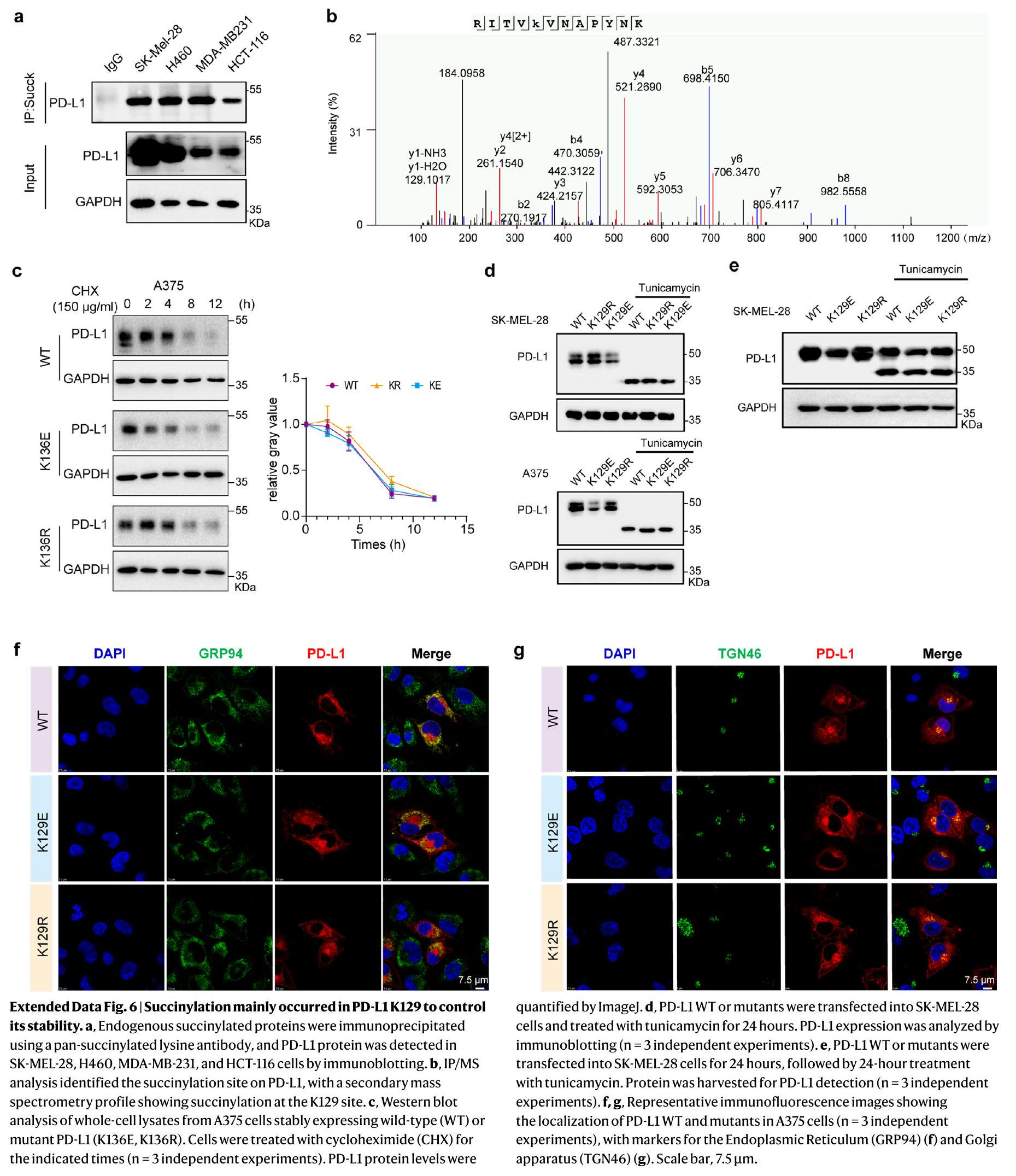
الشكل البياني الممتد 7| انظر الصفحة التالية للتعليق.
الشكل 7 من البيانات الموسعة | يرتبط CPT1A بـ PD-L1 وينظم السكسينيلation لـ PD-L1. أ، تم تحديد البروتينات المتفاعلة مع PD-L1-Flag من خلال تقنية الترسيب المناعي وقياس الطيف الكتلي (IP/MS). ب، الملف الثانوي لقياس الطيف الكتلي لـ CPT1A. ج، تم الكشف عن إنزيمات مرتبطة بالسكسينيلation من خلال الترسيب المناعي وتقنية Western blot، بما في ذلك الديسكسينيلases SRIT7 و SRIT5، ونقل السكسينيل CPT1A، وP300، وKAT2A. تم نقل خلايا A375 مع PD-L1-Flag و البلازميدات التي تعبر عن مجالات مختلفة من CPT1A (د). تم جمع الخلايا للحصول على lysate الخلايا الكاملة (WCL)، تلاها تحليل IP (هـ). تم معالجة الميتوكوندريا المعزولة مع البروتياز لمدة 30 دقيقة، وتم تحليل مستويات PD-L1 بواسطة تقنية Western blotting. تم استخدام TOMM20 (علامة الغشاء الخارجي للميتوكوندريا) و COXIV (علامة الغشاء الداخلي للميتوكوندريا) كضوابط. ج، تم وسم الميتوكوندريا المعزولة بـ MitoRacker Green وتم معالجتها بـ Protease K. تم تحليل PD-L1 على سطح الميتوكوندريا بواسطة تقنية تدفق الخلايا باستخدام جسم مضاد لـ PD-L1 ( ). هـ، خلايا مجزأة (نووية، بلازمية، ميتوكوندرية،
تم تحليل (الغشاء، الإندوسومي) للتعبير عن PD-L1 وCPT1A. قامت تحليل IP بتقييم تفاعل PD-L1 مع CPT1A، مع ضوابط لـ RCC1 (نووي)، GAPDH (سيتوبلازمي)، TOMM20 (ميتوكوندري)، Rab7 (إندوسومي). ). اللوحة اليسرى: أظهر التألق المناعي زيادة تعبير Rab7-GFP، مع كشف الأجسام المضادة CPT1A وTOMM20 عن موضع CPT1A في الميتوكوندريا والحويصلات. اللوحة اليمنى: تواجد PD-L1-mCherry وRab7-GFP معًا مع CPT1A في خلايا A375 (مقياس الرسم، ). تمت معالجة خلايا A375 التي تعبر عن CPT1A-Flag و PD-L1 (الكامل أو الجزء الخارجي 1-238 حمض أميني) باستخدام كرات Flag، وتم إجراء الكشف عن HA وFlag. ك، تم معالجة خلايا A375 بـ IFN- وتم تحليل تأثير إيتوموكسيير لمدة 24 ساعة على تعبير PD-L1 ( ). تم تحليل خلايا A375 المعالجة مع أو بدون إيتوموكساير والمزروعة مع خلايا T المنشطة من أجل السمية الخلوية ( ). لمزيد من التفاصيل، انظر الطرق. ملاحظة: تشير إلى تجارب مستقلة.
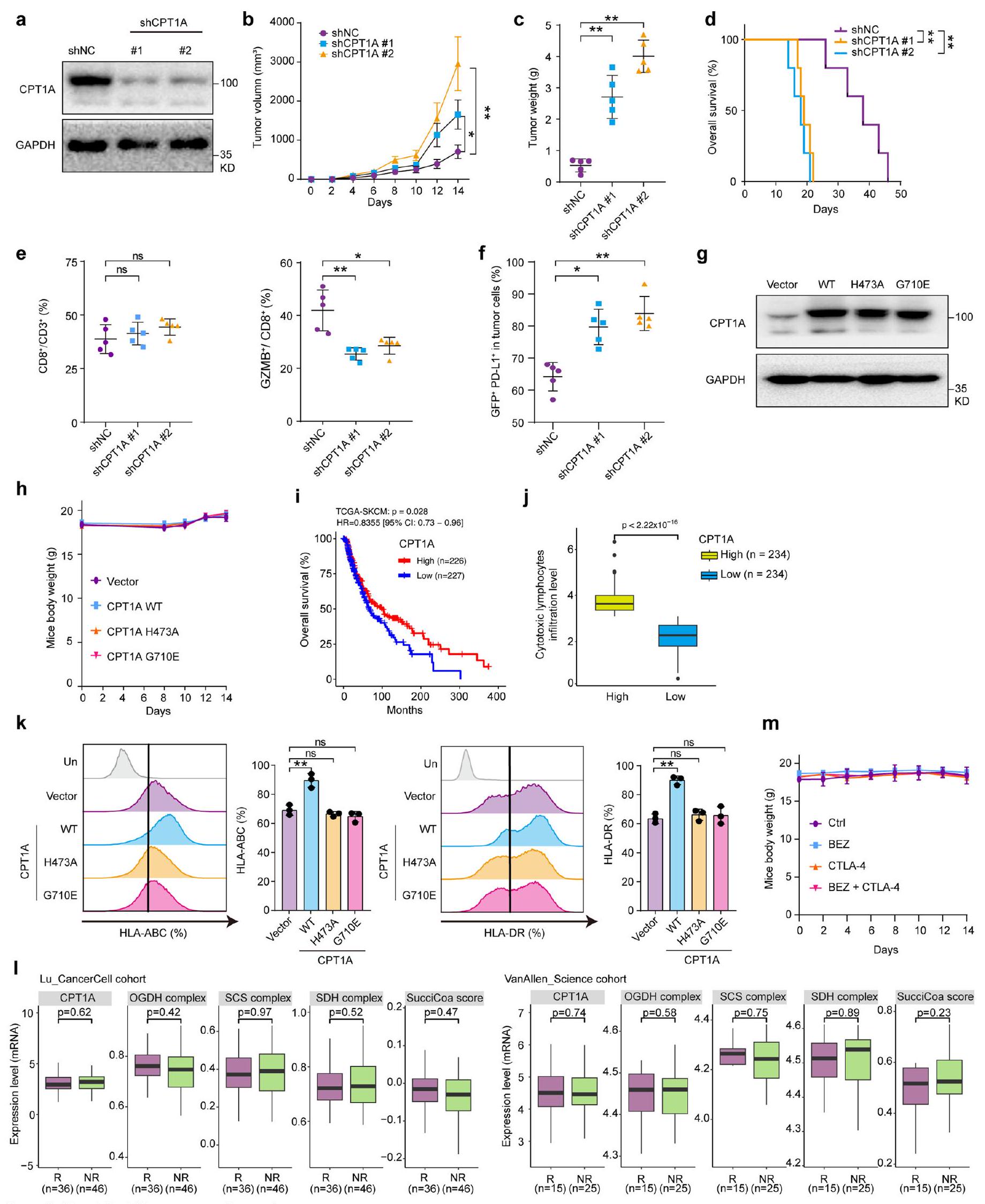
الشكل البياني الممتد 8 | انظر الصفحة التالية للتعليق.
الشكل 8 من البيانات الموسعة | تقليل CPT1A يخفف من تثبيط PD-L1 لنشاط الخلايا التائية المضادة للورم. أ، صورة غربية تظهر تعبير CPT1A في خلايا B16F10 التي تم نقلها بـ shCPT1A (#1، #2) مقارنةً بالتحكم (shNC). ب، تم حقن خلايا shCPT1A والخلايا الضابطة في الفئران في اليوم 0، وتم قياس حجم الورم في النقاط الزمنية المحددة. مجموعة). ج، بيانات وزن الورم لسرطان الجلد B16F10 بعد القتل الرحيم ( مجموعة). د، تحليل البقاء للفئران التي تحمل أورام مشتقة من B16F10 shNC و shCPT1A#1 و #2 ( مجموعة). هـ، و، قياس و GZMB الخلايا (ف) و PD-L1 خلايا الورم في كتل الورم من مجموعات علاجية مختلفة مجموعة). ج، التأكيد على زيادة التعبير عن CPT1A في خلايا B16F10 بواسطة تقنية Western blot. ح، قياسات وزن الجسم للفئران بعد العلاج مع المتجه، CPT1A WT، H473A، أو G710E ( مجموعة تحليل البقاء على قيد الحياة لتعبير CPT1A على البقاء العام في
مجموعة TCGA-SKCM المرضى). ج، الفرق في مستويات تسلل الخلايا اللمفاوية السامة للخلايا بين مجموعتي CPT1A العالية وCPT1A المنخفضة في مجموعة TCGASKCM ( تم التعبير عن الطفرات البرية CPT1A الموسومة بـ GFP، H473A، وG710E بشكل مفرط في خلايا A375. تم تقييم جزيئات تقديم المستضد (HLA-A/B/C، HLA-DR) على خلايا الورم الإيجابية لـ GFP باستخدام تحليل تدفق الخلايا. مجموعة). أنا، مخطط الصندوق الذي يظهر الفروق في تعبير CPT1A وملفات السكسينيل (OGDH، SDH، مجمعات SCS، درجة SucciCoa) بين المستجيبين لمضاد CTLA-4 (R) وغير المستجيبين (NR) في مجموعتين مستقلتين من الميلانوما (Lu_CancerCell: المرضى؛ فان ألين_ساينس: المرضى). م، قياسات وزن الجسم للفئران المعالجة بالتحكم، بازر فيبات، أو مضاد CTLA-4 بمفرده أو بالاشتراك مع ( مجموعة). ملاحظة: n تشير إلى النسخ البيولوجية المستقلة في جميع التجارب.
الشكل البياني الموسع 9 | ارتباط استحاثة البروتين وعبارة PD-L1 مع استجابة العلاج المناعي. أ، صور فلورية تمثيلية تظهر استحاثة البروتين الكلية وعبارة PD-L1 في مريضين ذوي استجابات علاجية مختلفة. مقياس الرسم: “. ب، مقارنة مستويات السكسينيل البروتين الكلي بين المستجيبين ( المرضى) وغير المستجيبين (NR، المرضى). ج، رسم بياني لكابلان-ماير لمعدلات البقاء بدون تقدم للمرضى المصنفين حسب مستويات تعبير البروتينات المشتقة من السكسينات الكليّة ( مستويات التعبير عن PD-L1 (د) و CPT1A (هـ) في مجموعات المرضى المصنفة حسب القيمة المتوسطة لتعبير البروتين الكلي المشتق من السكسينيل ( المرضى). كان زيادة تنظيم OGDH وSCS وSDH في دورة TCA مرتبطًا بتحسين فعالية العلاج المناعي والتنبؤ بالنتائج. كانت عينات المرضى التي تحتوي على مستويات عالية من الإنزيمات الثلاثة أكثر احتمالًا للاستجابة لـ PD-1.
العلاج. على وجه التحديد، زادت تعبير OGDH من تحويل تحويل -كيتوجلوتارات إلى سوكسينيل-CoA، بينما تسارع التعبير المرتفع عن SCS من تحويل سوكسينيل-CoA إلى سوكسينات. ساهم زيادة التعبير عن SDH بشكل أكبر في تحويل سوكسينات إلى فومارات. يؤدي التعبير العالي المتزامن لهذه الإنزيمات إلى استنفاد سريع لسوكسينيل-CoA، مما يقلل من توفر المتبرعين للتسوكينيل وبالتالي يقلل من تسوكينيل البروتين. تشير هذه النتائج إلى أن انخفاض تسوكينيل البروتين يرتبط بزيادة تعبير PD-L1 في الأورام، والذي يرتبط بتحسن الاستجابة لعلاج PD-1. لمزيد من التفاصيل حول التصوير والإحصائيات وإمكانية التكرار، انظر الطرق. ملاحظة: تشير إلى النسخ البيولوجية المستقلة في جميع التجارب.

محفظة الطبيعة

المؤلفون المراسلون: جينغ ليو؛ هونغ ليو؛ شيانغ تشين.
آخر تحديث من المؤلفين: 2025.2.5

ملخص التقرير

تتمنى Nature Portfolio تحسين قابلية إعادة إنتاج العمل الذي ننشره. يوفر هذا النموذج هيكلًا للاتساق والشفافية في التقرير. لمزيد من المعلومات حول سياسات Nature Portfolio، يرجى الاطلاع على سياسات التحرير وقائمة مراجعة سياسة التحرير.

الإحصائيات

لجميع التحليلات الإحصائية، تأكد من أن العناصر التالية موجودة في أسطورة الشكل، أسطورة الجدول، النص الرئيسي، أو قسم الطرق.
غير متوفر
تم التأكيد
□ X
حجم العينة بالضبط لكل مجموعة/شرط تجريبي، معطاة كرقم منفصل ووحدة قياس

بيان حول ما إذا كانت القياسات قد أُخذت من عينات متميزة أو ما إذا كانت نفس العينة قد تم قياسها عدة مرات
□ X
اختبار(ات) الإحصاء المستخدمة وما إذا كانت أحادية الجانب أو ثنائية الجانب
يجب أن تُوصف الاختبارات الشائعة فقط بالاسم؛ واصفًا التقنيات الأكثر تعقيدًا في قسم الطرق.

□ وصف لجميع المتغيرات المرافقة التي تم اختبارها
□ X
وصف لأي افتراضات أو تصحيحات، مثل اختبارات الطبيعية والتعديل للمقارنات المتعددة

وصف كامل للمعلمات الإحصائية بما في ذلك الاتجاه المركزي (مثل المتوسطات) أو تقديرات أساسية أخرى (مثل معامل الانحدار) و التباين (مثل الانحراف المعياري) أو تقديرات مرتبطة بعدم اليقين (مثل فترات الثقة)
□ X
لاختبار الفرضية الصفرية، فإن إحصائية الاختبار (على سبيل المثال، ) مع فترات الثقة، أحجام التأثير، درجات الحرية و قيمة ملحوظة أعطِ القيم كقيم دقيقة كلما كان ذلك مناسبًا.

□ لتحليل بايزي، معلومات حول اختيار القيم الأولية وإعدادات سلسلة ماركوف مونت كارلو

بالنسبة للتصاميم الهرمية والمعقدة، تحديد المستوى المناسب للاختبارات والتقارير الكاملة عن النتائج
□ ⟶
تقديرات أحجام التأثير (مثل حجم تأثير كوهين) بيرسون )، مما يشير إلى كيفية حسابها
تحتوي مجموعتنا على الويب حول الإحصائيات لعلماء الأحياء على مقالات تتناول العديد من النقاط المذكورة أعلاه.

البرمجيات والشيفرة

معلومات السياسة حول توفر كود الكمبيوتر
جمع البيانات
بيورندرhttps://www.biorender.com/للحصول على مزيد من التفاصيل، يرجى الاطلاع على قسم الطرق وتوافر البيانات.
تحليل البيانات
تم استخدام الأدوات المتاحة للجمهور التالية للتحليلات: Estimate (v1.0.13)، GSVA (v1.40.1)، fgsea (v1.18.0)، clusterProfiler (4.0.5)، Seurat (v4.4.0)، Cottrazm (v0.1.1)، survival (v.3.5.7). حزم R الإحصائية (v4.1.0) وGraphpad Prism (v8.0.1). يمكن العثور على التفاصيل والمراجع ضمن النص في قسم الطرق ذات الصلة والملاحظة التكميلية.
بالنسبة للمخطوطات التي تستخدم خوارزميات أو برامج مخصصة تكون مركزية في البحث ولكن لم يتم وصفها بعد في الأدبيات المنشورة، يجب أن تكون البرمجيات متاحة للمحررين والمراجعين. نحن نشجع بشدة على إيداع الشيفرة في مستودع مجتمعي (مثل GitHub). راجع إرشادات مجموعة Nature لتقديم الشيفرة والبرمجيات لمزيد من المعلومات.

بيانات

معلومات السياسة حول توفر البيانات
يجب أن تتضمن جميع المخطوطات بيانًا حول توفر البيانات. يجب أن يوفر هذا البيان المعلومات التالية، حيثما ينطبق:
  • رموز الانضمام، معرفات فريدة، أو روابط ويب لمجموعات البيانات المتاحة للجمهور
  • وصف لأي قيود على توفر البيانات
  • بالنسبة لمجموعات البيانات السريرية أو بيانات الطرف الثالث، يرجى التأكد من أن البيان يتماشى مع سياستنا
بيانات النسخ الجيني المكاني وصبغة المناعية للأنسجة البشرية المصابة بالميلانوما الخبيثة المثبتة بالفورمالين والمضمنة في البارافين (FFPE) التي تم الحصول عليها من موقع 10x Genomicshttps://www.10xgenomics.com/resources/datasets/). تم استرجاع بيانات النسخ الجيني للخلايا المفردة لسرطان الجلد من Gene-
تعبير أومنيبوس (GEO) (https://www.ncbi.nlm.nih.gov/geo/) تحت أرقام الوصول (GSE189889). تم الحصول على بيانات البروتيوميات المعالجة والبيانات السريرية لسرطان الجلد المعالج بمضاد PD1/TIL من Geiger وآخرين وهي متاحة في المواد التكميلية لمنشورهم. تم تنزيل مجموعة Gide (PRJEB23709) من قاعدة بيانات SRA (https://www.ncbi.nlm.nih.gov/bioproject/“). تم تنزيل مجموعة فان ألين (phs000452.v3) من قاعدة بيانات dbGaP (https://www.ncbi.nlm.nih.gov/gap/تم الحصول على بيانات ترانسكريبتوم mRNA المعالجة لسرطان الجلد الميلانيني المعالج بالأجسام المضادة المضادة لـ CTLA-4 من لو وآخرون وهي متاحة في المواد التكميلية لمنشورهم. تم استخدام مجموعتين من GEO (GSE35640، GSE135222) من قاعدة بيانات التعبير الجيني (GEO).https://www.ncbi.nlm.nih.gov/geo/) تم تضمينها لمزيد من التحليل. تم تنزيل مجموعة IMvigor210 المعالجة بمضاد PD-L1 من http://researchpub.gene.com/IMvigor210CoreBiologiesتم تنزيل تعبير mRNA والبيانات السريرية لـ 33 نوعًا من السرطان من أطلس جينوم السرطان (TCGA) من بوابة بيانات TCGA (https:// بوابة.gdc.cancer.gov/تم تنزيل بيانات البروتيوميات من موسوعة خطوط خلايا السرطان من cBioportal.https://www.cbioportal.org/“). تم تنزيل مجموعة بيانات البروتيوم الخاصة بسرطان الرئة الغدي (LUAD) والبيانات السريرية من بوابة بيانات اتحاد تحليل الأورام البروتيومية السريرية (CPTAC) (https://بروتيوميات.سرطان.حكومة/بوابة البيانات). تم تضمين مسحات غير مقصوصة من جميع Western blots وجميع البيانات الخام المستخدمة لإنشاء الرسوم البيانية في بيانات المصدر. يتم توفير بيانات المصدر مع هذه الورقة.

البحث الذي يتضمن مشاركين بشريين، بياناتهم، أو مواد بيولوجية

معلومات السياسة حول الدراسات التي تشمل مشاركين بشريين أو بيانات بشرية. انظر أيضًا معلومات السياسة حول الجنس، الهوية/التقديم الجنسي، والتوجه الجنسي والعرق، والاثنية والعنصرية.
التقارير عن الجنس والنوع
التقارير عن العرق أو الإثنية أو غيرها من المجموعات الاجتماعية ذات الصلة
خصائص السكان
شملت المجموعة 45 مريضًا بالميلانوما، منهم 33 أنثى و12 ذكرًا، تتراوح أعمارهم بين 11 و77 عامًا.
تم أخذ عينات من أنسجة الميلانوما من مرضى تم تشخيصهم وعلاجهم في مستشفى شيانغيا التابع لجامعة جنوب الوسطى، الصين.
تم تشخيص المرضى إما بسرطان الجلد الأولي أو النقيلي، يتراوح من المرحلة الثالثة إلى المرحلة الرابعة. استجاب 26 مريضًا للعلاج المناعي (R)، بينما كان 19 غير مستجيبين (NR).
تم تجنيد المرضى بأثر رجعي من مستشفى شيانغيا، جامعة جنوب الوسطى، بين مارس 2018 ويناير 2022. تم تأكيد جميع الحالات من خلال الفحص النسيجي، وتم جمع البيانات السريرية للتحليل.
تمت الموافقة على الدراسة من قبل لجنة المراجعة المؤسسية في مستشفى شيانغيا، جامعة جنوب الوسطى. تم الحصول على موافقة خطية مستنيرة من جميع المشاركين.
يرجى ملاحظة أنه يجب أيضًا تقديم معلومات كاملة حول الموافقة على بروتوكول الدراسة في المخطوطة.

التقارير الخاصة بالمجال

يرجى اختيار الخيار أدناه الذي يناسب بحثك بشكل أفضل. إذا لم تكن متأكدًا، اقرأ الأقسام المناسبة قبل اتخاذ قرارك.
علوم الحياة □ العلوم السلوكية والاجتماعية □ العلوم البيئية والتطورية والبيئية
لنسخة مرجعية من الوثيقة بجميع الأقسام، انظرnature.com/documents/nr-reporting-summary-flat.pdf

تصميم دراسة العلوم الحياتية

يجب على جميع الدراسات الإفصاح عن هذه النقاط حتى عندما يكون الإفصاح سلبياً.
حجم العينة
حجم العينة: تم توثيق تفاصيل حجم العينة بالكامل في قسم الطرق والأساطير المقابلة للأشكال. لم يتم إجراء حسابات القوة مسبقًا لتحديد أحجام العينات. تم اختيار أحجام العينات بناءً على كل من التقاليد المعمول بها في المجال (عادةً التكرارات البيولوجية) وتجربتنا السابقة مع أنظمة تجريبية مماثلة. أكدت تحليلات القوة بعد التجربة أن أحجام العينات المختارة كانت كافية لاكتشاف اختلافات ذات دلالة إحصائية بين المجموعات التجريبية بقوة كافية.
استبعاد البيانات
استنساخ
التوزيع العشوائي
مُعَمي
بصرف النظر عن الأخطاء التجريبية الواضحة، لم يتم استبعاد أي بيانات من التحليلات.
تم ذكر أعداد النسخ التجريبية في أسطورة الشكل.
تمت معالجة الحيوانات الحاملة للأورام في دراسات الفعالية بالتوزيع العشوائي الكتلي مما أدى إلى مجموعات متساوية الحجم بنفس متوسط أحجام الأورام.
تم جمع البيانات بواسطة الباحثين الذين كانوا غير مدركين لتعيينات المجموعات التجريبية.

التقارير عن مواد وأنظمة وطرق محددة

نحتاج إلى معلومات من المؤلفين حول بعض أنواع المواد والأنظمة التجريبية والأساليب المستخدمة في العديد من الدراسات. هنا، يرجى الإشارة إلى ما إذا كانت كل مادة أو نظام أو طريقة مدرجة ذات صلة بدراستك. إذا لم تكن متأكدًا مما إذا كان عنصر القائمة ينطبق على بحثك، يرجى قراءة القسم المناسب قبل اختيار رد.
محفظة الطبيعة | ملخص التقرير
أبريل 2023
المواد والأنظمة التجريبية
غير متوفر مشارك في الدراسة غير متوفر
أجسام مضادة X
– خطوط خلايا حقيقية النواة
V □ علم الحفريات وعلم الآثار إكس
【 الحيوانات وغيرها من الكائنات الحية
إكس
إكس

الأجسام المضادة

الأجسام المضادة المستخدمة
تم استخدام الأجسام المضادة التالية لتحليل التدفق:
APC/Cyanine7-CD45 1:200 (103116, Biolegend)، APC-CD3 1:200 (100236, Biolegend)، PECY5.5-CD4 1:200 (100434, Biolegend)، BB700-CD4 1:200 (566407, BD)، PECY7-CD8 1:200 (100722, Biolegend)، APC-PD-L1 1:200 (124312, Biolegend)، APC-F4/80 1:200 (123116, Biolegend)، APC-CD25 1:200 (102012, Biolegend)، BV421-Gr-1 1:200 (108445, Biolegend)، PE-Cy7-CD11b 1:200 (552850, Biolegend)، PerCP-Cy5.5-MHC II 1:200 (107626, Biolegend)، PE-FOXP3 1:200 (12-5773-82, eBioscience)، FITC-GZMB 1:200 (372206, Biolegend)، PECY594-GZMB 1:200 (372216, Biolegend)، PE-CD206 1:200 (141706, Biolegend)، PE-PD-L1 1:200 (329706, Biolegend).
“تم استخدام الأجسام المضادة التالية لتحليل WB: CD40 1:2000 (A0218، ABclonal)، VISTA 1:2000 (64953، Cell Signaling)، PD-L2 1:2000 (82723، Cell Signaling)، PVR 1:2000 (81254، Cell Signaling)، CD70 1:2000 (A2032، ABclonal)، CD80 1:2000 (15416، Cell Signaling)، CD86 1:2000 (A19026، ABclonal)، CD112 1:2000 (95333، Cell Signaling)، CD276 1:2000 (A21663، ABclonal)، OX4OL 1:2000 (A18389، ABclonal)، TNFSF14 1:2000 (A2002، ABclonal)، GITRL 1:2000 (A7028، ABclonal)، PD-L1 1:2000 (13684، Cell Signaling)، SQSTM1/p62 1:2000 (23214، Cell Signaling)، LC3A/B 1:2000 (12741، Cell Signaling)، PD-L1 1:2000 (ab213524، Abcam)، PD-L1 1:2000 (ab213480، Abcam)، Beclin1 1:2000 (ab207612، Abcam)، CPT1A 1:2000 (15184-1-AP، Proteintech)، HIP1R 1:2000 (16814-1-AP، Proteintech)، GAPDH 1:5000 (60004-1-Ig، Proteintech)، ALAS1 1:2000 (A4817، ABclonal)، TOM20 1:2000 (A19403، ABclonal)، CPT1A 1:2000 (ab128568، Abcam). تم استخدام الأجسام المضادة التالية لتحليل IF/IHC: Granzyme B 1:200 (ab4059، Abcam)، Rab7B 1:200 (ab193360، Abcam)، CD3 1:200 (ab16669، Abcam)، PD-L1 1:200 (66248-1-lg، Proteintech)، TGN46 1:200 (13573-1-AP،
محفظة الطبيعة | ملخص التقرير
أبريل 2023
للتخطيط المناعي
CD40 [مُتعدد النسائل]
https://abclonal.com.cn/catalog/A0218
فيستا [D1L2G] (1:2000)
https://www.cellsignal.cn/products/primary-antibodies/vista-d1|2g-xp-rabbit-mab/64953
PD-L2 [D7U8C] (1:2000)
https://www.cellsignal.cn/products/primary-antibodies/pd-l2-d7u8c-xp-rabbit-mab/82723
PVR [D8A5G] (1:2000)
https://www.cellsignal.cn/products/primary-antibodies/pvr-cd155-d8a5g-rabbit-mab/81254
CD70 [متعدد النسائل]
https://abclonal.com.cn/catalog/A2032
CD80 [E3Q9V] (1:2000)
https://www.cellsignal.cn/products/primary-antibodies/cd80-e3q9v-rabbit-mab/15416
CD86 [متعدد النسائل]
https://abclonal.com.cn/catalog/A19026
CD112 [D8D3F] (1:2000)
https://www.cellsignal.cn/products/primary-antibodies/nectin-2-cd112-d8d3f-xp-rabbit-mab/95333CD276 [متعدد النسائل] (1:2000)
https://abclonal.com.cn/catalog/A21663
OX40L [متعدد النسائل] (1:2000)
https://abclonal.com.cn/catalog/A18389
TNFSF14 [متعدد النسائل] (1:2000)
https://abclonal.com.cn/catalog/A2002
GITRL [مُتعدد النسائل] (1:2000)
https://abclonal.com.cn/catalog/A7028
PD-L1 [E1L3N] (1:2000)
https://www.cellsignal.cn/products/primary-antibodies/pd-I1-e1I3n-xp-rabbit-mab/13684
SQSTM1/p62 [D6M5X] (1:2000)
https://www.cellsignal.cn/products/primary-antibodies/sqstm1-p62-d6m5x-rabbit-mab/23214 LC3A/B [D3U4C] (1:2000)
https://www.cellsignal.cn/products/primary-antibodies/lc3a-b-d3u4c-xp-rabbit-mab/12741PD-L1 [EPR19759] (1:2000)
https://www.abcam.cn/products/primary-antibodies/pd-l1-antibody-epr19759-ab213524.htmlPD-L1 [EPR20529] (1:2000)
https://www.abcam.cn/products/primary-antibodies/pd-l1-antibody-epr20529-ab213480.htmlبيكلين1 [EPR19662] (1:2000)
https://www.abcam.cn/products/primary-antibodies/beclin-1-antibody-epr19662-ab207612.html CPT1A [متعدد النسائل] (1:2000)
https://www.ptgcn.com/products/CPT1A-Antibody-15184-1-AP.htm
HIP1R [مضاد متعدد النسائل]
https://www.ptgcn.com/products/HIP1R-Antibody-16814-1-AP.htm
جيه إيه بي دي إتش [1E6D9] (1:5000)
https://www.ptgcn.com/products/GAPDH-Antibody-60004-1-lg.htm
آلاس1 [A4817] (1:2000)
https://www.abclonal.com/catalog-antibodies/ALAS1RabbitmAb/A4817
TOM20 [A19403] (1:2000)
https://www.abclonal.com/catalog-antibodies/TOM20RabbitmAb/A19403
مضاد CPT1A [8F6AE9] (1:2000)
https://www.abcam.com/ar/products/الأجسام-المضادة-الأولية/cpt1a-antibody-8f6ae9-ab128568
للعلاج
مضاد CTLA-4 [9D9]
https://bioxcell.com/invivoplus-anti-mouse-ctla-4-cd152-bp0164
مضاد CD8 [2.43]
https://bioxcell.com/invivomab-anti-mouse-cd8-alpha-be0061
لـ IHC أو IF
جرانزيم ب [مُتعدد النسائل] (1:200)
https://www.abcam.cn/products/primary-antibodies/granzyme-b-antibody-ab4059.htmlRab7B [EPR15727]
https://www.abcam.cn/products/primary-antibodies/rab7b-antibody-epr15727-ab193360.htmlCD3 [SP7] (1:200)
https://www.abcam.cn/products/primary-antibodies/cd3-epsilon-antibody-sp7-ab16669.htmlPD-L1 [66248-1-Ig] (1:200)
https://www.ptgcn.com/products/PD-L1-CD274-Antibody-66248-1-Ig.htm
TGN46 [وحيد النسيلة] (1:200)
https://www.ptgcn.com/products/TGOLN2,TGN46-Antibody-13573-1-AP.htm
CD8 [EPR21769]
https://www.abcam.cn/products/primary-antibodies/cd8-alpha-antibody-epr21769-ab217344.html
Rab11B [مُتعدد النسخ]
https://www.ptgcn.com/products/RAB11A-Antibody-15903-1-AP.htm
GRP94 [مُتعدد النسائل] (1:200)
https://www.ptgcn.com/products/HSP90B1-Antibody-14700-1-AP.htm
لتحليل التدفق الخلوي:
APC/Cyanine7-CD45 [30-F11] (1:200)
https://www.biolegend.com/ar/products/apc-cyanine7-anti-mouse-cd45-antibody-2530
APC-CD3 [17A2] (1:200)
https://www.biolegend.com/ar/products/apc-anti-mouse-cd3-antibody-8055
PECY5.5-CD4 [GK1.5] (1:200)
https://www.biolegend.com/ar/products/percp-cyanine5-5-anti-mouse-cd4-antibody-4220
BB700-CD4 [GK1.5]
https://www.bdbiosciences.com/zh-cn/products/reagents/flow-cytometry-reagents/research-reagents/single-color-antibodies-ruo/bb700-فأر-مضاد-للبشر-cd4.745998
PECY7-CD8 [53-6.7] (1:200)
https://www.biolegend.com/ar/products/pe-cyanine7-anti-mouse-cd8a-antibody-1906
APC-PD-L1 [10F.9G2] (1:200)
https://www.biolegend.com/ar/products/apc-anti-mouse-cd274-b7-h1-pd-l1-antibody-6655
APC-F4/80 [BM8] (1:200)
https://www.biolegend.com/ar/products/apc-cyanine7-anti-mouse-f4-80-recombinant-antibody-21272
APC-CD25 [PC61] (1:200)
https://www.biolegend.com/ar/الخلايا-التحكم-المجففة/apc-مضاد-cd25-للفئران-420
BV421-Gr-1 [RB6-8C5] (1:200)
https://www.biolegend.com/ja-jp/products/brilliant-violet-421-anti-mouse-ly-6g-ly-6c-gr-1-antibody-7201?GroupID=BLG4876
PE-Cy7-CD11b [M1/70] (1:200)
https://www.biolegend.com/ar/products/pe-cyanine7-anti-mouse-human-cd11b-antibody-1921?GroupID=BLG10427
PerCP-Cy5.5-MHCII [M5/114.15.2] (1:200)
https://www.biolegend.com/ar/products/percp-cyanine5-5-anti-mouse-i-a-i-e-antibody-4282?GroupID=BLG4736
PE-FOXP3 [FJK-16s] (1:200)
https://www.thermofisher.cn/cn/zh/antibody/product/FOXP3-Antibody-clone-FJK-16s-Monoclonal/12-5773-82
FITC-GZMB [QA16A02] (1:200)
https://www.biolegend.com/ar/products/fitc-anti-human-mouse-granzyme-b-recombinant-antibody-14430
PECY594-GZMB [QA16A02] (1:200)
https://www.biolegend.com/ar/products/pedazzle-594-anti-humanmouse-granzyme-b-recombinant-antibody-15598
PE-CD206 [C068C2] (1:200)
https://www.biolegend.com/ar/products/pe-anti-mouse-cd206-mmr-antibody-7424?GroupID=BLG9506
PE-PD-L1 [29E.2A3] (1:200)
https://www.biolegend.com/ar/products/pe-anti-human-cd274-b7-h1-pd-l1-antibody-4375
الأجسام المضادة الثانوية وDAPI:
الأجسام المضادة من نوع IgG الموجهة ضد الأرانب (GB21303)
https://www.service-bio.com/goodsdetail?id=253
FITC ماعز مضاد للأرنب IgG (GB22303)
https://www.service-bio.com/goodsdetail?id=259
DAPI (G1012)
https://www.servicebio.cn/goodsdetail?id=1762
الأجسام المضادة من الماعز ضد الأرانب IgG (GB27303)
https://www.servicebio.cn/goodsdetail?id=4191

خطوط خلايا حقيقية النواة

معلومات السياسة حول خطوط الخلايا والجنس والنوع في البحث
مصدر(s) خط الخلية
المصادقة
تلوث الميكوبلازما
الخطوط التي يتم التعرف عليها بشكل خاطئ بشكل شائع (انظر سجل ICLAC)
خطوط الخلايا البشرية (A375، SK-MEL-28، H460 و HCT116) وخطوط الخلايا الفأرية (B16F10، MC38، B16F10-OVA). جميع خطوط الخلايا المستخدمة تم الحصول عليها من ATCC (مجموعة الثقافة الأمريكية، ماناساس، فيرجينيا، الولايات المتحدة الأمريكية).
تم التحقق من خطوط الخلايا بواسطة STR.
تم اختبار جميع خطوط الخلايا سلبية لتلوث الميكوبلازما.
لم يتم استخدام خطوط خلوية يتم التعرف عليها بشكل خاطئ بشكل شائع.

الحيوانات وغيرها من الكائنات البحثية

معلومات السياسة حول الدراسات التي تشمل الحيوانات؛ إرشادات ARRIVE الموصى بها للإبلاغ عن أبحاث الحيوانات، والجنس والنوع في البحث
الحيوانات المخبرية
الحيوانات البرية
التقارير عن الجنس
عينات تم جمعها من الميدان
تم الحصول على فئران C57BL/6 التي تتراوح أعمارها بين ستة إلى ثمانية أسابيع من شركة شنغهاي SLAC للحيوانات المخبرية المحدودة. تم إيواء الفئران في منشأة خالية من مسببات الأمراض المحددة تحت ظروف بيئية خاضعة للرقابة: دورة ضوء/ظلام مدتها 12 ساعة، مع الحفاظ على درجة الحرارة عند درجة مئوية، ورطوبة نسبية عند تم الاحتفاظ بالحيوانات في أقفاص ذات تهوية فردية مع وصول حر إلى علف المختبر القياسي والماء.
لم تشمل الدراسة الحيوانات البرية
استخدمت الدراسات إناث الفئران.
لم تتضمن الدراسة عينات تم جمعها من الميدان.

رقابة الأخلاقيات

تمت الموافقة على جميع تجارب الحيوانات من قبل لجنة رعاية واستخدام الحيوانات في مستشفى شيانغيا بموجب رقم البروتوكول 2020sydw0466
يرجى ملاحظة أنه يجب أيضًا تقديم معلومات كاملة حول الموافقة على بروتوكول الدراسة في المخطوطة.

النباتات

مخزونات البذور غير متوفر
أنماط جينية نباتية جديدة غير متوفر
المصادقة غير متوفر

تدفق الخلايا

المؤامرات

أكد أن:

توضح تسميات المحاور العلامة والفلوكروم المستخدم (مثل CD4-FITC).
المقاييس على المحاور واضحة تمامًا. قم بتضمين الأرقام على المحاور فقط للرسم البياني في أسفل اليسار من المجموعة (المجموعة هي تحليل للعلامات المتطابقة).
جميع الرسوم البيانية هي رسوم بيانية متساوية الارتفاع مع نقاط شاذة أو رسوم بيانية بالألوان الزائفة.
تم توفير قيمة عددية لعدد الخلايا أو النسبة المئوية (مع الإحصائيات).

المنهجية

تحضير العينة بالنسبة لعينات الفئران، تم إعداد تعليقات خلوية مفردة من أورام زراعة الأنسجة المستمدة من C57BL/6 (بما في ذلك B16F10 و LLC و MC38) عن طريق إزالة سريعة ولطيفة، تلتها تفكيك ميكانيكي وترشيح.
آلة بي دي إل إس آر فورتيسا أداة X-20 أو BD FACSymphony™ A3
برمجيات تمت معالجة البيانات بشكل إضافي بواسطة برنامج FlowJo (الإصدار 10.0).
وفرة تجمع الخلايا لم يتم استخدام فرز الخلايا في أي من التجارب.
استراتيجية البوابة تم تحديد الخلايا اللمفاوية بناءً على FSC-A و SSC-A. تم تحديد الخلايا المفردة وفقًا لـ FSC-H مقابل FSC-W. تم استبعاد الخلايا الميتة باستخدام صبغة حيوية (Zombie Aqua™). تم تحديد الخلايا المناعية الحية CD45+، تلاها تحديد مجموعات الخلايا المحددة بناءً على تعبير علامات السطح. لاستراتيجية التحديد، انظر الشكل التوضيحي التكميلي 1.
قم بتحديد هذا المربع لتأكيد أنه تم تقديم رقم يوضح استراتيجية البوابة في المعلومات التكميلية.

  1. قسم الأمراض الجلدية، مستشفى شيانغيا ومدرسة علوم الحياة ومختبر فورونغ، جامعة وسط الجنوب، تشانغشا، الصين.
    علم الوراثة الطبية وكلية علوم الحياة، جامعة جنوب الوسط، تشانغشا، الصين. مختبر هنان الرئيسي لسرطان الجلد والصدفية، مركز هنان الهندسي لأبحاث صحة الجلد والأمراض، مركز شيانغيا للبحوث السريرية لعلاج السرطان المناعي، المركز الوطني للبحوث السريرية للاضطرابات الشيخوخة، جامعة وسط جنوب الصين، تشانغشا، الصين. قسم العلوم الإحصائية، كلية لندن الجامعية، لندن، المملكة المتحدة. معهد الدراسات العليا للعلوم الطبية الحيوية، معهد الكيمياء الحيوية وعلم الأحياء الجزيئي، مركز أبحاث بيولوجيا السرطان، مركز بيولوجيا السرطان والعلاج الدقيق، ومركز الطب الجزيئي، جامعة الصين الطبية، تايتشونغ، تايوان. ساهم هؤلاء المؤلفون بالتساوي: لونغ ليانغ، شينوي كوانغ، يي هي. هؤلاء المؤلفون أشرفوا بشكل مشترك على هذا العمل: جينغ ليو، هونغ ليو، شيانغ تشين. البريد الإلكتروني:liujing2@sklmg.edu.cn; hongliu1014@csu.edu.cn; chenxiangck@126.com
  2. ( تحليل البقاء للفئران بعد العلاج بـ DMK أو DES مستويات السكسينات و AKG في خلايا الورم من الفئران المعالجة بـ DMK أو DES لكل مجموعة). أنا، قياس و نسب CTL في كتل الورم لكل مجموعة). تلوين المناعة لـ CD3 و CD8 و GZMB في أورام B16F10 لكل مجموعة). شريط القياس، قياسات حجم الورم بعد CD8 استنزاف خلايا T والعلاجات لكل مجموعة). أنا، خريطة حرارية للتعبير عن OGDH و SCS و SDH في مناطق الورم. شريط القياس، مخطط مسارات إنتاج السكسينيل-CoA. ن، مستويات السكسينات وAKG في خلايا A375 المعالجة بنظائر الأيض. .، O، خلايا A375 المعالجة بالجليسين ومتماثلات الأيض، المزروعة مع خلايا T، تليها صبغة الكريستال البنفسجي ( ). مستويات السكسينيل-CoA المقاسة بواسطة LC-MS في خلايا A375 ( ). لمزيد من التفاصيل حول التصور والإحصائيات وإمكانية التكرار، انظر الطرق. لاحظ أن في a-n، تمثل n عينات مستقلة بيولوجيًا و، في و تجارب مستقلة.
  3. مستويات PD-L1 بعد العلاج بـ DES و DMK و DMM و 3-NPA و CPI-613 لمدة 24 ساعة ( ). أنا، مستويات mRNA لـ PD-L1 في خلايا A375 بعد المعالجة بـ DES أو DMK ( ). تحليل Western blot لبروتين PD-L1 في خلايا A375 التي تعبر عن PD-L1 بشكل مفرط، المعالجة بـ DES أو DMK ). , مستويات بروتين PD-L1 في خلايا A375 المعالجة بـ DES أو DMK و CHX لمدد زمنية مختلفة (بالساعات) ( )
    ، خلايا فرط التعبير عن PD-L1 المعالجة بـ DES أو DMK، تليها MG132 أو المعالجة مسبقًا بـ bafilomycin A1 ( ). , تصوير المناعة الفلورية يظهر التوضع المشترك لـ PD-L1 مع علامة محددة للإنزيمات الراجعة (Rab11)، الإنزيمات المتأخرة (Rab7) والليزوزومات (Lamp1) ( ). شريط القياس، 10 أو . , تحليل Western blot لـ PD-L1 في الفصائل الحويصلية بعد المعالجة بـ DES أو DMK ( ). لمزيد من التفاصيل حول التصوير، الإحصائيات وإمكانية التكرار، انظر الطرق. لاحظ، في d-g، تمثل عينات مستقلة بيولوجيًا و، في و ، تجارب مستقلة.

Journal: Nature Genetics, Volume: 57, Issue: 3
DOI: https://doi.org/10.1038/s41588-025-02077-6
PMID: https://pubmed.ncbi.nlm.nih.gov/40069506
Publication Date: 2025-03-01

Alterations in PD-L1 succinylation shape anti-tumor immune responses in melanoma

Received: 11 November 2023
Accepted: 6 January 2025
Published online: 11 March 2025
Check for updates

Long Liang , Xinwei Kuang , Yi He , Lin Zhu , Poyee Lau , Xin Li , Dingan Luo , Lan Gong , Wenbin Zhou , Fanglin Zhang , Xiaowei Liang , Zhuofeng , Bin , Dandan Liu , Tao Ding , Hui Li , Shuang Zhao ,

Abstract

Tumors undergo metabolic reprogramming to meet the energetic, synthetic and redox demands essential for malignancy, often characterized by increased glycolysis and lactate production. However, the role of mitochondrial metabolism in tumor immunity remains unclear. The present study integrates spatial transcriptomics, bulk transcriptomics and proteomics, revealing a strong link between the metabolite succinyl-CoA and tumor immunity as well as the efficacy of anti-programmed cell death protein-1 (PD-1) therapy in patients with melanoma. Elevated succinyl-CoA levels, through -ketoglutarate or succinate supplementation, enhanced T cell-mediated tumor elimination, both in vitro and in vivo. Mechanistically, succinylation of the ligand of PD-1 (PD-L1) at lysine 129 led to its degradation. Increased carnitine palmitoyltransferase 1A (CPT1A), identified as a succinyltransferase for PD-L1, boosted anti-tumor activity. Preclinically, bezafibrate, a hyperlipidemia drug, upregulated CPT1A and synergized with CTLA-4 monoclonal antibody to inhibit tumor growth. Clinically, higher PD-L1 and lower CPT1A levels in tumors correlated with better anti-PD-1 therapy responses, suggesting potential biomarkers for prediction of treatment efficacy.

The immune system acts as a key defense against tumorigenesis, but tumors have evolved mechanisms to escape immune surveillance by altering the immune microenvironment, complicating effective eradication . Blockade therapies targeting immune checkpoint proteins, such as programmed cell death protein-1 (PD-1) and its ligand PD ligand 1 (PD-L1), have revolutionized cancer treatment, notably extending survival across various tumor types . Nevertheless, response rates to anti-PD-L1 or PD-1 monoclonal antibodies remain
suboptimal, with only of patients across diverse tumors responding positively . Moreover, approximately one-third of initial responders relapse, underscoring the incomplete understanding of the immune checkpoint pathway’s mechanisms . Identification of predictive biomarkers and resistance mechanisms is thus essential for enhancing the efficacy of immune checkpoint blockade therapy.
Recent studies have highlighted the substantial influence of tumor metabolism on anti-tumor immunity. Tumor-derived metabolites, such
as lactate, impair T cell function , whereas shifts in metabolite composition affect T cell activation and metabolic reprogramming .However, the role of tumor metabolism in immune cell function remains unclear. Tumor metabolism, marked by abnormal levels of metabolic byproducts, may contribute to an immunosuppressive microenvironment.
Beyond energy production, mitochondrial metabolism regulates protein functions through post-translational modifications (PTMs) such as acetylation, malonylation and succinylation . Succinylation, a conserved PTM, involves the transfer of a succinyl group from succinyl-CoA to lysine’s -amino group . Succinyl-CoA is produced via oxidative decarboxylation of -ketoglutarate (AKG) by oxoglutarate dehydrogenase (OGDH) or by reversible conversion of succinate through succinyl-CoA synthetase (SCS) . Although both acetylation and succinylation affect similar lysine residues, succinylation adds a negative charge, producing a more substantial impact on protein function . Studies have identified mitochondrial enzymes, such as succinylation of pyruvate kinase M 2 , undergoing succinylation, which subsequently enhances ATP production and aids cell survival under nutrient scarcity . Protein succinylation is regulated by acyltransferases, deacetylases and coenzyme A ( CoA ) transferases, with carnitine palmitoyltransferase 1A (CPT1A), a succinyltransferase, modulating enzymes such as endonucleases and S100A11 (refs.14-17). However, the role of succinylation in tumor immunity remains poorly understood.
In the present study, we show that high expression of OGDH, SCS and succinate dehydrogenase (SDH) in tumor cells accelerates succinyl-CoA consumption, stabilizes PD-L1 and suppresses anti-tumor responses. PD-L1 succinylation induces its degradation via the endoso-mal-lysosomal pathway, thereby enhancing cell cytotoxicity. CPT1A, a succinyltransferase, mediates PD-L1 succinylation, promoting its degradation and facilitating CD8 cell activation. The combined expression levels of CPT1A and PD-L1 serve as a diagnostic marker, improving predictive accuracy for response to anti-PD-1 monoclonal antibody (mAb) therapy. The present study identifies a potential biomarker for immune checkpoint blockade efficacy and proposes a new therapeutic strategy for cancer treatment.

Results

Succinyl-CoA shapes anti-tumor immunity

To explore mitochondrial metabolism’s role in tumor immunity, proteomic data from individuals with melanoma treated with immunotherapy were analyzed . High expression of the tricarboxylic acid cycle (TCA cycle) and oxidative phosphorylation (OXPHOS) pathways correlated with improved prognosis (Fig. 1a) and better immunotherapy response (Extended Data Fig. 1a). Enzymes involved in OXPHOS and the TCA cycle were positively correlated with immune cell infiltration and activated cells at both the transcriptomic and the proteomic levels (Fig. 1b and Extended Data Fig. 1b), suggesting a link between oxidative metabolism in tumor cells and anti-tumor immunity. The key
enzymes bridging the TCA cycle and OXPHOS (OGDH, SCS and SDH; Supplementary Note) were abundant in immunotherapy responders and correlated with better outcomes (Fig.1c). Patients with high expression of all three enzymes (Three_Complex_high) were more likely to respond to immunotherapy and had significantly better prognoses (Fig.1d,e). These observations suggested that high enzyme expression might lead to abnormal metabolite levels, such as AKG or succinate, contributing to tumor immunity. In immunocompetent mice, treated with AKG (dimethyl -ketoglutarate (DMK)) and succinate (diethyl succinate (DES)) suppressed tumor growth in melanoma (B16F10 or B16F10-OVA), colon cancer (MC38) and lung cancer (LLC) without affecting body weight (Fig. 1f, Extended Data Fig. 1c-i and Supplementary Note) and prolonged survival (Fig. 1g). Post-treatment analysis showed increased succinate and AKG levels in tumors and plasma, with minimal changes in other organs (Fig. 1h, Extended Data Fig. 1j and Supplementary Note), suggesting that these analogs, despite nonspecific cell entry, may exert distinct effects depending on the intrinsic metabolic profiles of different cells. Flow cytometry showed increased infiltration of cells and activated cells (Fig. 1i and Extended Data Fig. 1k-m.), but no significant changes in myeloid-derived suppressor cells, regulatory T cells or macrophages (Extended Data Fig. 2a). Fluorescent multiplex immunohistochemistry ( mIHC ) revealed an increase in cytotoxic T lymphocytes (CTLs) after DES and DMK treatment (Fig. 1j; Supplementary Note). Although previous studies linked succinate and AKG to macrophage polarization , no changes were observed in macrophages from various tissues (Extended Data Fig. 2b). Depletion of macrophages with clodronate liposomes did not affect the efficacy of DES or DMK (Extended Data Fig. 2c,d). Treatment with the SDH inhibitor dimethyl malonate (DMM) also suppressed tumor growth, activated T cells and prolonged survival (Extended Data Fig. 2e-g), suggesting that AKG metabolism to succinate is critical for anti-tumor immunity. Further experiments using an anti-CD8 antibody to deplete CD8 T cells showed no significant effect on tumor growth on DES or DMK treatment (Fig. 1k and Extended Data Fig. 2h,i), with high doses inhibiting cell proliferation in vitro (Extended Data Fig. 2j). Spatial and single-cell transcriptomic analysis of melanoma revealed high expression of OGDH, SCS and SDH in malignant tumor cells (Mal) compared with the tumor boundaries (Bdy) and nonmalignant cells (nMal) (Fig. 11, Extended Data Fig. 3a-c and Supplementary Fig. 1), indicating that metabolite analogs primarily affect tumor cells directly.
To assess the effects of DES and DMK on different cell types, mouse tumor and immune cells were co-cultured and treated with these compounds. Analysis showed that the levels of succinate and AKG were more markedly elevated in tumor cells than in immune cells (Extended Data Fig. 3d). Therefore, it is probable that DES and DMK may enhance anti-tumor immunity by increasing these metabolites in tumor cells. To investigate further, these analogs, SDH and OGDH inhibitors, modulate metabolite flux and elevate intracellular succinate or AKG levels
Fig. 1| Succinyl-CoA shapes anti-tumor immunity. a, Univariate Cox’s regression analysis revealed the Kyoto Encyclopedia of Genes and Genomes (KEGG) and cancer hallmark pathways linked to survival of patients with melanoma ( patients). E2F, E2 promoter binding factor.b, Heatmaps showing Spearman’s correlation between OXPHOS or TCA cycle and CD8 T cells based on TCGA data, with correlation strength ( ) and significance (FDR) indicated. c, Upper, eight critical enzymes driving the TCA and OXPHOS. Middle, protein expression differences of these enzymes in clinical responders (Rs, patients) and nonresponders (NRs, patients). Lower, associations of these enzymes with patient survival via univariate Cox’s models. d,e, The proportion of patients with different treatment responses to immunotherapy (d) and Kaplan-Meier curves showing OS (e) among the three complex groups and other groups receiving PD-1 or tumor-infiltrating lymphocyte immunotherapy in the proteomics cohort ( patients). f, Tumor volume measurements after DMK or DES treatments in mice
Apoptosis *
Apoptosis
*
Fatty acid metabolism
**
**
IFNγ response
**
*
**
**
IFNα response
*
Spliceosome
DNA replication
Cell cycle
Basal transcription factors
Myc targets v1
E2F targets
mRNA surveillance pathway
Nucleotide excision repair
□ – Drug metabolism, other enzymes *
DNA repair
b


(Fig.1m,n), followed by T cell-killing assays (Supplementary Note). DES or DMK exhibited increased T cell-mediated cytotoxicity, as shown by Crystal Violet staining, whereas tumor proliferation was unaffected in the absence of T cells (Supplementary Note and Extended Data Fig. 3e). Treatment with the reversible SDH inhibitor DMM and the irreversible inhibitor 3-nitropropionic acid (3-NPA), which covalently binds to an arginine residue in the catalytic core of succinate dehydrogenase A (SDHA) to inactivate SDH, resulted in intracellular succinate accumulation, decreased fumarate and enhanced T cell-mediated tumor cell killing (Extended Data Fig.3f,g). However, the OGDH inhibitor (CPI-613) reduced T cell cytotoxicity, suggesting that AKG is converted by OGDH into downstream metabolites that bolster tumor immunity (Extended Data Fig. 3 h . These metabolites are most probably succinyl-CoA and succinate, because succinate also increases intracellular succinyl-CoA levels through a reversible reaction catalyzed by SCS . In addition, glycine can reduce succinyl-CoA levels via the heme synthesis pathway . Co-treatment of tumor cells with glycine and SDH inhibitors (DMM and 3-NPA), DES or DMK significantly inhibited T cell cytotoxicity (Fig.1o). Liquid chromatography-mass spectrometry (LC-MS) confirmed that these treatments increased succinyl-CoA, whereas glycine reduced succinyl-CoA levels (Fig. 1p). Hemin synthesis was also elevated with glycine and DES or DMK (Extended Data Fig. 3i and Supplementary Note). Tumor samples from mice treated with DES and DMK showed significant increases in succinyl-CoA (Extended Data Fig. 3j). OGDH knockdown or glycine administration promoted tumor growth and suppressed T cell activation in vivo (Extended Data Fig. 3k-p). These results suggest that elevated intracellular succinyl-CoA enhances T cell-mediated anti-tumor immunity.

Succinyl-CoA enhanced CTL activity by decreasing cancer cell PD-L1

Succinyl-CoA is synthesized through the OGDH-catalyzed decarboxylation of AKG or the reversible conversion of succinate by SCS .Amino acids such as valine, methionine, threonine and isoleucine also serve as precursors. During amino acid metabolism, propionyl-CoA is carboxylated to form D-methylmalonyl-CoA, which is then converted into succinyl-CoA via a vitamin -dependent rearrangement . To explore the relationship between succinyl-CoA and tumor immunity, an index (SucciCoA score; Supplementary Note) was developed to estimate succinyl-CoA content in tumors (Extended Data Fig. 4a). Correlation analysis showed a higher SucciCoA score in nonresponders to immunotherapy (Extended Data Fig. 4b) and poorer survival outcomes in patients with elevated scores (Extended Data Fig. 4c,d). Notably, a negative correlation between PD-L1 levels and succinyl-CoA production was observed in the proteomic data from the Cancer Cell Line Encyclopedia (CCLE) database (Fig. 2a) , which was also found in non-small cell lung cancer (NSCLC; Fig. 2b). Treatment with DES and DMK to increase succinyl-CoA levels led to a dose-dependent reduction in PD-L1, with no effect on other immune checkpoints (Fig. 2c). TCA cycle metabolite analogs, including dimethyl fumarate (DMF),
triethyl citrate, itaconate and malate, were tested and only DES and DMK reduced PD-L1 protein levels (Extended Data Fig. 5a). In addition, treatment with DES, DMK and DMM lowered PD-L1 in mouse tumor tissues, but increased PD-L1 in OGDH knockdown and glycine-treated mice (Fig. 2d and Extended Data Fig. 5b) Similar effects were observed in other cancer types, but no effect was seen in macrophages expressing PD-L1 (Extended Data Fig. 5c,d). To clarify whether DES or DMK modulates PD-L1 via succinyl-CoA, knockdown of ALAS1 ( -aminolevulinate synthase 1 , a rate-limiting enzyme in heme biosynthesis, condensing succinyl-CoA and glycine to form aminolevulinate), which upregulates succinyl-CoA, reduced PD-L1 levels, whereas overexpression of ALAS1 had the opposite effect (Extended Data Fig. 5e,f). Inhibition of glycine transport also led to PD-L1 downregulation, suggesting that increased succinyl-CoA decreases PD-L1 (Extended Data Fig. 5g). Tumorigenesis assays in PD-L1 knockout (KO) mice showed that DES and DMK inhibited tumor growth and enhanced cell activation, with no additional effects in the PD-L1KO group (Fig. 2e-g and Extended Data Fig. ). These results suggest that DES and DMK’s anti-tumor effects are mediated by CD8 T cells, associating with reduced PD-L1 levels. Further experiments with PD-L1 KO showed that DES and DMK did not enhance T cell killing (Fig. 2h and Extended Data Fig. 5k). In addition, SDH inhibitors (3-NPA and DMM) decreased PD-L1 levels, whereas the OGDH inhibitor, CPI-613, increased PD-L1 expression (Fig. 2i-j). Flow cytometry confirmed these results, showing reduced PD-L1 membrane expression after treatment with SDH inhibitors, DES and DMK, whereas CPI-613 elevated PD-L1 levels (Fig. 2k).
To investigate how these metabolites regulate PD-L1 levels, PD-L1 messenger RNA expression was analyzed after treatment with DES or DMK. Both DES and DMK increased PD-L1 mRNA levels, similar to 3-NPA and DMM, whereas CPI-613 had no significant effect (Fig. 21 and Extended Data Fig. 51). In stable PD-L1-expression cell lines, DES and DMK treatment led to a more pronounced reduction in PD-L1 protein levels compared with mRNA levels (Fig. 2m). Furthermore, A cycloheximide (CHX) chase assay revealed that DES and DMK treatment shortened the PD-L1 half-life (Fig. 2n). This protein reduction was reversed by bafilomycin A1, a lysosomal degradation inhibitor, but not by the proteasome inhibitor MG132 (Fig. 2o). Similar results were observed in A375 or SK-Mel-28 cell lines with interferon (IFN) -induced PD-L1 expression (Extended Data Fig. 5m), suggesting that the succinyl-CoA-mediated PD-L1 reduction primarily occurs at the protein level.
PD-L1 is synthesized in the endoplasmic reticulum (ER) and transported to the cell membrane via the Golgi apparatus, where it undergoes either endosomal recycling or lysosomal degradation . It can also be degraded via the autophagy-lysosome pathway . To examine changes in autophagy after treatment, key markers of autophagy were analyzed. Levels of LC3 I or II were decreased, whereas p62 and beclin1 remained unchanged (Extended Data Fig. 5n). Immunofluorescence analysis showed no increase in PD-L1 co-localization with LC3 (Extended Data Fig. 50), indicating that PD-L1 degradation induced by
Fig. 2 | Succinyl-CoA enhanced CTL activity by decreasing PD-L1.
a,b, Spearman’s rank correlation between the SucciCoA score and immune checkpoints in the cancer cell lines dataset from the CCLE database ( cell lines) or in the NSCLC protein cohort ( ; patients). , Western blot analysis of PD-L1 and other immune checkpoints in A375 cells treated with DES or DMK ( ). d, PD-L1 expression in tumor cells quantified by flow cytometry in B16F10 tumor-bearing mice treated with DES or DMK ( per group). e, Tumor volume measured in mice injected with control or PD-L1stable KO B16F10 cells, treated with DES or DMK ( per group). f, Tumor weight measured after euthanasia of mice ( per group). , Quantification of CTL cells in tumors ( per group).h, Crystal Violet staining of A375 WT and PD-L1 KO cells co-cultured with activated T cells with or without DES or DMK ( ). Western blot analysis of PD-L1 protein levels in A375 and SK-MEL-28 cells treated with SDH inhibitors (DMM, 3-NPA) (i) or OGDH inhibitor (CPI-613;j) ( ). k, Membrane
these compounds is not autophagy dependent. Immunofluorescence signals for PD-L1 in the ER (GRP94) , Golgi apparatus (TGN46) and circulating endosomes (Rab11) showed no notable differences after DES or DMK treatment. However, PD-L1 localization in late endosomes (Rab7) and lysosomes (Lamp1) was increased (Fig. 2p, Extended Data Fig. 50 and Supplementary Fig. 2). In addition, the isolation of cellular endosomes revealed an increased PD-L1 content in endosomes after DES and DMK treatments, consistent with the fluorescence results
(Fig. 2q). These results suggest that elevated intracellular succinyl-CoA promotes PD-L1 degradation via the endosomal-lysosomal pathway.

Succinylation of PD-L1 Lys129 induces its degradation

Succinylation serves as a distinct PTM of proteins. Unlike methylation ( 14 Da ) and acetylation ( 40 Da ), succinylation ( 100 Da ) causes a notable mass shift and alters a positive charge to a negative one, impacting protein function regulation . Both succinate and AKG elevate

Fig. 3 | Succinylation of PD-L1 Lys129 induces its degradation. a,b, PD-L1 levels in A375 cells treated with DES or DMK, and with or without glycine analyzed by western blotting (a) and flow cytometry (b) ( ). c, DES or DMK treatment inducing total protein succinylation in A375 cells, detected by pan-succinylated antibodies with PD-L1 as a positive control. d, Endogenous succinylation and PD-L1 detected by western blotting in A375 cells ( ). e, Exogenous Flag-tagged PD-L1 (OE) immunoprecipitated and succinylation analyzed by pan-lysinesuccinylation antibody ). , Succinylation levels of PD-L1 in A375 cells assessed after DES or DMK treatment.g, Statistics of peptides identified to the PD-L1 succinylatable site and the structural pattern of PD-L1. h, Flag-tagged WT and mutant PD-L1 expressed in A375 cells, incubated with succinyl-CoA and analyzed for succinylation ( ). , Western blot analysis of WCL from A375 cells expressing PD-L1 WT, Lys129Arg (K129R) or Lys129Glu (K129E) mutants, treated with DES or DMK . , Western blotting of A375 cells expressing PD-L1 mutants treated with CHX, with quantification of PD-L1 levels ( ).
k, Membrane PD-L1 levels of mutants measured by flow cytometry ( ). I, PD-L1 mutants co-cultured with T cells. Their survival was assessed by Crystal Violet staining ( ). , Tumor growth ( ), quantification of , CTL infiltration (n) and PD-L1 expression (o) evaluated in B16F10 mouse models injected with WT or mutant PD-L1 cells treated with DES or DMK ( per group). , Immunofluorescence of PD-L1 co-localization with Rab7 and Lamp1. The co-localization was quantified. Scale bar, 10 or , Western blot analysis of endosomal fractions from A375 cells transfected with PD-L1 WT or mutants ( ). PD-L1, ATPase and Rab7 levels were detected in endosomes and whole lysates, with -tubulin as a loading control. r, IP of PD-L1 WT and mutants with HIRP1, CHIP1, Rab11 and Rab7. s, Western blot analysis of A375 WCL expressing PD-L1 WT-UB, K129R-UB or K129E-UB mutants, treated with CHX for different times . For details on visualization, statistics and reproducibility, see Methods. Note, in represents biologically independent samples and, in the other panels, independent experiments.
succinyl-CoA levels, increasing protein succinylation . Glycine treatment restores PD-L1 protein levels and membrane localization after DES and DMK treatment by reducing succinyl-CoA (Fig. 3a,b). Increased protein succinylation was observed with a pan-antibody recognizing lysine succinylation (Fig.3c) and immunoprecipitation (IP) assays confirmed PD-L1 succinylation after DES or DMK treatment (Fig. 3d-f and Supplementary Note). This was consistent across other tumor cell lines (Extended Data Fig. 6a). LC-MS identified two succinylation sites on PD-L1, at lysines Lys129 and Lys136 (Fig. 3g and Extended Data Fig. 6b). PD-L1 mutants with Lys129 replaced by arginine showed reduced succinylation (Fig. 3h). Substituting Lys129 with glutamate mimicked succinylation, downregulating PD-L1 levels, whereas Lys129Arg (K129R) had no such effect (Fig. 3i), indicating that DES and DMK primarily target Lys129. The Lys129Glu (K129E) mutation reduced PD-L1’s half-life, whereas Lys129Arg (K129R) prolonged it (Fig. 3j). Mutation of Lys136 lysine sites did not affect PD-L1stability (Extended Data Fig. 6c). Flow cytometry revealed reduced membrane PD-L1 levels on the membrane in the K129E mutant (Fig. 3k). Tunicamycin treatment inhibited glycosylation (Extended Data Fig. 6d,e) and localization of PD-L1 in the ER and Golgi apparatus did not alter the effect of K129E on PD-L1 (Extended Data Fig. 6f,g), indicating that glycosylation is not involved in the regulation of succinylation on PD-L1.
T cell-killing assays were conducted to determine whether DES and DMK affect PD-L1via succinylation at the Lys129 site. The K129E mutation enhanced T cell killing of tumor cells, whereas PD-L1 wild-type(WT) and K129R mutations inhibited T cell-mediated tumor cell killing. However, DES or DMK treatment substantially enhanced T cell-mediated tumor killing in the PD-L1 WT group, with no notable effects in the K129E or K129R groups (Fig. 3I). In vivo, cells overexpressing either WT or mutant PD-L1, after endogenous PD-L1 KO, showed that PD-L1 WT overexpression promoted tumor growth. Tumors expressing the K129R mutant grew faster than those with PD-L1WT, whereas the K129E mutant slowed growth. DES or DMK treatment suppressed tumor growth in PD-L1 WT-overexpressing cells, but had little effect in Lys129
mutant groups (Fig. 3m). Both the PD-L1 WT and K129R groups inhibited T cell activation, with DES or DMK treatment increasing activated T cells in the WT group, but only slightly in the K129R and K129E groups (Fig. 3n). PD-L1 levels in tumors decreased after DES or DMK treatment in the WT group, but not in the mutant groups (Fig. 30).
To further elucidate the role of Lys129 in PD-L1 lysosomal degradation, immunofluorescence analysis of PD-L1 mutant localization in endosomes showed decreased co-localization of the K129R mutant with Rab7 and increased K129E localization with late endosomes and lysosomes (Fig. 3p). Endosome isolation confirmed these results, with K129R showing reduced endosomal localization and K129E exhibiting increased localization (Fig. 3q). IP revealed increased binding of the K129E mutant to Rab7, but no notable change in binding to other membrane stability proteins, such as CHIP1 and HIRP1 (refs. 28,36) (Fig.3r).
The endosomal degradation of PD-L1 depends on its monoubiquitination . To explore the impact of succinylation on PD-L1 monoubiquitination, a ubiquitin molecule was added to PD-L1’s carboxy terminus to mimic its monoubiquitination (UB). The half-life of PD-L1-UB revealed that the K129E mutation shortened its half-life, whereas K129R prolonged it (Fig. 3s). These results suggest that succinylation at Lys129 may influence the endosomal degradation of monoubiquitinated PD-L1, progressing through the endosomal sorting complex required for transport complex-mediated, late degradation phase.

CPT1A mediates the succinylation of PD-L1

MS was employed to identify proteins interacting with PD-L1, revealing its association with the succinyltransferase CPT1A (Extended Data Fig. 7a,b and Supplementary Table 1). Immunofluorescence analysis confirmed the cytoplasmic co-localization of PD-L1 and CPT1A (Fig. 4a). IP analysis further identified interactions between PD-L1 and succinylation-related enzymes, including desuccinylases sirtuin 5 and sirtuin 7 and succinyltransferases KAT2A and P300 (ref. 10), but only CPT1A specifically bound to PD-L1, interacting with its catalytic region (amino acids 123-773) (Fig. 4b and Extended Data Fig. 7c-e).
Fig. 4 | CPT1A mediates the succinylation of PD-L1. a, Co-localization of PD-L1 with CPT1A detected by immunofluorescence in A375 cells treated with or without DES or DMK. b, IP of CPT1A (top) and PD-L1 (bottom), with western blotting to detect both proteins. c, Western blotting of PD-L1 in CPT1A knockdown or KO A375 cells. d, Inhibition of CPT1A activity using PEM and PD-L1 detection by western blotting. e, PD-L1 protein levels after exogenous CPT1A expression. f, CPT1A knockdown or KO cells co-cultured with T cells for 24 h , followed by Crystal Violet staining .g, A375 cells treated with PEM for 24 h, then co-cultured with or without activated T cells for 24 h to assess the killing effect .h, CPT1A overexpression cells co-cultured with T cells to assess the killing effect ). , Western blotting of PD-L1 after CPT1A, His473Ala (H473A) and Gly710Glu (G710E) mutant overexpression ( ). j, CPT1A WT and mutant cells co-cultured with T cells to assess the killing effect . , Western blotting analysis of the effect of CPT1A overexpression on the succinylation of
PD-L1 ( ). 1, Effect of DES or DMK treatment on PD-L1 succinylation and CPT1A expression in endosomes ( ). m, CPT1A overexpression cells treated with bafilomycin A1 and glycine, followed by western blotting to detect PD-L1 ( ). n, Exogenous expression of CPT1A with PD-L1 WT or Lys129Arg (K129R), followed by western blotting to detect PD-L1 ( ). , Purified CPTA1 and mutants reacting with PD-L1 in succinyl-CoA to detect succinylation of PD-L1 ( ). p, Tumor growth in mice injected with B16F10 cells expressing CPT1A WT, H473A or G710E ( per group). , Quantification of and CTL cells in tumor masses ( per group). , Flow cytometry quantification of PD-L1 in tumor cells ( per group). s, Immunostaining of CD3, CD8 and GZMB in B16F10 tumors ( per group). Scale bar, . For details on visualization, statistics and reproducibility, see Methods. Note, in represents biologically independent samples and, in the other panels, independent experiments.
Although CPT1A is predominantly located mitochondrially, a recent study suggested potential PD-L1 mitochondrial localization . Mitochondrial isolation and proteinase K digestion demonstrated a substantial reduction in both PD-L1 and the mitochondrial outer membrane marker TOMM20 (translocase of outer mitochondrial membrane 20), whereas the intramitochondrial protein COXIV (cytochrome oxidase subunit 4II) remained unaffected (Extended Data Fig. 7f). Flow cytometry further confirmed that PD-L1’s extracellular domain is exposed to the cytoplasm and reduced after proteinase K digestion (Extended Data Fig. 7g). IP across various cellular components showed PD-L1 and CPT1A interactions in the cytoplasm (excluding the nucleus), cellular membrane, endosomes and mitochondria (Extended Data Fig. 7h). Immunofluorescence corroborated their localization in mitochondria and endosomes (Extended Data Fig. 7i). Binding of the PD-L1 extracellular fragment (1-238) to CPT1A was confirmed by IP (Extended Data Fig. 7j). Investigation of CPT1A’s relationship with PD-L1 showed that CPT1A knockdown or KO increased PD-L1 expression (Fig. 4c) and treatment with CPT1A inhibitors (perhexiline maleate (PEM) or etomoxir) elevated PD-L1 levels (Fig. 4d and Extended Data Fig. 7k). Overexpression of CPT1A reduced PD-L1 levels in a dose-dependent manner (Fig. 4e). T cell-killing assays revealed that reduced CPT1A levels or activity impaired T cell-mediated tumor cell killing, whereas overexpression of CPT1A enhanced it (Fig. 4f-h and Extended Data Fig. 71).
CPT1A WT, the His473Ala (H473A; inactive) mutant, and the Gly710Glu (G710E) mutant (which retains succinyltransferase activity) showed that CPT1A WT and G710E reduced PD-L1 levels, whereas H473A had no effect (Fig.4i). T cell killing was enhanced in cells with CPT1A WT or G710E, but not H473A (Fig. 4j). CPT1A overexpression also increased PD-L1 succinylation (Fig. 4k) and interaction between CPT1A and PD-L1 was identified in endosomes, further enhanced by DES or DMK treatment (Fig. 4I). PD-L1 levels were rescued with bafilomycin A1 or glycine (Fig. 4m). CPT1A decreased PD-L1 WT levels but had no effect on the K129R mutant (Fig. 4n). In vitro assay showed that CPT1A WT and the G710E increased PD-L1 succinylation, indicating that CPT1A acts as a succinyltransferase for PD-L1 (Fig. 40 and Supplementary Note).
In vivo studies showed that CPT1A knockdown accelerated tumor growth, inhibited CD8 T cell activation, reduced survival and increased PD-L1 levels (Extended Data Fig. 8a-f), whereas CPT1A overexpression (WT and G710E) inhibited tumor growth and increased cell infiltration and activation (Fig. and Extended Data Fig. 8g,h). High CPT1A expression in melanoma is associated with better prognosis and increased activated cells (Extended Data Fig. 8i,j). Overexpression of CPT1A also reduced PD-L1 levels (Fig. 4r) and mIHC confirmed increased CD8 T cell infiltration and activation (Fig.4s).
A previous study suggested that CPT1A KO might affect antigen presentation . Flow cytometry showed that CPT1A WT enhanced antigen presentation, whereas the H473A and G710E mutants had no significant effect (Extended Data Fig. 8k). These results suggest
that CPT1A’s regulation of antigen presentation is independent of its succinyltransferase activity.
Induction of CPT1A elevation synergizes with CTLA-4 blockade CPT1A expression is regulated by the peroxisome proliferator-activated receptor (PPAR)- coactivator (PGC-1 ), which upregulates CPT1A in response to its activation . To explore CPT1A’s potential in immunotherapy, bezafibrate (BEZ), a hypolipidemic agent that acts as a PPAR agonist and activates the PPAR/PGC1 pathway, was utilized . BEZ increased CPT1A expression in a dose-dependent manner and decreased PD-L1 levels (Fig. 5a). Although no correlation was found between CTLA-4 mAb response and CPT1A or succinylation signatures in previous clinical samples (Extended Data Fig. 81), combining BEZ with an anti-CTLA-4 mAb inhibited tumor growth reduced tumor size and prolonged survival without affecting body weight (Fig. 5b,c and Extended Data Fig. 8m). Flow cytometry revealed increased cells in the combination group (Fig. 5d). Both treatments reduced PD-L1 levels in CD45 tumor cells (Fig.5e) and mIHC showed enhanced CD8 T cell infiltration and activation (Fig. 5f). CPT1A knockdown reduced the synergistic effect of BEZ and anti-CTLA-4 mAb on tumor growth and T cell infiltration (Fig. 5g-j). Overexpression of PD-L1 WT and K129R mutants attenuated the anti-tumor effects, with K129R exerting a stronger inhibitory effect (Fig. 5k). Although no significant differences were observed in tumor growth or immune suppression, overexpression maintained elevated PD-L1 levels (Fig. 5l-n). These results suggest CPT1A as a promising target for melanoma immunotherapy.

CPT1A levels correlate with PD-1 mAb efficacy in melanoma

Only a small subset of patients responds to PD-1 or PD-L1 blockade, because PD-1-mediated immune resistance depends on PD-L1 availability within tumors . Our study identified CPT1A as a key mediator of PD-L1 succinylation and degradation. To further investigate the relationship between CPT1A and PD-L1, tumor samples from 45 patients with melanoma treated with anti-PD-1 mAb monotherapy were analyzed (Fig. 6a,b and Supplementary Table 2). A strong negative correlation between CPT1A and PD-L1 expression was observed in tumor resection samples. Notably, nonresponders (NRs) exhibited significantly higher CPT1A and lower PD-L1 levels compared with responders (Rs) (Fig. 6c-e). Consistent with prior studies , patients with high PD-L1 expression had a better response to an anti-PD-1 mAb, as shown by longer overall survival (OS) and progression-free survival (PFS) (Fig. 6f). In addition, patients with lower CPT1A and higher PD-L1 expression had longer PFS (median PFS of 10 months versus 2 months) (Fig. 6g,h). Patients with lower CPT1A and higher PD-L1 showed improved responses to anti-PD-1 mAb therapy (Fig. 6i). A negative correlation was also found between PD-L1 levels and total protein succinylation, with lower protein succinylation levels linked to a better response and prognosis (Extended Data Fig. 9a-e). Collectively, these results suggest that low CPT1A and high PD-L1 expression may predict anti-PD-1 mAb efficacy in melanoma.
Fig. 5 | Induction of CPT1A elevation synergizes with CTLA-4 blockade.
a, Western blot analysis of CPT1A and PD-L1 levels in cells treated with varying doses of BEZ ( ). , Left, tumor growth of B16F10 cells in immunocompetent mice treated with control, BEZ, anti-CTLA-4 or their combination. Right, tumor weights summarized after euthanizing the mice ( per group). c, Survival of B16F10 tumor-bearing mice after treatments with control, BEZ, anti-CTLA-4 or their combination ( per group). d, Quantification of and CTL percentages in tumor masses from different groups ( per group). e, Flow cytometry quantification of PD-L1 levels in tumor cells ( per group). f, Immunostaining of CD3, CD8 and GZMB in B16F10 tumor masses post-treatment ( per group). Scale bar, Tumor growth of CPT1A KO cells (g) or PD-L1 WT and Lys129Arg (K129R) B16F10 cells (k), along with negative control B16F10 cells, in immunocompetent mice treated with BEZ
and anti-CTLA-4. Tumor weights were summarized post-euthanasia ( per group). h,l, Quantification of and CTL percentages (I) in tumor masses from various groups ( per group). , Flow cytometry quantification of PD-L1 levels in tumor cells with CPT1A KO cells (i) or PD-L1WT and Lys129Arg (K129R) B16F10 cells (m), along with negative control B16F10 cells after treatment with BEZ and CTLA-4 ( per group). , Immunostaining of CD3, CD8 and GZMB in B16F10 tumor masses post-treatment with CPT1A KO cells (j) or PD-L1 WT and K129R B16F10 cells (n), along with negative control B16F10 cells after treatment with BEZ and CTLA-4 ( per group). Scale bar, . For details on visualization, statistics and reproducibility, see Methods. Note: in a, represents independent experiments and, in the other panels, biologically independent samples.
Fig. 6 | CPT1A levels correlate with PD-1 mAb efficacy in melanoma.
a, Summary of the in-house melanoma cohort. b, Heatmap showing the clinical characteristics of the in-house melanoma cohort treated with anti-PD-1 mAb. Each column represents an individual patient. Rs include those with complete response (CR), partial response (PR) or stable disease (SD) months, whereas NRs include those with months or progressive disease (PD). PFS, 0 means progression free, 1 means progression or death; OS: 0 means alive, 1 means death. c, Representative fluorescence images showing CPT1A and PD-L1 expression in patients with distinct therapy responses. d, Heatmap illustrating a significant negative correlation between CPT1A and PD-L1 expression (Spearman’s rank correlation). e, Box plots showing differential CPT1A and PD-L1 expression between R ( patients) and NR ( patients) groups. f, Univariate Cox’s regression analysis of OS (top) and PFS (bottom)
based on CPT1A and PD-L1 expression ( patients).g,h, Kaplan-Meier plots demonstrating the synergistic effects of CPT1A and PD-L1 expression on PFS (g) and OS (h). i, Proportions of patients with different immunotherapy responses in the cohort ( patients). j, Schematic diagram of summary. The accumulation of succinate or oxoglutarate-derived succinyl-CoA mediates PDL1 succinylation, serving as an indicator of the intrinsic lysosomal degradation of PD-L1. CPT1A, as a succinyltransferase that controls the succinylation of PD-L1, was identified as a new target for melanoma therapy and may be used in combination with PD-L1 as a marker to predict the effect of anti-PD-1 therapy. For details on visualization, statistics and reproducibility, see Methods. Note, refers to independent biological replicates. HR, hazard ratio. Schematic inj created using BioRender.com.

Discussion

The present study identified a correlation across high expression of OGDH, SCS and SDH in melanoma and response to anti-PD-1 mAb immunotherapy. These enzymes reduce succinyl-CoA levels and elevated succinyl-CoA enhances PD-L1 succinylation, promoting its degradation. CPT1A, a succinyltransferase controlling PD-L1 succinylation, was identified as a new therapeutic target and potential biomarker for melanoma for anti-PD-1mAb efficacy (Fig. 6j and Extended Data Fig. 9f).
Tumor metabolism shapes the tumor microenvironment, but the effects of metabolites on tumors and immune cells remain unclear. Tumors use excessive glucose uptake for glycolysis, producing lactate that inhibits T cell cytotoxicity . Lactate suppresses pyruvate carboxylase and activates pyruvate dehydrogenase (PDH), reducing succinate secretion, whereas PDH inhibition enables T cells to export succinate, maintaining cytotoxicity via autocrine signaling through SUCNR1 (succinate receptor 1) .
Despite the Warburg phenotype, melanomas also rely on mitochondrial metabolism for biosynthesis and redox reactions, utilizing intermediates such as citrate and oxaloacetate . Glutamine is metabolized into AKG, which enters the TCA cycle and is converted by OGDH to succinyl-CoA . Glutamine depletion in tumor cells increases PD-L1 levels, whereas supplementation inhibits melanoma growth . Inhibition of OGDH or glutamine metabolism increased PD-L1 and promoted tumor growth. However, glutamine antagonists have anti-tumor effects , suggesting that glutamine and AKG influence immune surveillance in ways beyond regulating PD-L1 expression.
Administration of cell-permeable succinate and AKG inhibited tumor growth in mice, an effect heavily dependent on cells. MS showed that DES and DMK treatments increased succinate and AKG levels in plasma and tumors, but not in other organs, indicating tissue-specific metabolic effects. The cell-permeable forms of succinate and AKG rapidly enter cells, influencing both tumor cells and T cells. However, their specific effects on T cells require further investigation. In addition, these findings suggest that succinate may activate T cells through mechanisms other than binding to its receptor, SUCNR1.
The TCA cycle, located in the mitochondrial matrix, encompasses both catabolic and anabolic pathways. In the past decade, nonmetabolic roles for TCA cycle intermediates have been identified . Succinyl-CoA, derived from the TCA cycle, serves as a primary substrate for succinylation. TCA cycle defects, such as SDH depletion, lead to elevated succinyl-CoA levels and histone hypersuccinylation, which correlates with increased gene expression . Consistent with these findings, SDH inhibitors (DMM and 3-NPA) also raised succinyl-CoA levels. SDH-mediated conversion of succinate to fumarate inhibits T cell activity in melanoma . However, treatment with DMF did not affect PD-L1 expression and the increase in intracellular succinate may be more favorable for the formation of succinyl-CoA. Although succinyl-CoA is synthesized in mitochondria, its transport mechanisms to the cytoplasm or nucleus remain unclear, despite evidence of succinylation in these compartments . Notably, succinate in the cytosol can be converted back to succinyl-CoA and OGDH translocated into the nucleus , possibly explaining cytoplasmic and nuclear succinylation. Further exploration of succinyl-CoA transport will provide insights into cellular metabolism and post-translational modifications. Our data demonstrate PD-L1 succinylation in the cytoplasm. PD-L1 undergoes various PTMs, including phosphorylation, acetylation and palmitoylation, that regulate its function. For example, AMPK-mediated phosphorylation at Ser195 triggers PD-L1 degradation via ER-associated degradation and palmitoylation stabilizes its membrane localization , whereas acetylation of Lys263 facilitates nuclear entry . Although PD-L1 expression is tightly controlled, the signal for its lysosome degradation remains unknown. Our study identifies succinylation as a signal for PD-L1 degradation in the endosomal cycle. Increased succinyl-CoA production and succinylation in tumor cells correlate with improved prognosis and enhanced immune responses.
Short-chain acyl-CoAs, including succinyl-CoA, inhibit CPT1A and mitochondrial fatty acid oxidation . Recent research highlights succinyl-CoA as a substrate for CPT1A’s lysine succinyltransferase activity . Our research demonstrated that CPT1A functions as a lysine succinyltransferase for PD-L1, with its inhibition of CPT1A increasing PD-L1 levels. Furthermore, increasing CPT1A via the PGC-1 activator (BEZ) reduced PD-L1 levels and enhanced anti-tumor response to anti-CTLA-4 therapy. BEZ, a clinically safe lipid-lowering agent, may reduce immune-related adverse events compared with combined therapies with anti-CTLA-4. It facilitates T cell activity and exerts a more pronounced effect, offering a promising treatment combination option. PGC-1 regulates mitochondrial biogenesis and energy metabolism. Melanoma cells with high PGC-1 and OXPHOS levels show reduced migratory capacity, whereas low PGC-1 expression increases metastatic potential . This heterogeneity in PGC-1 expression may influence PD-L1 levels and immune evasion with low PGC-1 linked to higher PD-L1 and immune escape in melanoma cells.
Reducing CPT1A levels or overexpressing PD-L1 (WT or K129R) impaired the effectiveness of the BEZ and CTLA-4 mAb combination in tumor-bearing mice, highlighting the importance of PD-L1 modification and CPT1A levels in modulating immune activation via PGC-1α. Furthermore, the succinyltransferase activity of CPT1A is essential for tumor growth. Both G710E mutation and WT exhibited similar inhibitory effects on tumor progression, whereas the H473A mutation showed no notable impact. Although CPT1A knockdown promotes tumor growth, previous studies have reported that it reduces major histocompatibility complex-I- or -II-mediated antigen presentation and inhibits T cell-mediated tumor killing . The overexpression of CPT1A mutants (H473A and G710E), which lack only carnitine palmitoyltransferase activity, also inhibits antigen presentation, suggesting that CPT1A’s succinyltransferase activity is not involved in this process. These findings suggest that CPT1A operates through distinct pathways, emphasizing its potential as a multifaceted target in cancer immunotherapy, influencing both antigen presentation and PD-L1 expression.
In summary, our data underscore the regulatory role of succinylation in PD-L1 stability. Patients’ tumors with low succinylation and CPT1A levels are more likely to respond to immunotherapy. As a key enzyme in fatty acid metabolism, CPT1A inhibition upregulates PD-L1, positioning its inhibitors as potential synergistic agents in immunotherapy. The present study proposes that targeting PD-L1 succinylation with small molecules could enhance the efficacy of anti-PD-L1 or PD-1 therapies.

Online content

Any methods, additional references, Nature Portfolio reporting summaries, source data, extended data, supplementary information, acknowledgements, peer review information; details of author contributions and competing interests; and statements of data and code availability are available at https://doi.org/10.1038/s41588-025-02077-6.

References

  1. Gonzalez, H., Hagerling, C. & Werb, Z. Roles of the immune system in cancer: from tumor initiation to metastatic progression. Genes Dev. 32, 1267-1284 (2018).
  2. Korman, A. J., Garrett-Thomson, S. C. & Lonberg, N. The foundations of immune checkpoint blockade and the ipilimumab approval decennial. Nat. Rev. Drug Discov. 21, 509-528 (2022).
  3. Ribas, A. & Wolchok, J. D. Cancer immunotherapy using checkpoint blockade. Science 359, 1350-1355 (2018).
  4. Morad, G., Helmink, B. A., Sharma, P. & Wargo, J. A. Hallmarks of response, resistance, and toxicity to immune checkpoint blockade. Cell 184, 5309-5337(2021).
  5. Kumagai, S. et al. Lactic acid promotes PD-1 expression in regulatory T cells in highly glycolytic tumor microenvironments. Cancer Cell 40, 201-218.e9 (2022).
  6. Pucino, V. et al. Lactate buildup at the site of chronic inflammation promotes disease by inducing T cell metabolic rewiring. Cell Metab. 30, 1055-1074.e8 (2019).
  7. Wu, X. et al. Targeting protein modifications in metabolic diseases: molecular mechanisms and targeted therapies. Signal Transduct. Target. Ther. 8, 220 (2023).
  8. Diskin, C., Ryan, T. A. J. & ONeill, L. A. J. Modification of proteins by metabolites in immunity. Immunity 54, 19-31 (2021).
  9. Zhang, Z. et al. Identification of lysine succinylation as a new post-translational modification. Nat. Chem. Biol. 7, 58-63 (2011).
  10. Sreedhar, A., Wiese, E. K. & Hitosugi, T. Enzymatic and metabolic regulation of lysine succinylation. Genes Dis. 7, 166-171 (2020).
  11. Alarcon, C., Wicksteed, B., Prentki, M., Corkey, B. E. & Rhodes, C. J. Succinate is a preferential metabolic stimulus-coupling signal for glucose-induced proinsulin biosynthesis translation. Diabetes 51, 2496-2504 (2002).
  12. Xu, H. et al. Lysine acetylation and succinylation in HeLa cells and their essential roles in response to UV-induced stress. Sci. Rep. 6, 30212 (2016).
  13. Wang, F. et al. SIRT5 desuccinylates and activates pyruvate kinase M2 to block macrophage IL-1 production and to prevent DSS-induced colitis in mice. Cell Rep. 19, 2331-2344 (2017).
  14. Du, J. et al. Sirt5 is a NAD-dependent protein lysine demalonylase and desuccinylase. Science 334, 806-809 (2011).
  15. Wang, Y. et al. KAT2A coupled with the -KGDH complex acts as a histone H3 succinyltransferase. Nature 552, 273-277 (2017).
  16. Kurmi, K. et al. Carnitine palmitoyltransferase 1 A has a lysine succinyltransferase activity. Cell Rep. 22, 1365-1373 (2018).
  17. Yuan, H.-F. et al. PRMT5 confers lipid metabolism reprogramming, tumour growth and metastasis depending on the SIRT7-mediated desuccinylation of PRMT5 K387 in tumours. Acta Pharmacol. Sin. 43, 2373-2385 (2022).
  18. Harel, M. et al. Proteomics of melanoma response to immunotherapy reveals mitochondrial dependence. Cell 179, 236-250.e18 (2019).
  19. Wu, J.-Y. et al. Cancer-derived succinate promotes macrophage polarization and cancer metastasis via succinate receptor. Mol. Cell 77, 213-227.e5 (2020).
  20. Liu, P.-S. et al. -Ketoglutarate orchestrates macrophage activation through metabolic and epigenetic reprogramming. Nat. Immunol. 18, 985-994 (2017).
  21. Yang, Y. et al. Succinate dehydrogenase inhibitor dimethyl malonate alleviates LPS/D-galactosamine-induced acute hepatic damage in mice. Innate Immun. 25, 522-529 (2019).
  22. Scallet, A. C., Haley, R. L., Scallet, D. M., Duhart, H. M. & Binienda, Z. K. 3-Nitropropionic acid inhibition of succinate dehydrogenase (complex II) activity in cultured Chinese hamster ovary cells: antagonism by L-carnitine. Ann. NY Acad. Sci. 993, 305-309 (2003).
  23. Dörsam, B. & Fahrer, J. The disulfide compound -lipoic acid and its derivatives: a novel class of anticancer agents targeting mitochondria. Cancer Lett. 371, 12-19 (2016).
  24. Furuyama, K. & Sassa, S. Interaction between succinyl CoA synthetase and the heme-biosynthetic enzyme ALAS-E is disrupted in sideroblastic anemia. J. Clin. Invest. 105, 757-764 (2000).
  25. Li, F. et al. NADP -IDH mutations promote hypersuccinylation that impairs mitochondria respiration and induces apoptosis resistance. Mol. Cell 60, 661-675 (2015).
  26. Nusinow, D. P. et al. Quantitative proteomics of the cancer cell line encyclopedia. Cell 180, 387-402.e16 (2020).
  27. Chan, L.-C. et al. IL-6/JAK1 pathway drives PD-L1 Y112 phosphorylation to promote cancer immune evasion. J. Clin. Invest. 129, 3324-3338 (2019).
  28. Burr, M. L. et al. CMTM6 maintains the expression of PD-L1 and regulates anti-tumour immunity. Nature 549, 101-105 (2017).
  29. Maher, C. M. et al. Small-molecule sigma1 modulator induces autophagic degradation of PD-L1. Mol. Cancer Res. 16, 243-255 (2018).
  30. Eletto, D., Dersh, D. & Argon, Y. GRP94 in ER quality control and stress responses. Semin. Cell Dev. Biol. 21, 479-485 (2010).
  31. Pfeffer, S. R. Entry at the trans-face of the Golgi. Cold Spring Harb. Perspect. Biol. 3, a005272 (2011).
  32. Ferro, E., Bosia, C. & Campa, C. C. RAB11-mediated trafficking and human cancers: an updated review. Biology (Basel) 10, 26 (2021).
  33. Bucci, C., Bakke, O. & Progida, C. Rab7b and receptors trafficking. Commun. Integr. Biol. 3, 401-404 (2010).
  34. Cheng, X.-T. et al. Revisiting LAMP1 as a marker for degradative autophagy-lysosomal organelles in the nervous system. Autophagy 14, 1472-1474 (2018).
  35. Smestad, J., Erber, L., Chen, Y. & Maher, L. J. 3rd Chromatin succinylation correlates with active gene expression and is perturbed by defective TCA cycle metabolism. iScience 2, 63-75 (2018).
  36. Wang, H. et al. HIP1R targets PD-L1 to lysosomal degradation to alter T cell-mediated cytotoxicity. Nat. Chem. Biol. 15, 42-50 (2019).
  37. Yao, H. et al. Inhibiting PD-L1 palmitoylation enhances T-cell immune responses against tumours. Nat. Biomed. Eng. 3, 306-317 (2019).
  38. Xie, X.-Q. et al. Targeting ATAD3A-PINK1-mitophagy axis overcomes chemoimmunotherapy resistance by redirecting PD-L1 to mitochondria. Cell Res. 33, 215-228 (2023).
  39. Song, S. et al. Peroxisome proliferator activated receptor (PPARα) and PPAR gamma coactivator (PGC-1α) induce carnitine palmitoyltransferase IA (CPT-1A) via independent gene elements. Mol. Cell. Endocrinol. 325, 54-63 (2010).
  40. Viscomi, C. et al. In vivo correction of COX deficiency by activation of the AMPK/PGC-1 axis. Cell Metab. 14, 80-90 (2011).
  41. Brand, A. et al. LDHA-associated lactic acid production blunts tumor immunosurveillance by T and NK cells. Cell Metab. 24, 657-671 (2016).
  42. Elia, I. et al. Tumor cells dictate anti-tumor immune responses by altering pyruvate utilization and succinate signaling in CD8 T cells. Cell Metab. 34, 1137-1150.e6 (2022).
  43. Fischer, G. M. et al. Metabolic strategies of melanoma cells: mechanisms, interactions with the tumor microenvironment, and therapeutic implications. Pigment Cell Melanoma Res. 31, 11-30 (2018).
  44. Altman, B. J., Stine, Z. E. & Dang, C. V. From Krebs to clinic: glutamine metabolism to cancer therapy. Nat. Rev. Cancer 16, 619-634 (2016).
  45. Chang, L.-C., Chiang, S.-K., Chen, S.-E. & Hung, M.-C. Targeting 2-oxoglutarate dehydrogenase for cancer treatment. Am. J. Cancer Res. 12, 1436-1455 (2022).
  46. Byun, J.-K. et al. Inhibition of glutamine utilization synergizes with immune checkpoint inhibitor to promote antitumor immunity. Mol. Cell 80, 592-606.e8 (2020).
  47. Ishak Gabra, M. B. et al. Dietary glutamine supplementation suppresses epigenetically-activated oncogenic pathways to inhibit melanoma tumour growth. Nat. Commun. 11, 3326 (2020).
  48. Leone, R. D. et al. Glutamine blockade induces divergent metabolic programs to overcome tumor immune evasion. Science 366, 1013-1021 (2019).
  49. Martínez-Reyes, I. & Chandel, N. S. Mitochondrial TCA cycle metabolites control physiology and disease. Nat. Commun. 11, 102 (2020).
  50. Cheng, J. et al. Cancer-cell-derived fumarate suppresses the anti-tumor capacity of CD8 cells in the tumor microenvironment. Cell Metab. 35, 961-978.e10 (2023).
  51. Li, J. et al. HDAC1/2/3 are major histone desuccinylases critical for promoter desuccinylation. Cell Discov. 9, 85 (2023).
  52. Su, Z. et al. TNF- -induced KAT2A Impedes BMMSC quiescence by mediating succinylation of the mitophagy-related protein VCP. Adv. Sci. 11, e2303388 (2024).
  53. Gut, P. et al. SUCLA2 mutations cause global protein succinylation contributing to the pathomechanism of a hereditary mitochondrial disease. Nat. Commun. 11, 5927 (2020).
  54. Cha, J.-H. et al. Metformin promotes antitumor immunity via endoplasmic-reticulum-associated degradation of PD-L1. Mol. Cell 71, 606-620.e7 (2018).
  55. Gao, Y. et al. Acetylation-dependent regulation of PD-L1 nuclear translocation dictates the efficacy of anti-PD-1 immunotherapy. Nat. Cell Biol. 22, 1064-1075 (2020).
  56. McGarry, J. D., Mannaerts, G. P. & Foster, D. W. A possible role for malonyl-CoA in the regulation of hepatic fatty acid oxidation and ketogenesis. J. Clin. Invest. 60, 265-270 (1977).
  57. Mills, S. E., Foster, D. W. & McGarry, J. D. Interaction of malonyl-CoA and related compounds with mitochondria from different rat tissues. Relationship between ligand binding and inhibition of carnitine palmitoyltransferase I. Biochem. J 214, 83-91 (1983).
  58. Ma, Y. et al. Functional analysis of molecular and pharmacological modulators of mitochondrial fatty acid oxidation. Sci. Rep. 10, 1450 (2020).
  59. Lu, X. et al. Effective combinatorial immunotherapy for castration-resistant prostate cancer. Nature 543, 728-732 (2017).
  60. Vazquez, F. et al. PGC1α expression defines a subset of human melanoma tumors withincreased mitochondrial capacity and resistance to oxidative stress. Cancer Cell 23, 287-301 (2013).
  61. Luo, C. et al. A PGC1α-mediated transcriptional axis suppresses melanoma metastasis. Nature 537, 422-426 (2016).
Publisher’s note Springer Nature remains neutral with regard to jurisdictional claims in published maps and institutional affiliations.
Open Access This article is licensed under a Creative Commons Attribution-NonCommercial-NoDerivatives 4.0 International License, which permits any non-commercial use, sharing, distribution and reproduction in any medium or format, as long as you give appropriate credit to the original author(s) and the source, provide a link to the Creative Commons licence, and indicate if you modified the licensed material. You do not have permission under this licence to share adapted material derived from this article or parts of it. The images or other third party material in this article are included in the article’s Creative Commons licence, unless indicated otherwise in a credit line to the material. If material is not included in the article’s Creative Commons licence and your intended use is not permitted by statutory regulation or exceeds the permitted use, you will need to obtain permission directly from the copyright holder. To view a copy of this licence, visit http://creativecommons.org/licenses/by-nc-nd/4.0/.
© The Author(s) 2025, corrected publication 2025

Methods

Ethical statement

All human and animal studies were conducted in compliance with the relevant ethical guidelines and approved by the appropriate ethics committees. The study protocol (protocol nos. 2022020580 and 202103617) was approved by the institutional review board of Xiangya Hospital and all tissue samples were collected in accordance with the informed consent policy. Written informed consent was obtained from all participants and the study was conducted in compliance with the principles outlined in the Declaration of Helsinki. All animal experiments were approved by the Xiangya Hospital Institutional Animal Care and Use Committee under protocol no. 2020sydw0466 and all experimental procedures were performed in accordance with institutional guidelines.

Cell culture and treatment

All cell lines used were obtained from the American Type Culture Collection. Human H460 (NSCLC) and mouse B16F10, B16F10-OVA and MC38 (melanoma and colon cancer) cell lines were cultured in Roswell Park Memorial Institute-1640 medium (Biological Industries(BI)) supplemented with fetal bovine serum (FBS; BI), penicillin ( ) and streptomycin (Gibco). A375, SK-MEL-28 (human melanoma), HCT-116 (colon cancer) and LLC (mouse lung cancer) cell lines were cultured in Dulbecco’s modified Eagle’s medium (DMEM; BI). All cell lines were routinely tested for Mycoplasma contamination and found to be negative. Compounds were added at specific concentrations and times. MG132 was added 6 h before harvesting the cell. Cells were pretreated with bafilomycin for 2 h , followed by DES ( 15 mM ) and DMK ( 5 mM ). Glycine ( 100 mM ) was added for 6-8 h after 18 h of metabolite analog treatment. For cell treatment to detect PD-L1 or T cell killing, DES ( 10 mM and 20 mM ), DMK ( 5 mM and 10 mM ), 3 -NPA ( 1.5 and 3 mM ), DMM ( 10 and 20 mM ) and CPI-613 ( 50 and ) were used to treat cells for 24 h . Tunicamycin was added at transfection or 24 h after transfection for 24 h . Bitopertin , hygromycin and puromycin were used for screening of stable cell lines. To detect PD-L1, cells were treated with PEM or etomoxir for 24 h . The detection of PD-L1 in melanoma cells was conducted under conditions of IFN induction. Compounds were added to complete medium at the indicated concentrations and times.

Antibodies and chemicals

Anti-PD-L1 (cat. no. 13684), anti-p62 (cat. no. 88588), anti-LC3A/B (cat. no. 12741), anti-Rab7 (cat. no. 95746), anti-PD-L2 (cat. no. 82723), anti-VISTA (cat. no. 54979), anti- -ATPase (v23565), anti-CD40 (cat. no. 40868) and OX4OL (cat. no. 14991) were from Cell Signaling Technology. Human anti-PD-L1 (cat. no. ab213524 or ab213480), anti-Granzyme B (cat. no. ab4059), anti-Rab7B (cat. no. ab193360), anti-CD3 (cat. no. ab16669), anti-CD8 (cat. no. ab217344) and anti-Beclin1 (cat. no. ab207612) were from Abcam. Anti-PD-L1 (cat. no. 66248-1-Ig), anti-TGN46 (cat. no. 13573-1-AP), anti-CPT1A (cat. no. 15184-1-AP), anti-Rab11B (cat. no. 15903-1-AP), anti-GRP94 (cat. no. 14700-1-AP), anti-HIP1R (cat. no. 16814-1-AP) and anti-glyceraldehyde 3-phosphate dehydrogenase (GAPDH; cat. no. 60004-1-Ig) were from Proteintech. Anti-CD70 (cat. no. A2032), anti-CD80 (cat. no. A25138), anti-CD86 (cat. no. A1199), anti-CD112 (cat. no. A9622), anti-CD276 (cat. no. A17216), anti-TNFSF14 (cat. no. A2002) and GITRL (cat. no. A7028) were from ABclonal Biotechnology Co., Ltd. CY3 goat anti-rabbit IgG (cat. no. GB21303), FITC goat anti-rabbit IgG (cat. no. GB22303), DAPI (cat. no. G1012) and CY5 goat anti-rabbit IgG were from Servicebio (cat. no. K1034G-Cy5.5). DES (cat. no. W237712), DMK (cat. no. 349631), 3-NPA (cat. no. N5636), DMM (cat. no. 36441), glycine (cat. no. G7126), DMF (cat. no. PHR2118), triethyl citrate (ETC, cat. no. 27500), dimethyl itaconic acid (DMI, cat. no. 592498) and DMA (cat. no. S379239) were from Sigma-Aldrich. MG132 (cat. no. S2619) and bafilomycin A1
(Baf-A1, cat. no. S1413) were from Selleck. BEZ (cat. no. HY-B0637), etomoxir (cat. no. HY-50202), C75 (cat. no. HY-12364), PEM (cat. no. HY-B1334A), bitopertin (cat. no. HY-10809), tunicamycin (cat. no. HY-A0098), hygromycin B (cat. no. HY-K1051) and CPI-613 (cat. no. HY-15453) were from MedChemExpress. In vivo anti-mouse CTLA-4 mAb (cat. no. BE0164) and anti-mouse CD8α mAb (cat. no. BE0061) were purchased from Bio X Cell. For a list of flow cytometry antibodies used in the present study, please see Supplementary Note.

RNA isolation, RT-qPCR

Total RNA was isolated from cultured human cancer cells using TRIzol (Invitrogen) according to the standard protocol: total RNA was reverse transcribed using the SuperScript III First-Strand cDNA synthesis system (Life Technologies) following the manufacturer’s instructions. Quantitative (q)PCR was performed using a qPCR system (Eppendorf). All mRNA expression levels were normalized to GAPDH and calculated using the method. Human PD-L1 primer was as follows: forward, -TATGGTGGTGCCGACTACAA-3′; reverse, -TGCTTGTCCAGATGACTTCG-3′. Human GAPDH primer was as follows: forward, -CATGAGAAGTATGACAACAGCCT-3′; reverse, 5′-AGTCCTTCCACGATACCAA AGT-3′.

Western blotting

Cells were lysed in cold radioimmunoprecipitation buffer (Beyotime) in the presence of protease inhibitor cocktail and PhosStop (Roche) after two washes with phosphate-buffered saline (PBS). The endosome isolation method is described in Supplementary Note. The viscosity of the lysate was removed by sonication and the protein concentration was determined using a Pierce BCA protein assay kit (Thermo Fisher Scientific). Equal amounts of proteins were loaded on to polyacrylamide gels. Whole-cell extracts were subjected to sodium dodecylsulfate-polyacrylamide gel electrophoresis and transferred to a nitrocellulose (NC) membrane, followed by blocking with 5% nonfat milk in PBS and then probed with the indicated primary antibodies overnight at . After washing with PBS-Tween 20, the membrane was incubated with horseradish peroxidase-conjugated goat anti-rabbit IgG (Jackson ImmunoResearch, cat. no.111-005-003) or goat anti-mouse IgG (Jackson ImmunoResearch, cat. no. 115-005003). Then, an enhanced chemiluminescence assay was carried out to display specific protein bands.

Immunofluorescence

Cells were fixed with 4% paraformaldehyde, permeabilized in 0.1% Triton X-100 (PBS) and then blocked with bovine serum albumin (BSA). Slides were incubated with the indicated primary antibodies overnight, followed by incubation with FITC or Cy3-conjugated secondary antibodies for 1 h at room temperature (RT). The nuclei were stained with DAPI. Tumor samples were fixed with paraformaldehyde for 15 min at RT, then incubated with 3% donkey serum, 1% BSA and 0.1% Triton X-100 for at RT. Samples were stained with primary antibodies overnight at , followed by FITC and/or Cy3 secondary antibodies at RT for 1 h . Images were visualized using a confocal microscope (Zeiss LSM 510).
For patients’ tumor tissues, paraffin sections of patient samples were baked for 120 min at and then deparaffinized. Antigen retrieval was performed with EDTA buffer, pH 8.0 , at a sub-boiling temperature for 8 min , followed by 7 min at a sub-boiling temperature in a microwave oven. After spontaneous fluorescence quenching, the samples were blocked in 3% BSA and PBS with 0.25% Triton X-100 for 1 h at RT. Primary antibody targeting (CPT1A, 1:400; PD-L1, 1:200; succinylation, cat. no. PTM-419 or PTM-410,1:200) were incubated overnight at in the blocking solution and the following day for 30 min at RT. After extensive washing in PBS- Triton X-100, the secondary antibody, including Alexa Fluor-488 goat anti-rabbit IgG (Jackson ImmunoResearch, cat. no. 111-545-003) or Cy3 goat anti-mouse IgG
(Jackson ImmunoResearch, cat. no. 115-165-003) was added to the blocking solution and incubated for 2 h . DAPI was incubated for 10 min at RT in the dark. Images were detected and captured by fluorescent microscopy (Nikon, ECLIPSE Ts2R). Tumor expression of CPT1A, PD-L1 and succinylation was estimated using the tumor proportion score, representing the percentage of tumor cells with membrane staining .

Plasmids and vectors

Stable transfection cell lines were generated using short hairpin (sh)RNA lentiviral vector (Horizon Discovery Ltd). The targeting sequences were described as follows: CPT1A shRNA human: no.1: 5′-ACAGTGGTATTTGAAGTTA-3′, no. 2: -TGGACTTCATTCCTGGAAA-3′ and no. 3: 5′-ACGATGTACGCCAAGATCG-3′; and mouse: no. 1: 5′-GGC AGAAAATTGTTCTTAT-3′ and no. 2: -AGAGACAACTGTAAGTCAA-3′.
OGDH shRNA pool (mouse) was purchased from Santa Cruz Biotechnology, Inc. (cat. no. sc-60106-SH). CPT1A (hemagglutinin (HA)-tagged) and PD-L1 (Flag-tagged) plasmids were purchased from Sino Biological, Inc. CPT1A WT, mutant and truncation constructs were generated using pEGFP-C2 vectors. Plasmids for stable expression were created using pCDH-MCS-Puro-GFP. HA-tagged PD-L1 and its fragments were constructed using pcDNA3.1-CHA. Hygromycin B selection marker vectors were produced using pCDH-MCS-HyB-GFP and ALAS1 (Flag tagged) was also made using pCMV-tag2b. The PD-L1-UB plasmid was ligated between the PD-L1 sequence and the UBB sequence using the T2A sequence, constructed by VectorBuilder Inc. Specific mutations were constructed using Mut Express II Rapid Mutagenesis Kit V2 (Nanjing Woenzyme Biotechnology Co., Ltd).
Using pLentiCRISPR v. 2 to generate CPT1A or PD-L1 KO or knockdown cells the targeting sequences are as follows: CPT1A single guide (sg)RNA no. 1: 5′-CACCGTAGCTGTCCAT TGACGTATC-3′; no. 2: 5′-CACCGAGCTGTCCATTGACGTATCC-3′; PD-L1 sgRNA, human: 5′-ACCGTTCAGCAAATGCCAGT-3′; and mouse: 5′-TATGGCAGCAAC GTCACGA-3′.
To package lentivirus, the expression or LentiCRISPR KO constructs were transfected into HEK293T cells with two packaging plasmids (psPAX2 and pMD2.G). The medium was changed at 16 h after transfection. The supernatant was collected at 24 and 48 h after transfection. A375 and SK-MEL-28 cells ( confluency) were incubated in lentivirus-containing medium with polybrene ; Selleck Chemicals). Cells were selected by puromycin after 48 h of infection ( ; Selleck Chemicals).

Mouse model and in vivo experimental therapy

All in vivo experiments were approved by the Animal Care and Use Committee of the third Xiangya Hospital of Central South University (Changsha, Hunan, China). WT malignant tumor cells, including B16F10 ( ), B16F10-OVA ( ), LLC ( ) and MC38 ( ), were subcutaneously injected into 6 -week-old C57BL/6 female mice (from the Shanghai SLAC Laboratory Animal Center). After 1 week, mice were pooled and randomly divided into several groups. The groups were treated daily with DES and DMK , intraperitoneally (i.p.)), DMM ( , i.p.) or vehicle control. To deplete T cells, anti-mouse CD8 (Bio X Cell) was administered to metabolite-treated, B16F10 tumor-bearing mice. PD-L1KO B16F10 cells were also injected into mice and a negative control group, followed by treatment with DES or DMK and their respective vehicles. To deplete macrophages in C57BL/6 mice, clodronate-loaded liposomes (FormuMax Scientific, Inc.) were administered via injection. An initial intraperitoneal dose of of clodronate liposomes was administered 48 h before injection of melanoma cells, followed by subsequent doses at intervals. For constructing stable overexpressed cell lines, PD-L1 WT and mutants (Lys129Arg: K129R or Lys129Glu: K129E), CPT1A WT and mutants (His473Ala: H473A or Gly710Glu: G710E) were transfected into B16F10 cells, vector selected with puromycin and then injected into mice to evaluate the effect.
In combination therapy experiments, BEZ was administered at daily and CTLA-4 mAb at per mouse in of Dulbecco’s PBS buffer every 3 d via intraperitoneal injection. Furthermore, CPT1A KO or PD-L1 overexpression and their negative control cells were also cotreated to test whether BEZ promotes the efficacy of CTLA-4 mAb therapy through the CPT1A-PD-L1 axis. OGDH KO cells were also generated and injected into mice to evaluate the role of succinyl-CoA production in tumor immunity. Tumor growth was monitored and tumors collected for flow cytometry (FACS) analysis. Xenograft tumors were also snap-frozen in liquid nitrogen. Paraffin-embedded tumor blocks were prepared for further analysis.

Clinical data and sample collection

Paraffin sections of tumor tissue from 45 patients with melanoma were treated with anti-PD-1 mAb at Xiangya Hospital between March 2018 and January 2022. All patients were followed for months. The study protocol was approved by the institutional review board of Xiangya Hospital. All tissue samples were collected with written informed consent from all the patients. Clinical information has been summarized in Supplementary Table 2. Patients were stratified into response groups based on RECIST (Response Evaluation Criteria in Solid Tumors) 1.1 criteria; patients with a complete response (CR), partial response (PR) or stable disease (SD) with PFS > 6 months were classified as Rs, whereas patients with SD and PFS months and PD were categorized as NRs .

Pathway enrichment analysis and GSVA

We used the Estimate (v.1.0.13) algorithms to assess the total immune infiltration level. The infiltration level of immune cell populations was calculated by performing gene set variation analysis (GSVA, v.1.40.1) . The gene signature of activated cells was downloaded from Charoentong et al. . The gene sets ‘h.all.v6.1.symbols’ and ‘c2.cp.kegg. v6.2’ were retrieved from the MSigDB database (http://software.broadinstitute.org/gsea/msigdb/index.jsp) .Pathway enrichment analysis was performed using the fgsea (v.1.18.0) package and the clusterProfiler (v.4.0.5) package .

Spatial transcriptome analysis of melanoma datasets

Spatial transcriptome data were qualitatively controlled using parameters including total spots, median unique molecular identifiers per spot, median genes per spot and median mitochondrial genes or spots. Normalization across spots was performed with the log(variance to mean ratio) function and spatial feature expression plots were generated with the SpatialFeaturePlot function in Seurat (v.4.4.0) . The signature score derived from the single-cell RNA sequencing dataset (Gene Expression Omnibus (GEO) accession no. GSE189889 (ref. 72); Supplementary Note) was added to ‘metadata’ of the ST dataset by calculating the mean expression levels of each gene. The Mal, Bdy and nMal regions of ST slides were determined by the BoundaryDefine function in the Cottrazm (v.0.1.1) package . The cellular composition of each spot was calculated by the SpatialDecon function and pie plots of deconvolution were generated using the DeconPieplot function in the Cottrazm (v.0.1.1) package. The OGDH/SCS/SDH complex level of each spot was calculated and then the OGDH/SCS/SDH complex level was compared across different locations (Mal, Bdy and nMal) using Wilcoxon’s rank-sum test.

Visualization, statistics and reproducibility

All quantitative data are presented as the mean values ± s.d. of at least three independent experiments. Statistical significance: two-sided, unpaired Student’s -tests were used in Figs. 1h, 4h and 5g-j and Extended Data Figs. 1j, 2c-e,g, 3j,l-n,p and 5b; one-way analysis of variance (ANOVA) followed by Tukey’s multiple-comparison test was used in Figs. 1f,i-k,n,p, 2d-h,l,n,p, 3j,l-p,s, 4a,f-h,j,p-s and 5b-f,k-n and Extended Data Figs. 1c-h,k-m, 2a,b,d,h,i, 3d-i, 5d,i,j,l,o, 7 land 8b,c,e,f,h,k-m; two-sided Wilcoxon’s rank-sum test was used in Figs. 1 l
and 6 e and Extended Data Figs. 3c, 4b, 8j,l and 9b,d,e; two-sided Spearman’s correlation analysis was used in Figs. 2a,b and 6d and Extended Data Fig. 1b with false discovery rate (FDR) correction for multiple comparisons; a log-rank test was used in Figs. 1e,g, 5c and 6g,h and Extended Data Figs. 2f, 3o, 4c,d and 8d,i; the two-sided test was used in Fig. 1d; and two-sided Fisher’s exact test in Fig. 6i. For Extended Data Fig.1a, pathway enrichment analysis was performed using the normalized enrichment score to assess the enrichment of predefined gene sets. Statistical significance was evaluated using two-sided values, with FDR correction for multiple comparisons. values are indicated by asterisks: , NS(not significant, ). For Figs. 1c-e and 6f-h and Extended Data Figs. 4c,d, 8i and 9c, survival analysis was performed using the survival (v.3.5.7) R package. The hazard ratio (HR) was calculated using Cox’s proportional hazards model, the confidence interval (CI) reported and the Kaplan-Meier survival curve modeled by survfit function. In data represented as box plots (Fig. 6e and Extended Data Figs. 8j,l and 9b,d,e), the middle line corresponds to the median, the lower and upper hinges describe the first and third quartiles, the upper whisker extends from the hinge to the largest value no further than the interquartile range (IQR) from the hinge and the lower whisker extends from the hinge to the smallest value, at most the IQR of the hinge. Data beyond the end of the whiskers are outlying points that are plotted individually. In data represented as violin plots (Figs. 11, 2p, 3p and 4a and Extended Data Figs. 3c, 4b and 5o), the middle line corresponds to the median, whereas the width of the plot at different values represents the data density, with wider sections indicating higher density and narrower sections lower density. The lower and upper hinges represent the first and third quartiles, respectively. The range between the quartiles shows the IQR and outliers are plotted individually as points outside the whiskers, which extend from the hinges to the furthest data points within the IQR. In data represented as a Forest plot (Figs. 1a and 6f), a univariate Cox’s regression model was used to calculate the HR: each square represents the HR for a particular gene or pathway, with the size of the square corresponding to the weight of the analysis. The horizontal line extending from each square indicates the of the HR, representing the range of values within which the true HR is expected to lie with confidence. A vertical dashed line at HR=1 is used as the reference point, with HRs to the left of this line indicating a reduced risk of the event and HRs to the right indicating an increased risk. The Immunofluorescence image are representative of experiments (Figs. 1j, 2p, 3p, 4a,s, 5f, j,n and 6c and Extended Data Figs. 50, 6f,g, 7i and 9a). Several figures contain panels created using BioRender. Overall, no statistical method was used to predetermine sample size. No data were excluded from the analyses. The experiments were not randomized. The investigators were not blinded to allocation during experiments and outcome assessment. Bioinformatic data were analyzed and visualized using R (v.4.1.0) software. Experimental data were analyzed and visualized using GraphPad Prism(v.8.0.1) software.

Reporting summary

Further information on research design is available in the Nature Portfolio Reporting Summary linked to this article.

Data availability

The spatial transcriptome data and immunofluorescence staining of formalin-fixed, paraffin-embedded, human malignant melanoma tissue were obtained from the 10x Genomics website (https:// www.10xgenomics.com/resources/datasets). The single-cell transcriptome data for melanoma were retrieved from the GEO (https:// www.ncbi.nlm.nih.gov/geo) under accession no. GSE189889 (ref. 72). Processed proteomics data and clinical data of melanoma treated with anti-PD-1 or tumor-infiltrating lymphocyte were obtained from Geiger et al. . Processed mRNA transcriptome data for melanoma treated with an anti-CTLA-4 mAb were obtained from Lu et al. . The Gide cohort (accession no. PRJEB23709: anti-PD-1 monotherapy and
anti-PD-1mAb or anti-CTLA-4 mAb combined therapy) was downloaded from the Sequence Read Archive database (https://www.ncbi.nlm.nih. gov/bioproject). The Liu/VanAllen cohort (phs000452.v3: anti-PD-1or CTLA-4-treated metastatic melanoma) was downloaded from the dbGaP database (https://www.ncbi.nlm.nih.gov/gap). Two GEO cohorts (accession nos. GSE35640 (ref. 78) and GSE135222 (ref. 79); https:// www.ncbi.nlm.nih.gov/geo) were included for further analysis. The IMvigor210 cohort treated with anti-PD-L1 was downloaded from http:// researchpub.gene.com/IMvigor210CoreBiologies. The expression of mRNA and the clinical data of 33 cancer types from The Cancer Genome Atlas (TCGA) were downloaded from TCGA data portal (https://portal. gdc.cancer.gov) . Proteomics data of CCLE were downloaded from cBioportal (https://www.cbioportal.org). The Proteomic Dataset of lung Adenocarcinoma and clinical data were downloaded from the Clinical Proteomic Tumor Analysis Consortium data portal (https:// proteomics.cancer.gov/data-portal) . Source data are provided with this paper.

Code availability

This paper does not report original code. All data were analyzed and processed using published software packages, the details of which are provided and cited in either Methods or Supplementary Notes.

References

  1. Liu, H. et al. ADORA1 inhibition promotes tumor immune evasion by regulating the ATF3-PD-L1 axis. Cancer Cell 37, 324-339.e8 (2020).
  2. . et al. The beneficial role of sunitinib in tumor immune surveillance by regulating tumor PD-L1. Adv. Sci. 8, 2001596 (2021).
  3. Du, K. et al. Pathway signatures derived from on-treatment tumor specimens predict response to anti-PD1 blockade in metastatic melanoma. Nat. Commun. 12, 6023 (2021).
  4. Yoshihara, K. et al. Inferring tumour purity and stromal and immune cell admixture from expression data. Nat. Commun. 4, 2612 (2013).
  5. Hänzelmann, S., Castelo, R. & Guinney, J. GSVA: gene set variation analysis for microarray and RNA-Seq data. BMC Bioinf. 14, 7 (2013).
  6. Charoentong, P. et al. Pan-cancer immunogenomic analyses reveal genotype-immunophenotype relationships and predictors of response to checkpoint blockade. Cell Rep. 18, 248-262 (2017).
  7. Liberzon, A. et al. Molecular signatures database (MSigDB) 3.0. Bioinformatics 27, 1739-1740 (2011).
  8. Sergushichev, A. A. An algorithm for fast preranked gene set enrichment analysis using cumulative statistic calculation. Preprint at bioRxiv https://doi.org/10.1101/060012 (2016).
  9. Yu, G., Wang, L.-G., Han, Y. & He, Q.-Y. clusterProfiler: an R package for comparing biological themes among gene clusters. OMICS 16, 284-287 (2012).
  10. Stuart, T. et al. Comprehensive integration of single-cell data. Cell 177, 1888-1902.e21 (2019).
  11. Li, J. et al. Single-cell characterization of the cellular landscape of acral melanoma identifies novel targets for immunotherapy. Clin. Cancer Res. 28, 2131-2146 (2022).
  12. Xun, Z. et al. Reconstruction of the tumor spatial microenvironment along the malignant-boundary-nonmalignant axis. Nat. Commun. 14, 933 (2023).
  13. Beck, L. et al. Clinical proteomics of metastatic melanoma reveals profiles of organ specificity and treatment resistance. Clin. Cancer Res. 27, 2074-2086 (2021).
  14. Xue, G. et al. Clinical drug screening reveals clofazimine potentiates the efficacy while reducing the toxicity of anti-PD-1 and CTLA-4 immunotherapy. Cancer Cell 42, 780-796.e6 (2024).
  15. Gide, T. N. et al. Distinct immune cell populations define response to anti-PD-1 monotherapy and anti-PD-1/anti-CTLA-4 combined therapy. Cancer Cell 35, 238-255.e6 (2019).
  16. Liu, D. et al. Integrative molecular and clinical modeling of clinical outcomes to PD1 blockade in patients with metastatic melanoma. Nat. Med. 25, 1916-1927 (2019).
  17. Ulloa-Montoya, F. et al. Predictive gene signature in MAGE-A3 antigen-specific cancer immunotherapy. J. Clin. Oncol. 31, 2388-2395 (2013).
  18. Jung, H. et al. DNA methylation loss promotes immune evasion of tumours with high mutation and copy number load. Nat. Commun. 10, 4278 (2019).
  19. Chang, K. et al. The cancer genome atlas pan-cancer analysis project. Nat. Genet. 45, 1113-1120 (2013).
  20. Edwards, N. J. et al. The CPTAC data portal: a resource for cancer proteomics research. J. Proteome Res. 14, 2707-2713 (2015).

Acknowledgements

The present study was supported by the National Key Research and Development Program of China (grant no. 2022YFC2504700 to X.C.), the Key Program of National Natural Science Foundation of China (grant nos. U22A2O329 to H.L. and 82130090 to X.C.), the Science Fund for Creative Research Groups of the National Natural Science Foundation of China (grant no. 82221002 to X.C.), the National Natural Science Foundation of China (grant nos. 81920108004 and 82270127 to J.L., 82100137 to L.L. and 82102891 to X.K.), the Natural Science Foundation of Hunan Province for Outstanding Young Scholars (grant nos. 2022JJ20097 to X.K. and 2024JJ4075 to L.L.), the science and technology innovation program of Hunan Province (grant no. 2022RC3004 to H.L.), the Scientific Research Program of FuRong Laboratory (grant nos. 2023 SK2095 to H.L. and 2024PT5106 to X.K.), the Central South University Research Programme of Advanced Interdisciplinary Studies (grant no. 2023QYJC004 to H.L.), the Central South University Innovation-Driven Research Programme (no. 2023CXQD025 to X.K.), the National Science and Technology Council Taiwan (grant nos. NSTC 113-2639-B-039-001-ASP and T-Star
Center NSTC 113-2634-F-039-001 to M.-C.H.) and the Featured Areas Research Center Program by the Ministry of Education in Taiwan (grant to M.-C.H.).

Author contributions

L.L., H.L., J.L. and X.C. designed the study and drafted the manuscript. L.L., X.K., Z.L., P.L., D.L., L.G., W.Z., X.L., F.Z., B.H., X.L., D.L., L.Z. and H.L. carried out the experiments. Y.H. and T.D. performed the statistical and bioinformatics analysis. X.K. collected the patients’ specimens and information. L.L., X.K., Y.H., W.Z., S.Z., J.S., H.L. and M.-C.H. revised the manuscript. All authors read and approved the final manuscript.

Competing interests

The authors declare no competing interests.

Additional information

Extended data is available for this paper at https://doi.org/10.1038/s41588-025-02077-6.
Supplementary information The online version contains supplementary material available at https://doi.org/10.1038/s41588-025-02077-6.
Correspondence and requests for materials should be addressed to Jing Liu, Hong Liu or Xiang Chen.
Peer review information Nature Genetics thanks Ping-Chih Ho, Evanna Mills and the other, anonymous, reviewer(s) for their contribution to the peer review of this work. Peer reviewer reports are available.
Reprints and permissions information is available at www.nature.com/reprints.
Extended Data Fig. 1| See next page for caption.
Extended Data Fig. 1| The TCA cycle and OXPHOS are related to anti-tumor immunity and changes in metabolites regulate tumor growth. a, KEGG and hallmark gene set enrichment by GSEA for protein expression show responders enriched in OXPHOS and the TCA cycle, while non-responders are enriched in splicing and DNA replication pathways (FDR ). b, Scatter plot of Spearman’s rank correlation reveals associations between the TCA cycle/OXPHOS and total immune infiltration in melanoma proteomic data ( ). c, Body weight changes in tumor-bearing mice supplemented with succinate and AKG (n = 5/group).d-i, Tumor growth curves, final tumor weights, and mice body
weights in B16F10-OVA (d, e), LLC (f, g), or MC38 (h, i) tumor-bearing mice treated with Ctrl, DES, or DMK ( group ). , Succinate and AKG levels in plasma ( group ) and different tissues ( group ) from tumor-bearing mice 1 hour after DES or DMK ( ) injections, measured via mass spectrometry. Quantification of CD8 and GZMB T-cell percentages in B16F10-OVA (k), LLC (l), or MC38 (m) tumor-bearing mice under these treatments ( group ). For details on visualization, statistics and reproducibility, see Methods. Note: refers to independent biological replicates in all experiments.
Extended Data Fig. 2 | See next page for caption.
Extended Data Fig. 2 | Anti-tumor effects of succinate and ketoglutarate analogs rely on cells, while inhibiting succinyl-CoA production promotes tumor growth. a, Percentages of Treg (CD25 Foxp3 /CD4 ), MDSC (GR-1 ), M1 (F4/80 ), and M2 (F4/80 CD45 ) cells in tumor masses treated with Ctrl, DES, or DMK ( group). b, M1 and M2 macrophage percentages in spleens and lymph nodes under these treatments ( group ). c, Flow cytometry analysis of F4/80 CD11b macrophages in tumors, spleens, and lymph nodes following clodronate liposome treatment ( group). d, Tumor growth curves and final weights in mice treated with PBS or clodronate liposomes, combined with Ctrl, DES, or DMK ( group ). Tumor growth, tumor weight (e) and overall survival (f) in
B16F10-GFP tumor-bearing mice treated with dimethyl malonate (DMM) ( group). g, Quantification of and T-cell percentages in tumors of mice treated with Ctrl or DMM ( mice/group). h, i Tumor weights (h), Quantification of , and cell (i) percentages in tumors of mice treated with anti-CD8a mAb in combination with Ctrl, DES, or DMK ( mice/group). , Viability of SK-MEL-28 ( ) and A375 melanoma cells ( ) treated with various DES or DMK concentrations for 24 or 48 hours, measured by CCK-8 assay (OD at 450 nm ). For details on visualization, statistics and reproducibility, see Methods. Note: refers to independent biological replicates in all experiments.
Extended Data Fig. 3 | See next page for caption.
Extended Data Fig. 3 | Alteration of succinyl-CoA levels in tumor cells impacts tumor growth in vivo. a, UMAP plots highlight major cell types in melanoma tissues (GSE189889). b, DotPlot displays marker genes for cell subtypes in singlecell transcriptomics. c, VlnPlot reveals differences between melanoma and other cell types ( cells from 9 patients, include 19392 melanoma cells, 9554 T cells, 425 plasma cells, 89 mast cells, 1562 macrophages, 214 keratinocytes, 2230 fibroblasts, 1701 endothelial cells, 1041 B cells). d, Succinate and AKG levels in tumor and immune cells co-cultured with DES or DMK ( group ). e, A375 cells treated with DES or DMK metabolite analogs, co-cultured with T cells, and stained with crystal violet to measure survival ( ). , Fumarate levels in A375 cells after DMM and 3-NPA treatments were measured by LC-MS ( group).g, h, A375 cells treated with SDH inhibitor(DMM or 3-NPA) (g) or OGDH inhibitor (CPI-613) (h), co-cultured with T cells, and stained with crystal violet to measure survival
( ). , SK-MEL-28 cells treated with DES, DMK, and glycine were analyzed for hemin content ( group . , Succinyl-CoA levels in isolated tumor cells from B16F10 mice treated with DES or DMK ( group ). , The shNC or B16F10 cells with stable knockdown of were injected into mice on day 0 . Western blotting confirmed the knockdown of . Tumor volume was measured at the indicated time points. Summary of weight data of B 16 F 10 melanoma harvested after euthanizing the mice ( group ) (I). , Quantification of and CTL percentages in tumor masses from different groups ( group). , Tumor volume, weights ( ) and survival (o) in B16F10 mice treated with glycine ( group ). , Quantification of and CD8 CTL percentages in tumor masses across treatment groups ( group). For details on visualization, statistics and reproducibility, see Methods. Note: n refers to independent biological replicates in all experiments.

Extended Data Fig. 5 | See next page for caption.
Extended Data Fig. 5 | Anti-tumor effects of succinyl-CoA by regulating PD-L1 protein levels. a, SK-MEL-28 cells were treated with TCA cycle metabolite analogs (diethyl succinate [DES], dimethyl ketoglutarate [DMK], dimethyl fumarate [DMF], dimethyl malate [DMA], dimethyl itaconate [DMI], triethyl citrate [ETC]) for 24 hours, and PD-L1 protein levels were measured by Western blotting ( ). b, Tumor-bearing B16F10 mice were treated with DMM, glycine, or knockdown; PD-L1 expression in tumor cells was quantified by flow cytometry ( group ). c, PD-L1 expression in H460 lung, MDA-MB-231 breast, and HCT-116 colon cancer cells after treatment with DES/DMK was assessed by Western blotting ( ). d, PD-L1 expression in tumor, spleen, and lymph node macrophages was quantified by flow cytometry ( group). , Western blot of PD-L1 expression in ALAS1 knockdown (by shRNA)(e) or overexpression of Flag-ALAS1(f) in SK-MEL-28 cells was followed by IFN- induction ( 24 hours prior to detection; ), Western blotting for PD-L and ALAS1 or Flag, and GAPDH as loading control.g, Western blot of PD-L1 expression in SK-MEL-28 cells treated
with glycine transporter 1 inhibitor (Bitopertin) and IFN .h, PD-L1 expression in B16F10 tumors following CRISPR/Cas9-mediated PD-L1 knockout group .i, Flow cytometry quantified surface PD-L1 expression ( group ). , Mice body weight was monitored at indicated time points ( group , PD-L1 expression after CRISPR/Cas9-mediated knockout in A375 cells.1, mRNA levels of PD-L1 in A375 cells treated with 3-NPA, DMM, or CPI-613 ( ). , Western blot analysis of PD-L1 in A375 (right) and SK-MEL-28 (left) cells treated with DES/DMK, followed by MG132 and Bafilomycin A1 to assess protein degradation pathways , Western blot analysis of autophagy-related proteins (Beclin1, LC3, P62) after DES/DMK treatment ( ). o, Immunofluorescence showing PD-L1 co-localization with specific marker for autophage(LC3I/II), ER (GRP94), Golgi (TGN46). Scale bar: , ( ).Note: represent independent experiments; b, d, i, j, represent biologically independent samples.
Extended Data Fig. 7| See next page for caption.
Extended Data Fig. 7|CPT1A binds PD-L1 and regulates the succinylation of PD-L1. a, Immunoprecipitation Mass Spectrometry (IP/MS) identified proteins interacting with PD-L1-Flag. b, Secondary mass spectrometry profile of CPT1A. c, Immunoprecipitation and Western blotting detected succinylation-related enzymes, including desuccinylases SRIT7 and SRIT5, succinyl transferase CPT1A, P300, and KAT2A ( ). d, e, A375 cells were cotransfected with PD-L1-Flag and plasmids expressing various CPT1A domains (d). Cells were harvested for wholecell lysate (WCL), followed by IP analysis (e). f, Isolated mitochondria were treated with proteinase for 30 minutes, and PD-L1 levels were analyzed by Western blotting. TOMM20 (outer mitochondrial membrane marker) and COXIV (inner mitochondrial membrane marker) were used as controls. g, Isolated mitochondria were labeled with MitoRacker Green and treated with Protease K. The mitochondrial surface PD-L1 was analyzed by flow cytometry using a PD-L1 antibody ( ). h, Fractionated cells (nuclear, plasma, mitochondrial,
membrane, endosomal) were analyzed for PD-L1 and CPT1A expression. IP analysis assessed PD-L1 interaction with CPT1A, with controls for RCC1 (nuclear), GAPDH (cytoplasmic), TOMM20 (mitochondrial), Rab7 (endosomal) ( ). , Left panel: Immunofluorescence showed Rab7-GFP overexpression, with CPT1A and TOMM20 antibodies revealing CPT1A localization in mitochondria and endosomes. Right panel: PD-L1-mCherry and Rab7-GFP co-localized with CPT1A in A375 cells (scale bar, ). , A375 cells expressing CPT1A-Flag and PD-L1 (full or extracellular segment 1-238aa) were immunoprecipitated with Flag beads, and HA and Flag detection were performed. k, A375 cells treated with IFN- and Etomoxir for 24 hours were analyzed for PD-L1 expression ( ). I, A375 cells treated with or without Etomoxir and co-cultured with activated T cells were analyzed for cytotoxicity ( ). For details, see Methods. Note: refers to independent experiments.
Extended Data Fig. 8 | See next page for caption.
Extended Data Fig. 8 | Knocking down CPT1A attenuates PD-L1-mediated suppression of T-cell anti-tumor activity. a, Western blot showing CPT1A expression in B16F10 cells transduced with shCPT1A (#1, #2) compared to control (shNC).b, shCPT1A and control cells were injected into mice on day 0 , and tumor volume was measured at indicated time points ( group). c, Tumor weight data for B16F10 melanoma after euthanasia ( group). d, Survival analysis of mice bearing B16F10-derived shNC and shCPT1A#1 and #2 tumors ( group). e, f, Quantification of and GZMB cells (f) and PD-L1 tumor cells in tumor masses from different treatment groups ( group ). g, Western blot confirming CPT1A overexpression in B16F10 cells.h, Body weight measurements of mice after treatment with vector, CPT1A WT, H473A, or G710E ( group . i, Survival analysis of CPT1A expression on overall survival in the
TCGA-SKCM cohort ( patients). j, Difference in cytotoxic lymphocyte infiltration levels between the CPT1A-high and CPT1A-low groups in the TCGASKCM cohort ( patients). k, GFP-tagged CPT1A wild-type, H473A, and G710E mutants were overexpressed in A375 cells. Flow cytometry assessed antigen presentation molecules (HLA-A/B/C, HLA-DR) on GFP-positive tumor cells ( group ). I, Boxplot showing differences in CPT1A expression and succinylation profiles (OGDH, SDH, SCS complexes, SucciCoa score) between anti-CTLA-4 responders (R) and non-responders (NR) in two independent melanoma cohorts (Lu_CancerCell: patients;VanAllen_Science: patients). m, Body weight measurements of mice treated with control, Bazerfibate, or anti-CTLA-4 alone or in combination ( group). Note: n refers to independent biological replicates in all experiments.
Extended Data Fig. 9 | Correlation of protein succinylation and PD-L1 expression with immunotherapy response. a, Representative fluorescence images showing total protein succinylation and PD-L1 expression in two patients with different treatment responses. Scale bar: . b, Comparison of total protein succinylation levels between responders ( patients) and nonresponders (NR, patients). c, Kaplan-Meier plot of progression-free survival rates for patients stratified by total succinylated protein expression levels ( patients). d, e, Expression levels of PD-L1(d) and CPT1A (e) in patient groups categorized by the mean value of total succinylated protein expression ( patients). , Upregulation of OGDH, SCS, and SDH in the TCA cycle was associated with improved immunotherapy efficacy and prognosis. Patient samples with high levels of all three enzymes were more likely to respond to PD-1
treatment. Specifically, increased OGDH expression promoted the conversion of -ketoglutarate to succinyl-CoA, while elevated SCS expression accelerated the conversion of succinyl-CoA to succinate. Increased SDH expression further contributed to the conversion of succinate to fumarate. Simultaneous high expression of these enzymes leads to rapid depletion of succinyl-CoA, reducing the availability of donors for succinylation and consequently decreasing protein succinylation. These findings suggest that reduced protein succinylation correlates with higher PD-L1 expression in tumors, which is linked to an improved response to PD-1 therapy. For details on visualization, statistics and reproducibility, see Methods. Note: refers to independent biological replicates in all experiments.

natureportfolio

Corresponding author(s): Jing Liu; Hong Liu; Xiang Chen.
Last updated by author(s): 2025.2.5

Reporting Summary

Nature Portfolio wishes to improve the reproducibility of the work that we publish. This form provides structure for consistency and transparency in reporting. For further information on Nature Portfolio policies, see our Editorial Policies and the Editorial Policy Checklist.

Statistics

For all statistical analyses, confirm that the following items are present in the figure legend, table legend, main text, or Methods section.
n/a
Confirmed
□ X
The exact sample size for each experimental group/condition, given as a discrete number and unit of measurement

A statement on whether measurements were taken from distinct samples or whether the same sample was measured repeatedly
□ X
The statistical test(s) used AND whether they are one- or two-sided
Only common tests should be described solely by name; describe more complex techniques in the Methods section.

□ A description of all covariates tested
□ X
A description of any assumptions or corrections, such as tests of normality and adjustment for multiple comparisons

A full description of the statistical parameters including central tendency (e.g. means) or other basic estimates (e.g. regression coefficient) AND variation (e.g. standard deviation) or associated estimates of uncertainty (e.g. confidence intervals)
□ X
For null hypothesis testing, the test statistic (e.g. ) with confidence intervals, effect sizes, degrees of freedom and value noted Give values as exact values whenever suitable.

□ For Bayesian analysis, information on the choice of priors and Markov chain Monte Carlo settings

For hierarchical and complex designs, identification of the appropriate level for tests and full reporting of outcomes
□ ⟶
Estimates of effect sizes (e.g. Cohen’s , Pearson’s ), indicating how they were calculated
Our web collection on statistics for biologists contains articles on many of the points above.

Software and code

Policy information about availability of computer code
Data collection
Biorender(https://www.biorender.com/); For further details, please see the Methods and Data availability section.
Data analysis
The following publicly available tools were used for analyses: Estimate (v1.0.13), GSVA (v1.40.1), fgsea (v1.18.0), clusterProfiler (4.0.5), Seurat (v4.4.0), Cottrazm (v0.1.1), survival (v.3.5.7). R statistical packages (v4.1.0) and Graphpad Prism (v8.0.1). Details and references can be found within text in the relevant Methods section and Supplementary Note.
For manuscripts utilizing custom algorithms or software that are central to the research but not yet described in published literature, software must be made available to editors and reviewers. We strongly encourage code deposition in a community repository (e.g. GitHub). See the Nature Portfolio guidelines for submitting code & software for further information.

Data

Policy information about availability of data
All manuscripts must include a data availability statement. This statement should provide the following information, where applicable:
  • Accession codes, unique identifiers, or web links for publicly available datasets
  • A description of any restrictions on data availability
  • For clinical datasets or third party data, please ensure that the statement adheres to our policy
The spatial transcriptome data and immunofluorescence staining of formalin-fixed, Paraffin-embedded (FFPE) human malignant melanoma tissue obtained from 10x Genomics website (https://www.10xgenomics.com/resources/datasets/). The single-cell transcriptome data for melanoma were retrieved from Gene-
Expression Omnibus (GEO) (https://www.ncbi.nlm.nih.gov/geo/) under accession numbers (GSE189889). Processed proteomics data and clinical data of melanoma treated with anti-PD1/TIL were obtained from Geiger et al and are available in the supplementary materials of their publication. The Gide cohort (PRJEB23709) was downloaded from SRA database (https://www.ncbi.nlm.nih.gov/bioproject/). The VanAllen cohort (phs000452.v3) was downloaded from dbGaP database (https:// www.ncbi.nlm.nih.gov/gap/). Processed mRNA transcriptome data for melanoma treated with anti-CTLA-4 mAb were obtained from Lu et al and are available in the supplementary materials of their publication. 2 GEO cohorts (GSE35640, GSE135222) from Gene-Expression Omnibus (GEO) (https://www.ncbi.nlm.nih.gov/geo/) were included for further analysis. IMvigor210 cohort treated with anti-PD-L1 are downloaded from http://researchpub.gene.com/IMvigor210CoreBiologies. mRNA expression, and clinical data of 33 cancer types from The Cancer Genome Atlas (TCGA) were downloaded from the TCGA data portal (https:// portal.gdc.cancer.gov/). Proteomics data of Cancer Cell Line Encyclopedia were downloaded from cBioportal (https://www.cbioportal.org/). The Proteomic Dataset of lung adenocarcinoma (LUAD) and clinical data were downloaded from the Clinical Proteomic Tumor Analysis Consortium (CPTAC) data portal (https:// proteomics.cancer.gov/data-portal). Uncropped scans of all Western blots and all raw data used to generate graphs are included in Source Data. Source data are provided with this paper.

Research involving human participants, their data, or biological material

Policy information about studies with human participants or human data. See also policy information about sex, gender (identity/presentation), and sexual orientation and race, ethnicity and racism.
Reporting on sex and gender
Reporting on race, ethnicity, or other socially relevant groupings
Population characteristics
The cohort included 45 melanoma patients, with 33 females and 12 males, aged 11 to 77 years.
Melanoma tissue samples were taken from patients diagnosed and treated at Xiangya Hospital of Central South University, China.
Patients were diagnosed with either primary or metastatic melanoma, ranging from stage III to stage IV. 26 patients responded to immunotherapy (R), while 19 were non-responders (NR).
Patients were retrospectively recruited from Xiangya Hospital, Central South University, between March 2018 and January 2022. All cases were histopathologically confirmed, and clinical data were collected for analysis.
The study was approved by the Institutional Review Board of Xiangya Hospital, Central South University. Written informed consent was obtained from all participants.
Note that full information on the approval of the study protocol must also be provided in the manuscript.

Field-specific reporting

Please select the one below that is the best fit for your research. If you are not sure, read the appropriate sections before making your selection.
Life sciences □ Behavioural & social sciences □ Ecological, evolutionary & environmental sciences
For a reference copy of the document with all sections, see nature.com/documents/nr-reporting-summary-flat.pdf

Life sciences study design

All studies must disclose on these points even when the disclosure is negative.
Sample size
Sample size: Sample size details are fully documented in the Methods section and corresponding figure legends. No a priori power calculations were performed to predetermine sample sizes. Sample sizes were chosen based on both established conventions in the field (typically biological replicates) and our previous experience with similar experimental systems. Post-hoc power analyses confirmed that the selected sample sizes were sufficient to detect statistically significant differences between experimental groups with adequate power.
Data exclusions
Replication
Randomization
Blinding
Aside from obvious experimental errors, no data were excluded from the analyses.
The numbers of experimental replicates were stated in the figure legend.
Tumor-bearing animals in efficacy studies were subject to block randomization resulting in equally sized groups with the same mean tumor volumes.
Data collection was performed by investigators who were blinded to the experimental group assignments.

Reporting for specific materials, systems and methods

We require information from authors about some types of materials, experimental systems and methods used in many studies. Here, indicate whether each material, system or method listed is relevant to your study. If you are not sure if a list item applies to your research, read the appropriate section before selecting a response.
nature portfolio | reporting summary
April 2023
Materials & experimental systems
n/a Involved in the study n/a
X Antibodies
– Eukaryotic cell lines
V □ Palaeontology and archaeology X
【 Animals and other organisms
X
X

Antibodies

Antibodies used
The following antibodies for Flow analysis were used:
APC/Cyanine7-CD45 1:200 (103116, Biolegend), APC-CD3 1:200 (100236, Biolegend), PECY5.5-CD4 1:200 (100434, Biolegend), BB700-CD4 1:200 (566407, BD), PECY7-CD8 1:200 (100722, Biolegend), APC-PD-L1 1:200 (124312, Biolegend), APC-F4/80 1:200 (123116, Biolegend), APC-CD25 1:200 (102012, Biolegend), BV421-Gr-1 1:200 (108445, Biolegend), PE-Cy7-CD11b 1:200 (552850, Biolegend), PerCP-Cy5.5-MHC II 1:200 (107626, Biolegend), PE-FOXP3 1:200 (12-5773-82, eBioscience), FITC-GZMB 1:200 (372206, Biolegend), PECY594-GZMB 1:200 (372216, Biolegend), PE-CD206 1:200 (141706, Biolegend), PE-PD-L1 1:200 (329706, Biolegend).
The following antibodies for WB analysis were used: CD40 1:2000 (A0218, ABclonal), VISTA 1:2000 (64953, Cell Signaling), PD-L2 1:2000 (82723, Cell Signaling), PVR 1:2000 (81254, Cell Signaling), CD70 1:2000 (A2032, ABclonal), CD80 1:2000 (15416, Cell Signaling), CD86 1:2000 (A19026, ABclonal), CD112 1:2000 (95333, Cell Signaling), CD276 1:2000 (A21663, ABclonal), OX4OL 1:2000 (A18389, ABclonal), TNFSF14 1:2000 (A2002, ABclonal), GITRL 1:2000 (A7028, ABclonal), PD-L1 1:2000 (13684, Cell Signaling), SQSTM1/p62 1:2000 (23214, Cell Signaling), LC3A/B 1:2000 (12741, Cell Signaling), PD-L1 1:2000 (ab213524, Abcam), PD-L1 1:2000 (ab213480, Abcam), Beclin1 1:2000 (ab207612, Abcam), CPT1A 1:2000 (15184-1-AP, Proteintech), HIP1R 1:2000 (16814-1-AP, Proteintech), GAPDH 1:5000 (60004-1-Ig, Proteintech), ALAS1 1:2000 (A4817, ABclonal), TOM20 1:2000 (A19403, ABclonal), CPT1A 1:2000 (ab128568, Abcam). The following antibodies for IF/IHC analysis were used: Granzyme B 1:200 (ab4059, Abcam), Rab7B 1:200 (ab193360, Abcam), CD3 1:200 (ab16669, Abcam), PD-L1 1:200 (66248-1-lg, Proteintech), TGN46 1:200 (13573-1-AP, Proteintech), CD8α 1:200 (ab217344, Abcam), Rab11B 1:100 (15903-1-AP, Proteintech), GRP94 1:200 (14700-1-AP, Proteintech), Secondary antibodies and DAPI: CY3 goat anti-rabbit IgG (GB21303, Servicebio), FITC goat anti-rabbit IgG (GB22303, Servicebio), DAPI (G1012, Servicebio), CY5 goat anti-rabbit IgG (GB27303, Servicebio). The following antibodies for treatment were used:
nature portfolio | reporting summary
April 2023
For immunoblotting
CD40 [Polyclonal]
https://abclonal.com.cn/catalog/A0218
VISTA [D1L2G] (1:2000)
https://www.cellsignal.cn/products/primary-antibodies/vista-d1|2g-xp-rabbit-mab/64953
PD-L2 [D7U8C] (1:2000)
https://www.cellsignal.cn/products/primary-antibodies/pd-l2-d7u8c-xp-rabbit-mab/82723
PVR [D8A5G] (1:2000)
https://www.cellsignal.cn/products/primary-antibodies/pvr-cd155-d8a5g-rabbit-mab/81254
CD70 [Polyclonal]
https://abclonal.com.cn/catalog/A2032
CD80 [E3Q9V] (1:2000)
https://www.cellsignal.cn/products/primary-antibodies/cd80-e3q9v-rabbit-mab/15416
CD86 [Polyclonal]
https://abclonal.com.cn/catalog/A19026
CD112 [D8D3F] (1:2000)
https://www.cellsignal.cn/products/primary-antibodies/nectin-2-cd112-d8d3f-xp-rabbit-mab/95333 CD276 [Polyclonal] (1:2000)
https://abclonal.com.cn/catalog/A21663
OX40L [Polyclonal] (1:2000)
https://abclonal.com.cn/catalog/A18389
TNFSF14 [Polyclonal] (1:2000)
https://abclonal.com.cn/catalog/A2002
GITRL [Polyclonal] (1:2000)
https://abclonal.com.cn/catalog/A7028
PD-L1 [E1L3N] (1:2000)
https://www.cellsignal.cn/products/primary-antibodies/pd-I1-e1I3n-xp-rabbit-mab/13684
SQSTM1/p62 [D6M5X] (1:2000)
https://www.cellsignal.cn/products/primary-antibodies/sqstm1-p62-d6m5x-rabbit-mab/23214 LC3A/B [D3U4C] (1:2000)
https://www.cellsignal.cn/products/primary-antibodies/lc3a-b-d3u4c-xp-rabbit-mab/12741 PD-L1 [EPR19759] (1:2000)
https://www.abcam.cn/products/primary-antibodies/pd-l1-antibody-epr19759-ab213524.html PD-L1 [EPR20529] (1:2000)
https://www.abcam.cn/products/primary-antibodies/pd-l1-antibody-epr20529-ab213480.html Beclin1 [EPR19662] (1:2000)
https://www.abcam.cn/products/primary-antibodies/beclin-1-antibody-epr19662-ab207612.html CPT1A [Polyclonal] (1:2000)
https://www.ptgcn.com/products/CPT1A-Antibody-15184-1-AP.htm
HIP1R [Polyclonal]
https://www.ptgcn.com/products/HIP1R-Antibody-16814-1-AP.htm
GAPDH [1E6D9] (1:5000)
https://www.ptgcn.com/products/GAPDH-Antibody-60004-1-lg.htm
ALAS1 [A4817] (1:2000)
https://www.abclonal.com/catalog-antibodies/ALAS1RabbitmAb/A4817
TOM20 [A19403] (1:2000)
https://www.abclonal.com/catalog-antibodies/TOM20RabbitmAb/A19403
Anti-CPT1A [8F6AE9] (1:2000)
https://www.abcam.com/en-us/products/primary-antibodies/cpt1a-antibody-8f6ae9-ab128568
For treatment
anti-CTLA-4 [9D9]
https://bioxcell.com/invivoplus-anti-mouse-ctla-4-cd152-bp0164
anti-CD8 [2.43]
https://bioxcell.com/invivomab-anti-mouse-cd8-alpha-be0061
For IHC or IF
Granzyme B [Polyclonal] (1:200)
https://www.abcam.cn/products/primary-antibodies/granzyme-b-antibody-ab4059.html Rab7B [EPR15727]
https://www.abcam.cn/products/primary-antibodies/rab7b-antibody-epr15727-ab193360.html CD3 [SP7] (1:200)
https://www.abcam.cn/products/primary-antibodies/cd3-epsilon-antibody-sp7-ab16669.html PD-L1 [66248-1-Ig] (1:200)
https://www.ptgcn.com/products/PD-L1-CD274-Antibody-66248-1-Ig.htm
TGN46 [Polyclonal] (1:200)
https://www.ptgcn.com/products/TGOLN2,TGN46-Antibody-13573-1-AP.htm
CD8 [EPR21769]
https://www.abcam.cn/products/primary-antibodies/cd8-alpha-antibody-epr21769-ab217344.html
Rab11B [Polyclonal]
https://www.ptgcn.com/products/RAB11A-Antibody-15903-1-AP.htm
GRP94 [Polyclonal] (1:200)
https://www.ptgcn.com/products/HSP90B1-Antibody-14700-1-AP.htm
For flow cyometry:
APC/Cyanine7-CD45 [30-F11] (1:200)
https://www.biolegend.com/en-gb/products/apc-cyanine7-anti-mouse-cd45-antibody-2530
APC-CD3 [17A2] (1:200)
https://www.biolegend.com/en-gb/products/apc-anti-mouse-cd3-antibody-8055
PECY5.5-CD4 [GK1.5] (1:200)
https://www.biolegend.com/en-gb/products/percp-cyanine5-5-anti-mouse-cd4-antibody-4220
BB700-CD4 [GK1.5]
https://www.bdbiosciences.com/zh-cn/products/reagents/flow-cytometry-reagents/research-reagents/single-color-antibodies-ruo/ bb700-mouse-anti-human-cd4.745998
PECY7-CD8 [53-6.7] (1:200)
https://www.biolegend.com/en-gb/products/pe-cyanine7-anti-mouse-cd8a-antibody-1906
APC-PD-L1 [10F.9G2] (1:200)
https://www.biolegend.com/en-gb/products/apc-anti-mouse-cd274-b7-h1-pd-l1-antibody-6655
APC-F4/80 [BM8] (1:200)
https://www.biolegend.com/en-gb/products/apc-cyanine7-anti-mouse-f4-80-recombinant-antibody-21272
APC-CD25 [PC61] (1:200)
https://www.biolegend.com/en-gb/lyophilized-control-cells/apc-anti-mouse-cd25-antibody-420
BV421-Gr-1 [RB6-8C5] (1:200)
https://www.biolegend.com/ja-jp/products/brilliant-violet-421-anti-mouse-ly-6g-ly-6c-gr-1-antibody-7201?GroupID=BLG4876
PE-Cy7-CD11b [M1/70] (1:200)
https://www.biolegend.com/en-gb/products/pe-cyanine7-anti-mouse-human-cd11b-antibody-1921?GroupID=BLG10427
PerCP-Cy5.5-MHCII [M5/114.15.2] (1:200)
https://www.biolegend.com/en-gb/products/percp-cyanine5-5-anti-mouse-i-a-i-e-antibody-4282?GroupID=BLG4736
PE-FOXP3 [FJK-16s] (1:200)
https://www.thermofisher.cn/cn/zh/antibody/product/FOXP3-Antibody-clone-FJK-16s-Monoclonal/12-5773-82
FITC-GZMB [QA16A02] (1:200)
https://www.biolegend.com/en-gb/products/fitc-anti-human-mouse-granzyme-b-recombinant-antibody-14430
PECY594-GZMB [QA16A02] (1:200)
https://www.biolegend.com/en-gb/products/pedazzle-594-anti-humanmouse-granzyme-b-recombinant-antibody-15598
PE-CD206 [C068C2] (1:200)
https://www.biolegend.com/en-gb/products/pe-anti-mouse-cd206-mmr-antibody-7424?GroupID=BLG9506
PE-PD-L1 [29E.2A3] (1:200)
https://www.biolegend.com/en-gb/products/pe-anti-human-cd274-b7-h1-pd-l1-antibody-4375
Secondary antibodies and DAPI:
CY3 goat anti-rabbit IgG (GB21303)
https://www.service-bio.com/goodsdetail?id=253
FITC goat anti-rabbit IgG (GB22303)
https://www.service-bio.com/goodsdetail?id=259
DAPI (G1012)
https://www.servicebio.cn/goodsdetail?id=1762
CY5 goat anti-rabbit IgG(GB27303)
https://www.servicebio.cn/goodsdetail?id=4191

Eukaryotic cell lines

Policy information about cell lines and Sex and Gender in Research
Cell line source(s)
Authentication
Mycoplasma contamination
Commonly misidentified lines (See ICLAC register)
The human cell lins (A375, SK-MEL-28, H460 and HCT116) and mouse cell lines (B16F10, MC38, B16F10-OVA). All cell lines used were obtained from ATCC (American Type Culture Collection, Manassas, VA, USA).
Cell lines have been authenticated by STR.
All cell lines were tested negative for mycoplasma comtamination.
No commonly misidentified cell lines were used.

Animals and other research organisms

Policy information about studies involving animals; ARRIVE guidelines recommended for reporting animal research, and Sex and Gender in Research
Laboratory animals
Wild animals
Reporting on sex
Field-collected samples
Six to eight-week-old C57BL/6 mice were obtained from Shanghai SLAC Laboratory Animal Co. Ltd. The mice were housed in a specific-pathogen-free facility under controlled environmental conditions: 12-hour light/dark cycle, temperature maintained at C, and relative humidity at . Animals were kept in individually ventilated cages with free access to standard laboratory chow and water.
The study did not include wild animals
Studies utilized female mice.
The study did not involve samples collected from the field.

Ethics oversight

All animal experiments were approved by the Xiangya hospital Institutional Animal Cate and Use Committee Under protocol number 2020sydw0466
Note that full information on the approval of the study protocol must also be provided in the manuscript.

Plants

Seed stocks N/A
Novel plant genotypes N/A
Authentication N/A

Flow Cytometry

Plots

Confirm that:

The axis labels state the marker and fluorochrome used (e.g. CD4-FITC).
The axis scales are clearly visible. Include numbers along axes only for bottom left plot of group (a ‘group’ is an analysis of identical markers).
All plots are contour plots with outliers or pseudocolor plots.
A numerical value for number of cells or percentage (with statistics) is provided.

Methodology

Sample preparation For mouse samples, single-cell suspensions from C57BL/6-derived xenograft tumors (including B16F10, LLC, and MC38) were prepared by rapid and gentle stripping, followed by mechanical dissociation and filtration.
Instrument BD LSRFortessa X-20 or BD FACSymphony™ A3 instrument
Software Data were further analyzed by FlowJo (version 10.0) software.
Cell population abundance No cell sorting was used in any of the experiments.
Gating strategy The lymphocytes were gated based on FSC-A and SSC-A. Singlets were gated according to FSC-H vs FSC-W. Dead cells were excluded using a viability dye (Zombie Aqua™). Live CD45+ immune cells were gated, followed by the identification of specific cell populations based on the expression of surface markers. For the gating strategy, see Supplementary Figure 1.
Tick this box to confirm that a figure exemplifying the gating strategy is provided in the Supplementary Information.

  1. Department of Dermatology, Xiangya Hospital & School of Life Sciences & Furong Laboratory, Central South University, Changsha, China.
    Medical Genetics & School of Life Sciences, Central South University, Changsha, China. Hunan Key Laboratory of Skin Cancer and Psoriasis, Hunan Engineering Research Center of Skin Health and Disease, Xiangya Clinical Research Center for Cancer Immunotherapy, National Clinical Research Center for Geriatric Disorders, Central South University, Changsha, China. Department of Statistical Science, University College London, London, UK. Graduate Institute of Biomedical Sciences, Institute of Biochemistry and Molecular Biology, Research Center for Cancer Biology, Cancer Biology and Precision Therapeutics Center, and Center for Molecular Medicine, China Medical University, Taichung, Taiwan. These authors contributed equally: Long Liang, Xinwei Kuang, Yi He. These authors jointly supervised this work: Jing Liu, Hong Liu, Xiang Chen. e-mail: liujing2@sklmg.edu.cn; hongliu1014@csu.edu.cn; chenxiangck@126.com
  2. ( per group).g, Survival analysis of mice after treatment with DMK or DES , Succinate and AKG levels in tumor cells from DMK- or DES-treated mice ( per group). i, Quantification of and CTL percentages in tumor masses ( per group). , Immunostaining of CD3, CD8, and GZMB in B16F10 tumors ( per group). Scale bar, . k, Tumor volume measurements after CD8 T cell depletion and treatments ( per group). I, Spatial transcriptomic heatmap of OGDH, SCS and SDH expression in tumor regions. Scale bar, , Schematic of succinyl-CoA production pathways. n, Succinate and AKG levels in A375 cells treated with metabolite analogs ., O, A375 cells treated with glycine and metabolite analogs, cocultured with T cells, followed by Crystal Violet staining ( ). , Succinyl-CoA levels measured by LC-MS in A375 cells ( ). For details on visualization, statistics and reproducibility, see Methods. Note, in a-n, n represents biologically independent samples and, in and , independent experiments.
  3. PD-L1 levels after treatment with DES, DMK, DMM, 3-NPA and CPI-613 for 24 h ( ). I, The mRNA levels of PD-L1 in A375 cells after treatment with DES or DMK ( ). , Western blot analysis of PD-L1 in A375 cells overexpressing PD-L1, treated with DES or DMK ( ). , PD-L1 protein levels in A375 cells treated with DES or DMK and CHX for various times (in hours) ( )
    o, PD-L1 overexpression cells treated with DES or DMK, followed by MG132 or pretreated with bafilomycin A1 ( ). , Immunofluorescence showing PD-L1 co-localization with specific marker for recycling endosomes (Rab11), late endosomes (Rab7) and lysosomes (Lamp1) ( ). Scale bar, 10 or . , Western blot analysis of PD-L1 in endosomal fractions after treatment with DES or DMK ( ). For details on visualization, statistics and reproducibility, see Methods. Note, in d-g, represents biologically independent samples and, in and , independent experiments.