
المجلة: Nature Communications، المجلد: 15، العدد: 1
DOI: https://doi.org/10.1038/s41467-023-44424-3
PMID: https://pubmed.ncbi.nlm.nih.gov/38168057
تاريخ النشر: 2024-01-02
DOI: https://doi.org/10.1038/s41467-023-44424-3
PMID: https://pubmed.ncbi.nlm.nih.gov/38168057
تاريخ النشر: 2024-01-02
تغيير انتقائية التعرف الجزيئي بواسطة درجة الحرارة في مادة مسامية تنظيم الانتشار
تاريخ الاستلام: 10 مايو 2023
تم القبول: 13 ديسمبر 2023
نُشر على الإنترنت: 02 يناير 2024
(أ) التحقق من التحديثات
تم القبول: 13 ديسمبر 2023
نُشر على الإنترنت: 02 يناير 2024
(أ) التحقق من التحديثات
على مدى التاريخ الطويل للتطور، طورت الطبيعة مجموعة متنوعة من الأنظمة البيولوجية ذات وظائف التعرف القابلة للتبديل، مثل قابلية نقل الأيونات في الأغشية البيولوجية، التي يمكن أن تغير انتقائيتها للأيونات استجابةً لمؤثرات متنوعة. ومع ذلك، فإن تطوير طريقة في نظام مضيف-ضيف صناعي للتعرف القابل للتبديل على ضيوف محددين عند تغيير المؤثرات الخارجية يمثل تحديًا أساسيًا في الكيمياء، لأن الترتيب في تقارب المضيف-الضيف لنظام معين نادرًا ما يتغير مع الظروف البيئية. هنا، نبلغ عن التعرف القابل للاستجابة لدرجات الحرارة على ضيفين غازيين متشابهين،
و
، مع انتقائيات تتغير بتغير درجة الحرارة من خلال آلية تنظيم الانتشار، والتي تتحقق بواسطة بلورة مسامية ديناميكية تتميز بفتحات مسامية صغيرة جداً مع جزء عضوي محلي متحرك بتقنية الفليب-فلوب. تنظم الحركة المحلية الديناميكية عملية الانتشار لـ
و
ويعزز اختلافات معدلاتها، مما يسمح للكريستال بامتصاص انتقائي
في درجات حرارة منخفضة و
عند درجات حرارة مرتفعة مع عوامل فصل
و
، على التوالي.
تلعب التعرف الجزيئي دورًا حيويًا في الكيمياء فوق الجزيئية.
حيث يسمح التآلف المحدد بين الجزيئات ببناء تجمعات عالية الترتيب واستجابة للتحفيز
. عادةً ما يمكن تحقيق التعرف على ضيف واحد له أكبر ارتباط من خليط الضيوف المتعددين
بينما يبقى التعرف المحدد على ضيوف مختلفين في ظروف بيئية متنوعة تحديًا. قضية علمية أساسية هي قيد من الديناميكا الحرارية، حيث نادراً ما يتغير ترتيب تآلفات المضيف والضيف مع الظروف البيئية في نظام مضيف-ضيوف متعدد معين.
. من ناحية أخرى، فإن التعرف المحدد على الضيوف المختلفين مرغوب فيه بشدة، ويمكن تطبيق مثل هذه المواد المضيفة “الذكية” على نطاق واسع في مجالات متنوعة مثل الآلات الجزيئية
أجهزة الاستشعار
فصل الغاز
وتوصيل الأدوية
لتحقيق
تمكن الكيميائيون من تغيير الألفة بين المضيف والضيف باستخدام ضيوف استجابة للتحفيز، مما يسمح بالتعرف المحدد القابل للتبديل بين ضيوف مختلفين. التي تتغير هياكلها الكيميائية أو تكويناتها الجزيئية مع المحفزات الخارجية. ومع ذلك، فإن هذه الاستراتيجية محدودة فقط بالسيكلودكسترين-أزوبيزول.
سيكلوديكسترين-بنزيميدازول
ونظم السيكلودكسترين-فيروسين
التي يمكن تغيير تفضيلاتها بين المضيف والضيف بواسطة الضوء ودرجة الحموضة والاختزال، على التوالي. لم يتم اقتراح استراتيجية بسيطة وفعالة للتعرف الجزيئي القابل للتبديل التي تتجاوز قيود الديناميكا الحرارية حتى الآن.
تمكن الكيميائيون من تغيير الألفة بين المضيف والضيف باستخدام ضيوف استجابة للتحفيز، مما يسمح بالتعرف المحدد القابل للتبديل بين ضيوف مختلفين.
بوليمرات التنسيق المسامية (PCPs)
أو الإطارات العضوية المعدنية هي منصات مواد قابلة للتصميم بشكل كبير، حيث يمكن تعديل نعومة هيكلها وبيئة المسام لتناسب الجزيئات.
الاعتراف. على الرغم من التقدم الأخير، فإن معظم التعرف الجزيئي في PCPs يعتمد على الامتصاص الديناميكي الحراري، وهو ما لا يمكن الوصول إليه للتعرف القابل للتبديل. من ناحية أخرى، فإن السيطرة على حركية نقل الضيوف تتيح تمييزًا دقيقًا بين الضيوف المتشابهين.
ومع ذلك، لم يتم اقتراح استراتيجية للتعرف الجزيئي القابل للتبديل. هنا، نقدم التعرف الجزيئي القابل للتبديل لضيفين غازيين متشابهين،
و
فقط عن طريق درجة الحرارة، دون تغيير تفضيلهم بين المضيف والضيف. يتم تحقيق ذلك من خلال تنظيم انتشار الغاز وزيادة اختلافات معدلاته باستخدام PCP ديناميكي محلي، حيث توفر حركات الجزيئات المتذبذبة للرابطة وظيفة البوابة.
يعرض انتشارًا أسرع من
، مما يجعل الامتزاز التفضيلي لـ
و
انتقائية أعلى من 1 في حالة عدم التوازن الديناميكي الحراري عند درجات حرارة منخفضة. بالمقابل،
يمتلك قدرة امتصاص أعلى من
“، مما يؤدي إلى الامتزاز الانتقائي لـ
و
انتقائية أعلى من 1 في حالة التوازن الديناميكي الحراري عند درجات حرارة مرتفعة. لذلك، يتم ملاحظة سلوكيات امتصاص تعتمد بشكل كبير على درجة الحرارة لـ
و
، مع كل من لافتة
و
الانتقائيات عند درجات حرارة منخفضة وعالية، على التوالي (الشكل 1أ).
النتائج
تحضير PCP والتحليلات الهيكلية
قمنا بتصميم ربيطة من نوع النحل تتكون من [
حمض الديكربوكسيليك [ترفينيل]-3,3″ وموحد الفينوثيازيني-5,5-أكسيد (OPTz) (OPTz-t3da)، حيث يظهر الموحد الأخير حركة تذبذبية فعالة؛ يمكن لموحد OPTZ أن يتذبذب حول موضعه التوازني بواسطة
مع زيادات صغيرة في الطاقة بواسطة
(الشكل التكميلي 1). تؤدي حركة الاهتزاز هذه للجزيء المرتبط إلى الفتح الديناميكي وإغلاق القنوات في بلورة PCP، والتي تُسمى بذلك بلورة ديناميكية قابلة للتبديل (FDC). تم إخضاع PCP الذي تم تصنيعه، والذي يُطلق عليه FDC-3 (الأشكال التكملية 2-4، الجدول التكميلي 1)، لتبادل المذيبات وتنشيط حراري للحصول على مرحلته المنشطة (FDC-3a، الأشكال التكملية 5-10، الجدول التكميلي 2). تم تحديد التركيب البلوري لـ FDC-3a بواسطة تقنية حيود الإلكترون بالدوران المستمر (cRED) (الشكل التكميلي 5). تسبب التنشيط في تحول هيكلي لـ FDC-3 إلى إطار طوبولوجي متداخل مزدوج، متصل بـ 3 و 6، من نوع الروتيل (rtl) مع مسام صغيرة ولكن مضغوطة (الشكل 1، ب، ج، الشكل التكميلي 6). كانت فتحة المسام محاطة بجزيء واحد من OPTz وذرة أكسجين واحدة على حمض الكربوكسيل لتشكيل بوابة صغيرة للغاية من
في الحجم، والذي كان من المتوقع أن يتم توسيعه تدريجياً من خلال قلب OPTz الحراري، مما يسمح بانتشار الغازات عند درجات حرارة عالية ويمنعها عند درجات حرارة منخفضة.
امتصاص الغاز
FDC-3a الممتص
و
وأظهرت امتصاصًا ضئيلًا للغازات الأخرى، بما في ذلك
، و
، في نطاق واسع من درجات الحرارة (الشكل 2أ، الشكل التوضيحي 11). كميات الامتزاز لكل من
و
زاد بشكل كبير مع زيادة درجة الحرارة، كما هو موضح في منحنيات إيزوثيرم الامتصاص الخاصة بهم (الشكل التكميلي 12). أخذ
كمثال (الأشكال التكميلية 12-14)، زادت كمية الامتزاز من 25 إلى
عندما تم زيادة درجة الحرارة من 200 إلى 240 كلفن ثم تم تقليلها إلى
عندما تم زيادة درجة الحرارة إلى 370 كلفن. لذلك، فإن درجة الحرارة التي تصل فيها كمية الامتصاص إلى الحد الأقصى هي
) من
كان 240 ك، وبالمثل، الـ
من
ظهر عند 320 ك؛ الـ
قيم لكل من
و
كانت أعلى بكثير من درجات حرارة غليانها (
). هذه ميزة امتصاص مميزة حيث تم تعزيز الامتصاص الأولي بواسطة درجة الحرارة، مما يشكل تباينًا حادًا مع امتصاص الغاز الشائع تحت التوازن الديناميكي الحراري، حيث يتناقص مقدار الامتصاص بشكل متواصل مع زيادة درجة الحرارة. بالإضافة إلى ذلك، لوحظت ظاهرة تباين واضح في الإزالة لـ
و
إلى 360 كلفن) في منحنيات الامتصاص الخاصة بهم، والتي كانت مميزة لـ
أنظمة المسام التنظيمية للاختراق في PCPs . هذه النتائج أشارت أيضًا إلى أن انتشار
و
تم تنظيمها في نطاقات درجات الحرارة من 200 إلى 300 كلفن ومن 200 إلى 360 كلفن، مما يظهر أن الامتزاز لـ
تم التحكم فيه بواسطة الديناميكا الحركية والديناميكا الحرارية عند درجات حرارة منخفضة (200 إلى 300 كلفن) وعالية (320 إلى 360 كلفن) على التوالي، في حين أن امتصاص
كان يتم التحكم فيه باستمرار بواسطة الديناميكا. كان سلوك الامتزاز المدعوم بالحرارة خاضعًا للديناميكا، حيث تم إعاقة انتشار الغازات بسبب انخفاض درجة الحرارة، بينما تم تعزيز الانتشار تدريجياً من خلال رفع درجة الحرارة. من الجدير بالذكر أن
قيم من
و
كانت مختلفة إلى حد كبير بمقدار 80 كلفن، على الرغم من أن لديها نفس الأقطار الحركية تمامًا وأحجام جزيئية وقطبية متشابهة جدًا (الجدول التكميلي 3). لذلك، يمكن تغيير الانتقائية حسب درجة الحرارة؛ حيث تميل FDC-3a إلى الامتصاص بشكل مفضل.
في نطاق 200 إلى 280 ك، بينما اختار بشكل عكسي
في نطاق 290 إلى 370 كلفن. أقصى نسب الامتزاز لـ
و
كانت 2.9 (عند 220 كلفن) و3.6 (عند 350 كلفن)، على التوالي (الشكل 2أ).
أنظمة المسام التنظيمية للاختراق في PCPs
على الرغم من أن منحنيات الامتصاص المذكورة أعلاه قد كشفت بالفعل عن اختلاف واضح في كميات الامتصاص لـ
و
لم يتمكنوا من عكس الفروق في حركية الامتزاز. لذلك، قمنا بإجراء امتزاز حركي لـ
و
عند درجات حرارة مختلفة بواسطة FDC-3a (الشكل التكميلي 15). كميات الامتزاز لكل من
و
كانت أقل من الكميات في منحنيات الأيزوبار المقابلة لها، في حين أن
لكليهما
و
تم تحويلها قليلاً إلى درجات حرارة أعلى. أشارت هذه النتائج إلى أن العوامل الحركية كانت مفتاحية في التأثير على سلوكيات الامتزاز.
و
من ناحية أخرى، تم أيضًا ملاحظة تغيير الانتقائية في الامتزاز الحركي، مما أثبت أكثر أن التعاون بين تنظيم الانتشار وتفاعل المضيف والضيف تسبب في الانتقائية القابلة للتبديل بالحرارة حتى في الظروف الحركية.
اختيارات IAST ومعدلات الانتشار
استخدمنا نظرية المحلول الممتص المثالي (IAST) للتنبؤ بالانتقائية لـ
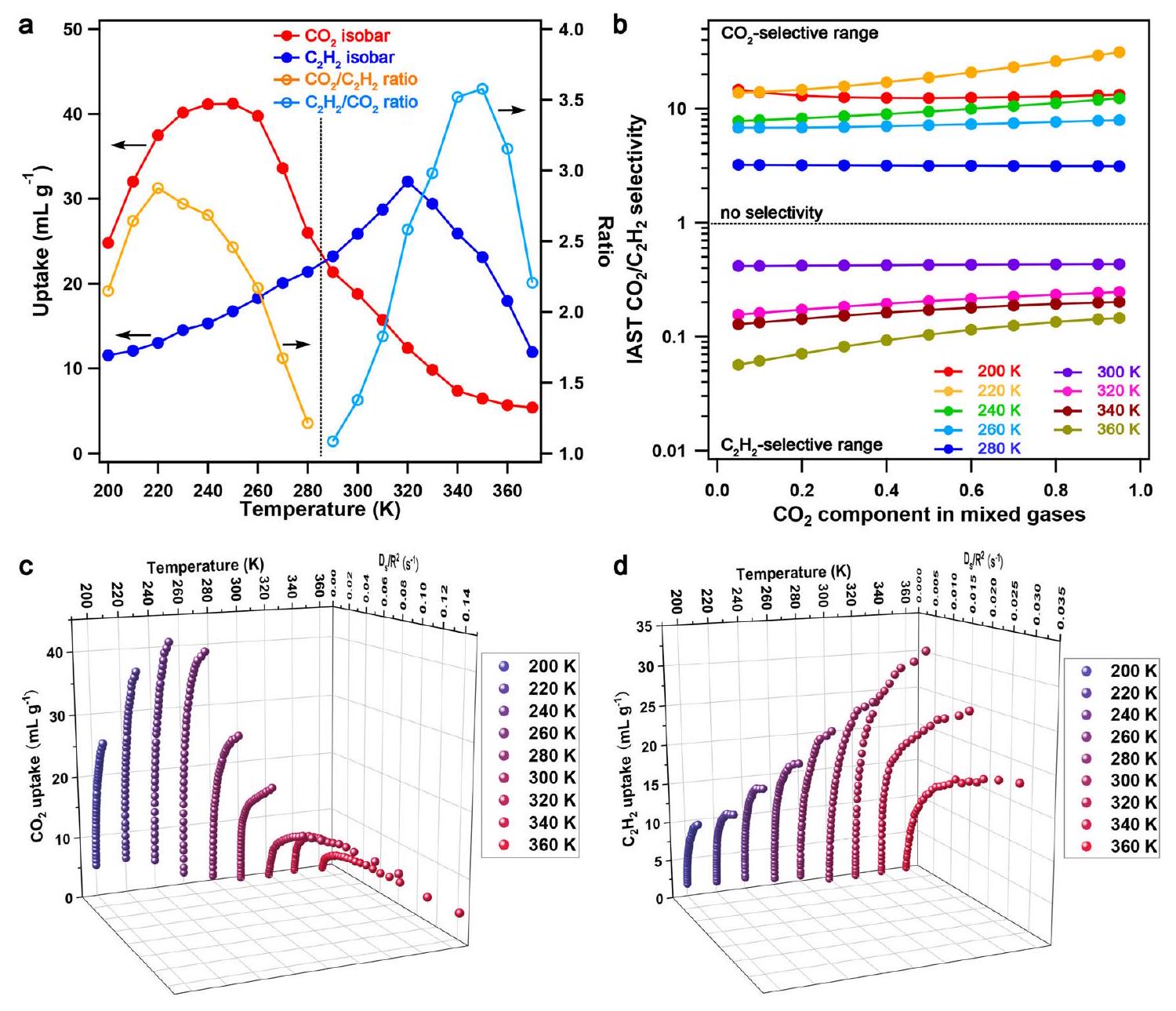
خليط للفصل العملي (الشكل 2ب، الشكل التكميلي 16، الجداول التكملية 4، 5). تم تعديل انتقائية IAST في FDC-3a بواسطة درجة الحرارة: في نطاق درجة الحرارة من 200 إلى
كان
-انتقائي مع الـ
انتقائية أعلى من 1؛ في نطاق درجة الحرارة من 300 إلى 360 كلفن، تحول FDC-3a إلى
-انتقائي مع الـ
انتقائية أقل من 1 (أي،
لم يتم ملاحظة مثل هذه الانتقائية المعتمدة على درجة الحرارة في مواد مسامية أخرى. أخذ خليط متساوي المول من
عند 1 بار ودرجات حرارة مختلفة كمثال، الحد الأقصى
كانت الانتقائية تصل إلى 18.6 عند 220 كلفن والحد الأدنى
كانت الانتقائية منخفضة تصل إلى 0.11 (مقابل لـ
انتقائية 9.5) عند 360 كلفن. على الرغم من أنه في حالة وجود مكونات غاز التغذية منخفضة جداً (
عند 200 ك
عند 360 ك
ظلت قيم الانتقائية
و
على التوالي، مما يدل على القدرة على إثراء
في درجات حرارة منخفضة و
في درجات الحرارة العالية. أظهر FDC-3a انتقائية عالية لـ IAST لـ
و
عند درجات الحرارة المنخفضة والعالية، على التوالي، مما يكشف عن الإمكانية للاحتجاز الانتقائي لـ
و
بطريقة تتحكم في درجة الحرارة.
لكشف جوهر الامتزاز المعتمد على درجة الحرارة، استخدمنا نظرية كرانك لتحديد معدل الانتشار لكل
و
رسم امتصاص من الإيزوثرمات المقابلة في نطاق 200 إلى 360 كلفن، مما سمح بإنتاج عالمي
و
المناظر الطبيعية، حيث
، و
(
) تشير إلى درجة الحرارة، الضغط، معدل الانتشار، وحجم الامتصاص، على التوالي، حيث تشير R إلى نصف قطر جزيء FDC-3a (الشكل 2، ج، د، الشكل التوضيحي 17). كشفت المناظر الطبيعية أن معدلات الانتشار لكل من
و
كانت منخفضة بشكل كبير عند درجات الحرارة المنخفضة، في حين أنها زادت بشكل مستمر مع زيادة درجة الحرارة والضغط، مصحوبة بزيادة كميات الامتصاص حتى
من
و
معدلات الانتشار لـ
و
عند 240 ك
من
) و 1 بار كانت
و
،

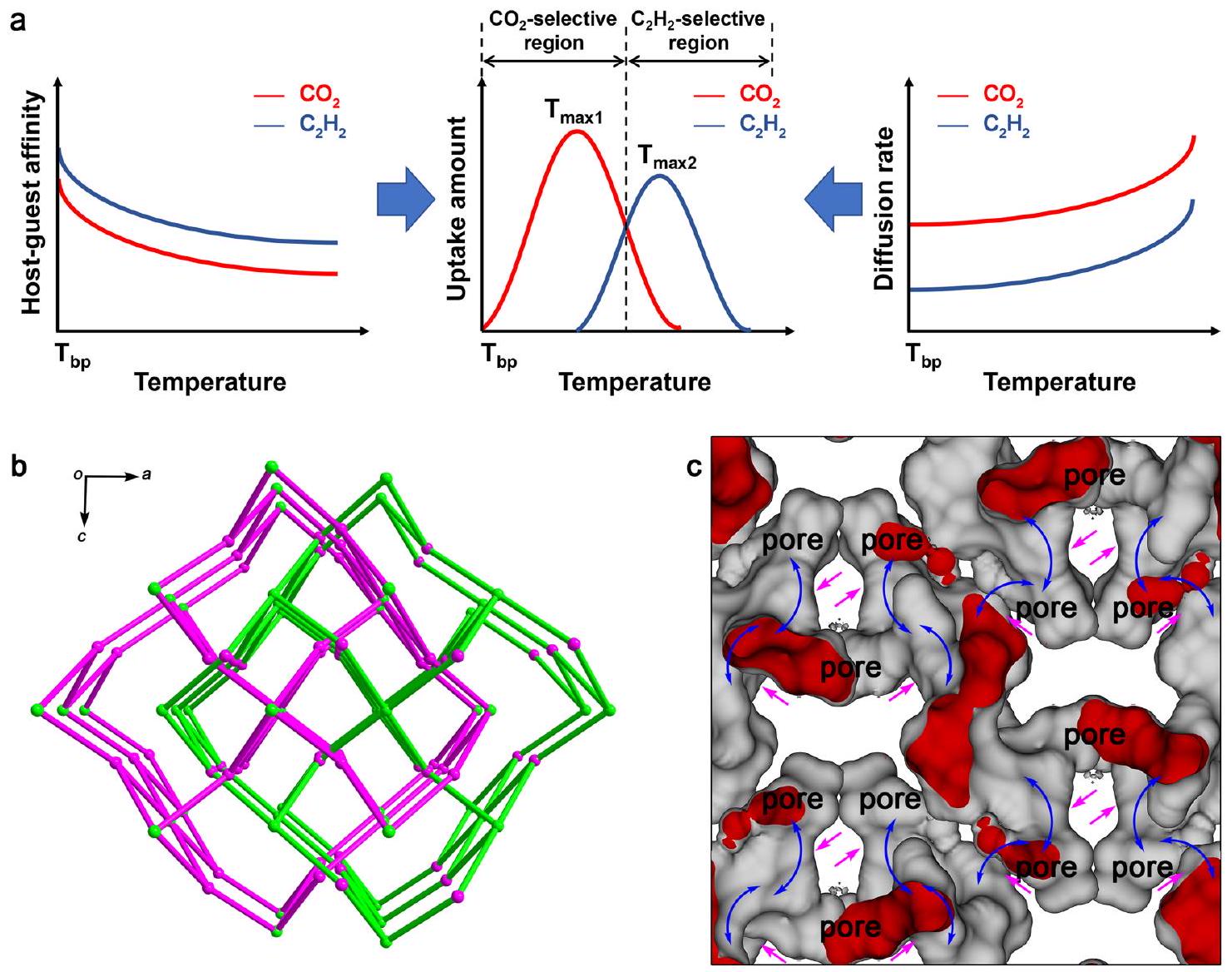
الشكل 1 | آلية تنظيم الانتشار للتعرف المعتمد على درجة الحرارة
و
. تمثيل تخطيطي للآلية. اليسار: الاعتماد على درجة الحرارة لمعدلات الانتشار لـ
و
. اليمين: اعتماد درجة الحرارة على تآلفات المضيف والضيف لـ
و
. الوسط: التلاعب بالديناميات في أنظمة التحكم في الانتشار (هذا العمل)؛ تتضمن هذه الآلية نظام مسام يتميز بوظيفة تنظيم الانتشار التي يمكن أن تنظم انتشار الغازات وتضخم اختلافات معدلاتها، مما يؤدي إلى التعرف المعتمد على درجة الحرارة حيث يتم امتصاص الغاز ذو معدل الانتشار العالي ولكن الألفة المنخفضة بشكل تفضيلي عند درجات الحرارة المنخفضة والغاز ذو معدل الانتشار المنخفض
لكن يتم امتصاص الألفة العالية بشكل انتقائي عند درجات حرارة أعلى.
التوبولوجيا المترابطة ذات الاتجاهين، المتصلة بـ 3 و 6، للروتايل (rtl) في FDC-3a.
مجموعة الثنائي الهرمي تمتلك 6 مواقع تنسيق، مبسطة كنقطة متصلة بـ 6 وتم تمثيلها بكريات خضراء. يتم ربط الليغاند بـ
العناقيد، التي تم تبسيطها كنقطة متصلة بثلاثة، وتم تمثيلها بكريات أرجوانية. ج الفراغ في FDC-3a تم تصوره بواسطة نصف قطر مسبار صغير من
حجم الفراغ هو
ويتوافق مع
حجم وحدة الخلية. الأسطح الداخلية والخارجية للثقب مرسومة باللونين الأحمر والرمادي، على التوالي. الأسهم الوردية والزرقاء توضح نوافذ الانتشار والمسارات، على التوالي.
على التوالي، في حين أن معدلات الانتشار لـ و
عند 320 ك
من
) و 1 بار كانت
و
، على التوالي. معدلات الانتشار لـ
كانت أعلى بكثير من
في جميع درجات الحرارة، على الرغم من نفس الأقطار الحركية وأحجام الجزيئات المتشابهة جداً. القطر الحركي لـ
و
كان واحدًا من أصغر القيم في الغازات الشائعة، مما تسبب في عائق كبير في التحكم في الانتشار باستخدام المواد المسامية للتمييز الحركي.
. ومع ذلك، كان بإمكان FDC-3a التحكم في عملية الانتشار لكل من
و
وزيادة فرق معدلهم الطفيف، مما يتسبب في اختلافات كبيرة في
والتحقيق في الامتصاص الانتقائي المعتمد على درجة الحرارة
و
.
على التوالي، في حين أن معدلات الانتشار لـ
تحليلات PXRD و NMR الحالة الصلبة
لفهم الآلية من الجانب الهيكلي بشكل أفضل، تم جمع أنماط PXRD في الموقع خلال عملية الامتزاز. الأنماط التي تم الحصول عليها خلال عمليات الامتزاز لـ
و
لم تكشف عن أي تغييرات هيكلية (الأشكال التكميلية 18، 19). قمنا أيضًا بإجراء قياسات حيود الأشعة السينية بالمسحوق عند درجات حرارة متغيرة باستخدام السنكروترون (VT-PXRD) لـ FDC-3a من 100 إلى 380 كلفن، والتي كشفت أن عدة قمم انزاحت قليلاً نحو زوايا أقل عند زيادة درجة الحرارة (الشكل التكميلية 20). كمثال، انزاحت القمة المقابلة لمستوى (111) من
إلى
مع زيادة درجة الحرارة من 100 إلى 380 كلفن،
الذي كشف عن تمدد محور [111]. لأن جزءًا واحدًا من OPTz كان موجهًا بالتوازي مع مستوى (111) (الشكل التكميلي 21)، يمكن أن يكون هذا التمدد الطفيف مرتبطًا بمدى التبديل الحراري، الذي وسع البوابات للسماح بانتشار الغاز والتحكم في معدل الانتشار.
على الرغم من أن تحليل PXRD يمكن أن يميز التغير في الشبكة عند درجات حرارة مختلفة في FDC-3a، إلا أنه لم يتمكن من إظهار الحركات المحلية على المستوى الجزيئي. لكشف الحركة المتبادلة بدقة في FDC-3a، قمنا بإجراء
-محسّن عالي الدقة من الحالة الصلبة
دراسة الرنين المغناطيسي النووي (NMR) بتقنية دوران الزاوية السحرية مع الاستقطاب المتقاطع (CPMAS)
، والتي وجدت حوالي 25 رنينًا حادًا متميزًا بما في ذلك 11 كربونًا رباعيًا و 15 كربونًا عطريًا ثلاثيًا (الأشكال التكميلية 22، 23)، والتي تت correspond إلى 32 كربونًا إجماليًا (11 رباعي و 21 ثلاثي) من الرابطة (الشكل 3a، الجدول التكميلية S6)، بالمقارنة مع المحلول
نسبة NMR لليغاند OPTz-t3da استنادًا إلى الانزياحات الكيميائية المحسوبة (الشكل التوضيحي 24). وقد أظهر ذلك النقاء الكيميائي والبلورية لـ FDC-3a دون عيوب ملحوظة. بالمقابل، فإن المحلول
أظهر طيف NMR لمركب OPTz-t3da 17 إشارة مميزة تُنسب إلى 17 كربونًا كيميائيًا غير متكافئ في المركب المتماثل (الشكل التوضيحي 25). وقد كشفت هذه المقارنة بوضوح أن المركب المنسق في الإطار غير متماثل، خاصةً الأجزاء البنزوئية (مجموعتان مميزتان من

الشكل 2 | سلوك امتصاص الغاز، انتقائيات IAST، ومعدلات الانتشار بين 200 و 370 كلفن. أ
و
خطوط الإعلانات عند 1 بار، و
و
نسب الامتصاص.
اختيارات IAST لـ
لـ
مع مكونات غاز التغذية المختلفة عند درجات حرارة متنوعة. ج درجة حرارة الانتشار العالمية-
معدل كمية الامتصاص
منظر طبيعي لـ
الامتزاز، حيث
يشير إلى نصف قطر جزيء FDC-3a. د معدل انتشار درجة الحرارة العالمية – كمية الامتزاز –
منظر طبيعي لـ
الامتزاز، حيث
يمثل نصف قطر جزيء FDC-3a.
الترددات لـ C1-C7)، بينما الحلقات الاثنين لـ OPTz متقاربة تقريبًا (تردد واحد أو اثنان قريبان لكل من ). تشير هذه اللامتناظرية إلى تنسيق صارم للبيزوات مع بيئتين متميزتين ومرونة في OPTz مع حلقتين متشابهتين، وهو ما يتماشى تمامًا مع الوحدة غير المتماثلة للهيكل البلوري الذي يحتوي على كربوكسيليت أحادية وثنائية الأسنان. علاوة على ذلك، فإن درجة الحرارة المتغيرة (VT)
أظهرت دراسة CPMAS NMR من 213 إلى 352 كلفن (الشكل 3أ، الشكل التكميلية 25) أن ترددات C12 وC13 وC16 وC17 على حلقة OPTz قد انزاحت بـ
بينما ظلت الرنات لـ C14 و C15 تقريبًا دون تغيير، مما يدل على التغيير الجزئي في التكوين وإعادة توجيه حلقات OPTz في الجزيء، وهو ما يتوافق جيدًا مع اكتشاف التوسع الطفيف في الشبكة البلورية بواسطة VT-PXRD وكذلك مع الانقلاب الحراري لوحدة OPTz.
الترددات لـ C1-C7)، بينما الحلقات الاثنين لـ OPTz متقاربة تقريبًا (تردد واحد أو اثنان قريبان لكل من
الحسابات النظرية
للحصول على رؤى حول عملية الانتشار والامتزاز، تم استخدام محاكاة مونت كارلو وحسابات نظرية الكثافة (DFT) في البداية لتحسين مواقع الامتزاز لـ
و
الجزيئات في FDC-3a. المعلمات الخلوية المحسّنة للمرحلة المنشطة تختلف قليلاً فقط عن القيم التجريبية لـ FDC-3a (الشكل التكميلية 26، الجدول التكميلية 7)، مما يشير إلى موثوقية الهيكل البلوري المحسّن لـ
. في تحسين
– و
تم الاحتفاظ بمعلمات الخلية كما هي في FDC-3a الفارغة، لأن الامتزاز
من و
أدى إلى تحول هيكلي طفيف (الشكل التكميلي 10). استنادًا إلى النموذج النظري أعلاه، قمنا بالتحقيق في
و
الامتزاز والانتشار (الشكل 3، ب، ج).
و
حواجز الانتشار في FDC-3a كانت 35.8 و
، على التوالي (الشكل التوضيحي 27أ). أظهرت الفروق الكبيرة في حواجز الانتشار أن انتشار
كان أكثر ملاءمة حركيًا من انتشار
. في الواقع، على الرغم من أنه تم إثبات عملية امتصاص ذاتية التسارع نتيجة لمعاملات الانتشار المعززة بالحرارة، فإن معامل الانتشار النسبي لـ
كان دائمًا أعلى من
بواسطة
– و400 – ضعف عند درجات الحرارة المنخفضة والعالية، على التوالي (الشكل التوضيحي 27ب). تشير هذه الفجوة الكبيرة في معدل الانتشار عند درجات الحرارة المنخفضة إلى أن امتصاص
أبعد بكثير عن التوازن من ذلك لـ
، مما أدى إلى كمية الامتزاز الأصغر مقارنة بـ
عند درجات حرارة منخفضة على الرغم من أن طاقة الامتزاز
) من
أقوى من ذلك (
) من
(الجدول التكميلي 7). من ناحية أخرى، كلاهما
و
يمكن أن تصل الامتزازات إلى توازن الامتزاز عند درجات حرارة مرتفعة على الرغم من اختلاف معدلات الانتشار، مما يؤدي إلى الامتزاز الانتقائي لـ
فوق
عند درجات حرارة مرتفعة.
من
فصل الغاز المختلط
سلوك الامتزاز المعتمد على درجة الحرارة وآلية تنظيم الانتشار في FDC-3 ألهمتنا لإجراء تجارب فصل الغاز المختلط الديناميكية؛ وقد تم تنفيذ هذه التجارب مع
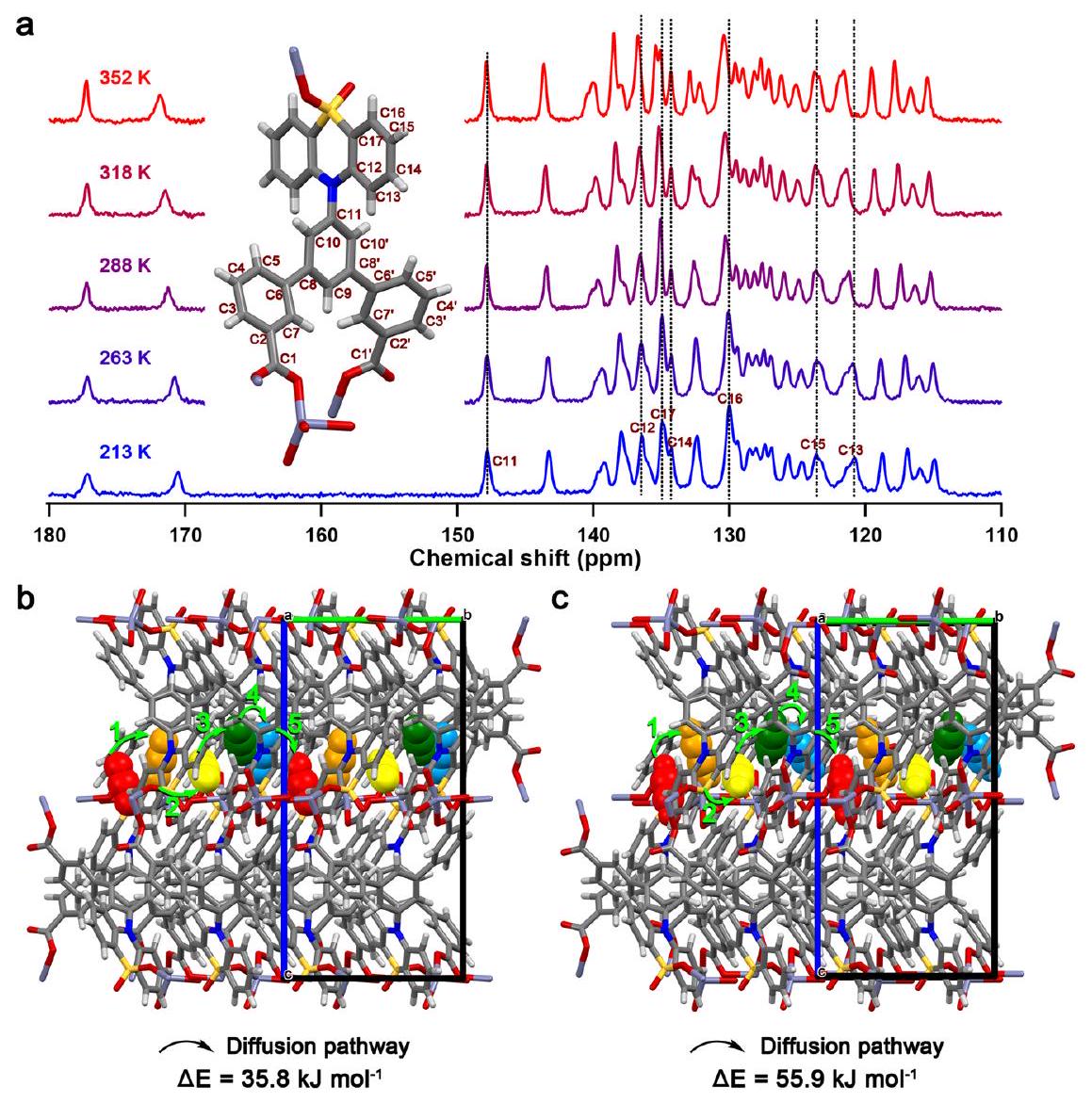
الشكل 3 | دراسة الرنين المغناطيسي النووي في الحالة الصلبة عند درجات حرارة متغيرة والدراسة النظرية. أ VT
طيف NMR لـ CPMAS لـ FDC-3a. ب الهيكل المحاكى لـ
-الطور الممتص ورسم تخطيطي لمسارات الانتشار لـ
، حيث
تم حذف الجزيئات خارج المسار التمثيلي من أجل الوضوح.
الجزيئات في الموضع الأولي مُعلمة باللون الأحمر، و
تم تمييز الجزيئات في المواقع الأخرى من مسار الانتشار بالألوان البرتقالية والصفراء والخضراء والسماوية، على التوالي. تمثل الأرقام من 1 إلى 5 والأسهم الانتشار.
مسارات.
الهيكل المحاكى لـ
-الطور الممتص ورسم تخطيطي لمسارات الانتشار لـ
، حيث
تم حذف الجزيئات خارج المسار التمثيلي من أجل الوضوح.
الجزيئات في الموضع الأولي مُعلمة باللون الأحمر، و
تم تمييز الجزيئات في المواقع الأخرى من مسار الانتشار بالألوان البرتقالية والصفراء والخضراء والسماوية، على التوالي. تمثل الأرقام من 1 إلى 5 والأسهم مسارات الانتشار.
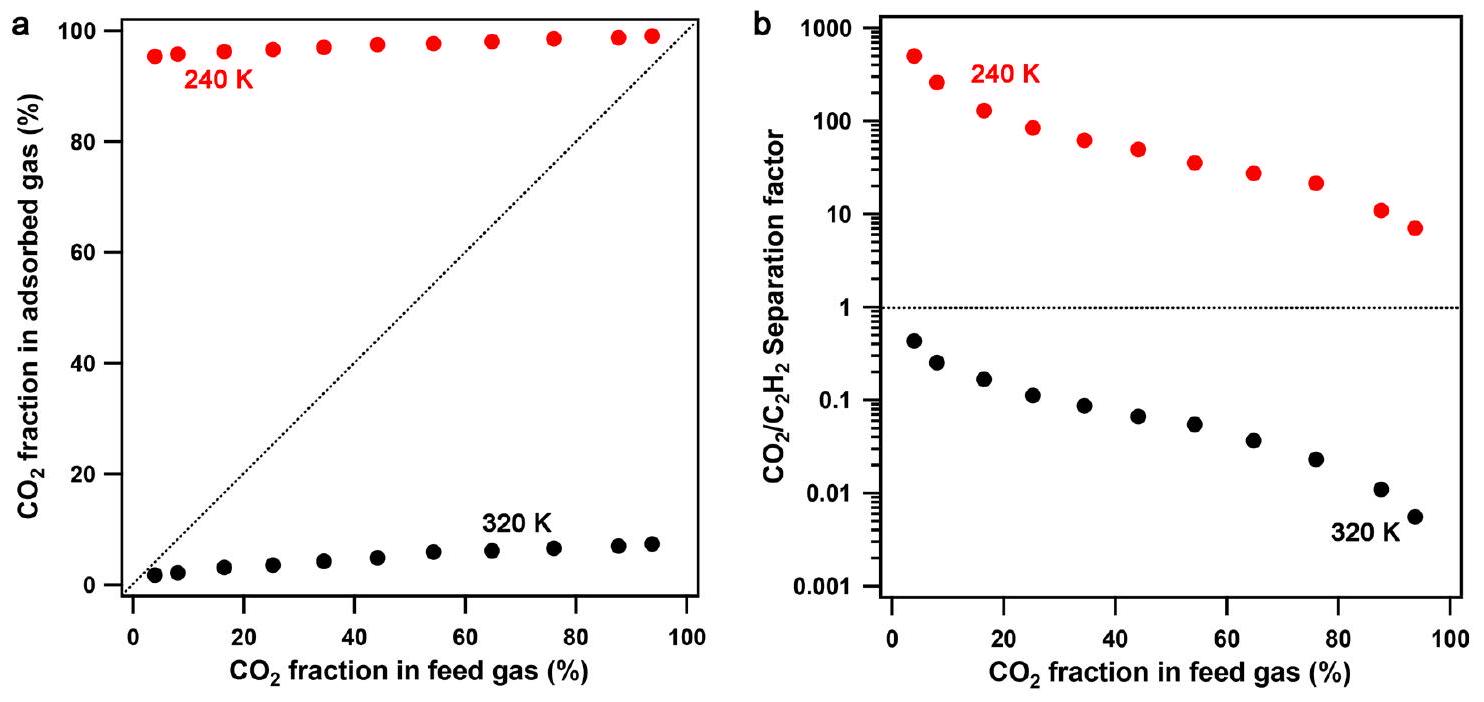
بروتوكول إزالة الحرارة المبرمجة (TPD) (الأشكال التكميلية 28، 29) . بالنظر إلى كميات الامتزاز والانتقائية، أجرينا تجارب الفصل عند 240 و 320 كلفن، على التوالي. عند درجة الحرارة المنخفضة
يمتص انتقائياً
من خليط شبه متساوي
خليط
) خلال فترة تعرض قصيرة تبلغ 1 ساعة، مما يؤدي إلى نتيجة ملحوظة
إثراء بتركيبة تصل إلى
في المرحلة الممتصة (الشكل 4أ، الشكل التكميلية 34) و
عامل الفصل 36 (الشكل 4ب). كان عامل الفصلComparable مع انتقائية IAST، على الرغم من أن قيم الأول كانت أكبر من الأخيرة. الارتفاع
عامل الفصل يشير إلى
انتشر بسرعة أكبر بكثير من
، وبالتالي تشغل معظم المساحة المتاحة وتستبعد الـ
عن طريق آلية فرز جزيئي. أظهر FDC-3a أداءً متميزًا
إثراء على نطاق واسع من مكونات غاز التغذية (الأشكال التكميلية 30-40)؛ على الرغم من أن الخليط كان في تركيبة من
FDC-3a المعزز
نتيجة لـ
تركيز
في المرحلة الممتصة (الشكل 4أ) و
عامل الفصل 498 (الشكل 4ب). من ناحية أخرى، عند درجة الحرارة العالية لـ
يمتص انتقائياً
من خليط شبه متساوي
خليط (
) خلال فترة تعرض قصيرة تبلغ 1 ساعة، مما يؤدي إلى نتيجة ملحوظة
إثراء بتركيبة تصل إلى
في المرحلة الممتصة (الشكل 4أ، الشكل التكميلية 45) و
عامل الفصل من
(أي،
عامل الفصل 18، الشكل 4ب). الارتفاع
عامل الفصل اقترح أن FDC-3a
كان مواتياً ديناميكياً حرارياً لـ عندما لم يعمل آلية تنظيم الانتشار عند درجات حرارة مرتفعة. أظهر FDC-3a تميزًا ملحوظًا
إثراء على نطاق واسع من مكونات غاز التغذية (الأشكال التكميلية 41-51)؛ على الرغم من أن الخليط كان في تركيبة من
، الـ
التركيز كان
في المرحلة الممتصة (الشكل 4أ)، والتي تتوافق مع
عامل الفصل لـ
(أي،
عامل الفصل 181، الشكل 4ب). من الجدير بالذكر أن انتقائية فصل الغاز المختلط كانت أعلى من تلك التي تم التنبؤ بها من امتصاص الغاز الفردي. عند درجات الحرارة المنخفضة، كانت عملية انتشار كلاهما
و
تم تنظيمه، وكانت عملية فصل الغاز تخضع لاختلاف معدل الانتشار.
أظهر معدل انتشار أسرع من
، مما أدى إلى ارتفاع
الاختيارات تحت حالات عدم التوازن. من ناحية أخرى، عند درجات الحرارة العالية، تتعاون
تفاعل الغاز وتفاعل الإطار زادا من الامتصاص الانتقائي لـ
مما يجعلها أعلى
انتقائية أكثر من المتوقع من امتصاص الغاز الفردي.
بروتوكول إزالة الحرارة المبرمجة (TPD) (الأشكال التكميلية 28، 29)
كان مواتياً ديناميكياً حرارياً لـ
نقاش
تقدم نتائجنا التعرف المعتمد على درجة الحرارة لـ
و
من خلال التحكم في انتشارها وزيادة اختلافات المعدل. نتائج TPD لفصل الغاز الحركي من
تظهر الخلائط الثنائية انتقائيات عالية تعتمد على درجة الحرارة مع
عامل الفصل 498 عند 240 ك
عامل الفصل 181 عند 320 كلفن. يجب أن تعطي هذه الميزات الفاصلة الملحوظة

الشكل 4 | فصل الغاز المختلط. أ رسم بياني لمكابي-ثيلي لـ
الفصل بواسطة FDC-3a عند 240 و 320 كلفن، مع الخط المنقط الذي يمثل السلوك النظري لمادة لا تظهر أي انتقائية.
العلاقة بين
تركيز الغاز المدخل و
عامل الفصل
الفضل يعود إلى الآلية الأساسية، التي يتم تنفيذها من خلال التعاون بين فتحات المسام الصغيرة جداً والديناميات المحلية لمكونات البوابة. يمكن أن يكون هذا المبدأ التصميمي قابلاً للتكيف بشكل واسع مع أنظمة المضيف-الضيف المختلفة لتحقيق اتجاهات انتقائية قابلة للتلاعب بواسطة المحفزات الخارجية للتعرف على الضيوف المتشابهين.
طرق
تركيب FDC-3
أولاً، تم إذابة 50 ملغ (0.09 مليمول) من OPTz-t3da في 2 مل من DMA في درجة حرارة الغرفة. محلول الميثانول
من
تمت إضافة إلى المحلول أعلاه. ثم تم تسخين الخليط عند
لمدة 72 ساعة. تم الحصول على FDC-3 على شكل بلورات كتلية عديمة اللون بأحجام تصل إلى عدة مئات من الميكرومترات (37 ملغ، العائد
” ). تم تصفية البلورات، وغسلها بـ DMA (
مرات) وميثانول (
مرات)، وتم تجفيفه في الهواء. تم توصيف FDC-3 الذي تم تصنيعه بواسطة الطيف تحت الأحمر (الشكل التكميلي 3). كانت قمة الامتصاص للاهتزاز التمددي لـ
تم نقل الرابطة المزدوجة إلى عدد موجي منخفض، مما يدل على تكوين رابطة التنسيق في FDC-3.
تبادل المذيب وتنشيط FDC-3
لقياس خاصية الامتزاز لـ FDC-3، قمنا بتبادل المذيب الضيف ومذيبات التنسيق (DMA) مع الميثانول عن طريق نقع FDC-3 في الميثانول في
لمدة 7 أيام. كل 24 ساعة تم استبدال الميثانول بآخر جديد. بعد تبادل المذيب، تم تجفيف FDC-3 المستبدل تحت الفراغ عند
لمدة 3 ساعات.
أكدت تقنية الرنين المغناطيسي النووي (NMR) أن الـ DMA في FDC-3 المتبادل تم استبداله بالميثانول (الشكل التوضيحي 8).
أظهرت منحنى TG أن إطار FDC-3 المتبادل كان مستقرًا حراريًا حتى
بينما أدناه
فقدت FDC-3 المتبادلة جزيئات الميثانول (الشكل التوضيحي 9). وبالتالي، قمنا بتنشيط المتبادلة
في
لـ 11 ساعة لتحمل
؛ هذه الدرجة من الحرارة ضمنت الإزالة الكاملة للمذيبات مع استبعاد إمكانية تحلل الإطار.
توفر البيانات
البيانات التي تدعم الرسوم البيانية داخل هذه الورقة وغيرها من نتائج هذه الدراسة متاحة من المؤلفين المقابلين عند الطلب المعقول. تم توفير بيانات المصدر في هذه الورقة. تم إيداع إحداثيات البلورات بالأشعة السينية للهياكل المبلغ عنها في هذه الدراسة في مركز بيانات البلورات كامبريدج (CCDC)، تحت أرقام الإيداع 2236266-2236267. يمكن لهذه البيانات
يمكن الحصول عليها مجانًا من مركز كامبريدج لبيانات البلورات عبرwww.ccdc.cam.ac.uk/data_request/cifتم توفير بيانات المصدر مع هذه الورقة.
References
- Lehn, J.-M. From supramolecular chemistry towards constitutional dynamic chemistry and adaptive chemistry. Chem. Soc. Rev. 36, 151-160 (2007).
- Descalzo, A. B., Martínez-Máñez, R., Sancenón, F., Hoffmann, K. & Rurack, K. The supramolecular chemistry of organic-inorganic hybrid materials. Angew. Chem. Int. Ed. 45, 5924-5948 (2006).
- Huang, F. & Anslyn, E. V. Introduction: supramolecular chemistry. Chem. Rev. 115, 6999-7000 (2015).
- Kolesnichenko, I. V. & Anslyn, E. V. Practical applications of supramolecular chemistry. Chem. Soc. Rev. 46, 2385-2390 (2017).
- Balzani, V., Credi, A., Raymo, F. M. & Stoddart, J. F. Artificial molecular machines. Angew. Chem. Int. Ed. 39, 3348-3391 (2000).
- Schwartz, G., Hananel, U., Avram, L., Goldbourt, A. & Markovich, G. A kinetic isotope effect in the formation of lanthanide phosphate nanocrystals. J. Am. Chem. Soc. 144, 9451-9457 (2022).
- Gu, Y. et al. Host-guest interaction modulation in porous coordination polymers for inverse selective
separation. Angew. Chem. Int. Ed. 60, 11688-11694 (2021). - Yi, S. et al. Controlled drug release from cyclodextrin-gated mesoporous silica nanoparticles based on switchable host-guest interactions. Bioconjug. Chem. 29, 2884-2891 (2018).
- Angelos, S., Yang, Y.-W., Patel, K., Stoddart, J. F. & Zink, J. I. pHresponsive supramolecular nanovalves based on cucurbit[6]uril pseudorotaxanes. Angew. Chem. Int. Ed. 47, 2222-2226 (2008).
- Wang, D. & Wu, S. Red-light-responsive supramolecular valves for photocontrolled drug release from mesoporous nanoparticles. Langmuir 32, 632-636 (2016).
- Yu, G. et al. Pillar[6]arene-based photoresponsive host-guest complexation. J. Am. Chem. Soc. 134, 8711-8717 (2012).
- Meng, H. et al. Autonomous in vitro anticancer drug release from mesoporous silica nanoparticles by pH-sensitive nanovalves. J. Am. Chem. Soc. 132, 12690-12697 (2010).
- Xiao, Y. et al. Enzyme and voltage stimuli-responsive controlled release system based on
-cyclodextrin-capped mesoporous silica nanoparticles. Dalton. Trans. 44, 4355-4361 (2015). - Horike, S., Shimomura, S. & Kitagawa, S. Soft porous crystals. Nat. Chem. 1, 695-704 (2009).
- Wilmer, C. E. et al. Large-scale screening of hypothetical metalorganic frameworks. Nat. Chem. 4, 83-89 (2012).
- Horike, S. & Kitagawa, S. The development of molecule-based porous material families and their future prospects. Nat. Mater. 21, 983-985 (2022).
- Zhang, Z. et al. Temperature-dependent rearrangement of gas molecules in ultramicroporous materials for tunable adsorption of
and . Nat. Commun. 14, 3789 (2023). - Gu, C. et al. Design and control of gas diffusion process in a nanoporous soft crystal. Science 363, 387-391 (2019).
- Su, Y. et al. Separating water isotopologues using diffusionregulatory porous materials. Nature 611, 289-294 (2022).
- Li, J.-R., Kuppler, R. J. & Zhou, H.-C. Selective gas adsorption and separation in metal-organic frameworks. Chem. Soc. Rev. 38, 1477-1504 (2009).
- Martineau, C., Senker, J. & Taulelle, F. Chapter One – NMR crystallography. Annu. Rep. NMR Spectrosc. 82, 1-57 (2014).
شكر وتقدير
تم دعم هذا العمل من قبل المؤسسة الوطنية للعلوم الطبيعية في الصين (21975078)، وصناديق البحث الأساسية للجامعات المركزية، وصندوق بدء التشغيل لجامعة سيتشوان، ومنحة KAKENHI للدعم الخاص للبحث (JP25000007)، والبحث العلمي (S) (JP18H05262) من جمعية اليابان لتعزيز العلوم (JSPS). نشكر مركز تحليل iCeMS على الوصول إلى الأجهزة التحليلية.
مساهمات المؤلفين
قام Y.S. بإجراء تجارب مرتبطة بالتركيب الجزيئي، ونمو البلورات، وامتصاص الغاز، وفصل الغاز. قام K.O. وP.W. بإجراء دراسات الأشعة السينية أحادية البلورة والمسحوق وتحليل الهياكل. قام J.Z. وH.X. بإجراء دراسات حسابية. قام Q.W. وH.L. بإجراء قياسات NMR في الحالة الصلبة. قام F.H. بإجراء قياسات cRED وحل هيكل المرحلة المنشطة. قام C.G. وS.K. بتصميم المشروع وتوجيه البحث. ساهم جميع المؤلفين في كتابة وتحرير المخطوطة.
المصالح المتنافسة
يعلن المؤلفون عدم وجود مصالح متنافسة.
معلومات إضافية
معلومات إضافية النسخة الإلكترونية تحتوي على
المواد التكميلية متاحة على
https://doi.org/10.1038/s41467-023-44424-3.
المواد التكميلية متاحة على
https://doi.org/10.1038/s41467-023-44424-3.
يجب توجيه المراسلات والطلبات للحصول على المواد إلى سوسومو كيتاجاوا أو تشينغ غو.
معلومات مراجعة الأقران تشكر مجلة Nature Communications المراجع(ين) المجهول(ين) على مساهمتهم في مراجعة هذا العمل. يتوفر ملف مراجعة الأقران.
معلومات إعادة الطباعة والتصاريح متاحة علىhttp://www.nature.com/reprints
ملاحظة الناشر: تظل شركة سبرينغر ناتشر محايدة فيما يتعلق بالمطالبات القضائية في الخرائط المنشورة والانتماءات المؤسسية.
الوصول المفتوح هذه المقالة مرخصة بموجب رخصة المشاع الإبداعي النسب 4.0 الدولية، التي تسمح بالاستخدام والمشاركة والتكيف والتوزيع وإعادة الإنتاج بأي وسيلة أو صيغة، طالما أنك تعطي الائتمان المناسب للمؤلفين الأصليين والمصدر، وتوفر رابطًا لرخصة المشاع الإبداعي، وتوضح إذا ما تم إجراء تغييرات. الصور أو المواد الأخرى من طرف ثالث في هذه المقالة مشمولة في رخصة المشاع الإبداعي الخاصة بالمقالة، ما لم يُشار إلى خلاف ذلك في سطر الائتمان للمواد. إذا لم تكن المادة مشمولة في رخصة المشاع الإبداعي الخاصة بالمقالة وكان استخدامك المقصود غير مسموح به بموجب اللوائح القانونية أو يتجاوز الاستخدام المسموح به، فسيتعين عليك الحصول على إذن مباشرة من صاحب حقوق الطبع والنشر. لعرض نسخة من هذه الرخصة، قم بزيارةhttp://creativecommons.org/رخصة/بواسطة/4.0/.
© المؤلف(ون) 2024
© المؤلف(ون) 2024
المختبر الوطني الرئيسي لمواد وأجهزة الإضاءة، معهد مواد وأجهزة البوليمر البصرية، جامعة جنوب الصين للتكنولوجيا، قوانغتشو 510640، جمهورية الصين الشعبية. معهد علوم الخلايا والمواد المتكاملة، جامعة كيوتو، كيوتو 606-8501، اليابان. مختبر العلوم النانوية النظرية والحاسوبية، المركز الوطني للعلوم النانوية والتكنولوجيا، الأكاديمية الصينية للعلوم، بكين 100190، جمهورية الصين الشعبية. معهد التكنولوجيا النووية والطاقة الجديدة، جامعة تسينغhua، بكين 100084، جمهورية الصين الشعبية. مدرسة العلوم الفيزيائية والتكنولوجيا، جامعة شانغهاي للتكنولوجيا، شانغهاي 201210، جمهورية الصين الشعبية. شركة ريد كريستال للتكنولوجيا الحيوية، سوتشو 215505، جمهورية الصين الشعبية. كلية علوم البوليمرات والهندسة، المختبر الوطني الرئيسي لهندسة مواد البوليمرات، جامعة سيتشوان، تشنغدو 610065، جمهورية الصين الشعبية. البريد الإلكتروني:kitagawa@icems.kyoto-u.ac.jp; gucheng@scu.edu.cn
Journal: Nature Communications, Volume: 15, Issue: 1
DOI: https://doi.org/10.1038/s41467-023-44424-3
PMID: https://pubmed.ncbi.nlm.nih.gov/38168057
Publication Date: 2024-01-02
DOI: https://doi.org/10.1038/s41467-023-44424-3
PMID: https://pubmed.ncbi.nlm.nih.gov/38168057
Publication Date: 2024-01-02
Switching molecular recognition selectivities by temperature in a diffusion-regulatory porous material
Received: 10 May 2023
Accepted: 13 December 2023
Published online: 02 January 2024
(A) Check for updates
Accepted: 13 December 2023
Published online: 02 January 2024
(A) Check for updates
Over the long history of evolution, nature has developed a variety of biological systems with switchable recognition functions, such as the ion transmissibility of biological membranes, which can switch their ion selectivities in response to diverse stimuli. However, developing a method in an artificial host-guest system for switchable recognition of specific guests upon the change of external stimuli is a fundamental challenge in chemistry because the order in the hostguest affinity of a given system hardly varies along with environmental conditions. Herein, we report temperature-responsive recognition of two similar gaseous guests,
and
, with selectivities switched by temperature change by a diffusion-regulatory mechanism, which is realized by a dynamic porous crystal featuring ultrasmall pore apertures with flip-flop locally-motive organic moiety. The dynamic local motion regulates the diffusion process of
and
and amplifies their rate differences, allowing the crystal to selectively adsorb
at low temperatures and
at high temperatures with separation factors of
and
, respectively.
Molecular recognition plays a vital role in supramolecular chemistry
, in which specific affinity among molecules allows for the construction of high-order assemblies and stimuli response
. Usually, recognition of a sole guest with the largest affinity from the multiple-guest mixture can be achieved
, whereas specific recognition of different guests under varied environmental conditions remains challenging. A basic scientific issue is a limitation from thermodynamics, where the order of host-guest affinities hardly changes with environmental conditions in a given host-multiple guest system
. On the other hand, specific recognition of different guests is highly desired, and such “smart” host materials can be widely applied in various fields such as molecular machines
, sensors
, gas separation
, and drug delivery
. To achieve
specific recognition switchable to different guests, chemists attempted to change the host-guest affinity using stimuli-responsive guests , whose chemical structures or molecular conformations change with external stimuli. However, such a strategy is only limited to cyclodextrin-azobenzene
, cyclodextrin-benzimidazole
, and cyclodextrin-ferrocene systems
, whose host-guest affinities can be switched by light, pH , and redox, respectively. A simple and effective strategy for switchable molecular recognition that breaks through the limitation of thermodynamics has not been proposed so far.
specific recognition switchable to different guests, chemists attempted to change the host-guest affinity using stimuli-responsive guests
Porous coordination polymers (PCPs)
or metal-organic frameworks are highly designable material platforms whose structural softness and pore environment can be tailored for molecular
recognition. Despite the recent progress, most of the molecular recognition in PCPs is based on thermodynamic adsorption, which is inaccessible for switchable recognition. On the other hand, the control over guest-transport kinetics allows precise discrimination of similar guests
, yet the strategy for switchable molecular recognition is still not proposed. Herein, we present switchable molecular recognition of two similar gaseous guests,
and
, only by temperature, without changing their host-guest affinity. This is achieved by regulating the gas diffusion and amplifying their rate differences using a locally dynamic PCP, in which flip-flop molecular motions of the ligand provide gate functionality.
exhibits faster diffusion than
, rendering the preferential adsorption of
and
selectivity higher than 1 at the thermodynamic non-equilibrium state at low temperatures. By contrast,
possesses higher adsorption affinity than
, resulting in selective adsorption of
and
selectivity higher than 1 at the thermodynamic equilibrium state at high temperatures. Therefore, significant temperature-dependent adsorption behaviors are observed for
and
, with both striking
and
selectivities at low and high temperatures, respectively (Fig. 1a).
Results
PCP synthesis and structural analyses
We designed a bee-type ligand comprising [
-terphenyl]-3,3″dicarboxylic acid and phenothiazine-5,5-dioxide (OPTz) moieties (OPTz-t3da), with the later moiety exhibiting effective waggling motion; the OPTZ moiety can waggle around its equilibrium position by
with small energy increases by
(Supplementary Fig. 1). Such a waggling motion of ligand leads to the dynamical opening and blocking of channels in PCP crystal, which is thus termed flip-flop dynamic crystal (FDC). The as-synthesized PCP, termed FDC-3 (Supplementary Figs. 2-4, Supplementary Table 1), was subjected to solvent exchange and thermal activation to afford its activated phase (FDC-3a, Supplementary Figs. 5-10, Supplementary Table 2). The crystal structure of FDC-3a was determined by the continuous rotation electron diffraction (cRED) technique (Supplementary Fig. 5). Activation caused a structural transformation of FDC-3 into a two-fold interpenetrated, 3, 6-connected rutile (rtl) topological framework with small yet compact pores (Fig. 1, b, c, Supplementary Fig. 6). The pore aperture was surrounded by one OPTz moiety and one O atom on carboxylic acid to form an ultrasmall gate of
in size, which was expected to be gradually enlarged by the thermal flipping of OPTz moiety, allowing the diffusion of gases at high temperature and blocking them at low temperatures.
Gas sorption
FDC-3a adsorbed
and
and showed negligible adsorption for other gases, including
, and
, in a wide temperature range (Fig. 2a, Supplementary Fig. 11). The adsorption amounts for both
and
substantially increased as increasing the temperature, as shown in their adsorption isotherm curves (Supplementary Fig. 12). Taking
as an example (Supplementary Figs. 12-14), the adsorption amount increased from 25 to
as the temperature was increased from 200 to 240 K and then decreased to
as the temperature was further increased to 370 K . Therefore, the temperature of maximum adsorption amounts (
) of
was 240 K , and similarly, the
of
appeared at 320 K ; the
values for both
and
were substantially higher than their boiling-point temperatures (
). This is a distinctive adsorption feature in which the initial adsorption was promoted by temperature, making a sharp contrast to common gas adsorption under thermodynamic equilibrium, in which the adsorption amount monotonously decreases as increasing the temperature. Additionally, obvious desorption hysteresis was observed for
and
to 360 K ) in their sorption isotherms, which was characteristic of the
diffusion-regulatory pore systems in PCPs . These results further indicated that the diffusions of
and
were regulated in the temperature ranges of 200 to 300 K and 200 to 360 K , respectively, showing that the adsorption of
was controlled by kinetics and thermodynamics at low ( 200 to 300 K ) and high ( 320 to 360 K ) temperatures, respectively, whereas the adsorption of
was constantly controlled by kinetics. The temperature-assisted adsorption behavior was controlled by kinetics, in which the diffusion of gases was impeded by low temperature, whereas the diffusion was gradually promoted by raising the temperature. Remarkably, the
values of
and
were largely different by 80 K , although they had exactly the same kinetic diameters and very similar molecular sizes and polarizabilities (Supplementary Table 3). Therefore, the selectivity can be switched by temperature; FDC-3a preferably adsorbed
in the 200 to 280 K range, whereas it reversely selected
in the 290 to 370 K range. The maximum adsorption ratios for
and
were 2.9 (at 220 K ) and 3.6 (at 350 K ), respectively (Fig. 2a).
diffusion-regulatory pore systems in PCPs
Although the above-mentioned sorption curves already revealed an apparent difference in the adsorption amounts of
and
, they were not able to reflect the differences in the adsorption kinetics. Therefore, we performed kinetic adsorption of
and
at different temperatures by FDC-3a (Supplementary Fig. 15). The adsorption amounts for both
and
were lower than the amounts in their corresponding isobar curves, whereas the
for both
and
slightly shifted to higher temperatures. These results indicated that the kinetic factors were key to affecting the adsorption behaviors of
and
. On the other hand, the switching of selectivity was also observed in the kinetic adsorption, which further proved that the cooperativity of diffusion regulation and host-guest interaction caused the temperature-switchable selectivity even in the kinetic conditions.
IAST selectivities and diffusion rates
We employed the ideal adsorbed solution theory (IAST) to predict the selectivity of a
mixture for practical separation (Fig. 2b, Supplementary Fig. 16, Supplementary Tables 4, 5). The IAST selectivity in FDC-3a was temperature-manipulated: in the temperature range of 200 to
was
-selective with the
selectivity higher than 1 ; in the temperature range of 300 to 360 K , FDC-3a turned to
-selective with the
selectivity lower than 1 (i.e.,
). Such a temperature-switched selectivity was not observed in other porous materials. Taking an equimolar mixture of
at 1 bar and various temperatures as an example, the maximum
selectivity was up to 18.6 at 220 K and the minimal
selectivity was as low as 0.11 (corresponding to a
selectivity of 9.5) at 360 K . Even though at a condition of very low feedgas components (
at 200 K and
at 360 K ), the
selectivity values remained to be
and
, respectively, indicative of the capability of enriching
at low temperatures and
at high temperatures. FDC-3a exhibited high IAST selectivity for
and
at low and high temperatures, respectively, revealing the potential for the selective adsorption of
and
in a temperature-controlled manner.
To uncover the essence of the temperature-switched adsorption, we employed the Crank theory to quantify the diffusion rate for every
and
adsorption plot from the corresponding isotherms in the 200 to 360 K range, which allowed the production of global
and
landscapes, where
, and
(
) denote temperature, pressure, diffusion rate, and uptake volume, respectively, where R refers to the radius of an FDC-3a particle (Fig. 2, c, d, Supplementary Fig. 17). The landscapes revealed that the diffusion rates for both
and
were substantially low at low temperatures, whereas they steadily increased with increasing temperature and pressure, accompanied by the enhanced uptake amounts up to the
of
and
. The diffusion rates for
and
at 240 K (
of
) and 1 bar were
and
,

Fig. 1 | The diffusion-regulatory mechanism for the temperature-switched recognition of
and
. a Schematic representation of the mechanism. Left: temperature-dependence of diffusion rates of
and
. Right: temperaturedependence of host-guest affinities of
and
. Middle: dynamics manipulation in diffusion-regulatory PCPs (this work); this mechanism involves a pore system featuring diffusion-regulatory functionality that can regulate the diffusion of gases and amplify their rate differences, thereby resulting in a temperatureswitched recognition in which the gas with a high diffusion rate but a low affinity is preferentially adsorbed at low temperatures and the gas with a low diffusion rate
but a high affinity is selectively adsorbed at higher temperatures.
The two-fold interpenetrated, 3, 6-connected rutile (rtl) topology of FDC-3a. The
dualtetrahedron cluster possesses 6 coordination sites, simplified as a 6 -connected node and represented with green balls. The ligand is linked with
clusters, which is simplified as a 3 -connected node and is represented with purple balls. c The void in FDC-3a visualized by a small probe radius of
. The void volume is
and corresponds to
of the unit-cell volume. The inner and outer surfaces of the pore are drawn in red and gray, respectively. The pink and blue arrows show the diffusion windows and pathways, respectively.
respectively, whereas the diffusion rates for and
at 320 K (
of
) and 1 bar were
and
, respectively. The diffusion rates of
were substantially higher than
at all temperatures, despite the same kinetic diameters and very similar molecular sizes. The kinetic diameter of
and
was one of the smallest values in common gases, which caused a great obstacle in controlling the diffusion using porous materials for kinetic discrimination
. Nevertheless, FDC-3a could control the diffusion process of both
and
and amplify their slight rate difference, thus causing substantial differences in
and achieving temperature-switched selective adsorption of
and
.
respectively, whereas the diffusion rates for
PXRD and solid-state NMR analyses
To further understand the mechanism from a structural aspect, in-situ PXRD patterns were collected during the adsorption process. Patterns obtained during the adsorptions of
and
did not reveal any structural changes (Supplementary Figs. 18, 19). We further performed synchrotron variable-temperature powder X-ray diffraction (VT-PXRD) measurements for FDC-3a from 100 to 380 K , which revealed that several peaks slightly shifted to lower angles upon increasing temperature (Supplementary Fig. 20). Taking the peak corresponding to the (111) plane as an example, it shifted from
to
as the temperature increased from 100 to 380 K ,
which revealed the expansion of the [111] axis. Because one OPTz moiety was oriented parallel to the (111) plane (Supplementary Fig. 21), this slight expansion could be related to the extent of thermal flipping, which enlarged the gates to allow gas diffusion and controlled the diffusion rate.
Although the PXRD analysis could characterize the lattice change at different temperatures in FDC-3a, it could not show the local motions at the molecular level. To precisely reveal the flip-flop motion in FDC-3a, we performed
-enhanced high-resolution solid-state
cross-polarization magic angle spinning (CPMAS) nuclear magnetic resonance (NMR) study
, which found around 25 well-distinguished sharp resonances including 11 quaternary and 15 tertiary aromatic carbon signals (Supplementary Figs. 22, 23), corresponding to the 32 total carbons ( 11 quaternary and 21 tertiary) of the ligand (Fig. 3a, Supplementary Table S6), in comparison with the solution
NMR attribution of the OPTz-t3da ligand based on calculated chemical shifts (Supplementary Fig. 24). This demonstrated the chemical purity and crystallinity of FDC-3a without observable defects. By contrast, the solution
NMR spectrum of OPTz-t3da ligand showed 17 distinct signals that are attributed to 17 chemically inequivalent carbons of the symmetric ligand (Supplementary Fig. 25). This contrast unambiguously revealed that the coordinated ligand in the framework is asymmetric, especially the two benzoate moieties (two distinct sets of

Fig. 2 | Gas adsorption behavior, IAST selectivities, and diffusion rates between 200 and 370 K . a
and
adsorption isobars at 1 bar, and the
and
uptake ratios.
IAST selectivities of
for
with different feed-gas components at various temperatures. c Global temperature-diffusion-
rate-adsorption amount (
) landscape for
adsorption, where
denotes the radius of an FDC-3a particle. d Global temperature-diffusion-rate-adsorption amount (
) landscape for
adsorption, where
denotes the radius of an FDC-3a particle.
resonances for C1-C7), while the two rings of OPTz are nearly symmetric (single or two close resonances for each of ). Such asymmetry suggests rigid benzoate coordination with two distinctive environments and flexible OPTz with two similar rings, which was fully consistent with the asymmetric unit of the crystallographic structure containing monodentate and bidentate carboxylates. Moreover, the variable-temperature (VT)
CPMAS NMR study from 213 to 352 K (Fig. 3a, Supplementary Fig. 25) found that the resonances of C12, C13, C16, and C17 on the OPTz ring shifted by
while the resonances of C14 and C15 remained almost unchanged, indicative of the partial configurational change and reoriented OPTz rings in the ligand, which was in good correlation with the finding of slight lattice expansion by VT-PXRD as well as with the thermal flipping of OPTz moiety.
resonances for C1-C7), while the two rings of OPTz are nearly symmetric (single or two close resonances for each of
Theoretical calculations
To get insight into the diffusion and adsorption process, Monte Carlo simulations and density functional theory (DFT) calculations were initially employed to optimize the adsorption positions of
and
molecules in FDC-3a. The optimized cell parameters for the activated phase are barely different from those of experimental values of FDC-3a (Supplementary Fig. 26, Supplementary Table 7), suggesting the reliability of the optimized crystal structure of
. In the optimization of
– and
-adsorbed structures, cell parameters were kept the same as those of empty FDC-3a, because the adsorption
of and
induced little structural transformation (Supplementary Fig. 10). Based on the above theoretical model, we investigated the
and
adsorption and diffusion (Fig. 3, b, c). The
and
diffusion barriers in FDC-3a were 35.8 and
, respectively (Supplementary Fig. 27a). The large diffusion barrier differences indicated that the diffusion of
was more kinetically favorable than the diffusion of
. Indeed, although a selfaccelerated adsorption process was demonstrated as a result of the temperature-promoted diffusion coefficients, the relative diffusion coefficient of
was perpetually higher than
by
– and 400 -folds at low and high temperatures, respectively (Supplementary Fig. 27b). Such a large difference in diffusion rate at low temperatures suggests that the adsorption of
is much farther from equilibrium than that of
, resulting in its smaller adsorption amount than that of
at low temperatures despite that the adsorption energy (
) of
is stronger than that (
) of
(Supplementary Table 7). On the other hand, both
and
adsorptions can reach adsorption equilibrium at high temperatures despite their different diffusion rates, leading to the selective adsorption of
over
at high temperatures.
of
Mixed gas separation
The temperature-switched adsorption behavior and its diffusionregulatory mechanism in FDC-3a inspired us to perform dynamic mixed gas separation experiments; these were carried out with

Fig. 3 | Variable-temperature solid-state NMR and theoretical study. a VT
CPMAS NMR spectra of FDC-3a. b Simulated structure of the
-adsorbed phase and schematic diagram of diffusion pathways of
, where
molecules outside the representative path are omitted for clarity. The
molecules at the initial position are marked with red color, and the
molecules at the other positions of the diffusion pathway are marked with orange, yellow, green, and cyan colors, respectively. Numbers 1 to 5 and the arrows represent the diffusion
pathways.
Simulated structure of the
-adsorbed phase and schematic diagram of diffusion pathways of
, where
molecules outside the representative path are omitted for clarity. The
molecules at the initial position are marked with red color, and the
molecules at the other positions of the diffusion pathway are marked with orange, yellow, green, and cyan colors, respectively. Numbers 1 to 5 and the arrows represent the diffusion pathways.
temperature-programmed desorption (TPD) protocol (Supplementary Figs. 28, 29) . Considering the adsorption amounts and the selectivity, we conducted the separation experiments at 240 and 320 K , respectively. At the low temperature of
selectively adsorbed
from a nearly equimolar
mixture (
) within a short exposure time of 1 h , leading to a remarkable
enrichment with a composition up to
in the adsorbed phase (Fig. 4a, Supplementary Fig. 34) and a
separation factor of 36 (Fig. 4b). The separation factor was comparable with the IAST selectivity, though the values of the former were larger than the latter. The high
separation factor indicated that
diffused much faster than
, thus occupying most of the available space and excluding the
by a molecular-sieving mechanism. FDC-3a exhibited outstanding
enrichment over a wide range of feed-gas components (Supplementary Figs. 30-40); even though the mixture was in a composition of
FDC-3a enriched
resulting in a
concentration of
in the adsorbed phase (Fig. 4a) and a
separation factor of 498 (Fig. 4b). On the other hand, At the high temperature of
selectively adsorbed
from a nearly equimolar
mixture (
) within a short exposure time of 1 h , leading to a remarkable
enrichment with a composition up to
in the adsorbed phase (Fig. 4a, Supplementary Fig. 45) and a
separation factor of
(i.e.,
separation factor of 18, Fig. 4b). The high
separation factor suggested that FDC-3a
was thermodynamically favorable to when the diffusionregulatory mechanism did not work at high temperatures. FDC-3a exhibited marked
enrichment over a wide range of feed-gas components (Supplementary Figs. 41-51); even though the mixture was in a composition of
, the
concentration was
in the adsorbed phase (Fig. 4a), which corresponds to a
separation factor of
(i.e.,
separation factor of 181, Fig. 4b). Notably, the selectivities of the mixed-gas separation were higher than the ones predicted from the single-gas adsorption. At low temperatures, the diffusion of both
and
was regulated, and the gas separation was governed by the diffusion-rate difference.
showed a faster diffusion rate than
, resulting in high
selectivities under non-equilibrium states. On the other hand, at high temperatures, the cooperativity of
interaction and gasframework interaction amplified the selective adsorption of
, rendering a higher
selectivity than the expected one from the single-gas adsorption.
temperature-programmed desorption (TPD) protocol (Supplementary Figs. 28, 29)
was thermodynamically favorable to
Discussion
Our findings provide temperature-switched recognition of the
and
by controlling their diffusion and amplifying the rate differences. The TPD results for kinetic gas separation of
binary mixtures demonstrate temperature-dependent high selectivities with a
separation factor of 498 at 240 K and a
separation factor of 181 at 320 K . These striking separation features should give

Fig. 4 | Mixed gas separation. a McCabe-Thiele diagram for
separation by FDC-3a at 240 and 320 K , with the dashed line representing the theoretical behavior of a material showing no selectivity.
The correlation between
concentration in the feed gas and the
separation factor.
the credit to the underlying mechanism, which is implemented by the cooperation of ultrasmall pore apertures and local dynamics of gate constituents. This design principle can be extensively adaptable with various host-guest systems for manipulatable selectivity trends by external stimuli for recognizing similar guests.
Methods
Synthesis of FDC-3
Firstly, 50 mg ( 0.09 mmol ) OPTz-t3da was dissolved in 2 mL DMA at room temperature. A methanol solution
of
was added to the above solution. Then the mixture was heated at
for 72 h . FDC-3 was obtained as colorless block crystals with sizes up to several hundreds of micrometers ( 37 mg , yield
). The crystals were filtered, washed with DMA (
times) and methanol (
times), and dried in air. The assynthesized FDC-3 was characterized by infrared spectra (Supplementary Fig. 3). The adsorption peak of the stretching vibration of the
double bond shifted to a low wavenumber, indicative of the coordination bond formation in FDC-3.
Solvent exchange and activation of FDC-3
To measure the adsorption property of FDC-3, we exchanged the guest and coordination solvents (DMA) with methanol by soaking FDC-3 in methanol at
for 7 days. Every 24 h the methanol was replaced by a new one. After the solvent exchange, the exchanged FDC-3 was dried under vacuum at
for 3 h .
NMR confirmed that the DMA in the exchanged FDC-3 was exchanged by methanol (Supplementary Fig. 8).
TG curve showed that the framework of the exchanged FDC-3 was thermally stable until
, whereas below
the exchanged FDC-3 lost the methanol molecules (Supplementary Fig. 9). Thus, we activated the exchanged
at
for 11 h to afford
; this temperature ensured the complete removal of the solvents meanwhile excluding the possibility of framework decomposition.
Data availability
The data that support the plots within this paper and other finding of this study are available from the corresponding authors upon reasonable request. Source data are provided in this paper. The X-ray crystallographic coordinates for structures reported in this study have been deposited at the Cambridge Crystallographic Data Centre (CCDC), under deposition numbers 2236266-2236267. These data can
be obtained free of charge from The Cambridge Crystallographic Data Centre via www.ccdc.cam.ac.uk/data_request/cif. Source data are provided with this paper.
References
- Lehn, J.-M. From supramolecular chemistry towards constitutional dynamic chemistry and adaptive chemistry. Chem. Soc. Rev. 36, 151-160 (2007).
- Descalzo, A. B., Martínez-Máñez, R., Sancenón, F., Hoffmann, K. & Rurack, K. The supramolecular chemistry of organic-inorganic hybrid materials. Angew. Chem. Int. Ed. 45, 5924-5948 (2006).
- Huang, F. & Anslyn, E. V. Introduction: supramolecular chemistry. Chem. Rev. 115, 6999-7000 (2015).
- Kolesnichenko, I. V. & Anslyn, E. V. Practical applications of supramolecular chemistry. Chem. Soc. Rev. 46, 2385-2390 (2017).
- Balzani, V., Credi, A., Raymo, F. M. & Stoddart, J. F. Artificial molecular machines. Angew. Chem. Int. Ed. 39, 3348-3391 (2000).
- Schwartz, G., Hananel, U., Avram, L., Goldbourt, A. & Markovich, G. A kinetic isotope effect in the formation of lanthanide phosphate nanocrystals. J. Am. Chem. Soc. 144, 9451-9457 (2022).
- Gu, Y. et al. Host-guest interaction modulation in porous coordination polymers for inverse selective
separation. Angew. Chem. Int. Ed. 60, 11688-11694 (2021). - Yi, S. et al. Controlled drug release from cyclodextrin-gated mesoporous silica nanoparticles based on switchable host-guest interactions. Bioconjug. Chem. 29, 2884-2891 (2018).
- Angelos, S., Yang, Y.-W., Patel, K., Stoddart, J. F. & Zink, J. I. pHresponsive supramolecular nanovalves based on cucurbit[6]uril pseudorotaxanes. Angew. Chem. Int. Ed. 47, 2222-2226 (2008).
- Wang, D. & Wu, S. Red-light-responsive supramolecular valves for photocontrolled drug release from mesoporous nanoparticles. Langmuir 32, 632-636 (2016).
- Yu, G. et al. Pillar[6]arene-based photoresponsive host-guest complexation. J. Am. Chem. Soc. 134, 8711-8717 (2012).
- Meng, H. et al. Autonomous in vitro anticancer drug release from mesoporous silica nanoparticles by pH-sensitive nanovalves. J. Am. Chem. Soc. 132, 12690-12697 (2010).
- Xiao, Y. et al. Enzyme and voltage stimuli-responsive controlled release system based on
-cyclodextrin-capped mesoporous silica nanoparticles. Dalton. Trans. 44, 4355-4361 (2015). - Horike, S., Shimomura, S. & Kitagawa, S. Soft porous crystals. Nat. Chem. 1, 695-704 (2009).
- Wilmer, C. E. et al. Large-scale screening of hypothetical metalorganic frameworks. Nat. Chem. 4, 83-89 (2012).
- Horike, S. & Kitagawa, S. The development of molecule-based porous material families and their future prospects. Nat. Mater. 21, 983-985 (2022).
- Zhang, Z. et al. Temperature-dependent rearrangement of gas molecules in ultramicroporous materials for tunable adsorption of
and . Nat. Commun. 14, 3789 (2023). - Gu, C. et al. Design and control of gas diffusion process in a nanoporous soft crystal. Science 363, 387-391 (2019).
- Su, Y. et al. Separating water isotopologues using diffusionregulatory porous materials. Nature 611, 289-294 (2022).
- Li, J.-R., Kuppler, R. J. & Zhou, H.-C. Selective gas adsorption and separation in metal-organic frameworks. Chem. Soc. Rev. 38, 1477-1504 (2009).
- Martineau, C., Senker, J. & Taulelle, F. Chapter One – NMR crystallography. Annu. Rep. NMR Spectrosc. 82, 1-57 (2014).
Acknowledgements
This work was supported by the National Natural Science Foundation of China (21975078), the Fundamental Research Funds for the Central Universities, the start-up foundation of Sichuan University, the KAKENHI Grant-in-Aid for Specially Promoted Research (JP25000007), and Scientific Research (S) (JP18H05262) from the Japan Society of the Promotion of Science (JSPS). We thank the iCeMS analysis center for access to the analytical instruments.
Author contributions
Y.S. performed experiments associated with molecular synthesis, crystal growth, gas sorption, and gas separation. K.O. and P.W. conducted single-crystal and powder XRD studies and structure analyses. J.Z. and H.X. carried out calculation studies. Q.W. and H.L. conducted solid-state NMR measurements. F.H. performed cRED measurements and solved the structure of the activated phase. C.G. and S.K. conceived the project and directed the research. All authors contributed to the writing and editing of the manuscript.
Competing interests
The authors declare no competing interests.
Additional information
Supplementary information The online version contains
supplementary material available at
https://doi.org/10.1038/s41467-023-44424-3.
supplementary material available at
https://doi.org/10.1038/s41467-023-44424-3.
Correspondence and requests for materials should be addressed to Susumu Kitagawa or Cheng Gu.
Peer review information Nature Communications thanks the anonymous, reviewer(s) for their contribution to the peer review of this work. A peer review file is available.
Reprints and permissions information is available at http://www.nature.com/reprints
Publisher’s note Springer Nature remains neutral with regard to jurisdictional claims in published maps and institutional affiliations.
Open Access This article is licensed under a Creative Commons Attribution 4.0 International License, which permits use, sharing, adaptation, distribution and reproduction in any medium or format, as long as you give appropriate credit to the original author(s) and the source, provide a link to the Creative Commons licence, and indicate if changes were made. The images or other third party material in this article are included in the article’s Creative Commons licence, unless indicated otherwise in a credit line to the material. If material is not included in the article’s Creative Commons licence and your intended use is not permitted by statutory regulation or exceeds the permitted use, you will need to obtain permission directly from the copyright holder. To view a copy of this licence, visit http://creativecommons.org/ licenses/by/4.0/.
© The Author(s) 2024
State Key Laboratory of Luminescent Materials and Devices, Institute of Polymer Optoelectronic Materials and Devices, South China University of Technology, Guangzhou 510640, P. R. China. Institute for Integrated Cell-Material Sciences, Kyoto University, Kyoto 606-8501, Japan. Laboratory of Theoretical and Computational Nanoscience, National Center for Nanoscience and Technology, Chinese Academy of Sciences, Beijing 100190, P. R. China. Institute of Nuclear and New Energy Technology, Tsinghua University, Beijing 100084, P. R. China. School of Physical Science and Technology, ShanghaiTech University, Shanghai 201210, P. R. China. ReadCrystal Biotech Co., Ltd., Suzhou 215505, P. R. China. College of Polymer Science and Engineering, State Key Laboratory of Polymer Materials Engineering, Sichuan University, Chengdu 610065, P. R. China. e-mail: kitagawa@icems.kyoto-u.ac.jp; gucheng@scu.edu.cn
