تفعيل الروابط C–H الأليفاتية بالضوء لتمكين الديكاربوفنكشنالية الانتقائية للإنانتيومر في الألكينات المحفزة بالنيكل Nickel-catalysed enantioselective alkene dicarbofunctionalization enabled by photochemical aliphatic C–H bond activation

المجلة: Nature Catalysis، المجلد: 7، العدد: 6
DOI: https://doi.org/10.1038/s41929-024-01153-0
PMID: https://pubmed.ncbi.nlm.nih.gov/38947227
تاريخ النشر: 2024-04-29

تفعيل الروابط C–H الأليفاتية بالضوء لتمكين الديكاربوفنكشنالية الانتقائية للإنانتيومر في الألكينات المحفزة بالنيكل

تاريخ الاستلام: 15 يونيو 2023
تم القبول: 25 مارس 2024
نُشر على الإنترنت: 29 أبريل 2024
(أ) التحقق من التحديثات

شيا هو® إيفان تشينغ-سانشيز ¹، وانغ تشينغ كونغ²، غاري أ. مولاندر³ كريستينا نيفادو ©

الملخص

تطوير استراتيجيات جديدة لبناء جزيئات كيرالية معقدة بسرعة من المواد الأولية المتاحة بسهولة هو سعي طويل الأمد في مجتمع الكيمياء. تمثل التفاعلات المزدوجة للالكينات التي تتوسطها الجذور منصة ممتازة نحو هذا الهدف. ومع ذلك، تظل النسخ غير المتماثلة تحديًا كبيرًا، والأهم من ذلك، أن الأمثلة التي تتضمن هيدروكربونات بسيطة كشركاء في التفاعل نادرة. هنا نبلغ عن تفاعل مزدوج غير متماثل للالكينات من ثلاثة مكونات يستفيد من التنشيط المباشر لـ الروابط من خلال دمج نقل ذرة الهيدروجين المحفز بالضوء وتحفيز النيكل. توفر هذه البروتوكول منصة فعالة لتركيب رابطتين كربون-كربون متجاورتين عبر الألكينات بطريقة اقتصادية من حيث الذرات، مما يوفر مجموعة واسعة من المركبات الشيرالية عالية القيمة. -الكربونيلات والفوسفونات الأريل/الألكينيل، بالإضافة إلى 1,1-ثنائي الأريل الألكانات من المواد الأولية الشائعة مثل الألكانات، الإيثرات والكحوليات. تُظهر هذه الطريقة بساطة تشغيلية، نطاق واسع من الركائز، وامتياز في الانتقائية الإقليمية، الانتقائية الكيميائية والانتقائية الإنسية. تبرز التوافق مع الأنماط الحيوية النشطة وسهولة تصنيع الجزيئات ذات الأهمية الصيدلانية الإمكانيات التركيبية لهذه البروتوكولات.

يمثل التجميع الفعال لجزيئات كيرالية عالية القيمة المضافة من الهيدروكربونات المتاحة بسهولة وبأسعار معقولة مع الحد الأدنى من توليد النفايات تحديًا طويل الأمد للكيميائيين الصناعيين. لقد أعاقت تحديات رئيسية تنفيذ هذه العمليات على نطاق واسع: من جهة، الروابط تظهر تفاعلية أقل بكثير مقارنة بمعظم المجموعات الوظيفية. علاوة على ذلك، فإن وجود عدة روابط غير مكافئة تتطلب الروابط تحكمًا دقيقًا في الاختيار الكيميائي، والاختيار الإقليمي، والاختيار الفراغي لتحقيق النتيجة المرغوبة. مؤخراً، ظهرت عملية التحفيز الضوئي لنقل ذرات الهيدروجين (HAT) كاستراتيجية لطيفة للتفاعل المباشر
تفعيل الوظائف عند التعرض للإشعاع الضوئي، يمكن للحالة المثارة من المحفز الضوئي أن تستخلص ذرات الهيدروجين من مواد قوية وغير نشطة. الروابط لإنتاج الجذور الحرة الكربونية النوكليوفيلية. لقد جذبت رباعي النبوتيل الأمونيوم ديكاتونغستات (TBADT) والكيتونات ثنائية الأريل اهتمامًا خاصًا كعوامل تحفيز ضوئي HAT نظرًا لقدرتها على كسر الروابط المتاحة إلكترونيًا واستيركيًا. روابط ذات انتقائية مكانية عالية . نتيجة لذلك، مفيد بشكل اصطناعي التفاعلات الوظيفية التي تعزز تكوين روابط جديدة C-C (المراجع 10-16)، C-O (المراجع 17،18)، C-N (المراجع 19،20)، C-F (المراجع 21،22) و تم تحقيق السندات (المرجع 23) من خلال الاستفادة من هذه الاستراتيجية.
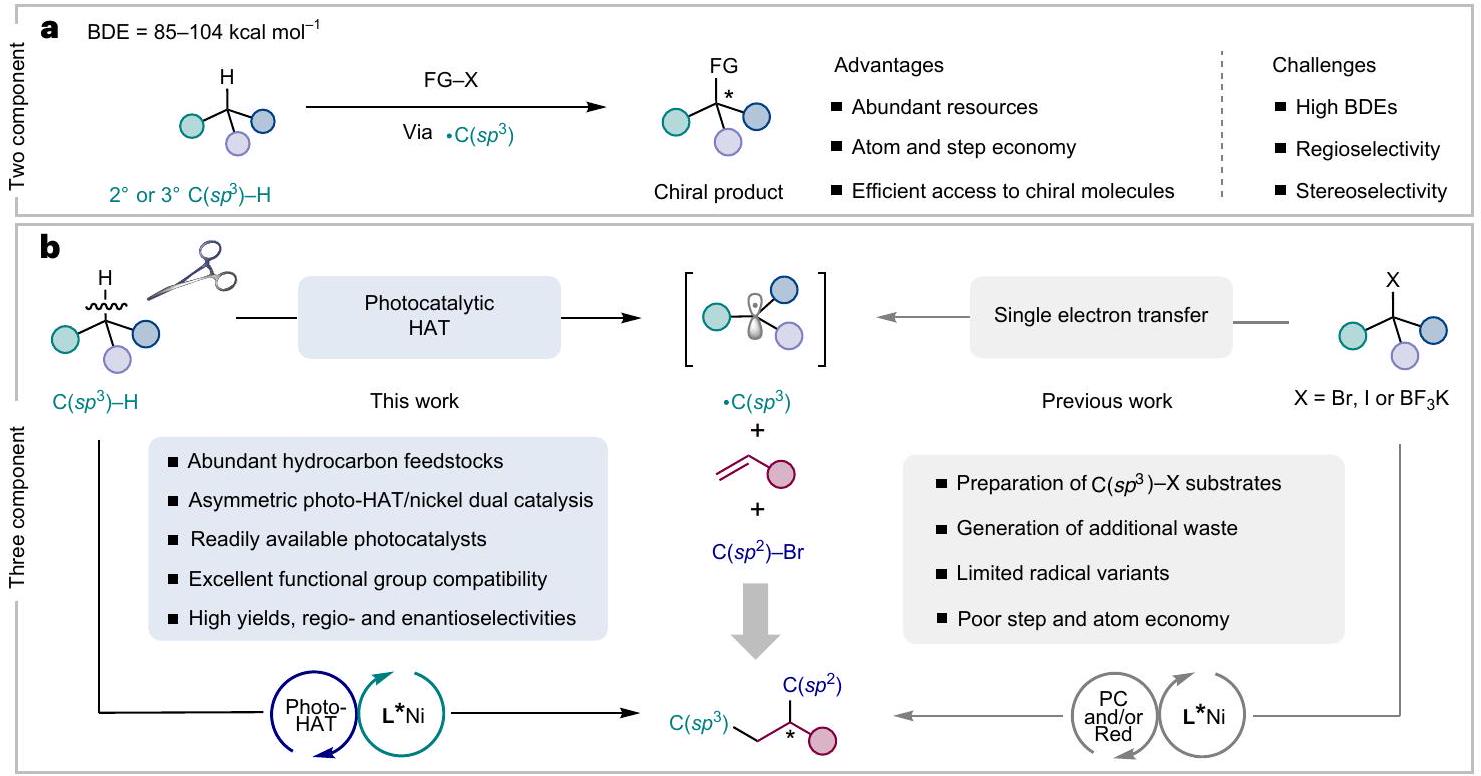
الشكل 1| تطوير غير متماثل تفعيل وتفعيل ثنائي الكربون للألكينات. أ، تفاعل غير متماثل ذو مكونين
التفعيل من خلال عملية HAT التآزرية والمعادن الانتقالية
تحفيز. ب، الاستراتيجيات السابقة وتصميمنا للتفاعل غير المتماثل ثلاثي المكونات لتفاعل الديكاربوفنكشنالization الجذري للألكينات. BDE، طاقة تفكك الرابطة؛ FG، مجموعة وظيفية؛ PC، محفز ضوئي؛ Red، مختزل.
مؤخراً، ومولاندر طورت مجموعات بشكل مستقل طرقًا أنيقة للتفاعل الثلاثي المكون غير المتجانس للالكينات عبر التحفيز الضوئي HAT (photo-HAT) / التحفيز المزدوج بالنيكل.
تمثل التفاعلات الحفزية الثلاثية المكونات لتعدد الوظائف الجذرية للألكينات نهجًا بسيطًا وفعالًا لبناء التعقيد الجزيئي بسرعة، حيث يمكن تثبيت مجموعتين وظيفيتين جديدتين في الوقت نفسه عبر الـ نظام في عملية واحدة . ومع ذلك، فإن التحكم في الانتقائية الإينانتيومرية للمراكز الستيريوجينية الناتجة لا يزال يمثل تحديًا كبيرًا بسبب التفاعل العالي وعدم الاستقرار للوسطاء الجذريين ذوي القشرة المفتوحة المشاركين في هذه التحولات. النحاس الكيرالي والنيكل لقد فتحت المركبات منصة قوية للتقاطع غير المتماثل للجذور الحرة للأوليفينات. على سبيل المثال، تم إحراز تقدم ملحوظ في الاقتران الاختزالي المنقول بالجذور الحرة غير المتماثل المحفز بالنيكل. في الذي تم استخدام الكواشف الهجينة مثل هاليدات الألكيل وهاليدات الألكيل المثفلورة كمواد سابقة للجذور. بالإضافة إلى ذلك، فإن العمليات التي تجمع بين التحفيز الضوئي والتحفيز بالنيكل قد مكنت من الديكاربوفنكشنالية غير المتناظرة للألكينات باستخدام ثلاثي فلوريد الألكيل كمواد متفاعلة مناسبة لهذه البروتوكولات. تعتمد جميع التحولات المذكورة أعلاه بشكل كبير على استخدام سلفيات جذرية مفعلة مسبقًا، وهو استخدام لا يؤدي فقط إلى توليد نفايات إضافية، بل يؤدي أيضًا إلى ضعف كفاءة الخطوات وكفاءة الذرات. لتحسين الكفاءة الاصطناعية وتوسيع مجموعة السلفيات الجذرية، يمثل الاستخدام المباشر للهيدروكربونات الوفيرة كشركاء تزاوج في الديكاربوفنكشنالية غير المتماثلة للألكينات نهجًا أكثر مثالية ولكنه أيضًا شديد التحدي.
على الرغم من أن عمليات HAT التآزرية وتحفيز المعادن الانتقالية قد تم استخدامها في الأريلنة الانتقائية، الألكلة، الألكنة، الأسيلنة، والسيانيد. الروابط (الشكل 1أ) التفعيل المباشر لـ الروابط نحو التفاعل غير المتماثل ثنائي الوظيفة للألكينات بالتأكيد غير متطورة (الشكل 1ب). هناك تحديان رئيسيان يجب معالجتهما: أولاً، تحديد عامل متماثل يمكنه التغلب على التفاعلات الجانبية التنافسية ذات المكونين بينما يحقق بشكل فعال التحكم المطلق في التكوين في تشكيل المراكز الاستيريوجينية الجديدة في العملية ذات الثلاثة مكونات؛ وثانياً، تنفيذ ظروف التفاعل حيث لا يحدث تفعيل تنافسي لمكونات متميزة، حتى لو كانت أكثر نشاطاً. السندات الموجودة في
المذيب و/أو الشركاء المشاركون في التفاعل يؤثرون على كفاءة واختيارية العملية الكلية.
هنا نوضح أن الجمع بين محفز ضوئي من نوع ديكاتونستات أو كيتون ثنائي الأريل مع محفز نيكل بياميدازولين غير متماثل (Bilm) يمكّن من الديكاربوفنكشنالية غير المتماثلة للألكينات بحيث تكون قيمة. يمكن الحصول على الكربونيلات والفوسفونات الأروماتية/الألكينية بالإضافة إلى 1,1-ثنائي الأرومات الألكانية في شكل غني بالإنانتيومر من خلال التنشيط الانتقائي الإقليمي للهيدروكربونات الوفيرة ومشتقاتها.

النتائج

تحسين ظروف التفاعل

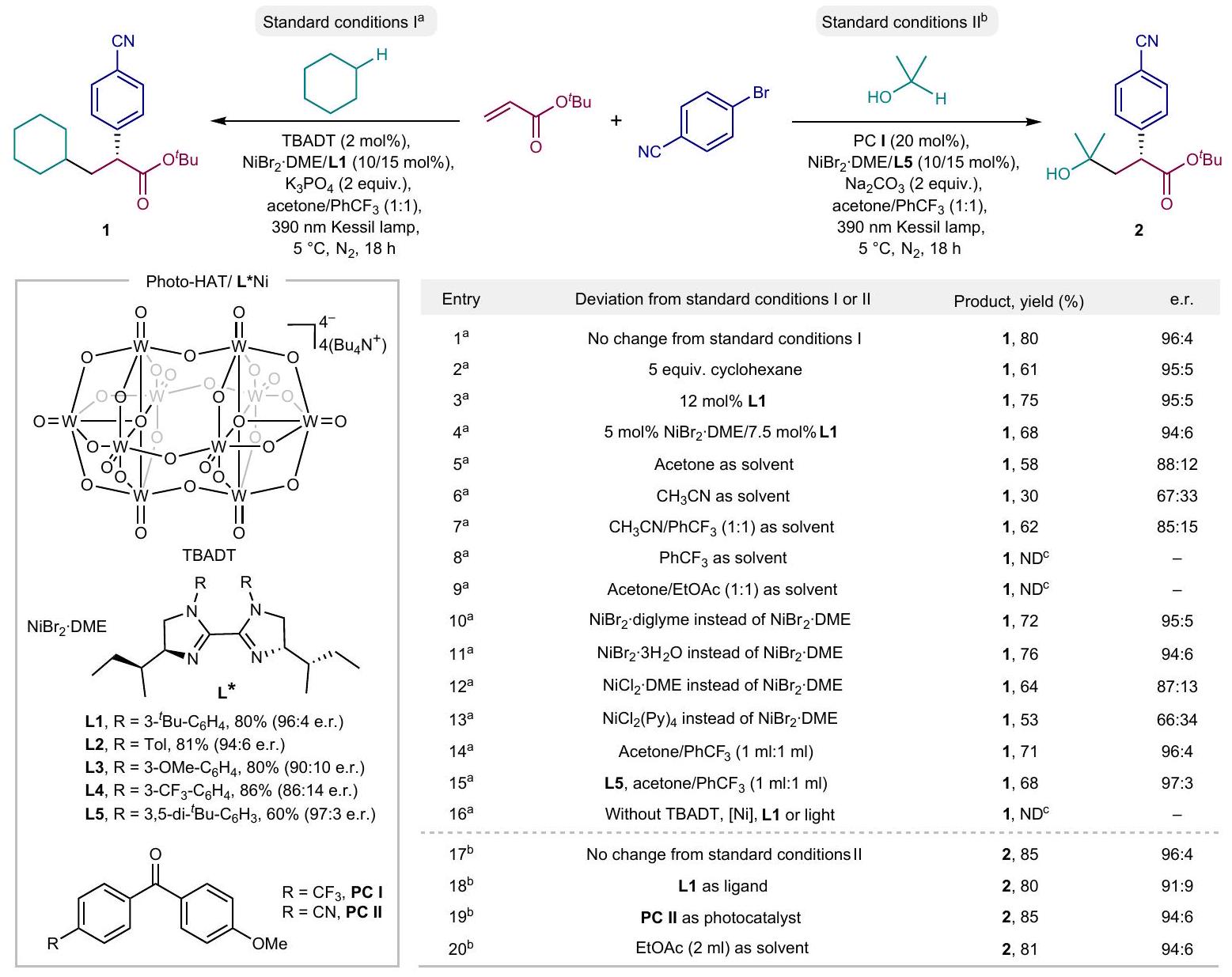
بدأ تحقيقنا لتحديد ظروف التفاعل المناسبة باستخدام السيكلوهكسان، أكريلات التيرت-بيوتيل و4-بروموبنزونيتريل كركائز نموذجية تحت إشعاع الضوء فوق البنفسجي القريب (Kessil الصمامات الثنائية الباعثة للضوء (LEDs)؛ الشكل 2). بعد تقييم شامل لمتغيرات التفاعل، وجدنا أن تركيبة TBADT ( ) ، .دي م إ (دي م إ، ثنائي ميثوكسي إيثان؛ بيلم ل1 الكيرالي ) وفوسفات البوتاسيوم ( مكافئ) تم توفير تيرت-بيوتيل (R)-2-(4-سيانوفينيل)-3-سيكلوهكسيل بروبانوات في عائد معزول بنسبة 80% ونسبة إنانتيومير 96:4 في أسيتون/ ثلاثي فلوروتولوين نظام المذيب الثنائي في (الشكل 2، المدخل 1). أظهر فحص مختلف الليغاندات أن الطبيعة الإلكترونية والستيرية لقالب بيلم الشكلي لها تأثير ملحوظ على كفاءة التفاعل (L1-L5). بشكل عام، تؤدي ليغاندات بيلم التي تحمل مجموعات سحب إلكتروني على الحلقة العطرية إلى زيادة في العائد ولكن مع انخفاض في الانتقائية الإنسية (L4). تعتبر الاستبدالات الغنية بالإلكترونات والتي تتطلب مساحة كبيرة على ذرة النيتروجين مفيدة في تحقيق التحكم في التركيب، على الرغم من أنها تؤدي إلى عائد أقل (L5). بالمقارنة، فإن 3-(tert-butyl) فينيل-مستبدل البي إيميدازول أظهر أفضل تسوية بين التفاعل والانتقائية الإنسية. كان لتقليل كمية السيكلوهكسان (الشكل 2، المدخل 2) أو العامل المساعد (الشكل 2، المدخل 3)، بالإضافة إلى تقليل تحميل النيكل/L1 (الشكل 2، المدخل 4) تأثير سلبي على كفاءة التفاعل. الأسيتون المزدوج/ كان نظام المذيب ضروريًا لنجاح هذا التحول، حيث لوحظ انخفاض كبير في العائد والانتقائية الإنسية عند استخدام الأسيتون أو الأسيتونيتريل أو تم استخدامه كمذيب (الشكل 2، الإدخالات 5-7). علاوة على ذلك، استبدال المذيب الأمثل بـ أو الأسيتون/إيتوأسيتات أدى إلى فشل كامل للتفاعل (الشكل 2، المدخلات 8 و 9). مختلف
الشكل 2 | تحسين ظروف التفاعل. تحسين ظروف التفاعل. ظروف التفاعل القياسية I هي كما يلي: سيكلوهكسان (2 مليمول، 10 مكافئ)، 4-بروموبنزونيتريل ( أكريل التيرت-بيوتيل ( ما يعادل ذلك)، TBADT ( ) ، دي إم إي ) ، مكافئ)، أسيتون مصباح كيسيل . ظروف التفاعل القياسية II هي كما يلي: إيزوبروبانول ( ما يعادل ذلك،
4-بروموبنزونيتريل أكريل التيرت-بيوتيل (0.6 مليمول، 3 مكافئ)، PCI ( ) ، ( ) ، ( مكافئ)، أسيتون ( 40 واط مصباح كيسيل 390 نانومتر العوائد المعزولة. تم تحديد قيم النسبة المئوية من الإيزومرات باستخدام الكروماتوغرافيا السائلة عالية الأداء الكيرالية. تم الكشف عنه بواسطة الكروماتوغرافيا الغازية/مطياف الكتلة. ND، غير مكتشف.
محفزات النيكل مثل .ديغليم تم تسليم المنتج بعائد منخفض قليلاً و e.r. (الشكل 2، المدخلين 10 و 11)، بينما و أدى ذلك إلى انخفاض كبير في العائد والانتقائية الإينانتيو. استمرت التفاعل بسلاسة ووفرت نسبة e.r. قابلة للمقارنة عند التخفيف. أكدت التجارب الضابطة أن المحفز الضوئي، والنيكل، والليغاند، والضوء كانت جميعها ضرورية لتحقيق نتيجة ناجحة. تم تأكيد التكوين المطلق للمنتج 1 بشكل لا لبس فيه من خلال تحليل حيود الأشعة السينية. بالتوازي، تم البحث عن الظروف المثلى للايزوبروبانول كمقدمة جذرية. ومن المفرح، أنه يمكن الحصول على المنتج الناتج من التفاعل الثلاثي المكونات 2 بعائد 85% ونسبة e.r. 96:4 في وجود كيتون ثنائي الأريل PCI، NiBr. DME، L5 و تحت إشعاع LED عند تظهر تأثيرات الليغاند، والعامل الضوئي، والمذيب في الشكل 2، الإدخالات 18-20.

نطاق الركيزة

مع وجود الظروف المحسّنة، تم التحقيق في نطاق هذا التحول بعد ذلك. ركزنا في البداية على فحص مجموعة متنوعة من بروميدات الأريل/الألكينيل (الشكل 3). تم تحويل بروميدات الأريل التي تحمل السيانيد (1)، والسلفون (3)، واللاكتون (4)، والكيتون (5)، والإستر (6)، والتريفلوميثيل (7)، والفلور (8)، والكلور (9)، والفينيل (11)، والتريفلوروميثوكسي (12)، والأسيتوكسي (13)، والبينزويلوكسي (14) والفينوكسي (15) بنجاح إلى المنتجات المقابلة للدكاربووظيفية بعوائد جيدة وأعلى. بشكل عام، أظهرت بروميدات الأريل ذات الإلكترونات الناقصة فعالية محسّنة.
مقارنةً بالمواد المحايدة إلكترونياً (10) وتلك الغنية بالإلكترونات. لم تكن هاليدات الأريل التي تحمل مجموعات مانحة قوية للإلكترونات، مثل 4-بروموانيسول و4-بروموثيوانيسول، قابلة للتفاعل تحت ظروف التفاعل القياسية. من خلال زيادة شدة الضوء في التفاعل، يمكن تحقيق تكوين المنتجات الناتجة عن الديكاربوفنكشنالization بنجاح في هذه الحالات. و 17). لم تتأثر التفاعلية والانتقائية الإنانية بشكل كبير بزيادة الحواجز الستيرية، لأن البروميدات الأروماتية الفلورية في الموضعين ortho و meta، بالإضافة إلى البروميدات الأروماتية ثنائية الاستبدال 2,4- و 3,4- و 3,5- كانت لا تزال متوافقة مع البروتوكول المعتمد (18-23). كما كانت البروميدات الأروماتية متعددة الحلقات مثل 2-بروموناфтالين و 3-برومو-9H-فلورين و 3-بروموفينانثرين شريكات ربط كفؤة (24-26). علاوة على ذلك، يمكن تحضير مشتقات الفلوريبيروفين (27) والنابروكسين (28)، وهما من الأدوية غير الستيرويدية المضادة للالتهابات المعروفة (NSAIDs)، بسهولة باستخدام طريقتنا. تم دمج البروميدات الهتروأروماتية التي تحتوي على الثيوفين (29) وbenzothiophene (30) وbenzofuran (31) وdibenzothiophene (32) وdibenzofuran (33) وbenzothiazole (34) وpyridines (35) وpyrimidines (36) وquinolones (37 و 38) بنجاح في هذا البروتوكول، مما أدى إلى الحصول على المنتجات المرغوبة بانتقائيات إنانية عالية إلى ممتازة. ومن الجدير بالذكر أن هذه التحولات أظهرت انتقائية كيميائية ممتازة تجاه البروميدات في وجود الكلوريدات. )، مما يمهد الطريق للتلاعبات الاصطناعية اللاحقة للمنتجات. بروميدات الألكين مثل 2-برومو- -إندين (39) و -بروموستيرين (40) تبين أنه شريك قابل للاستخدام على الرغم من الانخفاض الطفيف في الانتقائية الإنسية.
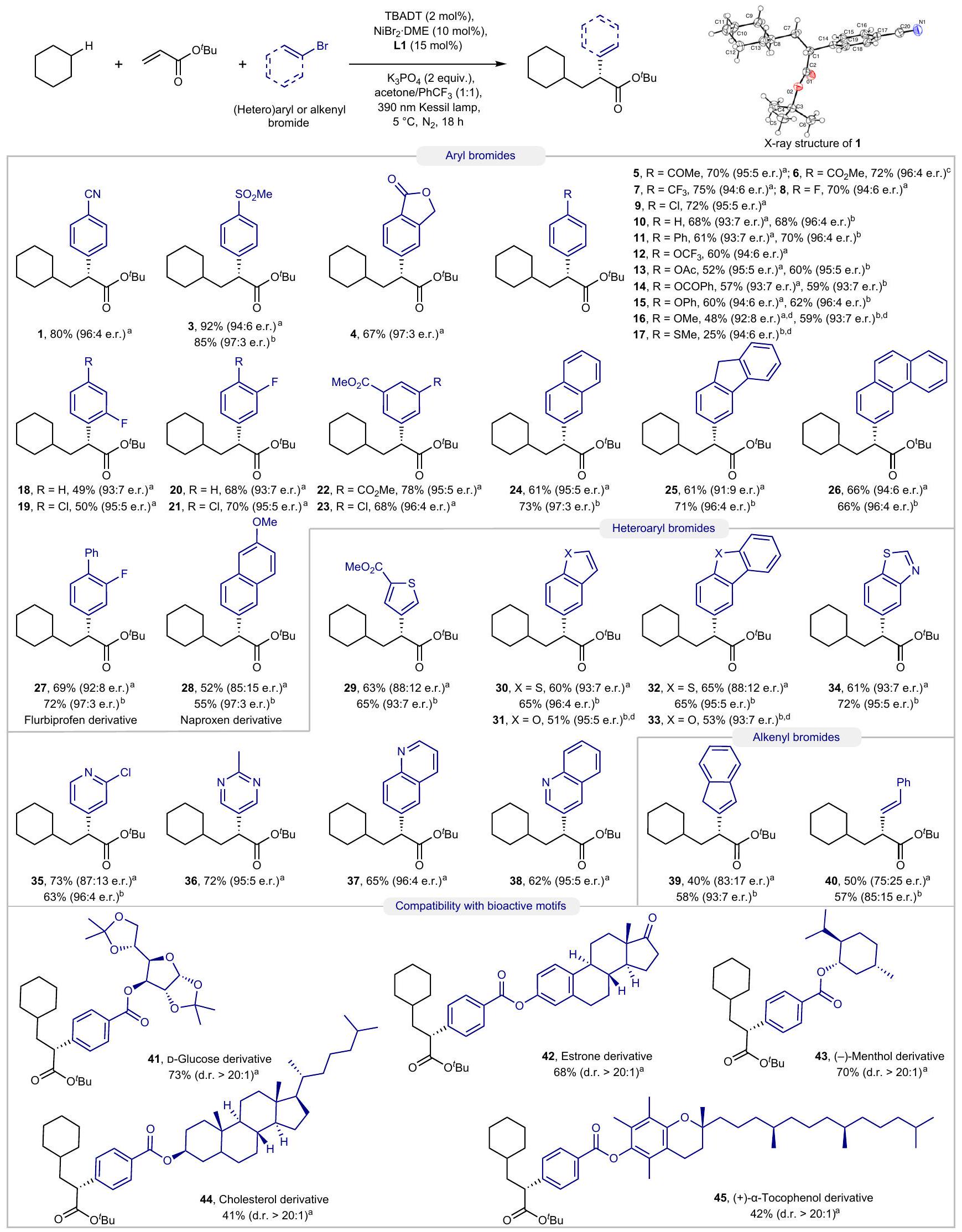
الشكل 3| نطاق بروميدات (الهترو) أريل/ألكينيل. التفاعل والظروف موضحة في الأعلى. ظروف التفاعل القياسية I هي نفسها كما في الشكل. تم استخدامه كليغاند، والأسيتون/ تم استخدامه كمذيب. تم استخدامه بدلاً من . تم استخدام مصباحين من نوع كيسيل بقوة 40 واط وطول موجي 390 نانومتر. النسبة الدياستيروميرية.
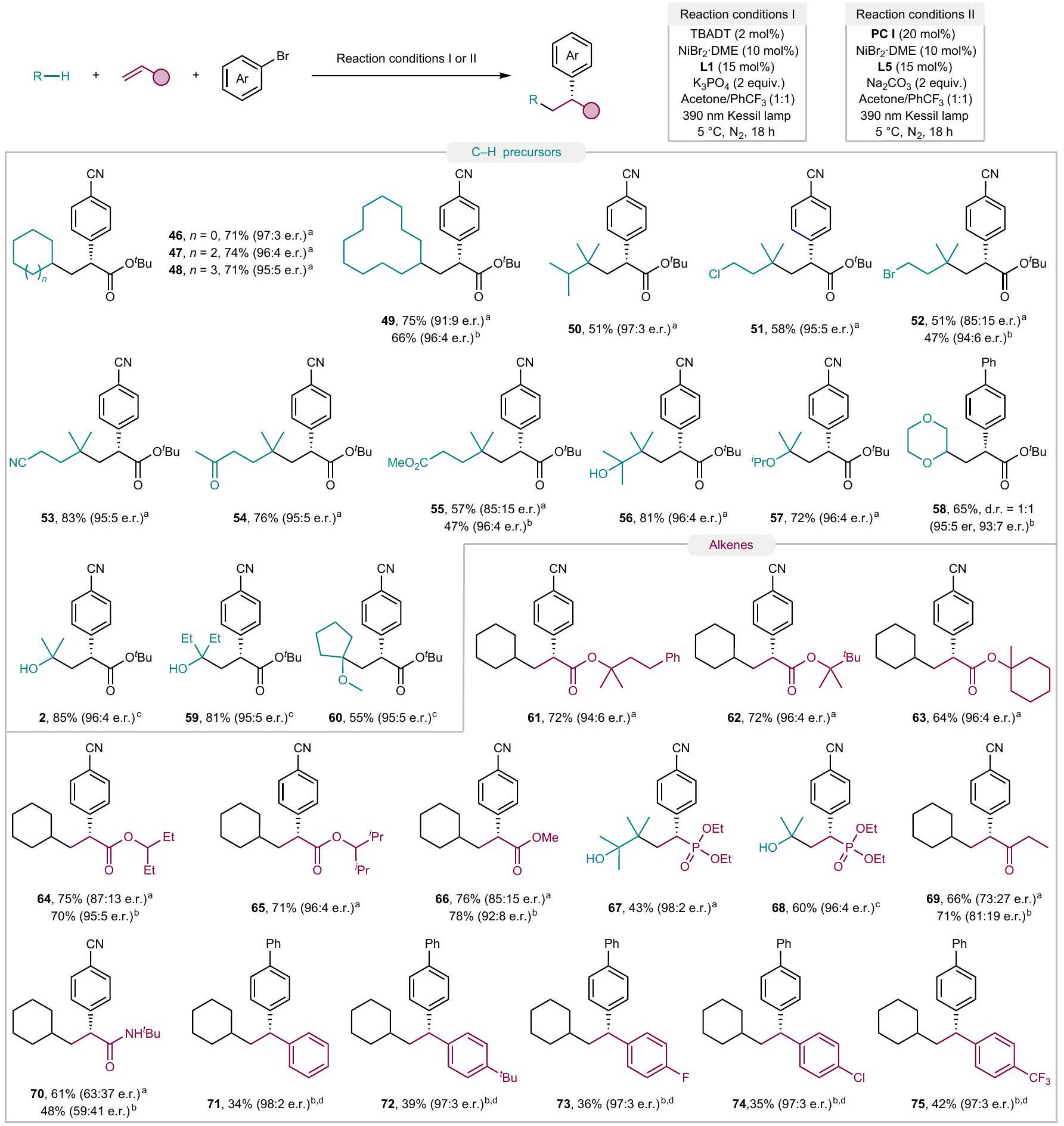
الشكل 4 | نطاق سلف C-H والألكينات. يتم عرض التفاعل والظروف في الأعلى. ظروف التفاعل القياسية I هي نفسها كما في الشكل. تم استخدامه كليغاند، والأسيتون/ تم استخدامه كمذيب. ظروف التفاعل القياسية II هي نفسها كما في الشكل 2. تم استخدام مصباحين من نوع كيسيل بقوة 40 واط وطول موجي 390 نانومتر.
في بعض الحالات، خاصة بالنسبة للبرومايد (الهيدروكربونات) الغنية بالإلكترونات والألكين، استخدام كعامل ربط كيرالي وتخفيف التفاعل حسن كلا من العوائد والانتقائية الإنسية. من المهم أن البرايميدات الأريلية المشتقة من د-جلوكوز (41)، إسترون (42)، (-)-مينثول (43)، كوليسترول (44) و(+)- توفر -توكوفيرول (45) المنتجات الناتجة من التفاعل الثلاثي المكون بمعدلات متوسطة إلى جيدة مع تحكم ممتاز في التباين، على الرغم من وجود عدة مكونات مميزة. الروابط في الركائز، مما يبرز الانتقائية الكيميائية للطريقة وإمكانية تطبيقها في تخليق الأشكال الصيدلانية والبيولوجية النشطة.
نطاق تم استكشاف السلفيات بعد ذلك (الشكل 4). كما هو متوقع، تم تحمل السيكلو ألكانات ذات أحجام حلقات مختلفة مثل السيكلوبنتان (46)، السيكلوهبتان (47)، السيكلوأوكتان (48) والسيكلودودكان (49) بشكل جيد. في الحالة الأخيرة، بسبب نقص ذوبانية المتفاعل، تم الحصول على نسبة e.r. تبلغ 91:9 تحت ظروف التفاعل القياسية، والتي تم تحسينها إلى عن طريق زيادة كمية المذيب واستخدام ك ligand. من المثير للاهتمام أن 2،3-ثنائي ميثيل بيوتان (50) تم تنشيطه بشكل انتقائي على الثانوي الروابط بسبب الطاقات العالية لتفكك الروابط الأولية الروابط. من المRemarkably، مشتقات الهيدروكربونات التي تحمل مجموعات سحب الإلكترون المختلفة

( ) تم تحقيق تفعيلها بنجاح مع تحكم ممتاز في الانتقائيات الإقليمية والانتقائيات الإنسية (51-55). يمكن أن يُعزى هذا النتيجة إلى الطبيعة الهيدريدية للثالثية الروابط والطبيعة الكهربية للإثارة في الديكاتونستات ، مما يوفر منتجات تم تعديلها بشكل انتقائي بعيدًا عن المجموعات السحب الإلكترونية. كما لوحظت انتقائية مكانية كاملة في حالة الكحوليات التي تحتوي على روابط C-H ثلاثية، حيث أن 2،3-ثنائي ميثيل بيوتان-2-أول أنتج المنتج 56 في العائد و96:4 نسبة التفاعل. إن توافق مجموعات الوظائف المتنوعة يبرز المزيد من مزايا هذه الاستراتيجية المزدوجة المحفزة بالنيكل/الضوء، حيث كانت هذه الأنواع من الجذور الألكيلية غير متاحة مع المواد الأولية الجذرية التي تم تطويرها سابقًا. هذه البروتوكول ليس مقيدًا بالإلكترونات المحايدة وغير المنشطة. الأنظمة. تم تعديل الإيثرات بشكل انتقائي في الموقع عند -موضع الأوكسي و )، وهو ما يتماشى مع انتقائية الديكاتونغستات للمواد الأكثر غنى بالإلكترونات الروابط. ومع ذلك، لم يكن الإيثر ميثيل تيرت-بيوتيل، والتولوين، والبيروليدين المحمي بـ Boc قادرين على المشاركة في هذه التفاعل الثلاثي المكونات، مما أدى إلى إنتاج منتجات تقاطع أريل-ألكيل ثنائية المكونات بدلاً من ذلك (الجدول التكميلي 9). لم تكن ظروف التفاعل المذكورة مناسبة للتعديل المباشر للروابط الهيدروجينية في
-موضع إلى وظائف الهيدروكسيل. مستلهم من سوابق الأدبيات ، كنا سعداء لاكتشاف أن الإيزوبروبانول (2) والبنتان-3-أول (59) شاركا في هذا التحول عندما تم استخدام مشتق البنزوفيون PC I كعامل حفاز ضوئي تحت ظروف تفاعل معدلة. علاوة على ذلك، تم تحقيق تحكم استثنائي في الموقع في وجود كل من الألكانات الثانوية والأولية. الروابط المجاورة لذرة الأكسجين، حيث أن المنتج المستهدف فقط تكونت عندما تم استخدام الإيثر الميثيلي السيكلوبنتيلي كركيزة. تسلط هذه النتيجة الضوء على قدرة المحفزات الضوئية من الكيتونات ثنائية الأريل في التفعيل الانتقائي للموقع.
ثم وجهنا اهتمامنا لتوسيع النطاق فيما يتعلق بالألكينات (الشكل 4). تم دراسة سلسلة من الأكريلات ذات المجموعات الفرعية المختلفة، مما أدى إلى إنتاج مواد غنية جداً بالإنانتيوميرات. -منتجات الإستر الأريلي (61-66). من بينها، لوحظ تآكل طفيف في الانتقائية الإينانتيوميرية مع تفاعلات الأكريلات الأقل ازدحامًا حجميًا، والتي تم معالجتها عن طريق استبدال ligand. مع . من المبهج أن الفينيل فوسفونات كانت أيضًا شريكات ربط مناسبة تحت ظروف التحفيز الضوئي باستخدام الديكاتون أو كيتونات الدياريل. تم الحصول على الفوسفونات العضوية الكيرالية بعوائد جيدة وانتقائيات إنانيو ممتازة ( و ). تم استكشاف ألكينات أخرى تعاني من نقص الإلكترونات أيضًا. الـ الكيتونات غير المشبعة بالإضافة إلى الأكريلاميدات كانت إلكترونات قابلة للحياة
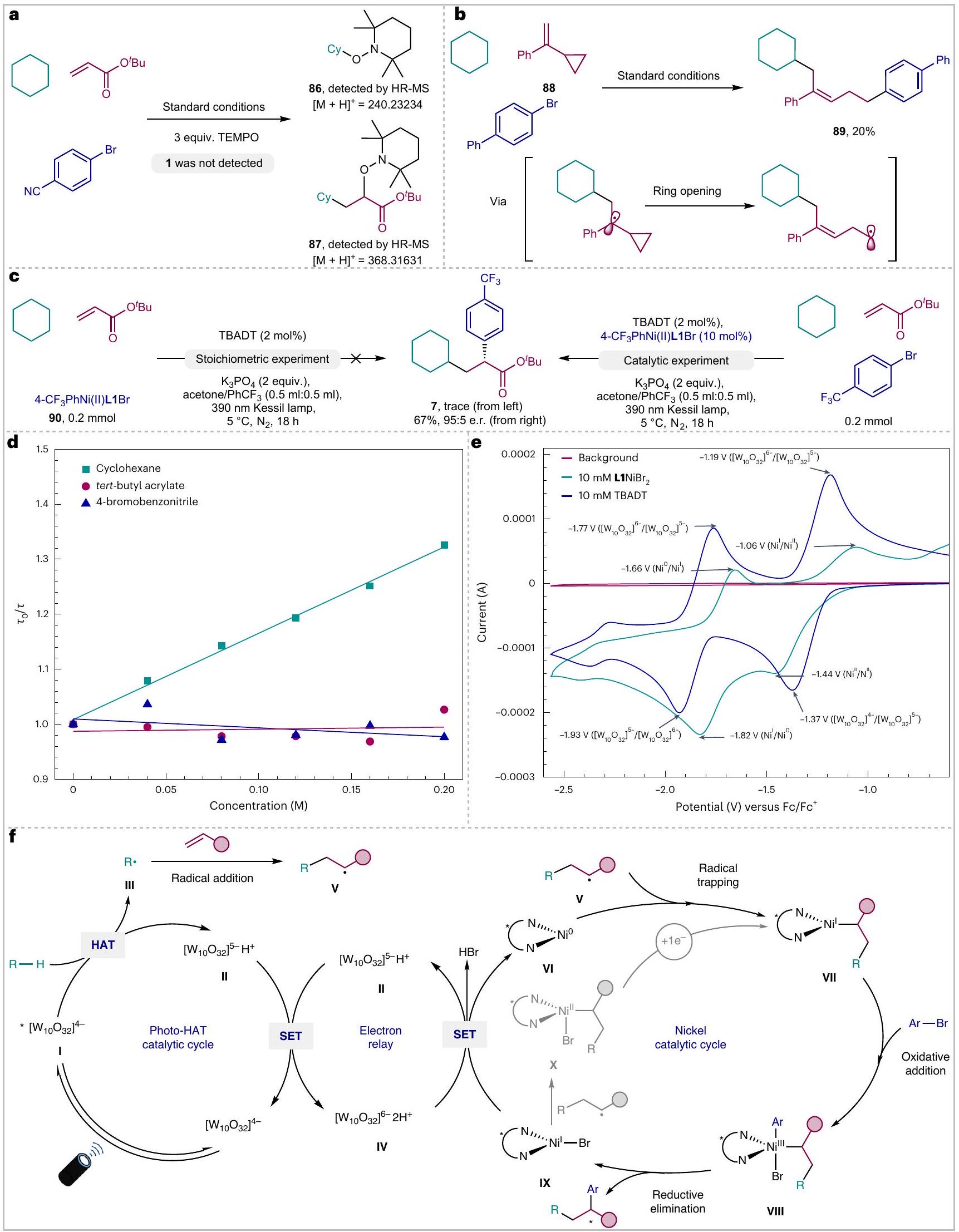
الشكل 6 | دراسات آلية والآلية المقترحة. أ، تجربة احتجاز الجذور. ب، تجربة ساعة الجذور. ج، تجارب ستوكيومترية وكاتاليتية مع معقد. د، دراسات ستيرن-فولمر لـ TBADT مع السيكلوهكسان، أكريلات التيرت-بيوتيل و4-بروموبنزونيتريل. هـ، دوري
دراسات الفولتموجرام لـ TBADT و آلية مقترحة. نقل إلكترون فردي؛ مدة حياة المحفز الضوئي المثار المقاسة مع المثبط؛ عمر المحفز الضوئي المثار بدون مثبط.
المستقبلات، على الرغم من أن المنتجات (69 و70) تم الحصول عليها بانتقائية متوسطة. قدمت الأكريلاميدات الثلاثية كمية ضئيلة من المنتجات المرغوبة من التفاعل الثنائي الكربوني (الجدول التكميلي 9). كانت الفينيل أرينات، وهي فئة من الأوليفينات المنشطة، غير متوافقة في التقارير السابقة. ، كانت مقبولة في النظام الحالي. الستيرينات التي تحمل مجموعات مانحة للإلكترونات ( -Bu) بالإضافة إلى المجموعات السالبة للإلكترونات ( يمكن أن يتم التفاعل، تحت ظروف تفاعل معدلة قليلاً، لإنتاج 1,1-دي أريل ألكانات متشابهة مع انتقائية إنانتيومرية ممتازة (71-75).

التطبيقات الاصطناعية

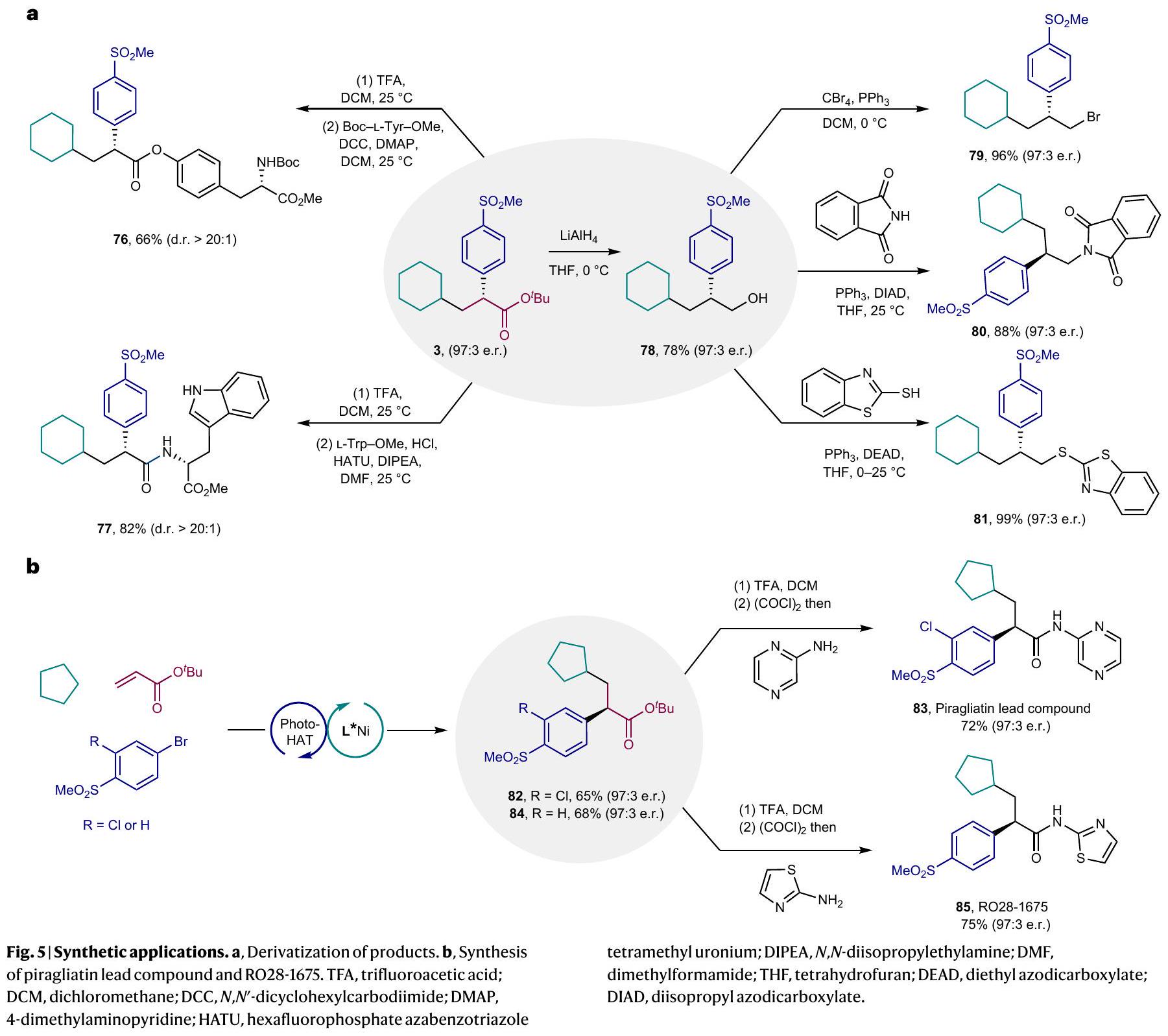
المُستَحَصل عليه غالبًا ما توجد الكربونيلات والفوسفونات ذات المجموعة الأريل/الألكينيل بالإضافة إلى 1,1-داي أريل ألكانات كأنماط هيكلية بارزة في الجزيئات النشطة دوائيًا وبيولوجيًا. لإظهار فائدة هذه التفاعل غير المتماثل متعدد المكونات بشكل أكبر، تم إجراء تحولات للمنتجات (الشكل 5أ) وتخليق جزيئات ذات صلة صيدلانية. على وجه التحديد، من خلال التحلل الحمضي يليه عمليات الإستر أو الأميد، تم الحصول على مشتقات L-تيروسين و L-تريبتوفان. و ) تم الحصول عليها بمستويات عالية من التحكم في الدياستيريوم، مما أشار إلى إمكانيات هذه الطريقة للوصول بسرعة إلى مشتقات الأحماض الأمينية المعقدة. بالإضافة إلى ذلك، فإن تقليل تم تحقيق استر الأريل 3 بنجاح من خلال المعالجة بـ توصيل الكحول 78 بجودة صوت استيريو ممتازة ( e.r.). نظرًا لأن الكحوليات هي وسائط متعددة الاستخدامات في التخليق العضوي، تم إجراء عدة تحويلات لـ 78 أيضًا. حولت تفاعلات الاستبدال النووي 78 إلى المركب المقابل -بروميد الأريل (79)، -أريل أميد (80) و -أريل ثيول (81) بعوائد عالية وانتقائية إنزيمية. لتوضيح قيمته العملية بشكل أكبر، تم تطبيق الطريقة على تخليق مختصر لاثنين من منشطات الجلوكوكيناز. المسار الاصطناعي نحو المركب الرئيسي لبيراجلاتين موضح في الشكل 5ب (الأعلى). أدى الجمع بين السيكلوبنتان المتاح تجارياً، وأكريلات التيرت-بيوتيل، و4-برومو-2-كلورو-1-(ميثيل سلفونيل) بنزين إلى إنتاج المنتج الناتج من التفاعل الثلاثي المكون 83 بعائد 65% ونسبة 97:3. التحلل المائي لـ مع حمض ثلاثي فلورو الأسيتيك تلاه تفاعل الأميد مع 2-أمينوبيرازين، تم الحصول على المركب الرائد بيراجلاتين 83 بعائد 72% ونسبة 97:3. بالمقارنة مع التقارير السابقة، تبسط هذه الطريقة خطوات التشغيل من خلال استخدام السيكلوبنتان بدلاً من الألكيل ثلاثي فلوروبورات كمواد أولية للتخليق. وبالمثل، تم تصنيع منشط الجلوكوكيناز الغني بالإنانتيومير RO28-1675 (85، 97:3 نسبة الإناتيوز) بنجاح باستخدام الإجراء الاصطناعي المكون من ثلاث خطوات المذكور أعلاه (الشكل 5ب، الأسفل).

الدراسات الميكانيكية

تم تصميم عدة تجارب لاستكشاف آلية التفاعل لهذه التحويلة المزدوجة الحفازة. تم قمع تفاعل الألكيل أريلة المرغوب فيه تمامًا عن طريق إضافة 2،2،6،6-تترا ميثيل-1-بيبيريدينيل أوكسي (TEMPO؛ 3.0 مكافئ). مركبات TEMPO المضافة و تم الكشف عنها بواسطة مطياف الكتلة عالي الدقة (HR-MS) في الخليط (الشكل 6a)، مما يوضح وجود جذر ألكيل كوسيط على طول مسار التفاعل. بعد ذلك، تم إجراء تجارب ساعة الجذر مع الألكين سيكلوبروبيل 88 تحت ظروف التفاعل القياسية، مما أدى إلى الحصول على المنتج 89 بعائد 20% من خلال عملية إضافة جذرية متسلسلة، فتح الحلقة وإضافة الأريل (الشكل 6b). تلا ذلك إزالة عدم التماثل للمنتج أو إضافة جذرية من نوع غيزي إلى الرابطة المزدوجة تليها اختيار انتقائي. تم استبعاد -الأريلة بناءً على تجارب محكومة (نقاش إضافي). بعد ذلك، تم تقييم التفاعل وكفاءة التحفيز للمواد التي تم تحضيرها مسبقًا تمت دراسة المركب 90 بشكل أعمق. تم الكشف عن كمية ضئيلة فقط من 7 مع المركب الستيوكيومتري. ، السيكلوهكسان وأكريلات التيرت-بيوتيل. أحد الأسباب المحتملة هو أن المركب 90 غير مستقر في غياب بروميدات الأريل، ويمتلك خصائص امتصاص قوية للضوء المرئي. . بالمقابل، استخدام من معقد 90 بدلاً من كعامل مساعد في وجود بروميدات الأريل، تم الحصول على المنتج 7 في العائد مع نسبة متطابقة (95:5؛ الشكل 6c). مجتمعة، تشير هذه النتائج إلى أن المركب المحتمل أريل-نيكل (II) قد لا يكون منتجًا فعالًا.
المتوسط في الدورة الحفازة الرئيسية. بالإضافة إلى ذلك، تم إجراء تجارب تفريغ الليزر لدراسة إخماد الحالة المثارة لـ TBADT (TBADT*) في وجود تركيزات متزايدة من السيكلوهكسان، أكريلات التيرت-بيوتيل و4-بروموبنزونيتريل، على التوالي. لوحظ تدهور واضح لـ TBADT* في وجود السيكلوهكسان متبعًا سلوك ستيرن-فولمر الخطي (ثابت معدل ثنائي الجزيئات بالمقابل، لم يكن بإمكان أكريلات التيرت-بيوتيل و4-بروموبنزونيتريل إخماد TBADT* (الشكل 6d). تؤكد هذه النتائج تنشيط السيكلوهكسان بواسطة الحالة المثارة من المحفز الضوئي لتكوين الجذور الكربونية، بما يتماشى مع تجارب احتجاز الجذور وتجارب الساعة الملخصة في الشكل 6a,b.
استنادًا إلى الدراسات الميكانيكية المذكورة أعلاه والسوابق في الأدبيات يمكن اقتراح آلية معقولة لهذه التفاعل المزدوج المحفز بواسطة TBADT/ النيكل لتفاعل الديكاربوفنكشنالization الانتقائي للإنانتيومير (الشكل 6f). سيتم تشكيل تيترا بوتيل أمونيوم ديكاتونغستات I في ظل ظروف التحفيز الضوئي، مما يمكّن من استخراج ذرة هيدروجين من النيوكليوفيلات. هذه العملية تولد الديكاتونغستات المخفض أحاديًا II وجذر الكربون III. يوفر التباين في II الديكاتونغستات المخفض مزدوجًا IV ويعيد توليد TBADT في حالته الأساسية. بالتوازي، فإن الإضافة الجذرية لـ III إلى أوليفين ستشكل المضاف. ، والتي يمكن التقاطها بواسطة النوع VI لتوفير وسيط الألكيل-Ni(I) VII. الإضافة المؤكسدة اللاحقة لبرومايد الألكين إلى النوع السابع يولد وسيط الألكيل-Ni(III)-أريل الثامن. ينتج عن الإزالة الاختزالية المنتج المطلوب من الديكربوفنكشنالization بالإضافة إلى نوع . كلا الدورات الحفزية تتقارب إلى الاكتمال من خلال نقل إلكترون فردي نهائي بين هذا الأنواع وتقليل TBADT IV مرتين لتجديد النشاط المحفز VI و TBADT II المخفض بشكل فردي. تدعم هذه العملية دراسات الفولتمترية الدائرية (الشكل 6e)، حيث إن الجهد الاختزالي لـ ضد في MeCN، تم ملاحظة قمة اختزالية عند -1.93 فولت) وهي أكثر سلبية من تلك الخاصة بـ ضد في MeCN، تم ملاحظة قمة اختزالية عند -1.82 فولت). من الممكن أيضًا وجود تسلسل تحفيزي (الشكل 6f، باللون الرمادي). بدلاً من ذلك، يمكن الحصول على النوع السابع من خلال الجمع بين النوع التاسع مع المضاف الجذري تليها عملية الاختزال الفردي للإلكترون للوسيط الألكيل-Ni(II) .

الاستنتاجات

باختصار، فإن دمج HAT المدعوم بالضوء مع نقل الجذور المحفز بواسطة النيكل قد مكن من تحقيق تفاعل ثلاثي المكونات عالي الانتقائية الإنسية لتعدد الوظائف في الألكينات. يمكن استخدام الهيدروكربونات غير المنشطة مباشرة كعوامل ربط دون الحاجة إلى سلف الجذور المفعلة مسبقًا، مما يجعل هذه الاستراتيجية أكثر جاذبية من حيث كفاءة الخطوات وكفاءة الذرات في التخليق. تم تحقيق تنشيط انتقائي للموقع وتحويل الألكانات، الإيثرات والكحوليات من خلال استخدام محفزات ضوئية من الديكاتون أو الديكاتون الثنائي. تتميز الطريقة بشروط معتدلة، ونطاق واسع من الركائز، وانتقائية ممتازة من حيث الموقع، والكيمياء، والانتقائية الإنسية، مما يوفر تخليقًا متعدد الاستخدامات للمواد ذات القيمة المضافة الغنية بالإنزيمات. -الكربونيلات/ الفوسفونات الأريل/ الألكين والدي أريل ألكانات. لقد تم إثبات الإمكانيات التركيبية لهذه الطريقة من خلال تحويل المنتجات وتخليق جزيئات ذات صلة طبية. نعتقد أن الدروس المستفادة هنا ستلهم تطوير المزيد من التفاعلات متعددة المكونات غير المتماثلة الممكنة بواسطة التفعيل في المستقبل.

طرق

الطريقة أ

في صندوق قفازات مملوء بالنيتروجين، تم تحميل وعاء تفاعل (5 مل) مزود بعصا تحريك مع TBADT ( ) ، دي إم إي -sec-butyl)-1,1′-ثنائي (3-(tert-butyl)phenyl)-4,4′,5,5′-تتراهيدرو-1H,1’H-2,2′-بي إيميدازول (L1؛ ) أو ( )- -سيك-بيوتيل)-1,1′-ثنائي(3,5-دي-تيرت-بيوتيل فينيل)-4,4′,5,5′-تتراهيدرو-1H,1′
H-2,2′-بيميدازول (L5؛ خالي من الماء ( 0.4 مليمول ، 2 مكافئ ) ، بروميد أريل ( ما يعادل ذلك، سابقة جذرية مكافئ)، ألكين ( أسيتون جاف ( متى تم استخدامه) وجاف -تريفلوروتولوين ( متى تم استخدامه). تم إغلاق القارورة وإزالتها من صندوق القفازات. تم تحريك خليط التفاعل مسبقًا لمدة 20 دقيقة، ثم تم تعريضه لأشعة مصباح Kessil PR160390 نانومتر عند بمسافة من سطح وعاء التفاعل. بعد 18 ساعة من الإشعاع، تم تمرير المزيج الناتج من خلال سدادة بيبتية من سيلت وسليكا جيل وتم إزالته باستخدام إيثيل أسيتات. بعد التركيز تحت ضغط منخفض، تم تنقية المزيج الخام عن طريق الكروماتوغرافيا على سليكا جيل باستخدام خليط من الهكسان وإيثيل أسيتات للحصول على المنتجات المقابلة.

الطريقة ب

في صندوق قفازات مملوء بالنيتروجين، تم شحن وعاء تفاعل (5 مل) مزود بعصا تحريك بـ (4-ميثوكسي فينيل)(4-(تريفلووروميثيل)فينيل)ميثانون (PC I؛ ) ، دي إم إي ) ، خالي من الماء ( بروميد أريل ( سابق الجذري C-H ( مكافئ)، ألكين ( أسيتون جاف (1.0 مل) وجاف -تريفلوروتولوين (1.0 مل). تم إغلاق القارورة وإخراجها من صندوق القفازات. تم تحريك خليط التفاعل مسبقًا لمدة 20 دقيقة، ثم تم تعريضه لأشعة مصباح كيسيل PR160 بطول موجي 390 نانومتر في بمسافة من سطح وعاء التفاعل. بعد 18 ساعة من الإشعاع، تم تمرير المزيج الناتج من خلال سدادة بيبتية من سيلت وسليكا جيل وتم إزالته باستخدام إيثيل أسيتات. بعد التركيز تحت ضغط منخفض، تم تنقية المزيج الخام عن طريق الكروماتوغرافيا على سليكا جيل باستخدام خليط من الهكسان وإيثيل أسيتات للحصول على المنتجات المقابلة.

توفر البيانات

إحداثيات البلورة بالأشعة السينية للمركب تم إيداع البيانات المبلغ عنها في هذه المقالة في مركز بيانات البلورات في كامبريدج (CCDC) تحت رقم الإيداع 2268422. يمكن الحصول على هذه البيانات مجانًا من CCDC عبر www.ccdc.cam.ac.uk/data_request/cifيعلن المؤلفون أن البيانات التي تدعم نتائج هذه الدراسة متاحة ضمن المقال والمعلومات التكميلية. البيانات متاحة من المؤلف المراسل عند الطلب.

References

  1. Labinger, J. A. & Bercaw, J. E. Understanding and exploiting C-H bond activation. Nature 417, 507-514 (2002).
  2. Zhang, C., Li, Z. L., Gu, Q. S. & Liu, X. Y. Catalytic enantioselective functionalization involving radical intermediates. Nat. Commun. 12, 475 (2021).
  3. Saint-Denis, T. G. et al. Enantioselective bond activation by chiral transition metal catalysts. Science 359, eaao4798 (2018).
  4. Olden, D. L., Suh, S. E. & Stahl, S. S. Radical C(sp³)-H functionalization and cross-coupling reactions. Nat. Rev. Chem. 6, 405-427 (2022).
  5. Capaldo, L., Ravelli, D. & Fagnoni, M. Direct photocatalyzed hydrogen atom transfer (HAT) for aliphatic C-H bonds elaboration. Chem. Rev. 122, 1875-1924 (2022).
  6. Cao, H., Tang, X., Tang, H., Yuan, Y. & Wu, J. Photoinduced intermolecular hydrogen atom transfer reactions in organic synthesis. Chem. Catal. 1, 523-598 (2021).
  7. Capaldo, L. & Ravelli, D. Hydrogen atom transfer (HAT): a versatile strategy for substrate activation in photocatalyzed organic synthesis. Eur. J. Org. Chem. 2017, 2056-2071 (2017).
  8. Ravelli, D., Fagnoni, M., Fukuyama, T., Nishikawa, T. & Ryu, I. Site-selective functionalization by decatungstate anion photocatalysis: synergistic control by polar and steric effects expands the reaction scope. ACS Catal. 8, 701-713 (2017).
  9. Tzirakis, M. D., Lykakis, I. N. & Orfanopoulos, M. Decatungstate as an efficient photocatalyst in organic chemistry. Chem. Soc. Rev. 38, 2609-2621 (2009).
  10. West, J. G., Huang, D. & Sorensen, E. J. Acceptorless dehydrogenation of small molecules through cooperative base metal catalysis. Nat. Commun. 6, 10093 (2015).
  11. Cao, H. et al. Photoinduced site-selective alkenylation of alkanes and aldehydes with aryl alkenes. Nat. Commun. 11, 1956 (2020).
  12. Perry, I. B. et al. Direct arylation of strong aliphatic C-H bonds. Nature 560, 70-75 (2018).
  13. Shen, Y., Gu, Y. & Martin, R. arylation and alkylation enabled by the synergy of triplet excited ketones and nickel catalysts. J. Am. Chem. Soc. 140, 12200-12209 (2018).
  14. Sarver, P. J. et al. The merger of decatungstate and copper catalysis to enable aliphatic -H trifluoromethylation. Nat. Chem. 12, 459-467 (2020).
  15. Murphy, J. J., Bastida, D., Paria, S., Fagnoni, M. & Melchiorre, P. Asymmetric catalytic formation of quaternary carbons by iminium ion trapping of radicals. Nature 532, 218-222 (2016).
  16. Laudadio, G. et al. functionalizations of light hydrocarbons using decatungstate photocatalysis in flow. Science 369, 92-96 (2020).
  17. Laudadio, G. et al. Selective aerobic oxidation enabled by decatungstate photocatalysis in flow. Angew. Chem. Int. Ed. 57, 4078-4082 (2018).
  18. Schultz, D. M. et al. Oxyfunctionalization of the remote bonds of aliphatic amines by decatungstate photocatalysis. Angew. Chem. Int. Ed. 56, 15274-15278 (2017).
  19. Ryu, I. et al. Efficient and conversion via decatungstate-photoinduced alkylation of diisopropyl azodicarboxylate. Org. Lett. 15, 2554-2557 (2013).
  20. Wan, T. et al. Decatungstate-mediated heteroarylation via radical-polar crossover in batch and flow. Angew. Chem. Int. Ed. 60, 17893-17897 (2021).
  21. Halperin, S. D., Fan, H., Chang, S., Martin, R. E. & Britton, R. A convenient photocatalytic fluorination of unactivated bonds. Angew. Chem. Int. Ed. 53, 4690-4693 (2014).
  22. Xia, J. B., Zhu, C. & Chen, C. Visible light-promoted metal-free C-H activation: diarylketone-catalyzed selective benzylic mono- and difluorination. J. Am. Chem. Soc. 135, 17494-17500 (2013).
  23. Sarver, P. J., Bissonnette, N. B. & MacMillan, D. W. C. Decatungstate-catalyzed sulfinylation: rapid access to diverse organosulfur functionality. J. Am. Chem. Soc. 143, 9737-9743 (2021).
  24. Xu, S., Chen, H., Zhou, Z. & Kong, W. Three-component alkene difunctionalization by direct and selective activation of aliphatic C-H bonds. Angew. Chem. Int. Ed. 60, 7405-7411 (2021).
  25. Campbell, M. W., Yuan, M., Polites, V. C., Gutierrez, O. & Molander, G. A. Photochemical C-H activation enables nickel-catalyzed olefin dicarbofunctionalization. J. Am. Chem. Soc. 143, 3901-3910 (2021).
  26. Lu, F. D., He, G. F., Lu, L. Q. & Xiao, W. J. Metallaphotoredox catalysis for multicomponent coupling reactions. Green Chem. 23, 5379-5393 (2021).
  27. Wickham, L. M. & Giri, R. Transition metal (Ni, Cu, Pd)-catalyzed alkene dicarbofunctionalization reactions. Acc. Chem. Res. 54, 3415-3437 (2021).
  28. Derosa, J., Apolinar, O., Kang, T., Tran, V. T. & Engle, K. M. Recent developments in nickel-catalyzed intermolecular dicarbofunctionalization of alkenes. Chem. Sci. 11, 4287-4296 (2020).
  29. Qi, X. & Diao, T. Nickel-catalyzed dicarbofunctionalization of alkenes. ACS Catal. 10, 8542-8556 (2020).
  30. Badir, S. O. & Molander, G. A. Developments in photoredox/ nickel dual-catalyzed 1,2-difunctionalizations. Chem 6, 1327-1339 (2020).
  31. Zhu, C., Yue, H., Chu, L. & Rueping, M. Recent advances in photoredox and nickel dual-catalyzed cascade reactions: pushing the boundaries of complexity. Chem. Sci. 11, 4051-4064 (2020).
  32. Campbell, M. W., Compton, J. S., Kelly, C. B. & Molander, G. A. Three-component olefin dicarbofunctionalization enabled by nickel/photoredox dual catalysis. J. Am. Chem. Soc. 141, 20069-20078 (2019).
  33. Garcia-Dominguez, A., Mondal, R. & Nevado, C. Dual photoredox/ nickel-catalyzed three-component carbofunctionalization of alkenes. Angew. Chem. Int. Ed. 58, 12286-12290 (2019).
  34. Guo, L., Tu, H. Y., Zhu, S. & Chu, L. Selective, intermolecular alkylarylation of alkenes via photoredox/nickel dual catalysis. Org. Lett. 21, 4771-4776 (2019).
  35. Mega, R. S., Duong, V. K., Noble, A. & Aggarwal, V. K. Decarboxylative conjunctive cross-coupling of vinyl boronic esters using metallaphotoredox catalysis. Angew. Chem. Int. Ed. 59, 4375-4379 (2020).
  36. Zheng, S. et al. Selective 1,2-aryl-aminoalkylation of alkenes enabled by metallaphotoredox catalysis. Angew. Chem. Int. Ed. 59, 17910-17916 (2020).
  37. Li, Z. L., Fang, G. C., Gu, Q. S. & Liu, X. Y. Recent advances in copper-catalysed radical-involved asymmetric 1,2-difunctionalization of alkenes. Chem. Soc. Rev. 49, 32-48 (2020).
  38. Fu, L., Zhou, S., Wan, X., Chen, P. & Liu, G. Enantioselective trifluoromethylalkynylation of alkenes via copper-catalyzed radical relay. J. Am. Chem. Soc. 140, 10965-10969 (2018).
  39. Lin, J. S. et al. Cu/chiral phosphoric acid-catalyzed asymmetric three-component radical-initiated 1,2-dicarbofunctionalization of alkenes. J. Am. Chem. Soc. 141, 1074-1083 (2019).
  40. Wang, F. et al. Enantioselective copper-catalyzed intermolecular cyanotrifluoromethylation of alkenes via radical process. J. Am. Chem. Soc. 138, 15547-15550 (2016).
  41. Wang, P. Z. et al. Asymmetric three-component olefin dicarbofunctionalization enabled by photoredox and copper dual catalysis. Nat. Commun. 12, 1815 (2021).
  42. Wu, L., Wang, F., Chen, P. & Liu, G. Enantioselective construction of quaternary all-carbon centers via copper-catalyzed arylation of tertiary carbon-centered radicals. J. Am. Chem. Soc. 141, 1887-1892 (2019).
  43. Wu, L. et al. Asymmetric Cu-catalyzed intermolecular trifluoromethylarylation of styrenes: enantioselective arylation of benzylic radicals. J. Am. Chem. Soc. 139, 2904-2907 (2017).
  44. Zhu, S., Zhao, X., Li, H. & Chu, L. Catalytic three-component dicarbofunctionalization reactions involving radical capture by nickel. Chem. Soc. Rev. 50, 10836-10856 (2021).
  45. Chierchia, M., Xu, P., Lovinger, G. J. & Morken, J. P. Enantioselective radical addition/cross-coupling of organozinc reagents, alkyl iodides, and alkenyl boron reagents. Angew. Chem. Int. Ed. 58, 14245-14249 (2019).
  46. Tu, H. Y. et al. Enantioselective three-component fluoroalkylarylation of unactivated olefins through nickel-catalyzed cross-electrophile coupling. J. Am. Chem. Soc. 142, 9604-9611 (2020).
  47. Wei, X., Shu, W., Garcia-Dominguez, A., Merino, E. & Nevado, C. Asymmetric Ni-catalyzed radical relayed reductive coupling. J. Am. Chem. Soc. 142, 13515-13522 (2020).
  48. Wang, F., Pan, S., Zhu, S. & Chu, L. Selective three-component reductive alkylalkenylation of unbiased alkenes via carbonyl-directed nickel catalysis. ACS Catal. 12, 9779-9789 (2022).
  49. Qian, P. et al. Catalytic enantioselective reductive domino alkyl arylation of acrylates via nickel/photoredox catalysis. Nat. Commun. 12, 6613 (2021).
  50. Guo, L. et al. General method for enantioselective threecomponent carboarylation of alkenes enabled by visible-light dual photoredox/nickel catalysis. J. Am. Chem. Soc. 142, 2039020399 (2020).
  51. Li, X. et al. Three-component enantioselective alkenylation of organophosphonates via nickel metallaphotoredox catalysis. Chem 9, 154-169 (2023).
  52. Du, X. Y., Cheng-Sánchez, I. & Nevado, C. Dual nickel/ photoredox-catalyzed asymmetric carbosulfonylation of alkenes. J. Am. Chem. Soc. 145, 12532-12540 (2023).
  53. Cheng, X., Lu, H. & Lu, Z. Enantioselective benzylic C-H arylation via photoredox and nickel dual catalysis. Nat. Commun. 10, 3549 (2019).
  54. Rand, A. W. et al. Dual catalytic platform for enabling arylation and alkylation of benzamides. ACS Catal. 10, 4671-4676 (2020).
  55. Shu, X., Huan, L., Huang, Q. & Huo, H. Direct enantioselective acylation for the synthesis of -amino ketones. J. Am. Chem. Soc. 142, 19058-19064 (2020).
  56. Cheng, X. et al. Stereo- and enantioselective benzylic C-H alkenylation via photoredox/nickel dual catalysis. ACS Catal. 11, 11059-11065 (2021).
  57. Xu, J., Li, Z., Xu, Y., Shu, X. & Huo, H. Stereodivergent synthesis of both – and -alkenes by photoinduced, Ni-catalyzed enantioselective alkenylation. ACS Catal. 11, 13567-13574 (2021).
  58. Shu, X., Zhong, D., Lin, Y., Qin, X. & Huo, H. Modular access to chiral -(hetero)aryl amines via Ni/photoredox-catalyzed enantioselective cross-coupling. J. Am. Chem. Soc. 144, 8797-8806 (2022).
  59. Shu, X., Zhong, D., Huang, Q., Huan, L. & Huo, H. Site- and enantioselective cross-coupling of saturated N -heterocycles with carboxylic acids by cooperative Ni/photoredox catalysis. Nat. Commun. 14, 125 (2023).
  60. . et al. Enantioselective functionalization of oxacycles via photo-HAT/nickel dual catalysis. J. Am. Chem. Soc. 145, 5231-5241 (2023).
  61. Zhang, W. et al. Enantioselective cyanation of benzylic C-H bonds via copper-catalyzed radical relay. Science 353, 1014-1018 (2016).
  62. Li, J. et al. Site-specific allylic C-H bond functionalization with a copper-bound N-centred radical. Nature 574, 516-521 (2019).
  63. Li, Y., Lei, M. & Gong, L. Photocatalytic regio- and stereoselective functionalization of benzylic and allylic hydrocarbons as well as unactivated alkanes. Nat. Catal. 2, 1016-1026 (2019).
  64. Xu, P., Fan, W., Chen, P. & Liu, G. Enantioselective radical trifluoromethylation of benzylic C-H bonds via cooperative photoredox and copper catalysis. J. Am. Chem. Soc. 144, 13468-13474 (2022).
  65. Waele, V. D., Poizat, O., Fagnoni, M., Bagno, A. & Ravelli, D. Unraveling the key features of the reactive state of decatungstate anion in hydrogen atom transfer (HAT) photocatalysis. ACS Catal. 6, 7174-7182 (2016).
  66. Bhutani, P. et al. FDA approved drugs from 2015-June 2020: a perspective. J. Med. Chem. 64, 2339-2381 (2021).
  67. Lamberth, C. & Dinges, J. (eds) Bioactive Carboxylic Compound Classes: Pharmaceuticals and Agrochemicals (Wiley-VCH, 2016).
  68. Horsman, G. P. & Zechel, D. L. Phosphonate biochemistry. Chem. Rev. 117, 5704-5783 (2017).
  69. Ameen, D. & Snape, T. J. Chiral 1,1-diaryl compounds as important pharmacophores. MedChemComm 4, 893-907 (2013).

شكر وتقدير

نشكر O. Blacque على تحليل حيود الأشعة السينية لـ (مركز بيانات البلورات في كامبريدج رقم 2268422). نشكر P. Hamm و J. Helbing و K. Oppelt على تجارب التحليل الضوئي بالليزر. نشكر N. Cramer و G. Zhang على اختبار HPLC لـ و . تم إنشاء هذه المنشورة كجزء من NCCR Catalysis، وهو مركز وطني للتميز في البحث تم تمويله من قبل المؤسسة الوطنية السويسرية للعلوم. كما نُعبر عن شكرنا للمؤسسة الوطنية السويسرية للعلوم (SNF es 200021_184986/1 لـ C.N.) على الدعم المالي.

مساهمات المؤلفين

قام C.N. و X.H. بتصور المشروع. قام X.H. و I.C.-S. بإجراء التجارب. قام C.N. و X.H. و I.C.-S. و W.K. و G.A.M. بتحليل البيانات وشاركوا في كتابة الورقة.

تمويل

تم توفير تمويل الوصول المفتوح من قبل جامعة زيورخ.

المصالح المتنافسة

يعلن المؤلفون عدم وجود مصالح متنافسة.

معلومات إضافية

معلومات إضافية النسخة الإلكترونية تحتوي على مواد إضافية متاحة علىhttps://doi.org/10.1038/s41929-024-01153-0.
يجب توجيه المراسلات والطلبات للحصول على المواد إلى كريستينا نيفادو.
تُعبر مجلة Nature Catalysis عن شكرها للمراجعين المجهولين على مساهمتهم في مراجعة هذا العمل.
معلومات إعادة الطباعة والتصاريح متاحة علىwww.nature.com/reprints.
ملاحظة الناشر: تظل شركة سبرينجر ناتشر محايدة فيما يتعلق بالمطالبات القضائية في الخرائط المنشورة والانتماءات المؤسسية.
الوصول المفتوح هذه المقالة مرخصة بموجب رخصة المشاع الإبداعي النسب 4.0 الدولية، التي تسمح بالاستخدام والمشاركة والتكيف والتوزيع وإعادة الإنتاج بأي وسيلة أو صيغة، طالما أنك تعطي الائتمان المناسب للمؤلفين الأصليين والمصدر، وتوفر رابطًا لرخصة المشاع الإبداعي، وتوضح إذا ما تم إجراء تغييرات. الصور أو المواد الأخرى من طرف ثالث في هذه المقالة مشمولة في رخصة المشاع الإبداعي الخاصة بالمقالة، ما لم يُشار إلى خلاف ذلك في سطر الائتمان للمواد. إذا لم تكن المادة مشمولة في رخصة المشاع الإبداعي الخاصة بالمقالة وكان استخدامك المقصود غير مسموح به بموجب اللوائح القانونية أو يتجاوز الاستخدام المسموح به، فستحتاج إلى الحصول على إذن مباشرة من صاحب حقوق الطبع والنشر. لعرض نسخة من هذه الرخصة، قم بزيارةhttp://creativecommons.org/licenses/بواسطة/4.0/.
(ج) المؤلف(ون) 2024

  1. ¹قسم الكيمياء، جامعة زيورخ، زيورخ، سويسرا. معهد الدراسات المتقدمة، جامعة ووهان، ووهان، الصين. قسم الكيمياء، جامعة بنسلفانيا، فيلادلفيا، بنسلفانيا، الولايات المتحدة الأمريكية. البريد الإلكتروني: cristina.nevado@chem.uzh.ch

Journal: Nature Catalysis, Volume: 7, Issue: 6
DOI: https://doi.org/10.1038/s41929-024-01153-0
PMID: https://pubmed.ncbi.nlm.nih.gov/38947227
Publication Date: 2024-04-29

Nickel-catalysed enantioselective alkene dicarbofunctionalization enabled by photochemical aliphatic C-Hbond activation

Received: 15 June 2023
Accepted: 25 March 2024
Published online: 29 April 2024
(a) Check for updates

Xia Hu® , Iván Cheng-Sánchez ¹, Wangqing Kong², Gary A. Molander ³ Cristina Nevado ©

Abstract

The development of novel strategies to rapidly construct complex chiral molecules from readily available feedstocks is a long-term pursuit in the chemistry community. Radical-mediated alkene difunctionalizations represent an excellent platform towards this goal. However, asymmetric versions remain highly challenging, and more importantly, examples featuring simple hydrocarbons as reaction partners are elusive. Here we report an asymmetric three-component alkene dicarbofunctionalization capitalizing on the direct activation of bonds through the combination of photocatalysed hydrogen atom transfer and nickel catalysis. This protocol provides an efficient platform for installing two vicinal carbon-carbon bonds across alkenes in an atom-economic fashion, providing a wide array of high-value chiral -aryl/alkenyl carbonyls and phosphonates, as well as 1,1-diarylalkanes from ubiquitous alkane, ether and alcohol feedstocks. This method exhibits operational simplicity, broad substrate scope and excellent regioselectivity, chemoselectivity and enantioselectivity. The compatibility with bioactive motifs and expedient synthesis of pharmaceutically relevant molecules highlight the synthetic potential of this protocol.

The efficient assembly of high-added-value chiral molecules from readily available, inexpensive hydrocarbons with minimal waste generation represents a long-standing challenge for synthetic chemists . Two major challenges have hampered the broad implementation of these processes: on the one hand, bonds present a much lower reactivity compared to most functional groups. Furthermore, the presence of multiple non-equivalent bonds requires exquisite control over the chemoselectivity, regioselectivity and stereoselectivity to attain the desired outcome . Recently, hydrogen atom transfer (HAT) photocatalysis has emerged as a mild strategy for direct
functionalizations . Upon irradiation with light, the excited state of a photocatalyst can abstract hydrogen atoms from strong and inert bonds to produce nucleophilic carbon-centred radicals. Easy-to-synthesize tetra-n-butylammonium decatungstate (TBADT) and diaryl ketones have attracted particular interest as HAT photocatalysts owing to their ability to cleave electronically and sterically accessible bonds with high regioselectivity . As a result, synthetically useful functionalizations promoting the formation of new C-C (refs. 10-16), C-O (refs. 17,18), C-N (refs. 19,20), C-F (refs. 21,22) and (ref. 23) bonds have been realized capitalizing on this strategy.
Fig. 1| Development of asymmetric functionalizations and dicarbofunctionalization of alkenes. a, Asymmetric two-component
functionalization through a synergistic HAT process and transition metal
catalysis. b, Previous strategies and our design for asymmetric three-component radical dicarbofunctionalization of alkenes. BDE, bond dissociation energy;FG, functional group; PC, photocatalyst; Red, reductant.
More recently, the and Molander groups have independently developed elegant methods for the racemic three-component dicarbofunctionalization of alkenes via photocatalysed HAT (photo-HAT)/ nickel dual catalysis.
Catalytic three-component radical alkene difunctionalizations represent a straightforward and efficient approach for the rapid construction of molecular complexity, as two new functional groups can be simultaneously installed across the system in a single operation . However, controlling the enantioselectivity of the generated stereogenic centres remains a formidable challenge owing to the high reactivity and instability of the open shell radical intermediates participating in these transformations. Chiral copper and nickel complexes have opened a robust platform for asymmetric radical conjunctive cross-coupling of olefins. For example, impressive progress has been made in nickel-catalysed asymmetric radical relayed reductive coupling , in which -hybridized electrophiles such as alkyl halides and perfluoroalkyl halides have been employed as radical precursors. In addition, processes merging photoredox catalysis and nickel catalysis have enabled the asymmetric redox-neutral dicarbofunctionalization of alkenes with alkyltrifluoroborates as competent synthons for these protocols . All of the aforementioned transformations strongly rely on the use of pre-activated radical precursors, use that not only leads to the generation of additional waste but also results in poor step economy and atom economy. To improve the synthetic efficiency and expand the pool of radical precursors, the direct use of abundant hydrocarbons as coupling partners in the asymmetric dicarbofunctionalization of alkenes represents a more ideal but also highly challenging approach.
Although synergistic HAT processes and transition metal catalysis have been used in the enantioselective arylation, alkylation, alkenylation, acylation and cyanation of bonds (Fig. 1a) , the direct activation of bonds towards the asymmetric difunctionalization of alkenes is certainly underdeveloped (Fig. 1b). Two main challenges need to be addressed: first, the identification of a chiral ligand that can overcome competitive two-component side reactions while efficiently imparting absolute stereocontrol in the formation of the new stereogenic centres in the three-component process; and second, the implementation of reaction conditions wherein no competitive activation of distinct, even more activated bonds present in the
solvent and/or the participating reaction partners compromise the efficiency and selectivity of the overall process.
Here we show that the combination of a decatungstate or a diaryl ketone HAT photocatalyst with a chiral biimidazoline (Bilm) nickel catalyst enables the asymmetric dicarbofunctionalization of alkenes so that valuable -aryl/alkenyl carbonyls and phosphonates as well as 1,1-diarylalkanes can be obtained in enantioenriched form through the regioselective activation of abundant hydrocarbons and their derivatives.

Results

Optimization of the reaction conditions

Our investigation to identify suitable reaction conditions commenced with cyclohexane, tert-butyl acrylate and 4-bromobenzonitrile as model substrates under near-ultraviolet light irradiation (Kessil light-emitting diodes (LEDs); Fig. 2). After extensive evaluation of the reaction parameters, we found that the combination of TBADT ( ), .DME (DME, dimethoxyethane; ), chiral Bilm L1 ( ) and potassium phosphate ( equiv.) provided tert-butyl (R)-2-(4-cyanophenyl)-3-cyclohexylpropanoate in 80% isolated yield and 96:4 enantiomeric ratio (e.r.) in an acetone/ trifluorotoluene ( ) binary solvent system at (Fig. 2, entry1). The examination of different ligands revealed that the electronic and steric nature of the chiral Bilm template has a noticeable effect on the reaction efficiency (L1-L5). In general, Bilm ligands bearing electron-withdrawing groups on the aromatic ring result in higher yield but lower enantioselectivity (L4). Electron-rich and sterically demanding substituents on the nitrogen atom are beneficial for imparting stereocontrol, albeit with lower yield (L5). By comparison, 3-(tert-butyl) phenyl-substituted biimidazole exhibited the best compromise between reactivity and enantioselectivity. Reducing the amount of cyclohexane (Fig. 2, entry 2) or ligand (Fig. 2, entry 3), as well as decreasing the loading of nickel/L1 (Fig. 2, entry 4) had a negative effect on the reaction efficiency. The dual acetone/ solvent system was essential for the success of this transformation, as a substantial decrease in yield and enantioselectivity was observed when acetone, acetonitrile or was used as solvent (Fig. 2, entries 5-7). Furthermore, replacing the optimal solvent with or acetone/EtOAc resulted in complete failure of the reaction (Fig. 2, entries 8 and 9). Different
Fig. 2 | Optimization of reaction conditions. The optimization of reaction conditions. Standard reaction conditions I are as follows: cyclohexane ( 2 mmol , 10 equiv.), 4-bromobenzonitrile ( equiv.), tert-butyl acrylate ( equiv.), TBADT ( ), DME ( ), equiv.), acetone Kessil lamp, . Standard reaction conditions II are as follows: isopropanol ( equiv.),
4-bromobenzonitrile ( equiv.), tert-butyl acrylate ( 0.6 mmol , 3 equiv.), PCI ( ), ( ), ( equiv.), acetone ( ), 40 W 390 nm Kessil lamp, . Isolated yields. The e.r. values were determined by chiral HPLC. Detected by gas chromatography/mass spectrometry. ND, not detected.
nickel catalysts such as .diglyme and delivered the product with slightly decreased yield and e.r. (Fig. 2, entries 10 and 11), while and led to a dramatically reduced yield and enantioselectivity (Fig. 2, entries 12 and 13). The reaction still proceeded smoothly and provided a comparable e.r. upon dilution (Fig. 2, entries 14 and 15). Control experiments confirmed that photocatalyst, nickel, ligand and light were all necessary for a successful outcome (Fig. 2, entry 16). The absolute configuration of product 1 was unambiguously confirmed by X-ray diffraction analysis. In parallel, optimal conditions for isopropanol as radical precursor were sought. Gratifyingly, the desired three-component coupling product 2 could be obtained in 85% yield and 96:4 e.r. in the presence of diaryl ketone PCI, NiBr. DME, L5 and under LED irradiation at . The influence of ligand, photocatalyst and solvent is shown in Fig. 2, entries 18-20.

Substrate scope

With the optimized conditions in hand, the scope of this transformation was investigated next. We initially focused on examining a diverse array of aryl/alkenyl bromides (Fig. 3). Aryl bromides bearing cyanide (1), sulfone (3), lactone (4), ketone (5), ester (6), trifluomethyl (7), fluorine (8), chlorine (9), phenyl(11), trifluoromethoxy(12), acetoxy(13), benzoyloxy (14) and phenoxy(15) groups were all successfully converted to the corresponding dicarbofunctionalization products in good yields and highe.r. In general, electron-deficient aryl bromides exhibited improved efficacy
compared to electron-neutral (10) and electron-rich ones. Aryl halides bearing strong electron-donating groups, such as 4-bromoanisole and 4-bromothioanisole, were not amenable to the standard reaction conditions. By increasing the light intensity in the reaction, the formation of the corresponding dicarbofunctionalization adducts could be successfully accomplished in these cases ( and 17). The reactivities and enantioselectivities were not largely impacted by increased steric hindrance, because ortho- and meta-fluoro aryl bromides, as well as 2,4-,3,4- and 3,5-disubstituted aryl bromides were still compatible with the established protocol(18-23). Polycyclic aryl bromides such as 2-bromonaphthalene, 3-bromo-9H-fluorene and3-bromophenanthrene were also competent coupling partners (24-26). Moreover, derivatives of flurbiprofen (27) and naproxen (28), two well-known non-steroidal anti-inflammatory drugs (NSAIDs), could be readily synthesized applying our method. Heteroaryl bromides containing thiophene (29), benzothiophene(30), benzofuran (31), dibenzothiophene (32), dibenzofuran (33), benzothiazole (34), pyridines (35), pyrimidines (36) and quinolones (37 and 38), were successfully incorporated into this protocol, delivering the desired products with high to excellent enantioselectivities. Notably, these transformations displayed excellent chemoselectivity towards bromides in the presence of chlorides( ), paving the way for subsequent synthetic manipulations of the products. Alkenyl bromides such as 2 -bromo- -indene (39) and -bromostyrene (40) turned out to be viable partners despite a slight reduction of enantioselectivity.
Fig. 3|Scope of (hetero)aryl/alkenyl bromides. The reaction and conditions are shown at the top. Standard reaction conditions I are the same as in Fig. was used as ligand, and acetone/ was used as solvent. was used instead of . Two 40 W 390 nm Kessil lamps were used. d.r., diastereomeric ratio.
Fig. 4 | Scope of C-H precursors and alkenes. The reaction and conditions are shown at the top. Standard reaction conditions I are the same as in Fig. was used as ligand, and acetone/ was used as solvent. Standard reaction conditions II are the same as in Fig. 2. Two 40 W 390 nm Kessil lamps were used.
In some cases, especially for electron-rich (hetero)aryl and alkenyl bromides, using as the chiral ligand and diluting the reaction improved both the yields and enantioselectivities. Importantly, aryl bromides derived from d-glucose (41), estrone (42), (-)-menthol (43), cholesterol (44) and (+)- -tocopherol (45) furnished the desired three-component coupling products in moderate to good yields with excellent diastereocontrol, despite the presence of several distinct bonds in the substrates, thus highlighting the chemoselectivity of the method and its applicability towards the synthesis of pharmaceutical and bioactive motifs.
The scope of precursors was explored next (Fig. 4). As expected, cycloalkanes with various ring sizes such as cyclopentane (46), cycloheptane (47), cyclooctane (48) and cyclododecane (49) were well tolerated. In the last case, because of the lack of solubility of the reagent, an e.r. of 91:9 was obtained under standard reaction conditions, which was improved to by increasing the amount of solvent and the use of as ligand. Interestingly, 2,3-dimethylbutane(50) was selectively activated on the secondary bonds owing to the high bond dissociation energies of the primary bonds. Remarkably, hydrocarbon derivatives bearing different electron-withdrawing groups

( ) were successfully functionalized with excellent control of the regioselectivities and enantioselectivities (51-55). This result can be attributed to the hydridic nature of tertiary bonds and the electrophilic nature of excited decatungstate , thus providing products that are selectively functionalized distal to the electron-withdrawing moieties. Complete regioselectivity was also observed in the case of alcohols containing tertiary C-H bonds, with 2,3-dimethylbutan-2-ol affording product 56 in yield and 96:4 e.r. The compatibility of diverse functional groups further emphasizes the advantages of this photo-HAT/nickel dual-catalysed strategy, as these types of alkyl radicals were inaccessible with previously developed radical precursors. This protocol is not restricted to electron-neutral, unactivated systems. Ethers were regioselectively functionalized at the -oxy position ( and ), which is consistent with the selectivity of decatungstate for more electron-rich bonds. However, methyl tert-butyl ether, toluene and Boc-protected pyrrolidine were not able to participate in this three-component reaction, producing two-component aryl-alkyl cross-coupling products instead (Supplementary Table 9). The aforementioned reaction conditions were not suitable for the direct functionalization of hydrogen bonds in the
-position to hydroxy functions. Inspired by literature precedents , we were delighted to find that isopropanol (2) and pentan-3-ol (59) participated in this transformation when benzophenone derivative PC I was used as the photocatalyst under modified reaction conditions. Furthermore, extraordinary regiocontrol was achieved in the presence of both tertiary and primary bonds adjacent to the oxygen atom, as only the target product was formed when cyclopentyl methyl ether was used as substrate. This result highlights the ability of diaryl ketone photocatalysts in site-selective activation.
We next turned our attention to expanding the scope with respect to alkenes (Fig. 4). A series of acrylates with different substituents was investigated, generating highly enantioenriched -aryl ester products (61-66). Among them, a slight erosion in enantioselectivity was observed with less sterically hindered acrylate reactants, which was addressed by replacing ligand with . Pleasingly, vinyl phosphonates were also suitable coupling partners under either decatungstate or diaryl ketone photocatalytic conditions. Chiral organophosphonates were obtained in good yields and excellent enantioselectivities ( and ). Other electron-deficient alkenes were also explored. The -unsaturated ketones as well as acrylamides were viable electron
Fig. 6 | Mechanistic studies and proposed mechanism. a, Radical trapping experiment.b, Radical clock experiment. c, Stoichiometric and catalytic experiments with complex. d, Stern-Volmer studies of TBADT with cyclohexane, tert-butyl acrylate and 4-bromobenzonitrile. e, Cyclic
voltammogram studies of TBADT and , Proposed mechanism. SET, single-electron transfer; , measured lifetime of excited photocatalyst with quencher; , lifetime of the excited photocatalyst without quencher.
acceptors, although the products ( 69 and 70) were obtained with moderate enantioselectivity. Tertiary acrylamides furnished a trace amount of the desired dicarbofunctionalization adducts (Supplementary Table 9). Vinylarenes, a class of activated olefins that was not compatible in previous reports , were tolerated in the present system. Styrenes bearing both electron-donating groups ( -Bu) as well as electron-withdrawing groups ( ) could be engaged, under slightly modified reaction conditions, to deliver the corresponding chiral 1,1-diarylalkanes with excellent enantioselectivities (71-75).

Synthetic applications

The obtained -aryl/alkenyl carbonyls and phosphonates as well as 1,1-diarylalkanes are often found as prevalent structural motifs in pharmacologically and biologically active molecules . To further demonstrate the utility of this asymmetric multicomponent reaction, transformations of the products (Fig. 5a) and synthesis of pharmaceutically relevant molecules were performed. Specifically, through acidic hydrolysis followed by esterification or amidation processes, L-tyrosine and l-tryptophan derivatives ( and ) were obtained with high levels of diastereocontrol, which indicated the potential of this method for rapidly accessing complex amino acid derivatives. In addition, the reduction of -aryl ester 3 was successfully accomplished by treatment with , delivering alcohol 78 with excellent stereofidelity ( e.r.). Because alcohols are versatile intermediates in organic synthesis, several derivatizations of 78 were also carried out. Nucleophilic substitution reactions converted 78 into the corresponding -aryl bromide (79), -aryl amide (80) and -aryl thiol (81) in high yields and enantioselectivities. To illustrate its practical value further, the method was applied to a concise synthesis of two glucokinase activators. The synthetic route towards piragliatin lead compound is shown in Fig. 5b (top). The combination of commercially available cyclopentane, tert-butyl acrylate and 4-bromo-2-chloro-1-(methylsulfonyl)benzene produced the corresponding three-component cross-coupling product 83 in 65% yield and 97:3 e.r. Hydrolysis of with trifluoroacetic acid followed by amidation with 2-aminopyrazine offered piragliatin lead compound 83 in 72% yield and 97:3 e.r. Compared to previous reports, this method simplifies the operation steps by using cyclopentane instead of alkyltrifluoroborate as the synthetic precursors . Similarly, enantioenriched glucokinase activator RO28-1675 (85, 97:3 e.r.) was successfully synthesized by using the abovementioned three-step synthetic procedure (Fig. 5b, bottom).

Mechanistic studies

Several experiments were designed to probe the reaction mechanism of this dual-catalytic transformation. The desired alkylarylation reaction was completely suppressed by adding 2,2,6,6-tetramethyl-1-piper idinyloxy (TEMPO; 3.0 equiv.). TEMPO adducts and were detected by high-resolution mass spectrometry (HR-MS) in the mixture (Fig. 6a), thus demonstrating the intermediacy of an alkyl radical along the reaction pathway. Next, radical clock experiments were conducted with cyclopropyl alkene 88 under the standard reaction conditions, affording product 89 in 20% yield through a sequential radical addition, ring opening and arylation process (Fig. 6b). Product deracemization or Giese-type addition of radicals to the double bond followed by enantioselective -arylation were ruled out based on controlled experiments (Supplementary Discussion). Subsequently, the reactivity and catalytic efficiency of presynthesized complex 90 was further investigated. Only a trace amount of 7 was detected with stoichiometric complex , cyclohexane and tert-butyl acrylate. One possible reason is that complex 90 is unstable in the absence of aryl bromides, and it possesses strong visible-light absorption properties . By contrast, using of complex 90 instead of as catalyst in the presence of aryl bromides, product 7 was obtained in yield with an identical e.r. (95:5; Fig. 6c). Taken together, these results indicate that the putative aryl- Ni (II) complex might not be a productive
intermediate in the main catalytic cycle. In addition, laser flash photolysis experiments were performed to study the quenching of the excited state of TBADT (TBADT*) in the presence of increasing concentrations of cyclohexane, tert-butyl acrylate and 4-bromobenzonitrile, respectively. A clear decay of TBADT* was observed in the presence of cyclohexane following a linear Stern-Volmer behaviour (bimolecular rate constant ). By contrast, tert-butyl acrylate and 4-bromobenzonitrile were not able to quench TBADT* (Fig. 6d). These results confirm the activation of cyclohexane by the excited state of the photocatalyst to form carbon radicals, in line with the radical trapping and clock experiments summarized in Fig. 6a,b.
On the basis of the aforementioned mechanistic studies and precedents in the literature , a plausible mechanism for this TBADT/ nickel dual-catalysed enantioselective alkene dicarbofunctionalization can be proposed (Fig. 6f). Excited-state tetrabutylammonium decatungstate I would be formed under photoexcitation conditions, enabling the abstraction of a hydrogen atom from nucleophiles. This process generates singly reduced decatungstate II and carbon-centred radical III. Disproportionation of II provides doubly reduced decatungstate IV and regenerates ground-state TBADT. In parallel, radical addition of III to an olefin would form adduct , which can be captured by species VI to furnish alkyl-Ni(I) intermediate VII. Subsequent oxidative addition of alkenyl bromide to species VII generates alkyl-Ni(III)-aryl intermediate VIII. Reductive elimination produces the desired dicarbofunctionalization product as well as species . Both catalytic cycles converge to completion through final single-electron transfer between this species and doubly reduced TBADT IV to regenerate the active catalyst VI and singly reduced TBADT II. This process is supported by cyclic voltammetry studies (Fig. 6e), as the reductive potential of versus in MeCN , reductive peak observed at -1.93 V ) is more negative than that of versus in MeCN , reductive peak observed at -1.82 V ). catalytic sequence is also possible (Fig. 6f, grey). Alternatively, species VII could be obtained through the combination of species IX with radical adduct , followed by the subsequent single-electron reduction of alkyl-Ni(II) intermediate .

Conclusions

In summary, the combination of photoredox-mediated HAT with a nickel-catalysed radical relay has enabled a highly enantioselective three-component difunctionalization of alkenes. Unactivated hydrocarbons can be directly used as coupling agents without the requirement of pre-activated radical precursors, making this strategy more attractive for step-economical and atom-economical synthesis. Site-selective activation and the conversion of alkanes, ethers and alcohols were achieved by employing decatungstate or diaryl ketone photocatalysts. The method exhibits mild conditions, broad substrate scope and excellent regioselectivity, chemoselectivity and enantioselectivity, providing a versatile synthesis of value-added enantioenriched -aryl/ alkenyl carbonyls/phosphonates and 1,1-diarylalkanes. The synthetic potential of this method has been demonstrated by derivatization of the products and the synthesis of medicinally relevant molecules. We believe that the lessons obtained here will inspire the development of more asymmetric multicomponent reactions enabled by activation in the future.

Methods

Method A

In a nitrogen-filled glove box, a reaction vial ( 5 ml ) equipped with a stirring bar was charged with TBADT ( ), DME -sec-butyl)-1,1′-bis (3-(tert-butyl)phenyl)-4,4′,5,5′-tetrahydro-1H,1’H-2,2′-biimidazole (L1; ) or ( )- -sec-butyl)-1,1′-bis(3,5-di-tert-butylphenyl)-4,4′,5,5′-tetrahydro-1H,1′
H-2,2′-biimidazole (L5; ), anhydrous ( 0.4 mmol , 2 equiv.), aryl bromide ( equiv.), radical precursor ( equiv.), alkene ( equiv.), dry acetone ( when was used) and dry -trifluorotoluene ( when was used). The vial was sealed and removed from the glove box. The reaction mixture was prestirred for 20 min , then irradiated with a Kessil PR160390 nm lamp at with a distance of from the surface of the reaction vial. After 18 h of irradiation, the resulting mixture was passed through a pipette plug of Celite and silica gel and eluted with EtOAc. After concentration under reduced pressure, the crude mixture was purified by chromatography on silica gel with hexane/EtOAc mixtures to give the corresponding products.

Method B

In a nitrogen-filled glove box, a reaction vial ( 5 ml ) equipped with a stirring bar was charged with (4-methoxyphenyl)(4-(trifluoromethyl)phenyl)methanone (PC I; ), DME ( ), , anhydrous ( equiv.), aryl bromide ( equiv.), C-H radical precursor ( equiv.), alkene ( equiv.), dry acetone ( 1.0 ml ) and dry -trifluorotoluene ( 1.0 ml ). The vial was sealed and removed from the glove box. The reaction mixture was prestirred for 20 min , then irradiated with a Kessil PR160 390 nm lamp at with a distance of from the surface of the reaction vial. After 18 h of irradiation, the resulting mixture was passed through a pipette plug of Celite and silica gel and eluted with EtOAc. After concentration under reduced pressure, the crude mixture was purified by chromatography on silica gel with hexane/EtOAc mixtures to give the corresponding products.

Data availability

The X-ray crystallographic coordinates for compound reported in this article have been deposited at the Cambridge Crystallographic Data Centre (CCDC), under deposition number 2268422. These data can be obtained free of charge from the CCDC via www.ccdc.cam. ac.uk/data_request/cif. The authors declare that the data supporting the findings of this study are available within the article and its Supplementary Information. Data are available from the corresponding author upon request.

References

  1. Labinger, J. A. & Bercaw, J. E. Understanding and exploiting C-H bond activation. Nature 417, 507-514 (2002).
  2. Zhang, C., Li, Z. L., Gu, Q. S. & Liu, X. Y. Catalytic enantioselective functionalization involving radical intermediates. Nat. Commun. 12, 475 (2021).
  3. Saint-Denis, T. G. et al. Enantioselective bond activation by chiral transition metal catalysts. Science 359, eaao4798 (2018).
  4. Olden, D. L., Suh, S. E. & Stahl, S. S. Radical C(sp³)-H functionalization and cross-coupling reactions. Nat. Rev. Chem. 6, 405-427 (2022).
  5. Capaldo, L., Ravelli, D. & Fagnoni, M. Direct photocatalyzed hydrogen atom transfer (HAT) for aliphatic C-H bonds elaboration. Chem. Rev. 122, 1875-1924 (2022).
  6. Cao, H., Tang, X., Tang, H., Yuan, Y. & Wu, J. Photoinduced intermolecular hydrogen atom transfer reactions in organic synthesis. Chem. Catal. 1, 523-598 (2021).
  7. Capaldo, L. & Ravelli, D. Hydrogen atom transfer (HAT): a versatile strategy for substrate activation in photocatalyzed organic synthesis. Eur. J. Org. Chem. 2017, 2056-2071 (2017).
  8. Ravelli, D., Fagnoni, M., Fukuyama, T., Nishikawa, T. & Ryu, I. Site-selective functionalization by decatungstate anion photocatalysis: synergistic control by polar and steric effects expands the reaction scope. ACS Catal. 8, 701-713 (2017).
  9. Tzirakis, M. D., Lykakis, I. N. & Orfanopoulos, M. Decatungstate as an efficient photocatalyst in organic chemistry. Chem. Soc. Rev. 38, 2609-2621 (2009).
  10. West, J. G., Huang, D. & Sorensen, E. J. Acceptorless dehydrogenation of small molecules through cooperative base metal catalysis. Nat. Commun. 6, 10093 (2015).
  11. Cao, H. et al. Photoinduced site-selective alkenylation of alkanes and aldehydes with aryl alkenes. Nat. Commun. 11, 1956 (2020).
  12. Perry, I. B. et al. Direct arylation of strong aliphatic C-H bonds. Nature 560, 70-75 (2018).
  13. Shen, Y., Gu, Y. & Martin, R. arylation and alkylation enabled by the synergy of triplet excited ketones and nickel catalysts. J. Am. Chem. Soc. 140, 12200-12209 (2018).
  14. Sarver, P. J. et al. The merger of decatungstate and copper catalysis to enable aliphatic -H trifluoromethylation. Nat. Chem. 12, 459-467 (2020).
  15. Murphy, J. J., Bastida, D., Paria, S., Fagnoni, M. & Melchiorre, P. Asymmetric catalytic formation of quaternary carbons by iminium ion trapping of radicals. Nature 532, 218-222 (2016).
  16. Laudadio, G. et al. functionalizations of light hydrocarbons using decatungstate photocatalysis in flow. Science 369, 92-96 (2020).
  17. Laudadio, G. et al. Selective aerobic oxidation enabled by decatungstate photocatalysis in flow. Angew. Chem. Int. Ed. 57, 4078-4082 (2018).
  18. Schultz, D. M. et al. Oxyfunctionalization of the remote bonds of aliphatic amines by decatungstate photocatalysis. Angew. Chem. Int. Ed. 56, 15274-15278 (2017).
  19. Ryu, I. et al. Efficient and conversion via decatungstate-photoinduced alkylation of diisopropyl azodicarboxylate. Org. Lett. 15, 2554-2557 (2013).
  20. Wan, T. et al. Decatungstate-mediated heteroarylation via radical-polar crossover in batch and flow. Angew. Chem. Int. Ed. 60, 17893-17897 (2021).
  21. Halperin, S. D., Fan, H., Chang, S., Martin, R. E. & Britton, R. A convenient photocatalytic fluorination of unactivated bonds. Angew. Chem. Int. Ed. 53, 4690-4693 (2014).
  22. Xia, J. B., Zhu, C. & Chen, C. Visible light-promoted metal-free C-H activation: diarylketone-catalyzed selective benzylic mono- and difluorination. J. Am. Chem. Soc. 135, 17494-17500 (2013).
  23. Sarver, P. J., Bissonnette, N. B. & MacMillan, D. W. C. Decatungstate-catalyzed sulfinylation: rapid access to diverse organosulfur functionality. J. Am. Chem. Soc. 143, 9737-9743 (2021).
  24. Xu, S., Chen, H., Zhou, Z. & Kong, W. Three-component alkene difunctionalization by direct and selective activation of aliphatic C-H bonds. Angew. Chem. Int. Ed. 60, 7405-7411 (2021).
  25. Campbell, M. W., Yuan, M., Polites, V. C., Gutierrez, O. & Molander, G. A. Photochemical C-H activation enables nickel-catalyzed olefin dicarbofunctionalization. J. Am. Chem. Soc. 143, 3901-3910 (2021).
  26. Lu, F. D., He, G. F., Lu, L. Q. & Xiao, W. J. Metallaphotoredox catalysis for multicomponent coupling reactions. Green Chem. 23, 5379-5393 (2021).
  27. Wickham, L. M. & Giri, R. Transition metal (Ni, Cu, Pd)-catalyzed alkene dicarbofunctionalization reactions. Acc. Chem. Res. 54, 3415-3437 (2021).
  28. Derosa, J., Apolinar, O., Kang, T., Tran, V. T. & Engle, K. M. Recent developments in nickel-catalyzed intermolecular dicarbofunctionalization of alkenes. Chem. Sci. 11, 4287-4296 (2020).
  29. Qi, X. & Diao, T. Nickel-catalyzed dicarbofunctionalization of alkenes. ACS Catal. 10, 8542-8556 (2020).
  30. Badir, S. O. & Molander, G. A. Developments in photoredox/ nickel dual-catalyzed 1,2-difunctionalizations. Chem 6, 1327-1339 (2020).
  31. Zhu, C., Yue, H., Chu, L. & Rueping, M. Recent advances in photoredox and nickel dual-catalyzed cascade reactions: pushing the boundaries of complexity. Chem. Sci. 11, 4051-4064 (2020).
  32. Campbell, M. W., Compton, J. S., Kelly, C. B. & Molander, G. A. Three-component olefin dicarbofunctionalization enabled by nickel/photoredox dual catalysis. J. Am. Chem. Soc. 141, 20069-20078 (2019).
  33. Garcia-Dominguez, A., Mondal, R. & Nevado, C. Dual photoredox/ nickel-catalyzed three-component carbofunctionalization of alkenes. Angew. Chem. Int. Ed. 58, 12286-12290 (2019).
  34. Guo, L., Tu, H. Y., Zhu, S. & Chu, L. Selective, intermolecular alkylarylation of alkenes via photoredox/nickel dual catalysis. Org. Lett. 21, 4771-4776 (2019).
  35. Mega, R. S., Duong, V. K., Noble, A. & Aggarwal, V. K. Decarboxylative conjunctive cross-coupling of vinyl boronic esters using metallaphotoredox catalysis. Angew. Chem. Int. Ed. 59, 4375-4379 (2020).
  36. Zheng, S. et al. Selective 1,2-aryl-aminoalkylation of alkenes enabled by metallaphotoredox catalysis. Angew. Chem. Int. Ed. 59, 17910-17916 (2020).
  37. Li, Z. L., Fang, G. C., Gu, Q. S. & Liu, X. Y. Recent advances in copper-catalysed radical-involved asymmetric 1,2-difunctionalization of alkenes. Chem. Soc. Rev. 49, 32-48 (2020).
  38. Fu, L., Zhou, S., Wan, X., Chen, P. & Liu, G. Enantioselective trifluoromethylalkynylation of alkenes via copper-catalyzed radical relay. J. Am. Chem. Soc. 140, 10965-10969 (2018).
  39. Lin, J. S. et al. Cu/chiral phosphoric acid-catalyzed asymmetric three-component radical-initiated 1,2-dicarbofunctionalization of alkenes. J. Am. Chem. Soc. 141, 1074-1083 (2019).
  40. Wang, F. et al. Enantioselective copper-catalyzed intermolecular cyanotrifluoromethylation of alkenes via radical process. J. Am. Chem. Soc. 138, 15547-15550 (2016).
  41. Wang, P. Z. et al. Asymmetric three-component olefin dicarbofunctionalization enabled by photoredox and copper dual catalysis. Nat. Commun. 12, 1815 (2021).
  42. Wu, L., Wang, F., Chen, P. & Liu, G. Enantioselective construction of quaternary all-carbon centers via copper-catalyzed arylation of tertiary carbon-centered radicals. J. Am. Chem. Soc. 141, 1887-1892 (2019).
  43. Wu, L. et al. Asymmetric Cu-catalyzed intermolecular trifluoromethylarylation of styrenes: enantioselective arylation of benzylic radicals. J. Am. Chem. Soc. 139, 2904-2907 (2017).
  44. Zhu, S., Zhao, X., Li, H. & Chu, L. Catalytic three-component dicarbofunctionalization reactions involving radical capture by nickel. Chem. Soc. Rev. 50, 10836-10856 (2021).
  45. Chierchia, M., Xu, P., Lovinger, G. J. & Morken, J. P. Enantioselective radical addition/cross-coupling of organozinc reagents, alkyl iodides, and alkenyl boron reagents. Angew. Chem. Int. Ed. 58, 14245-14249 (2019).
  46. Tu, H. Y. et al. Enantioselective three-component fluoroalkylarylation of unactivated olefins through nickel-catalyzed cross-electrophile coupling. J. Am. Chem. Soc. 142, 9604-9611 (2020).
  47. Wei, X., Shu, W., Garcia-Dominguez, A., Merino, E. & Nevado, C. Asymmetric Ni-catalyzed radical relayed reductive coupling. J. Am. Chem. Soc. 142, 13515-13522 (2020).
  48. Wang, F., Pan, S., Zhu, S. & Chu, L. Selective three-component reductive alkylalkenylation of unbiased alkenes via carbonyl-directed nickel catalysis. ACS Catal. 12, 9779-9789 (2022).
  49. Qian, P. et al. Catalytic enantioselective reductive domino alkyl arylation of acrylates via nickel/photoredox catalysis. Nat. Commun. 12, 6613 (2021).
  50. Guo, L. et al. General method for enantioselective threecomponent carboarylation of alkenes enabled by visible-light dual photoredox/nickel catalysis. J. Am. Chem. Soc. 142, 2039020399 (2020).
  51. Li, X. et al. Three-component enantioselective alkenylation of organophosphonates via nickel metallaphotoredox catalysis. Chem 9, 154-169 (2023).
  52. Du, X. Y., Cheng-Sánchez, I. & Nevado, C. Dual nickel/ photoredox-catalyzed asymmetric carbosulfonylation of alkenes. J. Am. Chem. Soc. 145, 12532-12540 (2023).
  53. Cheng, X., Lu, H. & Lu, Z. Enantioselective benzylic C-H arylation via photoredox and nickel dual catalysis. Nat. Commun. 10, 3549 (2019).
  54. Rand, A. W. et al. Dual catalytic platform for enabling arylation and alkylation of benzamides. ACS Catal. 10, 4671-4676 (2020).
  55. Shu, X., Huan, L., Huang, Q. & Huo, H. Direct enantioselective acylation for the synthesis of -amino ketones. J. Am. Chem. Soc. 142, 19058-19064 (2020).
  56. Cheng, X. et al. Stereo- and enantioselective benzylic C-H alkenylation via photoredox/nickel dual catalysis. ACS Catal. 11, 11059-11065 (2021).
  57. Xu, J., Li, Z., Xu, Y., Shu, X. & Huo, H. Stereodivergent synthesis of both – and -alkenes by photoinduced, Ni-catalyzed enantioselective alkenylation. ACS Catal. 11, 13567-13574 (2021).
  58. Shu, X., Zhong, D., Lin, Y., Qin, X. & Huo, H. Modular access to chiral -(hetero)aryl amines via Ni/photoredox-catalyzed enantioselective cross-coupling. J. Am. Chem. Soc. 144, 8797-8806 (2022).
  59. Shu, X., Zhong, D., Huang, Q., Huan, L. & Huo, H. Site- and enantioselective cross-coupling of saturated N -heterocycles with carboxylic acids by cooperative Ni/photoredox catalysis. Nat. Commun. 14, 125 (2023).
  60. . et al. Enantioselective functionalization of oxacycles via photo-HAT/nickel dual catalysis. J. Am. Chem. Soc. 145, 5231-5241 (2023).
  61. Zhang, W. et al. Enantioselective cyanation of benzylic C-H bonds via copper-catalyzed radical relay. Science 353, 1014-1018 (2016).
  62. Li, J. et al. Site-specific allylic C-H bond functionalization with a copper-bound N-centred radical. Nature 574, 516-521 (2019).
  63. Li, Y., Lei, M. & Gong, L. Photocatalytic regio- and stereoselective functionalization of benzylic and allylic hydrocarbons as well as unactivated alkanes. Nat. Catal. 2, 1016-1026 (2019).
  64. Xu, P., Fan, W., Chen, P. & Liu, G. Enantioselective radical trifluoromethylation of benzylic C-H bonds via cooperative photoredox and copper catalysis. J. Am. Chem. Soc. 144, 13468-13474 (2022).
  65. Waele, V. D., Poizat, O., Fagnoni, M., Bagno, A. & Ravelli, D. Unraveling the key features of the reactive state of decatungstate anion in hydrogen atom transfer (HAT) photocatalysis. ACS Catal. 6, 7174-7182 (2016).
  66. Bhutani, P. et al. FDA approved drugs from 2015-June 2020: a perspective. J. Med. Chem. 64, 2339-2381 (2021).
  67. Lamberth, C. & Dinges, J. (eds) Bioactive Carboxylic Compound Classes: Pharmaceuticals and Agrochemicals (Wiley-VCH, 2016).
  68. Horsman, G. P. & Zechel, D. L. Phosphonate biochemistry. Chem. Rev. 117, 5704-5783 (2017).
  69. Ameen, D. & Snape, T. J. Chiral 1,1-diaryl compounds as important pharmacophores. MedChemComm 4, 893-907 (2013).

Acknowledgements

We thank O. Blacque for the X-ray diffraction analysis of (Cambridge Crystallographic Data Centre no. 2268422). We thank P. Hamm, J. Helbing and K. Oppelt for laser flash photolysis experiments. We thank N. Cramer and G. Zhang for HPLC testing of and . This publication was created as part of NCCR Catalysis, a National Centre of Competence in Research funded by the Swiss National Science Foundation. We also acknowledge the Swiss National Science Foundation (SNF es 200021_184986/1 to C.N.) for financial support.

Author contributions

C.N. and X.H. conceived the project. X.H. and I.C.-S. performed the experiments. C.N., X.H., I.C.-S., W.K. and G.A.M. analysed the data and co-wrote the paper.

Funding

Open access funding provided by University of Zurich.

Competing interests

The authors declare no competing interests.

Additional information

Supplementary information The online version contains supplementary material available at https://doi.org/10.1038/s41929-024-01153-0.
Correspondence and requests for materials should be addressed to Cristina Nevado.
Peer review information Nature Catalysis thanks the anonymous reviewers for their contribution to the peer review of this work.
Reprints and permissions information is available at www.nature.com/reprints.
Publisher’s note Springer Nature remains neutral with regard to jurisdictional claims in published maps and institutional affiliations.
Open Access This article is licensed under a Creative Commons Attribution 4.0 International License, which permits use, sharing, adaptation, distribution and reproduction in any medium or format, as long as you give appropriate credit to the original author(s) and the source, provide a link to the Creative Commons licence, and indicate if changes were made. The images or other third party material in this article are included in the article’s Creative Commons licence, unless indicated otherwise in a credit line to the material. If material is not included in the article’s Creative Commons licence and your intended use is not permitted by statutory regulation or exceeds the permitted use, you will need to obtain permission directly from the copyright holder. To view a copy of this licence, visit http://creativecommons.org/licenses/ by/4.0/.
(c) The Author(s) 2024

  1. ¹Department of Chemistry, University of Zurich, Zurich, Switzerland. The Institute for Advanced Studies, Wuhan University, Wuhan, China. Department of Chemistry, University of Pennsylvania, Philadelphia, PA, USA. e-mail: cristina.nevado@chem.uzh.ch