تقييم أداء تأثير الانتقال الاقتصادي للمنظمات غير الحكومية البيئية: أدلة من الصين Performance Evaluation of Economic Relocation Effect for Environmental Non-Governmental Organizations: Evidence from China

المجلة: Economics، المجلد: 18، العدد: 1
DOI: https://doi.org/10.1515/econ-2022-0080
تاريخ النشر: 2024-01-01

غوانغتشين , جي لو**، وسيان ليو

تقييم أداء تأثير الانتقال الاقتصادي للمنظمات غير الحكومية البيئية: أدلة من الصين

https://doi.org/10.1515/econ-2022-0080
تم الاستلام في 15 ديسمبر 2023؛ تم القبول في 23 فبراير 2024

الملخص

في هذه المقالة، يتم تحليل تجربة اقتصادية طبيعية في الصين ويتم اقتراح تقييم أداء تأثير النقل الاقتصادي للوائح البيئية غير الرسمية المفروضة من خلال قناة المنظمات غير الحكومية البيئية (ENGOs). وقد وُجد أن المنظمات غير الحكومية البيئية لها تأثير سلبي كبير على نسبة الموقع الاقتصادي الإجمالية لستة صناعات ملوثة رئيسية. يظهر تأثير النقل الاقتصادي من المنظمات غير الحكومية البيئية تباينًا صناعيًا وإقليميًا، حيث يكون التأثير أقوى بين الصناعات السهلة النقل وفي المناطق الموجهة نحو السوق. الآلية الأساسية هي المنظمات غير الحكومية البيئية، حيث يمكن أن تحفز اللوائح البيئية غير الرسمية الشركات على تعزيز استثماراتها في الحوكمة البيئية، مما يؤدي في النهاية إلى طرد هذه الصناعات الملوثة اقتصاديًا.

الكلمات المفتاحية: تأثير النقل الاقتصادي، المنظمات غير الحكومية البيئية، اللوائح البيئية غير الرسمية، ملاذ التلوث

1 المقدمة

مع تطور العولمة، انتقلت بعض الصناعات من الدول المتقدمة إلى الدول النامية. في اقتصاد دولة كبيرة، يُطلق على نقل بعض
الصناعات من المناطق المتقدمة إلى المناطق الأقل تطورًا اسم النقل الصناعي. من بين الدراسات العديدة حول النقل الصناعي، تُعتبر اللوائح البيئية الفرع الأكثر أهمية. تم استخدام فرضية ملاذ التلوث، التي اقترحها والتر ويوغيلو (1979)، من قبل الاقتصاديين البيئيين للإشارة إلى النظرية المهمة للرقابة البيئية والنقل الصناعي. تمتد هذه النظرية إلى نموذج هيكشر أوهلين (H-O) لتحليل العلاقة بين اللوائح البيئية والاستثمار الأجنبي المباشر (FDI)، وتحليل العلاقة بين اللوائح البيئية والاستثمار الأجنبي المباشر بشكل أعمق. تستخدم دراسات البيانات المتعددة الآن هذه النظرية لشرح العلاقة بين الحمأة الملوثة والاستثمار الأجنبي المباشر (ليفينسون وتايلور، 2008)، وتحليل العلاقة بين اللوائح البيئية والنقل الصناعي بشكل أكبر. مع التوسع في تطبيق الاقتصاد البيئي على مدار العقد الماضي، لم يعد المستثمرون الأجانب بحاجة فقط لاختيار موقع، بل تحتاج أيضًا الشركات الملوثة والصناعات الملوثة إلى اختيار موقع نظرًا للوائح البيئية (ديشيلبرتر وساتو، 2017). هناك أدلة أقوى على وجود ملاذات التلوث في الصناعات والشركات ذات الكثافة التلوّثية (وو وآخرون، 2017؛ ين وآخرون، 2015). هناك علاقة على شكل حرف U بين اللوائح البيئية ونقل الصناعات ذات الكثافة التلوّثية (تشانغ وغو، 2015).
تسبب ملاذات التلوث بشكل رئيسي في تنفيذ لوائح بيئية ضعيفة (فيريس ورينود، 2012؛ تشانغ وآخرون، 2017). وقد وُجد أن الصناعات الملوثة تميل إلى الانتقال إلى مناطق ذات لوائح بيئية رسمية أكثر مرونة. قد تدفع اللوائح الرسمية الأقوى في المناطق المجاورة الشركات الملوثة إلى الانتقال إلى مناطق ذات لوائح بيئية ضعيفة، مما يحول الأخيرة إلى ملاذات تلوث (وو وآخرون، 2017). وهذا يظهر أن الفروق الإقليمية في اللوائح والسياسات البيئية تلعب دورًا رئيسيًا في اختيار موقع الصناعات الملوثة (لي وآخرون، 2021). ومع ذلك، بسبب الاندماج الداخلي للحوكمة البيئية المحلية واللوائح، من المجدي توسيع الدراسات الحالية ودمج المزيد من أدوات السياسات وطرق التعريف مع بيانات على المستوى الجزئي.
لا يزال هناك فجوة أكاديمية حيث أن معظم الدراسات التجريبية حتى الآن حول ملاذ التلوث وتأثيرات النقل قد ركزت على تأثير اللوائح البيئية الرسمية الناتجة عن التدخل الحكومي. ومع ذلك، نادرًا ما تم فحص تأثير اللوائح البيئية غير الرسمية المفروضة من قبل قطاعات اجتماعية أخرى في ملاذ التلوث بشكل تجريبي (لي وراماناثان، 2018). لقد تم تجاهل الدور المهم لمشاركة الجمهور في اللوائح البيئية دائمًا في الدراسات التجريبية حول تأثير النقل (حسن وآخرون، 2018). بالإضافة إلى اللوائح البيئية الرسمية، قد يكون لللوائح البيئية غير الرسمية أيضًا تأثير كبير على نقل الصناعات ذات الكثافة التلوّثية (لي وآخرون، 2018أ، ب). الفرق هو أن اللوائح البيئية الرسمية، بينما اللوائح البيئية غير الرسمية لها تأثير غير مباشر على النقل الصناعي، مما قد يؤثر على العرض المحلي من العمالة، ومستويات الأجور، وما إلى ذلك. الفرق هو أن اللوائح البيئية الرسمية، بينما اللوائح البيئية غير الرسمية لها تأثير غير مباشر على النقل الصناعي، مما قد يؤثر على العرض المحلي من العمالة، ومستويات الأجور، وما إلى ذلك. على سبيل المثال، كآلية للرقابة البيئية غير الرسمية، قد تؤثر المنظمات غير الحكومية البيئية (ENGOs) أيضًا على الصناعات والشركات الملوثة وكذلك عملياتها وبقائها. ومع ذلك، ما هي الأدوار الأساسية التي تلعبها المنظمات غير الحكومية البيئية في التأثير على الشركات الملوثة لنقل صناعاتها الملوثة بشكل مقصود أو غير مقصود، وما هي الآلية التي يحدث من خلالها ذلك؟ هل تظل فرضية ملاذ التلوث قائمة عندما تكون هذه اللوائح البيئية غير الرسمية فعالة؟ لا تزال هناك إجابات غير واضحة.
تساهم هذه المقالة في الأدبيات الحالية على النحو التالي: أولاً، يتم اعتبار نمو المنظمات غير الحكومية البيئية كرقابة بيئية غير رسمية، ويُعتبر هذا النمو تجربة شبه طبيعية للتغلب على الاندماج الداخلي والتحقيق في تقييم أداء تأثير النقل الاقتصادي للمنظمات غير الحكومية البيئية. يمكن أن تُثري هذه المقالة الأدبيات حول تأثيرات النقل الاقتصادي للرقابة البيئية غير الرسمية على الصناعات ذات الكثافة التلوّثية. ثانيًا، تجد تحليل الآلية أن نمو المنظمات غير الحكومية البيئية يمكن، من جهة، أن يزيد من الرقابة البيئية، وكشف المعلومات، والتعليم البيئي، والدعاوى البيئية. من جهة أخرى، تحفز المنظمات غير الحكومية البيئية الحكومات على تعزيز اللوائح البيئية الرسمية وتدفع الشركات إلى تعزيز استثماراتها في الحوكمة البيئية، مما يؤدي في النهاية إلى طرد الصناعات الملوثة.
تنظم بقية هذه المقالة على النحو التالي: الجزء الثاني هو التحليل النظري، الجزء الثالث هو المنهجية، الجزء الرابع هو النتائج التجريبية، الجزء الخامس هو تحليل الآلية، والجزء الأخير هو الاستنتاج.

2 مراجعة الأدبيات والآلية النظرية

2.1 مراجعات الأدبيات

تلعب اللوائح البيئية غير الرسمية دورًا مهمًا في نقل وترقية الصناعات. تؤثر اللوائح البيئية غير الرسمية على عملية اتخاذ القرار في المؤسسات، مما يعزز الابتكار التكنولوجي وسلوكيات حماية البيئة (Féres & Reynaud، 2012؛ Zhang et al.، 2023)، مما يدفع التحول الأخضر للصناعات إلى حد ما (Pargal & Wheeler، 1996؛ Pargal et al.، 1997). في الوقت نفسه، تؤكد هذه الدراسات أيضًا على الدور الرئيسي لللوائح البيئية غير الرسمية في تحقيق وضع يربح فيه الجميع للتنمية الاقتصادية وحماية البيئة (Ouyang et al.، 2019؛ Sharghi et al.، 2024؛ Wu، 2023). لقد جذبت المنظمات غير الحكومية البيئية، كشكل من أشكال اللوائح البيئية غير الرسمية، اهتمام الأكاديميين لدورها في إدارة البيئة. استخدم Li et al. (2018a،b) بيانات حضرية من الصين لدراسة التحسن الكبير في جودة البيئة الحضرية بسبب تطوير المنظمات غير الحكومية البيئية في الصين. أجرى Anderson et al. (2019) بحثًا في 50 مدينة في الصين ووجدوا أن إشراف المنظمات غير الحكومية يمكن أن يعزز تنفيذ السياسات البيئية للحكومة المحلية. في عملية تغير المناخ، تشارك المنظمات غير الحكومية البيئية بشكل مباشر أو غير مباشر في صياغة سياسات تغير المناخ، مما يجعلها شريكًا مهمًا للحكومات في إدارة تغير المناخ (Haris et al.، 2020). يجادل Partelow et al. (2020) بأن تنوع المنظمات غير الحكومية البيئية يتجاوز التصورات التقليدية، وأن تأثيرها في السياسة البيئية العالمية والخطاب يتزايد باستمرار، ويشمل بشكل رئيسي فئات الخطاب البيئي: إدارة البيئة، سياسة المناخ، العدالة البيئية، والتحديث البيئي. استخدم Li et al. (2021) بيانات من دول منظمة التعاون والتنمية الاقتصادية ووجدوا أن المنظمات غير الحكومية البيئية لها تأثير إيجابي على تحسين جودة البيئة من خلال زيادة الاستثمارات في حماية البيئة.

2.2 الآليات النظرية

كمنظمة غير ربحية، تلعب المنظمات غير الحكومية دورًا مهمًا في عملية التنمية الاقتصادية والاجتماعية. من بينها، تأخذ المنظمات غير الحكومية البيئية، كنوع من المنظمات غير الحكومية، حماية البيئة كمسؤوليتها وأصبحت مكونًا مهمًا في عملية حماية البيئة في مختلف البلدان حول العالم. إن صعود المنظمات غير الحكومية البيئية هو
يمارس ضغطًا سياسيًا على المسؤولين الحكوميين المحليين فيما يتعلق بالقضايا البيئية. على مدى العشرين عامًا الماضية، درس العلماء بشكل موسع دور المنظمات غير الحكومية البيئية في القوانين والسياسات البيئية. على الصعيد العالمي، يمكن أن تؤدي آثار التلوث على صحة الإنسان إلى طلب قوي من الجمهور على السياسات البيئية والطاقة من أجل تسريع العمل الحكومي وتحسين المساءلة (Grano، 2012). تمتلك المنظمات غير الحكومية البيئية العديد من الوسائل، مثل وسائل الإعلام، للتأثير على إدارة البيئة والسياسات، وتسليط الضوء على الحاجة إلى تنفيذ القوانين، وتمثيل مصالح الفئات الضعيفة.
على الرغم من هذه الحقائق، فإن المنظمات غير الحكومية البيئية في الصين هي من بين الأقل احتمالًا أن تؤثر على صانعي السياسات (Lu، 2007). في الواقع، تُعتبر المنظمات غير الحكومية البيئية حركات اجتماعية تركز على المصالح الفردية وتعمل نيابة عن البشرية (Wang & Liu، 2009). من المرجح أن تؤثر المنظمات غير الحكومية البيئية على السياسات الخضراء عندما لا تتعارض مع مصالح أصحاب المصلحة (Betsill & Corell، 2008). لذلك، كلما كانت المخاطر السياسية أقل، كانت تأثيرات المنظمات غير الحكومية البيئية أعلى. بشكل خاص، عادة ما تكون لدى المنظمات غير الحكومية البيئية فرصة أفضل للعب دور مهم في عملية التفاوض خلال المراحل المبكرة من صنع السياسات البيئية بدلاً من المراحل اللاحقة من إجراءات التنمية (Betsill & Corell، 2008). ومع ذلك، من الجدير بالذكر أن هذه المنظمات يمكن أن تعالج وتعكس احتياجات السكان المحليين ومجموعات المجتمع من خلال التواصل القاعدي، من خلال خلق الثقة وتقليل عدم الثقة في اللقاءات البيروقراطية.
نظرًا للقيود الاستبدادية التي تخضع لها المنظمات غير الحكومية البيئية في الصين، يمكن لبعضها دفع أجنداتها إلى انتباه السلطات دون انتقاد الحكومة المحلية بشكل علني، على عكس المنظمات غير الحكومية البيئية الأخرى حول العالم. ومع ذلك، فإن الطبيعة غير السياسية وغير antagonistic للمنظمات غير الحكومية البيئية الصينية يمكن أن لا تزال لها آثار مدنية وسياسية واسعة النطاق، حيث تتعلم دقة السياسة الداخلية من خلال دفع حدود المناصرة بحذر (Young، 2001).
نظرًا للقدرة المتفوقة بطبيعتها للمنظمات غير الحكومية البيئية، تم تحقيق بعض النجاحات من خلال (i) الدعاوى القانونية التي تولد ضغطًا على السلطات؛ (ii) مشاركة الفاعلين الرئيسيين، مثل وسائل الإعلام، التي تساهم في جعل القضية أكثر شهرة، و (iii) الطريقة التقليدية لاستخدام القنوات السياسية البيروقراطية والصراعات بين السياسيين والشركات. المعركة طويلة الأمد ليست فقط لهزيمة مسؤول فاسد واحد أو نقل المصانع الملوثة، ولكن أيضًا لبناء نظام أكثر شفافية وانفتاحًا يشارك فيه المواطنون بنشاط.
علاوة على ذلك، يمكن للمنظمات غير الحكومية البيئية أيضًا أن تمارس تأثيرات إيجابية على لوائح الشركات البيئية (Heyes et al.، 2018)، والتفتيشات البيئية، وإجراءات التنفيذ، بما في ذلك
إصدار توجيهات جديدة وبدء حركات اجتماعية (Li et al.، 2018a،b). في هذا الصدد، أكدت النظرية المعرفية على أهمية المواقف والمعتقدات والأيديولوجيا والقيم الشخصية في دفع سلوك الشركات. بشكل خاص، عندما تكون الشركات موجودة في مجتمع يدعو إلى بيئة مستدامة، قد تميل إلى تنفيذ تدابير مماثلة لتعزيز التماسك الاجتماعي وإزالة الحواجز بينها (Sun et al.، 2019).
يمكن أن تجلب قدرة المنظمات غير الحكومية البيئية ضغطًا على الشركات لتنفيذ المعايير والمؤشرات البيئية (McCarthy & Zen، 2010). إذا رفضت شركة الامتثال لمعايير التلوث، تبدأ المنظمات غير الحكومية البيئية في التأثير على السياسة الحكومية استجابةً لتهديد الإجراءات السلبية، بما في ذلك مقاطعات المستهلكين (Gunningham et al.، 2004). من هذا المنظور، تظل مشاركة المنظمات غير الحكومية البيئية في صنع القرار الأخضر والتنفيذ أمرًا حاسمًا.
تلعب الشراكة بين المنظمات غير الحكومية البيئية وحملات المناصرة أدوارًا مهمة في زيادة الوعي العام، وزيادة رضا المستهلكين، وتطوير لوائح بيئية جديدة (Hopkins et al.، 2011). إلى حد ما، يعكس التطور المتسارع للمنظمات غير الحكومية البيئية الحاجة إلى إدارة بيئية أكثر مسؤولية والطلب المتزايد على قادة الشركات نحو خلق قيمة خضراء (Dauvergne & Lister، 2012). من خلال التزامهم الواضح، اكتسبت الشركات الشرعية وتأثرت بالمنظمات غير الحكومية البيئية فيما يتعلق بالإنتاج المؤسسي وإدارة البيئة. بالإضافة إلى ذلك، تخلق التغيرات المناخية والقضايا البيئية العالمية أيضًا ظروفًا مواتية لصنع القرار السياسي.
قد تكون هناك بعض الاحتمالات المثيرة للاهتمام للمنظمات غير الحكومية البيئية للاستفادة من مبادرات الشركات، والوصول إلى الشبكات المؤسسية، وتسريع الإصلاحات الاقتصادية، بسرعة ونطاق غير مسبوقين. إن الرافعة التي تمتلكها المنظمات غير الحكومية البيئية لدفع تحسينات الشركات البيئية أكبر بكثير الآن بعد أن ربطت الشركات منتجاتها بشكل علني بالتزامات الاستدامة الواسعة. التكاليف الناتجة عن الفشل في تحقيق هدف سمعة الشركة مرتفعة للغاية، وأعلى بكثير إذا كانت المنافسون قد أحرزوا تقدمًا جيدًا نحو الاستدامة المؤسسية (Dauvergne & Lister، 2012).
من المفيد الكشف عن أهمية المنظمات غير الحكومية البيئية في تشكيل سياق آليات الحوكمة البيئية الخاصة، مثل الشهادات البيئية (Lister، 2011). أظهرت الأبحاث السابقة أن المنظمات غير الحكومية البيئية يمكن أن تبدأ شراكة مع أطر الصناعة وتلعب دورًا حاسمًا في مواجهة الصراع حول شرعية الشركات، مما يخلق أشكالًا جديدة (مدعومة من الدولة ومدعومة من السوق) من الحوكمة البيئية (Dauvergne & Lister، 2012).
قد تكون القضايا البيئية (مثل تغير المناخ وتلوث الهواء) أسوأ، حيث تكون قدرة الدولة أو رغبتها في معالجة الأسباب منخفضة، مما يترك فشل الحكومة في القيام بالكثير حيال ذلك. وبالتالي، يجب على المنظمات غير الحكومية البيئية
استكشاف طرق إبداعية للاستفادة من الحجم والسرعة والأفكار المبتكرة في الحوكمة المؤسسية لزيادة الجهود التنظيمية. تحتاج المنظمات غير الحكومية البيئية أيضًا إلى التركيز على أدوار الشركات في حماية البيئة في مراحل مختلفة من دورة حياة المنتج، بدءًا من مصادر المواد إلى التصنيع، والتجزئة، واستخدام المستهلك. يتم إجبار معظم الشركات على تقليل شدة الأثر البيئي لكل وحدة إنتاج، بشكل رئيسي من خلال الأجهزة الموفرة للطاقة والممارسات الموفرة للطاقة التي تشجع عليها المنظمات غير الحكومية البيئية (داوفرني وليستر، 2012).
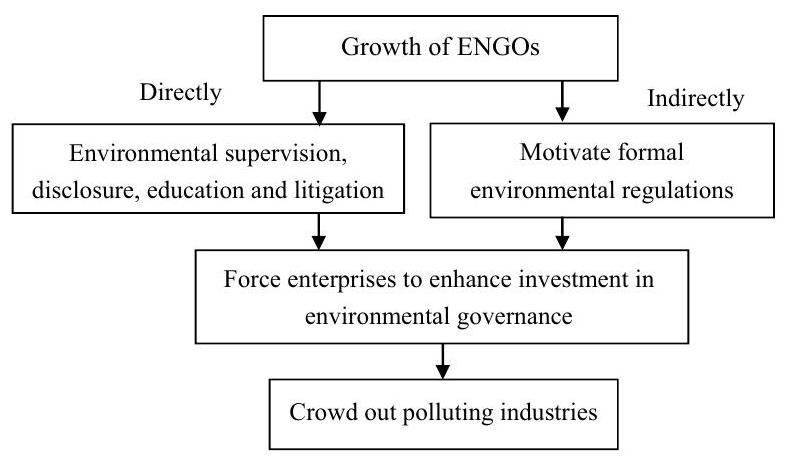
من المتوقع أن تصبح شراكات المنظمات غير الحكومية البيئية أكثر أهمية، جنبًا إلى جنب مع تسريع التنمية المستدامة. قد يرفع هذا إما علم تحذيري أو يبدأ تطورات إيجابية (ماكدونالد، 2008). ومن ثم، نعتقد أن نمو المنظمات غير الحكومية البيئية يمكن أن يرفع من جهة مباشرة الإشراف البيئي، والإفصاح عن المعلومات، والتعليم البيئي، والتقاضي البيئي. ومن جهة أخرى، فإنها تحفز الحكومات بشكل غير مباشر على تعزيز اللوائح البيئية الرسمية. يمكن أن يجبر هذا الشركات على تعزيز الاستثمار في الحوكمة البيئية وأخيرًا إزاحة الصناعات الملوثة (الشكل 1).
بشكل عام، يمكن تفسير آلية تأثير المنظمات غير الحكومية البيئية على تهميش الصناعات الملوثة من خلال الآليات التالية:
الدعوة وتأثير السياسات: غالبًا ما تشارك المنظمات غير الحكومية البيئية في جهود الدعوة لتعزيز السياسات واللوائح البيئية التي تحد من أنشطة الصناعات الملوثة. من خلال الضغط بنجاح من أجل معايير بيئية أكثر صرامة، يمكن للمنظمات غير الحكومية البيئية أن تزيح الصناعات الملوثة من خلال جعل من الصعب أو المكلف عليها العمل.
الوعي العام والضغط: تلعب المنظمات غير الحكومية البيئية دورًا حاسمًا في زيادة الوعي العام حول القضايا البيئية والآثار السلبية للصناعات الملوثة. من خلال زيادة التدقيق العام والضغط على هذه الصناعات، يمكن للمنظمات غير الحكومية البيئية أن تجعل من الصعب عليها العمل، مما يؤدي إلى إزاحتها.
الشكل 1: آلية تأثير المنظمات غير الحكومية البيئية على تهميش الصناعات الملوثة.
الحوافز الاقتصادية: قد تعمل المنظمات غير الحكومية البيئية أيضًا على تعزيز ممارسات الأعمال المستدامة والتقنيات الخضراء، مما يمكن أن يوفر حوافز اقتصادية للشركات للتحول بعيدًا عن الأنشطة الملوثة. مع اعتماد المزيد من الشركات لهذه الممارسات، قد تجد الصناعات الملوثة أنه من الصعب بشكل متزايد المنافسة، مما يؤدي إلى تهميشها.
التمويل والموارد: غالبًا ما تعتمد المنظمات غير الحكومية البيئية على التبرعات والمنح من المانحين الذين يدعمون القضايا البيئية. من خلال تحويل التمويل والموارد بعيدًا عن الصناعات الملوثة نحو المبادرات البيئية، يمكن للمنظمات غير الحكومية البيئية الحد من نمو وتوسع هذه الصناعات.
الشراكات والتعاونات: يمكن للمنظمات غير الحكومية البيئية تشكيل شراكات مع الحكومات والشركات ومنظمات أخرى لتعزيز الاستدامة البيئية. يمكن أن تؤدي هذه التعاونات إلى تطوير سياسات وتقنيات وممارسات جديدة تجعل من الصعب على الصناعات الملوثة العمل، مما يساهم في إزاحتها.
استنادًا إلى التحليل أعلاه، يقترح هذا المقال الفرضيات البحثية التالية:
الفرضية 1: سيؤدي تطوير المنظمات غير الحكومية البيئية إلى تعزيز نقل الصناعات الملوثة.
الفرضية 2: إن تطوير المنظمات غير الحكومية البيئية وزيادة الاستثمار في حماية البيئة الإقليمية يعززان معًا نقل الصناعات الملوثة.

3 المنهجية

3.1 النموذج

في دورة بحثنا، لم تكن المنظمات غير الحكومية البيئية موجودة في البداية. مع مرور الوقت، كانت بعض المناطق تحتوي على منظمات غير حكومية بيئية، بينما كانت مناطق أخرى تعاني من تأخر نسبي في تطوير هذه المنظمات. بحلول نهاية دورة البحث، لم تكن جميع المناطق تحتوي على منظمات غير حكومية بيئية. نحن نعتبر ظهور المنظمات غير الحكومية البيئية كتنفيذ شبه طبيعي، حيث تعتبر المناطق التي تحتوي على منظمات غير حكومية بيئية كمجموعة معالجة والمناطق التي لا تحتوي على منظمات غير حكومية بيئية كمجموعة ضابطة. يتم استخدام الوقت بعد ظهور المنظمات غير الحكومية البيئية كوقت تجريبي. التحليل أعلاه يتماشى مع مبادئ إعداد نموذج الفرق في الفرق (DID). المتغير التابع هو مستوى تطوير الصناعة الملوثة تحت تأثير المنظمات غير الحكومية البيئية، والمتغيرات الأساسية هي engodata و engopop: عدد المنظمات غير الحكومية البيئية وموظفيها في المنطقة، على التوالي؛ engodata و engopop هما متغيران مستمران بين 0 و 1، بدلاً من المتغيرات الوهمية. لذلك، يتبنى هذا المقال طريقة الاختلاف في الاختلافات المستمرة للتقدير، مع إعدادات النموذج التالية:
حيث الرموز السفلية و تشير إلى مدن وسنوات مختلفة، على التوالي؛ poll_loc هو المستوى العام لتطور الصناعة الملوثة، والذي يتم تمثيله بمعامل موقعها؛ و يمثل متغيرات تحكم أخرى تؤثر على نسبة الموقع لصناعة التلوث. هو مصفوفة المعاملات المقابلة لمتغيرات التحكم؛ هو مصطلح الاضطراب العشوائي؛ و هي تأثيرات ثابتة إقليمية وتأثيرات ثابتة زمنية، على التوالي، للتحكم في العوامل التي تتغير مع مرور الوقت وعبر المناطق.
لقد تم الاعتراف في الأدبيات بأن العلاقة بين المنظمات غير الحكومية البيئية ونسبة المواقع للصناعات الملوثة هي علاقة غير مباشرة. استنادًا إلى الأبحاث السابقة، نعلم أن المنظمات غير الحكومية البيئية لها تأثير على استثمارات حوكمة البيئة الرئيسية: استثمارات الحكومة واستثمارات الأعمال التي تتم بناءً على طلب الحكومة. علاوة على ذلك، فإن المنظمات غير الحكومية البيئية لها تأثير مباشر على استثمارات حوكمة صناعة التلوث. لذلك، للتحقيق فيما إذا كانت المنظمات غير الحكومية البيئية تلعب دورًا في نقل الصناعات الملوثة من خلال استثمارات حوكمة البيئة، يتم إدخال التفاعلات بين متغيرات المنظمات غير الحكومية البيئية واستثمارات حوكمة البيئة في المعادلة الاقتصادية. على وجه التحديد، فإن النموذج الاقتصادي هو كما يلي:
في النموذجين أعلاه، معامل الاهتمام هو . عندما إذا كانت القيمة سالبة بشكل كبير، فهذا يشير إلى أن المنظمات غير الحكومية البيئية قد خفضت بالفعل نسبة وجود الصناعات الملوثة في المنطقة من خلال استثمارات الحوكمة البيئية، مما يحقق أيضًا بشكل غير مباشر آثار الانتقال الاقتصادي وآثار الترقية الصناعية للمنظمات غير الحكومية البيئية. ومن الجدير بالذكر أن استثمارات الحوكمة البيئية في هذه المقالة لا تزال تقاس بمؤشرات مثل إجمالي الاستثمار في معالجة التلوث البيئي، والاستثمار في البنية التحتية البيئية الحضرية، والاستثمار في التحكم في تلوث الصناعات، وثلاثة استثمارات بيئية متزامنة في عناصر البناء، وإجمالي الاستثمارات في معالجة التلوث البيئي كنسبة من الناتج المحلي الإجمالي.

3.2 الصناعات الملوثة

تستند معظم الدراسات حول نقل الصناعات الملوثة بشكل رئيسي إلى بيانات متعلقة بالصناعة، بينما تحديد تعريف الصناعة الملوثة هو الخطوة الأولى في هذه الدراسة. وفقًا لمعايير مختلفة، هناك ثلاث طرق تصنيف رئيسية للصناعات الملوثة في الأوساط الأكاديمية الدولية.
الطريقة الأولى هي تصنيف التكاليف البيئية. على الرغم من أنه من الصعب حساب تكاليف الحد من التلوث لكل صناعة، إلا أنه من الممكن حساب تكاليف التحكم في التلوث. من خلال حساب نسبة تكاليف التحكم في التلوث إلى إجمالي القيمة المضافة، يمكننا تحديد ما إذا كانت الصناعة تعتبر صناعة ملوثة. من الأسهل قياس نسبة تكاليف التحكم في التلوث إلى إجمالي المبيعات والاعتماد على تلك النسبة لتعريف الصناعات الملوثة. من خلال هذه الطريقة، يمكن تصنيفها إلى خمس صناعات، بما في ذلك صناعة الورق، والتعدين، والمعادن غير الحديدية، والصلب، والصناعات الكيميائية، كصناعات ملوثة. على وجه التحديد، قمنا بحساب نسبة تكاليف التحكم في التلوث لكل صناعة إلى إجمالي تكاليف الإنتاج، ثم من خلال دراسة تجريبية، حددنا الحد الفاصل لهذه النسبة ليكون ، مما يعني أن الصناعة تُعتبر صناعة ملوثة عندما تكون نسبتها أكبر من ؛ وإلا، فإنه ليس كذلك. قد يكون لهذه الطريقة تطبيق على بلد بأكمله ولكن ليس على منطقة، حيث إن هيكلها الصناعي ليس بالضرورة مكتملًا.
الطريقة الثانية هي تصنيف أضرار التلوث، التي تأخذ الأضرار التي تلحق بالنظام البيئي الطبيعي والصحة العامة كمعايير لها. إذا كانت الصناعة تسبب أضرارًا أكبر لهذين العنصرين، يتم تصنيفها كصناعة ملوثة؛ وإلا، فلا يتم تصنيفها كذلك. من خلال هذه الطريقة، صنف مكغواير (1982) في النهاية 17 صناعة كصناعات ملوثة، مثل التعدين، وتصنيع المواد الغذائية، وتصنيع التبغ والمشروبات، والنسيج (بما في ذلك تصنيع الملابس والأحذية والقبعات)، ومنتجات الفراء والجلود، وصناعة الورق.
الطريقة الثالثة هي تصنيف شدة التلوث باستخدام نظام توقع التلوث الصناعي (IPPS)، الذي اقترحته البنك الدولي في عام 1994 وقد تم استخدامه بشكل رئيسي لتقييم مدى التلوث الصناعي. وهو حاليًا المعيار الأكثر نضجًا واستخدامًا لتصنيف الصناعات الملوثة في العالم. يعتمد على حساب شدة التلوث لكل شركة، والتي تُستخدم بعد ذلك لتصنيف الصناعات على أنها ملوثة أو غير ملوثة. يُعتبر نظام IPPS واحدًا من أكثر أنظمة التصنيف نضجًا واستخدامًا لتحديد الصناعات الملوثة على مستوى العالم. تتضمن منهجية IPPS الخطوات التالية:
حساب كثافة التلوث: باستخدام رمز التصنيف الصناعي القياسي المكون من أربعة أرقام (SIC)، التلوث
يتم حساب شدة كل شركة. عادةً ما يتم قياس شدة التلوث ككمية التلوث المنبعثة لكل وحدة من الإنتاج أو الإيرادات.
المقارنة مع القيمة الحرجة: يتم مقارنة شدة التلوث المحسوبة بقيمة حرجة، والتي تعمل كمعيار لتحديد ما إذا كانت الصناعة ملوثة أم لا. إذا تجاوزت شدة انبعاثات صناعة ما هذه القيمة الحرجة، يتم تصنيفها كصناعة ملوثة.
تصنيف الصناعات: بناءً على المقارنة، يتم تصنيف الصناعات إلى قطاعات ملوثة وغير ملوثة. يساعد هذا التصنيف في فهم الأثر البيئي للصناعات المختلفة ويمكن أن يوجه قرارات السياسة المتعلقة بالتنظيمات البيئية ومبادرات الاستدامة.
بالإشارة إلى مستوى التصنيف الصناعي الدولي القياسي (ISIC2.0)، تقوم الطريقة بحساب كثافة تلوث كل شركة حسب رمز التصنيف الصناعي القياسي (SIC) المكون من أربعة أرقام، وتستخدم كثافة التلوث كمعيار لتعريف الصناعات الملوثة. إذا تجاوزت كثافة انبعاثات صناعة ما القيمة الحرجة، تعتبر تلك الصناعة صناعة ملوثة؛ وإلا، فهي ليست كذلك.
ثم، قام ماني ووييلر (1998) بتطبيق منهجية IPPS هذه لتصنيف الصناعات الأمريكية على مستوى التصنيف الصناعي الدولي القياسي (ISIC) المكون من ثلاثة أرقام. وقد حددت دراستهم خمسة قطاعات كأبرز المرشحين لوضع صناعة ملوثة، وهي كالتالي:
الحديد والصلب: يشمل هذا القطاع إنتاج منتجات الحديد والصلب ويعرف باستهلاكه العالي للطاقة وانبعاثات الملوثات مثل ثاني أكسيد الكبريت وأكاسيد النيتروجين.
المعادن غير الحديدية: يشمل هذا القطاع إنتاج المعادن مثل النحاس والألمنيوم والرصاص، والتي غالبًا ما تتضمن إطلاق المعادن الثقيلة ومواد خطرة أخرى.
المواد الكيميائية الصناعية: يمكن أن تؤدي إنتاج المواد الكيميائية مثل البلاستيك والأسمدة والمبيدات الحشرية إلى انبعاث مواد سامة مختلفة وغازات دفيئة.
اللب والورق: ترتبط صناعة الورق بتلوث المياه بسبب تصريف المواد الكيميائية والمياه المستعملة من عمليات تصنيع اللب والورق.
المنتجات المعدنية غير المعدنية: يشمل هذا القطاع إنتاج الأسمنت والزجاج وغيرها من المنتجات المعدنية، والتي يمكن أن تسهم في تلوث الهواء من خلال إطلاق الجسيمات الدقيقة وثاني أكسيد الكربون.
تعتبر هذه القطاعات ذات كثافة تلوث أعلى من الصناعات الأخرى، مما يشير إلى أن لها تأثيرًا بيئيًا كبيرًا. يمكن أن يؤدي تحديد هذه القطاعات على أنها “قذرة” إلى سياسات بيئية مستهدفة وحوافز لتقليل التلوث وتعزيز تقنيات الإنتاج الأنظف.
نظرًا لاختلاف تصنيف الصناعة في الصين عن الدول الأخرى إلى حد ما، اقترح بعض العلماء معايير تصنيف خاصة بهم. قسم أوزوكي وآخرون (2004) 20 صناعة تصنيع ذات رقمين من التصنيف الوطني للصناعات الاقتصادية (GB/4754-2011) إلى ثلاث فئات بناءً على متوسط تركيز الملوثات: الصناعات الملوثة بشدة، والصناعات الملوثة بشكل معتدل، والصناعات الملوثة بشكل خفيف.
فيما يتعلق بصنع السياسات الوطنية، قسم مجلس الدولة الصيني مصادر التلوث إلى مصادر تلوث صناعية، ومصادر تلوث غير نقطية زراعية، ومصادر تلوث منزلية، ومصادر تلوث مركزية في برنامج المسح الوطني الأول لمصادر التلوث الذي صدر في عام 2006. من بين هذه المصادر، تشمل مصادر التلوث الصناعية جميع الصناعات الثانوية باستثناء صناعة البناء، ويمكن تقسيمها إلى مصادر تلوث رئيسية وعامة.
استنادًا إلى المعايير الدولية والدراسات القائمة في الصين، اختار هذا المقال ست صناعات ملوثة، وهي: التعدين، صناعة الورق، تصنيع الألياف الكيميائية، منتجات المعادن غير المعدنية، صهر ومعالجة المعادن الحديدية، وإنتاج وتوريد الطاقة الكهربائية. بالإضافة إلى ذلك، نظرًا لأن هذا المقال يدرس دور المنظمات غير الحكومية البيئية في الحوكمة البيئية، نحتاج إلى النظر فيما إذا كانت سلوكيات التلوث سهلة الملاحظة وبالتالي نتجاهل تكاليف التلوث على مستوى الصناعة، والأضرار، والشدة. الأسباب التي جعلتنا نختار هذه الصناعات الست هي كما يلي. بالنسبة لصناعة التعدين، فإن الملوث الرئيسي هو المخلفات الناتجة عن عملية التعدين التي تتراكم بشكل عشوائي وتسبب مشاكل بيئية، وهي سهلة الملاحظة بشكل خاص من قبل المنظمات غير الحكومية البيئية. تشمل صناعة التعدين هنا جميع قطاعاتها الفرعية. باعتبارها من أكثر الصناعات التقليدية الملوثة، كانت صناعة الورق وتصنيع الألياف الكيميائية دائمًا محور اهتمام المنظمات غير الحكومية البيئية لأنها عادة ما تنتج كميات هائلة من مياه الصرف والروائح. كما أن منتجات المعادن غير المعدنية وصهر ومعالجة المعادن الحديدية تمثل أيضًا الصناعات الثقيلة، مما يؤدي إلى تلوث شديد في الهواء والماء والتربة، وهو سبب رئيسي آخر للقلق بالنسبة للمنظمات غير الحكومية البيئية. إن إنتاج وتوريد الطاقة الكهربائية (الذي يشير بشكل رئيسي إلى محطات الطاقة الحرارية وشركات التدفئة) يعتمد بشكل أساسي على الفحم، مما يجذب أيضًا انتباه المنظمات غير الحكومية البيئية.

3.3 نقل الصناعات

لقد وجدت الدراسات الحالية أدلة قوية على وجود ملاذات للتلوث في الصين. وقد وجدت الأبحاث التي تدمج اللوائح البيئية على الصناعات الملوثة أدلة قوية تدعم حقيقة أن الصناعات الملوثة تميل إلى الانتقال إلى مناطق ذات لوائح بيئية أقل صرامة.
التنظيمات وكذلك منطقة وسط الصين. بمجرد تعزيز اللوائح البيئية في المناطق المجاورة، قد تقوم الشركات الملوثة في تلك الأماكن بالانتقال إلى المناطق المحلية، مما يحول هذه المناطق إلى ملاذات للتلوث. ومع ذلك، لم تحظَ تأثيرات الانتقال الاقتصادي للمنظمات البيئية غير الحكومية باهتمام كبير في الأوساط الأكاديمية حتى الآن. على العكس من ذلك، يهدف هذا المقال إلى سد هذه الفجوة البحثية من خلال فحص تجريبي. بعد تعريف الصناعات الملوثة المعنية بالمنظمات البيئية غير الحكومية كما هو موضح أعلاه، نركز بعد ذلك على مؤشر الانتقال للصناعات الملوثة. اعتمدت الدراسات السابقة على نسبة الموقع للصناعات الملوثة أو حصة قيمة الإنتاج لصناعات التلوث في منطقة ما من إجمالي إنتاج البلاد كمقياس للصناعات الملوثة. تعكس هذه المؤشرات جزئيًا مستوى تطوير بعض الصناعات الملوثة في منطقة معينة. حيث نهدف إلى تحديد ما إذا كان انتقال الصناعات الملوثة يتأثر بتطور المنظمات البيئية غير الحكومية، فإن مؤشرات الصناعة والنمو تفشل في عكس ما إذا كانت هذه الصناعات قد انتقلت أم لا. في النهاية، اخترنا نسبة موقع التوظيف، مما يدل على منطقة الدراسة كمنطقة. ) داخل أمة ( ) واستخدام العمالة (العمال) كمقياس للنشاط الاقتصادي. ثم، معامل الموقع للصناعة يمكن التعبير عنها كما يلي:
أين العامل يمثل التوظيف في الصناعة والمنطقة ; عامل يمثل التوظيف في الصناعة في جميع أنحاء البلاد. يجب ملاحظة أن الصناعة تشير إلى الصناعات الست الملوثة والمنطقة تشير إلى 31 مقاطعة صينية في هذه المقالة. المعادلة (5) تقارن التركيزات النسبية للتوظيف في الصناعة في اقتصادين (أي، حصة الصناعة من التوظيف في كل اقتصاد). إذا كانت نسبة الموقع لصناعة ما أكبر من 1، يُفترض أن الصناعة تحتل مكانة مهمة في هذه المقاطعة. إذا كانت تساوي 1 أو أقل لصناعة ما، يُفترض أن هذه الصناعة ليست مهيمنة مقارنة بالمستوى الوطني المتوسط.
نظرًا لأن هذه المقالة تركز على ست صناعات ملوثة، نجمع توظيف الست صناعات في المقاطعة للحصول على إجمالي التوظيف. لدولة بها مناطق و صناعات، دع العامل يمثل التوظيف في الصناعة في المنطقة بحيث أن العامل هو إجمالي التوظيف ضمن الست صناعات في المنطقة . دع العامل يمثل التوظيف الوطني في الصناعة بحيث أن العامل هو التوظيف الوطني ضمن الست صناعات. يتم تعريف مؤشر نسبة الموقع للمنطقة poll_Loc كما هو موضح في المعادلة (6).
يجب ملاحظة أن إجمالي نسبة الموقع لا يساوي مجموع نسب المواقع للست صناعات الملوثة. بل يتم قياسه من خلال مقارنة حصة التوظيف في الست صناعات الملوثة على مستوى المقاطعة مع حصة التوظيف في الصناعات الملوثة في جميع أنحاء البلاد.
في السنوات الأخيرة، تم استخدام نسبة الموقع لتقدير مستويات التنمية الاقتصادية أو الصناعية الإقليمية على نطاق واسع وجذبت عددًا متزايدًا من العلماء من مجالات مختلفة. اعتبر ليو (2009) نسبة الموقع معيارًا لاختيار الصناعات الأساسية الإقليمية. في هذه المقالة، تُستخدم نسبة الموقع لقياس الميزة التنافسية لصناعة ملوثة معينة في مقاطعة ما مقارنة بالبلد، مما يبرر مكانتها الأساسية. بشكل محدد، تشير نسبة الموقع المتناقصة إلى أن هذه الصناعة تفقد مكانتها الأساسية في المنطقة، مما يعني أنها تنتقل إلى مناطق أخرى. بالإضافة إلى ذلك، بدلاً من نسبة الموقع الناتج، تعتمد هذه المقالة على مؤشر نسبة الموقع للتوظيف لقياس التركيز الجغرافي للصناعات الملوثة عبر المناطق. إذا انخفضت نسبة الموقع للتوظيف، فهي مؤشر على أن توظيف هذه الصناعة أقل ميزة. قد يكون ذلك ناتجًا إما عن انتقال الصناعة أو عن إدخال الصناعة لتكنولوجيا إنتاج متقدمة، مما يؤدي إلى انخفاض أو تحويل العمالة إلى صناعات أخرى. بشكل عام، تعتبر معظم الصناعات الملوثة كثيفة العمالة؛ لذلك، يمكن أن يكون استخدام حصة التوظيف لحساب مؤشر نسبة الموقع بمثابة مؤشر غير مباشر لتأثير التوظيف وتأثير إعادة التوطين الاقتصادي.

3.4 المتغيرات التفسيرية

في هذه المقالة، نختار engopop و engodata كمتغيرات تفسيرية أساسية (المعادلات (1) و(2)). ومع ذلك، لا يتم حساب بيانات ENGO في الصين. البيانات المستخدمة في دراستنا تأتي بشكل رئيسي من China Development Brief، وهي منصة شبكة ثنائية اللغة صينية-إنجليزية تأسست في عام 1996 مع دليل للمنظمات غير الحكومية. توفر ملاحظات احترافية، وبحوث، ودعم منصة شبكة، وخدمات للمنظمات الخيرية، ويمكن العثور على المعلومات ذات الصلة حول معظم المنظمات غير الحكومية من خلال هذه المنصة (http://www.chinadevelopmentbrief.org.cn).
نعرّف المنظمات غير الحكومية التي تعمل في مجال حماية البيئة على أنها ENGOs. تشمل المنصة معلومات كل ENGO، مثل اسمها،
تاريخ التأسيس، حجم المنظمة (عدد الأفراد)، ومجال العمل، وتحدد مكان تسجيل ENGO على مستوى المقاطعة-المدينة-المقاطعة. مع هذه البيانات، يمكننا جمع المعلومات ذات الصلة عن كل ENGO يدويًا ثم تجميع تلك البيانات إلى مستوى المقاطعة-المدينة والحصول على بيانات ENGO على مستويين إداريين. يجب ملاحظة أن البيانات المتاحة حاليًا شاملة نسبيًا، على الرغم من أنها ليست مثالية. تشمل البيانات ما إذا كانت هناك أي ENGOs (engo)، عدد ENGOs (engodata)، وعدد موظفي ENGO (engopop).
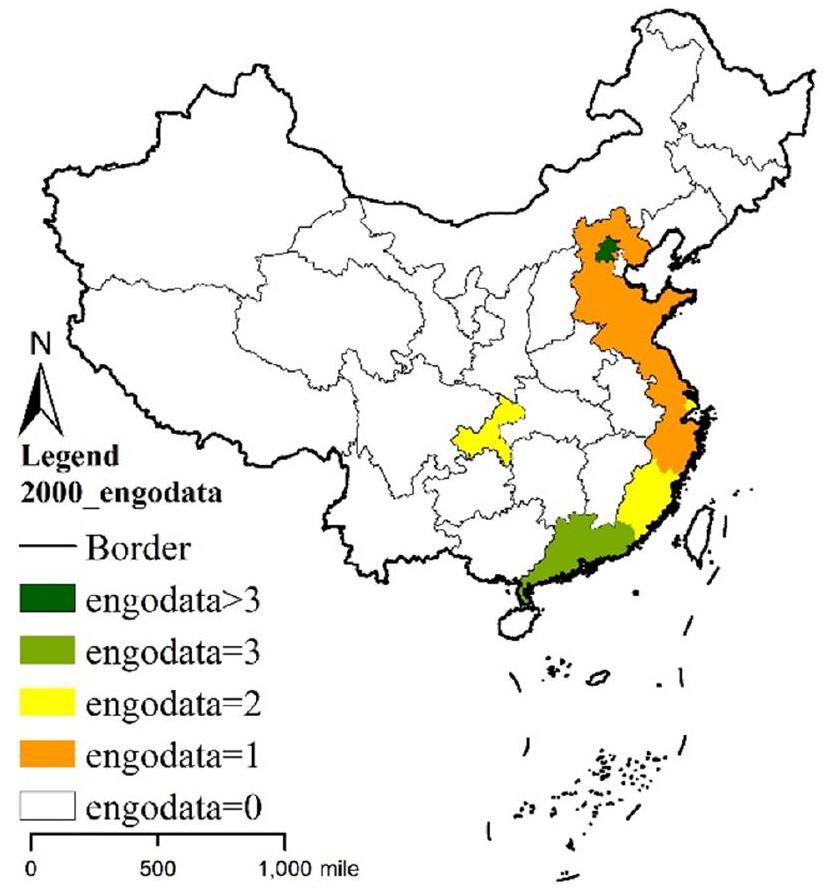
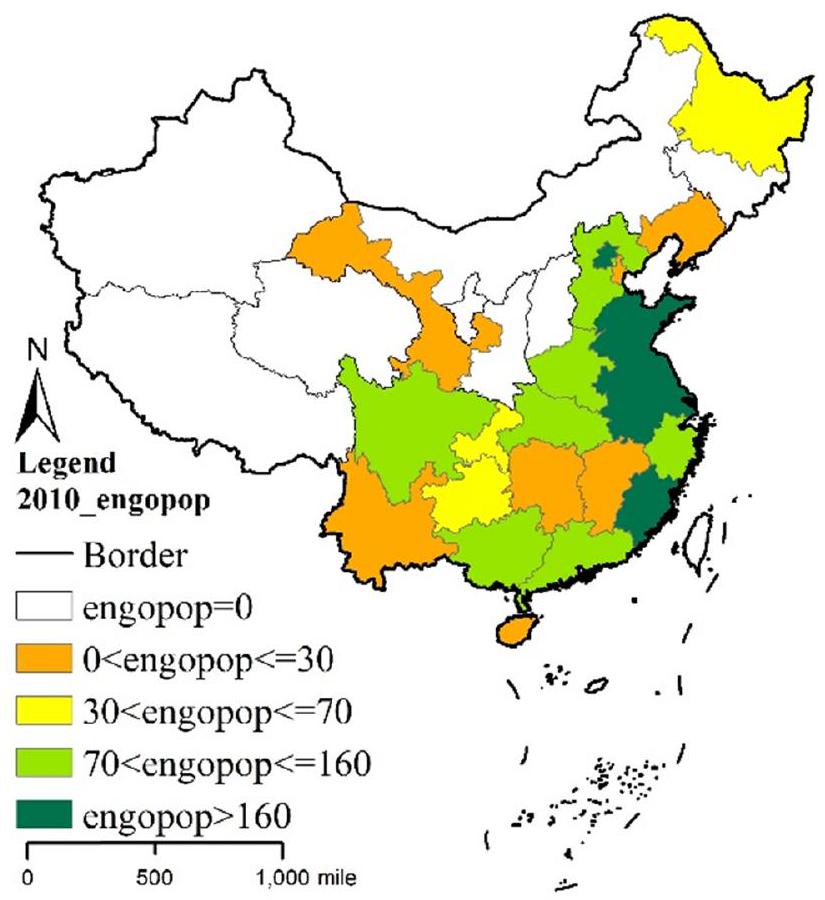
في هذه المقالة، نستخدم بيانات على مستوى المقاطعة عن عدد ENGOs (engodata) وعدد موظفي ENGO (engopop) كمتغيرات تفسيرية أساسية. ثم اخترنا عامين، 2000 و2010، لتحليل الاتجاهات في هذين المؤشرين. تكشف الأشكال 2 و3 عن التوزيع المكاني لعدد ENGOs في جميع المقاطعات في 2000 و2010، على التوالي. من خلال مقارنة الشكلين، يمكن رؤية أن ENGOs كانت موجودة فقط في المناطق الساحلية وتشونغتشينغ في عام 2000، حيث كان هناك عدد أكبر من ENGOs في البلديات على مستوى المقاطعة مثل بكين وشنغهاي، وفي مقاطعة قوانغدونغ. ومع ذلك، توسعت ENGOs إلى المزيد من المقاطعات بحلول عام 2010، على الرغم من أنها كانت لا تزال مركزة بشكل رئيسي في المقاطعات الساحلية ولم تكن موجودة بعد في كل مقاطعة. بدأت تظهر في المنطقة الجنوبية الغربية ومقاطعات هيلونغجيانغ ونينغشيا. كما شهد الجزء المركزي من البلاد ظهور ENGOs.
الشكل 2: التوزيع المكاني لعدد ENGOs في جميع المقاطعات في 2000.
الشكل 3: التوزيع المكاني لعدد ENGOs في جميع المقاطعات في 2010.
ومع ذلك، في شانشي، ومنغوليا الداخلية، وشانشي، حيث التلوث البيئي ثقيل، تأخر تطوير ENGO.
تكشف الأشكال 4 و5 عن التوزيع المكاني لموظفي ENGO في جميع المقاطعات في 2000 و2010، على التوالي.
الشكل 4: التوزيع المكاني لموظفي ENGOs في جميع المقاطعات في 2000.
الشكل 5: التوزيع المكاني لموظفي ENGOs في جميع المقاطعات في 2010.
من خلال مقارنة خرائط التوزيع لعام 2010 و2000، يمكن رؤية أن المناطق التي بها أكبر عدد من موظفي ENGO قد انتشرت من بكين إلى شاندونغ، بما في ذلك شنغهاي، وجيانغسو، ومقاطعات فوجيان. بالإضافة إلى ذلك، كانت مقاطعات خبي، وهينان، وسيتشوان، وهوبى، وزhejiang، وقوانغدونغ، وقوانغشي بها أكبر عدد من موظفي ENGO. ومع ذلك، في عام 2010، كانت مقاطعات تشونغتشينغ، وقويتشو، وهيلونغجيانغ بها عدد أقل نسبيًا من الموظفين. في نينغشيا، ولياونينغ، ويوننان، وهينان، ومقاطعات جيانغشي، حيث كان هناك ENGO واحد فقط، كان عدد موظفي ENGO قليلًا.

3.5 الملخص والبيانات

نقوم بترتيب المتغيرات على النحو التالي:
المتغيرات التابعة: نسبة الموقع للتوظيف للست صناعات ملوثة في منطقة (poll_loc ) وإجمالي نسبة الموقع للتوظيف (poll ).
المتغيرات التفسيرية الرئيسية: عدد ENGOs (engodata) وعدد موظفي ENGO (engopop) في منطقة. تتبع استراتيجيتنا الرئيسية للتقدير نفس منطق استراتيجية الفرق في الفروق القياسية (DD). نظرًا لأن ليس كل منطقة تحتوي دائمًا على ENGOs، نستخدم مقياسًا مستمرًا للحدة وبالتالي نلتقط مزيدًا من التباين في البيانات. يجب ملاحظة بشكل خاص أن تطوير ENGO يختلف بشكل كبير عبر الأجزاء المختلفة
من الصين، لذا نضيف 1 إلى كل نقطة بيانات ونتخذ لوغاريتمها.
تماشيًا مع الأبحاث السابقة، تُستخدم المتغيرات التالية كمتغيرات تحكم رئيسية: اللوغاريتم الطبيعي للناتج المحلي الإجمالي للفرد (lnpgdp) واللوغاريتم الطبيعي للناتج المحلي الإجمالي للفرد المربع (lnpgdp2)، والتي تشير إلى مستوى التنمية الاقتصادية؛ الهيكل الصناعي (ind)، الذي يتم قياسه من خلال نسبة الصناعة الثانوية؛ نسبة رأس المال إلى العمل (lncap_lab)، وهي نسبة الأصول الثابتة إلى القوة العاملة؛ الاستثمار الأجنبي المباشر (FDI)، وهو نسبة الاستثمار الأجنبي المباشر إلى الناتج المحلي الإجمالي ويتم ضربه في ; كثافة السكان (lnden)، التي يتم قياسها من خلال اللوغاريتم الطبيعي لعدد الأشخاص لكل وحدة من المساحة؛ وكفاءة الطاقة (en)، وهي اللوغاريتم الطبيعي لاستهلاك الكهرباء لكل وحدة من الناتج المحلي الإجمالي.
بالإضافة إلى ذلك، المتغيرات التي اخترناها للكشف عن الآليات الأساسية هي كما يلي: الاستثمار الإجمالي في معالجة تلوث البيئة، الاستثمار في البنية التحتية البيئية الحضرية، الاستثمار في ضوابط تلوث الصناعة، ثلاثة استثمارات بيئية متزامنة في عناصر البناء، والاستثمار الإجمالي في معالجة تلوث البيئة كنسبة من الناتج المحلي الإجمالي. تأتي البيانات لهذه المتغيرات من الكتاب الإحصائي البيئي الصيني (2003-2016). تأتي بيانات التوظيف من الكتاب الإحصائي لعمالة الصين (2000-2016). يتم اشتقاق متغيرات التحكم الأخرى من الكتاب الإحصائي الصيني وكتاب الإحصاءات الاقتصادية الإقليمية في الصين. يتم تقدير بعض البيانات المفقودة عن طريق الاستيفاء، بينما يتم الإشارة إلى تلك المناطق التي تحتوي على كميات كبيرة من البيانات المفقودة بقيمة مفقودة في هذه الورقة. نظرًا لأن بيانات التوظيف لكل قطاع صناعي متاحة فقط على المستوى الإقليمي، فإن مجموعة البيانات النهائية لدينا تشمل 31 مقاطعة في البر الرئيسي للصين من 2000 إلى 2016 ومن 2003 إلى 2016. تظهر الإحصائيات الوصفية للمتغيرات الرئيسية في الجدول 1.

4 نتائج

4.1 الانحدار المرجعي

تقرير الجدول 2 نتائج الانحدار المرجعي استنادًا إلى المعادلتين (1) و(2). تم تقدير النماذج الأربعة من خلال التحكم في تأثيرات الزمن الثابت، وقيم اختبار F للنماذج أكبر من 3، مما يشير إلى أن النماذج قد وصلت إلى مستوى دلالة أو أفضل. في العمود (1)، نقوم بتقدير الأثر الفردي لبيانات الطاقة على نسبة المواقع الصناعية الملوثة الإجمالية (poll_loc)، بينما في
الجدول 1: الإحصائيات الوصفية للمتغيرات
متغير ملاحظات معنى الانحراف المعياري من ماكس
المتغير التابع
موقع الاقتراع 527 1.067 0.544 0.003 3.128
موقع_الاستطلاع1 ٥٢٧ 1.078 0.961 0.002 7.709
موقع الاقتراع 2 510 0.928 0.740 0.005 5.439
موقع الاستطلاع 3 ٤٩٣ 0.840 0.887 0.000 3.831
موقع الاقتراع 4 527 0.967 0.342 0.043 ٢.٦١٩
موقع الاستطلاع 5 510 1.060 0.756 0.012 6.985
موقع الاقتراع 6 527 1.172 0.747 0.185 10.348
المتغير التفسيري الرئيسي
إنغوداتا 527 3.154 6.564 0 61
إنغوبوب 527 ٢.٩٧٧ ٢.٤٩٦ 0 8.226
إنينغوبوب 527 ٢.٩٧٧ ٢.٤٩٦ 0 8.226
إنينغودا 527 0.897 0.911 0 ٣.١٢٧
متغير التحكم
Inpgdp 527 8.815 1.218 ٣.٧٦٩ 11.300
Inpgdp2 527 79.193 ٢٠٫٦٧٣ ٢٢٫٧٤٣ 127.699
الهند 527 ٤٥.٣١٠ 8.193 19.262 60.133
إنكاب_لاب 527 0.806 0.454 0.254 3.351
استثمار أجنبي مباشر 527 2.301 2.356 0.001 ١٣.٦٥٢
إندين 527 ٥.٢٦٩ 1.464 0.723 8.245
في ٥٢٧ 0.128 0.081 0.037 0.521
ملاحظات: يمثل poll_loc إجمالي معامل الموقع للصناعة الملوثة، بينما تمثل poll_loc1-poll_loc6، على التوالي، معامل الموقع لصناعة التعدين؛ صناعة الورق؛ تصنيع الألياف الكيميائية؛ منتجات المعادن غير المعدنية؛ صهر ومعالجة المعادن الحديدية؛ إنتاج وتوريد الطاقة الكهربائية.
في العمود (2)، نضيف متغيرات تحكم أخرى. تظهر نتائج التقدير أنه عند التحكم في تأثيرات الزمن الثابتة وتأثيرات المنطقة الثابتة، بغض النظر عن العوامل الأخرى، فإن معاملات المتغير التفسيري الأساسي (lnengodata) هي -0.014 و -0.012 على التوالي، وهي سلبية بشكل كبير، مما يشير إلى أنه عندما يزيد engodata بنسبة نقطة مئوية، ينخفض poll_loc بحوالي . هذا التغيير بمقدار 0.012 كبير للغاية بالنظر إلى أن مؤشر نسبة الموقع إما فوق أو تحت 1، مما يدل على أن المنظمات غير الحكومية البيئية تؤثر على تقليل أهمية الصناعات الملوثة. الأعمدة (3) و (4) تحقق في تأثير عدد موظفي المنظمات غير الحكومية البيئية (engopop) على أهمية الصناعات الملوثة. تظهر نتائج التقدير أنه عند التحكم في تأثيرات الزمن الثابتة وتأثيرات المنطقة الثابتة، بغض النظر عن العوامل الأخرى، فإن معاملات المتغير التفسيري الأساسي (lnengodata) سلبية بشكل كبير وتبقى بشكل أساسي كما هي عند -0.028، مما يشير إلى أن زيادة engodata تقلل بشكل كبير من أهمية الصناعات الملوثة. هذه النماذج الأربعة تؤكد فرضية ملاذ التلوث. أي أن الصناعات الملوثة تفضل الانتقال إلى المناطق
مع وجود تنظيمات بيئية أقل صرامة. في هذه المقالة، نجد أن الصناعات الملوثة تتجمع في المناطق التي تكون فيها المنظمات غير الحكومية أضعف، بينما في المناطق التي تكون فيها المنظمات البيئية غير الحكومية ناضجة نسبيًا، يتم تقليل أهمية الصناعة الملوثة بشكل كبير. السبب المحتمل هو أنه في منطقة تطورت فيها المنظمات البيئية غير الحكومية، تحت تأثير هذه المنظمات، عزز السكان وعيهم البيئي وزادوا من احتياجاتهم لجودة البيئة. إذا كانت هناك مؤسسات ملوثة في الجوار، فسيتفاعل السكان مع الحكومة من خلال وسائل مثل حماية حقوقهم والإبلاغ، مما يدفع الحكومة إلى اتخاذ تدابير إدارة بيئية أكثر صرامة. تحت ضغط حماية البيئة، يجب على المؤسسات الملوثة أن تختار الانتقال إلى مناطق أخرى.
تظهر نتائج التقدير للمتغيرات التحكمية أنه عند استخدام نسبة الموقع للصناعات الملوثة كمتغير مفسر، فإن تأثير مستوى التنمية الاقتصادية العامة يظهر منحنى U مقلوب مشابه لمنحنى كوزنتس البيئي. مع نمو الاقتصاد في منطقة ما، تزداد نسبة الموقع للصناعات الملوثة في تلك المنطقة أولاً قبل أن تنخفض، مما يشير إلى أن حصة الصناعات الملوثة تزداد لأنه لا يوجد تفضيل ملحوظ للصناعة في بداية التنمية الاقتصادية، مما يؤدي إلى تدهور بيئي. ومع ذلك، عندما تعزز المنطقة تنظيماتها ومتطلباتها البيئية مع تطور اقتصادها، تنخفض صناعاتها الملوثة. بالإضافة إلى ذلك، فإن الزيادة في نسبة الصناعة الثانوية تقلل بشكل كبير من نسبة الموقع للصناعات الملوثة لأن هذه الزيادة تعود أساسًا إلى الصناعات غير الملوثة، مما يدل على أن الهيكل الصناعي قد تم ترقيته في المنطقة، مما يؤدي إلى انخفاض نسبة الصناعات الملوثة. تمثل نسبة رأس المال إلى العمل نوع الصناعات، وزيادتها تشير إلى أن الصناعة أصبحت أكثر كثافة في رأس المال، حيث يتم استبدال العمال بالآلات، مما يتطلب المزيد من الطاقة ويولد المزيد من التلوث. كما أن زيادة نسبة الاستثمار الأجنبي تقلل بشكل كبير من نسبة الموقع للصناعات الملوثة لأن المناطق تميل إلى السماح بالاستثمار الأجنبي الأكثر نظافة، مما يقلل من أهمية الصناعات الملوثة. كما أن استهلاك الكهرباء الصناعي يقلل بشكل كبير من نسبة الصناعات الملوثة لأن استهلاك الكهرباء يشير إلى أن الآلات تحل محل العمال، وهناك تحول نحو صناعات أكثر تقدمًا، مما يؤدي إلى انخفاض أهمية الصناعات الملوثة. لا توجد علاقة ذات دلالة إحصائية بين كثافة السكان ونسبة الموقع للصناعات الملوثة.
الجدول 2: نتائج الانحدار المرجعي للعينة الكاملة
سيارة كهربائية DV: موقع الاقتراع
(1) (2) (3) (4)
إنينغودا -0.014*** (0.004) -0.012*** (0.004)
Inengopop -0.028*** (0.008) -0.028*** (0.008)
Inpgdp 0.613** (0.242) 0.644*** (0.237)
Inpgdp2 -0.039*** (0.009) -0.039*** (0.009)
صناعة -0.008* (0.004) -0.009** (0.004)
إنكاب_لاب 0.090* (0.052) 0.102** (0.052)
استثمار أجنبي مباشر -0.021*** (0.008) -0.021*** (0.008)
إندين 0.172 (0.211) 0.194 (0.211)
في -2.498*** (0.588) -2.504*** (0.584)
أثر ثابت للمنطقة ي ي ي ي
أثر ثابت زمني ي ي ي ي
اختبار F ٣.٥٧١ ٥.٢٨٦ ٣.٦٦٥ ٥.٥٢٧
( -القيمة) [0.000] [0.000] [0.000] [0.000]
-مربع 0.112 0.212 0.115 0.219
ملاحظات: لم يتم تقديم النتيجة المقدرة للحد الثابت، مع حجم عينة يبلغ 527. الأرقام بين قوسين هي أخطاء معيارية قوية؛ القيم موجودة بين أقواس مربعة؛ * و ** و *** تمثل 10 و 5 و المستويات المهمة، على التوالي. DV تعني المتغير التابع؛ EV تعني المتغير التفسيري. الجداول التالية هي نفسها.

4.2 مناقشة قائمة على المنطقة

تؤدي المساحة الشاسعة والسوق غير المتوازنة في الصين (حيث يتمتع شرق الصين بمستوى أعلى من التسويق مقارنة بوسط وغرب الصين) إلى اختلافات إقليمية ملحوظة (Chen et al., 2000)، بينما يختلف تطور المنظمات غير الحكومية البيئية بشكل كبير بين المناطق (Bebbington, 2004). لذلك، فإن للمنظمات غير الحكومية البيئية تأثيرات غير متجانسة على نسبة الموقع للصناعات الملوثة الإقليمية. اخترنا 31 منطقة إدارية على مستوى المقاطعات (وفقًا للنظام الإداري الحالي في الصين) في البر الرئيسي كوحدات جغرافية وقمنا بتقسيمها إلى منطقتين: شرق الصين، بما في ذلك مقاطعات لياونينغ، بكين، تيانجين، خبي، شاندونغ، جيانغسو، شنغهاي، تشجيانغ، فوجيان، قوانغدونغ، وهاينان، ووسط وغرب الصين، بما في ذلك 20 مقاطعة المتبقية. توضح الجدول 3 نتائج التقدير للمناطق المذكورة أعلاه. تظهر الأعمدة (1) و(2) تأثير المنظمات غير الحكومية البيئية على شرق الصين. تشير النتائج إلى أن كلا المعاملين إيجابيين بشكل ملحوظ، مما يدل على أن المنظمات غير الحكومية البيئية لها تأثير طردي على الصناعات الملوثة في المنطقة الشرقية، والتي
يؤدي ذلك إلى انخفاض في معامل الموقع للصناعات الملوثة الإجمالية في المنطقة. تُظهر الأعمدة (3) و(4) تأثير المنظمات البيئية غير الحكومية على الصناعات الملوثة في وسط غرب الصين. تُظهر نتائج التقدير أن المعاملات من النموذجين ليست ذات دلالة إحصائية ولا تختلف عن النموذجين السابقين، مما يشير إلى أن المنظمات البيئية غير الحكومية لا تقلل بشكل كبير من معامل الموقع للصناعات الملوثة في هذه المناطق. ويعود ذلك إلى أن المنظمات البيئية غير الحكومية في شرق الصين ناضجة نسبيًا وقد دفعت الصناعات الملوثة إلى وسط غرب الصين. في شرق الصين، تتبع العلاقة بين مستوى التنمية الاقتصادية ومعامل الموقع للصناعات الملوثة منحنى مقلوب على شكل حرف U ذو دلالة إحصائية، بينما يوجد مثل هذا المنحنى أيضًا في وسط غرب الصين، إلا أنه ليس ذا دلالة إحصائية. بعض المتغيرات الضابطة الأخرى ليست ذات دلالة إحصائية، لكن علامات المعاملات تتوافق بشكل أساسي مع تلك الناتجة عن الانحدار المرجعي.

4.3 اختبار المتانة

إن حقيقة أن بعض المناطق تعاني من نقص كبير في البيانات على المستوى الإقليمي وأن عدد الموظفين في الصناعات الملوثة في تلك المناطق منخفض نسبيًا قد يؤدي إلى عدم دقة في تقديراتنا. لذلك، تم إجراء اختبارات القوة في هذا القسم، حيث تم حذف الملاحظات من أربع مناطق، وهي: التبت، تشينغهاي، شينجيانغ، ومنغوليا الداخلية لإعادة التقدير. توضح الجدول 4 نتائج التقدير من العينات الكاملة والعينات الفرعية. تقدم الأعمدة الثلاثة الأولى تأثير بيانات ENGOs على معامل موقع الصناعات الملوثة (poll_loc). إن المعاملات للعينة الكاملة وللمنطقة الشرقية سلبية بشكل كبير وأقل من تلك الناتجة عن الانحدار الأساسي، مما يشير إلى أن نتائج التقدير تتأثر بتكوين العينة. بالنسبة لعينة وسط وغرب الصين، فإن المعامل المقدر إيجابي ولكنه غير دال. مرة أخرى، تؤكد النتائج أنه في العينات الكاملة وعينات المنطقة الشرقية، تؤثر ENGOs سلبًا على الصناعات الملوثة، وهو تأثير غير موجود في وسط وغرب الصين، مما يشير إلى أن الغرب الأوسط قد أصبح ملاذًا للتلوث.
تقدم الأعمدة الثلاثة الأخيرة تأثير الانغوبوب على معامل موقع الصناعة الملوثة (poll_loc). تظهر النتائج أنه في العينة الكاملة والعينة الشرقية، فإن معاملات المتغيرات التفسيرية الأساسية سلبية بشكل كبير وذو دلالة إحصائية، لكنها ليست ذات دلالة في العينة الوسطى الغربية. جميع النماذج الستة تؤكد أن المنظمات البيئية غير الحكومية لها تأثير كبير في إزاحة الصناعات الملوثة في العينة الكاملة والمنطقة الشرقية، بينما تلقت الصين الوسطى الغربية بعض الصناعات الملوثة.
الجدول 3: نتائج الانحدار لشرق ووسط الصين
سيارة كهربائية DV: موقع الاقتراع
شرقي الوسط الغربي
(1) (2) (3) (4)
إنينغودا -0.008** (0.003) 0.010 (0.016)
Inengopop -0.016** (0.006) -0.031 (0.033)
Inpgdp 1.089*** (0.295) 1.187*** (0.287) 0.402 (0.355) 0.246 (0.356)
Inpgdp2 -0.048*** (0.013) -0.051*** (0.013) -0.021 (0.014) -0.013 (0.013)
صناعة 0.003 (0.006) 0.001 (0.006) -0.016*** (0.006) -0.016*** (0.006)
إنكاب_لاب 0.047 (0.048) 0.063 (0.049) 0.151 (0.098) 0.118 (0.101)
استثمار أجنبي مباشر -0.004 (0.011) -0.005 (0.011) -0.019 (0.013) -0.022* (0.012)
إندين -0.061 (0.181) -0.069 (0.180) 0.924** (0.464) 0.941** (0.464)
في 0.947 (1.669) 0.682 (1.678) -2.753*** (0.731) -3.016*** (0.742)
187 187 ٣٤٠ ٣٤٠
أثر ثابت للمنطقة ي ي ي ي
أثر ثابت زمني ي ي ي ي
اختبار F ٣.٤١٥ ٣.٤٥٩ ٣.٦٦٠ 3.686
( -القيمة) [0.000] [0.000] [0.000] [0.000]
-مربع 0.350 0.353 0.274 0.275
*, **، و *** تمثل ، و مستوى كبير، على التوالي.
الصناعات من المنطقة الشرقية وقد أصبحت ملاذًا للصناعات الملوثة. نتائج التقدير للمتغيرات الضابطة الأخرى تتماشى مع نتائج التقدير من الانحدار المرجعي والانحدار الإقليمي السابق، لذا لن يتم تكرارها هنا.

4.4 مناقشة قائمة على الصناعة

بينما تركز الأقسام الثلاثة الأولى من هذا الفصل بشكل رئيسي على التأثيرات الإجمالية للصناعات الملوثة، فإن هذا القسم ينظر في تأثير كل صناعة ملوثة على حدة. تمثل المتغيرات poll_loc1-poll_loc6 نسبة الموقع لصناعة التعدين، وصناعة الورق، وتصنيع الألياف الكيميائية، ومنتجات المعادن غير المعدنية، وصهر ومعالجة المعادن الحديدية، وإنتاج وتوريد الطاقة الكهربائية، على التوالي. توضح الجدول 5 نتائج التقدير للصناعات الست الملوثة. تظهر النتائج أن engodata لها تأثير سلبي على الصناعات الست الملوثة، بينما فقط في الأعمدة (2) و(3) و(5) تكون المعاملات سلبية بشكل ملحوظ، مما يشير إلى أن engodata لها
أثر سلبي على نسب الموقع للصناعات الثلاث التالية: صناعة الورق، تصنيع الألياف الكيميائية، وصهر ومعالجة المعادن الحديدية.
أثر المنظمات غير الحكومية البيئية على الصناعات الثلاث الأخرى، وهي التعدين، ومنتجات المعادن غير المعدنية، وإنتاج وتوريد الطاقة الكهربائية، ليس كبيرًا. قد يكون ذلك لأن المنظمات غير الحكومية البيئية لم تراقب هذه الصناعات الثلاث عن كثب. أولاً، مقارنةً بالصناعات الأخرى، فإن صناعة التعدين ليست موجودة في مركز المنطقة، بينما تخدم المنظمات غير الحكومية البيئية بشكل رئيسي المناطق الحضرية أو المدن الرئيسية. ثم، تهيمن صناعة منتجات المعادن غير المعدنية على إنتاج الأسمنت وتشمل الزجاج والسيراميك والجبس وغيرها من الصناعات التحويلية، والتي تعتبر مؤسسات ملوثة حرجة وغالبًا ما تكون نسبياً مراوغة وصعبة الإشراف. أخيرًا، يشير توريد الطاقة الكهربائية بشكل رئيسي إلى محطات الطاقة الحرارية وشركات التدفئة، وهي صناعات تواجه طلبًا صارمًا بسبب التنمية الاقتصادية الإقليمية وغالبًا ما تكون مؤسسات مملوكة للدولة. في الختام، تتمتع المنظمات غير الحكومية البيئية بسلطة إشرافية ضعيفة نسبيًا على هذه الشركات، لكن تأثيرها السلبي لا يزال قائمًا.
تكشف الجدول 6 عن تأثير الانغوبوب على كل صناعة ملوثة. تظهر النتائج أن الانغوبوب له تأثير سلبي على كل صناعة ملوثة، لكن تأثيره السلبي يكون ملحوظًا بشكل خاص على صناعة الورق، وتصنيع الألياف الكيميائية، وصهر ومعالجة المعادن الحديدية. على الرغم من أن المعاملات الأخرى لا تصل إلى مستوى الدلالة. ، الـ القيم في العمودين (1) و(4) كلاهما فوق 1.5؛ أي أن النموذجين لهما دلالة إحصائية ضمن هذا يشير إلى أن engopop يقلل من نسب الموقع للصناعات الست الملوثة، مما يتسبب في تأثير الإزاحة الذي يجعل هذه الصناعات تنتقل إلى مناطق ذات تنظيمات بيئية أقل صرامة.

4.5 مناقشة الاندماج الداخلي

الداخلية هي قضية لا مفر منها في هذه المقالة. نظرًا لاستخدام طريقة الفرق في الاختلافات المستمرة في هذه المقالة، يمكن أن تخفف من قضايا الداخلية إلى حد ما، لكنها لا تستطيع حل مشاكل الداخلية بشكل جذري. تناقش هذه المقالة قضايا الداخلية من خلال الاستراتيجيات التالية.
تأخير المتغيرات التفسيرية الأساسية: من خلال تأخير المتغيرات التفسيرية الأساسية (engopop و engodata) لفترة واحدة وفترتين، يساعد ذلك في التخفيف من التحيز المحتمل الناتج عن التزامن. بعد تغيير المتغيرات المؤجلة، تظل النتائج صالحة. تشير هذه النتائج إلى أن النموذج يتمتع ببعض القوة.
اختبار الاتجاه المتوازي واختبارات الدواء الوهمي: في نموذج DID التقليدي، تعتبر فرضية الاتجاه المتوازي هي المفتاح، والتي تتطلب أن تكون المجموعة المعالجة والمجموعة الضابطة لهما نفس الاتجاه قبل المعالجة، بينما في مقالتنا،
الجدول 4: نتائج اختبار المتانة
سيارة كهربائية DV: موقع الاقتراع
العينة الكاملة (1) شرقي (2) الوسط الغربي (3) العينة الكاملة (4) شرقي (5) الوسط الغربي (6)
إنينغودا -0.009** -0.008** 0.040
Inengopop -0.016** -0.021*** 0.028
Inpgdp 0.773*** 1.089*** 0.489 1.187*** 0.815*** 0.317
Inpgdp2 (0.011) -0.048*** -0.042** -0.051*** -0.058*** -0.028
صناعة -0.003 0.003 -0.009 0.001 -0.004 -0.011
إنكاب_لاب 0.075 0.047 0.116 0.063 0.085* 0.108
استثمار أجنبي مباشر (0.007) -0.004 0.003 -0.005 -0.016** -0.004
إندين 0.108 -0.061 1.010** -0.069 0.128 0.863*
في (0.748) 0.947 -2.062* 0.682 -1.399* -2.280**
٤٥٩ 187 272 187 ٤٥٩ 272
أثر ثابت للمنطقة ي ي ي ي ي ي
أثر ثابت زمني ي ي ي ي ي ي
اختبار F 3.135 ٣.٤١٥ ٣.٠٤٧ ٣.٤٥٩ 3.324 ٣.٦٨٧
( -القيمة) [0.000] [0.000] [0.000] [0.000] [0.000] [0.000]
-مربع 0.196 0.350 0.295 0.353 0.203 0.276
*, **، و *** تمثل مستوى دلالة 10% و 5% و 1% على التوالي.
قد لا يتمكن نموذج DID المستمر من استخدام اختبارات الاتجاه المتوازي التقليدية.
في نموذج الفرق في الفرق المستمر (DID)، تعتبر فرضية الاتجاه المتوازي من الافتراضات الأساسية للتقدير الفعال. يتطلب هذا الافتراض أن تكون المجموعة المعالجة والمجموعة الضابطة لهما نفس الاتجاه قبل حدوث المعالجة. إذا تم الوفاء بهذه الفرضية، فيمكن أن يُعزى أي تغيير ملحوظ في النتيجة بعد المعالجة بشكل معقول إلى المعالجة نفسها، بدلاً من عوامل أخرى غير ملحوظة.
بالنسبة لنماذج DID التقليدية، عادةً ما يتضمن اختبار الاتجاهات المتوازية مقارنة الفروق بين مجموعة المعالجة ومجموعة التحكم قبل وبعد المعالجة. ومع ذلك، في نموذج DID المستمر، نظرًا لأن التغييرات في المعالجة تحدث على مقياس زمني مستمر، قد لا تكون اختبارات الاتجاهات المتوازية التقليدية قابلة للتطبيق. وذلك لأن في DID المستمر، من الصعب تحديد فترة زمنية واضحة لـ “قبل” و”بعد”، لأن آثار المعالجة قد تظهر تدريجيًا.
نظرًا لأن طريقة اختبار الاتجاه المتوازي لنموذج DID المستمر ليست ناضجة، لم يتم إجراء هذا الاختبار في هذه الورقة. وهذا يعني أن فرضية الاتجاه المتوازي
لا يمكن اختباره مباشرة. وبناءً عليه، فإن اختبارات الدواء الوهمي يصعب تنفيذها لأنها غالبًا ما تعتمد على القدرة على تحديد نقطة زمنية معالجة زائفة ثم التحقق من وجود تأثير العلاج قبل وبعد تلك النقطة الزمنية.

4.6 الصلاحية الخارجية

عند مناقشة تقييمات الأداء لتأثيرات النقل الاقتصادي للمنظمات غير الحكومية البيئية، تشير الصلاحية الخارجية إلى مدى إمكانية تعميم نتائج البحث خارج سياق الدراسة. بعبارة أخرى، يتعلق الأمر بعالمية النتائج. عند تقييم تأثيرات النقل الاقتصادي للمنظمات غير الحكومية البيئية، يأخذ هذا المقال في الاعتبار كيف تؤثر التغيرات في سياق السياسة/الصناعة مع مرور الوقت على هذه العلاقات.
فيما يلي بعض العوامل ونقاط الاعتبار التي قد تؤثر على الصلاحية الخارجية لتقييم أداء تأثيرات إعادة توطين المنظمات غير الحكومية البيئية الاقتصادية وكيف تتغير هذه العلاقات مع تغير السياسات/السياقات الصناعية:
الجدول 5: نتائج الانحدار لستة صناعات ملوثة (بيانات إنغوداتا)
سيارة كهربائية DV
موقع_الاستطلاع1 (1) poll_loc2 (2) poll_loc3 (3) poll_loc4 (4) poll_loc5 (5) poll_loc6 (6)
إنينغودا -0.010 (0.008) -0.013* (0.007) -0.020** (0.010) -0.005 (0.004) -0.038*** (0.008) -0.009 (0.010)
Inpgdp 0.823* (0.461) -0.246 (0.411) 0.281 (0.612) -0.065 (0.226) -1.118** (0.471) 1.796*** (0.548)
Inpgdp2 -0.064*** 0.030* -0.003 (0.008) 0.035* -0.089*** (0.020)
صناعة -0.011 -0.002 -0.002 -0.002 -0.002 -0.011 (0.010)
إنكاب_لاب -0.103 -0.214** 0.227* 0.038 0.213** 0.058 (0.117)
الاستثمار الأجنبي المباشر -0.018 -0.010 -0.030
-0.011 (0.007)
0.321 (0.197)
-0.025* (0.015) 0.008 (0.018)
إندين (0.402) -0.546 -0.834* -0.068 (0.396) -0.015 (0.478)
في -3.987*** 6.750*** 2.539*
1.624*** (0.547)
٥٢٧
1.829 (1.128) -3.587*** (1.330)
527 510 ٤٩٣ 510 527
أثر ثابت للمنطقة ي ي ي ي ي ي
أثر ثابت زمني ي ي ي ي ي
اختبار F ٢.٩٣١ 3.051 1.080 ٢.١٣٨ ٣.٨١٧
( -القيمة) [0.000] [0.000] [0.311] [0.045] [0.000]
-مربع 0.101 0.163
*, **، و *** تمثل مستوى دلالة 10% و 5% و 1% على التوالي.
الجدول 6: نتائج الانحدار لست صناعات ملوثة (engopop)
سيارة كهربائية DV
موقع الاستطلاع 1 (1) poll_loc2 (2) poll_loc3 (3) poll_loc4 (4) poll_loc5 (5) poll_loc6 (6)
Inengopop -0.023 (0.015) -0.009*** (0.03) -0.016** (0.08) -0.012 (0.008) -0.072*** (0.015) -0.016 (0.018)
Inpgdp 0.854* (0.452) -0.388 (0.405) 0.057 (0.602) -0.054 (0.221) -0.935** (0.462) 1.844*** (0.538)
Inpgdp2 -0.064*** (0.016) 0.035** (0.017) 0.005 (0.026) 0.014* (0.008) 0.029 (0.019) -0.091*** (0.020)
صناعة -0.012 (0.008) -0.003 (0.007) -0.003 (0.010) -0.002 (0.004) -0.004 (0.008) -0.012 (0.010)
إنكاب_لاب -0.093 -0.216** 0.223* 0.043 0.243** 0.065
استثمار أجنبي مباشر -0.018 -0.012 -0.033* -0.011 -0.023 0.009
إندين 0.311 -0.511 -0.782 0.331* -0.047 -0.012
في -3.987*** 6.633*** 2.352* 1.620*** 1.898* -3.565***
527 510 ٤٩٣ ٥٢٧ 510 527
أثر ثابت للمنطقة ي ي ي ي ي ي
أثر ثابت زمني ي ي ي ي ي ي
اختبار F ٢.٩٦٥ 3.913 0.940 1.309 2.182 3.814
( -القيمة) [0.000] [0.000] [0.343] [0.1320] [0.041] [0.000]
-مربع 0.131 0.171 0.049 0.062 0.١٠٣ 0.162
الاختلافات الجغرافية والثقافية: قد تحتوي المناطق المختلفة على ثقافات وقيم ومستويات من الوعي البيئي مختلفة، مما يمكن أن يؤثر على كفاءة عمل المنظمات البيئية غير الحكومية وقرارات الانتقال.
بيئة السياسة: قد تكون السياسات مثل الحوافز الضريبية، والدعم المالي، أو الحوافز الأخرى مختلفة في مناطق مختلفة وفي أوقات مختلفة، مما يمكن أن يؤثر على تحليل التكلفة والفائدة لنقل المنظمات غير الحكومية البيئية.
القوانين واللوائح: قد تختلف اللوائح البيئية وقوانين استخدام الأراضي بشكل كبير في مناطق مختلفة وفي أوقات مختلفة، مما يؤثر على الخيارات الاستراتيجية للمنظمات البيئية وفعالية أفعالها.
الظروف الاقتصادية: يمكن أن تؤثر عوامل مثل الظروف الاقتصادية الإقليمية مثل الناتج المحلي الإجمالي، ومعدل التوظيف، وتنوع الاقتصاد على مصادر تمويل المنظمات غير الحكومية البيئية وتأثير الانتقال.
التطورات التكنولوجية: يمكن أن تغير التقدمات التكنولوجية طريقة عمل المنظمات غير الحكومية البيئية، على سبيل المثال، من خلال تقليل تكاليف التشغيل من خلال تحسين كفاءة الطاقة أو زيادة نطاقها من خلال وسائل التواصل الاجتماعي.
نضج المنظمات: قد تكون المنظمات البيئية غير الحكومية الأكثر رسوخًا لديها موارد أكثر وقدرة أكبر على التكيف مع التغيرات السياسية، بينما قد تكون لدى المنظمات الناشئة استراتيجيات وموارد محدودة.
الديناميات العالمية: يمكن أن تؤثر المعاهدات والاتفاقيات الدولية، بالإضافة إلى التغيرات في الأجندة البيئية العالمية، على السياسات المحلية وإطار عمل المنظمات غير الحكومية البيئية.
المواقف الاجتماعية وأنماط السلوك: قد تؤثر التغيرات في مستوى القلق العام بشأن القضايا البيئية والعادات السلوكية، مثل زيادة إعادة التدوير، أيضًا على استراتيجية وفعالية المنظمات غير الحكومية البيئية.
تدفق التمويل: يمكن أن تؤثر التغييرات في مصدر وكمية التمويل، بما في ذلك التبرعات الخاصة، والمنح الحكومية، والتمويل الدولي، على قرارات نقل المنظمات البيئية غير الحكومية وعملياتها اللاحقة.
الوصول إلى البيانات وجودتها: يمكن أن تتغير إمكانية الوصول إلى البيانات وجودتها مع مرور الوقت، مما يؤثر على دقة الدراسات طويلة الأمد وتقييمات الأداء.

تحليل الآلية 5

استنادًا إلى التحليل أعلاه والمعادلتين (3) و(4)، فإن المنظمات غير الحكومية البيئية لها تأثير على الاستثمارات في الحوكمة البيئية الإقليمية. لذلك، استنادًا إلى المعادلتين (3) و(4)، يقدم هذا القسم مصطلحات التفاعل بين المنظمات غير الحكومية البيئية واستثمار الحوكمة البيئية لإجراء تحليل آلي، والذي يتكون من جزئين. الجزء الأول هو اختبار التفاعل بين بيانات المنظمات غير الحكومية البيئية واستثمار الحوكمة البيئية. تكشف الجدول 7 عن نتائج التقدير التي تظهر أنه عندما يكون مصطلح التفاعل
الجدول 7: نتائج تحليل الآلية (engodata)
سيارة كهربائية DV: موقع الاقتراع
(1) (2) (3) (4)
إنينغودا 0.057 (0.047) 0.024 (0.017) 0.005 (0.009) -0.000 (0.010)
إيني إنينغودا -0.009** (0.004)
إنسيتياي إنينغودا -0.004** (0.002)
Inind_ei إنينغودا -0.004** (0.002)
إنثراي إنينغودا -0.001* (0.000)
ن ٣٧٢ ٣٧٢ ٣٧٢ ٣٧٢
متغير التحكم ي ي ي ي
أثر ثابت للمنطقة ي ي ي ي
أثر ثابت زمني ي ي ي ي
اختبار F 3.372 ٣.٢٨٣ ٣.١٥٤ ٣.٠٦٨
( -القيمة) [0.000] [0.000] [0.000] [0.000]
-مربع 0.214 0.211 0.206 0.202
*, **، و *** تمثل ، و مستوى كبير، على التوالي.
تمت إضافة، لم تعد المعاملات الأصلية على engodata ذات دلالة إحصائية، بينما أصبحت معاملات تفاعلاتها سلبية بشكل كبير. أولاً، تم استخدام اللوغاريتم الطبيعي لإجمالي الاستثمار البيئي في كل محافظة لقياس الاستثمار في الحوكمة البيئية (lnei).
تشير الاستثمارات البيئية الإجمالية إلى مجموع جميع الموارد المالية المخصصة للأنشطة والمشاريع التي تهدف إلى تحسين أو حماية أو الحفاظ على جودة البيئة. يمكن أن تشمل هذه الاستثمارات في التحكم في التلوث، والطاقة المتجددة، وإدارة النفايات، ومعالجة المياه، والحفاظ على المواطن الطبيعية، ومبادرات أخرى تساهم في الاستدامة البيئية. في هذه المقالة، تتضمن متغيرات الاستثمارات البيئية الإجمالية في كل مقاطعة ثلاثة أجزاء: استثمار بناء البنية التحتية البيئية الحضرية، واستثمار مصادر التلوث الصناعية القديمة، واستثمار حماية البيئة بعد الانتهاء من مشاريع البناء. مصدر البيانات هو التقرير السنوي للإحصاءات البيئية والإيكولوجية في الصين. يتم ملء الفراغات بواسطة طريقة الاستيفاء وطريقة ملء ARIMA.
العمود (1) يوضح تأثير التفاعل بين engodata والاستثمار البيئي، مع معامل قدره -0.009، وهو ذو دلالة عند المستوى. ثانيًا، يتم استخدام اللوغاريتم الطبيعي لاستثمار الحوكمة البيئية الحضرية لقياس استثمار الحوكمة البيئية (lncityei)، تكشف العمود (2) عن تأثير التفاعل بين engodata واستثمار الحوكمة البيئية الحضرية؛ ثالثًا، اللوغاريتم الطبيعي لـ
يتم استخدام استثمار الحوكمة البيئية الصناعية لقياس استثمار الحوكمة البيئية (lnind_ei)، العمود (3) يكشف عن تأثير التفاعل بين engodata واستثمار الحوكمة البيئية الصناعية: كلا المعاملين يساويان -0.004 عند مستوى دلالة ; رابعًا، يتم استخدام اللوغاريتم الطبيعي لاستثمار حماية البيئة في “الثلاثة المتزامنة” لمشاريع البناء لقياس استثمار الحوكمة البيئية (thr_ei)؛ العمود (4) يوضح تأثير التفاعل بين ثلاثة استثمارات بيئية متزامنة في عناصر البناء وengodata، مع معامل قدره -0.001 عند مستوى دلالة تشير النماذج الأربعة جميعها إلى أن بيانات البيئة تؤثر على نسبة الموقع للصناعات الملوثة من خلال استثمارات الحوكمة البيئية. نظرًا لأن النماذج الأربعة تم التحقيق فيها باستخدام العينة الكاملة، فإن معاملات المتغيرات الضابطة الأخرى تتماشى بشكل أساسي مع النتائج المقدرة من الانحدار المرجعي.
الجزء الثاني هو اختبار للتفاعل بين engopop واستثمارات الحوكمة البيئية. تكشف الجدول 8 عن نتائج التقدير التالية. جميع معاملات engopop في النماذج الأربعة سلبية ولكنها غير دالة، بينما معاملات تفاعلاته جميعها سلبية بشكل دال. العمود (1) يوضح تأثير التفاعل بين engopop وإجمالي الاستثمار البيئي، مع معامل قدره -0.003 عند مستوى دلالة تكشف العمود (2) عن تأثير التفاعل بين engopop والاستثمار في الحوكمة البيئية الحضرية،
الجدول 8: نتائج تحليل الآلية (engopop)
سيارة كهربائية DV: موقع الاقتراع
(1) (2) (3) (4)
Inengopop -0.028 (0.051) -0.032 (0.040) -0.006 (0.014) -0.016 (0.017)
إيني إنينغوبوب -0.003* (0.001)
إنسيديي إنينغوبوب -0.002** (0.000)
Inind_ei إنينغوبوب -0.007** (0.003)
إنثراي إنينغوبوب -0.004** (0.002)
ن ٣٧٢ ٣٧٢ ٣٧٢ ٣٧٢
متغير التحكم ي ي ي ي
أثر ثابت للمنطقة ي ي ي ي
أثر ثابت زمني ي ي ي ي
اختبار F ٣.٤٦٥ ٣.٥٠٣ ٣.٥٨٣ ٣.٤٢٨
( -القيمة) [0.000] [0.000] [0.000] [0.000]
-مربع 0.209 0.210 0.213 0.207
مع معامل قدره -0.002 عند مستوى دلالة . العمود (3) يكشف عن تأثير التفاعل بين engopop والاستثمار في الحوكمة البيئية الصناعية، مع معامل قدره -0.007 عند مستوى دلالة . العمود (4) يكشف عن تأثير التفاعل بين engopop وثلاثة استثمارات بيئية متزامنة في عناصر البناء، مع معامل قدره -0.004 عند مستوى دلالة بالإضافة إلى ذلك، فإن معاملات المتغيرات الضابطة الأخرى تتماشى مع النتائج المقدرة من الانحدار المرجعي.
تشير نتائج التحليل لمجموعتين من الآليات إلى أن المنظمات غير الحكومية البيئية تقلل من تركز الصناعات الملوثة من خلال التأثير على الاستثمار في الحوكمة البيئية، مما يتسبب في نقل هذه الصناعات أو ترقيتها وبالتالي تقليل نسبة توظيفها في المواقع. للأسف، بسبب القيود في البيانات المتاحة، لا يمكن استكشاف آليات أكثر عمقًا في هذه المقالة. من خلال زيادة عددها وتوسيع نطاقها، تمارس المنظمات غير الحكومية البيئية تأثيرًا على الشركات الملوثة من خلال توفير الإشراف البيئي، والإفصاح عن المعلومات، والتعليم البيئي، والتقاضي البيئي، مما يتسبب في فقدان الشركات الملوثة لمصداقيتها وإغلاق مصانعها أو نقلها إلى مناطق أخرى تحت الضغط. علاوة على ذلك، من خلال سلسلة من الأنشطة البيئية، تمكن المنظمات غير الحكومية البيئية الشركات من زيادة استثماراتها في الحوكمة البيئية وتمكن الحكومة من تعزيز تنظيماتها البيئية الرسمية. لذلك، تقلل الصناعات الملوثة من حجم إنتاجها في مواجهة الضغط من كل من الحكومة والشركات وفي النهاية تنسحب من السوق.

6 الاستنتاجات

تركز هذه المقالة على آثار إعادة التوطين الاقتصادية للمنظمات البيئية غير الحكومية. أولاً، بما أن إعادة التوطين الصناعي تشير إلى التغيرات الزمنية والمكانية في موقع صناعي، فإنه من الصعب تحديدها في البيانات. نحن نبني مؤشر إعادة التوطين، أي، نسبة الموقع الصناعي، للتحقيق في مدى انتقال الصناعات الملوثة. أي انخفاض في المؤشر يشير إلى أن تنافسية صناعة ما في المنطقة قد انخفضت مقارنةً بالمعدل الوطني، مما يعني أن هذه الصناعة قد انتقلت إلى مناطق أخرى.
ثانيًا، من خلال دراسة تأثير المنظمات غير الحكومية البيئية على حصص المواقع للصناعات الملوثة، وُجد أن لهذه المنظمات تأثير سلبي كبير على الحصة الإجمالية للمواقع للست صناعات ملوثة، مما يشير إلى أن زيادة عدد المنظمات غير الحكومية البيئية أو موظفيها تؤثر على الصناعات الملوثة من خلال حوكمتها البيئية النشطة وأنشطتها في المنطقة المستهدفة.
ثالثًا، من خلال الانحدارات التي تحلل الصناعات الملوثة المختلفة، وُجد أن نمو المنظمات البيئية غير الحكومية له تأثير سلبي على جميع الصناعات الملوثة. ومع ذلك، فإن تأثير الانتقال يكون ذا دلالة فقط في صناعة الورق، وتصنيع الألياف الكيميائية، وصهر ومعالجة المعادن الحديدية، وليس في التعدين، ومنتجات المعادن غير المعدنية، وصناعات إنتاج وتوريد الطاقة الكهربائية. وهذا يشير إلى أن تأثير الانتقال الاقتصادي للمنظمات البيئية غير الحكومية متباين عبر الصناعات، مع تأثيرات أكثر وضوحًا على الصناعات التي تلوث أكثر ويمكنها الانتقال بسهولة أكبر. قد تكون الأسباب الكامنة وراء هذه التباينات الصناعية هي أن التعدين لا يمكن نقله بسهولة، وأن التلوث الناتج عن منتجات المعادن غير المعدنية غير ملحوظ نسبيًا، وأن إنتاج وتوريد الطاقة الكهربائية ضروري للحياة؛ ومن ثم، فإن تأثير الانتقال للمنظمات البيئية غير الحكومية ليس واضحًا بشكل كبير.
رابعًا، تكشف تحليل الآلية أن المنظمات غير الحكومية البيئية تمارس تأثيراتها في إعادة التوطين الاقتصادي من خلال زيادة الاستثمارات البيئية للصناعات والشركات الملوثة. يمكن أن يعزز نمو المنظمات غير الحكومية البيئية، بما في ذلك في العدد والموظفين، قوتها الإشرافية على الشركات الملوثة ويحفز الحكومات على الانخراط في المعالجات البيئية. يمكن أن تزيد كلا القناتين من تكاليف الإنتاج للشركات الملوثة وتشجعها على نقل تلوثها إلى مناطق أخرى.
لذا، فإن هذه المقالة تتماشى مع تشين وآخرين (2018)، الذين وجدوا أن نقل صناعة المواد الكيميائية والمطاط وصناعة تصنيع الآلات كان له دور إيجابي ملحوظ في كفاءة استخدام الأراضي الصناعية. ومع ذلك، فإن تأثير النقل للمنظمات غير الحكومية البيئية في صناعة تصنيع المعادن غير المعدنية ليس له دلالة كبيرة بسبب انخفاض كثافة التلوث في هذه الصناعة.
يدعم هذا المقال نتائج لي ووانغ (2020) التي تفيد بأن التنظيم البيئي الرسمي لا يؤدي بالضرورة إلى نقل الصناعات كثيفة التلوث بسبب الاختلافات في عوامل توليد الملوثات وتكاليف النقل. وجدنا أن الاعتبارات الأساسية للتنظيمات غير الرسمية، مثل تلك التي تقدمها المنظمات البيئية غير الحكومية، يجب أن تُدرج في صنع السياسات المتعلقة بنقل الصناعات.
نحن أيضًا نكمل نتائج جيدرون (2014) ويو و تشين (2018) التي تشير إلى أن التأثيرات التحفيزية والإشرافية للمنظمات البيئية غير الحكومية على الحكومات والشركات تكون أكثر أهمية في المناطق الأكثر توجهًا نحو السوق، كما كان الحال بالنسبة لتأثير الانتقال في دراستنا. وبالتالي، فإن تسهيل تسويق المنظمات البيئية غير الحكومية يعزز دورها المميز في هذا التوزيع الأخضر. ومع ذلك، لا يزال من الضروري دراسة ما إذا كان مثل هذا التأثير الانتقالي من المنظمات البيئية غير الحكومية مفيدًا لزيادة الرفاهية الإجمالية في المستقبل.
ومع ذلك، فإن هذه المقالة تحتوي أيضًا على العيوب التالية: أولاً، قياس النقل الصناعي بسيط نسبيًا ولا يمكنه تحديد بوضوح أين يقع معين.
يتم نقل الصناعة من؛ ثانياً، الإحصائيات المتعلقة بالمنظمات غير الحكومية البيئية غير مكتملة، مما يؤدي إلى أخطاء في القياس في المنظمات غير الحكومية البيئية. يمكن أن تبدأ الاتجاهات التالية للبحث الإضافي من العلاقة الثنائية لنقل الصناعة، مثل قياس نقل الصناعة من خلال الشركات المدرجة التي تستثمر في مناطق مختلفة. في الوقت نفسه، يمكن استخدام دراسات الحالة وطرق أخرى لدراسة التأثير المحدد للمنظمات غير الحكومية البيئية على نقل الصناعة.
معلومات التمويل: يذكر المؤلفون أنه لم يتم الحصول على أي تمويل.
تعارض المصالح: يصرح المؤلفون بعدم وجود تعارض في المصالح.
بيان توفر البيانات: البيانات التي تدعم نتائج هذه الدراسة متاحة عند الطلب من المؤلف المراسل بناءً على طلب معقول.
ملاحظة المقال: كجزء من التقييم المفتوح، تتوفر المراجعات والمقدمة الأصلية كملفات إضافية على موقعنا الإلكتروني.

References

Anderson, S. E., Buntaine, M. T., Liu, M., & Zhang, B. (2019). Non-governmental monitoring of local governments increases compliance with central mandates: A national-scale field experiment in China. American Journal of Political Science, 63(3), 626-643.
Bebbington, A. (2004). NGOs and uneven development: geographies of development intervention. Progress in Human Geography, 28(6), 725-745.
Betsill, M. M., & Corell, E. (2008). NGO diplomacy: The Influence of Nongovernmental Organizations in International Environmental Negotiations. Cambridge, MA: MIT Press.
Chen, W., Shen, Y., Wang, Y., & Wu, Q. (2018). The effect of industrial relocation on industrial land use efficiency in China: A spatial econometrics approach. Journal of Cleaner Production, 205, 525-535.
Chen, Z., Xie, S., & Siquan, Z. (2000). The extent of marketization of economic systems in China. Nova Publishers.
Dauvergne, P., & Lister, J. (2012). Big brand sustainability: Governance prospects and environmental limits. Global Environmental Change, 22(1), 36-45.
Dechezleprêtre, A., & Sato, M. (2017). The impacts of environmental regulations on competitiveness. Review of Environmental Economics and Policy, 11(2), 183-206.
Féres, J., & Reynaud, A. (2012). Assessing the impact of formal and informal regulations on environmental and economic performance of Brazilian manufacturing firms. Environmental Resource Economics, 52(1), 65-85.
Gidron, B. (2014). Market-oriented social enterprises employing people with disabilities: A participants’ perspective. Journal of Social Entrepreneurship, 5(1), 60-76.
Grano, S. A. (2012). Green activism in Red China: The role of Shanghai’s ENGOs in influencing environmental politics. Journal of Civil Society, 8(1), 39-61.
Gunningham, N., Kagan, R. A., & Thornton, D. (2004). Social license and environmental protection: why businesses go beyond compliance. Law & Social Inquiry, 29(2), 307-341.
Haris, S. M., Mustafa, F. B., & Raja Ariffin, R. N. (2020). Systematic literature review of climate change governance activities of environmental nongovernmental organizations in Southeast Asia. Environmental Management, 66, 816-825.
Hasan, M. A., Nahiduzzaman, K. M., & Aldosary, A. S. (2018). Public participation in EIA: A comparative study of the projects run by government and non-governmental organizations. Environmental Impact Assessment Review, 72, 12-24.
Heyes, A., Lyon, T. P., & Martin, S. (2018). Salience games: Private politics when public attention is limited. Journal of Environmental Economics and Management, 88(3), 396-410.
Hopkins, M. S., Kruschwitz, N., Haanaes, K., Kong, M. T., Arthur, D., & Reeves, M. (2011). Sustainability: The ’embracers’ seize advantage. MIT Sloan Management Review, 52(3), 23-35.
Levinson, A., & Taylor, M.S. (2008). Unmasking the pollution haven effect. International Economic Review, 49(1), 223-254
Li, G., He, Q., Shao, S., & Cao, J. (2018a). Environmental non-governmental organizations and urban environmental governance: Evidence from China. Journal of Environmental Management, 206(1), 1296-1307.
Li, G., Shao, S., & Cao, J. (2018b). Environmental non-governmental organizations and urban environmental governance: Evidence from China. Journal of Environmental Management, 206(1), 1296-1307.
Li, K., Yuan, W., Li, J., & Ai, H. (2021). Effects of time-dependent environmental regulations on air pollution: Evidence from the Changsha-Zhuzhou-Xiangtan region, China. World Development, 138, 105267.
Li, M., & Wang, Q. (2020). Does industrial relocation alleviate environmental pollution? A mathematical economics analysis. Environment, Development and Sustainability, 22, 4673-4698.
Li, R., & Ramanathan, R. (2018). Exploring the relationships between different types of environmental regulations and environmental performance: Evidence from China. Journal of Cleaner Production, 196, 1329-1340.
Lister, J. (2011). Corporate social responsibility and the state: International approaches to forest co-regulation. UBC Press.
Liu, H. (2009). Goal decomposition and structure optimization of marine industry development of Shandong Province. China Population, Resources and Environment, 19(3), 140-145.
Lu, Y. (2007). Environmental civil society and governance in China. International Journal of Environmental Studies, 64(1), 59-69.
MacDonald, C. (2008). Green, Inc: An environmental insider reveals how a good cause has gone bad. Rowman & Littlefield.
Mani, M., & Wheeler, D. (1998). In search of pollution havens? Dirty industry in the world economy, 1960 to 1995. The Journal of Environment & Development, 7(8), 215-247.
McCarthy, J., & Zen, Z. (2010). Regulating the oil palm boom: Assessing the effectiveness of environmental governance approaches to agroindustrial pollution in Indonesia. Law & Policy, 32(1), 153-179.
McGuire, M. (1982). Regulation, factor rewards, and international trade. Journal of Public Economics, 17(3), 335-353.
Otsuki T., Wilson J., & Sewadeh M. (2004). Saving two in a billion: Quantifying the trade effect of European food safety standards on African exports. Food Policy, 26(5), 495-513.
Ouyang, X, Shao, Q., Zhu, X., He, Q., Xiang, C., & Wei, G. (2019). Environmental regulation, economic growth and air pollution: Panel threshold analysis for OECD countries. Science of The Total Environment, 657, 234-241.
Pargal, S., Hettige, H., Singh, M., & Wheeler, D. (1997). Formal and informal regulation of industrial pollution: Comparative evidence from Indonesia and the United States. The World Bank Economic Review, 11(3), 433-450.
Pargal, S., & Wheeler, D. (1996). Informal regulation of industrial pollution in developing countries. Journal of Political Economy, 104(6), 1314-1327.
Partelow, S, Winkler, K. J., & Thaler, G. M. (2020) Environmental nongovernmental organizations and global environmental discourse. PLoS ONE, 15(5), e0232945.
Sharghi, M., Jeong, H., & Afshin, H. (2024). Evaluation of environmental and economic compatibility of different types of segment linings based on the structural performance with some aggravating factors. Tunnelling and Underground Space Technology, 144, 105567.
Sun, D., Zeng, S., Chen, H., Meng, X., & Jin, Z. (2019). Monitoring effect of transparency: How does government environmental disclosure facilitate corporate environmentalism? Business Strategy and the Environment, 28(8), 1594-1607.
Walter, I., & Ugelow, J. L. (1979). Environmental policies in developing countries. Ambio, 8, 102-109.
Wang, M., & Liu, Q. (2009). Analyzing China’s NGO development system. The China Nonprofit Review, 1(1), 5-35.
Wu, H. (2023). Evaluating the role of renewable energy investment resources and green finance on the economic performance: Evidence from OECD economies. Resources Policy, 80, 103149.
Wu, H., Guo, H., Zhang, B., & Bu, M. (2017). Westward movement of new polluting firms in China: Pollution reduction mandates and location choice. Journal of Comparative Economics 45(1), 119-138.
Yin, J., Zheng, M., & Chen, J. (2015). The effects of environmental regulation and technical progress on CO2 Kuznets curve: An evidence from China. Energy Policy, 77(2), 97-108.
Young, N. (2001). Searching for Civil Society: 250 NGOs in China. Hong Kong: China Development Brief.
Yu, J., & Chen, K. (2018). Does nonprofit marketization facilitate or inhibit the development of civil society? A comparative study of China and the USA. VOLUNTAS: International Journal of Voluntary and Nonprofit Organizations, 29(5), 925-937.
Zhang, C., & Guo, Y. Q. (2015). Can pollution-intensive industry transfer achieve win-win development in economy and environment? From the perspective of environmental regulation. Journal of Finance Economics, 41(1), 96-108.
Zhang, C., Zhou, B., Lv, M. Y., & Liu, X. (2017). Has West China development directly or indirectly brought pollution haven? China Population, Resources and Environment, 27(4), 95-101.
Zhang, Y., Imeni, M., & Edalatpanah, S. A. (2023). Environmental dimension of corporate social responsibility and earnings persistence: An exploration of the moderator roles of operating efficiency and financing cost. Sustainability, 15(20), 14814.

  1. # They are co-first authors.
    • Corresponding author: Ji Luo, School of Economics & Management, Shanghai Polytechnic University, Shanghai, 201209, China, e-mail: kaoyongdui@sohu.com
      Guangqin Li: School of International Trade & Economics, Anhui University of Finance & Economics, Bengbu, 233030, China
      Siyan Liu: Guiyang Central Sub-branch, The People’s Bank of China, Guiyang, 550027, China
  2. *, **, and *** represent , and significant level, respectively.
  3. *, **, and *** represent 10%, 5%, and 1% significant level, respectively.

Journal: Economics, Volume: 18, Issue: 1
DOI: https://doi.org/10.1515/econ-2022-0080
Publication Date: 2024-01-01

Guangqin , Ji Luo**, and Siyan Liu

Performance Evaluation of Economic Relocation Effect for Environmental Non-Governmental Organizations: Evidence from China

https://doi.org/10.1515/econ-2022-0080
received December 15, 2023; accepted February 23, 2024

Abstract

In this article, an economic natural experiment in China is analyzed and the performance evaluation of the economic relocation effect of informal environmental regulations imposed through the channel of environmental nongovernmental organizations (ENGOs) is suggested. ENGOs are found to have a significantly negative impact on the overall economic location quotient of six major polluting industries. The economic relocation effect from ENGOs exhibits industrial and regional heterogeneity, as the effect is stronger among easy-to-relocate industries and in market-oriented areas. The underlying mechanism is the ENGOs, as informal environmental regulations could motivate firms to enhance their investment in environmental governance, ultimately crowding out these economically polluting industries.

Keywords: economic relocation effect, environmental nongovernmental organizations, informal environmental regulation, pollution haven

1 Introduction

With the development of globalization, some industries have shifted from developed countries to developing countries. In a major country’s economy, the transfer of some
industries from developed areas to relatively underdeveloped areas is called industrial transfer. Among the numerous studies on industrial transfer, environmental regulation is the most important branch. The pollution haven hypothesis, first proposed by Walter and Ugelow (1979), has been used by environmental economists to refer to the important theory of environmental regulation and industrial transfer. This theory extends the Heckscher Ohlin (H-O) model to analyze the relationship between environmental regulation and FDI, further analyzing the relationship between environmental regulation and FDI. Multiple data studies now use this theory to explain the relationship between polluted sludge and foreign direct investment (Levinson & Taylor, 2008), and further analyze the relationship between environmental regulation and industrial relocation. With the expanding application of environmental economics over the past decade years, not only do foreign investors need to choose a location, but polluting enterprises and polluting industries also need to choose a location given the environmental regulations (Dechezleprêtre & Sato, 2017). There is stronger evidence for the existence of pollution havens in pollution-intensive industries and enterprises (Wu et al., 2017; Yin et al., 2015). There is a U-shaped relationship between environmental regulation and the transfer of pollution-intensive industries (Zhang & Guo, 2015).
Pollution havens are mainly caused by the implementation of weak environmental regulations (Féres & Reynaud, 2012; Zhang et al., 2017). It has been found that polluting industries tend to relocate to regions with looser formal environmental regulations. Stronger formal regulations in adjacent regions may push polluting companies to relocate to regions with weak environmental regulations, turning the latter into pollution havens (Wu et al., 2017). This shows that regional differences in environmental regulations and policies play a dominant role in the location choice of polluting industries (Li et al., 2021). However, due to the endogeneity of local environmental governance and regulations, it is worthwhile to extend existing studies and incorporate more policy instruments and identification methods with microlevel data.
An academic gap remains in that so far, most empirical studies on the pollution haven and relocation effects have focused on the impact of formal environmental regulations caused by governmental intervention. However, the impact of informal environmental regulations imposed by other social sectors in the pollution haven has seldom been empirically examined (Li & Ramanathan, 2018). The important role of public participation in environmental regulation has always been ignored in empirical studies on the relocation effect (Hasan et al., 2018). In addition to formal environmental regulations, informal environmental regulations may also have a significant impact on the transfer of pollu-tion-intensive industries (Li et al., 2018a,b). The difference is formal environmental regulations, while informal environmental regulations have an indirect impact on industrial relocation, which may affect local labor supply, wage levels, etc. The difference is formal environmental regulations, while informal environmental regulations have an indirect impact on industrial relocation, which may affect local labor supply, wage levels, etc. For example, as an informal environmental regulation mechanism, environmental nongovernmental organizations (ENGOs) may also affect polluting industries and enterprises as well as their operation and survival. However, what kind of underlying roles do ENGOs play in influencing polluting enterprises to relocate their polluting industries purposefully or passively, and what is the mechanism through which this occurs? Does the pollution haven hypothesis stand when such informal environmental regulations are effective? There are still no clear answers.
This article contributes to the existing literature as follows: First, the growth of ENGOs is taken as an informal environmental regulation, and that growth is regarded as a quasi-natural experiment to overcome endogeneity and to investigate the performance evaluation of economic relocation effect for ENGOs. This article could enrich the literature on the economic relocation effects of informal environmental regulation on pollution-intensive industries. Second, the mechanism analysis finds that the growth of ENGOs could, on the one hand, increase environmental supervision, information disclosure, environmental education, and environmental litigation. On the other hand, ENGOs motivate governments to strengthen formal environmental regulations and force companies to enhance their investments in environmental governance, ultimately crowding out polluting industries.
The rest of this article is organized as follows: the second part is the theoretical analysis, the third part is the methodology, the fourth part is the empirical results, the fifth part is the mechanism analysis, and the final part is the conclusion.

2 Literature Review and Theoretical Mechanism

2.1 Literature Reviews

Informal environmental regulations play a significant role in industrial transfer and upgrading. Informal environmental regulations influence the decision-making process of enterprises, promoting technological innovation and environmental protection behaviors (Féres & Reynaud, 2012; Zhang et al., 2023), thereby driving the green transformation of industries to some extent (Pargal & Wheeler, 1996; Pargal et al., 1997). At the same time, these studies also emphasize the key role of informal environmental regulations in achieving a win-win situation for economic development and environmental protection (Ouyang et al., 2019; Sharghi et al., 2024; Wu, 2023). ENGOs, as a form of informal environmental regulation, have attracted academic attention for their role in environmental governance. Li et al. (2018a,b) used urban panel data from China to quantitatively study the significant improvement in urban environmental quality due to the development of ENGOs in China. Anderson et al. (2019) conducted research in 50 cities in China and found that the supervision of nongovernmental organizations (NGOs) can promote the implementation of local government environmental policies. In the process of climate change, ENGOs directly or indirectly participate in the formulation of climate change policies, becoming an important partner for governments in climate change governance (Haris et al., 2020). Partelow et al. (2020) argue that the diversity of ENGOs exceeds traditional perceptions, and their influence in global environmental politics and discourse is continuously increasing, mainly including environmental discourse categories: environmental management, climate politics, environmental justice, and ecological modernization. Li et al. (2021) used data from OECD countries and found that ENGOs have a positive impact on improving environmental quality by increasing environmental protection investments.

2.2 Theoretical Mechanisms

As a non-profit organization, NGOs play an important role in the process of economic and social development. Among them, ENGOs, as a type of NGO, take environmental protection as their responsibility and have become an important component of the environmental protection process in various countries around the world. The rise of ENGOs is
putting political pressure on local government officials with respect to environmental issues. Over the past 20 years, scholars have extensively studied the role of ENGOs on environmental laws and policies. Globally, the effects of pollution on human health can result in a strong public demand for environmental and energy policies in order to accelerate governmental action and improve accountability (Grano, 2012). ENGOs have many means, such as media, to influence environmental governance and policies, highlight the need for implementation of laws, and represent the interests of vulnerable populations.
Despite these facts, ENGOs in China are among the least likely to have an influence on policymakers (Lu, 2007). Indeed, ENGOs are perceived as social movements that focus on individual interests and act on behalf of mankind (Wang & Liu, 2009). ENGOs are more likely to influence green policies when these do not oppose stakeholder interests (Betsill & Corell, 2008). Therefore, the lower the political stakes, the higher the ENGO influence. In particular, ENGOs usually have a better chance of playing an important role in the negotiation process during the early stages of environmental policy making rather than the later stages of development actions (Betsill & Corell, 2008). However, it is worth noting that these organizations can address and reflect the needs of local residents and community groups through grassroots communication, by creating trust and reducing distrust in bureaucratic encounters.
Due to the authoritarian constraints to which ENGOs in China are subjected, some of them can push their agendas to the attention of authorities without openly criticize the local government, as opposed to other ENGOs around the world. However, the non-political and nonantagonistic nature of Chinese ENGOs can still have wideranging civic and political implications, as they learn the subtlety of domestic politics by cautiously pushing the boundaries of advocacy (Young, 2001).
Given the inherently superior ability of ENGOs, some successes have been achieved via (i) legal suits that generate pressure on the authorities; (ii) the involvement of key actors, such as the media, which contribute to make the issue more well-known, and (iii) the conventional method of utilizing bureaucratic political channels and conflicts between politicians and businesses. The longterm battle is not only to defeat a single corrupt official or relocate polluting factories but also to build a more transparent and open system in which citizens are actively involved.
Moreover, ENGOs can also exert positive influences on the firms’ environmental regulations (Heyes et al., 2018), environmental inspections, and enforcement actions, including
issuing new guidance and initiating social movements (Li et al., 2018a,b). In this regard, cognitive theory has emphasized the importance of attitudes, beliefs, ideology, and personal values in driving corporate behavior. Specially, when the firms are situated in a community that advocates for a sustainable environment, they may tend to implement similar measures to strengthen social cohesion and remove the barriers among themselves (Sun et al., 2019).
The ability of ENGOs can bring pressure to bear on the firms for the implementation of environmental standards and indicators (McCarthy & Zen, 2010). If a company refuses to comply with the pollution criteria, ENGOs begin to affect state policy in response to the threat of negative actions, including consumers’ boycotts (Gunningham et al., 2004). In this sense, the involvement of ENGOs in green decision-making and enforcement remains crucial.
The partnership between ENGOs and advocacy campaigns plays important roles in raising public awareness, increasing consumer satisfaction, and developing new environmental regulations (Hopkins et al., 2011). To a certain extent, the accelerated development of ENGOs reflects a need for more responsible environmental management and the increasing demand for corporate leaders toward green value creation (Dauvergne & Lister, 2012). Through their demonstrating commitment, companies have gained legitimacy and are influenced by ENGOs with respect to corporate production and environmental governance. Besides, climate changes and global environmental issues also create conducive conditions for policy decision-making.
There may be some intriguing possibilities for ENGOs to leverage company initiatives, reach into corporate networks, and accelerate economic reforms, at unprecedented speed and scale. The lever for ENGOs to drive corporate environmental improvements is much greater now that companies have tied their products so openly to far-reaching sustainability commitments. The costs resulting from failing to meet the goal of company reputation are considerably high, and even higher if competitors have made good progress toward corporate sustainability (Dauvergne & Lister, 2012).
It is insightful to reveal the importance of ENGOs in shaping the context of private environmental governance mechanisms, such as eco-certification (Lister, 2011). Previous research has shown that ENGOs can start a partnership with industry frames and play a critical role in the face of conflict over corporate legitimacy, thus creating new forms (state-led and market-led) of environmental governance (Dauvergne & Lister, 2012).
The environmental issues (such as climate change and air pollution) may be even worse, as the state capacity or willingness to address the causes is low, leaving the government failure to do much about it. Thus, ENGOs should
explore creative ways to leverage the scale, speed, and innovative ideas of corporate governance to increase regulatory efforts. ENGOs also need to focus on the roles of companies in protecting the environment at different stages of the product life cycle, ranging from material sourcing to manufacturing, retailing, and consumer use. Most companies are forced to decrease the intensity of environmental impact per unit of output, mainly through energy-efficient appliances and energy-conserving practices encouraged by ENGOs (Dauvergne & Lister, 2012).
ENGO-corporate partnerships are anticipated to become more important, along with the acceleration of sustainable development. This may either raise a warning flag or initiate positive developments (MacDonald, 2008). Hence, we believe that the growth of ENGOs could on one hand directly lift environmental supervision, information disclosure, environmental education, and environmental litigation. On the other hand, they indirectly motivate governments to strengthen formal environmental regulations. These could further force enterprises to enhance investment in environmental governance and finally crowd out polluting industries (Figure 1).
In all, the mechanism of ENGOs’ crowding-out effect on polluting industries can be explained through the following mechanisms:
Advocacy and policy influence: ENGOs often engage in advocacy efforts to promote environmental policies and regulations that limit the activities of polluting industries. By successfully lobbying for stricter environmental standards, ENGOs can crowd out polluting industries by making it more difficult or expensive for them to operate.
Public awareness and pressure: ENGOs play a crucial role in raising public awareness about environmental issues and the negative impacts of polluting industries. By increasing public scrutiny and pressure on these industries, ENGOs can make it more challenging for them to operate, thereby crowding them out.
Figure 1: Mechanism of ENGOs’ crowding-out effect on polluting industries.
Economic incentives: ENGOs may also work to promote sustainable business practices and green technologies, which can provide economic incentives for companies to shift away from polluting activities. As more companies adopt these practices, polluting industries may find it increasingly difficult to compete, leading to their crowding out.
Funding and resources: ENGOs often rely on donations and grants from donors who support environmental causes. By diverting funding and resources away from polluting industries and toward environmental initiatives, ENGOs can limit the growth and expansion of these industries.
Partnerships and collaborations: ENGOs may form partnerships with governments, businesses, and other organizations to promote environmental sustainability. These collaborations can result in the development of new policies, technologies, and practices that make it more difficult for polluting industries to operate, contributing to their crowding out.
Based on the above analysis, this article proposes the following research hypotheses:
Hypothesis 1: The development of ENGOs will promote the relocation of polluting industries.
Hypothesis 2: The development of ENGOs and the increase in regional environmental protection investment jointly promote the relocation of polluting industries.

3 Methodology

3.1 Model

In our research cycle, ENGOs were not present at the beginning. Over time, some regions had ENGOs, while others had relatively lagging development of ENGOs. By the end of the research cycle, not all regions have ENGOs. We consider the emergence of ENGOs as a quasi-natural implementation, with regions with ENGOs as the treatment group and regions without ENGOs as the control group. The time after the appearance of ENGOs is used as the experimental time. The above analysis meets the setting principles of the dif-ference-in-difference (DID) model. The dependent variable is the development level of the polluting industry under the influence of ENGOs, and the core variables are engodata and engopop: the number of ENGOs and their employees in the region, respectively; engodata and engopop are continuous variables between 0 and 1 , rather than dummy variables. Therefore, this article adopts the continuous DID method for estimation, with the following model settings:
where the subscripts and denote different cities and years, respectively; poll_loc is the overall development level of the polluting industry, which is represented by its location quotient; and represents other control variables that affect the location quotient of the polluting industry. is the corresponding coefficient matrix for the control variables; is the random disturbance term; and are regional fixed effects and time fixed effects, respectively, to control for factors that change over time and across regions.
It has been acknowledged in the literature that the relationship between ENGOs and the location quotient of polluting industries is indirect. Based on previous research, we know that ENGOs have an impact on two major environmental governance investments: government investments and business investments made at the request of the government. Moreover, ENGOs have a direct influence on pollution industry governance investments. Therefore, to investigate whether ENGOs play a role in the relocation of polluting industries through environmental governance investments, interactions between the ENGO variables and environmental governance investments are introduced into the econometric equation. Specifically, the econometric model is as follows:
In the above two models, the coefficient of interest is . When is significantly negative, it indicates that ENGOs have indeed reduced the location quotient of polluting industries in the area through environmental governance investments, which also indirectly verifies the economic relocation effects and industrial upgrading effects of ENGOs. It is worth noting that environmental governance investments in this article are still measured by indices such as aggregate investment in environmental pollution treatments, investment in urban environmental infrastructure, investment in industrial pollution controls, three simultaneous environmental investments into construction items, and aggregate investments in environmental pollution treatments as a share of GDP.

3.2 Polluting Industries

Most studies on the relocation of polluting industries mainly draw from industry-related data, while determining the definition of a polluting industry is the first step in this study. Following different standards, there are three main classification methods for dirty industries in international academic circles.
The first method is environmental cost classification. Although it is difficult to calculate the pollution abatement costs of every industry, it is possible to calculate their pol-lution-control costs. By calculating the ratio of pollutioncontrol costs to total value added, we can determine whether an industry is a polluting industry. It is easier to measure the ratio of pollution-control costs to total sales and rely on that ratio to define polluting industries. Through this method, it could be classified into five industries, including the papermaking, mining, nonferrous metals, steel, and chemical industries, as polluting industries. Specifically, we calculated each industry’s ratio of pollution-control costs to total production costs, and then through an empirical study, we determined the cutoff for this ratio to be , meaning an industry is regarded as a polluting industry when its ratio is larger than ; otherwise, it is not. This method may be applicable to an entire country but not to a region, as its industrial structure is not necessarily complete.
The second method is pollution damage classification, which takes damage to the natural ecology and public health as its criteria. If an industry causes greater damage to these two features, it is classified as a polluting industry; otherwise, it is not. Through this method, McGuire (1982) ultimately classified 17 industries as polluting industries, such as mining, food manufacturing, tobacco and beverage manufacturing, textiles (including clothing, footwear, and hat manufacturing), fur and leather products, and papermaking.
The third method is pollution intensity classification using the Industrial Pollution Projection System (IPPS), which was proposed by the World Bank in 1994 and has mainly been used to evaluate the extent of industrial pollution. It is currently the most mature and widely used classification standard for polluting industries in the world. It is based on the calculation of pollution intensity for each firm, which is then used to classify industries as polluting or nonpolluting. The IPPS is considered one of the most mature and widely used classification systems for identifying polluting industries globally. The IPPS methodology involves the following steps:
Calculation of pollution intensity: Using the four-digit Standard Industrial Classification (SIC) code, the pollution
intensity of each firm is calculated. Pollution intensity is typically measured as the amount of pollution released per unit of production or revenue.
Comparison with critical value: The calculated pollution intensity is compared to a critical value, which serves as a benchmark for determining whether an industry is polluting or not. If the emission intensity of an industry exceeds this critical value, it is classified as a polluting industry.
Classification of industries: Based on the comparison, industries are categorized into polluting and non-polluting sectors. This classification helps in understanding the environmental impact of different industries and can inform policy decisions related to environmental regulations and sustainability initiatives.
Referring to the International Standard Industrial Classification (ISIC2.0) level, the method calculates each firm’s pollution intensity by four-digit Standard Industrial Classification (SIC) code, and pollution intensity is used as a criterion for defining polluting industries. If an industry’s emission intensity exceeds the critical value, that industry is considered a polluting industry; otherwise, it is not.
Then, Mani and Wheeler (1998) applied this IPPS methodology to classify American industries at the three-digit International Standard Industrial Classification (ISIC) level. Their study identified five sectors as the leading candidates for dirty industry status, which are the following:
Iron and steel: This sector involves the production of iron and steel products and is known for its high energy consumption and emissions of pollutants such as sulfur dioxide and nitrogen oxides.
Nonferrous metals: This sector includes the production of metals like copper, aluminum, and lead, which often involve the release of heavy metals and other hazardous substances.
Industrial chemicals: The production of chemicals like plastics, fertilizers, and pesticides can result in the emission of various toxic substances and greenhouse gases.
Pulp and paper: The paper industry is associated with water pollution due to the discharge of chemicals and wastewater from pulping and papermaking processes.
Nonmetallic mineral products: This sector includes the production of cement, glass, and other mineral products, which can contribute to air pollution through the release of particulate matter and carbon dioxide.
These sectors are considered to have higher pollution intensity than other industries, indicating that they have a significant environmental impact. The identification of these sectors as “dirty” can lead to targeted environmental policies and incentives to reduce pollution and promote cleaner production techniques.
As China’s industrial categorization differs from other countries to some extent, some scholars have proposed their own classification criteria. Otsuki et al. (2004) divided 20 two-digit manufacturing industries from the National Economical Industry Classification (GB/4754-2011) into three categories based on their average pollutant concentration: severely polluting, moderately polluting, and lightly polluting industries.
In terms of national policymaking, the Chinese State Council divided pollution sources into industrial pollution sources, agricultural nonpoint source pollution sources, domestic pollution sources, and centralized pollution sources in the First National pollution source survey program issued in 2006. Of these sources, industrial pollution sources include all secondary industries except for the construction industry and can be further divided into major and general pollution sources.
Based on international standards and existing studies in China, this article chose six polluting industries, i.e., mining, papermaking, chemical fiber manufacturing, nonmetallic mineral products, the smelting and processing of ferrous metals, and the production and supply of electric power. Additionally, since this article studies ENGOs’ role in environmental governance, we need to consider whether pollution behavior is easy to observe and therefore neglect industry-level pollution costs, damages, and intensity. The reasons we chose these six industries are as follows. For the mining industry, its major pollutant is the waste residue generated during the mining process that is piled up haphazardly and causes environmental problems, which are particularly easy for ENGOs to observe. The mining industry here includes all its subsectors. As the most traditional dirty industries, papermaking, and chemical fiber manufacturing have always been a focus of ENGOs because they usually produce a huge amount of sewage and odor. Nonmetallic mineral products and the smelting and processing of ferrous metals have also been representative of heavy industries, resulting in severe air, water, and soil pollution, another major cause of concern for ENGOs. The production and supply of electric power (mainly referring to thermal power plants and heating companies) are mainly fueled by coal, which also draws ENGOs’ attention.

3.3 Industrial Relocation

Existing studies have found strong evidence for the existence of pollution havens in China. Research integrating environmental regulations on polluting industries has found strong evidence in favor of the fact that polluting industries tend to relocate to regions with looser environmental
regulations as well as to Midwest China. Once environmental regulations in adjacent regions are strengthened, polluting companies in those places may relocate to local areas, turning these areas into pollution havens. However, the economic relocation effect of ENGOs has not yet received much attention in academia. By contrast, this article aims to fill this research gap through an empirical examination. After defining the polluting industries of concern to ENGOs as above, we then focus on the relocation index for polluting industries. Previous studies have adopted the location quotient of polluting industries or the share of the output value of a region’s polluting industries in the output of the country as a measure of polluting industries. These indicators partly reflect the development level of certain polluting industries in a region. As we aim to determine whether the relocation of polluting industries is influenced by the development of ENGOs, industrial and growth indicators fail to reflect whether these industries have relocated or not. Ultimately, we chose the employment location quotient, denoting the study area as a region ( ) within a nation ( ) and using employment (worker) as the measure of economic activity. Then, the location quotient for industry may be expressed as follows:
where worker represents employment in industry and region ; worker represents employment in industry throughout the whole nation. It should be noted that industry refers to the six polluting industries and region refers to the 31 Chinese provinces in this article. Formula (5) compares the relative concentrations of employment in industry in two economies (i.e., the industry’s share of employment in each economy). If the location quotient for an industry is greater than 1, it is assumed that the industry occupies an important position in this province. If it is equal to or less than 1 for an industry, it is assumed that this industry is not dominant compared with the average national level.
Since this article focuses on six polluting industries, we add up the six industries’ employment in the province to obtain total employment. For a country with regions and industries, let worker denote the employment in industry in region so that worker is the total employment within the six industries in region . Let worker denote national employment in industry , so that worker is the national employment within the six industries. The location quotient index for region , poll_Loc , is defined as in Formula (6).
It should be noted that the total location quotient does not add up to the sum of the location quotients for the six polluting industries. Rather, it is measured by comparing the share of employment in the six polluting industries at the province level with the share of employment in the polluting industries throughout the country.
In recent years, the utilization of the location quotient for estimating regional economic or industrial development levels has been widely used and has attracted an increasing number of scholars from various fields. Liu (2009) regarded the location quotient as a criterion for selecting regional pillar industries. In this article, the location quotient is used to measure the competitive advantage of a certain polluting industry in a province relative to the country, justifying its pillar position. Specifically, a decreasing location quotient indicates that this industry is losing its pillar position in the region, meaning it is relocating to other regions. In addition, instead of the output location quotient, this article adopts the employment location quotient index to measure the geographic concentration of the polluting industries across regions. If the employment location quotient declines, it is an indicator that this industry’s employment is less advantaged. This may be caused either by the industry relocating or by the industry introducing advanced production technology, leading to labor declines or transfers to other industries. Generally, most polluting industries are labor intensive; hence, using the employment share to calculate the location quotient index can serve as an indirect indicator of the employment effect and the economic relocation effect.

3.4 Explanatory Variables

In this article, we choose engopop and engodata as the core explanatory variables (equations (1) and (2)). However, ENGO data are not calculated in China. The data used in our study are mainly from the China Development Brief, a Chinese-English bilingual network platform founded in 1996 with a directory of NGOs. It provides professional observations, research, network platform support, and services to charity organizations, and the relevant information on most NGOs can be found through this platform (http://www.chinadevelopmentbrief.org.cn).
We define nongovernmental organizations engaged in the environmental protection business as ENGOs. The platform includes each ENGO’s information, such as its name,
date of establishment, organization size (number of personnel), and business field, and identifies the ENGO’s registration place at the province-prefecture-county level. With these data, we can manually collect the relevant information on each ENGO and then pool those data to the provinceprefecture level and obtain two-administrative-level ENGO data. It should be noted that the data currently available are relatively comprehensive, although they are not perfectly so. The data include whether there are any ENGOs (engo), the number of ENGOs (engodata), and the number of ENGO employees (engopop).
In this article, we use provincial-level data on the number of ENGOs (engodata) and the number of ENGO employees (engopop) as core explanatory variables. Then, we chose two years, 2000 and 2010, to analyze the trends in these two indicators. Figures 2 and 3 reveal the spatial distribution of the number of ENGOs in all provinces in 2000 and 2010, respectively. By comparing the two figures, ENGOs can be seen to have only existed in the coastal areas and Chongqing in 2000, where there were a larger number of ENGOs in the province-level municipalities of Beijing and Shanghai, and in Guangdong Province. However, ENGOs expanded into more provinces by 2010, although they were mainly still concentrated in coastal provinces and did not yet exist in every province. They began to appear in the southwestern region and Heilongjiang and Ningxia provinces. The central part of the country also saw the appearance of ENGOs.
Figure 2: Spatial distribution of the ENGOs’ number of all provinces in 2000.
Figure 3: Spatial distribution of the ENGOs’ number of all provinces in 2010.
However, in Shanxi, Inner Mongolia, and Shaanxi, where environmental pollution is heavy, ENGO development lagged.
Figures 4 and 5 reveal the spatial distribution of ENGO employees in all provinces in 2000 and 2010, respectively.
Figure 4: Spatial distribution of the ENGOs’ employees of all provinces in 2000.
Figure 5: Spatial distribution of the ENGOs’ employees of all provinces in 2010.
By comparing the distribution maps for 2010 and 2000, the regions with the largest number of ENGO employees can be seen to have spread from Beijing to Shandong, including Shanghai, Jiangsu, and Fujian Provinces. In addition, Hebei, Henan, Sichuan, Hubei, Zhejiang, Guangdong, and Guangxi provinces had the most ENGO employees. However, in 2010, Chongqing, Guizhou, and Heilongjiang provinces had relatively fewer employees. In Ningxia, Liaoning, Yunnan, Henan, and Jiangxi provinces, where there was only one ENGO each, the number of ENGO employees was small.

3.5 Summary and Data

We structure the variables as follows:
Dependent variables: the employment location quotient for the six polluting industries in a region (poll_loc ) and the total employment location quotient ( poll ).
Key explanatory variables: the number of ENGOs (engodata) and the number of ENGO employees (engopop) in a region. Our main estimation strategy follows the same logic as a standard difference-in-differences (DD) strategy. Since not every region always has ENGOs, we use a continuous measure for intensity and thereby capture more variation in the data. It should be especially noted that ENGO development varies considerably across the different parts
of China, so we add 1 to each data point and take its logarithm.
In line with the former research, the following variables are used as the main control variables: the natural logarithm of per capita GDP (lnpgdp) and the natural logarithm of per capita GDP squared (lnpgdp2), which indicate the level of economic development; the industrial structure (ind), which is measured by the proportion of the secondary industry; the capital-labor ratio (lncap_lab), which is the ratio of fixed assets to the labor force; foreign direct investment (FDI), which is the ratio of FDI to GDP and is multiplied by ; population density (lnden), which is measured by the natural logarithm of the number of people per unit of area; and energy efficiency (en), which is the natural logarithm of electricity consumption per unit of GDP.
In addition, the variables we selected for detecting the underlying mechanisms are as follows: aggregate investment in environmental pollution treatments, investment in urban environmental infrastructure, investment in industrial pollution controls, three simultaneous environmental investments in construction items, and aggregate investment in environmental pollution treatments as a share of GDP. The data for these variables come from the China Environmental Statistical Yearbook (2003-2016). The employment data come from the China Labor Statistical Yearbook (2000-2016). Other control variables are derived from the China Statistical Yearbook and China Regional Economic Statistical Yearbook. Some missing data are estimated by interpolation, while those areas with large amounts of missing data are indicated with a missing value in this paper. Since employment data for each manufacturing sector are at the provincial level only, our final data set includes the 31 provinces in mainland China from 2000 to 2016 and from 2003 to 2016. The descriptive statistics of the main variables are shown in Table 1.

4 Results

4.1 Benchmark Regression

Table 2 reports the benchmark regression results based on equations (1) and (2). All four models are estimated by controlling for time-fixed effects, and the models’ F-test values are greater than 3 , indicating that the models have reached a significance level of or better. In column (1), we estimate the single impact of engodata on the total polluting industrial location quotient (poll_loc), while in
Table 1: Descriptive statistics of variables
Variable Obs. Mean Std. dev. Min Max
Dependent variable
poll_loc 527 1.067 0.544 0.003 3.128
poll_loc1 527 1.078 0.961 0.002 7.709
poll_loc2 510 0.928 0.740 0.005 5.439
poll_loc3 493 0.840 0.887 0.000 3.831
poll_loc4 527 0.967 0.342 0.043 2.619
poll_loc5 510 1.060 0.756 0.012 6.985
poll_loc6 527 1.172 0.747 0.185 10.348
Key explanatory variable
engodata 527 3.154 6.564 0 61
engopop 527 2.977 2.496 0 8.226
Inengopop 527 2.977 2.496 0 8.226
Inengodata 527 0.897 0.911 0 3.127
Control variable
Inpgdp 527 8.815 1.218 3.769 11.300
Inpgdp2 527 79.193 20.673 22.743 127.699
ind 527 45.310 8.193 19.262 60.133
Incap_lab 527 0.806 0.454 0.254 3.351
fdi 527 2.301 2.356 0.001 13.652
Inden 527 5.269 1.464 0.723 8.245
en 527 0.128 0.081 0.037 0.521
Notes: poll_loc represents total location quotient of polluting industry, poll_loc1-poll_loc6, respectively, represent location quotient of Mining Industry; Papermaking; Chemical Fiber Manufacturing; Nonmetal Mineral Products; Smelting & Processing of Ferrous Metal; Production & Supply of Electric Power.
column (2), we add in other control variables. The estimation results show that when controlling for time-fixed effects and region-fixed effects, regardless of other factors, the coefficients on the core explanatory variable (lnengodata) are -0.014 and -0.012 , respectively, which are significantly negative, indicating that when engodata increases by a percentage point, poll_loc drops by approximately . This change of 0.012 is incredibly large considering that the location quotient index is either above or below 1, an indication that ENGOs do influence reducing the importance of polluting industries. Columns (3) and (4) investigate the impact of the number of ENGO employees (engopop) on the importance of polluting industries. The estimation results show that when controlling for timefixed effects and region-fixed effects, regardless of other factors, the coefficients on the core explanatory variable (lnengodata) are significantly negative and basically remain the same at -0.028 , indicating that increasing engodata significantly reduces the importance of polluting industries. These four models verify the pollution haven hypothesis. That is, polluting industries prefer to relocate to regions
with laxer environmental regulations. In this article, we find that polluting industries gather in areas where NGOs are weaker, while in areas where ENGOs are relatively mature, the importance of the polluting industry is significantly reduced. The possible reason is that in an area where the ENGOs have developed, under the influence of ENGOs, residents have strengthened their environmental awareness and raised their needs for environmental quality. If there are polluting enterprises around, the residents will react to the government through means such as safeguarding their rights and reporting, so that the government can adopt more stringent environmental management measures. Under the pressure of environmental protection, polluting enterprises must choose to relocate to other areas.
The estimation results for the control variables show that when the location quotient of the polluting industries is used as the explained variable, the impact of the overall economic development level exhibits an inverted U-curve similar to an environmental Kuznets curve. As the economy grows in a region, the location quotient of the polluting industries in that region increases first before it decreases, indicating that the share of polluting industries increases because there is no marked preference for the industry at the beginning of the economic development, which leads to environmental deterioration. However, when the region strengthens its environmental regulations and requirements with the development of its economy, its polluting industries decline. In addition, the increase in the proportion of the secondary industry greatly reduces the location quotient of the polluting industries because such an increase is mainly due to nonpolluting industries, an indication that the industrial structure has upgraded in the region, which leads to a decline in the proportion of polluting industries. The capital-labor ratio represents the type of industries, and its increase shows that industry has become more capital intensive, with workers being replaced by machines, so more energy is required and more pollution is generated. The increase in the proportion of foreign investment significantly reduces the location quotient of polluting industries because regions tend to allow cleaner foreign investment, which reduces the importance of polluting industries. Industrial electricity consumption dramatically reduces the proportion of polluting industries because the consumption of electricity indicates that machines are replacing labor, and there is a shift to more advanced industries, which causes the importance of polluting industries to decline. There is no significant relationship between population density and the location quotient of polluting industries.
Table 2: Benchmark regression results for the entire sample
EV DV: poll_loc
(1) (2) (3) (4)
Inengodata -0.014*** (0.004) -0.012*** (0.004)
Inengopop -0.028*** (0.008) -0.028*** (0.008)
Inpgdp 0.613** (0.242) 0.644*** (0.237)
Inpgdp2 -0.039*** (0.009) -0.039*** (0.009)
indstr -0.008* (0.004) -0.009** (0.004)
Incap_lab 0.090* (0.052) 0.102** (0.052)
fdi -0.021*** (0.008) -0.021*** (0.008)
Inden 0.172 (0.211) 0.194 (0.211)
en -2.498*** (0.588) -2.504*** (0.584)
Region-fixed effect Y Y Y Y
Time-fixed effect Y Y Y Y
F-test 3.571 5.286 3.665 5.527
( -value) [0.000] [0.000] [0.000] [0.000]
-squared 0.112 0.212 0.115 0.219
Notes: The estimated result of the constant term is not presented, with a sample size of 527 . The numbers in parenthesis are robust standard errors; values are in square bracket; *, **, and *** represent 10, 5, and significant levels, respectively. DV stands for dependent variable; EV stands for explanatory variable. The following tables are the same.

4.2 Region-based Discussion

The vast territory and the unbalanced marketization of China (eastern China has a higher marketization level than midwestern China) result in remarkable regional differences (Chen et al., 2000), while the development of ENGOs varies significantly among regions (Bebbington, 2004). Therefore, ENGOs have heterogeneous influences on the location quotient of regional polluting industries. We chose 31 provin-cial-level administrative districts (according to China’s existing administrative system) in the mainland as geographic units and further divided them into two regions: East China, including Liaoning, Beijing, Tianjin, Hebei, Shandong, Jiangsu, Shanghai, Zhejiang, Fujian, Guangdong and Hainan Provinces, and midwestern China, including the remaining 20 provinces. Table 3 reports the estimation results for the above two regions. Columns (1) and (2) show the impact of ENGOs on East China. The results show that both coefficients are significantly positive, indicating that ENGOs have a crowding-out effect on polluting industries in the eastern region, which
leads to a decline in the location quotient of total polluting industries in the region. Columns (3) and (4) show the impact of ENGOs on polluting industries in midwestern China. The estimation results show that the coefficients from the two models are neither significant nor different from the previous two, indicating that ENGOs do not significantly reduce the location quotient of polluting industries in these areas. This is caused by the fact that ENGOs in East China are relatively mature and have pushed the polluting industries into midwestern China. In East China, the relationship between the level of economic development and the location quotient of polluting industries follows a significant inverted U-shaped curve, whereas such a curve also exists in midwestern China, it is not significant. Some other control variables are not significant, but the signs on the coefficients are basically consistent with those from the benchmark regression.

4.3 Robustness Check

The fact that some areas suffer from substantial missing data at the provincial level and the number of employees in the polluting industries in those regions is relatively low may lead to inaccuracy in our estimation. Therefore, robustness tests are conducted in this section, in which observations from four regions, i.e., Tibet, Qinghai, Xinjiang, and Inner Mongolia Provinces were deleted for re-estimation. Table 4 reports the estimation results from the full samples and the subsamples. The first three columns present the impact of engodata on the polluting industries’ location quotient (poll_loc). The coefficients for the whole sample and for the eastern region are significantly negative and lower than those from the baseline regression, indicating that the estimation results are affected by the sample composition. For the midwestern China subsample, the estimated coefficient is positive but not significant. Once again, the results verify that in the full and eastern region samples, ENGOs have a crowding-out effect on polluting industries, an effect that does not exist in midwestern China, indicating that the midwest has become a pollution haven.
The last three columns present the impact of engopop on the polluting industrial location quotient (poll_loc). The results show that in the full sample and the eastern sample, the coefficients on the core explanatory variables are highly and significantly negative, but they are not significant in the midwestern sample. The six models all verify that ENGOs have a significant crowding-out effect on polluting industries in the full sample and the eastern region, while midwestern China has received some of the polluting
Table 3: Regression results for eastern and Midwestern China
EV DV: poll_loc
Eastern Midwestern
(1) (2) (3) (4)
Inengodata -0.008** (0.003) 0.010 (0.016)
Inengopop -0.016** (0.006) -0.031 (0.033)
Inpgdp 1.089*** (0.295) 1.187*** (0.287) 0.402 (0.355) 0.246 (0.356)
Inpgdp2 -0.048*** (0.013) -0.051*** (0.013) -0.021 (0.014) -0.013 (0.013)
indstr 0.003 (0.006) 0.001 (0.006) -0.016*** (0.006) -0.016*** (0.006)
Incap_lab 0.047 (0.048) 0.063 (0.049) 0.151 (0.098) 0.118 (0.101)
fdi -0.004 (0.011) -0.005 (0.011) -0.019 (0.013) -0.022* (0.012)
Inden -0.061 (0.181) -0.069 (0.180) 0.924** (0.464) 0.941** (0.464)
en 0.947 (1.669) 0.682 (1.678) -2.753*** (0.731) -3.016*** (0.742)
187 187 340 340
Region-fixed effect Y Y Y Y
Time-fixed effect Y Y Y Y
F-test 3.415 3.459 3.660 3.686
( -value) [0.000] [0.000] [0.000] [0.000]
-squared 0.350 0.353 0.274 0.275
*, **, and *** represent , and significant level, respectively.
industries from the eastern region and has become a refuge for polluting industries. The estimation results for the other control variables are in line with the estimation results from the benchmark regression and the previous regional regression, so they are not repeated here.

4.4 Industry-based Discussion

While the first three sections of this chapter mainly examine the total effects of polluting industries, this section considers the effect of each polluting industry individually. The variables poll_loc1-poll_loc6 represent the location quotient for mining, papermaking, chemical fiber manufacturing, nonmetallic mineral products, the smelting and processing of ferrous metals, and the production and supply of electric power, respectively. Table 5 reports the estimation results for the six polluting industries. The results show that engodata has a negative influence on the six polluting industries, while only in columns (2), (3), and (5) are the coefficients significantly negative, indicating that engodata has a
negative impact on the location quotients of the following three industries: papermaking, chemical fiber manufacturing, and the smelting and processing of ferrous metals.
The impact of ENGOs on the other three industries, i.e., mining, nonmetallic mineral products, and the production and supply of electric power, is not significant. This may be because ENGOs have not closely monitored these three industries. First, compared with the other industries, the mining industry is not located in the center of a region, while ENGOs mainly serve urban areas or key cities. Then, the nonmetallic mineral products industry is dominated by cement production and includes glass, ceramics, gypsum, and other manufacturing industries, which are critical polluting enterprises that are often relatively evasive and difficult to supervise. Last, the supply of electric power mainly refers to thermal power plants and heating companies, which are industries that face rigid demand due to regional economic development and are mostly state-owned enterprises. In conclusion, ENGOs have relatively weak supervisory power over these companies, but their negative impact remains.
Table 6 reveals the impact of engopop on each polluting industry. The results show that engopop has a negative impact on every polluting industry, but its negative impact is significant on papermaking, chemical fiber manufacturing, and the smelting and processing of ferrous metals. Although the other coefficients fail to reach a significance level of , the values in columns (1) and (4) are both above 1.5; that is, the two models are significant within the level. This indicates that engopop reduces the location quotients of the six polluting industries, causing a crowding-out effect that makes these industries relocate to regions with laxer environmental regulations.

4.5 Endogeneity Discussion

Endogeneity is an unavoidable issue in this article. Due to the continuous DID method used in this article, it can alleviate endogeneity issues to a certain extent, but it cannot fundamentally solve endogeneity problems. This article discusses endogeneity issues through the following strategies.
Lag of core explanatory variables: By lagging core explanatory variables (engopop and engodata) by one and two periods, it helps mitigate potential simultaneity bias. After changing the lagging variables, the results are still valid. These results indicate that the model has some robustness.
Parallel trend test and Placebo Tests: In the traditional DID model, the parallel trend hypothesis is the key, which requires that the processing group and the control group have the same trend before processing, while in our article,
Table 4: Results of robustness check
EV DV: poll_loc
Entire sample (1) Eastern (2) Midwestern (3) Entire sample (4) Eastern (5) Midwestern (6)
Inengodata -0.009** -0.008** 0.040
Inengopop -0.016** -0.021*** 0.028
Inpgdp 0.773*** 1.089*** 0.489 1.187*** 0.815*** 0.317
Inpgdp2 (0.011) -0.048*** -0.042** -0.051*** -0.058*** -0.028
indstr -0.003 0.003 -0.009 0.001 -0.004 -0.011
Incap_lab 0.075 0.047 0.116 0.063 0.085* 0.108
fdi (0.007) -0.004 0.003 -0.005 -0.016** -0.004
Inden 0.108 -0.061 1.010** -0.069 0.128 0.863*
en (0.748) 0.947 -2.062* 0.682 -1.399* -2.280**
459 187 272 187 459 272
Region-fixed effect Y Y Y Y Y Y
Time-fixed effect Y Y Y Y Y Y
F-test 3.135 3.415 3.047 3.459 3.324 3.687
( -value) [0.000] [0.000] [0.000] [0.000] [0.000] [0.000]
-squared 0.196 0.350 0.295 0.353 0.203 0.276
*, **, and *** represent 10%, 5%, and 1% significant level, respectively.
the continuous DID model may not be able to use traditional parallel trend tests.
In the continuous difference-difference (DID) model, the parallel trend hypothesis is a key premise for efficient estimation. This assumption requires that the processing group and the control group should have the same trend before the processing occurs. If this hypothesis is satisfied, then any observed change in the outcome after processing can reasonably be attributed to the processing itself, rather than other unobserved factors.
For traditional DID models, parallel trend testing usually involves comparing the differences between the treatment group and the control group before and after the treatment. However, in a continuous DID model, since processing changes on a continuous time scale, traditional parallel trend tests may not be applicable. This is because in continuous DID, it is difficult to define a clear “before” and “after” time period, because the processing effects may appear gradually.
Because the method of parallel trend test of continuous DID model is not mature, this test is not carried out in this paper. This means that the parallel trend hypothesis
cannot be directly tested. Accordingly, placebo tests are difficult to perform because they often rely on being able to define a spurious processing time point and then check for the presence of a treatment effect before and after that time point.

4.6 External Validity

When discussing performance assessments of the economic relocation effects of ENGOs, external validity refers to the extent to which research findings can be generalized outside the study context. In other words, it concerns the universality of the findings. When assessing the economic relocation effects of ENGOs, this article considers how changes in the policy/industry context over time affect these relationships.
The following are some of the factors and consideration points that may influence the external validity of the performance assessment of ENGOs’ economic relocation effects and how these relationships change with changing policy/industry contexts:
Table 5: Regression results for six polluting industries (engodata)
EV DV
poll_loc1 (1) poll_loc2 (2) poll_loc3 (3) poll_loc4 (4) poll_loc5 (5) poll_loc6 (6)
Inengodata -0.010 (0.008) -0.013* (0.007) -0.020** (0.010) -0.005 (0.004) -0.038*** (0.008) -0.009 (0.010)
Inpgdp 0.823* (0.461) -0.246 (0.411) 0.281 (0.612) -0.065 (0.226) -1.118** (0.471) 1.796*** (0.548)
Inpgdp2 -0.064*** 0.030* -0.003 (0.008) 0.035* -0.089*** (0.020)
indstr -0.011 -0.002 -0.002 -0.002 -0.002 -0.011 (0.010)
Incap_lab -0.103 -0.214** 0.227* 0.038 0.213** 0.058 (0.117)
fdi -0.018 -0.010 -0.030
-0.011 (0.007)
0.321 (0.197)
-0.025* (0.015) 0.008 (0.018)
Inden (0.402) -0.546 -0.834* -0.068 (0.396) -0.015 (0.478)
en -3.987*** 6.750*** 2.539*
1.624*** (0.547)
527
1.829 (1.128) -3.587*** (1.330)
527 510 493 510 527
Region-fixed effect Y Y Y Y Y Y
Time-fixed effect Y Y Y Y Y
F-test 2.931 3.051 1.080 2.138 3.817
( -value) [0.000] [0.000] [0.311] [0.045] [0.000]
-squared 0.101 0.163
*, **, and *** represent 10%, 5%, and 1% significant level, respectively.
Table 6: Regression results for six polluting industries (engopop)
EV DV
poll_loc1 (1) poll_loc2 (2) poll_loc3 (3) poll_loc4 (4) poll_loc5 (5) poll_loc6 (6)
Inengopop -0.023 (0.015) -0.009*** (0.03) -0.016** (0.08) -0.012 (0.008) -0.072*** (0.015) -0.016 (0.018)
Inpgdp 0.854* (0.452) -0.388 (0.405) 0.057 (0.602) -0.054 (0.221) -0.935** (0.462) 1.844*** (0.538)
Inpgdp2 -0.064*** (0.016) 0.035** (0.017) 0.005 (0.026) 0.014* (0.008) 0.029 (0.019) -0.091*** (0.020)
indstr -0.012 (0.008) -0.003 (0.007) -0.003 (0.010) -0.002 (0.004) -0.004 (0.008) -0.012 (0.010)
Incap_lab -0.093 -0.216** 0.223* 0.043 0.243** 0.065
fdi -0.018 -0.012 -0.033* -0.011 -0.023 0.009
Inden 0.311 -0.511 -0.782 0.331* -0.047 -0.012
en -3.987*** 6.633*** 2.352* 1.620*** 1.898* -3.565***
527 510 493 527 510 527
Region-fixed effect Y Y Y Y Y Y
Time-fixed effect Y Y Y Y Y Y
F-test 2.965 3.913 0.940 1.309 2.182 3.814
( -value) [0.000] [0.000] [0.343] [0.1320] [0.041] [0.000]
-squared 0.131 0.171 0.049 0.062 0.103 0.162
Geographical and cultural differences: Different regions may have different cultures, values, and levels of environmental awareness, which can affect ENGOs’ operational efficiency and relocation decisions.
Policy environment: Policies such as tax incentives, subsidies, or other incentives may be different in different regions and at different times, which can affect the costbenefit analysis of ENGO relocation.
Laws and regulations: Environmental regulations and land use laws may vary significantly in different regions and at different times, affecting ENGOs’ strategic choices and the effectiveness of their actions.
Economic conditions: Factors such as regional economic conditions such as GDP, employment rate, and economic diversity can affect ENGOs’ funding sources and the effect of relocation.
Technological developments: Technological advances could change the way ENGOs operates, for example, by reducing operating costs through improved energy efficiency or increasing its reach through social media.
Organizational maturity: More established ENGOs may have more resources and a greater ability to adapt to policy changes, while emerging organizations may have limited strategies and resources.
Global dynamics: International treaties and agreements, as well as changes in the global environmental agenda, can affect domestic policies and ENGOs’ framework for action.
Social attitudes and behavioral patterns: Changes in the level of public concern about environmental issues and behavioral habits, such as increased recycling, may also affect ENGOs’ strategy and effectiveness.
Funding flow: Changes in the source and amount of funding, including private donations, government grants, and international funding, can affect ENGOs’ relocation decisions and subsequent operations.
Data access and quality: The accessibility and quality of data can change over time, which affects the accuracy of long-term follow-up studies and performance evaluations.

5 Mechanism Analysis

Based on the above analysis and equations (3) and (4), ENGOs have an impact on investments in regional environmental governance. Therefore, based on equations (3) and (4), this section introduces the interaction terms between ENGOs and environmental governance investment to conduct a mechanism analysis, which consists of two parts. The first is a test of the interaction between engodata and environmental governance investment. Table 7 reveals the estimation results that show that when the interaction term is
Table 7: Mechanism analysis results (engodata)
EV DV: poll_loc
(1) (2) (3) (4)
Inengodata 0.057 (0.047) 0.024 (0.017) 0.005 (0.009) -0.000 (0.010)
Inei Inengodata -0.009** (0.004)
Incityei Inengodata -0.004** (0.002)
Inind_ei Inengodata -0.004** (0.002)
Inthr_ei Inengodata -0.001* (0.000)
N 372 372 372 372
Control variable Y Y Y Y
Region-fixed effect Y Y Y Y
Time-fixed effect Y Y Y Y
F test 3.372 3.283 3.154 3.068
( -value) [0.000] [0.000] [0.000] [0.000]
-squared 0.214 0.211 0.206 0.202
*, **, and *** represent , and significant level, respectively.
added, the original coefficients on engodata are no longer significant, while the coefficients of its interactions become significantly negative. First, the natural logarithm of the total environmental investment in each province was used to measure the investment in environmental governance (lnei).
Total environmental investment refers to the sum of all financial resources allocated towards activities and projects aimed at improving, protecting, or maintaining the quality of the environment. This can include investments in pollution control, renewable energy, waste management, water treatment, conservation of natural habitats, and other initiatives that contribute to environmental sustainability. In this article, the variable of total environmental investment in each province includes three parts: the investment of urban environmental infrastructure construction, the investment of old industrial pollution sources, and the investment of environmental protection after the completion of construction projects. The data source is the Annual Report of Ecological and Environmental Statistics of China. The vacancy is filled by the interpolation method and ARIMA filling method.
Column (1) reports the interaction effect between engodata and environmental investment, with a coefficient of -0.009, which is significant at the level. Second, the natural logarithm of urban environmental governance investment is used to measure environmental governance investment (lncityei), Column (2) reveals the interaction effect between engodata and investment in urban environmental governance; Third, the natural logarithm of
industrial environmental governance investment is used to measure environmental governance investment (lnind_ei), column (3) reveals the interaction effect between engodata and investment in industrial environmental governance: both coefficients are equal to -0.004 at a significance level of ; Fourth, the natural logarithm of environmental protection investment in the “three simultaneities” of construction projects is used to measure environmental governance investment (thr_ei); column (4) reports the interaction effect between three simultaneous environmental investments in construction items and engodata, with a coefficient of -0.001 at a significance level of . All four models indicate that engodata affects the location quotient of polluting industries through environmental governance investments. Since the four models are all investigated with the full sample, the coefficients on the other control variables are basically consistent with the estimated results from the benchmark regression.
The second part is a test of the interaction between engopop and environmental governance investments. Table 8 reveals the following estimation results. The coefficients on engopop in the four models are all negative but not significant, while the coefficients on its interactions are all significantly negative. Column (1) reports the interaction effect between engopop and total environmental investment, with a coefficient of -0.003 at a significance level of . Column (2) reveals the interaction effect between engopop and investment in urban environmental governance,
Table 8: Mechanism analysis results (engopop)
EV DV: poll_loc
(1) (2) (3) (4)
Inengopop -0.028 (0.051) -0.032 (0.040) -0.006 (0.014) -0.016 (0.017)
Inei Inengopop -0.003* (0.001)
Incityei Inengopop -0.002** (0.000)
Inind_ei Inengopop -0.007** (0.003)
Inthr_ei Inengopop -0.004** (0.002)
N 372 372 372 372
Control variable Y Y Y Y
Region-fixed effect Y Y Y Y
Time-fixed effect Y Y Y Y
F test 3.465 3.503 3.583 3.428
( -value) [0.000] [0.000] [0.000] [0.000]
-squared 0.209 0.210 0.213 0.207
with a coefficient of -0.002 at a significance level of . Column (3) reveals the interaction effect between engopop and investment in industrial environmental governance, with a coefficient of -0.007 at a significance level of . Column (4) reveals the interaction effect between engopop and three simultaneous environmental investments in construction items, with a coefficient of -0.004 at a significance level of . In addition, the coefficients on the other control variables are in line with the estimated results from the benchmark regression.
The analysis results for the two sets of mechanisms indicate that ENGOs reduce the agglomeration of polluting industries by affecting investment in environmental governance, causing these industries to relocate or upgrade and thereby reducing their employment location quotient. Unfortunately, due to the limitations in the available data, more in-depth mechanisms cannot be explored in this article. By increasing in number and expanding their scale, ENGOs exert an influence on polluting firms by providing environmental supervision, information disclosure, environmental education, environmental litigation, etc., causing polluting firms to lose credibility and close their plants or relocate to other areas under pressure. Furthermore, through a series of environmental activities, ENGOs enable companies to increase their investment in environmental governance and enable the government to enhance its formal environmental regulations. Therefore, polluting industries reduce their scale of production in the face of pressure from both the government and enterprises and eventually withdraw from the market.

6 Conclusions

This article focuses on the economic relocation effects of ENGOs. First, as industrial relocation refers to the spatialtemporal changes in an industrial location, it is difficult to identify in the data. We construct a relocation index, i.e., the industrial location quotient, to investigate the extent to which polluting industries relocate. Any decrease in the index indicates that the competitiveness of an industry in the region has fallen compared with the national average, meaning that this industry has relocated to other areas.
Second, by investigating the impact of ENGOs on the location quotients of polluting industries, ENGOs are found to have a significant negative impact on the overall location quotient of the six polluting industries, indicating that an increase in the number of ENGOs or ENGO employees affects the polluting industries through their active environmental governance and their activities in the target region.
Third, through regressions analyzing the different polluting industries, the growth of ENGOs is found to have a negative impact on all polluting industries. However, the relocation effect is only significant in papermaking, chemical fiber manufacturing, smelting and processing of ferrous metals, not in Mining, nonmetallic mineral products, production and supply of electric power industries. This indicates that the economic relocation effect of ENGOs is heterogeneous across industries, with more significant effects on industries that pollute more and can relocate more easily. The underlying reasons for this industrial heterogeneity may be that mining cannot be easily relocated, the pollution from nonmetallic mineral products is relatively inconspicuous, and the production and supply of electric power are essential to life; hence, the relocation effect of ENGOs is not clearly observable.
Fourth, the mechanism analysis reveals that ENGOs exert their economic relocation effects by increasing the environmental investments of polluting industries and enterprises. The growth of ENGOs, including in number and in employees, could enhance their supervisory power over polluting enterprises and motivate governments to engage in environmental treatments. Both channels could increase production costs for polluting companies and encourage them to relocate their pollution to other areas.
Hence, this article is consistent with Chen et al. (2018), who found that the relocation of the chemical and rubber industry and the machinery manufacturing industry had a markedly positive role in industrial land use efficiency. However, the relocation effect of ENGOs in the nonmetallic mineral manufacturing industry is not significant due to the industry’s lower pollution intensity.
This article supports the findings of Li and Wang (2020) that formal environmental regulation does not necessarily lead to the relocation of pollution-intensive industries due to differences in pollutant generation factors and relocation costs. We found that essential considerations of informal regulations, such as those provided by ENGOs, should be included in policy-making related to industrial relocation.
We also supplement the findings of Gidron (2014) and Yu and Chen (2018) that the motivational and supervisory effects of ENGOs on governments and enterprises are more significant in more market-oriented areas, as was the case for the relocation effect in our study. Hence, the facilitation of marketization for ENGOs is conducive to their distinctive role in this green redistribution. However, whether such a relocation effect from ENGOs is helpful for increasing total welfare still needs to be further studied in the future.
However, this article also has the following shortcomings: first, the measurement of industrial transfer is relatively simple and cannot clearly define where a certain
industry is transferred from; Second, the statistics on ENGOs are not complete, leading to measurement errors in ENGOs. The next direction for further research can start from the bilateral relationship of industrial transfer, such as measuring industrial transfer through listed companies investing in different regions. At the same time, case studies and other methods can be used to study the specific impact of ENGOs on industrial transfer.
Funding information: Authors state no funding involved.
Conflict of interest: Authors state no conflict of interest.
Data availability statement: The data that support the findings of this study are available on request from the corresponding author upon reasonable request.
Article note: As part of the open assessment, reviews and the original submission are available as supplementary files on our website.

References

Anderson, S. E., Buntaine, M. T., Liu, M., & Zhang, B. (2019). Non-governmental monitoring of local governments increases compliance with central mandates: A national-scale field experiment in China. American Journal of Political Science, 63(3), 626-643.
Bebbington, A. (2004). NGOs and uneven development: geographies of development intervention. Progress in Human Geography, 28(6), 725-745.
Betsill, M. M., & Corell, E. (2008). NGO diplomacy: The Influence of Nongovernmental Organizations in International Environmental Negotiations. Cambridge, MA: MIT Press.
Chen, W., Shen, Y., Wang, Y., & Wu, Q. (2018). The effect of industrial relocation on industrial land use efficiency in China: A spatial econometrics approach. Journal of Cleaner Production, 205, 525-535.
Chen, Z., Xie, S., & Siquan, Z. (2000). The extent of marketization of economic systems in China. Nova Publishers.
Dauvergne, P., & Lister, J. (2012). Big brand sustainability: Governance prospects and environmental limits. Global Environmental Change, 22(1), 36-45.
Dechezleprêtre, A., & Sato, M. (2017). The impacts of environmental regulations on competitiveness. Review of Environmental Economics and Policy, 11(2), 183-206.
Féres, J., & Reynaud, A. (2012). Assessing the impact of formal and informal regulations on environmental and economic performance of Brazilian manufacturing firms. Environmental Resource Economics, 52(1), 65-85.
Gidron, B. (2014). Market-oriented social enterprises employing people with disabilities: A participants’ perspective. Journal of Social Entrepreneurship, 5(1), 60-76.
Grano, S. A. (2012). Green activism in Red China: The role of Shanghai’s ENGOs in influencing environmental politics. Journal of Civil Society, 8(1), 39-61.
Gunningham, N., Kagan, R. A., & Thornton, D. (2004). Social license and environmental protection: why businesses go beyond compliance. Law & Social Inquiry, 29(2), 307-341.
Haris, S. M., Mustafa, F. B., & Raja Ariffin, R. N. (2020). Systematic literature review of climate change governance activities of environmental nongovernmental organizations in Southeast Asia. Environmental Management, 66, 816-825.
Hasan, M. A., Nahiduzzaman, K. M., & Aldosary, A. S. (2018). Public participation in EIA: A comparative study of the projects run by government and non-governmental organizations. Environmental Impact Assessment Review, 72, 12-24.
Heyes, A., Lyon, T. P., & Martin, S. (2018). Salience games: Private politics when public attention is limited. Journal of Environmental Economics and Management, 88(3), 396-410.
Hopkins, M. S., Kruschwitz, N., Haanaes, K., Kong, M. T., Arthur, D., & Reeves, M. (2011). Sustainability: The ’embracers’ seize advantage. MIT Sloan Management Review, 52(3), 23-35.
Levinson, A., & Taylor, M.S. (2008). Unmasking the pollution haven effect. International Economic Review, 49(1), 223-254
Li, G., He, Q., Shao, S., & Cao, J. (2018a). Environmental non-governmental organizations and urban environmental governance: Evidence from China. Journal of Environmental Management, 206(1), 1296-1307.
Li, G., Shao, S., & Cao, J. (2018b). Environmental non-governmental organizations and urban environmental governance: Evidence from China. Journal of Environmental Management, 206(1), 1296-1307.
Li, K., Yuan, W., Li, J., & Ai, H. (2021). Effects of time-dependent environmental regulations on air pollution: Evidence from the Changsha-Zhuzhou-Xiangtan region, China. World Development, 138, 105267.
Li, M., & Wang, Q. (2020). Does industrial relocation alleviate environmental pollution? A mathematical economics analysis. Environment, Development and Sustainability, 22, 4673-4698.
Li, R., & Ramanathan, R. (2018). Exploring the relationships between different types of environmental regulations and environmental performance: Evidence from China. Journal of Cleaner Production, 196, 1329-1340.
Lister, J. (2011). Corporate social responsibility and the state: International approaches to forest co-regulation. UBC Press.
Liu, H. (2009). Goal decomposition and structure optimization of marine industry development of Shandong Province. China Population, Resources and Environment, 19(3), 140-145.
Lu, Y. (2007). Environmental civil society and governance in China. International Journal of Environmental Studies, 64(1), 59-69.
MacDonald, C. (2008). Green, Inc: An environmental insider reveals how a good cause has gone bad. Rowman & Littlefield.
Mani, M., & Wheeler, D. (1998). In search of pollution havens? Dirty industry in the world economy, 1960 to 1995. The Journal of Environment & Development, 7(8), 215-247.
McCarthy, J., & Zen, Z. (2010). Regulating the oil palm boom: Assessing the effectiveness of environmental governance approaches to agroindustrial pollution in Indonesia. Law & Policy, 32(1), 153-179.
McGuire, M. (1982). Regulation, factor rewards, and international trade. Journal of Public Economics, 17(3), 335-353.
Otsuki T., Wilson J., & Sewadeh M. (2004). Saving two in a billion: Quantifying the trade effect of European food safety standards on African exports. Food Policy, 26(5), 495-513.
Ouyang, X, Shao, Q., Zhu, X., He, Q., Xiang, C., & Wei, G. (2019). Environmental regulation, economic growth and air pollution: Panel threshold analysis for OECD countries. Science of The Total Environment, 657, 234-241.
Pargal, S., Hettige, H., Singh, M., & Wheeler, D. (1997). Formal and informal regulation of industrial pollution: Comparative evidence from Indonesia and the United States. The World Bank Economic Review, 11(3), 433-450.
Pargal, S., & Wheeler, D. (1996). Informal regulation of industrial pollution in developing countries. Journal of Political Economy, 104(6), 1314-1327.
Partelow, S, Winkler, K. J., & Thaler, G. M. (2020) Environmental nongovernmental organizations and global environmental discourse. PLoS ONE, 15(5), e0232945.
Sharghi, M., Jeong, H., & Afshin, H. (2024). Evaluation of environmental and economic compatibility of different types of segment linings based on the structural performance with some aggravating factors. Tunnelling and Underground Space Technology, 144, 105567.
Sun, D., Zeng, S., Chen, H., Meng, X., & Jin, Z. (2019). Monitoring effect of transparency: How does government environmental disclosure facilitate corporate environmentalism? Business Strategy and the Environment, 28(8), 1594-1607.
Walter, I., & Ugelow, J. L. (1979). Environmental policies in developing countries. Ambio, 8, 102-109.
Wang, M., & Liu, Q. (2009). Analyzing China’s NGO development system. The China Nonprofit Review, 1(1), 5-35.
Wu, H. (2023). Evaluating the role of renewable energy investment resources and green finance on the economic performance: Evidence from OECD economies. Resources Policy, 80, 103149.
Wu, H., Guo, H., Zhang, B., & Bu, M. (2017). Westward movement of new polluting firms in China: Pollution reduction mandates and location choice. Journal of Comparative Economics 45(1), 119-138.
Yin, J., Zheng, M., & Chen, J. (2015). The effects of environmental regulation and technical progress on CO2 Kuznets curve: An evidence from China. Energy Policy, 77(2), 97-108.
Young, N. (2001). Searching for Civil Society: 250 NGOs in China. Hong Kong: China Development Brief.
Yu, J., & Chen, K. (2018). Does nonprofit marketization facilitate or inhibit the development of civil society? A comparative study of China and the USA. VOLUNTAS: International Journal of Voluntary and Nonprofit Organizations, 29(5), 925-937.
Zhang, C., & Guo, Y. Q. (2015). Can pollution-intensive industry transfer achieve win-win development in economy and environment? From the perspective of environmental regulation. Journal of Finance Economics, 41(1), 96-108.
Zhang, C., Zhou, B., Lv, M. Y., & Liu, X. (2017). Has West China development directly or indirectly brought pollution haven? China Population, Resources and Environment, 27(4), 95-101.
Zhang, Y., Imeni, M., & Edalatpanah, S. A. (2023). Environmental dimension of corporate social responsibility and earnings persistence: An exploration of the moderator roles of operating efficiency and financing cost. Sustainability, 15(20), 14814.

  1. # They are co-first authors.
    • Corresponding author: Ji Luo, School of Economics & Management, Shanghai Polytechnic University, Shanghai, 201209, China, e-mail: kaoyongdui@sohu.com
      Guangqin Li: School of International Trade & Economics, Anhui University of Finance & Economics, Bengbu, 233030, China
      Siyan Liu: Guiyang Central Sub-branch, The People’s Bank of China, Guiyang, 550027, China
  2. *, **, and *** represent , and significant level, respectively.
  3. *, **, and *** represent 10%, 5%, and 1% significant level, respectively.