تكنولوجيا التبخر الواجهاتي المدفوعة بالطاقة الشمسية للغذاء والطاقة والمياه Solar-driven interfacial evaporation technologies for food, energy and water

المجلة: Nature Reviews Clean Technology، المجلد: 1، العدد: 1
DOI: https://doi.org/10.1038/s44359-024-00009-x
تاريخ النشر: 2025-01-15

تكنولوجيا التبخر الواجهاتي المدفوعة بالطاقة الشمسية للغذاء والطاقة والمياه

يان سونغ , شيكي فنج , نينغ شو & جيا زو

الملخص

تستخدم تقنيات التبخر الواجهية المدفوعة بالطاقة الشمسية الطاقة الشمسية لتسخين المواد التي تدفع تبخر المياه. هذه التقنيات متعددة الاستخدامات ولا تتطلب الكهرباء، مما يمكّن من تطبيقها المحتمل عبر الربط بين الغذاء والطاقة والمياه. في هذه المراجعة، نقيم إمكانيات تقنيات التبخر الواجهية المدفوعة بالطاقة الشمسية في إنتاج الغذاء والطاقة والمياه النظيفة، في معالجة مياه الصرف، وفي استعادة الموارد. يمكن لتقنيات التبخر الواجهية إنتاج ما يصل إلى من المياه الصالحة للشرب باستخدام ضوء الشمس كمصدر للطاقة. الأنظمة المصممة لإنتاج الغذاء في المناطق الساحلية تقوم بتحلية المياه لري المحاصيل أو غسل التربة الملوثة. يتم تطوير تقنيات لإنتاج كل من الطاقة النظيفة والمياه في نفس الوقت من خلال التبخر الواجهية وقد وصلت إلى للكهرباء و للمياه في أنظمة منفصلة. يمكن أن تستخدم طرق التبخر الشمسية الأخرى أو تركيبات من الطرق الطيف الشمسي الكامل لتوليد منتجات متعددة (مثل المياه، والغذاء، والكهرباء، والتدفئة أو التبريد، و/أو الوقود). في المستقبل، يمكن أن تساعد تقنيات التبخر الشمسية في توفير الغذاء والطاقة والمياه في البيئات ذات الموارد المنخفضة أو الريفية التي تفتقر إلى الوصول الموثوق إلى هذه الأساسيات، ولكن يجب أن تخضع الأنظمة أولاً لاختبارات ميدانية صارمة وموسعة لفهم أدائها واستقرارها وتنافسيتها.

الأقسام
المقدمة
إنتاج المياه ومعالجتها
الموارد من المياه
إنتاج الغذاء
الطاقة
الملخص ووجهات النظر المستقبلية

النقاط الرئيسية

  • تستخدم أجهزة تنقية التبخر-التكثيف (تصميم شائع لجهاز تنقية التبخر الواجهية الشمسية) الطاقة الشمسية لتوليد المياه العذبة عند ، ولكنها محدودة بإنثالبي تبخر المياه . تقلل تحلية الأغشية المدفوعة بالبخار الشمسي من طاقة فصل الماء المالح إلى ، مما ينتج مياه عذبة تصل إلى تحت إضاءة شمسية تبلغ 12 شمس.
  • من خلال تنفيذ تدابير مختلفة لمكافحة التلوث، تظهر أجهزة التبخر الشمسية المصممة مقاومة قوية للملح، والتلوث البيولوجي، والتلوث العضوي، مع استقرار لمدة شهر في المختبر. يجب توسيع الأنظمة من الجيل التالي ومراقبتها في الميدان على مدى عدة أشهر لتقييم جدواها في العالم الحقيقي.
  • يمكن أن توفر تقنيات التبخر الشمسية مياه عذبة عالية الجودة للري وإصلاح التربة، مما يساعد الزراعة في المناطق الساحلية.
  • يمكن حصاد الطاقة من تبخر المياه من خلال توليد الطاقة الحرارية الكهربائية، والطاقة الحرارية الكهربائية، وتدرج الملوحة، وتوليد الطاقة الهيدروفولتائية، مما ينتج . أنظمة الهجين من التبخر الكهروضوئي الشمسي أكثر ملاءمة للتطبيقات على نطاق واسع، حيث تولد حوالي من الكهرباء.
  • يمكن لمبخرات استخراج الموارد الحرجة المخففة من مصفوفات المياه المعقدة. يمكن أن تعزز التوليد المشترك لموارد متعددة من خلال التبخر الواجهية كفاءة الطاقة للعمليات، ولكنها تتطلب مزيدًا من الدراسة والتطوير.
  • تم اختبار الأنظمة الصغيرة النطاق بشكل جيد على نطاق المختبر وهي مناسبة للاستخدام الشخصي أو المنزلي، ولكن الأنظمة الكبيرة النطاق ضرورية للتطبيقات الصناعية. سيتطلب النجاح التجاري لتقنيات التبخر الشمسية توسيع النطاق، وتقليل التكاليف، والامتثال للمعايير التنظيمية.

المقدمة

يفتقر العديد من الناس إلى الوصول الآمن إلى الغذاء والطاقة والمياه (FEW)، خاصة في المناطق الريفية أو المناطق التي تفتقر إلى البنية التحتية المركزية والوصول إلى شبكات التوزيع الفعالة. في عام 2022، على سبيل المثال، كان 1.3 مليار شخص في المناطق الريفية يفتقرون إلى الوصول إلى مياه الشرب المدارة بأمان . هناك حاجة إلى تقنيات ستخفف من عدم الأمان في FEW، ولكن يجب أن تكون هذه التقنيات فعالة من حيث التكلفة ومدارة من قبل المجتمع ويجب أن تعمل خارج الشبكة ليتم تنفيذها بشكل فعال.
التبخر الشمسي هو طريقة راسخة لتبخير مياه البحر للحصول على الملح والمياه العذبة دون مدخلات طاقة خارجية. يمكن تسريع هذه العملية عن طريق تعويم جهاز التبخر الشمسي على سطح الماء لالتقاط الطاقة الشمسية وتوجيه هذه الطاقة لتبخير جزيئات الماء . هذه الطريقة، المعروفة باسم التبخر الواجهية المدفوعة بالطاقة الشمسية، تقدم كفاءة عالية من الشمس إلى البخار بغض النظر عن حجم الماء وقابلة للتكيف مع تطبيقات متنوعة . بعد ما يقرب من عقد من البحث، تقترب هذه التقنية من حد كفاءتها الديناميكية الحرارية البالغ وتنتج مياه عذبة بمعدل يتجاوز تحت ضوء الشمس المركز ، وتعمل بشكل مستقر لأكثر من 600 ساعة .
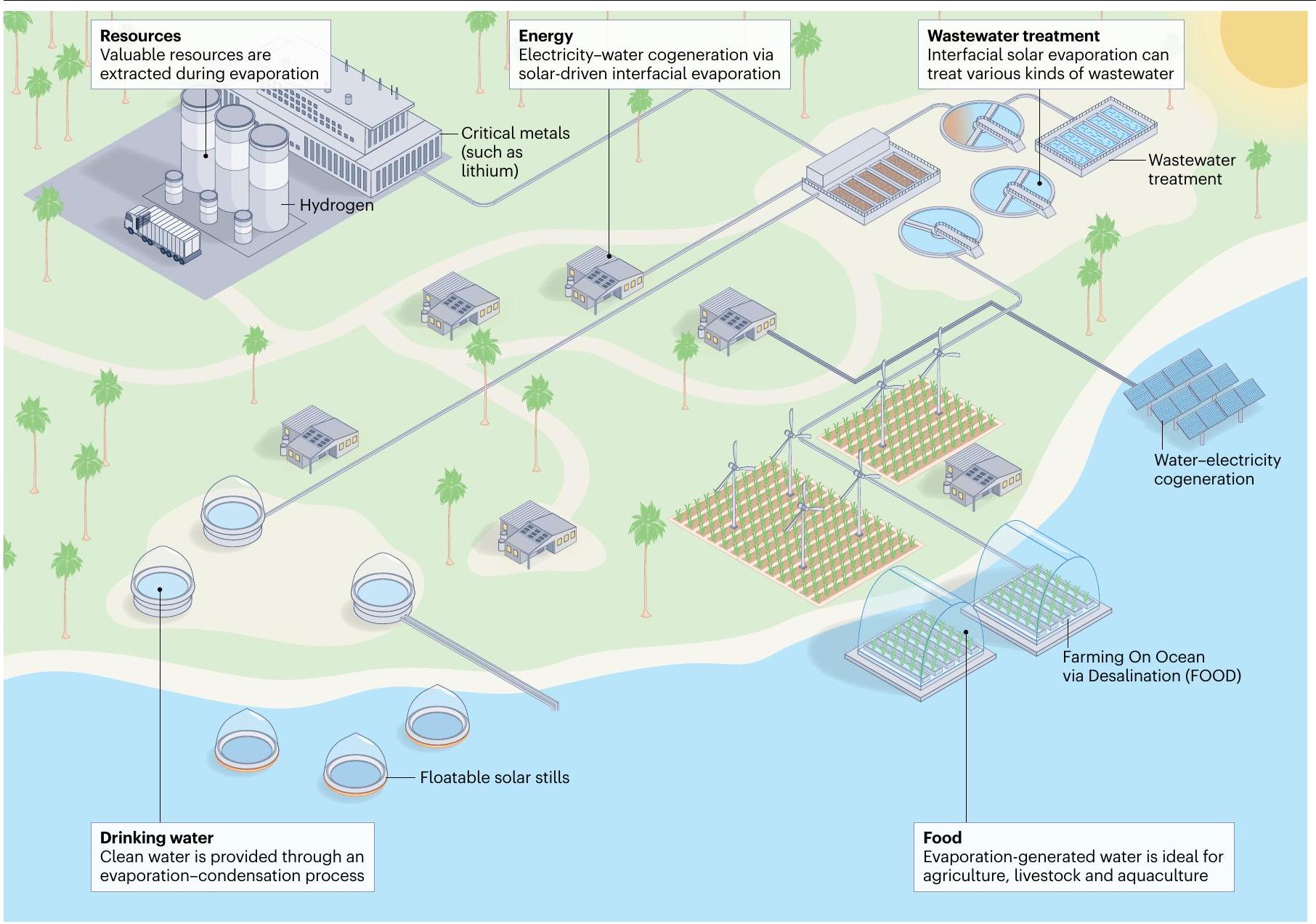
يمكن أن تكون لتقنيات التبخر الواجهية تطبيقات محتملة عبر الربط بين FEW (الشكل 1). يمكن توليد مياه صالحة للشرب
من مصادر مياه متنوعة (بما في ذلك مياه البحر ، المياه المالحة ومياه الصرف الصناعي ) ويمكن استخدام المياه الناتجة محليًا وفي إنتاج الغذاء . يمكن معالجة مياه الصرف – بما في ذلك مياه الصرف الصحي المنزلية ومياه الصرف الصناعي من المنسوجات ، ومحطات الطاقة الحرارية وتصنيع الأدوية – بهذه التقنية، مما يصل إلى صفر تصريف سائل (الفصل الكامل بين المياه والمواد المذابة). يمكن استخدام توليد البخار الساخن مع التبخر الشمسي للتعقيم والتطهير . علاوة على ذلك، يمكن أن يتكامل التبخر الشمسي الواجهية مع تقنيات الطاقة المتجددة الأخرى لزيادة معدلات التبخر، وإنتاج الكهرباء وكفاءة النظام، مما يعزز العملية والجدوى .
في هذه المراجعة، نناقش ابتكارات التبخر الشمسي الواجهية واستراتيجيات التصميم في المواد والأجهزة والأنظمة للمياه والغذاء والطاقة والموارد ومعالجة مياه الصرف. نقيم هذه التقنيات ضمن إطار قدرات الإنتاج، والملاءمة للإعدادات ذات الموارد المنخفضة، والتحديات الرئيسية للتنفيذ العملي. أخيرًا، نستكشف استراتيجيات التوليد المشترك والتآزر مع تقنيات أخرى.

إنتاج المياه ومعالجتها

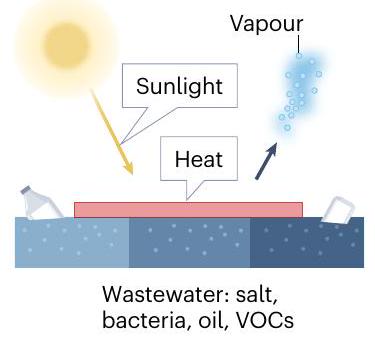
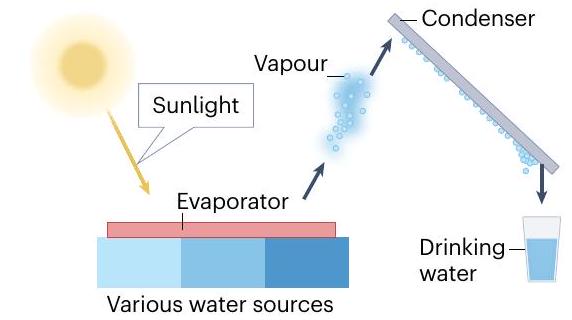
يفصل التبخر الشمسي الواجهية المياه والمواد المذابة بكفاءة من خلال توجيه الحرارة الشمسية عند واجهة السائل-البخار، مما يحول المياه السائلة إلى بخار بينما يترك المواد المذابة خلفه (الشكل 2أ). يمكن تكثيف البخار الناتج إلى مياه شرب أو استخدامه في عمليات تحفيزية لإنتاج الهيدروجين ومواد كيميائية قيمة أخرى. يمكن تركيز المواد المذابة وترسيبها، مما يسهل استخراج المعادن القيمة مثل الليثيوم واليورانيوم. تناقش هذه القسم التطبيقات المرتبطة بالمياه لتقنيات التبخر الواجهية المدفوعة بالطاقة الشمسية، بما في ذلك إنتاج المياه النظيفة، ومعالجة مياه الصرف، واستعادة الموارد من المياه، والجهود المبذولة لتعزيز الأداء والتنفيذ العملي لهذه التقنيات.

إنتاج المياه النظيفة

ينقي التبخر الشمسي الواجهية المياه من خلال تكثيف البخار من مصادر مثل مياه البحر، والمياه المالحة ومياه الصرف الصناعي (الشكل 2أ). تفي المياه المقطرة الناتجة باستمرار بمعايير تركيز الأيونات لمنظمة الصحة العالمية لمياه الشرب . تقدر تكلفة هذه الاستراتيجية بـ دولار أمريكي لكل طن ، أرخص من التناضح العكسي على نطاق صغير (5-10 دولارات أمريكية لكل طن) ومقارنة بأنظمة تنقية المياه على نطاق واسع (0.9-1.4 دولار أمريكي لكل طن) . الطبيعة اللامركزية للتبخر الشمسي وقدرتها المحتملة على توفير مياه عالية الجودة بتكلفة منخفضة تجعلها حلاً محتملاً لمياه الشرب في المناطق الريفية أو الجزر . هناك طرق مختلفة لإنتاج المياه النظيفة، بما في ذلك التبخر والتكثيف المتتالي، وتحلية الأغشية المدفوعة بالبخار الشمسي، وتوليد المياه من الغلاف الجوي المدفوع بالطاقة الشمسية، كما هو موضح أدناه.
أجهزة تنقية التبخر-التكثيف. تعمل أجهزة تنقية المياه التي تستخدم استراتيجية التبخر والتكثيف الشمسية المتتالية على نفس المبدأ الأساسي (الشكل 2أ)، حتى عند استخدام تصميمات أنظمة مختلفة. تلتقط أجهزة التبخر الشمسية المصنوعة من مواد ذات امتصاص شمسي عالي، مثل المواد القائمة على الكربون والمعادن البلازمونية، وتحوّل الطاقة الشمسية إلى حرارة من خلال عمليات مثل إثارة الإلكترونات-الاسترخاء وتأثير الرنين السطحي البلازمي المحلي . هذا التسخين المحلي عند واجهة التبخر يسرع انتقال الماء من الحالة السائلة إلى البخار. ينتشر البخار الناتج نحو سطح التكثيف، مدفوعًا بتدرج ضغط البخار. عند واجهة التكثيف، يصل البخار إلى حالة مفرطة التشبع، عالية الطاقة وغير المستقرة، مما يؤدي إلى
الشكل 1| الغذاء والطاقة والماء من تقنيات التبخر الشمسي الواجهية. يمكن لتقنيات التبخر الشمسي الواجهية المدفوعة بالطاقة الشمسية استخدام الطاقة الشمسية لمعالجة المياه العادمة وإنتاج مياه نظيفة، وغذاء، وطاقة، ومعادن، وموارد كيميائية. يمكن استخدام هذه التقنيات في المجتمعات الريفية والنائية التي تفتقر إلى الوصول إلى المياه أو بنية الطاقة التحتية. تشمل تقنيات التبخر الشمسي الواجهية الألواح الشمسية العائمة، التي تنتج مياه عذبة من مياه البحر، والمواد التي يتم دمجها في محطات معالجة المياه.

الملخص

يمكن أيضًا تصميمها لإنتاج مياه عذبة للزراعة على اليابسة وفي المحيط: نظام الزراعة على المحيط عبر التحلية (FOOD). يمكن استرداد الموارد من الماء باستخدام التبخر الشمسي الواجهية لاستخراج المعادن، مثل الليثيوم، أو بالاشتراك مع أنظمة تحفيزية لإنتاج غاز الهيدروجين من الماء. تصاميم جديدة تدمج التبخر الشمسي الواجهية مع تقنيات الطاقة المتجددة مثل الألواح الكهروضوئية وتوربينات الرياح، مما يمكّن من توليد الكهرباء والموارد الأخرى في وقت واحد.

تكون النواة عند الاضطراب. تنمو قطرات الماء المتكونة وتندمج، وفي النهاية تصل إلى حجم حرج حيث تتغلب على التوتر السطحي وتنزلق تحت تأثير الجاذبية، متجمعة كماء مكثف . لقد مكنت التقدم في تطوير المواد والأجهزة من تحقيق كفاءات تبخر تزيد عن تحت تركيزات بصرية مخفضة .
التكثيف هو العامل المحدد في إنتاجية المياه، لأن معدل التبخر غالبًا ما يتجاوز معدل التكثيف، مما يؤدي إلى استرداد بخار غير كافٍ . تستخدم المنقيات الشمسية التقليدية غطاء شفاف ذو ميل واحد أو مزدوج موضوعة فوق المبخر. يسمح الغطاء بمرور ضوء الشمس بينما يسهل التكثيف عندما يصل البخار إلى التشبع (الشكل 2ب). على الرغم من سهولة التركيب، فإن هذه البنية لها قيودان: المواد البوليمرية أو الزجاجية المستخدمة في الغطاء عادة ما تكون ذات موصلية حرارية منخفضة , مما يؤدي إلى انتقال حرارة غير كافٍ ويعيق التكثيف؛ وتزيد القطرات المكثفة من العائق الحراري
وتشتت ضوء الشمس، مما يؤدي إلى فقدان كبير للضوء يصل إلى .
لزيادة إنتاجية المياه، يمكن تحسين هيكل التكثيف وزيادة كفاءة التكثيف . على سبيل المثال، تم تطوير تعديلات محبة للماء و/أو كارهة للماء للغطاء لتعزيز التكثيف (الشكل 2ب). تعزز الأغطية المحبة للماء التكثيف على شكل فيلم، مما يقلل من تشتت الضوء الناتج عن القطرات. ومع ذلك، فإن الفيلم المائي المتكون على الغطاء لديه موصلية حرارية منخفضة نسبيًا (حوالي ), وهو ضار بالتكثيف . على النقيض من ذلك، تشجع الأغطية الكارهة للماء التكثيف على شكل قطرات، مع كون معامل انتقال الحرارة مرات أعلى من ذلك للتكثيف على شكل فيلم . ومع ذلك، فإنها تعاني من فقدان بصري كبير ومشكلات محتملة في المتانة.
تم تصميم المنقيات الشمسية ذات الهيكل المقلوب للتغلب على القيود وتعزيز التكثيف . يضع الهيكل المقلوب سطح التكثيف أسفل الممتص الشمسي،
مما يفصل بين امتصاص الضوء والتكثيف (الشكل 2ج). وبالتالي، لا يتطلب سطح التكثيف نفاذية ضوئية عالية . تزيد المرونة المتزايدة في اختيار المواد
من إمكانية استخدام مواد ذات موصلية حرارية عالية وخصائص كارهة للماء مثل النحاس والألمنيوم (موصلية حرارية تبلغ لتعزيز التكثيف. أ
إنتاج مياه نظيفة
ب منقيات التبخر-التكثيف – الهيكل التقليدي
ج منقيات التبخر-التكثيف – الهيكل المقلوب
د منقيات التبخر-التكثيف – الهيكل متعدد المراحل
هـ التحلية عبر الأغشية المدفوعة بالبخار الشمسي
و مولدات المياه الجوية المدفوعة بالطاقة الشمسية
ز معدلات إنتاج المياه لأنواع مختلفة من منقيات المياه
ح منقي شمسي عائم
الشكل 2 | إنتاج مياه نظيفة عبر التبخر الشمسي الواجهية.
أ، في التبخر الشمسي الواجهية، يتم امتصاص الطاقة الشمسية بواسطة مبخر، مما يسخن ويولد بخار الماء. يتكثف البخار إلى ماء عند ملامسته للمكثف. ب، تستخدم مولدات المياه الشمسية التقليدية غطاء شفاف للتكثيف. يمكن تعزيز التكثيف عن طريق ضبط محبة السطح للماء وكراهيته لتعزيز التكثيف على شكل فيلم لتجنب تشتت الضوء (يسار) والتكثيف على شكل قطرات لمعامل نقل حرارة مرتفع (يمين). يمثل المقاومة الحرارية، هي الجاذبية. ج، تفصل منقيات المياه الشمسية ذات الهيكل المقلوب بين امتصاص الضوء والتكثيف عن طريق وضع الممتص الشمسي فوق سطح التكثيف، كما هو موضح هنا كمكثفات كارهة للماء بتصاميم هيكلية خشنة. يتم سحب الماء إلى المنقي من خلال مواد مثل قماش الألياف المحبة للماء المرنة. د، تحتوي مولدات المياه الشمسية متعددة المراحل على عدة
طبقات إمداد مائية محبة للماء وطبقات تكثيف مفصولة بفجوات هوائية لإعادة تدوير إنثالبي التكثيف. هـ، تستخدم تقنية الأغشية المدفوعة بالبخار الشمسي لإنتاج مياه عذبة الطاقة الشمسية لتوليد بخار عالي الطاقة، والذي يولد الضغط لدفع مياه البحر عبر غشاء التناضح العكسي أو الترشيح النانوي، مما ينتج مياه نظيفة. و، تستخدم مولدات المياه الجوية المدفوعة بالطاقة الشمسية السوائل الأيونية لجمع الرطوبة الجوية، والتي تستخدم بعد ذلك في التبخر الشمسي الواجهية لإنتاج مياه نظيفة. ز، معدلات إنتاج المياه لأنواع مختلفة من تقنيات التبخر الشمسي الواجهية (البيانات من المراجع 10، 23، 40، 50-54، 57، 195-201 ومفصلة في الجدول التكميلي 1). ح، منقي شمسي عائم تجاري. تم تعديل اللوحة د بإذن من المرجع 50، RSC. تم تعديل اللوحة هـ من المرجع 10، Springer Nature Limited. تم تعديل اللوحة و بإذن من المرجع 58، Wiley. اللوحة حقوق الصورة: ويشاو شو.

مقالة مراجعة

تم تحقيق كفاءة تحويل الطاقة الشمسية إلى مياه نظيفة في إعداد التكثيف المقلوب ، مقارنة بـ 20-50% في الإعدادات التقليدية.
تجمع منقيات المياه الشمسية متعددة المراحل وتعيد استخدام إنثالبي التبخر باستخدام عدة طبقات إمداد مائية محبة للماء وطبقات تكثيف مفصولة بفجوات هوائية (الشكل 2د). يعيد هذا التصميم تدوير الحرارة الكامنة التي يتم إطلاقها أثناء التكثيف في مرحلة واحدة للتبخر في المرحلة التالية، مما يمكّن من كفاءة إنتاج المياه تتجاوز الحد الديناميكي الحراري . يمكن أن يؤدي تحسين هيكل منقيات المياه متعددة المراحل، مثل عدد المراحل وسماكة الفجوة الهوائية ، إلى تحسين الأداء بشكل أكبر . على سبيل المثال، أدى زيادة إلى تحسين بمقدار ستة أضعاف في معدل إنتاج المياه مقارنة بجهاز ذو مرحلة واحدة عندما (المرجع 50). ومع ذلك، يجب موازنة إنتاج المياه وتكاليف الاستثمار عند تحديد عدد المراحل، لأن الكفاءة العامة لا تزيد خطيًا مع بفضل خسائر الحرارة التراكمية. بالإضافة إلى ذلك، تؤثر بشكل كبير على إنتاج المياه. يؤدي صغير إلى توصيل حراري قوي يقلل من الكفاءة، بينما يؤدي كبير إلى زيادة مقاومة نقل الكتلة، مما يحد أيضًا من الكفاءة . لذلك، فإن التحليل الكمي لنقل الحرارة والكتلة وتحسين تصميم الجهاز متعدد المراحل بعناية ضروري .
تستخدم التحلية عبر الأغشية المدفوعة بالبخار وما بعدها. تستخدم التحلية عبر الأغشية المدفوعة بالبخار الشمسي بخار عالي الحرارة وعالي الضغط يتم توليده بواسطة التسخين الشمسي الواجهية لدفع مياه مالحة عبر غشاء التناضح العكسي أو الترشيح النانوي لإنتاج مياه نظيفة (الشكل 2هـ). تتضمن التحلية عبر الأغشية فصل الأيونات وجزيئات الماء باستخدام غشاء انتقائي وتتطلب طاقة أقل بكثير من منقي التبخر-التكثيف ذو المرحلة الواحدة – استهلاك الطاقة النظري لتحلية مياه البحر هو ، أقل بنحو ثلاثة أوامر من حيث الحجم مقارنةً بجهاز تنقية التبخر-التكثيف ذو المرحلة الواحدة، الذي يحدهenthalpy التبخر للماء (حوالي نظرًا لمتطلبات الطاقة المنفصلة المنخفضة نسبيًا، فقد وصلت هذه الأجهزة المعتمدة على تحلية الأغشية إلى معدلات تصل إلى تحت 12 -إضاءة الشمس . هذه النسبة أعلى من أجهزة تنقية المياه التي تعتمد على التبخر والتكثيف الأحادي، والتي لديها معدل إنتاج مياه نظري قدره تحت إضاءة شمس واحدة .
يمكن أن يؤدي الانكماش المستجيب للحرارة إلى دفع الماء عبر غشاء من خلال استخدام مواد تخضع لتغيرات كبيرة في الشكل أو الحجم استجابة لتغيرات درجة الحرارة، مثل التسخين الشمسي. وقد تم إثبات هذه الآلية في جهاز تنقية المياه المدفوع بالطاقة الشمسية الذي يجمع بين غشاء ترشيح نانوي من الجرافين و بولي (نيسوبروبيل أكريلاميد) (بولي-NIPAM) مع قابلية تغيير في المحبة للماء. . في هذا النظام، يمتص المنقي كمية كبيرة من الماء من مصدر مائي ملوث. عند التسخين الضوئي الحراري، يتم إطلاق الماء الممتص من خلال التبديل في المحبة للماء المستجيبة للحرارة في بولي-NIPAM (من محبة للماء إلى كاره للماء) بينما تحتفظ الغشاء الخارجي من الجرافين بشكل فعال بالأيونات والجزيئات بمعدل رفض مرتفع. .
دمج تسخين الشمس على الواجهة وجمع المياه من الغلاف الجوي يسمح بتوليد المياه مباشرة من الرطوبة الجوية، مما يوسع بشكل أكبر التطبيقات المحتملة لكلتا التقنيتين. . تم إثبات هذا التركيب في مولد مياه جوية مدفوع بالطاقة الشمسية على الواجهة، والذي جمع بين المبخرات الشمسية الواجهة وامتصاص المياه الجوية القائم على السائل الأيوني. (الشكل 2f). يعمل النظام من خلال عملية امتصاص-إطلاق متزامنة، وتحت الظروف الخارجية كان لديه معدل إنتاج مياه قدره في اليوم في ظروف خارجية .
من حيث المبدأ، يمكن أن يوفر هذا النظام مياه عذبة بشكل مرن في المناطق التي تعاني من حاجة ملحة للمياه النظيفة ولكن لا تتوفر فيها مصدر سطحي للمياه السائلة (مثل المحيط). ومع ذلك، هناك حاجة إلى تحسينات، نظرًا لأن إنتاجه من المياه عادة ما يكون أقل من عمليات المياه السائلة. .
التطبيق والجيل القادم. إنتاج المياه النظيفة هو تطبيق راسخ لتبخر الشمس على الواجهة مع معدلات إنتاج تصل إلى (المرجع 10) تحت أشعة الشمس المركزة (الشكل 2g والجدول التكميلي 1). لقد تقدمت عدة أجهزة تنقية المياه بالطاقة الشمسية التي تعتمد على التبخر والتكثيف، والتي تتميز بالبساطة وقابلية الحمل، إلى ما بعد المختبر وأصبحت متاحة تجارياً الآن (الشكل 2h). بمجرد نشرها، تطفو على سطح الماء، وتمتص أشعة الشمس وتحولها إلى حرارة، مما ينتج بخار ماء يتكثف إلى ماء نقي يتم جمعه في حقيبة ماء متصلة بالجهاز. ويقال إن هذه الأجهزة يمكن أن تنتج حوالي 21 لتر من الماء يومياً.
متعدد المراحل المتقدم ومُنَظِّمات المياه بغشاء شمسي تم تقييمها بأداء مقاس وهي قادرة على إنتاج ما يكفي من مياه الشرب لفرد واحد (3 لترات لكل شخص في اليوم) وحتى تلبية الاحتياجات الأساسية من المياه النظيفة للعيش (50 لترًا لكل شخص في اليوم). على سبيل المثال، من المتوقع أن ينتج جهاز مكون من 10 مراحل من المياه النظيفة يوميًا خلال أشهر الصيف المشمسة يمكن أن تنتج عملية تحلية المياه باستخدام أغشية مدفوعة بالبخار الشمسي أكثر من 600 لتر يوميًا تحت ساعات من الإشعاع الشمسي 12 . ومع ذلك، فإن هذه الأنظمة ليست متاحة تجارياً بعد. لا تزال قابلية التوسع تمثل تحدياً – فهي فعالة على نطاق المختبر (عادةً تحت لكن تكييفها لتناسب المجتمعات الأكبر أو الاستخدام الصناعي يتطلب تحسينات تكنولوجية كبيرة وبنية تحتية.
على الرغم من أن التطبيق في العالم الحقيقي يُظهر فائدة هذه التكنولوجيا في إنتاج المياه النظيفة، إلا أن هناك حاجة إلى مزيد من التطوير والهندسة لمعالجة التحديات مثل الإنتاج المتقطع الناتج عن الدورات اليومية، والتكلس، والاستقرار، والتكلفة. يجب أن تهدف الجيل القادم من النماذج الأولية إلى إنتاج عدة لترات من الماء يوميًا لتلبية احتياجات الإنسان اليومية. هذه القابلية للتوسع ممكنة بفضل المواد المستخدمة في التبخر الشمسي التي تُنتج بتكلفة فعالة وبكميات كبيرة. يمكن معالجة إنتاج المياه المتقطع من خلال دمج تقنيات الطاقة الشمسية مثل خلايا الطاقة الشمسية (PV). والمواد ذات تغيير الطور لتخزين الطاقة خلال النهار واستخدامها في الليل لتنقية المياه، مما يتيح إنتاج المياه بالطاقة الشمسية بشكل مستمر طوال اليوم.
تحسين أداء المكثف هو المفتاح لأداء النظام بشكل عام، لأن المكثف عادة ما يساهم بأكبر كتلة في النظام. في الواقع، وزن المكثف يزيد عن 40 مرة من وزن المبخر أو الممتص. “، مما يقلل بشكل كبير من إنتاجية المياه لكل وحدة كتلة من الجهاز. استراتيجيات مثل نانو هيكلة سطح المكثف وتنفيذ التبريد الإشعاعي السلبي من المتوقع أن تعزز أداء المكثف. تخلق النانويكسترات ميكرو-ونانومترية تعزز التكتل السريع لبخار الماء إلى سائل. التبريد الإشعاعي السلبي يخفض درجة حرارة السطح من خلال انبعاث الإشعاع الحراري نحو السماء الباردة، مما يخلق تدرجًا في درجة الحرارة يسرع من التكثف.
تولد مولدات المياه الشمسية النشطة، التي تعمل بالطاقة الكهربائية من الطاقة الشمسية، إنتاجية مائية أعلى من الأنظمة السلبية. تقوم أنظمة التناضح العكسي المدفوعة بالطاقة الشمسية، وهي نظام نشط نموذجي، بتحويل الطاقة الشمسية إلى كهرباء عبر خلايا الطاقة الشمسية لتشغيل غشاء التناضح العكسي، مما ينتج مياه نظيفة بمعدل هذه المعدلات أعلى بمقدار ترتيب من معظم الأنظمة السلبية. ومع ذلك، فإن أنظمة التناضح العكسي المدفوعة بالطاقة الشمسية تكون أثقل وأكبر بسبب الوحدات الشمسية الإضافية.
معالجة مياه الصرف الصحي
تحسين انتشار الأيونات
ترسيب الملح المباشر
معالجة مياه الصرف لمحطة توليد الطاقة التي تعمل بالفحم
متنوع
مصادر المياه
ملح
كوب على شكل g
وضع عدم الاتصال
تحلل ضوئي
إزالة المركبات العضوية المتطايرة
شكل الجسيم
مضاد للتلوث البيولوجي
استبعاد الحجم
مضاد لتلوث الزيت
– الأغشية شبه النفاذة
أخيرًا، يتم اختبار معظم مولدات المياه الشمسية تحت ظروف داخلية مستقرة مع إضاءة شمسية قياسية أو في ظروف خارجية مثالية، مثل أيام الصيف المشمسة أو في وقت الظهيرة. هذه الظروف ليست واقعية من حيث التشغيل في العالم الحقيقي، الذي يشهد تقلبات في الإضاءة الشمسية وتغيرات كبيرة في درجات الحرارة. لذلك، يجب أن تكون إنتاجية واستقرار مولدات المياه الشمسية القادمة
تمت مراقبته وصيانته على مدى عدة أشهر في الميدان. يجب تتبع عوامل مثل جودة المياه، وخاصة محتوى المواد العضوية، حيث يمكن أن تتبخر المركبات العضوية المتطايرة مع الماء، مما يؤدي إلى تلوث المنتج المقطر ويعرض سلامة مياه الشرب للخطر. بالإضافة إلى ذلك، يجب تقييم تكاليف الاستثمار والصيانة بدقة لتقييم جاهزية التكنولوجيا للتشغيل الميداني على المدى الطويل.
الشكل 3 | توليد بخار الشمس لمعالجة المياه العادمة. أ، يمكن معالجة المياه العادمة من خلال التبخر الشمسي السطحي، حيث تسخن الطاقة الشمسية المبخر، مما يولد بخار ماء نقي ويترك وراءه الملوثات. ب-د، يمكن أن تتسبب الأملاح والميكروبات والمواد العضوية في انسداد المبخر، مما يتطلب استراتيجيات تخفيف: يمكن استخدام مبخرات تعتمد على تصميم جانوس (اللوحة ب)، وتأثير دونان (اللوحة ج)، وانتشار الأيونات المعزز (اللوحة د) لتقليل تركيز الملح المحلي. هـ-ح، يمكن تمكين ترسيب الملح المباشر على المبخر من خلال تصميم هياكل لطرد الملح، مثل قرص (اللوحة هـ)، مخروط (اللوحة و)، كوب (اللوحة ز) أو كرة (اللوحة ح). ط، المبخرات الكروية قد تم
مطبق على بركة معالجة مياه الصرف. ج، التبخر بدون تلامس هو استراتيجية أخرى لمنح مقاومة للملح. ك، يمكن إضافة مواد مضادة للميكروبات (مثل الفضة، Ag، الكربيدات والنيتريدات من المعادن الانتقالية، المعروفة باسم MXene، وأكسيد الجرافين المختزل، rGO) إلى المبخر لتحقيق مقاومة للتلوث البيولوجي. 1، يمكن دمج خاصية الكراهية الفائقة للزيوت تحت الماء في الممتص لمقاومة تلوث الزيت. يمكن إزالة المركبات العضوية المتطايرة (VOCs) من خلال التحفيز الضوئي (اللوحة م)، واستبعاد الحجم (اللوحة ن) والأغشية القابلة للاختراق الانتقائي (اللوحة o). CB، نطاق التوصيل؛ إلكترون؛ فجوة الطاقة؛ ثقب؛ طاقة الفوتون؛ VB، نطاق التكافؤ. الجزء مقتبس من المرجع 13، رخصة المشاع الإبداعي 4.0.

معالجة مياه الصرف الصحي

يتم اختبار التبخر الشمسي على الواجهة في معالجة أنواع مختلفة من مياه الصرف، مثل مياه الصرف الصناعي، والمياه المالحة، ومياه الصرف الصحي المنزلية. (الشكل 3أ). في هذه العملية، يتم تبخير الماء السائل بشكل مستمر حتى تبقى المواد الصلبة فقط، مما يحقق تصريف سائل صفر. . هذه الطريقة تخفف من التهديد البيئي الناتج عن تصريف المحلول الملحي المركز للغاية وتسمح بإعادة استخدام المياه المتبخرة من خلال ربط مكثف، مع استخدام المواد المذابة المتبقية لاستخراج الموارد.
ومع ذلك، نظرًا لأن مياه الصرف هي مزيج معقد يمكن أن يحتوي على مستويات عالية من الأملاح والبكتيريا والزيوت والمركبات العضوية، فإنها يمكن أن تسبب تلوثًا شديدًا على المبخر الشمسي. يمكن أن يؤدي هذا التلوث إلى انسداد تدفق المياه وامتصاص الضوء، مما يؤدي إلى عطل في المبخر. لذلك، فإن تطوير المبخرات ذات الاستقرار التشغيلي الممتاز، بما في ذلك المقاومة للملح، والتلوث البيولوجي، والتلوث العضوي، أمر بالغ الأهمية للتطبيق الناجح للتبخر الشمسي السطحي في معالجة مياه الصرف.
مقاومة الملح. تعتبر مقاومة الملح ضرورية لمبخرات الطاقة الشمسية، لأن تراكم الملح هو مشكلة تلوث شائعة في معالجة مياه الصرف. . عندما يتجاوز معدل تبخر الماء معدل عودة أيونات الملح إلى الماء الكلي، يزداد تركيز الملح المحلي بسرعة، مما يؤدي إلى ترسب الملح على المبخر. يمكن تصنيف الاستراتيجيات لتعزيز مقاومة الملح إلى ثلاثة نهج رئيسية: تقليل تركيز الملح المحلي توجيه ترسيب الملح وتنفيذ التبخر بدون تلامس .
يمكن لمبخر جانوس ذو ترطيب مزدوج أن يقلل من تركيز الملح على سطحه العلوي، مما يمنع تراكم الملح. (الشكل 3ب). في هذا التصميم، السطح العلوي غير قابل للماء، مما يعمل كحاجز واقي لمنع أيونات الملح من الوصول إلى السطح العلوي للمبخر. السطح السفلي قابل للماء، مما يسهل الانتشار العكسي لأيونات الملح إلى الماء الكثيف ويقلل من تركيز الملح داخل المبخر. هذه الطريقة بسيطة وقابلة للتطبيق، حيث تستخدم طلاءً غير قابل للماء شائعًا – سيلان الألكيل الفلوري – الذي يمكن دهنه بسهولة على سطح المبخر، وقد حافظت على إنتاجية مستقرة من الماء. لمدة 15 يومًا باستخدام مياه البحر من البحر الأصفر ومع ذلك، فإن ضمان الاستقرار على المدى الطويل للأسطح الكارهة للماء والمحبة للماء يمثل تحديًا. فالتعرض المطول لأشعة الشمس والمواد المؤكسدة في الماء قد يؤدي إلى تدهور هذه الأسطح الوظيفية، مما يقلل من أداء المبخر. .
يمكن أيضًا استخدام تأثير دونان لتقليل تركيز الملح في المبخرات الشمسية. (الشكل 3ج). تستخدم هذه الطريقة مبخر هيدروجيل بولي الكتروليت مع الأنيونات (مثل ) مثبتة على سطحها وأيونات موجبة (مثل ) للحفاظ على الحيادية الكهربائية. المحصور تؤسس الأيونات توازن توزيع دونان عند الحدود بين المبخر والمحلول الملحي المحيط، مما يقلل من انتشار أيونات الملح إلى المبخر ويقلل من تركيز الملح المحلي. تدعم هذه الطريقة التبخر المستقر لـ لمدة 11 يومًا مع حل . ومع ذلك، فإن
تقل فعالية مقاومة الملح المستندة إلى تأثير دونان في المياه عالية الملوحة التي تزيد ملوحتها عن بسبب تأثير حجب الشحنة .
يمكن أيضًا استخدام التصميم الهيكلي لتقليل تركيز الملح داخل المبخر. على سبيل المثال، فإن دمج قنوات نقل المياه الكبيرة في المبخر يحسن من الحمل الحراري للمياه، مما يسهل تدفق أيونات الملح مرة أخرى إلى المياه السائبة ويمنع تراكم الملح. (الشكل 3د). ومع ذلك، فإن هذه الزيادة في الحمل الحراري للماء تزيد أيضًا من فقدان الحرارة إلى الماء المحيط، مما يقلل من كفاءة التبخر إلى حوالي تحت إضاءة الشمس. لذلك، تم تطوير العديد من المواد وتصميمات الهياكل لتحقيق توازن بين التركيز الحراري ورفض الملح. مثل تعزيز استعادة الحرارة الموصلة وتحسين قطر قناة النقل . بشكل محدد، اختيار حجم قناة مناسب يحفز الحمل الحراري، مما يسرع من رفض الملح ويقلل من فقدان الحرارة، محققًا كفاءة .
توجيه تبلور الملح إلى مناطق محددة من المبخر وإزالته بانتظام يمكن أن يعزز الاستقرار التشغيلي مع الحفاظ على معدلات تبخر فوتوحرارية عالية. . تتميز هذه المبلورات الملحية بهياكل وأشكال مصممة بشكل معقد، مثل القرص مخروط كوب وأشكال الجسيمات (الشكل 3هـ-و). المبخر القرصي يستخدم خيط امتصاص الماء أحادي البعد في المركز، مما يخلق تدرج تركيز شعاعي يوجه تبلور الملح إلى الحواف (الشكل 3e). يتيح تصميم القرص توليد بخار مستمر ومستقر وجمع الملح لأكثر من 600 ساعة مع حل وبالمثل، تشكل المبخرات المخروطية ثلاثية الأبعاد فيلمًا مائيًا بسمك متغير وتدرجات حرارة، مما يؤدي إلى تبلور الملح عند القمة، حيث يكون فيلم الماء أرق وأكثر سخونة. (الشكل 3f). يحقق هذا التصميم معدل تبخر قدره وكفاءة طاقة تزيد عن 96% مع حل . تقوم مبخرات الكوب بفصل الماء المتبخر عن سطح امتصاص الضوء بشكل مادي (الشكل 3g). تمتص الجدران السفلية والداخلية الطاقة الشمسية ثم تنقل الحرارة إلى الجدار الخارجي، حيث تحدث عملية التبخر وتبلور الملح، مما يحقق معدل تبخر قدره مع محلول ملحي .
دليل وآلي يمكن استخدام طرق لإزالة بلورات الملح. على سبيل المثال، تم تطوير جهاز بلورة ملح ديناميكي ونظيف ذاتيًا كطريقة تلقائية. (الشكل 3h). في هذا النهج، يساهم فيلم رقيق من الماء في الأعلى (البقع الحمراء في الشكل 3h) في تعزيز تبلور الملح بشكل تفضيلي. مع نمو بلورات الملح وتعطيل التوازن الميكانيكي، يدور المجمع الكروي، وينظف نفسه ويعيد بدء العملية. تتسبب التوتر السطحي في جعل هذه المجمعات الكروية تعمل بشكل جماعي، لأن دوران مجمع واحد يمكن أن يحفز دورانات متزامنة لمجمعاته القريبة، مما يؤدي إلى تنظيف ذاتي متزامن للنظام بأكمله. . من الأشكال الموصوفة للمبلورات، فإن مبلورات الملح الكروية مناسبة تمامًا للتطبيقات العملية بفضل قدرتها على التنظيف الذاتي وقابلية التوسع. على مدى تم بناء واستخدام بلورات لمعالجة مياه الصرف من محطات الطاقة التي تعمل بالفحم، مما يسرع عملية التركيز. (الشكل 3i).
التبخر بدون تلامس هو الاستراتيجية الأكثر استقرارًا وفعالية لمقاومة الملح ، لأنه يفصل مكثف الشمس عن الماء مكانيًا (الشكل 3j). تتطلب هذه الطريقة مكثفًا بخصائص بصرية غير متكافئة: يجب أن تكون السطح العلوي له امتصاص عالي للضوء المرئي وانبعاث منخفض للأشعة تحت الحمراء، بينما يتطلب السطح السفلي انبعاثًا عاليًا للأشعة تحت الحمراء. . يمكن لمثل هذا المبخر تحويل ضوء الشمس بكفاءة إلى إشعاع حراري، والذي يتم بعد ذلك إصداره نحو مياه الصرف الصحي وامتصاصه داخل طبقة رقيقة جداً ( ) تحت واجهة بخار الماء، مكونًا هيكل تبخر واجهي . توفر هذه الطريقة استقرارًا طويل الأمد لمعالجة مياه الصرف ذات الملوحة العالية والفصل الكامل بين المحلول والمذاب. ومع ذلك، نظرًا لطبيعتها غير التلامسية، فإن كفاءة تحويل الفوتوحرارة للتبخر غير التلامسي محدودة بحد أقصى من أقل بكثير من التبخر الواجهوي الشمسي التقليدي في وضع الاتصال لذلك، هناك حاجة إلى تحسينات إضافية لتحسين نقل الحرارة والكتلة لزيادة كفاءة استخدام الطاقة الشمسية وجعل التبخر بدون تماس قابلاً للتسويق. ستؤدي الكفاءة الأعلى إلى زيادة إنتاج المياه وتقليل التكاليف، مما يجعل العملية أكثر تنافسية واستدامة للتطبيقات واسعة النطاق مثل تحلية المياه ومعالجة مياه الصرف الصحي، حيث تواجه أنظمة وضع الاتصال تحديات تلوث الملح.
مقاومة التلوث البيولوجي والتلوث العضوي. تعتبر المبخرات الشمسية عرضة للتلوث البيولوجي والتلوث العضوي. على سبيل المثال، يمكن أن تلتصق الكائنات الدقيقة والبكتيريا بالمبخر، مما يشكل أغشية حيوية تعيق نقل المياه وامتصاص الضوء، مما يهدد استقرار التشغيل. استراتيجية رئيسية لمكافحة التلوث البيولوجي هي دمج المواد المضادة للبكتيريا في المبخر (الشكل 3k). تشمل المواد المضادة للبكتيريا الشائعة المواد النانوية غير العضوية مثل الجسيمات النانوية المعدنية. أكسيد الجرافين المخفض MXene والبوليمرات العضوية مثل الكيتوزان وبولي إيثيلين أمين تعمل هذه المواد عن طريق تعطيل جدران الخلايا تغيير بروتينات البكتيريا و/أو توليد أنواع الأكسجين التفاعلية لقد أظهرت المبخرات المزينة بهذه المواد المضادة للبكتيريا تقريبًا الفعالية ضد أنواع مختلفة من البكتيريا، بما في ذلك بكتيريا الباسيلوس سوبتيليس، الإشريكية القولونية، الزائفة الزنجارية والمكورات العنقودية الذهبية .
تشمل الملوثات العضوية الموجودة في مياه الصرف الصحي والتي تؤثر على أداء المبخرات المركبات العضوية غير المتطايرة، مثل الزيوت، والمركبات العضوية المتطايرة (VOCs). على سبيل المثال، يمكن أن تسد ملوثات الزيوت عالية اللزوجة في مياه الصرف الصحي المسام وتعيق تدفق الماء في المبخرات. طريقة فعالة لمنع تلوث الزيت هي من خلال إنشاء خصائص فائقة الكراهية للزيت على سطح المبخر. (الشكل 31). يمكن أن تعزز جهات الاتصال كاسي الناتجة عن الهياكل النانوية من كره السطح للزيوت، مما يحقق زاوية تماس قدرها مع زيت فول الصويا تحت الماء . هذه الزاوية تسمح لقطرات الزيت بالاحتفاظ بشكلها الكروي، مما يمنعها من الالتصاق وسد المبخر.
يمكن أن تتبخر المركبات العضوية المتطايرة مع الماء وتسبب مخاطر صحية لذلك يتم تطوير طرق فيزيائية وكيميائية لإزالتها من مياه الصرف الصحي باستخدام التبخر الشمسي. دمج التحفيز الضوئي مع التبخر الشمسي السطحي هو أكثر الطرق الكيميائية شيوعًا لإزالة المركبات العضوية المتطايرة (الشكل 3م). تستخدم هذه الطريقة ضوء الشمس لتحفيز المحفزات الضوئية لتوليد جذرات أكسدة قوية ‧OH تقوم بتفكيك المركبات العضوية المتطايرة إلى ومنتجات غير خطرة أخرى على سبيل المثال، حقق هيدروجيل أكسيد الجرافين المختزل/بوليبيرول معدل تبخر و إزالة المركبات العضوية المتطايرة عند 20 جزء في المليون (ppm) ومع ذلك، تصبح التحفيز الضوئي أقل فعالية عند تركيزات أعلى من المركبات العضوية المتطايرة (<20 جزء في المليون)، مما يحد من استخدامها في مياه الصرف ذات التركيز المنخفض. .
طرق فيزيائية، مثل الغربلة الجزيئية (الشكل 3ن) وترشيح الغشاء شبه المنفذ (الشكل 3o) ثبت أنها فعالة في إزالة تركيزات أعلى من المركبات العضوية المتطايرة في مياه التكثيف خلال التبخر الشمسي. كلا الطريقتين تسمحان بمرور الماء مع حجب المركبات العضوية المتطايرة، لكنهما تعتمد على آليات مختلفة. يعتمد الغربلة الجزيئية على تأثير استبعاد الحجم، بينما تستغل الأغشية شبه المنفذة اختلاف الألفة بين الأغشية والماء والمركبات العضوية المتطايرة. تعالج هذه الطرق الفيزيائية المركبات العضوية المتطايرة عالية التركيز (حتى عدة مئات من الأجزاء في المليون) بمعدل احتفاظ عند 400 جزء في المليون (مرجع 117). إحدى القضايا المحتملة مع طرق إزالة المركبات العضوية المتطايرة الفيزيائية هي أنها لا تقوم بتفكيك الملوثات، مما قد يؤدي إلى تلوث ثانوي. في هذا الصدد، فإن تطوير استراتيجيات فيزيائية كيميائية تجمع بين مزايا كل من الأساليب الفيزيائية والكيميائية أمر ضروري لتحقيق التحلل الفعال للمركبات العضوية المتطايرة عالية التركيز.
التطبيق والحاجة إلى اختبارات طويلة الأمد صارمة. للاستخدام في العالم الحقيقي، مع الملوثات المعقدة في مياه الصرف الصحي، تحتاج المبخرات الشمسية المصممة لمعالجة مياه الصرف الصحي إلى أن تكون مقاومة للتلوث من مصادر متعددة. تم إحراز بعض التقدم في هذا المجال، مثل تطوير مبخر مضاد للتلوث متعدد التأثيرات يقاوم الملح والبكتيريا والزيوت والمركبات العضوية المتطايرة. يتميز هذا المبخر بمبخر هيدروجيل من الجرافين/الألجينات مع هيكل داخلي كثيف وهندسة سطح مستوحاة من الطبيعة. يتم تحقيق رفض الأيونات (>99.3%) من خلال إنشاء فرق ضغط أسموزي عالي بين هيدروجيل الجرافين/الألجينات ومياه السطح الملوثة. يتم تحقيق وظيفة مقاومة الزيت تحت الماء من خلال السوبر أوليوفوبية (زاوية الاتصال استنادًا إلى الاتصال كاسي الناتج عن الهياكل الدقيقة والنانوية المحبة للماء. يتم إزالة المركبات العضوية المتطايرة (>99.5%) من خلال القدرات المختلفة لنقل جزيئات الماء والملوثات في هيدروجيل الجرافين/الألجينات. تُمنح الخصائص المضادة للبكتيريا من خلال صفائح أكسيد الجرافين المخفضة المكشوفة. تشير الآليات المتعددة لمكافحة التلوث إلى أن هذا الهيدروجيل من الجرافين/الألجينات يمكنه معالجة مياه الصرف الصحي ذات المكونات المعقدة إلى مياه شرب آمنة.
شرط أساسي مهم لتسويق معالجة مياه الصرف الصحي المدفوعة بالطاقة الشمسية على الواجهة هو تقييم شامل للاستقرار على مدى عدة أشهر في مياه الصرف الصحي الحقيقية. تعتبر التحقق من التكنولوجيا على مياه الصرف الصحي المحاكية مقبولة، بشرط أن تحاكي هذه الحلول المكونات الفيزيائية والكيميائية والبيولوجية لمياه الصرف الصحي الحقيقية. ومع ذلك، تستخدم العديد من الدراسات بشكل أساسي محاليل كلوريد الصوديوم، التي لا تمثل تعقيدات مياه الصرف الصحي الحقيقية بشكل كافٍ. يمكن أن تشكل الأملاح التي يصعب إزالتها، مثل كبريتات الكالسيوم وكبريتات الباريوم والسيليكا، قشورًا صعبة؛ استبعاد هذه من المحاكاة يمكن أن يؤدي إلى نتائج مضللة. .
مراقبة أداء واستقرار مبخرات المياه العادمة في الميدان لعدة أشهر أمر حاسم لإثبات جدوى التكنولوجيا على المدى الطويل. يسمح الاختبار الميداني الممتد بالتقييم تحت ظروف بيئية حقيقية، مع تباينات في درجة الحرارة والرطوبة ومستويات الملوثات التي يمكن أن تؤثر بشكل كبير على الأداء. بالإضافة إلى ذلك، يوفر المراقبة طويلة الأمد رؤى حول عمر النظام واحتياجات الصيانة. ومع ذلك، فإن معظم الاختبارات الميدانية المبلغ عنها تستمر أقل من شهر واحد. يُوصى بفترة اختبار ميداني لا تقل عن 6-12 شهرًا لتقييم استقرار الأداء، مع الأخذ في الاعتبار التغيرات في الطقس وتركيب المياه العادمة.

الموارد من الماء

استخراج الموارد من الماء من خلال التبخر الشمسي الواجهاتي يظهر كوسيلة لتلبية الطلب المتزايد على الموارد مثل
المعادن الحرجة ووقود على سبيل المثال، يمكن استخراج المعادن القيمة مثل الليثيوم واليورانيوم من المحاليل الملحية أثناء التبخر، ويمكن دمج تقنيات التحفيز مثل التحفيز الضوئي والتحليل الكهربائي مع التبخر السطحي المدفوع بالطاقة الشمسية لإنتاج وقود كيميائي مثل الهيدروجين. تصف هذه الفقرة استعادة الموارد وتوليدها باستخدام التبخر الشمسي السطحي.

المعادن الحرجة

يمكن أن يتيح التبخر الشمسي على الواجهة الاستخراج الانتقائي للمعادن الحيوية (مثل الليثيوم واليورانيوم) من المصادر المائية (مثل مياه البحر، والبحيرات المالحة، والطبقات الجوفية الحرارية). . ومع ذلك، فإن ملوحة مياه البحر والمياه المالحة (35 إلى ) ومستوى تتبع الموارد المستهدفة في المحاليل المائية (أحيانًا يصل إلى أجزاء في المليار ) تعني أن هذه التقنيات يجب أن تكون مقاومة للملح وذات انتقائية عالية.
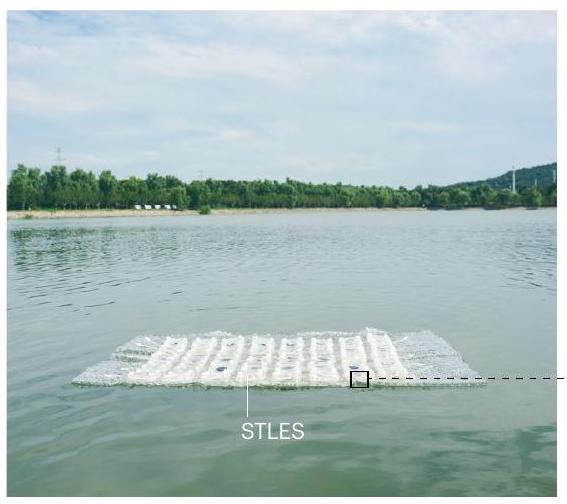
في إحدى الطرق، تم دمج التبخر الشمسي الواجهوي مع تكنولوجيا الأغشية لاستخدام الضغوط الشعرية الكبيرة التي تتولد بشكل سلبي أثناء التبخر الشمسي الواجهوي لدفع عملية فصل الأغشية، مما يلغي الحاجة إلى المضخات الميكانيكية. على سبيل المثال، يحتوي جهاز استخراج وتخزين الليثيوم المدعوم بالطاقة الشمسية من خلال التبخر (STLES) على ثلاث طبقات وظيفية.
تم تطويره لاستعادة الليثيوم المستدام من المحاليل الملحية (الشكل 4أ). الطبقة العليا هي مبخر تبخيري شمسي، تعمل كضغط عالٍ أخضر (حوالي 18 بار) وذات نفاذية عالية ( مضخة. في المنتصف توجد طبقة تخزين ليثيوم، تقوم بنقل الضغط والماء بين المبخر والغشاء وتخزن أملاح الليثيوم المستخرجة. الطبقة السفلية هي -غشاء انتقائي، يسمح بـ لتمرير وحجب أيونات أخرى متزامنة، مثل و . يعمل نظام STLES المُصنّع من خلال ثلاث خطوات رئيسية. أولاً، تخلق عملية التبخر الشمسي ضغطًا شعريًا عاليًا داخل المبخر. بعد ذلك، يتم نقل هذا الضغط الناتج عن التبخر إلى الغشاء، مما يؤدي إلى تدفق الليثيوم من المحلول الملحي إلى طبقة تخزين الليثيوم. أخيرًا، تنقل دورة المياه الليثيوم المستخرج إلى الخزان وتجدد الجهاز. يسمح التكوين المعياري باستخراج الليثيوم القابل للتوسع من خلال دمج وحدات STLES متعددة في منصة موسعة (الشكل 4أ). لإثبات الفكرة، تم تصنيع منصة STLES وعملت بنجاح باستخدام الطاقة الشمسية لاستخراج الليثيوم من المحاليل الملحية.
استراتيجية الترشيح الغشائي المدفوعة بالتبخر متعددة الاستخدامات ويمكن تكييفها لمختلف التطبيقات عن طريق استبدال الغشاء . على سبيل المثال، تم تطوير زجاجات مياه تحلية مدفوعة بالشعيرات الدموية من خلال دمج التبخر الشمسي مع عكس
فصل غشائي مدفوع بالتبخر الشمسي
مبخر انتقائي للأيونات

C بلورة مفصولة مكانياً

الشكل 4 | استخراج الموارد عبر التبخر الواجهوي المدفوع بالطاقة الشمسية.
أ، يستخدم فصل الغشاء المدفوع بالتبخر الشمسي (STLES) التبخر المدفوع بالطاقة الشمسية لإنشاء ضغط شعري عالٍ داخل المبخر. يتم نقل هذا الضغط إلى الغشاء الانتقائي، مما يتسبب في تدفق محلول ملحي من الليثيوم إلى طبقة التخزين. تنقل الدورة المائية الليثيوم المستخرج إلى الخزان وتجدد الجهاز. ب، يقوم المبخر الانتقائي للأيونات باستخراج الموارد مثل الليثيوم من المصادر المائية. ج، تقوم البلورة المفصولة مكانياً باستخراج الليثيوم من المياه المالحة بشكل انتقائي.
د مصفوفة
هـ التحفيز الضوئي الحراري الواجهوي
عندما يتبخر الماء، تتبلور الأملاح ذات التركيزات الأعلى والذوبانية الأقل
(مثل NaCl) عند ارتفاعات أقل من بلورة الألياف. تتساقط الأملاح ذات التركيزات الأقل والذوبانية الأعلى (مثل LiCl) بالقرب من القمة. د، نموذج أولي لمصفوفة استخراج الليثيوم تحتوي على بلورات ثلاثية الأبعاد. تُرى بلورات الملح على بلورات الألياف السليلوزية الزرقاء. هـ، المحفزات الضوئية المدمجة في المبخرات الواجهوية تحفز تحويل بخار الماء المتولد إلى هيدروجين. الجزء أ تم تعديله بإذن من المرجع 119، AAAS. الجزء د تم تعديله من المرجع 136، Springer Nature Limited.
غشاء التناضح . هذه الزجاجات، بقطر 9.4 سم وزعنفة حلقية بعرض 10 سم، قادرة على إنتاج حوالي 11 لتر من المياه العذبة يومياً من مياه البحر، مما يسهل إنتاج المياه في المناطق الساحلية.
استراتيجية أخرى لاستخراج المعادن الحرجة من مصادر المياه تجمع بين التبخر الشمسي الواجهوي والامتزاز الانتقائي (الشكل 4ب). يوفر التبخر الشمسي الواجهوي فائدتين رئيسيتين. أولاً، يسرع من امتصاص الأيونات من خلال تحسين الانتشار ونقل الكتلة ; ثانياً، يعزز سعة امتصاص الأيونات لأن امتصاص الأيونات عادة ما يكون ماصاً للحرارة، وزيادة درجة الحرارة تحرك التوازن نحو سعة امتصاص أكبر، وفقاً لمبدأ لو شاتلييه . تم تنفيذ هذا النهج في مبخر شمسي مدمج مع منخل تم استخدامه لاستعادة الليثيوم من بحيرة ملحية شديدة الملوحة . من الجدير بالذكر أن كل من سعة التقاط الليثيوم وحركية الامتصاص تضاعفت بفضل ارتفاع درجة الحرارة الناتج عن التأثير الضوئي الحراري، الذي يرفع درجة الحرارة بمقدار . علاوة على ذلك، يتم إعادة تدوير المياه العذبة المنتجة للتخلص و تجديد المنخل، مما يحقق بصمة مائية وكربونية قريبة من الصفر.
وبالمثل، تم تثبيت مواد ماصة مختلفة على مبخرات شمسية مسامية لاستعادة المعادن الانتقائية . ومع ذلك، فإن أحد القيود المحتملة لهذا النهج هو الاستقرار – حيث أن جزيئات المادة الماصة مرتبطة بشكل غير محكم بالمبخر ويمكن أن تسقط أثناء التشغيل . الحل الأنيق هو تفعيل هيكل المبخر مباشرة. على سبيل المثال، يمكن ربط DNAzyme المحدد لليثيوم بشبكة بولي أكريلاميد عبر التفاعل المشترك، مما يشكل هيدروجيل DNA مستقر لاستخراج اليورانيوم من مياه البحر الطبيعية .
يعد التبخر الواجهوي المدفوع بالطاقة الشمسية واحدة من التقنيات القليلة التي يمكن أن تجفف تمامًا المحاليل شديدة الملوحة. من خلال استغلال الفروق في الذوبانية (تتبلور الأملاح المختلفة تحت ظروف أو مواقع مكانية متميزة)، يمكن لهذه العملية فصل المعادن القيمة بشكل انتقائي من المحاليل المالحة. على سبيل المثال، تم تطوير مبخرات قائمة على الخيوط لجمع الليثيوم من المياه المالحة بناءً على البلورة المفصولة مكانياً (الشكل 4ج). تتكون المبخرات القائمة على الخيوط من ألياف سليلوزية مسامية ومجعدة تتميز بنواة محبة للماء وسطح كاره للماء. عندما تُغمر نهاياتها في مياه مالحة، يمكن أن ترفع الهيكل المسامي الماء عبر العمل الشعري وتسمح بتبخر الماء بسرعة على الأسطح الجانبية . عندما يتبخر الماء، تتبلور الأملاح ذات التركيزات الأعلى والذوبانية الأقل، مثل كلوريد الصوديوم، عند ارتفاعات أقل من مبخر الألياف. بالمقابل، تتحرك الأملاح ذات التركيزات الأقل والذوبانية الأعلى، مثل كلوريد الليثيوم، لأعلى وتتساقط بالقرب من القمة (الشكل 4ج). تتيح هذه البلورة المفصولة مكانياً جمع الليثيوم والصوديوم بشكل فردي، مما يلغي الحاجة إلى مواد كيميائية إضافية. ميزة ملحوظة أخرى للمبخرات القائمة على الخيوط هي قابليتها للتوسع والتكيف. على سبيل المثال، تم إثبات نموذج أولي يتكون من 100 مبخر قائم على الخيوط بنجاح (الشكل 4د). ومع ذلك، هناك حاجة إلى مزيد من التحقيق لفحص آثار توسيع نظام المعالجة الذي يتضمن عددًا أكبر من الخيوط. قد تشمل العيوب المحتملة تقليل انتشار البخار .

الهيدروجين

يتم تطوير دمج التبخر الشمسي الواجهوي مع التحفيز الضوئي لإنتاج الهيدروجين مباشرة من مياه البحر . يوفر نهج التحفيز الضوئي الحراري الواجهوي ثلاث فوائد رئيسية: بخار الماء المتولد يتم تنقيته بشكل طبيعي، مما يلغي الحاجة إلى محطات تحلية كبيرة ومعقدة مقاومة للتآكل؛ تكوين واجهة السائل-البخار يسهل الإزالة السريعة للهيدروجين المتولد والأكسجين ( ) الغازات، مما يعزز تفاعل التحفيز نحو المنتج المطلوب
؛ ويتطلب التحفيز الضوئي في الطور الغازي طاقة أقل لتفكيك الماء بسبب انخفاض الطاقة الحرة القياسية لجيس في تكوين الماء الغازي مقارنة بالسائل ( مقابل .
يستخدم أحد نهج التحفيز الضوئي الحراري الواجهوي نظام ثنائي الطور، يتم بناؤه عن طريق طلاء جزيئات أكسيد الكوبالت (CoO) الضوئية على شرائح الخشب المحترقة (الشكل 4هـ). تحت ضوء الشمس، يولد الخشب المحترق بخار ماء وفير عبر التبخر الضوئي الحراري، والذي يتم تقسيمه بعد ذلك إلى بواسطة CoO. يقلل هذا النظام الثنائي الطور من مقاومة نقل غاز الهيدروجين بمقدار يقارب مرتبتين من حيث الحجم ويقلل حرارياً من حاجز الواجهة في عملية امتصاص جزيئات الماء في الطور الغازي إلى المحفزات الضوئية. نتيجة لذلك، حقق نظام CoO-الخشب الثنائي الطور معدل إنتاج هيدروجين يصل إلى ، وهو 17 مرة أعلى من معدل جزيئات CoO وحدها .
اتباعًا لنفس المبدأ كما في الأنظمة الثنائية الطور، تم تطوير أوراق هجينة من المحفز الضوئي الحراري لتحسين تنقية المياه وتوليد الهيدروجين من مياه البحر . يمكن أن تطفو الأوراق المعالجة كارهة للماء على الماء، مما يسمح بالفصل الكامل للمحفزات الضوئية عن المحلول الموجود أسفلها. يمنع هذا الفصل تلوث المحفزات الضوئية، مما قد يؤثر سلبًا على أدائها بمرور الوقت، وبالتالي يعزز استقرارها وفعاليتها. نتيجة لذلك، يمنح هذا التصميم استقرارًا تشغيليًا يتجاوز 154 ساعة في مياه البحر وغيرها من تيارات النفايات المائية.
يمكن أيضًا دمج التبخر الواجهوي مع التحليل الكهربائي PV لتوليد الهيدروجين . تم تطوير نموذج أولي يتكون من غطاء شفاف، خلية PV ومحلل كهربائي. تقوم خلايا PV بتحويل الطاقة الشمسية إلى كهرباء لتشغيل المحلل الكهربائي، الذي يستخدم هذه الكهرباء لتفكيك الماء، مما ينتج و . من المهم أن تسخين المحفزات الضوئية يرفع درجة الحرارة التحفيزية المحلية، ويعزز الحمل الحراري فوق سطح المحفز لإطلاق الغاز بشكل أسرع، ويغني بالقرب من أسطح المحفز، مما يعزز الأداء التحفيزي .

تحتاج إلى توسيع نطاق واستعادة متعددة المنتجات

استخراج الموارد المستدامة من خلال التبخر الشمسي الواجهاتي مرتبط بمفهوم الاقتصاد الدائري. هناك حاجة إلى طرق معالجة تسمح بالاسترداد المتزامن أو المتسلسل لعدة منتجات لتقليل تأثير استخراج الموارد. على سبيل المثال، تركز التقنيات الحالية للتبخر الشمسي لاستخراج الليثيوم من المحاليل الملحية بشكل أساسي على استخراج الليثيوم مع التخلص من مواد قيمة أخرى مثل المغنيسيوم والبوتاسيوم والكالسيوم والصوديوم والبورون الموجودة في المحاليل الملحية. لضمان الاستدامة وتحسين الجدوى الاقتصادية، يجب تصميم التقنيات المستقبلية لاسترداد اثنين أو أكثر من هذه المنتجات بشكل مشترك.
يتم معالجة كميات هائلة من المحلول الملحي على نطاق صناعي. على سبيل المثال، يتطلب إنتاج 20,000 طن من كربونات الليثيوم معالجة حوالي من المحلول الملحي . ستحتاج تقنيات التبخر الشمسي الواجهاتي لاسترداد الموارد إلى التوسع بشكل مناسب لتكون قابلة للتطبيق في العالم الحقيقي. لذلك، فإن التجارب التي تُجرى تحت إشعاعات شمسية مرتفعة أو داخل غرف مغلقة صغيرة الحجم مفيدة لأغراض البحث، لكنها مجرد نقطة انطلاق، وهناك حاجة إلى عروض أكبر.

إنتاج الغذاء

ينتج التبخر الشمسي الواجهاتي ماءً مناسبًا للزراعة، مما يدفع الجهود لدمج تحلية المياه الشمسية الواجهات مع
الزراعة. يمكن أن تكون أنظمة تحلية المياه الشمسية الواجهات-الزراعة مفيدة بشكل خاص في المناطق الساحلية حيث تكون المياه العذبة والتربة الخصبة نادرة. غالبًا ما تعتمد الزراعة الساحلية على طرق تحلية مكلفة ومرتفعة الطاقة ، لكن أنظمة التبخر الشمسي تقوم بتحلية المياه بشكل سلبي، مما يجعلها أكثر فعالية من حيث التكلفة . يمكن لأنظمة التبخر الشمسي غسل التربة المالحة أو الملوثة، مما يوسع الأراضي القابلة للزراعة . أخيرًا، يمكن لبعض هذه الأنظمة العمل على المحيط، مما يقلل من استخدام الأراضي ويكون مفيدًا في المناطق ذات المساحة المحدودة . تناقش هذه القسم تطبيقات التبخر الشمسي الواجهاتي في إنتاج الغذاء المباشر وإصلاح التربة لزيادة الأراضي المتاحة لإنتاج غذاء آمن.

الزراعة على المحيط عبر التحلية

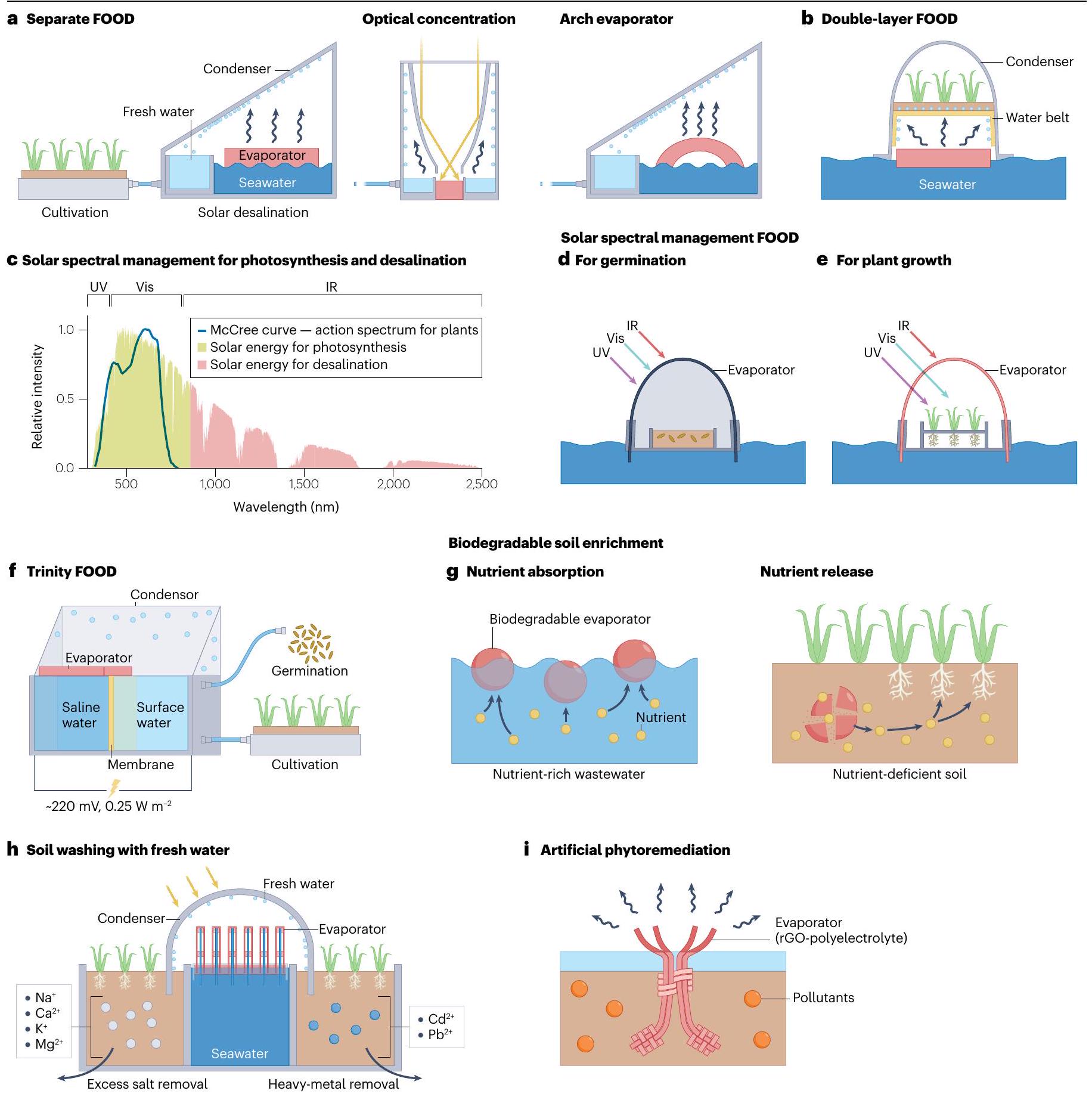
تدمج استراتيجية الزراعة على المحيط عبر التحلية (FOOD) تحلية مياه البحر المدفوعة بالطاقة الشمسية الواجهات مع الزراعة . يمكن أن يحتوي نظام FOOD على غرفتين منفصلتين متصلتين بأنبوب لنقل المياه العذبة من غرفة التحلية إلى غرفة نمو النباتات (نظام FOOD المنفصل في الشكل 5a). يمكن تحسين التحلية والزراعة بشكل مستقل في هذا النظام، ويمكن تنفيذ استراتيجيات لتعزيز إنتاج المياه العذبة في وحدة التحلية. على سبيل المثال، تم استخدام التركيز البصري لأشعة الشمس لتقليل المتطلبات المكانية للتبخر الشمسي (الشكل 5a)، مما يترك مساحة أكبر متاحة للزراعة . تم أيضًا استخدام التقطير متعدد المراحل ، والتبخر المعزز بالبيئة ورفض الملح المدفوع بمارانغوني (المبخر القوسي في الشكل 5a) لتحسين إنتاج المياه واستقرار نظام FOOD على المدى الطويل.
إن تركيب أنظمة FOOD مع غرف تحلية وزراعة منفصلة أمر بسيط، لكن النظام له عيبان أساسيان . أولاً، يمكن أن تستخدم الوحدات التشغيلية المنفصلة كمية كبيرة من الأرض (حتى مع المكثفات البصرية)، مما قد يكون مشكلة في المناطق ذات المساحة المحدودة. ثانيًا، فإن الكفاءة العامة لاستخدام الطاقة الشمسية منخفضة لأن عملية التمثيل الضوئي تعتمد فقط على الضوء المرئي، الذي يمثل فقط من الطاقة الشمسية . للتغلب على هذه القيود، تدمج أنظمة FOOD ذات الطبقات المزدوجة العمودية تحلية المياه الشمسية وزراعة النباتات على نفس الأرض (الشكل 5b). يحتوي هذا التصميم على غرفتين، مع الزراعة في الغرفة العليا وإنتاج المياه العذبة من خلال تحلية المياه الشمسية الواجهات في الغرفة السفلى. يربط حزام نقل المياه بين الغرفتين ويزود باستمرار المياه المحلاة من غرفة التحلية السفلى إلى الغرفة الزراعية. يستخدم نظام FOOD العمودي المساحة بكفاءة لكنه يفتقر إلى كفاءة الطاقة الشمسية، لأن الغرفة الزراعية العليا تحد من ضوء الشمس الذي يصل إلى غرفة التحلية السفلى.
تتناول أنظمة إدارة الطيف الشمسي FOOD قيود المساحة واستخدام الطاقة من خلال تقسيم الطاقة الشمسية إلى مكونين . يتم استخدام الأطوال الموجية الأقصر (مثل الأشعة فوق البنفسجية والضوء المرئي، حوالي ) لنمو النباتات والأطوال الموجية الأطول (في الأشعة تحت الحمراء القريبة، حوالي ) تُستخدم لتحلية المياه الشمسية (الشكل 5c). ميزة رئيسية لنظام FOOD لإدارة الطيف الشمسي هي أن ضوء الشمس والمياه العذبة قابلة للتعديل لمختلف النباتات ومراحل النمو. على سبيل المثال، خلال مرحلة الإنبات، تتطلب البذور مياه وفيرة لكن ضوء الشمس ليس ضروريًا. يتم تركيب قبة سوداء، تمتص الطيف الكامل من ضوء الشمس (الأشعة فوق البنفسجية والمرئية والأشعة تحت الحمراء)، وتزيد من إنتاج المياه بينما تحجب ضوء الشمس تمامًا (الشكل 5d). خلال مرحلة نمو النباتات، تتطلب النباتات كل من ضوء الشمس والمياه. لذلك، يتم استبدال القبة السوداء بقبة شبه شفافة مصنوعة من مادة فوتونية انتقائية تمتص الضوء تحت الأحمر بينما
تسمح بمرور الضوء فوق البنفسجي والمرئي. تتيح هذه التكوينات للضوء فوق البنفسجي والمرئي الوصول إلى النباتات لعملية التمثيل الضوئي، بينما يتم امتصاص الضوء تحت الأحمر بواسطة الغلاف الخارجي للتحلية (الشكل 5e). وبالتالي، تعمل هذه الاستراتيجية على تحسين كفاءة استخدام كل من الأرض والطاقة الشمسية.
يمكن أن يؤدي دمج تقنيات استخراج الطاقة الأخرى (مثل طاقة تدرج الملوحة ، طاقة المد والجزر ، الطاقة الحرارية الكهربائية ، وطاقة الأمواج ) مع نظام FOOD إلى توليد الكهرباء بالإضافة إلى الغذاء والمياه العذبة، مما يعزز الاستخدام العام للطاقة الشمسية. على سبيل المثال، ينتج نظام FOOD الثلاثي الذي يجمع بين تحلية المياه الشمسية وتوليد الطاقة وري المحاصيل في نفس الوقت مياه عذبة، طاقة كهربائية ووسائط زراعة المحاصيل باستخدام الطاقة الشمسية (الشكل 5f). تزيد تحلية المياه الشمسية من ملوحة مياه البحر من حوالي إلى حوالي ، مما يوفر إمدادًا مستمرًا من مياه البحر عالية الملوحة. يتم استخراج الطاقة من تدرج الملوحة بين مياه البحر عالية الملوحة والمياه السطحية باستخدام التحليل الكهربائي العكسي، مما يولد جهدًا يبلغ حوالي 220 مللي فولت وكثافة طاقة قصوى تبلغ . يتم جمع المياه العذبة الناتجة من عملية تحلية المياه الشمسية ( يوميًا) مركزيًا وتزويدها إلى قسم زراعة القمح، الذي يتطلب يوميًا.
تستفيد مزرعة الزراعة العائمة المستندة إلى التبخر الشمسي الواجهاتي من المحيط وضوء الشمس للزراعة، مما يوفر الغذاء في المناطق الساحلية. تم زراعة محاصيل مثل القمح والخضروات مثل الخس والبازلاء بنجاح عبر FOOD. حتى الآن، كانت مزارع تحلية المياه-الزراعة، كتقنية ناشئة، محصورة بشكل رئيسي في دراسات على نطاق المختبر. سيتطلب توسيع هذه الأنظمة تقدمًا هندسيًا كبيرًا. تشكل الكفاءة المنخفضة للتكثيف للأجهزة السلبية تحديات لتحسين إنتاجية المياه، مما يبرز الحاجة إلى تصاميم تكثيف محسنة. الدراسات العملية طويلة الأجل ضرورية لتقييم الإمكانية للتراكم الحيوي ودوام الأجهزة في الأحداث الجوية القاسية، مثل الأعاصير.
للاستفادة الكاملة من إمكانيات أنظمة FOOD، هناك حاجة إلى مزيد من التطوير والاختبار لإنتاج الغذاء وتحقيق الدائرية المادية. يمكن تربية أنواع مقاومة للملوحة ومربحة مثل الروبيان الأبيض، والجمبري الهندي، وسمك البلطي وسمك الحليب في بركة التحلية. يمكن استخراج العناصر الغذائية والمعادن الأساسية من الأملاح المركزة المتبقية من التحلية. علاوة على ذلك، يمكن إعادة استخدام النفايات الزراعية، مثل قش الأرز وقطع الذرة ، لبناء مكثفات شمسية، مما يقلل من تكاليف المواد ويقلل من توليد النفايات. يمكن أن تدفع التحلل الحراري الشمسي هذه العملية، مما يحول المنتجات الثانوية إلى مواد فوتوحرارية صديقة للبيئة وعالية الأداء . تعزز هذه المقاربة الدائرية كل من الاستدامة والجدوى الاقتصادية لأنظمة FOOD.

إصلاح التربة

يمكن أن يقوم التبخر الشمسي المدفوع بالطاقة الشمسية بإصلاح التربة الملوثة من خلال الغسل , تحسين التربة القابلة للتحلل البيولوجي و التنظيف الاصطناعي للنباتات . يمكن استخدام التربة المعالجة بعد ذلك في إنتاج الغذاء، بعد اختبارات السلامة الدقيقة.
غسل التربة بالمياه العذبة الناتجة عن تحلية المياه الشمسية السطحية يزيل الملوثات مثل الأملاح الزائدة والمعادن الثقيلة والمبيدات من التربة. إن استخدامه الحصري للطاقة الشمسية المجانية وقابليته للتطبيق على موارد المياه المختلفة (بما في ذلك مياه البحر) يجعله مناسبًا بشكل خاص للمناطق الساحلية، حيث يمكن أن توفر تحلية المياه الشمسية السطحية إمدادًا ثابتًا من المياه العذبة من مياه البحر لكل من معالجة التربة المالحة والري الزراعي . يتضمن الإعداد النموذجي لتحلية المياه الشمسية السطحية خزان مياه البحر، وغرفة تحلية المياه الشمسية السطحية، وتربة مالحة

غرفة (الشكل 5 ج). تمر أشعة الشمس من خلال الغطاء الشفاف ويتم امتصاصها وتحويلها إلى حرارة بواسطة مبخر ضوئي حراري. تسهل هذه الحرارة تبخر مياه البحر ويتكثف البخار الناتج إلى مياه عذبة تتساقط إلى التربة. تظهر الاختبارات الميدانية أن هذه الطريقة تزيل الملوثات الخطرة بمعدل أسرع بثلاث مرات من التقطير الشمسي، استنادًا إلى التبخر الطبيعي، مما يكمل العملية في 16 يومًا بدلاً من 50 يومًا .
تتدهور جودة التربة بسبب فقدان العناصر الغذائية والميكروبات أثناء غسل التربة، وهو ما يمثل مشكلة عندما تكون التربة المعالجة
مخصصة للزراعة . تم تصميم المبخرات الشمسية القابلة للتحلل البيولوجي (مثل كريات الهلام الضوئي الحراري المعتمدة على البوليسكاريد) للتخفيف من هذه المشكلات. يتم استخدامها في البداية في معالجة مياه الصرف الصحي، حيث تمتص العناصر الغذائية من مياه الصرف الصحي . بمجرد تشبعها، تُضاف الكريات إلى التربة، حيث تتحلل ببطء وتحرر العناصر الغذائية (مثل الفوسفات، النترات والبوتاسيوم) (الشكل 5ح).
تقوم التنظيف الاصطناعي للنباتات بامتصاص وتركيز وإزالة الملوثات (مثل المعادن الثقيلة) من التربة من خلال محاكاة التنظيف النباتي. يمكن وضع المبخرات الشمسية مباشرة
الشكل 5 | إنتاج الغذاء عبر التبخر السطحي المدفوع بالطاقة الشمسية. أ، الزراعة في المحيط عبر نظام تحلية المياه (FOOD) مع جهازين منفصلين متصلين عبر أنبوب لنقل المياه من غرفة التحلية إلى غرفة الزراعة. يمكن أن يحسن التركيز البصري وطرد الملح المدفوع بواسطة مارانغوني (باستخدام مبخر قوسي) إنتاج المياه في النظام واستقراره على المدى الطويل. ب، يتم تكديس المبخر ومنطقة الزراعة في أنظمة FOOD العمودية ذات الطبقتين، والتي يمكن أن تجلس مباشرة على مصدر مياه مالحة. ج، طيف العمل للنباتات (منحنى مكري، الخط الأزرق) مع طيف AM1.5G المرجعي. تستخدم تحلية المياه والتمثيل الضوئي أطيافًا مختلفة من ضوء الشمس، مما يحسن الكفاءة العامة لاستخدام الطاقة الشمسية من خلال تقليل التداخل الطيفي وزيادة تحويل الطاقة عبر العمليات. د، هـ، نظام FOOD القائم على إدارة الطيف الشمسي مع غرفة تحلية قوسية خارجية وغرفة نمو على شكل مروحة داخلية. يمكن ضبط المبخر لتعتيم داخل الغرفة من أجل الإنبات (اللوحة د) والسماح بمرور الأشعة فوق البنفسجية (UV) والضوء المرئي
(Vis) للنمو النباتي (اللوحة هـ). و، أنظمة FOOD المتكاملة تقوم بتحلية المياه، وتوليد الطاقة وري المحاصيل. يتضمن النظام غرفة لتحلية المياه وتوليد الطاقة وغرفة زراعة. يتم استخراج طاقة تدرج الملوحة بين مياه البحر عالية الملوحة ومياه السطح بواسطة تقنية التحليل الكهربائي العكسي لإنتاج الكهرباء. ز، في معالجة التربة المدفوعة بالطاقة الشمسية، يتم نقل المياه العذبة الناتجة من خلال التبخر الشمسي السطحي مباشرة إلى التربة، حيث يمكن استخدامها في غسل التربة و/أو الري الزراعي. ح، تمتص المبخرات الشمسية القابلة للتحلل البيولوجي العناصر الغذائية من مياه الصرف الصحي وتُنقل إلى التربة، حيث تتحلل وتحرر العناصر الغذائية. ط، تستخدم التنظيف الاصطناعي للنباتات مبخرات مصممة مثل النباتات. تستخدم هذه المبخرات عملية التبخر السطحي الشمسي لتسريع تثبيت الملوثات في التربة أو الماء، مما يعزز عمليات المعالجة. IR، الأشعة تحت الحمراء؛ rGO، أكسيد الجرافين المخفض. الجزء و تم تعديله من المرجع 153، Springer Nature Limited. تم تعديل الجزء من المرجع 146، Elsevier.
على التربة الملوثة لاستخراج أيونات المعادن الثقيلة من خلال النتح . يعزز التسخين الشمسي السطحي التبخر لتسهيل هجرة المعادن الثقيلة من التربة إلى المبخر مع الماء (الشكل 5ي). مع تبخر الماء، يتم تركيز الملوثات والاحتفاظ بها بواسطة المبخرات. التنظيف الاصطناعي للنباتات أكثر كفاءة من التنظيف النباتي وله عدة مزايا : الفعالية مع مستويات تلوث عالية؛ امتصاص سريع للملوثات؛ وسعة امتصاص عالية للملوثات. في تجربة تتعلق بتلوث الرصاص (Pb) في التربة، استخدم نظام التنظيف الاصطناعي للنباتات مبخرًا مزودًا بعوامل ربط Pb، وتم مقارنته مع التنظيف النباتي التقليدي باستخدام عشب الجاودار . بعد أسبوعين، انخفضت أجزاء Pb المتاحة حيويًا في التربة بنسبة مع التنظيف الاصطناعي للنباتات، مقارنةً بـ انخفاض مع التنظيف النباتي.

الطاقة

يمكن حصاد الطاقة من تبخر الماء من خلال تقنيات مثل الطاقة الحرارية الكهربائية، والطاقة الحرارية، وتوليد الطاقة من تدرج الملوحة والطاقة الهيدروفولتائية (الشكل 6أ). يمكن أيضًا دمج التبخر الشمسي السطحي مع خلايا الطاقة الشمسية لتحسين أداء كلا التقنيتين، مما يسمح بالإنتاج المشترك للمياه النظيفة والكهرباء. إن توليد الكهرباء والمياه من التبخر الشمسي السطحي غير متصل بالشبكة وموزع، لذا يمكن أن يوفر مصدر طاقة للمناطق النائية والريفية التي تفتقر إلى الوصول إلى الكهرباء من الشبكة. تناقش هذه الفقرة طرق توليد الطاقة من التبخر الشمسي السطحي والتركيبات الممكنة مع تقنيات توليد الطاقة الأخرى.

توليد الطاقة من تدرج الملوحة

يخلق التبخر السريع للماء تدرج ملوحة بين واجهة التبخر عالية الملوحة والمحلول المحيط منخفض الملوحة. في أنظمة التبخر الشمسي السطحي، يمكن أن تكون كثافة الطاقة لتوليد الطاقة من تدرج الملوحة أعلى من تلك الناتجة عن خلط مياه الأنهار والبحار ويمكن استخدامها لتوليد الكهرباء . على سبيل المثال، يؤدي خلط المحلول الملحي عالي الملوحة الناتج عن التبخر ( ) مع مياه البحر ( ) إلى إنتاج حوالي ، بينما يؤدي خلط مياه البحر ( ) مع مياه الأنهار ( ) إلى إنتاج فقط (المرجع 153). يحتوي نظام واحد لتوليد الطاقة من التبخر الشمسي وتوليد الطاقة من الملوحة على غشاء انتقائي للأيونات بين المبخر ومياه البحر (الشكل 6ب). تحت الإشعاع الشمسي، يتبخر الماء بسرعة ويخلق فرق تركيز بين المحلول تحت المبخر ومياه البحر الكثيفة. يدفع هذا التدرج الأيونات للتشتت عبر الغشاء، مما يولد من الطاقة ويتبخر الماء بمعدل .
نهج آخر يستخدم غشاء لربط المحلول الملحي عالي الملوحة المتبخر مع المحلول الملحي منخفض الملوحة غير المعالج (الشكل 6ج). يعتبر هلام الأيونات سالب الكهربية هو المبخر الشمسي لتبخر النهار والغشاء الانتقائي للأيونات لتوليد الكهرباء في الليل. وبالتالي، ينتج النظام إما مياه عذبة أو كهرباء على مدار 24 ساعة في اليوم. إن دمج وظائف التبخر والانتقائية الأيونية في مادة واحدة يقلل من تعقيد المكونات، مما قد يقلل من تكاليف التشغيل. ومع ذلك، فإن الحاجة إلى تبديل الأوضاع بين النهار (توليد المياه) والليل (توليد الطاقة) تمثل تحديات في تصميم المواد، والمتانة الميكانيكية، وإدارة الحرارة، مما يتطلب تحسينًا دقيقًا للأداء على المدى الطويل.
هناك اعتباران رئيسيان لتقدم توليد الطاقة من تدرج الملوحة. أولاً، إن الناتج الحالي للطاقة البالغ حوالي بعيد جدًا عن الحد الأقصى النظري البالغ (المرجع 170). من المتوقع أن يؤدي تحسين خصائص الغشاء الانتقائي للأيونات، مثل حجم المسام، وتفعيل السطح والانتقائية، إلى تعزيز الناتج بشكل أكبر. ثانيًا، فإن التكلفة العالية والتصنيع المعقد للأغشية التبادلية للأيونات تمثل عائقًا رئيسيًا أمام الاعتماد الواسع. قد تكون الأغشية الخشبية المؤينة أكثر فعالية من حيث التكلفة لهذا التطبيق . غشاء خشبي ( تكلف حوالي دولار أمريكي ، مقارنةً بالولايات المتحدة لأغشية تجارية ومع ذلك، فإن السماكة الكبيرة نسبيًا لأغشية الخشب قد تقيد القدرة وكثافة الطاقة لمولدات الطاقة المالحة المعتمدة على الخشب، حيث أن الأداء عادة ما يتناسب عكسيًا مع سماكة الغشاء. .

توليد الطاقة من تدرج الحرارة

يمكن استخراج الطاقة الحرارية من تبخر الشمس عند الواجهة وتحويلها إلى كهرباء من خلال التأثير الكهروحراري. الكيمياء الحرارية الكهربائية والحرارية الكهربائية طرق. تولد الطرق الكهروحرارية الكهرباء من خلال استخدام فرق في درجة الحرارة عبر وحدة كهروحرارية، التي تعمل عبر تأثير سيبك. . في هذا الإعداد، يكون جانب واحد من الوحدة الكهروحرارية مرتبط بالجزء المسخن من نظام تبخر الطاقة الشمسية، مثل البخار الساخن أو المبخر بينما يتم الحفاظ على الجانب الآخر في اتصال مع منطقة أكثر برودة، مثل الهواء المحيط أو الماء المحيط (الشكل 6د). هذا التدرج في درجة الحرارة عبر الوحدة يولد جهدًا، يمكن استخدامه لتشغيل الأجهزة الخارجية أو تخزينه في البطاريات. لقد أنتجت هذه الطريقة نواتج طاقة من تحت إشعاع الشمس أقل من 30 تحت إشعاع الشمس .
تستغل الأساليب الكهروكيميائية الحرارية الجهدات الكهروكيميائية المعتمدة على درجة الحرارة لتوليد الطاقة. (الشكل 6e). تحتوي خلية حرارية كهربائية نموذجية على قطبين متطابقين، و إلكتروليت من زوج أكسدة-اختزال، واتصال خارجي.

الصندوق 1 | التوليد المشترك للغذاء والطاقة والمياه

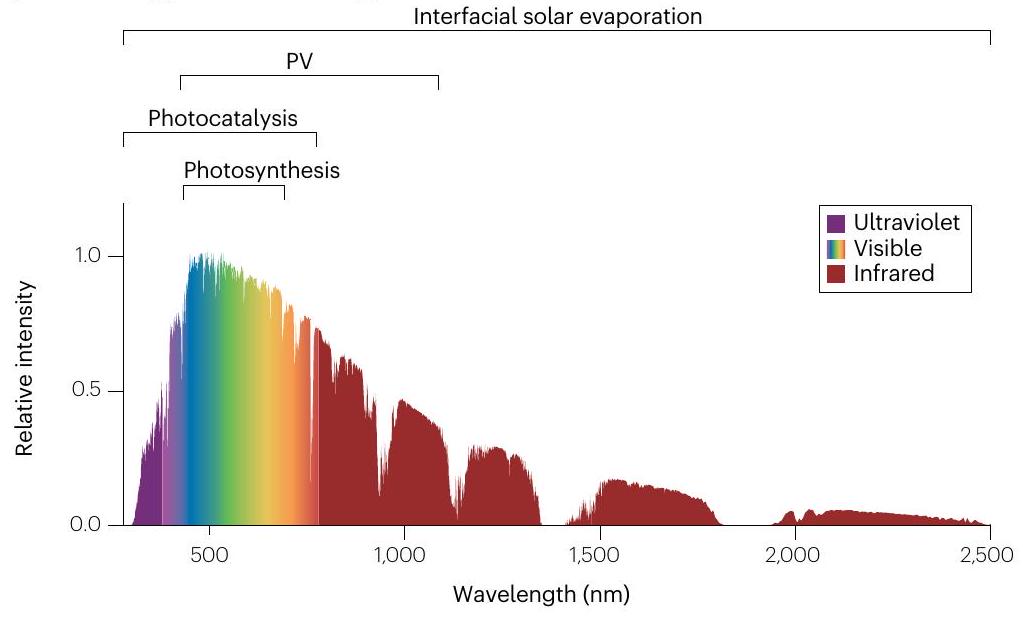
تعتمد تقنيات الطاقة الشمسية المختلفة على أجزاء مختلفة من طيف الشمس (اللوحة أ من الشكل)، لذا فإن إدارة الطاقة الشمسية بكفاءة والتحويل التسلسلي (اللوحة للشكل) مهمة للتوليد المشترك. يمكن استخدام الاستراتيجيات التالية لدمج التبخر الشمسي على الواجهة مع التوليد المشترك للكهرباء، والتدفئة، والتبريد، والطعام والماء، مع افتراض تقريباً الإشعاع الشمسي تُعطى الحسابات التفصيلية، والافتراضات النظامية، والاعتبارات الأساسية في المعلومات التكميلية.

الكهرباء والماء والحرارة

يمكن دمج الألواح الشمسية (PV) وتقنيات تنقية المياه الشمسية عند الواجهة واستعادة الحرارة لاستخدام الإشعاع الشمسي.
عن ) (لوحة تحول الألواح الشمسية 15-20% من الإشعاع الشمسي إلى كهرباء والطاقة الشمسية المتبقية (حوالي يتم امتصاصه بواسطة جهاز تنقية المياه الشمسية الواجهة، مما ينتج حوالي من المياه العذبة. الحرارة المنبعثة أثناء التكثف (حوالي ) يتم التقاطه بواسطة نظام استرداد الحرارة الذي يعيد استخدامه لتدفئة المساحات.

الكهرباء والماء والتبريد

يمكن دمج الألواح الشمسية، وتقنيات تنقية المياه الشمسية عند الواجهة، وتكنولوجيا التبريد بالامتصاص (اللوحة د من الشكل). يتم استخدام الطاقة الشمسية كما في أنظمة الكهرباء والمياه والحرارة، ولكن الحرارة الكامنة التي يتم إطلاقها أثناء التكثيف تشغل نظام التبريد بالامتصاص، مما يوفر طاقة تبريد (حوالي ).
فئات استخدام الطاقة الشمسية
التحويل التسلسلي
الكهرباء-الماء-الحرارة
الكهرباء-الماء-التبريد
مياه-كهرباء-فحم حيوي
غاز التخليق – الماء
الكهرباء-الطعام-الماء
حرارة الماء

(مستمر من الصفحة السابقة)

الكهرباء، الطعام والماء

يمكن دمج الألواح الشمسية، والتمثيل الضوئي، ومنقيات المياه متعددة المراحل على الواجهة (اللوحة e من الشكل). تستخدم الألواح الشمسية 15-20% من الطاقة الشمسية الواردة لتوليد الكهرباء. وتحوّل عملية التمثيل الضوئي حوالي 10% من الطاقة الشمسية في نطاق (حوالي ) إلى الكتلة الحيوية أو الغذاء. الطاقة الشمسية المتبقية (حوالي ) يشغل جهاز تنقية المياه متعدد المراحل عند الواجهة، مما ينتج حوالي من المياه العذبة.

الماء، الكهرباء و الفحم الحيوي

يمكن دمج التحلية متعددة المراحل على الواجهة مع خلايا الوقود الميكروبية (MFCs) وإنتاج الفحم الحيوي (اللوحة من الشكل). وحدة التحلية متعددة المراحل على الواجهة تلتقط حوالي 100% من الطاقة الشمسية لإنتاج مياه عذبة بحوالي يتم تغذية المحلول الملحي أو النفايات العضوية الناتجة في خلايا الوقود الميكروبية، التي تولد حوالي من الكهرباء أثناء معالجة النفايات. يتم تحويل المنتجات الثانوية من خلايا الوقود الميكروبية إلى الفحم الحيوي.
تطبيق تدرج حراري يؤدي إلى الأكسدة عند الأنود والاختزال عند الكاثود، مع انتشار الأنواع المخفضة مرة أخرى إلى الأنود للحفاظ على تفاعل مستمر وتدفق التيار. . على سبيل المثال، تم استخدام هذه الخلايا لجني الحرارة الكامنة الناتجة عن تكثف البخار، مع أقصى قدرة إنتاجية تبلغ تحت الإشعاع الشمسي الطبيعي بالمقارنة مع الطرق الكهروحرارية، فإن الخلايا الكهروكيميائية الحرارية أكثر فعالية من حيث التكلفة ولكن عادة ما تكون ذات كثافات طاقة أقل.
على عكس الأجهزة الكهروحرارية والأجهزة الكهروكيميائية الحرارية، لا تتطلب الأجهزة الكهروحرارية تدرجًا حراريًا مكانيًا. بدلاً من ذلك، تقوم بتحويل تقلبات درجة الحرارة الزمنية إلى كهرباء. (الشكل 6f). يتم تحقيق هذا التحويل من خلال دمج فيلم مركب من أكسيد الفاناديوم المخلوط بال tungsten (مخلوط بالـ W) ) وفلوريد البولي فينيليدين (PVDF) في نظام تبخر الشمس عند الواجهة عند التعرض لأشعة الشمس، يتم إضافة W تخضع لانتقال طور يغير تحويلها من الطاقة الشمسية إلى الحرارة ويولد تذبذبات في درجة الحرارة. هذه التقلبات في درجة الحرارة تنشط طبقة PVDF، مما ينتج عنه إنتاج كهربائي مستمر. أظهر النظام تذبذبات حرارية ذاتية التكيف تصل إلى ، مع كثافة طاقة كهربائية قصوى قدرها (مرجع 182).
تسبب التبخر المدفوع بالطاقة الشمسية تدفقًا ديناميكيًا وفيرًا من الماء والبخار والأيونات. لذلك، يمكن تحويل الطاقة الحركية الناتجة عن التبخر إلى طاقة كهربائية من خلال الاستفادة من الجهد الناتج عن حركة السوائل – الفرق في الجهد الناتج عن حركة السوائل عبر وسط مسامي. على سبيل المثال، يمكن أن يولد التدفق الاتجاهي الناتج عن التبخر لمياه البحر عبر قنوات أيونية في مبخر مسامي جهدًا ثابتًا قدره 117.8 مللي فولت (مرجع 187). يمكن أن يؤدي تبخر بخار الماء النقي من أسطح الكربون النانوية إلى إنتاج جهود تصل إلى 1 فولت، مستدامة لأكثر من 300 ساعة. .

توليد الطاقة المائية والكهربائية

ربط الطاقة الشمسية الكهروضوئية مع التبخر الشمسي الواجهاتي يمكن أن يحسن من أداء لوحة الطاقة الشمسية الكهروضوئية، ويعزز الكفاءة العامة لاستخدام الإشعاع الشمسي، وينتج في الوقت نفسه الكهرباء والمياه النظيفة. (الشكل 6g). يتكون النظام من ثلاثة مكونات تعمل بشكل متكامل: خلية ضوئية في الأعلى لتوليد الكهرباء،

غاز التخليق والماء

يمكن دمج الغازification الحيوي المدفوع بالطاقة الشمسية مع تحلية المياه الشمسية الواجهة (لوحة من الشكل). تدفع الإشعاعات الشمسية غازification الكتلة الحيوية إلى الغاز الاصطناعي من خلال عمليات حرارية كيميائية وتحفيزية مدفوعة بالطاقة الشمسية. وتستخدم الحرارة المهدرة لتشغيل وحدة تحلية حرارية، مما يولد حوالي من المياه العذبة. يمكن استخدام الغاز الاصطناعي في تطبيقات التدفئة والطاقة المدمجة.

الماء والحرارة

يمكن دمج الطاقة الشمسية المركزة مع تحلية المياه باستخدام أغشية مدفوعة بالبخار الشمسي وأنظمة تخزين حراري. من الشكل). يقوم نظام الطاقة الشمسية المركزة بتحويل ما يقرب من 100% من الإشعاع الشمسي إلى حرارة عالية الحرارة، والتي تُستخدم لإنتاج بخار عالي الضغط لتشغيل عملية تحلية الأغشية، مما ينتج حوالي من المياه العذبة. الحرارة المهدرة (حوالي يتم تخزينه في مواد التخزين الحراري (مثل الأملاح المنصهرة)، مما يتيح إنتاج الطاقة والمياه بشكل مستمر.
طبقة تداخل حرارية في المنتصف لنقل حرارة التهيئة من خلية الطاقة الشمسية إلى جهاز تنقية المياه، وجهاز تنقية مياه شمسية واجهية في الأسفل لتوليد مياه نظيفة. يمكن أن تكون الألواح الشمسية حتى أكثر برودة من التبخر من المنقي أدناه، مما يتيح زيادة في توليد الكهرباء تصل إلى بالنسبة لنظام الطاقة الشمسية بدون جهاز التنقية يتم نقل الحرارة من خلايا الطاقة الشمسية إلى جهاز تنقية المياه لتنقية المياه بمعدل تحت ضوء الشمس الطبيعي. كما أن النظام المتزامن يعظم استخدام الفوتونات. تستخدم خلايا الطاقة الشمسية العلوية الفوتونات فوق نطاق الطاقة بينما يستخدم المنقي السفلي الفوتونات دون نطاق الطاقة، مما يمثل كفاءة إجمالية في استخدام الطاقة الشمسية تبلغ يمكن زيادة معدل إنتاج المياه بشكل أكبر من خلال جهاز تقطير متعدد المراحل يعمل بالطاقة الشمسية، حيث يتم إعادة استخدام الحرارة الكامنة المنبعثة أثناء تكثف البخار. نسخة ثلاثية المراحل من هذا النظام لديها معدل إنتاج المياه (المرجع 54)، بينما ينتج نظام من خمس مراحل من المياه العذبة من مياه البحر (المرجع 53).

التطبيق والجدوى

تُظهر التجربة لأربعة أنواع من تقنيات توليد الكهرباء المائية-الكهربائية جدوى تقنيات التبخر الواجهاتي المدفوعة بالطاقة الشمسية لتوليد الكهرباء اللامركزية (الشكل 6h والجدول التكميلي 2). الأنظمة الهجينة التي تجمع بين التبخر الشمسي الواجهاتي وتقنيات جمع الطاقة الحرارية أو الملوحة أو الهيدروفولتيك خفيفة الوزن وفعالة من حيث التكلفة، ويمكن أن تولد الحلول غير المتصلة بالشبكة الكهرباء. هذه التقنيات مناسبة للتطبيقات الصغيرة، الموزعة، ذات الطاقة المنخفضة مثل أجهزة إنترنت الأشياء وأجهزة الاستشعار. على سبيل المثال، فإن الجهاز الهيدروفولتيكي المستحث بالتبخر حساس لسرعة الرياح المحيطة، والتي يمكن استخدامها لبناء أجهزة استشعار لسرعة الرياح. .
تعتبر أنظمة الهجين لتحلية المياه بالطاقة الشمسية أكثر ملاءمة للتنفيذ على نطاق واسع، حيث وصلت هذه الأنظمة إلى للكهرباء و للماء في أنظمة منفصلة. يمكن لنظام هجين من الطاقة الشمسية وتحلية المياه بحجم السقف أن ينتج احتياجات المياه الصالحة للشرب والطاقة اليومية لأسرة، تُعرّف هنا بأنها عائلة مكونة من أربعة أفراد بمتوسط استهلاك يتراوح بين 50-60 لترًا من المياه الصالحة للشرب يوميًا و الكهرباء.
توليد الطاقة من خلال التبخر الشمسي على الواجهة لا يزال غير ناضج تكنولوجياً، مع وجود فرصة لتطوير المواد والأنظمة. على سبيل المثال، يمكننا تصور استراتيجية ذات وظيفتين تجمع بين التبخر الشمسي المدفوع بالواجهة مع تقنية الهيدروفولتيك. لتحقيق استرداد الموارد وتوليد الطاقة في وقت واحد. في هذا النظام ذو الوظائف المزدوجة، تستخدم عملية التبخر الشمسي الطاقة الشمسية لتبخير الماء، مما يركز المعادن والأملاح القيمة لتسهيل استخراجها، بينما تقوم تقنية الهيدروفولتيك بتحويل الطاقة الحركية لحركة الماء إلى طاقة كهربائية.
تحتاج تقنيات توليد الطاقة بالتبخر إلى تقييم شامل وتحسين لتعظيم كفاءتها ومعالجة التحديات المحتملة. على سبيل المثال، على الرغم من أن دمج التبخر الواجهاتي مع الخلايا الشمسية يؤدي إلى كفاءة أعلى لكل من الطاقة الشمسية وتحلية المياه، لا تزال هناك شكوك بشأن الجوانب التقنية والاقتصادية للتكنولوجيا. يمكن أن يشكل التلوث البيولوجي المحتمل للألواح بواسطة الأغشية الحيوية الميكروبية مشكلة أكبر فوق الماء مقارنةً باليابسة، وقد يؤدي إلى تقليل إنتاج الطاقة الشمسية. .

ملخص وآفاق المستقبل

تستخدم تقنيات التبخر الواجهوي المدفوعة بالطاقة الشمسية الطاقة الشمسية لمعالجة أو تحلية المياه، واستخراج الموارد، والمساعدة في إنتاج الغذاء و/أو إنتاج الطاقة. يمكن أن تعمل هذه التقنيات خارج الشبكة، مما يجعلها مناسبة بشكل محتمل لتلبية احتياجات الغذاء والماء والطاقة في المناطق الريفية ذات البنية التحتية المحدودة. لقد أدت التقدمات في المواد والأجهزة والأنظمة إلى تحسين الكفاءة والإنتاجية والاستقرار للأنظمة. ومع ذلك، في معظم الحالات، يتم إنتاج موارد الغذاء والماء والطاقة بشكل فردي، مما يقلل من كفاءة الطاقة والمساحة بينما يزيد من التكاليف. يجب إعطاء الأولوية لاستراتيجيات التوليد المشترك التي يمكن أن تنتج موارد الغذاء والماء والطاقة في وقت واحد ضمن نظام موحد لتعظيم كفاءة الطاقة وتقديم فوائد جماعية، مثل انخفاض التكاليف، وتحسين كفاءة المساحة، وزيادة التوفر والاستقرار.
نظرًا لأن تقنيات الطاقة الشمسية المختلفة تعتمد على أجزاء مختلفة من طيف الشمس، فإن إدارة الطاقة الشمسية بكفاءة هي المفتاح لتعظيم استخدام الطاقة وهندسة أنظمة تبخر الشمس على الواجهة للتوليد المشترك. يمتد الإشعاع الشمسي تقريبًا من 200 إلى مع من إجمالي طاقتها في الطيف المرئي ، في الأشعة تحت الحمراء )، والباقي في الأجزاء فوق البنفسجية من الطيف (الصندوق 1). يمكن لتبخر الشمس عند الواجهة استغلال تقريبًا الطيف الشمسي بالكامل، لكن الطاقة الشمسية الكهروضوئية تحول ضوء الشمس إلى كهرباء بشكل أساسي ضمن الطيف المرئي ( ) والأشعة تحت الحمراء القريبة نطاقات (الصندوق 1). تعمل عملية التمثيل الضوئي في نطاقات أضيق بكثير، تحديدًا و (المراجع 150، 151). إن تصميم أنظمة التوليد المشترك التي تستغل بشكل مستقل أجزاء مختلفة من الطيف، وتعمل بشكل متكامل، سيمكن من استخدام ما يقرب من الطيف بالكامل.
يعد النقل التسلسلي أيضًا مهمًا لزيادة الإنتاج الكلي، حيث إنه يلتقط الوسائط الطاقية (الصندوق 1). على سبيل المثال، يمكن استعادة الطاقة الحركية والداخلية للبخار الساخن، الذي غالبًا ما يتم التخلص منه كنفايات، من خلال إعادة تدوير الحرارة المنبعثة أثناء التكثيف. يمكن أن يؤدي دمج المبخر الضوئي الحراري مع التبريد الإشعاعي لإنشاء تدرجات حرارية إلى توليد الكهرباء من خلال الأنظمة الكهروحرارية.
من هذه المبادئ، نقترح استراتيجيات لتوليد الطاقة من الغذاء والماء بكفاءة طاقة عالية ومخرجات مرتفعة، بما في ذلك توليد الغاز الاصطناعي والماء، وتوليد الحرارة والماء، وتوليد الكهرباء والماء مع التبريد، والتسخين، والماء أو الفحم الحيوي (الصندوق 1). سيتطلب تطوير هذه الأنظمة دمج المواد المتقدمة، وتحسين نقل الحرارة والكتلة، والتحكم بدقة في تدفقات الطاقة ومزامنة التقنيات المختلفة. في النهاية، من الضروري مراقبة الإنتاجية والاستقرار على المدى الطويل لـ
هذه الأنظمة في ظروف العالم الحقيقي. علاوة على ذلك، نوصي بشدة بإجراء تقييمات شاملة لدورة الحياة لتقييم الآثار البيئية قبل التنفيذ لتوجيه التطبيق والاستخدام الأكثر كفاءة واستدامة. أخيرًا، ستكون التقدمات في تصميم الأجهزة والإنتاج الضخم حاسمة في خفض التكاليف وجعل هذه التقنيات متاحة على نطاق واسع، مما يضمن الوصول العالمي إلى حلول FEW.
نُشر على الإنترنت: 15 يناير 2025

References

  1. Department of Economic and Social Affairs. The Sustainable Development Goals Report 2023: Special Edition. United Nations https://unstats.un.org/sdgs/report/2023/ (2023).
  2. Kalogirou, S. A. Solar Thermal Energy: History (Springer, 2022).
  3. Li, X. et al. Graphene oxide-based efficient and scalable solar desalination under one sun with a confined 2D water path. Proc. Natl Acad. Sci. USA 113, 13953-13958 (2016).
  4. Zhou, L. et al. 3D self-assembly of aluminium nanoparticles for plasmon-enhanced solar desalination. Nat. Photon. 10, 393-398 (2016).
  5. Xu, N. et al. Going beyond efficiency for solar evaporation. Nat. Water 1, 494-501 (2023).
  6. Tao, P. et al. Solar-driven interfacial evaporation. Nat. Energy 3, 1031-1041 (2018).
  7. Zhao, F., Guo, Y., Zhou, X., Shi, W. & Yu, G. Materials for solar-powered water evaporation. Nat. Rev. Mater. 5, 388-401 (2020).
  8. Dang, C. et al. Structure integration and architecture of solar-driven interfacial desalination from miniaturization designs to industrial applications. Nat. Water 2, 115-126 (2024).
  9. Wu, X. et al. Interfacial solar evaporation: from fundamental research to applications. Adv. Mater. 36, 2313090 (2024).
  10. Wang, X. et al. Solar steam-driven membrane filtration for high flux water purification. Nat. Water 1, 391-398 (2023).
  11. Xia, Y. et al. Spatially isolating salt crystallisation from water evaporation for continuous solar steam generation and salt harvesting. Energy Environ. Sci. 12, 1840-1847 (2019).
  12. Thakur, A. K. et al. Exploring the potential of MXene-based advanced solar-absorber in improving the performance and efficiency of a solar-desalination unit for brackish water purification. Desalination 526, 115521 (2022).
  13. Xu, N. et al. A scalable fish-school inspired self-assembled particle system for solar-powered water-solute separation. Natl Sci. Rev. 8, nwab065 (2021).
  14. Bian, Y. et al. Farming On the Ocean via Desalination (FOOD). Environ. Sci. Technol. 57, 21104-21112 (2023).
  15. Yang, T. et al. Efficient solar domestic and industrial sewage purification via polymer wastewater collector. Chem. Eng. J. 428, 131199 (2022).
  16. Lin, S., Qi, H., Hou, P. & Liu, K. Resource recovery from textile wastewater: dye, salt, and water regeneration using solar-driven interfacial evaporation. J. Clean. Prod. 391, 136148 (2023).
  17. Shang, Y., Li, B., Xu, C., Zhang, R. & Wang, Y. Biomimetic Janus photothermal membrane for efficient interfacial solar evaporation and simultaneous water decontamination. Sep. Purif. Technol. 298, 121597 (2022).
  18. Li, J. et al. Interfacial solar steam generation enables fast-responsive, energy-efficient, and low-cost off-grid sterilization. Adv. Mater. 30, 1805159 (2018).
  19. Zhao, L. et al. A passive high-temperature high-pressure solar steam generator for medical sterilization. Joule 4, 2733-2745 (2020).
  20. Shi, P., Li, J., Song, Y., Xu, N. & Zhu, J. Cogeneration of clean water and valuable energy/resources via interfacial solar evaporation. Nano Lett. 24, 5673-5682 (2024).
  21. Xu, N. et al. A water lily-inspired hierarchical design for stable and efficient solar evaporation of high-salinity brine. Sci. Adv. 5, eaaw7013 (2019).
  22. Menon, A. K., Haechler, I., Kaur, S., Lubner, S. & Prasher, R. S. Enhanced solar evaporation using a photo-thermal umbrella for wastewater management. Nat. Sustain. 3, 144-151 (2020).
  23. Ni, G. et al. A salt-rejecting floating solar still for low-cost desalination. Energy Environ. Sci. 11, 1510-1519 (2018).
  24. Geng, Y. et al. Bioinspired fractal design of waste biomass-derived solar-thermal materials for highly efficient solar evaporation. Adv. Funct. Mater. 31, 2007648 (2021).
  25. Chen, L. et al. Low-cost and reusable carbon black based solar evaporator for effective water desalination. Desalination 483, 114412 (2020).
  26. Zhou, H., Xue, C., Chang, Q., Yang, J. & Hu, S. Assembling carbon dots on vertically aligned acetate fibers as ideal salt-rejecting evaporators for solar water purification. Chem. Eng. J. 421, 129822 (2021).
  27. Dang, C. et al. Ultra salt-resistant solar desalination system via large-scale easy assembly of microstructural units. Energy Environ. Sci. 15, 5405-5414 (2022).
  28. Ibrahim, S., Bari, M. & Miles, L. Water resources management in Maldives with an emphasis on desalination. Maldives Water and Sanitation Authority http://pacificwater.org/ userfiles/file/Case Study B THEME 1 Maldives on Desalination.pdf (2002).
  29. Ahmed, F. E., Hashaikeh, R. & Hilal, N. Solar powered desalination-technology, energy and future outlook. Desalination 453, 54-76 (2019).
  30. Chen, C., Kuang, Y. & Hu, L. Challenges and opportunities for solar evaporation. Joule 3, 683-718 (2019).

مقالة مراجعة

  1. زو، ل.، قاو، م.، بيه، سي. كيه. إن. & هو، ج. و. التقدم الأخير في تبخر الماء على الواجهة المدفوع بالطاقة الشمسية: تصاميم متقدمة وتطبيقات. الطاقة النانوية 57، 507-518 (2019).
  2. تشو، ل. وآخرون. التجميع الذاتي لممتصات بلازمونية عالية الكفاءة وعريضة النطاق لتوليد بخار الشمس. Sci. Adv. 2، e1501227 (2016).
  3. تشو، هـ. ج.، بريستون، د. ج.، زو، ي. ووانغ، إ. ن. مواد نانوية مصممة لهندسة نقل الحرارة في تغيير الطور من السائل إلى البخار. مراجعات الطبيعة للمواد 2، 16092 (2016).
  4. تشانغ، س. وآخرون. تأثير الطاقة السطحية الحرة والميكروهيكل على آلية تكثف بخار الماء. تقدم العلوم الطبيعية. المواد. الدولية 33، 37-46 (2023).
  5. غسيمي، ح. وآخرون. توليد بخار الشمس من خلال تركيز الحرارة. نات. كوميونيك. 5، 4449 (2014).
  6. ني، ج. وآخرون. توليد البخار تحت شمس واحدة ممكن بفضل هيكل عائم مع تركيز حراري. نات. إنرجي 1، 16126 (2016).
  7. . وآخرون. الفطر كأجهزة فعالة لتوليد البخار الشمسي. مواد متقدمة. 29، 1606762 (2017).
  8. لي، إكس. وآخرون. التبخر الاصطناعي ثلاثي الأبعاد لمعالجة مياه الصرف الصحي بالطاقة الشمسية بكفاءة. مراجعة العلوم الطبيعية 5، 70-77 (2017).
  9. شي، ي. وآخرون. هيكل ضوئي حراري ثلاثي الأبعاد نحو تحسين كفاءة الطاقة في توليد بخار الشمس. جول 2، 1171-1186 (2018).
  10. وانغ، ف. وآخرون. جهاز تنقية المياه الشمسية ذو الهيكل المقلوب عالي الأداء من مرحلة واحدة من خلال تحسين الامتصاص والتكثيف. جول 5، 1602-1612 (2021).
  11. زو، ل.، قاو، م.، بيه، س. ك. ن.، وانغ، إكس. و هو، ج. و. إسفنجات كربونية أحادية الكتلة ذاتية الاحتواء للتقطير بالتبخر المائي المدفوع بالطاقة الشمسية وتوليد الكهرباء. مواد الطاقة المتقدمة 8، 1702149 (2018).
  12. سينغ، س. س. وآخرون. لوحة معدنية سوداء فائقة الامتصاص وقابلة للتتبع الشمسي لمعالجة المياه بالحرارة الشمسية. نات. سستين. 3، 938-946 (2020).
  13. جاني، هـ. ك. ومودي، ك. ف. تقييم الأداء التجريبي لمكثف شمسي ذو حوض واحد وميول مزدوجة مع زعانف مجوفة دائرية ومربعة المقطع العرضي. طاقة شمسية 179، 186-194 (2019).
  14. ليو، ز. وآخرون. توليد بخار شمسي فعال للغاية ومنخفض التكلفة تحت إضاءة غير مركزة باستخدام ورق أسود معزول حرارياً. التحديات العالمية 1، 1600003 (2017).
  15. تشانغ، ل. وآخرون. تحلية المياه الشمسية السلبية عالية الكفاءة والمحددة حرارياً. علوم الطاقة والبيئة 14، 1771-1793 (2021).
  16. تشانغ، ي. وتان، س. ج. أفضل الممارسات لتقنيات إنتاج المياه الشمسية. نات. سستين. 5، 554-556 (2022).
  17. أونغووارسيتو، سي. وآخرون. منظور محدث حول تطبيق توليد البخار الشمسي. علوم الطاقة والبيئة 17، 2088-2099 (2024).
  18. أوه، ج. وآخرون. تكثف الفيلم الرقيق على الأسطح النانوية. مواد وظيفية متقدمة. 28، 1707000 (2018).
  19. وانغ، ز.، إليمليش، م. ولين، س. التطبيقات البيئية للمواد السطحية ذات القابلية الخاصة للبلل. علوم البيئة والتكنولوجيا 50، 2132-2150 (2016).
  20. شو، ز. وآخرون. تحلية مياه فائقة الكفاءة عبر جهاز تبخير شمسي متعدد المراحل موضعي حرارياً. علوم الطاقة والبيئة 13، 830-839 (2020).
  21. شيافازو، إ.، مورسيانو، م.، فيجلينو، ف.، فاسانو، م. وأسيناري، ب. تحلية مياه البحر بالطاقة الشمسية السلبية ذات العائد العالي بواسطة التقطير المعياري ومنخفض التكلفة. نات. سستين. 1، 763-772 (2018).
  22. مورسيانو، م.، فاسانو، م.، بوريسكينا، س. ف.، شيفازو، إ. وأسيناري، ب. مكثف شمسي سلبي ذو إنتاجية عالية وطرد ملح مدفوع بتأثير مارانغوني. علوم الطاقة والبيئة 13، 3646-3655 (2020).
  23. وانغ، و. وآخرون. تكامل تبريد الطاقة الشمسية الكهروضوئية وتحلية مياه البحر مع عدم تصريف السوائل. جول 5، 1873-1887 (2021).
  24. وانغ، و. وآخرون. الإنتاج المتزامن للمياه العذبة والكهرباء عبر تقطير الأغشية الشمسية الفوتوفولطية متعددة المراحل. نات. كوميونيك. 10، 3012 (2019).
  25. Zhang، ل. وآخرون. نمذجة وتحليل أداء الألواح الشمسية متعددة المراحل ذات الكفاءة الحرارية العالية. الطاقة التطبيقية 266، 114864 (2020).
  26. نواز، ف. وآخرون. هل يمكن أن تكون أداء توليد بخار الشمس عند الواجهة حقًا “ما وراء” الحد النظري؟ مواد الطاقة المتقدمة 14، 2400135 (2024).
  27. جينغ، هـ. وآخرون. جهاز تنقية مستوحى من أوراق النباتات يعمل بالطاقة الشمسية لإنتاج مياه نظيفة بكفاءة عالية. نات. كوميونيك. 10، 1512 (2019).
  28. Qi، هـ. وآخرون. مولد مياه جوية مدفوع بالطاقة الشمسية على الواجهة يعتمد على مادة ماصة سائلة مع امتصاص وإطلاق متزامنين. مواد متقدمة 31، 1903378 (2019).
  29. وانغ، إكس. وآخرون. مولد مياه جوية بمساعدة تسخين شمسي على الواجهة باستخدام مادة ماصة سائلة. أنجيو. كيم. إنترناش. إد. 131، 12182-12186 (2019).
  30. شو، و. وياغي، أ. م. الإطارات المعدنية العضوية لجمع المياه من الهواء، في أي مكان، في أي وقت. ACS Cent. Sci. 6، 1348-1354 (2020).
  31. اللورد، ج. وآخرون. الإمكانية العالمية لجمع مياه الشرب من الهواء باستخدام الطاقة الشمسية. ناتشر 598، 611-617 (2021).
  32. هانكل، ن.، بريفو، م. س. وياغي، أ. م. حصادات المياه من MOF. نات. نانو تكنولوجي. 15، 348-355 (2020).
  33. ما، ج. وآخرون. نظام تبخر شمسي كهربائي حراري مع إنتاج مياه مرتفع يعتمد على مبخر متكامل سهل. ج. مواد. كيمياء. أ 8، 21771-21779 (2020).
  34. قو، ق.، يي، هـ.، جيا، ف. وسونغ، س. تصميم الهلام الهوائي ذو الطبقتين المدمج مع مواد تغيير الطور للتناضح الشمسي المستدام والفعال. التحلية 541، 116028 (2022).
  35. شو، ج. وآخرون. إنتاج المياه من الغلاف الجوي المدفوع بالطاقة الشمسية بشكل فائق من خلال جامع مياه سريع الدورة قابل للتوسع مع مادة ماصة نانوية مصفوفة عمودياً. علوم الطاقة والبيئة 14، 5979-5994 (2021).
  36. سونغ، ي. وآخرون. الهندسة الهرمية لجمع المياه الجوية القائم على الامتصاص. مواد متقدمة. 36، 2209134 (2024).
  37. تشو، م. وآخرون. تكثف البخار مع التبريد الإشعاعي خلال النهار. وقائع الأكاديمية الوطنية للعلوم في الولايات المتحدة الأمريكية 118، e2019292118 (2021).
  38. هايشلر، إ. وآخرون. استغلال التبريد الإشعاعي لجمع المياه من الغلاف الجوي على مدار 24 ساعة دون انقطاع. ساينس أدفانس. 7، eabf3978 (2021).
  39. شو، ج. وآخرون. جمع المياه الهجينة الشاملة من الغلاف الجوي لإنتاج المياه على مدار اليوم بواسطة ضوء الشمس الطبيعي والتبريد الإشعاعي. علوم الطاقة والبيئة 17، 4988-5001 (2024).
  40. شان، هـ. وآخرون. إنتاج استثنائي للمياه تم تمكينه بواسطة جامع مياه محمول مُعالج على دفعات في مناخ شبه جاف. نات. كوميونيك. 13، 5406 (2022).
  41. جرينلي، ل. ف.، لولر، د. ف.، فريمان، ب. د.، ماروت، ب. ومولين، ب. تحلية المياه بالتناضح العكسي: مصادر المياه، التكنولوجيا، وتحديات اليوم. أبحاث المياه. 43، 2317-2348 (2009).
  42. وانغ، ي.، تشي، ك.، فان، ج.، وانغ، و. ويو، د. أقمشة MXene/أنابيب الكربون/القطن بسيطة وقوية لتنقية مياه الصرف الصحي النسيجية عبر تبخر الماء على الواجهة المدفوع بالطاقة الشمسية. فصل. تقنية التنقية. 254، 117615 (2021).
  43. تونغ، ت. وإليميلخ، م. الارتفاع العالمي لتقنية عدم تصريف السوائل: الدوافع، والتقنيات، والاتجاهات المستقبلية. علوم البيئة والتكنولوجيا 50، 6846-6855 (2016).
  44. شي، ي. وآخرون. مبخر شمسي مع ترسيب ملح محكوم لإزالة الملح بدون تصريف سائل. علوم البيئة والتكنولوجيا 52، 11822-11830 (2018).
  45. بينغ، ب. وآخرون. هيدروجيلات فوتوحرارية كاتيونية ذات قدرة على تثبيط البكتيريا لإنتاج المياه العذبة من خلال توليد البخار المدفوع بالطاقة الشمسية. مواد ACS التطبيقيه. واجهات. 13، 37724-37733 (2021).
  46. شيا، ق. وآخرون. مبخر شمسي ميكروي متكامل عائم للتنظيف الذاتي وإزالة الملح وتحلل المواد العضوية. مواد متقدمة ذات وظائف 33، 2214769 (2023).
  47. هاو، إكس. وآخرون. جامع مياه شمسية متعدد الوظائف مع قدرة عالية على اختيار النقل ورفض التلوث. نات. ووتر 1، 982-991 (2023).
  48. مي، ب. مبخر شمسي على الواجهة لمعالجة المحلول الملحي: أهمية القدرة على التحمل لدرجات الملوحة العالية. مراجعة العلوم الطبيعية 8، nwab118 (2021).
  49. شينغ، م. وآخرون. تقنيات حديثة متقدمة لمنع الملح ذاتية الدفع لأنظمة تحلية المياه بالتبخر الواجهوي المدفوعة بالطاقة الشمسية السلبية. نانو إنرجي 89، 106468 (2021).
  50. شو، و. وآخرون. ماصات جانوس مرنة ومقاومة للملح بواسطة تقنية النسيج الكهربائي للتناضح الشمسي المستقر والفعال. مواد الطاقة المتقدمة 8، 1702884 (2018).
  51. كووانغ، ي. وآخرون. مبخر شمسي ذاتي التجديد عالي الأداء لإزالة الملح من الماء بشكل مستمر. مواد متقدمة. 31، 1900498 (2019).
  52. زينغ، ج.، وانغ، ق.، شي، ي.، ليو، ب. & تشين، ر. الضخ الأسموزي ورفض الملح بواسطة هيدروجيل البوليمر الكهربائي للتن desalination الشمسي المستمر. مواد الطاقة المتقدمة 9، 1900552 (2019).
  53. تشاو، و. وآخرون. مبخر شمسي مقاوم للملح مصمم بشكل هرمي يعتمد على تأثير دونان لمعالجة المياه المالحة بشكل مستقر وعالي الأداء. مواد وظيفية متقدمة 31، 2100025 (2021).
  54. وو، ل. وآخرون. مبخر شمسي ثلاثي الأبعاد عالي الكفاءة لإزالة الملح من المياه عالية الملوحة عن طريق التبلور المحلي. نات. كوميونيك. 11، 521 (2020).
  55. تشانغ، ق. وآخرون. هلامات هوائية قائمة عمودياً تعتمد على جانوس MXene للتناضح الشمسي بكفاءة عالية ومقاومة للملح. ACS Nano 13، 13196-13207 (2019).
  56. تشين، إكس. وآخرون. التحلية المستدامة للمياه عالية الملوحة خارج الشبكة باستخدام مبخرات الخشب جانوس. علوم الطاقة والبيئة 14، 5347-5357 (2021).
  57. يانغ، ي. وآخرون. تصميم عام لطبقة مزدوجة نانوية هيدروفيلية/هيدروفوبية مقاومة للملح من أجل تقطير مياه الشمس بكفاءة واستقرار. مواد. أفق. 5، 1143-1150 (2018).
  58. يوسف، إ. & حداد، ر. التحلل الضوئي والتثبيت الضوئي للبوليمرات، وخاصة البولي ستيرين: مراجعة. سبرينجر بلس 2، 398 (2013).
  59. أسماتولو، ر.، محمود، ج. أ.، هيل، ج. & ميساك، هـ. إ. تأثيرات تدهور الأشعة فوق البنفسجية على الكارهية السطحية، الشقوق، وسمك الطلاءات النانوية المعتمدة على MWCNT. تقدم. طلاءات عضوية. 72، 553-561 (2011).
  60. هو، س. وآخرون. مبخر شمسي مسامي ثنائي النمط مقاوم للملح مستوحى من الطبيعة من أجل تحلية المياه بكفاءة واستقرار. علوم الطاقة والبيئة 12، 1558-1567 (2019).
  61. ليو، إكس. وآخرون. مبخر هيدروجيل ثلاثي الأبعاد مع أوعية إشعاعية عمودية يكسر التوازن بين التوضع الحراري ومقاومة الملح لتحلية المياه المالحة. مواد متقدمة. 34، e2203137 (2022).
  62. يانغ، ي. وآخرون. مبخر شمسي غير متماثل قابل للتوسع يشبه الصمام الثنائي مع مقاومة ملح فائقة. مواد متقدمة ووظيفية 33، 2210972 (2023).
  63. يانغ، ك.، بان، ت.، دانغ، س.، غان، ق. وهان، ي. هندسة معمارية ثلاثية الأبعاد مفتوحة تمكّن من أجهزة التبخر الشمسية ذات الرفض الملحي مع زيادة كفاءة إنتاج المياه. نات. كوميونيك. 13، 6653 (2022).
  64. Zhang، L. وآخرون. تبخر شمسي عالي الكفاءة ورفض الملح عبر طبقة ماء محصورة بدون فتيل. نات. كوميونيك. 13، 849 (2022).
  65. تشانغ، سي. وآخرون. تصميم بلورة شمسية من الجيل التالي لمعالجة مياه البحر المالحة الحقيقية مع عدم تصريف سائل. نات. كوميونيك. 12، 998 (2021).
  66. كوبر، ت. أ. وآخرون. توليد البخار بدون تلامس والتسخين الفائق تحت إضاءة الشمس الواحدة. نات. كوميونيك. 9، 5086 (2018).
  67. بانيرجي، I.، بانغولي، R. C. وكين، R. S. الطلاءات المضادة للتلوث: التطورات الأخيرة في تصميم الأسطح التي تمنع التلوث بواسطة البروتينات والبكتيريا والكائنات البحرية. مواد متقدمة. 23، 690-718 (2011).
  68. زينغ، إكس.، مكارثي، د. ت.، دليتيك، أ. وزانغ، إكس. هيدروجيل أكسيد الجرافين المخفض/الفضي كمرشح مضاد للبكتيريا جديد لتعقيم المياه عند نقطة الاستخدام. مواد متقدمة ووظيفية 25، 4344-4351 (2015).

مقالة مراجعة

  1. شو، ي. وآخرون. استراتيجية بسيطة وعالمية لترسيب Ag/بوليبيرول على ركائز متنوعة لتعزيز تبخر الشمس عند الواجهة والنشاط المضاد للبكتيريا. مجلة الهندسة الكيميائية 384، 123379 (2020).
  2. لي، ي. وآخرون. نظام ذاتي الضخ قائم على الهيدروجيل المركب مع مقاومة للملح والبكتيريا لتبخر المياه المدعوم بالطاقة الشمسية بكفاءة فائقة. تحلية 515، 115192 (2021).
  3. رسول، ك. وآخرون. غشاء مضاد للبكتيريا فعال يعتمد على ثنائي الأبعاد أوراق نانوية (MXene). Sci. Rep. 7، 1598 (2017).
  4. زا، إكس. جي. وآخرون. غشاء ليفي مرن مضاد للتلوث البيولوجي من الماكسين/السليلوز لتنقية المياه المستدامة المدفوعة بالطاقة الشمسية. ACS Appl. Mater. Interf. 11، 36589-36597 (2019).
  5. قو، ي.، دونداس، س. م.، تشو، إكس.، جونستون، ك. ب. & يو، ج. الهندسة الجزيئية للهلاميات المائية للتعقيم السريع للمياه وتوليد بخار شمسي مستدام. مواد متقدمة. 33، e2102994 (2021).
  6. لي، ي. وآخرون. التلاعب في احتجاز الضوء وحرارة تبخر الماء من خلال الهيدروجيل الهجين المسامي من أجل تعزيز تبخر الماء على الواجهة المدفوع بالطاقة الشمسية مع القدرة المضادة للبكتيريا. ج. مواد. كيمياء. أ 7، 26769-26775 (2019).
  7. سالكي، أ. م.، إيفان، م. ن. أ. س.، أحمد، س. وتسانغ، ي. هـ. نسيج هيدروجيل حابس للضوء بخصائص مضادة للتلوث البيولوجي ومضادة للبكتيريا للتن desalination الشمسي الفعال. مجلة الهندسة الكيميائية 458، 141430 (2023).
  8. كوي، ل. وآخرون. التبخر المائي على الواجهة المدفوع بالطاقة الشمسية لتنقية المياه العادمة: التقدمات والتحديات الأخيرة. مجلة الهندسة الكيميائية 477، 147158 (2023).
  9. زوه، ي. وآخرون. هلام السليلوز المملوء بالبوليدوبامين المستوحى من المحار لمعالجة المياه المدعومة بالطاقة الشمسية. مواد ACS التطبيقيه. واجهات 13، 7617-7624 (2021).
  10. أبيلسون، ب. هـ. تلوث المياه الجوفية. العلوم 224، 673-673 (1984).
  11. ما، ج.، شو، ي.، صن، ف.، تشن، إكس. ووانغ، و. منظور لإزالة المركبات العضوية المتطايرة أثناء تبخر الماء المدفوع بالطاقة الشمسية نحو إنتاج الماء. إيكومات 3، e12147 (2021).
  12. تشانغ، ب. وآخرون. هلامات فائقة لاستخراج المياه لإدارة المركبات العضوية المتطايرة المدعومة بالطاقة الشمسية في الدورة الهيدرولوجية. مواد متقدمة. 34، e2110548 (2022).
  13. دينغ، ج. وآخرون. ميكرو رياكتور حراري ضوئي معلق ذاتيًا لتحلية المياه وإزالة المركبات العضوية المتطايرة المدمجة. مواد ACS تطبيقيه. واجهات 12، 51537-51545 (2020).
  14. سونغ، سي. وآخرون. تقطير شمسي معتمد على غشاء نانوي ذو مسام مزدوجة الحجم لالتقاط المركبات العضوية المتطايرة بواسطة التأثير الضوئي الحراري/التحفيزي الضوئي. علوم البيئة والتكنولوجيا 54، 9025-9033 (2020).
  15. تشانغ، ب.، وونغ، ب. وآن، أ. ك. غشاء هيدروجيل MXene المدعوم حرارياً مع تبخر مدفوع بالطاقة الشمسية وتفكك ضوئي لتنقية المياه بكفاءة. مجلة الهندسة الكيميائية 430، 133054 (2022).
  16. يانغ، ي. وآخرون. رغوة ضوئية قابلة للتجديد وقابلة للتوسع صناعيًا. أنف. سست. سيست. 7، 2300041 (2023).
  17. يان، س. وآخرون. هيدروجيل هجين من أكسيد الجرافين المخفض والبوليبيرول المتكامل للتطهير الضوئي المتزامن وتبخر الماء. تطبيقات الحفز ب 301، 120820 (2022).
  18. تشاو، و. وآخرون. مراجعة نقدية حول تطبيق المحفزات النانوية المعدلة سطحياً في التحلل الضوئي للمركبات العضوية المتطايرة. علوم البيئة. نانو 9، 61-80 (2022).
  19. بينغ، ي. وآخرون. غشاء مركب من إطار معدني عضوي للتصوير الحراري لإزالة المركبات العضوية المتطايرة عالية التركيز من الماء عبر الغربلة الجزيئية. ACS Nano 16، 8329-8337 (2022).
  20. Qi، د. وآخرون. أغشية بوليمرية ذات انتشار انتقائي للحل لاعتراض المركبات العضوية المتطايرة أثناء معالجة المياه المدفوعة بالطاقة الشمسية. مواد متقدمة. 32، e2004401 (2020).
  21. سونغ، ي. وآخرون. استخراج وتخزين الليثيوم المدعوم بالتبخر الشمسي. ساينس 385، 1444-1449 (2024).
  22. ليانغ، هـ.، مو، ي.، ين، م.، هي، ب.-ب. & قوه، و. تحلية مياه البحر بكفاءة عالية واستخراج مستهدف عالي التحديد باستخدام هيدروجيلات الحمض النووي الذكية المعتمدة على الطاقة الشمسية. ساينس أدف. 9، eadj1677 (2023).
  23. بورنرونغروج، س. وآخرون. أوراق هجينة من الفوتوحرارية والفوتوكاتاليست لتقسيم الماء الشامل المدفوع بالطاقة الشمسية المرتبطة بتنقية المياه. نات. ووتر 1، 952-960 (2023).
  24. لي، و. هـ. وآخرون. هلامات نانوية فوتوكاتاليتيكية قابلة للطفو لإنتاج الهيدروجين الشمسي على نطاق واسع. نات. نانو تكنولوج. 18، 754-762 (2023).
  25. Guo, S.، Li, X.، Li, J. & Wei, B. تعزيز إنتاج الهيدروجين الضوئي التحفيزي من الماء بواسطة أنظمة ثنائية الطور مستحثة حرارياً بالضوء. Nat. Commun. 12، 1343 (2021).
  26. غاو، م.، بيه، س. ك.، زو، ل.، يلماظ، ج. و هو، ج. و. هلام محفز ضوئي حراري يتميز بإدارة طيفية وحرارية لإنتاج المياه العذبة والهيدروجين بشكل متوازي. مواد الطاقة المتقدمة 10، 2000925 (2020).
  27. تشو، ي. وآخرون. توزيع المياه غير المتجانس والتحكم في التبخر نحو تعزيز إنتاج الكهرباء والماء والهيدروجين بالحرارة الضوئية. طاقة نانو 77، 105102 (2020).
  28. فيرا، م. ل.، توريس، و. ر.، غالي، س. إ.، شاجنيس، أ. وفليكس، ف. تأثير البيئة لاستخراج الليثيوم المباشر من المحاليل الملحية. مراجعة الطبيعة: الأرض والبيئة 4، 149-165 (2023).
  29. Zhang، س. وآخرون. الفصل بين الأغشية المدفوعة بالطاقة الشمسية لاستخراج الليثيوم مباشرة من محلول ملحي صناعي. نات. كوميونيك. 15، 238 (2024).
  30. وانغ، ي.، لي، ج.، ويربر، ج. ر. وإليميلخ، م. التحلية المدفوعة بالشعيرات في غابة مانغروف صناعية. ساينس أدفانس 6، eaax5253 (2020).
  31. كورنيش، ج. أ. وآخرون. زجاجة مياه تحلية تعمل بالطاقة الناتجة عن النتح. مادة ناعمة 18، 1287-1293 (2022).
  32. تشين، إكس. وآخرون. استخراج الليثيوم المدفوع بالطاقة الشمسية بواسطة شعيرة عائمة. مواد وظيفية متقدمة 34، 2316178 (2024).
  33. شيا، ق. وآخرون. استخراج الليثيوم المعزز بالطاقة الشمسية مع إعادة تدوير المياه المستدامة ذاتيًا من مياه البحيرات المالحة. وقائع الأكاديمية الوطنية للعلوم في الولايات المتحدة الأمريكية 121، e2400159121 (2024).
  34. وانغ، ن. وآخرون. الديناميكا الحرارية الكيميائية المعجلة لاستخراج اليورانيوم من مياه البحر بواسطة التبخر الشبيه بالنبات. علوم متقدمة 8، 2102250 (2021).
  35. لي، ت. وآخرون. استخراج اليورانيوم المعزز بالحرارة الضوئية من مياه البحر: جامع حراري شمسي من الكتلة الحيوية مع شبكات نقل أيونات ثلاثية الأبعاد. مواد متقدمة وظيفية 33، 2212819 (2023).
  36. كوي، و.-ر.، تشانغ، ج.-ر.، ليانغ، ر.-ب.، ليو، ج. & تشيو، ج.-د. إسفنجات الإطار العضوي التساهمي للتناضح الشمسي الفعال واستعادة اليورانيوم الانتقائية. ACS Appl. Mater. Interf. 13، 31561-31568 (2021).
  37. شان، هـ. وآخرون. مواد مركبة مدمجة بأملاح هيدروسكوبية لجمع المياه من الغلاف الجوي بناءً على الامتصاص. مراجعة طبيعية للمواد 9، 699-721 (2024).
  38. تشين، إكس. وآخرون. التبلور المنفصل مكانيًا لاستخراج الليثيوم الانتقائي من المياه المالحة. نات. ووتر 1، 808-817 (2023).
  39. فينيرتي، سي. تي. كيه. وآخرون. التبخر الشمسي الواجهاتي بواسطة ساق من أكسيد الجرافين ثلاثي الأبعاد لمعالجة المحاليل الملحية المركزة للغاية. علوم البيئة والتكنولوجيا 55، 15435-15445 (2021).
  40. سبيرجون، ج. م. ولويس، ن. س. التحليل الكهربائي لغشاء تبادل البروتون المدعوم ببخار الماء. علوم الطاقة والبيئة 4، 2993-2998 (2011).
  41. زان، إكس. وآخرون. محفزات ضوئية فعالة من مصفوفة أسلاك نانوية CoO لـ جيل. رسائل الفيزياء التطبيقية 105، 153903 (2014).
  42. لو، ي. وآخرون. التبخر الواجهاتي المدفوع بالطاقة الشمسية يسرع من التحليل الكهربائي للماء على هيكل هجين من أكسيد البيروفسكايت ثنائي الأبعاد/الميكسي. مواد وظيفية متقدمة 33، 2215061 (2023).
  43. برن، س. وآخرون. تقنيات التحلية – مراجعة للفرص المتاحة للتحلية في الزراعة. التحلية 364، 2-16 (2015).
  44. مارتينيز-ألفاريز، ف.، مارتن-غوريس، ب. وسوتو-غارثيا، م. تحلية مياه البحر لري المحاصيل – مراجعة للتجارب الحالية والقضايا الرئيسية التي تم الكشف عنها. تحلية 381، 58-70 (2016).
  45. شارون، هـ. و ريدي، ك. س. مراجعة لتقنيات التحلية المدفوعة بالطاقة الشمسية. مراجعات الطاقة المتجددة والمستدامة 41، 1080-1118 (2015).
  46. دسيلفا وينفريد روفوس، د.، إينيان، س.، سوغانثي، ل. وديفيز، ب. مراجعة شاملة لتصاميم وأداء وتطورات المواد في أجهزة التقطير الشمسي. مراجعات الطاقة المتجددة والمستدامة 63، 464-496 (2016).
  47. دسيلفا وينفريد روفوس، د.، راج كومار، ف.، سوغانثي، ل.، إينيان، س. وديفيز، ب. تحليل تقني اقتصادي للآبار الشمسية باستخدام عملية التحليل الهرمي الضبابي المتكاملة وتحليل الانحدار البياني. طاقة شمسية 159، 820-833 (2018).
  48. وو، ب.، وو، إكس.، وانغ، واي.، شو، إتش. وأوينز، ج. نحو الزراعة المالحة المستدامة: التبخر الشمسي على الواجهة من أجل تحلية مياه البحر وإصلاح التربة المالحة في آن واحد. أبحاث المياه. 212، 118099 (2022).
  49. وانغ، ق.، تشو، ز.، وو، ج.، تشانغ، إكس. وزينغ، هـ. تحليل الطاقة والتحقق التجريبي لفيلم بيئي ذاتي الإنتاج من المياه العذبة الشمسية يطفو على البحر. الطاقة التطبيقية 224، 510-526 (2018).
  50. وانغ، ل.، هي، ق.، يو، هـ.، جين، ر. وزينغ، هـ. نظام زراعة عائم يعتمد على عملية تقطير الفيلم المتصاعد متعدد المراحل بالطاقة الشمسية المركزة. إدارة تحويل الطاقة 254، 115227 (2022).
  51. زوه، م. وآخرون. طباعة ثلاثية الأبعاد لمبخر شمسي على شكل قوس جسر يحاكي الطبيعة للقضاء على تراكم الملح مع تطبيقات التحلية والزراعة. مواد متقدمة 33، 2102443 (2021).
  52. تشانغ، س.-ي.، تشينغ، ب.، لي، ج. ويانغ، ي. الخلايا الشمسية البوليمرية الشفافة لجمع الطاقة الشمسية وما بعدها. جول 2، 1039-1054 (2018).
  53. شين، ل. وآخرون. زيادة إنتاج البيوت المحمية من خلال تغيير الطيف والفوتونيكس لاستخراج الضوء في اتجاه واحد. نات. فود 2، 434-441 (2021).
  54. وو، ب. وآخرون. مزرعة شمسية بحرية عائمة مزدوجة الطبقات ذاتية التشغيل مدعومة بالتبخر الشمسي على الواجهة. مجلة الهندسة الكيميائية 473، 145452 (2023).
  55. وانغ، م. وآخرون. نظام متكامل يحتوي على وظائف تحلية المياه بالطاقة الشمسية، وتوليد الطاقة، وري المحاصيل. نات. ووتر 1، 716-724 (2023).
  56. جاكوبسون، م. ز. مراجعة للحلول المتعلقة بالاحترار العالمي، وتلوث الهواء، وأمن الطاقة. علوم الطاقة والبيئة 2، 148-173 (2009).
  57. بيسواس، ك. وآخرون. مواد حرارية كهربائية ذات أداء عالي مع هياكل هرمية على جميع المقاييس. ناتشر 489، 414-418 (2012).
  58. فان، ف.-ر.، تيان، ز.-كيو. و لين وانغ، ز. مولد تريبوإلكتريك مرن. نانو إنرجي 1، 328-334 (2012).
  59. ستورر، د. ب. وآخرون. هلامات هوائية ثلاثية الأبعاد قائمة على الجرافين وألياف قش الأرز للتبخر الشمسي عالي الكفاءة. مواد ACS التطبيقة. واجهات. 12، 15279-15287 (2020).
  60. فانغ، ق. وآخرون. مكثفات شمسية كاملة مشتقة من الكتلة الحيوية للتبخر القوي والمستقر لجمع المياه النظيفة من وسائط حاملة للمياه متنوعة. ACS Appl. Mater. Interf. 11، 10672-10679 (2019).
  61. هو، ج. وآخرون. مبخر شمسي واجهي ثلاثي الأبعاد قائم على عرانيس الذرة معزز بالطاقة البيئية مع رفض الملح ومقاومة التآكل لتقطير مياه البحر. طاقة شمسية 252، 39-49 (2023).
  62. يوكيرت، ت.، بيشلر، س. م.، شوبيرت، ت. ورايزنر، إ. الإصلاح المدفوع بالطاقة الشمسية للنفايات الصلبة من أجل مستقبل مستدام. نات. سستين. 4، 383-391 (2021).
  63. لي، ج. وآخرون. كرات الهلام الهوائي الضوئي الحراري المستندة إلى البوليسكاريد: تصنيع محكوم وتطبيقات هجينة في التبخر الواجهاتي المدعوم بالطاقة الشمسية، معالجة المياه، وإثراء التربة. مواد ACS. واجهات. 14، 50266-50279 (2022).
  64. تشين، ي. وآخرون. مبخر لإفراز الملح البيوميمي المدفوع بمارانغوني. تحلية المياه 548، 116287 (2023).

مقالة مراجعة

  1. وو، ب.، وو، إكس.، شو، إتش. وأوينز، ج. إزالة الرصاص المدفوعة بالتبخر الشمسي الواجهاتي من التربة الملوثة. إيكومات 3، e12140 (2021).
  2. وو، ب. وآخرون. تعزيز استخراج الرصاص من التربة الملوثة عبر التبخر الشمسي على الواجهة باستخدام إسفنجة متعددة الوظائف. الطاقة الخضراء والبيئة. 8، 1459-1468 (2023).
  3. شو، ي. وآخرون. جهاز تبخير واجهة الطاقة الشمسية للتنظيف النباتي الاصطناعي لفصل أملاح المعادن الثقيلة بكفاءة وإصلاح التربة المالحة. مجلة هندسة الكيمياء البيئية 12، 113114 (2024).
  4. وو، ب.، وو، إكس.، وانغ، ي.، شو، إتش. وأوينز، ج. مبخر شمسي واجهي محاكي حيوي لإصلاح التربة الملوثة بالمعادن الثقيلة. مجلة الهندسة الكيميائية 435، 134793 (2022).
  5. ليو، ك. وآخرون. مبخر ضوئي حراري على شكل شجرة بيونية مصنوعة من القطن لاستخراج المعادن الثقيلة من رواسب الأنهار. مجلة هندسة الكيمياء البيئية 11، 111063 (2023).
  6. ليو، ك. وآخرون. إزالة الكادميوم من الرواسب الملوثة المدفوعة بالتبخر الشمسي السطحي. مجلة هندسة الكيمياء البيئية 12، 112920 (2024).
  7. جيلوسيتش، م.، فودنيك، د.، ماسيك، إ. ولستان، د. تأثير غسل EDTA للتربة الملوثة بالمعادن في الحدائق. الجزء الثاني: هل يمكن استخدام التربة المعالجة كركيزة للنباتات؟ العلوم. البيئة الكاملة. 475، 142-152 (2014).
  8. يانغ، ب. وآخرون. إنتاج البخار وتوليد الكهرباء المدفوع بالطاقة الشمسية من الملوحة. علوم الطاقة والبيئة 10، 1923-1927 (2017).
  9. هو، ن. وآخرون. هندسة التأين للهيدروجيل تتيح تبخر الشمس بكفاءة عالية مع وجود الملح وجمع الكهرباء في الليل. نانو-ميكرو ليت. 16، 8 (2023).
  10. Wani، ت. أ.، كايث، ب.، غارغ، ب. & بيرا، أ. إنتاج الكهرباء على مدار اليوم الناتج عن تدرج الملوحة في الميكروفلويديات في توليد بخار الشمس. ACS Appl. Mater. Interf. 14، 35802-35808 (2022).
  11. غاو، ج. وآخرون. غشاء ثنائي الأيونات عالي الأداء لتوليد الطاقة من تدرج الملوحة. مجلة الجمعية الكيميائية الأمريكية 136، 12265-12272 (2014).
  12. تشين، سي. & هو، ل. تنظيم الأيونات على النانو في الهياكل القائمة على الخشب وتطبيقاتها في الأجهزة. مواد متقدمة 33، 2002890 (2021).
  13. وو، ق.-ي. وآخرون. توليد الطاقة من تدرج الملوحة باستخدام أغشية الخشب المؤين. مواد الطاقة المتقدمة 10، 1902590 (2020).
  14. زو، ل.، دينغ، ت.، قاو، م.، بيه، س. ك. ن. & هو، ج. و. إسفنجة ماصة شمسية عضوية متوافقة الشكل وعازلة حرارية للتبخر المائي الفوتوحراري وتوليد الطاقة الحرارية الكهربائية. مواد الطاقة المتقدمة 9، 1900250 (2019).
  15. . وآخرون. تخزين وإعادة تدوير حرارة بخار الشمس الواجهة. جول 2، 2477-2484 (2018).
  16. كوي، ي. وآخرون. مادة عضوية صغيرة الحجم من نوع المانح-المستقبل لامتصاص الطاقة الشمسية من أجل تبخر الماء بكفاءة عالية وتوليد الطاقة الحرارية الكهربائية. مواد متقدمة وظيفية 31، 2106247 (2021).
  17. تشاو، ج. وآخرون. خلايا حرارية كهربائية قائمة على الهلام الهوائي القابل للتجديد لجمع الحرارة المنخفضة بكفاءة من الإشعاع الشمسي وأنظمة تبخر الشمس عند الواجهة. إيكومات 5، e12302 (2023).
  18. شين، ق. وآخرون. خلية حرارية كهربائية مفتوحة ممكنة من خلال التبخر الواجهاتي. مجلة مواد الكيمياء A 7، 6514-6521 (2019).
  19. غاو، ف.، لي، و.، وانغ، إكس.، فانغ، إكس. وما، م. مولد نانو حراري كهربائي ذاتي الاستدامة مدفوع ببخار الماء. طاقة نانو 22، 19-26 (2016).
  20. جيانغ، م. وآخرون. تنظيم درجة الحرارة المستوحى من الطبيعة في التبخر الواجهاتي. مواد وظيفية متقدمة 30، 1910481 (2020).
  21. هو، ج. وتريت، ت. م. التقدم في أبحاث المواد الكهروحرارية: النظر إلى الوراء والمضي قدماً. العلوم 357، eaak9997 (2017).
  22. دوان، ج. وآخرون. خلايا حرارية في الحالة السائلة: الفرص والتحديات لجمع الحرارة منخفضة الدرجة. جول 5، 768-779 (2021).
  23. برميستروف، إ. وآخرون. التقدم في أداء خلايا الحرارة الكهربائية (TEC) لجمع الطاقة الحرارية منخفضة الدرجة: مراجعة. الاستدامة 14، 9483 (2022).
  24. واتمور، ر. و. أجهزة ومواد الكهروحرارية. تقرير. تقدم. الفيزياء 49، 1335 (1986).
  25. شو، ي. وآخرون. مركب إسفنجي بوليمري شامل ثلاثي الأبعاد لمبخرات لتقنية التحلية الشمسية الحرارية عالية التدفق وتوليد الكهرباء في آن واحد. طاقة نانو 93، 106882 (2022).
  26. شيو، ج. وآخرون. الكهرباء الناتجة عن تبخر الماء باستخدام مواد كربونية نانوية. نات. نانو تكنولوجي. 12، 317-321 (2017).
  27. شو، ن. وآخرون. مولدات الكهرباء الشمسية والمياه المتزامنة التآزرية. جول 4، 347-358 (2020).
  28. جي، ك. وآخرون. توليد الماء والكهرباء بالطاقة الشمسية بشكل متكامل من خلال الدمج العقلاني للألواح الشمسية شبه الشفافة ومولدات البخار الواجهة. مجلة مواد الكيمياء A 9، 21197-21208 (2021).
  29. جوي، ج. وآخرون. نظام تبخر شمسي هجين لتوليد الماء والكهرباء: الاستخدام الشامل للطاقة الشمسية ومياه. طاقة نانو 107، 108155 (2023).
  30. Zhang، Z. وآخرون. تكنولوجيا الهيدروفولتيك الناشئة. نات. نانو تكنولوج. 13، 1109-1119 (2018).
  31. الميدا، ر. م. وآخرون. الطاقة الشمسية العائمة: تقييم الموازنة. ناتشر 606، 246-249 (2022).
  32. دجالب، أ. وآخرون. مراجعة شاملة لأنظمة الطاقة الشمسية العائمة: التقدم التكنولوجي، التأثيرات البيئية البحرية على أنظمة الطاقة الشمسية البحرية، وتحليل الجدوى الاقتصادية. طاقة شمسية 277، 112711 (2024).
  33. جافيد، م. وآخرون. نظام كامل لتوليد مياه نظيفة من جسم مائي ملوث بواسطة ماص ضوء يدوي على شكل زهرة. ACS أوميغا 6، 35104-35111 (2021).
  34. كاو، ب. وآخرون. تأثير التسخين المتدرج المعدل بواسطة هياكل شبكة أنابيب الكربون النانوية الكارهة للماء/المحبة للماء لتوليد بخار الشمس بسرعة فائقة. مواد ACS التطبيقيه. واجهات. 13، 19109-19116 (2021).
  35. جونغ، ف. وآخرون. مولدات بخار شمسية سريعة للغاية وصديقة للبيئة وقابلة للتوسع تعتمد على إسفنجات الكربون المشتقة من الميلاتونين من خطوة واحدة نحو تنقية المياه. طاقة نانو 58، 322-330 (2019).
  36. ني، ف. وآخرون. التحكم المتناغم ميكروسكوبياً/ماكروسكوبياً في تنقية المياه الضوئية القابلة للتبديل 2D/3D المدعومة بأوراق السليلوز القوية، المحمولة، والفعالة من حيث التكلفة. ACS Appl. Mater. Interf. 11، 15498-15506 (2019).
  37. جين، ب. وآخرون. مولد المياه الشمسي المستوحى من الجبال الجليدية لإنتاج الكهرباء الحرارية المتزايدة والمياه العذبة بشكل متزامن. Chem. Eng. J. 469، 143906 (2023).
  38. ياو، هـ. وآخرون. هندسة واجهة جانوس لتعزيز البخار الشمسي نحو جمع المياه بكفاءة عالية. Energy Environ. Sci. 14، 5330-5338 (2021).
  39. تشو، ز.، تشنغ، هـ.، كونغ، هـ.، ما، إكس. & شيونغ، ج. التحلية الشمسية السلبية نحو كفاءة عالية وطرد الملح عبر طبقة مياه متبخرة عكسية بسماكة مليمترية. Nat. Water 1، 790-799 (2023).

شكر وتقدير

نشكر ي. وانغ (جامعة جنوب شرق) و س. صن (جامعة نانجينغ للتكنولوجيا) على المناقشات القيمة. تم دعم هذا العمل بشكل مشترك من قبل المؤسسة الوطنية للعلوم الطبيعية في الصين (المنح 51925204، 92262305، 52322211، 52102262 و 52461160296)، البرنامج الوطني الرئيسي للبحث والتطوير في الصين (المنح 2022YFB3804902 و 2022YFA1404704)، صندوق الابتكار العلمي والتكنولوجي لذروة الكربون وحياد الكربون في مقاطعة جيانغسو (المنحة BK2O22OO35)، المؤسسة الوطنية للعلوم الطبيعية في مقاطعة جيانغسو (المنح BK20233001 و BK20243009). تم دعم هذا العمل من قبل مؤسسة العلوم الجديدة من خلال جائزة XPLORER.

مساهمات المؤلفين

ساهم جميع المؤلفين في كتابة المخطوطة.

المصالح المتنافسة

يعلن المؤلفون عدم وجود مصالح متنافسة.

معلومات إضافية

المعلومات التكميلية النسخة الإلكترونية تحتوي على مواد تكميلية متاحة على https://doi.org/10.1038/s44359-024-00009-x.
معلومات مراجعة الأقران تشكر Nature Reviews Clean Technology ياوي يانغ، غويين شيو، والمراجعين الآخرين المجهولين على مساهمتهم في مراجعة الأقران لهذا العمل.
ملاحظة الناشر تظل Springer Nature محايدة فيما يتعلق بالمطالبات القضائية في الخرائط المنشورة والانتماءات المؤسسية.
تمتلك Springer Nature أو المرخص لها (مثل جمعية أو شريك آخر) حقوق حصرية لهذه المقالة بموجب اتفاقية نشر مع المؤلفين أو أصحاب الحقوق الآخرين؛ تخضع أرشفة المؤلف الذاتية للإصدار المقبول من هذه المقالة فقط لشروط مثل اتفاقية النشر والقانون المعمول به.
© Springer Nature Limited 2025

  1. ¹المختبر الوطني للهياكل الدقيقة للحالة الصلبة، كلية الطاقة المستدامة والموارد، كلية الهندسة والعلوم التطبيقية، مركز العلوم الأمامية لدورة المواد الأرضية الحرجة، مركز أبحاث العلوم الفيزيائية في جيانغسو، جامعة نانجينغ، نانجينغ، جمهورية الصين الشعبية. ساهم هؤلاء المؤلفون بالتساوي: يان سونغ، شيكي فانغ. □ البريد الإلكتروني: nxu@nju.edu.cn; jiazhu@nju.edu.cn

Journal: Nature Reviews Clean Technology, Volume: 1, Issue: 1
DOI: https://doi.org/10.1038/s44359-024-00009-x
Publication Date: 2025-01-15

Solar-driven interfacial evaporation technologies for food, energy and water

Yan Song , Shiqi Fang , Ning Xu & Jia Zhu

Abstract

Solar-driven interfacial evaporation technologies use solar energy to heat materials that drive water evaporation. These technologies are versatile and do not require electricity, which enables their potential application across the food, energy and water nexus. In this Review, we assess the potential of solar-driven interfacial evaporation technologies in food, energy and clean-water production, in wastewater treatment, and in resource recovery. Interfacial evaporation technologies can produce up to of drinking water using sunlight as the energy source. Systems designed for food production in coastal regions desalinate water to irrigate crops or wash contaminated soils. Technologies are being developed to simultaneously produce both clean energy and water through interfacial evaporation and have reached up to for electricity and for water in separate systems. Other solar evaporation approaches or combinations of approaches could potentially use the full solar spectrum to generate multiple products (such as water, food, electricity, heating or cooling, and/or fuels). In the future, solar evaporation technologies could aid in food, energy and water provision in low-resource or rural settings that lack reliable access to these essentials, but the systems must first undergo rigorous, scaled-up field testing to understand their performance, stability and competitiveness.

Sections
Introduction
Water production and treatment
Resources from water
Food production
Energy
Summary and future perspectives

Key points

  • Evaporation-condensation purifiers (a common solar interfacial evaporation purifier design) use solar energy to generate fresh water at , but are limited by water’s vaporization enthalpy . Solar steam-driven membrane desalination lowers the salt-water separation energy to , producing fresh water at up to under 12-sun illumination.
  • Through the implementation of various anti-fouling measures, engineered solar evaporators show strong resistance to salt, biofouling and organic contamination, with month-long stability in the laboratory. Next-generation systems should be scaled up and monitored in the field over several months to assess real-world viability.
  • Solar evaporation technologies could supply high-quality fresh water for irrigation and soil remediation, aiding agriculture in coastal areas.
  • Energy can be harvested from water evaporation through thermoelectric, pyroelectric, salinity gradient and hydrovoltaic power generation, producing . Solar photovoltaic-evaporation hybrid systems are better suited to large-scale applications, generating around of electricity.
  • Evaporators can extract dilute critical resources from complex water matrices. Co-generation of multiple resources through interfacial evaporation could enhance the energy efficiency of the processes, but require further study and development.
  • Small-scale systems are well tested at the laboratory scale and are suitable for personal or household use, but large-scale systems are essential for industrial applications. Successful commercialization of solar evaporation technologies will require scaling up, reducing costs and meeting regulatory standards.

Introduction

Many people lack secure access to food, energy and water (FEW), especially in rural areas or areas that lack centralized infrastructure and access to efficient distribution networks. In 2022, for instance, 1.3 billion people in rural areas lacked access to safely managed drinking water . Technologies are needed that will alleviate FEW insecurities, but these technologies should be cost-effective and community-managed and they need to work off-grid to be effectively implemented.
Solar evaporation is a well-established method of evaporating seawater to obtain salt and fresh water without external energy inputs. This process can be sped up by floating a solar evaporator on the water’s surface to capture solar energy and localize this energy to evaporate water molecules . This method, known as solar-driven interfacial evaporation, offers high solar-to-vapour efficiency independent of water volume and is adaptable to various applications . After nearly a decade of research, this technology is approaching its thermodynamic efficiency limit of and produces fresh water at a rate exceeding under concentrated sunlight , operating stably for over 600 hours .
Interfacial solar evaporation technologies have potential applications across the FEW nexus (Fig. 1). Potable water can be generated
from various water sources (including seawater , brackish water and industrial wastewater ) and the resulting water can be used domestically and in food production . Wastewater – including domestic sewage and industrial wastewater from textiles , thermal power plants and pharmacy manufacturing – can be treated with this technology, reaching zero liquid discharge (the complete separation of water and solutes). Hot vapour generation with solar evaporation can be used for disinfection and sterilization . Moreover, interfacial solar evaporation can integrate with other renewable energy technologies to boost evaporation rates, electricity output and system efficiency, enhancing practicality and viability .
In this Review, we discuss interfacial solar evaporation innovations and design strategies in materials, devices and systems for water, food, energy, resources and wastewater treatment. We assess these technologies within the framework of production capabilities, suitability for low-resource settings, and key challenges for practical implementation. Last, we explore co-generation strategies and synergies with other technologies.

Water production and treatment

Interfacial solar evaporation efficiently separates water and solutes by localizing the solar heat at the liquid-vapour interface, transforming liquid water into vapour while leaving solutes behind (Fig. 2a). The resulting vapour can be condensed into drinking water or utilized in catalytic processes to produce hydrogen and other valuable chemicals. The solutes can be concentrated and precipitated, facilitating the extraction of valuable minerals like lithium and uranium. This section discusses water-centred applications of solar-driven interfacial evaporation, including clean water production, wastewater treatment and resource recovery from water, and efforts to enhance the performance and practical implementation of these technologies.

Clean water production

Interfacial solar evaporation purifies water by condensing vapour from sources such as seawater, brackish water and industrial wastewater (Fig. 2a). The resulting distilled water consistently meets the World Health Organization’s ion concentration standards for drinking water . This strategy has an estimated cost of US per ton , cheaper than small-scale reverse osmosis (US$5-10 per ton) and comparable to large-scale water purification systems (US$0.9-1.4 per ton) . The decentralized nature of solar evaporation and its potential ability to provide high-quality water at low cost makes it a potential solution for drinking water in rural areas or islands . There are various methods of producing clean water, including tandem evaporation and condensation, solar steam-driven membrane desalination and interfacial solar-driven atmospheric water generation, as discussed below.
Evaporation-condensation purifiers. Water purifiers that use a tandem solar evaporation and condensation strategy operate on the same fundamental principle (Fig. 2a), even when using different system designs. Solar evaporators made from materials with high solar absorptivity, such as carbon-based substances and plasmonic metals, capture and convert solar energy into heat through processes like electron excitation-relaxation and the localized surface plasmon resonance effect . This localized heating at the evaporation interface accelerates the transition of water from liquid to vapour. The generated vapour diffuses towards the condensation surface, driven by the vapour pressure gradient. At the condensation interface, the vapour reaches a supersaturated, high-energy metastable state, leading to
Fig. 1|Food, energy and water from interfacial solar evaporation technologies. Solar-driven interfacial evaporation technologies can use solar energy to treat wastewater and produce clean water, food, energy, minerals and chemical resources. These technologies can be used in rural and remote communities that lack access to water or energy infrastructure. Interfacial solar evaporation technologies include floating solar stills, which produce fresh water from seawater, and materials that are integrated into water-treatment plants.

Abstract

They can also be designed to produce fresh water for agriculture on land and on the ocean: the Farming On Ocean via Desalination (FOOD) system. Resources can be recovered from water by using interfacial solar evaporation to extract metals, such as lithium, or in combination with catalytic systems to produce hydrogen gas from water. Emerging designs integrate interfacial solar evaporation with renewable energy technologies like photovoltaic panels and wind turbines, enabling the simultaneous generation of electricity and other resources.

nucleation upon perturbation. The nucleated water droplets grow and coalesce, eventually reaching a critical size where they overcome surface tension and slide down under gravity, collecting as condensate water . Advances in materials and device development have enabled evaporation efficiencies of over under reduced optical concentrations .
Condensation is the limiting factor in water productivity, because the evaporation rate often exceeds the condensation rate, resulting in insufficient vapour recovery . Traditional solar purifiers use a singleor double-sloped transparent cover positioned above the evaporator. The cover allows sunlight to pass through while facilitating condensation when the vapour reaches saturation (Fig. 2b). Although easy to install, this structure has two limitations: the polymer or glass materials used for the cover typically have low thermal conductivity , leading to insufficient heat transfer and hindering condensation; and the condensed droplets exacerbate the thermal
barrier and scatter sunlight, resulting in substantial light loss of up to .
To maximize water productivity, the condensation structure can be optimized and condensation efficiency can be enhanced . For example, hydrophilic and/or hydrophobic modifications of the cover have been developed to enhance condensation (Fig. 2b). Hydrophilic covers promote filmwise condensation, reducing the light scattering caused by droplets. However, the water film formed on the cover has relatively low thermal conductivity (about ), which is detrimental to condensation .By contrast, hydrophobic covers encourage dropwise condensation, with the heat transfer coefficient being times higher than that of filmwise condensation . Nevertheless, they suffer from substantial optical loss and potential durability issues.
Inverted-structure solar purifiers have been designed to overcome the limitations and enhance condensation . The inverted structure places the condensation surface below the solar absorber,
thereby decoupling the light absorption and condensation (Fig. 2c). As such, the condensation surface does not require high light transmittance . The increased flexibility in material choice
allows for the use of materials with high thermal conductivity and hydrophophic properties such as copper and aluminium (thermal conductivity of to enhance condensation. A
a Clean water production
b Evaporation-condensation purifiers – traditional structure
C Evaporation-condensation purifiers – inverted structure
d Evaporation-condensation purifiers – multistage structure
e Interfacial solar steam-driven membrane desalination
f Interfacial solar-driven atmospheric water generator
g Water production rates for different types of water purifier
h Floatable solar still
Fig. 2 | Clean water production via solar-driven interfacial evaporation.
a, In interfacial solar evaporation, solar energy is absorbed by an evaporator, which warms and generates water vapour. The vapour condenses into water upon contact with the condenser.b, Traditional solar water generators use a transparent cover for condensation. Condensation can be enhanced by adjusting the surface hydrophilicity and hydrophobicity to promote filmwise condensation to avoid light scattering (left) and dropwise condensation for a high heat transfer coefficient (right). represents thermal resistance, is gravity. c, Inverted-structure solar water purifiers decouple light absorption and condensation by placing the solar absorber above the condensation surface, shown here as hydrophobic condensers with rough structural designs. The water is drawn into the purifier through materials such as flexible hydrophilic fibre cloth.d, Multistage solar water generators have multiple
hydrophilic water supply layers and condensation layers separated by air gaps to recycle the enthalpy of condensation. e, A solar steam-driven membrane technology for fresh water production uses solar energy to generate high-power steam, which generates the pressure to push saltwater through a reverse osmosis nanofiltration (RO/NF) membrane, producing clean water.f, Interfacial solar-driven atmospheric water generators use ionic liquids to harvest atmospheric moisture, which is then used in interfacial solar evaporation to produce clean water.g, Water production rates for different types of solar-driven interfacial evaporation technology (data from refs.10,23,40,50-54,57,195-201 and detailed in Supplementary Table 1). h, A commercial floatable solar still. Panel d adapted with permission from ref. 50 , RSC. Panel e adapted from ref.10, Springer Nature Limited. Panel f adapted with permission from ref.58, Wiley. Panel photo credit: Weichao Xu .

Review article

solar-to-clean-water efficiency has been achieved in the inverted condensation set-up , compared with 20-50% in traditional set-ups.
Multistage solar water purifiers harvest and reuse the vaporization enthalpy by using multiple hydrophilic water supply layers and condensation layers separated by air gaps (Fig. 2d). This design recycles the latent heat released during condensation in one stage for evaporation in the next, enabling water production efficiency beyond the thermodynamic limit . Optimizing the structure of a multistage still, such as the number of stages and the thickness of the air gap , can further improve performance . For instance, increasing has produced a sixfold enhancement in water production rate compared with a single-stage device when (ref. 50). However, water production and investment costs must be balanced when determining the number of stages, because overall efficiency does not increase linearly with thanks to cumulative heat losses. Additionally, substantially affects water production. A small leads to strong heat conduction that decreases efficiency, whereas a large increases mass transport resistance, also limiting efficiency . Therefore, quantitative analysis of heat and mass transfer and careful optimization of multistage device design are necessary .
Steam-driven membrane desalination and beyond. Solar steamdriven membrane desalination uses high-temperature high-pressure steam generated by interfacial solar heating to push salty water through a reverse osmosis or nanofiltration membrane to produce clean water (Fig. 2e). Membrane desalination involves separating ions and water molecules using a selective membrane and requires much less energy than a single-stage solar evaporation-condensation purifier – the theoretical energy consumption for seawater desalination is , nearly three orders of magnitude lower than for the single-stage evaporation-condensation purifier, which is constrained by the vaporization enthalpy of water (about . Owing to the relatively low separation energy requirement, these membrane-desalination-based devices have reached rates of up to under 12 -sun illumination . This rate is higher than for single-still evaporation-condensation purifiers, which have a theoretical water production rate of under one-sun illumination .
Thermal-responsive shrinking can drive water through a membrane by utilizing materials that undergo substantial shape or size changes in response to temperature variations, such as solar heating. This mechanism has been demonstrated in a solar-driven water purifier that combines a graphene nanofiltration membrane and poly(nisopropylacrylamide) (poly-NIPAM) with switchable hydrophilicity . In this system, the purifier absorbs a large amount of water from a polluted water source. Upon photothermal heating, the absorbed water is released via the thermal-responsive hydrophilicity switching in poly-NIPAM (from hydrophilic to hydrophobic) while the outer graphene membrane effectively retains ions and molecules with a high rejection rate .
Integrating interfacial solar heating and atmospheric water harvesting allows direct generation of water from atmospheric moisture, further broadening the potential applications of both techniques . This combination was demonstrated in an interfacial solar-driven atmospheric water generator that combined interfacial solar evaporators with an atmospheric water-harvesting sorbent based on ionic liquid (Fig. 2f). The system operates through a simultaneous adsorption-desorption process, and under outdoor conditions had a water production rate of per day in outdoor conditions .
In principle, this system can provide fresh water flexibly in areas that have an acute need for clean water but do not have a surface source of liquid water (like the ocean) . However, improvements are needed, given that its water yield is typically lower than that of liquid-water-based processes .
Application and the next generation. Clean-water production is an established application of interfacial solar evaporation with production rates of up to (ref.10) under concentrated sunlight (Fig. 2g and Supplementary Table 1). Several simple and portable evaporation-condensation solar-powered water purifiers have advanced beyond the laboratory and are now commercially available (Fig. 2h). Once deployed, they float on water, absorb sunlight and convert it into heat, producing water vapour that condenses into purified water that is collected in a water bag attached to the device. These stills can reportedly produce approximately 21 of water per day.
Advanced multistage and solar-membrane water purifiers have been evaluated at a scaled performance of and are capable of producing enough drinking water for an individual (3 I per person per day) and even meeting the basic clean-water needs for living ( 50 l per person per day). For example, a 10 -stage device is expected to generate of clean water per day during the sunny summer months . Solar steam-driven membrane desalination can produce over 600 I per day under hours of 12 -sun irradiation . However, these systems are not yet commercially available. Scalability remains a challenge – they are effective at the laboratory scale (typically under ), but adapting them for larger communities or industrial use requires substantial technological refinement and infrastructure.
Although real-world application demonstrates the usefulness of this technology in clean-water production, further development and engineering are needed to address challenges such as the intermittent production caused by diurnal cycles, scale, stability and cost. The next generation of prototypes should aim to produce several litres of water per day to meet human daily needs. This scalability is feasible owing to the cost-effective and industrially mass-produced materials used in solar evaporation. Intermittent water production could be addressed through combining solar energy technologies like photovoltaic (PV) cells and phase-change materials to store energy during the day and use it at night for water purification, enabling continuous, all-day solar-powered water production.
Improving condenser performance is key to overall system performance, because the condenser typically contributes the most mass to the system. Indeed, the weight of the condenser is more than 40 times that of evaporator or sorbent , greatly reducing the water yield per unit mass of the device. Strategies such as nanostructuring the surface of the condenser and implementing passive radiative cooling are expected to enhance the performance of the condenser. Nanostructuring creates micro- and nanoscale textures that promote the rapid coalescence of water vapour to liquid . Passive radiative cooling lowers the surface temperature by emitting thermal radiation to the cold sky, creating a temperature gradient that accelerates condensation.
Active solar water generators, powered by electricity from solar energy, deliver higher water productivity than passive systems . PV-driven reverse osmosis, a typical active system, converts solar energy into electricity via PV cells to drive the reserve osmosis membrane, producing clean water at a rate of . These rates are an order of magnitude higher than those of most passive systems . However, PV-driven reverse osmosis systems are heavier and larger owing to the additional PV modules.
a Wastewater treatment
d Enhanced ion diffusion
Direct salt precipitation
i Wastewater treatment for coal-fired power plant
Various
water sources
Salt
g Cup-shaped
j Contactless mode
n Photodegradation
VOCs removal
h Particle-shaped
Anti-biofouling
Size exclusion
l Anti-oil-fouling
– Semipermeable membranes
Finally, most solar water generators are tested under stable indoor conditions with standard1-sun illumination or in ideal outdoor conditions, such as sunny summer days or at noon . These conditions are not realistic in terms of real-world operation, which has fluctuating solar illumination and substantial temperature variations. Therefore, the productivity and stability of upcoming solar water generators should be
monitored and maintained over several months in the field. Factors such as water quality, especially organic matter content, must be tracked, as volatile organic compounds can evaporate with water, contaminating the distillate and compromising drinking water safety. Additionally, investment and maintenance costs must be thoroughly evaluated to assess the technology’s readiness for long-term field operation.
Fig.3|Solar vapour generation for wastewater treatment. a, Wastewater can be treated through interfacial solar evaporation, whereby solar energy heats an evaporator, generating clean-water vapour and leaving behind contaminants. b-d, Salts, microorganisms and organic matter can foul the evaporator, requiring mitigation strategies:Janus-design-based (panel b), Donnan-effect-based (panel c) and enhanced ion diffusion (panel d) evaporators can be used to reduce local salt concentration. e-h, Direct salt precipitation on the evaporator can be enabled through designing structures for salt rejection, such as a disc (panel e), cone (panelf), cup (panelg) or sphere (panel h). i, Spherical evaporators have been
applied to a wastewater treatment pond. j, Contactless evaporation is another strategy to confer salt resistance. k, Antimicrobial materials (such as silver, Ag, carbides and nitrides of transition metals, known as MXene, and reduced graphene oxide, rGO) can be added onto the evaporator to achieve anti-biofouling. 1, Underwater superoleophobicity can be incorporated into the absorber for anti-oil-fouling. , Volatile organic compounds (VOCs) can be removed through photocatalysis (panel m), size exclusion (panel n) and selective permeable membranes (panel o). CB, conduction band; , electron; , band gap; , hole; , photon energy; VB, valence band. Part is adapted from ref. 13, CC BY 4.0.

Wastewater treatment

Interfacial solar evaporation is being tested in the treatment of various types of wastewater, such as industrial wastewater, brines and domestic sewage (Fig. 3a). In this process, liquid water is continuously evaporated until only solids remain, achieving zero liquid discharge . This approach mitigates the ecological threat of discharging highly concentrated brine and allows for the reuse of evaporated water by coupling a condenser, with the remaining solutes used for resource extraction.
However, given that wastewater is a complex mixture that can contain high levels of salts, bacteria, oil and organic compounds, it can cause severe fouling on the solar evaporator. This fouling can block water flow and light absorption, leading to evaporator malfunction . Therefore, developing evaporators with excellent operational stability, including resistance to salt, biofouling and organic contamination, is crucial for the successful application of interfacial solar evaporation in the treatment of wastewater.
Salt resistance. Salt resistance is essential for solar evaporators, because salt buildup is a common fouling issue in wastewater treatment . When the rate of water evaporation exceeds the rate at which salt ions return to the bulk water, the local salt concentration increases rapidly, resulting in salt deposition on the evaporator. Strategies to enhance salt resistance can be grouped into three main approaches: reducing local salt concentration , directing salt precipitation and implementing contactless evaporation .
A Janus evaporator with dual hydrophilicity can reduce the salt concentration on its top surface, thereby preventing salt fouling (Fig. 3b). In this design, the upper surface is hydrophobic, acting as a protective barrier to prevent salt ions from reaching the evaporator’s top surface. The lower surface is hydrophilic, facilitating the back diffusion of salt ions into the bulk water and reducing the salt concentration within the evaporator. This approach is simple and feasible, using a common hydrophobic coating – fluorinated alkyl silane – which can be easily brushed onto the evaporator’s surface, and it maintained a stable water yield of for 15 days using seawater from the Yellow Sea . However, ensuring the long-term stability of the hydrophobic and hydrophilic surfaces is a challenge. Prolonged exposure to sunlight and oxidative substances in water potentially degrades these functional surfaces, diminishing the performance of the evaporator .
The Donnan effect can also be used to reduce salt concentration in solar evaporators (Fig. 3c). This approach uses a polyelectrolyte hydrogel evaporator with anions (such as ) fixed on its surface and cations (such as ) within to maintain electric neutrality. The confined ions establish a Donnan distribution equilibrium at the boundary between the evaporator and the surrounding brine, which reduces salt ion diffusion into the evaporator and minimizes local salt concentration. This approach supports stable evaporation of for 11 days with a solution . However, the
effectiveness of Donnan-effect-based salt resistance is reduced in high-salinity water with salinity greater than owing to the charge screening effect .
Structural design can also be used to reduce salt concentration within the evaporator. For example, incorporating macroscopic water transport channels into the evaporator improves water convection, facilitating salt ions flow back to the bulk water and preventing salt buildup (Fig. 3d). However, this enhanced water convection also increases heat loss to the surrounding water, reducing evaporation efficiency to approximately under 1-sun illumination. Therefore, several materials and structure designs have been developed to balance thermal localization and salt rejection , such as enhancing conductive heat recovery and optimizing transport channel diameter . Specifically, selecting an appropriate channel size induces natural convection, which speeds up salt rejection and minimizes heat loss, achieving an efficiency of .
Directing salt crystallization to specific areas of the evaporator and regularly removing it can enhance operational stability while maintaining high photothermal evaporation rates . These salt crystallizers feature elaborately designed structures and shapes, such as disc , cone , cup and particle shapes (Fig. 3e-h). The disc evaporator uses a one-dimensional water uptake thread at the centre, creating a radial concentration gradient that directs salt crystallization to the edges (Fig. 3e). The disc design enables continuous, stable steam generation and salt harvesting for over 600 h with a solution . Similarly, 3D cone evaporators form a water film with varying thickness and temperature gradients, causing salt crystallization at the apex, where the water film is thinner and hotter (Fig. 3f). This design achieves an evaporation rate of and an energy efficiency of over 96% with a solution . Cup evaporators physically separate the water evaporation and the light absorption surface (Fig. 3g). The bottom and inner walls absorb solar energy and then transfer the heat to the outer wall, where evaporation and salt crystallization occur, achieving an evaporation rate of with brine .
Manual and automatic methods can be used to remove salt crystals. For example, a dynamic and self-cleaning salt crystallizer has been developed as an automatic method (Fig. 3h). In this approach, a thin water film at the top (red spots in Fig. 3h) promotes preferential salt crystallization. As the salt crystals grow and disrupt the mechanical balance, the spherical crystallizer rotates, self-cleans and restarts the process. The surface tension causes these spherical crystallizer to act collectively, because the rotation of one crystallizer can induce correlative rotations of its nearby ones, leading to simultaneous self-cleaning of the whole system . Of the crystallizer shapes discussed, spherical salt crystallizers are well suited for practical applications thanks to their self-cleaning ability and scalability. Over of crystallizers have been constructed and used to treat wastewater from coal-fired power plants, accelerating the concentration process (Fig. 3i).
Contactless evaporation is the most stable and effective salt-resistant strategy , because it spatially separates the solar evaporator from the water (Fig.3j). This approach requires an evaporator with asymmetric optical properties: the top surface needs high visible absorption and low infrared emission, whereas the bottom surface requires high infrared emission . Such an evaporator can efficiently convert sunlight into thermal radiation, which is then emitted towards the wastewater and absorbed within a very thin layer ( ) beneath the water-vapour interface, forming an interfacial evaporation structure . This method offers long-term stability for high-salinity wastewater treatment and complete separation of solution and solute. However, owing to its non-contact nature, the photothermal conversion efficiency of contactless evaporation is limited to a maximum of , much lower than traditional contact-mode solar interfacial evaporation . Therefore, further improvements are needed to optimize heat and mass transport to improve solar utilization efficiency to make the contactless evaporation commercially viable. Higher efficiency would increase water yield and lower costs, making the process more competitive and sustainable for large-scale applications like desalination and wastewater treatment, where contact-mode systems face salt-fouling challenges.
Biofouling and organic contamination resistance. Solar evaporators are vulnerable to biofouling and organic contamination. For example, microorganisms and bacteria can adhere to the evaporator, forming biofilms that hinder water transport and light absorption, compromising operational stability . A key strategy to combat biofouling is integrating antibacterial materials into the evaporator (Fig. 3k). Common antibacterial materials include inorganic nanomaterials like metallic nanoparticles , reduced graphene oxide , MXene , and organic polymers such as chitosan and polyethyleneimine . These materials act by disrupting cell walls , denaturing bacterial proteins and/or generating reactive oxygen species . Evaporators decorated with these antibacterial materials have demonstrated nearly effectiveness against various bacteria, including Bacillus subtilis, Escherichia coli, Pseudomonas aeruginosa and Staphylococcus aureus .
Organic pollutants that are found in wastewater and affect evaporator performance include non-volatile organic compounds, such as oils, and volatile organic compounds (VOCs). High-viscosity oil contaminants in wastewater, for example, can clog pores and obstruct water flow in evaporators . An effective way to prevent oil fouling is by creating superoleophobicity on the evaporator surface (Fig. 31). Cassie contact induced by nanostructures can enhance surface oleophobicity, achieving a contact angle of with soybean oil underwater . This angle allows oil droplets to retain their spherical shape, thereby preventing them from sticking to and clogging the evaporator.
VOCs can evaporate together with water and pose health risks , so physical and chemicals approaches are being developed for their removal from wastewater with solar evaporation . Merging photocatalysis with interfacial solar evaporation is the most common chemical VOC removal approach (Fig. 3m). This method uses sunlight to excite photocatalysts to generate strong oxidizing‧OH radicals that degrade VOCs into and other nonhazardous products . For example, a reduced graphene oxide/polypyrrole aerogel has achieved an evaporation rate of and VOC removal at 20 parts per million (ppm) . However, photocatalysis becomes less effective at higher VOCs concentrations (<20 ppm), limiting its use to low-concentration wastewater .
Physical methods, such as molecular sieving (Fig. 3n) and semipermeable membrane filtration (Fig. 3o) have been proved effective in removing higher concentrations of VOCs in condensate water during solar evaporation. Both methods allow water to pass through while blocking VOCs, but they rely on different mechanisms. Molecular sieving is based on the size-exclusion effect, whereas semipermeable membranes exploit different affinities of the membranes for water and VOCs. These physical methods effectively treat high-concentration VOCs (up to several hundred parts per million) with a retention rate of at 400 ppm (ref.117). A potential issue with physical VOCs removal methods is that they do not degrade the pollutants, which could lead to secondary pollution. In this regard, developing physicochemical strategies that combine the advantages of both physical and chemical approaches is essential to achieve the efficient degradation of high-concentration VOCs.
Application and the need for rigorous long-term testing. For use in the real world, with complex contaminants in wastewater, solar evaporators designed for wastewater treatment need to be resistant to fouling from many sources. Some progress has been made in this area, such as the development of a multi-effect anti-fouling evaporator that resists salt, bacteria, oil and VOCs. This evaporator features a graphene/alginate hydrogel evaporator with a dense internal structure and bio-inspired surface engineering . Ion rejection (>99.3%) is achieved by creating a high osmotic pressure difference between the graphene/alginate hydrogel and contaminated surface water. The underwater anti-oil-fouling function is achieved through superoleophobicity (contact angle ) based on hydrophilic micro-nanostructure-induced Cassie contact. VOCs are removed (>99.5%) through the differential transport abilities of water and contaminant molecules in graphene/alginate hydrogel. Antibiotic properties are conferred by the exposed reduced graphene oxide nanosheets. The multiple anti-fouling mechanisms suggests that this graphene/alginate hydrogel can process wastewater with complex components into safe drinking water.
An important prerequisite for the commercialization of interfacial solar-driven wastewater treatment is a thorough assessment of stability over several months in real wastewater. Technology validations on simulated wastewater are acceptable, provided that these solutions mimic the physical, chemical and biological constituents of real wastewater. However, many studies primarily use sodium chloride solutions, which do not adequately represent real wastewater complexities. Difficult-to-remove salts, such as calcium sulfate, barium sulfate and silica, can form challenging scales; excluding these from simulations can lead to misleading results .
Monitoring the performance and stability of wastewater evaporators in the field for several months is crucial to prove the technology’s long-term viability. Extended field testing allows evaluation under real environmental conditions, with variations in temperature, humidity and pollutant levels that can strongly affect performance. Additionally, long-term monitoring provides insights into system lifespan and maintenance needs. However, most reported field tests last less than 1 month. A minimum field test period of 6-12 months is recommended to assess performance stability, accounting for changes in weather and wastewater composition.

Resources from water

Resource extraction from water through interfacial solar evaporation is emerging as a way to meet the growing demand for resources such
as critical metals and fuels . For instance, valuable metals like lithium and uranium can be extracted from brines during evaporation and catalytic techniques like photocatalysis and electrolysis can be integrated with solar-driven interfacial evaporation to produce chemical fuels like hydrogen. This section describes resource recovery and generation using interfacial solar evaporation.

Critical metals

Interfacial solar evaporation can enable the selective extraction of critical metals (like lithium and uranium) from aqueous sources (such as seawater, salt lakes, and geothermal aquifers) . However, the salinity of seawater and brines ( 35 to ) and the trace level of target resources in aqueous solutions (sometimes as low as parts per billion ) mean that these technologies must be salt-resistant and highly selective.
In one approach, interfacial solar evaporation has been combined with membrane technology to use the large, passively generated capillary pressures during interfacial solar evaporation to drive the membrane separation process, thereby eliminating the need for mechanical pumps . For example, a solar transpiration-powered lithium extraction and storage (STLES) device comprising three functional layers has
been developed for sustainable lithium recovery from brines (Fig.4a). The top layer is a solar transpirational evaporator, acting as a green high-pressure (around 18 bar) and high-permeance ( ) pump. In the middle is a lithium storage layer, which conducts pressure and water between the evaporator and membrane and stores the extracted lithium salts. The bottom layer is a -selective membrane, which allows to pass through and block other coexisting ions, like and . The fabricated STLES operates through three main steps. First, solar transpiration creates a high capillary pressure within the evaporator. Next, this transpiration pressure is transmitted to the membrane, resulting in an influx of lithium from the brine to the lithium-storage layer. Finally, water circulation transports the extracted lithium to the reservoir and regenerates the device. The modular configuration allows scalable lithium extraction by combining multiple STLES units into an extended platform (Fig.4a). For proof of concept, a STLES platform was fabricated and successfully operated using solar energy to extract lithium from brines.
The evaporation-driven membrane filtration strategy is versatile and can be adapted for various applications by replacing the membrane . For instance, capillary-powered desalination water bottles have been developed by combining solar evaporation with a reverse
a Solar transpiration-powered membrane separation
b lon-selective evaporator

C Spatially separated crystallization

Fig. 4 | Resource extraction via solar-driven interfacial evaporation.
a, Solar transpiration-driven membrane separation (STLES) uses solar-driven transpiration to create a high capillary pressure within the evaporator. This pressure is transmitted to the selective membrane, causing an influx of brine lithium to the storage layer. Water circulation transports the extracted lithium to the reservoir and regenerates the device. b, An ion-selective evaporator selectively extracts resources such as lithium from aqueous sources. c, Spatially separated crystallization selectively extracts lithium from saline water.
d array
e Interfacial photothermal photocatalysis
As water evaporates, salts with higher concentrations and lower solubilities
(like NaCl ) crystallize at lower heights of the fibre crystallizer. Salts with lower concentrations and higher solubilities (like LiCl ) precipitate near the top. d, Prototype Li extraction array containing three-dimensional spatial crystallizers. Salt crystals are seen on the blue cellulose fibre crystallizers. e, Photocatalysts embedded in interfacial evaporators catalyse the conversion of generated water vapour into hydrogen. Part a adapted with permission from ref. 119, AAAS. Part d adapted from ref. 136, Springer Nature Limited.
osmosis membrane . These bottles, with a 9.4 cm diameter and a 10 cm wide annular fin, are capable of producing approximately 11 of fresh water daily from seawater, thus facilitating water production in coastal regions.
Another strategy for extracting critical metals from water sources combines interfacial solar evaporation with selective adsorption (Fig. 4b). Interfacial solar evaporation offers two key benefits. First, it accelerates ion adsorption through enhanced diffusion and mass transport ; second, it boosts ion adsorption capacity because ion adsorption is typically endothermic, and increasing temperature shifts the equilibrium towards greater adsorption capacity, according to Le Chatelier’s principle . This approach has been implemented in a sieve-integrated solar evaporator that was used for lithium recovery from a hypersaline salt lake . Notably, both lithium capture capacity and adsorption kinetics are doubled thanks to the elevated temperature from the photothermal effect, which raises the temperature by . Moreover, the produced fresh water is recycled for elution and sieve regeneration, achieving near-zero water and carbon footprint.
Similarly, various sorbents have been anchored to porous solar evaporators for selective metal recovery . However, a potential limitation of this approach is stability – the sorbent particles are loosely attached to the evaporator and can fall off during operation . An elegant solution is to directly functionalize the evaporator backbone. For instance, lithium-specific DNAzyme can be tethered to the polyacrylamide network via copolymerization, forming a stable DNA hydrogel for uranium extraction from natural seawater .
Solar-driven interfacial evaporation is one of the few technologies that can completely dehydrate hypersaline solutions. By exploiting differences in solubility (different salts crystallize under distinct conditions or spatial locations), this process can selectively separate valuable metals from brines. For instance, string-based evaporators have been developed for harvesting lithium from saline water based on spatially separated crystallization (Fig.4c). The string-based evaporators are made of porous, twisted cellulose fibres featuring a hydrophilic core and a hydrophobic exterior. When their ends are immersed in saltwater, the porous structure can raise water via the capillary action and allows for fast water evaporation on the side surfaces . As water evaporates, salts with higher concentrations and lower solubilities, like sodium chloride, crystallize at lower heights of the fibre evaporator. By contrast, salts with lower concentrations and higher solubilities, like lithium chloride, move further upward and precipitate near the top (Fig. 4c). This spatially separated crystallization enables the collection of lithium and sodium individually, eliminating the need for additional chemicals. Another notable advantage of string-based evaporators is their scalability and adaptability. For example, a prototype array consisting of 100 string-based evaporators has been successfully demonstrated (Fig. 4d). However, further investigation is required to examine the effects of scaling up a treatment system that incorporates a larger number of strings. Potential drawbacks could include reduced vapour diffusion .

Hydrogen

Merging interfacial solar evaporation with photocatalysis is being developed for the direct production of hydrogen from seawater . The interfacial photothermal-photocatalysis approach offers three key benefits: the water vapour generated is inherently purified, eliminating the need for large-scale capital desalination plants and complex corrosion-resistant electrodes; the configuration of the liquid-vapour interface facilitates the rapid removal of evolved hydrogen and oxygen ( ) gases, promoting the catalysis reaction towards the desired
product; and vapor-phase photocatalysis demands less energy for water splitting due to the lower standard Gibbs free energy of formation of gaseous water compared with liquid ( versus .
One interfacial photothermal-photocatalytic approach uses a biphase system, which is constructed by spin-coating photocatalytic cobalt oxide (CoO) nanoparticles onto carbonized wood slices (Fig. 4e). Under sunlight, the charred wood generates abundant water vapour via photothermal transpiration, which is then split into by CoO . This photothermal-photocatalytic biphase system kinetically lowers the hydrogen gas’s transport resistance by nearly two orders of magnitude and thermodynamically reduces the interface barrier in the adsorption process of gas-phase water molecules to photocatalysts. As a result, the CoO -wood biphase system achieved a hydrogen production rate of up to , which is 17 times higher than that of CoO nanoparticles alone .
Following the same principle as the biphase systems, hybrid photothermal-photocatalyst sheets have been developed for concurrent water purification and hydrogen generation from seawater . The hydrophobically treated sheets can float on water, allowing for complete separation of the photocatalysts from the solution underneath. This separation prevents fouling of the photocatalysts, which would otherwise compromise their performance over time, thereby enhancing their stability and effectiveness. As a result, this design confers an operational stability exceeding 154 h in seawater and other aqueous waste streams.
Interfacial evaporation can also be integrated with PV electrolysis to generate hydrogen .A prototype has been developed comprising a transparent cover, a PV cell and an electrolyser. The PV cells convert solar energy into electricity to power the electrolyser, which then uses this electricity for water splitting, producing and . Importantly, the photothermal heating of the electrodes raises the local catalytic temperature, enhances convection above the catalyst surface for faster gas release, and enriches near the catalyst surfaces, all of which boost catalytic performance .

Scale and multi-product recovery are needed

Sustainable resource extraction through interfacial solar evaporation is interlinked with the concept of circular economy. Processing methods that allow for the simultaneous or sequential recovery of multiple products are needed to reduce the impact of resource extraction. For example, existing solar evaporitic technologies for lithium extraction from brines primarily focus on extracting lithium while discarding other valuable materials like the magnesium, potassium, calcium, sodium and boron present in the brines. To ensure sustainability and improve economic feasibility, future technologies should be designed for the joint recovery of two or more of these products.
Huge volumes of brine are processed at the industrial scale. For example, producing 20,000 tons of lithium carbonate requires the processing of approximately of a brine . Interfacial solar evaporation techniques for resource recovery will need to scale appropriately to be applicable in the real world. Therefore, experiments conducted under elevated solar irradiations or within small-scale closed chambers are useful for research purposes, but are only a starting point, and larger demonstrations are needed.

Food production

Interfacial solar evaporation produces water that is suitable for agriculture, driving efforts to integrate interfacial solar desalination with
agriculture. Interfacial solar desalination-agriculture systems could be particularly useful in coastal areas where fresh water and fertile soils are scarce. Coastal farming often relies on costly and energy-intensive desalination methods , but solar evaporation systems passively desalinate water, making it more cost-effective . Solar evaporation systems can wash saline or contaminated soils, thereby expanding arable land . Finally, some of these systems can operate on the ocean, which reduces land use and is useful in space-constrained areas . This section discusses interfacial solar evaporation applications in direct food production and soil remediation to increase land available for safe food production.

Farming on ocean via desalination

The Farming On Ocean via Desalination (FOOD) strategy integrates interfacial solar-driven seawater desalination with agriculture . A FOOD system can have two separate chambers connected by a pipe to transport fresh water from the desalination chamber to the plant-growth chamber (the separate FOOD system in Fig. 5a). Desalination and agriculture can be independently optimized in this system, and strategies to enhance fresh water production could be implemented into the desalination unit. For instance, optical concentration of sunlight has been used to reduce the spatial requirements for solar evaporation (Fig. 5a), leaving more area available for agriculture . Multistage distillation , environment-enhanced evaporation and Marangoni-driven salt rejection (the arch evaporator in Fig. 5a) have also been used to improve the water production and long-term stability of the FOOD system.
The installation of FOOD systems with separate desalination and agricultural chambers is straightforward, but the system has two fundamental drawbacks . First, the physically separated operational units can use a substantial amount of land (even with optical concentrators), which can be problematic in land-constrained areas. Second, the overall efficieny of solar energy utilization is low because photosynthesis relies solely on visible light, which is only of solar energy . To overcome these limitations, vertical double-layer FOOD systems integrate solar desalination and plant cultivation on the same land (Fig. 5b). This design has two chambers, with agriculture in the upper chamber and fresh water production through interfacial solar desalination in the lower chamber. A water-transportation belt connects the two chambers and continuously supplies the desalinated water from the lower desalination chamber to the agricultural chamber. The vertical FOOD system uses space efficiently but lacks solar efficiency, because the upper agricultural chamber limits the sunlight reaching the lower desalination chamber.
Solar spectral management FOOD systems address space and energy utilization limitations by dividing solar energy into two components . Shorter wavelengths (such as ultraviolet and visible light, about ) are used for plant growth and longer wavelengths (in the near-infrared, about ) are used for solar desalination (Fig. 5c). A key advantage of the solar spectral management FOOD system is that sunlight and fresh water are adjustable for different plants and growth stages. For instance, during the germination stage, seeds require abundant water but sunlight is unnecessary. A black dome, which absorbs the entire spectrum of sunlight (ultraviolet, visible and infrared), is installed and maximizes water production while completely blocking sunlight (Fig. 5d). During the plant growth stage, plants require both sunlight and water. Therefore, the black dome is replaced with a semi-transparent dome made of a selective photonic material that absorbs near-infrared light while
allowing ultraviolet and visible light to pass through. This configuration enables ultraviolet and visible light to reach the plants for photosynthesis, while near-infrared light is absorbed by the outer cover for desalination (Fig.5e). Consequently, this strategy optimizes both land and solar energy utilization efficiency.
Coupling other energy extraction technologies (such as salinitygradient energy , tidal energy , thermoelectric energy , and wave energy ) with the FOOD system can generate electricity in addition to food and fresh water, enhancing overall solar energy utilization. For example, a trinity FOOD system combining solar desalination, powergeneration and crop irrigation simultaneously produces fresh water, electric power and crop cultivation media using solar energy (Fig. 5f). Solar desalination increases the salinity of seawater from around to around , providing a continuous supply of high-salinity seawater. Energy is extracted from the salinity gradient between high-salinity seawater and surface water using reverse electrodialysis, generating a voltage of approximately 220 mV and a maximum power density of . The fresh water produced from the solar desalination process ( per day) is centrally collected and supplied to the wheat cultivation section, which requires per day.
The floating cultivation farm based on interfacial solar evaporation leverages ocean and sunlight for agriculture, providing food in coastal regions. Crops such as wheat and vegetables such as lettuce and peas have been successfully cultivated via FOOD. To date, solar desalination-cultivation farms, as an emerging technology, have been mainly confined to laboratory-scale studies. Scaling these systems will require substantial engineering advances. The low condensation efficiency of passive devices poses challenges for improving water productivity, highlighting the need for enhanced condensation designs. Long-term practical studies are essential to evaluate the potential for bioaccumulation and the durability of devices in extreme weather events, such as cyclones.
To fully harness the potential of FOOD systems, further development and testing are required to produce food and achieve material circularity. Saline-tolerant, profitable species such as white-leg shrimp, Indian prawn, tilapia fish and milk fish could be farmed in the desalination pool. Nutrients and critical minerals can be extracted from the concentrated salts left from desalination. Moreover, agricultural waste, such as rice straw and corn cobs , can be repurposed to construct solar evaporators, reducing material costs and minimizing waste generation. Solar pyrolysis can drive this process, converting by-products into eco-friendly, high-performance photothermal materials . This circular approach enhances both sustainability and the economic viability of FOOD systems.

Soil remediation

Solar-driven interfacial evaporation can remediate contaminated soils through washing , biodegradable soil enrichment and artificial phytoremediation . The remediated soils can then be used for food production, after careful safety testing.
Soil washing with fresh water produced by interfacial solar desalination leaches contaminants such as excess salts, heavy metals and pesticides from the soil. Its exclusive use of free solar energy and applicability to various water resources (including seawater) makes it particularly well suited for coastal areas, where interfacial solar desalination can provide a steady supply of fresh water from seawater for both saline soil remediation and agricultural irrigation . A typical set-up for interfacial solar fresh water leaching includes a seawater tank, an interfacial solar desalination chamber and a saline soil

chamber (Fig. 5 g ). Sunlight transmits through the transparent cover and is absorbed and converted into heat by a photothermal evaporator. This heat facilitates seawater evaporation and the resulting vapour condenses into fresh water that drips down into the soil. Field tests demonstrate that this method removes hazardous contaminants at a rate three times faster than solar distillation, based on natural evaporation, completing the process in 16 days instead of 50 days .
Soil quality deteriorates due to nutrient and microbial loss during soil washing, which is problematic when the treated soil is
intended for agriculture . Biodegradable solar evaporators (such as polysaccharide-based photothermal aerogel beads) are designed to mitigate these issues. They are initially used in wastewater remediation, where they adsorb nutrients from wastewater . Once saturated, the beads are added to soil, where they slowly degrade and release the nutrients (such as phosphate, nitrate and potassium) (Fig. 5h).
Artificial phytoremediation absorbs, concentrates and removes contaminants (such as heavy metals) from soil by mimicking plantbased phytoremediation. Solar evaporators can be placed directly
Fig. 5 |Food production via solar-driven interfacial evaporation. a, Farming On the Ocean via Desalination (FOOD) system with two separate devices connected via a pipe to convey water from the desalination chamber to the cultivation chamber. Optical concentration and Marangoni-driven salt rejection (using an arch evaporator) can improve the system’s water production and long-term stability. b, The evaporator and cultivation area are stacked in double-layer vertical FOOD systems, which can sit directly on a saline water source. c, The action spectrum for plants (McCree curve, blue line) with the reference AM1.5G spectrum. Desalination and photosynthesis use different spectra of sunlight, thereby improving the overall solar utilization efficiency by minimizing spectral overlap and maximizing energy conversion across processes. d, e, FOOD system based on solar spectral management with an external arched desalination chamber and an internal fan-shaped growth chamber. Tuning the evaporator can darken the interior of the chamber for germination (panel d) and allow ultraviolet (UV) and visible
(Vis) light to pass through for plant growth (panel e). f, Integrated trinity FOOD systems desalinate water, generate power and irrigate crops. The system includes a desalination-power-generation chamber and a cultivation chamber. The energy of the salinity gradient between high-salinity seawater and surface water is extracted by the reverse electrodialysis technique to produce electricity.g, In solar-driven soil remediation, fresh water produced through interfacial solar evaporation is directly transferred into the soil, where it can be used for soil washing and/or agricultural irrigation.h, Biodegradable solar evaporators adsorb nutrients from wastewater and are transferred to soils, where they degrade and release nutrients. i, Artificial phytoremediation uses evaporators that are structured like plants. These evaporators use the solar interfacial process to accelerate the immobilization of pollutants in soil or water, enhancing remediation processes. IR, infrared;rGO, reduced graphene oxide. Part f adapted from ref. 153, Springer Nature Limited. Parth adapted with permission from ref.146, Elsevier.
on contaminated soil to extract heavy-metal ions through transpiration . Interfacial solar heating enhances evaporation to facilitate the migration of heavy metals from the soil into the evaporator along with water (Fig. 5i). As water evaporates, contaminants are concentrated and retained by the evaporators. Artificial phytoremediation is more efficient than plant-based phytoremediation and has several advantages : effectiveness with high contamination levels; rapid contaminant absorption; and high contaminant-absorption capacity. In a trial addressing lead ( Pb ) contamination in soil, an artificial phytoremediation system used an evaporator equipped with Pb -binding agents, and was compared with a traditional plant-based phytoremediation using ryegrass . After 2 weeks, the bioavailable Pb fractions in the soil decreased by with artificial phytoremediation, compared with a reduction with plant-based remediation.

Energy

Energy can be harvested from water evaporation through techniques such as thermoelectric, pyroelectric, salinity gradient and hydrovoltaic power generation (Fig. 6a). Interfacial solar evaporation can also be integrated with solar PV cells to enhance the performance of both technologies, allowing for joint production of clean water and electricity. Interfacial water-electricity co-generation is off-grid and decentralized, so it could provide an energy source for remote and rural areas that lack access to grid electricity. This section discusses methods of generating energy from interfacial solar evaporation and possible combinations with other energy-generation technologies.

Salinity-gradient energy generation

Rapid water evaporation creates a salinity gradient between the high-salinity evaporation interface and the surrounding low-salinity solution. In interfacial solar evaporation systems, the energy density of the salinity gradient power can be higher than that of river-sea mixing and can be used for electricity generation . For example, mixing evaporation-induced high-salinity brine ( ) with seawater ( ) yields about , whereas mixing seawater ( ) with river water ( ) yields only (ref. 153). One system for solar evaporation and salinity power generation has an ion-selective membrane between the evaporator and seawater (Fig. 6b). Under solar irradiation, water evaporates quickly and creates a concentration difference between the solution beneath the evaporator and the bulk seawater. This gradient drives ions to diffuse through the membrane, generating of power and evaporating water at a rate of .
Another approach uses a membrane to interface evaporated high-salinity brine with untreated low-salinity brine (Fig. 6c). An ionization electronegativity hydrogel is both the solar evaporator for daytime evaporation and the selective ion membrane for nighttime electricity generation. The system therefore produces either fresh water or electricity 24 hours of the day. Integrating evaporation and ion-selective functions into a single material reduces component complexity, potentially lowering operational costs. However, the need to switch modes between day (water generation) and night (energy generation) presents challenges in material design, mechanical durability and thermal management, requiring careful optimization for long-term performance.
Two considerations are key to advancing salinity-gradient energy generation. First, the current power output of about is far below the theoretical maximum of (ref. 170). Optimizing the ion-selective membrane’s properties, such as pore size, surface functionalization and selectivity, is expected to further enhance the output. Second, the high cost and complex fabrication of ion exchange membranes are a major barrier to widespread adoption. Ionized wood membranes could be more cost-effective for this application . A wooden membrane ( ) costs about US , compared with US for commercial membranes . However, the relatively large thickness of wood membranes could constrain the power and energy density of wood-based salinity energy generators, as performance typically scales inversely with membrane thickness .

Thermal-gradient energy generation

Thermal energy from interfacial solar evaporation can be extracted and converted to electricity through thermoelectric , thermoelectrochemical , and pyroelectric methods. Thermoelectric methods generate electricity by using a temperature difference across a thermoelectric module, which operates via the Seebeck effect . In this set-up, one side of the thermoelectric module is connected to the heated part of a solar evaporation system, such as hot vapour or the evaporator , while the other side is kept in contact with a cooler area, like ambient air or surrounding water (Fig. 6d). This temperature gradient across the module creates a voltage, which can be used to power external devices or stored in batteries. This approach has generated power outputs of under 30-sun irradiation and under 1-sun irradiation .
Thermoelectrochemical approaches exploit the temperaturedependent electrochemical redox potentials to generate energy (Fig. 6e). A typical thermoelectrochemical cell has two identical electrodes, a redox couple electrolyte, and an external connection.

Box 1 | Food, energy and water co-generation

Different solar technologies rely on different parts of the solar spectrum (panel a of figure), so efficient solar energy management and serial transduction (panel of figure) are important for co-generation. The following strategies could potentially be used to integrate interfacial solar evaporation with co-generation of electricity, heating, cooling, food and water, all assuming approximately of solar radiation . Detailed calculations, system assumptions and underlying considerations are given in the Supplementary Information.

Electricity, water and heat

Photovoltaic (PV) panels, interfacial solar water purification and heat recovery technologies could be integrated to use solar radiation
(about ) (panel of figure). PV panels convert 15-20% of the solar radiation into electricity and the remaining solar energy (around ) is absorbed by the interfacial solar water purifier, producing about of fresh water. The heat released during condensation (about ) is captured by a heat-recovery system that reuses it for space heating.

Electricity, water and cooling

PV panels, interfacial solar water purification, and adsorption refrigeration technologies could be integrated (panel d of figure). Solar energy is used as in the electricity-water-heat systems, but the latent heat released during condensation powers an adsorption refrigeration system, providing cooling energy (about ).
a Solar energy utilization categories
b Serial transduction
C Electricity-water-heat
Electricity-water-cooling
f Water-electricity-biochar
g Syngas-water
e Electricity-food-water
Water-heat

(continued from previous page)

Electricity, food and water

PV panels, photosynthesis and interfacial multistage water purifiers could be integrated (panel e of figure). PV panels use 15-20% of the incoming solar energy for electricity generation and photosynthesis converts around 10% of the solar energy in the range (about ) into biomass or food. The remaining solar energy (about ) powers the interfacial multistage water purifier, yielding approximately of fresh water.

Water, electricity and biochar

Interfacial multistage desalination could be integrated with microbial fuel cells (MFCs) and biochar production (panel of figure). The interfacial multistage desalination unit captures about 100% of solar energy to produce fresh water at approximately . The brine or organic waste generated is fed into MFCs, which generate around of electricity while treating the waste. The by-products from MFCs are converted into biochar.
Applying a thermal gradient induces oxidation at the anode and reduction at the cathode, with reduced species diffusing back to the anode to sustain continuous reaction and current flow . For example, these cells have been applied to harvest the latent heat released from vapour condensation, with a maximum power output of under natural solar irradiation . Compared with thermoelectric methods, thermoelectrochemical cells are more cost-effective but typically have lower power densities.
Unlike thermoelectric and thermoelectrochemical devices, pyroelectric devices do not require a spatial temperature gradient. Instead, they convert temporal temperature fluctuations into electricity (Fig. 6f). This conversion is achieved by integrating a composite film of tungsten-doped vanadium dioxide (W-doped ) and polyvinylidene fluoride (PVDF) into the interfacial solar evaporation system . Upon sunlight exposure, the W-doped undergoes a phase transition that alters its solar-to-heat conversion and generates temperature oscillations. These temperature fluctuations activate the PVDF layer, producing continuous electrical output. The system exhibited self-adaptive temperature oscillations up to , with a maximum electrical power density of (ref. 182).
Solar-driven interfacial evaporation has an abundant dynamic flow of water, vapour and ions. Therefore, evaporation-induced kinetic energy can be converted into electrical energy by utilizing streaming potential – the voltage difference created by fluid movement through a porous medium. For instance, the evaporation-induced directional flow of seawater through ionic channels in a porous evaporator can generate a stable potential of 117.8 mV (ref. 187). The evaporation of pure water vapour from nanostructured carbon surfaces can produce voltages of up to 1 V , sustained for over 300 hours .

Water-electricity co-generation

Coupling PV with interfacial solar evaporation can improve the PV panel’s performance, enhance the overall utilization efficiency of solar irradiance, and simultaneously produce electricity and clean water (Fig. 6g). The set-up comprises three components that work synergistically: a PV cell at the top to generate electricity,

Syngas and water

Solar-driven biomass gasification could be integrated with interfacial solar desalination (panel of figure). Solar radiation drives biomass gasification to syngas via solar-driven thermochemical and catalytic processes. The waste heat powers a thermal desalination unit, generating about of fresh water. The syngas can be used for combined heat and power applications.

Water and heat

Concentrating solar power could be combined with solar-steamdriven membrane desalination and thermal storage systems (panel of figure). The concentrating solar power system converts almost 100% of the solar radiation into high-temperature heat, which is used to produce high-pressure steam to drive a membrane desalination process, yielding approximately of fresh water. Waste heat (about ) is stored in thermal storage materials (such as molten salts), enabling continuous power and water production.
a thermal interconnecting layer in the middle to transfer the thermalization heat from the PV cell to the water purifier, and an interfacial solar water purifier at the bottom to generate clean water . The solar panels can be up to cooler by evaporation from the purifier below, enabling an increase in electricity generation of up to relative to the PV system without the purifier . The heat from the PV cells is transferred to the water purifier to purify water at a rate of under natural sunlight. The tandem system also maximizes photon utilization. The top PV cells use above-bandgap photons while the bottom purifier uses below-bandgap photons, representing an overall solar energy utilization efficiency of . The water-production rate can be further increased through a PV-multistage distillation device, in which the latent heat released during vapour condensation is recycled .A three-stage version of this system has a water production rate of (ref. 54), while a five-stage system produces of fresh water from seawater (ref. 53).

Application and viability

The demonstration of four types of water-electricity co-generation technique highlights the viability of solar-driven interfacial evaporation technologies for decentralized electricity generation (Fig. 6h and Supplementary Table 2). Hybrid systems that combine interfacial solar evaporation with thermal, salinity or hydrovoltaic energy-harvesting techniques are lightweight and cost-effective, and off-grid solutions can generate of electricity. These technologies are suitable for small-scale, distributed, low-energy applications such as Internet of Things devices and sensors. For example, the evaporation-induced hydrovoltaic device is sensitive to ambient wind speed, which can be utilized to construct wind-speed sensors .
Solar PV-desalination hybrid systems are better suited for larger-scale implementation, as these systems have reached up to for electricity and for water in separate systems. A roof-sized PV-desalination hybrid system can produce the daily drinking water and energy needs of a household, defined here as a family of four with average consumption of 50-601 of drinking water per day and of electricity.
Power generation through interfacial solar evaporation is technologically immature, with opportunity for material and system development. For example, we could envision a dual-function strategy that combines solar-driven interfacial evaporation with hydrovoltaic technology to achieve simultaneous resource recovery and power generation. In this dual-function system, solar evaporation utilizes solar energy to evaporate water, concentrating valuable minerals and salts for easier extraction, while hydrovoltaic technology converts the kinetic energy of water movement into electrical energy.
Comprehensive assessment and optimization of evaporative power generation technologies are needed to maximize their efficiency and address potential challenges. For instance, although pairing interfacial evaporation with solar cells results in higher efficiency for both PV and desalination, there are still uncertainties regarding the technology’s technical and economic aspects . The potential biofouling of panels by microbial biofilms could pose a greater problem over water than on land and could decrease PV output .

Summary and future perspectives

Solar-driven interfacial evaporation technologies use solar energy to treat or desalinate water, extract resources, aid food production and/or produce power. They can function off-grid, making them potentially suited to addressing FEW demands in rural areas with limited infrastructure. Advances in materials, devices and systems have improved the efficiency, productivity and stability of the systems. However, in most cases, FEW resources are produced individually, reducing energy and space efficiency while increasing costs. Co-generation strategies that can produce FEW resources simultaneously within a unified system need to be prioritized to maximize energy efficiency and deliver collective benefits, such as lower cost, better space efficiency, and improved availability and stability (Box 1).
Because different solar technologies rely on different parts of the solar spectrum, efficient solar energy management is key to maximizing energy utilization and engineering interfacial solar evaporation systems for co-generation. Solar radiation spans approximately 200 to , with of its total energy in the visible , in the infrared ( ), and the remaining in the ultraviolet parts of the spectrum (Box 1). Interfacial solar evaporation can harness almost the entire solar spectrum, but PV converts sunlight into electricity primarily within the visible ( ) and near-infrared ranges (Box 1). Photosynthesis operates in much narrower bands, specifically and (refs. 150,151 ). Engineering co-generation systems that independently harness different parts of the spectrum, working synergistically, would enable usage of nearly the entire spectrum.
Serial transduction is also important to boosting overall output, as it captures energy intermediates (Box 1). For instance, the kinetic and internal energy of hot vapour, often discarded as waste, can be recovered by recycling the heat released during condensation .Pairing the photothermal evaporator with radiative cooling to create thermal gradients can generate electricity through thermoelectric systems.
From these principles, we propose strategies for FEW co-generation with high energy efficiency and outputs, including syngas-water co-generation, heat-water co-generation and electricity-water co-generation with cooling, heating, water or biochar (Box 1). Developing these systems will require integrating advanced materials, optimizing heat and mass transfer, precisely controlling energy flows and synchronizing various techniques. Ultimately, it is essential to monitor the long-term productivity and stability of
these systems in real-world conditions. Moreover, we strongly recommend comprehensive life-cycle assessments to evaluate environmental impacts before implementation to guide application and more efficient and sustainable use. Finally, advances in hardware design and mass production will be crucial to reducing costs and making these technologies widely accessible, ensuring global access to FEW solutions.
Published online: 15 January 2025

References

  1. Department of Economic and Social Affairs. The Sustainable Development Goals Report 2023: Special Edition. United Nations https://unstats.un.org/sdgs/report/2023/ (2023).
  2. Kalogirou, S. A. Solar Thermal Energy: History (Springer, 2022).
  3. Li, X. et al. Graphene oxide-based efficient and scalable solar desalination under one sun with a confined 2D water path. Proc. Natl Acad. Sci. USA 113, 13953-13958 (2016).
  4. Zhou, L. et al. 3D self-assembly of aluminium nanoparticles for plasmon-enhanced solar desalination. Nat. Photon. 10, 393-398 (2016).
  5. Xu, N. et al. Going beyond efficiency for solar evaporation. Nat. Water 1, 494-501 (2023).
  6. Tao, P. et al. Solar-driven interfacial evaporation. Nat. Energy 3, 1031-1041 (2018).
  7. Zhao, F., Guo, Y., Zhou, X., Shi, W. & Yu, G. Materials for solar-powered water evaporation. Nat. Rev. Mater. 5, 388-401 (2020).
  8. Dang, C. et al. Structure integration and architecture of solar-driven interfacial desalination from miniaturization designs to industrial applications. Nat. Water 2, 115-126 (2024).
  9. Wu, X. et al. Interfacial solar evaporation: from fundamental research to applications. Adv. Mater. 36, 2313090 (2024).
  10. Wang, X. et al. Solar steam-driven membrane filtration for high flux water purification. Nat. Water 1, 391-398 (2023).
  11. Xia, Y. et al. Spatially isolating salt crystallisation from water evaporation for continuous solar steam generation and salt harvesting. Energy Environ. Sci. 12, 1840-1847 (2019).
  12. Thakur, A. K. et al. Exploring the potential of MXene-based advanced solar-absorber in improving the performance and efficiency of a solar-desalination unit for brackish water purification. Desalination 526, 115521 (2022).
  13. Xu, N. et al. A scalable fish-school inspired self-assembled particle system for solar-powered water-solute separation. Natl Sci. Rev. 8, nwab065 (2021).
  14. Bian, Y. et al. Farming On the Ocean via Desalination (FOOD). Environ. Sci. Technol. 57, 21104-21112 (2023).
  15. Yang, T. et al. Efficient solar domestic and industrial sewage purification via polymer wastewater collector. Chem. Eng. J. 428, 131199 (2022).
  16. Lin, S., Qi, H., Hou, P. & Liu, K. Resource recovery from textile wastewater: dye, salt, and water regeneration using solar-driven interfacial evaporation. J. Clean. Prod. 391, 136148 (2023).
  17. Shang, Y., Li, B., Xu, C., Zhang, R. & Wang, Y. Biomimetic Janus photothermal membrane for efficient interfacial solar evaporation and simultaneous water decontamination. Sep. Purif. Technol. 298, 121597 (2022).
  18. Li, J. et al. Interfacial solar steam generation enables fast-responsive, energy-efficient, and low-cost off-grid sterilization. Adv. Mater. 30, 1805159 (2018).
  19. Zhao, L. et al. A passive high-temperature high-pressure solar steam generator for medical sterilization. Joule 4, 2733-2745 (2020).
  20. Shi, P., Li, J., Song, Y., Xu, N. & Zhu, J. Cogeneration of clean water and valuable energy/resources via interfacial solar evaporation. Nano Lett. 24, 5673-5682 (2024).
  21. Xu, N. et al. A water lily-inspired hierarchical design for stable and efficient solar evaporation of high-salinity brine. Sci. Adv. 5, eaaw7013 (2019).
  22. Menon, A. K., Haechler, I., Kaur, S., Lubner, S. & Prasher, R. S. Enhanced solar evaporation using a photo-thermal umbrella for wastewater management. Nat. Sustain. 3, 144-151 (2020).
  23. Ni, G. et al. A salt-rejecting floating solar still for low-cost desalination. Energy Environ. Sci. 11, 1510-1519 (2018).
  24. Geng, Y. et al. Bioinspired fractal design of waste biomass-derived solar-thermal materials for highly efficient solar evaporation. Adv. Funct. Mater. 31, 2007648 (2021).
  25. Chen, L. et al. Low-cost and reusable carbon black based solar evaporator for effective water desalination. Desalination 483, 114412 (2020).
  26. Zhou, H., Xue, C., Chang, Q., Yang, J. & Hu, S. Assembling carbon dots on vertically aligned acetate fibers as ideal salt-rejecting evaporators for solar water purification. Chem. Eng. J. 421, 129822 (2021).
  27. Dang, C. et al. Ultra salt-resistant solar desalination system via large-scale easy assembly of microstructural units. Energy Environ. Sci. 15, 5405-5414 (2022).
  28. Ibrahim, S., Bari, M. & Miles, L. Water resources management in Maldives with an emphasis on desalination. Maldives Water and Sanitation Authority http://pacificwater.org/ userfiles/file/Case Study B THEME 1 Maldives on Desalination.pdf (2002).
  29. Ahmed, F. E., Hashaikeh, R. & Hilal, N. Solar powered desalination-technology, energy and future outlook. Desalination 453, 54-76 (2019).
  30. Chen, C., Kuang, Y. & Hu, L. Challenges and opportunities for solar evaporation. Joule 3, 683-718 (2019).

Review article

  1. Zhu, L., Gao, M., Peh, C. K. N. & Ho, G. W. Recent progress in solar-driven interfacial water evaporation: advanced designs and applications. Nano Energy 57, 507-518 (2019).
  2. Zhou, L. et al. Self-assembly of highly efficient, broadband plasmonic absorbers for solar steam generation. Sci. Adv. 2, e1501227 (2016).
  3. Cho, H. J., Preston, D. J., Zhu, Y. & Wang, E. N. Nanoengineered materials for liquid-vapour phase-change heat transfer. Nat. Rev. Mater. 2, 16092 (2016).
  4. Zhang, S. et al. The effect of surface-free energy and microstructure on the condensation mechanism of water vapor. Prog. Nat. Sci. Mater. Int. 33, 37-46 (2023).
  5. Ghasemi, H. et al. Solar steam generation by heat localization. Nat. Commun. 5, 4449 (2014).
  6. Ni, G. et al. Steam generation under one sun enabled by a floating structure with thermal concentration. Nat. Energy 1, 16126 (2016).
  7. . et al. Mushrooms as efficient solar steam-generation devices. Adv. Mater. 29, 1606762 (2017).
  8. Li, X. et al. Three-dimensional artificial transpiration for efficient solar waste-water treatment. Nat. Sci. Rev. 5, 70-77 (2017).
  9. Shi, Y. et al. A 3D photothermal structure toward improved energy efficiency in solar steam generation. Joule 2, 1171-1186 (2018).
  10. Wang, F. et al. A high-performing single-stage invert-structured solar water purifier through enhanced absorption and condensation. Joule 5, 1602-1612 (2021).
  11. Zhu, L., Gao, M., Peh, C. K. N., Wang, X. & Ho, G. W. Self-contained monolithic carbon sponges for solar-driven interfacial water evaporation distillation and electricity generation. Adv. Energy Mater. 8, 1702149 (2018).
  12. Singh, S. C. et al. Solar-trackable super-wicking black metal panel for photothermal water sanitation. Nat. Sustain. 3, 938-946 (2020).
  13. Jani, H. K. & Modi, K. V. Experimental performance evaluation of single basin dual slope solar still with circular and square cross-sectional hollow fins. Sol. Energy 179, 186-194 (2019).
  14. Liu, Z. et al. Extremely cost-effective and efficient solar vapor generation under nonconcentrated illumination using thermally isolated black paper. Global Challenges 1, 1600003 (2017).
  15. Zhang, L. et al. Passive, high-efficiency thermally-localized solar desalination. Energy Environ. Sci. 14, 1771-1793 (2021).
  16. Zhang, Y. & Tan, S. C. Best practices for solar water production technologies. Nat. Sustain. 5, 554-556 (2022).
  17. Onggowarsito, C. et al. Updated perspective on solar steam generation application. Energy Environ. Sci. 17, 2088-2099 (2024).
  18. Oh, J. et al. Thin film condensation on nanostructured surfaces. Adv. Funct. Mater. 28, 1707000 (2018).
  19. Wang, Z., Elimelech, M. & Lin, S. Environmental applications of interfacial materials with special wettability. Environ. Sci. Technol. 50, 2132-2150 (2016).
  20. Xu, Z. et al. Ultrahigh-efficiency desalination via a thermally-localized multistage solar still. Energy Environ. Sci. 13, 830-839 (2020).
  21. Chiavazzo, E., Morciano, M., Viglino, F., Fasano, M. & Asinari, P. Passive solar high-yield seawater desalination by modular and low-cost distillation. Nat. Sustain. 1, 763-772 (2018).
  22. Morciano, M., Fasano, M., Boriskina, S. V., Chiavazzo, E. & Asinari, P. Solar passive distiller with high productivity and Marangoni effect-driven salt rejection. Energy Environ. Sci. 13, 3646-3655 (2020).
  23. Wang, W. et al. Integrated solar-driven PV cooling and seawater desalination with zero liquid discharge. Joule 5, 1873-1887 (2021).
  24. Wang, W. et al. Simultaneous production of fresh water and electricity via multistage solar photovoltaic membrane distillation. Nat. Commun. 10, 3012 (2019).
  25. Zhang, L. et al. Modeling and performance analysis of high-efficiency thermally-localized multistage solar stills. Appl. Energy 266, 114864 (2020).
  26. Nawaz, F. et al. Can the interfacial solar vapor generation performance be really “beyond” theoretical limit? Adv. Energy Mater. 14, 2400135 (2024).
  27. Geng, H. et al. Plant leaves inspired sunlight-driven purifier for high-efficiency clean water production. Nat. Commun. 10, 1512 (2019).
  28. Qi, H. et al. An interfacial solar-driven atmospheric water generator based on a liquid sorbent with simultaneous adsorption-desorption. Adv. Mater. 31, 1903378 (2019).
  29. Wang, X. et al. An interfacial solar heating assisted liquid sorbent atmospheric water generator. Angew. Chem. Int. Ed. 131, 12182-12186 (2019).
  30. Xu, W. & Yaghi, O. M. Metal-organic frameworks for water harvesting from air, anywhere, anytime. ACS Cent. Sci. 6, 1348-1354(2020).
  31. Lord, J. et al. Global potential for harvesting drinking water from air using solar energy. Nature 598, 611-617 (2021).
  32. Hanikel, N., Prévot, M. S. & Yaghi, O. M. MOF water harvesters. Nat. Nanotechnol. 15, 348-355 (2020).
  33. Ma, J. et al. A solar-electro-thermal evaporation system with high water-production based on a facile integrated evaporator. J. Mater. Chem. A 8, 21771-21779 (2020).
  34. Guo, Q., Yi, H., Jia, F. & Song, S. Design of bi-layered aerogels integrated with phase change materials for sustained and efficient solar desalination. Desalination 541, 116028 (2022).
  35. Xu, J. et al. Ultrahigh solar-driven atmospheric water production enabled by scalable rapid-cycling water harvester with vertically aligned nanocomposite sorbent. Energy Environ. Sci. 14, 5979-5994 (2021).
  36. Song, Y. et al. Hierarchical engineering of sorption-based atmospheric water harvesters. Adv. Mater. 36, 2209134 (2024).
  37. Zhou, M. et al. Vapor condensation with daytime radiative cooling. Proc. Natl Acad. Sci. USA 118, e2019292118 (2021).
  38. Haechler, I. et al. Exploiting radiative cooling for uninterrupted 24 -hour water harvesting from the atmosphere. Sci. Adv. 7, eabf3978 (2021).
  39. Xu, J. et al. All-in-one hybrid atmospheric water harvesting for all-day water production by natural sunlight and radiative cooling. Energy Environ. Sci. 17, 4988-5001 (2024).
  40. Shan, H. et al. Exceptional water production yield enabled by batch-processed portable water harvester in semi-arid climate. Nat. Commun. 13, 5406 (2022).
  41. Greenlee, L. F., Lawler, D. F., Freeman, B. D., Marrot, B. & Moulin, P. Reverse osmosis desalination: water sources, technology, and today’s challenges. Water Res. 43, 2317-2348 (2009).
  42. Wang, Y., Qi, Q., Fan, J., Wang, W. & Yu, D. Simple and robust MXene/carbon nanotubes/cotton fabrics for textile wastewater purification via solar-driven interfacial water evaporation. Separ. Purif. Technol. 254, 117615 (2021).
  43. Tong, T. & Elimelech, M. The global rise of zero liquid discharge for wastewater management: drivers, technologies, and future directions. Env. Sci. Technol. 50, 6846-6855 (2016).
  44. Shi, Y. et al. Solar evaporator with controlled salt precipitation for zero liquid discharge desalination. Env. Sci. Technol. 52, 11822-11830 (2018).
  45. Peng, B. et al. Cationic photothermal hydrogels with bacteria-inhibiting capability for freshwater production via solar-driven steam generation. ACS Appl. Mater. Interf. 13, 37724-37733 (2021).
  46. Xia, Q. et al. A floating integrated solar micro-evaporator for self-cleaning desalination and organic degradation. Adv. Funct. Mater. 33, 2214769 (2023).
  47. Hao, X. et al. Multifunctional solar water harvester with high transport selectivity and fouling rejection capacity. Nat. Water 1, 982-991 (2023).
  48. Mi, B. Interfacial solar evaporator for brine treatment: the importance of resilience to high salinity. Nat. Sci. Rev. 8, nwab118 (2021).
  49. Sheng, M. et al. Recent advanced self-propelling salt-blocking technologies for passive solar-driven interfacial evaporation desalination systems. Nano Energy 89, 106468 (2021).
  50. Xu, W. et al. Flexible and salt resistant Janus absorbers by electrospinning for stable and efficient solar desalination. Adv. Energy Mater. 8, 1702884 (2018).
  51. Kuang, Y. et al. A high-performance self-regenerating solar evaporator for continuous water desalination. Adv. Mater. 31, 1900498 (2019).
  52. Zeng, J., Wang, Q., Shi, Y., Liu, P. & Chen, R. Osmotic pumping and salt rejection by polyelectrolyte hydrogel for continuous solar desalination. Adv. Energy Mater. 9, 1900552 (2019).
  53. Zhao, W. et al. Hierarchically designed salt-resistant solar evaporator based on donnan effect for stable and high-performance brine treatment. Adv. Funct. Mater. 31, 2100025 (2021).
  54. Wu, L. et al. Highly efficient three-dimensional solar evaporator for high salinity desalination by localized crystallization. Nat. Commun. 11, 521 (2020).
  55. Zhang, Q. et al. Vertically aligned Janus MXene-based aerogels for solar desalination with high efficiency and salt resistance. ACS Nano 13, 13196-13207 (2019).
  56. Chen, X. et al. Sustainable off-grid desalination of hypersaline waters using Janus wood evaporators. Energy Environ. Sci. 14, 5347-5357 (2021).
  57. Yang, Y. et al. A general salt-resistant hydrophilic/hydrophobic nanoporous double layer design for efficient and stable solar water evaporation distillation. Mater. Horiz. 5, 1143-1150 (2018).
  58. Yousif, E. & Haddad, R. Photodegradation and photostabilization of polymers, especially polystyrene: review. SpringerPlus 2, 398 (2013).
  59. Asmatulu, R., Mahmud, G. A., Hille, C. & Misak, H. E. Effects of UV degradation on surface hydrophobicity, crack, and thickness of MWCNT-based nanocomposite coatings. Prog. Org. Coat. 72, 553-561 (2011).
  60. He, S. et al. Nature-inspired salt resistant bimodal porous solar evaporator for efficient and stable water desalination. Energy Environ. Sci. 12, 1558-1567 (2019).
  61. Liu, X. et al. 3D hydrogel evaporator with vertical radiant vessels breaking the trade-off between thermal localization and salt resistance for solar desalination of high-salinity. Adv. Mater. 34, e2203137 (2022).
  62. Yang, Y. et al. A diode-like scalable asymmetric solar evaporator with ultra-high salt resistance. Adv. Funct. Mater. 33, 2210972 (2023).
  63. Yang, K., Pan, T., Dang, S., Gan, Q. & Han, Y. Three-dimensional open architecture enabling salt-rejection solar evaporators with boosted water production efficiency. Nat. Commun. 13, 6653 (2022).
  64. Zhang, L. et al. Highly efficient and salt rejecting solar evaporation via a wick-free confined water layer. Nat. Commun. 13, 849 (2022).
  65. Zhang, C. et al. Designing a next generation solar crystallizer for real seawater brine treatment with zero liquid discharge. Nat. Commun. 12, 998 (2021).
  66. Cooper, T. A. et al. Contactless steam generation and superheating under one sun illumination. Nat. Commun. 9, 5086 (2018).
  67. Banerjee, I., Pangule, R. C. & Kane, R. S. Antifouling coatings: recent developments in the design of surfaces that prevent fouling by proteins, bacteria, and marine organisms. Adv. Mater. 23, 690-718 (2011).
  68. Zeng, X., McCarthy, D. T., Deletic, A. & Zhang, X. Silver/reduced graphene oxide hydrogel as novel bactericidal filter for point-of-use water disinfection. Adv. Funct. Mater. 25, 4344-4351 (2015).

Review article

  1. Xu, Y. et al. A simple and universal strategy to deposit Ag/polypyrrole on various substrates for enhanced interfacial solar evaporation and antibacterial activity. Chem. Eng. J. 384, 123379 (2020).
  2. Li, Y. et al. Composite hydrogel-based photothermal self-pumping system with salt and bacteria resistance for super-efficient solar-powered water evaporation. Desalination 515, 115192 (2021).
  3. Rasool, K. et al. Efficient antibacterial membrane based on two-dimensional (MXene) nanosheets. Sci. Rep. 7, 1598 (2017).
  4. Zha, X. J. et al. Flexible anti-biofouling mxene/cellulose fibrous membrane for sustainable solar-driven water purification. ACS Appl. Mater. Interf. 11, 36589-36597 (2019).
  5. Guo, Y., Dundas, C. M., Zhou, X., Johnston, K. P. & Yu, G. Molecular engineering of hydrogels for rapid water disinfection and sustainable solar vapor generation. Adv. Mater. 33, e2102994 (2021).
  6. Li, Y. et al. Manipulating light trapping and water vaporization enthalpy via porous hybrid nanohydrogels for enhanced solar-driven interfacial water evaporation with antibacterial ability. J. Mater. Chem. A 7, 26769-26775 (2019).
  7. Saleque, A. M., Ivan, M. N. A. S., Ahmed, S. & Tsang, Y. H. Light-trapping texture bio-hydrogel with anti-biofouling and antibacterial properties for efficient solar desalination. Chem. Eng. J. 458, 141430 (2023).
  8. Cui, L. et al. Solar-driven interfacial water evaporation for wastewater purification: Recent advances and challenges. Chem. Eng. J. 477, 147158 (2023).
  9. Zou, Y. et al. A mussel-inspired polydopamine-filled cellulose aerogel for solar-enabled water remediation. ACS Appl. Mater. Interf. 13, 7617-7624 (2021).
  10. Abelson, P. H. Groundwater contamination. Science 224, 673-673 (1984).
  11. Ma, J., Xu, Y., Sun, F., Chen, X. & Wang, W. Perspective for removing volatile organic compounds during solar-driven water evaporation toward water production. EcoMat 3, e12147 (2021).
  12. Zhang, P. et al. Super water-extracting gels for solar-powered volatile organic compounds management in the hydrological cycle. Adv. Mater. 34, e2110548 (2022).
  13. Deng, J. et al. Self-suspended photothermal microreactor for water desalination and integrated volatile organic compound removal. ACS Appl. Mater. Interf. 12, 51537-51545 (2020).
  14. Song, C. et al. Volatile-organic-compound-intercepting solar distillation enabled by a photothermal/photocatalytic nanofibrous membrane with dual-scale pores. Environ. Sci. Technol. 54, 9025-9033 (2020).
  15. Zhang, B., Wong, P. W. & An, A. K. Photothermally enabled MXene hydrogel membrane with integrated solar-driven evaporation and photodegradation for efficient water purification. Chem. Eng. J. 430, 133054 (2022).
  16. Yang, Y. et al. Industrially scalable and refreshable photocatalytic foam. Adv. Sustain. Syst. 7, 2300041 (2023).
  17. Yan, S. et al. Integrated reduced graphene oxide/polypyrrole hybrid aerogels for simultaneous photocatalytic decontamination and water evaporation. Appl. Catal. B 301, 120820 (2022).
  18. Zhao, W. et al. A critical review on surface-modified nano-catalyst application for the photocatalytic degradation of volatile organic compounds. Environ. Sci. Nano 9, 61-80 (2022).
  19. Peng, Y. et al. Metal-organic framework composite photothermal membrane for removal of high-concentration volatile organic compounds from water via molecular sieving. ACS Nano 16, 8329-8337 (2022).
  20. Qi, D. et al. Polymeric membranes with selective solution-diffusion for intercepting volatile organic compounds during solar-driven water remediation. Adv. Mater. 32, e2004401 (2020).
  21. Song, Y. et al. Solar transpiration-powered lithium extraction and storage. Science 385, 1444-1449 (2024).
  22. Liang, H., Mu, Y., Yin, M., He, P.-P. & Guo, W. Solar-powered simultaneous highly efficient seawater desalination and highly specific target extraction with smart DNA hydrogels. Sci. Adv. 9, eadj1677 (2023).
  23. Pornrungroj, C. et al. Hybrid photothermal-photocatalyst sheets for solar-driven overall water splitting coupled to water purification. Nat. Water 1, 952-960 (2023).
  24. Lee, W. H. et al. Floatable photocatalytic hydrogel nanocomposites for large-scale solar hydrogen production. Nat. Nanotechnol. 18, 754-762 (2023).
  25. Guo, S., Li, X., Li, J. & Wei, B. Boosting photocatalytic hydrogen production from water by photothermally induced biphase systems. Nat. Commun. 12, 1343 (2021).
  26. Gao, M., Peh, C. K., Zhu, L., Yilmaz, G. & Ho, G. W. Photothermal catalytic gel featuring spectral and thermal management for parallel freshwater and hydrogen production. Adv. Energy Mater. 10, 2000925 (2020).
  27. Zhou, Y. et al. Controlled heterogeneous water distribution and evaporation towards enhanced photothermal water-electricity-hydrogen production. Nano Energy 77, 105102 (2020).
  28. Vera, M. L., Torres, W. R., Galli, C. I., Chagnes, A. & Flexer, V. Environmental impact of direct lithium extraction from brines. Nat. Rev. Earth Environ. 4, 149-165 (2023).
  29. Zhang, S. et al. Solar-driven membrane separation for direct lithium extraction from artificial salt-lake brine. Nat. Commun. 15, 238 (2024).
  30. Wang, Y., Lee, J., Werber, J. R. & Elimelech, M. Capillary-driven desalination in a synthetic mangrove. Sci. Adv. 6, eaax5253 (2020).
  31. Cornish, G. A. et al. Transpiration-powered desalination water bottle. Soft Matter 18, 1287-1293 (2022).
  32. Chen, X. et al. Solar-driven lithium extraction by a floating felt. Adv. Funct. Mater. 34, 2316178 (2024).
  33. Xia, Q. et al. Solar-enhanced lithium extraction with self-sustaining water recycling from salt-lake brines. Proc. Natl Acad. Sci. USA 121, e2400159121 (2024).
  34. Wang, N. et al. Accelerated chemical thermodynamics of uranium extraction from seawater by plant-mimetic transpiration. Adv. Sci. 8, 2102250 (2021).
  35. Li, T. et al. Photothermal-enhanced uranium extraction from seawater: a biomass solar thermal collector with 3D ion-transport networks. Adv. Funct. Mater. 33, 2212819 (2023).
  36. Cui, W.-R., Zhang, C.-R., Liang, R.-P., Liu, J. & Qiu, J.-D. Covalent organic framework sponges for efficient solar desalination and selective uranium recovery. ACS Appl. Mater. Interf. 13, 31561-31568 (2021).
  37. Shan, H. et al. Hygroscopic salt-embedded composite materials for sorption-based atmospheric water harvesting. Nat. Rev. Mater. 9, 699-721 (2024).
  38. Chen, X. et al. Spatially separated crystallization for selective lithium extraction from saline water. Nat. Water 1, 808-817(2023).
  39. Finnerty, C. T. K. et al. Interfacial solar evaporation by a 3D graphene oxide stalk for highly concentrated brine treatment. Environ. Sci. Technol. 55, 15435-15445 (2021).
  40. Spurgeon, J. M. & Lewis, N. S. Proton exchange membrane electrolysis sustained by water vapor. Energy Environ. Sci. 4, 2993-2998 (2011).
  41. Zhan, X. et al. Efficient CoO nanowire array photocatalysts for generation. Appl. Phys. Lett. 105, 153903 (2014).
  42. Lu, Y. et al. Solar-driven interfacial evaporation accelerated electrocatalytic water splitting on 2D perovskite oxide/mxene heterostructure. Adv. Funct. Mater. 33, 2215061 (2023).
  43. Burn, S. et al. Desalination techniques-a review of the opportunities for desalination in agriculture. Desalination 364, 2-16 (2015).
  44. Martínez-Alvarez, V., Martin-Gorriz, B. & Soto-García, M. Seawater desalination for crop irrigation-a review of current experiences and revealed key issues. Desalination 381, 58-70 (2016).
  45. Sharon, H. & Reddy, K. S. A review of solar energy driven desalination technologies. Renew. Sustain. Energy Rev. 41, 1080-1118 (2015).
  46. Dsilva Winfred Rufuss, D., Iniyan, S., Suganthi, L. & Davies, P. A. Solar stills: a comprehensive review of designs, performance and material advances. Renew. Sustain. Energy Rev. 63, 464-496 (2016).
  47. Dsilva Winfred Rufuss, D., Raj Kumar, V., Suganthi, L., Iniyan, S. & Davies, P. A. Techno-economic analysis of solar stills using integrated fuzzy analytical hierarchy process and data envelopment analysis. Sol. Energy 159, 820-833 (2018).
  48. Wu, P., Wu, X., Wang, Y., Xu, H. & Owens, G. Towards sustainable saline agriculture: interfacial solar evaporation for simultaneous seawater desalination and saline soil remediation. Water Res. 212, 118099 (2022).
  49. Wang, Q., Zhu, Z., Wu, G., Zhang, X. & Zheng, H. Energy analysis and experimental verification of a solar freshwater self-produced ecological film floating on the sea. Appl. Energy 224, 510-526 (2018).
  50. Wang, L., He, Q., Yu, H., Jin, R. & Zheng, H. A floating planting system based on concentrated solar multi-stage rising film distillation process. Energy Conv. Manag. 254, 115227 (2022).
  51. Zou, M. et al. 3D printing a biomimetic bridge-arch solar evaporator for eliminating salt accumulation with desalination and agricultural applications. Adv. Mater. 33, 2102443 (2021).
  52. Chang, S.-Y., Cheng, P., Li, G. & Yang, Y. Transparent polymer photovoltaics for solar energy harvesting and beyond. Joule 2, 1039-1054 (2018).
  53. Shen, L. et al. Increasing greenhouse production by spectral-shifting and unidirectional light-extracting photonics. Nat. Food 2, 434-441(2021).
  54. Wu, P. et al. An interfacial solar evaporation enabled autonomous double-layered vertical floating solar sea farm. Chem. Eng. J. 473, 145452 (2023).
  55. Wang, M. et al. An integrated system with functions of solar desalination, power generation and crop irrigation. Nat. Water 1, 716-724 (2023).
  56. Jacobson, M. Z. Review of solutions to global warming, air pollution, and energy security. Energy Environ. Sci. 2, 148-173 (2009).
  57. Biswas, K. et al. High-performance bulk thermoelectrics with all-scale hierarchical architectures. Nature 489, 414-418 (2012).
  58. Fan, F.-R., Tian, Z.-Q. & Lin Wang, Z. Flexible triboelectric generator. Nano Energy 1, 328-334 (2012).
  59. Storer, D. P. et al. Graphene and rice-straw-fiber-based 3D photothermal aerogels for highly efficient solar evaporation. ACS Appl. Mater. Interf. 12, 15279-15287(2020).
  60. Fang, Q. et al. Full biomass-derived solar stills for robust and stable evaporation to collect clean water from various water-bearing media. ACS Appl. Mater. Interf. 11, 10672-10679 (2019).
  61. He, J. et al. A 3D corncob-based interfacial solar evaporator enhanced by environment energy with salt-rejecting and anti-corrosion for seawater distillation. Sol. Energy 252, 39-49 (2023).
  62. Uekert, T., Pichler, C. M., Schubert, T. & Reisner, E. Solar-driven reforming of solid waste for a sustainable future. Nat. Sustain. 4, 383-391 (2021).
  63. Li, J. et al. Photothermal aerogel beads based on polysaccharides: controlled fabrication and hybrid applications in solar-powered interfacial evaporation, water remediation, and soil enrichment. ACS Appl. Mater. Interf. 14, 50266-50279 (2022).
  64. Chen, Y. et al. Marangoni-driven biomimetic salt secretion evaporator. Desalination 548, 116287 (2023).

Review article

  1. Wu, P., Wu, X., Xu, H. & Owens, G. Interfacial solar evaporation driven lead removal from a contaminated soil. EcoMat 3, e12140 (2021).
  2. Wu, P. et al. Boosting extraction of Pb in contaminated soil via interfacial solar evaporation of multifunctional sponge. Green Energy Environ. 8, 1459-1468 (2023).
  3. Xu, Y. et al. Artificial phytoremediation solar interface evaporator for efficient heavy metal salt separation and saline soil remediation. J. Environ. Chem. Eng. 12, 113114 (2024).
  4. Wu, P., Wu, X., Wang, Y., Xu, H. & Owens, G. A biomimetic interfacial solar evaporator for heavy metal soil remediation. Chem. Eng. J. 435, 134793 (2022).
  5. Liu, K. et al. Cotton-based bionic tree-shaped photothermal evaporator for extraction of heavy metals from river sediment. J. Environ. Chem. Eng. 11, 111063 (2023).
  6. Liu, K. et al. Interfacial solar evaporation driven Cd removal from contaminated sediments. J. Environ. Chem. Eng. 12, 112920 (2024).
  7. Jelusic, M., Vodnik, D., Macek, I. & Lestan, D. Effect of EDTA washing of metal polluted garden soils. Part II: Can remediated soil be used as a plant substrate? Sci. Total. Environ. 475, 142-152 (2014).
  8. Yang, P. et al. Solar-driven simultaneous steam production and electricity generation from salinity. Energy Environ. Sci. 10, 1923-1927 (2017).
  9. He, N. et al. Ionization engineering of hydrogels enables highly efficient salt-impeded solar evaporation and night-time electricity harvesting. Nano-Micro Lett. 16, 8 (2023).
  10. Wani, T. A., Kaith, P., Garg, P. & Bera, A. Microfluidic salinity gradient-induced all-day electricity production in solar steam generation. ACS Appl. Mater. Interf. 14, 35802-35808 (2022).
  11. Gao, J. et al. High-performance ionic diode membrane for salinity gradient power generation. J. Am. Chem. Soc. 136, 12265-12272 (2014).
  12. Chen, C. & Hu, L. Nanoscale ion regulation in wood-based structures and their device applications. Adv. Mater. 33, 2002890 (2021).
  13. Wu, Q.-Y. et al. Salinity-gradient power generation with ionized wood membranes. Adv. Energy Mater. 10, 1902590 (2020).
  14. Zhu, L., Ding, T., Gao, M., Peh, C. K. N. & Ho, G. W. Shape conformal and thermal insulative organic solar absorber sponge for photothermal water evaporation and thermoelectric power generation. Adv. Energy Mater. 9, 1900250 (2019).
  15. . et al. Storage and recycling of interfacial solar steam enthalpy. Joule 2, 2477-2484 (2018).
  16. Cui, Y. et al. Donor-acceptor-type organic-small-molecule-based solar-energy-absorbing material for highly efficient water evaporation and thermoelectric power generation. Adv. Funct. Mater. 31, 2106247 (2021).
  17. Zhao, J. et al. Regenerable aerogel-based thermogalvanic cells for efficient low-grade heat harvesting from solar radiation and interfacial solar evaporation systems. EcoMat 5, e12302 (2023).
  18. Shen, Q. et al. An open thermo-electrochemical cell enabled by interfacial evaporation. J. Mater. Chem. A 7, 6514-6521 (2019).
  19. Gao, F., Li, W., Wang, X., Fang, X. & Ma, M. A self-sustaining pyroelectric nanogenerator driven by water vapor. Nano Energy 22, 19-26 (2016).
  20. Jiang, M. et al. Bioinspired temperature regulation in interfacial evaporation. Adv. Funct. Mater. 30, 1910481 (2020).
  21. He, J. & Tritt, T. M. Advances in thermoelectric materials research: looking back and moving forward. Science 357, eaak9997 (2017).
  22. Duan, J. et al. Liquid-state thermocells: opportunities and challenges for low-grade heat harvesting. Joule 5, 768-779 (2021).
  23. Burmistrov, I. et al. Advances in thermo-electrochemical (TEC) cell performances for harvesting low-grade heat energy: a review. Sustainability 14, 9483 (2022).
  24. Whatmore, R. W. Pyroelectric devices and materials. Rep. Prog. Phys. 49, 1335 (1986).
  25. Xu, Y. et al. All-in-one polymer sponge composite 3D evaporators for simultaneous high-flux solar-thermal desalination and electricity generation. Nano Energy 93, 106882 (2022).
  26. Xue, G. et al. Water-evaporation-induced electricity with nanostructured carbon materials. Nat. Nanotechnol. 12, 317-321 (2017).
  27. Xu, N. et al. Synergistic tandem solar electricity-water generators. Joule 4, 347-358 (2020).
  28. Ji, Q. et al. Synergistic solar-powered water-electricity generation via rational integration of semitransparent photovoltaics and interfacial steam generators. J. Mater. Chem. A 9, 21197-21208 (2021).
  29. Gui, J. et al. Hybrid solar evaporation system for water and electricity co-generation: comprehensive utilization of solar and water energy. Nano Energy 107, 108155 (2023).
  30. Zhang, Z. et al. Emerging hydrovoltaic technology. Nat. Nanotechnol. 13, 1109-1119 (2018).
  31. Almeida, R. M. et al. Floating solar power: evaluate trade-offs. Nature 606, 246-249 (2022).
  32. Djalab, A. et al. A comprehensive review of floating photovoltaic systems: tech advances, marine environmental influences on offshore PV systems, and economic feasibility analysis. Sol. Energy 277, 112711 (2024).
  33. Javed, M. et al. Complete system to generate clean water from a contaminated water body by a handmade flower-like light absorber. ACS Omega 6, 35104-35111 (2021).
  34. Cao, P. et al. Gradient heating effect modulated by hydrophobic/hydrophilic carbon nanotube network structures for ultrafast solar steam generation. ACS Appl. Mater. Interf. 13, 19109-19116 (2021).
  35. Gong, F. et al. Scalable, eco-friendly and ultrafast solar steam generators based on one-step melamine-derived carbon sponges toward water purification. Nano Energy 58, 322-330 (2019).
  36. Ni, F. et al. Micro-/macroscopically synergetic control of switchable 2D/3D photothermal water purification enabled by robust, portable, and cost-effective cellulose papers. ACS Appl. Mater. Interf. 11, 15498-15506 (2019).
  37. Jin, B. et al. Iceberg-inspired solar water generator for enhanced thermoelectricityfreshwater synergistic production. Chem. Eng. J. 469, 143906 (2023).
  38. Yao, H. et al. Janus-interface engineering boosting solar steam towards high-efficiency water collection. Energy Environ. Sci. 14, 5330-5338 (2021).
  39. Zhu, Z., Zheng, H., Kong, H., Ma, X. & Xiong, J. Passive solar desalination towards high efficiency and salt rejection via a reverse-evaporating water layer of millimetre-scale thickness. Nat. Water 1, 790-799 (2023).

Acknowledgements

We thank Y. Wang (Southeast University) and S. Sun (Nanjing Tech University) for valuable discussions. This work is jointly supported by the National Natural Science Foundation of China (grants 51925204, 92262305, 52322211, 52102262 and 52461160296), National Key Research and Development Program of China (grants 2022YFB3804902 and 2022YFA1404704), Carbon Peaking and Carbon Neutrality Science and Technology Innovation Fund of Jiangsu Province (grant BK2O22OO35), the Natural Science Foundation of Jiangsu Province (grants BK20233001 and BK20243009). This work was supported by the New Cornerstone Science Foundation through the XPLORER prize.

Author contributions

All authors contributed to the writing of the manuscript.

Competing interests

The authors declare no competing interests.

Additional information

Supplementary information The online version contains supplementary material available at https://doi.org/10.1038/s44359-024-00009-x.
Peer review information Nature Reviews Clean Technology thanks Yawei Yang, Guiyin Xu and the other, anonymous, reviewer(s) for their contribution to the peer review of this work.
Publisher’s note Springer Nature remains neutral with regard to jurisdictional claims in published maps and institutional affiliations.
Springer Nature or its licensor (e.g. a society or other partner) holds exclusive rights to this article under a publishing agreement with the author(s) or other rightsholder(s); author self-archiving of the accepted manuscript version of this article is solely governed by the terms of such publishing agreement and applicable law.
© Springer Nature Limited 2025

  1. ¹National Laboratory of Solid State Microstructures, School of Sustainable Energy and Resources, College of Engineering and Applied Sciences, Frontiers Science Center for Critical Earth Material Cycling, Jiangsu Physical Science Research Center, Nanjing University, Nanjing, P. R. China. These authors contributed equally: Yan Song, Shiqi Fang. □ e-mail: nxu@nju.edu.cn; jiazhu@nju.edu.cn