تمكن مصفوفة الألياف الكيرالية بووليجاند المستوحاة من الطبيعة من إنتاج هلامات السيراميك الفائقة المرونة والقوة Biomimetic Bouligand chiral fibers array enables strong and superelastic ceramic aerogels
تمكن مصفوفة الألياف الكيرالية بووليجاند المستوحاة من الطبيعة من إنتاج هلامات السيراميك الفائقة المرونة والقوة
تاريخ الاستلام: 8 يونيو 2023 تم القبول: 22 ديسمبر 2023 نُشر على الإنترنت: 06 يناير 2024 (أ) التحقق من التحديثات
هونغ شينغ وانغلونغدي تشينغجيانيونغ يو (بيانغ (ب بن دينغ (1)
تستخدم الهلاميات الخزفية غالبًا عندما تكون مواد العزل الحراري مطلوبة؛ ومع ذلك، لا تزال تعاني من ضعف الاستقرار الميكانيكي تحت الصدمات الحرارية. هنا، مستلهمين من الأندية الدكتيلية لروبيان المنغروف الموجودة في الطبيعة، والتي تتشكل من خلال التجميع الموجه إلى هيكل هرمي، لولبي وبوليغاند (خشب مضغوط ملتوي) يظهر خصائص ميكانيكية متفوقة، نقدم استراتيجية هندسية تركيبية وبنائية لتطوير هلاميات خزفية قوية، فائقة المرونة ومقاومة للإجهاد مع مصفوفة من الألياف اللولبية تشبه بنية بوليغاند. مستفيدين من تشتت الإجهاد، التواء الشقوق والتعزيز الميكانيكي لمصفوفة بوليغاند على المقياس الميكروي/النانو، فإن قوة الشد لهذه الهلاميات (170.38 ميجا باسكال) تتراوح بين مرتبتين إلى ثلاث مراتب أعلى من تلك الخاصة بالهلاميات النانوية الحديثة. بالإضافة إلى ذلك، تتميز الهلاميات المطورة بكثافة منخفضة وموصلية حرارية جيدة وخصائص ضغط جيدة مع استعادة سريعة منالإجهاد، والاستقرار الحراري حتىمما يجعلها مثالية لتطبيقات العزل الحراري.
تظهر الهلاميات الخزفية مزيجًا من الكثافة المنخفضة ( ) ، موصلية حرارية منخفضة ( إلىفي الهواء)، استقرار جيد في البيئات القاسية ( -196إلى ) ومجموعة من القدرات الوظيفية، مثل القدرة على تقييد تدفق السوائل أو الغازات، مما يجعلها مواد مثالية لمجموعة متنوعة من التطبيقات، بما في ذلك الهندسة الحرارية والكهربائية، الحفز، البصريات، وصناعة الطيران . ومع ذلك، مع الاستكشاف المستمر لعمق الأرض (أنتاركتيكا) والفضاء العميق (القمر والمريخ)، فإن التدرج الحراري الكبير يشكل حاجزًا أساسيًا أمام المزيد من الاكتشافات. على وجه الخصوص، فإن المواد التقليدية من الهلام السيراميكي التي تتميز بهندسة “عقد اللؤلؤ” الفطرية، وهي شبكة من الجسيمات النانوية السيراميكية المتصلة عن طريق أعناق رفيعة بين الجسيمات، تكون عرضة للهشاشة وعدم الاستقرار الهيكلي. ومن ثم، فإن هذه الظروف تطرح تحديات إضافية للهلامات السيراميكية.تم تطوير تحسينات هائلة لتعزيز الخصائص الميكانيكية الضعيفة، مع التركيز بشكل خاص على إدخال وحدات هيكلية مستمرة (ألياف نانوية أو صفائح نانوية) ككتل بناء وتصميمها. لهم بتركيبات ميكروية محددة، على سبيل المثال، الهلامات الهوائية النانوية الألياف، الهلام الهوائي النانوي الأليافالهلامات الهوائية النانوية القائمة على الموليتهلاميات الأيروجيل النانوية، وما إلى ذلك. هذه الوحدات المستمرة، المدمجة مع الهياكل الدقيقة التي تقضي على الهياكل التقليدية الشبيهة بالقلائد وغيرها من العيوب، تقدم درجات إضافية من الحرية لتقليل خطر الفشل الهش في الكتل البنائية المترابطة، مما يؤدي إلى بعض التحسين في الخصائص الانضغاطية.. تم استخدام تقنيات النسيج الكهربائي التفاعلي لإنشاء هياكل نانوية ثلاثية الأبعاد (3D) من الألياف المنسوجة المموجة لتحسين الهلامات الهوائية من الألياف النانوية الموليتية مع إجهاد شد ومقاومة شد تبلغتم اشتقاق خصائص الشد بشكل رئيسي من الألياف النانوية المموجة والقوية والمرنة، مما يمنع بشكل فعال كسر الألياف النانوية قبل الأوان وتأثير انتشار الإجهاد الناتج عن الهيكل المموج.. ومع ذلك، كانت هذه الطرق تتضمن في الغالب تعديلات طفيفة على وحدات البناء على نطاق محدود (نانو) وهياكل بسيطة إلى حد ما. ونتيجة لذلك، في الوقت الحاضر، جميع مواد الهلام الهوائي الليفي الخزفي
تظهر قوة شد منخفضة ( )، مما يحد من استخدامها الفعال في الظروف القاسية، مثل بعض التطبيقات في صناعات الفضاء والدفاع . ومن ثم، كان من الصعب جداً، إن لم يكن مستحيلاً، إنشاء هلام سيراميكي يتمتع بكل من المرونة الفائقة وقوة الشد العالية.
الخشب خفيف وقوي؛ العضلات ناعمة وقاسية؛ اللآلئ صلبة ومرنة.لقد كانت الخصائص الميكانيكية الملحوظة للمواد الطبيعية موضوعًا للبحث المكثف في مجال علوم المواد.. بالإضافة إلى هذه النماذج المعروفة في التصميم المستوحى من الطبيعة، هناك مثال مثير للإعجاب بشكل خاص وهو الهيكل اللولبي بويليغاند، الذي يساهم في قوة كبيرة في القشريات (مثل الروبيان، والجراد، والسرطانات، والخنافس، إلخ) ويتميز بتراصات لولبية من طبقات أليافية تدور بزاوية التواء.من المثير للاهتمام أن الخصائص الميكانيكية لهذه المواد الطبيعية يمكن ضبطها بدقة من خلال تعديل التوزيع المكاني والاتجاهات للألياف النانوية المكونة من الكيتين..
أظهرت الدراسات السابقة أن التكوين الحلزوني لبوليغاند يوفر امتصاصًا متفوقًا للطاقة، ونقلًا فعالًا للإجهاد، والقدرة على تثبيط انتشار الشقوق من خلال التواء وإعادة توجيه الألياف النانوية المرتبة تحت الأحمال الخارجية، مما يمنح المواد خصائص ميكانيكية جيدة بما في ذلك المتانة، ومقاومة الكسر، ومقاومة الصدمات.. بالإضافة إلى ذلك، فإن الانتقال من مصفوفة متدرجة طولياً إلى مصفوفة بويليغاند الحلزونية يؤدي إلى انخفاض أحادي في الخصائص الميكانيكية غير المتجانسة، على سبيل المثال، يتغير نسبة عدم التجانس في معامل يونغ من 4.25 إلىأظهرت دراسات أخرى أن المواد التي تحتوي على مصفوفة بويليغاند لديها فجوات نطاق عند الترددات المرتبطة بنبضة ضغط التأثير، وبالتالي تمنح خاصية تصفية الموجات.تدعم هذه الدراسات مجتمعة دمج الألياف الدقيقة لتعزيز الهلامات الهوائية النانوية السيراميكية التقليدية، وتشكيل هياكل مشابهة لمصفوفات بويليغاند الحلزونية التي يمكن أن تحقق أداءً ميكانيكيًا قويًا مخصصًا ووظائف أخرى في الهلامات الهوائية السيراميكية..
في هذا العمل، نقترح استراتيجية هندسية تركيبية وتكوينية من خلال دمج التحكم في المكونات على المقاييس الكبيرة والصغيرة مع تصميم حر دقيق في مصفوفة الألياف الحلزونية الكيرالية لتمكين التصنيع المتزامن للهلامات الألياف الخزفية.نقوم بتجميع الهلاميات الهوائية السيراميكية ذات الهيكل البيوميميتيك بويليغاند-كيرال والألياف (BcF-CAs) التي تتمتع بخصائص فائقة القوة، فائقة المرونة، وعزل حراري.من اللافت للنظر أن قوة الشد للمواد الحيوية المقلدة BcF-CAs التي تم الحصول عليها تصل إلى 170.38 ميغاباسكال، وهو ما يزيد بمقدار من مرتبتين إلى ثلاث مراتب عن تلك الخاصة بمواد الهلام الهوائي النانوية المتطورة.. بالإضافة إلى ذلك، تظهر BcFCAs الناتجة خصائص ضغط تصل إلى 156.47 كيلو باسكال (عندالضغط)، مقارنة بأداء معظم مواد العزل الحراري. في الوقت نفسه، تحتفظ هذه الأيروجلاتقوتها الشد حتى بعد التكلس عندتظهر هذه النتائج أن BcF-CAs هي مرشحة مثالية لمواد العزل الحراري للاستخدام في التطبيقات المت demanding مثل الفضاء، وتوليد الطاقة، وعمليات التصنيع عالية الحرارة.
النتائج
تصنيع وهندسة بويليغاند المعمارية اللولبية لـ BcF-CAs
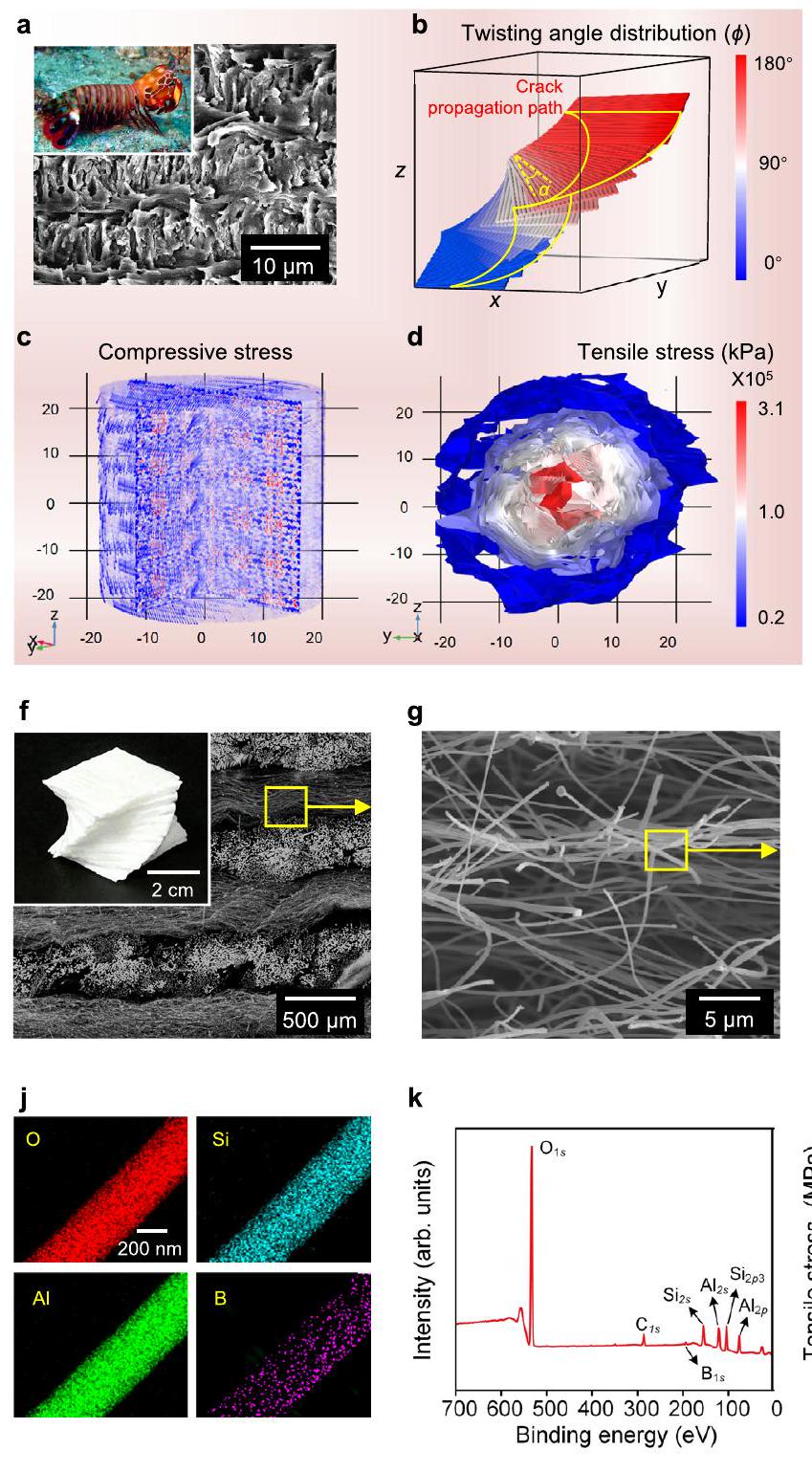
روبيان المانتس، مخلوق جذاب ولكنه قاتل. التركيب المعقد لمخالب روبيان المانتس، الذي يتكون من تكديس بويليغاند الحلزوني لألياف بروتين الكيتين المعززة، جنبًا إلى جنب مع سرعتها الاستثنائية، يمكّنها من اختراق دفاعات حتى أكثر الفريسة مقاومة مثل الرخويات والسرطانات.عادةً ما يتميز الهيكل الفريد لبوليغاند بترتيب حلزوني من صفائح الألياف مع زاوية التواء، كما هو موضح في الشكل.تتعرض العمارة لـالدوران، الذي يمكن قياسه بواسطة و على طول-اتجاه المحور، حيثيمثل زاوية الالتواء الناتجة بين طبقتين مجاورتين، بينمايحدد توزيع زاوية الالتواء (الشكل 1ب). اتجاه الألياف المتراصفة مع-المحور يُشار إليه بـ، في حين أن الألياف تلتف في اتجاه عكسي حول الـ-محور.
تزيد هذه التهيئة من مساحة سطح الشق وتساهم في إعادة توجيه الألياف استجابةً للإجهادات الخارجية، مثل الأحمال الشد، والانحناء، والصدمات.في هذه الأثناء، تعزز التذبذبات الناتجة عن معامل المرونة داخل هندسة بويليغاند التواء الشقوق (الشكل التكميلي 1). بالمصادفة، فإن مصفوفة بويليغاند الكيرالية تؤدي إلى خصائص ميكانيكية شبه متساوية في المستوى (الشكل 1c، d والشكل التوضيحي 2)، مما يتجاوز القيود النموذجية للمواد ذات الهياكل الليفية ثلاثية الأبعاد أحادية الاتجاه التقليدية..
مستوحاة من ترتيب الألياف في مخالب الروبيان المنجلي، قمنا بتصميم مفاهيمي لمواد BcF-CAs البيوميميتية مع مراعاة ثلاثة اعتبارات حاسمة. : (ط) يجب أن تكون الألياف النانوية الخزفية مرنة، ويجب أن تكون الألياف الدقيقة المعززة قوية; (ii) يجب تجميع الألياف الدقيقة/النانوية السيراميكية عبر المقاييس في هلامات هوائية مع مصفوفة بويليغاند الحلزونية؛ و (iii) يجب أن يكون هيكل الألياف الدقيقة/النانوية ملتصقًا وقويًا حراريًا.تم الوفاء بالاعتبار الأول من خلال اعتماد مزيج من طرق النانو السلكية والتقنية الهلامية لإنتاج ألياف نانوية مرنة؛ في حين تم استخدام خيوط السيراميك التجارية المستمرة كألياف دقيقة لتعزيز الميكانيكا. تم تحقيق المتطلب الثاني من خلال طريقة بسيطة وقابلة للتكرار تتضمن تكديس بوليجاند الحلزوني الغاطس والتشكيل بالتجميد. لتلبية المعيار الحاسم الأخير للربط المستقر في هيكل الألياف، تم استخدام AlBSi غير القلوي كمادة مصفوفة سيراميكية عالية الحرارة..
في دراسة إثبات المفهوم، تم استخدام ألياف الموليت النانوية وتم اختيار الألياف الكبيرة بعناية كمواد عينة بسبب استقرارها الحراري.الشكل 1e والشكل التكميلي 4 يقدمان عملية تصنيع BcF-CAs. بدأت استراتيجية التصنيع بعملية النسيج الكهربائي لمحلول الموليت/البولي (إيثيلين أكسيد) لإنتاج ألياف نانوية مرنة من الموليت (انظر الطرق التكميلية). كانت ألياف الموليت النانوية الناتجة بقطر (الشكل التوضيحي 5) وقوة شد تبلغ 0.47 ميغاباسكال ( الضغط) (الشكل التوضيحي 6).الألياف الدقيقة (الشكل التوضيحي 7) كانت تمتلك قطر أليافوأظهرت قوة شد تبلغ 2.1 جيجا باسكال. ثم تم غمر الألياف الدقيقة/النانوية الخزفية في محلول AlBSi لمدة ساعتين. ومن الجدير بالذكر أن AlBSi معروف باستقراره الحراري وخصائصه الميكانيكية، مما يجعله “غراء خزفي” لربط الألياف المجاورة. اعتمدت هذه الطريقة في الربط المتقاطع على تشكيل روابط السيليكات (X-O-Si)، التي تم تحقيقها من خلال تكليس الألياف النانوية السيليكا في وجود الأكسجين.. أخيرًا، تم ترتيب الألياف الكبيرة والألياف النانوية المغمورة طبقة تلو الأخرى بزاوية لولبية محددة ( ) وتجفيفها بالتجميد لـ للحصول على BcF-CAs غير المرتبطة. بعد التلدين في فرن مافل (تم الحصول على BcF-CAs المرتبطة بعد ساعة واحدة في الهواء المتدفق.
توضح صور المجهر الإلكتروني الماسح (SEM) في الشكل 1f-h بوضوح العمارة البيوميميتية الفريدة والمعقدة لـ BcF-CAs. كانت BcF-CAs تمتلك هيكلًا حلزونيًا مصممًا من نوع Bouligand يتكون من ألياف سيراميكية دقيقة/نانوية وهيكل ربط بين الطبقات. داخل هذه العمارة المعقدة، كانت كتل البناء من الألياف السيراميكية الدقيقة/النانوية مرتبة في شكل حلزوني لبناء هيكل متعدد الطبقات بمساعدة الربط المتشابك بواسطة AlBSi، مما منح BcF-CAs مقاومة لكل من التشوه الميكانيكي والتعرض لدرجات حرارة قصوى. للتحقيق في تأثير AlBSi، تم دراسة مورفولوجيا سطح الروابط تحت تدرج تركيز محلول AlBSi (AlBSi-البي سي 2 ) تم ملاحظتها بواسطة SEM. كما هو موضح في الشكل التوضيحي 8، تجمعت AlBSi بين الألياف وأصبحت أكثر وضوحًا مع زيادة التركيز من إلى، وظهرت بعض الشقوق في العينات المعدة بـ. لذلك، كان محتوى السول المناسب ميكانيكياً مواتياً لربط قوي، في حين أن التركيز العالي جداً أدى إلى واجهة لاصقة جامدة بشكل مفرط، مما أدى إلى تسريع الفشل الميكانيكي لـ BcF-CAs (الشكل التكميلي 9 والشكل التكميلي 10). بشكل عام، تم إجراء التحقيقات التالية باستخدام سول AlBSi بتركيز . أشكال إضافية من
الشكل 1 | التصميم الهيكلي وتصنيع BcF-CAs. أ صورة وصورة مجهر إلكتروني لمس club الدكتيل في الروبيان المانتي.الميزات الهيكلية ومسار انتشار الشقوق لمجموعة بويليغاند الحلزونية النموذجية. توزيع الإجهاد في وضع (ج) الضغط و(د) الشد، يمكن عرض أسطورة الألوان في الشكل 1ج في الشكل التكميلي 3. الشكل التوضيحي (هـ) لتصنيع المواد البيوميميتية لـ BcF-CAs.
ح
أنا
صور f-h وصور SEM تظهر الهياكل المجهرية لـ BcFCAs بتكبيرات مختلفة.طبقة رقيقة من سيراميك AlBSi على سطح الألياف، شريط القياس في الزاوية.صور HRTEM-EDS لألياف فردية.طيف XPS لـ BcF-CAs لجميع العناصر. 1 منحنى إجهاد الشد – الانفعال لـ BcF-CAs. m عندما تعرض BcF-CA لم torch بوتان، لم يُلاحظ أي ضرر.
تم عرض منطقة اللصق في الشكل التكميلي 11 والشكل التكميلي..
كانت خطوة محورية في عملية التصنيع هذه هي التجفيف بالتجميد، الذي قضى على نمو بلورات الثلج داخل المسام من خلال التسامي الهوائي، مما منع القوى الشعرية وسمح بتشكيل بنية ذات مسامية فائقة الارتفاع.من الجدير بالذكر أن AlBSi تم ترسيبه خلال عملية التجفيف بالتجميد وتراكم على أسطح الألياف. أدى التكليس اللاحق لـ AlBSi إلى الربط المتقاطع، مما وفر دعمًا هيكليًا إضافيًا عزز بشكل أكبر من متانة BcF-CAs. تم توصيف AlBSi من خلال مزيج من تصوير المجهر الإلكتروني الناقل عالي الدقة (HRTEM) ورسم خرائط الطيف بالأشعة السينية المشتتة للطاقة (EDS). كشفت ملاحظات HRTEM عن طبقة ربط رقيقة من (الشكل 1i)؛ في الوقت نفسه، أظهرت نتائج رسم EDS أن الألمنيوم والبورون غطيا تقريبًا الأكسجين والسيليكون، مما يشير إلى أن مكونات AlBSi كانت ملفوفة بشكل موحد و تم توزيعها على أسطح كتل البناء من الموليبدينوم (الشكل 1j). في الواقع، كانت عملية إعداد عينات EDS تتضمن التماثل والتسونيد لفترة طويلة تصل إلى 20 دقيقة. على الرغم من هذا المعاملة الصارمة، ظلت طبقة AlBSi ملتصقة بألياف الموليبدينوم، مما يشير إلى وجود روابط سيليكات مستقرة بين الألياف. ثم تم تأكيد هذه الشبكة القوية المترابطة من BcF-CA من خلال تحليل طيف الأشعة السينية (XPS) (الشكل 1k والشكل التكميلي 13). كانت القمم المميزة تتوافق مع التشكيلات الرباعية السطوح من السيليكا المدعمة بالألمنيوم والبورون، وكانت هذه النتيجة متوافقة بشكل جيد مع تحليل HRTEM وEDS. بشكل عام، ساهمت الخصائص السيراميكية المتكاملة للألياف، وطبقة السطح AIBSi، والهندسات المعقدة الخاصة لمصفوفة بويليغاند بشكل متكامل في تحسين الخصائص الميكانيكية لـ BcF-CAs، والتي شملت قوة الشد البالغة 170.38 ميغاباسكال (الشكل 11).. أخيرًا، تم توضيح الاستقرار الحراري المثير للإعجاب لـ BcF-CAs من خلال تعرضها لحرائق عالية الحرارة ( ) تم إنتاجه بواسطة شعلة بوتان.
كما هو متوقع، حافظت BcF-CAs على شكلها وبنيتها حتى تحت هذه الظروف القاسية، مما أبرز متانتها ومرونتها أكثر (الشكل 1م والشكل التوضيحي 14).
تقييم أداء الشد غير المتأثر بدرجة الحرارة
سلوك تفريغ الإجهاد المرتبط بهيكل الحلزون الكيرالي، جنبًا إلى جنب مع التعزيز الميكانيكي الذي توفره كتل البناء الدقيقة، ساهم في الخصائص الميكانيكية ذات الاتجاه العالي للـ BcF-CAs، والتي شملت قوة فائقة في اتجاه مصفوفة الألياف الحلزونية العمودية (أي، على طول اتجاه الألياف) ومرونة فائقة على طول اتجاه مصفوفة الألياف الحلزونية (الشكل التكميلي 15).تمت دراسة خصائص الشد لـ BcF-CAs بالتفصيل. قمنا بتقييم العاملين الرئيسيين اللذين كانا مسؤولين عن تحسين الخصائص الميكانيكية للشد لـ BcF-CAs الهرمية وغير المتجانسة، زاوية الالتواء ( ) ومحتوى الألياف الدقيقة (ج).
أولاً، تم إجراء محاكاة العناصر المحدودة (FE) باستخدام COMSOL Multiphysics لفهم تأثير زاوية الالتواء على تعزيز الخصائص الميكانيكية بشكل عميق.تم بناء سلسلة من النماذج التي تتميز بزوايا التواء مختلفة. كما هو موضح في الشكل التوضيحي 16a، توضح المخططات البيانية أن ألياف الطبقات في المجموعة الحلزونية بدأت منإلى ( هو عدد طبقات الألياف)، الحلزون لكل طبقة شكلت زاوية، و تم التواء الطبقات بواسطةأو مضاعف صحيح لـ ) على مسافة الملعب ، حيث و هو سمك الطبقة. على سبيل المثال، لـ كما هو موضح في الشكل التوضيحي 16b، كان هناك ست دورات من نفس الدوران ) من مصفوفة الألياف حول -المحور، مما يشير إلى أن طبقات الألياف بدأت من محور مع دورانات مميزة للستة طبقات التالية وعاد إلى-محور الطبقة السابعةالشكل 2أ يوضح أيضًا مخططات تخطيطية لهياكل مصفوفة بويليغاند. بالمثل، لـ (PAR، أي، هي هيكل مصفوفة الألياف المتوازية)، ; لــ (بو-15)، ; لــ (بو-30)، . من الجدير بالذكر أن هناك نموذج خاص واحد كان لـ (BOU-75)، أي زاوية التواء لإنتاج الغشاء الثاني ولإنتاج الطبقة الثالثة حتى الطبقة الثالثة عشرة ( و لصنعدوران (خمس مرات من ) .
أظهرت نتائج المحاكاة بوضوح أنه كلما زادت قيمةانخفض منإلى، زادت أقصى إجهاد (أي، الإجهاد عند الفشل الأولي) (الشكل 2ب). من الناحية الميكانيكية، مكنت مجموعة بويليغاند الألياف من إعادة التوجه استجابةً للإجهاد الخارجي. أعادت الغالبية العظمى من الألياف التوجه على طول اتجاه الشد وخضعت لتشوه شد بسبب آليات التمدد/الانزلاق، بينما دارت بعض الألياف الأخرى بشكل متماثل في الاتجاه بعيدًا عن محور الإجهاد. من اللافت للنظر أن الأصغرنتج عن ذلك زيادة في نسبة الألياف المعززة على طول اتجاه التحميل الشدّي، مما عزز من اللدونة والصلابة لمركبات BcF-CAs لمنع الكسر على المستوى الكلي (الشكل 2ب)تدعم مخططات إجهاد الأقسام العرضية (PAR، BOU-15، BOU-30، BOU-75) في طبقات الألياف المتوازية في هياكل بويليغاند الاستنتاجات المذكورة أعلاه (الشكل 2c والشكل التكميلي 17a). بالإضافة إلى ذلك، من الجدير بالذكر أنه بالنسبة لـ BOU-15 و BOU-30 و BOU-75، لم يظهر الحد الأقصى للإجهاد أي اعتماد على اتجاه التحميل، مما يدل على الخصائص الميكانيكية الشد شبه المتساوية في هذه النماذج المصفوفية (الشكل 1d). ومع ذلك، يمكن أن تتحمل بنية مصفوفة PAR مستوى عالٍ من التحميل فقط عندما كان اتجاه القوة متماشيًا مع اتجاه الألياف (الشكل التكميلي 17b). أي أن الهيكل كان عرضة للفشل عندما تم تطبيق قوى خارجية في اتجاهات تنحرف عن اتجاه الألياف، مما يكشف عن قيد رئيسي لمصفوفات PAR. بناءً على الاعتبارات المذكورة أعلاه، ركزت هذه الدراسة على خصائص مصفوفة ألياف بويليغاند بزاوية التواء نسبية..
للتحقق من نتائج المحاكاة المذكورة أعلاه، تم اختبار خاصية الشد لـ BcF-CAs تحت نفس الضغط لعدةتم قياس القيم بواسطة آلة إنستران 34 TM-5 العالميةبشكل بديهي، قوة الشد زاد كـانخفضت (الشكل 2d الأعلى). علاوة على ذلك، تم التحقيق في BOU-15 الخاضعة لتحميل الشد في اتجاهات مختلفة (الشكل التوضيحي 18). أظهرت النتائج أنه لم يتم العثور على اختلافات كبيرة في قوة الشد لـ BcF-CAs حتى عند تغيير اتجاه القوة (الشكل 2d الأسفل). أي أن BcF-CAs مع مصفوفات الألياف الحلزونية الكيرالية كانت لها خصائص شد مستقلة عن اتجاهات التحميل وتوجه الألياف، وهو ما كان عمومًا صعب التحقيق في مواد ثلاثية الأبعاد أخرى قائمة على الألياف. والأهم من ذلك، كما هو متوقع، كانت السلوكيات التجريبية مرتبطة بشكل جيد مع نتائج المحاكاة.
بالإضافة إلى ذلك، تأثير التغير فيتم قياس الكثافة وقوة الشد لـ BcF-CAs لاختيار الأفضلداخل مجموعة ألياف بويليغاند (الشكل التكميلي 19). أظهرت النتائج أن BcF-CAs ذات القيم الأكبر من كان له كثافة وقوة أكبر. بالنظر إلى الحاجة إلى BcF-CAs خفيفة الوزن للغاية، تم تحديد المحتوى الأمثل من الألياف الدقيقة ليكون. علاوة على ذلك، تم دراسة الخصائص الميكانيكية على مدى نطاق واسع من درجات الحرارة. تم الحصول على منحنيات الإجهاد والانفعال لـ BcF-CAs من خلال إبقائها في نطاق درجة حرارة لمدة 30 دقيقة. كما هو متوقع، اختلفت المنحنيات الناتجة بشكل غير ملحوظ (الشكل 2e)من المRemarkably، بعد التكلس في، أظهرت BcF-CAs قوة شد تبلغ 88.58 ميغاباسكال، بينما تلك المحروقة عندكان لديه قوة أقل (15.27 ميجا باسكال) (الشكل 2f). بالإضافة إلى ذلك، احتفظت BcF-CAs بأكثر من 90% من قوتها الأولية ونفس معامل يونغ تقريبًا والضغط الأقصى حتى (الشكل 2g والشكل التكميلي 20)، مما يوضح الاستقرار الحراري للبنية. كانت BcF-CAs تتمتع بضغط قابل للعكس حتى عند التعرض لـ لهب شعلة بوتان أو في النيتروجين السائل )، ولم يُلاحظ أي فقدان في القوة أو الصلابة (الشكل 2h والشكل التكميلية 21). لذلك، فإن خصائص الشد غير المتغيرة مع درجة الحرارة لـ BcF-CAs من إلىتمت إظهارها.
تقييم أداء السوبر إليستيك غير المعتمد على درجة الحرارة
بعد تحليل الخصائص الميكانيكية الشدّة لمركبات BcF-CAs، تم بعد ذلك دراسة الأداء الاستثنائي في الضغط.أولاً، تم إجراء سلسلة واسعة من اختبارات الضغط بواسطة التحليل الميكانيكي الديناميكي (DMA). كما هو متوقع، كانت علاقة الإجهاد-الانفعال (تظهر المنحنيات من اختبار الضغط أن أقصى ضغط انضغاطي كان يصل إلى 156.47 كيلو باسكال عندإجهاد (الشكل 3أ). بعد ذلك، تم إجراء تقييم شامل لسلوك BcF-CAs بعد 1000 دورة تحميل-تفريغ. أظهرت منحنيات الهسترسيس لـ BcF-CAs على مدار 1000 دورة استعادة كاملة لمستواها الأصلي مع تشوه بلاستيكي طفيف، مما يؤكد على المرونة الميكانيكية الجيدة والمرونة (الشكل 3ب). ومن المRemarkably، حتى بعد الاختبارات الشديدة، أظهر BcF-CA معامل فقدان الطاقة الثابت تقريبًا وموصلية يونغ من 10 دورات إلى 1000 دورة، مع الاحتفاظ بـمن الإجهاد الأقصى الأصلي (الشكل 3 ج)، مما يوضح قوتها الهيكلية.
تمت محاكاة السلوكيات الميكانيكية الانضغاطية الكلية لهياكل بويليغاند أيضًا بواسطة طريقة العناصر المحدودة (الشكل 3d). وأشارت النتائج إلى أن الصغيرعززت القدرة على تحمل التشوهات الكبيرة. وذلك نتيجة لانخفاضالزيادة المقابلة في ونسبة الألياف حدثت، مما أدى إلى تحفيز فقدان الطاقة بشكل أكبر. علاوة على ذلك، أظهرت الخصائص المرنة اعتمادًا على ، حيث يتم ترتيب مع صغيرأدى إلى تغيير تدريجي في صلابة الطائرة وكان من المتوقع أن يقلل من إجهاد القص بين الطبقات – وهو عامل حاسم يساهم في الانفصال.. علاوة على ذلك، للقيم الصغيرة من حدثت زيادة في الإجهاد، مما أدى إلى ظهور سطح صدع ملتوي زاد من المساحة السطحية لكل وحدة طول صدع على طول اتجاه انتشار الصدع..
ميكروسكوبياً، يمكن أن يُعزى الخصائص الفائقة المرونة لـ BcF-CAs بشكل أساسي إلى الهيكل المجهري الحلزوني الفريد لمصفوفة بويليغاند الخاصة بها (الشكل التوضيحي التكميلي 22)، والذي تم محاكاته بشكل منهجي بواسطة طريقة العناصر المحدودة.كما هو موضح في الشكل 3e،
الشكل 2 | خصائص الشد لـ BcF-CAs. أ الرسوم التخطيطية لنماذج مصفوفة ألياف بويليغاند مع اختلافاتالقيم.محاكاة من خلال COMSOL Multiphysics تظهر خرائط إجهاد الشد لمصفوفات (PAR، BOU-15، BOU-30، BOU-75) تحت نفس الحمل الشدي. خرائط إجهاد الشد لـ BOU-15 توضح التغيرات في الإجهاد المحوري في الـطائرة. منحنيات الإجهاد والانفعال المتعلقة بـ BcFCAs (BOU-15) مع اختلاف (الأعلى) واتجاهات مختلفة للقوة المطبقة رسوم ثلاثية الأبعاد للتوتر مقابل الانفعال ودرجة حرارة المعالجة الحرارية ) لمدة 30 دقيقة . منحنيات الإجهاد والانفعال الشدّي لـ BcF-CAs المحتفظ بها في بيئة عالية الحرارة و لـ 30 دقيقة). قوة الاحتفاظ ومعامل يونغ كدوال لدرجة الحرارة.عملية استعادة الشد لـ BcF-CAs في لهب شعلة البوتان. تعرضت طبقات الألياف الحلزونية لتشوهات كبيرة خارج المستوى أثناء الضغط، لكنها امتصت إجهادات صغيرة في المستوى، مما مكنها من تحمل تشوهات كبيرة دون فشل هيكلي.. بالإضافة إلى ذلك، تم محاكاة كثافة طاقة الإجهاد المرن (ESED) لطبقات الألياف الشبيهة بالقوس كما هو موضح في الشكل التكميلية 23. نتجت الحلقات الهستيرية الرقيقة عن تأثير مشترك لربط “المطاط” بين الألياف الكبيرة/النانوية، ووحدات الألياف القوية، وتقليل الاحتكاك بين الطبقات أو الألياف بسبب رقة طبقات الألياف والمساحة الكافية للتشوه. في هذا الصدد، كانت هذه البنية الهرمية لمصفوفة بويليغاند، التي تحتوي على كتل مكونة من ألياف ناعمة وقوية، مفيدة للغاية لتحقيق استعادة مرنة جيدة وفقدان الطاقة تحت التحميل الضاغط.. بشكل مدهش، أظهرت سلسلة من الصور الفوتوغرافية في الوقت الحقيقي التقطتها كاميرا أنه عندما تم إسقاط كرة فولاذية (8.47 جرام) على BcF-CA عند ارتفاع قفز عالٍ سرعة ( ) (الشكل 3f)، ارتد، مما أظهر بوضوح أداء السوبر إليستيك لـ.
وبالمثل، تم دراسة الاستقرار الميكانيكي لـ BcF-CAs تحت تحميل الضغط في بيئة درجات حرارة عالية. تم معالجة BcF-CAs بالتسخين عند درجات حرارة و لمدة ساعة واحدة. بعد ذلك، تم تقييم سلوك التحميل والإفراج الضاغط أحادي المحور مع إجهاد ضغط قدره، وأظهرت النتائج أنه لم يكن هناك فرق ذو دلالة إحصائية على مدى نطاق درجات الحرارة بالكامل (الشكل 3g والشكل التكميلية 24). بالإضافة إلى ذلك، تم فحص مرونة BcF-CAs عند درجات الحرارة القصوى من خلال اختبار الضغط تحت لهب شعلة بوتان مكثف، الذي وصل إلى درجة حرارة تقارب بشكل مثير للإعجاب، خلال كامل عملية الضغط، لم يتم الكشف عن أي اشتعال أو تدهور هيكلي (الصور المرفقة في الشكل 3 ج).علاوة على ذلك، كما هو موضح في الشكل 3h،
الشكل 3 | الخصائص الانضغاطية لـ BcF-CAs. أ منحنى الإجهاد والانفعال الانضغاطي لـ BcF-CAs.اختبار الضغط فيإجهاد لمدة 1000 دورة تحميل-تفريغ. ج معامل فقدان الطاقة، أقصى إجهاد وموصلية يونغ كدالة لعدد دورات الضغط. د خرائط إجهاد الضغط لنماذج BOU-15 وBOU-30 وBOU-75 وPAR؛ الأسهم تشير إلى اتجاه القوة. هـ ملفات الإجهاد لجدار القوس خلال عملية الضغط والإفراج.سلسلة من الصور الفوتوغرافية في الوقت الحقيقي تظهر أن BcF-CA كانت قادرة على ارتداد كرة فولاذية مع
سرعة عالية. منحنيات الإجهاد والانفعال الانضغاطي لـ BcF-CAs المعرضة لبيئات درجات حرارة عالية ( و ) لمدة ساعة واحدة؛ (إدخالات) عملية ضغط-إفراج BcF-CAs في لهب شعلة البوتان.اختبار ضغط الدورات المتعددة فيإجهاد بعد المعالجة الحرارية عند لمدة ساعة واحدة؛ (الصور المرفقة) صور SEM لـ BcF-CAs بعد التعرض لـ و لمدة ساعة واحدة. طيف حيود الأشعة السينية للألياف النانوية من الموليت. حتى بعد التعرض لـلمدة ساعة واحدة، كانت BcF-CAs قادرة على تحمل 500 دورة ضغط-إفراج معالإجهاد ولم يظهر أي تشوه بلاستيكي ملحوظ، بينما ظل الحد الأقصى من الإجهاد الانضغاطي عندمن المرحلة الأولى من الضغط (الشكل التوضيحي 25). في هذه الأثناء، فإن معامل فقدان الطاقة الثابت هذا ( ) في اختبار الضغط الدوري أظهر الاستقرار الهيكلي لـ BcF-CAs. والأهم من ذلك، أن الحد الأقصى من الإجهاد ومعامل يونغ ظلا ثابتين بعد اختبار الضغط، مما يبرز المرونة الانضغاطية ومقاومة التعب لـ علاوة على ذلك، يمكن أن تحافظ BcF-CAs على شكلها السابق بعد الضغط في النيتروجين السائل. (الشكل التوضيحي 26). بعد عدة دورات ضغط، تمكنت المواد BcF-CAs من العودة إلى هندستها الأصلية، ولم يتم العثور على أي كسر واضح. وبالتالي، فإن القابلية للضغط، القوة والمرونة المستقلة عن درجة الحرارة لمواد BcF-CAs من -196 إلىتم إثباتها.
للحصول على فهم أعمق لاستقرارها الحراري، تم توصيف BcF-CAs بشكل إضافي بواسطة حيود الأشعة السينية (XRD). حتى بعد التلدين المطول عند درجات حرارة تصل إلىظلت القمم المميزة لألياف الموليت متسقة مع تلك الخاصة ببلورة الموليت المفردة، مما يبرز الاستقرار الحراري الفائق تحت الظروف القاسية (الشكل 3i والشكل التوضيحي 27).
الشكل 4 | خصائص العزل الحراري لـ BcF-CAs. أ آلية التوصيل الحراري في BcF-CAs.التوصيل الحراري لـ BcF-CAs كدالة للكثافة. ج مقارنة التوصيل الحراري ودرجة الحرارة القصوى للعمل.
من مواد شبيهة بالأيروجيل المختلفة. د صور بصرية وأشعة تحت الحمراء لـ BcF-CAs المعرضة لشفاط بوتان لمدة 5 دقائق. هـ صور تحت الحمراء لفوهة بوتان محمية بـ BcF-CA مشتعلة لمدة 5 دقائق.
كانت هذه النتائج متوافقة مع صور SEM لسطح الشكل. بعد أن تم تحميص BcF-CAs عندتكونت حبيبات بلورية كبيرة جدًا، مما أدى إلى كسر هش في ألياف الموليت (الصور المرفقة في الشكل 3h والشكل التكميلي 28).
تطبيقات مقاومة الحريق والعزل الحراري
أظهرت المحفزات البيوميميتية BcF-CAs المجتمعة أداءً ميكانيكيًا ممتازًا عند درجات الحرارة العالية واستقرارًا حراريًا، مما يجعلها جذابة للاستخدام كعوازل لمجموعة واسعة من التطبيقات، على سبيل المثال، كطبقة عزل في صناعة الطيران (الشكل 4أ).لذلك، تم التحقيق في قدرة BcF-CAs على حماية محرك الطائرات من التلف عند درجات حرارة عالية.
الخصائص الأساسية للمواد التي يمكن استخدامها في بيئات الصدمات الحرارية هي الموصلية الحرارية المنخفضة ) وكثافة منخفضة . نظريًا، الـالمواد تعتمد على (ط) الصلب ( ) والهواء ( التوصيل الحراري )، (ii) الحمل الحراري ( )، و (iii) إشعاع الحرارة .
بالنسبة لـ BcF-CAs،تم تقييده بشدة بسبب انسداد الهواء في المسام الفرديةعند المسامية العالية،يتم تقليله بشكل كبير لأن الموصلية الحرارية للهواء أقل بكثير من تلك الخاصة بالمواد الصلبة. بالإضافة إلى ذلك، يُعتبر الهيكل الهرمي (طبقة تلو الأخرى) أكثر فائدة للتأمل من الهيكل اللاميناري العشوائي، مما يولد “أثر الانعكاس المتعدد” عند زاوية سقوط ثابتة.. لذلك، أدى التصميم الفريد لمصفوفة بويليغاند الكيرالية الهرمية بالاشتراك مع الطابع الخفيف للغاية لمواد الأيروجيل إلى انخفاض من BcF-CAs.
كما هو متوقع، كان لدى BcF-CAsمن بكثافة عند درجة حرارة الغرفة (الشكل 4 ب). في الحالة التي تم فيها رفع الكثافة إلىقيمةتم تحسينه إلى، وهو ما كان نتيجة لانخفاض المسامية الناتج عن زيادة محتوى الألياف الكبيرة. ومن الجدير بالذكر أن BcF-CAs أظهرت انخفاضًا كبيرًا في ، يقيس حوالي في، مما يدل على القدرات الاستثنائية للعزل الحراري لمواد BcF-CAs حتى في الظروف القاسية ويبرز إمكانياتها للاستخدام كمواد عازلة حرارية عالية الكفاءة.
هذه الموصلية الحرارية المنخفضة، جنبًا إلى جنب مع الخصائص الميكانيكية المستقلة عن درجة الحرارة، مكنت BcF-CAs من استخدامها عند درجات حرارة أعلى من تلك التي لا تستطيع المواد العازلة التقليدية تحملها. : (i) معظم مواد الهلام السيراميكي المتطورة، مثل الهلامات الهوائية النانوية الأليافالهلامات الهوائية النانوية الأليافهلامات النانو رود SiC، ويمكن أن تتحمل هلاميات BN درجات حرارة عمل مرتفعة نسبيًا ( ) ولكن لديها قوة شد منخفضة ( بالمقارنة مع مواد العزل الحراري التقليدية، كانت لمواد BcF-CAs خصائص شد مع درجة حرارة عمل قصوى تصل إلى (الشكل 4 ج والجدول التكميلي 1).
كإثبات لمفهوم استخدام BcF-CAs كبديل واعد لمواد العزل الحراري التقليدية، تم التحقيق في استجابتها الهيكلية والميكانيكية في ظل بيئات درجات حرارة عالية تتطلب ذلك.تم تصميم جهاز اختبار بدرجات حرارة فائقة الارتفاع في هذا المختبر لمحاكاة ظروف التشغيل الحرارية ذات الأهمية. تم تسخين BcF-CA وتعريضه للنيران، وتم مراقبة توزيع درجة الحرارة الديناميكي باستخدام كاميرا بالأشعة تحت الحمراء.. أولاً، تعرضت BcF-CA (بسمك 15 مم) لاحتراق مباشر في لهب البيوتان ( )، حيث تم التقاط صور الأشعة تحت الحمراء الحرارية المعتمدة على الزمن لمراقبة أدائها في العزل الحراري بشكل ديناميكي. الـ BcF-CAs أظهرت خصائص عزل حراري في وجود اللهب العالي الحرارة الشديد، مع الحفاظ على درجة حرارة منخفضة من الجهة الخلفية لـحتى بعد 5 دقائق من التسخين المستمر (الشكل 4د). بعد ذلك، تم استخدام نهج مشابه مع عينة BcF-CA التي تظهر سمكًا يبلغ 8 مم وكثافة“، محاطًا حول فوهة مصباح اللهب البوتاني (الشكل 4e والشكل التوضيحي 29). بينما تجاوزت درجة حرارة الفوهة بسرعة الحد الأقصى للجهازبعد 5 دقائق، شهدت درجة حرارة BcF-CAs تصاعدًا تدريجيًا ومقيدًا، وبلغت ذروتها في النهاية عند حواليمن الجدير بالذكر أنه بعد التعرض لدرجات حرارة عالية لمدة 5 دقائق، ظلت درجة الحرارة خارج BcF-CAs ثابتة تقريبًا، مما يوضح تفوق BcF-CAs كمواد عزل حراري مرغوبة للغاية. كشفت هذه النتائج أن BcF-CAs قدمت مزيجًا عالي الأداء من أداء العزل الحراري ودرجة عالية من الاستقرار المعماري..
نقاش
في هذه الدراسة، تم تطوير استراتيجية هندسية تركيبية ومحاكاة حيوية من خلال دمج تجميع القالب الحلزوني بويليغاند ومعالجة التجميد اللاحقة، والتي تم تطبيقها لتشكيل BcF-CAs بشكل متآزر على المقياس الميكروي/النانو. ومن المRemarkably، احتوت BcF-CAs المحاكية حيوياً على مصفوفات بويليغاند ذات خصائص ميكانيكية قابلة للتعديل، غير متساوية، وفائقة، بما في ذلك خصائص الشد عالية القوة (170.38 ميغاباسكال) في اتجاه مصفوفة الألياف الحلزونية الرأسية، وسلوك فائق المرونة (156.47 كيلو باسكال عندإجهاد) على طول اتجاه مصفوفة ألياف الحلزون. علاوة على ذلك، حتى بعد التعرض للتكلس في، احتفظت BcF-CAsمن قوتها الشد الأصلية، مما يجعلها مناسبة للغاية لتطبيقات العزل الحراري الفائق. تظهر نتائج هذه الدراسة أن هذه الاستراتيجية تحمل إمكانيات هائلة لتقدم الهلاميات الهوائية الألياف الخزفية، مما يمكّن استخدامها في مجالات متنوعة مثل العزل الحراري، والفضاء، وإعادة تأهيل البيئة، والتطبيقات الطبية الحيوية، والملابس الواقية. علاوة على ذلك، نظرًا لعمومية وقابلية تخصيص استراتيجية التصميم، ستصبح هذه الاستراتيجية قابلة للتعميم على مواد هيكلية ثلاثية الأبعاد أخرى، مما يوسع ملاءمة هذه المواد لأحمال ميكانيكية أكثر تطلبًا.
تم تحضير ألياف الموليتيت النانوية من خلال طريقة السول-جل المدمجة مع عملية النانو السحب. كانت هناك ثلاث خطوات مترابطة كما يلي: أولاً، تم تحضير محلول الموليتيت عن طريق إذابة 21.729 جرام من من AIP و 0.3 جرام من حمض الأكساليك في 130 جرام من الماء/ TEOS/ إيثانول (بنسبة كتلة 4.5:1:0.9)، والذي تم تحريكه في لمدة 12 ساعة. ثم تم إدخال PEO في محلول الموليت مع التحريك المستمر لمدة 10 ساعات إضافية في درجة حرارة الغرفة للحصول على محلول سلف الموليت. بعد ذلك، تم نسج سلف الألياف النانوية للموليت مباشرة عبر آلة النسج DEXS-4، بجهد تشغيل يبلغ 25 كيلو فولت، وطول جمع يبلغ 200 مم، وسرعة طرد ثابتة منعند رطوبةودرجة الحرارة لـ. أخيرًا، تم تجفيف نانو ألياف الموليتي الأخضر تحت فراغ على الفور فيلمدة ساعة واحدة وتم تسخينه في الهواء عندلمدة ساعة واحدة في فرن مغطى، مما يسمح للبوليmer بإكمال التحلل الحراري وإنتاج الموليت.
تحضير محلول AlBSi
كان الخيار الأول للرابط عالي الحرارة هو محلول AlBSi. تم تخليق محلول AlBSi عن طريق التحريك عندلمدة 6 ساعات عندنسبة المولات 2:5:2تيوس20 مل من الماء.
تحضير BcF-CAs
تم قطع ألياف الميكرون السيراميكية إلى ألياف قطنية بنفس الطول (بطول ) واستخدمت كمرحلة معززة ميكانيكياً من الهلامات الهوائية النانوية؛ تم قطع أغشية الألياف النانوية من الموليت إلى مربعات بطول جانب تم نقع كل من أغشية النانو ألياف الخزف والألياف الميكرونية في محلول مائي من AlBSi بمحتويات مختلفة لمدة ساعتين. تم ترتيب الألياف الكبيرة والنانوية المنقوعة في طبقات بزاوية لولبية محددة. ) ثم تم تجفيفه بالتجميد لـ . ثم، تم تلدين الهلاميات الهوائية الليفية المكدسة ثلاثية الأبعاد ذات الهيكل بويليغاند في لمدة ساعة واحدة في الهواء المتدفق للحصول على BcF-CAs المرتبطة.
توصيف
تمت دراسة الميكروهياكل لـ BcF-CAs وجراد البحر المانتس بواسطة FE-SEM (S-4800) وTEM (JEM-2100F). تم تحديد تركيبة السيراميك AlBSi بواسطة EDS (Bruker Quantax 400) وXPS (Escalab 250Xi). تم تحديد التركيب الكيميائي لـ BcF-CAs بعد التلدين في ظروف درجة حرارة عالية بواسطة XRD (Bruker D8، Bruker). تم قياس اختبارات الشد الميكانيكية بواسطة آلة عالمية من نوع Instron 34 TM-5. تم إجراء اختبارات الضغط الميكانيكية باستخدام جهاز DMA (TA-Q850). تم تحديد الموصلية الحرارية لـ BcF-CAs في نطاق من الكثافات باستخدام جهاز قرص ساخن (TPS2500S، سويسرا). تم استخدام كاميرا حرارية بالأشعة تحت الحمراء (Fluke TiX560) لالتقاط الصور الحرارية لـ BcF-CAs.
توفر البيانات
جميع البيانات التي تم توليدها في هذه الدراسة متاحة في ملف البيانات المصدر. يتم توفير البيانات المصدر مع هذه الورقة.
References
Si, Y., Wang, X., Dou, L., Yu, J. & Ding, B. Ultralight and fire-resistant ceramic nanofibrous aerogels with temperature-invariant superelasticity. Sci. Adv. 4, eaas8925 (2018).
Zhang, X. et al. Ultrastrong, superelastic, and lamellar multiarch structured nanofibrous aerogels with high-temperature resistance over . ACS Nano 14, 15616-15625 (2020).
Wu, F., Liu, Y., Si, Y., Yu, J. & Ding, B. Multiphase ceramic nanofibers with super-elasticity from . Nano Today 44, 101455 (2022).
Si, Y., Yu, J., Tang, X., Ge, J. & Ding, B. Ultralight nanofibreassembled cellular aerogels with superelasticity and multifunctionality. Nat. Commun. 5, 5802 (2014).
Pierre, A. C. & Pajonk, G. M. Chemistry of aerogels and their applications. Chem. Rev. 102, 4243-4265 (2002).
Chen, G. et al. Regioselective surface assembly of mesoporous carbon on zeolites creating anisotropic wettability for biphasic interface catalysis. J. Am. Chem. Soc. 145, 9021-9028 (2023).
Li, Z. et al. High-throughput production of kilogram-scale nanofibers by Kármán vortex solution blow spinning. Sci. Adv. 8, eabn3690 (2022).
Cheng, X., Liu, Y., Si, Y., Yu, J. & Ding, B. Direct synthesis of highly stretchable ceramic nanofibrous aerogels via 3D reaction electrospinning. Nat. Commun. 13, 2637 (2022).
Liu, R. et al. Ultralight, thermal insulating, and high-temperatureresistant mullite-based nanofibrous aerogels. Chem. Eng. J. 360, 464-472 (2019).
Su, L. et al. Anisotropic and hierarchical nanowire aerogel with exceptional stiffness and stability for thermal superinsulation. Sci. Adv. 6, eaay6689 (2020).
Xu, X. et al. Double-negative-index ceramic aerogels for thermal superinsulation. Science 363, 723-727 (2019).
Guo, J. et al. Hypocrystalline ceramic aerogels for thermal insulation at extreme conditions. Nature 606, 909-916 (2022).
Hua, M. et al. Strong tough hydrogels via the synergy of freezecasting and salting out. Nature 590, 594-599 (2021).
Wegst, U. G. K., Bai, H., Saiz, E., Tomsia, A. P. & Ritchie, R. O. Bioinspired structural materials. Nat. Mater. 14, 23-36 (2015).
An, Q. et al. A novel ultra-wideband electromagnetic waveabsorbing metastructure inspired by bionic gyroid structures. Adv. Mater. 35, 2300659 (2023).
Wu, K. et al. Discontinuous fibrous Bouligand architecture enabling formidable fracture resistance with crack orientation insensitivity. Proc. Natl Acad. Sci. 117, 15465-15472 (2020).
Lee, S., Hao, L. T., Park, J., Oh, D. X. & Hwang, D. S. Nanochitin and nanochitosan: Chitin nanostructure engineering with multiscale properties for biomedical and environmental applications. Adv. Mater. 35, 2203325 (2023).
Bouligand, Y. Twisted fibrous arrangements in biological materials and cholesteric mesophases. Tissue Cell 4, 189-217 (1972).
Chen, S. et al. Biomimetic discontinuous Bouligand structural design enables high-performance nanocomposites. Matter 5, 1563-1577 (2022).
Yaraghi, N. A. et al. A sinusoidally architected helicoidal biocomposite. Adv. Mater. 28, 6835-6844 (2016).
Nikolov, S. et al. Revealing the design principles of high-performance biological composites using ab initio and multiscale simulations: the example of lobster cuticle. Adv. Mater. 22, 519-526 (2010).
Guarín-Zapata, N., Gomez, J., Yaraghi, N., Kisailus, D. & Zavattieri, P. D. Shear wave filtering in naturally-occurring Bouligand structures. Acta Biomater. 23, 11-20 (2015).
Weaver, J. C. et al. The stomatopod dactyl club: A formidable damage-tolerant biological hammer. Science 336, 1275-1280 (2012).
Xiong, R., Wu, W., Lu, C. & Cölfen, H. Bioinspired chiral template guided mineralization for biophotonic structural materials. Adv. Mater. 34, 2206509 (2022).
Yang, T. et al. High strength and damage-tolerance in echinoderm stereom as a natural bicontinuous ceramic cellular solid. Nat. Commun. 13, 6083 (2022).
Gantenbein, S. et al. Three-dimensional printing of hierarchical liquid-crystal-polymer structures. Nature 561, 226-230 (2018).
Yang, M. et al. Biomimetic architectured graphene aerogel with exceptional strength and resilience. ACS Nano 11, 6817-6824 (2017).
Meza, L. R., Das, S. & Greer, J. R. Strong, lightweight, and recoverable three-dimensional ceramic nanolattices. Science 345, 1322-1326 (2014).
Suksangpanya, N., Yaraghi, N. A., Kisailus, D. & Zavattieri, P. Twisting cracks in Bouligand structures. J. Mech. Behav. Biomed. Mater. 76, 38-57 (2017).
Yang, Y. et al. Biomimetic anisotropic reinforcement architectures by electrically assisted nanocomposite 3D printing. Adv. Mater. 29, 1605750 (2017).
Nepal, D. et al. Hierarchically structured bioinspired nanocomposites. Nat. Mater. 22, 18-35 (2023).
Wang, F. et al. In situ synthesis of biomimeticsilica nanofibrous aerogels with temperature-invariant superelasticity over one million compressions. Angew. Chem. Int. Ed. 59, 8285-8292 (2020).
Morris, C. A., Anderson, M. L., Stroud, R. M., Merzbacher, C. I. & Rolison, D. R. Silica sol as a nanoglue: flexible synthesis of composite aerogels. Science 284, 622-624 (1999).
Qi, L. et al. Bioinspired multiscale micro-/nanofiber network design enabling extremely compressible, fatigue-resistant, and rapidly shape-recoverable cryogels. ACS Nano 17, 6317-6329 (2023).
Cheng, Y. et al. Super-elasticity at 4 K of covalently crosslinked polyimide aerogels with negative Poisson’s ratio. Nat. Commun. 12, 4092 (2021).
Zimmermann, E. A. et al. Mechanical adaptability of the Bouligandtype structure in natural dermal armour. Nat. Commun. 4, 2634 (2013).
Yan, D., Wang, J., Xiang, J., Xing, Y. & Shao, L. A flexoelectricityenabled ultrahigh piezoelectric effect of a polymeric composite foam as a strain-gradient electric generator. Sci. Adv. 9, eadc8845 (2023).
Feng, J. et al. Printed aerogels: Chemistry, processing, and applications. Chem. Soc. Rev. 50, 3842-3888 (2021).
Zhang, X., Cheng, X., Si, Y., Yu, J. & Ding, B. All-ceramic and elastic aerogels with nanofibrous-granular binary synergistic structure for thermal superinsulation. ACS Nano 16, 5487-5495 (2022).
Zhang, X., Cheng, X., Si, Y., Yu, J. & Ding, B. Elastic and highly fatigue resistant nanofibrous aerogel with low energy dissipation for thermal insulation. Chem. Eng. J. 433, 133628 (2022).
Gao, H. et al. Super-elastic and fatigue resistant carbon material with lamellar multi-arch microstructure. Nat. Commun. 7, 12920 (2016).
Li, S. et al. Self-regulated non-reciprocal motions in single-material microstructures. Nature 605, 76-83 (2022).
Gao, H. et al. A highly compressible and stretchable carbon spring for smart vibration and magnetism sensors. Adv. Mater. 33, 2102724 (2021).
Guo, F. et al. Highly stretchable carbon aerogels. Nat. Commun. 9, 881 (2018).
Li, L. et al. Nanograin-glass dual-phasic, elasto-flexible, fatiguetolerant, and heat-insulating ceramic sponges at large scales. Mater. Today 54, 72-82 (2022).
Lu, X., Arduini-Schuster, M. C., Kuhn, J., Nilsson, O. J. & Fricke, R. W. Pekala, Thermal conductivity of monolithic organic aerogels. Science 255, 971-972 (1992).
Dou, L. et al. Interweaved cellular structured ceramic nanofibrous aerogels with superior bendability and compressibility. Adv. Funct. Mater. 30, 2005928 (2020).
Cui, Y., Gong, H., Wang, Y., Li, D. & Bai, H. A thermally insulating textile inspired by polar bear hair. Adv. Mater. 30, 1706807 (2018).
Yu, Z. et al. Fire-retardant and thermally insulating phenolic-silica aerogels. Angew. Chem. Int. Ed. 57, 4538-4542 (2018).
Xu, X. et al. Elastic ceramic aerogels for thermal superinsulation under extreme conditions. Mater. Today 42, 162-177 (2021).
Dou, L. et al. Temperature-invariant superelastic, fatigue resistant, and binary-network structured silica nanofibrous aerogels for thermal superinsulation. J. Mater. Chem. A 8, 7775-7783 (2020).
Dou, L. et al. Hierarchical cellular structured ceramic nanofibrous aerogels with temperature-invariant superelasticity for thermal insulation. ACS Appl. Mater. Interfaces 11, 29056-29064 (2019).
Liu, F. et al. Carbon layer encapsulation strategy for designing multifunctional core-shell nanorod aerogels as high-temperature thermal superinsulators. Chem. Eng. J. 455, 140502 (2023).
Su, L. et al. Ultralight, recoverable, and high temperature-resistant sic nanowire aerogel. ACS Nano 12, 3103-3111 (2018).
Wang, H. et al. Ultralight, scalable, and high-temperature-resilient ceramic nanofiber sponges. Sci. Adv. 3, e1603170 (2017).
Wen, S. M. et al. Biomimetic gradient Bouligand structure enhances impact resistance of ceramic-polymer composites. Adv. Mater. 35, 2211175 (2023).
شكر وتقدير
يدعم هذا العمل وزارة العلوم والتكنولوجيا في الصين (رقم 2021YFE0105100)، ومؤسسة العلوم الطبيعية الوطنية في الصين (رقم 51925302)، ومؤسسة فوك ينغ تونغ التعليمية للمعلمين الشباب في مؤسسات التعليم العالي في الصين (رقم 171065)، ولجنة العلوم والتكنولوجيا لبلدية شنغهاي (رقم 22dz1200102)، وصناديق البحث الأساسية للجامعات المركزية وصندوق ابتكار الطلاب الخريجين في جامعة دونغhua (رقم CUSF-DH-D-2022025).
مساهمات المؤلفين
قام Y.S. و B.D. بتصميم الدراسة. نظم L.C. و H.W. البيانات. كتب H.W. المخطوطة. أشرف J.Y. على المشروع. ناقش جميع المؤلفين النتائج وراجعوا المخطوطة.
المختبر الوطني الرئيسي لتعديل الألياف الكيميائية ومواد البوليمر، كلية النسيج، جامعة دونغhua، 201620 شنغهاي، الصين.مركز الابتكار لعلوم وتكنولوجيا النسيج، جامعة دونغhua، 200051 شنغهاي، الصين. البريد الإلكتروني:yangsi@dhu.edu.cn; binding@dhu.edu.cn
Received: 8 June 2023
Accepted: 22 December 2023
Published online: 06 January 2024
(A) Check for updates
Hongxing Wang , Longdi Cheng , Jianyong Yu (B , Yang (B Bin Ding (1)
Ceramic aerogels are often used when thermal insulation materials are desired; however, they are still plagued by poor mechanical stability under thermal shock. Here, inspired by the dactyl clubs of mantis shrimp found in nature, which form by directed assembly into hierarchical, chiral and Bouligand (twisted plywood) structure exhibiting superior mechanical properties, we present a compositional and structural engineering strategy to develop strong, superelastic and fatigue resistance ceramic aerogels with chiral fibers array resembling Bouligand architecture. Benefiting from the stress dissipation, crack torsion and mechanical reinforcement of micro-/nano-scale Bouligand array, the tensile strength of these aerogels ( 170.38 MPa ) is between one and two orders of magnitude greater than that of state-of-the-art nanofibrous aerogels. In addition, the developed aerogels feature low density and thermal conductivity, good compressive properties with rapid recovery from strain, and thermal stability up to , making them ideal for thermal insulation applications.
Ceramic aerogels exhibit a combination of low density ( ), low thermal conductivity ( to in air), good stability in extreme environments ( -196 to ) and a range of functional capabilities, such as the ability to restrict the flow of liquids or gases, which make them ideal materials for a variety of applications, including thermal and electrical engineering, catalysis, optics, and aerospace industry . However, with the ongoing exploration of deep Earth (Antarctica) and deep space (the Moon and Mars), the large thermal gradient is a fundamental barrier to further discovery. In particular, traditional ceramic aerogel materials featuring inherent “pearl necklace” architecture, a network of ceramic nanoparticles connected by thin particle-particle necks, are prone to brittleness and structural instability. Hence, these conditions pose additional challenges for ceramic aerogels . Tremendous improvements have been developed to enhance the poor mechanical properties, focusing particularly on the introduction of continuous structural units (nanofibers or nanosheets) as building blocks and designing
them with specific microstructures , e.g., nanofibrous aerogels , nanofibrous aerogels , mullite-based nanofibrous aerogels nanowire aerogels , and so forth. These continuous units, combined with the microstructures that eliminate traditional necklace-like structures and other faults, offer extra degrees of freedom to decrease the risk of brittle failure in interconnected building blocks, resulting in some improvement in compressive properties . Further advances used reaction electrospinning to construct three-dimensional (3D) woven crimped nanofiber architectures for improved mullite nanofiber aerogels with a tensile strain of and a tensile strength of . The tensile properties were mainly derived from the crimped, strong and flexible nanofibers, effectively preventing the premature breakage of nanofibers and the stress diffusion effect of crimped structure . Nevertheless, these methods predominantly involved minor modifications of building blocks on a limited scale (nanoscale) and rather simplistic architectures. As a result, at present, all ceramic fibrous aerogel materials
exhibit low tensile strength ( ), which limits their effective use under extreme conditions, such as certain applications in the aerospace and defense industries . Hence, it has been very challenging, if not impossible, to create ceramic aerogels that possess both superelasticity and high tensile strength .
Wood is light and strong; muscles are soft and tough; nacres are hard and resilient . The remarkable mechanical properties of natural materials have been the subject of extensive research in the field of materials science . In addition to these well-known biomimetic design paradigms, one particularly impressive example is the Bouligand chiral structure, which contributes to substantial strength in crustaceans (mantis shrimp, lobsters, crabs, beetles, etc.) and is characterized by chiral helix stacks of fibrillar layers rotated by a twist angle . Interestingly, the mechanical properties of these natural materials can be finely tuned by modulating the spatial distribution and orientations of the constitutive chitin nanofibrils .
Previous studies have shown that the Bouligand chiral conformation provides superior energy absorption, effective stress transfer, and the ability to inhibit crack propagation by twisting and reorienting ordered nanofibers under external loads, thereby endowing materials with good mechanical properties including toughness, fracture resistance, and impact resistance . In addition, the transition from longitudinally staggered array to Bouligand chiral array leads to a monotonic decrease in anisotropic mechanical properties, e.g., the anisotropy ratio of Young’s modulus changes from 4.25 to . Other studies have demonstrated that materials with a Bouligand array have band gaps at frequencies associated with the impact stress pulse and therefore confer wave-filtering property . Collectively, these studies support the integration of microfibers to reinforce conventional ceramic nanofibrous aerogels, and form architectures similar to Bouligand chiral arrays that could realize customized strong mechanical performance and other functionalities in ceramic aerogels .
In this work, we propose a compositional and structural engineering strategy by combining macro-/nano-scale component control over building blocks with precise geometric freedom design in helix chiral fibers array to enable the synchronous fabrication of ceramic fibrous aerogels . We assemble biomimetic Bouligand-chiral and fibrous structured ceramic aerogels (BcF-CAs) with ultra-strong, superelastic, and thermal insulation properties . Strikingly, the tensile strength of the obtained biomimetic BcF-CAs is as high as 170.38 MPa , which is one to two orders of magnitude greater than that of state-of-the-art nanofiber aerogel materials . In addition, the resulting BcFCAs exhibit compressive properties of up to 156.47 kPa (at strain), comparable to the performance of most thermal insulation materials. Meanwhile, these aerogels retain of their tensile strength even after calcination at . These results demonstrate that BcF-CAs are optimal candidates for thermal insulation materials for use in demanding applications such as aerospace, power generation, and high-temperature manufacturing processes.
Results
Fabrication and Bouligand chiral architecture of BcF-CAs
The mantis shrimp, an appealing but deadly creature. The complex anatomy of the mantis shrimp’s claws, consisting of Bouligand chiral stacking of the reinforced chitin protein fibrils, coupled with their exceptional speed, enable them to breach the defenses of even the most resilient prey such as mollusks and crabs . Typically, the unique Bouligand architecture is characterized by a helical array of fibril lamellae with a twisting angle, as shown in Fig. . The architecture is subjected to a rotation, which can be quantified by and along the -axis direction, where represents the twisting angle created among two neighboring layers, while defines the twisting angle distribution (Fig. 1b). The direction of the fibers aligned with the -axis is denoted as , meanwhile the fibers twist counterclockwise around the -axis .
This configuration increases the crack surface area and contributes to the reorientation of the fibers in response to external stresses, such as tensile, flexural, and impact loads . Meanwhile, the resulting modulus oscillations within the Bouligand geometry enhance crack torsion (Supplementary Fig. 1) . Incidentally, the Bouligand chiral array results in in-plane quasi-isotropic mechanical properties (Fig. 1c, d and Supplementary Fig. 2), which overcome the typical limitations of materials with traditional unidirectional 3D fiber structures .
Inspired by the arrangement of fibers in the claws of mantis shrimp, we conceptually designed biomimetic BcF-CAs following the three crucial considerations : (i) the ceramic nanofibers must be flexible, and the reinforced microfibers must be strong ; (ii) the cross-scale ceramic micro/nanofibers must be assembled into aerogels with Bouligand chiral array; and (iii) the micro/nanofiber skeleton must be bonded and thermally robust . The first consideration was fulfilled by adopting a combination of electrospinning and sol-gel methods to produce flexible nanofibers; meanwhile commercial continuous ceramic filaments were used as microfibers for mechanical reinforcement. The second requirement was achieved through a straightforward and reproducible method involving immerse-Bouligand chiral stacking and freeze-shaping. To satisfy the last crucial criterion for stable bonding in fiber skeleton, non-alkaline AlBSi was used as the high-temperature ceramic matrix material .
In the proof-of-concept study, mullite nanofibers and macrofibers were carefully selected as the sample materials due to their thermal stability . Fig. 1e and Supplementary Fig. 4 present the fabrication process of BcF-CAs. The fabrication strategy started with electrospinning mullite/poly (ethylene oxide) sol to produce flexible mullite nanofibers (see Supplementary Methods). The obtained mullite nanofiber had a diameter of (Supplementary Fig. 5) and a tensile strength of 0.47 MPa ( strain) (Supplementary Fig. 6). The microfibers (Supplementary Fig. 7) possessed a fiber diameter of and displayed a tensile strength of 2.1 GPa . Then, the ceramic micro/nanofibers were subjected to immersion in AlBSi sol for 2 h . Notably, AlBSi is known for its thermal stability and mechanical properties, making it a “ceramic glue” for bonding adjacent fibers. This cross-linking method relied on the formation of silicate bonds (X-O-Si), achieved through the calcination of silica nanofibers in the presence of oxygen . Finally, the immersed macrofibers and nanofibers were arranged layer-by-layer with a specific helical angle ( ) and freeze-dried for to obtain unbonded BcF-CAs. After annealing in a muffle furnace ( for 1 h in flowing air), bonded BcF-CAs were obtained .
The scanning electron microscopy (SEM) images in Fig. 1f-h clearly depict the unique and intricate biomimetic architecture of the BcF-CAs. The BcF-CAs possessed a tailored Bouligand chiral architecture consisting of both ceramic micro/nanofibers and an interlayer bonding structure. Within this sophisticated architecture, ceramic micro/nanofiber building blocks were packed in a helical arrangement to construct a multilayer structure with the assistance of bonding interlock by AlBSi, which endowed the BcF-CAs with resistance to both mechanical deformation and exposure to extreme temperatures. To investigate the effect of AlBSi, the surface morphology of bondings under a concentration gradient of AlBSi sol (AlBSi- , AlBSi-2 ) were observed by SEM. As shown in Supplementary Fig. 8, AlBSi agglomerated between the fibers and grew increasingly visible as the concentration increased from to , and some cracks emerged in samples prepared with . Therefore, an appropriate sol content was mechanically conducive to robust bonding, whereas too high a concentration resulted in an overly rigid adhesive interface, accelerating mechanical failure of BcF-CAs (Supplementary Fig. 9 and Supplementary Fig. 10). Overall, the following investigations were performed with AlBSi sol at a concentration of . Additional morphologies of the
Fig. 1 | Structural design and fabrication of BcF-CAs. a Photograph and SEM image of the dactyl club in the mantis shrimp. Structural features and crack propagation path of the typical Bouligand chiral array. Stress distribution of the (c) compression and (d) tension mode, the color legend of Fig. 1c can be viewed in Supplementary Fig. 3., the color legend of Fig. 1c can be viewed in Supplementary Fig. 3. e Schematic illustration of the biomimetic fabrication of the BcF-CAs.
h
i
f-h Photographs and SEM images showing the microscopic architectures of BcFCAs at different magnifications. A thin coating of AlBSi ceramic on the surface of the fiber, scale bar in inset, HRTEM-EDS images of an individual fiber. XPS spectrum of BcF-CAs for all elements. 1 Tensile stress-strain curve of the BcF-CAs. m When a BcF-CA was exposed to a butane blowtorch, no damage was observed.
adhesive region are shown in Supplementary Fig. 11 and Supplementary Fig. .
A pivotal step in this fabrication process was freeze-drying, which eliminated the growth of ice crystals within the pores through air sublimation, thereby preventing capillary forces and allowing for the formation of architecture with ultra-high porousity . Notably, AlBSi was deposited during the freeze-drying process and accumulated on the surfaces of the fibers. Subsequent calcination of the AlBSi resulted in cross-linking, which provided additional structural support that further enhanced the robustness of BcF-CAs. The AlBSi was characterized by a combination of high-resolution transmission electron microscopy (HRTEM) imaging and energy-dispersive X-ray spectroscopy (EDS) mapping. The HRTEM observations revealed a thin bonding layer of (Fig. 1i); meanwhile, EDS mapping results demonstrated that Al and B nearly completely covered O and Si , indicating that the AlBSi constituents were uniformly wrapped and
distributed on the surfaces of the mullite building blocks (Fig. 1j). Indeed, the preparation process for EDS samples involved homogenization and sonication for a prolonged period of 20 min . Despite this rigorous treatment, the AlBSi layer remained attached to the mullite fibers, which suggested that there were stable inter-fiber silicate bonds. Then this strong cross-linked network of BcF-CA was confirmed by X-ray photoelectron spectroscopy (XPS) analysis (Fig. 1k and Supplementary Fig. 13). The characteristic peaks corresponded to tetrahedral conformations of AI- and B-doped silica, and this result was in good agreement with the HRTEM and EDS analysis. Overall, the integrated ceramic feature of the fibers, the AIBSi surface layer and the special complex geometries of the Bouligand array synergistically contributed to the good mechanical properties of the BcF-CAs, which included tensile strength of 170.38 MPa (Fig. 11) . Finally, the impressive thermal stability of the BcF-CAs was exemplified by their exposure to high-temperature flames ( ) produced by a butane blow torch.
As expected, the BcF-CAs maintained their shape and structure even under such extreme conditions, which further highlighted their robustness and resilience (Fig. 1m and Supplementary Fig. 14).
Evaluation of temperature-invariant tensile performance
The stress dissipation behavior associated with the chiral helix structure, coupled with the mechanical reinforcement provided by the microfiber building blocks, contributed to the highly anisotropic mechanical properties of the BcF-CAs, which included ultra-high strength in the vertical helix fiber array direction (i.e., along the fiber direction) and superelasticity along the helix fiber array direction (Supplementary Fig. 15) . The tensile properties of the BcF-CAs were investigated in detail. We conducted an evaluation of the two key factors that were responsible for the enhanced tensile mechanical properties of the hierarchical and anisotropic BcF-CAs, the twisting angle ( ) and the microfiber content (c).
First, finite element (FE) simulations using COMSOL Multiphysics were performed to deeply understand the effect of twisting angle on the promotion of the mechanical properties . A series of models that featured different twisting angles were built. As shown in Supplementary Fig. 16a, the schematic diagrams illustrate that the fiber laminas of the chiral array began from to ( is the number of fiber laminas), the helix of each layer formed an angle , and layers were twisted by or an integer multiple of ) over a pitch distance , where and is the thickness of the layer. For example, for , as shown in Supplementary Fig. 16b, there were six cycles of the same rotation ( ) of the fiber array around the -axis, indicating that the fiber laminas began from the axis with distinct rotations for the subsequent six laminas and returned to the -axis for the seventh layer . Fig. 2a also illustrates schematic diagrams of the Bouligand array structures. Similarly, for (PAR, e. i., it is a parallel fibers array structure), ; for (BOU-15), ; for (BOU-30), . Notably, one special model was for (BOU-75), that is, a twisting angle of to generate the second lamina and to generate the third lamina until the thirteenth lamina ( and ) to make a rotation (five times of ) .
The simulation results clearly showed that as the value of decreased from to , the maximum stress (i.e., the stress at initial failure) increased (Fig. 2b). Mechanistically, the Bouligand array enabled the fibers to reorientate in response to external stress. The majority of the fibers reorientate along the tensile direction and underwent tensile deformation owing to stretching/sliding mechanisms, while some of the other fibers rotated symmetrically in the direction away from the stress axis. Remarkably, the smaller resulted in an increment in the proportion of reinforcing fibers along the direction of tensile loading, thereby enhancing the ductility and toughness of the BcF-CAs to prevent fracture at the macroscopic level (Fig. 2b) . The stress nephograms of the cross sections (PAR, BOU-15, BOU-30, BOU-75) in the parallel fiber layers in Bouligand structures also supported the above conclusions (Fig. 2c and Supplementary Fig. 17a). Additionally, it is noteworthy that for BOU-15, BOU-30 and BOU-75, the maximum stress showed no dependence on the loading direction, demonstrating the in-plane quasi-isotropic tensile mechanical properties of these array models (Fig. 1d). However, the PAR array structure could withstand a high level of loading only when the direction of the force was aligned with the fiber orientation (Supplementary Fig. 17b). That is, the structure was prone to failure when external forces were applied in directions that deviated from the fiber orientation, revealing a major limitation of the PAR arrays. Based upon the above considerations, this study focused on the properties of the Bouligand fiber array with a relative twisting angle .
To verify the results of the above simulations, the tensile property of BcF-CAs under the same stress for several values was measured by an Instron 34 TM-5 Universal Machine . Intuitively, the tensile strength
increased as decreased (Fig. 2d top). Furthermore, the BOU-15 subjected to tensile loading in different directions were further investigated (Supplementary Fig. 18). The results indicated that no significant differences in the tensile strength of BcF-CAs were found even when the force direction was varied (Fig. 2d bottom). That is, BcF-CAs with chiral helical fiber arrays had tensile properties that were independent of loading directions and fiber orientation, which was generally difficult to achieve in other fiber-based 3D materials. More importantly, as expected, the experimental behavior correlated well with the simulation results.
In addition, the effect of varying on the density and tensile strength of the BcF-CAs was measured to choose an optimized within the Bouligand fiber array (Supplementary Fig. 19) . The results revealed that the BcF-CAs with larger values of had greater density and strength. Considering the need for ultralight BcF-CAs, the optimum content of microfibers was determined to be . Furthermore, mechanical properties were investigated over a broad temperature range. The stress-strain curves of the BcF-CAs were obtained by keeping them in a temperature range of for 30 min . As expected, the resulting curves differed imperceptibly (Fig. 2e) . Remarkably, after calcination at , the BcF-CAs exhibited a tensile strength of 88.58 MPa , while those calcined at had a lower strength ( 15.27 MPa ) (Fig. 2f). Additionally, the BcF-CAs retained over 90% of their initial strength and nearly the same Young’s modulus and maximum stress even at (Fig. 2g and Supplementary Fig. 20), demonstrating the thermal stability of the structure. The BcF-CAs had reversible strain even upon exposure to a butane blow torch flame or in liquid nitrogen ( ), and no loss of strength or stiffness was observed (Fig. 2h and Supplementary Fig. 21). Therefore, the temperature-invariant tensile properties of BcF-CAs from to were demonstrated.
Evaluation of temperature-invariant superelastic performance
After the tensile mechanical properties of the BcF-CAs were analyzed, the remarkable compressive performance was then investigated . First, an extensive series of compression tests were conducted by Dynamic Mechanical Analysis (DMA). As expected, the stress-strain ( curves from compressive testing show the maximum compressive stress was up to 156.47 kPa at strain (Fig. 3a) . Subsequently, a comprehensive evaluation of the behavior of the BcF-CAs upon 1000 loading-unloading cycles was conducted. Hysteresis curves of BcF-CAs for 1000 cycles exhibited complete recovery to their original level with slight plastic deformation, confirming the good mechanical resilience and elasticity (Fig. 3b). Remarkably, even after rigorous testing, the BcF-CA exhibited a nearly constant energy loss coefficient and Young’s modulus from 10 cycles to 1000 cycles, and retaining of the original maximum stress (Fig. 3c), demonstrating their structural robustness .
The macroscopic compressive mechanical behaviors of the Bouligand structures were also simulated by the FE method (Fig. 3d). The results indicated that the small enhanced the ability to tolerate large deformations. Owing to as the result of the decreased , the corresponding increase in and fibers ratio occurred, thereby inducing greater energy dissipation. Furthermore, the elastic properties exhibited dependence on , whereby an arrangement with a small induced a gradual variation in in-plane stiffness and was expected to reduce interlaminar shear stresses – a critical factor contributing to dislamination . Moreover, for small values of , strain augmentation occurred, which culminated in a twisted crack surface that accentuated the surface area per unit crack length along the direction of crack propagation .
Microscopically, the superelastic characteristic of the BcF-CAs can be principally attributed to the distinctive helical hierarchical microstructure of their Bouligand array (Supplementary Fig. 22), which was systematically simulated by the FE method . As shown in Fig. 3e, the
Fig. 2 | Tensile properties of BcF-CAs. a The Schematic diagrams of the Bouligand fibers array models with different values. Simulations through COMSOL Multiphysics showing the tensile stress nephograms of arrays (PAR, BOU-15, BOU-30, BOU-75) under the same tensile load. c Stress nephograms of BOU-15 depict the changes in axial stress in the plane. d Stress-strain curves corresponding to BcFCAs (BOU-15) with different (top) and different directions of the force applied
(bottom). e 3D surface plots of stress versus strain and heat treatment temperature ( ) for 30 min . Tensile stress-strain curves of BcF-CAs maintained in a high-temperature environment ( and for 30 min ). g Strength retention and Young’s modulus as functions of temperature. Tensile recovery process of BcF-CAs in a butane blow torch flame.
helical fiber layers underwent extensive out-of-plane deformations during compression, but absorbed small strains in the plane, which enabled them to tolerate large deformations without structural failure . Additionally, the elastic strain energy density (ESED) of arcuate-like fiber layers was simulated as shown in Supplementary Fig. 23. The thin hysteresis loops resulted from the effect combined of “rubber” bonding between macro/nanofibers, tough fiber units, and reduced friction between layers or fibers due to the very thin fiber layers and sufficient deformation space. In this regard, this hierarchical structure of the Bouligand array, containing both soft and strong fiber constituent blocks, was very advantageous for good elastic recovery and energy loss under compressive loading . Surprisingly, a sequence of real-time photograph captured by a camera showed that when a steel ball ( 8.47 g ) was dropped on a BcF-CA at a high bounce
velocity ( ) (Fig. 3f), it rebounded, which clearly demonstrated the superelastic performance of .
Similarly, the mechanical stability of BcF-CAs under compression loading in high temperatures environment was studied. The BcF-CAs were annealed at temperatures of and for 1 h . Subsequently, the compressive loading-unloading behavior was evaluated uniaxially with a compression stain of , and the result showed that there was no significant difference over the entire temperature range (Fig. 3g and Supplementary Fig. 24). In addition, the elasticity of the BcF-CAs at extreme temperatures was examined by compression testing under an intense butane blow torch flame, which reached a temperature of approximately . Impressively, during the whole compressive procedure, no ignition or structural degradation was detected (insets in Fig. 3 g. Moreover, as shown in Fig. 3h,
Fig. 3 | Compressive properties of BcF-CAs. a Compressive stress-strain curve of the BcF-CAs. Compression test at strain for 1000 loading-unloading cycles. c Energy loss coefficient, maximum stress and Young’s modulus as a function of the number of compression cycles. d Compressive stress nephograms of BOU-15, BOU30, BOU-75 and PAR models; the arrows indicate the direction of the force. e Strain profiles of the arched wall during compression and release process. A series of real-time photographs showing that a BcF-CA was able to rebound a steel ball with a
high speed. g Compressive stress-strain curves of BcF-CAs exposed to hightemperature environments ( and ) for 1 h ; (insets) Com-pression-release process of BcF-CAs in a butane blowtorch flame. Multicycles compression test at strain after heat treatment at for 1 h ; (insets) SEM images of BcF-CAs after exposure to and for 1 h . i XRD spectra of the mullite nanofibers.
even after being subjected to for 1 h , the BcF-CAs were able to withstand 500 compression-release cycles with a strain and showed no appreciable plastic deformation, while the maximum compressive stress remaining at of the first compression stage (Supplementary Fig. 25). Meanwhile, this consistent energy loss coefficient ( ) in the cyclic compression testing demonstrated the structural stability of BcF-CAs. More importantly, the maximum stress and Young’s modulus remained constant after the compression test, highlighting the compressive elasticity and fatigue resistance of the . Furthermore, the BcF-CAs could maintain their previous morphology after compressing in liquid nitrogen
(Supplementary Fig. 26). After multiple compression cycles, the BcFCAs could return to their original geometry, and no apparent breakage was found. Hence, the temperature-independent compressibility, strength and flexibility of the BcF-CAs materials from -196 to were proven.
To obtain more in-depth insight into their thermal stability, the BcF-CAs were further characterized by X-ray diffraction (XRD). Even after prolonged annealing at temperatures as high as , the characteristic peaks of the mullite fibers remained consistent with those of single mullite crystal, highlighting the superior thermal stability under extreme conditions (Fig. 3i and Supplementary Fig. 27) .
Fig. 4 | Thermal insulation properties of BcF-CAs. a Thermal conduction mechanism in the BcF-CAs. Thermal conductivity of BcF-CAs as a function of density. c Comparing the thermal conductivity and maximum working temperature
of various aerogel-like materials. d Optical and infrared images of the BcF-CAs exposed to a butane blow torch for 5 min. e Infrared images of a BcF-CA-protected butane nozzle ignited for 5 min .
These results were consistent with the SEM images of the surface morphology. After the BcF-CAs were calcined at , overlarge crystalline grains were formed, resulting in the brittle fracture of the mullite fibers (insets in Fig. 3h and Supplementary Fig. 28) .
Fire resistance and thermal insulation applications
The assembled biomimetic BcF-CAs exhibited superior hightemperature mechanical performance and thermal stability, making them an appealing for use as insulators for a wide range of applications, for instance, as an insulation layer in the aerospace industry (Fig. 4a) . Therefore, the ability of the BcF-CAs to protect aeroengine from damage at high temperatures was investigated.
The essential features of materials that can be used in thermal shock environments are low thermal conductivity ( ) and low density . Theoretically, the of materials depends on (i) solid ( ) and air ( ) thermal conduction ( ), (ii) thermal convection ( ), and (iii) heat radiation .
For the BcF-CAs, was severely restricted due to the blocking of air in individual pore . At high porosity, is substantially decreased because the thermal conductivity of air is much less than that of solid materials . In addition, a hierarchical structure (layer by layer) is deemed to be more beneficial for reflection than a random laminar structure, generating a “multiple reflection effect” at a consistent angle of incidence . Therefore, the unique design of the hierarchical Bouligand chiral array in combination with the ultralight character of aerogel materials resulted in the low of BcF-CAs .
As expected, the BcF-CAs had of with a density of at room temperature (Fig. 4 b ). In the case where the density was raised to , the value of was enhanced to , which was a consequence of the reduced porosity produced by the higher content of macrofibers. It is worth noting that the BcF-CAs showed a substantially diminished , measuring about at , indicating the exceptional thermal insulation capabilities of BcF-CAs even under extreme conditions and accentuating their potential for application as highly efficient thermal insulating materials.
This low thermal conductivity, along with temperatureindependent mechanical qualities, enabled the BcF-CAs to be employed at temperatures above those that typical insulation materials cannot withstand : (i) Most state-of-the-art ceramic aerogel materials, such as nanofibrous aerogels nanofibrous aerogels , SiC nanorod aerogels , and BN aerogels, can withstand relatively high working temperatures ( ) but have low tensile strength ( ). (ii) In ontrast to conventional thermal insulation materials, the BcF-CAs possessed tensile properties with maximum working temperature up to (Fig. 4 c and Supplementary Table 1).
As a proof-of-concept for the use of the BcF-CAs as a promising alternative to traditional thermal insulation materials, their structuralmechanical responses investigated in under demanding hightemperature environments . An ultra-high temperature testing apparatus was devised in this laboratory to mimic the thermal operating conditions of interest. The BcF-CA was heated and exposed to flames, and the dynamic temperature distribution was monitored using an infrared camera . Firstly, the BcF-CA ( 15 mm in thickness) underwent direct exposure to a butane flame ( ), during which time-dependent thermal infrared images were captured to dynamically observe its thermal insulation performance. The BcF-CAs
demonstrated thermal insulating properties in the presence of the intense high-temperature flame, maintaining a low backside temperature of even after 5 min of continuous heating (Fig. 4d). Following this, a similar approach was employed with a BcF-CA sample exhibiting an 8 mm thickness and a density of , encasing it around the nozzle of the butane blow lamp (Fig. 4e and Supplementary Fig. 29). While the temperature of the nozzle swiftly surpassed the equipment limit after 5 min , the temperature of the BcF-CAs experienced gradual and restrained escalation, ultimately peaking at approximately . Notably, after being exposed to high temperatures for 5 min , the temperature outside the BcF-CAs remained almost steadfast, elucidating the superiority of the BcF-CAs as highly desirable thermal insulation materials. These findings revealed that the BcF-CAs provided a high-performance combination of thermal insulation performance and a high degree of architectural stability .
Discussion
In this study, a biomimetic compositional and structural engineering strategy was developed via the combination of Bouligand chiral template assembly and subsequent freeze-shaping treatment, which were applied to synergistically form BcF-CAs at the micro/nano scale. Remarkably, the biomimetic BcF-CAs contained Bouligand arrays with tunable, anisotropic and superior mechanical properties, including high-strength tensile properties ( 170.38 MPa ) in the direction of the vertical helix fiber array, and superelastic behavior ( 156.47 kPa at strain) along the helix fiber array direction. Furthermore, even after exposure to calcination at , the BcF-CAs retained of their original tensile strength, rendering them highly suitable for thermal superinsulation applications. The results of this study demonstrate that this strategy holds immense potential for the advancement of ceramic fibrous aerogels, enabling their utilization across various fields such as thermal insulation, aerospace, environmental remediation, biomedical applications and protective clothing. Moreover, given the generality and customizability of the design strategy, this strategy will be generalizable to other 3D structural materials, thereby extending the suitability of these materials to more demanding mechanical workloads.
The mullite nanofibers were synthesized via the sol-gel method combined with an electrospinning process. Three interrelated steps were as follows: Firstly, the mullite sol was prepared by dissolving 21.729 g of of AIP and 0.3 g of oxalic acid in 130 g of water/ TEOS/ EtOH (with a mass ratio of 4.5:1:0.9), which was stirred at for 12 h . PEO was then introduced into the mullite sol with continuous stirring for an additional 10 h at room temperature to obtain mullite precursor solution. Subsequently, the mullite nanofiber precursors were directly spun via a DEXS-4 spinning machine, with an operating voltage of 25 kV , collection length of 200 mm , and a steady ejection speed of at a humidity of and temperature of . Finally, the green mullite nanofibers were immediately vacuum dried at for 1 h and calcined in air at for 1 h with a muffle furnace, allowing the polymer to complete pyrolysis and production of mullite.
Preparation of AlBSi sol
The first choice for the high-temperature binder was AlBSi sol. The AlBSi sol was synthesized by stirring at for 6 h at an molar ratio of 2:5:2 ( TEOS, , 20 ml of water).
Preparation of BcF-CAs
The ceramic micron filament fibers were cut into staple fibers of the same length (with a length of ) and used as the mechanically reinforced phase of the nanofibrous aerogels; the mullite nanofiber membranes were cut into squares with side length . Both ceramic nanofiber membranes and micron fibers were impregnated in AlBSi aqueous solution at different contents for 2 h . The immersed macrofibers and nanofibers were arranged in layers with a specific helix angle ( ) and then freeze-dried for . Then, 3D stacking fibrous aerogels with Bouligand structure were annealed at for 1 h in flowing air to obtain the bonded BcF-CAs.
Characterization
The microstructures of BcF-CAs and mantis shrimp were characterized by FE-SEM (S-4800) and TEM (JEM-2100F). The composition of the AlBSi ceramic was characterized by EDS (Bruker Quantax 400) and XPS (Escalab 250Xi). The chemical structure of BcF-CAs after annealing in a high-temperature condition was determined by XRD (Bruker D8, Bruker). The tensile mechanical tests were measured by an Instron 34 TM-5 universal machine. The compression mechanical tests were performed using a DMA instrument (TA-Q850). The thermal conductivity of BcF-CAs at a range of densities was characterized using a hot disk instrument (TPS2500S, Switzerland). An infrared thermal camera (Fluke TiX560) was used to take the infrared images of the BcF-CAs.
Data availability
All data generated in this study are provided in the Source Data file. Source data are provided with this paper.
References
Si, Y., Wang, X., Dou, L., Yu, J. & Ding, B. Ultralight and fire-resistant ceramic nanofibrous aerogels with temperature-invariant superelasticity. Sci. Adv. 4, eaas8925 (2018).
Zhang, X. et al. Ultrastrong, superelastic, and lamellar multiarch structured nanofibrous aerogels with high-temperature resistance over . ACS Nano 14, 15616-15625 (2020).
Wu, F., Liu, Y., Si, Y., Yu, J. & Ding, B. Multiphase ceramic nanofibers with super-elasticity from . Nano Today 44, 101455 (2022).
Si, Y., Yu, J., Tang, X., Ge, J. & Ding, B. Ultralight nanofibreassembled cellular aerogels with superelasticity and multifunctionality. Nat. Commun. 5, 5802 (2014).
Pierre, A. C. & Pajonk, G. M. Chemistry of aerogels and their applications. Chem. Rev. 102, 4243-4265 (2002).
Chen, G. et al. Regioselective surface assembly of mesoporous carbon on zeolites creating anisotropic wettability for biphasic interface catalysis. J. Am. Chem. Soc. 145, 9021-9028 (2023).
Li, Z. et al. High-throughput production of kilogram-scale nanofibers by Kármán vortex solution blow spinning. Sci. Adv. 8, eabn3690 (2022).
Cheng, X., Liu, Y., Si, Y., Yu, J. & Ding, B. Direct synthesis of highly stretchable ceramic nanofibrous aerogels via 3D reaction electrospinning. Nat. Commun. 13, 2637 (2022).
Liu, R. et al. Ultralight, thermal insulating, and high-temperatureresistant mullite-based nanofibrous aerogels. Chem. Eng. J. 360, 464-472 (2019).
Su, L. et al. Anisotropic and hierarchical nanowire aerogel with exceptional stiffness and stability for thermal superinsulation. Sci. Adv. 6, eaay6689 (2020).
Xu, X. et al. Double-negative-index ceramic aerogels for thermal superinsulation. Science 363, 723-727 (2019).
Guo, J. et al. Hypocrystalline ceramic aerogels for thermal insulation at extreme conditions. Nature 606, 909-916 (2022).
Hua, M. et al. Strong tough hydrogels via the synergy of freezecasting and salting out. Nature 590, 594-599 (2021).
Wegst, U. G. K., Bai, H., Saiz, E., Tomsia, A. P. & Ritchie, R. O. Bioinspired structural materials. Nat. Mater. 14, 23-36 (2015).
An, Q. et al. A novel ultra-wideband electromagnetic waveabsorbing metastructure inspired by bionic gyroid structures. Adv. Mater. 35, 2300659 (2023).
Wu, K. et al. Discontinuous fibrous Bouligand architecture enabling formidable fracture resistance with crack orientation insensitivity. Proc. Natl Acad. Sci. 117, 15465-15472 (2020).
Lee, S., Hao, L. T., Park, J., Oh, D. X. & Hwang, D. S. Nanochitin and nanochitosan: Chitin nanostructure engineering with multiscale properties for biomedical and environmental applications. Adv. Mater. 35, 2203325 (2023).
Bouligand, Y. Twisted fibrous arrangements in biological materials and cholesteric mesophases. Tissue Cell 4, 189-217 (1972).
Chen, S. et al. Biomimetic discontinuous Bouligand structural design enables high-performance nanocomposites. Matter 5, 1563-1577 (2022).
Yaraghi, N. A. et al. A sinusoidally architected helicoidal biocomposite. Adv. Mater. 28, 6835-6844 (2016).
Nikolov, S. et al. Revealing the design principles of high-performance biological composites using ab initio and multiscale simulations: the example of lobster cuticle. Adv. Mater. 22, 519-526 (2010).
Guarín-Zapata, N., Gomez, J., Yaraghi, N., Kisailus, D. & Zavattieri, P. D. Shear wave filtering in naturally-occurring Bouligand structures. Acta Biomater. 23, 11-20 (2015).
Weaver, J. C. et al. The stomatopod dactyl club: A formidable damage-tolerant biological hammer. Science 336, 1275-1280 (2012).
Xiong, R., Wu, W., Lu, C. & Cölfen, H. Bioinspired chiral template guided mineralization for biophotonic structural materials. Adv. Mater. 34, 2206509 (2022).
Yang, T. et al. High strength and damage-tolerance in echinoderm stereom as a natural bicontinuous ceramic cellular solid. Nat. Commun. 13, 6083 (2022).
Gantenbein, S. et al. Three-dimensional printing of hierarchical liquid-crystal-polymer structures. Nature 561, 226-230 (2018).
Yang, M. et al. Biomimetic architectured graphene aerogel with exceptional strength and resilience. ACS Nano 11, 6817-6824 (2017).
Meza, L. R., Das, S. & Greer, J. R. Strong, lightweight, and recoverable three-dimensional ceramic nanolattices. Science 345, 1322-1326 (2014).
Suksangpanya, N., Yaraghi, N. A., Kisailus, D. & Zavattieri, P. Twisting cracks in Bouligand structures. J. Mech. Behav. Biomed. Mater. 76, 38-57 (2017).
Yang, Y. et al. Biomimetic anisotropic reinforcement architectures by electrically assisted nanocomposite 3D printing. Adv. Mater. 29, 1605750 (2017).
Nepal, D. et al. Hierarchically structured bioinspired nanocomposites. Nat. Mater. 22, 18-35 (2023).
Wang, F. et al. In situ synthesis of biomimeticsilica nanofibrous aerogels with temperature-invariant superelasticity over one million compressions. Angew. Chem. Int. Ed. 59, 8285-8292 (2020).
Morris, C. A., Anderson, M. L., Stroud, R. M., Merzbacher, C. I. & Rolison, D. R. Silica sol as a nanoglue: flexible synthesis of composite aerogels. Science 284, 622-624 (1999).
Qi, L. et al. Bioinspired multiscale micro-/nanofiber network design enabling extremely compressible, fatigue-resistant, and rapidly shape-recoverable cryogels. ACS Nano 17, 6317-6329 (2023).
Cheng, Y. et al. Super-elasticity at 4 K of covalently crosslinked polyimide aerogels with negative Poisson’s ratio. Nat. Commun. 12, 4092 (2021).
Zimmermann, E. A. et al. Mechanical adaptability of the Bouligandtype structure in natural dermal armour. Nat. Commun. 4, 2634 (2013).
Yan, D., Wang, J., Xiang, J., Xing, Y. & Shao, L. A flexoelectricityenabled ultrahigh piezoelectric effect of a polymeric composite foam as a strain-gradient electric generator. Sci. Adv. 9, eadc8845 (2023).
Feng, J. et al. Printed aerogels: Chemistry, processing, and applications. Chem. Soc. Rev. 50, 3842-3888 (2021).
Zhang, X., Cheng, X., Si, Y., Yu, J. & Ding, B. All-ceramic and elastic aerogels with nanofibrous-granular binary synergistic structure for thermal superinsulation. ACS Nano 16, 5487-5495 (2022).
Zhang, X., Cheng, X., Si, Y., Yu, J. & Ding, B. Elastic and highly fatigue resistant nanofibrous aerogel with low energy dissipation for thermal insulation. Chem. Eng. J. 433, 133628 (2022).
Gao, H. et al. Super-elastic and fatigue resistant carbon material with lamellar multi-arch microstructure. Nat. Commun. 7, 12920 (2016).
Li, S. et al. Self-regulated non-reciprocal motions in single-material microstructures. Nature 605, 76-83 (2022).
Gao, H. et al. A highly compressible and stretchable carbon spring for smart vibration and magnetism sensors. Adv. Mater. 33, 2102724 (2021).
Guo, F. et al. Highly stretchable carbon aerogels. Nat. Commun. 9, 881 (2018).
Li, L. et al. Nanograin-glass dual-phasic, elasto-flexible, fatiguetolerant, and heat-insulating ceramic sponges at large scales. Mater. Today 54, 72-82 (2022).
Lu, X., Arduini-Schuster, M. C., Kuhn, J., Nilsson, O. J. & Fricke, R. W. Pekala, Thermal conductivity of monolithic organic aerogels. Science 255, 971-972 (1992).
Dou, L. et al. Interweaved cellular structured ceramic nanofibrous aerogels with superior bendability and compressibility. Adv. Funct. Mater. 30, 2005928 (2020).
Cui, Y., Gong, H., Wang, Y., Li, D. & Bai, H. A thermally insulating textile inspired by polar bear hair. Adv. Mater. 30, 1706807 (2018).
Yu, Z. et al. Fire-retardant and thermally insulating phenolic-silica aerogels. Angew. Chem. Int. Ed. 57, 4538-4542 (2018).
Xu, X. et al. Elastic ceramic aerogels for thermal superinsulation under extreme conditions. Mater. Today 42, 162-177 (2021).
Dou, L. et al. Temperature-invariant superelastic, fatigue resistant, and binary-network structured silica nanofibrous aerogels for thermal superinsulation. J. Mater. Chem. A 8, 7775-7783 (2020).
Dou, L. et al. Hierarchical cellular structured ceramic nanofibrous aerogels with temperature-invariant superelasticity for thermal insulation. ACS Appl. Mater. Interfaces 11, 29056-29064 (2019).
Liu, F. et al. Carbon layer encapsulation strategy for designing multifunctional core-shell nanorod aerogels as high-temperature thermal superinsulators. Chem. Eng. J. 455, 140502 (2023).
Su, L. et al. Ultralight, recoverable, and high temperature-resistant sic nanowire aerogel. ACS Nano 12, 3103-3111 (2018).
Wang, H. et al. Ultralight, scalable, and high-temperature-resilient ceramic nanofiber sponges. Sci. Adv. 3, e1603170 (2017).
Wen, S. M. et al. Biomimetic gradient Bouligand structure enhances impact resistance of ceramic-polymer composites. Adv. Mater. 35, 2211175 (2023).
Acknowledgements
This work is supported by the Ministry of Science and Technology of China (No. 2021YFE0105100), the National Natural Science Foundation of China (No. 51925302), the Fok Ying Tong Education Foundation for Young Teachers in the Higher Education Institutions of China (No. 171065), the Science and Technology Commission of Shanghai Municipality (No. 22dz1200102), Fundamental Research Funds for the Central Universities and Graduate Student Innovation Fund of Donghua University (No. CUSF-DH-D-2022025).
Author contributions
Y.S. and B.D. conceived and designed the study. L.C. and H.W. organized the data. H.W. wrote the manuscript. J.Y. supervised the project. All authors discussed the results and reviewed the manuscript.
State Key Laboratory for Modification of Chemical Fibers and Polymer Materials, College of Textiles, Donghua University, 201620 Shanghai, China. Innovation Center for Textile Science and Technology, Donghua University, 200051 Shanghai, China. e-mail: yangsi@dhu.edu.cn; binding@dhu.edu.cn