الاحتجاز الحلزوني يمكّن من انبعاث ضوئي دائري مستقطب كامل الألوان كبير وغير متماثل Helical-caging enables single-emitted large asymmetric full-color circularly polarized luminescence
المواد الملونة المنبعثة للضوء المستقطب دائريًا مرغوبة لشاشات العرض ثلاثية الأبعاد، وأمن المعلومات، والتخليق غير المتماثل، حيث تعتبر المواد المنبعثة ذات الانبعاث الأحادي مثالية بسبب تجنب الامتصاص الذاتي، وانبعاث الفوتونات الذي يغطي طيف الرؤية الكامل بشكل متساوٍ، وسهولة تصنيع الأجهزة. ومع ذلك، وبسبب القيود في تخليق الباعثات الكيرالية واسعة الطيف، فإن تحقيق وتطبيق الانبعاث الأحادي عالي الأداء للضوء المستقطب دائريًا بكامل الألوان لا يزال في مراحله الأولى. هنا، نكشف عن نظام انبعاث أحادي كامل الألوان للضوء المستقطب دائريًا (مولد الانبعاث اللوني الحلزوني)، يتكون من نقاط كمومية منبعثة عبر الطيف المرئي بالكامل وبلورات سائلة كيرالية. يحقق النظام عامل عدم تماثل انبعاث أقصى يبلغ 0.8 ويظل في حدود…في المنطقة المرئية من خلال ضبط فجوة النطاق الفوتوني الخاصة به. ثم نقوم بتوسيعه إلى سلسلة من الإشعاعات المستقطبة دائريًا بالألوان المخصصة المطلوبة، ونبني أجهزة كيرالية، ونُظهر بشكل أكبر سيناريو العمل في البلمرة الانتقائية الضوئية. يساهم هذا العمل في تصميم وتخليق مواد كيروأوبتية فعالة، وتصنيع الأجهزة، والتخليق غير المتماثل المحفز بالضوء.
أثار التألق المستقطب دائريًا (CPL) اهتمامًا عالميًا في السنوات الأخيرة نظرًا لاستخدامه المتعدد الإمكانيات وإمكانات تطبيقه في مكافحة التزوير.، شاشات بصرية ثلاثية الأبعاد ، الأجهزة الضوئية الإلكترونية ، كشف الأمراض ، الكيمياء الضوئية الاصطناعية غير المتماثلةوتعزيز نمو النبات. ومع ذلك، فإن معظم CPL المستخدم في التطبيقات العملية يتم إنتاجه بواسطة الليزر، والبولاريزرات، وألواح الربع موجة – وهي غير ملائمة لتصغير أنظمة البصريات وبناء الأجهزة القابلة للارتداء. بالإضافة إلى ذلك، بسبب عامل التماثل الضوئي الصغير للفلورة ()، كانت التطبيقات العملية القائمة على المواد النشطة CPL بطيئة في الانطلاق الأرض لفترة طويلة، لذا البحث عن مواد عالية الجودة ذات حجم كبير القيم كانت دائمًا المفتاح نحو التطبيقات العملية في هذا المجال. من بين جميع CPL، يجب الانتباه إلى الإضاءة المستقطبة دائرية اللون الكامل المنبعثة بشكل فردي (SF-CPL) لأنها يمكن أن تكون مرشحًا مهمًا للتشفير.، مما يؤثر على إنتاج الكتلة الحيوية للنباتاتوالإنتاج الدقيق لـ CPL الملون المخصص.
يُعتبر باعث واحد ذو انبعاث طيفي واسع في مجال الضوء المرئي ذا أهمية خاصة طوال الوقت لأنه يسمح بتجنب انتقال الطاقة بين المكونات المختلطة وتبسيط تصنيع الجهاز.، ولكن إلى
حتى الآن، لا تزال المواد التي تصدر CPL ملون كامل أحادي الانبعاث غائبة. لقد أدت الجهود المكثفة إلى إنتاج جزيئات عضوية كيرالية، أُطُر التنسيق المعدنية (MOFs)، البوليمرات والهياكل النانوية غير العضويةبانبعاث متعدد الألوان. ومع ذلك، لا تزال هذه المواد النشطة في CPL ذات الألوان الكاملة غير قادرة على تلبية المتطلبات العملية الدقيقة بسبب التنظيم المعقد وغير الدقيق للانبعاثات المتعددة، لذا من الضروري وبالغ الأهمية تطوير مواد نشطة في SF-CPL ذات انبعاث كبيرالقيم، التعديل المبسط والإمكانات المخصصة.
لتحقيق أداء عالي في SF-CPL، اتخذنا وجهة نظر، حيث جمعنا بين باعثات بيضاء غير عضوية عالية الجودة ومضيف كيرالي غير متماثل كبيرفي هذا العمل، نصف نظام SF-CPL (مولد الانبعاث اللوني الكامل الحلزوني، SFEG)، الذي يوفر CPL المنظم في الطيف المرئي معقيم تصل إلى 0.8. نظرًا لأن عملية التغليف يمكنها تعديل الخصائص المضيئة وتحسين العائد الكمومي للفلورة الضوئية (PLQY) للنقاط الكمومية (QDs)، اخترنا نقاط الكم ذات النواة والقشرة كمصدر انبعاث عالي الكفاءة. النقاط الكمومية البيضاء المضيئة المحضرةتم تغليف النواة بطبقتين مزدوجتين من كبريتيد الزنك (ZnS) لتعزيز كفاءة التألق الكمومي (PLQY) إلىوقمنا بضبط انبعاث الفوتون ليشمل النطاق المرئي بأكمله. ثم تحكمنا في فجوة النطاق الضوئي للبلورة السائلة النيماتية الحلزونية لتحقيق CPL ملون كامل، وتم توسيع ذلك لاحقًا إلى CPL أبيض بناءً على بوليمر البلورة السائلة. كما أن الانبعاث المستمر واسع الطيف لـ SFEG جعل من الممكن الحصول على CPL مخصص لتصنيع الأجهزة والممارسات اللاحقة. هنا، استخدمنا أيضًا بنجاح SFEG عالي الكفاءة لتحفيز البلمرة الانتقائية المتماثلة لحمض 10,12-تريكوساديينويك، مما يوفر مزيدًا من الجوانب العملية لتطبيق CPL في التخليق غير المتماثل المدفوع بالفوتون.
النتائج والمناقشة
تصميم مولد انبعاث لوني كامل لولبي
يعتمد توليد CPL ذو الاستقطاب الدائري الأبيض بشكل كبير على التركيب الدقيق للمُشع الأبيض المضيء، واختيار البلورة الفوتونية التي تعزز CPL، والتوليفة المبتكرة بين هذين العنصرين. هنا، نصمم استراتيجية تجميع مرتبة على نطاق واسع تشبه القفص: حيث تُلف النقاط الكمومية البيضاء (WQDs) في سائل بلوري نيماتيكي حلزوني. مماثل لؤلؤة ليلية في قفص لولبي – يحول الضوء الأبيض الطبيعي إلى ضوء قطبي دائري كامل الألوان غير متماثل كبير.
من المفيد جدًا اختيار نقطة كمومية واحدة ذات انبعاث واسع النطاق المرئي بدلاً من النقاط المختلطة لتحقيق التلألؤ الأبيض بسبب تبسيط بناء الجهاز الكهروضوئي بالإضافة إلى استقرار الانبعاث في التطبيقات العملية. يمكن تحقيق انبعاث الطيف المرئي الكامل من نوع واحد فقط من النقاط الكمومية عن طريق تطعيم أيونات الشوائب مثل أو إلى مضيف QD. هنا، باستخدام طريقة الحقن متعددة الخطوات المطورة ، قمنا بتخليق نقاط الكم المائية (WQDs) بكفاءة تحويل ضوئي عالية تصل إلى الشكل 1 يوضح بناء SFEG: يتم أولاً تحضير نواة Ga-S المخدومة بالنحاس بواسطة طريقة التسخين التدريجي، ويتم تغليف نظائرها المتعددة من غلاف ZnS فوق نواة Cu-Ga-S بواسطة طريقة الحقن الساخن ذات الخطوتين (الشكل التوضيحي التكميلي 1). تم تصنيعتُظهر نقاط الكم ذات القشرة النواة انبعاثًا ضوئيًا أبيضًا واسع النطاق في منطقة الرؤية المرئية. ثم يتم اختيار البلورة السائلة النيماتية 5CB كمضيف حلزوني مناسب بسبب توافقها الماكروسكوبي المفضل، واستقرارها في درجة حرارة الغرفة، وأنسجتها البصماتية المنتظمة، والترتيب الحلزوني الدوري الذي تحفزه المضافات الحلزونية (مثل R/S811، التي توفر قوة التواء لولبية كبيرة). عند دمجها لتشكيل البلورة الفوتونية اللينة المعززة للانبعاث الضوئي الحلزوني المستدير (CPL)، يعزز النظام بشكل فعال إشارات CPL في جميع الأنحاء. في الوقت نفسه، وبفضل نطاق الانبعاث الواسع للمصدر، يمكن ضبط فجوة النطاق الفوتوني للبلورة السائلة النيماتية الحلزونية في طيف الرؤية دون تغيير في…رتبة حجم القيم. مع التكامل المنظم لجسيمات النقاط الكمومية عالية الجودة والسائل البلوري النيماتي الحلزوني المناسب، نحقق نظام SFEG كبير الحجم.
توصيفات مولد الانبعاث اللوني الكامل الحلزوني
استخدمنا أولاً المجهر الإلكتروني النافذ (TEM) لفحص مورفولوجيا نقاط الكم الناتجة (الشكل 2أ، الشكل التكميلي 2) وأكدنا بشكل إضافي تبلور نقاط الكم بالإضافة إلى ملاحظة أن حجمها يتركز عند بواسطة المجهر الإلكتروني النافذ عالي الدقة (HRTEM) (الشكل 2ب)، مما يشير إلى الإمكانية لتحقيق التألق الضوئي عالي الجودة (PL). أجرينا تحليل رسم خرائط الطيف بالأشعة السينية الطاقية المشتتة (EDS) (الشكل التكميلي 3) لإثبات نجاح عملية التطعيم في WQDs. الأشعة السينية
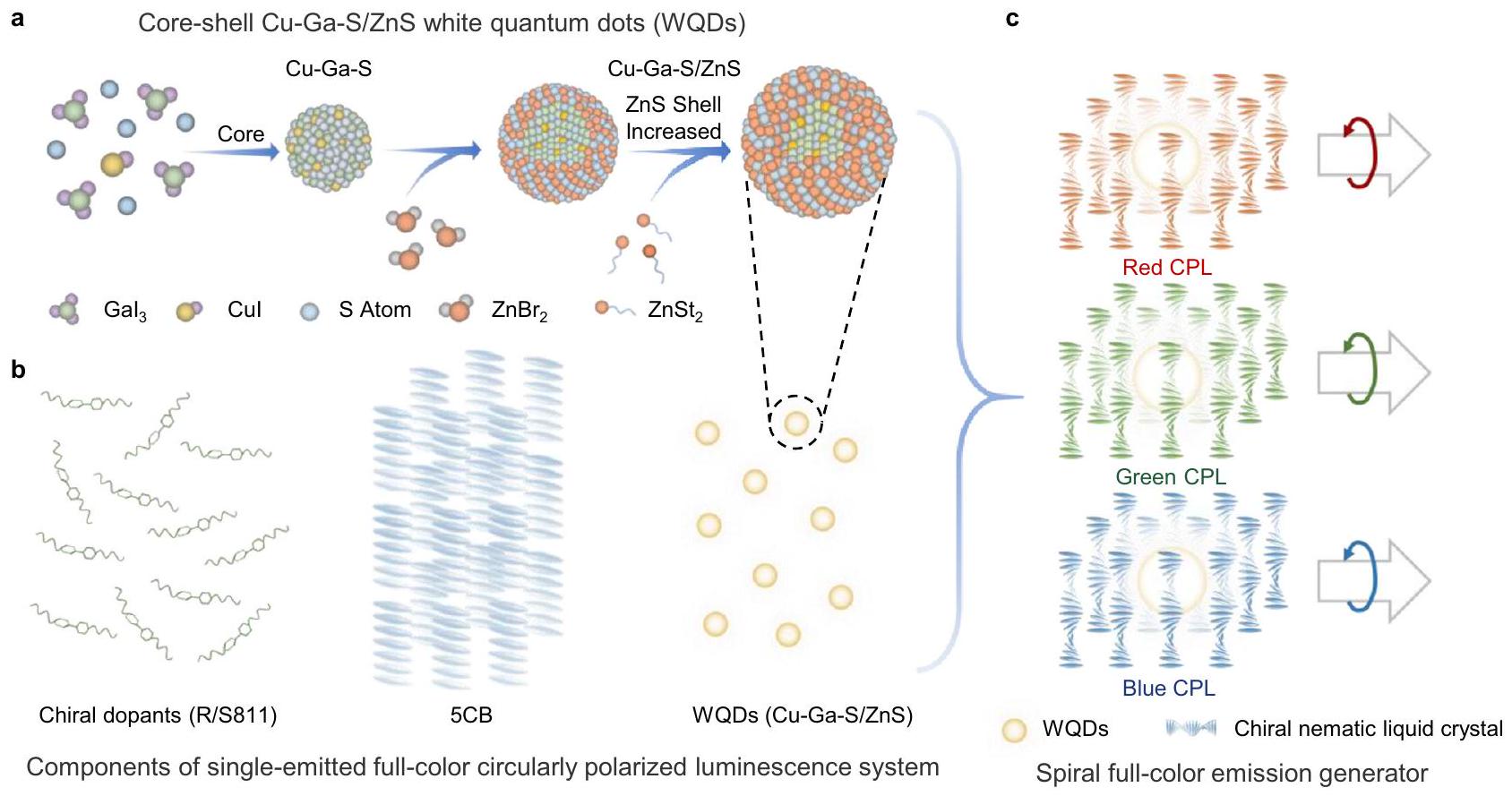
الشكل 1 | توضيح تخطيطي لتصنيع مولد الانبعاث اللوني الكامل الحلزوني (SFEG). أ طريقة حقن متعددة الخطوات لتخليق النوى القشريةنقاط الكم البيضاء (WQDs).مكونات SFEG. رسم تخطيطي لـ SFEG المتكون بواسطة استراتيجية تجميع على شكل قفص مرتبة على المدى الطويل.
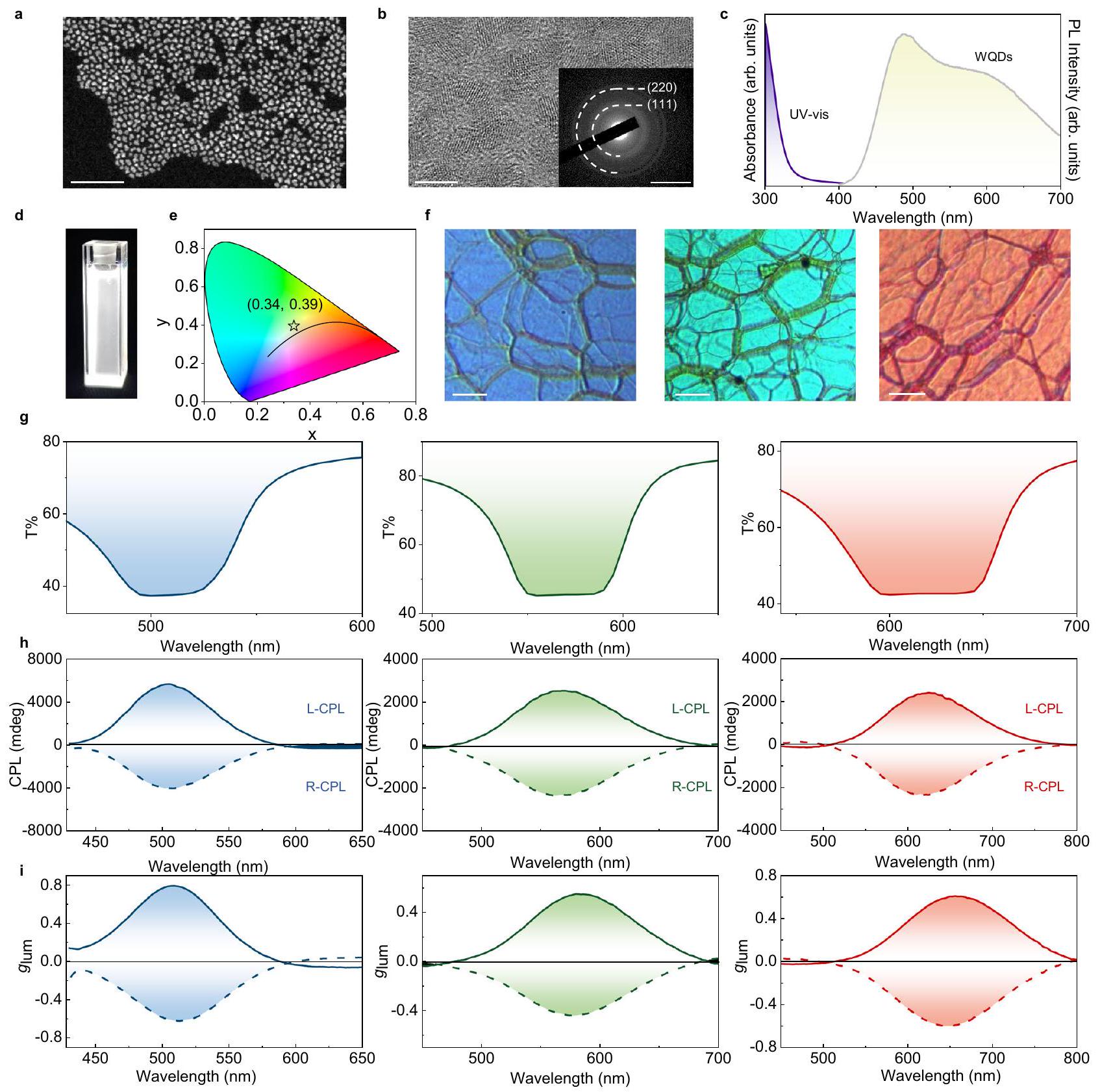
الشكل 2 | توصيفات الـنقاط الكم البيضاء (WQDs) ومولد الانبعاث اللوني الكامل الحلزوني (SFEG). صورة مجهر إلكتروني ناقل ماسح بحقل داكن حلقي عالي الزاوية (HAADF-STEM) لنقاط الكم البيضاء. مقياس الرسم. ب صورة مجهرية إلكترونية ناقلة عالية الدقة (HRTEM) تمثيلية لـ WQDs (شريط المقياس) مع إدراج نمط حيود إلكتروني لمنطقة مختارة (SAED) (شريط المقياس). امتصاصية (الأشعة فوق البنفسجية-المرئية) وطيف الفلورة الضوئية (PL) لجسيمات الكوانتم النانوية من التنجستن في التولوين. صورة فلورية لجسيمات WQDs في خلية كوارتز مع التولوين كمذيب. المنطقة السفلية من كويفيت الكوارتز هي. هـ إحداثيات اللون المقابلة لـ WQDs وفقًا لـ CIE.صور المجهر الضوئي المستقطب (POM) لـ SFEG التمثيلية. شريط المقياس. أطياف انتقال g-i (g)، أطياف التلألؤ المستقطب دائريًا (CPL) (h) وعامل عدم التماثل في التلألؤ المقابلقيم (i) لممثل SFEG. يتم توفير بيانات المصدر كملف بيانات مصدر. أظهر نمط حيود الأشعة السينية (XRD) الهيكل الرباعي المثلث النموذجي للكلكوبريريت لجسيمات WQDs (الشكل التكميلي 4).
ثم نعتمد على أدوات توصيف مختلفة لدراسة الخصائص الفوتوكيميائية لـ SFEG. تُظهر أطياف الامتصاص والانبعاث الضوئي (PL) لـ WQDs في الشكل 2ج، مما يوضح أن حزمة الامتصاص الشديدة تقع في منطقة الأشعة فوق البنفسجية (UV)، وأن الانبعاث يغطي النطاق المرئي من الأزرق البنفسجي إلى الأحمر تحت إشعاع الأشعة فوق البنفسجية. يتيح هذا الطيف الواسع لـ WQDs إصدار توهج أبيض ساطع (الشكل 2د)، مع إحداثيات اللون CIE المقابلة المقاسة كـ (0.34، 0.39) (الشكل 2هـ). بعد ذلك قمنا بتطعيم هذه الـ WQDs المصنعة (أي باعث انبعاث واسع النطاق مفرد) في تم تصميم مضيف سائل بلوري نيماتيكي كيرالي (5CB-R/S811) مع ظروف تفاعل محسنة (التفاصيل في الطرق التكميلية). قمنا بضبط نسبة المضافات الكيرالية و5CB في النظام الهجين للحصول على أطوال موجية مختلفة وألوان هيكلية مميزة (الأشكال التكميلية 5-7) – لتحقيق CPL ملون كامل (الأشكال التكميلية 8-11). جميع SFEG المصنعة (على سبيل المثال، المضافة بـ و ) أظهرت أنسجة بصمات أصابع نموذجية (الشكل 2f)، مما يثبت تكوين هياكل كيرالية. كما هو متوقع، تم الكشف عن فجوات نطاق فوتونية واضحة (الشكل 2g) وإشارات CPL متماثلة قوية (الشكل 2h، تذبذبات كثافة الحالات عند حافة فجوة النطاق الفوتوني تؤدي إلى إشارات CPL عكسية ضعيفة) مع
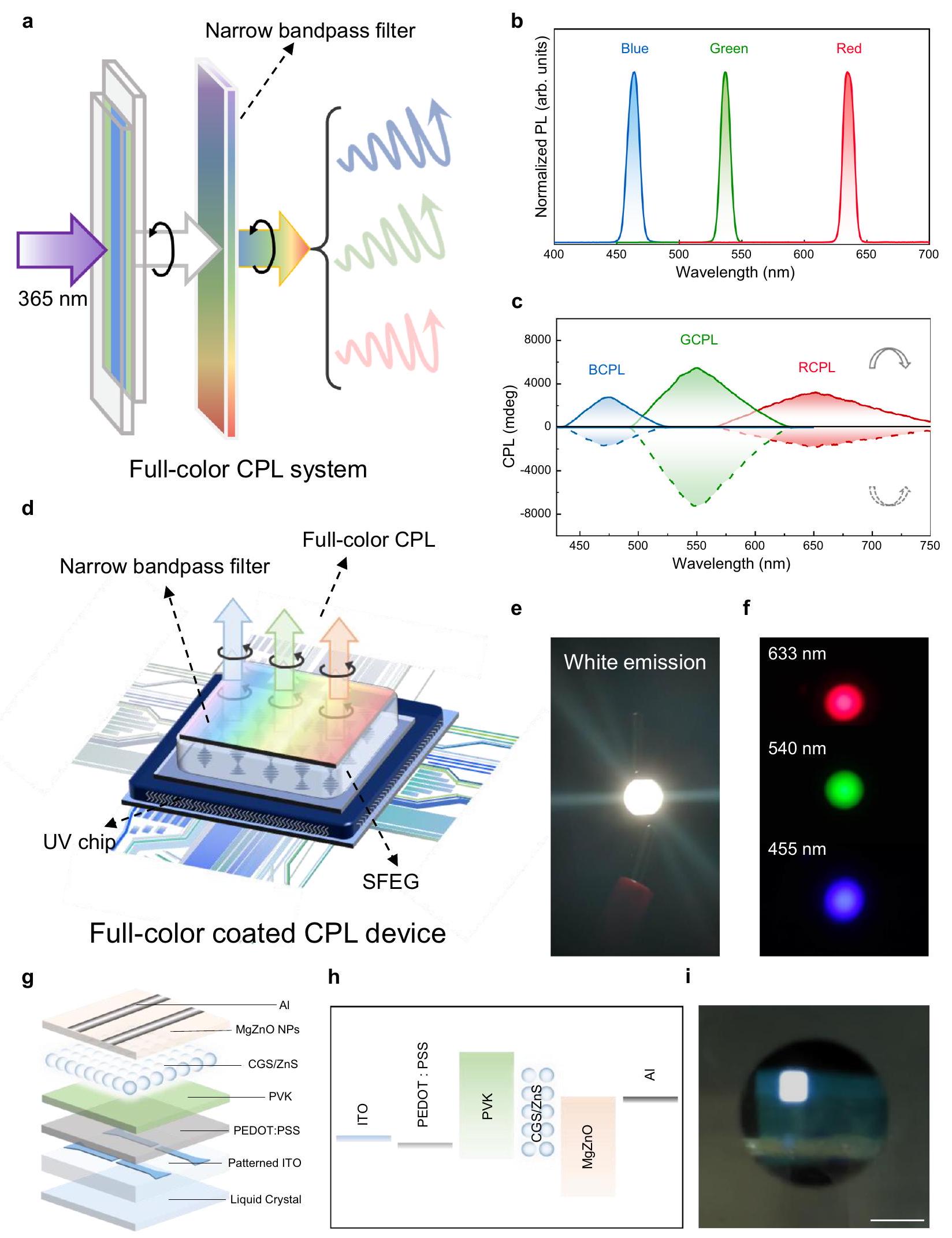
الشكل 3 | توضيح تخطيطي يُظهر التلألؤ المستقطب دائريًا (CPL) الملون المخصص المرئي وتصنيع جهاز CPL. أ رسم تخطيطي لأنظمة CPL الملونة المخصصة عن طريق تغطية مرشحات تمرير ضيقة ملونة مخصصة فوق مولد الانبعاث اللوني الكامل الحلزوني (SFEG). ب-ج أطياف الفوتولومينسانس (PL) (ب) وأطياف CPL المنعكسة المرآة المقابلة (ج) لنظام CPL الملون المخصص المرئي. تم توفير بيانات المصدر كملف بيانات مصدر. د مخطط هيكلي لمفهوم إثبات اللون المخصص أجهزة CPL المطلية بتغطية فلاتر ضيقة النطاق ذات لون مخصص فوق جهاز CPL المطلي. صور (e-f) لجهاز CPL ذو انبعاث أبيض (e) وأجهزة CPL المطلية ذات اللون المخصص (f). (g) مخطط لجهاز CPL الكهروضوئي. (h) مخطط نطاق الطاقة لجهاز QLED متعدد الطبقات ينبعث من الأسفل ومعالج بالمحلول ينبعث منه ضوء أبيض. أكسيد الإنديوم والقصدير (ITO)، بولي(3,4-إيثيلينديوكسيثيوفين):بولي(ستيرين سلفونات) (PEDOT:PSS)، بولي فينيل كاربازول (PVK)، نقاط كمومية بيضاء (CGS/ZnS). (i) صورة مضيئة لجهاز CPL الكهروضوئي. مقياس الرسم. القيمة تصل إلى 0.8 (الشكل 2i). كما قمنا بالتمديد إلى CPL الأبيض بمساعدة بوليمر الكريستال السائل ذو فجوة الفوتون العريضة (الأشكال التكميلية 12، 13).
تصوير الإضاءة المستقطبة دائرية مخصصة اللون وبناء الجهاز
تم تحقيق معظم أنظمة CPL الملونة بالكامل عن طريق خلط المرسلات أحادية اللون بنسب معينة.لسوء الحظ، من المعقد بشكل خاص الحصول على CPL المطلوب بطول موجي محدد مع الحفاظ على استقرار اللون، وقد زادت هذه الاستراتيجية من تعقيد بناء الجهاز – وهو أمر غير ملائم للتطبيقات العملية. يتجنب جهاز SFEG الذي طورناه هذه المشكلات ولكنه يظهر إشارات CPL ملونة بالكامل تحت ستار انبعاث أبيض ساطع. لذلك سعينا لتغطية جهاز SFEG باستخدام فلاتر تمرير ضيقة النطاق مختلفة (الشكل 3أ) التي تمكن من الحصول على CPL مرئي مع انبعاث دقيق بطريقة سهلة وفي النهاية تحقيق بناء جهاز CPL مغلف. ونتيجة لذلك، تم إنتاج انبعاثات ملونة مخصصة متنوعة مع عرض نصف أقصى مرضٍ، كما هو موضح في الشكل 3ب. في الوقت نفسه، نحقق إشارات CPL متطابقة قوية وقيم glum كبيرة مع الانبعاثات المقابلة (الشكل 3ج، الشكل التكميلي 14)، مما يوفر طريقة لتشكيل CPL المرغوب لتطبيقات الفوتوالكترونيات وشاشات العرض ثلاثية الأبعاد من الجيل القادم.
بفضل أداء CPL الملون المخصص الرائع، قمنا ببناء نموذج أولي لجهاز CPL مطلي بانبعاث أبيض (الشكل 3د) عن طريق طلاء SFEG المحضر على سطح شريحة LED بالأشعة فوق البنفسجية المتاحة تجارياً. أظهر جهاز CPL المطلي الناتج انبعاثًا أبيض ساطعًا (الشكل 3هـ). بعد دمج فلاتر تمرير ضيقة النطاق مختلفة، قمنا أيضًا ببناء أجهزة CPL مطلية بألوان مخصصة مع انبعاثات دقيقة باللون الأحمر (633 نانومتر)، والأخضر (540 نانومتر)، والأزرق (455 نانومتر) (الشكل 3و)، مما يوفر وسيلة لتبسيط تصنيع الشاشات. علاوة على ذلك، قمنا ببناء جهاز CPL كهربائي مضيء على أساس نظام الكريستال السائل المحسن-إضافة طبقة رقيقة من البلورات السائلة الحرة ذات التماثل العالي غير المتكافئ في الأسفل على شاشة QLED البيضاء متعددة الطبقات (الشكل 3g-i، الشكل التكميلي 15)، مما يشكل خطوة مهمة نحو بناء أجهزة CPL غير متماثلة كبيرة الحجم.
البلمرة الانتقائية باليد المستحثة بواسطة الإضاءة المستقطبة دائريًا لحمض 10,12-تريكوساديينوئيك
يشجعنا جهاز SFEG المُعد بنجاح والذي يصدر إشارات CPL قوية على استخدامه في التطبيقات العملية. عرضنا حالة تحويل الفوتون إلى المادة، وهي استخدام جهاز SFEG الخاص بنا لتوليد CPL ثم تسليط الضوء عليه على أفلام مونومر حمض 10,12-تريكوساديينويك (TDA) لنمو بوليمر 10,12-تريكوساديينويك الحلزوني (PTDA) (الشكل 4أ، الأشكال التكميلية 16، 17). بعد التعرض المتزامن تحت CPL الأيسر أو الأيمن (الشكل 4ب) وأشعة فوق بنفسجية قصيرة الموجة لمدة 15 ثانية، تحولت أفلام TDA الشفافة تقريبًا إلى اللون الأزرق، وأظهر تحليل الأشعة فوق البنفسجية والمرئية وCD للعينات امتصاصًا واضحًا وتأثير كوتون معاكس، مما يثبت تكوين PTDA الحلزوني (الشكل 4ج، د). أجرينا أيضًا تجارب مقارنة أخرى لتأكيد التفاعل بين CPL وTDA (الأشكال التكميلية 18-24، الجدول التكميلي 1)، مما يثبت أن البلمرة تعتمد على الأشعة فوق البنفسجية قصيرة الموجة بينما تعتمد الانتقائية الضوئية على اتجاه CPL. يتيح نقل الحلزونية المدفوع بالفوتونات باستخدام جهاز SFEG المصنع تعزيز فهم أصل الحلزونية في الطبيعة وتحفيز الخصائص البصرية والكهربائية والمغناطيسية للمواد الذكية الحلزونية..
وأخيرًا وليس آخرًا، نظرًا لأن مواد CPL الذكية المستجيبة للمحفزات الخارجية قد جذبت اهتمامًا هائلًا بسبب الطلب على تخزين المعلومات، التشفير ومكافحة التزوير، يمكن أن يكون SFEG المُعد أيضًا مرشحًا محتملاً لمكافحة التزييف الذكية باستخدام CPL نظرًا لاستجابته الحساسة لدرجة الحرارة المحيطة وضوء الأشعة فوق البنفسجية (الأشكال التكميلية 25، 26)، مما يوسع بشكل أكبر مجالات تطبيق CPL.
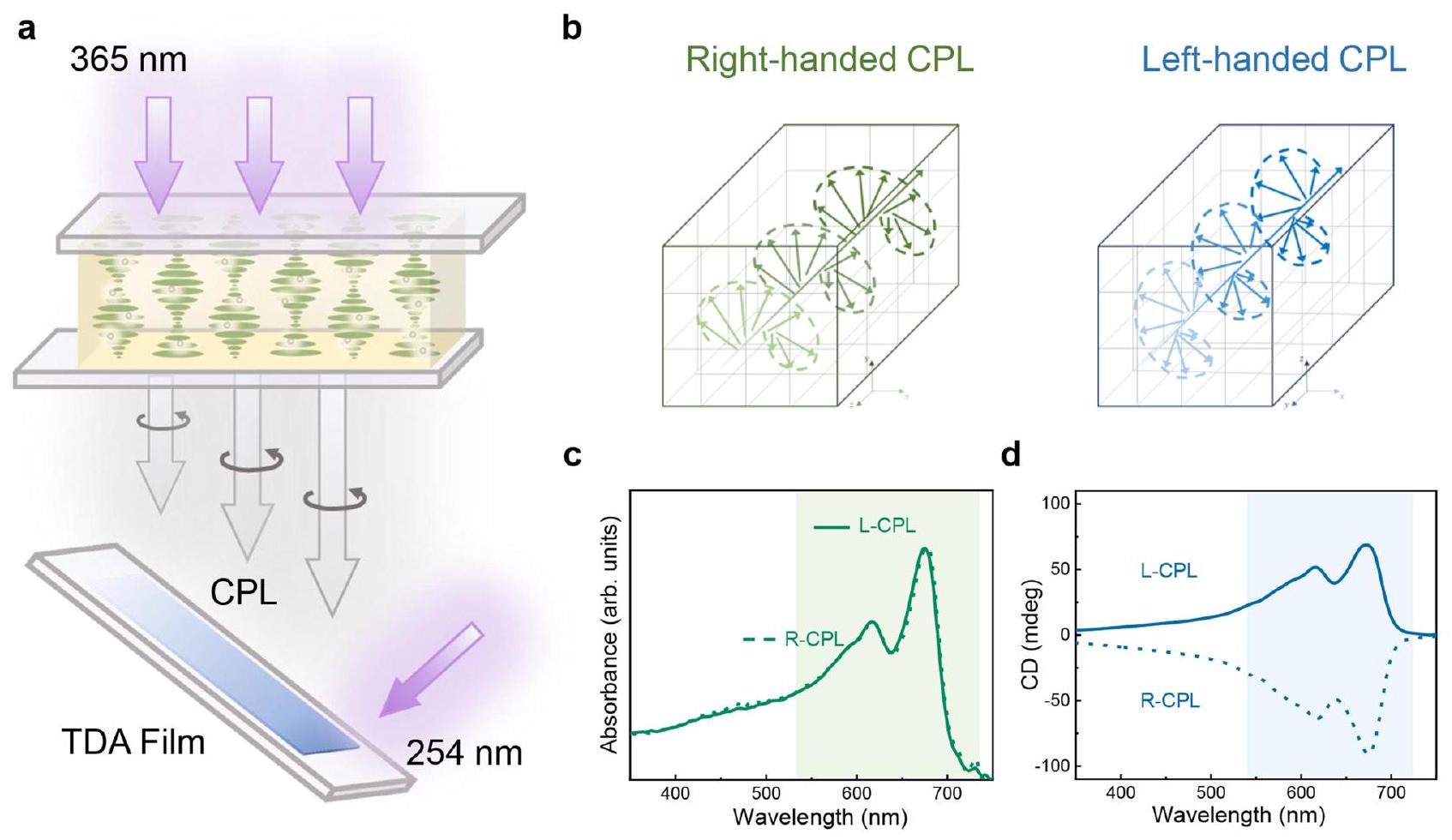
الشكل 4 | البلمرة الانتقائية للمركب 10,12-تريكوزاديينوويك أسيد (TDA) باستخدام مولد الانبعاث اللوني الحلزوني الكامل (SFEG). أ رسم تخطيطي للبلمرة الانتقائية للمركب TDA التي يحفزها الانبعاث المستقطب دائريًا (CPL) من SFEG (الذروة عند)) بمساعدة ظروف إضاءة فوق بنفسجية قصيرة الموجة: ضوء قطبي دائري موجه لليسار (أزرق) ويمين (أخضر). طيف الامتصاص (ج) وطيف التباين الدائري (د) لحمض بولي 10,12-تريكوساديينوويك الكيرالي (PTDA) الناتج عن ضوء قطبي دائري موجه لليسار (المنحنى المستمر) ويمين (المنحنى المتقطع). تم توفير بيانات المصدر كملف بيانات مصدر. (مصباح فوق بنفسجي:; مسافة العينة إلى الضوء: 15 سم). ب اثنان مختلفان
باختصار، نقدم مولد انبعاث لوني كامل لولبي (SFEG) بأكبربقيمة 0.8. ثم نحقق CPL ملون مخصص، مما يوفر نهجًا مبسطًا للحصول على CPL دقيق، وبعد ذلك يتم بناء أجهزة CPL الفوتولومينيسنت والإلكترولومينيسنت المطلية لإجراء محاولات أولية للتطبيق العملي. علاوة على ذلك، يُستخدم SFEG المُعد كمولد CPL مباشر في البلمرة الانتقائية الضوئية المحفزة لـ TDA، حيث يظهر إشارات CD معاكسة تحت إضاءة CPL اليدوي الأيسر أو الأيمن بمساعدة الأشعة فوق البنفسجية قصيرة الموجة. يمهد هذا العمل الطريق لتصنيع وتطبيق CPL عمليًا في التخليق غير المتماثل المحفز بالضوء، وبناء الأجهزة، وحتى العروض المستقبلية.
الطرق
تخليق النقاط الكمومية البيضاء
لتحضيرتم وضع 112.6 ملغ من يوديد النحاس، و0.25 مل من دودكانثيول (DDT)، و2.5 مل من أوليلامين (OLA) في دورق ثلاثي الرقاب بسعة 50 مل، ثم تم تسخينه إلىمع إزالة الغازات و-إجراءات التنقية ذهابًا وإيابًا ثلاث مرات. بعد ذلك، تم تسخين الخليط إلى، ومحلول مخزون الكبريت (يذوب 32 ملغ من مسحوق الكبريت في 1 مل من 1-أوكتاديكان عند ) تم حقنه في الخليط في القارورة ذات الرقبة الثلاثية عند لمدة 5 دقائق. لتحضير طبقات ZnS المتتالية، تم إعداد محلولين مخزنين مختلفين لـ ZnS عن طريق إذابة 366 ملغ من أسيتات الزنك في مزيج من 1 مل DDT، 1 مل ODE و2 مل حمض الأوليك، و2.53 جم من ستيرات الزنك في مزيج من 2 مل DDT و4 مل ODE، على التوالي. تم تسخين محلول ZnS المخزن الأول إلىوتم حقنه فيالحل الأساسي، ثم تم تسخين التفاعل إلىلمدة 30 دقيقة. بعد ذلك، تم حقن محلول مخزون ZnS الثاني وتم الحفاظ على التفاعل عند لمدة 60 دقيقة. تم تبريد محلول النمو إلى ومخفف بالتولوين، ثم غُسل ثلاث مرات أخرى باستخدام خليط التولوين/الإيثانول عن طريق الطرد المركزي عندلمدة 10 دقائق وأخيرًا أعيد توزيعه في التولوين.
تصنيع مولد الانبعاث اللوني الكامل الحلزوني
لصنع ممثل SFEG الأزرق، تم خلط 1 مل من محلول التولوين WQD المحضر، و0.29 جم من R/S811 جيدًا، ثم تم تحريكه لمدة 10 دقائق ثم تم تفريقه بالموجات فوق الصوتية لمدة 15 دقيقة في قارورة سعة 2 مل. بعد ذلك، أضيف 0.71 جم من البلورة السائلة النيماتية 5CB إلى محلول التولوين السابق، وحرك لمدة 10 دقائق ثم تم تفريقه بالموجات فوق الصوتية لمدة 20 دقيقة. أخيرًا، تم الاحتفاظ بالمزيج في القارورة عندلمدة 36 ساعة لتبخير المذيب التولوين بالكامل.
التوصيف
تم إجراء التصوير المجهري الإلكتروني النافذ (TEM) والتصوير المجهري الإلكتروني النافذ عالي الدقة (high-resolution TEM) باستخدام مجاهر JEM-2100Plus بجهود تسريع تبلغ 200 كيلوفولت. تم جمع خرائط طيف الأشعة السينية المشتتة للطاقة (EDS) وتصوير HAADF-STEM باستخدام مجاهر الإلكترون JEM-2100F وTalos F200X. تم استخدام مقياس الطيف فوق البنفسجي-المرئي-تحت الأحمر القريب (Shimadzu 3700 DUV) لقياس الطيف النافذ وطيف UV-vis، ومقياس الطيف الفلوري Hitachi F-4700 لقياس أطياف الفلورة، وجهاز قياس العائد الكمومي للفلوريسنس المطلق (PLQY) من Hamamatsu (C11347) عند 365 نانومتر باستخدام كيوفيت كوارتز. تم قياس أطياف الدوران الضوئي (CD) وأطياف الاستقطاب الضوئي الدائري للفلورة (CPL) باستخدام مقياسي الطيف JASCO J-1500 وJASCO CPL-300 على التوالي. تم تسجيل صور المجهر المستقطب (POM) باستخدام مجهر المواد العمودي Mshot MP41. تم جمع بيانات حيود الأشعة السينية للمواد المسحوقة (PXRD) باستخدام جهاز حيود Rigaku Smart Lab Diffractometer في النطاق من… إلى مع الإشعاع (الطول الموجي:).
توفر البيانات
تم إيداع مجموعة البيانات التي تدعم نتائج هذه الدراسة في مستودع زينودو.، ومتوفرة في https://doi.org/10.5281/zenodo.10258367. يتم توفير بيانات المصدر مع هذه الورقة.
References
Liu, D., Li, H., Han, R., Liu, H. & Zang, S. Multiple stimuli-responsive luminescent chiral hybrid antimony chlorides for anti-counterfeiting and encryption applications. Angew. Chem. Int. Ed. 62, e202307875 (2023).
Xue, C. et al. Excitation-dependent circularly polarized luminescence from helical assemblies based on tartaric acid-derived acylhydrazones. Angew. Chem. Int. Ed. 61, e202205633 (2022).
Guo, Q. et al. Multimodal-responsive circularly polarized luminescence security materials. J. Am. Chem. Soc. 145, 4246-4253 (2023).
Wu, Y., Li, M., Zheng, Z., Yu, Z. & Zhu, W. Liquid crystal assembly for ultra-dissymmetric circularly polarized luminescence and beyond. J. Am. Chem. Soc. 145, 12951-12966 (2023).
Zhan, X. et al. 3D laser displays based on circularly polarized lasing from cholesteric liquid crystal arrays. Adv. Mater. 33, e2104418 (2021).
Sang, Y., Han, J., Zhao, T., Duan, P. & Liu, M. Circularly polarized luminescence in nanoassemblies: generation, amplification, and application. Adv. Mater. 32, e1900110 (2020).
Chen, Z. et al. High-performance circularly polarized electroluminescence with simultaneous narrowband emission, high efficiency, and large dissymmetry factor. Adv. Mater. 34, 2109147 (2022).
Yan, Z. et al. A chiral dual-core organoboron structure realizes dualchannel enhanced ultrapure blue emission and highly efficient circularly polarized electroluminescence. Adv. Mater. 34, 2204253 (2022).
Zhang, D., Li, M. & Chen, C. Recent advances in circularly polarized electroluminescence based on organic light-emitting diodes. Chem. Soc. Rev. 49, 1331-1343 (2020).
. et al. Enantiomer-dependent immunological response to chiral nanoparticles. Nature 601, 366-373 (2022).
Kim, J. Y. et al. Assembly of gold nanoparticles into chiral superstructures driven by circularly polarized light. J. Am. Chem. Soc. 141, 11739-11744 (2019).
Shibayev, P. & Pergolizzi, R. The effect of circularly polarized light on the growth of plants. Int. J. Bot. 7, 113-117 (2010).
Hou, J., Toyoda, R., Meskers, S. & Feringa, B. Programming and dynamic control of the circular polarization of luminescence from an achiral fluorescent dye in a liquid crystal host by molecular motors. Angew. Chem. Int. Ed. 61, e202206310 (2022).
Xu, M. et al. Assembling semiconductor quantum dots in hierarchical photonic cellulose nanocrystal films: circularly polarized luminescent nanomaterials as optical coding labels. J. Mater. Chem. C 7, 13794-13802 (2019).
Joo, W. et al. Metasurface-driven OLED displays beyond 10,000 pixels per inch. Science 370, 459-463 (2020).
Zhang, M. et al. Molecular engineering towards efficient white-light-emitting perovskite. Nat. Commun. 12, 4890 (2021).
Kim, J. H. et al. White electroluminescent lighting device based on a single quantum dot emitter. Adv. Mater. 28, 5093-5098 (2016).
Fu, H. et al. Circularly polarized room-temperature phosphorescence and encapsulation engineering for MOF-based fluorescent/ phosphorescent white light-emitting devices. Adv. Optical Mater. 8, 2000330 (2020).
Nishimura, H. et al. Oxygen-bridged diphenylnaphthylamine as a scaffold for full-color circularly polarized luminescent materials. J. Org. Chem. 82, 5242-5249 (2017).
Zhao, Z., Liang, X., He, M., Zhang, M. & Zhao, C. Triarylborane-based [5]hlicenes with full-color circularly polarized luminescence. Org. Lett. 21, 9569-9573 (2019).
Li, Z., Zhao, C., Lin, X., Ouyang, G. & Liu, M. Stepwise solutioninterfacial nanoarchitectonics for assembled film with full-color and white-light circularly polarized luminescence. ACS Appl. Mater. Interfaces 15, 31077-31086 (2023).
Li, M. et al. Chiral nanoparticles with full-color and white CPL properties based on optically stable helical aromatic imide enantiomers. ACS Appl. Mater. Interfaces 10, 8225-8230 (2018).
Han, J., You, J., Li, X., Duan, P. & Liu, M. Full-color tunable circularly polarized luminescent nanoassemblies of achiral AIEgens in confined chiral nanotubes. Adv. Mater. 29, 1606503 (2017).
Li, Y., Yao, K., Chen, Y., Quan, Y. & Cheng, Y. Full-color and white circularly polarized luminescence promoted by liquid crystal selfassembly containing chiral naphthalimide dyes. Adv. Optical Mater. 9, 2100961 (2021).
Ye, F. et al. Clear disclosure of hierarchical chirality transfer mechanism and wide full-color and white-light CPL emissions with both high and intensity by TPE helicates. Adv. Optical Mater. 11, 2201784 (2023).
Huo, S., Duan, P., Jiao, T., Peng, Q. & Liu, M. Self-assembled luminescent quantum dots to generate full-color and white circularly polarized light. Angew. Chem. Int. Ed. 56, 12174 (2017).
Li, Z., Gong, Z., Shao, J., Yao, J. & Zhong, Y. Full-color and white circularly polarized luminescence of hydrogen-bonded ionic organic microcrystals. Angew. Chem. Int. Ed. 60, 14595 (2021).
Li, M. et al. Helical aromatic imide based enantiomers with full-color circularly polarized luminescence. Chem. Commun. 52, 9921-9924 (2016).
He, J., Bian, K., Li, N. & Piao, G. Generation of full-color and switchable circularly polarized luminescence from nonchiral dyes assembled in cholesteric cellulose films. J. Mater. Chem. C 7, 9278-9283 (2019).
Chen, J. et al. Right-/left-handed helical G-quartet nanostructures with full-color and energy transfer circularly polarized luminescence. Chem. Commun. 56, 7706-7709 (2020).
Yang, L. et al. Highly efficient full-color and white circularly polarized luminescent nanoassemblies and their performance in light emitting devices. Nanoscale 12, 6233-6238 (2020).
Nagata, Y., Takagi, K. & Suginome, M. Solid polymer films exhibiting handedness-switchable, full-color-tunable selective reflection of circularly polarized light. J. Am. Chem. Soc. 136, 9858-9861 (2014).
Yuan, Y. et al. Fluorescent TPE macrocycle relayed light-harvesting system for bright customized-color circularly polarized luminescence. J. Am. Chem. Soc. 144, 5389-5399 (2022).
Lin, S. et al. Photo-triggered full-color circularly polarized luminescence based on photonic capsules for multilevel information encryption. Nat. Commun. 14, 3005 (2023).
Zuo, K. et al. Full-color and white circularly polarized luminescence from quantum dots by chiral templates of cellulose nanocrystals. J. Mater. Chem. C 10, 14729-14736 (2022).
Ma, S. et al. A self-assembled nanohelix for white circularly polarized luminescence via chirality and energy transfer. Nanoscale 12, 7895-7901 (2020).
Ru, Y. et al. Rational design of multicolor-emitting chiral carbonized polymer dots for full-color and white circularly polarized luminescence. Angew. Chem. Int. Ed. 60, 14091 (2021).
Zhao, T. et al. Dual-mode induction of tunable circularly polarized luminescence from chiral metal-organic frameworks. Res. (Wash. D. C.) 2020, 6452123 (2020).
Zhang, C. et al. Enantiomeric MOF crystals using helical channels as palettes with bright white circularly polarized luminescence. Adv. Mater. 32, e2002914 (2020).
Gao, X., Wang, J., Yang, K., Zhao, B. & Deng, J. Regulating the helical chirality of racemic polyacetylene by chiral polylactide for realizing full-color and white circularly polarized luminescence. Chem. Mater. 34, 6116-6128 (2022).
Wei, W., Farooq, M. & Xiong, H. Cholesteric liquid crystalline polyether with broad tunable circularly polarized luminescence. Langmuir 37, 11922-11930 (2021).
Yang, H., Ma, S., Zhao, B. & Deng, J. Brightening up full-color and white circularly polarized luminescence through chiral induction and circularly polarized light excitation. ACS Appl. Mater. Interfaces 15, 13668-13677 (2023).
Zhao, B., Yu, H., Pan, K., Tan, Z. & Deng, J. Multifarious chiral nanoarchitectures serving as handed-selective fluorescence filters for generating full-color circularly polarized luminescence. ACS Nano 14, 3208-3218 (2020).
Zhao, B., Gao, X., Lu, N. & Deng, J. Color-tunable circularly polarized luminescence with helical polyacetylenes as fluorescence converters. Adv. Optical Mater. 8, 2000858 (2020).
Zhang, G. et al. Memorable full-color circularly polarized luminescence from chiral co-assembled polymer films enabled by multipath transfer. Sci. China Chem. 66, 1169-1178 (2023).
Li, P., Gao, X., Zhao, B., Pan, K. & Deng, J. Multi-color tunable and white circularly polarized luminescent composite nanofibers electrospun from chiral helical polymer. Adv. Fiber Mater. 4, 1632-1644 (2022).
Tan, L. et al. Multicolor circularly polarized luminescence from inorganic crystalline nanostructures induced by atomic chirality. Nano Lett. 23, 4384-4389 (2023).
Ru, Y. et al. Full-color circularly polarized luminescence of nanocrystals triggered by chiral carbon dots. Adv. Mater. 35, 2207265 (2022).
Li, S., Dong, X., Qi, K., Zang, S. & Mak, T. Full-color tunable circularly polarized luminescence induced by the crystal defect from the coassembly of chiral silver(I) clusters and dyes. J. Am. Chem. Soc. 143, 20574-20578 (2021).
Watanabe, K., Osaka, I., Yorozuya, S. & Akagi, K. Helically п-stacked thiophene-based copolymers with circularly polarized fluorescence: high dissymmetry factors enhanced by self-ordering in chiral nematic liquid crystal phase. Chem. Mater. 24, 1011-1024 (2012).
Li, M. et al. Light-reconfiguring inhomogeneous soft helical pitch with fatigue resistance and reversibility. J. Am. Chem. Soc. 144, 20773-20784 (2022).
Yang, X., Zhou, M., Wang, Y. & Duan, P. Electric-field-regulated energy transfer in chiral liquid crystals for enhancing upconverted circularly polarized luminescence through steering the photonic bandgap. Adv. Mater. 32, 2000820 (2020).
Won, Y. et al. Highly efficient and stable InP/ZnSe/ZnS quantum dot light-emitting diodes. Nature 575, 634-638 (2019).
Chen, Y., Li, S., Huang, L. & Pan, D. Low-cost and gram-scale synthesis of water-soluble Cu-In-S/ZnS core/shell quantum dots in an electric pressure cooker. Nanoscale 6, 1295-1298 (2014).
Zhang, W., Pan, C., Cao, F. & Yang, X. White-light-emitting Cu, Mn co-doped quantum dots with high stability and their electroluminescence. J. Mater. Chem. C 5, 10533-10542 (2017).
Schmidtke, J. & Stille, W. Fluorescence of a dye-doped cholesteric liquid crystal film in the region of the stop band: theory and experiment. Eur. Phys. J. B 31, 179-194 (2003).
Ikai, T., Okubo, M. & Wada, Y. Helical assemblies of one-dimensional supramolecular polymers composed of helical macromolecules: generation of circularly polarized light using an infinitesimal chiral source. J. Am. Chem. Soc. 142, 3254-3261 (2020).
Han, H. et al. High-performance circularly polarized light-sensing near-infrared organic phototransistors for optoelectronic cryptographic primitives. Adv. Funct. Mater. 30, 2006236 (2020).
Han, D. et al. Sequentially amplified circularly polarized ultraviolet luminescence for enantioselective photopolymerization. Nat. Commun. 11, 5659 (2020).
Xu, Y. et al. Enantioselective synthesis of helical polydiacetylene by application of linearly polarized light and magnetic field. Nat. Commun. 5, 5050 (2014).
Xu, L. et al. Efficient circularly polarized electroluminescence from achiral luminescent materials**. Angew. Chem. Int. Ed. 62, e202300492 (2023).
Wang, X. et al. Circularly polarized light source from self-assembled hybrid nanoarchitecture. Adv. Optical Mater. 10, 2200761 (2022).
Zhang, M. et al. Amplifying inorganic chirality using liquid crystals. Nanoscale 14, 592-601 (2022).
Zhao, S. et al. Visualizing circularly polarized long afterglow for information security. Adv. Optical. Mater. 11, 2202933 (2023).
Zhuang, T. & Zhou, Y. Helical-caging enables single-emitted large asymmetric full-color circularly polarized luminescence. Zenodo https://doi.org/10.5281/zenodo. 10258367 (2023).
الشكر والتقدير
تم دعم T.Z. و Y.Z. و Y.W. و S.Z. و M.Zhang و G.L. و Q.G. و Z.T. و Z.L. من قبل البرنامج الوطني الرئيسي للبحث والتطوير في الصين (المنحة 2021YFA1500400)؛ المؤسسة الوطنية للعلوم الطبيعية في الصين (المنح 22071226 و U1932213 و 22271265 و 22101270)؛ برنامج المئة موهبة للأكاديمية الصينية للعلوم (المنحة KJ2060007002)؛ برنامج الابتكار التعاوني لمركز هيفي للعلوم، الأكاديمية الصينية للعلوم (المنحة 2022HSC-CIP016)؛ تمويل جامعة العلوم والتكنولوجيا في الصين (المنح KY2060000168 و YD2060002013 و KY2060000198 و KY2060000235)؛ ومؤسسة العلوم الطبيعية لمقاطعة أنهوي (المنحة BJ2O6O190120). يشكر المؤلفون الدكتور يي لي والدكتور ليانغ وو من جامعة العلوم والتكنولوجيا في الصين على المناقشات المفيدة، ومجموعة البروفيسور مينغمينغ ما من جامعة العلوم والتكنولوجيا في الصين على اختبار CD، والسيد أويان تشنغ من جامعة العلوم والتكنولوجيا في الصين على اختبار تحلل PL، الآنسة تشينغتشينغ يان من جامعة العلوم والتكنولوجيا في الصين على اختبار XRD، والدكتور تانوي لي والدكتور لي شي في جامعة العلوم والتكنولوجيا في الصين على اختبار TEM. يشكر المؤلفون الدكتورة هويجوان وانغ في مركز التجارب للهندسة وعلوم المواد، جامعة العلوم والتكنولوجيا في الصين على اختبار HADDF-STEM. تم تنفيذ هذا العمل جزئيًا في مركز USTC للأبحاث والتصنيع على المستوى الميكروي والنانو.
مساهمات المؤلفين
قام T.Z. بوضع الفكرة وأشرف على المشروع. كتب T.Z. و Y.Z. الورقة. أجرى Y.Z. التجارب وحلل النتائج. ساعد Y.W. و Y.S. في إعداد الأشكال. ساعد S.Z. و M.Zhang و G.L. و Q.G. و Z.T. و Z.L.
و H.Y. في جمع البيانات. ساعد S.J. و M.Zhu. في توفير اختبار CPL. ناقش جميع المؤلفين النتائج وساعدوا أثناء إعداد المخطوطة.
يجب توجيه المراسلات وطلبات المواد إلى تاوتاو زوانغ.
معلومات مراجعة الأقران تشكر مجلة Nature Communications المراجع(ين) المجهولين على مساهمتهم في مراجعة هذا العمل. يتوفر ملف مراجعة الأقران.
معلومات إعادة الطبع والأذونات متاحة على http://www.nature.com/reprints
ملاحظة الناشر تظل Springer Nature محايدة فيما يتعلق بالمطالبات القضائية في الخرائط المنشورة والانتماءات المؤسسية.
قسم الكيمياء، جامعة العلوم والتكنولوجيا في الصين، هيفي 230026، جمهورية الصين الشعبية.المركز الوطني لبحوث العلوم الفيزيائية على المستوى الميكروي، جامعة العلوم والتكنولوجيا في الصين، هيفي 230026، جمهورية الصين الشعبية.قسم الكيمياء التطبيقية، جامعة العلوم والتكنولوجيا في الصين، هيفي 230026، جمهورية الصين الشعبية.قسم الكيمياء ومركز الهندسة الذرية للمواد المتقدمة، جامعة أنهوي، هيفي 230601، جمهورية الصين الشعبية.المختبر الرئيسي لهندسة وتنظيم وظائف المواد الهجينة بوزارة التعليم، جامعة أنهوي، هيفي 230601، جمهورية الصين الشعبية.المختبر الرئيسي لكيمياء المواد غير العضوية الوظيفية لمقاطعة أنهوي، جامعة أنهوي، هيفي 230601، جمهورية الصين الشعبية.
-البريد الإلكتروني:tzhuang@ustc.edu.cn
Helical-caging enables single-emitted large asymmetric full-color circularly polarized luminescence
Received: 24 April 2023
Accepted: 27 December 2023
Published online: 04 January 2024
(A) Check for updates
Yajie Zhou , Yaxin Wang , Yonghui Song , Shanshan Zhao , Mingjiang Zhang , Guangen Li , Qi Guo , Zhi Tong , Zeyi Li , Shan Jin , Hong-Bin Yao , Manzhou Zhu (1) & Taotao Zhuang
Colorful circularly polarized luminescence materials are desired for 3D displays, information security and asymmetric synthesis, in which single-emitted materials are ideal owing to self-absorption avoidance, evenly entire-visible-spectrum-covered photon emission and facile device fabrication. However, restricted by the synthesis of chiral broad-luminescent emitters, the realization and application of high-performing single-emitted full-color circularly polarized luminescence is in its infancy. Here, we disclose a single-emitted fullcolor circularly polarized luminescence system (spiral full-color emission generator), composed of whole-vis-spectrum emissive quantum dots and chiral liquid crystals. The system achieves a maximum luminescence dissymmetry factor of 0.8 and remains an order of in visible region by tuning its photonic bandgap. We then expand it to a series of desired customizedcolor circularly polarized luminescence, build chiral devices and further demonstrate the working scenario in the photoinduced enantioselective polymerization. This work contributes to the design and synthesis of efficient chiroptical materials, device fabrication and photoinduced asymmetric synthesis.
Circularly polarized luminescence (CPL) has aroused universal concern these years owing to its versatile utilization and application potential in anti-counterfeiting , 3D optical displays , photoelectronic devices , disease detection , asymmetric synthetic photochemistry and the promotion of plant growth . However, most CPL employed in practical applications is produced by lasers, polarizers and quarter-wave plates-not conducive to the miniaturization of optical systems and the construction of wearable devices. Additionally, for the small luminescence dissymmetry factor ( ), practical applications based on CPL-active materials have been slow to get off the
ground for a long time, so searching for high quality materials with large values has always been the key towards practical applications in this field. Among all CPL, single-emitted full-color circularly polarized luminescence (SF-CPL) must be taken care of since it can be a considerable candidate for cryptography , affecting the biomass production of plants and the accurate production of customizedcolor CPL .
One single emitter with broad-vis-spectrum luminescence is of particular importance all along since it allows to avoid energy transfer among mixed components and simplify device fabrication , but to
date, materials with single-emitted full-color CPL are still absent. Intensive efforts have produced chiral organic molecules , MOFs , polymers and inorganic nanostructures with multicolor emission. Nonetheless, these full-color-CPL-active materials still cannot satisfy accurate practical requirements because of the complicated and imprecise regulation of multi-emitters, so it is pressing and of particular importance to develop SF-CPL-active materials with large values, simplified adjustment and customized potential.
To achieve high-performing SF-CPL, we took a view, combined high-quality inorganic white emitters with a large asymmetric chiral host . In this work, we describe a SF-CPL system (spiral fullcolor emission generator, SFEG), offering the visible-spectrumregulated CPL with values up to 0.8 . Since the shelling process can adjust the luminescent properties and improve the photoluminescence quantum yield (PLQY) of quantum dots (QDs) , we chose the core-shell QDs as the highly-efficient emitter. The prepared white luminescent core was wrapped in double ZnS shells to enhance the PLQY to and tune the photon emission to the whole visible range. We then controlled the photonic bandgap of the chiral nematic liquid crystal to achieve full-color CPL and further extended to white CPL based on the liquid crystal polymer. The continuous wide-spectrum-emission of the SFEG also made it possible to obtain customized CPL for device fabrication and further practice. Here, we also successfully employed the highly-efficient SFEG to co-induce the enantioselective polymerization of 10,12-tricosadiynoic acid, providing more practicalities for the application of CPL in photon-driven asymmetric synthesis.
Results and discussion
Spiral full-color emission generator design
The generation of SF-CPL depends largely on the precise synthesis of the white-luminescent emitter, the selection of CPL-amplifying photonic crystal and the ingenious combination of these two. Here, we design a long-range ordered cage-like assembly strategy: the white quantum dots (WQDs) are wrapped in the chiral nematic liquid crystal
similar to a night pearl in a spiral cage-converting natural white light to large asymmetric full-color CPL.
It is of high advantage to choose a single QD with broad-vis-range emission instead of mixed ones to achieve white luminescence because of simplified construction of photoelectric device as well as stable emission in practical applications. Achieving complete visible spectrum emission from one single kind of QD can be proceeded by doping impurity ions such as or into the QD host . Here, with the developed multiple-step injection method , we synthesized the WQDs with a high PLQY of up to . Figure 1 illustrates the construction of the SFEG: the Cu-doped Ga-S core is first prepared by a heat-up approach, and the corresponding multiple ZnS shell counterparts are wrapped over the Cu -Ga-S core by a two-step hot injection method (Supplementary Fig. 1). The synthesized coreshell QDs show broad-vis-region white luminescence. Then, the nematic liquid crystal 5CB is selected as a suitable chiral host for its macroscopically favorable compatibility, room-temperature stability, regular fingerprint textures and periodic spiral arrangement induced by chiral dopants (e.g., R/S811, offering large helical twisting power). When combined to form the CPL-amplifying soft photonic crystal, the system effectively boosts the CPL signals throughout. Meanwhile, thanks to the broad luminescence range of the emitter, the chiral nematic liquid crystal’s photonic bandgap could be tuned in the visspectrum without the change of values’ order of magnitude. With the ordered integration of the high-quality WQDs and the appropriate chiral nematic liquid crystal, we achieve the considerable SFEG system.
Characterizations of the spiral full-color emission generator
We first used transmission electron microscopy (TEM) to examine the morphology of the resultant WQDs (Fig. 2a, Supplementary Fig. 2) and further confirmed the crystallization of the QDs as well as observing their size is concentrated at by high resolution transmission electron microscopy (HRTEM) (Fig. 2b), which indicates the potential to realize high-quality photoluminescence (PL). We performed energydispersive X-ray spectroscopy (EDS) mapping analysis (Supplementary Fig. 3) to evidence the successful doping of in the WQDs. The X-ray
Fig. 1 | Schematic illustration of the fabrication of the spiral full-color emission generator (SFEG). a A multiple-step injection method for the synthesis of coreshell white quantum dots (WQDs). Components of the SFEG.
c Schematic drawing of the SFEG formed by a long-range ordered cage-like assembly strategy.
Fig. 2 | Characterizations of the white quantum dots (WQDs) and spiral full-color emission generator (SFEG). a High-angle annular dark field scanning transmission electron microscopy (HAADF-STEM) image of the WQDs. Scale bar . b Representative high resolution transmission electron microscopy (HRTEM) image of the WQDs (scale bar ) with inset corresponding to the selected area electron diffraction (SAED) pattern (scale bar ).
c Absorbance (UV-vis) and photoluminescence (PL) spectra of the WQDs in toluene.
d Fluorescent image of the WQDs in a quartz cell with toluene as the solvent. The bottom area of quartz cuvette is . e The corresponding CIE color coordinates of the WQDs. Polarizing optical microscopy (POM) images of the representative SFEG. Scale bar . g-i Transmission spectra (g), circularly polarized luminescence (CPL) spectra (h) and the corresponding luminescence dissymmetry factor values (i) of the representative SFEG. Source data are provided as a Source Data file.
diffraction (XRD) pattern showed the archetypal tetragonal chalcopyrite structure of the WQDs (Supplementary Fig. 4).
We then adopt various characterization instruments to study the photochemical properties of the SFEG. The absorbance and PL spectra of the WQDs are shown in Fig. 2c, demonstrating that the intense absorption band is located in the ultraviolet (UV) region, and the emission covers the visible range from blue-purple to red under UV irradiation. Such broad spectrum enables the WQDs to emit bright white luminescence (Fig. 2d), with the corresponding CIE color coordinates measured as (0.34, 0.39) (Fig. 2e). We thereafter doped these synthesized WQDs (i.e., single-broad-luminescent emitter) into the
designed chiral nematic liquid crystal host (5CB-R/S811) with optimized reaction conditions (details in Supplementary methods). We tuned the ratio of chiral dopants and 5CB in the hybrid systemobtaining different pitches and distinctive structural colors (Supplementary Figs. 5-7)-to achieve full-color CPL (Supplementary Figs. 8-11). All fabricated SFEG (for example, doped with and ) showed typical fingerprint textures (Fig. 2f), proving the formation of chiral structures. As expected, obvious photonic bandgaps (Fig. 2g) and strong symmetric CPL signals were detected (Fig. 2h, the density of states oscillations in the edge of the photonic bandgap leading to the weak CPL reverse signals ) with the
Fig. 3 | Schematic illustration showing the visualized, customized-color circularly polarized luminescence (CPL) and CPL device fabrication. a Schematic drawing of the customized-color CPL systems by covering customized-color narrow bandpass filters over the spiral full-color emission generator (SFEG). b-c Photoluminescence (PL) spectra (b) and the corresponding mirror-imaged CPL spectra (c) of the visualized customized-color CPL system. Source data are provided as a Source Data file. d The structure diagram of the proof-of-concept customized-color
coated CPL devices by covering customized-color narrow bandpass filters over a coated CPL device. e-f Photographs of the white-emission (e) and customized-color coated CPL devices (f). g Schematic of the electroluminescent CPL device. h Energy band diagram of a solution-processed, bottom-emitting multilayered white QLED. Indium-Tin Oxide (ITO), poly(3,4-ethylenedioxythiophene):poly(styrenesulfonate) (PEDOT:PSS), polyvinylcarbazole (PVK), white quantum dots (CGS/ZnS). i Bright image of the electroluminescent CPL device. Scale bar . value up to 0.8 (Fig. 2i). We also extended to white CPL with the help of the broad-photonic-bandgap liquid crystal polymer (Supplementary Figs. 12, 13).
Visualized customized-color circularly polarized luminescence and device construction
Most full-color CPL systems were realized by mixing monochromatic emitters in certain proportions ; unfortunately, it is particularly complicated to obtain the required CPL with a specific wavelength while maintaining color stability, and such a strategy increased the complexity of the device construction-not friendly for practical applications. The SFEG we elaborated avoids these issues but shows full-color CPL signals under the veil of bright white emission. We sought, therefore, to cover our SFEG using different narrow bandpass filters (Fig. 3a) that would enable to obtain visualized CPL with accurate emission in a facile way and ultimately realize coated CPL device construction. As a result, various customizedcolor emissions with satisfying full-width at half-maximum were produced, as exhibited in Fig. 3b. Meanwhile, we achieve strong mirror-image CPL signals and large glum values with corresponding emissions (Fig. 3c, Supplementary Fig. 14), which provides a method to form desired CPL for photoelectronic and next-generation 3D display applications.
On account of the delightful customized-color CPL performance, we built a prototype coated white-emission CPL device (Fig. 3d)coating the as-prepared SFEG on the surface of a commercially available UV-LED chip. The achieved coated CPL device showed bright white emission (Fig. 3e). After combining different narrow bandpass filters, we also constructed customized-color coated CPL devices with accurate red ( 633 nm ), green ( 540 nm ) and blue ( 455 nm ) emissions (Fig. 3f), offering a thread to simplify the display fabrication. Furthermore, we built an electroluminescent CPL device on the basis of an
improved liquid crystal system -adding the highly asymmetric freestanding liquid crystal film bottom on the multilayered white QLED (Fig. 3g-i, Supplementary Fig. 15), which makes a significant step towards the construction of large asymmetric CPL devices.
Circularly polarized luminescence-induced enantioselective polymerization of 10,12-tricosadiynoic acid
The successfully prepared SFEG with strong CPL signals encourages us to put it into real applications. We showed a photon-to-matter case, that is, employing our SFEG to generate CPL and then illuminating the light on the 10,12-tricosadiynoic acid (TDA) monomer films for growing the chiral poly 10,12-tricosadiynoic scid (PTDA) (Fig. 4a, Supplementary Figs. 16, 17). After simultaneous explosion under left- or righthanded CPL (Fig. 4b) and shortwave UV for 15 s , the virtually transparent TDA films turned to blue and the UV-vis and CD analysis of the samples showed obvious absorption and opposite Cotton effect, proving the formation of the chiral PTDA (Fig. 4c, d). We also conducted other comparative experiments to confirm the interaction between CPL and TDA (Supplementary Figs. 18-24, Supplementary Table 1), evidencing that the polymerization relies on shortwave UV while the enantioselectivity depends on the handedness of CPL. The photon-driven chirality transfer using the fabricated SFEG device, enables to promote the understanding of chirality origin in nature and the induction of optical, electrical and magnetic properties to chiral intelligent materials .
Last but not least, since smart CPL materials responsive to external stimulation have attracted enormous attention for the demand of information storage, encryption and anticounterfeiting , the as-prepared SFEG could also be a potential candidate for intelligent CPL anti-counterfeiting due to its sensitive response to ambient temperature and UV light (Supplementary Figs. 25, 26), further broadening the application fields of CPL.
Fig. 4 | Enantioselective polymerization of 10,12-tricosadiynoic acid (TDA) using the spiral full-color emission generator (SFEG). a Schematic drawing of the enantioselective polymerization of TDA induced by circularly polarized luminescence (CPL) from the SFEG (peak at ) assisted by shortwave UV illuminant conditions: left- (blue) and right-handed (green) CPL. Absorbance (c) and circular dichroism spectra (d) of the chiral poly 10,12-tricosadiynoic acid (PTDA) induced by left- (solid curve) and right-handed (dashed curve) CPL. Source data are provided as a Source Data file. (UV lamp: ; the sample-light distance: 15 cm ). b Two different
In summary, we present a spiral full-color emission generator (SFEG) with a largest value of 0.8 . We then achieve customizedcolor CPL, providing a simplified approach to obtain precise CPL, and after that, the coated photoluminescent and electroluminescent CPL devices are constructed to make preliminary attempts for practice. Furthermore, the as-prepared SFEG is employed as a direct CPL generator in the photoinduced enantioselective polymerization of TDA-showing opposite CD signals under the illumination of left- or right-handed CPL assisted with shortwave UV. This work paves the way for the synthesis and practical application of CPL in photoinduced asymmetric synthesis, device construction and even future displays.
Methods
Synthesis of the white quantum dots
For the synthesis of the Cu iodide, 112.6 mg Ga iodide, 0.25 mL dodecanethiol (DDT) and 2.5 mL oleylamine (OLA) were put in a 50 mL three-neck flask, and then heated to with degassing and -purging procedures back and forth three times. After that, the mixture was heated to , and the sulfur stock solution (dissolving 32 mg S powder in 1 mL 1 -octadecene at ) was injected into the mixture in the three-neck flask at for 5 min . For the synthesis of the consecutive ZnS shells, two different ZnS stock solutions were prepared by dissolving 366 mg Zn acetate in a mixture of 1 mL DDT, 1 mL ODE and 2 mL oleic acid and 2.53 g Zn stearate in a mixture of 2 mL DDT and 4 mL ODE, respectively. The first ZnS stock solution was heated to and injected into the core solution, and then the reaction was heated to for 30 min . Thereafter, the second ZnS stock solution was injected and the reaction was kept at for 60 min . The growth solution was cooled to and diluted with toluene, and then washed three more times using toluene/ethanol mixture by centrifugation at for 10 min and finally redispersed in toluene.
Fabrication of the spiral full-color emission generator
For the fabrication of the representative blue SFEG, 1 mL the asprepared WQD toluene solution, 0.29 g R/S811 were mixed well, stirred for 10 min and then ultrasonically dispersed for 15 min in a 2 mL vial. Subsequently, 0.71 g nematic liquid crystal 5CB was added to the above toluene solution, stirred for 10 min and then ultrasonically dispersed for 20 min . Finally, the mixture in the vial was held at for 36 h to completely volatilize the solvent toluene.
Characterization
TEM and high-resolution TEM were performed on JEM-2100Plus microscopes with acceleration voltages of 200 kV . The energy dispersive X-ray spectra (EDS) mapping and HAADF-STEM were collected on JEM-2100F and Talos F200X electron microscopes. The UV-vis-NIR spectrophotometer (Shimadzu 3700 DUV) was used for transmission and UV-vis spectra, Hitachi F-4700 fluorescence spectrophotometer for fluorescence spectra, and Hamamatsu (C11347) absolute PLQY spectrometer for photoluminescence quantum yield ( 365 nm , quartz cuvette). CD and CPL spectra were measured on a JASCO J-1500 and JASCO CPL-300 spectrophotometer, respectively. POM images were recorded on the material microscope upright Mshot MP41. The powder X-ray diffraction data (PXRD) was collected on Rigaku Smart Lab Diffractometer in the range of to with radiation (wavelength: ).
Data availability
The dataset supporting the findings of this study has been deposited in the Zenodo repository , and is available at https://doi.org/10.5281/ zenodo.10258367. Source data are provided with this paper.
References
Liu, D., Li, H., Han, R., Liu, H. & Zang, S. Multiple stimuli-responsive luminescent chiral hybrid antimony chlorides for anti-counterfeiting and encryption applications. Angew. Chem. Int. Ed. 62, e202307875 (2023).
Xue, C. et al. Excitation-dependent circularly polarized luminescence from helical assemblies based on tartaric acid-derived acylhydrazones. Angew. Chem. Int. Ed. 61, e202205633 (2022).
Guo, Q. et al. Multimodal-responsive circularly polarized luminescence security materials. J. Am. Chem. Soc. 145, 4246-4253 (2023).
Wu, Y., Li, M., Zheng, Z., Yu, Z. & Zhu, W. Liquid crystal assembly for ultra-dissymmetric circularly polarized luminescence and beyond. J. Am. Chem. Soc. 145, 12951-12966 (2023).
Zhan, X. et al. 3D laser displays based on circularly polarized lasing from cholesteric liquid crystal arrays. Adv. Mater. 33, e2104418 (2021).
Sang, Y., Han, J., Zhao, T., Duan, P. & Liu, M. Circularly polarized luminescence in nanoassemblies: generation, amplification, and application. Adv. Mater. 32, e1900110 (2020).
Chen, Z. et al. High-performance circularly polarized electroluminescence with simultaneous narrowband emission, high efficiency, and large dissymmetry factor. Adv. Mater. 34, 2109147 (2022).
Yan, Z. et al. A chiral dual-core organoboron structure realizes dualchannel enhanced ultrapure blue emission and highly efficient circularly polarized electroluminescence. Adv. Mater. 34, 2204253 (2022).
Zhang, D., Li, M. & Chen, C. Recent advances in circularly polarized electroluminescence based on organic light-emitting diodes. Chem. Soc. Rev. 49, 1331-1343 (2020).
. et al. Enantiomer-dependent immunological response to chiral nanoparticles. Nature 601, 366-373 (2022).
Kim, J. Y. et al. Assembly of gold nanoparticles into chiral superstructures driven by circularly polarized light. J. Am. Chem. Soc. 141, 11739-11744 (2019).
Shibayev, P. & Pergolizzi, R. The effect of circularly polarized light on the growth of plants. Int. J. Bot. 7, 113-117 (2010).
Hou, J., Toyoda, R., Meskers, S. & Feringa, B. Programming and dynamic control of the circular polarization of luminescence from an achiral fluorescent dye in a liquid crystal host by molecular motors. Angew. Chem. Int. Ed. 61, e202206310 (2022).
Xu, M. et al. Assembling semiconductor quantum dots in hierarchical photonic cellulose nanocrystal films: circularly polarized luminescent nanomaterials as optical coding labels. J. Mater. Chem. C 7, 13794-13802 (2019).
Joo, W. et al. Metasurface-driven OLED displays beyond 10,000 pixels per inch. Science 370, 459-463 (2020).
Zhang, M. et al. Molecular engineering towards efficient white-light-emitting perovskite. Nat. Commun. 12, 4890 (2021).
Kim, J. H. et al. White electroluminescent lighting device based on a single quantum dot emitter. Adv. Mater. 28, 5093-5098 (2016).
Fu, H. et al. Circularly polarized room-temperature phosphorescence and encapsulation engineering for MOF-based fluorescent/ phosphorescent white light-emitting devices. Adv. Optical Mater. 8, 2000330 (2020).
Nishimura, H. et al. Oxygen-bridged diphenylnaphthylamine as a scaffold for full-color circularly polarized luminescent materials. J. Org. Chem. 82, 5242-5249 (2017).
Zhao, Z., Liang, X., He, M., Zhang, M. & Zhao, C. Triarylborane-based [5]hlicenes with full-color circularly polarized luminescence. Org. Lett. 21, 9569-9573 (2019).
Li, Z., Zhao, C., Lin, X., Ouyang, G. & Liu, M. Stepwise solutioninterfacial nanoarchitectonics for assembled film with full-color and white-light circularly polarized luminescence. ACS Appl. Mater. Interfaces 15, 31077-31086 (2023).
Li, M. et al. Chiral nanoparticles with full-color and white CPL properties based on optically stable helical aromatic imide enantiomers. ACS Appl. Mater. Interfaces 10, 8225-8230 (2018).
Han, J., You, J., Li, X., Duan, P. & Liu, M. Full-color tunable circularly polarized luminescent nanoassemblies of achiral AIEgens in confined chiral nanotubes. Adv. Mater. 29, 1606503 (2017).
Li, Y., Yao, K., Chen, Y., Quan, Y. & Cheng, Y. Full-color and white circularly polarized luminescence promoted by liquid crystal selfassembly containing chiral naphthalimide dyes. Adv. Optical Mater. 9, 2100961 (2021).
Ye, F. et al. Clear disclosure of hierarchical chirality transfer mechanism and wide full-color and white-light CPL emissions with both high and intensity by TPE helicates. Adv. Optical Mater. 11, 2201784 (2023).
Huo, S., Duan, P., Jiao, T., Peng, Q. & Liu, M. Self-assembled luminescent quantum dots to generate full-color and white circularly polarized light. Angew. Chem. Int. Ed. 56, 12174 (2017).
Li, Z., Gong, Z., Shao, J., Yao, J. & Zhong, Y. Full-color and white circularly polarized luminescence of hydrogen-bonded ionic organic microcrystals. Angew. Chem. Int. Ed. 60, 14595 (2021).
Li, M. et al. Helical aromatic imide based enantiomers with full-color circularly polarized luminescence. Chem. Commun. 52, 9921-9924 (2016).
He, J., Bian, K., Li, N. & Piao, G. Generation of full-color and switchable circularly polarized luminescence from nonchiral dyes assembled in cholesteric cellulose films. J. Mater. Chem. C 7, 9278-9283 (2019).
Chen, J. et al. Right-/left-handed helical G-quartet nanostructures with full-color and energy transfer circularly polarized luminescence. Chem. Commun. 56, 7706-7709 (2020).
Yang, L. et al. Highly efficient full-color and white circularly polarized luminescent nanoassemblies and their performance in light emitting devices. Nanoscale 12, 6233-6238 (2020).
Nagata, Y., Takagi, K. & Suginome, M. Solid polymer films exhibiting handedness-switchable, full-color-tunable selective reflection of circularly polarized light. J. Am. Chem. Soc. 136, 9858-9861 (2014).
Yuan, Y. et al. Fluorescent TPE macrocycle relayed light-harvesting system for bright customized-color circularly polarized luminescence. J. Am. Chem. Soc. 144, 5389-5399 (2022).
Lin, S. et al. Photo-triggered full-color circularly polarized luminescence based on photonic capsules for multilevel information encryption. Nat. Commun. 14, 3005 (2023).
Zuo, K. et al. Full-color and white circularly polarized luminescence from quantum dots by chiral templates of cellulose nanocrystals. J. Mater. Chem. C 10, 14729-14736 (2022).
Ma, S. et al. A self-assembled nanohelix for white circularly polarized luminescence via chirality and energy transfer. Nanoscale 12, 7895-7901 (2020).
Ru, Y. et al. Rational design of multicolor-emitting chiral carbonized polymer dots for full-color and white circularly polarized luminescence. Angew. Chem. Int. Ed. 60, 14091 (2021).
Zhao, T. et al. Dual-mode induction of tunable circularly polarized luminescence from chiral metal-organic frameworks. Res. (Wash. D. C.) 2020, 6452123 (2020).
Zhang, C. et al. Enantiomeric MOF crystals using helical channels as palettes with bright white circularly polarized luminescence. Adv. Mater. 32, e2002914 (2020).
Gao, X., Wang, J., Yang, K., Zhao, B. & Deng, J. Regulating the helical chirality of racemic polyacetylene by chiral polylactide for realizing full-color and white circularly polarized luminescence. Chem. Mater. 34, 6116-6128 (2022).
Wei, W., Farooq, M. & Xiong, H. Cholesteric liquid crystalline polyether with broad tunable circularly polarized luminescence. Langmuir 37, 11922-11930 (2021).
Yang, H., Ma, S., Zhao, B. & Deng, J. Brightening up full-color and white circularly polarized luminescence through chiral induction and circularly polarized light excitation. ACS Appl. Mater. Interfaces 15, 13668-13677 (2023).
Zhao, B., Yu, H., Pan, K., Tan, Z. & Deng, J. Multifarious chiral nanoarchitectures serving as handed-selective fluorescence filters for generating full-color circularly polarized luminescence. ACS Nano 14, 3208-3218 (2020).
Zhao, B., Gao, X., Lu, N. & Deng, J. Color-tunable circularly polarized luminescence with helical polyacetylenes as fluorescence converters. Adv. Optical Mater. 8, 2000858 (2020).
Zhang, G. et al. Memorable full-color circularly polarized luminescence from chiral co-assembled polymer films enabled by multipath transfer. Sci. China Chem. 66, 1169-1178 (2023).
Li, P., Gao, X., Zhao, B., Pan, K. & Deng, J. Multi-color tunable and white circularly polarized luminescent composite nanofibers electrospun from chiral helical polymer. Adv. Fiber Mater. 4, 1632-1644 (2022).
Tan, L. et al. Multicolor circularly polarized luminescence from inorganic crystalline nanostructures induced by atomic chirality. Nano Lett. 23, 4384-4389 (2023).
Ru, Y. et al. Full-color circularly polarized luminescence of nanocrystals triggered by chiral carbon dots. Adv. Mater. 35, 2207265 (2022).
Li, S., Dong, X., Qi, K., Zang, S. & Mak, T. Full-color tunable circularly polarized luminescence induced by the crystal defect from the coassembly of chiral silver(I) clusters and dyes. J. Am. Chem. Soc. 143, 20574-20578 (2021).
Watanabe, K., Osaka, I., Yorozuya, S. & Akagi, K. Helically п-stacked thiophene-based copolymers with circularly polarized fluorescence: high dissymmetry factors enhanced by self-ordering in chiral nematic liquid crystal phase. Chem. Mater. 24, 1011-1024 (2012).
Li, M. et al. Light-reconfiguring inhomogeneous soft helical pitch with fatigue resistance and reversibility. J. Am. Chem. Soc. 144, 20773-20784 (2022).
Yang, X., Zhou, M., Wang, Y. & Duan, P. Electric-field-regulated energy transfer in chiral liquid crystals for enhancing upconverted circularly polarized luminescence through steering the photonic bandgap. Adv. Mater. 32, 2000820 (2020).
Won, Y. et al. Highly efficient and stable InP/ZnSe/ZnS quantum dot light-emitting diodes. Nature 575, 634-638 (2019).
Chen, Y., Li, S., Huang, L. & Pan, D. Low-cost and gram-scale synthesis of water-soluble Cu-In-S/ZnS core/shell quantum dots in an electric pressure cooker. Nanoscale 6, 1295-1298 (2014).
Zhang, W., Pan, C., Cao, F. & Yang, X. White-light-emitting Cu, Mn co-doped quantum dots with high stability and their electroluminescence. J. Mater. Chem. C 5, 10533-10542 (2017).
Schmidtke, J. & Stille, W. Fluorescence of a dye-doped cholesteric liquid crystal film in the region of the stop band: theory and experiment. Eur. Phys. J. B 31, 179-194 (2003).
Ikai, T., Okubo, M. & Wada, Y. Helical assemblies of one-dimensional supramolecular polymers composed of helical macromolecules: generation of circularly polarized light using an infinitesimal chiral source. J. Am. Chem. Soc. 142, 3254-3261 (2020).
Han, H. et al. High-performance circularly polarized light-sensing near-infrared organic phototransistors for optoelectronic cryptographic primitives. Adv. Funct. Mater. 30, 2006236 (2020).
Han, D. et al. Sequentially amplified circularly polarized ultraviolet luminescence for enantioselective photopolymerization. Nat. Commun. 11, 5659 (2020).
Xu, Y. et al. Enantioselective synthesis of helical polydiacetylene by application of linearly polarized light and magnetic field. Nat. Commun. 5, 5050 (2014).
Xu, L. et al. Efficient circularly polarized electroluminescence from achiral luminescent materials**. Angew. Chem. Int. Ed. 62, e202300492 (2023).
Wang, X. et al. Circularly polarized light source from self-assembled hybrid nanoarchitecture. Adv. Optical Mater. 10, 2200761 (2022).
Zhang, M. et al. Amplifying inorganic chirality using liquid crystals. Nanoscale 14, 592-601 (2022).
Zhao, S. et al. Visualizing circularly polarized long afterglow for information security. Adv. Optical. Mater. 11, 2202933 (2023).
Zhuang, T. & Zhou, Y. Helical-caging enables single-emitted large asymmetric full-color circularly polarized luminescence. Zenodo https://doi.org/10.5281/zenodo. 10258367 (2023).
Acknowledgements
T.Z., Y.Z., Y.W., S.Z., M.Zhang, G.L., Q.G., Z.T. and Z.L. were supported by the National Key Research and Development Program of China (grant 2021YFA1500400); the National Natural Science Foundation of China (grants 22071226, U1932213, 22271265, and 22101270); the Hundred Talent Program of the Chinese Academy of Sciences (grant KJ2060007002); the Collaborative Innovation Program of Hefei Science Center, Chinese Academy of Sciences (grant 2022HSC-CIP016); the Funding of University of Science and Technology of China (grants KY2060000168, YD2060002013, KY2060000198, and KY2060000235); and the Anhui Provincial Natural Science Foundation (grant BJ2O6O190120). The authors thank Dr. Yi Li and Dr. Liang Wu from the University of Science and Technology of China for helpful discussions, Prof. Mingming Ma’s group from the University of Science and Technology of China for the CD test, Mr. Aoyuan Cheng from the University of Science and Technology of China for the PL decay test, Miss Qingqing Yan from the University of Science and Technology of China for the XRD test, Dr. Tanwei Li and Dr. Lei Shi at the University of Science and Technology of China for TEM test. The authors thank Dr. Huijuan Wang at Experimental Center of Engineering and Materials Sciences, University of Science and Technology of China for HADDF-STEM test. This work was partially carried out at the USTC Center for Micro and Nanoscale Research and Fabrication.
Author contributions
T.Z. conceived the idea and supervised the project. T.Z., Y.Z. wrote the paper. Y.Z. carried out the experiments and analyzed the results. Y.W. and Y.S. helped to prepare figures. S.Z., M.Zhang, G.L., Q.G., Z.T., Z.L.
and H.Y. helped to collect the data. S.J. and M.Zhu. helped to provide the CPL test. All authors discussed the results and assisted during manuscript preparation.
Correspondence and requests for materials should be addressed to Taotao Zhuang.
Peer review information Nature Communications thanks the anonymous reviewer(s) for their contribution to the peer review of this work. A peer review file is available.
Reprints and permissions information is available at http://www.nature.com/reprints
Publisher’s note Springer Nature remains neutral with regard to jurisdictional claims in published maps and institutional affiliations.
Department of Chemistry, University of Science and Technology of China, Hefei 230026, PR China. Hefei National Research Center for Physical Sciences at the Microscale, University of Science and Technology of China, Hefei 230026, PR China. Department of Applied Chemistry, University of Science and Technology of China, Hefei 230026, PR China. Department of Chemistry and Centre for Atomic Engineering of Advanced Materials, Anhui University, Hefei 230601, PR China. Key Laboratory of Structure and Functional Regulation of Hybrid Materials of Ministry of Education, Anhui University, Hefei 230601, PR China. Key Laboratory of Functional Inorganic Material Chemistry of Anhui Province, Anhui University, Hefei 230601, PR China.
-e-mail: tzhuang@ustc.edu.cn