توجيه تطوير الذكاء الاصطناعي العام: مسارات اجتماعية، تكنولوجية، أخلاقية، مستوحاة من الدماغ Navigating artificial general intelligence development: societal, technological, ethical, and brain-inspired pathways

المجلة: Scientific Reports، المجلد: 15، العدد: 1
DOI: https://doi.org/10.1038/s41598-025-92190-7
PMID: https://pubmed.ncbi.nlm.nih.gov/40069265
تاريخ النشر: 2025-03-11

تقارير علمية

مفتوح

توجيه تطوير الذكاء الاصطناعي العام: مسارات اجتماعية، تكنولوجية، أخلاقية، مستوحاة من الدماغ

راجو رامان , روبن كوالسكي , كريشناشري أتشوثان , أكشاي أير & بريما نيدونغادي

الملخص

تدرس هذه الدراسة الضرورة الملحة لمواءمة تطوير الذكاء الاصطناعي العام (AGI) مع المسارات الاجتماعية والتكنولوجية والأخلاقية والمستوحاة من الدماغ لضمان دمجه المسؤول في الأنظمة البشرية. باستخدام إطار عمل PRISMA ونمذجة BERTopic، تحدد خمس مسارات رئيسية تشكل مسار AGI: (1) التكامل الاجتماعي، الذي يتناول التأثيرات الاجتماعية الأوسع لـ AGI، والتبني العام، واعتبارات السياسة؛ (2) التقدم التكنولوجي، الذي يستكشف التطبيقات الواقعية، وتحديات التنفيذ، وقابلية التوسع؛ (3) القابلية للتفسير، التي تعزز الشفافية والثقة وقابلية التفسير في اتخاذ قرارات AGI؛ (4) الاعتبارات المعرفية والأخلاقية، التي تربط بين الهياكل المتطورة لـ AGI والأطر الأخلاقية، والمساءلة، والعواقب الاجتماعية؛ و(5) الأنظمة المستوحاة من الدماغ، التي تستفيد من النماذج العصبية البشرية لتحسين كفاءة تعلم AGI، وقابليته للتكيف، وقدراته على التفكير. تقدم هذه الدراسة مساهمة فريدة من خلال الكشف المنهجي عن مواضيع AGI التي لم يتم استكشافها بشكل كافٍ، واقتراح إطار مفاهيمي يربط بين تقدم الذكاء الاصطناعي والتطبيقات العملية، ومعالجة التحديات التقنية والأخلاقية والاجتماعية المتعددة الأوجه لتطوير AGI. تدعو النتائج إلى التعاون بين التخصصات لسد الفجوات الحرجة في الشفافية، والحكم، والتوافق الاجتماعي، مع اقتراح استراتيجيات للوصول العادل، وتكيف القوى العاملة، والدمج المستدام. بالإضافة إلى ذلك، تسلط الدراسة الضوء على الحدود البحثية الناشئة، مثل واجهات الوعي AGI وأنظمة الذكاء الجماعي، مما يوفر مسارات جديدة لدمج AGI في التطبيقات الموجهة نحو الإنسان. من خلال تجميع الرؤى عبر التخصصات، تقدم هذه الدراسة خارطة طريق شاملة لتوجيه تطوير AGI بطرق توازن بين الابتكار التكنولوجي والمسؤوليات الأخلاقية والاجتماعية، مما يعزز التقدم الاجتماعي والرفاهية.

الكلمات الرئيسية: الذكاء الاصطناعي العام، الذكاء الاصطناعي القوي، الذكاء الاصطناعي الضعيف، الذكاء الاصطناعي الأخلاقي، الذكاء الاصطناعي المسؤول، الذكاء الاصطناعي الشبيه بالبشر، الذكاء الفائق، الأخلاق، نمذجة الموضوع، مستوحاة من الدماغ
يعتبر الذكاء الاصطناعي (AI) أساس التقدم التكنولوجي الحديث، حيث يركز على التطبيقات الضيقة والمحددة للمهام. يهدف الذكاء الاصطناعي العام (AGI) إلى تكرار القدرات المعرفية البشرية عبر المجالات، مما يمهد الطريق لتأثيرات اجتماعية واقتصادية تحويلية، خاصة في المجالات التي تتعلق باتخاذ القرارات البشرية والتفكير التكيفي. . القفزة النهائية نحو الذكاء الاصطناعي الفائق (ASI) تتضمن آلات تتجاوز الذكاء البشري، مما يقدم فرصًا غير مسبوقة للابتكار إلى جانب تحديات أخلاقية ووجودية كبيرة. . من المتوقع أن يغير AGI بشكل كبير مسار الحضارة البشرية، مما قد يؤدي إلى ظروف ما بعد الإنسانية بينما يعيد تشكيل التفاعلات بين الإنسان والكمبيوتر والأطر المعرفية. . يعد AGI بوعد التحول من الخوارزميات المحددة للمهام إلى أنظمة تحاكي القدرات المعرفية البشرية، مما يوفر قدرات غير مسبوقة في التعلم والتفكير واتخاذ القرار، وهي مركزية في مجالات مثل علم النفس المعرفي والبحث السلوكي. . يمكن أن يحدث AGI ثورة في مجالات مثل البحث الطبي الحيوي، وتكنولوجيا النانو، وبحث الطاقة، وتعزيز القدرات المعرفية، مما يؤدي إلى
“انفجار الذكاء”، حيث يمكن لـ AGIs برمجة AGIs أخرى، مما يؤدي إلى تقدم تكنولوجي سريع وجذري. . علاوة على ذلك، فإن الأبعاد المعرفية لـ AGI حاسمة في تصميم أنظمة تتماشى مع السلوك البشري، وتعزز التعاون والثقة في سياقات اتخاذ القرار مثل الرعاية الصحية والتعليم.
بينما يعد AGI، المدفوع بالذكاء الاصطناعي التوليدي والتقنيات المحددة للمجالات، بكفاءة وأمان وربحية، لا يزال الاعتماد على الشبكات التنافسية التوليدية (GANs) محل نقاش. تعزز GANs توليد البيانات، والتعلم غير المراقب، واتخاذ القرار، ومع ذلك، يبرز النقاد نقصها في التفكير الداخلي، وسوء التعميم، وقابلية التحيز. تعطي المناهج البديلة، بما في ذلك الذكاء الاصطناعي الرمزي العصبي، والهياكل المعرفية الهجينة، والحوسبة التطورية، الأولوية للقابلية للتفسير، وقابلية التكيف، والتفكير، مما يتحدى النماذج المدفوعة بـ GAN. . يبرز هذا النقاش الحاجة إلى إطار AGI تعددي، يقيم منهجيات متنوعة بدلاً من الاعتماد المفرط على نموذج واحد.
يجادل البعض بأن التفكير الرمزي، والحوسبة العصبية، أو الهياكل الهجينة للذكاء الاصطناعي قد تقدم مسارات أكثر قابلية للتطبيق نحو AGI، مما يبرز الحاجة إلى مزيد من الاستكشاف بين التخصصات. . مع تأثير أنظمة AGI بشكل متزايد على اتخاذ القرارات البشرية في مجالات حيوية مثل الرعاية الصحية، والمالية، والحكم، فإنها تقدم مخاطر كبيرة وتحديات أخلاقية، بما في ذلك التحيز، والمساءلة، والعواقب غير المقصودة. يتطلب ضمان التوافق مع المعايير المعرفية والسلوكية البشرية إشرافًا دقيقًا، وأطر تنظيمية قوية، وتدابير استباقية للتخفيف من الأذى المحتمل مع تعظيم الفوائد الاجتماعية. . تستكشف هذه المراجعة المنهجية الأبعاد المتعددة لـ AGI، حيث تفحص أسسها المفاهيمية، والتقدم التكنولوجي، والاعتبارات الأخلاقية، والتأثيرات الاجتماعية المحتملة، خاصة في السياقات التي تتقاطع فيها السلوكيات البشرية وذكاء الآلات.
يتماشى الإمكان النظري لـ AGI مع التفكير البشري المتقدم، كما تخيل في أفلام مثل Her وEx Machina، حيث يتجاوز الذكاء الاصطناعي الفهم البشري. بينما تظل هذه التصورات تخمينية، حققت شركات مثل DeepMind وOpenAI تقدمًا ملحوظًا مع أنظمة مثل AlphaGo ونماذج GPT. تمثل هذه الأنظمة، على الرغم من أنها ليست AGI، معالم مهمة في تطوير الذكاء الاصطناعي. على سبيل المثال، كانت انتصار AlphaGo على أفضل لاعب Go في العالم إنجازًا رائدًا في تفكير الذكاء الاصطناعي، حيث أتقن الحدس والتفكير الاستراتيجي الذي كان يُعتبر سابقًا فريدًا للبشر. على الرغم من هذه التقدمات، لا يزال الذكاء الاصطناعي الحالي محدودًا بالتطبيقات المحددة للمهام، مما يبرز الفجوة الكبيرة بين التقنيات الحالية والقدرات العامة والمرنة المتوقعة لـ . تبرز هذه الفجوة التحديات المستمرة في ربط الذكاء الاصطناعي المتقدم بالقدرة المعرفية التكيفية والتفكير عبر المجالات الذي يتميز به الذكاء البشري.
يتضمن التحول المقترح في بحث AGI رؤية الذكاء ليس فقط ككفاءة ثابتة لوكلاء فرديين ولكن أيضًا كعملية تكوينية للتنظيم الذاتي. يتماشى هذا المنظور مع التقدم الطبيعي للأنظمة المعقدة ويمكن أن يساعد في بناء أنظمة AGI أكثر قوة، وقابلية للتكيف، وقادرة على التعلم في بيئات ديناميكية. . يتطلب AGI مناهج تتجاوز قيود الذكاء الاصطناعي الحالي وتأخذ في الاعتبار الأبعاد التقنية والفلسفية. أحد العوامل الحاسمة في تطوير AGI هو دور التعلم العميق والبيانات الضخمة. لقد دفعت هذه التقنيات الحديثة التقدم غير المسبوق في الذكاء الاصطناعي، مما مكن الأنظمة من التفوق في مهام مثل معالجة اللغة الطبيعية ورؤية الكمبيوتر. ومع ذلك، لا تزال غير كافية لتحقيق AGI الحقيقي. بينما تعتمد أنظمة التعلم العميق على مجموعات بيانات ضخمة لاستخراج الأنماط وإجراء التنبؤات، فإنها تفتقر إلى القدرة على تعميم المعرفة عبر المجالات أو التفكير بشكل تجريدي في مواقف جديدة. . تبرز هذه الفجوة الحاجة إلى نماذج تعلم أكثر تعقيدًا قادرة على تقليد المرونة وقابلية التكيف للمعرفة البشرية.
لقد قربتنا التقدمات الأخيرة في الذكاء الاصطناعي، وخاصة في التعلم الآلي والشبكات العصبية العميقة، من تحقيق AGI. المراجعة التي أجراها ويكراماسينغ وآخرون. يستكشف التعلم المستمر (CL) كخطوة حيوية نحو الذكاء الاصطناعي العام (AGI)، مشددًا على الحاجة إلى تمثيلات بيانات مستوحاة من الدماغ وخوارزميات تعلم للتغلب على النسيان الكارثي وتمكين أنظمة تكيفية مدفوعة بالمعرفة. هنا، يعني “مستوحاة من الدماغ” تصميم الذكاء الاصطناعي ليتعلم ويتذكر مثل الدماغ البشري من خلال تقليد كيفية معالجتنا وتخزيننا واسترجاعنا للمعلومات لتجنب النسيان. فيي وآخرون. تسليط الضوء على التقدم نحو نماذج الأساس متعددة الوسائط كخطوة نحو تحقيق الذكاء الاصطناعي العام الحقيقي، مما يشير إلى أن هذه النماذج قد تمكن الآلات قريبًا من تقليد الأنشطة المعرفية الأساسية التي كانت تاريخيًا فريدة من نوعها للبشر. تم تصميم بروتوكول الذكاء الاصطناعي العام لتوفير أساس للعمل مع أنظمة الذكاء الاصطناعي العام، خاصة تلك التي لديها إمكانية تجربة عواطف وتجارب ذاتية من منظور نظري. .
ومع ذلك، لا تزال هذه التقنيات تعاني من قيود كبيرة تحتاج إلى معالجة. أحد التحديات الرئيسية هو التحكم في الذكاء العام الاصطناعي، أي ضمان أن تعمل أنظمة الذكاء العام الاصطناعي بطرق تتماشى مع القيم والأولويات الإنسانية. لقد زادت الذكاء الاصطناعي التوليدي، الذي تمثله نماذج اللغة الكبيرة، من حدة النقاشات حول قرب تحقيق الذكاء الاصطناعي العام، مع وجهات نظر تتراوح بين التفاؤل بشأن إمكانيته في توزيع الموارد بشكل عادل وتقليل العمل البشري، إلى مخاوف من الهيمنة الكارثية للمMachines على المجتمع. .
بالإضافة إلى التحديات التقنية، تثير الذكاء الاصطناعي العام قضايا أخلاقية مثل الذاتية، والسلامة، والمسؤولية الأخلاقية، والقابلية للتحكم، والتفاعل الاجتماعي كنظام أخلاقي مستقل اصطناعي. تشمل المخاطر المرتبطة بالذكاء الاصطناعي العام المخاطر الوجودية، وسوء الإدارة، والذكاء الاصطناعي العام الذي يفتقر إلى الأخلاق والقيم والمبادئ. قد تكون الأطر التنظيمية الحالية غير كافية لمعالجة هذه المخاطر. إن وضع إرشادات أخلاقية لتطوير ونشر الذكاء الاصطناعي العام أمر بالغ الأهمية. ويشمل ذلك النظر في القيم المدمجة في أنظمة الذكاء الاصطناعي وتأثيراتها المحتملة على المجتمع. . لينهارو ، على سبيل المثال، يسلط الضوء على النقاش المتزايد حول وعي الذكاء الاصطناعي، داعياً إلى تطوير سياسات الرفاهية لمعالجة التحديات الأخلاقية المحتملة. يدعو الباحثون إلى إنشاء أطر لتقييم وعي الذكاء الاصطناعي ويحذرون من الإهمال أو سوء تخصيص الموارد. بينما يظل وعي الذكاء الاصطناعي غير مؤكد، فإن التخطيط الاستباقي أمر حاسم لتحقيق التوازن بين السلامة والأخلاق وتأثيرات المجتمع. شانكار يسلط الضوء على الدور المزدوج للذكاء الاصطناعي في تعزيز الكفاءة والابتكار بينما يثير مخاوف تتعلق بالأخلاقيات والخصوصية والوظائف. يقترح إطارًا لتقييم تأثير الذكاء الاصطناعي، ويستكشف التطبيقات الواقعية، ويؤكد على الحاجة إلى مبادئ الذكاء الاصطناعي المسؤول لتحقيق التوازن بين الفوائد والمخاطر مع ظهور التقدم في الذكاء الاصطناعي العام والذكاء الاصطناعي المتقدم. “تستعرض التأثير التحويلي للذكاء الاصطناعي العام على المهن المعلوماتية، مع التأكيد على الحاجة إلى تحديث المهارات والمناهج والأطر الأخلاقية للتكيف مع بيئة مدفوعة بالذكاء الاصطناعي العام مع الحفاظ على القيم الإنسانية.” سukhobokov وآخرون. اقترح بنية معرفية مرجعية للذكاء الاصطناعي العام، تدمج
طرق وأساليب تمثيل المعرفة المتنوعة مثل الوعي والأخلاق والتفاعل الاجتماعي لمعالجة الفجوات في الهياكل الحالية وتعزيز قدرات الذكاء الاصطناعي العام. سالمون وآخرون. تسليط الضوء على المخاطر الوجودية المحتملة التي تشكلها الذكاء الاصطناعي العام (AGI) وتأكيد الدور الحاسم ولكنه غير المستغل لعوامل الإنسان وعلم الهندسة البشرية (HFE) في ضمان تصميم AGI آمن وأخلاقي وقابل للاستخدام، والدعوة إلى التعاون، ودمج دورة الحياة، واتباع نهج HFE النظامية لمعالجة هذه التحديات. يبرز هذا التوصيف الدور المتطور للذكاء الاصطناعي عبر الصناعات، مما يوفر أساسًا لتحديد فرص البحث الخاصة بالصناعة.
تركز الأبحاث الحالية حول الذكاء الاصطناعي على التطبيقات الضيقة، مما يترك فجوات في فهم قابلية التكيف، والتفكير، والتوافق مع الإدراك البشري للذكاء العام الاصطناعي. بينما تستكشف الدراسات التعلم العميق والحوسبة العصبية، يتم إعطاء اهتمام محدود لوجهات نظر علم النفس المعرفي، والمخاوف الأخلاقية، والتأثيرات الاجتماعية. تتناول هذه الدراسة هذه الفجوات من خلال تحديد مسارات البحث الرئيسية في الذكاء العام الاصطناعي بشكل منهجي، والتي تربط بين التقدم التكنولوجي والأبعاد المعرفية والأخلاقية والاجتماعية لتوجيه التنمية المسؤولة المتوافقة مع سلوكيات وقيم البشر. تتناول هذه الدراسة الحاجة الملحة لفهم أعمق للذكاء العام الاصطناعي أثناء انتقاله من الاستكشاف النظري إلى التنمية العملية. تتطلب التطورات السريعة في تقنيات الذكاء الاصطناعي إنشاء أطر تتماشى مع القيم الإنسانية، وتضمن الوصول العادل، وتخفف من المخاطر المحتملة مثل فقدان الوظائف، وانتهاكات الخصوصية، والمآزق الأخلاقية. ولهذا الغرض، نقترح الأسئلة البحثية التالية.
  1. ما هي المسارات اللازمة لتمكين الذكاء الاصطناعي العام القابل للتوسع والتكيف والتفسير عبر بيئات متنوعة؟
  2. كيف يمكن تطوير أنظمة الذكاء العام الاصطناعي لتتوافق مع المبادئ الأخلاقية واحتياجات المجتمع والوصول العادل؟
  3. ما هي المسارات التي يمكن أن تضمن التعاون الفعال والثقة والشفافية بين البشر وأنظمة الذكاء الاصطناعي العام؟
  4. كيف يمكن للذكاء العام الاصطناعي أن يساهم في التقدم من خلال التكامل بين التخصصات؟
تتناول هذه الأسئلة البحثية الفجوات الحرجة في تطوير الذكاء الاصطناعي العام، مما يضمن قابليته للتكيف، ومواءمته الأخلاقية، واندماجه في المجتمع. بينما تكافح أنظمة الذكاء الاصطناعي الحالية مع قابلية التوسع والقدرة على التفسير، فإن فهم التقدم المطلوب لعمل الذكاء الاصطناعي العام عبر بيئات متنوعة أمر أساسي. تبرز المخاوف الأخلاقية، بما في ذلك العدالة والوصول العادل، الحاجة إلى أطر عمل تتماشى مع القيم المجتمعية. تظل الثقة والشفافية تحديات رئيسية، مما يجعل من الضروري إنشاء أطر عمل تعاونية تعزز التفاعل بين الإنسان والذكاء الاصطناعي. أخيرًا، فإن التكامل بين التخصصات هو المفتاح لإطلاق الإمكانات الكاملة للذكاء الاصطناعي العام، مما يجسر الفجوة بين الابتكار التكنولوجي والتطبيقات الواقعية.
تقدم هذه الورقة عدة مساهمات هامة في الأدبيات المتعلقة بالذكاء الاصطناعي العام. أولاً، تحدد وتُصنف الموضوعات التي لم تُستكشف بشكل كافٍ من خلال نمذجة BERTopic المعتمدة على التعلم الآلي، مما يوفر منظورًا جديدًا حول التحديات والفرص الناشئة في أبحاث الذكاء الاصطناعي العام. ثانيًا، تُنشئ إطارًا مفاهيميًا يميز بين المفاهيم الرئيسية للذكاء الاصطناعي، ويضع الذكاء الاصطناعي العام كمعلم محوري، ويربط بين أنواع الذكاء الاصطناعي وتطبيقات الصناعة من أجل الابتكار المستهدف مع معالجة الآثار الأخلاقية. ثالثًا، تتناول الورقة التحديات المتعددة الأوجه لتحقيق الذكاء الاصطناعي العام، والتي تشمل المجالات التقنية والنظرية والأخلاقية والاجتماعية، وتقترح استراتيجيات لتطوير أنظمة تكيفية وفعالة تتماشى مع القيم الإنسانية والاحتياجات العالمية. رابعًا، تحلل الآثار الاجتماعية والأخلاقية والاقتصادية والقانونية والنفسية للذكاء الاصطناعي العام، مشددة على الحاجة إلى أطر متعددة التخصصات لضمان تطويره ودمجه بشكل مسؤول في المجتمع. أخيرًا، تحدد الموضوعات المترابطة في أبحاث الذكاء الاصطناعي العام، مثل الحوكمة الأخلاقية، والذكاء الجماعي، والتصاميم المستوحاة من الدماغ، والوعي، والذكاء الاصطناعي التوليدي في التعليم، مما يوفر خارطة طريق شاملة لمواءمة تطوير الذكاء الاصطناعي العام مع احتياجات المجتمع والاعتبارات الأخلاقية والتقدمات التحولية.

الخلفية المفاهيمية

لتحديد اتجاهات البحث في الذكاء العام الاصطناعي بفعالية، من الضروري إنشاء أساس مفاهيمي قوي. توضح هذه الفقرة المفاهيم الأساسية للذكاء الاصطناعي، وعلاقاتها، وأهميتها للتطورات التكنولوجية وتطبيقات الصناعة، مع معالجة الاعتبارات الأخلاقية والاتجاهات المستقبلية الناشئة. تُميز الرحلة نحو الذكاء العام الاصطناعي بفروق رئيسية بين مفاهيم الذكاء الاصطناعي المرتبطة ارتباطًا وثيقًا. يوفر فهم هذه المصطلحات وضوحًا حول نطاقها وقدراتها وآثارها (الجدول 1).
  • الذكاء الاصطناعي الضعيف (المعروف أيضًا بالذكاء الاصطناعي الضيق): يشمل هذا الأنظمة الذكية المصممة للتفوق في مهام محددة ومحددة جيدًا دون امتلاك قدرات معرفية عامة أو قدرات استدلال. غالبًا ما يكون الذكاء الاصطناعي الضعيف، الذي يركز على مهام معينة، فعالًا للغاية ضمن نطاقه ولكنه لا يمكنه التكيف أو تطبيق المعرفة خارج وظائفه المدربة. تشمل الأمثلة المساعدات الصوتية مثل سيري، وأدوات ترجمة اللغة، وخوارزميات التوصية، والأنظمة المتخصصة مثل AlphaGo. .
  • الذكاء الاصطناعي بمستوى الإنسان: يصف هذا المفهوم الذكاء الاصطناعي الذي يتطابق مع القدرات المعرفية البشرية، مثل التفكير الطبيعي، وفهم المشاعر، واتخاذ القرارات المعقدة. على سبيل المثال، يمكن أن يحاكي الذكاء الاصطناعي بمستوى الإنسان الحدس البشري في مجالات مثل الدبلوماسية أو السرد الإبداعي، مما يظهر تساويًا سلوكيًا مع البشر. .
  • الذكاء الاصطناعي الشبيه بالبشر: يركز هذا المفهوم على تقليد السلوكيات البشرية، مثل الكلام، تعبيرات الوجه، والاستجابات العاطفية. على عكس الذكاء الاصطناعي العام، يولي الذكاء الاصطناعي الشبيه بالبشر الأولوية للتفاعل والقابلية للتواصل على حساب التنوع المعرفي. تشمل الأمثلة أنظمة المحادثة مثل ChatGPT أو الروبوتات الشبيهة بالبشر مثل صوفيا، التي تحاكي المشاعر البشرية. .
  • الذكاء الاصطناعي العام (AGI): يشير AGI إلى أنظمة الذكاء الاصطناعي التي يمكنها فهم والتعلم والتكيف لأداء أي مهمة فكرية يمكن أن يؤديها الإنسان. على عكس الذكاء الاصطناعي الضيق، يقوم AGI بتعميم التعلم عبر مجالات متعددة ويطبق التفكير على مشاكل جديدة وغير مألوفة. يمكن لنظام AGI حقيقي تشخيص الأمراض، وتأليف السيمفونيات، وتصميم أنظمة هندسية معقدة – كل ذلك دون برمجة محددة للمهام. .
  • الذكاء الاصطناعي القوي: يشير الذكاء الاصطناعي القوي، الذي غالبًا ما يُعتبر مرادفًا للذكاء الاصطناعي العام، إلى نظام ذكاء اصطناعي يمتلك فهمًا حقيقيًا، ووعيًا، ووعيًا ذاتيًا. بينما يركز الذكاء الاصطناعي العام على الأداء الوظيفي، يتساءل الذكاء الاصطناعي القوي عما إذا كانت الآلات يمكن أن “تفكر” بطريقة تشبه البشر، مما يثير نقاشات فلسفية حول الوعي. .
نوع الذكاء الاصطناعي تعريف الخصائص الرئيسية الاعتبارات الأخلاقية أمثلة
الذكاء الاصطناعي الضعيف تم تصميم أنظمة الذكاء الاصطناعي لأداء مهام محددة بكفاءة دون قدرات معرفية عامة. محدد المهام وذو أهداف؛ قابلية التكيف محدودة خارج الوظائف المدربة التحيزات في المخرجات، محدودية الشرح، والاعتماد على مجموعات بيانات تدريب قد تكون معيبة أنظمة التعرف على الصور، ومحركات التوصية، والمساعدات الافتراضية مثل أليكسا أو مساعد جوجل
ذكاء اصطناعي بمستوى إنساني أنظمة الذكاء الاصطناعي التي يمكن أن تنافس القدرات البشرية في المهام الفكرية والمعرفية أداء قابل للمقارنة مع البشر؛ التفكير عبر مهام متنوعة التحيزات في قرارات الذكاء الاصطناعي، استبدال الوظائف البشرية، والاحتمال المحتمل لتآكل الخصوصية تم مناقشته في سيناريوهات اختبار تورينغ والذكاء الاصطناعي القادر على اللعب بمستوى بشري مثل ألفا غو
ذكاء اصطناعي شبيه بالبشر تم تصميم أنظمة الذكاء الاصطناعي لمحاكاة السلوكيات المعرفية البشرية، والتفكير، ومهارات حل المشكلات. استجابات وسلوكيات شبيهة بالبشر؛ التركيز على التقليد تلاعب المستخدم، الشفافية في سلوك الذكاء الاصطناعي، والحفاظ على تفاعلات أخلاقية بين الإنسان والذكاء الاصطناعي تشات جي بي تي، سيري، صوفيا الروبوت، والذكاء الاصطناعي المحادثي
الذكاء الاصطناعي العام (AGI) أنظمة الذكاء الاصطناعي قادرة على أداء أي مهمة فكرية يمكن أن يقوم بها الإنسان، مع القدرة على التكيف عبر المجالات. قدرات التعلم والاستدلال العامة؛ غير محددة المهمة سوء الاستخدام، والسيطرة، والعواقب غير المقصودة تؤثر على المجتمع البشري، مما يتطلب أطرًا للحكم والسلامة أنظمة افتراضية مثل OpenCog والمفاهيم التي تم استكشافها في أبحاث DeepMind حول الذكاء الاصطناعي العام
الذكاء الاصطناعي القوي الذكاء الاصطناعي الذي يظهر فهمًا حقيقيًا، واستدلالًا، ووعيًا مشابهًا للبشر القدرة على التفكير والفهم والتأمل الذاتي، وليس مجرد تنفيذ المهام حقوق الآلات، الوكالة الأخلاقية، والمساءلة في عمليات اتخاذ القرار لا توجد أمثلة من العالم الحقيقي حتى الآن؛ تم استكشافها في مناقشات الذكاء الاصطناعي الفلسفية (مثل “حجة الغرفة الصينية” لجون سيرل)
الذكاء الخارق الاصطناعي ذكاء اصطناعي افتراضي يتجاوز الذكاء البشري في جميع المجالات، بما في ذلك اتخاذ القرار والإبداع يتجاوز القدرات المعرفية البشرية؛ قادر على التحسين الذاتي السريع فقدان السيطرة البشرية، توزيع غير متساوٍ للقوة، وتهديدات وجودية للبشرية سيناريوهات نيك بوستروم في الذكاء الخارق؛ تصويرات مستقبلية في أفلام مثل “هي” أو “إكس ماشينا”.
الجدول 1. مقارنة بين أنواع مختلفة من الذكاء الاصطناعي.
نوع الذكاء الاصطناعي الصناعات والمجالات تطبيقات نموذجية
ذكاء اصطناعي بمستوى الإنسان – خدمة العملاء: وكلاء الذكاء الاصطناعي الذين يحاكون التواصل البشري. – الألعاب: خصوم يشبهون البشر لتجربة لعب تكيفية. – التعليم: مدرسون فعالون مثل المعلمين البشريين. – التصنيع: روبوتات قادرة على اتخاذ قرارات المهام المعرفية. – الترفيه: أفلام، رسوم متحركة، أو إنشاء محتوى. – معلمون مدعومون بالذكاء الاصطناعي يقدمون دعمًا مخصصًا. – شخصيات ألعاب مدفوعة بالذكاء الاصطناعي تتكيف ديناميكيًا مع المستخدمين.
ذكاء اصطناعي شبيه بالبشر – التجزئة: مساعدين افتراضيين للعملاء يقدمون تفاعلات شبيهة بالبشر. – الرعاية الصحية: دعم الصحة النفسية عبر رفقاء الذكاء الاصطناعي. – الضيافة: روبوتات شبيهة بالبشر تساعد في رعاية العملاء. – التعليم: معلمون تفاعليون اجتماعيون للأطفال. – التسويق: اتصالات وحملات مخصصة بواسطة الذكاء الاصطناعي. – روبوتات الذكاء الاصطناعي تساعد المرضى المسنين. مساعدين للتسوق الافتراضي يعززون تجربة العملاء
الذكاء الاصطناعي العام (AGI) – الرعاية الصحية: التشخيص، العلاجات المخصصة، اتخاذ القرارات المتقدمة. – التعليم: أنظمة التعلم التكيفية. – المالية: نمذجة المخاطر الديناميكية، توقعات السوق. – الدفاع: المحاكاة الاستراتيجية. – البحث والتطوير: الاكتشاف العلمي والابتكار عبر التخصصات. – أطباء مدعومون بالذكاء الاصطناعي قادرون على التشخيص الذاتي. – مساعدين بحثيين مدعومين بالذكاء الاصطناعي يكتشفون مواد أو أدوية جديدة.
الذكاء الاصطناعي القوي – الفلسفة/الأخلاق: فهم الوعي والإدراك. – الرعاية الصحية: التفكير المعرفي للرعاية الشخصية. – القطاع القانوني: اتخاذ قرارات مستقلة في الحالات المعقدة. – الصناعات الإبداعية: الإبداع الفني أو الإبداع الحقيقي. – الروبوتات: روبوتات مستقلة بالكامل. – أنظمة الذكاء الاصطناعي القادرة على التفكير الأخلاقي أو التعاطف. – قضاة ذكاء اصطناعي يتعاملون مع القضايا القانونية بنزاهة وأخلاق.
الذكاء الخارق الاصطناعي – الدفاع والأمن: اتخاذ قرارات استراتيجية مستقلة تتجاوز القدرات البشرية. – المالية: تحسين الاقتصاد العالمي. – الطاقة: أنظمة تخصيص موارد عالية الكفاءة. – البحث العلمي: ميكانيكا الكم، نمذجة المناخ، أو استكشاف الفضاء العميق. – الحوكمة: صنع السياسات وحل المشكلات المدعوم بالذكاء الاصطناعي. – نمذجة تغير المناخ تتجاوز دقة الإنسان بكثير.- أنظمة حوكمة مدعومة بالذكاء الاصطناعي محسّنة
الجدول 2. صلة أنواع الذكاء الاصطناعي بالصناعات والمجالات.
  • الذكاء الاصطناعي الفائق (ASI): يشير ASI إلى أنظمة الذكاء الاصطناعي الافتراضية التي تتجاوز الذكاء البشري في كل جانب قابل للقياس، بما في ذلك الإبداع والتفكير الاستراتيجي وحل المشكلات. بينما يتطابق الذكاء الاصطناعي العام (AGI) مع القدرات البشرية، فإن ASI تحقق قدرات تتجاوز الفهم البشري، مما يثير أسئلة أخلاقية ووجودية هامة. .
من خلال تعريف هذه المفاهيم، يضع هذا البحث الذكاء العام الاصطناعي كمعلم حاسم في أبحاث الذكاء الاصطناعي، بينما يميز بينه وبين الأفكار التخيلية مثل تقنيات الذكاء الخارق. من المتوقع أن تكون أنظمة الذكاء العام الاصطناعي قادرة على العمل في بيئات غير معروفة، وإعادة استخدام المعرفة المكتسبة في مجالات مشاكل مختلفة، والتعلم وفهم مجالات المشاكل بشكل مستقل، مما يميزها عن الذكاء الاصطناعي الضعيف (الذكاء الاصطناعي الضيق). على الرغم من التقدم الكبير في الذكاء الاصطناعي، لا تزال معظم الأنظمة الحالية مصنفة كذكاء اصطناعي ضيق، والتي تتفوق في مجالات محددة لكنها تفتقر إلى الذكاء العام. على عكس الذكاء الاصطناعي الضيق، يهدف الذكاء العام الاصطناعي إلى استخراج مبادئ الذكاء التي تعمل بشكل مستقل عن مجالات المشاكل المحددة.
يتماشى كل نوع من أنواع الذكاء الاصطناعي مع الصناعات والمجالات بناءً على قدراته. كما هو موضح في الجدول 2، يتم اعتماد الذكاء الاصطناعي الشبيه بالبشر بالفعل في خدمة العملاء والرعاية الصحية والتعليم، في حين أن الذكاء الاصطناعي العام والذكاء الاصطناعي القوي مستعدان لتحقيق اختراقات مستقبلية في المجالات التي تتطلب إدراكًا على مستوى الإنسان، مثل الطب والتعليم والتصنيع. تظل أنظمة الذكاء الاصطناعي الفائق افتراضية ولكنها تحمل إمكانيات لتحقيق تقدمات تحويلية في الدفاع والحكم العالمي والاكتشاف العلمي.
لقد كانت الإمكانيات والوعود المتعلقة بالذكاء الاصطناعي العام موضوعًا للكثير من النقاشات البحثية. وفقًا لستيوارت بينما قد تتفوق الذكاء الاصطناعي العام على البشر في قدرات مثل التفكير وحل المشكلات، فإن افتقارها إلى جهاز عصبي مركزي، وبالتالي قدرتها على تجربة المشاعر وعواقبها، يحد بشكل أساسي من قدرتها على تطوير أنظمة أخلاقية وتولي القيادة العالمية. في الوقت نفسه، فيديا يفحص بشكل نقدي
الحجة التي تقول إن الآلات لا يمكن أن تمتلك مشاعر بسبب عدم وجود مشاعر، تقترح بدلاً من ذلك أن أنظمة الذكاء الاصطناعي العام يمكن أن تمتلك مشاعر من خلال قدرتها على الحكم، كما يتضح في مشاعر مثل الغضب. تريغيرو وآخرون. استكشاف أنظمة الذكاء الاصطناعي العامة (GPAISs)، جسر الفجوة بين تطبيقات الذكاء الاصطناعي المتخصصة والهدف الطموح للذكاء الاصطناعي العام (AGI) من خلال اقتراح تعريف وتصنيف يصنف GPAISs بناءً على الاستقلالية والقدرة على التكيف.
تقدم الدراسات المتعلقة بـ AGI في الجدول 3 استكشافًا متعدد الأبعاد لـ AGI عبر مجالات متنوعة، مما يبرز إمكاناته التحويلية مع تسليط الضوء على فجوات البحث الكبيرة. من تعزيز تآزر الابتكار في الصناعة 5.0 من خلال العمليات المدفوعة بـ AGI إلى تعزيز أنظمة إدارة الأزمات الذكية التي تدمج AGI مع تقنيات البلوكشين ، تؤكد هذه الدراسات قدرة AGI على معالجة التحديات المعقدة والمتعددة الطبقات. تستفيد صناعة الطاقة الجيولوجية العليا من تطبيق AGI في تحسين الكفاءة التشغيلية والمعرفة الخاصة بالمجال ، بينما تتطلب المهن المعلوماتية معرفة بـ AGI والتفكير الأخلاقي للتكيف مع مشهد سريع التطور .
على الرغم من هذه التقدمات، فإن الفجوات البحثية المتكررة واضحة. تحدد العديد من الدراسات نقصًا في الأطر الشاملة لمعالجة القضايا الأخلاقية والأمنية المتعلقة بـ AGI، مثل سلامة AGI في أنظمة إنترنت الأشياء الطبية والمخاطر المرتبطة باستقلالية AGI وعدم توافق الأهداف . كما تقدم المجالات البصرية تحديات، حيث تظل تعقيدات هندسة المطالبات لنماذج الرؤية الكبيرة غير مستكشفة بشكل كافٍ . وبالمثل، بينما تحمل مبادئ AGI وعدًا في ربط العلوم السلوكية وتصميم العلوم لمجتمع 5.067، لا تزال الفجوات الحرجة في الشفافية وقابلية التفسير قائمة. تبرز تقنيات المدن الذكية التي تتضمن AGI دور AGI في تعزيز الابتكار المزعزع ولكنها تكشف أيضًا عن الحاجة إلى أطر قوية للتنقل عبر حواجز التنفيذ. علاوة على ذلك، يتطلب تطوير أطر AGI للأنظمة المستقلة وأدبيات السلامة استراتيجيات أكثر شمولاً للتخفيف من المخاطر والتعاون بين التخصصات.
هناك جدل حول مدى سرعة ظهور AGI ومدى خطورته. يتكهن البعض بأن تطويره سيكون تدريجيًا وفقط معتدل الخطورة، بينما يخشى آخرون من ظهور مفاجئ وغير قابل للتحكم . تؤكد الجهود متعددة التخصصات على دمج علوم الأعصاب، والعلوم المعرفية، والنماذج الحسابية المتقدمة لتكرار عمليات التفكير البشري . هذه الجهود ليست مجرد تقنية ولكنها فلسفية، تتساءل عن طبيعة الذكاء والوعي . اقترح بعض الباحثين تطوير AGI من خلال محاكاة بنية الدماغ البشري ووظائفه، مع دمج عناصر مثل معالجة الحواس وتخزين الذاكرة . تصبح الأسئلة المحيطة بالوعي، والوعي الذاتي، والمسؤولية الأخلاقية ذات صلة متزايدة مع اقتراب أنظمة AGI من قدرات التفكير واتخاذ القرار الشبيهة بالبشر. يتطلب تحقيق AGI الحقيقي اختراقات ليس فقط في الأجهزة والخوارزميات ولكن أيضًا في فهم الذكاء البشري نفسه.
تركز الجهود لمعالجة القيود الحالية غالبًا على الهياكل المعرفية، التي تهدف إلى نمذجة العمليات الأساسية للذكاء البشري . توفر الهياكل المعرفية، مثل Soar و ACT-R، أطرًا لدمج الإدراك، والتفكير، والتعلم في أنظمة موحدة. تؤكد هذه النماذج على الأساليب الهيكلية والهرمية لمعالجة المعلومات، مستلهمة من علوم الأعصاب وعلم النفس المعرفي. من خلال محاكاة الوظائف المعرفية، تقدم هذه الهياكل مسارًا نحو إنشاء أنظمة AGI يمكنها حل المشكلات، والتعلم بشكل تكراري، والتكيف مع التحديات الجديدة – معالم حاسمة في الرحلة نحو الذكاء العام.
المؤلفون تركيز البحث فجوات البحث
Bécue وآخرون. يستكشف الابتكار المدفوع بـ AGI من خلال توافق نضج الذكاء الاصطناعي، واستراتيجيات التصنيع، وقدرة الابتكار، مع التأكيد على دور AGI في اتخاذ القرار وحل المشكلات المعقدة في الصناعة 5.0 توافق نضج الذكاء الاصطناعي مع مقاييس الابتكار
Yue و Shyu يستفيد من AGI في إنشاء شبكات دمج الذكاء لإدارة الأزمات الاستباقية، مع دمج مبادئ تكامل البيانات متعددة المصادر، والوعي بالوضع، واتخاذ القرار قابلية توسيع شبكات دمج الذكاء المدفوعة بـ AGI
Li وآخرون. يستخدم مبادئ AGI مثل التعلم متعدد الوسائط، واستخراج المعرفة الخاصة بالمجال، وتحسين العمليات لمعالجة التحديات المعقدة في قطاع الطاقة الجيولوجية المعرفة الخاصة بالمجال لتطبيق AGI
يفحص تأثير AGI على إعادة تعريف الأدوار والمهارات المهنية، مع التركيز على التعاون بين AGI والبشر، والتفكير الأخلاقي، والقدرة على التكيف في بيئة معلومات مدفوعة بـ AGI تكييف مجموعة المهارات لبيئات مدفوعة بـ AGI
Chiroma وآخرون. يركز على التطبيقات المتعلقة بـ AGI في إنترنت الأشياء الطبية، بما في ذلك الذكاء الاصطناعي القابل للتفسير لاتخاذ القرارات الصحية، والتحليلات التنبؤية لأنظمة مراقبة الصحة في الوقت الحقيقي معالجة الأمان والخصوصية في إنترنت الأشياء الطبية
McLean وآخرون. يحلل المخاطر المتعلقة بـ AGI مثل عدم توافق الأهداف، واتخاذ القرار المستقل، والتهديدات الوجودية التي تشكلها AGI، مقترحًا أطر حوكمة للتخفيف من هذه المخاطر نقص في مصطلحات وتعريفات AGI القياسية
Wang وآخرون. يستعرض نماذج الرؤية الكبيرة المدفوعة بـ AGI وهندسة المطالبات البصرية، مع التأكيد على قدرة AGI على تكييف المطالبات لمهام بصرية قابلة للتعميم وواعية بالسياق تصميم مطالبات بصرية فعالة لأنظمة AGI
Daase و Turowski يقترح منهجيات متوافقة مع AGI للذكاء الاصطناعي القابل للتفسير، موصلًا بين العلوم السلوكية وعلوم التصميم لتطوير أنظمة AGI عامة الأغراض لمجتمع 5.0 منهجيات موحدة للذكاء الاصطناعي القابل للتفسير
Yang وآخرون. يحدد تحديات AGI في تحليل المخططات، مع التركيز على قدرة AGI على فهم الشكل، والطوبولوجيا، واسترجاع الصور المعتمد على المحتوى للتطبيقات التقنية التقدم في تقنيات استرجاع المخططات المحددة
Krishnan وآخرون. يستكشف دمج AGI مع التقنيات المزعزعة مثل إنترنت الأشياء والأنظمة المستقلة، مع التأكيد على دوره في أطر المدن الذكية القابلة للتكيف، والقابلة للتوسع، والمركزية حول الإنسان تحديات التنفيذ للتقنيات المتداخلة
Krishnan وآخرون. يستكشف مبادئ AGI مثل القدرة على التكيف والتفاعل متعدد الوكلاء لتحسين التقنيات المزعزعة في المدن الذكية، باستخدام نماذج تجريبية لتقييم تأثير AGI تحقق من صحة الأطر لتقنيات AGI المزعزعة
Long و Cotner يقترح إطارًا مفاهيميًا لتطوير AGI، مع التركيز على التعميم، والاستقلالية، والتكامل على مستوى النظام للتطبيقات متعددة المجالات قابلية توسيع أنظمة AGI المستقلة
Everitt وآخرون. يوفر مراجعة شاملة لتحديات سلامة AGI، مع معالجة توافق الأهداف، والتحكم في النظام، واستراتيجيات نشر الذكاء الاصطناعي الأخلاقي الفجوات في استراتيجيات سلامة AGI الشاملة
الجدول 3. دراسات مراجعة متعلقة بـ AGI.
باختصار، يتطلب تحقيق AGI تحولًا في النموذج يعيد تصور الذكاء كعملية متطورة ومنظمة ذاتيًا. بينما وضعت التعلم العميق والبيانات الضخمة الأساس لتقدم الذكاء الاصطناعي، فإن قيودها تبرز الحاجة إلى هياكل معرفية وأطر جديدة تعكس قدرة الإنسان على التكيف. علاوة على ذلك، يجب أن تظل التحديات الأخلاقية والفلسفية في المقدمة لضمان توافق تطوير AGI مع رفاهية المجتمع وسلامته .

طرق

بروتوكول PRISMA

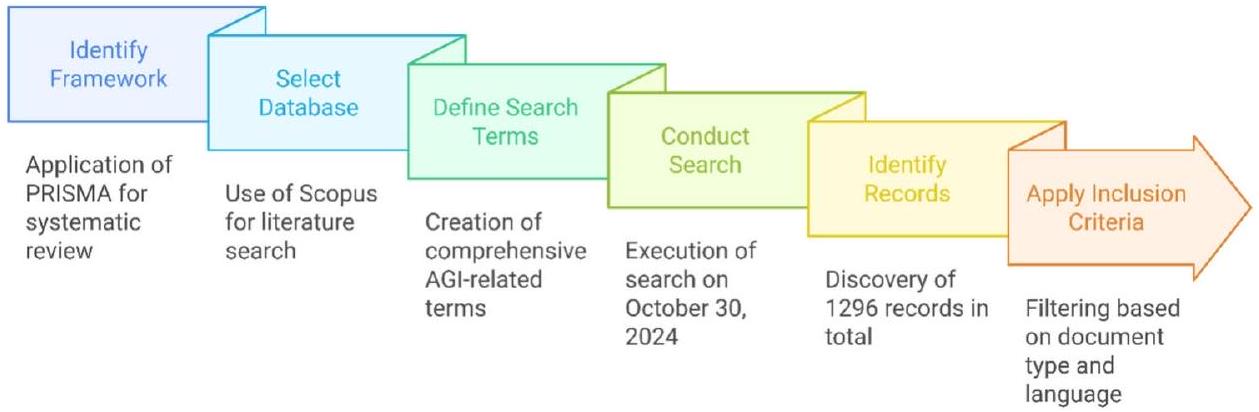
يستخدم تصميم البحث (الشكل 1) إطار العناصر المفضلة للتقارير للمراجعات المنهجية والتحليلات التلوية (PRISMA) لضمان اتباع نهج منهجي ودقيق في تحديد الدراسات ذات الصلة بأبحاث الذكاء العام الاصطناعي. تم تطبيق هذا الإطار في عملية منظمة تضمنت تحديد معايير الإدراج والاستبعاد، وإجراء بحث شامل في قواعد البيانات، وفحص الدراسات المسترجعة على مستويات متعددة (العنوان والملخص)، وتجميع النتائج لضمان الشفافية وقابلية التكرار. من خلال اتباع إرشادات PRISMA، يقلل البحث من انحياز الاختيار، ويعزز الصرامة المنهجية، ويوفر نهجًا منظمًا لتقييم الصلة وجودة مساهمات أبحاث الذكاء العام الاصطناعي. لضمان تحليل شامل ودقيق، استخدمت هذه الدراسة قاعدة بيانات Scopus لاسترجاع الأدبيات. تُعتبر Scopus معروفة على نطاق واسع كقاعدة بيانات ببليوغرافية رائدة، حيث تقدم تغطية أوسع بكثير من Web of Science، مع حوالي المزيد من المنشورات المفهرسة تم إجراء البحث في قاعدة بيانات سكوبس، التي تغطي السنوات من 2003 إلى 2024، في 30 أكتوبر 2024. تم تصميم مصطلحات البحث بعناية لالتقاط الطيف الكامل للمفاهيم المتعلقة بالذكاء الاصطناعي العام، بدءًا من “الذكاء الاصطناعي العام” (AGI) إلى “الذكاء الاصطناعي القوي” و”الذكاء الاصطناعي الفائق” (ASI)، مما يعكس المسار التطوري لهذه التقنيات. كانت مصطلحات البحث النهائية المستخدمة في عناوين وملخصات المنشورات كما يلي: (“الذكاء الاصطناعي العام” أو “الذكاء الاصطناعي GI” أو “الذكاء الاصطناعي القوي” أو “الذكاء الاصطناعي القوي” أو “الذكاء الاصطناعي بمستوى الإنسان” أو “الذكاء الاصطناعي بمستوى الإنسان” أو “الذكاء الاصطناعي الفائق*” أو “نظام الذكاء الاصطناعي العام*” أو “الذكاء الاصطناعي الشبيه بالإنسان” أو “الأنظمة الفائقة الذكاء” أو “الذكاء الاصطناعي الفائق للآلات”). تم تحديد ما مجموعه 1296 سجلًا، مع معايير شمولية تحد من النتائج إلى المقالات والمراجعات وأوراق المؤتمرات والكتب والفصول في الكتب باللغة الإنجليزية. بعد الفحص وتقييم الأهلية، استوفى جميع السجلات البالغ عددها 1296 المعايير المحددة مسبقًا، مما أدى إلى الانتقال إلى مرحلة الاختيار النهائية. يبرز هذا العملية الصرامة المنهجية في تنسيق مجموعة بيانات مركزة لفحص اتجاهات وتطورات أبحاث الذكاء الاصطناعي العام.
لقد وفرت عملية التعرف المنهجي واختيار الدراسات ذات الصلة من خلال إطار عمل PRISMA أساسًا قويًا لتطبيق نمذجة الموضوعات. تم اختيار نمذجة الموضوعات على طرق مثل تحليل الاقتباس المشترك، والترابط الببليوغرافي، وتكرار الكلمات الرئيسية لأنها تتجاوز العلاقات الهيكلية في الأدبيات، وتركز بدلاً من ذلك على المحتوى الدلالي للمستندات. بينما تكشف الاقتباسات المشتركة والترابط الببليوغرافي عن الروابط التاريخية والمراجع المشتركة بين الدراسات، وغالبًا ما يبرز تكرار الكلمات الرئيسية المصطلحات المترابطة، يكشف نمذجة الموضوعات عن الموضوعات الكامنة داخل النص، مما يتيح استكشافًا أكثر ثراءً في السياق لاتجاهات البحث المتعلقة بالذكاء العام الاصطناعي وتطور الموضوعات. . يوفر هذا النهج رؤى أعمق حول المفاهيم الناشئة وروابطها الدلالية، والتي تعتبر ضرورية لفهم مجال يتطور بسرعة مثل الذكاء العام الاصطناعي.

نمذجة BERTopic

تتوفر طرق متعددة لنمذجة الموضوعات، مثل تحليل المصفوفة غير السالبة (NMF)، وتخصيص ديريشليت الكامن (LDA)، والتحليل الدلالي الكامن الاحتمالي (PLSA)، وTo2Vec. على الرغم من استخدامها على نطاق واسع، فإن هذه الأساليب غالبًا ما تفشل في أخذ العلاقات الدلالية بين المصطلحات في الاعتبار وتواجه تحديات عند التعامل مع تنسيقات النصوص القصيرة. . بالإضافة إلى ذلك، تعتمد النماذج التقليدية مثل LDA و PLSA على أطر عمل كيس الكلمات (BoW)، التي تعالج الكلمات بشكل مستقل وتتجاهل ترتيب الكلمات والمعنى السياقي، مما يحد من قدرتها على التقاط أنماط اللغة الدقيقة، خاصة في أبحاث الذكاء العام الاصطناعي.
بيرت، نموذج لغة متقدم تم تطويره بواسطة جوجل، هو اختصار لتمثيلات الترميز ثنائية الاتجاه من المحولات. على عكس تقنيات نمذجة الموضوع التقليدية التي تعتمد على أساليب قائمة على تكرار الكلمات، والتي تركز فقط على تكرار الكلمات، يستخدم BERTopic تمثيلات قائمة على المحولات. لترميز الوثائق في فضاء ذي أبعاد أقل مع الحفاظ على الفروق الدلالية. وهذا يسمح لـ BERTopic بتجميع المفاهيم المماثلة ديناميكيًا والتقاط أفضل لمواضيع البحث متعددة التخصصات المتطورة، مثل الذكاء العام الاصطناعي. علاوة على ذلك،
الشكل 1. تصميم البحث.
يعمل BERTopic على دمج تمثيلات الكلمات السياقية، مما يعزز من قابلية تفسير الموضوعات ويقلل من الحاجة إلى المعالجة اليدوية المكثفة. .
أظهرت الدراسات الحديثة الأداء المتفوق لتقنيات نمذجة الموضوعات المعتمدة على BERT مقارنةً بأساليب نمذجة الموضوعات الأخرى. وجدت الأبحاث التي تقارن نماذج الموضوعات العصبية المدمجة مع BERT مع النماذج العشوائية التقليدية أن الأساليب المعتمدة على BERT تحسن بشكل كبير من فهم النصوص المتخصصة في المجال والتعلم المستمر. . يتفوق BERTopic على LDA و Top2Vec في تجميع الموضوعات، محققًا على الأقل أداء أفضل في مجموعات البيانات الصينية والإنجليزية، مع فصل مواضيع متفوق، ووضوح أكبر في الدلالات، وفهم أعمق لبنية النص ومحتواه نظرًا للحاجة إلى نموذج يلتقط الاتجاهات المتطورة والهياكل اللغوية المعقدة في أبحاث الذكاء الاصطناعي العام، فإن BERTopic يقدم بديلاً أكثر تكيفًا وغنى دلاليًا مقارنة بتقنيات نمذجة الموضوعات التقليدية المعتمدة على نموذج كيس الكلمات.
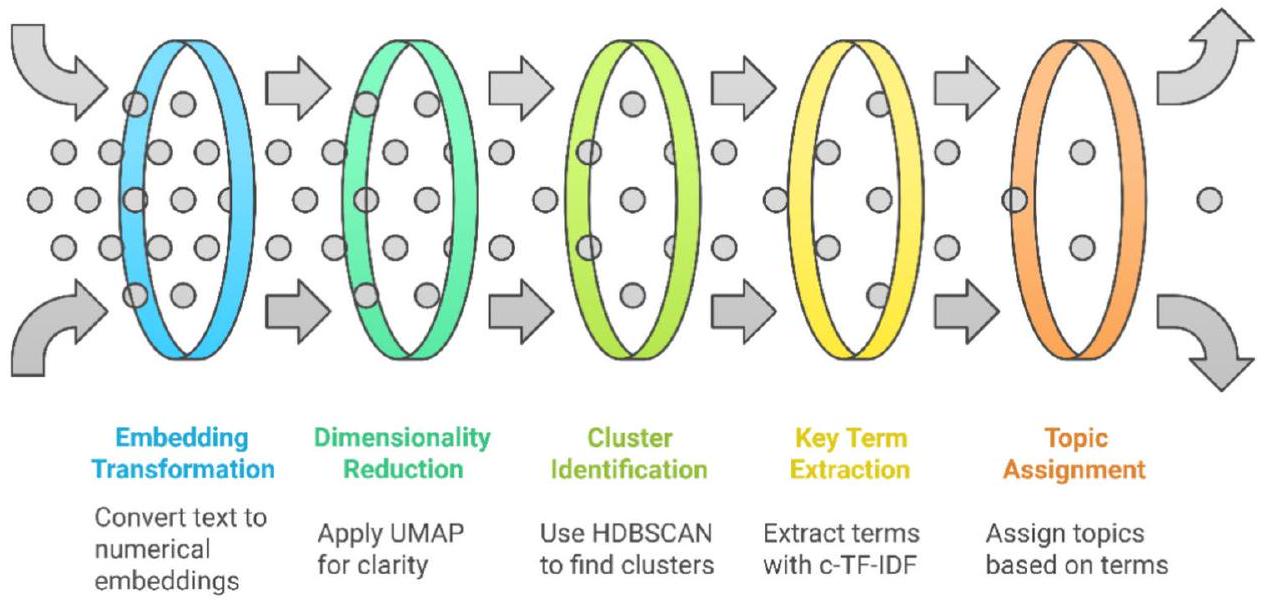
تبدأ عملية نمذجة الموضوعات بتحويل النص المدخل إلى تمثيلات عددية من خلال التمثيل المتجهي (الشكل 2). ثم يتم إجراء تقليل الأبعاد عبر تقريب وتوقع الشكل الموحد (UMAP)، مما يعزز وضوح مجموعات الموضوعات من خلال تجميع النقاط البيانية المتشابهة. تُحدد المجموعات من خلال التجميع المكاني القائم على الكثافة الهرمية للتطبيقات مع الضوضاء (HDBSCAN)، الذي يكشف عن المناطق الكثيفة من البيانات مع تصفية النقاط غير ذات الصلة. يتم استخراج المصطلحات الرئيسية داخل كل مجموعة من خلال تردد المصطلحات المعتمد على الفئة – تردد الوثائق العكسي (c-TF-IDF)، الذي يبرز المصطلحات بناءً على أنماط حدوثها عبر الوثائق. في هذه الدراسة، تم استخدام نموذج تمثيل النص “all-MiniLM-L6-v2″، حيث إنه مناسب جدًا لمهام التجميع والبحث الدلالي. تُخصص الموضوعات للمستندات بناءً على هذه المصطلحات التمثيلية، مع احتمالات مرتبطة تشير إلى مدى ارتباط كل مستند بموضوعات معينة. .
لتنقيح نمذجة الموضوعات، تم ضبط ثلاثة معلمات رئيسية بعناية: نطاق n-gram، وعدد الموضوعات، والحجم الأدنى للموضوع، مما يضمن ثراء دلالي مثالي، وقابلية تفسير، وتماسك الموضوعات المستخرجة.
تم تعيين نطاق n-gram إلى للالتقاط كل من الكلمات الفردية والعبارات المكونة من كلمتين، مع تحقيق توازن بين الدقة والتمثيل السياقي. قد تفشل الكلمات الفردية وحدها في التقاط المصطلحات الخاصة بالمجال، بينما يمكن أن تؤدي النماذج الأطول إلى ندرة البيانات وتجاوز النموذج. سمح هذا النهج للنموذج بتحديد العبارات ذات المعنى دون ضوضاء مفرطة، مما حسن من قابلية التفسير. لتحديد العدد الأمثل من الموضوعات، تم إجراء عملية تقييم تكرارية، تم فيها اختبار عدد الموضوعات من 4 إلى 20. تم تقييم كل تكرار باستخدام درجات التماسك (Cv، UMass، C_npmi)، ومقاييس المسافة بين الموضوعات، والفحص اليدوي لضمان تميز الموضوعات مع الحفاظ على تماسكها. الحد الأدنى من أربعة موضوعات منع الموضوعات الواسعة للغاية، بينما تم اختيار الحد الأقصى من ستة عشر لتجنب الموضوعات المكررة والمجزأة التي تفتقر إلى اختلاف جوهري. كانت هذه العملية موجهة من خلال استقرار درجات التماسك، مما يضمن أن زيادة عدد الموضوعات لم تؤد إلى انخفاض في قابلية التفسير. تم تطبيق حد أدنى لحجم الموضوعات يبلغ 20 لضمان أن كل موضوع له تمثيل كافٍ مع تجنب الموضوعات الصغيرة جداً والمشوشة التي تفتقر إلى القابلية للتعميم. بالإضافة إلى ذلك، تم تحديد عدد الكلمات الرئيسية لكل موضوع بـ 20 لتسليط الضوء على المصطلحات الأكثر صلة مع الحفاظ على تماسك الموضوع. تم تطبيق إزالة الكلمات الشائعة بشكل منهجي لتصفية الكلمات العامة وغير المعلوماتية مثل “استخدام”، “إضافة”، و”مرتبط”، والتي قد تضعف أهمية الموضوع.
تم التعامل مع تقليل الأبعاد باستخدام تقريب وتوقع الفضاء المتجانس (UMAP) مع الإعدادات الافتراضية، مما يضمن تجميعًا فعالًا في فضاء كامن مخفض مع الحفاظ على العلاقات الدلالية. تم تفعيل خيار “حساب الاحتمالات” لتوفير ارتباطات الوثائق بالمواضيع، مما يحسن دقة التجميع الناعم. تم استخدام تشابه جيب التمام لقياس المسافة الزاوية بين تمثيلات المواضيع، مما يضمن بقاء المواضيع ذات الصلة الوثيقة متميزة مع الحفاظ على تداخل ذي معنى. لتكرير عملية نمذجة المواضيع بشكل أكبر، تم إجراء مرحلة تحقق شاملة باستخدام تقييمات نوعية يدوية، ومقارنات درجات التماسك، وتوزيعات المسافات بين المواضيع. تم تطبيق حد أدنى لمسافة الموضوعات يبلغ 0.05، مما يضمن فصلًا واضحًا بين المواضيع مع منع التداخل المفرط. تم تعيين حالة عشوائية تبلغ 100 لضمان القابلية للتكرار، وتم تكوين n_neighbors عند 15 لتحقيق توازن بين العلاقات المحلية للمواضيع مع الأنماط الموضوعية الأوسع. من خلال هذه العملية متعددة المراحل لضبط المعلمات، حدد النموذج خمسة
الشكل 2. خطوات نمذجة BERTopic.
المسارات النظريات/الأطر المذكورة مفاهيم AGI المستخدمة الكلمات الرئيسية
المسارات الاجتماعية للذكاء الاصطناعي الشبيه بالبشر الحواسيب كفاعلين اجتماعيين (CASA)، إطار عمل PESTEL التعاطف، جودة التفاعل، التصميم الشبيه بالبشر مستوى إنساني”، “ذكاء اصطناعي شبيه بالبشر”، “سلامة الذكاء الاصطناعي”، “اتخاذ القرار”، “تعلم الآلة”، “اختبار تورينج”، “تقدم”، “تغيير اجتماعي
المسارات التكنولوجية نحو AGI الذكاء الاصطناعي القابل للتفسير (XAI)، فرضية تعظيم المكافآت، الذكاء الاصطناعي المنطقي الشفافية، التعلم المعزز، مشاكل التمثيل تطور”، “تقدمات”، “آثار العالم الحقيقي”، “الذكاء الاصطناعي العام”، “البيانات الضخمة”، “مستوى إنساني”، “اعتبارات أخلاقية”، “سياسة”، “حكم
المسارات نحو القابلية للتفسير في AGI إطار التعلم المعزز، نمذجة موضوع LDA، منصات تجريب الذكاء الاصطناعي حل المشكلات، الذكاء الاصطناعي المحدد للمهام التعلم المعزز”، “تعلم الآلة”، “الذكاء الاصطناعي العام”، “معالجة اللغة الطبيعية”، “الجيل القادم”، “الابتكار”، “الاتجاهات
المسارات المعرفية والأخلاق في AGI نموذج LIDA، نظرية مساحة العمل العالمية، نظرية اكتمال الذكاء الاصطناعي اتخاذ القرار الأخلاقي، اختبار تورينج، الحواسيب العصبية الهياكل المعرفية”، “وعي الآلة”، “الفطرة السليمة”، “الذكاء الاصطناعي القوي”، “اعتبارات أخلاقية”، “حكم”، “المستقبل
المسارات المستوحاة من الدماغ نحو AGI معمارية تيانجيك الهجينة، التطور العصبي، نظرية تعقيد العينة الإحصائية المعالجة في الوقت الحقيقي، تحسين الشبكة، المعالجة عالية الأبعاد الحوسبة العصبية”، “الذاكرة العاملة”، “الحوسبة المستوحاة من الدماغ”، “الأحدث”، “الاختراق”، “التوقعات”، “الجيل القادم
الجدول 4. نظرة عامة على المسارات الرئيسية المستمدة من نمذجة BERTopic.
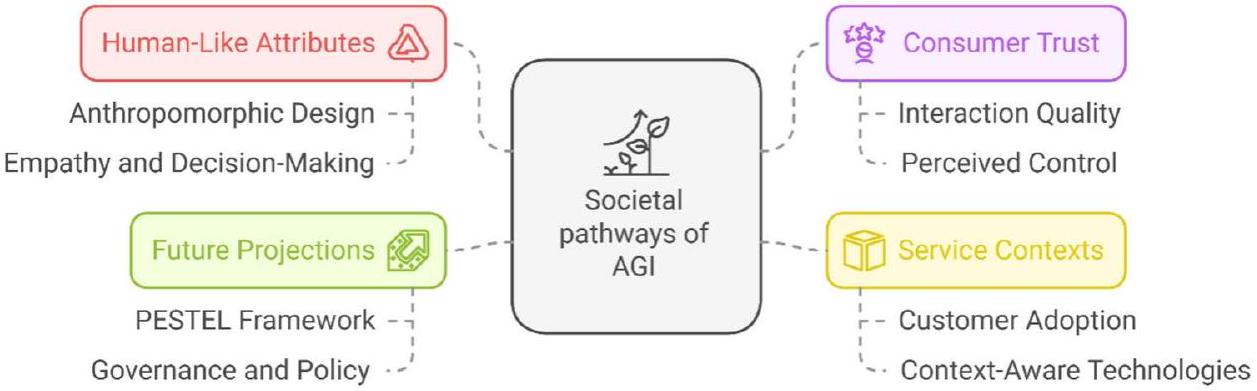
الشكل 3. المسارات الاجتماعية للذكاء الاصطناعي العام.
مواضيع متميزة، مفصولة جيدًا، قدمت تمثيلًا متماسكًا وقابلًا للتفسير للبحث المتعلق بالذكاء الاصطناعي العام، مما يضمن دقة دلالية وعمق موضوعي.
للتحقق من دقة نتائج تعلم الآلة، تم إجراء مراجعة يدوية للمواضيع الخمسة المحددة ومنشوراتها التمثيلية. قام ثلاثة خبراء في المجال بتقييم التماسك والملاءمة للمواضيع من خلال تقييم نوعي للكلمات الرئيسية والمنشورات المرتبطة، متبعين الأساليب المستخدمة في دراسات BERTopic المماثلة. بالإضافة إلى ذلك، تم أخذ قيم الاحتمالات وعدد الاقتباسات في الاعتبار خلال عملية الاختيار لتحديد أفضل ثلاث مقالات تمثيلية لكل موضوع، مما يضمن أن النمذجة غير المشروطة قدمت رؤى ذات معنى وقابلة للتنفيذ.

النتائج

يقدم الجدول 4 نظرة عامة على المسارات الرئيسية المستمدة من نمذجة BERTopic، رابطًا بين التطور التكنولوجي، التأثيرات الاجتماعية، والمسارات المستقبلية للذكاء الاصطناعي العام. يبرز النظريات ومفاهيم AGI، مما يمهد الطريق لاستكشاف مفصل في الأقسام التالية.

المسارات الاجتماعية للذكاء الاصطناعي العام

تسلط هذه السمة الضوء على كل من المسارات التنموية والتأثيرات الاجتماعية الأوسع للذكاء الاصطناعي العام، لا سيما سماته الشبيهة بالبشر (الشكل 3). تعكس كلمات رئيسية مثل “مستوى إنساني”، “اتخاذ القرار”، و”اختبار تورينج” التركيز المزدوج على التطور النظري للذكاء الاصطناعي العام وآثاره في العالم الحقيقي، موصلة تقدمات AGI بتأثيراته الاجتماعية والأخلاقية والاقتصادية التحولية.
دور السمات الشبيهة بالبشر في تطوير وقبول AGI أمر حاسم لتقدمه التكنولوجي. قام بيلاو وآخرون. بتطبيق نظرية CASA لاستكشاف السمات النفسية الشبيهة بالبشر، والتعاطف المدرك، وجودة التفاعل في الذكاء الاصطناعي الخدمي. بينما مكنت التقدمات التكنولوجية أجهزة AGI من أداء المهام بكفاءة، يعتمد ثقة المستهلك على جودة التفاعل بدلاً من مجرد التصميم الشبيه بالبشر. يعزز دمج مسارات الابتكار والتقدم في أجهزة AGI قبولها الاجتماعي، لا سيما في الصناعات الموجهة نحو الخدمة. تسلط النتائج الضوء على التأثير الأوسع للذكاء الاصطناعي العام في الحفاظ على تجارب الخدمة المتمحورة حول الإنسان وتعزيز الاعتبارات الأخلاقية حول تفاعلات الذكاء الاصطناعي والبشر.
قام يانغ وآخرون. بدراسة تقدم تصاميم AGI في سياقات الخدمة المختلفة وتأثيراتها على اعتماد العملاء. السمات الشبيهة بالبشر في AGI مبتكرة، ومع ذلك يختلف قبولها بناءً على السيطرة المدركة ضمن السيناريوهات الاجتماعية. عندما يدرك البشر سيطرة عالية، يُفضل الذكاء الاصطناعي الشبيه بالبشر، مما يتماشى مع هدف AGI في تقليد التعاطف وعمليات اتخاذ القرار. على العكس، في حالات السيطرة المنخفضة، يثير AGI الشبيه بالبشر قلقًا، مما يبرز التأثير الدقيق للذكاء الاصطناعي العام على ثقة العملاء. تسلط رؤى هذه الدراسة حول تقدم التصميم الضوء على أهمية تقنيات AGI الواعية بالسياق للتنمية المستدامة.
مع التركيز على التوقعات المستقبلية والابتكار، قام كابلان وهاينلين. بتأطير AGI ضمن ستة نقاشات رئيسية ومآزق عبر إطار عمل PESTEL. يحددون العواقب الاجتماعية والاتجاهات الجيوسياسية للذكاء الاصطناعي العام، مؤكدين على الذكاء الفائق، والروبوتات، والحاجة إلى الحكم. مع تطور قدرات AGI، يجب على الحكومات والمنظمات توقع آثار التغيير الاجتماعي، بما في ذلك تحديات التوظيف، وإنفاذ السياسات، والاعتبارات الأخلاقية. من خلال التنبؤ باتجاهات التطوير المستقبلية، يربط هذا العمل بين التطور التكنولوجي للذكاء الاصطناعي العام وآثاره التحولية على الهياكل العالمية.

المسارات التكنولوجية نحو AGI

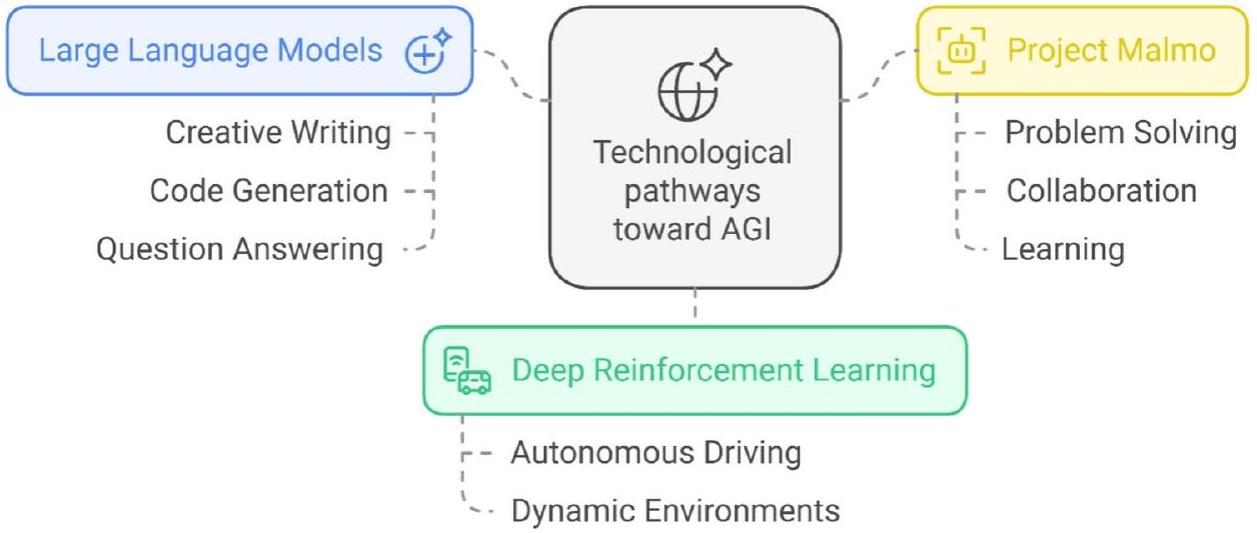
تسلط المسارات التكنولوجية وآثارها في العالم الحقيقي الضوء على التركيز التنموي على التطور، والتقدم، ودمج AGI مع ربط هذه المسارات بالتطبيقات والتحديات في العالم الحقيقي (الشكل 4). تركز كلمات رئيسية مثل “التعلم المعزز”، “مستوى إنساني”، “التعلم العميق”، و”الشبكات العصبية” على تقدم AGI ودوره في تقليد القدرة المعرفية البشرية. تلتقط السمة كل من المسارات التكنولوجية والتأثير الأوسع للذكاء الاصطناعي العام عبر القطاعات.
قدم سلاب وآخرون. إطار عمل التعلم المعزز العميق (DRL) للقيادة الذاتية، مما يمثل تقدمًا في أنظمة AGI التي تتفاعل مع البيئات الديناميكية. على عكس أساليب التعلم المراقب التقليدية، يركز DRL على التطور من خلال التجربة والخطأ، مما يمكّن الآلات من التكيف مع المواقف المعقدة في الوقت الحقيقي التي تتضمن تفاعلات الطريق وعدم اليقين. يقلل دمج الشبكات العصبية ونماذج الانتباه من التعقيد الحسابي، وهو خطوة مهمة في تطوير AGI. تسلط النتائج الضوء على دور AGI في أتمتة عمليات اتخاذ القرار الحرجة مع معالجة التحديات في البيئات القابلة للملاحظة جزئيًا. تؤكد هذه المسارات على التقدم المستقبلي في تقنيات AGI وتأثيرها على أنظمة السيارات، مما يثير تساؤلات حول السياسة والحكم في التنقل المدفوع بالذكاء الاصطناعي.
تسلط التقدم السريع في نماذج اللغة الكبيرة (LLMs)، مثل ChatGPT، الضوء على إمكانية AGI في التأثير على الوظائف، والإبداع، وتفاعلات الإنسان والآلة. من خلال تحليل استجابات المستخدمين المبكرة عبر نمذجة الموضوع، قام تايشارونجرو صنفت وظائف ChatGPT إلى مجالات مثل الكتابة الإبداعية، وتوليد الشفرات، والإجابة على الأسئلة. تؤكد هذه النتائج على التطبيقات الناشئة للذكاء العام الاصطناعي في صناعات متنوعة، بينما تثير في الوقت نفسه اعتبارات أخلاقية تتعلق بانتقال الوظائف وحوكمة التكنولوجيا. يمثل هذا البحث كيف تؤثر التقدمات التكنولوجية على الهياكل الاجتماعية والآثار الاقتصادية مع تطور الذكاء العام الاصطناعي، مما يشجع على استكشاف أعمق في دمج أنظمة الذكاء الاصطناعي الشبيهة بالبشر بشكل مسؤول في الحياة اليومية.
هوهنيكر ولوكاسييفيتش قدموا مشروع مالمو، وهو منصة تجريبية للذكاء الاصطناعي تم بناؤها داخل لعبة ماينكرافت، والتي تم تصميمها لتطوير أنظمة الذكاء العام الاصطناعي القادرة على حل مهام متنوعة في بيئات معقدة. من خلال تمكين الوكلاء المرنين من الانخراط في حل المشكلات، والتعاون، والتعلم، تحاكي المنصة التحديات الواقعية، مما يعزز تقدم الذكاء العام الاصطناعي نحو القدرات الشبيهة بالبشر. يسلط هذا العمل الضوء على مسارات الابتكار لتطوير الذكاء العام الاصطناعي من خلال اختبار خوارزميات التعلم واستراتيجيات اتخاذ القرار عبر البيئات المحاكية. لا تسرع هذه المنصات التقدمات التكنولوجية فحسب، بل تعالج أيضًا العواقب الأوسع لنشر الذكاء العام الاصطناعي، بما في ذلك التكيف، وتحسين الموارد، والاعتبارات الأخلاقية.

مسارات الشرح في الذكاء العام الاصطناعي
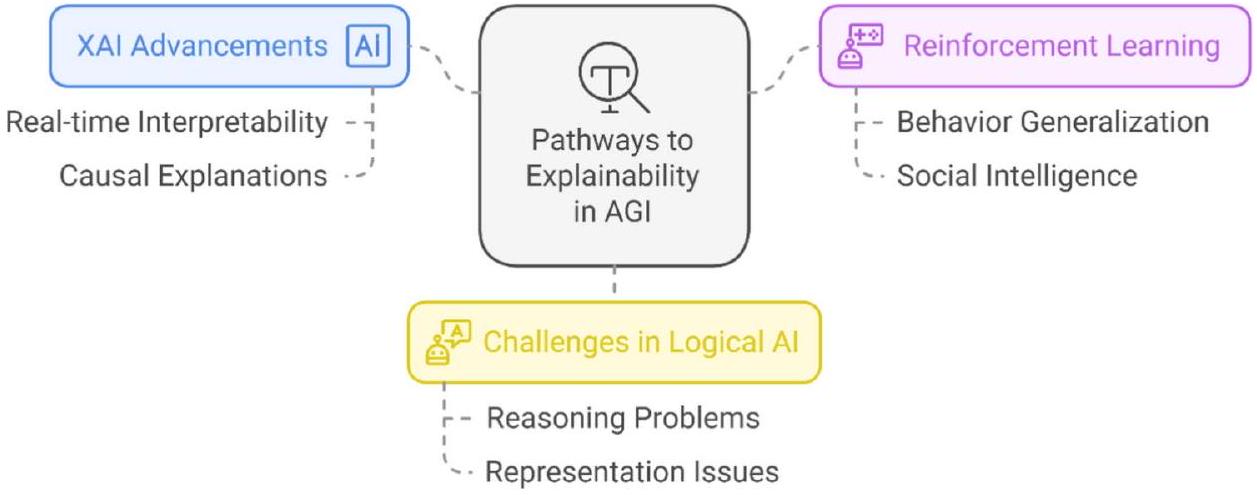
يعكس الموضوع المقترح تقارب “التطور”، و”التقدم”، و”الابتكارات” للذكاء العام الاصطناعي مع التأكيد على “آثاره في العالم الحقيقي” (الشكل 5). تتماشى الكلمات الرئيسية مثل “الذكاء العام الاصطناعي”، و”اتخاذ القرار”، و”البيانات الضخمة”، و”أنظمة الذكاء الاصطناعي” مع كل من المسارات التنموية لتقنيات الذكاء العام الاصطناعي وآثارها الأوسع. يربط الموضوع المسارات النظرية للذكاء العام الاصطناعي بتطبيقاته مع تسليط الضوء على الاعتبارات الاجتماعية والاقتصادية والأخلاقية.
يجب أن تركز التقدمات المستقبلية في الذكاء الاصطناعي القابل للتفسير (XAI) على القابلية للتفسير في الوقت الحقيقي والتفسيرات السببية، مما يسمح لأصحاب المصلحة بفهم عمليات اتخاذ القرار للذكاء العام الاصطناعي في المجالات الحرجة. ستجسر هذه الأساليب فجوة الشفافية وتعزز ثقة المستخدمين. حدد دوشيليوفيتش وآخرون التقدمات في الذكاء الاصطناعي القابل للتفسير (XAI)، معالجين فجوة الشفافية التي غالبًا ما تحد من النشر العملي للذكاء العام الاصطناعي. من خلال ربط القابلية للتفسير بالتعلم العميق، واتخاذ القرار، والتعلم الآلي، تساهم دراستهم في المسار التنموي الأوسع للذكاء العام الاصطناعي بينما تقترح مسارات للبحث المستقبلي. الشفافية في
الشكل 4. المسارات التكنولوجية نحو الذكاء العام الاصطناعي.
الشكل 5. مسارات الشرح في الذكاء العام الاصطناعي.
الشكل 6. المسارات المعرفية والأخلاق في الذكاء العام الاصطناعي.
يعزز الذكاء الاصطناعي الثقة الاجتماعية ويخفف من الاعتبارات الأخلاقية المتعلقة بالقرارات الخوارزمية، مما يبرز الآثار الواقعية للذكاء العام الاصطناعي على الأنظمة الحرجة حيث تكون المساءلة ضرورية.
تقدم المناقشة حول التعميم وأنظمة التعلم في الذكاء العام الاصطناعي، حيث يفترض سيلفر وآخرون أن تعظيم المكافأة يمكن أن يقود السلوك بطريقة مشابهة للذكاء الطبيعي والاصطناعي. يبرز هذا العمل تقدم التعلم المعزز كحل محتمل لتحقيق الذكاء العام الاصطناعي، متماشيًا مع تطوير الذكاء العام الاصطناعي من خلال طرق التجربة والخطأ. من خلال ربط قدرة الذكاء العام الاصطناعي على تعميم السلوكيات عبر مجالات متعددة، تسلط الدراسة الضوء على كيفية معالجة الأنظمة المستقبلية للذكاء الاجتماعي واتخاذ القرار. تبرز هذه الأطر الآثار الاقتصادية واعتبارات السياسة مع تطور الذكاء العام الاصطناعي نحو التكيف الشبيه بالبشر.
ترتبط تعقيدات تحقيق الذكاء الاصطناعي بمستوى الإنسان بتجاوز الهشاشة في الأنظمة الحالية. يحدد مكارثي مشكلات التفكير والتمثيل كالتحديات الأساسية ضمن الذكاء الاصطناعي المنطقي، مما يتطلب اختراقات في أنظمة التعلم لتأخذ في الاعتبار السيناريوهات البديهية. يمثل معالجة هذه القيود تطورًا كبيرًا في الذكاء العام الاصطناعي، حيث تحدد القدرة على التكيف مع الظروف غير المتوقعة إمكانياته. تربط المناقشة مسارات الذكاء العام الاصطناعي بعواقبه الأوسع على الأتمتة الاجتماعية، مما يبرز الحاجة إلى أطر قابلة للتوسع لتحقيق ذكاء عام عملي على مستوى الإنسان.

المسارات المعرفية والأخلاق في الذكاء العام الاصطناعي

يربط موضوع المسارات المعرفية والاعتبارات الأخلاقية في الذكاء العام الاصطناعي تطويره، وتطوره، والهياكل المعرفية للذكاء العام الاصطناعي مع العواقب الأخلاقية والاجتماعية (الشكل 6). توضح الكلمات الرئيسية مثل “الهياكل المعرفية”، و”وعي الآلة”، و”الفطرة السليمة”، و”الإدراك البشري”، و”اتخاذ القرار الأخلاقي” قدرة الذكاء العام الاصطناعي على تقليد التفكير البشري بينما تثير أسئلة أخلاقية هامة. يوازن الموضوع بين مسارات تطوير الذكاء العام الاصطناعي وتأثيره الاجتماعي” واهتمامات الحوكمة.
يستكشف والاش وآخرون اتخاذ القرار الأخلاقي ضمن الذكاء العام الاصطناعي عبر نموذج الوكيل الذكي المتعلم (LIDA)، الذي يستند إلى نظرية مساحة العمل العالمية. يقدم نموذج LIDA إطارًا لفهم الإدراك، والإدراك، واتخاذ القرار في الذكاء العام الاصطناعي من خلال محاكاة آليات الانتباه، والتعلم، والذاكرة الشبيهة بالبشر. يمكن أن يوفر دمج LIDA في أبحاث الذكاء العام الاصطناعي رؤى حول التفكير الأخلاقي واتخاذ القرار التكيفي، مما يضمن توافق أنظمة الذكاء العام الاصطناعي مع العمليات المعرفية البشرية بينما تعالج مخاوف الشفافية، والاستقلالية، والمساءلة. يظهر البحث كيف يمكن دمج آليات الإدراك البشري – مثل العمليات العاطفية والعقلانية –
في أنظمة الذكاء العام الاصطناعي لمعالجة المشكلات الأخلاقية. من خلال تقليد عمليات التفكير البشري، تسلط الدراسة الضوء على تقدم الذكاء العام الاصطناعي نحو اتخاذ قرارات واعية بالسياق، خاصة في البيئات الأخلاقية المعقدة. تعالج هذه الإطار الاعتبارات الأخلاقية والآثار المحتملة للحوكمة مع زيادة قدرة الوكلاء المستقلين. يبرز تطور الذكاء العام الاصطناعي نحو التفكير الأخلاقي الحاجة إلى سياسات تنظيمية لضمان التوافق مع القيم الاجتماعية.
يتم صياغة اكتمال الذكاء الاصطناعي كإطار تصنيفي لتقييم مشكلات الذكاء العام الاصطناعي، مع تحديد اختبار تورينغ كمعيار مكتمل للذكاء الاصطناعي يشير إلى تقدم الأنظمة الاصطناعية نحو الذكاء العام . من خلال تقليل المشكلات في المهام الصعبة للذكاء الاصطناعي، يعزز هذا البحث المنهجيات لفهم القدرات والقيود للذكاء العام الاصطناعي. يتنبأ نظام التصنيف بمشاريع الذكاء العام الاصطناعي المستقبلية من خلال تحديد المهام التي تتطلب إدراكًا شبيهًا بالبشر، بما في ذلك التفكير البديهي. لهذه التقدمات آثار اقتصادية حيث تتفاعل أنظمة الذكاء العام الاصطناعي بشكل متزايد مع القطاعات التي تتطلب العمل المكثف والتي تحتاج إلى حل المشكلات على مستوى عالٍ ومرن.
تعتبر الحواسيب العصبية المستوحاة من الدماغ نهجًا من الجيل التالي لتحقيق الذكاء العام الاصطناعي، مع التركيز على طريقة التقليد، التي تركز على تطوير أنظمة عصبية شبيهة بالدماغ بدلاً من تكرار الذكاء البشري بشكل صريح . تتضمن الحواسيب العصبية الهياكل المعرفية للتعلم المستقل والتفاعل مع البيئة، مما يسرع من تقدم الذكاء العام الاصطناعي عبر المجالات الفيزيائية والحسابية. يثير هذا التطور عواقب أوسع لتبني التكنولوجيا في الأنظمة المستقلة، مما يبرز الحاجة إلى أطر أخلاقية وسياسية لتنظيم دمج الذكاء العام الاصطناعي في القطاعات الحرجة مثل الروبوتات والرعاية الصحية.

المسارات المستوحاة من الدماغ نحو الذكاء العام الاصطناعي
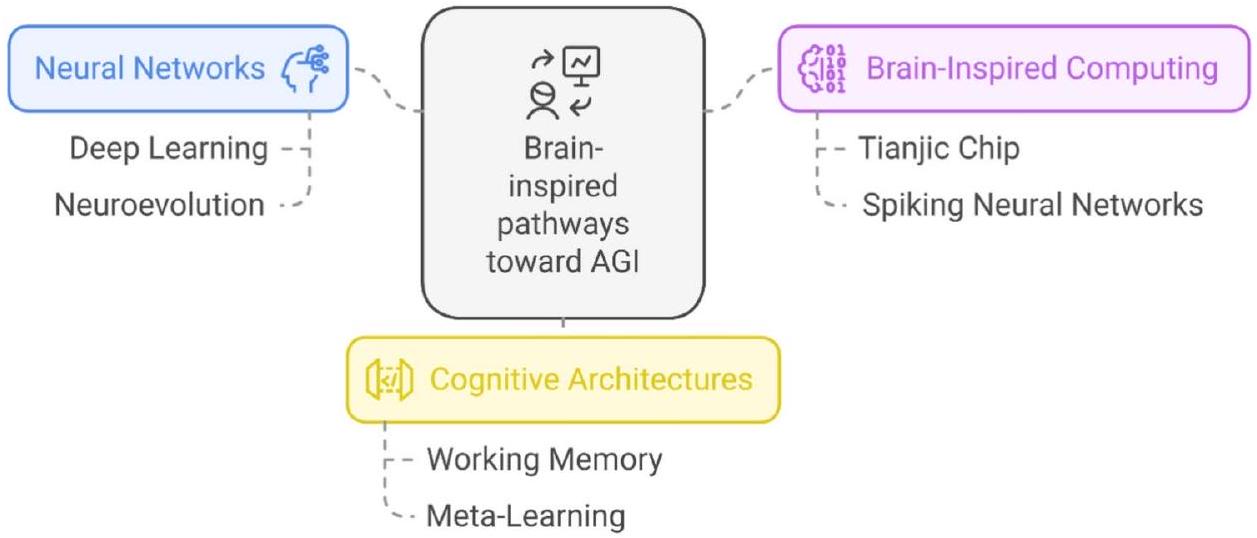
يتناول موضوع ربط المسارات المستوحاة من الدماغ نحو الذكاء العام الاصطناعي تطوير الذكاء العام الاصطناعي عند تقاطع الشبكات العصبية، والحوسبة المستوحاة من الدماغ، والهياكل المعرفية (الشكل 7). تسلط الكلمات الرئيسية مثل “الحوسبة العصبية الشبيهة بالدماغ”، و”الشبكات العصبية”، و”الذاكرة العاملة” الضوء على كيفية دمج أبحاث الذكاء العام الاصطناعي الإلهام من الدماغ البشري والتقدمات في الهياكل العصبية. يربط هذا الموضوع التقدم التكنولوجي مع مسارات الذكاء العام الاصطناعي مع الاعتراف بآثاره الاجتماعية.
بيي وآخرون قدمت شريحة تيانجيك، وهي منصة هجينة رائدة تدمج بين الشبكات العصبية المستوحاة من الدماغ (SNNs) والشبكات العصبية الاصطناعية التقليدية (ANNs)، مما يظهر إمكانياتها في ربط علوم الأعصاب والذكاء الاصطناعي. تتيح هذه الدمج معالجة أكثر كفاءة، وتكيفًا في الوقت الحقيقي، وتعلمًا موفرًا للطاقة، مما يجعلها خطوة مهمة نحو الذكاء الاصطناعي العام. من خلال التوفيق بين هذه النماذج التقليدية المختلفة، تحقق الشريحة قدرات متعددة المهام في الوقت الحقيقي مثل التحكم الصوتي، واكتشاف الأجسام، وتجنب العقبات. تمثل هذه التقدمات التكنولوجية خطوة مهمة نحو تطوير منصات الأجهزة من الجيل التالي الضرورية للذكاء الاصطناعي العام. يعكس هذا الدمج أيضًا الاتجاهات المستقبلية في أنظمة الذكاء الاصطناعي العام، مع التركيز على التكيف والابتكار. تبرز قدرة الشريحة على معالجة مهام متنوعة تأثيرها المحتمل على الروبوتات والأنظمة المستقلة، مما يبرز الحاجة إلى أطر سياسية تعالج الآثار الأخلاقية والاجتماعية لنشر الذكاء الاصطناعي العام.
تستفيد التطورات العصبية من الخوارزميات التطورية لتحسين هياكل الشبكات العصبية، مما يوفر بديلاً عن الأساليب المعتمدة على التدرج التي قدمها ستانلي وآخرون. تعزز هذه الطريقة التقدم في الذكاء الاصطناعي العام من خلال تمكين عمليات التعلم الفوقي، وتخصيص الشبكات، وتحسين اللبنات الأساسية مثل دوال التنشيط وخوارزميات التعلم. تستكشف هذه الدراسة التطور كآلية لتقدم الذكاء الاصطناعي العام، مستمدةً أوجه التشابه من التطور البيولوجي. تدعم التطورات العصبية الاتجاهات مثل الحوسبة المتوازية والابتكار في التعلم العميق المعزز، مما يقرب الذكاء الاصطناعي العام من الأنظمة الإدراكية المرنة. يمتد تأثير هذه التطورات إلى التطبيقات الاقتصادية، مما يتطلب حوكمة لمعالجة القابلية للتوسع والوصول مع التخفيف من التحديات مثل عدم القدرة على التنبؤ بالنظام.
تظهر الشبكات العميقة فعالية غير معقولة في المهام التي تتراوح من ترجمة اللغة إلى التعرف على الصور. ومع ذلك، يتناول سيجنوسكي الفجوة في فهم سبب أداء هذه الشبكات بشكل جيد، ويربط نجاحها بالهندسة عالية الأبعاد والتقدم في تقنيات التحسين. الدور الأساسي للتعلم العميق في أنظمة الذكاء الاصطناعي العام يمكّن التقدم نحو الوظائف الإدراكية مثل التخطيط والذكاء العام. يتوقع المؤلفون أن تظهر الاختراقات من خلال استكشاف مناطق الدماغ
الشكل 7. مسارات مستوحاة من الدماغ نحو الذكاء الاصطناعي العام.
خارج القشرة الدماغية، مثل تلك المسؤولة عن سلوكيات البقاء. يثير هذا التطور من الجيل التالي اعتبارات أخلاقية بشأن الاعتماد على نماذج الصندوق الأسود وتأثيرها على عمليات اتخاذ القرار في المجالات الحرجة.

نقاش

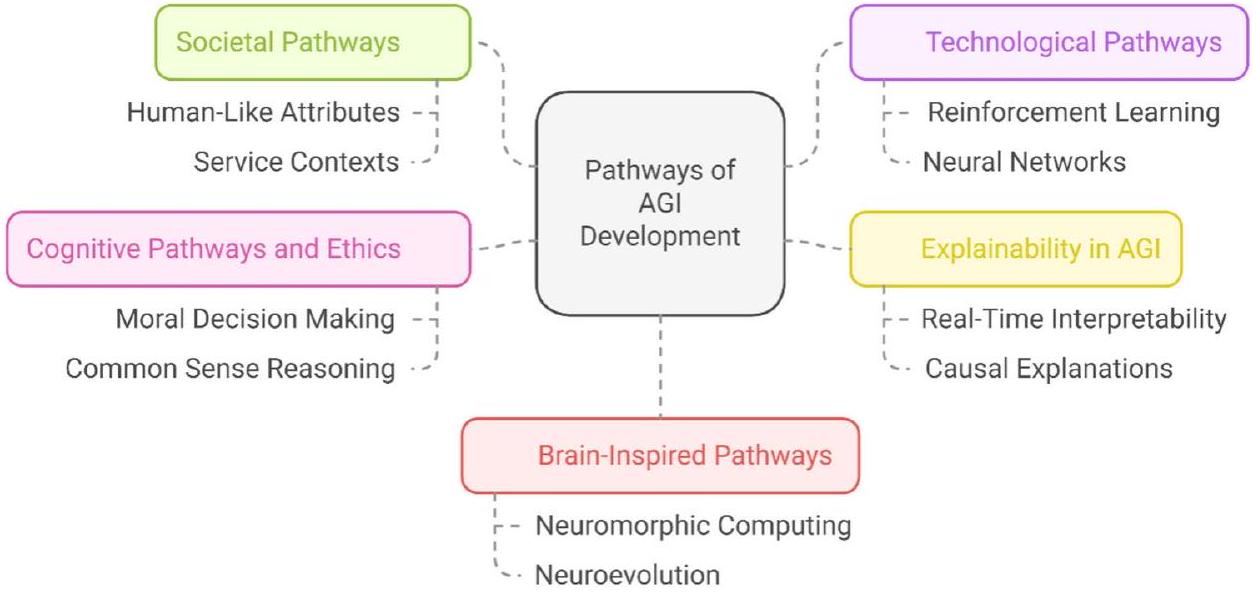
لم توضح الدراسة الحالية الفروق بين الهياكل المرتبطة بالذكاء الاصطناعي فحسب، بل قدمت أيضًا، من خلال نمذجة BERTopic، منظورًا جديدًا حول التحديات والاحتمالات المرتبطة بأبحاث الذكاء الاصطناعي العام. تسلط المسارات الخمس التي ظهرت الضوء على التقدم التكنولوجي الذي يسمح لتقنيات الذكاء الاصطناعي العام بأن تعكس بشكل أقرب التفاعلات والإدراكات البشرية، والاحتمالات المرتبطة بذلك، بالإضافة إلى التكاليف الاجتماعية والنفسية والاقتصادية الكامنة. تدمج الدراسة أيضًا الموضوعات الأساسية والناشئة والجديدة، مما يوفر خارطة طريق للاتجاهات المستقبلية في أبحاث الذكاء الاصطناعي العام. من الجدير بالذكر أن المسارات الخمس الأساسية تعكس كل من الفرص والتكاليف المحتملة المرتبطة بالذكاء الاصطناعي العام (الشكل 8).
تسلط المسارات الاجتماعية للذكاء الاصطناعي العام الضوء على التقاطع المعقد بين التطور التكنولوجي والآثار الاجتماعية، خاصة مع تزايد تشابه أنظمة الذكاء الاصطناعي العام مع البشر في التفاعلات. كما هو موضح في الدراسات السابقة ، يتشكل الذكاء الاصطناعي العام بشكل متزايد من خلال مدى تفاعله بتعاطف وسياق مع البشر. بينما يمكن أن يعزز الذكاء الاصطناعي المتعاطف الثقة والقبول، فإن الاعتماد المفرط على الذكاء الاصطناعي العام في اتخاذ القرارات المدفوعة بالعواطف، والقلق الأخلاقي بشأن تقنيات إقناع الذكاء الاصطناعي، والآثار النفسية غير المقصودة لتفاعلات الذكاء الاصطناعي الشبيهة بالبشر تشكل مخاطر كبيرة . تؤكد هذه الثنائية على الحاجة إلى تقييم نقدي لتصميم ونشر الذكاء الاصطناعي العام. بينما يمكن أن تحسن التقنيات الحسية المعززة – مثل الرؤية، والشم، والحوسبة العاطفية – الفهم السياقي للذكاء الاصطناعي العام، فإن الواقعية المفرطة في الذكاء الاصطناعي الشبيه بالبشر قد تؤدي إلى تآكل الثقة، ومخاطر التلاعب، وعدم ارتياح المستخدم. بالإضافة إلى ذلك، تتطلب التحيزات في نماذج التعرف على العواطف والقلق الأخلاقي بشأن دور الذكاء الاصطناعي في اتخاذ القرارات البشرية أطر حوكمة منظمة. يقترح بولتوك أن دمج العلماء الاجتماعيين في تدريب وتطوير الذكاء الاصطناعي العام يمكن أن يساعد في ضمان توافق هذه الأنظمة مع القيم الإنسانية بدلاً من مجرد تكرار السلوك البشري. وبالتالي، بينما تقدم مسارات الذكاء الاصطناعي العام إمكانيات تحويلية، فإنها أيضًا تقدم مخاطر تتطلب إشرافًا متعدد التخصصات، وتفاعلات شفافة بين الذكاء الاصطناعي والبشر، وضمانات تنظيمية لمنع سوء الاستخدام وضمان التوافق الأخلاقي.
“المسارات التكنولوجية نحو الذكاء الاصطناعي العام” تربط بين تطوير الذكاء الاصطناعي العام، والتحديات العملية، والآثار الاجتماعية. تعالج أنظمة الذكاء الاصطناعي العام، المدفوعة بالتعلم العميق المعزز والأطر متعددة الوسائط، المهام الواقعية، مما يعزز التفكير الشبيه بالبشر للأنظمة المستقلة، والألعاب، والعمليات الإدراكية. ومع ذلك، فإن الاعتماد السريع، كما هو الحال مع ChatGPT، يثير تحديات اجتماعية مثل التحولات في التوظيف وفجوات السياسات . تبرز منصات مثل مشروع مالمو الحاجة إلى الابتكار والحوكمة . تهدف أنظمة الذكاء الاصطناعي العام المستقبلية إلى دمج الذكاء الاجتماعي، والعاطفي، والانتباهي، والأخلاقي لتعزيز حل المشكلات ، ولكن يجب معالجة المخاطر المتعلقة بالتحيز الخوارزمي، والثغرات الأمنية، والآثار غير المقصودة لاتخاذ القرارات المستقلة. بالإضافة إلى ذلك، تثير عدم شفافية نماذج التعلم العميق مخاوف بشأن المساءلة، خاصة في التطبيقات ذات المخاطر العالية مثل الرعاية الصحية والتمويل. من الضروري التغلب على التحديات في القابلية للتفسير، والتكيف، والقابلية للتوسع. لذلك، يجب أن يترافق تطوير الذكاء الاصطناعي العام مع تدابير تنظيمية استباقية، ومعايير شفافية ، وإشراف متعدد التخصصات لضمان نشره بشكل آمن وعادل. سيتطلب تقدم الذكاء الاصطناعي العام تعاونًا متعدد التخصصات وأطرًا أخلاقية لمواءمة التكنولوجيا مع رفاهية المجتمع.
“المسارات نحو القابلية للتفسير في الذكاء الاصطناعي العام” تسلط الضوء على الحاجة الملحة لأنظمة الذكاء الاصطناعي العام الشفافة، والموثوقة، والمتوافقة أخلاقيًا. تعزز تقنيات مثل LIME وSHAP الشفافية، وهو أمر ضروري لبناء الثقة في مجالات حساسة مثل الرعاية الصحية . بالإضافة إلى الوضوح الفني، تؤكد النماذج المستوحاة من التواصل بين الأنواع على التعاطف والثقة في التعاون بين الذكاء الاصطناعي والبشر . يمكّن التعلم المعزز، كمبدأ موحد، الذكاء الاصطناعي العام من التعميم عبر المجالات، مما يربط التقدم التكنولوجي بالفوائد الاجتماعية . ومع ذلك، تستمر تحديات القابلية للتفسير، خاصة في الذكاء الاصطناعي العام القائم على التعلم العميق، حيث تظل عمليات اتخاذ القرار المعقدة غير شفافة، مما يحد من المساءلة في التطبيقات ذات المخاطر العالية مثل القانون والتمويل. بالإضافة إلى ذلك، قد لا تعكس الاعتماد على طرق التفسير بعد الحدث سلوك النموذج بالكامل، مما يؤدي إلى مخاطر محتملة
الشكل 8. مسارات تطوير الذكاء الاصطناعي العام.
في التخفيف من التحيز والعدالة. بدون حوكمة قوية، يخاطر الذكاء الاصطناعي العام بتعميق الفجوات وعدم استقرار القوى العاملة . لذلك، يجب أن يتجاوز دمج القابلية للتفسير في الذكاء الاصطناعي العام الشفافية الفنية ليشمل إشرافًا تنظيميًا استباقيًا، وتقييمًا متعدد التخصصات، وآليات للمساءلة العامة. تسلط هذه الرؤى الضوء مجتمعة على ضرورة دمج القابلية للتفسير، والأطر الأخلاقية، والسياسات الشاملة لضمان توافق الذكاء الاصطناعي العام مع المجتمع وتطوره المسؤول.
“المسارات الإدراكية والأخلاقية في الذكاء الاصطناعي العام” تفحص التفاعل بين التطور الإدراكي للذكاء الاصطناعي العام وتأثيره الاجتماعي. أطر مثل LIDA والحاسبات العصبية المستوحاة من الدماغ توضح تقدم الذكاء العام الاصطناعي نحو محاكاة التفكير البشري، مما يمكّنه من معالجة المهام المعقدة مثل التفكير السليم واتخاذ القرارات الأخلاقية. تصنيف اختبار تورينغ كمعيار شامل للذكاء الاصطناعي يبرز التحدي المستمر في ربط الذكاء الاصطناعي الضيق بالذكاء العام . ومع ذلك، مع تطور أنظمة الذكاء العام الاصطناعي، تثير المخاوف حول قدرتها على تطوير نماذج معرفية مستقلة وتحسين الذات مخاطر تتعلق باتخاذ القرارات غير المتوقعة، والانحراف الأخلاقي، وفقدان الإشراف البشري. بالإضافة إلى ذلك، يبقى توافق القيم تحديًا مستمرًا، حيث يجب على الذكاء العام الاصطناعي التنقل عبر أطر أخلاقية متضاربة في سياقات عالمية متنوعة. تثير هذه التقدمات مخاوف أخلاقية حول اتخاذ القرارات، والخصوصية، وتوافق القيم , جنبًا إلى جنب مع تحديات الحوكمة التي تتطلب الشفافية والمساءلة في التطبيقات الحساسة. تؤكد الآثار الاقتصادية، بما في ذلك أتمتة القوى العاملة وإزاحة المهام، على الحاجة إلى سياسات توازن بين الابتكار التكنولوجي والأثر الاجتماعي. للتخفيف من هذه المخاطر، فإن التعاون بين التخصصات بين علماء الإدراك، والأخلاقيين، وصانعي السياسات أمر ضروري في تشكيل الحماية التنظيمية، وضمان توافق تطوير الذكاء العام الاصطناعي مع المبادئ الأخلاقية، والإشراف البشري، وأهداف الاستدامة على المدى الطويل. تتنبأ الحواسيب العصبية وغيرها من تقنيات الذكاء العام الاصطناعي بتطبيقات في الروبوتات، والرعاية الصحية، واتخاذ القرارات، مما يبرز أهمية التعاون بين التخصصات والتدابير التنظيمية لضمان توافق تطوير الذكاء العام الاصطناعي مع القيم الإنسانية وأهداف الاستدامة .
“تسليط الضوء على المسارات المستوحاة من الدماغ نحو الذكاء العام الاصطناعي” يبرز دمج الأساليب المستوحاة من علوم الأعصاب والشبكات العصبية الاصطناعية لتقدم أبحاث الذكاء العام الاصطناعي. توفر الأجهزة العصبية الناشئة، مثل الشرائح الشبيهة بالدماغ والمنصات الهجينة، قدرات معرفية فعالة من حيث الطاقة وفي الوقت الحقيقي، وهي ضرورية لنشر الذكاء العام الاصطناعي في بيئات ديناميكية. يوسع هذا التقدم نطاق الحوسبة المستوحاة من الدماغ إلى تطبيقات جديدة، بما في ذلك الروبوتات وأنظمة التعلم التكيفية. تظهر المنصات الهجينة مثل شريحة تيانجيك وطرق التطور العصبي باستخدام الخوارزميات التطورية ابتكارات في تحسين هياكل الشبكات العصبية. تدعم المعالجة المتعددة الطبقات في نماذج الذكاء العام الاصطناعي المستوحاة من الدماغ التجريد، والوعي بالسياق، وتحديد أولويات المهام الديناميكية، وهي أمور حاسمة للذكاء العام . تستكشف الأبحاث حول الذكاء العام الاصطناعي المستوحاة من الدماغ التوسع، والتفكير، والتعلم في السياق، كاشفة عن كل من التقدم والقيود . يلعب دور التعلم العميق دورًا أساسيًا في تقديم رؤى أساسية حول المعالجة عالية الأبعاد والنمذجة الإحصائية الضرورية لـ . تشمل التطبيقات العملية الكشف عن الاضطرابات العصبية التنكسية مثل مرض باركنسون ومرض الزهايمر من خلال أطر قائمة على إنترنت الأشياء، مما يبرز التقدم في التشخيص والعلاج . ومع ذلك، فإن الآثار الاجتماعية للذكاء العام الاصطناعي، بما في ذلك الأتمتة، والخصوصية، وتأثيرات اتخاذ القرار، تتطلب أطر حوكمة تضمن الاستخدام الأخلاقي والنتائج العادلة. يبرز تلاقي الأنظمة المستوحاة من الدماغ والتقدمات الحاسوبية أهمية تحقيق توازن بين الابتكار والتنظيم الاستباقي لمعالجة المخاطر الناشئة.

التحديات الرئيسية المحيطة بالذكاء العام الاصطناعي
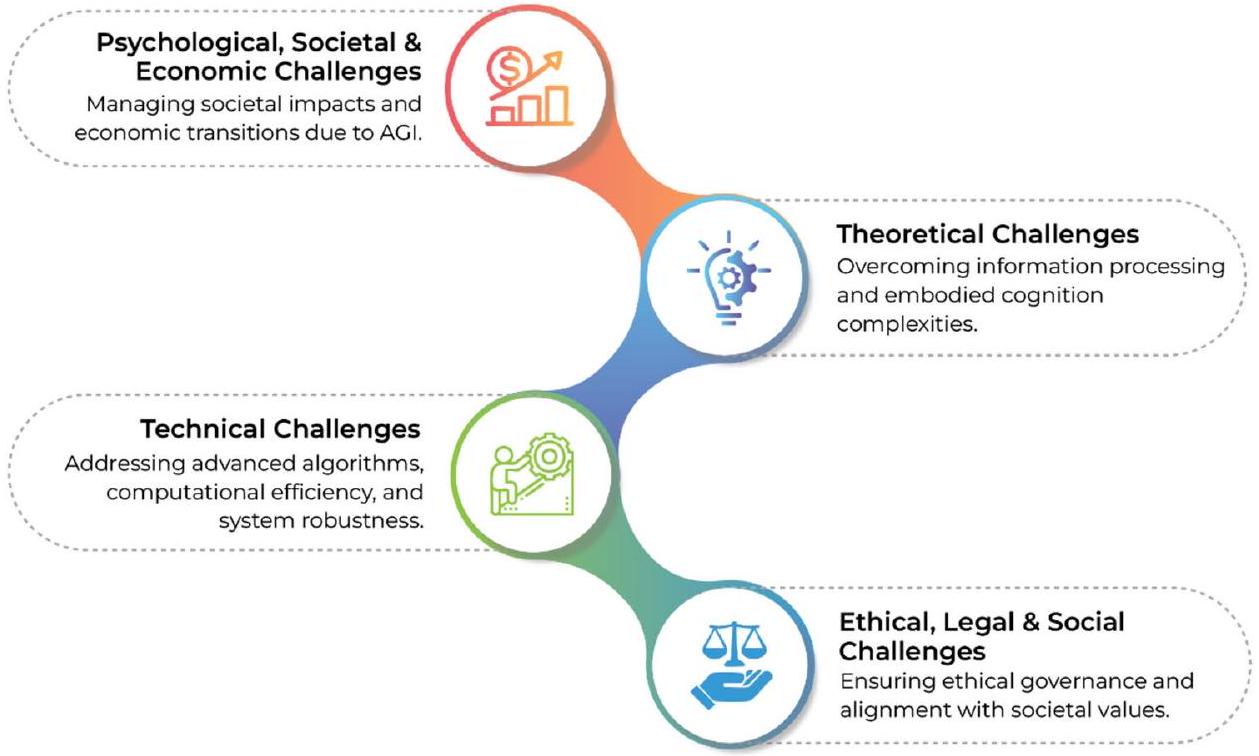
يتطلب تحقيق الذكاء العام الاصطناعي التغلب على عدة تحديات كبيرة. تمتد هذه التحديات عبر المجالات التقنية، والنظرية، والأخلاقية، والاجتماعية، والاقتصادية، حيث تقدم كل منها عقبات فريدة يجب معالجتها لتحقيق الذكاء العام الاصطناعي (الشكل 9). تتضمن كل من هذه التحديات آثارًا اجتماعية محتملة، واعتبارات أخلاقية، وآثار اقتصادية، وتحديات قانونية وتنظيمية، وتأثيرات نفسية واجتماعية لتحقيق الذكاء العام الاصطناعي. سيتطلب ضمان أمان وسلامة أنظمة الذكاء العام الاصطناعي آليات قوية لمعالجة الهجمات العدائية، والتهديدات السيبرانية، ومخاطر اتخاذ القرار المستقل. بالإضافة إلى ذلك، يجب معالجة تحديات القابلية للتوسع من خلال نماذج فعالة من حيث الطاقة وتقدمات الأجهزة. يتطلب معالجة هذه التحديات والتنقل عبر الآثار المحتملة نهجًا متعدد التخصصات يجمع بين رؤى من علوم الحاسوب، وعلوم الإدراك، والأخلاق، والعلوم الاجتماعية لتطوير أنظمة الذكاء العام الاصطناعي التي تكون قوية وآمنة ومفيدة للبشرية .
التحديات التقنية: يجب أن تدعم أنظمة الذكاء العام الاصطناعي التعلم التفاعلي، والتكيفي، والمستمر مدى الحياة بينما تنقل المعرفة بفعالية عبر المجالات . يتطلب ذلك خوارزميات متقدمة قادرة على معالجة مدخلات بيانات متنوعة وديناميكية. بالإضافة إلى ذلك، فإن التعقيد الحسابي الهائل والاحتياجات الطاقية للذكاء العام الاصطناعي تتطلب خوارزميات وأجهزة فعالة لإدارة الاستخدام العالي للموارد . إن ضمان القوة والعمومية أمر حاسم بنفس القدر، حيث يجب أن تؤدي أنظمة الذكاء العام الاصطناعي بشكل موثوق عبر مهام متنوعة والتعامل بفعالية مع البيانات المزعجة أو غير المكتملة . تبرز هذه التحديات الحاجة إلى ابتكارات تحويلية لتقدم تطوير الذكاء العام الاصطناعي. تؤكد مسارات الذكاء العام الاصطناعي التكنولوجية وتقييم الأثر على الحاجة إلى نهج شامل – نهج يعالج القابلية للتوسع، والنزاهة الأخلاقية، والشمولية مع تطور الذكاء العام الاصطناعي. سيكون تلاقي تقدمات التعلم الآلي مع الحوكمة الأخلاقية محوريًا لضمان أن يخدم الذكاء العام الاصطناعي البشرية بشكل عادل، مع تعزيز الابتكار مع احترام تعقيدات المجتمع البشري. تسلط الدراسات مجتمعة الضوء على مستقبل حيث يجب أن تتماشى مسارات تطوير الذكاء العام الاصطناعي مع الأهداف الاجتماعية، مع تحقيق التوازن بين التقدم والحذر للتنقل عبر تداعياته العميقة والمتعددة الأوجه.
التحديات النظرية: يواجه تطوير الذكاء العام الاصطناعي تحديات حاسمة في معالجة المعلومات والإدراك المجسد. إن التغلب على التعقيدات التوافقية في نظم المعلومات وإدارة ضغوط الاختيار أمر محوري لتعزيز قدرات معالجة المعلومات للذكاء العام الاصطناعي . بالإضافة إلى ذلك، فإن دمج الإدراك المجسد، الذي يمكّن أنظمة الذكاء العام الاصطناعي من فهم والتفاعل مع العالم المادي كما يفعل البشر، أمر حاسم لضمان أن هذه الأنظمة يمكن أن تدرك الآثار الواقعية لأفعالها . إن معالجة هذه الجوانب أمر ضروري لإنشاء أنظمة ذكاء عام اصطناعي قادرة حقًا وواعية بالسياق.
الشكل 9. التحديات الرئيسية والآثار المحيطة بالذكاء العام الاصطناعي.

التحديات الأخلاقية والقانونية والاجتماعية

تتطلب المفاجأة، والتوقيت، والخطر المحتمل للذكاء العام الاصطناعي اعتبارات أخلاقية، وقانونية، وتنظيمية دقيقة لتوجيه تطويره بشكل مسؤول . يجب أن تعطي أطر الحوكمة الأولوية للأخلاقيات العلمية والتكنولوجية تحت حكم القانون، مع التأكيد على أنظمة المسؤولية والأمان القوي للبيانات للتخفيف من المخاطر . بالإضافة إلى ذلك، يجب تحليل الآثار الاجتماعية والسياسية للذكاء العام الاصطناعي بشكل نقدي، خاصة تأثيراته على القيم الديمقراطية، والمساواة، والمؤسسات الانتخابية، لضمان توافق نشره مع الأهداف الاجتماعية الأوسع . يجب أن تعالج الأطر الأخلاقية والقانونية القوية الآثار الاجتماعية، بما في ذلك الخصوصية، والتوظيف، والمساءلة . يتطلب تطوير الذكاء العام الاصطناعي التركيز على التوافق، والسلامة، والتنظيم، والتفاعل بين الإنسان والآلة . علاوة على ذلك، يتطلب التفاعل الفعال بين الإنسان والآلة أنظمة قادرة على فهم والاستجابة لمشاعر الإنسان والإشارات الاجتماعية، مما يضمن التعاون الآمن والبديهي .
التحديات النفسية والاجتماعية والاقتصادية: قد يؤدي اعتماد الذكاء العام الاصطناعي إلى تغييرات نفسية واجتماعية عميقة، بما في ذلك إمكانية أن يصبح البشر أقلية في مجتمع من الذكاء العام الاصطناعي المستقل. يبرز هذا السيناريو الحاجة إلى أنظمة ديمقراطية للتنسيق وضمان التعايش بين البشر والذكاء العام الاصطناعي، مما يحمي التناغم الاجتماعي والعدالة . إن ظهور الذكاء العام الاصطناعي لديه القدرة على زعزعة النظام الاجتماعي، مما يقدم مخاطر مثل المعضلات الأخلاقية، ونسب المسؤولية، واحتكارات الملكية الفكرية، ومخاوف أمان البيانات . علاوة على ذلك، يمكن أن تتراكم AGI القوة والنفوذ في المجتمع، مما يزيد من خطر سيناريو “الإقلاع الصعب”، حيث يمكن أن تتجاوز التقدمات السريعة السيطرة البشرية وهياكل الحكم. . من الناحية الاقتصادية، يمكن أن يؤثر اعتماد AGI بشكل عميق على التوظيف، مما يتطلب استراتيجيات لإدارة انتقالات القوى العاملة والحفاظ على الاستقرار الاجتماعي. . بالإضافة إلى ذلك، يجب أن تعطي أنظمة AGI الأولوية لإدارة الموارد المستدامة لمعالجة التحديات العالمية، بما في ذلك الصحة والتعليم وعدم المساواة الاقتصادية. . يمكن أن يؤدي إنشاء AGI إلى توليد تريليونات من الأرباح للمستثمرين ولكنه يطرح مخاطر مثل “التفرد التكنولوجي”، الذي قد يؤدي إلى انخفاض قيمة المال وتحفيز سلوكيات غير مثلى بين شركات AGI. . إن الاعتماد الواسع النطاق على AGI له أيضًا عواقب اقتصادية واجتماعية وسياسية كبيرة، مما يتطلب تحليلات مفصلة لتأثيراته على الأنظمة الديمقراطية والحكم لضمان أن يستفيد المجتمع ككل. .

الآثار

الآثار على النظرية

تساهم هذه الدراسة في تعزيز الفهم النظري في مجال AGI من خلال الانخراط بشكل صريح مع وتوسيع الأطر النظرية الرئيسية عبر المجالات التقنية والأخلاقية والمعرفية والاجتماعية. يسلط هذا الضوء على المجالات الحرجة التي يمكن أن تتطور فيها النظريات الحالية أو يتم تعديلها لمعالجة التحديات والفرص الفريدة التي تقدمها AGI.
أولاً، تؤكد هذه الأبحاث على الحاجة إلى تعزيز أطر الذكاء الاصطناعي القابل للتفسير (XAI)، مما يعزز أهميتها في تعزيز الشفافية وقابلية التفسير وثقة المستخدم في أنظمة AGI. من خلال تطبيق مبادئ XAI على AGI، تعالج هذه الدراسة الفجوات في النظريات الحالية المتعلقة باتخاذ القرار والمساءلة والتوافق مع الأهداف الاجتماعية. هذا التوسع ضروري لضمان أن تعمل أنظمة AGI بشكل أخلاقي ومسؤول في سياقات العالم الحقيقي المتنوعة.
ثانيًا، تستند الدراسة إلى نظرية مساحة العمل العالمية والهياكل المعرفية، مثل وكيل التوزيع الذكي المتعلم (LIDA)، لاستكشاف إمكانيات AGI في تقليد الإدراك البشري. توسع هذه النظريات من خلال دمج عناصر الإدراك المجسد، مما يبرز قدرة AGI على التفاعل مع البيئات الفيزيائية والتكيف معها. يعالج هذا التكامل الفجوات النظرية في قابلية التكيف لـ AGI و
التفكير السليم. بالإضافة إلى ذلك، تستفيد هذه الأبحاث من أطر التعلم المعزز ونظريات التطور العصبي لاستكشاف المسارات التنموية لـ AGI. تعزز هذه النظريات من خلال تقديم هياكل مستوحاة من الدماغ وهجينة تجمع بين التفكير الرمزي وتعلم الشبكات العصبية، مما يعالج القيود في القابلية للتوسع والتعميم واتخاذ القرار الديناميكي في الأنظمة الحالية.
ثالثًا، تطبق الدراسة أطر الذكاء الجماعي على AGI، مستكشفة كيف يمكن لهذه الأنظمة استغلال قدرات حل المشكلات التعاونية عبر المجالات. يفتح هذا التمديد النظري طرقًا لدمج AGI في التحديات العالمية مثل تغير المناخ وإدارة الكوارث، مما يقدم وجهات نظر جديدة حول التطبيقات متعددة التخصصات. من منظور أخلاقي، تبني هذه الأبحاث على نظريات اتخاذ القرار الأخلاقي والمورالي الحالية من خلال اقتراح أطر للحكم والشمولية والسلامة في تطوير AGI. يسلط هذا الضوء على الضرورة النظرية لمواءمة أهداف AGI مع القيم الإنسانية لتخفيف المخاطر مثل تحيز الأتمتة والتهديدات الوجودية، وبالتالي تعزيز النقاش حول أنظمة الذكاء الاصطناعي الأخلاقية.
أخيرًا، تساهم الدراسة في النقاش النظري حول الذكاء الاصطناعي الشبيه بالبشر والوعي من خلال الانخراط في مناقشات فلسفية حول إمكانية الوعي والاستقلالية لـ AGI. يتطلب ذلك تحسين النظريات مثل التقليد والذكاء الاصطناعي المستوحى من الدماغ لمعالجة الأسئلة حول الوكالة الأخلاقية والاندماج الاجتماعي والرقابة الأخلاقية على AGI.

الآثار على الممارسة

تساهم هذه الدراسة في فهمنا لآثار AGI على الممارسين، لا سيما في تكامل القوى العاملة وتطوير المهارات، وتصميم أنظمة شفافة وموثوقة، والتكيف السياقي، والتعاون عبر التخصصات. بينما تقدم AGI فرصًا كبيرة، فإن تنفيذها يطرح أيضًا مخاطر مثل فقدان الوظائف، وغموض اتخاذ القرار، والتحيزات الاجتماعية والثقافية، التي يجب إدارتها بشكل استباقي.
أولاً، يجب على الممارسين الاستعداد لأنظمة AGI التي تتكامل مع العمل البشري مع تقليل فقدان الوظائف والمهارات الزائدة. على الرغم من أن AGI يمكن أن تعزز اتخاذ القرار التعاوني في مجالات مثل التعليم والطاقة المتجددة، فإن قدراتها على الأتمتة قد تعطل أسواق العمل التقليدية. لمعالجة ذلك، يجب على المنظمات الاستثمار في برامج إعادة تدريب العمال، ونماذج القوى العاملة الهجينة، وأدوار الإشراف على AGI. على سبيل المثال، في الرعاية الصحية، تتطلب أنظمة AGI مثل شريحة Tianjic، التي تقوم بالتشخيصات في الوقت الحقيقي، تدريب المهنيين الطبيين على التحقق من توصيات AGI لضمان التنفيذ الآمن والأخلاقي. وبالمثل، في اللوجستيات، بينما يمكن أن تعمل AGI على تحسين العمليات، يجب أن تكون مصحوبة بمبادرات تطوير المهارات لمنع التهجير الجماعي ودعم انتقال العمال إلى أدوار ذات قيمة أعلى.
ثانيًا، يجب على الممارسين بناء أنظمة AGI تكون قابلة للتفسير ومتوافقة مع توقعات المجتمع. بينما يمكن أن تخلق نماذج AGI العصبية الرمزية تجارب تعلم شخصية، فإن الفشل في شرح عمليات اتخاذ القرار قد يؤدي إلى تآكل الثقة وزيادة التحيزات. في المالية، يجب أن تكون أدوات اتخاذ القرار المدفوعة بـ AGI شفافة ليس فقط للجهات التنظيمية ولكن أيضًا أن تتضمن أطر اكتشاف التحيز لمنع ممارسات الإقراض أو الاستثمار التمييزية.
ثالثًا، يجب تصميم AGI لتعمل بفعالية عبر بيئات اجتماعية وثقافية متنوعة مع منع التحيزات الخوارزمية والفجوات في الوصول. في التعليم، يجب أن تكون المعلمين AGI مصممة لتناسب الاختلافات اللغوية والثقافية لتجنب تعزيز التحيزات وتوسيع الفجوات التعليمية. وبالمثل، في الرعاية الصحية، يجب أن تكون أدوات التشخيص AGI قابلة للتكيف مع البيئات ذات الموارد المحدودة، مما يضمن الوصول العادل ومنع الفجوات في النتائج الطبية الناجمة عن تحيزات بيانات التدريب التي تفضل المناطق ذات الدخل المرتفع.
رابعًا، التعاون بين التخصصات أمر ضروري لتحسين قدرات AGI مع معالجة مخاطرها. يجب على علماء الأعصاب وعلماء الكمبيوتر والأخلاقيين العمل معًا لتطوير تدابير وقائية تمنع العواقب غير المقصودة. على سبيل المثال، يمكن أن تحسن أنظمة AGI المستوحاة من الدماغ المستخدمة في الطب عن بُعد التعاطف في الرعاية الصحية الافتراضية ولكن قد تثير أيضًا مخاوف بشأن خصوصية البيانات، والتلاعب المعرفي، أو الاعتماد المفرط على التشخيصات المدفوعة بالذكاء الاصطناعي. لذلك، يجب تضمين آليات الرقابة الأخلاقية في تصميم AGI لمنع سوء الاستخدام وضمان التوافق مع القيم الإنسانية.

الآثار على السياسة

أخيرًا، لهذه الدراسة آثار سياسية تتعلق بـ AGI. هناك خمسة مجالات ملحوظة بشكل خاص: الأطر التنظيمية للنشر العادل؛ تعزيز الوصول الشامل، والحكم الأخلاقي، وبروتوكولات السلامة؛ التخفيف من المخاطر على المدى الطويل؛ وتحفيز الاستدامة.
أولاً، يجب على صانعي السياسات وضع لوائح واضحة وقابلة للتنفيذ لتخفيف الآثار السلبية لـ AGI على التوظيف مع ضمان النمو الاقتصادي. في التصنيع، يجب أن تلزم السياسات الإشراف البشري في الأتمتة المدفوعة بـ AGI لمنع فقدان الوظائف الجماعي مع تحسين الإنتاجية. يمكن للحكومات أن تقدم برامج انتقال القوى العاملة، وحوافز ضريبية للشركات التي تحتفظ بالعمال البشريين جنبًا إلى جنب مع أنظمة AGI، ومبادرات إعادة التدريب الإلزامية لدعم العمال المتضررين. في اللوجستيات، يجب أن تضمن اللوائح التوزيع العادل لمكاسب الكفاءة المدفوعة بـ AGI من خلال مطالبة نماذج تقاسم الأرباح، ومنح إعادة التدريب، وحماية الأجور العادلة للموظفين المتأثرين بالأتمتة. بالإضافة إلى ذلك، يجب تحديث قوانين العمل لمعالجة نماذج التوظيف الجديدة الناشئة عن دمج AGI، لضمان ظروف عمل عادلة ومنع استغلال القوى العاملة في البيئات ذات الأتمتة العالية.
ثانيًا، يجب على صانعي السياسات تنفيذ سياسات مستهدفة لتقليل الفجوات في نشر الذكاء الاصطناعي العام، وضمان الوصول العادل عبر التعليم والرعاية الصحية وغيرها من القطاعات الحيوية. في التعليم، يمكن أن تسهل المنح الحكومية والشراكات بين القطاعين العام والخاص اعتماد أنظمة التدريس المدعومة بالذكاء الاصطناعي في المدارس المحرومة، مما يضيق الفجوات التعليمية ويحسن نتائج الطلاب. بالإضافة إلى ذلك، يجب إنشاء برامج وطنية لمحو الأمية في مجال الذكاء الاصطناعي لتزويد الطلاب والمعلمين بالمهارات اللازمة لدمج أدوات الذكاء الاصطناعي في عملية التعلم بشكل فعال. في الرعاية الصحية، يجب أن تستفيد المجتمعات الريفية والمحرومة من أنظمة التشخيص المدفوعة بالذكاء الاصطناعي المدعومة، ومنصات الطب عن بُعد، والتحليلات التنبؤية، لضمان الوصول إلى الكشف المبكر عن الأمراض، وخطط العلاج الشخصية، وخدمات الرعاية الصحية عن بُعد. الأطر التنظيمية
يجب أن يفرض أيضًا العدالة في تدريب نماذج الذكاء الاصطناعي العام، مما يمنع التحيزات التي قد تضر بشكل غير متناسب بالمجموعات المهمشة في كل من التطبيقات التعليمية والرعاية الصحية.
ثالثًا، يجب على صانعي السياسات فرض إرشادات أخلاقية قوية لضمان توافق أنظمة الذكاء العام الاصطناعي مع القيم الإنسانية والعدالة والمساءلة. في الرعاية الصحية، يجب أن تعمل الأنظمة المدفوعة بالذكاء العام الاصطناعي، مثل شريحة تيانجيك، بموجب بروتوكولات أخلاقية صارمة تفرض تدقيق التحيز، والقدرة على تفسير القرارات التشخيصية، والامتثال للمعايير الأخلاقية الطبية العالمية لمنع النتائج التمييزية. يجب على الهيئات التنظيمية تنفيذ آليات إشراف مستمرة، بما في ذلك تدقيقات من طرف ثالث ومراقبة في الوقت الحقيقي، لضمان بقاء الذكاء العام الاصطناعي شفافًا ومركزًا على المريض. وبالمثل، في التعليم، يجب أن تعطي المنصات المدعومة بالذكاء العام الاصطناعي الأولوية لخصوصية الطلاب، مع الالتزام بأنظمة حماية البيانات الصارمة (مثل اللائحة العامة لحماية البيانات، وقانون حقوق التعليم العائلي) مع ضمان الشفافية والمساءلة الخوارزمية في قرارات التعلم المخصصة. يجب أن تتطلب الأطر أيضًا أن تقدم أنظمة الذكاء العام الاصطناعي في التعليم خيارات إشراف بشري، مما يسمح للمعلمين بالتدخل في التوصيات الآلية للحفاظ على النزاهة الأخلاقية والحماية من التحيزات غير المقصودة.
رابعًا، يجب على صانعي السياسات تطوير تنظيمات استباقية لمعالجة المخاطر الوجودية والعواقب طويلة الأمد للذكاء الاصطناعي العام، لا سيما في المجالات ذات المخاطر العالية. في البنية التحتية الحيوية، يجب أن تفرض أطر الحوكمة وجود وسائل أمان مدمجة وآليات تكرار وقدرات تجاوز بشري لمنع الفشل الكارثي الناتج عن أخطاء اتخاذ القرار المستقل في قطاعات مثل شبكات الطاقة، وأنظمة الدفاع، والأسواق المالية. يجب تطبيق بروتوكولات اختبار الضغط المنتظمة وعمليات تدقيق سلامة الذكاء الاصطناعي لتقييم موثوقية الذكاء الاصطناعي العام في السيناريوهات غير المتوقعة. بالإضافة إلى ذلك، يجب أن تدعم السياسات البحث والتطوير المنظم لأنظمة الذكاء الاصطناعي، المصممة لتقديم ذكاء استشاري مقيد دون استقلالية مباشرة، مما يقلل من المخاطر المرتبطة بظهور الذكاء الاصطناعي الفائق. يجب على الحكومات أيضًا إنشاء تحالفات دولية لسلامة الذكاء الاصطناعي لتنسيق استراتيجيات التخفيف من المخاطر، وضمان أن يبقى نشر الذكاء الاصطناعي العام متماشيًا مع الاعتبارات الأمنية والأخلاقية العالمية.
أخيرًا، يجب على صانعي السياسات تعزيز تطبيقات الذكاء الاصطناعي العام التي تتماشى مع أهداف الاستدامة العالمية، مع ضمان أن تسهم هذه التقنيات في الرفاهية البيئية والاجتماعية بدلاً من تفاقم الفوارق. في نمذجة تغير المناخ، يمكن الاستفادة من الذكاء الاصطناعي العام لتحسين نشر الطاقة المتجددة، وتعزيز تتبع البصمة الكربونية، وتحسين استراتيجيات المرونة المناخية من خلال تحليل مجموعات بيانات ضخمة للتنبؤ بأنماط الطقس القاسية والكوارث الطبيعية بدقة أكبر. يجب على الحكومات إنشاء برامج تمويل، وحوافز ضريبية، وأطر تنظيمية تشجع على تطوير حلول مدفوعة بالذكاء الاصطناعي العام للزراعة المستدامة، ونماذج الاقتصاد الدائري، والحفاظ على التنوع البيولوجي. بالإضافة إلى ذلك، يجب أن تعطي التعاونيات الدولية في حوكمة الذكاء الاصطناعي العام الأولوية للوصول العادل إلى هذه التطبيقات التي تركز على الاستدامة، مما يضمن أن تستفيد المناطق النامية أيضًا من الابتكارات المدفوعة بالذكاء الاصطناعي العام في التكيف مع المناخ وإدارة الموارد.

القيود والاتجاهات المستقبلية

هذه الدراسة ليست خالية من القيود. الاعتماد فقط على Scopus ضمن إطار PRISMA قد يقدم انحيازات في الاختيار، مما يؤدي إلى استبعاد دراسات ذات صلة من قواعد بيانات أخرى مثل Web of Science وIEEE Xplore وarXiv، مما قد يحد من شمولية المراجعة. بينما يضمن إطار عمل PRISMA مراجعة منهجية وشفافة، قد تتجاهل مقاربته المنظمة الدراسات الناشئة أو متعددة التخصصات أو غير التقليدية. ، مما قد يحد من تنوع وجهات نظر الذكاء الاصطناعي العام. على الرغم من أن نمذجة الموضوعات المعتمدة على BERT تتفوق في تحليل مجموعات البيانات الكبيرة واستخراج الموضوعات الرئيسية، إلا أن أدائها يعتمد على جودة ونطاق بيانات الإدخال. ومن الجدير بالذكر أن خوارزمية التجميع HDBSCAN التي تستخدمها غالبًا ما تصنف جزءًا كبيرًا من الوثائق كاستثناءات، مما يستبعدها من التحليل. من خلال استخدام التشابه الدلالي لإنشاء تمثيلات موضوعية متماسكة، تقلل الطريقة من التحيز البشري في تصنيف الموضوعات، مما يحسن الموضوعية والاتساق. ومع ذلك، قد تفرض بعض الافتراضات المدمجة في تصميم الخوارزمية قيودًا أيضًا. الاعتماد على عدد الاقتباسات كمؤشرات تأثير له قيود جوهرية، بما في ذلك تحيز الاقتباس الإيجابي، الذي يمكن أن يعزز المفاهيم الخاطئة. وإمكانية الاقتباسات غير المنسوبة بشكل صحيح، مما يؤدي إلى عدم الدقة في تقييم الأثر .
مع استمرار تطور الذكاء العام الاصطناعي، كشفت الأبحاث عن طيف من الموضوعات المترابطة التي تشكل مساره وآثاره الاجتماعية (الشكل 10). تعكس الموضوعات السائدة اهتمامات طويلة الأمد واتجاهات راسخة، مثل أطر الحوكمة الأخلاقية وتطبيقات الرعاية الصحية، التي تؤكد على الحاجة إلى نشر مسؤول واستخدام مؤثر لتقنيات الذكاء العام الاصطناعي. علاوة على ذلك، تلتقط الموضوعات المتزايدة نقاط التركيز الناشئة، بما في ذلك دمج مبادئ الذكاء الجماعي والتصاميم المستوحاة من الدماغ، التي تدفع حدود قدرات الذكاء العام الاصطناعي ومواءمته مع القيم الإنسانية. أخيرًا، تستكشف الموضوعات الجديدة أراضٍ غير مستكشفة، مثل دور الذكاء العام الاصطناعي في التعليم الشخصي وتقاطعه مع الوعي، مما يمهد الطريق لتحقيق تقدم تحويلي. توفر هذه الموضوعات مجتمعة خارطة طريق لفهم تطوير الذكاء العام الاصطناعي، وفرصه، والتحديات التي تنتظره.

الموضوع السائد: الإرشادات الأخلاقية وحوكمة الذكاء الاصطناعي العام
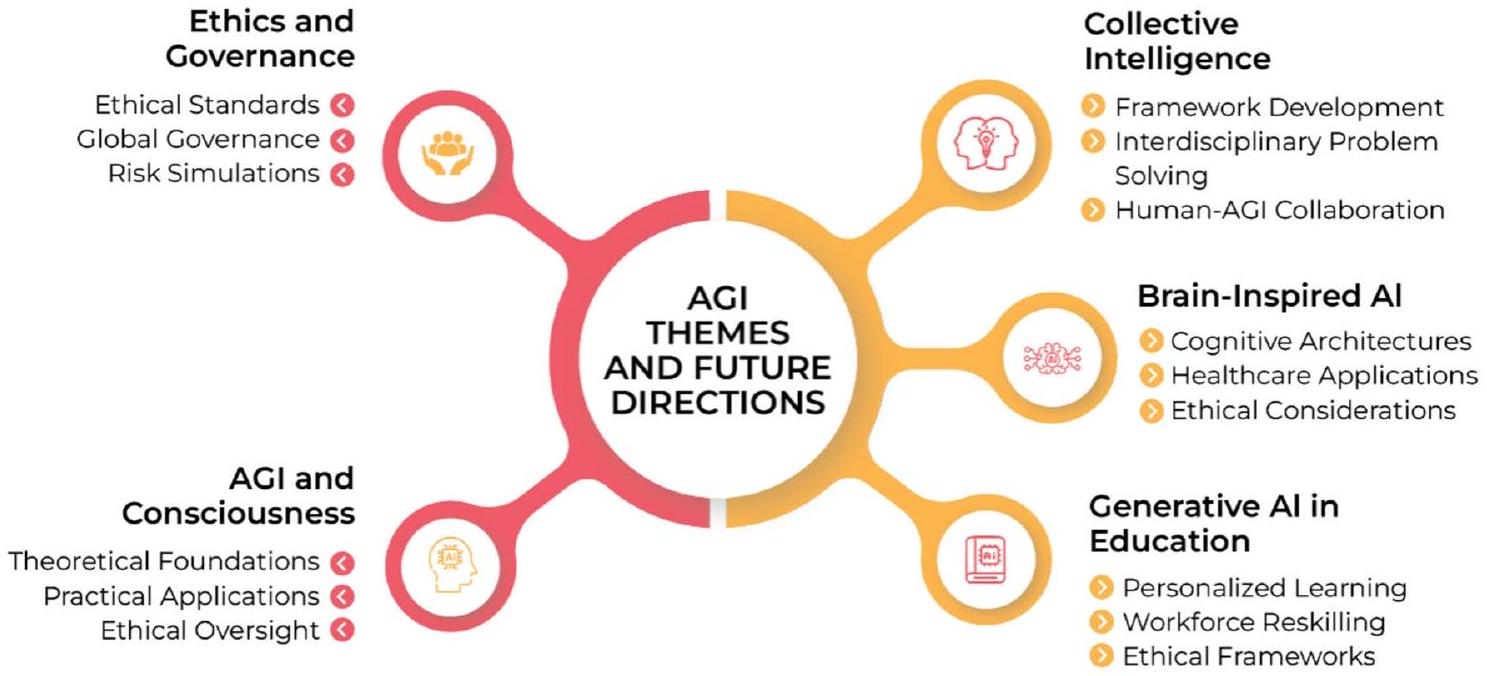
يبرز التركيز على الإرشادات الأخلاقية والحوكمة الحاجة إلى أطر منظمة توجه تطوير الذكاء الاصطناعي العام مع معالجة أهداف الاستدامة. مع تزايد استقلالية الذكاء الاصطناعي العام، يجب أن تخفف الهياكل الأخلاقية والحكومية المخاطر مثل فقدان الوظائف وانتهاكات الخصوصية، مع التوافق مع أهداف التنمية المستدامة. يقدم الذكاء الاصطناعي العام فرصًا لدعم أولويات أهداف التنمية المستدامة، مثل تحسين الطاقة المتجددة واستراتيجيات المرونة المناخية. تشمل الأطر ذات الصلة مبادئ أخلاقيات الذكاء الاصطناعي العام (مثل الشفافية، والمساءلة، والعدالة)، ونماذج الحوكمة العالمية (مثل قانون الذكاء الاصطناعي في الاتحاد الأوروبي وتصميم IEEE المتوافق أخلاقيًا)، وسياسات الذكاء الاصطناعي العام المدفوعة بالاستدامة التي تدمج الذكاء الاصطناعي العام في المبادرات المتوافقة مع أهداف التنمية المستدامة. يجب أن تتجه الاتجاهات المستقبلية أولاً إلى تطوير إرشادات أخلاقية تضمن المساءلة، والشمولية، والاستدامة في تطبيقات الذكاء الاصطناعي العام، لا سيما في مجالات مثل الطاقة المتجددة ونمذجة المناخ. ثانيًا، يجب إنشاء هياكل حوكمة دولية تعزز الاستخدام العادل للذكاء الاصطناعي العام لسد الفجوات الرقمية وتعزيز أهداف الاستدامة.
الشكل 10. مواضيع الذكاء العام الاصطناعي واتجاهات البحث المستقبلية.
مثل الطاقة النظيفة وتقليل الفوارق. ثالثًا، هناك حاجة إلى محاكاة المخاطر للتنبؤ بالتأثيرات الاجتماعية للذكاء الاصطناعي العام ومساهماته المحتملة في أهداف التنمية المستدامة، مثل تحسين الموارد والوصول إلى التعليم.

موضوع الصعود: الذكاء العام الاصطناعي والذكاء الجماعي

تقدم أطر الذكاء الجماعي مثل أنظمة الإنسان في الحلقة، والذكاء السرب، ونماذج الذكاء الهجين فرصًا لدمج الخبرة البشرية في الوقت الحقيقي في أنظمة الذكاء الاصطناعي العام لمواجهة التحديات العالمية، مثل الاستجابة للكوارث، والقدرة على التكيف مع المناخ، والتنبؤ الوبائي. من خلال دمج القوة الحسابية للذكاء الاصطناعي العام مع الرؤى البشرية اللامركزية، يمكن لهذه الأطر تعزيز القدرة على التكيف، مما يمكّن من اتخاذ قرارات أسرع وأكثر وعيًا بالسياق في سيناريوهات الأزمات. يمكن أن يحسن الاستفادة من الذكاء الجماعي قدرة الذكاء الاصطناعي العام على مواجهة التحديات المعقدة وعالية المخاطر، من استراتيجيات التخفيف من تغير المناخ إلى إدارة الأزمات الصحية العامة، بما في ذلك الاستجابة للوباء وتخصيص الموارد. على سبيل المثال، في إدارة الكوارث، يمكن لأنظمة الذكاء الاصطناعي العام المدمجة مع الذكاء السرب تحليل بيانات المستشعرات الكبيرة وتقارير البشر بشكل ديناميكي لتحسين جهود الإغاثة. بالإضافة إلى ذلك، يجب أن تستكشف الدراسات كيف يمكن للذكاء الاصطناعي العام تسهيل حل المشكلات التعاونية في الحوكمة، والتخطيط الحضري، وتطوير السياسات العالمية، مما يعزز اتخاذ قرارات مبتكرة وشاملة تتماشى مع احتياجات المجتمع.

الموضوع المتزايد: الذكاء الاصطناعي العام المستوحى من الدماغ

يعكس التركيز المتزايد على نماذج الذكاء الاصطناعي البيولوجية القابلة للتصديق اهتمامًا متزايدًا في تصميم أنظمة الذكاء الاصطناعي العام التي تحاكي العمليات المعرفية البشرية، بما في ذلك التعلم، والذاكرة، واتخاذ القرار. يبرز هذا الاتجاه إمكانيات الهياكل المستوحاة من الدماغ، مثل الحوسبة العصبية والشبكات العصبية النابضة (SNNs)، لتجاوز القيود التقليدية للذكاء الاصطناعي في القابلية للتعميم، والقدرة على التكيف، والتفكير. يجب أن تعطي الأبحاث المستقبلية الأولوية لتطوير أنظمة الذكاء الاصطناعي العام الهجينة التي تدمج الهياكل العصبية الشبيهة بالدماغ مع التفكير الرمزي، مما يعزز الفهم السياقي والاستدلال المنطقي. بالإضافة إلى ذلك، يحمل الذكاء الاصطناعي العام المستوحى من الدماغ إمكانيات تحويلية في الرعاية الصحية والتعليم، حيث يمكن أن يحدث ثورة في الطب الشخصي من خلال تمكين التشخيصات والتوصيات العلاجية في الوقت الحقيقي، بالإضافة إلى أنظمة التعلم التكيفية التي تستجيب ديناميكيًا لسلوك الطلاب وحالاتهم المعرفية. علاوة على ذلك، يجب أن تفحص الأبحاث الآثار الأخلاقية لأنظمة الذكاء الاصطناعي العام المستندة إلى الإدراك البشري، لا سيما فيما يتعلق بمخاطر الخصوصية، والتلاعب المعرفي، والأثر النفسي، لضمان توافق هذه التقدمات مع القيم الأخلاقية والاجتماعية.

الموضوع الجديد: الذكاء الاصطناعي العام والوعي

يمثل تقاطع الذكاء الاصطناعي العام والوعي حدودًا ناشئة في فهم الإدراك الشبيه بالبشر، والوعي الذاتي، والتفكير الأخلاقي داخل الأنظمة الذكية. ينتقل هذا التحول من الذكاء الاصطناعي الوظيفي البحت نحو الذكاء الاصطناعي العام القادر على التأمل، واتخاذ القرارات التكيفية، والحكم الأخلاقي، مع تطبيقات محتملة في رعاية المسنين، ودعم الصحة النفسية، وحل النزاعات. تشمل التقدمات الرئيسية التي تدفع هذا المجال الهياكل المعرفية التي تحاكي جوانب الوعي الذاتي، ونظريات الآلة للوعي المتوافقة مع العلوم المعرفية، وأطر التفكير الأخلاقي. يجب أن تركز الأبحاث على تطوير الأسس النظرية التي توجه تصميم الذكاء الاصطناعي العام بقدرات تأملية مع معالجة الآثار الأخلاقية والاجتماعية، بما في ذلك أسئلة الوكالة، والحقوق، وأطر الحوكمة للنشر المسؤول. يجب أن تستكشف الدراسات المستقبلية منهجيات مثل النمذجة الحسابية للوعي، والمحاكاة الأخلاقية، وأطر السياسات متعددة التخصصات لتقييم دور الذكاء الاصطناعي العام في المجتمع. بالإضافة إلى ذلك، يجب استكشاف التطبيقات العملية، حيث يمكن أن تتفوق أنظمة الذكاء الاصطناعي العام ذات الميزات الشبيهة بالوعي في المجالات العاطفية الذكية مثل رعاية المسنين، والاستشارات النفسية، وحل النزاعات، مما يوفر تفاعلات دقيقة تعزز من رفاهية الإنسان.

الموضوع الجديد: الذكاء الاصطناعي العام في التعليم

يمثل تقارب الذكاء الاصطناعي التوليدي والذكاء الاصطناعي العام (AGI) إمكانية تحويل التعليم والتدريب المهني من خلال تمكين أنظمة التعلم التكيفية، الذكية، والشبيهة بالبشر. يجب أن تركز الأبحاث المستقبلية على ثلاثة مجالات رئيسية. أولاً، تطوير منصات الذكاء الاصطناعي التوليدية المدفوعة بالذكاء الاصطناعي العام التي تتكيف ديناميكيًا مع أنماط التعلم الفردية والعمليات المعرفية، مما يوفر تجارب تعليمية شخصية تتطور في الوقت الحقيقي. ثانيًا، إنشاء برامج تدريب قائمة على المهارات تستفيد من الذكاء الاصطناعي لمحاكاة سيناريوهات العالم الحقيقي المعقدة، مما يعد المحترفين للتعاون مع أنظمة مدعومة بالذكاء الاصطناعي في صناعات مثل الرعاية الصحية، والهندسة، والمالية. ثالثًا، إنشاء إرشادات أخلاقية وتنظيمية لضمان النشر المسؤول والعادل للذكاء الاصطناعي العام في التعليم، ومعالجة المخاوف المتعلقة بخصوصية البيانات، والتحيز الخوارزمي، والوصول لمنع تفاقم الفجوات التعليمية الحالية. من خلال دمج الذكاء الاصطناعي العام في التعليم، يمكن أن تصبح بيئات التعلم أكثر تفاعلية، وشمولية، وتوافقًا مع المطالب المتطورة للاقتصاد الرقمي.

الخاتمة

تقدم هذه الدراسة عدة مساهمات هامة في أبحاث الذكاء الاصطناعي العام من خلال تحديد الموضوعات التي لم يتم استكشافها بشكل كافٍ باستخدام نمذجة BERTopic المعتمدة على التعلم الآلي وتأسيس إطار مفاهيمي يميز بين المفاهيم الرئيسية للذكاء الاصطناعي بينما يربط الذكاء الاصطناعي العام بالتطبيقات العملية في الصناعة والاعتبارات الأخلاقية. تتناول دراستنا بشكل نقدي المسارات اللازمة لتمكين الذكاء الاصطناعي العام القابل للتوسع، والقابل للتكيف، والقابل للتفسير عبر بيئات متنوعة من خلال تحديد الاتجاهات الاستراتيجية، بما في ذلك التقدم في الهياكل الهجينة، والحوسبة العصبية، ونهج التعلم التكيفي، التي تعزز قدرة الذكاء الاصطناعي العام على التعميم عبر السياقات مع الحفاظ على القابلية للتفسير. بالإضافة إلى ذلك، نستكشف كيف يمكن تطوير أنظمة الذكاء الاصطناعي العام لتتوافق مع المبادئ الأخلاقية، واحتياجات المجتمع، والوصول العادل، مما يبرز ضرورة الحوكمة الشفافة، ومنهجيات بناء الثقة، وأطر مثل الذكاء الاصطناعي القابل للتفسير (XAI) لضمان أن يخدم الذكاء الاصطناعي العام الأهداف التي تركز على الإنسان بدلاً من تفاقم الفجوات الاجتماعية. من خلال معالجة الحاجة إلى التعاون الفعال، والثقة، والشفافية بين البشر وأنظمة الذكاء الاصطناعي العام، تسلط هذه الدراسة الضوء على دور نماذج الإنسان في الحلقة، والإشراف متعدد التخصصات، والآليات التنظيمية التي تعزز النشر المسؤول للذكاء الاصطناعي العام. أخيرًا، نفحص كيف يمكن أن يسهم الذكاء الاصطناعي العام في التقدم من خلال التكامل متعدد التخصصات، مما يظهر إمكانياته التحويلية في الرعاية الصحية، والتعليم، والاستدامة، وأنظمة اتخاذ القرار. من خلال ربط تطوير الذكاء الاصطناعي العام بالتقدم الاجتماعي مع الاعتراف بمخاطره، تقدم نتائجنا خارطة طريق شاملة لضمان تطور الذكاء الاصطناعي العام بشكل مسؤول وعادل، مما يلبي التحديات الحالية والضرورات العالمية المستقبلية.

توفر البيانات

جميع البيانات التي تم إنشاؤها أو تحليلها خلال هذه الدراسة مدرجة في هذه المقالة المنشورة.
تاريخ الاستلام: 10 يناير 2025؛ تاريخ القبول: 25 فبراير 2025
تاريخ النشر على الإنترنت: 11 مارس 2025

References

  1. Fjelland, R. Why general artificial intelligence will not be realized. Hum. Soc. Sci. Commun. 7(1), 1-9 (2020).
  2. Yampolskiy, R. On the Differences between Human and Machine Intelligence. In AISafety@ IJCAI (2021).
  3. Hellström, T. & Bensch, S. Apocalypse now: no need for artificial general intelligence. AI Soc. 39(2), 811-813 (2024).
  4. Barrett, A. M. & Baum, S. D. A model of pathways to artificial superintelligence catastrophe for risk and decision analysis. J. Exp. Theor. Artif. Intell. 29(2), 397-414 (2017).
  5. Gill, K. S. Artificial super intelligence: beyond rhetoric. AI Soc. 31, 137-143 (2016).
  6. Pueyo, S. Growth, degrowth, and the challenge of artificial superintelligence. J. Clean. Prod. 197, 1731-1736 (2018).
  7. Saghiri, A. M., Vahidipour, S. M., Jabbarpour, M. R., Sookhak, M. & Forestiero, A. A survey of artificial intelligence challenges: Analyzing the definitions, relationships, and evolutions. Appl. Sci. 12(8), 4054 (2022).
  8. Ng, G. W. & Leung, W. C. Strong artificial intelligence and consciousness. J. Artif. Intell. Conscious. 7(01), 63-72(2020).
  9. Yampolskiy, R. V. Agi control theory. In Artificial General Intelligence: 14th International Conference, AGI 2021, Palo Alto, CA, USA, October 15-18, 2021, Proceedings 14 (pp. 316-326). Springer International Publishing (2022a).
  10. Yampolskiy, R. V. On the controllability of artificial intelligence: An analysis of limitations. J. Cyber Secur. Mob. 321-404 (2022b).
  11. Ramamoorthy, A. & Yampolskiy, R. Beyond mad? The race for artificial general intelligence. ITU J. 1(1), 77-84 (2018).
  12. Cao, L. Ai4tech: X-AI enabling X-Tech with human-like, generative, decentralized, humanoid and metaverse AI. Int. J. Data Sci. Anal. 18(3), 219-238 (2024).
  13. Goertzel, B. Artificial general intelligence and the future of humanity. The transhumanist reader: Classical and contemporary essays on the science, technology, and philosophy of the human future 128-137 (2013).
  14. Li, X., Zhao, L., Zhang, L., Wu, Z., Liu, Z., Jiang, H. & Shen, D. Artificial general intelligence for medical imaging analysis. IEEE Rev. Biomed. Eng. (2025).
  15. Rathi, S. Approaches to artificial general intelligence: An analysis (2022). arXiv preprint arXiv:2202.03153.
  16. Arora, A. & Arora, A. The promise of large language models in health care. The Lancet .
  17. Bikkasani, D. C. Navigating artificial general intelligence (AGI): Societal implications, ethical considerations, and governance strategies. AI Ethics 1-16 (2024).
  18. Li, J. X., Zhang, T., Zhu, Y. & Chen, Z. Artificial general intelligence for the upstream geoenergy industry: A review. Gas Sci. Eng. 205469 (2024).
  19. Nedungadi, P., Tang, K. Y. & Raman, R. The transformative power of generative artificial intelligence for achieving the sustainable development goal of quality education. Sustainability 16(22), 9779 (2024).
  20. Zhu, X., Chen, S., Liang, X., Jin, X. & Du, Z. Next-generation generalist energy artificial intelligence for navigating smart energy. Cell Rep. Phys. Sci. 5(9), 102192 (2024).
  21. Faroldi, F. L. Risk and artificial general intelligence. AI Soc. 1-9 (2024).
  22. Simon, C. J. Ethics and artificial general intelligence: technological prediction as a groundwork for guidelines. In 2019 IEEE International Symposium on Technology and Society (ISTAS) 1-6 (IEEE, 2019).
  23. Chouard, T. The Go files: AI computer wraps up 4-1 victory against human champion. Nat. News 20, 16 (2016).
  24. Morris, M. R., Sohl-Dickstein, J. N., Fiedel, N., Warkentin, T. B., Dafoe, A., Faust, A., Farabet, C. & Legg, S. Position: Levels of AGI for operationalizing progress on the path to AGI. In International Conference on Machine Learning (2023).
  25. Weinbaum, D. & Veitas, V. Open ended intelligence: The individuation of intelligent agents. J. Exp. Theor. Artif. Intell. 29(2), 371-396 (2017).
  26. Sublime, J. The AI race: Why current neural network-based architectures are a poor basis for artificial general intelligence. J. Artif. Intell. Res. 79, 41-67 (2024).
  27. Wickramasinghe, B., Saha, G. & Roy, K. Continual learning: A review of techniques, challenges and future directions. IEEE Trans. Artif. Intell. (2023).
  28. Fei, N. et al. Toward artificial general intelligence via a multimodal foundation model. Nat. Commun. 13(1), 3094 (2022).
  29. Kelley, D. & Atreides, K. AGI protocol for the ethical treatment of artificial general intelligence systems. Procedia Comput. Sci. 169, 501-506 (2020).
  30. McCormack, J. Autonomy, intention, Performativity: Navigating the AI divide. In Choreomata (pp. 240-257). Chapman and Hall/ CRC (2023).
  31. Khamassi, M., Nahon, M. & Chatila, R. Strong and weak alignment of large language models with human values. Sci. Rep. 14(1), 19399 (2024).
  32. McIntosh, T. R., Susnjak, T., Liu, T., Watters, P., Ng, A. & Halgamuge, M. N. A game-theoretic approach to containing artificial general intelligence: Insights from highly autonomous aggressive malware. IEEE Trans. Artif. Intell. (2024).
  33. Salmi, J. A democratic way of controlling artificial general intelligence. AI Soc. 38(4), 1785-1791 (2023).
  34. Bubeck, S., Chandrasekaran, V., Eldan, R., Gehrke, J., Horvitz, E., Kamar, E. & Zhang, Y. Sparks of artificial general intelligence: Early experiments with gpt-4 (2023). arXiv preprint arXiv:2303.12712.
  35. Faraboschi, P., Frachtenberg, E., Laplante, P., Milojicic, D. & Saracco, R. Artificial general intelligence: Humanity’s downturn or unlimited prosperity. Computer 56(10), 93-101 (2023).
  36. Wei, Y. Several important ethical issues concerning artificial general intelligence. Chin. Med. Ethics 37(1), 1-9 (2024).
  37. McLean, S. et al. The risks associated with artificial general intelligence: A systematic review. J. Exp. Theor. Artif. Intell. 35(5), 649-663 (2023).
  38. Shalaby, A. Digital sustainable growth model (DSGM): Achieving synergy between economy and technology to mitigate AGI risks and address Global debt challenges. J. Econ. Technol. (2024a).
  39. Croeser, S. & Eckersley, P. Theories of parenting and their application to artificial intelligence. In Proceedings of the 2019 AAAI/ ACM Conference on AI, Ethics, and Society (pp. 423-428) (2019).
  40. Lenharo, M. What should we do if AI becomes conscious? These scientists say it is time for a plan. Nature (2024). https://doi.org /10.1038/d41586-024-04023-8
  41. Shankar, V. Managing the twin faces of AI: A commentary on “Is AI changing the world for better or worse?”. J. Macromark. 44(4), 892-899 (2024).
  42. Wu, Y. Future of information professions: Adapting to the AGI era. Sci. Tech. Inf. Process. 51(3), 273-279 (2024).
  43. Sukhobokov, A., Belousov, E., Gromozdov, D., Zenger, A. & Popov, I. A universal knowledge model and cognitive architecture for prototyping AGI (2024). arXiv preprint arXiv:2401.06256.
  44. Salmon, P. M. et al. Managing the risks of artificial general intelligence: A human factors and ergonomics perspective. Hum. Fact. Ergon. Manuf. Serv. Ind. 33(5), 366-378 (2023).
  45. Bory, P., Natale, S. & Katzenbach, C. Strong and weak AI narratives: An analytical framework. AI Soc. 1-11 (2024).
  46. Gai, F. When artificial intelligence meets Daoism. In Intelligence and Wisdom: Artificial Intelligence Meets Chinese Philosophers 83-100 (2021).
  47. Menaga, D. & Saravanan, S. Application of artificial intelligence in the perspective of data mining. In Artificial Intelligence in Data Mining (pp. 133-154). Academic Press (2021).
  48. Adams, S., Arel, I., Bach, J., Coop, R., Furlan, R., Goertzel, B., Sowa, J. (2012). Mapping the landscape of human-level artificial general intelligence. AI Magazine 33(1), 25-42.
  49. Beerends, S. & Aydin, C. Negotiating the authenticity of AI: how the discourse on AI rejects human indeterminacy. AI Soc. 1-14 (2024).
  50. Besold, T. R. Human-level artificial intelligence must be a science. In Artificial General Intelligence: 6 th International Conference, AGI 2013, Beijing, China, July 31-August 3, 2013 Proceedings 6 (pp. 174-177). Springer Berlin Heidelberg (2013).
  51. Eth, D. The technological landscape affecting artificial general intelligence and the importance of nanoscale neural probes. Informatica 41(4) (2017).
  52. Nvs, B. & Saranya, P. L. Water pollutants monitoring based on Internet of Things. In Inorganic Pollutants in Water (pp. 371-397) (2020). Elsevier.
  53. Flowers, J. C. Strong and Weak AI: Deweyan Considerations. In AAAI spring symposium: Toward conscious AI systems (Vol. 2287, No. 7) (2019).
  54. Mitchell, M. Debates on the nature of artificial general intelligence. Science 383(6689), eado7069 (2024).
  55. Grech, V. & Scerri, M. Evil doctor, ethical android: Star Trek’s instantiation of conscience in subroutines. Early Hum. Dev. 145, 105018 (2020).
  56. Noller, J. Extended human agency: Towards a teleological account of AI. Hum. Soc. Sci. Commun. 11(1), 1-7 (2024).
  57. Nominacher, M. & Peletier, B. Artificial intelligence policies. The digital factory for knowledge: Production and validation of scientific results 71-76 (2018).
  58. Isaac, M., Akinola, O. M., & Hu, B. Predicting the trajectory of AI utilizing the Markov model of machine learning. In 2023 IEEE 3rd International Conference on Computer Communication and Artificial Intelligence (CCAI) (pp. 30-34). IEEE (2023).
  59. Stewart, W. The human biological advantage over AI. AI & Soc. 1-10 (2024).
  60. Vaidya, A. J. Can machines have emotions? AI Soc. 1-16 (2024).
  61. Triguero, I., Molina, D., Poyatos, J., Del Ser, J. & Herrera, F. General purpose artificial intelligence systems (GPAIS): Properties, definition, taxonomy, societal implications and responsible governance. Inf. Fus. 103, 102135 (2024).
  62. Bécue, A., Gama, J. & Brito, P. Q. AI’s effect on innovation capacity in the context of industry 5.0: A scoping review. Artif. Intell. Rev. 57(8), 215 (2024).
  63. Yue, Y. & Shyu, J. Z. A paradigm shift in crisis management: The nexus of AGI-driven intelligence fusion networks and blockchain trustworthiness. J. Conting. Crisis Manag. 32(1), e12541(2024).
  64. Chiroma, H., Hashem, I. A. T. & Maray, M. Bibliometric analysis for artificial intelligence in the internet of medical things: Mapping and performance analysis. Front. Artif. Intell. 7, 1347815 (2024).
  65. Wang, Z., Chen, J., Chen, J. & Chen, H. Identifying interdisciplinary topics and their evolution based on BERTopic. Scientometrics https://doi.org/10.1007/s11192-023-04776-5 (2023).
  66. Wang, J., Liu, Z., Zhao, L., Wu, Z., Ma, C., Yu, S. & Zhang, S. Review of large vision models and visual prompt engineering. MetaRadiol. 100047 (2023).
  67. Daase, C. & Turowski, K. Conducting design science research in society 5.0-Proposal of an explainable artificial intelligence research methodology. In International Conference on Design Science Research in Information Systems and Technology (pp. 250265). Springer, Cham (2023).
  68. Yang, L., Gong, M. & Asari, V. K. Diagram image retrieval and analysis: Challenges and opportunities. In Proceedings of the IEEE/ CVF Conference on Computer Vision and Pattern Recognition Workshops (pp. 180-181) (2020).
  69. Krishnan, B., Arumugam, S. & Maddulety, K. ‘Nested’disruptive technologies for smart cities: Effects and challenges. Int. J. Innov. Technol. Manag. 17(05), 2030003 (2020).
  70. Krishnan, B., Arumugam, S. & Maddulety, K. Impact of disruptive technologies on smart cities: challenges and benefits. In International Working Conference on Transfer and Diffusion of IT (pp. 197-208). Cham: Springer International Publishing (2020).
  71. Long, L. N. & Cotner, C. F. A review and proposed framework for artificial general intelligence. In 2019 IEEE Aerospace Conference (pp. 1-10). IEEE (2019).
  72. Everitt, T., Lea, G. & Hutter, M. AGI safety literature review (2018). arXiv preprint arXiv:1805.01109.
  73. Wang, P. & Goertzel, B. Introduction: Aspects of artificial general intelligence. In Advances in Artificial General Intelligence: Concepts, Architectures and Algorithms (pp. 1-16). IOS Press (2007).
  74. Yampolskiy, R. & Fox, J. Safety engineering for artificial general intelligence. Topoi 32, 217-226 (2013).
  75. Dushkin, R. V. & Stepankov, V. Y. Hybrid bionic cognitive architecture for artificial general intelligence agents. Procedia Comput. Sci. 190, 226-230 (2021).
  76. Nyalapelli, V. K., Gandhi, M., Bhargava, S., Dhanare, R. & Bothe, S. Review of progress in artificial general intelligence and human brain inspired cognitive architecture. In 2021 International Conference on Computer Communication and Informatics (ICCCI) (pp. 1-13). IEEE (2021).
  77. Page, M. J. et al. The PRISMA 2020 statement: an updated guideline for reporting systematic reviews. BMJ 372, n71. https://doi.o rg/10.1136/bmj.n71 (2021).
  78. Donthu, N., Kumar, S., Pandey, N., Pandey, N. & Mishra, A. Mapping the electronic word-of-mouth (eWOM) research: A systematic review and bibliometric analysis. J. Bus. Res. 135, 758-773 (2021).
  79. Comerio, N. & Strozzi, F. Tourism and its economic impact: A literature review using bibliometric tools. Tour. Econ. 25(1), 109-131 (2019).
  80. Raman, R., Gunasekar, S., Dávid, L. D. & Nedungadi, P. Aligning sustainable aviation fuel research with sustainable development goals: Trends and thematic analysis. Energy Rep. 12, 2642-2652 (2024).
  81. Raman, R., Gunasekar, S., Kaliyaperumal, D. & Nedungadi, P. Navigating the nexus of artificial intelligence and renewable energy for the advancement of sustainable development goals. Sustainability 16(21), 1-25 (2024).
  82. Egger, R. & Yu, J. A topic modeling comparison between lda, nmf, top2vec, and bertopic to demystify twitter posts. Front. Sociol. 7, 886498 (2022).
  83. Devlin, J., Chang, M. W., Lee, K. & Toutanova, K. BERT: Pre-training of deep bidirectional transformers for language understanding. NAACL HLT 2019-2019 Conference of the North American Chapter of the Association for Computational Linguistics: Human Language Technologies-Proceedings of the Conference, 1(Mlm), 4171-4186 (2019).
  84. Grootendorst, M. BERTopic: Neural topic modeling with a class-based TFIDF procedure (2022). http://arxiv.org/abs/2203.05794
  85. Alamsyah, A. & Girawan, N. D. Improving clothing product quality and reducing waste based on consumer review using RoBERTa and BERTopic language model. Big Data Cogn. Comput. 7(4), 168 (2023).
  86. Raman, R. et al. Green and sustainable AI research: An integrated thematic and topic modeling analysis. J. Big Data 11(1), 55 (2024).
  87. Um, T. & Kim, N. A study on performance enhancement by integrating neural topic attention with transformer-based language model. Appl. Sci. 14(17), 7898 (2024).
  88. Gan, L., Yang, T., Huang, Y., Yang, B., Luo, Y. Y., Richard, L. W. C. & Guo, D. Experimental comparison of three topic modeling methods with LDA, Top2Vec and BERTopic. In International Symposium on Artificial Intelligence and Robotics (pp. 376-391). Singapore: Springer Nature Singapore (2023).
  89. Yi, J., Oh, Y. K. & Kim, J. M. Unveiling the drivers of satisfaction in mobile trading: Contextual mining of retail investor experience through BERTopic and generative AI. J. Retail. Consum. Serv. 82, 104066 (2025).
  90. Oh, Y. K., Yi, J. & Kim, J. What enhances or worsens the user-generated metaverse experience? An application of BERTopic to Roblox user eWOM. Internet Res. (2023).
  91. Kim, K., Kogler, D. F. & Maliphol, S. Identifying interdisciplinary emergence in the science of science: Combination of network analysis and BERTopic. Hum. Soc. Sci. Commun. 11(1), 1-15 (2024).
  92. Khodeir, N. & Elghannam, F. Efficient topic identification for urgent MOOC Forum posts using BERTopic and traditional topic modeling techniques. Educ. Inf. Technol. 1-27 (2024).
  93. McInnes, L., Healy, J. & Melville, J. UMAP: Uniform manifold approximation and projection for dimension reduction (2018).
  94. Douglas, T., Capra, L. & Musolesi, M. A computational linguistic approach to study border theory at scale. Proc. ACM Hum. Comput. Interact. 8(CSCW1), 1-23 (2024).
  95. Pelau, C., Dabija, D. C. & Ene, I. What makes an AI device human-like? The role of interaction quality, empathy and perceived psychological anthropomorphic characteristics in the acceptance of artificial intelligence in the service industry. Comput. Hum. Behav. 122, 106855 (2021).
  96. Yang, Y., Liu, Y., Lv, X., Ai, J. & Li, Y. Anthropomorphism and customers’ willingness to use artificial intelligence service agents. J. Hosp. Mark. Manag. 31(1), 1-23 (2022).
  97. Kaplan, A. & Haenlein, M. Rulers of the world, unite! The challenges and opportunities of artificial intelligence. Bus. Horizons 63(1), 37-50 (2020).
  98. Sallab, A. E., Abdou, M., Perot, E. & Yogamani, S. Deep reinforcement learning framework for autonomous driving (2017). arXiv preprint arXiv:1704.02532.
  99. Taecharungroj, V. “What can ChatGPT do?” Analyzing early reactions to the innovative AI chatbot on Twitter. Big Data Cogn. Comput. 7(1), 35 (2023).
  100. Hohenecker, P. & Lukasiewicz, T. Ontology reasoning with deep neural networks. J. Artif. Intell. Res. 68, 503-540 (2020).
  101. Došilović, F. K., Brčić, M. & Hlupić, N. Explainable artificial intelligence: A survey. In 2018 41st International convention on information and communication technology, electronics and microelectronics (MIPRO) (pp. 0210-0215). IEEE (2018).
  102. Silver, D., Singh, S., Precup, D. & Sutton, R. S. Reward is enough. Artif. Intell. 299, 103535 (2021).
  103. McCarthy, J. From here to human-level AI. Artif. Intell. 171(18), 1174-1182 (2007).
  104. Wallach, W., Franklin, S. & Allen, C. A conceptual and computational model of moral decision making in human and artificial agents. Top. Cogn. Sci. 2(3), 454-485 (2010).
  105. Franklin, S. Artificial Minds. MIT Press, p. 412 (1995).
  106. Yampolskiy, R. V. Turing test as a defining feature of AI-completeness. Artificial Intelligence, Evolutionary Computing and Metaheuristics: In the Footsteps of Alan Turing, 3-17 (2013).
  107. Arcas, B. A. Do large language models understand us?. Daedalus 151(2), 183-197 (2022).
  108. Pei, J. et al. Towards artificial general intelligence with hybrid Tianjic chip architecture. Nature 572(7767), 106-111 (2019).
  109. Stanley, K. O., Clune, J., Lehman, J. & Miikkulainen, R. Designing neural networks through neuroevolution. Nat. Mach. Intell. 1(1), 24-35 (2019).
  110. Sejnowski, T. J. The unreasonable effectiveness of deep learning in artificial intelligence. Proc. Natl. Acad. Sci. 117(48), 3003330038 (2020).
  111. Wang, J. & Pashmforoosh, R. A new framework for ethical artificial intelligence: Keeping HRD in the loop. Hum. Resour. Dev. Int. 27(3), 428-451 (2024).
  112. Boltuc, P. Human-AGI Gemeinschaft as a solution to the alignment problem. In International Conference on Artificial General Intelligence (pp. 33-42). Cham: Springer Nature Switzerland (2024).
  113. Naudé, W. & Dimitri, N. The race for an artificial general intelligence: Implications for public policy. AI Soc. 35, 367-379 (2020).
  114. Cichocki, A. & Kuleshov, A. P. Future trends for human-AI collaboration: A comprehensive taxonomy of AI/AGI using multiple intelligences and learning styles. Comput. Intell. Neurosci. 2021(1), 8893795 (2021).
  115. Lake, B. M., Ullman, T. D., Tenenbaum, J. B. & Gershman, S. J. Building machines that learn and think like people. Behav. Brain Sci. 40, e253 (2017).
  116. Shalaby, A. Classification for the digital and cognitive AI hazards: urgent call to establish automated safe standard for protecting young human minds. Digit. Econ. Sustain. Dev. 2(1), 17 (2024).
  117. Liu, C. Y. & Yin, B. Affective foundations in AI-human interactions: Insights from evolutionary continuity and interspecies communications. Comput. Hum. Behav. 161, 108406 (2024).
  118. Dong, Y., Hou, J., Zhang, N. & Zhang, M. Research on how human intelligence, consciousness, and cognitive computing affect the development of artificial intelligence. Complexity 2020(1), 1680845 (2020).
  119. Muggleton, S. Alan turing and the development of artificial intelligence. AI Commun. 27(1), 3-10 (2014).
  120. Liu, Y., Zheng, W. & Su, Y. Enhancing ethical governance of artificial intelligence through dynamic feedback mechanism. In International Conference on Information (pp. 105-121). Cham: Springer Nature Switzerland (2024).
  121. Qu, P. et al. Research on general-purpose brain-inspired computing systems. J. Comput. Sci. Technol. 39(1), 4-21 (2024).
  122. Nadji-Tehrani, M. & Eslami, A. A brain-inspired framework for evolutionary artificial general intelligence. IEEE Trans. Neural Netw. Learn. Syst. 31(12), 5257-5271 (2020).
  123. Huang, T. J. Imitating the brain with neurocomputer a “new” way towards artificial general intelligence. Int. J. Autom. Comput. 14(5), 520-531 (2017).
  124. Zhao, L. et al. When brain-inspired ai meets agi. Meta-Radiol. 1, 100005 (2023).
  125. Qadri, Y. A., Ahmad, K. & Kim, S. W. Artificial general intelligence for the detection of neurodegenerative disorders. Sensors 24(20), 6658 (2024).
  126. Kasabov, N. K. Neuroinformatics, neural networks and neurocomputers for brain-inspired computational intelligence. In 2023 IEEE 17th International Symposium on Applied Computational Intelligence and Informatics (SACI) (pp. 000013-000014). IEEE (2023).
  127. Stiefel, K. M. & Coggan, J. S. The energy challenges of artificial superintelligence. Front. Artif. Intell. 6, 1240653 (2023).
  128. Yang S. & Chen, B. Effective surrogate gradient learning with high-order information bottleneck for spike-based machine intelligence. IEEE Trans. Neural Netw. Learn. Syst. (2023).
  129. Yang, S. & Chen, B. SNIB: Improving spike-based machine learning using nonlinear information bottleneck. IEEE Trans. Syst. Man Cybern. Syst. 53, 7852 (2023).
  130. Walton, P. Artificial intelligence and the limitations of information. Information 9(12), 332 (2018).
  131. Ringel Raveh, A. & Tamir, B. From homo sapiens to robo sapiens: the evolution of intelligence. Information 10(1), 2 (2018).
  132. Chen, B. & Chen, J. China’s legal practices concerning challenges of artificial general intelligence. Laws 13(5), 60 (2024).
  133. Mamak, K. AGI crimes? The role of criminal law in mitigating existential risks posed by artificial general intelligence. AI Soc. 1-11 (2024).
  134. Jungherr, A. Artificial intelligence and democracy: A conceptual framework. Soc. Media+ Soc. 9(3), 20563051231186353 (2023).
  135. Guan, L. & Xu, L. The mechanism and governance system of the new generation of artificial intelligence from the perspective of general purpose technology. Xitong Gongcheng Lilun yu Shijian/Syst. Eng. Theory Pract. 44(1), 245-259 (2024).
  136. Pregowska, A. & Perkins, M. Artificial intelligence in medical education: Typologies and ethical approaches. Ethics Bioethics 14(1-2), 96-113 (2024).
  137. Bereska, L. & Gavves, E. Taming simulators: Challenges, pathways and vision for the alignment of large language models. In Proceedings of the AAAI Symposium Series (Vol. 1, No. 1, pp. 68-72) (2023).
  138. Chen, G., Zhang, Y. & Jiang, R. A novel artificial general intelligence security evaluation scheme based on an analytic hierarchy process model with a generic algorithm. Appl. Sci. 14(20), 9609 (2024).
  139. Sotala, K. & Yampolskiy, R. Risks of the journey to the singularity. Technol. Singular. Manag. J. 11-23 (2017).
  140. Mercier-Laurent, E. The future of AI or AI for the future. Unimagined Futures-ICT Opportunities and Challenges 20-37 (2020).
  141. Miller, J. D. Some economic incentives facing a business that might bring about a technological singularity. In Singularity hypotheses: A scientific and philosophical assessment (pp. 147-159). Berlin, Heidelberg: Springer Berlin Heidelberg (2013).
  142. Bramer, W. M., Rethlefsen, M. L., Kleijnen, J. & Franco, O. H. Optimal database combinations for literature searches in systematic reviews: A prospective exploratory study. Syst. Rev. 6, 1-12 (2017).
  143. Mishra, V. & Mishra, M. P. PRISMA for review of management literature-method, merits, and limitations-An academic review. Advancing Methodologies of Conducting Literature Review in Management Domain, 125-136 (2023).
  144. de Groot, M., Aliannejadi, M. & Haas, M. R. Experiments on generalizability of BERTopic on multi-domain short text (2022). arXiv preprint arXiv:2212.08459.
  145. Letrud, K. & Hernes, S. Affirmative citation bias in scientific myth debunking: A three-in-one case study. PLoS ONE 14(9), e0222213 (2019).
  146. McCain, K. W. Assessing obliteration by incorporation in a full-text database: JSTOR, Economics, and the concept of “bounded rationality”. Scientometrics 101, 1445-1459 (2014).

مساهمات المؤلفين

R.R.: التصور: المنهجية، تنسيق البيانات، المسودة الأصلية، الكتابة، المراجعة والتحرير. R.K.: كتابة المسودة الأصلية؛ المراجعة والتحرير. K.A.: الكتابة – المسودة الأصلية؛ المراجعة والتحرير. A.I.: الكتابة – المسودة الأصلية؛ المراجعة والتحرير. P.N.: الكتابة – المسودة الأصلية؛ المراجعة والتحرير. جميع المؤلفين راجعوا المخطوطة.

التمويل

لم تتلق هذه الدراسة أي منحة محددة من وكالات التمويل في القطاع العام أو التجاري أو غير الربحي.

الإعلانات

المصالح المتنافسة

يعلن المؤلفون عدم وجود مصالح متنافسة.
خلال إعداد هذا العمل، استخدم المؤلفون ChatGPT 4o للتحرير والتحقق من القواعد. بعد استخدام هذه الأداة، راجع المؤلفون المحتوى وعدلوه حسب الحاجة، متخذين المسؤولية الكاملة عن محتوى النشر.

معلومات إضافية

يجب توجيه المراسلات وطلبات المواد إلى R.R.
معلومات إعادة الطبع والتصاريح متاحة على www.nature.com/reprints.
ملاحظة الناشر تظل Springer Nature محايدة فيما يتعلق بالمطالبات القضائية في الخرائط المنشورة والانتماءات المؤسسية.
الوصول المفتوح. هذه المقالة مرخصة بموجب رخصة المشاع الإبداعي النسب-غير التجاري-عدم الاشتقاق 4.0 الدولية، والتي تسمح بأي استخدام غير تجاري، ومشاركة، وتوزيع، وإعادة إنتاج في أي وسيلة أو صيغة، طالما أنك تعطي الائتمان المناسب للمؤلفين الأصليين والمصدر، وتوفر رابطًا لرخصة المشاع الإبداعي، وتوضح إذا قمت بتعديل المادة المرخصة. ليس لديك إذن بموجب هذه الرخصة لمشاركة المواد المعدلة المشتقة من هذه المقالة أو أجزاء منها. الصور أو المواد الأخرى من طرف ثالث في هذه المقالة مشمولة في رخصة المشاع الإبداعي الخاصة بالمقالة، ما لم يُشار إلى خلاف ذلك في سطر الائتمان للمادة. إذا لم تكن المادة مشمولة في رخصة المشاع الإبداعي الخاصة بالمقالة وكان استخدامك المقصود غير مسموح به بموجب اللوائح القانونية أو يتجاوز الاستخدام المسموح به، ستحتاج إلى الحصول على إذن مباشرة من صاحب حقوق الطبع والنشر. لعرض نسخة من هذه الرخصة، قم بزيارة http://creativecommo ns.org/licenses/by-nc-nd/4.0/.
© المؤلفون 2025

  1. مدرسة أمارا للأعمال، أمارا فيشوا فيديابيثام، أمارتيبوري، أمارتيبوري، كيرالا 690525، الهند. كلية العلوم السلوكية والاجتماعية والصحية، جامعة كليمسون، كليمسون، SC 29634، الولايات المتحدة الأمريكية. ³مركز أنظمة وشبكات الأمن السيبراني، أمارا فيشوا فيديابيثام، أمارتيبوري، أمارتيبوري، كيرالا 690525، الهند. قسم الميكروبيولوجيا والمناعة، جامعة ميامي، كلية ميلر للطب، ميامي، FL 33136، الولايات المتحدة الأمريكية. مدرسة أمارا للحوسبة، أمارا فيشوا فيديابيثام، أمارتيبوري، أمارتيبوري، كيرالا 690525، الهند. البريد الإلكتروني: raghu@amrita.edu

Journal: Scientific Reports, Volume: 15, Issue: 1
DOI: https://doi.org/10.1038/s41598-025-92190-7
PMID: https://pubmed.ncbi.nlm.nih.gov/40069265
Publication Date: 2025-03-11

scientific reports

OPEN

Navigating artificial general intelligence development: societal, technological, ethical, and braininspired pathways

Raghu Raman , Robin Kowalski , Krishnashree Achuthan , Akshay Iyer & Prema Nedungadi

Abstract

This study examines the imperative to align artificial general intelligence (AGI) development with societal, technological, ethical, and brain-inspired pathways to ensure its responsible integration into human systems. Using the PRISMA framework and BERTopic modeling, it identifies five key pathways shaping AGI’s trajectory: (1) societal integration, addressing AGI’s broader societal impacts, public adoption, and policy considerations; (2) technological advancement, exploring real-world applications, implementation challenges, and scalability; (3) explainability, enhancing transparency, trust, and interpretability in AGI decision-making; (4) cognitive and ethical considerations, linking AGI’s evolving architectures to ethical frameworks, accountability, and societal consequences; and (5) braininspired systems, leveraging human neural models to improve AGI’s learning efficiency, adaptability, and reasoning capabilities. This study makes a unique contribution by systematically uncovering underexplored AGI themes, proposing a conceptual framework that connects AI advancements to practical applications, and addressing the multifaceted technical, ethical, and societal challenges of AGI development. The findings call for interdisciplinary collaboration to bridge critical gaps in transparency, governance, and societal alignment while proposing strategies for equitable access, workforce adaptation, and sustainable integration. Additionally, the study highlights emerging research frontiers, such as AGI-consciousness interfaces and collective intelligence systems, offering new pathways to integrate AGI into human-centered applications. By synthesizing insights across disciplines, this study provides a comprehensive roadmap for guiding AGI development in ways that balance technological innovation with ethical and societal responsibilities, advancing societal progress and well-being.

Keywords Artificial general intelligence, Strong AI, Weak AI, Ethical AI, Responsible AI, Human-like AI, Superintelligence, Ethics, Topic modeling, Brain inspired
Artificial intelligence (AI) marks the foundation of modern technological advancements, focusing on narrow, task-specific applications. Artificial general intelligence (AGI) aims to replicate human cognitive capabilities across domains, setting the stage for transformative societal and economic impacts, particularly in areas involving human decision-making and adaptive reasoning . The ultimate leap to artificial superintelligence (ASI) involves machines that surpass human intelligence, presenting unparalleled opportunities for innovation alongside significant ethical and existential challenges . AGI is predicted to significantly alter the trajectory of human civilization, potentially leading to posthuman conditions while reshaping human-computer interactions and cognitive frameworks . AGI promises a shift from task-specific algorithms to systems that mimic human cognitive abilities, offering unprecedented capabilities in learning, reasoning, and decision-making, which are central to fields like cognitive psychology and behavioral research . AGI could revolutionize areas such as biomedical research, nanotechnology, energy research, and cognitive enhancement, leading to an
“intelligence explosion,” where AGIs could program other AGIs, resulting in rapid and radical technological advancements . Moreover, the cognitive dimensions of AGI are critical in designing systems that align with human behavior, fostering collaboration and trust in decision-making contexts such as healthcare and education.
While AGI, driven by generative AI and domain-specific technologies, promises efficiency, safety, and profitability, its reliance on Generative Adversarial Networks (GANs) remains debated. GANs enhance data synthesis, unsupervised learning, and decision-making, yet critics highlight their lack of intrinsic reasoning, poor generalization, and bias susceptibility. Alternative approaches, including neurosymbolic AI, hybrid cognitive architectures, and evolutionary computing, prioritize explainability, adaptability, and reasoning, challenging GAN-driven models . This debate underscores the need for a pluralistic AGI framework, evaluating diverse methodologies rather than over-relying on a single paradigm.
Some argue that symbolic reasoning, neuromorphic computing, or hybrid AI architectures may offer more viable pathways to AGI, underscoring the need for further interdisciplinary exploration . As AGI systems increasingly influence human decision-making in critical domains such as healthcare, finance, and governance, they introduce significant risks and ethical challenges, including bias, accountability, and unintended consequences. Ensuring alignment with human cognitive and behavioral norms requires careful oversight, robust regulatory frameworks, and proactive measures to mitigate potential harm while maximizing societal benefits . This systematic review explores the multifaceted dimensions of AGI, examining its conceptual foundations, technological advancements, ethical considerations, and potential societal impacts, particularly in contexts where human behavior and machine intelligence converge.
AGI’s theoretical potential aligns with advanced human reasoning, as imagined in films such as Her and Ex Machina, where AI surpasses human comprehension. While these portrayals remain speculative, companies like DeepMind and OpenAI have made notable advancements with systems such as AlphaGo and GPT models. These systems, though not AGI, represent significant milestones in AI development. For instance, AlphaGo’s victory over the world’s best Go player marked a groundbreaking achievement in AI reasoning, mastering intuition and strategic thinking previously considered uniquely human. Despite these advancements, current AI remains limited to task-specific applications, underscoring the considerable gap between existing technologies and the generalized, flexible capabilities envisioned for . This gap highlights the ongoing challenges in bridging advanced AI with the cognitive adaptability and domain-spanning reasoning characteristic of human intelligence.
A proposed paradigm shift in AGI research involves viewing intelligence not only as a static competence of individual agents but also as a formative process of self-organization. This perspective aligns with the natural progression of complex systems and could help in building AGI systems that are more robust, adaptable, and capable of learning in dynamic environments . AGI requires approaches that transcend current AI limitations and account for both the technical and philosophical dimensions. One critical factor in AGI development is the role of deep learning and big data. These modern techniques have driven unprecedented advancements in AI, enabling systems to excel in tasks such as natural language processing and computer vision. However, they remain insufficient for achieving true AGI. While deep learning systems rely on vast datasets to extract patterns and make predictions, they lack the ability to generalize knowledge across domains or reason abstractly in novel situations . This gap highlights the need for more sophisticated learning paradigms capable of mimicking the flexibility and adaptability of human cognition.
Recent advancements in AI, particularly in machine learning and deep neural networks, have brought us closer to achieving AGI. The review by Wickramasinghe et al. explores continual learning (CL) as a vital step toward AGI, highlighting the need for brain-inspired data representations and learning algorithms to overcome catastrophic forgetting and enable adaptive, knowledge-driven systems. Here, “brain-inspired” means designing AI to learn and remember like the human brain by mimicking how we process, store, and recall information to avoid forgetting. Fei et al. highlight the progress toward multimodal foundation models as a step to achieving true AGI, suggesting that these models might soon enable machines to mimic core cognitive activities historically unique to humans. The AGI protocol is designed to provide a basis for working with AGI systems, especially those that have the possibility of having emotional, subjective experiences from a theoretical standpoint .
However, these technologies still have significant limitations that need to be addressed . One of the major challenges is the control of AGI, i.e., ensuring that AGI systems operate in ways consistent with human values and priorities . Generative AI, exemplified by LLMs, has intensified debates about the proximity of achieving AGI, with perspectives ranging from optimism about its potential for equitable resource distribution and reduced human labor to fears of catastrophic societal dominance by machines .
In addition to technical challenges, AGI raises ethical issues such as subjectivity, safety, ethical responsibility, controllability, and socialization as an artificial autonomous moral system . The risks associated with AGIs include existential risks, inadequate management, and AGIs with poor ethics, morals, and values . Current regulatory frameworks may be inadequate for addressing these risks . Establishing ethical guidelines for the development and deployment of AGI is crucial. This includes considering the values embedded in AI systems and their potential societal impacts . Lenharo , for example, highlights the growing debate on AI consciousness, urging the development of welfare policies to address potential ethical challenges. Researchers advocate for frameworks to assess AI consciousness and caution against the neglect or misallocation of resources. While AI consciousness remains uncertain, proactive planning is crucial for balancing safety, ethics, and societal impacts. Shankar highlights the dual role of AI in driving efficiency and innovation while raising ethical, privacy, and job-related concerns. He proposes a framework to assess AI’s impact, explores real-world applications, and emphasizes the need for responsible AI principles to balance benefits with risks as advancements in AGI and ASI emerge. Wu examines the transformative impact of AGI on information professions, emphasizing the need for updated skills, curricula, and ethical frameworks to adapt to an AGI-driven landscape while maintaining human-centric values. Sukhobokov et al. propose a reference cognitive architecture for AGI, integrating
diverse knowledge representation methods and modules such as consciousness, ethics, and social interaction to address gaps in existing architectures and advance AGI capabilities. Salmon et al. underscore the potential existential risks posed by AGI and highlight the critical yet underutilized role of human factors and ergonomics (HFE) in ensuring safe, ethical, and usable AGI design, advocating for collaboration, lifecycle integration, and systems HFE approaches to address these challenges. This mapping highlights the evolving role of AI across industries, providing a foundation for identifying industry-specific research opportunities.
Existing research on AI focuses on narrow applications, leaving gaps in understanding AGI’s adaptability, reasoning, and alignment with human cognition. While studies explore deep learning and neuromorphic computing, limited attention is given to cognitive science perspectives, ethical concerns, and societal impacts. This study addresses these gaps by systematically identifying key AGI research pathways bridging technological advancements with cognitive, ethical, and societal dimensions to guide responsible development aligned with human behavior and values. This study addresses the critical need for a deeper understanding of AGI as it transitions from theoretical exploration to practical development. The rapid evolution of AI technologies necessitates the creation of frameworks that align AGI with human values, ensure equitable access, and mitigate potential risks such as job displacement, privacy violations, and ethical dilemmas. To this end, we propose the following research questions.
  1. What pathways are needed to enable scalable, adaptable, and explainable AGI across diverse environments?
  2. How can AGI systems be developed to align with ethical principles, societal needs, and equitable access?
  3. What pathways can ensure effective collaboration, trust, and transparency between humans and AGI systems?
  4. How can AGI contribute to advancements through interdisciplinary integration?
These research questions address critical gaps in AGI development, ensuring its adaptability, ethical alignment, and societal integration. While current AI systems struggle with scalability and explainability, understanding the advancements needed for AGI to operate across diverse environments is essential. Ethical concerns, including fairness and equitable access, highlight the need for frameworks that align AGI with societal values. Trust and transparency remain major challenges, making it crucial to establish collaborative frameworks that foster human-AI interaction. Finally, interdisciplinary integration is key to unlocking AGI’s full potential, bridging technological innovation with real-world applications.
This paper makes several significant contributions to the AGI-related literature. First, it identifies and categorizes underexplored themes via machine learning-based BERTopic modeling, offering a novel perspective on emerging challenges and opportunities within AGI research. Second, it establishes a conceptual framework that distinguishes key AI concepts, positions AGI as a pivotal milestone, and links AI types to industry applications for targeted innovation while addressing ethical implications. Third, the paper addresses the multifaceted challenges of achieving AGI, spanning the technical, theoretical, ethical, and societal domains, and proposes strategies to develop adaptive, efficient systems aligned with human values and global needs. Fourth, it analyzes the societal, ethical, economic, legal, and psychological impacts of AGI, emphasizing the need for interdisciplinary frameworks to ensure its responsible development and integration into society. Finally, it identifies interconnected themes in AGI research, such as ethical governance, collective intelligence, brain-inspired designs, consciousness, and generative AI in education, providing a comprehensive roadmap for aligning AGI development with societal needs, ethical considerations, and transformative advancements.

Conceptual background

To effectively map research trends in AGI, establishing a robust conceptual foundation is essential. This section clarifies key AI concepts, their relationships, and their relevance to technological advancements and industry applications while addressing ethical considerations and emerging future directions. The journey toward AGI is marked by key distinctions among closely related AI concepts. Understanding these terms provides clarity on their scope, capabilities, and implications (Table 1).
  • Weak AI (also known as narrow AI): This encompasses AI systems designed to excel in specific, well-defined tasks without possessing general cognitive abilities or reasoning capabilities. Often, task-specific, weak AI is highly efficient within its scope but cannot adapt or apply knowledge beyond its trained functions. Examples include voice assistants such as Siri, language translation tools, recommendation algorithms, and specialized systems such as AlphaGo .
  • Human-level AI: This concept describes AI that matches human cognitive abilities, such as natural reasoning, emotional understanding, and complex decision-making. For example, human-level AI could mimic human intuition in fields such as diplomacy or creative storytelling, exhibiting behavioral parity with humans .
  • Human-like AI: This concept focuses on mimicking human behaviors, such as speech, facial expressions, and emotional responses. Unlike AGI, human-like AI prioritizes interaction and relatability over cognitive versatility. Examples include conversational systems such as ChatGPT or humanoid robots such as Sophia, which simulate human emotions .
  • Artificial general intelligence (AGI): AGI refers to AI systems that can understand, learn, and adapt to perform any intellectual task a human can perform. Unlike narrow AI, AGI generalizes learning across multiple domains and applies reasoning to new, unfamiliar problems. A true AGI system could diagnose diseases, compose symphonies, and design complex engineering systems-all without task-specific programming .
  • Strong AI: Strong AI, often synonymous with AGI, suggests an AI system that possesses actual understanding, consciousness, and self-awareness. While AGI focuses on functional performance, strong AI questions whether machines can “think” in a human-like way, raising philosophical debates about sentience .
Type of AI Definition Key characteristics Ethical considerations Examples
Weak AI AI systems are designed to perform specific tasks efficiently without general cognitive abilities Task-specific and goaloriented; Limited adaptability beyond trained functions Biases in outputs, limited explainability, and reliance on potentially flawed training datasets Image recognition systems, recommendation engines, and virtual assistants like Alexa or Google Assistant
Human-level AI AI systems that can match human capabilities in intellectual and cognitive tasks Comparable performance to humans; Reasoning across diverse tasks Biases in AI decisions, the replacement of human jobs, and the potential erosion of privacy Discussed in Turing Test scenarios and human-level game-playing AIs like AlphaGo
Human-like AI AI systems are designed to mimic human cognitive behaviors, reasoning, and problem-solving skills Human-like responses and behaviors; Focus on imitation User manipulation, transparency in AI behavior, and maintaining ethical humanAI interactions ChatGPT, Siri, Sophia the Robot, and conversational AIs
Artificial General Intelligence (AGI) AI systems are capable of performing any intellectual task that a human can, with adaptability across domains Generalized learning and reasoning abilities; Taskagnostic Misuse, control, and unintended consequences impact human society, requiring frameworks for governance and safety Hypothetical systems like OpenCog and concepts explored in DeepMind’s research on AGI
Strong AI AI that exhibits true understanding, reasoning, and consciousness similar to human beings Ability to think, understand, and self-reflect, Not just task execution Machine rights, moral agency, and accountability in decision-making processes No real-world examples yet; explored in philosophical AI debates (e.g., John Searle’s “Chinese Room Argument”)
Artificial Superintelligence Hypothetical AI that surpasses human intelligence in all domains, including decision-making and creativity Exceeds human cognitive abilities; Capable of rapid self-improvement Loss of human control, unequal power distribution, and existential threats to humanity Nick Bostrom’s scenarios in Superintelligence; futuristic portrayals in movies like “Her” or “Ex Machina.”
Table 1. Comparison of different types of AI.
Type of AI Industries and domains Example applications
Human-level AI – Customer Service: AI agents replicating human communication.- Gaming: Human-like opponents for adaptive gameplay.- Education: Tutors are as effective as human teachers.- Manufacturing: Robots capable of cognitive task decision-making.- Entertainment: Film, animation, or content creation – AI-powered tutors providing personalized support.- AI-driven gaming characters that adapt dynamically to users
Human-like AI – Retail: Virtual customer assistants providing human-like interactions.- Healthcare: Mental health support via AI companions.- Hospitality: Human-like robots assisting in customer care.- Education: Socially interactive tutors for children.- Marketing: Personalized AI communications and campaigns – AI robots assisting elderly patients.Virtual shopping assistants enhancing customer experience
Artificial General Intelligence (AGI) – Healthcare: Diagnosis, personalized treatments, advanced decision-making.- Education: Adaptive learning systems.- Finance: Dynamic risk modeling, market predictions.- Defense: Strategic simulations.- R&D: Scientific discovery and innovation across disciplines – AI-driven doctors capable of autonomous diagnosis.- AI-powered research assistants discovering new materials or drugs
Strong AI – Philosophy/Ethics: Understanding consciousness and cognition.- Healthcare: Cognitive reasoning for personalized care.- Legal Sector: Independent decision-making in complex cases.- Creative Industries: True artistic or creative generation.- Robotics: Fully autonomous robots – AI systems capable of moral reasoning or empathy.- AI judges handling legal cases with fairness and ethics
Artificial Superintelligence – Defense and Security: Strategic autonomous decision-making beyond human capabilities.- Finance: Global economic optimization.- Energy: Highly efficient resource allocation systems.- Scientific Research: Quantum mechanics, climate modeling, or deep space exploration.- Governance: AI-driven policymaking and problemsolving – Climate-change modeling far beyond human accuracy.- Optimized, AI-led governance systems
Table 2. Relevance of AI types to industries and domains.
  • Artificial superintelligence (ASI): ASI refers to hypothetical AI systems that surpass human intelligence in every measurable aspect, including creativity, strategic thinking, and problem solving. While AGI matches human abilities, ASI achieves capabilities beyond human comprehension, raising significant ethical and existential questions .
By defining these concepts, this study positions AGI as a critical milestone in AI research while distinguishing it from speculative ideas such as superintelligence technologies. AGI systems are expected to be capable of operating in unknown environments, reusing knowledge gained in different problem domains, and autonomously learning and understanding problem domains, which sets them apart from weak AI (narrow AI). Despite significant advancements in AI, most current systems are still classified as narrow AIs, which excel in specific domains but lack general intelligence. Unlike narrow AI, AGI aims to distill principles of intelligence that operate independently of specific problem domains.
Each AI type aligns with industries and domains based on its capabilities. As shown in Table 2, human-like AI is already being adopted in customer service, healthcare, and education, whereas AGI and strong AI are poised for future breakthroughs in domains requiring human-level cognition, such as medicine, education, and manufacturing. Artificial superintelligence systems remain hypothetical but hold the potential for transformative advancements in defense, global governance, and scientific discovery.
The potentialities and promise of AGI have been the subject of much research debate. According to Stewart , while AGI may surpass humans in capabilities such as reasoning and problem solving, its lack of a central nervous system, and thus its ability to experience emotions and their consequences, fundamentally limits its ability to develop ethical systems and assume universal leadership. At the same time, Vaidya critically examines
the argument that machines cannot have emotions due to a lack of feelings, proposing instead that AGI systems could possess emotions through their capacity for judgment, as demonstrated in emotions such as anger. Triguero et al. explore general-purpose artificial intelligence systems (GPAISs), bridging the gap between specialized AI applications and the aspirational goal of artificial general intelligence (AGI) by proposing a definition and taxonomy that classifies GPAISs based on autonomy, adaptability.
The AGI-related review studies in Table 3 present a multifaceted exploration of AGI across diverse domains, underscoring its transformative potential while highlighting significant research gaps. From enhancing innovation synergy in Industry 5.0 through AGI-driven processes to advancing intelligent crisis management systems that integrate AGI with blockchain technologies , these studies emphasize AGI’s capacity to address complex, multilayered challenges. The upstream geoenergy industry benefits from the application of AGI in optimizing operational efficiency and domain-specific knowledge , whereas information professions necessitate AGI literacy and ethical reasoning to adapt to a rapidly evolving landscape .
Despite these advancements, recurring research gaps are evident. Several studies identify a lack of comprehensive frameworks to address AGI ethical and security concerns, such as AGI safety in medical IoT systems and the risks associated with AGI autonomy and goal misalignment . Visual domains also present challenges, where the intricacies of prompt engineering for large vision models remain underexplored . Similarly, while AGI principles hold promise in bridging behavioral and design sciences for Society 5.067, critical gaps in transparency and interpretability persist. Smart city technologies incorporating AGI highlight AGI’s role in fostering disruptive innovation but also expose the need for robust frameworks to navigate implementation barriers. Moreover, the development of AGI frameworks for autonomous systems and safety literature calls for more comprehensive risk mitigation strategies and interdisciplinary collaboration.
There is debate over how quickly AGI might emerge and how dangerous it could be. Some speculate that its development will be gradual and only moderately dangerous, whereas others fear sudden and uncontrollable emergence . Interdisciplinary efforts underline the synthesis of neuroscience, cognitive science, and advanced computational models to replicate human reasoning processes . This endeavor is not merely technical but philosophical, questioning the very nature of intelligence and consciousness . Some researchers have proposed developing AGI by mimicking the human brain’s structure and functions, incorporating elements such as sensory processing and memory storage . Questions surrounding sentience, consciousness, and moral responsibility become increasingly relevant as AGI systems approach human-like reasoning and decision-making abilities. Achieving true AGI requires breakthroughs not only in hardware and algorithms but also in understanding human intelligence itself.
Efforts to address current limitations often focus on cognitive architectures, which aim to model the underlying processes of human intelligence . Cognitive architectures, such as Soar and the ACT-R, provide frameworks for integrating perception, reasoning, and learning into unified systems. These models emphasize structured, hierarchical approaches to information processing, drawing inspiration from neuroscience and cognitive psychology. By simulating cognitive functions, these architectures offer a path toward creating AGI systems that can solve problems, learn iteratively, and adapt to new challenges-critical milestones in the journey toward general intelligence.
Author(s) Research focus Research gaps
Bécue et al. Explores AGI-driven innovation through the alignment of AI maturity, manufacturing strategies, and innovation capacity, emphasizing AGI’s role in decision-making and complex problem-solving in Industry 5.0 Alignment of AI maturity with innovation metrics
Yue and Shyu Leverages AGI in the creation of intelligence fusion networks for proactive crisis management, incorporating principles of multisourced data integration, situational awareness, and decision-making Scalability of AGI-driven intelligence fusion networks
Li et al. Utilizes AGI principles such as multimodal learning, domain-specific knowledge extraction, and operational optimization for addressing complex challenges in the geoenergy sector Domain-specific knowledge for AGI application
Examines AGI’s impact on redefining professional roles and skills, focusing on AGI-human collaboration, ethical reasoning, and adaptability in an AGI-driven information environment Skillset adaptation for AGIdriven environments
Chiroma et al. Focuses on AGI-related applications in IoMT, including explainable AI for healthcare decision-making, and predictive analytics for real-time health monitoring systems Addressing security and privacy in IoMT
McLean et al. Analyzes AGI-related risks such as goal misalignment, autonomous decision-making, and the existential threats posed by AGI, proposing governance frameworks to mitigate such risks Lack of standard AGI terminology and definitions
Wang et al. Reviews AGI-driven large vision models and visual prompt engineering, emphasizing AGI’s capability to adapt prompts for generalizable and context-aware visual tasks Designing efficient visual prompts for AGI systems
Daase and Turowski Proposes AGI-compatible methodologies for explainable AI, connecting behavioral and design sciences to develop general-purpose AGI systems for Society 5.0 Unified methodologies for explainable AI
Yang et al. Identifies AGI challenges in diagram analysis, focusing on AGI’s ability to understand shape, topology, and content-based image retrieval for technical applications Advances in diagramspecific retrieval techniques
Krishnan et al. Investigates AGI integration with disruptive technologies like IoT and autonomous systems, emphasizing its role in adaptive, scalable, and human-centered smart city frameworks Implementation challenges for nested technologies
Krishnan et al. Explores AGI principles such as adaptability and multiagent interaction for optimizing disruptive technologies in smart cities, using empirical models to assess AGI’s impact Framework validation for disruptive AGI technologies
Long and Cotner Proposes a conceptual framework for AGI development, focusing on generalization, autonomy, and system-level integration for multidomain applications Scalability of autonomous AGI systems
Everitt et al. Provides a comprehensive review of AGI safety challenges, addressing goal alignment, system control, and ethical AI deployment strategies Gaps in comprehensive AGI safety strategies
Table 3. AGI-related review studies.
In summary, achieving AGI requires a paradigm shift that reimagines intelligence as an evolving, selforganizing process. While deep learning and big data have set the stage for AI advancements, their limitations highlight the need for cognitive architectures and novel frameworks that mirror human adaptability. Moreover, ethical and philosophical challenges must remain at the forefront to ensure that AGI development aligns with societal well-being and safety .

Methods

PRISMA protocol

The research design (Fig. 1) uses the Preferred Reporting Items for Systematic Reviews and Meta-Analyses (PRISMA) framework to ensure a systematic and rigorous approach to identifying and including studies relevant to AGI-related research. This framework was applied in a structured process that involved defining inclusion and exclusion criteria, conducting a comprehensive database search, screening retrieved studies at multiple levels (title and abstract), and synthesizing findings to ensure transparency and reproducibility. By following PRISMA guidelines, the study minimizes selection bias, enhances methodological rigor, and provides a structured approach for assessing the relevance and quality of AGI research contributions. To ensure a comprehensive and accurate analysis, this study utilized the Scopus database for literature retrieval. Scopus is widely recognized as a leading bibliographic database, offering significantly broader coverage than Web of Science, with approximately more indexed publications . The search in the Scopus database, covering the years 2003 to 2024, was conducted on October 30, 2024. The search terms were carefully designed to capture the full spectrum of AGI-related concepts, ranging from “Artificial General Intelligence” (AGI) to “Strong AI” and “Artificial Superintelligence” (ASI), reflecting the evolutionary trajectory of these technologies. The final search terms used in the titles and abstracts of publications were as follows: (“Artificial General Intelligence” OR “artificial GI” OR “strong AI” OR “strong artificial intelligence” OR “human level AI” OR “human level artificial intelligence” OR “artificial superintellig*” OR “artificial general intelligence system*” OR “human like AI” OR “superintelligent systems” OR “machine superintelligence”). A total of 1296 records were identified, with inclusion criteria limiting results to articles, reviews, conference papers, books, and book chapters in English. Following screening and eligibility assessment, all 1296 records met the predefined criteria, progressing to the final selection stage. This process underscores the methodological rigor in curating a focused dataset for examining AGI research trends and developments.
The systematic identification and selection of relevant studies through the PRISMA framework provided a robust foundation for applying topic modeling. Topic modeling was chosen over methods such as cocitation analysis, bibliographic coupling, and keyword co-occurrence because it goes beyond structural relationships in the literature, focusing instead on the semantic content of documents . While cocitation and bibliographic coupling reveal historical connections and shared references between studies and keyword co-occurrence frequently highlights paired terms, topic modeling uncovers latent themes within the text, enabling a more context-rich exploration of AGI-related research trends and thematic evolution . This approach provides deeper insights into emerging concepts and their semantic associations, which are essential for understanding a rapidly evolving field such as AGI.

BERTopic modeling

Various topic modeling methods are available, such as nonnegative matrix factorization (NMF), latent Dirichlet allocation (LDA), probabilistic latent semantic analysis (PLSA), and To2Vec. Despite their widespread use, these approaches often fail to account for semantic relationships between terms and face challenges when dealing with short-text formats . Additionally, traditional models like LDA and PLSA rely on bag-of-words (BoW) frameworks, which treat words independently and disregard word order and contextual meaning, limiting their ability to capture nuanced language patterns, particularly in AGI research.
BERT, an advanced language model developed by Google, stands for bidirectional encoder representations from transformers . In contrast to conventional topic modeling techniques that rely on BoW-based approaches, which focus solely on word frequency, BERTopic employs transformer-based embeddings to encode documents into a lower-dimensional space while preserving semantic nuances. This allows BERTopic to dynamically cluster similar concepts and better capture evolving interdisciplinary research topics, such as AGI. Furthermore,
Fig. 1. Research design.
BERTopic integrates contextualized word embeddings, enhancing the interpretability of topics and reducing the need for extensive manual preprocessing .
Recent studies have demonstrated the superior performance of BERT-based topic modeling techniques over other topic modeling methods. Research comparing BERT-integrated neural topic models with conventional stochastic models found that BERT-based approaches significantly improve domain-specific text understanding and continuous learning Um and Kim . BERTopic outperforms LDA and Top2Vec in topic clustering, achieving at least better performance in Chinese and English datasets, with superior topic separation, clearer semantics, and a deeper understanding of text structure and content . Given the need for a model that captures evolving trends and complex linguistic structures in AGI research, BERTopic offers a more adaptive and semantically rich alternative to conventional BoW-based topic modeling techniques.
The process of topic modeling begins with transforming input text into numerical embeddings through vectorization (Fig. 2). Dimensionality reduction is then performed via Unified Manifold Approximation and Projection (UMAP), which enhances the clarity of topic clusters by grouping similar data points . Clusters are identified via hierarchical density-based spatial clustering of applications with noise (HDBSCAN), which detects dense regions of data while filtering out unrelated points. Key terms within each cluster are extracted via class-based term frequency-inverse document frequency (c-TF-IDF), which emphasizes terms based on their occurrence patterns across documents . In this study, the “all-MiniLM-L6-v2” text representation model was utilized, as it is well suited for clustering and semantic search tasks . Topics are assigned to documents based on these representative terms, with associated probabilities indicating each document’s relevance to specific topics .
To refine topic modeling, three key hyperparameters were carefully tuned: the n -gram range, the number of topics, and the minimum topic size, ensuring optimal semantic richness, interpretability, and coherence of extracted topics.
The n -gram range was set to to capture both single words and two-word phrases, striking a balance between granularity and contextual representation. Unigrams alone may fail to capture domain-specific terms, while longer n -grams can lead to data sparsity and model overfitting. This approach allowed the model to identify meaningful phrases without excessive noise, improving interpretability . To determine the optimal number of topics, an iterative evaluation process was conducted, testing topic counts from 4 to 20 . Each iteration was assessed using coherence scores (Cv, UMass, C_npmi), intertopic distance metrics, and manual inspection to ensure topics were distinct yet cohesive. The lower limit of four topics prevented overly broad themes, while the upper limit of sixteen was selected to avoid redundant, fragmented topics with minimal substantive difference. This tuning process was guided by coherence score stabilization, ensuring that increasing the number of topics did not lead to a drop in interpretability. A minimum topic size of 20 was applied to ensure that each topic had sufficient representation while avoiding excessively small, noisy topics that lacked generalizability. Additionally, the number of top words per topic was limited to 20 to emphasize the most relevant terms while maintaining topic coherence. Stopword removal was systematically applied to filter out generic, non-informative words such as “use,” “add,” and “related,” which could otherwise dilute topic significance.
Dimensionality reduction was handled using Uniform Manifold Approximation and Projection (UMAP) with default settings, ensuring effective clustering in a reduced latent space while preserving semantic relationships. The “calculate probabilities” option was enabled to provide document-topic associations, improving soft clustering accuracy. Cosine similarity was used to measure the angular distance between topic embeddings, ensuring that closely related topics remained distinct while maintaining meaningful overlap. To further refine the topic modeling process, an extensive validation phase was conducted using manual qualitative assessments, coherence score comparisons, and intertopic distance distributions. A minimum intertopic distance threshold of 0.05 was applied, ensuring clear separation between topics while preventing excessive overlap. A random state of 100 was set for reproducibility, and n_neighbors was configured at 15 to balance local topic relationships with broader thematic patterns . Through this multi-stage hyperparameter tuning process, the model identified five
Fig. 2. BERTopic modeling steps.
Pathways Theories/Frameworks mentioned AGI concepts used Keywords
Societal pathways of human-like AI Computers as Social Actors (CASA), PESTEL Framework Empathy, Interaction Quality, Anthropomorphic Design “human level”, “human-like AI”, “AI safety”, “decision making”, “machine learning”, “Turing test”, “progression”, “social change”
Technological pathways toward AGI Explainable AI (XAI), Reward Maximization Hypothesis, Logical AI Transparency, Reinforcement Learning, Representation Problems “evolution”, “advancements”, “real-world effects”, “artificial general intelligence”, “big data”, “human-level”, “ethical considerations”, “policy”, “governance”
Pathways to explainability in AGI Reinforcement Learning Framework, LDA Topic Modeling, AI Experimentation Platforms Problem Solving, Task-Specific AI “reinforcement learning”, “machine learning”, “artificial general intelligence”, “natural language processing”, “next-generation”, “innovation”, “trends”
Cognitive pathways and ethics in AGI LIDA Model, Global Workspace Theory, AICompleteness Theory Moral Decision Making, Turing Test, Neurocomputers “cognitive architectures”, “machine consciousness”, “common sense”, “strong AI”, “ethical considerations”, “governance”, “future”
Brain inspired pathways toward AGI Hybrid Tianjic Architecture, Neuroevolution, Statistical Sample Complexity Theory Real-time Processing, Network Optimization, High-Dimensional Processing “neuromorphic computing”, “working memory”, “brain-inspired computing”, “cutting-edge”, “breakthrough”, “projections”, “nextgeneration”
Table 4. Overview of key pathways derived from BERTopic modeling.
Fig. 3. Societal pathways of AGI.
distinct, well-separated topics that provided a coherent, interpretable representation of AGI-related research, ensuring both semantic accuracy and thematic depth.
To validate the accuracy of the machine learning outcomes, a manual review of the five identified topics and their representative publications was performed. Three domain experts assessed the coherence and relevance of the topics by qualitatively evaluating the associated keywords and publications, following approaches used in similar BERTopic studies . Additionally, probability values and citation counts were factored into the selection process to identify the top three representative articles for each topic, ensuring that the unsupervised modeling provided meaningful and actionable insights.

Results

Table 4 offers an overview of the key pathways derived from BERTopic modeling, linking the technological evolution, societal impacts, and future trajectories of AGI. It highlights theories and AGI concepts, setting the stage for detailed exploration in the sections that follow.

Societal pathways of AGI

This theme highlights both the developmental trajectories and the broader societal impacts of AGI, particularly its human-like attributes (Fig. 3). Keywords such as “human level”, “decision making”, and “Turing test” reflect the dual focus on the theoretical evolution of AGI and its real-world consequences, connecting AGI’s advancements to its transformative social, ethical, and economic effects.
The role of human-like attributes in the development and acceptance of AGI is critical to its technological progression. Pelau et al. applied CASA theory to explore psychological anthropomorphic traits, perceived empathy, and interaction quality in service AI. While technological advancements have enabled AGI devices to perform tasks efficiently, consumer trust relies on interaction quality rather than mere human-like design. The incorporation of innovation and advancement trajectories into AGI devices enhances their social acceptance, particularly in service-oriented industries. The findings highlight the broader impact of AGI in maintaining human-centered service experiences and fostering ethical considerations around AI-human interactions.
Yang et al. examined the advancement of AGI designs in various service contexts and their effects on customer adoption. Anthropomorphic attributes in AGI are innovative, yet their acceptance varies based on perceived control within social scenarios. When humans perceive high control, human-like AI is preferred, aligning with the goal of the AGI to mimic empathy and decision-making processes. Conversely, in low-control situations, highly anthropomorphic AGI induces apprehension, underscoring the nuanced effect of AGI on customer trust. This study’s insights into design progression highlight the importance of context-aware AGI technologies for sustainable development.
Focusing on future projections and innovation, Kaplan and Haenlein frame AGI within six key debates and dilemmas via the PESTEL framework. They identify the societal consequences and geopolitical trends of the AGI, emphasizing superintelligence, robotics, and the need for governance. As AGI capabilities evolve, governments and organizations must anticipate social change implications, including employment challenges, policy enforcement, and ethical considerations. By forecasting future development directions, this work bridges the technological evolution of AGI with its transformative effects on global structures.

Technological pathways toward AGI

Technological pathways and real-world implications of AGI highlight the developmental focus on the evolution, advancement, and integration of AGI while connecting these trajectories to real-world applications and challenges (Fig. 4). Keywords such as “reinforcement learning”, “human level”, “deep learning”, and “neural networks” focus on the progress of AGI and its role in mimicking human cognitive ability. The theme captures both the technological pathways and the broader impact of AGI across sectors.
Sallab et al. introduced a deep reinforcement learning (DRL) framework for autonomous driving, marking progress in AGI systems that interact with dynamic environments. Unlike traditional supervised learning approaches, DRL emphasizes evolution through trial-and-error, enabling machines to adapt to complex, realtime situations involving road interactions and uncertainties. Integrating neural networks and attention models reduces computational complexity, a significant step in AGI development. The findings highlight the role of AGI in automating critical decision-making processes while addressing challenges in partially observable environments. This trajectory emphasizes future advancements in AGI technologies and their impact on automotive systems, raising questions about policy and governance in AI-driven mobility.
The rapid progression of large language models (LLMs), such as ChatGPT, highlights the potential of AGI to impact jobs, creativity, and human-machine interactions. By analyzing early user responses via topic modeling, Taecharungroj categorized ChatGPT’s functionalities into domains such as creative writing, code generation, and question answering. These findings underscore the emerging applications of the AGI in diverse industries while simultaneously raising ethical considerations regarding job displacement and technology governance. This research exemplifies how technological advancements influence societal structures and economic implications as AGI evolves, encouraging deeper exploration into the responsible integration of human-like AI systems into daily life.
Hohenecker and Lukasiewicz introduced Project Malmo, an AI experimentation platform built within Minecraft, which was designed to advance AGI systems capable of solving diverse tasks in complex environments. By enabling flexible agents to engage in problem-solving, collaboration, and learning, the platform mimics realworld challenges, fostering the progression of AGI toward human-like abilities. This work highlights innovation pathways for AGI development by testing learning algorithms and decision-making strategies across simulated environments. Such platforms not only accelerate technological advancements but also address broader consequences of AGI deployment, including adaptability, resource optimization, and ethical considerations.

Pathways to explainability in AGI

The proposed theme reflects the convergence of the “evolution”, “progression”, and “advancements” of the AGI while emphasizing its “real-world effects” (Fig. 5). Keywords such as “artificial general intelligence”, “decision making”, “big data”, and “AI systems”, align with both the developmental trajectories of AGI technologies and their broader implications. The theme connects the theoretical pathways of AGI to its applications while highlighting societal, economic, and ethical considerations.
Future advancements in explainable AI (XAI) should emphasize real-time interpretability and causal explanations, allowing stakeholders to understand AGI’s decision-making processes in critical domains. These approaches will bridge the transparency gap and enhance user trust. Došilović et al. identified advancements in explainable AI (XAI), addressing the transparency gap that often limits the practical deployment of AGI. By connecting explainability with deep learning, decision-making, and machine learning, their study contributes to the broader developmental trajectory of AGI while proposing pathways for future research. Transparency in
Fig. 4. Technological pathways toward AGI.
Fig. 5. Pathways to explainability in AGI.
Fig. 6. Cognitive pathways and ethics in AGI.
AI fosters societal trust and mitigates ethical considerations related to algorithmic decisions, underscoring the real-world effects of AGI on critical systems where accountability is essential.
Advancing the discussion on generalization and learning systems in AGI, Silver et al. hypothesize that maximizing reward can drive behavior similar to natural and artificial intelligence. This work emphasizes the progression of reinforcement learning as a potential solution to achieve artificial general intelligence, aligning with the development of AGI through trial-and-error methods. By connecting AGI’s ability to generalize behaviors across multiple domains, the study sheds light on how future systems might address social intelligence and decision-making. Such frameworks highlight economic implications and policy considerations as AGI evolves toward human-like adaptability.
The complexity of achieving human-level AI is tied to overcoming brittleness in existing systems. McCarthy identifies reasoning and representation problems as core challenges within logical AI, requiring breakthroughs in learning systems to account for common-sense scenarios. Addressing these limitations marks a significant evolution in AGI, where the ability to adapt to unpredictable conditions defines its potential. The discussion connects the pathways of AGI to its broader consequences for societal automation, emphasizing the need for scalable frameworks to achieve practical, human-level general intelligence.

Cognitive pathways and ethics in AGI

The theme of cognitive pathways and ethical considerations in AGI connects the development, evolution, and cognitive architectures of AGI with ethical and societal consequences (Fig. 6). Keywords such as “cognitive architectures”, “machine consciousness”, “common sense”, “human cognition”, and “moral decision making” illustrate AGI’s capacity to mimic human reasoning while raising significant ethical questions. The theme balances AGI’s developmental pathways with its social impact” and governance concerns.
Wallach et al. explore moral decision-making within artificial general intelligence via the Learning Intelligent Distribution Agent (LIDA) cognitive model, which is rooted in global workspace theory. The LIDA model offers a framework for understanding cognition, perception, and decision-making in AGI by simulating human-like attention, learning, and memory mechanisms. Integrating LIDA into AGI research can provide insights into ethical reasoning and adaptive decision-making, ensuring AGI systems align with human cognitive processes while addressing concerns of transparency, autonomy, and accountability. The research demonstrates how human cognition mechanisms-such as affective and rational processes-can be integrated
into AGI systems to address ethical problems. By mimicking human deliberation processes, the study highlights AGI’s advancements toward making context-aware decisions, particularly in morally complex environments. This framework addresses ethical considerations and potential governance implications as autonomous agents become increasingly capable. The evolution of the AGI toward moral reasoning underscores the need for regulatory policies to ensure alignment with societal values.
AI completeness is formalized as a classification framework for evaluating AGI problems, with the Turing test identified as an AI-complete benchmark that signifies the progression of artificial systems toward general intelligence . By reducing problems in AI-hard tasks, this research advances methodologies for understanding the capabilities and limitations of AGI. The classification system forecasts the AGI’s future projections by identifying tasks requiring human-like cognition, including common sense reasoning. These advancements have economic implications as AGI systems increasingly interface with labor-intensive sectors requiring flexible, high-level problem-solving.
Brain-inspired neurocomputers are positioned as a next-generation approach to achieving AGI, emphasizing the imitationalism method, which focuses on developing neuromorphic systems that mimic brain structures rather than explicitly replicating human-level intelligence . Neurocomputers incorporate cognitive architectures for autonomous learning and environmental interaction, accelerating the advancement of AGI across physical and computational domains. This development raises broader consequences for technology adoption in autonomous systems, underscoring the need for ethical and policy frameworks to govern AGI’s integration into critical sectors such as robotics and healthcare.

Brain-inspired pathways toward AGI

The theme of bridging brain-inspired pathways toward AGI addresses the development of AGI at the intersection of neural networks, brain-inspired computing, and cognitive architectures (Fig. 7). Keywords such as “neuromorphic computing”, “neural networks”, and “working memory” highlight how AGI research combines inspiration from the human brain and advances in neural architectures. This theme connects technological progress with the pathways of AGI while acknowledging its societal implications.
Pei et al. introduced the Tianjic chip, a groundbreaking hybrid platform that integrates both brain-inspired spiking neural networks (SNNs) and traditional artificial neural networks (ANNs), demonstrating its potential to bridge neuroscience and AI. This integration enables more efficient processing, real-time adaptability, and energy-efficient learning, making it a significant step toward AGI. By reconciling these traditionally distinct paradigms, the chip achieves real-time multitasking capabilities such as voice control, object detection, and obstacle avoidance. Such technological advancements mark a significant step toward developing next-generation hardware platforms essential for artificial general intelligence. This integration also reflects future trends in AGI systems, emphasizing adaptability and innovation. The chip’s ability to process diverse tasks highlights its potential impact on robotics and autonomous systems, underscoring the need for policy frameworks addressing the ethical and societal implications of AGI deployment.
Neuroevolution leverages evolutionary algorithms to optimize neural network architectures, offering an alternative to the gradient-based approaches of Stanley et al. . This method enhances advancements in AGI by enabling meta-learning processes, network customization, and optimization of building blocks such as activation functions and learning algorithms. This study explores evolution as a mechanism for AGI progression, drawing parallels to biological development. Neuroevolution supports trends such as parallel computation and innovation in deep reinforcement learning, pushing AGI closer to flexible cognitive systems. The impact of such developments spans economic applications, requiring governance to address scalability and accessibility while mitigating challenges such as system unpredictability.
Deep learning networks demonstrate unreasonable effectiveness in tasks ranging from language translation to image recognition. However, Sejnowski addresses the gap in understanding why these networks perform so well, linking their success to high-dimensional geometry and advancements in optimization techniques. The foundational role of deep learning in AGI systems enables progression toward cognitive functions such as planning and general intelligence. The authors predict that breakthroughs will emerge by exploring brain regions
Fig. 7. Brain-inspired pathways toward AGI.
beyond the cerebral cortex, such as those responsible for survival behaviors. This next-generation development raises ethical considerations regarding dependency on black-box models and their effect on decision-making processes in critical fields.

Discussion

The current study not only clarified the distinctions among closely related AI constructs but also, via BERTopic modeling, provides a novel perspective on the challenges and possibilities associated with AGI research. The five pathways that emerged highlight the technological advancements that allow AGI technologies to more closely mirror human interactions and cognitions, the potentialities associated with doing so, as well as the inherent social, psychological, and economic costs. The study also integrates primary, rising, and novel themes, providing a roadmap for future directions in AGI research. Notably, the five core pathways reflect both the opportunities and the potential costs associated with AGI (Fig. 8).
The societal pathways of AGI highlight the complex intersection between technological evolution and societal ramifications, particularly as AGI systems become more human-like in interactions. As seen in previous studies , AGI is increasingly shaped by how well it engages empathetically and contextually with humans. While empathic AI can enhance trust and acceptance, over-reliance on AGI for emotionally driven decisions, ethical concerns regarding AI persuasion techniques, and unintended psychological effects of anthropomorphic AI interactions pose significant risks . This duality underscores the need for a critical evaluation of AGI’s design and deployment. While enhanced sensory technologies-such as vision, olfactory, and affective computing-could improve AGI’s contextual understanding, excessive realism in human-like AI could lead to trust erosion, manipulation risks, and user discomfort. Additionally, biases in emotion recognition models and ethical concerns regarding AI’s role in human decision-making require structured governance frameworks. Boltuc suggests that integrating social scientists into AGI training and development can help ensure that these systems align with human values rather than merely replicating human behavior. Thus, while AGI’s societal pathways offer transformative potential, they also introduce risks that require interdisciplinary oversight, transparent AI-human interactions, and regulatory safeguards to prevent misuse and ensure ethical alignment.
“Technological pathways toward AGI” connect AGI’s development, practical challenges, and societal implications. AGI systems, driven by deep reinforcement learning and multimodal frameworks, address real-world tasks, advancing human-like reasoning for autonomous systems, games, and cognitive processes. However, rapid adoption, as seen with ChatGPT, raises societal challenges such as employment shifts and policy gaps . Platforms such as Project Malmo highlight innovation and governance needs . Future AGI systems aim to integrate social, emotional, attentional, and ethical intelligence to enhance problem-solving , but risks related to algorithmic bias, security vulnerabilities, and the unintended consequences of autonomous decision-making must be addressed. Additionally, the opacity of deep learning models raises concerns about accountability, particularly in high-stakes applications such as healthcare and finance. Overcoming challenges in interpretability, adaptability, and scalability is necessary. Therefore, AGI development must be accompanied by proactive regulatory measures, transparency standards , and interdisciplinary oversight to ensure its safe and equitable deployment. Advancing AGI will demand interdisciplinary collaboration and ethical frameworks to align technology with societal well-being.
“Pathways to explainability in AGI” highlights the critical need for transparent, trustworthy, and ethically aligned AGI systems. Techniques such as LIME and SHAP enhance transparency, which is essential for trust in sensitive areas such as healthcare . Beyond technical clarity, models inspired by interspecies communication emphasize empathy and trust in human-AI collaboration . Reinforcement learning, as a unifying principle, enables AGI to generalize across domains, linking technological progress to societal benefits . However, explainability challenges persist, particularly in deep learning-based AGI, where complex decision-making processes remain opaque, limiting accountability in high-stakes applications such as law and finance. Additionally, reliance on post-hoc interpretability methods may not fully capture model behavior, leading to potential risks
Fig. 8. Pathways of AGI development.
in bias mitigation and fairness. Without robust governance, AGI risks deepening inequalities and workforce disruptions . Therefore, integrating explainability into AGI must go beyond technical transparency to include proactive regulatory oversight, interdisciplinary evaluation, and mechanisms for public accountability. These insights collectively underline the necessity of integrating explainability, ethical frameworks, and inclusive policies to ensure AGI’s societal alignment and responsible evolution.
“Cognitive pathways and ethics in AGI” examines the interplay between the cognitive development of AGI and its societal impact. Frameworks such as LIDA and brain-inspired neurocomputers illustrate AGI’s progression toward emulating human reasoning, enabling it to address complex tasks such as common-sense reasoning and moral decision-making. The classification of the Turing test as an AI-complete benchmark highlights the ongoing challenge of bridging narrow AI with general intelligence . However, as AGI systems evolve, concerns around their ability to develop independent cognitive models and self-improve raise risks related to unpredictable decision-making, ethical misalignment, and loss of human oversight. Additionally, value alignment remains a persistent challenge, as AGI must navigate conflicting ethical frameworks across diverse global contexts. These advancements raise ethical concerns about decision-making, privacy, and value alignment , alongside governance challenges requiring transparency and accountability in sensitive applications. The economic implications, including workforce automation and task displacement, further underscore the need for policies that balance technological innovation with societal impact. To mitigate these risks, interdisciplinary collaboration between cognitive scientists, ethicists, and policymakers is essential in shaping regulatory safeguards, ensuring AGI development aligns with ethical principles, human oversight, and long-term sustainability goals. Neurocomputers and other AGI technologies forecast applications in robotics, healthcare, and decision-making, emphasizing the importance of interdisciplinary collaboration and regulatory measures to ensure that AGI development aligns with human values and sustainability goals .
“Brain inspired pathways toward AGI” highlights the integration of neuroscience-inspired and artificial neural network approaches to advance AGI research. Emerging neuromorphic hardware, such as brain-like chips and hybrid platforms, offer energy-efficient, real-time cognitive capabilities, which are essential for AGI’s deployment in dynamic environments. This advancement expands the scope of brain-inspired computing to new applications, including robotics and adaptive learning systems. Hybrid platforms such as the Tianjic chip and neuro-evolution methods using evolutionary algorithms demonstrate innovations in optimizing neural network structures. Layered processing in brain-inspired AGI models supports abstraction, context awareness, and dynamic task prioritization, which are critical for general intelligence . Research on brain-inspired AGI explores scaling, reasoning, and in-context learning, revealing both progress and limitations . The role of deep learning provides foundational insights into high-dimensional processing and statistical modeling crucial for . Practical applications include detecting neurodegenerative disorders such as Parkinson’s disease and Alzheimer’s disease through IoT-based frameworks, highlighting diagnostic and treatment advancements . However, the societal implications of AGI, including automation, privacy, and decision-making impacts, necessitate governance frameworks that ensure ethical use and equitable outcomes. The convergence of braininspired systems and computational advancements underscores the importance of balancing innovation with proactive regulation to address emerging risks.

Key challenges surrounding AGI

Achieving AGI involves overcoming several significant challenges. These challenges span technical, theoretical, ethical, societal, and economic domains, each presenting unique obstacles that must be addressed to realize AGI (Fig. 9). Embedded within each of these challenges are potential societal impacts, ethical considerations, economic implications, legal and regulatory challenges, and the psychological and sociological effects of achieving artificial general intelligence (AGI). Ensuring the security and safety of AGI systems will require robust mechanisms to address adversarial attacks, cyber threats, and autonomous decision-making risks. Additionally, scalability challenges must be addressed through energy-efficient models and hardware advancements. Addressing these challenges and navigating potential impacts requires a multidisciplinary approach that combines insights from computer science, cognitive science, ethics, and social sciences to develop AGI systems that are not only powerful but also safe and beneficial for humanity .
Technical challenges: AGI systems must support interactive, adaptive, and lifelong learning while effectively transferring knowledge across domains . This necessitates advanced algorithms capable of processing diverse and dynamic data inputs. Additionally, the immense computational complexity and energy demands of AGI call for efficient algorithms and hardware to manage high resource usage . Ensuring robustness and generalization is equally critical, as AGI systems must perform reliably across various tasks and handle noisy or incomplete data effectively . These challenges highlight the need for transformative innovations to advance AGI development. AGI’s technological trajectories and impact assessment underscore the need for a holistic approach-one that addresses scalability, ethical integrity, and inclusivity as AGI evolves. The convergence of machine learning advancements with ethical governance will be pivotal to ensuring that AGI serves humanity equitably, fostering innovation while respecting the complexities of human society. The studies collectively illuminate a future where the developmental pathways of AGI must align with societal goals, balancing progress with caution to navigate its profound and multifaceted implications.
Theoretical challenges: AGI development faces critical challenges in information processing and embodied cognition. Overcoming the combinatorial complexities in information ecosystems and managing selection pressures are pivotal to enhancing the information-processing capabilities of AGIs . Additionally, incorporating embodied cognition, which enables AGI systems to understand and interact with the physical world as humans do, is crucial for ensuring that these systems can grasp the real-world implications of their actions . Addressing these aspects is essential for creating truly capable and context-aware AGI systems.
Fig. 9. Key challenges and impacts surrounding AGI.

Ethical, legal, and social challenges

The suddenness, timing, and potential danger of AGI necessitate careful ethical, legal, and regulatory considerations to guide its development responsibly . Governance frameworks must prioritize scientific and technological ethics under the rule of law, emphasizing robust liability and data security systems to mitigate risks . Additionally, the societal and political implications of AGI must be critically analyzed, particularly its effects on democratic values, equality, and electoral institutions, ensuring that its deployment aligns with broader societal goals . Robust ethical and legal frameworks must address societal impacts, including privacy, employment, and accountability . AGI development demands a focus on alignment, safety, regulation, and human-machine interaction . Furthermore, effective human-machine interaction requires systems capable of understanding and responding to human emotions and social cues, ensuring safe and intuitive collaboration .
Psychological, societal, and economic challenges: The adoption of AGI could lead to profound psychological and sociological changes, including the possibility of humans becoming a minority in a population of autonomous AGIs. This scenario underscores the need for democratic systems to coordinate and ensure coexistence between humans and AGIs, safeguarding societal harmony and equity . AGI’s emergence has the potential to disrupt social order, presenting risks such as ethical dilemmas, liability attribution, intellectual property monopolies, and data security concerns . Moreover, AGI could accumulate power and influence in society, increasing the risk of a “hard take off” scenario, where rapid advancements could surpass human control and governance structures . Economically, the adoption of AGI could profoundly impact employment, requiring strategies to manage workforce transitions and maintain social stability . Additionally, AGI systems must prioritize sustainable resource management to address global challenges, including health, education, and economic inequalities . The creation of AGI could generate trillions in earnings for investors but poses risks such as a “technological singularity,” which could devalue money and incentivize suboptimal behaviors among AGI businesses . The widespread adoption of AGI also has significant economic, social, and political consequences, requiring detailed analyses of its effects on democratic systems and governance to ensure that it benefits society as a whole .

Implications

Implications for theory

This study contributes to advancing theoretical understanding in the field of AGI by explicitly engaging with and extending key theoretical frameworks across the technical, ethical, cognitive, and societal domains. This highlights critical areas where existing theories can evolve or be adapted to address the unique challenges and opportunities presented by AGI.
First, this research emphasizes the need to advance explainable AI (XAI) frameworks, reinforcing their importance in enhancing transparency, interpretability, and user trust in AGI systems. By applying XAI principles to AGI, this study addresses gaps in current theories related to decision-making, accountability, and alignment with societal goals. This expansion is crucial for ensuring that AGI systems operate ethically and responsibly in diverse real-world contexts.
Second, the study draws on global workspace theory and cognitive architectures, such as the learning intelligent distribution agent (LIDA), to explore the potential of AGI for mimicking human cognition. It extends these theories by incorporating elements of embodied cognition, emphasizing AGI’s ability to interact with and adapt to physical environments. This integration addresses theoretical gaps in AGI adaptability and
common-sense reasoning. Additionally, this research leverages reinforcement learning frameworks and theories of neuroevolution to explore the developmental pathways of AGI. It advances these theories by introducing brain-inspired and hybrid architectures that combine symbolic reasoning with neural network learning, thus addressing limitations in scalability, generalization, and dynamic decision-making in current systems.
Third, the study applies collective intelligence frameworks to AGI, exploring how these systems can harness collaborative problem-solving capabilities across domains. This theoretical extension opens pathways for integrating AGI into global challenges such as climate change and disaster management, offering new perspectives on interdisciplinary applications. From an ethical standpoint, this research builds on existing moral and ethical decision-making theories by proposing frameworks for governance, inclusivity, and safety in AGI development. This highlights the theoretical necessity of aligning AGI objectives with human values to mitigate risks such as automation bias and existential threats, thereby advancing the discourse on ethical AI systems.
Finally, the study contributes to the theoretical discourse on human-like AI and consciousness by engaging in philosophical debates around AGI’s potential sentience and autonomy. This calls for the refinement of theories such as Imitationalism and Brain-Inspired AI to address questions about moral agency, societal integration, and the ethical oversight of AGI.

Implications for practice

This study contributes to our understanding of AGI’s implications for practitioners, particularly in workforce integration and upskilling, the design of transparent and trustworthy systems, contextual adaptability, and cross-disciplinary collaboration. While AGI offers significant opportunities, its implementation also presents risks such as job displacement, decision-making opacity, and socio-cultural biases, which must be proactively managed.
First, practitioners must prepare for AGI systems that integrate with human labor while mitigating job losses and skill redundancy. Although AGI can enhance collaborative decision-making in fields like education and renewable energy, its automation capabilities could disrupt traditional job markets. To address this, organizations must invest in worker retraining programs, hybrid workforce models, and AGI oversight roles. For example, in healthcare, AGI systems such as the Tianjic chip, which performs real-time diagnostics, require medical professionals to be trained in validating AGI-driven recommendations to ensure safe and ethical implementation. Similarly, in logistics, while AGI can optimize operations, it must be accompanied by upskilling initiatives to prevent mass displacement and support worker transitions into higher-value roles.
Second, practitioners must build AGI systems that are interpretable and aligned with societal expectations. While neurosymbolic AGI models can create personalized learning experiences, failure to explain decisionmaking processes could erode trust and exacerbate biases. In finance, AGI-driven decision-making tools must not only be transparent to regulators but also incorporate bias detection frameworks to prevent discriminatory lending or investment practices.
Third, AGI must be designed to function effectively across diverse sociocultural settings while preventing algorithmic bias and accessibility disparities. In education, AGI tutors must be tailored to linguistic and cultural variations to avoid reinforcing biases and widening educational inequalities. Similarly, in healthcare, AGI diagnostic tools must be adaptable to under-resourced settings, ensuring equitable access and preventing disparities in medical outcomes caused by training data biases favoring high-income regions.
Fourth, interdisciplinary collaboration is essential for refining AGI’s capabilities while addressing its risks. Neuroscientists, computer scientists, and ethicists must work together to develop safeguards that prevent unintended consequences. For example, brain-inspired AGI systems used in telemedicine could improve empathy in virtual healthcare but may also raise concerns about data privacy, cognitive manipulation, or overreliance on AI-driven diagnoses. Therefore, ethical oversight mechanisms must be embedded into AGI design to prevent misuse and ensure alignment with human values.

Implications for policy

Finally, this study has policy implications related to AGI. Five areas are particularly notable: regulatory frameworks for fair deployment; promoting inclusive access, ethical governance, and safety protocols; long-term risk mitigation; and incentivizing sustainability.
First, policymakers must establish clear and enforceable regulations to mitigate the adverse impacts of AGI on employment while ensuring economic growth. In manufacturing, policies should mandate human-in-theloop oversight in AGI-driven automation to prevent mass job displacement while improving productivity. Governments could introduce workforce transition programs, tax incentives for companies that retain human workers alongside AGI systems, and mandatory reskilling initiatives to support displaced workers. In logistics, regulations should ensure the equitable distribution of AGI-driven efficiency gains by requiring profit-sharing models, retraining grants, and fair wage protections for employees affected by automation. Additionally, labor laws should be updated to address new employment models emerging from AGI integration, ensuring fair working conditions and preventing workforce exploitation in highly automated environments.
Second, policymakers must implement targeted policies to reduce disparities in AGI deployment, ensuring equitable access across education, healthcare, and other critical sectors. In education, government-backed subsidies and public-private partnerships can facilitate the adoption of AGI-powered tutoring systems in underprivileged schools, narrowing learning gaps and improving student outcomes. Additionally, national AI literacy programs should be established to equip students and teachers with the skills to integrate AGI tools into the learning process effectively. In healthcare, rural and underserved communities should benefit from subsidized AGI-driven diagnostic systems, telemedicine platforms, and predictive analytics, ensuring access to early disease detection, personalized treatment plans, and remote healthcare services. Regulatory frameworks
should also mandate fairness in AGI model training, preventing biases that could disproportionately disadvantage marginalized groups in both educational and healthcare applications.
Third, policymakers must enforce robust ethical guidelines to ensure that AGI systems align with human values, fairness, and accountability. In healthcare, AGI-driven systems, such as the Tianjic chip, should operate under strict ethical protocols that mandate bias auditing, explainability in diagnostic decisions, and compliance with global medical ethics standards to prevent discriminatory outcomes. Regulatory bodies should implement continuous oversight mechanisms, including third-party audits and real-time monitoring, to ensure AGI remains transparent and patient-centric. Similarly, in education, AGI-powered platforms must prioritize student privacy, adhering to strict data protection regulations (e.g., GDPR, FERPA) while ensuring algorithmic transparency and accountability in personalized learning decisions. Frameworks should also require AGI systems in education to offer human oversight options, allowing educators to intervene in automated recommendations to maintain ethical integrity and safeguard against unintended biases.
Fourth, policymakers must develop proactive regulations to address the existential risks and long-term consequences of AGI, particularly in high-stakes domains. In critical infrastructure, governance frameworks should mandate built-in fail-safes, redundancy mechanisms, and human override capabilities to prevent catastrophic failures caused by autonomous decision-making errors in sectors such as energy grids, defense systems, and financial markets. Regular stress-testing protocols and AI safety audits should be enforced to assess AGI’s reliability in unpredictable scenarios. Additionally, policies should support the research and controlled development of AI systems, which are designed to provide constrained, advisory intelligence without direct autonomy, reducing the risks associated with the emergence of superintelligent AGI. Governments should also establish international AI safety coalitions to coordinate risk mitigation strategies, ensuring AGI deployment remains aligned with global security and ethical considerations.
Finally, policymakers should actively promote AGI applications that align with global sustainability goals, ensuring these technologies contribute to environmental and social well-being rather than exacerbating inequalities. In climate change modeling, AGI can be leveraged to optimize renewable energy deployment, enhance carbon footprint tracking, and improve climate resilience strategies by analyzing vast datasets to predict extreme weather patterns and natural disasters with greater accuracy. Governments should establish funding programs, tax incentives, and regulatory frameworks that encourage the development of AGI-driven solutions for sustainable agriculture, circular economy models, and biodiversity conservation. Additionally, international collaborations on AGI governance should prioritize equitable access to these sustainability-focused applications, ensuring that developing regions also benefit from AGI-driven innovations in climate adaptation and resource management.

Limitations and future directions

This study is not without limitations. Relying solely on Scopus within the PRISMA framework may introduce selection biases, omitting relevant studies from other databases like Web of Science, IEEE Xplore, and arXiv, potentially limiting the comprehensiveness of the review . While the PRISMA framework ensures a systematic and transparent review, its structured approach may overlook emerging, interdisciplinary, or non-traditional studies , potentially limiting the breadth of AGI perspectives. Although BERT-based topic modeling excels in analyzing extensive datasets and extracting key themes, its performance is contingent upon the quality and scope of the input data. Notably, the HDBSCAN clustering algorithm it employs often classifies a significant portion of documents as outliers, excluding them from analysis . By using semantic similarity to create cohesive topic representations, the method minimizes human bias in topic categorization, improving objectivity and consistency. Nonetheless, certain assumptions embedded within the algorithm design may also impose constraints. Relying on citation counts as impact indicators has inherent limitations, including affirmative citation bias, which can reinforce misconceptions , and the potential for misattributed citations, leading to inaccuracies in impact assessment .
As AGI continues to evolve, research has unveiled a spectrum of interconnected themes shaping its trajectory and societal implications (Fig. 10). Prevailing themes reflect longstanding interests and established directions, such as ethical governance frameworks and healthcare applications, which emphasize the need for responsible deployment and impactful use of AGI technologies. Moreover, rising themes capture emerging focal points, including the integration of collective intelligence principles and brain-inspired designs, which push the boundaries of AGI capabilities and alignment with human values. Finally, novel themes explore uncharted territories, such as the role of AGI in personalized education and its intersection with consciousness, paving the way for transformative advancements. These themes collectively provide a roadmap for understanding AGI development, its opportunities, and the challenges that lie ahead.

Prevailing theme: ethical guidelines and governance of AGI

The focus on ethical guidelines and governance highlights the need for structured frameworks guiding AGI development while addressing sustainability goals. As AGI becomes more autonomous, ethical and governance structures must mitigate risks such as job displacement and privacy breaches while aligning with the SDGs. AGI offers opportunities to support SDG priorities, such as renewable energy optimization and climate resilience strategies. Relevant frameworks include AGI ethics principles (e.g., transparency, accountability, and fairness), global governance models (such as the EU AI Act and IEEE’s Ethically Aligned Design), and sustainabilitydriven AGI policies that integrate AGI into SDG-aligned initiatives. Future directions should first develop ethical guidelines that ensure accountability, inclusivity, and sustainability in AGI applications, particularly in areas such as renewable energy and climate modeling. Second, there should be the establishment of international governance structures promoting equitable AGI use to bridge digital divides and advance sustainability goals
Fig. 10. AGI themes and future research directions.
such as clean energy and reduced inequalities. Third, risk simulations are needed to forecast the societal impacts of AGI and its potential contributions to SDG targets, such as resource optimization and educational access.

Rising theme: AGI and collective intelligence

Collective intelligence frameworks such as human-in-the-loop systems, swarm intelligence, and hybrid intelligence models offer opportunities to integrate real-time human expertise into AGI systems for addressing global challenges, such as disaster response, climate resilience, and epidemiological forecasting. By combining AGI’s computational power with decentralized human insights, these frameworks can enhance adaptability, enabling faster and more context-aware decision-making in crisis scenarios. Leveraging collective intelligence can improve AGI’s capacity to tackle complex, high-stakes challenges, from climate change mitigation strategies to public health crisis management, including pandemic response and resource allocation. For instance, in disaster management, AGI systems integrated with swarm intelligence can dynamically analyze large-scale sensor data and human reports to optimize relief efforts. Additionally, studies should explore how AGI can facilitate collaborative problem-solving in governance, urban planning, and global policy development, fostering innovative and inclusive decision-making that aligns with societal needs.

Rising theme: Brain-inspired AGI

The growing emphasis on biologically plausible AI models reflects a rising interest in designing AGI systems that replicate human cognitive processes, including learning, memory, and decision-making. This trend highlights the potential of brain-inspired architectures, such as neuromorphic computing and spiking neural networks (SNNs), to overcome traditional AI limitations in generalizability, adaptability, and reasoning. Future research should prioritize the development of hybrid AGI systems that integrate brain-like neural architectures with symbolic reasoning, enhancing contextual understanding and logical inference. Additionally, brain-inspired AGI holds transformative potential in healthcare and education, where it could revolutionize personalized medicine by enabling real-time diagnostics and treatment recommendations, as well as adaptive learning systems that respond dynamically to student behavior and cognitive states. Moreover, research should examine the ethical implications of AGI systems modeled on human cognition, particularly concerning privacy risks, cognitive manipulation, and psychological impact, ensuring that these advancements align with ethical and societal values.

Novel theme: AGI and consciousness

The intersection of AGI and consciousness represents an emerging frontier in understanding human-like cognition, self-awareness, and ethical reasoning within intelligent systems. This shift moves beyond purely functional AI toward AGI capable of introspection, adaptive decision-making, and moral judgment, with potential applications in eldercare, mental health support, and conflict resolution. Key advancements driving this area include cognitive architectures that simulate aspects of self-awareness, machine theories of consciousness aligned with cognitive science, and frameworks for ethical reasoning. Research should focus on developing theoretical foundations that guide the design of AGI with introspective capabilities while addressing moral and societal implications, including questions of agency, rights, and governance frameworks for responsible deployment. Future studies should explore methodologies such as computational modeling of consciousness, ethical simulations, and interdisciplinary policy frameworks to assess AGI’s role in society. Additionally, practical applications must be explored, as AGI systems with conscious-like features could excel in emotionally intelligent domains such as eldercare, mental health counseling, and conflict resolution, offering nuanced interactions that enhance human well-being.

Novel theme: AGI in education

The convergence of generative AI and artificial general intelligence (AGI) has the potential to transform education and professional training by enabling adaptive, intelligent, and human-like learning systems. Future research should focus on three key areas. First, the development of AGI-driven generative AI platforms that dynamically adapt to individual learning styles and cognitive processes, delivering personalized educational experiences that evolve in real-time. Second, the creation of skill-based training programs that leverage AGI to simulate complex real-world scenarios, preparing professionals to collaborate with AGI-enabled systems in industries such as healthcare, engineering, and finance. Third, the establishment of ethical and regulatory guidelines to ensure the responsible and equitable deployment of AGI in education, addressing concerns related to data privacy, algorithmic bias, and accessibility to prevent exacerbating existing educational inequalities. By integrating AGI into education, learning environments can become more interactive, inclusive, and aligned with the evolving demands of the digital economy.

Conclusion

This study makes several significant contributions to AGI research by identifying underexplored themes using machine learning-based BERTopic modeling and establishing a conceptual framework that distinguishes key AI concepts while linking AGI to practical industry applications and ethical considerations. Our study critically addresses the pathways needed to enable scalable, adaptable, and explainable AGI across diverse environments by outlining strategic directions, including advancements in hybrid architectures, neuromorphic computing, and adaptive learning approaches, which enhance AGI’s ability to generalize across contexts while maintaining interpretability. Additionally, we explore how AGI systems can be developed to align with ethical principles, societal needs, and equitable access, emphasizing the necessity for transparent governance, trust-building methodologies, and frameworks such as explainable AI (XAI) to ensure AGI serves human-centric objectives rather than exacerbating societal inequalities. Addressing the need for effective collaboration, trust, and transparency between humans and AGI systems, this study highlights the role of human-in-the-loop models, interdisciplinary oversight, and regulatory mechanisms that foster responsible AGI deployment. Finally, we examine how AGI can contribute to advancements through interdisciplinary integration, demonstrating its transformative potential in healthcare, education, sustainability, and decision-making systems. By linking AGI development to societal progress while acknowledging its risks, our findings offer a comprehensive roadmap for ensuring AGI’s responsible and equitable evolution, meeting both current challenges and future global imperatives.

Data availability

All data generated or analyzed during this study are included in this published article.
Received: 10 January 2025; Accepted: 25 February 2025
Published online: 11 March 2025

References

  1. Fjelland, R. Why general artificial intelligence will not be realized. Hum. Soc. Sci. Commun. 7(1), 1-9 (2020).
  2. Yampolskiy, R. On the Differences between Human and Machine Intelligence. In AISafety@ IJCAI (2021).
  3. Hellström, T. & Bensch, S. Apocalypse now: no need for artificial general intelligence. AI Soc. 39(2), 811-813 (2024).
  4. Barrett, A. M. & Baum, S. D. A model of pathways to artificial superintelligence catastrophe for risk and decision analysis. J. Exp. Theor. Artif. Intell. 29(2), 397-414 (2017).
  5. Gill, K. S. Artificial super intelligence: beyond rhetoric. AI Soc. 31, 137-143 (2016).
  6. Pueyo, S. Growth, degrowth, and the challenge of artificial superintelligence. J. Clean. Prod. 197, 1731-1736 (2018).
  7. Saghiri, A. M., Vahidipour, S. M., Jabbarpour, M. R., Sookhak, M. & Forestiero, A. A survey of artificial intelligence challenges: Analyzing the definitions, relationships, and evolutions. Appl. Sci. 12(8), 4054 (2022).
  8. Ng, G. W. & Leung, W. C. Strong artificial intelligence and consciousness. J. Artif. Intell. Conscious. 7(01), 63-72(2020).
  9. Yampolskiy, R. V. Agi control theory. In Artificial General Intelligence: 14th International Conference, AGI 2021, Palo Alto, CA, USA, October 15-18, 2021, Proceedings 14 (pp. 316-326). Springer International Publishing (2022a).
  10. Yampolskiy, R. V. On the controllability of artificial intelligence: An analysis of limitations. J. Cyber Secur. Mob. 321-404 (2022b).
  11. Ramamoorthy, A. & Yampolskiy, R. Beyond mad? The race for artificial general intelligence. ITU J. 1(1), 77-84 (2018).
  12. Cao, L. Ai4tech: X-AI enabling X-Tech with human-like, generative, decentralized, humanoid and metaverse AI. Int. J. Data Sci. Anal. 18(3), 219-238 (2024).
  13. Goertzel, B. Artificial general intelligence and the future of humanity. The transhumanist reader: Classical and contemporary essays on the science, technology, and philosophy of the human future 128-137 (2013).
  14. Li, X., Zhao, L., Zhang, L., Wu, Z., Liu, Z., Jiang, H. & Shen, D. Artificial general intelligence for medical imaging analysis. IEEE Rev. Biomed. Eng. (2025).
  15. Rathi, S. Approaches to artificial general intelligence: An analysis (2022). arXiv preprint arXiv:2202.03153.
  16. Arora, A. & Arora, A. The promise of large language models in health care. The Lancet .
  17. Bikkasani, D. C. Navigating artificial general intelligence (AGI): Societal implications, ethical considerations, and governance strategies. AI Ethics 1-16 (2024).
  18. Li, J. X., Zhang, T., Zhu, Y. & Chen, Z. Artificial general intelligence for the upstream geoenergy industry: A review. Gas Sci. Eng. 205469 (2024).
  19. Nedungadi, P., Tang, K. Y. & Raman, R. The transformative power of generative artificial intelligence for achieving the sustainable development goal of quality education. Sustainability 16(22), 9779 (2024).
  20. Zhu, X., Chen, S., Liang, X., Jin, X. & Du, Z. Next-generation generalist energy artificial intelligence for navigating smart energy. Cell Rep. Phys. Sci. 5(9), 102192 (2024).
  21. Faroldi, F. L. Risk and artificial general intelligence. AI Soc. 1-9 (2024).
  22. Simon, C. J. Ethics and artificial general intelligence: technological prediction as a groundwork for guidelines. In 2019 IEEE International Symposium on Technology and Society (ISTAS) 1-6 (IEEE, 2019).
  23. Chouard, T. The Go files: AI computer wraps up 4-1 victory against human champion. Nat. News 20, 16 (2016).
  24. Morris, M. R., Sohl-Dickstein, J. N., Fiedel, N., Warkentin, T. B., Dafoe, A., Faust, A., Farabet, C. & Legg, S. Position: Levels of AGI for operationalizing progress on the path to AGI. In International Conference on Machine Learning (2023).
  25. Weinbaum, D. & Veitas, V. Open ended intelligence: The individuation of intelligent agents. J. Exp. Theor. Artif. Intell. 29(2), 371-396 (2017).
  26. Sublime, J. The AI race: Why current neural network-based architectures are a poor basis for artificial general intelligence. J. Artif. Intell. Res. 79, 41-67 (2024).
  27. Wickramasinghe, B., Saha, G. & Roy, K. Continual learning: A review of techniques, challenges and future directions. IEEE Trans. Artif. Intell. (2023).
  28. Fei, N. et al. Toward artificial general intelligence via a multimodal foundation model. Nat. Commun. 13(1), 3094 (2022).
  29. Kelley, D. & Atreides, K. AGI protocol for the ethical treatment of artificial general intelligence systems. Procedia Comput. Sci. 169, 501-506 (2020).
  30. McCormack, J. Autonomy, intention, Performativity: Navigating the AI divide. In Choreomata (pp. 240-257). Chapman and Hall/ CRC (2023).
  31. Khamassi, M., Nahon, M. & Chatila, R. Strong and weak alignment of large language models with human values. Sci. Rep. 14(1), 19399 (2024).
  32. McIntosh, T. R., Susnjak, T., Liu, T., Watters, P., Ng, A. & Halgamuge, M. N. A game-theoretic approach to containing artificial general intelligence: Insights from highly autonomous aggressive malware. IEEE Trans. Artif. Intell. (2024).
  33. Salmi, J. A democratic way of controlling artificial general intelligence. AI Soc. 38(4), 1785-1791 (2023).
  34. Bubeck, S., Chandrasekaran, V., Eldan, R., Gehrke, J., Horvitz, E., Kamar, E. & Zhang, Y. Sparks of artificial general intelligence: Early experiments with gpt-4 (2023). arXiv preprint arXiv:2303.12712.
  35. Faraboschi, P., Frachtenberg, E., Laplante, P., Milojicic, D. & Saracco, R. Artificial general intelligence: Humanity’s downturn or unlimited prosperity. Computer 56(10), 93-101 (2023).
  36. Wei, Y. Several important ethical issues concerning artificial general intelligence. Chin. Med. Ethics 37(1), 1-9 (2024).
  37. McLean, S. et al. The risks associated with artificial general intelligence: A systematic review. J. Exp. Theor. Artif. Intell. 35(5), 649-663 (2023).
  38. Shalaby, A. Digital sustainable growth model (DSGM): Achieving synergy between economy and technology to mitigate AGI risks and address Global debt challenges. J. Econ. Technol. (2024a).
  39. Croeser, S. & Eckersley, P. Theories of parenting and their application to artificial intelligence. In Proceedings of the 2019 AAAI/ ACM Conference on AI, Ethics, and Society (pp. 423-428) (2019).
  40. Lenharo, M. What should we do if AI becomes conscious? These scientists say it is time for a plan. Nature (2024). https://doi.org /10.1038/d41586-024-04023-8
  41. Shankar, V. Managing the twin faces of AI: A commentary on “Is AI changing the world for better or worse?”. J. Macromark. 44(4), 892-899 (2024).
  42. Wu, Y. Future of information professions: Adapting to the AGI era. Sci. Tech. Inf. Process. 51(3), 273-279 (2024).
  43. Sukhobokov, A., Belousov, E., Gromozdov, D., Zenger, A. & Popov, I. A universal knowledge model and cognitive architecture for prototyping AGI (2024). arXiv preprint arXiv:2401.06256.
  44. Salmon, P. M. et al. Managing the risks of artificial general intelligence: A human factors and ergonomics perspective. Hum. Fact. Ergon. Manuf. Serv. Ind. 33(5), 366-378 (2023).
  45. Bory, P., Natale, S. & Katzenbach, C. Strong and weak AI narratives: An analytical framework. AI Soc. 1-11 (2024).
  46. Gai, F. When artificial intelligence meets Daoism. In Intelligence and Wisdom: Artificial Intelligence Meets Chinese Philosophers 83-100 (2021).
  47. Menaga, D. & Saravanan, S. Application of artificial intelligence in the perspective of data mining. In Artificial Intelligence in Data Mining (pp. 133-154). Academic Press (2021).
  48. Adams, S., Arel, I., Bach, J., Coop, R., Furlan, R., Goertzel, B., Sowa, J. (2012). Mapping the landscape of human-level artificial general intelligence. AI Magazine 33(1), 25-42.
  49. Beerends, S. & Aydin, C. Negotiating the authenticity of AI: how the discourse on AI rejects human indeterminacy. AI Soc. 1-14 (2024).
  50. Besold, T. R. Human-level artificial intelligence must be a science. In Artificial General Intelligence: 6 th International Conference, AGI 2013, Beijing, China, July 31-August 3, 2013 Proceedings 6 (pp. 174-177). Springer Berlin Heidelberg (2013).
  51. Eth, D. The technological landscape affecting artificial general intelligence and the importance of nanoscale neural probes. Informatica 41(4) (2017).
  52. Nvs, B. & Saranya, P. L. Water pollutants monitoring based on Internet of Things. In Inorganic Pollutants in Water (pp. 371-397) (2020). Elsevier.
  53. Flowers, J. C. Strong and Weak AI: Deweyan Considerations. In AAAI spring symposium: Toward conscious AI systems (Vol. 2287, No. 7) (2019).
  54. Mitchell, M. Debates on the nature of artificial general intelligence. Science 383(6689), eado7069 (2024).
  55. Grech, V. & Scerri, M. Evil doctor, ethical android: Star Trek’s instantiation of conscience in subroutines. Early Hum. Dev. 145, 105018 (2020).
  56. Noller, J. Extended human agency: Towards a teleological account of AI. Hum. Soc. Sci. Commun. 11(1), 1-7 (2024).
  57. Nominacher, M. & Peletier, B. Artificial intelligence policies. The digital factory for knowledge: Production and validation of scientific results 71-76 (2018).
  58. Isaac, M., Akinola, O. M., & Hu, B. Predicting the trajectory of AI utilizing the Markov model of machine learning. In 2023 IEEE 3rd International Conference on Computer Communication and Artificial Intelligence (CCAI) (pp. 30-34). IEEE (2023).
  59. Stewart, W. The human biological advantage over AI. AI & Soc. 1-10 (2024).
  60. Vaidya, A. J. Can machines have emotions? AI Soc. 1-16 (2024).
  61. Triguero, I., Molina, D., Poyatos, J., Del Ser, J. & Herrera, F. General purpose artificial intelligence systems (GPAIS): Properties, definition, taxonomy, societal implications and responsible governance. Inf. Fus. 103, 102135 (2024).
  62. Bécue, A., Gama, J. & Brito, P. Q. AI’s effect on innovation capacity in the context of industry 5.0: A scoping review. Artif. Intell. Rev. 57(8), 215 (2024).
  63. Yue, Y. & Shyu, J. Z. A paradigm shift in crisis management: The nexus of AGI-driven intelligence fusion networks and blockchain trustworthiness. J. Conting. Crisis Manag. 32(1), e12541(2024).
  64. Chiroma, H., Hashem, I. A. T. & Maray, M. Bibliometric analysis for artificial intelligence in the internet of medical things: Mapping and performance analysis. Front. Artif. Intell. 7, 1347815 (2024).
  65. Wang, Z., Chen, J., Chen, J. & Chen, H. Identifying interdisciplinary topics and their evolution based on BERTopic. Scientometrics https://doi.org/10.1007/s11192-023-04776-5 (2023).
  66. Wang, J., Liu, Z., Zhao, L., Wu, Z., Ma, C., Yu, S. & Zhang, S. Review of large vision models and visual prompt engineering. MetaRadiol. 100047 (2023).
  67. Daase, C. & Turowski, K. Conducting design science research in society 5.0-Proposal of an explainable artificial intelligence research methodology. In International Conference on Design Science Research in Information Systems and Technology (pp. 250265). Springer, Cham (2023).
  68. Yang, L., Gong, M. & Asari, V. K. Diagram image retrieval and analysis: Challenges and opportunities. In Proceedings of the IEEE/ CVF Conference on Computer Vision and Pattern Recognition Workshops (pp. 180-181) (2020).
  69. Krishnan, B., Arumugam, S. & Maddulety, K. ‘Nested’disruptive technologies for smart cities: Effects and challenges. Int. J. Innov. Technol. Manag. 17(05), 2030003 (2020).
  70. Krishnan, B., Arumugam, S. & Maddulety, K. Impact of disruptive technologies on smart cities: challenges and benefits. In International Working Conference on Transfer and Diffusion of IT (pp. 197-208). Cham: Springer International Publishing (2020).
  71. Long, L. N. & Cotner, C. F. A review and proposed framework for artificial general intelligence. In 2019 IEEE Aerospace Conference (pp. 1-10). IEEE (2019).
  72. Everitt, T., Lea, G. & Hutter, M. AGI safety literature review (2018). arXiv preprint arXiv:1805.01109.
  73. Wang, P. & Goertzel, B. Introduction: Aspects of artificial general intelligence. In Advances in Artificial General Intelligence: Concepts, Architectures and Algorithms (pp. 1-16). IOS Press (2007).
  74. Yampolskiy, R. & Fox, J. Safety engineering for artificial general intelligence. Topoi 32, 217-226 (2013).
  75. Dushkin, R. V. & Stepankov, V. Y. Hybrid bionic cognitive architecture for artificial general intelligence agents. Procedia Comput. Sci. 190, 226-230 (2021).
  76. Nyalapelli, V. K., Gandhi, M., Bhargava, S., Dhanare, R. & Bothe, S. Review of progress in artificial general intelligence and human brain inspired cognitive architecture. In 2021 International Conference on Computer Communication and Informatics (ICCCI) (pp. 1-13). IEEE (2021).
  77. Page, M. J. et al. The PRISMA 2020 statement: an updated guideline for reporting systematic reviews. BMJ 372, n71. https://doi.o rg/10.1136/bmj.n71 (2021).
  78. Donthu, N., Kumar, S., Pandey, N., Pandey, N. & Mishra, A. Mapping the electronic word-of-mouth (eWOM) research: A systematic review and bibliometric analysis. J. Bus. Res. 135, 758-773 (2021).
  79. Comerio, N. & Strozzi, F. Tourism and its economic impact: A literature review using bibliometric tools. Tour. Econ. 25(1), 109-131 (2019).
  80. Raman, R., Gunasekar, S., Dávid, L. D. & Nedungadi, P. Aligning sustainable aviation fuel research with sustainable development goals: Trends and thematic analysis. Energy Rep. 12, 2642-2652 (2024).
  81. Raman, R., Gunasekar, S., Kaliyaperumal, D. & Nedungadi, P. Navigating the nexus of artificial intelligence and renewable energy for the advancement of sustainable development goals. Sustainability 16(21), 1-25 (2024).
  82. Egger, R. & Yu, J. A topic modeling comparison between lda, nmf, top2vec, and bertopic to demystify twitter posts. Front. Sociol. 7, 886498 (2022).
  83. Devlin, J., Chang, M. W., Lee, K. & Toutanova, K. BERT: Pre-training of deep bidirectional transformers for language understanding. NAACL HLT 2019-2019 Conference of the North American Chapter of the Association for Computational Linguistics: Human Language Technologies-Proceedings of the Conference, 1(Mlm), 4171-4186 (2019).
  84. Grootendorst, M. BERTopic: Neural topic modeling with a class-based TFIDF procedure (2022). http://arxiv.org/abs/2203.05794
  85. Alamsyah, A. & Girawan, N. D. Improving clothing product quality and reducing waste based on consumer review using RoBERTa and BERTopic language model. Big Data Cogn. Comput. 7(4), 168 (2023).
  86. Raman, R. et al. Green and sustainable AI research: An integrated thematic and topic modeling analysis. J. Big Data 11(1), 55 (2024).
  87. Um, T. & Kim, N. A study on performance enhancement by integrating neural topic attention with transformer-based language model. Appl. Sci. 14(17), 7898 (2024).
  88. Gan, L., Yang, T., Huang, Y., Yang, B., Luo, Y. Y., Richard, L. W. C. & Guo, D. Experimental comparison of three topic modeling methods with LDA, Top2Vec and BERTopic. In International Symposium on Artificial Intelligence and Robotics (pp. 376-391). Singapore: Springer Nature Singapore (2023).
  89. Yi, J., Oh, Y. K. & Kim, J. M. Unveiling the drivers of satisfaction in mobile trading: Contextual mining of retail investor experience through BERTopic and generative AI. J. Retail. Consum. Serv. 82, 104066 (2025).
  90. Oh, Y. K., Yi, J. & Kim, J. What enhances or worsens the user-generated metaverse experience? An application of BERTopic to Roblox user eWOM. Internet Res. (2023).
  91. Kim, K., Kogler, D. F. & Maliphol, S. Identifying interdisciplinary emergence in the science of science: Combination of network analysis and BERTopic. Hum. Soc. Sci. Commun. 11(1), 1-15 (2024).
  92. Khodeir, N. & Elghannam, F. Efficient topic identification for urgent MOOC Forum posts using BERTopic and traditional topic modeling techniques. Educ. Inf. Technol. 1-27 (2024).
  93. McInnes, L., Healy, J. & Melville, J. UMAP: Uniform manifold approximation and projection for dimension reduction (2018).
  94. Douglas, T., Capra, L. & Musolesi, M. A computational linguistic approach to study border theory at scale. Proc. ACM Hum. Comput. Interact. 8(CSCW1), 1-23 (2024).
  95. Pelau, C., Dabija, D. C. & Ene, I. What makes an AI device human-like? The role of interaction quality, empathy and perceived psychological anthropomorphic characteristics in the acceptance of artificial intelligence in the service industry. Comput. Hum. Behav. 122, 106855 (2021).
  96. Yang, Y., Liu, Y., Lv, X., Ai, J. & Li, Y. Anthropomorphism and customers’ willingness to use artificial intelligence service agents. J. Hosp. Mark. Manag. 31(1), 1-23 (2022).
  97. Kaplan, A. & Haenlein, M. Rulers of the world, unite! The challenges and opportunities of artificial intelligence. Bus. Horizons 63(1), 37-50 (2020).
  98. Sallab, A. E., Abdou, M., Perot, E. & Yogamani, S. Deep reinforcement learning framework for autonomous driving (2017). arXiv preprint arXiv:1704.02532.
  99. Taecharungroj, V. “What can ChatGPT do?” Analyzing early reactions to the innovative AI chatbot on Twitter. Big Data Cogn. Comput. 7(1), 35 (2023).
  100. Hohenecker, P. & Lukasiewicz, T. Ontology reasoning with deep neural networks. J. Artif. Intell. Res. 68, 503-540 (2020).
  101. Došilović, F. K., Brčić, M. & Hlupić, N. Explainable artificial intelligence: A survey. In 2018 41st International convention on information and communication technology, electronics and microelectronics (MIPRO) (pp. 0210-0215). IEEE (2018).
  102. Silver, D., Singh, S., Precup, D. & Sutton, R. S. Reward is enough. Artif. Intell. 299, 103535 (2021).
  103. McCarthy, J. From here to human-level AI. Artif. Intell. 171(18), 1174-1182 (2007).
  104. Wallach, W., Franklin, S. & Allen, C. A conceptual and computational model of moral decision making in human and artificial agents. Top. Cogn. Sci. 2(3), 454-485 (2010).
  105. Franklin, S. Artificial Minds. MIT Press, p. 412 (1995).
  106. Yampolskiy, R. V. Turing test as a defining feature of AI-completeness. Artificial Intelligence, Evolutionary Computing and Metaheuristics: In the Footsteps of Alan Turing, 3-17 (2013).
  107. Arcas, B. A. Do large language models understand us?. Daedalus 151(2), 183-197 (2022).
  108. Pei, J. et al. Towards artificial general intelligence with hybrid Tianjic chip architecture. Nature 572(7767), 106-111 (2019).
  109. Stanley, K. O., Clune, J., Lehman, J. & Miikkulainen, R. Designing neural networks through neuroevolution. Nat. Mach. Intell. 1(1), 24-35 (2019).
  110. Sejnowski, T. J. The unreasonable effectiveness of deep learning in artificial intelligence. Proc. Natl. Acad. Sci. 117(48), 3003330038 (2020).
  111. Wang, J. & Pashmforoosh, R. A new framework for ethical artificial intelligence: Keeping HRD in the loop. Hum. Resour. Dev. Int. 27(3), 428-451 (2024).
  112. Boltuc, P. Human-AGI Gemeinschaft as a solution to the alignment problem. In International Conference on Artificial General Intelligence (pp. 33-42). Cham: Springer Nature Switzerland (2024).
  113. Naudé, W. & Dimitri, N. The race for an artificial general intelligence: Implications for public policy. AI Soc. 35, 367-379 (2020).
  114. Cichocki, A. & Kuleshov, A. P. Future trends for human-AI collaboration: A comprehensive taxonomy of AI/AGI using multiple intelligences and learning styles. Comput. Intell. Neurosci. 2021(1), 8893795 (2021).
  115. Lake, B. M., Ullman, T. D., Tenenbaum, J. B. & Gershman, S. J. Building machines that learn and think like people. Behav. Brain Sci. 40, e253 (2017).
  116. Shalaby, A. Classification for the digital and cognitive AI hazards: urgent call to establish automated safe standard for protecting young human minds. Digit. Econ. Sustain. Dev. 2(1), 17 (2024).
  117. Liu, C. Y. & Yin, B. Affective foundations in AI-human interactions: Insights from evolutionary continuity and interspecies communications. Comput. Hum. Behav. 161, 108406 (2024).
  118. Dong, Y., Hou, J., Zhang, N. & Zhang, M. Research on how human intelligence, consciousness, and cognitive computing affect the development of artificial intelligence. Complexity 2020(1), 1680845 (2020).
  119. Muggleton, S. Alan turing and the development of artificial intelligence. AI Commun. 27(1), 3-10 (2014).
  120. Liu, Y., Zheng, W. & Su, Y. Enhancing ethical governance of artificial intelligence through dynamic feedback mechanism. In International Conference on Information (pp. 105-121). Cham: Springer Nature Switzerland (2024).
  121. Qu, P. et al. Research on general-purpose brain-inspired computing systems. J. Comput. Sci. Technol. 39(1), 4-21 (2024).
  122. Nadji-Tehrani, M. & Eslami, A. A brain-inspired framework for evolutionary artificial general intelligence. IEEE Trans. Neural Netw. Learn. Syst. 31(12), 5257-5271 (2020).
  123. Huang, T. J. Imitating the brain with neurocomputer a “new” way towards artificial general intelligence. Int. J. Autom. Comput. 14(5), 520-531 (2017).
  124. Zhao, L. et al. When brain-inspired ai meets agi. Meta-Radiol. 1, 100005 (2023).
  125. Qadri, Y. A., Ahmad, K. & Kim, S. W. Artificial general intelligence for the detection of neurodegenerative disorders. Sensors 24(20), 6658 (2024).
  126. Kasabov, N. K. Neuroinformatics, neural networks and neurocomputers for brain-inspired computational intelligence. In 2023 IEEE 17th International Symposium on Applied Computational Intelligence and Informatics (SACI) (pp. 000013-000014). IEEE (2023).
  127. Stiefel, K. M. & Coggan, J. S. The energy challenges of artificial superintelligence. Front. Artif. Intell. 6, 1240653 (2023).
  128. Yang S. & Chen, B. Effective surrogate gradient learning with high-order information bottleneck for spike-based machine intelligence. IEEE Trans. Neural Netw. Learn. Syst. (2023).
  129. Yang, S. & Chen, B. SNIB: Improving spike-based machine learning using nonlinear information bottleneck. IEEE Trans. Syst. Man Cybern. Syst. 53, 7852 (2023).
  130. Walton, P. Artificial intelligence and the limitations of information. Information 9(12), 332 (2018).
  131. Ringel Raveh, A. & Tamir, B. From homo sapiens to robo sapiens: the evolution of intelligence. Information 10(1), 2 (2018).
  132. Chen, B. & Chen, J. China’s legal practices concerning challenges of artificial general intelligence. Laws 13(5), 60 (2024).
  133. Mamak, K. AGI crimes? The role of criminal law in mitigating existential risks posed by artificial general intelligence. AI Soc. 1-11 (2024).
  134. Jungherr, A. Artificial intelligence and democracy: A conceptual framework. Soc. Media+ Soc. 9(3), 20563051231186353 (2023).
  135. Guan, L. & Xu, L. The mechanism and governance system of the new generation of artificial intelligence from the perspective of general purpose technology. Xitong Gongcheng Lilun yu Shijian/Syst. Eng. Theory Pract. 44(1), 245-259 (2024).
  136. Pregowska, A. & Perkins, M. Artificial intelligence in medical education: Typologies and ethical approaches. Ethics Bioethics 14(1-2), 96-113 (2024).
  137. Bereska, L. & Gavves, E. Taming simulators: Challenges, pathways and vision for the alignment of large language models. In Proceedings of the AAAI Symposium Series (Vol. 1, No. 1, pp. 68-72) (2023).
  138. Chen, G., Zhang, Y. & Jiang, R. A novel artificial general intelligence security evaluation scheme based on an analytic hierarchy process model with a generic algorithm. Appl. Sci. 14(20), 9609 (2024).
  139. Sotala, K. & Yampolskiy, R. Risks of the journey to the singularity. Technol. Singular. Manag. J. 11-23 (2017).
  140. Mercier-Laurent, E. The future of AI or AI for the future. Unimagined Futures-ICT Opportunities and Challenges 20-37 (2020).
  141. Miller, J. D. Some economic incentives facing a business that might bring about a technological singularity. In Singularity hypotheses: A scientific and philosophical assessment (pp. 147-159). Berlin, Heidelberg: Springer Berlin Heidelberg (2013).
  142. Bramer, W. M., Rethlefsen, M. L., Kleijnen, J. & Franco, O. H. Optimal database combinations for literature searches in systematic reviews: A prospective exploratory study. Syst. Rev. 6, 1-12 (2017).
  143. Mishra, V. & Mishra, M. P. PRISMA for review of management literature-method, merits, and limitations-An academic review. Advancing Methodologies of Conducting Literature Review in Management Domain, 125-136 (2023).
  144. de Groot, M., Aliannejadi, M. & Haas, M. R. Experiments on generalizability of BERTopic on multi-domain short text (2022). arXiv preprint arXiv:2212.08459.
  145. Letrud, K. & Hernes, S. Affirmative citation bias in scientific myth debunking: A three-in-one case study. PLoS ONE 14(9), e0222213 (2019).
  146. McCain, K. W. Assessing obliteration by incorporation in a full-text database: JSTOR, Economics, and the concept of “bounded rationality”. Scientometrics 101, 1445-1459 (2014).

Author contributions

R.R.: Conceptualization: methodology, data curation, original draft, writing, review and editing. R.K.: writingoriginal draft; review and editing. K.A.: writing—original draft; review and editing. A.I.: writing—original draft; review and editing. P.N.: writing-original draft; review and editing. All authors reviewed the manuscript.

Funding

This research received no specific grant from funding agencies in the public, commercial, or not-for-profit sectors.

Declarations

Competing interests

The authors declare no competing interests.
During the preparation of this work, the authors utilized ChatGPT 4o for editing and grammar checks. Subsequent to using this tool, the authors reviewed and edited the content as needed, assuming full responsibility for the content of the publication.

Additional information

Correspondence and requests for materials should be addressed to R.R.
Reprints and permissions information is available at www.nature.com/reprints.
Publisher’s note Springer Nature remains neutral with regard to jurisdictional claims in published maps and institutional affiliations.
Open Access This article is licensed under a Creative Commons Attribution-NonCommercial-NoDerivatives 4.0 International License, which permits any non-commercial use, sharing, distribution and reproduction in any medium or format, as long as you give appropriate credit to the original author(s) and the source, provide a link to the Creative Commons licence, and indicate if you modified the licensed material. You do not have permission under this licence to share adapted material derived from this article or parts of it. The images or other third party material in this article are included in the article’s Creative Commons licence, unless indicated otherwise in a credit line to the material. If material is not included in the article’s Creative Commons licence and your intended use is not permitted by statutory regulation or exceeds the permitted use, you will need to obtain permission directly from the copyright holder. To view a copy of this licence, visit http://creativecommo ns.org/licenses/by-nc-nd/4.0/.
© The Author(s) 2025

  1. Amrita School of Business, Amrita Vishwa Vidyapeetham, Amritapuri, Amritapuri, Kerala 690525, India. College of Behavioral, Social and Health Sciences, Clemson University, Clemson, SC 29634, USA. ³Center for Cybersecurity Systems and Networks, Amrita Vishwa Vidyapeetham, Amritapuri, Amritapuri, Kerala 690525, India. Department of Microbiology and Immunology, University of Miami, Miller School of Medicine, Miami, FL 33136, USA. Amrita School of Computing, Amrita Vishwa Vidyapeetham, Amritapuri, Amritapuri, Kerala 690525, India. email: raghu@amrita.edu