توصيف الجذور الحرة المستدامة بيئيًا ومساهماتها في القدرة التأكسدية وأنواع الأكسجين التفاعلية في رذاذ البحر والجسيمات المحيطة المفرزة حسب الحجم Characterisation of environmentally persistent free radicals and their contributions to oxidative potential and reactive oxygen species in sea spray and size-resolved ambient particles
توصيف الجذور الحرة المستدامة بيئيًا ومساهماتها في القدرة التأكسدية وأنواع الأكسجين التفاعلية في رذاذ البحر والجسيمات المحيطة المفرزة حسب الحجم
شينجي زانغ، فاني وي، هايان فو & هويبين قوه □
تقدم الهباء الجوي، المشتق من العمليات الطبيعية والأنشطة البشرية، مخاطر متنوعة على البيئة وصحة الإنسان. في هذا الصدد، يجب ألا يتم تجاهل دور الجذور الحرة المستدامة بيئياً (EPFRs) الملوثة الحديثة. ومع ذلك، لا تزال السمية التأكسدية وعمليات نقل الكتلة للجذور الحرة المستدامة بيئياً في البيئات السائلة مفهومة تمامًا. في هذه الدراسة، تم التحقيق في خصائص انتشار الجذور الحرة المستدامة بيئياً ومساهماتها في القدرة التأكسدية (OP) وأنواع الأكسجين التفاعلية (ROS) في رذاذ البحر والجسيمات المحيطة بحجم محدد وتمت مقارنتها. أظهرت النتائج أن رذاذ البحر يحتوي على جذور حرة مستدامة بيئياً مركزها الكربون تت decay بسرعة مع نصف عمر قدره 0.32 سنة. تراوحت التركيزات من إلى . زادت مع اقتراب العينات من الساحل. علاوة على ذلك، احتوت الجسيمات المحيطة بحجم محدد على جذور حرة مستدامة بيئياً مركزها الأكسجين تت decay ببطء مع نصف عمر قدره 0.51 سنة. تراوحت التركيزات من إلى ، وهو ما كان أعلى من معظم عينات رذاذ البحر. التفاعل بين رذاذ البحر والماء أنتج بشكل رئيسي جذور حرة هيدروكسيلية ( )، بينما أنتجت الجسيمات المحيطة بحجم محدد بشكل رئيسي جذور حرة عضوية ( ). أظهر تحليل الارتباط أن الجذور الحرة المستدامة بيئياً قد تكون متورطة في إنتاج ROS. بالإضافة إلى ذلك، قد يكون نقل الكتلة للجذور الحرة المستدامة بيئياً بين الجسيمات ورذاذ البحر قد تم التحكم فيه بواسطة كل من الغاز والأفلام السائلة. تم حساب تركيز الجذور الحرة المستدامة بيئياً عند واجهة الطور ليكون spins . باختصار، تساهم الجذور الحرة المستدامة بيئياً بشكل إيجابي في OP وإنتاج ROS.
رذاذ البحر هو ظاهرة طبيعية تتشكل عندما يختلط ماء البحر مع المواد العضوية، والمواد الجسيمية، والملح . عادة، تحت تأثير الأمواج، والرياح، وعوامل أخرى، يتم جلب الرذاذ في الماء إلى سطحه. يمكن أن تسهل بعض المواد العضوية في ماء البحر ذات الخصائص السطحية، مثل الكائنات البحرية وانبعاثات التلوث البشرية، تشكيل الرذاذ؛ هذه الانبعاثات تستقر عن طريق تقليل التوتر السطحي للماء، مما يؤدي في النهاية إلى تشكيل رذاذ البحر . قد يؤدي الاتصال المطول بالرغوة البحرية إلى تحفيز ردود فعل تحسسية في جلد الإنسان ويسبب التهابات تنفسية إذا تم استنشاقه . على وجه الخصوص، فإن الأبحاث حول الآليات السامة لرذاذ البحر محدودة، تركز بشكل رئيسي على الأذى المباشر للجسم البشري الناجم عن الطحالب والبكتيريا السامة .
تتكون مواد الجسيمات الهباء الجوي (PM) من مزيج من الجسيمات الصلبة أو السائلة المشتتة في الوسائط الغازية . أظهرت الدراسات المتعلقة بالسمية وصحة الإنسان أن PM المستنشقة إلى الرئتين يمكن أن تحفز أمراض الجهاز التنفسي والدورة الدموية البشرية ويمكن أن تقلل حتى من قدرة المناعة البشرية وتزيد من خطر الإصابة بالسرطان . كانت الجسيمات المعلقة القابلة للاستنشاق (RSP) ومكوناتها السطحية السامة العضوية محور أبحاث السمية الجوية في الماضي.
ومع ذلك، فإن معرفتنا الحالية بالمركبات السامة المعروفة لا تفسر تمامًا السمية الملحوظة في رذاذ البحر وPM. وبالتالي، هناك حاجة ملحة للتحقيق في المواد السامة غير المعروفة سابقًا والآليات الكامنة وراء سمومها.
الجذور الحرة المستدامة بيئياً (EPFRs)، فئة فريدة من الجذور الحرة، قادرة على الاستقرار على المدى الطويل داخل المصفوفات البيئية، مثل الجسيمات المحمولة جواً، والتربة، والرواسب، والماء. لديهم أعمار تمتد على مدى عدة أيام . تظهر الجذور الحرة التي تحتوي على إلكترونات غير متزاوجة تفاعلية عالية مع جزيئات أخرى. بناءً على قيم -factor، الأنواع السائدة من الجذور الحرة المستدامة بيئياً الموجودة في البيئة هي الجذور الحرة المركزية الكربونية، والأكسجينية، والجذور الحرة المركزية الكربونية القريبة من الأكسجين . بالإضافة إلى المصادر الطبيعية مثل الثورات البركانية، والعواصف الرملية، وحرائق الغابات ، فإن نسبة المصادر البشرية، مثل احتراق الوقود الأحفوري، وحرق النفايات، وانبعاثات غاز النفايات الصناعية، وعوادم السيارات، تزداد تدريجياً . لا يمكن تجاهل إنتاج الجذور الحرة المستدامة بيئياً الثانوية عبر الإشعاع فوق البنفسجي . يتم استنشاق الجذور الحرة المستدامة بيئياً أو تدخل الجسم البشري من خلال سلسلة الغذاء، وقد تسبب هذه المواد إجهادًا تأكسديًا وتضر خلايا وأنسجة الإنسان . يمكن أن تتفاعل الجذور الحرة المستدامة بيئياً مع المواد الكيميائية في الغلاف الجوي، مما قد يؤدي إلى تفاقم مشاكل تلوث الهواء ومشاكل الأمطار الحمضية . بالإضافة إلى ذلك، يمكن أن تتفاعل الجذور الحرة المستدامة بيئياً مع مواد البناء والهياكل المعدنية، مما يؤدي إلى شيخوخة المواد وتآكلها .
يمكن أن تتفاعل المواد السامة والضارة الممتصة على سطح PM مباشرة مع مكونات الخلايا لتوليد أنواع الأكسجين النشطة (ROS) أو تحفيز إنتاج ROS من خلال مسارات غير مباشرة . ومع ذلك، فإن العلاقة بين رذاذ البحر وROS تتطلب مزيدًا من الدراسة. ROS، بما في ذلك بيروكسيد الهيدروجين ( )، والجذور الحرة السوبر أكسيد ()، والجذور الحرة الهيدروكسيلية () والجذور الحرة العضوية ()، هي نوع من أنواع الأكسجين ذات عمر قصير ولكن خصائص كيميائية نشطة . على الرغم من أن ROS توجد عمومًا في الكائنات الحية، عندما يتجاوز مقدار ROS المنتج قدرة الدفاع المضادة للأكسدة لكائن حي، فإنه يسبب إجهادًا تأكسديًا ويؤدي في النهاية إلى تلف الأنسجة والمرض . تشير الأبحاث الحالية إلى أن الجذور الحرة المستدامة بيئياً يمكن أن تحفز أو تكون متورطة مباشرة في إنتاج ROS . اكتشف زو وآخرون أن إنتاج أنواع ROS المختلفة، بما في ذلك الجذور الحرة السوبر أكسيد والهيدروكسيل، داخل الجسيمات الدقيقة من البوليسترين (PS-MP) كان مرتبطًا بشكل قوي بوجود الجذور الحرة المستدامة بيئياً. علاوة على ذلك، اكتشف لي وآخرون أن ROS الناتجة عن الجذور الحرة المستدامة بيئياً لم تزد فقط من الإجهاد التأكسدي ولكن أيضًا عززت التعبير الجيني المرتبط بالتحول البيولوجي في C. علاوة على ذلك، وجد آي وآخرون أن معدل توليد الجذر الحر الهيدروكسيل في الجذور الحرة المستدامة بيئياً الثانوية كان 4.4 مرات من ذلك في الجذور الحرة المستدامة بيئياً الأولية، مما يشير إلى أن الجذور الحرة المستدامة بيئياً في العمليات الثانوية الجوية لها قدرة تأكسدية أقوى.
القدرة التأكسدية (OP) تُستخدم بشكل متكرر كمقياس لتقييم السمية المحتملة للمواد الجسيمية المحمولة جواً . OP هي قدرة المادة على التسبب في إجهاد تأكسدي، أي القدرة على توليد أو تعزيز تفاعلات الجذور الحرة . المواد ذات قيم OP العالية أكثر عرضة لإلحاق الضرر بالخلايا والبيومكرومولكولات . جعل تطوير الاختبارات الخلوية، بما في ذلك ديثيوثريتول ( )، والجلوتاثيون ( )، وحمض الأسكوربيك ، أداة مفيدة لقياس الصحة المستقبلية . تشير الأبحاث الحالية إلى أن الكينونات والمعادن الانتقالية هي العوامل الرئيسية المساهمة في . وجد وانغ وآخرون أن OP هو مقياس لتأثيرات الصحة لـ ويرتبط بمختلف المواد السامة، وخاصة الكينونات العضوية. اعتقد وو وآخرون أن التأثيرات التآزرية والتضادية لمزج المعادن والمواد العضوية في قد تكون السبب الرئيسي لـ OP. بالإضافة إلى ذلك، يمكن أن تتفاعل المعادن الانتقالية ليس فقط مع المركبات العطرية لإنتاج الجذور الحرة المستدامة بيئياً ولكن أيضًا توليد ROS الزائدة عن طريق تحفيز تفاعلات REDOX . تشير هذه الاتجاهات ليس فقط إلى أن المعادن تساهم في إنتاج الجذور الحرة المستدامة بيئياً وROS ولكن أيضًا تشير إلى أن المساهمة العالية للمعادن في OP قد تكون مرتبطة بتعزيز إنتاج الجذور الحرة المستدامة بيئياً بواسطة المعادن .
في الدراسة الحالية، استنادًا إلى كمية ترسيب رذاذ البحر، والمسافة من الساحل، ودرجة تأثير حركة الأمواج، تم تقسيم منطقة جمع عينات رذاذ البحر إلى خمسة كتل. تم تحليل ومقارنة التركيز، والنوع، وعمر الجذور الحرة المستدامة بيئياً في عينات رذاذ البحر والجسيمات المحيطة بحجم محدد باستخدام مطيافية الرنين المغناطيسي الإلكتروني (EPR). تم تحديد OP لعينات رذاذ البحر وPM، القابلة للذوبان في الماء وغير القابلة للذوبان في الماء ، باستخدام لاستكشاف مساهمة المكونات المختلفة في . بالإضافة إلى ذلك، تم استخدام 5،5-ثنائي ميثيل-1-بيرولين -أكسيد (DMPO) مع مطيافية الرنين المغناطيسي الإلكتروني (EPR) لتحليل قدرة عينات رذاذ البحر وPM على توليد ROS. أخيرًا، استنادًا إلى نظرية الفيلم الثنائي، تم توصيف عملية نقل الكتلة للجذور الحرة المستدامة بيئياً بين الطور الغازي والسائل وحسابها نظريًا.
النتائج والمناقشات
تركيز EPFRs في رذاذ البحر والجسيمات المفصولة حسب الحجم
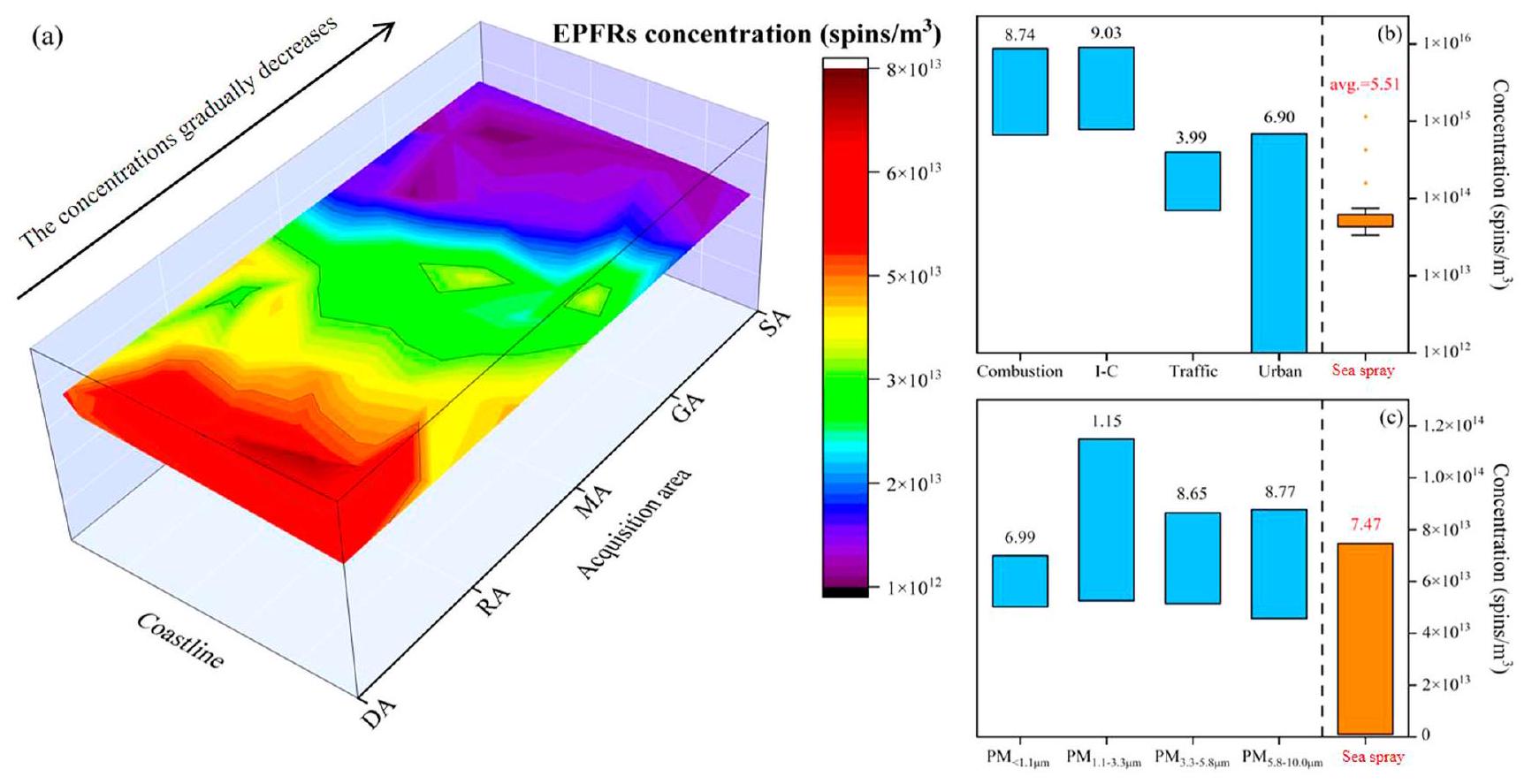
تُلخص الشكل 1 تركيزات EPFR الموجودة في عينات رذاذ البحر التي تم جمعها من المدينة الساحلية وتقارن هذه التركيزات بتلك التي لوحظت في عينات أخرى. أظهر تحليل التباين (ANOVA أحادي الاتجاه) عدم وجود فرق كبير في الكتلة لكل وحدة مساحة من 64 عينة رذاذ البحر التي تم جمعها من منطقة العينة. كانت الكتلة المتوسطة لكل عينة هي . وفقًا لتحليل EPR، يتراوح تركيز حجم الدوران لـ EPFRs في رذاذ البحر بين دوران إلى دوران . لفحص التباين المكاني لتركيزات EPFR في رذاذ البحر، تم تقسيم منطقة العينة إلى خمس مناطق (DA، RA، MA، GA، وSA) وفقًا لكمية ترسيب رذاذ البحر، والمسافة من الساحل، ودرجة تأثير حركة الأمواج. كشفت الدراسة أن المزيد من رذاذ البحر تم ترسيبه في المواقع الأقرب إلى الساحل، وكان تركيز EPFRs أعلى في العينات المجمعة (الشكل 1a). كان تركيز EPFRs في عينات رذاذ البحر المجمعة في منطقة DA هو الأعلى، بقيمة متوسطة قدرها دوران . كانت تركيزات EPFRs في عينات رذاذ البحر المجمعة من مناطق RA وMA هي دوران و دوران على التوالي. كانت تركيزات EPFRs في عينات رذاذ البحر المجمعة من مناطق GA وSA هي الأدنى، بقيم متوسطة تبلغ فقط دوران و دوران . مياه البحر كثيفة لأنها تحتوي على كميات كبيرة من الأملاح والشوائب. عندما تضرب المياه الشاطئ تحت تأثير المد والجزر، تتجمع العديد من الفقاعات وتشكل في النهاية رذاذ البحر. بالقرب من الساحل، يتم ترسيب المزيد من رذاذ البحر ويبقى لفترة أطول. وفقًا للدراسات السابقة، يرتبط تركيز EPFRs في العينات ارتباطًا وثيقًا بكتلة PM ووجود المادة العضوية . رذاذ البحر الأقرب إلى الساحل ترسب المزيد من PM والمادة العضوية على مدى فترة طويلة، مما يؤدي إلى تركيز أعلى من EPFRs في هذا الجزء من العينات.
أظهرت الدراسات السابقة أن تركيزات EPFRs تختلف في وسائط مختلفة. تراوحت تركيزات EPFR في PM المرتبطة بالاحتراق، وPM المرتبطة بالاحتراق المضيء (I-C)، وPM المرتبطة بحركة المرور وPM المرتبطة بالمدن بين دوران إلى دوران دوران إلى دوران دوران إلى دوران دوران إلى دوران على التوالي . تراوح تركيز EPFRs في عينات رذاذ البحر المجمعة من منطقة DA بين دوران إلى دوران (الشكل 1b)، مما يشير إلى أن EPFRs في العينات من هذه المنطقة قد تكون مشابهة لمصادر EPFRs في عينات PM المرتبطة بحركة المرور والمدن. للحصول على فهم أكثر شمولاً لتركيز EPFRs في رذاذ البحر، تم جمع 72 عينة PM مفصولة حسب الحجم في وقت واحد على طول ساحل منطقة جمع رذاذ البحر. أظهرت النتائج أن تركيز EPFRs في عينات PM المفصولة حسب الحجم تراوح بين دوران إلى دوران ، وهو أعلى من معظم عينات رذاذ البحر (الشكل 1c). نظرًا لأن حجم الجسيمات في رذاذ البحر أكبر من حجم الجسيمات الدقيقة، فإن المساحة السطحية أصغر وتحتوي السطح على هياكل مسامية أقل، مما يؤدي إلى تقليل عدد المواقع لتكوين الجذور الحرة، وبالتالي يؤدي إلى انخفاض تركيزات EPFRs . يمكن نشر رذاذ البحر على منطقة واسعة بسبب عوامل خارجية مثل حركة الأمواج، مما يعزز احتمال تعرض السكان في المناطق الساحلية لـ EPFRs عند الانخراط في الأنشطة الخارجية. لتقييم خطر التعرض لـ EPFRs في رذاذ البحر بشكل بديهي، قمنا بمعادلة مستوى التعرض لـ EPFRs من رذاذ البحر بجرعة مكافئة من استنشاق السجائر ، مما يكشف أن السكان الساحليين يستنشقون ما يعادل 0.91 سجائر يوميًا أو 332 سجائر سنويًا لكل فرد. وهذا يبرز الحاجة إلى اليقظة بشأن المخاطر الصحية المحتملة المرتبطة برذاذ البحر، خاصة في المناطق التي يوجد فيها ترسيب كبير لرذاذ البحر.
أنواع وعمر EPFRs في رذاذ البحر والجسيمات المفصولة حسب الحجم
تُصنف الجذور الحرة على أنها مركزية الكربون، مركزية الأكسجين، مركزية النيتروجين، أو مركزية المعادن (الاتحاد الدولي للكيمياء البحتة والتطبيقية، 2014). تُميز EPFRs السائدة في البيئة بأنواع الجذور الحرة المركزية الكربونية (مثل الجذور العطرية متعددة الحلقات)،
الشكل 1 تركيز EPFRs في عينات رذاذ البحر ومقارنة مع تركيز EPFRs في عينات مختلفة. أ توزيع مكاني لتركيز EPFRs في عينات رذاذ البحر. مقارنة تركيز EPFRs في عينات مختلفة وعينات رذاذ البحر في منطقة DA، حيث تركيز
EPFRs في الاحتراق، الاحتراق المضيء (I-C)، PM المرور وPM الحضري من دراسات أخرى (Guo et al. ; وZhang et al. ) ويمثل الجبهة البرتقالية عينات رذاذ البحر. ج مقارنة تركيز EPFR في PM الجوي المفصول حسب الحجم، ويمثل الجبهة البرتقالية عينات رذاذ البحر.
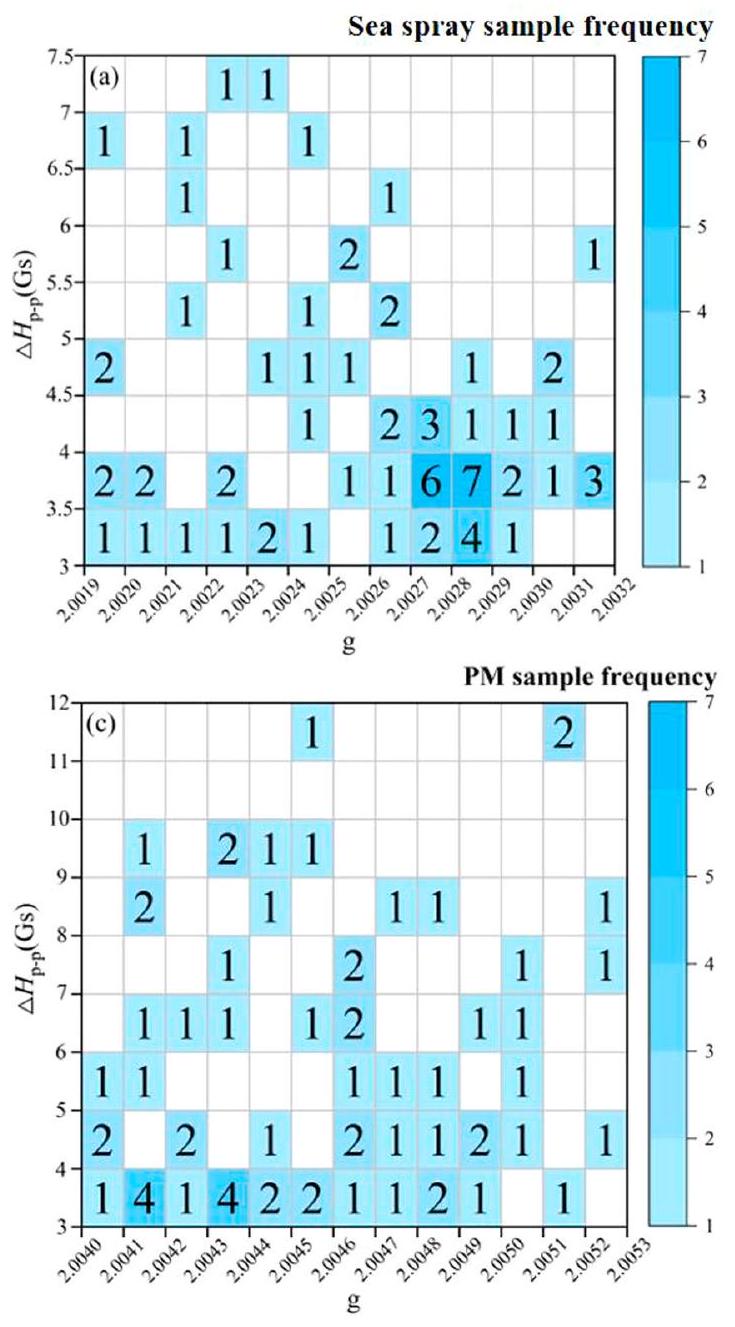
الجذور الحرة المركزية الكربونية بالقرب من الأكسجين (مثل 3،4-ميثوكسي فينيل)، والجذور الحرة المركزية الأكسجينية (مثل الجذور الحرة هيموكينون) . المعلمات المهمة لتحديد نوع EPFR هي -عامل وعرض الخط . كلما اقترب الإلكترون الحر من ذرة الأكسجين، زادت قيمة -عامل . تراوح -عامل EPFRs في عينات رذاذ البحر بين 2.0019 إلى 2.0032، بقيمة متوسطة قدرها ، وتركزت بشكل رئيسي في 2.0025-2.0030، والتي تمثل من إجمالي 64 عينة (الشكل 2a). تظهر النتائج أن أنواع EPFRs في رذاذ البحر هي بشكل رئيسي جذور حرة مركزية كربونية. تراوح -عامل EPFRs في PM المفصول حسب الحجم بين 2.0040 إلى 2.0053، بقيمة متوسطة قدرها ، وتركزت بشكل رئيسي في 2.0041 إلى 2.0047، والتي تمثل من إجمالي 72 عينة (الشكل 2c). أظهرت النتائج أن أنواع EPFRs في PM كانت بشكل رئيسي جذور حرة مركزية أكسجينية. الجذور الكربونية المركزية تتأكسد بسهولة في الغلاف الجوي، بينما الجذور الأكسجينية المركزية مستقرة في الغلاف الجوي . لذلك، فإن EPFRs في رذاذ البحر أكثر تفاعلية من تلك الموجودة في PM. كميزة أخرى للمعلومات عن EPFRs، عرض الخط ( ) هو طريقة قياسية لقياس عرض طيف EPR، والتي يمكن استخدامها لتعكس بنية جزيئات السلف . كانت القيمة المتوسطة لـ لـ EPFRs في رذاذ البحر هي ، وتركزت بشكل رئيسي في النطاق من ، والتي تمثل من إجمالي 64 عينة (الشكل 2a). كانت القيمة المتوسطة لـ لـ EPFRs في PM هي ، وتركزت بشكل رئيسي في النطاق من ، والتي تمثل من إجمالي 72 عينة (الشكل 2c). بالإضافة إلى ذلك، سيؤثر نوع وتركيز الجذور الحرة على قيمة . في الدراسة الحالية، أظهرت EPFRs في عينات رذاذ البحر وعينات PM اتجاهًا لـ زيادة مع زيادة تركيز الجذور الحرة (الشكل 2b، d) ( ، على التوالي)، وهو ما يتماشى مع نتائج كيب.
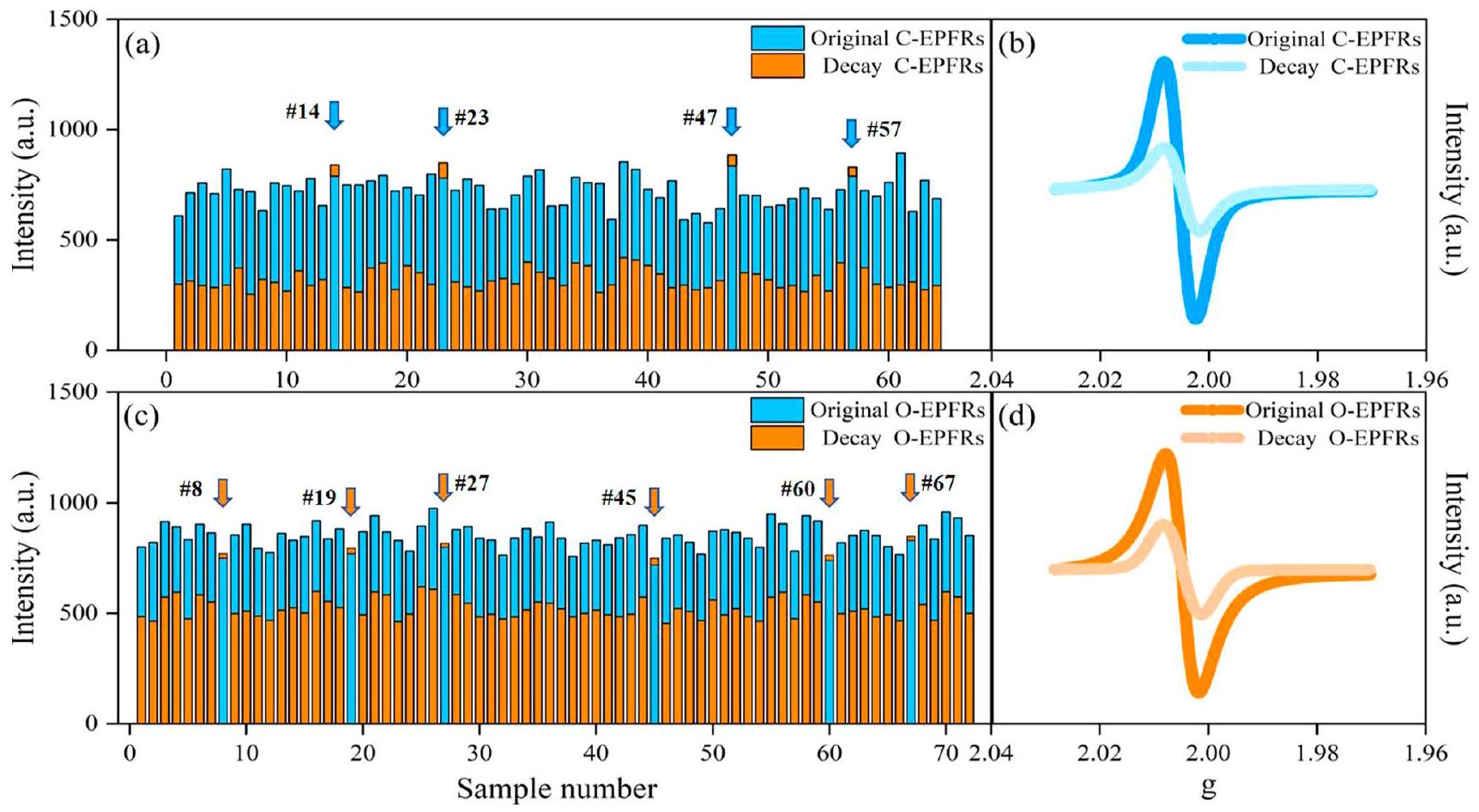
لدراسة عمر EPFRs في عينات رذاذ البحر وPM بعد 120 يومًا من التعرض في درجة حرارة الغرفة، أجرينا تحليل EPR ثاني للعينات ولاحظنا أن EPFRs داخلها كانت عرضة للتدهور. أظهر تركيز EPFRs في أكثر من من عينات رذاذ البحر وPM مجموعة من التركيزات المتناقصة (الشكل 3). وفقًا لأنواع EPFRs المختلفة في عينات رذاذ البحر وPM، تم تقسيم طيف EPR إلى مناطق مركزية كربونية ومركزية أكسجينية لتحليل التخفيف (الشكل 3b، d). أظهرت النتائج أن الإشارات
شدة كلا النوعين من EPFRs انخفضت؛ ومع ذلك، كانت درجات التخفيف مختلفة. لنفس وقت التدهور، تدهورت EPFRs المركزية الكربونية أسرع من EPFRs المركزية الأكسجينية، مما يشير إلى أن EPFRs المركزية الأكسجينية كانت أكثر استقرارًا. كان التخفيف لـ EPFRs في عينات رذاذ البحر وPM يفي بنموذج التخفيف من الدرجة الأولى. تم حساب أن متوسط نصف عمر EPFRs في عينات رذاذ البحر كان 0.32 سنة، وأن في عينات PM كان 0.51 سنة، وهو أقصر من ذلك الخاص بـ EPFRs في غبار الطرق المجمعة في شيان . وفقًا لقواعد تعريف أنواع التدهور بواسطة تشين وآخرون.تعود معظم EPFRs في عينات رذاذ البحر إلى نوع الانحلال السريع، في حين أن معظم EPFRs في عينات PM تعود إلى نوع الانحلال البطيء. ومع ذلك، زادت تركيزات EPFRs في بعض عينات رذاذ البحر وPM بدلاً من أن تنخفض (السهم الأزرق في الشكل 3a والسهم البرتقالي في الشكل 3c). تم جمع هذه العينات في شاطئ طريق جزيرة الدائرة، وهي منطقة كثيفة جداً من الحركة البشرية وحركة المرور، والتي لا تنتج فقط عددًا كبيرًا من EPFRs الأولية ولكن أيضًا كميات كبيرة محتملة من المواد السابقة، مثل الهيدروكربونات العطرية متعددة الحلقات (PAHs)، التي يمكن أن تنتج EPFRs ثانوية. زهاو وآخرون.وجد أن EPFRs يمكن أن تتشكل على سطح مونتموريلونيت النحاس (II) الذي يحتوي على PAHs. قاو وآخرون.أظهر أن السلف الهامة لمكونات الجسيمات الدقيقة غير القابلة للاستخراج والقابلة للاستخراج التي تشكل EPFRs الثانوية هي المعادن والكينونات، على التوالي. بالإضافة إلى ذلك، فإن المتوسط-عامل EPFRs في عينات رذاذ البحر أظهر زيادة قدرها 0.0012 بعد التحلل مقارنة بالقياس الأولي، مما يشير إلى أن EPFRs المركزية على الكربون في هذه العينات قد تتحول تدريجياً إلى EPFRs المركزية على الأكسجين بعد التعرض المطول للأكسجين الجوي. وهذا يعني أيضاً أن EPFRs في الطور الغازي والسائل يمكن أن تتحول إلى بعضها البعض.
OP لرذاذ البحر والجسيمات المحددة الحجم
القدرة المؤكسدة هي مقياس يمكن أن يحدد قدرة جزيئات الهدف المؤكسدة في الجسيمات الدقيقة وتستخدم لتمثيل قدرة الجسيمات الدقيقة على إنتاجاستهلاك المادة المخفضة ديثيوثيتول مع مرور الوقت ( ) هي طريقة شائعة تُستخدم لتحليل القدرة على الأكسدة للعينات . تظهر النتائج أن المتوسطعينة من رذاذ البحر في المناطق الخمس هي، ومتوسطعينات PM المجمعة حسب الحجم هي.
الشكل 2 | توزيع تركيز EPFR في رذاذ البحر والجسيمات الدقيقة-عامل وعرض الخط ( ). الرقم في الشبكة يمثل عدد عينات رذاذ البحر في النطاق من-عامل و. الرقم في الشبكة مضروب فييمثل التركيز المتوسط لـ EPFRs في جميع رذاذ البحر
عينات في هذه الشبكة. الرقم في الشبكة يمثل عدد عينات PM في النطاق من-عامل و. د الرقم في الشبكة مضروب في يمثل التركيز المتوسط لـ EPFRs في جميع عينات PM في هذه الشبكة.
بعد تحليل OP لمناطق العينة الخمس، وجدنا أنه كلما اقتربنا من الساحل، زادت كمية رذاذ البحر المترسب وارتفعت الـ (الشكل 4أ). المتوسط قيم DA و RA كانت و ، على التوالي. كما أجرينا تحليل OP على عينات PM المصفاة حسب الحجم، وأظهرت النتائج أن كانت عينات ذات قطر ديناميكي هوائي أصغر أعلى (الشكل 4ب)، وهو ما يتوافق مع نتائج سيمونتيتي وآخرون.شيريتزي وزملاؤه لوحظ بالمثل أن معدل استهلاك DTT لـ كان أقل بكثير من ذلك لـ. للتعمق أكثر في خصائص المواد العضوية المتطايرة من رذاذ البحر وعينات الجسيمات الدقيقة، قمنا بتفريق المواد العضوية المتطايرة إلى مواد قابلة للذوبان في الماء ( ) وغير قابلة للذوبان في الماء ( ) الكسور. وُجد أن المتوسط و من عينات رذاذ البحر كانت و على التوالي، من بينهاتم احتسابهمن (الشكل 4أ). المتوسط و من عينات PM كانت و على التوالي، من بينهاتم احتسابهمن (الشكل 4ب). أظهرت هذه النتائج أن المكونات القابلة للذوبان في الماء كانت مسؤولة بشكل أساسي عن السمية التأكسدية الملحوظة في رذاذ البحر وعينات الجسيمات الدقيقة.
يمكن أن تؤدي المعادن الانتقالية والكينونات في العينات إلى أكسدة DTT من خلال تفاعل REDOX تحفيزي، أي أن المعادن الانتقالية والكينونات يمكن أن تساهم في OP للعينات.. لاستكشاف آلية الإفراج السام عن رذاذ البحر والجسيمات الدقيقة عينات، تركيزات المعادن الانتقالية القابلة للذوبان في الماء في العينات ومساهمتها فيتم تحليلها في هذه الدراسة. يتم عرض توزيع تركيز المعادن الانتقالية في عينات PM الموزعة حسب الحجم في الشكل S3a، حيث تمثل النقاط الزرقاء متوسط تركيز المعادن الانتقالية في العينات ذات كل قطر ديناميكي هوائي، وتمثل النقاط الحمراء متوسط تركيز المعادن الانتقالية في جميع عينات PM. يتم عرض توزيعات تركيز المعادن الانتقالية في عينات رذاذ البحر في الشكل S3b، حيث تمثل النقاط الحمراء متوسط تركيز المعادن الانتقالية في العينات في المنطقة DA، وتمثل النقاط الزرقاء متوسط تركيز المعادن الانتقالية في العينات في المناطق الأربعة الأخرى. أظهرت النتائج أنوكانت Zn و Fe الأكثر تركيزًا في رذاذ البحر وعينات PM. تعتبر Fe و Zn معادن مهمة يتم إطلاقها نتيجة التآكل والتمزق للسيارات والسفن، وقد يتم اشتقاقه على نطاق واسع من الكائنات البحرية. مساهمة كل مكون فيتم تقييم ذلك من خلال إنشاء معادلة انحدار بين تركيز المعادن الانتقالية ومعدل استهلاك DTT (الجدول 1). تم تحديد المعادن الانتقالية وعوامل أخرى غير معروفة كعوامل رئيسية تساهم فيرذاذ البحر وعينات الجسيمات الدقيقة (الشكل S4).
أظهرت النتائج أن المعادن الانتقالية ساهمت بمتوسطإلى الـمن عينات PM المجمعة حسب الحجم وإلى الـعينات رذاذ البحر. مساهمة المعادن الانتقالية فيمنأظهرت العينات تغيرًا طفيفًا، بمتوسط قيمةبينمامساهمة فيكانت العينات
الشكل 3 | تغييرات التركيز لـ EPFRs في العينات قبل وبعد التحلل وطيف EPR. أ الأسهم الزرقاء تمثل عينات رذاذ البحر مع زيادة تركيزات EPFRs بعد التحلل. ب إشارات EPFRs في عينات رذاذ البحر قبل وبعد تحلل. تشير الأسهم الصفراء إلى عينات PM التي تحتوي على تركيزات متزايدة من EPFRs بعد التحلل. إشارات EPFRs في عينات PM قبل وبعد التحلل.
الشكل 4 | معدلات استهلاك DTT ونسب المكونات المختلفة لاستهلاك DTT لعينات رذاذ البحر وعينات PM المفصولة حسب الحجم. أ معدل استهلاك DTT ونسب المكونات المختلفة لاستهلاك DTT لرذاذ البحر
عينات الرش. استهلاك DTT ومعدلاته ونسب المكونات المختلفة لاستهلاك DTT لعينات PM الموزعة حسب الحجم.
أكبر، حيث بلغت 82.7%. كانت هذه الجزء من عينات PM ذات نسبة منخفضة نسبياًقيمة ولكن احتوت على تركيز أعلى من المعادن الانتقالية، مما أدى إلى معدل مساهمة أعلى.وكانت المنغنيز (Mn) هي المساهم الرئيسي فيرذاذ البحر وعينات الجسيمات الدقيقة، بمعدلات مساهمة متوسطة تبلغ، و ، على التوالي. المتوسط معدل المساهمة، و V إلى كان. تشير هذه النتائج إلى أن المعادن الانتقالية تلعب دورًا مهمًا في الإمكانات المؤكسدة العامة ( ) من رذاذ البحر وعينات PM. ليو وآخرون.وجد أن المعادن الانتقالية (خاصة النحاس والمنغنيز) ساهمتلنشاط DTT لجسيمات PM ذات الحجم المحدد، بينما كانت الكينون تمثل فقط
الجدول 1 | معادلات الانحدار لمكونات مختلفة وخسائر DTT في عينات رذاذ البحر و PM
نوع
غضب التركيز، ( )
معادلات الانحدار
نحاس
0-7
0.9473
٨
حديد
0-17
0.9949
٨
زن
0-11
0.9827
٨
من
0-8
0.9869
٨
كو
0-6
0.9810
٧
ف
0-20
0.9911
٦
يمثل معدل فقدان DTT ( ) و هو تركيز المعادن ( ) في حل DTT. عدد التراكيز المختلفة المستخدمة في الانحدار.
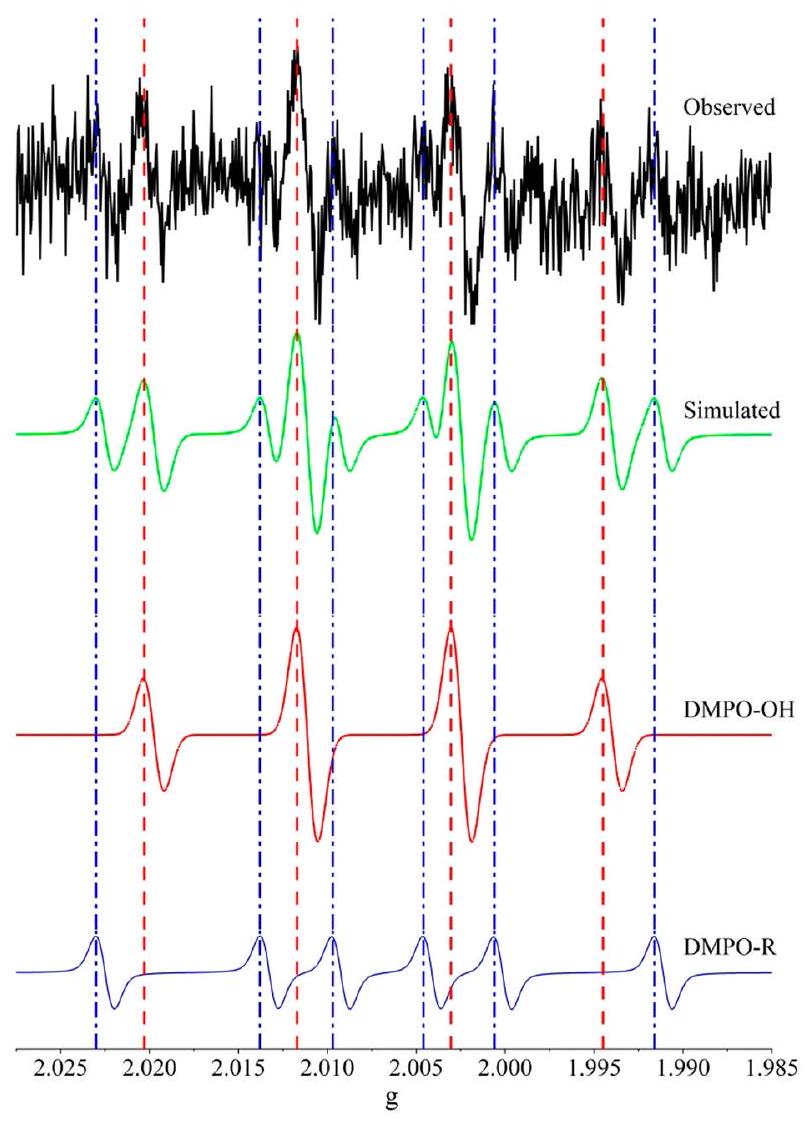
الشكل 5 | عملية التقاط الدوران لعينات أنواع الأكسجين التفاعلية الناتجة من رذاذ البحر بعد ملامستها للماء. الخط الأسود هو الطيف المرصود لـ EPR الفعلي، والخط الأحمر هو المنحنى القياسي لـ DMPO-OH، والخط الأزرق هو المنحنى القياسي لـ DMPO-R. الخط الأخضر هو منحنى التناسب الناتج عن إضافة الخطين الأحمر والأزرق. تشير الخطوط العمودية المتقطعة إلى مواقع كل قمة من مركبات DMPO-OH وDMPO-R.
. لي وآخرونأفاد أن المساهمة النهائية للمعادن الانتقالية فيكان. هذه المناقشة تتماشى مع نتائجنا. بالإضافة إلى ذلك، يمكن أن تشارك المعادن الانتقالية أيضًا في تشكيل الجذور الحرة المستدامة. يمكن أن تشكل جزيئات السلف، مثل المركبات العطرية، جذورًا حرة مستقرة من خلال نقل الإلكترونات إلى سطح المعدن الانتقالي.في الوقت نفسه، يمكن أن تولد المعادن الانتقالية ROS زائدة عن طريق تحفيز تفاعلات REDOX.تشير هذه النتيجة إلى أن المعادن الانتقالية لا تعزز فقط القدرة التشغيلية للعينة، بل تلعب أيضًا دورًا حيويًا في إنتاج الجزيئات العضوية ذات الوزن الجزيئي المنخفض (EPFRs) وأنواع الأكسجين التفاعلية (ROS).
ROS من رذاذ البحر وجزيئات بحجم محدد
عندما يتم استنشاق PM وترسيبه عن طريق التنفس، فإن الجذور الحرة التفاعلية مثل و سيتم إنتاجه، مما يؤدي إلى تغييرات في حالة الأكسدة والاختزال للخلايا، و
الجدول 2 | الـ-عامل وثابت الانقسام الفائق (hsc) لجسيمات PM ذات الحجم المحدد في تجربة التقاط الدوران
حجم الجسيمات، (م)
DMPO-R
دي إم بي أو – أوه
-عامل
هس سي
-عامل
هس سي
9.0-10.0
2.00511
15.5367
2.00517
14.5627
5.8-9.0
٢.٠٠٥١٢
15.5712
2.00516
14.3842
4.7-5.8
2.00510
15.5384
٢.٠٠٥١٩
14.4392
3.3-4.7
2.00511
15.5904
2.00518
14.5589
2.1-3.3
2.00514
15.4995
2.00516
14.1161
1.1-2.1
2.00514
15.4916
2.00518
14.3725
0.7-1.1
٢.٠٠٥١٢
15.5818
٢.٠٠٥١٤
14.3832
0.4-0.7
2.00514
15.5632
2.00515
14.7938
0-0.4
2.00512
15.5428
٢.٠٠٥٢١
14.2970
مسببًا في النهاية مخاطر الإجهاد التأكسدي على جسم الإنسانإن التقاط هذه الجذور الحرة باستخدام DMPO هو طريقة شائعة تُستخدم لتحليل قدرة العينات على توليد الأكسجين التفاعلي. من خلال ملاحظة طيف EPR (باللون الأسود) لمحلول الماء من رذاذ البحر وعينات PM بعد إضافة DMPO، وُجد أن الطيف قدم حالة متناوبة متعددة القمم، مما يدل على أن مجموعة متنوعة من الجذور الحرة تم إنتاجها في عينات رذاذ البحر. بعد تحليل الطيف المرصود إلى إشارة رباعية من DMPO-OH (باللون الأحمر) وإشارة سداسية من DMPO. (الأزرق)، وجدنا أن الطيف التناظري الناتج (الأخضر) يتناسب جيدًا مع الطيف الأصلي (الشكل 5). أظهرت النتائج السابقة أن ⋅ OH وتم توليدها بعد تعرض عينات رذاذ البحر والجسيمات الدقيقة للماء (الجدولين 2 و 3). بعد التحليل الكمي باستخدام تقنية EPR، كانت نسبة .OH و -R في عينات رذاذ البحر حوالي و ، على التوالي. تولد عينات PM المخصصة لحجم الجسيمات و بعد الاتصال بالماء. قد يكون هذا الاختلاف ناتجًا عن التركيبات الكيميائية لرذاذ البحر وعينات الجسيمات الدقيقة. تانغ وآخرون.تم الكشف عن إنتاج الجذور الحرة الهيدروكسيلية (يتراوح منإلى ) والجذور العضوية ( يتراوح منإلى ) في عينات PM الحضرية المختلفة. وهذا يشير إلى أن كل من رذاذ البحر وعينات PM تلعب دورًا كبيرًا في تحفيز إنتاج ROS؛ ومع ذلك، هناك حاجة إلى مزيد من الأدلة التجريبية لاشتقاق تفسير أكثر تفصيلًا. بالإضافة إلى ذلك، في الدراسة الحالية، وُجد أن متوسط تركيز ROS في رذاذ البحر كان، متجاوزًا مستويات ROS المقاسة في PM الحضري (التي تتراوح منإلى ) درست بواسطة تانغ وآخرون. ولكن أقل من قيمة ROS لـ PM بالقرب من الطرق السريعةدرسناه من قبلتشير هذه الاتجاهات إلى أن المخاطر الصحية التي تشكلها تكوين الجذور الحرة من رذاذ البحر قد تكون في مكان ما بين الجسيمات الدقيقة بالقرب من الطرق السريعة والجسيمات الدقيقة الحضرية.
قد تحفز EPFRs أو تشارك مباشرة في إنتاج ROS. لاستكشاف العلاقة بين EPFRs و ROS في عينات رذاذ البحر، تم دراسة العلاقة بين تركيز EPFRs والمكونات الكيميائية التي قد تكون لها ارتباطات متCorresponding مع EPFRs (الشكل S5). على وجه الخصوص، كشفت النتائج عن وجود علاقة إيجابية بين تركيزات EPFR وتركيزات ROS، والعلاقة بين
كانت تركيزات EPFR و ⋅ OH أعلى بشكل ملحوظ من تلك بين الجذور R. كانت تركيزات EPFRs مرتبطة إيجابيًا مع. الـيمكن استخدامه كمؤشر على توليد الجذور الحرةقد تشير النتائج المذكورة أعلاه إلى أن EPFRs في عينات رذاذ البحر تشارك في توليد ROS وتساهم أكثر في توليد ⋅ OH. كما أظهرت الدراسات الحديثة أن EPFRs يمكن أن تحفز إنتاج ROS وتسبب الإجهاد التأكسدي لدى البشر.. بالإضافة إلى ذلك، المعادن الانتقالية (، و كانت التركيزات مرتبطة إيجابيًا بتركيزات EPFR، بالإضافة إلى تركيزات ROS، وخاصة ⋅ OH. أظهرت الدراسات السابقة أن المعادن الانتقالية يمكن أن تنقل الإلكترونات من خلال مواد سابقة مثل المركبات العطرية لتكوين جذر حر مستقر ودائم.. وبالمثل، يمكن أن تؤدي تفاعلات الأكسدة والاختزال التي تسببها المعادن الانتقالية إلى توليد فائض منتشير هذه النتيجة إلى أن المعادن تساهم في إنتاج EPFRs و ROS، كما توحي بأن النسبة العالية لمساهمة المعادن في OPDTT قد تكون مرتبطة بتعزيز المعادن لإنتاج EPFR.
عملية نقل الكتلة بين الطور الغازي والطور السائل لـ EPFRs
تم التأكيد على وجود EPFRs على نطاق واسع في الغلاف الجوي والماء والتربة.ومع ذلك، لم تتم دراسة عمليات النقل والتحول للـ EPFRs بين الطور الغازي والسائل بشكل كامل. لقد تم استخدام نظرية الفيلم المزدوج على نطاق واسع في التحليل النظري لنقل الكتلة للملوثات الغازية بين الطور الغازي والسائل.استنادًا إلى نظرية الفيلم الثنائي، تم افتراض أن عملية نقل الكتلة للـ EPFRs كانت كما يلي: دخلت الـ EPFRs من الطور الغازي إلى الطور السائل من خلال طبقات الفيلم الغازي والسائل عبر الانتشار الجزيئي. وبالمثل، كانت هناك عملية نقل من
الجدول 3 | الـ-عامل وثابت الانقسام الفائق (hsc) لرذاذ البحر في تجربة التقاط الدوران
منطقة الاستحواذ
DMPO-R
دي إم بي أو – أوه
-عامل
هس سي
-عامل
هس سي
منطقة الترسيب
2.00517
15.5180
٢.٠٠٥٢٠
14.3835
منطقة غنية
٢.٠٠٥١٥
15.4510
2.00515
14.1983
منطقة معتدلة
2.00514
15.5341
2.00516
14.2691
منطقة المولد
2.00516
15.4861
2.00518
14.3582
منطقة بحرية
٢.٠٠٥١٥
15.4927
2.00516
14.4816
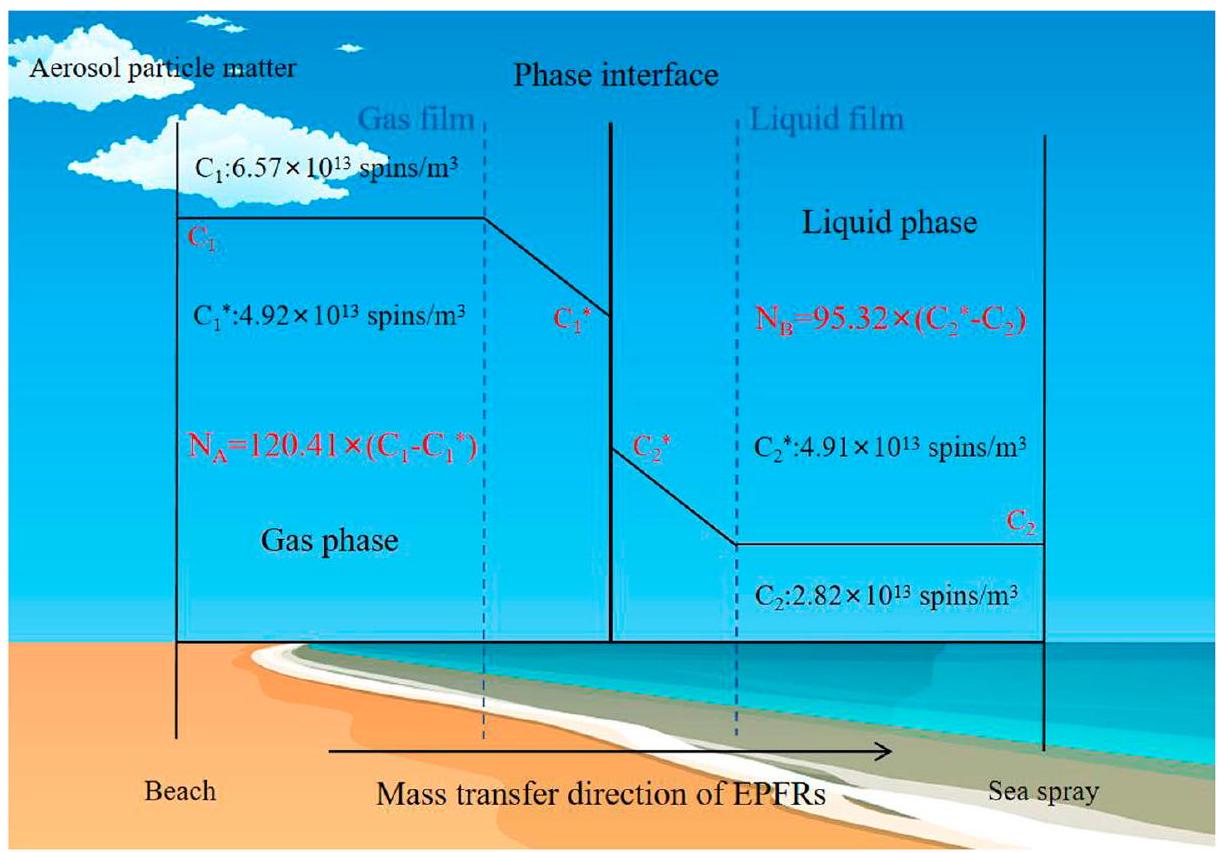
تحدث أيضًا عملية الانتقال من الحالة السائلة إلى الحالة الغازية. في حالتي الغاز والسائل، لا يوجد تدرج تركيزي لمركبات EPFR من منظور ماكروسكوبي، بسبب حركة السوائل. كانت عملية النقل الجزيئي مركزة في طبقتي الفيلم؛ أي أن التدرج التركيز كان مركّزًا في طبقتي الفيلم. في عملية الامتصاص في حالة الاستقرار، يكون تدفق مركبات EPFR المنقولة من الحالة الغازية إلى واجهة الطور مساويًا لتدفق مركبات EPFR المنقولة من واجهة الطور إلى الحالة السائلة؛ أي أنه لا يوجد مقاومة امتصاص عند واجهة الطور ولا تراكم أو استهلاك لمركبات EPFR (الشكل 6).
استنادًا إلى المفاهيم المذكورة أعلاه، تم حساب عملية نقل الكتلة للـ EPFRs بين الطور الغازي والطور السائل نظريًا. متوسط تركيز الـ EPFRs في الطور الغازي ( ) كان وفي المرحلة السائلة ( ) كان معادلة معدل نقل الكتلة الغازيةمعادلة معدل نقل الكتلة السائلةبعد الحسابات النظرية، تركيزات الواجهة لـ و كانوايدور و يدور/، على التوالي. كانت الفروق في التركيز الواجهاتي ضمن نطاق الخطأ وتوافقت مع المفهوم النظري. تظهر النتائج أعلاه أن مقاومة نقل الكتلة في EPFRs في الطورين الغازي والسائل لا يمكن تجاهلها وأن معدل نقل الكتلة يتم التحكم فيه بواسطة الأفلام الغازية والسائلة.
طرق
المواد التجريبية
أمحلول قياسي و تم استخدامه لمعايرة تركيز الدوران المطلق و-عامل العينات قبل وبعد التجربةديثيوثريتول (DTT، 1 مللي مولار)، محلول ملحي معزز بالفوسفات (PBS،حمض ثلاثي الكربوكسيل (TCA، )، (هيدروكسي ميثيل) أمين الميثان هيدروكلوريد (تريس، 0.4 م)، 5,5′-ثنائي ثيو- (حمض 2-نيترو بنزويك) (DTNB، 10 مللي مول)، محلول معيار المعدن (، ، و V، ) تم استخدامها في تجارب القدرة التأكسدية. 5,5-ثنائي ميثيل-1-بيرولين-أكسيد (DMPO، دوجيندو)، حمض ثنائي إيثيلين تريامين بنتا أسيتيك (DTPA، 98%)، بيروكسيد الهيدروجين ( ) ، بيروكسيداز الفجل الحار (HRP، ) تم استخدامها في تجارب التقاط الدوران.
تقسيم منطقة أخذ عينات رذاذ البحر
لتوصيف المخاطر المحتملة لرذاذ البحر بشكل كامل، تم تقسيم منطقة الجمع إلى خمسة كتل (الشكل 7أ) وفقًا لكمية البحر
الشكل 6 | عملية نقل الكتلة ذات الفيلم المزدوج للـ EPFRs بين الطور الغازي والطور السائل. و تمثل التركيزات المتوسطة لـ EPFRs في الطور الغازي والطور السائل، على التوالي. و تمثل تركيز EPFRs عند واجهة الطور. و تمثل معادلات معدل نقل الكتلة لـ EPFRs في الطور الغازي والطور السائل، على التوالي.
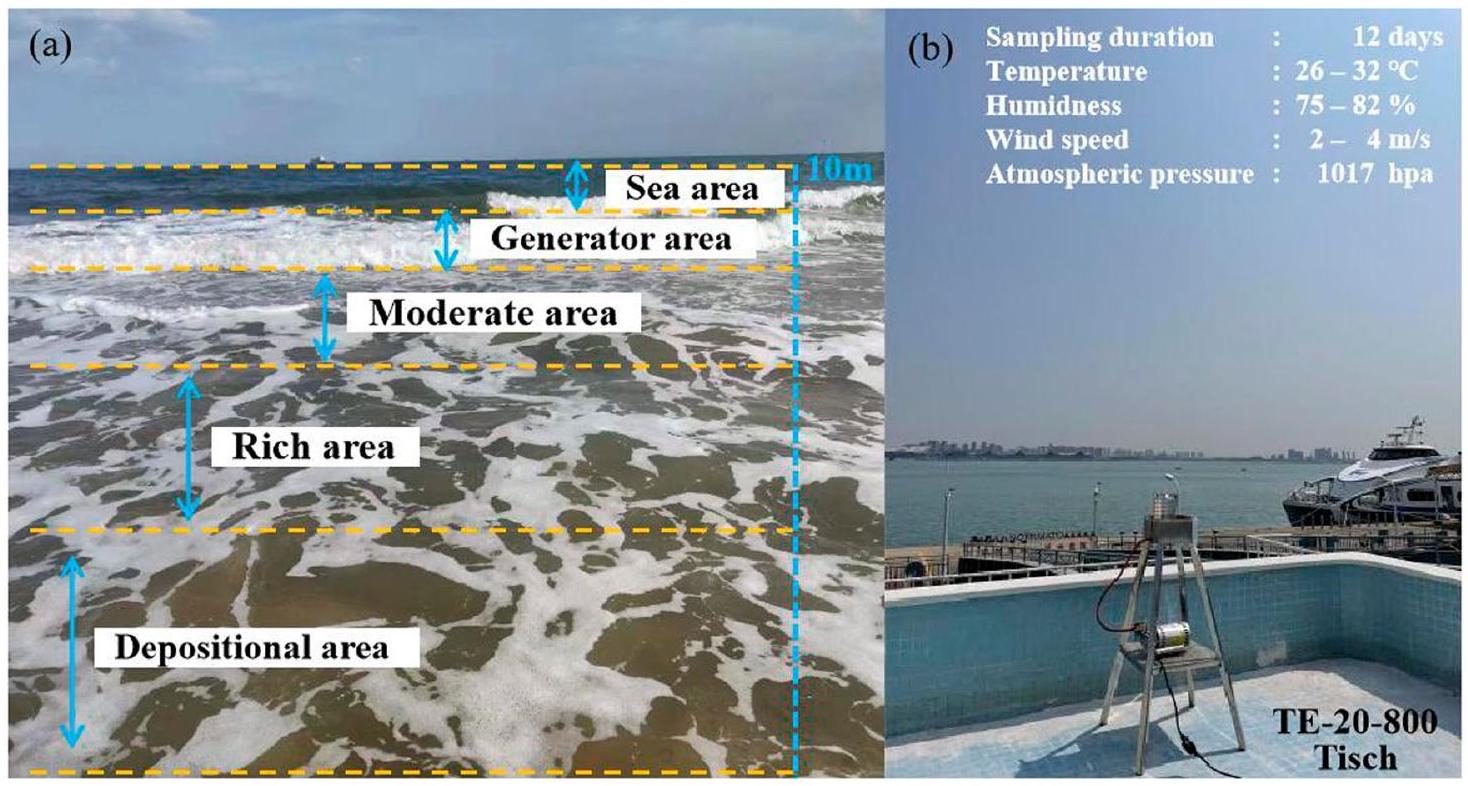
الشكل 7 | مخطط أخذ العينات لرذاذ البحر والجسيمات الدقيقة المفصولة حسب الحجم. أ مخطط أخذ العينات لرذاذ البحر. ب مخطط أخذ العينات للجسيمات الدقيقة المفصولة حسب الحجم.
ترسيب الرذاذ، المسافة من الساحل، ودرجة تأثير حركة الأمواج. I. منطقة الترسيب (DA): تقاطع مياه البحر والساحل، حيث كان ترسيب رذاذ البحر الأكبر، وظل مستقرًا لفترة طويلة، مع أقل تأثير من حركة الأمواج. II. المنطقة الغنية (RA): هذه المنطقة لديها ترسيب رذاذ البحر بشكل متزايد وثابت، مع تأثير أقل من حركة الأمواج. III. المنطقة المعتدلة (MA): هذه المنطقة لديها ترسيب رذاذ البحر المعتدل، الذي يتأثر بحركة الأمواج. IV. منطقة المولد (GA): المنطقة التي تضرب فيها الأمواج سطح البحر وتكون رذاذ البحر، الذي تم توليده في هذه المنطقة كان أكثر انتعاشًا. V. المنطقة البحرية (SA): هذه المنطقة بعيدة عن الساحل، تتكون أساسًا من مياه البحر الصافية، دون ترسيب واضح لرذاذ البحر على سطح مياه البحر.
جمع عينات من رذاذ البحر والجسيمات الدقيقة
تم جمع عينات من رذاذ البحر من المدن الساحلية الرئيسية في جنوب شرق الصين ومن مركز رئيسي في نظام النقل البحري المحلي. وفقًا للبيانات التي أصدرتها إدارة الإحصاء المحلية، فإن البحر، الذي تبلغ مساحته حوالي 390 كيلومترًا مربعًا، ويحتوي على عدة موانئ طبيعية للبضائع، كان حيويًا للتجارة الخارجية على الساحل الجنوبي الشرقي للصين. قمنا بأخذ العينات في الفترة من 20 إلى 31 أغسطس 2023، مع مواقع أخذ العينات على شاطئ طريق الجزيرة الدائرية.وشاطئ قوس قزح. استنادًا إلى منطقة أخذ عينات محددة مسبقًا (الشكل 7أ)، في المنطقة الوحدةتم فصل رذاذ البحر أولاً عن مياه البحر بواسطة ألواح زجاجية، ثم تم استخراج رذاذ البحر العلوي بواسطة مضخة طي (S-82، شياومي، الصين)، وأخيراً تم جمعه في زجاجات زجاجية بنية. لاستكشاف العلاقة بين رذاذ البحر وعينات PM، تم إعداد جهاز أخذ عينات أندرسون من المرحلة الثامنة (TE-20-800، تيش، الولايات المتحدة الأمريكية) بمعدل تدفق قدرهبالقرب من موقع أخذ العينات لالتقاط عينات PM الموزعة حسب الحجم (الشكل 7b). تم جمع عينات PM على فلاتر كوارتز مسبقة الخبز، وتم تسخين هذه الفلاتر إلى 450 درجة مئوية لمدة 4 ساعات قبل عملية أخذ العينات. في النهاية، تم حفظ 64 عينة من رذاذ البحر و72 عينة من PM عند درجة حرارةفي المختبر للتحليل اللاحق.
تحليل EPFRs
تم استخدام مطيافية الرنين المغناطيسي الإلكتروني (EPR) (EMXnano، بروكير، ألمانيا) لتحديد تركيزات، وأنواع، وأعمار EPFRs في رذاذ البحر وعينات PM المفصولة حسب الحجم. كانت إعدادات الجهاز كما يلي: شدة المجال المغناطيسيمكسب المستقبل 42 ديسيبل، قوة الميكروويف 20 ديسيبل، عرض المسح 20 مللي تسلا، عدد المسحات 5؛ وقت المسح.
تم التعبير عن تركيز EPFRs كتركيز حجم الدوران (دورات/ ). كان تصنيف أنواع EPFR يعتمد بشكل أساسي غير مفعل-عامل وعرض الخط ( ). لتحديد أنماط التحلل لـ EPFRs في رذاذ البحر وPM المفصول حسب الحجم، تم وضع العينات في درجة حرارة الغرفة ( ) ورطوبة نسبية ( ) بعد الكشف عن EPR وتم اختبارها مرة أخرى بعد 120 يومًا. يتم عادةً تحليل حركيات التحلل للعينات باستخدام نموذج تحلل من الدرجة الأولى لتحديد عمر الجذور الحرة تم حساب عمر الجذور الحرة بناءً على الفرق في قوة الإشارة الناتجة عن اختبارين لعينات. بالإضافة إلى ذلك، لتقييم المخاطر الصحية المحتملة للجذور الحرة الناتجة عن الاحتراق في رذاذ البحر للسكان الساحليين، تم حساب عدد مماثل من السجائر لكل شخص بناءً على التعرض اليومي للجذور الحرة الناتجة عن الاحتراق (النص S1).
تحليل OP
معدل استهلاك DTT مع مرور الوقت ) تم استخدامها لتقييم OP الناتج عن رذاذ البحر و PM. كانت الخطوات التجريبية لتحديد كما يلي: (1) بعد أن تم إذابة العينات بالكامل باستخدام الماء النقي للغاية،تم إزالة الخليط ونقله إلى ثلاثة أنابيب طرد مركزي. (2) مئة ميكرولتر من محلول DTT وتم إضافة محلول PBS إلى كل أنبوب طرد مركزي. (3) تم حضن أنبوب الطرد المركزي في بيئة حمام مائي عندلـ“، و 30 دقيقة، على التوالي. (4) تم إضافة مئة ميكرولتر من محلول TCA إلى كل أنبوب طرد مركزي لإنهاء التفاعل. (5) بعد تصفية المحلول،تم جمع السائل المن filtrate من كل أنبوب طرد مركزي ونقله إلى طبق التفاعل أربع مرات، وبعد ذلك،محلول تريس وتم إضافة محلول DTNB بشكل متتابع. (6) تم استخدام مقياس الطيف الضوئي (MOLECULAR SPECTRAMAX M2؛ Molecular Devices، سان خوسيه، كاليفورنيا، الولايات المتحدة الأمريكية) لتحديد امتصاص العينات عند 412 نانومتر. (7)تم حسابه وفقًا لتركيز DTT المتبقي عبر فترات زمنية مختلفة من التفاعل، ممثلة كنشاط DTT لكل وحدة كتلة من العينة (DTT ). بروتوكول التجربة لتحديد يختلف عنحيث يتم تصفية العينة فور إذابتها في الماء النقي للغاية للحصول على عينات قابلة للذوبان في الماء. المتوسطناقص المتوسطكان المتوسط.
لتقييم مساهمة المكونات المعدنية القابلة للذوبان في الماء فيمن العينات، تم قياس مستويات المعادن القابلة للذوبان في الماء في عينات رذاذ البحر وPM المفصولة حسب الحجم باستخدام مطياف الكتلة البلازمي المقترن بالتحريض (ICPMS-2030LF، شركة شيمادزو، اليابان). ستة معادن شائعة (، و V) تم اختيارها من بين 51 معدنًا تم قياسها، لأنها أظهرت احتواءها على تركيزات عالية ونشاط REDOX لإنتاج ROS. المعدن تم تقسيم التركيز إلى عدة نطاقات تدرج، وتم إنشاء منحنى انحدار بين تركيز المعادن الانتقالية القابلة للذوبان في الماء ومعدل استهلاك DTT (الأشكال S1 و S2). لتخفيف تأثير العوامل الخارجية علىمعدل استهلاك DTT لمجموعة التحكم الفارغة (تم قياس معدل استهلاك DTT الفعلي ( ) من العينة كان مساوياً لمعدل استهلاك DTT النظري مستمد من المنحنى القياسي ناقص (الجدول S1).
تحليل ROS
تم التقاط الجذور الحرة الناتجة في العينات باستخدام عامل التقاط الدوران DMPO (Dojindo، الصين) وتم تحليلها باستخدام EPR. الإجراء التجريبي هو كما يلي: 1) بعد أن تم إذابة العينة بالكامل في الماء النقي للغاية،تم إضافة عينة سائلة إلى أنبوب الطرد المركزي. (2) تم إضافة مئة وثلاثين ميكرولتر من محلول PBS الذي يحتوي على DTPA إلى أنبوب الطرد المركزي كعامل خلب للمعادن الانتقالية. (3) تم إضافة خمسة ميكرولترات من DMPO إلى أنبوب الطرد المركزي لاحتجاز الجذور الحرة. (4) تم إضافة عشرة ميكرولتراتتم تقديم المحلول كعامل انتزاع. (5) تم إضافة عشرين ميكرولتر من محلول HRP لبدء التفاعل. (6) تم استخراج عشرين ميكرولتر من المحلول لتحليل EPR. كانت إعدادات جهاز EPR متوافقة مع تلك المستخدمة في تحليل EPFRs؛ فقط تم ضبط تخفيض الميكروويف إلى 10 ديسيبل. تم استخدام وحدة SpinFit في برنامج Xenon لمسح منحنى الملاحظة للعينات. يمكن استخدام فك التداخل للمنحنى المرصود والمقارنة مع المنحنى القياسي لتحديد أنواع الجذور الحرة. مكنت وحدة SpinCount من التحليل الكمي للجذور الحرة. تم التعبير عن تركيز ROS الناتج من حيث تركيز حجم العينة. ).
التحليل الإحصائي
تمت دراسة العلاقات الإحصائية بين EPFRs والمواد الكيميائية الأخرى في رذاذ البحر باستخدام تحليل الارتباط بيرسون. بعد اختبارات التوزيع الطبيعي وتجانس التباين، تم إدخال البيانات في منصة برمجيات إحصائية (IBM SPSS Statistics، الإصدار 27.0، الولايات المتحدة الأمريكية) للتحليل.
عملية نقل الكتلة ذات الفيلم المزدوج للمواد الكيميائية EPFRs
استنادًا إلى نظرية الفيلم الثنائي، تم افتراض عملية نقل كتلة مفصلة للـ EPFRs بين الطور الغازي والطور السائل. نظرًا لوجود اضطراب كافٍ في السائل، فإن تركيز الـ EPFRs في الطور الغازي والطور السائل متساوٍ من وجهة نظر ماكرو؛ أي أنه لا يوجد تدرج في التركيز في بيئات الطور الغازي والسائل. تركيز الـ EPFRs في الطور الغازي هو متوسط تركيز EPFRs في 72 عينة PM مفصولة بالحجم. تركيز كان متوسط تركيز EPFRs في المرحلة السائلة هو متوسط تركيز EPFRs في 64 عينة من رذاذ البحر. من خلال الانتشار الجزيئي، تدخل EPFRs في المرحلة الغازية باستمرار إلى المرحلة السائلة من خلال الأفلام الغازية والسائلة. وبالمثل، توجد العملية العكسية أيضًا. افترضنا أن واجهة الطور لم تتعرض لمقاومة الامتصاص؛ أي أن تدرج التركيز كان مركزًا في طبقتي الفيلم.
في عملية امتصاص مستقرة، لا يوجد تراكم أو استهلاك للمواد عند واجهة الطور؛ لذلك، فإن معدل امتصاص EPFRs من خلال الفيلم الغازي يساوي ذلك من خلال الفيلم السائل:
وفقًا لقانون هنري عند الواجهة:
يتم حل المعادلة المذكورة أعلاه في وقت واحد:
حيث هي معدل نقل الكتلة، دوران/ هي معاملات نقل الكتلة، . لأنه لا يمكن قياسه مباشرة تجريبيًا، يتم اشتقاق معامل نقل الكتلة من المعادلة التجريبية الشائعة لمعامل نقل الكتلة و هي تركيزات EPFRs في المرحلة الغازية وواجهة الطور، دوران و هي تركيزات EPFRs في المرحلة السائلة وواجهة الطور، دوران ; و هو ثابت توازن الطور.
توفر البيانات
لم يتم إنشاء أو تحليل أي مجموعات بيانات خلال الدراسة الحالية.
توفر الشيفرة
جميع الشيفرات متاحة عند الطلب من المؤلف المراسل.
تاريخ الاستلام: 4 سبتمبر 2024؛ تاريخ القبول: 9 يناير 2025؛
تم النشر عبر الإنترنت: 21 يناير 2025
References
Shetye, S. et al. Sea foam-associated pathogenic bacteria along the west coast of India. Environ. Monit. Assess. 193, 1 (2021).
Jayarathne, T. et al. Enrichment of saccharides at the air-water interface: a quantitative comparison of sea surface microlayer and foam. Environ. Chem. 19, 506-516 (2022).
Vanacker, E. et al. Sea spray aerosols contain the major component of human lung surfactant. Environ. Sci. Technol. 55, 15989-16000 (2021).
Pendergraft, M. et al. Bacterial and chemical evidence of coastal water pollution from the Tijuana river in sea spray aerosol. Environ. Sci. Technol. 57, 4071-4081 (2023).
Riemer, N. et al. Aerosol mixing state: measurements, modeling, and impacts. Rev. Geophys. 57, 187-249 (2019).
Chen, J. & Hoek, G. Long-term exposure to PM and all-cause and cause-specific mortality: a systematic review and meta-analysis. Environ. Int. 143, 105974 (2020).
Wei, X. et al. Pollution characteristics and health risk assessment of heavy metals in street dusts from different functional areas in Beijing, China. Ecotoxico. Environ. Saf. 112, 186-192 (2015).
Vejerano, E. et al. Environmentally persistent free radicals: insights on a new class of pollutants. Environ. Sci. Technol. 52(5), 2468-2481 (2018).
Odinga, E. et al. Occurrence, formation, environmental fate and risks of environmentally persistent free radicals in biochars. Environ. Int. 134, 105172 (2020).
Fang, T. et al. Wildfire particulate matter as a source of environmentally persistent free radicals and reactive oxygen species. Environ. Sci. Atmos. 3, 581-594 (2023).
Zhang, X. et al. Oxidative potential, environmentally persistent free radicals and reactive oxygen species of size-resolved ambient particles near highways. Environ. Pollut. 341, 122858 (2024).
Zhao, S. et al. Optimized extraction of environmentally persistent free radicals from clays contaminated by polycyclic aromatic hydrocarbons. Environ. Chem. Lett. 18, 949-955 (2024).
Guo, H. et al. The overlooked formation of environmentally persistent free radicals on particulate matter collected from biomass burning under light irradiation. Environ. Int. 171, 107668 (2022).
Hasan, F. et al. Investigating environmentally persistent free radicals (EPFRs) emissions of 3D printing process. Chem. Eng. J. 480, 148158 (2024).
He, F. et al. Characteristics of environmentally persistent free radicals in and the influence of air pollutants in Shihezi, Northwestern China. Toxics 10, 341 (2022).
Feng, W. et al. Source apportionment of environmentally persistent free radicals (EPFRs) and heavy metals in size fractions of urban arterial road dust. Process. Saf. Environ. 157, 352-361 (2022).
Das, A. et al. Insights on the biological role of ultrafine particles of size PM < 0.25: a prospective study from New Delhi. Environ. Pollut. 268, 115638 (2021).
Gali, N. et al. Diurnal trends in redox characteristics of water-soluble and -insoluble PM components. Environ. Pollut. 254, 112841 (2019).
Egea, J. et al. European contribution to the study of ROS: a summary of the findings and prospects for the future from the COST action BM1203 (EU-ROS). Redox Biol. 13, 94-162 (2017).
Jin, S. et al. Urban particulate matter in air pollution penetrates into the barrier-disrupted skin and produces ROS-dependent cutaneous inflammatory response in vivo. J. Dermatol. Sci. 91, 175-183 (2018).
Zhu, L. et al. Bubble diameter distribution and intergroup mass transfer coefficient in flows with phase change. Int. J. Heat. Mass Transf. 163, 120456 (2020).
Li, H. et al. Pollution characteristics of environmental persistent free radicals (EPFRs) and their contribution to oxidative potential in road dust in a large city in northwest China. J. Hazard. Mater. 442, 130087 (2022).
Ai, J. et al. Pollution characteristics and light-driven evolution of environmentally persistent free radicals in in two typical northern cities of China. J. Hazard. Mater. 454, 131466 (2023).
Fang, T. et al. Highly acidic ambient particles, soluble metals, and oxidative potential: a link between sulfate and aerosol toxicity. Environ. Sci. Technol. 51, 2611-2620 (2017).
Guo, H. et al. Effect of PM characterization on PM oxidative potential by acellular asea sprayys: a review. Rev. Environ. Health 35, 461-470 (2021).
Piacentini, D. et al. Potential of PM-selected components to induce oxidative stress and root system alteration in a plant model organism. Environ. Int. 132, 105094 (2019).
Ripley, S. et al. Predicting spatial variations in multiple measures of oxidative potential and magnetite nanoparticles in Toronto and Montreal, Canada. Environ. Sci. Technol. 56, 7256-7265 (2022).
Bates, J. et al. Review of acellular assays of ambient particulate matter oxidative potential: methods and relationships with composition, sources, and health effects. Environ. Sci. Technol. 53, 4003-4019 (2019).
Wang, W. et al. p-Phenylenediamine-derived quinones as new contributors to the oxidative potential of fine particulate matter. Environ. Sci. Technol. Lett. 9, 712-717 (2022).
Wu, N. et al. Oxidative potential induced by metal-organic interaction from in simulated biological fluids. Sci. Total. Environ. 848, 157768 (2022).
Charrier, J. & Anastasio, C. On dithiothreitol (DTT) as a measure of oxidative potential for ambient particles: evidence for the importance of soluble transition metals. Atmos. Chem. Phys. 12, 9321-9333 (2012).
Li, H. et al. Direct toxicity of environmentally persistent free radicals to nematode Caenorhabditis elegans after excluding the concomitant chemicals. Sci. Total. Environ. 839, 156226 (2022).
Wang, C. et al. Levels, spatial distribution, and source identification of airborne environmentally persistent free radicals from tree leaves. Environ. Pollut. 257, 113353 (2019).
Liu, X. et al. Formation of environmentally persistent free radicals during thermochemical processes and their correlations with unintentional persistent organic pollutants. Environ. Sci. Technol. 55, 6529-6541 (2021).
Chen, J. et al. Characterization of electrophilicity and oxidative potential of atmospheric carbonyls. Environ. Sci. Process Impacts 21, 856-866 (2019).
Chen, Q. et al. Source apportionment of environmentally persistent free radicals (EPFRs) in over Xi’an, China. Sci. Total Environ. 689, 193-202 (2019).
Gehling, W. & Dellinger, B. Environmentally persistent free radicals and their lifetimes in . Environ. Sci. Technol. 47, 8172-8178 (2013).
. et al. Environmentally persistent free radicals in : a review. Waste Dispos. Sustain. Energy 1, 177-197 (2019).
Pan, B. et al. Environmentally persistent free radicals: occurrence, formation mechanisms and implications. Environ. Pollut. 248, 320-331 (2019).
Chen, Q. et al. Dominant fraction of EPFRs from nonsolventextractable organic matter in fine particulates over Xi’an. China. Environ. Sci. Technol. 52, 9646-9655 (2018).
Abrams, J. et al. Associations between ambient fine particulate oxidative potential and cardiorespiratory emergency department visits. Environ. Health Perspect. 125, 10 (2017).
Chen, Q. et al. Characteristics of environmentally persistent free radicals in : concentrations, species and sources in Xi’an, Northwestern China. Environ. Pollut. 247, 18-26 (2019).
Simonetti, G. et al. Oxidative potential of size-segregated PM in a urban and an industrial area of Italy. Atmos. Environ. 187, 292-300 (2018).
Chirizzi, D. et al. Influence of Saharan dust outbreaks and carbon content on oxidative potential of water-soluble fractions of and . Atmos. Environ. 163, 1-8 (2017).
Jiang, H. et al. Use of dithiothreitol assay to evaluate the oxidative potential of atmospheric aerosols. Atmosphere 10, 571 (2019).
Lyu, Y. et al. Particle size distributions of oxidative potential of lungdeposited particles: assessing contributions from quinones and water-soluble metals. Environ. Sci. Technol. 52, 6592-6600 (2018).
Liu, Z. et al. In vitro assessment reveals the effects of environmentally persistent free radicals on the toxicity of photoaged tire wear particles. Environ. Sci. Technol. 56, 1664-1674 (2022).
Tang, Y., Zhu, S. & Qiu, L. Determination of mass transfer coefficient for condensation simulation. Int. J. Heat. Mass Transf. 143, 118485 (2019).
Brian, H. et al. Environmentally persistent free radicals, reactive oxygen species generation, and oxidative potential of highway . Earth Space Chem. 5, 1865-1875 (2021).
Cao, H. et al. Environmentally persistent free radicals on photoaged microplastics from disposable plastic cups induce the oxidative stress-associated toxicity. J. Hazard. 464, 132990 (2024).
Yang, L. et al. Pivotal roles of metal oxides in the formation of environmentally persistent free radicals. Environ. Sci. Technol. 51, 12329-12336 (2017).
Chen, Q. et al. Long-life type-the dominant fraction of EPFRs in combustion sources and ambient fine particles in Xi’an. Atmos. Environ. 219, 117059 (2019).
Ni, Z. et al. Particle-size distributions of environmentally persistent free radicals and oxidative potential of soils from a former gasworks site. Sci. Total Environ. 869, 161747 (2023).
Zhou, Z. et al. sulfuric acid mist removal in simulated flue gas: Multi-factor study based on two-film theory mass transfer process. Fuel 357, 129698 (2023).
Mo, H. et al. A regularized lattice Boltzmann model with filter for multiphase flow with diffusion-dominated mass transfer considering two-film theory. Phys. Fluids 35, 112121 (2024).
Yang, L. et al. Highly elevated levels and particle-size distributions of environmentally persistent free radicals in haze-associated atmosphere. Environ. Sci. Technol. 51, 7936-7944 (2017).
Zhu, K. et al. Long-term phototransformation of microplastics under simulated sunlight irradiation in aquatic environments: roles of reactive oxygen species. Water Res. 173, 115564 (2020).
الشكر والتقدير
يشكر المؤلفون بامتنان مؤسسة العلوم الطبيعية الوطنية في الصين (رقم 22106128)، ومؤسسة العلوم الطبيعية الوطنية في جامعة شيامن للتكنولوجيا برنامج التدريب للتميز (رقم XPYM2409)، ومشروع منصة الابتكار التعاوني للتكنولوجيا الرئيسية لتحسين جودة البيئة الإيكولوجية الحضرية والريفية في منطقة فوكسيان كوان الوطنية للابتكار المستقل (رقم المنحة.
2022-P-024). المختبر الرئيسي للتكنولوجيا البيئية (XMUT)، جامعة فوجيان، شيامن، الصين.
مساهمات المؤلفين
كتب هويبين قوه وهاي يان فو النص الرئيسي للمخطوطة وكتب شينجي زانغ. أعد فاني وي الأشكال والجداول. راجع جميع المؤلفين المخطوطة.
Characterisation of environmentally persistent free radicals and their contributions to oxidative potential and reactive oxygen species in sea spray and size-resolved ambient particles
Xinji Zhang, Fanyi Wei, Haiyan Fu & Huibin Guo □
Aerosols, derived from natural processes and human activities, present various risks to the environment and human health. In this regard, the role of recent pollutant environmentally persistent free radicals (EPFRs) should not be overlooked. However, the oxidative toxicity and mass transfer processes of EPFRs in liquid-phase environments remain completely understood. In this study, the dispersion characteristics of EPFRs and their contributions to the oxidation potential (OP) and reactive oxygen species (ROS) in sea spray and size-resolved PM were investigated and compared. The results showed that the sea spray contained fast-decaying C-centred EPFRs with a half-life of 0.32 years. The concentration ranged from to . It increased as the samples approached the coast. Moreover, the size-resolved PM contained slow-decaying O-centred EPFRs with a half-life of 0.51 years. The concentration ranged from to , which was higher than that of most sea spray samples. The interaction between sea spray and water mainly generated hydroxyl free radicals ( ), whereas the size-resolved PM mainly generated organic free radicals ( ). Correlation analysis revealed that EPFRs may be involved in ROS generation. In addition, the mass transfer of EPFRs between the PM and sea spray may have been controlled by both gas and liquid films. The concentration of EPFRs at the phase interface was calculated to be spins . In summary, EPFRs positively contribute to OP and ROS production.
Sea spray is a natural phenomenon that forms when seawater mixes with organic matter, particulate matter, and salt . Usually, under the action of waves, wind, and other factors, the spray in the water is brought to its surface. Certain organic substances in seawater with surfactant properties, such as marine organisms and anthropogenic pollution emissions, can facilitate spray formation; these emissions stabilise by reducing the surface tension of the water, ultimately forming a sea spray . Prolonged contact with marine foam may induce allergic reactions in human skin and cause respiratory infections if inhaled . In particular, research on the toxic mechanisms of sea spray is limited, mainly focusing on the direct harm to the human body caused by toxic algae and bacteria .
Aerosol particle matters (PM) are a mixture of solid or liquid particles dispersed in gaseous media . Toxicology and human health-related studies have shown that PM inhaled into the lungs can induce diseases of the human respiratory and cardiovascular systems and can even reduce the human immune capacity and increase the risk of cancer . Respirable suspended particulates (RSP) and their surface organic toxic components have been the focus of atmospheric toxicity research in the past.
However, our current knowledge of known toxic compounds does not fully explain the toxicity observed in sea spray and PM. Consequently, there is an immediate need to investigate previously unidentified toxic substances and the mechanisms underlying their toxicity.
Environmentally persistent free radicals (EPFRs), a unique category of free radicals, are capable of long-term stability within environmental matrices, such as airborne particles, soil, sediments, and water. They have lifespans that extend over several days . Free radicals containing unpaired electrons exhibit high reactivity with other molecules. Based on the -factor values, the predominant types of EPFRs present in the environment are C-centred-, O-, and C-centred radicals in proximity to oxygen . In addition to natural sources such as volcanic eruptions, sandstorms, and forest fires , the proportion of anthropogenic sources, such as fossil fuel combustion, garbage incineration, industrial waste gas, and automobile exhaust emissions, is gradually increasing . The production of secondary EPFRs via ultraviolet irradiation cannot be neglected . EPFRs are inhaled or enter the human body through the food chain, and these substances may cause oxidative stress and damage human cells and tissues . EPFRs can react with chemicals in the atmosphere, potentially exacerbating air pollution and acid rain problems . In addition, EPFRs can react with building materials and metal structures, leading to material ageing and corrosion .
Toxic and harmful substances adsorbed onto the PM surface can directly react with cell components to generate active oxygen species (ROS) or induce ROS generation through indirect pathways . However, the relationship between sea spray and ROS requires further study. ROS, including hydrogen peroxide ( ), superoxide free radicals ( ), hydroxyl free radicals ( ) and organic free radicals ( ), is a type of oxygen species with a short life span but active chemical properties . Although ROS generally exist in organisms, when the amount of ROS produced exceeds the antioxidant defence capacity of an organism, it causes oxidative stress and eventually leads to tissue damage and disease . Current research indicates that EPFRs can trigger or be directly involved in ROS production . Zhu et al. discovered that the production of various ROS, including superoxide and hydroxyl radicals, within polystyrene microplastics (PS-MP) was strongly correlated with the presence of EPFRs. Moreover, Li et al. discovered that ROS produced by EPFRs not only increased oxidative stress but also promoted gene expression associated with biological transformation in C. Furthermore, Ai et al. found that the rate of hydroxyl radical generation in secondary EPFRs was 4.4 times that in primary EPFRs, indicating that EPFRs in atmospheric secondary processes have a stronger oxidative potential.
Oxidative potential (OP) is frequently employed as a metric to evaluate the potential toxicity of airborne particulate matter . OP is the ability of a substance to cause oxidative stress, that is, the ability to generate or promote free radical reactions . Substances with high OP values are more likely to damage cells and biomacromolecules . The development of acellular assays, including dithiothreitol ( ), glutathione ( ), and ascorbic acid assays, has made OP a useful tool for measuring future health . Current research indicates that quinones and transition metals are the primary factors contributing to . Wang et al. found that OP is a measure of the health effects of and is associated with various toxic substances, especially organic quinones. Wu et al. believed that the synergistic and antagonistic effects of metal and organic matter mixing in may be the main cause of OP. In addition, transition metals can not only react with aromatic compounds to produce EPFRs but also generate excess ROS by inducing REDOX reactions . This trend not only indicates that metals contribute to the production of EPFRs and ROS but also implies that the high contribution of metals to OP may be related to the promotion of EPFR production by metals .
In the present study, based on the amount of sea spray deposition, distance from the coast, and the degree of influence of wave movement, the sea spray sample collection area was divided into five blocks. The concentration, type, and lifetime of EPFRs in sea spray and size-resolved PM samples were analysed and compared using electron paramagnetic resonance (EPR) spectroscopy. The OP of the sea spray and PM samples, both water-soluble and water-insoluble , were determined using to explore the contribution of different components to . In addition, 5,5-dimethyl-1-pyrroline -oxide (DMPO) combined with electron paramagnetic resonance (EPR) was used to analyse the ability of sea spray and PM samples to generate ROS. Finally, based on the two-film theory, the mass transfer process of EPFRs between the gas and liquid phases was characterised and calculated theoretically.
Results and discussions
The concentration of EPFRs in sea spray and size-resolved particle
Figure 1 summarises the EPFR concentrations found in sea spray samples collected from the coastal city and compares these concentrations with those observed in other samples. Analysis of variance (one-way ANOVA) showed no significant difference in the mass per unit area of the 64 sea spray samples collected from the sampling area. The average mass of each sample is . As per the EPR analysis, the spin volume concentration of EPFRs in sea spray ranges from spins to spins . To examine the spatial variability of EPFR concentrations in sea spray, the sampling area was divided into five regions (DA, RA, MA, GA, and SA) according to the amount of sea spray deposition, distance from the coast, and the degree of influence of wave movement. The study revealed that more sea spray was deposited in locations closer to the coast, and the concentration of EPFRs was higher in the collected samples (Fig. 1a). The EPFRs concentration of sea spray samples collected in the DA region was the highest, with an average value of spins . The concentrations of EPFRs in sea spray samples collected from RA and MA regions were spins and spins , respectively. The concentrations of EPFRs in sea spray samples collected from GA and SA regions were the lowest, with average values of only spins and spins . Seawater is dense because it contains large amounts of salts and impurities. When water lashes against the shore under the action of tides, many bubbles gather and eventually form a sea spray. Closer to the coast, more sea spray is deposited and remains longer. According to previous studies, the concentration of EPFRs in samples is closely related to the PM mass and the presence of organic matter . Sea spray closer to the coast deposited more PM and organic matter over a long period, resulting in a higher concentration of EPFRs in this part of the samples.
Previous studies have shown that the concentrations of EPFRs vary in different media. EPFR concentrations in combustion-related PM, illuminated combustion-related PM (I-C), traffic-related PM and city-related PM ranged from spins to spins spins to spins spins to spins spins to spins , respectively . The concentration of EPFRs in sea spray samples collected from the DA region ranged from spins to spins (Fig. 1b), indicating that EPFRs in the samples from this region may be similar to the sources of EPFRs in PM samples related to traffic and cities. To obtain a more comprehensive understanding of the concentration of EPFRs in sea spray, 72 size-resolved PM samples were simultaneously collected along the coast of the sea spray collection area. The results showed that the concentration of EPFRs in size-resolved PM samples ranged from spins to spins , higher than most sea spray samples (Fig. 1c). Because the particle size of sea spray is larger than that of fine particles, the surface area is smaller and the surface contains fewer porous structures, leading to a reduction in the number of sites for free radical formation, consequently resulting in lower concentrations of EPFRs . Sea spray can be disseminated over a broad area owing to external factors such as wave motion, which enhances the potential for residents in coastal regions to be exposed to EPFRs when engaging in outdoor pursuits. To intuitively assess the exposure risk of EPFRs in sea spray, we equated the exposure level of EPFRs from sea spray to an equivalent dose from cigarette inhalation , revealing that coastal residents inhale the equivalent of 0.91 cigarettes daily or 332 cigarettes annually per individual. This underscores the need to be vigilant about the potential health hazards associated with sea spray, particularly in regions where there is significant sea spray deposition.
Types and lifetime of EPFRs in sea spray and size-resolved particle
Free radicals are categorised as carbon-centred, oxygen-centred, nitrogencentred, or metal-centred (International Union of Pure and Applied Chemistry, 2014). The predominant EPFRs in the environment are characterized by C-centred radical species (e.g. polycyclic aromatic radicals),
Fig. 1 The concentration of EPFRs in sea spray samples and comparison with the concentration of EPFRs in different samples. a Spatial distribution of EPFRs concentration in sea spray samples. Comparison of EPFRs concentration in different samples and sea spray samples in the DA region, where the concentration of
EPFRs in combustion, illuminated combustion (I-C), traffic PM and urban PM are from other studies (Guo et al. ; and Zhang et al. ) and the orange front represents sea spray samples. c Comparison of EPFR concentration in size-resolved atmospheric PM, and the orange front represents sea spray samples.
C-centred radicals near oxygen (e.g. 3,4-methoxylphenacyl), and O-centred radicals (e.g. hemiquinone radicals) . The important parameters for identifying EPFR type are -factor and line width . The closer the free electron is to the oxygen atom, the greater the value of the -factor . The -factor of EPFRs in sea spray samples ranged from 2.0019 to 2.0032, with an average value of , and mainly concentrated in 2.0025-2.0030, which accounted for of the total 64 samples (Fig. 2a). The results show that the types of EPFRs in sea spray are mainly C-centred free radicals. The -factor of EPFRs in size-resolved PM ranged from 2.0040 to 2.0053 , with an average value of , and mainly concentrated in 2.0041 to 2.0047 , which accounted for of the total 72 samples (Fig. 2c). The results showed that the types of EPFRs in the PM were mainly O-centre free radicals. Central carbon radicals are easily oxidised in the atmosphere, whereas central oxygen radicals are stable in the atmosphere . Therefore, EPFRs in sea spray are more reactive than those in PM. As another characteristic information of EPFRs, line width ( ) is a standard method for measuring the spectrum width of EPR, which can be used to reflect the structure of precursor molecules . The average of EPFRs in sea spray was , and mainly concentrated in the range of , which accounted for of the total 64 samples (Fig. 2a). The average of EPFRs in PM was , and mainly concentrated in the range of , which accounted for of the total 72 samples (Fig. 2c). In addition, the type and concentration of free radicals will affect the value of . In the present study, EPFRs in sea spray samples and PM samples showed a trend of increasing with the increase of free radical concentration (Fig. 2b, d) ( , respectively), which was consistent with Kibet’s findings.
To study the lifetime of EPFRs in sea spray and PM samples after 120 days of exposure at ambient temperature, we conducted a second EPR analysis of the samples and observed that the EPFRs within them were subject to decay. The concentration of EPFRs in over of the sea spray and PM samples exhibited a range of decreasing concentrations (Fig. 3). According to the different types of EPFRs in the sea spray and PM samples, the EPR spectrum was divided into C-centred- and O-centred regions for attenuation analysis (Fig. 3b, d). The results showed that the signal
intensities of both types of EPFRs decreased; however, the degrees of attenuation were different. For the same decay time, the C-centred EPFRs decayed faster than the O-centred EPFRs, indicating that the O-centred EPFRs were more stable. The attenuation of the EPFRs in the sea spray and PM samples satisfied the first-order attenuation model. It was calculated that the average half-life of EPFRs in sea spray samples was 0.32 years, and that in PM samples was 0.51 years, which was shorter than that of EPFRs in road dust collected in Xi ‘an . According to the definition rules of decay types by Chen et al. , most EPFRs in the sea spray samples belong to the fast decay type, whereas most EPFRs in the PM samples belong to the slow decay type. However, the concentrations of EPFRs in some sea spray and PM samples increased instead of decreasing (blue arrow in Fig. 3a and orange arrow in Fig. 3c). These samples were collected at the Circular Island Road Beach, a very dense area of human and traffic flow, which not only produces a large number of primary EPFRs but also potentially large amounts of precursor substances, such as polycyclic aromatic hydrocarbons (PAHs), that can produce secondary EPFRs. Zhao et al. found that EPFRs can be formed on the surface of Cu (II)-montmorillonite containing PAHs. Guo et al. showed that the important precursors of non-extractable and extractable PM components that form secondary EPFRs are metals and quinones, respectively. In addition, the mean -factor of the EPFRs in the sea spray samples showed an increase of 0.0012 post-decay relative to the initial measurement, indicating the C-centred EPFRs in these samples might gradually convert into O-centred EPFRs following prolonged exposure to atmospheric oxygen. This also implies that EPFRs in the gas and liquid phases can transform into each other.
OP of sea spray and size-resolved particle
The oxidative potential is a measure that can quantify the ability of PM oxidative target molecules and is used to represent the ability of PM to produce . The consumption of the reducing substance dithiothitol over time ( ) is a common method used to analyse the oxidative potential capacity of samples . The results show that the average of sea spray samples in the five regions is , and the average of size-resolved PM samples is .
Fig. 2 | The distribution of EPFR concentration in sea spray and PM with -factor and line width ( ). The number in the grid represents the number of sea spray samples in the range of -factor and . The number in the grid multiplied by represents the average concentration of EPFRs in all sea spray
samples in this grid. c The number in the grid represents the number of PM samples in the range of -factor and . d The number in the grid multiplied by represents the average concentration of EPFRs in all PM samples in this grid.
After the OP analysis of the five sampling areas, we found that the closer to the coast, the more sea spray was deposited and the higher the (Fig. 4a). The average values of DA and RA were and , respectively. We also conducted an OP analysis on sizeresolved PM samples, and the results showed that the of samples with smaller aerodynamic diameter were higher (Fig. 4b), which is consistent with the results of Simonetti et al. . Chirizzi and colleagues similarly observed that the rate of DTT consumption for was significantly less than that for . To delve deeper into the OP characteristics of the sea spray and PM samples, we differentiated the OP into water-soluble ( ) and water-insoluble ( ) fractions. It was found that the average and of sea spray samples were and , respectively, of which accounted for of the (Fig. 4a). The average and of PM samples were and , respectively, of which accounted for of the (Fig. 4b). These findings showed that water-soluble constituents were primarily responsible for the oxidative toxicity observed in the sea spray and PM samples.
The transition metals and quinones in the samples can lead to the oxidation of DTT through a catalytic REDOX reaction, that is, the transition metals and quinones can contribute to the OP of the samples . To further explore the mechanism of the toxic release of sea spray and PM
samples, the concentrations of water-soluble transition metals in the samples and their contribution to were analysed in this study. The concentration distribution of transition metals in the size-resolved PM samples is shown in Fig. S3a, where the blue dots represent the average transition metal concentration in the samples with each aerodynamic diameter, and the red dots represent the average transition metal concentration in all PM samples. The concentration distributions of transition metals in the sea spray samples are shown in Fig. S3b, where the red dots represent the average transition metal concentration of the samples in region DA, and the blue dots represent the average transition metal concentration of the samples in the other four regions. The results showed that and Zn were the most concentrated in the sea spray and PM samples. Fe and Zn are important metals released by the wear and tear of cars and ships, and may be widely derived from marine organisms. The contribution of each component to was evaluated by establishing a regression equation between the transition metal concentration and DTT consumption rate (Table 1). Transition metals and other unknown factors were identified as major contributors to the of the sea spray and PM samples (Fig. S4).
The results showed that transition metals contributed an average of to the of the size-resolved PM samples and to the of the sea spray samples. The contribution of transition metals to the of the samples showed little change, with an average value of , whereas the contribution to the samples was
Fig. 3 | Concentration changes of EPFRs in samples before and after decay and EPR spectra. a Blue arrows represent sea spray samples with increased concentrations of EPFRs after decay. b Signals of EPFRs in sea spray samples before and after
decay. c Yellow arrows represent PM samples with increased concentrations of EPFRs after decay. d Signals of EPFRs in PM samples before and after decay.
Fig. 4 | DTT consumption rates and percentages of different components to DTT consumption for sea spray samples and size-resolved PM samples. a DTT consumption rate and percentages of different components to DTT consumption for sea
spray samples. b DTT consumption rates and percentages of different components to DTT consumption for size-resolved PM samples.
greater, reaching 82.7%. This part of the PM samples had a relatively low value but contained a higher concentration of transition metals, resulting in a higher contribution rate. and Mn were the main contributors to the of the sea spray and PM samples, with average contribution rates of , and , respectively. The average
contribution rate of , and V to was . These results indicate that transition metals play a significant role in the overall oxidative potential ( ) of the sea spray and PM samples. Lyu et al. found that transition metals (mainly copper and manganese) contributed to the DTT activity of size-resolved PM, while quinone only accounted for
Table 1 | Regression equations for different components and DTT losses in sea spray and PM samples
Species
Concentration rage, ( )
Regression equations
Cu
0-7
0.9473
8
Fe
0-17
0.9949
8
Zn
0-11
0.9827
8
Mn
0-8
0.9869
8
Co
0-6
0.9810
7
V
0-20
0.9911
6
Represents the rate of DTT loss ( ) and is the concentration of metals ( ) in the DTT solution. Number of different concentrations used in regression.
Fig. 5 | Spin-capture process of reactive oxygen species generated from sea spray samples after contact with water. The black line is the observed spectrum of the actual EPR, the red line is the standard curve of DMPO-OH, and the blue line is the standard curve of DMPO-R. The green line is a fitting curve formed by the addition of the red and blue lines. The vertical dashed lines indicate the positions of each peak of the DMPO-OH and DMPO-R adducts.
. Li et al. reported that the final contribution of transition metals to the was . This discussion is consistent with our findings. In addition, transition metals can also participate in the formation of EPFRs. Precursor molecules such as aromatic compounds can form stable persistent free radicals by transferring electrons to the transition metal surface . Simultaneously, transition metals can generate excess ROS by inducing REDOX reactions . This outcome suggests that transition metals not only enhance the OP of the sample but also play a vital role in the production of EPFRs and reactive oxygen species (ROS).
ROS of sea spray and size-resolved particle
When PM is inhaled and deposited by respiration, ROS such as and will be produced, resulting in changes in the REDOX state of cells, and
Table 2 | The -factor and hyperfine split constant (hsc) of sizeresolved PM in the spin-capture experiment
Particle size, ( m)
DMPO-R
DMPO-OH
-factor
hsc
-factor
hsc
9.0-10.0
2.00511
15.5367
2.00517
14.5627
5.8-9.0
2.00512
15.5712
2.00516
14.3842
4.7-5.8
2.00510
15.5384
2.00519
14.4392
3.3-4.7
2.00511
15.5904
2.00518
14.5589
2.1-3.3
2.00514
15.4995
2.00516
14.1161
1.1-2.1
2.00514
15.4916
2.00518
14.3725
0.7-1.1
2.00512
15.5818
2.00514
14.3832
0.4-0.7
2.00514
15.5632
2.00515
14.7938
0-0.4
2.00512
15.5428
2.00521
14.2970
eventually causing oxidative stress hazards to the human body . Capturing these free radicals with DMPO is a common method used to analyse the reactive oxygen generation capacity of samples. By observing the EPR spectrum (black) of the aqueous solution of sea spray and PM samples after adding DMPO, it was found that the spectrum presented a multi-peak alternating state, which indicated that a variety of free radicals were produced in the sea spray samples. After deconvolving the observed spectrum into a four-wire signal of DMPO-OH (red) and a six-wire signal of DMPO (blue), we found that the generated analogue spectrum (green) fitted the original spectrum well (Fig. 5). The above results showed that the ⋅ OH and were generated after sea spray and PM samples were exposed to water (Tables 2 and 3). After EPR quantitative analysis, the proportion of.OH and -R in sea spray samples was about and , respectively. Sizeresolved PM samples generate and after contact with water. This difference may be due to the chemical compositions of the sea spray and PM samples. Tang et al. detected the production of hydroxyl radicals ( , ranging from to ) and organic radicals ( , ranging from to ) in various urban PM samples. This suggests that both sea spray and PM samples play a significant role in inducing ROS production; however, more experimental evidence is needed to derive a more detailed explanation. In addition, in the present study, the mean ROS concentration in sea spray was found to be , surpassing the ROS levels measured in urban PM (ranging from to ) studied by Tang et al. , but lower than the ROS value of PM near highways studied by us before . This trend suggests that the health risks posed to humans by the formation of ROS from sea spray may be somewhere between PM near highways and urban PM.
EPFRs may catalyse or even directly participate in ROS production. To explore the relationship between EPFRs and ROS in sea spray samples, the correlation between the concentration of EPFRs and the chemical components that may have corresponding associations with EPFRs was studied (Fig. S5). In particular, the results revealed a positive correlation between EPFR concentrations and ROS concentrations, and the correlation between
EPFR concentrations and ⋅ OH was significantly higher than that between R radicals. The concentrations of EPFRs were positively correlated with . The can be used as an indicator of ROS generation . The above results may indicate that EPFRs in sea spray samples participate in the generation of ROS and contribute more to the generation of ⋅ OH. Recent studies have also shown that EPFRs can induce ROS production and cause oxidative stress in humans . In addition, transition metal ( , and concentrations were positively correlated with EPFR concentrations, as well as ROS concentrations, especially ⋅ OH. Previous studies have shown that transition metals can transfer electrons through precursor substances such as aromatic compounds to form stable persistent free radicals . Similarly, transition-metal-induced REDOX reactions can generate excess . This finding not only indicates that metals contribute to the production of EPFRs and ROS but also implies that the high share of metal contribution to OPDTT may be related to metal promotion of EPFR production.
EPFRs mass transfer process between gas and liquid phase
EPFRs have been confirmed to exist widely in the atmosphere, water, and soil . However, the transport and transformation processes of EPFRs between the gas and liquid phases have not been fully studied. The two-film theory has been widely used in the theoretical analysis of the mass transfer of gaseous pollutants between the gas and liquid phases . Based on the twofilm theory, the mass transfer process of the EPFRs was assumed to be as follows: EPFRs of the gas phase entered the liquid phase through the gas and liquid film layers via molecular diffusion. Similarly, a transfer process from
Table 3 | The -factor and hyperfine split constant (hsc) of sea spray in the spin-capture experiment
Acquisition area
DMPO-R
DMPO-OH
-factor
hsc
-factor
hsc
Depositional area
2.00517
15.5180
2.00520
14.3835
Rich area
2.00515
15.4510
2.00515
14.1983
Moderate area
2.00514
15.5341
2.00516
14.2691
Generator area
2.00516
15.4861
2.00518
14.3582
Sea area
2.00515
15.4927
2.00516
14.4816
the liquid to gas phase also occurs. In the gas and liquid phases, there is no concentration gradient of EPFRs from a macroscopic perspective, owing to fluid motion. The molecular transport process was concentrated in the two film layers; that is, the concentration gradient was concentrated in the two film layers. In the steady-state absorption process, the flux of EPFRs transferred from the gas phase to the phase interface is equal to the flux of EPFRs transferred from the phase interface to the liquid phase; that is, there is no absorption resistance at the phase interface and no accumulation or consumption of EPFRs (Fig. 6).
Based on the above concepts, the mass transfer process of EPFRs between the gas and liquid phases was calculated theoretically. The average concentration of EPFRs in the gas phase ( ) was and that in the liquid phase ( ) was . The gas mass transfer rate equation , liquid mass transfer rate equation . After theoretical calculation, the interfacial concentrations of and were spins and spins/ , respectively. The difference in the interfacial concentration was within the error range and conformed to the theoretical concept. The above results show that the mass transfer resistance of the EPFRs in the gas and liquid phases cannot be ignored and that the mass transfer rate is controlled by the gas and liquid films.
Methods
Experimental materials
A standard solution of and was utilised for the calibration of the absolute spin concentration and -factor of the samples before and following experimentation . Dithiothreitol (DTT, 1 mM ), phosphatebuffered saline (PBS, ), tricarboxylic acid (TCA, ), (hydroxymethyl) aminomethane hydrochloride (Tris, 0.4 M ), 5,5′-dithio bis-(2-nitrobenzoic acid) (DTNB, 10 mM ), metal standard solution ( , , and V, ) were used in oxidative potential experiments. 5,5-dimethyl-1-pyrroline -oxide (DMPO, Dojindo), diethylenetriaminepentaacetic acid (DTPA, 98%), hydrogen peroxide ( ), horseradish peroxidase (HRP, ) were used in spin-capture experiments.
Division of sea spray sampling area
To completely characterize the potential risks of sea spray, the collection area was divided into five blocks (Fig. 7a) according to the amount of sea
Fig. 6 | Two-film mass transfer process of EPFRs between gas and liquid phase. and represent the average concentration of EPFRs in the gas phase and the liquid phase, respectively. and represent the concentration of EPFRs at the phase interface. and represent the mass transfer rate equations of EPFRs in the gas phase and the liquid phase, respectively.
Fig. 7 | Sampling diagram of sea spray and size-resolved PM. a Sampling diagram of sea spray. b Sampling diagram of size-resolved PM.
spray deposition, distance from the coast, and the degree of influence of wave movement. I. Depositional area (DA): the junction of seawater and the coast, where the sea spray deposition was the largest, remained stable for a long time, with the least influence from the movement of waves. II. Rich area (RA): this area has an increasingly stable sea spray deposition, with less influence from wave movement. III. Moderate area (MA): this area has moderate sea spray deposition, which is affected by wave movement. IV. Generator area (GA): the area where waves hit the sea surface and formed sea spray, which generated in this area was fresher. V. Sea area (SA): this area is far from the coast, mainly composed of clear seawater, with no obvious sea spray deposition on the surface of the seawater.
Collection of sea spray and PM samples
Sea spray samples were collected from major coastal cities in southeastern China and a key hub in the local maritime transport system. According to data released by the local statistics bureau, Sea, with an area of approximately 390 square kilometres, with several natural goods ports, has been vital to foreign trade on the southeast coast of China. We performed sampling within 20-31 August 2023, with sampling locations in the Circular Island Road Beach and Rainbow Beach . Based on a predefined sampling area (Fig. 7a), In the unit area , the sea spray was first separated from the seawater by glass plates, then the upper sea spray was extracted by folding pump (S-82, Xiaomi, China), and finally collected into brown glass bottles. To explore the relationship between the sea spray and PM samples, an Anderson Stage Eight sampler (TE-20-800, Tisch, USA) was set up at a flow rate of adjacent to the sampling site to capture the size-distributed PM samples (Fig. 7b). The PM samples were collected on pre-baked quartz filters, and these filters were heated to 450 degrees Celsius for 4 h before the sampling process. Ultimately, 64 sea spray samples and 72 PM samples were preserved at a temperature of in the laboratory for subsequent analysis.
Analysis of EPFRs
Electron paramagnetic resonance (EPR) spectroscopy (EMXnano, Bruker, Germany) was employed to quantify the concentrations, identify the types, and determine the lifetimes of EPFRs in the sea spray and size-resolved PM samples. The instrument settings were as follows: magnetic field intensity , receiver gain 42 dB , microwave power 20 dB , sweep width 20 mT , scans 5; scan time .
The concentration of the EPFRs was expressed as the spin volume concentration (spins/ ). The classification of EPFR types was mainly based
on -factor and line width ( ). To ascertain the decay patterns of EPFRs in sea spray and size-resolved PM, the samples were placed at ambient temperature ( ) and relative humidity ( ) after EPR detection and were tested again 120 days later. The decay kinetics of samples are commonly analysed using a first-order decay model to determine the lifespan of free radicals . The lifetime of the free radicals was calculated based on the difference in the signal strengths generated by the two tests of the samples. In addition, to evaluate the potential health hazards of EPFRs in sea sprays for coastal inhabitants, a comparable number of cigarettes per person was calculated based on daily EPFR exposure (Text S1).
Analysis of OP
The rate of DTT consumption over time ( ) was used to assess OP produced by sea spray and PM. The experimental steps for the determination of are as follows: (1) after the samples were fully dissolved with ultra-pure water, mixture was removed and transferred to three centrifuge tubes. (2) One hundred microliter DTT solution and PBS solution were added to each centrifuge tube. (3) The centrifuge tube was incubated in a water bath environment at for , and 30 min , respectively. (4) One hundred microliter TCA solution was added to each centrifuge tube to terminate the reaction. (5) After the solution was filtered, filtrate was collected from each centrifuge tube and transferred to the reaction dish four times, and subsequently, Tris solution and DTNB solution were added successively. (6) A spectrophotometer (MOLECULAR SPECTRAMAX M2; Molecular Devices, San Jose, CA, USA) was used to determine the absorbance of the samples at 412 nm . (7) was calculated according to the remaining concentration of DTT across various durations of reaction, represented as the DTT activity per unit mass of the sample (DTT ). The experimental protocol for the determination of differs from that of in that the sample is filtered immediately after being dissolved in ultrapure water to obtain watersoluble samples. The average minus the average was the average .
To assess the contribution of water-soluble metal components to the of the samples, the levels of water-soluble metals in sea spray- and size-separated PM samples were quantified using an inductively coupled plasma mass spectrometer (ICPMS-2030LF, Shimadzu Corporation, Japan). Six common metals ( , and V) were selected from the 51 metals measured, because they have been shown to contain high concentrations and REDOX activity to produce ROS. The metal
concentration was divided into several gradient ranges, and a regression curve between the water-soluble transition metal concentration and the DTT consumption rate was established (Figs. S1 and S2). To mitigate the influence of extraneous factors on the , the DTT consumption rate of the blank control group ( ) was measured. The actual DTT consumption rate ( ) of the sample was equal to the theoretical DTT consumption rate derived from the standard curve minus (Table S1).
Analysis of ROS
The ROS generated in the samples were captured using the spintrapping agent DMPO (Dojindo, China) and analysed using EPR. The experimental procedure is as follows: 1) After the sample was fully dissolved with ultra-pure water, sample liquid was added to the centrifuge tube. (2) One-hundred thirty microliter PBS solution containing DTPA was added to the centrifuge tube as a transition metal chelating agent. (3) Five microliter DMPO was added to the centrifuge tube for trapping free radicals. (4) Ten microliter solution was introduced as a scavenger. (5) Twenty microliter HRP solution was added to initiate the reaction. (6) Twenty microliter solution was extracted for EPR analysis. The EPR instrument settings were consistent with those employed for the analysis of the EPFRs; only the microwave attenuation was adjusted to 10 dB . The SpinFit module in the Xenon software was used to scan the observation curve of the samples. Deconvolution of the observed curve and comparison with the standard curve can be used to identify the free radical species. The SpinCount module enabled the quantitative analysis of free radicals. The concentration of generated ROS was expressed in terms of the sampling volume concentration ( ).
Statistical analysis
The statistical relationships between EPFRs and other chemicals in sea spray were studied using Pearson correlation analysis. After the normality and variance homogeneity tests, the data were entered into a statistical software platform (IBM SPSS Statistics, version 27.0, USA) for analysis.
Two-film mass transfer process of EPFRs
Based on the two-film theory, a detailed mass transfer process of the EPFRs between the gas and liquid phases was assumed. Owing to the sufficient turbulence of the fluid, the concentration of EPFRs in the gas and liquid phases is uniform from a macro point of view; that is, there is no concentration gradient in the gas and liquid phase environments. The concentration of EPFRs in the gas phase is the average concentration of EPFRs in the 72 size-resolved PM samples. The concentration of of the EPFRs in the liquid phase was the average concentration of the EPFRs in the 64 sea spray samples. Through molecular diffusion, EPFRs in the gas phase continuously enter the liquid phase through gas and liquid films. Similarly, the reverse process also exists. We assumed that the phase interface experienced no absorption resistance; that is, the concentration gradient was concentrated in the two film layers.
In a stable absorption process, there is no accumulation or consumption of substances at the phase interface; therefore, the absorption rate of EPFRs through the gas film is equal to that through the liquid film:
According to Henry’s law at the interface:
the aforementioned formula is solved simultaneously:
where are the mass transfer rate, spins/ are mass transfer coefficients, . Because it cannot be measured directly experimentally, the mass transfer coefficient is derived from the common empirical formula of the mass transfer coefficient and are the concentrations of EPFRs at the gas phase and phase interface, spins and are the concentrations of EPFRs in the liquid phase and phase interface, spins ; and is the phase equilibrium constant.
Data availability
No datasets were generated or analysed during the current study.
Code availability
All codes are available upon request to the corresponding author.
Received: 4 September 2024; Accepted: 9 January 2025;
Published online: 21 January 2025
References
Shetye, S. et al. Sea foam-associated pathogenic bacteria along the west coast of India. Environ. Monit. Assess. 193, 1 (2021).
Jayarathne, T. et al. Enrichment of saccharides at the air-water interface: a quantitative comparison of sea surface microlayer and foam. Environ. Chem. 19, 506-516 (2022).
Vanacker, E. et al. Sea spray aerosols contain the major component of human lung surfactant. Environ. Sci. Technol. 55, 15989-16000 (2021).
Pendergraft, M. et al. Bacterial and chemical evidence of coastal water pollution from the Tijuana river in sea spray aerosol. Environ. Sci. Technol. 57, 4071-4081 (2023).
Riemer, N. et al. Aerosol mixing state: measurements, modeling, and impacts. Rev. Geophys. 57, 187-249 (2019).
Chen, J. & Hoek, G. Long-term exposure to PM and all-cause and cause-specific mortality: a systematic review and meta-analysis. Environ. Int. 143, 105974 (2020).
Wei, X. et al. Pollution characteristics and health risk assessment of heavy metals in street dusts from different functional areas in Beijing, China. Ecotoxico. Environ. Saf. 112, 186-192 (2015).
Vejerano, E. et al. Environmentally persistent free radicals: insights on a new class of pollutants. Environ. Sci. Technol. 52(5), 2468-2481 (2018).
Odinga, E. et al. Occurrence, formation, environmental fate and risks of environmentally persistent free radicals in biochars. Environ. Int. 134, 105172 (2020).
Fang, T. et al. Wildfire particulate matter as a source of environmentally persistent free radicals and reactive oxygen species. Environ. Sci. Atmos. 3, 581-594 (2023).
Zhang, X. et al. Oxidative potential, environmentally persistent free radicals and reactive oxygen species of size-resolved ambient particles near highways. Environ. Pollut. 341, 122858 (2024).
Zhao, S. et al. Optimized extraction of environmentally persistent free radicals from clays contaminated by polycyclic aromatic hydrocarbons. Environ. Chem. Lett. 18, 949-955 (2024).
Guo, H. et al. The overlooked formation of environmentally persistent free radicals on particulate matter collected from biomass burning under light irradiation. Environ. Int. 171, 107668 (2022).
Hasan, F. et al. Investigating environmentally persistent free radicals (EPFRs) emissions of 3D printing process. Chem. Eng. J. 480, 148158 (2024).
He, F. et al. Characteristics of environmentally persistent free radicals in and the influence of air pollutants in Shihezi, Northwestern China. Toxics 10, 341 (2022).
Feng, W. et al. Source apportionment of environmentally persistent free radicals (EPFRs) and heavy metals in size fractions of urban arterial road dust. Process. Saf. Environ. 157, 352-361 (2022).
Das, A. et al. Insights on the biological role of ultrafine particles of size PM < 0.25: a prospective study from New Delhi. Environ. Pollut. 268, 115638 (2021).
Gali, N. et al. Diurnal trends in redox characteristics of water-soluble and -insoluble PM components. Environ. Pollut. 254, 112841 (2019).
Egea, J. et al. European contribution to the study of ROS: a summary of the findings and prospects for the future from the COST action BM1203 (EU-ROS). Redox Biol. 13, 94-162 (2017).
Jin, S. et al. Urban particulate matter in air pollution penetrates into the barrier-disrupted skin and produces ROS-dependent cutaneous inflammatory response in vivo. J. Dermatol. Sci. 91, 175-183 (2018).
Zhu, L. et al. Bubble diameter distribution and intergroup mass transfer coefficient in flows with phase change. Int. J. Heat. Mass Transf. 163, 120456 (2020).
Li, H. et al. Pollution characteristics of environmental persistent free radicals (EPFRs) and their contribution to oxidative potential in road dust in a large city in northwest China. J. Hazard. Mater. 442, 130087 (2022).
Ai, J. et al. Pollution characteristics and light-driven evolution of environmentally persistent free radicals in in two typical northern cities of China. J. Hazard. Mater. 454, 131466 (2023).
Fang, T. et al. Highly acidic ambient particles, soluble metals, and oxidative potential: a link between sulfate and aerosol toxicity. Environ. Sci. Technol. 51, 2611-2620 (2017).
Guo, H. et al. Effect of PM characterization on PM oxidative potential by acellular asea sprayys: a review. Rev. Environ. Health 35, 461-470 (2021).
Piacentini, D. et al. Potential of PM-selected components to induce oxidative stress and root system alteration in a plant model organism. Environ. Int. 132, 105094 (2019).
Ripley, S. et al. Predicting spatial variations in multiple measures of oxidative potential and magnetite nanoparticles in Toronto and Montreal, Canada. Environ. Sci. Technol. 56, 7256-7265 (2022).
Bates, J. et al. Review of acellular assays of ambient particulate matter oxidative potential: methods and relationships with composition, sources, and health effects. Environ. Sci. Technol. 53, 4003-4019 (2019).
Wang, W. et al. p-Phenylenediamine-derived quinones as new contributors to the oxidative potential of fine particulate matter. Environ. Sci. Technol. Lett. 9, 712-717 (2022).
Wu, N. et al. Oxidative potential induced by metal-organic interaction from in simulated biological fluids. Sci. Total. Environ. 848, 157768 (2022).
Charrier, J. & Anastasio, C. On dithiothreitol (DTT) as a measure of oxidative potential for ambient particles: evidence for the importance of soluble transition metals. Atmos. Chem. Phys. 12, 9321-9333 (2012).
Li, H. et al. Direct toxicity of environmentally persistent free radicals to nematode Caenorhabditis elegans after excluding the concomitant chemicals. Sci. Total. Environ. 839, 156226 (2022).
Wang, C. et al. Levels, spatial distribution, and source identification of airborne environmentally persistent free radicals from tree leaves. Environ. Pollut. 257, 113353 (2019).
Liu, X. et al. Formation of environmentally persistent free radicals during thermochemical processes and their correlations with unintentional persistent organic pollutants. Environ. Sci. Technol. 55, 6529-6541 (2021).
Chen, J. et al. Characterization of electrophilicity and oxidative potential of atmospheric carbonyls. Environ. Sci. Process Impacts 21, 856-866 (2019).
Chen, Q. et al. Source apportionment of environmentally persistent free radicals (EPFRs) in over Xi’an, China. Sci. Total Environ. 689, 193-202 (2019).
Gehling, W. & Dellinger, B. Environmentally persistent free radicals and their lifetimes in . Environ. Sci. Technol. 47, 8172-8178 (2013).
. et al. Environmentally persistent free radicals in : a review. Waste Dispos. Sustain. Energy 1, 177-197 (2019).
Pan, B. et al. Environmentally persistent free radicals: occurrence, formation mechanisms and implications. Environ. Pollut. 248, 320-331 (2019).
Chen, Q. et al. Dominant fraction of EPFRs from nonsolventextractable organic matter in fine particulates over Xi’an. China. Environ. Sci. Technol. 52, 9646-9655 (2018).
Abrams, J. et al. Associations between ambient fine particulate oxidative potential and cardiorespiratory emergency department visits. Environ. Health Perspect. 125, 10 (2017).
Chen, Q. et al. Characteristics of environmentally persistent free radicals in : concentrations, species and sources in Xi’an, Northwestern China. Environ. Pollut. 247, 18-26 (2019).
Simonetti, G. et al. Oxidative potential of size-segregated PM in a urban and an industrial area of Italy. Atmos. Environ. 187, 292-300 (2018).
Chirizzi, D. et al. Influence of Saharan dust outbreaks and carbon content on oxidative potential of water-soluble fractions of and . Atmos. Environ. 163, 1-8 (2017).
Jiang, H. et al. Use of dithiothreitol assay to evaluate the oxidative potential of atmospheric aerosols. Atmosphere 10, 571 (2019).
Lyu, Y. et al. Particle size distributions of oxidative potential of lungdeposited particles: assessing contributions from quinones and water-soluble metals. Environ. Sci. Technol. 52, 6592-6600 (2018).
Liu, Z. et al. In vitro assessment reveals the effects of environmentally persistent free radicals on the toxicity of photoaged tire wear particles. Environ. Sci. Technol. 56, 1664-1674 (2022).
Tang, Y., Zhu, S. & Qiu, L. Determination of mass transfer coefficient for condensation simulation. Int. J. Heat. Mass Transf. 143, 118485 (2019).
Brian, H. et al. Environmentally persistent free radicals, reactive oxygen species generation, and oxidative potential of highway . Earth Space Chem. 5, 1865-1875 (2021).
Cao, H. et al. Environmentally persistent free radicals on photoaged microplastics from disposable plastic cups induce the oxidative stress-associated toxicity. J. Hazard. 464, 132990 (2024).
Yang, L. et al. Pivotal roles of metal oxides in the formation of environmentally persistent free radicals. Environ. Sci. Technol. 51, 12329-12336 (2017).
Chen, Q. et al. Long-life type-the dominant fraction of EPFRs in combustion sources and ambient fine particles in Xi’an. Atmos. Environ. 219, 117059 (2019).
Ni, Z. et al. Particle-size distributions of environmentally persistent free radicals and oxidative potential of soils from a former gasworks site. Sci. Total Environ. 869, 161747 (2023).
Zhou, Z. et al. sulfuric acid mist removal in simulated flue gas: Multi-factor study based on two-film theory mass transfer process. Fuel 357, 129698 (2023).
Mo, H. et al. A regularized lattice Boltzmann model with filter for multiphase flow with diffusion-dominated mass transfer considering two-film theory. Phys. Fluids 35, 112121 (2024).
Yang, L. et al. Highly elevated levels and particle-size distributions of environmentally persistent free radicals in haze-associated atmosphere. Environ. Sci. Technol. 51, 7936-7944 (2017).
Zhu, K. et al. Long-term phototransformation of microplastics under simulated sunlight irradiation in aquatic environments: roles of reactive oxygen species. Water Res. 173, 115564 (2020).
Acknowledgements
The authors gratefully thank the National Natural Science Foundation of China (no. 22106128), the Xiamen University of Technology National Natural Science Foundation of China Training Programme for Excellence (no. XPYM2409), and the Key Technology Collaborative Innovation Platform Project for Improving Urban and Rural Ecological Environment Quality in Fu-Xia-Quan National Independent Innovation Demonstration Zone (grant no.
2022-P-024). Key Laboratory of Environmental Biotechnology (XMUT), Fujian Province University, Xiamen, China.
Author contributions
Huibin Guo and Haiyan Fu wrote the main manuscript text and Xinji Zhang. Fanyi Wei prepared figures and tables. All authors reviewed the manuscript.