تُهدد الظروف الهيدرولوجية المناخية المتطرفة جودة واستقرار المياه الجوفية Hydroclimatic extremes threaten groundwater quality and stability

المجلة: Nature Communications، المجلد: 16، العدد: 1
DOI: https://doi.org/10.1038/s41467-025-55890-2
PMID: https://pubmed.ncbi.nlm.nih.gov/39820002
تاريخ النشر: 2025-01-16

تُهدد الظروف الهيدرولوجية المناخية المتطرفة جودة واستقرار المياه الجوفية

تاريخ الاستلام: 23 مايو 2024
تاريخ القبول: 2 يناير 2025
تاريخ النشر على الإنترنت: 16 يناير 2025
حيث يعتمد مليارات من الناس على المياه الجوفية كمصدر رئيسي لمياه الشرب ، فإن التوافر المستمر والنظافة والسلامة لهذه المورد أمر ضروري . إن توافر المياه الجوفية النظيفة القيمة مهدد بسبب الظروف الهيدرولوجية المناخية المتطرفة المتزايدة التي تغير من عمل عمليات إعادة الشحن الطبيعية . من المعروف أن الظروف الهيدرولوجية المناخية المتطرفة مثل فترات الجفاف الممتدة أو أحداث هطول الأمطار الغزيرة المستمرة لها عواقب شديدة ومعقدة على المعالجة البيوجيوكيميائية، وتوليد المواد المتحركة، والبنية الهيدروليكية في التربة ومنطقة الفادوس . باختصار، يتم نقل كميات أكبر من التسرب مع أحمال أكبر من المواد بشكل أسرع على طول

سيمون أ. شروتر ، أليس ماي أورم ، كاثarina ليهمان ، روبرت ليهمان ، ناريندرا كومار م. تشوداري ، كيرستن كوسيل (1) ، هي وانغ ، أنكي هيلدبراندت ، كاي أوي توتشه ، سوزان ترومبوري & جيرد غلايكسنر (D)

الملخص

تحدث الأمطار الغزيرة والجفاف وغيرها من الظروف الهيدرولوجية المناخية المتطرفة بشكل متكرر أكثر من فترة المناخ المرجعية السابقة (1961-1990). نظرًا لتأثيرها القوي على ديناميات إعادة شحن المياه الجوفية، فإن هذه الظواهر تزيد من ضعف كمية وجودة المياه الجوفية. على مدار العقد الماضي، وثقنا تغييرات في تركيبة المواد العضوية المذابة في المياه الجوفية. نوضح أن أجزاء من الجزيئات العضوية المشتقة من السطح المتدفقة زادت بشكل كبير مع انخفاض مستويات المياه الجوفية، بينما ظلت تركيزات الكربون العضوي المذاب ثابتة. تم تسريع تغيير التركيب الجزيئي بعد جفاف الصيف الشديد في عام 2018. تظهر هذه النتائج أن الظروف الهيدرولوجية المناخية المتطرفة تعزز النقل السريع بين النظم البيئية السطحية والمياه الجوفية، مما يمكّن المواد الغريبة من التهرب من المعالجة الميكروبية، والتراكم بكميات أكبر في المياه الجوفية، وقد تعرض الطبيعة الآمنة لهذه المصادر المائية القابلة للشرب للخطر. جودة المياه الجوفية أكثر عرضة لتأثير الشذوذ المناخي الحديث مما هو معترف به حاليًا، ويمكن استخدام التركيب الجزيئي للمواد العضوية المذابة كمؤشر شامل لتدهور جودة المياه الجوفية.

مسارات التدفق التفضيلية نحو الأسفل، مما يتيح الهروب من الاحتفاظ في التربة ومنطقة الفادوس. تحذر التحقيقات الحديثة من أن التأثير الضار للتغيرات الهيدرولوجية المناخية على جودة المياه الجوفية الطبيعية قد يتجاوز تأثير التلوث الناتج عن الأنشطة البشرية . وبالتالي، قد تصبح مياه الشرب من مصادر المياه الجوفية أقل موثوقية بسرعة . نفترض أن كفاءة عمليات التصفية الطبيعية والتحويل التي تجعل المياه الجوفية نظيفة وآمنة للشرب تتناقص نتيجة للظروف الهيدرولوجية المناخية المتطرفة المتزايدة الشيوع .
المواد العضوية المذابة (DOM)، مزيج معقد للغاية من آلاف المواد الطبيعية تسجل العمل الجماعي لـ
عمليات بيوجيوكيميائية لا حصر لها تبدو تنقي المياه أثناء تسربها عبر الطبقات السفلية . يمكن إظهار الدور الوسيط لـ DOM في امتصاص المعادن للمواد العطرية المتسربة من بقايا النباتات والتربة وكذلك تحولها النشط بواسطة المجتمعات الميكروبية إلى نخر الخلايا من خلال تحليلات على المستوى الجزيئي تعتمد على مطيافية الكتلة عالية الدقة المباشرة (DI-HR-MS) . أظهرت الدراسات الحديثة عن المياه الجوفية أن بيانات DOM DI-HR-MS يمكن أن تقدم معلومات عن هيدروجيولوجيا المياه الجوفية ، صحة المجتمع الميكروبي ، وديناميات جودة المياه الجوفية / إعادة الشحن . لا تعتمد DI-HR-MS على الفصل الكروماتوغرافي، ولكن على دقة الكتلة الكبيرة التي توفرها مطيافية الرنين الأيوني بتقنية تحويل فورييه أو، هنا، محللات Orbitrap. تكشف البيانات الناتجة عن وفرة نسبية لآلاف الكيانات الجزيئية المتميزة. يمكن أن تختلف أنماط الوفرة النسبية لنفس نوع العينة بين أنواع الأجهزة وتتغير مع معلمات الطريقة . مع العلم بذلك، استخدمنا طريقة واحدة وقمنا بقياس معايير متكررة لنتمكن من إثبات قابلية توسيع تحليلات DI-HR-MS للجهود طويلة الأجل وعلى نطاق واسع التي تهدف إلى استغلال بيانات التركيب الجزيئي لـ DOM لاستنتاج جودة المياه الجوفية تحت ظروف متغيرة ومتطرفة.
تتطلب البنية التحتية الواسعة لمراقبة المعالجة الطبيعية للمياه من السطح إلى الطبقات السفلية. يشمل ذلك عينات تسرب التربة وآبار المياه الجوفية في إعدادات هيدروجيولوجية متنوعة، وكلاهما يجب إدارته بواسطة بروتوكولات وأدوات متطورة لأخذ عينات وتحليل موحدة على المدى الطويل . بالنظر إلى سلاسل زمنية تصل إلى 8 سنوات، وتضم 254 تحليلًا لمياه جوفية و268 تحليلًا لمياه تسرب التربة باستخدام DOM DI-HR-MS، توفر نتائج هذا التحقيق واحدة من أكثر التقييمات شمولاً على المستوى الجزيئي لجودة المياه الجوفية الطبيعية حتى الآن.
الهدف الشامل من هذه الدراسة هو الاستفادة من التعقيد الجزيئي الشديد لـ DOM وتوفير مقياس بسيط وقابل للتوسع يكون أكثر حساسية للتغيرات في كفاءة تنقية المياه الجوفية الطبيعية من التركيز الكلي الشائع للكربون العضوي المذاب في المياه الجوفية. نستند في تقييمنا لكفاءة تنقية المياه الجوفية على تشابهات براكورتيس على المستوى الجزيئي لمياه الجوفية وDOM تسرب التربة تحت ظروف هيدرولوجية مناخية متغيرة بين 2014 و2021 في ثلاثة مواقع بحثية متميزة جيولوجيًا في ألمانيا . يتم دعم تفسير التغيرات في تركيبة DOM بواسطة نسب نظائر المياه الجوفية المستقرة ونسب نظائر الكربون المشع لـ DOM، التي تتعقب تسرب المياه الجوفية ونقل -المواد الشابة المشتقة من السطح، على التوالي. نتجنب الافتراضات الشائعة حول فئات المركبات الدالة وبدلاً من ذلك نربط DOM بالوظائف الأيضية المسجلة في الميتاجينومات المائية الجوفية. تشير البيانات الناتجة بقوة إلى أن التغيرات الهيدرولوجية المناخية تسبب تغييرات أساسية في جودة المياه الجوفية الطبيعية، ومن المحتمل أن تؤدي تأثيراتها إلى تفاقم أزمة المياه الجوفية العالمية .

النتائج والمناقشة

تزايد تباين تسرب المياه الجوفية

في المناطق المائية الجوفية المدروسة، أظهرت 12 من أصل 13 بئر مياه جوفية تم دراستها انخفاضات متسقة في رؤوس الهيدروليك، تتراوح من -0.7 إلى -106 سم سنويًا بين 2014 و2021 (الشكل التكميلي 1). لوحظ اتجاه عام خلال هذه الفترة عبر ألمانيا وعالميًا يمكن أن يعكس كل من تغير المناخ وزيادة السحب. نتيجة لذلك، من المتوقع أن يحدث فقدان كبير في احتياطيات المياه الجوفية العالمية بحلول نهاية القرن. في مواقعنا، تتوافق الانخفاضات مع انخفاضات في هطول الأمطار السنوي التي تنعكس في زيادة الجفاف عبر أوروبا (الشكل التكميلي 2). في منطقة هينش الاستكشافية (CZE)، ظلت تدفقات الأمطار الغزيرة ( يوم) قريبة من الثبات، بينما انخفضت الأمطار الخفيفة بشكل كبير، مما يتماشى مع النتائج الحديثة حول ديناميات هطول الأمطار الأكثر تطرفًا عبر وسط أوروبا . وبالمثل، أصبحت حلقات تدفق تسرب المياه الجوفية الشديدة عنصرًا متزايد الأهمية في إعادة شحن المياه الجوفية
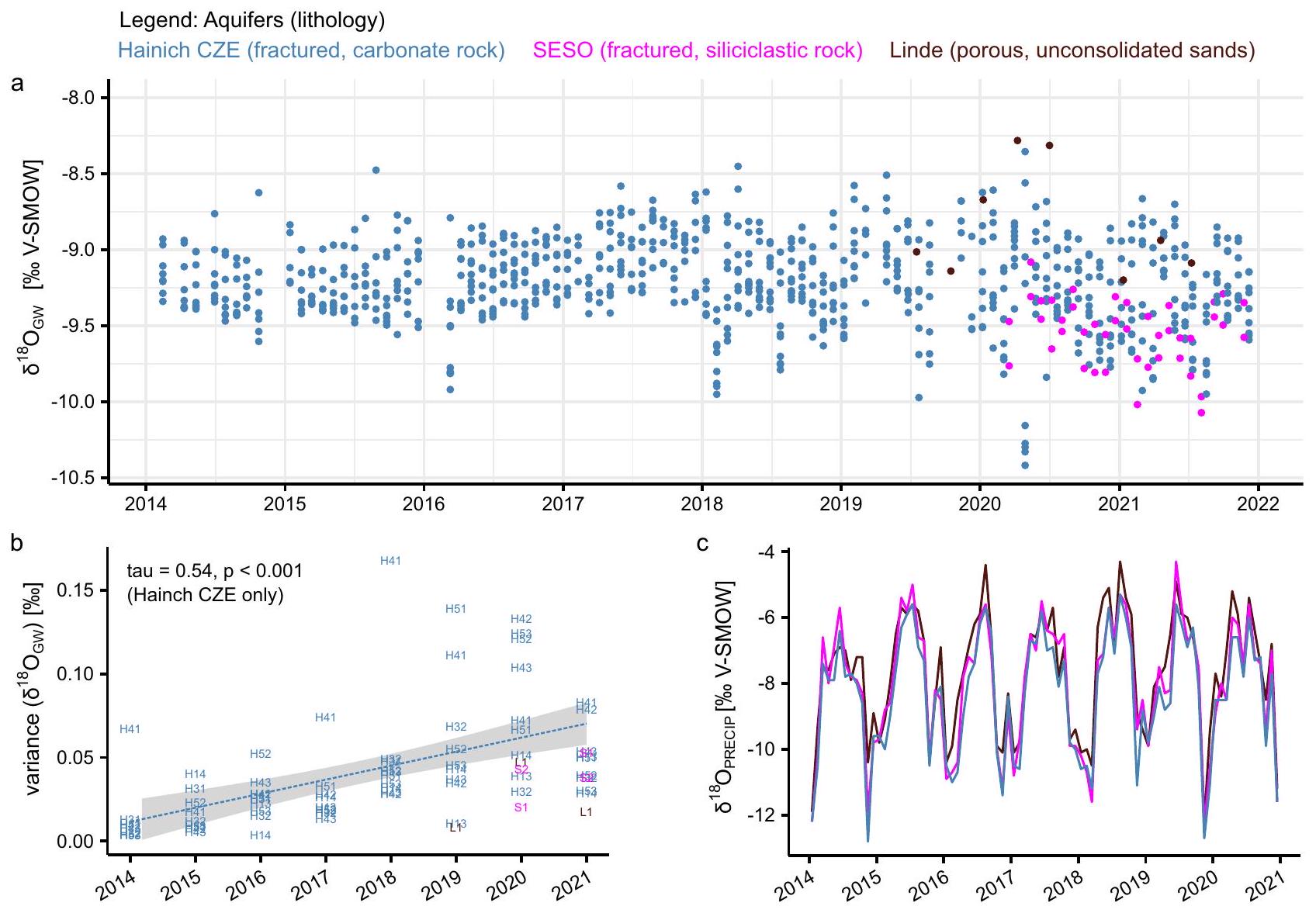
كما يتضح من الزيادات في التباينات السنوية الداخلية لنظائر المياه الجوفية المستقرة (الشكل 1a، b). تحمل نسب نظائر الأمطار إشارة متغيرة موسميًا إلى المياه الجوفية، حيث تتجمع وتختلط العديد من مصادر المياه المساهمة (الزمان والمكان) (الشكل 1c). من المتوقع أن تكون احتمالية تأثير تدفقات تسرب المياه الجوفية على نسبة نظائر المياه الجوفية المحلية أكبر بعد هطول أمطار غزيرة قصيرة الأجل مقارنة بالأمطار الخفيفة المنتشرة على مدار الموسم. يمكن أن تنقل تدفقات التربة إلى المياه الجوفية أيضًا كميات كبيرة من المواد العضوية الطبيعية إلى أعماق الطبقات السفلية، مما يهدد نقاء المياه الجوفية الضحلة العالية بشكل عام . لذلك، من الحكمة تحديد مدى تغير نقاء المياه الجوفية وضعفها أمام تسربات مستقبلية عرضية و/أو قائمة على الأحداث.

نقل التربة إلى المياه الجوفية المعدل

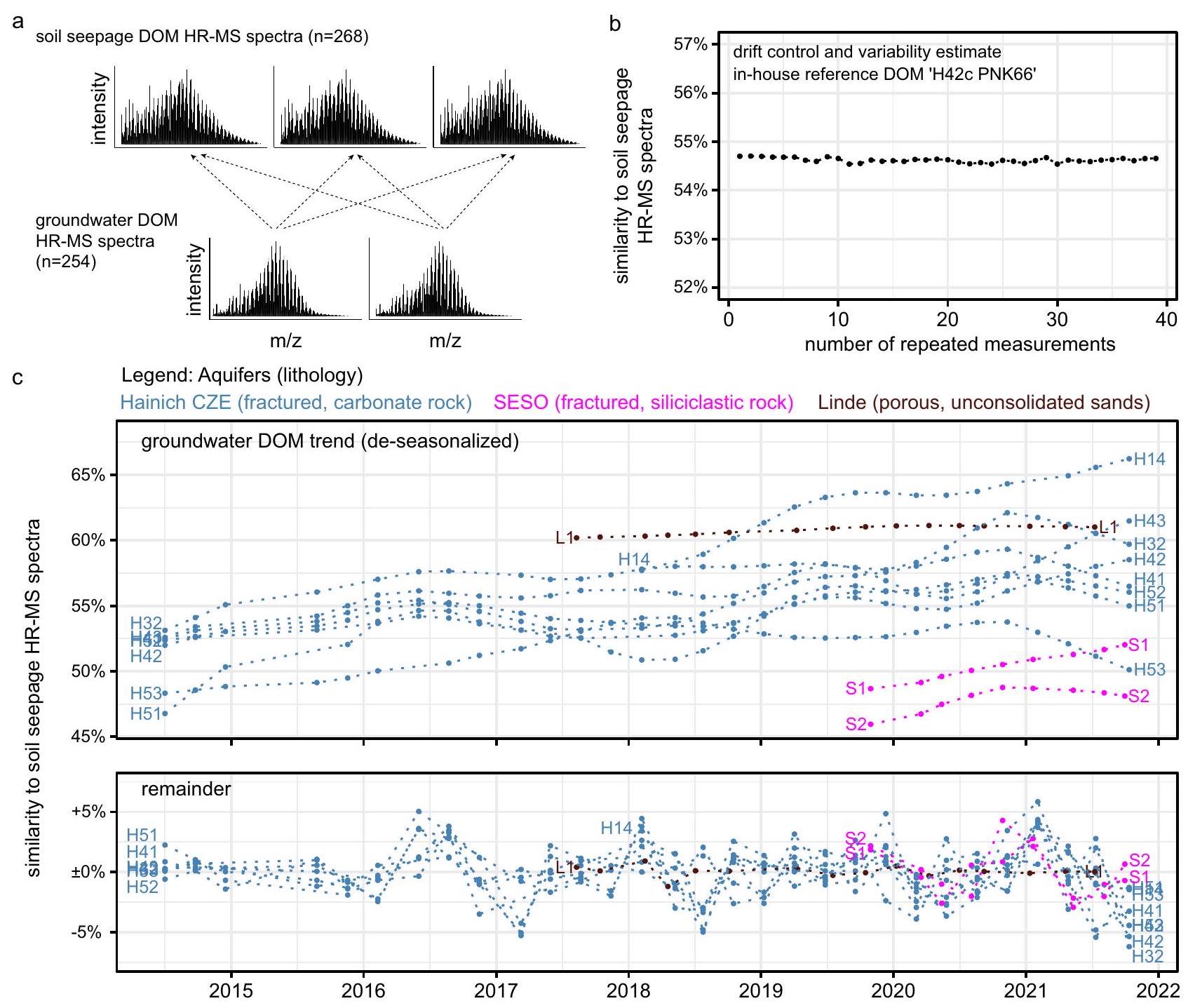
جميع الآبار التي انخفضت بشكل كبير في الرأس الهيدروليكي أظهرت أيضًا زيادة في كميات المواد المستمدة من تسرب التربة، استنادًا إلى تحليل السلاسل الزمنية الموسمية (STL) للتشابهات بين المياه الجوفية وDOM تسرب التربة من طيف DI-HR-MS (الشكل 2a). بين عامي 2014 و2021، أصبحت DOM المياه الجوفية في Hainich CZE أكثر تشابهًا بأكثر من 10 في المئة مع DOM تسرب التربة (الشكل 2c). كشفت السلاسل الزمنية لمدة ثلاث وخمس سنوات في SESO وLinde عن تغييرات بنسبة خمسة وواحد في المئة، على التوالي. تعكس أحجام التأثير هذه تغييرات كبيرة في جودة المياه الجوفية الطبيعية ( )، مع الأخذ في الاعتبار انحرافًا معياريًا قدره 0.05 نقطة مئوية استنادًا إلى نفس الحسابات التي أجريت على القياسات المتكررة لمعيار DOM المياه الجوفية الداخلي الموزع عبر تسلسل قياسات DOM DI-HR-MS بالكامل (الشكل 2b). تعكس الاتجاهات طويلة الأجل تكثيف الاتصال بين التربة والمياه الجوفية، مقترنًا بتقليل كفاءة الترشيحات والتنقيات الطبيعية التي تحدث أثناء الترشيح من المنطقة غير المشبعة إلى المياه الجوفية . بدت المياه الجوفية في أنظمة المياه الجوفية ذات التدفق الكسري أكثر عرضة بشكل ملحوظ من المياه الجوفية في الرمال المسامية غير المتماسكة، مع الأخذ في الاعتبار أن معدلات تغيير تركيب DOM كانت أقل بمقدار ترتيب من حيث الحجم في موقع Linde مقارنةً بـ Hainich CZE وSESO (الجدول التكميلي 1). يبرز هذا أهمية مسارات التدفق التفضيلية على طول الشقوق في الطبقات السفلية، مما يسمح للمواد المستمدة من السطح بالتهرب من عمليات التنقية أثناء تسرب المياه الجوفية السريع. دور الشقوق في توفير مسارات التدفق التفضيلية أكثر أهمية حتى بالنسبة للصخور البحرية مثل تلك الموجودة في Hainich CZE بسبب ضيق مصفوفاتها (انخفاض المسامية والنفاذية) .
تشير نتائجنا إلى أنه من خلال الاستفادة من تركيبها المتنوع للغاية، يمكن استغلال DOM كمؤشر مبكر على تدهور جودة المياه الجوفية. كشفت DI-HR-MS عن زيادة كبيرة في المساهمات المستمدة من تسرب التربة إلى DOM المياه الجوفية، بينما لم تظهر التركيزات المراقبة عادةً لـ DOC تغييرات كبيرة خلال فترة المراقبة (الشكل التكميلي 3). من المحتمل أن تكون التوافر الحيوي الكبير لـ DOC المستمد من السطح في المياه الجوفية قد ساهم في استقرار DOC المياه الجوفية . من المتوقع أن يكون التغيير في تركيب DOM مدفوعًا بشكل أكبر بالمواد الأيضية الميكروبية والمواد المستمدة من السطح، والتي لا تتحلل بسهولة وليست وفيرة بشكل فردي. قدمت قياسات النظير المشع على نفس مستخلصات DOM المياه الجوفية التي تم تحليلها عبر DI-HR-MS تحققًا مستقلًا من التفسير بأن التغييرات في تركيب DOM المياه الجوفية كانت مدفوعة بإدخالات مستمدة من السطح. لاحظنا ارتباطًا إيجابيًا ( ) بين نسبة الكربون الحديث ( ) في DOM المياه الجوفية والتشابهات المحسوبة بين طيف المياه الجوفية وDOM تسرب التربة HR-MS (الشكل التكميلي 4). لم يكن الارتباط مدفوعًا بشكل كبير بقيم منخفضة في الآبار غير المؤكسدة ، وH 53 وكان أيضًا ذا دلالة ( ) عند النظر فقط إلى المياه الجوفية المؤكسدة من Hainich CZE . يبرز هذا الاكتشاف إمكانيات DOM
الشكل 1 | نسب النظائر المستقرة في المياه الجوفية وهطول الأمطار. أ نطاق نسب النظائر المستقرة للمياه الجوفية تعكس مزيجًا من هطول الأمطار الصيفية والشتوية دون تغيير في المتوسط بمرور الوقت. تشير السلاسل الزمنية إلى زيادة التباين في نسب النظائر المستقرة بعد الجفاف الصيفي الشديد في أوروبا عام 2018. ب تباينات في نسب النظائر المستقرة لكل بئر مياه جوفية وسنة. تظهر الزيادات الخطية الكبيرة في التباينات داخل السنة على مدى فترة ثماني سنوات في Hainich Critical Zone Exploratory (CZE) أن النقل العرضي والمعتمد على الأحداث أصبحا عوامل بارزة بشكل متزايد في ديناميات إعادة شحن المياه الجوفية. تمثل الخط المنقط انحدارًا خطيًا و فترة الثقة
. تم تقييم الأهمية باستخدام معامل ارتباط كيندال. خلال عام الجفاف الشديد 2018، تم الكشف عن زيادة غير خطية في التباين لبئر H41. لقد أظهر هذا البئر سابقًا استجابة سريعة وقوية جدًا لديناميات إعادة الشحن والانكماش . يشير هذا إلى أنه بالإضافة إلى الزيادة الخطية طويلة الأجل في تباين التسرب، فإن المياه الجوفية معرضة محليًا بشدة لظروف المناخ الهيدرولوجي المتطرفة على مقاييس زمنية قصيرة. ج التباين الموسمي في نسب النظائر المستقرة لهطول الأمطار من . تم إنشاء الشكل في R.4.4.0 باستخدام حزمة ggplot2.
بيانات DI-HR-MS كبدائل ذات مغزى يمكن من خلالها تقييم تأثيرات المساهمات المستمدة من تسرب التربة على نظم المياه الجوفية بدقة.
كانت نسبة التغيير من عام إلى عام في تركيب DOM المياه الجوفية أكبر بعد الجفاف الصيفي الشديد لعام 2018 مقارنةً بالفترة السابقة، استنادًا إلى الانحدارات الخطية المقابلة لقيم التشابه الموضحة في الشكل 2c (الجدول التكميلي 1). أظهر سبعة من ثمانية آبار ذات بيانات طويلة الأجل مستمرة تغييرات أكثر حدة في تشابهها مع طيف HR-MS لتسرب التربة بعد يوليو 2018، مع الاستثناء الوحيد هو البئر H53، الذي أظهر سابقًا أنه تأثر بالكاد بتدفقات المواد المستمدة من السطح . في عامي 2018 و2019، شهدت وسط أوروبا جفافًا صيفيًا كبيرًا، كان لكل منهما عواقب بيئية مدمرة ومثل شذوذًا هيدرولوجيًا متطرفًا زاد من احتمالية حدوثه بسبب الاحتباس الحراري الناجم عن الأنشطة البشرية . خلال وبعد صيف 2018، واجهت مواقع تحقيقنا أكبر عجز سنوي محلي في المياه خلال الفترة من 2006-2021 (الشكل التكميلي 5). وقد رافق ذلك انخفاضات حادة في الرؤوس الهيدروليكية بعد ارتفاعات المياه الجوفية السابقة في أوائل عام 2018 في Hainich CZE (الشكل التكميلي 1). تشير ملاحظاتنا إلى أن الظروف الهيدرولوجية المتطرفة قد تغير بشكل كبير ديناميات إعادة شحن المياه الجوفية، وبالتالي، تؤدي إلى تدهور جودة المياه الجوفية.
في تحقيق متعدد السنوات سابق حول تسرب التربة في موقع Linde، وُجد أنه بعد الجفاف الصيفي كانت DOM غنية بالمواد العطرية المستمدة من النباتات التي لم تتم معالجتها ميكروبيًا بعد . من المحتمل أنه عند حدوث هطول الأمطار الأولي وأحداث إعادة الترطيب، تخطت دفعات من DOM غير المعالجة عمليات الترشيح والتنقية في المنطقة الحرجة وتوجهت مباشرة إلى المياه الجوفية عبر مسارات التدفق التفضيلية . يمكن أن يؤدي النقل التفضيلي لـ DOM من التربة إلى المياه الجوفية إلى تحميل عمليات الترشيح والتحويل الطبيعية، مما يؤدي إلى تغييرات طويلة الأمد في نظم المياه الجوفية . بالإضافة إلى ذلك، تضاعف تقريبًا نسبة الأنواع الميكروبية المنقولة عبر التسرب إلى الميكروبيوم المائي في عام 2018، مقارنةً بالمتوسط طويل الأجل . نظرًا للإمكانات الهائلة للتحولات الكيميائية الكامنة في المجتمعات الميكروبية الصحية، فإن النقل المشترك لـ DOM المستمد من تسرب التربة والبكتيريا بعد الظروف الهيدرولوجية المتطرفة لعام 2018 قد غير بشكل أساسي تنقية المياه الجوفية الطبيعية. توضح البيانات التي تم جمعها في هذه الدراسة بوضوح أن الظروف الهيدرولوجية المتطرفة الناجمة عن تغير المناخ تؤثر على جودة المياه الجوفية.

الآثار على نظم المياه الجوفية

تشير النتائج إلى أن الزيادة الملحوظة في تشابه المياه الجوفية مع طيف DOM HR-MS لتسرب التربة أثرت على عدة وظائف أيضية للميكروبيوم المائي. نحن مباشرة
الشكل 2 | تحليل السلاسل الزمنية الموسمية لتشابهات الجزيئات للمياه الجوفية مع المواد العضوية المذابة (DOM، . أ نظرة عامة على أطياف DI-HR-MS لتسرب التربة وDOM المياه الجوفية. تشير الأسهم إلى أن النسب المئوية المحسوبة للتشابهات (PS) تشير كل عينة مياه جوفية إلى جميع عينات تسرب التربة المحلية لحساب تباين التربة. يتم الإبلاغ عنها كمتوسطات في اللوحة (ج). كان الانحراف المعياري بين قيم PS لـ DOM تسرب التربة هو . ب تقدير التحكم في الانجراف وتباين القياس استنادًا إلى القياسات المتكررة لمعيار DOM المياه الجوفية الداخلي
المرجع ( ) متداخلة مع سلسلة القياسات الكاملة. كان الانحراف المعياري لقيم PS في القياسات المرجعية 0.05 نقطة مئوية، دون ملاحظة أي انحراف. ج اتجاه طويل الأمد ثابت نحو زيادة مساهمات المواد المستمدة من تسرب التربة إلى DOM المياه الجوفية. وهذا يشير إلى تقليل كفاءة العمليات الطبيعية التي يتم من خلالها تنقية المياه أثناء الترشيح إلى المياه الجوفية. تتوفر أعماق آبار المياه الجوفية وأطوال الشاشات في الشكل التكميلية 1. الشكل تم إنشاؤه في R.4.4.0 باستخدام حزمة ggplot2.
قارن الدرجات المماثلة المبلغ عنها في الشكل 2 مع الوفرة النسبية للصيغ الجزيئية المتوقعة في المياه الجوفية، المجمعة حسب المسارات الأيضية عبر المطابقة مع قاعدة بيانات KEGG. تم استخدام مجموعة بيانات ذات جودة عالية مكونة من 1224 جينوم تم تجميعها من الميتاجينوم (MAGs) تم الحصول عليها من نفس الآبار في Hainich CZE لتقييد توقعات المسارات الأيضية من DOM إلى الإمكانات الوظيفية لمجتمعات الميكروبات في المياه الجوفية الصيغ الجزيئية ( ) من 7277 تم مطابقتها مع الوظائف الأيضية للميكروبيوم المائي. على الرغم من أن بعض صيغ المجموع تحتوي على عدة أيزومرات، إلا أن أكثر من من صيغ المجموع يمكن ربطها بشكل لا لبس فيه بمسارات أيضية محددة (الأشكال التكميلية 6، 7). تظهر ارتباطات الرتبة بين الوفرة النسبية المجمعة لصيغ المجموع لكل مسار أيضي والتشابهات المحسوبة مع طيف HR-MS لتسرب التربة في الشكل 3. يمثل كل نقطة مسار أيضي مميز، وموقعه على المحور الصادي يشير إلى مدى قوة ارتباط نمط الوفرة النسبية للمسار بالزيادات الملحوظة في التشابه بين المياه الجوفية والتربة
طيف DOM HR-MS لتسرب التربة عبر نفس مجموعة العينات. العديد من المسارات الأكثر ارتباطًا بشكل قوي تشارك في استقلاب المواد الغريبة (المميزة باللون الأحمر) أو في تخليق المضادات الحيوية الطبيعية والسموم. تشير الاستجابات القوية لمسارات تحلل المواد الغريبة والهيدروكربونات العطرية في DOM المياه الجوفية إلى أنه خلال إعادة شحن المياه الجوفية السريعة والمتقطعة، تتجنب هذه المواد الاحتفاظ والمعالجة الميكروبية في (التربة) . المسارات الأيضية المتعلقة بتخليق السموم والمضادات الحيوية الطبيعية (مثل، نوفوبيوسين، بروديجيوسيني، تخليق الأفلاتوكسين) من المحتمل أن تنشأ من التنافس البكتيري-البكتيري والبكتيري-الفطري في التربة السطحية . تؤكد نتائجنا على الإمكانات العالية لتحليلات DOM DI-HR-MS للتحذير من التغيرات المهمة الجارية في جودة المياه الجوفية الطبيعية قبل الوصول إلى مستويات العتبة للمواد الغريبة البيئية الضارة أو تركيز DOC الكلي. مع تفاقم آثار تغير المناخ، قد تنذر هذه الاتجاهات بتغيرات أكبر وسريعة في وظائف نظم المياه الجوفية، مما يثير تساؤلات حول أمان الأصول البيئية الأساسية في المستقبل .
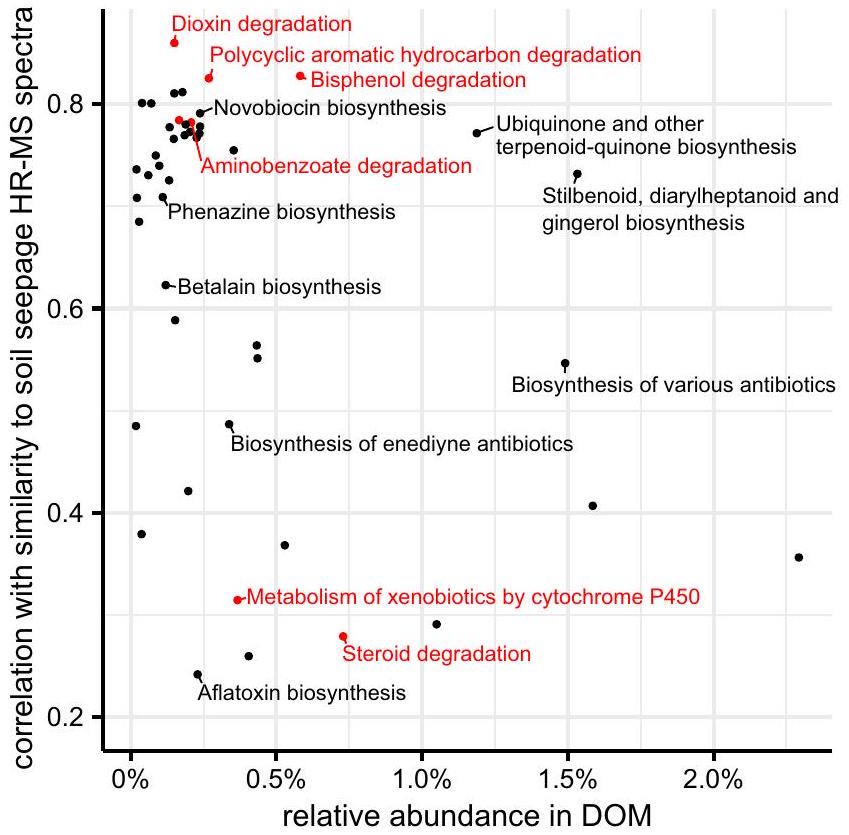
الشكل 3 | توقع المسار الأيضي عبر قاعدة بيانات KEGG بناءً على الصيغ الجزيئية لتحليل الكتلة عالية الدقة المباشر للمياه الجوفية (DI-HR-MS) المقيدة بجينومات تم تجميعها من الميتاجينوم من نفس البئر (البئر)؛ لـ DI-HR-MS، للمياه الجوفية الميتاجينومية. كل مسار موضح يحتوي على صيغ جزيئية أو من الطول الكلي النظري له تم اكتشافه. تظهر المسارات المرسومة ارتباطًا إيجابيًا كبيرًا مع نسبة التشابه بين المياه الجوفية وDOM المذاب في تسرب التربة المعروض في الشكل 2 ( , مصحح بونفيروني). المسارات التي تنتمي إلى مجموعة مسار KEGG “تحلل المواد الغريبة والتخليق الحيوي” ملونة باللون الأحمر. المسارات الأخرى المتعلقة بتخليق المضادات الحيوية الطبيعية والسموم، بالإضافة إلى المسارات الوفيرة، مكتوبة بالنص الأسود. تتوفر معلومات مفصلة حول سير عمل توقع المسار في الشكل التكميلية 6. الشكل تم إنشاؤه في R.4.4.0 باستخدام حزمة ggplot2.
مع زيادة عدد أحداث الأمطار الشديدة والجفاف في وسط أوروبا بشكل كبير ، أصبح تسرب المياه الجوفية أكثر تباينًا وتقطعًا. بشكل جماعي، تظهر نتائج تحقيقنا أن الانتقال غير المنتظم للمياه من التربة إلى المياه الجوفية يؤثر سلبًا على كل من كمية وجودة المياه الجوفية. بناءً على معدل التغير الملحوظ في الفترة من 2014 إلى 2021، من المحتمل أن تزداد هشاشة موارد المياه الجوفية المنقاة بشكل طبيعي، مما يزيد من الضغط الذي تواجهه المجتمع بالفعل بشأن انخفاض مستويات المياه الجوفية .
تتيح دراسة ومراقبة جودة المياه الجوفية عبر وكيل DOM فرصة فريدة لتقييم الضعف الطبيعي لهذه النظم البيئية الثمينة بشكل مستمر تجاه الظروف المناخية المائية المتطرفة. هذه القدرة ذات صلة بشكل خاص بالمواقع التي يكون فيها التلوث البشري محدودًا حتى الآن، وتعتبر المياه الجوفية، دون أي دعم تجريبي، نظيفة وآمنة للشرب في المستقبل البعيد. بناءً على الصخور المدروسة وخصائص المياه الجوفية بالإضافة إلى توقعات المناخ المائي الأوروبي، قد تواجه المياه الجوفية الإقليمية المهمة التي تتميز بإعادة شحن طبوغرافي، مثل، في وسط إيطاليا، شمال شرق إسبانيا، وسط وجنوب غرب فرنسا، وكذلك في جميع أنحاء ألمانيا، اتجاهات مشابهة لما أبلغنا عنه من نتائج .
تستخدم جودة المياه الجوفية الحالية عادةً فقط التركيز الكلي لـ . نقترح أن توفر بيانات التركيب الجزيئي عالية الدقة لـ DOM يمكن أن يقيم الأنماط التي توفر مؤشرًا أوضح لتدهور جودة المياه الجوفية. قد يكون اتخاذ إجراءات في الوقت المناسب أمرًا حاسمًا، حيث أن تغير المناخ والبيئة يزعج بالفعل الوظيفة المتوازنة لـ
المنطقة الحرجة، مما يؤثر سلبًا على توفر المياه الجوفية وسلامتها على نطاق أكبر وبمعدل أسرع بكثير مما هو معترف به حاليًا .

طرق

مواقع الدراسة

درسنا ثلاثة أنظمة مياه جوفية متميزة هيدروجيولوجيًا في وسط وشمال شرق ألمانيا، تشمل الصخور الكربونية المتصدعة الكارستية في منطقة Hainich الحرجة (CZE)، والصخور السيليكاتية المتصدعة المسامية في مرصد Saale-Elster-Sandsteinplatte (SESO) والرمال الجليدية في محطة أبحاث لinde. تم اختيار هذه المواقع لتمثيل الصخور الرئيسية وخصائص المياه الجوفية السائدة في جميع أنحاء وسط أوروبا . تم دراسة جميع المواقع بشكل جيد، مع تحقيقات سابقة تفصل وظيفة المنطقة الحرجة بأكملها. تمثل منطقة Hainich CZE في شمال غرب تورينغن (وسط ألمانيا) منطقة فرعية من موارد المياه الجوفية المستخدمة في مناخ معتدل. يصل خط مراقبة الآبار في Hainich CZE إلى نظام مياه جوفية يتدفق عبر الشقوق في تتابعات الحجر الجيري والطين الرقيق. تختلف أقسام المياه الجوفية في Hainich CZE بشكل كبير في توفر الأكسجين. الآبار H13، H14، H31، ، و H 51 هي أكسجينية، بينما ، و H 53 هي غير أكسجينية ( الأكسجين المذاب). تتراوح إمكانيات الاختزال حول 400 مللي فولت للآبار ، و H 51 ، وحوالي 200 مللي فولت للآبار H42، H43، H52، و H53. تقع مناطق المساهمة للمياه الجوفية التي تم الوصول إليها في Hainich CZE تحت الغابات، والمراعي، والأراضي الزراعية. يقع نظام المياه الجوفية SESO في وسط تورينغن داخل صخور سيليكاتية متصدعة مسامية. بينما يختلف SESO عن Hainich CZE في الهيكل الهيدروجيولوجي وحموضة التربة، تشترك هذه المواقع في أنواع استخدام الأراضي، والنباتات، وإعادة الشحن الطبوغرافي في إعدادات المنحدرات. المياه الجوفية التي تم الوصول إليها في SESO هي أكسجينية. محطة أبحاث Linde، الواقعة في براندنبورغ (شمال شرق ألمانيا) تصل إلى نظام مياه جوفية في تضاريس غير منحدرة تطورت على الرمال والحصى الجليدية تحت بيئة غابات متنوعة. المياه الجوفية التي تم الوصول إليها في محطة أبحاث Linde هي أكسجينية. تتوفر أوصاف شاملة لمواقع الدراسة في المنشورات السابقة لمنطقة Hainich CZE ، و Linde . تظهر أعماق أقسام شاشات المياه الجوفية المعنية في الشكل التكميلية 1 وتفاصيل إعداد آبار المياه الجوفية متاحة في المرجع 69. تم إصدار تصاريح العمل الميداني من قبل المكاتب البيئية الحكومية المسؤولة، والسلطات المحلية ومالكي الأراضي.

أخذ العينات

تم استخراج المياه الجوفية من الآبار باستخدام مضخات غاطسة (MP1 أو SQE 5-70، جروندفوس، الدنمارك) على فترات شهرية. بعد الوصول إلى معايير فيزيائية كيميائية ثابتة في خلايا التدفق، تم أخذ عينة من 100 مل من المياه الجوفية لتحديد الكربون العضوي الذائب في زجاجات بوروسيليكات سعة 100 مل مع أغطية بولي بروبيلين (VWR، دارمشتات، ألمانيا). كل ثلاثة أشهر، تم أخذ 10 لترات من المياه الجوفية أيضًا في حاويات HDPE مكررة لتحليل DOM DI-HR-MS. تم نقل عينات المياه الجوفية على الفور إلى المختبر، وتم تصفيتها إلى ، وتم تحميضها إلى باستخدام HCl، وتم تخزينها في في الظلام حتى المعالجة اللاحقة. تم جمع تسرب التربة من ليمترات مثبتة بشكل دائم تتحكم في التوتر على فترات أسبوعية بناءً على توفر المياه. تم نقل عينات تسرب التربة على الفور إلى المختبر وتم تخزينها مجمدة في في زجاجات بولي كربونات سعة 250 مل (ثيرمو فيشر العلمية، دريتش، ألمانيا) حتى التصفية إلى والمعالجة اللاحقة. تفاصيل إعداد الليمترات في غابة الزان المختلطة والأراضي العشبية في هينش CZE متاحة في المرجع 14. باختصار، تم إعداد الليمترات في هينش CZE على عمق 30 و واحتوت على ألواح شفط من كربيد السيليكون المسامي (SIC320، متوسط حجم المسام: ، سمك 10 مم، مساحة ; METER، فوهيرينغن، ألمانيا) مثبتة تحت ملف التربة غير المضطرب بدون جدران جانبية. تفاصيل الإعداد في غابات الزان، البلوط، والصنوبر، بالإضافة إلى الأراضي العشبية في محطة البحث ليندي، متاحة في المرجع 50. باختصار، تم تثبيت ألواح شفط زجاجية مسنترة (حجم المسام:
، سمك: 10 مم، مساحة ; UMS، ويلمارس، ألمانيا) في ليندي على عمق 5، 10، 20، و30 سم تحت ملف التربة غير المضطرب. بيانات التسرب من SESO غير متاحة. لذلك، تشير الحسابات في الشكل 2 لـ SESO إلى التسرب من هينش CZE، حيث أن كل من الغطاء النباتي والتضاريس متشابهة للغاية بين الموقعين.

نظائر المياه الجوفية المستقرة

تم تحليل نظائر الهيدروجين ( ) والأكسجين ( ) المستقرة للمياه الجوفية كقياسات ثلاثية في MPI-BGC في يينا، ألمانيا، باستخدام مطياف الكتلة لنسبة النظائر Delta+ XL (فينجان مات، بريمن، ألمانيا). تم معايرة القياسات وفقًا للمعايير الداخلية، التي تم التحقق منها بانتظام مقابل معيار مياه المحيط القياسي في فيينا (VSMOW: , ) ومعيار هطول الأمطار القطبي الخفيف (SLAP: , ). يتم تقديم شرح مفصل للأداة والمنهجية في المرجع 71. تم حساب التباين الداخلي السنوي في R4.2.1 باستخدام دالة stats::var() كـ var مع كـ الانحراف عن المتوسط و كعدد الملاحظات. كان متوسط التباين للقياسات التقنية الثلاثية 0.1%.

تركيب الجزيئات لـ DOM

تم استخراج DOM وفقًا لبروتوكول استخراج الطور الصلب الشائع (SPE) باستخدام خراطيش PPL Bond Elut بوزن 5 جرام (Agilent Technologies، والدبرون، ألمانيا) للمياه الجوفية وخراطيش بوزن 1 جرام لعينات تسرب التربة . تم معالجة عينات المياه الجوفية في نسخ مكررة. تم تعديل الحجم الذي تم تمريره عبر خراطيش PPL بناءً على تركيز DOC في العينة المعنية، الذي تم تحديده ككربون عضوي غير قابل للتطهير على جهاز vario TOC cube (Elementar Analysensysteme، لانغنسلبلود، ألمانيا). كانت هذه الخطوة ضرورية فقط لعينات تسرب التربة بسبب تركيز DOC الأعلى مقارنة بالمياه الجوفية. PPL هو راتنج غير قطبي يعتمد على بوليمر ستيرين-دي فينيل بنزين وقد أظهر أنه يحقق كفاءات استخراج عالية، وطيف تركيب جزيئي عالي الجودة، وعيوب إجرائية نظيفة، متفوقًا على 23 مادة SPE أخرى من حيث التمثيل العام في تحقيق سابق . نلاحظ أنه، بينما كان من الضروري الحصول على عينات خالية من الملح لتحليل الكتلة باستخدام التأين بالرش الكهربائي (ESI)، فإن أي نوع من المعالجة المسبقة لـ SPE سيكون جزئيًا غير مكتمل بسبب الخصائص المحددة لمادة الامتصاص. في حالة PPL، فإن الفئات المركبة الأكثر احتمالاً أن تكون ممثلة تمثيلاً ناقصًا مقارنة بالمادة الخام هي المواد العضوية القطبية، مثل الأحماض الأمينية والسكريات. تم الاحتفاظ بمستخلصات PPL عند في زجاجات بوروسيليكات كهرمانية سعة 10 مل (CarlRoth، كارلسروه، ألمانيا) للتخزين طويل الأمد.
لتحليلات HR-MS بالتسريب المباشر، تم تعديل تركيز المستخلصات إلى في خليط مذيبات من الماء والميثانول بنسبة 1:1. ثم، تم حقن من مستخلص DOM في تدفق مستمر من الماء والميثانول (1:1) باستخدام جهاز UltiMate 3000 (ثيرمو فيشر العلمية، وولثام، الولايات المتحدة الأمريكية). تم تسجيل القياسات على مطياف الكتلة Orbitrap Elite (ثيرمو فيشر العلمية، وولثام، الولايات المتحدة الأمريكية) بدقة كتلة تبلغ عند . تم تشغيل ESI في وضع التأين السالب مع جهد إبرة ESI قدره 2.65 كيلو فولت. لكل عينة، تم الحصول على 100 مسح من m/z 100-1000 ومتوسطها. تم إجراء معايرة الأداة وفقًا لتعليمات البائع باستخدام خليط معايرة ESI من بيرس للوضع السالب (ثيرمو فيشر العلمية، وولثام، الولايات المتحدة الأمريكية).
بعد الاكتساب، تمت معالجة الأطياف باستخدام DOMAssign ، أداة مفتوحة المصدر لمعالجة أطياف الكتلة القياسية لـ DOM. DOMAssignR هو غلاف حول MFAssignR ومتاحة على https://github.com/simonschroeter/DOMAssignR. تفاصيل معالجة بيانات DOM متاحة في قسم توفر الشيفرة. باختصار، استخدمنا مرشحات نسبة الإشارة إلى الضوضاء وأعدنا معايرة الأطياف إلى دقة الكتلة ppm تغطي النطاق الكامل من m/z تقريبًا من m/ حتى، على الأقل، القيمة حيث تم الوصول إلى من الكثافة التراكمية للطيف المعني (عادة تقريبًا.
). لم تؤخذ القيم الأكثر وفرة الموجودة في العيوب (حتى الكثافة التراكمية للعيوب) في الاعتبار لاحقًا. تم اعتبار فقط قيم m/z المكتشفة في كل من النسخ البيولوجية المكررة لعينات المياه الجوفية. تم تطبيع الأطياف إلى مجموع جميع كثافات القمم. تم حساب نسبة التشابه (PS) بين أطياف HR-MS DOM للمياه الجوفية وتسرب التربة كـ PS بناءً على جميع القيم فوق عتبة S/N. تشير قيم PS للمياه الجوفية من موقع ليندي إلى تسرب التربة من ليندي، بينما تشير تلك الخاصة بالمياه الجوفية من هينش CZE وSESO إلى تسرب التربة من هينش CZE. تم حساب قيم PS أولاً بين جميع العينات، ثم تم متوسطها على جميع نقاط زمن أخذ عينات تسرب التربة ومواقع أخذ العينات المحلية لتعظيم القوة ضد التباين السطحي. وبالتالي، فإن التغيرات المبلغ عنها في PS مدفوعة فقط بالتغيرات في تركيب DOM للمياه الجوفية. تم إجراء تحليل السلاسل الزمنية الموسمية بواسطة LOESS (تنعيم الرسم البياني المقدر محليًا) على قيم PS باستخدام حزمة R stlplus مع الإعدادات التالية: ، s.window ، t.degree ، s.degree . تم إجراء تعيين الصيغة الجزيئية في DOMAssignR مع الإعدادات القياسية والأجزاء التالية التي تم أخذها في الاعتبار: . القيم مع تعيين صيغة المجموع الناجح شكلت (متوسط ± انحراف معياري) من إجمالي كثافة الأطياف المعنية DI-HR-MS.
تم التحقق من آثار الانجراف المحتمل للأداة بسبب سلسلة القياسات الطويلة من خلال تشغيل مرجع DOM للمياه الجوفية داخليًا مع العينات وإجراء نفس حسابات قيم PS كما هو موضح أعلاه. يظهر الشكل 2b أنه لم يكن هناك انجراف كبير على مدى تسلسل القياسات.
تم إجراء توقع مسار الأيض من بيانات DOM DI-HR-MS باستخدام حزمة KEGGREST . تم تقييد توقعات المسار بواسطة مجموعة بيانات ذات جودة عالية تم الحصول عليها من نفس البئر (أو الآبار) في يناير . تم تصفية توقعات مسارات الأيض من DOM لتتطابق مع التوقعات من الميتاجينومات لنفس البئر المعني. تتوفر أوصاف مفصلة لعملية توقع مسار الأيض ومراقبة الجودة في الأشكال التكميلية 6، 7. ربط DOM والميتا جينومات قدم رؤى تتجاوز تلك التي تم تحقيقها باستخدام الطرق التقليدية. تم توقع أكثر من أربعين مسار أيضي متميز بشكل مشترك بواسطة بيانات DI-HR-MS والميتا جينوميات. في تحقيق سابق لـ DOM في هينش CZE، قمنا بتقييم أربع فئات مركبة بناءً على مخطط فان كريفيلين: البوليفينولات، المواد غير المشبعة بشدة، الألكانات غير المشبعة، والمواد الشبيهة بالببتيد . لم تكن هذه الميزات الهيكلية تفتقر فقط إلى وصف وظيفي دقيق، بل تم إثبات أنها تتداخل بشكل غير دقيق مع المناطق المقابلة لها في مخطط فان كريفيلن. . هنا، أكثر من يمكن ربط صيغ المجموع بشكل غير غامض بمسارات أيضية محددة، ويرجع ذلك إلى الحاجة لمطابقة التوقعات بناءً على الميتاجينومات.

نظائر الكربون المشع

تم تجفيف عينات SPE-DOM في كبسولات من القصدير، ثم تم حرقها إلى في محلل العناصر، وتم تحويله إلى شكل جرافيتي. تم إجراء القياسات على نظام مطياف الكتلة المعجل MICADAS (Ionplus، ديتكون، سويسرا). يمكن العثور على وصف مفصل لإعداد العينة وتسجيل القياسات في المرجع 80. في تحقيق سابق، وُجد أن إجراء SPE الخاص بنا لا يقدم انحيازًا كبيرًا إلى نسب مقارنة بالمادة الأصلية .

الميتاجينومات

قمنا بدراسة مجموعة بيانات ميتاجينوميات كبيرة من عينات مياه جوفية من Hainich CZE (ستة آبار) تم أخذها في يناير 2019 وتم تسلسلها كما هو موصوف سابقًا. تم إنشاء تجميعات الميتاجينوم من قراءات التسلسل الخام (القطع أو الهياكل) باستخدام خط أنابيب المعلوماتية الحيوية الموصوف سابقًا. ، واستخدمت للتنبؤ بالجينات باستخدام Prodigal v2.6.3 تم استعلام تسلسلات البروتين FASTA المستمدة من الجينات المشفرة المتوقعة عن تشابه التسلسل ضد
قاعدة بيانات KEGG Orthology (KO) باستخدام KofamScan ، وتمت خريطة معرفات KO الناتجة إلى مسارات التمثيل الغذائي في KEGG. تم اشتقاق وفرة كل جين KO بناءً على عدد القراءات الخام المخصصة لكل تسلسل جيني في الميتاجينوم المعني. BBmap (الإصدار 38.96) تم استخدامه لرسم قراءات الميتاجينوميات.

توفر البيانات

تم إيداع قراءات التسلسل الميتاجينومي الخام لعينات المياه الجوفية المدروسة تحت رقم مشروع ENA PRJEB36505، وتم إيداع التجميعات المعنية تحت رقم مشروع ENA PRJEB36523. تم إيداع بيانات DOM HR-MS الخام تحتhttps://doi. org/10.17617/3.WRNNZH.

توفر الشيفرة

تم إيداع الشيفرة لمعالجة البيانات الخام لـ DOM والتقييمات الإحصائية في R وصورة مساحة العمل للبيانات المعالجة، بما في ذلك بيانات النظائر المستقرة وبيانات الكربون المشع، تحتhttps://doi.org/10.17617/3.WRNNZH. تم اختبار الكود في إصدار R 4.4.0.

References

  1. Margat, J. & Van der Gun, J. Groundwater around the World: A Geographic Synopsis. (CRC Press, 2013).
  2. Griebler, C. & Avramov, M. Groundwater ecosystem services: a review. Freshw. Sci. 34, 355-367 (2015).
  3. Zeder, J. & Fischer, E. M. Observed extreme precipitation trends and scaling in Central Europe. Weather Clim. Extremes 29, 100266 (2020).
  4. Büntgen, U. et al. Recent European drought extremes beyond Common Era background variability. Nat. Geosci. 14, 190-196 (2021).
  5. Freund, M. B. et al. European tree-ring isotopes indicate unusual recent hydroclimate. Commun. Earth Environ. 4, 26 (2023).
  6. Rohde, M. M. Floods and droughts are intensifying globally. Nat. Water 1, 226-227 (2023).
  7. Rodell, M. & Li, B. Changing intensity of hydroclimatic extreme events revealed by GRACE and GRACE-FO. Nat. Water 1, 241-248 (2023).
  8. Richts, A. & Vrba, J. Groundwater resources and hydroclimatic extremes: mapping global groundwater vulnerability to floods and droughts. Environ. Earth Sci. 75, 926 (2016).
  9. Hartmann, A. et al. Modeling spatiotemporal impacts of hydroclimatic extremes on groundwater recharge at a Mediterranean karst aquifer. Water Resour. Res. 50, 6507-6521 (2014).
  10. Aslam, R. A., Shrestha, S. & Pandey, V. P. Groundwater vulnerability to climate change: A review of the assessment methodology. Sci. Total Environ. 612, 853-875 (2018).
  11. Wunsch, A., Liesch, T. & Broda, S. Deep learning shows declining groundwater levels in Germany until 2100 due to climate change. Nat. Commun. 13, 1221 (2022).
  12. Gumuta-Kawęcka, A. et al. Impact of climate change on groundwater recharge in shallow young glacial aquifers in northern Poland. Sci. Total Environ. 877, 162904 (2023).
  13. Jasechko, S. et al. Rapid groundwater decline and some cases of recovery in aquifers globally. Nature 625, 715-721 (2024).
  14. Lehmann, K., Lehmann, R. & Totsche, K. U. Event-driven dynamics of the total mobile inventory in undisturbed soil account for significant fluxes of particulate organic carbon. Sci. Total Environ. 756, 143774 (2021).
  15. Totsche, K. U., Jann, S. & Kögel-Knabner, I. Release of polycyclic aromatic hydrocarbons, dissolved organic carbon, and suspended matter from disturbed NAPL-contaminated gravelly soil material. Vadose Zone J. 5, 469-479 (2006).
  16. Lasagna, M., Ducci, D., Sellerino, M., Mancini, S. & De Luca, D. A. Meteorological variability and groundwater quality: examples in different hydrogeological settings. Water 12, 1297 (2020).
  17. Green, T. R. et al. Beneath the surface of global change: Impacts of climate change on groundwater. J. Hydrol. 405, 532-560 (2011).
  18. Devic, G., Djordjevic, D. & Sakan, S. Natural and anthropogenic factors affecting the groundwater quality in Serbia. Sci. Total Environ. 468-469, 933-942 (2014).
  19. Bastiancich, L., Lasagna, M., Mancini, S., Falco, M. & De Luca, D. A. Temperature and discharge variations in natural mineral water springs due to climate variability: a case study in the Piedmont Alps (NW Italy). Environ. Geochem. Health 44, 1971-1994 (2022).
  20. Glassman, S. I. et al. Decomposition responses to climate depend on microbial community composition. Proc. Natl Acad. Sci. USA 115, 11994-11999 (2018).
  21. Kramer, M. G. & Chadwick, O. A. Climate-driven thresholds in reactive mineral retention of soil carbon at the global scale. Nat. Clim. Change 8, 1104-1108 (2018).
  22. Dutta, H. & Dutta, A. The microbial aspect of climate change. Energ. Ecol. Environ. 1, 209-232 (2016).
  23. Refaey, Y. et al. Effects of clay minerals, hydroxides, and timing of dissolved organic matter addition on the competitive sorption of copper, nickel, and zinc: A column experiment. J. Environ. Manag. 187, 273-285 (2017).
  24. Wu, X. et al. Microbial interactions with dissolved organic matter drive carbon dynamics and community succession. Front. Microbiol. 9, 1234 (2018).
  25. Schroeter, S. A. et al. Microbial community functioning during plant litter decomposition. Sci. Rep. 12, 7451 (2022).
  26. Kaiser, K. & Zech, W. Dissolved organic matter sorption by mineral constituents of subsoil clay fractions. J. Plant Nutr. Soil Sci. 163, 531-535 (2000).
  27. McDonough, L. K. et al. Changes in global groundwater organic carbon driven by climate change and urbanization. Nat. Commun. 11, 1279 (2020).
  28. Taubert, M., Stähly, J., Kolb, S. & Küsel, K. Divergent microbial communities in groundwater and overlying soils exhibit functional redundancy for plant-polysaccharide degradation. PLoS ONE 14, e0212937 (2019).
  29. Kolehmainen, R. E., Langwaldt, J. H. & Puhakka, J. A. Natural organic matter (NOM) removal and structural changes in the bacterial community during artificial groundwater recharge with humic lake water. Water Res. 41, 2715-2725 (2007).
  30. Schaffer, M. & Licha, T. A framework for assessing the retardation of organic molecules in groundwater: Implications of the species distribution for the sorption-influenced transport. Sci. Total Environ. 524-525, 187-194 (2015).
  31. Paul, E. A. The nature and dynamics of soil organic matter: plant inputs, microbial transformations, and organic matter stabilization. Soil Biol. Biochem. 98, 109-126 (2016).
  32. McDonough, L. K. et al. Characterisation of shallow groundwater dissolved organic matter in aeolian, alluvial and fractured rock aquifers. Geochim. Cosmochim. Acta 273, 163-176 (2020).
  33. Hofmann, R., Uhl, J., Hertkorn, N. & Griebler, C. Linkage between dissolved organic matter transformation, bacterial carbon production, and diversity in a shallow oligotrophic aquifer: results from flow-through sediment microcosm experiments. Front. Microbiol. 11, 543567 (2020).
  34. Benk, S. A. et al. Fueling diversity in the subsurface: composition and age of dissolved organic matter in the critical zone. Front. Earth Sci. 7, 296 (2019).
  35. Simon, C., Roth, V.-N., Dittmar, T. & Gleixner, G. Molecular signals of heterogeneous terrestrial environments identified in dissolved organic matter: a comparative analysis of orbitrap and ion cyclotron resonance mass spectrometers. Front. Earth Sci. 6, 138 (2018).
  36. Küsel, K. et al. How deep can surface signals be traced in the critical zone? merging biodiversity with biogeochemistry research in a central German Muschelkalk landscape. Front. Earth Sci. 4 (2016).
  37. Duscher, K. et al. The GIS layers of the “International Hydrogeological Map of Europe 1:1,500,000” in a vector format. Hydrogeol. J. 23, 1867-1875 (2015).
  38. Wendland, F. et al. European aquifer typology: a practical framework for an overview of major groundwater composition at European scale. Environ. Geol. 55, 77-85 (2008).
  39. Famiglietti, J. S. & Ferguson, G. The hidden crisis beneath our feet. Science 372, 344-345 (2021).
  40. Famiglietti, J. S. The global groundwater crisis. Nat. Clim. Change 4, 945-948 (2014).
  41. Jasechko, S. & Perrone, D. Global groundwater wells at risk of running dry. Science 372, 418-421(2021).
  42. Shekhar, A., Buchmann, N., Humphrey, V. & Gharun, M. More than three-fold increase in compound soil and air dryness across Europe by the end of 21st century. Weather Clim. Extrem. 44, 100666 (2024).
  43. Yeh, H.-F., Lin, H.-I., Lee, C.-H., Hsu, K.-C. & Wu, C.-S. Identifying seasonal groundwater recharge using environmental stable isotopes. Water 6, 2849-2861 (2014).
  44. Lehmann, R. & Totsche, K. U. Multi-directional flow dynamics shape groundwater quality in sloping bedrock strata. J. Hydrol. 580, 124291 (2020).
  45. Lazar, C. S. et al. The endolithic bacterial diversity of shallow bedrock ecosystems. Sci. Total Environ. 679, 35-44 (2019).
  46. Shen, Y., Chapelle, F. H., Strom, E. W. & Benner, R. Origins and bioavailability of dissolved organic matter in groundwater. Biogeochemistry 122, 61-78 (2015).
  47. Boergens, E., Güntner, A., Dobslaw, H. & Dahle, C. Quantifying the central European droughts in 2018 and 2019 with GRACE follow-on. Geophys. Res. Lett. 47, e2020GL087285 (2020).
  48. Bastos, A. et al. Direct and seasonal legacy effects of the 2018 heat wave and drought on European ecosystem productivity. Sci. Adv. 6, eaba2724 (2020).
  49. Vogel, M. M., Zscheischler, J., Wartenburger, R., Dee, D. & Seneviratne, S. I. Concurrent 2018 hot extremes across northern hemisphere due to human-induced climate change. Earth’s Future 7, 692-703 (2019).
  50. Orme, A. M. et al. Drought reduces release of plant matter into dissolved organic matter potentially restraining ecosystem recovery. Front. Soil Sci. 2, 904259 (2022).
  51. Gimbel, K. F., Puhlmann, H. & Weiler, M. Does drought alter hydrological functions in forest soils? Hydrol. Earth Syst. Sci. 20, 1301-1317 (2016).
  52. Retter, A., Karwautz, C. & Griebler, C. Groundwater microbial communities in times of climate change. Curr. Issues Mol. Biol. 41, 509-538 (2021).
  53. Yan, L. et al. Groundwater bacterial communities evolve over time in response to recharge. Water Res. 201, 117290 (2021).
  54. Overholt, W. A. et al. Carbon fixation rates in groundwater similar to those in oligotrophic marine systems. Nat. Geosci. 15, 561-567(2022).
  55. Mishra, S. et al. Recent advanced technologies for the characterization of xenobiotic-degrading microorganisms and microbial communities. Front. Bioeng. Biotechnol. 9, 632059 (2021).
  56. Roth, V.-N. et al. Persistence of dissolved organic matter explained by molecular changes during its passage through soil. Nat. Geosci. 12, 755 (2019).
  57. Lucas, J. M., Gora, E., Salzberg, A. & Kaspari, M. Antibiotics as chemical warfare across multiple taxonomic domains and trophic levels in brown food webs. Proc. R. Soc. B 286, 20191536 (2019).
  58. Bahram, M. et al. Structure and function of the global topsoil microbiome. Nature 560, 233-237 (2018).
  59. Longnecker, K. & Kujawinski, E. B. Composition of dissolved organic matter in groundwater. Geochim. Cosmochim. Acta 75, 2752-2761 (2011).
  60. Abdelsalam, N. A., Ramadan, A. T., ElRakaiby, M. T. & Aziz, R. K. Toxicomicrobiomics: the human microbiome vs. pharmaceutical,
    dietary, and environmental xenobiotics. Front. Pharmacol. 11, 390 (2020).
  61. McDonough, L. K. et al. A new conceptual framework for the transformation of groundwater dissolved organic matter. Nat. Commun. 13, 2153 (2022).
  62. Kraus, T. E. C. et al. How reservoirs alter drinking water quality: organic matter sources, sinks, and transformations. Lake Reserv. Manag. 27, 205-219 (2011).
  63. Andersson, A. et al. Selective removal of natural organic matter during drinking water production changes the composition of disinfection by-products. Environ. Sci. Water Res. Technol. 6, 779-794 (2020).
  64. Kundzewicz, Z. W. et al. The implications of projected climate change for freshwater resources and their management. Hydrol. Sci. J. 53, 3-10 (2008).
  65. Verordnung zum Schutz des Grundwassers (Grundwasserverordnung – GrwV) (2010).
  66. Kristensen, P., Whalley, C., Néry, F., Zal, N. & Christiansen, T. European Waters: Assessment of Status and Pressures 2018 (Publications Office of the European Union, Luxembourg, 2018).
  67. Singha, K. & Navarre-Sitchler, A. The importance of groundwater in critical zone science. Groundwater 60, 27-34 (2022).
  68. Kløve, B. et al. Groundwater dependent ecosystems. Part II. Ecosystem services and management in Europe under risk of climate change and land use intensification. Environ. Sci. Policy 14, 782-793 (2011).
  69. Kohlhepp, B. et al. Aquifer configuration and geostructural links control the groundwater quality in thin-bedded carbonate-siliciclastic alternations of the Hainich CZE, central Germany. Hydrol. Earth Syst. Sci. 21, 6091-6116 (2017).
  70. Stolze, K., Barnes, A. D., Eisenhauer, N. & Totsche, K. U. Depth-differentiated, multivariate control of biopore number under different land-use practices. Geoderma 418, 115852 (2022).
  71. Gehre, M., Geilmann, H., Richter, J., Werner, R. A. & Brand, W. A. Continuous flow and analysis of water samples with dual inlet precision. Rapid Commun. Mass Spectrom. 18, 2650-2660 (2004).
  72. R Core Team. R: A Language and Environment for Statistical Computing (R Foundation for Statistical Computing, 2022).
  73. Dittmar, T., Koch, B. P., Hertkorn, N. & Kattner, G. A simple and efficient method for the solid-phase extraction of dissolved organic matter (SPE-DOM) from seawater. Limnol. Oceanogr. 6, 230-235 (2008).
  74. Li, Y. et al. How representative are dissolved organic matter (DOM) extracts? A comprehensive study of sorbent selectivity for DOM isolation. Water Res. 116, 316-323 (2017).
  75. Schroeter, S. DOMAssignR. https://doi.org/10.5281/ZENODO. 14209699 (2024).
  76. Schum, S. K., Brown, L. E. & Mazzoleni, L. R. MFAssignR: molecular formula assignment software for ultrahigh resolution mass spectrometry analysis of environmental complex mixtures. Environ. Res. 191, 110114 (2020).
  77. Hafen, R. Stlplus: Enhanced Seasonal Decomposition of Time Series by Loess. (2016).
  78. Tenenbaum, D. KEGGREST. Bioconductor https://doi.org/10.18129/ B9.BIOC.KEGGREST (2017).
  79. Simon, C. et al. Mass difference matching unfolds hidden molecular structures of dissolved organic matter. Environ. Sci. Technol. 56, 11027-11040 (2022).
  80. Steinhof, A., Altenburg, M. & Machts, H. Sample preparation at the Jena 14C laboratory. Radiocarbon 59, 815-830 (2017).
  81. Benk, S. A., Li, Y., Roth, V.-N. & Gleixner, G. Lignin dimers as potential markers for -young terrestrial dissolved organic matter in the critical zone. Front. Earth Sci. 6 (2018).
  82. Chaudhari, N. M. et al. The economical lifestyle of CPR bacteria in groundwater allows little preference for environmental drivers. Environ. Microbiome 16, 24 (2021).
  83. Hyatt, D. et al. Prodigal: prokaryotic gene recognition and translation initiation site identification. BMC Bioinformatics 11, 119 (2010).
  84. Aramaki, T. et al. KofamKOALA: KEGG ortholog assignment based on profile HMM and adaptive score threshold. Bioinformatics 36, 2251-2252 (2020).
  85. Bushnell, B. BBMap: a fast, accurate, splice-aware aligner. (2014).
  86. Nelson, D. B., Basler, D. & Kahmen, A. Precipitation isotope time series predictions from machine learning applied in Europe. Proc. Natl Acad. Sci. USA 118, e2024107118 (2021).

شكر وتقدير

تعد هذه الدراسة جزءًا من مركز الأبحاث التعاونية AquaDiva بجامعة فريدريش شيلر في يينا، الممول من قبل مؤسسة الأبحاث الألمانية (DFG، مؤسسة الأبحاث الألمانية) – SFB 1076 – رقم المشروع 218627073. يود NMC أن يعرب عن امتنانه للدعم المقدم من المركز الألماني للبحث المتكامل في التنوع البيولوجي (iDiv) في هاله-يينا-لايبزيغ، الممول من قبل DFG (FZT 118-202548816). يود K.K. أن يعرب عن امتنانه للدعم المقدم من DFG في إطار استراتيجية التميز الألمانية – EXC 2051 – رقم المشروع 390713860. وقدمت مؤسسة زويلينبرغ-تيتس دعمًا إضافيًا. ويعرب المؤلفون عن تقديرهم للمساهمات المقدمة من V.N. روث، C. سيمون، A. إيفانوفا، I. هيلك، A. شتاينهوف، وH. موسن.

مساهمات المؤلفين

قام كل من س.أ.س، أ.م.أ، ج.ج، و س.ت بإجراء تحليلات الـ DOM والـ isotopes. قام كل من ن.م.ج، هـ.و، و ك.ك بإجراء تحليلات المجتمع الميكروبي. قام كل من ك.ل، ر.ل، و ك.ي.ت بإدارة التركيبات الميدانية والمراقبة طويلة الأمد. قام أ.هـ بإجراء تحليلات بيانات الهطول. كتب س.أ.س المخطوطة. ناقش كل من س.أ.س، أ.م.أ، ك.ل، ر.ل، ن.ج.م، ك.ك، هـ.و، أ.هـ، ك.ي.ت، س.ت، و ج.ج النتائج والآثار وعلقوا على المخطوطة في جميع المراحل.

تمويل

تم تمويل الوصول المفتوح وتنظيمه بواسطة مشروع DEAL.

المصالح المتنافسة

يعلن المؤلفون عدم وجود مصالح متنافسة.

معلومات إضافية

معلومات إضافية النسخة الإلكترونية تحتوي على مواد إضافية متاحة فيhttps://doi.org/10.1038/s41467-025-55890-2.
يجب توجيه المراسلات والطلبات للحصول على المواد إلى سايمون أ. شروتر.
معلومات مراجعة الأقران تشكر مجلة Nature Communications آندي بيكر، الذي شارك في المراجعة مع ليزا ك. ماكدونو، وكريستين بوي، على مساهمتهم في مراجعة هذا العمل. يتوفر ملف مراجعة الأقران.
معلومات إعادة الطباعة والتصاريح متاحة علىhttp://www.nature.com/reprints
ملاحظة الناشر: تظل شركة سبرينغر ناتشر محايدة فيما يتعلق بالمطالبات القضائية في الخرائط المنشورة والانتماءات المؤسسية.
الوصول المفتوح هذه المقالة مرخصة بموجب رخصة المشاع الإبداعي النسب 4.0 الدولية، التي تسمح بالاستخدام والمشاركة والتكيف والتوزيع وإعادة الإنتاج بأي وسيلة أو صيغة، طالما أنك تعطي الائتمان المناسب للمؤلفين الأصليين والمصدر، وتوفر رابطًا لرخصة المشاع الإبداعي، وتوضح إذا ما تم إجراء تغييرات. الصور أو المواد الأخرى من طرف ثالث في هذه المقالة مشمولة في رخصة المشاع الإبداعي الخاصة بالمقالة، ما لم يُشار إلى خلاف ذلك في سطر الائتمان للمواد. إذا لم تكن المادة مشمولة في رخصة المشاع الإبداعي الخاصة بالمقالة وكان استخدامك المقصود غير مسموح به بموجب اللوائح القانونية أو يتجاوز الاستخدام المسموح به، فسيتعين عليك الحصول على إذن مباشرة من صاحب حقوق الطبع والنشر. لعرض نسخة من هذه الرخصة، قم بزيارةhttp://creativecommons.org/رخصة/بواسطة/4.0/.
(ج) المؤلف(ون) 2025

  1. ¹قسم العمليات البيوجيوكيميائية، معهد ماكس بلانك لعلم البيوجيوكيمياء، يينا، ألمانيا. ²قسم الهيدروجيولوجيا، معهد علوم الأرض، جامعة فريدريش شيلر، يينا، ألمانيا. علم الأحياء الدقيقة الجيولوجية المائية، معهد التنوع البيولوجي، جامعة فريدريش شيلر، يينا، ألمانيا. المركز الألماني للبحث في التنوع البيولوجي التكاملي (iDiv) هاله-يينا-لايبزيغ، لايبزيغ، ألمانيا. توازن الميكروكون، مجموعة التميز، جامعة فريدريش شيلر، يينا، ألمانيا. قسم الأنظمة الهيدروليكية الحاسوبية، مركز هيلمهولتز لعلوم البيئة – UFZ، لايبزيغ، ألمانيا. الإيكوهيدrologie الأرضية، معهد علوم الأرض، جامعة فريدريش شيلر، يينا، ألمانيا. البريد الإلكتروني:سيمون.شروتر@bgc-jena.mpg.de

Journal: Nature Communications, Volume: 16, Issue: 1
DOI: https://doi.org/10.1038/s41467-025-55890-2
PMID: https://pubmed.ncbi.nlm.nih.gov/39820002
Publication Date: 2025-01-16

Hydroclimatic extremes threaten groundwater quality and stability

Received: 23 May 2024
Accepted: 2 January 2025
Published online: 16 January 2025
As billions of people rely on groundwater as a primary source of drinking water , the continuous availability, cleanliness, and safety of this resource is imperative . The availability of valuable clean groundwater is threatened by increasingly extreme hydroclimatic conditions that alter the functioning of natural recharging processes . Extreme hydroclimatic conditions such as extended drought periods or lasting heavy precipitation events are known to have severe and complicated consequences on the biogeochemical processing, the generation of mobile matter, and the hydraulic structure in soils and the vadose zone . In sum, greater seepage volumes with greater matter loads are translocated more rapidly along

Simon A. Schroeter , Alice May Orme , Katharina Lehmann , Robert Lehmann , Narendrakumar M. Chaudhari , Kirsten Küsel (1) , He Wang , Anke Hildebrandt , Kai Uwe Totsche , Susan Trumbore & Gerd Gleixner (D)

Abstract

Heavy precipitation, drought, and other hydroclimatic extremes occur more frequently than in the past climate reference period (1961-1990). Given their strong effect on groundwater recharge dynamics, these phenomena increase the vulnerability of groundwater quantity and quality. Over the course of the past decade, we have documented changes in the composition of dissolved organic matter in groundwater. We show that fractions of ingressing surfacederived organic molecules increased significantly as groundwater levels declined, whereas concentrations of dissolved organic carbon remained constant. Molecular composition changeover was accelerated following 2018’s extreme summer drought. These findings demonstrate that hydroclimatic extremes promote rapid transport between surface ecosystems and groundwaters, thereby enabling xenobiotic substances to evade microbial processing, accrue in greater abundance in groundwater, and potentially compromise the safe nature of these potable water sources. Groundwater quality is far more vulnerable to the impact of recent climate anomalies than is currently recognized, and the molecular composition of dissolved organic matter can be used as a comprehensive indicator for groundwater quality deterioration.

preferential flow paths downwards, thereby escaping retention in soil and the vadose zone. Recent investigations warn that the deleterious effect of hydroclimatic variations on natural groundwater quality could exceed that of anthropogenic pollution . Thus, drinking water from groundwater sources could rapidly become less reliable . We hypothesize that the efficiencies of natural filtering and transformative processes that render groundwater clean and safe to drink are declining as a result of increasingly common hydroclimatic extremes .
Dissolved organic matter (DOM), a highly complex mixture of thousands of natural substances records the collective action of
seemingly countless biogeochemical processes that purify water as it percolates through the subsurface . The mediating role of DOM in the mineral sorption of aromatic substances leaching from plant litter and soil as well as their active transformation by microbial communities to cellular necromass could be shown via molecular-level analyses based on direct-infusion ultrahigh-resolution mass spectrometry (DI-HR-MS) . Recent groundwater studies demonstrated that DOM DI-HR-MS data could inform about aquifer hydrogeology , microbial community health , and groundwater quality/recharge dynamics . DI-HR-MS does not rely on chromatographic separation, but on the great mass resolution provided by Fourier-transform ion cyclotron resonance or, here, Orbitrap analyzers. Resulting data reveal relative abundances of thousands of distinct molecular entities. Relative abundance patterns of the same sample type can differ between instrument types and change with method parameters . Knowing this, we used a single method and measured repeated standards to be able to demonstrate the scalability of DI-HR-MS analyses for long-term and large-scale efforts aimed at exploiting DOM molecular composition data to infer groundwater quality under variable and extreme conditions.
Extensive infrastructure is required to monitor the natural processing of water from the surface to the subsurface. This includes soil seepage samplers and groundwater wells in various hydrogeological settings, both of which are to be managed by state-of-the-art protocols and instrumentation for standardized long-term sampling and analysis . Considering time series of up to 8 years, and comprising 254 groundwater and 268 soil seepage DOM DI-HR-MS analyses, the findings of this investigation provide one of the most comprehensive molecular-level assessments of natural groundwater quality to date.
The overarching goal of this study is to leverage the extreme molecular complexity of DOM and provide a simple and scalable metric that is more sensitive to changes in natural groundwater purification efficiency than the commonly used bulk concentration of groundwater DOC. We base our assessment of groundwater purification efficiency on the molecular-level Bray-Curtis similarities of groundwater and soil seepage DOM under changing hydroclimatic conditions between 2014 and 2021 at three geologically distinct Critical Zone research sites in Germany . Support for the interpretation of changes in DOM composition is provided by groundwater stable isotope ratios and DOM radiocarbon isotope ratios, which track groundwater infiltration and the transport of -young, surfacederived substances, respectively. We omit common assumptions about indicative compound classes and instead link DOM to metabolic functions recorded in groundwater metagenomes. Resulting data strongly suggest that hydroclimatic variability causes fundamental changes in natural groundwater quality, and its impact is likely to intensify the global groundwater crisis .

Results and discussion

Increasingly variable groundwater infiltration

In the aquifer regions studied, 12 out of 13 studied groundwater wells showed consistent declines in hydraulic heads, ranging from -0.7 to -106 cm per year between 2014 and 2021 (Supplementary Fig. 1). A general trend is observed during this period both across Germany and globally that can reflect both climate change and increased withdrawal. As a result, a significant loss of global groundwater reserves is expected by the end of the century. At our sites, declines correspond to decreases in annual precipitation that are reflected in increasing dryness across Europe (Supplementary Fig. 2). At the Hainich Critical Zone Exploratory (CZE), heavy rainfall fluxes ( day ) remained close to constant, whereas lighter precipitation significantly decreased, matching recent findings of more extreme precipitation dynamics across Central Europe . Correspondingly, episodes of intense groundwater infiltration fluxes have become an increasingly important component of groundwater
recharge, as indicated by increases in intra-annual variances of groundwater stable isotopes (Fig. 1a, b). Stable isotope ratios of precipitation carry a seasonally varying signal into the aquifers, where many contributing water sources (temporal and spatial) accumulate and mix (Fig. 1c). The likelihood of groundwater infiltration fluxes to be able to affect and sway the stable isotope ratio of the local groundwater bodies is expected to be greater following heavy short-term rainfall than light rainfall more spread out over the season. Episodic soil-to-groundwater fluxes can also transport large amounts of natural organic matter deep into the subsurface, thereby threatening the otherwise high natural purity of shallow groundwater resources . Therefore, it is prudent to determine the extent to which groundwater purity was altered and its vulnerability to future episodic and/or event-based infiltration.

Altered soil-to-groundwater transfer

All wells that significantly decreased in hydraulic head also showed increasing amounts of soil seepage-derived substances, based on a seasonal time series decomposition (STL) of similarities between groundwater and soil seepage DOM DI-HR-MS spectra (Fig. 2a). Between 2014 and 2021, groundwater DOM at the Hainich CZE has become more than 10 per cent more similar to soil seepage DOM (Fig. 2c). The three- and five-year time series at SESO and Linde revealed changes of five and one per cent, respectively. These effect sizes reflect significant changes in natural groundwater quality ( ), considering a standard deviation of 0.05 percentage points based on the same calculations performed on repeated measurements of an in-house groundwater DOM standard interspersed throughout the entire sequence of DOM DI-HR-MS measurements (Fig. 2b). Long-term trends reflect an intensification of the soil-to-groundwater connection, coupled to a reduction in efficiency of natural filtrations and purifications that occur during percolation from the vadose zone into the aquifers . Groundwater in fracture-flow aquifer systems appeared markedly more vulnerable than groundwater in porous, unconsolidated sands, considering the rates of DOM composition change being an order of magnitude lower at the Linde site compared to Hainich CZE and SESO (Supplementary Table 1). This highlights the importance of preferential flow paths along fractures in the subsurface, allowing surface-derived substances to evade purification processes during rapid groundwater infiltration. The role of fractures in providing preferential flow paths is even more important for marine bedrock like those of the Hainich CZE because of their matrix tightness (low porosity and permeability) .
Our results suggest that by leveraging its extremely diverse composition, DOM can be exploited as an early indicator of the deterioration of groundwater quality. DI-HR-MS revealed a significant increase in soil seepage-sourced contributions to groundwater DOM, whereas the commonly monitored concentration of DOC did not show significant changes during the observation period (Supplementary Fig. 3). It is likely that the previously shown great bioavailability of surface-derived DOC in groundwater contributed to the stability of groundwater DOC . The change in DOM composition would thus be expected to be driven rather by microbial metabolites and surfacederived substances, which are not readily biodegradable and are not individually highly abundant. Measurements of the radioactive isotope on the same groundwater DOM extracts analyzed via DI-HRMS provided independent validation of the interpretation that changes in groundwater DOM composition were being driven by surfacederived inputs. We observed a positive correlation ( ) between the fraction of modern carbon ( ) in groundwater DOM and the calculated similarities between groundwater and soil seepage HR-MS spectra (Supplementary Fig. 4). The correlation was not heavily driven by low values in the anoxic wells , and H 53 and was also significant ( ) when considering only oxic groundwater from the Hainich CZE . This finding underscored the potential of DOM
Fig. 1 | Stable isotope ratios in groundwater and precipitation. a Groundwater stable isotope ratio ranges reflect mixtures of summer and winter precipitation sans change to the mean over time. Time series suggest increasing variability in stable isotope ratios after the extreme 2018 summer drought in Europe. b Variances in stable isotope ratios per groundwater well and year. Significant linear increases in intra-annual variances over a period of eight years at Hainich Critical Zone Exploratory (CZE) show that episodic and event-based transport are increasingly prominent determinants of groundwater recharge dynamics. The dashed line represents a linear regression and confidence
interval. Significance was evaluated using Kendall’s rank correlation tau. During the extreme drought year of 2018, a nonlinear increase in variance is revealed for well H41. This well has been previously shown to respond very rapidly and strongly to recharge and recession dynamics . This suggests that in addition to the linear long-term increase in infiltration variability, groundwaters are locally highly vulnerable to hydroclimatic extremes on short-time scales. c Seasonal variability in stable isotope ratios of precipitation from . Figure created in R.4.4.0 using package ggplot2.
DI-HR-MS data as meaningful proxies by which to accurately appraise the impact(s) of soil seepage-sourced contributions to groundwater ecosystems.
The rate of year-on-year changeover in groundwater DOM composition was greater following the extreme summer drought of 2018 compared to the preceding period, based on respective linear regressions of the similarity values shown in Fig. 2c (Supplementary Table 1). Seven of the eight wells with continuous long-term data showed steeper changes in their similarity to soil seepage HR-MS spectra after July 2018, with the only exception being well H53, which was previously shown to be barely affected by surface-derived matter fluxes . In 2018 and 2019, central Europe experienced significant summer droughts, each of which had devastating ecological consequences and represented an extreme hydroclimatic anomaly made more likely by anthropogenic-induced global warming . During and following the summer of 2018, our investigation sites faced the greatest local annual water deficits within the period 2006-2021 (Supplementary Fig. 5). These were accompanied by steep declines in hydraulic heads following previous groundwater highstands in early 2018 in the Hainich CZE (Supplementary Fig. 1). Our observations suggest that extreme hydroclimatic conditions could substantially alter groundwater recharge dynamics, and in turn, drive groundwater quality decline.
In a previous multi-year investigation of soil seepage at the Linde site it was found that following summer dryness DOM was rich in plantderived aromatic substances that were not yet microbially processed . It is likely that upon initial precipitation and rewetting events, pulses of unprocessed DOM bypassed Critical Zone filtration and purification processing and proceeded directly to aquifers via preferential flow paths . Preferential soil-to-groundwater DOM transport could overload natural filtering and transformation processes, thereby driving long-lasting change in aquifer ecosystems . In addition, the fraction of microbial taxa transported via seepage to the groundwater microbiome roughly doubled in 2018, compared to the long-term mean . Given the vast potential of chemical transformations inherent in healthy microbial communities, the joint transport of soil seepagederived DOM and bacteria following the hydroclimatic extreme of 2018 potentially fundamentally altered natural groundwater purification. The data collected in this study clearly demonstrate that climate change-induced extreme hydroclimatic conditions affect groundwater quality.

Implications for groundwater ecosystems

Results suggest that the observed increase in the similarity of groundwater to soil seepage DOM HR-MS spectra affected several metabolic functions of the groundwater microbiome. We directly
Fig. 2 | Seasonal time series decomposition of molecular similarities of groundwater to soil seepage dissolved organic matter (DOM, . a Overview of DI-HR-MS spectra of soil seepage and groundwater DOM. Arrows indicate that calculated percentage similarities (PS) reference each groundwater sample to all local soil seepage samples to account for soil heterogeneity. These are reported as averages in panel (c). The standard deviation among PS values of soil seepage DOM was . b Drift control and measurement variability estimate based on repeated measurements of an in-house groundwater DOM
reference ( ) interspersed with the entire sequence of measurements. The standard deviation of PS values in the reference measurements was 0.05 percentage points, with no drift being observed. c Consistent long-term trend towards greater contributions of soil seepage-derived substances to groundwater DOM. This suggests a reduction in the efficiency of natural processes by which water is purified during percolation into aquifers. Groundwater well depths and screen lengths are available in Supplementary Fig. 1. Figure created in R.4.4.0 using package ggplot2.
compared the similarity scores reported in Fig. 2 with the relative abundances of predicted molecular formulas in groundwater, summed by metabolic pathways via a matching to the KEGG database. A dereplicated, quality-controlled data set of 1224 metagenomeassembled genomes (MAGs) obtained from the same wells of the Hainich CZE was used to constrain metabolic pathway predictions from DOM to the functional potential of groundwater microbial communities molecular formulas ( ) out of 7277 matched to metabolic functions of the groundwater microbiome. In spite of some sum formulas having multiple isomers, more than of sum formulas could be unambiguously linked to specific metabolic pathways (Supplementary Figs. 6, 7). Rank correlations between summed relative abundances of sum formulas per metabolic pathways and calculated similarities to soil seepage HR-MS spectra are shown in Fig. 3. Each dot represents a distinct metabolic pathway, and its y-axis position indicates how strongly the pathway’s relative abundance pattern correlated to observed increases in similarity of groundwater to soil
seepage DOM HR-MS spectra over the same set of samples. Many of the most strongly correlated pathways are involved in xenobiotics metabolism (highlighted in red) or the biosynthesis of natural antibiotics and toxins. Strong responses of xenobiotic and aromatic hydrocarbon breakdown pathways in groundwater DOM suggest that during rapid and episodic groundwater recharge, these substances evade retention and microbial processing in the (sub)soil . Metabolic pathways related to the biosynthesis of toxins and natural antibiotics (e.g., novobiocin, prodigiosin, aflatoxin biosynthesis) likely originate from bacterial-bacterial and bacterial-fungal antagonism in the topsoil . Our findings emphasize the high potential of DOM DI-HR-MS analyses to warn about important ongoing changes in natural groundwater quality before threshold levels of harmful environmental xenobiotics or bulk DOC concentration could be reached. As climate change effects intensify, this trend could portend larger, rapid changes in the functioning of groundwater ecosystems, calling into question the future security of essential ecosystem assets .
Fig. 3 | Metabolic pathway prediction via the KEGG database based on groundwater direct-infusion high-resolution mass spectrometry (DI-HR-MS) molecular formulas constrained by metagenome-assembled genomes from the same well(s); for DI-HR-MS, for groundwater metagenomes. Each pathway shown has molecular formulas or of its theoretical total length being detected. Pathways depicted show a significant positive correlation with the percentage similarity of groundwater to soil seepage dissolved organic matter presented in Fig. 2 ( , Bonferroni corrected). Pathways belonging to the KEGG pathway group “Xenobiotics biodegradation and biosynthesis” are colored in red. Other pathways relating to the biosynthesis of natural antibiotics and toxins, as well as abundant pathways, are named in black text. Detailed information on the pathway prediction workflow is available in Supplementary Fig. 6. Figure created in R.4.4.0 using package ggplot2.
As the number of extreme precipitation and drought events in central Europe has significantly increased , groundwater infiltration has become much more punctuated and variable. Collectively, the findings of our investigation demonstrate that irregular transitioning of waters from soils to aquifers adversely affects both groundwater quantity and quality. Based on the rate of change observed in the period 2014-2021, the vulnerability of naturally purified groundwater resources is likely to increase, amplifying the stress society already faces concerning diminishing groundwater levels .
Studying and monitoring groundwater quality via a DOM proxy affords a unique opportunity to continuously assess the natural vulnerability of these precious ecosystems to hydroclimatic extremes. This capability is particularly germane to locations where anthropogenic contamination is hitherto limited, and groundwaters are, without any empirical support, thought to be clean and safe for drinking well into the future. Based on studied lithologies and aquifer properties as well as forecasts of the European hydroclimate, important regional aquifers featuring topographic recharge, e.g., in central Italy, northeastern Spain, central and southwestern France, as well as throughout Germany, could potentially face trends similar to our reported findings .
Current groundwater quality typically uses only the bulk concentration of . We suggest that the availability of highresolution molecular composition data of DOM could evaluate patterns that provide a clearer indication of groundwater quality deterioration. Timely action could prove critical, as climate and environmental change already disturb the homeostatic functioning of
the Critical Zone, thereby deleteriously affecting groundwater availability and safety on a much larger scale and at a much faster rate than is currently recognized .

Methods

Study sites

We studied three hydrogeologically distinct aquifer systems in central and northeastern Germany, encompassing fractured-karstic carbonate rocks of the Hainich Critical Zone Exploratory (CZE), fractured-porous siliciclastic rocks of the Saale-Elster-Sandsteinplatte Observatory (SESO) and glacial sands at the Forschungsstation Linde. These sites were selected to represent major lithologies and aquifer properties dominant throughout Central Europe . All sites were well studied, with previous investigations detailing the functioning of the entire Critical Zone. The Hainich CZE in northwest Thuringia (central Germany) represents a hillslope sub-catchment of used groundwater resources in a temperate climate. The Hainich CZE monitoring well transect accesses a fracture-flow aquifer system in sloping thin-bedded limestone-mudstone alternations. Aquifer compartments at the Hainich CZE differ strongly in oxygen availability. Wells H13, H14, H31, , and H 51 are oxic, whereas , and H 53 are anoxic ( dissolved oxygen). Redox potentials range around 400 mV for wells , and H 51 , and around 200 mV for wells H42, H43, H52, and H53. The contribution areas for accessed groundwater in the Hainich CZE underlie forest, grasslands, and croplands. The SESO aquifer system is located in central Thuringia within fractured-porous siliciclastic bedrock. While the SESO differs from the Hainich CZE in hydrogeological structure and soil acidity, these sites share similar land-use types, vegetation, and topographic recharge in hillslope settings. Groundwater accessed at SESO is oxic. Forschungsstation Linde, located in Brandenburg (northeast Germany) garners access to an aquifer in non-sloping topography that has developed upon glacial sands and gravels beneath a diverse forest setting. Groundwater accessed at the Forschungsstation Linde is oxic. Thorough descriptions of the study sites are available in previous publications for the Hainich CZE , and Linde . The depths of the respective groundwater screen sections are shown in Supplementary Fig. 1 and details on the setup of the groundwater wells are available in ref. 69. Fieldwork permits were issued by the responsible state environmental offices, local authorities and landowners.

Sampling

Groundwater was extracted from the wells with submersible pumps (MP1 or SQE 5-70, Grundfos, Denmark) in monthly intervals. After steady physicochemical parameters were reached in flow-through cells, 100 mL of groundwater were sampled for DOC quantification in 100 mL borosilicate bottles with polypropylene caps (VWR, Darmstadt, Germany). Every third month, 10 L of groundwater were additionally sampled in duplicate HDPE canisters for DOM DI-HR-MS. Groundwater samples were immediately transported to the laboratory, filtered to , acidified to with HCl , and stored at in the dark until further processing. Soil seepage was collected from permanently installed tension-controlled lysimeters in fortnightly intervals based on water availability. Soil seepage samples were immediately transported to the laboratory and stored frozen at in 250 mL polycarbonate bottles (Thermo Fisher Scientific, Dreieich, Germany) until filtration to and further processing. Details on the setup of the lysimeters in mixed beech forest and grassland in Hainich CZE are available in ref. 14. Briefly, lysimeters in Hainich CZE were setup in 30 and depth and featured porous silicon carbide suction plates (SIC320, mean pore size: , thickness 10 mm , area ; METER, Vöhringen, Germany) installed below an undisturbed soil profile without sidewalls. Details of the setup in Beech, Oak, and Pine forests, as well as grassland at the Research Station Linde, are available in ref. 50. Briefly, sintered glass suction plates (pore size:
, thickness: 10 mm , area ; UMS, Willmars, Germany) were installed in Linde in 5, 10, 20, and 30 cm depth below an undisturbed soil profile. Seepage data from SESO unavailable. Calculations in Fig. 2 for SESO thus reference to seepage from Hainich CZE, as both vegetation and topography are highly similar between both sites.

Groundwater stable isotopes

Stable hydrogen ( ) and oxygen ( ) isotopes of groundwater were analyzed as triplicate measurements at the MPI-BGC in Jena, Germany, using a Delta+ XL isotope ratio mass spectrometer (Finnigan MAT, Bremen, Germany). Measurements were calibrated in accordance with in-house standards, which were regularly verified against Vienna standard mean ocean water (VSMOW: , ) and standard light antarctic precipitation (SLAP: , ). A detailed explanation of the instrument and methodology is provided in ref. 71. Intra-annual variance was calculated in R4.2.1 using the stats::var() function as var with as the deviation from the mean and as the number of observations. The mean-variance of technical triplicate measurements was 0.1%.

Molecular composition of DOM

DOM was extracted following a common solid-phase extraction (SPE) protocol using 5 g PPL Bond Elut cartridges (Agilent Technologies, Waldbronn, Germany) for groundwater and 1 g cartridges for soil seepage samples . Groundwater samples were processed in duplicate. The volume passed over the PPL cartridges was adjusted based on the DOC concentration in the respective sample, quantified as nonpurgeable organic carbon on a vario TOC cube (Elementar Analysensysteme, Langenselbold, Germany). This step was necessary only for the soil seepage samples due to their higher DOC concentration compared to groundwater. PPL is a nonpolar resin based on a styrenedivinylbenzene polymer that has been shown to yield high extraction efficiencies, high-quality molecular composition spectra, and clean procedural blanks, outperforming 23 other SPE materials in terms of overall representativeness in a previous investigation . We note that, while necessary to obtain salt-free samples for electrospray ionization (ESI) mass spectrometry, any type of SPE pretreatment will be partially incomplete due to the specific properties of the adsorber material. In the case of PPL, the most likely compound classes to be underrepresented compared to the raw material are polar organic substances, such as amino acids and sugars. PPL extracts were kept at in 10 mL amber borosilicate vials (CarlRoth, Karlsruhe, Germany) for long-term storage.
For direct-infusion HR-MS analyses, the concentration of extracts was adjusted to in a 1:1 water and methanol solvent mixture. Then, of DOM extract was injected into a continuous flow of water and methanol (1:1) using an UltiMate 3000 (Thermo Fisher Scientific, Waltham, USA). Measurements were recorded on an Orbitrap Elite mass spectrometer (Thermo Fisher Scientific, Waltham, USA) with a mass resolution of at . ESI was run in negative ionization mode with an ESI needle voltage of 2.65 kV . For each sample, 100 scans of m/z 100-1000 were acquired and averaged. Instrument calibration was performed according to the vendor’s instructions using Pierce ESI Calibration Mixture for negative mode (Thermo Fisher Scientific, Waltham, USA).
After the acquisition, spectra were processed using DOMAssign , an open-source tool for standardized DOM mass spectra processing. DOMAssignR is a wrapper around MFAssignR and is available at https://github.com/simonschroeter/DOMAssignR. Details on DOM data processing are available in the code availability section. Briefly, we employed a signal-to-noise filters and recalibrated the spectra to ppm mass accuracy covering the entire m/z range from approx. m/ up to, at minimum, the value where of the cumulated intensity of the respective spectrum was reached (commonly approx.
). The most abundant values present in blanks (up to cumulated intensity of the blanks) were not considered further. Only m/z values detected in both biological replicates were considered for groundwater samples. Spectra were normalized to the sum of all peak intensities. The percentage similarity (PS) between groundwater and soil seepage HR-MS DOM spectra was calculated as PS based on all values above the S/N threshold. PS values for groundwater from the Linde site reference to soil seepage from Linde, those for groundwater from Hainich CZE and SESO reference to soil seepage from Hainich CZE. PS values were first calculated between all samples, and then averaged over all soil seepage sampling time points and local sampling locations to maximize robustness against surface heterogeneity. The reported changes in PS are thus solely being driven by changes in groundwater DOM composition. Seasonal time series decomposition by LOESS (locally estimated scatterplot smoothing) was performed on the PS values using R package stlplus with the following settings: , s.window , t.degree , s.degree . Molecular formula assignment was performed in DOMAssignR with standard settings and the following elements being considered: . The values with successful sum formula assignment accounted for (mean ± standard deviation) of the total intensity of the respective DI-HR-MS spectra.
Effects of potential instrument drift due to the long measurement series were checked by repeatedly running an in-house groundwater DOM reference together with the samples and performing the same PS value calculations as described above. Figure 2b shows that there was no significant drift over the measurement sequences.
Metabolic pathway prediction from DOM DI-HR-MS data was carried out using the KEGGREST package . Pathway predictions were constrained by a dereplicated, quality-controlled data set of 1224 MAGs obtained from the same well(s) in January . Predictions of metabolic pathways from DOM were filtered to match predictions from metagenomes of the same respective well. Detailed descriptions of the metabolic pathway prediction workflow and quality control are available in Supplementary Figs. 6, 7. Linking DOM and metagenomes provided insights beyond those achieved with traditional methods. More than forty distinct metabolic pathways were jointly predicted by DI-HR-MS and metagenomics data. In a previous investigation of DOM at the Hainich CZE, we evaluated four compound classes based on the Van Krevelen Diagram: polyphenols, highly unsaturated substances, unsaturated aliphatics, and peptide-like substances . These structural features not only lacked a precise functional description but have since been shown to loosely overlap with their respective regions in the Van Krevelen Diagram . Here, more than of sum formulas could be unambiguously linked to specific metabolic pathways, largely due to the requirement for matching predictions based on metagenomes.

Radiocarbon isotopes

SPE-DOM samples were dried in tin capsules, combusted to in an elemental analyzer, and graphitized. measurements were carried out on a MICADAS accelerator mass spectrometer system (Ionplus, Dietikon, Switzerland). A detailed description of sample preparation and measurement recording can be found in ref. 80 . In a previous investigation, it was found that our SPE procedure does not introduce a significant bias to the ratios compared to the original material .

Metagenomes

We studied a large metagenomics data set of Hainich CZE groundwater samples (six wells) that had been sampled in January 2019 and sequenced as previously described . Metagenomic assemblies of raw sequencing reads (contigs or scaffolds) were generated using a previously described bioinformatics pipeline , and used to predict genes with Prodigal v2.6.3 . Protein FASTA sequences derived from predicted coding genes were queried for sequence similarity against the
KEGG Orthology (KO) database using KofamScan , and resulting KO identifiers were mapped to KEGG metabolic pathways. Normalized abundances of each KO gene were derived based on the number of raw reads mapped to each gene sequence in the respective metagenome. BBmap (v.38.96) was used to map metagenomics reads.

Data availability

Raw metagenomic sequencing reads for the studied groundwater samples were deposited under ENA project accession PRJEB36505, and respective assemblies were deposited under ENA project accession PRJEB36523. Raw DOM HR-MS data were deposited under https://doi. org/10.17617/3.WRNNZH.

Code availability

Code for DOM raw data processing and statistical evaluations in R and a workspace image of processed data, including supplementary stable isotope and radiocarbon data, were deposited under https://doi.org/ 10.17617/3.WRNNZH. The code was tested in R version 4.4.0.

References

  1. Margat, J. & Van der Gun, J. Groundwater around the World: A Geographic Synopsis. (CRC Press, 2013).
  2. Griebler, C. & Avramov, M. Groundwater ecosystem services: a review. Freshw. Sci. 34, 355-367 (2015).
  3. Zeder, J. & Fischer, E. M. Observed extreme precipitation trends and scaling in Central Europe. Weather Clim. Extremes 29, 100266 (2020).
  4. Büntgen, U. et al. Recent European drought extremes beyond Common Era background variability. Nat. Geosci. 14, 190-196 (2021).
  5. Freund, M. B. et al. European tree-ring isotopes indicate unusual recent hydroclimate. Commun. Earth Environ. 4, 26 (2023).
  6. Rohde, M. M. Floods and droughts are intensifying globally. Nat. Water 1, 226-227 (2023).
  7. Rodell, M. & Li, B. Changing intensity of hydroclimatic extreme events revealed by GRACE and GRACE-FO. Nat. Water 1, 241-248 (2023).
  8. Richts, A. & Vrba, J. Groundwater resources and hydroclimatic extremes: mapping global groundwater vulnerability to floods and droughts. Environ. Earth Sci. 75, 926 (2016).
  9. Hartmann, A. et al. Modeling spatiotemporal impacts of hydroclimatic extremes on groundwater recharge at a Mediterranean karst aquifer. Water Resour. Res. 50, 6507-6521 (2014).
  10. Aslam, R. A., Shrestha, S. & Pandey, V. P. Groundwater vulnerability to climate change: A review of the assessment methodology. Sci. Total Environ. 612, 853-875 (2018).
  11. Wunsch, A., Liesch, T. & Broda, S. Deep learning shows declining groundwater levels in Germany until 2100 due to climate change. Nat. Commun. 13, 1221 (2022).
  12. Gumuta-Kawęcka, A. et al. Impact of climate change on groundwater recharge in shallow young glacial aquifers in northern Poland. Sci. Total Environ. 877, 162904 (2023).
  13. Jasechko, S. et al. Rapid groundwater decline and some cases of recovery in aquifers globally. Nature 625, 715-721 (2024).
  14. Lehmann, K., Lehmann, R. & Totsche, K. U. Event-driven dynamics of the total mobile inventory in undisturbed soil account for significant fluxes of particulate organic carbon. Sci. Total Environ. 756, 143774 (2021).
  15. Totsche, K. U., Jann, S. & Kögel-Knabner, I. Release of polycyclic aromatic hydrocarbons, dissolved organic carbon, and suspended matter from disturbed NAPL-contaminated gravelly soil material. Vadose Zone J. 5, 469-479 (2006).
  16. Lasagna, M., Ducci, D., Sellerino, M., Mancini, S. & De Luca, D. A. Meteorological variability and groundwater quality: examples in different hydrogeological settings. Water 12, 1297 (2020).
  17. Green, T. R. et al. Beneath the surface of global change: Impacts of climate change on groundwater. J. Hydrol. 405, 532-560 (2011).
  18. Devic, G., Djordjevic, D. & Sakan, S. Natural and anthropogenic factors affecting the groundwater quality in Serbia. Sci. Total Environ. 468-469, 933-942 (2014).
  19. Bastiancich, L., Lasagna, M., Mancini, S., Falco, M. & De Luca, D. A. Temperature and discharge variations in natural mineral water springs due to climate variability: a case study in the Piedmont Alps (NW Italy). Environ. Geochem. Health 44, 1971-1994 (2022).
  20. Glassman, S. I. et al. Decomposition responses to climate depend on microbial community composition. Proc. Natl Acad. Sci. USA 115, 11994-11999 (2018).
  21. Kramer, M. G. & Chadwick, O. A. Climate-driven thresholds in reactive mineral retention of soil carbon at the global scale. Nat. Clim. Change 8, 1104-1108 (2018).
  22. Dutta, H. & Dutta, A. The microbial aspect of climate change. Energ. Ecol. Environ. 1, 209-232 (2016).
  23. Refaey, Y. et al. Effects of clay minerals, hydroxides, and timing of dissolved organic matter addition on the competitive sorption of copper, nickel, and zinc: A column experiment. J. Environ. Manag. 187, 273-285 (2017).
  24. Wu, X. et al. Microbial interactions with dissolved organic matter drive carbon dynamics and community succession. Front. Microbiol. 9, 1234 (2018).
  25. Schroeter, S. A. et al. Microbial community functioning during plant litter decomposition. Sci. Rep. 12, 7451 (2022).
  26. Kaiser, K. & Zech, W. Dissolved organic matter sorption by mineral constituents of subsoil clay fractions. J. Plant Nutr. Soil Sci. 163, 531-535 (2000).
  27. McDonough, L. K. et al. Changes in global groundwater organic carbon driven by climate change and urbanization. Nat. Commun. 11, 1279 (2020).
  28. Taubert, M., Stähly, J., Kolb, S. & Küsel, K. Divergent microbial communities in groundwater and overlying soils exhibit functional redundancy for plant-polysaccharide degradation. PLoS ONE 14, e0212937 (2019).
  29. Kolehmainen, R. E., Langwaldt, J. H. & Puhakka, J. A. Natural organic matter (NOM) removal and structural changes in the bacterial community during artificial groundwater recharge with humic lake water. Water Res. 41, 2715-2725 (2007).
  30. Schaffer, M. & Licha, T. A framework for assessing the retardation of organic molecules in groundwater: Implications of the species distribution for the sorption-influenced transport. Sci. Total Environ. 524-525, 187-194 (2015).
  31. Paul, E. A. The nature and dynamics of soil organic matter: plant inputs, microbial transformations, and organic matter stabilization. Soil Biol. Biochem. 98, 109-126 (2016).
  32. McDonough, L. K. et al. Characterisation of shallow groundwater dissolved organic matter in aeolian, alluvial and fractured rock aquifers. Geochim. Cosmochim. Acta 273, 163-176 (2020).
  33. Hofmann, R., Uhl, J., Hertkorn, N. & Griebler, C. Linkage between dissolved organic matter transformation, bacterial carbon production, and diversity in a shallow oligotrophic aquifer: results from flow-through sediment microcosm experiments. Front. Microbiol. 11, 543567 (2020).
  34. Benk, S. A. et al. Fueling diversity in the subsurface: composition and age of dissolved organic matter in the critical zone. Front. Earth Sci. 7, 296 (2019).
  35. Simon, C., Roth, V.-N., Dittmar, T. & Gleixner, G. Molecular signals of heterogeneous terrestrial environments identified in dissolved organic matter: a comparative analysis of orbitrap and ion cyclotron resonance mass spectrometers. Front. Earth Sci. 6, 138 (2018).
  36. Küsel, K. et al. How deep can surface signals be traced in the critical zone? merging biodiversity with biogeochemistry research in a central German Muschelkalk landscape. Front. Earth Sci. 4 (2016).
  37. Duscher, K. et al. The GIS layers of the “International Hydrogeological Map of Europe 1:1,500,000” in a vector format. Hydrogeol. J. 23, 1867-1875 (2015).
  38. Wendland, F. et al. European aquifer typology: a practical framework for an overview of major groundwater composition at European scale. Environ. Geol. 55, 77-85 (2008).
  39. Famiglietti, J. S. & Ferguson, G. The hidden crisis beneath our feet. Science 372, 344-345 (2021).
  40. Famiglietti, J. S. The global groundwater crisis. Nat. Clim. Change 4, 945-948 (2014).
  41. Jasechko, S. & Perrone, D. Global groundwater wells at risk of running dry. Science 372, 418-421(2021).
  42. Shekhar, A., Buchmann, N., Humphrey, V. & Gharun, M. More than three-fold increase in compound soil and air dryness across Europe by the end of 21st century. Weather Clim. Extrem. 44, 100666 (2024).
  43. Yeh, H.-F., Lin, H.-I., Lee, C.-H., Hsu, K.-C. & Wu, C.-S. Identifying seasonal groundwater recharge using environmental stable isotopes. Water 6, 2849-2861 (2014).
  44. Lehmann, R. & Totsche, K. U. Multi-directional flow dynamics shape groundwater quality in sloping bedrock strata. J. Hydrol. 580, 124291 (2020).
  45. Lazar, C. S. et al. The endolithic bacterial diversity of shallow bedrock ecosystems. Sci. Total Environ. 679, 35-44 (2019).
  46. Shen, Y., Chapelle, F. H., Strom, E. W. & Benner, R. Origins and bioavailability of dissolved organic matter in groundwater. Biogeochemistry 122, 61-78 (2015).
  47. Boergens, E., Güntner, A., Dobslaw, H. & Dahle, C. Quantifying the central European droughts in 2018 and 2019 with GRACE follow-on. Geophys. Res. Lett. 47, e2020GL087285 (2020).
  48. Bastos, A. et al. Direct and seasonal legacy effects of the 2018 heat wave and drought on European ecosystem productivity. Sci. Adv. 6, eaba2724 (2020).
  49. Vogel, M. M., Zscheischler, J., Wartenburger, R., Dee, D. & Seneviratne, S. I. Concurrent 2018 hot extremes across northern hemisphere due to human-induced climate change. Earth’s Future 7, 692-703 (2019).
  50. Orme, A. M. et al. Drought reduces release of plant matter into dissolved organic matter potentially restraining ecosystem recovery. Front. Soil Sci. 2, 904259 (2022).
  51. Gimbel, K. F., Puhlmann, H. & Weiler, M. Does drought alter hydrological functions in forest soils? Hydrol. Earth Syst. Sci. 20, 1301-1317 (2016).
  52. Retter, A., Karwautz, C. & Griebler, C. Groundwater microbial communities in times of climate change. Curr. Issues Mol. Biol. 41, 509-538 (2021).
  53. Yan, L. et al. Groundwater bacterial communities evolve over time in response to recharge. Water Res. 201, 117290 (2021).
  54. Overholt, W. A. et al. Carbon fixation rates in groundwater similar to those in oligotrophic marine systems. Nat. Geosci. 15, 561-567(2022).
  55. Mishra, S. et al. Recent advanced technologies for the characterization of xenobiotic-degrading microorganisms and microbial communities. Front. Bioeng. Biotechnol. 9, 632059 (2021).
  56. Roth, V.-N. et al. Persistence of dissolved organic matter explained by molecular changes during its passage through soil. Nat. Geosci. 12, 755 (2019).
  57. Lucas, J. M., Gora, E., Salzberg, A. & Kaspari, M. Antibiotics as chemical warfare across multiple taxonomic domains and trophic levels in brown food webs. Proc. R. Soc. B 286, 20191536 (2019).
  58. Bahram, M. et al. Structure and function of the global topsoil microbiome. Nature 560, 233-237 (2018).
  59. Longnecker, K. & Kujawinski, E. B. Composition of dissolved organic matter in groundwater. Geochim. Cosmochim. Acta 75, 2752-2761 (2011).
  60. Abdelsalam, N. A., Ramadan, A. T., ElRakaiby, M. T. & Aziz, R. K. Toxicomicrobiomics: the human microbiome vs. pharmaceutical,
    dietary, and environmental xenobiotics. Front. Pharmacol. 11, 390 (2020).
  61. McDonough, L. K. et al. A new conceptual framework for the transformation of groundwater dissolved organic matter. Nat. Commun. 13, 2153 (2022).
  62. Kraus, T. E. C. et al. How reservoirs alter drinking water quality: organic matter sources, sinks, and transformations. Lake Reserv. Manag. 27, 205-219 (2011).
  63. Andersson, A. et al. Selective removal of natural organic matter during drinking water production changes the composition of disinfection by-products. Environ. Sci. Water Res. Technol. 6, 779-794 (2020).
  64. Kundzewicz, Z. W. et al. The implications of projected climate change for freshwater resources and their management. Hydrol. Sci. J. 53, 3-10 (2008).
  65. Verordnung zum Schutz des Grundwassers (Grundwasserverordnung – GrwV) (2010).
  66. Kristensen, P., Whalley, C., Néry, F., Zal, N. & Christiansen, T. European Waters: Assessment of Status and Pressures 2018 (Publications Office of the European Union, Luxembourg, 2018).
  67. Singha, K. & Navarre-Sitchler, A. The importance of groundwater in critical zone science. Groundwater 60, 27-34 (2022).
  68. Kløve, B. et al. Groundwater dependent ecosystems. Part II. Ecosystem services and management in Europe under risk of climate change and land use intensification. Environ. Sci. Policy 14, 782-793 (2011).
  69. Kohlhepp, B. et al. Aquifer configuration and geostructural links control the groundwater quality in thin-bedded carbonate-siliciclastic alternations of the Hainich CZE, central Germany. Hydrol. Earth Syst. Sci. 21, 6091-6116 (2017).
  70. Stolze, K., Barnes, A. D., Eisenhauer, N. & Totsche, K. U. Depth-differentiated, multivariate control of biopore number under different land-use practices. Geoderma 418, 115852 (2022).
  71. Gehre, M., Geilmann, H., Richter, J., Werner, R. A. & Brand, W. A. Continuous flow and analysis of water samples with dual inlet precision. Rapid Commun. Mass Spectrom. 18, 2650-2660 (2004).
  72. R Core Team. R: A Language and Environment for Statistical Computing (R Foundation for Statistical Computing, 2022).
  73. Dittmar, T., Koch, B. P., Hertkorn, N. & Kattner, G. A simple and efficient method for the solid-phase extraction of dissolved organic matter (SPE-DOM) from seawater. Limnol. Oceanogr. 6, 230-235 (2008).
  74. Li, Y. et al. How representative are dissolved organic matter (DOM) extracts? A comprehensive study of sorbent selectivity for DOM isolation. Water Res. 116, 316-323 (2017).
  75. Schroeter, S. DOMAssignR. https://doi.org/10.5281/ZENODO. 14209699 (2024).
  76. Schum, S. K., Brown, L. E. & Mazzoleni, L. R. MFAssignR: molecular formula assignment software for ultrahigh resolution mass spectrometry analysis of environmental complex mixtures. Environ. Res. 191, 110114 (2020).
  77. Hafen, R. Stlplus: Enhanced Seasonal Decomposition of Time Series by Loess. (2016).
  78. Tenenbaum, D. KEGGREST. Bioconductor https://doi.org/10.18129/ B9.BIOC.KEGGREST (2017).
  79. Simon, C. et al. Mass difference matching unfolds hidden molecular structures of dissolved organic matter. Environ. Sci. Technol. 56, 11027-11040 (2022).
  80. Steinhof, A., Altenburg, M. & Machts, H. Sample preparation at the Jena 14C laboratory. Radiocarbon 59, 815-830 (2017).
  81. Benk, S. A., Li, Y., Roth, V.-N. & Gleixner, G. Lignin dimers as potential markers for -young terrestrial dissolved organic matter in the critical zone. Front. Earth Sci. 6 (2018).
  82. Chaudhari, N. M. et al. The economical lifestyle of CPR bacteria in groundwater allows little preference for environmental drivers. Environ. Microbiome 16, 24 (2021).
  83. Hyatt, D. et al. Prodigal: prokaryotic gene recognition and translation initiation site identification. BMC Bioinformatics 11, 119 (2010).
  84. Aramaki, T. et al. KofamKOALA: KEGG ortholog assignment based on profile HMM and adaptive score threshold. Bioinformatics 36, 2251-2252 (2020).
  85. Bushnell, B. BBMap: a fast, accurate, splice-aware aligner. (2014).
  86. Nelson, D. B., Basler, D. & Kahmen, A. Precipitation isotope time series predictions from machine learning applied in Europe. Proc. Natl Acad. Sci. USA 118, e2024107118 (2021).

Acknowledgements

This study is part of the Collaborative Research Centre AquaDiva of the Friedrich Schiller University Jena, funded by the Deutsche Forschungsgemeinschaft (DFG, German Research Foundation)-SFB 1076-Project Number 218627073. NMC gratefully acknowledges the support of the German Centre for Integrative Biodiversity Research (iDiv) Halle-Jena-Leipzig funded by the DFG (FZT 118-202548816). K.K. gratefully acknowledges support from the DFG under Germany’s Excellence Strategy-EXC 2051-Project-ID 390713860. The Zwillenberg-Tietz-Foundation provided further support. The authors acknowledge contributions by V.N. Roth, C. Simon, A. Ivanova, I. Hilke, A. Steinhof, and H. Moossen.

Author contributions

S.A.S., A.M.O., G.G., and S.T. performed the DOM and isotope analyses. N.M.C., H.W., and K.K. performed the microbial community analyses. K.L., R.L., and K.U.T. managed the field installations and long-term monitoring. A.H. performed the precipitation data analyses. S.A.S. wrote the manuscript. S.A.S., A.M.O., K.L., R.L., N.C.M., K.K., H.W., A.H., K.U.T., S.T., and G.G. discussed the results and implications and commented on the manuscript at all stages.

Funding

Open Access funding enabled and organized by Projekt DEAL.

Competing interests

The authors declare no competing interests.

Additional information

Supplementary information The online version contains supplementary material available at https://doi.org/10.1038/s41467-025-55890-2.
Correspondence and requests for materials should be addressed to Simon A. Schroeter.
Peer review information Nature Communications thanks Andy Baker, who co-reviewed with Liza K. McDonough, and Kristin Boye, for their contribution to the peer review of this work. A peer review file is available.
Reprints and permissions information is available at http://www.nature.com/reprints
Publisher’s note Springer Nature remains neutral with regard to jurisdictional claims in published maps and institutional affiliations.
Open Access This article is licensed under a Creative Commons Attribution 4.0 International License, which permits use, sharing, adaptation, distribution and reproduction in any medium or format, as long as you give appropriate credit to the original author(s) and the source, provide a link to the Creative Commons licence, and indicate if changes were made. The images or other third party material in this article are included in the article’s Creative Commons licence, unless indicated otherwise in a credit line to the material. If material is not included in the article’s Creative Commons licence and your intended use is not permitted by statutory regulation or exceeds the permitted use, you will need to obtain permission directly from the copyright holder. To view a copy of this licence, visit http://creativecommons.org/ licenses/by/4.0/.
(c) The Author(s) 2025

  1. ¹Department of Biogeochemical Processes, Max Planck Institute for Biogeochemistry, Jena, Germany. ²Department of Hydrogeology, Institute of Geosciences, Friedrich Schiller University, Jena, Germany. Aquatic Geomicrobiology, Institute of Biodiversity, Friedrich Schiller University, Jena, Germany. German Centre for Integrative Biodiversity Research (iDiv) Halle-Jena-Leipzig, Leipzig, Germany. Balance of the Microverse, Cluster of Excellence, Friedrich Schiller University, Jena, Germany. Department Computational Hydrosystems, Helmholtz-Centre for Environmental Science – UFZ, Leipzig, Germany. Terrestrial Ecohydrology, Institute of Geosciences, Friedrich Schiller University, Jena, Germany. e-mail: simon.schroeter@bgc-jena.mpg.de