رؤى حول الأكسجين الشبكي وضغوط النحاس المستمد من أكسيد لتخليق الأمونيا من النترات Insights into lattice oxygen and strains of oxide-derived copper for ammonia electrosynthesis from nitrate
الكهربائية التحفيزيةالاختزال (eNO3RR) هو طريقة مستدامة لتنقيةالمياه العادمة والاسترداد. تعتبر المحفزات القائمة على النحاس واعدة لتقليل النترات (eNO3RR)، ولكن نقص إمدادات الهيدروجين النشط (*H) وتسمم *NO2 للمواقع النشطة قد أعاق أدائها، ولا يزال آلية التحفيز غير واضحة. هنا، نبلغ عن مصفوفات نانوصفائح النحاس المستمدة من الأكسيد (OD-Cu NSs) مع أكسجين شبكي متبقي وضغوط شبكية لتعزيزالتركيب من eNO3RR. إنه فعال لـتوليف بكفاءات فارادائية عالية من والحد الأقصى عائد منفي محلول محايد،وتكشف النتائج التجريبية والنظرية أن الأكسجين الشبكي ينظم الهيكل الإلكتروني لـ OD-Cu NSs ويعزز *التحويل، بينما يعزز إجهاد الشبكة توليد *H من تفكك الماء، مما يؤدي إلى أداء جيد لـالتخليق. تم إثبات قابلية تطبيق نانوشرائح النحاس المؤكسد من خلال الاسترداد العالي لمركب الأمونيا من eNO3RR. هو مادة كيميائية مهمة لها تطبيقات واسعة في الزراعة والصناعات الكيميائية وقطاعات الطاقة.. ومع ذلك، التركيب يعتمد حاليًا على عملية هابر-بوش التقليدية. يتطلب درجة حرارة وضغط عاليين، مما يستهلك حوالي 1الطاقة العالمية ويصدر كميات كبيرة من. وبالتالي، طريقة خضراء ومنخفضة الطاقة لـالتركيب مطلوب بشكل عاجل. التحفيز الكهربائيالاختزال (eNO3RR) قد برز كبديل واعد لـالتركيب بسبب ظروف التشغيل اللطيفة واستهلاك الطاقة المنخفض. علاوة على ذلك، يمكن لـ eNO3RR معالجةالتلوث في المياه، أحد المشاكل البيئية الرئيسية الناتجة عن الأنشطة الزراعية والصناعية. إنه لا ينقي المياه فحسب، بل يستعيد أيضًامنمياه الصرف الغنية. تخليق من eNO3RR يعتمد بشكل كبير على المحفزات الكهربية. من بين المحفزات المختلفة المبلغ عنها، تعتبر المحفزات القائمة على النحاس مرشحة جيدة حيث أن الكثافة العالية للإلكترونات في مدارات d للنحاس مفيدة لـالامتزاز وبدء عملية eNO3RR. ومع ذلك، عملية eNO3RR تتضمن خطوات معقدة، بما في ذلك نقل الإلكترون المرتبط بالبروتون، وامتصاص وهدرجة المتفاعلات والوسطاء.تعيق العيوب الجوهرية في * عملية eNO3RR على المحفزات القائمة على النحاس.سم (وسائط لـ eNO3RR) وإمداد ضعيف *H علىتتميز سطح النحاس بوجود وفرة من الإلكترونات الحرة. تشكل ارتباطًا قويًا مع *من خلال تأثير اقتران الإلكتروناتتسميم المواقع النشطةعلاوة على ذلك، فإن هدرجة الوسائط تعتبر أيضًا حاسمة لتفاعل اختزال النترات الكهربائي. من المعروف أن النحاس غير فعال في توليد *H من تفكك الماء بسبب حاجز الطاقة العالي.إن إمداد *H البطيء يحد من حركية الهيدروجين في تفاعل اختزال النترات الكهربائي (eNO3RR). لتعزيزالتركيب من eNO3RR، *تم تنظيم تحويل أو إمداد *H من خلال استراتيجيات مثل تخديم ذرات المعادن/غير المعادن.تنظيم البنية الدقيقةتصميم متفرق ذري و وصلة غير متجانسةعلى الرغم من التقدم الذي تم إحرازه، فإن التحسين المتزامن لـتحويل وتزويد *H لتعزيزتم الإبلاغ عن التخليق الكهربائي من eNO3RR نادراً. في الوقت نفسه، يتم تصميم المواقع النشطة التي تكون كلاهما
من الصعب تحسين الهدرجة وتعديل امتصاص الوسائط أثناء تخليق المحفز.
النحاس المستمد من أكسيد (OD-Cu) هو محفز واعد للاختزال الكهروكيميائينظرًا للخاصية القوية لسحب الإلكترونات من الأكسجين، فإن الأكسجين المتبقي في الشبكة يعمل كمركز مشحون سلبًا في شبكة النحاس، مما يمكن أن يحد من تدفق الإلكترونات الحرة، مما قد يضعف امتصاص *NO2. ومع ذلك، ركزت الدراسات السابقة على الأطوار البلورية والوجوه المحفزة لكتل النحاس المؤكسد، متجاهلة تأثير الأكسجين المتبقي في eNO3RR. علاوة على ذلك، يحتوي OD-Cu على ضغوط شبكية وفيرة بسبب انفصال ذرات الأكسجين عن أكسيد النحاس.يمكن أن تؤثر ضغوط الشبكة على نشاط وانتقائية المنتجات للمواد المحفزة الكهربائية من خلال كسر العلاقة الخطية للتدرج.لاحظ لي وآخرون إجهادات الشبكة في OD-Cu، لكن لم يتم التحقيق في تأثيرها على التحفيز.تم العثور لاحقًا على أن إجهادات الشد في الشبكة على النحاس يمكن أن تؤدي إلى تطور الهيدروجين.. ومع ذلك، لم يتم الإبلاغ عن دور إجهاد الشد في الشبكة في *إمداد الهيدروجين من تحليل الماء. في الوقت نفسه، لا يزال آلية التحفيز لـ OD-Cu غير مفهومة بشكل كافٍ. على سبيل المثال، تم توليد في الموقعواجهة، نحاس نقي أوتم الإبلاغ عن المرحلة كمواقع نشطة لتفاعل اختزال النترات الكهربائيالمواقع النشطة الدقيقة لا تزال قيد النقاش.
في هذا العمل، تم تصميم مصفوفات نانوصفائح النحاس المشتقة من أكسيد (OD-Cu NSs) مع أكسجين شبكي متبقي وضغوط شبكية لتنظيم *قوة الامتزاز وإمداد * H خلال eNO3RR. كشفت النتائج التجريبية ونظرية الكثافة الوظيفية (DFT) أن الأكسجين المتبقي في الشبكة أثر على الحالة الإلكترونية لسطح النحاس، مما أدى إلى تقليلالامتصاص وتسهيل تحويله. زادت إجهادات الشد في الشبكة من إمداد *H الناتج عن تفكك الماء. حققت نانوشرائح OD-Cu الناتجة كفاءات فارادائية عالية (FEs) منلـالإنتاج في محلول محايد و، متجاوزًا المحفزات التي تم الإبلاغ عنها مؤخرًا. وقد تم إثبات تطبيقه المحتمل من خلال الاسترداد الفعال لـ و منتقليل.
النتائج
تركيب وتوصيف نانوشرائح النحاس العضوي
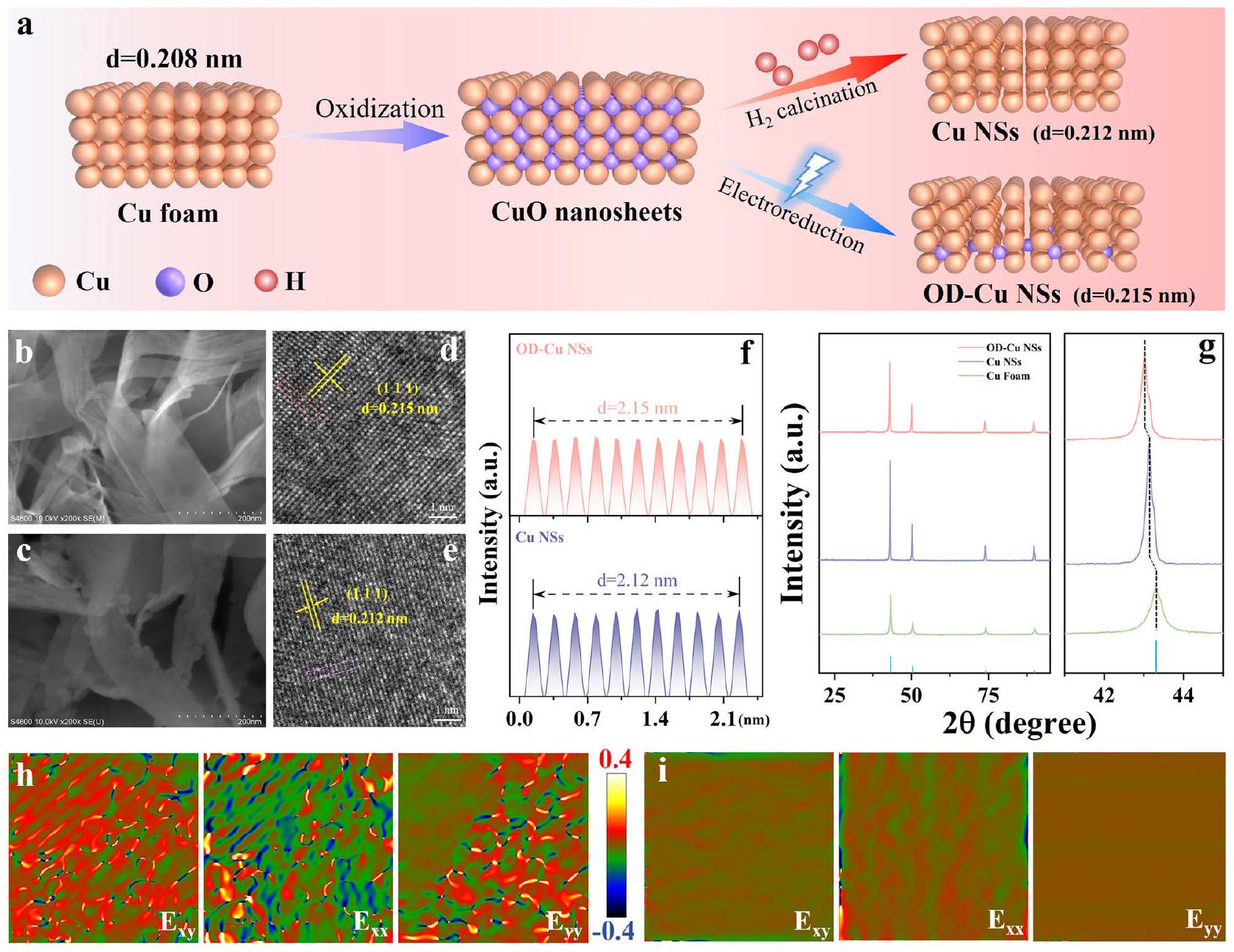
تم تخليق OD-Cu NSs على رغوة النحاس من خلال الأكسدة الكيميائية والتقليل الكهروكيميائي. (الشكل 1أ). تم تنمية رقائق CuO النانوية على رغوة النحاس عن طريق الأكسدة في محلول هيدروكسيد الصوديوم وبيرسلفات الأمونيوم. تم الحصول على رقائق OD-Cu النانوية من خلال الاختزال الكهروكيميائي لرقائق CuO النانوية، حيث تم تحديد جهد الاختزال من مخطط الجهد الدوري الخاص بها (الشكل التكميلي 1). كمرجع، تم تحضير مصفوفات رقائق النحاس النانوية (Cu NSs) عن طريق التكليس لرقائق CuO النانوية تحتتم اختيار درجة حرارة الكلسنة بناءً على الإزالة العميقة للأكسجين الشبكي من خلالالاختزال المبرمج بالحرارةاختبار -TPR) (الشكل التوضيحي 2). تظهر المجهرية الإلكترونية الماسحة (SEM) الشكل النانوي الرقيق والناعم لأوراق OD-Cu NSs (الشكل 1b والشكل التوضيحي 3). ومع ذلك، فإن أسطح أوراق Cu NSs خشنة بسبب هجرة وتجمع الذرات السطحية.
الشكل 1 | المخطط الاصطناعي والتوصيف الشكلي. أ رسم تخطيطي لتخليق نانوكريات النحاس (Cu NSs) ونانوكريات النحاس المؤكسدة (OD-Cu NSs). ب-هـ صور SEM وHRTEM لنانوكريات النحاس المؤكسدة (OD-Cu NSs) (ب، د) ونانوكريات النحاس (Cu NSs) (ج، هـ)، على التوالي. و المسافات الشبكية لنانوكريات النحاس و
أنماط XRD لـ OD-Cu NSs. خريطة مجالات الشد لـ OD-Cu NSs (ح) و Cu NSs (ط) عند، و استنادًا إلى صور HRTEM. تم توفير بيانات المصدر للشكل 1 كملف بيانات مصدر.
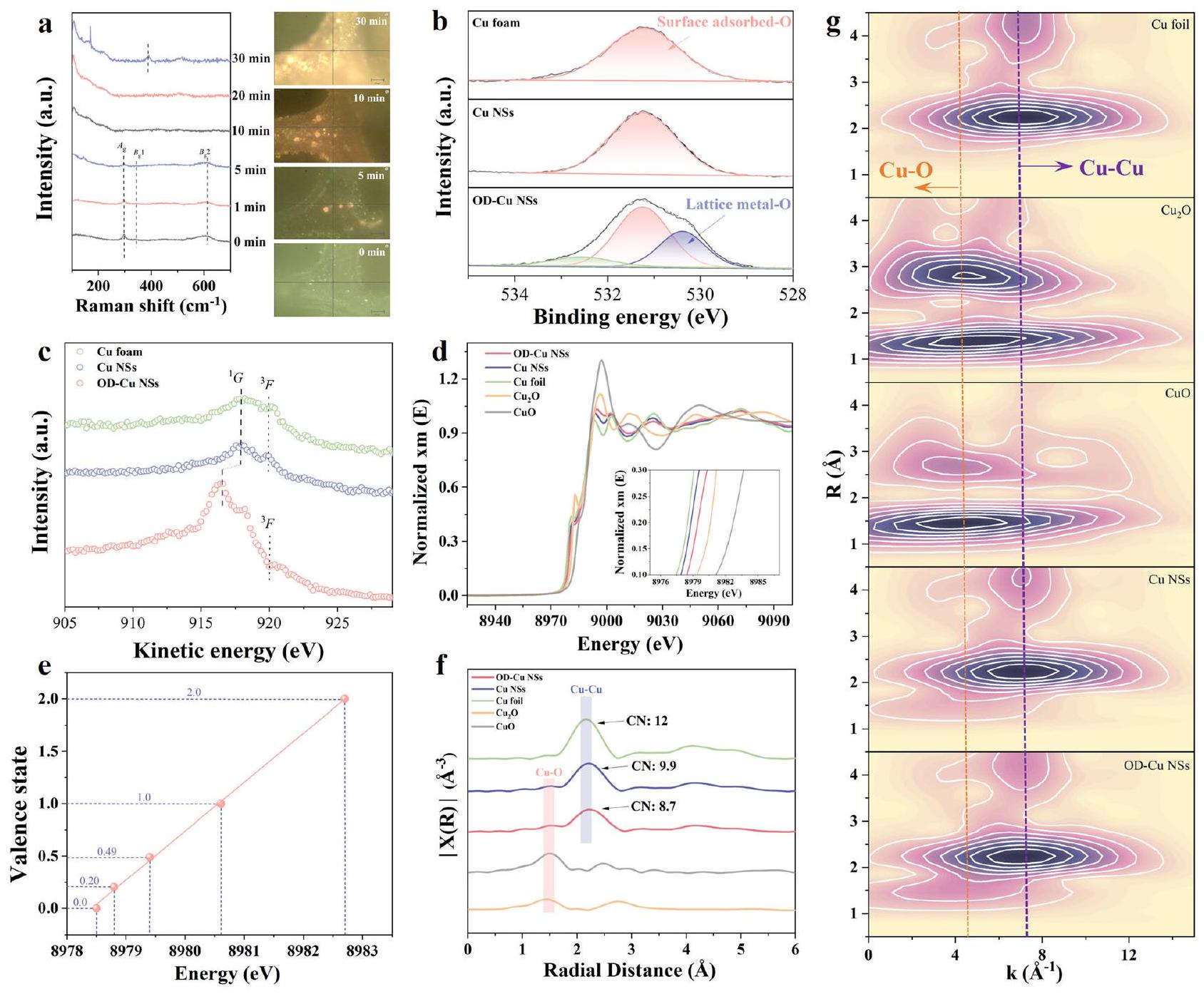
الشكل 2 | التوصيف الهيكلي. أ طيف رامان العامل (اللوحة اليسرى) وصور المجهر الضوئي الزمنية (اللوحة اليمنى) لسطح OD-Cu NSs عندالطيف و (ج)،طيف الأوجر لرغوة النحاس، ونانو أسلاك النحاس، ونانو أسلاك النحاس المؤكسدة. د طيف XANES عند حافة النحاس K. هـ الحالات التكافؤية الملائمة.ال طيف FT-EXAFS الموزون بـ k3 المقابل و (g) ، WT Morlet لبيانات EXAFS الموزونة بـ k3 لرقائق النحاس،نانوكريستالات NSs، وOD-Cu NSs. تم توفير بيانات المصدر للشكل 2 كملف بيانات مصدر. أثناء الاختزال الحراري (الشكل 1c و S3). تكشف المجهر الإلكتروني الناقل عالي الدقة (HRTEM) أن كل من OD-Cu NSs و Cu NSs تظهر هياكل مكعبة متمركزة على الوجوه (fcc) (الشكل 1d و e). ومن الجدير بالذكر أن المسافة الشبكية لطائرة Cu (111) هي 0.215 نانومتر لـ OD-Cu NSs (الشكل 1f)، وهي أكبر من تلك الخاصة بـ و Cu NSsتظهر أنماط حيود الأشعة السينية (XRD) أن قمم الحيود لجزيئات النحاس النانوية (Cu NSs) وجزيئات النحاس النانوية المؤكسدة (OD-Cu NSs) تنتقل إلى زوايا أقل مقارنةً برغوة النحاس (الشكل 1g)، مما يعكس إجهادات الشد في جزيئات النحاس النانوية وجزيئات النحاس النانوية المؤكسدة كما تحددها معادلة براج. تمتلك جزيئات النحاس النانوية المؤكسدة زوايا حيود أقل من جزيئات النحاس النانوية، مما يكشف عن إجهادات الشد الأقوى في جزيئات النحاس النانوية المؤكسدة. تم حساب قيمة إجهاد الشد من خلال تغير تباعد المستويات البلورية. مقارنةً برغوة النحاس، تمتلك جزيئات النحاس النانوية وجزيئات النحاس النانوية المؤكسدة إجهادات شد قدرها و ، على التوالي.
تم تحليل التوزيع المكاني للإجهادات الشد في المحفزات من خلال تحليل الطور الهندسي. تظهر جسيمات النحاس النانوية OD-Cu إجهادات شبكية كبيرة عبر إجهاد القص.إجهاد في المستوى )، وإجهاد خارج المستوى إن شدة الإجهاد لديهم أعلى بكثير من تلك الموجودة في Cu NSs (الشكل 1h و i). وهذا يتماشى مع نتائج XRD و HRTEM. قد تنشأ الإجهادات الشدّية في Cu NSs من تكوين روابط جديدة، أو كسر الروابط، أو إطالة/انحراف الروابط أثناء تشكيل الأوراق النانوية.الضغوط الشبكية الأكثر وضوحًا في
من المحتمل أن تكون الأنسجة النانوية OD-Cu ناتجة عن هروب ذرات الأكسجين المرتبطة بمواقع فرعية رباعية السطوح، مما يؤدي إلى مزيد من توسع الشبكة البلورية.
تم استخدام مطيافية رامان العملية الزمنية لرصد حالة الأكسدة لسطح المحفز أثناء الاختزال الكهربائي في عملية تحضير المحفز (الشكل 2أ والشكل التكميلي 4). يتغير لون سطح OD-Cu NSs تدريجياً من لونه الفيروزي الأولي (CuO) إلى الأصفر الساطع (Cu) بعد الاختزال عند -0.87 فولت (مقابل RHE) فيالإلكتروليت. تظهر طيف رامان عند 0 دقيقة بوضوح ثلاثة قمم عند 297 و 343 و، الذي يتوافق مع ، و أنماط من. مع تقدم عملية الاختزال، تتناقص شدة قمم CuO تدريجياً حتى تختفي مرحلة CuO تماماً عند 10 دقائق. ومن الجدير بالذكر، وجود نطاق جديد عند حوالي يلاحظ ذلك مع استمرار الانخفاض، مما يتوافق مع عملية متعددة الفونونات للأكسجين الشبكي في النحاس. وهذا يشير إلى وجود أكسجين شبكي متبقي وإمكانية تشكيل مرحلة جديدة من أكسيد النحاس الفرعي.. علاوة على ذلك، Oتظهر طيفيات XPS (الشكل 2b) أن الأكسجين الممتص على السطح فقط موجود في رغوة النحاس و Cu NSs، بينما تظهر Cu NSs OD رابطة معدنية-أكسجين شبكية حول 530.6 eV، مما يؤكد وجود الأكسجين الشبكي في Cu NSs OD.يُقدَّر محتوى الأكسجين في الشبكة بـيمكن تحديد حالة التكافؤ للنحاس من المواقع و قمم في طيف أوغر للنحاس ( الانتقال). الـقمم لـ، و عادة ما تكون موجودة في، و 918.0 إلكترون فولت، على التوالي. بالإضافة إلى ذلك، الـالقمة بارزة في الطيف لـلكن ليس في الأطياف لـ و . كما هو موضح في الشكل 2ج، الـتوجد القمم لرغوة النحاس ونانوسكريات النحاس عند 918.0 إلكترون فولت مع وجود ذروة، تتماشى مع خصائص. من الجدير بالذكر، أن ذروة OD-Cu NSs تنتقل إلى حوالي 916.5 إلكترون فولت، أقل من تلك الخاصة بـ و لكن قريب من. علاوة على ذلك، الـذروة تتعلق بـلا يزال يظهر في OD-Cu NSs. تشير هذه النتائج إلى أن حالة التكافؤ لـ OD-Cu NSs هي.
تم استخدام مطيافية هيكل الامتصاص القريب من الحافة (XANES) للتحقيق في الهيكل الإلكتروني وبيئة التنسيق للعوامل الحفازة. كما هو موضح في الشكل 2d، تظهر جسيمات النحاس النانوية (Cu NSs) ورقة النحاس (Cu foil) اختلافات غير ملحوظة في حافة الامتصاص وشدة الانتقال، مما يشير إلى أن جسيمات النحاس النانوية والنحاس لهما بيئات تنسيق مشابهة. ومع ذلك، فإن جسيمات النحاس النانوية OD-Cu لديها طاقة امتصاص قريبة من الحافة أعلى وطاقة أقل.شدة الانتقال بالمقارنة مع رقائق النحاس ونانوسكريات النحاس، كاشفة عن شذوذالهجين في ذرات النحاس في OD-Cuيمكن أن يُعزى ذلك إلى انخفاض كثافة الإلكترون في مدارات 4p الناتج عن الخاصية القوية لسحب الإلكترونات من ذرات الأكسجين المتبقية في الشبكة.. بالإضافة إلى ذلك، فإن طاقة الامتصاص القريبة من الحافة لجزيئات ODCu النانوية أقل من تلك الخاصة بـمع حالة قيمة ملائمة تبلغ 0.49، مما يشير إلى بيئة محلية مختلطة لذرات النحاس (الشكل 2e). في طيف EXAFS المحول فورييه مع وزن k3 (FT-EXAFS) (الشكل 2f)، يوجد قمة مميزة لـ Cu-O ( ) يظهر في OD-Cu NSs، مما يؤكد وجود الأكسجين الشبكي المتبقي. شدة الذروة لـ رابطةفي OD-Cu NSs أقل بكثير من تلك الموجودة في رقائق النحاس و Cu NSs، مما يشير إلى أن عدم تشبع تنسيق النحاس-نحاس في OD-Cu NSs قد زاد بسبب وجود ذرات الأكسجين الشبكي. علاوة على ذلك، فإن قمم النحاس-نحاس في OD-Cu NSs و Cu NSs قد انزاحت قليلاً إلى مسافة شعاعية أكبر، مما يتماشى مع وجود إجهادات شد شبكية.تظهر مخططات تحويل الموجة مورليت (WT) أن كل من جسيمات النحاس النانوية (Cu NSs) وجسيمات النحاس النانوية المؤكسدة (OD-Cu NSs) تظهر أعلى القمم عند (الشكل 2g)، الذي يتوافق مع غلاف النحاس-نحاس. تظهر نانوكراتيل النحاس-النحاس الخارجي غلافًا مميزًا من النحاس-أكسجين عند ، مما يدعم وجود الأكسجين المتبقي في الشبكة في OD-Cu NSs. تشير عملية التوافق EXAFS (الشكل التكميلي 5، 6 والجدول التكميلي 1) إلى أن عدد تنسيق Cu -Cu (CN) في OD-Cu NSs هو 8.7، وهو أقل بكثير من تلك الموجودة في Cu NSs (9.9) وCu foil (12)، وهو ما يمكن تفسيره بأن الأكسجين المتبقي في الشبكة في OD-Cu NSs يقلل من تشبع تنسيق Cu-Cu. بالإضافة إلى ذلك، فإن متوسط عدد التنسيق لـالقشرة في NSs من OD-Cu هيم revealing التشبع الجزئي لذرات النحاس بواسطة ذرات الأكسجين في OD-Cu NSs.
أداء eNO3RR لـ OD-Cu NSs
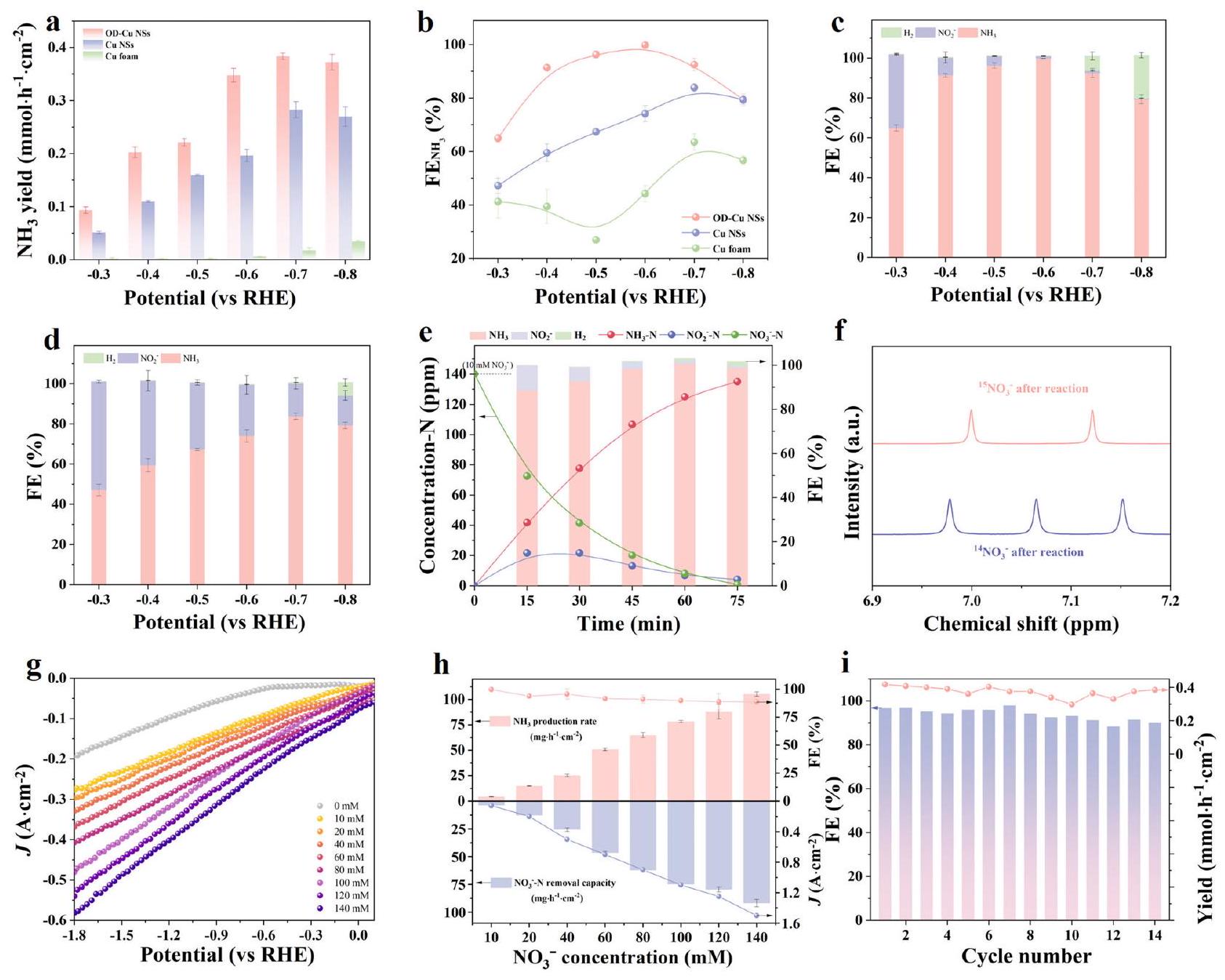
تم تقييم أداء eNO3RR في خلية من نوع H تحت ظروف محيطية. بالنظر إلى السيناريوهات العملية، فإن حالة محايدةتم اختيار الإلكتروليت. تظهر منحنيات الفولتاموجرافيا المسحية الخطية (LSV) لجزيئات OD-Cu (الشكل التوضيحي 7) استجابة تيار مميزة لـعند جهد أكثر سلبية من -0.1 فولت (مقابل RHE)، مما يشير إلى نشاطه الجيد في eNO3RR.التحويل إلىتم تقييمه بشكل إضافي عند -0.3 فولت إلى -0.8 فولت.تم الكشف عنه كميًا بواسطة الطريقة اللونية وتم التحقق من صحته بواسطة-NMR (الشكل التوضيحي 8). من الجدير بالذكر أنعائدات OD-Cu NSs أعلى من عائدات Cu NSs ورغوة النحاس تحت جميع الجهود المطبقة (الشكل 3a). عند -0.7 فولت، تنتج OD-Cu NSsعند أقصى عائد من، وهو أعلى بمقدار 1.4 مرة من CuNSs، مما يبرز الدور الهام للأكسجين الشبكي والضغط الشد في تعزيز eNO3RR.تظهر OD-Cu NSs اتجاهًا على شكل بركان مع تغير الجهد (الشكل 3b). عند -0.3 فولت، يتم تراكم تركيز عالٍ من النيتريت كـ *لا يمكن تحويله بكفاءة، مما يؤدي إلى انخفاض (الشكل 3ج). كما هو متوقع، فإنيزداد بشكل ملحوظ، ويتم تحويل النيتريت بسرعة عند إمكانيات أكثر سلبية. عند -0.6 فولت، المن OD-Cu NSs هو، أعلى بكثير من تلك الخاصة بـ Cu NSs (74.2%) ورغوة النحاس (44.2%). إن كفاءةفقطلـ OD-Cu NSs، أقل بكثير منلـ Cu NSs و لرغوة النحاس (الشكل 3d والشكل التكميلي 9).تركيز OD-Cu NSs أقل بكثير من تركيز Cu NSs ورغوة النحاس (الشكل التكميلي 10). وهذا يشير إلى أن OD-Cu NSs يمكن أن تعزز بشكل فعال تحويل النيتريت وتخفف *سم في المواقع النشطة. توليد المنتجات الثانوية مثل، و يعتبر ضئيلاً بالنسبة لـ eNO3RR على OD-Cu NSs استنادًا إلى نتائج قياس الطيف الكتلي الكهربائي التفاضلي عبر الإنترنت (DEMS) وطرق قياس الألوان (الشكل التكميلي 11-14). بالنظر إلى أن OD-Cu NSs و Cu NSs لهما شكل وهيكل بلوري مشابه، يمكن أن يُعزى الأداء الأفضل لـ OD-Cu NSs إلى الأكسجين المتبقي في الشبكة والضغوط الشدّية، مما يزيد من المواقع النشطة ويؤدي إلى زيادة مساحة السطح النشطة كهربائيًا (الشكل التكميلي 15، 16). تنخفض قدرة الأكسدة للـ OD-Cu NSs عند الجهود السلبية الأكثر بسبب حدوث تطور الهيدروجين. بالإضافة إلى ذلك، فإن الـ OD-Cu NSs فعالة أيضًا لـالإنتاج عند تركيزات منخفضة من الإلكتروليتمعمن 91.2-96.7% (الشكل التوضيحي 17). لتقييم أداء نزع النيتروجين لجزيئات OD-Cu، تم إجراء اختبار دفعي لـتمت عملية التحويل عند -0.6 فولت. كما هو موضح في الشكل 3e، تم استهلاك تقريبًا كل النيتروجينيتم تحويله إلىبعد 75 دقيقة، وتركيزات و أقل بكثير من معايير منظمة الصحة العالمية (WHO) لمياه الشربتم إجراء تجربة وسم النظائر eNO3RR باستخدامكمصدر للنيتروجين (الشكل 3f). النتائج الكمية لـكانت شبه متطابقة مع تلك لـمنالخفض (الشكل التوضيحي 18)، الذي يثبت أن يتم إنشاؤه من تقليل بدلاً من مصادر النيتروجين الأخرى.
تتراوح تركيزات النترات عادةً من عشرة إلى أكثر من مئة مليمول لكل لتر في مياه الصرف الصناعي.من الضروري أن يظهر المحفز أداءً ممتازًا في تحويل النترات إلى الأمونيا عبر نطاق واسع منالتركيزات. هناتم استكشاف أداء التخليق لـ OD-Cu NSs بشكل أعمق تحتتظهر منحنيات LSV أن كثافة التيار تزداد بشكل ملحوظ مع ارتفاعالتركيز (الشكل 3g)، مما يدل على الأداء الجيد لـ eNO3RR لـ OD-Cu NSs عبر نطاق واسع منتركيزات. إنتركيب منتم فحصه فيمع الأخذ في الاعتبار أنعادة ما تنخفض تحت كثافة تيار عاليةكما هو موضح في الشكل 3h، تحافظ جسيمات نانو النحاس على مستوى عالٍعلى نطاق واسع منتركيزات، تتجاوزحتى عند كثافة تيار أعلى. علاوة على ذلك، كلا من تتحسن العائد وقدرة نزع النيتروجين مع زيادةالتركيز وكثافة التيار. عندو، الـ هو مععائد من و معدل الإزالة– ن. من الجدير بالذكر أن أنظمة OD-Cu تتفوق على المحفزات الكهربائية التي تم الإبلاغ عنها مؤخرًا بمستويات أعلىالعائد مع الحفاظ على مستوى متساوٍ أو حتى أعلىتحت ظروف مماثلةالجدول التكميلي 2). في الوقت نفسه، تحافظ جسيمات أكسيد النحاس على نسبة تحويل عالية لـالإنتاج خلال 14 ساعة منالخفض (10 مللي مولار، الشكل 3i والشكل التكميلي 19)، مما يوضح المتانة الجيدة لجزيئات OD-Cu النانوية لـالتركيب. بعد اختبار الاستقرار، تحتفظ ODCu NSs بشكل النانو شيت الأولي وإجهادات الشبكة (الشكل التكميلي 20a، b). علاوة على ذلك، XPS وتثبت طيفيات الأوجر الحفاظ الجيد على الأكسجين الشبكي وحالة الفلز النحاسي بعد 14 دورة من eNO3RR، مما يكشف عن استقراره الجيد (الشكل التكميلي 20c، d). في الوقت نفسه، تؤكد طيفيات رامان في الموقع الحفاظ الجيد على الأكسجين الشبكي لـ OD-Cu NSs (الشكل التكميلي 21). تعتبر OD-Cu NSs مستقرة لـ eNO3RR دون إعادة بناء الهيكل.
آلية التحفيز لجزيئات نانو النحاس المؤكسد
تقليلإلىيتضمن عملية نقل معقدة تتعلق بـ 8 إلكترونات و 9 بروتونات. بالنسبة للعوامل الحفازة المعتمدة على النحاس، هناك تحديات كبيرة في تحويل وهدرجة الوسائط مثل *مما يؤدي إلى أداء محدود في eNO3RRللتحقيق في
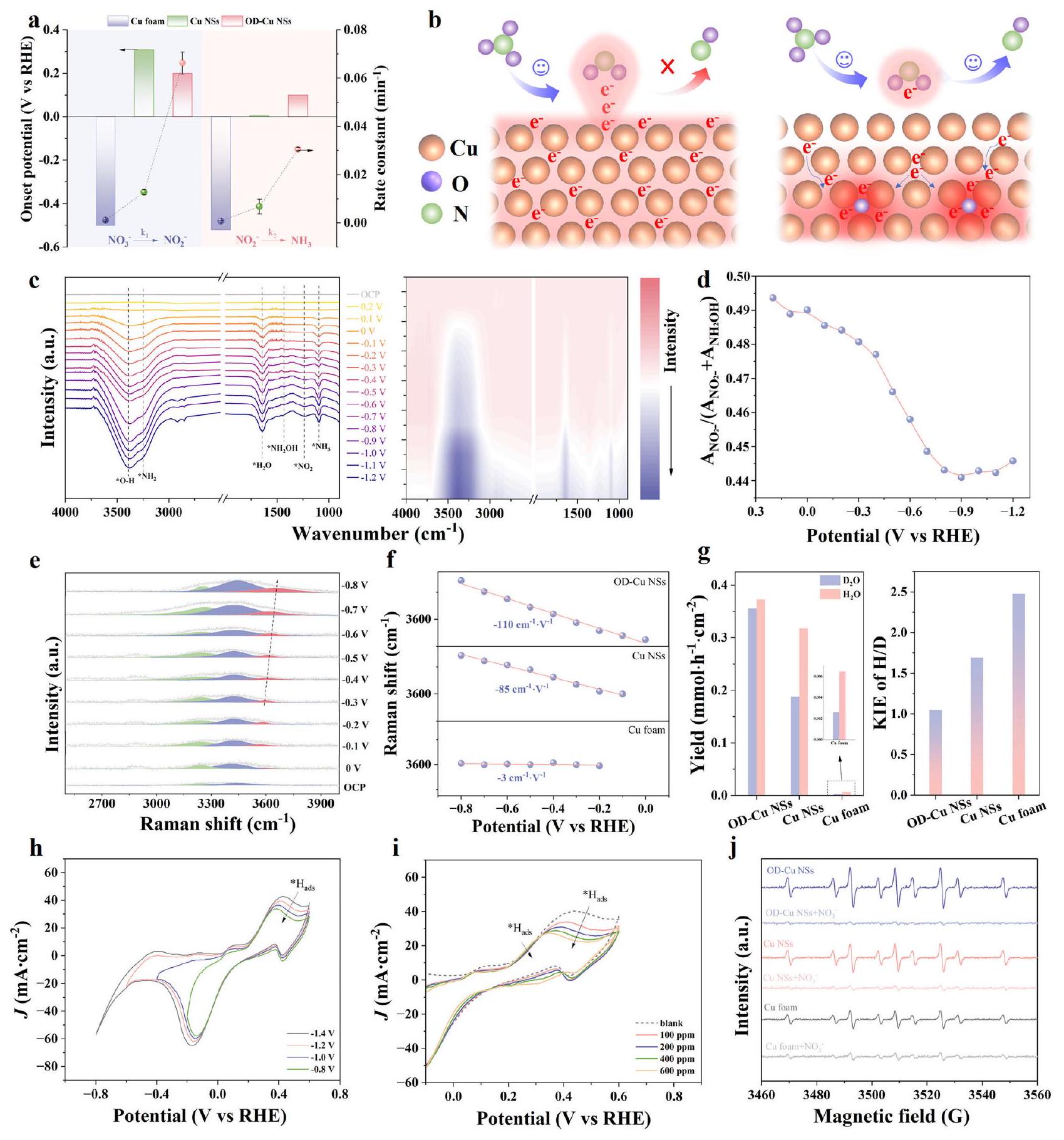
الشكل 3 | الأداء لـ eNO3RR. أالعوائد و (ب)، العوامل الثابتة المقابلة لـتقليل على رغوة النحاس، ونانو أسلاك النحاس، ونانو أسلاك النحاس المؤكسدة. ج، د توزيع المنتج لنانو أسلاك النحاس المؤكسدة (ج) ونانو أسلاك النحاس (د). هـ التركيزات المعتمدة على الزمن لـ، و أثناء التخفيض لـعلى OD-Cu NSs.طيف NMR لعينات من NSs-Cu OD المحفزةأوتقليل. ج LSV المنحنيات و (هـ) ، قدرات إزالة النترات ومعدلات إنتاج أنابيب النحاس النانوية OD-Cu عند. استقرار أنظمة OD-Cu لمدة 14 دورة متتالية من خفض فيالكهربائي). تمثل أشرطة الخطأ الانحراف المعياري من ثلاثة قياسات مستقلة. لم يتم تصحيح جميع الجهود من تأثير المقاومة الداخلية. تم توفير بيانات المصدر للشكل 3 كملف بيانات مصدر. قدرة OD-Cu NSs على تحويل الوسائط، ثوابت المعدل لـالتحويل إلى(الشكل التوضيحي الإضافي 22، 23التحويل إلىتم حساب الشكل التوضيحي الإضافي 24 و 25 لتقييم حركية التفاعل. في هذه الأثناء، فإن إمكانيات البداية لـوتمت مقارنة الانخفاض في OD-Cu NSs وCu NSs ورغوة النحاس (الشكل التوضيحي 26). كما يتضح من الشكل 4a، فإن OD-Cu NSs لديها أعلى و القيم بين المحفزات الثلاثة، مما يثبت أن OD-Cu NSs يمكن أن تحقق سرعة والتحويل. ومن الجدير بالذكر أن أنظمة OD-Cu لديها أقل جهد بدء.الخفض، الذي يوضح بشكل أكبر جودته الممتازةأداء التحويل. يمكن أن يُعزى ذلك إلى وجود الأكسجين المتبقي في الشبكة، الذي يحد من الإلكترونات الحرة على سطح النحاس ويسهلإزالة الامتصاص والتحويل (الشكل 4ب، اللوحة اليمنى). لتوضيح تأثير الأكسجين الشبكي على تحويل *NO2، تم استخدام OD-Cu مع الأكسجين الشبكي والضغط الشدّي لـ (OD-Cu ) تم إعدادها (الشكل التوضيحي التكميلي 27a، b). OD-Cu لها نفس قيمة إجهاد الشد مثل Cu NSs، لكنها تظهر بشكل ملحوظ أعلىوتراكم النيتريت أقل من Cu NSs في eNO3RR تحت نفس الظروف (الشكل التوضيحي 27c، d)، مما يوضح الدور الحاسم للأكسجين الشبكي في تعزيز *تحويل والإنتاج. على الرغم من أن Cu NSs لديها جهد بدء أقل لـتقليل من OD-Cu NSs، إنه و القيم أقل من تلك الخاصة بـ OD-Cu NSs. هذا قد يكون ناتجًا عن أن الخاصية المعدنية لجسيمات النحاس النانوية تفضلتقليل، لكن الناتجتسمم المواقع النشطة ويقلل من معدل التفاعل (الشكل 4ب، اللوحة اليسرى). بالنسبة لرغوة النحاس، كلاهماويتطلب الاختزال جهدًا عاليًا مع أدنى و القيم. هذا يتماشى مع أسوأ أداء لـ eNO3RR.
تم استخدام مطيافية ATR-FTIR في الموقع لاستكشاف التطور الديناميكي للوسطاء الناتجين عن eNO3RR على ODCu NSs (الشكل التكميلي 28). كما هو موضح في الشكل 4c، فإن القمة المميزة عنديتوافق مع اهتزاز الانحناء لـ *في طبقة الإلكتروليت الرقيقة. في الوقت نفسه، ذروة الامتصاص القوية عند يُنسب إلى * التمدد. وهذا يعني أن نانوشرائح النحاس المؤكسد (OD-Cu NSs) ملائمة لامتصاص وتحلل الماء لإنتاج. الفرقة في يمكن تعيينه إلىانحناء. الوسيط في يُنسب إلى مادة وسيطة رئيسية لـتشكيل. في الوقت نفسه، الشريط السفلي في ينتمي إلى *. مع انتقال الجهد من -0.3 فولت إلى -0.7 فولت، تزداد شدة الذروة لـ *يزداد تدريجياً ثم يستقر فجأة عند -0.7 فولت، مما يشير إلى أن *يخضع لتحويل سريع. من الجدير بالذكر أن نسبة *منطقة الذروة إلى المساحة الكلية لـ * و * تنخفض بشكل حاد مع تحول السلبية المحتملة (الشكل 4د). في الوقت نفسه، فإن شدة الذروة لـ *يظهر تحسينًا تدريجيًا عند إمكانيات أكثر سلبية.
الشكل 4 | تحليل الآلية لتحويل *NO2 وتوليد *H. أ. إمكانيات البداية وثوابت التفاعل لـالتحويل إلى و التحويل إلىعلى OD-Cu NSs، Cu NSs، ورغوة Cu في(تمثل أشرطة الخطأ الانحراف المعياري من ثلاث قياسات مستقلة). ب مخطط تخطيطي لامتصاص الوسيط الذي يتوسطه الأكسجين الشبكي على سطح النحاس. ج طيف ATR-FTIR العامل وخريطة كونتور FTIR ثنائية الأبعاد. دو (هـ)، طيف رامان في الموقع لمياه الواجهة المختلفة خلال eNO3RR على OD-Cu NSs عند إمكانيات مختلفة. تحول عدد الموجات لذرة الأكسجين العالقة مع التغيرات المحتملة.العوائد وقيم KIE لـ eNO3RR عند -0.6 فولت باستخدام و كمذيبات. الفولتموجرامات الدائرية لـ OD-Cu NSs في (h)، مشبعة بالغاز الأرجون تحت إمكانيات بدء مختلفة و (ط)، مختلفة تركيزات. طيف EPR لإشارة *H لـ OD-Cu NSs و Cu NSs ورغوة Cu مع وجود وبدون وجود النتراتلم يتم تصحيح جميع الإمكانيات باستخدام تقنية iR. تم توفير بيانات المصدر للشكل 4 كملف بيانات مصدر.
ومع ذلك، فإن كل من أنسجة النحاس ورغوة النحاس تظهران تميزًاالإشارات، وذروة شدة *تقريبًا تبقى دون تغيير مع التحول السلبي للإمكانات (الشكل التكميلي 29). تشير هذه النتائج إلى أن OD-Cu NSs أكثر كفاءة في تحويل *إلى.
إمداد *H من تفكك الماء هو خطوة رئيسية لـالإنتاج في محلول محايدتم استخدام مطيافية رامان في الموقع لتحليل قمة الماء عندمن خلال التناسب الغاوسي لـ ذروة الماء الواجهاتي، المنسق بأربعة أوجه (تترا- ، )، منسق ثلاثي الوجوه ثلاثيوتعليقرابطةمنيمكن العثور عليه. المتدليهو تكوين ضعيف لرابطة هيدروجينية، يميل إلى الامتصاص على سطح المحفز والانفصال لتوليد *H. يتم إزاحة موقعه نحو الأحمر مع انخفاض الجهد (الشكل 4e)، مما يشير إلى الانفصال التفضيلي لرابطة O-H المعلقة على OD-Cu NSs.تحول أضعف لذرة الأكسجين المرتبطة بالهيدروجين يلاحظ وجود قمة تحت إمكانيات سلبية أكثر على Cu NSs، ويلاحظ تحول ضئيل على Cu foam مقارنةً بـ OD-Cu NSs (الشكل التكميلي 30، 31). من الجدير بالذكر أن انحدارات إزاحة قمة O-H المعلقة تظهر اتجاه OD-Cu NSs.أن إس إسرغوة (الشكل 4f)، مما يشير إلى أن OD-Cu NSs أكثر ملاءمة لتوليد *H من تفكك الماء. تظهر OD-Cu NSs و Cu NSs قدرة معززة بشكل ملحوظ على تفكك الماء إلى *H مقارنةً برغوة النحاس. لا تحتوي كل من Cu NSs ورغوة النحاس على أكسجين شبكي، ولكن Cu NSs تحتوي على إجهادات شد مقارنةً برغوة النحاس. من المعقول أن نفترض أن إجهادات الشد تلعب دورًا رئيسيًا في تعزيز إمداد *H من تفكك الماء.
أثر النظائر الحركية (KIE) لـ H/D ) تم فحص eNO3RR بشكل إضافي للتحقق من دور إجهادات الشد الشبكي في تسريع الانفصال. قيمة KIE هي مؤشر جيد لديناميكية نقل البروتون، حيث توفر رؤى حول الخطوة المحددة لمعدل التفاعل (RDS). KIEيشير إلى أن نقل البروتون متورط في الخطوة المحددة بمعدل التفاعل، بينما KIEيشير إلى أن نقل البروتون ليس عاملاً محددًا. كما هو موضح في الشكل 4 ج، عائد رغوة النحاس ينخفض بشكل ملحوظ بعد الاستبدال بـبواسطةوقيمة KIE لها هي 2.47، مما يشير إلى إمداد محدود من البروتونات لعملية eNO3RR. تظهر Cu NSs تغيرًا أصغر فيالعائد وكثافة التيار بعد الاستبدالبواسطة (الشكل التوضيحي 32) وقيمة KIE تبلغ 1.69، مما يشير إلى أن قدرة إمداد البروتونات من Cu NSs تتعزز من خلال إدخال الضغوط الشد. من المثير للاهتمام أن العائد وكثافة التيار (الشكل التكميلي 33) لجزيئات نانو النحاس (OD-Cu NSs) تبقى تقريبًا دون تغيير بعد الاستبدالبواسطة، وقيمة KIE الخاصة بها هي فقط 1.05. قد يكون هذا الظاهرة ناتجة عن حقيقة أن OD-Cu NSs لديها إجهادات شد أقوى، مما يعزز تفكك الماء ويوفر كمية كافية من *H للهيدروجين. علاوة على ذلك، فإن العلاقة الخطية بين إجهاد الشد وقيمة KIE تؤكد أكثر أن إجهاد الشد يسرع من توليد *H (الشكل التوضيحي 34). تم التحقيق في قدرة توليد *H للمواد الحفازة من خلال قياسشدة الذروة من خلال الفولتموغرام الدوري عند إمكانيات ابتدائية مختلفة. تظهر جسيمات نانوية من النحاس المؤكسد (OD-Cu NSs) قوة أكبر ذروة الشدة وزيادة أكبر في الشدة مقارنةً بجزيئات النحاس النانوية مع انخفاض الجهد المطبق، في حين أن التأثير ضئيل * يظهر الذروة لرغوة النحاس (الشكل 4h والشكل التكميلي 35، 36). يؤكد ذلك الدور الحيوي للإجهاد الشد في تعزيز توليد *H. من خلال زيادةتركيز اختبار الفولتموغرام الدوري،تتقلص الكثافة على OD-Cu NSs بشكل واضح (الشكل 4i)، مما يشير إلى أن *H يلعب دورًا حاسمًا في تعزيزالخفض. إن قدرة توليد واستخدام *H الجيدة لها مثبتة أيضًا من خلال طيف EPR (الشكل 4j). تظهر OD-Cu NSs شدة إشارة *H أقوى من Cu NSs ورغوة النحاس.تقريبًا تختفي إشارة *H بعد إضافة النترات. بالمقابل، يكون استهلاك *H أبطأ بالنسبة لجزيئات النحاس النانوية (Cu NSs) ورغوة النحاس (Cu foam). وهذا يؤكد تزويد *H المعجل واستخدامه من قبل جزيئات النحاس النانوية OD-Cu في تقليل النترات.
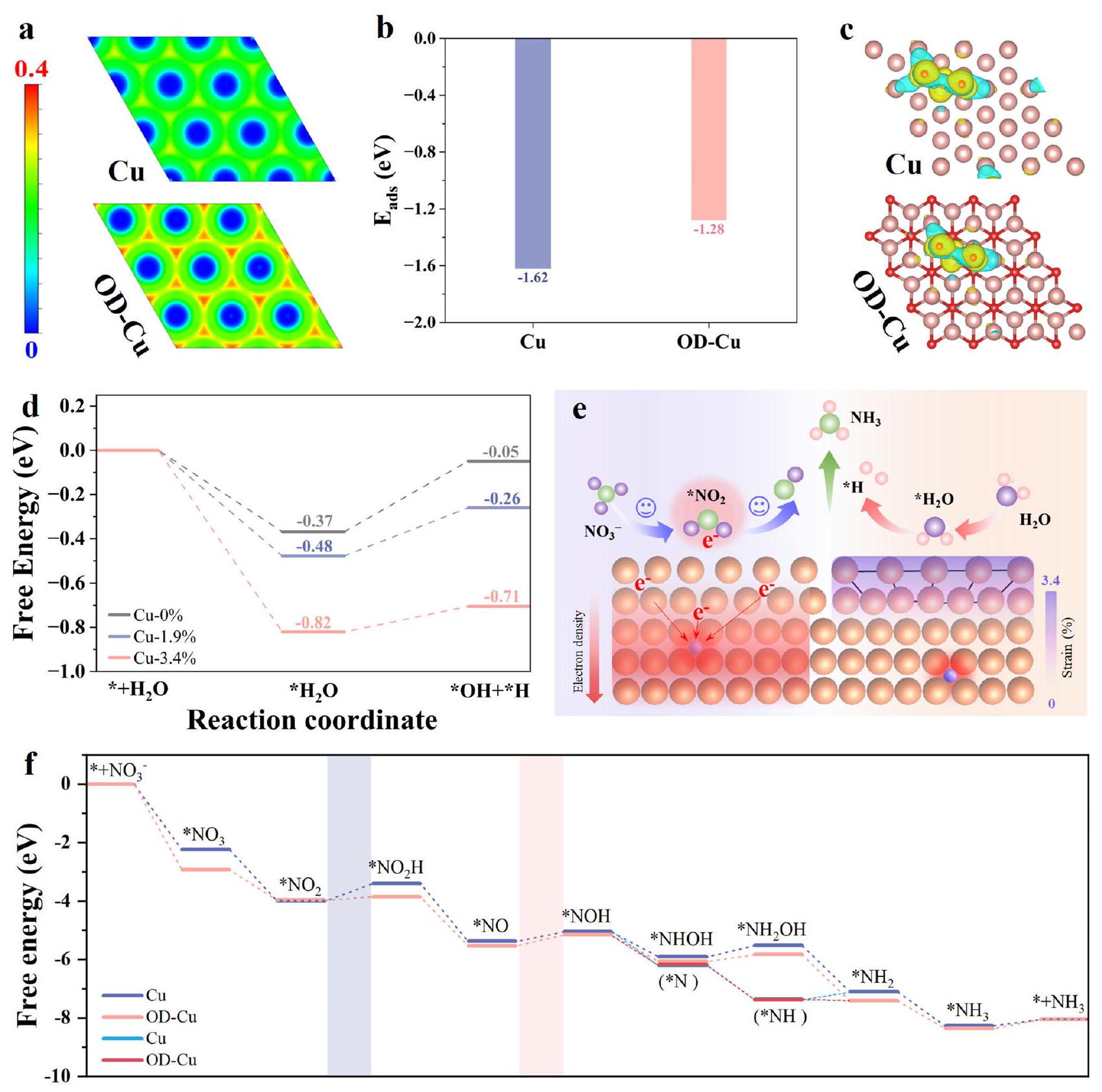
تم استخدام حسابات نظرية الكثافة الوظيفية (DFT) لتوضيح آلية الأكسجين المتبقي في الشبكة والضغط الشبكي لتنظيم نشاط eNO3RR لـ OD-Cu NSs. استنادًا إلى التوافق الجيد بين بيانات FT-EXAFS لـ OD-Cu NSs ونتائج EXAFS المحاكية للنحاس تحت الأكسيد غير النمطي في الأعمال السابقة.، قمنا ببناء نموذج OD-Cu ( ) (البيانات التكميلية 1). للتحقيق في تأثير الأكسجين المتبقي في الشبكة على eNO3RR، لم يتم إدخال إجهاد الشد في النموذج الحسابي. تم التحقيق في تأثير الأكسجين المتبقي في الشبكة على الحالة الإلكترونية لسطح النحاس (الشكل التكميلية 37). كما هو موضح في خريطة وظيفة تحديد موضع الإلكترون (ELF) (الشكل 5a)، فإن الإلكترونات السطحية على OD-Cu التي تحتوي على الأكسجين المتبقي في الشبكة أكثر تركيزًا مقارنة بتلك الموجودة على سطح النحاس.. وهذا يعني أن الإلكترونات التكافؤية في OD-Cu أقل حرية في الحركة عبر السطح، مما يضعف الربط الإلكتروني بين سطح المحفز و * . هذا يساعد على تقليل قوة الامتزاز لـ * المتوسط. الجهد المطبق له تأثير غير مهم على الهياكل الإلكترونية لـ OD-Cu و Cu تحت الظروف المدروسة. (الشكل التوضيحي 38). طاقة الامتزاز لـ *تم حساب التفاعلات على سطح OD-Cu وسطح Cu بشكل إضافي (الشكل التكميلي 39). كما هو موضح في الشكل 5b، فإن امتصاص *NO2 على سطح OD-Cu (-1.28 eV) أضعف من ذلك على سطح Cu (-1.62 eV)، وهو ما يُعزى إلى التأثير القوي لسحب الإلكترونات من الأكسجين الشبكي تحت السطح على OD-Cu. هذا يقلل من انتقال الإلكترونات بين سطحه و* (الشكل 5ج)، مما يخفف من سم المواقع النشطة.
لاستكشاف تأثير الشد على توليد *H من تفكك الماء، تم إجراء حسابات DFT على نماذج منمع، و إجهادات الشد في الشبكة (المشار إليها بـ Cu، و استنادًا إلى الضغوط الشدّية الملحوظة في ODCu NSs و Cu NSs (الشكل التكميلي 40-43 والبيانات التكملية 1). طاقة امتصاص الماء هي -0.37 eV لـ، الذي ينخفض إلى -0.48 إلكترون فولت لـو -0.82 إلكترون فولت لـتسهيل امتصاص الماء على سطح النحاس مع زيادة الضغوط الشد. قد يكون ذلك بسبب التغير في الهيكل الإلكتروني نتيجة زيادة الضغوط الشد، مما يؤدي إلى ارتفاع في مستواه.-مركز حزمة d (الشكل التوضيحي 44). إن ارتفاع مركز حزمة d يعزز التفاعل بين سطح المحفز والماء، مما يحسن من امتصاص جزيئات الماء. إن تسهيل امتصاص الماء يعزز من تفكك الماء اللاحق لإنتاج *H. كما هو موضح في الشكل 5d، Cuيعرض حاجز طاقة منخفض ) لـ الانفصال إلى، بينما يزداد إلى 0.22 إلكترون فولت لـو 0.32 إلكترون فولت لـ“، مما يشير إلى أن الإجهادات الشد أكبر تكون أكثر ملاءمة لتوليد *H. بالإضافة إلى ذلك، فإن بروتنة ذرات الأكسجين السطحية لـ OD-Cu غير مواتية من الناحية الديناميكية الحرارية مقارنة بـ eNO3RR (الشكل التكميلي 45)، وهو ما من غير المحتمل أن يؤثر على *التحويل وتفكك الماء. تؤكد كل من النتائج النظرية والتجريبية أن التعديل الإلكتروني الذي تتوسطه الأكسجين المتبقي في الشبكة يعزز بشكل فعال *التحويل ويخفف من سمية الموقع النشط. في الوقت نفسه، تعمل الضغوط الشد على تحسين قدرة تفكك الماء للنحاس، مما يوفر كمية كافية من *H للهيدروجين. تعزز التأثيرات التآزرية للأكسجين المتبقي في الشبكة والضغوط الشدالتركيب على OD-Cu NSs (الشكل 5e).
لاستكشاف مسار التفاعل لـ eNO3RR، تم تحديد وسائط التفاعل بواسطة رامان في الموقع وDEMS. في طيف رامان (الشكل التكميلي 46)،يلاحظ ذروة التمدد عند تحت جهد الدائرة المفتوحة (OCP). عند تطبيق جهد سالب، القمة تختفي تدريجياً، بينما تظهر شريطان جديدان من رامان عند و ، الذي يتوافق مع التمدد غير المتماثل لـ و ، على التوالي. شدة الإشارة لـ * تزداد أولاً ثم تختفي مع التحول السلبي للإمكان. يكشف عن توليد *وتحوّله إلى الأمونيا خلال eNO3RR. تُظهر DEMS عبر الإنترنت إشارة قوية عندالذي يُنسب إلى (الشكل التوضيحي 11). الإشارات الأخرى عند ، ويمكن تخصيص 30 لـ، و لا، على التوالي. شدة الإشارات لهذه الوسائط أقل بمقدار 1-4 أوامر من حيث الحجم مقارنة بـ ، والتي قد تكون مرتبطة بالتحويل السريع لهذه الوسائط. هذه النتائج تتماشى مع بيانات ATR-FTIR في الموقع في الشكل 4c. استنادًا إلى الوسائط المكتشفة، تم استكشاف مسار eNO3RR وأطوال التفاعل الحرة على أسطح OD-Cu وCu من خلال حسابات DFT. كما هو موضح في الشكل 5f، يبدأ التفاعل بامتصاص على سطح المحفز، و* التي تشكلت يتم تحويله بشكل عفوي إلى * عبركسر الروابط. الـ *الهدرجة إلى *هي عملية صعبة مع الطاقة الحرة البالغة 0.11 إلكترون فولت على سطح OD-Cu، وهي أقل بكثير من تلك الموجودة على سطح Cu.، مع تسليط الضوء على دور الأكسجين المتبقي في تعزيز *التحويل وكبح تراكم النيتريت. بعد ذلك، * يتم تحويله إلى *NO، يليه *NO تقليل إلى *NOH. يتم تقليل *NOH الناتج بشكل أكبر إلى * عبر مسار * * * * * أو * * * * (عملية انحدارية). يتم إنشاؤه بعد * إزالة الامتصاص من سطح المحفز. من الجدير بالذكر أن الخطوة المحددة لمعدل التفاعل (RDS) على OD-Cu هي *NO → *NOH. حاجز الطاقة لها هو 0.37 إلكترون فولت، وهو أقل بكثير من
الشكل 5 | آلية التفاعل من حسابات DFT. أ خرائط ELF و (ب) طاقات الامتزازعلى أسطح النحاس وOD-Cu. ج نموذج الامتزاز واختلاف كثافة الشحنة للنحاس وOD-Cu (تراكم وحذف الإلكترونات موضحان باللون الأزرق والأصفر). د الطاقة الحرة لجيبس لـالانفصال إلى * H على Cu – و الأسطح. الرسم التخطيطي لعملية تقليل النترات المحفزة بواسطة تنظيم الإلكترونات المتوسطة للأكسجين في الشبكة والتفكك المائي المدعوم بشد الشبكة.مخططات الطاقة الحرة لجيبس لـ eNO3RR على أسطح النحاس وODCu. تم توفير بيانات المصدر للشكل 5 كملف بيانات مصدر. 0.60 إلكترون فولت ل RDS من. في هذه الأثناء، تأثير الضغوط الشد على تقليل حاجز الطاقة لعملية RDS غير مهم بالنسبة لـ OD-Cu (الشكل التكميلي 47). هذه النتائج توضح أن الأكسجين الشبكي لـ OD-Cu يقلل بشكل كبير من حاجز الطاقة لعملية eNO3RR ويعزز الإنتاج.
طلب استرداد الأمونيا
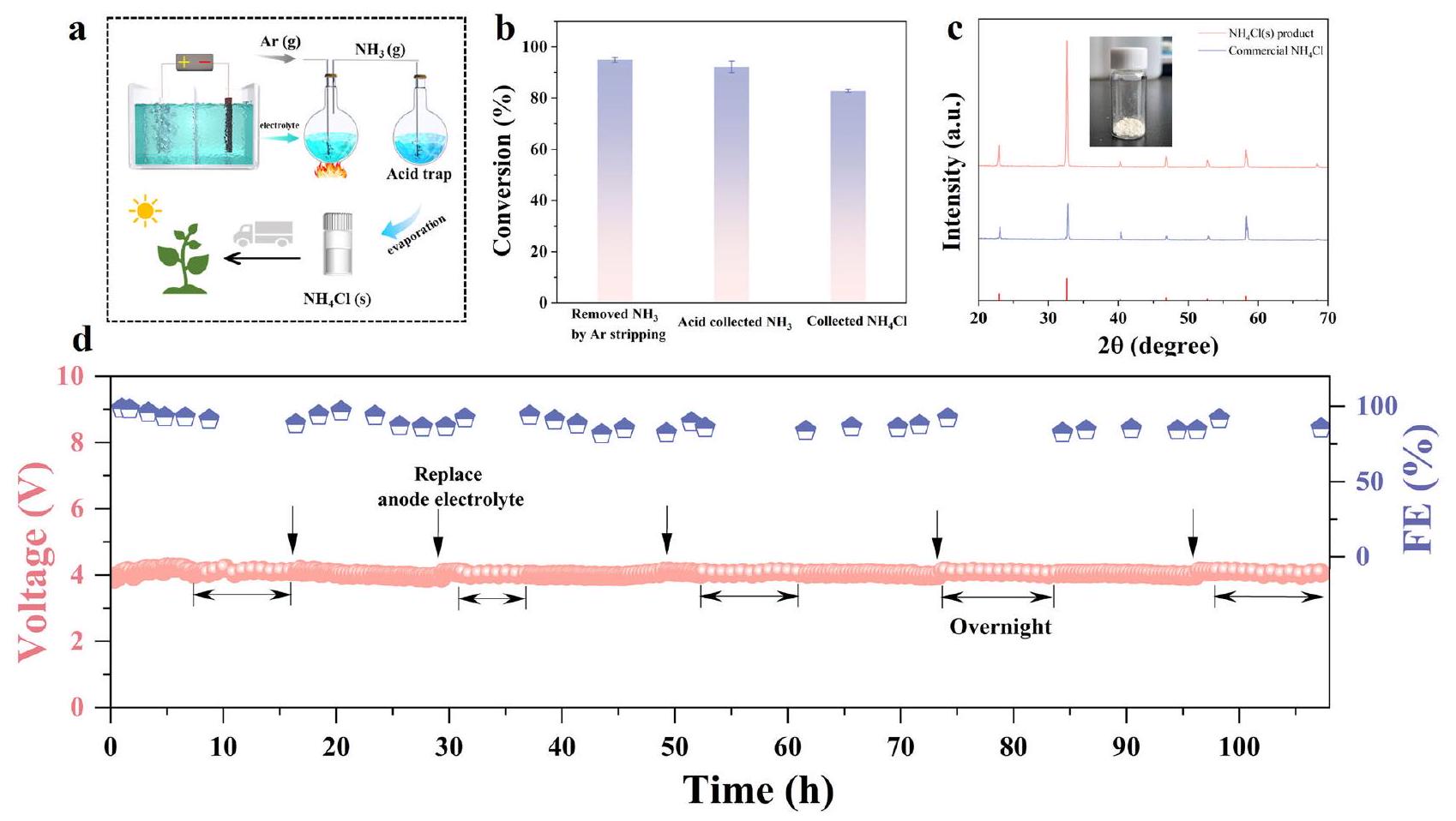
نظرًا للأداء الممتاز لـ OD-Cu NSs في eNO3RR، فإن تحويلتم استكشاف تحويلها إلى مواد كيميائية عالية النقاء تعتمد على الأمونيا لتقييم إمكانياتها للتطبيق العملي.في الإلكتروليت بعد eNO3RRتم استخراجها عن طريق إزالة الأرجون عند (الشكل 6أ). تقريبًا منتمت إزالة البخار بنجاح من الإلكتروليت (الشكل 6ب)، مما يشير إلى أن النظام فعال لـإزالة والاسترداد. 92.2% من المواد المستخرجة يتم التقاط البخار من خلال محلول حمضي، و عالي النقاء يتم جمع المسحوق بعد تبخر المذيب (الشكل 6c والشكل التكميلي 48). وهذا يوضح جدوى نظام eNO3RR القائم على OD-Cu NSs لـالاسترداد. بالنسبة لـ eNO3RR تحت كثافة التيار على نطاق صناعي، فإن نقل الكتلة البطيء وعدم التناسقإنتاج في خلايا H ثابتة يعيق تطبيقها على نطاق واسع. يمكن أن تعزز خلايا التدفق نقل الكتلة وتوفر بيئة تفاعل مستقرة (مثل التركيز المحلي ودرجة الحموضة) للتفاعل المستمر. الإنتاج مقارنةً بخلايا H. لذلك، قمنا بتجميع محفز OD-Cu NSs في تجميع إلكترود الغشاء (MEA) للتحقق من أدائه واستقراره على المدى الطويل لـتقليل إلى تحت تيار على نطاق صناعي. يتم توضيح إعداد MEA في الشكل التكميلي 49، 50. تم تعيين التيار الكلي للتشغيل على المدى الطويل عند 1 أمبير. كما هو موضح في الشكل 6d، لا تزال OD-Cu NSs
الشكل 6 | استرداد الأمونيا والاستقرار. أ رسم تخطيطي للعملية لتحويل النترات إلى نقاء عالٍ. ب كفاءة التحويل لـالتركيب من اختزالفي (تمثل أشرطة الخطأ الانحراف المعياري من ثلاث قياسات مستقلة). ج نمط حيود الأشعة السينية لـ مُركبمنتج. استقرار طويل الأمد لـ eNO3RR على OD-Cu NSs باستخدام نظام MEA (الكهربائي). تم توفير بيانات المصدر للشكل 6 كملف بيانات مصدر. تحقيقمن و عائد منفي نظام MEA (“). ال و العائد يبقى للقيم الأولية مع تدهور محتمل ضئيل بعد 100 ساعة من التشغيل، مما يظهر الاستقرار الجيد لجزيئات OD-Cu النانوية التركيب. التحليل التكنولوجي الاقتصادي يظهر أنالتحليل الكهربائي من مياه الصرف الصحي النيتروجينية قابل للتطبيق من الناحية الاقتصادية والتقنية على نظام MEA القائم على OD-Cu NSs (الشكل التكميلي 51 والملاحظة التكملية 1). تم معالجة المياه الناتجة من MEA بـالفصل والتحويل. يتم عرض تدفق الكتلة وتوزيع المنتج لـ eNO3RR في الشكل التكميلي 52. بعد eNO3RR، تصل نسبة إزالة النترات إلى، و من النترات يتم تحويله إلىمبينًا قابليتها للتطبيق في التطبيقات الموسعة في معالجة مياه الصرف الصحي المحتوية على النترات واستغلال الموارد.
نقاش
تم تحضير نانوشرائح النحاس المؤكسد (OD-Cu NSs) مع الأكسجين المتبقي في الشبكة والتوترات الشدّية في الشبكة بطريقة بسيطة. أظهرت نانوشرائح النحاس المؤكسد نشاطًا ملحوظًا في اختزال النترات (eNO3RR) واستقرارًا قريبًا منعند 10 مللي مولوحل محايد. كان فعالًا أيضًا لـالتحليل الكهربائي معمن والحد الأقصى عائد منعلى نطاق واسع منتركيزاتفي. لقد حولت أكثر من منإلى نقاء عالٍتم عزو الأداء المتفوق لـ OD-Cu NSs إلى تنظيم الإلكترونات الذي تتوسطه الأكسجين المتبقي في الشبكة وتفكك الماء الذي تتوسطه ضغوط الشبكة، مما سرع *تحويل وإمداد *H لـالتركيب من eNO3RR. يوسع هذا العمل الفهم الآلي وسيفتح آفاقًا جديدة لتعزيز الأداء الكهروكيميائي في مجالات أخرى.
طرق
المواد الكيميائية
تم شراء رغوة النحاس (سمك: 2.0 مم) من شركة سوتشو كيشينغهي لمواد المعادن المحدودة. بيرسلفات الأمونيوم تم الحصول على هيدروكسيد الصوديوم (NaOH، AR 99.9%) من ألالدين. تم استلام جميع المواد الكيميائية واستخدامها دون مزيد من التنقية. ماء منزوع الأيوناتتم استخدامه في جميع التجارب.
تركيب نانوشرائح OD-Cu، نانوشرائح Cu وأكسيد OD-Cu
في إجراء نموذجي، تم معالجة رغوة النحاس بالموجات فوق الصوتية باستخدام حمض الهيدروكلوريك 1 م والإيثانول اللامائي لمدة 15 دقيقة لكل منهما لإزالة الشوائب السطحية. ثم تم شطف رغوة النحاس جيدًا بالماء النقي، وتجفيفها تحت الفراغ، وتخزينها للاستخدام لاحقًا. لتحضير محلول الأكسدة، تم إذابة 16 جرامًا من هيدروكسيد الصوديوم في الماء النقي.. بعد ذلك، تم إضافة 3.2 جرام من بيرسلفات الأمونيوم إلى محلول هيدروكسيد الصوديوم وتم إذابته باستخدام علاج بالموجات فوق الصوتية. تم غمر رغوة النحاس في المحلول المحضر وأُكسدت عندلمدة 20 دقيقة. بعد الأكسدة، تم شطف رغوة النحاس بالماء النقي، وتم الحصول على نانوصفائح CuO. تم تحضير نانوصفائح OD-Cu من خلال الاختزال الكهروكيميائي لنانوصفائح CuO لمدة 30 دقيقة فيالالكتروليت عند -0.87 فولت مقابل RHE (لم يتم تصحيح جميع الجهود في هذا العمل). للمقارنة، تم تحضير Cu NSs عن طريق تسخين رقائق CuO.لمدة ساعتين تحتالغلاف الجوي. OD-Cuتم تحضيره من خلال التحلل الحراري المباشر لرغوة النحاسلمدة ساعتين تحت الأرجون)، تليها عملية الاختزال الكهروكيميائي تحت نفس الظروف كما في تحضير نانوشرائح النحاس.
توصيف
تم فحص مورفولوجيا وهيكل المحفزات باستخدام مجهر إلكتروني مسح (Hitachi S4800) ومجهر إلكتروني ناقل (FEI Talos F200S). تم الحصول على بيانات مطيافية الأشعة السينية (XPS) باستخدام مطياف ESCALAB 250 Xi. تم معايرة جميع الأطياف عن طريق ضبط قمة C1s عند 284.8 eV. تم تسجيل أطياف رامان على مطياف رامان كونفوكالي Renishaw inVia Qontor باستخدام ليزر بطول موجي 633 نانومتر. تم جمع أنماط حيود الأشعة السينية (XRD) على جهاز حيود Rigaku Ultima IV.طيف الرنين المغناطيسي النووي تم الحصول عليها باستخدام مطياف BRUKER AVANCE NEO 600 M. تم قياس طيف الامتصاص للأشعة فوق البنفسجية والمرئية (UV-Vis) باستخدام مطياف SP-756P. تم إجراء تجربة TPR-H2 على جهاز Autochem II 2920-MKS CirrusTM 3.
تم إجراء قياسات رامان في الموقع باستخدام خلية تفاعل رامان مخصصة ومحطة عمل كهربائية كيميائية CHI 760E. كانت ظروف اختبار رامان هي نفسها ظروف الاختبارات الكهربائية الكيميائية، باستثناء أن المحاليل الكهربائيةتم تدوير المحاليل في غرف الكاثود والأنود خارج الخلية باستخدام مضخة بيرستالتية.
تم إجراء مطيافية الانعكاس الكلي المخفف في الموقع باستخدام جهاز FT-IR من Thermo Scientific iS50 مزود بكاشف من كادميوم الزئبق (MCT). استخدمت التجارب خلية تحت الحمراء مصنوعة خصيصًا متصلة بجهاز العمل الكهربائي CHI 760E. كانت محلول الإلكتروليت يتكون من و بعد طرح الخلفية تحت الحمراء، تم تسجيل الأطياف تحت الجهود المطبقة معكقطب مرجعي وبلاتين (Pt) كقطب مضاد. كان الجهد المطبق من 0.2 فولت إلى -1.2 فولت.
التم إجراء تجربة TPR على جهاز Autochem II. تم تحميل جسيمات أكسيد النحاس في أنبوب زجاجي وتم معالجتها مسبقًا عن طريق النفخ بالغاز الأرجون عندلمدة 30 دقيقة لإزالة أي أنواع ممتصة. بعد التبريد إلىتم زيادة درجة الحرارة إلىبمعدلتحت خليط من الغاز. الـتمت مراقبة واستخدام استهلاك الطاقة خلال العملية بشكل مستمر باستخدام كاشف الموصلية الحرارية (TCD).
التجارب الكهروكيميائية
تم إجراء eNO3RR في خلية من نوع H مخصصة باستخدام محطة عمل كهربائية CHI114OC. تم فصل حجرة الأنود وحجرة الكاثود بواسطة غشاء نافيوني 117 (دو بونت). تم نقع غشاء نافيوني 117 فيحل فيلمدة ساعة واحدة، تليها غمر في الماء المنزوع الأيونات لمدة 30 دقيقة. ثم تم معالجته بـفي لمدة ساعة واحدة وتم شطفه بالماء المقطر لمدة 30 دقيقة أخرى قبل الاستخدام. وكان المحفز الكهربائي الذي تم تصنيعه حديثًا هو القطب العامل.تم استخدام القطب الكهربائي كقطب مرجعي، وتم استخدام لوحة من البلاتين كقطب مضاد.حل ( ) تم استخدامه كإلكتروليت لكل من غرف الكاثود والأنود، وتمت إضافة إلى غرفة الكاثود. تم تحريك المحلول في غرفة الكاثود خلال عملية eNO3RR. تم قياس جميع الجهود مقابلإلكترود المرجع وتم تحويله إلى مقياس الإلكترود الهيدروجيني القابل للعكس (RHE) باستخدام المعادلة: مقابل RHE مقابل .
طرق تحليلية
تركيزات، و تم تحديد تركيزات الأيونات في الإلكتروليت (المخفف إلى التركيز المناسب) قبل وبعد eNO3RR بطريقة ملونة. الكشف:تم تحديده بواسطة طريقة كاشف نيسلر.حل ) و تم إضافة كاشف نيسلر إلى عينة حجمها 5 مل وخلطها جيدًا. تم تحديد الامتصاصية عند 420 نانومتر بعد 20 دقيقة. الكشف:مطور الألوانمنمن السلفوناميد، و 2 مل منتم إضافة 10 مل من الماء المذاب إلى 5 مل من العينة المخففة، وتم إجراء التفاعل لمدة 10 دقائق في درجة حرارة الغرفة.تم قياس الامتصاص عند 540 نانومتر. الكشف: 1.1 مل من مطور اللون (1 م HCl وتم إضافة ) إلى 5 مل من العينة المخففة. تم قياس الامتصاص عند 220 نانومتر و 275 نانومتر بعد 5 دقائق. تم الحصول على القيمة النهائية للامتصاص باستخدام معادلة. الكشف: يتكون كاشف اللون من 5.99 جرام من 4-دايميثيل أمينوبنزالديهيدمن المركز
HCl و 300 مل من الإيثانول. تم إضافة كاشف اللون إلى محلول العينة ( )، وتم تحريك الخليط لمدة 10 دقائق في درجة حرارة الغرفة تم قياس الامتصاص عند 457 نانومتر. تم الحصول على منحنى المعايرة من حلول (في ) بتركيزات معروفة. الكشف:محلول من عازل الأسيتات (1.0 م من أسيتات الصوديوم + 1.0 م من حمض الأسيتيك)،محلول كبريتات الحديد الثلاثي الأمونيوم، وتم إضافة محلول الإيثانول 1، 10-فينانثرولين بشكل متتابع إلى 3 مل من العينة، وتم ترك المزيج لمدة 20 دقيقة في درجة حرارة الغرفة.تم قياس الامتصاص عند 510 نانومتر.
تجارب وسم النظائر
التم استخدامه كمصدر نيتروجين موسوم بالنظائر لعملية اختزال النترات الكهربائية.تحديد الكمية باستخدام جهاز NMR (BRUKER AVANCE NEO 600 M)، قيمة pH للعينةبعد تعديل eNO3RR إلى 2 عن طريق الإضافة. الـتم إضافته كمعيار داخلي.تم إضافة 0.5 مل من DMSO-d6 إلى المحلول المذكور أعلاه قبلاختبار الرنين المغناطيسي النووي. تم الحصول على منحنى المعايرة باستخدام نسبة مساحة الذروةإلىمعمنحلول.
عائد الأمونيا وكفاءة فاراداي
تم الحصول عليه بواسطة المعادلة (1)، وتم تحديد العائد من خلال المعادلة (2)، الكفاءة منتم حسابه بواسطة المعادلة (3).
أينهو ثابت فاراداي هو تركيز ) ، هو حجم الكاثوليت (لتر)،هي كمية الشحنة (C)، هو الكتلة الجزيئية النسبية لـ هو زمن التفاعل ( ث ) ، هو التيار الحالي (A)، هل هوتركيز ).
حساب نظرية الكثافة الوظيفية (DFT)
تم إجراء جميع الحسابات باستخدام طريقة الموجة المسطحة المعززة بالعرض التي تم تنفيذها في حزمة المحاكاة الأولية في فيينا. تم اختيار تقريب التدرج العام الذي اقترحه بيردو-بورك-إرنزرهوف (PBE) لإمكانات تبادل الارتباط. تم تعيين طاقة القطع للموجة المسطحة إلى 480 إلكترون فولت. تم تعيين معيار الطاقة إلىفي الحل التكراري لمعادلة كون-شام. تم استرخاء جميع الهياكل حتى انخفضت القوى المتبقية على الذرات إلى أقل منلتجنب التفاعلات بين الطبقات، تم تطبيق فراغ فراغي بمقدار 20 Å عموديًا على اللوح. تم استخدام كود VASPsol مع نموذج إذابة ضمني لمحاكاة محلول الإلكتروليت للتعامل مع تأثير الإذابة. هنا، الاختلافات في الطاقة الحرة لجيبس ( ) (المعادلة 4) للوسطاء في eNO3RR المحددة على أنها:
أينهو الفرق الكلي في الطاقة بين اللوح والنهايات المعنية المحسوبة بواسطة DFT-PBE. و ت تشير إلى الفروق في طاقة النقطة الصفرية والإنتروبيا بين حالات الامتصاص للوسطاء التفاعليين ومرحلة الفجوة، على التوالي. T هو درجة حرارة الغرفة.حيث U هو جهد القطب.
توفر البيانات
البيانات التي تدعم استنتاجات هذه الدراسة مقدمة في الورقة والمعلومات التكميلية. تم توفير بيانات المصدر في هذه الورقة.
References
Inta, H. R. et al. Recent advances in electrocatalytic reduction into ammonia. EES Catal. 1, 645-664 (2023).
Yin, H. et al. Alloying effect-induced electron polarization drives nitrate electroreduction to ammonia. Chem. Catal. 1, 1088-1103 (2021).
Cheng, X. F. et al. Coordination symmetry breaking of single-atom catalysts for robust and efficient nitrate electroreduction to ammonia. Adv. Mater. 34, 2205767 (2022).
Fan, Y. et al. Highly efficient metal-free nitrate reduction enabled by electrified membrane filtration. Nat. Water 2, 684-696 (2024).
Hu, T. et al. Theoretical insights into superior nitrate reduction to ammonia performance of copper catalysts. ACS Catal. 11, 14417-14427 (2021).
Zhao, R. et al. A Bi-Co corridor construction effectively improving the selectivity of electrocatalytic nitrate reduction toward ammonia by nearly 100%. Adv. Mater. 35, 2306633 (2023).
Wu, L. et al. Boosting electrocatalytic nitrate-to-ammonia via tuning of N-intermediate adsorption on a Zn-Cu catalyst. Angew. Chem. Int. Ed. 62, e202307952 (2023).
Yu, J. et al. Boosting electrochemical nitrate-ammonia conversion via organic ligands-tuned proton transfer. Nano Energy 103, 107705 (2022).
Wei, C. et al. Lattice oxygen-mediated electron tuning promotes electrochemical hydrogenation of acetonitrile on copper catalysts. Nat. Commun. 14, 3847 (2023).
Li, P. et al. Pulsed nitrate-to-ammonia electroreduction facilitated by tandem catalysis of nitrite intermediates. J. Am. Chem. Soc. 145, 6471-6479 (2023).
Luo, M. et al. Hydroxide promotes carbon dioxide electroreduction to ethanol on copper via tuning of adsorbed hydrogen. Nat. Commun. 10, 5814 (2019).
Fan, J. L. et al. Electrochemical reduction of nitrate to ammonia on ultra-stable amorphous Co-P electrocatalyst. J. Mater. Chem. A 12, 20077-20087 (2024).
Zhang, W. et al. Fluorine modification promoted water dissociation into atomic hydrogen on a copper electrode for efficient neutral nitrate reduction and ammonia recovery. Environ. Sci. Technol. 58, 7208-7216 (2024).
Wu, Q. et al. Efficient and selective electroreduction of nitrate to ammonia via interfacial engineering of B-doped Cu nanoneedles. Appl. Catal. B Environ. Energy 361, 124597 (2025).
Yin, H. et al. Electrocatalytic reduction of nitrate to ammonia via a Au/Cu single atom alloy catalyst. Environ. Sci. Technol. 57, 3134-3144 (2023).
Xie, M. et al. Periodic adjacent Pd-Fe pair sites for enhanced nitrate electroreduction to ammonia via accelerating proton relay. Adv. Energy Mater. 14, 2401717 (2024).
Fu, W. et al. Tuning mobility of intermediate and electron transfer to enhance electrochemical reduction of nitrate to ammonia on Cu interface. Chem. Eng. J. 433, 133680 (2022).
Zhou, J. et al. Achieving efficient and stable electrochemical nitrate removal by in-situ reconstruction of electroactive nanocatalysts on Cu foam. Appl. Catal. B Environ. Energy 317, 121811 (2022).
Cheng, D. et al. The nature of active sites for carbon dioxide electroreduction over oxide-derived copper catalysts. Nat. Commun. 12, 395 (2021).
Wei, Z. et al. Enhancing selective electrochemical reduction by in situ constructing tensile-strained Cu catalysts. ACS Catal. 13, 4711-4718 (2023).
Jansonius, R. P. et al. Strain engineering electrocatalysts for selective reduction. ACS Energy Lett. 4, 980-986 (2019).
Li, C. W. et al. Electroreduction of carbon monoxide to liquid fuel on oxide-derived nanocrystalline copper. Nature 508, 504-507(2014).
Kang, W. J. et al. Strain-activated copper catalyst for pH-universal hydrogen evolution reaction. Adv. Funct. Mater. 32, 2112367 (2022).
Wang, Y. et al. Unveiling the activity origin of a copper-based electrocatalyst for selective nitrate reduction to ammonia. Angew. Chem. Int. Ed. 59, 5350-5354 (2020).
Xiao, L. et al. Coupling electrocatalytic cathodic nitrate reduction with anodic formaldehyde oxidation at ultra-low potential over . Energy Environ. Sci. 16, 2696-2704 (2023).
Li, Y. et al. Enhancement of nitrate-to-ammonia on amorphous -modified Cu via tuning of active hydrogen supply. Adv. Energy Mater. 14, 2303863 (2024).
Shi, Y. et al. In-situ reconstructed heterogeneous nanorods with oxygen vacancies for enhanced electrocatalytic nitrate reduction to ammonia. Chem. Eng. J. 479, 147574 (2024).
Wei, X. et al. Formic acid electro-synthesis by concurrent cathodic reduction and anodic oxidation. Angew. Chem. Int. Ed. 60, 3148-3155 (2021).
Matte, L. P. et al. Reduction-driven 3D to 2D transformation of Cu nanoparticles. Small 18, 2106583 (2022).
Dou, Y. et al. Graphene-like holey nanosheets as a highly efficient catalyst for oxygen evolution reaction. Nano Energy 30, 267-275 (2016).
Niveditha, C. V. et al. Comprehensive interfacial study of potentiodynamically synthesized copper oxide thin films for photoelectrochemical applications. J. Electrochem. Soc. 163, H426 (2016).
Singhal, A. et al. Copper(I) oxide nanocrystals – one step synthesis, characterization, formation mechanism, and photocatalytic properties. Eur. J. Inorg. Chem. 2013, 2640-2651 (2013).
Eilert, A. et al. Subsurface oxygen in oxide-derived copper electrocatalysts for carbon dioxide reduction. J. Phys. Chem. Lett. 8, 285-290 (2017).
Tahir, D. et al. Electronic and optical properties of and studied by electron spectroscopy. J. Phys: Condens. Matter 24, 175002 (2012).
Sun, W. et al. An efficiently tuned d-orbital occupation of by doping with Cu for enhancing the oxygen evolution reaction activity. Chem. Sci. 6, 4993-4999 (2015).
Kappen, P. et al. The state of Cu promoter atoms in hightemperature shift catalysts-an in situ fluorescence XAFS study. J. Catal. 198, 56-65 (2001).
Huang, K. et al. Boosting nitrate to ammonia via the optimization of key intermediate processes by low-coordinated sites. Adv. Funct. Mater. 34, 2315324 (2024).
Chen, F. Y. et al. Efficient conversion of low-concentration nitrate sources into ammonia on a Ru-dispersed Cu nanowire electrocatalyst. Nat. Nanotechnol. 17, 759-767 (2022).
Su, L. et al. Electrochemical nitrate reduction by using a novel cathode. Water Res. 120, 1-11 (2017).
Zheng, W. et al. Self-activated Ni cathode for electrocatalytic nitrate reduction to ammonia: From fundamentals to scale-up for treatment of industrial wastewater. Environ. Sci. Technol. 55, 13231-13243 (2021).
Chauhan, R. et al. Electrochemical denitrification of highly contaminated actual nitrate wastewater by anode and iron cathode. Chem. Eng. J. 386, 122065 (2020).
Fang, J. Y. et al. Copper-based electrocatalysts for nitrate reduction to ammonia. Materials 16 (2023).
Zhang, R. et al. Electrochemical nitrate reduction in acid enables high-efficiency ammonia synthesis and high-voltage pollutesbased fuel cells. Nat. Commun. 14, 8036 (2023).
Xu, Y. et al. Sulphur-boosted active hydrogen on copper for enhanced electrocatalytic nitrate-to-ammonia selectivity. Angew. Chem. Int. Ed. 63, e202400289 (2024).
Fan, K. et al. Active hydrogen boosts electrochemical nitrate reduction to ammonia. Nat. Commun. 13, 7958 (2022).
Wang, Y. H. et al. In situ Raman spectroscopy reveals the structure and dissociation of interfacial water. Nature 600, 81-85 (2021).
Li, C. Y. et al. In situ probing electrified interfacial water structures at atomically flat surfaces. Nat. Mater. 18, 697-701 (2019).
Sawata, S. et al. Kinetic evidence based on solvent isotope effects for the nonexistence of a proton-transfer process in reactions catalyzed by a hammerhead ribozyme: Implication to the double-metal-ion mechanism of catalysis. J. Am. Chem. Soc. 117, 2357-2358 (1995).
Wang, K. et al. Intentional corrosion-induced reconstruction of defective NiFe layered double hydroxide boosts electrocatalytic nitrate reduction to ammonia. Nat. Water 1, 1068-1078 (2023).
Zhang, W. et al. Atypical oxygen-bearing copper boosts ethylene selectivity toward electrocatalytic reduction. J. Am. Chem. Soc. 142, 11417-11427 (2020).
Zhang, Y. et al. Low-coordinated copper facilitates the * affinity at enhanced rectifying interface of for efficient -tomulticarbon alcohols conversion. Nat. Commun. 15, 5172 (2024).
شكر وتقدير
تم دعم هذا العمل من قبل المؤسسة الوطنية للعلوم الطبيعية في الصين (رقم 22222601 ورقم 22076019، Y.L.)، وصناديق البحث الأساسية للجامعات المركزية (DUT23LAB611، Y.L.).
مساهمات المؤلفين
قام Q.W. و Y.L. بتصور الفكرة. قام Q.W. و X.F. و Y.L. بتصميم التجارب. قام Q.W. بتنفيذ التجارب. ساعد L.Q. في توصيف المواد. قام Q.W. و X.F. و B.S. و X.Q. بتحليل البيانات ومناقشة النتائج. قام Q.W. و Y.L. بكتابة المسودة معًا. علق جميع المؤلفين على المسودة. أشرف Y.L. على المشروع بأكمله.
يجب توجيه المراسلات والطلبات للحصول على المواد إلى يانمينغ ليو.
معلومات مراجعة الأقران تشكر مجلة Nature Communications تشون-تشي تشانغ، وزي هوي آي، والمراجعين المجهولين الآخرين على مساهمتهم في مراجعة هذا العمل. يتوفر ملف مراجعة الأقران.
ملاحظة الناشر: تظل شركة سبرينجر ناتشر محايدة فيما يتعلق بالمطالبات القضائية في الخرائط المنشورة والانتماءات المؤسسية.
الوصول المفتوح هذه المقالة مرخصة بموجب رخصة المشاع الإبداعي النسبية-غير التجارية-بدون اشتقاقات 4.0 الدولية، التي تسمح بأي استخدام غير تجاري، ومشاركة، وتوزيع، وإعادة إنتاج في أي وسيلة أو صيغة، طالما أنك تعطي الائتمان المناسب للمؤلفين الأصليين والمصدر، وتوفر رابطًا لرخصة المشاع الإبداعي، وتوضح إذا قمت بتعديل المادة المرخصة. ليس لديك إذن بموجب هذه الرخصة لمشاركة المواد المعدلة المشتقة من هذه المقالة أو أجزاء منها. الصور أو المواد الأخرى من طرف ثالث في هذه المقالة مشمولة في رخصة المشاع الإبداعي الخاصة بالمقالة، ما لم يُشار إلى خلاف ذلك في سطر الائتمان للمادة. إذا لم تكن المادة مشمولة في رخصة المشاع الإبداعي الخاصة بالمقالة وكان استخدامك المقصود غير مسموح به بموجب اللوائح القانونية أو يتجاوز الاستخدام المسموح به، فستحتاج إلى الحصول على إذن مباشرة من صاحب حقوق الطبع والنشر. لعرض نسخة من هذه الرخصة، قم بزيارة http:// creativecommons.org/licenses/by-nc-nd/4.0/. (ج) المؤلف(ون) 2025
المختبر الرئيسي لعلم البيئة الصناعية والهندسة البيئية (وزارة التعليم، الصين)، كلية علوم البيئة والتكنولوجيا، جامعة داليان للتكنولوجيا، داليان، الصين.كلية علوم البيئة والهندسة، جامعة داليان البحرية، داليان، الصين.قسم الكيمياء، جامعة تشجيانغ، هانغتشو، الصين.مركز العلوم الحدودية للمواد الذكية، جامعة داليان للتكنولوجيا، داليان، الصين. البريد الإلكتروني:liuyanm@dlut.edu.cn
Insights into lattice oxygen and strains of oxide-derived copper for ammonia electrosynthesis from nitrate
Received: 22 October 2024
Accepted: 2 April 2025
Published online: 11 April 2025
(A) Check for updates
Qinyue Wu , Xinfei Fan , Bing Shan (D³, Liang Qi , Xie Quan & Yanming Liu
Electrocatalytic reduction (eNO3RR) is a sustainable method for purification of wastewater and recovery. Cu-based catalysts are promising for eNO3RR, but insufficient active hydrogen (*H) supply and *NO2 poison of active sites have hindered their performance, and the catalytic mechanism remains ambiguous. Here, we report oxide-derived copper nanosheet arrays (OD-Cu NSs) with residual lattice oxygen and lattice strains to enhance synthesis from eNO3RR. It is efficient for synthesis with high Faradaic efficiencies of and maximum yield of at neutral solution, and . Experimental and theoretical results reveal that lattice oxygen regulates the electronic structure of OD-Cu NSs and promotes * conversion, while lattice strain enhances *H generation from water dissociation, resulting in the good performance for synthesis. The applicability of OD-Cu NSs is proved by the high recovery of ammonia compound from eNO3RR. is an important chemical with extensive applications in agriculture, chemical industries, and the energy sectors . However, synthesis currently relies on the conventional Haber-Bosch process . It requires high temperature and pressure, which consumes about 1 of global energy and emits large amounts of . Consequently, a green and low-energy method for synthesis is urgently needed. Electrocatalytic reduction (eNO3RR) has emerged as a promising alternative for synthesis owing to its mild operating conditions and low energy consumption ( . Moreover, eNO3RR can tackle pollution in water, one of the major environmental problems resulted from agricultural and industrial activities. It not only purifies water but also recoveries from rich wastewater. synthesis from eNO3RR is highly dependent on electrocatalysts. Among the various catalysts reported, Cu -based catalysts are good candidates as the high electron density of Cu d-orbital is favorable for adsorption and the initiation of eNO3RR . However,
eNO3RR process involves complex steps, including proton-coupled electron transfer, the adsorption and hydrogenation of reactants and intermediates . The eNO3RR on Cu-based catalysts is hindered by the inherent defects of * poison (intermediates for eNO3RR) and weak *H supply on . The Cu surface has abundant free electrons. It forms strong adsorption with * through the electron coupling effect , poisoning the active sites . Moreover, the hydrogenation of intermediates is also crucial for eNO3RR. Cu is known to be inefficient for *H generation from water dissociation due to its high energy barrier . The slow *H supply limits the hydrogenation kinetics for eNO3RR. To enhance synthesis from eNO3RR, * conversion or *H supply has been regulated by the strategies such as metal/non-metal atom doping , microstructure regulation , design of atomically dispersed and heterojunction . Despite the progresses have been made, simultaneous optimization of * conversion and *H supply to enhance electrosynthesis from eNO3RR has been rarely reported. Meanwhile, tailoring active sites that are both
favorable for enhancing hydrogenation and modulating intermediate adsorption is difficult during catalyst synthesis.
Oxide-derived copper (OD-Cu) is a promising catalyst for electrocatalytic reduction . Given the strong electron-withdrawing property of oxygen, residual lattice oxygen serves as a negatively charged center in the Cu lattice, which can limit the flow of free electrons, probably weakening *NO2 adsorption. However, previous studies have focused on the crystalline phases and facets of OD-Cu catalysts, overlooking the impact of residual lattice oxygen in eNO3RR. Moreover, OD-Cu has abundant lattice strains due to the oxygen atoms separating out from Cu oxide . The lattice strains can modulate the activity and product selectivity of electrocatalysts by breaking the linear scaling relationship . Li et al. observed lattice strains in OD-Cu, but their effect on catalysis was not investigated . It was found later that lattice tensile strains on Cu could lead to hydrogen evolution . However, the role of lattice tensile strain in *H supply from water splitting hasn’t been reported. Meanwhile, the catalytic mechanism of OD-Cu remains insufficiently understood. For example, in situ generated interface, pure Cu or phase have been reported as active sites for eNO3RR . The precise active sites are still under debate.
In this work, oxide-derived copper nanosheet arrays (OD-Cu NSs) with residual lattice oxygen and lattice strains were designed to regulate * adsorption strength and * H supply during eNO3RR. The experimental and density functional theory (DFT) results revealed that
residual lattice oxygen modulated the electronic state of the Cu surface, reducing adsorption and facilitating its conversion. The lattice tensile strains enhanced *H supply from water dissociation. The resulted OD-Cu NSs achieved high Faradaic efficiencies (FEs) of for production at neutral solution and , surpassing the recently reported catalysts. Its potential application has been proved by the efficient recovery of and from reduction.
Results
Synthesis and characterization of OD-Cu NSs
OD-Cu NSs were synthesized on copper foam via chemical oxidation and electrochemical reduction (Fig. 1a). The CuO nanosheets were grown on copper foam by oxidation in sodium hydroxide and ammonium persulfate solution. OD-Cu NSs were obtained by electrochemical reduction of CuO nanosheets, in which the reduction potential was determined from its cyclic voltammogram (Supplementary Fig. 1). As a comparison, copper nanosheet arrays (Cu NSs) were prepared by calcination of CuO nanosheets under . The calcination temperature was selected based on deep removal of lattice oxygen through -temperature programmed reduction ( -TPR) test (Supplementary Fig. 2). Scanning electron microscopy (SEM) shows the ultrathin and smooth nanosheet morphology of OD-Cu NSs (Fig. 1b and Supplementary Fig. 3). However, the nanosheet surfaces of Cu NSs are rough due to the migration and agglomeration of surface atoms
Fig. 1 | Synthetic scheme and morphological characterization. a Schematic illustration of Cu NSs and OD-Cu NSs synthesis. b-e SEM and HRTEM images of ODCu NSs (b, d) and Cu NSs (c, e), respectively. f Lattice spacings and of Cu NSs and
OD-Cu NSs. g XRD patterns. h, i The strain field maps of OD-Cu NSs (h) and Cu NSs (i) at , and based on HRTEM images. Source data for Fig. 1 are provided as a Source Data file.
Fig. 2 | Structural characterization. a The operando Raman spectra (left panel) and time-resolved light microscopy images (right panel) of OD-Cu NSs surface at spectra and (c), Auger spectra of Cu foam, Cu NSs, and OD-Cu NSs. d The Cu K-edge XANES spectra. e the fitted valence states. the
corresponding k3-weighted FT-EXAFS spectra and (g), Morlet WT of the k3weighted EXAFS data for Cu foil, NSs, and OD-Cu NSs. Source data for Fig. 2 are provided as a Source Data file.
during thermal reduction (Fig. 1c and S3). High-resolution transmission electron microscopy (HRTEM) reveals both OD-Cu NSs and Cu NSs exhibit face-centered cubic (fcc) structures (Fig. 1d and e). Notably, the lattice spacing of the Cu (111) plane is 0.215 nm for OD-Cu NSs (Fig. 1f), which is larger than those of conventional and Cu NSs . The X-ray diffraction (XRD) patterns show the diffraction peaks of Cu NSs and OD-Cu NSs shift to lower angles in comparison to Cu foam (Fig. 1g), reflecting lattice tensile strains in Cu NSs and OD-Cu NSs as determined by the Bragg equation. The OD-Cu NSs have a lower diffraction angle than Cu NSs, which reveals the stronger tensile strains in OD-Cu NSs. The tensile strain value was calculated by the variation of crystal plane spacing. Compared to Cu foam, Cu NSs and OD-Cu NSs have tensile strains of and , respectively.
The spatial distribution of tensile strains in the catalysts was analyzed by geometric phase analysis. OD-Cu NSs exhibit substantial lattice strains across shear strain ( ), in-plane strain ( ), and out-ofplane strain . Their strain intensities are significantly higher than those in Cu NSs (Fig. 1h and i). This is consistent with the results of XRD and HRTEM. The tensile strains of Cu NSs may originate from the new bond formation, bond breaking, or bond elongation/deflection during the formation of nanosheets . The more pronounced lattice strains in
OD-Cu NSs are likely due to the escape of oxygen atoms that bound to tetrahedral interstitial sites, leading to further lattice expansion.
Time-resolved operando Raman spectroscopy was used to monitor the oxidation state of the catalyst surface during electroreduction in the catalyst preparation process (Fig. 2a and Supplementary Fig. 4). The color of OD-Cu NSs surface gradually changes from its initial turquoise ( CuO ) to bright yellow ( Cu ) after reduction at -0.87 V (vs RHE) in electrolyte. The Raman spectra at 0 min clearly show three peaks at 297, 343 , and , corresponding to the , and modes of . As the reduction proceeds, the intensities of CuO peaks gradually decrease until the CuO phase completely disappears at 10 min . Notably, a new band at around is observed as the reduction continues, which corresponds to a multi-phonon process of lattice oxygen in Cu . It indicates the presence of residual lattice oxygen and the possible formation of a new Cu suboxide phase . Moreover, the O XPS spectra (Fig. 2b) show that only surface-adsorbed oxygen is present in Cu foam and Cu NSs, whereas OD-Cu NSs exhibit a lattice metal-oxygen bond around 530.6 eV , confirming the presence of lattice oxygen in OD-Cu NSs . Its lattice oxygen content is estimated to be . The valence state of Cu can be determined from the positions of and peaks in the Cu Auger spectrum ( transition). The peaks for , and are usually located at , and 918.0 eV , respectively. In addition, the peak is prominent in the spectrum for but not in the spectra for and . As shown in Fig. 2c, the peaks for Cu foam and Cu NSs are located at 918.0 eV with a distinct peak, consistent with the characteristics of . Notably, the peak for OD-Cu NSs shifts to approximately 916.5 eV , lower than those of and but close to . Furthermore, the peak related to still appears in OD-Cu NSs. These results suggest that the valence state of OD-Cu NSs is .
X-ray absorption near-edge structure (XANES) spectroscopy was used to investigate the electronic structure and coordination environment of catalysts. As displayed in Fig. 2d, Cu NSs and Cu foil exhibit insignificant differences in the absorption edge and transition intensity, indicating Cu NSs and Cu have similar coordination environments. However, OD-Cu NSs have higher near-edge absorption energy and lower transition intensity in comparison to Cu foil and Cu NSs, revealing an abnormal hybridization in the Cu atoms of OD-Cu . It can be attributed to the reduced electron density of 4p orbitals caused by the strong electron-withdrawing property of residual lattice oxygen atoms . In addition, the near-edge absorption energy of ODCu NSs is lower than that of with a fitted valence state of 0.49 , suggesting a mixed local environment for its Cu atoms (Fig. 2e). In the k3-weighted Fourier-transformed EXAFS (FT-EXAFS) spectra (Fig. 2f), a distinct Cu-O peak ( ) appears in OD-Cu NSs, confirming the presence of residual lattice oxygen. The peak intensity of the bond in OD-Cu NSs is significantly lower than those of Cu foil and Cu NSs, indicating that the Cu-Cu coordination unsaturation of OD-Cu NSs is increased due to the presence of lattice oxygen atoms. Moreover, the Cu-Cu peaks in OD-Cu NSs and Cu NSs are slightly shifted to a larger radial distance, consistent with the existence of lattice tensile strains . The Morlet wavelet transform (WT) plots show that both Cu NSs and OD-Cu NSs exhibit the highest peaks at (Fig. 2g), corresponding to the Cu-Cu shell. OD-Cu NSs show a distinct Cu-O shell at , further supporting the presence of residual lattice oxygen in OD-Cu NSs. The EXAFS fitting (Supplementary Fig. 5, 6 and Supplementary Table 1) indicates that the Cu -Cu coordination number (CN) in OD-Cu NSs is 8.7, significantly lower than those in Cu NSs (9.9) and Cu foil (12), which can be explained by that the residual lattice oxygen in OD-Cu NSs reduces the saturation of Cu-Cu coordination. In addition, the average coordination number of shell in OD-Cu NSs is , revealing the partial saturation of Cu atoms by O atoms in OD-Cu NSs.
The eNO3RR performance of OD-Cu NSs
The eNO3RR performance was evaluated in an H-type cell under ambient conditions. Considering the practical scenarios, a neutral electrolyte was selected. The linear sweep voltammograms (LSV) of OD-Cu NSs (Supplementary Fig. 7) show a distinct current response for at potential more negative than -0.1 V (vs RHE), indicating its good activity for eNO3RR. conversion to was further evaluated at -0.3 V to -0.8 V . The was quantitatively detected by colorimetric method and validated by -NMR (Supplementary Fig. 8). Notably, the yields of OD-Cu NSs are higher than those of Cu NSs and Cu foam under all the applied potentials (Fig. 3a). At -0.7 V , OD- Cu NSs produce at the maximum yield of , which is 1.4 times higher than that of CuNSs , highlighting the significant role of lattice oxygen and tensile strain in enhancing eNO3RR. The of OD-Cu NSs exhibit a volcano-type trend with the variation of potential (Fig. 3b). At -0.3 V , a high concentration of nitrite is accumulated as * can’t be efficiently converted, resulting in low (Fig. 3c). As expected, its is significantly increased, and nitrite is rapidly converted at more negative potentials. At -0.6 V , the of OD-Cu NSs is , significantly higher than those of Cu NSs (74.2%) and Cu foam (44.2%). The FE of is only for OD-Cu NSs, much lower than for Cu NSs and for Cu foam (Fig. 3d and Supplementary Fig. 9). The concentration of OD-Cu NSs is also significantly lower than those of Cu NSs and Cu foam (Supplementary Fig. 10). It suggests that OD-Cu NSs can effectively promote nitrite conversion and alleviate * poison at the active sites. The generation of byproducts such as , and is negligible for eNO3RR on OD-Cu NSs based on the results of online differential electrochemical mass spectrometry (DEMS) and colorimetric methods (Supplementary Fig. 11-14). Considering that OD-Cu NSs and Cu NSs have similar morphology and crystalline structure, the better performance of OD-Cu NSs can be contributed from its residual lattice oxygen and tensile strains, which increase the active sites and result in higher electrochemical active surface area (Supplementary Fig. 15,16). The of OD-Cu NSs decreases at more negative potentials due to the occurrence of hydrogen evolution. In addition, OD-Cu NSs are also efficient for production at lower electrolyte concentrations with of 91.2-96.7% (Supplementary Fig. 17). To assess the denitrification performance of OD-Cu NSs, a batch test of conversion was conducted at -0.6 V . As shown in Fig. 3e, almost all the nitrogen is converted to after 75 min, and the concentrations of and are well below the World Health Organization’s (WHO’s) drinking water standards . The isotope labeling eNO3RR experiment was performed by using as a nitrogen source (Fig. 3f). The quantitative results for were almost identical to those for from reduction (Supplementary Fig. 18), which proves that is generated from reduction instead of other nitrogen sources.
Nitrate concentrations usually vary from ten to more than a hundred millimole per liter in industrial wastewaters . It is crucial for the catalyst to exhibit excellent nitrate-to-ammonia conversion performance across a wide range of concentrations. Herein synthesis performance of OD-Cu NSs was further explored under . The LSV curves show that the current density remarkably increases with the rise of concentration (Fig. 3g), indicating the good eNO3RR performance of OD-Cu NSs across a broad range of concentrations. Its synthesis from was examined at , considering that normally declines under high current density . As shown in Fig. 3h, OD-Cu NSs maintain high across a wide range of concentrations, exceeding even at a current density above . Furthermore, both the yield and denitrification capability are improved with increasing concentration and current density. At and , the is with yield of and removal rate of – N . Notably, OD-Cu NSs outperform the recently reported electrocatalysts with higher yield while keeping an equal or even higher under similar conditions ( , Supplementary Table. 2). Meanwhile, OD-Cu NSs keep high FE for production during 14 h of reduction ( 10 mM , Fig. 3i and Supplementary Fig. 19), demonstrating the good durability of OD-Cu NSs for synthesis. After the stability test, ODCu NSs retain the initial nanosheet morphology and lattice strains (Supplementary Fig. 20a, b). Furthermore, XPS and Auger spectra prove the well-maintained lattice oxygen and Cu valence state after 14 cycles of eNO3RR, which reveals its good stability (Supplementary Fig. 20c, d). Meanwhile, in situ Raman spectra confirm the well-maintained lattice oxygen for OD-Cu NSs (Supplementary Fig. 21). The OD-Cu NSs are stable for eNO3RR without structure reconstruction.
The catalytic mechanism of OD-Cu NSs
The reduction of to involves a complex 8 electrons and 9 protons transfer process. For Cu -based catalysts, there are significant challenges in the conversion and hydrogenation of intermediates such as * , leading to limited eNO3RR performance . To investigate the
Fig. 3 | Performance for eNO3RR. a yields and (b), corresponding FEs for reduction on Cu foam, Cu NSs, and OD-Cu NSs. c, d The product distribution for OD-Cu NSs (c) and Cu NSs (d). e Time-dependent concentrations of , and during the reduction of over OD-Cu NSs. NMR spectra of samples from OD-Cu NSs catalyzed or reduction. g LSV
curves and (h), nitrate removal capacities and production rates of OD-Cu NSs at . i Stability of OD-Cu NSs for 14 successive cycles of reduction at electrolyte). Error bars represent the standard deviation from three independent measurements. All the potentials have not been iRcorrected. Source data for Fig. 3 are provided as a Source Data file.
ability of OD-Cu NSs for the conversion of intermediates, the rate constants for conversion to ( , Supplementary Fig. 22, 23) and conversion to , Supplementary Fig. 24, 25) were calculated to assess the reaction kinetics . Meanwhile, the onset potentials for and reduction on OD-Cu NSs, Cu NSs, and Cu foam were compared (Supplementary Fig. 26). As can be seen from Fig. 4a, OD-Cu NSs have the highest and values among the three catalysts, which proves that OD-Cu NSs can realize rapid and conversion. Notably, OD-Cu NSs have the lowest onset potential for reduction, which further demonstrates its excellent conversion performance. This may be attributed to the presence of residual lattice oxygen, which limits free electrons on the Cu surface and facilitates desorption and conversion (Fig. 4b, right panel). To illustrate the influence of lattice oxygen on *NO2 conversion, OD-Cu with lattice oxygen and tensile strain of (OD-Cu ) was prepared (Supplementary Fig. 27a, b). The OD-Cu has the same tensile strain value as Cu NSs, but it exhibits significantly higher and lower nitrite accumulation than Cu NSs for eNO3RR under the same conditions (Supplementary Fig. 27c, d), demonstrating the crucial role of lattice oxygen in promoting * conversion and production. Although Cu NSs have a lower onset potential for reduction than OD-Cu NSs, its and values are lower than those of OD-Cu NSs. This
may be caused by that the metallic property of Cu NSs favors reduction, but the generated poisons the active sites and reduces the reaction rate (Fig. 4b, left panel). For Cu foam, both and reduction require high overpotentials with the lowest and values. This is consistent with its worst eNO3RR performance.
The in situ ATR-FTIR spectroscopy was employed to probe the dynamic evolution of intermediates generated from eNO3RR on ODCu NSs (Supplementary Fig. 28). As shown in Fig. 4c, the characteristic peak at corresponds to the bending vibration of * in the thin electrolyte layer . Concurrently, the strong absorption peak at is attributed to the * stretching. It implies that OD-Cu NSs are favorable for the adsorption and decomposition of water to produce . The band at can be assigned to bending . The intermediate at is attributed to , a key intermediate for formation . Meanwhile, the downward band at belongs to * . As the potential is shifted from -0.3 V to -0.7 V , the peak intensity of * increases gradually and suddenly flattens out at -0.7 V , indicating that * undergoes a rapid conversion. It is noteworthy that the ratio of * peak area to the total area of * and * decreases sharply with the potential negatively shifted (Fig. 4d). Meanwhile, the peak intensity of * exhibits a progressive enhancement at more negative potentials.
Fig. 4 | Mechanism analysis for *NO2 conversion and *H generation. a The onset potentials and reaction constants for conversion to and conversion to on OD-Cu NSs, Cu NSs , and Cu foam in (Error bars represent standard deviation from three independent measurements). b Schematic diagram of lattice oxygen-mediated intermediate adsorption on Cu surface. c The operando ATR-FTIR spectra and 2D FTIR contour map. d the and (e), in situ Raman spectra of different interfacial water during eNO3RR on OD-Cu NSs at different potentials.
f Wavenumber shift of dangling O-H with potential changes. yields and KIE values for eNO3RR at -0.6 V using and as solvents. Cyclic voltammograms of OD-Cu NSs in (h), Ar-saturated under different starting potentials and (i), different concentrations. j EPR spectra of *H signal for OD-Cu NSs, Cu NSs, and Cu foam with and without the presence of nitrate . All the potentials have not been iR-corrected. Source data for Fig. 4 are provided as a Source Data file.
However, both Cu NSs and Cu foam exhibit distinct signals, and the peak intensity of * almost keeps unchanged with the negative shift of potential (Supplementary Fig. 29). These results indicate that OD-Cu NSs are more efficient for converting * to .
The *H supply from water dissociation is a key step for production in neutral solution . In situ Raman spectroscopy was used to analyze the water peak at . By Gaussian fitting of the
interfacial water peak, tetrahedrally coordinated (tetra- , ), trihedrally coordinated tri- and dangling bond of can be found. The dangling is a weak hydrogen bond configuration, which tends to adsorb on the catalyst surface and dissociate to generate *H. Its position is red-shifted as the potential decreases (Fig. 4e), indicating preferential dissociation of dangling O-H on OD-Cu NSs . A weaker shift of the dangling O-H
peak under more negative potential is observed on Cu NSs, and a negligible shift is observed on Cu foam compared to OD-Cu NSs (Supplementary Fig. 30, 31). It is noteworthy that the slopes of dangling O-H peak displacement show a trend of OD-Cu NSs NSs foam (Fig. 4f), suggesting that OD-Cu NSs are more conducive to *H generation from water dissociation. OD-Cu NSs and Cu NSs display significantly enhanced ability for water dissociation to *H relative to Cu foam. Both Cu NSs and Cu foam don’t contain lattice oxygen, but Cu NSs have tensile strains compared to Cu foam. It is reasonable to speculate that tensile strains play a key role in enhancing *H supply from water dissociation.
The kinetic isotope effect (KIE) of H/D ( ) for eNO3RR was further examined to validate the role of lattice tensile strains in accelerating dissociation. The KIE value is a good indicator of proton transfer kinetics, providing insights into the rate-determining step (RDS). KIE indicates that proton transfer is involved in the RDS, while KIE suggests proton transfer is not a limiting factor . As shown in Fig. 4 g , the yield of Cu foam is significantly decreased after the replacement of by and its KIE value is 2.47 , indicating the limited proton supply for eNO3RR. Cu NSs show a smaller change in yield and current density after the replacement of by (Supplementary Fig. 32) and a KIE value of 1.69, suggesting that the proton supply capacity of Cu NSs is enhanced by the introduction of tensile strains. Interestingly, the yield and current density (Supplementary Fig. 33) of OD-Cu NSs almost keep unchanged after the replacement of by , and its KIE value is only 1.05 . This phenomenon may be due to the fact that OD-Cu NSs have stronger tensile strains, which promotes water dissociation and provide sufficient *H for hydrogenation. Moreover, the linear relationship between tensile strain and KIE value further confirms that tensile strain accelerates *H generation (Supplementary Fig. 34). The *H generation ability of catalysts was investigated by measuring peak intensity via cyclic voltammogram at different initial potentials . OD-Cu NSs exhibit stronger peak intensity and larger intensity enhancement than Cu NSs as the applied potential decreases, whereas negligible * peak appears for Cu foam (Fig. 4h and Supplementary Fig. 35, 36). It further confirms the vital role of tensile strain in promoting *H generation. By increasing the concentration for cyclic voltammogram test, the intensity on OD-Cu NSs is reduced obviously (Fig. 4i), indicating that *H plays a crucial role in promoting reduction. Its good * H generation and utilization ability is also proved by EPR spectra (Fig. 4j). OD-Cu NSs exhibit stronger *H signal intensity than Cu NSs and Cu foam . Its *H signal almost disappears after the addition of nitrate. In contrast, the *H consumption is slower for Cu NSs and Cu foam. It confirms the accelerated *H supply and utilization of OD-Cu NSs for nitrate reduction.
Density functional theory (DFT) calculation was employed to further elucidate the mechanism of residual lattice oxygen and lattice strain for regulating the eNO3RR activity of OD-Cu NSs. Based on the good matching between FT-EXAFS data of OD-Cu NSs and the simulated EXAFS result of atypical suboxide copper in previous works , we constructed the OD-Cu model ( ) (Supplementary data 1). To investigate the impact of residual lattice oxygen on eNO3RR, the tensile strain was not introduced into the computational model. The impact of residual lattice oxygen on the electronic state of the Cu surface was investigated (Supplementary Fig. 37). As shown in the electron localization function (ELF) map (Fig. 5a), the surface electrons on OD-Cu that contain residual lattice oxygen are more localized compared to those on Cu surface . It implies that the valence electrons in OD-Cu are less free to move across the surface, thereby weakening the electronic coupling between the catalyst surface and * . This is conducive to reduce adsorption strength of * intermediate. The applied potential has insignificant influence on the electronic structures of OD-Cu and Cu under the investigated conditions
(Supplementary Fig. 38). The adsorption energy of * on OD-Cu and Cu surface were further calculated (Supplementary Fig. 39). As depicted in Fig. 5b, the adsorption of *NO2 on OD-Cu surface ( -1.28 eV ) is weaker than that on Cu surface ( -1.62 eV ), which is attributed to the strong electron-withdrawing effect of subsurface lattice oxygen on OD-Cu. It diminishes the electron transfer between its surface and the * (Fig. 5c), thus alleviating the poison of active sites.
To explore the influence of tensile strain on *H generation from water dissociation, DFT calculation was conducted on the models of with , and lattice tensile strains (denoted as Cu , and ) based on the tensile strains observed in ODCu NSs and Cu NSs (Supplementary Fig. 40-43 and Supplementary data 1). The water adsorption energy is -0.37 eV for , which decreases to -0.48 eV for and -0.82 eV for . Water adsorption is facilitated on the Cu surface with the rise of tensile strains. It may be due to the altered electronic structure by the increased tensile strains, leading to an upward shift of its -band center (Supplementary Fig. 44). The upshifted d-band center strengthens the interaction between the catalyst surface and water, improving the adsorption of water molecules. The facilitated water adsorption favors subsequent water dissociation to produce *H. As shown in Fig. 5d, Cu exhibits a low energy barrier ( ) for dissociation to , while increases to 0.22 eV for and 0.32 eV for , indicating that larger tensile strains are more favorable for *H generation. In addition, the protonation of the surface oxygen atoms of OD-Cu is thermodynamically unfavorable in comparison with eNO3RR (Supplementary Fig. 45), which is unlikely to influence * conversion and water decomposition. Both theoretical and experimental results confirm that the electronic modulation mediated by residual lattice oxygen effectively promotes * conversion and mitigates active site poison. Concurrently, tensile strains improve the water dissociation capability of Cu , providing sufficient *H for hydrogenation. The synergistic effects of residual lattice oxygen and tensile strains enhance synthesis on OD-Cu NSs (Fig. 5e).
To explore the reaction pathway for eNO3RR, the reaction intermediates were identified by in situ Raman and DEMS. In the Raman spectra (Supplementary Fig. 46), stretching peak is observed at under open circuit potential (OCP). When negative potential is applied, peak gradually disappears, while two new Raman bands appear at and , corresponding to the antisymmetric stretching of and , respectively. The signal intensity of * first increases and then disappears with the negative shift of potential. It reveals the generation of * and its transformation to ammonia during eNO3RR. The online DEMS shows a strong signal at , which is attributed to (Supplementary Fig. 11). The other signals at , and 30 can be assigned to , and NO , respectively. The signal intensities of these intermediates are 1-4 orders of magnitude lower than that of , which may be related to the rapid conversion of these intermediates. These results are consistent with in situ ATR-FTIR data in Fig. 4c. Based on the intermediates detected, the eNO3RR pathway and the reactionfree energies on OD-Cu and Cu surfaces were explored by DFT calculation. As shown in Fig. 5f, the reaction begins with the adsorption of onto the catalyst surface, and the formed * is spontaneously converted to * via bond breaking. The * hydrogenation to * is an uphill process with the free energy of 0.11 eV on the OD-Cu surface, significantly lower than that on the Cu surface , highlighting the role of residual lattice oxygen in promoting * conversion and suppressing nitrite accumulation. Subsequently, the * is converted to *NO, followed by *NO reduction to *NOH. The formed *NOH is further reduced to * via the pathway of * * * * * or * * * * (downhill process). is generated after * desorption from the catalyst surface. Notably, the rate-determining step (RDS) on OD-Cu is *NO → *NOH. Its energy barrier is 0.37 eV , which is considerably lower than
Fig. 5 | Reaction mechanism from DFT calculation. a ELF maps and (b) adsorption energies of on Cu and OD-Cu surfaces. c The adsorption model and charge density difference of Cu and OD-Cu (accumulation and deletion of electrons are shown in blue and yellow). d Gibbs free energy for dissociation to * H on Cu – and surfaces. e Schematic diagram of eNO3RR promoted by lattice oxygen-mediated electron regulation and lattice strain-mediated water dissociation. Gibbs free energy diagrams for eNO3RR on the surfaces of Cu and ODCu. Source data for Fig. 5 are provided as a Source Data file.
0.60 eV for the RDS of . Meanwhile, the effect of tensile strains on reducing the energy barrier of RDS is insignificant for OD-Cu (Supplementary Fig. 47). These results demonstrate that the lattice oxygen of OD-Cu significantly reduces the energy barrier for eNO3RR and promotes production.
Application for ammonia recovery
Given the excellent eNO3RR performance of OD-Cu NSs, the conversion of into high-purity, ammonia-based chemicals was explored to assess its potential for practical application. in the electrolyte after eNO3RR ( ) was extracted via argon stripping at (Fig. 6a). Approximately of vapor is successfully removed from the electrolyte (Fig. 6b), indicating the system is effective for removal and recovery. 92.2% of the stripped vapor is captured through an acidic solution , and of high-purity powder is collected after solvent evaporation (Fig. 6c and Supplementary Fig. 48). This demonstrates the feasibility of OD-Cu NSs-based eNO3RR system for recovery. For eNO3RR under industrial-scale current density, slow mass transfer and incontiguous production in static H -cell hinder its large-scale application. Flow cells can enhance mass transfer and provide a stable reaction microenvironment (e.g., local concentration and pH ) for continuous production compared to H -cell. Therefore, we assembled the OD-Cu NSs catalyst into a membrane electrode assembly (MEA) to investigate its performance and long-term stability for reduction to under industrial-scale current. The setup of MEA is illustrated in Supplementary Fig. 49, 50. The total current for long-term operation was set at 1 A . As shown in Fig. 6d, OD-Cu NSs still
Fig. 6 | Ammonia recovery and stability. a Schematic illustration of the process for converting nitrate to high-purity . b The conversion efficiency for synthesis from the reduction of at (Error bars represent standard deviation from three independent measurements). c XRD pattern of the
synthesized product. d Long-term stability for eNO3RR over OD-Cu NSs using a MEA system ( electrolyte). Source data for Fig. 6 are provided as a Source Data file.
achieve a of and yield of in the MEA system ( ). The and yield remain of initial values with negligible potential decay after 100 h of operation, demonstrating the good stability of OD-Cu NSs for synthesis. Techno-economic analysis shows that electrosynthesis from nitrate wastewater is economically and technically feasible on OD-Cu NSs-based MEA system (Supplementary Fig. 51 and Supplementary Note 1). The effluent from the MEA was subjected to separation and conversion. The mass flow and product distribution of eNO3RR are shown in Supplementary Fig. 52. After eNO3RR, the nitrate removal rate reaches , and of nitrate is converted to , illustrating its applicability for scaled applications in nitrate wastewater treatment and resource utilization.
Discussion
OD-Cu NSs with residual lattice oxygen and lattice tensile strains were prepared by a simple method. The OD-Cu NSs demonstrated remarkable eNO3RR activity and stability with nearly at 10 mM and neutral solution. It was also efficient for electrosynthesis with of and maximum yield of across a wide range of concentrations at . It converted over of into highpurity . The superior performance of OD-Cu NSs was attributed to electron regulation mediated by residual lattice oxygen and water dissociation mediated by lattice strains, which accelerated * conversion and *H supply for synthesis from eNO3RR. This work broadens the mechanistic understanding and will open up new possibilities for enhancing electrocatalytic performance in other fields.
Methods
Chemicals
Cu foam (thickness: 2.0 mm ) was purchased from Suzhou Keshenghe Metal Material Co., Ltd. Ammonium persulphate
and Sodium hydroxide ( NaOH , AR 99.9%) were obtained from Aladdin. All the chemicals were received and used without further purification. Deionized water was used in all experiments.
Synthesis of OD-Cu NSs, Cu NSs and OD-Cu oxide
In a typical procedure, Cu foam was ultrasonically treated with 1 M hydrochloric acid and anhydrous ethanol for 15 min each to remove surface impurities. The Cu foam was then rinsed thoroughly with ultrapure water, dried under vacuum, and stored for later use. To prepare the oxidation solution, 16 g of sodium hydroxide was dissolved in ultrapure water . Subsequently, 3.2 g of ammonium persulfate was added to the sodium hydroxide solution and dissolved using ultrasound treatment. The Cu foam was immersed in the prepared solution and oxidized at for 20 min . After oxidation, the Cu foam was rinsed with ultrapure water, and CuO nanosheets were obtained. The OD-Cu NSs were prepared by electrochemical reduction of CuO nanosheets for 30 min in electrolyte at -0.87 V vs RHE (All the potentials have not been iR-corrected in this work). As comparison, Cu NSs were prepared by annealing CuO nanosheets at for 2 h under atmosphere. OD-Cu was prepared through direct pyrolysis of copper foam ( for 2 h under Ar ), followed by electrochemical reduction under the same conditions as OD-Cu NSs preparation.
Characterization
The morphology and structure of catalysts were examined using a scanning electron microscope (Hitachi S4800) and a transmission electron microscope (FEI Talos F200S). X-ray photoelectron spectroscopy (XPS) data were acquired with an ESCALAB 250 Xi spectrometer. All spectra were calibrated by setting the C1s peak to 284.8 eV . Raman spectra were recorded on a Renishaw inVia Qontor confocal Raman spectrometer using a 633 nm laser. X-ray diffraction (XRD) patterns were collected on a Rigaku Ultima IV diffractometer. NMR spectra
were obtained using a BRUKER AVANCE NEO 600 M spectrometer. Ultraviolet-visible (UV-Vis) absorbance spectra were measured with a SP-756P spectrophotometer. The TPR-H2 experiment was carried out on an Autochem II 2920-MKS CirrusTM 3.
In situ, Raman measurements were performed using a customized Raman reaction cell and a CHI 760E electrochemical workstation. The conditions for the Raman test were the same as those of electrochemical tests, except that the electrolytes for the cathode and anode chambers were circulated outside the cell using a peristaltic pump.
In situ attenuated total reflection Fourier-transform infrared (ATR-FTIR) spectroscopy was conducted using a Thermo Scientific iS50 FT-IR instrument equipped with a mercury cadmium telluride (MCT) detector. The experiments employed a custom-made infrared cell connected to a CHI 760E electrochemical workstation. The electrolyte solution consisted of and . After subtracting the infrared background, spectra were recorded under applied potentials with as the reference electrode and platinum (Pt) as the counter electrode. The applied potential was from 0.2 V to -1.2 V .
The -TPR experiment was conducted on an Autochem II instrument. OD-Cu NSs were loaded into a quartz tube and pretreated by sweeping with Ar at for 30 min to remove any adsorbed species. After cooling to , the temperature was increased to at a rate of under a gas mixture of . The consumption during the process was continuously monitored and quantified using a thermal conductivity detector (TCD).
Electrochemical experiments
The eNO3RR was conducted in a customized H-type cell using a CHI114OC electrochemical workstation. The anodic and cathodic compartments were separated by a Nafion 117 membrane (DuPont). The Nafion 117 membrane was soaked in solution at for 1 h , followed by immersing in deionized water for 30 min . It was then treated with at for 1 h and rinsed with deionized water for another 30 min before use. The as-synthesized electrocatalyst served as the working electrode. electrode was used as the reference electrode, and a platinum plate was used as the counter electrode. solution ( ) was used as the electrolyte for both the cathode and anode chambers, and was added to the cathode chamber. The solution in the cathode chamber was stirred during the process of eNO3RR. All potentials were measured against the reference electrode and converted to the reversible hydrogen electrode (RHE) scale using the equation: vs. RHE vs. .
Analytical methods
The concentrations of , and in the electrolyte (diluted to the appropriate concentration) before and after eNO3RR were determined via a colorimetric method. detection: was determined by the Nessler’s reagent method. solution ( ) and Nessler’s reagent were added into a 5 mL sample and mixed thoroughly. The absorbance was determined at 420 nm after 20 min . detection: of color developer of of sulfonamide, and 2 mL of dissolved in 10 mL water) was added to 5 mL of diluted sample, and the reaction was carried out for 10 min at room temperature . The absorbance was measured at 540 nm . detection: 1.1 mL of color developer ( 1 M HCl and ) was added to 5 mL of diluted sample. The absorbance was measured at 220 nm and 275 nm after 5 min . The final absorbance value was obtained by the equation of . detection: The color reagent is consisted of 5.99 g of 4-dimethylaminobenzaldehyde of concentrated
HCl , and 300 mL of ethanol. The color reagent was added into sample solution ( ), and the mixture was stirred for 10 min at room temperature . The absorbance was measured at 457 nm . The calibration curve was obtained from solutions (in ) with known concentrations. detection: of acetate buffer ( 1.0 M sodium acetate +1.0 M acetic acid), ammonium ferric sulfate solution, and 1, 10-phenanthroline ethanolic solution were sequentially added into 3 mL of sample, and the mixture was stood for 20 min at room temperature . The absorbance was measured at 510 nm .
Isotope labeling experiments
The was used as an isotope-labeled N source for eNO3RR. For NMR (BRUKER AVANCE NEO 600 M ) quantification, the pH value of the sample after eNO3RR was adjusted to 2 by adding . The was added as an internal standard. of DMSO-d6 was added into 0.5 mL of the above solution before NMR test. The calibration curve was obtained using the peak area ratio of to with of solutions.
Ammonia yield and Faradaic efficiency
was obtained by Eq. (1), and the yield was determined via Eq. (2), FE of was calculated by Eq. (3).
Where is the Faraday constant is concentration ( ), is the volume of catholyte ( L ), is the quantity of charge (C), is the relative molecular mass of is the reaction time ( s ), is the current (A), is the concentration ( ).
Density functional theory (DFT) calculation
All the calculations were performed with the projector-augmented plane-wave method implemented in the Vienna ab initio simulation package. The generalized gradient approximation proposed by Perdew-Burke-Ernzerhof (PBE) was selected for the exchangecorrelation potential. The cut-off energy for the plane wave was set to 480 eV . The energy criterion was set to in the iterative solution of the Kohn-Sham equation. All the structures were relaxed until the residual forces on the atoms have declined to less than . To avoid interlaminar interactions, a vacuum spacing of 20 Å is applied perpendicular to the slab. VASPsol code with an implicit solvation model was used to simulate the electrolyte solution to deal with the solvation effect. Here, differences in Gibbs free energy ( ) (Eq. 4) for intermediates in eNO3RR defined as:
where is the total energy difference between the slab and respective terminations computed by DFT-PBE. and T denote differences in zero-point energy and entropy between adsorbed states of reaction intermediates and gap phase, respectively. T is the room temperature , in which U is the electrode potential.
Data availability
The data supporting the conclusions of this study are presented in the paper and the supplementary information. Source data are provided in this paper.
References
Inta, H. R. et al. Recent advances in electrocatalytic reduction into ammonia. EES Catal. 1, 645-664 (2023).
Yin, H. et al. Alloying effect-induced electron polarization drives nitrate electroreduction to ammonia. Chem. Catal. 1, 1088-1103 (2021).
Cheng, X. F. et al. Coordination symmetry breaking of single-atom catalysts for robust and efficient nitrate electroreduction to ammonia. Adv. Mater. 34, 2205767 (2022).
Fan, Y. et al. Highly efficient metal-free nitrate reduction enabled by electrified membrane filtration. Nat. Water 2, 684-696 (2024).
Hu, T. et al. Theoretical insights into superior nitrate reduction to ammonia performance of copper catalysts. ACS Catal. 11, 14417-14427 (2021).
Zhao, R. et al. A Bi-Co corridor construction effectively improving the selectivity of electrocatalytic nitrate reduction toward ammonia by nearly 100%. Adv. Mater. 35, 2306633 (2023).
Wu, L. et al. Boosting electrocatalytic nitrate-to-ammonia via tuning of N-intermediate adsorption on a Zn-Cu catalyst. Angew. Chem. Int. Ed. 62, e202307952 (2023).
Yu, J. et al. Boosting electrochemical nitrate-ammonia conversion via organic ligands-tuned proton transfer. Nano Energy 103, 107705 (2022).
Wei, C. et al. Lattice oxygen-mediated electron tuning promotes electrochemical hydrogenation of acetonitrile on copper catalysts. Nat. Commun. 14, 3847 (2023).
Li, P. et al. Pulsed nitrate-to-ammonia electroreduction facilitated by tandem catalysis of nitrite intermediates. J. Am. Chem. Soc. 145, 6471-6479 (2023).
Luo, M. et al. Hydroxide promotes carbon dioxide electroreduction to ethanol on copper via tuning of adsorbed hydrogen. Nat. Commun. 10, 5814 (2019).
Fan, J. L. et al. Electrochemical reduction of nitrate to ammonia on ultra-stable amorphous Co-P electrocatalyst. J. Mater. Chem. A 12, 20077-20087 (2024).
Zhang, W. et al. Fluorine modification promoted water dissociation into atomic hydrogen on a copper electrode for efficient neutral nitrate reduction and ammonia recovery. Environ. Sci. Technol. 58, 7208-7216 (2024).
Wu, Q. et al. Efficient and selective electroreduction of nitrate to ammonia via interfacial engineering of B-doped Cu nanoneedles. Appl. Catal. B Environ. Energy 361, 124597 (2025).
Yin, H. et al. Electrocatalytic reduction of nitrate to ammonia via a Au/Cu single atom alloy catalyst. Environ. Sci. Technol. 57, 3134-3144 (2023).
Xie, M. et al. Periodic adjacent Pd-Fe pair sites for enhanced nitrate electroreduction to ammonia via accelerating proton relay. Adv. Energy Mater. 14, 2401717 (2024).
Fu, W. et al. Tuning mobility of intermediate and electron transfer to enhance electrochemical reduction of nitrate to ammonia on Cu interface. Chem. Eng. J. 433, 133680 (2022).
Zhou, J. et al. Achieving efficient and stable electrochemical nitrate removal by in-situ reconstruction of electroactive nanocatalysts on Cu foam. Appl. Catal. B Environ. Energy 317, 121811 (2022).
Cheng, D. et al. The nature of active sites for carbon dioxide electroreduction over oxide-derived copper catalysts. Nat. Commun. 12, 395 (2021).
Wei, Z. et al. Enhancing selective electrochemical reduction by in situ constructing tensile-strained Cu catalysts. ACS Catal. 13, 4711-4718 (2023).
Jansonius, R. P. et al. Strain engineering electrocatalysts for selective reduction. ACS Energy Lett. 4, 980-986 (2019).
Li, C. W. et al. Electroreduction of carbon monoxide to liquid fuel on oxide-derived nanocrystalline copper. Nature 508, 504-507(2014).
Kang, W. J. et al. Strain-activated copper catalyst for pH-universal hydrogen evolution reaction. Adv. Funct. Mater. 32, 2112367 (2022).
Wang, Y. et al. Unveiling the activity origin of a copper-based electrocatalyst for selective nitrate reduction to ammonia. Angew. Chem. Int. Ed. 59, 5350-5354 (2020).
Xiao, L. et al. Coupling electrocatalytic cathodic nitrate reduction with anodic formaldehyde oxidation at ultra-low potential over . Energy Environ. Sci. 16, 2696-2704 (2023).
Li, Y. et al. Enhancement of nitrate-to-ammonia on amorphous -modified Cu via tuning of active hydrogen supply. Adv. Energy Mater. 14, 2303863 (2024).
Shi, Y. et al. In-situ reconstructed heterogeneous nanorods with oxygen vacancies for enhanced electrocatalytic nitrate reduction to ammonia. Chem. Eng. J. 479, 147574 (2024).
Wei, X. et al. Formic acid electro-synthesis by concurrent cathodic reduction and anodic oxidation. Angew. Chem. Int. Ed. 60, 3148-3155 (2021).
Matte, L. P. et al. Reduction-driven 3D to 2D transformation of Cu nanoparticles. Small 18, 2106583 (2022).
Dou, Y. et al. Graphene-like holey nanosheets as a highly efficient catalyst for oxygen evolution reaction. Nano Energy 30, 267-275 (2016).
Niveditha, C. V. et al. Comprehensive interfacial study of potentiodynamically synthesized copper oxide thin films for photoelectrochemical applications. J. Electrochem. Soc. 163, H426 (2016).
Singhal, A. et al. Copper(I) oxide nanocrystals – one step synthesis, characterization, formation mechanism, and photocatalytic properties. Eur. J. Inorg. Chem. 2013, 2640-2651 (2013).
Eilert, A. et al. Subsurface oxygen in oxide-derived copper electrocatalysts for carbon dioxide reduction. J. Phys. Chem. Lett. 8, 285-290 (2017).
Tahir, D. et al. Electronic and optical properties of and studied by electron spectroscopy. J. Phys: Condens. Matter 24, 175002 (2012).
Sun, W. et al. An efficiently tuned d-orbital occupation of by doping with Cu for enhancing the oxygen evolution reaction activity. Chem. Sci. 6, 4993-4999 (2015).
Kappen, P. et al. The state of Cu promoter atoms in hightemperature shift catalysts-an in situ fluorescence XAFS study. J. Catal. 198, 56-65 (2001).
Huang, K. et al. Boosting nitrate to ammonia via the optimization of key intermediate processes by low-coordinated sites. Adv. Funct. Mater. 34, 2315324 (2024).
Chen, F. Y. et al. Efficient conversion of low-concentration nitrate sources into ammonia on a Ru-dispersed Cu nanowire electrocatalyst. Nat. Nanotechnol. 17, 759-767 (2022).
Su, L. et al. Electrochemical nitrate reduction by using a novel cathode. Water Res. 120, 1-11 (2017).
Zheng, W. et al. Self-activated Ni cathode for electrocatalytic nitrate reduction to ammonia: From fundamentals to scale-up for treatment of industrial wastewater. Environ. Sci. Technol. 55, 13231-13243 (2021).
Chauhan, R. et al. Electrochemical denitrification of highly contaminated actual nitrate wastewater by anode and iron cathode. Chem. Eng. J. 386, 122065 (2020).
Fang, J. Y. et al. Copper-based electrocatalysts for nitrate reduction to ammonia. Materials 16 (2023).
Zhang, R. et al. Electrochemical nitrate reduction in acid enables high-efficiency ammonia synthesis and high-voltage pollutesbased fuel cells. Nat. Commun. 14, 8036 (2023).
Xu, Y. et al. Sulphur-boosted active hydrogen on copper for enhanced electrocatalytic nitrate-to-ammonia selectivity. Angew. Chem. Int. Ed. 63, e202400289 (2024).
Fan, K. et al. Active hydrogen boosts electrochemical nitrate reduction to ammonia. Nat. Commun. 13, 7958 (2022).
Wang, Y. H. et al. In situ Raman spectroscopy reveals the structure and dissociation of interfacial water. Nature 600, 81-85 (2021).
Li, C. Y. et al. In situ probing electrified interfacial water structures at atomically flat surfaces. Nat. Mater. 18, 697-701 (2019).
Sawata, S. et al. Kinetic evidence based on solvent isotope effects for the nonexistence of a proton-transfer process in reactions catalyzed by a hammerhead ribozyme: Implication to the double-metal-ion mechanism of catalysis. J. Am. Chem. Soc. 117, 2357-2358 (1995).
Wang, K. et al. Intentional corrosion-induced reconstruction of defective NiFe layered double hydroxide boosts electrocatalytic nitrate reduction to ammonia. Nat. Water 1, 1068-1078 (2023).
Zhang, W. et al. Atypical oxygen-bearing copper boosts ethylene selectivity toward electrocatalytic reduction. J. Am. Chem. Soc. 142, 11417-11427 (2020).
Zhang, Y. et al. Low-coordinated copper facilitates the * affinity at enhanced rectifying interface of for efficient -tomulticarbon alcohols conversion. Nat. Commun. 15, 5172 (2024).
Acknowledgements
This work was supported by the National Natural Science Foundation of China (No. 22222601 and No. 22076019, Y.L.), and the Fundamental Research Funds for the Central Universities (DUT23LAB611, Y.L.).
Author contributions
Q.W. and Y.L. conceived the idea. Q.W., X.F., and Y.L. designed the experiments. Q.W. performed the experiments. L.Q. helped with material characterization. Q.W., X.F., B.S., and X.Q. analyzed the data and discussed the results. Q.W. and Y.L. co-wrote the manuscript. All authors commented on the manuscript. Y.L. supervised the whole project.
Correspondence and requests for materials should be addressed to Yanming Liu.
Peer review information Nature Communications thanks Chun-Chih Chang, Zhihui Ai, and the other anonymous reviewer(s) for their contribution to the peer review of this work. A peer review file is available.
Reprints and permissions information is available at
Publisher’s note Springer Nature remains neutral with regard to jurisdictional claims in published maps and institutional affiliations.
Open Access This article is licensed under a Creative Commons Attribution-NonCommercial-NoDerivatives 4.0 International License, which permits any non-commercial use, sharing, distribution and reproduction in any medium or format, as long as you give appropriate credit to the original author(s) and the source, provide a link to the Creative Commons licence, and indicate if you modified the licensed material. You do not have permission under this licence to share adapted material derived from this article or parts of it. The images or other third party material in this article are included in the article’s Creative Commons licence, unless indicated otherwise in a credit line to the material. If material is not included in the article’s Creative Commons licence and your intended use is not permitted by statutory regulation or exceeds the permitted use, you will need to obtain permission directly from the copyright holder. To view a copy of this licence, visit http:// creativecommons.org/licenses/by-nc-nd/4.0/.
(c) The Author(s) 2025
Key Laboratory of Industrial Ecology and Environmental Engineering (Ministry of Education, China), School of Environmental Science and Technology, Dalian University of Technology, Dalian, China. College of Environmental Science and Engineering, Dalian Maritime University, Dalian, China. Department of Chemistry, Zhejiang University, Hangzhou, China. Frontier Science Center for Smart Materials, Dalian University of Technology, Dalian, China.
ae-mail: liuyanm@dlut.edu.cn