
DOI: https://doi.org/10.1186/s12874-025-02514-4
PMID: https://pubmed.ncbi.nlm.nih.gov/40050729
تاريخ النشر: 2025-03-06
طرق المشاركة المشتركة في أبحاث الصحة العامة – الخصائص والفوائد والتحديات: مراجعة شاملة لمشروع Health CASCADE
الملخص
خلفية: يشارك التعاون أصحاب المصلحة المتنوعين، بما في ذلك الفئات المهمشة، في حل المشكلات بشكل تعاوني لتعزيز المشاركة وتطوير حلول مناسبة للسياق. يتم التعرف عليه بشكل متزايد كوسيلة لديمقراطية البحث وتحسين تأثير التدخلات والخدمات والسياسات. ومع ذلك، فإن نقص الأدلة المجمعة حول طرق التعاون يحد من الصرامة المنهجية وإقامة أفضل الممارسات. تهدف هذه المراجعة إلى تحديد طرق التعاون في الأدبيات الأكاديمية وتحليل خصائصها والمجموعات المستهدفة والفوائد والتحديات المرتبطة بها. الطرق: تتبع هذه المراجعة الشاملة العناصر المفضلة للإبلاغ عن المراجعات المنهجية والتحليلات التلوية. تم إجراء البحث في قاعدة بيانات صحة CASCADE الإصدار 1.5 (بما في ذلك CINAHL وPubMed و17 قاعدة بيانات إضافية عبر ProQuest) من يناير 1970 إلى مارس 2022. تم تجميع البيانات وتلخيصها، وتم تحليل البيانات النوعية باستخدام نهج التحليل الموضوعي ذو الست مراحل لبراون وكلارك. النتائج: شملت المراجعة 266 مقالة، وحددت 248 طريقة تعاون متميزة نشرت بين عامي 1998 و2022. كانت معظم الطرق متجذرة في نماذج المشاركة (147 طريقة)، مع 49 طريقة مستمدة من مقاربات مشتركة مثل التعاون والتصميم المشترك والإنتاج المشترك، و11 من تعزيز الصحة المجتمعية وأبحاث العمل. تم تطبيق الطرق عبر 40 مجموعة مستهدفة، بما في ذلك الأطفال والبالغين والفئات المهمشة. تم تقديم العديد من الطرق (62.3%) وجهًا لوجه، مع تضمين 40 مقالة أدوات رقمية. كشفت التحليلات الموضوعية عن تسع فوائد، مثل تعزيز الإبداع، وتمكين الأفراد، وتحسين التواصل، وستة تحديات، بما في ذلك قيود الموارد والحواجز النظامية والهيكلية. الخلاصة: تؤكد هذه المراجعة على أهمية التوثيق والتحليل القوي لطرق التعاون لإبلاغ تطبيقها في الصحة العامة. تدعم النتائج تطوير عمليات التعاون التعاوني التي تستجيب لاحتياجات الفئات المتنوعة، مما يعزز الفعالية العامة والحساسية الثقافية للنتائج. تسلط هذه المراجعة الضوء على إمكانيات طرق التعاون لتعزيز العدالة والشمولية مع التأكيد على أهمية تقييم واختيار الطرق المناسبة للأهداف المحددة، مما يوفر موردًا حيويًا للتخطيط والتنفيذ وتقييم مشاريع التعاون.
الخلفية
التعاون هو أي فعل من الإبداع الجماعي الذي يشمل مجموعة واسعة من الفاعلين المعنيين والمتأثرين في حل المشكلات الإبداعية التي تهدف إلى إنتاج نتيجة مرغوبة [8]. يحمل وعدًا لتعزيز مشاركة أصحاب المصلحة، وضمان أن تكون التدخلات مصممة لتلبية الاحتياجات والسياقات المحددة، مما يعزز من ملاءمتها وقبولها وفعاليتها [3، 9]. على عكس العمليات التقليدية من الأعلى إلى الأسفل أو من الأسفل إلى الأعلى، يتبنى التعاون نهجًا متعدد الاتجاهات لحل المشكلات [10] ويعزز العمليات الديمقراطية وإنتاج المعرفة [11-13]. يُنظر إلى التعاون بشكل متزايد على أنه منهجية لجعل البحث وتصميم الخدمات أكثر شمولية وديمقراطية وتنوعًا [8، 14]، ويطمح إلى خلق تعاون يعترف بالرؤى المشتركة، ويعمل بشكل عادل، ويشارك السلطة [15]. ومع ذلك، فإن هذا الوعد صحيح فقط إذا كانت الطرق المستخدمة ضمن عملية التعاون تدعم وتنفذ مبادئ التعاون، مثل تضمين جميع وجهات النظر والمهارات، واستخدام منظور نظامي، وتمكين نهج إبداعي للبحث، ومشاركة السلطة واتخاذ القرار [3، 9، 16، 17]. لتحسين العدالة الصحية، يحتاج التعاون إلى تمكين جميع أصحاب المصلحة المعنيين للمشاركة بطريقة عادلة [4]. هذا صحيح بشكل خاص بالنسبة للفئات المهمشة، حيث إنهم غالبًا ما يعانون من تفاوتات صحية بسبب الحواجز النظامية والاجتماعية والثقافية [6، 18] ويشاركون بشكل ضئيل في جهود البحث [4].
على الرغم من الاعتراف المتزايد بالتعاون، إلا أن هناك نقصًا في الأبحاث حول الطرق المستخدمة في التعاون [8، 9، 20]. علاوة على ذلك، فإن التقارير حول عملية التعاون (بما في ذلك الطرق) نادرة، حيث تأتي معظم الموارد من القطاع الخاص [21]. على سبيل المثال، حددت النتائج الأخيرة التي توصل إليها أجنيلو وآخرون فجوة كبيرة في الأدبيات الأكاديمية، مما يبرز نقص الإبلاغ عن الطرق المشاركة والإبداعية في أبحاث التعاون التجريبية، فضلاً عن وجود فرق مفاجئ بين الطرق المستخدمة في المصادر الأكاديمية وغير الأكاديمية، مما يحد من الصرامة المنهجية وإقامة أفضل الممارسات [9].
الهدف
أسئلة البحث
- ما هي طرق التعاون الموصوفة في الأدبيات الأكاديمية؟
- من أي منهجيات تستمد هذه الطرق؟
- ما هي الخصائص الرئيسية لهذه الطرق التي يمكن أن تمكن من تكرارها وتطبيقها في دراسات أخرى؟
- ما هي المجموعات المستهدفة التي تم تطبيق هذه الطرق عليها؟
- ما هي الفوائد والتحديات المرتبطة باستخدام هذه الطرق في التعاون؟
الطرق
استراتيجية البحث
اتبعت المراجعة الشاملة العناصر المفضلة للإبلاغ عن المراجعات المنهجية والتحليلات التلوية (PRISMA-ScR) [22]. لمعالجة نقص الإجماع والاستخدام المتبادل لمختلف المقاربات المشتركة، فضلاً عن تداخلها مع منهجيات البحث المشاركة [8]، تم إجراء بحث شامل في قاعدة بيانات صحة CASCADE المنسقة والمراجعة من قبل الأقران الإصدار 1.5 من يناير 1970 إلى مارس 2022 [23]. تم تطوير هذه القاعدة من قبل شبكة صحة CASCADE، التي تشمل الأدبيات المتعلقة بالتعاون من CINAHL وPubMed و17 قاعدة بيانات إضافية متاحة عبر ProQuest [8].
قاعدة البيانات تستبعد جميع المواد التالية: المدونات، المواقع الإلكترونية، البودكاست، السير الذاتية، ملخصات المؤتمرات، الأوراق والمداولات، الرسائل الجامعية والأطروحات، الرسالة (الرسائل) إلى المحرر، الصحف، المجلات، الكتيبات أو المنشورات، الخطابات، المحاضرات، أو العروض التقديمية، الأوراق العملية، الأعمال الصوتية والمرئية، الأعمال الفنية والجمالية، الموسوعات وأعمال المراجع، أو المقالات والمقابلات. كانت استراتيجية البحث تشمل الكلمات الرئيسية التي تمثل طريقة في الجدول 1. تم إجراء البحث في العنوان فقط، حيث تحتوي جميع الملخصات على مصطلح ‘طريقة’. لم يكن البحث مقصورًا على مجال الصحة العامة، حيث كان الهدف هو الحصول على طرق التشارك في الإبداع بغض النظر عن المجال أو التخصص الأصلي. تم اختبار استراتيجية البحث من قبل المؤلف الرئيسي (DMA)، مع جولات من المدخلات والتقييم من الباحثة الكبيرة (SC)، للتحقق من ملاءمة الكلمات الرئيسية ولضمان تحديد الدراسات المطلوبة. تم إجراء البحث باللغة الإنجليزية فقط بسبب قيود اللغة لفريق الدراسة.
لم يكن من الضروري إضافة مصطلحات رئيسية محددة تمثل التشارك في الإبداع في هذه الدراسة، حيث أن قاعدة البيانات المستخدمة في هذه المراجعة مشتقة من مراجعة منهجية جمعت بشكل شامل جميع الأدبيات المتعلقة بالتشارك في الإبداع [8]. للتوضيح، يوفر الجدول 2 الكلمات الرئيسية المستخدمة لإنشاء قاعدة بيانات التشارك في الإبداع.
الفرز
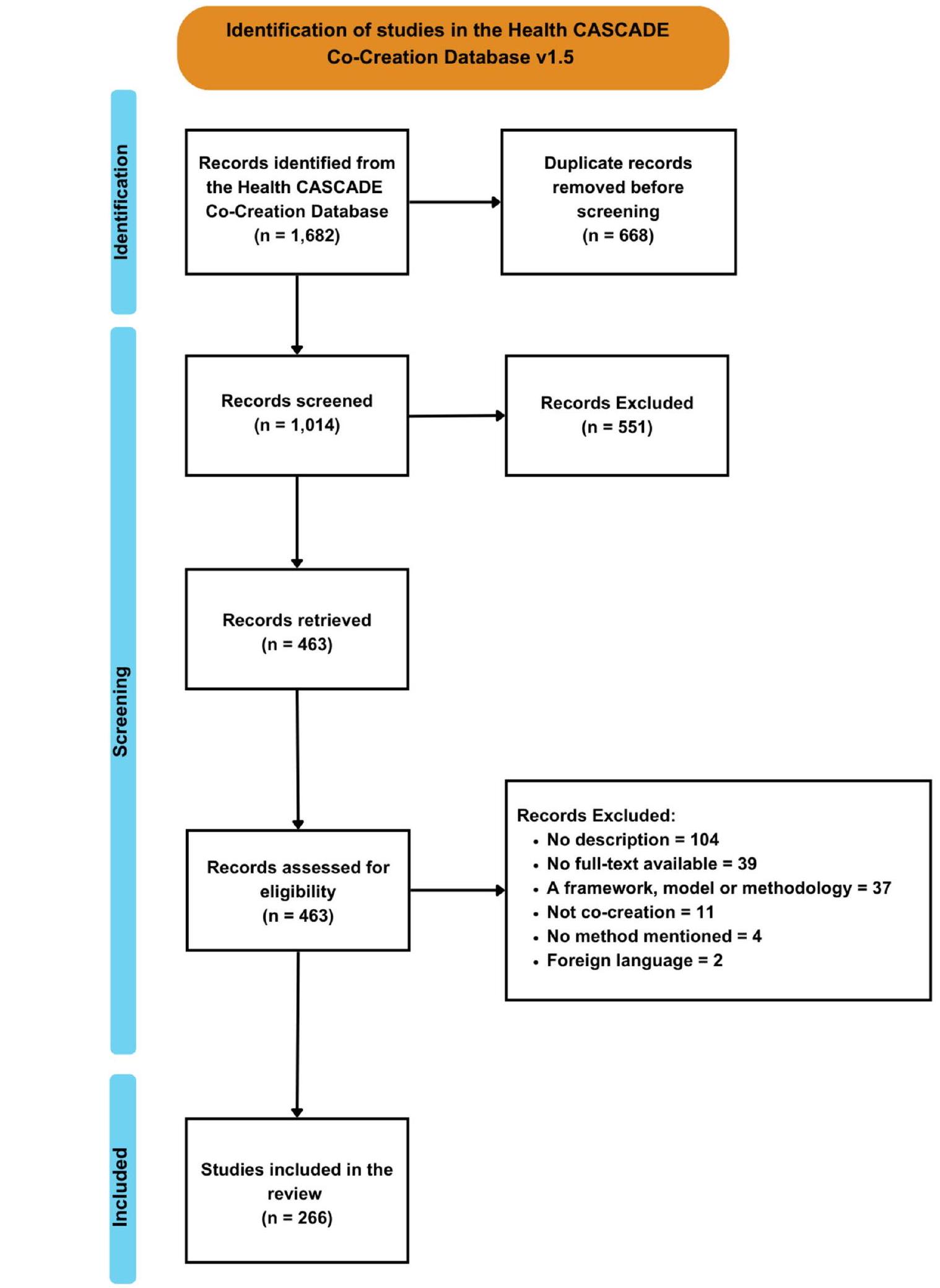
بعد فرز العنوان والملخص، تم تصدير المقالات المضمنة كملف RIS وانتقلت إلى مرحلة فرز النص الكامل. تم إعادة تحميل ملف RIS إلى Rayyan، وتم تقسيم الاقتباسات المضمنة بين ستة باحثين (JB، LRD، LMcC، QA، QL، وVAK). نظرًا للحجم الكبير من المقالات، قام كل باحث بفرز حزمة المواد المخصصة له باستخدام معايير الاختيار في الجدول 4. لضمان القوة والاتساق، قام الباحث الرئيسي
| المصطلح المستهدف | الكلمات الرئيسية |
| طريقة | طريقة” أو “طرق” أو “منهجية” أو “منهجيات” أو “أداة” أو “أدوات” أو “تقنيات” أو “تقنية” أو “إجراء” أو “إجراءات |
| المصطلح المستهدف | الكلمات الرئيسية |
| التشارك في الإبداع | التشارك في الإبداع*” أو “التصميم المشترك” أو “الإنتاج المشترك” أو “مشاركة الجمهور والمرضى” أو “مشاركة الجمهور” أو “مشاركة” أو “تصميم قائم على التجربة” أو “التصميم المشترك” أو “مشاركة المستخدم” أو “التصميم التعاوني” أو “علم المواطن |
| يتم تضمين المادة إذا كانت تلبي جميع ما يلي: | يتم استبعاد المادة إذا كانت تلبي واحدًا أو أكثر من ما يلي: | ||
| تتضمن على الأقل واحدة من الكلمات الرئيسية المستخدمة في البحث (أعلاه) في العنوان أو الملخص | لا تتضمن على الأقل واحدة من الكلمات الرئيسية المستخدمة في البحث (أعلاه) في العنوان أو الملخص | ||
| تم ذكر طريقة (طرق) بالاسم في العنوان أو الملخص | لا يذكر العنوان أو الملخص/يصف على الأقل طريقة واحدة | ||
| يوفر الملخص وصفًا (موجزًا) للطريقة (الطرق) أو يشير إلى أن الدراسة تتعلق بتطوير أو تقييم أو تطبيق الطريقة أو الطرق | لا يحتوي الملخص على وصف للطريقة أو هو ورقة إرشادية أو إطار عمل | ||
|
تم كتابة العنوان أو الملخص بلغة غير الإنجليزية ليس هو التشارك في الإبداع |
استخراج البيانات
تم استخراج البيانات لكل طريقة، باستخدام نموذج الاستخراج في Google Forms (Google Workspace) [26]. على سبيل المثال، إذا كان لدى مقال طريقتان، فسيتم إكمال نموذجين لذلك المقال. دفع نموذج الاستخراج الباحث لاستخراج تفاصيل حول كل طريقة، بما في ذلك 1) وصف المقال (مثل اسم المقال، السنة، المؤلفون)؛ 2) تفاصيل حول الطريقة (مثل الاسم، الخطوات، النوع، تفاصيل التنفيذ)؛ و3) بيانات داعمة حول عملية التشارك في الإبداع (مثل النماذج أو الأطر المستخدمة، الأدوات الرقمية، المنهجية أو النظرية). من المهم ملاحظة أن جميع التصنيفات، مثل نوع الطريقة والنهج المنهجي، تم تحديدها بناءً على اللغة المستخدمة في المقال المصدر. يظهر ملف إضافي نموذج الاستخراج (انظر الملف الإضافي 1).
التحليل
تم تحليل البيانات النوعية المستخرجة من المقالات المضمنة، بهدف تحديد الفوائد (الإيجابيات) والتحديات (السلبيات) لكل طريقة، بطريقة تحترم ذاتية ووجهات نظر مؤلفي المقالات المضمنة، مع تقليل التفسير الإضافي من قبل الباحثين والتركيز على تجميع الرؤى المبلغ عنها [27]. تم تحليل البيانات باستخدام نهج تحليل موضوعي استقرائي في NVivo الإصدار 1.7.2 (لوميفيرو) [28] وفقًا للست مراحل الموضحة بواسطة براون وكلارك [29].
تماشيًا مع إرشادات براون وكلارك، لم يتم تطبيق إطار ترميز موجود مسبقًا، وظهرت الموضوعات المبلغ عنها من خلال الترميز المفتوح وتطوير الموضوعات التكرارية [29]. تم تنفيذ المرحلة 1 (التعرف)، المرحلة 2 (توليد الرموز الأولية)، والمرحلة 3 (توليد الموضوعات) بواسطة الباحث الرئيسي (DMA)، مع تنفيذ المراحل اللاحقة 4 (مراجعة الموضوعات المحتملة) بواسطة أربعة باحثين (DMA، GRL، LRD، وVAK) لضمان الدقة والتماسك. تم إكمال المرحلة 5 (تحديد وتسميه الموضوعات) والمرحلة 6 (إنتاج التقرير) بواسطة الباحث الرئيسي (DMA)، وتمت مراجعة الموضوعات وتعديلها والموافقة عليها من قبل ثمانية باحثين (DMA، GRL، JB، LMcC، LRD، QA، SC، وVAK). في حالات الاختلاف، تمت مناقشة القضايا بين المؤلفين المشاركين حتى تم التوصل إلى توافق.
| يتم تضمين المادة إذا كانت تلبي جميع ما يلي: | يتم استبعاد المادة إذا كانت تلبي واحدًا أو أكثر من ما يلي: |
| النص الكامل متاح | النص الكامل غير متاح |
| تم ذكر طريقة (طرق) بالاسم في النص الكامل | لا يذكر المقال أو يصف على الأقل طريقة واحدة |
| المقال يقدم وصفًا (موجزًا) للطريقة أو يشير إلى أن الدراسة تتعلق بتطوير أو تقييم أو تطبيق الطريقة أو الطرق. | المقال يذكر فقط اسم الطريقة ولكنه لا يصف الطريقة نفسها، ولا يقدم أي تفاصيل عن الطريقة، ولا يصف متى أو كيف تم استخدامها في الدراسة (على سبيل المثال، يمكن أن تكون هذه دراسة أولية). |
| المقال يتحدث عن طريقة واحدة، أو طرق، مستخدمة في عملية. | المقال يتناول منهجية (مثل: عملية كاملة، نموذج، أو إطار عمل) وليس عن طريقة واحدة، أو طرق، مستخدمة في عملية. |
| يعتبر ‘التعاون في الإبداع’، استنادًا إلى تعريف أغنيليو ولوازيل وآخرون للتعاون في الإبداع [8] | ليس التعاون في الإبداع |
| النص الكامل كُتب باللغة الإنجليزية | النص الكامل كُتب بلغة غير الإنجليزية |
النتائج
استراتيجية البحث والفحص
البيانات المستخرجة
من بين 404 استخراجًا،
تم استخدام طرق في المشاريع التي كانت لديها أوضاع تسليم مختلفة. على سبيل المثال،
الأسس المنهجية
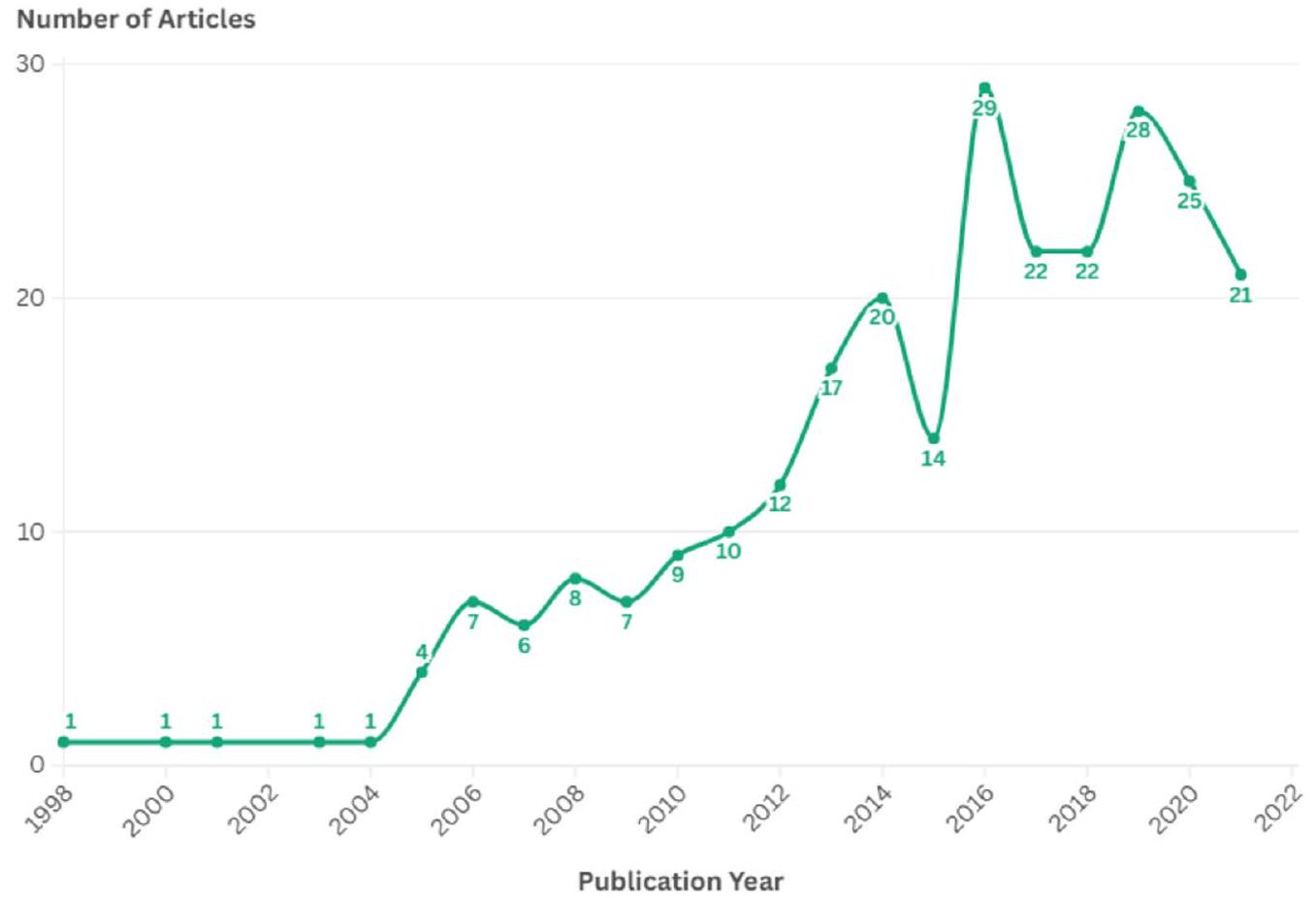
علاوة على ذلك، كان عدد الطرق المستخرجة لكل منهجية يختلف مع مرور الوقت وفقًا لسنة النشر. كما ساهم كل نهج بعدد معين من الطرق. توضح الجدول 6 توزيع الطرق على مر الزمن وعبر المنهجيات. يحتوي الملف الإضافي على جدول الاستخراج، الذي يتضمن الطرق لكل منهجية (انظر الملف الإضافي 3).
أنواع الطرق
اعتمادًا على المقال الذي تم الاستناد إليه، تم الإبلاغ عن بعض الطرق كأنواع طرق مختلفة، لذا تم تصنيف تلك الطرق تحت كلا النوعين (مثل: المشاركة والنوعية، أو المشاركة والبصرية). على سبيل المثال، صنفت مصادر مختلفة تقنية فوتوفويس كنوع نوعي (
في 174 حالة، أبلغ المؤلفون عن طرق تم استخدامها معًا في عملية التعاون، مما يوفر رؤى حول كيفية دمج الطرق. تم تجميع التركيبات المستخرجة حسب نوع الطريقة. تحليل التكرارات المشتركة بين الطرق المصدر والهدف يوضح الأنماط الرئيسية، والتي تم عرضها في الجدول 8.
توضح هذه النتائج الطرق المتنوعة التي تتقاطع بها الأساليب، حيث تهيمن الأساليب التشاركية والنوعية على المشهد، بينما تظل التركيبات البصرية والكمية نادرة نسبيًا. يحتوي ملف إضافي على المجموعة الكاملة من الأساليب المدمجة ورؤية بصرية لتركيبات الأساليب (انظر الملف الإضافي 5).
السكان المستهدفون
تراوحت الفئات المشاركة بين الأكاديميين، والمهنيين في الرعاية الصحية، ومقدمي الرعاية، إلى مجموعات أكثر تهميشًا مثل الأطفال المصابين بالتوحد، والأفراد من مجتمع LGBTQAI +، واللاجئين، والأشخاص
| عدد المقالات | نوع النهج | المنهجيات |
| ١٤٤ | النهج التشاركي | البحث التشاركي، البحث التشاركي القائم على المجتمع، نهج البحث التشاركي القائم على العمل، البحث التشاركي القائم على الشباب، أو التصميم التشاركي |
| 30 | النهج المشترك | التشارك في الإبداع، التشارك في التصميم، والتشارك في الإنتاج |
| 20 | أنواع مختلفة | البحث العملي، التقييم التشاركي، النهج الإثنوغرافي، تصميم موجه نحو المستخدم، ومشاركة المجتمع |
| عدد الطرق | نهج | المنهجيات | سنوات |
| 147 | النهج التشاركي | البحث العملي التشاركي، البحث التشاركي، البحث القائم على المجتمع التشاركي، وتصميم تشاركي | 1998 إلى 2022 |
| ٤٩ | النهج المشترك | التعاون في الإبداع، التعاون في التصميم، التعاون في الإنتاج | 2008 إلى 2022 |
| 11 | متنوع | تعزيز الصحة القائم على المجتمع وبحث العمل | 2014 إلى 2022 |
استنباط
| نوع الطريقة | عدد الطرق |
| مشاركة | ١٣٧ |
| نوعي | 99 |
| الطرق المختلطة | ٣٥ |
| كمّي | 16 |
| بصري | ٤ |
| النمذجة شبه الكمية | ٤ |
| أخذ العينات | ٢ |
| رصدية | 1 |
| نوع طريقة المصدر | نوع طريقة الهدف | نسبة التكرار %
|
| مشاركة | مشاركة | ٢٦.٧٪
|
| نوعي | نوعي | 18.2% (
|
| مشاركة | نوعي | 17.9% (
|
| نوعي | مشاركة |
|
| مختلط | نوعي | 4.9% (
|
| كمّي | نوعي | 3.2% (
|
| مختلط | مشاركة | 2.5% (
|
| مختلط | مختلط | 2.5% (
|
| بصري | نوعي | 2.5% (
|
| كمّي | مشاركة | 2.1% (
|
| نوعي | مختلط | 1.8% (
|
| كمّي | مختلط | 1.8% (
|
| بصري | مشاركة |
|
| بصري | بصري | 1.4% (
|
| أخذ العينات | أخذ العينات | 1.4% (
|
| نوعي | كمّي | 0.7% (
|
| مختلط | كمّي | 0.7% (
|
| نوعي | أخذ العينات |
|
| كمّي | كمّي | 0.4% (
|
| مشاركة | بصري | 0.4% (
|
| بصري | كمّي | 0.4% (
|
| كمّي | بصري |
|
| بصري | رصدية | 0.4% (
|
| مشاركة | رصدية | 0.4% (
|
التحليل الموضوعي
فوائد الطريقة
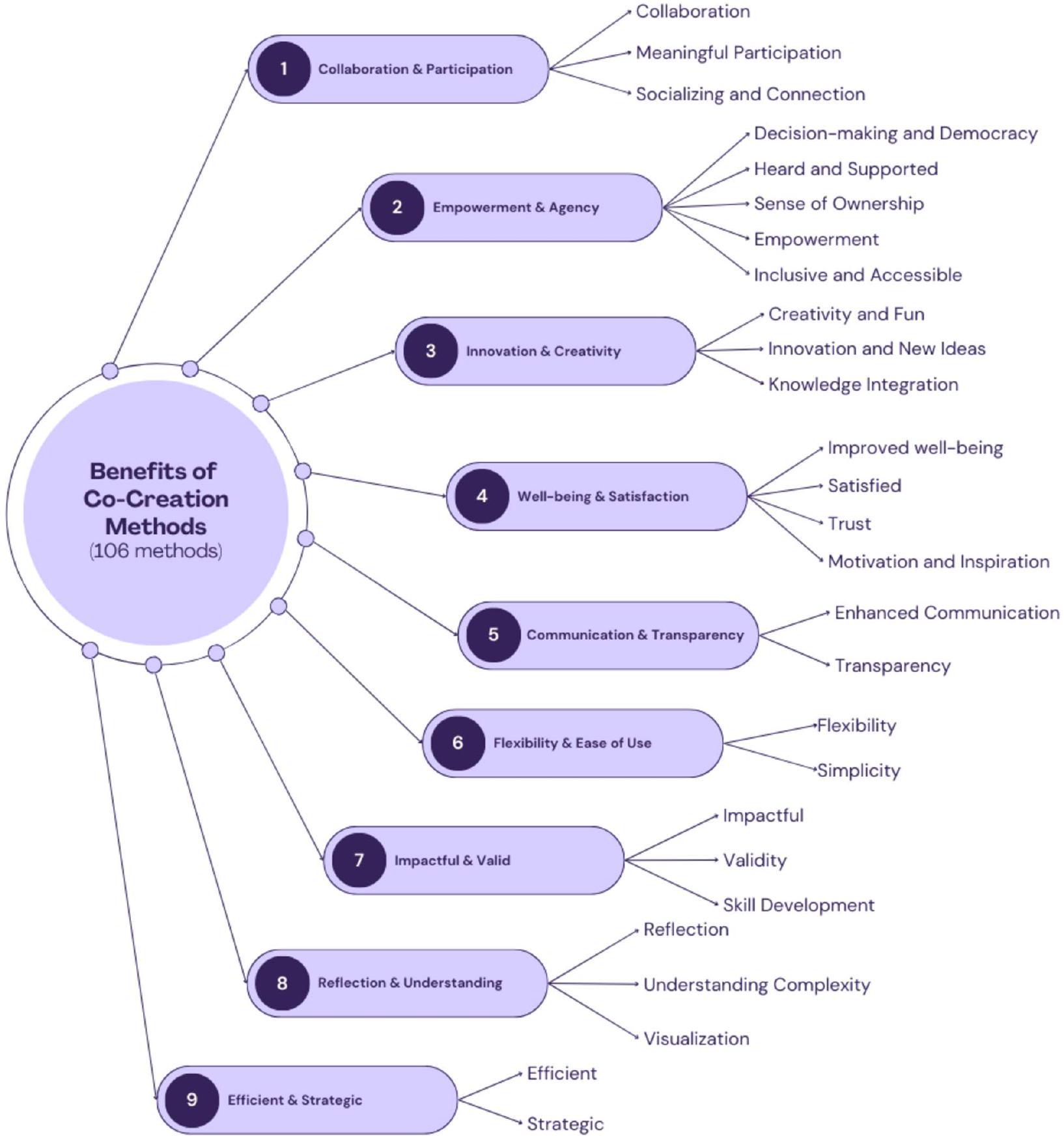
يتضمن ملف إضافي أسماء الموضوعات الفرعية، والأوصاف، والأساليب المرتبطة بها ومراجعها (انظر الملف الإضافي 8).
الموضوع 1: التعاون والمشاركة
الانخراط المعنوي هو المفتاح، حيث أظهر أوريلي-دي برون وآخرون كيف أن الأساليب “لديها القدرة على تسهيل الانخراط المعنوي الذي يدمج تلقائيًا التوليد المشترك والتحليل المشترك للبيانات من قبل ومع أصحاب المصلحة” [54]. كما تعزز أساليب التشارك في الإبداع الاتصال وبناء العلاقات، مما يضمن شعور المشاركين بالاندماج. ويعكس هذا الجانب العلاقي في الدراسات التي تشير إلى كيف “يمكن إقامة الاتصال في المرحلة المبكرة جدًا من المشروع، كأساس لنتيجة مستدامة” [55] وكيف أن “الناس سيقومون أيضًا بإنشاء اتصالات مع رؤى أخرى وأشخاص آخرين” [56].
الموضوع 2: التمكين والوكالة
| السكان المستهدفون | الطريقة (المرجع) |
| 1. الأكاديميات | تقرير بيانات الشراكة للتفكير [22] ومقهى العالم [23] |
| 2. المراهقون | مقابلة سردية قائمة على الفن [24]؛ نهر الحياة [22]؛ صوت الصورة [25، 26]؛ فرز البطاقات [27]؛ ومختبر الواقع الافتراضي [28] |
| 3. البالغون | اختبار المقابلة ثلاثي الخطوات [29]؛ الملصقات [30]؛ أداة تحليل الوضع [31]؛ نهر الحياة [22]؛ المقابلة [32]؛ نماذج صفحات الويب [33]؛ الملاحظة المشاركة [34]؛ قصص المستخدمين [35]؛ عائلة الصراع (نشاط سرد قصصي ثقافي) [36]؛ نهر مشترك [37]؛ تحليل القرار متعدد المعايير [38]؛ صوت الصورة [39-41]؛ طريقة MUST [42]؛ استدلال الصورة [43]؛ التصميم المشترك من خلال استغلال الإمكانيات [44]؛ الرؤية [45]؛ رسم خرائط الأنظمة التشاركية [46]؛ أداة Geo-Wiki عبر الإنترنت [47]؛ مجموعة السرد القصصي [48]؛ فهم المعنى [35]؛ أداة التصور المستندة إلى الويب [49]؛ وتحليل الشبكات الاجتماعية [50] |
| 4. الأطفال المصابون بالتوحد | تفاعل كامل الجسم [51] |
| 5. الناجون من السرطان | صوت الصورة [52] |
| 6. مقدمو الرعاية | جمعية مقدمي الرعاية [53] وعينة هادفة [54] |
| 7. الأطفال (تحت 18 سنة) | عني [55]؛ صناعة الفن [56]؛ صناعة الكتب [56]؛ بناء نموذج [56]؛ قوائم التحديات وبطاقات الأصول [57]؛ تصنيف الماس [58]؛ السرد الرقمي [59، 60]؛ تقنية الرسم والكتابة [61-64]؛ الرسم [65]؛ خريطة الحقول الخمسة [66]؛ طريقة FUBI [67]؛ الرسوم البيانية على مر الزمن [68]؛ مسرح الصور [59]؛ المقابلات غير الرسمية [61]؛ لعب Lego الجاد [69]؛ النهج الموزائيكي [63، 70]؛ مقياس الجدة: برطمانات الحلوى [55]؛ مقاييس الجدة: الوجوه المبتسمة [55]؛ الملاحظة المشاركة [71]؛ تصوير المشاركين [72]؛ استنباط الموضوعات بالمشاركة [73]؛ الفيديو التشاركي [59]؛ استنباط الصور [55، 58]؛ صوت الصورة [26، 74، 75]؛ الدمى [63]؛ تمثيل الأدوار [56]؛ الملاحظات شبه المشاركة [61]؛ اختبار لصق النجوم [61]؛ لوحة القصة [76]؛ طريقة الخمسة لماذا [77]؛ يوميات الفيديو [78]؛ طريقة الأصوات البصرية [79]؛ ولعبة البحث عن الكلمات [76] |
| 8. الأطفال ذوو الاحتياجات الخاصة | تصنيف الماس [80]؛ بطاقات تفضيل المدرسة [80]؛ قوائم المراقبة SCERTS [80]؛ وجدار الجرافيتي [80] |
| 9. أعضاء المجتمع | رسم خرائط الأصول [81]؛ رسم خرائط المفاهيم (المعروف أيضًا برسم الخرائط المعرفية) [82]؛ مجموعات التركيز باستخدام خريطة النقاط [83]؛ تقرير بيانات الشراكة للتفكير [22]؛ المسارات [45]؛ صوت الصورة [84]؛ سجلات النشاط المدعومة بالصور الفضائية [83]؛ مقهى العالم [23]؛ وطريقة نظام يونمنكاigi [85] |
| 10. الأشخاص ذوو الإعاقة | تحليل الظواهر التفسيرية [86]؛ طريقة تقرير المخاوف [87]؛ وصوت الصورة [88] |
| 11. المزارعون | استطلاع مقطعي [89]؛ وصوت الصورة [90] |
| 12. المجتمعات الغابية | سيناريوهات بديلة [45] |
| 13. المتخصصون في الرعاية الصحية | رسم الخرائط المفهومية (المعروف أيضًا برسم الخرائط المعرفية) [91]؛ تقنية المجموعة الاسمية (لجنة الخبراء) [92]؛ المقابلة شبه المنظمة [78]؛ السوسيوقرام (الرسم البياني الموجه) [93]؛ مقهى العالم [23]؛ ومراجعة منهجية مدفوعة من قبل المستخدم [94] |
| 14. المشردون | صوت الصورة [95] |
| 15. المهاجرون | رسم الخرائط المفهومية (رسم الخرائط المعرفية) [96] |
| 16. الشعوب الأصلية | سرد القصص [97]؛ طريقة البحث البصري Gaataa’aabing [98]؛ مجموعات التركيز التفسيرية [99]؛ سرد القصص الرقمي [100]؛ ومقابلة جماعية [101] |
| 17. المجتمعات الإنويت التي تعيش مع مرض السكري | سرد القصص [102] |
| 18. LGBTQAI + | رسم الخرائط المجتمعية [103] وصوت الصورة [26] |
| 19. الأشخاص ذوو الدخل المنخفض | قياسات الجسم [104]؛ مخطط الحلقة السببية [68]؛ الرسوم البيانية على مر الزمن [68]؛ عينة كرة الثلج [54]؛ وطريقة تقرير المخاوف [87] |
| 20. الأشخاص المهمشون | سيناريوهات بديلة [45]؛ فيديو تشاركي [105]؛ رسم الماندالا [106]؛ كوميديا أنشأها المشاركون [45]؛ وصوت الصورة [107، 108] |
| 21. النساء المسلمات | طريقة قائمة على الفنون التوضيحية [109] |
| 22. الشباب غير الثنائي | رسم الجسم [110] |
| 23. الممرضات | تيسير الرسوم البيانية [93]؛ الاستدلال الفوتوغرافي [93]؛ ورسم العلاقات الاجتماعية (الرسم البياني الموجه) [93] |
| 24. كبار السن | صوت الصورة [111، 112]؛ المقابلة [32]؛ السيناريوهات البديلة [45]؛ المختبر الحي [113]؛ استثارة الصورة [43، 114]؛ لوحة القصة والرسوم المتحركة [113]؛ ومقهى الحياة [115] |
| 25. الآباء | مقابلة سردية [78] |
| 26. الأشخاص الذين يعيشون مع سرطان الثدي | تقنية الحوادث الحرجة [116] |
| 27. الأشخاص الذين يعانون من ألم مزمن غير سرطاني | العينة الغرضية [54] |
| 28. الأشخاص المصابون بالخرف | سرد القصص [117] ومقهى السياسات [53] |
| 29. الأشخاص المصابون بالسكري | تقنية المجموعة الاسمية (لجنة الخبراء) [92] |
| 30. الأشخاص ذوو مستوى منخفض من محو الأمية | سيناريوهات بديلة [45] واستدعاء الصور [118] |
| 31. الأشخاص الذين يواجهون تحديات في الصحة النفسية | التخطيط التشاركي [119] |
| 32. اللاجئون | مسرح المنتدى [120] ومسرح العرض [120] |
| 33. السكان الريفيون | صوت الصورة [95] |
| السكان المستهدفون | الطريقة (المرجع) |
| 34. الأمهات العازبات | صوت الصورة [121] |
| 35. الطلاب | نهر تم إنشاؤه بشكل مشترك [37]؛ مختصر تم إعادة تحريره مع عناصر الألعاب [122]؛ وصوت الصورة [41] |
| 36. المعلمون | المنهجية البصرية التشاركية [123] |
| 37. الأشخاص المعرضون للخطر الذين لا يحصلون على الخدمات الكافية | استدعاء الصور [43] |
| 38. الأشخاص المعرضون للخطر | نهج مختلط: صوت الصورة واستنباط الصورة [124]؛ يوميات سفر مساحة النشاط اليومي [125]؛ ألعاب الجيوكاشينغ [83]؛ الإدراج، التقييم، التصنيف [126]؛ تصوير المشاركين [72]؛ رسم الخرائط الجغرافية التشاركية [125]؛ إنتاج الصور مع المقابلات [117]؛ صوت الصورة [62، 108، 127-131]؛ عملية التحليل الهرمي [132]؛ والسيناريوهات البديلة [133] |
| 39. النساء اللاتي لديهن تاريخ من سكري الحمل | مجموعة فيسبوك [134] |
| 40. الشباب (15-24 سنة) | رسم الخرائط المجتمعية [83، 103]؛ سرد القصص الرقمية [59، 60]؛ مجموعات التركيز على خريطة النقاط [83]؛ ألعاب الجيوكاشينغ [83]؛ مسرح الصور [59]؛ لعب ليغو الجاد [69]؛ طريقة الفنون التوضيحية [109]؛ تصوير المشاركين [72]؛ استنباط الموضوعات التشاركية [73]؛ الفيديو التشاركي [59]؛ التصوير الفوتوغرافي التشاركي/الانعكاسي [135]؛ المقابلات بين الأقران [136]؛ صوت الصورة [39، 127، 128، 137]؛ سجلات الأنشطة المدعومة بالصور الفضائية [83]؛ أداة البحث عن العافية [138]؛ وطريقة تحليل بيانات شباب ReACT (البحث في تفعيل التفكير النقدي) [139] |
جانب رئيسي من التمكين هو ضمان شعور المشاركين بأنهم مسموعون ومدعومون. تقدم طرق مثل صوت الصورة للمشاركين “فرصة لمشاركة تجاربهم وآلامهم ومشاعرهم مع الآخرين” [88]، بينما يصف كيوغ وآخرون كيف سمحت جمعية مقدمي الرعاية للمشاركين بالشعور بأنهم “مسموعون وكثيرون أبلغوا، ولأول مرة كمقدمي رعاية عائلية، شعروا بأنهم ذوو قيمة ولديهم صوت” [35]. تبني هذه الطرق الثقة وتعزز الحوار الشامل، حتى في حالات النزاع.
الملكية هي عنصر حيوي آخر، مما يسمح للمشاركين بالتحكم في نتائج البحث والتأثير عليها. يشير أوريلي-دي برون إلى كيف أن الترتيب المباشر “يعطي [للمشاركين] القوة” [54] من خلال السماح لهم بتحديد أولوياتهم الخاصة، بينما يؤكد تاونلي وآخرون كيف يمكن أن يسمح رسم الخرائط التشاركي للأفراد “برسم خرائطهم الخاصة، بدلاً من الاعتماد على الخرائط المرسومة مسبقًا أو حدود التعداد” [108].
بعيدًا عن تمكين الأفراد، تتحدى العديد من الطرق بنشاط الهياكل السلطوية وتخلق شراكات متساوية. يشير تاونلي وآخرون إلى أن رسم الخرائط التشاركي مكن المشاركين من “شرح مجتمعاتهم من وجهات نظرهم الفريدة” [108]، ويضع الفيديو التشاركي المشاركين كـ”شركاء متساوين”
جنبًا إلى جنب مع السلطات الحكومية لتوفير نهج تعاوني لحل المشكلات” [109]. تعزز هذه إعادة توزيع السلطة المشاركة المجتمعية، وتعزز العدالة الاجتماعية وتضمن أن الأصوات التي تم استبعادها تقليديًا تلعب دورًا في اتخاذ القرار.
تعتبر الشمولية وإمكانية الوصول مكونات أساسية، تضمن أن الحواجز مثل محو الأمية، اللغة، أو المعرفة التقنية لا تستبعد المشاركين. يصف لورز كيف وجد المشاركون قوائم التحقق “أسهل في الارتباط” [110]، بينما يذكر ليناباري وآخرون كيف وجد المشاركون طريقة عائلة النزاع “مرنة وقابلة للوصول” [111]. يعلق أوريلي-دي برون وآخرون على كيف أن الترتيب المباشر “يمكن أن يجذب مجموعة واسعة من أصحاب المصلحة، بما في ذلك أولئك الذين يواجهون تحديات في محو الأمية و/أو الحساب” [54]، مما يساعد على خلق مساحات آمنة تشاركية للأطفال، والمجتمعات المهمشة، والمجموعات التي يصعب الوصول إليها.
من خلال إعادة توزيع السلطة، وتضخيم أصوات المشاركين، وتعزيز الشمولية، تعزز طرق التشارك في هذا الموضوع الملكية المشتركة، والتمكين، وعمليات اتخاذ القرار الديمقراطية.
الموضوع 3: الابتكار والإبداع
يساعدون “المشاركين على رؤية ما وراء التركيز السابق وبدلاً من ذلك أدى إلى [تحديد] مجموعة أوسع من خيارات التدخل” [66]. تقدم بعض الطرق تقنيات جمع البيانات وتحليلها غير التقليدية، مثل وصف فيلكر-كانتر وآخرون لـ”نهج مبتكر لجمع بيانات مساحة النشاط” [118]. هذه القدرة على توليد استراتيجيات جديدة تجعل هذه الطرق ذات قيمة خاصة في التشارك.
من خلال تعزيز اللعب، والابتكار، ودمج المعرفة المعنوية، تمكّن طرق التشارك المشاركين من التفكير خارج الحلول التقليدية والمساهمة في التغيير التحويلي.
الموضوع 4: الرفاهية والرضا
. يصف فير تشايلد وماكفيران كيف يمكن أن يقدم التشارك “آثارًا علاجية” [112]، بينما يذكر بلودجيتا وآخرون كيف يمكن لرسم الماندالا “تخفيف التوتر والقلق الذي قد يشعر به المشاركون في سياق البحث” [139]. يعزز هذا الدعم العاطفي المشاركة ويسمح بحوار أكثر انفتاحًا.
يعبر المشاركون بشكل متكرر عن رضاهم العالي، ويصفون التشارك بأنه تجربة مجزية وذات مغزى. يذكر تيموتييفيتش وراتس أن “الرضا الذاتي عن الأحداث كان مرتفعًا” [62]، وأشار دودز وآخرون إلى أن “المشاركين استمتعوا بمشاركتهم في مراحل البحث” [129]. يعزز هذا الشعور بالإنجاز المشاركة المستمرة ويزيد من احتمالية الاستمرار في الانخراط. إن خلق مساحات آمنة للحوار يعزز أيضًا رفاهية المشاركين، كما يتضح من عمل سومر وآخرين في تنزانيا، حيث مكنت الطرق التشاركية الشباب من مشاركة أوصاف صادقة لتجاربهم الحياتية في مساحات شعروا فيها بأنهم مسموعون [104].
الثقة هي نتيجة حاسمة أخرى، تعزز الانخراط الأعمق وتقوي العلاقات. يشير تيموتييفيتش وراتس إلى أن المشاركين “شعروا أن المنظم كان موثوقًا” [62]، بينما وصف فاليلي وآخرون كيف أن القوائم، والتسجيل، والترتيب تعزز “الثقة والفهم بين الباحثين، والمشاركين في الدراسة و
“تمثيل المجتمع” [140]. إن بناء الثقة هذا أمر حيوي عند العمل مع مواضيع حساسة أو مجتمعات مهمشة، حيث يضع الأساس للتعاون المفتوح.
أخيرًا، تحافظ طرق التعاون على المشاركة من خلال تعزيز الدافع والإلهام، مما يشجع المشاركين على تحمل المسؤولية والبحث عن الحلول. يشير باير وآخرون إلى أن المشاركين “يصبحون متحمسين للبحث عن الحلول” [117]، وأشار لاهتينن وآخرون إلى أن ورشة العمل المستقبلية كانت “تُعتبر ملهمة من قبل المشاركين” [116]. وغالبًا ما يغادر المشاركون عمليات التعاون بحماس ورغبة في الاستمرار في المشاركة في تحديد ومعالجة التحديات الرئيسية.
من خلال تعزيز الرفاهية العاطفية، وزيادة الرضا، وبناء الثقة، والحفاظ على الدافع، تمكّن طرق التعاون المشاركين من الانخراط بعمق والمساهمة بشكل ذي مغزى في حل المشكلات بشكل تعاوني.
الموضوع 5: التواصل والشفافية
من خلال تحفيز الحوار المركز وتمكين أشكال التعبير التشاركي، تضمن هذه الأساليب مشاركة وفهم وجهات نظر متنوعة. على سبيل المثال، يمكن استخدام Photovoice مع المشاركين الذين لديهم مجموعة متنوعة من احتياجات التواصل، بينما تلتقط Participatory/Reflective Photography نمطًا متزايد الهيمنة ثقافيًا من التواصل البشري والتعبير عن الذات. تساعد هذه الأساليب في التنقل عبر مواضيع معقدة أو مثيرة للجدل من خلال حوار طبيعي وثقافي ذي دلالة، مما يتماشى مع تجارب المشاركين الحياتية.
الشفافية مهمة بنفس القدر، حيث تضمن أن يشعر المشاركون بأنهم مطلعون ومشاركون في اتخاذ القرار. تعزز طرق التعاون العمليات المفتوحة، مما يوفر فرصًا منظمة للمشاركين للتعبير عن آرائهم. يشير إيفانز وآخرون إلى أن السيناريوهات البديلة تدعم الشفافية من خلال “فرص لجميع المشاركين”.
“للتعبير عن آرائهم بطريقة أكثر تنظيمًا” [46]، و”النمذجة التشاركية تزيد من الشفافية وتسمح بإعادة بناء وتحليل ما حدث” [45]. هذه الانفتاحية تعزز الثقة والمساءلة والشمولية.
من خلال تحسين التواصل، وزرع الثقة من خلال الشفافية، وتشجيع التعبير التشاركي، تعزز طرق التعاون العلاقات بين أصحاب المصلحة وتضمن أن تساهم جميع الأصوات بشكل ذي مغزى في العملية.
الموضوع 6: المرونة وسهولة الاستخدام
تضمن هذه القابلية للتكيف أن يتمكن الباحثون من الاستجابة للاحتياجات المتغيرة، مما يحسن فعالية البحث. على سبيل المثال، تم استخدام تقنية فوتوفويس مع مجموعة واسعة من الفئات السكانية، بما في ذلك الأطفال، والمراهقين، والأفراد من مجتمع LGBTQAI +، وناجي السرطان، والأمهات العازبات، والعاملين في مجال الجنس، والبالغين المصابين بالتوحد، والشباب المتورطين في الشارع.
بالإضافة إلى المرونة، تعطي هذه الأساليب الأولوية للبساطة، مما يضمن سهولة الوصول للمشاركين الذين لديهم تدريب أو خبرة تقنية محدودة. تصميمها سهل الاستخدام يسمح بالتنفيذ المباشر. يصف باركر وآخرون تقرير بيانات الشراكة للتفكير بأنه “ملموس، حيث يتم تقسيم القضايا إلى أجزاء قابلة للإدارة” [127]، ورؤية بأنه “سهل الاستخدام” [127]. من خلال تقليل التعقيد وتوفير حلول فورية، تضمن هذه الأساليب مشاركة واسعة وانخراطًا ذا مغزى.
تقدم طرق التعاون في هذا الموضوع أدوات عملية لمجموعة متنوعة من بيئات البحث والممارسة من خلال تحقيق التوازن بين القابلية للتكيف والبساطة.
الموضوع 7: مؤثر وصالح
من خلال إشراك مجموعة متنوعة من أصحاب المصلحة في اتخاذ القرار، تعزز هذه الأساليب صحة البحث، وتحسن دقة البيانات، وتلتقط نقاط القوة في المجتمع. يبرز لايتفوت وآخرون كيف أن رسم الأصول “يمكن أن يكون له صحة أعلى من البيانات المستمدة من الأساليب التقليدية، حيث يتم إشراك جميع أصحاب المصلحة في اختيار الأصول التي سيتم رسمها” [151]، بينما “قيم المشاركون في ورشة المواطنين فعالية العملية بشكل عالٍ” [62]. تساعد هذه الأساليب في ضمان أن التدخلات المشتركة المعلومات مدروسة جيدًا، وقابلة للتكيف، وتعكس الظروف الواقعية.
بالإضافة إلى التأثير والصلاحية، توفر طرق التشارك في الإبداع فرصًا قيمة لتطوير المهارات، مما يجهز المشاركين للمشاركة بشكل هادف في البحث واتخاذ القرار. إنها تعزز التعلم المتبادل بين الباحثين والمستخدمين النهائيين، مما يخلق فرصًا للتفكير النقدي، والعمل الجماعي، وتطوير القيادة. يصف أوريلي-دي برون وآخرون كيف أن مخططات التعليق “عززت التعلم” [54]، بينما “تساعد سرد القصص الرقمية [المشاركين] على تطوير مهارات التفكير النقدي” [68]. تعزز هذه المكونة لبناء القدرات قدرة المشاركين على المساهمة في جهود التشارك في الإبداع المستقبلية وقيادتها.
من خلال دمج التطبيقات الواقعية، وضمان صحة البحث، وبناء المهارات الأساسية، تساهم طرق التعاون في تحسينات فورية وطويلة الأمد في البحث والممارسة.
الموضوع 8: التأمل والفهم
من خلال تعزيز عمليات التفكير التكرارية والتحول الشخصي، تخلق طرق التعاون بيئات تأملية حيث يمكن للمشاركين الانخراط في التقييم الذاتي وتتبع التقدم. يصف ريفيز وآخرون كيف أن دلفي المعدلة تعزز “الانعكاسية كعملية تفكير نقدي تشمل الباحثين والمشاركين في استجواب نماذجهم الخاصة”، بينما تمتلك فوتوفويس “القدرة على تسهيل التأمل الذاتي وزيادة وعي المريض بنجاحاته وصعوباته”. تساعد هذه الممارسات التأملية المشاركين على استكشاف القضايا الشخصية والاجتماعية، مما يعمق الانخراط ويبني وعيًا أكبر.
التفاعلات، مما يوفر لصانعي القرار رؤى شاملة حول القضايا الاجتماعية والبيئية. يوضح فوينوف وآخرون كيف أن النماذج المعتمدة على الوكلاء “مناسبة تمامًا لتمثيل التفاعلات المكانية المعقدة في ظل ظروف غير متجانسة ولنمذجة اتخاذ القرار اللامركزي المستقل” [45]، بينما يصف ليتوفو وآخرون كيف أن مقابلة السرد “أسفرت عن بيانات أعمق وأوسع مقارنة حول التعقيد المكاني والطبيعة متعددة الأطراف لتجربة الخدمة” [156]. من خلال تجاوز القيود المعرفية، تضمن طرق التعاون طريقة أكثر دقة وغمرًا لفحص المواضيع متعددة الأوجه.
تلعب التصوير دورًا حاسمًا في هذا الموضوع، حيث تقدم طرقًا واضحة وجذابة لعرض البيانات المعقدة. تعزز هذه الطرق استكشاف وتمثيل بيانات الصحة، والأنماط المكانية، والاتجاهات الناشئة، مما يجعل المعلومات أكثر سهولة وقابلية للتنفيذ. يشرح باير وآخرون أن نظم المعلومات الجغرافية تعزز “الاستكشاف البصري وعرض بيانات الصحة” وتكون مفيدة لـ”إنشاء رسومات كبيرة وجذابة بصريًا” [117]. يرفع الاستدلال البصري من وضوح القضايا، ويحفز النقاش، ويولد رؤى غنية. على سبيل المثال، “استخدام الصور في عملية رسم الخرائط المفاهيمية مكن المشاركين من تحديد الروابط الطبيعية بين العوامل” [132].
من خلال تعزيز التفكير النقدي، وتحسين فهم التعقيد، وتعزيز تصور البيانات، تمكّن طرق التعاون المشاركين من الانخراط بعمق، والتواصل بفعالية، واتخاذ قرارات مستنيرة بناءً على تمثيلات دقيقة وجذابة بصريًا للمعلومات.
الموضوع 9: الكفاءة والتفكير الاستراتيجي
تحسن هذه الطرق من كفاءة الوقت وتسهّل المناقشات الجماعية الفعالة، مما يسمح بالتقييمات السريعة ودمج الرؤى المحلية مع الحد الأدنى من المساعدة من الموظفين. تقدم نهجًا منظمًا ولكنه مرن لمعالجة تحديات متعددة في وقت واحد، مما يضمن عمليات شاملة ولكن قابلة للإدارة. يصف فوينوف وآخرون رسم الخرائط المعرفية الضبابية بأنه “أداة مفيدة لتقييم هيكل ووظيفة مشكلة ديناميكية بسرعة وكفاءة” [45]. هذا التركيز على الكفاءة يجعل هذه الطرق ذات قيمة خاصة في البيئات المحدودة الموارد أو في بيئات اتخاذ القرار السريعة.
من خلال تحسين استخدام الموارد، وتشجيع الرؤى الاستراتيجية، وتعزيز اتخاذ القرارات المنظم، تدعم طرق التعاون في هذا الموضوع كل من الكفاءة وحل المشكلات على مستوى عالٍ، مما يجعلها أدوات قيمة لمعالجة التحديات المعقدة عبر سياقات متنوعة.
تحديات الطريقة
يحتوي ملف إضافي على أسماء الموضوعات الفرعية، والأوصاف، والطرق المرتبطة (انظر الملف الإضافي 8).
الموضوع 1: المشاركة والانخراط
يمثل الدافع حاجزًا آخر. يمكن أن تثني الطرق التي تتطلب وقتًا أو جهدًا كبيرًا المشاركين، خاصة عندما تكون الفوائد المتوقعة غير واضحة. يوضح لامبرت وآخرون أنه خلال المقابلات غير الرسمية، “قد يشعر الأطفال بالملل من التفاعل اللفظي، ويترددون في التحدث ويقدمون ردودًا محدودة وعميقة” [48]، بينما يحذر بيريرا وآخرون من أن العملية التي تستغرق وقتًا “يمكن أن تحد غالبًا من مشاركة بعض الأشخاص ما لم يروا فائدة مباشرة لعملهم” [114]. يتطلب الحفاظ على الانخراط أنشطة منظمة جيدًا تحافظ على اهتمام المشاركين واستثمارهم.
يلعب التيسير دورًا حاسمًا في العديد من طرق التعاون، حيث تعتمد النتائج غالبًا على خبرة الميسر. بدون توجيه ماهر، قد يكافح المشاركون للتنقل في المناقشات أو استخلاص رؤى ذات مغزى. تشير لورز إلى أن المشاركين اعتمدوا على “أعضاء فريق المشروع حول القضايا التي قد يرغبون في استكشافها أكثر” [110]. يؤكد سمادار وآخرون أن “الكثير من جوانب ورشة العمل تعتمد على مهارات تيسير الميسر” [162]. هذه الاعتمادية تقدم تباينًا وتجعل من الصعب توسيع نطاق هذه الطرق.
تشكل متطلبات التدريب والمهارات أيضًا تحديات كبيرة. يمكن أن يؤدي التدريب غير الكافي إلى أخطاء في تفسير البيانات والتنفيذ. يذكر بيليو وآخرون أخطاء في تمرين مخطط الحلقة السببية بسبب “التدريب غير الكافي لإجراء مثل هذا التمرين” [66]، بينما يبرز لايتفوت وآخرون أن “رسم الخرائط للأصول يستغرق وقتًا طويلاً ويتطلب قدرًا كبيرًا من التدريب والإشراف” [151]. تعتبر برامج التدريب المنظمة ضرورية لضمان تطبيق الطرق بشكل متسق ودقيق.
أخيرًا، يمكن أن تشكل ديناميات المجموعة نجاح عمليات التعاون. قد تؤثر الأصوات السائدة أو التأثيرات الاجتماعية على السرد وتخ suppress وجهات نظر متنوعة. يؤكد واجيمكرز وآخرون أن مجموعة التركيز “تحتاج إلى مهارات تيسير قوية لإدارة ديناميات المجموعة” [163]، بينما يشير كابتاني ويوفال-دافيس إلى أن السرد “يتأثر بسرد المشاركين الآخرين” [34]. إن الإدارة الفعالة لديناميات المجموعة أمر حاسم لإنشاء بيئة شاملة حيث تُسمع جميع الأصوات.
من خلال معالجة التحديات المتعلقة بالانخراط، والتوظيف، والدافع، والتيسير، والتدريب، وديناميات المجموعة
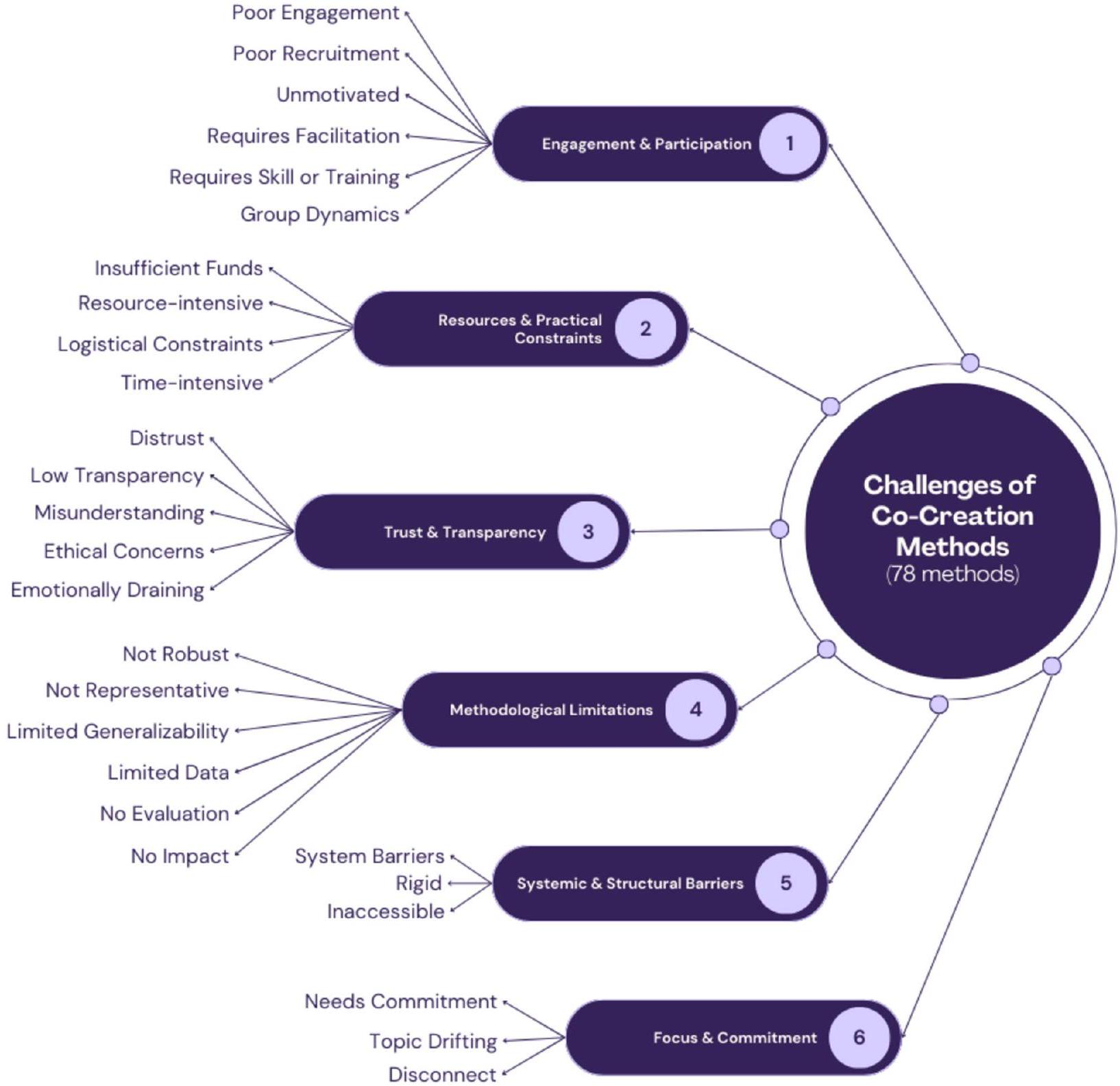
الموضوع 2: الموارد والقيود العملية
واستثمار الوقت الكبير. هذه التحديات واضحة بشكل خاص في المشاريع الكبيرة أو طويلة الأمد، حيث يمكن أن تصبح الطبيعة الكثيفة للموارد لطرق التعاون ساحقة [62،63،66،112،115،158].
يعد نقص التمويل عائقًا رئيسيًا، مما يحد من القدرة على تغطية التكاليف الأساسية مثل التدريب، ووقت الموظفين، وحوافز المشاركين. غالبًا ما تجعل القيود المالية من الصعب الحفاظ على المشاريع. يشير فان لون وآخرون إلى أنه في الممارسة الإبداعية، لم يكن هناك “تمويل كافٍ لتقييم الفعالية” [63]، بينما يبرز فورمان وآخرون كيف أن نقص “التمويل شكل تحديات مترابطة”
تضيف القيود اللوجستية تعقيدًا للتعاون، حيث يلزم التخطيط الدقيق لتنظيم الأنشطة، والوصول إلى البيانات السرية، وإدارة لوجستيات العمل الميداني. يؤكد غرين على الحاجة إلى “اعتبارات لوجستية عند تسهيل الأنشطة الفنية مع الأطفال، خاصة في الطبيعة، حيث يمكن أن يكون صنع الفن فوضويًا” [47]. وبالمثل، يتطلب جدولة المقابلات، وإنتاج المواد التعليمية، والتعامل مع كميات كبيرة من البيانات جهدًا كبيرًا، كما ورد في دراسة شافاريا وآخرون [158]. يمكن أن تؤخر هذه العقبات اللوجستية التقدم وتحد من قابلية توسيع جهود التعاون.
تتطلب الطرق الكثيفة للوقت التزامًا كبيرًا من كل من المشاركين والميسرين، مما يمكن أن يعيق المشاركة، خاصة لأولئك الذين لديهم مسؤوليات مت competing. يصف لايتفوت وآخرون “رسم الخرائط للأصول كثيف الوقت” [151]، بينما يشير زوريلا وآخرون إلى أن “التدريب الكثيف للوقت مطلوب لإتقان [الشبكات البايزية]” [143]. يمكن أن تقلل هذه المطالب من القيمة المدركة وتجعل من الصعب الحفاظ على المشاركة،
خاصة في البيئات السريعة أو المحدودة الموارد. يعد تحقيق توازن بين المشاركة المعنوية وقيود الوقت أمرًا ضروريًا للحفاظ على قيمة أساليب التعاون.
من خلال معالجة قيود التمويل، ومتطلبات الموارد، والحواجز اللوجستية، وقيود الوقت، يمكن تكييف طرق التعاون بشكل أفضل للتنفيذ العملي. يعد الإدارة الاستباقية للموارد، والتخطيط، والجدولة مفتاحًا لضمان استدامتها وتأثيرها على المدى الطويل.
الموضوع 3: الثقة والشفافية
تعيق انعدام الثقة ومخاوف الخصوصية المشاركة، خاصة بين المشاركين من سياقات الرعاية أو العلاج الذين قد يخشون العواقب غير المقصودة. يمكن أن يؤدي التردد في مشاركة المعلومات بسبب المخاوف بشأن السرية إلى مشاركة انتقائية وردود محجوبة. يشير فاليريو وآخرون إلى أن “المشاركين قد لا يشاركون المعلومات بحرية خوفًا من الخصوصية أو السرية” [148]، مما يجعل من الصعب
التقاط تجاربهم الحياتية. تعتبر الثقة والشفافية ضرورية لتشجيع المشاركة المعنوية، خاصة للأفراد من خلفيات ضعيفة قد يخشون الحكم أو الوصم [33، 46، 64].
يثير انخفاض الشفافية في طرق التعاون مخاوف بشأن دقة وفعالية ووضوح نتائج البحث. تعاني بعض الطرق من أهداف أو مخرجات غير واضحة، مما يجعل من الصعب على المشاركين فهم دورهم أو كيفية اشتقاق النتائج. كما تصف أوريلي-ديبرون أن التصنيف المباشر قد يواجه أيضًا تحديات تتعلق بالنتائج أو الأهداف غير الواضحة [54]، بينما يبرز فوينوف وآخرون أن النمذجة المعتمدة على الوكلاء (ABM) تعاني من “انخفاض الشفافية” [45]. قد تؤدي هذه المخاوف إلى الشك وانخفاض المشاركة.
تزيد سوء الفهم في التفسير من تعقيد الشفافية والثقة. يمكن أن تكون الطرق البصرية والفنية، على الرغم من قيمتها في المشاركة، صعبة التفسير بدقة، مما يعرضها لسوء التمثيل. يشرح لامبرت وآخرون أن تقنيات الرسم والكتابة تتضمن “تحديات تفسيرية” [48]، بينما يصف نورث وآخرون كيف أن “أول الرسوم الاجتماعية التي أنتجها [المشاركون] كانت كثيفة الرسم، مما جعل التفسير والتحليل صعبًا” [121]. التواصل الواضح والتمثيل ضروريان لضمان نتائج دقيقة وشاملة.
تضيف القضايا الأخلاقية المتعلقة بالموافقة، والملكية، وإدارة البيانات طبقة أخرى من التعقيد. تثير المحتويات التي ينتجها المشاركون، وخاصة الصور، والبيانات البصرية، تساؤلات حول من يتحكم في البيانات وكيف يتم مشاركتها. يبرز رونزي وآخرون المخاوف بشأن “ملكية الصور والأفراد الذين يظهرون في الصور” و”التحديات في تصوير المفاهيم الاجتماعية السلبية” [101]. يصف لامبرت وآخرون القضايا المتعلقة بـ”تحديات السرية وقضايا الملكية” [48]. تثير الصور الحساسة والبيانات الشخصية معضلات أخلاقية تتعلق بالموافقة، والسرية، والملكية [48، 49، 76، 95، 96، 100، 101، 145، 148]. بدون عمليات موافقة قوية، يمكن أن تؤدي هذه المخاوف إلى عدم الارتياح والتردد في المشاركة.
بعيدًا عن الثقة والشفافية، فإن بعض طرق التعاون مرهقة عاطفيًا، خاصة عندما تتعلق بمواضيع حساسة، أو تأمل شخصي، أو عمليات غير مألوفة. يصف نومخويزي مايابا وود كيف أن تقنية الرسم والكتابة “يمكن أن تسبب مشاعر سلبية” [106]، بينما يشير بلودجيتا وآخرون إلى “تجربة المشاركين للقلق لرسم شيء ما، [بسبب] خوفهم من الحكم السلبي” [139]. يعد إدارة الاستجابات العاطفية وضمان رفاهية المشاركين أمرًا حيويًا للحفاظ على المشاركة وحماية الصحة النفسية للمشاركين.
من خلال معالجة التحديات المتعلقة بالثقة، والشفافية، والاعتبارات الأخلاقية، يمكن أن تصبح طرق التعاون
أكثر دعمًا وشمولية. يضمن التواصل الواضح، وإدارة البيانات بعناية، والحساسية لتجارب المشاركين العاطفية بيئة يشعر فيها المشاركون بالأمان، والقيمة، والتمكين طوال العملية.
الموضوع 4: القيود المنهجية
تظهر المخاوف بشأن قوة المنهجية من ضعف الصرامة التحليلية، ونقص عمليات التحقق، والانحيازات المحتملة التي تدخلها عينات الراحة. تفتقر بعض الطرق إلى آليات لتأسيس التتبع والتحقق بشكل منهجي، مما يؤثر على موثوقيتها. يعلق دينرلين وآخرون أن التصميم المشترك من خلال الاستحواذ على الإمكانيات يواجه عدة تحديات، بما في ذلك نقص “طرق لتأسيس التتبع والتحقق بشكل منهجي” [165]. يمكن أن تقوض هذه الضعف مصداقية البحث ودقة البيانات.
تمثل التمثيلية قضية رئيسية أخرى، حيث تفشل العديد من الطرق في التقاط وجهات نظر متنوعة. تقلل أحجام العينات الصغيرة، والاختيار الذاتي، واستبعاد مجموعات معينة من الشمولية وتعيق التطبيق الأوسع للنتائج. يلاحظ تيموتييفيتش وراتس أن المشاركين “لم يعتقدوا أن الحدث قد التقط مجموعة تمثيلية من كبار السن” [62]، بينما يبرز أوريليدي برون كيف أن معايير الاستبعاد قد تقدم تمثيلية محدودة إذا تم استبعاد المشاركين المهاجرين [54]. يمكن أن تحرف هذه التحديات النتائج وتحد من أهميتها للمجتمعات الممثلة تمثيلاً ناقصًا.
تحد محدودية القابلية للتعميم من إمكانية نقل النتائج إلى سياقات أو سكان جدد. العديد من طرق التعاون تعتمد بشكل كبير على السياق، مما يجعل من الصعب تطبيق النتائج خارج إعداداتها الأصلية. كما يشير سكوت-بوتومز وروا، قد يحد الفن الحواري من قابلية تعميم النتائج لأنه “كان دراسة حالة أجريت في منطقة محددة واحدة، مع مشاركين يختارون أنفسهم” [160]. بدون تكرار أوسع، تظل هذه النتائج محلية وصعبة التوسع.
تضعف قيود البيانات عمق وجودة الرؤى. تركز بعض الطرق على العلاقات الخطية بدلاً من التقاط التفاعلات المعقدة النموذجية للتعاون. يوضح فوينوف وآخرون كيف أن رسم الخرائط المعرفية الضبابية “محدود إلى حد كبير في تعريف العلاقات الخطية بين المفاهيم” [45] بينما يشير لامبرت
وآخرون إلى أن المقابلات غير الرسمية “تقدم استجابات محدودة وعميقة” [48]. تتطلب هذه القيود استخدام طرق إضافية للحصول على فهم أكثر شمولاً.
كما أن نقص آليات التقييم يقلل من فعالية طرق التعاون. نادراً ما يتم اختبار بعض الأساليب خارج الإعدادات المعزولة، مما يحد من قاعدة الأدلة لتأثيرها. يصف كوهفيلدت ولانغوت كيف أن طريقة “الخمسة لماذا” مقيدة بمجموعة واحدة فقط لأن “البيانات [كانت] مستندة إلى مشروع واحد [بحث عمل شبابي تشاركي] داخل بيئة مدرسية” [126]، بينما يشير سزكبانسكا وآخرون إلى أنه في الميزانية المدنية “قد يكون تقييم المقترحات المقدمة مشكلة لأن طرق التصنيف لا تستخدم معايير تقييم كمية” [107].
يعد التأثير في العالم الحقيقي تحديًا آخر، حيث تكافح العديد من الطرق للتأثير على السياسات أو التغيير المؤسسي. حتى عند جمع مدخلات المجتمع، فإن نقص المتابعة أو مشاركة أصحاب المصلحة يقلل من فعالية العملية. يلاحظ إيفانز وآخرون أن “طرق المسارات لم تحقق أي استجابة من الحكومة المحلية” [46].
من خلال معالجة هذه المخاوف المتعلقة بالصرامة، والتمثيل، والقابلية للتعميم، وقيود البيانات، والتقييم، والتأثير في العالم الحقيقي، يمكن تحسين طرق التعاون لتعزيز مصداقيتها وتطبيقها الأوسع. سيساهم تعزيز هذه المجالات في ضمان أن ينتج البحث التعاوني رؤى قوية وقابلة للتنفيذ مع نتائج ملموسة.
الموضوع 5: الحواجز النظامية والهيكلية
تحد الحواجز النظامية غالبًا من قوة اتخاذ القرار على مستوى المجتمع من خلال فرض بروتوكولات صارمة وعمليات قطاعية مجزأة تعقد التعاون. يمكن أن تؤدي الأنظمة الرسمية المعقدة وتوافر البيانات غير المكتمل إلى تحيز النتائج وتثبيط المشاركة. كما يشير فيلكر-كانتر، “المشاركون الذين تتقاطع مسارات نشاطهم اليومي مع المساحات الجغرافية التي لا توجد بها بيانات، ستتأثر تقديرات التعرض” [118]، بينما يصف نورث وآخرون كيف أن “أنظمة الترميز المعقدة قد تكون صعبة التطبيق في التسجيل في الوقت الحقيقي” [121]. تجعل هذه الحواجز تنفيذ طرق التعاون تحديًا خاصًا في البيئات اللامركزية أو سريعة التطور.
تظل عدم القابلية للوصول حاجزًا حرجًا، خاصة بالنسبة للمجموعات المهمشة والأفراد ذوي الاحتياجات الخاصة. تعتمد بعض الطرق بشكل كبير على المعرفة التقنية، والنصوص الكثيفة، أو التنسيقات العامة التي تستبعد المشاركين عن غير قصد. يحذر إيفانز وآخرون من أن “الطبيعة العامة للأنشطة يمكن أن تستبعد المجموعات المهمشة” [46]، ويصف فيلكر-كانتر كيف أن “بعض المشاركين لم يكونوا معتادين على قراءة خريطة أو إعطاء اتجاهات” [118]. بالإضافة إلى ذلك، يناقش سويتزر وآخرون كيف أن النهج المدمج: التصوير الفوتوغرافي والتصوير الاستدلالي، قد يكون متقدمًا جدًا لبعض الأفراد ذوي الاحتياجات الصحية المعقدة، مما يطرح تحديات للمشاركة الفعالة [64]. إن ضمان أن تكون الطرق شاملة وقابلة للوصول أمر حاسم لالتقاط مجموعة واسعة من التجارب وتعزيز المشاركة المعنوية.
من خلال معالجة الحواجز المتعلقة بتعقيد النظام، والصرامة، والوصول، يمكن أن تصبح طرق التعاون أكثر قابلية للتكيف، وشمولية، وفعالية، مما يمكّن في النهاية من عمليات اتخاذ القرار الأكثر عدلاً وتمثيلاً.
الموضوع 6: التركيز والالتزام
الالتزام المستمر ضروري للتعاون ولكنه صعب الحفاظ عليه مع مرور الوقت، مما يطرح تحديات لوجستية وتحفيزية للمشاركين، والباحثين، والمؤسسات. يشير هاك وروساس إلى أن رسم الخرائط المفاهيمية “يتطلب التزامًا واستثمارًا كبيرين من المشاركين، والباحثين، والمؤسسة الداعمة” [132]. بدون مشاركة مستمرة، تخاطر المشاريع بفقدان الزخم والفشل في إنتاج نتائج ذات مغزى.
يمكن أن يعيق الانفصال بين جهود المشاركة المشتركة والأنظمة أو السياسات الأوسع التأثير طويل الأمد لهذه الأساليب. غالبًا ما يكون قياس آثار التدخلات وربطها بتغييرات سياسية محددة أمرًا صعبًا، مما يحد من الدعم المؤسسي والتبني. يشير غولدن إلى أن “قليلًا جدًا من دراسات التصوير الفوتوغرافي الإبداعي تشير إلى أنها أثرت فعليًا على السياسات أو صانعي السياسات، مع ملاحظة العديد من المؤلفين عدم قدرتهم على التواصل مع صانعي السياسات على الإطلاق”. وبالمثل، يصف فان لون وآخرون كيف كانت “تفاعلاتهم مع صانعي السياسات محدودة بعدد قليل من التبادلات في بداية ونهاية المشروع” وأنهم “لم يكونوا متواجدين في المجتمع كما كانوا يرغبون”. إن تعزيز الروابط بين نتائج المشاركة المشتركة وعمليات السياسة أمر حاسم لترجمة البحث إلى عمل ذي مغزى.
من خلال معالجة التحديات المتعلقة بالالتزام والتركيز والتكامل النظامي، يمكن أن تصبح طرق التعاون أكثر فعالية في جذب المشاركين، والحفاظ على صلة المشروع، والتأثير على التغيير الأوسع.
نقاش
يمكن أن تساعد نتائج هذا الاستعراض الباحثين في استغلال الإمكانات الكاملة للتعاون من أجل تطوير حلول مبتكرة وشاملة في أبحاث الصحة العامة. توضح الأدبيات حول أساليب التعاون التحديات التي قد تنشأ خلال العملية، مثل انعدام الثقة،
مشكلات التواصل والقيود اللوجستية. من خلال تحديد هذه العقبات المحتملة، يوفر هذا الاستعراض رؤى قيمة حول كيفية التغلب عليها، مما يعزز من احتمالية التنفيذ الناجح. كما يقدم هذا الاستعراض مجموعة من الفوائد الرئيسية، موضحًا كيف يمكن أن تزيد طرق التعاون من مشاركة الجمهور ورفاهيتهم ورضا المشاركين، وتساعد في تطوير حلول تلبي احتياجات المجتمع. على الرغم من أن التحديات مثل محدودية تعميم النتائج وسوء التقييم يمكن أن تعيق فعاليتها مقارنة بالأساليب التقليدية، إلا أن التعاون يعزز شعور الملكية والتمكين بين المشاركين، مما يؤدي إلى مستويات أعلى من المشاركة والالتزام.
مجموعات مستهدفة متنوعة
البحث التشاركي والتعاون في الإبداع
فوائد الطريقة
تُبرز المقارنة مع مراجعة حديثة قام بها لونغوورث وآخرون، والتي بحثت في facilitators of co-creation في البلدان ذات الدخل المنخفض والمتوسط، عدة مجالات تتماشى مع نتائج هذه المراجعة. يؤكد لونغوورث وآخرون على أهمية إنشاء مساحات آمنة، وبناء الثقة، وتعزيز الشعور بالملكية، واختيار الأساليب التي تناسب الفئة المستهدفة، وهو ما يتوازى مع الفوائد المحددة هنا، لا سيما في مواضيع ‘التمكين والوكالة’ و’الرفاهية والرضا’. ومع ذلك، حددت هذه المراجعة أيضًا فوائد إضافية لم يتم تناولها في عمل لونغوورث وآخرين، مما يوفر منظورًا أوسع حول كيفية دعم co-creation لأبحاث الصحة العامة.
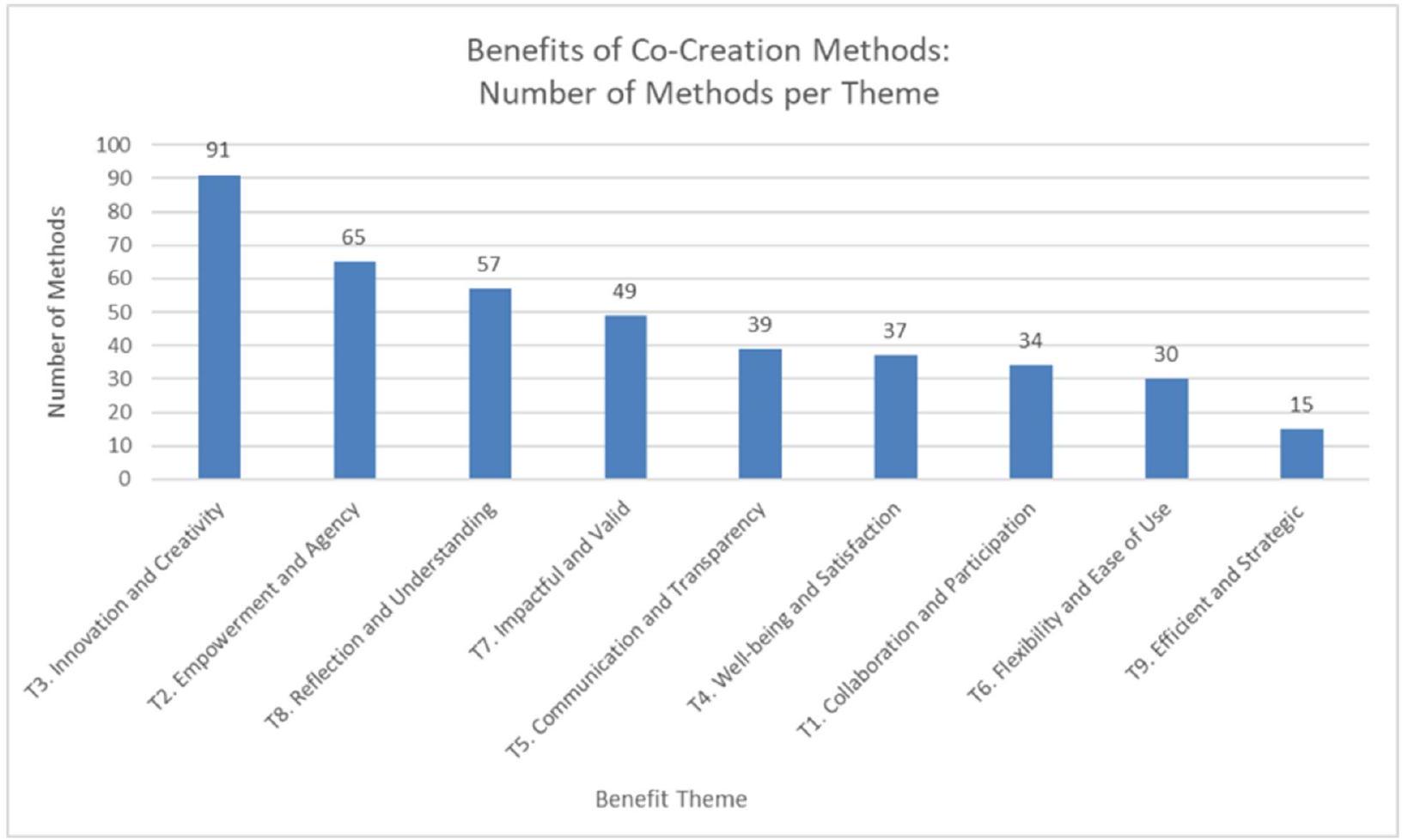
تتوافق العديد من الفوائد التي تم تحديدها في هذا الاستعراض مع عمل سميث وآخرين [20] وأجنيلو وآخرين [9]، الذين أكدوا على دور المشاركة المشتركة والإنتاج المشترك في تعزيز الابتكار والإبداع. في هذا الاستعراض، برزت ‘الابتكار والإبداع’ كأكثر الموضوعات بروزًا (91 طريقة)، مما يبرز قدرة المشاركة المشتركة على تحفيز الحلول الجديدة وتشجيع التفكير الإبداعي في إنشاء التدخلات الصحية. تعالج هذه النتائج الفجوات التي أبرزها آن وآخرون [5] وأجنيلو وآخرون [9]، الذين أشاروا إلى نقص في الإبلاغ عن الطرق الإبداعية. يوفر هذا الاستعراض ثروة من المعلومات حول الطرق التي يمكن أن تمكّن الإبداع في المشاركة المشتركة.
وبالمثل، فإن ‘التمكين والوكالة’ (65 طريقة) يبرز أهمية تمكين المشاركين كصانعي قرار نشطين، وهي نقطة دعا إليها أيضًا شتاينر وفارمر، اللذان أكدا على أهمية منح المشاركين في الإنتاج المشترك الفرصة للتأثير على القرارات التي تؤثر على حياتهم [173]. تُظهر هذه المراجعة أهمية تمكين المشاركين كمنشئين مشتركين مع الوكالة لاتخاذ القرارات ضمن عملية الإبداع المشترك. التمكين ضروري لضمان أن تكون التدخلات الصحية العامة ذات صلة بالسياق وحساسة ثقافيًا، حيث إنه يغير ديناميات القوة بعيدًا عن الممارسات البحثية التقليدية.
نحو أساليب أكثر شمولية ومشاركة [173، 174].
تشمل الموضوعات البارزة الأخرى ‘التفكير والفهم’ (57 طريقة) و’التأثير والموثوقية’ (49 طريقة)، والتي تساهم في تأسيس نتائج مستدامة وحلول موجهة نحو المجتمع. تحمل طرق التعاون المشترك وعدًا كبيرًا للتطبيقات العملية في الصحة العامة من خلال تقليل تحيز الباحثين والتحقق من معرفة المجتمع، مما يضمن أن النتائج تتماشى مع التجارب الحياتية للمشاركين. إن دمج التفكير الشخصي والاجتماعي لا يوضح فقط قيم أصحاب المصلحة، بل يعزز أيضًا صلة التدخل.
على النقيض، كانت ‘الطرق الفعالة والاستراتيجية’ (15 طريقة) هي الأقل تكرارًا في التقارير. وهذا يشير إلى وجود فجوة محتملة في الأدبيات وفرصة لمزيد من الاستكشاف حول كيفية تمكين التعاون المشترك من التقييمات السريعة، ودمج الرؤى المحلية بكفاءة، وتعزيز التخطيط الاستراتيجي للعمل.
تظهر نتائج هذا الاستعراض أن التعاون المشترك يمكّن أصحاب المصلحة المتنوعين من التعاون بطرق تعزز التعلم الجماعي وحل المشكلات، وهو أمر حاسم لمعالجة التحديات الصحية المعقدة. يجب أن تستكشف الأبحاث المستقبلية كيف يمكن أن تُفيد هذه الفوائد في اختيار الأساليب لمساعدة الباحثين على استغلال الإمكانات الكاملة للتعاون المشترك في تعزيز البحث الشامل والفعال.
تحديات المنهج
مقارنة مع مراجعة حديثة قام بها لونغوورث وآخرون، التي بحثت في الحواجز أمام التعاون في البلدان ذات الدخل المنخفض والمتوسط، تسلط الضوء على عدة مجالات تتماشى مع نتائج هذه المراجعة. حدد لونغوورث وآخرون الحواجز الرئيسية، وهي: نقص الاستثمار المالي، قيود التمويل، الظروف النظامية، مستوى التعليم، تأثير استراتيجية التوظيف على العملية، بناء الثقة يستغرق وقتًا، ونقص البيانات وأنظمة المراقبة، مما يتوازى مع التحديات المحددة هنا، لا سيما في المواضيع ‘الموارد والقيود العملية’، ‘الحواجز النظامية والهيكلية’، ‘المشاركة والانخراط’، ‘الثقة والشفافية’ و’القيود المنهجية.’ ومع ذلك، حددت هذه المراجعة أيضًا تحديات إضافية لم يتم تناولها في عمل لونغوورث وآخرين، مما يوفر منظورًا أوسع حول التحديات المحتملة التي تواجه عند إجراء التعاون.
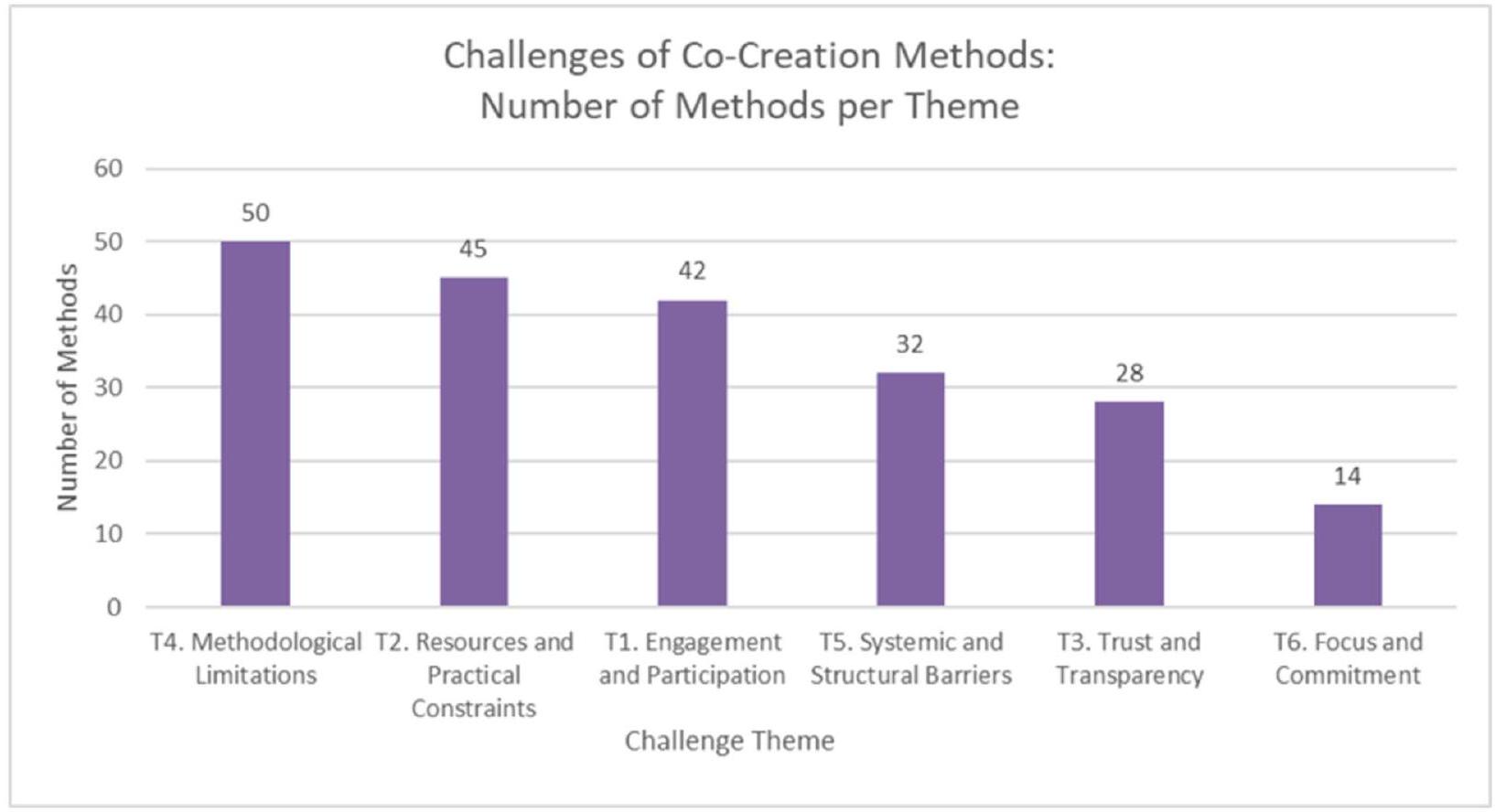
وبالمثل، تؤكد ‘الموارد والقيود العملية’ على الطبيعة المستهلكة للموارد للتعاون المشترك، الذي غالبًا ما يتطلب تمويلًا كبيرًا، ووقتًا، وموارد بشرية، ودعمًا. تبرز الحواجز مثل نقص الأموال، والعمليات التي تتطلب وقتًا طويلاً وموارد كثيفة، قضية نظامية أوسع في أنظمتنا الحالية للبحث والتمويل، التي لم تُصمم لدعم الطبيعة المرنة والإبداعية للتعاون المشترك. غالبًا ما تفشل الجداول الزمنية والميزانيات المدفوعة من قبل المانحين في أخذ متطلبات الوقت والموارد للتعاون المشترك في الاعتبار. كما أن الأطر المؤسسية الصارمة تقيد المزيد من التكيف المطلوب لعمليات التعاون المشترك الديناميكية والتكرارية. علاوة على ذلك، تترك الأطر المؤسسية الصارمة وعمليات البحث مجالًا ضئيلًا للتكيف المطلوب لاستيعاب الطبيعة الديناميكية والتكرارية للتعاون المشترك، كما يتضح من تحدي ‘الحواجز النظامية والهيكلية’ (32 طريقة).
يكشف موضوع ‘المشاركة والانخراط’ (42 طريقة) عن الصعوبات في تحفيز واستدامة انخراط المشاركين، خاصة عندما تُستخدم طرق تعتمد فقط على الكلام مثل المقابلات. غالبًا ما تتطلب الطرق المعقدة تدريبًا ومهارات متخصصة للتنفيذ، مما يجعل الانخراط تحديًا، ويخلق اعتمادًا على التيسير والإرشاد المهاري. واحدة من العقبات الرئيسية هي انخراط ومشاركة أصحاب المصلحة، والتي يمكن أن تتأثر بعوامل مثل التردد في المشاركة. تتماشى هذه النتائج مع مناقشة أوسع من قبل كارجو وميرسر حول أهمية بناء القدرات في البحث التشاركي لدعم الانخراط المستدام على المدى الطويل.
في المقابل، يمثل ‘التركيز والالتزام’ (14 طريقة) أقل موضوع تم الإبلاغ عنه بشكل متكرر ولكنه لا يزال يبرز التحديات الحرجة. الطرق التي تتطلب تفانيًا كبيرًا من جميع المعنيين تحمل مستوى أعلى من
خطر الفشل، خاصة عندما يتم تمديد الفترات الزمنية أو عندما تؤدي الاختلافات الثقافية إلى تحويل الانتباه عن العملية الرئيسية. يمكن أن تؤدي التدخلات غير المتوافقة إلى نتائج غير مرغوب فيها عندما تعقد النطاقات الجغرافية الواسعة جمع البيانات وتحليلها، مما يحد من التأثير العام.
على الرغم من هذه التحديات، لا تزال طرق التعاون المشترك تحمل وعدًا كبيرًا في إثراء أبحاث الصحة العامة. يتطلب معالجة هذه الحواجز تخطيطًا استراتيجيًا، وتخصيص موارد فعّال، وتيسيرًا ماهرًا، وتواصلًا واضحًا لضمان مشاركة ذات مغزى وشاملة ونتائج ناجحة. والأهم من ذلك، أن التغييرات الهيكلية ومستوى النظام ضرورية لإنشاء بيئات يمكن أن تزدهر فيها المرونة والإبداع والشمولية. يجب أن تستكشف الأبحاث المستقبلية كيفية التغلب على هذه الحواجز من خلال تعزيز الأطر التكيفية، وتحسين جهود بناء القدرات، والدعوة إلى سياسات تدعم البحث التشاركي.
تطبيق أساليب المشاركة في الإبداع
العواقب والبحوث المستقبلية
مجموعة من طرق التعاون المشترك. سيسهل ذلك فهمًا أكثر تماسكًا، وتطبيقًا، وإبلاغًا عن هذه الطرق عبر سياقات مختلفة. يمكن أن تعمل مثل هذه التصنيفات على توحيد المصطلحات، وتقليل الغموض، وتعزيز التواصل بين الباحثين، والممارسين، وجميع المعنيين. علاوة على ذلك، فإن تنظيم طرق التعاون المشترك في تصنيف يدعم الباحثين في اختيار الطرق الأكثر ملاءمة بناءً على أسئلة البحث المحددة أو أهداف التدخل. هذا أمر حاسم في الصحة العامة وغيرها من المجالات، حيث يجب أن تكون التدخلات ذات صلة بالسياق وحساسة ثقافيًا. أخيرًا، يمكن أن يدعم هذا التصنيف تقييم ومقارنة طرق التعاون المشترك، على سبيل المثال من خلال تصنيف الطرق بناءً على الفوائد والتحديات المعروفة. يمكن أن تؤدي هذه التحليلات المقارنة إلى تحديد أفضل الممارسات وتحسين الطرق الحالية، مما يعزز في النهاية مجال التعاون المشترك.
يعد التحليل المفصل للطرق المستخدمة من قبل كل فئة مستهدفة مصدرًا قيمًا للباحثين الذين يسعون لتكرار الاستراتيجيات الناجحة في عملهم. عند معالجة التحديات التي تواجه طرق التعاون المشترك، يجب أن تركز الدراسات المستقبلية على تطوير أساليب مخصصة تعالج هذه العقبات بشكل خاص، مما يضمن سماع وتقدير جميع الأصوات خلال عملية التعاون المشترك. بالإضافة إلى ذلك، فإن تحسين قدرة الباحثين على تطبيق الطرق المستمدة من هذه المراجعة، فضلاً عن استكشاف كيفية دمج هذه الطرق، أمر حاسم لتعزيز فعالية جهود التعاون المشترك والتقاط وجهات نظر متنوعة من أصحاب المصلحة. كما وصف فوينوف وآخرون، فإن الاختيار الدقيق والواعي للطرق، ودمج الطرق، مهم لعمليات النمذجة ونتائجها. من المثالي أن يكون الاختيار مصحوبًا بتقييمات لمراقبة تأثير الطرق الفردية على العملية [45]. وهذا يبرز الحاجة إلى اختيار طرق مستنير، بالإضافة إلى إرشادات حول كيفية تقييم الطرق لتمكين تقييم الفعالية والأثر.
بالإضافة إلى ذلك، تشير النتائج في هذه المراجعة إلى تفضيل واضح لأساليب التوصيل وجهًا لوجه، مما يبرز فجوة محتملة في الأدبيات بشأن طرق التعاون عبر الإنترنت أو الهجينة، التي أصبحت ذات صلة متزايدة في المشهد الرقمي اليوم. يمكن أن يوفر الاستكشاف الإضافي لكيفية تأثير أساليب التوصيل المختلفة على فعالية وملاءمة طرق التعاون رؤى مهمة للدراسات المستقبلية. تشير دمج الأدوات الرقمية، كما هو موضح في 40 مقالًا، إلى اتجاه متزايد في الاستفادة من التكنولوجيا لتعزيز عمليات التعاون. تشير مجموعة الأدوات المستخدمة، بدءًا من نظم المعلومات الجغرافية إلى البرمجيات الشائعة مثل Microsoft Excel، إلى تحول نحو
المزيد من الممارسات الرقمية. يمكن أن يؤثر ذلك على شمولية عمليات المشاركة المشتركة، حيث قد لا تتمتع بعض المجتمعات الضعيفة أو المهمشة بالوصول إلى الأدوات والمنصات الرقمية. يجب أن تبحث الأبحاث المستقبلية في كيفية تسهيل هذه الأدوات الرقمية أو عرقلتها لمشاركة أوسع وانخراط بين السكان المتنوعين.
القيود
الخاتمة
تظهر نتائجنا الطبيعة متعددة الأبعاد لأساليب المشاركة المشتركة وآثارها في تعزيز العدالة والشمولية في أبحاث الصحة العامة وزيادة كفاءة وقابلية تطبيق النتائج المشتركة.
النتائج. من خلال التركيز على هذه المجالات الحيوية، يمكننا تعميق فهمنا للتعاون المشترك وإمكاناته في تقليل الفجوات الصحية. إن إشراك الفئات المستهدفة المتنوعة في عمليات التعاون المشترك أمر حيوي لتطوير تدخلات صحية عادلة تستجيب لاحتياجات جميع أعضاء المجتمع. يمكن أن يكون التعاون المشترك شاملاً للفئات المهمشة من خلال تنفيذ استراتيجيات وأفضل الممارسات المدعومة بالأدبيات العلمية. تقدم هذه المراجعة تلك الأدبيات، بالإضافة إلى تأملات رئيسية بشأن المشاركة المتنوعة، وأهمية بناء الثقة والاحترام المتبادل، فضلاً عن القدرة على التكيف المستمر مع الظروف المتغيرة، والموارد، والسياقات الديناميكية.
من خلال تسليط الضوء على الأساليب المختلفة المستخدمة مع هذه الفئات، تساهم هذه المراجعة في التطوير المستمر لممارسات البحث الشاملة. تبرز الرؤى المستخلصة من هذه المراجعة المزايا المتنوعة لأساليب التعاون. من خلال التعرف على الاستفادة من كل من فوائد وتحديات أساليب التعاون، يمكن للباحثين تحسين جودة وملاءمة وشمولية أعمالهم، مما يؤدي في النهاية إلى نتائج صحية أكثر عدلاً للفئات المتنوعة. تدعو هذه النتائج الباحثين والممارسين على حد سواء إلى تبني التعاون، وأساليبه المتنوعة، كنهج أساسي في أبحاث وممارسات الصحة العامة.
معلومات إضافية
ملف إضافي 2.
ملف إضافي 3.
ملف إضافي 4.
الملف الإضافي 5.
الملف الإضافي 6.
الملف الإضافي 7.
ملف إضافي 8.
مساهمات المؤلفين
التمويل
توفر البيانات
الإعلانات
موافقة الأخلاقيات والموافقة على المشاركة
الموافقة على النشر
المصالح المتنافسة
تفاصيل المؤلف
تم النشر عبر الإنترنت: 06 مارس 2025
References
- Morgan J, Neufeld SD, Holroyd H, Ruiz J, Taylor T, Nolan S, et al. Commu-nity-Engaged Research Ethics Training (CERET): developing accessible and relevant research ethics training for community-based participatory research with people with lived and living experience using illicit drugs and harm reduction workers. Harm Reduct J. 2023;20:86.
- Loignon C, Dupéré S, Bush P, Truchon K, Boyer S, Hudon C. Using photovoice to reflect on poverty and address social inequalities among primary care teams. Action Res. 2023;21:211-29.
- Grindell C, Coates E, Croot L, O’Cathain A. The use of co-production, co-design and co-creation to mobilise knowledge in the management of health conditions: a systematic review. BMC Health Serv Res. 2022;22:877.
- Loignon C, Dupéré S, Leblanc C, Truchon K, Bouchard A, Arsenault J, et al. Equity and inclusivity in research: co-creation of a digital platform with representatives of marginalized populations to enhance the involvement in research of people with limited literacy skills. Res Involv Engagem. 2021;7:70.
- An Q, Sandlund M, Agnello D, McCaffrey L, Chastin S, Helleday R, et al. A scoping review of co-creation practice in the development of nonpharmacological interventions for people with chronic obstructive pulmonary disease: a health CASCADE study. Respir Med. 2023;211:107193.
- Hubbard L, Hardman M, Race O, Palmai M, Vamosi G. Research with marginalized communities: reflections on engaging roma women in Northern England. Qual Inq. 2024;30:514-25.
- Vargas C, Whelan J, Brimblecombe J, Allender S. Co-creation, co-design, co-production for public health – a perspective on definition and distinctions. Public Health Res Pract. 2022;32. Available from: https://www. phrp.com.au/?p=41678. Cited 2023 May 18.
- Agnello DM, Loisel QEA, An Q, Balaskas G, Chrifou R, Dall P, et al. Establishing a health CASCADE-curated open-access database to consolidate knowledge about co-creation: novel artificial intelligenceassisted methodology based on systematic reviews. J Med Internet Res. 2023;25:e45059.
- Agnello DM, Balaskas G, Steiner A, Chastin S. Methods used in co-creation within the health CASCADE co-creation database and gray literature: systematic methods overview. Interact J Med Res. 2024;13:e59772.
- Leino H, Puumala E. What can co-creation do for the citizens? Applying co-creation for the promotion of participation in cities. Environ Plan C Polit Space. 2020; Available from: https://journals.sagepub.com/doi/ full/https://doi.org/10.1177/2399654420957337. Cited 2024 Oct 21.
- Mallakin M, Dery C, Vaillancourt S, Gupta S, Sellen K. Web-based codesign in health care: considerations for renewed participation. Interact J Med Res. 2023;12:e36765.
- Wong C-C, Kumpulainen K, Kajamaa A. Collaborative creativity among education professionals in a co-design workshop: a multidimensional analysis. Think Ski Creat. 2021;42:100971.
- Wise S, Paton RA, Gegenhuber T. Value co-creation through collective intelligence in the public sector.
- Verloigne M, Altenburg T, Cardon G, Chinapaw M, Dall P, Deforche B, et al. Making co-creation a trustworthy methodology for closing the implementation gap between knowledge and action in health promotion: the Health CASCADE project. Perspect Public Health. 2023;143:196-8.
- Mulvale G, Moll S, Phoenix M, Buettgen A, Freeman B, Murray-Leung L, et al. Co-creating a new Charter for equitable and inclusive co-creation: insights from an international forum of academic and lived experience experts. BMJ Open. 2024;14:e078950.
- Agnello DM, An Q, de Boer J, Calo F, Delfmann L, Hutcheon D, et al. Developing and Validating the Co-Creation Rainbow Framework: Assessing Whether Methods Enact Co-Creation Characteristics in a Mixed-Methods Health CASCADE Study. Zenodo; 2023 [cited 2024 Nov 30]. Available from: https://zenodo.org/records/10391410.
- Greenhalgh T, Jackson C, Shaw S, Janamian T. Achieving research impact through co-creation in community-based health services: literature review and case study. Milbank Q. 2016;94:392-429.
- Cyril S, Smith BJ, Possamai-Inesedy A, Renzaho AMN. Exploring the role of community engagement in improving the health of disadvantaged populations: a systematic review. Glob Health Action. 2015;8:29842.
- Slattery P, Saeri AK, Bragge P. Research co-design in health: a rapid overview of reviews. Health Res Policy Syst. 2020;18:17.
- Smith H, Budworth L, Grindey C, Hague I, Hamer N, Kislov R, et al. Coproduction practice and future research priorities in United Kingdomfunded applied health research: a scoping review. Health Res Policy Syst. 2022;20:36.
- Lazo-Porras M, Perez-Leon S, Cardenas MK, Pesantes MA, Miranda JJ, Suggs LS, et al. Lessons learned about co-creation: developing a complex intervention in rural Peru. Glob Health Action. 2020;13:1754016.
- Tricco AC, Lillie E, Zarin W, O’Brien KK, Colquhoun H, Levac D, et al. PRISMA extension for scoping reviews (PRISMA-ScR): checklist and explanation. Ann Intern Med. 2018;169:467-73.
- Loisel Q, Agnello D, Chastin S. Co-Creation Database. Zenodo; 2022 [cited 2024 Nov 30]. Available from: https://zenodo.org/records/67730 28.
- Zotero | Your personal research assistant. Available from: https://www. zotero.org/. Cited 2024 Nov 21.
- Ouzzani M, Hammady H, Fedorowicz Z, Elmagarmid A. Rayyan-a web and mobile app for systematic reviews. Syst Rev. 2016;5:210.
- Google Forms: Online Form Creator | Google Workspace. Available from: https://www.facebook.com/GoogleDocs/. Cited 2024 Nov 30.
- Byrne D. A worked example of Braun and Clarke’s approach to reflexive thematic analysis. Qual Quant. 2022;56:1391-412.
- NVivo Leading Qualitative Data Analysis Software (QDAS) by Lumivero. Lumivero. Available from: https://lumivero.com/products/nvivo/. Cited 2024 Nov 21.
- Braun V, Clarke V. One size fits all? What counts as quality practice in (reflexive) thematic analysis? Qual Res Psychol;18. Available from: https://www.tandfonline.com/doi/abs/https://doi.org/10.1080/14780 887.2020.1769238. Cited 2024 Sep 24.
- Malinverni L, Mora-Guiard J, Pares N. Towards methods for evaluating and communicating participatory design: A multimodal approach.
- Furman E, Singh AK, Miller Z. “A Space Where People Get It”: A Methodological Reflection of Arts-Informed Community-Based Participatory Research With Nonbinary Youth. Int J Qual Methods. 2019; Available from: https://journals.sagepub.com/doi/full/https://doi.org/10.1177/ 1609406919858530.
- Amsden J, VanWynsberghe R. Community mapping as a research tool with youth. Action Res. 2005;3:357-81.
- Lal S, Jarus T, Suto MJ. A scoping review of the photovoice method: implications for occupational therapy research. Can J Occup Ther. 2012;79:181-90.
- Kaptani E, Yuval-Davis N. Participatory theatre as a research methodology: identity, performance and social action among refugees. Sociol Res Online. 2008;13:1-12.
- Keogh F, Carney P, O’Shea E. Innovative methods for involving people with dementia and carers in the policymaking process. Health Expect Int J Public Particip Health Care Health Policy. 2021;24:800-9.
- Kort HSM, Steunenberg B, van Hoof J. Methods for involving people living with dementia and their informal carers as co-developers of technological solutions. Dement Geriatr Cogn Disord. 2019;47:149-56.
- Valiquette-Tessier S-C, Vandette M-P, Gosselin J. In her own eyes: photovoice as an innovative methodology to reach disadvantaged single mothers. Can J Commun Ment Health. 2015;34:1-16.
- Fraser SL. What stories to tell? A trilogy of methods used for knowledge exchange in a community-based participatory research project. Action Res. 2018;16:207-22.
- Redman-MacLaren M, Mills J, Tommbe R. Interpretive focus groups: a participatory method for interpreting and extending secondary analysis of qualitative data. Glob Health Action. 2014;7:25214.
- Salmon A. Walking the talk: how participatory interview methods can democratize research. Qualitative Health Research. 2007;17(7):982-93.
- Bennett B, Maar M, Manitowabi D, Moeke-Pickering T, Trudeau-Peltier D, Trudeau S. The gaataa’aabing visual research method: a culturally safe anishinaabek transformation of photovoice. Int J Qual Methods. 2019;18:1609406919851635.
- Williams L, Gott M, Moeke-Maxwell T, Black S, Kothari S, Pearson S, et al. Can digital stories go where palliative care research has never gone before? A descriptive qualitative study exploring the application of an emerging public health research method in an indigenous palliative care context.
- Wood L, Olivier T. Video production as a tool for raising educator awareness about collaborative teacher-parent partnerships. Educ Res. 2011;53:399-414.
- Smetschka B, Gaube V. Co-creating formalized models: participatory modelling as method and process in transdisciplinary research and its impact potentials. Environ Sci Policy. 2020;103:41-9.
- Voinov A, Jenni K, Gray S, Kolagani N, Glynn PD, Bommel P, et al. Tools and methods in participatory modeling: Selecting the right tool for the job. Environ Model Softw. 2018;109:232-55.
- Evans K, de Jong W, Cronkleton P, Nghi TH. Participatory methods for planning the future in forest communities. Soc Nat Resour. 2010;23:604-19.
- Green C. Four methods for engaging young children as environmental education researchers. Int J Emerg Issues Early Child Educ. 2023;5:6.
- Lambert V, Glacken M, McCarron M. Using a range of methods to access children’s voices. J Res Nurs. 2013;18:601-16.
- Sewell K. Researching sensitive issues: a critical appraisal of ‘draw-andwrite’ as a data collection technique in eliciting children’s perceptions. Int J Res Method Educ. 2011;34:175-91.
- Haijes HA, van Thiel GJMW. Participatory methods in pediatric participatory research: a systematic review. Pediatr Res. 2016;79:676-83.
- Gerodimos R. Youth and the City: reflective photography as a tool of Urban voice. J Media Lit Educ. 2018;10:82-103.
- Barry J, Higgins A. Photovoice: an ideal methodology for use within recovery-oriented mental health research. Issues Ment Health Nurs. 2021;42:676-81.
- Hartwig RT. Ethnographic facilitation as a complementary methodology for conducting applied communication scholarship. J Appl Commun Res. 2014;42:60-84.
- O’Reilly-de Brún M, de Brún T, O’Donnell CA, Papadakaki M, Saridaki A, Lionis C, et al. Material practices for meaningful engagement: an analysis of participatory learning and action research techniques for data generation and analysis in a health research partnership. Health Expect. 2018;21:159-70.
- Sandman H, Levänen J, Savela N. Using empathic design as a tool for urban sustainability in low-resource settings. Sustainability. 2018;10:2493.
- Doornbos A, Rooij M van, Smit M, Verdonschot S. From Fairytales to Spherecards: Towards a New Research Methodology for Improving Knowledge Productivity. Forum Qual Sozialforschung Forum Qual Soc Res. 2008;9. Available from: https://www.qualitative-research.net/index. php/fqs/article/view/386. Cited 2024 Sep 10.
- Nedelcu A. Analysing students’ drawings of their classroom: a childfriendly research method. Rev Cercet Si Interv Sociala. 2013;42:275-93.
- McCarthy L, Muthuri JN. Engaging fringe stakeholders in business and society research: applying visual participatory research methods. Bus Soc. 2018;57:131-73.
- Barker J, Weller S. “Is it fun?” developing children centred research methods. Int J Sociol Soc Policy. 2003;23:33-58.
- Woolner P, Clark J, Hall E, Tiplady L, Thomas U, Wall K. Pictures are necessary but not sufficient: using a range of visual methods to engage users about school design. Learn Environ Res. 2010;13:1-22.
- Hill V, Croydon A, Greathead S, Kenny L, Yates R, Pellicano E. Research methods for children with multiple needs: Developing techniques to facilitate all children and young people to have’a voice.’Educ Child Psychol. 2016;33:26-43.
- Timotijevic L, Raats MM. Evaluation of two methods of deliberative participation of older people in food-policy development. Health Policy Amst Neth. 2007;82:302-19.
- Van Loon AF, Lester-Moseley I, Rohse M, Jones P, Day R. Creative practice as a tool to build resilience to natural hazards in the Global South. Geosci Commun. 2020;3:453-74.
- Switzer S, Guta A, de Prinse K, Chan Carusone S, Strike C. Visualizing harm reduction: methodological and ethical considerations. Soc Sci Med. 1982;2015(133):77-84.
- Gerritsen S, Harré S, Rees D, Renker-Darby A, Bartos AE, Waterlander WE, et al. Community group model building as a method for engaging participants and mobilising action in public health. Int J Environ Res Public Health. 2020;17:3457.
- BeLue R, Carmack C, Myers KR, Weinreb-Welch L, Lengerich EJ. Systems Thinking Tools as Applied to Community-Based Participatory Research: A Case Study. 2012;39. Available from: https://journals.sagepub.com/ doi/https://doi.org/10.1177/1090198111430708. Cited 2024 Sep 28.
- Wright PR, Wakholi PM. Festival as methodology: the African cultural youth arts festival. Mark Vicars and Dr Jon Austin D, editor. Qual Res J. 2015;15:213-27.
- D’Amico M, Denov M, Khan F, Linds W, Akesson B. Research as intervention? Exploring the health and well-being of children and youth facing global adversity through participatory visual methods. Glob Public Health. 2016;11:528-45.
- Lorenz LS, Kolb B. Involving the public through participatory visual research methods. Health Expect. 2009;12:262-74.
- Molloy JK. Photovoice as a tool for social justice workers. J Progress Hum Serv. 2007;18:39-55.
- Walker A, Oomen-Early J. Do you see what I see? Using photovoice to teach health education students the value of using community-based participatory methods. J Health Educ Teach Tech. 2014;1:41-52.
- Rania N, Coppola I, Pinna L. Adapting qualitative methods during the COVID-19 Era: factors to consider for successful use of online photovoice. Qual Rep. 2021;26:2711-29.
- Saunders G, Dillard L, Frederick M, Silverman S. Examining the utility of photovoice as an audiological counseling tool. J Am Acad Audiol. 2019;30:406-16.
- Sutton-Brown CA. Photovoice: a methodological guide.
- Drawson AS, Toombs E, Mushquash CJ. Indigenous research methods: a systematic review. Int Indig Policy J. 2017;8. Available from: https://ojs. lib.uwo.ca/index.php/iipj/article/view/7515. Cited 2024 Sep 10.
- Teti M, Murray C, Johnson L, Binson D. Photovoice as a communitybased participatory research method among women living with HIV/ AIDS: ethical opportunities and challenges. J Empir Res Hum Res Ethics. 2012;7:34-43.
- Campbell RB, Larsen M, DiGiandomenico A, Davidson MA, Booth GL, Hwang SW, et al. The challenges of managing diabetes while homeless: a qualitative study using photovoice methodology. CMAJ. 2021;193:E1034-41.
- Madrigal DS, Salvatore A, Casillas G, Casillas C, Vera I, Eskenazi B, et al. Health in my community: conducting and evaluating photovoice as a tool to promote environmental health and leadership among Latino/a Youth. Prog Community Health Partnersh Res Educ Action. 2014;8:317-29.
- MacFarlane EK, Shakya R, Berry HL, Kohrt BA. Implications of participatory methods to address mental health needs associated with climate change: ‘photovoice’ in Nepal. BJPsych Int. 2015;12:33-5.
- Houle J, Coulombe S, Radziszewski S, Leloup X, Saïas T, Torres J, et al. An intervention strategy for improving residential environment and positive mental health among public housing tenants: rationale, design and methods of Flash on my neighborhood! BMC Public Health. 2017;17:737.
- Aw S, Koh GC, Oh YJ, Wong ML, Vrijhoef HJ, Harding SC, et al. Interacting with place and mapping community needs to context: Comparing and triangulating multiple geospatial-qualitative methods using the focus-expand-compare approach. Methodol Innov. 2021;14:205979912098777.
- Nykiforuk CIJ, Vallianatos H, Nieuwendyk LM. Photovoice as a method for revealing community perceptions of the built and social environment. Int J Qual Methods. 2011;10:103-24.
- Kramer L, Schwartz P, Cheadle A, Rauzon S. Using photovoice as a participatory evaluation tool in kaiser permanente’s community health initiative. Health Promot Pract. 2013;14:686-94.
- Downey LH, Ireson CL, Scutchfield FD. The use of photovoice as a method of facilitating deliberation. Health Promot Pract. 2009;10:419-27.
- Pauwels L. ‘Participatory’ visual research revisited: A critical-constructive assessment of epistemological, methodological and social activist tenets. Ethnography. 2015;16:95-117.
- Livingood WC, Monticalvo D, Bernhardt JM, Wells KT, Harris T, Kee K, et al. Engaging Adolescents Through Participatory and Qualitative Research Methods to Develop a Digital Communication Intervention to Reduce Adolescent Obesity.
- Golden T. Reframing photovoice: building on the method to develop more equitable and responsive research practices. Qual Health Res. 2020;30:960-72.
- Baker TA, Wang CC. Photovoice: use of a participatory action research method to explore the chronic pain experience in older adults. Qual Health Res. 2006;16:1405-13.
- Johnson LR, Drescher CF, Assenga SH, Marsh RJ. Assessing assets among street-connected youth: new angles with participatory methods in Tanzania. J Adolesc Res. 2019;34:619-51.
- Bisung E, Elliott SJ, Abudho B, Karanja DM, Schuster-Wallace CJ. Using Photovoice as a Community Based Participatory Research Tool for Changing Water, Sanitation, and Hygiene Behaviours in Usoma, Kenya.
- Marshalsey L, Sclater M. Arts-Based Educational Research: The Challenges of Social Media and Video-Based Research Methods in Communication Design Education.
- Maclean K, Woodward E. Photovoice evaluated: an appropriate visual methodology for aboriginal water resource research. Geogr Res. 2013;51:94-105.
- Witkowski K, Matiz Reyes A, Padilla M. Teaching diversity in public participation through participatory research: a case study of the photovoice methodology. J Public Aff Educ. 2021;27:218-37.
- Fay
. The impact of the school space on research methodology, child participation and safety: views from children in Zanzibar. Child Geogr. 2018;16:405-17. - Umurungi J-P, Mitchell C, Gervais M, Ubalijoro E, Kabarenzi V. Photovoice as a methodological tool to address HIV and AIDS and gender violence amongst girls on the Street in Rwanda. J Psychol Afr. 2008;18:413-9.
- Capous-Desyllas M, Forro VA. Tensions, challenges, and lessons learned: methodological reflections from two photovoice projects with sex workers. J Community Pract. 2014;22:150-75.
- Sitter KC. Taking a closer look at photovoice as a participatory action research method. J Progress Hum Serv. 2017;28:36-48.
- Peabody CG. Using photovoice as a tool to engage social work students in social justice. J Teach Soc Work. 2013;33:251-65.
- Russinova Z, Mizock L, Bloch P. Photovoice as a tool to understand the experience of stigma among individuals with serious mental illnesses. Stigma Health. 2018;3:171-85.
- Novek S, Morris-Oswald T, Menec V. Using photovoice with older adults: some methodological strengths and issues. Ageing Soc. 2012;32:451-70.
- Ronzi S, Pope D, Orton L, Bruce N. Using photovoice methods to explore older people’s perceptions of respect and social inclusion in
cities: opportunities, challenges and solutions. SSM – Popul Health. 2016;2:732-45. - Krutt H, Dyer L, Arora A, Rollman J, Jozkowski AC. PhotoVoice is a feasible method of program evaluation at a center serving adults with autism. Eval Program Plann. 2018;68:74-80.
- Doucet M, Pratt H, Dzhenganin M, Read J. Nothing about us without us: using Participatory Action Research (PAR) and arts-based methods as empowerment and social justice tools in doing research with youth “aging out” of care. Child Abuse Negl. 2022;130:105358.
- Sommer M, Ibitoye M, Likindikoki S, Parker R. Participatory Methodologies With Adolescents: A Research Approach Used to Explore Structural Factors Affecting Alcohol Use and Related Unsafe Sex in Tanzania. The Journal of Primary Prevention. 2021;42:363-84.
- Foster-Fishman P, Nowell B, Deacon Z, Nievar MA, McCann P. Using methods that matter: the impact of reflection, dialogue, and voice. Am J Community Psychol. 2005;36:275-91.
- Nomakhwezi Mayaba N, Wood L. Using drawings and collages as data generation methods with children: definitely not child’s play. Int J Qual Methods. 2015;14:1609406915621407.
- Szczepańska A, Zagroba M, Pietrzyk K. Participatory budgeting as a method for improving public spaces in major polish cities. Soc Indic Res. 2022;162:231-52.
- Townley G, Kloos B, Wright PA. Understanding the experience of place: expanding methods to conceptualize and measure community integration of persons with serious mental illness. Health Place. 2009;15:520-31.
- Tremblay C. Towards inclusive waste management: participatory video as a communication tool. Proc Inst Civ Eng – Waste Resour Manag. 2013;166:177-86.
- Leurs R. The role of the state in enabling private sector development: an assessment methodology. Public Adm Dev. 2000; Available from: https://onlinelibrary.wiley.com/doi/https://onlinelibrary.wiley.com/doi/ https://doi.org/10.1002/1099-162X(200002)20:1<43::AID-PAD110% 3E3.0.CO;2-R. Cited 2024 Sep 10.
- Linabary JR, Krishna A, Connaughton SL. The conflict family: storytelling as an activity and a method for locally led. Community-Based Peacebuilding. 2016;34:431-53.
- Fairchild R, McFerran KS. Understanding children’s resources in the context of family violence through a collaborative songwriting method. Child Aust. 2018;43:255-66.
- Green EP, Warren VR, Broverman S, Ogwang B, Puffer ES. Participatory mapping in low-resource settings: Three novel methods used to engage Kenyan youth and other community members in communitybased HIV prevention research. Glob Public Health. 2016;11:583-99.
- Pereira L, Hichert T, Hamann M, Preiser R, Biggs R. Using futures methods to create transformative spaces: visions of a good Anthropocene in southern Africa. Ecol Soc. 2018;23. Available from: https://www.ecolo gyandsociety.org/vol23/iss1/art19/. Cited 2024 Sep 28.
- O’Hara L, Higgins K. Participant photography as a research tool: ethical issues and practical implementation. Sociol Methods Res. 2019;48:369-99.
- Lahtinen M, Nenonen S, Rasila H, Lehtelä J, Ruohomäki V, Reijula K. Rehabilitation centers in change: participatory methods for managing redesign and renovation. HERD Health Environ Res Des J. 2014;7:57-75.
- Beyer KMM, Comstock S, Seagren R. Disease maps as context for community mapping: a methodological approach for linking confidential health information with local geographical knowledge for community health research. J Community Health. 2010;35:635-44.
- Felker-Kantor E, Polanco C, Perez M, Donastorg Y, Andrinopoulos K, Kendall C, et al. Participatory geographic mapping and activity space diaries: innovative data collection methods for understanding environmental risk exposures among female sex workers in a low-to middle-income country. Int J Health Geogr. 2021;20:25.
- Pedell S, Keirnan A, Priday G, Miller T, Mendoza A, Lopez-Lorca A, et al. Methods for supporting older users in communicating their emotions at different phases of a living lab project. Technol Innov Manag Rev. 2017;7:7-19.
- O’Brien N, Heaven B, Teal G, Evans EH, Cleland C, Moffatt S, et al. integrating evidence from systematic reviews, qualitative research, and expert knowledge using co-design techniques to develop a
web-based intervention for people in the retirement transition. J Med Internet Res. 2016;18:e5790. - North N, Sieberhagen S, Leonard A, Bonaconsa C, Coetzee M. Making children’s nursing practices visible: using visual and participatory techniques to describe family involvement in the care of hospitalized children in southern african settings. Int J Qual Methods. 2019;18:1609406919849324.
- Najib Balbale S, Schwingel A, Chodzko-Zajko W, Huhman M. Visual and participatory research methods for the development of health messages for underserved populations. Health Commun. 2014;29:728-40.
- Due C, Riggs DW, Augoustinos M. Research with children of migrant and refugee backgrounds: a review of child-centered research methods. Child Indic Res. 2014;7:209-27.
- Sebastião E, Gálvez PAE, Bobitt J, Adamson BC, Schwingel A. Visual and participatory research techniques: photo-elicitation and its potential to better inform public health about physical activity and eating behavior in underserved populations. J Public Health. 2016;24:3-7.
- Bird S, Wiles JL, Okalik L, Kilabuk J, Egeland GM. Methodological consideration of story telling in qualitative research involving Indigenous Peoples. Glob Health Promot. 2009;16:16-26.
- Kohfeldt D, Langhout R. The five whys method: a tool for developing problem definitions in collaboration with children. J Community Appl Soc Psychol. 2012;22:316-29.
- Parker M, Wallerstein N, Duran B, Magarati M, Burgess E, SanchezYoungman S, et al. Engage for Equity: Development of communitybased participatory research tools. 2020;47. Available from: https:// journals.sagepub.com/doi/https://doi.org/10.1177/1090198120921188.
- Wang Q. Art-based narrative interviewing as a dual methodological process: a participatory research method and an approach to coaching in secondary education. Int Coach Psychol Rev. 2016;11:39-56.
- Dodds S, Bulmer S, Murphy A. Incorporating visual methods in longitudinal transformative service research. J Serv Theory Pract. 2018;28:434-57.
- Hemming PJ. Mixing qualitative research methods in children’s geographies. Area. 2008;40:152-62.
- Mullings L, Wali A, McLean D, Mitchell J, Prince S, Thomas D, et al. Qualitative methodologies and community participation in examining reproductive experiences: the Harlem Birth Right Project. Matern Child Health J. 2001;5:85-93.
- Haque N, Rosas S. Concept mapping of photovoices: sequencing and integrating methods to understand immigrants’ perceptions of neighborhood influences on health. Fam Community Health. 2010;33:193.
- Thompson JR, Burke JG. Increasing community participation in public health research: applications for concept mapping methodology. Prog Community Health Partnersh Res Educ Action. 2020;14:243-50.
- Ahmad F, Norman C, O’Campo P. What is needed to implement a computer-assisted health risk assessment tool? An exploratory concept mapping study. BMC Med Inform Decis Mak. 2012;12:149.
- Windsor LC. Using concept mapping in community-based participatory research: a mixed methods approach. J Mix Methods Res. 2013;7:274-93.
- Burke JG, O’Campo P, Peak GL, Gielen AC, McDonnell KA, Trochim WMK. An introduction to concept mapping as a participatory public health research method. Qual Health Res. 2005;15:1392-410.
- Vaughn LM, Jones JR, Booth E, Burke JG. Concept mapping methodology and community-engaged research: a perfect pairing. Eval Program Plann. 2017;60:229-37.
- Scholz G, Dewulf A, Pahl-Wostl C. An analytical framework of social learning facilitated by participatory methods. Syst Pract Action Res. 2014;27:575-91.
- Blodgett AT, Coholic DA, Schinke RJ, McGannon KR, Peltier D, Pheasant C. Moving beyond words: exploring the use of an arts-based method in Aboriginal community sport research. Qual Res Sport Exerc Health. 2013;5:312-31.
- Vallely A, Shagi C, Kasindi S, Desmond N, Lees S, Chiduo B, et al. The benefits of participatory methodologies to develop effective community dialogue in the context of a microbicide trial feasibility study in Mwanza. Tanzania BMC Public Health. 2007;7:133.
- Trischler J, Scott DR. Designing public services: the usefulness of three service design methods for identifying user experiences. Public Manag Rev. 2016;18:718-39.
- Yonas MA, Burke JG, Miller E. Visual voices: a participatory method for engaging adolescents in research and knowledge transfer. Clin Transl Sci. 2013;6:72-7.
- Zorrilla P, Carmona G, De la Hera Á, Varela-Ortega C, Martínez-Santos P, Bromley J, et al. Evaluation of Bayesian Networks in Participatory Water Resources Management, Upper Guadiana Basin, Spain. Ecol Soc. 2010;15. Available from: https://www.jstor.org/stable/26268156. Cited 2023 Nov 22.
- Yates KL, Schoeman DS. Spatial Access Priority Mapping (SAPM) with fishers: a quantitative gis method for participatory planning. PLoS ONE. 2013;8:e68424.
- Moletsane R, de Lange N, Mitchell C, Stuart J, Buthelezi T, Taylor M. Photo-voice as a tool for analysis and activism in response to HIV and AIDS stigmatisation in a rural Kwazulu-Natal school.
- Walton G, Schleien SJ, Blake LR, Trovato C, Oakes T. Photovoice: A Collaborative Methodology Giving Voice to Underserved Populations Seeking Community Inclusion. Ther Recreation J. 2012;46. Available from: https://js.sagamorepub.com/index.php/trj/article/view/2797. Cited 2024 Sep 17.
- Bhanjee T, Mugabe M, Mawoneke S. Measuring HIV and AIDS community competence using SAT’s Competence Tool (SATCOMP): a case study of AIDS among us in Zimbabwe. Can J Public Health. 2008;99:S27-34.
- Valerio MA, Rodriguez N, Winkler P, Lopez J, Dennison M, Liang Y, et al. Comparing two sampling methods to engage hard-to-reach communities in research priority setting. BMC Med Res Methodol. 16. Available from: https://bmcmedresmethodol.biomedcentral.com/articles/ https://doi.org/10.1186/s12874-016-0242-z.
- Backman C, Stacey D, Crick M, Cho-Young D, Marck PB. Use of participatory visual narrative methods to explore older adults’ experiences of managing multiple chronic conditions during care transitions.
- Kensing F, Sigurdardottir H, Stoop A. MUST-a participatory method for designing sustainable health IT. Stud Health Technol Inform. 2007;129:1204-8.
- Lightfoot E, McCleary JS, Lum T. Asset mapping as a research tool for community-based participatory research in social work. Soc Work Res. 2014;38:59-64.
- Revez A, Dunphy N, Harris C, Mullally G, Lennon B, Gaffney C. Beyond forecasting: using a modified delphi method to build upon participatory action research in developing principles for a just and inclusive energy transition. Int J Qual Methods. 2020;19:160940692090321.
- Segal-Engelchin D, Huss E, Massry N. Arts-based methodology for knowledge co-production in social work. Br J Soc Work. 2020;50:1277-94.
- Burgess H, Jongbloed K, Vorobyova A, Grieve S, Lyndon S, Wesseling T, et al. The “sticky notes” method: adapting interpretive description methodology for team-based qualitative analysis in community-based participatory research. Qual Health Res. 2021;31:1335-44.
- Burgess-Allen J, Owen-Smith V. Using mind mapping techniques for rapid qualitative data analysis in public participation processes.
- Litovuo L, Karisalmi N, Aarikka-Stenroos L, Kaipio J. Comparing three methods to capture multidimensional service experience in children’s health care: video diaries, narratives, and semistructured interviews. Int J Qual Methods. 2019;18:1609406919835112.
- Best P, Badham J, Corepal R, O’Neill RF, Tully MA, Kee F, et al. Network methods to support user involvement in qualitative data analyses: an introduction to participatory theme elicitation. Trials. 2017;18:559.
- Chavarria EA, Christy SM, Simmons VN, Vadaparampil ST, Gwede CK, Meade CD. Learner verification: a methodology to create suitable education materials |. HLRP Health Lit Res Pract. 2021;5:e49-59.
- Barnidge E, Baker EA, Motton F, Rose F, Fitzgerald T. A participatory method to identify root determinants of health: the heart of the matter.
- Scott-Bottoms S, Roe M. Who is a hydrocitizen? The use of dialogic arts methods as a research tool with water professionals in West Yorkshire. UK Local Environ. 2020;25:273-89.
- Campbell DJT, Davidson MA. The challenges of managing diabetes while homeless: a qualitative study using photovoice methodology: CMAJ.
- Samaddar S, Choi J, Misra BA, Tatano H. Insights on social learning and collaborative action plan development for disaster risk reduction:
practicing Yonmenkaigi System Method (YSM) in flood-prone Mumbai. Nat Hazards. 2015;75:1531-54. - Wagemakers A, Mulderij LS, Verkooijen KT, Groenewoud S, Koelen MA. Care-physical activity initiatives in the neighbourhood: study protocol for mixed-methods research on participation, effective elements, impact, and funding methods. BMC Public Health. 2018; Available from: https://bmcpublichealth.biomedcentral.com/articles/https://doi.org/ 10.1186/s12889-018-5715-z.
- Forsyth A, Slotterback CS, Krizek KJ. Health impact assessment in planning: development of the design for health HIA tools. Environ Impact Assess Rev. 2010;30:42-51.
- Dennerlein SM, Tomberg V, Treasure-Jones T, Theiler D, Lindstaedt S, Ley T. Co-designing tools for workplace learning. Inf Learn Sci. 2020;121:175-205.
- Nyström A-G, Mustonen M, Yrjölä S. Co-Creating User Stories: A Tool for Making Sense of Business Opportunities.
- Schaper M-M, Iversen OS, Malinverni L, Pares N. FUBImethod: Strategies to engage children in the co-design of Full-Body interactive experiences. Int J Hum-Comput Stud. 2019;132:52-69.
- Cerreta M , De Toro P. Integrated spatial assessment for a creative decision-making process: a combined methodological approach to strategic environmental assessment.
- Treves A, Andriamampianina L, Didier K, Gibson J, Plumptre A, Wilkie D, et al. A simple, cost-effective method for involving stakeholders in spatial assessments of threats to biodiversity. Hum Dimens Wildl. 2006;11:43-54.
- Ravarotto L, Crovato S, Mantovani C, D’Este F, Pinto A, Mascarello G. Reducing microbiological risk in the kitchen: piloting consensus conference methodology as a communication strategy. J Risk Res. 2016;19:934-50.
- Bauman A. A personal reflection on co-creation in public health: a dream partly realised – June 2022, Volume 32, Issue 2 | PHRP. https:// www.phrp.com.au/. 2022. Available from: https://www.phrp.com.au/ issues/june-2022-volume-32-issue-2/co-creation-a-dream-partly-reali sed/. Cited 2024 May 24.
- Longworth GR, Erikowa-Orighoye O, Anieto EM, Agnello DM, ZapataRestrepo JR, Masquillier C, et al. Conducting co-creation for public health in low and middle-income countries: a systematic review and key informant perspectives on implementation barriers and facilitators. Glob Health. 2024;20:9.
- Steiner AA, Farmer J. Engage, participate, empower: Modelling power transfer in disadvantaged rural communities. Environ Plan C Polit Space. 2018;36:118-38.
- Redvers N, Odugleh-Kolev A, Cordero JP, Zerwas F, Zitoun NM, Kamalabadi YM, et al. Relational community engagement within health interventions at varied outcome scales. PLOS Glob Public Health. 2024;4:e0003193.
- Cargo M, Mercer SL. The value and challenges of participatory research: strengthening its practice*, ‡ Annu Rev Public Health. 2008;29:325-50.
ملاحظة الناشر
- *المراسلة:
دانييل ماري أجنيلوdanielle.agnello@gcu.ac.uk
القائمة الكاملة لمعلومات المؤلف متاحة في نهاية المقالة
DOI: https://doi.org/10.1186/s12874-025-02514-4
PMID: https://pubmed.ncbi.nlm.nih.gov/40050729
Publication Date: 2025-03-06
Co-creation methods for public health research – characteristics, benefits, and challenges: a Health CASCADE scoping review
Abstract
Background Co-creation engages diverse stakeholders, including marginalized populations, in collaborative prob-lem-solving to enhance engagement and develop contextually appropriate solutions. It is increasingly recognized as a way to democratize research and improve the impact of interventions, services, and policies. However, the lack of synthesized evidence on co-creation methods limits methodological rigor and the establishment of best practices. This review aimed to identify co-creation methods in academic literature and analyze their characteristics, target groups, and associated benefits and challenges. Methods This scoping review follows the Preferred Reporting Items for Systematic Reviews and Meta-Analyses Extension for Scoping Reviews. The search was conducted in the Health CASCADE database v1.5 (including CINAHL, PubMed, and 17 additional databases via ProQuest) from January 1970 to March 2022. Data was aggregated and summarized, with qualitative data analyzed using Braun and Clarke’s six-phase thematic analysis approach. Results The review included 266 articles, identifying 248 distinct co-creation methods published between 1998 and 2022. Most methods were rooted in participatory paradigms ( 147 methods), with 49 methods derived from coapproaches like co-creation, co-design, and co-production, and 11 from community-based health promotion and action research. Methods were applied across 40 target populations, including children, adults, and marginalized groups. Many methods (62.3%) were delivered face-to-face, with 40 articles incorporating digital tools. Thematic analysis revealed nine benefits, such as enhanced creativity, empowerment, and improved communication, and six challenges, including resource constraints and systemic and structural barriers. Conclusion This review emphasizes the importance of robust documentation and analysis of co-creation methods to inform their application in public health. Findings support the development of collaborative co-creation processes that are responsive to the needs of diverse populations, thereby enhancing the overall effectiveness and cultural sensitivity of the outcomes. This review highlights the potential of co-creation methods to promote equity and inclusion while emphasizing the importance of evaluating and selecting methods tailored to specific objectives, offering a critical resource for planning, conducting, and evaluating co-creation projects.
Background
Co-creation is any act of collective creativity that involves a broad range of relevant and affected actors in creative problem-solving that aims to produce a desired outcome [8]. It holds promise for enhancing stakeholder engagement, ensuring interventions are tailored to specific needs and contexts, thereby enhancing their relevance, acceptance, and effectiveness [3, 9]. Unlike traditional top-down or bottom-up processes, co-creation adopts a multi-directional approach to problem-solving [10] and fosters democratic processes and knowledge production [11-13]. Co-creation is increasingly thought of as a methodology to make research and service design more inclusive, democratic, and diverse [8, 14], and aspires to create a collaboration that recognizes shared insights, works equitably, and shares power [15]. However, this promise is only true if the methods used within the co-creation process uphold and enact the co-creation principles, such as including all perspectives and skills, using a systems perspective, enabling a creative approach to research, and sharing power and decision-making [3, 9, 16, 17]. To improve health equity, co-creation needs to empower all relevant stakeholders to be engaged in an equitable way [4]. This is particularly true for marginalized groups, as they frequently experience health disparities due to systemic, social, and cultural barriers [6, 18] and are minimally involved in research efforts [4].
Despite the growing recognition of co-creation, a body of research on methods used in co-creation is lacking [8, 9, 20]. Furthermore, reports on the process of cocreation (including methods) are scarce, with most of the resources coming from the private sector [21]. For instance, recent findings by Agnello et al. identified a significant gap in the academic literature, highlighting the underreporting of participatory and creative methods in empirical co-creation research, as well as a surprising difference between methods used in academic and nonacademic sources, limiting methodological rigor and the establishment of best practices [9].
Aim
Research questions
- What co-creation methods are described in academic literature?
- What methodologies are these methods derived from?
- What are the key characteristics of these methods that can enable their replication and application in other studies?
- Which target populations have these methods been applied to?
- What benefits and challenges are associated with the use of these co-creation methods?
Methods
Search strategy
The scoping review followed the Preferred Reporting Items for Systematic Reviews and Meta-Analyses Extension for Scoping Reviews (PRISMA-ScR) [22]. To address the lack of consensus and the interchangeable use of various co-approaches, as well as their overlap with participatory research methodologies [8], a comprehensive search was conducted in the curated and peerreviewed Health CASCADE database v1.5 from January 1970 to March 2022 [23]. This database was developed by the Health CASCADE network, which includes relevant co-creation literature from CINAHL, PubMed, and 17 additional databases accessible via ProQuest [8]. The
database excludes all the following materials: Blogs, Websites, Podcasts, Biography, Conference abstracts, papers and proceedings, dissertations and theses, letter(s) to the editor, newspapers, magazines, pamphlets or brochures, speeches, lectures, or presentations, working papers, audio and video works, artistic and aesthetic works, Encyclopaedia and reference works, or essays and interviews. The search strategy included the keywords representing a method in Table 1. The search was conducted in the title only, as all abstracts contain the term ‘method.’ The search was not limited to the field of public health, as the aim was to source co-creation methods regardless of the originating field or discipline. The search strategy was piloted and tested by the lead author (DMA), with rounds of input and assessment from the senior researcher (SC), to check the appropriateness of keywords and to ensure desired studies were identified. The search was only conducted in English due to the language limitations of the study team.
Adding specific key terms representing co-creation was unnecessary in this study, as the database utilized for this review was derived from a systematic review that comprehensively collected the entire corpus of literature on co-creation [8]. For clarity, Table 2 provides the keywords used to generate the co-creation database.
Screening
After the title and abstract screening, the included articles were exported as an RIS file and moved to the fulltext screening phase. The RIS file was re-uploaded into Rayyan, and the included citations were divided among six researchers (JB, LRD, LMcC, QA, QL, and VAK). Due to the large volume of articles, each researcher singlescreened their assigned packet using the selection criteria in Table 4. To ensure robustness and consistency, the lead
| Target term | Keywords |
| Method | “Method” OR ” Methods” OR “Methodology” Or “Methodologies” OR “Tool” OR “Tools” OR “Techniques” OR “Technique” OR “Procedure” OR”Procedures” |
| Target term | Keywords |
| Co-Creation | “co-creat*” OR “co-conception” OR “co-production” OR “public and patient involvement” OR “public participation” OR “Participatory” OR “experience based design” OR “co-design” OR “user involvement” OR “collaborative design” OR “citizen science” |
| The material is included if it fulfills all the following: | The material is excluded if it fulfills one or more of the following: | ||
| Includes at least one of the keywords used in the search (above) in the title or abstract | Does not include at least one of the keywords used in the search (above) in the title or abstract | ||
| A method(s) is mentioned by name in the title or abstract | The title or abstract does not mention/describe at least one method | ||
| The abstract provides a (brief) description of the method(s) or indicates that the study is about the development, assessment, or application of the method or methods | The abstract does not have a description of the method or is a guideline or framework paper | ||
|
The title or abstract was written in a non-English language Is not co-creation |
Data extraction
Data was extracted per method, using the extraction form in Google Forms (Google Workspace) [26]. For instance, if an article had two methods, then two forms were completed for that article. The extraction form prompted the researcher to extract details about each method, including 1) a description of the article (e.g. article name, year, authors); 2) details about the method (e.g. name, steps, type, execution details); and 3) supportive data about the co-creation process (e.g. models or frameworks used, digital tools, methodology or theory). It is important to note that all the classifications, such as the method type and the methodological approach, were determined based on the language used in the source article. An additional file shows the extraction form (see Additional File 1).
Analysis
Qualitative data extracted from the included articles, aiming to ascertain the benefits (pros) and challenges (cons) of each method, was analyzed in a manner that respected the subjectivity and perspectives of the authors of the included article, minimizing additional interpretation by the researchers and focusing on synthesizing the reported insights [27]. The data was analyzed using an inductive thematic analysis approach in NVivo version 1.7.2 (Lumivero) [28] following the six phases outlined by Braun and Clarke [29].
In line with Braun and Clarke’s guidance, no pre-existing coding framework was applied, and the reported themes emerged through open coding and iterative theme development [29]. Phase 1 (familiarisation), Phase 2 (generating initial codes), and Phase 3 (generating themes) were carried out by the lead researcher (DMA), with subsequent Phases 4 (reviewing potential themes) were executed with four researchers (DMA, GRL, LRD, and VAK) to ensure accuracy and coherence. Phase 5 (defining and naming themes) and Phase 6 (producing the report) were completed by the lead researcher (DMA), and the themes were reviewed, revised, and approved by eight researchers (DMA, GRL, JB, LMcC, LRD, QA, SC, and VAK). In cases of disagreement, the issues were discussed among the co-authors until a consensus was reached.
| The material is included if it fulfills all the following: | The material is excluded if it fulfills one or more of the following: |
| The full text is accessible | The full text is not accessible |
| A method(s) is mentioned by name in the full-text | The article does not mention or describe at least one method |
| The article provides a (brief) description of the method(s) or indicates that the study is about the development, assessment, or application of the method or methods | The article only mentions the name of the method but does not describe the method itself, provide any details about the method, or describe when or how it was used in the study (e.g., this can be a primary study) |
| The article is about a singular method, or methods, used in a process | The article is about a methodology (e.g., full process, model, or framework) and not about a singular method, or methods, used in a process |
| Is considered ‘co-creation,’ based on the Agnello and Loisel et al. definition of co-creation [8] | Is not co-creation |
| The full text was written in English | The full text was written in a non-English language |
Results
Search strategy and screening
Extracted data
Of the 404 extractions,
Methods were used in projects that had different modes of delivery. For instance,
Methodological underpinnings
Furthermore, the number of methods extracted per methodology varied over time according to the publication year. Each approach also contributed a certain number of methods. Table 6 visualises the distribution of methods over time and across methodologies. An Additional File contains the extraction table, which includes methods per methodology (see Additional File 3).
Method types
Depending on the article it was sourced from, some methods were reported as different method types, so those methods were categorized under both method types (e.g. participatory and qualitative, or participatory and visual). For instance, different sources categorized the Photovoice as a qualitative (
In 174 instances the authors reported methods that were used together in the co-creation process, providing insights into how methods can be combined. The extracted combinations were grouped by method type. The analysis of co-occurrences between source and target methods visualizes key patterns, which are displayed in Table 8.
These findings illustrate the varied ways methods intersect, with Participatory and Qualitative approaches dominating the landscape, while Visual and Quantitative combinations remain relatively rare. An additional file contains the full set of combined methods and a visualization of the method combinations (see Additional File 5).
Target population
Engaged populations ranged from academics, healthcare professionals, and caregivers to more marginalized groups such as autistic children [30], LGBTQAI + individuals [31-33], refugees [34], people
| Number of Articles | Type of Approach | Methodologies |
| 144 | Participatory Approach | Participatory research, Community-based participatory research, Participatory action research approach, Youth-led participatory action research, or Participatory design |
| 30 | Co-approaches | Co-creation, Co-design, and Co-production |
| 20 | Various types | Action Research, Participatory evaluation, Ethnographic approach, User-centered design, and Community participation |
| Number of methods | Approach | Methodologies | Years |
| 147 | Participatory Approach | Participatory action research, participatory research, community-based participatory research, and participatory design | 1998 to 2022 |
| 49 | Co-approaches | co-creation, co-design, co-production | 2008 to 2022 |
| 11 | Various | Community-based health promotion and action research | 2014 to 2022 |
elicitation (
| Type of method | Number of methods |
| Participatory | 137 |
| Qualitative | 99 |
| Mixed methods | 35 |
| Quantitative | 16 |
| Visual | 4 |
| Semi-quantitative modeling | 4 |
| Sampling | 2 |
| Observational | 1 |
| Source Method Type | Target Method Type | Frequency % (
|
| Participatory | Participatory | 26.7% (
|
| Qualitative | Qualitative | 18.2% (
|
| Participatory | Qualitative | 17.9% (
|
| Qualitative | Participatory |
|
| Mixed | Qualitative | 4.9% (
|
| Quantitative | Qualitative | 3.2% (
|
| Mixed | Participatory | 2.5% (
|
| Mixed | Mixed | 2.5% (
|
| Visual | Qualitative | 2.5% (
|
| Quantitative | Participatory | 2.1% (
|
| Qualitative | Mixed | 1.8% (
|
| Quantitative | Mixed | 1.8% (
|
| Visual | Participatory |
|
| Visual | Visual | 1.4% (
|
| Sampling | Sampling | 1.4% (
|
| Qualitative | Quantitative | 0.7% (
|
| Mixed | Quantitative | 0.7% (
|
| Qualitative | Sampling |
|
| Quantitative | Quantitative | 0.4% (
|
| Participatory | Visual | 0.4% (
|
| Visual | Quantitative | 0.4% (
|
| Quantitative | Visual |
|
| Visual | Observational | 0.4% (
|
| Participatory | Observational | 0.4% (
|
Thematic analysis
Method benefits
An additional file contains the sub-theme names, descriptions, and associated methods and their references (see Additional File 8).
Theme 1: collaboration and participation
Meaningful engagement is key, with O’Reilly-de Brún et al. showing how methods “have the capacity to facilitate meaningful engagement that automatically incorporates co-generation and co-analysis of data by and with stakeholders” [54]. Co-creation methods also foster connection and relationship-building, ensuring participants feel integrated. This relational aspect is reflected in studies noting how “connection can be established in the very early phase of a project, as the base for sustainable outcome” [55] and how “people will also make connections with other visions and other people” [56].
Theme 2: empowerment and agency
| Target Population | Method (Reference) |
| 1. Academics | Partnership Data Report for Reflection [22] and World Café [23] |
| 2. Adolescents | Art-based narrative interview [24]; The River of Life [22]; Photovoice [25, 26]; Card sort [27]; and VR FestLab [28] |
| 3. Adults | The Three-StepTest-Interview [29]; Posters [30]; Situation analysis tool [31]; The River of Life [22]; Interview [32]; Mockups of webpages [33]; Participant observation [34]; User stories [35]; Conflict Family (cultural storytelling activity) [36]; Co-created river [37]; Multi-criteria decision analysis [38]; Photovoice [39-41]; MUST method [42]; Photo-elicitation [43]; Co-design by Appropriation of Affordances [44]; Visioning [45]; Participatory systems mapping [46]; Geo-Wiki online tool [47]; Storytelling Group [48]; Sensemaking [35]; Web-based visualization tool [49]; and Social Network Analysis [50] |
| 4. Autistic children | Full-Body Interaction [51] |
| 5. Cancer survivors | Photovoice [52] |
| 6. Caregivers | Carer’s Assembly [53] and Purposive sampling [54] |
| 7. Children (under 18 years old) | About me [55]; Art Making [56]; Bookmaking [56]; Building a Model [56]; Challenge lists and asset cards [57]; Diamond ranking [58]; Digital storytelling [59, 60]; Draw and write technique [61-64]; Drawing [65]; Five Field Map [66]; FUBImethod [67]; Graphs over time [68]; Image Theatre [59]; Informal interviews [61]; Lego Serious Play [69]; Mosaic approach [63, 70]; Novelty scale: lolly jars [55]; Novelty Scales: Smiley faces [55]; Participant observation [71]; Participant Photography [72]; Participatory Theme Elicitation [73]; Participatory Video [59]; Photo-elicitation [55, 58]; Photovoice [26, 74, 75]; Puppets [63]; Roleplaying [56]; Semi-participant observations [61]; Stick-a-star quiz [61]; Story board [76]; The Five Whys Method [77]; Video diary [78]; Visual voices method [79]; and Word Search [76] |
| 8. Children with special needs | Diamond ranking [80]; School preference cards [80]; SCERTS observational checklists [80]; and The Graffiti Wall [80] |
| 9. Community members | Asset mapping [81]; Concept mapping (aka Cognitive mapping) [82]; Dot map focus groups [83]; Partnership Data Report for Reflection [22]; Pathways [45]; Photovoice [84]; Satellite imagery-assisted activity logs [83]; World Café [23]; and Yonmenkaigi System Method [85] |
| 10. Disabled people | Interpretative Phenomenological Analysis [86]; The Concerns Report Method [87]; and Photovoice [88] |
| 11. Farmers | Cross sectional survey [89]; and Photovoice [90] |
| 12. Forest communities | Alternative scenarios [45] |
| 13. Healthcare professionals | Concept mapping (aka Cognitive mapping) [91]; Nominal group technique (expert panel) [92]; Semistructured interview [78]; Sociogram (directed graph) [93]; World Café [23]; and User driven systematic review [94] |
| 14. Homeless people | Photovoice [95] |
| 15. Immigrants | Concept mapping (Cognitive mapping) [96] |
| 16. Indigenous people | Storytelling [97]; Gaataa’aabing Visual Research Method [98]; Interpretive focus groups [99]; Digital storytelling [100]; and Group interview [101] |
| 17. Inuit communities living with diabetes | Storytelling [102] |
| 18. LGBTQAI + | Community mapping [103] and Photovoice [26] |
| 19. Low-income people | Body measurements [104]; Causal loop diagram [68]; Graphs over time [68]; Snowball sampling [54]; and The Concerns Report Method [87] |
| 20. Marginalized people | Alternative scenarios [45]; Participatory Video [105]; Mandala drawing [106]; Participant-created comics [45]; and Photovoice [107, 108] |
| 21. Muslim women | Ilustrative arts-based method [109] |
| 22. Non-binary youth | Body mapping [110] |
| 23. Nurses | Graphic Facilitation [93]; Photographic elicitation [93]; and Sociogram (directed graph) [93] |
| 24. Older people | Photovoice [111, 112]; Interview [32]; Alternative scenarios [45]; Living Lab [113]; Photo-elicitation [43, 114]; storyboard & animations [113]; and Life Café [115] |
| 25. Parents | Narrative Interview [78] |
| 26. People living with breast cancer | Critical incident technique [116] |
| 27. People with chronic non-cancer pain | Purposive sampling [54] |
| 28. People with Dementia | Storytelling [117] and Policy café [53] |
| 29. People with diabetes | Nominal group technique (expert panel) [92] |
| 30. People with low literacy | Alternative scenarios [45] and Photo-elicitation [118] |
| 31. People with mental health challenges | Participatory mapping [119] |
| 32. Refugees | Forum Theatre [120] and Playback Theatre [120] |
| 33. Rural populations | Photovoice [95] |
| Target Population | Method (Reference) |
| 34. Single mothers | Photovoice [121] |
| 35. Students | Co-created river [37]; Brief Re-Edited With Gamification Elements [122]; and Photovoice [41] |
| 36. Teachers | Participatory visual methodology [123] |
| 37. Underserved at-risk people | Photo-elicitation [43] |
| 38. Vulnerable people | Blended approach: photovoice and photo-elicitation [124]; Daily activity space travel diary [125]; Geocaching games [83]; Listing, scoring, ranking [126]; Participant Photography [72]; Participatory geographic mapping [125]; Photo production with interviews [117]; Photovoice [62, 108, 127-131]; Analytic hierarchy process [132]; and Alternative scenarios [133] |
| 39. Women with previous gestational diabetes | Facebook group [134] |
| 40. Youth (15-24 years old) | Community mapping [83, 103]; Digital storytelling [59, 60]; Dot map focus groups [83]; Geocaching games [83]; Image Theatre [59]; Lego Serious Play [69]; Illustrative arts-based method [109]; Participant Photography [72]; Participatory Theme Elicitation [73]; Participatory Video [59]; Participatory/reflective photography [135]; Peer-interviewing [136]; Photovoice [39, 127, 128, 137]; Satellite imagery-assisted activity logs [83]; Wellness Quest tool [138]; and Youth ReACT (Research Actualizing Critical Thought) data analysis method [139] |
A key aspect of empowerment is ensuring participants feel heard and supported. Methods like Photovoice offer participants “the opportunity to share their pain experiences and feelings with others” [88], while Keogh et al. describe how Carer’s Assembly allowed participants to feel “heard and many reported, and for the first time as a family carer, they felt valued and had a voice” [35]. These methods build trust and foster inclusive dialogue, even in conflict situations.
Ownership is another vital element, allowing participants to control and influence research outcomes. O’Reilly-de Brún points out how Direct Ranking is “giving [participants] power” [54] by allowing them to define their own priorities, while Townley et al. emphasize how Participatory Mapping can allow individuals to “draw their own maps, as opposed to relying on pre-drawn maps or census boundaries” [108].
Beyond individual empowerment, many methods actively challenge power hierarchies and create equal partnerships. Townley et al. note, Participatory Mapping empowered participants to “be able to explain their communities from their own unique perspectives” [108], and Participatory Video positions participants as “equal
partners alongside government authorities to provide a collaborative approach to problem solving” [109]. This redistribution of power fosters community-led engagement, promotes social justice and ensures that traditionally excluded voices play a role in decision-making.
Inclusivity and accessibility are essential components, ensuring that barriers such as literacy, language, or technical knowledge do not exclude participants. Leurs describes how participants found Checklists “easier to relate to” [110], while Linabary et al. state how participants found the Conflict Family method “flexible and accessible” [111]. O’Reilly-de Brún et al. comments on how Direct Ranking “can appeal to a wide range of stakeholder groups, including those where literacy and/or numeracy challenges” [54], helping to create safe, participatory spaces for children, marginalized communities, and hard-to-reach groups.
By redistributing power, amplifying participant voices, and promoting inclusivity, co-creation methods in this theme foster shared ownership, empowerment, and democratic decision-making processes.
Theme 3: innovation and creativity
they help “participants to see beyond its prior emphasis and instead led to [identifying] a wider set of intervention options” [66]. Some methods introduce non-traditional data collection and analysis techniques, such as Fel-ker-Kantor et al.’s description of “an innovative approach to collect activity space data” [118]. This capacity for generating new strategies makes these methods particularly valuable in co-creation.
By fostering playfulness, innovation, and meaningful knowledge integration, co-creation methods empower participants to think beyond conventional solutions and contribute to transformative change.
Theme 4: well-being and satisfaction
topics. Fairchild and McFerran describe that co-creation can offer “therapeutic effects” [112], while Blodgetta et al. mention how Mandala Drawing “can alleviate tension and apprehension that participants might feel in the research context” [139]. This emotional support enhances engagement and allows for more open dialogue.
Participants frequently express high satisfaction, describing co-creation as a rewarding and meaningful experience. Timotijevic and Raats report that “subjective satisfaction with the events were high” [62], and Dodds et al. noted that “the participants enjoyed their involvement in the research phases” [129]. This sense of fulfillment encourages continued participation and increases the likelihood of sustained engagement. Creating safe spaces for dialogue further enhances participant wellbeing, as seen in Sommer et al.’s work in Tanzania, where participatory methods enabled youth to share honest descriptions of their lived experiences in spaces where they felt heard [104].
Trust is another critical outcome, fostering deeper engagement and strengthening relationships. Timotijevic and Raats note that participants “felt that the organizer was trustworthy” [62], while Vallely et al. described how Listing, Scoring, Ranking fosters “trust and understanding between researchers, study participants and
community representatives” [140]. This trust-building is vital when working with sensitive topics or marginalized communities, laying the foundation for open collaboration.
Finally, co-creation methods sustain engagement by fostering motivation and inspiration, encouraging participants to take ownership and seek solutions. Beyer et al. note that participants “become motivated to seek solutions” [117], and Lahtinen et al. noted that the Future Workshop was “perceived as inspiring by the participants” [116]. Participants frequently leave co-creation processes enthusiastic and eager to continue engaging in identifying and addressing key challenges.
By enhancing emotional well-being, increasing satisfaction, building trust, and sustaining motivation, co-creation methods empower participants to engage deeply and contribute meaningfully to collaborative problem-solving.
Theme 5: communication and transparency
By stimulating focused dialogue and enabling participatory forms of expression, these methods ensure that diverse perspectives are shared and understood. For example, Photovoice “can be used with participants with a variety of communication needs” [102], while Participatory/Reflective Photography “captures an increasingly culturally dominant mode of human communication and self-expression” [51]. Such methods help navigate complex or controversial topics through natural, culturally significant dialogue, aligning communication with participants’ lived experiences.
Transparency is equally critical, ensuring participants feel informed and involved in decision-making. Cocreation methods promote open processes, providing structured opportunities for participants to express their opinions. Evans et al. note that Alternative Scenarios support transparency by “opportunities for all participants
to express their opinions in a more structured way” [46], and Participatory Modelling “increases transparency and allows reconstruction and analysis of what happened” [45]. This openness enhances trust, accountability, and inclusivity.
By improving communication, cultivating trust through transparency, and encouraging participatory expression, co-creation methods strengthen stakeholder relationships and ensure that all voices contribute meaningfully to the process.
Theme 6: flexibility and ease of use
This adaptability ensures researchers can respond to changing needs, improving research effectiveness. For example, Photovoice has been used with a wide range of populations, including children, adolescents, LGBTQAI + individuals, cancer survivors, single mothers, sex workers, adults with autism, and street-involved youth
Beyond flexibility, these methods prioritize simplicity, ensuring accessibility for participants with minimal training or technical expertise. Their user-friendly design allows for straightforward implementation. Parker et al. describe the Partnership Data Report for Reflection as “concrete, breaking up issues into manageable pieces” [127], and Visioning as “easy to use” [127]. By reducing complexity and providing immediate solutions, these methods ensure broad participation and meaningful engagement.
Co-creation methods in this theme offer practical tools for a variety of research and practice settings by balancing adaptability with simplicity.
Theme 7: impactful and valid
By involving diverse stakeholders in decision-making, these methods enhance research validity, improve data accuracy, and capture community strengths. Lightfoot et al. highlight how Asset Mapping “can have a higher validity than data from traditional methods, as all stakeholders are involved in the selection of assets to be mapped” [151], while participants in Citizens’ Workshop “rated the efficacy of the process highly” [62]. These methods help ensure co-created interventions are well-informed, adaptable, and reflective of real-world conditions.
Beyond impact and validity, co-creation methods provide valuable skill development opportunities, equipping participants to engage meaningfully in research and decision-making. They foster mutual learning between researchers and end-users, creating opportunities for critical thinking, teamwork, and leadership development. O’Reilly-de Brún et al. describe how Commentary Charts “enhanced learning” [54], while Digital Storytelling “helps [participants] develop critical thinking skills” [68]. This capacity-building component strengthens participants’ ability to contribute to and lead future co-creation efforts.
By integrating real-world applications, ensuring research validity, and building essential skills, co-creation methods contribute to both immediate and long-term improvements in research and practice.
Theme 8: reflection and understanding
By fostering iterative thought processes and personal transformation, co-creation methods create reflective environments where participants can engage in selfassessment and track progress. Revez et al. describe how the Modified Delphi promotes “reflexivity is a process of critical reflection involving researchers and participants interrogating their own paradigms” [152], while Photovoice has “the potential to facilitate self-reflection and increase the patient’s awareness of his/her successes and difficulties” [73]. These reflective practices help participants explore personal and social issues, deepening engagement and building greater awareness.
interactions, providing decision-makers with comprehensive insights into social and environmental issues. Voinov et al. illustrate how Agent-Based Models are “well suited for representing complex spatial interactions under heterogeneous conditions and for modeling decentralized, autonomous decision making” [45], while Litovuo et al. describe how a Narrative Interview “yielded comparatively deeper and broader data on the spatial complexity and multiparty nature of the service experience” [156]. By bridging cognitive limitations, co-creation methods ensure a more nuanced and immersive way to examine multifaceted topics.
Visualization plays a crucial role in this theme, offering clear and engaging ways to present complex data. These methods enhance the exploration and representation of health data, spatial patterns, and emerging trends, making information more accessible and actionable. Beyer et al. explain that Geographic Information Systems enhance “visual exploration and presentation of health data” and are useful for “creating large and visually appealing graphics” [117]. Visual elicitation raises issue visibility, stimulates discussion, and generates rich insights. For instance, “the use of images in the concept mapping process enabled participants to identify the natural connections between factors” [132].
By fostering critical reflection, improving understanding of complexity, and enhancing data visualization, co-creation methods empower participants to engage deeply, communicate effectively, and make informed decisions based on nuanced and visually compelling representations of information.
Theme 9: efficient and strategic
These methods improve time efficiency and facilitate effective group discussions, allowing for rapid assessments and the integration of local insights with minimal staff assistance. They offer a structured yet flexible approach to addressing multiple challenges simultaneously, ensuring comprehensive yet manageable processes. Voinov et al. describe Fuzzy Cognitive Mapping as “a useful tool to quickly and efficiently evaluate the structure and function of a dynamic problem” [45]. This emphasis on efficiency makes these methods particularly valuable in resource-limited settings or fast-paced decision-making environments.
By optimizing resource use, encouraging strategic insights, and enhancing structured decision-making, cocreation methods in this theme support both efficiency and high-level problem-solving, making them valuable tools for addressing complex challenges across diverse contexts.
Method challenges
An additional file contains the sub-theme names, descriptions, and associated methods (see Additional File 8).
Theme 1: engagement and participation
Motivation presents another barrier. Methods that require significant time or effort can discourage participants, particularly when the perceived benefits are unclear. Lambert et al. illustrate that during Informal Interviews, “children may become bored with verbal interaction, reluctant to talk and give limited in-depth responses” [48], while Pereira et al. warn that the time-intensive process “can often limit the participation of some people unless they see a direct benefit for their work” [114]. Sustaining engagement requires well-structured activities that keep participants interested and invested.
Facilitation plays a critical role in many co-creation methods, with outcomes often hinging on the facilitator’s expertise. Without skilled guidance, participants may struggle to navigate discussions or derive meaningful insights. Leurs notes that participants relied on “the project team members about which issues they might wish to explore further” [110]. Samaddar et al. emphasize that “a lot of aspects of the workshop depend on facilitation skills of the facilitator” [162]. This reliance introduces variability and makes scaling these methods more challenging.
Training and skill requirements also pose significant challenges. Inadequate training can lead to errors in data interpretation and implementation. BeLeu et al. reports errors in Causal Loop Diagram exercise due to “inadequate training to conduct such an exercise” [66], while Lightfoot et al. highlight that “Asset mapping is time intensive and requires an extensive amount of training and oversight” [151]. Structured training programs are essential to ensure methods are applied consistently and accurately.
Finally, group dynamics can shape the success of co-creation processes. Dominant voices or social influences may skew narratives and suppress diverse perspectives. Wagemakers et al. stress that a Focus Group “needs strong facilitating skills to manage group dynamics” [163], while Kaptani and Yuval-Davis note that narratives are “affected by the other participants’ narratives” [34]. Effective management of group dynamics is crucial to creating an inclusive environment where all voices are heard.
By addressing challenges related to engagement, recruitment, motivation, facilitation, training, and group
Theme 2: resources and practical constraints
and significant time investment. These challenges are particularly evident in large-scale or long-term projects, where the resource-intensive nature of co-creation methods can become overwhelming [62,63,66,112,115,158].
Insufficient Funds are a major barrier, limiting the ability to cover essential costs such as training, staff time, and participant incentives. Financial constraints often make it difficult to sustain projects. Van Loon et al. note that in Creative Practice, there was “not enough funding to evaluate the effectiveness” [63], while Furman et al. highlight how the lack of “funding posed interconnected
Logistical Constraints add complexity to co-creation, with careful planning needed for organizing activities, accessing confidential data, and managing fieldwork logistics. Green emphasizes the need for “logistical considerations when facilitating art activities with children especially in nature as art making can be messy” [47]. Similarly, scheduling interviews, producing educational materials, and handling large amounts of data require substantial effort, as noted in a study by Chavarria et al. [158]. These logistical hurdles can delay progress and limit the scalability of co-creation efforts.
Time-intensive methods require significant commitment from both participants and facilitators, which can hinder engagement, especially for those with competing responsibilities. Lightfoot et al. describe “Asset Mapping is time intensive” [151], while Zorrilla et al. note that “time-intensive training is required to master [Bayesian Networks]” [143]. These demands can reduce perceived value and make it difficult to sustain participation,
particularly in fast-paced or resource-limited settings. Balancing meaningful participation with time constraints is essential to maintaining the value of co-creation approaches.
By addressing funding limitations, resource demands, logistical barriers, and time constraints, co-creation methods can be better adapted for practical implementation. Proactive management of resources, planning, and scheduling is key to ensuring their sustainability and long-term impact.
Theme 3: trust and transparency
Distrust and privacy concerns hinder participation, especially among participants from welfare or therapy contexts who may fear unintended consequences. Hesitation to share information due to concerns about confidentiality can result in selective participation and withheld responses. Valerio et al. note that “participants may not share information freely for fear of privacy or confidentiality” [148], making it difficult to
capture their lived experiences. Trust and transparency are essential for encouraging meaningful participation, particularly for individuals from vulnerable backgrounds who may fear judgment or stigmatization [33, 46, 64].
Low transparency in co-creation methods raises concerns about the accuracy, effectiveness, and clarity of research outcomes. Some methods suffer from unclear goals or outputs, making it challenging for participants to understand their role or how findings are derived. As O’Reilly-deBrún describes Direct Ranking may also face challenges related to unclear outcomes or goals [54], while Voinov et al. showcase that Agent-Based Modeling (ABM) suffers from “low transparency,” [45]. These concerns may lead to skepticism and decreased engagement.
Misunderstandings in interpretation further complicate transparency and trust. Visual and artistic methods, while valuable for engagement, can be difficult to interpret accurately, risking misrepresentation. Lambert et al. explain that Draw and Write Techniques involve “interpretation challenges” [48], while North et al. describe how “the first sociograms produced by the [participants] were densely drawn, which made interpretation and analysis difficult” [121]. Clear communication and representation are essential to ensure accurate and comprehensive findings.
Ethical concerns related to consent, ownership, and data handling add another layer of complexity. Partici-pant-generated content, particularly photographs, and visual data raise questions about who controls the data and how it is shared. Ronzi et al. highlight concerns about “photo ownership and individuals appearing in the photographs” and “challenges in photographing negative social concepts” [101]. Lambert et al. describe issues with “confidentiality challenges and ownership issues” [48]. Sensitive imagery and personal data raise ethical dilemmas regarding consent, confidentiality, and ownership [48, 49, 76, 95, 96, 100, 101, 145, 148]. Without robust consent processes, these concerns can lead to discomfort and reluctance to participate.
Beyond trust and transparency, some co-creation methods are emotionally draining, especially when they involve sensitive topics, personal reflection, or unfamiliar processes. Nomakhwezi Mayaba and Wood describe how the Draw and Write Technique “can induce negative feelings” [106], while Blodgetta et al. note the participants’ “experience of anxiety to draw something, [due to their] fear of negative judgment” [139]. Managing emotional responses and ensuring participant well-being is crucial for maintaining engagement and safeguarding participants’ mental health.
By addressing challenges related to trust, transparency, and ethical considerations, co-creation methods
can become more supportive and inclusive. Ensuring clear communication, careful data management, and sensitivity to participants’ emotional experiences fosters an environment where participants feel safe, valued, and empowered throughout the process.
Theme 4: methodological limitations
Concerns about methodological robustness arise from weak analytical rigor, a lack of validation processes, and potential biases introduced by convenience sampling. Some methods lack mechanisms to systematically establish traceability and verification, which affects their reliability. Dennerlein et al. comment that Co-design by Appropriation of Affordances faces several challenges, including a lack of “methods to systematically establish traceability and validation” [165]. These weaknesses can undermine research credibility and data accuracy.
Representativeness is another key issue, with many methods failing to capture diverse perspectives. Small sample sizes, self-selection, and the exclusion of certain groups reduce inclusivity and hinder the broader applicability of findings. Timotijevica and Raats observe that participants “did not think that the event captured a representative group of older people” [62], while O’Reillyde Brún highlights how exclusionary criteria may offer limited representativeness if migrant participants are excluded [54]. These challenges can skew findings and limit their relevance for underrepresented communities.
Limited generalizability restricts the transferability of findings to new contexts or populations. Many co-creation methods are highly context-dependent, making it difficult to apply results beyond their original settings. As Scott-Bottoms and Roe note, Dialogic Art may limit the generalizability of the results because it “was a case study conducted in one specific region, with self-selecting participants” [160]. Without broader replication, these findings remain localized and difficult to scale.
Data limitations further weaken the depth and quality of insights. Some methods focus on linear relationships rather than capturing the complex interactions typical of co-creation. Voinov et al. illustrate how Fuzzy Cognitive Mapping “is largely limited to defining linear relationships between concepts” [45] while Lambert
et al. point out that Informal Interviews “give limited indepth responses” [48]. These constraints require the use of additional methods to obtain a more comprehensive understanding.
A lack of evaluation mechanisms also reduces the effectiveness of co-creation methods. Some approaches are rarely tested beyond isolated settings, limiting the evidence base for their impact. Kohfeldt and Langhout describe how The Five Whys Method is restricted to only one set because the “data [was] based on one [youth participatory action research] project within a school setting” [126], while Szczepańska et al. note that in Civic Budgeting “evaluation of the submitted proposals may be problematic because the ranking methods do not employ quantitative assessment criteria” [107].
Real-world impact is another challenge, with many methods struggling to influence policy or institutional change. Even when community input is gathered, a lack of follow-through or stakeholder engagement reduces the effectiveness of the process. Evans et al. observe that “pathways methods generated no uptake on behalf of the local government” [46].
By addressing these concerns related to rigor, representation, generalizability, data limitations, evaluation, and real-world impact, co-creation methods can be refined to enhance their credibility and broader applicability. Strengthening these areas will ensure that co-creation research produces robust, actionable insights with tangible outcomes.
Theme 5: systemic and structural barriers
System Barriers often restrict decision-making power at the community level by imposing rigid protocols and fragmented sectoral processes that complicate collaboration. Complex formal systems and incomplete data availability can further bias outcomes and deter participation. As Felker-Kantor notes, “participants whose daily activity paths cross geographic spaces with no data, exposure estimates will be biased” [118], while North et al. describe how “complex coding systems can be difficult to apply in real-time recording” [121]. Such barriers make implementing co-creation methods particularly challenging in decentralized or rapidly evolving environments.
Inaccessibility remains a critical barrier, particularly for marginalized groups and individuals with specific needs. Some methods rely heavily on technical knowledge, dense text, or public-facing formats that unintentionally exclude participants. Evans et al. warn that the “public nature of the activities can exclude marginalized groups” [46], and Felker-Kantor describes how “some participants were not accustomed to reading a map or giving directions” [118]. Additionally, Switzer et al. discuss how the Blended Approach: Photovoice and Photo-Elicitation, may be too advanced for some individuals with complex health needs, posing challenges to effective engagement [64]. Ensuring that methods are inclusive and accessible is crucial for capturing a broad range of experiences and fostering meaningful participation.
By addressing barriers related to system complexity, rigidity, and accessibility, co-creation methods can become more adaptable, inclusive, and effective, ultimately enabling more equitable and representative deci-sion-making processes.
Theme 6: focus and commitment
Sustained Commitment is essential for co-creation but difficult to maintain over time, posing logistical and motivational challenges for participants, researchers, and institutions. Haque and Rosas note that Concept Mapping “required substantial commitment and investment on behalf of the participants, researchers, and supporting institution” [132]. Without consistent engagement, projects risk losing momentum and failing to produce meaningful outcomes.
A disconnect between co-creation efforts and broader systems or policies can hinder the long-term impact of these methods. Measuring the effects of interventions and linking them to specific policy changes is often difficult, limiting institutional support and uptake. Golden highlights that “very few photovoice studies report having actually influenced policy or policy makers, with many authors noting their inability to make contact with policy makers at all” [87]. Similarly, Van Loon et al. describe how their “interaction with policymakers was limited to a few exchanges at the start and end of the project” and they were “not as embedded in the community as [they] would have liked” [63]. Strengthening connections between co-creation outcomes and policy processes is crucial for translating research into meaningful action.
By addressing challenges related to commitment, focus, and systemic integration, co-creation methods can become more effective in engaging participants, maintaining project relevance, and influencing broader change.
Discussion
The findings of this review can help researchers harness the full potential of co-creation to advance innovative and inclusive solutions in public health research. The literature on co-creation methods illustrates the challenges that may arise during the process, such as distrust,
communication issues, and logistical constraints. By identifying these potential obstacles, this review provides valuable insights into how they can be overcome, thereby enhancing the likelihood of successful implementation. This review also provides a set of key benefits, showcasing how co-creation methods can increase public engagement, well-being, and satisfaction of the participants, and help develop solutions that meet community needs. Even though challenges such as limited generalizability of outcomes and poor evaluation can hinder their effectiveness compared to conventional approaches, co-creation fosters a sense of ownership and empowerment among participants, leading to higher levels of participation and adherence.
Diverse target populations
Participatory and co-creation research
Method benefits
A comparison with a recent review by Longworth et al., which investigated facilitators of co-creation in low- and middle-income countries, highlights several areas of alignment with this review’s finding [172]. Longworth et al. emphasize the importance of creating safe spaces, building trust, fostering a sense of ownership, and selecting methods that fit the target population [172], which parallels the benefits identified here, particularly in the themes ‘Empowerment and Agency’ and ‘Well-being and Satisfaction’. However, this review also identified additional benefits not addressed in Longworth et al.’s work, offering a broader perspective on how co-creation can support public health research.
Several benefits identified in this review align with the work of Smith et al. [20] and Agnello et al. [9], who emphasized the role of co-creation and co-production in fostering innovation and creativity. In this review, ‘Innovation and Creativity’ emerged as the most prominent theme ( 91 methods), underscoring co-creation’s ability to stimulate novel solutions and encourage creative thinking in the creation of health interventions. These findings address gaps highlighted by An et al. [5] Agnello et al. [9], who pointed out the lack of reporting on creative methods. This review provides a wealth of information about methods that can enable creativity in co-creation.
Similarly, ‘Empowerment and Agency’ (65 methods) emphasizes the importance of empowering participants as active decision-makers, a point also advocated by Steiner and Farmer, who stressed the importance of giving participants in co-production the opportunity to influence decisions that affect their lives [173]. This review demonstrates the significance of empowering participants as co-creators with the agency to make decisions within the co-creation process. Empowerment is essential for ensuring that public health interventions are contextually relevant and culturally sensitive, as it shifts power dynamics away from traditional research practices
toward more inclusive and participatory approaches [173, 174].
Other prominent themes include ‘Reflection and Understanding’ (57 methods) and ‘Impactful and Valid’ ( 49 methods), which contribute to the foundation for sustainable outcomes and community-oriented solutions. Co-creation methods hold significant promise for practical applications in public health by minimizing researcher bias and validating community knowledge, ensuring that the findings resonate with the lived experiences of participants [109, 157]. The integration of personal and social reflection not only clarifies stakeholder values but also strengthens intervention relevance.
In contrast ‘Efficient and Strategic’ (15 methods) were the least frequently reported. This points out a potential gap in the literature and an opportunity for further exploration of how co-creation can enable rapid assessments, integrate local insights efficiently, and foster strategic action planning.
The findings of this review demonstrate that co-creation enables diverse stakeholders to collaborate in ways that enhance collective learning and problem-solving, which are crucial for addressing complex health challenges. Future research should explore how these benefits can inform method selection to help researchers fully unlock the potential of co-creation in promoting inclusive and impactful research.
Method challenges
A comparison with a recent review by Longworth et al., which investigated barriers to co-creation in low- and middle-income countries, sheds light on several areas of alignment with this review’s finding [172]. Longworth et al. identified key barriers, namely, lack of financial investment, funding-constrains, systemic conditions, literacy level, recruitment strategy’s influence on process, building trust takes time, and lack of data and monitoring systems, which parallels the challenges identified here, particularly in the themes ‘Resources and Practical Constraints,’ ‘Systemic and Structural Barriers,’ ‘Engagement and Participation,’ ‘Trust and Transparency’ and ‘Methodological Limitations.’ However, this review also identified additional challenges not addressed in Longworth et al.’s work, offering a broader perspective on potential challenges faced when conducting co-creation.
Similarly, ‘Resources and Practical Constraints’ emphasize the resource-intensive nature of co-creation, which often requires significant funding, time, human resources, and support. Barriers such as insufficient funds, and time-intensive and resource-intensive processes highlight a broader systemic issue in our current research and funding systems, which are not designed to support the inherently flexible and creative nature of cocreation. Donor-driven timelines and budgets often fail to account for the time and resource demands of co-creation. Rigid institutional frameworks further restrict the adaptability needed for dynamic and iterative co-creation processes. Furthermore, rigid institutional frameworks and research processes leave little room for the adaptability needed to accommodate the dynamic and iterative nature of co-creation, as shown by the challenge of ‘Systemic and Structural Barriers’ (32 methods).
The theme ‘Engagement and Participation’ ( 42 methods) reveals the difficulties in motivating and sustaining participant engagement, particularly when verbal-only methods such as interviews are used. Complex methods often require training and specialized skills for implementation, making engagement challenging, and creating a reliance on skilled facilitation and guidance. One of the primary obstacles is the engagement and participation of stakeholders, which can be affected by factors such as reluctance to participate [48, 60]. These findings align with a broader discussion by Cargo and Mercer on the importance of capacity-building in participatory research to support long-term engagement and sustainability [175].
In contrast, ‘Focus and Commitment’ (14 methods) represents the least frequently reported theme but still highlights critical challenges. Methods that require substantial dedication from all stakeholders carry a higher
risk of failure, especially when timeframes are extended or when cultural differences divert attention from the main process. Misaligned interventions can result when broad geographic scopes complicate data collection and analysis, limiting the overall impact.
Despite these challenges, co-creation methods still hold significant promise for enriching public health research. Addressing these barriers requires strategic planning, effective resource allocation, skilled facilitation, and clear communication to ensure meaningful and inclusive engagement and successful outcomes. More importantly, structural and system-level changes are necessary to create environments where flexibility, creativity, and inclusivity can thrive. Future research should explore how to overcome these barriers by promoting adaptive frameworks, improving capacity-building efforts, and advocating for policies that support participatory research.
Applying co-creation methods
Consequences and future research
array of co-creation methods. This will facilitate a more coherent understanding, application, and reporting of these methods across various contexts. Such a taxonomy can standardize the terminology, reduce ambiguity, and enhance communication among researchers, practitioners, and all relevant stakeholders. Moreover, organizing co-creation methods into a taxonomy supports researchers in selecting the most appropriate methods based on specific research questions or intervention goals. This is crucial in public health and other fields, where interventions must be contextually relevant and culturally sensitive. Finally, this taxonomy can support the evaluation and comparison of co-creation methods, for instance by tagging the methods based on the known benefits and challenges. This comparative analysis can lead to the identification of best practices and the refinement of existing methods, ultimately advancing the field of co-creation.
The detailed breakdown of methods utilized by each target population serves as a valuable resource for researchers looking to replicate successful strategies in their work. In addressing the challenges encountered with co-creation methods, future studies should focus on developing tailored approaches that specifically address these obstacles, ensuring that all voices are heard and valued throughout the co-creation process. Additionally, improving the capacity of researchers to apply the methods sourced in this review, as well as exploring how these methods can be combined, is crucial for enhancing the effectiveness of co-creation efforts and capturing diverse stakeholder perspectives. As described by Voinov et al., careful and conscious selection of methods, and combinations of methods, is important for the modeling processes and their outcomes. Ideally, the selection would be accompanied by evaluations to monitor the impact of individual methods on the process [45]. This emphasizes the need for informed method selection, as well as guidance on how to evaluate methods to enable assessment of effectiveness and impact.
Additionally, the findings in this review indicate a clear preference for face-to-face delivery modes, highlighting a potential gap in the literature regarding online or hybrid co-creation methods, which have become increasingly relevant in today’s digital landscape. Further exploration of how different delivery modes impact the effectiveness and accessibility of co-creation methods could provide important insights for future studies. The integration of digital tools, as highlighted in 40 articles, points to a growing trend in leveraging technology to enhance cocreation processes. The range of tools utilized, ranging from Geographic Information Systems to common software like Microsoft Excel,-suggests a shift toward
more digital practices. This can impact the inclusiveness of co-creation processes, as some socially vulnerable or marginalized communities may not have access to digital tools and platforms. Future research should investigate how these digital tools may facilitate or hinder broader participation and engagement among diverse populations.
Limitations
Conclusion
Our findings showcase the multifaceted nature of cocreation methods and their implications for promoting equity and inclusion in public health research and increasing the efficiency and applicability of co-created
outcomes. By focusing on these critical areas, we can deepen our understanding of co-creation and its potential to reduce health disparities. Involving diverse target populations in co-creation processes is vital for developing equitable health interventions that respond to the needs of all community members. Co-creation can be inclusive of marginalized populations by implementing strategies and best practices supported by scientific literature. This review provides that literature, as well as key reflections regarding the diverse participation, the importance of building trust and mutual respect, as well as being able to continually adapt to changing circumstances, resources, and dynamic contexts.
By illuminating the various methods employed with these populations, this review contributes to the ongoing development of inclusive research practices. The insights from this review highlight the diverse advantages of co-creation methods. By recognizing and leveraging both the benefits and challenges of co-creation methods, researchers can improve the quality, relevance, and inclusivity of their work, ultimately leading to more equitable health outcomes for diverse populations. These findings call on researchers and practitioners alike to embrace co-creation, and its various methods, as a fundamental approach in public health research and practice.
Supplementary Information
Additional file 2.
Additional file 3.
Additional file 4.
Additional file 5.
Additional file 6.
Additional file 7.
Additional file 8.
Authors’ contributions
Funding
Data availability
Declarations
Ethics approval and consent to participate
Consent for publication
Competing interests
Author details
Published online: 06 March 2025
References
- Morgan J, Neufeld SD, Holroyd H, Ruiz J, Taylor T, Nolan S, et al. Commu-nity-Engaged Research Ethics Training (CERET): developing accessible and relevant research ethics training for community-based participatory research with people with lived and living experience using illicit drugs and harm reduction workers. Harm Reduct J. 2023;20:86.
- Loignon C, Dupéré S, Bush P, Truchon K, Boyer S, Hudon C. Using photovoice to reflect on poverty and address social inequalities among primary care teams. Action Res. 2023;21:211-29.
- Grindell C, Coates E, Croot L, O’Cathain A. The use of co-production, co-design and co-creation to mobilise knowledge in the management of health conditions: a systematic review. BMC Health Serv Res. 2022;22:877.
- Loignon C, Dupéré S, Leblanc C, Truchon K, Bouchard A, Arsenault J, et al. Equity and inclusivity in research: co-creation of a digital platform with representatives of marginalized populations to enhance the involvement in research of people with limited literacy skills. Res Involv Engagem. 2021;7:70.
- An Q, Sandlund M, Agnello D, McCaffrey L, Chastin S, Helleday R, et al. A scoping review of co-creation practice in the development of nonpharmacological interventions for people with chronic obstructive pulmonary disease: a health CASCADE study. Respir Med. 2023;211:107193.
- Hubbard L, Hardman M, Race O, Palmai M, Vamosi G. Research with marginalized communities: reflections on engaging roma women in Northern England. Qual Inq. 2024;30:514-25.
- Vargas C, Whelan J, Brimblecombe J, Allender S. Co-creation, co-design, co-production for public health – a perspective on definition and distinctions. Public Health Res Pract. 2022;32. Available from: https://www. phrp.com.au/?p=41678. Cited 2023 May 18.
- Agnello DM, Loisel QEA, An Q, Balaskas G, Chrifou R, Dall P, et al. Establishing a health CASCADE-curated open-access database to consolidate knowledge about co-creation: novel artificial intelligenceassisted methodology based on systematic reviews. J Med Internet Res. 2023;25:e45059.
- Agnello DM, Balaskas G, Steiner A, Chastin S. Methods used in co-creation within the health CASCADE co-creation database and gray literature: systematic methods overview. Interact J Med Res. 2024;13:e59772.
- Leino H, Puumala E. What can co-creation do for the citizens? Applying co-creation for the promotion of participation in cities. Environ Plan C Polit Space. 2020; Available from: https://journals.sagepub.com/doi/ full/https://doi.org/10.1177/2399654420957337. Cited 2024 Oct 21.
- Mallakin M, Dery C, Vaillancourt S, Gupta S, Sellen K. Web-based codesign in health care: considerations for renewed participation. Interact J Med Res. 2023;12:e36765.
- Wong C-C, Kumpulainen K, Kajamaa A. Collaborative creativity among education professionals in a co-design workshop: a multidimensional analysis. Think Ski Creat. 2021;42:100971.
- Wise S, Paton RA, Gegenhuber T. Value co-creation through collective intelligence in the public sector.
- Verloigne M, Altenburg T, Cardon G, Chinapaw M, Dall P, Deforche B, et al. Making co-creation a trustworthy methodology for closing the implementation gap between knowledge and action in health promotion: the Health CASCADE project. Perspect Public Health. 2023;143:196-8.
- Mulvale G, Moll S, Phoenix M, Buettgen A, Freeman B, Murray-Leung L, et al. Co-creating a new Charter for equitable and inclusive co-creation: insights from an international forum of academic and lived experience experts. BMJ Open. 2024;14:e078950.
- Agnello DM, An Q, de Boer J, Calo F, Delfmann L, Hutcheon D, et al. Developing and Validating the Co-Creation Rainbow Framework: Assessing Whether Methods Enact Co-Creation Characteristics in a Mixed-Methods Health CASCADE Study. Zenodo; 2023 [cited 2024 Nov 30]. Available from: https://zenodo.org/records/10391410.
- Greenhalgh T, Jackson C, Shaw S, Janamian T. Achieving research impact through co-creation in community-based health services: literature review and case study. Milbank Q. 2016;94:392-429.
- Cyril S, Smith BJ, Possamai-Inesedy A, Renzaho AMN. Exploring the role of community engagement in improving the health of disadvantaged populations: a systematic review. Glob Health Action. 2015;8:29842.
- Slattery P, Saeri AK, Bragge P. Research co-design in health: a rapid overview of reviews. Health Res Policy Syst. 2020;18:17.
- Smith H, Budworth L, Grindey C, Hague I, Hamer N, Kislov R, et al. Coproduction practice and future research priorities in United Kingdomfunded applied health research: a scoping review. Health Res Policy Syst. 2022;20:36.
- Lazo-Porras M, Perez-Leon S, Cardenas MK, Pesantes MA, Miranda JJ, Suggs LS, et al. Lessons learned about co-creation: developing a complex intervention in rural Peru. Glob Health Action. 2020;13:1754016.
- Tricco AC, Lillie E, Zarin W, O’Brien KK, Colquhoun H, Levac D, et al. PRISMA extension for scoping reviews (PRISMA-ScR): checklist and explanation. Ann Intern Med. 2018;169:467-73.
- Loisel Q, Agnello D, Chastin S. Co-Creation Database. Zenodo; 2022 [cited 2024 Nov 30]. Available from: https://zenodo.org/records/67730 28.
- Zotero | Your personal research assistant. Available from: https://www. zotero.org/. Cited 2024 Nov 21.
- Ouzzani M, Hammady H, Fedorowicz Z, Elmagarmid A. Rayyan-a web and mobile app for systematic reviews. Syst Rev. 2016;5:210.
- Google Forms: Online Form Creator | Google Workspace. Available from: https://www.facebook.com/GoogleDocs/. Cited 2024 Nov 30.
- Byrne D. A worked example of Braun and Clarke’s approach to reflexive thematic analysis. Qual Quant. 2022;56:1391-412.
- NVivo Leading Qualitative Data Analysis Software (QDAS) by Lumivero. Lumivero. Available from: https://lumivero.com/products/nvivo/. Cited 2024 Nov 21.
- Braun V, Clarke V. One size fits all? What counts as quality practice in (reflexive) thematic analysis? Qual Res Psychol;18. Available from: https://www.tandfonline.com/doi/abs/https://doi.org/10.1080/14780 887.2020.1769238. Cited 2024 Sep 24.
- Malinverni L, Mora-Guiard J, Pares N. Towards methods for evaluating and communicating participatory design: A multimodal approach.
- Furman E, Singh AK, Miller Z. “A Space Where People Get It”: A Methodological Reflection of Arts-Informed Community-Based Participatory Research With Nonbinary Youth. Int J Qual Methods. 2019; Available from: https://journals.sagepub.com/doi/full/https://doi.org/10.1177/ 1609406919858530.
- Amsden J, VanWynsberghe R. Community mapping as a research tool with youth. Action Res. 2005;3:357-81.
- Lal S, Jarus T, Suto MJ. A scoping review of the photovoice method: implications for occupational therapy research. Can J Occup Ther. 2012;79:181-90.
- Kaptani E, Yuval-Davis N. Participatory theatre as a research methodology: identity, performance and social action among refugees. Sociol Res Online. 2008;13:1-12.
- Keogh F, Carney P, O’Shea E. Innovative methods for involving people with dementia and carers in the policymaking process. Health Expect Int J Public Particip Health Care Health Policy. 2021;24:800-9.
- Kort HSM, Steunenberg B, van Hoof J. Methods for involving people living with dementia and their informal carers as co-developers of technological solutions. Dement Geriatr Cogn Disord. 2019;47:149-56.
- Valiquette-Tessier S-C, Vandette M-P, Gosselin J. In her own eyes: photovoice as an innovative methodology to reach disadvantaged single mothers. Can J Commun Ment Health. 2015;34:1-16.
- Fraser SL. What stories to tell? A trilogy of methods used for knowledge exchange in a community-based participatory research project. Action Res. 2018;16:207-22.
- Redman-MacLaren M, Mills J, Tommbe R. Interpretive focus groups: a participatory method for interpreting and extending secondary analysis of qualitative data. Glob Health Action. 2014;7:25214.
- Salmon A. Walking the talk: how participatory interview methods can democratize research. Qualitative Health Research. 2007;17(7):982-93.
- Bennett B, Maar M, Manitowabi D, Moeke-Pickering T, Trudeau-Peltier D, Trudeau S. The gaataa’aabing visual research method: a culturally safe anishinaabek transformation of photovoice. Int J Qual Methods. 2019;18:1609406919851635.
- Williams L, Gott M, Moeke-Maxwell T, Black S, Kothari S, Pearson S, et al. Can digital stories go where palliative care research has never gone before? A descriptive qualitative study exploring the application of an emerging public health research method in an indigenous palliative care context.
- Wood L, Olivier T. Video production as a tool for raising educator awareness about collaborative teacher-parent partnerships. Educ Res. 2011;53:399-414.
- Smetschka B, Gaube V. Co-creating formalized models: participatory modelling as method and process in transdisciplinary research and its impact potentials. Environ Sci Policy. 2020;103:41-9.
- Voinov A, Jenni K, Gray S, Kolagani N, Glynn PD, Bommel P, et al. Tools and methods in participatory modeling: Selecting the right tool for the job. Environ Model Softw. 2018;109:232-55.
- Evans K, de Jong W, Cronkleton P, Nghi TH. Participatory methods for planning the future in forest communities. Soc Nat Resour. 2010;23:604-19.
- Green C. Four methods for engaging young children as environmental education researchers. Int J Emerg Issues Early Child Educ. 2023;5:6.
- Lambert V, Glacken M, McCarron M. Using a range of methods to access children’s voices. J Res Nurs. 2013;18:601-16.
- Sewell K. Researching sensitive issues: a critical appraisal of ‘draw-andwrite’ as a data collection technique in eliciting children’s perceptions. Int J Res Method Educ. 2011;34:175-91.
- Haijes HA, van Thiel GJMW. Participatory methods in pediatric participatory research: a systematic review. Pediatr Res. 2016;79:676-83.
- Gerodimos R. Youth and the City: reflective photography as a tool of Urban voice. J Media Lit Educ. 2018;10:82-103.
- Barry J, Higgins A. Photovoice: an ideal methodology for use within recovery-oriented mental health research. Issues Ment Health Nurs. 2021;42:676-81.
- Hartwig RT. Ethnographic facilitation as a complementary methodology for conducting applied communication scholarship. J Appl Commun Res. 2014;42:60-84.
- O’Reilly-de Brún M, de Brún T, O’Donnell CA, Papadakaki M, Saridaki A, Lionis C, et al. Material practices for meaningful engagement: an analysis of participatory learning and action research techniques for data generation and analysis in a health research partnership. Health Expect. 2018;21:159-70.
- Sandman H, Levänen J, Savela N. Using empathic design as a tool for urban sustainability in low-resource settings. Sustainability. 2018;10:2493.
- Doornbos A, Rooij M van, Smit M, Verdonschot S. From Fairytales to Spherecards: Towards a New Research Methodology for Improving Knowledge Productivity. Forum Qual Sozialforschung Forum Qual Soc Res. 2008;9. Available from: https://www.qualitative-research.net/index. php/fqs/article/view/386. Cited 2024 Sep 10.
- Nedelcu A. Analysing students’ drawings of their classroom: a childfriendly research method. Rev Cercet Si Interv Sociala. 2013;42:275-93.
- McCarthy L, Muthuri JN. Engaging fringe stakeholders in business and society research: applying visual participatory research methods. Bus Soc. 2018;57:131-73.
- Barker J, Weller S. “Is it fun?” developing children centred research methods. Int J Sociol Soc Policy. 2003;23:33-58.
- Woolner P, Clark J, Hall E, Tiplady L, Thomas U, Wall K. Pictures are necessary but not sufficient: using a range of visual methods to engage users about school design. Learn Environ Res. 2010;13:1-22.
- Hill V, Croydon A, Greathead S, Kenny L, Yates R, Pellicano E. Research methods for children with multiple needs: Developing techniques to facilitate all children and young people to have’a voice.’Educ Child Psychol. 2016;33:26-43.
- Timotijevic L, Raats MM. Evaluation of two methods of deliberative participation of older people in food-policy development. Health Policy Amst Neth. 2007;82:302-19.
- Van Loon AF, Lester-Moseley I, Rohse M, Jones P, Day R. Creative practice as a tool to build resilience to natural hazards in the Global South. Geosci Commun. 2020;3:453-74.
- Switzer S, Guta A, de Prinse K, Chan Carusone S, Strike C. Visualizing harm reduction: methodological and ethical considerations. Soc Sci Med. 1982;2015(133):77-84.
- Gerritsen S, Harré S, Rees D, Renker-Darby A, Bartos AE, Waterlander WE, et al. Community group model building as a method for engaging participants and mobilising action in public health. Int J Environ Res Public Health. 2020;17:3457.
- BeLue R, Carmack C, Myers KR, Weinreb-Welch L, Lengerich EJ. Systems Thinking Tools as Applied to Community-Based Participatory Research: A Case Study. 2012;39. Available from: https://journals.sagepub.com/ doi/https://doi.org/10.1177/1090198111430708. Cited 2024 Sep 28.
- Wright PR, Wakholi PM. Festival as methodology: the African cultural youth arts festival. Mark Vicars and Dr Jon Austin D, editor. Qual Res J. 2015;15:213-27.
- D’Amico M, Denov M, Khan F, Linds W, Akesson B. Research as intervention? Exploring the health and well-being of children and youth facing global adversity through participatory visual methods. Glob Public Health. 2016;11:528-45.
- Lorenz LS, Kolb B. Involving the public through participatory visual research methods. Health Expect. 2009;12:262-74.
- Molloy JK. Photovoice as a tool for social justice workers. J Progress Hum Serv. 2007;18:39-55.
- Walker A, Oomen-Early J. Do you see what I see? Using photovoice to teach health education students the value of using community-based participatory methods. J Health Educ Teach Tech. 2014;1:41-52.
- Rania N, Coppola I, Pinna L. Adapting qualitative methods during the COVID-19 Era: factors to consider for successful use of online photovoice. Qual Rep. 2021;26:2711-29.
- Saunders G, Dillard L, Frederick M, Silverman S. Examining the utility of photovoice as an audiological counseling tool. J Am Acad Audiol. 2019;30:406-16.
- Sutton-Brown CA. Photovoice: a methodological guide.
- Drawson AS, Toombs E, Mushquash CJ. Indigenous research methods: a systematic review. Int Indig Policy J. 2017;8. Available from: https://ojs. lib.uwo.ca/index.php/iipj/article/view/7515. Cited 2024 Sep 10.
- Teti M, Murray C, Johnson L, Binson D. Photovoice as a communitybased participatory research method among women living with HIV/ AIDS: ethical opportunities and challenges. J Empir Res Hum Res Ethics. 2012;7:34-43.
- Campbell RB, Larsen M, DiGiandomenico A, Davidson MA, Booth GL, Hwang SW, et al. The challenges of managing diabetes while homeless: a qualitative study using photovoice methodology. CMAJ. 2021;193:E1034-41.
- Madrigal DS, Salvatore A, Casillas G, Casillas C, Vera I, Eskenazi B, et al. Health in my community: conducting and evaluating photovoice as a tool to promote environmental health and leadership among Latino/a Youth. Prog Community Health Partnersh Res Educ Action. 2014;8:317-29.
- MacFarlane EK, Shakya R, Berry HL, Kohrt BA. Implications of participatory methods to address mental health needs associated with climate change: ‘photovoice’ in Nepal. BJPsych Int. 2015;12:33-5.
- Houle J, Coulombe S, Radziszewski S, Leloup X, Saïas T, Torres J, et al. An intervention strategy for improving residential environment and positive mental health among public housing tenants: rationale, design and methods of Flash on my neighborhood! BMC Public Health. 2017;17:737.
- Aw S, Koh GC, Oh YJ, Wong ML, Vrijhoef HJ, Harding SC, et al. Interacting with place and mapping community needs to context: Comparing and triangulating multiple geospatial-qualitative methods using the focus-expand-compare approach. Methodol Innov. 2021;14:205979912098777.
- Nykiforuk CIJ, Vallianatos H, Nieuwendyk LM. Photovoice as a method for revealing community perceptions of the built and social environment. Int J Qual Methods. 2011;10:103-24.
- Kramer L, Schwartz P, Cheadle A, Rauzon S. Using photovoice as a participatory evaluation tool in kaiser permanente’s community health initiative. Health Promot Pract. 2013;14:686-94.
- Downey LH, Ireson CL, Scutchfield FD. The use of photovoice as a method of facilitating deliberation. Health Promot Pract. 2009;10:419-27.
- Pauwels L. ‘Participatory’ visual research revisited: A critical-constructive assessment of epistemological, methodological and social activist tenets. Ethnography. 2015;16:95-117.
- Livingood WC, Monticalvo D, Bernhardt JM, Wells KT, Harris T, Kee K, et al. Engaging Adolescents Through Participatory and Qualitative Research Methods to Develop a Digital Communication Intervention to Reduce Adolescent Obesity.
- Golden T. Reframing photovoice: building on the method to develop more equitable and responsive research practices. Qual Health Res. 2020;30:960-72.
- Baker TA, Wang CC. Photovoice: use of a participatory action research method to explore the chronic pain experience in older adults. Qual Health Res. 2006;16:1405-13.
- Johnson LR, Drescher CF, Assenga SH, Marsh RJ. Assessing assets among street-connected youth: new angles with participatory methods in Tanzania. J Adolesc Res. 2019;34:619-51.
- Bisung E, Elliott SJ, Abudho B, Karanja DM, Schuster-Wallace CJ. Using Photovoice as a Community Based Participatory Research Tool for Changing Water, Sanitation, and Hygiene Behaviours in Usoma, Kenya.
- Marshalsey L, Sclater M. Arts-Based Educational Research: The Challenges of Social Media and Video-Based Research Methods in Communication Design Education.
- Maclean K, Woodward E. Photovoice evaluated: an appropriate visual methodology for aboriginal water resource research. Geogr Res. 2013;51:94-105.
- Witkowski K, Matiz Reyes A, Padilla M. Teaching diversity in public participation through participatory research: a case study of the photovoice methodology. J Public Aff Educ. 2021;27:218-37.
- Fay
. The impact of the school space on research methodology, child participation and safety: views from children in Zanzibar. Child Geogr. 2018;16:405-17. - Umurungi J-P, Mitchell C, Gervais M, Ubalijoro E, Kabarenzi V. Photovoice as a methodological tool to address HIV and AIDS and gender violence amongst girls on the Street in Rwanda. J Psychol Afr. 2008;18:413-9.
- Capous-Desyllas M, Forro VA. Tensions, challenges, and lessons learned: methodological reflections from two photovoice projects with sex workers. J Community Pract. 2014;22:150-75.
- Sitter KC. Taking a closer look at photovoice as a participatory action research method. J Progress Hum Serv. 2017;28:36-48.
- Peabody CG. Using photovoice as a tool to engage social work students in social justice. J Teach Soc Work. 2013;33:251-65.
- Russinova Z, Mizock L, Bloch P. Photovoice as a tool to understand the experience of stigma among individuals with serious mental illnesses. Stigma Health. 2018;3:171-85.
- Novek S, Morris-Oswald T, Menec V. Using photovoice with older adults: some methodological strengths and issues. Ageing Soc. 2012;32:451-70.
- Ronzi S, Pope D, Orton L, Bruce N. Using photovoice methods to explore older people’s perceptions of respect and social inclusion in
cities: opportunities, challenges and solutions. SSM – Popul Health. 2016;2:732-45. - Krutt H, Dyer L, Arora A, Rollman J, Jozkowski AC. PhotoVoice is a feasible method of program evaluation at a center serving adults with autism. Eval Program Plann. 2018;68:74-80.
- Doucet M, Pratt H, Dzhenganin M, Read J. Nothing about us without us: using Participatory Action Research (PAR) and arts-based methods as empowerment and social justice tools in doing research with youth “aging out” of care. Child Abuse Negl. 2022;130:105358.
- Sommer M, Ibitoye M, Likindikoki S, Parker R. Participatory Methodologies With Adolescents: A Research Approach Used to Explore Structural Factors Affecting Alcohol Use and Related Unsafe Sex in Tanzania. The Journal of Primary Prevention. 2021;42:363-84.
- Foster-Fishman P, Nowell B, Deacon Z, Nievar MA, McCann P. Using methods that matter: the impact of reflection, dialogue, and voice. Am J Community Psychol. 2005;36:275-91.
- Nomakhwezi Mayaba N, Wood L. Using drawings and collages as data generation methods with children: definitely not child’s play. Int J Qual Methods. 2015;14:1609406915621407.
- Szczepańska A, Zagroba M, Pietrzyk K. Participatory budgeting as a method for improving public spaces in major polish cities. Soc Indic Res. 2022;162:231-52.
- Townley G, Kloos B, Wright PA. Understanding the experience of place: expanding methods to conceptualize and measure community integration of persons with serious mental illness. Health Place. 2009;15:520-31.
- Tremblay C. Towards inclusive waste management: participatory video as a communication tool. Proc Inst Civ Eng – Waste Resour Manag. 2013;166:177-86.
- Leurs R. The role of the state in enabling private sector development: an assessment methodology. Public Adm Dev. 2000; Available from: https://onlinelibrary.wiley.com/doi/https://onlinelibrary.wiley.com/doi/ https://doi.org/10.1002/1099-162X(200002)20:1<43::AID-PAD110% 3E3.0.CO;2-R. Cited 2024 Sep 10.
- Linabary JR, Krishna A, Connaughton SL. The conflict family: storytelling as an activity and a method for locally led. Community-Based Peacebuilding. 2016;34:431-53.
- Fairchild R, McFerran KS. Understanding children’s resources in the context of family violence through a collaborative songwriting method. Child Aust. 2018;43:255-66.
- Green EP, Warren VR, Broverman S, Ogwang B, Puffer ES. Participatory mapping in low-resource settings: Three novel methods used to engage Kenyan youth and other community members in communitybased HIV prevention research. Glob Public Health. 2016;11:583-99.
- Pereira L, Hichert T, Hamann M, Preiser R, Biggs R. Using futures methods to create transformative spaces: visions of a good Anthropocene in southern Africa. Ecol Soc. 2018;23. Available from: https://www.ecolo gyandsociety.org/vol23/iss1/art19/. Cited 2024 Sep 28.
- O’Hara L, Higgins K. Participant photography as a research tool: ethical issues and practical implementation. Sociol Methods Res. 2019;48:369-99.
- Lahtinen M, Nenonen S, Rasila H, Lehtelä J, Ruohomäki V, Reijula K. Rehabilitation centers in change: participatory methods for managing redesign and renovation. HERD Health Environ Res Des J. 2014;7:57-75.
- Beyer KMM, Comstock S, Seagren R. Disease maps as context for community mapping: a methodological approach for linking confidential health information with local geographical knowledge for community health research. J Community Health. 2010;35:635-44.
- Felker-Kantor E, Polanco C, Perez M, Donastorg Y, Andrinopoulos K, Kendall C, et al. Participatory geographic mapping and activity space diaries: innovative data collection methods for understanding environmental risk exposures among female sex workers in a low-to middle-income country. Int J Health Geogr. 2021;20:25.
- Pedell S, Keirnan A, Priday G, Miller T, Mendoza A, Lopez-Lorca A, et al. Methods for supporting older users in communicating their emotions at different phases of a living lab project. Technol Innov Manag Rev. 2017;7:7-19.
- O’Brien N, Heaven B, Teal G, Evans EH, Cleland C, Moffatt S, et al. integrating evidence from systematic reviews, qualitative research, and expert knowledge using co-design techniques to develop a
web-based intervention for people in the retirement transition. J Med Internet Res. 2016;18:e5790. - North N, Sieberhagen S, Leonard A, Bonaconsa C, Coetzee M. Making children’s nursing practices visible: using visual and participatory techniques to describe family involvement in the care of hospitalized children in southern african settings. Int J Qual Methods. 2019;18:1609406919849324.
- Najib Balbale S, Schwingel A, Chodzko-Zajko W, Huhman M. Visual and participatory research methods for the development of health messages for underserved populations. Health Commun. 2014;29:728-40.
- Due C, Riggs DW, Augoustinos M. Research with children of migrant and refugee backgrounds: a review of child-centered research methods. Child Indic Res. 2014;7:209-27.
- Sebastião E, Gálvez PAE, Bobitt J, Adamson BC, Schwingel A. Visual and participatory research techniques: photo-elicitation and its potential to better inform public health about physical activity and eating behavior in underserved populations. J Public Health. 2016;24:3-7.
- Bird S, Wiles JL, Okalik L, Kilabuk J, Egeland GM. Methodological consideration of story telling in qualitative research involving Indigenous Peoples. Glob Health Promot. 2009;16:16-26.
- Kohfeldt D, Langhout R. The five whys method: a tool for developing problem definitions in collaboration with children. J Community Appl Soc Psychol. 2012;22:316-29.
- Parker M, Wallerstein N, Duran B, Magarati M, Burgess E, SanchezYoungman S, et al. Engage for Equity: Development of communitybased participatory research tools. 2020;47. Available from: https:// journals.sagepub.com/doi/https://doi.org/10.1177/1090198120921188.
- Wang Q. Art-based narrative interviewing as a dual methodological process: a participatory research method and an approach to coaching in secondary education. Int Coach Psychol Rev. 2016;11:39-56.
- Dodds S, Bulmer S, Murphy A. Incorporating visual methods in longitudinal transformative service research. J Serv Theory Pract. 2018;28:434-57.
- Hemming PJ. Mixing qualitative research methods in children’s geographies. Area. 2008;40:152-62.
- Mullings L, Wali A, McLean D, Mitchell J, Prince S, Thomas D, et al. Qualitative methodologies and community participation in examining reproductive experiences: the Harlem Birth Right Project. Matern Child Health J. 2001;5:85-93.
- Haque N, Rosas S. Concept mapping of photovoices: sequencing and integrating methods to understand immigrants’ perceptions of neighborhood influences on health. Fam Community Health. 2010;33:193.
- Thompson JR, Burke JG. Increasing community participation in public health research: applications for concept mapping methodology. Prog Community Health Partnersh Res Educ Action. 2020;14:243-50.
- Ahmad F, Norman C, O’Campo P. What is needed to implement a computer-assisted health risk assessment tool? An exploratory concept mapping study. BMC Med Inform Decis Mak. 2012;12:149.
- Windsor LC. Using concept mapping in community-based participatory research: a mixed methods approach. J Mix Methods Res. 2013;7:274-93.
- Burke JG, O’Campo P, Peak GL, Gielen AC, McDonnell KA, Trochim WMK. An introduction to concept mapping as a participatory public health research method. Qual Health Res. 2005;15:1392-410.
- Vaughn LM, Jones JR, Booth E, Burke JG. Concept mapping methodology and community-engaged research: a perfect pairing. Eval Program Plann. 2017;60:229-37.
- Scholz G, Dewulf A, Pahl-Wostl C. An analytical framework of social learning facilitated by participatory methods. Syst Pract Action Res. 2014;27:575-91.
- Blodgett AT, Coholic DA, Schinke RJ, McGannon KR, Peltier D, Pheasant C. Moving beyond words: exploring the use of an arts-based method in Aboriginal community sport research. Qual Res Sport Exerc Health. 2013;5:312-31.
- Vallely A, Shagi C, Kasindi S, Desmond N, Lees S, Chiduo B, et al. The benefits of participatory methodologies to develop effective community dialogue in the context of a microbicide trial feasibility study in Mwanza. Tanzania BMC Public Health. 2007;7:133.
- Trischler J, Scott DR. Designing public services: the usefulness of three service design methods for identifying user experiences. Public Manag Rev. 2016;18:718-39.
- Yonas MA, Burke JG, Miller E. Visual voices: a participatory method for engaging adolescents in research and knowledge transfer. Clin Transl Sci. 2013;6:72-7.
- Zorrilla P, Carmona G, De la Hera Á, Varela-Ortega C, Martínez-Santos P, Bromley J, et al. Evaluation of Bayesian Networks in Participatory Water Resources Management, Upper Guadiana Basin, Spain. Ecol Soc. 2010;15. Available from: https://www.jstor.org/stable/26268156. Cited 2023 Nov 22.
- Yates KL, Schoeman DS. Spatial Access Priority Mapping (SAPM) with fishers: a quantitative gis method for participatory planning. PLoS ONE. 2013;8:e68424.
- Moletsane R, de Lange N, Mitchell C, Stuart J, Buthelezi T, Taylor M. Photo-voice as a tool for analysis and activism in response to HIV and AIDS stigmatisation in a rural Kwazulu-Natal school.
- Walton G, Schleien SJ, Blake LR, Trovato C, Oakes T. Photovoice: A Collaborative Methodology Giving Voice to Underserved Populations Seeking Community Inclusion. Ther Recreation J. 2012;46. Available from: https://js.sagamorepub.com/index.php/trj/article/view/2797. Cited 2024 Sep 17.
- Bhanjee T, Mugabe M, Mawoneke S. Measuring HIV and AIDS community competence using SAT’s Competence Tool (SATCOMP): a case study of AIDS among us in Zimbabwe. Can J Public Health. 2008;99:S27-34.
- Valerio MA, Rodriguez N, Winkler P, Lopez J, Dennison M, Liang Y, et al. Comparing two sampling methods to engage hard-to-reach communities in research priority setting. BMC Med Res Methodol. 16. Available from: https://bmcmedresmethodol.biomedcentral.com/articles/ https://doi.org/10.1186/s12874-016-0242-z.
- Backman C, Stacey D, Crick M, Cho-Young D, Marck PB. Use of participatory visual narrative methods to explore older adults’ experiences of managing multiple chronic conditions during care transitions.
- Kensing F, Sigurdardottir H, Stoop A. MUST-a participatory method for designing sustainable health IT. Stud Health Technol Inform. 2007;129:1204-8.
- Lightfoot E, McCleary JS, Lum T. Asset mapping as a research tool for community-based participatory research in social work. Soc Work Res. 2014;38:59-64.
- Revez A, Dunphy N, Harris C, Mullally G, Lennon B, Gaffney C. Beyond forecasting: using a modified delphi method to build upon participatory action research in developing principles for a just and inclusive energy transition. Int J Qual Methods. 2020;19:160940692090321.
- Segal-Engelchin D, Huss E, Massry N. Arts-based methodology for knowledge co-production in social work. Br J Soc Work. 2020;50:1277-94.
- Burgess H, Jongbloed K, Vorobyova A, Grieve S, Lyndon S, Wesseling T, et al. The “sticky notes” method: adapting interpretive description methodology for team-based qualitative analysis in community-based participatory research. Qual Health Res. 2021;31:1335-44.
- Burgess-Allen J, Owen-Smith V. Using mind mapping techniques for rapid qualitative data analysis in public participation processes.
- Litovuo L, Karisalmi N, Aarikka-Stenroos L, Kaipio J. Comparing three methods to capture multidimensional service experience in children’s health care: video diaries, narratives, and semistructured interviews. Int J Qual Methods. 2019;18:1609406919835112.
- Best P, Badham J, Corepal R, O’Neill RF, Tully MA, Kee F, et al. Network methods to support user involvement in qualitative data analyses: an introduction to participatory theme elicitation. Trials. 2017;18:559.
- Chavarria EA, Christy SM, Simmons VN, Vadaparampil ST, Gwede CK, Meade CD. Learner verification: a methodology to create suitable education materials |. HLRP Health Lit Res Pract. 2021;5:e49-59.
- Barnidge E, Baker EA, Motton F, Rose F, Fitzgerald T. A participatory method to identify root determinants of health: the heart of the matter.
- Scott-Bottoms S, Roe M. Who is a hydrocitizen? The use of dialogic arts methods as a research tool with water professionals in West Yorkshire. UK Local Environ. 2020;25:273-89.
- Campbell DJT, Davidson MA. The challenges of managing diabetes while homeless: a qualitative study using photovoice methodology: CMAJ.
- Samaddar S, Choi J, Misra BA, Tatano H. Insights on social learning and collaborative action plan development for disaster risk reduction:
practicing Yonmenkaigi System Method (YSM) in flood-prone Mumbai. Nat Hazards. 2015;75:1531-54. - Wagemakers A, Mulderij LS, Verkooijen KT, Groenewoud S, Koelen MA. Care-physical activity initiatives in the neighbourhood: study protocol for mixed-methods research on participation, effective elements, impact, and funding methods. BMC Public Health. 2018; Available from: https://bmcpublichealth.biomedcentral.com/articles/https://doi.org/ 10.1186/s12889-018-5715-z.
- Forsyth A, Slotterback CS, Krizek KJ. Health impact assessment in planning: development of the design for health HIA tools. Environ Impact Assess Rev. 2010;30:42-51.
- Dennerlein SM, Tomberg V, Treasure-Jones T, Theiler D, Lindstaedt S, Ley T. Co-designing tools for workplace learning. Inf Learn Sci. 2020;121:175-205.
- Nyström A-G, Mustonen M, Yrjölä S. Co-Creating User Stories: A Tool for Making Sense of Business Opportunities.
- Schaper M-M, Iversen OS, Malinverni L, Pares N. FUBImethod: Strategies to engage children in the co-design of Full-Body interactive experiences. Int J Hum-Comput Stud. 2019;132:52-69.
- Cerreta M , De Toro P. Integrated spatial assessment for a creative decision-making process: a combined methodological approach to strategic environmental assessment.
- Treves A, Andriamampianina L, Didier K, Gibson J, Plumptre A, Wilkie D, et al. A simple, cost-effective method for involving stakeholders in spatial assessments of threats to biodiversity. Hum Dimens Wildl. 2006;11:43-54.
- Ravarotto L, Crovato S, Mantovani C, D’Este F, Pinto A, Mascarello G. Reducing microbiological risk in the kitchen: piloting consensus conference methodology as a communication strategy. J Risk Res. 2016;19:934-50.
- Bauman A. A personal reflection on co-creation in public health: a dream partly realised – June 2022, Volume 32, Issue 2 | PHRP. https:// www.phrp.com.au/. 2022. Available from: https://www.phrp.com.au/ issues/june-2022-volume-32-issue-2/co-creation-a-dream-partly-reali sed/. Cited 2024 May 24.
- Longworth GR, Erikowa-Orighoye O, Anieto EM, Agnello DM, ZapataRestrepo JR, Masquillier C, et al. Conducting co-creation for public health in low and middle-income countries: a systematic review and key informant perspectives on implementation barriers and facilitators. Glob Health. 2024;20:9.
- Steiner AA, Farmer J. Engage, participate, empower: Modelling power transfer in disadvantaged rural communities. Environ Plan C Polit Space. 2018;36:118-38.
- Redvers N, Odugleh-Kolev A, Cordero JP, Zerwas F, Zitoun NM, Kamalabadi YM, et al. Relational community engagement within health interventions at varied outcome scales. PLOS Glob Public Health. 2024;4:e0003193.
- Cargo M, Mercer SL. The value and challenges of participatory research: strengthening its practice*, ‡ Annu Rev Public Health. 2008;29:325-50.
Publisher’s Note
- *Correspondence:
Danielle Marie Agnello danielle.agnello@gcu.ac.uk
Full list of author information is available at the end of the article