طرق حسابية متقدمة لتحسين الأنظمة الميكانيكية في ممارسات إدارة الهندسة الحديثة. Advanced Computational Methods for Optimizing Mechanical Systems in Modern Engineering Management Practices.
طرق حسابية متقدمة لتحسين الأنظمة الميكانيكية في ممارسات إدارة الهندسة الحديثة.
جوزيف تشوكوونويك و حبيب دولابو سالودين الأتمتة والتحكم في العمليات، جست المحدودة، المملكة المتحدة قسم الهندسة الكهربائية وعلوم الحاسوب EECS، كلية واشكيفيتش للهندسة، جامعة ولاية كليفلاند، الولايات المتحدة الأمريكية. DOI : https://doi.org/10.55248/gengpi.6.0325.12178
الملخص
لقد تأثرت التطورات السريعة في إدارة الهندسة في القرن الحادي والعشرين بشكل كبير بدمج طرق حسابية متقدمة تهدف إلى تحسين الأنظمة الميكانيكية. مع سعي الصناعات لتحقيق أداء متزايد، وتقليل التكاليف التشغيلية، وتعزيز الاستدامة، أصبحت التقنيات الحسابية أدوات لا غنى عنها في اتخاذ القرار، والتصميم، والصيانة التنبؤية. كانت الأنظمة الميكانيكية تعتمد تقليديًا على النماذج التجريبية والمعايرة اليدوية، ولكنها الآن تُقيَّم وتُحسَّن من خلال المحاكاة المعتمدة على البيانات، ونمذجة متعددة الفيزياء، واستراتيجيات تحسين خوارزمية. تستكشف هذه الورقة التنفيذ الاستراتيجي للطرق الحسابية المتقدمة – مثل تحليل العناصر المحدودة (FEA)، والديناميكا الهوائية الحسابية (CFD)، وتعلم الآلة (ML)، والخوارزميات التطورية – في تحسين الأنظمة الميكانيكية عبر قطاعات متنوعة. تسلط الدراسة الضوء على كيفية دعم هذه الطرق لتحسين السلامة الهيكلية، وكفاءة الطاقة، وتشخيص الأنظمة في الوقت الحقيقي، مما يعزز موثوقية العمليات وأداء دورة الحياة. علاوة على ذلك، تتناول الورقة دورها في تسهيل التوائم الرقمية، وآليات التحكم التكيفية، والتحليلات التنبؤية، التي أصبحت حيوية بشكل متزايد في أطر إدارة الهندسة الحديثة. يتم التأكيد على التفاعل التآزري بين الذكاء الحسابي ومبادئ الهندسة التقليدية، مدعومًا بممارسات إدارة قوية تتماشى مع الأهداف التنظيمية. توضح دراسات الحالة من قطاعات السيارات، والطيران، والتصنيع النتائج العملية، حيث تعرض تقليل تكاليف النمذجة، وتعزيز القدرات التنبؤية، وتسريع الوقت للوصول إلى السوق. كما يتم تناول التحديات المتعلقة بالتعقيد الحسابي، وجودة البيانات، واستعداد القوى العاملة. تؤكد النتائج على أن تبني تحسين الحسابات لا يحسن فقط أداء الأنظمة الميكانيكية، بل يعزز أيضًا إدارة الهندسة الاستراتيجية من خلال دعم اتخاذ القرار المستند إلى البيانات والابتكار المستمر.
الكلمات الرئيسية: تحسين حسابي، أنظمة ميكانيكية، إدارة هندسية، تحليل العناصر المحدودة، تعلم الآلة، تحليلات تنبؤية
1. المقدمة
1.1 الخلفية والدافع
لقد تطورت تعقيدات أنظمة الهندسة الحديثة بسرعة في العقود الأخيرة، متأثرة بالعولمة، والتحول الرقمي، والطلب المتزايد على بنية تحتية مستدامة ومبتكرة. تعمل المنظمات الآن في بيئات تتميز بارتفاع عدم اليقين، والاضطراب التكنولوجي، وتدقيق أصحاب المصلحة المكثف. لقد أعادت هذه الديناميكيات تشكيل كيفية تخطيط وتنفيذ وتقييم المشاريع الهندسية [1]. نتيجة لذلك، لم يعد المهنيون في مجال الهندسة محصورين في أدوار تقنية بحتة – بل يجب عليهم دمج الإدارة، والقيادة، والرؤية الاستراتيجية لتقديم حلول ليست فقط وظيفية ولكن أيضًا قابلة للحياة اجتماعيًا واقتصاديًا.
تتمثل إحدى التحديات الرئيسية في هذا المشهد في الإدارة الفعالة للفرق متعددة التخصصات التي تعمل عبر الجغرافيا والمجالات. يجب على مديري الهندسة التنقل بين الأولويات المتغيرة، وقيود الموارد، والأطر التنظيمية المتطورة مع ضمان توافق النتائج التقنية مع الأهداف التنظيمية [2]. إن التفاعل بين تعقيد المشروع، وضغوط الوقت للوصول إلى السوق، والحاجة إلى نهج تصميم قائم على دورة الحياة يعزز أهمية القيادة الهندسية الماهرة.
لقد أدت الاعتماد المتزايد على اتخاذ القرار المستند إلى البيانات أيضًا إلى إدخال تحول في الأدوات والمهارات المطلوبة في ممارسة الهندسة. تعيد التحليلات المتقدمة، والتوائم الرقمية، ومنصات المحاكاة، وأطر تسليم المشاريع المرنة تعريف نطاق المهام الهندسية. الطلب على المهنيين الذين يمكنهم إدارة كل من العمق الفني والمرونة التشغيلية في أعلى مستوياته على الإطلاق [3].
في هذا السياق، أصبح دور إدارة الهندسة ضروريًا لتحقيق نتائج متكاملة عبر تطوير المنتجات، وتسليم البنية التحتية، ودورات الابتكار. مدفوعًا بهذا التحول، تسعى هذه المقالة إلى فحص النقاط الأساسية، والاتجاهات الناشئة، والأطر الاستراتيجية التي تدعم إدارة الهندسة الفعالة في المنظمات المعاصرة. وتؤكد أن سد الفجوة بين
الخبرة الهندسية والقدرة الإدارية ليس فقط مفيدًا بل ضروريًا لتحقيق تقدم تكنولوجي مستدام ومرونة تنظيمية على المدى الطويل [4].
1.2 الصلة بإدارة الهندسة
تشغل إدارة الهندسة تقاطعًا فريدًا بين التنفيذ الفني واستراتيجية الأعمال. إنها تمكن المهندسين من تطبيق التفكير النظامي، وتخطيط الموارد، وتقنيات توافق أصحاب المصلحة في تطوير حلول معقدة. تمكّن هذه التخصصات المهنيين من الانتقال من حل المشكلات إلى خلق القيمة، مما يضعهم كعوامل حاسمة في دفع الابتكار، والكفاءة، والجودة عبر دورات حياة المشاريع [5].
في الممارسة العملية، يجب على مديري الهندسة معالجة مجموعة متنوعة من المسؤوليات – بدءًا من تقييم المخاطر وقياس الأداء إلى تطوير الموارد البشرية والامتثال الأخلاقي. يمتد دورهم إلى ما هو أبعد من تنسيق المهام؛ فهم يؤثرون على القرارات الاستراتيجية والتخطيط طويل الأمد من خلال ترجمة القيود التقنية إلى رؤى قابلة للتنفيذ للقيادة العليا [6]. مع ظهور الفرق متعددة الوظائف والمنصات الرقمية، يُطلب من مديري الهندسة بشكل متزايد العمل في بيئات هجينة تجمع بين التعاون الافتراضي، وحوكمة البيانات، وعمليات التحسين المستمر.
مع الاعتراف بهذه الصلة، تعيد العديد من المنظمات تعريف معايير التوظيف والترقية لتعكس الكفاءات متعددة التخصصات. إن دمج علم الإدارة في التعليم الهندسي، كما يتضح في العديد من برامج الدراسات العليا على مستوى العالم، يبرز هذا التحول. وبالتالي، يصبح فهم آليات إدارة الهندسة أمرًا حيويًا ليس فقط للاستكشاف الأكاديمي ولكن أيضًا للتنافسية في العالم الحقيقي وتقدم الحياة المهنية [7].
1.3 نطاق البحث والأهداف
تستكشف هذه المقالة مجال إدارة الهندسة المتطور من خلال تحديد المبادئ الأساسية، والاتجاهات المعاصرة، والاتجاهات المستقبلية التي تحدد هذا المجال. تفحص كيف يوازن قادة الهندسة بين الدقة التقنية والكفاءة التشغيلية والتوافق الاستراتيجي. يتم إيلاء اهتمام خاص لمجالات مثل نماذج تسليم المشاريع، والقيادة في الابتكار، وأطر إدارة المخاطر، والتكامل الرقمي ضمن سير العمل الهندسي [8].
الهدف الرئيسي هو تطوير فهم شامل لكيفية تحسين إدارة الهندسة لنجاح المشاريع، وتحسين مرونة المنظمات، وتسهيل اعتماد التكنولوجيا في كل من الشركات الراسخة والشركات الناشئة. من خلال هذا التحليل، تسهم المقالة في نقاش أوسع حول الكفاءات المطلوبة للقيادة الهندسية في عالم متقلب ومترابط [9].
يتبنى البحث نهجًا مفاهيميًا وموجهًا نحو الممارسة، مستندًا إلى الأدبيات الحالية، والمعايير العالمية، ودراسات الحالة المهنية. وهو موجه للعلماء، والممارسين، وصانعي السياسات المهتمين بتعزيز البعد الإداري للهندسة عبر القطاعات. من خلال تسليط الضوء على التطبيقات عبر القطاعات والرؤى القابلة للتنفيذ، تهدف المقالة إلى إبلاغ تطوير المناهج، وبرامج تدريب القيادة، والمبادرات الاستراتيجية التي تعزز الابتكار الذي تقوده الهندسة وخلق القيمة في القرن الحادي والعشرين.
2. الأسس النظرية لتحسين الأنظمة الميكانيكية
2.1 أساسيات تصميم الأنظمة الميكانيكية
يعتبر تصميم الأنظمة الميكانيكية العمود الفقري للعديد من التطبيقات الهندسية، من الآلات الصناعية إلى الإلكترونيات الاستهلاكية. في جوهره، يركز هذا التخصص على دمج العناصر الميكانيكية – مثل الهياكل، والمحركات، والمفاصل، وأنظمة نقل الطاقة – في تكوينات تلبي متطلبات الأداء، والمتانة، والسلامة تحت قيود محددة [5]. الهدف ليس فقط تحقيق مخرجات وظيفية ولكن أيضًا تحقيق توازن بين عوامل مثل التكلفة، وقابلية التصنيع، واستخدام المواد، وأداء دورة الحياة.
تتبع عملية التصميم تقليديًا نهج تصميم هندسي منهجي، يبدأ بتعريف المشكلة وجمع المتطلبات، يليه التطوير المفاهيمي، وتصميم التجسيد، والهندسة التفصيلية. إنها بطبيعتها تكرارية، تتطلب عدة دورات من الاختبار، والتقييم، وإعادة التصميم لتحسين الأداء وضمان الجدوى. غالبًا ما تدعم هذه التكرارات النمذجة، والمحاكاة، والاختبار في العالم الحقيقي [6].
مبدأ أساسي في تصميم الأنظمة الميكانيكية هو تطبيق تحليل مسار الحمل، الذي يضمن نقل الأحمال الميكانيكية بكفاءة عبر المكونات. يأخذ المصممون أيضًا في الاعتبار أوضاع الفشل، بما في ذلك التعب، والانبعاج، والتآكل، والانهيار الحراري، كجزء من فلسفة تصميم موثوق.
اختيار المواد أمر حاسم في تحديد المقاومة الميكانيكية، والحرارية، والكيميائية للنظام. تتأثر الخيارات بعوامل مثل معامل المرونة، والكثافة، والتوسع الحراري، والتوافق مع عمليات التصنيع. مع تزايد الطلب على الحلول عالية الأداء والمستدامة، يدمج المصممون الآن مبادئ التصميم البيئي جنبًا إلى جنب مع المعايير الميكانيكية التقليدية [7].
تصميم الأنظمة الميكانيكية ليس مجرد تقنية؛ بل يجسد التوازنات المرتبطة بالتكلفة، والوقت، والأهداف التنظيمية – عناصر أساسية لإدارة الهندسة. تشكل القدرة على التنقل استراتيجيًا في هذه المساحة التجارية أساسًا للتحسينات اللاحقة والتكامل الحاسوبي في تخطيط الأنظمة واتخاذ القرارات.
2.2 تحسين الهندسة: المفاهيم والتصنيفات
يشير التحسين في الهندسة إلى عملية إيجاد أفضل حل من بين مجموعة من البدائل الممكنة، مع وجود هدف محدد ومجموعة من القيود. في التصميم الميكانيكي، يمكن أن يستهدف التحسين أهدافًا مثل تقليل الوزن، وزيادة الكفاءة، وتقليل التكلفة، أو تحسين السلامة الهيكلية [8]. تتضمن عملية الحل غالبًا تحقيق توازن بين الأهداف المتعارضة – مثل تقليل تكلفة المواد مع الحفاظ على القدرة على تحمل الأحمال – مما يتطلب دقة كمية واتخاذ قرارات استراتيجية.
عادةً ما يتم تعريف مشاكل التحسين باستخدام صياغة رياضية تتضمن دالة هدف، وواحد أو أكثر من متغيرات القرار، والقيود. على سبيل المثال، في تصميم هيكل عارضة، قد تكون دالة الهدف هي الوزن الكلي، وقد تكون متغيرات القرار هي المساحات المقطعية للأعضاء، وقد تتعلق القيود بحدود الإجهاد والقيود الهندسية.
يمكن تصنيف أساليب التحسين بشكل عام إلى طرق حتمية وعشوائية. تشمل الطرق الحتمية خوارزميات قائمة على التدرج مثل البرمجة التربيعية المتسلسلة (SQP)، والتي تكون فعالة للمشاكل السلسة والمحدبة ذات المتغيرات المستمرة. بينما تكون الطرق العشوائية – مثل الخوارزميات الجينية (GA)، وتحسين سرب الجسيمات (PSO)، والتبريد المحاكي (SA) – أكثر ملاءمة للمشاكل المعقدة، غير الخطية، ومتعددة الأوجه حيث تكون القدرة على البحث العالمي ضرورية [9].
مجال متزايد من الاهتمام هو التحسين متعدد الأهداف، الذي يتضمن إيجاد حلول توازن (واجهات باريتو المثلى) لمقاييس الأداء المتعارضة. هذا مهم بشكل خاص في تصميم المنتجات، حيث يجب تلبية الأهداف الهندسية والاقتصادية والبيئية في وقت واحد.
يعتمد اختيار استراتيجية التحسين على نوع المشكلة، والموارد الحاسوبية، ومتطلبات الدقة. فهم هذه التصنيفات أمر حاسم لمديري الهندسة المكلفين باختيار أو الموافقة على أساليب الحل في فرق التصميم متعددة التخصصات [10].
2.3 النمذجة الرياضية في التطبيقات الهندسية
تلعب النماذج الرياضية دورًا محوريًا في التحليل الهندسي، حيث تقدم تمثيلات مجردة للأنظمة الفيزيائية التي تمكن من التنبؤ، والمحاكاة، والتحسين. تقوم هذه النماذج بتحويل سيناريوهات التصميم في العالم الحقيقي إلى معادلات رياضية قابلة للحل، تتضمن عادةً تعبيرات جبرية، تفاضلية، أو تكاملية [11]. في الأنظمة الميكانيكية، تبدأ النمذجة بإنشاء المعادلات الحاكمة بناءً على القوانين الفيزيائية مثل قوانين نيوتن، والحفاظ على الطاقة، ومبادئ الديناميكا الحرارية.
تستخدم النماذج التحليلية عادةً في مراحل التصميم المبكرة لتقدير سلوك النظام تحت ظروف مثالية. تشمل هذه نماذج نظرية العارضة، ونماذج الكتلة المجمعة، وشبكات المقاومة الحرارية. بينما تكون سريعة وفعالة حسابيًا، غالبًا ما تتطلب النماذج التحليلية تبسيطات قد تتجاهل غير الخطيات أو التفاعلات بين الأنظمة الفرعية [12].
لتحسين الدقة، يتم استخدام النماذج العددية – وأبرزها تحليل العناصر المحدودة (FEA)، والديناميكا الحرارية الحاسوبية (CFD)، والديناميكا متعددة الأجسام (MBD). تقوم هذه الأساليب بتجزئة مجال التصميم إلى عناصر وعقد، وتحل المعادلات الحاكمة عدديًا عبر هذه التقسيمات. وهذا يسمح للمهندسين بالتقاط تركيزات الإجهاد، وتدفقات الحرارة، أو أوضاع الاهتزاز بدقة أكبر.
في سير عمل التحسين، تخدم النماذج الرياضية غرضين رئيسيين: أولاً، كدوال هدف وقيود لحل مشاكل التصميم؛ ثانيًا، كأسطح استجابة أو نماذج بديلة تستخدم لتسريع الحساب. هذه النماذج البديلة (مثل نماذج كريغينغ، ودوال الأساس الشعاعية، والانحدارات متعددة الحدود) تقرب المحاكاة عالية الدقة بتكلفة حسابية مخفضة [13].
تعتبر التحقق من صحة النموذج أمرًا أساسيًا لضمان الدقة والملاءمة. تُستخدم البيانات التجريبية من التجارب أو القياسات الميدانية لمعايرة المعلمات وتقليل عدم اليقين في النمذجة. تساعد تحليل الحساسية أيضًا في تحديد المعلمات التصميمية الحرجة، مما يساعد المهندسين في تحديد أولويات التعديلات.
تربط النمذجة الرياضية بين المراحل المفاهيمية والحاسوبية للتصميم، مما يمكّن مديري الهندسة من اتخاذ قرارات مستنيرة بشأن الجدوى، والتكلفة، والأداء ضمن دورات تطوير معقدة [14].
2.4 دور الهندسة الحاسوبية في التحسين
لقد وسعت دمج الهندسة الحاسوبية في تصميم الأنظمة الميكانيكية بشكل كبير نطاق وسرعة ودقة جهود التحسين. تمكّن الأدوات الحاسوبية المهندسين من محاكاة الظروف الواقعية واختبار بدائل التصميم دون قيود التكلفة والوقت للنماذج الفيزيائية. في سياق إدارة الهندسة، تدعم هذه الأدوات اتخاذ القرارات المستندة إلى الأدلة، ودورات التكرار الأسرع، وتخصيص الموارد المستنير [15].
تجمع أطر تحسين الحوسبة بين منصات المحاكاة (مثل ANSYS، Abaqus، COMSOL) مع الحلول العددية ومحركات التحسين. يسمح هذا التكامل بتدفقات عمل آلية تقوم بتكرار متغيرات التصميم لتحقيق أهداف الأداء. يسرع ربط خوارزميات التحسين بمخرجات المحاكاة من التقارب نحو حلول قابلة للتطبيق وعالية الأداء تحت ظروف تشغيل واقعية [16].
أحد التطورات الأكثر قوة في تحسين الحوسبة هو استخدام تحسين التصميم متعدد التخصصات (MDO). تتعامل أطر MDO مع التفاعلات بين الأنظمة الفرعية الميكانيكية، والحرارية، والهيكلية، والتحكم في وقت واحد، مما ينتج حلولًا تأخذ في الاعتبار الاعتماد المتبادل الذي غالبًا ما يتم تجاهله في الأساليب أحادية المجال.
لقد جعلت التطورات الأخيرة في الحوسبة عالية الأداء (HPC) والمحاكاة السحابية الوصول إلى أدوات الحوسبة المتقدمة ديمقراطيًا، مما يسمح للشركات الصغيرة والمتوسطة بإجراء محاكاة كانت محدودة سابقًا للشركات الكبيرة أو المؤسسات البحثية. تدعم هذه الأدوات الدراسات البارامترية واسعة النطاق، ومحاكاة مونت كارلو، وتحسين التصميم الاحتمالي، مما يجعلها لا تقدر بثمن في تقييمات الجدوى في المراحل المبكرة [17].
بالنسبة لمديري الهندسة، توفر الهندسة الحاسوبية ليس فقط التحقق الفني ولكن أيضًا الوضوح الاستراتيجي. إن القدرة على محاكاة أداء دورة الحياة، وتوقع نقاط الفشل، وتقييم العائد على الاستثمار في بدائل التصميم تدعم قرارات الاستثمار والتواصل مع أصحاب المصلحة.
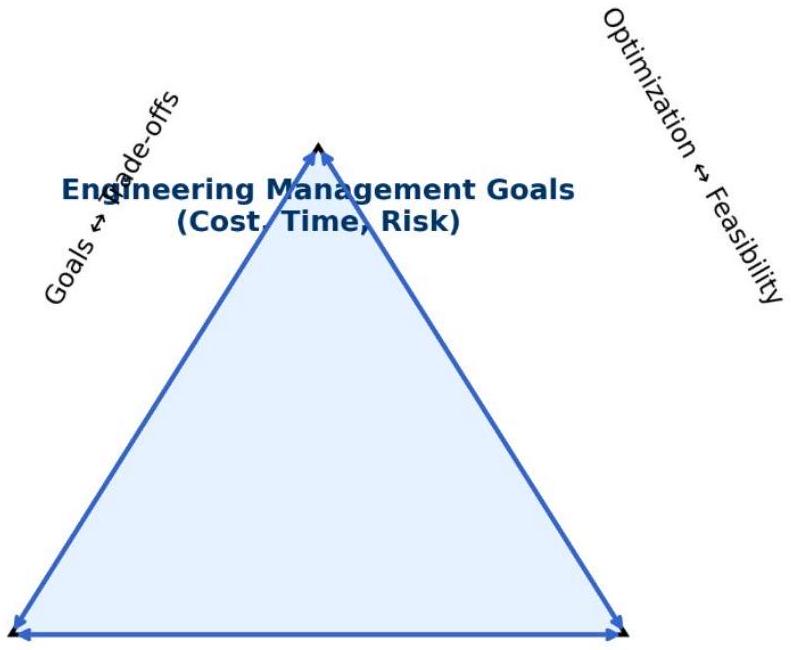
تقدم الشكل 1 إطارًا مفاهيميًا يربط بين تصميم الأنظمة الميكانيكية، وتقنيات تحسين الحوسبة، وأهداف إدارة الهندسة، مما يبرز الطبيعة المترابطة للدقة الفنية، والكفاءة الحاسوبية، والقيمة التنظيمية.
تصميم ↔ محاكاة
تصميم النظام الميكانيكي تقنيات تحسين الحوسبة
الشكل 1: إطار مفاهيمي يربط بين تصميم النظام الميكانيكي، وتقنيات تحسين الحوسبة، وأهداف إدارة الهندسة
3. نظرة عامة على التقنيات الحاسوبية المتقدمة
3.1 تحليل العناصر المحدودة (FEA) لتحسين الهياكل
تحليل العناصر المحدودة (FEA) هو تقنية عددية تُستخدم على نطاق واسع في الهندسة الميكانيكية للتنبؤ باستجابات الهياكل تحت ظروف تحميل مختلفة. يمكّن المهندسين من تقييم القوة، والصلابة، والمتانة للمكونات والتجمعات من خلال تقسيم المجال إلى عناصر محدودة أصغر وحل المعادلات الحاكمة عليها [9]. يعتبر FEA أداة أساسية في تحسين الهياكل، مما يسمح بالتكرار التدريجي للهندسة، واختيار المواد، وظروف الحدود لتحقيق أهداف الأداء مع تلبية القيود.
تستهدف عملية التحسين غالبًا أهدافًا مثل تقليل الوزن، وزيادة القدرة على تحمل الأحمال، أو تحسين عمر التعب. ضمن FEA، تشمل المقاييس الهيكلية الشائعة إجهاد فون ميسيس، وحقول الإزاحة، وتوزيعات عامل الأمان. يقوم المهندسون بتقييم تركيزات الإجهاد، وتحديد مناطق المواد غير المستغلة، والقضاء على الهندسات المعرضة للفشل [10].
لقد اكتسب تحسين الطوبولوجيا، وهو مجموعة متقدمة من تحسين الهياكل، شهرة في صناعات الطيران والسيارات. يستخدم FEA لتحديد تخطيط المواد الأمثل ضمن مساحة تصميم معينة، مما يؤدي غالبًا إلى هندسات عضوية أو غير بديهية تتناسب جيدًا مع عمليات التصنيع الإضافية. تعزز هذه التصاميم الأداء الهيكلي مع تقليل استخدام المواد وتكاليف الإنتاج [11].
بالإضافة إلى ذلك، يمكّن التحليل الطرائقي ضمن FEA من دراسة الترددات الطبيعية وأنماط الاهتزاز – وهو أمر حاسم للأنظمة المعرضة للأحمال الديناميكية. هذا مهم بشكل خاص للآلات الدوارة، والجسور، والهياكل العالية حيث يجب تجنب الرنين.
تقدم منصات البرمجيات مثل ANSYS Mechanical وAbaqus وAltair OptiStruct بيئات متكاملة لأداء تحسين قائم على FEA. تدعم هذه الأدوات كل من التحليلات الخطية وغير الخطية، ومحاكاة الاتصال، والديناميات متعددة الأجسام. يستفيد مدراء الهندسة من FEA من خلال الحصول على تحقق مدفوع بالبيانات لسلامة التصميم والأداء، مما يمكّن من اتخاذ قرارات أفضل في تخصيص الموارد، وتخفيف المخاطر، والامتثال للمعايير التنظيمية [12].
أصبحت الديناميكا الحرارية الحاسوبية (CFD) أداة تحليلية أساسية لتقييم تدفق السوائل، ونقل الحرارة، وتوزيع الضغط في الهندسات المعقدة. يتم تطبيقها على نطاق واسع في تصميم أنظمة التدفئة والتهوية وتكييف الهواء، والآلات التوربينية، ومحركات الاحتراق الداخلي، وتبريد الإلكترونيات، من بين أمور أخرى. تمكّن CFD من محاكاة سيناريوهات التدفق في العالم الحقيقي، مما يقلل من الاعتماد على النماذج الأولية الفيزيائية ويمكّن من التكرار السريع لبدائل التصميم [13].
من خلال حل معادلات نافير-ستوكس عدديًا عبر شبكة متقطعة، يمكن لـ CFD التنبؤ بسلوك التدفق اللامتناهي والتدفق المضطرب، وتدرجات الحرارة، وانخفاضات الضغط في الأنظمة ثلاثية الأبعاد. يستخدم المهندسون هذه الرؤى لتعزيز الكفاءة الحرارية، وتقليل الاهتزازات الناتجة عن التدفق، وتحسين أشكال المكونات مثل القنوات، والفوهات، والزعانف [14].
تلعب CFD دورًا حيويًا في تحليلات نقل الحرارة المترافق (CHT)، حيث تكون التفاعلات بين الصلب والسائل حاسمة. على سبيل المثال، في الحاويات الإلكترونية، تساعد CFD في تحقيق توازن بين التبريد الحراري مع مسارات التوصيل عبر مبردات الحرارة أو طبقات PCB. تتيح هذه الطريقة المتكاملة التنبؤ الدقيق بدرجات حرارة الوصلات، والتعب الحراري، وتشكيل النقاط الساخنة [15].
تشمل مهام تحسين التدفق تقليل فقد الضغط، وتعزيز الخلط، أو تحقيق توزيع متساوٍ لدرجات الحرارة. قد يتضمن تحسين CFD طرق تصميم التجارب (DOE) أو التكامل مع الخوارزميات الجينية ونماذج سطح الاستجابة للتنقل عبر مساحات التصميم المعقدة.
يظل نمذجة الاضطراب تحديًا رئيسيًا في CFD، مع وجود طرق مختلفة مثل معادلات نافير-ستوكس المتوسطة (RANS)، ومحاكاة الاضطراب الكبيرة (LES)، والمحاكاة العددية المباشرة (DNS) التي تقدم مقايضات بين الدقة وتكلفة الحوسبة. يعتمد اختيار نموذج الاضطراب على نظام التدفق، والدقة المطلوبة، والجدول الزمني للمشروع [16].
تقدم منصات CFD مثل ANSYS Fluent وSTAR-CCM+ وOpenFOAM حلولًا متقدمة، ونمذجة بارامترية، وأدوات معالجة ما بعد المعالجة. يستفيد إدارة الهندسة من CFD من خلال تقليل التكاليف، وتسريع تطوير المنتجات، والقدرة على التنبؤ والتحكم في سلوك النظام في ظروف تشغيل متنوعة. يدعم ذلك التحقق الاستباقي من التصميم والتواصل المستنير مع أصحاب المصلحة.
3.3 الخوارزميات التطورية والبرمجة الجينية
تمثل الخوارزميات التطورية (EAs) والبرمجة الجينية (GP) تقنيات تحسين مستوحاة من الطبيعة تحاكي عملية الانتقاء الطبيعي لحل المشكلات الهندسية. تعتبر هذه الطرق فعالة بشكل خاص في مساحات التصميم غير الخطية، ومتعددة الأوجه، والصندوق الأسود حيث قد تكافح الطرق التقليدية المعتمدة على التدرجات أو تفشل [17].
تعمل EAs من خلال تطوير مجموعة من الحلول المرشحة على مدى عدة أجيال. يتم تطبيق مشغلات جينية – مثل الاختيار، والتقاطع، والطفرات – لاستكشاف مساحة التصميم والتقارب نحو حلول مثلى أو قريبة من المثلى. يتم توجيه العملية بواسطة دالة لياقة، والتي تقيم كل مرشح بناءً على أهداف التصميم والقيود.
تعتبر الخوارزميات الجينية (GAs) من بين أكثر EAs شعبية في التصميم الميكانيكي. يتم استخدامها على نطاق واسع في تطبيقات مثل تحسين الشكل، وتصميم ملفات التروس، وترتيب التخطيط الحراري. على سبيل المثال، في تحسين مبادل حراري، قد يقوم GA بتغيير ترتيبات الأنابيب، وتباعد الحواجز، وتكوينات التدفق لتعظيم الكفاءة الحرارية وتقليل فقد الضغط [18].
توسع البرمجة الجينية هذا المفهوم من خلال تطوير هياكل البرامج الفعلية أو النماذج الرياضية بدلاً من متجهات المعلمات الثابتة. هذا مفيد بشكل خاص في الانحدار الرمزي، وتصميم المتحكمات، أو نمذجة السلوك حيث تكون الأشكال الوظيفية غير معروفة أو يصعب اشتقاقها تحليليًا.
تكمن القوة الرئيسية لـ EAs في قدرتها على التعامل مع مجالات المشاكل الضوضائية، وغير المستمرة، أو غير المفهومة بشكل جيد. ومع ذلك، غالبًا ما تتطلب موارد حوسبة كبيرة بسبب طبيعتها العشوائية واعتمادها على أحجام سكانية كبيرة والعديد من التكرارات. على الرغم من ذلك، فإن سهولة تنفيذها ومرونتها تجعلها إضافة قيمة إلى صندوق أدوات التحسين، خاصة في مراحل التصميم الاستكشافي والمفاهيمي [19].
3.4 دمج التعلم الآلي والذكاء الاصطناعي في التصميم الميكانيكي
لقد فتحت دمج التعلم الآلي (ML) والذكاء الاصطناعي (AI) في سير عمل تصميم الميكانيكا آفاقًا جديدة في توقع الأداء، والأتمتة، والتحسين الذكي. تعزز هذه التقنيات طرق الهندسة التقليدية من خلال تعلم الأنماط من البيانات التاريخية ومخرجات المحاكاة، مما يمكّن من الحصول على رؤى تنبؤية وتحكم تكيفي [20].
أحد التطبيقات الرئيسية للتعلم الآلي في الأنظمة الميكانيكية هو تطوير نماذج بديلة أو نماذج ميتا تقارب المحاكاة المكلفة. تم بناء هذه النماذج باستخدام تقنيات مثل الانحدار باستخدام المتجهات الداعمة، والشبكات العصبية، أو العمليات الغاوسية، مما يمكّن من تقييم سريع لبدائل التصميم خلال دورات التحسين، خاصة عند تضمينها ضمن خوارزميات تطورية أو قائمة على التدرج [21].
بالإضافة إلى النمذجة البديلة، يُستخدم الذكاء الاصطناعي بشكل متزايد لأتمتة التصميم، حيث تقترح خوارزميات التصميم التوليدية العديد من مرشحي التصميم الذين يستوفون القيود الوظيفية. تعمل هذه الأدوات، المدعومة بالتعلم المعزز أو التجميع غير المراقب، على تبسيط عملية الإبداع وتقليل تحيز المصممين.
تُستخدم نماذج التعلم الآلي أيضًا لتوقع احتمالات الفشل، وتكاليف دورة الحياة، أو إجهاد المواد بناءً على بيانات الميدان. يعزز هذا التحول نحو التصميم القائم على البيانات دقة اتخاذ القرار ويدعم المراقبة والتكيف في الوقت الحقيقي في الأنظمة السيبرانية الفيزيائية.
علاوة على ذلك، تظهر التوائم الرقمية المدمجة بالذكاء الاصطناعي كعوامل تمكين رئيسية للتصميم الذكي. من خلال ربط بيانات المستشعرات في الوقت الحقيقي ببيئات المحاكاة، تسمح هذه التوائم بالتحقق المستمر من التصميم، واكتشاف الشذوذ، والصيانة التنبؤية – مما يمدد فائدة النماذج الميكانيكية إلى ما بعد التصميم الأولي إلى مرحلة التشغيل [22].
بالنسبة لمديري الهندسة، فإن تقارب التعلم الآلي وتصميم الميكانيكا يترجم إلى دورات تصميم أسرع، وتقليل النماذج الأولية، والقدرة على تكييف المنتجات مع متطلبات المستخدم أو التغيرات البيئية. تكمن القيمة ليس فقط في تسريع الحسابات ولكن في تعزيز البصيرة الاستراتيجية عبر خط أنابيب تطوير المنتج.
الجدول 1: مقارنة تقنيات الحوسبة حسب مجال التطبيق، التعقيد، وموثوقية المخرجات
يقارن الجدول 1 تقنيات الحوسبة عبر المجالات، مع تسليط الضوء على تعقيدها، ومجالات تطبيقها، وموثوقية المخرجات النموذجية.
التقنية
مجال التطبيق
تعقيد الحوسبة
موثوقية المخرجات
الاستخدام النموذجي
تحليل العناصر المحدودة (FEA)
التحليل الهيكلي
متوسط إلى عالي
عالي
الإجهاد، الإزاحة، تحليل الوضعيات
ديناميات السوائل الحرارية (CFD)
أنظمة تدفق الحرارة والسوائل
عالي
عالي جدًا
أنماط التدفق، نقل الحرارة، انخفاض الضغط
الخوارزميات الجينية
التحسين (متعدد المجالات)
متوسط
متوسط إلى عالي (يعتمد على النموذج)
استكشاف التصميم، تحسين الشكل/التخطيط
التعلم الآلي
التنبؤ والنمذجة البديلة
منخفض إلى متوسط
متغير (يعتمد على البيانات)
توقع الأداء، التصميم التوليدي
التوائم الرقمية + الذكاء الاصطناعي
نمذجة النظام في الوقت الحقيقي
عالي (مكثف في البيانات + النموذج)
عالي
المراقبة، التحكم التنبؤي، تحسين دورة الحياة
4. التكامل في ممارسات إدارة الهندسة
4.1 هندسة الأنظمة وتخطيط التحسين
تتطلب التحديات الهندسية الحديثة حلولًا ليست فقط سليمة من الناحية التقنية ولكن أيضًا متكاملة نظاميًا. توفر هندسة الأنظمة منهجية منظمة للتعامل مع هذه التعقيدات، مما يمكّن التنسيق بين التخصصات من الفكرة إلى إيقاف التشغيل. من خلال اعتماد التفكير النظامي، يمكن لفرق الهندسة تحديد متطلبات واضحة، وتحديد الاعتماد المتبادل، وضمان التوافق بين الأولويات الفنية والإدارية [12].
في تخطيط التحسين، تسهل هندسة الأنظمة تحليلات المقايضات في المراحل المبكرة وتضمن أن جهود التحسين ليست محصورة في مكونات فردية ولكن تشمل دورة الحياة الكاملة وأداء النظام على المستوى. تخلق تقنيات مثل تتبع المتطلبات، والتحليل الوظيفي، وتعريف الواجهات منصة لتحديد الفرص للنمذجة الحاسوبية [13].
يسمح دمج أدوات التحسين الحاسوبية – بما في ذلك العناصر المحدودة، والديناميات متعددة الأجسام، وحلول الحرارة – في أطر هندسة الأنظمة باستكشاف مساحة المقايضة بشكل أكثر إبلاغًا. يمكن ربط معلمات التصميم كميًا بمقاييس الأداء مثل التكلفة، والوزن، وهوامش الأمان، وكفاءة الطاقة. يدعم هذا التوافق تطوير حلول باريتو المثلى، التي تعكس المقايضات المتوازنة بين أهداف متعددة.
علاوة على ذلك، تدعم هندسة الأنظمة تجزئة الأنظمة الفرعية، مما يسمح بالاختبار والتحقق المتكرر للمكونات قبل التكامل الكامل للنظام. يتماشى هذا التجزؤ بشكل جيد مع سير العمل الحاسوبي حيث يمكن أن تمثل النماذج البديلة أو المحاكاة ذات الترتيب المنخفض وحدات فردية، مما يعزز القابلية للتوسع وإعادة الاستخدام [14].
تتمثل فائدة أساسية في تسهيل التحسين تحت عدم اليقين. يمكن أن تتضمن المحاكاة على مستوى النظام مدخلات احتمالية، وتحليلات حساسية، وطرق مونت كارلو لتقييم متانة التصميم تحت ظروف تشغيل متغيرة. يستفيد مدراء الهندسة من خلال الحصول على رؤية حول ملفات المخاطر وعتبات اتخاذ القرار المستنيرة.
من خلال تضمين التحسين الحاسوبي ضمن هندسة الأنظمة، يمكن للمنظمات التنقل بشكل أفضل في تعقيد هياكل التصميم، وإدارة قيود الموارد، وضمان توافق التحسينات المحلية مع الأهداف العالمية للنظام – وهو اعتبار أساسي في المشاريع الكبيرة والحيوية.
4.2 إدارة دورة حياة المشروع باستخدام أدوات قائمة على المحاكاة
إدارة دورة حياة المشروع (PLM) هي نهج شامل لإدارة البيانات والعمليات والقرارات المتعلقة بالمنتج من البداية حتى التخلص. مع تزايد تعقيد المنتجات ودورات الابتكار الأقصر، تعتمد أطر PLM بشكل متزايد على أدوات قائمة على المحاكاة للتحقق من نية التصميم، وتحسين دقة القرار، وتقليل عدد النماذج الأولية المادية المطلوبة [15].
تمكن أدوات المحاكاة المدمجة في منصات PLM المهندسين من إجراء تحقق افتراضي عبر مراحل دورة الحياة المتعددة. خلال التصميم المفاهيمي، تساعد المحاكاة السريعة في تصفية الأفكار الأولية من حيث الجدوى. في التصميم التفصيلي، تقيم التحليلات عالية الدقة سلامة الهيكل، والسلوك الحراري، وقابلية التصنيع. في وقت لاحق من الدورة، تدعم المحاكاة الصيانة التنبؤية ونمذجة نهاية العمر، مما يساهم في أهداف الاقتصاد الدائري.
تسمح مجموعات البرمجيات مثل Siemens Teamcenter وDassault Systèmes 3DEXPERIENCE وPTC Windchill بربط بيانات المحاكاة مع قوائم المواد، ومستندات المتطلبات، وطلبات التغيير. يضمن هذا البيئة القائمة على النمذجة (MBSE) أن رؤى المحاكاة ليست معزولة ولكن تؤثر بدلاً من ذلك على إدارة التكوين والتواصل مع أصحاب المصلحة [16].
تتمثل ميزة كبيرة لـ PLM المدمجة مع المحاكاة في دعمها لإعادة استخدام التصميم وتتبع المتطلبات. بمجرد وجود نموذج موثق لنظام فرعي، يمكن إعادة استخدامه في المشاريع المستقبلية، مما يقلل من التكرار ويسرع من وقت الوصول إلى السوق. يتم عكس التغييرات في التصميم تلقائيًا في النماذج المرتبطة، مما يحافظ على التحكم في الإصدارات وقابلية التدقيق.
يدعم PLM القائم على المحاكاة أيضًا تكاليف دورة الحياة وتقييم السيناريوهات. يمكن للمهندسين محاكاة خيارات المواد المختلفة، وحالات التحميل، أو ملفات الاستخدام لتقدير الأداء على المدى الطويل والأثر الاقتصادي. هذا أمر حاسم بشكل خاص في الصناعات مثل الطيران، والسيارات، والطاقة حيث غالبًا ما تتجاوز تكاليف دورة الحياة تكاليف الاستحواذ [17].
في النهاية، يعزز دمج أدوات المحاكاة في PLM الشفافية والتعاون. يحصل مدراء الهندسة على رؤى قابلة للتنفيذ عبر الأقسام، مما يدعم اتخاذ قرارات أكثر مرونة تعتمد على البيانات. يؤدي ذلك إلى تحسين جودة المنتج، وتخفيف المخاطر، والتوافق بين مخرجات الهندسة والأهداف التجارية.
4.3 أنظمة دعم القرار والتحليلات في الوقت الحقيقي
شهد قطاع الهندسة تحولًا جذريًا من التحليل اللاحق إلى أنظمة دعم القرار في الوقت الحقيقي (DSS) التي تدمج النماذج الحسابية، وتدفقات البيانات الحية، والتحليلات المرئية. تمكّن هذه الأنظمة الإدارة الاستباقية من خلال تقديم رؤى تكون في الوقت المناسب، وسياقية، ومتوافقة مع أهداف المشروع [18]. تعمل منصات DSS كمعززات معرفية، مما يقلل من overload المعلومات ويمكّن من اتخاذ قرارات أسرع وأكثر ثقة.
تدمج أنظمة DSS الحديثة البيانات من المستشعرات، والمحاكاة، وقواعد البيانات، والتعليقات التشغيلية في لوحة تحليلات تعرض مؤشرات الأداء الرئيسية مثل هوامش الإجهاد الحراري، ومستويات الاهتزاز، أو توقعات استخدام الطاقة. هذا ذو قيمة خاصة خلال مراحل التنفيذ والتشغيل لمشاريع الهندسة، حيث يمكن أن تتطور الظروف بسرعة وتتطلب استجابات تكيفية [19].
تمكّن التحليلات في الوقت الحقيقي فرق المشروع من الاستجابة للانحرافات عن الأداء المتوقع قبل أن تصبح فشلاً. على سبيل المثال، خلال تشغيل نظام بناء، يمكن أن تبرز المقارنات في الوقت الحقيقي بين بيانات المستشعرات وتوقعات نموذج CFD التباينات في تدفق الهواء أو توزيع درجة الحرارة. يمكن أن تؤدي التنبيهات التلقائية إلى إعادة معايرة النموذج أو اقتراح تعديلات في إعدادات المخمد، مما يحسن كفاءة النظام دون تشخيص يدوي.
تلعب التعلم الآلي دورًا رئيسيًا في تعزيز DSS من خلال تمكين التحليلات التنبؤية. تم تدريب خوارزميات ML على البيانات التاريخية، ويمكنها التنبؤ بالسلوك المستقبلي – مثل إجهاد المواد، وفشل المكونات، أو ارتفاعات الطاقة – مما يسمح بالتدخلات الاستباقية. تقلل هذه الرؤى التنبؤية من وقت التوقف، وتحسن استخدام الموارد، وتزيد من عمر النظام [20].
وظيفة مهمة أخرى لـ DSS هي في تحليل القرار متعدد المعايير (MCDA). غالبًا ما تتضمن مشاريع الهندسة تنازلات عبر التكلفة، والجودة، والمخاطر، والأداء. يمكن لمنصات DSS حساب درجات مرجحة لبدائل مختلفة، ورسم خرائط بصرية لجبهات باريتو، وتسهيل توافق أصحاب المصلحة من خلال منطق شفاف ومقاييس قائمة على الأدلة. هذا يحسن من سرعة ونزاهة القرارات على مستوى الإدارة.
تكون التحليلات في الوقت الحقيقي ذات تأثير خاص في البناء والعمليات. على سبيل المثال، تتلقى التوائم الرقمية للأصول البنية التحتية – الجسور، ومحطات الطاقة، أو الأنفاق – مدخلات مستشعرات بشكل مستمر، والتي تتم مقارنتها مع مخرجات النموذج لتقييم توزيعات الإجهاد، وتدرجات الحرارة، أو انحرافات الهيكل. تدعم هذه الأنظمة الصيانة المعتمدة على الحالة، مما يحسن السلامة واقتصاديات دورة الحياة.
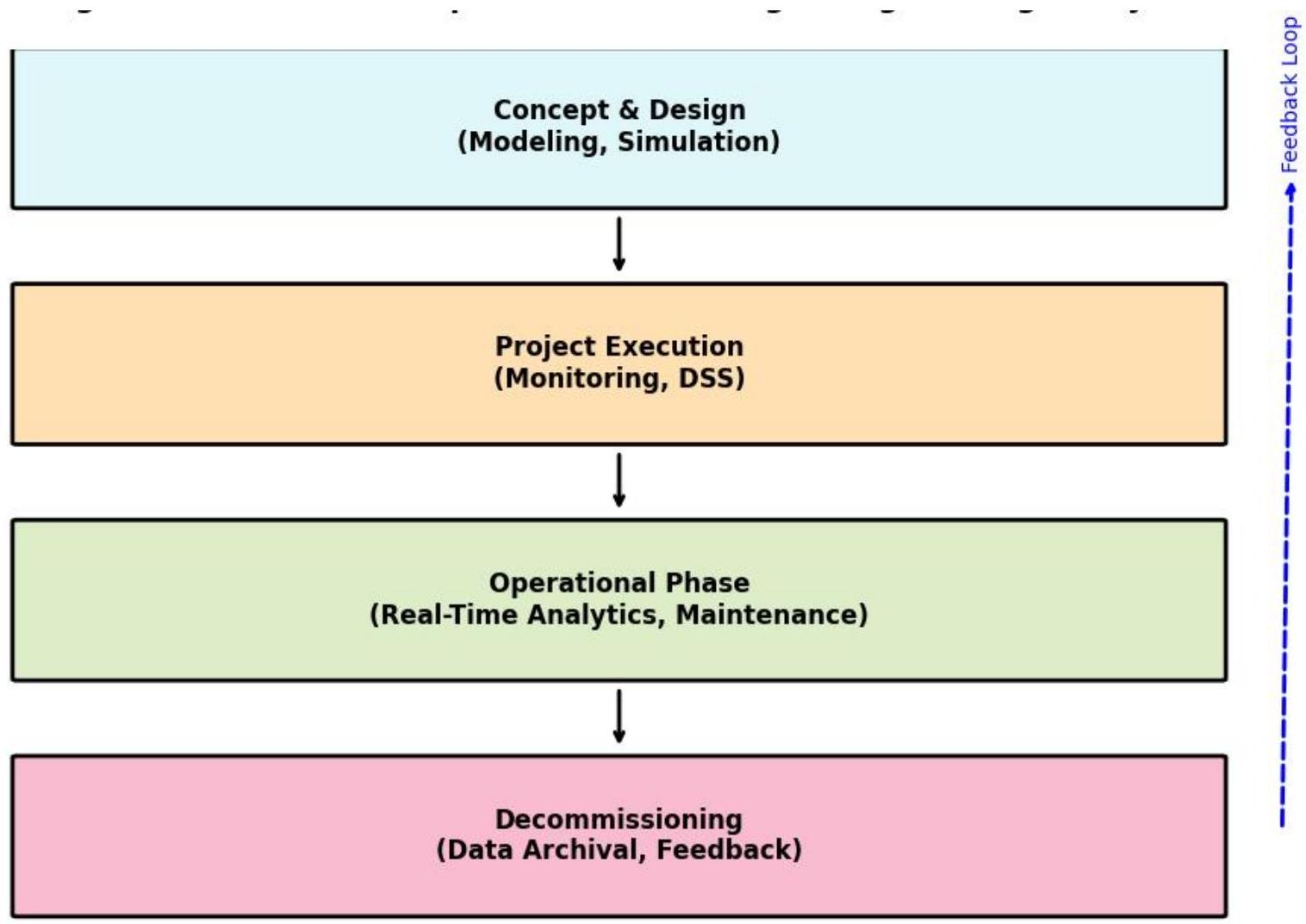
توضح الشكل 2 تدفق النمذجة الحسابية في الوقت الحقيقي ضمن دورة حياة مشروع الهندسة. يظهر كيف تتطور نماذج التصميم من خلال التحقق من المحاكاة، وتتصل بشبكات المستشعرات أثناء التشغيل، وتغذي أنظمة التحكم في المشروع من خلال منصات DSS.
في الختام، يعزز دمج التحليلات في الوقت الحقيقي ودعم القرار في إدارة الهندسة المرونة، ويقلل من عدم اليقين، ويمكّن من تحسين الأداء المستمر. مع زيادة حجم وتعقيد المشاريع، تصبح هذه الأنظمة ضرورية لتحقيق نتائج في الوقت المحدد، وضمن الميزانية، وعالية الأداء.
الشكل 2: مخطط تدفق يوضح دمج النمذجة الحسابية في الوقت الحقيقي في دورة حياة مشروع الهندسة
5. دراسات حالة في التنفيذ الصناعي
5.1 الطيران: تحسين الحمل باستخدام FEA و ML
يعد قطاع الطيران من أكثر المتبنين تقدمًا للهندسة الحسابية، خاصة لتحسين الأحمال الهيكلية في مكونات الطائرات. تُستخدم تقنيات تحليل العناصر المحدودة (FEA) والتعلم الآلي (ML) الآن معًا لتعزيز الأداء وتقليل الوزن مع الالتزام بمعايير السلامة الصارمة [16]. يدمج مصنعو الطائرات المحاكاة في وقت مبكر من دورة التصميم لتقليل عدد النماذج الأولية الفيزيائية وتحسين دقة التنبؤ بنماذج الفشل.
أحد الأمثلة هو تحسين دعامات الأجنحة وإطارات الهيكل. يجب أن تتحمل هذه الهياكل ظروف تحميل معقدة أثناء الإقلاع، والطيران، والهبوط. تحاكي طرق FEA التقليدية توزيعات الإجهاد والانفعال، ولكن من خلال دمج مخرجات FEA مع نماذج ML، يمكن للمهندسين أتمتة اكتشاف المناطق المفرطة التصميم أو المناطق ذات الاستخدام المنخفض للمواد [17]. يتم تدريب خوارزميات مثل الغابات العشوائية وآلات الدعم على مجموعات بيانات المحاكاة للتنبؤ بتركيزات الإجهاد العالية أو المناطق المعرضة للإجهاد، مما يوجه إعادة توزيع المواد وتحسين الهندسة.
تتمثل تطبيق آخر في تحسين الطوبولوجيا لتقليل الوزن. تحدد محركات التحسين المعززة بالتعلم الآلي أنماطًا عبر آلاف التكوينات لتقديم هياكل جديدة تحافظ على مسارات الحمل مع تقليل الكتلة. هذه الهياكل، التي غالبًا ما تكون غير بديهية، مناسبة بشكل خاص للتصنيع الإضافي، مما يمكّن من النمذجة السريعة وتوفير التكاليف [18].
بعيدًا عن التصميم الهيكلي، تستفيد صيانة الطائرات وتخطيط دورة الحياة من النماذج التنبؤية التي تحلل تاريخ الأحمال وتوصي بفترات الفحص. تُستخدم البيانات من المستشعرات أثناء الطيران، مثل مقياس التسارع ومقاييس الانفعال، لتحديث التوائم الرقمية لمكونات الطائرات في الوقت الحقيقي، مما يسمح للمشغلين بتوقع الفشل وتمديد عمر المكونات بأمان.
من خلال دمج FEA مع التعلم الآلي، تحقق شركات الطيران كفاءة هيكلية متفوقة، وتقليل الوزن، وتكاليف تشغيل أقل مع الحفاظ على الامتثال التنظيمي وسلامة الركاب [19].
5.2 السيارات: محاكاة النظام الحراري باستخدام CFD
في صناعة السيارات، تعتبر إدارة الحرارة جانبًا حاسمًا في تصميم المركبات، تؤثر على الأداء، والكفاءة، والمتانة. مع تحول أنظمة الدفع في المركبات إلى المزيد من الكهرباء والتقليص، تصبح المحاكاة الفعالة لنقل الحرارة وتدفق الهواء عبر المكونات أمرًا ضروريًا. تُستخدم الديناميكا الهوائية الحسابية (CFD) كأداة رئيسية من قبل مهندسي السيارات لمحاكاة وتحسين الأنظمة الحرارية، وخاصة وحدات التبريد، وتكييف الهواء في المقصورة، وحزم البطاريات [20].
تطبيق ملحوظ هو محاكاة تدفق الهواء عبر حجرة المحرك أو حاويات بطاريات المركبات الكهربائية (EV). تتيح CFD التنبؤ الدقيق بتدرجات الحرارة، وانخفاضات الضغط، وملفات السرعة، مما يمكّن المهندسين من اكتشاف النقاط الساخنة والمناطق ذات التهوية الضعيفة. في محركات الاحتراق الداخلي عالية الأداء، تُستخدم CFD لضمان توزيع فعال لسائل التبريد عبر جدران الأسطوانة، مما يمنع ارتفاع درجة الحرارة المحلي والإجهاد الحراري [21].
بالنسبة للمركبات الكهربائية، تعتبر إدارة الحرارة للبطارية محور تركيز رئيسي. تُستخدم محاكاة CFD لتصميم حاويات مبردة بالسوائل أو الهواء تحافظ على البطاريات ضمن درجات حرارة تشغيل مثالية تحت دورات تحميل متغيرة. تتضمن النماذج معدلات توليد حرارة معقدة، وتحميلات عابرة، وظروف محيطة لتقييم فعالية النظام تحت سيناريوهات القيادة في العالم الحقيقي [22].
تستفيد أنظمة راحة المقصورة أيضًا من CFD من خلال محاكاة توزيع الهواء، وتوحيد درجة الحرارة، وسلوك إزالة الضباب. يستخدم المهندسون النتائج لضبط مواقع الفتحات، ومعدلات تدفق الهواء، وحجم قلب السخان لتحقيق التوازن بين الراحة وكفاءة الطاقة، خاصة في المركبات الهجينة والكهربائية حيث تؤثر أحمال HVAC على مدى القيادة.
يسمح التكامل مع أدوات التحسين المعلمية لـ CFD بدفع تكرارات التصميم، مما يساعد على تحديد فتحات الشبكة المثلى، وهندسة القنوات، أو مواضع المشعات التي تحسن الكفاءة الحرارية مع تقليل السحب الهوائي. بالتعاون مع نماذج المتانة، تدعم CFD تحليل الإجهاد الحراري لمانيفولد العادم، والشواحن التوربينية، والدروع الحرارية.
تبلغ شركات السيارات التي تستفيد من التصميم المدفوع بالمحاكاة عن تقليل كبير في دورات النماذج الأولية وزيادة موثوقية، مما يترجم إلى وقت أسرع للوصول إلى السوق وتكاليف تطوير أقل [23].
5.3 التصنيع: الصيانة التنبؤية واكتشاف الأعطال عبر الذكاء الاصطناعي
تتبنى بيئات التصنيع بشكل متزايد الذكاء الاصطناعي (AI) للانتقال من الصيانة التفاعلية والمجدولة إلى استراتيجيات الصيانة التنبؤية (PdM). تستخدم هذه الاستراتيجيات بيانات المستشعرات في الوقت الحقيقي وخوارزميات التعلم الآلي للتنبؤ بفشل المعدات قبل حدوثه، مما يقلل من التوقف غير المخطط له ويحسن من استخدام الأصول [24].
تبدأ الصيانة التنبؤية المدفوعة بالذكاء الاصطناعي بنشر مستشعرات إنترنت الأشياء الصناعية (IIoT) على مكونات الآلات الرئيسية – المحركات، والمحامل، والضواغط، وأدوات القطع. تجمع هذه المستشعرات بيانات عن الاهتزاز، ودرجة الحرارة، والضغط، والإشارات الصوتية، والتي يتم نقلها بعد ذلك إلى منصات التحليل المركزية للمعالجة. تقوم خوارزميات التعلم الآلي – مثل الشبكات العصبية المتكررة (RNNs)، ونماذج الذاكرة طويلة وقصيرة الأمد (LSTM)، وأطر اكتشاف الشذوذ – بتحليل البيانات لاكتشاف العلامات المبكرة للتدهور أو الأنماط غير الطبيعية [25].
في دراسة حالة تتعلق بآلات الطحن CNC، نشر أحد المصنعين مستشعرات الاهتزاز وحمل المغزل لاكتشاف تآكل الأدوات في الوقت الحقيقي. تعلم نظام التعلم الآلي التوقيعات الأساسية وتنبأ بنجاح بأحداث فشل الأدوات بدقة تزيد عن ، مما مكن من تغيير الأدوات في الوقت المناسب وتجنب الأجزاء المعيبة. أدى هذا النهج إلى تقليل معدل الخردة و زيادة في استخدام عمر الأداة [26].
تطبيق آخر مؤثر هو التوأم الرقمي للأصول التصنيعية. يتم تحديث هذه النسخ الافتراضية باستمرار ببيانات التشغيل في الوقت الحقيقي، مما يسمح بمحاكاة سلوك الآلات تحت أحمال وسرعات وظروف بيئية مختلفة. تقوم خوارزميات الذكاء الاصطناعي بتشغيل سيناريوهات تنبؤية لتقييم مخاطر الفشل وتوصية بالتدخلات الصيانة المحسّنة لجدول الإنتاج.
بعيدًا عن الأنظمة الميكانيكية، يُستخدم الذكاء الاصطناعي في اكتشاف أعطال العمليات في عمليات مثل تشكيل الحقن، والصب، أو توازن خط التجميع. تُطبق الشبكات العصبية الالتفافية (CNNs) على أنظمة رؤية الآلات لتصنيف العيوب، بينما تقيم الشبكات البايزية الأسباب الجذرية للانحرافات في جودة المنتج. هذا يمكّن من استجابة أسرع لعدم تطابق العمليات ويقلل من تكاليف الفحص.
عائد الاستثمار للصيانة التنبؤية المعتمدة على الذكاء الاصطناعي كبير. يُبلغ المصنعون عن مكاسب في الكفاءة من خلال زيادة فعالية المعدات العامة (OEE)، وانخفاض تكاليف الصيانة، وتحسين تخطيط الموارد. بالإضافة إلى ذلك، يسهل الذكاء الاصطناعي الامتثال لمعايير ISO للجودة والموثوقية من خلال التوثيق الآلي لصحة الآلات وسجلات التدخل [27].
يلعب الذكاء الاصطناعي أيضًا دورًا في تحسين الطاقة، حيث تقوم الخوارزميات بتحليل أنماط الاستهلاك عبر الآلات وتوصي بتوازن الحمل، وإعادة جدولة الورديات، أو ضبط معلمات التشغيل لتقليل استهلاك الطاقة دون التأثير على الإنتاجية.
من خلال دمج الذكاء الاصطناعي في أنظمة الصيانة والإنتاج، تتحرك منظمات التصنيع نحو نماذج الصناعة التي تتميز بمصانع ذاتية التحسين. يرفع دمج توقع الأعطال، وتشخيص النظام، واتخاذ القرارات في الوقت الحقيقي من أداء المصنع مع حماية الاستثمارات الرأسمالية.
تلخص الجدول 2 مؤشرات الأداء الرئيسية عبر دراسات الحالة في مجالات الطيران، والسيارات، والتصنيع، مما يظهر التأثير الكمي لدمج الهندسة الحاسوبية.
الجدول 2: ملخص نتائج الأداء عبر دراسات الحالة
الصناعة
التطبيق
التقنية الرئيسية
نتيجة الأداء
الطيران
تحسين الحمل في دعامات الأجنحة
FEA + التعلم الآلي
تقليل الوزن بنسبة 18%، تمديد عمر التعب
السيارات
إدارة الحرارة في بطاريات السيارات الكهربائية
CFD + تحسين بارامترية
تمديد المدى بنسبة 12%، تحسين التوحيد الحراري بنسبة 40%
التصنيع
تنبؤ بفشل أدوات CNC
RNN + تحليل الاهتزاز
تقليل الخردة بنسبة 25%، زيادة عمر الأداة بنسبة 30%
التصنيع
اكتشاف أعطال تشكيل الحقن
CNN + الفحص البصري
دقة تصنيف 95%، انخفاض بنسبة 22% في التوقف
الطيران
تحسين الشكل للدعامات
تحليل العناصر المحدودة المعزز بالتعلم الآلي
توفير 20% من المواد، تعزيز الصلابة الهيكلية
6. التحديات والقيود
6.1 تكلفة الحوسبة وتعقيد النموذج
تعد واحدة من أكثر التحديات المستمرة في نشر تحسين الحوسبة في سير العمل الهندسي هي التوازن بين تعقيد النموذج وتكلفة الحوسبة. بينما تقدم المحاكاة عالية الدقة – مثل نماذج العناصر المحدودة واسعة النطاق أو نماذج التدفق المضطرب – رؤى دقيقة، فإنها تتطلب أيضًا موارد حوسبة واسعة. يشمل ذلك أوقات معالجة أطول، واستهلاك ذاكرة أعلى، وأجهزة متخصصة مثل مجموعات GPU أو بيئات الحوسبة عالية الأداء المستندة إلى السحابة (HPC) [20].
مع زيادة تعقيد النماذج لتضمين الفيزياء المتعددة، والاعتماد على الزمن، أو متغيرات التصميم عالية الأبعاد، تزداد تكلفتها الحاسوبية بشكل أسي. على سبيل المثال، يتطلب دمج تفاعل السوائل والهياكل في التطبيقات الجوية أو الدورات الحرارية العابرة في تعبئة الإلكترونيات حلولًا تكرارية وتحسين الشبكة، وكلاهما يؤثر بشكل كبير على وقت التشغيل [21]. في الممارسة الصناعية، يمكن أن تؤدي فترات المحاكاة الطويلة إلى تأخير تكرارات التصميم وتقييد القدرة على استكشاف مساحات تصميم كبيرة من خلال حلقات التحسين أو أخذ عينات مونت كارلو.
لمعالجة ذلك، غالبًا ما يعتمد المهندسون على نماذج منخفضة الترتيب (ROMs) أو تقنيات النمذجة البديلة مثل أسطح الاستجابة والشبكات العصبية لتقريب المحاكاة المكلفة. بينما يحسن ذلك السرعة، فإنه يقدم مخاطر تتعلق بموثوقية النموذج وقابليته للتعميم. يجب إدارة التبادلات بعناية، خاصة في المجالات الحرجة للسلامة حيث تكون هوامش التصميم المحافظة ضرورية [22].
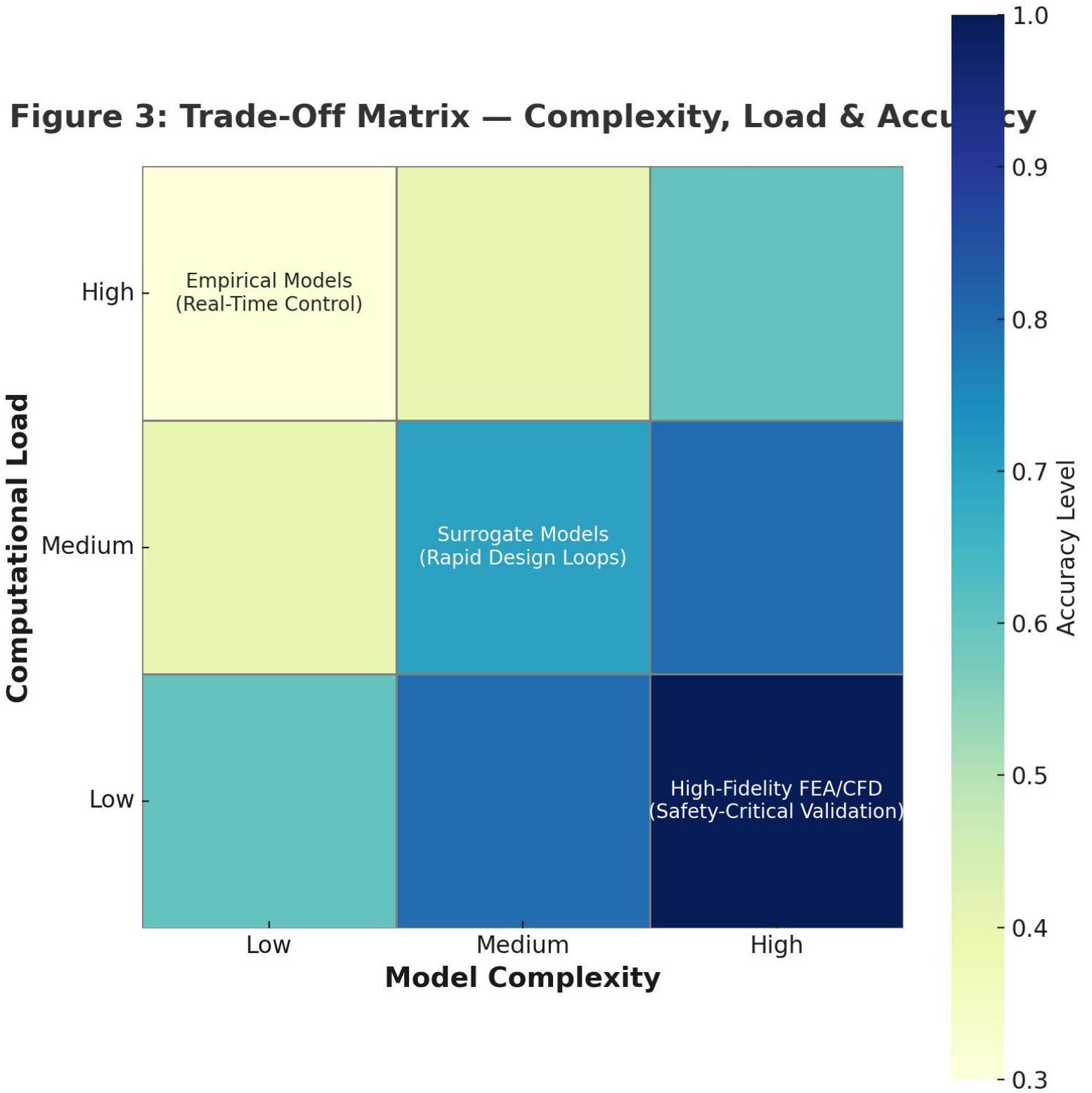
توضح الشكل 3 التبادلات النموذجية عبر مجالات التطبيق المختلفة، موضحة كيف أن زيادة تعقيد النموذج تحسن الدقة ولكنها أيضًا ترفع من الحمل الحاسوبي، مما قد يؤثر على الجدوى في دورات التصميم التكرارية.
في النهاية، يجب على مديري الهندسة تقييم متى وأين يستثمرون في العمق الحاسوبي. يمكن أن يؤدي التخصيص الاستراتيجي للموارد – الاحتفاظ بمحاكاة عالية الدقة للمناطق الحرجة واستخدام نماذج أقل دقة في أماكن أخرى – إلى تحسين الأداء دون إرهاق الميزانيات الحاسوبية [23].
6.2 جودة البيانات، وتوافرها، ودمجها
يعتمد نجاح تحسين الحوسبة على جودة البيانات ودمجها عبر دورة حياة تطوير المنتج. يمكن أن تؤدي البيانات السيئة – سواء كانت غير مكتملة، أو قديمة، أو بتنسيق غير متسق – إلى تقويض صلاحية المحاكاة، وتحريف نتائج التحسين، وإرباك عملية اتخاذ القرار [24]. تكون هذه المشكلة أكثر وضوحًا عندما تعتمد النماذج الحاسوبية على قياسات تاريخية، أو تغذيات مستشعرات، أو مواصفات بائعين تختلف في الدقة والموثوقية.
في العديد من البيئات الهندسية، تكون البيانات معزولة عبر الأقسام، مخزنة بتنسيقات غير متوافقة، أو تفتقر إلى البيانات الوصفية السياقية اللازمة للتفسير الصحيح. غالبًا ما يتطلب دمج هذه البيانات في بيئات المحاكاة الموحدة معالجة مسبقة شاملة، وتنظيف، وتحويل – مهام تستغرق وقتًا طويلاً وعرضة للأخطاء البشرية [29]. علاوة على ذلك، يمكن أن تؤدي التباينات بين نية التصميم، كما هو موضح في نماذج CAD أو BIM، والظروف الواقعية المقاسة أثناء الإنتاج أو التشغيل إلى إدخال مزيد من عدم الدقة في النمذجة.
تحدٍ آخر هو ندرة مجموعات البيانات عالية الدقة، والمتخصصة في المجال، المطلوبة لتدريب نماذج التعلم الآلي أو الذكاء الاصطناعي. بالنسبة للتطبيقات الناشئة مثل الصيانة التنبؤية أو تطوير التوأم الرقمي، قد تكون بيانات الفشل التاريخية أو بيانات المراقبة الكاملة غير متاحة أو مقيدة بسبب مخاوف الملكية الفكرية [30].
الحل يكمن في تنفيذ أطر حوكمة بيانات قوية، بما في ذلك توحيد تنسيقات البيانات (مثل STEP، IFC)، ومستودعات مركزية، وآليات تتبع. كما أن الاستثمار في أدوات الاستشعار وبنية تحتية للمراقبة في الوقت الحقيقي يعزز أيضًا من توافر البيانات لتعيين المحاكاة والتحقق منها [31].
بالتوازي، تساعد تقنيات دمج البيانات الناشئة في دمج مجموعات البيانات المتنوعة – من خلال دمج المعلمات الحرارية والهيكلية والتشغيلية – في مدخلات متماسكة لتحسين متعدد المجالات. تمكّن هذه الاستراتيجيات من الحصول على مخرجات نموذج أكثر موثوقية وتحسن من قابلية توسيع أدوات الحوسبة عبر سياقات الهندسة [32].
6.3 رأس المال البشري وفجوات المهارات في فرق الهندسة
مع تزايد تعقيد أدوات الحوسبة، تصبح الحاجة إلى محترفين مهرة يمكنهم فهم وتشغيل وتفسير هذه التقنيات أكثر إلحاحًا. ومع ذلك، تواجه العديد من المنظمات فجوة متزايدة في رأس المال البشري، حيث تفتقر فرق الهندسة إلى الخبرة متعددة التخصصات المطلوبة للاستفادة الكاملة من أدوات المحاكاة والتحسين والذكاء الاصطناعي [28].
قد يتفوق المهندسون المدربون تقليديًا في المعرفة الخاصة بالمجال – مثل الديناميكا الحرارية أو الميكانيكا أو علوم المواد – لكنهم غالبًا ما يفتقرون إلى التعرض لمواضيع متقدمة مثل الطرق العددية أو التعلم الآلي أو التحسين متعدد الأهداف. يؤدي ذلك إلى انفصال بين توفر الأدوات والتنفيذ الفعال، مما يؤدي إلى تراخيص برمجيات غير مستغلة أو ممارسات نمذجة دون المستوى [33].
في الوقت نفسه، قد لا يفهم علماء البيانات أو المتخصصون في الحوسبة المبادئ الفيزيائية التي تحكم الأنظمة التي يقومون بنمذجتها بشكل كامل. بدون سياق المجال، قد تنتهك نماذجهم الافتراضات الهندسية الأساسية أو تتجاهل قيود السلامة، مما يقلل من ثقة صانعي القرار في توصيات النموذج [34].
يتطلب سد هذه الفجوة استراتيجيات تنظيمية وتعليمية. من الجانب التنظيمي، تعتبر الفرق متعددة الوظائف التي تجمع بين مهندسي المحاكاة وخبراء المجال وعلماء البيانات أكثر فعالية بشكل متزايد في ضمان حل المشكلات بشكل شامل [35]. تتيح بيئات النمذجة التعاونية، التي تسهلها التوائم الرقمية أو أنظمة إدارة دورة الحياة المستندة إلى السحابة، تلاقي الخبرات الموزعة حول مجموعات البيانات المشتركة ونتائج المحاكاة [36].
على الصعيد التعليمي، يجب أن تتطور البرامج الأكاديمية لدمج الهندسة الحاسوبية والتفكير النظامي في المناهج الهندسية القياسية. تساعد برامج الدرجات المزدوجة في الهندسة الميكانيكية وعلوم البيانات، والدورات التدريبية في بايثون للمحاكاة، والتدريبات التي تعرض الطلاب لعمليات العمل الرقمية جميعها المهندسين المستقبليين على أن يصبحوا بارعين في كل من النظرية والأدوات [37].
التطوير المهني المستمر مهم بنفس القدر. يجب على المنظمات الاستثمار في تحسين المهارات من خلال ورش العمل، والشهادات الصناعية، ومنصات تبادل المعرفة الداخلية. تلعب أيضًا مزودات برمجيات المحاكاة دورًا من خلال تقديم وحدات تدريب مخصصة، ووثائق فنية، وخدمات دعم العملاء [38].
الهدف هو بناء فرق قادرة على التكيف، ومتمكنة حاسوبيًا، وقادرة على التنقل في مشهد التكنولوجيا المتطور. فقط عندها يمكن للمنظمات تحقيق الإمكانات الكاملة للهندسة الرقمية – تحويل البيانات إلى قرارات، والنماذج إلى رؤى، والمحاكاة إلى حلول تدفع الميزة التنافسية [39].
الشكل 3 أدناه يدعم هذا القسم من خلال تصور التوازن بين تعقيد النموذج، والعبء الحاسوبي، والدقة، كما تم تطبيقه عبر حالات استخدام صناعية متنوعة مثل المراقبة في الوقت الحقيقي، وتحسين الهياكل، ونمذجة التصميم.
الشكل 3: مصفوفة توضح التوازنات بين تعقيد النموذج، والعبء الحاسوبي، والدقة في حالات استخدام متنوعة
تتحول التوائم الرقمية بسرعة مشهد الهندسة الحاسوبية من خلال تمكين التزامن في الوقت الحقيقي بين الأصول الفيزيائية ونظيراتها الافتراضية. تدمج هذه النماذج البيانات الهندسية، وتغذيات المستشعرات، ومعلمات المحاكاة، والسجلات التاريخية لإنشاء نسخة غنية بالبيانات ومحدثة باستمرار لمكون أو نظام فرعي أو منشأة كاملة [40]. عند تضمينها في سير العمل للمشاريع، تتيح التوائم الرقمية تشخيصات تنبؤية، وتحليل دورة الحياة، والتحكم التكيفي في الأنظمة الهندسية.
في قلب وظيفة التوائم الرقمية هو هيكل النظام السيبراني الفيزيائي (CPS)، الذي يربط المجال الفيزيائي (المستشعرات، والآلات، والهياكل) بالتحليلات الحاسوبية من خلال الاتصالات الشبكية. وهذا يخلق حلقة تغذية راجعة مغلقة حيث تُعلم البيانات من الأصل الفيزيائي توقعات النموذج، وتوجه مخرجات النموذج سلوك النظام أو إجراءات الصيانة [41]. في قطاعات مثل الطيران، والتصنيع، والبنية التحتية المدنية، تعزز التوائم الرقمية المعتمدة على CPS من مرونة الأصول، وتقلل من التوقف غير المخطط له، وتحسن العمليات بناءً على رؤى في الوقت الحقيقي [42].
على سبيل المثال، في تطبيقات الطيران، تُستخدم التوائم الرقمية للمحركات لمحاكاة سلوك الإجهاد، وتقدم التعب، والأحمال الحرارية عبر دورات الطيران. من خلال مقارنة بيانات المستشعر الفعلية مع توقعات المحاكاة، يمكن للمشغلين ضبط ملفات الطيران أو جدولة الصيانة الوقائية بدقة أكبر [43].
بعيدًا عن المراقبة، تتقدم التوائم الرقمية نحو التحليلات التوجيهية، باستخدام الذكاء الاصطناعي ليس فقط لاكتشاف الشذوذ ولكن أيضًا لتوصية بالإجراءات التصحيحية المثلى. يتم أيضًا توسيع هذه النماذج لتشمل أطر الأنظمة المتعددة، حيث يتم نمذجة المنشآت أو الأساطيل بالكامل ككيانات مترابطة [44].
مع تزايد الاعتماد، لا تزال التحديات قائمة من حيث المعايير، والتشغيل البيني، وأمان البيانات. ومع ذلك، فإن التأثير طويل الأمد للتوائم الرقمية واضح – فهي تمثل تحولًا في النموذج من المحاكاة الثابتة إلى بيئات اتخاذ القرار الديناميكية في الوقت الحقيقي، مما يحول إدارة الهندسة من تخصص تفاعلي إلى تخصص تنبؤي [45].
تتم تلبية الطلبات الحاسوبية المتزايدة لمحاكاة الهندسة من خلال قابلية التوسع والمرونة للحوسبة السحابية [46]. تقتصر بيئات المحاكاة التقليدية المستندة إلى سطح المكتب أو الموجودة في الموقع على قيود الأجهزة، بينما توفر المنصات السحابية وصولًا غير محدود تقريبًا إلى قوة الحوسبة، والتخزين، وميزات التعاون [28].
تسمح منصات المحاكاة المدعومة بالسحابة مثل SimScale وRescale وAltair One للمستخدمين بإجراء تحليلات CFD وFEA وعلوم متعددة الفيزياء على نطاق واسع دون الحاجة إلى تثبيتات محلية [47]. تدعم هذه الأنظمة المعالجة المتوازية والحوسبة الموزعة، مما يمكّن من تسريع دورات التصميم، وتحليلات الحساسية، ودراسات التحسين. يمكن للمهندسين بسهولة زيادة موارد الحوسبة بناءً على متطلبات المشروع، مما يقلل من وقت الخمول وتكاليف البنية التحتية [48].
علاوة على ذلك، تسهل المنصات المستندة إلى السحابة النمذجة التعاونية عبر فرق موزعة جغرافيًا. يمكن للمهندسين والمحللين وصانعي القرار مشاركة النتائج، وإصدار نماذج، وتوضيح المحاكاة في الوقت الحقيقي، مما يحسن الشفافية ويقلل من سوء التواصل [49].
تتحسن أيضًا بروتوكولات الأمان ومعايير الامتثال، مما يجعل اعتماد السحابة ممكنًا في الصناعات المنظمة مثل الأجهزة الطبية، والطاقة، والسيارات [50]. مع تزايد الطلب على ديمقراطية المحاكاة وعمليات الهندسة عن بُعد، تصبح الحوسبة السحابية حجر الزاوية في بنية إدارة الهندسة المرنة والقابلة للتوسع [51].
7.3 الاستدامة وتطبيقات الهندسة الخضراء
تظهر الاستدامة كهدف أساسي في تصميم الهندسة، وتلعب أدوات الحوسبة دورًا حيويًا في تحقيق أهداف الهندسة الخضراء. يتم تطبيق خوارزميات التحسين لتقليل استخدام المواد، واستهلاك الطاقة، والانبعاثات مع الحفاظ على الأداء الوظيفي [52]. في الهندسة الميكانيكية والمدنية، يتم الآن دمج تقييم دورة الحياة (LCA) بشكل متكرر مع منصات المحاكاة لتقييم الأثر البيئي عبر مراحل التصميم، والتصنيع، والتشغيل [53].
تسمح المحاكاة المتقدمة للمهندسين بتقييم المواد منخفضة الكربون، والهندسة الموفرة للطاقة، والاستراتيجيات الحرارية السلبية قبل التنفيذ الفعلي [54]. يمكن للنماذج البارامترية تحسين سمك الجدران، ومسارات تدفق الهواء، أو زعانف مبادل الحرارة لتحقيق أقصى كفاءة مع الحد الأدنى من الأثر البيئي. هذا الأمر ذو صلة خاصة في تصميم المباني المستدامة، وأنظمة التدفئة والتهوية وتكييف الهواء، والبنية التحتية للطاقة المتجددة [55].
علاوة على ذلك، تساعد الأمثلية متعددة الأهداف في التنقل بين التنازلات بين التكلفة والأداء والأثر البيئي. باستخدام الأدوات الحاسوبية، يمكن لفرق الهندسة تحديد الحلول المثلى وفقًا لمعايير ESG (البيئية والاجتماعية والحوكمة) ومتطلبات الشهادات الخضراء [56].
مع دفع الحكومات والمنظمات نحو إزالة الكربون، ستكون الهندسة الحاسوبية أداة حيوية في تمكين استراتيجيات التصميم الصفرية. لا تدعم هذه التطورات الامتثال والسمعة فحسب، بل تضع الشركات كقادة في الابتكار الواعي للمناخ والمرونة على المدى الطويل [57].
8. الاستنتاجات والتوصيات
8.1 ملخص الرؤى الرئيسية
يمثل دمج الأمثلية الحاسوبية في إدارة الهندسة تطورًا تحويليًا في كيفية تصميم الأنظمة المعقدة والتحقق منها وصيانتها. عبر الصناعات، تستفيد فرق الهندسة بشكل متزايد من أدوات المحاكاة، والتحليلات المتقدمة، والذكاء الاصطناعي لتبسيط سير العمل، وتقليل التكاليف، وتحسين دقة القرار. استكشفت هذه المقالة المكونات الأساسية لهذا التحول، بدءًا من المبادئ الأساسية لتصميم الأنظمة الميكانيكية وامتدادًا إلى الأمثلية متعددة المجالات، والنمذجة المعتمدة على البيانات، والتحول الرقمي.
تتمثل إحدى الرؤى الرئيسية في الدور المركزي للأدوات الحاسوبية – مثل تحليل العناصر المحدودة (FEA)، والديناميكا الهوائية الحاسوبية (CFD)، ونماذج التعلم الآلي – في تمكين فرق الهندسة من تقييم المزيد من خيارات التصميم، وتوقع أنماط الفشل، وتحسين الأداء تحت قيود متعددة. لا تقلل هذه الأدوات من الوقت والتكلفة المرتبطة بالنماذج الأولية فحسب، بل تعزز أيضًا موثوقية المنتج وقيمة دورة الحياة.
نتيجة رئيسية أخرى هي الأهمية المتزايدة لدمج الأنظمة. لم يعد النجاح في الهندسة الحاسوبية يتحدد فقط بكفاءة الأدوات، بل بالقدرة على ربط المحاكاة بالبيانات في الوقت الحقيقي، وأنظمة دعم القرار، والأهداف التنظيمية. ظهرت التوائم الرقمية والمنصات السحابية كتمكين قوي في هذا الصدد، مما يسهل المراقبة المستمرة، والتعاون، والإدارة المعتمدة على النماذج عبر دورة حياة المشروع.
ومع ذلك، فإن تنفيذ هذه الأدوات ليس بدون تحديات. يمكن أن تحدد قضايا مثل الحمل الحاسوبي، وجودة البيانات، ونقص المهارات داخل فرق الهندسة الاستخدام الفعال لتقنيات المحاكاة والأمثلية. الحاجة إلى بنية تحتية قابلة للتوسع والتعاون بين التخصصات تكون ملحة بشكل خاص في المنظمات التي تسعى لدمج الذكاء الحاسوبي في سير العمل الأساسي.
على الرغم من هذه الحواجز، فإن الإمكانات طويلة الأجل للأمثلية الحاسوبية واضحة. إنها تمكن المهندسين من استكشاف رؤى أعمق، والتكيف مع ردود الفعل في الوقت الحقيقي، ومحاذاة الابتكار التقني مع الاستدامة وأهداف الأعمال. مع استمرار تعقيد الأنظمة الهندسية في الارتفاع، تزداد أيضًا القيمة الاستراتيجية لاستغلال الحوسبة لإدارة عدم اليقين، وتسريع التطوير، ورفع نتائج الهندسة.
8.2 توصيات استراتيجية لمديري الهندسة
للاستفادة الكاملة من إمكانات الأمثلية الحاسوبية، يجب على مديري الهندسة اعتماد نهج مستقبلي وموجه نحو الأنظمة في قيادة المشاريع. تم تصميم التوصيات التالية لتوجيه التنفيذ الاستراتيجي والتوافق التنظيمي:
الاستثمار في بنية تحتية قابلة للتوسع: تأكد من أن الفرق لديها إمكانية الوصول إلى موارد الحوسبة عالية الأداء، ومنصات المحاكاة السحابية، والأدوات التعاونية التي تدعم الأمثلية على نطاق واسع ومشاركة النماذج. تقلل البنية التحتية القابلة للتوسع من الاختناقات في التصميم التكراري وتسمح بالتجريب السريع.
إعطاء الأولوية لتطوير المهارات: بناء قدرات متعددة التخصصات داخل الفرق من خلال تدريب المهندسين في علوم البيانات، والأساليب العددية، وأدوات البرمجيات ذات الصلة بمجالاتهم. تشجيع برامج الشهادات، والتعلم المستمر، والشراكات مع المؤسسات الأكاديمية لسد فجوة المهارات الحاسوبية.
دمج المحاكاة مبكرًا في دورة حياة التصميم: تشجيع التصميم المدفوع بالمحاكاة من خلال دمج التحليل الحاسوبي خلال مراحل التصميم المفاهيمي والمبدئي. تقلل الرؤى المبكرة من التعديلات المكلفة في المراحل اللاحقة وتسمح باتخاذ قرارات أكثر استنارة عبر الفرق.
تأسيس معايير حوكمة البيانات: تطوير سياسات لجمع البيانات، والتحقق منها، ومشاركتها عبر الأقسام. يحسن إطار البيانات الموحد من دقة النموذج، ويسرع تدريب أدوات الذكاء الاصطناعي، ويدعم إمكانية التتبع طوال دورة حياة المنتج.
محاذاة الأمثلية مع مقاييس الأعمال: صياغة الأهداف الحاسوبية ليس فقط حول المخرجات التقنية ولكن أيضًا حول التكلفة، والوقت، والجودة، والاستدامة. استخدم الأمثلية لدعم مؤشرات الأداء الرئيسية التنظيمية الأوسع ومتطلبات أصحاب المصلحة.
تعزيز ثقافة الابتكار: تعزيز التجريب والنمذجة الرقمية كممارسة قياسية. تشجيع الفرق على استكشاف تكوينات بديلة، واختبار الافتراضات، ومشاركة النتائج لبناء ذكاء جماعي ومرونة مؤسسية.
من خلال اتباع هذه الضرورات الاستراتيجية، يمكن لمديري الهندسة قيادة منظماتهم نحو مستقبل أكثر مرونة، مدفوعًا بالبيانات، وجاهزًا للابتكار – متجذرًا في مبادئ وإمكانات الهندسة الحاسوبية.
المراجع
Kumar A, Gori Y, Dutt N, Singla YK, Maurya A, المحررون. طرق حاسوبية متقدمة في الهندسة الميكانيكية والمواد. CRC Press; 23 نوفمبر 2021.
Breitkopf P, Coelho RF, المحررون. الأمثلية التصميمية متعددة التخصصات في الميكانيكا الحاسوبية. John Wiley & Sons; 4 فبراير 2013.
Omiyefa S. ابتكارات السياسات الصحية العقلية العالمية: التحقيق في الرعاية المستندة إلى الصدمات، ونماذج الإسكان أولاً، وتدخلات اللاجئين. Int Res J Mod Eng Technol Sci. مارس 2025;7(3):2582-5208. doi:10.58257/IJPREMS38522.
Koziel S, Yang XS, المحررون. الأمثلية الحاسوبية، الطرق والخوارزميات. Springer; 17 يونيو 2011.
Jenis J, Ondriga J, Hrcek S, Brumercik F, Cuchor M, Sadovsky E. التطبيقات الهندسية للذكاء الاصطناعي في التصميم الميكانيكي والأمثلية. Machines. 23 مايو 2023;11(6):577.
Schuëller GI, Jensen HA. الطرق الحاسوبية في الأمثلية مع الأخذ في الاعتبار عدم اليقين – نظرة عامة. Computer Methods in Applied Mechanics and Engineering. 15 نوفمبر 2008;198(1):2-13.
Rao SS. الأمثلية الهندسية: النظرية والممارسة. John Wiley & Sons; 30 أكتوبر 2019.
Mohajer B. تحسين الطوبولوجيا في تصميم الهندسة: الطرق الحاسوبية والتطبيقات العملية. استراتيجيات الإدارة والعلوم الهندسية. 30 يونيو 2023;5(2):51-60.
Kumar A. الذكاء الاصطناعي الرمزي العصبي في العلاج النفسي الشخصي: جسر بين علم الإدراك والطب النفسي الحاسوبي. World J Adv Res Rev. 2023;19(02):1663-79. doi: 10.30574/wjarr.2023.19.2.1516.
Trisovic N, Li W, Lazovic T, Gavrilovic M, Radulovic R, Milic M, Birtok CB. النهج الحديث لتحسين الأنظمة الميكانيكية. في كتاب ملخصات من المؤتمر العلمي الدولي التاسع حول التقدم في الهندسة الميكانيكية 21 نوفمبر 2023 (المجلد 2، الصفحات 114-114). Trans Tech Publications Ltd.
George MB, Ayiku EO. مؤشرات مخاطر الحرائق المدفوعة بالذكاء الاصطناعي التي تدمج المناخ والوقود والتضاريس لتوقع وإدارة حرائق الغابات. IntEng Technol Res Manag. فبراير 2024;8(02):67. doi: 10.5281/zenodo.15043141.
Keane A, Nair P. الأساليب الحاسوبية لتصميم الطيران: السعي نحو التميز. John Wiley & Sons; 5 أغسطس 2005.
أومييفا س. تقييم فعالية تقليل الأضرار، التدخلات النفسية الاجتماعية وإصلاحات السياسات في تقليل حالات الانتحار المرتبطة بالمخدرات. مجلة العالم للبحوث المتقدمة والمراجعة. 2025;25(3):1130-47. doi:https://doi.org/10.30574/wjarr.2025.25.3.0854.
فوكس آر إل، موت جونيور سي دي. طرق التحسين لتصميم الهندسة.
أوميدوما CMG. تقييم أداء الشركة: دور EBITDA كمقياس مالي رئيسي. المجلة الدولية لتطبيقات الحاسوب وبحوث التكنولوجيا. 2020؛9(12):336-49. doi:10.7753/IJCATR0912.10051.
طالب س. تقدمات الهندسة الحاسوبية: مراجعة عامة لنمذجة الرياضيات في تطبيقات هندسة الحاسوب. مجلة الرافدين للعلوم الهندسية. 2024;2(1).
أبروروف أ، سعيدوف أ، ميلييفا ن، عبد اللهيفا د، شكوروفا م. تحسين تصميم منهج الهندسة الميكانيكية باستخدام الذكاء الاصطناعي وتعلم الآلة. في وقائع مؤتمر AIP 24 فبراير 2025 (المجلد 3268، العدد 1). نشر AIP.
أوغونولا أ، أولانيان ج. حماية الشركات الصغيرة من هجمات الهندسة الاجتماعية في العصر الرقمي. مجلة العالم للبحوث المتقدمة والمراجعات. ديسمبر 2024؛ 24(3). doi: 10.30574/wjarr.2024.24.3.3745.
Qiu G، Huang W. التصميم الميكانيكي، التصنيع والأتمتة: تقدم البحث وتحسين قائم على خوارزمية مستعمرة النمل. الذكاء الاصطناعي التطبيقي. 31 ديسمبر 2023؛ 37(1): 2219565.
أجايي أ. دليل سياسة خصوصية البيانات والامتثال التنظيمي. يناير 2025. DOI: 10.2139/ssrn.5043087. ساري المفعول اعتبارًا من 23 نوفمبر 2022.
أديديران AA، إيرينلي TJ، أجوولي JB، عليو SJ. ثورة في الهندسة الميكانيكية: تطور CAD، تأثير السحابة والاتجاهات المستقبلية. في المؤتمر الدولي 2024 حول العلوم والهندسة والأعمال من أجل تحقيق أهداف التنمية المستدامة (SEB4SDG) 2 أبريل 2024 (ص. 1-8). IEEE.
أولايينكا أوه. الاستفادة من التحليلات التنبؤية وتعلم الآلة في اتخاذ القرارات الاستراتيجية للأعمال والميزة التنافسية. المجلة الدولية لتطبيقات الحاسوب والتكنولوجيا والبحث. 2019؛ 8(12): 473-486. متاح من:https://doi.org/10.7753/IJCATR0812.1006
أليسون جي تي، هيربر دي آر. قسم خاص حول تحسين التصميم متعدد التخصصات: تحسين التصميم متعدد التخصصات للأنظمة الهندسية الديناميكية. مجلة AIAA. أبريل 2014؛ 52(4): 691-710.
ويليامز م، يوسف م، يوسف م، أولوكويا أ. التعلم الآلي لتحليل مخاطر الأمن السيبراني بشكل استباقي ومنع الاحتيال في نظم التمويل الرقمي. المجلة الدولية لإدارة التكنولوجيا والهندسة والعلوم. ديسمبر 2021؛ 5(12):160. doi: 10.5281/zenodo.14735561.
أونووبولو جي سي، بابو بي في. تقنيات تحسين جديدة في الهندسة. سبرينغر؛ 14 مارس 2013.
أوغونولا أ، أولانيان ج. حماية الشركات الصغيرة من هجمات الهندسة الاجتماعية في العصر الرقمي. مجلة العالم للبحوث المتقدمة والمراجعات. ديسمبر 2024؛ 24(3). doi: 10.30574/wjarr.2024.24.3.3745.
سوبيسزانسكي-سوبيسكي ج، موريس أ، فان تورين م. تحسين التصميم متعدد التخصصات المدعوم بالهندسة المعتمدة على المعرفة. جون وايلي وأولاده؛ 28 سبتمبر 2015.
وانغ جي جي، شان س. مراجعة لتقنيات النمذجة المساعدة في تحسين تصميم الهندسة. في مؤتمرات الهندسة التصميمية التقنية الدولية ومؤتمر الحواسيب والمعلومات في الهندسة 2006 1 يناير (المجلد 4255، الصفحات 415-426).
بابي م. أ، أحمد م، راف م. أ. استكشاف دمج التعلم الآلي المستنير في التطبيقات الهندسية: مراجعة شاملة. مانام وراف، محمد عبد الرحمن، استكشاف دمج التعلم الآلي المستنير في التطبيقات الهندسية: مراجعة شاملة (19 فبراير 2024). 19 فبراير 2024.
ماروالا ت. تحديث نموذج العناصر المحدودة باستخدام تقنيات الذكاء الحسابي: تطبيقات على الديناميكا الهيكلية. سبرينغر للعلوم ووسائل الإعلام التجارية؛ 4 يونيو 2010.
أوميدوما سي إم جي. الذكاء الاصطناعي القابل للتفسير في التداول الخوارزمي: التخفيف من التحيز وتحسين الامتثال التنظيمي في المالية. المجلة الدولية لتطبيقات الحاسوب وأبحاث التكنولوجيا. 2025؛ 14(4): 64-79. doi:10.7753/IJCATR1404.1006
أوسيفو إيمانويللا أوساجيدوا، أومومو إويري ستيفاني، ألوزي مودستوس. تطور الالتزامات التعاقدية في قانون البناء: آثار التغييرات التنظيمية على تسليم المشاريع. مجلة العالم للبحوث المتقدمة والمراجعات. 2025؛ 25(03): 1315-33. doi:https://doi.org/10.30574/wjarr.2025.25.3.0896
مارتينز جونيور، نينغ أ. تحسين تصميم الهندسة. مطبعة جامعة كامبريدج؛ 18 نوفمبر 2021.
رامو ب، ثانانجايان ب، أكار إ، بايراك ج، بارك ج. و، لي إ. مسح لتقنيات التعلم الآلي في تحسين الهياكل والتخصصات المتعددة. تحسين الهياكل والتخصصات المتعددة. سبتمبر 2022؛ 65(9): 266.
بيليغوندو إيه دي، تشاندروباتلا تي آر. مفاهيم وأغراض التحسين في الهندسة. مطبعة جامعة كامبريدج؛ 6 يونيو 2019.
أوميدوما سي إم جي. تأثير السياسة النقدية على إقراض الشركات الصغيرة، وأسعار الفائدة، ونمو التوظيف في الاقتصادات النامية. انتإدارة تكنولوجيا الهندسة. سبتمبر 2024؛ 08(09): [حوالي 10 صفحات]. متوفر من:https://doi.org/10.5281/zenodo. 15086758
دي يونغ أ، يانسن م، فان ديك ج، ماير ج. تحليل الممارسات المبتكرة في المواد المتقدمة والهندسة الإنشائية. دمج الأبحاث متعددة التخصصات، مجلة دولية. 24 فبراير 2021؛ 2(1): 178-88.
أولايينكا أوه. ثورة في تحليل السوق باستخدام الذكاء الآلي، وتوقع الاتجاهات، ومعالجة البيانات على نطاق واسع. مجلة الأبحاث المتقدمة والمراجعات العالمية. 2023؛ 20(3): 2197-2216. متوفر من:https://doi.org/10.30574/wjarr.2023.20.3.2454
فيليب م، زوبك ت، بومبالك ر، سيرني ب، باتيستا سي إي، أولسان ب، بارتوس ب، كريز ب، شياو م، دولان أ، فيندورا ب. طرق حسابية متقدمة لتحسين حركة آلات الزراعة مع تطبيقات في إنتاج قصب السكر. الزراعة. 26 سبتمبر 2020؛ 10(10):434.
جين م، تشينغ ر. الخوارزميات الجينية وتحسين الهندسة. جون وايلي وأولاده؛ 28 ديسمبر 1999.
جرزك و. عمليات التشغيل المتقدمة للمواد المعدنية: النظرية، النمذجة والتطبيقات. إلسفير؛ 22 يناير 2008.
أومييفا س. استراتيجيات شاملة للحد من الأضرار في اضطرابات استخدام المواد: تقييم السياسات والعلاج ونتائج الصحة العامة. مارس 2025. doi:10.5281/zenodo.14956100.
مظفر م، لياو س، شيا X، سها س، بارك C، كاو J، ليو WK، غان Z. الذكاء الاصطناعي الميكانيكي (الميكانيكي-AI) لنمذجة وتصميم والتحكم في عمليات التصنيع المتقدمة: الحالة الحالية ووجهات النظر. مجلة تكنولوجيا معالجة المواد. 1 أبريل 2022؛ 302:117485.
أولايينكا أوه. الاستدلال السببي والتفكير المضاد للحقائق في تحليل البيانات عالية الأبعاد من أجل ذكاء القرار القوي. المجلة الدولية لأبحاث إدارة التكنولوجيا والهندسة. مارس 2024؛ 08(03): [حوالي 10 صفحات]. متوفر من:https://doi.org/10.5281/zenodo. 15036898
بن-تال أ، نيميروفسكي أ. محاضرات في التحسين المحدب الحديث: التحليل، الخوارزميات، وتطبيقات الهندسة. جمعية الرياضيات الصناعية والتطبيقية؛ 1 يناير 2001.
أوميدوما سي إم جي. التحيزات السلوكية التي تؤثر على قرارات الاستثمار الفردية في الأسواق المالية المتقلبة ودورات الاقتصاد. المجلة الدولية لأبحاث إدارة تكنولوجيا الهندسة. مارس 2024؛ 8(03):191. متاح من:https://doi.org/10.5281/zenodo. 15091460
هونغ، س. تقنيات عددية مختلفة، النمذجة والمحاكاة في حل المشكلات المعقدة. مجلة الآلات والحوسبة. 2023 أبريل: 058-68.
أولايينكا أوه. الآثار الأخلاقية وحوكمة نماذج الذكاء الاصطناعي في تحليلات الأعمال وتطبيقات علم البيانات. دوليإدارة تكنولوجيا الهندسة. نوفمبر 2022؛ 6(11). متوفر من:https://doi.org/10.5281/zenodo. 15095979
بانشال جيه. إتش، كالي ديني إس. آر، مكدويل دي. إل. القضايا الرئيسية في النمذجة الحاسوبية في هندسة المواد الحاسوبية المتكاملة. تصميم مدعوم بالحاسوب. 1 يناير 2013؛ 45(1): 4-25.
لاوال قدس. تعزيز الأمن السيبراني: استراتيجيات للتخفيف من التهديدات في النظم الرقمية المتطورة وإنترنت الأشياء. مجلة الأبحاث الدولية في الهندسة الحديثة والتكنولوجيا والعلوم. يناير 2025؛ DOI: 10.56726/IRJMETS66504.
أحمد أ، كامب سي في، المحررون. تطبيقات التحسين المتقدمة في الهندسة. آي جي آي جلوبال؛ 20 مايو 2024.
أومييفا س. الذكاء الاصطناعي وتعلم الآلة في تشخيص الصحة العقلية الدقيقة ونماذج العلاج التنبؤية. المجلة الدولية للبحوث والمراجعات. مارس 2025؛ 6(3): 85-99. doi:10.55248/gengpi.6.0325.1107.
جوجيش كيه إس، بايبي م. تصميم مدعوم بتعلم الآلة للزيوت النانوية لتقليل فقد الطاقة في الأنظمة الميكانيكية. المجلة الدولية للعلوم والهندسة. 2024.
أوميدوما سي إم جي، دوغبارتي أ. تأثير تقلبات سعر الصرف على تنافسية الصادرات وأرصدة التجارة الوطنية في الأسواق الناشئة. المجلة الدولية لتطبيقات الحوسبة والبحوث التكنولوجية. 2023؛ 12(11): 57-71. doi:10.7753/IJCATR1211.1008.
Advanced Computational Methods for Optimizing Mechanical Systems in Modern Engineering Management Practices.
Joseph Chukwunweike and Habeeb Dolapo Salaudeen Automation and Process Control, Gist Limited, United Kingdom Department of Electrical Engineering and Computer Science EECS, Washkewicz College of Engineering, Cleveland State, University USA. DOI : https://doi.org/10.55248/gengpi.6.0325.12178
Abstract
The rapid evolution of engineering management in the 21st century has been significantly influenced by the integration of advanced computational methods aimed at optimizing mechanical systems. As industries pursue increased performance, reduced operational costs, and enhanced sustainability, computational techniques have become indispensable tools for decision-making, design, and predictive maintenance. Traditionally reliant on empirical models and manual calibration, mechanical systems are now evaluated and refined through data-driven simulations, multi-physics modeling, and algorithmic optimization strategies. This paper explores the strategic implementation of advanced computational methods-such as finite element analysis (FEA), computational fluid dynamics (CFD), machine learning (ML), and evolutionary algorithms-in optimizing mechanical systems across diverse sectors. The study highlights how these methods support improved structural integrity, energy efficiency, and real-time system diagnostics, thereby enhancing operational reliability and lifecycle performance. Furthermore, the paper delves into their role in facilitating digital twins, adaptive control mechanisms, and predictive analytics, which are increasingly vital in modern engineering management frameworks. Emphasis is placed on the synergistic interaction between computational intelligence and traditional engineering principles, supported by robust management practices that align technical optimization with organizational goals. Case studies from automotive, aerospace, and manufacturing sectors illustrate practical outcomes, showcasing reduced prototyping costs, enhanced predictive capabilities, and accelerated time-to-market. Challenges surrounding computational complexity, data quality, and workforce readiness are also addressed. The findings underscore that embracing computational optimization not only improves mechanical system performance but also strengthens strategic engineering management through data-informed decision support and continuous innovation.
The complexity of modern engineering systems has evolved rapidly in recent decades, shaped by globalization, digital transformation, and the accelerating demand for sustainable and innovative infrastructure. Organizations now operate in environments characterized by high uncertainty, technological disruption, and intense stakeholder scrutiny. These dynamics have reshaped how engineering projects are planned, executed, and evaluated [1]. As a result, engineering professionals are no longer confined to purely technical roles-they must integrate management, leadership, and strategic foresight to deliver solutions that are not only functional but also socially and economically viable.
One of the critical challenges in this landscape is the effective management of multidisciplinary teams working across geographies and domains. Engineering managers must navigate shifting priorities, resource constraints, and evolving regulatory frameworks while ensuring that technical outcomes align with organizational goals [2]. The interplay between project complexity, time-to-market pressures, and the need for lifecycle-based design approaches further amplifies the importance of skilled engineering leadership.
The increasing reliance on data-driven decision-making has also introduced a paradigm shift in the tools and competencies required in engineering practice. Advanced analytics, digital twins, simulation platforms, and agile project delivery frameworks are redefining the scope of engineering tasks. The demand for professionals who can manage both technical depth and operational agility is at an all-time high [3].
In this context, the role of engineering management has become essential to achieving integrated outcomes across product development, infrastructure delivery, and innovation cycles. Motivated by this transformation, this article seeks to critically examine the key competencies, emerging trends, and strategic frameworks that underpin effective engineering management in contemporary organizations. It argues that bridging the gap between
engineering expertise and managerial acumen is not only beneficial but necessary for sustainable technological progress and long-term organizational resilience [4].
1.2 Relevance to Engineering Management
Engineering management occupies a unique intersection between technical execution and business strategy. It enables engineers to apply systems thinking, resource planning, and stakeholder alignment techniques to the development of complex solutions. This discipline empowers professionals to transition from problem-solvers to value creators, positioning them as critical agents in driving innovation, efficiency, and quality across project lifecycles [5].
In practice, engineering managers must address a diverse set of responsibilities-ranging from risk assessment and performance measurement to human resource development and ethical compliance. Their role extends beyond task coordination; they influence strategic decisions and long-term planning by translating technical constraints into actionable insights for senior leadership [6]. With the rise of cross-functional teams and digital platforms, engineering managers are increasingly required to operate in hybrid environments that blend virtual collaboration, data governance, and continuous improvement processes.
Recognizing this relevance, many organizations are redefining hiring and promotion criteria to reflect interdisciplinary competencies. The integration of management science into engineering education, as seen in numerous graduate programs globally, underscores this shift. Understanding the mechanisms of engineering management thus becomes vital not only for academic exploration but also for real-world competitiveness and career progression [7].
1.3 Research Scope and Objectives
This article explores the evolving domain of engineering management by identifying the core principles, contemporary trends, and future directions that define the field. It examines how engineering leaders balance technical precision with operational efficiency and strategic alignment. Particular attention is given to areas such as project delivery models, leadership in innovation, risk management frameworks, and digital integration within engineering workflows [8].
The primary objective is to develop a comprehensive understanding of how engineering management can enhance project success, improve organizational agility, and facilitate technology adoption in both established firms and emerging startups. Through this analysis, the article contributes to a broader discourse on the competencies required for engineering leadership in a volatile and interconnected world [9].
The research adopts a conceptual and practice-oriented approach, drawing on existing literature, global standards, and professional case studies. It is intended for scholars, practitioners, and policymakers interested in strengthening the managerial dimension of engineering across sectors. By highlighting cross-sectoral applications and actionable insights, the article aims to inform curriculum development, leadership training programs, and strategic initiatives that foster engineering-led innovation and value creation in the 21st century.
2. THEORETICAL FOUNDATIONS OF MECHANICAL SYSTEM OPTIMIZATION
2.1 Fundamentals of Mechanical System Design
Mechanical system design forms the backbone of numerous engineering applications, from industrial machinery to consumer electronics. At its core, this discipline focuses on the integration of mechanical elements-such as structures, actuators, joints, and power transmission systems-into configurations that meet performance, durability, and safety requirements under defined constraints [5]. The objective is not only to achieve functional output but to balance factors such as cost, manufacturability, material usage, and lifecycle performance.
The design process traditionally follows a systematic engineering design approach, beginning with problem definition and requirements gathering, followed by conceptual development, embodiment design, and detailed engineering. It is inherently iterative, requiring multiple loops of testing, evaluation, and redesign to refine performance and ensure feasibility. These iterations are often supported by prototyping, simulation, and real-world testing [6].
A fundamental principle in mechanical system design is the application of load path analysis, which ensures that mechanical loads are transferred efficiently across components. Designers also consider failure modes, including fatigue, buckling, wear, and thermal degradation, as part of a robust design-for-reliability philosophy.
Material selection is critical in determining the mechanical, thermal, and chemical resistance of a system. Choices are influenced by factors such as modulus, density, thermal expansion, and compatibility with manufacturing processes. With increasing demand for high-performance and sustainable solutions, designers now integrate eco-design principles alongside traditional mechanical criteria [7].
Mechanical system design is not merely technical; it embodies trade-offs aligned with cost, time, and regulatory goals-elements essential to engineering management. The ability to strategically navigate this trade space forms the basis for downstream optimization and computational integration in system planning and decision-making.
2.2 Engineering Optimization: Concepts and Classifications
Optimization in engineering refers to the process of finding the best solution among a set of feasible alternatives, given a defined objective and a set of constraints. In mechanical design, optimization can target objectives such as minimizing weight, maximizing efficiency, reducing cost, or improving structural integrity [8]. The solution process often involves balancing conflicting goals-such as reducing material cost while maintaining load-bearing capacity-which requires both quantitative rigor and strategic decision-making.
Optimization problems are typically defined using a mathematical formulation that includes an objective function, one or more decision variables, and constraints. For example, in the design of a truss structure, the objective function might be the total weight, the decision variables might be crosssectional areas of the members, and the constraints might relate to stress limits and geometric bounds.
Optimization approaches can be broadly classified into deterministic and stochastic methods. Deterministic methods include gradient-based algorithms like Sequential Quadratic Programming (SQP), which are effective for smooth, convex problems with continuous variables. Stochastic methods-such as Genetic Algorithms (GA), Particle Swarm Optimization (PSO), and Simulated Annealing (SA)-are more suited for complex, non-linear, and multimodal problems where global search capability is essential [9].
A growing area of interest is multi-objective optimization, which involves finding trade-off solutions (Pareto optimal fronts) for conflicting performance metrics. This is particularly relevant in product design, where engineering, economic, and environmental goals must be simultaneously satisfied.
The selection of optimization strategy depends on the problem type, computational resources, and precision requirements. Understanding these classifications is crucial for engineering managers tasked with selecting or approving solution approaches in multidisciplinary design teams [10].
2.3 Mathematical Modeling in Engineering Applications
Mathematical models play a pivotal role in engineering analysis, offering abstract representations of physical systems that enable prediction, simulation, and optimization. These models convert real-world design scenarios into solvable mathematical equations, typically involving algebraic, differential, or integral expressions [11]. In mechanical systems, modeling begins with the establishment of governing equations based on physical laws such as Newton’s laws, conservation of energy, and thermodynamic principles.
Analytical models are commonly used in early design phases to estimate system behavior under idealized conditions. These include beam theory, lumped mass models, and thermal resistance networks. While fast and computationally efficient, analytical models often require simplifications that may neglect nonlinearities or interactions among subsystems [12].
To improve accuracy, numerical models are employed-most notably finite element analysis (FEA), computational fluid dynamics (CFD), and multibody dynamics (MBD). These approaches discretize the design domain into elements and nodes, solving the governing equations numerically over these subdivisions. This allows engineers to capture stress concentrations, heat fluxes, or vibrational modes with greater fidelity.
In optimization workflows, mathematical models serve two key purposes: first, as objective functions and constraints for solving design problems; second, as response surfaces or surrogate models used to accelerate computation. These surrogates (e.g., Kriging models, radial basis functions, polynomial regressions) approximate high-fidelity simulations at reduced computational cost [13].
Model validation is essential to ensure accuracy and relevance. Empirical data from experiments or field measurements are used to calibrate parameters and reduce modeling uncertainty. Sensitivity analysis further helps identify critical design parameters, aiding engineers in prioritizing modifications.
Mathematical modeling bridges the conceptual and computational phases of design, enabling engineering managers to make informed decisions regarding feasibility, cost, and performance within complex development cycles [14].
2.4 Role of Computational Engineering in Optimization
The integration of computational engineering into mechanical system design has dramatically expanded the scope, speed, and accuracy of optimization efforts. Computational tools enable engineers to simulate real-world conditions and test design alternatives without the cost and time constraints of physical prototyping. In the context of engineering management, these tools support evidence-based decision-making, faster iteration cycles, and informed resource allocation [15].
Computational optimization frameworks combine simulation platforms (e.g., ANSYS, Abaqus, COMSOL) with numerical solvers and optimization engines. This integration allows automated workflows that iterate design variables to achieve performance targets. Coupling optimization algorithms with simulation outputs accelerates convergence toward feasible, high-performing solutions under realistic operating conditions [16].
One of the most powerful developments in computational optimization is the use of multi-disciplinary design optimization (MDO). MDO frameworks handle interactions between mechanical, thermal, structural, and control subsystems simultaneously, producing solutions that account for interdependencies that are often missed in single-domain approaches.
Recent advancements in high-performance computing (HPC) and cloud-based simulation have democratized access to advanced computational tools, allowing small and mid-sized firms to perform simulations previously limited to large corporations or research institutions. These tools support largescale parametric studies, Monte Carlo simulations, and probabilistic design optimization, making them invaluable in early-stage feasibility assessments [17].
For engineering managers, computational engineering provides not only technical validation but also strategic clarity. The ability to simulate lifecycle performance, forecast failure points, and evaluate ROI on design alternatives supports investment decisions and stakeholder communication.
Figure 1 presents a conceptual framework linking mechanical system design, computational optimization techniques, and engineering management goals, emphasizing the interconnected nature of technical accuracy, computational efficiency, and organizational value.
Design ↔ Simulation
Mechanical System Design Computational Optimization Techniques
Figure 1: Conceptual Framework Linking Mechanical System Design, Computational Optimization Techniques, and Engineering Management Goals
3. OVERVIEW OF ADVANCED COMPUTATIONAL TECHNIQUES
3.1 Finite Element Analysis (FEA) for Structural Optimization
Finite Element Analysis (FEA) is a numerical technique widely employed in mechanical engineering to predict structural responses under various loading conditions. It enables engineers to evaluate the strength, stiffness, and durability of components and assemblies by dividing the domain into smaller, finite elements and solving governing equations over them [9]. FEA is instrumental in structural optimization, allowing for the iterative refinement of geometry, material selection, and boundary conditions to achieve performance objectives while satisfying constraints.
The optimization process often targets objectives such as minimizing weight, maximizing load-bearing capacity, or improving fatigue life. Within FEA, common structural metrics include von Mises stress, displacement fields, and factor of safety distributions. Engineers assess stress concentrations, identify underutilized material regions, and eliminate failure-prone geometries [10].
Topology optimization, an advanced subset of structural optimization, has gained prominence in the aerospace and automotive industries. It uses FEA to determine the optimal material layout within a given design space, often resulting in organic or non-intuitive geometries that are well-suited to additive manufacturing processes. These designs enhance structural performance while reducing material usage and production costs [11].
Additionally, modal analysis within FEA enables the study of natural frequencies and vibration modes-critical for systems susceptible to dynamic loading. This is especially relevant for rotating machinery, bridges, and tall structures where resonance must be avoided.
Software platforms such as ANSYS Mechanical, Abaqus, and Altair OptiStruct offer integrated environments for performing FEA-based optimization. These tools support both linear and nonlinear analyses, contact simulations, and multi-body dynamics. Engineering managers benefit from FEA by obtaining data-driven validation of design integrity and performance, enabling better decision-making in resource allocation, risk mitigation, and compliance with regulatory standards [12].
3.2 Computational Fluid Dynamics (CFD) for Thermal and Flow Systems
Computational Fluid Dynamics (CFD) has become an essential analytical tool for evaluating fluid flow, heat transfer, and pressure distribution in complex geometries. It is extensively applied in the design of HVAC systems, turbomachinery, internal combustion engines, and electronics cooling, among others. CFD enables simulation of real-world flow scenarios, reducing reliance on physical prototyping and enabling rapid iteration of design alternatives [13].
By solving the Navier-Stokes equations numerically across a discretized mesh, CFD can predict laminar and turbulent flow behavior, temperature gradients, and pressure drops in three-dimensional systems. Engineers use these insights to enhance thermal efficiency, reduce flow-induced vibrations, and optimize component shapes such as ducts, nozzles, and fins [14].
CFD plays a vital role in conjugate heat transfer (CHT) analyses, where solid-fluid interactions are critical. For instance, in electronic enclosures, CFD helps balance convective cooling with conduction paths through heat sinks or PCB layers. This integrated approach allows for accurate prediction of junction temperatures, thermal fatigue, and hotspot formation [15].
Flow optimization tasks include minimizing pressure loss, enhancing mixing, or achieving uniform temperature distribution. CFD-based optimization may involve design of experiment (DOE) methods or integration with genetic algorithms and response surface models to navigate complex design spaces.
Turbulence modeling remains a key challenge in CFD, with different approaches such as Reynolds-Averaged Navier-Stokes (RANS), Large Eddy Simulation (LES), and Direct Numerical Simulation (DNS) providing trade-offs between accuracy and computational cost. Choice of turbulence model depends on flow regime, required fidelity, and project timeline [16].
CFD platforms like ANSYS Fluent, STAR-CCM+, and OpenFOAM offer advanced solvers, parametric modeling, and post-processing tools. Engineering management benefits from CFD through cost reduction, faster product development, and the ability to predict and control system behavior in diverse operating conditions. This supports proactive design validation and informed communication with stakeholders.
3.3 Evolutionary Algorithms and Genetic Programming
Evolutionary algorithms (EAs) and genetic programming (GP) represent nature-inspired optimization techniques that simulate the process of natural selection to solve engineering problems. These methods are particularly effective in non-linear, multi-modal, and black-box design spaces where traditional gradient-based methods may struggle or fail [17].
EAs work by evolving a population of candidate solutions over multiple generations. Genetic operators-such as selection, crossover, and mutationare applied to explore the design space and converge toward optimal or near-optimal solutions. The process is guided by a fitness function, which evaluates each candidate based on the design objectives and constraints.
Genetic algorithms (GAs) are among the most popular EAs in mechanical design. They are widely used in applications such as shape optimization, gear profile design, and thermal layout arrangement. For instance, in optimizing a heat exchanger, a GA may vary tube arrangements, baffle spacing, and flow configurations to maximize thermal efficiency and minimize pressure drop [18].
Genetic programming extends this concept by evolving actual program structures or mathematical models rather than fixed-parameter vectors. This is particularly useful in symbolic regression, controller design, or behavioral modeling where functional forms are unknown or difficult to derive analytically.
The primary strength of EAs lies in their robustness to noisy, discontinuous, or poorly understood problem domains. However, they often require significant computational resources due to their stochastic nature and reliance on large population sizes and many iterations. Despite this, their ease of implementation and flexibility make them a valuable addition to the optimization toolbox, particularly in exploratory and conceptual design phases [19].
3.4 Integration of Machine Learning and AI in Mechanical Design
The integration of machine learning (ML) and artificial intelligence (AI) into mechanical design workflows has opened new frontiers in performance prediction, automation, and intelligent optimization. These technologies enhance traditional engineering methods by learning patterns from historical data and simulation outputs, enabling predictive insights and adaptive control [20].
One of the key applications of ML in mechanical systems is the development of surrogate models or metamodels that approximate expensive simulations. These models-built using techniques such as support vector regression, neural networks, or Gaussian processes-enable rapid evaluation of design alternatives during optimization cycles, especially when embedded within evolutionary or gradient-based algorithms [21].
In addition to surrogate modeling, AI is increasingly used for design automation, where generative design algorithms propose multiple design candidates that meet functional constraints. These tools, powered by reinforcement learning or unsupervised clustering, streamline the ideation process and reduce designer bias.
ML models are also being used to predict failure probabilities, life-cycle costs, or material fatigue based on field data. This shift toward data-driven design enhances decision-making accuracy and supports real-time monitoring and adaptation in cyber-physical systems.
Moreover, AI-integrated digital twins are emerging as key enablers of intelligent design. By linking real-time sensor data to simulation environments, these twins allow continuous design validation, anomaly detection, and predictive maintenance-extending the utility of mechanical models beyond initial design into the operational phase [22].
For engineering managers, the convergence of ML and mechanical design translates into faster design cycles, reduced prototyping, and the ability to adapt products to user-specific or environmental variability. The value lies not only in computational acceleration but in enhanced strategic foresight across the product development pipeline.
Table 1: Comparison of Computational Techniques by Application Domain, Complexity, and Output Fidelity
Table 1 compares computational techniques across domains, highlighting their complexity, application areas, and typical output fidelity.
4. INTEGRATION INTO ENGINEERING MANAGEMENT PRACTICES
4.1 Systems Engineering and Optimization Planning
Modern engineering challenges demand solutions that are not only technically sound but also systemically integrated. Systems engineering provides a structured methodology for tackling this complexity, enabling interdisciplinary coordination from concept to decommissioning. By adopting systems thinking, engineering teams can define clear requirements, identify interdependencies, and ensure alignment between technical and managerial priorities [12].
In optimization planning, systems engineering facilitates early-stage trade-off analyses and ensures that optimization efforts are not confined to individual components but encompass the full lifecycle and system-level performance. Techniques such as requirements traceability, functional decomposition, and interface definition create a platform for identifying opportunities for computational modeling [13].
The integration of computational optimization tools-including finite element, multi-body dynamics, and thermal solvers-into systems engineering frameworks allows for more informed trade-space exploration. Design parameters can be quantitatively linked to performance metrics such as cost, weight, safety margins, and energy efficiency. This alignment supports the development of Pareto-optimal solutions, which reflect balanced trade-offs among multiple objectives.
Moreover, systems engineering supports the modularization of subsystems, allowing for iterative testing and validation of components before full system integration. This modularity aligns well with computational workflows where surrogate models or reduced-order simulations can represent individual modules, enhancing scalability and reusability [14].
An essential benefit is the facilitation of optimization under uncertainty. Systems-level simulations can incorporate probabilistic inputs, sensitivity analyses, and Monte Carlo methods to evaluate design robustness under varying operational conditions. Engineering managers benefit by gaining visibility into risk profiles and informed decision thresholds.
By embedding computational optimization within systems engineering, organizations can better navigate the complexity of design hierarchies, manage resource constraints, and ensure that local improvements align with global system goals-an essential consideration in large-scale, mission-critical projects.
4.2 Project Lifecycle Management with Simulation-Based Tools
Project Lifecycle Management (PLM) is an overarching approach to managing product-related data, processes, and decisions from inception through disposal. With growing product complexity and shorter innovation cycles, PLM frameworks increasingly rely on simulation-based tools to validate design intent, improve decision accuracy, and reduce the number of physical prototypes required [15].
Simulation tools integrated into PLM platforms enable engineers to perform virtual validation across multiple lifecycle phases. During conceptual design, rapid simulation helps screen initial ideas for feasibility. In detailed design, high-fidelity analyses assess structural integrity, thermal behavior, and manufacturability. Later in the cycle, simulations support predictive maintenance and end-of-life modeling, contributing to circular economy goals.
Software suites like Siemens Teamcenter, Dassault Systèmes 3DEXPERIENCE, and PTC Windchill allow simulation data to be linked with bills of materials, requirements documents, and change requests. This model-based systems engineering (MBSE) environment ensures that simulation insights are not siloed but instead influence configuration management and stakeholder communication [16].
A significant advantage of simulation-integrated PLM is its support for design reuse and traceability. Once a validated model exists for a subsystem, it can be reused in future projects, reducing redundancy and accelerating time-to-market. Changes in design are automatically reflected in linked models, maintaining version control and auditability.
Simulation-based PLM also supports lifecycle costing and scenario evaluation. Engineers can simulate different material options, load cases, or usage profiles to estimate long-term performance and economic impact. This is especially critical in industries such as aerospace, automotive, and energy where lifecycle costs often exceed acquisition costs [17].
Ultimately, the integration of simulation tools into PLM enhances transparency and collaboration. Engineering managers gain actionable insights across departments, supporting more agile, data-informed decision-making. This leads to better product quality, risk mitigation, and alignment between engineering output and business objectives.
4.3 Decision Support Systems and Real-Time Analytics
The engineering sector has witnessed a paradigm shift from post-hoc analysis to real-time decision support systems (DSS) that integrate computational models, live data streams, and visual analytics. These systems enable proactive management by providing insights that are timely, contextualized, and aligned with project objectives [18]. DSS platforms serve as cognitive amplifiers, reducing information overload and enabling faster, more confident decisions.
A modern DSS integrates data from sensors, simulations, databases, and operational feedback into an analytics dashboard that visualizes KPIs such as thermal stress margins, vibration levels, or energy use forecasts. This is particularly valuable during the execution and operational phases of engineering projects, where conditions can evolve rapidly and require adaptive responses [19].
Real-time analytics empower project teams to respond to deviations from expected performance before they become failures. For instance, during the commissioning of a building system, real-time comparisons between sensor data and CFD model predictions can highlight discrepancies in airflow or temperature distribution. Automated alerts can trigger model recalibration or suggest adjustments in damper settings, improving system efficiency without manual diagnostics.
Machine learning plays a key role in enhancing DSS by enabling predictive analytics. Trained on historical data, ML algorithms can forecast future behavior-such as material fatigue, component failure, or energy spikes-allowing preemptive interventions. These predictive insights reduce downtime, optimize resource use, and improve system longevity [20].
Another important function of DSS is in multi-criteria decision analysis (MCDA). Engineering projects often involve trade-offs across cost, quality, risk, and performance. DSS platforms can compute weighted scores for different alternatives, visually map Pareto fronts, and facilitate stakeholder consensus through transparent logic and evidence-based metrics. This improves both the speed and integrity of decisions at the management level.
Real-time analytics are particularly impactful in construction and operations. For example, digital twins of infrastructure assets-bridges, power plants, or tunnels-continuously receive sensor inputs, which are compared against model outputs to assess stress distributions, temperature gradients, or structural deflections. These systems support condition-based maintenance, improving safety and lifecycle economics.
Figure 2 depicts the flow of real-time computational modeling within the engineering project lifecycle. It shows how design models evolve through simulation validation, connect with sensor networks during operation, and feed back into project control systems through DSS platforms.
In conclusion, integrating real-time analytics and decision support into engineering management enhances agility, reduces uncertainty, and enables continuous performance optimization. As projects grow in scale and complexity, such systems become indispensable for delivering on-time, withinbudget, and high-performance outcomes.
The aerospace sector is one of the most advanced adopters of computational engineering, particularly for optimizing structural loads in aircraft components. Finite Element Analysis (FEA) and machine learning (ML) techniques are now used in tandem to enhance both performance and weight reduction while adhering to stringent safety standards [16]. Aircraft manufacturers integrate simulation early in the design cycle to reduce the number of physical prototypes and improve the predictive accuracy of failure models.
One example is the optimization of wing spars and fuselage frames. These structures must withstand complex loading conditions during takeoff, cruising, and landing. Traditional FEA methods simulate stress and strain distributions, but by combining FEA outputs with ML models, engineers can automate the detection of overdesigned regions or underutilized material areas [17]. Algorithms such as random forests and support vector machines are trained on simulation datasets to predict high-stress concentrations or fatigue-prone zones, guiding material redistribution and geometry refinement.
Another application lies in topology optimization for lightweighting. ML-enhanced optimization engines identify patterns across thousands of configurations to suggest novel structural geometries that maintain load paths while minimizing mass. These geometries, often non-intuitive, are particularly well-suited for additive manufacturing, enabling rapid prototyping and cost savings [18].
Beyond structural design, aircraft maintenance and lifecycle planning benefit from predictive models that analyze load histories and recommend inspection intervals. Data from in-flight sensors, such as accelerometers and strain gauges, are used to update digital twins of aircraft components in real time, allowing operators to anticipate failures and extend component life safely.
By integrating FEA with machine learning, aerospace companies achieve superior structural efficiency, reduced weight, and lower operational costs while maintaining regulatory compliance and passenger safety [19].
5.2 Automotive: Thermal System Simulation with CFD
In the automotive industry, thermal management is a critical aspect of vehicle design, affecting performance, efficiency, and durability. As vehicle powertrains become more electrified and compact, effective simulation of heat transfer and airflow through components becomes essential. Computational Fluid Dynamics (CFD) is a primary tool used by automotive engineers to simulate and optimize thermal systems, particularly cooling modules, cabin HVAC, and battery packs [20].
A notable application is the simulation of airflow through engine compartments or electric vehicle (EV) battery enclosures. CFD allows for accurate prediction of temperature gradients, pressure drops, and velocity profiles, enabling engineers to detect hotspots and areas with poor ventilation. In highperformance internal combustion engines, CFD is used to ensure efficient coolant distribution across cylinder walls, preventing localized overheating and thermal fatigue [21].
For EVs, battery thermal management is a key focus. CFD simulations are used to design liquid or air-cooled enclosures that maintain batteries within optimal operating temperatures under varying load cycles. Models incorporate complex heat generation rates, transient loading, and ambient conditions to evaluate system effectiveness under real-world driving scenarios [22].
Cabin comfort systems also benefit from CFD by simulating air distribution, temperature uniformity, and defogging behavior. Engineers use the results to fine-tune vent positions, air flow rates, and heater core sizing to balance comfort with energy efficiency, especially in hybrid and electric vehicles where HVAC load impacts driving range.
Integration with parametric optimization tools allows CFD to drive design iterations, helping identify optimal grille openings, duct geometries, or radiator placements that improve thermal efficiency while reducing aerodynamic drag. Coupled with durability models, CFD supports thermal fatigue analysis for exhaust manifolds, turbochargers, and thermal shields.
Automotive companies leveraging simulation-driven design report significant reductions in prototype cycles and enhanced reliability, translating into faster time-to-market and lower development costs [23].
5.3 Manufacturing: Predictive Maintenance and Fault Detection via AI
Manufacturing environments are increasingly adopting Artificial Intelligence (AI) to transition from reactive and scheduled maintenance to predictive maintenance (PdM) strategies. These strategies utilize real-time sensor data and machine learning algorithms to forecast equipment failures before they occur, minimizing unplanned downtime and improving asset utilization [24].
AI-driven PdM begins with the deployment of Industrial Internet of Things (IIoT) sensors on key machinery components-motors, bearings, compressors, and cutting tools. These sensors collect data on vibration, temperature, pressure, and acoustic signals, which are then transmitted to centralized analytics platforms for processing. Machine learning algorithms-such as recurrent neural networks (RNNs), long short-term memory (LSTM) models, and anomaly detection frameworks-analyze the data to detect early signs of degradation or abnormal patterns [25].
In a case study involving CNC milling machines, a manufacturer deployed vibration and spindle load sensors to detect tool wear in real time. The ML system learned baseline signatures and successfully predicted tool failure events with over accuracy, enabling timely tool changes and avoiding defective parts. This approach led to a reduction in scrap rate and a increase in tool life utilization [26].
Another impactful application is the digital twin of manufacturing assets. These virtual replicas are continuously updated with real-time operational data, allowing simulation of machine behavior under different loads, speeds, and environmental conditions. AI algorithms run predictive scenarios to assess failure risk and recommend maintenance interventions optimized for production schedules.
Beyond mechanical systems, AI is used for process fault detection in operations like injection molding, casting, or assembly line balancing. Convolutional neural networks (CNNs) are applied to machine vision systems for defect classification, while Bayesian networks assess root causes of deviations in product quality. This enables faster response to process anomalies and reduces inspection costs.
The return on investment for AI-based predictive maintenance is significant. Manufacturers report efficiency gains through increased Overall Equipment Effectiveness (OEE), lower maintenance costs, and better resource planning. Additionally, AI facilitates compliance with ISO standards for quality and reliability through automated documentation of machine health and intervention records [27].
AI is also playing a role in energy optimization, where algorithms analyze consumption patterns across machinery and recommend load balancing, shift rescheduling, or operational parameter tuning to minimize energy usage without compromising throughput.
By embedding AI into maintenance and production systems, manufacturing organizations move toward Industry paradigms characterized by autonomous, self-optimizing factories. The integration of fault prediction, system diagnostics, and real-time decision-making elevates plant performance while safeguarding capital investments.
Table 2 summarizes key performance metrics across the aerospace, automotive, and manufacturing case studies, demonstrating the quantitative impact of computational engineering integration.
Table 2: Summary of Performance Outcomes Across Case Studies
Industry
Application
Key Technique(s)
Performance Outcome
Aerospace
Load optimization in wing spars
FEA + Machine Learning
18% weight reduction, extended fatigue life
Automotive
Battery thermal management in EVs
CFD + Parametric Optimization
12% range extension, 40% improvement in cooling uniformity
Manufacturing
CNC tool failure prediction
RNN + Vibration Analysis
25% reduction in scrap, 30% increase in tool life
Manufacturing
Injection molding fault detection
CNN + Visual Inspection
95% classification accuracy, 22% decrease in downtime
Aerospace
Topology optimization for brackets
ML-enhanced FEA
20% material savings, enhanced structural stiffness
6. CHALLENGES AND LIMITATIONS
6.1 Computational Cost and Model Complexity
One of the most persistent challenges in deploying computational optimization in engineering workflows is the balance between model complexity and computational cost. While high-fidelity simulations-such as large-scale finite element or turbulent flow models-offer accurate insights, they also demand extensive computational resources. This includes longer processing times, higher memory consumption, and specialized hardware such as GPU clusters or cloud-based high-performance computing (HPC) environments [20].
As models increase in complexity to incorporate multi-physics, time-dependence, or high-dimensional design variables, their computational cost grows exponentially. For example, integrating fluid-structure interaction in aerospace applications or transient thermal cycling in electronics packaging requires iterative solvers and mesh refinement, both of which significantly impact runtime [21]. In industrial practice, long simulation turnaround can delay design iterations and limit the ability to explore large design spaces through optimization loops or Monte Carlo sampling.
To address this, engineers often adopt reduced-order models (ROMs) or surrogate modeling techniques like response surfaces and neural networks to approximate expensive simulations. While this improves speed, it introduces risks related to model fidelity and generalizability. Trade-offs must be carefully managed, especially in safety-critical domains where conservative design margins are essential [22].
Figure 3 illustrates the typical trade-offs across different application domains, showing how increased model complexity improves accuracy but also raises computational load, potentially affecting feasibility in iterative design cycles.
Ultimately, engineering managers must evaluate when and where to invest in computational depth. Strategic allocation of resources-reserving highfidelity simulation for critical zones and using lower-fidelity models elsewhere-can optimize performance without overwhelming computational budgets [23].
6.2 Data Quality, Availability, and Integration
The success of computational optimization hinges on the quality and integration of data across the product development lifecycle. Poor datawhether incomplete, outdated, or inconsistently formatted-can compromise simulation validity, skew optimization results, and misinform decisionmaking [24]. This issue is particularly pronounced when computational models rely on historical measurements, sensor feeds, or vendor specifications that vary in granularity and reliability.
In many engineering settings, data is siloed across departments, stored in incompatible formats, or lacks contextual metadata needed for proper interpretation. Integrating this data into unified simulation environments often requires extensive preprocessing, cleaning, and transformation-tasks that are both time-consuming and prone to human error [29]. Moreover, discrepancies between design intent, as captured in CAD or BIM models, and real-world conditions measured during production or operation can further introduce modeling inaccuracies.
Another challenge is the scarcity of high-resolution, domain-specific datasets required to train machine learning or AI models. For emerging applications like predictive maintenance or digital twin development, historical failure data or full-field monitoring data may be unavailable or restricted due to intellectual property concerns [30].
The solution lies in implementing robust data governance frameworks, including standardization of data formats (e.g., STEP, IFC), centralized repositories, and traceability mechanisms. Investing in sensor instrumentation and real-time monitoring infrastructure also enhances data availability for simulation calibration and validation [31].
In parallel, emerging data fusion techniques help integrate heterogeneous datasets-combining thermal, structural, and operational parameters-into cohesive inputs for multi-domain optimization. These strategies enable more reliable model outputs and improve the scalability of computational tools across engineering contexts [32].
6.3 Human Capital and Skill Gaps in Engineering Teams
As computational tools become more sophisticated, the need for skilled professionals who can understand, operate, and interpret these technologies becomes increasingly urgent. However, many organizations face a growing human capital gap, where engineering teams lack the interdisciplinary expertise required to fully leverage simulation, optimization, and AI tools [28].
Traditionally trained engineers may excel in domain-specific knowledge-such as thermodynamics, mechanics, or materials science-but often lack exposure to advanced topics like numerical methods, machine learning, or multi-objective optimization. This results in a disconnect between tool availability and effective implementation, leading to underutilized software licenses or suboptimal modeling practices [33].
At the same time, data scientists or computational specialists may not fully understand the physical principles governing the systems they are modeling. Without domain context, their models may violate fundamental engineering assumptions or overlook safety constraints, reducing the trust of decisionmakers in model recommendations [34].
Bridging this gap requires both organizational and educational strategies. On the organizational side, cross-functional teams that combine simulation engineers, domain experts, and data scientists are increasingly effective in ensuring holistic problem-solving [35]. Collaborative modeling environments, facilitated by digital twins or cloud-based PLM systems, allow distributed expertise to converge around shared datasets and simulation results [36].
On the educational front, academic programs must evolve to integrate computational engineering and systems thinking into standard engineering curricula. Dual-degree programs in mechanical engineering and data science, certification courses in Python for simulation, and internships that expose students to digital workflows all help future engineers become proficient in both theory and tools [37].
Continuous professional development is equally important. Organizations must invest in upskilling through workshops, industry certifications, and internal knowledge-sharing platforms. Simulation software providers also play a role by offering tailored training modules, technical documentation, and customer support services [38].
The goal is to build adaptive, computationally fluent teams capable of navigating evolving technology landscapes. Only then can organizations fully realize the potential of digital engineering-transforming data into decisions, models into insights, and simulations into solutions that drive competitive advantage [39].
Figure 3 below supports this section by visualizing the trade-off between model complexity, computational burden, and accuracy, as applied across various industrial use cases such as real-time monitoring, structural optimization, and design prototyping.
Figure 3: Matrix Illustrating Trade-Offs Between Model Complexity, Computational Load, and Accuracy in Various Use Cases
7. EMERGING TRENDS AND FUTURE DIRECTIONS
7.1 Digital Twins and Cyber-Physical Systems
Digital twins are rapidly transforming the landscape of computational engineering by enabling real-time synchronization between physical assets and their virtual counterparts. These models integrate geometric data, sensor feeds, simulation parameters, and historical records to create a continuously updated, data-rich replica of a component, subsystem, or entire facility [40]. When embedded into project workflows, digital twins allow predictive diagnostics, lifecycle analysis, and adaptive control of engineering systems.
At the heart of digital twin functionality is the cyber-physical system (CPS) architecture, which links the physical domain (sensors, machines, structures) with computational analytics through networked communication. This creates a closed feedback loop where data from the physical asset informs model predictions, and model outputs guide system behavior or maintenance actions [41]. In sectors such as aerospace, manufacturing, and civil infrastructure, CPS-based digital twins are enhancing asset resilience, reducing unplanned downtime, and optimizing operations based on real-time insights [42].
For example, in aerospace applications, digital twins of engines are used to simulate stress behavior, fatigue progression, and thermal loads across flight cycles. By comparing actual sensor data with simulation forecasts, operators can fine-tune flight profiles or schedule preventive maintenance more accurately [43].
Beyond monitoring, digital twins are advancing into prescriptive analytics, using artificial intelligence to not only detect anomalies but recommend optimal corrective actions. These models are also being extended to systems-of-systems frameworks, where entire facilities or fleets are modeled as interconnected entities [44].
As adoption grows, challenges remain in terms of standardization, interoperability, and data security. However, the long-term impact of digital twins is clear-they represent a paradigm shift from static simulation to dynamic, real-time decision environments, transforming engineering management from a reactive to a predictive discipline [45].
7.2 Cloud Computing and Scalable Simulation Platforms
The increasing computational demands of engineering simulations are being met by the scalability and flexibility of cloud computing [46]. Traditional desktop-based or on-premise simulation environments are limited by hardware constraints, whereas cloud platforms offer virtually unlimited access to computing power, storage, and collaboration features [28].
Cloud-enabled simulation platforms such as SimScale, Rescale, and Altair One allow users to perform large-scale CFD, FEA, and multi-physics analyses without local installations [47]. These systems support parallel processing and distributed computation, enabling faster turnaround for design iterations, sensitivity analyses, and optimization studies. Engineers can easily scale up computational resources based on project requirements, reducing idle time and infrastructure costs [48].
Moreover, cloud-based platforms facilitate collaborative modeling across geographically dispersed teams. Engineers, analysts, and decision-makers can share results, version models, and annotate simulations in real-time, improving transparency and reducing miscommunication [49].
Security protocols and compliance standards are also improving, making cloud adoption viable in regulated industries such as medical devices, energy, and automotive [50. With growing demand for simulation democratization and remote engineering workflows, cloud computing is becoming a cornerstone of agile and scalable engineering management infrastructure [51].
7.3 Sustainability and Green Engineering Applications
Sustainability is emerging as a core objective in engineering design, and computational tools are playing a vital role in achieving green engineering goals. Optimization algorithms are being applied to minimize material usage, energy consumption, and emissions while maintaining functional performance [52]. In mechanical and civil engineering, life-cycle assessment (LCA) is now frequently integrated with simulation platforms to evaluate environmental impact across the design, manufacturing, and operational phases [53].
Advanced simulations allow engineers to evaluate low-carbon materials, energy-efficient geometries, and passive thermal strategies before physical implementation [54]. Parametric models can optimize wall thickness, airflow paths, or heat exchanger fins for maximum efficiency with minimal environmental load. This is particularly relevant in sustainable building design, HVAC systems, and renewable energy infrastructure [55].
Moreover, multi-objective optimization helps navigate trade-offs between cost, performance, and environmental impact. Using computational tools, engineering teams can identify Pareto-optimal solutions that align with ESG (Environmental, Social, and Governance) benchmarks and green certification requirements [56].
As governments and organizations push for decarbonization, computational engineering will be instrumental in enabling net-zero design strategies. This evolution not only supports compliance and reputation but positions firms as leaders in climate-conscious innovation and long-term resilience [57].
8. CONCLUSION AND RECOMMENDATIONS
8.1 Summary of Key Insights
The integration of computational optimization into engineering management represents a transformative evolution in how complex systems are designed, validated, and maintained. Across industries, engineering teams are increasingly leveraging simulation tools, advanced analytics, and artificial intelligence to streamline workflows, reduce costs, and improve decision accuracy. This article has explored the critical components of this shift, starting with the foundational principles of mechanical system design and extending through multi-domain optimization, data-driven modeling, and digital transformation.
A key insight is the central role of computational tools-such as finite element analysis (FEA), computational fluid dynamics (CFD), and machine learning models-in enabling engineering teams to evaluate more design options, anticipate failure modes, and optimize performance under multiple constraints. These tools not only reduce the time and cost associated with prototyping but also enhance product reliability and lifecycle value.
Another major finding is the growing importance of systems integration. Success in computational engineering is no longer determined by tool proficiency alone, but by the ability to connect simulations with real-time data, decision support systems, and organizational objectives. Digital twins and cloud-based platforms have emerged as powerful enablers in this regard, facilitating continuous monitoring, collaboration, and model-based management across the project lifecycle.
However, the implementation of these tools is not without challenges. Issues such as computational overhead, data quality, and skill shortages within engineering teams can limit the effective use of simulation and optimization technologies. The need for scalable infrastructure and interdisciplinary collaboration is particularly acute in organizations seeking to embed computational intelligence into their core workflows.
Despite these barriers, the long-term potential of computational optimization is clear. It empowers engineers to explore deeper insights, adapt to realtime feedback, and align technical innovation with sustainability and business goals. As the complexity of engineered systems continues to rise, so too does the strategic value of harnessing computation to manage uncertainty, accelerate development, and elevate engineering outcomes.
8.2 Strategic Recommendations for Engineering Managers
To fully capitalize on the potential of computational optimization, engineering managers must adopt a forward-thinking, systems-oriented approach to project leadership. The following recommendations are designed to guide strategic implementation and organizational alignment:
Invest in Scalable Infrastructure: Ensure that teams have access to high-performance computing resources, cloud-based simulation platforms, and collaborative tools that support large-scale optimization and model sharing. Scalable infrastructure reduces bottlenecks in iterative design and allows for rapid experimentation.
Prioritize Skill Development: Build interdisciplinary capabilities within teams by cross-training engineers in data science, numerical methods, and software tools relevant to their domains. Encourage certification programs, continuous learning, and partnerships with academic institutions to close the computational skill gap.
Embed Simulation Early in the Design Lifecycle: Encourage simulation-driven design by integrating computational analysis during conceptual and preliminary design stages. Early insights reduce costly revisions downstream and allow for more informed decision-making across teams.
Establish Data Governance Standards: Develop policies for data collection, validation, and sharing across departments. A unified data framework improves model fidelity, accelerates training of AI tools, and supports traceability throughout the product lifecycle.
Align Optimization with Business Metrics: Frame computational goals not just around technical outputs but also around cost, time, quality, and sustainability. Use optimization to support broader organizational KPIs and stakeholder requirements.
Foster a Culture of Innovation: Promote experimentation and digital prototyping as a standard practice. Encourage teams to explore alternative configurations, test assumptions, and share findings to build collective intelligence and institutional resilience.
By following these strategic imperatives, engineering managers can lead their organizations toward a more agile, data-driven, and innovation-ready future-anchored in the principles and possibilities of computational engineering.
REFERENCE
Kumar A, Gori Y, Dutt N, Singla YK, Maurya A, editors. Advanced Computational Methods in Mechanical and Materials Engineering. CRC Press; 2021 Nov 23.
Breitkopf P, Coelho RF, editors. Multidisciplinary design optimization in computational mechanics. John Wiley & Sons; 2013 Feb 4.
Omiyefa S. Global mental health policy innovations: investigating trauma-informed care, housing-first models, and refugee interventions. Int Res J Mod Eng Technol Sci. 2025 Mar;7(3):2582-5208. doi:10.58257/IJPREMS38522.
Koziel S, Yang XS, editors. Computational optimization, methods and algorithms. Springer; 2011 Jun 17.
Jenis J, Ondriga J, Hrcek S, Brumercik F, Cuchor M, Sadovsky E. Engineering applications of artificial intelligence in mechanical design and optimization. Machines. 2023 May 23;11(6):577.
Schuëller GI, Jensen HA. Computational methods in optimization considering uncertainties-an overview. Computer Methods in Applied Mechanics and Engineering. 2008 Nov 15;198(1):2-13.
Rao SS. Engineering optimization: theory and practice. John Wiley & Sons; 2019 Oct 30.
Mohajer B. Topology Optimization in Engineering Design: Computational Methods and Practical Applications. Management Strategies and Engineering Sciences. 2023 Jun 30;5(2):51-60.
Kumar A. Neuro Symbolic AI in personalized mental health therapy: Bridging cognitive science and computational psychiatry. World J Adv Res Rev. 2023;19(02):1663-79. doi: 10.30574/wjarr.2023.19.2.1516.
Trisovic N, Li W, Lazovic T, Gavrilovic M, Radulovic R, Milic M, Birtok CB. The Modern Approach to Optimizing Mechanical Systems. InBook of Abstracts from 9th International Scientific Conference on Advances in Mechanical Engineering 2023 Nov 21 (Vol. 2, pp. 114-114). Trans Tech Publications Ltd.
George MB, Ayiku EO. AI-driven fire risk indices integrating climate, fuel, and terrain for wildfire prediction and management. Int Eng Technol Res Manag. 2024 Feb;8(02):67. doi: 10.5281/zenodo.15043141.
Keane A, Nair P. Computational approaches for aerospace design: the pursuit of excellence. John Wiley & Sons; 2005 Aug 5.
Omiyefa S. Evaluating the efficacy of harm reduction, psychosocial interventions and policy reforms in reducing drug-related suicide cases. World J Adv Res Rev. 2025;25(3):1130-47. doi: https://doi.org/10.30574/wjarr.2025.25.3.0854.
Fox RL, Mote Jr CD. Optimization methods for engineering design.
Umeaduma CMG. Evaluating company performance: the role of EBITDA as a key financial metric. Int J Comput Appl Technol Res. 2020;9(12):336-49. doi:10.7753/IJCATR0912.10051.
Talib S. Computational Engineering Advancements: General Review of Mathematical Modeling in Computer Engineering Applications. AlRafidain Journal of Engineering Sciences. 2024;2(1).
Abrorov A, Saidov A, Meyliyeva N, Abdullaeva D, Shukurova M. Optimizing mechanical engineering curriculum design using AI and machine learning. InAIP Conference Proceedings 2025 Feb 24 (Vol. 3268, No. 1). AIP Publishing.
Ogunola A, Olaniyan J. Protecting small businesses from social engineering attacks in the digital era. World Journal of Advanced Research and Reviews. 2024 Dec;24(3). doi: 10.30574/wjarr.2024.24.3.3745.
Qiu G, Huang W. Mechanical design, manufacture and automation: Research progress and fusion ant colony algorithm-based optimization. Applied Artificial Intelligence. 2023 Dec 31;37(1):2219565.
Ajayi O. Data Privacy and Regulatory Compliance Policy Manual. January 2025. DOI: 10.2139/ssrn.5043087. Effective from November 23, 2022.
Adediran AA, Erinle TJ, Ajewole JB, Aliyu SJ. Revolutionizing Mechanical Engineering: CAD’S Evolution, Cloud Impact And Future Trends. In2024 International Conference on Science, Engineering and Business for Driving Sustainable Development Goals (SEB4SDG) 2024 Apr 2 (pp. 1-8). IEEE.
Olayinka OH. Leveraging Predictive Analytics and Machine Learning for Strategic Business Decision-Making and Competitive Advantage. International Journal of Computer Applications Technology and Research. 2019;8(12):473-486. Available from: https://doi.org/10.7753/IJCATR0812.1006
Allison JT, Herber DR. Special section on multidisciplinary design optimization: multidisciplinary design optimization of dynamic engineering systems. AIAA journal. 2014 Apr;52(4):691-710.
Williams M, Yussuf M, Yussuf M, Olukoya A. Machine learning for proactive cybersecurity risk analysis and fraud prevention in digital finance ecosystems. Int J Eng Technol Manag Sci. 2021 Dec;5(12):160. doi: 10.5281/zenodo.14735561.
Onwubolu GC, Babu BV. New optimization techniques in engineering. Springer; 2013 Mar 14.
Ogunola A, Olaniyan J. Protecting small businesses from social engineering attacks in the digital era. World Journal of Advanced Research and Reviews. 2024 Dec;24(3). doi: 10.30574/wjarr.2024.24.3.3745.
Sobieszczanski-Sobieski J, Morris A, Van Tooren M. Multidisciplinary design optimization supported by knowledge based engineering. John Wiley & Sons; 2015 Sep 28.
Umeaduma CMG, Adedapo IA. AI-powered credit scoring models: ethical considerations, bias reduction, and financial inclusion strategies. Int Res Publ Rev. 2025 Mar;6(3):6647-6661. Available from: https://ijrpr.com/uploads/V6ISSUE3/IJRPR40581.pdf
Wang GG, Shan S. Review of metamodeling techniques in support of engineering design optimization. InInternational design engineering technical conferences and computers and information in engineering conference 2006 Jan 1 (Vol. 4255, pp. 415-426).
Bappy MA, Ahmed M, Rauf MA. Exploring the integration of informed machine learning in engineering applications: a comprehensive review. Manam and Rauf, Md Abdur, Exploring the Integration of Informed Machine Learning in Engineering Applications: A Comprehensive Review (February 19, 2024). 2024 Feb 19.
Marwala T. Finite element model updating using computational intelligence techniques: applications to structural dynamics. Springer Science & Business Media; 2010 Jun 4.
Umeaduma CMG. Explainable AI in algorithmic trading: mitigating bias and improving regulatory compliance in finance. Int J Comput Appl Technol Res. 2025;14(4):64-79. doi:10.7753/IJCATR1404.1006
Osifo Emmanuella Osagioduwa, Omumu Ewere Stephanie, Alozie Modestus. Evolving contractual obligations in construction law: Implications of regulatory changes on project delivery. World Journal of Advanced Research and Reviews. 2025;25(03):1315-33. doi: https://doi.org/10.30574/wjarr.2025.25.3.0896
Martins JR, Ning A. Engineering design optimization. Cambridge University Press; 2021 Nov 18.
Ramu P, Thananjayan P, Acar E, Bayrak G, Park JW, Lee I. A survey of machine learning techniques in structural and multidisciplinary optimization. Structural and Multidisciplinary Optimization. 2022 Sep;65(9):266.
Osifo Emmanuella Osagioduwa, Omumu Ewere Stephanie, Alozie Modestus. Contract management in construction law: Mitigating risks, dispute resolution, and performance enforcement. International Journal of Research Publication and Reviews. 2025 Mar;6(3):5874-90. Available from: https://ijrpr.com/uploads/V6ISSUE3/IJRPR40459.pdf
Belegundu AD, Chandrupatla TR. Optimization concepts and applications in engineering. Cambridge University Press; 2019 Jun 6.
Umeaduma CMG. Impact of monetary policy on small business lending, interest rates, and employment growth in developing economies. Int Eng Technol Res Manag. 2024 Sep;08(09):[about 10 p.]. Available from: https://doi.org/10.5281/zenodo. 15086758
De Jong A, Jansen M, Van Dijk J, Meyer J. Analysis of Innovative Practices in Advanced Materials and Structural Engineering. Fusion of Multidisciplinary Research, An International Journal. 2021 Feb 24;2(1):178-88.
Olayinka OH . Revolutionizing market analysis using machine intelligence, trend prediction, and large-scale data processing. World J Adv Res Rev. 2023;20(3):2197-2216. Available from: https://doi.org/10.30574/wjarr.2023.20.3.2454
Filip M, Zoubek T, Bumbalek R, Cerny P, Batista CE, Olsan P, Bartos P, Kriz P, Xiao M, Dolan A, Findura P. Advanced computational methods for agriculture machinery movement optimization with applications in sugarcane production. Agriculture. 2020 Sep 26;10(10):434.
Gen M, Cheng R. Genetic algorithms and engineering optimization. John Wiley & Sons; 1999 Dec 28.
Grzesik W. Advanced machining processes of metallic materials: theory, modelling and applications. Elsevier; 2008 Jan 22.
Omiyefa S. Comprehensive harm reduction strategies in substance use disorders: evaluating policy, treatment, and public health outcomes. 2025 Mar. doi:10.5281/zenodo. 14956100.
Mozaffar M, Liao S, Xie X, Saha S, Park C, Cao J, Liu WK, Gan Z. Mechanistic artificial intelligence (mechanistic-AI) for modeling, design, and control of advanced manufacturing processes: Current state and perspectives. Journal of Materials Processing Technology. 2022 Apr 1;302:117485.
Olayinka OH . Causal inference and counterfactual reasoning in high-dimensional data analytics for robust decision intelligence. Int J Eng Technol Res Manag. 2024 Mar;08(03):[about 10 p.]. Available from: https://doi.org/10.5281/zenodo. 15036898
Ben-Tal A, Nemirovski A. Lectures on modern convex optimization: analysis, algorithms, and engineering applications. Society for industrial and applied mathematics; 2001 Jan 1.
Umeaduma CMG. Behavioral biases influencing individual investment decisions within volatile financial markets and economic cycles. Int J Eng Technol Res Manag. 2024 Mar;8(03):191. Available from: https://doi.org/10.5281/zenodo. 15091460
Hong SP. Different numerical techniques, modeling and simulation in solving complex problems. Journal of Machine and Computing. 2023 Apr:058-68.
Olayinka OH. Ethical implications and governance of AI models in business analytics and data science applications. Int Eng Technol Res Manag. 2022 Nov;6(11). Available from: https://doi.org/10.5281/zenodo. 15095979
Panchal JH, Kalidindi SR, McDowell DL. Key computational modeling issues in integrated computational materials engineering. ComputerAided Design. 2013 Jan 1;45(1):4-25.
Lawal Qudus. Advancing cybersecurity: strategies for mitigating threats in evolving digital and IoT ecosystems. Int Res J Mod Eng Technol Sci. 2025 Jan; DOI: 10.56726/IRJMETS66504.
Ahmad A, Camp CV, editors. Advanced Optimization Applications in Engineering. IGI Global; 2024 May 20.
Omiyefa S. Artificial intelligence and machine learning in precision mental health diagnostics and predictive treatment models. Int J Res Publ Rev. 2025 Mar;6(3):85-99. doi:10.55248/gengpi.6.0325.1107.
Jogesh KS, Bappy MA. Machine Learning-Guided Design Of Nanolubricants For Minimizing Energy Loss In Mechanical Systems. International Journal of Science and Engineering. 2024.
Umeaduma CMG, Dugbartey AN. Effect of exchange rate volatility on export competitiveness and national trade balances in emerging markets. Int J Comput Appl Technol Res. 2023;12(11):57-71. doi:10.7753/IJCATR1211.1008.